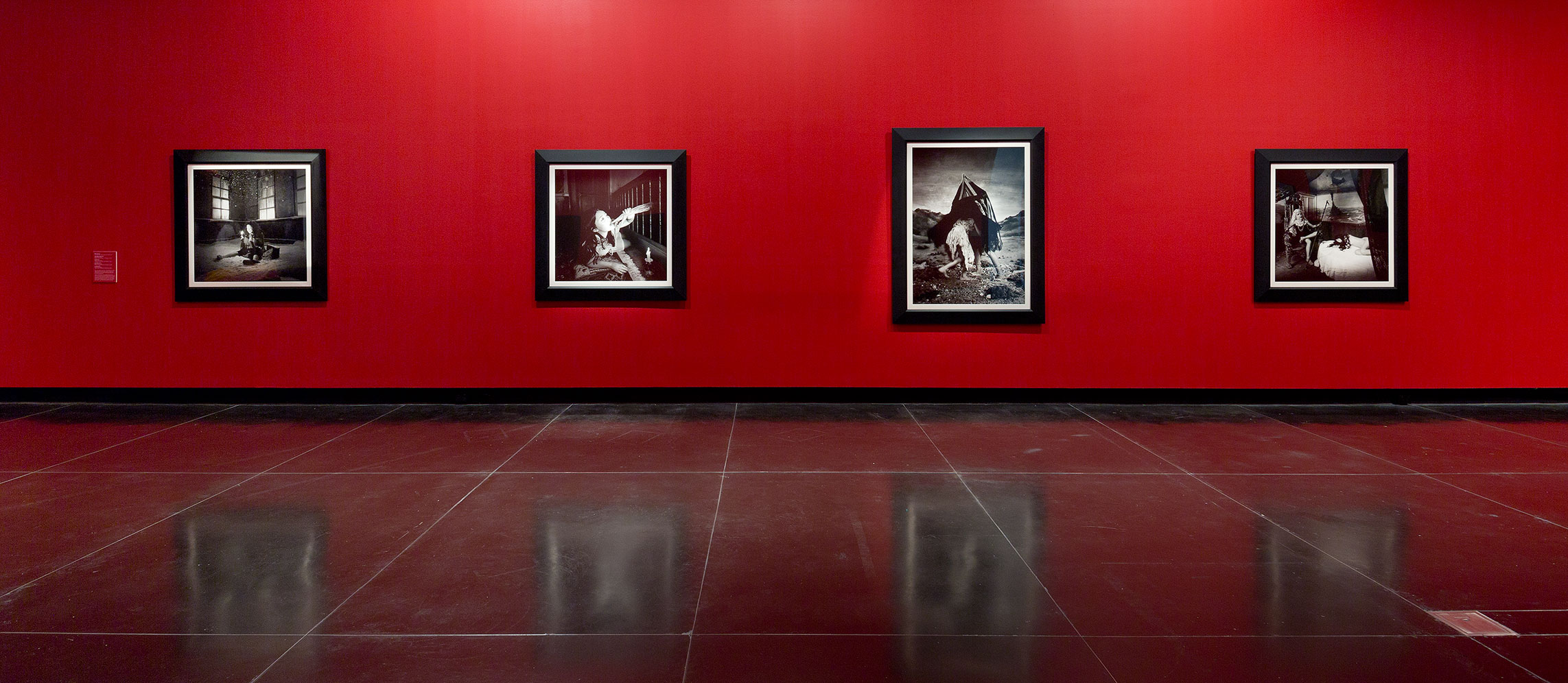
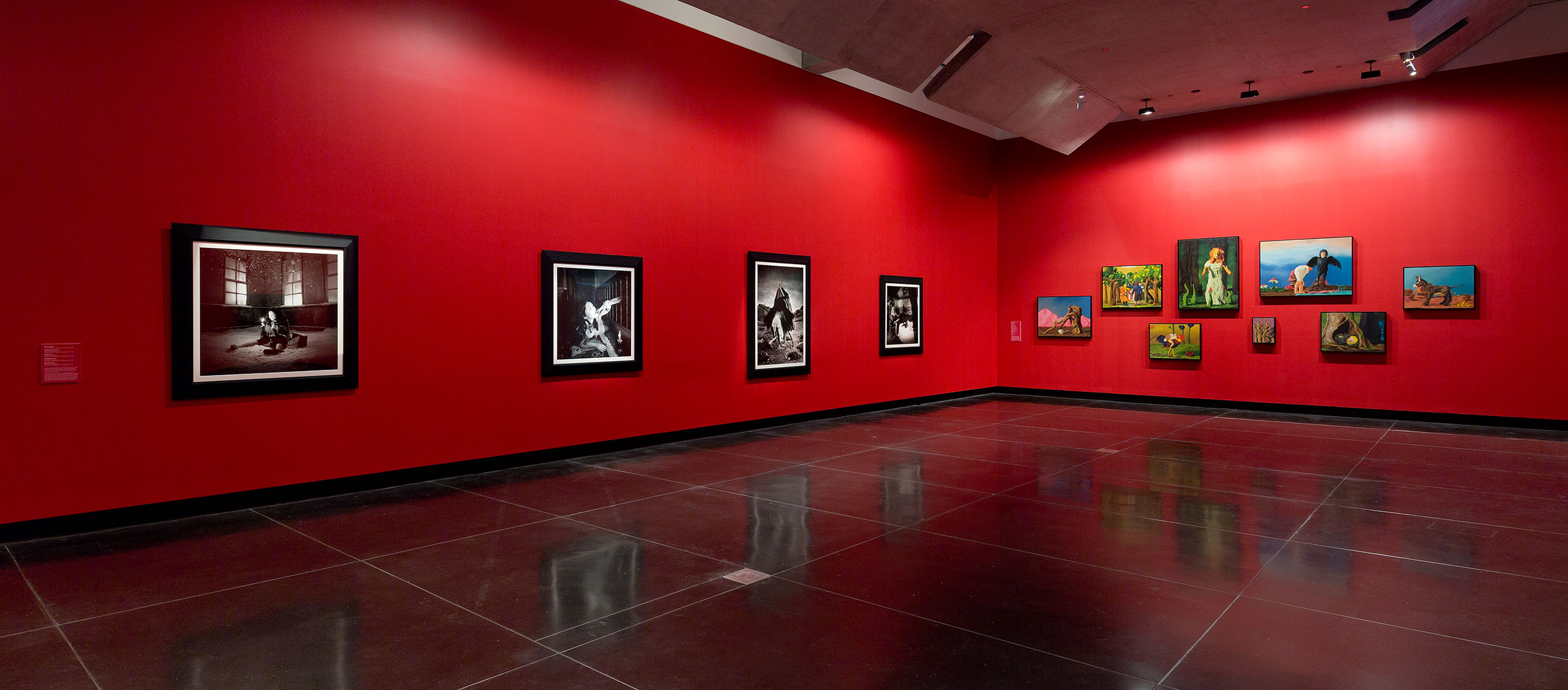
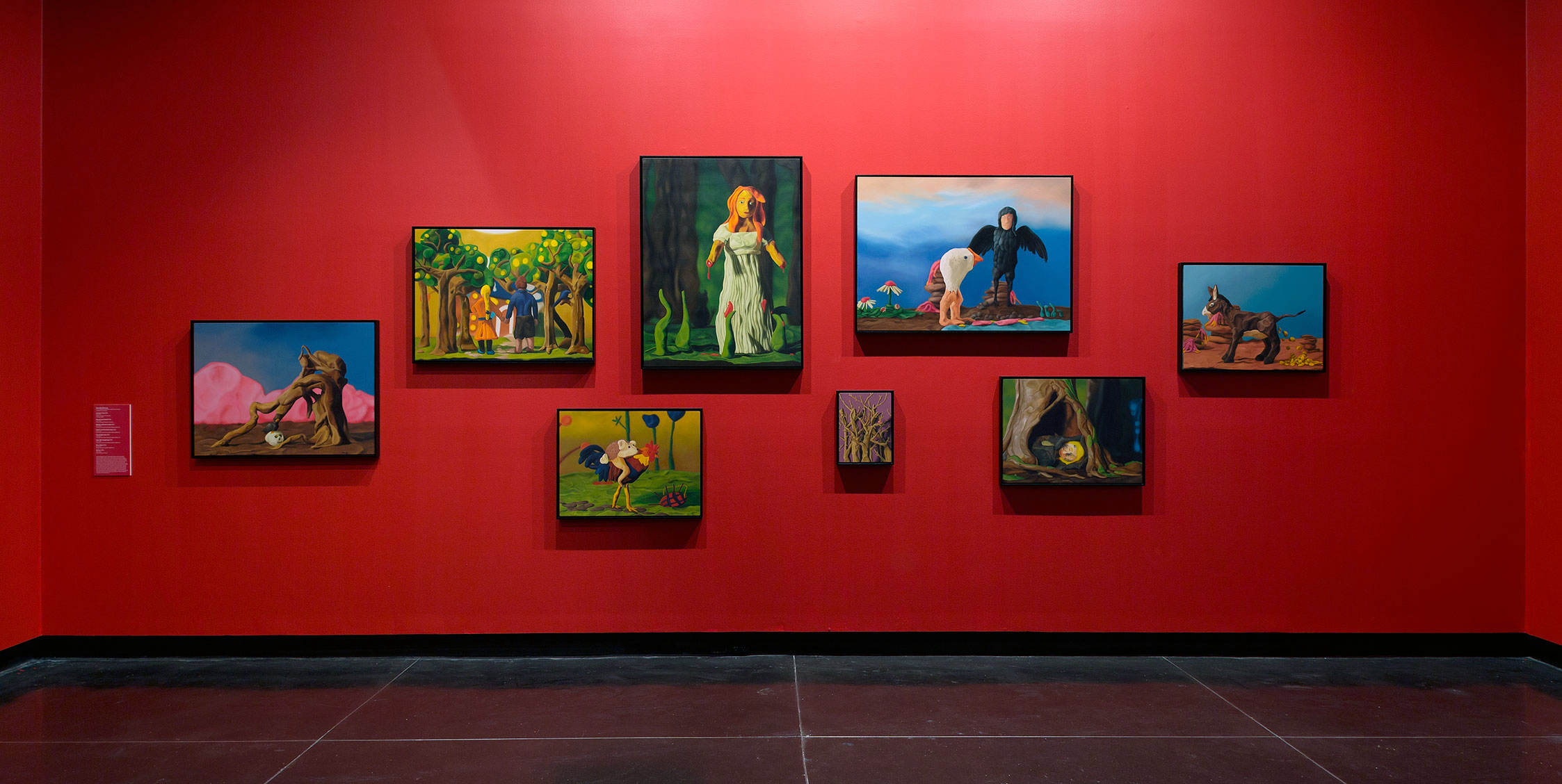
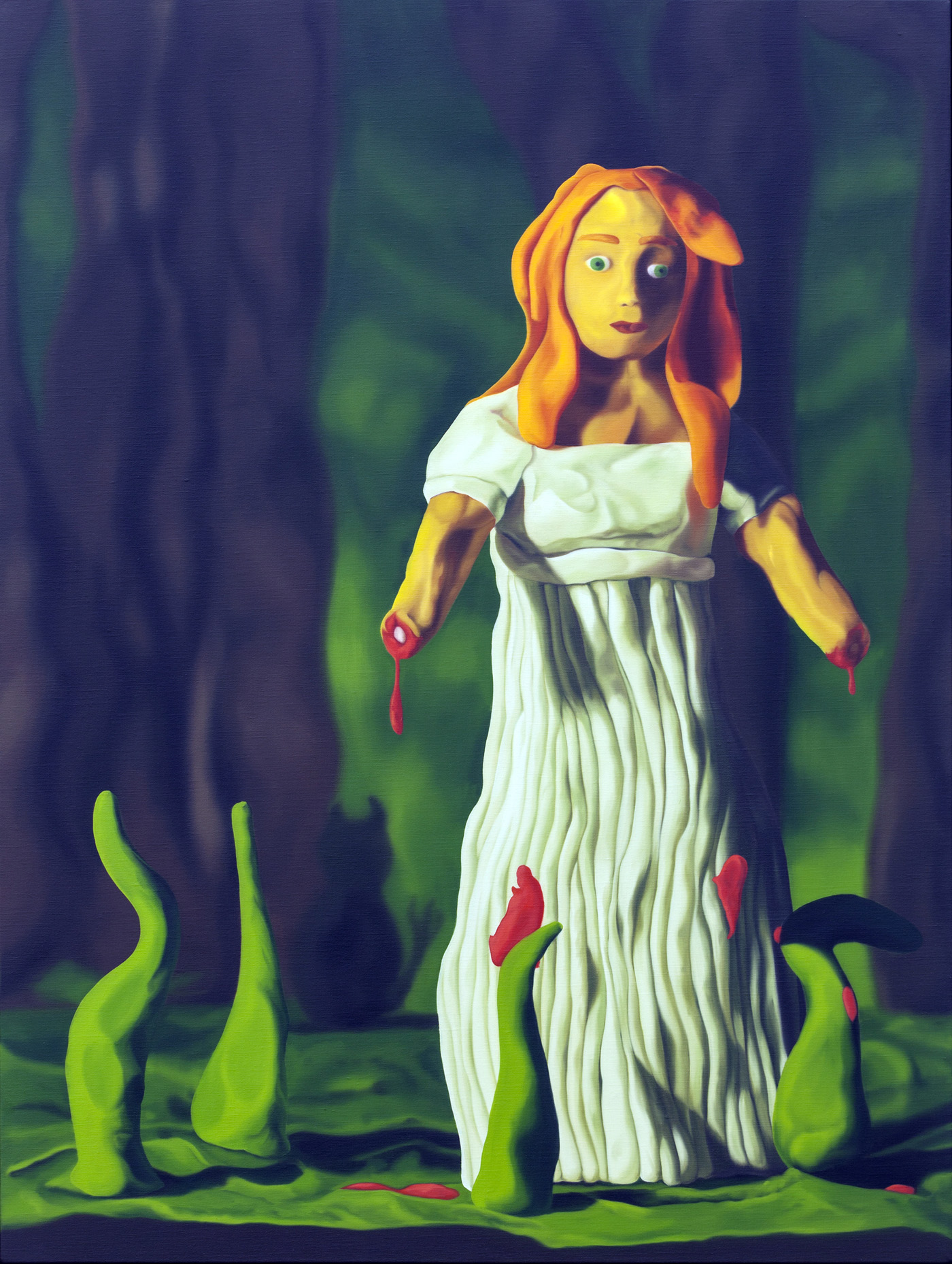
Exhibition: ‘L’envol’ (‘Flight’) at La maison rouge, Paris

Exhibition dates: 16th June – 28th October, 2018

Co-curators: Antoine de Galbert, Barbara Safarova, Aline Vidal and Bruno Decharme


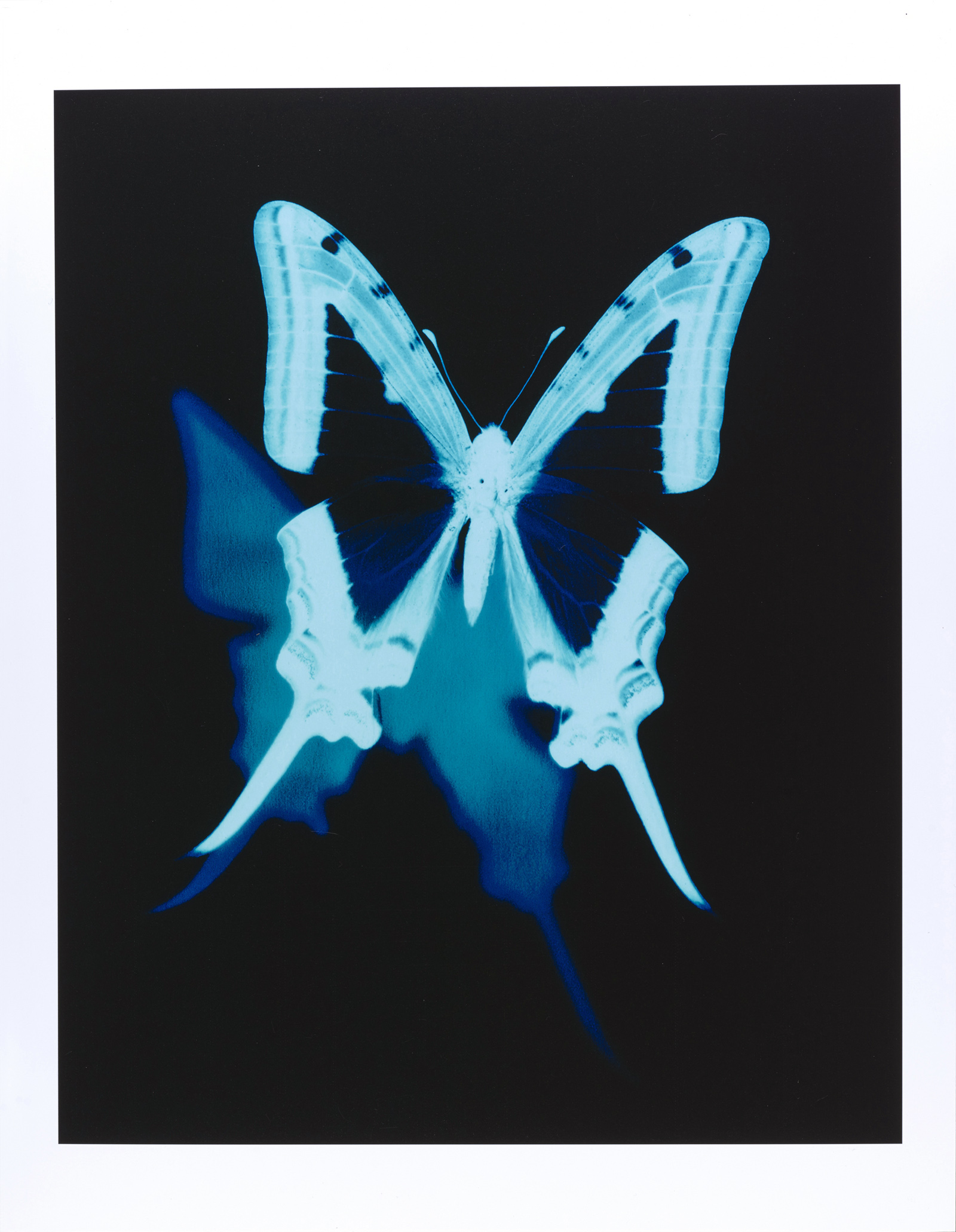
Georges Méliès (French, 1861-1938) 'Le voyage dans la lune. Le clair de terre - (10e tableau)' 1902 from the exhibition 'L'envol' ('Flight') at La maison rouge, Paris, June - October, 2018


Georges Méliès (French, 1861-1938)
Le voyage dans la lune. Le clair de terre – (10e tableau)
A Trip to the Moon
1902
Courtesy Collection La Cinémathèque française


Another fantastic, esoteric exhibition that will resonant with a lot of human beings. The curators of L’envol (Flight) “have imagined an exhibition that examines mankind’s dream of flying – though without any reference to those who have actually made this dream come true.”

Man has long wanted to fly even though even though men are not birds. But we can, each in our own way, imagine what it is like to fly; we can dream about flying; we can meditate on flying; we can partake in shamanic rituals where our spirit becomes a bird (Carlos Castaneda); we can fly during orgasmic sex as we are taken out of our own body (la petite mort); we can loose ourselves ecstatically during a dance party when we commune with the cosmic beyond; or we can make films such as Alan Parker’s outstanding film Birdy where the protagonist “imagines himself flying like a bird around his room, throughout the house and outside in the neighbourhood.”

Many and varied are the ways human beings examine the melancholy and fantastical desire to fly.

In my own contemporary work, I investigate the moral and ethical reasons why a human being would want to fly the very latest piece of technology, a fighter plane, only to kill, bomb and maim. The reason to fly such war machines, to be as one with the latest technology, the speed, the thrill of flying – to fight for freedom, democracy, to bomb, to kill; and the moral and ethical choices that human beings make, to undertake one action over another.

Again, the melancholy and the fantastical, perhaps flight as a means of escape from the realities of the everyday, much as a child I often imagined being a bird and flying away, never to come back. So this exhibition has special resonance with me. What an incredible collection of ideas, feelings, dreams and fantastical creations these magnificent inventors have released into the universe, in order to defy a literal and promote a metaphysical gravity (love).

Dr Marcus Bunyan


Many thankx to La maison rouge for allowing me to publish the photographs in the posting. Please click on the photographs for a larger version of the image.


“Love is metaphysical gravity”


Buckminster Fuller


Henry Darger (American, 1892-1973) 'Young Rebonna Dorthereans Blengins - Catherine Isles, Female, One Whip-Lash-Tail' 1920-1930 from the exhibition 'L'envol' ('Flight') at La maison rouge, Paris, June - October, 2018


Henry Darger (American, 1892-1973)
Young Rebonna Dorthereans Blengins – Catherine Isles, Female, One Whip-Lash-Tail
1920-30
Pencil and watercolour on paper
© Kiyoko Lerner, Adagp, 2018
Courtesy Musée d’art moderne de la Ville de Paris
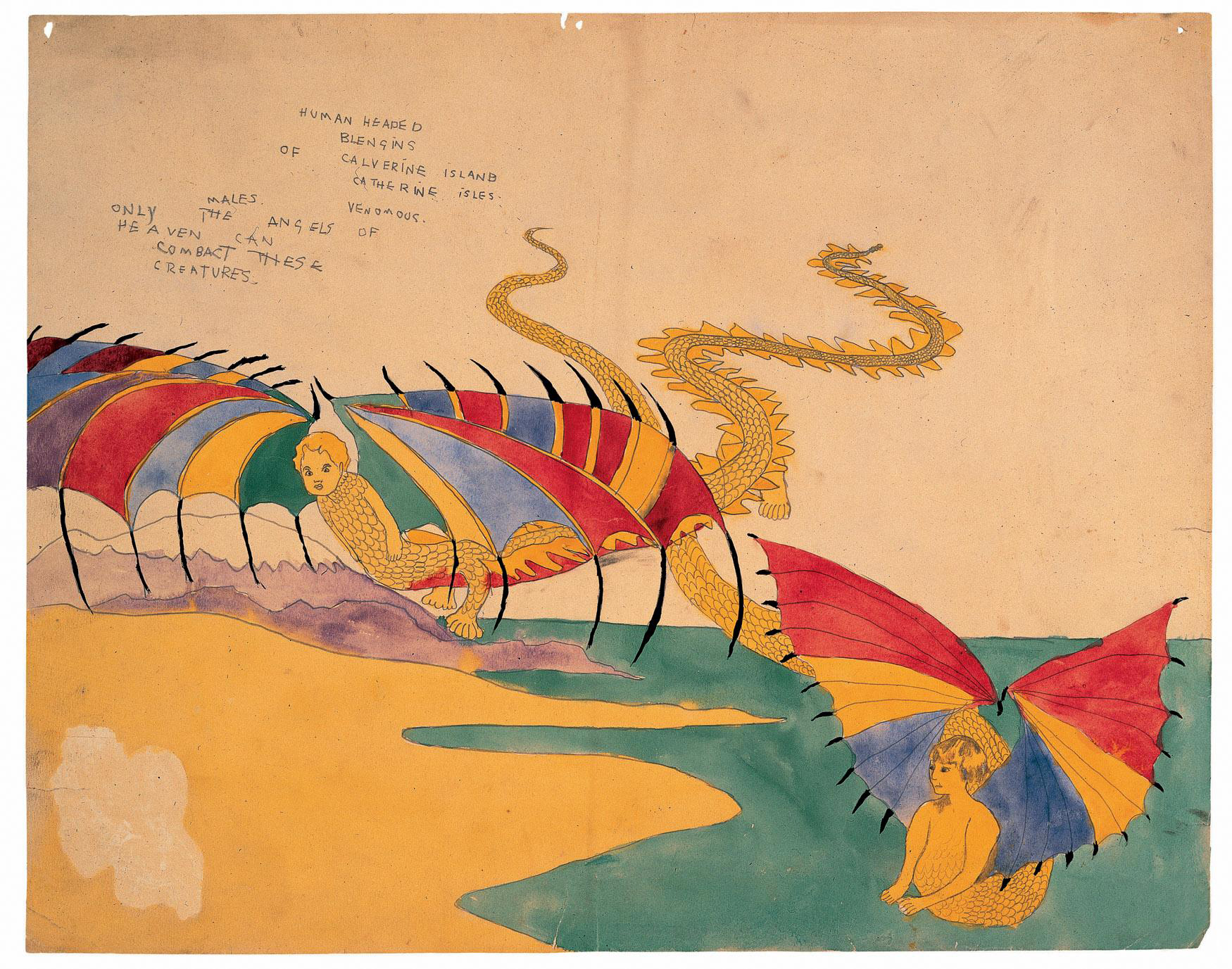
 

Henry Darger (American, 1892-1973) 'Human headed Blengins of Calverine Island Catherine Isles' 1920-1930


Henry Darger (American, 1892-1973)
Human headed Blengins of Calverine Island Catherine Isles
1920-30
Pencil and watercolour on paper


 Henry Joseph Darger (American, 1892-1973)

Henry Joseph Darger Jr. (c. April 12, 1892-April 13, 1973) was a reclusive American writer and artist who worked as a hospital custodian in Chicago, Illinois. He has become famous for his posthumously discovered 15,145-page, single-spaced fantasy manuscript called The Story of the Vivian Girls, in What Is Known as the Realms of the Unreal, of the Glandeco-Angelinian War Storm, Caused by the Child Slave Rebellion, along with several hundred drawings and watercolour paintings illustrating the story.

The visual subject matter of his work ranges from idyllic scenes in Edwardian interiors and tranquil flowered landscapes populated by children and fantastic creatures, to scenes of horrific terror and carnage depicting young children being tortured and massacred. Much of his artwork is mixed media with collage elements. Darger’s artwork has become one of the most celebrated examples of outsider art. …

In the Realms of the Unreal is a 15,145-page work bound in fifteen immense, densely typed volumes (with three of them consisting of several hundred illustrations, scroll-like watercolour paintings on paper derived from magazines and colouring books) created over six decades. Darger illustrated his stories using a technique of traced images cut from magazines and catalogues, arranged in large panoramic landscapes and painted in watercolours, some as large as 30 feet wide and painted on both sides. He wrote himself into the narrative as the children’s protector.

The largest part of the book, The Story of the Vivian Girls, in What is Known as the Realms of the Unreal, of the Glandeco-Angelinian War Storm Caused by the Child Slave Rebellion, follows the adventures of the daughters of Robert Vivian, seven princesses of the Christian nation of Abbieannia who assist a daring rebellion against the child slavery imposed by John Manley and the Glandelinians. Children take up arms in their own defense and are often slain in battle or viciously tortured by the Glandelinian overlords. The elaborate mythology includes the setting of a large planet, around which Earth orbits as a moon (where most people are Christian and mostly Catholic), and a species called the “Blengigomeneans” (or Blengins for short), gigantic winged beings with curved horns who occasionally take human or part-human form, even disguising themselves as children. They are usually benevolent, but some Blengins are extremely suspicious of all humans, due to Glandelinian atrocities.

Text from the Wikipedia website


Charles August Albert Dellschau (American, 1830-1923) 'Untitled' 1921


Charles August Albert Dellschau (American, 1830-1923)
Untitled
1921
Book
Courtesy Collection abcd / Bruno Decharme


Charles August Albert Dellschau (American born Prussia, 1830-1923)

Charles August Albert Dellschau (4 June 1830 Brandenburg, Prussia-20 April 1923 Houston, Texas) was one of America’s earliest known visionary artists, who created drawings, collages and watercolours of airplanes and airships and bound them in 12 known large scrapbooks that were discovered decades after his death. …

After his death, Dellschau’s home remained in the hands of his descendants. His notebooks of paintings and drawings, as well as his diaries were left virtually untouched for half a century until the late 1960s. Following a fire, the house was cleared and at least 12 of the notebooks were placed on the sidewalk to be discarded. Fred Washington, a local antiques and used furniture dealer, spotted the books, and for $100 bought them from the trash collector. The books sat undisturbed in Washington’s store under a pile of discarded carpet for over a year. In 1968, Mary Jane Victor, an art student at the University of St. Thomas in Houston stumbled upon the notebooks, and persuaded Washington to lend some of them to the university for a display on the story of flight. She also brought them to the attention of art patron and collector Dominique de Menil. Mrs. de Menil purchased four of the notebooks for $1,500. Of the remaining books, seven were purchased Peter (Pete) G. Navarro, a Houston commercial artist and UFO researcher. After studying them, Navarro sold four of the notebooks to the Witte Museum in San Antonio, and the San Antonio Museum of Art. One notebook ultimately ended in the private abcd (art brut connaissance & diffusion) collection in Paris belonging to Bruno Decharme, a French filmmaker and art collector. The rest of the notebooks ended up in private hands. Some were dismantled and single pages were sold. In 2016, a double sided page dated 1919, sold for $22,500 at Christie’s.

Dellschau’s earliest known work is a diary dated 1899, and the last is an 80-page book dated 1921-1922, giving his career as an artist a 21-year span. His work was in large part a record of the activities of the “Sonora Aero Club,” of which he was a purported member. Dellschau’s writings describe the club as a secret group of flight enthusiasts who met in Sonora, California in the mid-19th century. According to Dellschau, one of the club members discovered a formula for an anti-gravity fuel called “NB Gas.” The club mission was to design and build the first navigable aircraft using the NB Gas for lift and propulsion. Dellschau called these flying machines Aeros. Dellschau never claimed to be a pilot or a designer of any of the airships; he identifies himself only as a draftsman for the Sonora Aero Club. His collages incorporate newspaper clippings (called “press blooms”) of then-current news articles about aeronautical advances and disasters.

Despite exhaustive research, including searches of census records, voting rosters, and death records, nothing has been found to substantiate the existence of this group except for a few gravestones in the Columbia Cemetery where several of the surnames are found. It is speculated that, like the voluminous “Realms of the Unreal” notebooks by outsider artist Henry Darger (1882-1973), the Sonora Aero Club is a fiction by Dellschau.

Text from the Wikipedia website


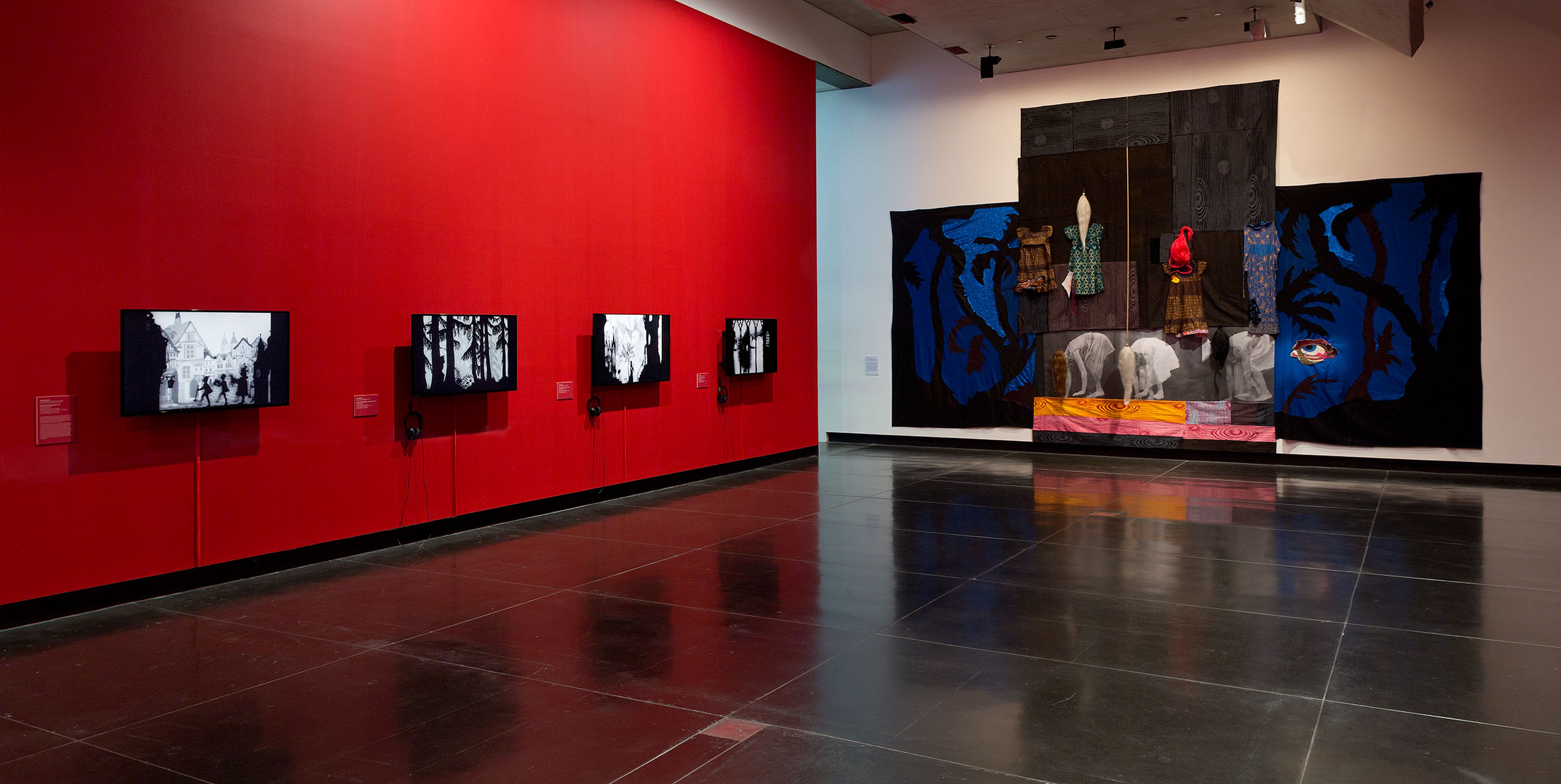
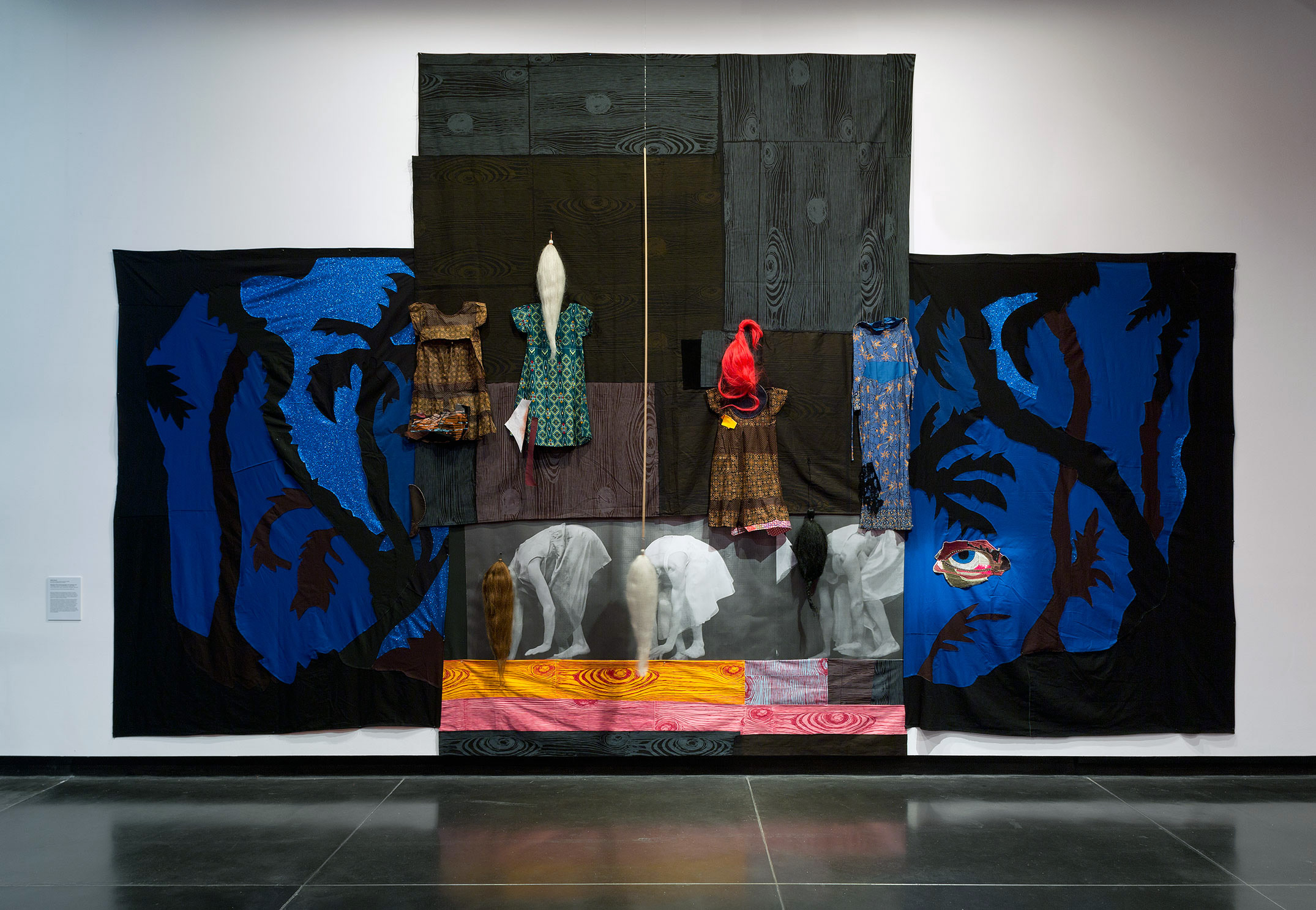
L’envol is the final exhibition at La maison rouge, which will close its doors for the last time on October 28, 2018. Antoine de Galbert has invited Barbara Safarova, Aline Vidal and Bruno Decharme as co-curators. Together, these specialists in art brut and contemporary art have imagined an exhibition that examines mankind’s dream of flying – though without any reference to those who have actually made this dream come true. As always at La maison rouge, the curators have considered the subject matter independently of “categories” to bring together works of art brut, modern, contemporary, ethnographic and folk art. A walk through the various themes reveals a succession of some 200 works, including installations, films, documents, paintings, drawings and sculptures.

In the beginning there was Dedalus, that inspired inventor who dreamed of escaping into the skies, taking his son Icarus with him. Harnessed to wings made from feathers and wax, they rose into the heavens, intoxicated with their flight, borne aloft into the atmosphere. We all know what happened next. Icarus ventured too near the sun, his wings melted and he hurtled into the sea to die. From legend to reality, the sky has always been a dangerous playground for mankind. This is no small undertaking by the 130 artists in Lenvol, as they endeavour to challenge the laws of gravity, break free of Earth’s magnetic field, launch themselves into the unknown or experience the gaseous envelope of the atmosphere between two periods of turbulence. Some are hedonists, others are activists, intent on saving mankind as the world heads for destruction, whether by building flying shelters or constructing utopias. The sky offers ample territory for experiment, shared between the extravagant artists who are convinced of their ability to overcome gravity and the gods that live there, and the conceptualists designing utopias – more poet than scientist.

Defying gravity

The dream of flying may be as old as mankind – and the sky may have lost some of its mystery thanks to progress in aviation – but men are not birds, all the same. Clothing oneself in feathers is not enough. We are earthly creatures, and the body alone will always struggle to leave the ground. We can never achieve this freedom nor expand the scope of our action without the will to surpass ourselves.

Devoid of wings, dancers soar upwards, defying the laws of gravity with no fear of falling or exhaustion (Loie Fuller, Nijinsky, Cuningham, etc.) Rodchenko, a photographer for the Russian propaganda machine, uses daring, low-angle shots to make his athletes appear to take off in flight, idealising the body to further the needs of the revolution whose heroes were held aloft.

Lucien Pelen seeks anti-matter as he attempts to merge his body with the atmosphere. Arms outstretched, he launches himself into the air and, for a split second, achieves the ecstasy of flight before coming brutally back down to earth. Such is this fragile balance at the boundaries of possibility.

When Gustav Messmer attached springs to his shoes so he could bounce rather than walk, or fitted a bicycle with enormous bat-like wings, did he realise how precarious these inventions were? To hell with scepticism! Surely it takes some degree of madness to invent your own freedom?

Or engage in excesses like Rebecca Horn who, in search of new ways to experience the space around her, shrouds her ailing body in feather fans then seeks the limits of its extension, stretching these articulated wings as far as they will go before the mechanism gives way.

To infinity and beyond

The weight of the world gives artists cause to wander in the shadow of earthly paradises. Fréderic Pardo, a psychedelic star, uses tempera, an ancient technique, to produce spaced-out paintings while high on LSD. He floats alongside magic carpets (Urs Lüthi), ridden by souls from an Arabian Nights dream. We discover a limitless space filled with superheroes, Batman and witches straddling broomsticks; a world teeming with chimera and fairies.

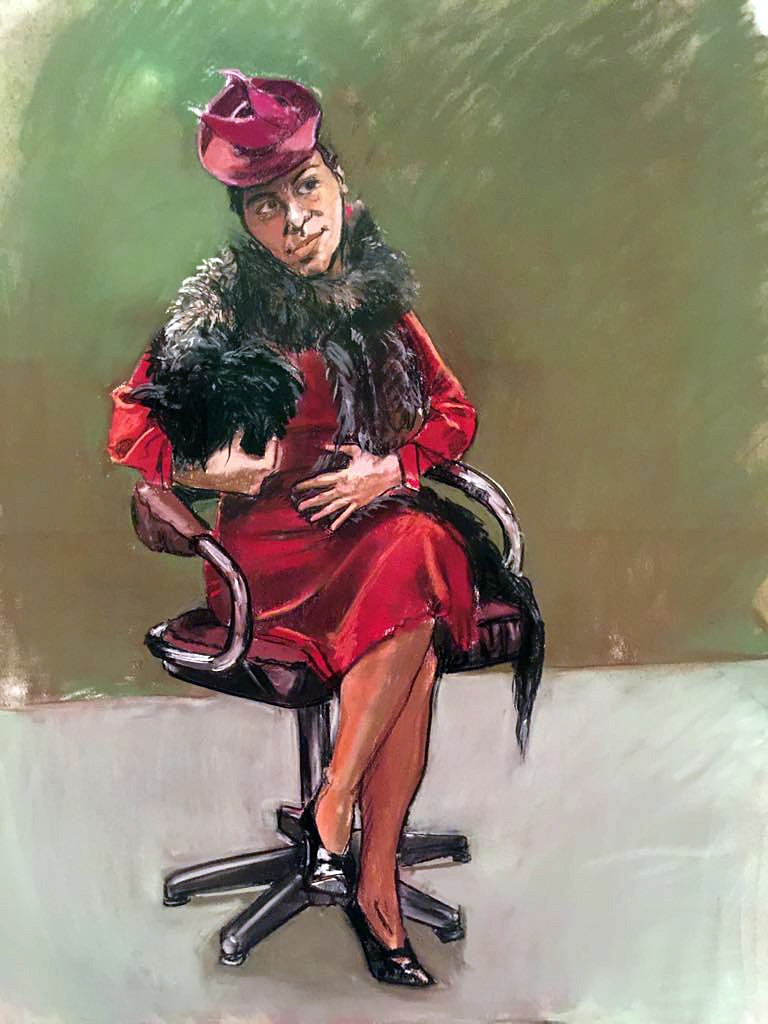
The sky seethes with mystery. Shamans, accustomed to travelling between worlds, converse with spirits and collect information while improbable creatures, part angel, part human, bump and bowl along (Henry Darger’s Blengins side by side with Moebius’s Arzach, Friedrich Schröder-Sonnenstern’s hybrids and Kiki Smith’s bird-women).

Engineering the impossible

Tatlin’s sculpture, more fine art than flying machine, seeks to rediscover an age-old, mythical experience. Letatlin is a melding of art, technique and utopia; an attempt at a personal dream. The year is 1929 and the Great Depression has spared no-one. Heads are hot with the desire to escape, minds filled with fantasies of infinity. “We must learn to fly through the air just as we learned to swim in the water or ride a bicycle,” Tatlin declared.

Some forty years later, Belgian artist Panamarenko appears to have taken him at his word. Obsessed with the freedom of flight, he makes sophisticated yet poetic constructions, bristling with bellows and motors. However crazy or technically unfeasible they may be, the artist never tires of convincing us they will lift him off the ground.

These are beautiful machines, created by the engineers of the impossible and of no purpose whatsoever – except for the dreams they inspire. Snuggling into Fabio Mauri’s Luna inspires a feeling of weightlessness with the senses immersed in a light, fluffy environment. Stationed on the deck of his Spacecraft, inspired as much by the Mercury project as Henry David Thoreau’s cabin in the woods, Stéphane Thidet combines musical arrangements with conversations between astronauts in an electroacoustic performance.

They shut themselves away in their own worlds, all the better to escape to another place, experience the extraordinary and relive childhood fantasies, but with adult toys. Roman Signer, for example, plays with explosives and sets off conflagrations that are both fascinating and illusory. After all, what is the point of smashing everyday objects to smithereens? Of starting up a helicopter in an inflatable pool when it will probably destroy everything around? What is the point of risking danger, other than to try and become one with the inventor of the world and reproduce the forces of nature.

Indoor aviators

Some of these dream merchants are inspired by an intercelestial mission. They are the off-the-wall artists, incomprehensible to the rational world, imbued with a different logic and convinced that flight can be achieved with contraptions made from bits and bobs. Theirs is a world free from explosions or falls, bolstered by belief and the quest for the absolute. Hans-Jörg Georgi, for one, is driven by the need to save humanity from inevitable destruction. His studio is crammed with the aeroplanes he painstakingly builds, day after day, from cardboard boxes stuck together with glue.

Karl Hans Janke is another master of the art of spaceship building, having produced an astonishing 4,500 drawings describing hundreds of technical innovations. Charles Dellschau is further testament to this obsessive dream of flying. He was a member of the Sonora Aero Club, a secret group of mid-nineteenth-century flight enthusiasts whose self-appointed mission was to build the world’s first navigable aircraft.

These are crazy escapades, guided only by the imagination and ultimately less dangerous, and just as exhilarating, as those undertaken by reality’s utopians. Adolf Wölfli chose to rise above it all, deliriously determined to embrace Creation, Space and Eternity. His associations of opposite perspectives produce apparently real and contradictory visions that are dizzying to behold.

Aviation’s spectacular progress has in no way diminished the dreams of these magnificent inventors. Two irreconcilable worlds continue to share the skies. And why shouldn’t artists seek inspiration from other suns? Despite his fall, Icarus is a hero for all eternity.

Excerpt from the exhibition catalogue, introduction by Aline Vidal.


Fabio Mauri (Italian, 1926-2009)
Luna
1968
Installation


Anonymous photographer. 'Untitled' c. 1940


Anonymous photographer
Untitled
c. 1940
Black and white photograph
Courtesy Collection abcd / Bruno Decharme


Alexandre Rodchenko (Russian, 1891-1956) 'A leap' 1934


Alexandre Rodchenko (Russian, 1891-1956)
A leap
1934
Black and white photograph
Courtesy Collection Multimedia Art Museum, Moscow / Moscow House of Photography Museum


Photographs made from above or below or at odd angles are all around us today – in magazine and television ads, for example – but for Rodchenko and his contemporaries they were a fresh discovery. To Rodchenko they represented freedom and modernity because they invited people to see and think about familiar things in new ways.

Text from the MoMA website


Photography was important to Rodchenko in the 1920s in his attempt to find new media more appropriate to his goal of serving the revolution. He first viewed it as a source of preexisting imagery, using it in montages of pictures and text, but later he began to take pictures himself and evolved an aesthetic of unconventional angles, abruptly cropped compositions, and stark contrasts of light and shadow. His work in both photomontage and photography ultimately made an important contribution to European photography in the 1920s.

Text from The Art Story website


Eikoh Hosoe (Japan, b. 1933) 'Kamaitachi 17' 1965


Eikoh Hosoe (Japan, b. 1933)
Kamaitachi 17
1965
Black and white photograph
© Eikoh Hosoe. Courtesy galerie Jean-Kenta Gauthier, Paris


Eikoh Hosoe’s groundbreaking Kamaitachi was originally released in 1969 as a limited-edition photobook of 1,000 copies. A collaboration with Tatsumi Hijikata, the founder of ankoku butoh dance, it documents their visit to a farming village in northern Japan and an improvisational performance made with local villagers, inspired by the legend of kamaitachi, a weasel-like demon who haunts rice fields and slashes people with a sickle. Hosoe photographed Hijikata’s spontaneous interactions with the landscape and the people they encountered. A seductive combination of performance and photography, the two artists enact an personal and symbolic investigation of Japanese society during a time of massive upheaval.

Text from the Aperture website
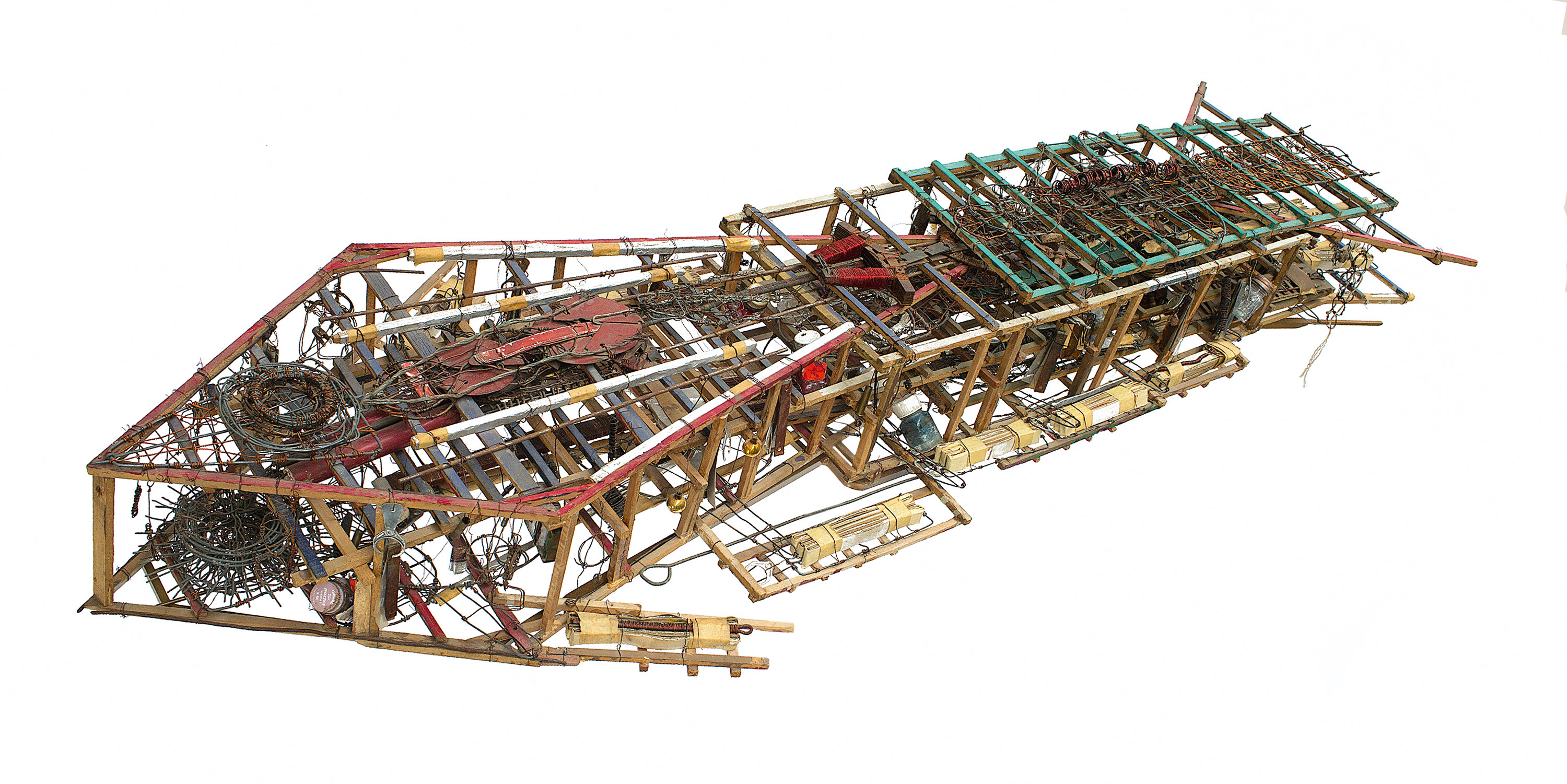
 

Emery Blagdon (American, 1907-1986) 'Untitled' Nd


Emery Blagdon (American, 1907-1986)
Untitled
Nd
Courtesy Collection abcd / Bruno Decharme


From the late 1950s until his death in 1986, Emery Blagdon created a constantly changing installation of paintings and sculptures in a small building on his Nebraska farm. He believed in the power of “earth energies” and in his own ability to channel such forces in a space that, through constant adjusting and aesthetic power, could alleviate pain and illness.

Blagdon used found materials like hay baling wire, magnets, and remnant paints from farm sales, but he also sought out special ingredients like salts and other “earth elements” through a nearby pharmacy. He called the individual pieces his “pretties,” but collectively they comprised The Healing Machine. Blagdon worked on his Healing Machine for more than three decades, tending, tinkering with, and reorganising its components every day and, in his own words, “according to the phases of the moon.” He believed it was a functional machine in which energies were drawn upward from the building’s earthen floor into the space, where they could bounce around and remain dynamic.

Text from the Wikipedia website


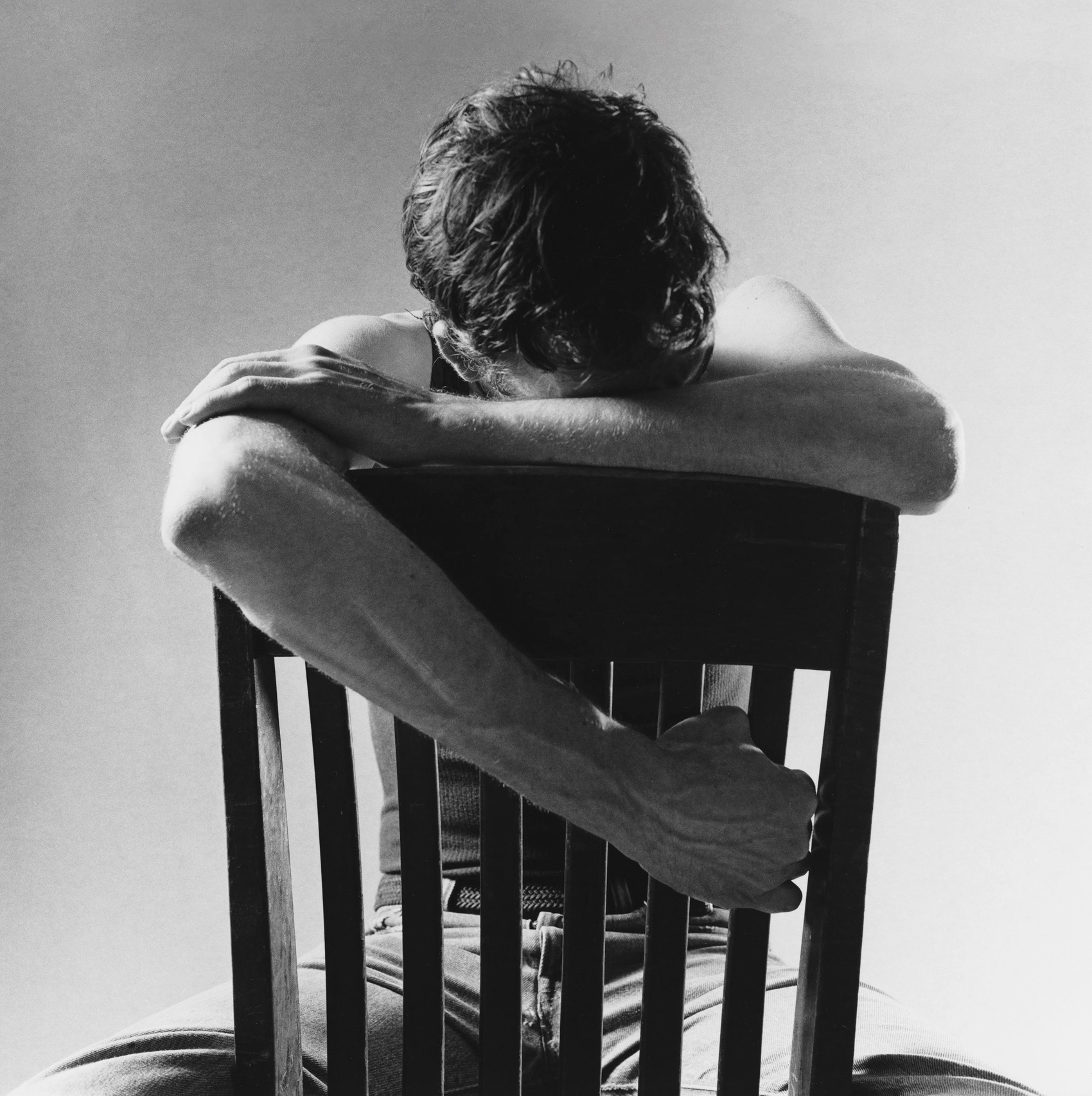
Lucien Pelen (French, b. 1978) 'Chair n°2' (detail) 2005


Lucien Pelen (French, b. 1978)
Chair n°2 (detail)
2005
Black and white photograph
Lucien Pelen / Courtesy Galerie Aline Vidal


Jacques-Henri Lartigue (1894-1986) 'L'envol de Bichonnade' 1905


Jacques-Henri Lartigue (French, 1894-1986)
L’envol de Bichonnade (The flight of Bichonnade or Bichonnade leaping)
Paris 1905
Gelatin silver print
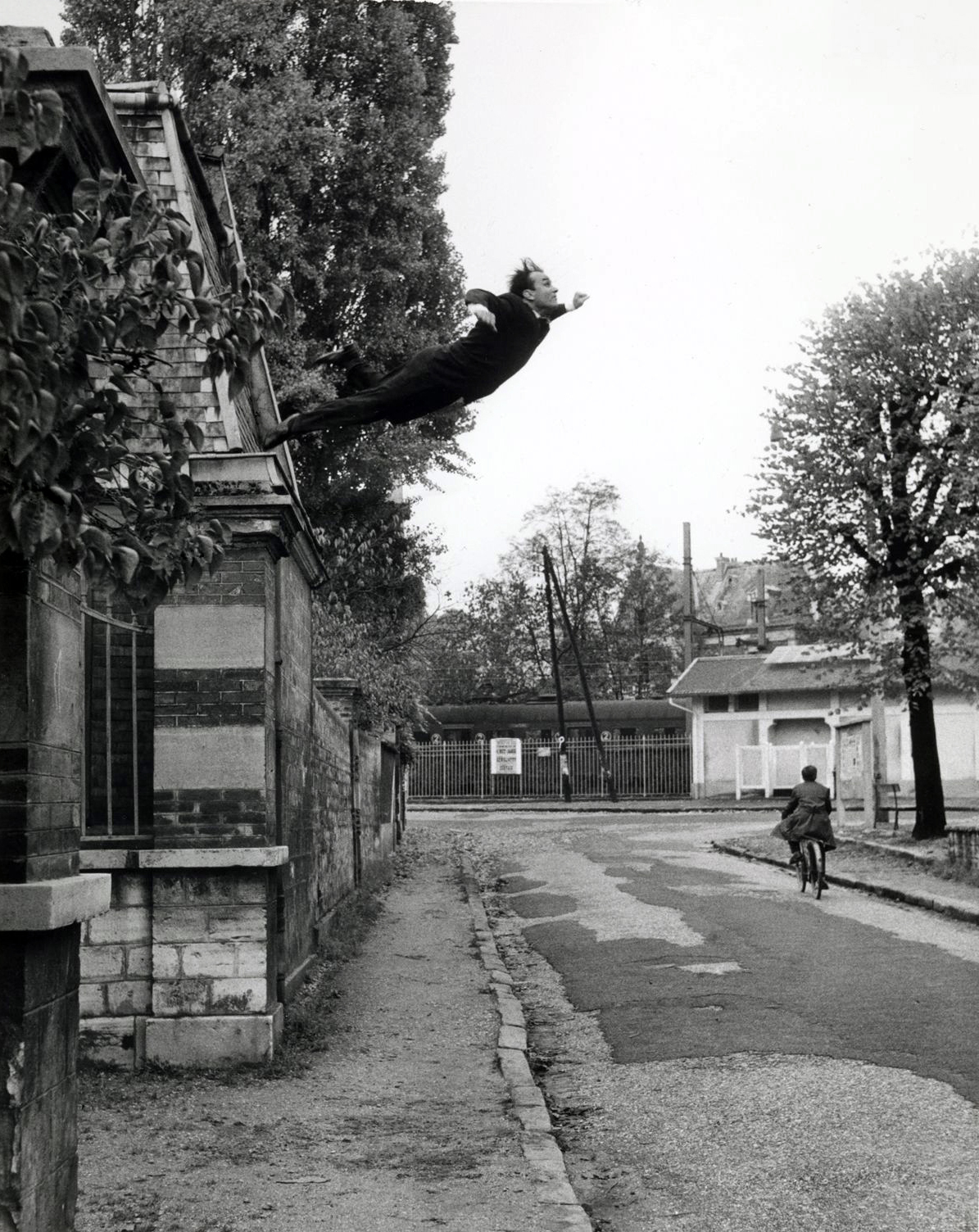
 

Yves Klein (French, 1928-1962) 'Leap into the Void' 1960


Yves Klein (French, 1928-1962)
Leap into the Void
1960
Black and white argentic print
© Succession Yves Klein c/o Adagp, Paris
© Photo Collaboration Harry Shunk and Janos Kender
© J. Paul Getty Trust. The Getty Research Institute, Los Angeles


As in his carefully choreographed paintings in which he used nude female models dipped in blue paint as paintbrushes, Klein’s photomontage paradoxically creates the impression of freedom and abandon through a highly contrived process. In October 1960, Klein hired the photographers Harry Shunk and Jean Kender to make a series of pictures re-creating a jump from a second-floor window that the artist claimed to have executed earlier in the year. This second leap was made from a rooftop in the Paris suburb of Fontenay-aux-Roses. On the street below, a group of the artist’s friends from held a tarpaulin to catch him as he fell. Two negatives – one showing Klein leaping, the other the surrounding scene (without the tarp) – were then printed together to create a seamless “documentary” photograph. To complete the illusion that he was capable of flight, Klein distributed a fake broadsheet at Parisian newsstands commemorating the event. It was in this mass-produced form that the artist’s seminal gesture was communicated to the public and also notably to the Vienna Actionists.

Text from The Metropolitan Museum of Art website
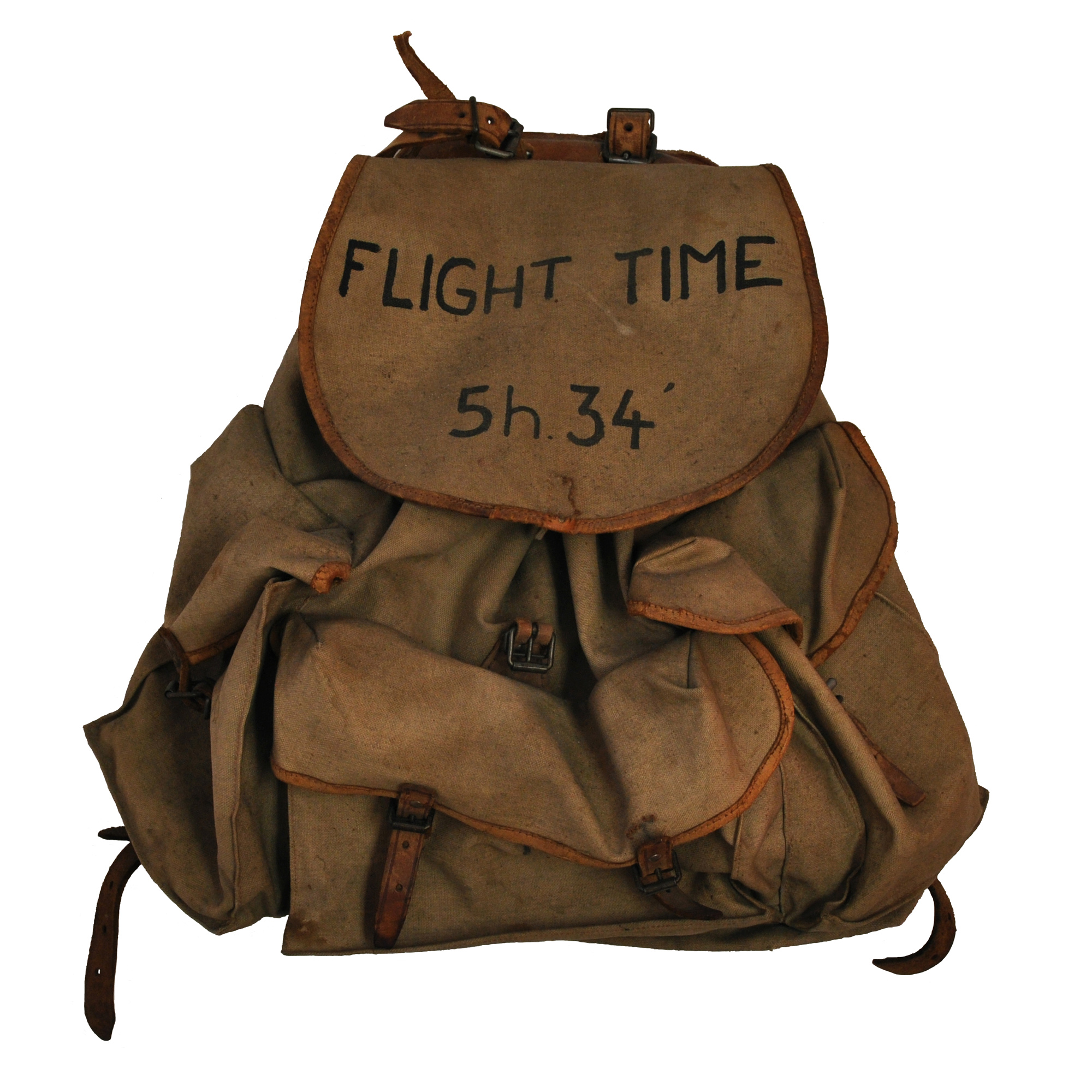
 

Philippe Thomassin. 'Flight Time 5h34'' 1989-1991


Philippe Thomassin
Flight Time 5h34′
1989-1991
Courtesy collection Antoine de Galbert
Photo: Célia Pernot
© Philippe Thomassin


Rebecca Horn (German, b. 1944) 'The little Mermaid' 1990


Rebecca Horn (German, b. 1944)
The little Mermaid
1990
Courtesy collection Antoine de Galbert
Photo: Célia Pernot
© Rebecca Horn


Rebecca Horn (born 24 March 1944, Michelstadt, Hesse) is a German visual artist, who is best known for her installation art, film directing, and her body modifications such as Einhorn (Unicorn), a body-suit with a very large horn projecting vertically from the headpiece. She directed the films Der Eintänzer (1978), La ferdinanda: Sonate für eine Medici-Villa (1982) and Buster’s Bedroom (1990). Horn presently lives and works in Paris and Berlin.
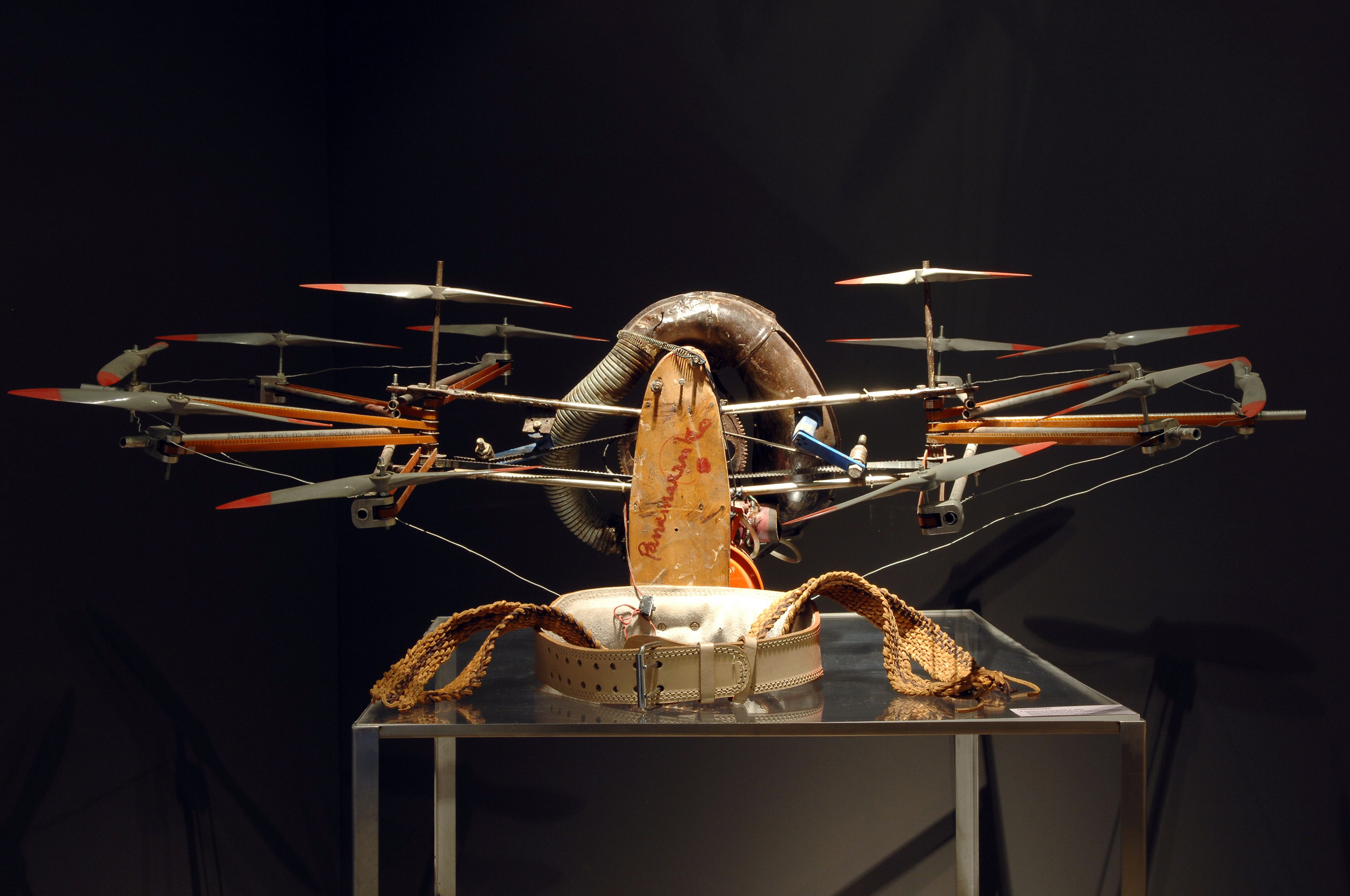
 

Panamarenko (Belgian, b. 1940) 'Japanese Flying Pak 3' 2001


Panamarenko (Belgian, 1940-2019)
Japanese Flying Pak 3
2001
Courtesy Galerie Jamar, Anvers
Photo: Wim Van Eesbeek
© Panamarenko


Panamarenko (pseudonym of Henri Van Herwegen, born in Antwerp, 5 February 1940) was a prominent assemblagist in Belgian sculpture. Famous for his work with aeroplanes as theme; none of which are able nor constructed to actually leave the ground.

Panamarenko studied at the academy of Antwerp. Before 1968, his art was inspired by pop-art, but early on he became interested in aeroplanes and human powered flight. This interest is also reflected in his name, which supposedly is an acronym for “Pan American Airlines and Company”.

Starting in 1970, he developed his first models of imaginary vehicles, aeroplanes, balloons or helicopters, in original and surprising appearances. Many of his sculptures are modern variants of the myth of Icarus. The question of whether his creations can actually fly is part of their mystery and appeal.

Text from the Wikipedia website
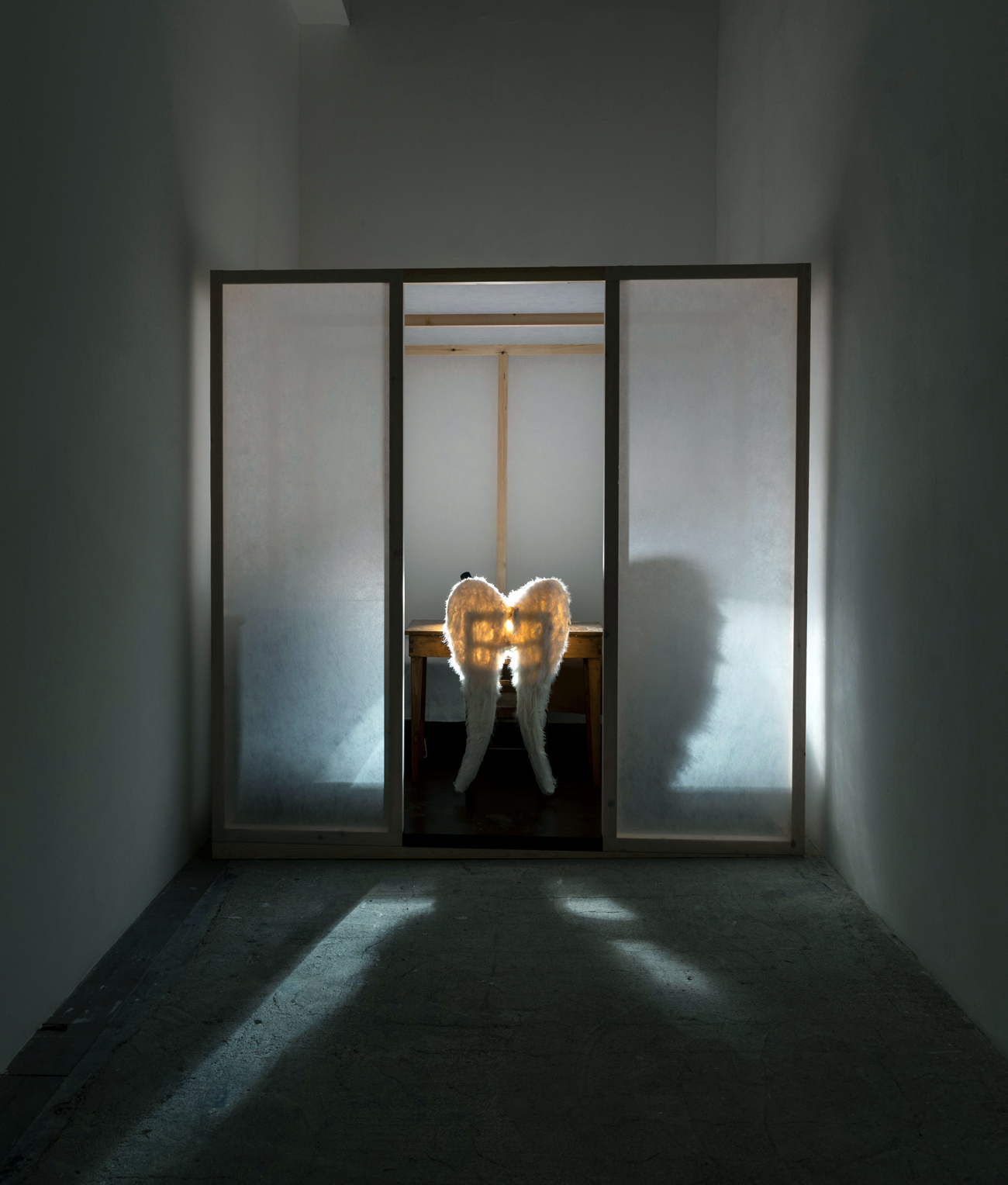
 

Ilya and Emilia Kabakov (American born Russia, b. 1933 and 1945) 'How Can One Change Oneself' 2010


Ilya and Emilia Kabakov (American born Russia, b. 1933 and 1945)
How Can One Change Oneself
2010
Installation
Courtesy of the artist et Galleria Continua, San Gimignano/Beijing/Les Moulins/ Habana
© Ilya et Emilia Kabakov


The Kabakovs are amongst the most celebrated artists of their generation, widely known for their large-scale installations and use of fictional personas. Critiquing the conventions of art history and drawing upon the visual culture of the former Soviet Union – from dreary communal apartments to propaganda art and its highly optimistic depictions of Soviet life – their work addresses universal ideas of utopia and fantasy; hope and fear. …

The Kabakovs are best known for their ‘total’ installations, a type of immersive artwork that they pioneered. A ‘total installation’ completely immerses the viewer in a dramatic environment. They transform the gallery spaces they are displayed in, creating a new reality for the viewer to enter and experience. They often explore dark themes like power and control, oppression and destruction. Over their career, the Kabakovs have created almost two hundred total installations.

“Ilya’s world and work are based and built on fantasy and on the history of art. I, on the other hand, very early in life, somehow learned to combine both reality and fantasy and to live in both. My fantasy world is always close to and coexists with reality. Our life is very much based on this combination: I am trying to make reality seem like the realisation of fantasy, or, maybe, a continuation of fantasy, where there is no place for real, everyday situations and problems. Our life consists of our work, dreams and discussions.”

Emilia Kabakov, 2017

Text from the Tate website


Moebius (Jean Henri Gaston Giraud) (French, 1938-2012) 'Arzach' 1977


Moebius (Jean Henri Gaston Giraud) (French, 1938-2012)
Arzach
1977
Heavy Metal Magazine, April 1977, Vol. I, No. 1


The first of Moebius’ Arzach comic series. Arzach made his debut in the first issue of Heavy Metal Magazine April – Vol. 1 No. 1. Arzach is seen flying atop his trusty pterodactyl in a strange world. Spotting a beautiful naked woman through a rounded window, Arzach is determined to win her heart, but what awaits him is utterly unexpected.


Jean Henri Gaston Giraud (French, 8 May 1938 – 10 March 2012) was a French artist, cartoonist, and writer who worked in the Franco-Belgian bandes dessinées (BD) tradition. Giraud garnered worldwide acclaim under the pseudonym Mœbius, as well as Gir outside the English-speaking world, used for the Blueberry series – his most successful creation in the non-English speaking parts of the world – and his Western-themed paintings. Esteemed by Federico Fellini, Stan Lee, and Hayao Miyazaki, among others, he has been described as the most influential bande dessinée artist after Hergé.

His most famous works include the series Blueberry, created with writer Jean-Michel Charlier, featuring one of the first antiheroes in Western comics. As Mœbius, he created a wide range of science-fiction and fantasy comics in a highly imaginative, surreal, almost abstract style. These works include Arzach and the Airtight Garage of Jerry Cornelius. He also collaborated with avant garde filmmaker Alejandro Jodorowsky for an unproduced adaptation of Dune and the comic book series The Incal.

Mœbius also contributed storyboards and concept designs to numerous science-fiction and fantasy films, such as Alien, Tron, The Fifth Element, and The Abyss. Blueberry was adapted for the screen in 2004 by French director Jan Kounen.

Text from the Wikipedia website
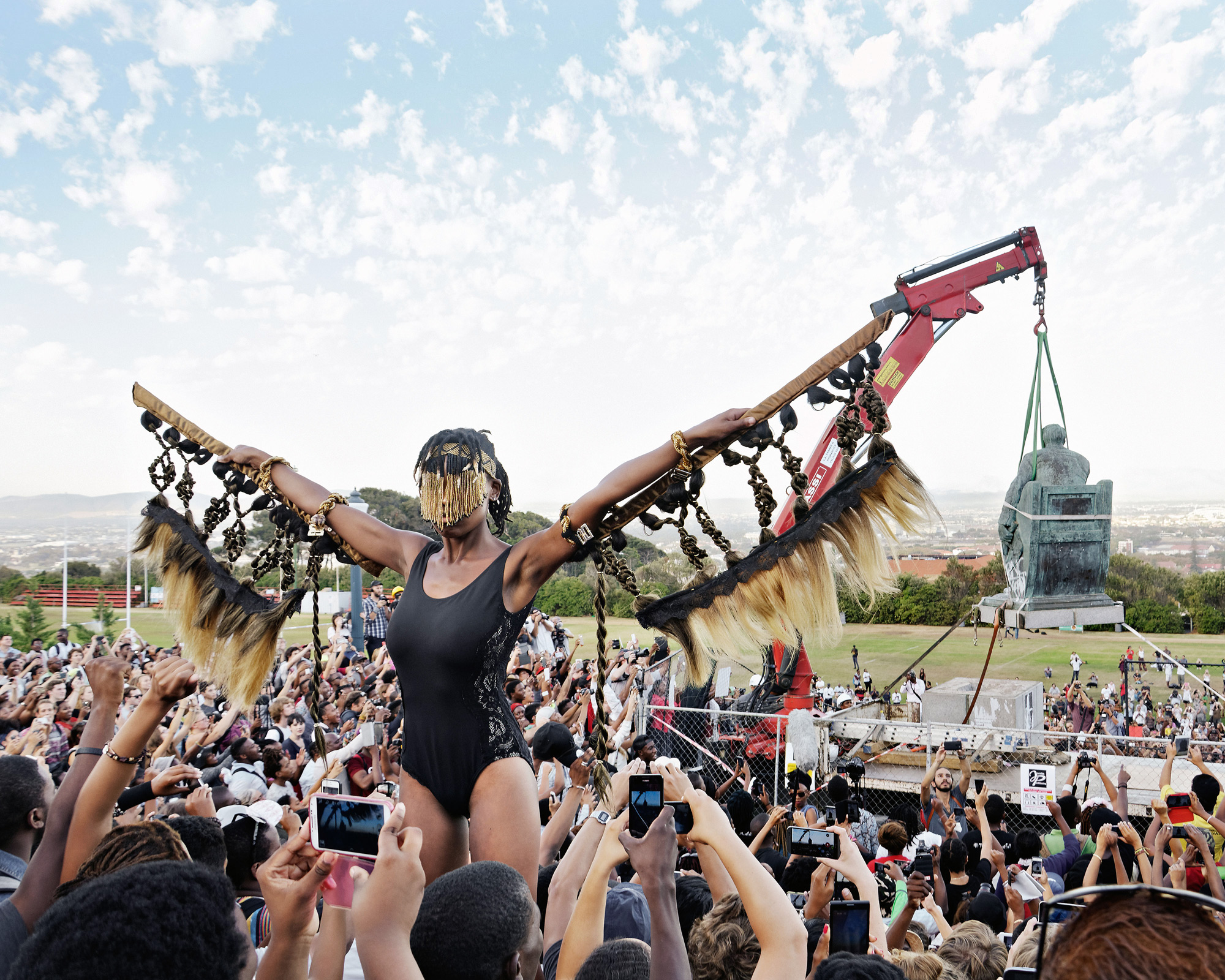
 

Sethembile Msezane (South Africa, b. 1991) 'Chapungu - The Day Rhodes Fell' 2015


Sethembile Msezane (South African, b. 1991)
Chapungu – The Day Rhodes Fell [University of Cape Town, South Africa]
2015
Coloured photograph
Courtesy private collection
© Sethembile Msezane


Sethembile Msezane was born in 1991 in KwaZulu Natal, South Africa. She lives and works in Cape Town, South Africa. Using interdisciplinary practice encompassing performance, photography, film, sculpture and drawing, Msezane creates commanding works heavy with spiritual and political symbolism. The artist explores issues around spirituality, commemoration and African knowledge systems. She processes her dreams as a medium through a lens of the plurality of existence across space and time, asking questions about the remembrance of ancestry. Part of her work has examined the processes of myth-making which are used to construct history, calling attention to the absence of the black female body in both the narratives and physical spaces of historical commemoration.

Text from the Tyburn Gallery website


“The Rhodes Must Fall protests had been going on for a month, kickstarted by an activist smearing his statue with excrement. During a lecture, students were asked whether they were for or against. Most said “for”, that it was a painful reminder of our colonial past, but one student – with a piece of paper that said “#procolonialism” on her chest – called protesters neanderthals, and said, “If you’re against the statue you’re against enlightenment and education, and you shouldn’t be at university.”

I knew it was only a matter of time before the statue fell, but at 11am on 9 April my supervisor said: “It’s coming down today.” I’d prepared my costume for the occasion and rushed to get ready. A friend helped me transport my plinth and wings. I arrived just before 2pm and was up on the plinth by quarter past. It was a little nerve-racking to be so high up because I was wearing high heels.

I looked at people’s phones and sunglasses, trying to see the reflection of the statue coming down. I saw the shadow move and thought, “This is the moment.” That’s when I lifted my wings.

I was up there for four hours. I would hold up my wings for about two minutes, take a 10-minute break and then put them up again. My legs hurt, but I didn’t realise how sore my arms were until I came down – they were shaking. My feet were blue, I was sunburnt; I had heat stroke and blurry vision from looking directly into the sun. I went home, had a shower and went straight to sleep. I felt like we were beginning to question this idealistic “rainbow nation”.”

I first saw the picture the next day on Facebook. When someone told me it was all over the global news, I was surprised.”

Sethembile Msezane. “Sethembile Msezane performs at the fall of the Cecil Rhodes statue, 9 April 2015,” on The Guardian website, Sat 16 May 2015


Agnès Geoffray (French, b. 1973) 'Suspendue' 2016


Agnès Geoffray (French, b. 1973)
Suspendue
2016
Black and white photograph
Courtesy of the artist
© Agnès Geoffray


Largely inspired by The Defaming Portrait and by the hung man’s figure, the series Les Suspendus uses assemblage and montage to rephrase a new reality, which combines two images in a series of several diptychs. Agnès Geoffray interrogates the fictional power of imagery through her own staging and through assembled images. She accomplishes this by presenting multiple associations to the idea of suspension as a frozen moment between falling and ascension, collapsing and rising. Geoffray creates a gap and confusion between preexisting images and her own, which makes the resulting image appear as if it is part of an archive. Geoffray multiplies the references, axes of meaning of the text and genres of her work through still life, archive and stage settings to create a space, which plays with the unlimited possibilities of interpretation. The images convey the relic of the gestures and the violence connected to them, like a memory or a future memory of disorders and disasters.


Urs Lüthi (Swiss, born 1947) 'Selfportrait (flying carpet)' 1976


Urs Lüthi (Swiss, b. 1947)
Selfportrait (flying carpet)
1976
Black and white photograph
Courtesy private collection
© Urs Lüthi, Pro Litteris


Urs Lüthi (born 1947, Kriens) is a Swiss conceptual artist who attended the School of Applied Arts in Zurich. Noted for using his body and alter ego as the subject of his artworks, he has worked in photography, sculpture, performance, silk-screen, video and painting.


Fabio Mauri (Italian, 1926-2009) 'Macchina per fissare acquerelli [Machine for fixing watercolours]' 2007


Fabio Mauri (Italian, 1926-2009)
Macchina per fissare acquerelli [Machine for fixing watercolours]
2007
Courtesy succession de Fabio Mauri et Hauser & Wirth, Zürich
© Fabio Mauri, Adagp, 2018
Photo: Sandro Mele


Several important themes can be found in Mauri’s work, all shaped into his works of art: the Screen, the Prototypes, the Projections, the Photography as Painting, the substantial Identity of Expressive Structures, the lasting relationship between Thought and World and between Thought as World. Mauri’s work, as complex as an history essay, becomes his autobiography, compact and uniform in its development and multifaceted in the attention to the contemporary world: an analysis where the fate of the individual and history co-exist.
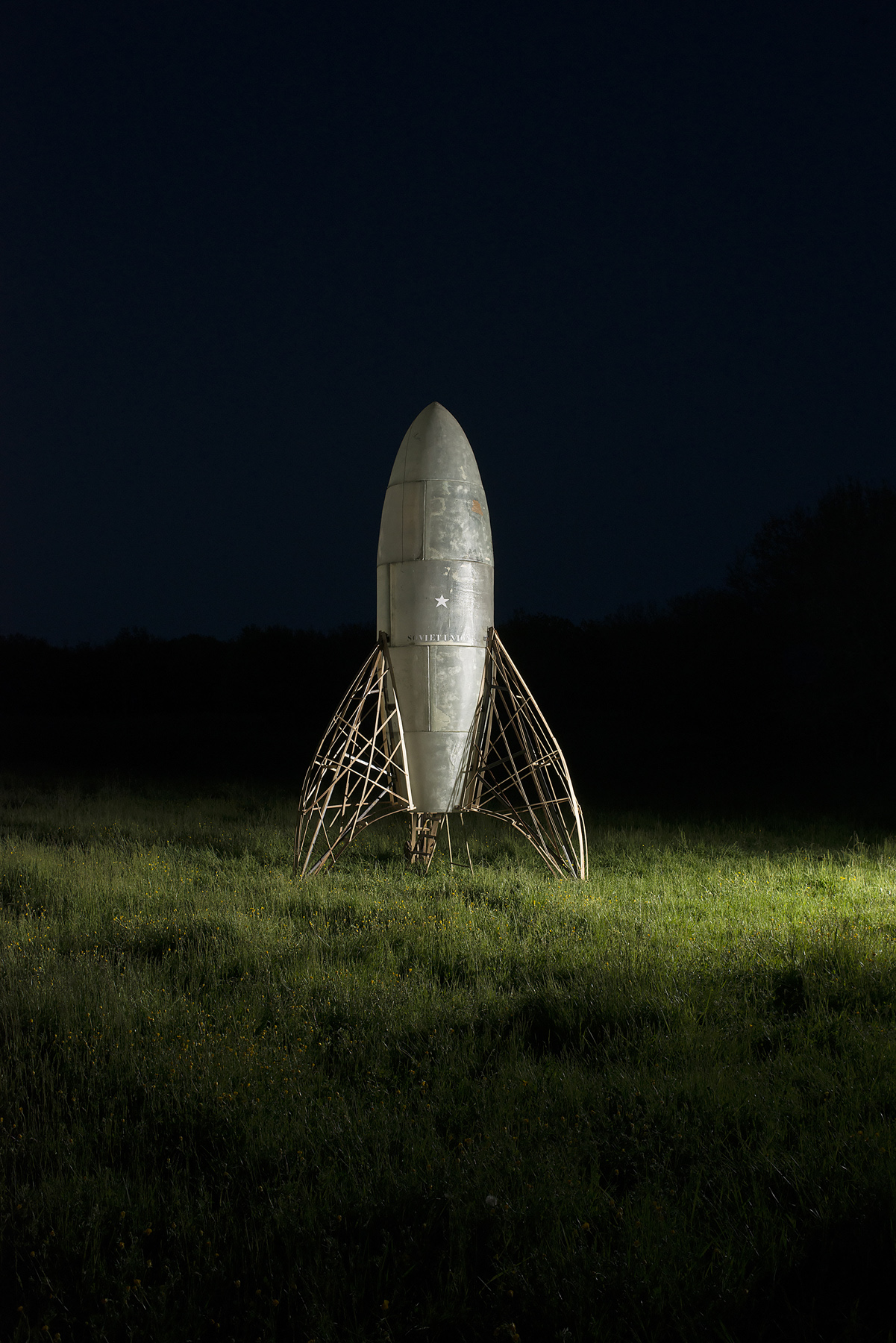
 

François Burland (Swiss, b. 1958) 'Fusée Soviet Union' 2013


François Burland (Swiss, b. 1958)
Fusée Soviet Union
2013
Photo: Romain Mader et Nadja Kilchhofer
© François Borland, Atomik Magic Circus


La maison rouge
Fondation antoine de galbert
10 bd de la bastille – 75012
Paris France
Phone: +33 (0) 1 40 01 08 81

Opening hours:
Wednesday – Sunday 11am – 7pm
Late nights Thursday until 9pm
LIKE ART BLART ON FACEBOOK

Back to top

Exhibition: ‘Black Light: Secret traditions in art since the 1950s’ at Centre de Cultura Contemporania de Barcelona

La llum negra. Tradicions secretes en l’art des dels anys cinquanta

Exhibition dates: 16th May – 21st October, 2018

Curator: Enrique Juncosa

Artists: Carlos Amorales / Kenneth Anger / Antony Balch / Jordan Belson / Wallace Berman / Forrest Bess / Joseph Beuys / William S. Burroughs / Marjorie Cameron / Francesco Clemente / Bruce Conner / Aleister Crowley / René Daumal / Gino de Dominicis / Louise Despont / Nicolás Echevarría / Robert Frank / João Maria Gusmão + Pedro Paiva / Brion Gysin / Jonathan Hammer / Frieda Harris / Derek Jarman / Jess / Alejandro Jodorowsky / Joan Jonas / Carl Gustav Jung / Matías Krahn / Wolfgang Laib / LeonKa / Goshka Macuga / Agnes Martin / Chris Martin / Henri Michaux / Grant Morrison / Tania Mouraud / Barnett Newman / Joan Ponç / Genesis P-Orridge / Sun Ra / Harry Smith / Rudolf Steiner / Philip Taaffe / Antoni Tàpies / Fred Tomaselli / Suzanne Treister / Vaccaro – Brookner / Ulla von Brandenburg / Terry Winters / Zush


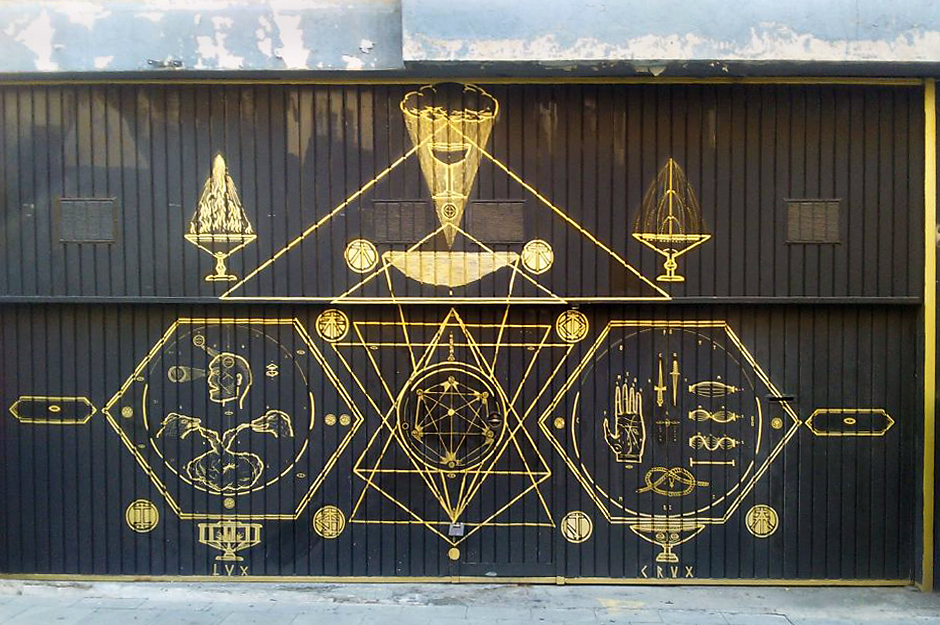
Leon Ka – La llum negra – Mural

The mural at the entrance of the exhibition Black Light created by the artist Leon Ka, represents some of the symbols of ocultism, magic, and the mysticism of spirituality.


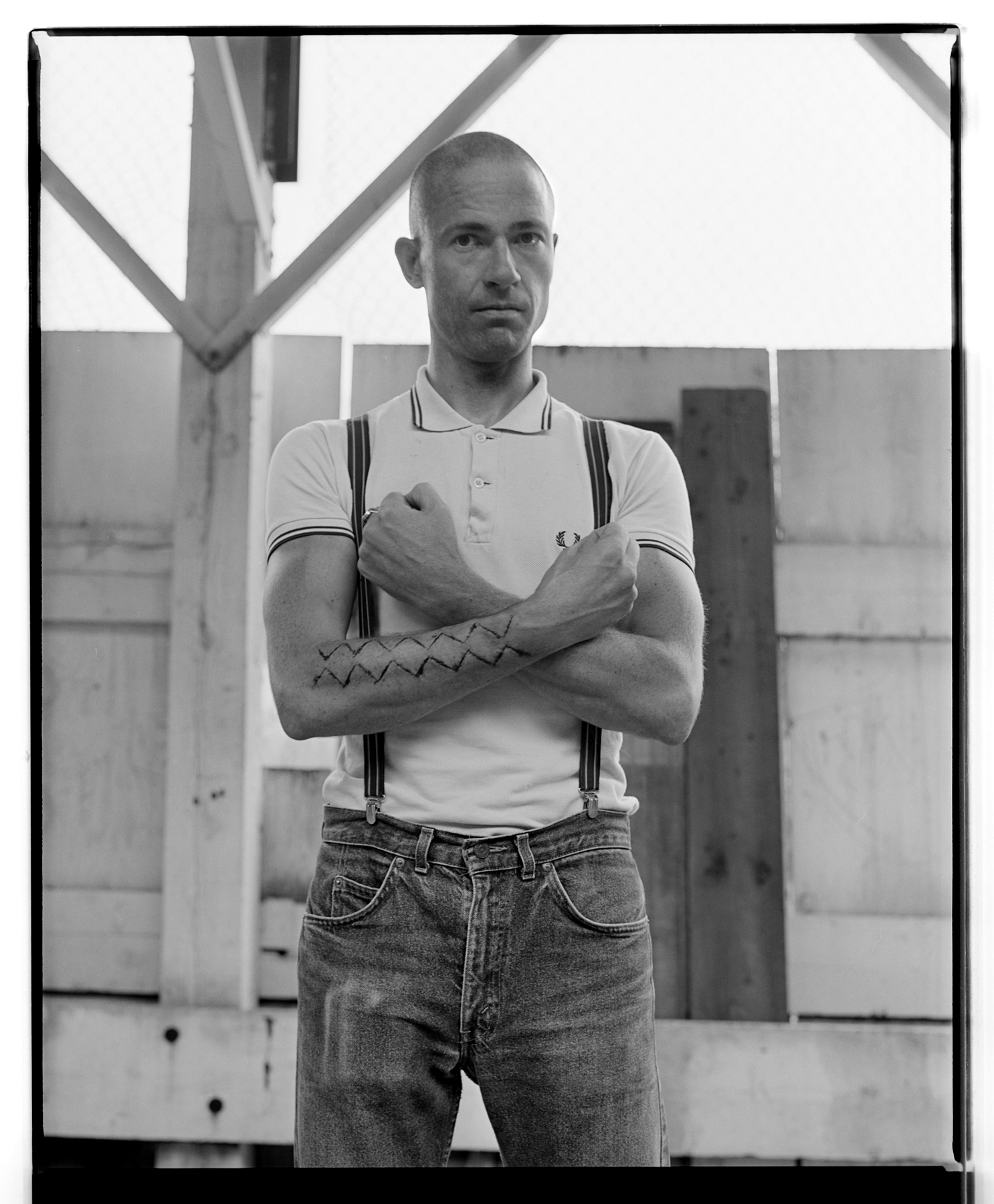
I love these eclectic exhibitions on unusual topics. Having studied a little Georges Gurdjieff, Carl Jung, Robert Johnson, Joseph Campbell and Carlos Castaneda to name just a few, I immersed myself in their spiritual, psychedelic and counterculture world. I had scarification done on my arm in 1992 which was one of the most spiritual rights of passage I have ever experienced in my life (see photograph below).

To be different, to explore that difference in art, is to violate the taboo of control – of adherence to the norm – that emotion which controls how we think, feel, act and create. As Georges Bataille observes,

“”The taboo is there in order to be violated.” This proposition is not the wager it looks like at first but an accurate statement of an inevitable connection between conflicting emotions. When a negative emotion has the upper hand we must obey the taboo. When a positive emotion is in the ascendant we violate it. Such a violation will not deny or suppress the contrary emotion, but justify it and arouse it.”1


An “understanding of the text (writing, art, music, etc.) as ‘social space’,” say Barthes, “activates a broad intertextuality and a productive plurality of meanings and signifying/interpretive gestures that escape the reduction of knowledge to fixed, monological re-presentations, or presences.” What he is saying here is that there is no singular unity… for unity is variable and relative. Further, according to Kurt Thumlert (citing Lentricchia, 1998), “a transgressive textuality can also become a mode of agential resistance capable of fragmenting and releasing the subject, and thereby producing a zone of invisibility where knowledge/power is no longer able ‘find its target’.”2

In other words, transgression of the taboo allows the artist (in this case) to release himself from the logic of control and where power cannot get its hooks into him. In order to do this during the production of art, the artist must understand that representations are presentations which entail,

“the use of the codes and conventions of the available cultural forms of presentation. Such forms restrict and shape what can be said by and/or about any aspect of reality in a given place in a given society at a given time, but if that seems like a limitation on saying, it is also what makes saying possible at all. Cultural forms set the wider terms of limitation and possibility for the (re)presentation of particularities and we have to understand how the latter are caught in the former in order to understand why such-and-such gets (re)presented in the way it does. Without understanding the way images function in terms of, say, narrative, genre or spectacle, we don’t really understand why they turn out the way they do.”3


The exhibition Black Light investigates how artists subvert these codes and conventions of representation and violate their taboo through emotions (whether positive or negative) present in the creative process. This transgressive spirit allows far seeing artists to become the seers of their day, playing with the dis/order of time, space and cultural (re)presentation. As a form of alchemy, all art partakes of this investigation into the past, present and future of life, our discontinuous existence as creatures who live and die, and the world that surrounds us, both physically and spiritually.

Dr Marcus Bunyan


1/ Bataille, Georges. Death and Sensuality: A Study of Eroticism and the Taboo. New York: Walker and Company, 1962, pp. 64-65.

2/ Thumlert, Kurt. Intervisuality, Visual Culture, and Education. [Online] Cited 10/08/2006 No longer available.

3/ Dyer, Richard. The Matter of Images: Essays on Representations. London: Routledge, 1993, pp. 2-3.


Many thankx to the Centre de Cultura Contemporania de Barcelona for allowing me to publish the photographs in the posting. Please click on the photographs for a larger version of the image.


Marcus Bunyan (Australian, b. 1958) 'Marcus (after scarification)' 1992
 

Marcus Bunyan (Australian, b. 1958)
Marcus (after scarification)
1992
Gelatin silver print
© Marcus Bunyan


Black Light. Discover the occult side of contemporary art

The occult, spirituality, psychedelia and esotericism come to the CCCB with the exhibition Black Light. An unusual look at the art of the past 50 years that has been strongly influenced by secret traditions.


Joan Jonas (American, b. 1936)
Reanimation (extract)


Henri Michaux (French born Belgium, 1899-1984)

Henri Michaux (French born Belgium, 1899-1984) was a highly idiosyncratic Belgian-born poet, writer, and painter who wrote in French. He later took French citizenship. Michaux is best known for his esoteric books written in a highly accessible style. His body of work includes poetry, travelogues, and art criticism. Michaux travelled widely, tried his hand at several careers, and experimented with psychedelic drugs, especially LSD and mescaline, which resulted in two of his most intriguing works, Miserable Miracle and The Major Ordeals of the Mind and the Countless Minor Ones.


Kenneth Anger (American, 1927-1996)
Lucifer Rising (Original track by Acqua Lazúli)
1972-80


For more information about this film please see the Lucifer Rising Wikipedia entry

Kenneth Anger (American, 1927-1996)

Kenneth Anger (born Kenneth Wilbur Anglemyer; February 3, 1927) is an American underground experimental filmmaker, actor and author. Working exclusively in short films, he has produced almost forty works since 1937, nine of which have been grouped together as the “Magick Lantern Cycle”. His films variously merge surrealism with homoeroticism and the occult, and have been described as containing “elements of erotica, documentary, psychodrama, and spectacle”. Anger himself has been described as “one of America’s first openly gay filmmakers, and certainly the first whose work addressed homosexuality in an undisguised, self-implicating manner”, and his “role in rendering gay culture visible within American cinema, commercial or otherwise, is impossible to overestimate”, with several being released prior to the legalisation of homosexuality in the United States. He has also focused upon occult themes in many of his films, being fascinated by the English gnostic mage and poet Aleister Crowley, and is an adherent of Thelema, the religion Crowley founded.

Text from the Wikipedia website


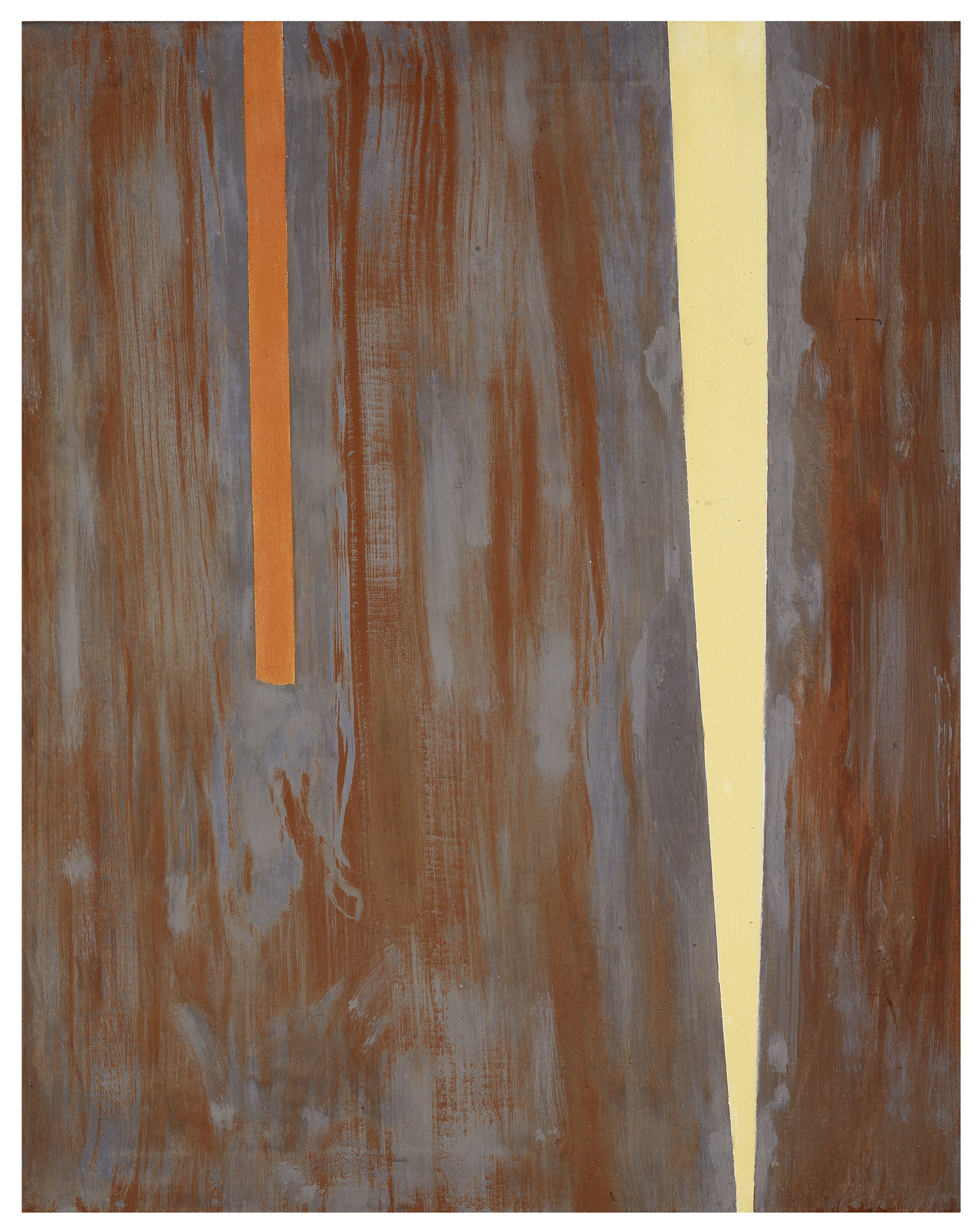
Barnett Newman (American, 1905-1970) 'Untitled' 1946 from the exhibition 'Black Light: Secret traditions in art since the 1950s' at Centre de Cultura Contemporania de Barcelona, May - Oct, 2018


Barnett Newman (American, 1905-1970)
Untitled
1946
Oil on canvas
76.5 x 61.1cm
© IVAM, Institut Valencià d’Art Modern, Generalitat Valenciana


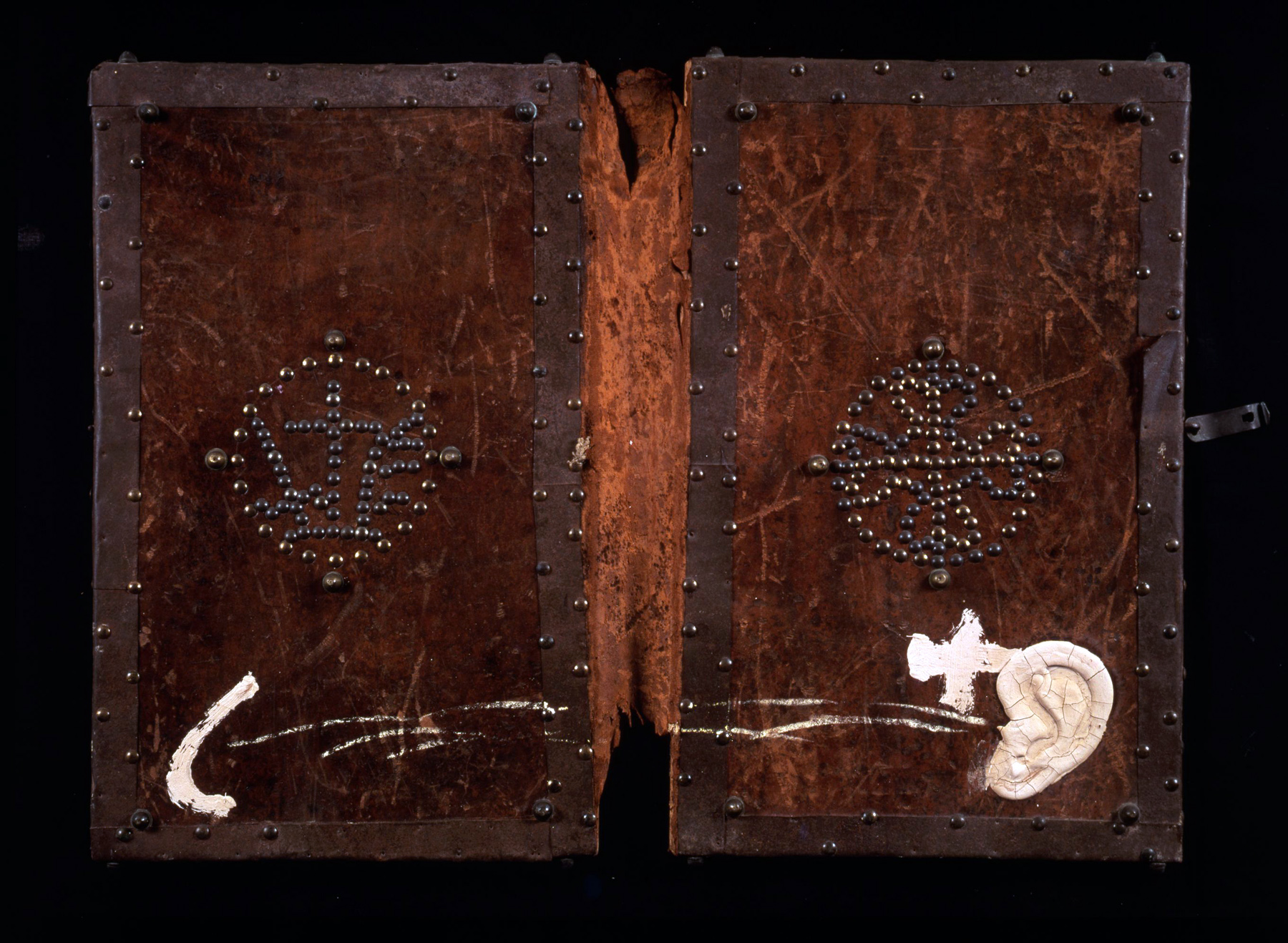
Antoni Tàpies (Spanish, 1923-2012) 'Book covers' 1987 from the exhibition 'Black Light: Secret traditions in art since the 1950s' at Centre de Cultura Contemporania de Barcelona, May - Oct, 2018


Antoni Tàpies (Spanish, 1923-2012)
Book covers
1987
Paintings on old book covers
60 x 78.5 cm
Private collection, Barcelona
© Heirs of Antoni Tàpies / Vegap, Madrid


Leon Ka (Spanish, b. 1980) 'Creatio: Lux, Crux' 2015 from the exhibition 'Black Light: Secret traditions in art since the 1950s' at Centre de Cultura Contemporania de Barcelona, May - Oct, 2018


Leon Ka (Spanish, b. 1980)
Creatio: Lux, Crux
2015
Door of the cultural association Magia Roja, Barcelona


Black light is about the influence that various secret traditions have had on contemporary art from the nineteen-fifties to the present day. It presents some 350 works by such artists as Antoni Tàpies, Agnes Martin, Henri Michaux, Joseph Beuys, Ulla von Brandenburg, William S. Burroughs, Joan Jonas, Jordan Belson, Goshka Macuga, Kenneth Anger, Rudolf Steiner, Alejandro Jodorowsky, Francesco Clemente and Zush.

Black light brings together, in more or less chronological order, paintings, drawings, audiovisuals, sculptures, photographs, installations, books, music, engravings and documents by artists largely from North America, where secret traditions have historically enjoyed greater acceptance. There are works by creators who are considered fundamental to the history of art, such as Antoni Tàpies, Barnett Newman and Agnes Martin, alongside less-known figures of the counterculture of the sixties and seventies. The show also presents young artists to reflect the renewed interest in these traditions.

The work of all of them goes to show the relevance and continuity of these habitually overlooked trends, in many cases regarding art as a possible means to a higher cognitive level, as an instrument of connection with a more profound reality, or as a form of knowledge in itself. These ideas are contrary, for example, to a purely formalistic understanding of abstraction. Specifically, the exhibition also explores the influence of esoteric ideas on areas of popular culture, such as comics, jazz, cinema and alternative rock.


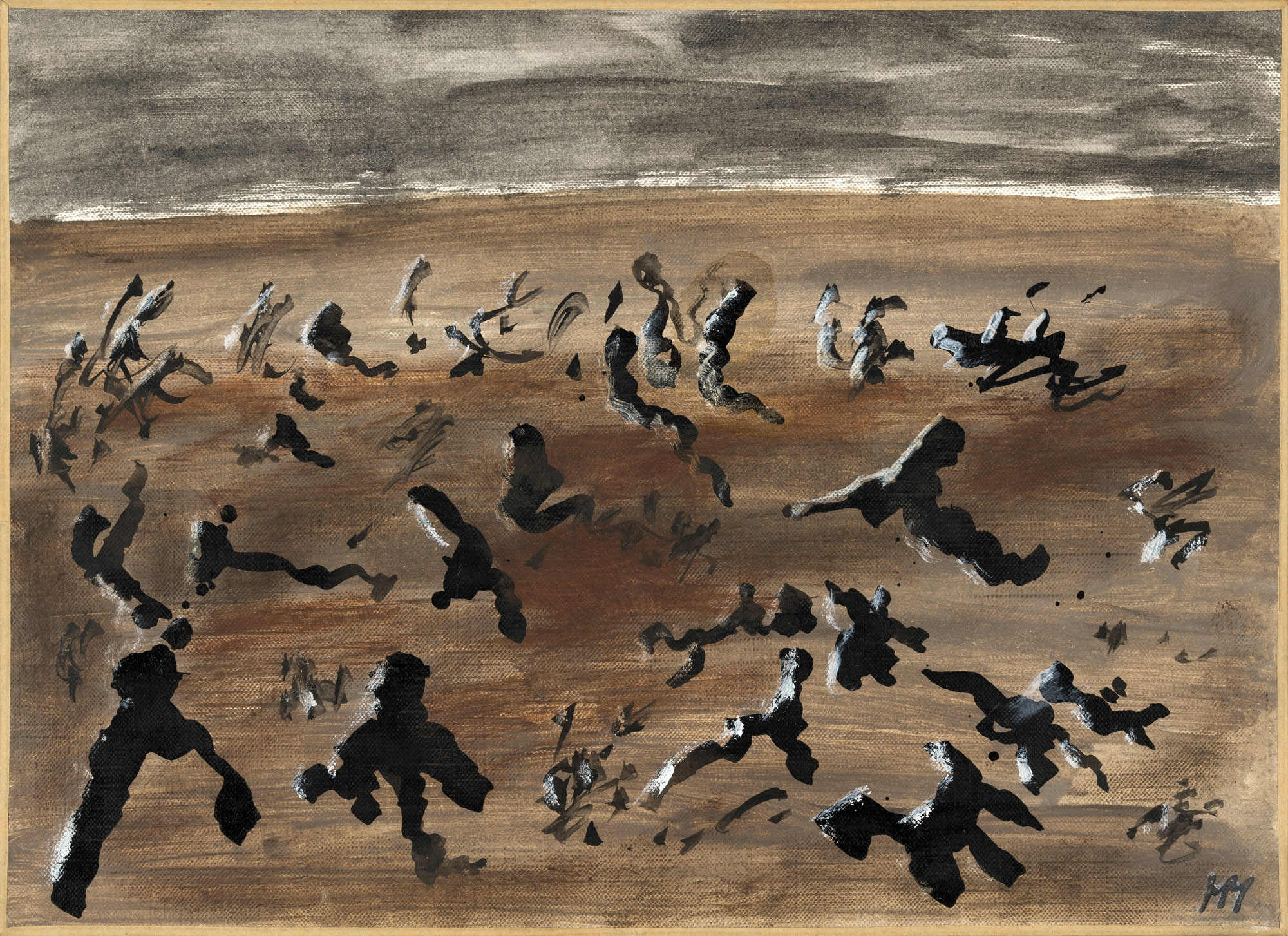
Henri Michaux (French born Belgium, 1899-1984) 'Untitled' 1983


Henri Michaux (French born Belgium, 1899-1984)
Untitled
1983
Oil on linen paper
24 x 33cm
© Courtesy Galerie Lelong & Co. Photography: Fabrice Gibert


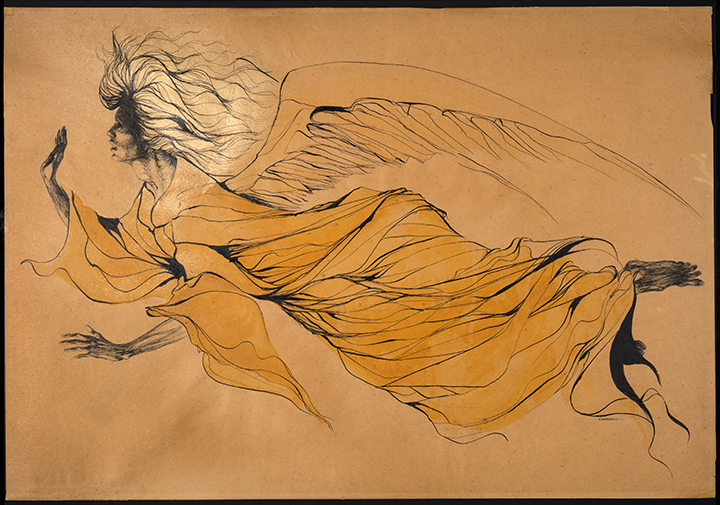
Marjorie Cameron (American, 1922-1995) 'West Angel' Nd


Marjorie Cameron (American, 1922-1995)
West Angel
Nd
Graphite, ink and gold paint on paper
60.3 x 93.3cm
© Courtesy Nicole Klagsbrun and Cameron Parsons Foundation


Marjorie Cameron Parsons Kimmel (American, 1922-1995), who professionally used the mononym Cameron, was an American artist, poet, actress, and occultist. A follower of Thelema, the new religious movement established by the English occultist Aleister Crowley, she was married to rocket pioneer and fellow Thelemite Jack Parsons.

Read her entry on the Wikipedia website


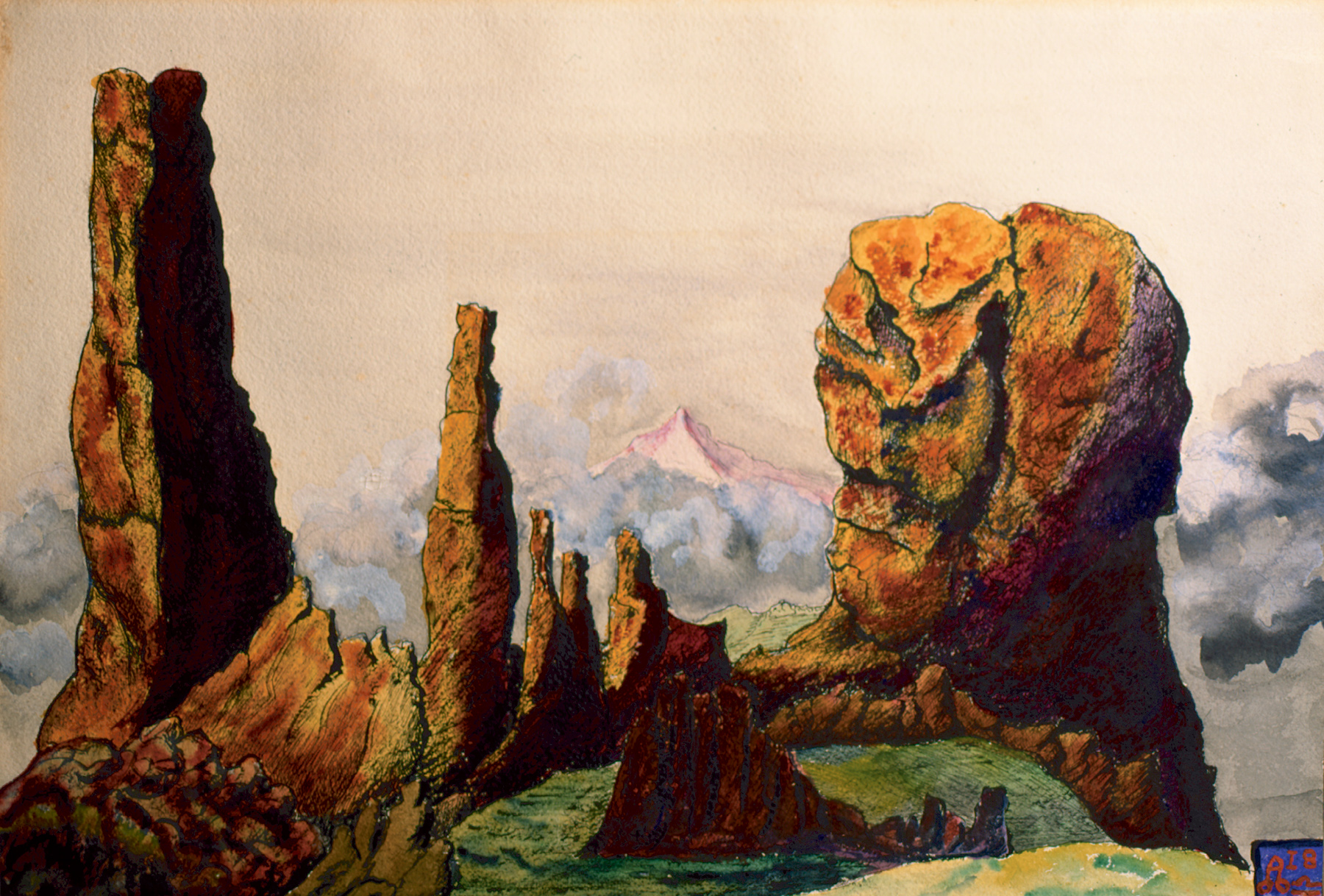
Aleister Crowley (English, 1875-1947) 'Snow-Peak beyond Foothills, Libra I8 September-October' 1934


Aleister Crowley (English, 1875-1947)
Snow-Peak beyond Foothills, Libra I8 September-October
1934
Pen and wash on paper
45 x 50cm
© Ordo Templi Orientis


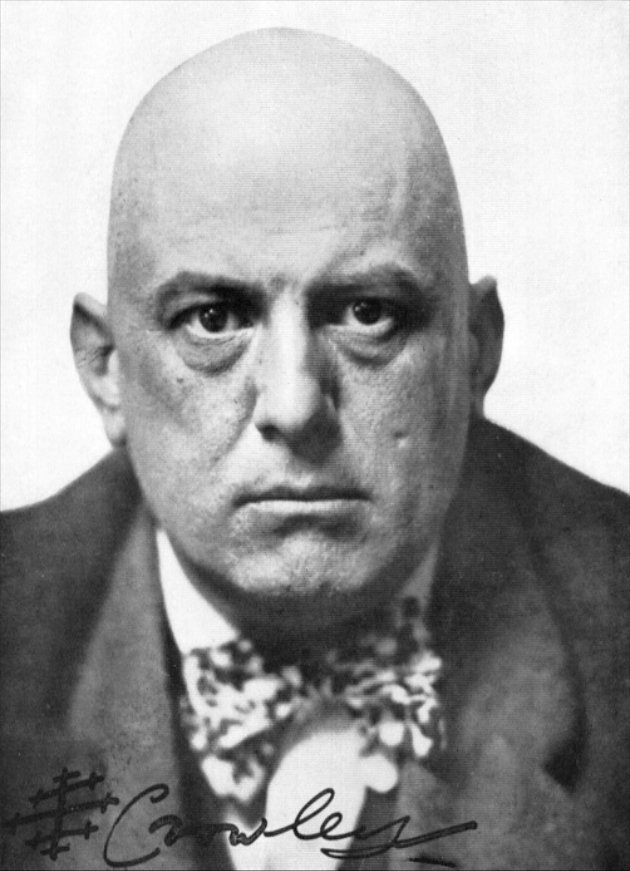
Unknown photographer. 'Aleister Crowley as Magus, Liber ABA' 1912


Unknown photographer
Aleister Crowley as Magus, Liber ABA
1912
Originally published in The Equinox volume 1, issue 10 (1913)


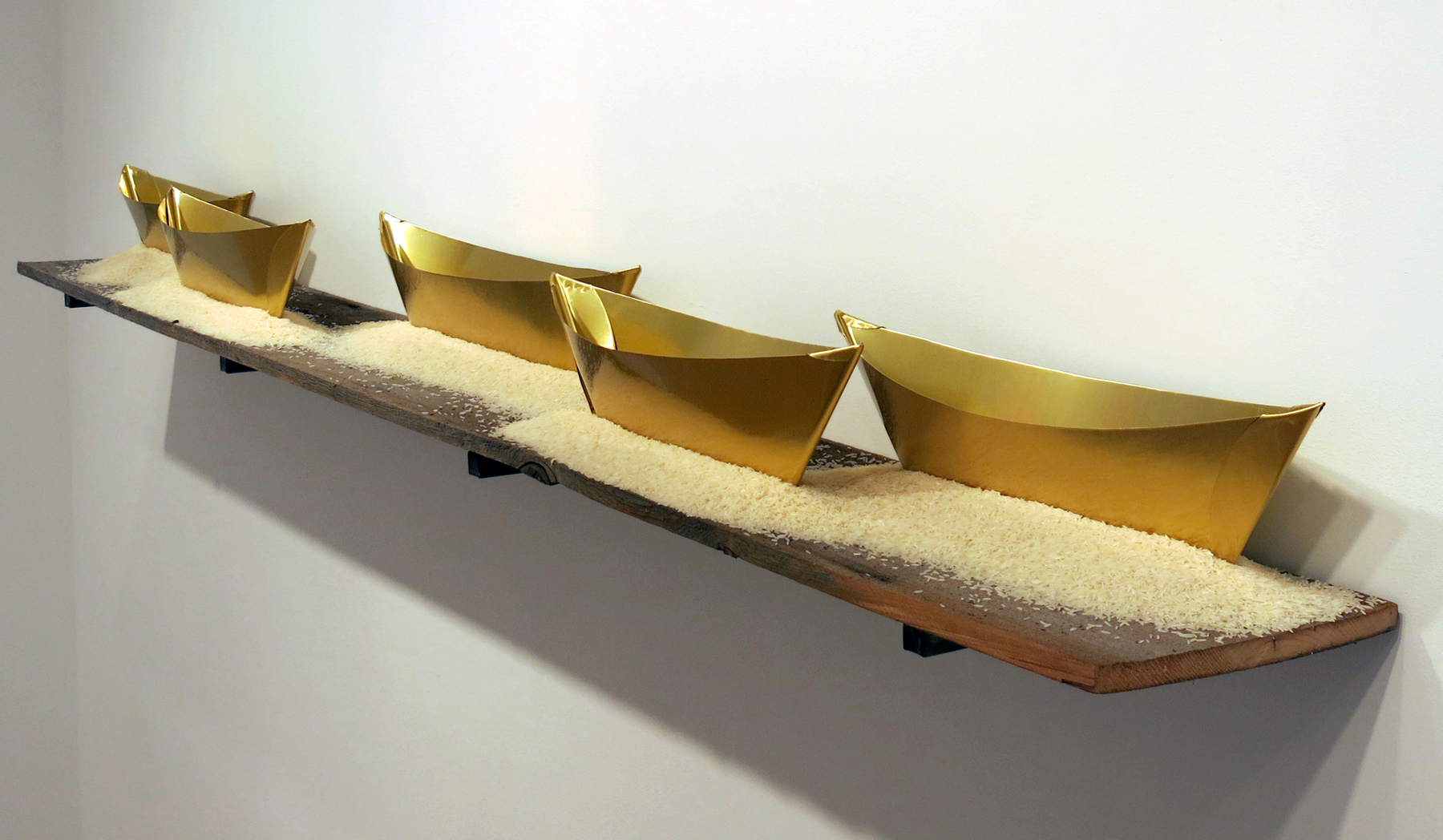
Wolfgang Laib (Germany, b. 1950) 'Passageway' 2013


Wolfgang Laib (Germany, b. 1950)
Passageway
2013
Brass ships, rice, wood and steel
6 3/4 x 99 x 12 inches
© Wolfgang Laib


Wolfgang Laib (Germany, b. 1950)

Wolfgang Laib (born 25 March 1950 in Metzingen) is a German artist, predominantly known as a sculptor. He lives and works in a small village in southern Germany, maintaining studios in New York and South India.

His work has been exhibited worldwide in many of the most important galleries and museums. He represented Germany in the 1982 Venice Biennale and was included with his works in the Documenta 7 in 1982 and then in the Documenta 8 in 1987. In 2015 he received the Praemium Imperiale for sculpture in Tokyo, Japan.

He became worldknown for his “Milkstones”, a pure geometry of white marble made complete with milk, as well as his vibrant installations of pollen. In 2013 The Museum of Modern Art in New York City presented his largest pollen piece – 7 m x 8 m – in the central atrium of the museum.

Text from the Wikipedia website


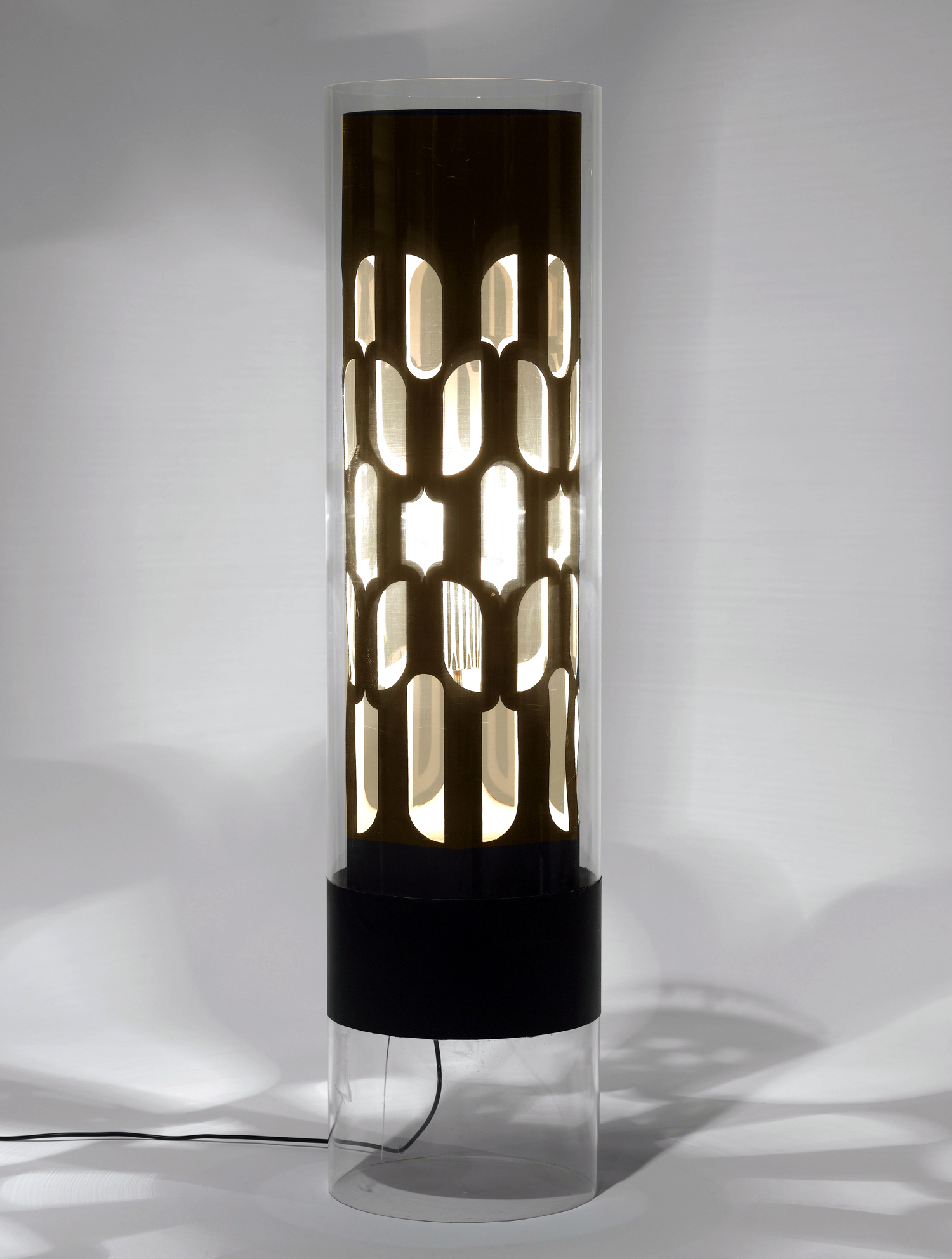
Brion Gysin (British, 1916-1986) 'Dreamachine' 1960-1976


Brion Gysin (British, 1916-1986)
Dreamachine
1960-1976
Cylinder. Painted and cut hard paper, Altuglas, electric bulb and motor
120.5 cm x 29.5cm
© Galerie de France. Paris, Centre Pompidou – Musée national d’art moderne – Centre de création industrielle


Brion Gysin (British, 1916-1986)

Brion Gysin (19 January 1916-13 July 1986) was a painter, writer, sound poet, and performance artist born in Taplow, Buckinghamshire.

He is best known for his discovery of the cut-up technique, used by his friend, the novelist William S. Burroughs. With the engineer Ian Sommerville he invented the Dreamachine, a flicker device designed as an art object to be viewed with the eyes closed. It was in painting and drawing, however, that Gysin devoted his greatest efforts, creating calligraphic works inspired by the cursive Japanese “grass” script and Arabic script. Burroughs later stated that “Brion Gysin was the only man I ever respected.” …

The Dreamachine (or Dream Machine) is a stroboscopic flicker device that produces visual stimuli. Artist Brion Gysin and William S. Burroughs’ “systems adviser” Ian Sommerville created the Dreamachine after reading William Grey Walter’ book, The Living Brain.

In its original form, a Dreamachine is made from a cylinder with slits cut in the sides. The cylinder is placed on a record turntable and rotated at 78 or 45 revolutions per minute. A light bulb is suspended in the centre of the cylinder and the rotation speed allows the light to come out from the holes at a constant frequency of between 8 and 13 pulses per second. This frequency range corresponds to alpha waves, electrical oscillations normally present in the human brain while relaxing. In 1996, the Los Angeles Times deemed the Dreamachine “the most interesting object” in Burroughs’ major visual retrospective Ports of Entry at LACMA. The Dreamachine is the subject of the National Film Board of Canada 2008 feature documentary film FLicKeR by Nik Sheehan.

A Dreamachine is “viewed” with the eyes closed: the pulsating light stimulates the optic nerve and thus alters the brain’s electrical oscillations. Users experience increasingly bright, complex patterns of colour behind their closed eyelids (a similar effect may be experienced when travelling as a passenger in a car or bus; close your eyes as the vehicle passes through flickering shadows cast by roadside trees, or under a close-set line of streetlights or tunnel striplights). The patterns become shapes and symbols, swirling around, until the user feels surrounded by colours. It is claimed that by using a Dreamachine one may enter a hypnagogic state. This experience may sometimes be quite intense, but to escape from it, one needs only to open one’s eyes. The Dreamachine may be dangerous for persons with photosensitive epilepsy or other nervous disorders. It is thought that one out of 10,000 adults will experience a seizure while viewing the device; about twice as many children will have a similar ill effect.

Text from the Wikipedia website


An approach without prejudice to art and esoteric beliefs

Esoteric traditions can be traced back to the very origins of civilisation, having served at different times to structure philosophical, linguistic, scientific or spiritual ideas. Despite their importance for the development of twentieth-century art, they tend to be ignored or disparaged these days due to the dominance of rationalistic thinking and the difficulty of talking about these subjects in clear, direct language.

In recent years, however, many artists have taken a renewed interest in subjects such as alchemy, secret societies, theosophy and anthroposophy, the esoteric strands in major religions, oriental philosophies, magic, psychedelia and drug-use, universal symbols and myths, the Fourth Way formulated by the Armenian mystic Georges Gurdjieff, etc., generating an interest in these fields that had not existed since the counterculture of the sixties and seventies.

According to the writer Enrique Juncosa, curator of this exhibition, this interest “may be due to the fact that we are, once again, living in a restless and unsatisfied world, worried about new colonial wars, fundamentalist terrorism, serious ecological crisis and nationalist populism, just as in the sixties and seventies people feared an imminent and devastating nuclear catastrophe. Furthermore, much of today’s mainstream art is actually rather boring due to its complete lack of mystery and negation of any kind of poetisation or interpretation of our experience of it.”

For the essayist Gary Lachman, author of the text “Occultism in Art. A Brief Introduction for the Uninitiated” in the exhibition catalogue, “in recent years, the art world seems to have become aware of the importance of occultism […]. Admitting the influence of Hermeticism on the Renaissance, or of theosophy on early abstract art, to mention just two examples, helps to re-situate occult forces as an undeniable part of human experience and rescue them from the marginal position to which they had been exiled for a few centuries.”


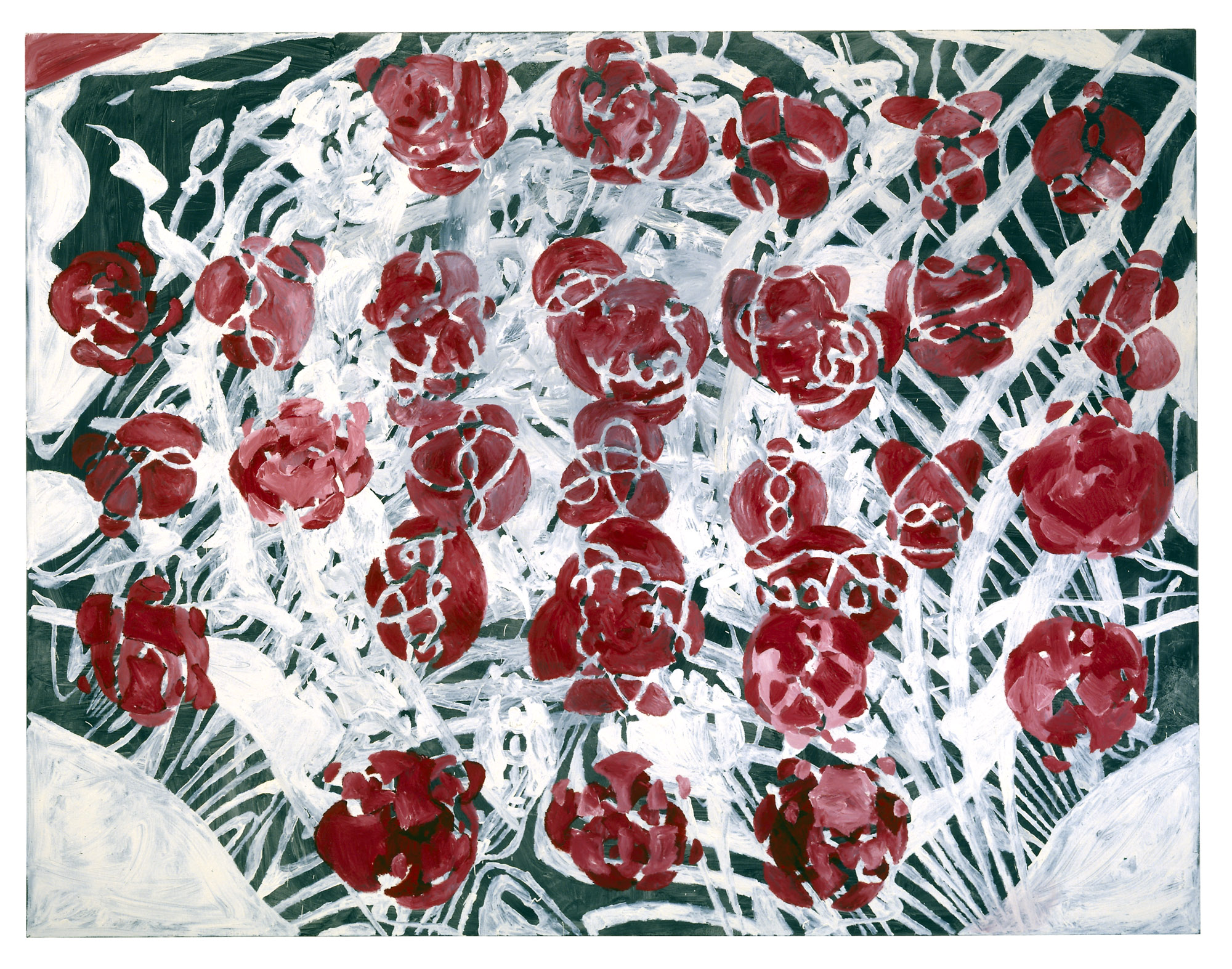
Terry Winters (American, b. 1949) 'Bubble Diagram' 2005


Terry Winters (American, b. 1949)
Bubble Diagram
2005
Oil on linen
215.9 x 279.4cm
© Mattew Marks Gallery


Terry Winters (born 1949, Brooklyn, NY) is an American painter, draughtsman, and printmaker whose nuanced approach to the process of painting has addressed evolving concepts of spatiality and expanded the concerns of abstract art. His attention to the process of painting and investigations into systems and spatial fields explores both non-narrative abstraction and the physicality of modernism. In Winters’ work, abstract processes give way to forms with real word agency that recall mathematical concepts and cybernetics, as well as natural and scientific worlds.


Fred Tomaselli (American, b. 1956) 'Untitled [Datura Leaves]' 1999


Fred Tomaselli (American, b. 1956)
Untitled (Datura Leaves)
1999
Leaves, pills, acrylic and resin on wood panel
182.88 x 137.16cm
© Collection Glenn and Amanda Fuhrman NY, Courtesy the FLAG Art Foundation


Fred Tomaselli (American, b. 1956)

Fred Tomaselli (born in Santa Monica, California, in 1956) is an American artist. He is best known for his highly detailed paintings on wood panels, combining an array of unorthodox materials suspended in a thick layer of clear, epoxy resin.

Tomaselli’s paintings include medicinal herbs, prescription pills and hallucinogenic plants alongside images cut from books and magazines: flowers, birds, butterflies, arms, legs and noses, which are combined into dazzling patterns that spread over the surface of the painting like a beautiful virus or growth. He uses an explosion of colour and combines it with a basis in art history. His style usually involves collage, painting, and/or glazing. He seals the collages in resin after gluing them down and going over them with different varnishes.

“I want people to get lost in the work. I want to seduce people into it and I want people to escape inside the world of the work. In that way the work is pre-Modernist. I throw all of my obsessions and loves into the work, and I try not to be too embarrassed about any of it. I love nature, I love gardening, I love watching birds, and all of that gets into the work. I just try to be true to who I am and make the work I want to see. I don’t have a radical agenda.”


Tomaselli sees his paintings and their compendium of data as windows into a surreal, hallucinatory universe. “It is my ultimate aim”, he says, “to seduce and transport the viewer in to space of these pictures while simultaneously revealing the mechanics of that seduction.” Tomaselli has also incorporated allegorical figures into his work – in Untitled (Expulsion) (2000), for example, he borrows the Adam and Eve figures from Masaccio’s Expulsion from the Garden of Eden (1426-27), and in Field Guides (2003) he creates his own version of the grim reaper. His figures are described anatomically so that their organs and veins are exposed in the manner of a scientific drawing. He writes that his “inquiry into utopia/dystopia – framed by artifice but motivated by the desire for the real – has turned out to be the primary subject of my work”.

Text from the Wikipedia website


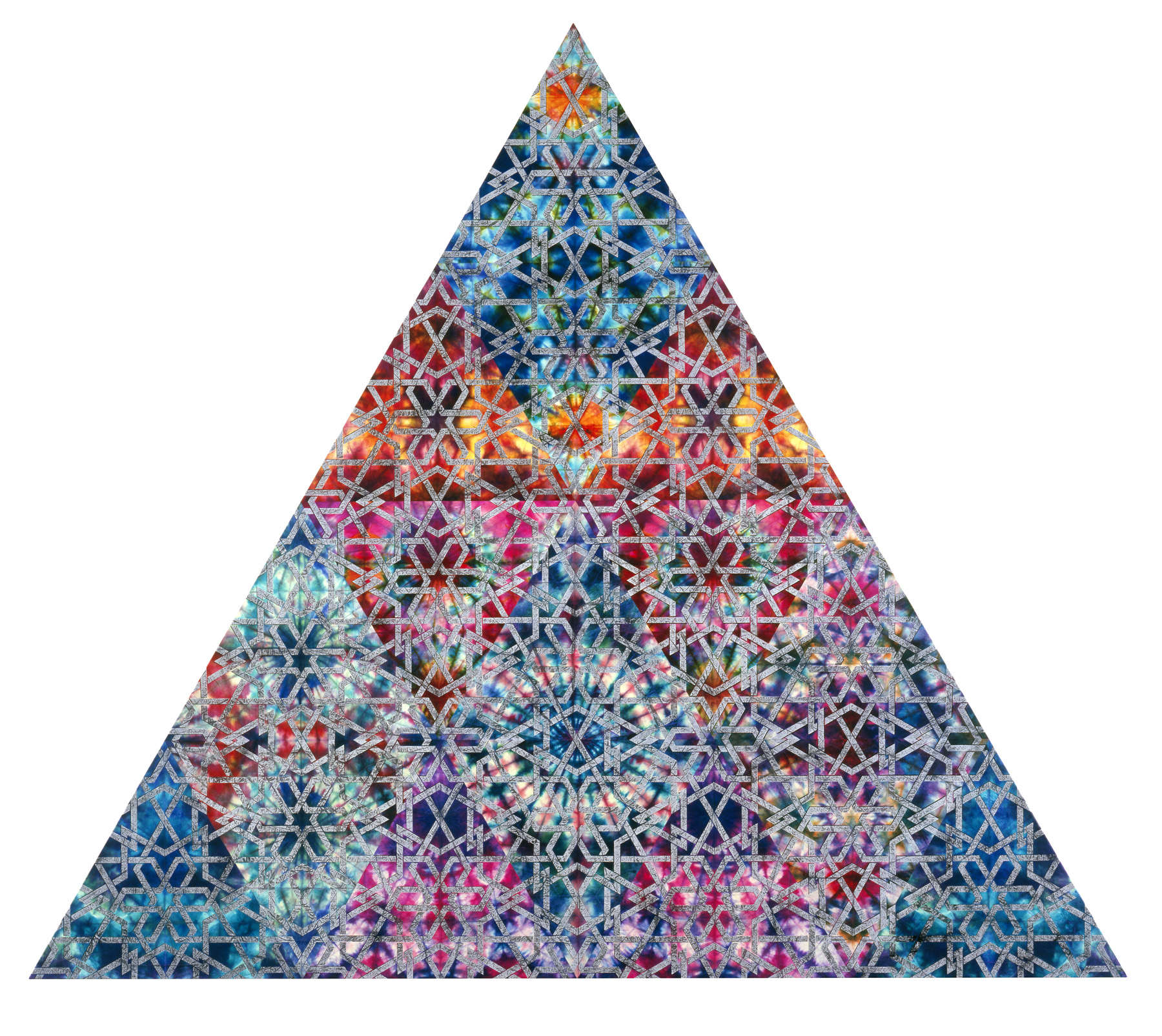
Philip Taaffe (American, b. 1955) 'Rose Triangle' 2008


Philip Taaffe (American, b. 1955)
Rose Triangle
2008
Mixed media on canvas
178 x 178cm
© Collection Raymond Foye, New York


About the exhibition

In the fifties, US filmmakers Harry Smith and Jordan Belson made animated films that were precursors of the psychedelia and counterculture of the following two decades. Also at this time, painters associated with abstract expressionism in the US (such as Barnett Newman, Ad Reinhardt and Agnes Martin) and European Informalists, such as the Catalans associated with Dau al Set (including Antoni Tàpies and Joan Ponç), became interested in the writings of Swiss psychologist Carl Gustav Jung, oriental philosophies, the great myths and primitive shamanic rites. The cult US filmmaker Kenneth Anger made films that are still considered radical, influenced by the ideas of the well-known English occultist Aleister Crowley, who was also influential in the world of rock. And Forrest Bess, a self-taught, isolated artist, an unusual figure in the American art of the last century, painted symbolic, visionary images of the universal collective subconscious.

In the sixties and seventies, the emergence of counterculture and the hippy movement was accompanied by an upsurge in interest in esoteric matters and alternative spirituality. US writer William S. Burroughs and French artist and writer Brion Gysin, both interested in occultism and mysticism, developed the cut-up method to write texts using collage, actions which, like the origin of art itself, they considered magic. The American musician Sun Ra, one of the jazz world’s most idiosyncratic figures (he claims he was born on Saturn), set up the secret society Thmei Research in Chicago, and was interested in the writings of Armenian philosopher and master mystic Georges Gurdjieff, and the Ukrainian Madame Blavatsky, creator of the esoteric current known as theosophy. Sun Ra’s compositions, with a big band that performed in strange colourful clothing, were highly radical, embracing improvisation and chaos. In Europe, the German artist Joseph Beuys was inspired by the writings and activities of Austrian philosopher Rudolf Steiner, the founder of anthroposophy, as a model to explain his ideas. Beuys called for a return to spirituality and defended art as a vehicle for healing and social change. The French artist Tania Mouraud, interested in introspection and philosophy, with a strong analytical vein, creates installations that are spaces for meditation, and the Catalan artist Zush, in Ibiza, discovers psychedelia and draws fantastic beings connected by vibrant energies.

The eighties and nineties saw the consolidation of a large number of artists who saw artistic practice as something that can facilitate a higher cognitive level. Several American abstract painters, like Terry Winters, Philip Taaffe and Fred Tomaselli, became interested in spiritual themes. Winters, for example, who took scientific images as his inspiration, based a large series of paintings on knot theory, a mathematical concept that might be seen as an emblem of the hermetic. Taaffe, meanwhile, used ornamental forms from different cultures, combining them in complex configurations of an ecstatic nature, and Tomaselli produced compositions using all kinds of drugs in a reference to psychedelia. In Europe, the German sculptor Wolfgang Laib, interested in Zen Buddhism and Taoism, creates sculptures and installations with symbolic images, like stairs and boats, suggesting ascension, travel and inner transformation, while the Italian Gino de Dominicis, who claimed to believe in extra-terrestrials and was obsessed by Sumerian culture and mythology, creates invisible sculptures. The paintings by Italian Francesco Clemente, a representative of the Transavanguardia movement, feature images of an apparently hermetic nature, creating a singular narrative of spiritual symbolism. The Chilean-French artist Alejandro Jodorowsky explores esoteric ideas in his extraordinary films of great visual imagination and also creates highly celebrated comics. In the nineties, several alternative rock bands such as Psychic TV (led by the English musician, poet and artist Genesis P-Orridge) were also interested in occultism and magic.

The origin of the title “Black Light”

The title “Black light” refers to a concept of Sufism, the esoteric branch of Islam that teaches a path of connection with divinity leading via inner vision and mystic experience. Sufism, which regards reality as light in differing degrees of intensity, speaks of a whole system of inner visions of colours that mark the spiritual progress of initiates until they become “men and women of light”. The intention is to achieve a state of supra-consciousness that is announced symbolically by this black light.

Press release from the Centre de Cultura Contemporania de Barcelona website


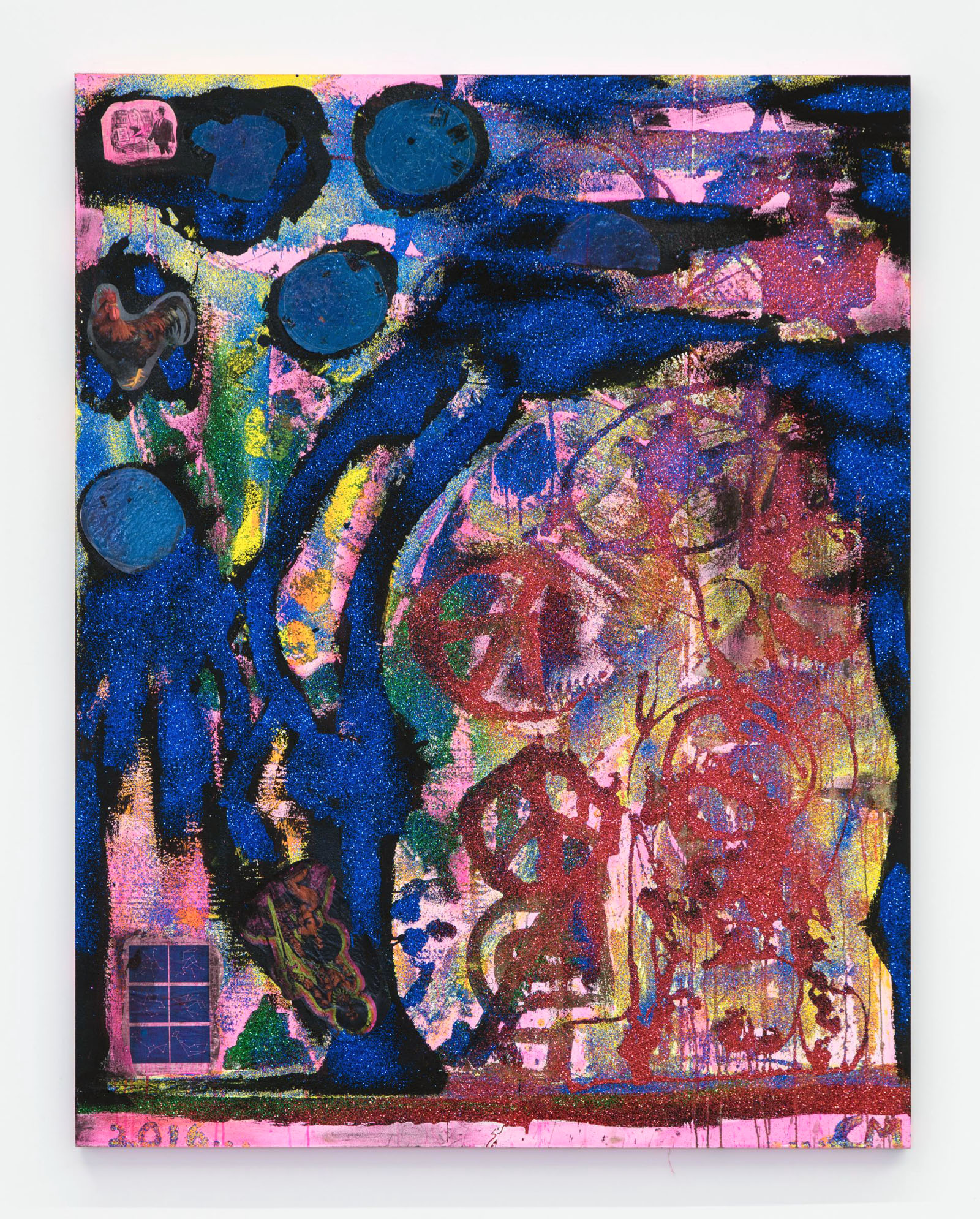
Chris Martin (American, b. 1954) 'If You Don't See It Ask For It' 2016


Chris Martin (American, b. 1954)
If You Don’t See It Ask For It
2016
Acrylic and glitter on canvas
195.6 x 152.4 x 4.4cm
© Courtesy of David Kordansky Gallery, Los Angeles, CA Photography: Brian Forrest


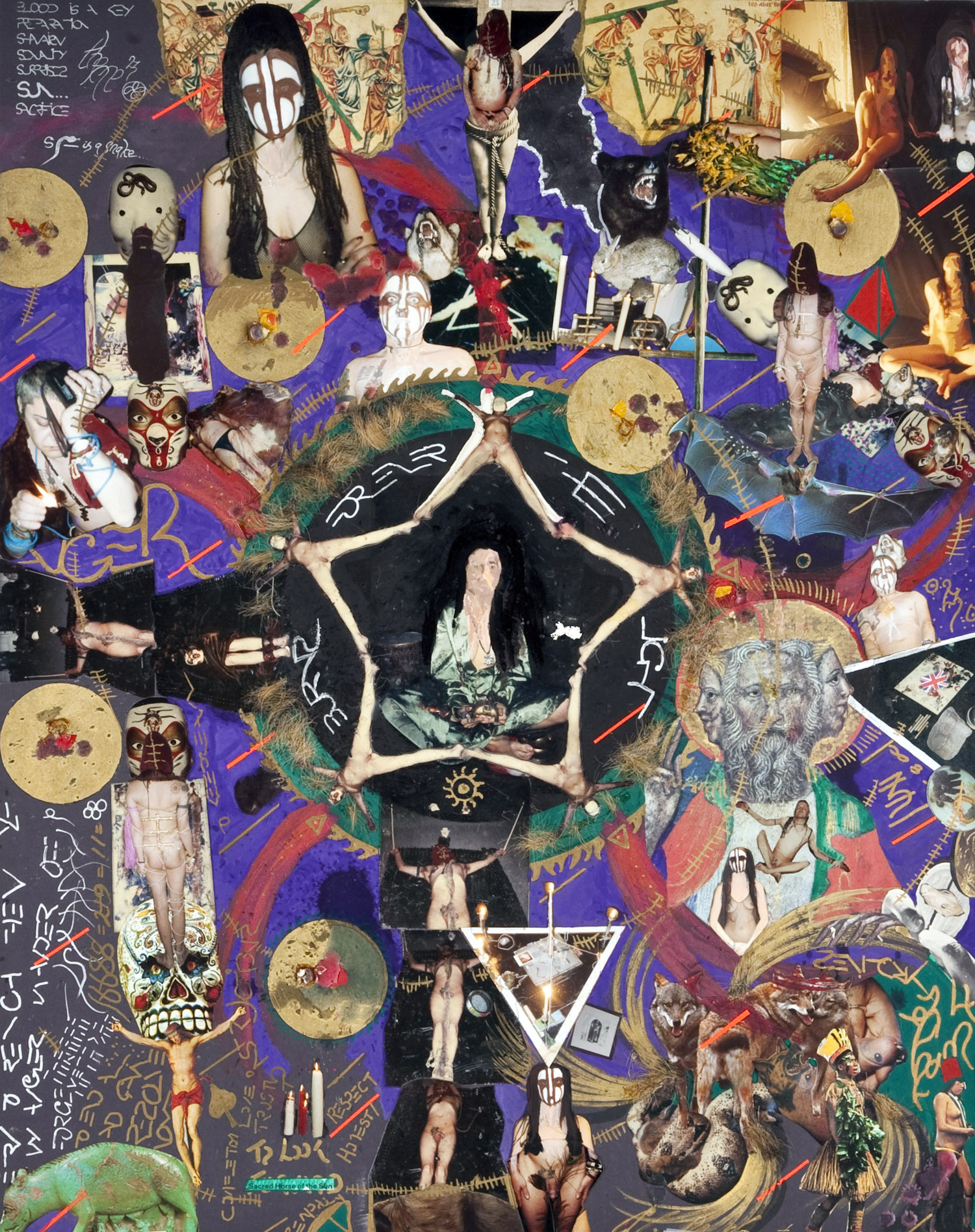
Genesis P-Orridge (British, 1950-2020) 'Burns Forever Thee Light' 1986


Genesis P-Orridge (British, 1950-2020)
Burns Forever Thee Light
1986
Hair, Indian corn, wax, saliva, semen, blood, acrylic paint, flourescent tape, pages from Man Myth & Magic, Polaroids, c-prints, paint pen
20 x 25 inches
© Courtesy of the artist and INVISIBLE-EXPORTS


Genesis P-Orridge (British, 1950-2020)

Genesis Breyer P-Orridge (born Neil Andrew Megson; 22 February 1950) was an English singer-songwriter, musician, poet, performance artist, and occultist. After rising to notability as the founder of the COUM Transmissions artistic collective and then fronting the industrial band Throbbing Gristle, P-Orridge was a founding member of Thee Temple ov Psychick Youth occult group, and fronted the experimental band Psychic TV. P-Orridge identifies as third gender.

Born in Manchester, P-Orridge developed an early interest in art, occultism, and the avant-garde while at Solihull School. After dropping out of studies at the University of Hull, he moved into a counter-cultural commune in London and adopted Genesis P-Orridge as a nom-de-guerre. On returning to Hull, P-Orridge founded COUM Transmissions with Cosey Fanni Tutti, and in 1973 he relocated to London. COUM’s confrontational performance work, dealing with such subjects as sex work, pornography, serial killers, and occultism, represented a concerted attempt to challenge societal norms and attracted the attention of the national press. COUM’s 1976 Prostitution show at London’s Institute of Contemporary Arts was particularly vilified by tabloids, gaining them the moniker of the “wreckers of civilization.” P-Orridge’s band, Throbbing Gristle, grew out of COUM, and were active from 1975 to 1981 as pioneers in the industrial music genre. In 1981, P-Orridge co-founded Psychic TV, an experimental band that from 1988 onward came under the increasing influence of acid house.

In 1981, P-Orridge co-founded Thee Temple ov Psychick Youth, an informal occult order influenced by chaos magic and experimental music. P-Orridge was often seen as the group’s leader, but rejected that position, and left the group in 1991. Amid the Satanic ritual abuse hysteria, a 1992 Channel 4 documentary accused P-Orridge of sexually abusing children, resulting in a police investigation. P-Orridge was subsequently cleared and Channel 4 retracted their allegation. P-Orridge left the United Kingdom as a result of the incident and settled in New York City. There, P-Orridge married Jacqueline Mary Breyer, later known as Lady Jaye, in 1995, and together they embarked on the Pandrogeny Project, an attempt to unite as a “pandrogyne”, or single entity, through the use of surgical body modification to physically resemble one another. P-Orridge continued with this project of body modification after Lady Jaye’s 2007 death. Although involved in reunions of both Throbbing Gristle and Psychic TV in the 2000s, P-Orridge retired from music to focus on other artistic mediums in 2009. P-Orridge is credited on over 200 releases.

A controversial figure with an anti-establishment stance, P-Orridge has been heavily criticised by the British press and politicians. P-Orridge has been cited as an icon within the avant-garde art scene, accrued a cult following, and been given the moniker of the “Godperson of Industrial Music”.

Text from the Wikipedia website


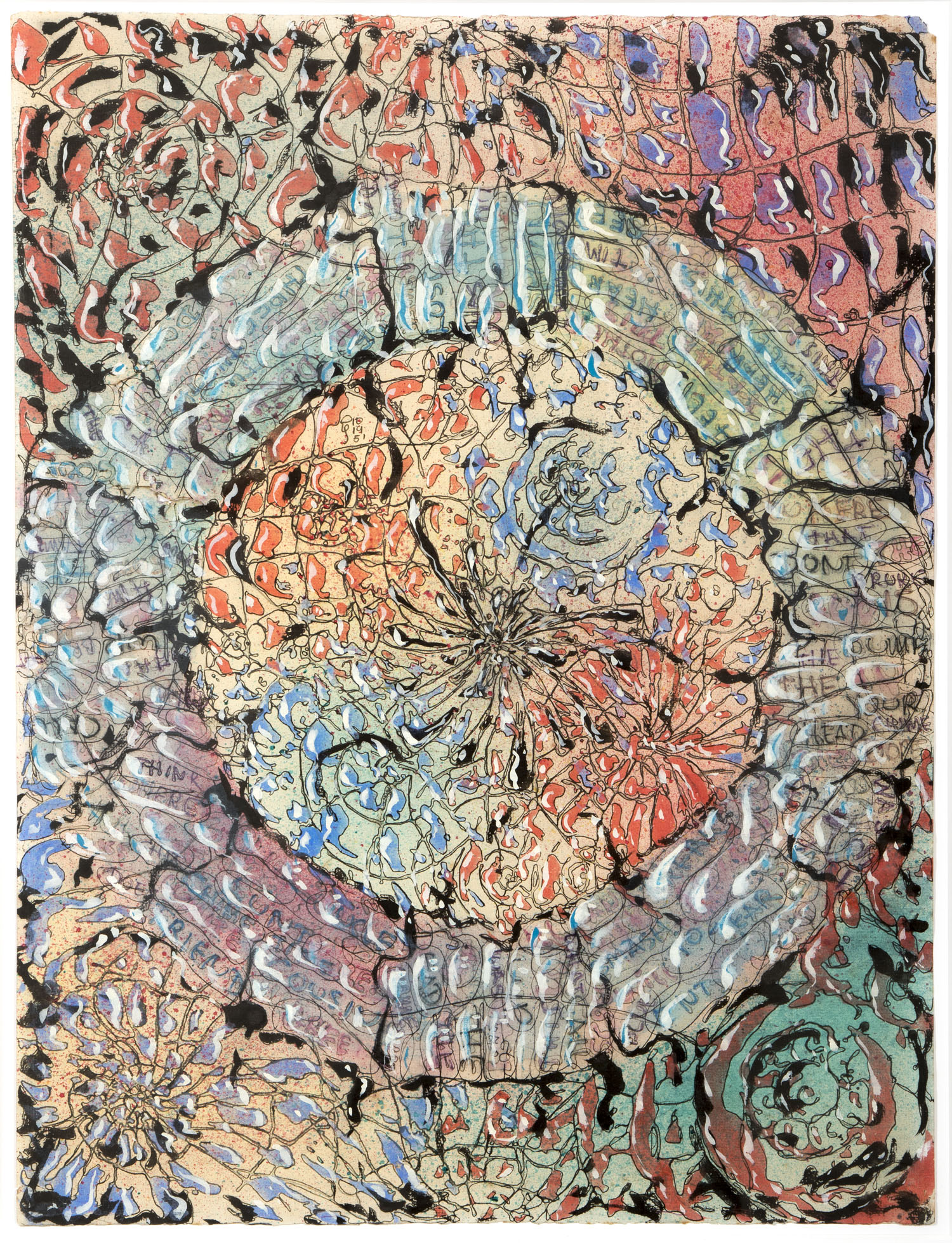
Harry Smith (American, 1923-1991) 'Untitled, October 19, 1951' 1951


Harry Smith (American, 1923-1991)
Untitled, October 19, 1951
1951
Ink, watercolour, and tempera on paper
86.36 x 69.85cm
Collection Raymond Foye, New York


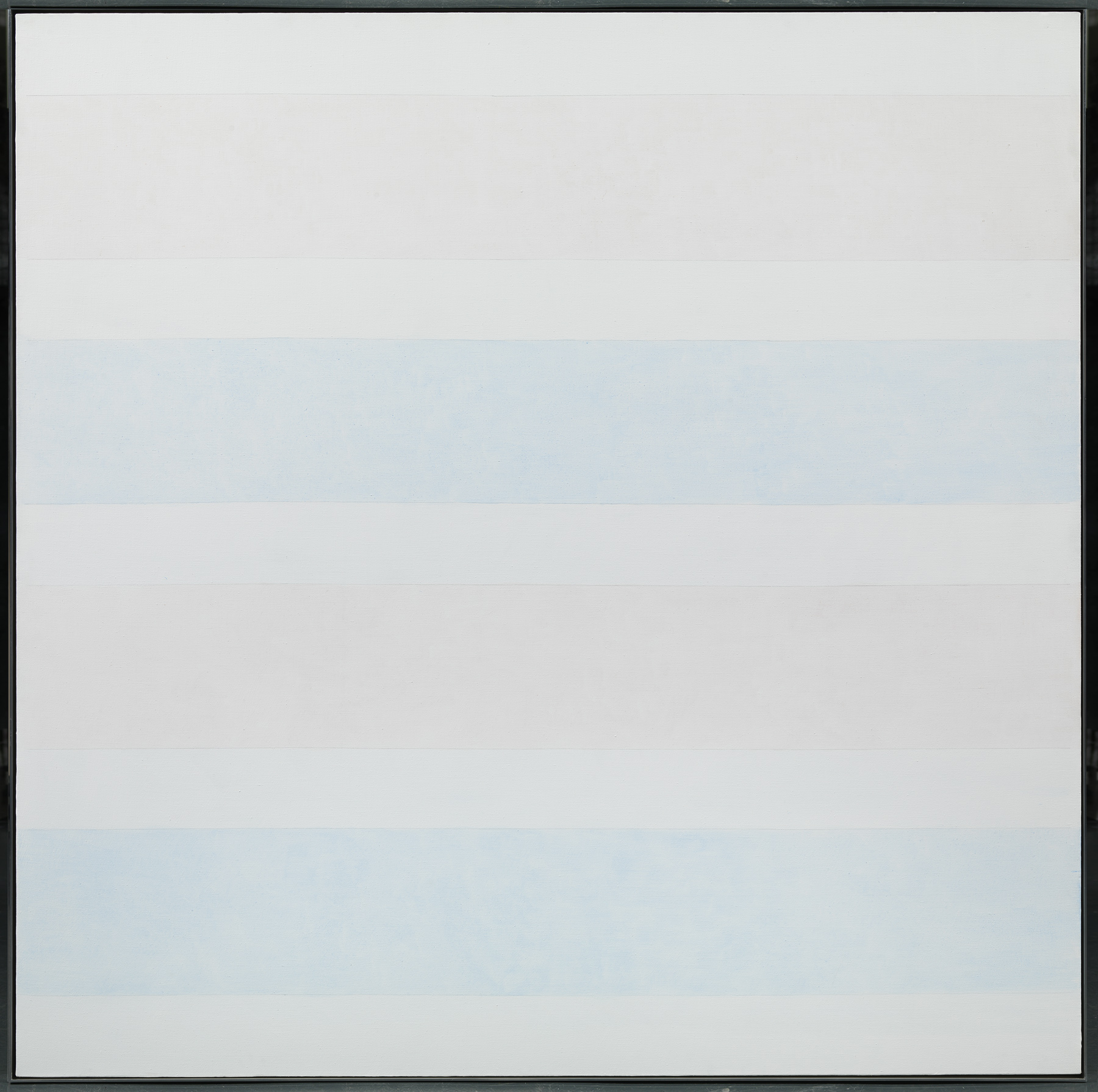
Agnes Martin (American born Canada, 1912-2004) 'Untitled, No. 7' 1997


Agnes Martin (American born Canada, 1912-2004)
Untitled, No. 7
1997
Acrylic and graphite on canvas
152.4 x 152.4cm
Collection “la Caixa”. Art Contemporani
© Vegap


Agnes Martin (American born Canada, 1912-2004)

Agnes Bernice Martin (March 22, 1912 – December 16, 2004), born in Canada, was an American abstract painter. Her work has been defined as an “essay in discretion on inward-ness and silence”. Although she is often considered or referred to as a minimalist, Martin considered herself an abstract expressionist. She was awarded a National Medal of Arts from the National Endowment for the Arts in 1998. …

Martin praised Mark Rothko for having “reached zero so that nothing could stand in the way of truth”. Following his example Martin also pared down to the most reductive elements to encourage a perception of perfection and to emphasise transcendent reality. Her signature style was defined by an emphasis upon line, grids, and fields of extremely subtle colour. Particularly in her breakthrough years of the early 1960s, she created 6 × 6 foot square canvases that were covered in dense, minute and softly delineated graphite grids. In the 1966 exhibition Systemic Painting at the Solomon R. Guggenheim Museum, Martin’s grids were therefore celebrated as examples of Minimalist art and were hung among works by artists including Sol LeWitt, Robert Ryman, and Donald Judd. While minimalist in form, however, these paintings were quite different in spirit from those of her other minimalist counterparts, retaining small flaws and unmistakable traces of the artist’s hand; she shied away from intellectualism, favouring the personal and spiritual. Her paintings, statements, and influential writings often reflected an interest in Eastern philosophy, especially Taoist. Because of her work’s added spiritual dimension, which became more and more dominant after 1967, she preferred to be classified as an abstract expressionist.

Martin worked only in black, white, and brown before moving to New Mexico. The last painting before she abandoned her career, and left New York in 1967, Trumpet, marked a departure in that the single rectangle evolved into an overall grid of rectangles. In this painting the rectangles were drawn in pencil over uneven washes of gray translucent paint. In 1973, she returned to art making, and produced a portfolio of 30 serigraphs, On a Clear Day. During her time in Taos, she introduced light pastel washes to her grids, colours that shimmered in the changing light. Later, Martin reduced the scale of her signature 72 × 72 square paintings to 60 × 60 inches and shifted her work to use bands of ethereal colour. Another departure was a modification, if not a refinement, of the grid structure, which Martin has used since the late 1950s. In Untitled No. 4 (1994), for example, one viewed the gentle striations of pencil line and primary colour washes of diluted acrylic paint blended with gesso. The lines, which encompassed this painting, were not measured by a ruler, but rather intuitively marked by the artist. In the 1990s, symmetry would often give way to varying widths of horizontal bands.

Text from the Wikipedia website


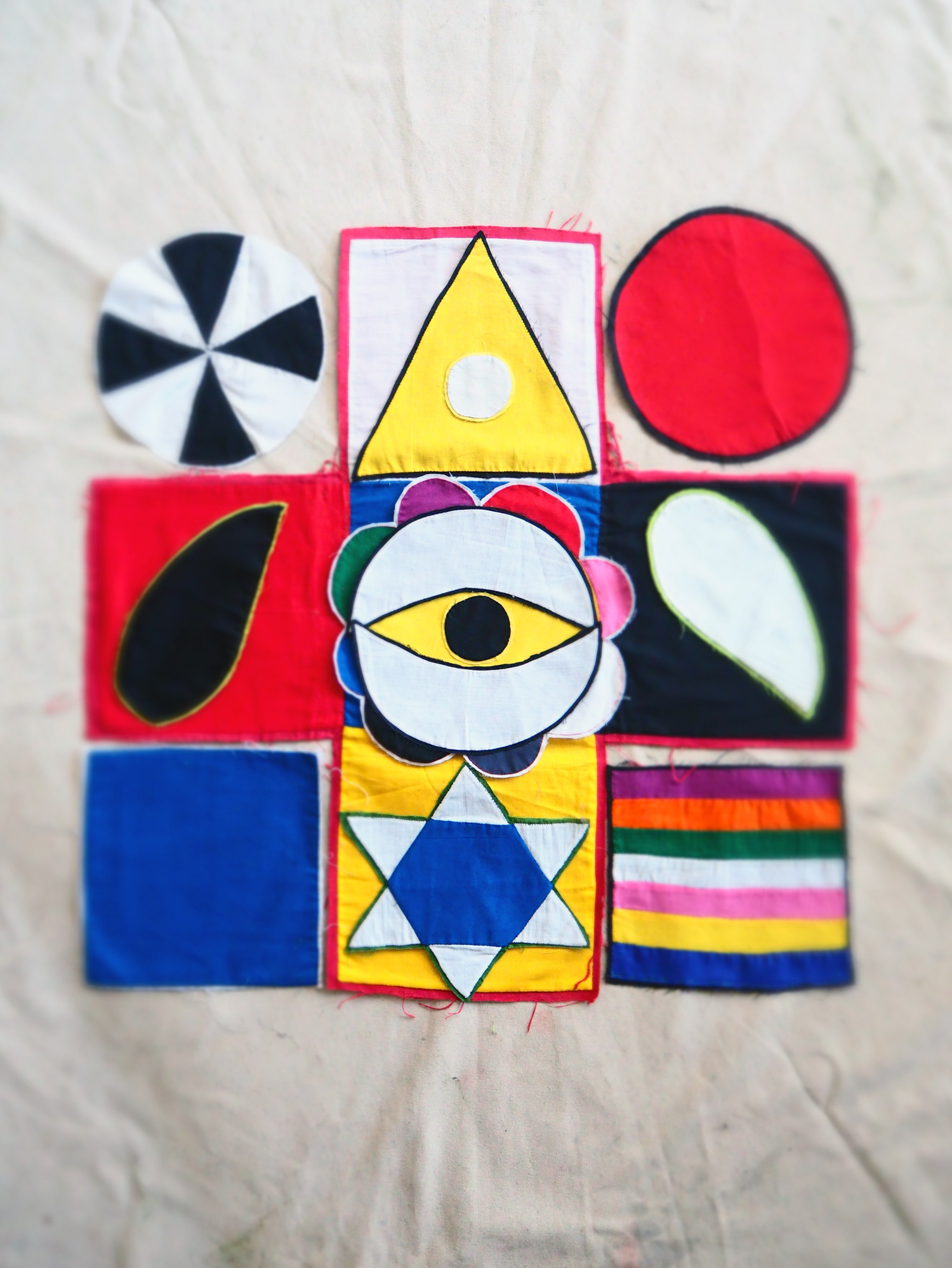
Matías Krahn Uribe (Chile, b. 1972) 'Panamor' 2016


Matías Krahn Uribe (Chile, b. 1972)
Panamor
2016
Canvas and cotton
225 x 225cm
© Matías Krahn Uribe


Matías Krahn (b. Santiago de Chile, 1972) Catalan painter born in Chile who lives and works in Barcelona.

His colourful works are a reflection of the world that surrounds him, of a concrete circumstance and environment, but also of the most intimate and subjective. Interested in the balance between the exterior and the interior, it orders the space and the figures it contains. His work, influenced by surrealism, is the mirror of the psyche and the unconscious that expresses itself in infinite forms and tonalities.


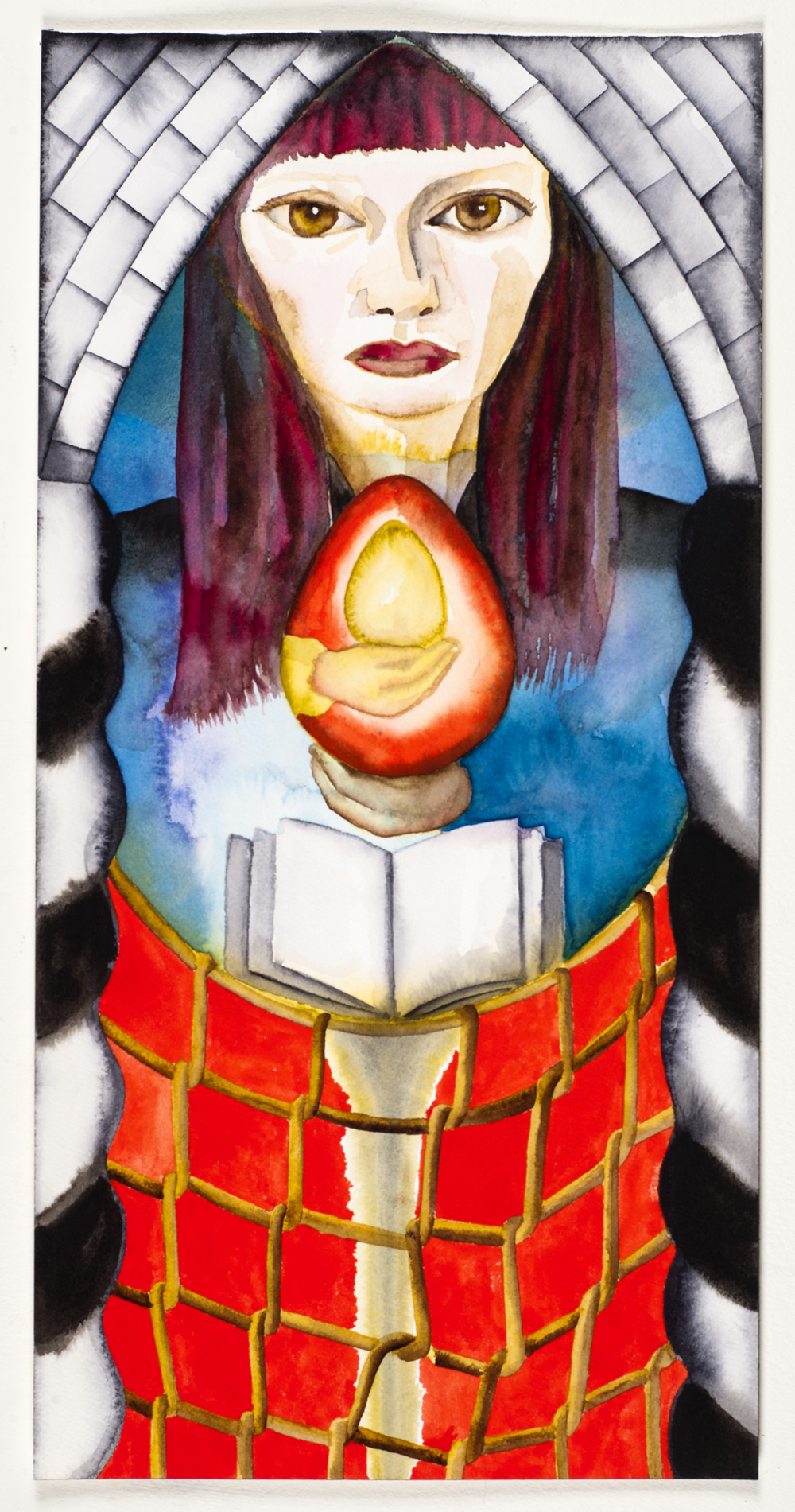
Francesco Clemente (Italian, b. 1952) 'Tarot cards: the High Priestess' 2009-2011


Francesco Clemente (Italian, b. 1952)
Tarot cards: the High Priestess
2009-2011
Water colour, gouache, ink, colour pencil
48.2 x 25.4cm
© Courtesy of the artist


Francesco Clemente (born 23 March 1952) is an Italian contemporary artist. He has lived at various times in Italy, in India, and in New York City. Some of his work is influenced by the traditional art and culture of India. He has worked in various artistic media including drawing, fresco, graphics, mosaic, oils and sculpture. He was among the principal figures in the Italian Transavanguardia movement of the 1980s, which was characterised by a rejection of Formalism and conceptual art and a return to figurative art and Symbolism.


Black Light – Secret traditions in art since the 1950s: occultism, magic, esotericism and mysticism

This exhibition analyses the influence that different secret traditions have had on art since the 1950s and today. These are traditions that can be traced back to the very origins of civilisation and that have served at various times to structure philosophical, linguistic, scientific and spiritual ideas.

Despite the importance that these ideas had for the development of 20th century art – being fundamental in the work of key figures of modernity such as Piet Mondrian, Vasili Kandinski, Arnold Schönberg, William Butler Yeats and Fernando Pessoa – it is a tradition that has often been ignored in our time because of the dominant influence of rationalist orthodox thoughts, which are often ignored in our times.

Today, however, many contemporary artists re-explore these themes and are interested in issues as diverse as alchemy, secret societies, theosophy and anthroposophy; the esoteric currents of the great religions; oriental philosophies and magic; psychedelia and the ingestion of drugs; universal symbols and myths; the so-called fourth way of the Armenian mystic Georges Gurdjieff, etc., and, in so doing, generate a renewed interest in these issues that did not exist since the years of counterculture in the 1970s. Authors such as Mircea Eliade, historian of religions and novelist; Carl Gustav Jung, psychologist; Henry Corbin, specialist in Sufism, the esoteric current of Islam; Gershom Scholem, specialist in Kabbalah, the esoteric current of Judaism; and Rudolf Steiner, the founding philosopher of anthroposophy, have now found numerous new readers.

The exhibition will present, more or less chronologically, paintings, drawings, films, sculptures, photographs, installations, books, music and documents by artists as varied as Harry Smith, Jordan Belson, Barnett Newman, Agnes Martin, Ad Reinhardt, Antoni Tàpies, Joan Ponç, Henri Michaux, René Daumal, Forrest Bess, Kenneth Anger, Alejandro Jodor. The work of all of them demonstrates the relevance and continuity of these usually ignored traditions, and in many cases understands art as a possible way to reach a higher cognitive level or as a form of knowledge in itself.

The exhibition will be accompanied by a catalogue with texts by specialists such as Cristina Ricupero, Gary Lachman, Erik Davies and Enrique Juncosa. The proposal will also investigate and reveal occult traditions and their current context in the cultural production of our country.

Text from the Centre de Cultura Contemporania de Barcelona website


Irrationality from rationality

Vincenç Villatoro, director of the CCCB, has justified the presence of this exhibition in a centre that defends rational culture, alluding to the fact that much of the artistic production can not be understood without its connection to non-rationalistic traditions: mystical, esoteric, hermetic … and points out that although in the second half of the twentieth century the hegemonic thought was the scientist, there was a sensitive part of society that came to other traditions, especially to give meaning to its life. Villatoro warns the visitor that the exhibition La llum negra is not an encyclopedia on hidden traditions, but neither is it intended to be a defence, nor a refutation. But the exhibition points out that for many creators, art is a way to access a deeper reality, which is difficult to access in other ways. Thus, secret tradition and art are complemented.

Gustau Nerín


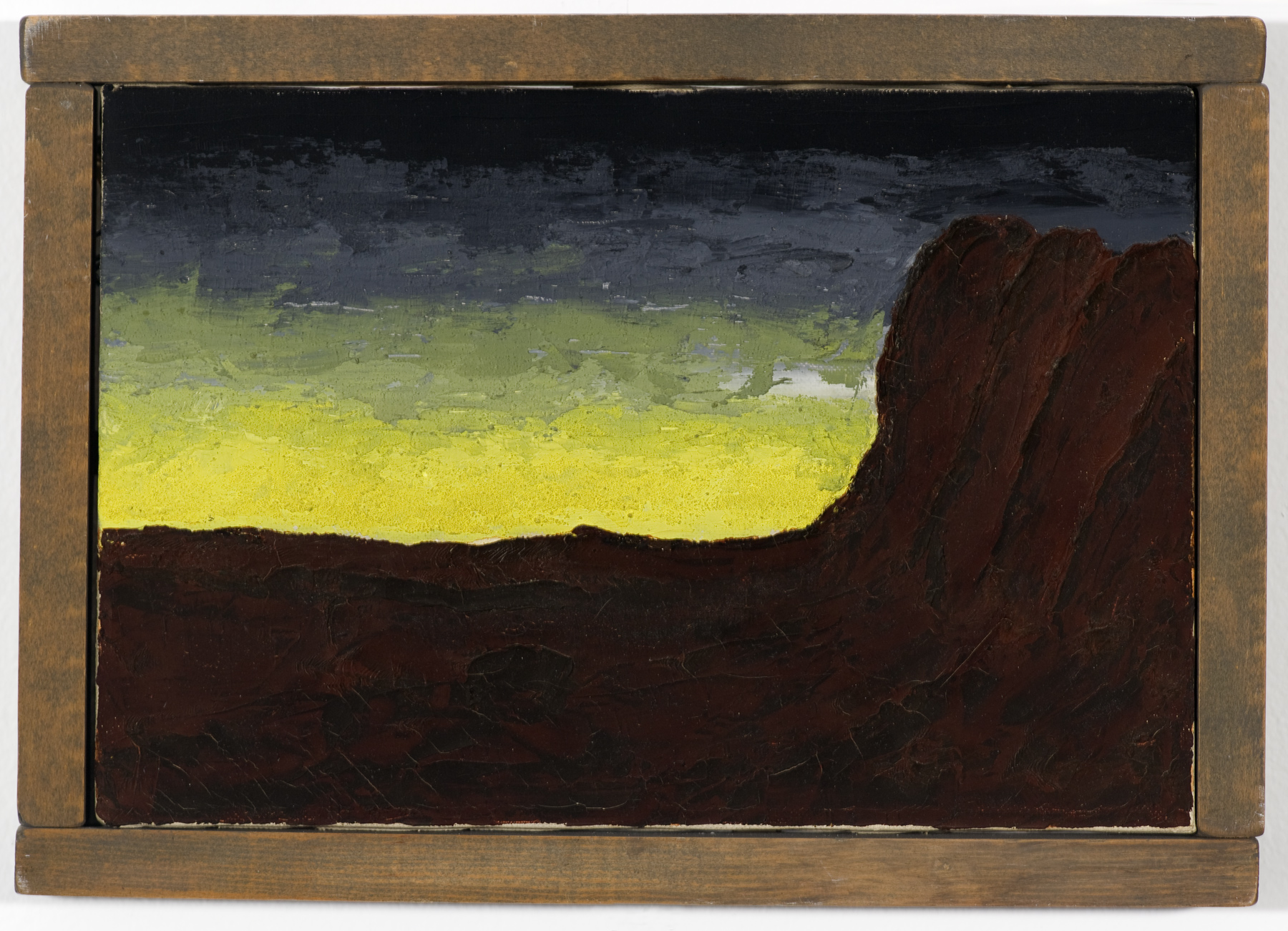
Forrest Bess (American, 1911-1977) 'Homage to Ryder' 1951


Forrest Bess (American, 1911-1977)
Homage to Ryder
1951
Oil on canvas
20.8 × 30.5cm
© Collection Museum of Contemporary Art Chicago Gift of Mary and Earle Ludgin Collection


Forrest Bess (American, 1911-1977)

Forrest Bess (October 5, 1911-November 10, 1977) was an American painter and eccentric visionary. He was discovered and promoted by the art dealer Betty Parsons. Throughout his career, Bess admired the work of Albert Pinkham Ryder and Arthur Dove, but the best of his paintings stand alone as truly original works of art. …

He worked as a commercial fisherman, but painted in his spare time. He experienced visions or dreams, which he set down in his paintings. It was during this time he began to exhibit his works, earning one-person shows at museums in San Antonio and Houston. During his most creative period, 1949 through 1967, Betty Parsons arranged six solo exhibitions at her New York City gallery.

Bess was never comfortable for very long around other people, although he hosted frequent visitors to his home and studio at Chinquapin: artists, reporters, and some patrons made the trip to the spit of land on which Bess’s shack stood. He did forge lasting relationships with a few friends and neighbours, and maintained years-long friendships and correspondence with Meyer Schapiro and with Betty Parsons. But ultimately Bess preferred solitude, and his prolific activities as an artist, highlighted by limited notoriety and success, alternated with longs spells of loneliness, depression, and an ever-increasing obsession with his own anatomical manifesto.

In the 1950s, he also began a lifelong correspondence with art professor and author Meyer Schapiro and sexologist John Money. In these and other letters (which were donated to the Smithsonian Archives of American Art), Bess makes it clear that his paintings were only part of a grander theory, based on alchemy, the philosophy of Carl Jung, and the rituals of Australian aborigines, which proposed that becoming a hermaphrodite was the key to immortality. He was never able to win any converts to his theories or validation from the many doctors and psychologists with whom he corresponded. In his own home town of Bay City, he was considered something of a small-town eccentric.

Text from the Wikipedia website


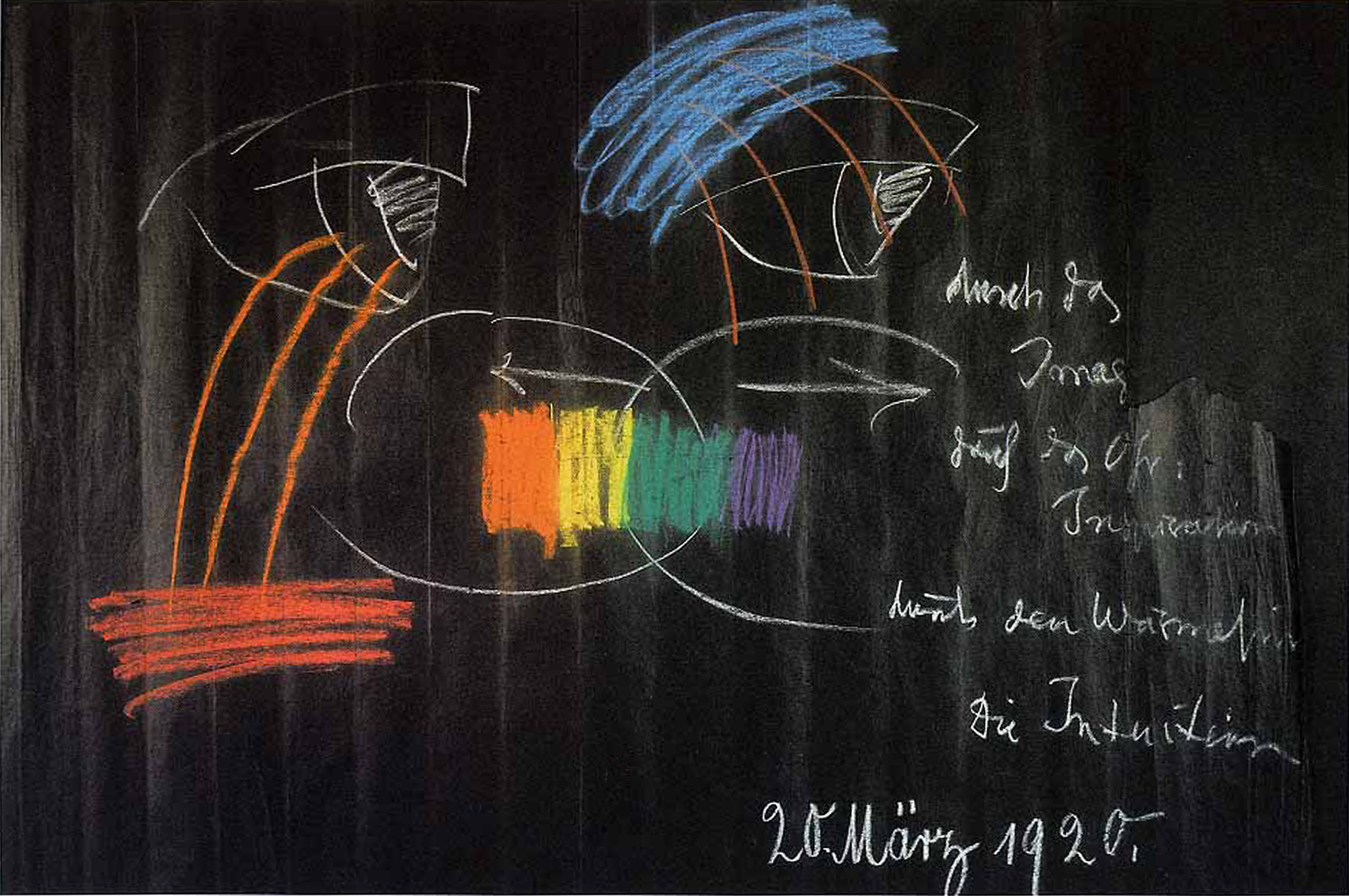
Rudolf Steiner (Austrian, 1861-1925) 'Untitled (Blackboard drawing from a lecture held by Rudolf Steiner on 20. 03. 1920)'


Rudolf Steiner (Austrian, 1861-1925)
Untitled (Blackboard drawing from a lecture held by Rudolf Steiner on 20. 03. 1920)
1920
Chalk on paper
87 x 124cm
Rudolf Steiner Archiv, Dornach


Rudolf Steiner (Austrian, 1861-1925)

Rudolf Joseph Lorenz Steiner (27 (or 25) February 1861-30 March 1925) was an Austrian philosopher, social reformer, architect and esotericist. Steiner gained initial recognition at the end of the nineteenth century as a literary critic and published philosophical works including The Philosophy of Freedom. At the beginning of the twentieth century he founded an esoteric spiritual movement, anthroposophy, with roots in German idealist philosophy and theosophy; other influences include Goethean science and Rosicrucianism.

In the first, more philosophically oriented phase of this movement, Steiner attempted to find a synthesis between science and spirituality. His philosophical work of these years, which he termed “spiritual science”, sought to apply the clarity of thinking characteristic of Western philosophy to spiritual questions, differentiating this approach from what he considered to be vaguer approaches to mysticism. In a second phase, beginning around 1907, he began working collaboratively in a variety of artistic media, including drama, the movement arts (developing a new artistic form, eurythmy) and architecture, culminating in the building of the Goetheanum, a cultural centre to house all the arts. In the third phase of his work, beginning after World War I, Steiner worked to establish various practical endeavours, including Waldorf education, biodynamic agriculture, and anthroposophical medicine.

Steiner advocated a form of ethical individualism, to which he later brought a more explicitly spiritual approach. He based his epistemology on Johann Wolfgang Goethe’s world view, in which “Thinking… is no more and no less an organ of perception than the eye or ear. Just as the eye perceives colours and the ear sounds, so thinking perceives ideas.” A consistent thread that runs from his earliest philosophical phase through his later spiritual orientation is the goal of demonstrating that there are no essential limits to human knowledge.

Text from the Wikipedia website


The blackboard drawings are the instructions of a new design language that the artist wants to develop. Steiner believes in the development of a supersensible consciousness, a big change for the future of humanity. He gives many lectures in which he details his research on the concept of transmission and its influence on the social. Whether true or not, artists such as Piet Mondrian, Wassily Kandinsky and others are interested in the complex graphics of Steiner and his research. Mondrian will even write: “Art is a way of development of mankind.”

Anonymous text from the Culture Box website translated from French [Online] Cited 17/10/2018. No longer available online


Adaptive image from the exhibition 'Black Light: Secret traditions in art since the 1950s' at the Centre de Cultura Contemporania de Barcelona

Adaptive image from the exhibition 'Black Light: Secret traditions in art since the 1950s' at the Centre de Cultura Contemporania de Barcelona


Adaptive images from the exhibition Black Light: Secret traditions in art since the 1950s at the Centre de Cultura Contemporania de Barcelona


Centre de Cultura Contemporania de Barcelona
Montalegre, 5 – 08001 Barcelona
Phone: 93 306 41 00

Opening hours:
Tuesday to Sunday 11.00 – 20.00

Centre de Cultura Contemporania de Barcelona website

LIKE ART BLART ON FACEBOOK

Back to top

Exhibition: ‘The Polaroid Project’ at the Museum für Kunst und Gewerbe Hamburg

Exhibition dates: 16th March – 17th June, 2018


Anna Reynolds. 'Marcus / Mutilation of the Soul' October 1992


Anna Reynolds
Marcus / Mutilation of the soul
October 1992
Phillip Institute, Melbourne
Polaroid


I love Polaroid photography. As “instant” photography it can have immediacy, but it can also be used for conceptual work as can be see in this posting. You can manipulate the image while it is still developing, and you can also later reclaim the negative from the Polaroid itself, providing a useful scannable or printable negative for further experimentation.

The idea of “instant” photography bemuses me. Nothing is ever “instant”. For example, in the Polaroid image of me above (and in all of the images below), there was thought, an idea, a process, and imagination going on well before the photograph was taken, and during its development (the manipulation of the Polaroid around the figure). Even a simple, vernacular photograph of a family scene contains the fact that the person behind the camera made a conscious decision to capture something that they saw, and press the shutter at a particular moment. It is never a “snapshot” for the process of taking a photograph is always a sub / conscious, imaginative, exclamation of choice.

So there is this space and time of in/decision; there is also the space and time of waiting (and manipulating if so desired) for the Polaroid to develop. That is the magical part for me… to see the image develop not in the drip tray of the darkroom, but holding the image in your hand, watching it emerge from the ether right in front of your eyes. Instant no, unforgettable, yes.

Dr Marcus Bunyan


Many thankx to the Museum für Kunst und Gewerbe Hamburg for allowing me to publish the photographs in the posting. Please click on the photographs for a larger version of the image.


The Polaroid Project will shed light on the broad aesthetic spectrum made possible by the groundbreaking technology of instant photography, showcasing around 220 works by over 100 artists. Polaroid – a brand that has long since become a legend – revolutionised photography in a way that can still be felt today and which lives on in photo apps and on Instagram. The exhibition was developed by the Foundation for the Exhibition of Photography, Minneapolis / New York / Paris / Lausanne, the MIT Museum in Cambridge (Massachusetts), and WestLicht. Schauplatz für Fotografie (Vienna), in cooperation with MKG, and will be shown at numerous international museums.


James Nitsch. 'Razor Blade' 1976 from the exhibition 'The Polaroid Project' at the Museum für Kunst und Gewerbe Hamburg, March - June, 2017


James Nitsch
Razor Blade
1976
Polaroid SX-70 assemblage with razor blade
10.7 x 8.8cm
© James Nitsch


Guy Bourdin (French, 1928-1991) 'Charles Jourdan' 1978 from the exhibition 'The Polaroid Project' at the Museum für Kunst und Gewerbe Hamburg, March - June, 2017


Guy Bourdin (French, 1928-1991)
Charles Jourdan 1978
1978
C-Print
88.9 x 116.8cm
© The Guy Bourdin Estate 2017 / Courtesy of Louise Alexander Gallery


André Kertész (Hungarian, 1894-1985) 'August 13' 1979


André Kertész (Hungarian, 1894-1985)
August 13, 1979
1979
Polaroid SX-70
10.7 x 8.8cm
© The Estate of André Kertész, courtesy Stephen Bulger Gallery


Victor Landweber (American, b. 1943) 'Garbage Candy' 1979


Victor Landweber (American, b. 1943)
Garbage Candy
1979
Polaroid Polacolor Type 669 composite, bound in a book
10.8 x 16.1cm
© Victor Landweber, Collection Center for Creative Photography, The University of Arizona


Bruce Charlesworth (American, b. 1950) 'Untitled' 1979


Bruce Charlesworth (American, b. 1950)
Untitled
1979
Hand-painted Polaroid SX-70
10.7 x 8.8cm
© Bruce Charlesworth 1979


Barbara Crane (American, 1928-2019) 'Private Views' 1981


Barbara Crane (American, 1928-2019)
Private Views
1981
Polaroid Polacolor 4×5 Type 58
10.2 x 12.7cm
© Barbara Crane


Sandi Fellman (American, b. 1952) 'Grey Lion, Tokyo, Japan' 1983


Sandi Fellman (American, b. 1952)
Grey Lion, Tokyo, Japan
1983
Polaroid 20 x 24 Polacolor
73.7 x 56cm
© Sandi Fellman


Şahin Kaygun (Turkish, 1951-1992) 'Buttock' 1983


Şahin Kaygun (Turkish, 1951-1992)
Buttock
1983
Hand coloured, manipulated Polaroid Type 600 High Speed
10.7 x 8.8cm
© Şahin Kaygun


David Levinthal (American, b. 1949) 'Untitled' 1983-1985


David Levinthal (American, b. 1949)
Untitled from the series Modern Romance
1983-1985
Polaroid SX-70
10.7 x 8.8cm
© David Levinthal, ARS, NY and DACS, London 2017


In the exhibition The Polaroid Project, the Museum für Kunst und Gewerbe Hamburg presents for the first time the full scope of the phenomenon of the Polaroid photograph. Based on some 220 photos by over 100 artists, as well as 90 camera models and prototypes, the show sheds light on the whole aesthetic spectrum of instant photography and on the innovative technology that made this visual revolution possible. Polaroid stands for a technology, an industry, a company, and its products. Presented to the public for the first time in 1947 by Edwin Land in New York, instant camera film made the photo lab superfluous. As if by magic, the picture gradually appears before the eyes of the photographer and subject. Polaroid – a brand that has long since attained legendary status – thus transformed our handling of photography in a way that is still pervasive today, living on in photo apps and Instagram. In the heyday of the company in the mid-20th century, Polaroid sold its cameras and film to millions of amateurs and professionals. The technical and aesthetic qualities of the new medium, and above all the immediacy and spontaneity of the photos, made it an exciting field of experimentation for artists as well.

Polaroid itself has worked closely with photographers from the start. One of the earliest advisors to Edwin Land, inventor and founder of the Polaroid Corporation, was Ansel Adams, the godfather of American landscape photography. In its Artist Support Program, the company provides film and cameras to both established figures and nascent talents in the art and photography scene. In return, it receives not only feedback on its products but also selected works for the company collection. For artists, the inventions from Land’s company offer a playground for their own discoveries, one that provides fresh inspiration for their photography. It thus came about that the exponents of Pop Art – chief among them Andy Warhol – raised the status of the Polaroid photo to a whole new level with their excessive use of the medium, securing for it a place in the artistic sphere.

Press release from the Museum für Kunst und Gewerbe Hamburg


Dennis Hopper (American, 1936-2010) 'Los Angeles, Back Alley' 1987


Dennis Hopper (American, 1936-2010)
Los Angeles, Back Alley
1987
Polaroid SX-70
10.7 x 8.8cm
© Dennis Hopper, Courtesy of The Hopper Art Trust


Pierre-Louis Martin. 'Graines de Pissenlit' 1990


Pierre-Louis Martin
Graines de Pissenlit
1990
Gelatin silver print from Polaroid-Film Type 55
48.9 x 40cm
© Pierre-Louis Martin


Shelby Lee Adams (American, b. 1950) 'Esther and Bee Jay' 1991


Shelby Lee Adams (American, b. 1950)
Esther and Bee Jay
1991
Polaroid Polapan 4×5 Type 52
12.7 x 10.2cm
© Shelby Lee Adams


Kunihiro Shinohara (Japanese, b. 1948) 'Cosmic #9' 1993-2000


Kunihiro Shinohara (Japanese, b. 1948)
Cosmic #9
1993-2000
Inkjet print from Polaroid-Film Type 55
29.8 x 22.3cm
© Kunihiro Shinohara


Mark Klett (American, b. 1952) 'Contemplating the View at Muley Point, Utah' 1994


Mark Klett (American, b. 1952)
Contemplating the View at Muley Point, Utah
1994
Gelatin silver print from Polaroid-Film Type 55
40.6 x 50.8cm
© Mark Klett


Ellen Carey (American, b. 1952) 'Pulls (CMY)' 1997


Ellen Carey (American, b. 1952)
Pulls (CMY)
1997
Polaroid 20 x 24 Polacolor-Montage
210.8 x 167.6cm
© Ellen Carey, Jayne H. Baum Gallery, NYC, NY and M+B Gallery, LA, CA


Timothy White (American, b. 1956) 'Untitled' 1998


Timothy White (American, b. 1956)
Untitled
1998
Inkjet print from Polaroid-Film Type 665
50.8 x 40.6cm
© Timothy White


Toshio Shibata (Japanese, b. 1949) 'Untitled (# 228)' 2003


Toshio Shibata (Japanese, b. 1949)
Untitled (#228)
2003
Gelatin silver print from Polaroid-Film, Type 55
61 x 50.8cm
© Toshio Shibata


Chen Wei (Chinese, b. 1980) 'Everlasting Radio Wave-Test #5' 2008


Chen Wei (Chinese, b. 1980)
Everlasting Radio Wave-Test #5
2008
Fujifilm FP-100C
8.5 x 10.8cm
© Chen Wei


Paolo Gioli (Italian, 1942-2022) 'This Is Not My Face' 2010


Paolo Gioli (Italian, 1942-2022)
Questo volto non è il mio volto (This Face Is Not My Face)
2010
Polaroid 20 x 24 Polacolor and Polacolor transfer on acrylic
71 x 55cm
© Paolo Gioli


Museum für Kunst und Gewerbe Hamburg
Steintorplatz, 20099 Hamburg

Opening hours:
Tuesday to Sunday 10am – 6pm
Thursday 10am – 9pm
Closed Mondays

Museum fur Kunst und Gewerbe Hamburg website

LIKE ART BLART ON FACEBOOK

Back to top

Vale Polixeni Papapetrou (1960-2018)

April 2018


Polixeni Papapetrou (Australian, 1960-2018) 'Drag queen wearing cut out dress' 1993


Polixeni Papapetrou (Australian, 1960-2018)
Drag queen wearing cut out dress
1993
From the series Drag Queens 1988-1999
Gelatin silver photograph
28.5 x 28.5cm
Courtesy the artist and Nellie Castan Gallery, Melbourne and Stills Gallery, Sydney


My god, what a loss.

I am very sorry to hear of the passing of Polixeni Papapetrou. Sadness indeed…

Poli was a wonderful spirit and an incredibly gifted artist. Condolences to Robert Nelson and all of the family.

A selection of some of my favourite Papapetrou images are posted below – but really, there are so many memorable images, she leaves behind an indelible and lasting legacy.

From an earlier posting:

“What we should do is honour this talented and determined artist for creating so many memorable images over the years, for following her passion and her heart with courage and conviction. For the rest of my life I will always remember the spaces, the ambiguous vistas, the fantastical archetypes, the fables of her work. Images of drag queens and Dreamkeepers, Ghillies and goblins are etched in my memory. I will always remember them. You can’t ask much more from the work of an artist than that.”


You can kill the dreamer, but you cannot kill the dream.

Dr Marcus Bunyan


“Art does not reproduce the visible; rather, it makes visible.”


Paul Klee. Creative Credo (Schöpferische Konfession) 1920


Polixeni Papapetrou (Australian, 1960-2018) 'Three young men paying homage to Elvis on the 13th anniversary of Elvis’ death, Elvis Memorial Melbourne' 1990


Polixeni Papapetrou (Australian, 1960-2018)
Three young men paying homage to Elvis on the 13th anniversary of Elvis’ death, Elvis Memorial Melbourne
1990
From the series Elvis Immortal 1987-2002
Selenium toned gelatin silver photograph
40.7 x 40.7cm
Courtesy the artist and Nellie Castan Gallery, Melbourne and Stills Gallery, Sydney


Polixeni Papapetrou (Australian, 1960-2018) 'Mr Wrestling' 1992


Polixeni Papapetrou (Australian, 1960-2018)
Mr Wrestling
1992
From the series Wrestlers 1992
Pigment ink print
100 x 100cm


Polixeni Papapetrou (Australian, 1960-2018) 'Indian Brave' 2002


Polixeni Papapetrou (Australian, 1960-2018)
Indian Brave
2002
From the series Phantomwise 2002-2003
Pigment ink print
85 x 85cm
Courtesy the artist and Nellie Castan Gallery, Melbourne and Stills Gallery, Sydney


Polixeni Papapetrou (Australian, 1960-2018) 'Lost' 2005


Polixeni Papapetrou (Australian, 1960-2018)
Lost
2005
From the series Fairy Tales 2004-2014
Type C print
100 x 100cm
Courtesy the artist, Michael Reid Gallery, Sydney + Berlin and Jarvis Dooney Galerie, Berlin
Reproduced with permission


Polixeni Papapetrou (Australian, 1960-2018) 'In the Wimmera 1864 #1' 2006


Polixeni Papapetrou (Australian, 1960-2018)
In the Wimmera 1864 #1
2006
From the series Haunted country 2006
Pigment ink print
105 x 105cm
Geelong Gallery Collection


In the Wimmera 1864 #1 from the Haunted country series is amongst the earliest works by the artist to have been staged in the Australian landscape and is one in which she explores the narrative of the ‘lost child’. The work references the story of three children lost in Mallee scrub near their home outside Horsham in the Wimmera District and is reminiscent, as the artist intends, of Frederick McCubbin’s late 19th century paintings of children lost or at least wandering absent-mindedly through the Australia bush.

Text from the Culture Victoria website


Polixeni Papapetrou (Australian, 1960-2018) 'Hanging Rock 1900 #3' 2006


Polixeni Papapetrou (Australian, 1960-2018)
Hanging Rock 1900 #3
2006
From the series Haunted country 2006
Pigment ink print
105 x 105cm


Polixeni Papapetrou (Australian, 1960-2018) 'The Provider' 2009


Polixeni Papapetrou (Australian, 1960-2018)
The Provider
2009
From the series Between Worlds 2009-2012
Pigment print
105 x 105cm


Polixeni Papapetrou (Australian, 1960-2018) 'The Mourner' 2012


Polixeni Papapetrou (Australian, 1960-2018)
The Mourner
2012
From the series Between Worlds 2009-2012
Pigment print
105 x 105cm


Polixeni Papapetrou (Australian, 1960-2018) 'The Joy Pedlars' 2011 from 'The Dreamkeepers' 2011


Polixeni Papapetrou (Australian, 1960-2018)
The Joy Pedlars
2011
From the series The Dreamkeepers 2012
Pigment print
105 x 105cm


Polixeni Papapetrou (Australian, 1960-2018) 'The Wanderer No. 3', 2012 from 'The Dreamkeepers'


Polixeni Papapetrou (Australian, 1960-2018)
The Wanderer No. 3
2012
From the series The Dreamkeepers 2012
Pigment print
105 x 105cm


Polixeni Papapetrou (Australian, 1960-2018) 'Ocean Man' 2013


Polixeni Papapetrou (Australian, 1960-2018)
Ocean Man
2013
From the series The Ghillies 2013
120 x 120cm
National Gallery of Victoria, Melbourne
Purchased NGV Foundation, 2013


Polixeni Papapetrou (Australian, 1960-2018) 'Scrub Man' 2012


Polixeni Papapetrou (Australian, 1960-2018)
Scrub Man
2012
From the series The Ghillies 2013
120 x 120cm
National Gallery of Victoria, Melbourne
Purchased NGV Foundation, 2013


Review of the exhibition Polixeni Papapetrou: Lost Psyche at Stills Gallery, 2014

When “facing” adversity, it is a measure of a person’s character how they hold themselves, what face they show to the world, and how their art represents them in that world. So it is with Polixeni Papapetrou. The courage of this artist, her consistency of vision and insightful commentary on life even while life itself is in the balance, are inspiring to all those that know her.

Papapetrou has always created her own language, integrating the temporal dissemination of the historical “case” into a two-dimensional space of simultaneity and tabulation (the various archetypes and ancient characters), into an outline against a ground of Cartesian coordinates.1 In her construction, in her observation and under her act of surveillance, Papapetrou moves towards a well-made description of the states of the body in the tables and classification of the psychological landscape. Her tableaux (the French tableau signifies painting and scene (as in tableau vivant), but also table (as in a table used to organise data)) are a classification and tabulation that is an exact “portrait” of “the” illness, the lost psyche of the title. Her images lay out, in a very visible way, the double makeover: of the outer and inner landscape.

These narratives are above all self-portraits. The idea that image, archetype and artist might somehow be one and the same is a potent idea in Papapetrou’s work. What is “rendered” visible in her art is her own spirit, for these visionary works are nothing less than concise, intimate, focused self-portraits. They speak through the mask of the commedia dell’arte of a face half turned to the world, half immersed in imaginary worlds. The double skin (as though human soul, the psyche, is erupting from within, forcing a face-off) and triple skin (evidenced in the lack of depth of field of the landscape tableaux) propose an opening up, a revealing of self in which the anatomy (anatemnein: to tear, to open a body, to dissect) of the living is revealed. The images become an autopsy on the living and the dead: “a series of images, that would crystallise and memorise for everyone the whole time of an inquiry and, beyond that, the time of a history.”2

Papapetrou’s images become the “true retina” of seeing, close to a scientific description of a character placed on a two dimensional background (notice how the stylised clouds in The Antiquarian, 2014 match the fur hat trim). In the sense of evidence, the artist’s archetypes proffer a Type that is balanced on the edge of longing, poetry, desire and death, one that the objectivity of photography seeks to fix and stabilise. These images serve the fantasy of a memory: of a masked archetype in a made over landscape captured “exact and sincere” by the apparatus of the camera. A faithful memory of a tableau in which Type is condensed into a unique image: the visage fixed to the regime of representation,3 the universal become singular. This Type is named through the incorporated Text, the Legend: I am Day Dreamer, Immigrant, Merchant, Poet, Storyteller.

But even as these photographs seek to fix the Type, “even as the object of knowledge is photographically detained for observation, fixed to objectivity,”4 the paradox is that this kind of knowledge slips away from itself, because photography is always an uncertain technique, unstable and chaotic, as ever the psyche. In the cutting-up of bodies, cutting-up on stage, a staging aimed at knowledge – the facticity of the masked, obscured, erupting face; the corporeal surface of the body, landscape, photograph – the image makes visible something of the movements of the soul. In these heterotopic images, sites that relate to more stable sites, “but in such a way as to suspect, neutralise, or invert the set of relations that they happen to designate, mirror or reflect,”5 Papapetrou’s psyche, “creates the chain of tradition which passes a happening on from generation to generation.”6 In her commedia dell’ arte, an improvised comedy of craft, of artisans (a worker in a skilled trade), the artist fashions the raw material of experience in a unique way.7 We, the audience, intuitively recognise the type of person being represented in the story, through their half masks, their clothing and context and through the skilful dissemination of collective memory and experience.

Through her storytelling Papapetrou moves towards a social and spiritual transformation, one that unhinges the lost psyche. Her landscape narratives are a narrative of a recognisable, challenging, unstable non-linear art, an art practice that embraces “the speculative mystery of ancient roles… They’re all souls with divided emotions, torn between dream and reality, who like us, converge on the collective stage that is the world.” They are archetype as self-portrait: portraits of a searching, erupting, questioning soul, brave and courageous in a time of peril. And the work is for the children (of the world), for without art and family, extinction.

Dr Marcus Bunyan


Footnotes

1/ Adapted from Didi-Huberman, Georges. Invention of Hysteria: Charcot and the Photographic Iconography of the Salpetriere (trans. Alisa Hartz). Cambridge, Mass.: MIT Press, 2003, p. 24-25. I am indebted to the ideas of Georges Didi-Huberman for his analysis of the ‘facies’ and the experiments of Jean-Martin Charcot on hysteria at the Hôpital Salpêtrière in Paris in the 1880s.
2/ Ibid., p. 48
3/ Ibid., p. 49
4/ Ibid., p. 59
5/ Foucault, Michel. “Of Other Spaces,” in Diacritics Spring 1986, p. 24 quoted in Fisher, Jean. “Witness for the Prosecution: The Writings of Coco Fusco,” in Fusco, Coco. The Bodies That Were Not Ours. London: Routledge, 2001, pp. 226-227
6/ Fisher, Ibid., p. 227-228
7/ “One can go on and ask oneself whether the relationship of the storyteller to his material, human life, is not in itself a craftsman’s relationship, whether it is not his very task to fashion the raw material of experience, his own and that of others, in a solid, useful, and unique way.”
Benjamin, Walter. Illuminations (trans. by Harry Zohn; edited by Hannah Arendt). New York: Schocken Books, 1968 (2007), p. 108


Polixeni Papapetrou (Australian, 1960-2018) 'The Immigrant' 2014


Polixeni Papapetrou (Australian, 1960-2018)
The Immigrant
2014
From the series Lost Psyche 2014
Pigment print
100 x 150cm


Polixeni Papapetrou (Australian, 1960-2018) 'The Storyteller' 2014


Polixeni Papapetrou (Australian, 1960-2018)
The Storyteller
2014
From the series Lost Psyche 2014
Pigment print
100 x 150 cm


Polixeni Papapetrou website

LIKE ART BLART ON FACEBOOK

Back to top

Exhibition: ‘Zbigniew Dłubak – Heir of the Avant-Garde’ at Fondation Henri Cartier-Bresson, Paris

Exhibition dates: 17th January – 29th April, 2018

Curator: The exhibition is curated by Karolina Ziebinska-Lewandowska, curator at the Centre Pompidou.


Zbigniew Dłubak (Polish, 1921-2005) 'Untitled' c. 1946 from the exhibition 'Zbigniew Dłubak – Heir of the Avant-Garde' at Fondation Henri Cartier-Bresson, Paris, Jan - April, 2018


Zbigniew Dłubak (Polish, 1921-2005)
Untitled
c. 1946
© Armelle Dłubak/Archeology of Photography Foundation, Warsaw


Photography, the object, conceptual art, reality and the empty sign.

An interesting artist who warrants further investigation. The text and images provide an introduction, but I really need further evidence before I can make informed comment.

Dr Marcus Bunyan


Many thankx to the Fondation HCB for allowing me to publish the photographs in the posting. Please click on the photographs for a larger version of the image.


“I’m not interested in stylistic effects, whether they’re derived from modern art or conceptualism. I use shapes, ideas, colours, words, photographs and actions as my materials in a way that best suits my art, to create an empty sign in the context of the reality I live in.”


“The social role of art consists in introducing the factor of negation into the human consciousness, it challenges the rigidity of systems and conventions in the rendering of reality. Art itself is evolution, it’s the introduction of all new means of expression.”


“Photography is in phase with the rhythm of life. It impatiently looks for new images. The more effigies it accumulates, the greater its appetite; it’s increasingly obsessive. Not only does it record but, subject to the imagination, it also creates new phenomena. It constantly takes us on new adventures, it shakes us up, and does not allow us to rest.”


Zbigniew Dłubak


Zbigniew Dłubak (Polish, 1921-2005) 'I recall the solitude of the straits' 1948 from the exhibition 'Zbigniew Dłubak – Heir of the Avant-Garde' at Fondation Henri Cartier-Bresson, Paris, Jan - April, 2018


Zbigniew Dłubak (Polish, 1921-2005)
I recall the solitude of the straits
1948
Illustration for Pablo Neruda’s poem “Le coeur magellanique”
© Armelle Dłubak / Archeology of Photography Foundation, Warsaw


Zbigniew Dłubak (Polish, 1921-2005) 'The streets are for the sun and not for people' 1948


Zbigniew Dłubak (Polish, 1921-2005)
The streets are for the sun and not for people
1948
© Armelle Dłubak / Archeology of Photography Foundation, Warsaw


In the post-war period, Zbigniew Dłubak (1921-2005) was one of the driving forces behind the profound changes in the Polish artistic scene. A great experimenter of photographic forms, he was also a painter, art theoretician, teacher and editor of the Fotografia magazine for twenty years, introducing into this publication a robust photographic critique and interdisciplinary approach to the medium.

Although Dłubak was primarily known as a photographer, he initially aspired to become a painter, tirelessly searching for materials for drawing during the war. Very active in these two traditionally separate disciplines, he greatly influenced the decompartmentalisation of artistic forms. He also defended the right of photography to exist as a completely separate discipline. His first photographic experiments reveal a diversity of inspirations characteristic of pre-war practices, stemming from constructivist and surrealist traditions.

This exhibition proposes to highlight the similarities and complementary focuses on two decisive periods in the artist’s life: the year 1948, which marks the beginning of his career and places it within the avant-garde movement, and the 1970s, which symbolise his ambiguous position regarding conceptual art. The selection presents iconic works and hitherto unseen photographs.

Curated by Karolina Ziebinska-Lewandowska, a specialist in Dłubak’s work, the exhibition is accompanied by a book published by Éditions Xavier Barral under the direction of Karolina Ziebinska-Lewandowska. The exhibition is being organised in collaboration with the Fundacja Archaeologia Fotografii in Warsaw, with the support of the Adam Mickiewicz Institute and the Polish Institute in Paris.

Text from the Fondation Henri Cartier-Bresson


Zbigniew Dłubak (Polish, 1921-2005) 'Untitled' c. 1950


Zbigniew Dłubak (Polish, 1921-2005)
Untitled
c. 1950
© Armelle Dłubak


Zbigniew Dłubak (Polish, 1921-2005) Sketch for the series 'Ammonites' 1959-1961


Zbigniew Dłubak (Polish, 1921-2005)
Sketch for the series Ammonites
1959-1961
© Armelle Dłubak


The Zbigniew Dłubak – Héritier des avant-gardes exhibition is being held at the Fondation Henri Cartier-Bresson between January 17 and April 29, 2018. In the post-war period, Zbigniew Dłubak (1921-2005) was one of the driving forces behind the profound changes in the Polish artistic scene. A great experimenter of photographic forms, he was also a painter, art theoretician, teacher and editor of the Fotografia magazine for twenty years, introducing into this publication a robust photographic critique and interdisciplinary approach to the medium. He enjoyed a certain notoriety in Poland during his lifetime. Several monographic exhibitions were dedicated to him and some of his major works are part of Polish public collections.

Although Dłubak was primarily known as a photographer, he initially aspired to become a painter, tirelessly searching for materials for drawing during the war. Very active in these two traditionally separate disciplines, he greatly influenced the decompartmentalisation of artistic forms. He also defended the right of photography to exist as a completely separate discipline.

His first photographic experiments reveal a diversity of inspirations characteristic of pre-war practices, stemming from constructivist and surrealist traditions. Fascinated by linguistics, Dłubak then moves towards the mechanisms of a systematic approach and then onto the disappearance and fading of signs.

The work carried out by the Fundacja Archaeologia Fotografii where his archives have been deposited offers a new insight into his oeuvre and a new way of looking at it. Continuing in this vein of offering a different reading, this exhibition proposes to highlight the similarities and complementary aspects of photography and painting in his work. It focuses on two decisive periods in the artist’s life: the year 1948, which marks the beginning of his career and places it within the avant-garde movement, and the 1970s, which symbolise his ambiguous position regarding conceptual art. The selection presents iconic works and hitherto unseen photographs.

Press release from the Fondation Henri Cartier-Bresson


Zbigniew Dłubak (Polish, 1921-2005) From the series 'Existences' 1959-1966


Zbigniew Dłubak (Polish, 1921-2005)
From the series Existences
1959-1966
© Armelle Dłubak / Archeology of Photography Foundation, Warsaw


Zbigniew Dłubak (Polish, 1921-2005) From the series 'Existences' 1959-1966


Zbigniew Dłubak (Polish, 1921-2005)
From the series Existences
1959-1966
© Armelle Dłubak / Archeology of Photography Foundation, Warsaw


Zbigniew Dłubak (Polish, 1921-2005) Study for 'Iconosphere I' 1967


Zbigniew Dłubak (Polish, 1921-2005)
Study for Iconosphere I
1967
© Armelle Dłubak / Archeology of Photography Foundation, Warsaw


Extracts from the book

Éditions Xavier Barral

The first photographic images created by Dłubak, who taught himself to paint and draw in the early 1940s, were undoubtedly strictly utilitarian: they documented the activities of the clandestine army he joined and then, when he was deported to the Mauthausen concentration camp after his participation in the Warsaw uprising in 1944, they were dictated by the tasks the Nazis assigned to him in the camp’s photography studio (touchups and perhaps portraits or reproductions). The images he shows in Krakow1 were however preceded by a few more artistic attempts, created in 1947 and early 1948, which show the desire to understand from within two significant trends of what photographic modernism might have constituted in the eyes of a Polish novice. On the one hand, Dłubak creates images of trees using a low-angle shot or fragments of ground using a sharp high-angle shot, stemming from a sort of Pictorialism marked by a superficial link with the Germanic New Vision, in keeping with Jan Bułhak, then considered the father of Polish modern photography. On the other hand, he arranges compositions of insignificant little objects (like matches, springs, buttons, screws and so on) on tables, which he photographs like abstract not-to-scale landscapes, as practised by constructivists and notably Florence Henri (some of whose images he might have known, even though he never seems to have mentioned them). However, nothing in these two series really prepares for what can be seen in the photographs shown in 1948. […]

Dłubak’s key originality comes from the fact that he focuses less on producing the supernatural and more on finding it, by blurring the too-certain habits of ordinary vision but without the factual origin of his image obscuring its poetic efficacy. […]

So, for Dłubak, it’s not just about reconciling previously separate artistic traditions, but dismantling the traditional opposition between abstraction and figuration. The use of the extreme close-up (on the scale of macro photography) and technical manipulations (solarisation or pseudo-solarisation, presentation of the negative as a positive) must not be seen as a distancing from external reality but, on the contrary, as a way of penetrating its core; less like a hidden thing than a spiritual vision, and less like burying than a revelation of what is latent within, giving us a subtler understanding of it. As Dłubak writes in 1948 in an article on method called “Reflections on photography”: “Photographic realism is a different kind of realism and, fittingly, the faithfulness and attachment to the object, which has the nature of a raw material here, prohibits any artifice, because it is immediately unmasked. Such realism requires one to rely essentially on nature avoiding any narration.”2

Éric de Chassey
Extracts from “1948-1949: un réalisme de l’extrême proximité”


1/ At the “1st Exhibition of Modern Art” (I Wystawa Sztuki Nowoczesnej) opened on 19 December 1948. This exhibition included artists from across the country, often young (the vast majority were under thirty): painters, sculptors but also, and this was a huge novelty in Poland, photographers. Zbigniew Dłubak was even one of the key organisers of the event

2/ Zbigniew Dłubak, “Rozmyślania o fotografii II,” Świat fotografii, no 11, January-February 1949, reproduced in Lech Lechowicz and Jadwiga Janik (dir.), cat. exp. Dłubak, fotografie photographs, 1947-1950, Lodz, Muzeum Sztuki, 1995, p. 47


Two events occurred in 1970 which are traditionally considered by Polish historiography as key manifestations of conceptual art: the Wrocław Symposium ’70 and the Świdwin-Osieki ’70 (Osieki open air events). It would of course be illusory to bring the appearance of conceptual art in Poland down to this one year, since it was a much more complex process, as demonstrated by Piotr Piotrowski and Luiza Nader in particular. However, referring to these events helps explain the work and engagement of Zbigniew Dłubak during these years. Organised thanks to a close collaboration between local authorities and artistic circles, they brought together artists and art critics, representing various experimental trends in Polish art. The aim of the Wrocław Symposium was to attract an audience not accustomed to experimental art. The primary idea, justifying the participation of local organisations, was to bring contemporary art into the public space, particularly social housing areas, squares and undefined suburban sites. […]

Finally, for Dłubak, 1970 marks the beginning of a series to which he is to dedicate the next eight years: Systems – Gesticulations. This series which, at first glance perfectly conforms to the codes of conceptual art, in reality indicates Dłubak’s break from conceptualism. Although he saw theoretical activity as an integral part of his artistic practice, he was convinced of the need to preserve a role of mediation in the artistic object. So why did Zbigniew Dłubak, one of the ardent protagonists of the development of conceptualism in Poland, finally break away from the movement?

His writings suggest some answers to this question. In 1977, when the movement was still very much alive, he wrote: “In aspiring to total purification, conceptual art has created a list of ‘don’ts’ regarding methods of recording and transmission. […] But conceptualism immediately developed a morphology of its own means [of expression] and became frozen.”1 In an (undated) manuscript, he added: “The causes of the failure of conceptualism: an erroneous interpretation of art (false models of ancient art); an under-estimation of the fight against aestheticism in the first half of the 20th century; too much attention paid to ways of recording ideas; unjustified faith in the existence of the idea outside its recording; the belief in the advent of a new era of art through the choice of another material for realising ideas.”2 He too relied on this new morphology but tried nevertheless to preserve his autonomy. He didn’t believe in the annihilation of the artistic object, considering the work of art as the result of an encounter. The object started the social dialogue.

Karolina Ziebinska-Lewandowska
Extracts from “1970: l’art du concept (non) assimilé”


1/ Uwagi o sztuce i fotografii (Comments about art and photography), 1977, Fotografia, no 8, 1969

2/ Untitled text, reproduced in Teoria sztuki Zbigniewa Dłubaka (Theory of art of Zbigniew Dłubak), Magdalena Ziółkowska (dir.), Warsaw, Fundacja Archeologia Fotografii, 2013, p. 145


Zbigniew Dłubak (Polish, 1921-2005) 'Untitled' c. 1970


Zbigniew Dłubak (Polish, 1921-2005)
Untitled
c. 1970
© Armelle Dłubak / Archeology of Photography Foundation, Warsaw


Zbigniew Dłubak (Polish, 1921-2005) 'Tautologies' 1971


Zbigniew Dłubak (Polish, 1921-2005)
Tautologies
1971
© Armelle Dłubak / Archeology of Photography Foundation, Warsaw


Zbigniew Dłubak (Polish, 1921-2005) 'Gesticulations' 1970-1978


Zbigniew Dłubak (Polish, 1921-2005)
Gesticulations
1970-1978
© Armelle Dłubak / Archeology of Photography Foundation, Warsaw


Zbigniew Dłubak (Polish, 1921-2005) 'Desymbolisations' 1978


Zbigniew Dłubak (Polish, 1921-2005)
Desymbolisations
1978
© Armelle Dłubak / Archeology of Photography Foundation, Warsaw


Fondation Henri Cartier-Bresson
79 rue des Archives
75003 Paris

Opening hours:
Tuesday – Sunday 11am – 7pm
Closed on Mondays

Fondation Henri Cartier-Bresson website

LIKE ART BLART ON FACEBOOK

Back to top

Review: ‘All the better to see you with: Fairy tales transformed’ at The Ian Potter Museum of Art, The University of Melbourne

Exhibition dates: 13th January – 3rd March, 2018

Curator: Samantha Comte

Artists: Broersen and Lukács, Kate Daw, Peter Ellis, Dina Goldstein, Mirando Haz, Vivienne Shark Le Witt, Amanda Marburg, Tracey Moffatt, Polixeni Papapetrou, Patricia Piccinini, Paula Rego, Lotte Reiniger, Allison Schulnik, Sally Smart, Kiki Smith, Kylie Stillman, Tale of Tales, Janaina Tschäpe, Miwa Yanagi, Kara Walker and Zilverster (Goodwin and Hanenbergh).

Review synposis: Simply put, this is the best local exhibition I have seen this year. A must see before it closes.


Polixeni Papapetrou (Australian, 1960-2018) 'Hanging Rock 1900 #3' 2006 from the exhibition 'All the better to see you with: Fairy tales transformed' at The Ian Potter Museum of Art, The University of Melbourne, Jan - March, 2018


Polixeni Papapetrou (Australian, 1960-2018)
Hanging Rock 1900 #3
2006
Pigment ink print
105 x 105cm
Courtesy the artist, Michael Reid Gallery, Sydney + Berlin and Jarvis Dooney Galerie, Berlin


Oh my, what big teeth you have! Wait just a minute, they need a good clean and they’re all crooked and subverted (or a: how well-known stories are turned on their head and b: how real histories become fantasies, and how fantasies are reimagined)


This is going to be the shortest review in the known universe. Just one word

SUPERLATIVE


Every piece of artwork in this extraordinary, quirky, spellbinding exhibition (spread over the three floors of the The Ian Potter Museum of Art at The University of Melbourne) is strong and valuable to the investigation of the overall concept, that of fairy tales transformed.

The hang, the catalogue, and the mix of a: international and local artists; b: historical and contemporary works; and c: animation, video, gaming, sculpture, photography, painting, drawing and other art forms – is dead set, spot on.

There are too many highlights, but briefly my favourites were the historical animations of Lotte Reiniger; the painting Born by Kiki Smith which adorns the catalogue cover; the theatrical tableaux of Polixeni Papapetrou; the mesmerising video art of Allison Schulnik; and the subversive etchings of both Peter Ellis and Mirando Haz. But really, every single artwork had something interesting and challenging to say about the fabled construction of fairy tales and their place in the mythic imagination, a deviation from the normative, patriarchal telling of tales.

My only regret, that a: there hadn’t been another three floors of the exhibition; b: that there was only one work by Kiki Smith; and c: that there were not another set of disparate voices other than the feminine and black i.e. transgender, gay, disabled – other artists (if they exist?) that were working with this concept.

Simply put, this is the best local exhibition I have seen this year. A must see before it closes.

Dr Marcus Bunyan


Many thankx to The Ian Potter Museum of Art for allowing me to publish the photographs in the posting. Please click on the photographs for a larger version of the image. Installation photographs by Christian Capurro.


All the better to see you with: Fairy tales transformed, the Ian Potter Museum of Art’s 2017 summer show, traces the genre of the fairy tale, exploring its function in contemporary society. The exhibition presents contemporary art work alongside a selection of key historical fairy tale books that provide re-interpretations of the classic fairy tales for a 21st-century context, including Little Red Riding HoodHansel and Gretel and The Little Mermaid.

Ground floor


Installation view of the exhibition 'All the better to see you with: Fairy tales transformed' at The Ian Potter Museum of Art, Melbourne showing the work of Lotte Reiniger with 'Cinderella/Aschenputtel' (1922) at left


Installation view of the exhibition All the better to see you with: Fairy tales transformed at The Ian Potter Museum of Art, Melbourne showing the work of Lotte Reiniger with Cinderella/Aschenputtel (1922) at left


Lotte Reiniger (born 1899, Berlin-Charlottenburg, Germany; died 1981, Dettenhausen, West Germany)
with new music by Karim Al-Zand
Cinderella/Aschenputtel
1922
Silhouette animation film
Primrose Productions
Directed and animated by Lotte Reiniger
Production team: Carl Coch, Louis Hagen, Vivian Milroy Music: Freddie Phillips
12.35 minutes


Lotte Reiniger began making her ground-breaking animations in Berlin during the 1920s. Influenced by early fairy tale illustrations, in particular, Andrew Lang’s The Blue Fairy (1887), Reiniger was attracted to the graphic nature of the imagery but also the compelling complexities of fairy tale narratives. Adapting the art of shadow puppetry, she created more than forty intricately crafted fairy tale films.

In 1935, she left Berlin for England, in response to the unjust treatment of the Jewish people. World War II had an enduring impact on Reiniger’s work and life. For example, when she made Hansel and Gretel, in 1953-1954, she changed the ending of the narrative from the Brothers Grimm original, in which the witch is burnt in the over after being tricked by the children, because the taboo nature of this imagery was understandably too close to the horrors of the Holocaust. From her first film, Reiniger was attracted to the timelessness of fairy tale stories for her animations. Aschenputtel (Cinderella) (1922) was among her first filmic subjects and is amongst the words presented here. While Reiniger belonged to the cinematic avant-garde, working in independent production and experimental film making, her spirit harked back to an earlier age of innocence.

Wall text from the exhibition


The Art of Lotte Reiniger, 1970 | From the Vaults

Lotte Reiniger is known today for her extraordinarily elaborate silhouette animations. Her 1926 feature, “The Adventures of Prince Achmed,” is the oldest surviving full-length animated film. This short documentary provides a fascinating look at Reiniger’s process, offering viewers the opportunity to watch a prolific and pioneering artist at work. Here, she works on two projects: her fantastical short animation, “Papageno” (1935), about the cheerful bird-catcher from Mozart’s opera “The Magic Flute,” along with a dazzling struggle between the Frog Prince and a covetous octopus.

Text from the YouTube website


Installation view of the exhibition 'All the better to see you with: Fairy tales transformed' at The Ian Potter Museum of Art, Melbourne showing the work of Lotte Reiniger (left) and Sally Smart (right)


Installation view of the exhibition All the better to see you with: Fairy tales transformed at The Ian Potter Museum of Art, Melbourne showing the work of Lotte Reiniger (left) and Sally Smart (right)


Installation view of the exhibition 'All the better to see you with: Fairy tales transformed' at The Ian Potter Museum of Art, Melbourne showing Sally Smart's work 'Blaubart (The Choreography of Cutting)' 2017


Installation view of the exhibition All the better to see you with: Fairy tales transformed at The Ian Potter Museum of Art, Melbourne showing Sally Smart’s work Blaubart (The Choreography of Cutting) 2017


Sally Smart‘s Blaubart (The Choreography of Cutting) is a complex assemblage of elements and ideas that relate to Smart’s recent work on the Russian Fairy tale, Chout (1921) where she found connections to Perrault’s murderous tale of Blue Beard, a lurid story about a noble man who marries numerous women killing each of them and storing their bodies in an underground bloody chamber.

Smart’s work explores this narrative by combining the blue and black silhouetted forms from Lotte Reiniger’s animation of The Adventures of Prince Achmed (1926) with the black and white photographs of a modern dance performance of Blue Beard devised by Pina Bausch, a noted German dance choreographer. In Smart’s dramatic work a series of hanging dresses and wigs stand in for blue beards wives, whose bodies, in the story, were gruesomely hung from hooks. Blue Beard is a story of violence and betrayal that contains one of the most powerful fairy tale symbols, that of the forbidden room and the quest for knowledge. While we often try to make sense of the world through chronological narrative, Smart’s work suggests that it is the disconnected layers of experiences, stories, images and sensations that lead to a rich life of possibility.

Wall text


Sally Smart (born 1960, Quorn, South Australia; lives and works Melbourne, Victoria) 'Blaubart (The Choreography of Cutting)' 2017 (detail)

Sally Smart (born 1960, Quorn, South Australia; lives and works Melbourne, Victoria) 'Blaubart (The Choreography of Cutting)' 2017 (detail)


Sally Smart (born 1960, Quorn, South Australia; lives and works Melbourne, Victoria)
Blaubart (The Choreography of Cutting) (detail)
2017
Mixed media installation
Dimensions variable
Courtesy of the artist and Sarah Scout Presents, Melbourne


Installation view of the exhibition 'All the better to see you with: Fairy tales transformed' at The Ian Potter Museum of Art, Melbourne showing the work of Miwa Yanagi (left to right, 'Little Match Girl' 2004; 'Gretel' 2004; 'Untitled IV' 2004; and 'Erendira' 2004)


Installation view of the exhibition All the better to see you with: Fairy tales transformed at The Ian Potter Museum of Art, Melbourne showing the work of Miwa Yanagi (left to right, Little Match Girl 2004; Gretel 2004; Untitled IV 2004; and Erendira 2004)


Japanese photographer, Miwa Yanagi constructs elaborate and complex images that examine the representation of women in contemporary Japanese society. Her third major series of works, Fairy tales focuses on a key theme, that of the young girl moving into womanhood and her relationship to the older woman.

Recasting the familiar tales of Grimm and Hans Christian Andersen, Yanagi explores the complex relationship between old women and young girls, often presented as the witch and the innocent princess. In this series, Yanagi returns to traditional methods of photography, creating complex backdrops, lighting and costumes. She dresses some of the young girls in wigs, make up and masks to look old and witch-like, creating a strangely unresolved image of an old woman with a young body, playing with the idea of binaries – innocence and heartlessness, maturity and youth.

Wall text from the exhibition


Miwa Yanagi (born in born in 1967 in Kobe, Japan; lives and works in Kyoto, Japan) 'Gretel' 2004


Miwa Yanagi (born in born in 1967 in Kobe, Japan; lives and works in Kyoto, Japan)
Gretel
2004
Gelatin silver print
116 x 116cm (framed)
Collection of the Hara Museum of Contemporary Art


Installation view of the exhibition 'All the better to see you with: Fairy tales transformed' at The Ian Potter Museum of Art, Melbourne showing the work of Amanda Marburg (right) and Miwa Yanagi (left)


Installation view of the exhibition All the better to see you with: Fairy tales transformed at The Ian Potter Museum of Art, Melbourne showing the work of Amanda Marburg (right) and Miwa Yanagi (left)


Installation view of the exhibition 'All the better to see you with: Fairy tales transformed' at The Ian Potter Museum of Art, Melbourne showing the work of Amanda Marburg ('Juniper Tree' 2016; 'Hansel and Gretel' 2016; 'Maiden without hands' 2016; 'Death and the Goose boy' 2015; 'The Golden Ass' 2016; 'Hans My Hedgehog' 2016; 'Briar Rose' 2016; and 'All Fur' 2016)


Installation view of the exhibition All the better to see you with: Fairy tales transformed at The Ian Potter Museum of Art, Melbourne showing the work of Amanda Marburg (Juniper Tree 2016; Hansel and Gretel 2016; Maiden without hands 2016; Death and the Goose boy 2015; The Golden Ass 2016; Hans My Hedgehog 2016; Briar Rose 2016; and All Fur 2016)


Amanda Marburg has an enduring fascination with the macabre, referencing dark tales from film, literature and art history to create distinctive paintings that often picture sinister and menacing subjects within brightly rendered, plasticine environments. In this body of work, Marburg looks to the famous Brothers Grimm tales, particularly the first edition of Grimm’s Fairy Tales, published in 1812. The brothers were dedicated to collecting largely oral folk tales from their German heritage, and among the first hey collected were narratives that told of the brutal living conditions of the time. In the better known 1857 edition of their Grimm’s Fairy Tales, more than thirty of the original stories have been removed from the earlier publication including ‘Death and the Goose Boy’ and ‘Juniper Tree’. These stories were often cautionary tales that encompassed gritty themes such as cannibalism, murder and child abuse and while they were popular when first published, they were deemed unsuitable for the later edition.

Wall text from the exhibition


Amanda Marburg (born 1976, Melbourne Australia; lives and works in Melbourne, Australia) 'Maiden without hands' 2016


Amanda Marburg (born 1976, Melbourne Australia; lives and works in Melbourne, Australia)
Maiden without hands
2016
Oil on linen
122 x 92cm
Courtesy the artist and Sutton Gallery, Melbourne


Installation view of the exhibition 'All the better to see you with: Fairy tales transformed' at The Ian Potter Museum of Art, Melbourne showing the work of Lotte Reiniger (left), Sally Smart (middle), and Miwa Yanagi (right)


Installation view of the exhibition All the better to see you with: Fairy tales transformed at The Ian Potter Museum of Art, Melbourne showing the work of Lotte Reiniger (left), Sally Smart (middle), and Miwa Yanagi (right)


Broersen and Lukács (Persijn Broersen born in Delft, The Netherlands in 1974 and Margit Lukács, in Amsterdam, The Netherlands in 1973; both live and work in Amsterdam, The Netherlands and Paris, France) 'Mastering Bambi' 2011 (video still)


Broersen and Lukács (Persijn Broersen born in Delft, The Netherlands in 1974 and Margit Lukács, in Amsterdam, The Netherlands in 1973; both live and work in Amsterdam, The Netherlands and Paris, France)
Mastering Bambi (video still)
2011
HD video
12:30 minutes
Courtesy of the artists and Akinci, Amsterdam


Mastering Bambi Preview, 2010 – Persijn Broersen & Margit Lukács from AKINCI Gallery on Vimeo.

Walt Disney’s 1942 classic animation film Bambi is well known for its distinct main characters – a variety of cute, anthropomorphic animals. However, an important but often overlooked protagonist in the movie is nature itself: the pristine wilderness as the main grid on which Disney structured his ‘Bambi’. One of the first virtual worlds was created here: a world of deceptive realism and harmony, in which man is the only enemy. Disney strived to be true to nature, but he also used nature as a metaphor for human society. In his view, deeply rooted in European romanticism, the wilderness is threatened by civilisation and technology. The forest, therefore, is depicted as a ‘magic well’, the ultimate purifying ‘frontier’, where the inhabitants peacefully coexist. Interestingly, the original 1924 Austrian novel Bambi, A Life in the Woods by Felix Salten (banned in 1936 by Hitler) shows nature (and human society) more as a bleak, Darwinist reality of competition, violence and death.

Broersen and Lukács recreate the model of Disney’s pristine vision, but they strip the forest of its harmonious inhabitants, the animals. What remains is another reality, a constructed and lacking wilderness, where nature becomes the mirror of our own imagination. The soundtrack is made by Berend Dubbe and Gwendolyn Thomas. They’ve reconstructed Bambi’s music, in which they twist and fold the sound in such a way that it reveals the dissonances in the movie.

Text from AKINCI Gallery Vimeo web page


Broersen and Lukács (Persijn Broersen born in Delft, The Netherlands in 1974 and Margit Lukács, in Amsterdam, The Netherlands in 1973; both live and work in Amsterdam, The Netherlands and Paris, France) 'Mastering Bambi' 2011 (video still)


Broersen and Lukács (Persijn Broersen born in Delft, The Netherlands in 1974 and Margit Lukács, in Amsterdam, The Netherlands in 1973; both live and work in Amsterdam, The Netherlands and Paris, France)
Mastering Bambi (video still)
2011
HD video
12:30 minutes
Courtesy of the artists and Akinci, Amsterdam


All the better to see you with: Fairy tales transformed, the Ian Potter Museum of Art’s 2017 summer show, traces the genre of the fairy tale, exploring its function in contemporary society. The exhibition presents contemporary art work alongside a selection of key historical fairy tale books that provide re-interpretations of the classic fairy tales for a 21st-century context, including Little Red Riding HoodHansel and Gretel and The Little Mermaid.

Featuring international and Australian contemporary artists including Kiki Smith, Patricia Piccinini, Amanda Marburg, Miwa Yanagi, Kara Walker, Allison Schulnik, Tracey Moffatt, Paula Rego, Broersen and Lukacs and Peter Ellis, All the better to see you with explores artists’ use of the fairy tale to express social concerns and anxieties surrounding issues such as the abuse of power, injustice and exploitation.

Curator, Samantha Comte said: “Fairy tales help us to articulate the way we might see and challenge such issues and, through transformation, triumph in the end. This exhibition looks at why fairy tales still have the power to attract us, to seduce us, to lure us and stir our imagination.”

A major exhibition across all three levels of the museum, the exhibition will be accompanied by a raft of public and education programs. American artist Kiki Smith uses fairy tales like Little Red Riding Hood as a metaphor to express her feelings about the feminist experience in patriarchal culture. The Portuguese-British artist Paula Rego has constructed the same tale as a feminist farce, with Red Riding Hood’s mother flaunting the wolf ‘s pelt as a stole. Japanese photographer Miwa Yanagi, in her “Fairy Tale” series has created large scale images enacted by children and adolescents in which playfulness and cruelty, fantasy and realism, merge.

The theme of the lost child in the forest is played out through tales such as Snow White and Hansel and Gretel. Tracey Moffatt’s Invocations series of 13 images is composed of three disjointed narratives about a little girl in a forest, a woman and man in the desert and a foreboding horde of spirits. The little girl lost in the forest is familiar from childhood fairy tales, and the style of these images is reminiscent of Disney movies.

Broersen and Lukacs’ powerful video work, Mastering Bambi depicts the forest as a mysterious, alluring and sinister place. Often the setting of a fairy tale, the forest is used as a metaphor for human psychology. Australian artist Amanda Marburg, in her series How Some Children Played at Slaughtering looks to the stories that both excited and haunted generations of children and adults the infamous Grimm’s fairy tales. The melancholy of Marburg’s subjects is counteracted by her use of bewitching bright colour, which creates fairy tale-like landscapes with deceptive charm.

Fairy tales can comfort and entertain us; they can divert, educate and help shape our sense of the world; they articulate desires and dilemmas, nurture imagination and encapsulate good and evil. All the Better to See You With invites us to delve into this shadowy world of ancient stories through the eyes of a diverse range of artists and art works.

Press release from the Ian Potter Museum of Art


Second floor


Installation view of the exhibition 'All the better to see you with: Fairy tales transformed' at The Ian Potter Museum of Art, Melbourne showing the work of Paula Rego at left; Kylie Stillman's 'Scape' (2017) middle; and Kiki Smith's 'Born' (2002) at right


Installation view of the exhibition All the better to see you with: Fairy tales transformed at The Ian Potter Museum of Art, Melbourne showing the work of Paula Rego at left; Kylie Stillman’s Scape (2017) middle; and Kiki Smith’s Born (2002) at right


Installation view of the exhibition 'All the better to see you with: Fairy tales transformed' at The Ian Potter Museum of Art, Melbourne showing the work of Paula Rego (from left to right, 'Happy Family - Mother, Red Riding Hood and Grandmother' 2003; 'Red Riding Hood on the Edge' 2003; 'The Wolf' 2003; 'The wolf chats up Red Riding Hood' 2003; 'Mother Takes Her Revenge' 2003; and 'Mother Wears the Wolf's Pelt' 2003)


Installation view of the exhibition All the better to see you with: Fairy tales transformed at The Ian Potter Museum of Art, Melbourne showing the work of Paula Rego (from left to right, Happy Family – Mother, Red Riding Hood and Grandmother, 2003; Red Riding Hood on the Edge, 2003; The Wolf, 2003; The wolf chats up Red Riding Hood, 2003; Mother Takes Her Revenge, 2003; and Mother Wears the Wolf’s Pelt, 2003)


Portuguese born, British based artist Paula Rego subverts traditional folk stories and fairy tales, adapting these narratives to reflect and challenge the values of contemporary society, playing with feminine roles in culturally determined contexts and turning male dominance on its head.

In Little Red Riding Hood (2003), Rego presents an alternative telling of this well-known story. Her suite of paintings is based on Charles Perrault’s version of this fairy tale Le Petit Chaperon Rouge, 1695 in which the girl and the grandmother are eaten by the wolf, rather than the more famous Grimm version in which the girl and the grandmother survive after being rescued by a male protagonist. Rego reshapes the story for a contemporary context, reflecting on current ideas around gender roles in society and casting the mother as a sharply dressed avenger who overcomes the man-wolf without the aid of a male rescuer.

Wall text from the exhibition


Paula Rego (Portuguese-British, b. 1935) 'The wolf chats up Red Riding Hood' 2003


Paula Rego (Portuguese-British, b. 1935)
The wolf chats up Red Riding Hood
2003
Pastel on paper
104 x 79cm
Collection of Gracie Smart, London
Courtesy Malborough Fine Art, London
© Paula Rego


Paula Rego (Portuguese-British, b. 1935) 'Mother Wears the Wolf's Pelt' 2003


Paula Rego (Portuguese-British, b. 1935)
Mother Wears the Wolf’s Pelt
2003
Pastel on paper
75 x 4 x 92cm
Collection of Gracie Smart, London
Courtesy Malborough Fine Art, London
© Paula Rego
Photo: Marcus Bunyan


Installation view of the exhibition 'All the better to see you with: Fairy tales transformed' at The Ian Potter Museum of Art, Melbourne showing Kylie Stillman's 'Scape' (2017) at left and Kiki Smith's 'Born' (2002) at right


Installation view of the exhibition All the better to see you with: Fairy tales transformed at The Ian Potter Museum of Art, Melbourne showing Kylie Stillman’s Scape (2017) at left and Kiki Smith’s Born (2002) at right


Kylie Stillman (born in Mordialloc, Victoria, Australia in 1975 lives and works in Melbourne Australia) 'Scape' 2017 (installation view)


Kylie Stillman (born in Mordialloc, Victoria, Australia in 1975 lives and works in Melbourne Australia)
Scape (installation view)
2017
Hand cut plywood
200 x 240 x 30cm
Courtesy of the artist and Utopian Art, Sydney


Kiki Smith (born Nuremberg, Germany 1954; lives and works in USA) 'Born' 2002


Kiki Smith (born Nuremberg, Germany 1954; lives and works in USA)
Born
2002
Lithograph in 12 colours
172.72 x 142.24cm
Edition 28
Published by Universal Limited Art Editions
© Kiki Smith / Universal Limited Art Editions Courtesy of the Artist and PACE Gallery, NY


Kiki Smith‘s practice has been shaped by her enduring interest in the human condition and the natural world. She evocatively reworks representations and imagery found in religion, mythology and folklore. Exploring themes recurrent to her practice such as birth, death and regeneration, in Born (2002) Smith alludes to an idea that has fascinated her for many years, the relationship of animals, particularly wolves and human beings. This illustration of Red Riding Hood and her grandmother emerging from the wolf’s stomach, subverts the story line of this well-known fairy tale, depicting the couple rising from the body of he wolf rather than being consumed by him. The image is simultaneously savage and tender. Significantly the illustrations of the child and the grandmother are, in fact, both portraits of the artist, the depiction of the child’s face is derived from a drawing of Smith as a child. In this work, the two female figures are no longer victims and the wolf is no longer the aggressor. Instead there is a complicity between characters. Smith’s ongoing use of surprising narrative associations allows her to interrogate ideas around gender and identity, providing a disconcerting view of traditional fairy tale narratives.

Wall text from the exhibition


Installation view of the exhibition 'All the better to see you with: Fairy tales transformed' at The Ian Potter Museum of Art, Melbourne showing Kylie Stillman's 'Scape' (2017) at left, Kiki Smith's 'Born' (2002) middle and Polixeni Papapetrou's work at right


Installation view of the exhibition All the better to see you with: Fairy tales transformed at The Ian Potter Museum of Art, Melbourne showing Kylie Stillman’s Scape (2017) at left, Kiki Smith’s Born (2002) middle and Polixeni Papapetrou’s work at right


Polixeni Papapetrou (Australian, 1960-2018) 'The Encounter' 2003


Polixeni Papapetrou (Australian, 1960-2018)
The Encounter
2003
Type C print
100 x 100cm
Courtesy the artist, Michael Reid Gallery, Sydney + Berlin and Jarvis Dooney Galerie, Berlin
Reproduced with permission


Polixeni Papapetrou was fascinated with costume and disguise throughout her more than thirty years of photographic practice. In her Fairy Tales series (2004-2014), she restages well-known stories in highly theatrical environments, combining recognisable motifs, such as the snowy-white owl in The Encounter (2006) and the brightly coloured candy house in her work The Witch’s House (2003). Papapetrou places her child actors in fantastical landscapes, capturing them performing in front of vividly painted trompe l’oeil backdrops; that evocatively suggest the rich interior world of the child’s imagination.

In her work, Papapetrou also explored the narrative of the lost child, which in the European tradition has a parallel in the tale ‘Hansel and Gretel’. In Australia, the most famous story of children lost in the bush is Joan Lindsay’s Picnic at Hanging Rock (1967), a tale embedded in our cultural imagination through both the novel and subsequent movie (1975). Set on St Valentine’s Day 1900, it is the story of three young girls on the cusp of womanhood disappearing without a trace. Papapetrou’s Hanging Rock 1900 #3 (2006), from the Haunted Country series (2006), captures the eerie quality of the Australian landscape and the hopelessness of the lost girls.

Wall text from the exhibition


Polixeni Papapetrou (Australian, 1960-2018) 'The Witch's House' 2003


Polixeni Papapetrou (Australian, 1960-2018)
The Witch’s House
2003
Type C print
100 x 100cm
Courtesy the artist, Michael Reid Gallery, Sydney + Berlin and Jarvis Dooney Galerie, Berlin
Reproduced with permission


Polixeni Papapetrou (Australian, 1960-2018) 'By the Yarra 1857 #1' 2006


Polixeni Papapetrou (Australian, 1960-2018)
By the Yarra 1857 #1
2006
Pigment ink print
105 x 105cm
Courtesy the artist, Michael Reid Gallery, Sydney + Berlin and Jarvis Dooney Galerie, Berlin
Reproduced with permission


Polixeni Papapetrou (Australian, 1960-2018) 'By the Yarra 1857 #2' 2006


Polixeni Papapetrou (Australian, 1960-2018)
By the Yarra 1857 #2
2006
Pigment ink print
105 x 105cm
Courtesy the artist, Michael Reid Gallery, Sydney + Berlin and Jarvis Dooney Galerie, Berlin
Reproduced with permission


Polixeni Papapetrou (Australian, 1960-2018) 'Lost' 2005


Polixeni Papapetrou (Australian, 1960-2018)
Lost
2005
Type C print
100 x 100cm
Courtesy the artist, Michael Reid Gallery, Sydney + Berlin and Jarvis Dooney Galerie, Berlin
Reproduced with permission


Installation view of the exhibition 'All the better to see you with: Fairy tales transformed' at The Ian Potter Museum of Art, Melbourne showing Polixeni Papapetrou's work at left and Kate Daw's work at centre right


Installation view of the exhibition All the better to see you with: Fairy tales transformed at The Ian Potter Museum of Art, Melbourne showing Polixeni Papapetrou’s work at left and Kate Daw’s work at centre right


Installation view of the exhibition 'All the better to see you with: Fairy tales transformed' at The Ian Potter Museum of Art, Melbourne showing Kate Daw's work 'Lights No Eyes Can See (2)' (2017) at left; the work of Paula Rego middle; and Kylie Stillman's 'Scape' (2017) right


Installation view of the exhibition All the better to see you with: Fairy tales transformed at The Ian Potter Museum of Art, Melbourne showing Kate Daw’s work Lights No Eyes Can See (2) (2017) at left; the work of Paula Rego middle; and Kylie Stillman’s Scape (2017) right


Installation view of the exhibition 'All the better to see you with: Fairy tales transformed' at The Ian Potter Museum of Art, Melbourne showing Kate Daw's work 'Lights No Eyes Can See (2)' (2017) at left, and her paintings 'Arietta's House' (2016), 'Lenci dolls (Lenu and Lila)' (2016), and 'Lenci doll (back to the before)' (2016) left to right


Installation view of the exhibition All the better to see you with: Fairy tales transformed at The Ian Potter Museum of Art, Melbourne showing Kate Daw’s work Lights No Eyes Can See (2) (2017) at left, and her paintings Arietta’s House (2016), Lenci dolls (Lenu and Lila) (2016), and Lenci doll (back to the before) (2016) left to right


Kate Daw (Australian, 1965-2020) 'Lights No Eyes Can See (2)' 2017


Kate Daw (Australian, 1965-2020)
Lights No Eyes Can See (2)
2017
Fired and painted clay dimensions variable
Courtesy the artist and Sarah Scout Presents, Melbourne


Kate Daw‘s practice was shaped by her ongoing interest in authorship, narrative and creative process. Daw’s work for this exhibition Lights No Eyes Can See (2) (2017, above), is one of many iterations that the artist has made: its original lyric form was written as the song ‘Attics of my Life’, in 1970 by Jerry Garcia and Robert Hunter for the rock band The Grateful Dead. In its first iteration Daw reshapes the lyrics into a typed canvas work scaled up to a giant print and a performative iteration in which she asked art students to sing this song at set times of the day.

For this exhibition, Daw transformed an excerpt of the song into a wall piece made in clay. The text describes the dreamy, subconscious space that fairy tales occupy, while the colour and form of the work suggests domestic decoration. Continuously moving between the domestic and the social, the everyday and the imagined, this work reflects Daw’s interest in how we constantly reshape and remake objects, texts and narratives to make sense of the world.

Wall text from the exhibition


Kate Daw. 'Lenci dolls (Lenu and Lila)' 2016 (installation view)


Installation view of Kate Daw’s work Lenci dolls (Lenu and Lila) 2016
Photo: Marcus Bunyan


Installation view of the exhibition 'All the better to see you with: Fairy tales transformed' at The Ian Potter Museum of Art, Melbourne

Installation view of the exhibition 'All the better to see you with: Fairy tales transformed' at The Ian Potter Museum of Art, Melbourne with a still from the video work 'Mound' (2011) by Allison Schulnik at left, and the work of Dina Goldstein from her 'Fallen Princess' series at right


Installation view of the exhibition All the better to see you with: Fairy tales transformed at The Ian Potter Museum of Art, Melbourne with a still from the video work Mound (2011) by Allison Schulnik at left, and the work of Dina Goldstein from her Fallen Princess series at right


Allison Schulnik (born in 1978, San Diego; lives and works in Los Angeles, USA)
Mound
2011
Clay-animated stop motion video
4.24 minutes
Courtesy the artist and Mark Moore Gallery, California


Allison Schulnik (born in 1978, San Diego; lives and works in Los Angeles, USA) 'Mound' 2011 (video still)


Allison Schulnik (born in 1978, San Diego; lives and works in Los Angeles, USA)
Mound (video still)
2011
Clay-animated stop motion video
4.24 minutes
Courtesy the artist and Mark Moore Gallery, California


Dina Goldstein (born 1969 in Tel Aviv, Israel; lives and works Vancouver, Canada) 'Cinder' 2007


Dina Goldstein (born 1969 in Tel Aviv, Israel; lives and works Vancouver, Canada)
Cinder
2007
From the Fallen Princess series
Digital photograph
76.2 x 106.7cm
Courtesy of the artist


Dina Goldstein (born 1969 in Tel Aviv, Israel; lives and works Vancouver, Canada) 'Princess Pea' 2009


Dina Goldstein (born 1969 in Tel Aviv, Israel; lives and works Vancouver, Canada)
Princess Pea
2009
From the Fallen Princess series
Digital photograph
76.2 x 106.7cm
Courtesy of the artist


Dina Goldstein (born 1969 in Tel Aviv, Israel; lives and works Vancouver, Canada) 'Snowy' 2008


Dina Goldstein (born 1969 in Tel Aviv, Israel; lives and works Vancouver, Canada)
Snowy
2008
From the Fallen Princess series
Digital photograph
76.2 x 106.7cm
Courtesy of the artist


Installation view of the exhibition 'All the better to see you with: Fairy tales transformed' at The Ian Potter Museum of Art, Melbourne showing the work of Dina Goldstein at left, and the video 'Untitled (scream)' by Janaina Tschäpe at right


Installation view of the exhibition All the better to see you with: Fairy tales transformed at The Ian Potter Museum of Art, Melbourne showing the work of Dina Goldstein at left, and the video Untitled (scream) by Janaina Tschäpe at right


Installation view of the exhibition 'All the better to see you with: Fairy tales transformed' at The Ian Potter Museum of Art, Melbourne showing the work of Vivienne Shark LeWitt (born Sale, Victoria, Australia in 1956; lives and works in Melbourne, Victoria) with 'The Bloody Chamber' (1983) left and 'Charles Meryon the voyeur 1827-1868. La belle et la bête' (1983) right


Installation view of the exhibition All the better to see you with: Fairy tales transformed at The Ian Potter Museum of Art, Melbourne showing the work of Vivienne Shark LeWitt (born Sale, Victoria, Australia in 1956; lives and works in Melbourne, Victoria) with The Bloody Chamber (1983) left and Charles Meryon the voyeur 1827-1868. La belle et la bête (1983) right


Vivienne Shark LeWitt (born Sale, Victoria, Australia in 1956; lives and works in Melbourne, Victoria) 'The Bloody Chamber' 1983 (installation view)


Installation view of Vivienne Shark LeWitt’s The Bloody Chamber 1983
Photo: Marcus Bunyan


Vivienne Shark LeWitt (born Sale, Victoria, Australia in 1956; lives and works in Melbourne, Victoria) 'Charles Meryon the voyeur 1827-1868. La belle et la bête' 1983 (installation view)


Installation view of Vivienne Shark LeWitt’s Charles Meryon the voyeur 1827-1868. La belle et la bête (The Beauty and the Beast) 1983
Photo: Marcus Bunyan


Installation view of the exhibition 'All the better to see you with: Fairy tales transformed' at The Ian Potter Museum of Art, Melbourne

Installation view of the exhibition 'All the better to see you with: Fairy tales transformed' at The Ian Potter Museum of Art, Melbourne

Installation view of the exhibition 'All the better to see you with: Fairy tales transformed' at The Ian Potter Museum of Art, Melbourne showing the work of Kara Walker centre and Peter Ellis right


Installation view of the exhibition All the better to see you with: Fairy tales transformed at The Ian Potter Museum of Art, Melbourne showing the work of Kara Walker centre and Peter Ellis right


Kara Walker (born in 1969, Stockton, California; lives and works in New York, USA) 'Burning African Village Play Set with Big House and Lynching' 2006 (installation view)


Kara Walker (born in 1969, Stockton, California; lives and works in New York, USA)
Burning African Village Play Set with Big House and Lynching (installation view)
2006
Painted laser cut steel – 22 parts
Dimensions variable (61 x 97.2 x 228.6cm)
Collection of Naomi Milgrom AO, Melbourne


Kara Walker is well known for her investigation of race, gender, sexuality, and violence through her elaborate silhouetted works. Since the early 1990s, Walker has been creating works that present disturbing and often taboo narratives using the disarming iconography of historical fiction.

Through the form of a child’s play set Walker reveals the brutal racism and inequality in American history. Burning African Village Play Set with Big House and Lynching (2006) uses simple cut-out silhouettes to create a series of characters and motifs that occupy a chilling, nightmarish world. Drawing from Civil War imagery of the American south, Walker creates parts for the play set – a plantation mansion, small huts, weeping willows, shackled slaves, Confederate soldiers and southern belles – then arranges these into a narrative. In the artists words, she questions how ‘real histories become fantasies and fairy tales’ and how it is, perversely, that ‘fairy tales sometimes pass for history, for truth’. In this work, Walker suggests histories can be played with – manipulated and parts removed – but also that storytelling can be adapted and reshaped to remember and reimagine the past.

Wall text from the exhibition


Kara Walker (born in 1969, Stockton, California; lives and works in New York, USA) 'Burning African Village Play Set with Big House and Lynching' 2006 (detail)


Kara Walker (born in 1969, Stockton, California; lives and works in New York, USA)
Burning African Village Play Set with Big House and Lynching (detail)
2006
Painted laser cut steel – 22 parts
Dimensions variable (61 x 97.2 x 228.6cm)
Collection of Naomi Milgrom AO, Melbourne


Installation view of the exhibition 'All the better to see you with: Fairy tales transformed' at The Ian Potter Museum of Art, Melbourne showing the work of Kara Walker left and Peter Ellis right


Installation view of the exhibition All the better to see you with: Fairy tales transformed at The Ian Potter Museum of Art, Melbourne showing the work of Kara Walker left and Peter Ellis right


The prince and the bee mistress portfolio 1986

Melbourne based artist, Peter Ellis is a prolific image maker who creates hallucinatory scenes of make-believe animals and human-like creatures. His work takes its inspiration from diverse historical sources including children’s art and literature, detective novels, the legacies of Dada and Surrealism and the transformative qualities of fairy tales.

In this narrative etching The Prince and the Bee Mistress (1986), the artist illustrates a contemporary adult fairy tale by writer Tobsha Learner. It’s a surreal Gothic horror tale about the seduction of a young prince who succumbs to the disastrous ‘charms’ of the Bee Mistress. The Bee Mistress is capable of altering and morphing her body, which is comprised of a swarm of bees. Using his encyclopaedic knowledge of animals, objects and images, Ellis creates densely layered configurations of surprising and unsettling forms. This disturbing and perplexing imagery also references traditional fairy tales, with the puppet prince (plate 3) wearing the same costume as Heinrich Hoffmann’s little boy from the 1845 German children’s book Der Struwwelpeter (Shock Haired Peter).

Wall text from the exhibition


Peter Ellis (born 1956 in Sydney, Australia, New South Wales; lives and works in Melbourne Australia) 'The Princes Dream' 1986


Peter Ellis (born 1956 in Sydney, Australia, New South Wales; lives and works in Melbourne Australia)
The Princes Dream
1986
Etching, soft-ground, drypoint, sugar-lift, photo-etching, plate-tone and relief printing
35.2 × 50.6cm (plate) 50.4 × 65.9cm (sheet)
Courtesy of the artist


Peter Ellis (born 1956 in Sydney, Australia, New South Wales; lives and works in Melbourne Australia) 'Dog Screaming' 1986


Peter Ellis (born 1956 in Sydney, Australia, New South Wales; lives and works in Melbourne Australia)
Dog Screaming
1986
Etching, soft-ground, drypoint, sugar-lift, photo-etching, plate-tone and relief printing
35.2 × 50.6cm (plate) 50.4 × 65.9cm (sheet)
Courtesy of the artist


Peter Ellis (born 1956 in Sydney, Australia, New South Wales; lives and works in Melbourne Australia) 'Examining the Bee Sting' 1986


Peter Ellis (born 1956 in Sydney, Australia, New South Wales; lives and works in Melbourne Australia)
Examining the Bee Sting
1986
Etching, soft-ground, drypoint, sugar-lift, photo-etching, plate-tone and relief printing
35.2 × 50.6cm (plate) 50.4 × 65.9cm (sheet)
Courtesy of the artist


Installation view of the exhibition 'All the better to see you with: Fairy tales transformed' at The Ian Potter Museum of Art, Melbourne showing the work of Peter Ellis left and Mirando Haz (Amedeo Pieragostini) right


Installation view of the exhibition All the better to see you with: Fairy tales transformed at The Ian Potter Museum of Art, Melbourne showing the work of Peter Ellis left and Mirando Haz (Amedeo Pieragostini) right


Installation view of the exhibition 'All the better to see you with: Fairy tales transformed' at The Ian Potter Museum of Art, Melbourne showing the work of Mirando Haz (Amedeo Pieragostini), left to right The Little Mermaid (La Sirenetta), The Needle (L'Ago), The Emperor's New Clothes (Gli Abiti Nuovi Dell'Imperatore), The Old Street Lamp (Il Vecchio Fanale), The Old House (La Vecchia Casa) all 1977


Installation view of the exhibition All the better to see you with: Fairy tales transformed at The Ian Potter Museum of Art, Melbourne showing the work of Mirando Haz (Amedeo Pieragostini), left to right The Little Mermaid (La Sirenetta), The Needle (L’Ago), The Emperor’s New Clothes (Gli Abiti Nuovi Dell’Imperatore), The Old Street Lamp (Il Vecchio Fanale), The Old House (La Vecchia Casa) all 1977


Mirando Haz (Amedeo Pieragostini) 'The Needle (L'Ago)' 1977 (installation view)


Installation view of Mirando Haz’s (Amedeo Pieragostini) work The Needle (L’Ago) 1977
Photo: Marcus Bunyan


Mirando Haz (Amedeo Pieragostini) (Italian, 1937-2018) 'The Little Mermaid (La Sirenetta)' 1977


Mirando Haz (Amedeo Pieragostini) (Italian, 1937-2018)
The Little Mermaid (La Sirenetta)
1977
Etching Plate
15.5 x 11.5; sheet 19.0 x 15.3cm
The University of Melbourne Art Collection
Gift of the Italian Cultural Institute 1985
Courtesy of the artist


Installation view of the exhibition 'All the better to see you with: Fairy tales transformed' at The Ian Potter Museum of Art, Melbourne showing the work of Zilverster (Sharon Goodwin born in Dandenong, Australia in 1973 and Irene Hanenbergh born in Erica, The Netherlands in 1966 formed the collaborative art practice Zilverster in 2010. They live and work in Melbourne, Australia) including 'The Table of Moresnet' (2016) at centre


Installation view of the exhibition All the better to see you with: Fairy tales transformed at The Ian Potter Museum of Art, Melbourne showing the work of Zilverster (Sharon Goodwin born in Dandenong, Australia in 1973 and Irene Hanenbergh born in Erica, The Netherlands in 1966 formed the collaborative art practice Zilverster in 2010. They live and work in Melbourne, Australia) including The Table of Moresnet (2016) at centre


Third floor


Installation view of the exhibition 'All the better to see you with: Fairy tales transformed' at The Ian Potter Museum of Art, Melbourne showing Tracey Moffat's 'Invocations' series (2000) (13 framed photo silkscreen works, dimensions variable, Museum of Contemporary Art Australia Collection)

Installation view of the exhibition 'All the better to see you with: Fairy tales transformed' at The Ian Potter Museum of Art, Melbourne showing Tracey Moffat's 'Invocations' series (2000) (13 framed photo silkscreen works, dimensions variable, Museum of Contemporary Art Australia Collection)

Installation view of the exhibition 'All the better to see you with: Fairy tales transformed' at The Ian Potter Museum of Art, Melbourne showing Tracey Moffat's 'Invocations' series (2000) (13 framed photo silkscreen works, dimensions variable, Museum of Contemporary Art Australia Collection)


Installation views of the exhibition All the better to see you with: Fairy tales transformed at The Ian Potter Museum of Art, Melbourne showing Tracey Moffat’s Invocations series (2000) (13 framed photo silkscreen works, dimensions variable, Museum of Contemporary Art Australia Collection)


Tracey Moffat‘s practice deals with the human condition in all its complexities, drawing on the history of cinema, art, photographs as well as popular culture and her own childhood memories to create works that explore themes around power, identity, passion, resistance and survival.

In her Invocations series, Moffatt explores a bizarre fairy tale world, inhabited by witches and spirits, a lost girl in a forest, and a man and woman in the desert battling their nightmares. It is a journey through landscape and scenes found in a rich array of different sources, from early Disney animations, Hitchcock movies such as The Birds, Goya paintings and the disturbing folkloric tales of the Brothers Grimm.

Using her skills as a filmmaker, Moffatt spent a year constructing the sets an directing actors to create each dramatic scene. She then worked with a printer for another year building the richly textured surfaces that give a powerful sense of illusion and otherworldliness to these works. Drawing on archetypal anxieties and fears, the lost child, the teenager yearning for escape and adult passions Moffatt’s Invocations series reveals the struggle for survival and the quest for power in a harsh and threatening environment.

Wall text from the exhibition


Tracey Moffatt (Australian, b. 1960) 'Invocations #5' 2000


Tracey Moffatt (Australian, b. 1960)
Invocations #5
2000
Photo silkscreen
156 x 131.5cm (framed)
Museum of Contemporary Art, donated through the Australian Government’s Cultural Gifts Program by the artist, 2013
Courtesy of the artist and and Roslyn Oxley9 Gallery, Sydney


Tracey Moffatt (Australian, b. 1960) 'Invocations #7' 2000


Tracey Moffatt (Australian, b. 1960)
Invocations #7
2000
Photo silkscreen
156 x 131.5cm (framed)
Museum of Contemporary Art, donated through the Australian Government’s Cultural Gifts Program by the artist, 2013
Courtesy of the artist and and Roslyn Oxley9 Gallery, Sydney


Tracey Moffatt (Australian, b. 1960) 'Invocations #11' 2000


Tracey Moffatt (Australian, b. 1960)
Invocations #11
2000
Photo silkscreen
119 x 105cm (framed)
Museum of Contemporary Art, donated through the Australian Government’s Cultural Gifts Program by the artist, 2013
Courtesy of the artist and and Roslyn Oxley9 Gallery, Sydney


Installation view of the exhibition 'All the better to see you with: Fairy tales transformed' at The Ian Potter Museum of Art, Melbourne showing a still from Allison Schulnik's video 'Eager' (2013-2014) at left, and Patricia Piccinini's 'Still Life with Stem Cells' (2002) at right


Installation view of the exhibition All the better to see you with: Fairy tales transformed at The Ian Potter Museum of Art, Melbourne showing a still from Allison Schulnik’s video Eager (2013-2014) at left, and Patricia Piccinini’s Still Life with Stem Cells (2002) at right


Allison Schulnik (American, b. 1978)
Eager
2013-2014
Clay-animated stop motion video
8.25 minutes
Courtesy the artist and Mark Moore Gallery, California


Allison Schulnik (American, b. 1978) 'Eager' 2013-2014 (video still)


Allison Schulnik (American, b. 1978)
Eager (video still)
2013-2014
Clay-animated stop motion video
8.25 minutes
Courtesy the artist and Mark Moore Gallery, California


Installation view of the exhibition 'All the better to see you with: Fairy tales transformed' at The Ian Potter Museum of Art, Melbourne showing at left, Patricia Piccinini's 'Still Life with Stem Cells' (2002, silicone, polyurethane, human hair, clothing, carpet dimensions variable Monash University Collection), and at right a still from her DVD 'The Gathering' (2007)


Installation view of the exhibition All the better to see you with: Fairy tales transformed at The Ian Potter Museum of Art, Melbourne showing at left, Patricia Piccinini’s Still Life with Stem Cells (2002, silicone, polyurethane, human hair, clothing, carpet dimensions variable Monash University Collection), and at right a still from her DVD The Gathering (2007)


These two works by Patricia Piccinini focus on one of the artists enduring interests, that of children and their ambiguous relationship with the imaginary creates that populate her work.

The child is the central character of most fairy tales, often at the point of transition to adulthood. Many of the tales reflect adult anxieties around this stage of childhood. But children, as both readers and central characters, often welcome fairy tales, as the stories nurture their desire for change and independence, and provide hope in a world that can be harsh and brutal. Children are also more willing to take on the strange and the magical, which we see in Piccinini’s sculptural work Still Life with Stem Cells (2002) in which a young girl is seated on the floor playing with her toys. These are not toys we are familiar with however, they are stem cells scaled up from their microscopic size, and each is different, as stem cell have the unique ability to change into other types of cells. The child is relaxed and happy, willing to take on this unfamiliar new environment. Piccinini re-enchants the world of the child, presenting an alternative narrative of the world we know. Creating possibility and wonder, she uses the fairy tale narrative to suggest new ways to look at issues facing contemporary culture.

In Piccinini’s video work The Gathering (2009) a young girl is lying on the floor of a dark house, asleep or unconscious. We watch with trepidation as furry blobs crawl towards her. Piccinini often depicts children in her work to evoke a sense of vulnerability and innocence, but it is often ambiguous as to who is more vulnerable, the creatures or the child. She confronts us with the strange and sometimes monstrous, just as fairy tales do.

Wall text from the exhibition


Patricia Piccinini (born in Freetown, Sierra Leone in 1965; lives and works in Melbourne, Australia) 'Still Life with Stem Cells' 2002 (photo detail)


Patricia Piccinini
(born in Freetown, Sierra Leone in 1965; lives and works in Melbourne, Australia)
Still Life with Stem Cells (photo detail)
2002
Silicone, polyurethane, human hair, clothing, carpet dimensions variable
Monash University Collection Purchased 2002
Courtesy the artist and Tolarno Galleries, Melbourne; Roslyn Oxley9 Gallery, Sydney; Hosfelt Gallery, San Francisco


The Gathering by Patricia Piccinini from MMAFT on Vimeo.


Patricia Piccinini (born in Freetown, Sierra Leone in 1965; lives and works in Melbourne, Australia)
The Gathering
2009
DVD, 16:9 PAL, stereo
3.30 mins
Courtesy the artist and Tolarno Galleries, Melbourne; Roslyn Oxley9 Gallery, Sydney; Hosfelt Gallery, San Francisco


Auriea Harvey and Michaël Samyn. 'The Path' 2009 (screen capture)


Auriea Harvey and Michaël Samyn (game designers and co-directors of tale of tales) Auriea Harvey was born in Indianapolis, USA in 1971 and Michaël Samyn was born in 1968 in Poperinge, Belgium; they live and work in Ghent, Belgium
The Path (screen capture)
2009
Computer game developed by TALE OF TALES
Music by Jarboe and Kris Force
Courtesy of tale of tales, Belgium


The Ian Potter Museum of Art
The University of Melbourne,
Corner Swanston Street and Masson Road
Parkville, Victoria 3010

Opening hours: Tuesday – Saturday 11am – 5pm

The Ian Potter Museum of Art website

LIKE ART BLART ON FACEBOOK

Back to top

Exhibition: ‘Jakob Tuggener – Machine time’ at Fotostiftung Schweiz, Winterthur, Zurich

Exhibition dates: 21st October, 2017 – 28th January, 2018

Curator: Martin Gasser


Jakob Tuggener (Swiss, 1904-1988) 'Fabrik' (book cover) 1943


Jakob Tuggener (Swiss, 1904-1988)
Fabrik (Factory) (book cover)
1943
Rotapfel Verlag, Erlenbach-Zurich


Rare magician, strange alchemist, tells stories through visuals

I am indebted to James McArdle’s blog posting “Work” on his excellent On This Date In Photography website for alerting me to this exhibition, and for reminding me of the work of this outstanding artist, Jakob Tuggener.

The short version: Jakob Tuggener was a draftsman before he became an artist, studying poster design, typography, photography and film. “In 1943, in the middle of the Second World War, Tuggerer’s book Fabrik (Factory) appeared. At first glance, the series of 72 photographs without a text contained therein seems to depict a kind of history of industrialisation – from the rural textile industry to mechanical engineering and high-voltage electrical engineering to modern power plant construction in the mountains. An in-depth reading, however, shows that Tuggener’s film-associative series of photographs simultaneously points to the destructive potential of unrestrained technological progress, as a result of which he sees the then raging World War, and for which the Swiss arms industry produced unlimited weapons. Tuggener was ahead of his time with the book conceived according to the laws of silent film.” (Press release)

Fabrik, subtitled Ein Bildepos der Technik (“Epic of the technological image” or “A picture of technology”) pictures the world of work and industry, and “is considered a milestone in the history of the photo book.” It uses expressive visuals (actions, appearances and behaviours; movements, gestures and details – Tuggener loves the detail) to tell a subjective story, that of the relationship between human and machine. While the book was well ahead of its time, and influenced the early work of that famous Swiss photographer Robert Frank, it did not emerge out of a vacuum and is perhaps not as revolutionary as some people think. Nothing ever appears out of thin air.

“German photographer Paul Wolff, often working in collaboration with Alfred Tritschler, produced a number of exceptional photo books through the 1920s and ’30s, at a time when Constructivism and the Bauhaus influenced many with visions “of an industrialized and socialized society” that placed Germany at “the forefront of European photography” (Martin Parr and Gerry Badger. The Photobook: A History Volume I, Phaidon Press, 2005, p. 86). Arbeit! (1937) is particularly noted for its architectural framing and lighting of massive machinery, its striking portraits of factory workers, and is frequently aligned with works such as Lewis Hine’s Men at Work (1932) and Albert Renger-Patzsch’s Eisen und Stahl (Iron and Steel) (1931).” (Anonymous. “Arbeit!,” on the Bauman Rare Books website [Online] Cited 03/02/2022)

François Kollar’s project La France travail (Working France) (1931-1934), E. O. Hoppé’s Deutsche Arbeit (1930), Heinrich Hauser’s Schwarzes Revier (Black Area) (1930) and Germaine Krull’s Metal (1928) all address the profound social and economic tensions that preceded the Second World War, through an avant-garde photography in the style of “New Vision” and “New Objectivity” – that is, through objective photographs that question common rules of composition, avoiding the more obvious ways subjects would have been photographed at the time. Obscure angles and perspectives abound in these striking photobooks, making their clinical, objective fervour “the great persuaders” of the 1930s and 40s, Modernist and propaganda books of their time.

What made Tuggener so different was the uncompromising subjectiveness of his work, “photographing the two worlds, privilege and labour.” His direct, strong images of factories and high society use wonderful form, light, and shadow to convey their message, never loosing sight of the human dimension, for they shift “our angle from the boss’ POV [point of view] to those unable to get any respite or distance from the situation,” that of the workers. They are a piece of time and human history, which gets closer to the lived reality of the factory floor, than much of the work of his predecessors. Tuggener portrays the mundanity of the “operational sequence” (la chaîne opératoire) of the machine, where the human becomes the oil used to grease the cogs of the ever-demanding “mechanical monsters.” (See Evan Calder Williams’ “Rattling Devils” quotations below)

Tuggener then adds to this new way of seeing which recorded the multiplicity of his points of view – “a modern new style of photography showing not just how things looked, but how it felt to be there” – through the sequencing of the images, which can be seen in the wonderfully combined double pages of the Fabrik book layouts below. Take for example, the photograph that is on the dust jacket, a portrait of a middle-aged worker with a grave look on his face that says, “why the hell are you taking my photograph, why don’t you just f… off.” In the book, Tuggener pairs this image with a whistle letting off steam, a metaphor for the man’s state of being. Tuggener creates these most alien worlds from the inside out, worlds which are grounded in actual lived experience – the little screws lying in the palm of a blackened hand; Navy Cut cigarettes amongst steel artefacts; man being consumed by machine; man being dwarfed by machine; man as machine (the girl paired opposite the counting machine); the Frankenstein scenario of the laboratory (man as monster, machine as man); the intense, feverish eyes of the worker in Heater on electric furnace (the machine human as the devil); and the surrealism of a small doll among the serried ranks of mass destruction, facing the opposition, the opposing lined face of an older worker. This is the stuff of alchemy, the place where art challenges life.

“As Arnold Burgaurer cogently states in his introduction, Tuggener is a jack-of-all-trades: he exhibits, ‘the sharp eye of the hunter, the dreamy eye of the painter; he can be a realist, a formalist, romantic, theatrical, surreal.’ Tuggener’s moves effortlessly between large-format lucidity and grainy, blurred impressionism, in a book that is a decade ahead of its time.” (Martin Parr and Gerry Badger. The Photobook: A History Volume I, Phaidon Press, 2005, p. 144.)

James McCardle observes that, “the meaning of Fabrik is left to the viewer to discover between its pictures, its glimpses of an overwhelming industrial whole; it is essentially filmic on a cryptic film-noir level, a revelation to Frank.” Tuggener’s influence on the early work of Robert Frank can be seen in a sequence from the book Portfolio: 40 Photos 1941/1946 by Robert Frank that was republished by Steidl in 2009 (see below). “Like Tuggener, Frank tackles the task of seemingly incongruous subject matter and finds a harmony through edit and assembly. Again and again throughout this portfolio, Frank is not just trying to show his prowess in making images but in pairing them. They define conflicts in life.” Pace Tuggener. At Frank’s suggestion, Tuggener’s work appeared in both Edward Steichen’s Post-War European Photography and in The Museum of Modern Art’s seminal exhibition, The Family of Man, the latter an essentially humanist exhibition which took the form of a photo essay celebrating the universal aspects of the human experience.

McCardle goes onto suggest that Fabrik, as a photo book, was a model for Frank’s Les Américains: The Americans published fifteen years later in Paris by Delpire, 1958. On this point, we disagree. While his early work as seen in Portfolio: 40 Photos 1941/1946 may have been heavily influenced by Tuggener’s photo book, by the time Frank came to compose Les Américains (for that is what The Americans is, a composition) his point of view had changed, as had that of his camera. While The Americans has many formal elements that can be seen in the construction of the photographs, they also have an element of jazz that would have been inconceivable to Tuggener at that time. Grainy film, strange angles, lighting flare, street lights, night time photography, jukeboxes and American flags portray the American dream not so much from the vantage point of a knowing insider (as Tuggener was) but as a visitor from another planet. Not so much alienating world (man as machine) as alien world, picturing something that has never been recognised before. These are two different models of being. While both are photo books and both pair images together in sequences, Frank had moved on to another point of view, that of an “invalid” outsider, and his photo book has a completely different nature to that of Tuggener’s Fabrik.

Dr Marcus Bunyan

Word count: 1,366


Many thankx to Fotostiftung Schweiz for allowing me to publish some of the photographs in the posting. Please click on the photographs for a larger version of the image.


For Jakob Tuggener, whose works can be seen within the context of social documentary photography, the individual and the industrial boom of the 19th and 20th centuries were central themes. His often somber, black and white photographs seem to confront this new world with a sense of fear as well as admiration. Will technology help relieve us of physically hard labour or replace us altogether? Tuggener owes his renown to his photo book Fabrik (Factory) that was published in 1943. With an aesthetic approach that was unique for his time, Tuggener explores in his photographic essay the relationship between humans and the perceived threat as well as progress of technology. The labourers depicted are grave, their faces worn marked by deep folds, while a factory building in the background stands strong, enveloped in a vaporous cloud. This “Pictorial Epic of Technology,” as Tuggener himself described it, is today considered a milestone in the history of photography books.


Jakob Tuggener (Swiss, 1904-1988) Page layout from the book 'Fabrik' 1943

Jakob Tuggener (1904-1988) Page layout from the book Fabrik 1943


Jakob Tuggener (Swiss, 1904-1988) 'Steam whistle, Steckborn artificial silk factory' 1938 from the exhibition Exhibition: 'Jakob Tuggener – Machine time' at Fotostiftung Schweiz, Winterthur, Zurich, Oct 2017 - Jan 2018


Jakob Tuggener (Swiss, 1904-1988)
Steam whistle, Steckborn artificial silk factory
1938
Silver gelatin print
© Jakob Tuggener-Stiftung


Selection from the book 'Portfolio: 40 Photos 1941/1946' by Robert Frank


Selection from the book Portfolio: 40 Photos 1941/1946 by Robert Frank (Steidl, 2009)


The ‘weightless’ and the ‘grounded’ are two opposing themes that Frank repeatedly uses to move us through this sequence. Three radio transistors in a product shot float into the sky while a music conductor, his band and a church steeple succumb to gravity on the facing page. Even in this image Frank shifts focus to the sky and beyond – the weightless. When he photographs rural life, the farmers heft whole pigs into the air and another carries a huge bale of freshly cut grain which seems featherlight but for the woman trailing behind with hands ready to assist.

Considering this work was made while fascism was on the move through Europe, external politics is felt through metaphor. A painted portrait of men in uniform among a display of pots and pans for sale faces a brightly polished cog from a machine – its teeth sharp and precise. In another pairing, demonstrators waving flags in the streets of Zurich face a street sign covered with snow and frost, a Swiss flag blows in the background. in yet another of a crowd of spectators face the illuminated march of a piece of machinery – its illusory shadow filling in the ranks. These pairings feel under the influence of Jakob Tuggener, whose work Frank certainly knew. Like Tuggener, Frank tackles the task of seemingly incongruous subject matter and finds a harmony through edit and assembly.

Again and again throughout this portfolio, Frank is not just trying to show his prowess in making images but in pairing them. They define conflicts in life. One boy struggles to climb a rope while a ski jumper is frozen in flight. Fisherman bask in sunlight while two pedestrians are caught in blinding snowfall.

Text from the SB4 Photography and Books website December 14, 2009


Jakob Tuggener (Swiss, 1904-1988) 'Autoritratto, Zurigo [Self-portrait, Zurich]' 1927 from the exhibition Exhibition: 'Jakob Tuggener – Machine time' at Fotostiftung Schweiz, Winterthur, Zurich, Oct 2017 - Jan 2018


Jakob Tuggener (Swiss, 1904-1988)
Autoritratto, Zurigo (Self-portrait, Zurich)
1927
Silver gelatin print
© Jakob Tuggener-Stiftung


Jakob Tuggener (Swiss, 1904-1988) 'Budenzauber (Charm of the Attic Room) Jakob Tuggener with friends' 1935


Jakob Tuggener (Swiss, 1904-1988)
Budenzauber (Charm of the Attic Room) Jakob Tuggener with friends
1935
Silver gelatin print
© Jakob Tuggener-Stiftung


Jakob Tuggener (Swiss, 1904-1988) 'Plant entrance, Oerlikon Machine Factory' 1934


Jakob Tuggener (Swiss, 1904-1988)
Plant entrance, Oerlikon Machine Factory
1934
Silver gelatin print
© Jakob Tuggener-Stiftung


Jakob Tuggener (Swiss, 1904-1988) 'Work in the boiler' 1935


Jakob Tuggener (Swiss, 1904-1988)
Work in the boiler
1935
Silver gelatin print
© Jakob Tuggener-Stiftung


Jakob Tuggener (Swiss, 1904-1988) 'Running girl in the Maschinenfabrik Oerlikon' 1934


Jakob Tuggener (Swiss, 1904-1988)
Running girl in the Maschinenfabrik Oerlikon
1934
Silver gelatin print
© Jakob Tuggener-Stiftung


Jakob Tuggener (Swiss, 1904-1988) 'Façade, Oerlikon Machine Factory' 1936


Jakob Tuggener (Swiss, 1904-1988)
Façade, Oerlikon Machine Factory
1936
Silver gelatin print
© Jakob Tuggener-Stiftung


Jakob Tuggener (Swiss, 1904-1988) Page layout from the book 'Fabrik' 1943

Jakob Tuggener (1904-1988) Page layout from the book Fabrik 1943


Jakob Tuggener (Swiss, 1904-1988) 'Nell'ufficio della fonderia, fabbrica di costruzioni meccaniche Oerlikon' [In the foundry office, Oerlikon mechanical engineering factory] 1937


Jakob Tuggener (Swiss, 1904-1988)
Nell’ufficio della fonderia, fabbrica di costruzioni meccaniche Oerlikon (In the foundry office, Oerlikon mechanical engineering factory)
1937
From Fabrik 1933-1953
Silver gelatin print
© Jakob Tuggener-Stiftung


“Above all, the contrast between the brilliantly lit ballroom and the dark factory hall influenced the perception of his artistic oeuvre,” [curator] Martin Gasser explains. “Tuggener also positioned himself between these two extremes when he stated: ‘Silk and machines, that’s Tuggener’. In reality, he loved both: the wasteful luxury and the dirty work, the enchanting women and the sweaty labourers. For him, they were both of equal value and he resisted being categorised as a social critic who pitted one world against the other. On the contrary, these contrasts belonged to his conception of life and he relished experiencing the extremes – and the shades of tones in between – to the most intense degree.”


“Jakob Tuggener’s ‘Fabrik’, published in Zurich in 1943, is a milestone in the history of the photography book. Its 72 images, in the expressionist aesthetic of a silent movie, impart a skeptical view of technological progress: at the time the Swiss military industry was producing weapons for World War II. Tuggener, who was born in 1904, had an uncompromisingly critical view of the military-industrial complex that did not suit his era. His images of rural life and high-society parties had been easy to sell, but ‘Fabrik’ found no publisher. And when the book did come out, it was not a commercial success. Copies were sold at a loss and some are believed to have been pulped. Now this seminal work, which has since become a sought-after classic, is being reissued with a contemporary afterword. In his lifetime, Tuggener’s work appeared – at Robert Frank’s suggestion – in Edward Steichen’s ‘Post-War European Photography’ and in The Museum of Modern Art’s seminal exhibition, ‘The Family of Man’, in whose catalogue it remains in print. Tuggener’s death in 1988 left an immense catalogue of his life’s work, much of which has yet to be shown: more than 60 maquettes, thousands of photographs, drawings, watercolours, oil paintings and silent films.”


Book description on Amazon. The book has been republished by Steidl in January, 2012.


Jakob Tuggener (Swiss, 1904-1988) 'Tornos Machine-tool Factory, Moutier' 1942


Jakob Tuggener (Swiss, 1904-1988)
Tornos Machine-tool Factory, Moutier
1942
Silver gelatin print
© Jakob Tuggener-Stiftung


Jakob Tuggener (Swiss, 1904-1988) 'Navy Cut, Ateliers de construction mécanique Oerlikon (MFO)' [Navy Cut, Machine Shops Oerlikon (MFO)] 1940


Jakob Tuggener (Swiss, 1904-1988)
Navy Cut, Ateliers de construction mécanique Oerlikon (MFO) [Navy Cut, Machine Shops Oerlikon (MFO)]
1940
Silver gelatin print
© Jakob Tuggener-Stiftung


Jakob Tuggener (Swiss, 1904-1988) 'Pressure pipe, Vernayaz' 1938


Jakob Tuggener (Swiss, 1904-1988)
Pressure pipe, Vernayaz
1938
Silver gelatin print
© Jakob Tuggener-Stiftung


Jakob Tuggener (Swiss, 1904-1988) 'Grande Dixence power station' 1942


Jakob Tuggener (Swiss, 1904-1988)
Grande Dixence power station
1942
Silver gelatin print
© Jakob Tuggener Foundation


Jakob Tuggener (Swiss, 1904-1988) 'Laboratorio di ricerca, fabbrica di costruzioni meccaniche Oerlikon' [Research laboratory, Oerlikon mechanical engineering factory] 1941


Jakob Tuggener (Swiss, 1904-1988)
Laboratorio di ricerca, fabbrica di costruzioni meccaniche Oerlikon (Research laboratory, Oerlikon mechanical engineering factory)
1941
From Fabrik 1933-1953
Silver gelatin print
© Jakob Tuggener-Stiftung


Jakob Tuggener (Swiss, 1904-1988) 'Heater on electric furnace' 1943 (detail)


Jakob Tuggener (Swiss, 1904-1988)
Heater on electric furnace (detail)
1943
Silver gelatin print
© Jakob Tuggener-Stiftung


Jakob Tuggener (Swiss, 1904-1988) 'Heater on electric furnace' 1943


Jakob Tuggener (Swiss, 1904-1988)
Heater on electric furnace
1943
Silver gelatin print
© Jakob Tuggener-Stiftung


Jakob Tuggener (Swiss, 1904-1988) 'Worker, Maschinenfabrik Oerlikon' 1940s


Jakob Tuggener (Swiss, 1904-1988)
Worker, Maschinenfabrik Oerlikon
1940s
Silver gelatin print
© Jakob Tuggener Foundation


Jakob Tuggener (Swiss, 1904-1988) '"Amore", Maschinenfabrik Oerlikon' 1940s


Jakob Tuggener (Swiss, 1904-1988)
“Amore”, Maschinenfabrik Oerlikon
1940s
Silver gelatin print
© Jakob Tuggener Foundation


Jakob Tuggener (Swiss, 1904-1988) 'Weaving mill, Glattfelden' 1940s


Jakob Tuggener (Swiss, 1904-1988)
Weaving mill, Glattfelden
1940s
Silver gelatin print
© Jakob Tuggener Foundation


Jakob Tuggener (Swiss, 1904-1988) 'Lathe, Maschinenfabrik Oerlikon' 1949


Jakob Tuggener (Swiss, 1904-1988)
Lathe, Maschinenfabrik Oerlikon
1949
Silver gelatin print
© Jakob Tuggener-Stiftung


Jakob Tuggener (Swiss, 1904-1988) 'Lathe, Maschinenfabrik Oerlikon' 1949 (detail)


Jakob Tuggener (Swiss, 1904-1988)
Lathe, Maschinenfabrik Oerlikon (detail)
1949
Silver gelatin print
© Jakob Tuggener-Stiftung


Jakob Tuggener (Swiss, 1904-1988) 'Jacob Tuggener at the popular pavillion Montpellier manufactures an epic of industrial photographs of workers' portraits' Montpellier magazine 1943


Jakob Tuggener (Swiss, 1904-1988)
Jacob Tuggener at the popular pavillion Montpellier manufactures an epic of industrial photographs of workers’ portraits
Montpellier magazine
1943
© Jakob Tuggener-Stiftung


Jakob Tuggener (Swiss, 1904-1988) 'Forgeron dans une fabrique de wagons de Schlieren' [Blacksmith in a Schlieren wagon factory] 1949


Jakob Tuggener (Swiss, 1904-1988)
Forgeron dans une fabrique de wagons de Schlieren [Blacksmith in a Schlieren wagon factory]
1949
Silver gelatin print
© Jakob Tuggener-Stiftung


Jakob Tuggener (Swiss, 1904-1988) 'Untitled (Arms of work)' c. 1947


Jakob Tuggener (Swiss, 1904-1988)
Untitled (Arms of work)
c. 1947
Silver gelatin print
© Jakob Tuggener-Stiftung


Jakob Tuggener (1904-1988) is one of the exceptional phenomena of Swiss photography. His personal and expressive recordings of glittering celebrations of better society are legendary, and his 1943 book Fabrik (Factory) is considered a milestone in the history of the photo book. At the centre of the exhibition “Machine time” are photographs and films from the world of work and industry. They not only reflect the technical development from the textile industry in the Zurich Oberland to power plant construction in the Alps, but also testify to Tuggener’s lifelong fascination with all sorts of machines: from looms to smelting furnaces and turbines to locomotives, steamers and racing cars. He loved her noise, her dynamic movements and her unruly power, and he artistically transposed them. At the same time, he observed the men and women who keep up the motor of progress with their work – not without hinting that one day machines might dominate people.

Machine time

Jakob Tuggener knew the world of factories like no other photographer of his time, having completed an apprenticeship as a draftsman at Maag Zahnräder AG in Zurich and then worked in their design department. Through the photographer Gustav Maag he was also introduced to the technique of photography. However, as a result of the economic crisis in the late 1920s, he was dismissed, after which he fulfilled his childhood dream of becoming an artist by studying at the Reimannschule in Berlin. For almost a year he dealt intensively with poster design, typography and film and let himself be carried away with his camera by the dynamics of the big city.

After returning to Switzerland in 1932, he began working as a freelancer for the Maschinenfabrik Oerlikon (MFO), especially for their house newspaper with the programmatic title Der Gleichrichter (The Rectifier). Although the company already employed its own photographer, he was entrusted with the task of developing a kind of photographic interior view of the company. This was intended to bridge the gap between workers and office workers on the one hand and management on the other. By the end of the 1930s, in addition to multi-part reports from the production halls, as well as portraits of “members of the MFO family”, one-sided, album-like series of unnoticed scenes from everyday factory life appeared. From 1937 Tuggener also created a series of 16mm short films – always black and white, silent, and representing the tension between fiction and documentation. This includes, for example, the drama about death and transience (Die Seemühle (The Sea mill), 1944), which was influenced by surrealism and staged by Tuggener with amateur actors in a vacant factory on the shores of Lake Zurich. or the cinematic exploration of the subject of man and machine (Die Maschinenzeit (The Machine Time), 1938-1970). This ties in with the earlier book maquette of the same name and transforms it into a moving, immediately perceptible, but also fleeting vision of the Tuggenean machine age.

In 1943, in the middle of the Second World War, Tuggerer’s book Fabrik (Factory) appeared. At first glance, the series of 72 photographs without a text contained therein seems to depict a kind of history of industrialisation – from the rural textile industry to mechanical engineering and high-voltage electrical engineering to modern power plant construction in the mountains. An in-depth reading, however, shows that Tuggener’s film-associative series of photographs simultaneously points to the destructive potential of unrestrained technological progress, as a result of which he sees the then raging World War, and for which the Swiss arms industry produced unlimited weapons. Tuggener was ahead of his time with the book conceived according to the laws of silent film.1 Neither his uncompromisingly subjective photography nor his critical attitude matched the threatening situation in which Switzerland was called to unity and strength under the slogan “Spiritual Defense”.

Although the book was not commercially successful, Tuggener’s Fabrik was a great artistic success and continued to explore the issues of work and industry. He produced two more book maquettes: Schwarzes Eisen (Black Iron) (1950) and Die Maschinenzeit (The Machine Time) (1952). They can be understood as a kind of continuation of the published book, which the journalist Arnold Burgauer described as a “glowing and sparkling factual and accountable report of the world of the machine, of its development, its possibilities and limitations.” In the mid-1950s, on the threshold of the computer age, Tuggener’s classic “machine time” came to an end. On the one hand, the mechanical processes that had so fascinated Tuggener evaded his eyes. On the other hand, he could not or did not want to make friends with the idea that one day even a human heart could be replaced by a machine.

Portrayer of opposites

As early as 1930 in Berlin, Tuggener had begun to take pictures of the then famous Reimannschule balls. He was fascinated by the tingling erotic atmosphere of these occasions, and he found photography in sparsely lit rooms a great challenge. Back in Zurich, he immediately plunged into local nightlife to surrender to the splendour and luxury of mask, artist and New Year’s balls. Again and again he let himself be abducted by elegant ladies with their silk dresses, their necklines, bare back or shoulders in a glittering fairytale world, whose mysterious facets he sought to fathom with his Leica. Although Tuggener’s ball recordings were only perceived by a small insider audience for a long time, many quickly saw him as a “masterful portrayer of our world of stark contrasts,” a world torn between a brightly lit ballroom and gloomy factory hall. Tuggener also positioned himself between these extremes when he stated, “Silk and machines, that’s Tuggener.” Because he loved both the lavish luxury and the dirty work, the jewelled women and the sweaty men. He felt that he was equal and resisted being classified as a social critic.

In whatever world he moved, Jakob Tuggener did it with the elegance of a grand seigneur [a man whose rank or position allows him to command others]. He was an eye man with a casual, loving look for the inconspicuous, the superficial incident; not just a sensitive picture-poet, but the “photographische Dichter römisch I,” as he used to call himself self-confidently. Critic Max Eichenberger wrote of the Fabrik photographs: “Tuggener is able to make factory photographs that reveal not only a painter, but also a poet, and a rare magician and strange alchemist – lead, albeit modestly turned into gold.”

The exhibition Jakob Tuggener – Maschinenzeit includes vintage and later prints from the early 1930s to the late 1950s, which for the most part come from the photographers estate. In an adjoining room the exhibition will also feature a selection of his 16mm short films from the years 1937-1970, which revolve around the topic of “man and machine” in various ways. These films were newly digitised specifically for the exhibition (in collaboration with Lichtspiel / Cinematheque Bern).

Press release from Fotostiftung Schweiz


1/ The story in silent film is best told through visuals (such as actions, appearances and behaviours). Focus on movements and gestures, and borrow from dance and mime. Large, exaggerated motions translate well to silent films, but balance these also with subtlety (ie. a raised eyebrow, a quivering lip – especially when paired with a close-up shot).
Karlanna Lewis. “8 Tips for Making Silent Movies,” on the Raindance website June 1, 2014 [Online] Cited 03/02/2022


Jakob Tuggener (Swiss, 1904-1988) Page layout from the book 'Fabrik' 1943

Jakob Tuggener (Swiss, 1904-1988) Page layout from the book 'Fabrik' 1943

Jakob Tuggener (Swiss, 1904-1988) Page layout from the book 'Fabrik' 1943

Jakob Tuggener (Swiss, 1904-1988) Page layout from the book 'Fabrik' 1943

Jakob Tuggener (Swiss, 1904-1988) Page layout from the book 'Fabrik' 1943

Jakob Tuggener (Swiss, 1904-1988) Page layout from the book 'Fabrik' 1943

Jakob Tuggener (Swiss, 1904-1988) Page layout from the book 'Fabrik' 1943

Jakob Tuggener (Swiss, 1904-1988) Page layout from the book 'Fabrik' 1943

Jakob Tuggener (Swiss, 1904-1988) Page layout from the book 'Fabrik' 1943

Jakob Tuggener (Swiss, 1904-1988) Page layout from the book 'Fabrik' 1943

Jakob Tuggener (Swiss, 1904-1988) Page layout from the book 'Fabrik' 1943

Jakob Tuggener (Swiss, 1904-1988) Page layout from the book 'Fabrik' 1943

Jakob Tuggener (Swiss, 1904-1988) Page layout from the book 'Fabrik' 1943

Jakob Tuggener (Swiss, 1904-1988) Page layout from the book 'Fabrik' 1943

Jakob Tuggener (Swiss, 1904-1988) Page layout from the book 'Fabrik' 1943

Jakob Tuggener (1904-1988) Page layouts from the book Fabrik 1943


Extracts from Shard Cinema by Evan Calder Williams London: Repeater Books, 2017

“All gestures are perhaps inhuman, because they enact that hinge with the world, forging a bridge and buffer that can’t be navigated by words or by actions that feel like purely one’s own. In Vilém Flusser’s definition, a gesture is “a movement of the body or of a tool connected to the body for which there is no satisfactory causal explanation” – that is, it can’t be explained on its own isolated terms.26 The factory will massively extend this tendency, because the “explanation” lies not in the literal circuit of production but in the social abstraction of value driving the entire process yet nowhere immediately visible. We might frame the difficulty of this imagining with the concept of “operational sequence” (la chaîne opératoire), posed by French archaeologist André Leroi-Gourhan, which designates a “succession of mental operations and technical gestures, in order to satisfy a need (immediate or not), according to a preexisting project.”25

26. Vilém Flusser, Gestures (Minneapolis: University of Minnesota Press, 2014), p. 2.
27. Catherine Perlès, Les Industries Lithiques Taillées de Franchthi, Argolide: Presentation Generate et Industries Paleolithiques (Terre Haute: Indiana University Press, 1987), p. 23.


“Which is to say: we build factories. And in those factories, the process of the exteriorization of memory and muscle becomes almost total, as “the hand no longer intervenes except to feed or to stop” what Leroi-Gourhan, like Larcom, will call “mechanical monsters,” “machines without a nervous system of their own, constantly requiring the assistance of a human partner.”30 But along with engendering the panic of becoming caregiver to the inanimate, this also poses the problem of animation in an unprecedented way. Because if a “technical gesture is the producer of forms, deriving them from inert nature and preparing them for animation,” the factory constitutes us in a different network of the animated and animating.31 It’s a network that can be seen in those writings of factory workers, with their distinct sense of not just preparing those materials but becoming the pivot that eases, smooths, and guides the links of an operational sequence. In particular, a worker functions as the point of compression and transformation between tremendous motive force and products made whose regularity must be assured. The human becomes the regulator of this process, the assurance of an abstract standardization.”

30 André Leroi-Gourhan, Gesture and Speech, trans. Anna Bostock Berger (Cambridge, MA: MIT Press, 1993), p. 246
31. Ibid., p. 313


“… what I’m sketching here in this passage through scattered materials of the century prior to filmed moving images is something simpler, a small corrective to insist that by the time cinema was becoming a medium that seemed to offer a novel form of mechanical time, motion, and vision, one that historians and theorists will fixate on as the unique province and promise of film, many of its viewers had themselves already been enacting and struggling against that form for decades, day in, day out. The point is to place the human operator back in the frame, to ask after those who tended the machine before it was available as a spectacle, and to listen to how they understood what they were tangled in the midst of. But this is neither a humanist gesture of assuring the centrality of the person in the mesh that holds them nor a historical rejoinder to the forgetting and active dismissal of many of these personal accounts. Rather, it’s an effort to show how only with the operator’s experience made central can we see the real historical destruction of such illusions of centrality and, in their place, the novel construction of the human as tender and mender of a flailing inhuman net, the pivot who forms the connective tissue that enacts the lethal animation around her. In short, to see how the real subsumption of labor to capital is not only a systemic or periodizing concept that marks the historical transformation of discrete activities in accordance with the abstractions of value. It also is the granular description of a lived and bitterly contested process by which those abstractions get corporally and mechanically made and unmade, one which we can understand differently if we shift our angle from the boss’ POV to those unable to get any respite or distance from the situation.”

Excerpt from Evan Calder Williams. “Rattling Devils,” on the Viewpoint Magazine website July 13, 2017 [Online] Cited 29/12/2017


Jakob Tuggener (Swiss, 1904-1988) 'Ballo ungherese, Grand Hotel Dolder, Zurigo, 1935' [Hungarian dance, Grand Hotel Dolder, Zurich, 1935] 1935


Jakob Tuggener (Swiss, 1904-1988)
Ballo ungherese, Grand Hotel Dolder, Zurigo, 1935 (Hungarian dance, Grand Hotel Dolder, Zurich, 1935)
1935
From the series Nuits de bal, 1934-1950
Silver gelatin print
© Jakob Tuggener-Stiftung


Jakob Tuggener (Swiss, 1904-1988) 'Ballo ungherese, Grand Hotel Dolder, Zurigo, 1935' [Hungarian dance, Grand Hotel Dolder, Zurich, 1935] 1935


Jakob Tuggener (Swiss, 1904-1988)
Ballo ungherese, Grand Hotel Dolder, Zurigo, 1935 (Hungarian dance, Grand Hotel Dolder, Zurich, 1935)
1935
From the series Nuits de bal, 1934-1950
Silver gelatin print
© Jakob Tuggener-Stiftung


Jakob Tuggener (Swiss, 1904-1988) 'Hotel Belvédère, Davos, 1944' 1944


Jakob Tuggener (Swiss, 1904-1988)
Hotel Belvédère, Davos, 1944
1944
From the series Nuits de bal, 1934-1950
Silver gelatin print
© Jakob Tuggener-Stiftung


Jakob Tuggener (Swiss, 1904-1988) 'Carlton hotel, St. Moritz' Nd


Jakob Tuggener (Swiss, 1904-1988)
Carlton hotel, St. Moritz
Nd
From the series Nuits de bal, 1934-1950
Silver gelatin print
© Jakob Tuggener-Stiftung


Jakob Tuggener (Swiss, 1904-1988) 'Palace hotel, St. Moritz' 1948-1949


Jakob Tuggener (Swiss, 1904-1988)
Palace Hotel, St. Moritz, San Silvestro
1948-49
From the series Nuits de bal, 1934-1950
Silver gelatin print
© Jakob Tuggener-Stiftung


Jakob Tuggener (Swiss, 1904-1988) 'Ballo Acs, Grand Hotel Dolder, Zurigo, 1948' 1948


Jakob Tuggener (Swiss, 1904-1988)
Ballo Acs,Grand Hotel Dolder, Zurigo, 1948
1948
From the series Nuits de bal, 1934-1950
Silver gelatin print
© Jakob Tuggener-Stiftung


Jakob Tuggener (Swiss, 1904-1988) 'Ball Nights' 1934-1950


Jakob Tuggener (Swiss, 1904-1988)
Ball Nights
From the series Nuits de bal, 1934-1950
Silver gelatin print
© Jakob Tuggener-Stiftung


Fotostiftung Schweiz
Grüzenstrasse 45
CH-8400 Winterthur (Zürich)
Phone: +41 52 234 10 30

Opening hours:
Tuesday – Saturday 11am – 6pm
Wednesday 11am – 8pm
Closed on Mondays

Fotostiftung Schweiz website

LIKE ART BLART ON FACEBOOK

Back to top

Review: ‘René Magritte: The Revealing Image, Photos and Films’ at the Latrobe Regional Art Gallery, Victoria

Exhibition dates: 19th August – 19th November 2017

Chief Curator: Xavier Canonne


René Magritte (Belgian, 1898-1967) 'Flirtatiousness (La coquetterie), René Magritte at the Jardin des Plantes, photo-booth photo' 1929 from the exhibition 'René Magritte: The Revealing Image, Photos and Films' at the Latrobe Regional Art Gallery, Victoria, Aug - Nov, 2017


René Magritte (Belgian, 1898-1967)
Flirtatiousness (La coquetterie), René Magritte at the Jardin des Plantes, photo-booth photo
1929
Original photograph
43.2 x 33.2cm (framed)
Private collection, Courtesy Brachot Gallery, Brussels


Extending the possibilities of the universe

When the chicken is not an egg (and vice versa)


They sent me 10 media images… and I could not get a handle on this exhibition. They sent me the superlative catalogue… and still I could not visualise this exhibition in my mind. Only by going and actually seeing this impressive exhibition in the beautifully refurbished spaces of Latrobe Regional Gallery do you really begin to understand its sangfroid – that Magritte’s photographs are a hyper-reality take on the mystery of the everyday, accomplished by the artist altering the very conception of what a photograph is.

Please note, I have included several juxtapositions in this posting which illuminate the pairing of photograph and small reproductions of Magritte’s painting in various sections of the exhibition for which I did not have the media images. This is because the reader can not get a good idea of the exhibition otherwise, and so I use these images under “fair use” conditions for the purposes of academic review, and to ensure that someone who cannot actually see the exhibition can begin to understand its import.

Small, often tiny photographs, usually no more than 2.5″ x 4″, are double mounted (which adds to the concentrated focus on the image) in black frames. Collectively, these images possess a certain aura and intensity while individually they exude a wonderful presence. Some photographs are toned, some not; some have irregular edges (as though cut from something else, some other fabric of time), others have deckled, wavy edges. Some photographs are cabinet cards, others carte-de-visite, or gelatin silver. Some of the photographs are so small, for example one titled The Earthquake (1942), and Dissuasion (1937) that you can hardly make out what is going on in the image. But then between these two small images is a slightly larger photograph titled The Feast of Stones (1942) where René Magritte, Paul Magritte and Marcel Mariën are eating bricks! There are portraits of friends and wives, there are serendipitous photographs or, more often, elaborately staged performances for the camera. They form an impressive body (which isn’t a body) in the gallery space.

Throughout the gallery some of the small photographs are printed large on canvas and these add a vital counterpoint for the eye, amongst the ocean of small images. Further, the exhibition then “…assists the viewer in connecting the images with Magritte’s art by hanging alongside small reproductions of key paintings framed in gilt baroque frames.” Small reproductions of some of Magritte’s paintings are housed in elaborate, wide, heavy gold frames hung between some of the small photographs, but the reproductions are poor and the elaborateness of the frames quite overrides the reproductions themselves. This is a jarring note in an otherwise excellent exhibition. The scale of the reproductions sets up a correlation between the physicality of the small photographs and that of the paintings which in reality does not exist. The paintings are much bigger and their surface texture – their flattened almost non-existent brushstrokes – are totally lacking in the reproductions. While there are only two Magritte paintings in institutional collections in Australia (The Lovers (1928) at the National Gallery of Australia and In praise of dialectics (1937) at the National Gallery of Victoria), this exhibition cried out for at least a couple of “real” Magritte paintings amongst the photographs, so that the difference and similarities of aura and physicality could be compared between the two. Whether a loan of both paintings was too expensive in terms of insurance and security I am unsure, but they needed to be there.

One of the first juxtapositions in the exhibition is a reproduction of Magritte’s painting The Lovers (1928) which is sequenced with his photograph, The Bouquet (1937) and a still from Sergei Eisenstein’s film Battleship Potemkin (1925) in which sailors, comrades all, are covered in a tarpaulin and just about to be shot. While most juxtapositions of photograph and painting in the exhibition illuminate the symbiotic relationship that existed between both (did the photograph influence the painting or was it the other way round? when the photograph exists as an art work in its own right but challenges through a twisting of reality the very notion of a documentary photography, are the chicken and the egg, the painting and the photograph, existentially linked?), this initial juxtaposition seems a little forced. Indeed, in the excellent beautifully produced catalogue the principal curator (Xavier Canonne), notes that the juxtapositions, “… are suppositions based on an interplay of analogies. If Magritte was aware of them, he would no doubt have rejected them, preferring to see them as fortuitous coincidences. It nonetheless remains that the universe of the mind is full of borrowings whose origin often remains unsuspected; exemplars buried in memory crop back up and recompose themselves through association.” Perhaps this was not the best example to begin the exhibition, with a painting of two people attempting to kiss each other through their grey cloth linked to comrades about to get shot.

After the grounding of the first two tranches of photographs, ‘A family album’ and ‘A family resemblance’, the exhibition takes flight with the remaining sections of the exhibition, beginning with the section ‘Resembling a painter’ in which the staged photographs “show how Magritte often tended to parody his work as a painter.” Here Magritte’s painting Attempting the Impossible (1928) is sequenced with a photograph of Magritte painting Attempting the Impossible (1928) and the photograph Love (1928) in which the artist pretends to paint his wife “in the flesh”, only this time she is clothed. As Xavier Canonne observes, “The painter permanently questioned reality, playing on its possibilities…” and the photographs do just that, resulting in “a different way of conceiving of photography, without trick shots or manipulation, of offering… a multiplying effect, an extension of what would otherwise have been merely a documentary image. Beyond the mise-en-abyme implemented by the interplay of the painting and its ‘model’, this photograph goes beyond the notion of document to lay claim to that of an intrinsic work.”

An example of this is Jacqueline Nonkels supervised, staged, photograph Rene Magritte painting Clairvoyance 4th October 1936 depicts Magritte painting Clairvoyance only for the painting to repeat the gesture of him painting in the photograph. Go figure – literally! Next to the small photograph is a reproduction of the painting Clairvoyance (1936) and Canonne observes that the self-portrait has become as much mise-en-abyme (placed into abyss: the visual experience of standing between two mirrors, then seeing as a result an infinite reproduction of one’s image; or the Droste effect, in which a picture appears within itself, in a place where a similar picture would realistically be expected to appear) as anything else. By subverting the documentary reality of photography it becomes something else and in so doing, becomes an intrinsic work in its own right. This transformative representation can happen within one image, or in a sequence of images, such as the pairing of the three forms of Love: the photograph Love; René Magritte painting ‘Attempting the Impossible’; and the painting Attempting the Impossible (all 1928, below). Other examples in different sections throughout the exhibition include The Oblivion Seller (1936), a small photograph from 1937 which is sequenced next to a reproduction of Magritte’s painting of his wife, Georgette (1937); or the photograph Rene Magritte and The Barbarian (1938) which is sequenced with The Flame Rekindled (1943) and a still from Ernst Moerman’s surrealist film Monsieur Fantômas (1937).

I feel that these tiny, tiny portraits are about extending the possibilities of the image through the joy of living. To play, to have fun with friends, to travel to places, to talk about ideas, about art and love and life, to debate the titles of images and paintings with comrades. In this regard, the interwar period and the avant-garde was immensely creative in terms of an investigation into the multiplicities of the world. The photographs are a reality take on the mystery of the everyday, a counterpoise to the severity and austerity of Magritte’s paintings. Paraphrasing Alfred Gell, who was recently quoted by Zara Stanhope in an essay on the cultural agency of photographs, I believe that not only do works of art “have the power to act and to influence others”1 they also have the power to act and influence each other through human agency. The production and titling of Magritte’s paintings and photographs was a collective and transformative process (undertaken with his group of friends), part of a reflective process that articulated the material conditions of a given situation (in this case, the Belgian Surrealist movement), in which the paintings and the photographs extend the possibility of being through an engagement with each other. For example, in The Death of Ghosts (1928) you really really have to look to try and understand what is going on within the picture frame. Even then, you wonder what is going on… the movement of the image, the darkness, the person lying in the background which is then linked to the painting The Apparition (1928) which uses the same silhouette of the figure, a trope that Magritte often uses when switching from photograph to canvas.

Throughout this wonderful exhibition you begin to formulate ideas as to how, firstly, the photograph is used as source material for Magritte’s art, as in the photograph for the painting Universal Gravitation (1943) where a man puts his hand through a wall (or is it the other way around, where the painting informs the photograph?) and, secondly, how the photograph is not used as a source material, but renegotiates the spatio-temporal dimensionality of the paintings. And becomes a new art work that stands by itself. And then you have to factor in the moving image: the sensibility of film, that movable feast of magic and masks, smoke and mirrors. By placing models, friends and paintings in the same photograph, Magritte’s images conflate time and space and ultimately challenge the concept of photography as a memory aid.

Finally, there is so much mystery pres(t)aged within these photographs (the titles further compounding the dissolution of reality), that the already fragile grasp of the referentiality of the image is shattered. Go travel and see this exhibition, for it was a true pleasure to spend a variable amount of time in their intimate, visceral, and intellectual, embrace.

Dr Marcus Bunyan

Word count: 1,715


Footnotes

1/ Alfred Gell cited in Stanhope, Zara. “Photography in Focus,” in McColm, Donna (ed.,). “Love from Paris,” National Gallery of Victoria magazine. Melbourne: September / October 2017, p. 50.


Many thankx to Latrobe Regional Art Gallery for allowing me to publish the photographs in the posting. Please click on the photographs for a larger version of the image.


“My paintings are … visible images which conceal nothing; they evoke mystery and, indeed, when one sees one of my pictures, one asks oneself this simple question, ‘What does that mean?’. It does not mean anything, because mystery means nothing either, it is unknowable.”


René Magritte


“For me, art is the means of evoking mystery… the mystery is the supreme thing. It’s reassuring to know that there’s mystery – to know that there is more than what one knows.”


René Magritte


“This triumphant poetry replaced the stereotyped effect of traditional painting. It is a complete rupture with the mental habits of artists imprisoned by talent, virtuosity and all the little aesthetic specialities. It is a new vision where viewers find their isolation and the silence of the world.”

“One rarely looks at images with the naked eye; a psychology, an aesthetic, a philosophy interpose themselves all in one; everything goes up in smoke. We question images before listening to them, we question them indiscriminately. Then we are surprised if the expected answer does not come.” (1944)


Paul Nougé


“Magritte’s art used images as a poet might use words; that is, in ways that new meanings, unnoticed harmonies, curious insights, subtle inflections and penetrating observations might be made. As with good poetry, they are not must made as ‘interesting’ asides, but create to feature as instances of heightened states of mind. Furthermore, like good poetry, Magritte’s images in painting, drawings, prints, films and photography have uplift. They promote thought and have an aesthetic punch that dislodges the all-too-common anaesthesia of incurious everyday life.”


Associate Professor Ken Wach. “René Magritte: Art as a Mental Act” in René Magritte: A Guide to René Magritte, Latrobe Regional Gallery, 2017, p. 13


The Surrealists made abundant use of photography, and some even devoted themselves to it entirely. But Magritte never considered himself a ‘photographer’ – he reserved this practice for special moments and specific uses: family photos; models for paintings and advertising work; photos of paintings in progress; and scenes improvised with friends, similar to the skits he later filmed with a home movie camera. Nevertheless, Magritte’s photographs and films are closely related to his paintings and demonstrate a similar method in their grasp on reality. Far from being merely entertaining occasional images, they shed a familiar light on the painter’s thought and evidence the same investigation of the mysteries of the world.


'René Magritte: The Revealing Image, Photos and Films' poster

Installation view of the exhibition 'René Magritte: The Revealing Image' at the Latrobe Regional Art Gallery

Installation view of the exhibition 'René Magritte: The Revealing Image' at the Latrobe Regional Art Gallery

Installation view of the exhibition 'René Magritte: The Revealing Image' at the Latrobe Regional Art Gallery

Installation view of the exhibition 'René Magritte: The Revealing Image' at the Latrobe Regional Art Gallery

Installation view of the exhibition 'René Magritte: The Revealing Image' at the Latrobe Regional Art Gallery

Installation view of the exhibition 'René Magritte: The Revealing Image' at the Latrobe Regional Art Gallery

Installation view of the exhibition 'René Magritte: The Revealing Image' at the Latrobe Regional Art Gallery

Installation view of the exhibition 'René Magritte: The Revealing Image' at the Latrobe Regional Art Gallery

Installation view of the exhibition 'René Magritte: The Revealing Image' at the Latrobe Regional Art Gallery


Installation views of the exhibition René Magritte: The Revealing Image at the Latrobe Regional Art Gallery
Installation photography by Benjamin Hosking


“And although it may not refer to a specific painting, Virtue Rewarded, a photograph taken in Brussels in 1934, preserves Magritte’s iconography for all time with a silhouette – the painter himself – in a hat and long coat in front of a suburban landscape, the recurring image of the anonymous man in Magritte’s world.”

~ Xavier Canonne


Unknown photographer, 'Virtue Rewarded' 1934 from the exhibition 'René Magritte: The Revealing Image, Photos and Films' at the Latrobe Regional Art Gallery, Victoria, Aug - Nov, 2017


Unknown photographer
Virtue Rewarded
1934, Brussels
Original photograph


Introduction from the book

“The discovery of the photographs and films of René Magritte in the mid-1970s, more than 10 years after the painter’s death, and their subsequent appraisal and study have given us a look into a family album that reveals an intimate side of Magritte, independent of the biographical documents unearthed from his archives and those of people he was close to. This discovery has also led to an investigation of Magritte’s relationship with these ‘other images’, for which he served as creator, director and model, and of his relationship with the mediums of photography and cinema, to which, in his experience as a painter, he assigned a role of both recreation and creation.” ~ Xavier Canonne.

Description of the exhibition

The exhibition René Magritte: The Revealing Image, Photos and Films consists of 132 original photographs from the archives of the painter and those closest to him, presented in six sections, and eight self-made films. The photographs are organised thematically, eschewing strict chronology, each section introduced by a text, the individual photographs including a caption and a comment. They are accompanied by enlargements in the form of posters and, depending on the section, by reproductions of Magritte’s paintings or films, or by films which made an impression on him.

A Family Album

The photographs in this section, arranged chronologically, are devoted to Magritte’s family life. Snaps taken with his parents and brothers, his military service, the early years of his marriage to Georgette, their period of residence at Perreux-sur-Marne near Paris, their life in Brussels – all revealing the daily life of René Magritte.

A Family Resemblance

Organised chronologically, this section brings together photographs representing René Magritte’s other “family”, the Brussels Surrealist group with which the painter threw in his lot in 1926. Paul Nougé, Marcel Lecomte, Louis Scutenaire, Irène Hamoir, Paul Colinet, Marcel Mariën, Camille Goemans and Marthe Beauvoisin are some of the characters who feature in these compositions, in many cases improvised “photographic tableaux” bearing witness to the intimate relationship between René Magritte and his immediate circle.

The Resemblance of Painting

This third section of the exhibition consists of photographs of René Magritte at his easel, covering the years from 1917 to 1965. They show the painter with works from different periods, taken impromptu or posing, generally in a suit, in the succession of houses where he never established a workshop, preferring to paint in his living-room. Working documents or “staged” photographs, they show how Magritte often tended to parody his work as a painter.

Reproduction Permitted or Photography Enhanced

This section of the exhibition comprises paintings by Magritte placed on his easel or forming the background of portraits of him and his wife. Essential paintings, some of which have been lost, provide the painter with a stage set into which he projects himself with his wife, going beyond documentary photography.

This section also includes a series of photographs which served as models for his paintings, featuring Georgette and René Magritte, Louis Scutenaire and various close friends – photographs directly connected with his works, which are presented in the form of reproductions. Magritte used the same procedure in the short films he made between 1940 and 1960, and extracts in television format or reproductions are shown alongside the original photographs.

The Imitation of Photography. Magritte and the Cinema[tograph]

The cinema, more even than painting and to the same extent as literature, was a seminal influence of the work of René Magritte. As a child, he had been exposed to the first silent films and he tried to recreate their freshness and spontaneity in the short films he made, featuring his close friends. Magritte may still be posing in this section, but the emphasis is on entertainment.

This section of the exhibition is accompanied by extracts from his own films, presented on the TV screens, and by images from films by directors he admired, such as Louis Feuillade with his celebrated Fantômas.

The False Mirror

This title of a celebrated painting by René Magritte opens the final section of the exhibition. Consisting essentially of portraits of Magritte at different stages of his life, they sometimes depict him in dreamy mood, sometimes expressing amusement, generally with his eyes closed, focused inwards. The section also includes photographs in which the painter and his friends mask their faces or turn away from the camera lens, prolonging in photographic mode his painterly research on the caché-visible (things hidden in plain sight).

Section 1: A Family Album

The photographs in this section, arranged chronologically, are devoted to Magritte’s family life. Snaps taken with his parents and brothers, his military service, the early years of his marriage to Georgette, their period of residence at Perreux-sur-Marne near Paris, their life in Brussels – all revealing the daily life of René Magritte.


Unknown photographer. 'Georgette and René Magritte, Brussels, June 1922' 1922


Unknown photographer
Georgette and René Magritte, Brussels, June 1922 [on their wedding day]
1922
Original photograph
43.2 x 33.2cm (framed)
Private collection, Courtesy Brachot Gallery, Brussels


Installation view of the exhibition 'René Magritte: The Revealing Image' at the Latrobe Regional Art Gallery with at left, Régina Bertinchamps, René Magritte's mother by an unknown photograper, Nd; and at right, Léopold Magritte and Régina Bertinchamps, Lessines, 1898 also by an unknown photographer.


Installation view of the exhibition René Magritte: The Revealing Image at the Latrobe Regional Art Gallery with at left, Régina Bertinchamps, René Magritte’s mother by an unknown photograper, Nd; and at right, Léopold Magritte and Régina Bertinchamps, Lessines, 1898 also by an unknown photographer.


René Magritte (Belgium 1898-1967) 'Les Amants [The lovers]' 1928


René Magritte (Belgium, 1898-1967)
Les Amants [The lovers]
1928
Oil on canvas
Collection of Richard S. Zeisler, New York

Reproduction in the exhibition
Published under “fair use” for the purposes of academic review


This is one of a small group of pictures painted by Magritte in Paris in 1927-28, in which the identity of the figures is mysteriously shrouded in white cloth. The group of paintings includes L’histoire centrale (The central story) 1927 (collection Isy Brachot, Brussels); L’invention de la vie (The invention of life) 1927-28 (private collection, Brussels); The lovers 1928 in the Australian National Gallery; and the similarly titled, similarly dated and similarly sized painting in the collection of Richard S. Zeisler, New York, in which the same shrouded heads of a man and a woman that appear in the Gallery’s painting attempt to kiss each other through their grey cloth integuments.

The origin of this disturbing image has been attributed to various sources in Magritte’s imagination. Like many of his Surrealist associates, Magritte was fascinated by ‘Fantômas’, the shadowy hero of the thriller series which first appeared in novel form in 1913, and shortly after in films made by Louis Feuillade. The identity of ‘Fantômas’ is never revealed; he appears in the films disguised with a cloth or stocking over his head. Another source for the shrouded heads in Magritte’s paintings has been suggested in the memory of his mother’s apparent suicide. In 1912, when Magritte was only thirteen years of age, his mother was found drowned in the river Sambre; when her body was recovered from the river, her nightdress was supposedly wrapped around her head.

Michael Lloyd & Michael Desmond. European and American Paintings and Sculptures 1870-1970 in the Australian National Gallery 1992 p.173.

Text © National Gallery of Australia, Canberra


Unknown photographer. 'The Bouquet (Le Bouquet), Georgette and René Magritte, Rue Esseghem, Brussels' 1937


Unknown photographer
The Bouquet (Le Bouquet), Georgette and René Magritte, Rue Esseghem, Brussels
1937
Original Photograph
43.2 x 33.2cm (framed)
Private collection, Courtesy Brachot Gallery, Brussels


Section 2: A Family Resemblance

Organised chronologically, this section brings together photographs representing René Magritte’s other “family”, the Brussels Surrealist group with which the painter threw in his lot in 1926. Paul Nougé, Marcel Lecomte, Louis Scutenaire, Irène Hamoir, Paul Colinet, Marcel Mariën, Camille Goemans and Marthe Beauvoisin are some of the characters who feature in these compositions, in many cases improvised “photographic tableaux” bearing witness to the intimate relationship between René Magritte and his immediate circle.


Unknown photographer. 'The Hunters' Gathering (La rendez-vous de chase)' 1934


Unknown photographer
The Hunters’ Gathering (La rendez-vous de chase)
1934
Original photograph
27 x 33cm (framed)
Collection Charly Herscovici, Europe

Left to right: E.L.T Mesens, René Magritte, Louis Scutenaier, André Souris and Paul Nougé
Seated: Iréne Hamoir, Marthe Beauvoisin and Georgette Magritte. Studio Joe Rentmeesters


Installation view of the exhibition 'René Magritte: The Revealing Image' at the Latrobe Regional Art Gallery with at left, René Magritte's The Correspondance Group, 1928 (Paul Nougé, Marcel Lecomte and Camille Goemans), paired with René Magritte's Portrait of Paul Nougé, 1927 at right.


Installation view of the exhibition René Magritte: The Revealing Image at the Latrobe Regional Art Gallery with at left, René Magritte’s The Correspondance Group, 1928 (Paul Nougé, Marcel Lecomte and Camille Goemans), paired with René Magritte’s Portrait of Paul Nougé, 1927 at right.


René Magritte (Belgium 1898-1967) 'Portrait of Paul Nougé' 1927


René Magritte (Belgium, 1898-1967)
Portrait of Paul Nougé
1927
Oil on canvas

Reproduction in the exhibition
Published under “fair use” for the purposes of academic review


Unknown photographer. 'The Extraterresterials V' 1935 (detail)


Unknown photographer
The Extraterresterials V (detail)
1935, Brussels, Rue Esseghem

Left to right: Paul Colinet, Marcel Lecomte, Georgette and René Magritte

Published under “fair use” for the purposes of academic review


Unknown photographer. 'Saluting the Flag' 1935


Unknown photographer
Saluting the Flag
1935, Koksijde
Original photograph

Left to right: Paul Colinet, René Magritte, Louis Scutenaire, Paul Nougé, and Paul Magritte


Section 3: The Resemblance of Painting

This third section of the exhibition consists of photographs of René Magritte at his easel, covering the years from 1917 to 1965. They show the painter with works from different periods, taken impromptu or posing, generally in a suit, in the succession of houses where he never established a workshop, preferring to paint in his living-room. Working documents or “staged” photographs, they show how Magritte often tended to parody his work as a painter.


Unknown photographer. 'René Magritte painting The Empty Mask (Le masque vide), Le Perreuxsur-Marne' 1928


Unknown photographer
René Magritte painting The Empty Mask (Le masque vide), Le Perreux-sur-Marne
1928
Original photograph
32 x 38cm (framed)
Collection Charly Herscovici, Europe


Unknown photographer. 'Love' 1928


Unknown photographer
Love
1928, Le Perreux-sur-Marne
Study for Attempting the Impossible
Original photograph

Published under “fair use” for the purposes of academic review


Unknown photographer. 'René Magritte painting 'Attempting the Impossible'' 1928


Unknown photographer
René Magritte painting ‘Attempting the Impossible’
1928, Le Perreux-sur-Marne
Original photograph

Published under “fair use” for the purposes of academic review


René Magritte (Belgium, 1898-1967) 'Attempting the Impossible' 1928


René Magritte (Belgium, 1898-1967)
Attempting the Impossible
1928
Oil on canvas

Reproduction in the exhibition
Published under “fair use” for the purposes of academic review


Jacqueline Nonkels. 'René Magritte painting 'Clairvoyance'' Brussels, 4 October 1936


Jacqueline Nonkels
René Magritte painting ‘Clairvoyance’
Brussels, 4 October 1936
Original photograph

Published under “fair use” for the purposes of academic review


René Magritte (Belgium, 1898-1967) 'Clairvoyance' 1936


René Magritte (Belgium, 1898-1967)
Clairvoyance
1936
Oil on canvas

Reproduction in the exhibition
Published under “fair use” for the purposes of academic review


Magritte has set up his easel in the small courtyard leading to the garden on Rue Essenghem. On it sits a completed painting, Clairvoyance, which represents Magritte seated in front of a canvas, brush in hand, his face turned towards an egg resting on a table covered with a tablecloth to his left. But the painted image in this photographic model is a bird with spread wings. Magritte, in a perfect imitation – suit, palette, haircut and chair – is in turn seated in front of he painting, pretending to paint. The photograph, taken on 4 October 1936 by young Jacqueline Nonkels according to instructions and staging established by Magritte, seems as much self-portrait as mise-en-abyme. It is the result of a different way of conceiving of photography, without trick shots or manipulation, of offering… a multiplying effect, an extension of what would otherwise have been merely a documentary image. Beyond the mise-en-abyme implemented by the interplay of the painting and its ‘model’, this photograph goes beyond the notion of document to lay claim to that of an intrinsic work.

Xavier Canonne. “The Resemblance of Painting,” in René Magritte: The Revealing Image, Photos and Films. LaTrobe Regional Gallery, 2017, p. 72.


Section 4: Reproduction Permitted or Photography Enhanced

This section of the exhibition comprises paintings by Magritte placed on his easel or forming the background of portraits of him and his wife. Essential paintings, some of which have been lost, provide the painter with a stage set into which he projects himself with his wife, going beyond documentary photography.

This section also includes a series of photographs which served as models for his paintings, featuring Georgette and René Magritte, Louis Scutenaire and various close friends – photographs directly connected with his works, which are presented in the form of reproductions. Magritte used the same procedure in the short films he made between 1940 and 1960, and extracts in television format or reproductions are shown alongside the original photographs.


Unknown photographer. 'The Holy Family' 1928


Unknown photographer
The Holy Family
1928, Le Perreux-sur-Marne
Original photograph

Published under “fair use” for the purposes of academic review


“Magritte’s photographs attest to a form of improvisation, offering a compromise between a portrait of those around him and the reproduction of his own painting by somehow effecting their merger: The Holy Family shows the painter and his wife sitting on either side of the painting The Windows of Dawn (1928), with The Obsession (1928) placed on the easel above them.”

Xavier Canonne. “Reproduction permitted or photography enhanced,” in René Magritte: The Revealing Image, Photos and Films. LaTrobe Regional Gallery, 2017, p. 98.


Paul Nougé (Belgian, 1895-1967) 'The Seers' c. 1930


Paul Nougé (Belgian, 1895-1967)
The Seers
c. 1930
Marthe Beauvoisin and Georgette Magritte

Published under “fair use” for the purposes of academic review


Paul Nougé attributed (Belgian, 1895-1967) 'The Shadow and Its Shadow (L'ombre et son ombre), Georgette and René Magritte, Brussels' 1932


Paul Nougé attributed (Belgian, 1895-1967)
The Shadow and Its Shadow (L’ombre et son ombre)
1932, Brussels
Georgette and René Magritte
Original photograph
41.2 x 33.2cm (framed)
Private collection, Courtesy Brachot Gallery, Brussels


“The Shadow and Its Shadow is indeed a photographic painting, an autonomous work that Magritte could also have transferred to canvas in treating the theme of the ‘hidden-invisible’.”

~ Xavier Canonne


René Magritte (Belgian, 1898-1967) 'Faraway looks' c. 1927


René Magritte (Belgian, 1898-1967)
Faraway looks
c. 1927
Oil on canvas

Reproduction in the exhibition
Published under “fair use” for the purposes of academic review


René Magritte (Belgian, 1898-1967) 'The Oblivion Seller '1936 (detail)


René Magritte (Belgian, 1898-1967)
The Oblivion Seller (detail)
1936
Georgette Magritte
Original photograph
Cover image for the catalogue to the exhibition

Published under “fair use” for the purposes of academic review


René Magritte (Belgian, 1898-1967) 'Georgette' 1937


René Magritte (Belgian, 1898-1967)
Georgette
1937
Oil on canvas
Museé Magritte, Brussels

Painting not in exhibition but reproduced in catalogue
Published under “fair use” for the purposes of academic review


“Taken on the Belgian Coast in 1936, The Oblivion Seller (as Scutenaire aptly named it) shows a spontaneity and opportuneness completed in the mind of the painter, who often represented himself with his eyes closed, as if lost in thought. The ‘deflection’ of his snapshot of a happy moment – woman one loves at the beach on holiday – seems to prefigure certain later paintings, the nearest of which chronologically is Georgette (1937), an oval portrait that she kept her whole life… The painter permanently questioned reality, playing on its possibilities, assigning objects and beings a similar presence on film or canvas, the ‘default scene’ never quite satisfying him.”

Xavier Canonne. “Reproduction permitted or photography enhanced,” in René Magritte: The Revealing Image, Photos and Films. LaTrobe Regional Gallery, 2017, p. 106.


René Magritte (Belgian, 1898-1967) 'Universal Gravitation' 1943


René Magritte (Belgian, 1898-1967)
Universal Gravitation
1943
Oil on canvas
Private collection

Painting reproduced in exhibition
Published under “fair use” for the purposes of academic review


René Magritte (Belgian, 1898-1967) 'The Destroyer' 1943


René Magritte (Belgian, 1898-1967)
The Destroyer
1943
Louis Scutenaire
Original photograph

Published under “fair use” for the purposes of academic review


René Magritte (Belgian, 1898-1967) 'The Healer' 1937


René Magritte (Belgian, 1898-1967)
The Healer
1937
Oil on canvas
René Magritte/ Charly Herscovici c/o SABAM

Painting not in exhibition but reproduced in catalogue
Published under “fair use” for the purposes of academic review


René Magritte (Belgian, 1898-1967) 'God, The Eighth Day' 1937


René Magritte (Belgian, 1898-1967)
God, The Eighth Day
1937
Brussels, Rue Essenghem
Original photograph
René Magritte/ Courtesy Brachot Gallery, Brussels

Published under “fair use” for the purposes of academic review


René Magritte (Belgian, 1898-1967) 'The Death of Ghosts' 1928


René Magritte (Belgian, 1898-1967)
The Death of Ghosts
1928, Le Perreux-sur-Marne
Jacqueline Celcourt-Nonkels and René Magritte
René Magritte/ Courtesy Brachot Gallery, Brussels

Published under “fair use” for the purposes of academic review


“Although the silhouette of a man (probably Magritte) in The Death of Ghosts (1928) appears in the painting The Apparition (1928), other photos differ from the final painting, or were in turn inspired by it, the exact chronological sequence in these cases being less certain.”

~ Xavier Canonne


René Magritte (Belgian, 1898-1967) 'The Apparition' 1928


René Magritte (Belgian, 1898-1967)
The Apparition
1928
Oil on canvas
Staatsgalerie, Stutgart
René Magritte/ Charly Herscovici c/o SABAM

Painting reproduced in exhibition
Published under “fair use” for the purposes of academic review


René Magritte (Belgian, 1898-1967) 'Queen Semiramis (La reine Sémiramis)' 1947


René Magritte (Belgian, 1898-1967)
Queen Semiramis (La reine Sémiramis)
1947, Brussels
Original photograph
41.2 x 33.2cm (framed)
Private collection, Courtesy Brachot Gallery, Brussels


René Magritte (Belgian, 1898-1967) 'Perfect Harmony' 1947


René Magritte (Belgian, 1898-1967)
Perfect Harmony
1947
Oil on canvas
René Magritte/ Charly Herscovici c/o SABAM

Painting not in exhibition but reproduced in catalogue
Published under “fair use” for the purposes of academic review


René Magritte (Belgian, 1898-1967) 'The Meeting (Le Rendez-vous), Brussels' 1938


René Magritte (Belgian, 1898-1967)
The Meeting (Le Rendez-vous)
1938, Brussels
Original photograph
43.2 x 33.2cm (framed)
Private collection, Courtesy Brachot Gallery, Brussels


René Magritte: The Revealing Image, Photos and Films is a world-first exhibition which provides stunning insight into the life, work and thinking of René Magritte, one of the world’s most important 20th Century artists. The exhibition, to be held at Latrobe Regional Galley in Morwell, Victoria, Australia from 19 August to 19 November 2017, features 130 original photographs by and of Magritte, his family, friends and fellow artists. It also includes eight self-made films which give a behind-the-scenes view of Magritte’s world. This exhibition, staged in collaboration with the Magritte Foundation Belgium. René Magritte: The Revealing Image, Photos and Films, marks the 50th anniversary of the Belgian Surrealist’s death. After its world-premiere in Morwell, René Magritte: The Revealing Image, Photos and Films will travel to Hong Kong, North and South America, and back to Europe.

Latrobe Regional Galley director Dr Mark Themann said René Magritte: The Revealing Image, Photos and Films was an opportunity to experience an amazing assembly of intimate and insightful photographs and films, many of which have never been exhibited previously. “Magritte had a unique creative ability to enchant. He used the ordinary and the everyday to evoke the mysterious and to question our perceptions of reality,” Dr Themann said. “He is an iconic artist, whose influence on fellow artists, designers, film directors and visual culture continues to this day. It’s a magnificent opportunity to present this major international exhibition in our newly-renovated Latrobe Regional Galley in Morwell. We’re looking forward to welcoming visitors from the local region, around Australia, and the world.”

Exhibition Chief Curator Xavier Canonne said the discovery of the photographs and films of René Magritte in the mid-1970s, 10 years after the painter’s death, and their subsequent appraisal and study, had given us an even greater appreciation of Magritte as an artist. “There are a lot of connections between Magritte’s photos and films, and his famous paintings,” Mr Canonne said. “Magritte was deeply interested by the possibilities of the image. The photos and films were used as models or documents for his paintings, and as experimental fields for his research, in order to find something more – to extend the possibilities of his universe. Through this exhibition we gain a greater sense and understanding of who Magritte was, how this informed his work, and why his art is so important.”

In conjunction with the opening of René Magritte: The Revealing Image, Photos and Films a book on the exhibition by Mr Canonne has been published by Ludion, distributed globally by Thames & Hudson.

Press release from the Latrobe Regional Art Gallery


Section 5: The Imitation of Photography. Magritte and the Cinema[tograph]

The cinema, more even than painting and to the same extent as literature, was a seminal influence of the work of René Magritte. As a child, he had been exposed to the first silent films and he tried to recreate their freshness and spontaneity in the short films he made, featuring his close friends. Magritte may still be posing in this section, but the emphasis is on entertainment.

This section of the exhibition is accompanied by extracts from his own films, presented on the TV screens, and by images from films by directors he admired, such as Louis Feuillade with his celebrated Fantômas.


Unknown photographer. 'René Magritte and The Barbarian (Le Barbare)' 1938


Unknown photographer
René Magritte and The Barbarian (Le Barbare), London Gallery, London
1938
Original photograph
43.2 x 33.2cm (framed)
Private collection, Courtesy Brachot Gallery, Brussels


René Magritte (Belgian, 1898-1967) 'The Flame Rekindled' 1943


René Magritte (Belgian, 1898-1967)
The Flame Rekindled
1943
Oil on canvas
Private collection

Reproduction in the exhibition
Published under “fair use” for the purposes of academic review


Ernst Moerman (Belgian, 1897-1944) 'Monsieur Fantômas' 1937 (film still)


Ernst Moerman (Belgian, 1897-1944)
Monsieur Fantômas
1937
Film still

Published under “fair use” for the purposes of academic review


“These examples are suppositions based on an interplay of analogies. If Magritte was aware of them, he would no doubt have rejected them, preferring to see them as fortuitous coincidences. It nonetheless remains that the universe of the mind is full of borrowings whose origin often remains unsuspected; exemplars buried in memory crop back up and recompose themselves through association. It is more an atmosphere that is evoked here, in particular that of the silent movies, with a power of images that impressed the painter move than photographs, at a time when the silver screen, this mysterious wellspring, was as much a source of this power as the mirror.”

Xavier Canonne. “The imitation of photography. Magritte and the cinema[tograph],” in René Magritte: The Revealing Image, Photos and Films. LaTrobe Regional Gallery, 2017, p. 126.


Unknown photographer. 'On the Road to Texas' 1942


Unknown photographer
On the Road to Texas
1942, Brussels

Left to right: Agui Ubac, Irène Hamoir, Louis Scutenaire, Jacqueline Nonkels, Georgette and René Magritte


René Magritte – surrealistic home movie
Nd

Not in the exhibition


Louis Feuillade (French, 1873-1925)
Fantômas
1913

Not in the exhibition


Louis Feuillade (French, 1873-1925) was a prolific and prominent French film director from the silent era. Between 1906 and 1924 he directed over 630 films. He is primarily known for the serials FantômasLes Vampires and Judex.

The Fantômas serial in 1913 was his first masterpiece, the result of a long apprenticeship – during which the series with realistic ambitions, Life as it is, played a major role. It is also the first masterpiece in what the modern critic, from both a literary and a cinematographic point of view, would later call “the fantastic realism” or the “social fantastic”. He is credited with developing many of the thriller techniques used famously by Fritz Lang, Alfred Hitchcock, and others.

The series consists of five episodes, each an hour to an hour and a half in length, which end in cliffhangers, i.e., episodes one and three end with Fantômas making a last-minute escape, the end of the second entry has Fantômas blowing up Lady Beltham’s manor house with Juve and Fandor, the two heroes, still inside. The subsequent episodes begin with a recap of the story that has gone before. Each film is further divided into three or more chapters that do not end in cliffhangers.

Text from the Wikipedia website


The False Mirror

This title of a celebrated painting by René Magritte opens the final section of the exhibition. Consisting essentially of portraits of Magritte at different stages of his life, they sometimes depict him in dreamy mood, sometimes expressing amusement, generally with his eyes closed, focused inwards. The section also includes photographs in which the painter and his friends mask their faces or turn away from the camera lens, prolonging in photographic mode his painterly research on the caché-visible (things hidden in plain sight).


Unknown photographer. 'The Eminence Grise' 1938


Unknown photographer
René Magritte
1930
Original photograph

Published under “fair use” for the purposes of academic review


Unknown photographer. 'The Eminence Grise' 1938


Unknown photographer
The Eminence Grise
1938
René Magritte on the Belgian coast
Original photograph

Published under “fair use” for the purposes of academic review


“Again at the Belgian Coast in 1938, by now in keeping with an established ritual, Magritte, having hooked an open book to the straps of his bathing suit, turns aways from the camera (The Eminence Grise).”

~ Xavier Canonne

Éminence grise: a person who exercises power or influence in a certain sphere without holding an official position.


Unknown photographer. 'The Gladness of the Day' August 1935


Unknown photographer
The Gladness of the Day
August 1935, Lessines
Original photograph
Georgette Magritte, Louis Scutenaire, René Magritte

Published under “fair use” for the purposes of academic review


René Magritte (Belgium, 1898-1967) 'The Giant (Le Géant), Paul Nougé on the Belgian Coast' 1937


René Magritte (Belgium, 1898-1967)
The Giant (Le Géant), Paul Nougé on the Belgian Coast
1937
Private collection, Courtesy Brachot Gallery, Brussels
Original photograph
41.2 x 33.2cm (framed)


“Paul Nougé shields his face behind a chessboard, forcing the viewer to concentrate on the details of his clothing and the pipe he holds in his hand. Scutenaire entitled this photo The Giant, an apt title for the anti-portrait of the man who was the soul of the Brussels Surrealist group and never stopped calling for a self-effacement that favoured maximum freedom.”

~ Xavier Canonne


Paul Nougé (1895-1967), was a Belgian poet, founder and theoretician of surrealism in Belgium, sometimes known as the “Belgian Breton”. …

In November 1924 he created the journal “Correspondance”, which published 26 pamphlets up to September 1925, in collaboration with Camille Goemans and Marcel Lecomte. In July 1925 he was expelled from the party. That same year Nougé met the French surrealists, Louis Aragon, André Breton and Paul Éluard, and together they signed the tract “La Révolution d’abord et toujours” (The Revolution First and Forever), and made the acquaintance of Louis Scutenaire in 1926. September of that same year marked the drafting of the constitution of the Belgian Surrealist Group that comprised Nougé, Goemans, René Magritte, E. L. T. Mesens and André Souris.

In 1927 Nougé composed plagiarised examples of a grammar book of Clarisse Juranville, illustrated with 5 drawings by Magritte. In 1928 he founded the magazine “Distances” and wrote the poem catalogue of a fur trader that was illustrated by Magritte entitled “Le catalogue Samuel” (re-edited by Didier Devillez, Brussels, 1996). He also wrote the preface of a Magritte exhibition at the gallery “L’époque” (signed by his ‘accomplices’ Goemans, Mesens, Lecomte, Scutenaire and Souris) and delivered in January 1929 to Charleroi – a conference on the accompanying music to a concert conducted by Souris and an exhibition of Magritte (“La conférence de Charleroi”, published in 1946). Between December 1929 and February 1930 Nougé created 19 photographs, unpublished until 1968, under the title “Subversion des images”. These photographs have been displayed notably, and most recently, at the Edinburgh Art Festival 2009. In 1931 he wrote the preface to an exhibition which followed the return of Magritte to Brussels. Extracts from “Images défendues” were published in 1933 in issue number 5 of “Surréalisme au service de la Révolution”. In 1934 Nougé co-signed “L’action immédiate” in “Documents 34”, edited by Mesens. In 1935 “Le Couteau dans la plaie” (‘The Knife in the Wound’) was published and in 1936, René Magritte ou la révélation objective was published in “Les Beaux-Arts” in Brussels. In that same year, Nougé, along with Mesens, organised the exclusion of Souris from the group.

Nougé was mobilised in 1939 in Mérignac then Biarritz, during World War II, as a military nurse. In 1941 Nougé prefaced an exhibition, quickly closed by the occupying forces, of photographs by Raoul Ubac in Brussels L’expérience souveraine (The Sovereign Experience). In 1943 he published the complete text of René Magritte ou Les images défendues. In January 1944, under the pseudonym of Paul Lecharantais, he prefaced a new exhibition of Magritte that was criticised by the collaborators of nazism. In 1945 Nougé participated in the exhibition “Surréalisme” organised by the Editions La Boétie de Bruxelles gallery. In 1946 he published La Conférence de Charleroi and, under the title Élémentaires a preface for the exhibition of Magritte “Le Surréalisme en Plein Soleil” (Surrealism in Full Sunlight) at the Dietrich gallery.

Text from the Wikipedia website


Shunk Kender (Harry Shunk and Janos Kender). 'René Magritte and The Likeness (La Resemblance)' about 1962


Shunk Kender (Harry Shunk and Janos Kender)
René Magritte and The Likeness (La Resemblance) 
(from The Eternally Obvious)
about 1962
Private collection, Courtesy Brachot Gallery, Brussels
Original photograph
41.2 x 33.2cm


“And in the living room on Rue des Mimosas, for the photographer Skunk Kender, Magritte traded his face for a panel from The Eternally Obvious (1954), replacing his features with those of a woman’s face, here again accomplishing the transmutation of a painting by a photograph: the painter substitutes his silhouette in a three-piece suit for the fragmented woman’s body in the original painting and disappears behind his work.”

~ Xavier Canonne


Shunk-Kender

The photographers Harry Shunk (German, 1924-2006) and János Kender (Hungarian, 1937-2009) worked together under the name Shunk-Kender from the late 1950s to the early 1970s, based first in Paris and then in New York. Shunk-Kender photographed artworks, events, and landmark exhibitions of avant-garde movements of the era, from Nouveau réalisme to Earth art. They were connected with a vibrant art scene that they captured through portraits of artists and participated in through collaborative projects.

The roles played by the duo varied from one project to the next. In some cases, Shunk-Kender worked as documentarians, photographing Happenings and performances; in other instances, they were collaborators, acting alongside other artists to realise works of art through photography.

Text from the MoMA website


Shunk Kender (Harry Shunk and Janos Kender). 'René Magritte in front of Le sens de réalité' 1960


Shunk Kender (Harry Shunk and Janos Kender)
René Magritte in front of ‘Le sens de réalité’
1960
Private collection, Courtesy Brachot Gallery, Brussels
Original photograph
43.2 x 33.2cm


Latrobe Regional Art Gallery
138 Commercial Road
Morwell, Victoria 3840
Australia

Opening hours:
Daily 10am – 4pm

Latrobe Regional Art Gallery website

LIKE ART BLART ON FACEBOOK

Back to top

Exhibition: ‘An unorthodox flow of images’ at the Centre for Contemporary Photography (CCP), Melbourne Part 1

Exhibition dates: 30th September – 12th November, 2017

Curators: Naomi Cass and Pippa Milne

Living artists include: Laurence Aberhart, Brook Andrew, Rushdi Anwar, Warwick Baker, Paul Batt, Robert Billington, Christian Boltanski, Pat Brassington, Jane Brown, Daniel Bushaway, Sophie Calle, Murray Cammick, Christian Capurro, Steve Carr, Mohini Chandra, Miriam Charlie, Maree Clarke, Michael Cook, Bill Culbert, Christopher Day, Luc Delahaye, Ian Dodd, William Eggleston, Cherine Fahd, Fiona Foley, Juno Gemes, Simryn Gill, John Gollings, Helen Grace, Janina Green, Andy Guérif, Siri Hayes, Andrew Hazewinkel, Lisa Hilli, Eliza Hutchison, Therese Keogh, Leah King-Smith, Katrin Koenning, O Philip Korczynski, Mac Lawrence, Kirsten Lyttle, Jack Mannix, Jesse Marlow, Georgie Mattingley, Tracey Moffatt, Daido Moriyama, Harry Nankin, Jan Nelson, Phuong Ngo.

Historic photographers: Hippolyte Bayard (French, 1801-1887), Charles Bayliss (Australian born England, 1850-1897), Bernd and Hilla Becher (German; Bernd Becher 1931-2007, Hilla Becher 1934-2015), Lisa Bellear (Australian / Goernpil, 1962-2006), James E. Bray (Australian, 1832-1891), Jeff Carter (Australian, 1928-2010), Harold Cazneaux (Australian, 1878-1953), Olive Cotton (Australian, 1911-2003), Peter Dombrovskis (Australian, 1995-1996), Max Dupain (Australian, 1911-1992), Joyce Evans (Australian, 1929-2019), Walker Evans (American, 1903-1975), Sue Ford (Australian, 1943-2009), Marti Friedlander (New Zealand born Britain, 1928-2016), Kate Gollings (Australian, 1943-2017), André Kertész (Hungarian, 1894-1985), J. W. Lindt (Australian born Germany, 1845-1926), W. H. Moffitt (Australian, 1888-1948), David Moore (Australian, 1927-2003), Michael Riley (Australian / Wiradjuri/Kamilaroi, 1960-2004), Robert Rooney (Australian, 1937-2017), Joe Rosenthal (American, 1911-2006), Mark Strizic (Australian, 1928 -2012), Ingeborg Tyssen (Australian, 1945-2002), Aby Warburg (German, 1866-1929), Charles Woolley (Australian, 1834-1922).


Installation photographs of the exhibition

The installation photographs (some of the 148 images in the exhibition) proceed in spatial order, in the flow that they appear in the gallery spaces. The numbers in brackets refer to the number of the image in the field guide. The text is taken from the field guide to the exhibition (Online cited 01/11/2017. No longer available online).

Dr Marcus Bunyan


Many thankx to the CCP for allowing me to publish the photographs in the posting. Please click on the photographs for a larger version of the image. All installation photographs © Dr Marcus Bunyan, the artists and the CCP.


An unorthodox flow of images commences with what is known as the first press photograph in Australia and unfurls through historic, press, portraiture, popular and art photography, some in their intended material form and others as reproductions. An unbroken thread connects this line of still and moving images, each tied to those on either side through visual, conceptual, temporal, material or circumstantial links.

This is a proposition about photography now. Relationships between images are sometimes real, and sometimes promiscuous. Unorthodox brings new contexts to existing artworks whilst celebrating the materiality of real photographs, in real time and critically, honouring the shared democratic experience of the public gallery space.

Text from the CCP website


Installation view of the exhibition 'An Unorthodox Flow of Images' at the Centre for Contemporary Photography (CCP), Melbourne, September - November 2017 with at right, wallpaper of J. W. Lindt's 'Body of Joe Byrne, member of the Kelly Gang, hung up for photography, Benalla' 1880, to open the exhibition


Installation view of the exhibition An Unorthodox Flow of Images at the CCP, Melbourne with at right, wallpaper of J. W. Lindt’s Body of Joe Byrne, member of the Kelly Gang, hung up for photography, Benalla 1880, to open the exhibition
Photo: Marcus Bunyan


J W Lindt (Australian, 1845-1926) 'Body of Joe Byrne, member of the Kelly Gang, hung up for photography Benalla' 1880 from the exhibition 'An unorthodox flow of images' at the Centre for Contemporary Photography (CCP), Melbourne, Sept - Dec, 2017


(1) J W Lindt (Australian, 1845-1926)
Body of Joe Byrne, member of the Kelly Gang, hung up for photography, Benalla
1880
Courtesy State Library Victoria, Pictures Collection


J W Lindt: Thought to be the first press photograph in Australia, this shows Joe Byrne, a member of the Kelly Gang, strung up for documentation days after his death, which followed the siege at Glenrowan. Byrne is displayed for an unknown photographer and the painter Julian Ashton who is standing to the left with possibly a sketchbook under his arm. Lindt’s photograph captures not only the spectacle of Byrne’s body but the contingent of documentarians who arrived from Melbourne to record and widely disseminate the event for public edification.


Installation view of the exhibition 'An Unorthodox Flow of Images' at the Centre for Contemporary Photography (CCP), Melbourne, September - November 2017 showing (3) J. E. Bray's 'Kelly Gang Armour' 1880 cabinet card


Installation view of the exhibition An Unorthodox Flow of Images at the CCP, Melbourne showing (3) J. E. Bray’s Kelly Gang Armour 1880 cabinet card © Collection of Joyce Evans
Photo: Marcus Bunyan


J. E. Bray: “As objects of contemplation, images of the atrocious can answer to several different needs. To steel oneself against weakness. To make oneself more numb. To acknowledge the existence of the incorrigible.”

~ Susan Sontag, Regarding the Pain of Others (2003)


Installation view of the exhibition 'An Unorthodox Flow of Images' at the Centre for Contemporary Photography (CCP), Melbourne, September - November 2017 showing (7) J. E. Bray's 'Untitled ["McDonnell's Tavern opposite Railway Station, remains of Dan Kelly and Hart in coffins"]' 1880 cabinet card (right) and (8) a photograph by an unknown photographer Hunters of Ned Kelly 1880 (left)


Installation view of the exhibition An Unorthodox Flow of Images at the CCP, Melbourne showing (7) J. E. Bray’s Untitled [“McDonnell’s Tavern opposite Railway Station, remains of Dan Kelly and Hart in coffins”] 1880 cabinet card (right) and (8) a photograph by an unknown photographer Hunters of Ned Kelly 1880 (left)
Photo: Marcus Bunyan


Installation view of the exhibition 'An Unorthodox Flow of Images' at the Centre for Contemporary Photography (CCP), Melbourne, September - November 2017 showing at right (13) Tracey Moffatt's 'I Made a Camera' 2003

Installation view of the exhibition 'An Unorthodox Flow of Images' at the Centre for Contemporary Photography (CCP), Melbourne, September - November 2017 showing (13) Tracey Moffatt's 'I Made a Camera' 2003


Installation views of the exhibition An Unorthodox Flow of Images at the CCP, Melbourne showing (13) Tracey Moffatt’s I Made a Camera 2003
Photos: Marcus Bunyan


Moffatt: Returning to J.W. Lindt’s photograph – in particular the hooded central figure photographing Joe Byrne – Tracey Moffatt’s picturing of children role-playing calls to mind the colonial photographer’s anthropological gesture.


Installation view of the exhibition 'An Unorthodox Flow of Images' at the Centre for Contemporary Photography (CCP), Melbourne, September - November 2017 showing (14) Siri Hayes' 'In the far reaches of the familiar' 2011 (right) and (15) Janina Green's 'Self Portrait' 1996 (left)


Installation view of the exhibition An Unorthodox Flow of Images at the CCP, Melbourne showing (14) Siri Hayes’ In the far reaches of the familiar 2011 (right) and (15) Janina Green’s Self Portrait 1996 (left)
Photo: Marcus Bunyan


Installation view of the exhibition 'An Unorthodox Flow of Images' at the Centre for Contemporary Photography (CCP), Melbourne, September - November 2017 showing (15) Janina Green's 'Self Portrait' 1996


Installation view of the exhibition An Unorthodox Flow of Images at the CCP, Melbourne showing (15) Janina Green’s Self Portrait 1996
Photo: Marcus Bunyan


Green: Although celebrated for her hand coloured prints, this is in fact made with the second version of Photoshop.


Installation view of the exhibition 'An Unorthodox Flow of Images' at the Centre for Contemporary Photography (CCP), Melbourne, September - November 2017 showing (16) Georgie Mattingley's 'Portrait IV (After Arthroplasty)' 2016 (right) and (17) Lisa Hilli's 'In a Bind' 2015 (middle)


Installation view of the exhibition An Unorthodox Flow of Images at the CCP, Melbourne showing (16) Georgie Mattingley’s Portrait IV (After Arthroplasty) 2016 (right) and (17) Lisa Hilli’s In a Bind 2015 (middle)
Photo: Marcus Bunyan


Mattingley: The photographer’s hood has become a meat-worker’s protective gear, tenderly hand-coloured.

Hilli: ‘The woven material that hoods the artist’s identity is a reference to collected Pacific artefacts, which are usually of a practical nature. Magimagi is a plaited coconut fibre used for reinforcing architectural structures and body adornment within the Pacific. Here it emphasises the artist’s feeling of being bound by derogatory Western and anthropological labels used by museums and the erasure of Pacific bodies and narratives within public displays of Pacific materiality.’  ~ Lisa Hilli 2017, in an email to the curator


Installation view of the exhibition 'An Unorthodox Flow of Images' at the Centre for Contemporary Photography (CCP), Melbourne, September - November 2017 showing (18) Fiona Pardington's 'Saul' 1986 (right), (19) Fiona MacDonald's '12 Artists' 1987 (postcard, middle), and (20) Jack Mannix's 'Still Life, Footscray' 2013 (left)


Installation view of the exhibition An Unorthodox Flow of Images at the CCP, Melbourne showing (18) Fiona Pardington’s Saul 1986 (right), (19) Fiona MacDonald’s 12 Artists 1987 (postcard, middle), and (20) Jack Mannix’s Still Life, Footscray 2013 (left)
Photo: Marcus Bunyan


Pardington: A portrait of Joe Makea in his beekeeper’s helmet.

MacDonald: A vintage Victorian Centre for Photography (VCP) postcard, prior to its change of name to CCP.

Mannix: A vanitas is a still life artwork which includes various symbolic objects designed to remind the viewer of their mortality and of the worthlessness of worldly goods and pleasures.


Installation view of the exhibition 'An Unorthodox Flow of Images' at the Centre for Contemporary Photography (CCP), Melbourne, September - November 2017 showing (27) Wolfgang Sievers' 'The writer Jean Campbell, in her flat in East Melbourne' 1950 (right); (26) André Kertész's 'Chez Mondrian, Paris' 1926 (middle top); (28) Gisèle Freund's 'Vita Sackville-West' 1938 (middle bottom); and (29) Anne Zahalka's 'Home #3 (mirror)' 1998 (left)


Installation view of the exhibition An Unorthodox Flow of Images at the CCP, Melbourne showing (27) Wolfgang Sievers’ The writer Jean Campbell, in her flat in East Melbourne 1950 (right); (26) André Kertész’s Chez Mondrian, Paris 1926 (middle top); (28) Gisèle Freund’s Vita Sackville-West 1938 (middle bottom); and (29) Anne Zahalka’s Home #3 (mirror) 1998 (left)
Photo: Marcus Bunyan


Sievers: Wolfgang’s inscription on the back of this particular print reads: The writer Jean Campbell in her near-eastern flat with her portrait by Lina Bryans.

Kertész: A studio is site for the artist’s gathering of images.

Freund: Vita Sackville-West’s writing studio was in an Elizabethan tower at Sissinghurst in Kent, overlooking her famous white garden. It remains, exactly as she left it.

Zahalka: The boundary between home and studio is often blurred when an artist has a small child.


Installation view of the exhibition 'An Unorthodox Flow of Images' at the Centre for Contemporary Photography (CCP), Melbourne, September - November 2017

Installation view of the exhibition 'An Unorthodox Flow of Images' at the Centre for Contemporary Photography (CCP), Melbourne, September - November 2017

Installation view of the exhibition 'An Unorthodox Flow of Images' at the Centre for Contemporary Photography (CCP), Melbourne, September - November 2017 showing (30) Siri Hayes' 'Plein air explorers' 2008


Installation views of the exhibition An Unorthodox Flow of Images at the CCP, Melbourne showing in the bottom image (30) Siri Hayes’ Plein air explorers 2008
Photos: Marcus Bunyan


Hayes: An artist’s studio in the landscape.


Installation view of the exhibition 'An Unorthodox Flow of Images' at the Centre for Contemporary Photography (CCP), Melbourne, September - November 2017 showing (31) Robyn Stacey's 'Wendy and Brett Whiteley's Library from the series Dark Wonder' 2016


Installation view of the exhibition An Unorthodox Flow of Images at the CCP, Melbourne showing (31) Robyn Stacey’s Wendy and Brett Whiteley’s Library from the series Dark Wonder 2016
Photo: Marcus Bunyan


Stacey: The landscape brought into the studio by a camera obscura. Robyn Stacey captures the perfect moment of light and clarity, in this instance, also turning the egg-object into an orb of light.


Installation view of the exhibition 'An Unorthodox Flow of Images' at the Centre for Contemporary Photography (CCP), Melbourne, September - November 2017 showing (33) NASA Images' 'A lunar disc as seen from the Apollo 15 spacecraft' 1971 (top); (34) Steve Carr's 'Smoke Bubble No. 30' 2010 (right); and (35) National Geographic Vol. 174, No. 6, December 1988 (left)


Installation view of the exhibition An Unorthodox Flow of Images at the CCP, Melbourne showing (33) NASA Images’ A lunar disc as seen from the Apollo 15 spacecraft 1971 (top); (34) Steve Carr’s Smoke Bubble No. 30 2010 (right); and (35) National Geographic Vol. 174, No. 6, December 1988 (left)
Photo: Marcus Bunyan


Carr: Smoke filled soap orb, reminiscent of a planet.

National Geographic: The subtitle to this special 1988 issue of National Geographic, which has a holographic front and back cover is: “As We Begin Our Second Century, the Geographic Asks: Can Man Save this Fragile Earth?”


Installation view of the exhibition 'An Unorthodox Flow of Images' at the Centre for Contemporary Photography (CCP), Melbourne, September - November 2017 showing (39) Jesse Marlow's 'Santa' 2002


Installation view of the exhibition An Unorthodox Flow of Images at the CCP, Melbourne showing (39) Jesse Marlow’s Santa 2002
Photo: Marcus Bunyan


Installation view of the exhibition 'An Unorthodox Flow of Images' at the Centre for Contemporary Photography (CCP), Melbourne, September - November 2017 showing (44) Susan Fereday's 'Köln' 2016


Installation view of the exhibition An Unorthodox Flow of Images at the CCP, Melbourne showing (44) Susan Fereday’s Köln 2016
Photo: Marcus Bunyan


Installation view of the exhibition 'An Unorthodox Flow of Images' at the Centre for Contemporary Photography (CCP), Melbourne, September - November 2017 showing (49) W. H. Moffitt's 'Beach Scene, Collard #3' c. 1944


Installation view of the exhibition An Unorthodox Flow of Images at the CCP, Melbourne showing (49) W. H. Moffitt’s Beach Scene, Collard #3 c. 1944
Photo: Marcus Bunyan


W. H. Moffitt: The bromoil process was invented in 1907 by Englishman C. Wellbourne Piper. A bromoil print is simply a black and white photograph printed on a suitable photographic paper from which the silver image is removed and lithography inks applied.


Installation view of the exhibition 'An Unorthodox Flow of Images' at the Centre for Contemporary Photography (CCP), Melbourne, September - November 2017 showing (51) Sarah Brown's 'Quietly' 2017 (right); (52) Robert Billington's 'Narrabeen Baths' 1994 (middle bottom); and (53) Trent Parke's 'Untitled #92' 1999-2000 (middle top)


Installation view of the exhibition An Unorthodox Flow of Images at the CCP, Melbourne showing (51) Sarah Brown’s Quietly 2017 (right); (52) Robert Billington’s Narrabeen Baths 1994 (middle bottom); and (53) Trent Parke’s Untitled #92 1999-2000 (middle top)
Photo: Marcus Bunyan


Brown: The salted paper technique was created in the mid-1830s by Henry Fox Talbot. He made what he called “sensitive paper for “photogenic drawing” by wetting a sheet of writing paper with a weak solution of ordinary table salt, blotting and drying it, then brushing one side with a strong solution of silver nitrate.


Installation view of the exhibition 'An Unorthodox Flow of Images' at the Centre for Contemporary Photography (CCP), Melbourne, September - November 2017 showing (55) Charles Bayliss' 'Ngarrindjeri people, Chowilla Station, Lower Murray River, South Australia' 1886 (right) and (56) Anne Noble's 'Antarctic diorama, Polaria Centre, Tromso, Norway' 2005 (left)

Installation view of the exhibition 'An Unorthodox Flow of Images' at the Centre for Contemporary Photography (CCP), Melbourne, September - November 2017 showing (55) Charles Bayliss' 'Ngarrindjeri people, Chowilla Station, Lower Murray River, South Australia' 1886 (right) and (56) Anne Noble's 'Antarctic diorama, Polaria Centre, Tromso, Norway' 2005 (left)


Installation view of the exhibition An Unorthodox Flow of Images at the CCP, Melbourne showing (55) Charles Bayliss’ Ngarrindjeri people, Chowilla Station, Lower Murray River, South Australia 1886 (right) and (56) Anne Noble’s Antarctic diorama, Polaria Centre, Tromso, Norway 2005 (left)
Photos: Marcus Bunyan


Bayliss: Water looks like glass in this colonial photograph where the subjects perform for Bayliss. “Bayliss here re-creates a ‘native fishing scene’ tableau, reminiscent of a museum diorama.”

Noble: Water is glass in this diorama; photographed as if it were from nature.


Installation view of the exhibition 'An Unorthodox Flow of Images' at the Centre for Contemporary Photography (CCP), Melbourne, September - November 2017 showing (55) Charles Bayliss' 'Ngarrindjeri people, Chowilla Station, Lower Murray River, South Australia' 1886


Installation view of the exhibition An Unorthodox Flow of Images at the CCP, Melbourne showing (55) Charles Bayliss’ Ngarrindjeri people, Chowilla Station, Lower Murray River, South Australia 1886
Photo: Marcus Bunyan


Installation view of the exhibition 'An Unorthodox Flow of Images' at the Centre for Contemporary Photography (CCP), Melbourne, September - November 2017 showing (58) Andrew Hazewinkel's 'Staring together at the stars, #1' 2013 (right); (59) Ian Dodd's 'Wet Hair' 1974 (second right); (60) Juno Gemes' 'One with the Land' 1978 (middle); (61) David Rosetzky's 'Milo' 2017 (upper left); and (62) Brook Andrew's 'I Split Your Gaze' 1997 (left)


Installation view of the exhibition An Unorthodox Flow of Images at the CCP, Melbourne showing (58) Andrew Hazewinkel’s Staring together at the stars, #1 2013 (right); (59) Ian Dodd’s Wet Hair 1974 (second right); (60) Juno Gemes’ One with the Land 1978 (middle); (61) David Rosetzky’s Milo 2017 (upper left); and (62) Brook Andrew’s I Split Your Gaze 1997 (left)
Photo: Marcus Bunyan


Gemes: The subtitle to this photograph in some collections reads: ‘waiting for the sacred fish the Dunya and Wanra to come in, Mornington Island, Queensland’.


Installation view of the exhibition 'An Unorthodox Flow of Images' at the Centre for Contemporary Photography (CCP), Melbourne, September - November 2017

Installation view of the exhibition 'An Unorthodox Flow of Images' at the Centre for Contemporary Photography (CCP), Melbourne, September - November 2017

Installation view of the exhibition 'An Unorthodox Flow of Images' at the Centre for Contemporary Photography (CCP), Melbourne, September - November 2017

Installation view of the exhibition 'An Unorthodox Flow of Images' at the Centre for Contemporary Photography (CCP), Melbourne, September - November 2017 showing at centre right in the bottom image (64) William Yang's 'Alter Ego' 2000


Installation views of the exhibition An Unorthodox Flow of Images at the CCP, Melbourne showing at centre right in the bottom image (64) William Yang’s Alter Ego 2000 and at right, Brook Andrew’s I Split Your Gaze 1997
Photos: Marcus Bunyan


Brook Andrew (Australian, b. 1970) 'I Split Your Gaze' 1997


Brook Andrew (Australian, b. 1970)
I Split Your Gaze
1997
Gelatin silver print


Installation view of the exhibition 'An Unorthodox Flow of Images' at the Centre for Contemporary Photography (CCP), Melbourne, September - November 2017 showing (65) Sue Ford's 'Lyn and Carol' 1961 (right)


Installation view of the exhibition An Unorthodox Flow of Images at the CCP, Melbourne showing (65) Sue Ford’s Lyn and Carol 1961 (right)
Photo: Marcus Bunyan


Sue Ford (Australian, 1943-2009) 'Lyn and Carol' 1961


Sue Ford (Australian, 1943-2009)
Lyn and Carol
1961
Gelatin silver print


Installation view of the exhibition 'An Unorthodox Flow of Images' at the Centre for Contemporary Photography (CCP), Melbourne, September - November 2017 showing (67) a stereoscope by an unknown photographer titled 'Affection' c. 1882


Installation view of the exhibition An Unorthodox Flow of Images at the CCP, Melbourne showing (67) a stereoscope by an unknown photographer titled Affection c. 1882
Photo: Marcus Bunyan


Kilburn Brothers, Littleton, N. H. (publisher): In the stereoscope, the double image combines to create the illusion of three-dimensional space. Compelled to make meaning from disrupted information, the brain merges two slightly different images into a seemingly single three-dimensional image.


Installation view of the exhibition 'An Unorthodox Flow of Images' at the Centre for Contemporary Photography (CCP), Melbourne, September - November 2017 showing (68) a photograph by an unknown photographer (Courret Hermanos Fotografía - Eugenio Courret 1841 - c. 1900) titled 'Lima Tapadas' c. 1887


Installation view of the exhibition An Unorthodox Flow of Images at the CCP, Melbourne showing (68) a photograph by an unknown photographer (Courret Hermanos Fotografía – Eugenio Courret 1841 – c. 1900) titled Lima Tapadas c. 1887
Photo: Marcus Bunyan


Installation view of the exhibition 'An Unorthodox Flow of Images' at the Centre for Contemporary Photography (CCP), Melbourne, September - November 2017 showing (76) Harold Cazneaux's 'Spirit of Endurance' 1937


Installation view of the exhibition An Unorthodox Flow of Images at the CCP, Melbourne showing (76) Harold Cazneaux’s Spirit of Endurance 1937
Photo: Marcus Bunyan


Cazneaux: In the following two works, a critical change of title by the artist reveals what, alone, the eye cannot see. This photograph had already achieved iconic status as a symbol of the noble Australian landscape when, following the loss of his son who died aged 21 at Tobruk in 1941, Cazneaux flipped the negative and presented the image under the new title Spirit of Endurance. The tree is now classified on the National Trust of South Australia’s Register of Significant Trees.


Harold Cazneaux (Australian born New Zealand, 1878-1953)
'Spirit of endurance' 1937


Harold Cazneaux (Australian born New Zealand, 1878-1953)
Spirit of endurance
1937
Gelatin silver print


Installation view of the exhibition 'An Unorthodox Flow of Images' at the Centre for Contemporary Photography (CCP), Melbourne, September - November 2017 showing (77) Jeff Carter's 'The Eunuch, Marree, South Australia' 1964 (NB. note reflections in the image from the gallery)


Installation view of the exhibition An Unorthodox Flow of Images at the CCP, Melbourne showing (77) Jeff Carter’s The Eunuch, Marree, South Australia 1964 (NB. note reflections in the image from the gallery)
Photo: Marcus Bunyan


Carter: Changing a title can dramatically alter the meaning of an image. This work has had several titles:

Morning Break 1964;
Dreaming in the sun at Marree, outside the towns single store 1966;
At times there is not too much to do except just sit in the sun… 1968;
‘Pompey’ a well known resident of Marree;
and finally The Eunuch, Marree, South Australia 2000

Under early titles, the photograph appeared to be a simple portrait of “Pompey”, a local Aboriginal man in Marree who worked at the town’s bakery. The final title draws viewers’ attention away from what might have seemed to be the man’s relaxed approach to life, and towards the violence enacted on Aboriginal communities in castrating young boys.


Jeff Carter (Australian 1928-2010) 'Morning Break, Marnee SA' 1964


Jeff Carter (Australian 1928-2010)
Morning Break, Marnee SA
1964
Silver gelatin print


Installation view of the exhibition 'An Unorthodox Flow of Images' at the Centre for Contemporary Photography (CCP), Melbourne, September - November 2017 showing (78) Lisa Bellear's 'The Black GST Protest at Camp Sovereignty' 2006


Installation view of the exhibition An Unorthodox Flow of Images at the CCP, Melbourne showing (78) Lisa Bellear’s The Black GST Protest at Camp Sovereignty 2006
Photo: Marcus Bunyan


Bellear (Minjungbul/Goernpil/Noonuccal/Kanak): Is the demonstrator leading the policeman? Is the policeman arresting this demonstrator? Or is this tenderness between two men? This is a photograph of a photograph. As was her practice, Lisa Bellear always gave the original to her subject.


Installation view of the exhibition 'An Unorthodox Flow of Images' at the Centre for Contemporary Photography (CCP), Melbourne, September - November 2017 showing (82) photographer undisclosed ASIO surveillance images 1949-1980

Installation view of the exhibition 'An Unorthodox Flow of Images' at the Centre for Contemporary Photography (CCP), Melbourne, September - November 2017 showing (82) photographer undisclosed ASIO surveillance images 1949-1980


Installation views of the exhibition An Unorthodox Flow of Images at the CCP, Melbourne showing (82) photographer undisclosed ASIO surveillance images 1949-1980
Photos: Marcus Bunyan


ASIO: The Australian Security and Intelligence Organisation (ASIO) employed photographers to spy on Australian citizens. The photographs which were annotated to indicate persons of interest, were retained by ASIO along with other forms of material gathered through espionage.


Installation view of the exhibition 'An Unorthodox Flow of Images' at the Centre for Contemporary Photography (CCP), Melbourne, September - November 2017 showing (83) O. Philip Korczynski's 'Unwanted Witness and Run' 1980s


Installation view of the exhibition An Unorthodox Flow of Images at the CCP, Melbourne showing (83) O. Philip Korczynski’s Unwanted Witness and Run 1980s
Photo: Marcus Bunyan


Installation view of the exhibition 'An Unorthodox Flow of Images' at the Centre for Contemporary Photography (CCP), Melbourne, September - November 2017 showing (85) pages from Luc Delahaye's book 'L'Autre' 1999

Installation view of the exhibition 'An Unorthodox Flow of Images' at the Centre for Contemporary Photography (CCP), Melbourne, September - November 2017 showing (85) pages from Luc Delahaye's book 'L'Autre' 1999

Installation view of the exhibition 'An Unorthodox Flow of Images' at the Centre for Contemporary Photography (CCP), Melbourne, September - November 2017 showing (85) pages from Luc Delahaye's book 'L'Autre' 1999

Installation view of the exhibition 'An Unorthodox Flow of Images' at the Centre for Contemporary Photography (CCP), Melbourne, September - November 2017 showing (85) pages from Luc Delahaye's book 'L'Autre' 1999


Installation views of the exhibition An Unorthodox Flow of Images at the CCP, Melbourne showing (85) pages from Luc Delahaye’s book L’Autre 1999
Photos: Marcus Bunyan


Delahaye: In the footsteps of Walker Evans’ classic candid series, Rapid Transit 1956.


Installation view of the exhibition 'An Unorthodox Flow of Images' at the Centre for Contemporary Photography (CCP), Melbourne, September - November 2017 showing (88) Tracey Lamb's 'Surveillance Image #3' 2015


Installation view of the exhibition An Unorthodox Flow of Images at the CCP, Melbourne showing (88) Tracey Lamb’s Surveillance Image #3 2015
Photo: Marcus Bunyan


Installation view of the exhibition 'An Unorthodox Flow of Images' at the Centre for Contemporary Photography (CCP), Melbourne, September - November 2017 showing (89) Walker Evans' 'Family Snapshots on Farmhouse Wall' 1936 (right) with (91) Photographer unknown 'Lee family portrait before the funeral' c. 1920 (top left); and (92) Photographer unknown 'Lee family portrait with portrait of dead father added' c. 1920 (bottom left)


Installation view of the exhibition An Unorthodox Flow of Images at the CCP, Melbourne showing (89) Walker Evans’ Family Snapshots on Farmhouse Wall 1936 (right) with (91) Photographer unknown Lee family portrait before the funeral c. 1920 (top left); and (92) Photographer unknown Lee family portrait with portrait of dead father added c. 1920 (bottom left)
Photo: Marcus Bunyan


Evans: During his celebrated work for the Farm Security Administration documenting the effects of the Great Depression, Walker Evans secretly removed these photographs from the home of his subject, and seemingly hurriedly pinned them to the exterior wall of the house, and photographed them without permission.


Installation view of the exhibition 'An Unorthodox Flow of Images' at the Centre for Contemporary Photography (CCP), Melbourne, September - November 2017 showing (90) photographer unknown 'In memoriam' album 1991


Installation view of the exhibition An Unorthodox Flow of Images at the CCP, Melbourne showing (90) photographer unknown In memoriam album 1991
Photo: Marcus Bunyan


Memoriam: Double exposure enables the impossible in this personal memorial album.


Installation view of the exhibition 'An Unorthodox Flow of Images' at the Centre for Contemporary Photography (CCP), Melbourne, September - November 2017 showing (91) Photographer unknown. 'Lee family portrait before the funeral' c. 1920 (top) and (92) photographer unknown. 'Lee family portrait with portrait of dead father added' c. 1920 (bottom)


Installation view of the exhibition An Unorthodox Flow of Images at the CCP, Melbourne showing (91) Photographer unknown Lee family portrait before the funeral c. 1920 (top) and (92) photographer unknown Lee family portrait with portrait of dead father added c. 1920 (bottom)
Photo: Marcus Bunyan


Funeral: When the family photographer arrived at the Lee home – the day of grandfather’s funeral – he asked them to pose with smiles so that, in the absence of a family portrait, he could create a composite portrait, which was given to the family some days later.


Installation view of the exhibition 'An Unorthodox Flow of Images' at the Centre for Contemporary Photography (CCP), Melbourne, September - November 2017 showing (93) Kate Gollings' 'Lee family portrait' 1986 (right) and (94) David Moore's 'Migrants arriving in Sydney' 1966 (left)


Installation view of the exhibition An Unorthodox Flow of Images at the CCP, Melbourne showing (93) Kate Gollings’ Lee family portrait 1986 (right) and (94) David Moore’s Migrants arriving in Sydney 1966 (left)
Photo: Marcus Bunyan


Gollings: A studio portrait of the Lee family, some 60 years following the previous two photographs. The young man is now grandfather. Still the photographer continues to craft the family, in this case through positioning the subjects, in ways which may or may not reflect actual family relationships.

Moore: In 2015, Judy Annear said of this famous photograph: “It’s great to consider that it’s not actually what it seems.” Years after the photo was published, it emerged that four of the passengers in it were not migrants but Sydneysiders returning home from holiday.


Installation view of the exhibition 'An Unorthodox Flow of Images' at the Centre for Contemporary Photography (CCP), Melbourne, September - November 2017 showing (98) Hippolyte Bayard's 'Self-portrait as a Drowned Man' 1840 (right); (99) J. W. Lindt's 'Untitled (Seated Aboriginal man holding Boomerangs)' c. 1874 (top middle); (100) J. W. Lindt's 'Untitled (Aboriginal man with Snake)' c. 1875 (bottom middle); and (101) Charles Woolley's 'Truccanini, last female Aborigine of Tasmania with shell necklace' 1886 (left)


Installation view of the exhibition An Unorthodox Flow of Images at the CCP, Melbourne showing (98) Hippolyte Bayard’s Self-portrait as a Drowned Man 1840 (right); (99) J. W. Lindt’s Untitled (Seated Aboriginal man holding Boomerangs) c. 1874 (top middle); (100) J. W. Lindt’s Untitled (Aboriginal man with Snake) c. 1875 (bottom middle); and (101) Charles Woolley’s Truccanini, last female Aborigine of Tasmania with shell necklace 1886 (left)
Photo: Marcus Bunyan


Bayard: With its telling title, this staged image is the first instance of intentional photographic fakery, made in protest by Bayard because he felt aggrieved that his role in the invention of photography was unrecognised.

Lindt: For white colonialists, photography became “a vehicle for recording new and exotic lands and informing the ‘unexotic’ Europe of the strange landscape, flora, fauna, and people. In the case of the postcard print fashion from around 1900; to entice tourists to cruise to [exotic] places … Ultimately and blatantly however, photography became another tool of colonialism, to label, control, dehumanise and disempower their subjects who could only reply in defiant gaze at the lens controlled by someone else.” ~ Djon Mundine from Fiona Foley: River of Corn, exh. cat. University of South Florida Contemporary Art Museum, Tampa, USA, 2001


Installation view of the exhibition 'An Unorthodox Flow of Images' at the Centre for Contemporary Photography (CCP), Melbourne, September - November 2017 showing (101) Charles Woolley's 'Truccanini, last female Aborigine of Tasmania with shell necklace' 1886 (right); (102) Christian Thompson's '(Bidjara) Untitled (self portrait) Image No 1' from 'Emotional Striptease' 2003 (middle); (103) Charles Kerry's 'Aboriginal Chief' c. 1901-1907 (top left); and (104) Brook Andrew's 'Sexy and Dangerous' 1996 (bottom left)


Installation view of the exhibition An Unorthodox Flow of Images at the CCP, Melbourne showing (101) Charles Woolley’s Truccanini, last female Aborigine of Tasmania with shell necklace 1886 (right); (102) Christian Thompson’s (Bidjara) Untitled (self portrait) Image No 1 from Emotional Striptease 2003 (middle); (103) Charles Kerry’s Aboriginal Chief c. 1901-1907 (top left); and (104) Brook Andrew’s Sexy and Dangerous 1996 (bottom left)
Photo: Marcus Bunyan


Thompson: Contemporary Indigenous artists return the colonial photographer’s gaze. “For Indigenous people the camera’s central role has been in transforming but really stereotyping our cultures.” In more recent times, “Indigenous people have moved behind the camera, firstly replacing the documenter, then creatively reinterpreting their photographic history.” ~ Djon Mundine from Fiona Foley: River of Corn, exh. cat. University of South Florida Contemporary Art Museum, Tampa, USA, 2001

Kerry: No name or details are recorded of this sitter from Barron River, QLD. He was a member of the touring Wild West Aboriginal troupe, which staged corroborees, weapon skills and tableaux of notorious encounters between armed Native Police and unarmed local communities.


Installation view of the exhibition 'An Unorthodox Flow of Images' at the Centre for Contemporary Photography (CCP), Melbourne, September - November 2017 showing (105) Fiona Foley's '(Badtjala) Wild Times Call 2' 2001 (right); (106) Murray Cammick's 'Bob Marley p owhiri, White Heron Hotel, April 1979' 1979 (second right); and (107) Kirsten Lyttle's '(Waikato, Tainui A Whiro, Ngāti Tahinga) Twilled Work' 2013 (middle left)


Installation view of the exhibition An Unorthodox Flow of Images at the CCP, Melbourne showing (105) Fiona Foley’s (Badtjala) Wild Times Call 2 2001 (right); (106) Murray Cammick’s Bob Marley p owhiri, White Heron Hotel, April 1979 1979 (second right); and (107) Kirsten Lyttle’s (Waikato, Tainui A Whiro, Ngāti Tahinga) Twilled Work 2013 (middle left)
Photo: Marcus Bunyan


Foley: Referencing Hollywood’s representation of the Wild West, Fiona Foley stands with Seminole Indians.

Lyttle: This is woven using the Maori raranga (plaiting) technique for making kete whakario (decorated baskets). According to Mick Pendergrast, the pattern is not named, but attributed to Te Hikapuhi, (Ngati Pikiao), late 19th Century. ~ Pendergrast, M (1984), Raranga Whakairo, Coromandel Press, NZ, pattern 19.


Installation view of the exhibition 'An Unorthodox Flow of Images' at the Centre for Contemporary Photography (CCP), Melbourne, September - November 2017 showing (107) Kirsten Lyttle's '(Waikato, Tainui A Whiro, Ngāti Tahinga) Twilled Work' 2013 (right) and (108) Michael Riley's '(Wiradjuri/Kamilaroi) Maria' 1985 (left)


Installation view of the exhibition An Unorthodox Flow of Images at the CCP, Melbourne showing (107) Kirsten Lyttle’s (Waikato, Tainui A Whiro, Ngāti Tahinga) Twilled Work 2013 (right) and (108) Michael Riley’s (Wiradjuri/Kamilaroi) Maria 1985 (left)
Photo: Marcus Bunyan


Installation view of the exhibition 'An Unorthodox Flow of Images' at the Centre for Contemporary Photography (CCP), Melbourne, September - November 2017 showing (109) Maree Clarke's '(Mutti Mutti, Yorta Yorta, BoonWurrung) Nan's House' (detail of installation) 2017 (right); (110) photographer unknown. 'Writer, Andre Malraux poses in his house of the Boulogne near Paris working at his book Le Musee Imaginaire or Imaginary Museum 2nd volume' 1953 (middle top); and (111) Clare Rae's 'Law Library' 2016 (bottom left)


Installation view of the exhibition An Unorthodox Flow of Images at the CCP, Melbourne showing (109) Maree Clarke’s (Mutti Mutti, Yorta Yorta, BoonWurrung) Nan’s House (detail of installation) 2017 (right); (110) photographer unknown Writer, Andre Malraux poses in his house of the Boulogne near Paris working at his book Le Musee Imaginaire or Imaginary Museum 2nd volume 1953 (middle top); and (111) Clare Rae’s Law Library 2016 (bottom left)
Photo: Marcus Bunyan


Clarke: This work is currently on display at the National Gallery of Australia, Canberra, as a hologram of the artist’s grandmother’s house, as remembered by the artist.

Unknown: ‘The imaginary museum’ or ‘the museum without walls’ (as it is often translated) is a collection reflecting Andre Malraux’s eurocentric conception of art history.


Installation view of the exhibition 'An Unorthodox Flow of Images' at the Centre for Contemporary Photography (CCP), Melbourne, September - November 2017 showing (117) Bill Culbert's 'Small glass pouring Light, France' 1997 (right) and (119) David Moore's 'Sisters of Charity' 1956 (left)


Installation view of the exhibition An Unorthodox Flow of Images at the CCP, Melbourne showing (117) Bill Culbert’s Small glass pouring Light, France 1997 (right) and (119) David Moore’s Sisters of Charity 1956 (left)
Photo: Marcus Bunyan


David Moore (Australian, 1927-2003) 'Sisters of Charity' 1956


David Moore (Australian, 1927-2003)
Sisters of Charity
1956
Gelatin silver print


Installation view of the exhibition 'An Unorthodox Flow of Images' at the Centre for Contemporary Photography (CCP), Melbourne, September - November 2017 showing (119) David Moore's 'Sisters of Charity' 1956 (bottom right); (118) Olive Cotton's 'Teacup Ballet' c. 1935 (top right); and (120) Bernd and Hilla Becher's 'Kies-und Schotterwerke' (Gravel Plants) 2006 (left)

Installation view of the exhibition 'An Unorthodox Flow of Images' at the Centre for Contemporary Photography (CCP), Melbourne, September - November 2017 showing (119) David Moore's 'Sisters of Charity' 1956 (bottom right); (118) Olive Cotton's 'Teacup Ballet' c. 1935 (top right); and (120) Bernd and Hilla Becher's 'Kies-und Schotterwerke' (Gravel Plants) 2006 (left)


Installation view of the exhibition An Unorthodox Flow of Images at the CCP, Melbourne showing (119) David Moore’s Sisters of Charity 1956 (bottom right); (118) Olive Cotton’s Teacup Ballet c. 1935 (top right); and (120) Bernd and Hilla Becher’s Kies-und Schotterwerke (Gravel Plants) 2006 (left)
Photo: Marcus Bunyan


Olive Cotton (Australian, 1911-2003) 'Teacup Ballet' 1935


Olive Cotton (Australian, 1911-2003)
Teacup Ballet
c. 1935
Gelatin silver print


Installation view of the exhibition 'An Unorthodox Flow of Images' at the Centre for Contemporary Photography (CCP), Melbourne, September - November 2017 showing (120) Bernd and Hilla Becher's 'Kies-und Schotterwerke' (Gravel Plants) 2006


Installation view of the exhibition An Unorthodox Flow of Images at the CCP, Melbourne showing (120) Bernd and Hilla Becher’s Kies-und Schotterwerke (Gravel Plants) 2006
Photo: Marcus Bunyan


Installation view of the exhibition 'An Unorthodox Flow of Images' at the Centre for Contemporary Photography (CCP), Melbourne, September - November 2017 showing (120) Bernd and Hilla Becher's 'Kies-und Schotterwerke' (Gravel Plants) 2006 (right) and (121) Robert Rooney's 'Garments: 3 December - 19 March 1973' 1973 (left)


Installation view of the exhibition An Unorthodox Flow of Images at the CCP, Melbourne showing (120) Bernd and Hilla Becher’s Kies-und Schotterwerke (Gravel Plants) 2006 (right) and (121) Robert Rooney’s Garments: 3 December – 19 March 1973 1973 (left)
Photo: Marcus Bunyan


Installation view of the exhibition 'An Unorthodox Flow of Images' at the Centre for Contemporary Photography (CCP), Melbourne, September - November 2017 showing (122) Helen Grace's 'Time and motion study #1 'Women seem to adapt to repetitive-type tasks...'' 1980, printed 2011 (detail)


Installation view of the exhibition An Unorthodox Flow of Images at the CCP, Melbourne showing (122) Helen Grace’s Time and motion study #1 ‘Women seem to adapt to repetitive-type tasks…’ 1980, printed 2011 (detail)
Photo: Marcus Bunyan


Installation view of the exhibition 'An Unorthodox Flow of Images' at the Centre for Contemporary Photography (CCP), Melbourne, September - November 2017 showing (122) Helen Grace's 'Time and motion study #1 'Women seem to adapt to repetitive-type tasks...'' 1980, printed 2011 (detail, right) and (123) Max Dupain's 'Backyard Forster' 1940 (left)


Installation view of the exhibition An Unorthodox Flow of Images at the CCP, Melbourne showing (122) Helen Grace’s Time and motion study #1 ‘Women seem to adapt to repetitive-type tasks…’ 1980, printed 2011 (detail, right) and (123) Max Dupain’s Backyard, Forster 1940 (left)
Photo: Marcus Bunyan


Max Dupain (Australian, 1911 - 1992) 'Backyard, Forster, New South Wales' 1940


Max Dupain (Australian, 1911-1992)
Backyard, Forster, New South Wales
1940
Gelatin silver print


Installation view of the exhibition 'An Unorthodox Flow of Images' at the Centre for Contemporary Photography (CCP), Melbourne, September - November 2017 showing (123) Max Dupain's 'Backyard Forster' 1940 (right) and (124) Marie Shannon's 'Pussy' 2016 (left)


Installation view of the exhibition An Unorthodox Flow of Images at the CCP, Melbourne showing (123) Max Dupain’s Backyard Forster 1940 (right) and (124) Marie Shannon’s Pussy 2016 (left)
Photo: Marcus Bunyan


Shannon: Also a trace of the cat.


Installation view of the exhibition 'An Unorthodox Flow of Images' at the Centre for Contemporary Photography (CCP), Melbourne, September - November 2017 showing (127) Mac Lawrence's 'Five raised fingers' 2016


Installation view of the exhibition An Unorthodox Flow of Images at the CCP, Melbourne showing (127) Mac Lawrence’s Five raised fingers 2016
Photo: Marcus Bunyan


Lawrence: Watery trace.


Installation view of the exhibition 'An Unorthodox Flow of Images' at the Centre for Contemporary Photography (CCP), Melbourne, September - November 2017 showing (136) Simon Terrill's 'Arsenal vs Fenerbahce' 2009


Installation view of the exhibition An Unorthodox Flow of Images at the CCP, Melbourne showing (136) Simon Terrill’s Arsenal vs Fenerbahce 2009


Terrill: The long exposure leaves only a trace of the football crowd, that has disappeared for the day.


Installation view of the exhibition 'An Unorthodox Flow of Images' at the Centre for Contemporary Photography (CCP), Melbourne, September - November 2017 showing (137) Christian Boltanski's 'L'ecole de la Große Hamburger Straße, Berlin 1938' 1993


Installation view of the exhibition An Unorthodox Flow of Images at the CCP, Melbourne showing (137) Christian Boltanski’s L’ecole de la Große Hamburger Straße, Berlin 1938 1993
Photo: Marcus Bunyan


Boltanski: Photography records the passing or death of a particular moment. This is a photograph of a Jewish School in Berlin in 1938.


Installation view of the exhibition 'An Unorthodox Flow of Images' at the Centre for Contemporary Photography (CCP), Melbourne, September - November 2017 showing (138) Joyce Evans' 'Budapest Festival' 1949 (top) and (139) photographer unknown. 'Nina Dumbadze, Honoured Master of Sports of the USSR, world champion in discus throwing from the series Women of the Soviet Georgia' c. 1953 (bottom)


Installation view of the exhibition An Unorthodox Flow of Images at the CCP, Melbourne showing (138) Joyce Evans’ Budapest Festival 1949 (top) and (139) photographer unknown Nina Dumbadze, Honoured Master of Sports of the USSR, world champion in discus throwing from the series Women of the Soviet Georgia c. 1953 (bottom)
Photo: Marcus Bunyan


Installation view of the exhibition 'An Unorthodox Flow of Images' at the Centre for Contemporary Photography (CCP), Melbourne, September - November 2017 showing (139) photographer unknown. 'Nina Dumbadze, Honoured Master of Sports of the USSR, world champion in discus throwing from the series Women of the Soviet Georgia' c. 1953


Installation view of the exhibition An Unorthodox Flow of Images at the CCP, Melbourne showing (139) photographer unknown Nina Dumbadze, Honoured Master of Sports of the USSR, world champion in discus throwing from the series Women of the Soviet Georgia c. 1953
Photo: Marcus Bunyan


Installation view of the exhibition 'An Unorthodox Flow of Images' at the Centre for Contemporary Photography (CCP), Melbourne, September - November 2017 showing (141) Harry Burrell's 'Thylacine or Tasmanian Tiger', cover image for 'The Australian Magazine' 1958, September, Vol 12, No 11 1958


Installation view of the exhibition An Unorthodox Flow of Images at the CCP, Melbourne showing (141) Harry Burrell’s Thylacine or Tasmanian Tiger, cover image for The Australian Magazine 1958, September, Vol 12, No 11 1958
Photo: Marcus Bunyan


Burrell: Published in this museum journal, there is now some contention as to whether Burrell’s series of photographs of the extinct thylacine were made from life, or staged using a taxidermied animal.


Installation view of the exhibition 'An Unorthodox Flow of Images' at the Centre for Contemporary Photography (CCP), Melbourne, September - November 2017 showing (148) Francis Alÿs' 'Fitzroy Square' 2004 (video still)

Installation view of the exhibition 'An Unorthodox Flow of Images' at the Centre for Contemporary Photography (CCP), Melbourne, September - November 2017 showing (148) Francis Alÿs' 'Fitzroy Square' 2004 (video still)


Installation view of the exhibition An Unorthodox Flow of Images at the CCP, Melbourne showing (148) Francis Alÿs’ Fitzroy Square 2004 (video stills)
Photos: Marcus Bunyan


(148) Francis Alÿs
Railings (Fitzroy square)
London, 2004
4.03 min.
Francis Alÿs website


We posit Fitzroy Square at this point; in honour of your journey through this unorthodox flow of images.


Centre for Contemporary Photography

No permanent exhibition space at the moment

Centre for Contemporary Photography website

LIKE ART BLART ON FACEBOOK

Back to top