Exhibition: ‘France in the Time of Manet and Morisot’ at The Cleveland Museum of Art

Exhibition dates: 10th May – 23rd August, 2026

Curators: Barbara Tannenbaum, Curator of Photography and Chair of Prints, Drawings, and Photographs at the Cleveland Museum of Art
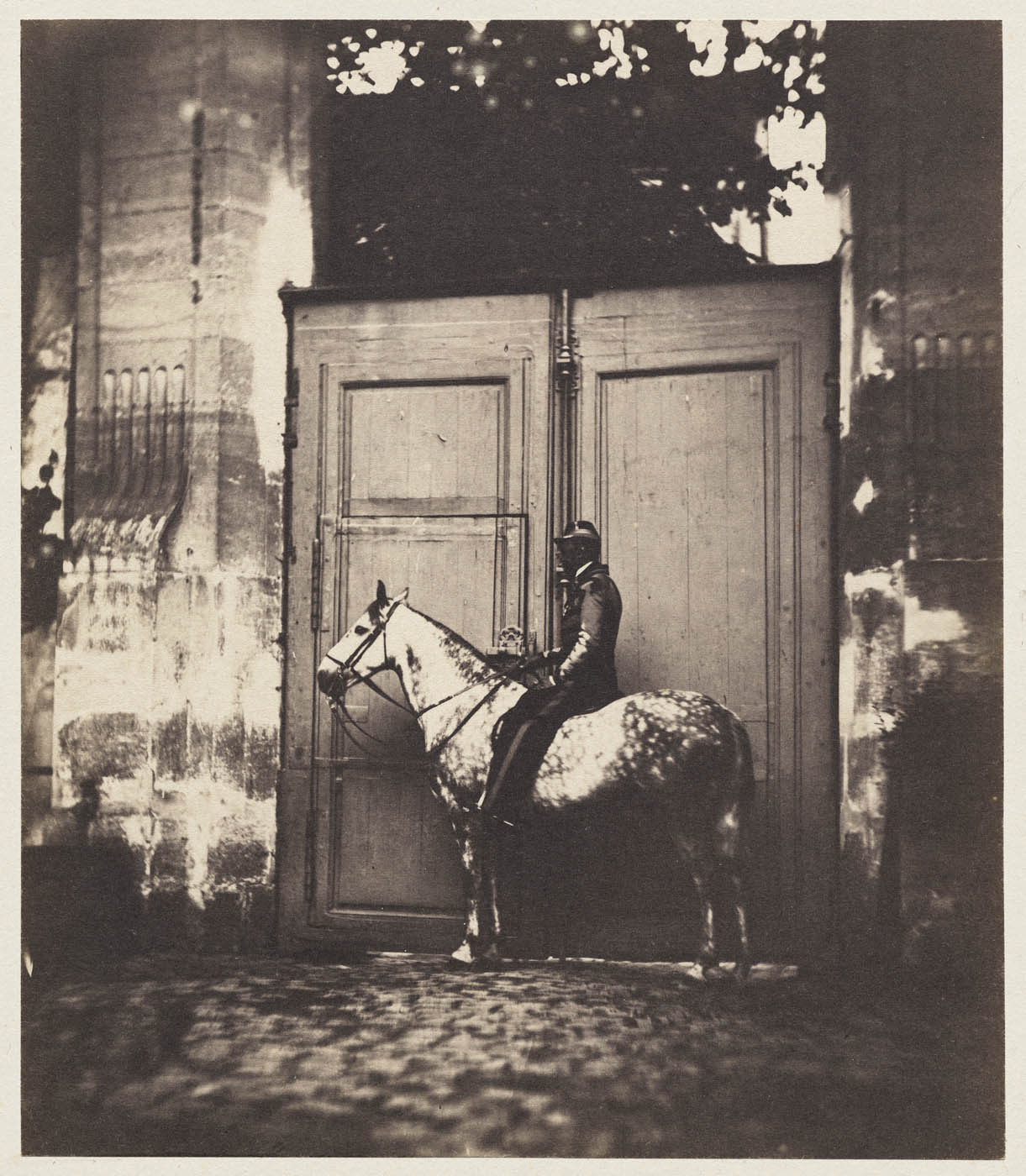
 

Unknown photographer. 'Black Horseman in Front of a Doorway' c. 1855


Unknown photographer
Black Horseman in Front of a Doorway
c. 1855
Salt print from wet collodion negative
Image: 15.5 x 13.5cm (6 1/8 x 5 5/16 in.)
Mounted: 47 x 30.6cm (18 1/2 x 12 1/16 in.)
Matted: 50.8 x 40.6cm (20 x 16 in.)
The Cleveland Museum of Art
John L. Severance Fund


The uniform of the rider identifies him as a major in the Chasseurs d’Afrique (African Light Infantry), a cavalry group within France’s colonial army in Africa. By 1855, African people were living in France, so he may have been born and raised there or have been African-born and in France for training.


Magnificent gems of 19th-century French photography.

The studied simplicity of Nadar’s Man on a Horse (c. 1860s, below), man and animal captured against a painted studio backdrop.

The formal beauty of Édouard Baldus’ architectural salted paper and albumen prints of Notre-Dame, Paris (1852-1853, below), Arc de Triomphe de l’Etoile, Paris (c. 1860s, below), Louvre, Façade rue de Rivoli, Paris (1855, below) and Pavilion Richelieu, Louvre, Paris (1856-1857, below) which emphasise the volume of the structures, their scale and grandeur.

Compare these to the spatial openness and intimacy of Charles Marville’s Rue de la Ferronnerie (c. 1865, below) only 10 years later which leads, inexorably, to the alleyways and architectural details of Eugène Atget capturing a disappearing Paris, an Old Paris, towards the end of the 19th century.

Dotted amongst these are an atmospheric landscape of the French interior near Lyon by that most bucolic of photographers Félix Thiollier; a pastoral village scene of impressionistic intimacy by Adolphe Braun, Untitled (Farm Animals) (1850s, below); and a superb photograph of a stone bridge set in mountainous landscape near the Spanish border taken by Gustave Le Gray, The Bridge of Palalda (near Amelieles-Bains) (1851-1852, below)

No conceptual histrionics, no untoward flourishes, just photographs of the utmost integrity of people and places in a time of change, photographs that hold the viewer’s gaze through the holistic balance and beauty of the images.

Dr Marcus Bunyan

.
Many thankx to The Cleveland Museum of Art for allowing me to publish the photographs in the posting. Please click on the photographs for a larger version of the image.
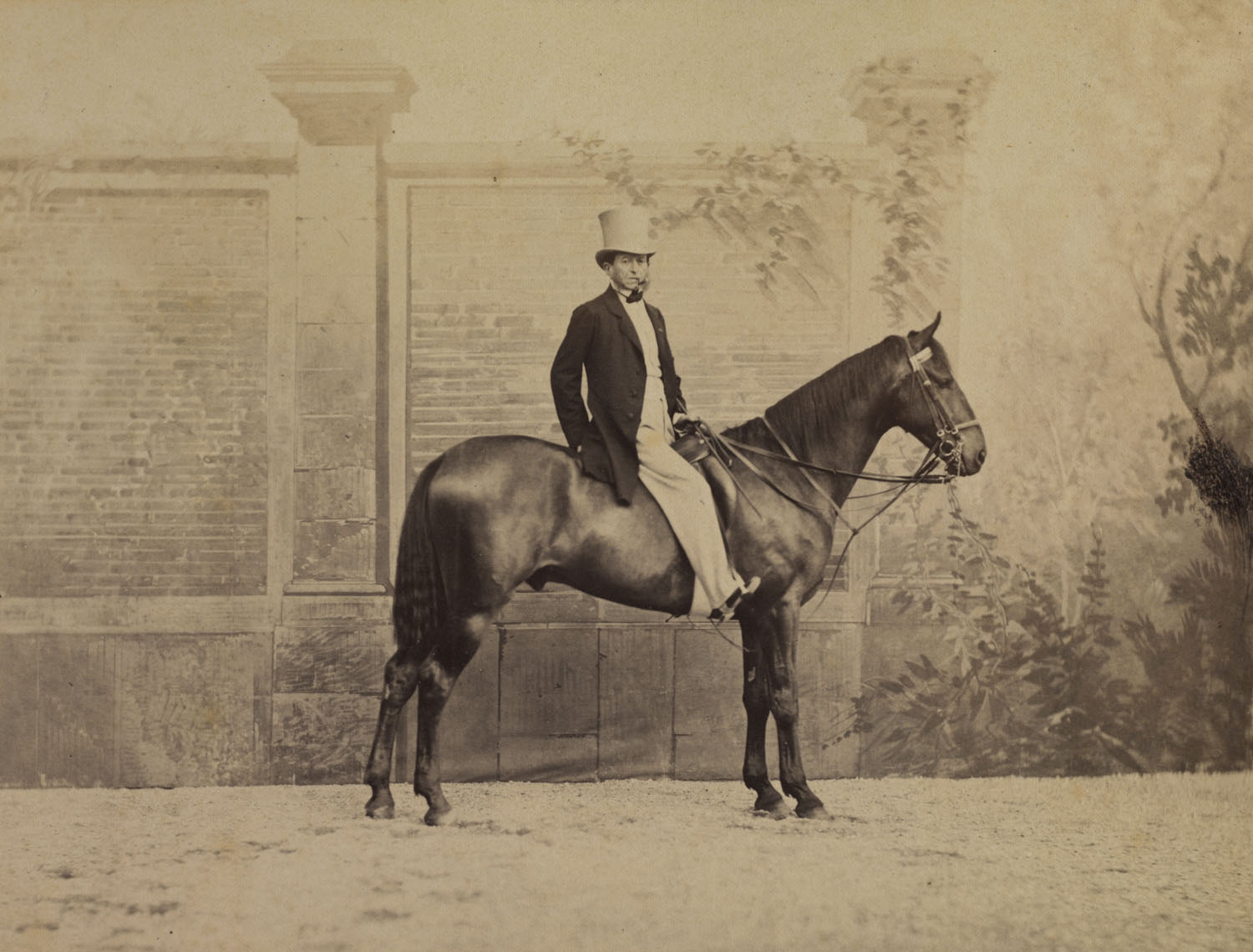


Nadar (French, 1820–1910) 'Man on a Horse' c. 1860s


Nadar (French, 1820-1910)
Man on a Horse
c. 1860s
Albumen print from wet collodion negative
Image: 17 x 22.3cm (6 11/16 x 8 3/4 in.)
Matted: 35.6 x 45.7cm (14 x 18 in.)
The Cleveland Museum of Art
Gift of Robert Hershkowitz and Charles Isaacs
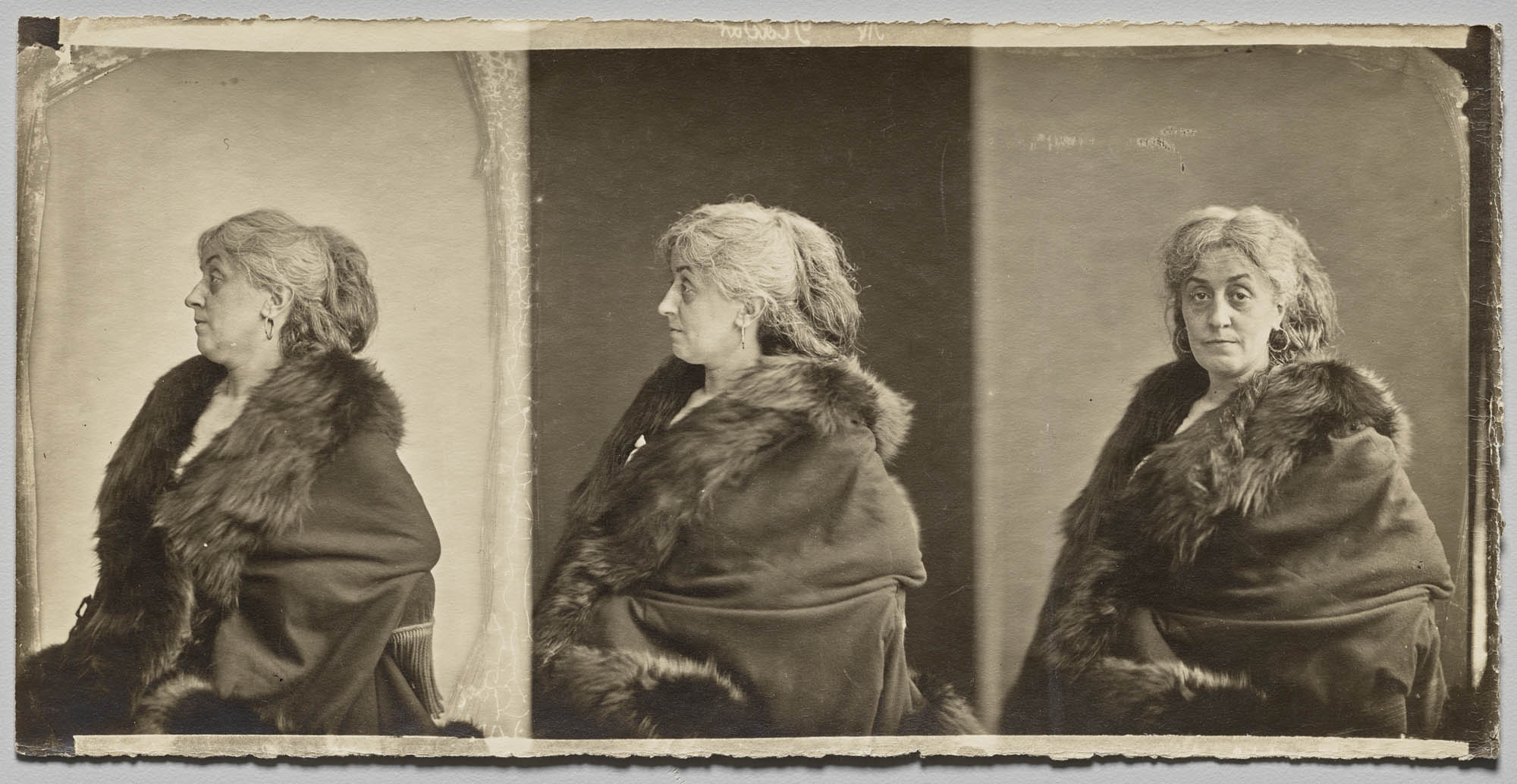
 

Nadar (French, 1820-1910) 'Portrait of Ernestine Nadar, the artist's wife, wearing fur stole' c. 1880-1883


Nadar (French, 1820-1910)
Portrait of Ernestine Nadar, the artist’s wife, wearing fur stole
c. 1880-1883
Uncut sheet of three matte gelatin silver carte-de-visites
Overall: 10.8 x 21.9cm (4 1/4 x 8 5/8 in.)
The Cleveland Museum of Art
Gift of Michael Mattis and Judith Hochberg


This striking and unusual uncut sheet of carte-de-visite exposures was taken by one of France’s most successful early portraitist photographers, Nadar. His wife Ernestine frequently modeled for him, including when he tried out new equipment or processes such as these gelatin silver prints. These portraits seem to be an intimate, direct exchange between sitter and camera, wife and husband.

Nadar

Nadar (Gaspard-Félix Tournachon) French, 1820-1910

Born Gaspard-Félix Tournachon in Paris, Nadar is probably the best known French photographer. His portraits of celebrities and public figures help define our impression of France in the second half of the 19th century; his panache in conducting his business helped popularize photography. Educated at the Collège Bourber, Paris (1833-36), Nadar moved to Lyon, where he studied medicine (1837-38) before continuing his studies at the Hôtel Dieu and the Bicêtre in Paris. He wrote satires and essays and drew caricatures (his pseudonym derived from his barbed wit aimed against the establishment) for a number of Paris publications, eventually founding several of his own, and was a highly visible figure in the city’s cultural and artistic life. Learning photographic technique from Adophe Bertsch and Camille d’Arnaud, Nadar founded a studio in 1854. Twenty years later his son Paul, also a photographer, became director of the business and by 1886 headed the firm. He also worked for a time with his brother, Adrien, who sometimes called himself Nadar jeune, a practice which later prompted Nadar to file a lawsuit. Nadar’s exploits with aerial balloon photography were of both photographic and historic importance. Below ground, he used artificial light to make surveys of the catacombs and sewers of Paris, novel and highly popular curiosities. With his son Paul as photographer, he is credited with the first photo-interview, conducted with the scientist and color theorist Michel-Eugène Chevreul on his 100th birthday in 1886. Because of the importance of his work and the notoriety of his sitters, among them Franz Liszt, George Sand, Sarah Bernhardt, and Honoré Balzac, Nadar will long occupy a key place in the development of photography. T.W.F.


About the exhibition

Édouard Manet and Berthe Morisot lived during a tumultuous yet fertile period in France. Events included war and the loss of territory; modernisation and the rise of industry; and a shift from rural to urban living. As both artists were living in Paris, it became the largest city in continental Europe and the arts capital of the world. Manet and Morisot’s lifetime also coincided with the birth and rise of a new art form – photography – which recorded many of these social, political, and cultural changes.

Masters of the new medium such as Charles Marville and Édouard-Denis Baldus were commissioned by the Emperor Napoleon III, the Louvre museum, and the railroads to document both historic monuments and the construction of new architectural and engineering marvels throughout the country. This era also saw the rise of celebrity portraiture and of the general public as patron. Actresses such as Sarah Bernhardt and popular authors Victor Hugo, Charles Baudelaire, Alexandre Dumas, and others sat for photographers such as Nadar, André-Adolphe-Eugene Disderi, Gustave Le Gray, and Étienne Carjat. The resulting portraits were printed – and sold – in large quantities to meet a soaring public demand for portraits of the luminaries of the time. When the rising urban middle class sought to have their own likenesses recorded, they flocked to the same studios.

In this exhibition, drawn from the museum’s rich holdings of 19th-century French photography, we can feel that we, like the photographers, are eyewitnesses to the transformation of France in the 1800s. This show was organised to complement Manet & Morisot, on view in the Kelvin and Eleanor Smith Foundation Gallery from March 29 through July 5, 2026.

Text from The Cleveland Museum of Art website
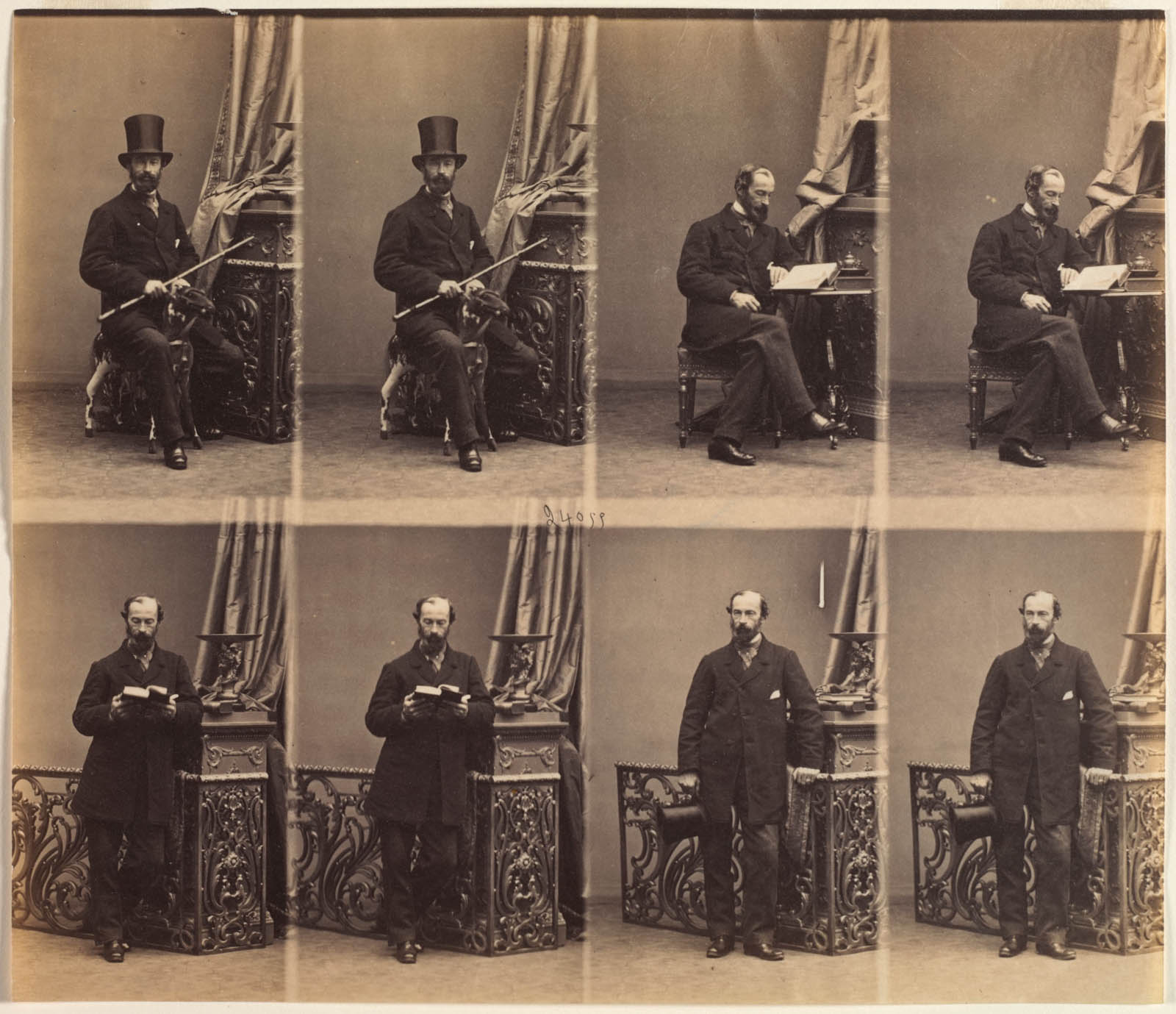
 

André Adolphe-Eugène Disdéri (French, 1819-1889) 'Monsieur Merlen' 1861


André Adolphe-Eugène Disdéri (French, 1819-1889)
Monsieur Merlen
1861
Albumen print from wet collodion negative, uncut carte-de-visite proof print
Image: 19.9 x 23.1cm (7 13/16 x 9 1/8 in.)
Matted: 35.6 x 45.7cm (14 x 18 in.)
The Cleveland Museum of Art
Gift of Paula and Robert Hershkowitz in memory of Sam Wagstaff
Public domain


The carte-de-visite process was so inexpensive, Monsieur Merlen felt he could clown around, riding a child’s toy horse in the first two exposures.

The carte-de-visite, a small photograph mounted on card stock, was patented by André Adolphe-Eugène Disdéri in 1854. This efficient, inexpensive process employed a camera with four lenses and a sliding plate holder that produced eight sequential exposures on a single glass negative. The resulting paper print was cut into individual images. This uncut sheet, which includes several humorous views, was probably produced for the sitter’s approval. The low cost of the carte-de-visite led to the trend of collecting celebrity portraits. By 1862, Disdéri’s studio was producing over 2,000 prints a day, making him reputedly the world’s richest photographer.

André Adolphe-Eugène Disdéri

André-Adolphe-Eugène Disdéri French, 1819-1889

Disdéri is best known as a portraitist and populariser of the carte-de-visite. He spent 10 years as a painter and working in the theatre, and another five in the clothing business, before becoming seriously interested in photography around age 30. He first operated studios in Brest and Nîmes, then moved to Paris and opened a studio in 1854, and a second in 1863. In 1854 Disdéri patented the carte-de-visite, a method of producing a number of small images on a single negative that achieved great popularity. He later opened additional studios in London, Madrid, and Toulon. Disdéri was one of the best known portrait photographers of his day, with many important commissions and sitters. Like Mathew Brady, he was an innovator and entrepreneur as well as an artist. The carte-de-visite, which he did not invent, but rather adapted, helped photography to become increasingly versatile as a medium and available to people of all means. In 1879 Disdéri sold his business and moved to Nice. Despite his success, he died 10 years later in Paris in poverty, obscurity, and poor health. T.W.F.
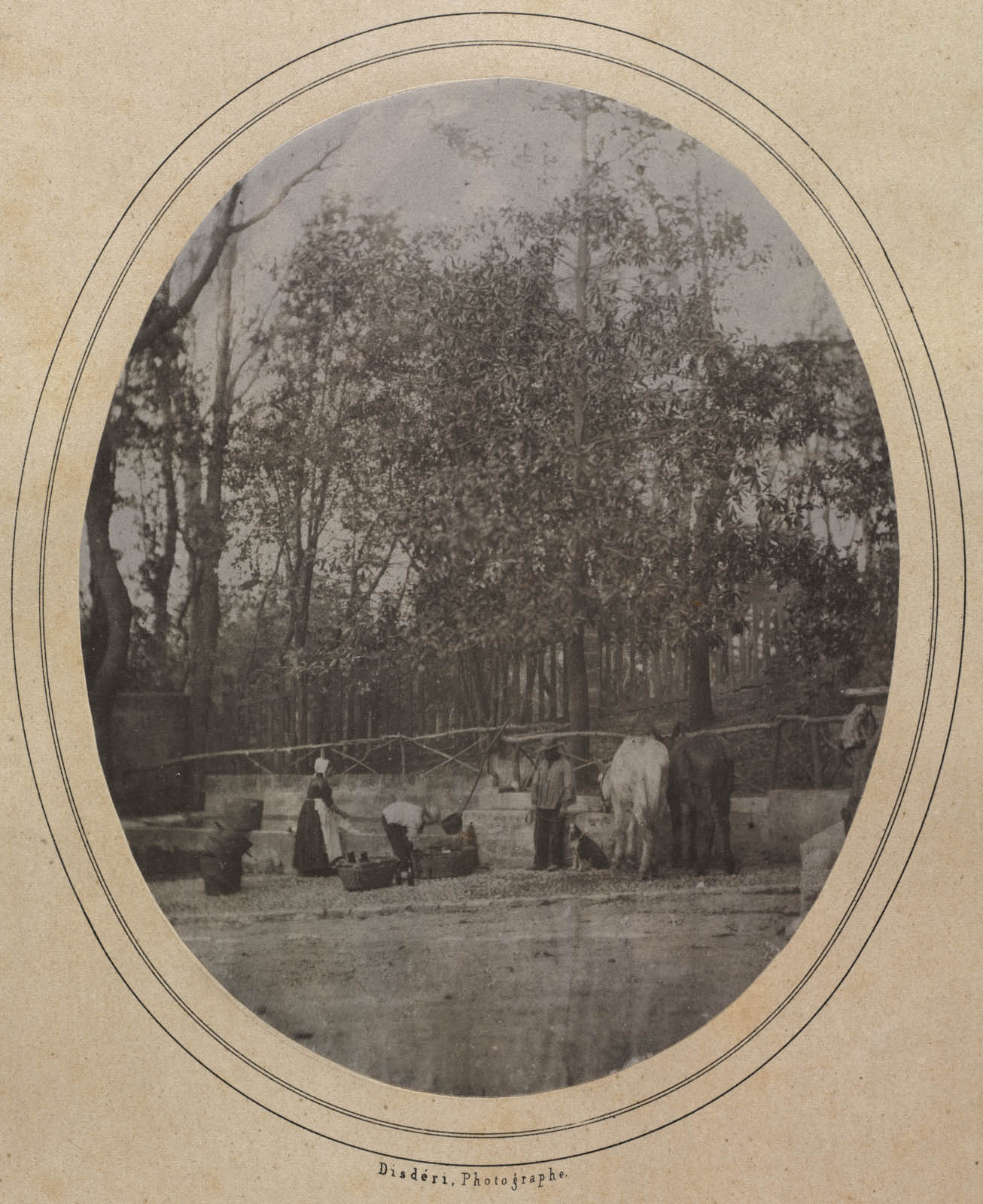
 

André Adolphe-Eugène Disdéri (French, 1819-1889) 'Village Scene (Southern France)' c. 1853


André Adolphe-Eugène Disdéri (French, 1819-1889)
Village Scene (Southern France)
c. 1853
Salted paper print from waxed-paper negative
Image: 15.2 x 12.2cm (6 x 4 13/16 in.)
Matted: 45.7 x 35.6cm (18 x 14 in.)
The Cleveland Museum of Art
John L. Severance Fund


André Adolphe-Eugène Disdéri is best known for his development in Paris in 1854 of the carte-de-visite format for portraits. The year before, he was living in Southern France where he made this rural view. Disderi used waxed-paper negatives for only a short time. The oval cropping and picturesque scene – posed but seemingly spontaneous – suggest that this is meant to be an artistic, rather than a documentary, photograph.
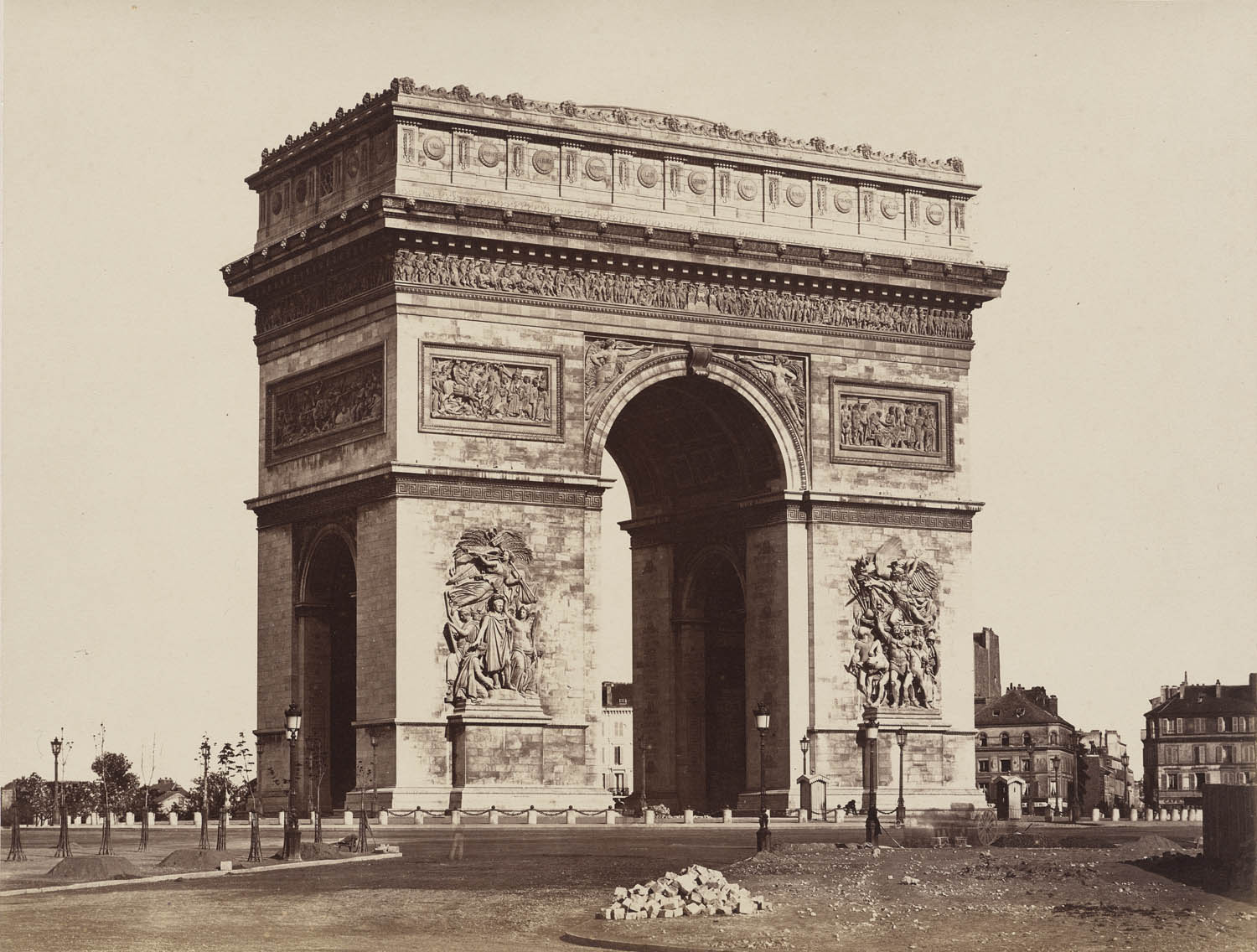
 

Édouard Baldus (French, 1813–1889) 'Arc de Triomphe de l'Etoile, Paris' c. 1860s


Édouard Baldus (French, 1813-1889)
Arc de Triomphe de l’Etoile, Paris
c. 1860s
Albumen print from collodion negative
Image: 21.5 x 28.2cm (8 7/16 x 11 1/8 in.)
Paper: 21.5 x 28.2cm (8 7/16 x 11 1/8 in.)
Mounted: 32.6 x 43.5 cm (12 13/16 x 17 1/8 in.)
The Cleveland Museum of Art
Severance and Greta Millikin Purchase Fund
Public domain


For three decades starting in 1854, Paris was a construction site as Baron Haussmann replaced the crooked streets and crumbling buildings of medieval Paris with a modern city. The cobblestones in the foreground were for paving the newly expanded set of broad avenues that radiated from the Arc, part of Baron Haussmann’s urban renewal plans. Exposure times for film in the 1860s were usually too long to capture people in the street, but a man – perhaps the paver – paused long enough to leave his “ghost” to the left of the cobblestones.
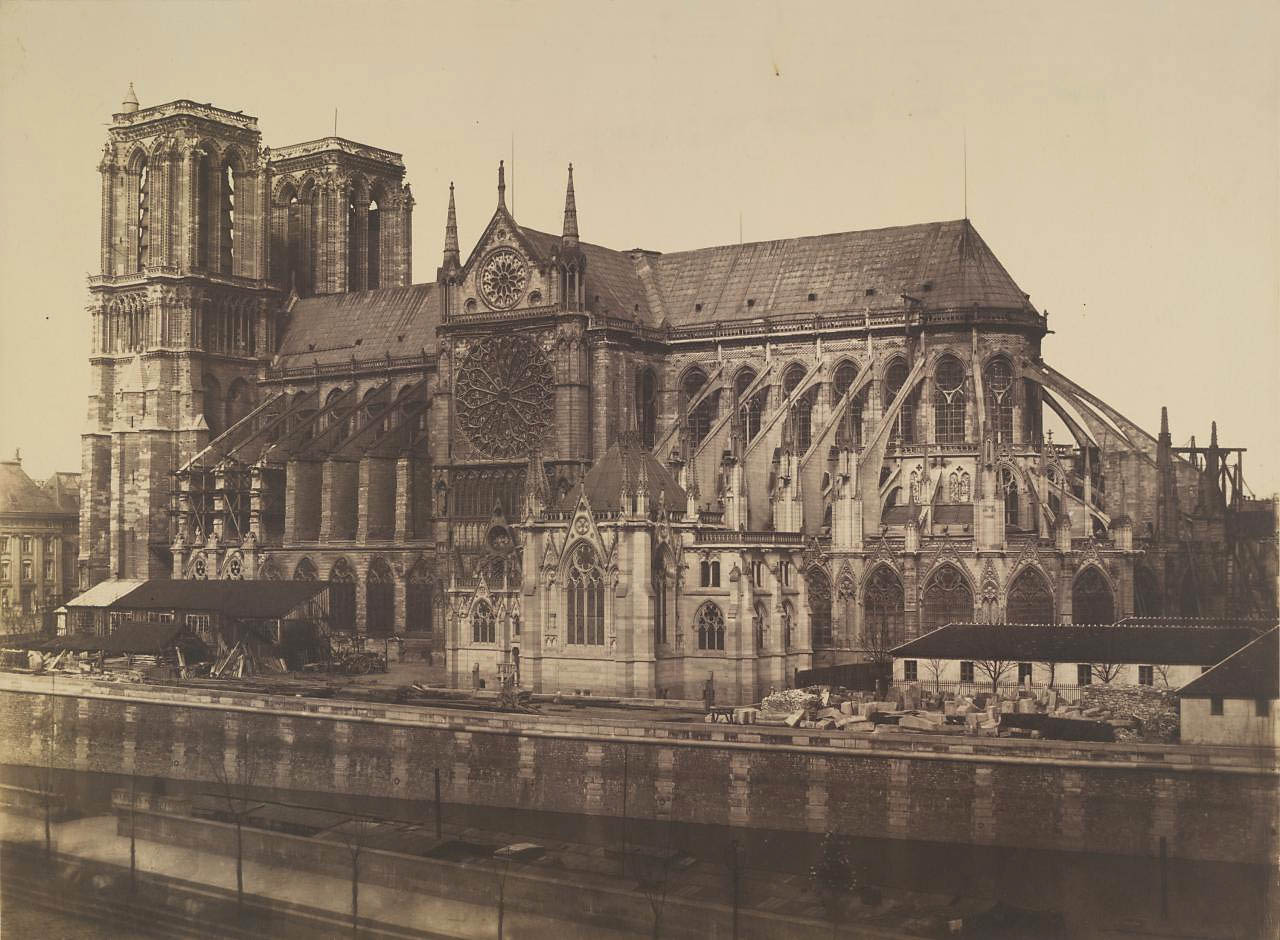
 

Edouard Baldus (Prussian 1813-1989, France c. 1848 - c. 1869) 'Notre Dame, Paris' c. 1852-1853, printed 1880s


Édouard Baldus (French, 1813-1889)
Notre-Dame, Paris
1852-1853
Salted paper print from wet collodion negative
Image: 29.5 x 44.7cm (11 5/8 x 17 5/8 in.)
Matted: 50.8 x 61cm (20 x 24 in.)
The Cleveland Museum of Art
Edwin R. and Harriet Pelton Perkins Memorial Fund


Édouard Baldus photographed the side of the famed cathedral to capture the volume of the structure. Visible from this angle are two workshops for the church’s restoration, some of the construction materials, and scaffolding on three of its flying buttresses (architectural structures that form an arch with the wall they support).

Édouard Baldus

Édouard Baldus French, b. Prussia, 1813 – 1889

The large and regal prints made by Édouard-Denis Baldus are widely agreed to be among the finest photographic images ever produced. After serving as an artillery officer in the Prussian army, Baldus left his native country for France during the 1830s to become a painter. He exhibited his paintings of religious subjects, portraits, and genre scenes in the Paris Salons from 1841 – 51 and was naturalized as a French citizen in 1849, the same year his interests turned to photography. Combining his training in painting with an inquisitive, inventive technical expertise, Baldus produced a body of work of exceptional quality and interest. His subjects included architecture, landscape, and engineering feats. In 1851 the Commission des monuments historiques selected him for the Missions héliographique – a government project that sponsored the photographing of endangered classical and medieval architecture in France. For this important series Baldus produced views of Burgundy, Provence, and the Dauphiné, and the following year he completed a commission for the Ministry of the Interior. In 1855 he began his photography of railroads, some of his most distinctive work. A copy of his album recording the line between Paris and Boulogne was presented to Queen Victoria. He also documented the flooding of the Rhone, as well as construction of the new Louvre and other Paris views. A founding member of the Société héliographique and a member of the Société française de photographie (1857), Baldus exhibited his photographs widely in London, Amsterdam, Edinburgh, Brussels, and Paris and won numerous medals of award. A master printer, he produced combination prints in the early 1850s, frequently retouching his images with pencil and ink. His best work appears most often in specially assembled albums – such as Les principaux Monuments de la France reproduits en héliogravure par E. Baldus, published in 1875 from plates drawn from earlier negatives. Today, his work continues to be much sought after and to set a standard by which other photographers are judged. T.W.F.


Édouard Baldus (French, 1813–1889) 'Louvre, Façade rue de Rivoli, Paris' 1855


Édouard Baldus (French, 1813-1889)
Louvre, Façade rue de Rivoli, Paris
1855
Albumen print
Image: 28 x 21.8cm (11 x 8 9/16 in.)
Paper: 39.9 x 29.9cm (15 11/16 x 11 3/4 in.)
The Cleveland Museum of Art
Gift of William and Margaret Lipscomb
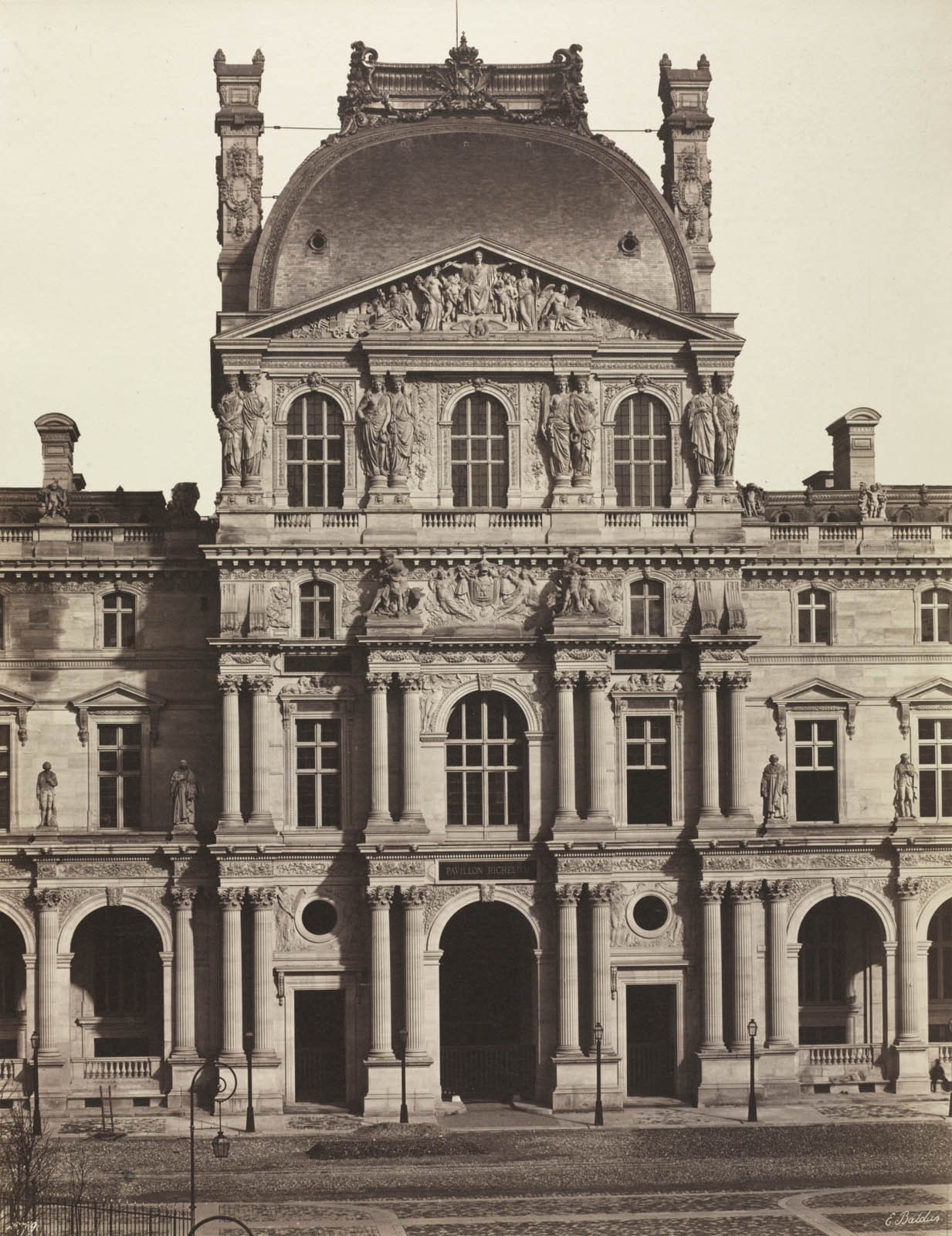
 

Édouard Baldus (French, 1813-1889) 'Pavilion Richelieu, Louvre, Paris' 1856-1857


Édouard Baldus (French, 1813-1889)
Pavilion Richelieu, Louvre, Paris
1856-1857
Salted paper print, albumenised, from wet collodion negative
Image: 44.5 x 34.3cm (17 1/2 x 13 1/2 in.)
Matted: 61 x 50.8cm (24 x 20 in.)
The Cleveland Museum of Art
Andrew R. and Martha Holden Jennings Fund


In 1854, Édouard Baldus and two other artists were commissioned to record construction of the New Louvre. New wings joined the Louvre Palace, started in the late 1100s, to the Tuileries Palace, begun in 1564. The Pavilion Richelieu, completed shortly before this photograph was taken, originally housed governmental offices and only became part of the Louvre Museum in 1993.


Opening this weekend at the Cleveland Museum of Art, France in the Time of Manet and Morisot offers visitors a vivid view of the people, places, and defining moments that shaped 19th-century France. With approximately 50 photographs from CMA’s rich holdings, visitors will get a firsthand glimpse of the rapid industrial growth and political upheaval in this tumultuous, yet fertile, period of time.

This CMA-organised companion exhibition was designed to complement Manet & Morisot, the first ever major exhibition dedicated to the artistic exchange between Édouard Manet often referred to as the father of modern painting, and Berthe Morisot, the only woman among the founding members of the Impressionist movement. While Manet & Morisot travels nationally, this companion exhibition is uniquely presented at CMA, offering visitors an experience available only in Cleveland. Visitors to the CMA will have the opportunity to experience both exhibitions now through July 5, 2026.

“It’s truly a pleasure to share our rich holdings of 19th-century French photography alongside Manet & Morisot,” said Barbara Tannenbaum, curator of photography and chair of prints, drawings, and photographs. “In the mid-1800s, when the two painters were living in Paris, it became the largest city in continental Europe and the arts capital of the world. However, France also endured war and the loss of territory; experienced modernisation and the rise of industry; and saw a shift from rural to urban living. These events coincided with the birth of a new art form – photography – which was used to record these social, political, and cultural changes.”

In the 19th century, masters of the newfound photography medium, such as Charles Marville and Édouard Baldus, were commissioned by Emperor Napoleon III, the Louvre museum, and the railroads to document both historic monuments and the construction of new architectural and engineering marvels throughout the country.

This era also saw the rise of celebrity portraiture and of the public as patron. Actresses such as Sarah Bernhardt and popular authors Charles Baudelaire, Alexandre Dumas, and others sat for photographers such as Nadar, André Adolphe-Eugene Disderi, and Étienne Carjat. The resulting portraits were printed – and sold – in large quantities to meet a soaring public demand for portraits of the luminaries of the time. When the rising urban middle class sought to have their own likenesses recorded, they flocked to the same studios.

France in the Time of Manet and Morisot, a free exhibition, will be on view in the Mark Schwartz and Bettina Katz Photography Galleries from May 10, 2026, through August 23, 2026. Manet & Morisot, a ticketed exhibition, is on view in the Kelvin and Eleanor Smith Foundation Gallery through July 5, 2026.

“Together, these exhibitions offer a compelling portrait of a society in transition – one that visitors can now experience firsthand at the Cleveland Museum of Art,” said Tannenbaum.

Press release for The Cleveland Museum of Art
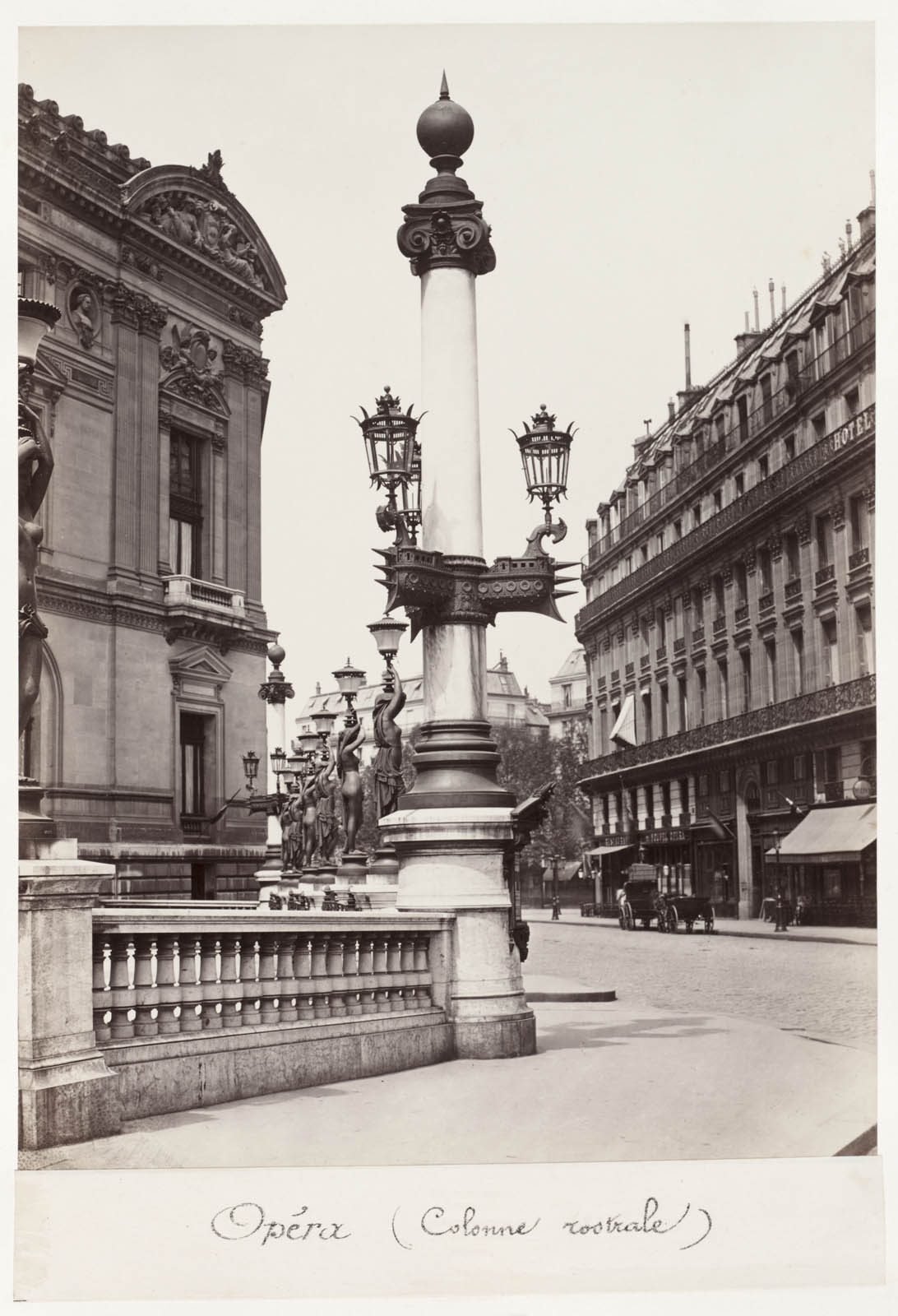
 

Charles Marville (French, 1813-1879) 'Opéra (Rostral Column)' c. 1875


Charles Marville (French, 1813-1879)
Opéra (Rostral Column)
c. 1875
Albumen print from wet collodion negative
Image: 37.7 x 26.7cm (14 13/16 x 10 1/2 in.)
Mounted: 35.4 x 26.7cm (13 15/16 x 10 1/2 in.)
Matted: 71.1 x 55.9cm (28 x 22 in.)
The Cleveland Museum of Art
Purchase from the Karl B. Goldfield Trust


In the 1800s, gas lamps replaced the oil lights. When Napoleon III commissioned a new opera house in Paris in 1860, it was surrounded by a “Ring of Light,” including this column with three gas streetlights. The opera house became the setting for Gaston LeRoux’s 1910 novel The Phantom of the Opera, which inspired the 1976 musical and 2004 film.

Charles Marville

Charles Marville French, 1813-1879

At the invitation of the city of Paris, photographer Charles Marville was among the first to document the ancient quarters of his birthplace. His views, taken in the late 1850s, were intended to record the many buildings and neighborhoods ultimately destroyed by Baron Georges-Eugène Haussmann’s urban planning project that would create the boulevards and open spaces of modern Paris. While Marville’s survey of the city, extensive and thorough in scope, prefigured other important efforts of its kind, it is distinguished by its emotional accessibility. His work beautifully reveals a Paris that has long disappeared. Originally trained as a painter and illustrator, Marville worked with both calotype and glass plate negatives. He photographed in France, Italy, Germany, and Algeria, becoming most well known for his architectural imagery but also producing acclaimed landscapes and studies of trees. Many of Marville’s early views, often considered his best, were included in the albums of Louis-Désiré Blanquart-Évrard before the printer’s establishment in Lille closed in 1855. Named official photographer of Paris in 1862, Marville also served as photographer to the Imperial Museum of the Louvre and to King Vittorio Emmanuelle of Italy. T.W.F.
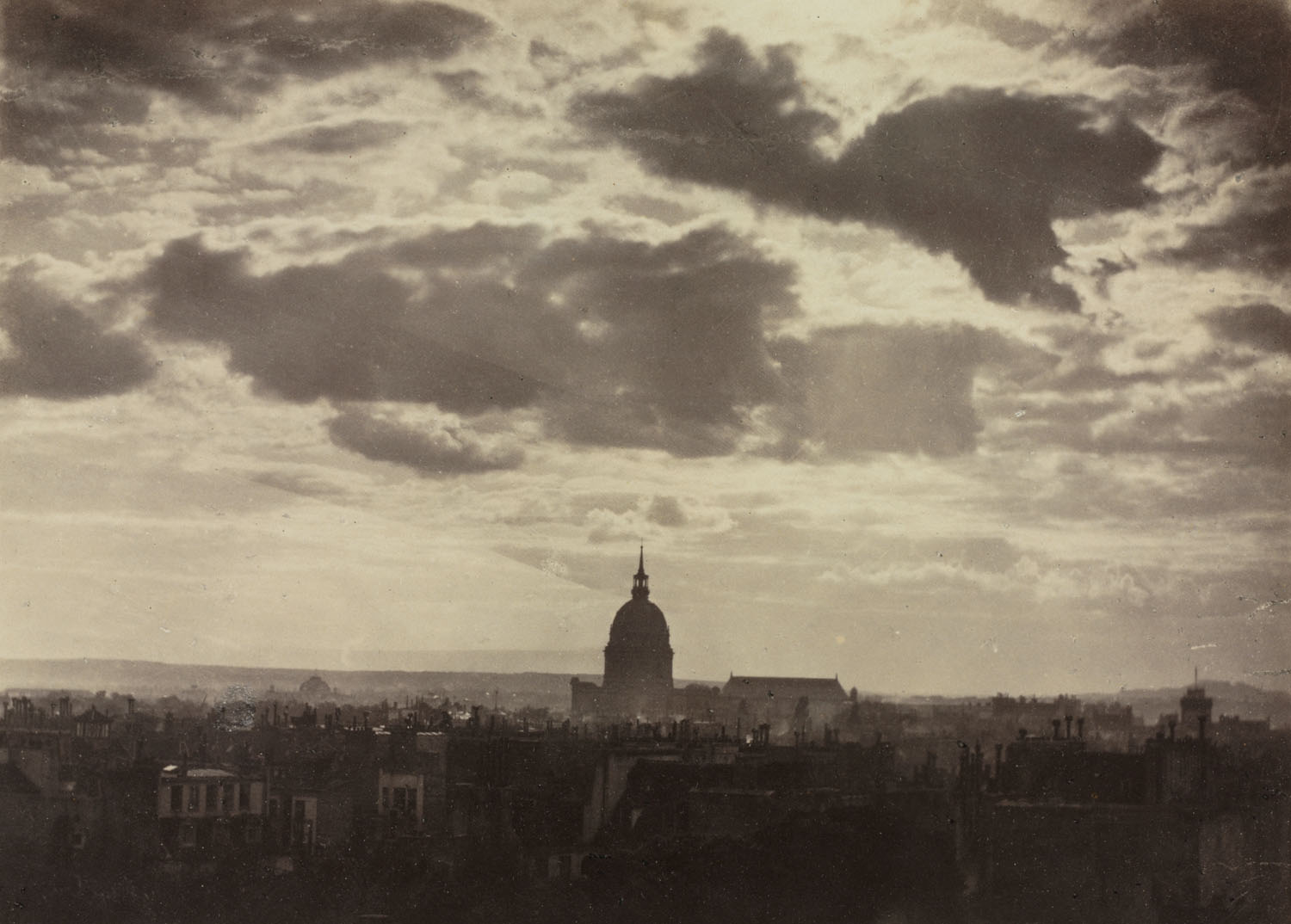
 

Charles Marville (French, 1813–1879) 'Sky Study, Paris' 1856-1857


Charles Marville (French, 1813-1879)
Sky Study, Paris
1856-1857
Albumen print from wet collodion negative
Image: 15.3 x 21.4cm (6 x 8 7/16 in.)
Matted: 40.6 x 50.8cm (16 x 20 in.)
The Cleveland Museum of Art
John L. Severance Fund


Thirty years before the construction of the Eiffel Tower, Charles Marville made a series of views of the skies over Paris, some from various rooftops and others from his apartment window. This view frames the city so that the dome of the chapel of Les Invalides – a retirement home and hospital for military veterans – dominates the skyline. In the 1850s, the light-sensitive coatings for photographic plates were incapable of properly exposing both earth and the sky in a single shot. Marville here set his camera to capture the dramatic sky and clouds, which meant that the city below, for the most part, became a dark mass of undifferentiated buildings. The scale, drama, and majesty of this natural spectacle overwhelm human achievements.
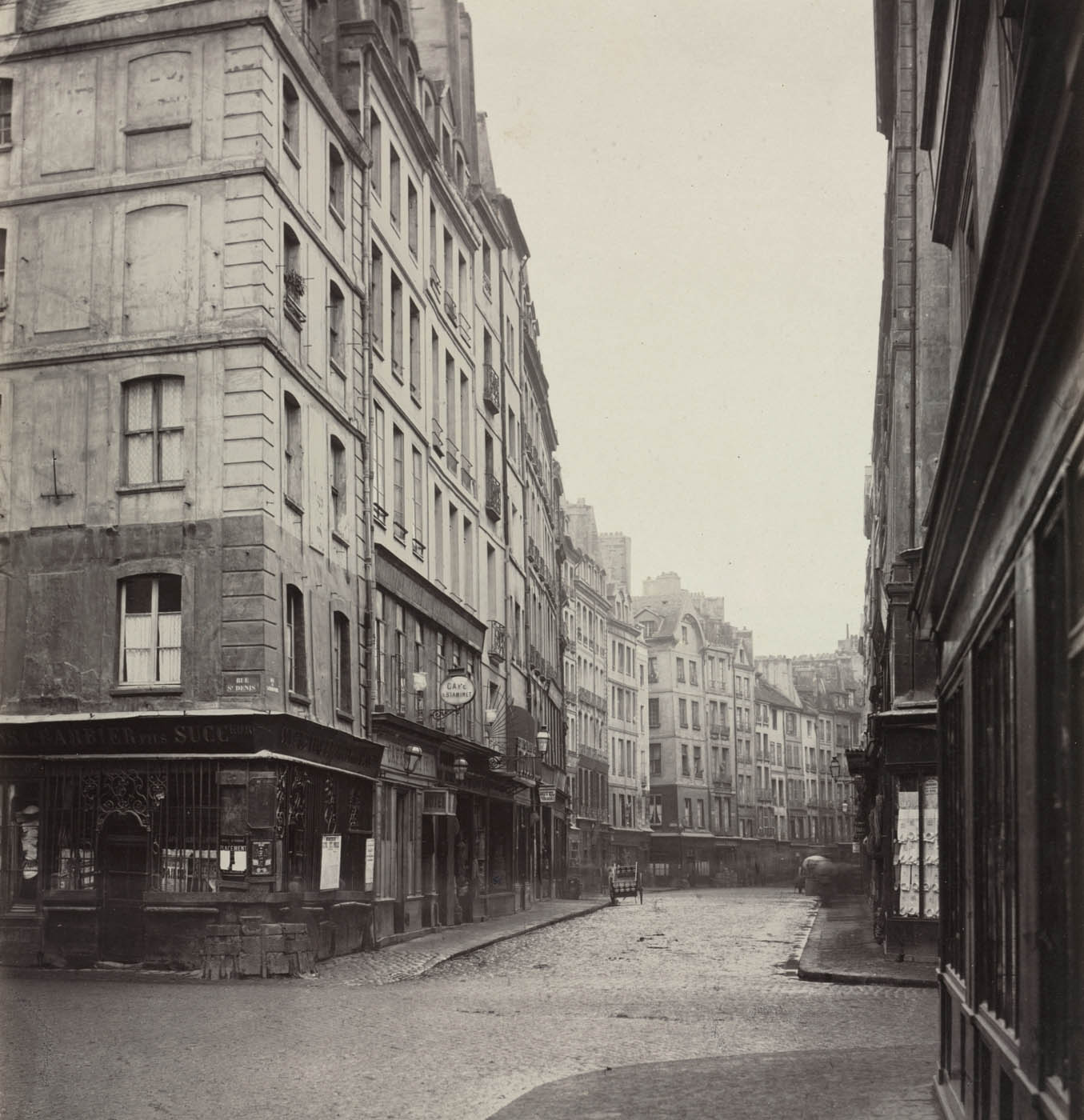
 

Charles Marville (French, 1813-1879) 'Rue de la Ferronnerie' c. 1865


Charles Marville (French, 1813-1879)
Rue de la Ferronnerie
c. 1865
Albumen print from wet collodion negative
Image: 28 x 27cm (11 x 10 5/8 in.)
Matted: 61 x 50.8cm (24 x 20 in.)
The Cleveland Museum of Art
Leonard C. Hanna Jr. Fund


Charles Marville preferred photographing on overcast, rainy days when diffused light and glistening cobblestones yielded an image with the maximum tonal range and detail. In 1865, the ground floor spaces on the Rue de la Ferronnerie or “street of ironwork” (named in 1229) were occupied by businesses including a café, a hotel, and a men’s clothing store. Apartments on the upper floors housed some of the many people who moved from the country into the city during the Second Empire.
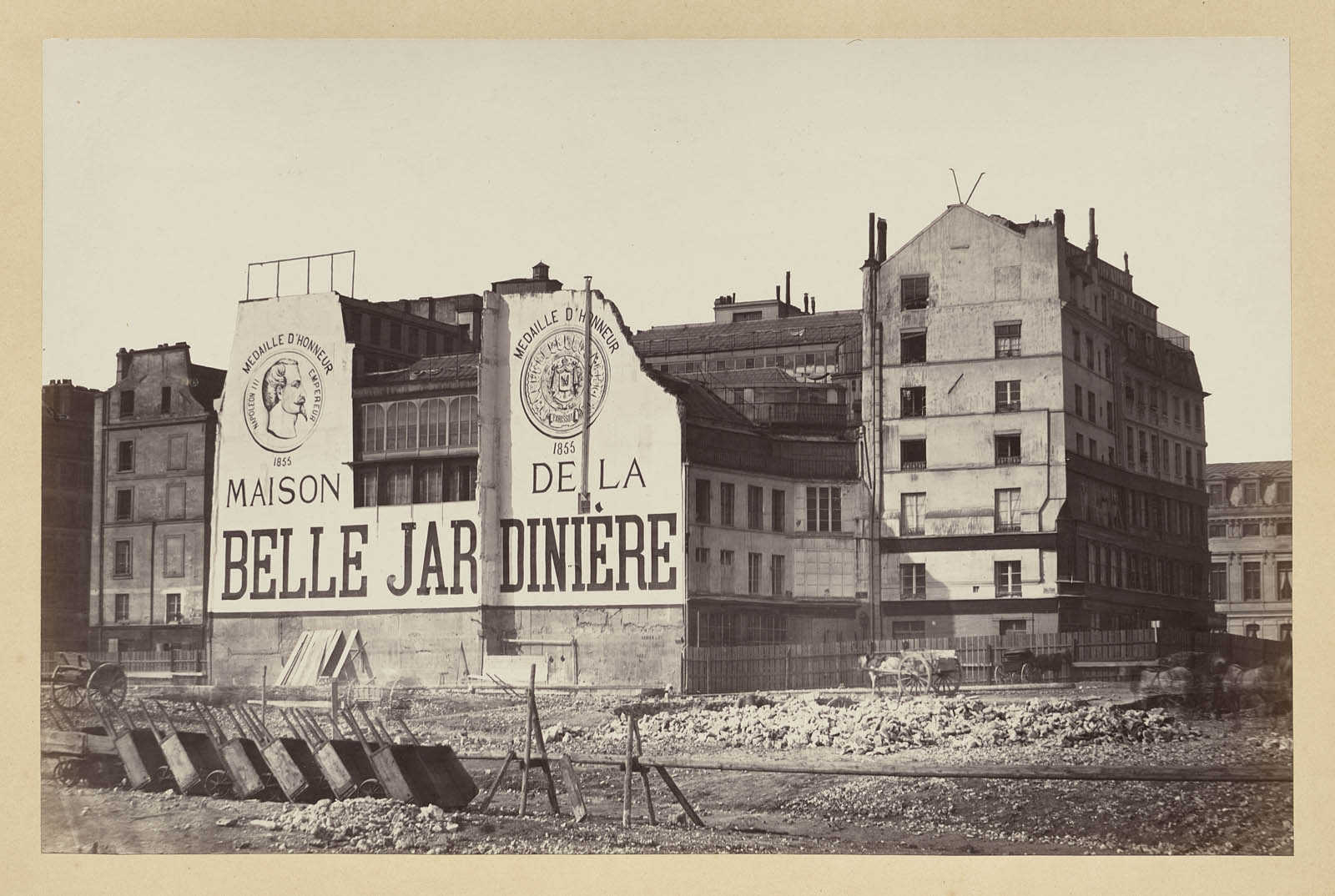
 

Attributed to Charles Marville (French, 1813-1879) 'La Belle Jardinère: le magasin de la rue de la Cité pendant sa demolition, Paris' 1864-1866


Attributed to Charles Marville (French, 1813-1879)
La Belle Jardinère: le magasin de la rue de la Cité pendant sa demolition, Paris
1864-1866
Albumen print from collodion negative
Image: 22.9 x 34.6cm (9 x 13 5/8 in.)
The Cleveland Museum of Art
Gift of Michael Mattis and Judith Hochberg


Founded in 1824, La Belle Jardinière (The Beautiful Gardener) department store pioneered the sale of ready-to-wear clothing for those of modest means.

The department store was located on the Ile de la Cité in the Seine in the middle of Paris. In 1864, as part of the renovation of the city, the government ordered that the store be replaced with a new building for the country’s oldest hospital. While there are numerous photographs of new structures and broad streets that resulted from Baron Haussmann’s urban renewal plan, views of the demolition of the old structures are rare.
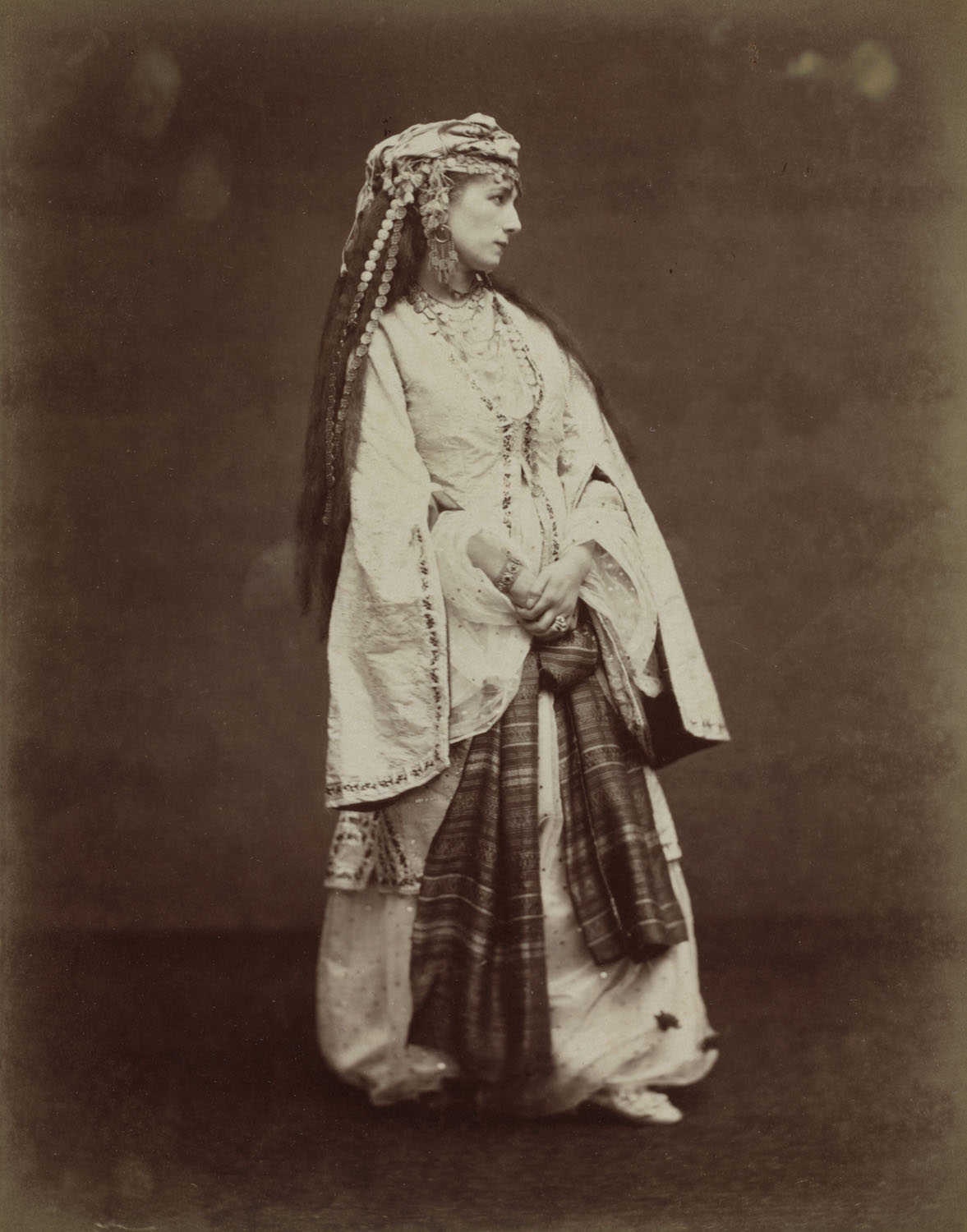
 

Étienne Carjat (French, 1828–1906) 'Sarah Bernhardt in "Zaire" by Voltaire' 1874


Étienne Carjat (French, 1828–1906)
Sarah Bernhardt in “Zaire” by Voltaire
1874
Albumen print from wet collodion negative
Image: 27.3 x 21.3cm (10 3/4 x 8 3/8 in.)
Matted: 50.8 x 40.6cm (20 x 16 in.)
The Cleveland Museum of Art
John L. Severance Fund


Photographer Étienne Carjat established his reputation through celebrity portraiture. Famed French actress Sarah Bernhardt is seen here as the star of Zaire, a play by the French author Voltaire first performed in 1732. The actress, who studied sculpture, exhibited work in the Paris Salon for the first time in 1874. She just missed being in the same show as Morisot, who exhibited regularly at the Salon from 1864 to 1873, but in 1874 decided instead to show in the first Impressionist exhibition. Édouard Manet produced many portraits of actresses and performers.

Étienne Carjat

Étienne Carjat French, 1828-1906

Born in Fareins, Étienne Carjat and his friend and contemporary Nadar are considered the masters of 19th-century French portrait photography. Like Nadar, whose immense reputation tended to overshadow his own, Carjat was a caricaturist and journalist, and much involved in politics and the arts. In style, however, he was more straightforward and less overtly dramatic than Nadar, frequently portraying his subjects in simple settings and showing close attention to expression, pose, detail, and line. After study with Pierre Petit in 1858, Carjat first took up photography to produce his series Le Panthéon Parisien in the early 1860s. He had several studios in Paris, from which he conducted a portrait business and contributed to the important series Galeries des célébrités contemporaines. Among his sitters were Émile Zola, Antonio Rossini, Charles Baudelaire, and Gustave Courbet. Carjat was a founder of the satirical journal Diogène (1856), as well as an author, actor, poet, and playwright. He became less active in photography after 1867 and reportedly ceased altogether after 1875. In 1878 he and Nadar are believed to have been the only mourners at the burial of their fellow caricaturist, the acerbic Honoré Daumier. T.W.F.
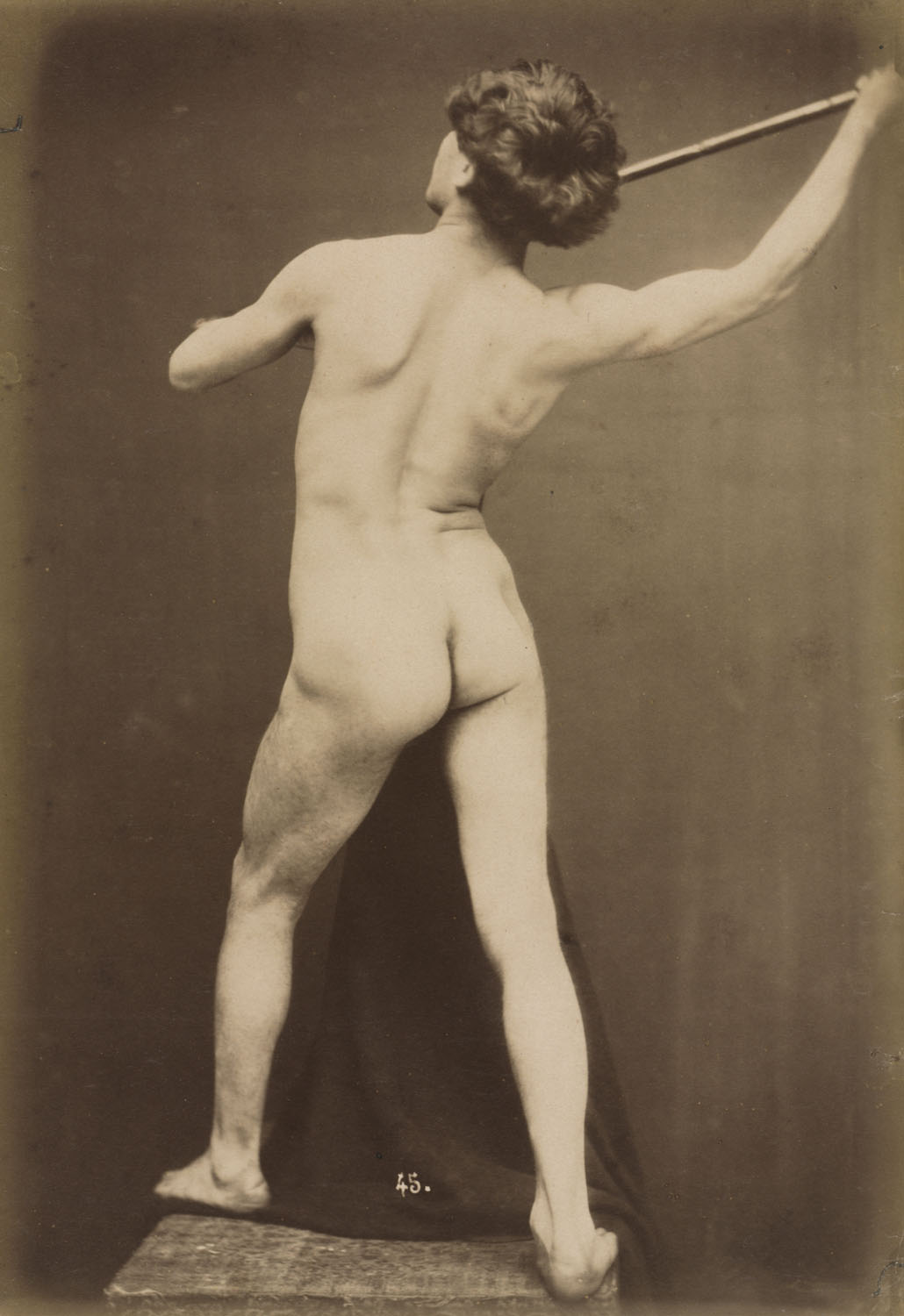
 

Guglielmo Marconi (French, 1842–after 1885) 'Male Nude' c. 1870-1875


Guglielmo Marconi (French, 1842 – after 1885)
Male Nude
c. 1870-1875
Albumen print from wet collodion negative
Image: 27.2 x 18.8cm (10 11/16 x 7 3/8 in.)
Matted: 55.9 x 45.7cm (22 x 18 in.)
The Cleveland Museum of Art
John L. Severance Fund


Guglielmo Marconi specialised in nude studies for use by painters and sculptors. Using children, women, and men as models, he photographed a variety of poses traditionally employed by models in academic studios. Artists purchased them because working from a photograph was much cheaper than hiring a live model.


Unknown photographer and maker. 'Untitled (Case with portraits of a man and woman and hair ornaments)' c. 1870s


Unknown photographer and maker
Untitled (Case with portraits of a man and woman and hair ornaments)
c. 1870s
Photographs: photographs on enamel, framed in copper alloy metal frames; hair lockets: hair with pen and black and ink on cream-coloured backing; case: leather with metal push-clasp and velvet-lined interior
Image: 3.5 x 3cm (1 3/8 x 1 3/16 in.)
Case: 9 x 5 x 1cm (3 9/16 x 1 15/16 x 3/8 in.)
The Cleveland Museum of Art
John Cook Memorial Fund


The photographs of this man and woman, presumably husband and wife, are juxtaposed with clippings of their hair arranged to form their initials, A and M. In the late 1800s, photographic portraits and hair clippings combined in jewellery or frames served as mementos or memorials for loved ones. For permanence, the portraits here were vitrified on enamel, a process now used primarily for funerary monuments.
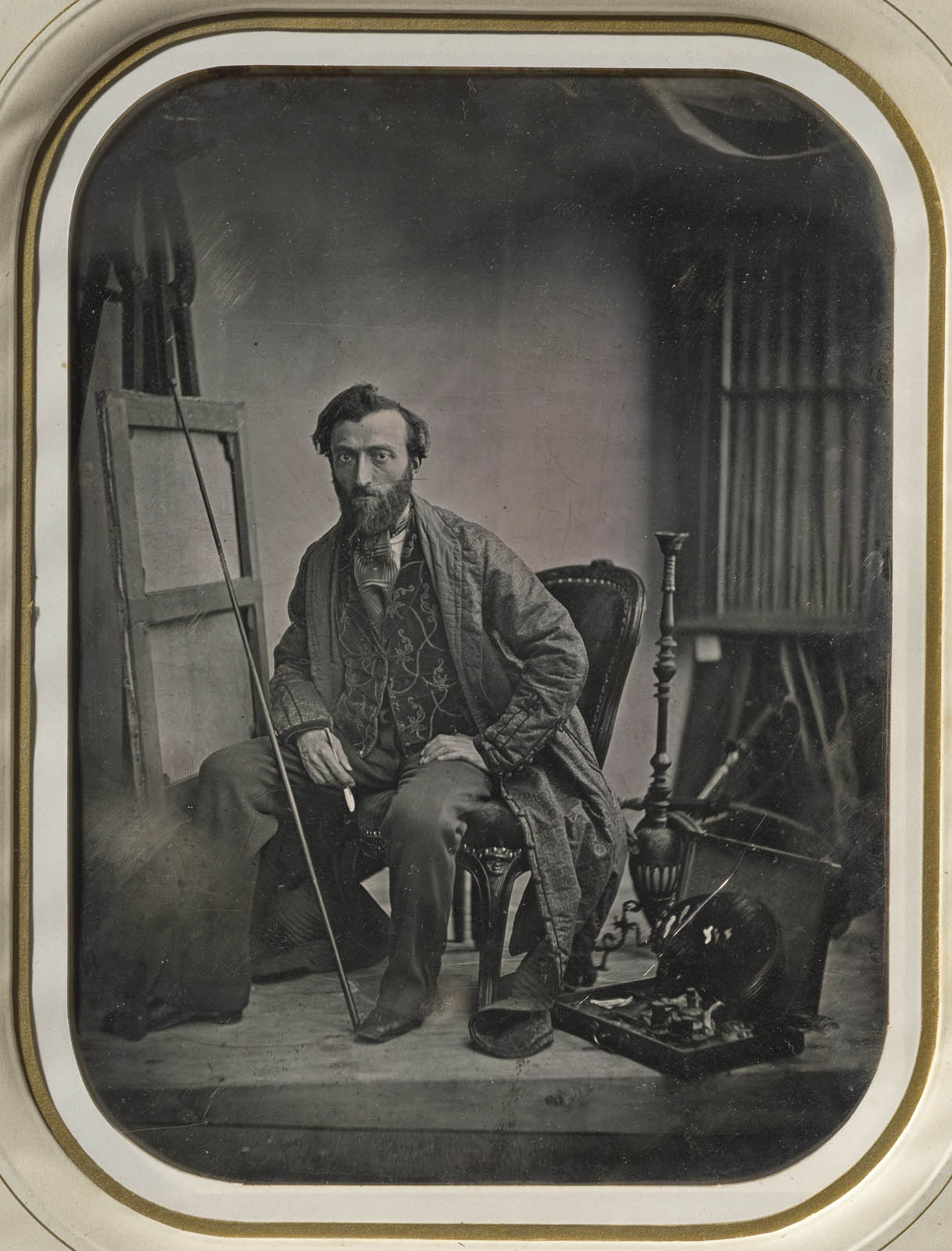
 

Camille Dolard (French, 1810-1884) 'Self-Portrait in Painting Studio' c. 1843


Camille Dolard (French, 1810-1884)
Self-Portrait in Painting Studio
c. 1843
Daguerreotype (full-plate)
Platemark: 20.5 x 15cm (8 1/16 x 5 7/8 in.)
Matted: 55.9 x 45.7cm (22 x 18 in.)
The Cleveland Museum of Art
Leonard C. Hanna Jr. Fund


Dolard, a portrait painter, may have offered photographs to prospective clients of lesser means. In this image, possibly made as an advertisement for his studio, he identifies himself as a painter, surrounded by the tools of the trade. The coat and the hookah suggest an interest in orientalism, a fashion that occupied many mid-19th-century artists. A remarkable technical achievement, this whole-plate image required Dolard to remain motionless for well over a minute, at least 30 times longer than the exposure for the smaller plates in the case below.
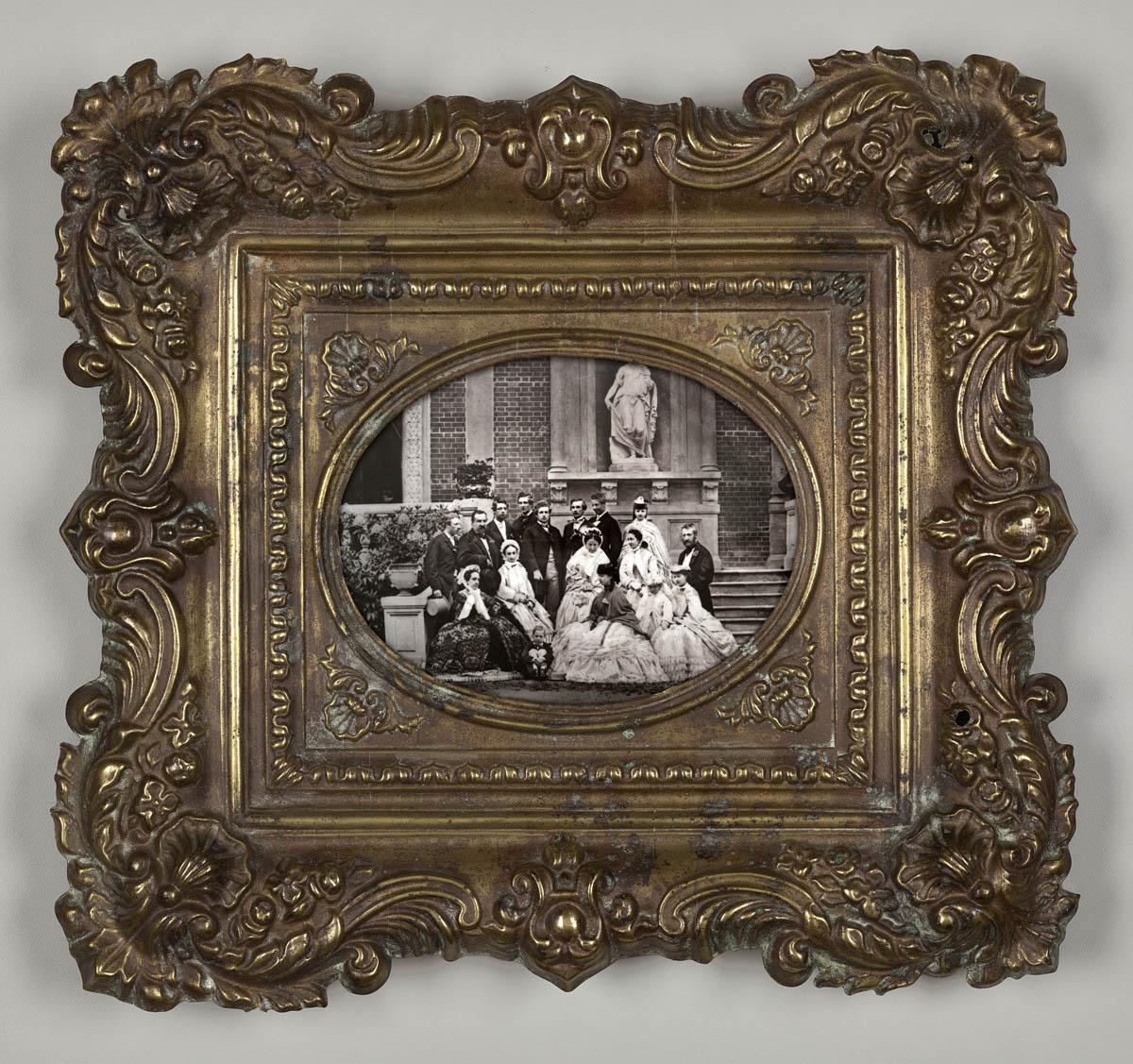
 

Camille Silvy (French, 1834-1910) 'The d’Orléans Family during a Fête Champêtre at Orléans House' 1864


Camille Silvy (French, 1834-1910)
The d’Orléans Family during a Fête Champêtre at Orléans House
1864
Enamelist: Lafon de Camarsac (French, 1821-1905)
Enamelled photograph in original metal frame
Plate: 11.5 x 15.5cm (4 1/2 x 6 1/8 in.)
Framed: 27 x 29cm (10 5/8 x 11 7/16 in.)
The Cleveland Museum of Art
Jo Hershey Selden Fund


The image celebrates the d’Orléans family, who abdicated the French throne during the Revolution of 1848 and settled in England. The setting for this group portrait is d’Orléans House in Twickenham, where the d’Orléans hosted numerous grand social events such as the garden party that occasioned this sitting. Many of these events raised money to support monarchist and other activities in France.
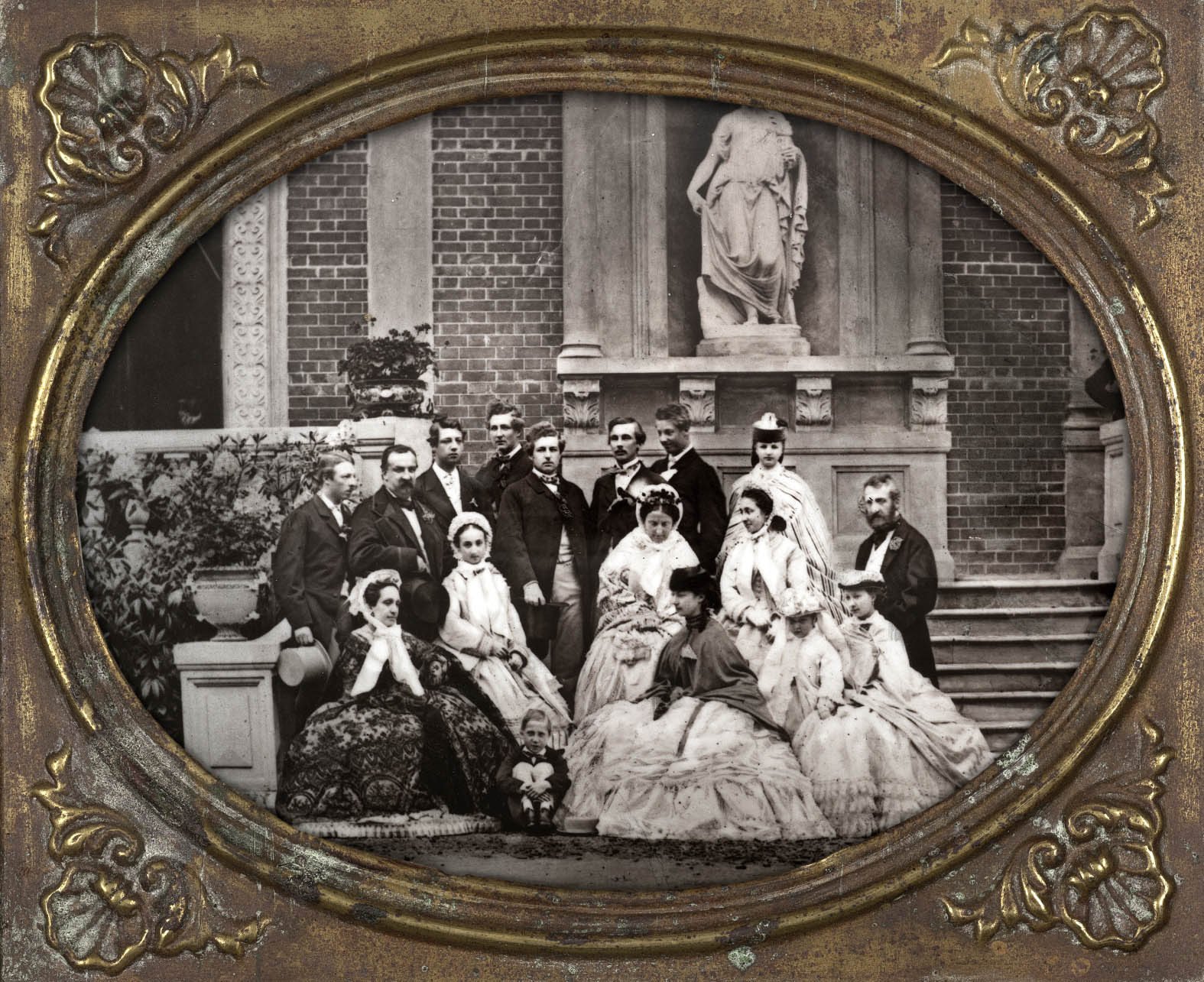
 

Camille Silvy (French, 1834-1910) 'The d’Orléans Family during a Fête Champêtre at Orléans House' 1864 (detail)


Camille Silvy (French, 1834-1910)
The d’Orléans Family during a Fête Champêtre at Orléans House (detail)
1864
Enamelist: Lafon de Camarsac (French, 1821-1905)
Enamelled photograph in original metal frame
Plate: 11.5 x 15.5cm (4 1/2 x 6 1/8 in.)
Framed: 27 x 29cm (10 5/8 x 11 7/16 in.)
The Cleveland Museum of Art
Jo Hershey Selden Fund
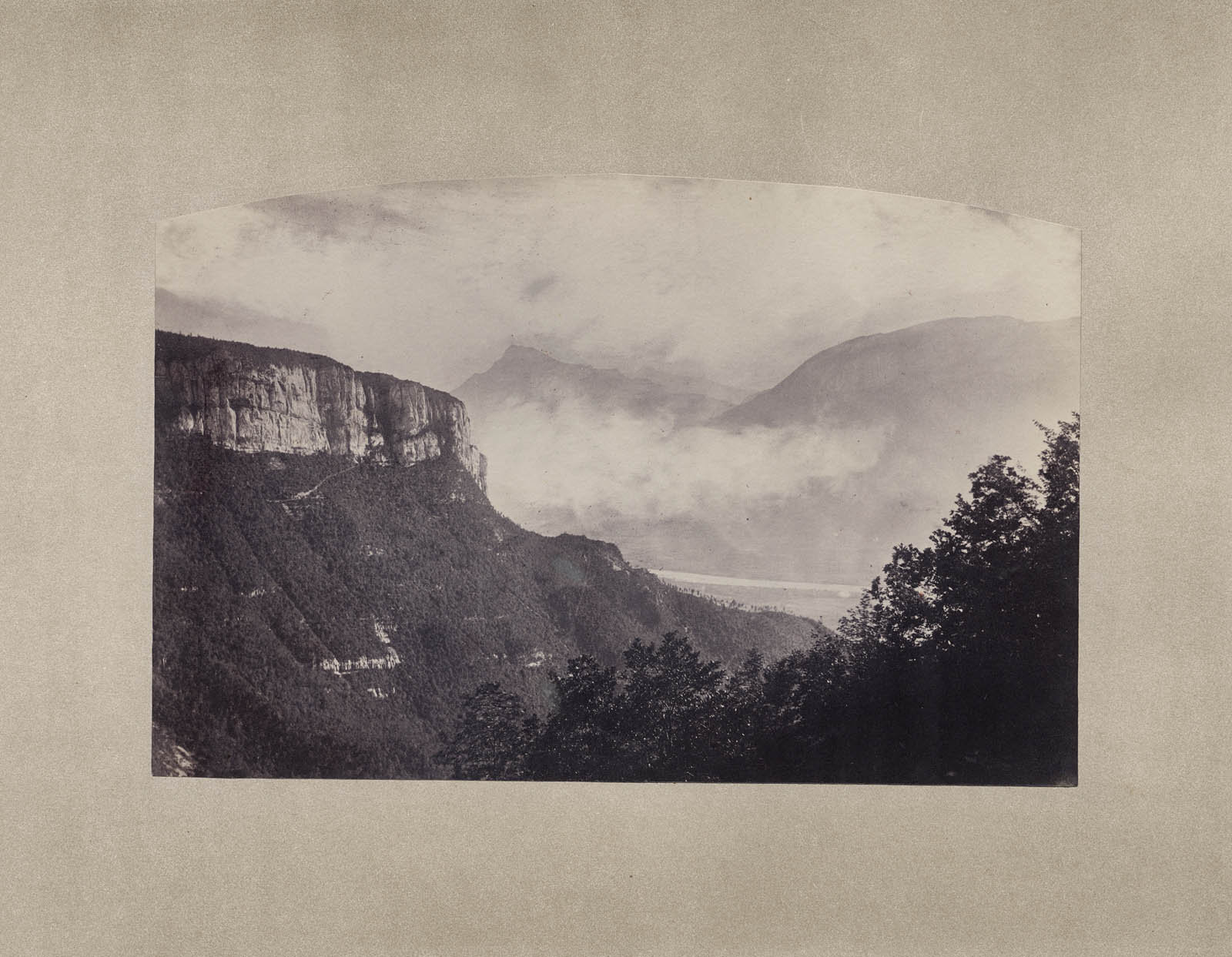
 

Félix Thiollier (French, 1842-1914) 'Vue prise du Couvent des Dominicains, Chalais (Isère), France' c. 1865


Félix Thiollier (French, 1842-1914)
Vue prise du Couvent des Dominicains, Chalais (Isère), France
c. 1865
Albumen print from collodion negative
Image: 13.1 x 20cm (5 3/16 x 7 7/8 in.)
Paper: 13.1 x 20cm (5 3/16 x 7 7/8 in.)
Mounted: 31.7 x 49.1cm (12 1/2 x 19 5/16 in.)
The Cleveland Museum of Art
Gift of Michael Mattis and Judith Hochberg


Félix Thiollier brought to landscape photography the emotional power and mystery of the Barbizon and naturalist painters whom he collected and befriended. This dramatic view provides a deep vista more commonly found in photographs of the Western United States at the time. Underlying it, however, are a geometric structure of overlapping triangles, curved top border, and atmospheric clouds and mist that relate directly to precedents in painting.


Auguste-Rosalie Bisson (French, 1826-1900) and Louis-Auguste Bisson (French, 1814-1876) 'Mount Maudit, Savoy' 1860


Auguste-Rosalie Bisson (French, 1826–1900) and Louis-Auguste Bisson (French, 1814–1876)
Mount Maudit, Savoy
1860
Albumen print from wet collodion negative
Image: 23.2 x 39.2cm (9 1/8 x 15 7/16 in.)
Matted: 50.8 x 61cm (20 x 24 in.)
The Cleveland Museum of Art
James Parmelee Fund


The Bisson brothers’ photograph of Mount Maudit – which translates as “cursed mountain” – makes the 14,649-foot peak seem inaccessible. In fact, it was not summited until 1878. Photographing at high altitudes necessitated climbing while carrying heavy equipment, including large glass plates and a portable darkroom, and required extraordinary technical prowess and speed in working with the chemicals at low temperatures.

Auguste-Rosalie Bisson and Louis-Auguste Bisson

Bisson Frères Louis-Auguste Bisson French, 1814-1876; and Auguste-Rosalie Bisson French, 1826-1900

Bisson Frères – consisting of brothers Louis-Auguste and Auguste-Rosalie Bisson, also known as the Bissons âiné and jeune (older and younger) – was one of the most celebrated and widely known French photographic studios and publishing houses of the 19th century. Begun by their father, a heraldic painter, the Bissons’ first studio opened in Paris in 1841, shortly after the invention of the daguerreotype. Louis-Auguste, a student of architecture and chemistry, learned photography directly from Louis-Jacques-Mandé Daguerre and went on to advance the medium through a number of inventions and techniques, contributions for which the brothers received considerable praise. He retired from the business in 1865. Auguste-Rosalie, perhaps the better known of the two, was responsible for some of their more spectacular photographic successes, including the first closeup views of the peaks of Mt. Blanc (1861). Among the Bissons’ many accomplishments and honors were a set of 900 daguerreotypes of the members of the French National Assembly, which were later published in lithographic copies; their appointment as official photographers to Napoléon III and Pope Pius IX; their role as founding members of the Société française de photographie; and their numerous and much-admired series of landscape, architectural, and portrait photographs. After his brother’s retirement, Auguste-Rosalie continued to work in photography, including a voyage to Egypt in 1869 and views of the Siege of Paris in 1871. As late as 1900, the year of his death, he patented a heliochrome process for the printing of photographs in color with ink. T.W.F.
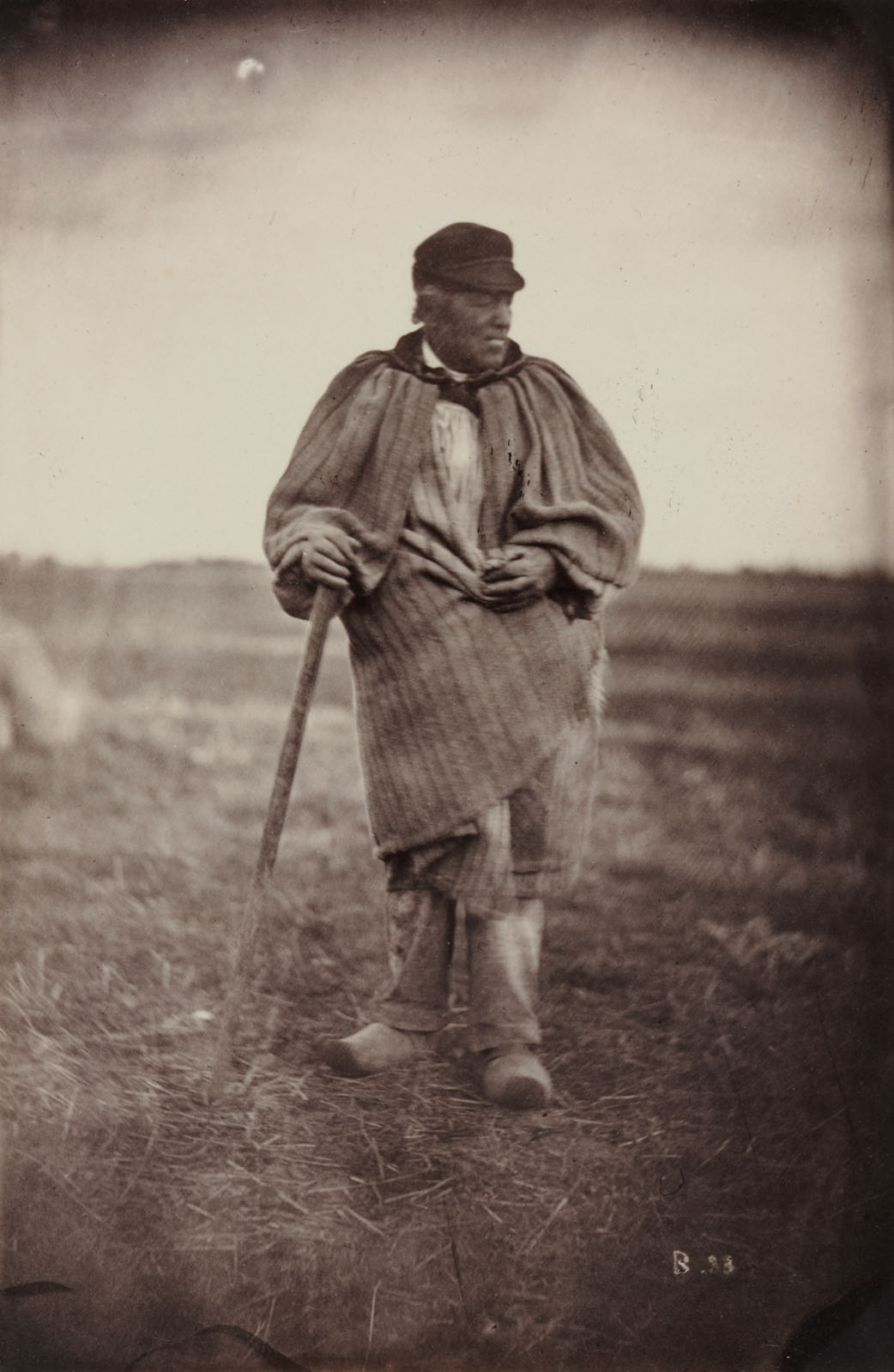
 

Auguste Giraudon's Artist (French) 'Man with Walking Stick' Late 1870's


Auguste Giraudon’s Artist (French)
Man with Walking Stick
Late 1870’s
Albumen print from wet collodion negative
Image: 17.1 x 11.2cm (6 3/4 x 4 7/16 in.)
Paper: 17.1 x 11.2cm (6 3/4 x 4 7/16 in.)
Matted: 45.7 x 35.6cm (18 x 14 in.)
The Cleveland Museum of Art
Purchase from the J. H. Wade Fund


During the 1870s, Giraudon commissioned one or more artists – probably a French painter who wished to remain anonymous – to create photographs of peasants. Now called Giraudon’s Artist, this photographer was one of the few in the 1800s specialising in rural figure studies created for use by artists. The images were likely taken near Barbizon, a destination popular with artists who wanted to work from nature. The artistry of these images derives from their skilful use of light, ability to render a subject in the landscape, and a perceptive depiction of human dignity.
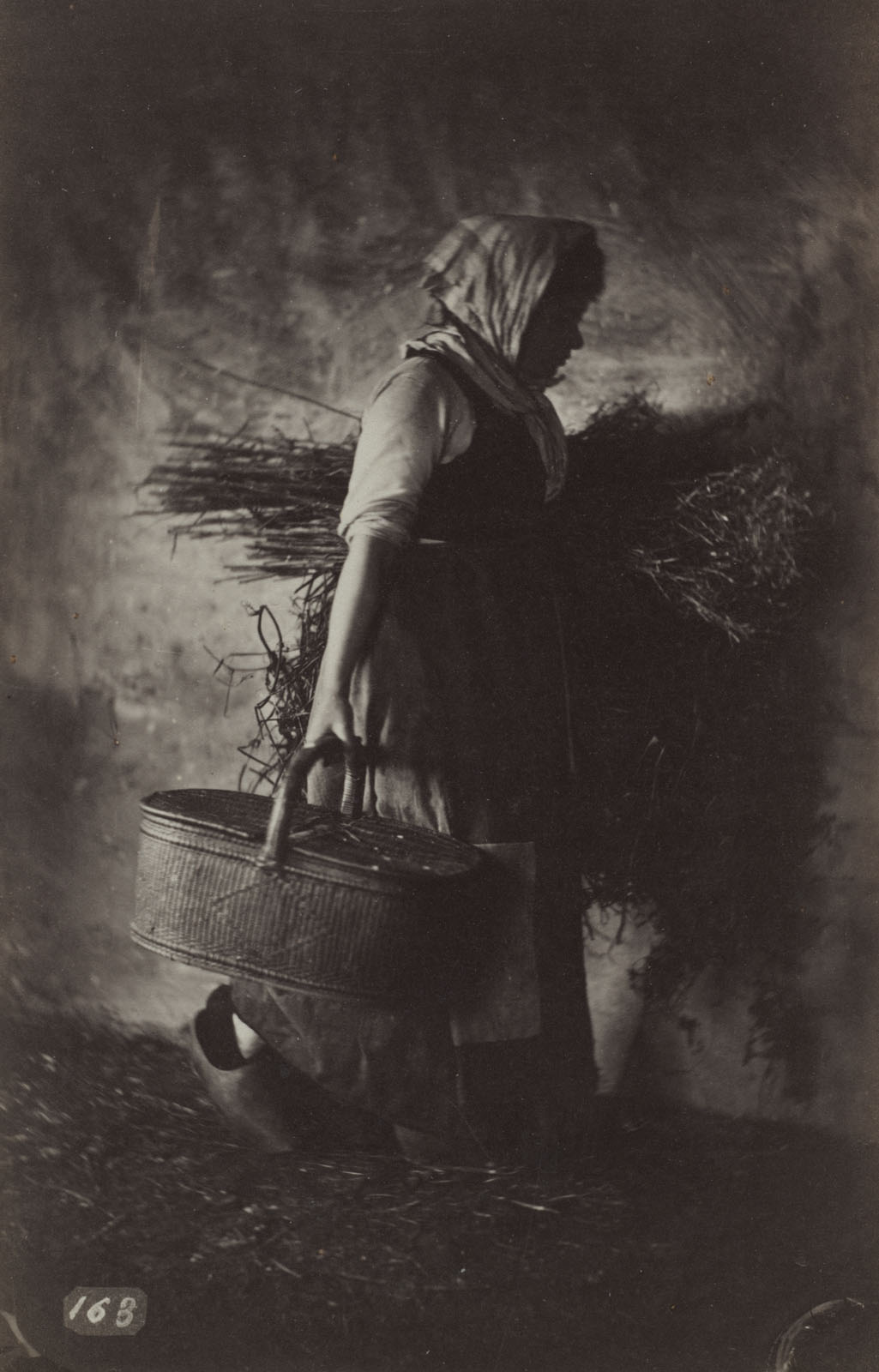
 

Auguste Giraudon's Artist (French) 'Female Peasant Carrying a Basket and Hay' c. 1870


Auguste Giraudon’s Artist (French)
Female Peasant Carrying a Basket and Hay
c. 1870
Albumen print from wet collodion negative
Image: 17.2 x 11.1cm (6 3/4 x 4 3/8 in.)
Mounted: 20.7 x 15.8cm (8 1/8 x 6 1/4 in.)
Matted: 45.7 x 35.6cm (18 x 14 in.)
The Cleveland Museum of Art
John L. Severance Fund
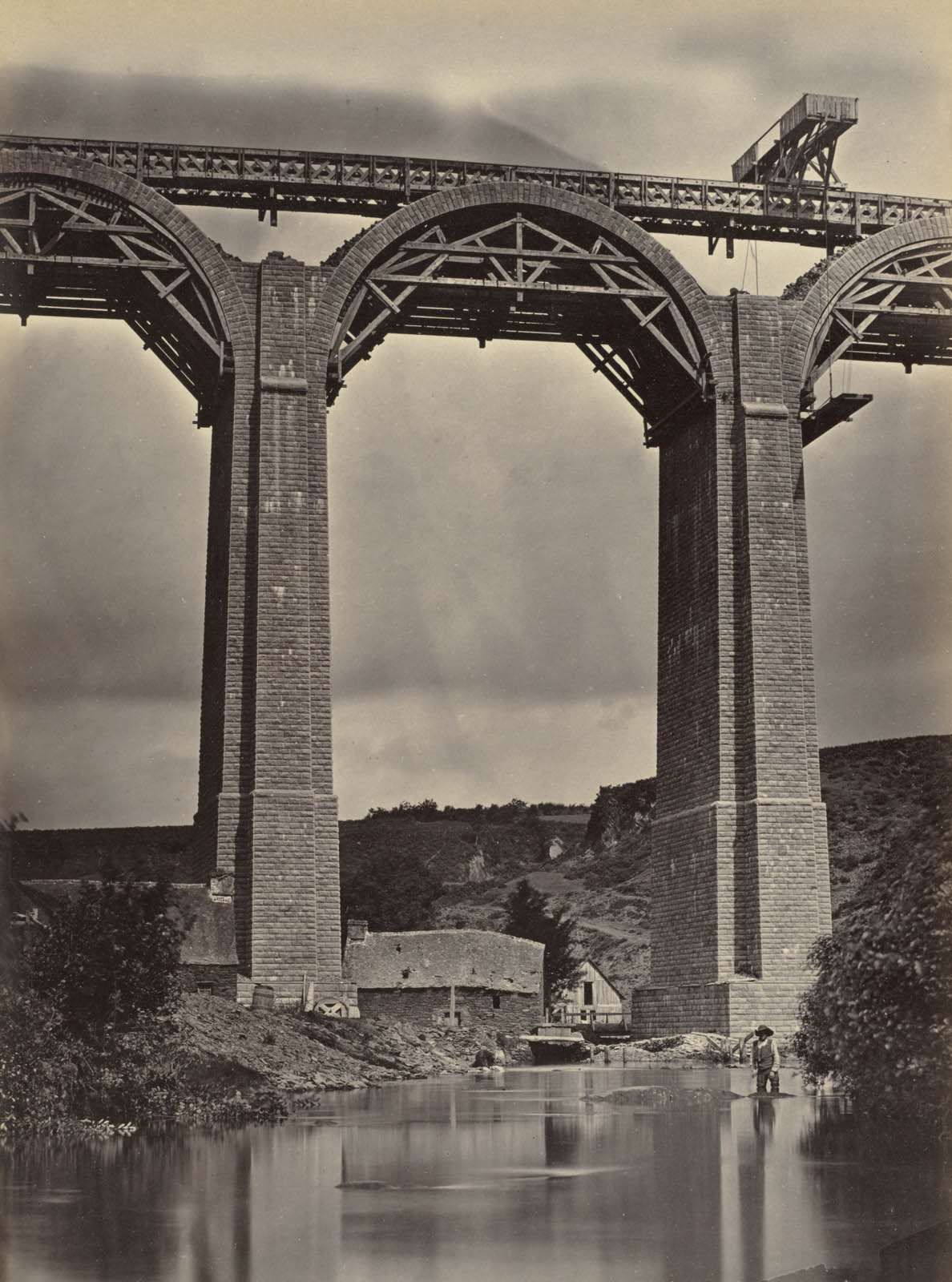
 

Jules DuClos (French, 1824–1879) 'Pont-de-Buis, on the Doufine, France' c. 1865


Jules DuClos (French, 1824-1879)
Pont-de-Buis, on the Doufine, France
c. 1865
Albumen print from wet collodion negative
Image: 33.8 x 30.1cm (13 5/16 x 11 7/8 in.)
Matted: 61 x 50.8cm (24 x 20 in.)
The Cleveland Museum of Art
John L. Severance Fund


The extension of railroad service from Paris across Brittany in northern France occurred in stages between 1840 and 1865. Extending railway service required the construction of railway bridges such as this masonry viaduct which crosses the Doufine River near Pont-de-Buis. Jules DuClos shows it under construction, with timbers supporting the arches and a man standing in the river below.
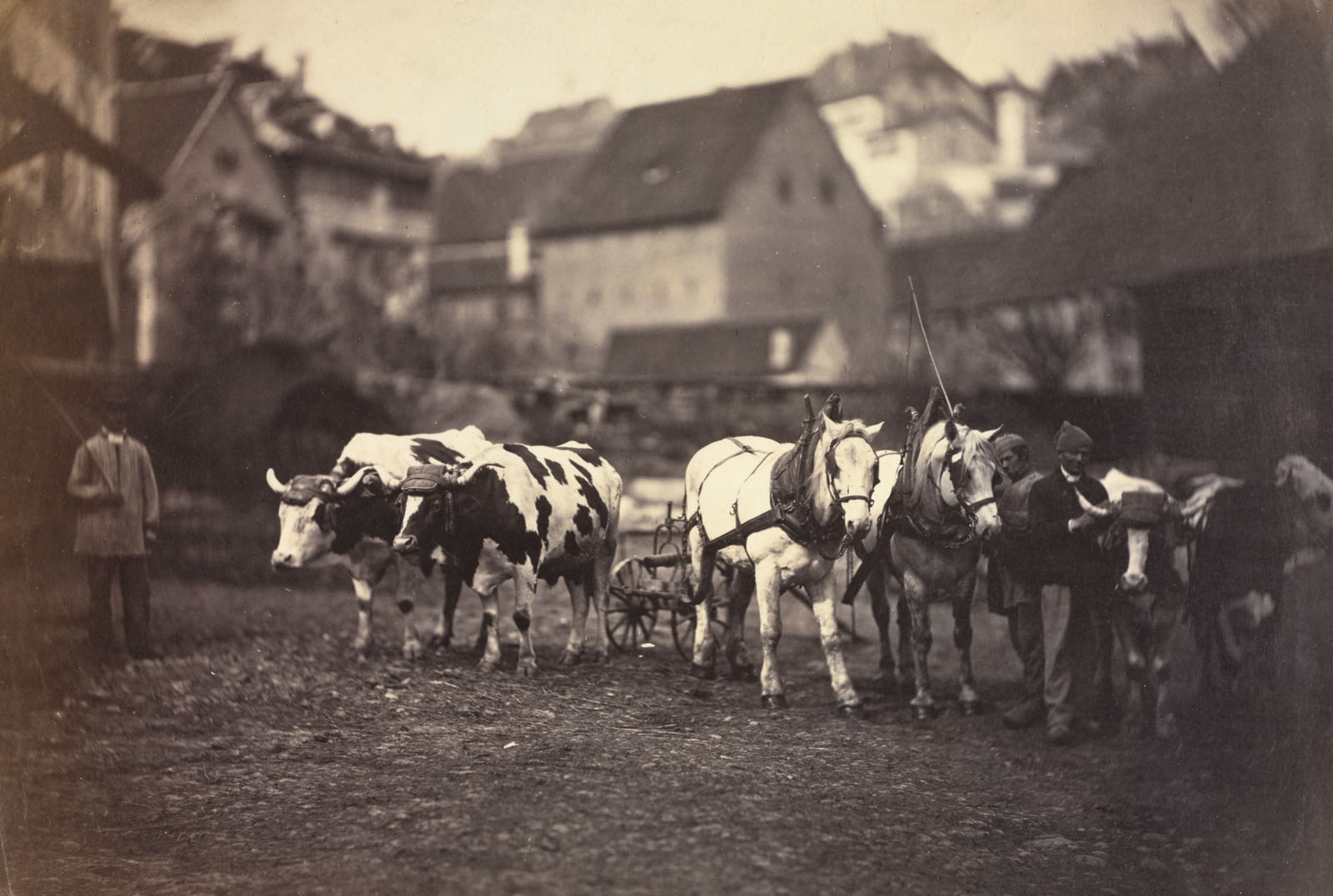
 

Adolphe Braun (French, 1812-1877) 'Untitled (Farm Animals)' 1850s


Adolphe Braun (French, 1812-1877)
Untitled (Farm Animals)
1850s
Albumen print from wet collodion negative
Image: 28 x 39.4cm (11 x 15 1/2 in.)
Framed: 53.7 x 63.8cm (21 1/8 x 25 1/8 in.)
Matted: 50.8 x 61cm (20 x 24 in.)
The Cleveland Museum of Art
Norman O. Stone and Ella A. Stone Memorial Fund


While the animals and farmers are in sharp focus in Adolphe Braun’s photograph, the buildings are blurred, suggesting that perhaps Braun intended to market these photographs to visual artists as models rather than intending them to be hung on people’s walls as a substitute for a painting.

Adolphe Braun

Adolphe Braun French, 1812-1877

Adolphe Braun, a French textile designer born in Besançon and trained in Paris, opened his own studio in Dornach, Alsace, before becoming involved in photography in the early 1850s. He produced several early floral textile designs that were published as lithographs. In 1853 Braun began work on a large album of some 300 photographic still-life studies of flowers, intended as aids for artists in the field of decorative arts. The work met with such success at the 1855 Exposition Universelle in Paris that he left the field of design for photography. Braun’s carefully executed still lifes are considered to be among the finest ever done. From the mid-1850s on, Braun’s firm, Adolphe Braun et Cie., later headed by his son Gaston (1845-1928), became one of the world’s largest studios and publishers of topographical views and of reproductions of works of art. In the latter effort, their importance was in part due to Gaston’s success with the orthochromatic process, in which photographic reproductions retained a tonal range very close to that of the original work of art. Braun et Cie. were the official photographers to Napoléon III and Pope Pius IX. Their reproductions of works in the Louvre, the Sistine Chapel, and many other subjects in architecture, sculpture, painting, and drawing, sometimes using the more permanent carbon or Woodburytype processes, were offered in all sizes and formats, and became the standard in their field. The number of negatives taken by the Brauns or their operators was variously estimated in 1870 to be between 4,000 and 8,000. The Brauns were members of the Société française de photographie. Both were awarded the French Legion of Honor-Adolphe in 1860, and Gaston in 1892. T.W.F.
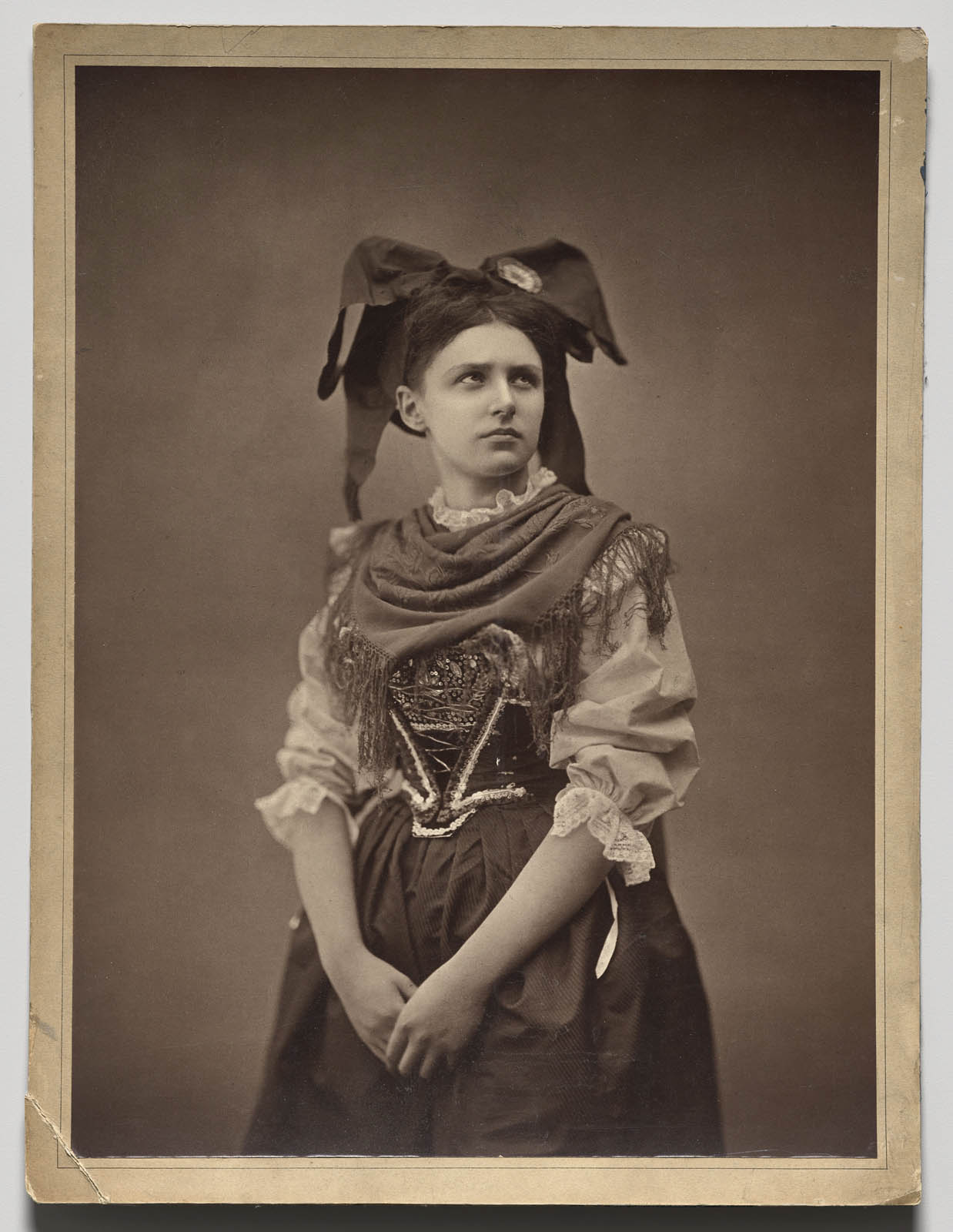
 

Adolphe Braun (French, 1812-1877) 'Young Alsacienne Woman' c. 1871


Adolphe Braun (French, 1812-1877)
Young Alsacienne Woman
c. 1871
Carbon print on a ruled mount
Image: 40 x 30.5cm (15 3/4 x 12 in.)
The Cleveland Museum of Art
Gift of Michael Mattis and Judith Hochberg


This woman wears a regional folk costume from the French region of Alsace, recalling traditions that were disappearing under the impact of industrialisation and modernisation.

At the end of the Franco-Prussian War, Prussia seized much of the regions of Alsace and Lorraine. That inspired Adolphe Braun to produce a series of images of women meant to personify those lost territories. The images proved so popular that they were reproduced on souvenir items including postcards and ceramic plates.
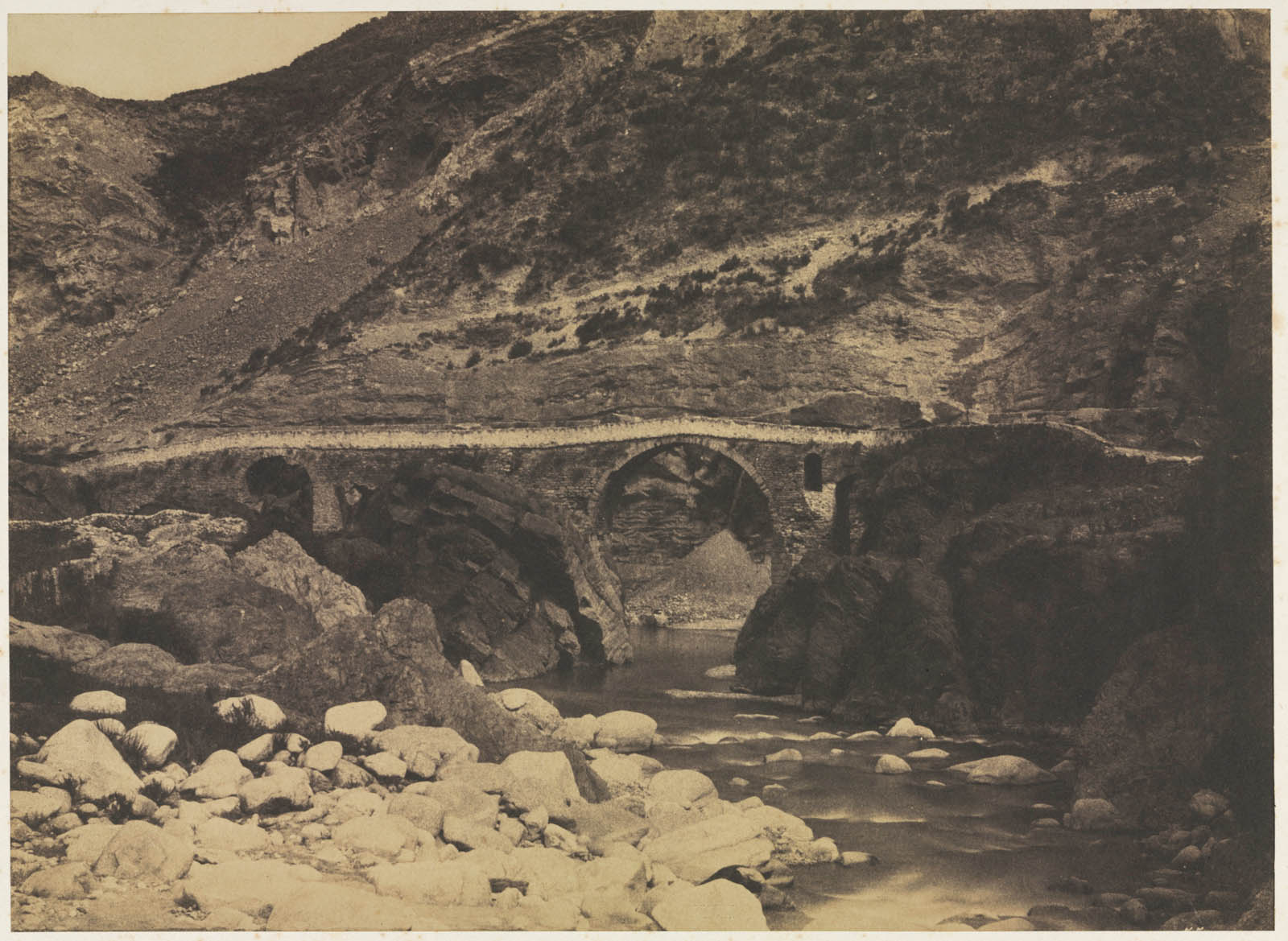
 

Gustave Le Gray (French, 1820–1884) 'The Bridge of Palalda (near Amelieles-Bains)' 1851-1852


Gustave Le Gray (French, 1820-1884)
The Bridge of Palalda (near Amelieles-Bains)
1851-1852
Salted paper print from waxed-paper negative
Image: 23.8 x 32.7cm (9 3/8 x 12 7/8 in.)
Matted: 50.8 x 61cm (20 x 24 in.)
The Cleveland Museum of Art
John L. Severance Fund


In 1851, Gustave Le Gray and his friend, photographer Auguste Mestral, travelled throughout southwestern France for the Commission of Historic French Monuments to document sites of historical importance, especially those in urgent need of, or undergoing, restoration. This image was taken from the left bank of the Tech River, situated below the old town of Palalda, four miles from the Spanish border. Le Gray stressed the rugged landscape over a close-up rendering of the ancient bridge, which was not on his list of assigned sites.

Gustave Le Gray

Gustave Le Gray French, 1820-1884

A master both technically and aesthetically, Gustave Le Gray (born in Villiers-le-Bel) was one of the most important figures in 19th-century French photography, bringing to the medium artistic integrity and visual imagination. Le Gray, trained as a painter, was exhibiting his work in the Paris Salons in the late 1840s and early 1850s when he became interested in photography. Along with Henri Le Secq and Charles Nègre, he was a student of Paul Delaroche, a painter of considerable reputation and ability who was one of the first to grasp the importance of photography. In 1851 Le Gray announced his invention of a waxed paper negative, a significant improvement over earlier paper methods that was later adopted by Louis de Clercq, Dr. August Jakob Lorent, and others. That same year the Commission des Monuments historiques named him as one of five photographers of the Mission héliographique, for which he produced well-known studies of army manoeuvres at Chalons. Le Gray also worked with François Arago, the scientist and champion of Louis-Jacques-Mandé Daguerre, and later proposed a new method of toning prints, among other innovations. Le Gray was perhaps most admired for the effects he achieved with water and sky. To capture the subtle qualities of cloud patterns in some of his seascapes, he employed two negatives to produce the final image. His commissioned studies of historic monuments are classic examples of early architectural photography. In the early 1850s he worked in the Barbizon tradition at Fontainebleau and, in 1860, documented the uprising against François II in Palermo. He was a founding member of the Société héliographique and the Société française de photographie. Despite his influence and artistic success, Le Gray left Paris in 1865 to become a professor of design at the École Polytechnique in Cairo. He died in Egypt. T.W.F.
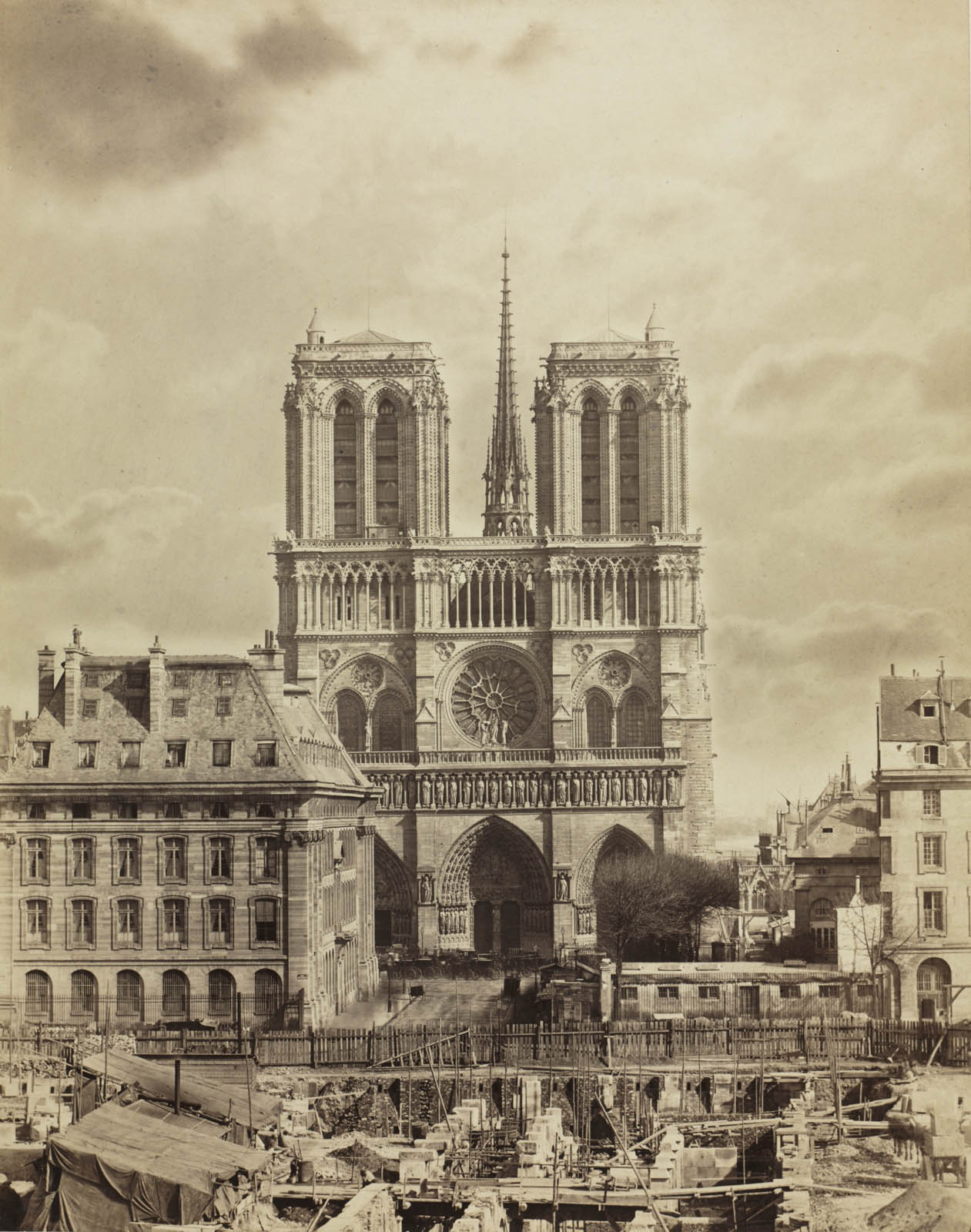
 

Charles Soulier (French, 1840-1875) 'Notre Dame de Paris' early 1860s


Charles Soulier (French, 1840-1875)
Notre Dame de Paris
early 1860s
Albumen print from glass negative
Image: 38 x 30.6cm (14 15/16 x 12 1/16 in.)
Matted: 71.1 x 61cm (28 x 24 in.)
The Cleveland Museum of Art
John L. Severance Fund


When the popularity of Victor Hugo’s novel The Hunchback of Notre Dame drew attention to the church, the state hired architect and preservationist Eugène Viollet-le-Duc to restore it. His renovation, which lasted from 1844 to 1864, modified the cathedral: he added the spire, gargoyles, and griffins. Charles Soulier shows us the church’s front and some of the surrounding neighbourhood, bustling with carriages and new construction.

Charles Soulier

Charles Soulier French, 1840-1875

Charles Soulier operated in partnerships, first with A. Clouzard (1854-59) and later with Claude-Marie Ferrier and his son A. Ferrier (1860-64). Soulier was among the first to take naturalistic, snapshot-like views of Paris. His city street scenes were represented in an extensive set of glass stereographs, a medium preferred by Soulier for the delicacy of its reproductive range. Panoramas of the city were considered his specialty. In 1859 Soulier photographed Napoléon III on his campaign in Austria; he was later named photographer to the emperor. He became a member of the Société française de photographie in 1867 and in 1871 documented activities of the Paris Commune. His work includes topographical, urban, and landscape views, among them images of Mt. Blanc and other European scenery, as well as photographic reproductions of artwork. T.W.F.
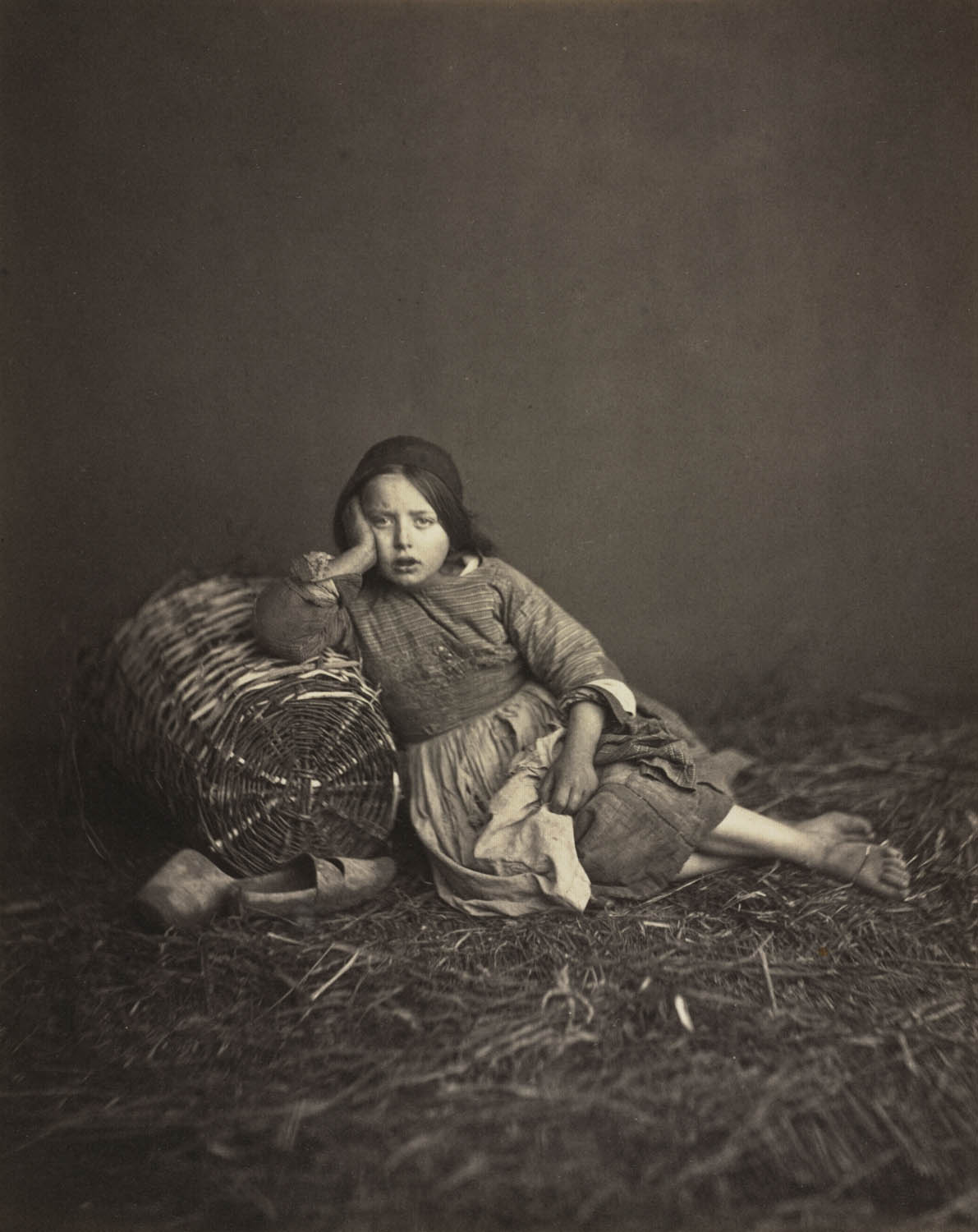
 

Edmond Bacot (French, 1814-1875) 'Young Girl Seated on Straw, Leaning on a Basket' 1862


Edmond Bacot (French, 1814-1875)
Young Girl Seated on Straw, Leaning on a Basket
1862
Albumen print from wet collodion negative
Paper: 22.7 x 18.2cm (8 15/16 x 7 3/16 in.)
Matted: 50.8 x 40.6cm (20 x 16 in.)
The Cleveland Museum of Art
John L. Severance Fund


While Impressionist painters were depicting women outdoors in gardens and parks, scenes of rural labor were popular subjects for many other painters. Those painters sometimes turned to photographs as models for the figures in those paintings. Another print of this photograph and several other images of the same girl were owned by the novelist Victor Hugo, a champion of the working classes. Edmond Bacot took them while visiting Hugo.
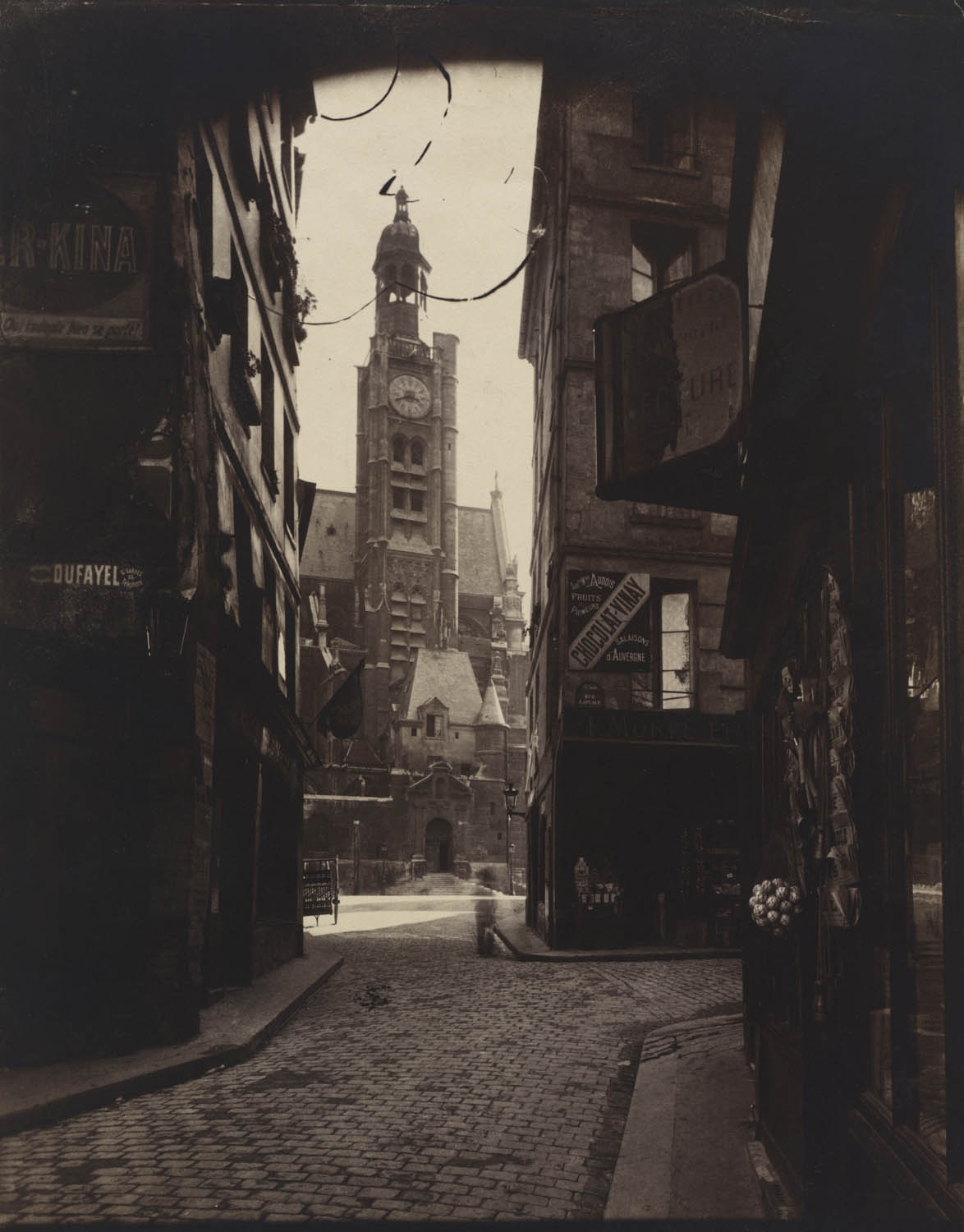
 

Eugène Atget (French, 1857–1927) 'Rue de la Montagne-Sainte-Geneviève' 1898


Eugène Atget (French, 1857-1927)
Rue de la Montagne-Sainte-Geneviève
1898
Albumen print, gold toned
Image: 22 x 17.4cm (8 11/16 x 6 7/8 in.)
Matted: 45.7 x 35.6cm (18 x 14 in.)
The Cleveland Museum of Art
John L. Severance Fund


This narrow street, the site of the founding of the University of Paris in 1112, ends in a church built in the 1600s. Atget sold his photographs not as art but as “documents for artists,” similar in purpose to the nude studies other photographers made for use by painters. That may be why he photographed early in the morning, when a normally bustling street like this one was empty.

Eugène Atget

Eugène Atget French, 1857-1927

Relatively unknown to the public during his lifetime, Eugène Atget is today an icon – one of the most celebrated and influential photographers of the 20th century. Born near Bordeaux, Atget first directed his efforts to painting and the stage before turning to photography shortly before 1890. He is best known for his documentary scenes of Paris and Versailles, but he photographed a number of other sites as well. Atget viewed his work as a historical and aesthetic record, regarding it as documentation for use by artists. Indeed, several artists are known to have painted from his images. Using relatively unsophisticated, even outdated equipment, Atget achieved a view of French architecture and culture that is both personal and factual. Along with the rediscovery of the images of Mathew Brady in the early 20th century, the recognition of Atget’s artistic accomplishments shortly before his death by Berenice Abbott, Man Ray, and others helped turn photographers away from the mannered style of Pictorialism toward the visual and technical clarity of modernism. Marked by a selective and highly individual method, his is among the most widely shown, published, and recognised work in photography today. T.W.F.
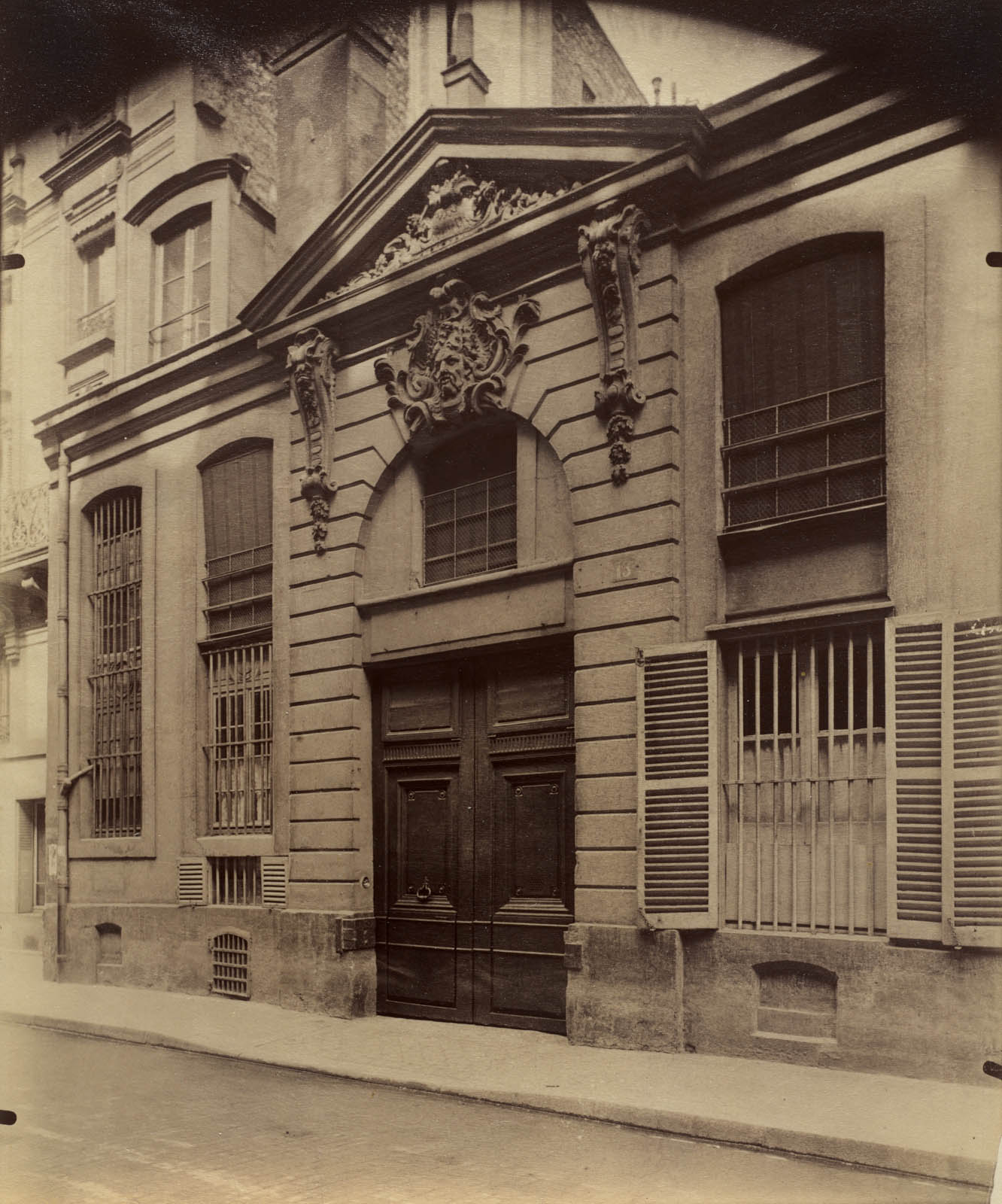
 

Eugène Atget (French, 1857–1927) 'Rue du Regard' 1899


Eugène Atget (French, 1857-1927)
Rue du Regard
1899
Albumen print, gold toned
Image: 21.9 x 18.1cm (8 5/8 x 7 1/8 in.)
Matted: 45.7 x 35.6cm (18 x 14 in.)
The Cleveland Museum of Art
Norman O. Stone and Ella A. Stone Memorial Fund


This entrance, which looks similar today, led into the courtyard for the “petit hôtel de Guiche,” built in the 1700s, which adjoined the larger “hôtel de Guiche.” Fragments of those buildings have been incorporated into the modern structures that now occupy the land behind the portal. The houses were named for the de Guiche family, aristocrats that occupied them in the mid-1700s. Their son was guillotined in 1794 following the French Revolution.


Cleveland Museum of Art
11150 East Boulevard
Cleveland, Ohio 44106

Opening hours:
Tuesdays, Thursdays, Saturdays, Sundays 10.00am – 5.00pm
Wednesdays, Fridays 10.00am – 9.00pm
Closed Mondays

Cleveland Museum of Art website

LIKE ART BLART ON FACEBOOK

Back to top

Photographs: Marcus Bunyan. ‘Material Witness’


from the series Travelling the wonderful loneliness 2019-2024

March 2024


Marcus Bunyan (Australian, b. 1958) 'Untitled' from the sequence 'Material Witness' from the series 'Travelling the wonderful loneliness' (2019-2024)


Photographs from the sequence Material Witness from the series Travelling the wonderful loneliness (2019-2024)


During 2019 I took a photographic journey through Europe. The trip was an ascetic experience, hardly talking to anyone for 2 months, immersed in photography, taking almost 10,000 photographs on three digital cameras. I have whittled these photographs down to around 120 images in four sequences.

This sequence, Material Witness, is one of the four sequences in the series collectively titled Travelling the wonderful loneliness (2019-2024).

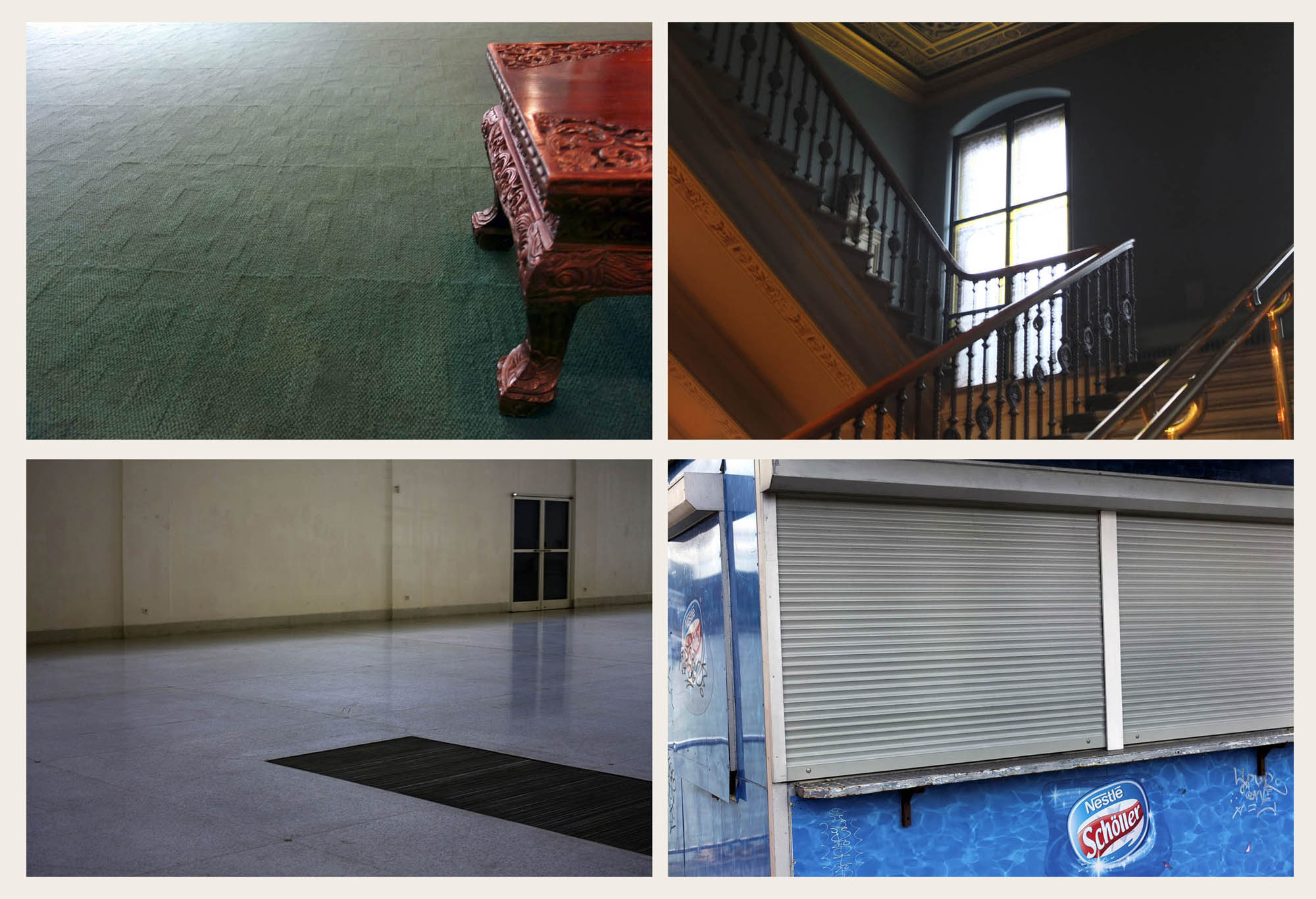
Notice the hole in the carpet and the hole in the wall. Ian Lobb loved the conjunction of the creeper up the side of the building and the yellow plastic with orange tape, in the repose of a dead body. Minor White’s ice/fire…

Other sequences in the series include (How I) Wish You Were Here; Tell Me Why; and Dark Light (all 2019-2024).

Dr Marcus Bunyan
34 images

© Marcus Bunyan


Please click on the photographs for a larger version of the image.


Marcus Bunyan (Australian, b. 1958) 'Untitled' from the sequence 'Material Witness' from the series 'Travelling the wonderful loneliness' (2019-2024)


Photographs from the sequence Material Witness from the series Travelling the wonderful loneliness (2019-2024)


Photographs are available from this series for purchase. As a guide, a digital colour 16″ x 20″ print costs $1,000 plus tracked and insured shipping. For more information please see the Store web page.


Marcus Bunyan website

LIKE ART BLART ON FACEBOOK

Back to top

Exhibition: ‘Gary Krueger’s City of Angels, 1971-1980’ at the Joseph Bellows Gallery, La Jolla, California

Exhibition dates: 18th January – 2nd April, 2021


Gary Krueger (American, b. 1945) 'Los Angeles, 1975' 1975 from the exhibition Exhibition: 'Gary Krueger's City of Angels, 1971-1980' at the Joseph Bellows Gallery, La Jolla, California, Jan - April, 2021


Gary Krueger (American, b. 1945)
Los Angeles, 1975
1975
8 x 10 inches
Vintage gelatin silver print
Signed, titled and dated in pencil on verso


Fallen Angels

Love these.

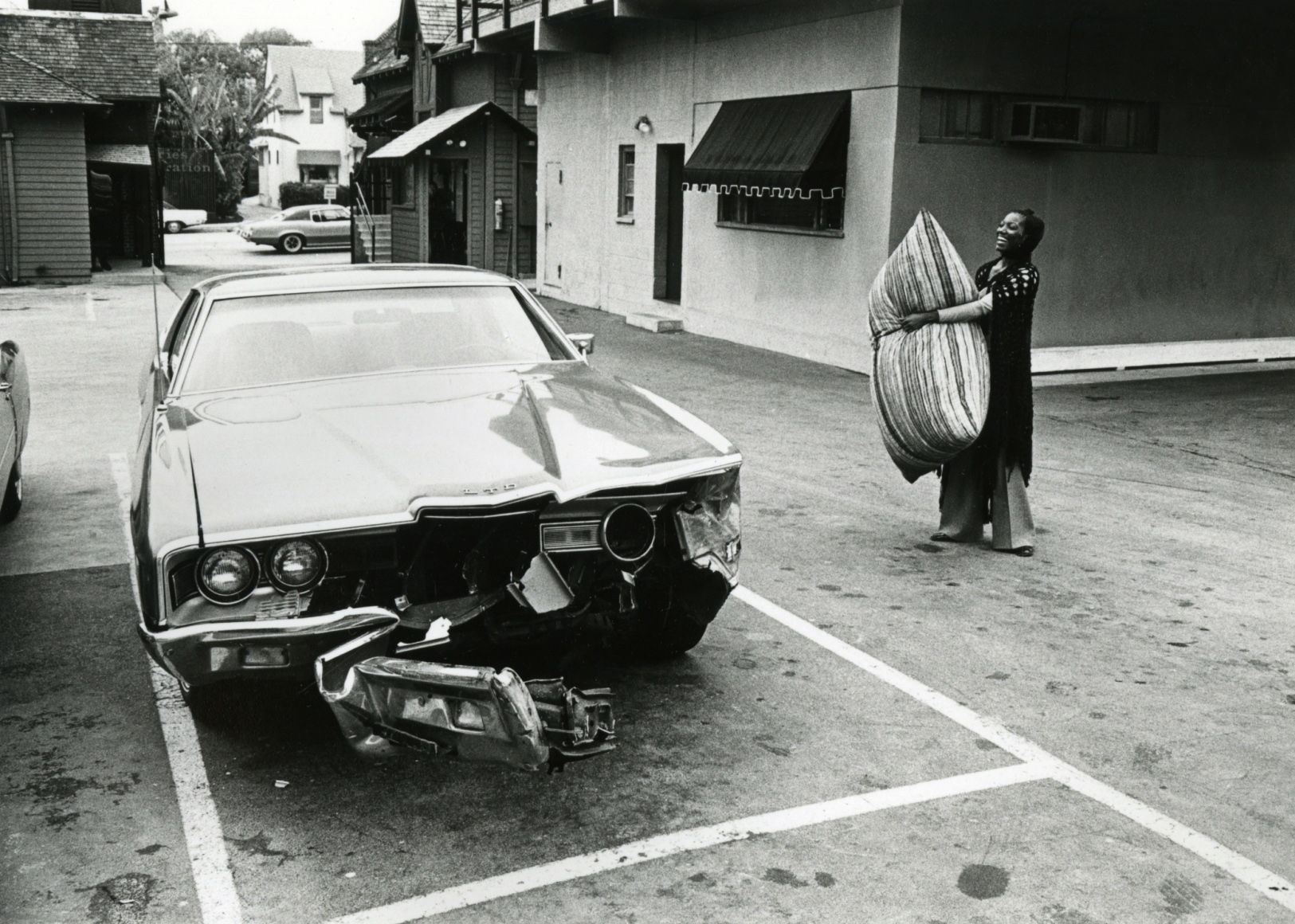
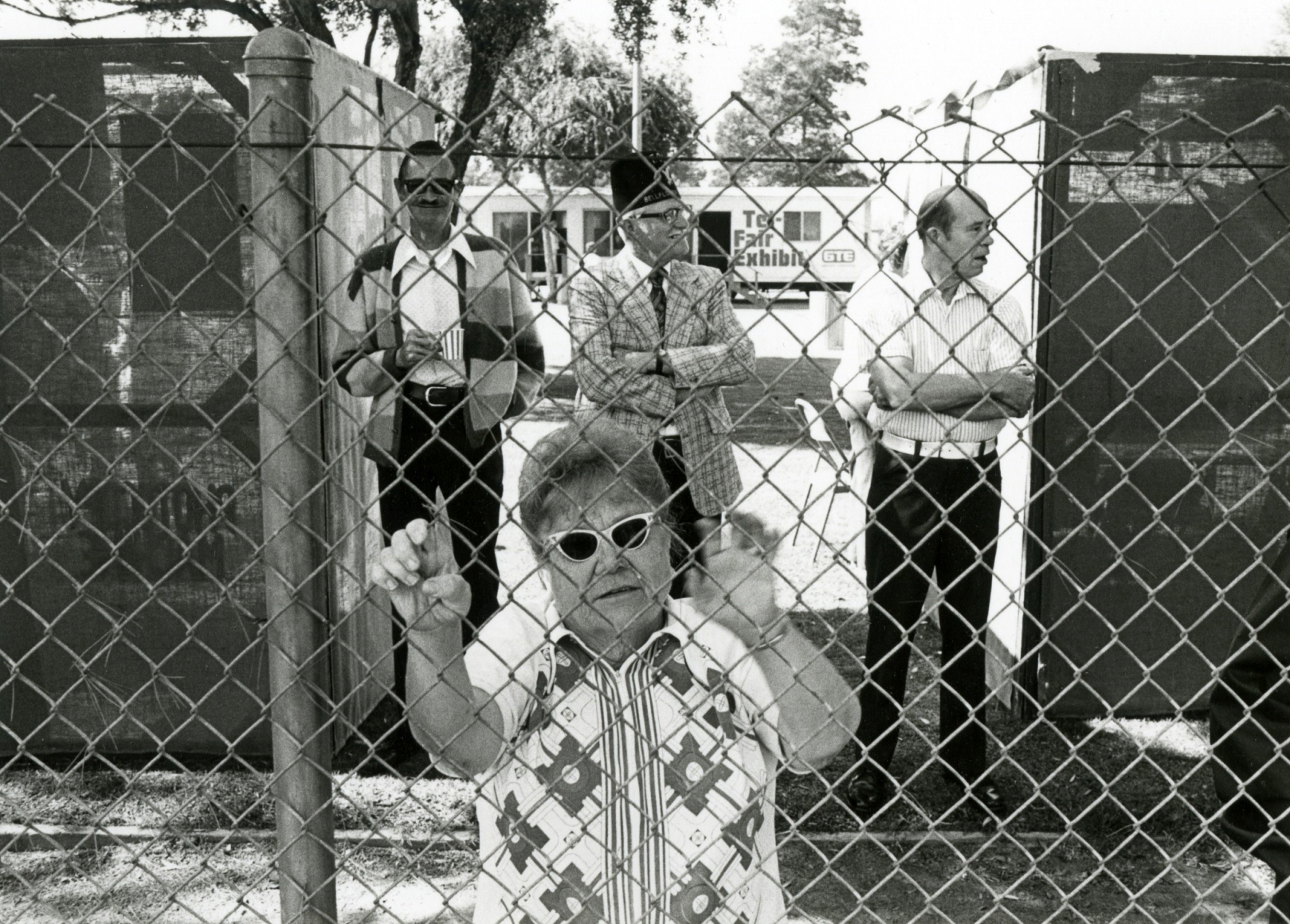
Krueger’s street photography inverts the normal meaning of bathos… in that a silly or very ordinary subject suddenly changes to a beautiful or important one.

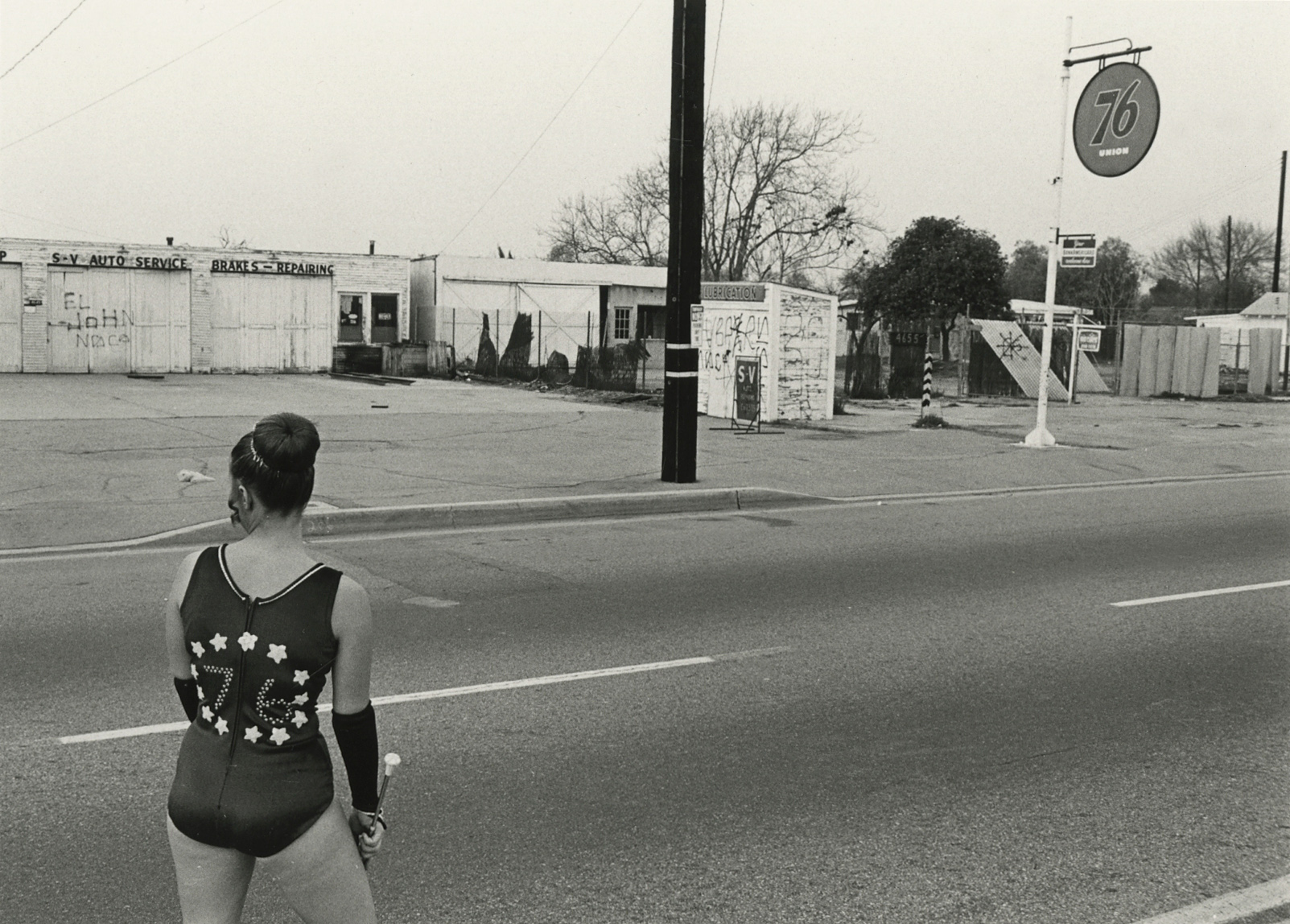
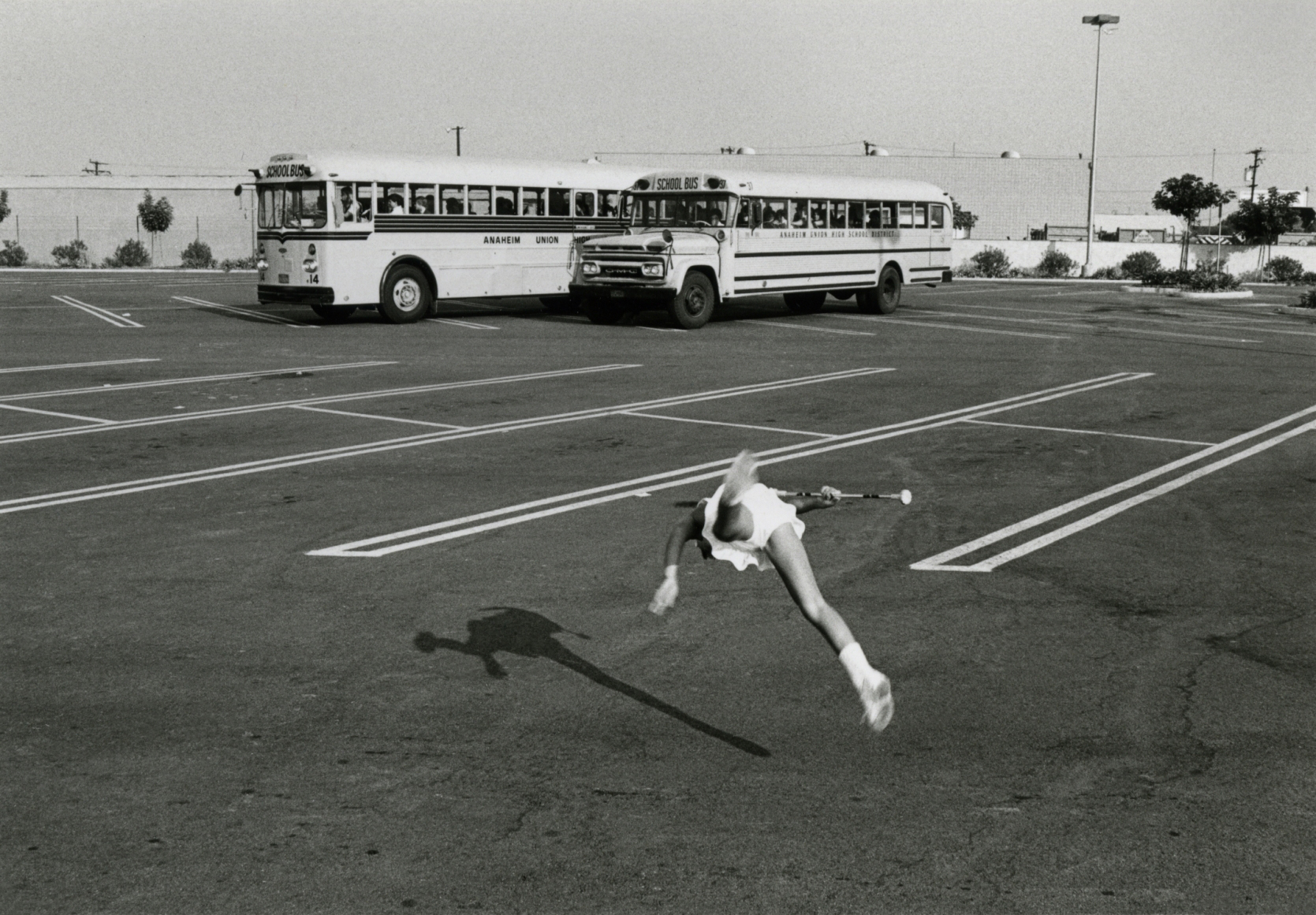
For no reason that we can see, a clown stands in sunlight next to a tree on a street in Los Angeles. What is he doing there? How did he get there? The incongruity of the scene takes on an importance and pathos that is hard to decipher. A pair of 76’s; a snarling dog in a Mustang; the legs of a man on a contraption doing god knows what; and a “majorette” captured mid-air: was she pushed, did she trip, will she fall or recover from this impossible angle, this suspended aerobatic display silently watched by the camera lens and two parked School Buses.

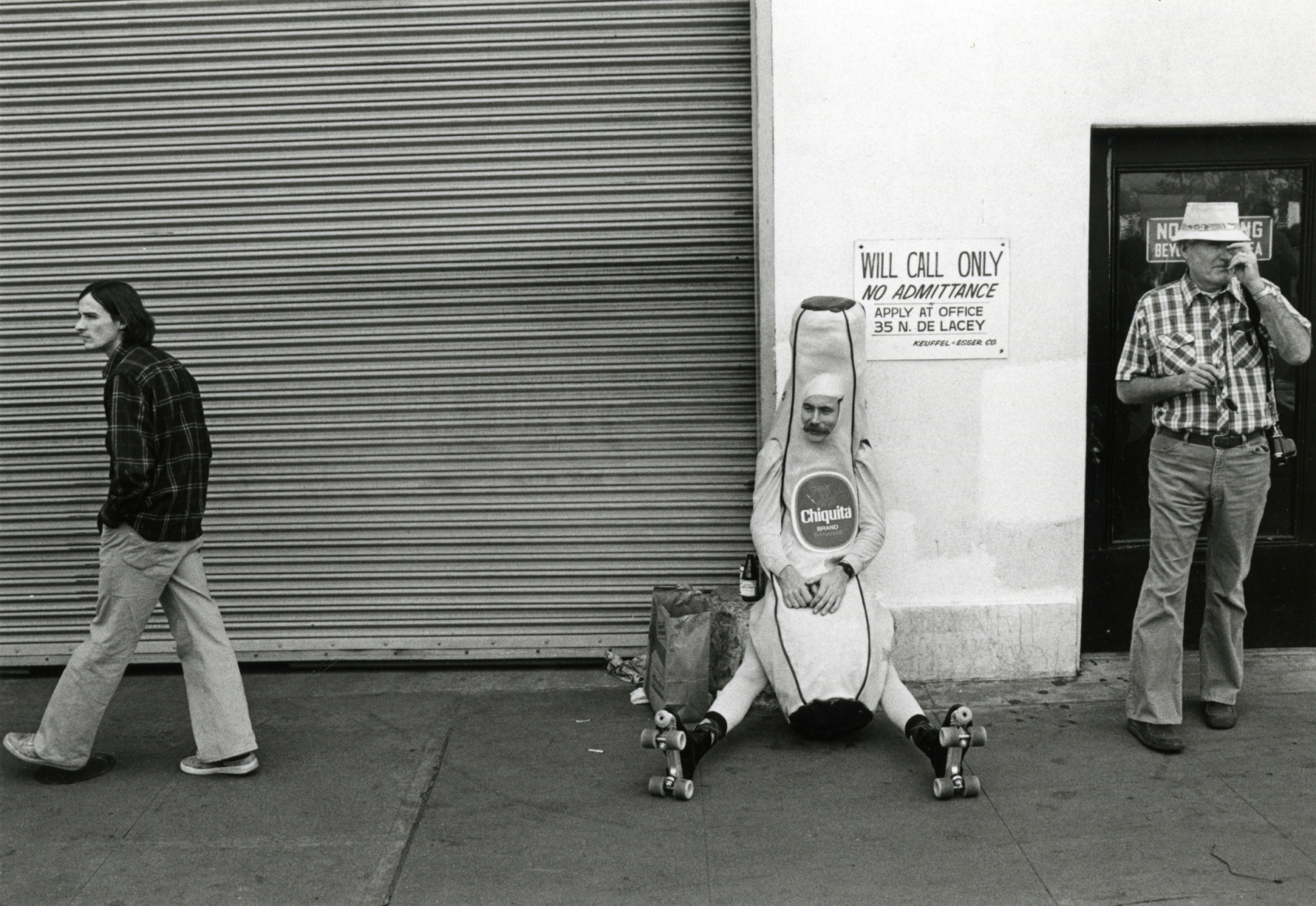
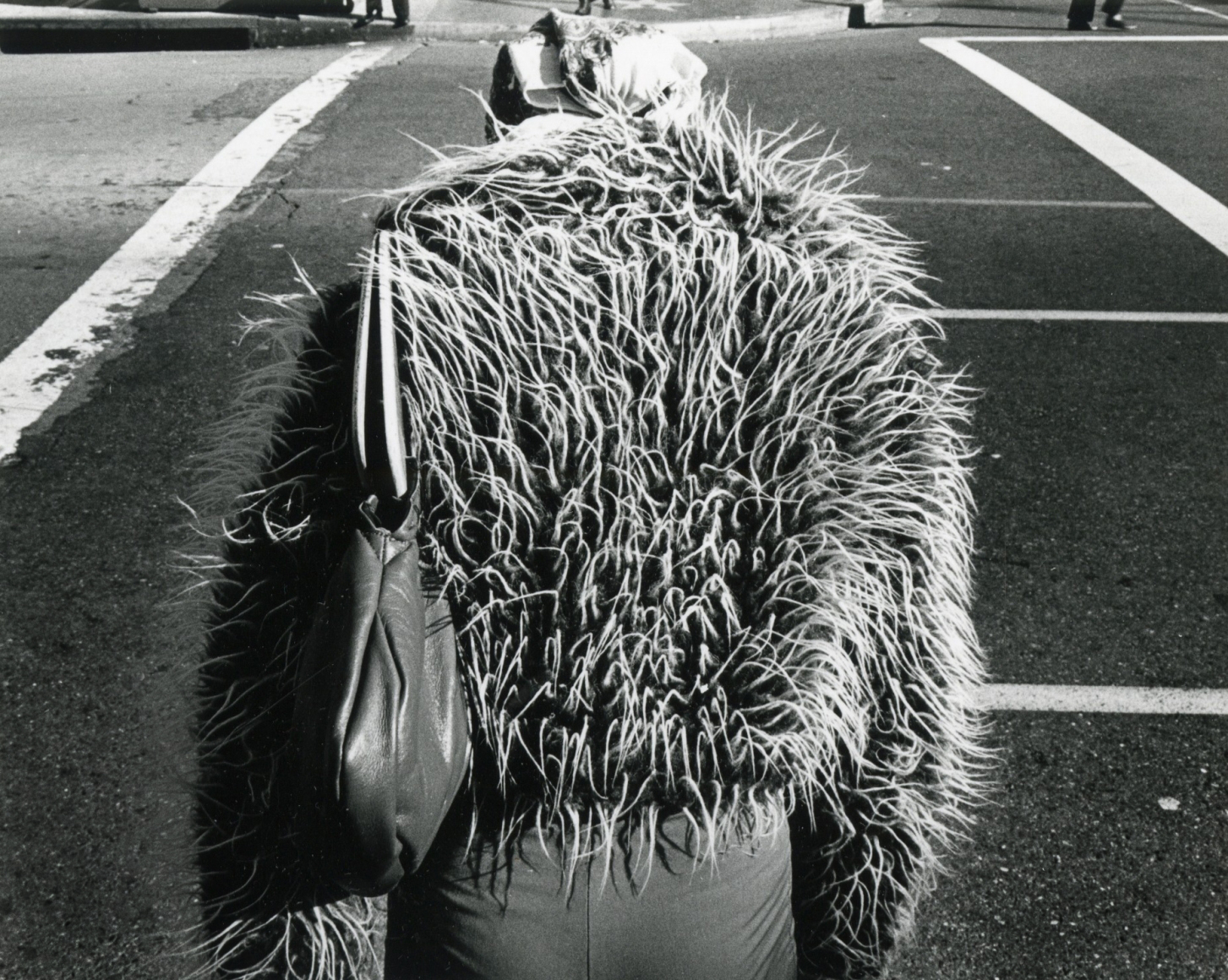
There is black humour aplenty in these photographs, as they picture the happenstance anachronisms of a major American city. They make me think, they make me laugh in that small, tight way when you are not sure you should be laughing at all. The banana on roller skates, the hairy jacket and the man covered in Band Aids, his head wrapped in bandages. What the hell!

Remember what was happening in 1971-80 in Los Angeles. A 6.6-magnitude earthquake centred in Sylmar causes 65 deaths and $505 million in damage; an oil tanker explodes in Los Angeles Harbor killing five people and injuring 50; Los Angeles passes its gay and lesbian civil rights bill; Eula Love, a 39-year-old African-American mother was shot and killed on January 3, 1979 by Los Angeles Police Department (nothing changes!); the Skid Row Stabber (who has never been found) kills 11 homeless people; Los Angeles experiences severe flooding and mudslides; and in 1981 the first case of AIDS appears in Los Angeles County. The man with the Band AIDS seems rather prescient now.

“Through the 20th century, immigrants were attracted by a promised paradise: endless orange groves, a temperate climate and money to be made, as described by aggressively promoted booster campaigns. Families were told to leave the cold, increasingly crowded cities of the east and midwest far behind – the City of Angels was portrayed as a heaven on Earth.” While Neil Simon once described Los Angeles as “like paradise with a lobotomy,” Krueger’s bizarre photographs depict ‘the City of Angels’ as everything and anything but, a utopian paradise.

Dr Marcus Bunyan


Many thankx to Joseph Bellows Gallery for allowing me to publish the photographs and the text (reproduced with permission) in the posting. Please click on the photographs for a larger version of the image.


“It’s not what I put into a photo;

it’s what I take out of a photo.”


Gary Krueger


Gary Krueger (American, b. 1945) 'Los Angeles, 1976' 1976 from the exhibition Exhibition: 'Gary Krueger's City of Angels, 1971-1980' at the Joseph Bellows Gallery, La Jolla, California, Jan - April, 2021


Gary Krueger (American, b. 1945)
Los Angeles, 1976
1976
8 x 10 inches
Vintage gelatin silver print
Signed, titled and dated in pencil on verso


Gary Krueger (American, b. 1945) 'Los Angeles, 1973' 1973


Gary Krueger (American, b. 1945)
Los Angeles, 1973
1973
8 x 10 inches
Vintage gelatin silver print
Signed, titled and dated in pencil on verso


Gary Krueger (American, b. 1945) 'Los Angeles, 1973' 1973


Gary Krueger (American, b. 1945)
Los Angeles, 1973
1973
8 x 10 inches
Vintage gelatin silver print
Signed, titled and dated in pencil on verso


Gary Krueger (American, b. 1945) 'Hollywood, 1971' 1971


Gary Krueger (American, b. 1945)
Hollywood, 1971
1971
8 x 10 inches
Vintage gelatin silver print
Signed, titled and dated in pencil on verso


Gary Krueger (American, b. 1945) 'Los Angeles, 1971' 1971


Gary Krueger (American, b. 1945)
Los Angeles, 1971
1971
8 x 10 inches
Vintage gelatin silver print
Signed, titled and dated in pencil on verso


Gary Krueger (American, b. 1945) 'Los Angeles, 1973' 1973


Gary Krueger (American, b. 1945)
Los Angeles, 1973
1973
8 x 10 inches
Vintage gelatin silver print
Signed, titled and dated in pencil on verso


Gary Krueger (American, b. 1945) 'Los Angeles, 1974' 1974


Gary Krueger (American, b. 1945)
Los Angeles, 1974
1974
8 x 10 inches
Vintage gelatin silver print
Signed, titled and dated in pencil on verso


Joseph Bellows Gallery is pleased to present Gary Krueger’s City of Angels, 1971-1980, a collection of sometimes frenetic and often bizarre photographs of Los Angeles, California. Krueger’s curiosity and instincts helped to create a remarkable body of street photography that he describes as “split-second juxtapositions in life.” After graduating High School in 1963, Gary Krueger (1945- ) drove his 1954 Ford west from Cleveland, Ohio, to study graphic design and photography at the Chouinard Art Institute in Los Angeles from 1964 to 1967. Later Cal Arts, Chouinard was a professional art school founded in 1921 by Nelbert Murphy Chouinard. In 1961, Walt and Roy Disney guided the merger of Chouinard and the Los Angeles Conservatory of Music to establish the California Institute of the Arts. Notable alumni include Ed Ruscha, Larry Bell, Robert Irwin, Joe Goode, and Allen Ruppersberg, with whom Krueger collaborated on Ruppersberg’s narrative photo works, including 23 Pieces (1969) and 24 Pieces (1970). Upon graduation from Chouinard, Krueger was hired by WED, Disney’s “Imagineering” Division to photograph the Park and its events. He eventually left WED to pursue a successful career as a commercial and editorial photographer.

“Gary Krueger’s plain ol’ photographs (unless I’m missing a point) – small, tough, and sharp – are good, granite reportage. Baldessari’s “Fables” and Krueger’s no-nonsense photos cut like a hot ripsaw through the cool, marshmallow quality of both exhibitions.” – Peter Plagens, from a 1973 ARTFORUM review of the exhibition, Southern California: Attitudes 1972, at the Pasadena Art Museum.

Krueger’s work is represented in The Minneapolis Institute of Art, Museum of Fine Arts, Houston, Center for Creative Photography, Tucson, AZ, the Los Angeles County Museum of Art, and the Santa Barbara Museum of Art.

Press release from the Joseph Bellows Gallery [Online] Cited 28/02/2021


Gary Krueger (American, b. 1945) 'Los Angeles, 1972' 1972


Gary Krueger (American, b. 1945)
Los Angeles, 1972
1972
8 x 10 inches
Vintage gelatin silver print
Signed, titled and dated in pencil on verso


Gary Krueger (American, b. 1945) 'Los Angeles, 1970' 1970


Gary Krueger (American, b. 1945)
Los Angeles, 1970
1970
8 x 10 inches
Vintage gelatin silver print
Signed, titled and dated in pencil on verso


Gary Krueger (American, b. 1945) 'Los Angeles, 1974' 1974


Gary Krueger (American, b. 1945)
Los Angeles, 1974
1974
8 x 10 inches
Vintage gelatin silver print
Signed, titled and dated in pencil on verso


Gary Krueger (American, b. 1945) 'Los Angeles, 1971' 1971


Gary Krueger (American, b. 1945)
Los Angeles, 1971
1971
8 x 10 inches
Vintage gelatin silver print
Signed, titled and dated in pencil on verso


Gary Krueger (American, b. 1945) 'Los Angeles, 1971' 1971


Gary Krueger (American, b. 1945)
Los Angeles, 1971
1971
8 x 10 inches
Vintage gelatin silver print
Signed, titled and dated in pencil on verso


Gary Krueger (American, b. 1945) 'Hollywood, CA, 1971' 1971


Gary Krueger (American, b. 1945)
Hollywood, CA, 1971
1971
8 x 10 inches
Vintage gelatin silver print
Signed, titled and dated in pencil on verso


Gary Krueger (American, b. 1945) 'Los Angeles, 1973' 1973


Gary Krueger (American, b. 1945)
Los Angeles, 1973
1973
8 x 10 inches
Vintage gelatin silver print
Signed, titled and dated in pencil on verso


Gary Krueger (American, b. 1945) 'Los Angeles, 1976' 1976


Gary Krueger (American, b. 1945)
Los Angeles, 1976
1976
8 x 10 inches
Vintage gelatin silver print
Signed, titled and dated in pencil on verso


Gary Krueger (American, b. 1945) 'Los Angeles, 1979' 1979


Gary Krueger (American, b. 1945)
Los Angeles, 1979
1979
8 x 10 inches
Vintage gelatin silver print
Signed, titled and dated in pencil on verso


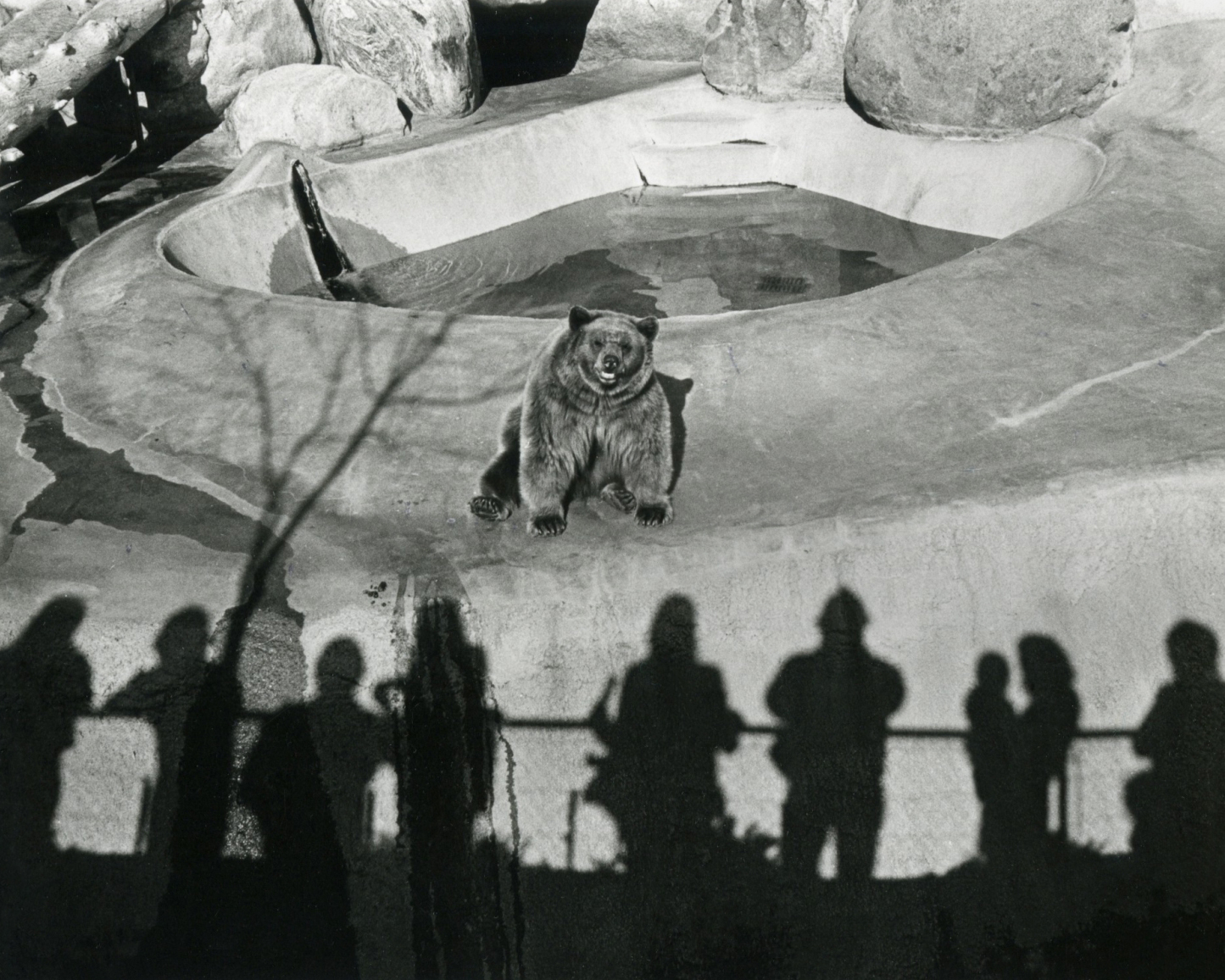
Gary Krueger (American, b. 1945) 'Los Angeles Zoo, 1971' 1971


Gary Krueger (American, b. 1945)
Los Angeles Zoo, 1971
1971
8 x 10 inches
Vintage gelatin silver print
Signed, titled and dated in pencil on verso


Gary Krueger (American, b. 1945) 'Los Angeles, 1980' 1980


Gary Krueger (American, b. 1945)
Los Angeles, 1980
1980
8 x 10 inches
Vintage gelatin silver print
Signed, titled and dated in pencil on verso


Gary Krueger (American, b. 1945) 'Hollywood, 1971' 1971


Gary Krueger (American, b. 1945)
Hollywood, 1971
1971
8 x 10 inches
Vintage gelatin silver print
Signed, titled and dated in pencil on verso


Gary Krueger (American, b. 1945) 'Los Angeles, 1980' 1980


Gary Krueger (American, b. 1945)
Los Angeles, 1980
1980
8 x 10 inches
Vintage gelatin silver print
Signed, titled and dated in pencil on verso


Gary Krueger (American, b. 1945) 'Los Angeles, 1975' 1975


Gary Krueger (American, b. 1945)
Los Angeles, 1975
1975
8 x 10 inches
Vintage gelatin silver print
Signed, titled and dated in pencil on verso


Joseph Bellows Gallery
7661 Girrard Avenue
La Jolla, California
Phone: 858 456 5620

Opening hours:
Tuesday – Saturday 11am – 5pm and by appointment

Joseph Bellows Gallery website

LIKE ART BLART ON FACEBOOK

Back to top

Exhibition: ‘Dave Heath: Dialogues with Solitudes’ at The Photographers’ Gallery, London

Exhibition dates: 8th March – 2nd June, 2019

Curator: Diane Dufour, Director of LE BAL


Dave Heath (Canadian born United States, 1931-2016) 'California' 1964 from the exhibition 'Dave Heath: Dialogues with Solitudes' at The Photographers' Gallery, London, March - June, 2019


Dave Heath (Canadian born United States, 1931-2016)
California
1964
Gelatin silver print
© Dave Heath / Courtesy of Howard Greenberg Gallery, New York, and Stephen Bulger Gallery, Toronto


The master of what we see / visions of the self

In which the visions (ghosts?) in these haunting photographs live, breathe, and barely exist in a strange closed world. Where the subjects seem so vulnerable.

In which there is little sentimentality. The portraits emit a deep sense of melancholy in their re/pose, in the subjects temporal existence separated out from time. Heath photographs people as they are. He projects himself, not his ego, into this vision of vulnerable humanity.

In which this vision of truth illuminates the complex relationship between human nature and reality through emotional energy.

Dr Marcus Bunyan


Many thankx to The Photographers’ Gallery for allowing me to publish the photographs in the posting. Please click on the photographs for a larger version of the image.


“… the conundrum of the title is a reference about how to navigate the terrain of solitude one wishes to experience (to be alone), but also how to make that extend into a conversation with the subjects in front of you that will eventually become a single body of work for many to view (to be of more than one). This is of course conditional to your position within the world at large and how you view your presence within the greater universal ether. You must carry your solipsism like a rusty bucket of dirty brown well water. In Heath’s case, the solitary monologue and the ramble of the flaneur become something of a mantra – an incessant need to repeat, to be part of the cacophony of the worship of modern life in which the self and the crowd / city are forced to adjust to one another, but at safe distance with impassioned and yearning eyes.”


Extract from Brad Feuerhelm. “David Heath: “Dialogues With Solitudes”,” on the ASX website November 23, 2018 [Online] Cited 26/05/2019


“”A Dialogue with Solitude” is a self-portrait in which the artist himself never really appears, but is revealed and interpreted by every detail. Its revolt is alive with sympathy and acceptance of man’s modern placement in the world, mated with contradictory realization and resistance which deny and combat the absurdities of existence. This is expressed with a sincere poetry which is never shocked out of countenance by reality.”


Edwards, exh. label for A Dialogue of Solitude, 1963, on file in the Photography Department, Art Institute of Chicago quoted in Hugh Edwards. “Dave Heath,” on the Art Institute of Chicago website [Online] Cited 26/05/2019


The first major UK exhibition dedicated to the work of this hugely influential American photographer.

Heath’s psychologically charged images both reflect and respond to the alienation particularly prevalent in post war North American society. He was one of the first of a new generation of artists seeking new ways to try and make sense of the increasing sense of isolation and vulnerability that typified the age.

Predominantly self-taught, Heath was nonetheless extremely informed and versed in the craft, theory and history of photography and taught extensively throughout his life. Although greatly influenced by W. Eugene Smith and the photographers of the Chicago School, including Aaron Siskind and Harry Callahan, Heath cannot be neatly pigeonholed as either a documentary or experimental photographer. His work feels more at home within a narrative or poetic tradition, where an interior reality takes precedence.

Taking his masterwork and first publication, A Dialogue With Solitude, as a point of departure, this exhibition highlights Heath’s preoccupations with solitude and contemplation and further makes explicit the importance of sequencing in his practice. Heath was clear that “the central issue of my work is sequence” and held the belief that the relativity and rhythm of images offered a truer way of conveying a universal psychological state than a single image. He perfected a form of montage, often blending text and image to create visual poems, which captured the mood of the decade in a manner akin to a photographic protest song.

Heath’s photographs are shown in dialogue with cult American films from the 1960s similarly focused on themes of solitude and alienation. These include: Portrait of Jason by Shirley Clarke (1966); Salesman by Albert and David Maysles and Charlotte Mitchell Zwerin (1968); and The Savage Eye by Ben Maddow, Sidney Meyers and Joseph Strick (1960).

“The fact that I never had a family, a place or a story that defined me, inspired a need in me to join the community of mankind. I did so by inventing a poetic form linking this community, at least symbolically, in my imagination, through this form.” ~ Dave Heath


Curated by Diane Dufour, Director of LE BAL. Exhibition conceived by LE BAL with the support of Stephen Bulger Gallery (Toronto), Howard Greenberg Gallery (New York), Archive of Modern Conflict (London) and Les Films du Camélia (Paris).

Text from the Photographers’ Gallery website [Online] Cited 25/05/2019


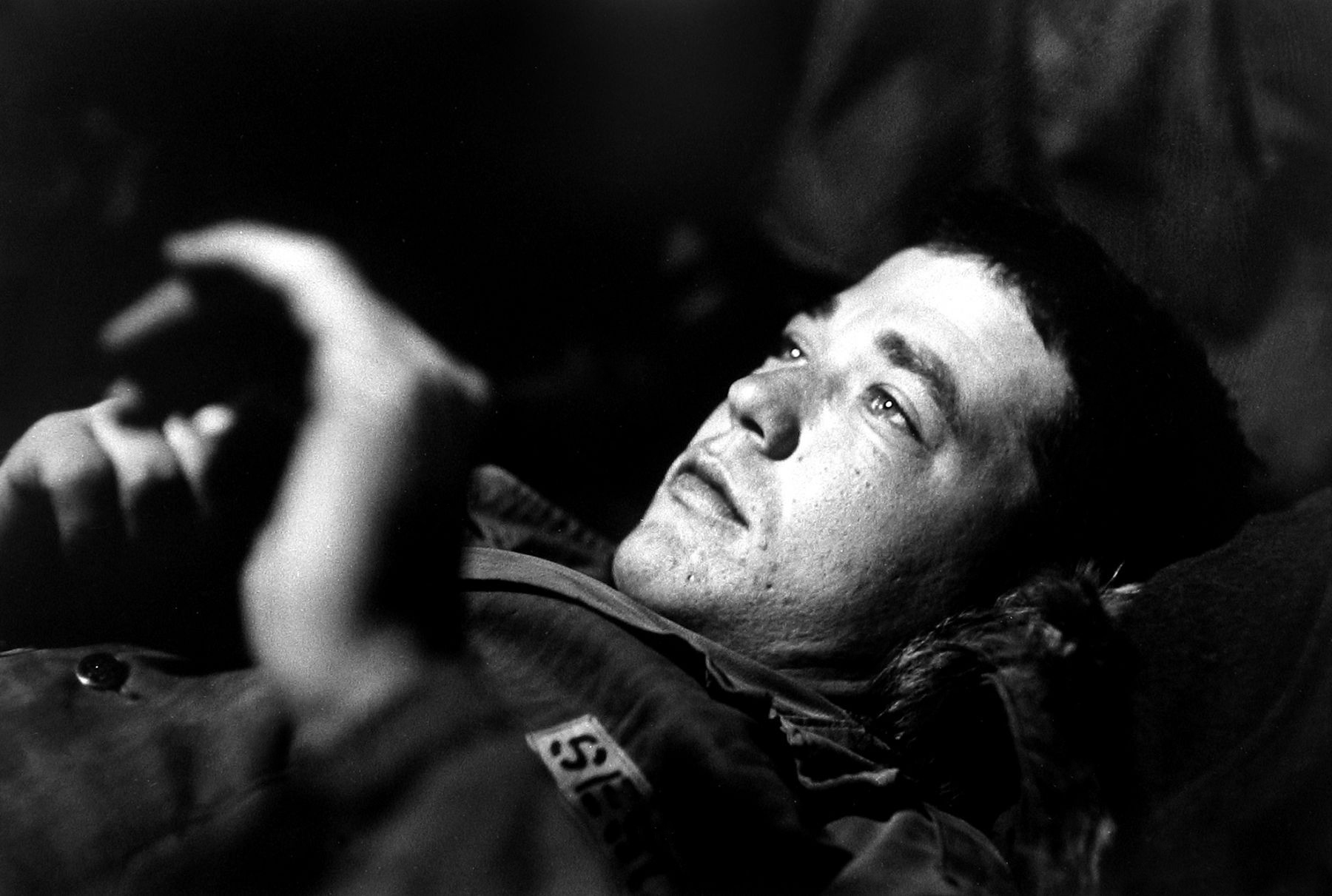
Dave Heath (Canadian born United States, 1931-2016) 'Sesco Corée' 1953-1954 from the exhibition 'Dave Heath: Dialogues with Solitudes' at The Photographers' Gallery, London, March - June, 2019


Dave Heath (Canadian born United States, 1931-2016)
Sesco, Corée
1953-1954
Gelatin silver print
© Dave Heath / Courtesy of Howard Greenberg Gallery, New York, and Stephen Bulger Gallery, Toronto


Dave Heath (Canadian born United States, 1931-2016) 'Carl Dean Kipper, Korea' 1953-1954


Dave Heath (Canadian born United States, 1931-2016)
Carl Dean Kipper, Korea
1953-1954
Gelatin silver print
© Dave Heath / Courtesy of Howard Greenberg Gallery, New York, and Stephen Bulger Gallery, Toronto


Dave Heath (Canadian born United States, 1931-2016) 'New York City, 1958-1959


Dave Heath (Canadian born United States, 1931-2016)
New York City
1958-1959
Gelatin silver print
© Dave Heath / Courtesy of Howard Greenberg Gallery, New York, and Stephen Bulger Gallery, Toronto


Dave Heath (Canadian born United States, 1931-2016) 'Janine Pommy Vega, Seven Arts Coffee Gallery, New York' 1959


Dave Heath (Canadian born United States, 1931-2016)
Janine Pommy Vega, Seven Arts Coffee Gallery, New York
1959
Gelatin silver print
© Dave Heath / Courtesy of Howard Greenberg Gallery, New York, and Stephen Bulger Gallery, Toronto


Dave Heath (Canadian born United States, 1931-2016) 'Washington Square, New York City' 1960


Dave Heath (Canadian born United States, 1931-2016)
Washington Square, New York City
1960
Gelatin silver print
© Dave Heath / Courtesy of Howard Greenberg Gallery, New York, and Stephen Bulger Gallery, Toronto


Dave Heath (Canadian born United States, 1931-2016) 'Washington Square, New York City' 1960


Dave Heath (Canadian born United States, 1931-2016)
Washington Square, New York City
1960
Gelatin silver print
© Dave Heath / Courtesy of Howard Greenberg Gallery, New York, and Stephen Bulger Gallery, Toronto


Dave Heath (Canadian born United States, 1931-2016) 'Washington Square, New York City' 1960


Dave Heath (Canadian born United States, 1931-2016)
Washington Square, New York City
1960
Gelatin silver print
© Dave Heath / Courtesy of Howard Greenberg Gallery, New York, and Stephen Bulger Gallery, Toronto


Dave Heath (Canadian born United States, 1931-2016) 'Washington Square, New York City' 1960


Dave Heath (Canadian born United States, 1931-2016)
Washington Square, New York City
1960
Gelatin silver print
© Dave Heath / Courtesy of Howard Greenberg Gallery, New York, and Stephen Bulger Gallery, Toronto


Dave Heath (Canadian born United States, 1931-2016) 'Erin Freed, New York City' 1963


Dave Heath (Canadian born United States, 1931-2016)
Erin Freed, New York City
1963
Gelatin silver print
© Dave Heath / Courtesy of Howard Greenberg Gallery, New York, and Stephen Bulger Gallery, Toronto


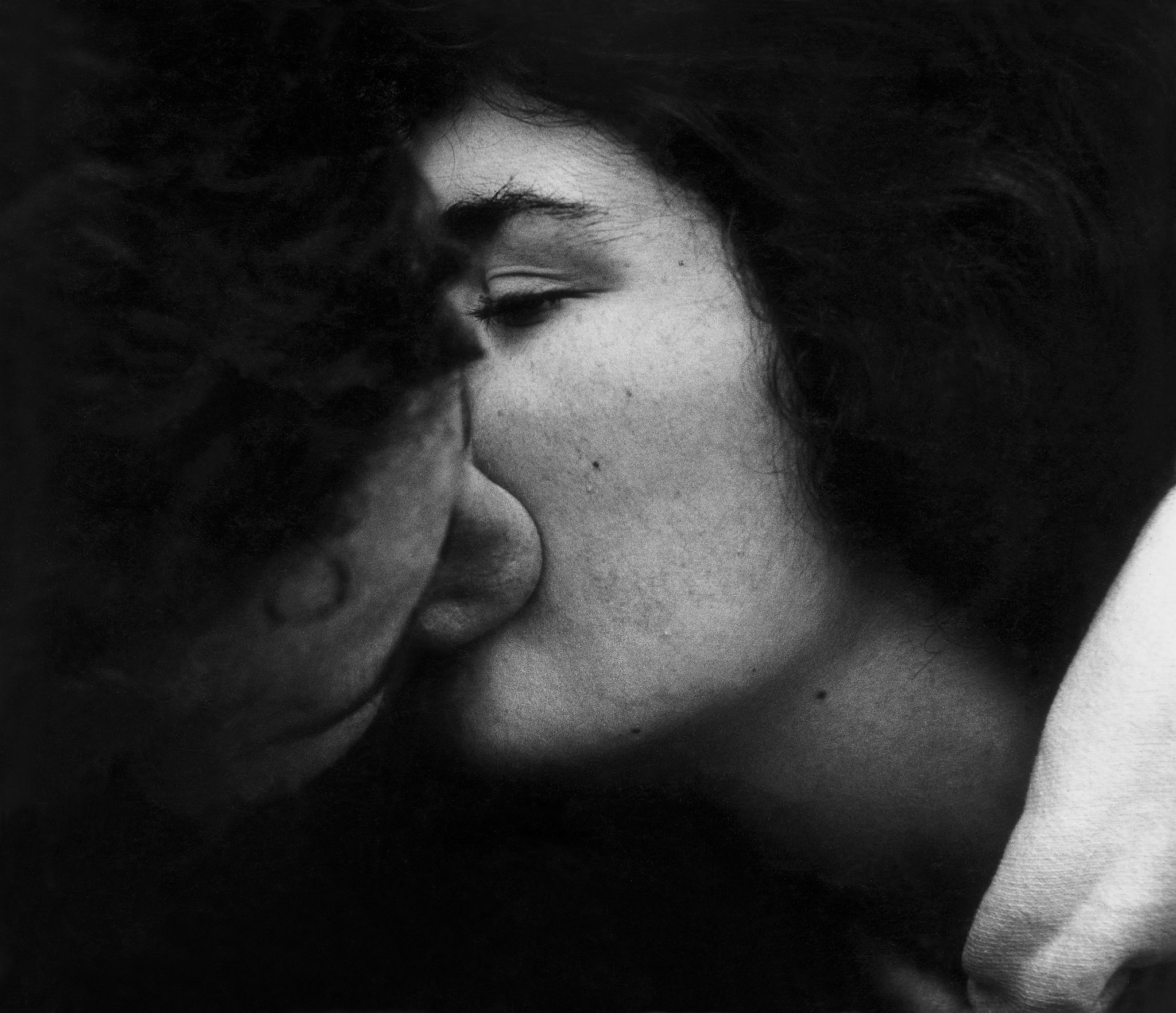
Dave Heath (Canadian born United States, 1931-2016) 'New York City (Young Couple Kissing)' 1962


Dave Heath (Canadian born United States, 1931-2016)
New York City (Young Couple Kissing)
1962
Gelatin silver print
© Dave Heath / Courtesy of Howard Greenberg Gallery, New York, and Stephen Bulger Gallery, Toronto


Dave Heath (Canadian born United States, 1931-2016) 'New York City' 1960


Dave Heath (Canadian born United States, 1931-2016)
New York City
1960
Gelatin silver print
© Dave Heath / Courtesy of Howard Greenberg Gallery, New York, and Stephen Bulger Gallery, Toronto


The Photographers’ Gallery, in collaboration with LE BAL Paris, presents Dave Heath: Dialogues with Solitudes; the first major UK exhibition dedicated to the work of this hugely influential American photographer (b. 1931 USA, d. 2016 Canada).

Heath’s psychologically charged images both reflect and respond to the alienation particularly prevalent in post war North American society. He was one of the first of a new generation of artists seeking new ways to try and make sense of the increasing sense of isolation and vulnerability that typified the age. Predominantly self-taught, Heath was nonetheless extremely informed and versed in the craft, theory and history of photography and taught extensively throughout his life. Although greatly influenced by W. Eugene Smith and the photographers of the Chicago School, including Aaron Siskind and Harry Callahan, Heath cannot be neatly pigeonholed as either a documentary or experimental photographer. His work feels more at home within a narrative or poetic tradition, where an interior reality takes precedence.

Heath was born in Philadelphia in 1931 and had a turbulent childhood, abandoned by his parents at the age of four and consigned to a series of foster homes before being placed in an orphanage. He first became interested in photography as a teenager, and joined an amateur camera club. He was fascinated by the photo essays in Life Magazine and cites one in particular as having a decisive impact on his future. Bad Boy’s Story by Ralph Crane, charted the emotional landscape of a young orphan. Not only did Heath identify with the protagonist, he immediately recognised the power of photography as a means of self expression and as a way of connecting to others. In the following years he trained himself in the craft, taking courses in commercial art, working in a photo processing lab, and studying paintings at the Philadelphia Museum of Art. While stationed in Korea with the US Army, he began to photograph his fellow soldiers, eschewing the drama of the battlefield for quiet and private moments of subdued reflection.

On his return, Heath dedicated himself to photography, continuing his interest with capturing an “inner landscape” and training his lens on anonymous strangers whom he identified as similarly lost or fragile. Although he photographed in mostly public spaces, on the streets of Chicago and New York (where he moved to in 1957), his subjects seem detached from their physical context, shot in close-up, articulated by their isolation. His frames possess an intensity of concentration, showing single figures or close-knit couples entirely wrapped up in their own world. An occasional sidelong glance conveys a momentary awareness of being photographed, but for the most part Heath is an unobserved, unobtrusive witness. By concentrating on the fragility of human connection, focusing on the personal over the political, Heath gave ‘voice’ to those largely unheard and joined a growing community of artists searching for alternative forms of expression. His work was pivotal in depicting the fractured feeling of societal unease just prior to the rise of the civil rights movement and opposition to the Vietnam War and his ground-breaking approaches to narrative and image sequence, his exquisite printing techniques, handmade book maquettes, multimedia slide presentations culminated in his poetic masterwork, A Dialogue with Solitude, 1965. This sensitive exploration of loss, pain, love and hope reveals Heath as one the most original photographers of those decades.

After 1970, Dave Heath devoted much of his time to teaching (in particular at Ryerson University, Toronto) in Canada, where he later became a citizen. He died in 2016.

Press release from The Photographers’ Gallery website [Online] Cited 25/05/2019


Dave Heath (Canadian born United States, 1931-2016) 'Philadelphia, 1952'


Dave Heath (Canadian born United States, 1931-2016)
Philadelphia
1952
Gelatin silver print
© Dave Heath / Courtesy of Howard Greenberg Gallery, New York, and Stephen Bulger Gallery, Toronto


Dave Heath (Canadian born United States, 1931-2016) 'Washington Square, New York City' 1960


Dave Heath (Canadian born United States, 1931-2016)
Washington Square, New York City
1960
Gelatin silver print
© Dave Heath / Courtesy of Howard Greenberg Gallery, New York, and Stephen Bulger Gallery, Toronto


Dave Heath (Canadian born United States, 1931-2016) 'Washington Square, New York City' 1960


Dave Heath (Canadian born United States, 1931-2016)
Washington Square, New York City
1960
Gelatin silver print
© Dave Heath / Courtesy of Howard Greenberg Gallery, New York, and Stephen Bulger Gallery, Toronto


Dave Heath (Canadian born United States, 1931-2016) 'Untitled' c. 1960


Dave Heath (Canadian born United States, 1931-2016)
Untitled
c. 1960
Gelatin silver print
© Dave Heath / Courtesy of Howard Greenberg Gallery, New York, and Stephen Bulger Gallery, Toronto


Dave Heath (Canadian born United States, 1931-2016) 'Elevated in Brooklyn, New York City' 1963


Dave Heath (Canadian born United States, 1931-2016)
Elevated in Brooklyn, New York City
1963
Gelatin silver print
© Dave Heath / Courtesy of Howard Greenberg Gallery, New York, and Stephen Bulger Gallery, Toronto


The Photographers’ Gallery
16-18 Ramillies Street
London
W1F 7LW

Opening hours:
Mon – Wed: 10.00 – 18.00
Thursday – Friday: 10.00 – 20.00
Saturday: 10.00 – 18.00
Sunday: 11.00 – 18.00

The Photographers’ Gallery website

LIKE ART BLART ON FACEBOOK

Back to top

Exhibition: ‘Jakob Tuggener – Machine time’ at Fotostiftung Schweiz, Winterthur, Zurich

Exhibition dates: 21st October, 2017 – 28th January, 2018

Curator: Martin Gasser


Jakob Tuggener (Swiss, 1904-1988) 'Fabrik' (book cover) 1943


Jakob Tuggener (Swiss, 1904-1988)
Fabrik (Factory) (book cover)
1943
Rotapfel Verlag, Erlenbach-Zurich


Rare magician, strange alchemist, tells stories through visuals

I am indebted to James McArdle’s blog posting “Work” on his excellent On This Date In Photography website for alerting me to this exhibition, and for reminding me of the work of this outstanding artist, Jakob Tuggener.

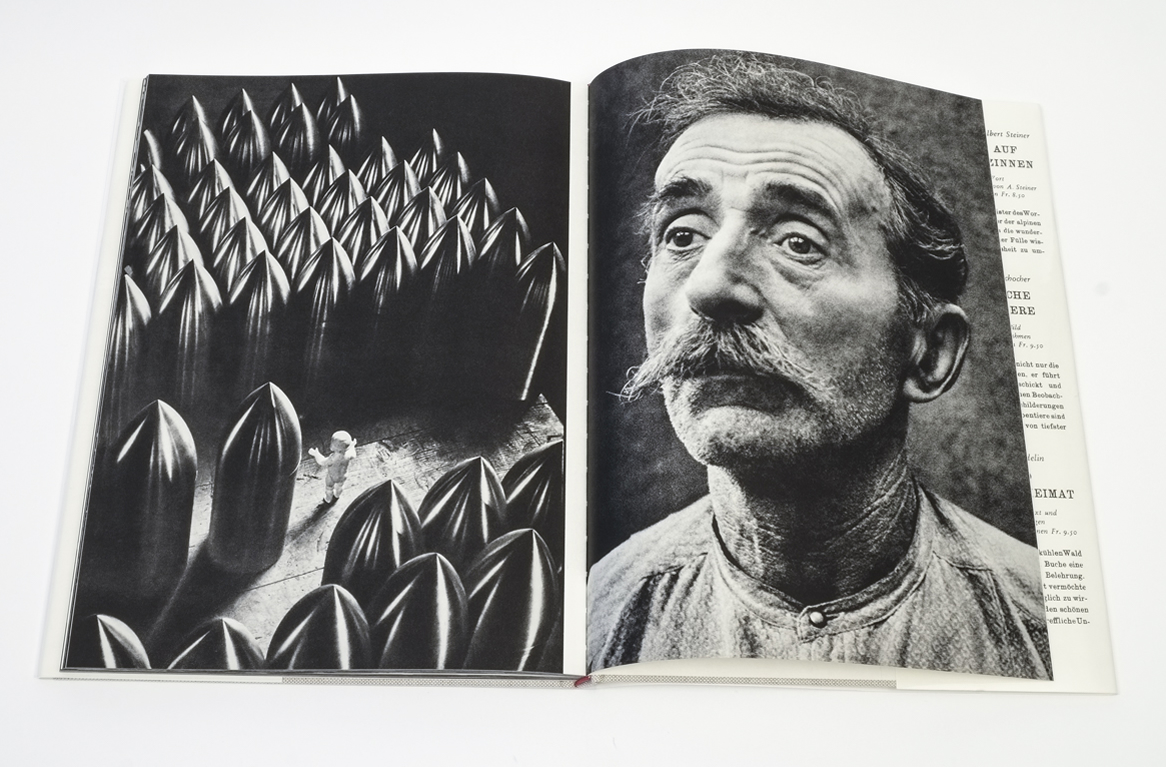
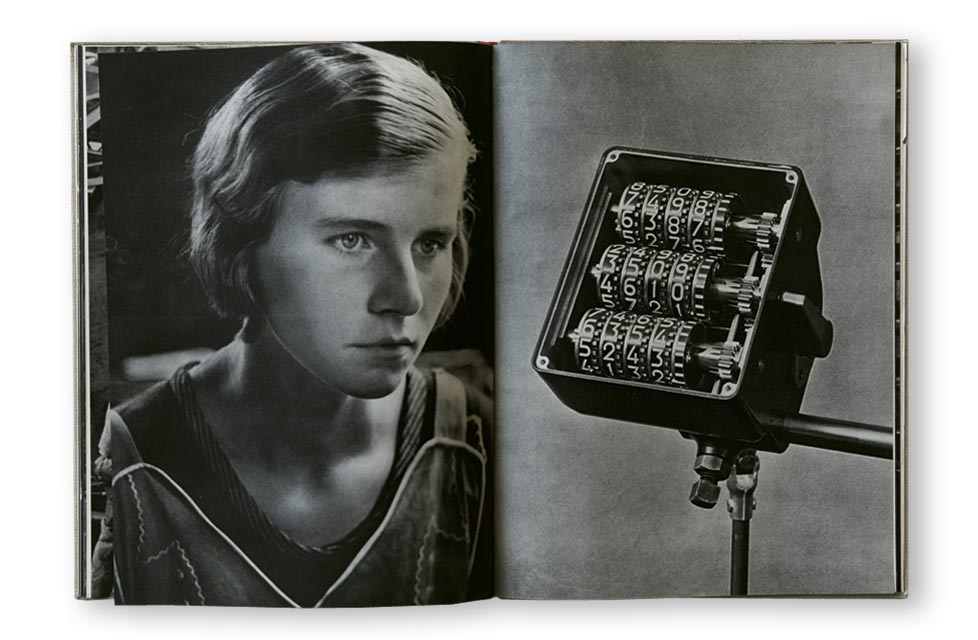
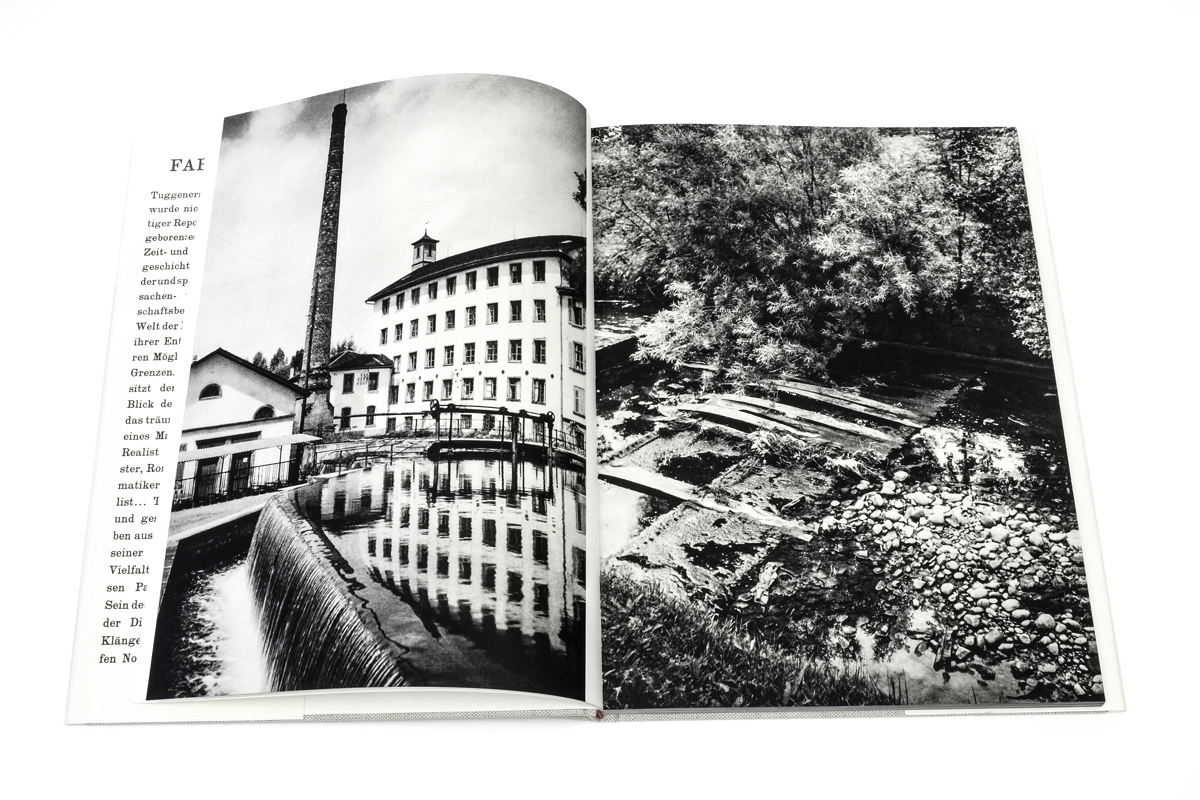
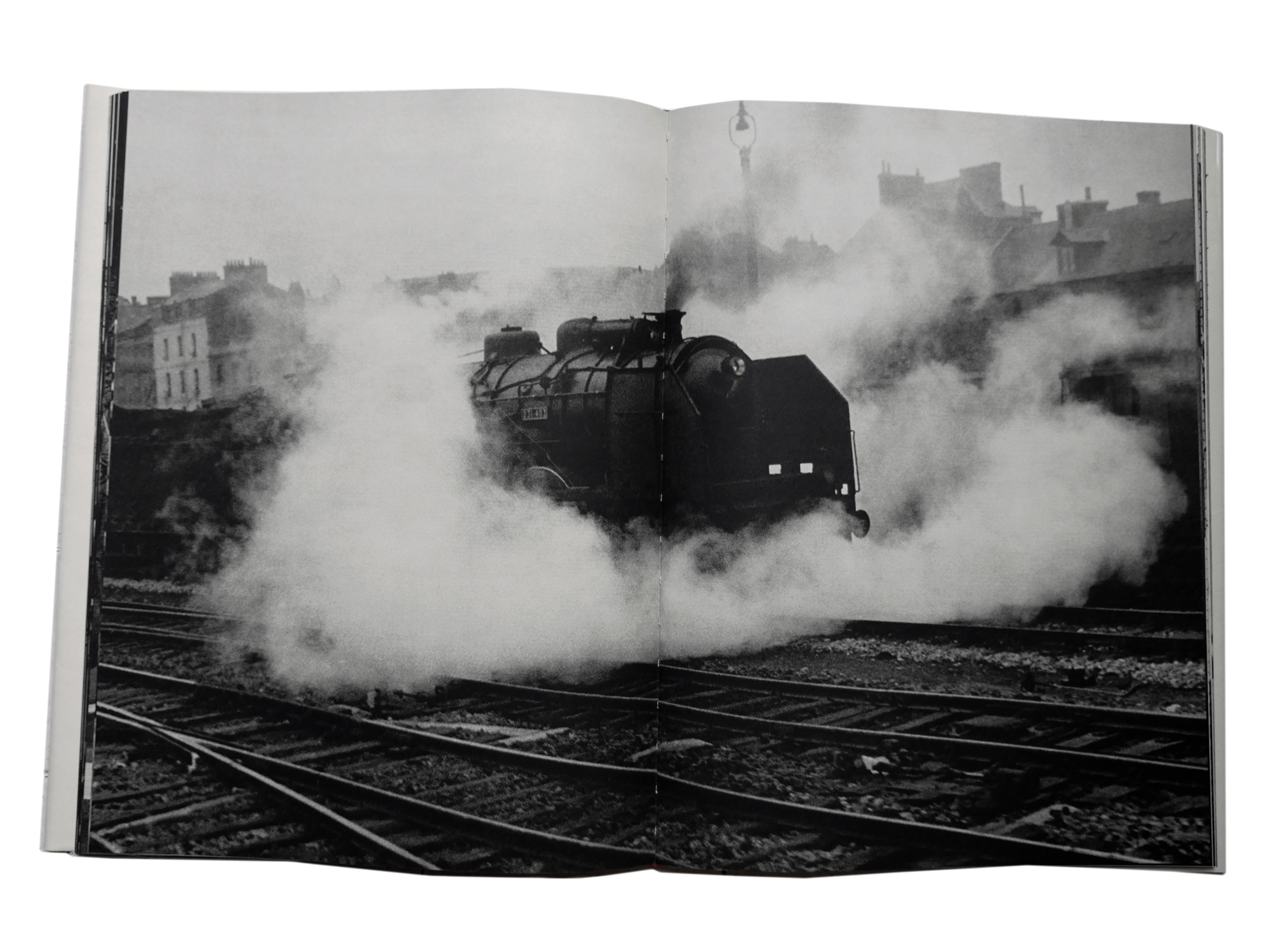
The short version: Jakob Tuggener was a draftsman before he became an artist, studying poster design, typography, photography and film. “In 1943, in the middle of the Second World War, Tuggerer’s book Fabrik (Factory) appeared. At first glance, the series of 72 photographs without a text contained therein seems to depict a kind of history of industrialisation – from the rural textile industry to mechanical engineering and high-voltage electrical engineering to modern power plant construction in the mountains. An in-depth reading, however, shows that Tuggener’s film-associative series of photographs simultaneously points to the destructive potential of unrestrained technological progress, as a result of which he sees the then raging World War, and for which the Swiss arms industry produced unlimited weapons. Tuggener was ahead of his time with the book conceived according to the laws of silent film.” (Press release)

Fabrik, subtitled Ein Bildepos der Technik (“Epic of the technological image” or “A picture of technology”) pictures the world of work and industry, and “is considered a milestone in the history of the photo book.” It uses expressive visuals (actions, appearances and behaviours; movements, gestures and details – Tuggener loves the detail) to tell a subjective story, that of the relationship between human and machine. While the book was well ahead of its time, and influenced the early work of that famous Swiss photographer Robert Frank, it did not emerge out of a vacuum and is perhaps not as revolutionary as some people think. Nothing ever appears out of thin air.

“German photographer Paul Wolff, often working in collaboration with Alfred Tritschler, produced a number of exceptional photo books through the 1920s and ’30s, at a time when Constructivism and the Bauhaus influenced many with visions “of an industrialized and socialized society” that placed Germany at “the forefront of European photography” (Martin Parr and Gerry Badger. The Photobook: A History Volume I, Phaidon Press, 2005, p. 86). Arbeit! (1937) is particularly noted for its architectural framing and lighting of massive machinery, its striking portraits of factory workers, and is frequently aligned with works such as Lewis Hine’s Men at Work (1932) and Albert Renger-Patzsch’s Eisen und Stahl (Iron and Steel) (1931).” (Anonymous. “Arbeit!,” on the Bauman Rare Books website [Online] Cited 03/02/2022)

François Kollar’s project La France travail (Working France) (1931-1934), E. O. Hoppé’s Deutsche Arbeit (1930), Heinrich Hauser’s Schwarzes Revier (Black Area) (1930) and Germaine Krull’s Metal (1928) all address the profound social and economic tensions that preceded the Second World War, through an avant-garde photography in the style of “New Vision” and “New Objectivity” – that is, through objective photographs that question common rules of composition, avoiding the more obvious ways subjects would have been photographed at the time. Obscure angles and perspectives abound in these striking photobooks, making their clinical, objective fervour “the great persuaders” of the 1930s and 40s, Modernist and propaganda books of their time.

What made Tuggener so different was the uncompromising subjectiveness of his work, “photographing the two worlds, privilege and labour.” His direct, strong images of factories and high society use wonderful form, light, and shadow to convey their message, never loosing sight of the human dimension, for they shift “our angle from the boss’ POV [point of view] to those unable to get any respite or distance from the situation,” that of the workers. They are a piece of time and human history, which gets closer to the lived reality of the factory floor, than much of the work of his predecessors. Tuggener portrays the mundanity of the “operational sequence” (la chaîne opératoire) of the machine, where the human becomes the oil used to grease the cogs of the ever-demanding “mechanical monsters.” (See Evan Calder Williams’ “Rattling Devils” quotations below)

Tuggener then adds to this new way of seeing which recorded the multiplicity of his points of view – “a modern new style of photography showing not just how things looked, but how it felt to be there” – through the sequencing of the images, which can be seen in the wonderfully combined double pages of the Fabrik book layouts below. Take for example, the photograph that is on the dust jacket, a portrait of a middle-aged worker with a grave look on his face that says, “why the hell are you taking my photograph, why don’t you just f… off.” In the book, Tuggener pairs this image with a whistle letting off steam, a metaphor for the man’s state of being. Tuggener creates these most alien worlds from the inside out, worlds which are grounded in actual lived experience – the little screws lying in the palm of a blackened hand; Navy Cut cigarettes amongst steel artefacts; man being consumed by machine; man being dwarfed by machine; man as machine (the girl paired opposite the counting machine); the Frankenstein scenario of the laboratory (man as monster, machine as man); the intense, feverish eyes of the worker in Heater on electric furnace (the machine human as the devil); and the surrealism of a small doll among the serried ranks of mass destruction, facing the opposition, the opposing lined face of an older worker. This is the stuff of alchemy, the place where art challenges life.

“As Arnold Burgaurer cogently states in his introduction, Tuggener is a jack-of-all-trades: he exhibits, ‘the sharp eye of the hunter, the dreamy eye of the painter; he can be a realist, a formalist, romantic, theatrical, surreal.’ Tuggener’s moves effortlessly between large-format lucidity and grainy, blurred impressionism, in a book that is a decade ahead of its time.” (Martin Parr and Gerry Badger. The Photobook: A History Volume I, Phaidon Press, 2005, p. 144.)

James McCardle observes that, “the meaning of Fabrik is left to the viewer to discover between its pictures, its glimpses of an overwhelming industrial whole; it is essentially filmic on a cryptic film-noir level, a revelation to Frank.” Tuggener’s influence on the early work of Robert Frank can be seen in a sequence from the book Portfolio: 40 Photos 1941/1946 by Robert Frank that was republished by Steidl in 2009 (see below). “Like Tuggener, Frank tackles the task of seemingly incongruous subject matter and finds a harmony through edit and assembly. Again and again throughout this portfolio, Frank is not just trying to show his prowess in making images but in pairing them. They define conflicts in life.” Pace Tuggener. At Frank’s suggestion, Tuggener’s work appeared in both Edward Steichen’s Post-War European Photography and in The Museum of Modern Art’s seminal exhibition, The Family of Man, the latter an essentially humanist exhibition which took the form of a photo essay celebrating the universal aspects of the human experience.

McCardle goes onto suggest that Fabrik, as a photo book, was a model for Frank’s Les Américains: The Americans published fifteen years later in Paris by Delpire, 1958. On this point, we disagree. While his early work as seen in Portfolio: 40 Photos 1941/1946 may have been heavily influenced by Tuggener’s photo book, by the time Frank came to compose Les Américains (for that is what The Americans is, a composition) his point of view had changed, as had that of his camera. While The Americans has many formal elements that can be seen in the construction of the photographs, they also have an element of jazz that would have been inconceivable to Tuggener at that time. Grainy film, strange angles, lighting flare, street lights, night time photography, jukeboxes and American flags portray the American dream not so much from the vantage point of a knowing insider (as Tuggener was) but as a visitor from another planet. Not so much alienating world (man as machine) as alien world, picturing something that has never been recognised before. These are two different models of being. While both are photo books and both pair images together in sequences, Frank had moved on to another point of view, that of an “invalid” outsider, and his photo book has a completely different nature to that of Tuggener’s Fabrik.

Dr Marcus Bunyan

Word count: 1,366


Many thankx to Fotostiftung Schweiz for allowing me to publish some of the photographs in the posting. Please click on the photographs for a larger version of the image.


For Jakob Tuggener, whose works can be seen within the context of social documentary photography, the individual and the industrial boom of the 19th and 20th centuries were central themes. His often somber, black and white photographs seem to confront this new world with a sense of fear as well as admiration. Will technology help relieve us of physically hard labour or replace us altogether? Tuggener owes his renown to his photo book Fabrik (Factory) that was published in 1943. With an aesthetic approach that was unique for his time, Tuggener explores in his photographic essay the relationship between humans and the perceived threat as well as progress of technology. The labourers depicted are grave, their faces worn marked by deep folds, while a factory building in the background stands strong, enveloped in a vaporous cloud. This “Pictorial Epic of Technology,” as Tuggener himself described it, is today considered a milestone in the history of photography books.


Jakob Tuggener (Swiss, 1904-1988) Page layout from the book 'Fabrik' 1943

Jakob Tuggener (1904-1988) Page layout from the book Fabrik 1943


Jakob Tuggener (Swiss, 1904-1988) 'Steam whistle, Steckborn artificial silk factory' 1938 from the exhibition Exhibition: 'Jakob Tuggener – Machine time' at Fotostiftung Schweiz, Winterthur, Zurich, Oct 2017 - Jan 2018


Jakob Tuggener (Swiss, 1904-1988)
Steam whistle, Steckborn artificial silk factory
1938
Silver gelatin print
© Jakob Tuggener-Stiftung


Selection from the book 'Portfolio: 40 Photos 1941/1946' by Robert Frank


Selection from the book Portfolio: 40 Photos 1941/1946 by Robert Frank (Steidl, 2009)


The ‘weightless’ and the ‘grounded’ are two opposing themes that Frank repeatedly uses to move us through this sequence. Three radio transistors in a product shot float into the sky while a music conductor, his band and a church steeple succumb to gravity on the facing page. Even in this image Frank shifts focus to the sky and beyond – the weightless. When he photographs rural life, the farmers heft whole pigs into the air and another carries a huge bale of freshly cut grain which seems featherlight but for the woman trailing behind with hands ready to assist.

Considering this work was made while fascism was on the move through Europe, external politics is felt through metaphor. A painted portrait of men in uniform among a display of pots and pans for sale faces a brightly polished cog from a machine – its teeth sharp and precise. In another pairing, demonstrators waving flags in the streets of Zurich face a street sign covered with snow and frost, a Swiss flag blows in the background. in yet another of a crowd of spectators face the illuminated march of a piece of machinery – its illusory shadow filling in the ranks. These pairings feel under the influence of Jakob Tuggener, whose work Frank certainly knew. Like Tuggener, Frank tackles the task of seemingly incongruous subject matter and finds a harmony through edit and assembly.

Again and again throughout this portfolio, Frank is not just trying to show his prowess in making images but in pairing them. They define conflicts in life. One boy struggles to climb a rope while a ski jumper is frozen in flight. Fisherman bask in sunlight while two pedestrians are caught in blinding snowfall.

Text from the SB4 Photography and Books website December 14, 2009


Jakob Tuggener (Swiss, 1904-1988) 'Autoritratto, Zurigo [Self-portrait, Zurich]' 1927 from the exhibition Exhibition: 'Jakob Tuggener – Machine time' at Fotostiftung Schweiz, Winterthur, Zurich, Oct 2017 - Jan 2018


Jakob Tuggener (Swiss, 1904-1988)
Autoritratto, Zurigo (Self-portrait, Zurich)
1927
Silver gelatin print
© Jakob Tuggener-Stiftung


Jakob Tuggener (Swiss, 1904-1988) 'Budenzauber (Charm of the Attic Room) Jakob Tuggener with friends' 1935


Jakob Tuggener (Swiss, 1904-1988)
Budenzauber (Charm of the Attic Room) Jakob Tuggener with friends
1935
Silver gelatin print
© Jakob Tuggener-Stiftung


Jakob Tuggener (Swiss, 1904-1988) 'Plant entrance, Oerlikon Machine Factory' 1934


Jakob Tuggener (Swiss, 1904-1988)
Plant entrance, Oerlikon Machine Factory
1934
Silver gelatin print
© Jakob Tuggener-Stiftung


Jakob Tuggener (Swiss, 1904-1988) 'Work in the boiler' 1935


Jakob Tuggener (Swiss, 1904-1988)
Work in the boiler
1935
Silver gelatin print
© Jakob Tuggener-Stiftung


Jakob Tuggener (Swiss, 1904-1988) 'Running girl in the Maschinenfabrik Oerlikon' 1934


Jakob Tuggener (Swiss, 1904-1988)
Running girl in the Maschinenfabrik Oerlikon
1934
Silver gelatin print
© Jakob Tuggener-Stiftung


Jakob Tuggener (Swiss, 1904-1988) 'Façade, Oerlikon Machine Factory' 1936


Jakob Tuggener (Swiss, 1904-1988)
Façade, Oerlikon Machine Factory
1936
Silver gelatin print
© Jakob Tuggener-Stiftung


Jakob Tuggener (Swiss, 1904-1988) Page layout from the book 'Fabrik' 1943

Jakob Tuggener (1904-1988) Page layout from the book Fabrik 1943


Jakob Tuggener (Swiss, 1904-1988) 'Nell'ufficio della fonderia, fabbrica di costruzioni meccaniche Oerlikon' [In the foundry office, Oerlikon mechanical engineering factory] 1937


Jakob Tuggener (Swiss, 1904-1988)
Nell’ufficio della fonderia, fabbrica di costruzioni meccaniche Oerlikon (In the foundry office, Oerlikon mechanical engineering factory)
1937
From Fabrik 1933-1953
Silver gelatin print
© Jakob Tuggener-Stiftung


“Above all, the contrast between the brilliantly lit ballroom and the dark factory hall influenced the perception of his artistic oeuvre,” [curator] Martin Gasser explains. “Tuggener also positioned himself between these two extremes when he stated: ‘Silk and machines, that’s Tuggener’. In reality, he loved both: the wasteful luxury and the dirty work, the enchanting women and the sweaty labourers. For him, they were both of equal value and he resisted being categorised as a social critic who pitted one world against the other. On the contrary, these contrasts belonged to his conception of life and he relished experiencing the extremes – and the shades of tones in between – to the most intense degree.”


“Jakob Tuggener’s ‘Fabrik’, published in Zurich in 1943, is a milestone in the history of the photography book. Its 72 images, in the expressionist aesthetic of a silent movie, impart a skeptical view of technological progress: at the time the Swiss military industry was producing weapons for World War II. Tuggener, who was born in 1904, had an uncompromisingly critical view of the military-industrial complex that did not suit his era. His images of rural life and high-society parties had been easy to sell, but ‘Fabrik’ found no publisher. And when the book did come out, it was not a commercial success. Copies were sold at a loss and some are believed to have been pulped. Now this seminal work, which has since become a sought-after classic, is being reissued with a contemporary afterword. In his lifetime, Tuggener’s work appeared – at Robert Frank’s suggestion – in Edward Steichen’s ‘Post-War European Photography’ and in The Museum of Modern Art’s seminal exhibition, ‘The Family of Man’, in whose catalogue it remains in print. Tuggener’s death in 1988 left an immense catalogue of his life’s work, much of which has yet to be shown: more than 60 maquettes, thousands of photographs, drawings, watercolours, oil paintings and silent films.”


Book description on Amazon. The book has been republished by Steidl in January, 2012.


Jakob Tuggener (Swiss, 1904-1988) 'Tornos Machine-tool Factory, Moutier' 1942


Jakob Tuggener (Swiss, 1904-1988)
Tornos Machine-tool Factory, Moutier
1942
Silver gelatin print
© Jakob Tuggener-Stiftung


Jakob Tuggener (Swiss, 1904-1988) 'Navy Cut, Ateliers de construction mécanique Oerlikon (MFO)' [Navy Cut, Machine Shops Oerlikon (MFO)] 1940


Jakob Tuggener (Swiss, 1904-1988)
Navy Cut, Ateliers de construction mécanique Oerlikon (MFO) [Navy Cut, Machine Shops Oerlikon (MFO)]
1940
Silver gelatin print
© Jakob Tuggener-Stiftung


Jakob Tuggener (Swiss, 1904-1988) 'Pressure pipe, Vernayaz' 1938


Jakob Tuggener (Swiss, 1904-1988)
Pressure pipe, Vernayaz
1938
Silver gelatin print
© Jakob Tuggener-Stiftung


Jakob Tuggener (Swiss, 1904-1988) 'Grande Dixence power station' 1942


Jakob Tuggener (Swiss, 1904-1988)
Grande Dixence power station
1942
Silver gelatin print
© Jakob Tuggener Foundation


Jakob Tuggener (Swiss, 1904-1988) 'Laboratorio di ricerca, fabbrica di costruzioni meccaniche Oerlikon' [Research laboratory, Oerlikon mechanical engineering factory] 1941


Jakob Tuggener (Swiss, 1904-1988)
Laboratorio di ricerca, fabbrica di costruzioni meccaniche Oerlikon (Research laboratory, Oerlikon mechanical engineering factory)
1941
From Fabrik 1933-1953
Silver gelatin print
© Jakob Tuggener-Stiftung


Jakob Tuggener (Swiss, 1904-1988) 'Heater on electric furnace' 1943 (detail)


Jakob Tuggener (Swiss, 1904-1988)
Heater on electric furnace (detail)
1943
Silver gelatin print
© Jakob Tuggener-Stiftung


Jakob Tuggener (Swiss, 1904-1988) 'Heater on electric furnace' 1943


Jakob Tuggener (Swiss, 1904-1988)
Heater on electric furnace
1943
Silver gelatin print
© Jakob Tuggener-Stiftung


Jakob Tuggener (Swiss, 1904-1988) 'Worker, Maschinenfabrik Oerlikon' 1940s


Jakob Tuggener (Swiss, 1904-1988)
Worker, Maschinenfabrik Oerlikon
1940s
Silver gelatin print
© Jakob Tuggener Foundation


Jakob Tuggener (Swiss, 1904-1988) '"Amore", Maschinenfabrik Oerlikon' 1940s


Jakob Tuggener (Swiss, 1904-1988)
“Amore”, Maschinenfabrik Oerlikon
1940s
Silver gelatin print
© Jakob Tuggener Foundation


Jakob Tuggener (Swiss, 1904-1988) 'Weaving mill, Glattfelden' 1940s


Jakob Tuggener (Swiss, 1904-1988)
Weaving mill, Glattfelden
1940s
Silver gelatin print
© Jakob Tuggener Foundation


Jakob Tuggener (Swiss, 1904-1988) 'Lathe, Maschinenfabrik Oerlikon' 1949


Jakob Tuggener (Swiss, 1904-1988)
Lathe, Maschinenfabrik Oerlikon
1949
Silver gelatin print
© Jakob Tuggener-Stiftung


Jakob Tuggener (Swiss, 1904-1988) 'Lathe, Maschinenfabrik Oerlikon' 1949 (detail)


Jakob Tuggener (Swiss, 1904-1988)
Lathe, Maschinenfabrik Oerlikon (detail)
1949
Silver gelatin print
© Jakob Tuggener-Stiftung


Jakob Tuggener (Swiss, 1904-1988) 'Jacob Tuggener at the popular pavillion Montpellier manufactures an epic of industrial photographs of workers' portraits' Montpellier magazine 1943


Jakob Tuggener (Swiss, 1904-1988)
Jacob Tuggener at the popular pavillion Montpellier manufactures an epic of industrial photographs of workers’ portraits
Montpellier magazine
1943
© Jakob Tuggener-Stiftung


Jakob Tuggener (Swiss, 1904-1988) 'Forgeron dans une fabrique de wagons de Schlieren' [Blacksmith in a Schlieren wagon factory] 1949


Jakob Tuggener (Swiss, 1904-1988)
Forgeron dans une fabrique de wagons de Schlieren [Blacksmith in a Schlieren wagon factory]
1949
Silver gelatin print
© Jakob Tuggener-Stiftung


Jakob Tuggener (Swiss, 1904-1988) 'Untitled (Arms of work)' c. 1947


Jakob Tuggener (Swiss, 1904-1988)
Untitled (Arms of work)
c. 1947
Silver gelatin print
© Jakob Tuggener-Stiftung


Jakob Tuggener (1904-1988) is one of the exceptional phenomena of Swiss photography. His personal and expressive recordings of glittering celebrations of better society are legendary, and his 1943 book Fabrik (Factory) is considered a milestone in the history of the photo book. At the centre of the exhibition “Machine time” are photographs and films from the world of work and industry. They not only reflect the technical development from the textile industry in the Zurich Oberland to power plant construction in the Alps, but also testify to Tuggener’s lifelong fascination with all sorts of machines: from looms to smelting furnaces and turbines to locomotives, steamers and racing cars. He loved her noise, her dynamic movements and her unruly power, and he artistically transposed them. At the same time, he observed the men and women who keep up the motor of progress with their work – not without hinting that one day machines might dominate people.

Machine time

Jakob Tuggener knew the world of factories like no other photographer of his time, having completed an apprenticeship as a draftsman at Maag Zahnräder AG in Zurich and then worked in their design department. Through the photographer Gustav Maag he was also introduced to the technique of photography. However, as a result of the economic crisis in the late 1920s, he was dismissed, after which he fulfilled his childhood dream of becoming an artist by studying at the Reimannschule in Berlin. For almost a year he dealt intensively with poster design, typography and film and let himself be carried away with his camera by the dynamics of the big city.

After returning to Switzerland in 1932, he began working as a freelancer for the Maschinenfabrik Oerlikon (MFO), especially for their house newspaper with the programmatic title Der Gleichrichter (The Rectifier). Although the company already employed its own photographer, he was entrusted with the task of developing a kind of photographic interior view of the company. This was intended to bridge the gap between workers and office workers on the one hand and management on the other. By the end of the 1930s, in addition to multi-part reports from the production halls, as well as portraits of “members of the MFO family”, one-sided, album-like series of unnoticed scenes from everyday factory life appeared. From 1937 Tuggener also created a series of 16mm short films – always black and white, silent, and representing the tension between fiction and documentation. This includes, for example, the drama about death and transience (Die Seemühle (The Sea mill), 1944), which was influenced by surrealism and staged by Tuggener with amateur actors in a vacant factory on the shores of Lake Zurich. or the cinematic exploration of the subject of man and machine (Die Maschinenzeit (The Machine Time), 1938-1970). This ties in with the earlier book maquette of the same name and transforms it into a moving, immediately perceptible, but also fleeting vision of the Tuggenean machine age.

In 1943, in the middle of the Second World War, Tuggerer’s book Fabrik (Factory) appeared. At first glance, the series of 72 photographs without a text contained therein seems to depict a kind of history of industrialisation – from the rural textile industry to mechanical engineering and high-voltage electrical engineering to modern power plant construction in the mountains. An in-depth reading, however, shows that Tuggener’s film-associative series of photographs simultaneously points to the destructive potential of unrestrained technological progress, as a result of which he sees the then raging World War, and for which the Swiss arms industry produced unlimited weapons. Tuggener was ahead of his time with the book conceived according to the laws of silent film.1 Neither his uncompromisingly subjective photography nor his critical attitude matched the threatening situation in which Switzerland was called to unity and strength under the slogan “Spiritual Defense”.

Although the book was not commercially successful, Tuggener’s Fabrik was a great artistic success and continued to explore the issues of work and industry. He produced two more book maquettes: Schwarzes Eisen (Black Iron) (1950) and Die Maschinenzeit (The Machine Time) (1952). They can be understood as a kind of continuation of the published book, which the journalist Arnold Burgauer described as a “glowing and sparkling factual and accountable report of the world of the machine, of its development, its possibilities and limitations.” In the mid-1950s, on the threshold of the computer age, Tuggener’s classic “machine time” came to an end. On the one hand, the mechanical processes that had so fascinated Tuggener evaded his eyes. On the other hand, he could not or did not want to make friends with the idea that one day even a human heart could be replaced by a machine.

Portrayer of opposites

As early as 1930 in Berlin, Tuggener had begun to take pictures of the then famous Reimannschule balls. He was fascinated by the tingling erotic atmosphere of these occasions, and he found photography in sparsely lit rooms a great challenge. Back in Zurich, he immediately plunged into local nightlife to surrender to the splendour and luxury of mask, artist and New Year’s balls. Again and again he let himself be abducted by elegant ladies with their silk dresses, their necklines, bare back or shoulders in a glittering fairytale world, whose mysterious facets he sought to fathom with his Leica. Although Tuggener’s ball recordings were only perceived by a small insider audience for a long time, many quickly saw him as a “masterful portrayer of our world of stark contrasts,” a world torn between a brightly lit ballroom and gloomy factory hall. Tuggener also positioned himself between these extremes when he stated, “Silk and machines, that’s Tuggener.” Because he loved both the lavish luxury and the dirty work, the jewelled women and the sweaty men. He felt that he was equal and resisted being classified as a social critic.

In whatever world he moved, Jakob Tuggener did it with the elegance of a grand seigneur [a man whose rank or position allows him to command others]. He was an eye man with a casual, loving look for the inconspicuous, the superficial incident; not just a sensitive picture-poet, but the “photographische Dichter römisch I,” as he used to call himself self-confidently. Critic Max Eichenberger wrote of the Fabrik photographs: “Tuggener is able to make factory photographs that reveal not only a painter, but also a poet, and a rare magician and strange alchemist – lead, albeit modestly turned into gold.”

The exhibition Jakob Tuggener – Maschinenzeit includes vintage and later prints from the early 1930s to the late 1950s, which for the most part come from the photographers estate. In an adjoining room the exhibition will also feature a selection of his 16mm short films from the years 1937-1970, which revolve around the topic of “man and machine” in various ways. These films were newly digitised specifically for the exhibition (in collaboration with Lichtspiel / Cinematheque Bern).

Press release from Fotostiftung Schweiz


1/ The story in silent film is best told through visuals (such as actions, appearances and behaviours). Focus on movements and gestures, and borrow from dance and mime. Large, exaggerated motions translate well to silent films, but balance these also with subtlety (ie. a raised eyebrow, a quivering lip – especially when paired with a close-up shot).
Karlanna Lewis. “8 Tips for Making Silent Movies,” on the Raindance website June 1, 2014 [Online] Cited 03/02/2022


Jakob Tuggener (Swiss, 1904-1988) Page layout from the book 'Fabrik' 1943

Jakob Tuggener (Swiss, 1904-1988) Page layout from the book 'Fabrik' 1943

Jakob Tuggener (Swiss, 1904-1988) Page layout from the book 'Fabrik' 1943

Jakob Tuggener (Swiss, 1904-1988) Page layout from the book 'Fabrik' 1943

Jakob Tuggener (Swiss, 1904-1988) Page layout from the book 'Fabrik' 1943

Jakob Tuggener (Swiss, 1904-1988) Page layout from the book 'Fabrik' 1943

Jakob Tuggener (Swiss, 1904-1988) Page layout from the book 'Fabrik' 1943

Jakob Tuggener (Swiss, 1904-1988) Page layout from the book 'Fabrik' 1943

Jakob Tuggener (Swiss, 1904-1988) Page layout from the book 'Fabrik' 1943

Jakob Tuggener (Swiss, 1904-1988) Page layout from the book 'Fabrik' 1943

Jakob Tuggener (Swiss, 1904-1988) Page layout from the book 'Fabrik' 1943

Jakob Tuggener (Swiss, 1904-1988) Page layout from the book 'Fabrik' 1943

Jakob Tuggener (Swiss, 1904-1988) Page layout from the book 'Fabrik' 1943

Jakob Tuggener (Swiss, 1904-1988) Page layout from the book 'Fabrik' 1943

Jakob Tuggener (Swiss, 1904-1988) Page layout from the book 'Fabrik' 1943

Jakob Tuggener (1904-1988) Page layouts from the book Fabrik 1943


Extracts from Shard Cinema by Evan Calder Williams London: Repeater Books, 2017

“All gestures are perhaps inhuman, because they enact that hinge with the world, forging a bridge and buffer that can’t be navigated by words or by actions that feel like purely one’s own. In Vilém Flusser’s definition, a gesture is “a movement of the body or of a tool connected to the body for which there is no satisfactory causal explanation” – that is, it can’t be explained on its own isolated terms.26 The factory will massively extend this tendency, because the “explanation” lies not in the literal circuit of production but in the social abstraction of value driving the entire process yet nowhere immediately visible. We might frame the difficulty of this imagining with the concept of “operational sequence” (la chaîne opératoire), posed by French archaeologist André Leroi-Gourhan, which designates a “succession of mental operations and technical gestures, in order to satisfy a need (immediate or not), according to a preexisting project.”25

26. Vilém Flusser, Gestures (Minneapolis: University of Minnesota Press, 2014), p. 2.
27. Catherine Perlès, Les Industries Lithiques Taillées de Franchthi, Argolide: Presentation Generate et Industries Paleolithiques (Terre Haute: Indiana University Press, 1987), p. 23.


“Which is to say: we build factories. And in those factories, the process of the exteriorization of memory and muscle becomes almost total, as “the hand no longer intervenes except to feed or to stop” what Leroi-Gourhan, like Larcom, will call “mechanical monsters,” “machines without a nervous system of their own, constantly requiring the assistance of a human partner.”30 But along with engendering the panic of becoming caregiver to the inanimate, this also poses the problem of animation in an unprecedented way. Because if a “technical gesture is the producer of forms, deriving them from inert nature and preparing them for animation,” the factory constitutes us in a different network of the animated and animating.31 It’s a network that can be seen in those writings of factory workers, with their distinct sense of not just preparing those materials but becoming the pivot that eases, smooths, and guides the links of an operational sequence. In particular, a worker functions as the point of compression and transformation between tremendous motive force and products made whose regularity must be assured. The human becomes the regulator of this process, the assurance of an abstract standardization.”

30 André Leroi-Gourhan, Gesture and Speech, trans. Anna Bostock Berger (Cambridge, MA: MIT Press, 1993), p. 246
31. Ibid., p. 313


“… what I’m sketching here in this passage through scattered materials of the century prior to filmed moving images is something simpler, a small corrective to insist that by the time cinema was becoming a medium that seemed to offer a novel form of mechanical time, motion, and vision, one that historians and theorists will fixate on as the unique province and promise of film, many of its viewers had themselves already been enacting and struggling against that form for decades, day in, day out. The point is to place the human operator back in the frame, to ask after those who tended the machine before it was available as a spectacle, and to listen to how they understood what they were tangled in the midst of. But this is neither a humanist gesture of assuring the centrality of the person in the mesh that holds them nor a historical rejoinder to the forgetting and active dismissal of many of these personal accounts. Rather, it’s an effort to show how only with the operator’s experience made central can we see the real historical destruction of such illusions of centrality and, in their place, the novel construction of the human as tender and mender of a flailing inhuman net, the pivot who forms the connective tissue that enacts the lethal animation around her. In short, to see how the real subsumption of labor to capital is not only a systemic or periodizing concept that marks the historical transformation of discrete activities in accordance with the abstractions of value. It also is the granular description of a lived and bitterly contested process by which those abstractions get corporally and mechanically made and unmade, one which we can understand differently if we shift our angle from the boss’ POV to those unable to get any respite or distance from the situation.”

Excerpt from Evan Calder Williams. “Rattling Devils,” on the Viewpoint Magazine website July 13, 2017 [Online] Cited 29/12/2017


Jakob Tuggener (Swiss, 1904-1988) 'Ballo ungherese, Grand Hotel Dolder, Zurigo, 1935' [Hungarian dance, Grand Hotel Dolder, Zurich, 1935] 1935


Jakob Tuggener (Swiss, 1904-1988)
Ballo ungherese, Grand Hotel Dolder, Zurigo, 1935 (Hungarian dance, Grand Hotel Dolder, Zurich, 1935)
1935
From the series Nuits de bal, 1934-1950
Silver gelatin print
© Jakob Tuggener-Stiftung


Jakob Tuggener (Swiss, 1904-1988) 'Ballo ungherese, Grand Hotel Dolder, Zurigo, 1935' [Hungarian dance, Grand Hotel Dolder, Zurich, 1935] 1935


Jakob Tuggener (Swiss, 1904-1988)
Ballo ungherese, Grand Hotel Dolder, Zurigo, 1935 (Hungarian dance, Grand Hotel Dolder, Zurich, 1935)
1935
From the series Nuits de bal, 1934-1950
Silver gelatin print
© Jakob Tuggener-Stiftung


Jakob Tuggener (Swiss, 1904-1988) 'Hotel Belvédère, Davos, 1944' 1944


Jakob Tuggener (Swiss, 1904-1988)
Hotel Belvédère, Davos, 1944
1944
From the series Nuits de bal, 1934-1950
Silver gelatin print
© Jakob Tuggener-Stiftung


Jakob Tuggener (Swiss, 1904-1988) 'Carlton hotel, St. Moritz' Nd


Jakob Tuggener (Swiss, 1904-1988)
Carlton hotel, St. Moritz
Nd
From the series Nuits de bal, 1934-1950
Silver gelatin print
© Jakob Tuggener-Stiftung


Jakob Tuggener (Swiss, 1904-1988) 'Palace hotel, St. Moritz' 1948-1949


Jakob Tuggener (Swiss, 1904-1988)
Palace Hotel, St. Moritz, San Silvestro
1948-49
From the series Nuits de bal, 1934-1950
Silver gelatin print
© Jakob Tuggener-Stiftung


Jakob Tuggener (Swiss, 1904-1988) 'Ballo Acs, Grand Hotel Dolder, Zurigo, 1948' 1948


Jakob Tuggener (Swiss, 1904-1988)
Ballo Acs,Grand Hotel Dolder, Zurigo, 1948
1948
From the series Nuits de bal, 1934-1950
Silver gelatin print
© Jakob Tuggener-Stiftung


Jakob Tuggener (Swiss, 1904-1988) 'Ball Nights' 1934-1950


Jakob Tuggener (Swiss, 1904-1988)
Ball Nights
From the series Nuits de bal, 1934-1950
Silver gelatin print
© Jakob Tuggener-Stiftung


Fotostiftung Schweiz
Grüzenstrasse 45
CH-8400 Winterthur (Zürich)
Phone: +41 52 234 10 30

Opening hours:
Tuesday – Saturday 11am – 6pm
Wednesday 11am – 8pm
Closed on Mondays

Fotostiftung Schweiz website

LIKE ART BLART ON FACEBOOK

Back to top

Exhibition: ‘Wayne Sorce: Urban Color’ at Joseph Bellows Gallery, La Jolla, California

Exhibition dates: 21st October – 30th November, 2017


Wayne Sorce (American, b. 1946) 'Vinegar Hill, New York' 1985 from the exhibition 'Wayne Sorce: Urban Color' at Joseph Bellows Gallery, La Jolla, California, October - Nov, 2017


Wayne Sorce (American, b. 1946)
Vinegar Hill, New York
1985
Digital chromogenic print
20 x 24 inches


These remind me very strongly of the 1970s urban Americana colour work of Stephen Shore. Most of them are successful, well seen, well photographed colour images that evince a certain period in the American cultural landscape.

When they work – as in the formal Vinegar Hill, New York (1985, above) or the more abstract Vinegar Hill, New York (1985, below); the colourful, planar Varick Street, New York (1984); the duo-chromatic L.B. Oil, New York (1984); the magnificently shadowed, geometric Halsted Street, Chicago (1978); and my particular favourite (because of the light), Under the EL, Chicago (1978) – they work superbly. When they don’t work – as in Blankets, New York (1986) or Barbers, New York (1985) – they feel a bit flat.

It’s so hard to put a body of photographs together where each image is as strong (but not necessarily the same) as the next and they form a holistic group. Most photographers can put together four images well enough, but the skill is to be able to narrativise a larger body of work, and then do that over a longer period of time.

I believe that over the lifetime of a photographic artist, you can count on the fingers of two hands the truly memorable images they will make, if they are lucky. Other images are valuable in their own right… while others should be quietly singed.

Dr Marcus Bunyan


Many thankx to the Mike and Joseph Bellows Gallery for allowing me to publish the photographs in the posting. Please click on the photographs for a larger version of the image.


Wayne Sorce (American, b. 1946) 'Vinegar Hil, New York' 1985 from the exhibition 'Wayne Sorce: Urban Color' at Joseph Bellows Gallery, La Jolla, California, October - Nov, 2017


Wayne Sorce (American, b. 1946)
Vinegar Hill, New York
1985
Digital chromogenic print
20 x 24 inches


Wayne Sorce (American, b. 1946) 'Varick Street, New York' 1984


Wayne Sorce (American, b. 1946)
Varick Street, New York
1984
Digital chromogenic print
20 x 24 inches


Wayne Sorce (American, b. 1946) 'Halsted Street, Chicago' 1978


Wayne Sorce (American, b. 1946)
Halsted Street, Chicago
1978
Digital chromogenic print
20 x 24 inches


Wayne Sorce (American, b. 1946) 'L.B. Oil, New York' 1984


Wayne Sorce (American, b. 1946)
L.B. Oil, New York
1984
Digital chromogenic print
20 x 24 inches


Wayne Sorce (American, b. 1946) 'Spiral Fire Escape, Chicago' 1975


Wayne Sorce (American, b. 1946)
Spiral Fire Escape, Chicago
1975
Digital chromogenic print
20 x 24 inches


Wayne Sorce (American, b. 1946) 'No Left, Vinegar Hill' 1988


Wayne Sorce (American, b. 1946)
No Left, Vinegar Hill
1988
Digital chromogenic print
20 x 24 inches


Wayne Sorce (American, b. 1946) 'Dave's Restaurant, New York' 1984


Wayne Sorce (American, b. 1946)
Dave’s Restaurant, New York
1984
Digital chromogenic print
20 x 24 inches


Wayne Sorce (American, b. 1946) 'El Platform, Chicago' 1978


Wayne Sorce (American, b. 1946)
EL Platform, Chicago
1978
Digital chromogenic print
20 x 24 inches


Wayne Sorce (American, b. 1946) 'Bee Gee's, New York' 1984


Wayne Sorce (American, b. 1946)
Bee Gee’s, New York
1984
Digital chromogenic print
20 x 24 inches


Wayne Sorce (American, b. 1946) 'Fort Dearborn Coffee, Chicago' 1977


Wayne Sorce (American, b. 1946)
Fort Dearborn Coffee, Chicago
1977
Digital chromogenic print
20 x 24 inches


Wayne Sorce (American, b. 1946) 'East Chicago' 1977


Wayne Sorce (American, b. 1946)
East Chicago
1977
Digital chromogenic print
20 x 24 inches


Wayne Sorce (American, b. 1946) 'Chock Full of Nuts, New York' 1984


Wayne Sorce (American, b. 1946)
Chock Full of Nuts, New York
1984
Digital chromogenic print
20 x 24 inches


Joseph Bellows Gallery is pleased to announce its upcoming solo exhibition,Wayne Sorce: Urban Color. The exhibition will open on October 21st and continue through November 30th, 2017. In conjunction with Sorce’s exhibition will be a group show relating to the city as subject.

Urban Color will present a remarkable selection Sorce’s large-scale colour photographs of urban environments taken in the late 1970’s and early 1980’s in both Chicago and New York City. His urban landscapes describe with a formal exactitude, the light, structures, and palette of these cities within a certain era. For Sorce, the urban landscape is both still and transitory; people appear in the photographs as both inhabitants of the city, as well as sculptural forms relating to a larger composed scene.

Sorce’s photographs are held within the collections of the Art Institute of Chicago, the George Eastman Museum, the Armand Hammer Museum of Art, National Museum of American Art, at the Smithsonian Institution, and the Museum of Modern Art. Complementing Sorce’s exhibition will be a collection of photographs by his contemporaries that describe the city as subject. Work by Bob Thall, George Tice, Bevan Davies, Grant Mudford, and others will be included.

Press release from the Joseph Bellows Gallery


Wayne Sorce (American, b. 1946) 'Under the EL, Chicago' 1978


Wayne Sorce (American, b. 1946)
Under the EL, Chicago
1978
Digital chromogenic print
24 x 20 inches


Wayne Sorce (American, b. 1946) 'Blankets, New York' 1986


Wayne Sorce (American, b. 1946)
Blankets, New York
1986
Digital chromogenic print
24 x 20 inches


Wayne Sorce (American, b. 1946) 'Barbers, New York' 1985


Wayne Sorce (American, b. 1946)
Barbers, New York
1985
Digital chromogenic print
24 x 20 inches


Wayne Sorce (American, b. 1946) 'Greyhound Station' c. 1970's


Wayne Sorce (American, b. 1946)
Greyhound Station
c. 1970’s
Digital chromogenic print
24 x 20 inches


Joseph Bellows Gallery
7661 Girrard Avenue
La Jolla, California
Phone: 858 456 5620

Opening hours:
Tuesday – Saturday 11am – 5pm and by appointment

Joseph Bellows Gallery website

LIKE ART BLART ON FACEBOOK

Back to top

Exhibition: ‘Alfred Stieglitz and Modern America’ at the Museum of Fine Arts, Boston

Exhibition dates: 22nd July – 5th November, 2017


Alfred Stieglitz (American, 1864-1946) 'The Steerage' 1907 from the exhibition 'Alfred Stieglitz and Modern America' at the Museum of Fine Arts, Boston, July - Nov, 2017


Alfred Stieglitz (American, 1864-1946)
The Steerage
1907
Gelatin silver print
Gift of Miss Georgia O’Keeffe
Photograph: © Museum of Fine Arts, Boston


Look at the tonality and sensuality in Georgia O’Keeffe: A Portrait (8) (1919, below) and Dancing Trees (1922, below). No one would ever think of printing a photograph like that today!

Dr Marcus Bunyan


Many thankx to the Museum of Fine Arts Boston for allowing me to publish the photographs in the posting. Please click on the photographs for a larger version of the image.


This exhibition presents a selection of the MFA’s exceptional holdings of works by Alfred Stieglitz (1864-1946), the great American impresario of photography at the turn of the 20th century. Featuring 36 photographs, the exhibition showcases fine examples of his New York views, portraits and photographs that Stieglitz took at his family’s country home at Lake George. The New York views reveal the artist’s lifelong interest in the city, from his early explorations of the picturesque effects of rain, snow and nightfall to later ones that focus on the inherent geometry of modernity’s rising architectural structures. The portraits include 10 images from Stieglitz’s magnificent extended series of images of his wife, the celebrated painter Georgia O’Keeffe – a “portrait in time” that reflects his ideals of modern womanhood and is evocative of their close relationship. These portraits are accompanied by additional images of members of his family and friends.

The Lake George photographs include, in addition to views of the family property, a sequence of the mystical cloud studies that Stieglitz called “equivalents,” which explore the interpretation of inner states of being. Many of the photographs on view were donated by Stieglitz to the MFA in 1924 – making it one of the first museums in the US to collect photography as fine art. Enhanced by an additional gift from O’Keeffe in 1950, the MFA’s Stieglitz holdings form an outstanding survey of the photographer’s career, as well as the cornerstone of the Museum’s photography collection.

Text from the MFA website


Alfred Stieglitz (American, 1864-1946) 'From the Back Window - "291" (1)' 1915 from the exhibition 'Alfred Stieglitz and Modern America' at the Museum of Fine Arts, Boston, July - Nov, 2017


Alfred Stieglitz (American, 1864-1946)
From the Back Window – “291” (1)
1915
Photograph, platinum print
Gift of Alfred Stieglitz
Photograph: © Museum of Fine Arts, Boston


291

291 is the commonly known name for an internationally famous art gallery that was located in Midtown Manhattan at 291 Fifth Avenue in New York City from 1905 to 1917. Originally known as the “Little Galleries of the Photo-Secession“, the gallery was created and managed by photographer Alfred Stieglitz.

The gallery is famous for two reasons. First, the exhibitions there helped bring art photography to the same stature in America as painting and sculpture. Pioneering artistic photographers such as Stieglitz, Edward Steichen, Alvin Langdon Coburn, Gertrude Käsebier and Clarence H. White all gained critical recognition through exhibitions at 291. Equally important, Stieglitz used this space to introduce to the United States some of the most avant-garde European artists of the time, including Henri Matisse, Auguste Rodin, Henri Rousseau, Paul Cézanne, Pablo Picasso, Constantin Brâncuși, and the Dadaists Francis Picabia and Marcel Duchamp.

Text from the Wikipedia website


Alfred Stieglitz (American, 1864-1946) 'Georgia O'Keeffe: A Portrait (4)' 1918


Alfred Stieglitz (American, 1864-1946)
Georgia O’Keeffe: A Portrait (4)
1918
Gelatin silver print
The Alfred Stieglitz Collection – Gift of the Georgia O’Keeffe Foundation, Sophie M. Friedman Fund and Lucy Dalbiac Luard Fund
Photograph: © Museum of Fine Arts, Boston


Alfred Stieglitz (American, 1864-1946) 'Dorothy True' 1919


Alfred Stieglitz (American, 1864-1946)
Dorothy True
1919
Gelatin silver print
Gift of Alfred Stieglitz
Photograph: © Museum of Fine Arts, Boston


First published in 1921 with the caption “Watch your step!” in the single issue of Marcel Duchamp and Man Ray’s magazine New York Dada, Stieglitz’s surreal portrait was a happy accident. Attempting to capture the modern character of Dorothy True, a friend of Georgia O’Keeffe, Stieglitz made two exposures: a conventional, full-face portrait and a view of one artfully posed leg. Stieglitz was thrilled with the fortuitous superimposition of the images, believing that together they captured the spirit of the postwar American female. While the equation of short hair and skirts with women’s liberation might seem trite today, Stieglitz made the portrait in 1919, the year that Congress extended suffrage to women. In 1926, he exhibited it with the title American Girl.

Text from the Metropolitan Museum of Art website


This double exposure of the face and leg of Dorothy True constitutes an unusual portrait. Her somewhat somber face, very faint, is not immediately apparent, but slowly a mouth, nose, and eye begin to reveal themselves in the black-stockinged ankle and calf. Alone, the image of the leg is an interesting one; her foot appears veritably stuffed into her stylish, patent leather pump. Her instep bulges out of the top of the shoe, and the leather ripples from the pressure at the toe, making the foot an almost sculptural form.

True appears to step down upon overturned prints or mats. A chair casts a graphic shadow across the floor, and a vertical paper backdrop echoes the black shadow at the upper left, uncovered by the sagging paper. The neat triangle of True’s skirt lends additional geometric balance.

Text from the Getty Museum website


Alfred Stieglitz (American, 1864-1946) 'Georgia O'Keeffe: A Portrait (8)' 1919


Alfred Stieglitz (American, 1864-1946)
Georgia O’Keeffe: A Portrait (8)
1919
Palladium print, solarised
Gift of Alfred Stieglitz
Photograph: © Museum of Fine Arts, Boston


Alfred Stieglitz (American, 1864-1946) 'Georgia Engelhard' 1920


Alfred Stieglitz (American, 1864-1946)
Georgia Engelhard
1920
Gelatin silver print
Gift of Alfred Stieglitz
Photograph: © Museum of Fine Arts, Boston


Georgia Engelhard (American, 1906-1986)

Georgia Engelhard was the first child of George Engelhard and Agnes Stieglitz. It is as the niece of Alfred Stieglitz, modernism’s most successful early booster in the United States, that Engelhard’s artistic career was encouraged. From the age of 12 to 22 she corresponded regularly with Stieglitz who serve as a confidant to the young woman. Engelhard occasionally posed for Stieglitz and the uncle honoured her with an exhibition at his famous gallery, 291, when she was only ten years old. (Stieglitz’s motivation to show his niece’s work was more than likely a response to Wassily Kandinsky’s proposition that there was a fundamental spirituality to be found in true art and that children’s art had the ability to convey this “inner truth.”)

It is under the tutelage of Stieglitz’s wife, Georgia O’Keeffe, that Engelhard matured as a painter. In biographies Engelhard is repeatedly mentioned as O’Keeffe’s friend and companion. Georgia minor, as Engelhard was called, served as comic release for the older artist who often found Stieglitz and his family oppressive. The two artists frequently painted together at Stiegltiz’s summer house on Lake George and occasionally took excursions together. Engelhard’s paintings reflect O’Keeffe’s influence – flat areas of pure colour and sensuous curves are used to define the landscape. …

Despite a paralysing fear of heights, Engelhard became a premier mountain climber at the age of 20 and was the first female climber to ascend many of the peaks in the Canadian Rockies. Engelhard’s determination to overcome this specific fear evolved into a passion for the mountains that lasted throughout her lifetime…

Engelhard was also a writer and an accomplished photographer. In 1938 when she began living with Eaton Cromwell she stopped painting and together the couple pursued photography. While living in Switzerland they sold a number of their pictures to postcard companies. Few of Georgia Engelhard’s paintings are in existence today and when one does appear there is often a dispute about whether the canvas comes from O’Keefe’s hands or Engelhard’s.

Anonymous text. “Georgia Engelhard,” on the JWL Collection website [Online] Cited 05/01/2022. No longer available online


Alfred Stieglitz (American, 1864-1946) 'Georgia O'Keeffe: A Portrait (9)' probably around 1921


Alfred Stieglitz (American, 1864-1946)
Georgia O’Keeffe: A Portrait (9)
probably around 1921
Gelatin silver print
Gift of Alfred Stieglitz
Photograph: © Museum of Fine Arts, Boston


Alfred Stieglitz (American, 1864-1946) 'Dancing Trees' 1922


Alfred Stieglitz (American, 1864-1946)
Dancing Trees
1922
Palladium print
Gift of Alfred Stieglitz
Photograph: © Museum of Fine Arts, Boston


Alfred Stieglitz (American, 1864-1946) 'Equivalent' 1926


Alfred Stieglitz (American, 1864-1946)
Equivalent
1926
Gelatin silver print
Gift of Miss Georgia O’Keeffe
Photograph: © Museum of Fine Arts, Boston


“How to hold a moment, how to record something so completely, that all who see it will relive an equivalent of what has been expressed.”


Alfred Stieglitz (American, 1864-1946) 'Georgia O'Keeffe: A Portrait (15)' 1930


Alfred Stieglitz (American, 1864-1946)
Georgia O’Keeffe: A Portrait (15)
1930
Gelatin silver print
The Alfred Stieglitz Collection – Gift of the Georgia O’Keeffe Foundation and M. and M. Karolik Fund
Photograph: © Museum of Fine Arts, Boston


Alfred Stieglitz (American, 1864-1946) 'House and Grape Leaves' 1934


Alfred Stieglitz (American, 1864-1946)
House and Grape Leaves
1934
Gelatin silver print
Gift of Miss Georgia O’Keeffe
Photograph: © Museum of Fine Arts, Boston


Alfred Stieglitz (American, 1864-1946) 'From the Shelton, Looking West' 1935-1936


Alfred Stieglitz (American, 1864-1946)
From the Shelton, Looking West
1935-36
Gelatin silver print
Gift of Miss Georgia O’Keeffe
Photograph: © Museum of Fine Arts, Boston


Museum of Fine Arts, Boston
Avenue of the Arts
465 Huntington Avenue
Boston, Massachusetts

Opening hours:
Sunday 10am – 5pm
Monday 10am – 5pm
Tuesday Closed
Wednesday 10am – 5pm
Thursday 10am – 10pm
Friday 10am – 10pm
Saturday 10am – 5pm

Museum of Fine Arts, Boston website

LIKE ART BLART ON FACEBOOK

Back to top

Exhibition: ‘Haunted Screens: German Cinema in the 1920s’ at the Milwaukee Art Museum, Milwaukee

Exhibition dates: 21st October, 2016 – 22nd January, 2017

Curators: Margaret Andera, adjunct curator of contemporary art at the Milwaukee Art Museum, Milwaukee and Britt Salvesen, Los Angeles County Museum of Art’s curator of the department of prints and drawings and the department of photography


Unknown photographer(s). 'Set photograph from Fritz Lang's "The Nibelungen: The Death of Siegfried (Die Nibelungen: Siegfrieds Tod)"' 1923 from the exhibition Exhibition: 'Haunted Screens: German Cinema in the 1920s' at the Milwaukee Art Museum, Milwaukee, Oct 2016 - Jan 2017


Unknown photographer(s)
Set photograph from Fritz Lang’s “The Nibelungen: The Death of Siegfried (Die Nibelungen: Siegfrieds Tod)”
1923
Gelatin silver print
BiFi, Collection of La Cinémathèque française, Paris
Photo Collection of La Cinémathèque française, Paris


The interwar years of the European avant-garde are some of the most creative years in the history of the human race.

Whether because of political and social instability – the aftershocks of the First World War, the hardships, the looming fight between Communism and Fascism, the Great Depression – or the felt compression and compaction of time and space taking place all over Europe (as artists fled Russia, as artists fled Germany for anywhere but Germany, as though time was literally running out… as it indeed was), these years produced a frenzy of creativity in writing, film, design, architecture and all the arts.

The “avant-garde” produced new and experimental ideas and methods in art, music, and literature, the avant-garde literally being the “vanguard” of an army of change, producing for so very brief an instant, a bright flowering of camp, cabaret, and kitsch paralleled? intertwined with a highly charged emotionalism which, in German Expressionist film, “employed geometrically skewed set designs, dramatic lighting, off-kilter framing, strong shadows and distorted perspectives to express a sense of uneasiness and discomfort.”

Here we find the catalyst for subsequent film genres, most notably science fiction, horror and film noir. Here we find dark fantasies, desire, love and redemption. All to be swept away with the rushing rushing rushing tide of prejudice and persecution, of death and destruction that was to envelop the world during the Second World War.

The creative legacy of this period, however, is still powerful and unforgettable. I just have to look at the photographic stills of Metropolis to recognise what a visionary period it was, and how that film and others have stood the test of passing time (as the hands of the workers move the clock hands to their different positions in Metropolis). The feeling and aesthetic of the art remains as fresh as the day it was created.

Dr Marcus Bunyan


Many thankx to the Milwaukee Art Museum for allowing me to publish the photographs in the posting. Please click on the photographs for a larger version of the image.


Siegfried’s Dragon


Unknown photographer(s). 'Set photograph from Fritz Lang's "The Nibelungen: The Death of Siegfried (Die Nibelungen: Siegfrieds Tod)"' 1923 from the exhibition Exhibition: 'Haunted Screens: German Cinema in the 1920s' at the Milwaukee Art Museum, Milwaukee, Oct 2016 - Jan 2017


Unknown photographer(s)
Set photograph from Fritz Lang’s “The Nibelungen: The Death of Siegfried (Die Nibelungen: Siegfrieds Tod)”
1923
Gelatin silver print
BiFi, Collection of La Cinémathèque française, Paris
Photo courtesy Collection of La Cinémathèque française, Paris


Unknown photographer(s). 'Set photograph from Fritz Lang's "The Nibelungen: The Death of Siegfried (Die Nibelungen: Siegfrieds Tod)"' 1923


Unknown photographer(s)
Set photograph from Fritz Lang’s “The Nibelungen: The Death of Siegfried (Die Nibelungen: Siegfrieds Tod)”
1923
Gelatin silver print
BiFi, Collection of La Cinémathèque française, Paris
Photo Collection of La Cinémathèque française, Paris


Fritz Lang (Austrian, 1890-1976)

… In this first phase of his career, Lang alternated between films such as Der Müde Tod (“The Weary Death”) and popular thrillers such as Die Spinnen (“The Spiders”), combining popular genres with Expressionist techniques to create an unprecedented synthesis of popular entertainment with art cinema.

In 1920, he met his future wife, the writer and actress Thea von Harbou. She and Lang co-wrote all of his movies from 1921 through 1933, including Dr. Mabuse, der Spieler (Dr. Mabuse the Gambler; 1922), which ran for over four hours in two parts in the original version and was the first in the Dr. Mabuse trilogy, the five-hour Die Nibelungen (1924), the famous 1927 film Metropolis, the science fiction film Woman in the Moon (1929), and the 1931 classic, M, his first “talking” picture.

Considered by many film scholars to be his masterpiece, M is a disturbing story of a child murderer (Peter Lorre in his first starring role) who is hunted down and brought to rough justice by Berlin’s criminal underworld. M remains a powerful work; it was remade in 1951 by Joseph Losey, but this version had little impact on audiences, and has become harder to see than the original film. During the climactic final scene in M, Lang allegedly threw Peter Lorre down a flight of stairs in order to give more authenticity to Lorre’s battered look. Lang, who was known for being hard to work with, epitomised the stereotype of the tyrannical German film director, a type embodied also by Erich von Stroheim and Otto Preminger. His wearing a monocle added to the stereotype.

In the films of his German period, Lang produced a coherent oeuvre that established the characteristics later attributed to film noir, with its recurring themes of psychological conflict, paranoia, fate and moral ambiguity. At the end of 1932, Lang started filming The Testament of Dr. Mabuse. Adolf Hitler came to power in January 1933, and by March 30, the new regime banned it as an incitement to public disorder. Testament is sometimes deemed an anti-Nazi film as Lang had put phrases used by the Nazis into the mouth of the title character.

Lang was worried about the advent of the Nazi regime, partly because of his Jewish heritage, whereas his wife and screenwriter Thea von Harbou had started to sympathise with the Nazis in the early 1930s and joined the NSDAP in 1940. They soon divorced. Lang’s fears would be realised following his departure from Austria, as under the Nuremberg Laws he would be identified as a Jew even though his mother was a converted Roman Catholic, and he was raised as such.

Shortly afterwards, Lang left Germany. According to Lang, propaganda minister Joseph Goebbels called Lang to his offices to inform him that The Testament of Dr Mabuse was being banned but that he was nevertheless so impressed by Lang’s abilities as a filmmaker (especially Metropolis), he was offering Lang a position as the head of German film studio UFA. Lang had stated that it was during this meeting that he had decided to leave for Paris – but that the banks had closed by the time the meeting was over. Lang has stated that he fled that very evening. …

In Hollywood, Lang signed first with MGM Studios. His first American film was the crime drama Fury, which starred Spencer Tracy as a man who is wrongly accused of a crime and nearly killed when a lynch mob sets fire to the jail where he is awaiting trial. Lang became a naturalised citizen of the United States in 1939. He made twenty-three features in his 20-year American career, working in a variety of genres at every major studio in Hollywood, and occasionally producing his films as an independent. Lang’s American films were often compared unfavourably to his earlier works by contemporary critics, but the restrained Expressionism of these films is now seen as integral to the emergence and evolution of American genre cinema, film noir in particular. Lang’s film titled in 1945 as Scarlet Street is considered a central film in the genre.

One of his most famous films noir is the police drama The Big Heat (1953), noted for its uncompromising brutality, especially for a scene in which Lee Marvin throws scalding coffee on Gloria Grahame’s face. As Lang’s visual style simplified, in part due to the constraints of the Hollywood studio system, his worldview became increasingly pessimistic, culminating in the cold, geometric style of his last American films, While the City Sleeps (1956) and Beyond a Reasonable Doubt (1956).

Text from the Wikipedia website


Otto Hunte (German, 1881-1950) and Fritz Lang (German, 1890-1976) 'Set design drawing for "The Nibelungen: The Death of Siegfried (Die Nibelungen: Siegfrieds Tod)"' 1923


Otto Hunte (German, 1881-1950) and Fritz Lang (German, 1890-1976)
Set design drawing for “The Nibelungen: The Death of Siegfried (Die Nibelungen: Siegfrieds Tod)”
1923
BiFi, Collection of La Cinémathèque française, Paris
Photo Collection of La Cinémathèque française, Paris


Otto Hunte (German, 1881-1950) and Fritz Lang (German, 1890-1976) 'Set design drawing for "The Nibelungen: The Death of Siegfried (Die Nibelungen: Siegfrieds Tod)"' 1923


Otto Hunte (German, 1881-1950) and Fritz Lang (German, 1890-1976)
Set design drawing for “The Nibelungen: The Death of Siegfried (Die Nibelungen: Siegfrieds Tod)”
1923
BiFi, Collection of La Cinémathèque française, Paris
Photo Collection of La Cinémathèque française, Paris


Caspar David Friedrich (German, 1774-1840) 'Two Men Contemplating the Moon' c. 1825-1830


Caspar David Friedrich (German, 1774-1840)
Two Men Contemplating the Moon
c. 1825-1830
The Metropolitan Museum of Art, Wrightsman Fund, 2000
Photo: courtesy The Metropolitan Museum of Art


Erich Kettelhut (German, 1893-1979) and Fritz Lang (German, 1890-1976) 'Set design drawing for "The Nibelungen: The Death of Siegfried (Die Nibelungen: Siegfrieds Tod)"' 1923


Erich Kettelhut (German, 1893-1979) and Fritz Lang (German, 1890-1976)
Set design drawing for “The Nibelungen: The Death of Siegfried (Die Nibelungen: Siegfrieds Tod)”
1923
BiFi, Collection of La Cinémathèque française, Paris
Photo courtesy Collection of La Cinémathèque française, Paris


In the wake of WWI, while Hollywood and the rest of Western cinema were focused mostly on adventure, romance and comedy, German filmmakers explored the anxiety and emotional turbulence that dominated life in Germany. They took their inspiration from Expressionist art and employed geometrically skewed sets, dramatic lighting, off-kilter framing, strong shadows and distorted perspectives.

The impact of this aesthetic has lasted nearly a century, inspiring directors from Alfred Hitchcock to Tim Burton. Its influence is reflected to this day in the dark, brooding styles of film noir, the unsettling themes of horror, and the fantastic imagery of sci-fi. From Blade Runner to The Godfather, from Star Wars to The Hunger Games – our modern blockbusters owe much to these German masters and the visions they created.

Haunted Screens: German Cinema in the 1920s explores masterworks of German Expressionist cinema, from the stylized fantasy of The Cabinet of Dr. Caligari to the chilling murder mystery M. Featured are production design drawings, photographs, posters, documents, equipment and film clips from more than 20 films. The exhibition ends with a contemporary 3-channel projection work – Kino Ektoplamsa, 2012 – by filmmaker Guy Maddin, which was inspired by German Expressionist cinema.

Text from the Milwaukee Art Museum website


Designed by USC architecture professor Amy Murphy and architect Michael Maltzan, “Haunted Screens” has been grouped by theme: “Madness and Magic,” “Myths and Legends,” “Cities and Streets” and “Machines and Murderers.” The latter contains a subsection, “Stairs,” that includes drawings from films that feature stairs as both a visual and psychological theme. Two darkened tunnels will feature excerpts from the movies highlighted in the exhibit.

“The core of the show is the collection from La Cinémathèque française,” said Britt Salvesen, LACMA’s curator of both the department of prints and drawings and the department of photography.

The 140 drawings from the Cinémathèque were acquired by noted German film historian Lotte Eisner, who wrote the 1952 book “The Haunted Screen.”


Josef Fenneker (Germany, 1895-1956) 'Reissue of original poster for The Burning Soil (Der brennende acker)' c. 1922


Josef Fenneker (Germany, 1895-1956)
Reissue of original poster for The Burning Soil (Der brennende acker)
c. 1922
Director: Friedrich Wilhelm Murnau (German, 1888-1931)
Offset lithograph
Collection of La Cinémathèque française, Paris


Friedrich Wilhelm Murnau (German, 1888-1931)

Friedrich Wilhelm “F. W.” Murnau (born Friedrich Wilhelm Plumpe; December 28, 1888 – March 11, 1931) was a German film director. Murnau was greatly influenced by Schopenhauer, Nietzsche, Shakespeare and Ibsen plays he had seen at the age of 12, and became a friend of director Max Reinhardt. During World War I he served as a company commander at the eastern front and was in the German air force, surviving several crashes without any severe injuries.

One of Murnau’s acclaimed works is the 1922 film Nosferatu, an adaptation of Bram Stoker’s Dracula. Although not a commercial success due to copyright issues with Stoker’s novel, the film is considered a masterpiece of Expressionist film. He later directed the 1924 film The Last Laugh, as well as a 1926 interpretation of Goethe’s Faust. He later emigrated to Hollywood in 1926, where he joined the Fox Studio and made three films: Sunrise (1927), 4 Devils (1928) and City Girl (1930). The first of these three is widely regarded as one of the greatest films ever made.

In 1931 Murnau travelled to Bora Bora to make the film Tabu (1931) with documentary film pioneer Robert J. Flaherty, who left after artistic disputes with Murnau, who had to finish the movie on his own. A week prior to the opening of the film Tabu, Murnau died in a Santa Barbara hospital from injuries he had received in an automobile accident that occurred along the Pacific Coast Highway near Rincon Beach, southeast of Santa Barbara.

Of the 21 films Murnau directed, eight are considered to be completely lost. One reel of his feature Marizza, genannt die Schmuggler-Madonna survives. This leaves only 12 films surviving in their entirety.

Text from the Wikipedia website


Hermann Warm (German, 1889-1976) and Henrik Galeen (Austrian, 1881-1949) 'Drawing for "Der Student von Prag" (The Student of Prague)' 1926

Hermann Warm (German, 1889-1976) and Henrik Galeen (Austrian, 1881-1949) 'Drawing for "Der Student von Prag" (The Student of Prague)' 1926


Hermann Warm (German, 1889-1976) and Henrik Galeen (Austrian, 1881-1949)
Drawing for “Der Student von Prag” (The Student of Prague)
1926
Pastel
Collection of La Cinémathèque française, Paris/LACMA


Andrei Andrejew (Russia, 1887-1966) 'Set design drawing for Crime and Punishment (Raskolnikow)' 1923


Andrei Andrejew (Russia, 1887-1966)
Set design drawing for Crime and Punishment (Raskolnikow)
1923
Director: Robert Wiene (Germany, 1873-1938)
Ink and ink wash
Collection of La Cinémathèque française, Paris


Raskolnikow is a 1923 German silent drama film directed by Robert Wiene. The film is based on the novel Crime and Punishment by Fyodor Dostoyevsky, whose protagonist is Rodion Raskolnikov. The film’s art direction is by André Andrejew. The film is characterised by Jason Buchanan of Allmovie as a German expressionist view of the story: a “nightmarish” avante-garde or experimental psychological drama.

Robert Wiene (German, 1873-1938)

Robert Wiene (German, 27 April 1873 – 17 July 1938) was a film director of the German silent cinema. He is particularly known for directing the German silent film The Cabinet of Dr. Caligari and a succession of other expressionist films. Wiene also directed a variety of other films of varying styles and genres. Following the Nazi rise to power in Germany, Wiene fled into exile.

Four months after the Nazis took power Wiene’s latest film, “Taifun,” was banned on May 3, 1933. A Hungarian film company had been inviting German directors to come to Budapest to make films in simultaneous German/Hungarian versions, and given his uncertain career prospects under the new German regime Wiene took up that offer in September to direct “One Night in Venice” (1934). Wiene went later to London, and finally to Paris where together with Jean Cocteau he tried to produce a sound remake of The Cabinet of Dr. Caligari. …

Wiene died in Paris ten days before the end of production of a spy film, Ultimatum, after having suffered from cancer. The film was finished by Wiene’s friend Robert Siodmak.

Text from the Wikipedia website


Otto Erdmann (German, 1834-1905) and Georg Wilhelm Pabst (Austrian, 1885-1967) 'Die Freudlose Gasse (The Joyless Street)' 1923


Otto Erdmann (German, 1834-1905) and Georg Wilhelm Pabst (Austrian, 1885-1967)
Die Freudlose Gasse (The Joyless Street)
1923
Gouache and watercolour
Photo courtesy Collection of La Cinémathèque française, Paris/LACMA


Otto Erdmann (German, 1834-1905) and Georg Wilhelm Pabst (Austrian, 1885-1967) 'Die Freudlose Gasse (The Joyless Street)' 1923


Otto Erdmann (German, 1834-1905) and Georg Wilhelm Pabst (Austrian, 1885-1967)
Die Freudlose Gasse (The Joyless Street)
1923
Director: Georg Wilhelm Pabst
Gouache and watercolor
Photo courtesy Collection of La Cinémathèque française, Paris/LACMA


Boris Bilinsky (Russia, 1900-1948) 'Poster for The Joyless Street (Die freudlose Gasse)' c. 1925


Boris Bilinsky (Russia, 1900-1948)
Poster for The Joyless Street (Die freudlose Gasse)
c. 1925
Director: Georg Wilhelm Pabst (Austria, 1885-1967)
Lithograph
Collection of La Cinémathèque française, Paris


Walter Röhrig (German, 1892-1945) and Friedrich Wilhelm Murnau (German, 1888-1931) 'Faust' 1926


Walter Röhrig (German, 1892-1945) and Friedrich Wilhelm Murnau (German, 1888-1931)
Faust
1926
BiFi, Collection of La Cinémathèque française, Paris
© 2014 Artists Rights Society (ARS), New York
Photo courtesy Collection of La Cinémathèque française, Paris


Robert Herlth (German, 1893-1962) and Friedrich Wilhelm Murnau (German, 1888-1931) 'Faust' 1926


Robert Herlth (German, 1893-1962) and Friedrich Wilhelm Murnau (German, 1888-1931)
Faust
1926
Director: Friedrich Wilhelm Murnau
BiFi, Collection of La Cinémathèque française, Paris
Photo courtesy Collection of La Cinémathèque française, Paris


Robert Herlth (German, 1893-1962) and Friedrich Wilhelm Murnau (German, 1888-1931) 'Faust' 1926


Robert Herlth (German, 1893-1962) and Friedrich Wilhelm Murnau (German, 1888-1931)
Faust
1926
BiFi, Collection of La Cinémathèque française, Paris
Photo courtesy Collection of La Cinémathèque française, Paris


Robert Herlth (German, 1893-1962) and Friedrich Wilhelm Murnau (German, 1888-1931) 'Faust' 1926


Robert Herlth (German, 1893-1962) and Friedrich Wilhelm Murnau (German, 1888-1931)
Faust
1926
BiFi, Collection of La Cinémathèque française, Paris
Photo courtesy Collection of La Cinémathèque française, Paris


Robert Herlth (German, 1893-1962) and Friedrich Wilhelm Murnau (German, 1888-1931) 'Drawing for "Faust"' 1926


Robert Herlth (German, 1893-1962) and Friedrich Wilhelm Murnau (German, 1888-1931)
Drawing for “Faust”
1926
Collection of La Cinémathèque française, Paris


Unknown photographer. 'Set photograph from The Cabinet of Dr. Caligari (Das Kabinett des Dr. Caligari)' 1919


Unknown photographer
Set photograph from The Cabinet of Dr. Caligari (Das Kabinett des Dr. Caligari)
1919
Director: Robert Wiene (German, 1873-1938)
Los Angeles County Museum of Art, Robert Gore Rifkind Center for German Expressionist Studies


Hermann Warm (German, 1889-1976) 'Robert Wiene's "Das Kabinett des Dr Caligari"' 1919


Hermann Warm (German, 1889-1976)
Robert Wiene’s “Das Kabinett des Dr Caligari”
1919
Watercolour and ink
BiFi, Collection of La Cinémathèque française, Paris


'Set drawing for the"Das Kabinett des Dr Caligari" (The Cabinet of Dr Caligari)' 1920


Set drawing for the”Das Kabinett des Dr Caligari” (The Cabinet of Dr Caligari)
1920
Collection of La Cinémathèque française, Paris


Ernst Stern (Romanian-German, 1876-1954) 'Paul Leni's "Das Wachfigurenkabinett (Le cabinet des figures de cire)"' (Wax Works) 1924


Ernst Stern (Romanian-German, 1876-1954)
Paul Leni’s “Das Wachfigurenkabinett (Le cabinet des figures de cire)” (Wax Works)
1924
Director: Paul Leni
Watercolour and charcoal
Collection of La Cinémathèque française, Paris/LACMA


Ernst Stern (Romanian-German, 1876-1954) and Paul Leni (German, 1885-1929) '"Das Wachfigurenkabinett (Le cabinet des figures de cire)"' (Wax Works) 1924


Ernst Stern (Romanian-German, 1876-1954) and Paul Leni (German, 1885-1929)
“Das Wachfigurenkabinett (Le cabinet des figures de cire)” (Wax Works)
1924
Watercolour, gouache, and graphite
34.6 x 24.8cm
Collection of La Cinémathèque française, Paris/LACMA


Unknown photographer. 'Set photograph from "The Blue Angel" (Der blaue Engel)' 1930


Unknown photographer
Set photograph from “The Blue Angel” (Der blaue Engel)
1930
Director: Josef von Sternberg (Austria, 1894-1969)
Gelatin silver print
Collection of La Cinémathèque française, Paris


Karl Struss (American, 1886-1981) 'Set photograph from "Sunrise: A Song of Two Humans" (Sonnenaufgang: Ein Lied zweier Menschen)' (detail) 1927, printed 2014


Karl Struss (American, 1886-1981)
Set photograph from “Sunrise: A Song of Two Humans” (Sonnenaufgang: Ein Lied zweier Menschen) (detail)
1927, printed 2014
Directed by Friedrich Wilhelm Murnau
Courtesy of Academy of Motion Picture Arts and Sciences’ Margaret Herrick Library


Emil Hasler (German, 1901-1986) 'Drawing for Fritz Lang's "Das Testament des Dr Mabuse"' 1932


Emil Hasler (German, 1901-1986)
Drawing for Fritz Lang’s “Das Testament des Dr Mabuse” (The Testament of Dr Mabuse)
1932
Pastel, graphite, and gouache
Collection of La Cinémathèque française, Paris/LACMA


Paul Scheurich (German, 1883-1945) 'Poster design for Fritz Lang's "Das Testament des Dr Mabuse"' 1932


Paul Scheurich (German, 1883-1945)
Poster design for Fritz Lang’s “Das Testament des Dr Mabuse” (The Testament of Dr Mabuse)
1932
Ink, gouache, and graphite
BiFi, Collection of La Cinémathèque française, Paris


Emil Hasler (German, 1901-1986) 'Drawing for Fritz Lang's "M," le Maudit' (Cursed) 1931


Emil Hasler (German, 1901-1986)
Drawing for Fritz Lang’s “M,” le Maudit (Cursed)
1931
Charcoal, gouache, and coloured pencil
Collection of La Cinémathèque française, Paris/LACMA


Unknown artist. 'Poster for "M"' 1931


Unknown artist
Poster for “M”
1931
Director: Fritz Lang (Austria, 1890-1976)
Collection of La Cinémathèque française


Unknown artist. 'Poster for "M"' 1933


Unknown artist
Poster for “M”
1933
Made for Paramount release in Los Angeles
Director: Fritz Lang (Austria, 1890-1976)
Courtesy of Academy of Motion Picture Arts and Sciences’ Margaret Herrick Library


The Milwaukee Art Museum is excited for visitors to experience its newest exhibition, Haunted Screens: German Cinema in the 1920s on view from Oct. 21 through Jan. 22. Organised by La Cinémathèque française, Paris, the exhibition examines the groundbreaking period in film history that occurred in Germany during the Weimar era after World War I, through more than 150 objects, including set design drawings, photographs, posters, documents, equipment, cameras and film clips from more than 20 films.

The Expressionist movement introduced a highly charged emotionalism to the artistic disciplines of painting, photography, theater, literature and architecture, as well as film, in the early part of the 20th century. German filmmakers employed geometrically skewed set designs, dramatic lighting, off-kilter framing, strong shadows and distorted perspectives to express a sense of uneasiness and discomfort. These films reflected the mood of Germany during this time, when Germans were reeling from the death and destruction of WWI and were enduring hyperinflation and other hardships.

“We’re thrilled to present Haunted Screens at the Milwaukee Art Museum this fall, and to offer our visitors a glimpse into a unique and revolutionary time in film and art history,” said Margaret Andera, the Museum’s adjunct curator of contemporary art. “This exhibition represents a tremendous period of creativity, and allows visitors a fascinating look at the nuanced aesthetics of German Expressionist cinema through a wealth of diverse objects.”

The exhibition is grouped into five sections by theme: Nature, Interiors, The Street, Staircases and The Expressionist Body. From the dark fantasy of The Cabinet of Dr. Caligari to the chilling murder mystery M, the exhibition explores masterworks of German Expressionist cinema in aesthetic, psychological and technical terms. More than 140 drawings are complemented by some 40 photographs, eight projected film clip sequences, numerous film posters, three cameras, one projector, and a resin-coated, life-size reproduction of the Maria robot from Metropolis.

German Expressionist cinema was the first self-conscious art cinema, influencing filmmakers throughout the world at the time and continuing to inspire artists today. It served as a catalyst for subsequent film genres, most notably science fiction and horror. The conflicting attitudes about technology and the future that are the cornerstones of science fiction, and the monsters and villains that form the basis of horror, appear often in Expressionist films. The influence of Expressionist cinema undoubtedly extends to the work of contemporary filmmakers, including Tim Burton, Martin Scorsese and Guy Maddin, whose 3-channel projection work, Kino Ektoplamsa, appears at the end of the exhibition.

The Museum is taking a unique approach to the exhibition’s installation design, one that mirrors the mood of the time and the objects on display. Walls intersecting at unexpected angles and even breaking through the exhibition space into Windhover Hall give visitors an engaging experience.

The Milwaukee Art Museum’s permanent collection includes extensive holdings in the German Expressionist area, including a significant collection of paintings from the period, as well as one of the most important collections of German Expressionist prints in the nation, the Marcia and Granvil Specks Collection. This collection includes more than 450 prints by German masters. Visitors are encouraged to stroll through the collection galleries after seeing Haunted Screens.”

Press release from the Milwaukee Art Museum


Metropolis (1927) full movie


Synopsis of Metropolis

Metropolis is ruled by the powerful industrialist Joh Fredersen. He looks out from his office in the Tower of Babel at a modern, highly technicised world. Together with the children of the workers, a young woman named Maria reaches the Eternal Gardens where the sons of the city’s elite amuse themselves and where she meets Freder, Joh Fredersen’s son. When the young man later goes on a search for the girl, he witnesses an explosion in a machine hall, where numerous workers lose their lives. He then realises that the luxury of the upper class is based on the exploitation of the proletariat. In the Catacombs under the Workers’ City Freder finally finds Maria, who gives the workers hope with her prophecies for a better future. His father also knows about Maria’s influence on the proletariat and fears for his power. In the house of the inventor Rotwang, Joh Fredersen learns about his experiments to create a cyborg based on the likeness of Hel, their mutual love and Freder’s mother. Fredersen orders Rotwang to give Maria’s face to the robot in order to send it to the underground city to deceive and stir up its inhabitants.

After the robot Maria has succeeded, a catastrophe ensues. The riotous workers destroy the Heart Machine and as a result the Workers’ City, where only the children have remained, is terribly flooded. The real Maria brings the children to safety along with Freder. When they learn about the disaster, the rebelling masses stop. Their rage is now aimed at the robot Maria, who is captured and burned at the stake. At the same time Rotwang, driven by madness, pursues the genuine Maria across the Cathedral’s rooftop, where he ultimately falls to his death. Freder and Maria find each other again. The son devotes himself to his father, mediating between him and the workers. As a consequence, Maria’s prophecy of reconciliation between the ruler and those who are mastered (head and hands) triumphs – through the help of the mediating heart.


Horst von Harbou (Germany, 1879-1953) 'Set photograph from "Metropolis"' 1927


Horst von Harbou (Germany, 1879-1953)
Set photograph from “Metropolis”
1927
Director: Fritz Lang (Austria, 1890-1976)
Gelatin silver print
Collection of La Cinémathèque française


Horst von Harbou (Germany, 1879-1953) 'Set photograph from "Metropolis"' 1927


Horst von Harbou (Germany, 1879-1953)
Set photograph from “Metropolis”
1927
Director: Fritz Lang (Austria, 1890-1976)
Gelatin silver print
Collection of La Cinémathèque française


Horst von Harbou (Germany, 1879-1953) 'Set photograph from "Metropolis"' 1927


Horst von Harbou (Germany, 1879-1953)
Set photograph from “Metropolis”
1927
Director: Fritz Lang (Austria, 1890-1976)
Gelatin silver print
Collection of La Cinémathèque française


Horst von Harbou (Germany, 1879-1953) 'Set photograph from "Metropolis"' 1927


Horst von Harbou (Germany, 1879-1953)
Set photograph from “Metropolis”
1927
Director: Fritz Lang (Austria, 1890-1976)
Gelatin silver print
Collection of La Cinémathèque française


Horst von Harbou (Germany, 1879-1953) 'Set photograph from "Metropolis"' 1927

Horst von Harbou (Germany, 1879-1953) 'Set photograph from "Metropolis"' 1927


Horst von Harbou (Germany, 1879-1953)
Set photograph from “Metropolis”
1927
Director: Fritz Lang (Austria, 1890-1976)
Gelatin silver print
Collection of La Cinémathèque française


Horst von Harbou (Germany, 1879-1953) 'Set photograph from "Metropolis"' 1927


Horst von Harbou (Germany, 1879-1953)
Set photograph from “Metropolis”
1927
Director: Fritz Lang (Austria, 1890-1976)
Gelatin silver print
Collection of La Cinémathèque française


Horst von Harbou (Germany, 1879-1953) 'Set photograph from "Metropolis"' 1927


Horst von Harbou (Germany, 1879-1953)
Set photograph from “Metropolis”
1927
Director: Fritz Lang (Austria, 1890-1976)
Gelatin silver print
Collection of La Cinémathèque française


Fritz Lang’s Metropolis (1927) is a defining film of the silent era and science fiction genre. But the work of the film’s still photographer Horst von Harbou has remained obscure. Von Harbou, brother of Thea von Harbou, Lang’s then wife and co-screenwriter of Metropolis, photographed filmed scenes as well as off-camera action, and made an album of thirty-five photographs which he gave to the film’s young star Brigitte Helm. The book Metropolis is a careful reconstruction of this album, showing the photographs and some of their backsides which feature hand-written notes. Von Harbou’s photographs not only offer a rare insight into Lang’s film, but have been crucial in reconstructing missing scenes from it.

Horst von Harbou was born in 1879 in Hutta, Posen, and died in 1953 in Potsdam-Babelsberg. Very little is known about von Harbou, except for the films on which he worked as a still photographer: these include Mensch ohne Namen (1932), Starke Herzen im Sturm (1937) and Augen der Liebe (1951).

Text from the Steidl Books website


Horst von Harbou (Germany, 1879-1953) 'Set photograph from "Metropolis"' 1927 (detail)


Horst von Harbou (Germany, 1879-1953)
Set photograph from “Metropolis” (detail)
1927
Director: Fritz Lang (Austria, 1890-1976)
Gelatin silver print
Collection of La Cinémathèque française


Otto Hunte (German, 1881-1960) 'Set design drawing for "Metropolis"' 1923


Otto Hunte (German, 1881-1960)
Set design drawing for “Metropolis”
1923
Director: Fritz Lang
Collection of La Cinémathèque française, Paris


Otto Hunte (German, 1881-1960)

Otto Hunte (9 January 1881 – 28 December 1960) was a German production designer, art director and set decorator. Hunte is considered as one of the most important artists in the history of early German cinema, mainly for his set designs on the early silent movies of Fritz Lang. His early career was defined by a working relationship with fellow designers Karl Vollbrecht and Erich Kettelhut. Hunte’s architectural designs are found in many of the most important films of the period including Dr. Mabuse the Gambler, Die Nibelungen (1924), Metropolis (1927) and Der blaue Engel. Hunte subsequently worked as one of the leading set designers during the Nazi era. Post-Second World War he was employed by the East German studio DEFA.


Paramount. 'Trade advertisement for 'Metropolis'' 1927


Paramount
Trade advertisement for “Metropolis”
1927
Lithograph


Milwaukee Art Museum
700 N Art Museum Dr,
Milwaukee WI 53202

Opening hours:
Monday – Tuesday Closed
Wednesday 10am – 5pm
Thursday 10am – 8pm
Friday – Sunday 10am – 5pm

Milwaukee Art Museum website

LIKE ART BLART ON FACEBOOK

Back to top

Exhibition: ‘Roger Ballen’s Theatre of the Mind’ at SCA Galleries, Sydney College of the Arts, Sydney

Exhibition dates: 16th March – 7th May, 2016

Curator: Professor Colin Rhodes, Dean of SCA


Roger Ballen (South African born America, b. 1950) 'Caged' 2011 from the exhibition 'Roger Ballen's Theatre of the Mind' at SCA Galleries, Sydney College of the Arts, Sydney, March - May, 2016


Roger Ballen (South African born America, b. 1950)
Caged
2011
Image courtesy of the artist and Stills Gallery


Taken as a whole, the artist Roger Ballen’s body of work is exceptionally strong. From his early documentary series Dorps (1986) and Platteland (1996) which featured alienated and poverty poverty stricken whites in South Africa struggling with their place in the world after Apartheid; through my favourite series Outland (2001), Shadow Chamber (2005) and Boarding House (2009) which portrayed down and out whites on the fringe of South African society in a surrealist, performative art; to the more recent Animal Abstraction (2011), I Fink U Freeky (2013) and Asylum of the Birds (2014) … through each of these series you can trace the development of this preternatural artist, whose work seems to exist almost beyond nature itself.

The move from documentary photographer to director / collaborator / actor / observer was critical to the development of Ballen’s art. As the text on the Outland web page on Roger Ballen’s website states, “Where previously his pictures, however troubling, fell firmly into the category of documentary photography, these pictures move into the realms of fiction. Ballen’s characters act out dark and discomfiting tableaux, providing images which are exciting and disturbing in equal measure. One is forced to wonder whether they are exploited victims, colluding directly in their own ridicule, or newly empowered and active participants within the drama of their representation.” [No longer available online]

From the videos included in this posting, it is obvious that the latter statement is the correct interpretation. Through this thematic development, the viewer may come to understand the nature of the artist’s collaboration with the people, places and things that he photographs. The empathy that these photographs and videos evidence, the interchangeable director/actor roles, and the connection that he has with his subject matter gives insight into the compassion of this man. He never judges anyone. He accepts them for who they are and works with them to create these challenging art works.

Apparently these photographs, “have a singular ability to cause disquiet to the viewer.” Personally, they have never caused me disquiet for I find them quite fascinating. They follow on from a long line of photographers who have observed the marginalised in society, from the circus freak show photographs, through Diane Arbus and Arthur Tress (who also has a book called Theater of the Mind) to Joel Peter-Witkin and Roger Ballen. Much like the earlier Robert Frank’s seminal book The Americans, which featured an outsider photographing a world from a different point of view, Ballen moved to South Africa from America in 1982 and has never fully lost that outsider status. As John McDonald observes, “He has been there long enough to be an insider, but retains the probing eye of an outsider, able to see a side of life that native-born can’t see, or don’t wish to see.” And that is the point: all of these artists, with their probing eyes, can perceive difference and accept it on its own terms. They portray the world through a horizontal consciousness (an equal “living field” if you like), not a hierarchical system of privilege, power and control, where some are better, more worthy than others.

But what nature is he investigating? Is it human nature and its ability to survive under the most dire circumstances? Is it the nature of the relationship of the body to its environment, or the human to animals, or the relationship between our souls and our subconscious? It’s all of these and more. Ballen probes these nexus, the strands that connect and link our lives together: our dreams, nightmares and desires. His photographs act as a form of binding together, bringing the periphery of society into the centre (of attention). He creates an extant reality in which we are asked to question: how do we feel towards these people and how do we feel about our own lives?

He achieves this creation through the use of what I call “heightened awareness” – both situationally and subconsciously. Ballen is fully aware and receptive towards the conditions of his environment and his dreams. Instead of a desire to possess the object of his longing and then to be possessed by that desire (desire to possess / possessed by desire) Ballen has learnt, as Krishnamurti did, not to make images out of every word, out of every vision and desire. Ballen understands that he must be attentive to the clarity of not making images – of desire, of prejudice, of flattery – because only then might you become aware of the world that surrounds us, just for what it is and nothing more. He accepts what he can create and what is given to him by being fully aware. Then you are sensitive to every occasion, it brings its own right action.1 His images become a blend of the space of intimacy and world-space as he strains toward, “communion with the universe, in a word, space, the invisible space that man can live in nevertheless, and which surrounds him with countless presences.”2

His photographs become an enveloping phenomenon in which the viewer is draped in their affect… this ‘wearing of images’ is both magical and all encompassing.

We are the people in his pictures. We are their dreams.

Dr Marcus Bunyan


Footnotes

1/ Concepts from KrishnamurtiBeginnings of Learning. Harmondsworth: Penguin Books, 1978, pp. 130-131.

2/ Bachelard, Gaston. The Poetics of Space. (trans Maria Jolas). Boston: Beacon Press, 1994, p. xxxv.


Many thankx to SCA Galleries for allowing me to publish the photographs in the posting. Please click on the photographs for a larger version of the image.


“Archetypal levels of the deeper subconscious pervade my photographs… When I create my photographs I often travel deep into my own interior, a place where dreams and many of my images originate. I see my photographs as mirrors, reflectors, connectors into the mind… The light comes from the dark.”

“These pictures are a very complex way of seeing, a very complex way of viewing the world and you know perhaps this went back to the time I was in my mother’s stomach… I can’t really say what exactly is the primary cause of what I do.”

“So the thing is is my pictures, my better pictures or a lot of my pictures, embed themselves deeply in the subconscious, because the mind isn’t ready for those photographs, they don’t have any corresponding experience in some way or another, so the pictures tend to have more of an impact on the person’s deeper mind than something we would normally think of as disturbing because the pictures get into the mind. People aren’t used to having things get in there and stay in there and threaten their image of themselves in some way or another and so that’s why they call them disturbing, they’re not actually disturbing a better way of saying it is that if somebody has some kind of consciousness they’re actually enlightening.”


Roger Ballen


Roger Ballen’s Asylum of the Birds (full film)

To mark the publication of his long-awaited new monograph Asylum of the Birds, photographer Roger Ballen, with director Ben Crossman, has produced this psychologically powerful, unforgettable film that follows Roger into a world synonymous with his photographs, as never before seen on film.


Roger Ballen’s Outland (2015)

Phaidon Press has released a revised version of the iconic book Outland by photographer Roger Ballen. Film maker Ben Jay Crossman takes us on a journey to the Outland to show us the mind inside the mind.


ROGER BALLEN: PHOTOGRAPHS 1982-2009 Part 3: Outland

Roger Ballen talks about his past projects leading up to his current work in the celebrated exhibition ROGER BALLEN: PHOTOGRAPHS 1982-2009, on display at George Eastman House from Feb. 27 – June 6, 2010. Hear more from the curator of the exhibition, Eastman House director Dr. Anthony Bannon, discussing Ballen’s work in ‘Embracing Difficult Art’


His raw, black & white images are alluring, fascinating and disturbing. He is one of the most important and exciting photographers of the 21st century. The intriguing work of Roger Ballen is coming to Australia, to Sydney College of the Arts (SCA), this March in the artist’s first major Sydney exhibition. Staged to coincide with the 20th Biennale of Sydney, Roger Ballen’s Theatre of the Mind is a provocative exhibition of 75 contemporary works created by the artist over the last two decades.

Professor Colin Rhodes, Dean of the University of Sydney’s contemporary art school and curator of the exhibition, said: “For a long time Roger Ballen’s photography has trodden a path where others are too timid to tread, toying with our innermost dreams, nightmares and desires. The raw, atmospheric exhibition spaces at Sydney College of the Arts [the site of the former Rozelle Psychiatric Hospital] are the ideal setting to articulate this core aspect of Ballen’s work.”

Born in New York in 1950, Ballen has lived in Johannesburg since the 1970s. His work as a geologist took him across the countryside and led him to explore, through the camera lens, the smaller South African towns. His early photographs of the hidden lives of people living on the fringes of society made considerable impact, receiving acclaim from American writer and filmmaker Susan Sontag among others.

Through the medium of black and white photography, Ballen has achieved a unique integration of drawing, painting and installation that have been compared to the masters of art brut. His peculiar and somewhat shocking imagery confronts the viewer and drags them into the work. Viewers are participants in the work – not merely observers – taking them on a journey into the recesses of their minds, as Ballen explores his own.

Roger Ballen’s Theatre of the Mind consists of five sections that see people, birds, animal and inanimate subjects become the ‘cast’ in an exhibition that is hard-hitting, psychological theatre. The Sydney exhibition includes a new installation work created onsite at SCA by Ballen in response to the site’s mental health history, in the labyrinth of underground cells of the former Rozelle hospital.

The show includes Ballen’s award-winning music video ‘I Fink U Freeky’ (2012) by South African rap-rave group Die Antwoord, which has received over 76 million hits on YouTube and earned a cult following. In addition, the public will be able to access his equally remarkable video works Outland and Asylum of the Birds.

The worldwide impact of Ballen’s work was celebrated in major retrospective exhibition at Washington DC’s Smithsonian National Museum of African Art from 2013 to 2014. It was this exhibition that drove Rhodes’ interest to bring Ballen’s work to Australia.

“When I first saw Ballen’s work en masse, I was struck by the role of drawing in his photos and what seemed to me a relationship with Art Brut or Outsider Art. The artist’s interest in and knowledge of Outsider Art is a key part of understanding the growth of Ballen’s identity as an international artist,” said Professor Rhodes.

Roger Ballen will present a public talk in Sydney at SCA on 9 March, ahead of the official opening of his Sydney exhibition on Tuesday 15 March. Roger Ballen’s Theatre of the Mind is showing at SCA Galleries from 16 March to 7 May 2016. A 96-page book will accompany the exhibition featuring Ballen’s photography and an essay by Professor Rhodes.

Press release from SCA Galleries


Roger Ballen (South African born America, b. 1950) 'Bewitched' 2012 from the exhibition 'Roger Ballen's Theatre of the Mind' at SCA Galleries, Sydney College of the Arts, Sydney, March - May, 2016


Roger Ballen (South African born America, b. 1950)
Bewitched
2012
Image courtesy of the artist and Stills Gallery


Roger Ballen (South African born America, b. 1950) 'Untitled' 2015


Roger Ballen (South African born America, b. 1950)
Untitled
2015
Image courtesy of the artist and Stills Gallery


Roger Ballen (South African born America, b. 1950) 'Twirling Wires' 2001


Roger Ballen (South African born America, b. 1950)
Twirling Wires
2001
Image courtesy of the artist and Stills Gallery


Roger Ballen (South African born America, b. 1950) 'Mirrored' 2012


Roger Ballen (South African born America, b. 1950)
Mirrored
2012
Image courtesy of the artist and Stills Gallery


Ballen has no qualms about creating dramatic scenarios in his search for “archetypal” symbols that speak to the viewer’s subconscious. He began as a documentary photographer but over the years his pictures have become filled with drawings, paintings and sculptural brac-a-brac, created by the artist himself, or by his subjects. In works such as Collision (2005) or Deathbed (2010), there are no figures, but the human presence is implied by a face drawn on a pillow or the broken head of a doll. The walls in both photos are covered in crude drawings and dirty marks – signs of previous occupation…

[Ballen] argues that these images are primarily psychological, not sociological. He wants to address that deep, dark part of the mind that Freud called “the Id”. As a concept it’s more poetic than biological – a shared repository of instinctive drives that remains buried under the trappings of civilisation…

Despite the extreme nature of her work, Diane Arbus remained within the documentary tradition, whereas a figure such as Joel-Peter Witkin constructs his own theatrical tableaux in the studio. Ballen’s work is somewhere between these two poles. The subjects of his photographs are society’s misfits, but his approach is shamelessly theatrical. His figures are not posing passively, they are collaborating with someone who has won their trust, creating a form of ad hoc performance art in bare, filthy rooms…

It’s more interesting to ask what Ballen feels when he enters such environments. To take these photos he has immersed himself in a world of violence and madness. If he has built up a rapport with his subjects it is by treating them not as freaks, but as people with their own sense of dignity. He refuses to buy into conventional distinctions about what is normal and abnormal, presumably as a legacy of his early exposure to the counterculture and the anti-psychiatry movement.

John McDonald. “Roger Ballen,” on the John McDonald website April 7, 2016 [Online] Cited 25/04/2016


Roger Ballen (South African born America, b. 1950) 'Lunchtime' 2001


Roger Ballen (South African born America, b. 1950)
Lunchtime
2001
Image courtesy of the artist and Stills Gallery


Roger Ballen (South African born America, b. 1950) 'Take off' 2012


Roger Ballen (South African born America, b. 1950)
Take off
2012
Image courtesy of the artist and Stills Gallery


Roger Ballen (South African born America, b. 1950) 'Cat and Mouse' 2001


Roger Ballen (South African born America, b. 1950)
Cat and Mouse
2001
Image courtesy of the artist and Stills Gallery


Roger Ballen (South African born America, b. 1950) 'School Room' 2003


Roger Ballen (South African born America, b. 1950)
School Room
2003
Image courtesy of the artist and Stills Gallery


Roger Ballen (South African born America, b. 1950) 'Portrait of sleeping girl' 2000


Roger Ballen (South African born America, b. 1950)
Portrait of sleeping girl
2000


Roger Ballen (South African born America, b. 1950) 'Deathbed' 2010


Roger Ballen (South African born America, b. 1950)
Deathbed
2010


Roger Ballen (South African born America, b. 1950) 'Three hands' 2006


Roger Ballen (South African born America, b. 1950)
Three hands
2006


Roger Ballen (South African born America, b. 1950) 'Head inside shirt' 2001


Roger Ballen (South African born America, b. 1950)
Head inside shirt
2001


SCA Galleries
Sydney College of the Arts (University of Sydney)
Kirkbride Way, off Balmain Road, Lilyfield (enter opposite Cecily Street)
Phone: +61 2 9351 1008

Opening hours:
Monday to Friday, 11am – 5pm
Saturday, 12 – 4pm (during exhibitions)

SCA Galleries website

LIKE ART BLART ON FACEBOOK

Back to top

Exhibition: ‘Eyes on the Street: street photography in the 21st century’ at the Cincinnati Art Museum

Exhibition dates: 11th October, 2014 – 4th January, 2015

Artists

Olivo Barbieri (Italian; lives and works in Modena, Italy)
Philip-Lorca diCorcia (American; lives and works in New York)
Jason Evans (British; lives and works in London)
Paul Graham (British; lives and works in New York)
Mark Lewis (Canadian; lives and works in London)
Jill Magid (American; lives and works in New York)
James Nares (American; lives and works in New York)
Barbara Probst (German; lives and works in New York)
Jennifer West (American; lives and works in Los Angeles)
Michael Wolf (German; lives and works in Paris and Hong Kong)


Installation view of the exhibition 'Eyes on the Street: street photography in the 21st century' at the Cincinnati Art Museum


Installation view by Rob Deslongchamps


Watching the watcher watching…

Dr Marcus Bunyan


Many thankx to the Cincinnati Art Museum for allowing me to publish the photographs in the posting. Please click on the photographs for a larger version of the image.


“Some of the artists in ‘Eyes on the Street’ made their work at street level; others sought higher vantage points. Some sharpen our appreciation for individuals, while others underscore universal urban traits. Some work with still images, while others create films and videos. What links them, and binds them to the historical tradition of street photography, is the quality of attention they give these bustling environments. They are watchful. What distinguishes them from the twentieth-century street-photography tradition, however, is that these artists are also acutely conscious of the active roles cameras play in making urban public places today. They know they are part of a greater system of watching.”


Brian Sholis, Associate Curator of Photography, Cincinnati Art Museum


Installation view of the exhibition 'Eyes on the Street: street photography in the 21st century' at the Cincinnati Art Museum


Installation view by Rob Deslongchamps


Barbara Probst (German, b. 1964) 'Exposure #106: N.Y.C., Broome & Crosby Streets, 04.17.13, 2:29 p.m.' 2013 from the exhibition 'Eyes on the Street: street photography in the 21st century' at the Cincinnati Art Museum, October 2014 - January 2015


Barbara Probst (German, b. 1964)
Exposure #106: N.Y.C., Broome & Crosby Streets, 04.17.13, 2:29 p.m.
2013
Ultrachrome ink on cotton paper in twelve parts
Each 29 x 44 inches
Courtesy of the artist and Murray Guy, New York


On January 7, 2000, Barbara Probst first deployed a photographic technique that has become her signature and which she is still fruitfully exploring. On that night she used a remote-control device to synchronise the shutters of twelve cameras, creating as many perspectives on the same scene. In that work, and the more than one hundred that have followed, Probst dissects the photographic moment. Take, for example, the twelve-panel Exposure #106, exhibited here, which combines colour and black-and-white film, multiple photographic genres, staged and unscripted elements, and a patchwork of vantage points. One can’t help but “read” these individual images sequentially, creating a false sense of narrative momentum from a collection of pictures taken in the same instant. One likewise builds, as Probst has called it, a “sculpture in the mind” by piecing together a three-dimensional scene from two-dimensional fragments. The process is never perfect, underscoring, as does all of Probst’s work, the incompleteness and partiality of any photograph.

“Probst forcefully deconstructs the notion of photographic truth, not by specifically questioning that photographic truth but merely by pointing out its necessary incompleteness.

~ Jens Erdman Rasmussen, Dutch curator.


Jason Evans (Welsh, b. 1968) 'Untitled,' from the series "NYLPT," 2008 from the exhibition 'Eyes on the Street: street photography in the 21st century' at the Cincinnati Art Museum, October 2014 - January 2015


Jason Evans (Welsh, b. 1968)
Untitled from the series NYLPT
2008
Gelatin silver print
24 x 24 inches
Courtesy of the photographer


Jason Evans is a street photographer who, in his words, simply likes to “walk around and look at things, follow people, and get lost.” The series exhibited here, NYLPT, was made between 2005 and 2012 in New York, London, Paris, and Tokyo. Evans would expose a roll of 35-mm black-and-white film in one of these cities, then rewind and set aside the roll until his travels brought him to another. There, he would reload the film and re-expose the frames, doing so up to five times without knowing what the results would look like. Sometimes a fragment of language or familiar landmark reveals where part of the picture was made. More often, however, the textures, shapes, and surreal combinations of built environments come together to connote urbanness as a category of experience. Aware that people consume images in myriad ways, Evans not only developed the photographs in a darkroom, but also worked closely with a book publisher and digital programmers to create versions of the series specific to different mediums.


Olivo Barbieri (Italian, b. 1954) 'site specific_ISTANBUL #4' 2011


Olivo Barbieri (Italian, b. 1954)
site specific_Istanbul #4
2011
Archival pigment print
45 x 61 inches
Courtesy of the artist and Yancey Richardson Gallery, New York


Between 2003 and 2013, the Italian artist Olivo Barbieri photographed more than forty of the world’s cities from low-flying helicopters. Fascinated by the expanding megalopolises, Barbieri sought a new visual language to present their shifting forms. He hit upon the idea of using a tilt-shift lens – normally used to correct the apparent convergence of parallel lines in pictures of buildings – to render sections of his images out of focus. By also slightly overexposing the photographs, Barbieri created a diorama-like effect; the people and places he captured seemed to inhabit miniature worlds. His pictures contained enormous amounts of information yet placed some of it tantalisingly out of focus.

This visual effect became so popular that Barbieri sought other ways to push photography’s language in response to the cities that inspired him. In recent years he has adopted a wide array of digital post-production techniques to modify his images, all in service of representing the dizzying state of cities today.

“Captivated by a vision of the twenty-first-century city as a kind of site-specific installation – temporary, malleable, and constantly in flux – [Barbieri] sought a photographic corollary for the radical mutations of urban form that he saw taking place.”

~ Christopher S. Phillips, curator


Installation view of the exhibition 'Eyes on the Street: street photography in the 21st century' at the Cincinnati Art Museum


Installation view by Rob Deslongchamps


Cameras are an integral part of our lives, and the Cincinnati Art Museum’s new exhibition, Eyes on the Street, on view Oct. 11, 2014 – Jan. 4, 2015, examines how they can be used in public spaces. Through a collection of photographs, films and videos by 10 internationally renowned artists – most of whom have never previously exhibited in Cincinnati – the exhibition reimagines street photography and reveals how cameras shape perceptions of cities. Eyes on the Street is the Art Museum’s contribution to the region-wide FotoFocus festival and is a celebration of street photography in the twenty-first century.

“Street photography is a perennial subject of museum exhibitions, but by emphasising the role cameras’ technical capabilities play in making these artworks, I hope to broaden our understanding of the genre,” said Brian Sholis, associate curator of photography. “At the same time, it’s important to recognise that we are not merely subject to faceless surveillance, but can use cameras to amplify the invigorating aspects of city life.”

Eyes on the Street reimagines the genre of street photography and demonstrates how cameras shape our perceptions of cities. It features ten internationally renowned artists who work in photography, film, and video, each of whom deliberatively uses the camera’s technical capabilities to reveal new aspects of the urban environment. Through high-speed and high-definition lenses, multiple or simultaneous exposures, “impossible” film shots, and appropriated surveillance-camera footage, these artists breathe new life into the genre and remind us that urban public places are sites of creative and imaginative encounters.

The exhibition title comes from influential urban theorist Jane Jacobs, who wrote, in her classic treatise The Death and Life of Great American Cities, of “eyes on the street” being crucial to urban neighbourhoods’ vitality – and their ability to accommodate different people and activities. Today, discussion of cameras in public spaces often revolves around surveillance tactics or battles over first-amendment rights. Eyes on the Street reflects the diversity of urban experience and shows us how cameras can help us comprehend the complex urban environment.

The show includes artworks made in New York, San Francisco, Paris, Beirut, Tokyo, Istanbul, and elsewhere by artists who have exhibited widely and have received numerous grants, fellowships, and prizes. Most have never before exhibited in the Cincinnati area.

Press release from the Cincinnati Art Museum


Philip-Lorca diCorcia (American, b. 1951) 'Head #23' 2001


Philip-Lorca diCorcia (American, b. 1951)
Head #23
2001
Fujicolor Crystal Archive print
48 x 60 inches
Courtesy of the artist and David Zwirner, New York/London


To make the photographs exhibited in Eyes on the Street, Philip-Lorca diCorcia affixed a powerful strobe flash to construction scaffolding above a sidewalk in Times Square. He placed his camera some distance away, so as to remain unnoticed, and photographed unwitting strangers bathed in a halo of light. This outdoor “studio” married control and chance, isolating people from their busy surroundings. Their pensive faces reveal complex interior lives it would be easy to miss if we passed them on a busy street.

The resulting series, Heads, comprises a few dozen photographs chosen from the thousands that diCorcia made between 1999 and 2001. Erno Nussenzweig, the subject of Head #13, discovered the photograph of him in 2005. He sued the photographer for using his image without permission. The case went to the New York Court of Appeals, where judges ruled that diCorcia’s images qualify as art, not as advertising, thereby exempting him from privacy protections afforded by law. The case has become an important precedent for artists who wish to take pictures in public places.


Jill Magid (American, b. 1973) 'Control Room' 2004


Jill Magid (American, b. 1973)
Control Room
2004
Still from a two-channel digital video, ten minutes
Courtesy of the artist and Galerie Yvon Lambert, Paris


For more than a decade artist Jill Magid has deliberately worked with institutions of authority to create videos, books, installations, and other artworks. For a series made in Liverpool in 2004, Magid spent thirty-one days in the English port city – the length of time footage from its Citywatch surveillance system is stored. Wearing a red trench coat, she aimed “to use the CCTV system as a film crew, to act as the protagonist, and to be saved in [its] evidence locker.”

During the project she developed relationships with the camera operators. In the video Trust, Magid closes her eyes and allows a CCTV operator to verbally guide her safely through the city’s busy streets. She has described the interaction as one of the most intimate she has experienced, and wrote the Subject Access Request Forms, used to obtain the footage, in the form of love letters. As she later said, “Only by being watched, and influencing how I was watched, could I touch the system and become vulnerable to it.”


Installation view of James Nares's film 'Street' in the exhibition 'Eyes on the Street: street photography in the 21st century' at the Cincinnati Art Museum


Installation view of James Nares’s film Street. Photo by Rob Deslongchamps.


James Nares Street

James Nares moved to New York during the 1970s and joined the experimental music and art scenes as a filmmaker, painter, sculptor, musician, and performer. Today he is perhaps best known for his beautiful abstract paintings, but he has made still- and moving-image work throughout his career. His 2012 film STREET has drawn renewed attention to his work with cameras. STREET uses the remarkable clarity offered by a high-speed, high-definition camera to mesmerising effect. Shot from the window of a car, “the camera is moving in one line at a constant speed,” he has said. “I take small fragments of time and extend them. […] I just wanted to see the drama in small things that happen all the time, everywhere, the little dramas that become big along the way.”

STREET is an unscripted 61-minute high definition video filmed by artist James Nares over one week in September 2011. The final video is a mesmerising experiment in the nuance and beauty of everyday people and people-watching; providing a global view that extends beyond the streets of New York where it was filmed: from Battery Park to the furthest reaches of Upper Broadway, and West Side to East Side in Nares’ personal homage to actualité films. In Nares’ words, “I wanted the film to be about people. All it needed were magical moments, and there are enough of those happening every moment of any given day.”

The scenes are drawn from more than sixteen hours of material and accompanied by a guitar soundtrack performed by Thurston Moore of Sonic Youth.


Eyes on the Street

Brian Sholis

Associate Curator of Photography
Cincinnati Art Museum


The title of this exhibition comes from the architecture writer and urban activist Jane Jacobs, who, in her classic 1961 treatise The Death and Life of Great American Cities, wrote of eyes on the street being crucial to the vitality of urban neighbourhoods, in particular their ability to accommodate different people and activities. She was celebrating her Greenwich Village neighbours, “allies whose eyes help us natives keep the peace of the street,” the “lucky possessors of a city order that makes it relatively simple to keep the peace.” She was quick to add, “there is nothing simple about that order itself, or the bewildering number of components that go into it.” Fifty years later the elements that make urban life vibrant and challenging are even greater in number, and the omnipresence of cameras is one of the greatest changes to the ways we manage a city’s order. Today, discussion of cameras in public places often concentrates on issues of surveillance, personal privacy, and first-amendment rights. As the writer Tom Vanderbilt asked in a 2002 essay that touches on Jacobs’s legacy, “Why is a police surveillance camera on a public street any more intrusive than a patrolman stationed on the corner? […] The real question in all of this is motive, not means: who’s doing the watching, and for what purpose?” The artworks brought together in Eyes on the Street offer ways to think about the social, political, legal, and architectural implications of these questions.

The photographs, films, and videos exhibited here also offer ways to reimagine the genre of street photography, which art historians typically associate with Jacobs’s mid-twentieth-century era. At the time she was drafting the ideas quoted above, photographers like Robert Frank, Henri Cartier-Bresson, and Garry Winogrand prowled Western cities, 35-mm cameras in hand, taking pictures of the daily sidewalk ballet. They worked tirelessly, often photographing rapidly and without introducing themselves to their subjects, whom they corralled into rectangular compositions that expressed some of the dynamism of the passing parade. By contrast, the artists in Eyes on the Street, all working in the twenty-first century, respond to the changed conditions of the city in part by using more deliberative strategies to capture their subjects. They recognise the pervasive influence of cameras on the urban environment by employing their own cameras’ special capabilities to show things our eyes may not see or our minds might not notice. For photographers working half a century ago, the lens was a natural extension of their hands and a relatively simple conduit of their artistic sensibilities. The artists in Eyes on the Street work more self-consciously to disclose the forces conditioning the urban environment and to acknowledge cameras’ active role in that process. In so doing, they create stunning still- and moving-image artworks that show us such places as New York, Shanghai, Beirut, Paris, Chicago, and Istanbul as we’ve never seen them before.

Faces in the Crowd

Writing more than a century ago, German sociologist Georg Simmel diagnosed the mental life of people living in rapidly modernising cities, suggesting that our psychological survival depended upon separating ourselves from the many stimulations of the urban environment. The influence of Simmel’s thinking upon the social sciences has been profound, but scholars today increasingly identify an inversion of his theory as true: for the survival of the metropolis, we must overcome narrow individualism to empathise with others who share it with us. However, one’s capacity to relate to others is necessarily limited, and this cosmopolitan ethics can be difficult to maintain. James Nares’s 2012 film Street uses the remarkable clarity offered by a high-speed, high-definition camera to offset the potentially numbing effect of so many encounters. By slowing down his footage of New York sidewalks, taken from the window of a car moving thirty miles per hour, Nares isolates small vignettes unspooling on the sidewalk. Peoples’ movements are picked out in fine detail, their individual gestures and expressions heightened into a slow-motion monumentality. A similar effect characterises the photographs in Philip-Lorca diCorcia’s series Heads (1999-2001). To make these works, diCorcia, affixed a flash strobe to construction scaffolding on a sidewalk in Times Square. Placing his camera far enough away to be unnoticed, he pre-focused his lens on the spot illuminated by the flash and captured unwitting strangers bathed in a halo of light. His improvised outdoor studio married control and chance, isolating people from their busy surroundings and catching them in moments of inwardness. Their pensive faces reveal complex interior lives it would be all too easy to ignore should we be strolling past them. The quality of attention afforded by Nares and diCorcia’s cameras results in the humanism of their work and grants the dignity we can read in these faces. As the critic Ken Johnson observed of Street, what results is an update of “Walt Whitman’s poetic embrace of humanity. The camera gazes at all with the same equanimity and finds each person, in his or her own way, dignified, loveable, and even beautiful.”

In his series NYLPT, photographer Jason Evans reverses this penchant for individuation. The acronym stands for “New York London Paris Tokyo.” Working over a period of eight years, Evans would expose a roll of 35-mm black-and-white film in one of these cities, then rewind and set aside the roll until his travels brought him to another. There, he would reload the film and re-expose the frames, sometimes doing so up to five times without knowing what the results would look like. As he has said, “The ‘decisive moment’ was no longer out there waiting to be hunted down,” as with traditional street photography. Instead, “it had moved behind the lens, onto the film plane.” Sometimes a fragment of language or familiar landmark reveals where part of the picture was made. More often, however, the textures, shapes, and surreal combinations of built environments come together to connote urbanness as a category of experience.


Jennifer West (American, b. 1966) Still from 'One Mile Film' 2012


Jennifer West (American, b. 1966)
One Mile Film (5,280 feet of 35mm film negative and print taped to the mile-long High Line walk way in New York City for 17 hours on Thursday, September 13th, 2012 with 11,500 visitors – the visitors walked, wrote, jogged, signed, drew, touched, danced, parkoured, sanded, keyed, melted popsicles, spit, scratched, stomped, left shoe prints of all kinds and put gum on the filmstrip – it was driven on by baby stroller and trash can wheels and was traced by art students – people wrote messages on the film and drew animations, etched signs, symbols and words into the film emulsion lines drawn down much of the filmstrip by visitors and Jwest with highlighters and markers – the walk way surfaces of concrete, train track steel, wood, metal gratings and fountain water impressed into the film; filmed images shot by Peter West – filmed Parkour performances by Thomas Dolan and Vertical Jimenez – running on rooftops by Deb Berman and Jwest – film taped, rolled and explained on the High Line by art students and volunteers)
2012
Still from 35-mm film transferred to high-definition video
Commissioned and produced by Friends of the High Line and the New York City Department of Parks and Recreation
Courtesy of the artist and Marc Foxx, Los Angeles


Jennifer West is resolutely experimental in her approach to film, and is known in particular for the ways she treats her film stock: submerging it in seawater, bathing it in chemicals, or exposing it to different types of radiation, usually to psychedelic effect. Her One Mile Film … (2012), commissioned by and for the High Line, an elevated park in New York, documents free-running practitioners – athletes who explore environments without limitations of movement – climbing, jumping, and exploring the park and its environs. Here, though, her “treatment” is an alternative method of recording people in this public space. Once she had completed filming, West affixed her film stock to the High Line’s footpaths, inviting park visitors – some 11,500 of them – to walk on, roll over, draw on, and otherwise imprint their presence upon her work. The finished film appears semi-abstract but is in fact a trace of the people who passed through that particular place on that September 2012 day, like the rubbings people make of manholes and headstones.


Michael Wolf (German, 1954-2019) 'Night #20' 2007


Michael Wolf (German, 1954-2019)
Night #20
2007
Digital c-print
48 x 60 inches
Courtesy of the artist and Bruce Silverstein Gallery, New York


The number of both people and buildings tucked into Hong Kong’s small landmass inspired Michael Wolf to express the verticality and compactness of that unique place. His series Architecture of Density emphasises the repetition inherent to most large-scale construction by zeroing in on building facades and eliminating the ground, the sky, and all other elements that might reveal the picture’s scale. The residential towers seem to stretch on forever; the only variation comes from small human elements, such as laundry hung out to dry. The buildings depicted in the series Transparent City, made in 2007 and 2008 in Chicago, are not quite as close together, and Wolf subsequently created looser compositions. He likewise took advantage of a 300-mm lens and the buildings’ glass curtain-wall construction to peer through the windows at the life inside. “I became acutely aware of being a voyeur,” Wolf said.


Mark Lewis (Canadian, b. 1958) Still from 'Beirut' 2011


Mark Lewis (Canadian, b. 1958)
Beirut
2011
Still from a high-definition video, 8 minutes 11 seconds
Courtesy of the artist and Daniel Faria Gallery, Toronto


In his short films, Mark Lewis repeatedly isolates the fundamental gestures of cinema, exaggerating a zoom or a tracking shot to reveal the constructedness of a seemingly natural scene. Without sacrificing beauty or mystery, Lewis’s meticulously planned works uncover the kinds of artifice that big-budget popular movies aim to conceal. In his eight-minute film Beirut (2011), Lewis crafts a Steadicam shot to explore the multiple cultures and tangled histories represented on a Lebanese street. In a remarkable single take, the camera rounds a corner, proceeds down the street, then lifts magically into the air, floating above roofline to situate these histories in the larger urban fabric. And the end of this short film reminds us of the life that continues around us even as we focus only at street level.


Cincinnati Art Museum
953 Eden Park Drive
Cincinnati, Ohio 45202
Phone: (513) 721-ARTS (2787)

Opening hours:
Open Tuesday – Sunday 11am – 5pm
Closed Mondays
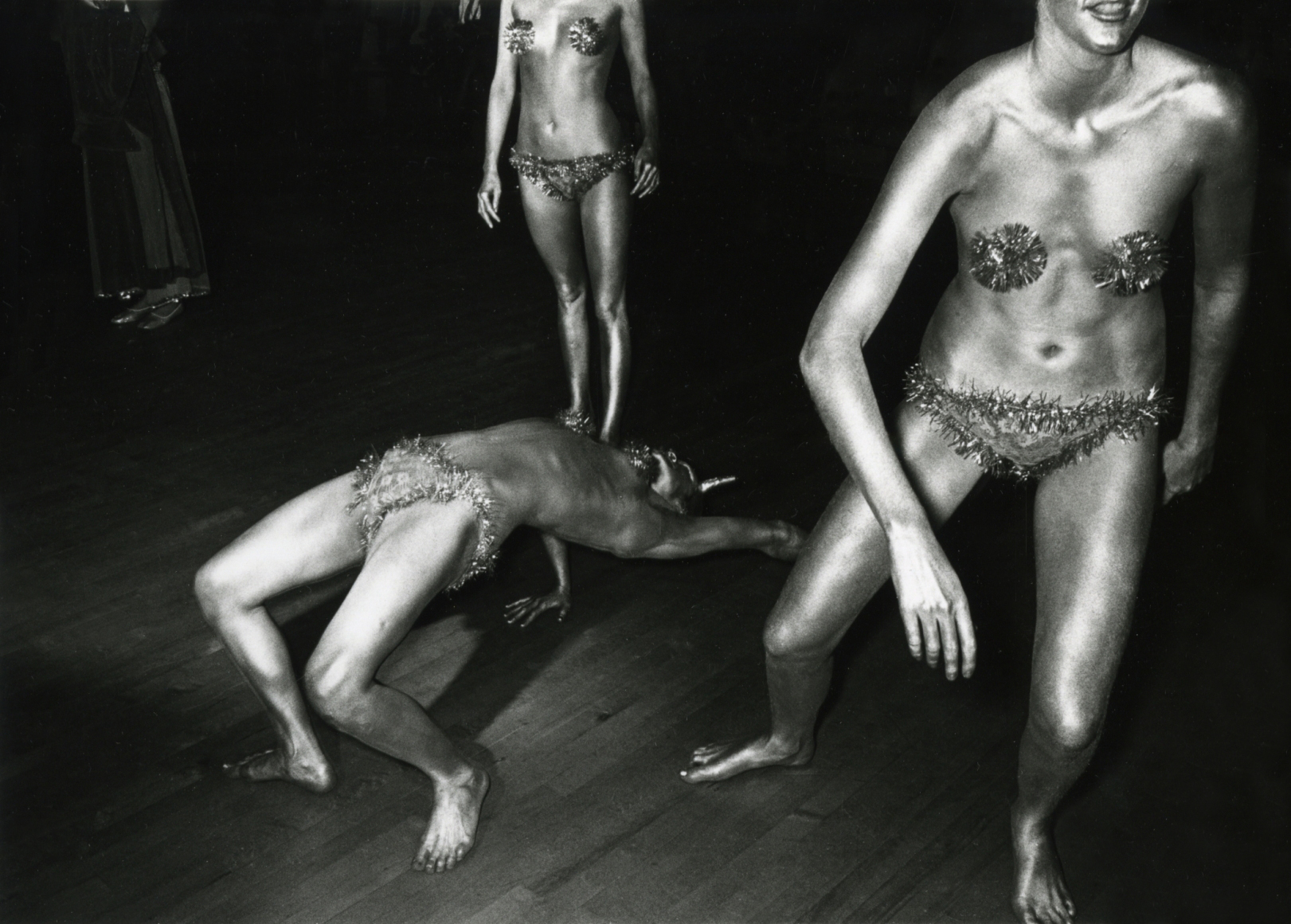
Cincinnati Art Museum website

LIKE ART BLART ON FACEBOOK

Back to top