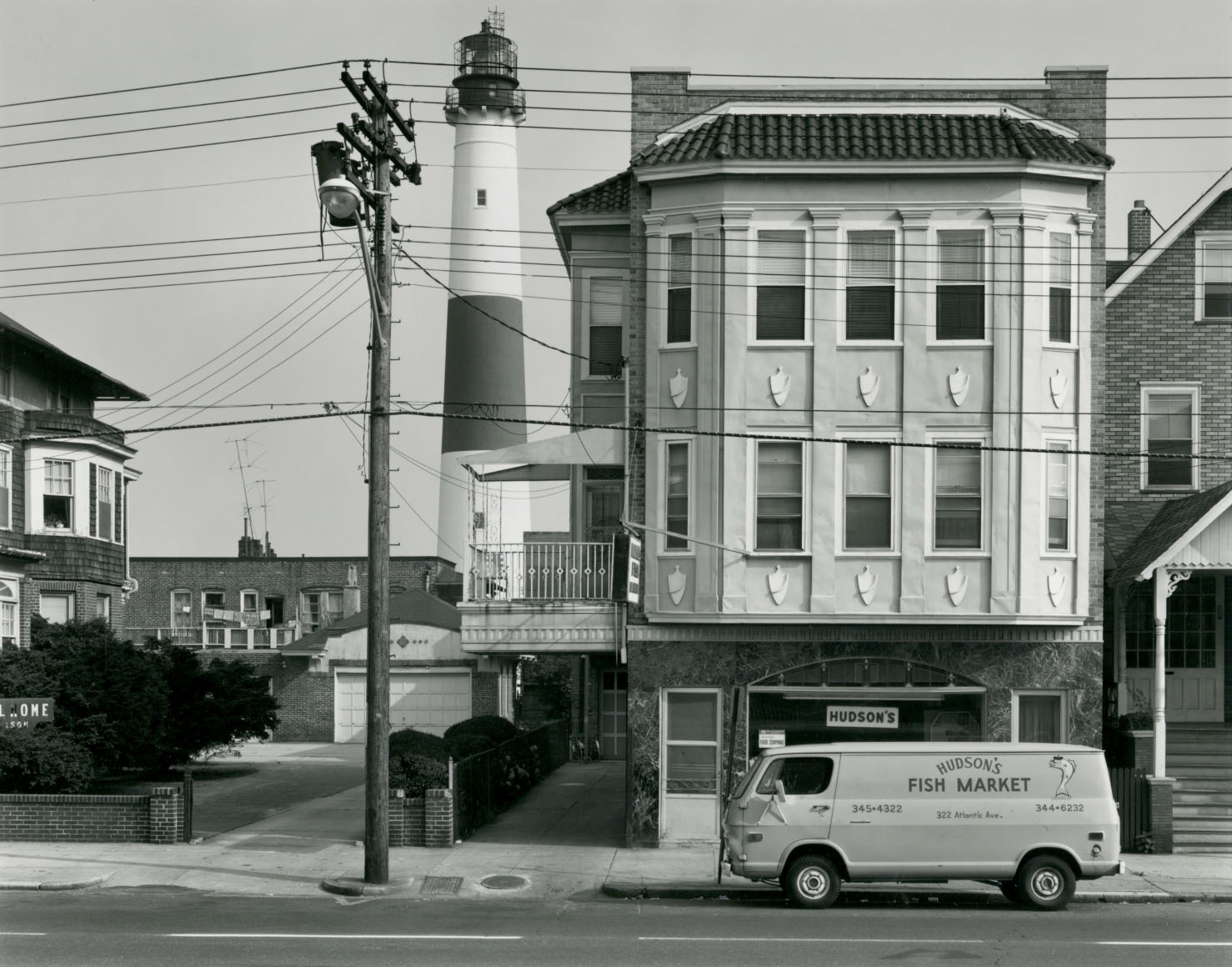
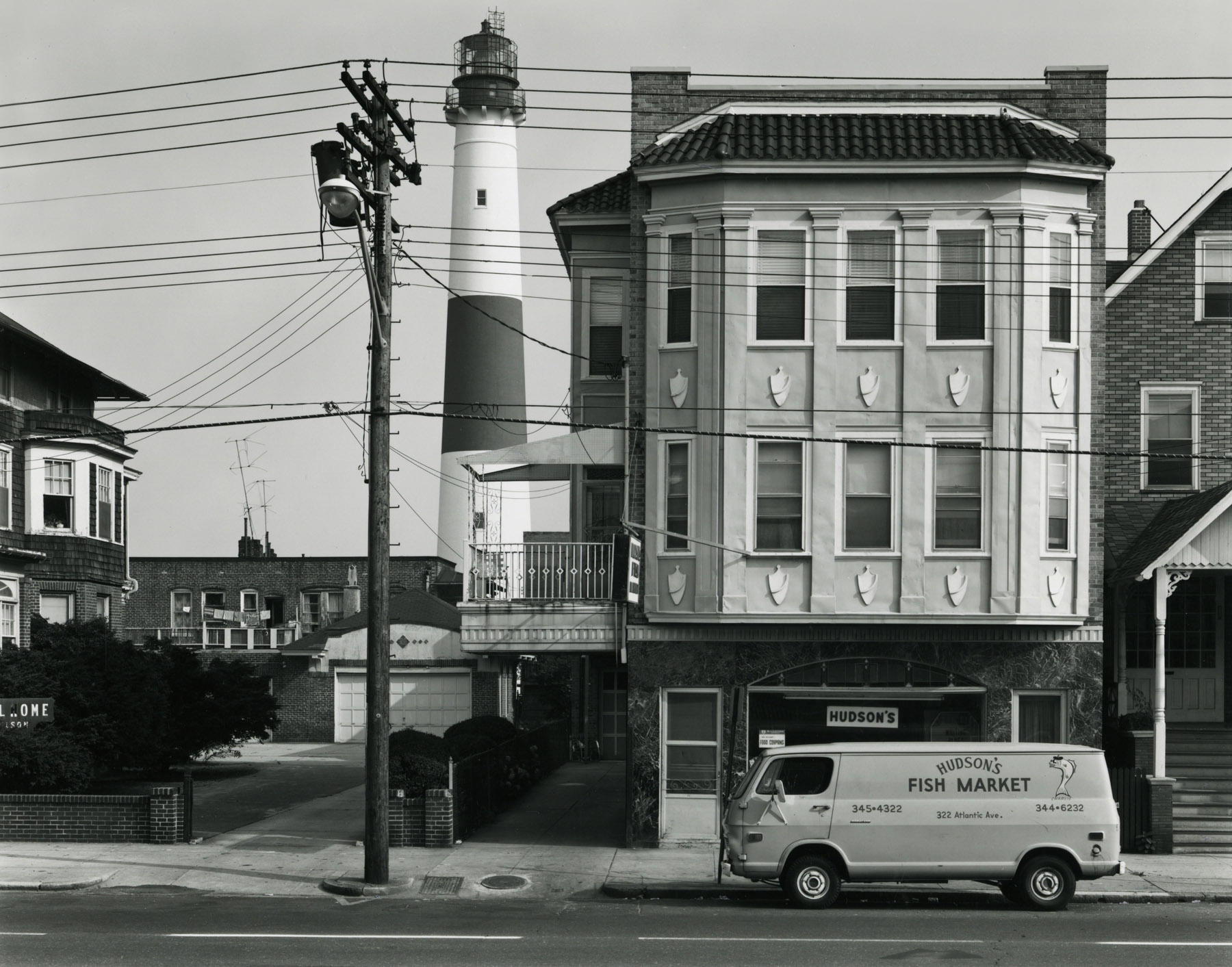
George Tice (American, 1938-2025) Hudson’s Fish Market, Atlantic City, New Jersey 1973 Gelatin silver print Joseph Bellows Gallery
Seeing beyond the moment
In the last posting on the work of Peter Hujar I was speaking of photographers that I have a particular affinity for. Another such artist is the now departed American photographer George Tice (1938-2025) with his large format black and white photographs of the urban landscape, mainly taken around the city of New Jersey where he lived for most of his life.
I have written twice before on the work of this magnificent photographer when he was alive: “An American iconography” on the exhibition George Tice: Urban Landscapes at the Joseph Bellows Gallery, September – October 2016; and text on the exhibition George Tice Lifework: A Tribute, Photographs 1953-2013 at Joseph Bellows Gallery, June – July 2022.
Précising these texts, I would say that Tice’s ongoing epic visual poem is at its strongest in his early period, from 1973-1974.
Tice, like Atget, had an innate ability to place the camera in such as position a to reveal subject matter in a new light. More intuitive, more sensitive to other ways of seeing, these great photographers look at the world from a different point of view. Tice’s recognition of subject matter that mere mortals pass by is translated into beautiful, serene, tonal and dare I say, sensual images, that belie the complexity of their previsualisation. As Sanford Schwartz in The New York Times, on December 3, 1972 noted: “Tice’s pictures… show a remarkable blend of intimacy, affection and clear-sightedness.”
Tice’s consumate control of the construction of the image plane never gets in the way of the elemental, eternal, and magical aspects of the photograph. As he observed, “The great difficulty of what I attempt is seeing beyond the moment; the everydayness of life gets in the way of the eternal.”
It is to his great credit that Tice saw beyond the moment. He felt that magical something when you have a connection to your subject and take a special photograph, revealed in the negative and then the print. He embedded that feeling in photographs that radiate his own signature.
For his are not only photographs of the phenomenal but also the noumenal, that feeling of something ineffable that we cannot put our finger on, something in this world that is close to the ineffable mysteries of the soul – a feeling, an emotional energy of connection to earth, body, spirit and soul – for the photograph has the ability to go beyond the symbolic, to approach the impossible, the real.
Through his photographs Tice reached beyond the everyday. What more does one need to say?
Travel well on your great journey my friend.
Dr Marcus Bunyan
Many thankx to the Joseph Bellows Gallery for allowing me to publish the photographs in the posting. Please click on the photographs for a larger version of the image
George Tice (American, 1938-2025) Rooftops, 21st and King Street, Paterson, New Jersey 1969 Gelatin silver print Joseph Bellows Gallery
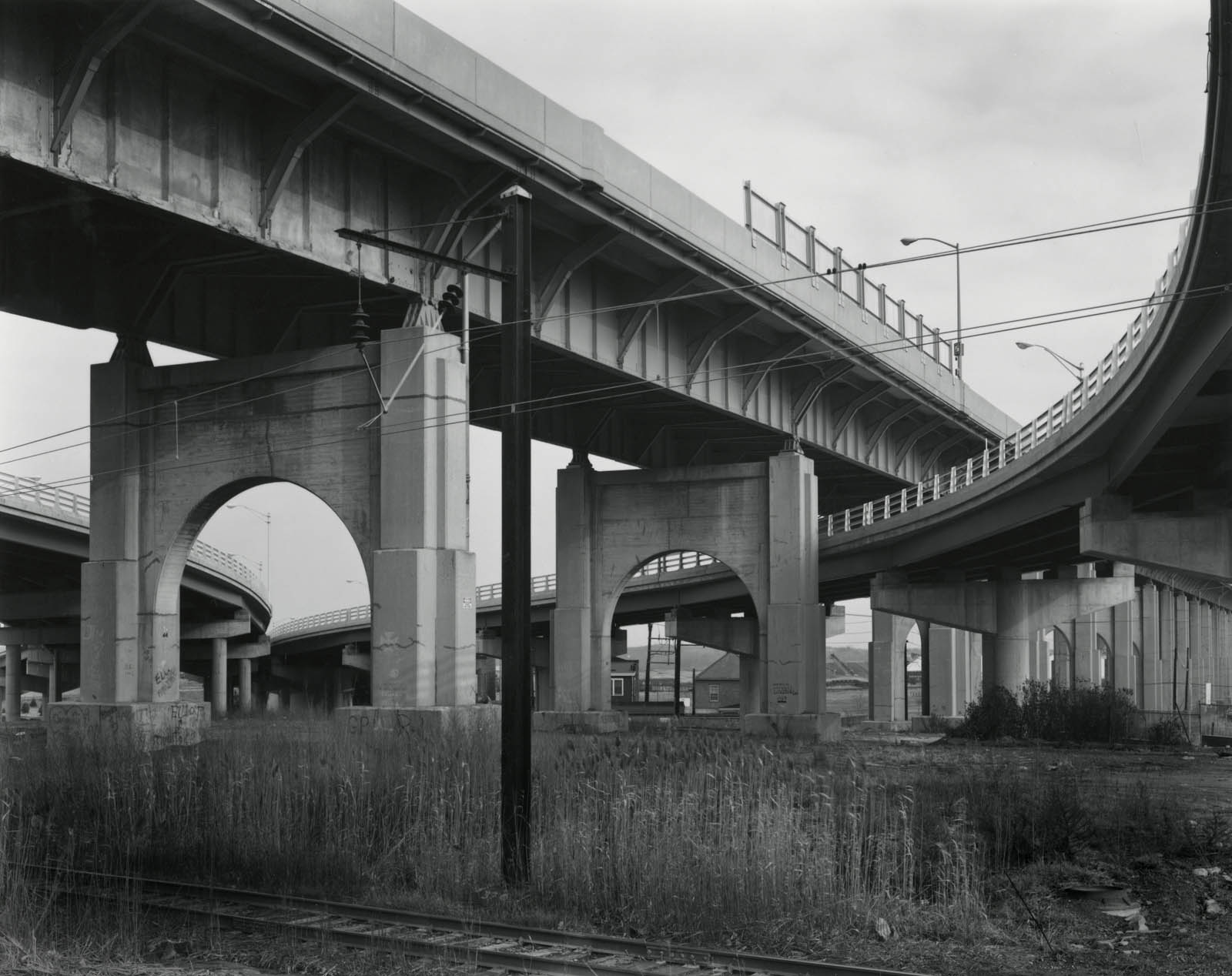
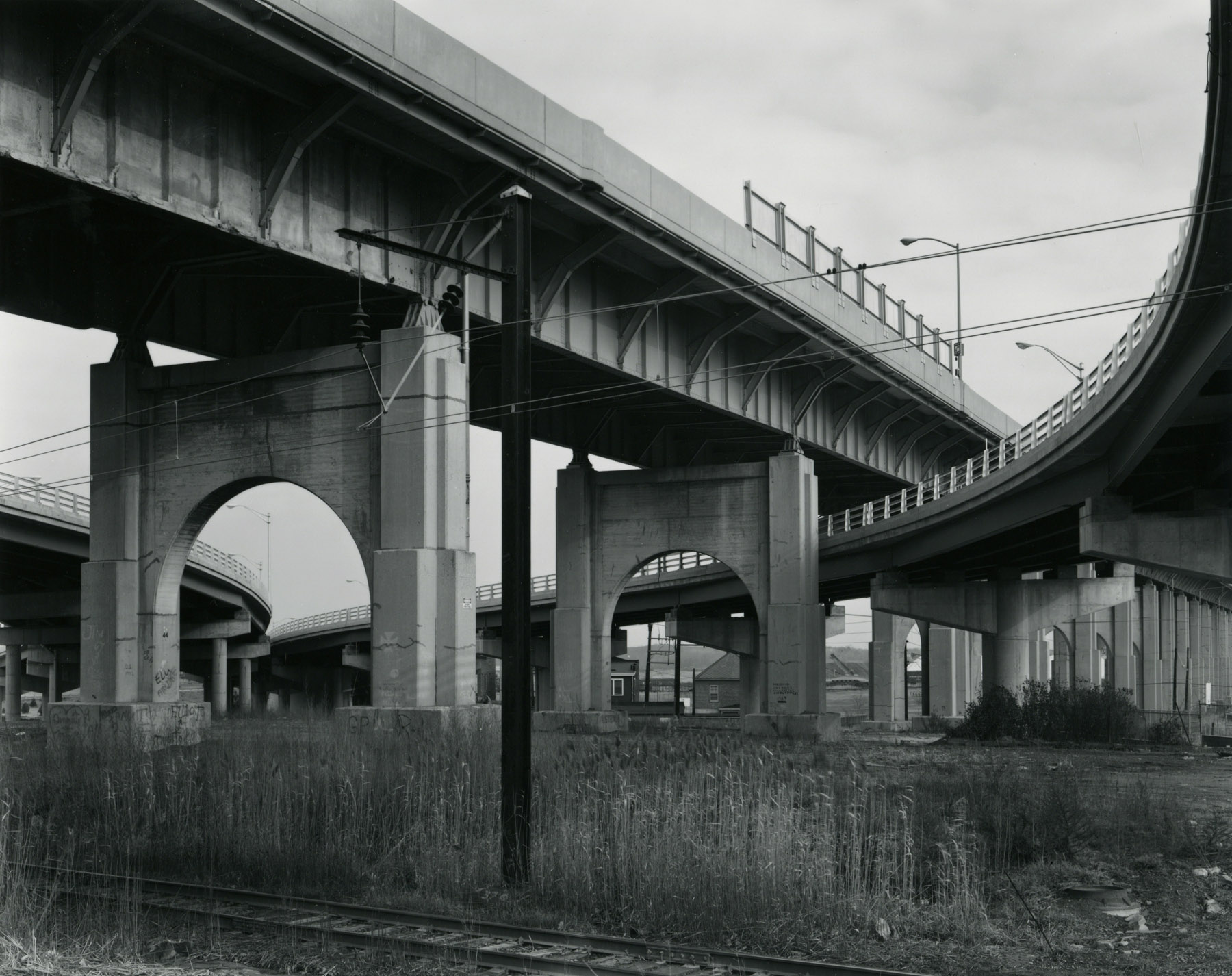
George Tice (American, 1938-2025) Route #440 Overpass, Perth Amboy, 1973 1973 Gelatin silver print Joseph Bellows Gallery
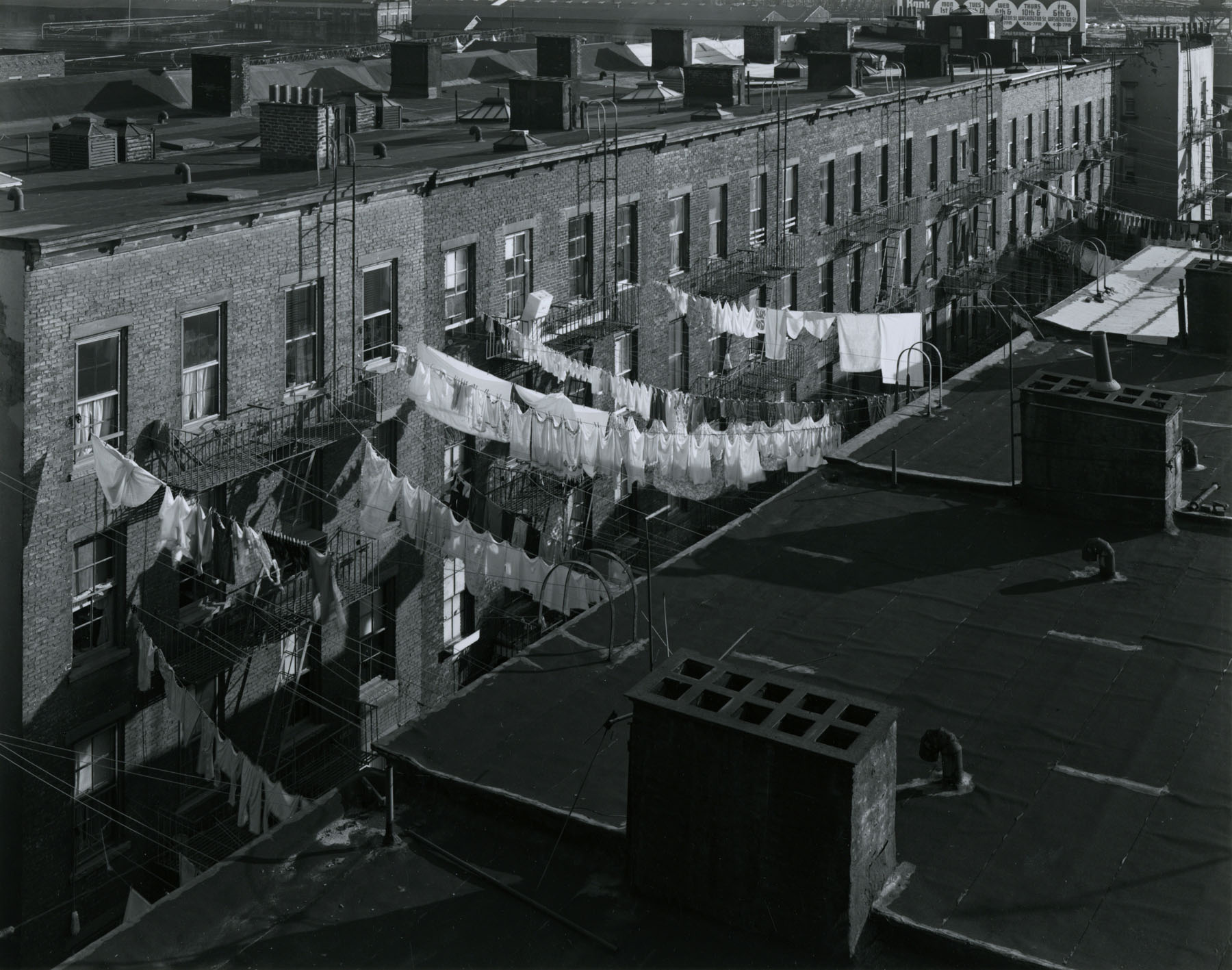
George Tice (American, 1938-2025) Tenement Rooftops, Hoboken, New Jersey 1974 Gelatin silver print Joseph Bellows Gallery
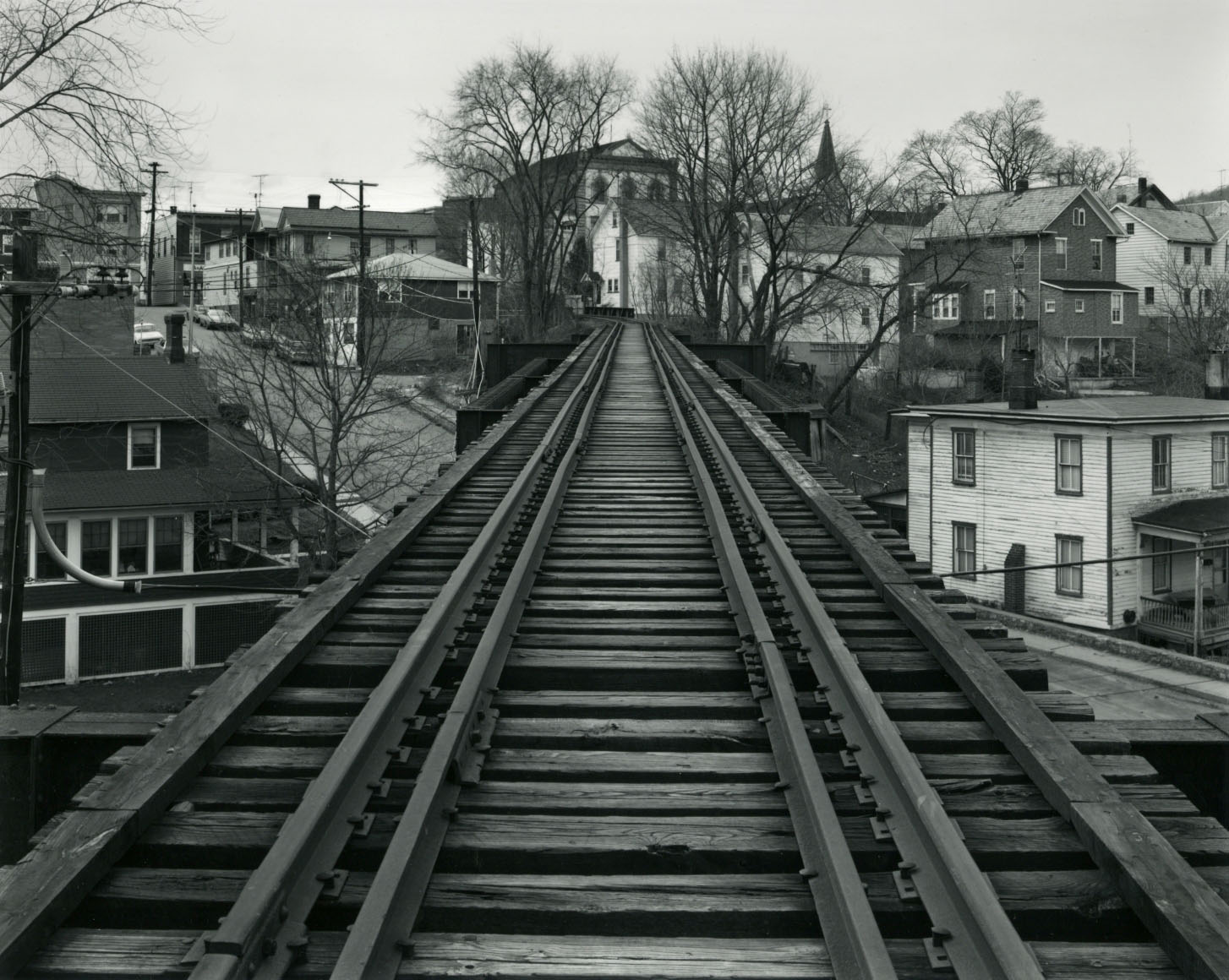
George Tice (American, 1938-2025) Railroad Bridge, High Bridge, New Jersey, 1974 1974 Gelatin silver print Joseph Bellows Gallery
George Tice (American, 1938-2025) Pulaski Skyway, Jersey City, New Jersey, 1974 1974 Gelatin silver print Joseph Bellows Gallery
George Tice (American, 1938-2025) Petit’s Mobil Station, Cherry Hill, New Jersey 1974 Gelatin silver print Joseph Bellows Gallery
George Tice (American, 1938-2025) Industrial Landscape, Kearny, New Jersey 1973 Gelatin silver print Joseph Bellows Gallery
Alfred Stieglitz (American, 1864-1946) The Hand of Man 1902 Photogravure
George Tice (American, 1938-2025) Drawbridge, Morgan, New Jersey, 1973 1973 Gelatin silver print Joseph Bellows Gallery
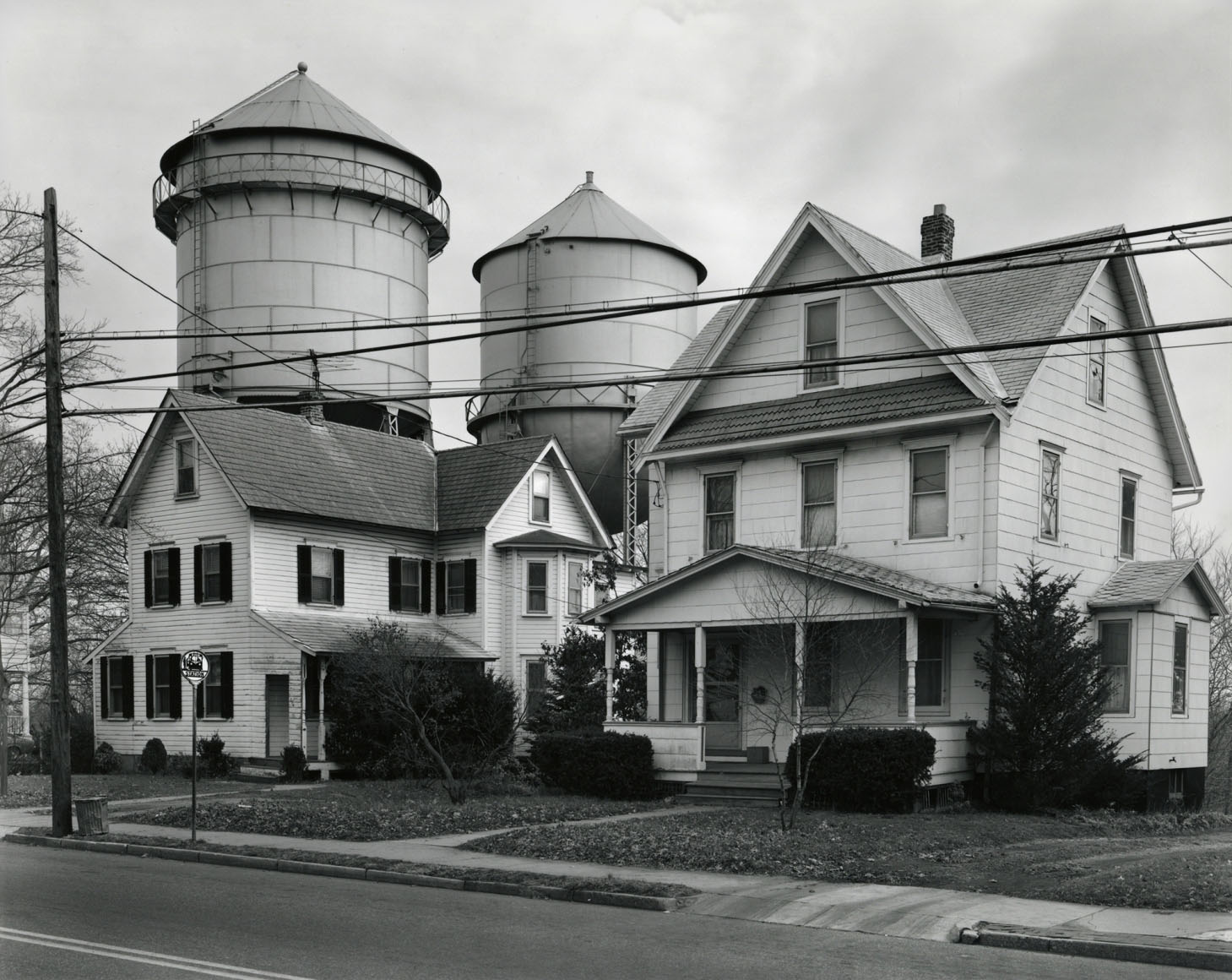
George Tice (American, 1938-2025) Houses and Water Towers, Moorestown, New Jersey, 1973 1973 Gelatin silver print Joseph Bellows Gallery
George Tice (American, 1938-2025) Goldy Pharmacy, Mount Holly, New Jersey, 1974 1974 Gelatin silver print Joseph Bellows Gallery
George Tice (American, 1938-2025) Steve’s Diner, Route 130, North Brunswick, 1974 1974 Gelatin silver print Joseph Bellows Gallery
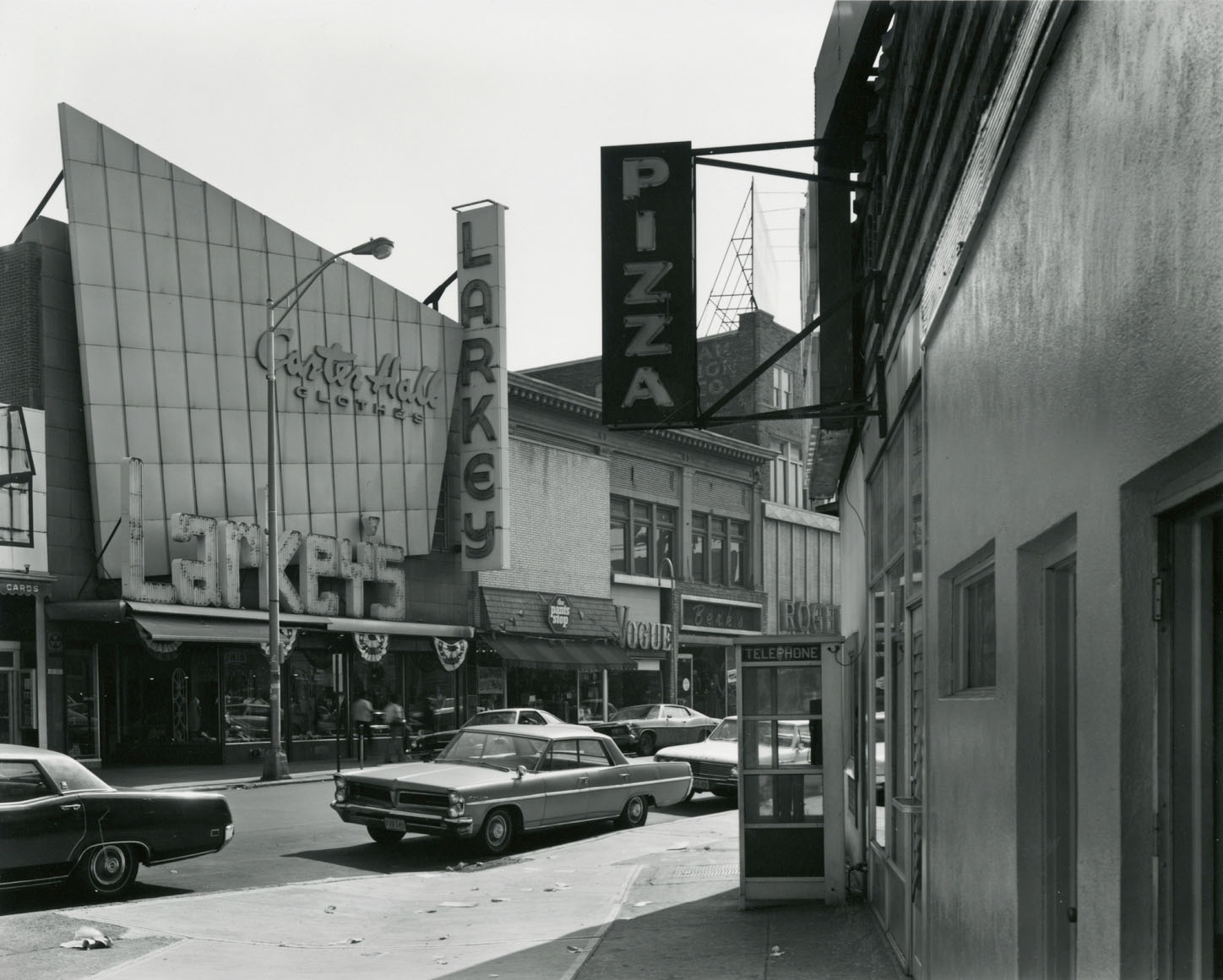
George Tice (American, 1938-2025) Lexington Avenue, Passaic, New Jersey, 1973 1973 Gelatin silver print Joseph Bellows Gallery
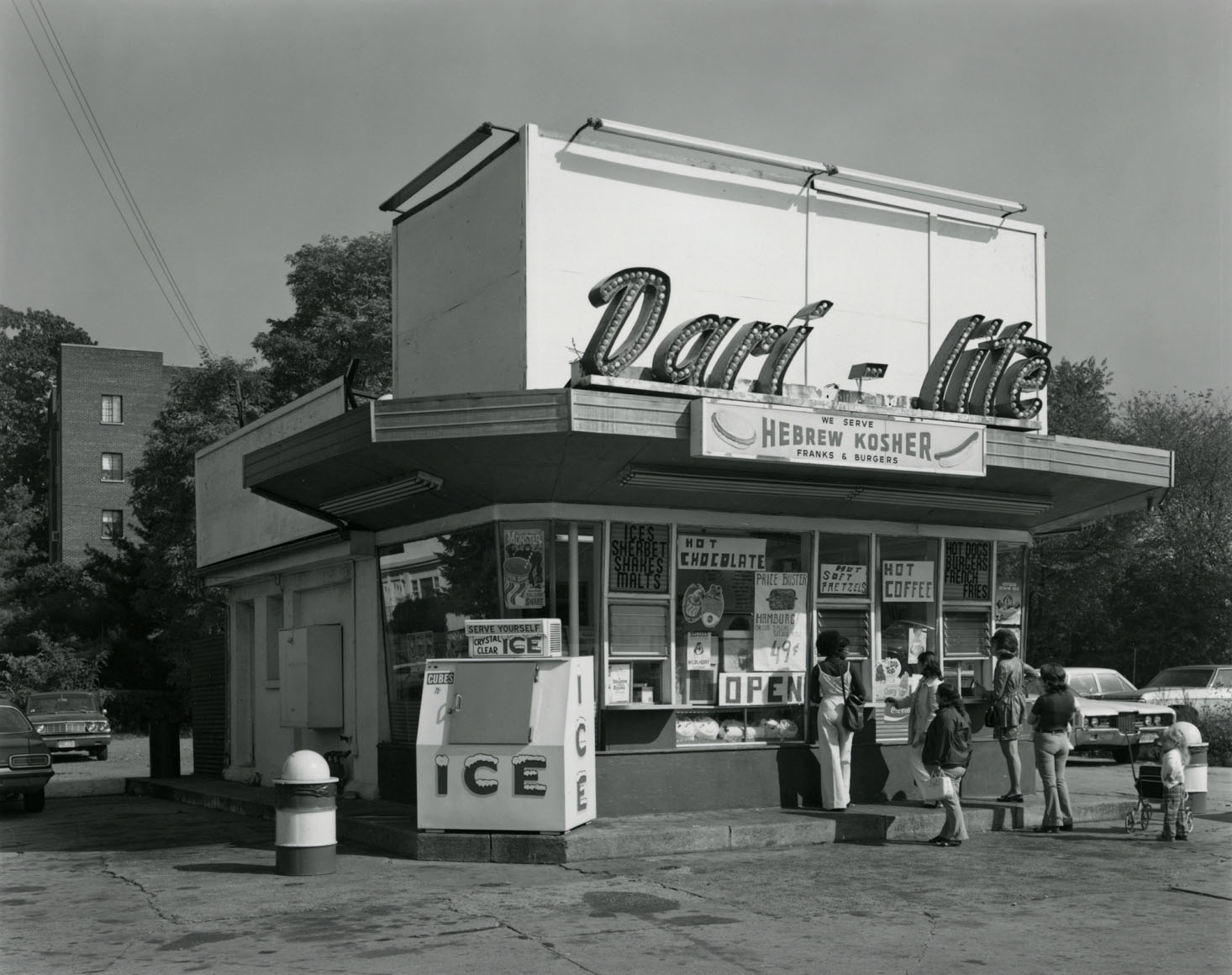
George Tice (American, 1938-2025) Dari O’ Lite, Wood Avenue, Linden, New Jersey, 1973 1973 Gelatin silver print Joseph Bellows Gallery
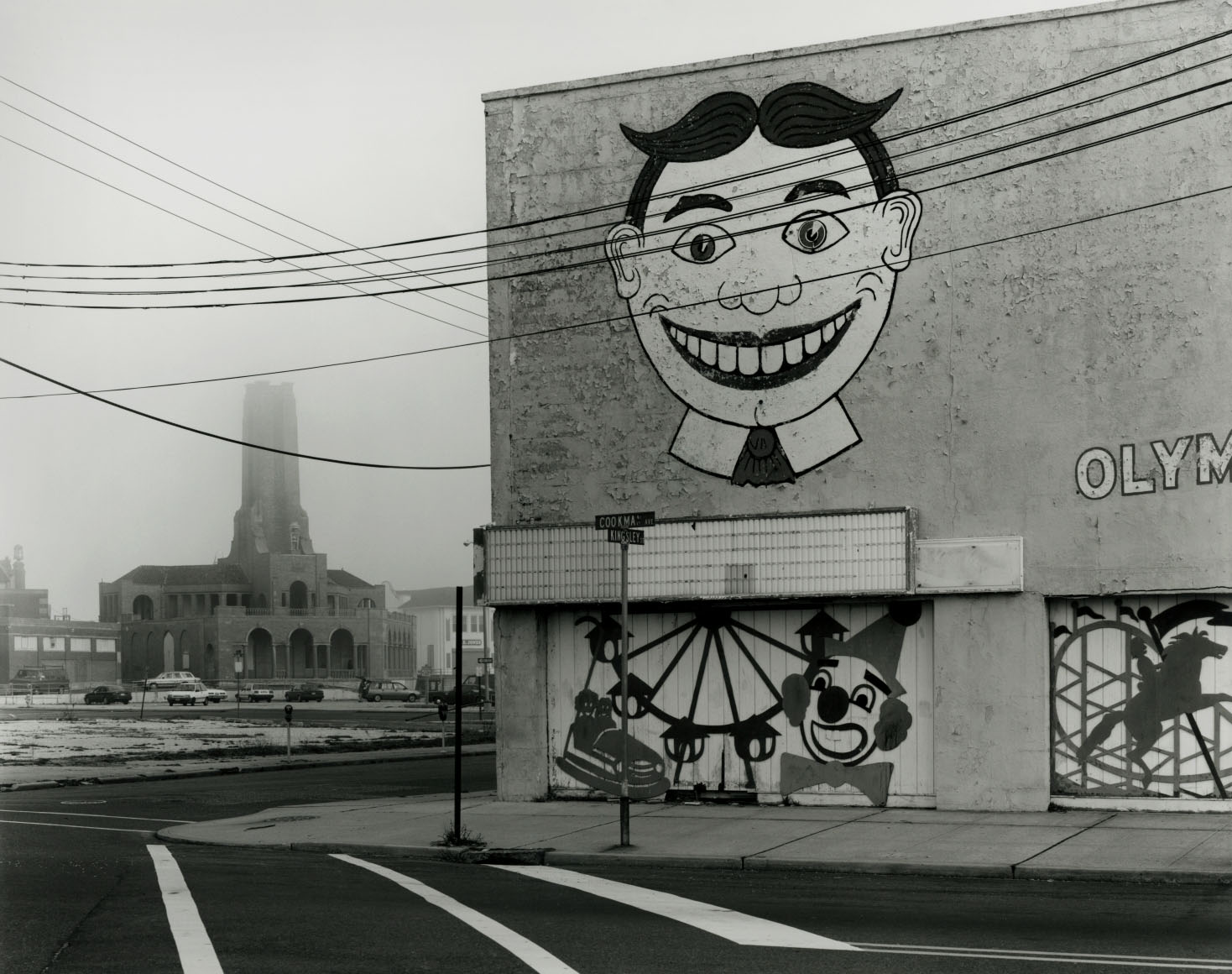
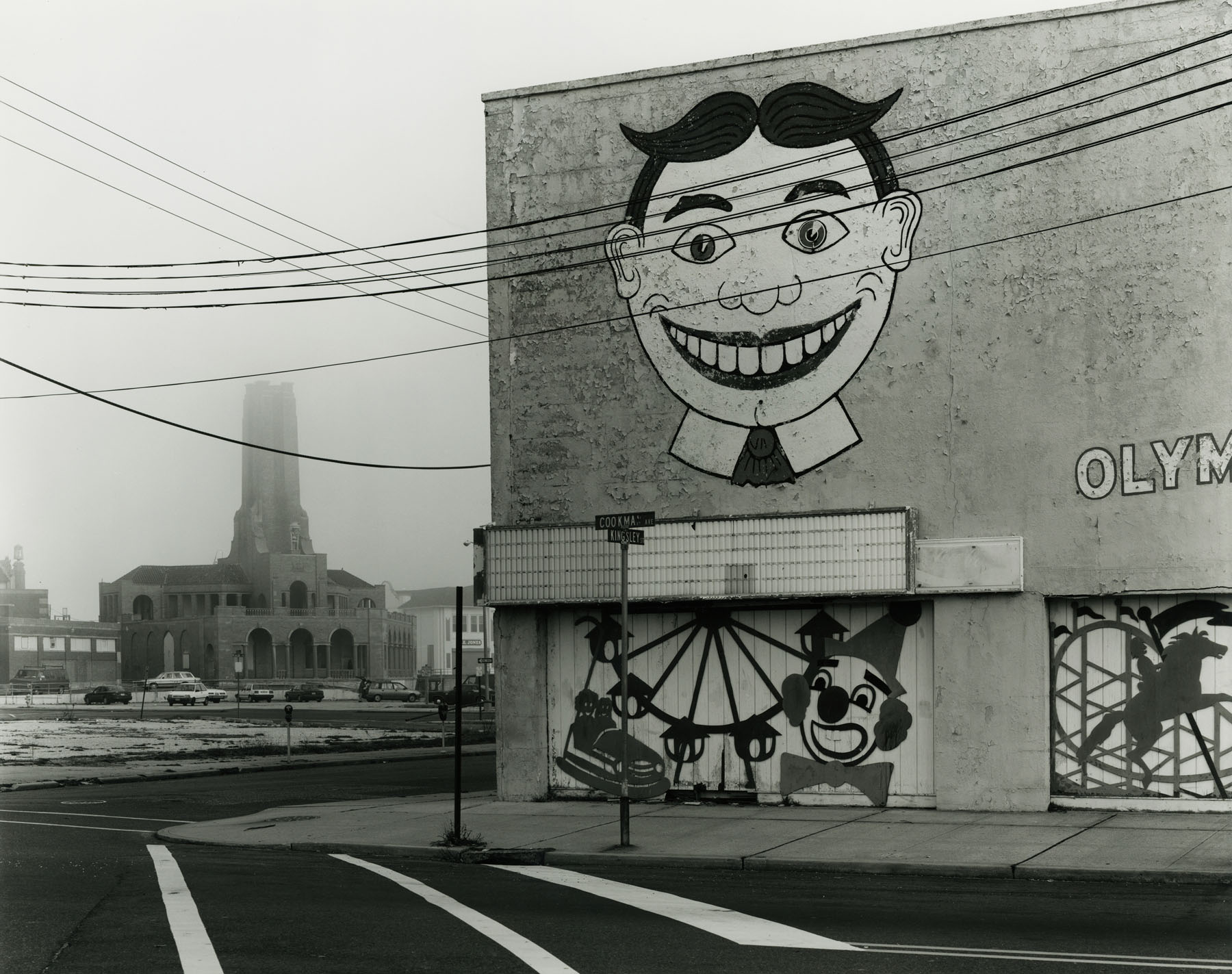
George Tice (American, 1938-2025) Palace Funhouse, Ashbury Park, New Jersey, 1995 1995 Gelatin silver print Joseph Bellows Gallery
George Tice (American, 1938-2025) Car For Sale, Paterson, New Jersey, 1969 1969 Gelatin silver print Joseph Bellows Gallery
George Tice (American, 1938-2025) Jahos Brothers Clothing Store, Trenton, NJ, 1973 1973 Gelatin silver print Joseph Bellows Gallery
George Tice (American, 1938-2025) Esso Station and Tenement House, Hoboken, NJ, 1972 1972 Gelatin silver print Joseph Bellows Gallery
George Tice (American, 1938-2025) Minnie’s Go-Go, Route 130, Merchantville, 1975 1975 Gelatin silver print Joseph Bellows Gallery
George Tice (American, 1938-2025) Telephone Booth, 3 am, Railway, NJ, 1974 1974 Gelatin silver print Joseph Bellows Gallery
Joseph Bellows Gallery 7661 Girrard Avenue La Jolla, California Phone: 858 456 5620
Opening hours: Tuesday – Saturday 11am – 5pm and by appointment
George Tice (American, b. 1938) Petit’s Mobil Station, Cherry Hill, New Jersey 1974 Gelatin silver print 8 x 10 inches
I have always loved the work of George Tice. I have one of his photographs in my collection. I think his work is very underrated.
Tice’s consumate control of the construction of the image plane never gets in the way of the elemental, eternal, and magical aspects of the photograph.
Photographers such as Tice, and Atget, have an innate ability to place the camera in such as position as to reveal the subject matter in a new light. More intuitive, more sensitive to other ways of seeing, these great photographers look at the world from a different point of view.
In this posting, the hovering spaceship that is Petit’s Mobil Station, Cherry Hill, New Jersey (1974, above) is a superb example of this … almost hallucinatory feeling in the image. Other mesmerising photographs include the Cubist Houses and Water Towers, Moorestown, New Jersey (1973, below) and Industrial Landscape, Kearny, New Jersey (1973, below) with its acknowledgment of Alfred Stieglitz’s The Hand of Man (1902, below). Notice how Tice lowers the level of his camera when compared to Stieglitz’s photograph, thus raising the horizon line, so we now follow the bare, ascending train tracks to the massed stacks of the barren industrial landscape instead of looking down on the scene as in The Hand of Man. Here is a master of previsualisation at work.
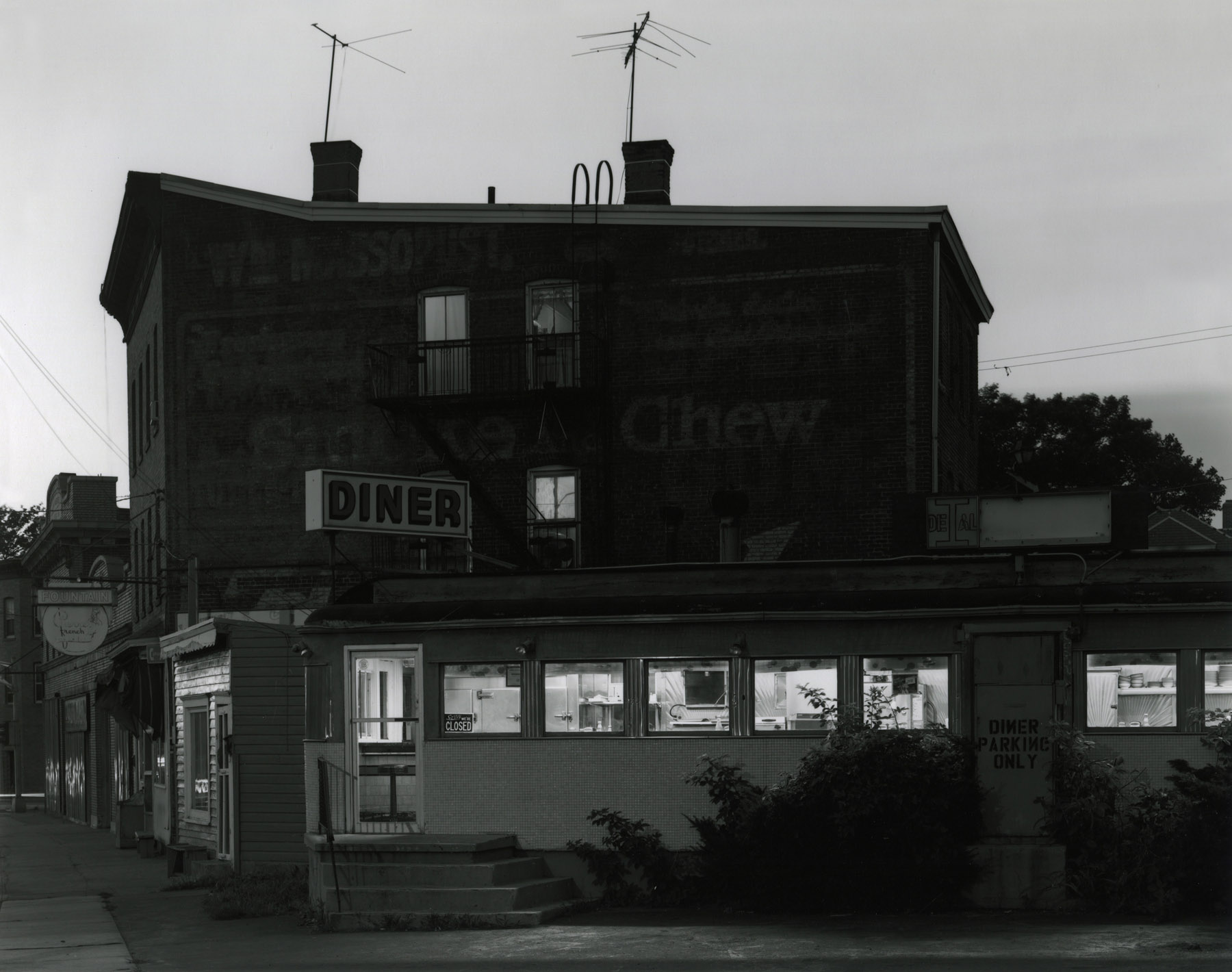
Other photographs have already been seen in postings on Art Blart, but it is always a pleasure to look at George Tice’s work – especially his dusk and night time photographs such as New International Cinema, New Brunswick, New Jersey (1974, below), Steve’s Diner, Route 130, North Brunswick, New Jersey (1974, below) and Ideal Diner, Perth Amboy, New Jersey (1980, below). There are hints of the intimacies of Walker Evans and the clinical observations of Bernd and Hiller Becker in Tice’s work, but somehow he always makes images which possess his own signature, his own creative writing.
Following on from last week’s posting where I was banging on about the “spiritual” in contemporary photography (and by “spiritual” I mean an energy and feeling for subject matter captured in the negative and then revealed in the image), the photographs I have presented by Tice in this posting are a perfect example of this alternate perspective. As he observes, “The great difficulty of what I attempt is seeing beyond the moment; the everydayness of life gets in the way of the eternal.”
Dr Marcus Bunyan
Many thankx to Joseph Bellows Gallery for allowing me to publish the photograph in the posting. Please click on the photographs for a larger version of the image.
“It takes the passage of time before an image of a commonplace subject can be assessed. The great difficulty of what I attempt is seeing beyond the moment; the everydayness of life gets in the way of the eternal.”
George Tice
George Tice (American, b. 1938) Houses and Water Towers, Moorestown, New Jersey 1973 Gelatin silver print 11 x 14 inches
George Tice (American, b. 1938) Industrial Landscape, Kearny, New Jersey 1973 Gelatin silver print 8 x 10 inches
Alfred Stieglitz (American, 1864-1946) The Hand of Man 1902 Photogravure 24.1 × 31.8cm (9 1/2 × 12 1/2 in.) The J. Paul Getty Museum, Los Angeles
A locomotive engine steams toward the camera on its barely visible tracks, wearing a billowing black cloud of smoke like a plumed hat. The criss-crossing lines of tracks beside it snake off toward the horizon, and the telephone poles at the left appear to be making the same march. Alfred Stieglitz’s composition is a treatise on the importance of the machine in the modern Industrial Age. The title of the photograph, The Hand of Man, sets up a comparison between the machine that is depicted and the human artistic impulse that created the image. Stieglitz reproduced this photograph in the January 1903 issue of Camera Work, a journal that he both founded and edited. In the early 1930s he returned to the image and printed additional photographs.
George Tice (American, b. 1938) Railroad Bridge, High Bridge, New Jersey 1974 Gelatin silver print 8 x 10 inches
George Tice (American, b. 1938) Rooftops, 21st and King Street, Paterson, New Jersey 1969 Vintage gelatin silver print 16 x 20 inches
George Tice (American, b. 1938) Tenement Rooftops, Hoboken, New Jersey 1974 Vintage gelatin silver print 8 x 10 inches
George Tice (American, b. 1938) Pulaski Skyway, Jersey City, New Jersey 1974 Vintage gelatin silver print 8 x 10 inches
George Tice (American, b. 1938) Drawbridge, Morgan, New Jersey 1973 Vintage gelatin silver print 8 x 10 inches
The gallery’s current exhibition is a tribute to the lifework of George Tice, including many vintage prints of both famous and lesser-known images. Signed copies of his new book, Lifework, 1953-2013, are also available.
Tice is drawn to vestiges of American culture on the verge of extinction – from people in rural or small-town communities to suburban buildings and neighbourhoods that are often in decline. Although he has photographed throughout the Northwestern United States, he is best known for pictures of his native New Jersey, and the impeccable quality of his black-and-white prints.
Tice was born and raised in Newark, New Jersey – the state in which his ancestors had settled generations earlier. At fourteen, he joined a camera club. A turning point in his self-training happened two years later when a professional photographer critiquing club members’ work praised his picture of an alleyway. Tice briefly studied commercial photography at Newark Vocational and Technical High School; he then joined the Navy. A published image he made of an explosion aboard an American ship caught the eye of photographer Edward Steichen, who purchased it for The Museum of Modern Art. For about a decade, Tice worked as a portrait photographer and helped establish a gallery. That success enabled him to concentrate on personal projects.
In the 1960s, Tice shifted from smaller camera formats to larger ones, which enabled him to craft carefully toned and detailed prints. He portrayed traditional Amish and Shaker communities, as well as the hard lives of fishermen in Maine. In the 1970s, Tice began exploring his home state. Those photographs formed the beginnings of his Urban Landscapes series, which he worked on until the year 2000.
Text from the Joseph Bellows Gallery website
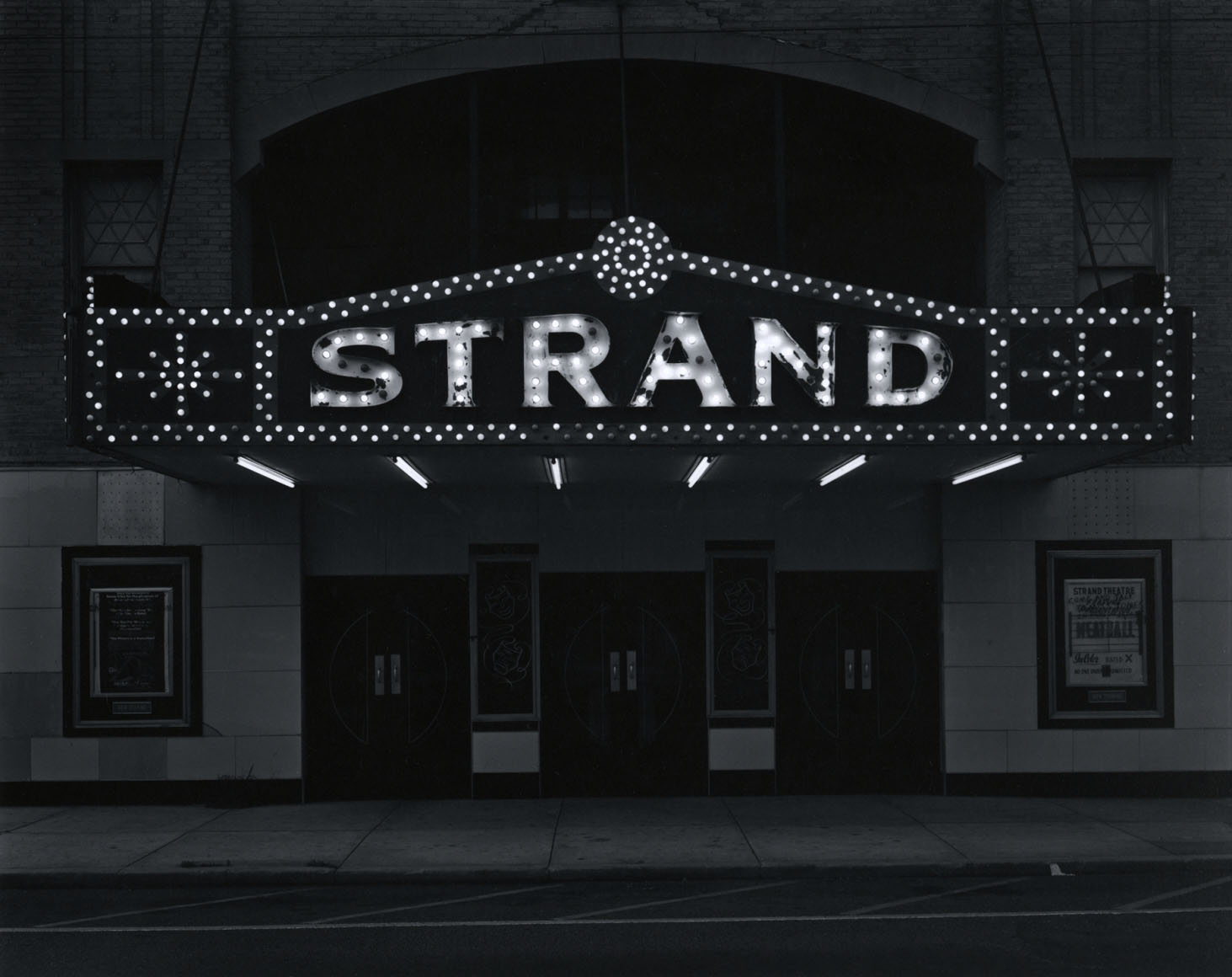
George Tice (American, b. 1938) Strand Theater, Keyport, New Jersey 1973 Gelatin silver print 16 x 20 inches
George Tice (American, b. 1938) New International Cinema, New Brunswick, New Jersey 1974 Vintage gelatin silver print 8 x 10 inches
George Tice (American, b. 1938) Ideal Diner, Perth Amboy, New Jersey 1980 Gelatin silver print 11 x 14 inches
George Tice (American, b. 1938) Steve’s Diner, Route 130, North Brunswick, New Jersey 1974 Vintage gelatin silver print 16 x 20 inches
George Tice (American, b. 1938) Palace Funhouse, Ashbury Park, New Jersey 1995 Gelatin silver print 16 x 20 inches
George Tice (American, b. 1938) Lexington Avenue, Passaic, New Jersey 1973 Vintage gelatin silver print 8 x 10 inches
George Tice (American, b. 1938) Goldy Pharmacy, Mount Holly, New Jersey 1974 vintage gelatin silver print 8 x 10 inches
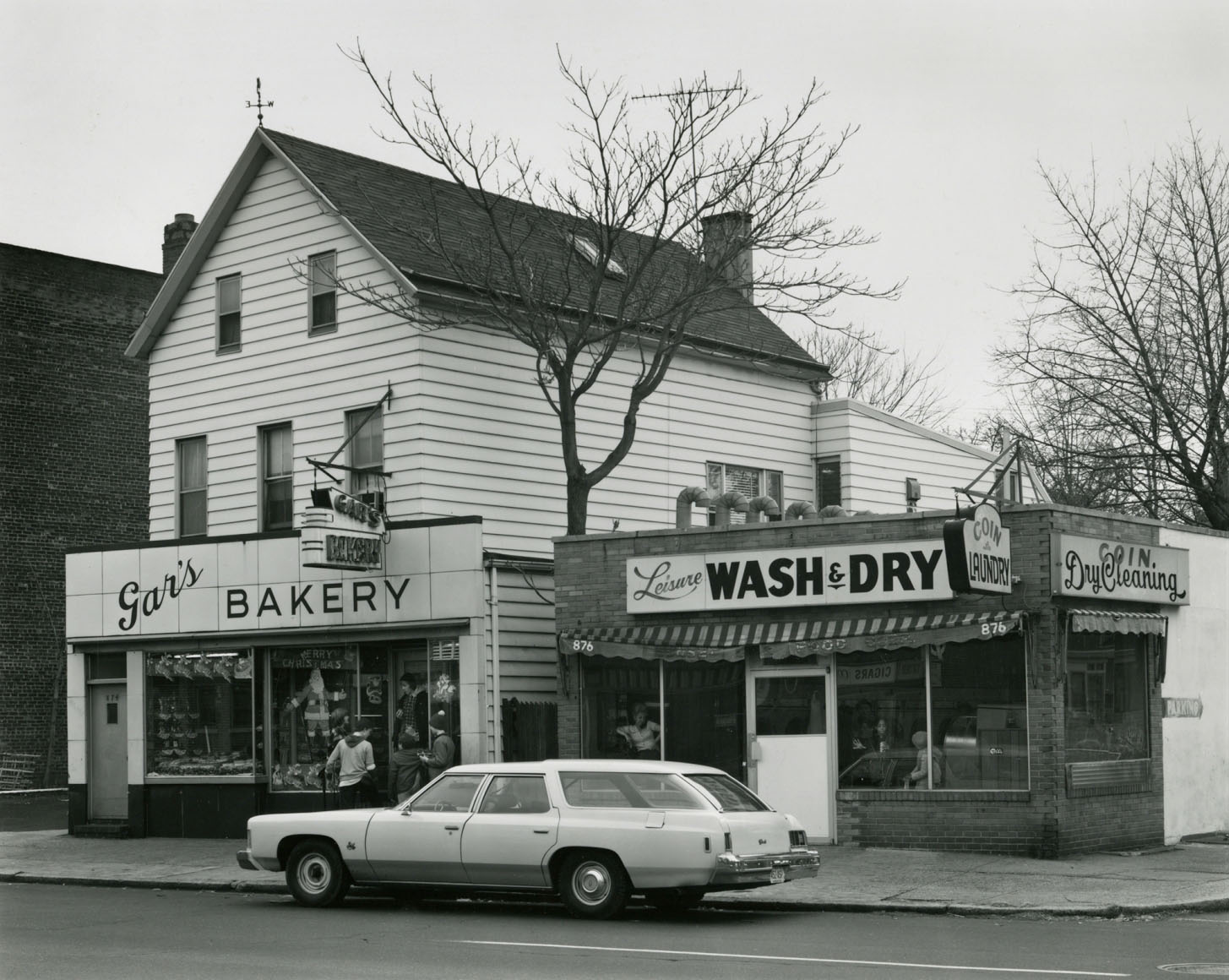
George Tice (American, b. 1938) Gar’s Bakery and Leisure Laundry, Newark, New Jersey 1974 Vintage gelatin silver print 8 x 10 inches
George Tice (American, b. 1938) Dari O’ Lite, Wood Avenue, Linden, New Jersey 1973 Vintage gelatin silver print 8 x 10 inches
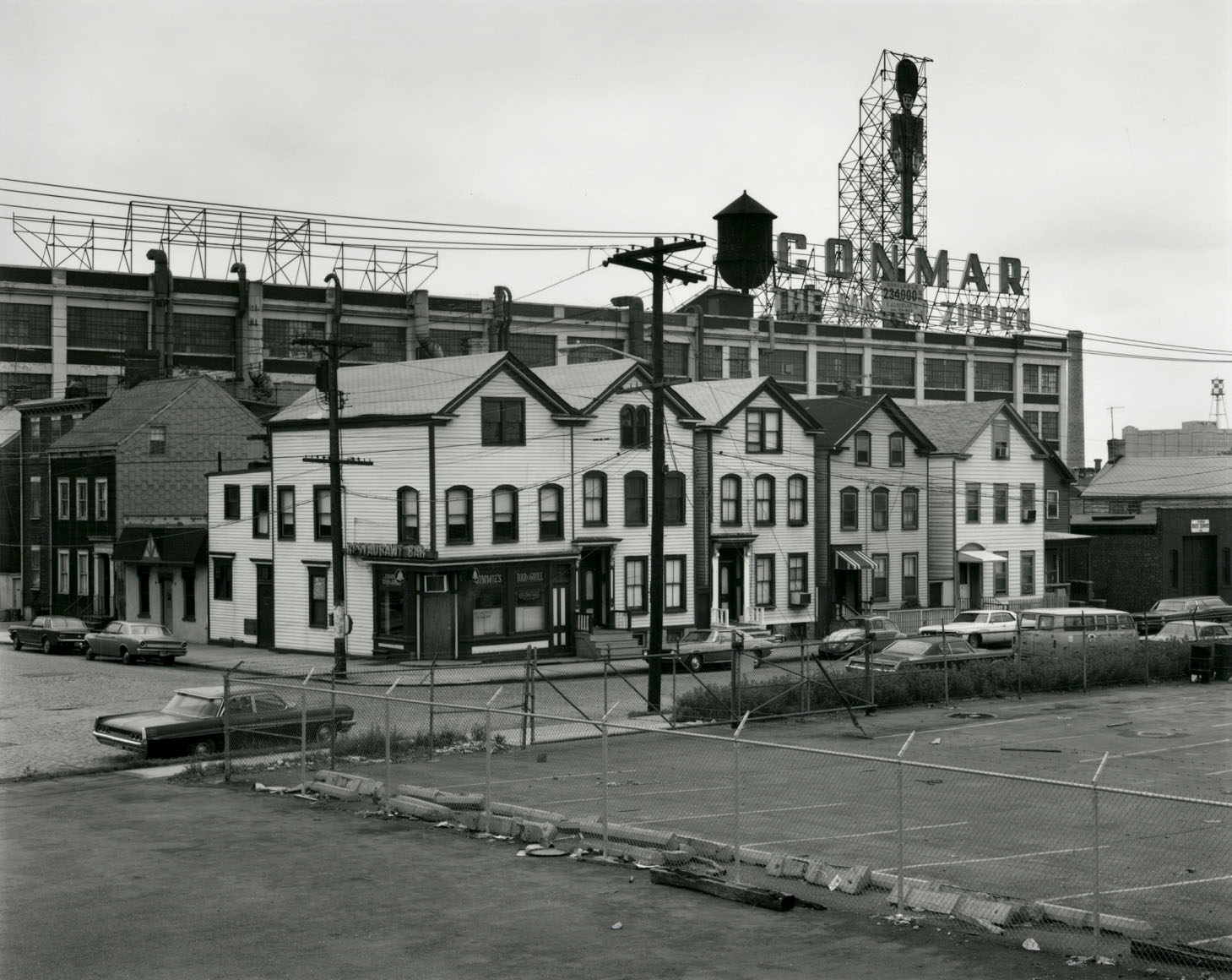
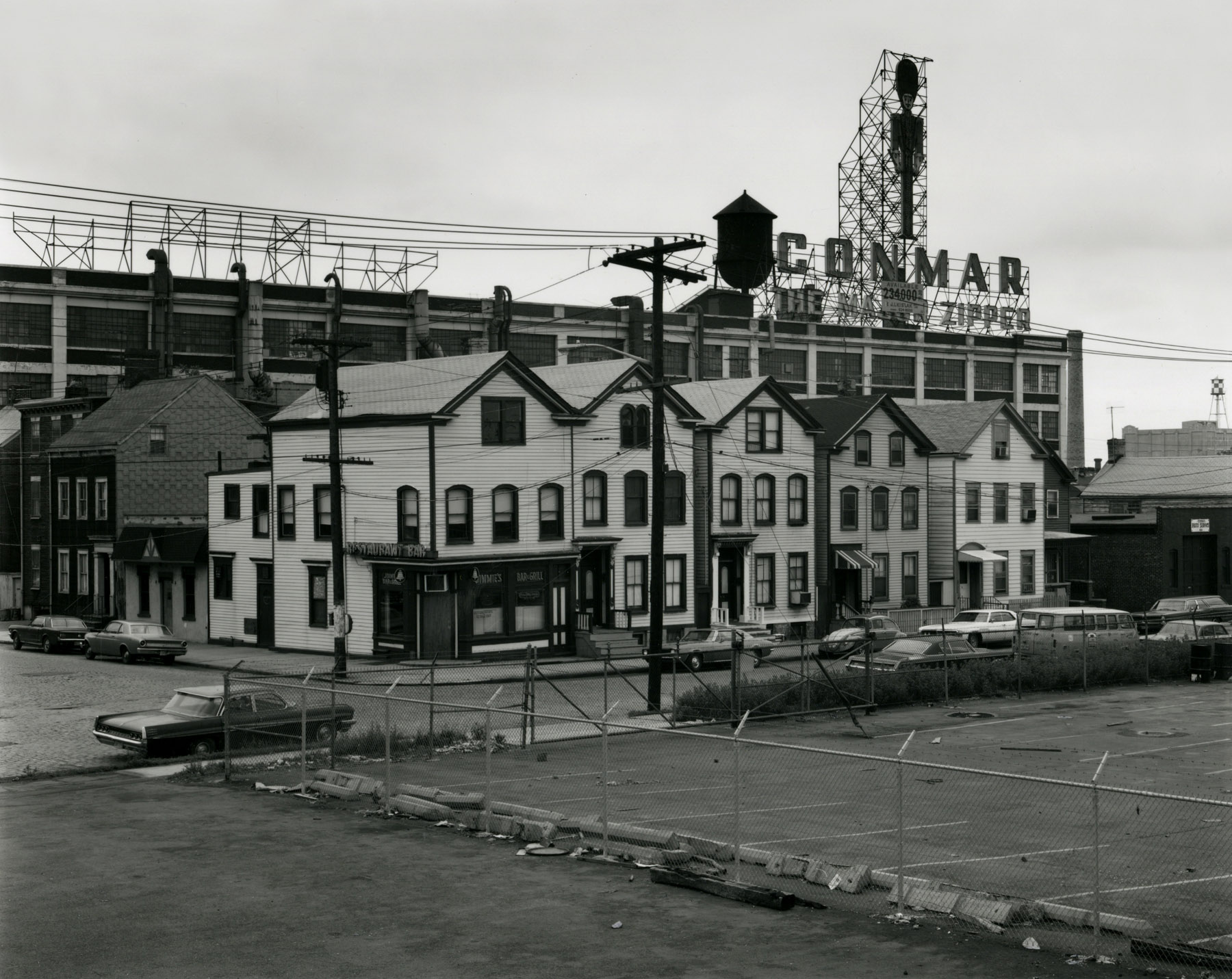
George Tice (American, b. 1938) Jimmy’s Bar and Grill, Newark, New Jersey 1973 Gelatin silver print 8 x 10 inches
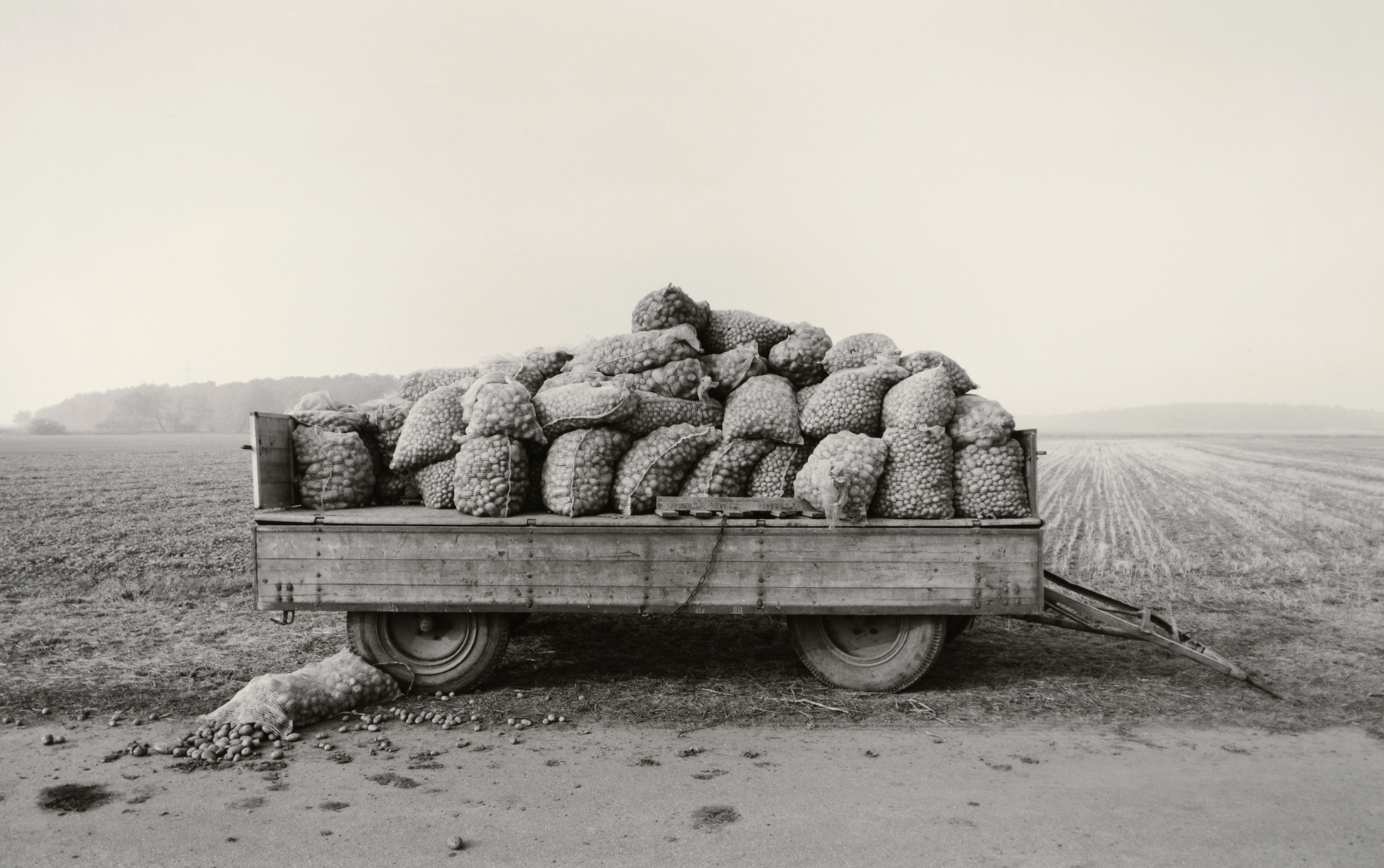
George Tice (American, b. 1938) Hudson’s Fish Market, Atlantic City, New Jersey 1973 Vintage gelatin silver print 8 x 10 inches
George Tice (American, b. 1938) Houses, Ocean Grove, New Jersey 1974 Vintage gelatin silver print 8 x 10 inches
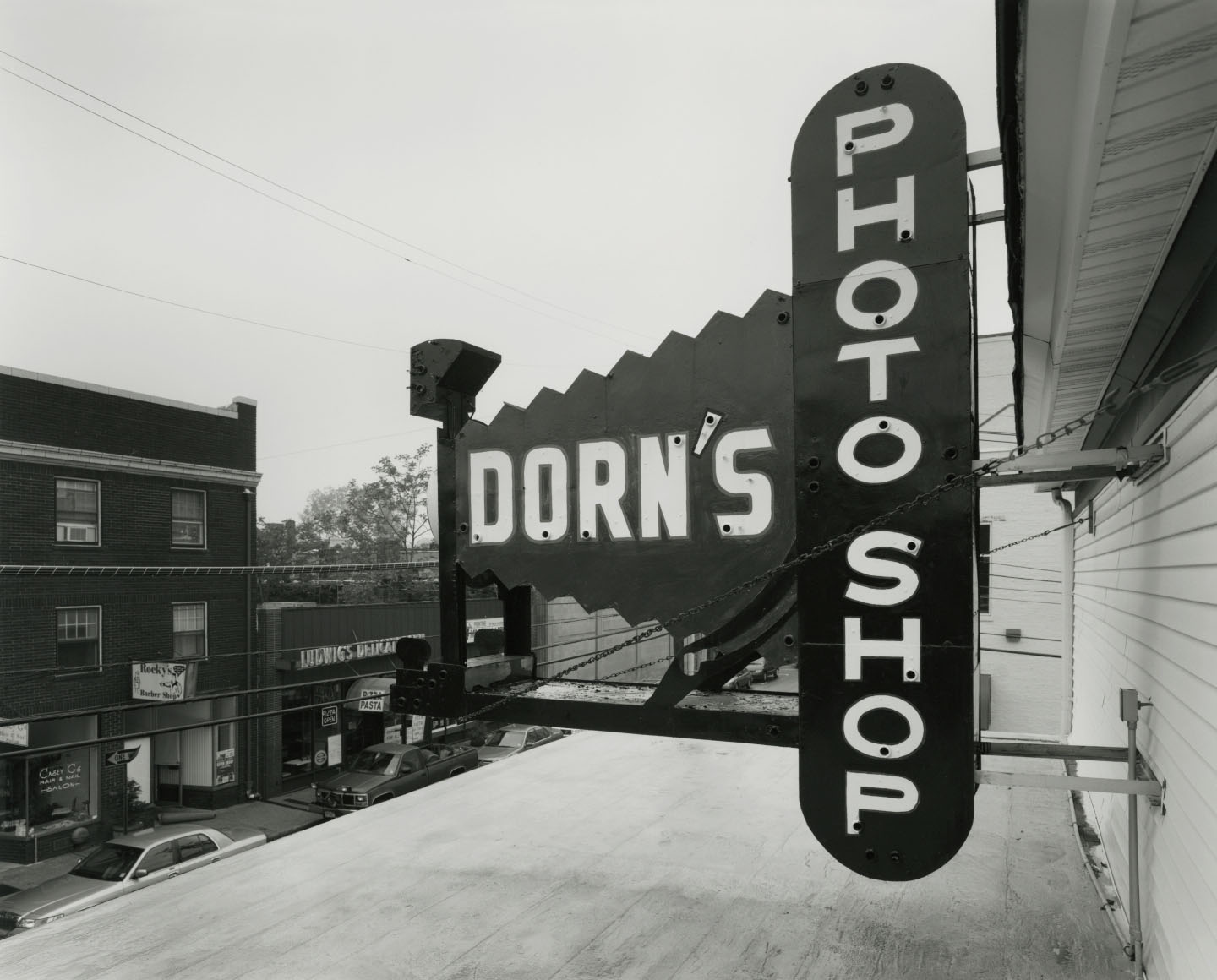
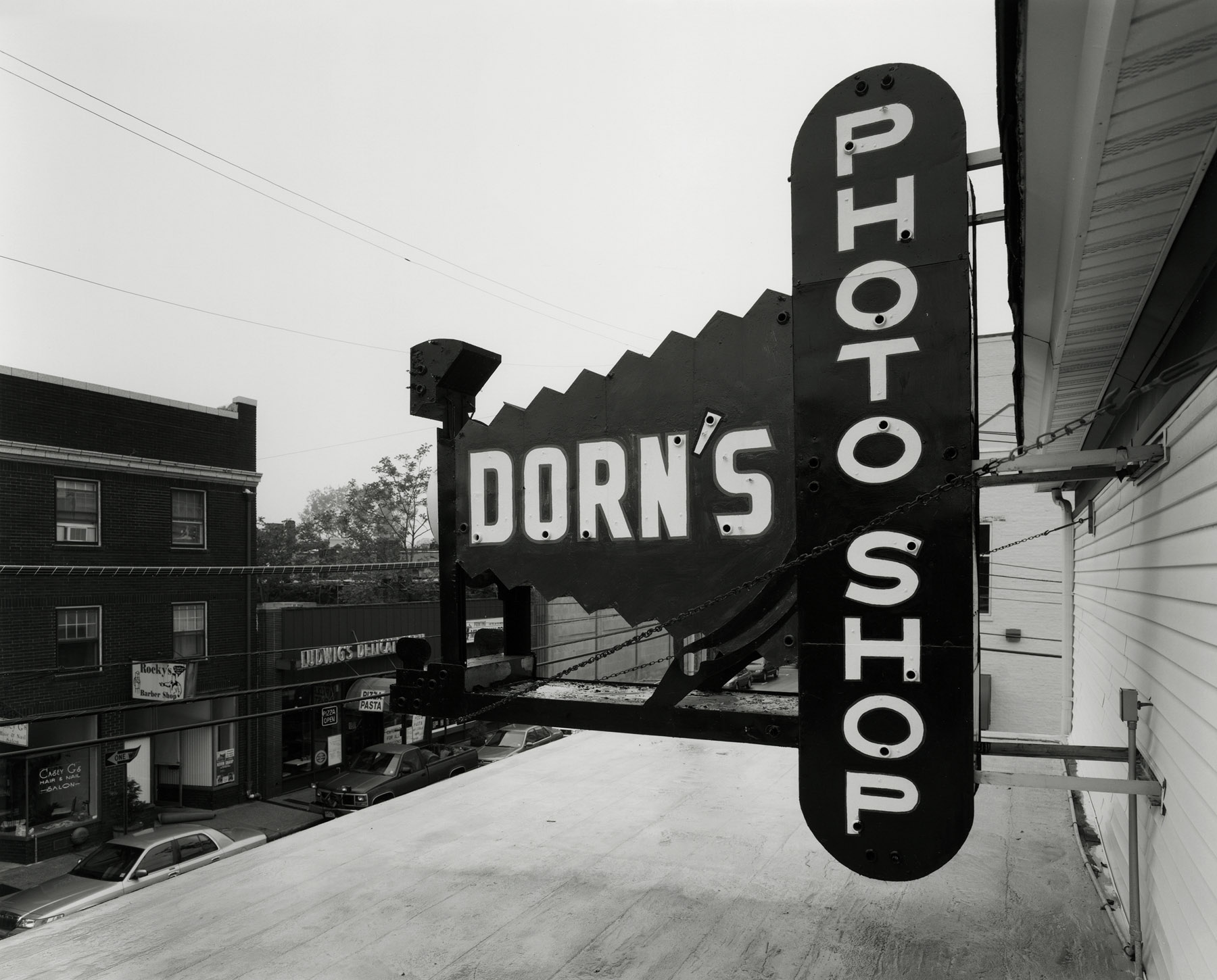
George Tice (American, b. 1938) Dorn’s Photoshop, Red Bank, New Jersey 1999 Gelatin silver print 16 x 20 inches
Joseph Bellows Gallery 7661 Girrard Avenue La Jolla, California Phone: 858 456 5620
Opening hours: Tuesday – Saturday 11am – 5pm and by appointment
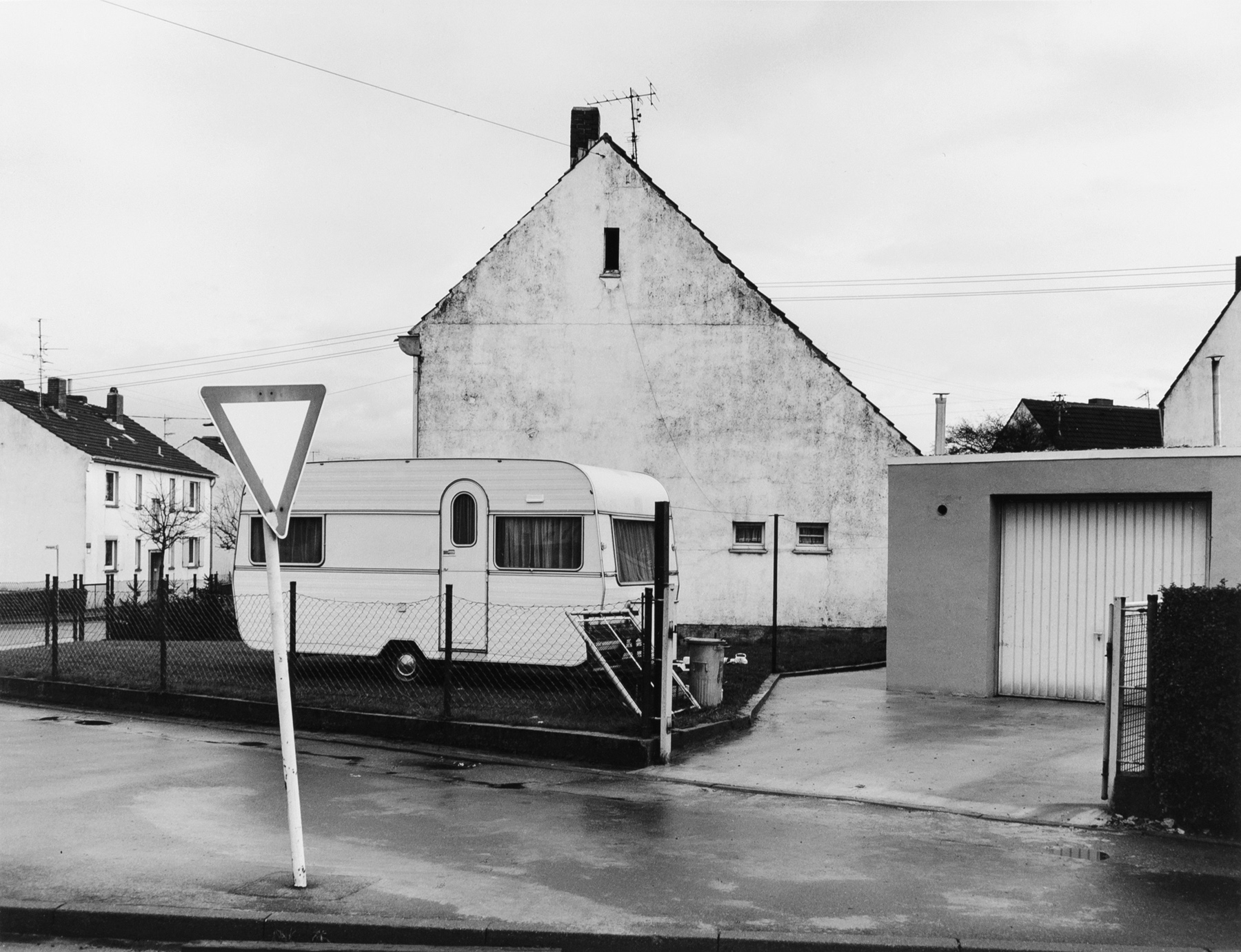
Featured photographers: Wolfgang Schulz, Hans Christian Adam, Dörte Eißfeldt, Verena von Gagern, André Gelpke, Dagmar Hartig, Andreas Horlitz, Reinhard Matz, Angela Neuke, Heinrich Riebesehl, Wilhelm Schürmann, Holger Stumpf, Petra Wittmar, and Miron Zownir
I love this gritty, inventive, subversive German photography from the late 1970s – early 1980s. Challenge me. Take me bleak places. Tell it like it is, baby…
Marcus
Many thankx to the Museum für Kunst und Gewerbe Hamburg for allowing me to publish the photographs in the posting. Please click on the photographs for a larger version of the image.
As part of its exhibition series Reconsidering Photography, the Museum für Kunst und Gewerbe Hamburg is undertaking a survey of the German photography scene around the year 1980. The springboard for the examination is the journal Fotografie. Zeitschrift internationaler Fotokunst, published by Wolfgang Schulz (b. 1944) between 1977 and 1985. On the occasion of the exhibition, MKG is inviting photography experts Reinhard Matz (Cologne), Steffen Siegel (Folkwang University Essen), and Bernd Stiegler (University of Konstanz) to relate their research project on the 1980s to the historical photographs in the MKG collection. The aim of the collaboration is to create a historical archaeology of German photography around 1980 based on the example of the journal Fotografie and its protagonists. The exhibition will show some 150 photos by Wolfgang Schulz, Hans Christian Adam, Dörte Eißfeldt, Verena von Gagern, André Gelpke, Dagmar Hartig, Andreas Horlitz, Reinhard Matz, Angela Neuke, Heinrich Riebesehl, Wilhelm Schürmann, Holger Stumpf, Petra Wittmar, and Miron Zownir, together with the journal itself, accompanied by a series of interviews conducted with contemporary witnesses expressly for the exhibition.
Something remarkable happened in the field of photography between 1975 and 1985: important galleries were established and photography increasingly became a coveted item on the art market. Suddenly, collecting and exhibiting photographs in museums was no longer the exception. Photography really stepped into the limelight in style at the so-called Mediendocumenta in 1977. Basic academic reference books were published and a large number of journals were founded. These include both periodicals that since that time have dominated the scholarly discourse, such as History of Photography and Fotogeschichte, as well as magazines designed for the broader public with an interest in photography, including Camera Austria, European Photography, Volksfoto, and Fotokritik.
Among this second group was a journal that was published between 1977 and 1985 with a total of 40 issues, for which its editor, Wolfgang Schulz, who had studied physics and then taught himself photography, chose a name that was as concise as it was ambitious: Fotografie. Zeitschrift internationaler Fotokunst (later Fotografie: Kultur jetzt). Today, this journal seems to have been almost completely forgotten. And yet the achievements of the editor and the contributing authors and photographers surely deserve a closer look. The mix of images and texts they came up with is an important resource for exploring a photography scene that, around 1980, was working hard to establish the medium as an independent art form. At the same time, the 40 issues of Fotografie exude the charm of the open-ended and were shaped by the personal predilections of their editor. An in-depth study of the journal lets us return to the origins of recent photographic history in Germany, which today – surprisingly enough – seem largely to have been buried in the dust of the past.
The exhibition is divided into four sections. It pays tribute to the photographic work of Wolfgang Schulz from the period around 1980, presents works by photographers that for the most part found their way into the MKG collection during that era, displays all 40 issues of the journal Fotografie (unfurling an impressive creative panorama), and lets contemporary witnesses have their say in video interviews as a kind of “oral history.”
Wolfgang Schulz was not merely one of the first journal editors to set himself the task of presenting “a complete overview of contemporary photography with a focus on German photography” but also a notable photographer in his own right. In his photography, as in his editorial work, Schulz tried to evade established norms, while also trying his hand at different styles and subjects. In his Ireland pictures, for example, he followed the narrative tradition of pictorial reportage but simultaneously created a strictly documentary-seeming typology of barns and their various manifestations. With a series of shots of undergrowth, he turned his attention to the unspectacular, and he also portrayed the protagonists on the photography scene who crossed his threshold. For the first time ever, the exhibition is showing his photographic works from the period around 1980.
The images in the MKG collection give an idea of the broad scope covered by art photography in the 1980s. The selection is based on the photo spreads published in Fotografie and thus undoubtedly reveals the preferences of its editor, who seems to have been interested neither in the circle around Bernd and Hilla Becher nor in Michael Schmidt, and who deliberately set out to provoke his readers. Heinrich Riebesehl (1938-2010) explored the North German landscape in his documentary series Agrarlandschaften (Agricultural Landscapes). In a similarly factual style, Wilhelm Schürmann (b. 1946) devoted himself to a highly subjective theme: his childhood surroundings on Steinhammerstrasse in Dortmund. These images are supplemented by his photographs of urban landscapes and residential architecture. Riebesehl and Schürmann both sought their motifs in the realities of life in West Germany that confronted them everywhere they looked. André Gelpke (b. 1947) for his part explored Hamburg’s St. Pauli entertainment district for an independent series he called Sex Theater. He conveys here his view of erotic theatre as a mirror of society that tellingly reveals the audience’s double standards. Wolfgang Schulz also printed Miron Zownir’s pictures of New York’s underground SM, queer, and transsexual scene. These photo spreads reflect the editor’s interest in non-establishment subcultures and in people living on the margins of society.
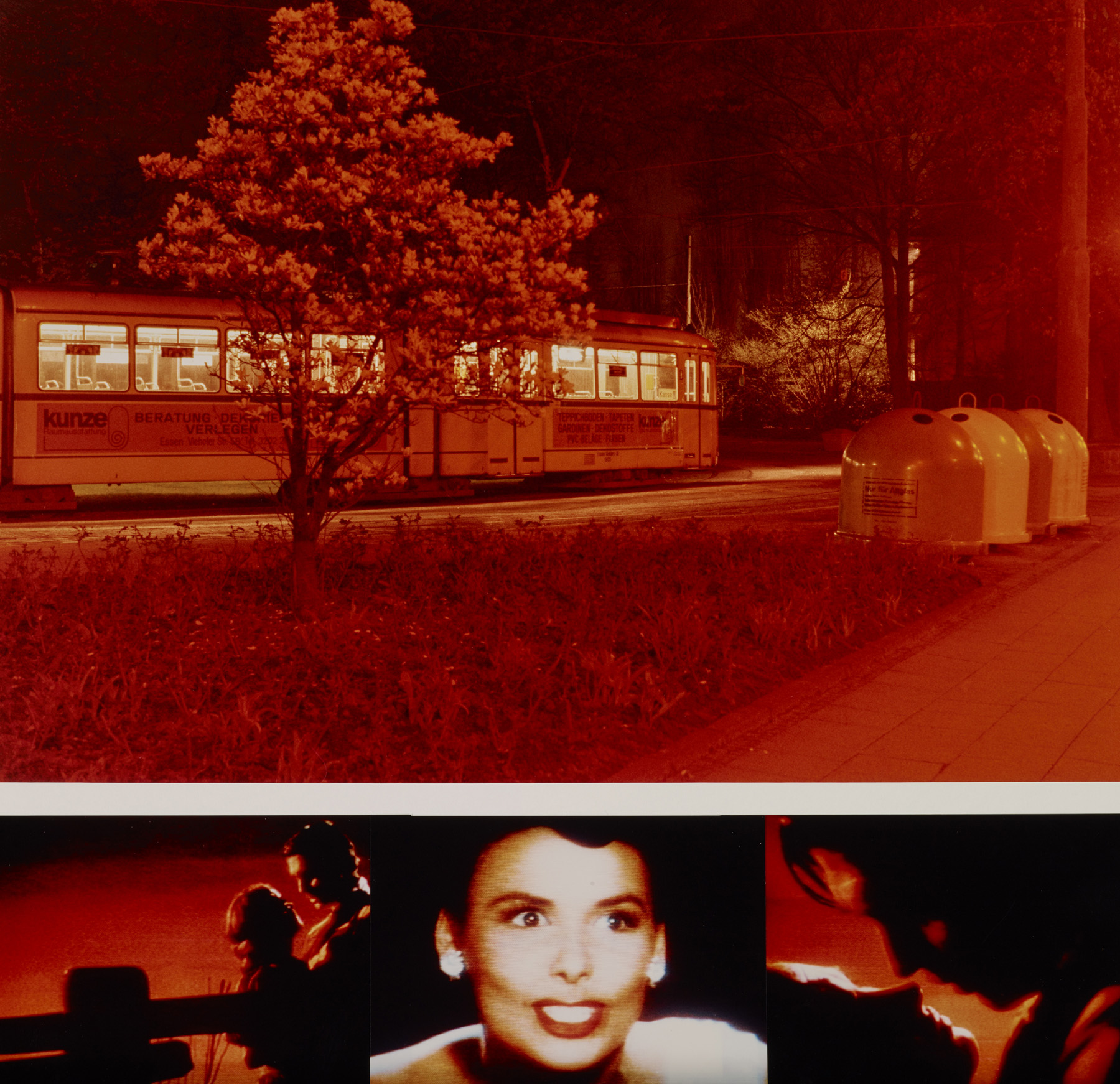
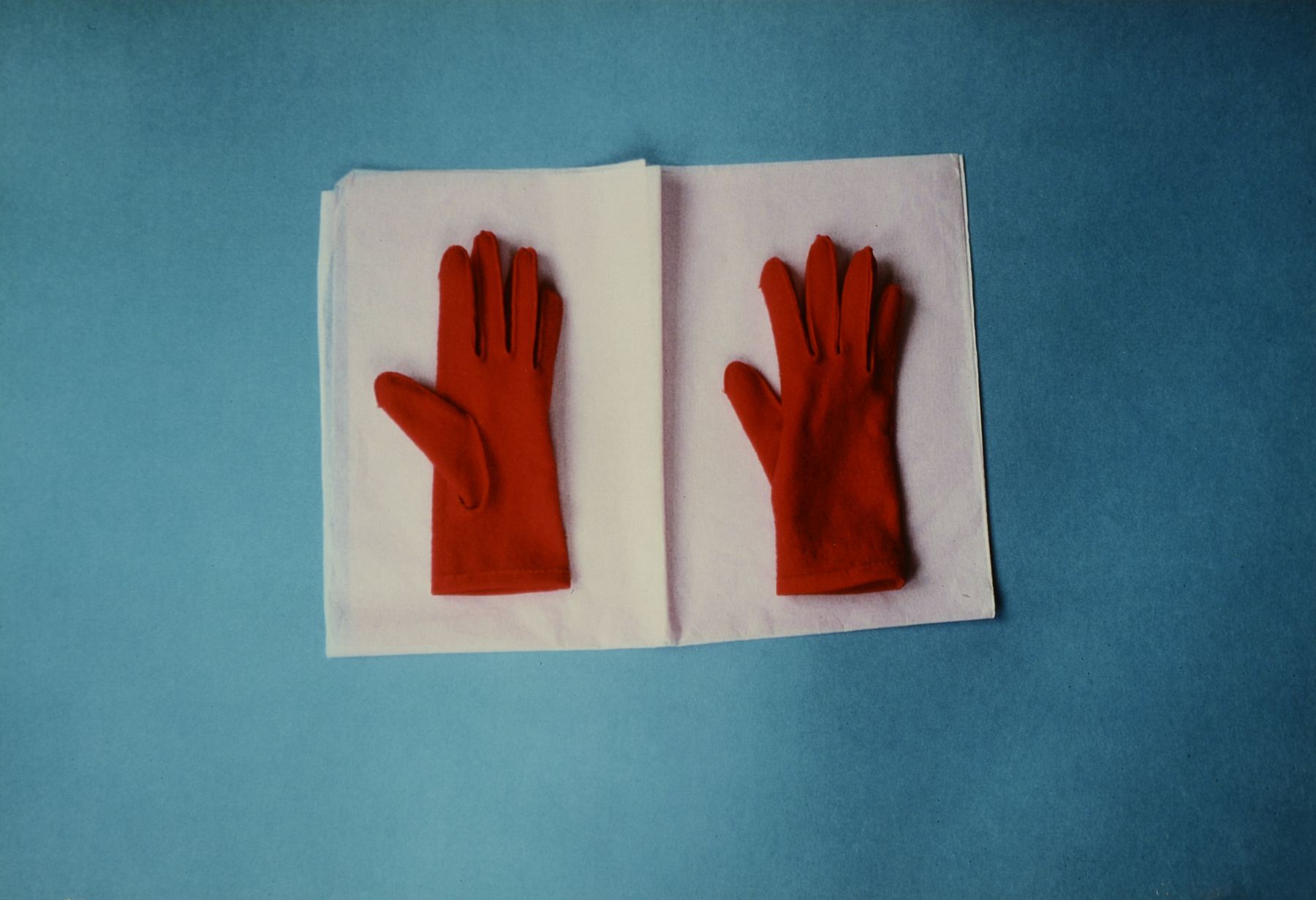
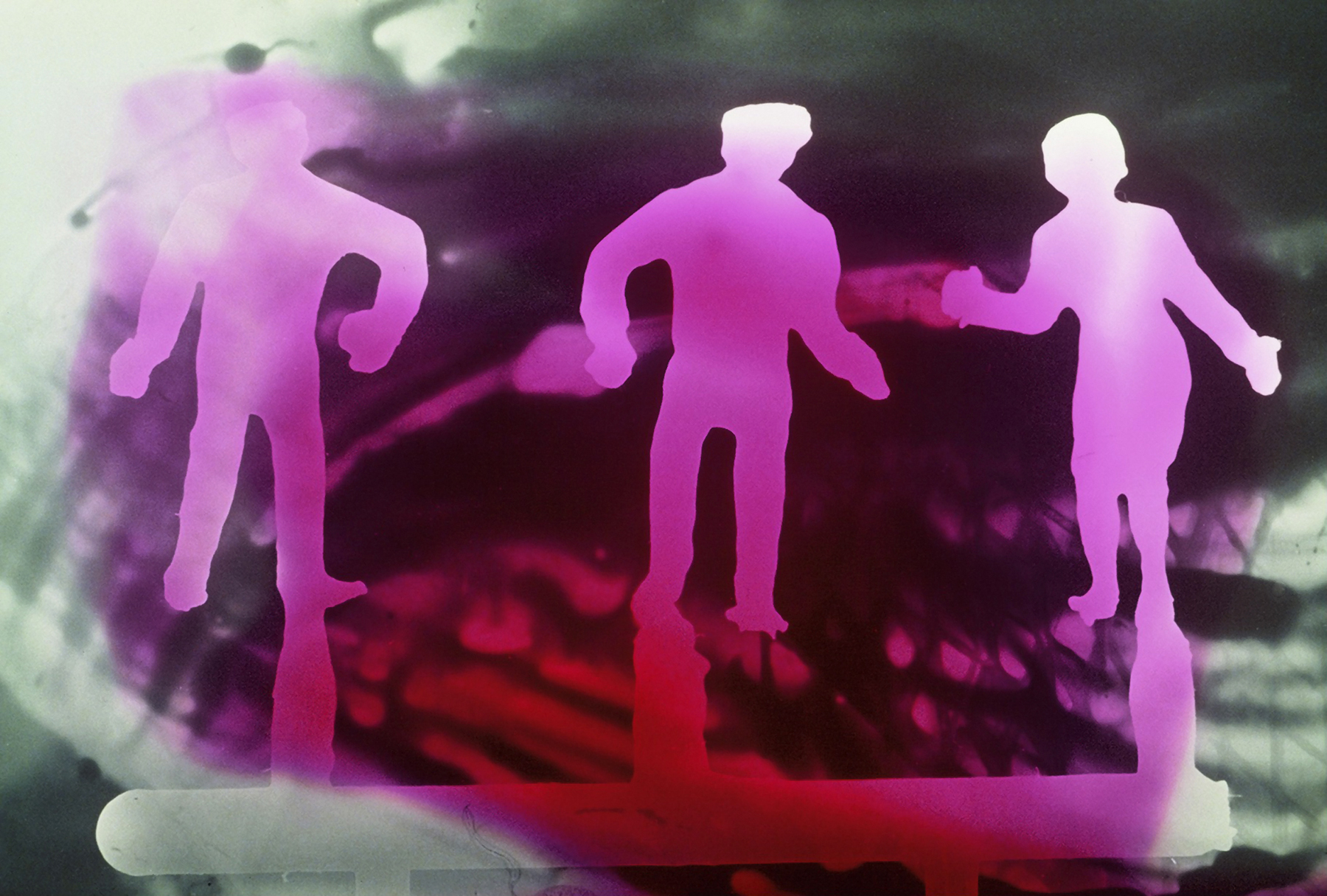
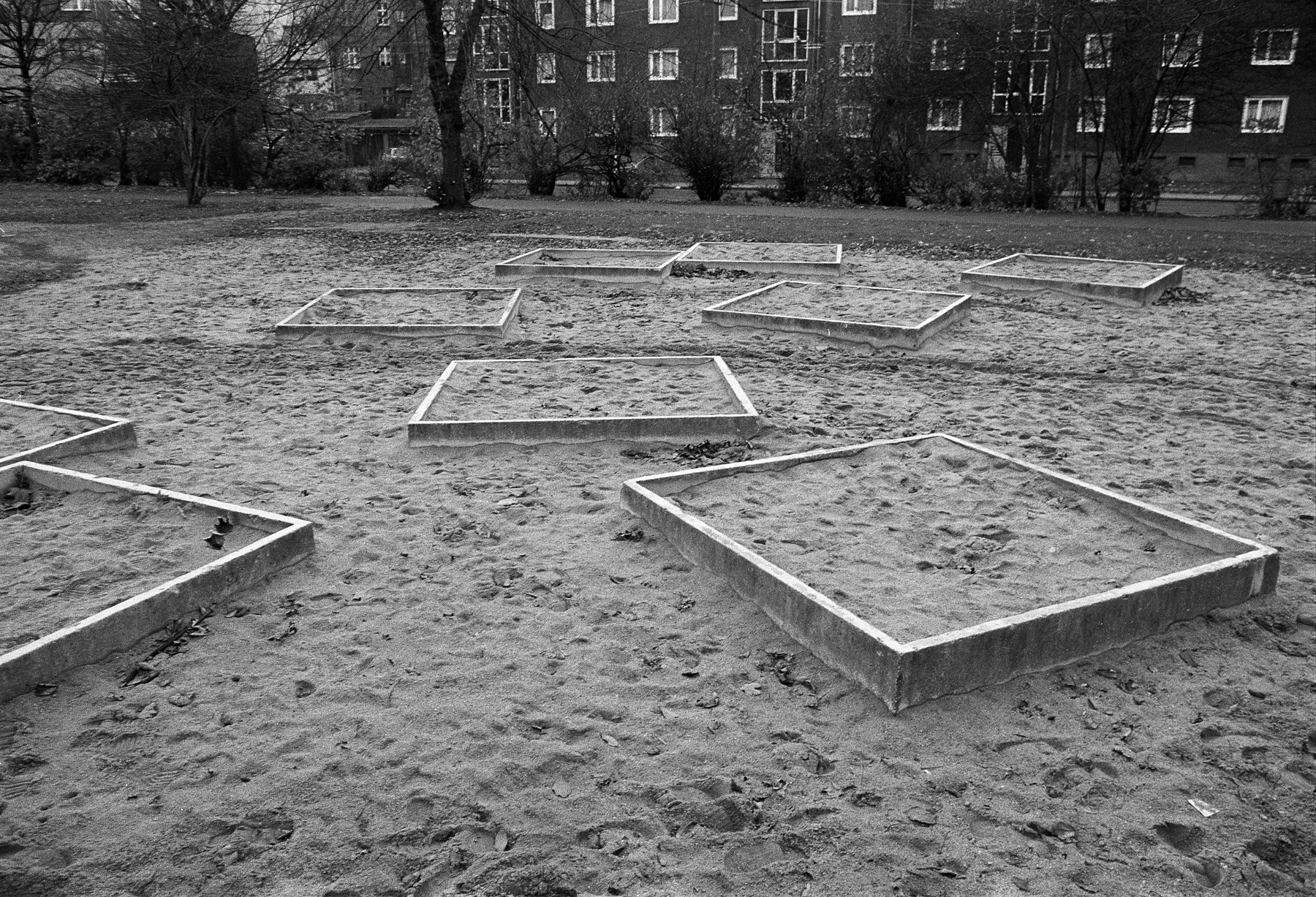
The photography scene around 1980 was predominantly male: of 147 portfolios published in Fotografie, only 24 presented female photographers. One of the privileged few, Dörte Eißfeldt (b. 1950), combined in her work Große Liebe (True Love, 1980) photographic montage techniques with the serial principle, creating in the darkroom photograms with motifs from her own daily life. Her approach might be dubbed “poetic photography,” the term used by photographer Verena von Gagern (b. 1946) to describe the “representation of private realities.” Von Gagern made pictures in the late 1970s within the “emotional realm” of her own family, among them the image Barbara (1978). Petra Wittmar (b. 1955) pursued by contrast a stricter documentary concept. In her series Spielplätze (Playgrounds, 1979), she takes a critical look at the dreary world of the modern metropolis.
Press release from the Museum für Kunst und Gewerbe Hamburg
Exhibition dates: 21st October – 30th November, 2017
Wayne Sorce (American, b. 1946) Vinegar Hill, New York 1985 Digital chromogenic print 20 x 24 inches
These remind me very strongly of the 1970s urban Americana colour work of Stephen Shore. Most of them are successful, well seen, well photographed colour images that evince a certain period in the American cultural landscape.
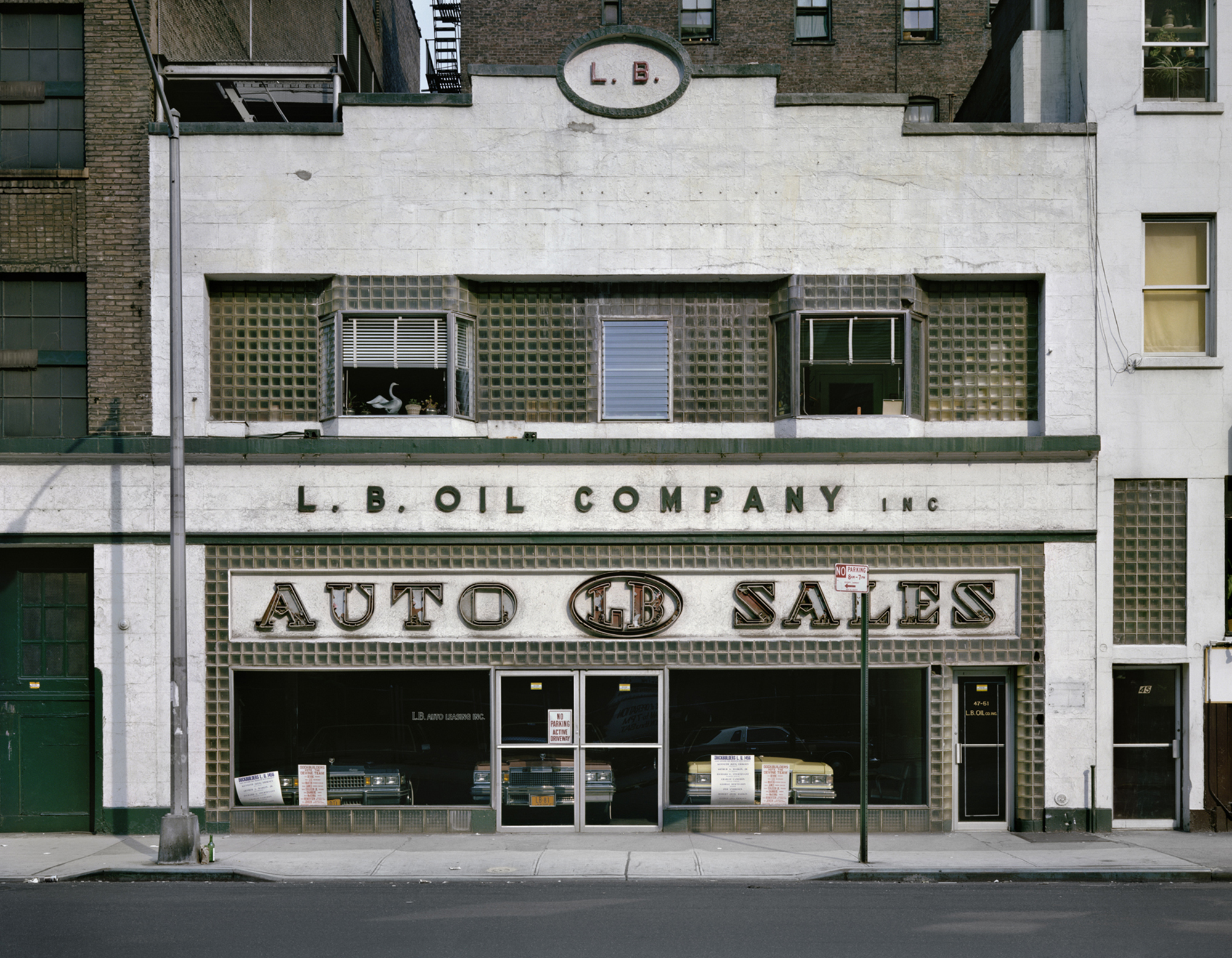
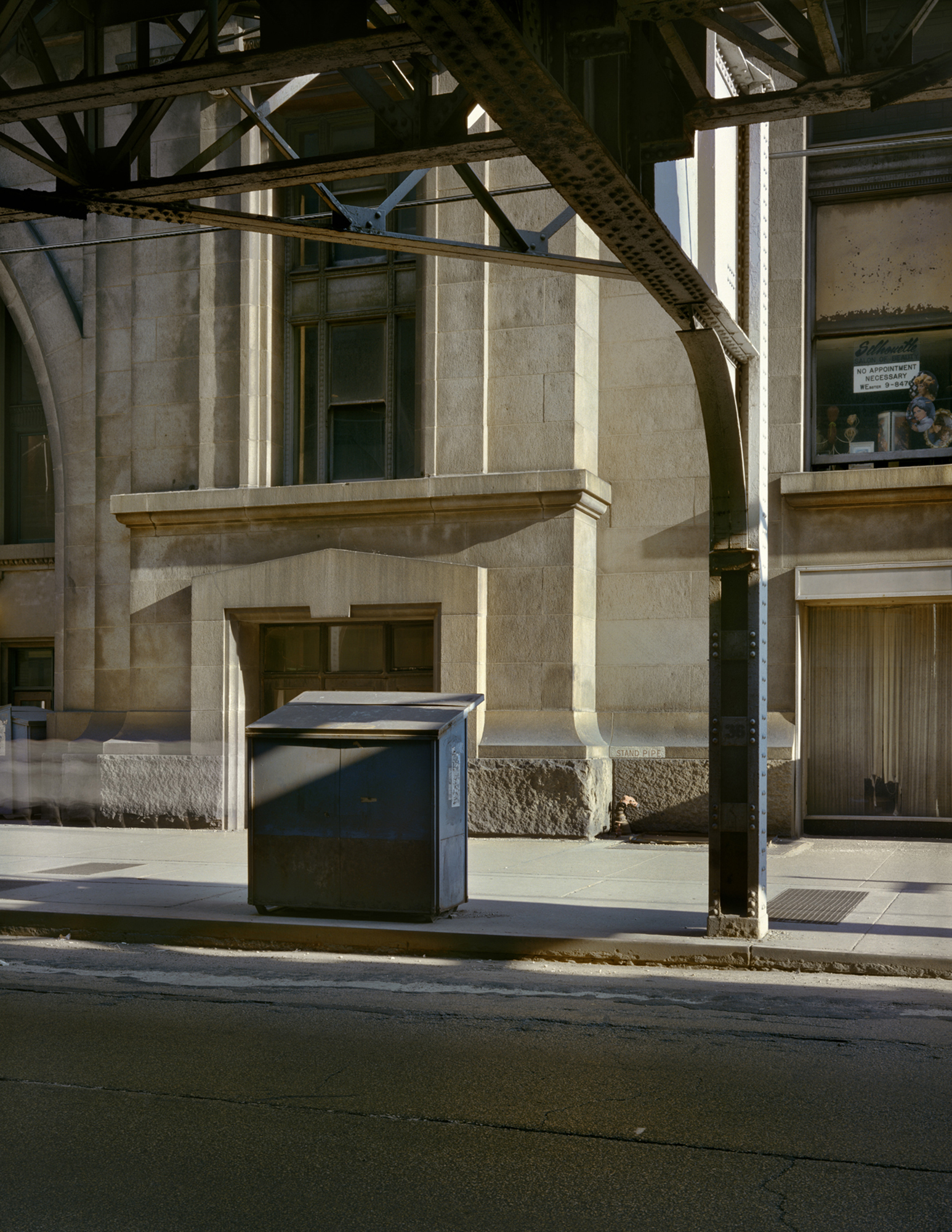
When they work – as in the formal Vinegar Hill, New York (1985, above) or the more abstract Vinegar Hill, New York (1985, below); the colourful, planar Varick Street, New York (1984); the duo-chromatic L.B. Oil, New York (1984); the magnificently shadowed, geometric Halsted Street, Chicago (1978); and my particular favourite (because of the light), Under the EL, Chicago (1978) – they work superbly. When they don’t work – as in Blankets, New York (1986) or Barbers, New York (1985) – they feel a bit flat.
It’s so hard to put a body of photographs together where each image is as strong (but not necessarily the same) as the next and they form a holistic group. Most photographers can put together four images well enough, but the skill is to be able to narrativise a larger body of work, and then do that over a longer period of time.
I believe that over the lifetime of a photographic artist, you can count on the fingers of two hands the truly memorable images they will make, if they are lucky. Other images are valuable in their own right… while others should be quietly singed.
Dr Marcus Bunyan
Many thankx to the Mike and Joseph Bellows Gallery for allowing me to publish the photographs in the posting. Please click on the photographs for a larger version of the image.
Wayne Sorce (American, b. 1946) Vinegar Hill, New York 1985 Digital chromogenic print 20 x 24 inches
Wayne Sorce (American, b. 1946) Varick Street, New York 1984 Digital chromogenic print 20 x 24 inches
Wayne Sorce (American, b. 1946) Halsted Street, Chicago 1978 Digital chromogenic print 20 x 24 inches
Wayne Sorce (American, b. 1946) L.B. Oil, New York 1984 Digital chromogenic print 20 x 24 inches
Wayne Sorce (American, b. 1946) Spiral Fire Escape, Chicago 1975 Digital chromogenic print 20 x 24 inches
Wayne Sorce (American, b. 1946) No Left, Vinegar Hill 1988 Digital chromogenic print 20 x 24 inches
Wayne Sorce (American, b. 1946) Dave’s Restaurant, New York 1984 Digital chromogenic print 20 x 24 inches
Wayne Sorce (American, b. 1946) EL Platform, Chicago 1978 Digital chromogenic print 20 x 24 inches
Wayne Sorce (American, b. 1946) Bee Gee’s, New York 1984 Digital chromogenic print 20 x 24 inches
Wayne Sorce (American, b. 1946) Fort Dearborn Coffee, Chicago 1977 Digital chromogenic print 20 x 24 inches
Wayne Sorce (American, b. 1946) East Chicago 1977 Digital chromogenic print 20 x 24 inches
Wayne Sorce (American, b. 1946) Chock Full of Nuts, New York 1984 Digital chromogenic print 20 x 24 inches
Joseph Bellows Gallery is pleased to announce its upcoming solo exhibition,Wayne Sorce: Urban Color. The exhibition will open on October 21st and continue through November 30th, 2017. In conjunction with Sorce’s exhibition will be a group show relating to the city as subject.
Urban Color will present a remarkable selection Sorce’s large-scale colour photographs of urban environments taken in the late 1970’s and early 1980’s in both Chicago and New York City. His urban landscapes describe with a formal exactitude, the light, structures, and palette of these cities within a certain era. For Sorce, the urban landscape is both still and transitory; people appear in the photographs as both inhabitants of the city, as well as sculptural forms relating to a larger composed scene.
Sorce’s photographs are held within the collections of the Art Institute of Chicago, the George Eastman Museum, the Armand Hammer Museum of Art, National Museum of American Art, at the Smithsonian Institution, and the Museum of Modern Art. Complementing Sorce’s exhibition will be a collection of photographs by his contemporaries that describe the city as subject. Work by Bob Thall, George Tice, Bevan Davies, Grant Mudford, and others will be included.
Press release from the Joseph Bellows Gallery
Wayne Sorce (American, b. 1946) Under the EL, Chicago 1978 Digital chromogenic print 24 x 20 inches
Wayne Sorce (American, b. 1946) Blankets, New York 1986 Digital chromogenic print 24 x 20 inches
Wayne Sorce (American, b. 1946) Barbers, New York 1985 Digital chromogenic print 24 x 20 inches
Wayne Sorce (American, b. 1946) Greyhound Station c. 1970’s Digital chromogenic print 24 x 20 inches
Joseph Bellows Gallery 7661 Girrard Avenue La Jolla, California Phone: 858 456 5620
Opening hours: Tuesday – Saturday 11am – 5pm and by appointment
Exhibition dates: 10th September – 28th October, 2016
George Tice (American, b. 1938) Jimmy’s Bar and Grill and Conmar Zipper Company, Newark, NJ, 1973 1973 Silver gelatin print
An American iconography
George Tice is a master photographer and an exceptional artist. Using a large format 8 x 10 camera this craftsman has created a “deeply-penetrating” photographic record of the American urban landscape, mainly based around the city of New Jersey where he has lived for most of his life.
Tice’s ongoing epic visual poem is at its strongest in his early period, from 1973-74. While his later 1990s work is qualified by simplified imagery and semiotic statements (for example Dorn’s Photoshop, Red Bank, NJ, 1999 and Lakewood Manor Motel, Lakewood, NJ, 1998, below) it is this early work that produces “attentive and quotidian descriptions of the everyday structures and places that define the American cultural landscape.” There seems to be a greater personal investment in these earlier images. Tice’s recognition of subject matter that mere mortals pass by is translated into beautiful, serene, tonal and dare I say, sensual images, that belie the complexity of their previsualisation. You only have to look at two images, Houses and Water Towers, Moorestown, NJ, 1973 and Hudson’s Fish Market, Atlantic City, NJ, 1973 (below) to understand that these photographs are visually complex, slightly surreal, affectionate images of places he personally knows so well. They possess a totally different feeling from the conceptual photography of the German school of Bernd and Hilla Becher. As Sanford Schwartz in The New York Times, on December 3, 1972 noted: “Tice’s pictures… show a remarkable blend of intimacy, affection and clear-sightedness.”
The almost tragic, objective renditions of a post-industrial landscape evidence a poetic intensity that has deep roots in the history of photography. Vivien Raynor, writing in The New York Times, said, “Finding precedents for Mr. Tice’s photography is easier than defining the personal qualities that make it so special. As others have remarked, his tranquil towns, usually deserted, could sometimes be those of Walker Evans updated; his industrial views are not unrelated to Charles Sheeler’s, and, for good measure, the stillness and silence of his compositions link him to Atget, the first great urban reporter.” Tice builds upon the lineage of other great artists but then, as any good artist should, he forges his own path, not reliant on the signature of others. As he himself observes, “… if you learn to see what photography is through one person’s eyes you become fixed in that one way of seeing.”
When I first started taking photographs in 1990, my heroes were Atget, Strand, Evans and Minor White. Looking at art, and looking at photographers, trained my eye. But as an artist, looking at the world is the most valuable education that you can have, for eventually you have to forge your own style, not copy someone else … and the signature that you create becomes your own. You know it’s a Mapplethorpe, just as you know it’s an Evans, or a Tice. Each piece of handwriting is unique. Nobody can teach that and it only comes with time and experience. As Paul Strand said, it takes 10 years to become an artist, 10 years to learn your craft, 10 years to drop ego away and find your own style. This is what the work of George Tice speaks to. He approaches the world with a clear mind, focused on a objective narrative that flips! exposing us (like his film), to a subjective, visceral charm all of his own making.
Dr Marcus Bunyan
Many thankx to the Joseph Bellows Gallery for allowing me to publish the photographs in the posting. Please click on the photographs for a larger version of the image.
“As I progressed further with my project, it became obvious that it was really unimportant where I chose to photograph. The particular place simply provided an excuse to produce work… you can only see what you are ready to see – what mirrors your mind at that particular time.”
“Documenting the place is principally what I do. The bulk of my photographs are of New Jersey. It may have been a subject series, like ice or aquatic plants, that could have been anywhere, but it was done in New Jersey. Most of my pictures are about place. I would say the Urban Landscape work is what is most distinctive about me.”
George Tice
George Tice (American, b. 1938) Houses and Water Towers, Moorestown, NJ, 1973 1973 Silver gelatin print
George Tice (American, b. 1938) Hudson’s Fish Market, Atlantic City, NJ, 1973 1973 Silver gelatin print
George Tice (American, b. 1938) Dorn’s Photoshop, Red Bank, NJ, 1999 1999 Silver gelatin print
George Tice (American, b. 1938) Lexington Avenue, Passaic, NJ, 1973 1973 Silver gelatin print
George Tice (American, b. 1938) Palace Funhouse, Asbury Park, 1995 1995 Silver gelatin print
George Tice (American, b. 1938) Railroad Bridge, High Bridge, NJ, 1974 1974 Silver gelatin print
George Tice (American, b. 1938) Route #440 Overpass, Perth Amboy, 1973 1973 Silver gelatin print
Joseph Bellows Gallery is pleased to announce an exhibition of photographs by one of the medium’s master photographers, George Tice. George Tice: Urban Landscapes will open with a book signing and reception with the artist on Saturday September, 10th from 6-8pm. The exhibition will continue through October 28th, 2016.
The exhibition will present a remarkable selection of forty exceptionally rare vintage 8 x 10 inch gelatin silver contact prints from the early period (1973-1974), of Tice’s ongoing epic visual poem of his native state of New Jersey. These unique vintage prints will be punctuated with larger photographs of some of artist’s most revered and significant images, as well as selections of more recent work from his extended New Jersey portrait.
Renowned for their attentive and quotidian descriptions of the everyday structures and places that define the American cultural landscape, Tice’s exquisitely printed photographs catalog a rich and layered journey that is both personal and universal. In the photographs that comprise Urban Landscapes, Tice defines a sense of America within a tradition rooted in the work of other American masters, namely Edward Hopper and Walker Evans. Tice’s photographs of New Jersey in the early to mid 1970’s describe a particular time and place; however, as the artist states, “It takes the passage of time before an image of a commonplace subject can be assessed. The great difficulty of what I attempt is seeing beyond the moment; the everydayness of life gets in the way of the eternal.” Now, with decades past, Tice’s observations have become even more poignant depictions, everlasting a specific era and landscape, as the artist intended.
As well as being one of the 20th Century’s most prominent photographers, Tice is revered as a master printer, having printed limited-edition portfolios of some of his favourite photographers, among them Edward Steichen, Edward Weston and Frederick H. Evans, as well as other important photographers including Francis Bruguiere, Ralph Steiner and Lewis Hine.
Press release from the Joseph Bellows Gallery
George Tice (American, b. 1938) Tenement Rooftops, Hoboken, NJ, 1974 1974 Silver gelatin print
George Tice (American, b. 1938) Steve’s Diner, Route 130, North Brunswick, 1974 1974 Silver gelatin print
George Tice (American, b. 1938) Ideal Diner, Perth Amboy, NJ, 1980 1980 Silver gelatin print
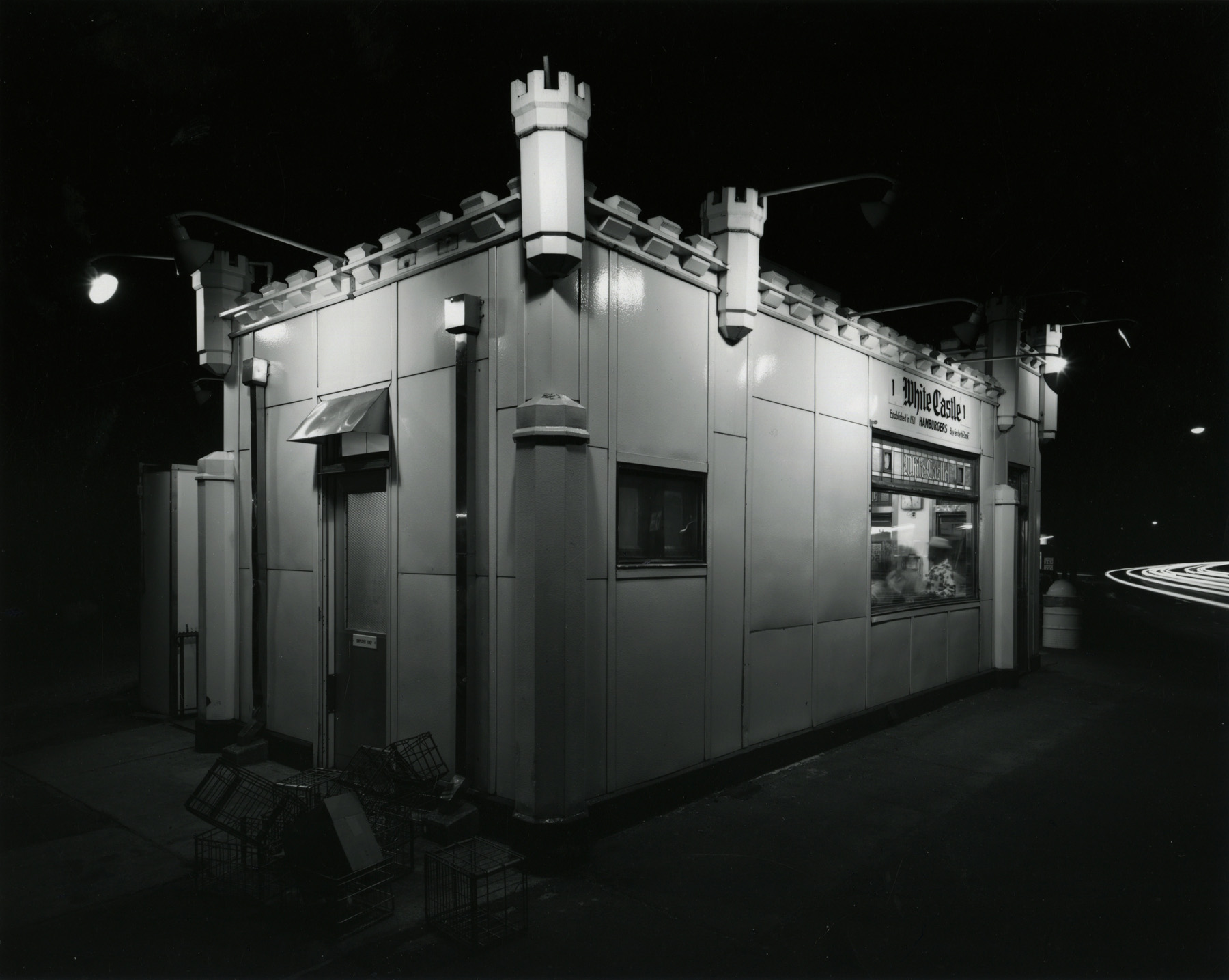
George Tice (American, b. 1938) White Castle, Route #1, Rahway, NJ, 1973 1973 Silver gelatin print
George Tice (American, b. 1938) Strand Theater, Keyport, NJ, 1973 1973 Silver gelatin print
George Tice (American, b. 1938) Industrial Landscape, Kearny, NJ, 1973 1973 Silver gelatin print
George Tice in conversation with Paul Caponigro
JPC You had said, “After a time you don’t want to have any photographic influences. It’s okay to be influenced by writers, poets, people in other fields but not okay by other photographers.”
GT You don’t want to be like anyone else. Like all those people who were influenced by Ansel Adams. I don’t think any of them will do better than he did.
JPC Not until they find their own voice. It’s impossible to successfully imitate someone else’s voice.
GT Right. And the natural landscape of the west, that’s not going to be better in the future, as the population increases and much of the wilderness gets erased. Timothy O’Sullivan probably had a better chance at it than Ansel Adams did. But you don’t want anyone to be too great an influence, like an apprenticeship. If I was to begin photography, study it, I wouldn’t want one teacher. I think one teacher is too great an influence. I’d rather have an education based on workshops. You draw some knowledge through every one of them. But if you learn to see what photography is through one person’s eyes you become fixed in that one way of seeing.
George Tice Conversations on the John Paul Caponigro “Illuminating Creativity” web page 07/01/1997 [Online] Cited 09/10/2016
George Tice (American, b. 1938) Jahos Brothers Clothing Store, Trenton, NJ, 1973 1973 Silver gelatin print
George Tice (American, b. 1938) Minnie’s Go-Go, Route 130, Merchantville, 1975 1975 Silver gelatin print
George Tice (American, b. 1938) Lakewood Manor Motel, Lakewood, NJ, 1998 1998 Silver gelatin print
George Tice (American, b. 1938) Esso Station and Tenement House, Hoboken, NJ, 1972 1972 Silver gelatin print
George Tice (American, b. 1938) Telephone Booth, 3 am, Railway, NJ, 1974 1974 Silver gelatin print
Joseph Bellows Gallery 7661 Girrard Avenue La Jolla, California Phone: 858 456 5620
Opening hours: Tuesday – Saturday 11am – 5pm and by appointment
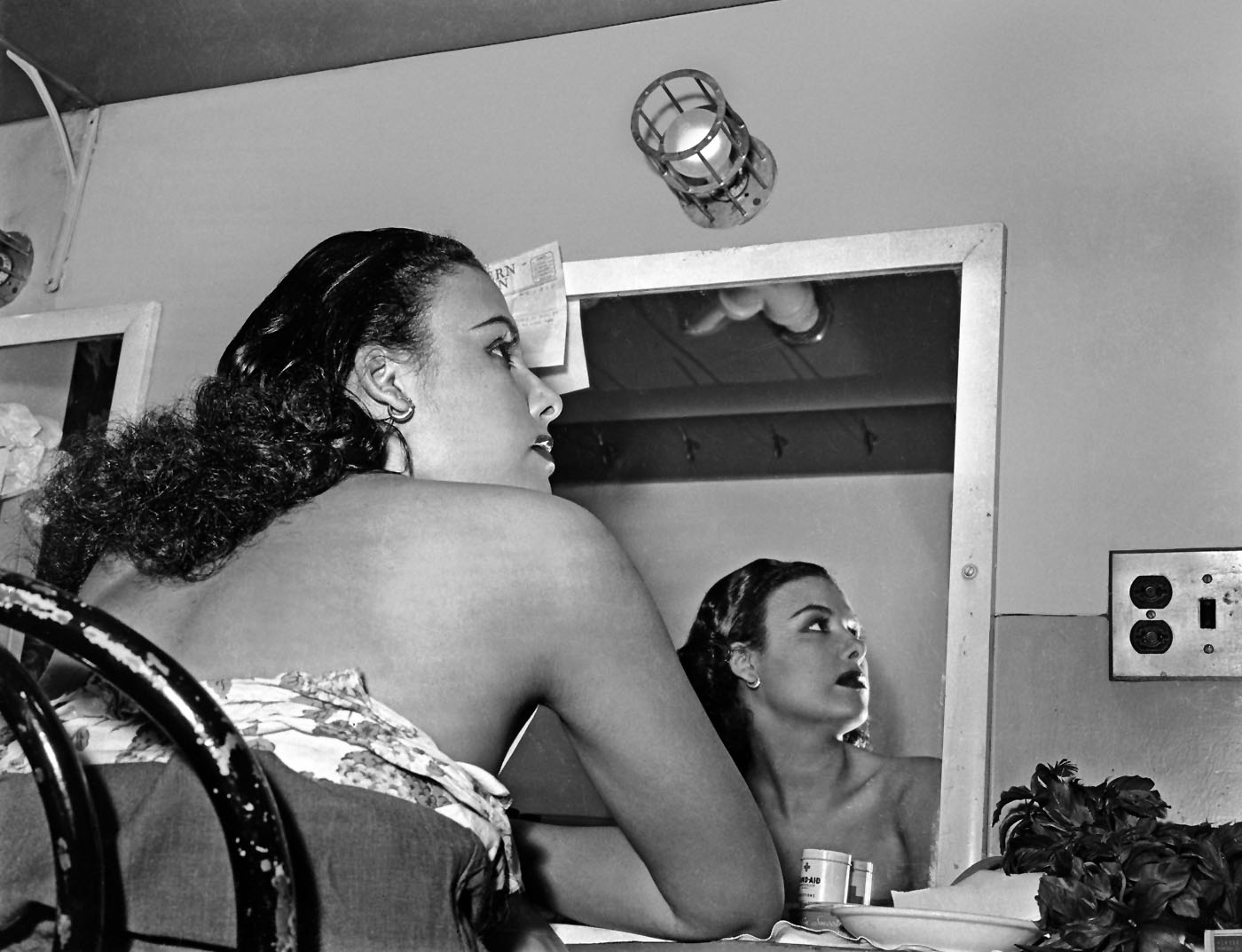
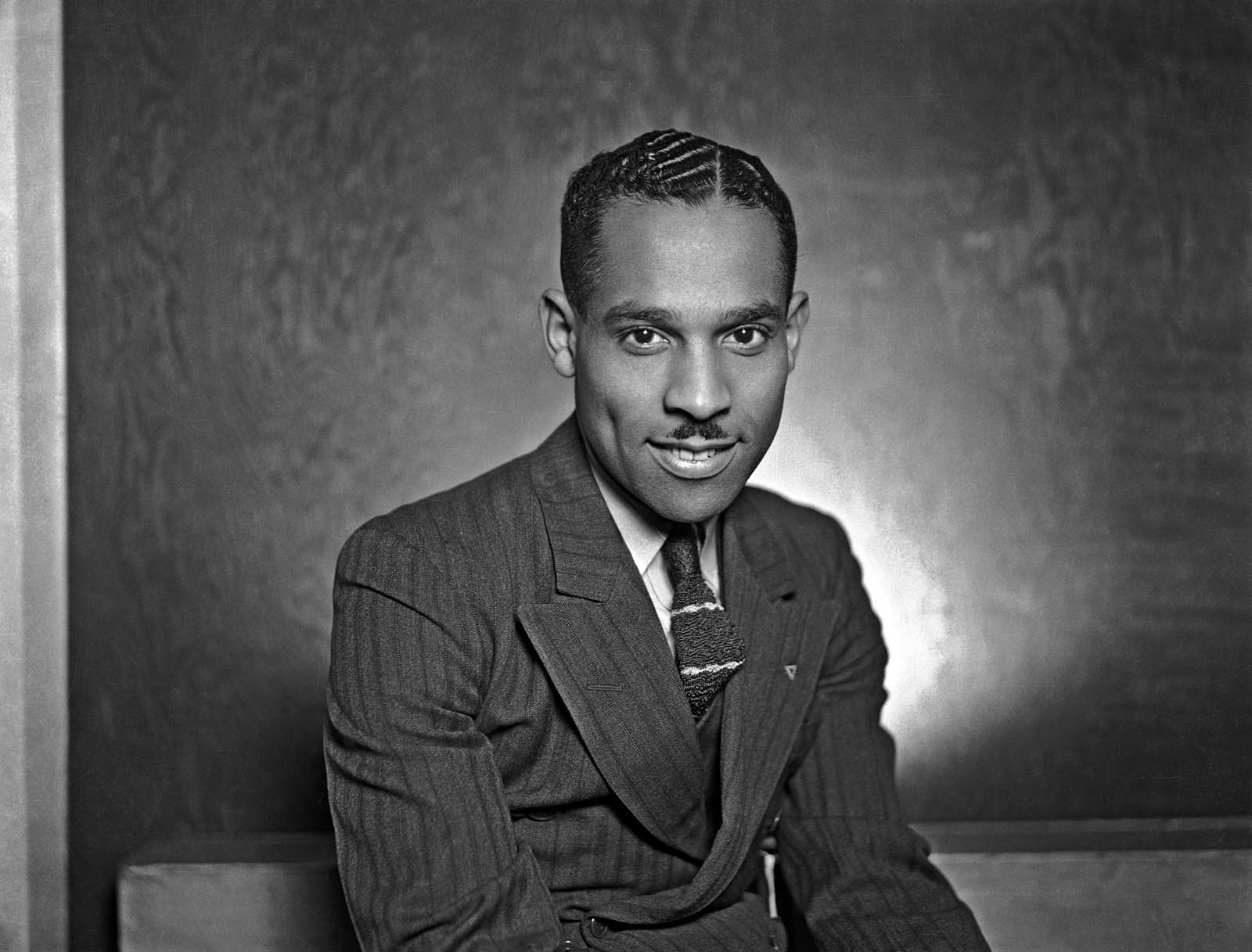
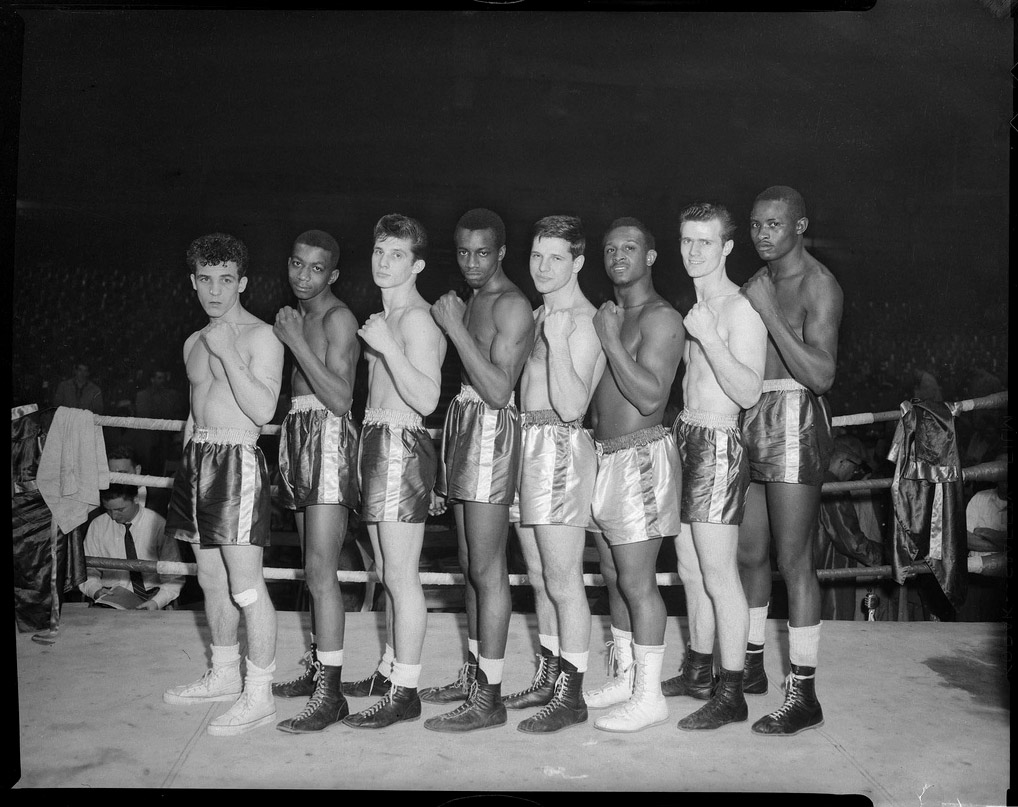
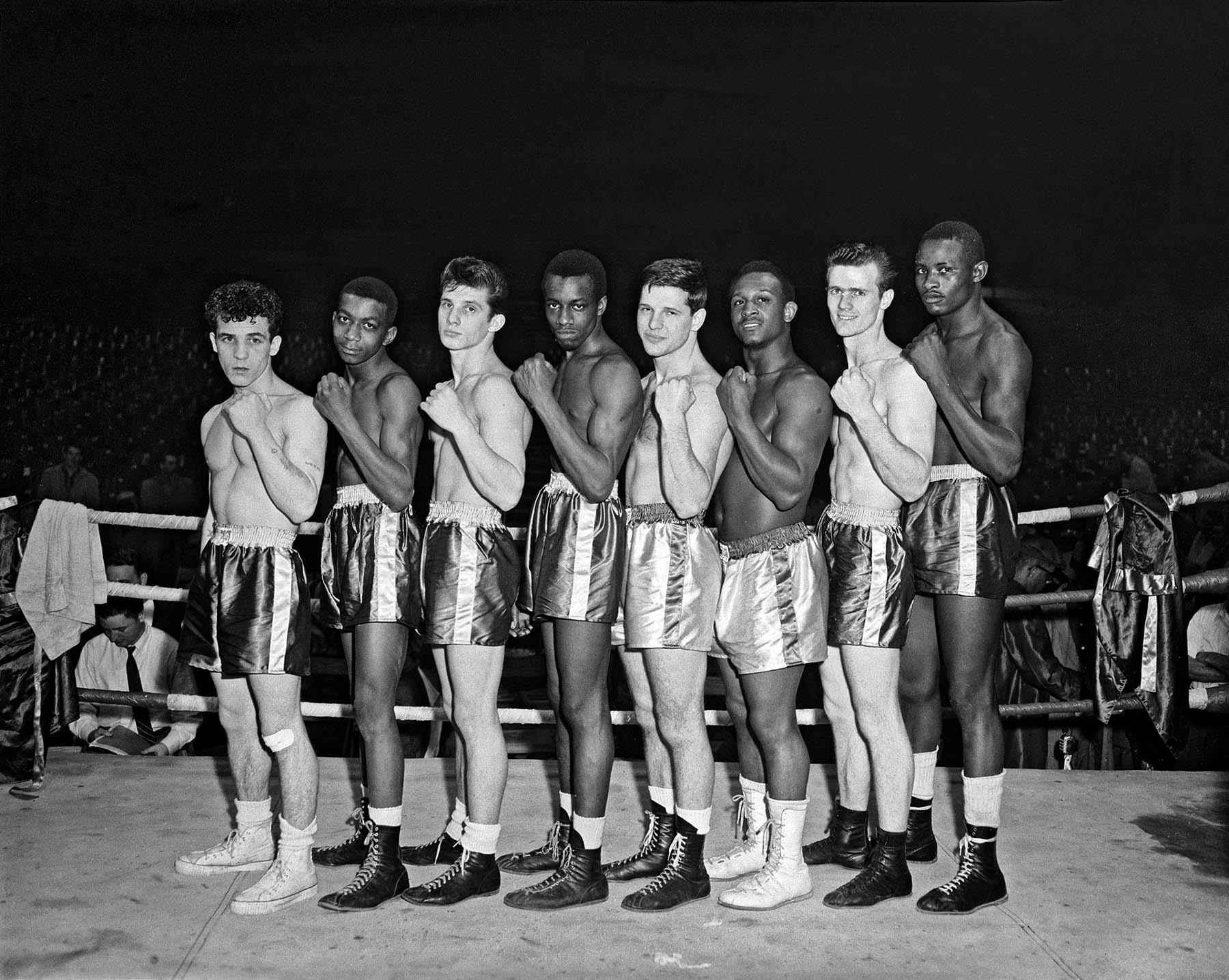
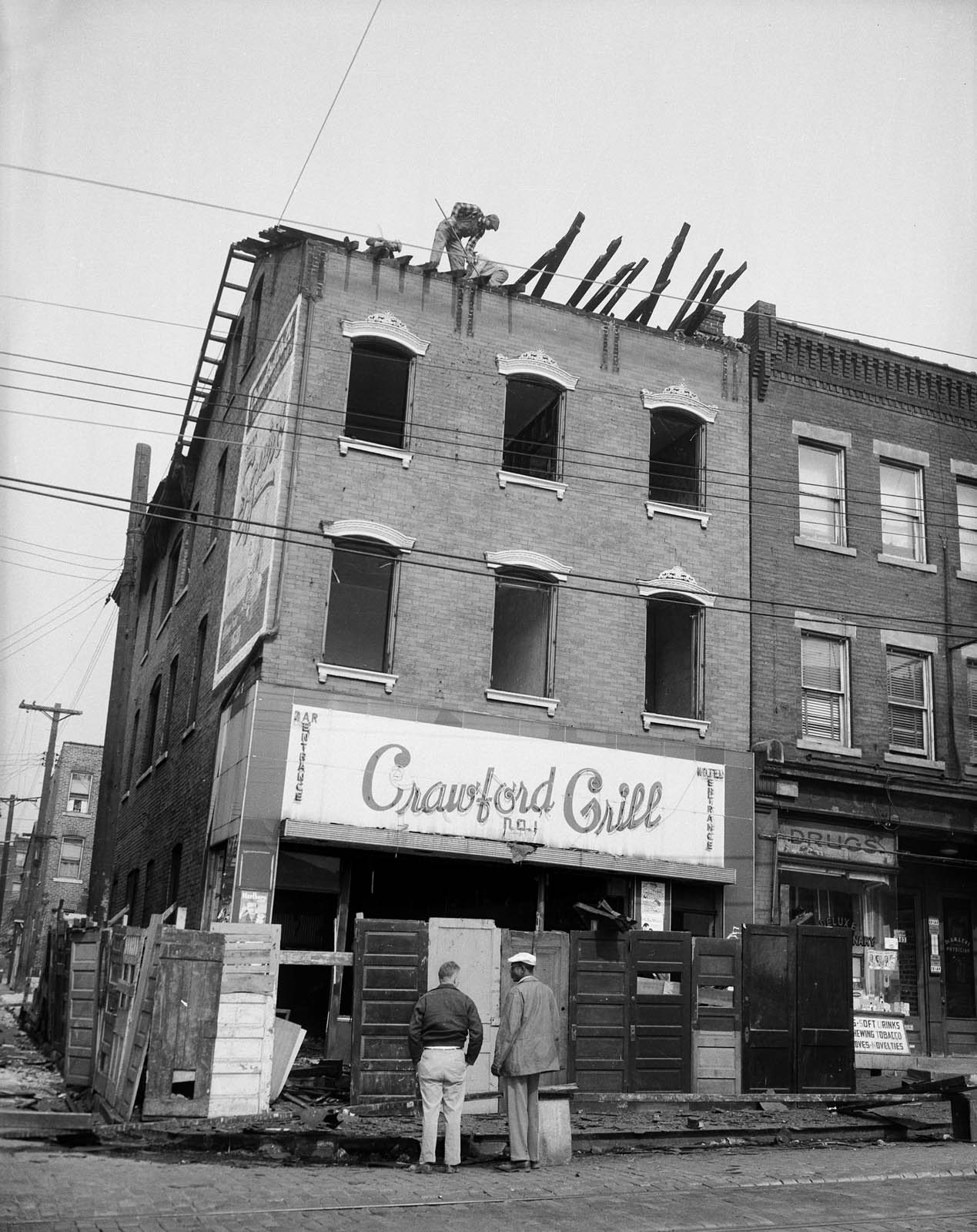
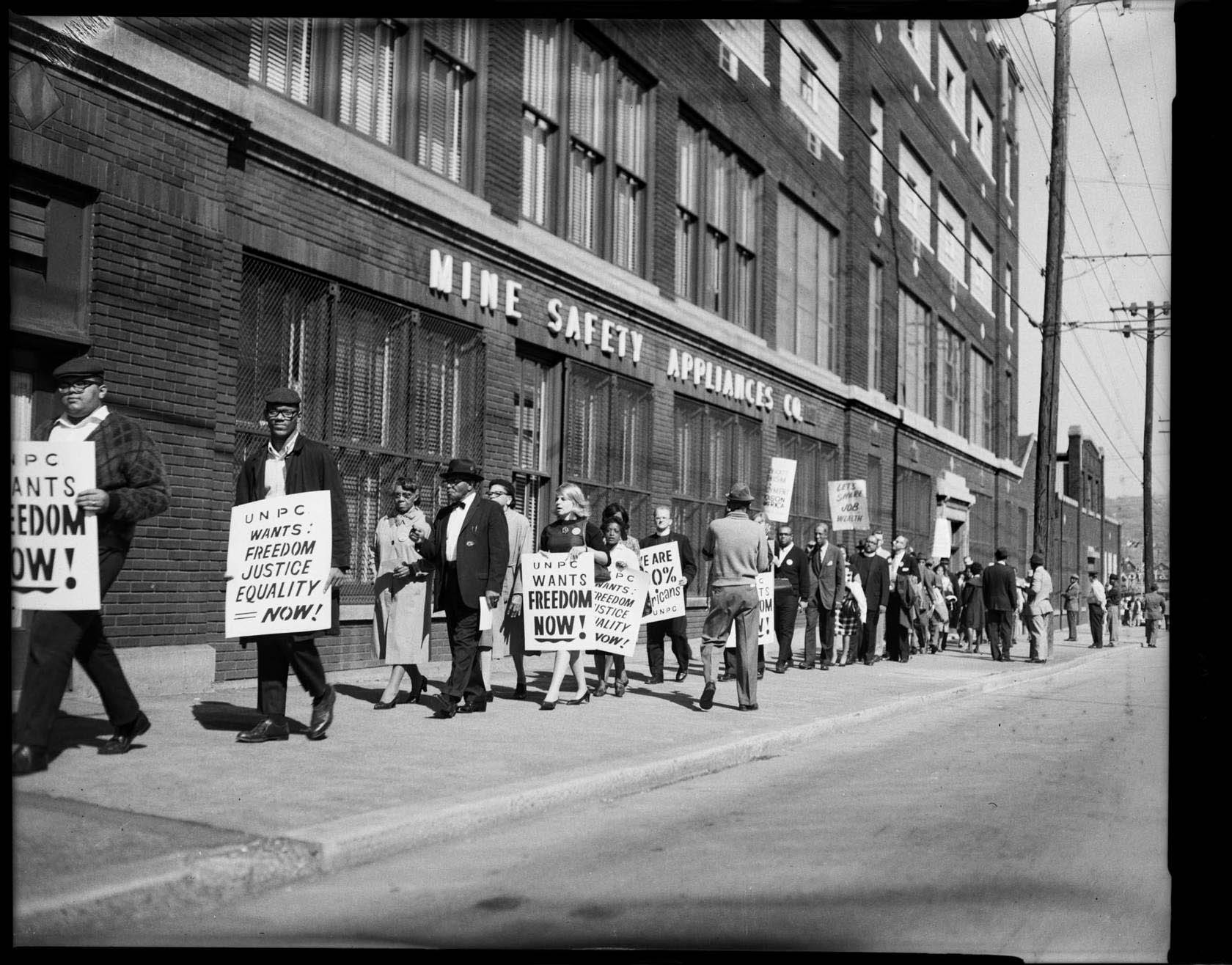
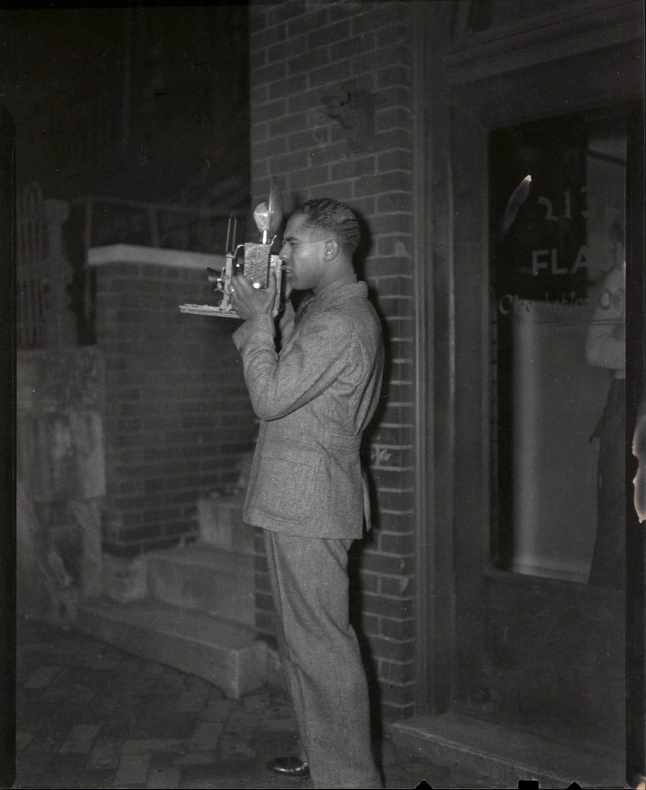
What an astonishing photographer this man was. These photographs are a revelation. African American artist Charles “Teenie” Harris, captured “the essence of daily African-American life in the 20th century. For more than 40 years, Harris – as lead photographer of the influential Pittsburgh Courier newspaper – took almost 80,000 pictures of people from all walks: presidents, housewives, sports stars, babies, civil rights leaders and even cross-dressing drag queens.”
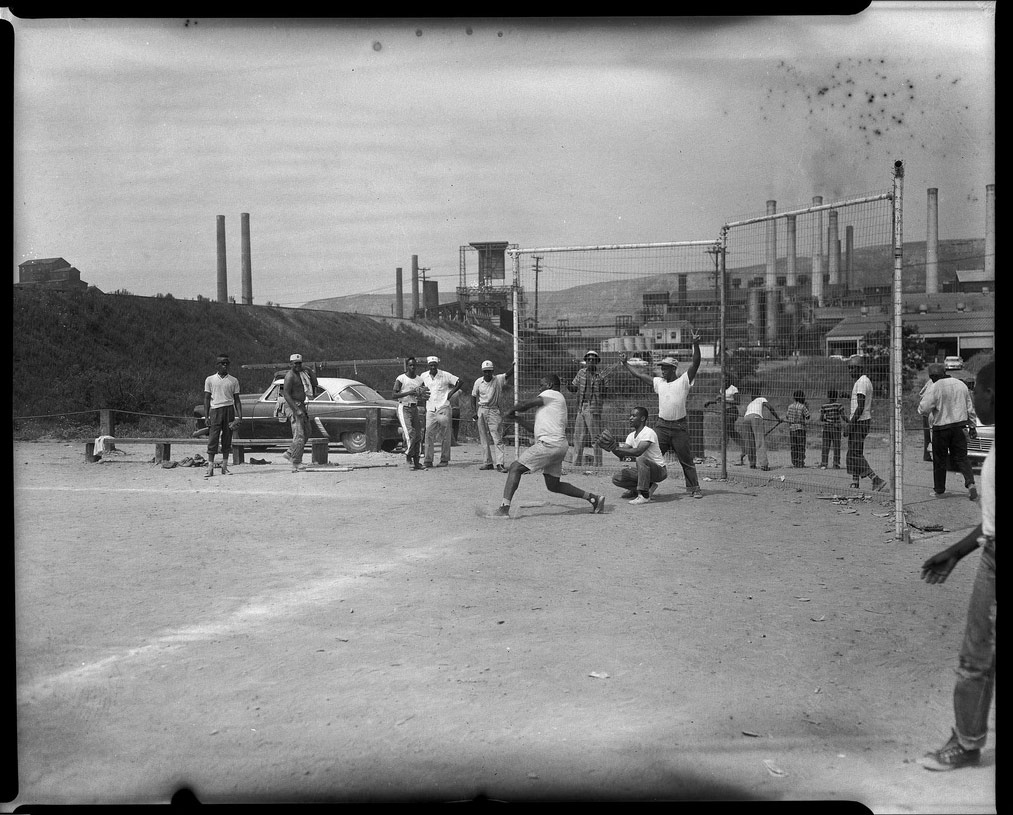
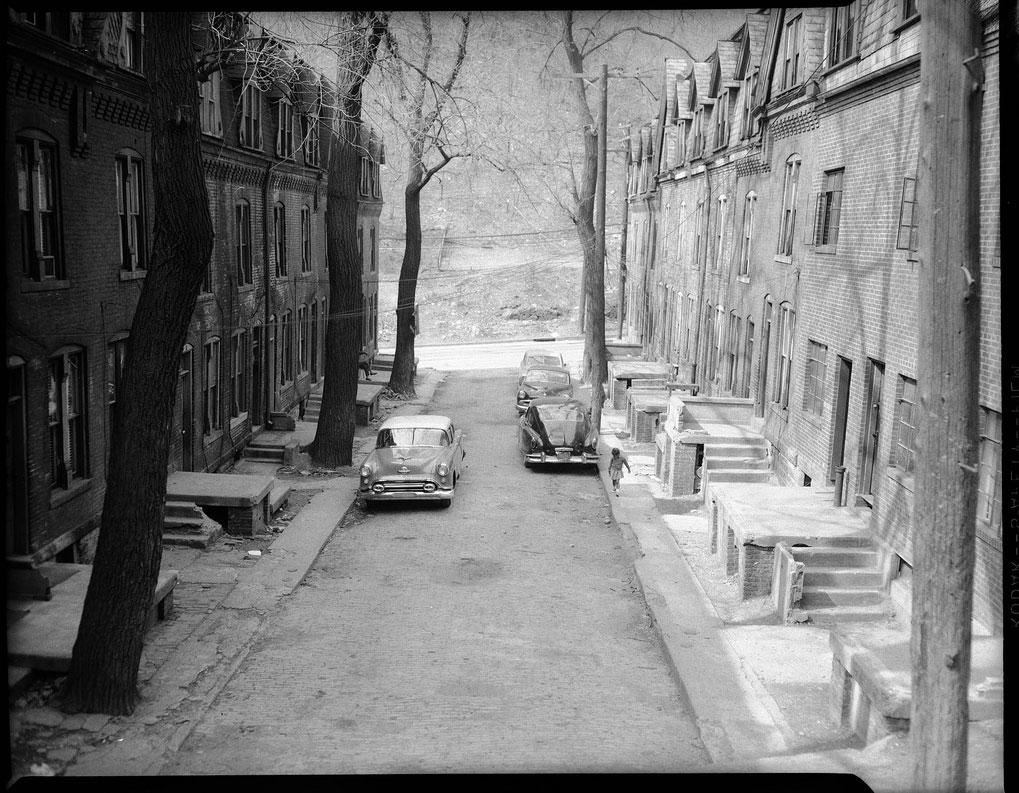
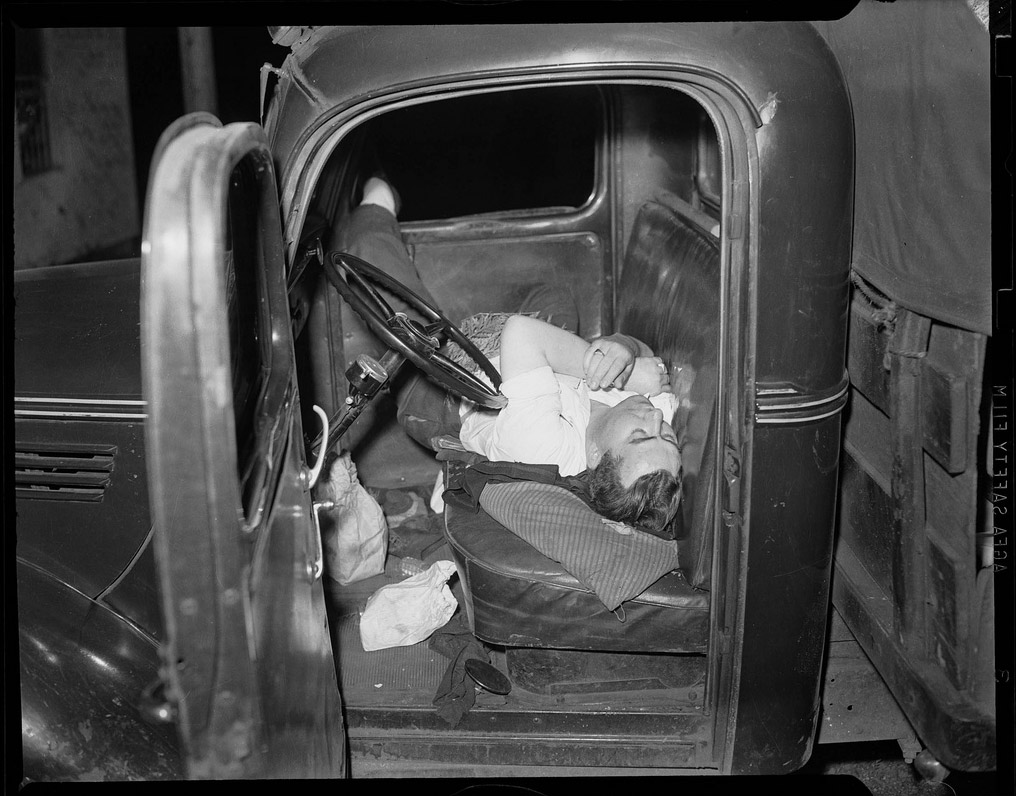
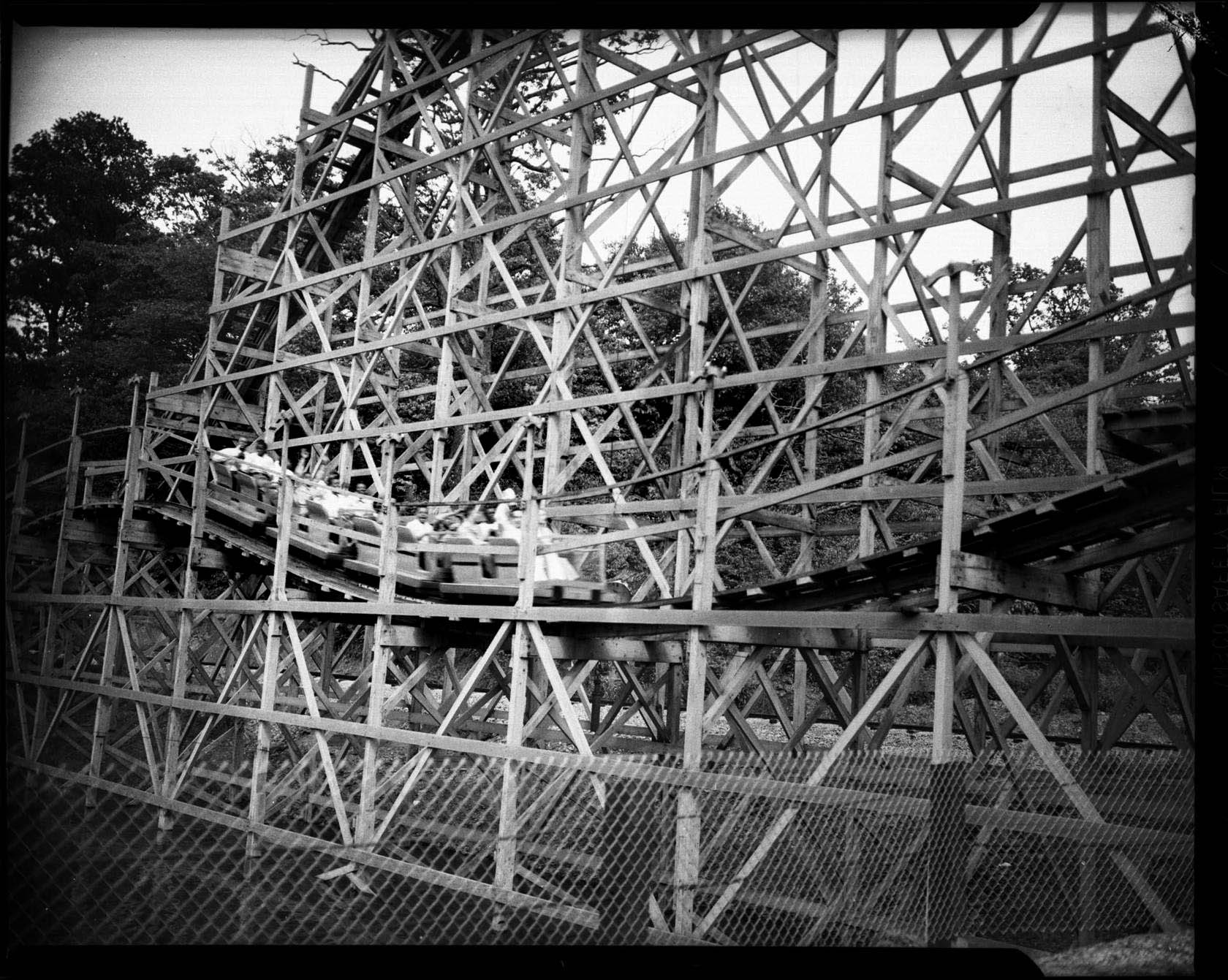
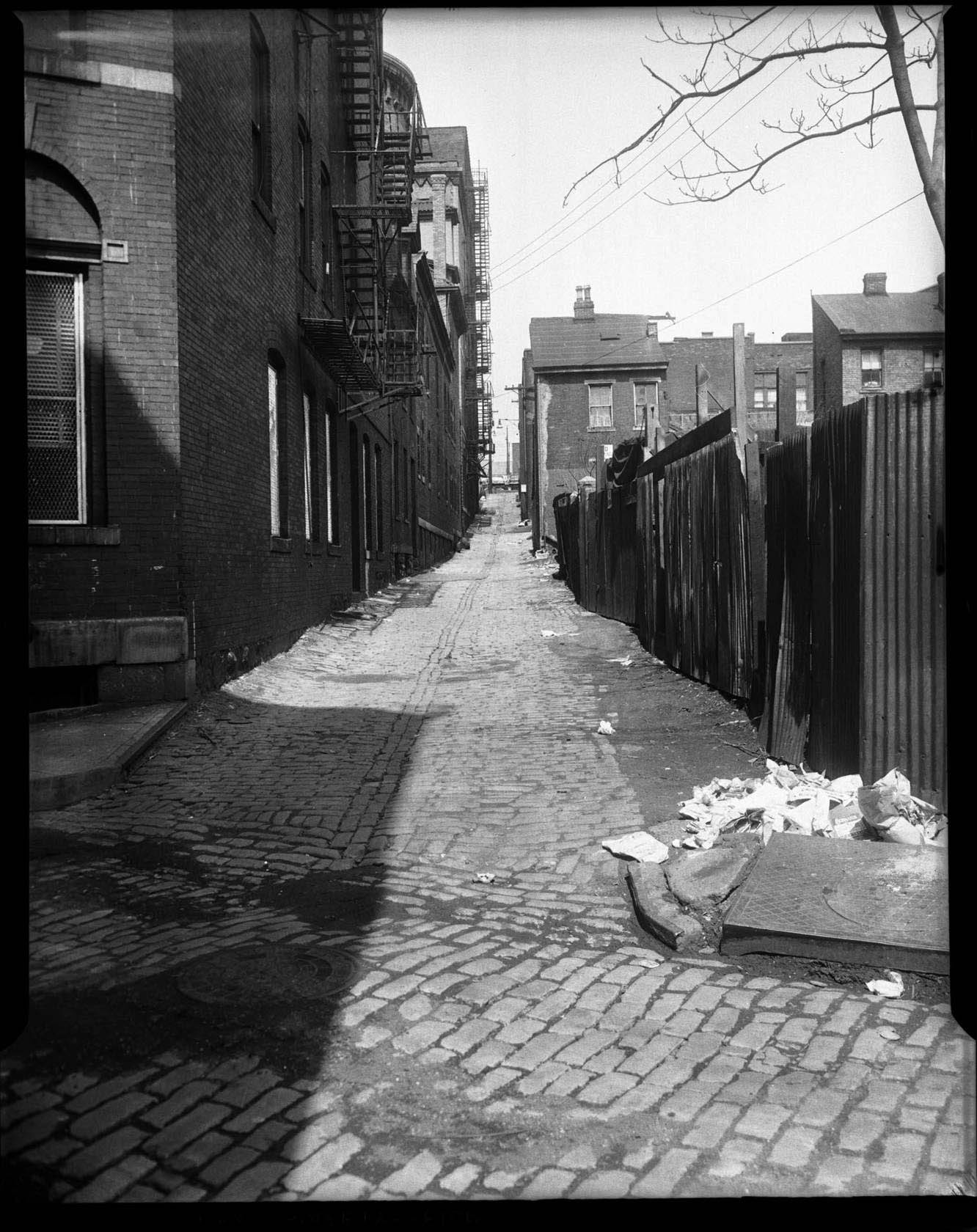
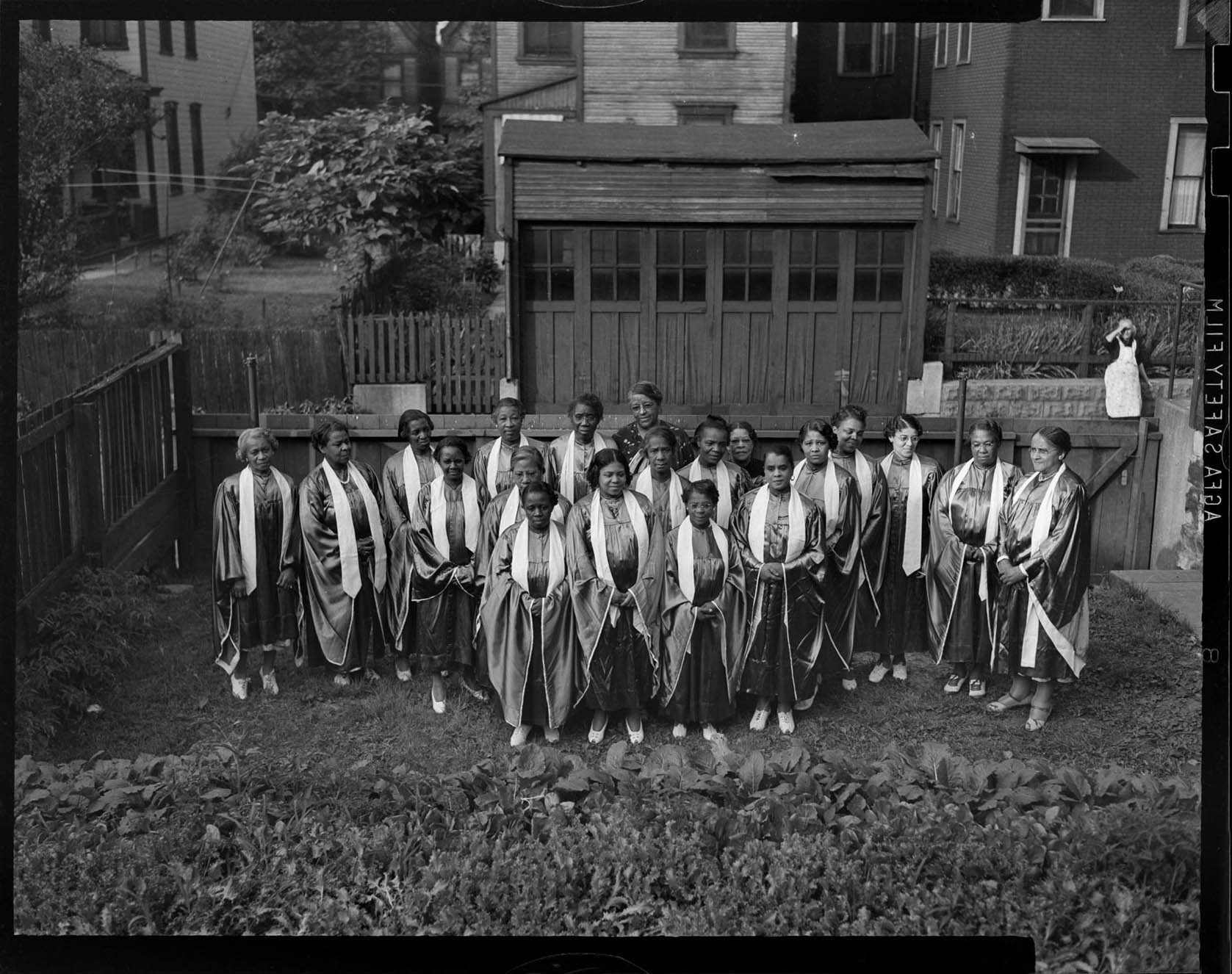
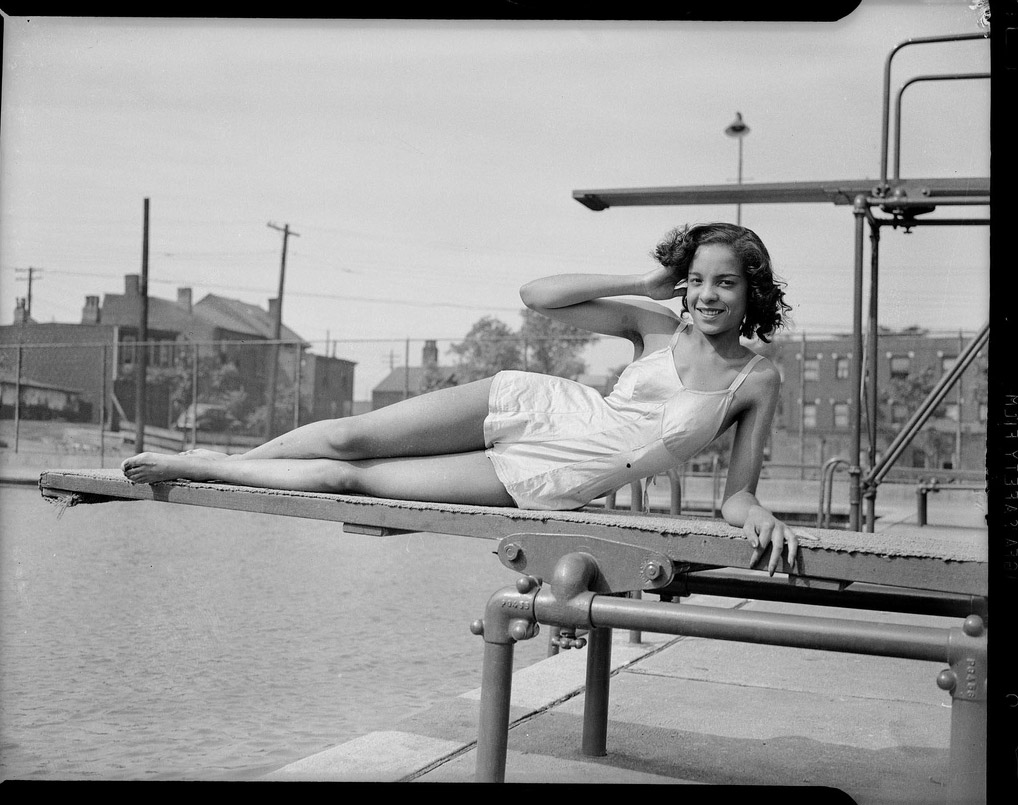
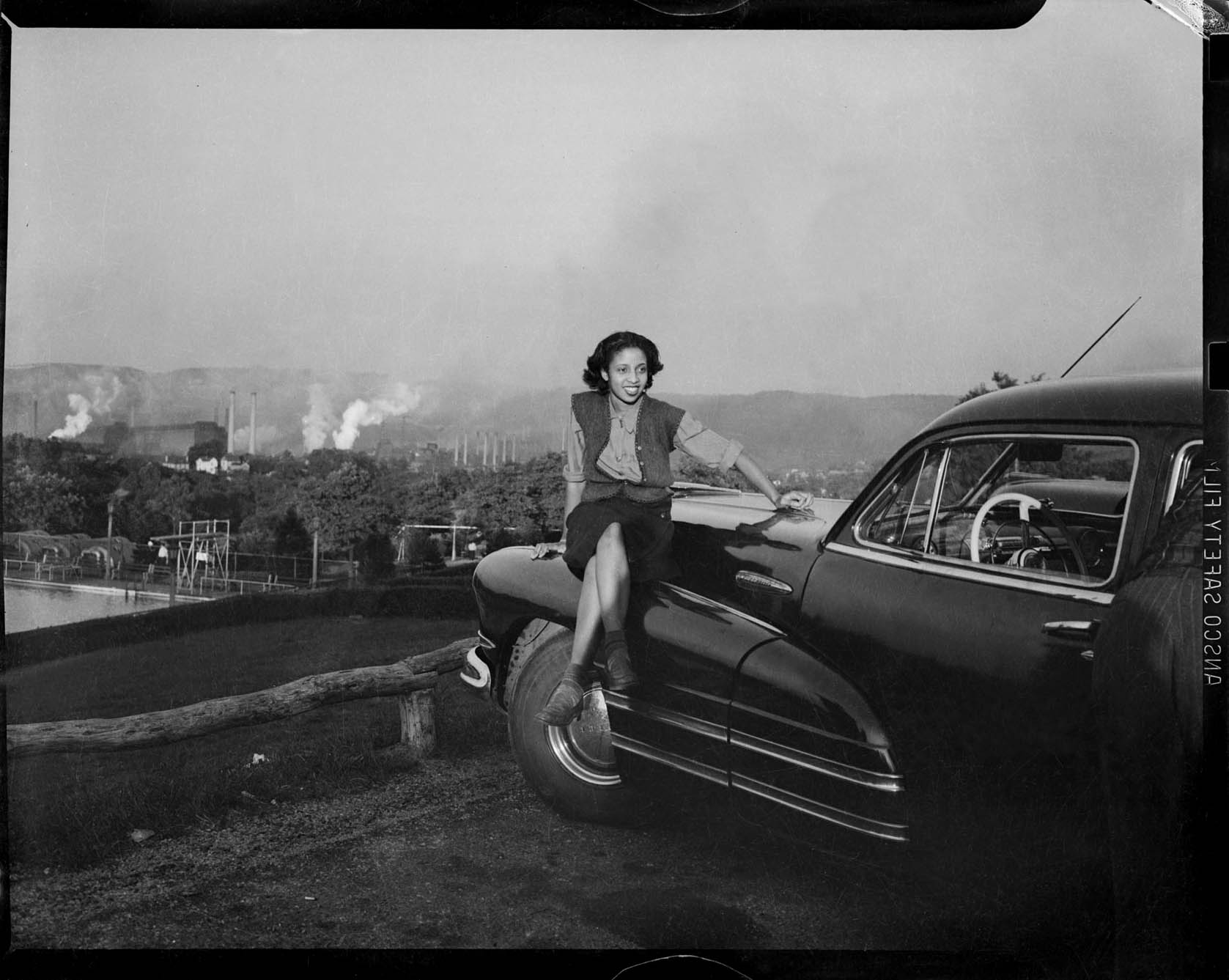
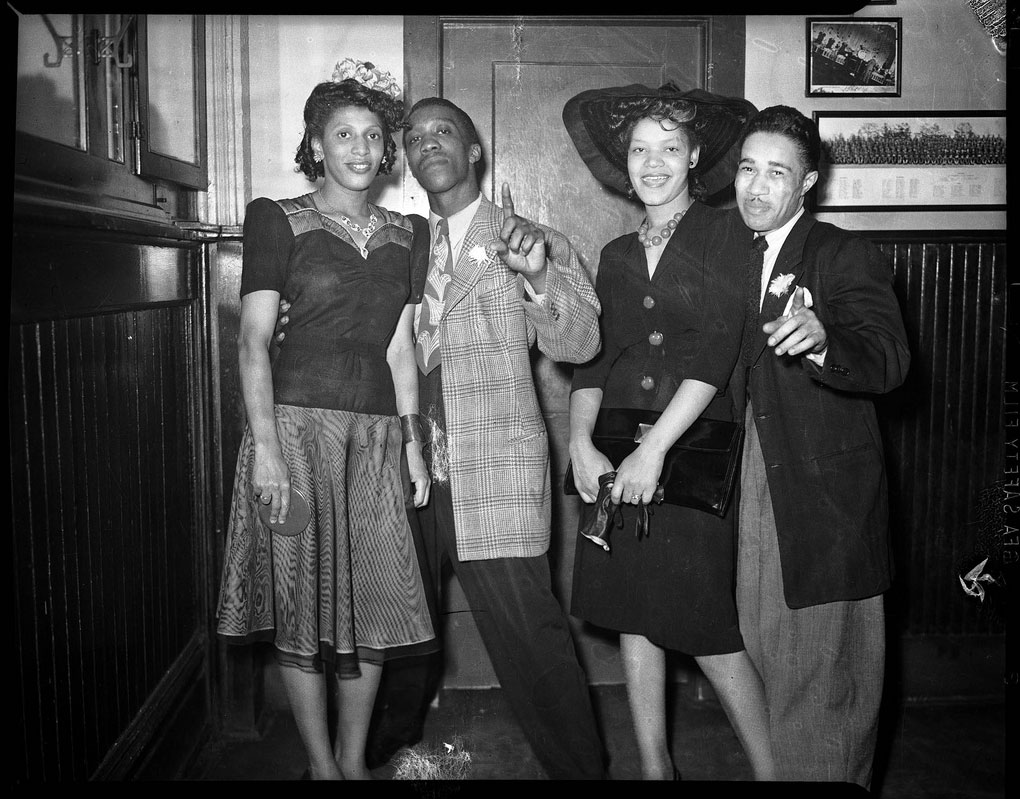
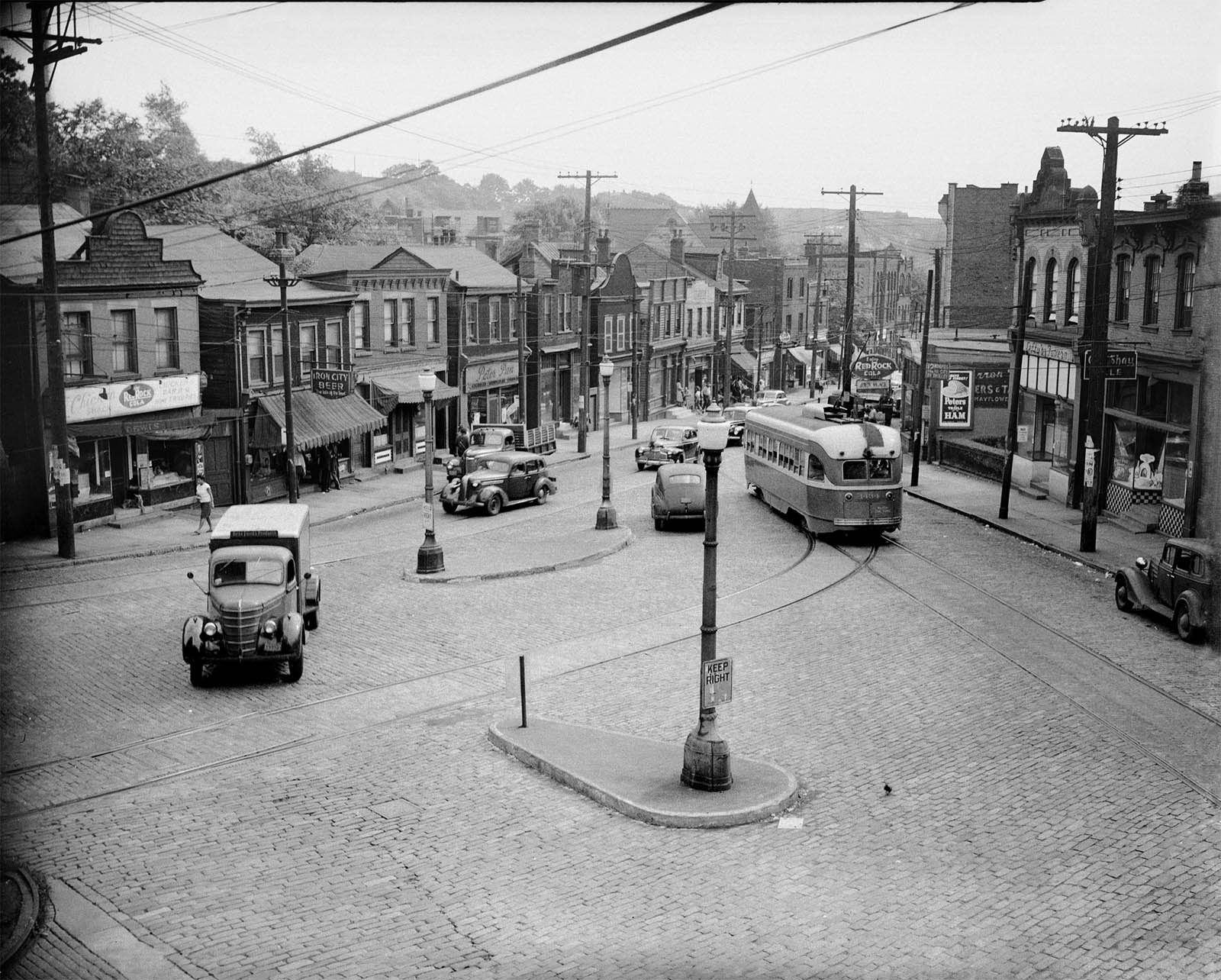
While Harris is most famous for depicting an innovative and thriving black urban community – daily life in Pittsburgh’s Hill District – it is the less figurative, more abstract urban landscape work that I am interested in here. Hence I have put four outstanding photographs that I picked out from the Archive at the top of the posting.
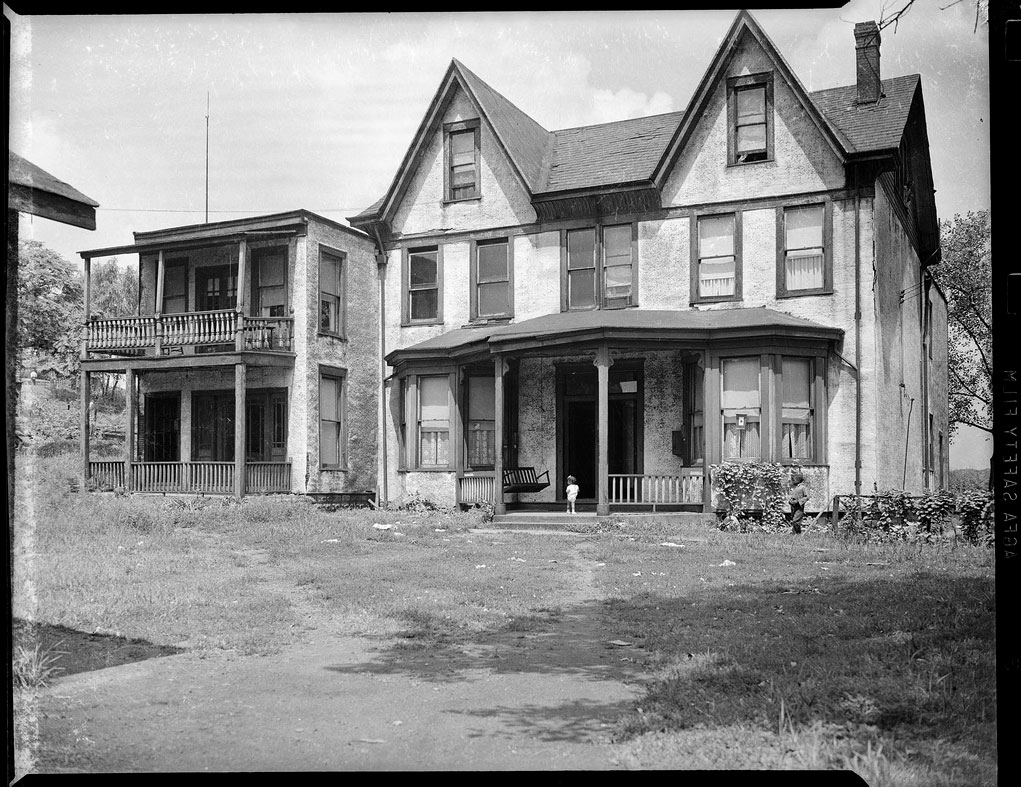
Earlier photographs of the city from the 1940s, such as Large two story home with attic, porch, double entryway, and yard, with young child on steps alone, next to smaller two story home with porches on both stories (c. 1940-45, below) have a touch of Walker Evans about them. Note how in this photograph the eve of the large two story home roof touches the top of the negative (allowing an exit for the eye at the top of the image), beautifully balanced on the left-hand side by the intrusion of the roof of another out of frame building and its shadow cast on the ground. The spatial separation between this roof and the porch of the smaller two story home is critical, as is the punctum of the child standing on the stoop. There are beautiful spaces in this photograph, as the eye plays across its surface, taking in form and detail, light and shade, eventually escaping down the right hand side of the building to the sky beyond.
It is only when we get to the 1950s that Harris really seems to hit his straps in these photographs of the urban landscape. Personally, I can’t remember any other photographs like them. By this time he has developed his own signature, his own voice. And what a voice it is!
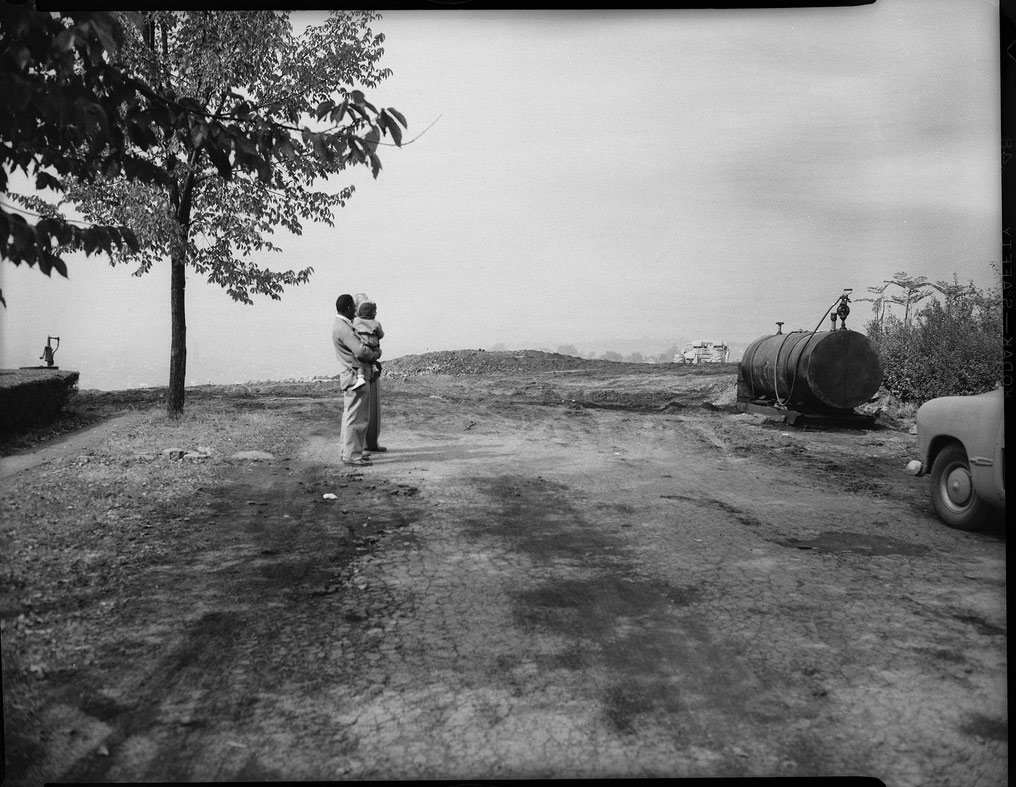
In the three remaining photographs at the top of the posting there is a conciseness to his vision of the world, a spatial spareness, even sparseness that is very eloquent. In Construction site with bulldozer (c. 1954, below), possibly a photograph of the site of Belmar Gardens, Pittsburgh’s first black-owned housing cooperative, the landscape is shot from below up a slight incline, bookended with raised bank at left and car at right framing the image plane and holding it together. But it is the space around the central figures as they look off into the distance that is so magical – the blackened, textural ground playing off the cloudless sky with single tree at left. That space in the foreground, between the bottom of the image and the figures is tensioned so well with the distance between the figures and the top edge of the negative: Harris has an intimate understanding of what he wants to achieve in this image – spatially and narratively. The hope of the future.
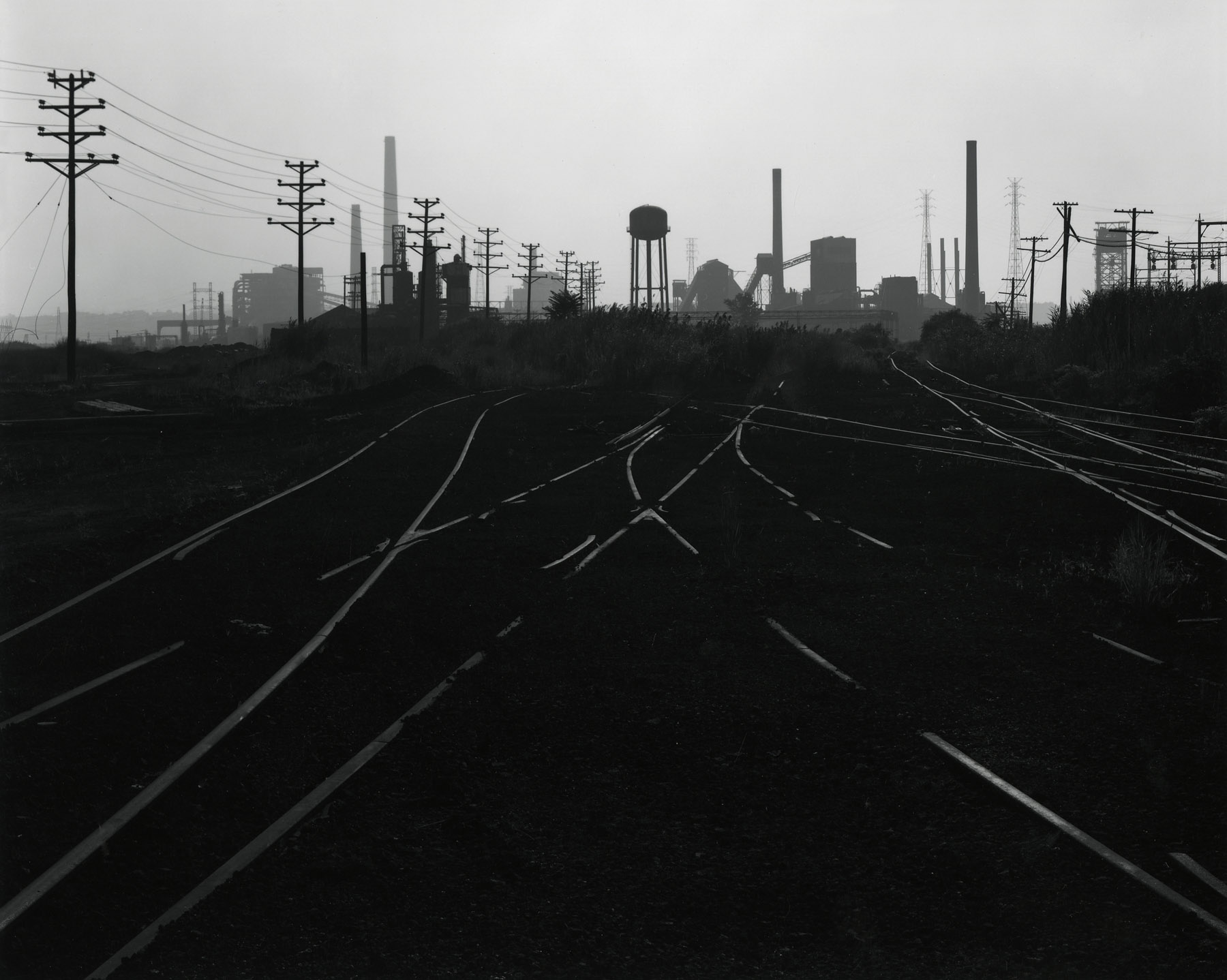
The same can be said for Three story brick row houses with mansard roofs (c. 1958, below). Again, there is a spareness to his rendition of space and a complexity to his imaging of tone. It is almost like there is a dividing line between night and day, between the city in snow and the city in darkness, the ying yang of existence. Observe the light car is in darkness and the dark car in light; the dark trees, the light telegraph post; the space between the cars which no car could ever fit through; and the smallness of the child walking down the street. Incredible. Again, there is a openness to Harris’ rendition of space in Young men playing sandlot baseball with steel mill in background (c. 1955, below). Let your eyes soak in the open sky; the verticals of dark chimneys, left and light chimneys, right; the building at left perched atop the embankment; the composition of the figures across the middle of the image, reminiscent of a piece of music; the open space of the baseball sandlot at the bottom of the photograph with faint white line delineation and figure at right holding up the edge of the image. This is a master at work.
In this mature style, Harris has no need to fill space with an urban mass or congeries. These are spaces that matter, spaces of matter but these spaces are not empty, negative spaces, but active, fluid spaces, the space of possibilities. He understands what he wants to say so well, he is so confident of his previsualisation of the urban spaces of the city they become uniquely his own – open, engaging, optimistic. This is his voice, his gift, his legacy to the world – for me, not so much the portraits of Afro-American culture, but the spaces of the city as a metaphor for change within that culture.
His reading of the landscape is his unique field of vision: in the stillness of these photographs time no longer passes, for the author and for the viewer. His images transcend place and, as such, like Atget before him, he deserves to be recognised as an artist who captured a changing world.
Further research on this aspect of his art would seem more than appropriate.
Dr Marcus Bunyan
I am most grateful to Tey Stiteler for allowing me to pick the photographs I wanted for this posting. This help was crucial as I wanted to talk about the less figurative work in the Teenie Harris Archive.
Many thankx to the Carnegie Museum of Art and the Teenie Harris Archive for allowing me to publish the photographs and book pdf in the posting. Please click on the photographs for a larger version of the image.
Carnegie Museum of Art presents a groundbreaking retrospective of African American photographer Charles “Teenie” Harris (1908-1998), featuring nearly a thousand of Harris’s most beautiful, appealing, and historically significant images. Harris’s photographs – made in his studio and for the Pittsburgh Courier, the leading Black newspaper of the time – chronicle a vibrant Black urban community during the Jim Crow and Civil Rights eras. He captured the poetry of everyday common experience, as well as the extraordinary people who shaped the 20th century: entertainer Lena Horne, baseball star Jackie Robinson, and leaders such as John F. Kennedy and Martin Luther King, Jr. Carnegie Museum of Art was entrusted with the archive of nearly 80,000 Teenie Harris negatives in 2001. Drawing on 10 years of research into archive, Teenie Harris, Photographer: An American Story features immersive life-size projections combined with a newly commissioned jazz soundtrack. A large-scale chronology and a web-based interactive introduce visitors to the rich visual resources of the archive and offer access to firsthand accounts by Harris’s contemporaries. The final section of the exhibition is dedicated to an in-depth evaluation of Harris as an artist.
Teenie Harris, Photographer: An American Story, the first major retrospective exhibition of the work and legacy of African American artist Charles “Teenie” Harris, will be on view at Carnegie Museum of Art from October 29, 2011, to April 7, 2012.
The groundbreaking exhibition will celebrate the artist/photographer whose work is considered one of the most complete portraits anywhere of 20th-century African American experience. Large-scale, themed photographic projections of nearly 1,000 of Teenie Harris’s greatest images accompanied by an original jazz soundtrack will generate an immersive experience in the exhibition’s opening gallery. Subsequent galleries will present a chronological display of these photographs at a conventional scale, and give visitor access to the more than 73,000 catalogued and digitised images in the museum’s Teenie Harris Archive. The exhibition will offer an examination of Harris’s working process and artistry, and audio commentary on the man and his work by the people who knew him. In addition, the photographs and many of these materials will be accessible on Carnegie Museum of Art’s website.
“Since 2001, our museum has been the repository of the Teenie Harris Archive. This exhibition marks the culmination of a long effort to preserve and document an extensive collection of historically and artistically important images,” says Lynn Zelevansky, The Henry J. Heinz II Director of Carnegie Museum of Art. “We are honoured to present this retrospective of a photographer whose body of work gives so much to us.”
During his 40-year career as freelance and staff photographer for the Pittsburgh Courier, one of the nation’s most influential black newspapers, Teenie Harris (1908-1998) produced more than 80,000 images of Pittsburgh’s African American community. The photographs, taken from the 1930s to the 1970s, capture a period of momentous change for black Americans. His subjects ranged from the everyday lives of ordinary people to visits by powerful and glamorous national figures to Pittsburgh, the nation’s industrial centre. From birthday celebrations to civil rights boycotts, the distinctive vision of Harris’s photographs folds into the larger narrative of American history, art, and culture.
Charles “Teenie” Harris
Teenie Harris grew up in Pittsburgh’s Hill District, a neighbourhood once called “the crossroads of the world.” A serious photographer from the age of 18, he started his professional photographic career in 1937 when he opened a studio and began to take on freelance assignments. In 1941, Harris was appointed staff photographer for the Pittsburgh Courier, the nation’s preeminent black newsweekly. His images were disseminated nationally through the Courier, and played a key role in how African Americans visualised themselves.
Like the Scurlock Studio in Washington, DC, James Van Der Zee in New York, and P. H. Polk in Alabama, Harris depicted an innovative and thriving black urban community, in spite of the segregationist policies and attitudes of mid-century America. His images captured daily life in the Hill – weddings, funerals, family portraits, parades, church events, street scenes, graduations – as well as of the great men and women who visited the neighbourhood, including Martin Luther King Jr., Paul Robeson, John F. Kennedy, Eleanor Roosevelt, Lena Horne, and Muhammad Ali. Some of the country’s finest jazz musicians – Louis Armstrong, Dizzy Gillespie, Ahmad Jamal, Sarah Vaughan, and Duke Ellington – were photographed by Harris alongside bartenders, waitresses, and dancing crowds.
The longevity of Harris’s career offers an outlook on historic shifts that took place in the lives of African Americans everywhere. In the era of segregated baseball, for example, Harris photographed two legendary Negro League baseball teams, the Pittsburgh Crawfords (which Harris cofounded in the mid-1920s) and Homestead Grays. Later, when baseball’s color barrier was broken, he photographed African American major league baseball players like Jackie Robinson and Roberto Clemente along with their teammates. The pride and optimism evident in Harris’s photos of the Double V campaign from the World War II era (victory abroad, victory for racial equality at home), turned to growing moods of frustration and anger evident in images of militant protests in the late 1950s and 1960s. These photographs provide important insights to issues that are still pertinent today.
“Teenie Harris had great empathy with his subjects and a talent for storytelling,” says Lippincott. “His images transcend place. Powerful and personal, they connect today’s viewers with a proud past and a vibrant artistic and cultural heritage. We hope that through this retrospective and traveling exhibition, Harris will be established in the canons of art, history, and photography.”
About the Exhibition
Nearly 1,000 of Harris’s most striking and iconic photographs will be digitally projected as life-sized images in the opening gallery. The images, organised into seven sections – “Crossroads,” “Gatherings,” “Urban Landscapes,” “Style,” “At Home,” “The Rise and Fall of the Crawford Grill,” and “Words and Signs” – will be synchronised with an original jazz score produced by MCG Jazz, one of the nation’s top organisations dedicated to the preservation, presentation, and promotion of jazz music. A second gallery will feature a chronological installation of small prints of the projected images that will include a referencing system for in-depth exploration of each photograph through a bank of computers and books also located in the gallery. In addition, the computers will provide access to the interactive website that has been created for the show.
At the entrance to the third gallery, a mini exhibition of 12 fine-art-quality 16 x 20″ prints selected by 12 experts will be accompanied by their personal analyses of the meaning, significance, and beauty of the chosen images. This gallery will also feature a large-scale map showing the places Harris lived, worked, and photographed and a multimedia presentation called “Artist at Work” that demonstrates Harris’s technical skill and artistic vision, and shows how newspapers and publishers cropped and edited his work in order to tell a particular story. “Artist at Work” marries audio recordings of the stories and memories of Teenie Harris, as told by his family, friends, colleagues, and models, with a montage of projected images relating to their tales.
In addition to an exhibition-specific website, the museum is collaborating with the University of Pittsburgh Press on an illustrated book offering new and unpublished scholarship about Harris, his work, and his times that will impact the fields of American and African American art, culture, and history.
About the Teenie Harris Archive
In 2001, Carnegie Museum of Art acquired the Teenie Harris archive from the Harris family and began a multiyear project to preserve, catalogue, digitise, and make the images available on the museum’s website for public view. Few of Harris’s negatives were titled and dated; since the acquisition of the archive, the museum has invited the public to help in the identification of the people, places, and activities in the photographs through a series of museum-based displays of his work, outreach presentations, meetings with oral historians, and online response forms that accompany the continually growing display of images on the museum’s website.
The Teenie Harris Archive Project is supported by the National Endowment for the Humanities, which designated the archive a “We the People” project in the spring of 2007. “We the People” is an initiative to encourage and strengthen the teaching, study, and understanding of American history and culture. Initial support for the Teenie Harris Archive Project was provided by the Heinz Endowments.
Press release from the Carnegie Museum of Art website
Charles “Teenie” Harris had a photographic mission: going beyond the obvious or sensational to capture the essence of daily African-American life in the 20th century. For more than 40 years, Harris – as lead photographer of the influential Pittsburgh Courier newspaper – took almost 80,000 pictures of people from all walks: presidents, housewives, sports stars, babies, civil rights leaders and even cross-dressing drag queens. Now, a new exhibit and online catalog is showing the depth of Harris’ work, an archive showing a major artistic achievement that influenced people around the country.
“His shots of everyday people are amazing. People seem to kind of jump off the page,” said Stanley Nelson, an Emmy Award-winning documentary filmmaker and MacArthur genius grant winner who has made a number of acclaimed films on African-American artists, business people, and workers. “They don’t have the sense of somebody kind of looking in and spying on the community. For me his pictures are very unique,” Nelson said.
Harris was a gifted basketball player as a young man, and helped start a Negro League baseball team, too. His brother was Pittsburgh’s biggest bookie, and that gave him access to people throughout the city. But he found his mission at the Pittsburgh Courier, which was distributed all over the country via a network of Pullman train porters. Through the paper Harris had endless opportunities to chronicle daily life and to meet the rich, famous, and powerful. Harris photographed Richard Nixon, Jackie Robinson, Martin Luther King Jr., John F. Kennedy and many musical greats, such as Nat King Cole and Duke Ellington. “That was the black national paper of record at the time,” said Laurence Glasco, a professor of history at the University of Pittsburgh.
Many people stopped by the Courier offices because of its clout with African-Americans, Glasco said. Yet Harris neither pandered to nor looked down on celebrities, he added. “He really didn’t have a cult of celebrity. He wouldn’t cross a street to shake a celebrity’s hand. He was interested in them, but he really saw them as just people. And that really comes out in his photographs,” Glasco said. A young Muhammad Ali, for example, is shown picking up his mother and holding her in his arms. “He had an equal opportunity lens,” recalled Teenie’s son, Charles Harris. “He just liked people.”
The partnership with the Courier was a perfect match, since its reporters and editors were also pushing for equal rights. And true to Pittsburgh traditions, Teenie Harris was a hard worker, on call virtually 24-hours a day. “No matter what time it was, they could call. A lot of times he didn’t sleep,” his son said.
Louise Lippincott, the Carnegie Museum of Art Curator, worked closely with Harris in the last years of his life. “He had a very strong personal desire to complete a positive view of African-Americans and counter the negative stereotypes in the white press. On the other hand, there’s nothing sugarcoated,” said Lippincott. Glasco adds that Harris took pictures of very poor people without exaggerating their situation. “You can look at them and say, ‘These are real people; they happen to be very poor.’ They’re more than those clothes they’re wearing. They were first and foremost a person.” One picture shows a little girl with a big smile sitting on the floor of a newsstand, reading a comic book with a small dog on her lap. A key piece of history that Harris and the Courier covered heavily was African-Americans who served in World War II and returned home demanding that they be accorded rights equal to white soldiers, sailors, and airmen.
“The drive for civil rights really began in World War II,” Lippincott said, far earlier than many imagine. Yet the photographs are more than just a rich trove of mid-century American history. They emerge as art because Harris became a master of composition and for decades took each picture with a large-format camera that had to be hand-loaded with a single piece of film for each shot. “I remember being just shocked and amazed at what an incredible photographer he was. He just had this incredible eye,” said Nelson, who noted that Harris earned the nickname “One Shot” for his ability to deliver an assignment with one photograph.
Many of the pictures show a successful – and happy – black middle class. One young woman is depicted posing on the hood of a 1950s car, with steel mills in the background, while another simply kneels while playing with two small dogs. And even before the civil rights movement, there are many pictures showing black and white children and adults together. Glasco notes that even some controversial pictures seem to defy current expectations of what the past was like. In one, a man in a car has a cross-dressing male companion on each side.
“They’re happy, they’re proud, they’re smiling. It’s a joyful thing,” Glasco said of the men openly dressing as women. At an annual parade in Pittsburgh’s Hill district, one car was often filled with cross-dressers who waved at crowds, he added. Glasco once saw a Harris picture of cross-dressers next to contemporary pictures with the same subject, and was struck by the anger and hostility of the people in the new pictures, and the openness of the people in the older ones.
The Carnegie Museum of Art purchased Harris’ entire collection in 2001, through the Heinz Family Fund. The exhibit at the museum includes almost 1000 photographs, slide shows, and a jazz soundtrack commissioned especially for the show, which is up until next April. It’s also scheduled to travel to Chicago, Birmingham, Alabama, and Atlanta in the future. People who can’t get to one of those museums can view almost 60,000 Harris images that have been scanned and put online along with audio interviews of people who knew him.”
Kevin Begos. “Pa. exhibit showcases legendary black photographer,” Associated Press on the Boston.com website November 27, 2011 [Online] Cited 21/03/2012. Used under fair use conditions for the purposes of education and research
Exhibition dates: 12th November – 6th December 2009
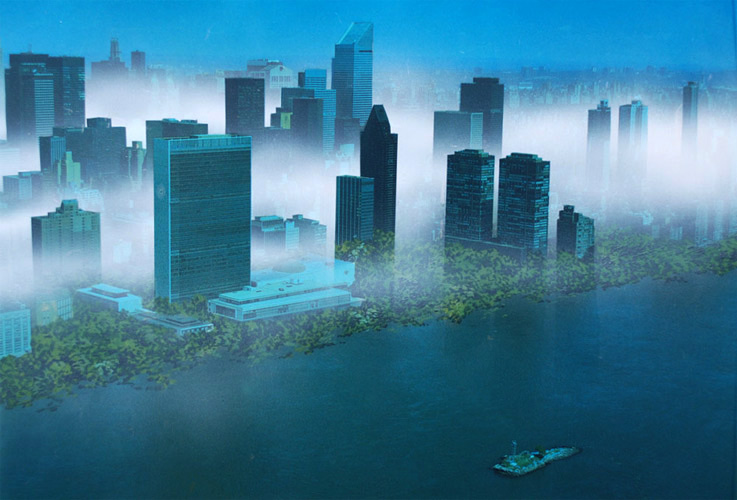
Alex Lukas (American, b. 1981) Untitled 2009 Acrylic and silk screen on two book pages
These are terrific – I want one!
A big thank you to Alex for allowing me to reproduce the images.
Dr Marcus Bunyan
Please click on the photographs for a larger version of the image.
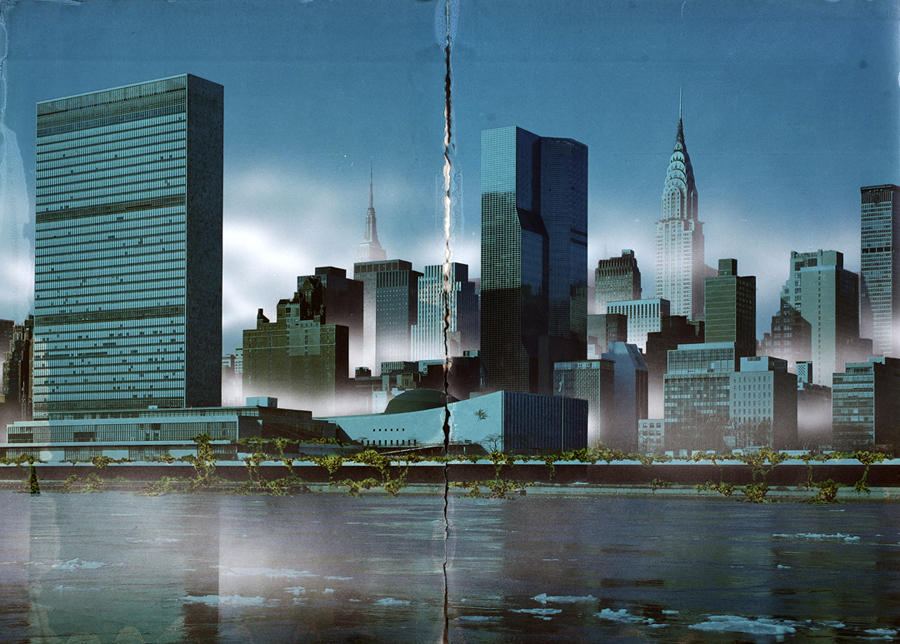
Alex Lukas (American, b. 1981) Untitled 2009 Acrylic and silk screen on two book pages
Glowlab is pleased to present The Eventuality of Daybreak, a solo exhibition by Alex Lukas featuring a new series of post-apocalyptic urban landscapes that blur the visual boundaries of fiction and reality.
Lukas’ work explores the existence of disaster, be it realised or fictitious, in contemporary society. Hyper-realistic motion pictures and unforgiving news footage depict seemingly identical – and equally riveting – facades of tragedy. The artist recognises that relentless visual bombardment has resulted in society’s desensitisation to the aesthetics of destruction.
For The Eventuality of Daybreak, Lukas has selected photographic spreads of well-known metropolises from vintage publications and uses them dually as canvas and unlikely subject. Through a deft handling of paint and carefully placed screen-printed passages, the artist pushes these ageing illustrations in futuristic contexts. Submerging these cities conceptually and physically, Lukas inundates images of American cities with layers of media representing cataclysmic floods and crippling overgrowth.
Also included in the exhibition are works on paper depicting near-future scenes of devastated landscapes – crumbling infrastructure, overturned trucks and telling signs of human despair. As a counterpoint to the underwater cities, these darkly atmospheric and barren vistas signal devastation through an unsettling sense of absence.
Lukas’ intentional use of dated imagery presented in tandem with contemporary situations forces the viewer to reconcile two differing ideologies of urban space. The artist’s work calls into question society’s collective acceptance of the urban environment as an arena of destruction, once thought unthinkable and now seemingly inevitable.
The Eventuality of Daybreak is Lukas’ first solo exhibition with Glowlab. Lukas’ work has also been exhibited in New York, Boston, Philadelphia, Los Angeles, San Francisco, London, Stockholm and Copenhagen as well as in the pages of Swindle Quarterly, Proximity Magazine, The San Francisco Chronicle, The Village Voice, The Drama and The New York Times Book Review. Lukas is a graduate of the Rhode Island School of Design and currently lives and works in Philadelphia, where he is a member of the artist collective Space 1026.
Press release on the Glowlab website [Online] Cited 20/11/2009 no longer available online
Alex Lukas (American, b. 1981) Untitled 2009 Acrylic and silk screen on two book pages
Alex Lukas (American, b. 1981) Untitled 2009 Acrylic and silk screen on two book pages
Alex Lukas (American, b. 1981) Untitled 2009 Acrylic and silk screen on two book pages
Alex Lukas (American, b. 1981) Untitled 2009 Acrylic and silk screen on two book pages




























You must be logged in to post a comment.