Curators: Anne Wilkes Tucker, the Gus and Lyndall Wortham Curator of Photography; Will Michels, collections photographer and exhibition co-curator; Natalie Zelt, curatorial assistant
This is the biggest posting on one exhibition that I have ever undertaken on Art Blart!
As befits the gravity of the subject matter this posting is so humongous that I have had to split it into 4 separate postings. This is how to research and stage a contemporary photography exhibition that fully explores its theme. The curators reviewed more than one million photographs in 17 countries, locating pictures in archives, military libraries, museums, private collections, historical societies and news agencies; in the personal files of photographers and service personnel; and at two annual photojournalism festivals producing an exhibition that features 26 sections (an inspired and thoughtful selection) that includes nearly 500 objects that illuminate all aspects of WAR/PHOTOGRAPHY.
I have spent hours researching and finding photographs on the Internet to support the posting. It has been a great learning experience and my admiration for photographers of all types has increased. I have discovered the photographs and stories of new image makers that I did not know and some hidden treasures along the way. I hope you enjoy this monster posting on a subject matter that should be consigned to the history books of human evolution.
**Please be aware that there are graphic photographs in all of these postings.**Part 1, Part 3, Part 4
Dr Marcus Bunyan
Many thankx to the Museum of Fine Arts, Houston for allowing me to publish some of the photographs in the posting. Please click on the photographs for a larger version of the image.
Photographic Essays
14. Photographic Essays showcases selections from two distinct storylines: Larry Burrows’ Yankee Papa 13, published in Life magazine; and Pulitzer Prize winner Todd Heisler’s series Final Salute, for Denver’s Rocky Mountain News. Burrows follows a man through a rescue attempt in Vietnam; Heisler documents a Marine major assigned to casualty notifications. (12 images, 6 from each photographer, as well as the magazine and newspaper in which the series were published)
The view from inside Marine helicopter Yankee Papa 13, Vietnam, March 1965
The caption that accompanied this photograph in the April 16, 1965, issue of LIFE: “From the downed YP3 in the background, the wounded gunner, Sergeant Owens, races to Yankee Papa 13, where Farley waits in the doorway.”
The caption that accompanied this photograph in LIFE: “Farley, unable to leave his gun position until YP13 is out of enemy range, stares in shock at YP3’s co-pilot, Lieutenant Magel, on the floor.”
Farley and Hoilien, dead tired, linger beside their helicopter and continue to talk over the mission
In a supply shack, hands covering his face, an exhausted, worn James Farley gives way to grief
The night before the burial of her husband’s body, Katherine Cathey refused to leave the casket, asking to sleep next to his body for the last time. The Marines made a bed for her, tucking in the sheets below the flag. Before she fell asleep, she opened her laptop computer and played songs that reminded her of “Cat,” and one of the Marines asked if she wanted them to continue standing watch as she slept. “I think it would be kind of nice if you kept doing it,” she said. “I think that’s what he would have wanted.”
Executions
15. Executions are among the frequent photographs in wartime: Officials and the public seek confirmation that the enemy is dead; the executioners often forcefully request images to signify their power. An 1867 photograph by François Aubert shows the bloodied shirt of Maximilian I after the Austro-Hungarian archduke was shot by a nationalist firing squad in Mexico. Eddie Adams’ Pulitzer Prize-winning photograph of the Vietnamese police chief shooting a Viet Cong prisoner came to symbolise the brutality of the Vietnam War. Jahangir Razmi’s Firing Squad in Iran (1979) also won a Pulitzer; Razmi’s newspaper, Ettela’at, ran the photograph without credit, in order to protect him. He was not recognised until a 2006 Wall Street Journal article. (20 images)
Eddie Adams (American, 1933-2004) Saigon Execution (General Nguyen Ngoc Loan executing a Viet Cong prisoner in Saigon) February 1, 1968 Silver gelatin photograph
Although the image brought Adams the Pulitzer Prize, he would express discomfort with it later in life.
“The general killed the Viet Cong; I killed the general with my camera. Still photographs are the most powerful weapon in the world. People believe them; but photographs do lie, even without manipulation. They are only half-truths. … What the photograph didn’t say was, ‘What would you do if you were the general at that time and place on that hot day, and you caught the so-called bad guy after he blew away one, two or three American people?” (Wikipedia)
For Adams, the lie was the omission of context – that the plainclothes Lem had allegedly just been caught having murdered not only South Vietnamese police but their civilian family members; that Loan was a good officer and not a cold-blooded killer… Like any great work of art, Adams’ serendipitous photograph took on a life of its own… and a tapestry of meanings richer than its creator could ever have intended.
Headsman. “1968: Nguyen Van Lem,” on the ExecutedToday website February 1st, 2009 [Online] Cited 03/09/2022. Used under fair use conditions for the purposes of education and research
Eddie Adams Talk About The Saigon Execution Photo
Leisure Time
16. Leisure Time is another popular subject. This section features images that range from a 1958 photograph (by Loomis Dean) of an Elvis Presley serenade in the barracks to Stephen Colbert’s 2009 Iraq appearance in a camouflage suit (by Moises Saman). More-intimate moments show an off-duty serviceman sleeping on a cot next to a wall of pinups (by Edouard Gluck) as well as another serviceman listening to music on headphones (by Alvaro Zavala). Army Staff Sergeant Mark Grimshaw captures an American soldier stationed in Iraq, tending grass that the soldier has grown. (The soldier’s wife sent him seeds from the United States, but he couldn’t get the grass to grow until he purchased sod from a local Iraqi farmer.) (21 images)
Álvaro Ybarra Zavala (Spanish, b. 1979) Untitled 2003 From the series Apocalypse
More images and text from the sequence can be seen at Álvaro Ybarra Zavala’s Projects web page
17. Support features photographs of people planning operations and supplying troops behind the front, from flying troops and supplies to the battlefront, to making bread in factories and building temporary bridges. One iconic 1942 photo by Alfred Palmer shows women aircraft workers polishing the noses of bomber planes. A 1915-18 picture by an unknown photographer depicts two men working early battery-operated phones. In 2001, James Nachtwey captured a firefighter walking over burning rubble at the World Trade Center in New York. (13 images)
Alfred Palmer (American, 1906-1993) Women aircraft workers finishing transparent bomber noses for fighter and reconnaissance planes at Douglas Aircraft Co. Plant in Long Beach, California 1942 Gelatin silver print The Museum of Fine Arts, Houston, gift of Will Michels in honor of his sister, Genevieve Namerow
18. Medicine, divided into two subsections, presents doctors and nurses at work at the front, and individuals who are surviving with injuries. “Wartime Medicine” presents the conditions of medical operations on the battlefield, from Vo Anh Khanh’s photograph of North Vietnam surgeons working in a swamp to Larry Burrows’ emergency dressing station in Vietnam. “Subsequent to War” showcases survivors. A 2007 photograph by Peter van Agtmael shows a soldier with a prosthetic leg playing with his two sons and light sabres in a field. A 1985 photograph by Michael Coyne pictures a rehabilitation centre stacked with braces and artificial limbs for the victims of war in Iran and Iraq. Nina Berman’s 2004 portrait of PTSD patient Randall Clunen, from the series Purple Hearts, relates the psychic scars of war. (22 images)
Michael Coyne (Australian, b. 1945) Rehabilitation Centre – Iran 1985 Type C print 55cm x 36.6cm
Nina Berman (American, b. 1960) Randall Clunen 2004 From the series Purple Hearts Pigment print 28 x 28 in.
Faith
19. Faith presents devotion during wartime. The Oath of War (1942), by Mark Markov-Grinberg, taken minutes before a regiment attacked an entrenched German defensive position, shows a soldier kissing his gun. A 1918 image by an unknown photographer depicts a soldier’s grave in France, marked by a wooden cross and the soldier’s helmet, under which his Bible was found. Naval photographer R. Woodward’s 1945 photograph depicts a shipboard service performed after a Japanese plane dropped two bombs on the ship; the officiating chaplain is possibly Father O’Callahan, who subsequently received the Medal of Honor. Three days before the start of the Iraq War in 2003, Hayne Palmour IV captured the baptism of a Marine by a Navy chaplain in Kuwait, in a pool of water constructed from sandbags. (12 images)
Mark Borisovich Markov-Grinberg (Russian, 1907-2003) The Oath of War (Soviet soldier kissing his rifle) 1939, printed later Ferrotyped gelatin silver print
R. Woodward, USNR, American (birth date unknown) Religious services under the blasted flight deck of the USS Franklin March 1945 Gelatin silver print, the Museum of Fine Arts, Houston, gift of St. Paul’s United Methodist Church
Religious services under the blasted flight deck of the USS Franklin (CV-13), for the 807 men killed from two bomb blasts while off the coast of Japan. The only American warship to suffer greater losses was the battleship Arizona at Pearl Harbor. March 1945 by R. Woodward, USNR.
PLEASE NOTE:This information is incorrect. 883 servicemen perished when the heavy cruiser USS Indianapolis was torpedoed and sunk by a Japanese submarine on 30 July 1945 and the survivors were not spotted until three and a half days later. Many succumbed to exposure to the elements, dehydration and shark attacks.
Refugee
20. The focus of Refugee moves away from the combatants’ standpoint and into the perspectives of others, including individuals who have been displaced as well as left behind. This section presents people either fleeing battle or living as expatriates in a new place. The Pulitzer Prize-winning image shot in 1965 by Sawada Kyoichi shows a Vietnamese mother and her children wading across a river to escape from a U.S. napalm strike on their village. An image by Hilmar Pabel depicts a family fleeing across the border in the Bavarian Forest to the West, escaping in the night carrying suitcases. A famous 1993 picture by Gilles Peress, of hands pressing against both sides of a windowpane, documents the evacuation of Jews from Sarajevo. A 1994-1995 portrait by Fazal Sheikh depicts a mother and her two children sitting on the ground somewhere in Tanzania; her newborn’s name, Makantamba, means “one who was born at the time of war.” Jonathan C. Torgovnik’s Valentine with her daughters Amelie and Inez, Rwanda (2006) is taken from the series Intended Consequences. An image by Alexandria Avakian depicts a Lebanese refugee in traditional dress mowing a lawn in suburban Michigan. (8 images)
Sawada Kyoichi (Japanese, 1936-1970) Mother and children wade across river to escape U.S. bombing. Qui Nhon, South Vietnam September 1965
Gilles Peress (French, b. 1946) Evacuation of the Jews, Skanderia, Sarajevo, Bosnia 1993 From the book Farewell to Bosnia, 1994 Gelatin silver print 16 x 20 inches
Alexandria Avakian (American, b. 1960) Dearborn, Michigan, June 2002: Tufaha Baydayn, a Lebanese American, fled Lebanon’s civil war in the 1970s 2002
Exhibition dates: 28th November – 15th December, 2012
Curator: the artist
Installation photograph of Ikea by Janina Green at Edmund Pearce Gallery, Melbourne
“It is necessary to revisit what Walter Benjamin said of the work of art in the age of its mechanical reproducibility. What is lost in the work that is serially reproduced, is its aura, its singular quality of the here and now, its aesthetic form (it had already lost its ritual form, in its aesthetic quality), and, according to Benjamin, it takes on, in its ineluctable destiny of reproduction, a political form. What is lost is the original, which only a history itself nostalgic and retrospective can reconstitute as “authentic.” The most advanced, the most modern form of this development, which Benjamin described in cinema, photography, and contemporary mass media, is one in which the original no longer even exists, since things are conceived from the beginning as a function of their unlimited reproduction.”
Jean Baudrillard. Simulacra and Simulation. 1981 (English translation 1994)
“To apprehend myself as seen is, in fact, to apprehend myself as seen in the world and from the standpoint of the world. The look does not carve me out in the universe; it comes to search for me at the heart of my situation and grasps me only in irresolvable relations with instruments. If I am seen as seated, I must be seen as “seated-on-a-chair,” … But suddenly the alienation of myself, which is the act of being-looked-at, involves the alienation of the world which I organise. I am seated on this chair with the result that I do not see it at all, that it is impossible for me to see it …”
Jean-Paul Satre. Being and Nothingness (trans. Hazel Barnes). London: Methuen, 1966, p. 263
“It must be possible to concede and affirm an array of “materialities” that pertain to the body, that which is signified by the domains of biology, anatomy, physiology, hormonal and chemical composition, illness, age, weight, metabolism, life and death. None of this can be denied. But the undeniability of these “materialities” in no way implies what it means to affirm them, indeed, what interpretive matrices condition, enable and limit that necessary affirmation. That each of those categories [BODY AND MATERIALITY] have a history and a historicity, that each of them is constituted through the boundary lines that distinguish them and, hence, by what they exclude, that relations of discourse and power produce hierarchies and overlappings among them and challenge those boundaries, implies that these are both persistent and contested regions.”
Judith Butler. Bodies That Matter. New York: Routledge, 1993, pp. 66-67
Fable = invent (an incident, person, or story)
Simulacrum = pretends to be a faithful copy, but it is a copy with no original
Performativity = power of discourse, politicisation of abjection, ritual of being
Intimate, conceptually robust and aesthetically sensitive. The association of the images was emotionally overwhelming. An absolute gem. One of the highlights of the year.
Dr Marcus Bunyan
Many thankx to Edmund Pearce Gallery for allowing me to publish the photographs in the posting. Please click on the photographs for a larger version of the image.
Janina Green (Australian born Germany, b. 1944) Waterfall 1990 Silver gelatin print on Kentmere Parchment paper, tinted with coffee and photo dyes 58 x 48cm Vintage print
Janina Green (Australian born Germany, b. 1944) Pink vase 1990, reprinted 2012 Silver gelatin print on fibre based paper, hand tinted with pink photo dye 85 x 70cm
Janina Green (Australian born Germany, b. 1944) Blue vase 1990, reprinted 2012 Silver gelatin print on fibre based paper, hand tinted with blue photo dye 85 x 70cm
Janina Green (Australian born Germany, b. 1944) Nude 1986 Silver gelatin print on fibre based paper, hand tinted with blue photo dye 60 x 45cm Vintage print
My photographs are always about the past.
The Barthesian slogan, “this has been,” is for me, “I was there.” This series of images of a vase from Ikea consists of silver gelatin prints tinted in different coloured photographic dyes; photographs of a simple mass produced vase – its form the familiar vessel which so dominates Art History. “Ikea” for me is symbolic of the useful homely object and of the ideal home. The vase from Ikea no longer exists. The picture of that vase stands in for the vase that once existed. The photograph can be seen now – at this moment. It will continue to exist in the future. Its representation crosses time barriers.
My photographs are always documentations of a private performance.
Every photograph records what is in front of the camera, but my interest is in the occasion and the complex conditions of the making of the photograph – first the negative then the print. Each photograph ends up being a documentation of my state of mind during this intensely private moment as well as something for other people to look at. Because of changing conditions, every one of these prints from that same negative is different. For me each analogue print is an unsteady thing. They are now relics from another era, as is the vase.
As a counterpoint to the repetition of the vase prints, I have selected four vintage works from my archive.
Janina Green (Australian born Germany, b. 1944) Orange vase 1990, reprinted 2012 Silver gelatin print on fibre based paper, hand tinted with orange photo dye 85 x 70cm
Janina Green (Australian born Germany, b. 1944) Green vase 1990, reprinted 2012 Silver gelatin print on fibre based paper, hand tinted with green photo dye 85 x 70cm
Janina Green (Australian born Germany, b. 1944) Interior 1992 C Type print 38 x 30cm Vintage print / edition of 5
Janina Green (Australian born Germany, b. 1944) Telephone 1986, reprinted 2010 Silver gelatin print on fibre based paper, tinted with coffee 58 x 48cm
Janina Green (Australian born Germany, b. 1944) Yellow vase 1990, reprinted 2012 Silver gelatin print on fibre based paper, hand tinted with yellow photo dye 85 x 70cm
Curators: Anne Wilkes Tucker, the Gus and Lyndall Wortham Curator of Photography; Will Michels, collections photographer and exhibition co-curator; Natalie Zelt, curatorial assistant
Roger Fenton (British, 1819-1869) The Valley of the Shadow of Death 1855
This is the biggest posting on one exhibition that I have ever undertaken on Art Blart!
As befits the gravity of the subject matter this posting is so humongous that I have had to split it into 4 separate postings. This is how to research and stage a contemporary photography exhibition that fully explores its theme (NGV please note!). The curators reviewed more than one million photographs in 17 countries, locating pictures in archives, military libraries, museums, private collections, historical societies and news agencies; in the personal files of photographers and service personnel; and at two annual photojournalism festivals producing an exhibition that features 26 sections (an inspired and thoughtful selection) that includes nearly 500 objects that illuminate all aspects of WAR/PHOTOGRAPHY.
I have spent hours researching and finding photographs on the Internet to support the posting. It has been a great learning experience and my admiration for photographers of all types has increased. I have discovered the photographs and stories of new image makers that I did not know and some hidden treasures along the way. I hope you enjoy this monster posting on a subject matter that should be consigned to the history books of human evolution.
**Please be aware that there are graphic photographs in all of these postings.**Part 2, Part 3, Part 4
Dr Marcus Bunyan
Many thankx to the Museum of Fine Arts, Houston for allowing me to publish some of the photographs in the posting. Please click on the photographs for a larger version of the image.
On November 11, 2012, the Museum of Fine Arts, Houston, debuts an unprecedented exhibition exploring the experience of war through the eyes of photographers. WAR / PHOTOGRAPHY: Images of Armed Conflict and Its Aftermath features nearly 500 objects, including photographs, books, magazines, albums and photographic equipment. The photographs were made by more than 280 photographers, from 28 nations, who have covered conflict on six continents over 165 years, from the Mexican-American War of 1846 through present-day conflicts. The exhibition takes a critical look at the relationship between war and photography, exploring what types of photographs are, and are not, made, and by whom and for whom. Rather than a chronological survey of wartime photographs or a survey of “greatest hits,” the exhibition presents types of photographs repeatedly made during the many phases of war – regardless of the size or cause of the conflict, the photographers’ or subjects’ culture or the era in which the pictures were recorded. The images in the exhibition are organised according to the progression of war: from the acts that instigate armed conflict, to “the fight,” to victory and defeat, and images that memorialise a war, its combatants and its victims. Both iconic images and previously unknown images are on view, taken by military photographers, commercial photographers (portrait and photojournalist), amateurs and artists.
“‘WAR/PHOTOGRAPHY’ promises to be another pioneering exhibition, following other landmark MFAH photography exhibitions such as ‘Czech Modernism: 1900-1945’ (1989) and ‘The History of Japanese Photography’ (2003),” said Gary Tinterow, MFAH director. “Anne Tucker, along with her co-curators, Natalie Zelt and Will Michels, has spent a decade preparing this unprecedented exploration of the complex and profound relationship between war and photography.” “Photographs serve the public as a collective memory of the experience of war, yet most presentations that deal with the material are organised chronologically,” commented Tucker. “We believe ‘WAR / PHOTOGRAPHY’ is unique in its scope, exploring conflict and its consequences across the globe and over time, analysing this complex and unrelenting phenomenon.”
The earliest work in the exhibition is from 1847, taken from the first photographed conflict: the Mexican-American War. Other early examples include photographs from the Crimean War, such as Roger Fenton’s iconic The Valley of the Shadow of Death (1855) and Felice Beato’s photograph of the devastated interior of Fort Taku in China during the Second Opium War (1860). Among the most recent images is a 2008 photograph of the Battle Company of the 173rd Airborne Brigade in the remote Korengal Valley of Eastern Afghanistan by Tim Hetherington, who was killed in April 2011 while covering the civil war in Libya. Also represented with two photographs in the exhibition is Chris Hondros, who was killed with Hetherington. While the exhibition is organised according to the phases of war, portraits of servicemen, military and political leaders and civilians are a consistent presence throughout, including Yousuf Karsh’s classic 1941 image of Winston Churchill, and the Marlboro Marine (2004), taken by embedded Los Angeles Times photographer Luis Sinco of soldier James Blake Miller after an assault in Fallujah, Iraq. Sinco’s image was published worldwide on the cover of 150 publications and became a 2005 Pulitzer Prize finalist.
The exhibition was initiated in 2002, when the MFAH acquired what is purported to be the first print made from Joe Rosenthal’s negative of Old Glory Goes Up on Mount Suribachi, Iwo Jima (1945). From this initial acquisition, the curators decided to organise an exhibition that would focus on war photography as a genre. During the evolution of the project, the museum acquired more than a third of the prints in the exhibition. The curators reviewed more than one million photographs in 17 countries, locating pictures in archives, military libraries, museums, private collections, historical societies and news agencies; in the personal files of photographers and service personnel; and at two annual photojournalism festivals: World Press Photo (Amsterdam) and Visa pour l’Image (Perpignan, France). The curators based their appraisals on the clarity of the photographers’ observation and capacity to make memorable and striking pictures that have lasting relevance. The pictures were recorded by some of the most celebrated conflict photographers, as well as by many who remain anonymous. Almost every photographic process is included, ranging from daguerreotypes to inkjet prints, digital captures and cell-phone shots.
Press release from the Museum of Fine Arts, Houston
WAR/PHOTOGRAPHY: Images of Armed Conflict and Its Aftermath is organised into 26 sections, which unfold in the sequence that typifies the stages of war, from the advent of conflict through the fight, aftermath and remembrance. Each section showcases images appropriate to that category while cutting across cultures, time and place. Outside of this chronological approach are focused galleries for “Media Coverage and Dissemination” (with an emphasis on technology); “Iwo Jima” (a case study); and “Photographic Essays” (excerpts from two landmark photojournalism essays, by Larry Burrows and Todd Heisler).
Media Coverage and Dissemination
1. Media Coverage and Dissemination provides an overview of how technology has profoundly affected the ways that pictures from the front reach the public: from Roger Fenton and his horse-drawn photography van (commissioned by the British government to document the Crimean War), to Joe Rosenthal’s 1940s Anniversary Speed Graphic (4 x 5) camera, to pictures taken with the Hipstamatic app of an iPhone by photojournalist Michael Christopher Brown in Egypt during the protests and clashes of the Arab Spring. (22 images / objects)
Roger Fenton (British, 1819-1869) The artist’s van [Marcus Sparling, full-length portrait, seated on Roger Fenton’s photographic van] 1855 Salted paper print 17.5 x 16.5cm Library of Congress, Prints & Photographs Division
Manufactured by Graflex, active 1912-1973 Anniversary Speed Graphic (4 x 5), “Scott S. Wigle camera” (First American-made D-Day picture) c. 1940 Camera Collection of George Eastman House (Gift of Graflex, Inc.)
An Advent of War
2. The photographs in An Advent of War depict the catalytic events of war. These moments of instigation are rarely captured, as photographers are not always present at the initial attack or provocation. Photographs that Robert Clark took on the morning of September 11, 2001, and the aerial view of torpedoes approaching Battleship Row during the Pearl Harbor attack, taken by an unknown Japanese airman on December 7, 1941, both convey with clarity the concept of war’s advent. (11 images).
Unknown photographer (Japanese) War in Hawaiian Water. Japanese Torpedoes Attack Battleship Row, Pearl Harbor December 7, 1941 Gelatin silver print The Museum of Fine Arts, Houston, gift of Will Michels
Recruitment & Embarkation
3. Recruitment & Embarkation shows mobilisation: the movement toward the front. Mikhail Trakhman captures a Russian mother kissing her son goodbye in Kolkhoz farmer M. Nikolaïeva bids her son Ivan goodbye before he joins the partisans (1942), while a 1916 photograph by Josiah Barnes, known as the “Embarkation Photographer,” shows an archetypal moment: young Australian soldiers waving goodbye from a ship as they depart their home country to fight in World War I. (7 images)
Josiah Barnes (Australian, 1858-1921) Embarkation of HMAT Ajana, Melbourne July 8, 1916 Gelatin silver print (printed 2012) On loan from the Australian War Memorial
Known as “the embarkation photographer”, the Kew, Melbourne photographer Josiah Barnes took an interest in photographing Australian troopships as they departed for war from Melbourne. He had two sons, “Norm and Victor, who left for war in 1916 (both returned to Australia after their service),” which may have fuelled his interest.
Mikhail Trakhman (Russian, 1918-1976) Kolkhoz farmer M. Nikolaïeva bids her son Ivan goodbye before he joins the partisans 1942 Gelatin silver print
A kolkhoz was a form of collective farm in the Soviet Union which, alongside sovkhoz (state farm), formed the main components of the socialised farm sector which emerged after the October Revolution of 1917 as an antithesis to feudalism, aristocratic landlords, serfdom and individual farming.
Mikhail Trakhman
Mikhail Trakhman was born in Moscow in 1918. After graduating from school, he began working at the newsreel studio and at the same time studying for courses in the field of assistant operator. From 1938 he became the photo reporter of the Uchitelskaya Gazeta, and in 1939 he was drafted into the army and participated in the Soviet-Finnish war. During the Great Patriotic War, Mikhail Trakhman worked as a press photographer for the Soviet Information Bureau. His main instrument was the famous “Leica” camera, but often military weapons fell into his hands. He shot in besieged Leningrad, in Pskov and in Belarus, participated in the liberation of Poland and Hungary. The most famous are his photographs from the partisan series taken in the rear of the German troops. In his diaries, he wrote: “I take a lot of things, although I know that 80% of the shot will go to the basket, but I need to shoot it, since such things happen once in a lifetime.” Thanks to these photos, he entered the history of war reporting. Mikhail Trakhman was awarded the Order of the Red Star and the medal “For the Defense of Leningrad” and “Partisan Medal”, which he especially valued.
Anonymous. “Mikhail Trakhman,” on the Lumiere Brothers Gallery website [Online] Cited 06/09/2020. Used under fair use conditions for the purposes of education and research
Training
4. Training explores photographs of soldiers in boot camp or more-advanced phases of instruction and exercise. World War II Royal Navy officers gather around a desk to study different types of aircraft in a photograph by Sir Cecil Beaton. Also included is the iconic Vietnam-era photograph of a U.S. Marine drill sergeant reprimanding a recruit in South Carolina, from Thomas Hoepker’s series US Marine Corps boot camp, 1970. In one photograph, shot by a Japanese soldier and published in 1938 by Look magazine, Japanese soldiers use living Chinese prisoners in bayonet practice. (13 images)
5. Daily Routine features moments of boredom, routine and playfulness. A member of the U.S. Army Signal Corps wears a gas mask as he peels onions. A 1942 photograph by Sir Cecil Beaton catches the off-guard expression of a Royal Navy man at a sewing machine, mending a signal flag. (13 images)
Anonymous photographer Soldiers trying out their gas masks in every possible way. Putting the respirator to good use while peeling onions. 40th Division, Camp Kearny, San Diego, California 1918 National Archives and Records Administration
HMS Alcatara was an RML passenger liner of 22,209 tons and 19 knots launched in 1926, and taken up by the Royal Navy for conversion to an armed merchant cruiser to counter the threat posed by German surface raiders against shipping. When Jim Hingston joined her as an ordinary seaman at Freetown she was still largely in merchant dress, with wood panelling throughout. Much to the regret of her crew this was removed during their stay at Simonstown – the wisdom of that was apparent to them only too soon.
There were some 53 such ships in all, poorly armed, in Alcantara‘s case with eight 6 inch and two 3 inch guns, the former having a range of some 14,200 yards (13,000 metres). Such armament could not be much more than defensive, the intention being that the AMCs should radio the position of the German ship and not only give merchant shipping a chance to escape but delay the commerce raider long enough to allow regular RN warships to get to the scene.
Alcantara‘s opponent, the Thor, was laid down in 1938 as a freighter of 9,200 tons displacement and a speed of 18 knots, but commissioned as a commerce raider on 14 March 1940. Though she had only 6 150 mm guns they had a much greater range, at 20,000 yards, than Alcantara and other British AMCs. She also carried a scout floatplane. During the engagement with Alcantara on 28 July 1940 the Thor inflicted significant damage but the Alcantara successfully closed, and after being hit the Thor withdrew in order to avoid the risk of being crippled or being forced to abort her mission. In later encounters with AMCs the Thor severely damaged the Carnarvon Castle and sank Voltaire.
HMS Alcantara later had her 6 in armament upgraded and was equipped with a seaplane, but as the threat of surface raiders receded she was converted to her more natural role of troopship in 1943.
Reconnaissance, Resistance and Sabotage
6. Images of Reconnaissance, Resistance and Sabotage are scarce by nature, as they reveal spies in the act and could be used against those depicted or their families. A U.S. soldier on night watch sits atop a mountain in Afghanistan, wrapped in a blanket and peering into night-vision equipment, in a photograph by Adam Ferguson. A photograph by T. E. Lawrence (known as Lawrence of Arabia) documents the bombing of the Hejaz Railway during the Arab Revolt. Cas Oorthuys’ photograph Under German Occupation (Dutch Worker’s Front), Amsterdam (c. 1940-1945), taken with a camera hidden in his jacket, shows the back of a fellow countryman who is helping to conceal the photographer, with German troops in the distance. Also included is Arkady Shaikhet’s 1942 photograph Partisan Girl depicting Olga Mekheda, who was renowned for her ability to get through German roadblocks – even while pregnant. (10 images)
T.E. Lawrence (British, 1888-1935) Untitled [A Tulip bomb explodes on the railway Hejaz Railway, near Deraa, Hejaz, Ottoman Empire] 1918 Collection of the MFA Houston
Cas Oorthuys (Dutch, 1908-1975) Under German Occupation (Dutch Worker’s Front), Amsterdam c. 1940-1945 Gelatin silver print 13 7/8 × 11 5/8 in. (35.2 × 29.5cm) Museum of Fine Arts, Houston Museum purchase funded by Anne Wilkes Tucker in honor of the 50th wedding anniversary of Max and Isabell Smith Herzstein
Adam Ferguson (Australian, b. 1978) September 4, Tangi valley, Wardak province, Afghanistan, a soldier of the U.S. Army 10th Mountain Division was attentively monitoring a highway September 4, 2009
“To me, this picture epitomises the abstract idea of the ‘enemy’ that exists within the U.S. led war in Afghanistan: a young infantryman watches a road with a long-range acquisition sight surveying for insurgents planting Improvised Explosive Devices. U.S. Army Infantrymen rarely knowingly come face to face with their enemy, combat is fleeting and fought like cat and mouse, and the most decisive blows are determined by intelligence gathering, and then delivered through technology that maintains a safe distance, just like a video game.”
7. Patrol & Troop Movement conveys the mass movements of peoples and personnel by land, sea and air, from the movement of troops and supplies to patrols by all five divisions of military service: Army, Navy, Marine Corps, Coast Guard and Air Force. Combat patrols are detachments of forces sent into hostile terrain for a range of missions, and they – as well as the photographers accompanying them – face considerable danger. João Silva’s three sequenced frames show, through his eyes, the tilted earth just after he was felled by an IED while on patrol in Afghanistan in 2010; he lost both legs in the incident. A tranquil, 1917 image by Australian James Frank Hurley depicts silhouetted soldiers walking in a line, their reflections captured in a body of water. A 1943 photograph by American Warrant Photographer Jess W. January USCGR shows members of the U.S. Coast Guard observing a depth-charge explosion hitting a German submarine that stalked their convoy. (14 images)
Frank Hurley (Australian, 1885-1962) Supporting troops of the 1st Australian Division walking on a duckboard track 1917
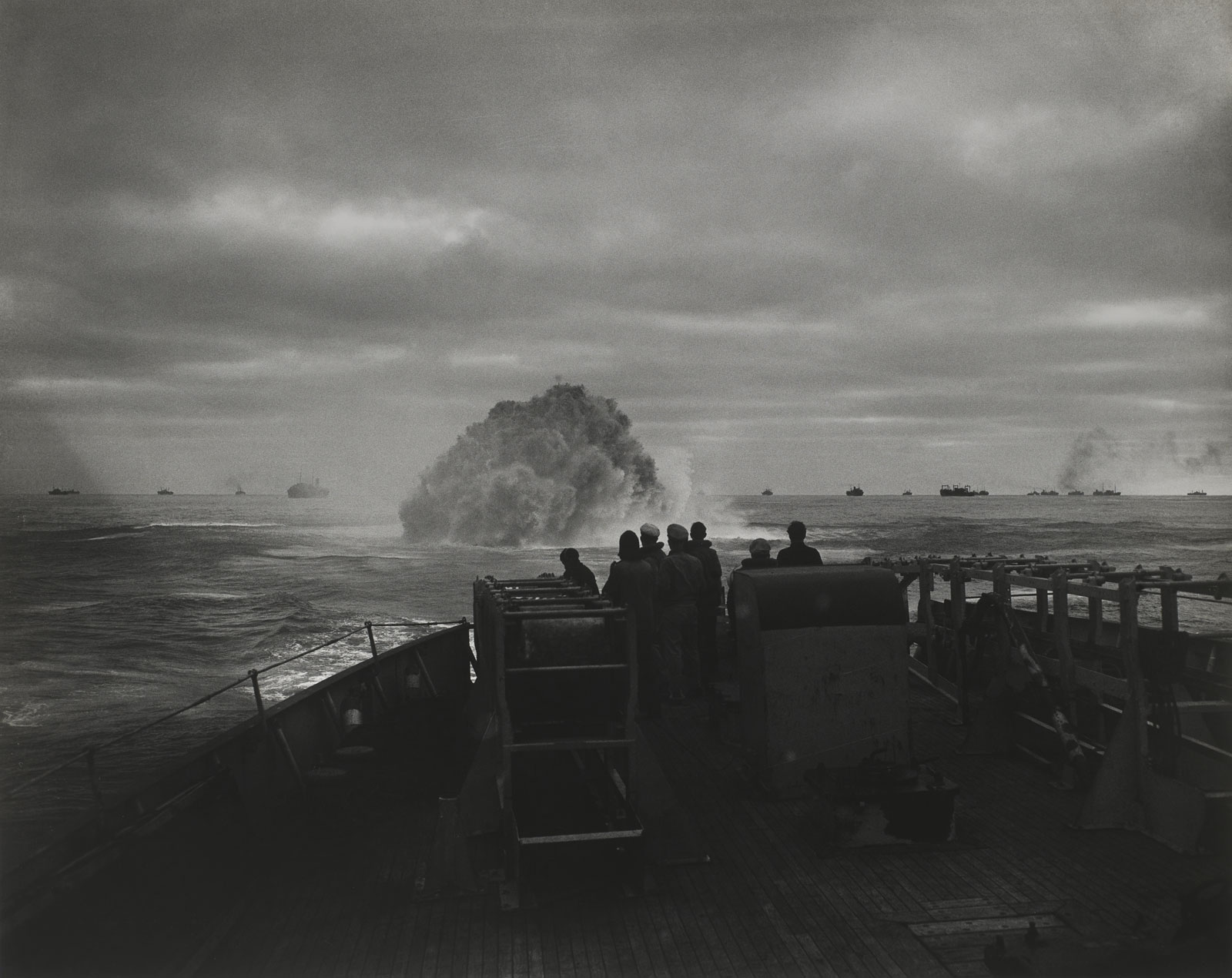
Warrant Photographer Jess W. January USCGR, American USCG Cutter Spencer destroys Nazi sub April 17, 1943 Gelatin silver print The Museum of Fine Arts, Houston
The Wait
8. The Wait depicts a common situation of wartime. Susan Meiselas captures a tense moment during a 1978 street fight in Nicaragua, when muchachos with Molotov cocktails line up in an alleyway, ready to initiate an attack on the National Guard. Robert Capa shows two female French ambulance drivers in Italy during World War II, leaning against their vehicle, knitting, as they wait to be called. (8 images)
9. The Fight is one of the most extensive sections in the exhibition. Dmitri Baltermants shot Attack – Eastern Front WWII (cover image of the exhibition catalogue) in 1941 from the trench, as men charged over him. Sky Over Sevastopol (1944), by Evgeny Khaldey, is an aerial photograph of planes on their way to a bombing raid of the strategically important naval point. Joe Rosenthal’s Over the Top – American Troops Move onto the Beach at Iwo Jima (1945) pictures infantrymen emerging from the protection of their landing craft into enemy fire. Staged photographs, presented as authentic documents, tend to proliferate during wartime, and several examples are included here. In 1942 the Public Relations Department of the War issued an assignment to photographers to create “representative” images of combat in North Africa for more dynamic images; official British photographer Len Chetwyn staged an Australian officer leading the charging line in the battle of El Alamein, using smoke in the background from the cookhouse to create a lively image. (21 images)
Len Chetwyn (English, 1909-1980) Australians approached the strong point, ready to rush in from different sides November 3, 1942 Silver gelatin photograph
Dmitri Baltermants (Russian, 1912-1990) Attack – Eastern Front WWII 1941 Silver gelatin photograph
The Wait and Rescue
10. The Wait and Rescue bookend The Fight. Among the photographs in Rescue are Ambush of the 173rd AB, South Vietnam (1965), by Tim Page, showing soldiers immediately combing through a battleground to assist the wounded; American Lt. Wayne Miller’s image of a wounded gunner being lifted from the turret of a torpedo bomber; and Life magazine photographer W. Eugene Smith’s 1944 photograph of an American soldier rescuing a dying Japanese infant. Smith wrote about that moment, stating “hands trained for killing gently… extricated the infant” to be transported to medical care. (8 images)
Lt. Wayne Miller (American, 1918-2013) Crewmen lifting Kenneth Bratton out of turret of TBF on the USS SARATOGA after raid on Rabaul November 1943 Silver gelatin photograph
More information: Kenneth C. Bratton – Mississippi (WWII vet). He was born in Pontotoc, MS, December 17, 1918. He passed away April 15, 1982. Lt. Bratton won a purple heart for his bravery during the attack on Rabaul November 11, 1943.
Wayne Forest Miller (September 19, 1918 – May 22, 2013) was an American photographer known for his series of photographs The Way of Life of the Northern Negro. Active as a photographer from 1942 until 1975, he was a contributor to Magnum Photos beginning in 1958. …
War photographer
Miller then served as a lieutenant in the U.S. Navy where he was assigned to Edward Steichen’s World War II Naval Aviation Photographic Unit. He was among the first Western photographers to document the destruction at Hiroshima.
The Grumman TBF Avenger (designated TBM for aircraft manufactured by General Motors) is an American World War II-era torpedo bomber developed initially for the United States Navy and Marine Corps, and eventually used by several air and naval aviation services around the world.
The Avenger entered U.S. service in 1942, and first saw action during the Battle of Midway. Despite the loss of five of the six Avengers on its combat debut, it survived in service to become the most effective and widely-used torpedo bomber of World War II, sharing credit for sinking the super-battleships Yamato and Musashi (the only ships of that type sunk exclusively by American aircraft while under way) and being credited for sinking 30 submarines. Greatly modified after the war, it remained in use until the 1960s.
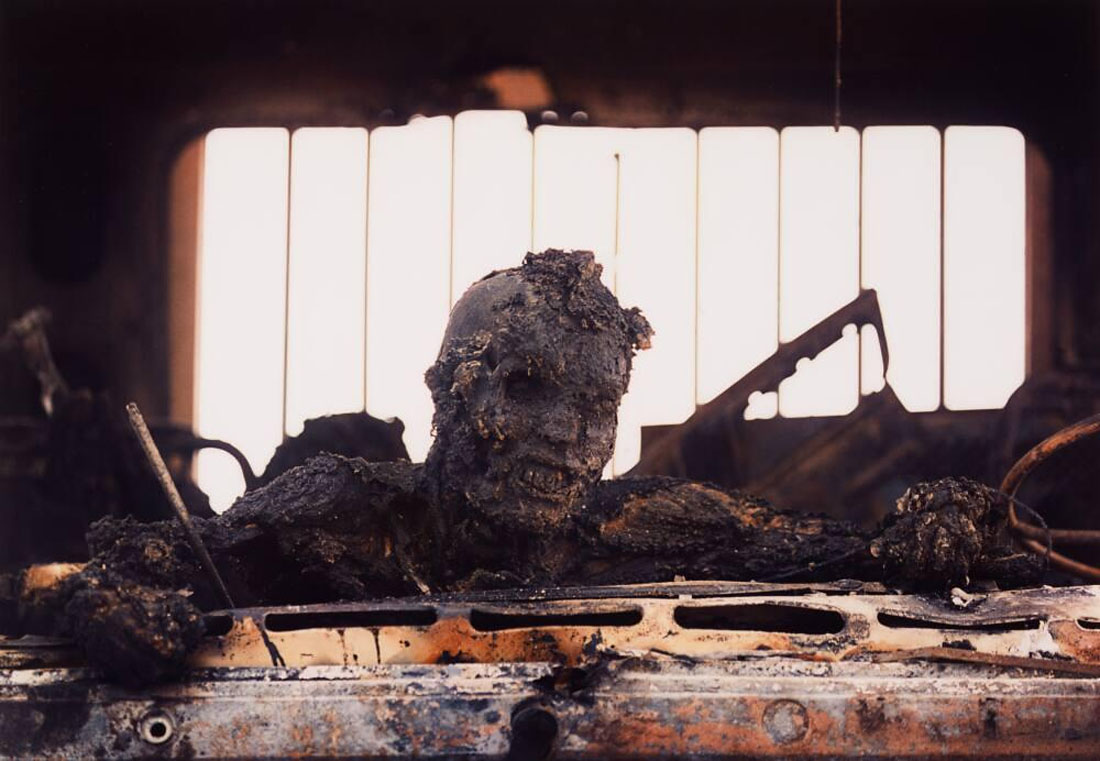
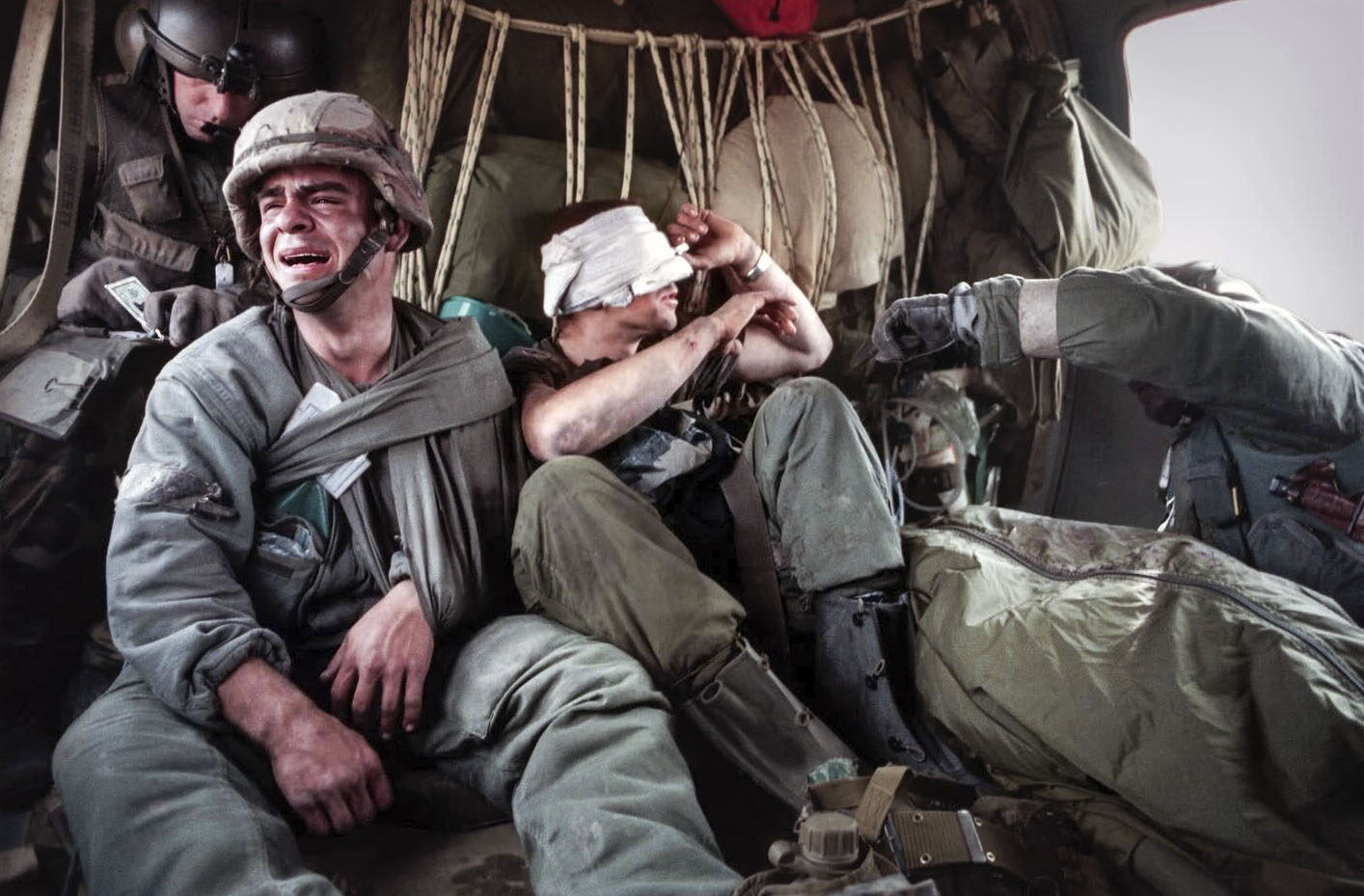
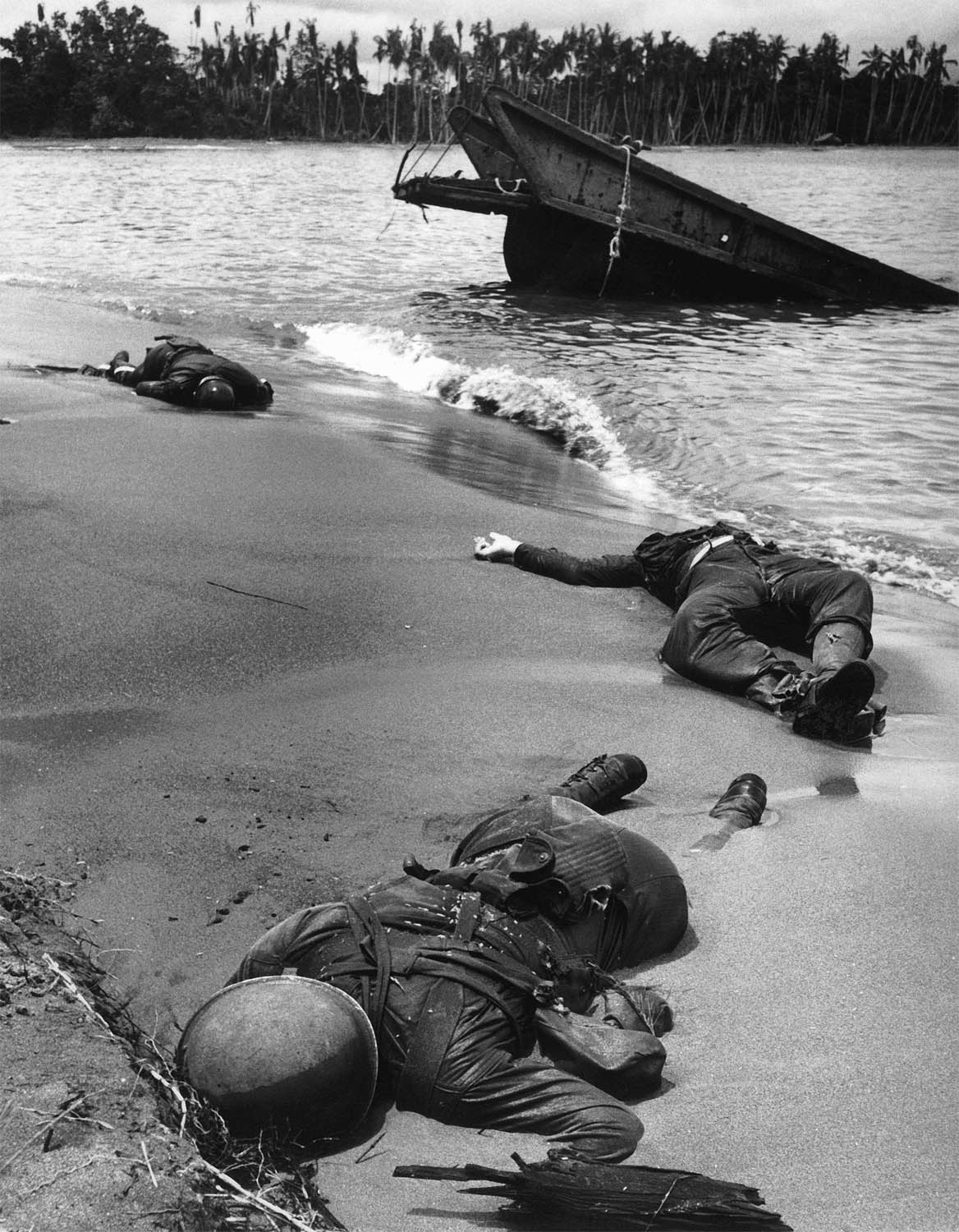
11. Aftermath, with four subsections, features photographs taken after the battle has ended. “Death” on the battlefield is one of the earliest types of war images: Felice Beato photographed the dead in the interior of Fort Taku in the Second Opium War (1860). George Strock’s Dead GIs on Buna Beach, New Guinea (1943), which ran in Life magazine with personal details about the casualties, was the first published photograph from any conflict of American dead in World War II. In 1966, Associated Press photographer Henri Huet documented an American paratrooper, who was killed in action, being raised to an evacuation helicopter. Incinerated Iraqi, Gulf War, Iraq, taken by Kenneth Jarecke, was published in Europe, but the American Associated Press editors withheld it in the United States. “Shell Shock and Exhaustion” shows impenetrable exhaustion after battle. In Don McCullin’s Shell-shocked soldier awaiting transportation away from the front line, Hué, Vietnam (1968), the man looks forward with the “thousand-yard stare.” Robert Attebury photographed Marines so exhausted after a 2005 battle in Iraq that lasted 17 hours that they fell asleep where they had been standing, amid the rubble of a destroyed building. “Grief and Battlefield Burial” were taken at the site of the conflict, including David Turnley’s 1991 picture of a weeping soldier who has just learned that the remains in a nearby body bag are those of a close friend. “Destruction of Property” shows collateral damage from war. Christophe Agou, for instance, photographed the smouldering steel remains of the twin towers of the World Trade Center in 2001. (39 images)
David Turnley (American, b. 1955) American Soldier Grieving for Comrade Iraq, 1991
Ken Kozakiewicz (left) breaks down in an evacuation helicopter after hearing that his friend, the driver of his Bradley Fighting Vehicle, was killed in a “friendly fire” incident that he himself survived. Michael Tsangarakis (centre) suffers severe burns from ammunition rounds that blew up inside the vehicle during the incident. All of the soldiers were exposed to depleted uranium as a result of the explosion. They and the body of the dead man are on their way to a MASH (Mobile Army Surgical Hospital).
Prisoners of War (Civilian and Military)/Interrogation
12. Prisoners of War (Civilian and Military)/Interrogation is a frequently photographed subject because such pictures can be made outside an area of conflict. Moreover, the people in control often documented their prisoners as a show of power. The photographs in this section include the official recording of a prisoner of war before his execution by the Khmer Rouge, taken by Nhem Ein. (14 images)
13. Iwo Jima is a case study within the exhibition that presents the complete thematic narrative in photographs from a specific battle. Included in this section is the inspiration for the exhibition: Joe Rosenthal’s iconic, Pulitzer Prize-winning Old Glory Goes Up on Mount Suribachi, Iwo Jima, a photograph he took as an Associated Press photographer in World War II showing U.S. Marines and one Navy medic raising the American flag on the remote Pacific island. (25 images)
We were asked to choose our favourite photograph, one that we could nominate as a great photograph. I chose a slightly different take on proceedings.
Dr Marcus Bunyan
Many thankx to my fellow speakers for their talks and to Director of the Centre for Contemporary Photography Naomi Cass for inviting me to speak at a wonderful evening. Please click on the photographs for a larger version of the image.
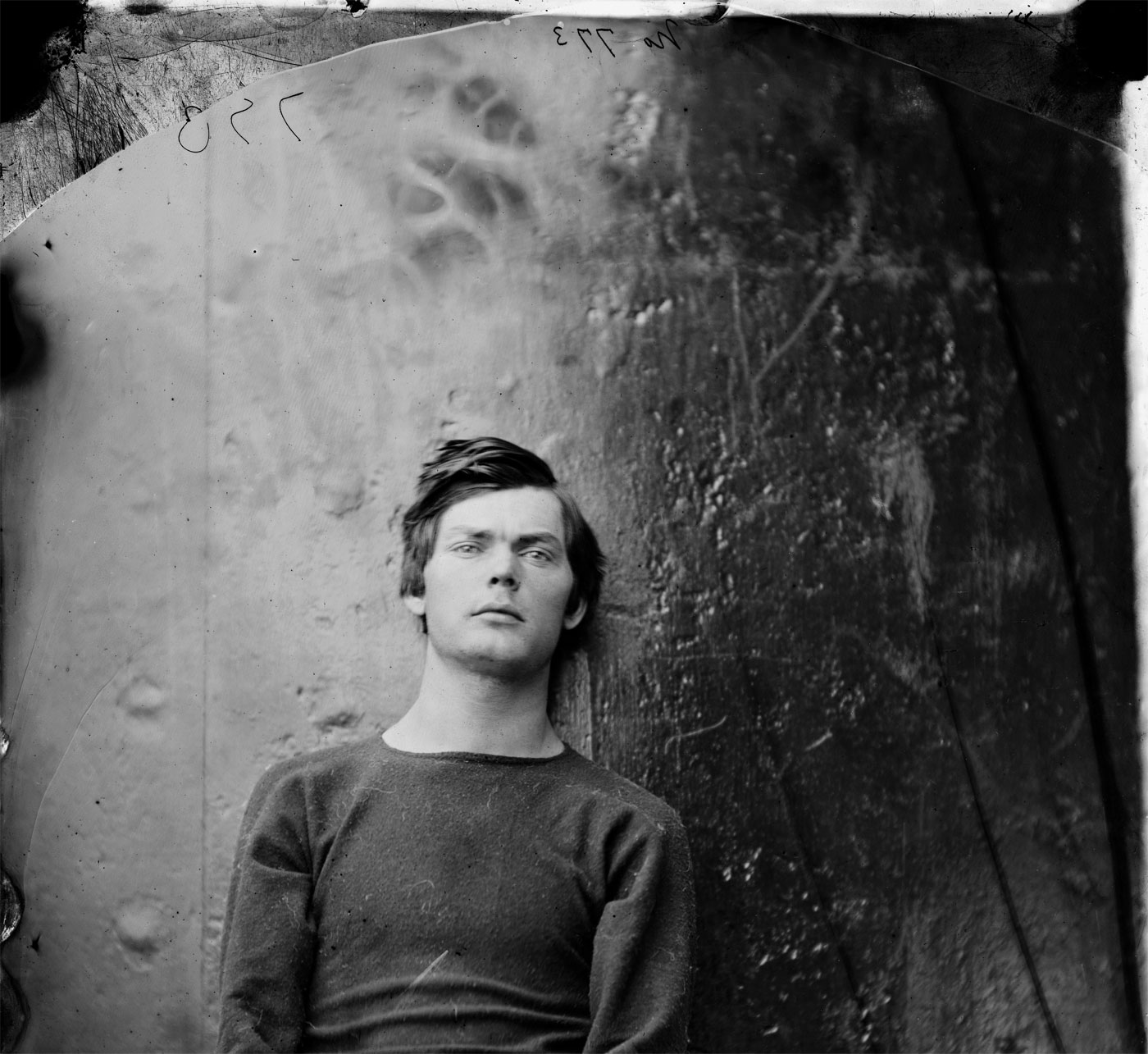
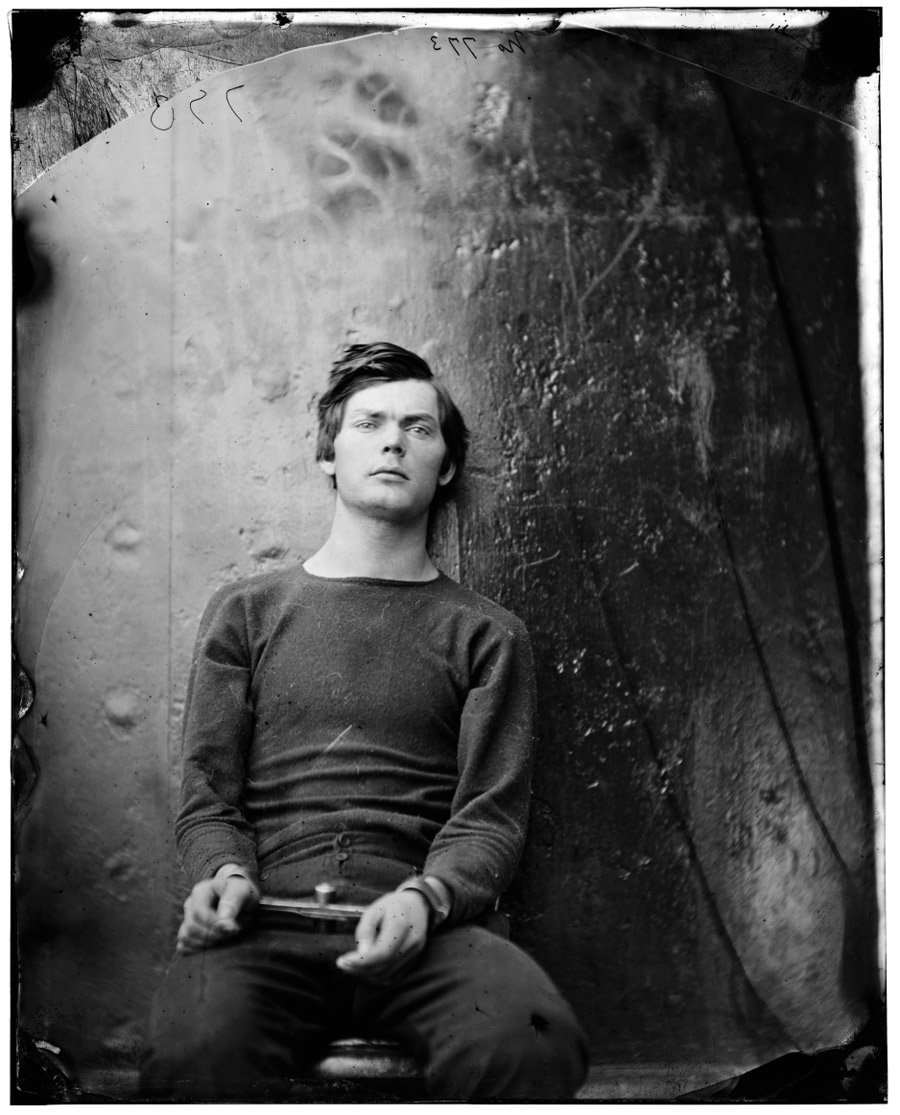
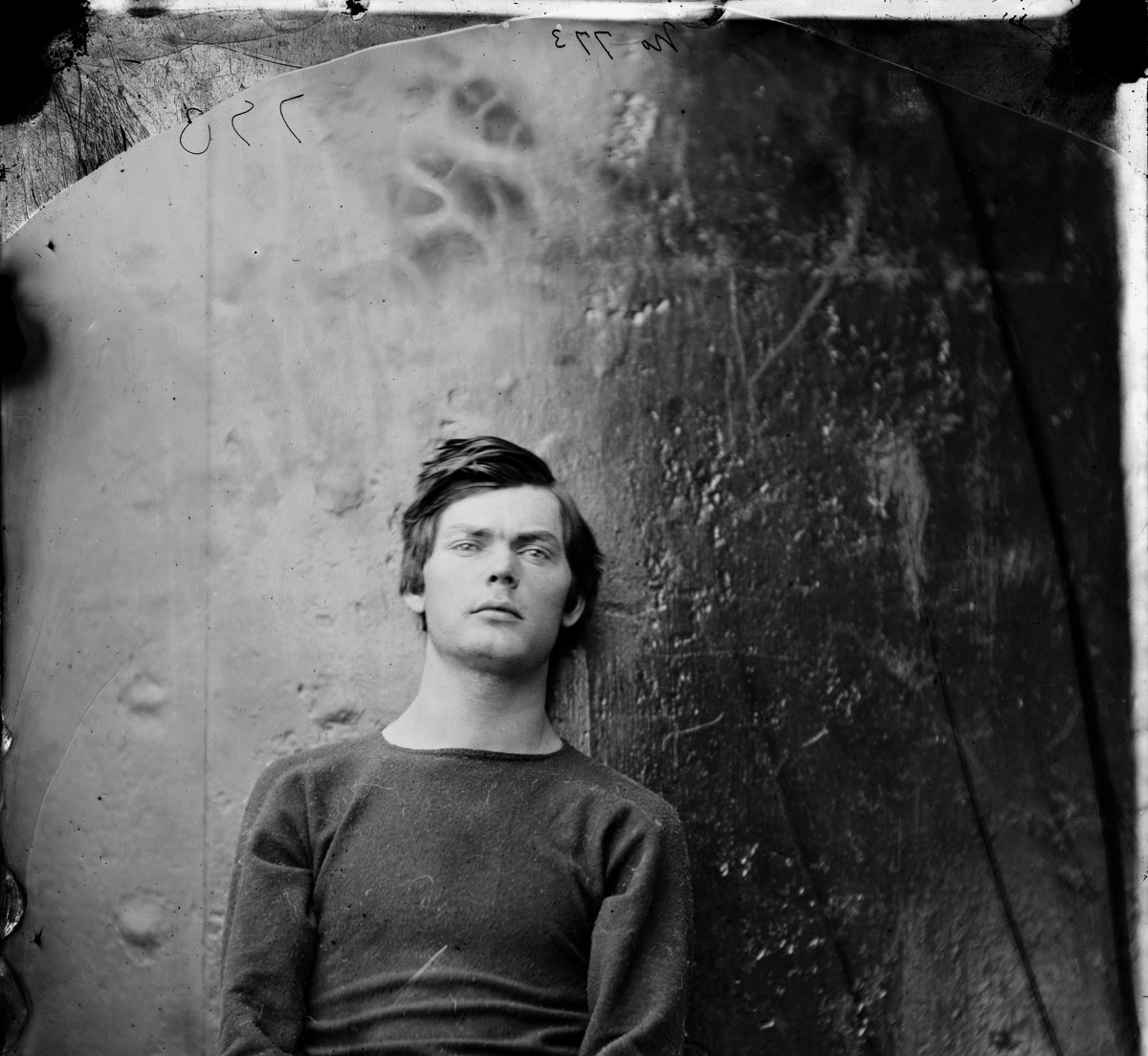
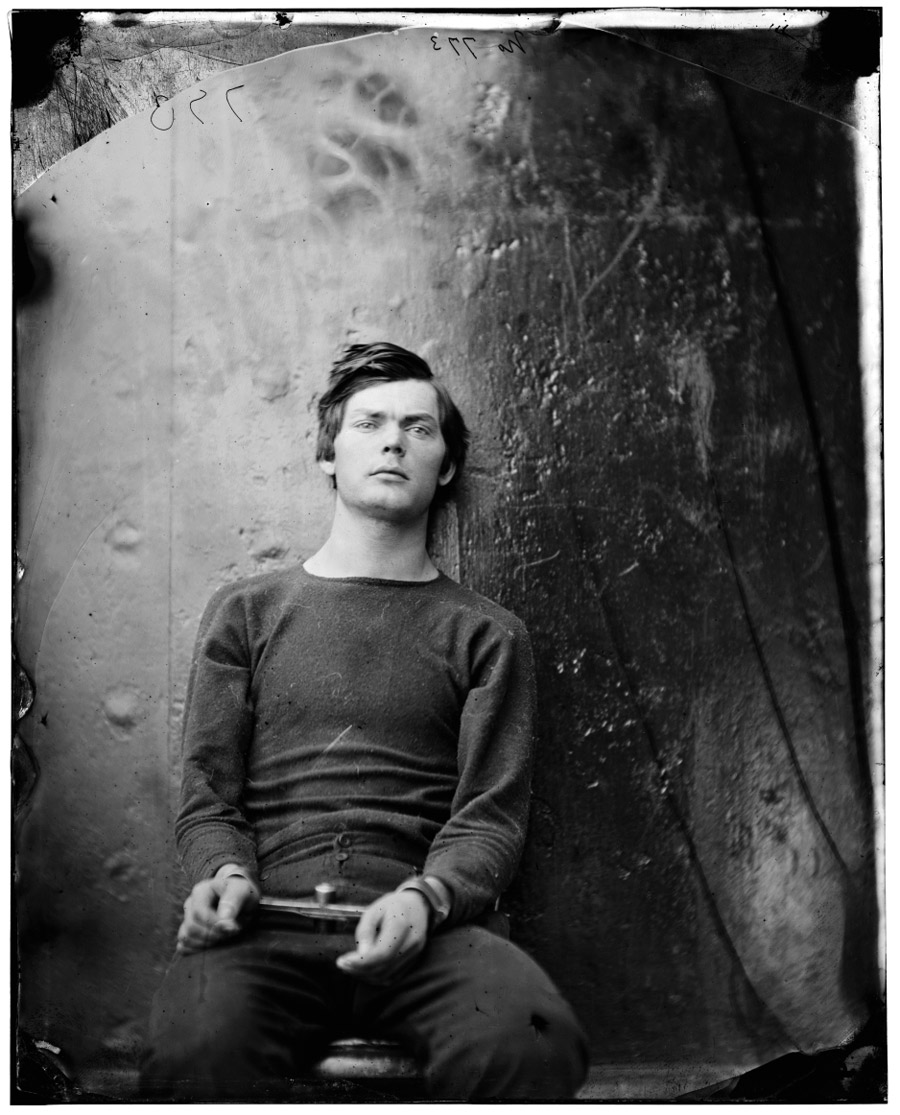
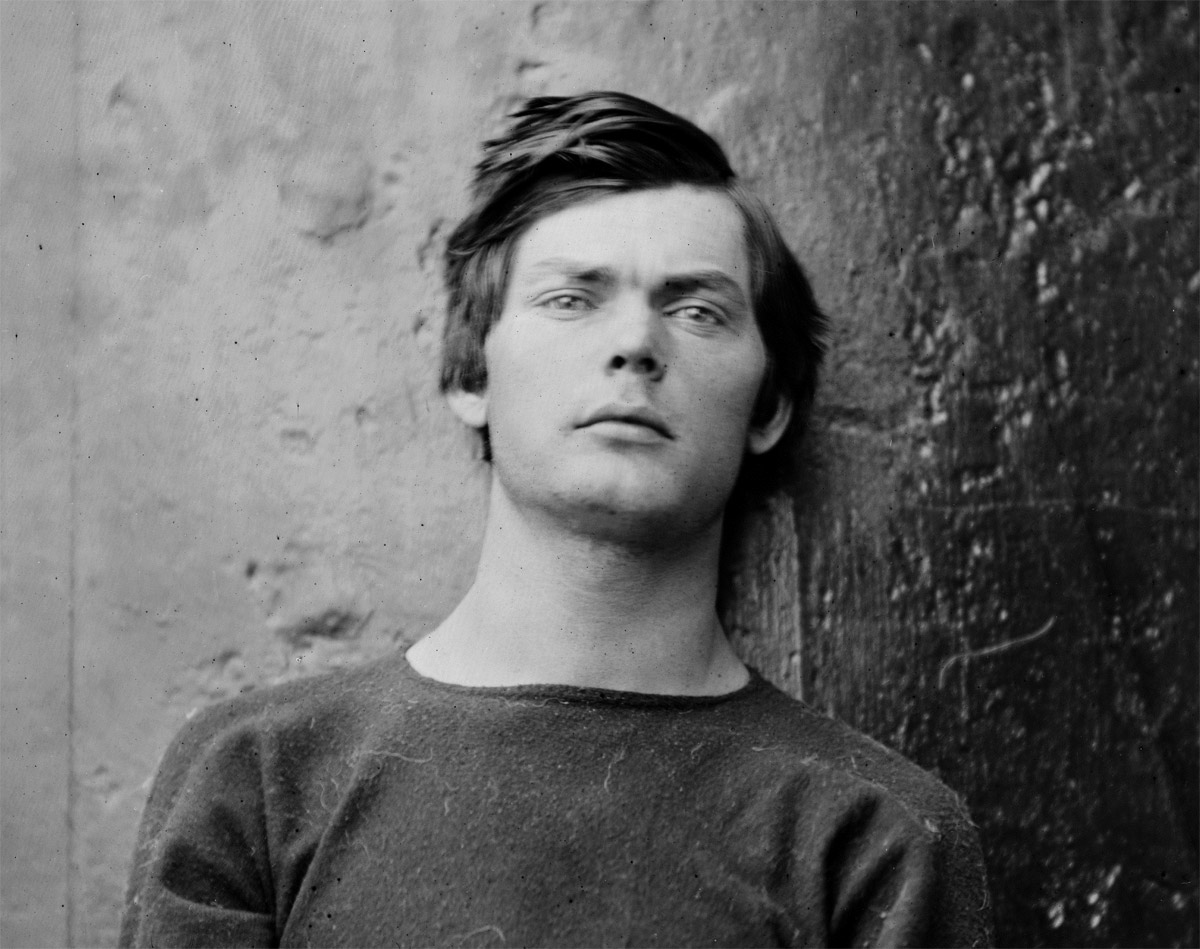
Alexander Gardner (American, 1821-1882) Lewis Paine 26th April, 1865 Albumen silver print from a Collodion glass plate negative
This is not my favourite photograph
A minute’s silence…
This is not my favourite photograph Nor may it be a great photograph… More interestingly to me, it is a remarkable photograph – one that you are able to make remarks on.
It is also a photograph that has haunted me for years.
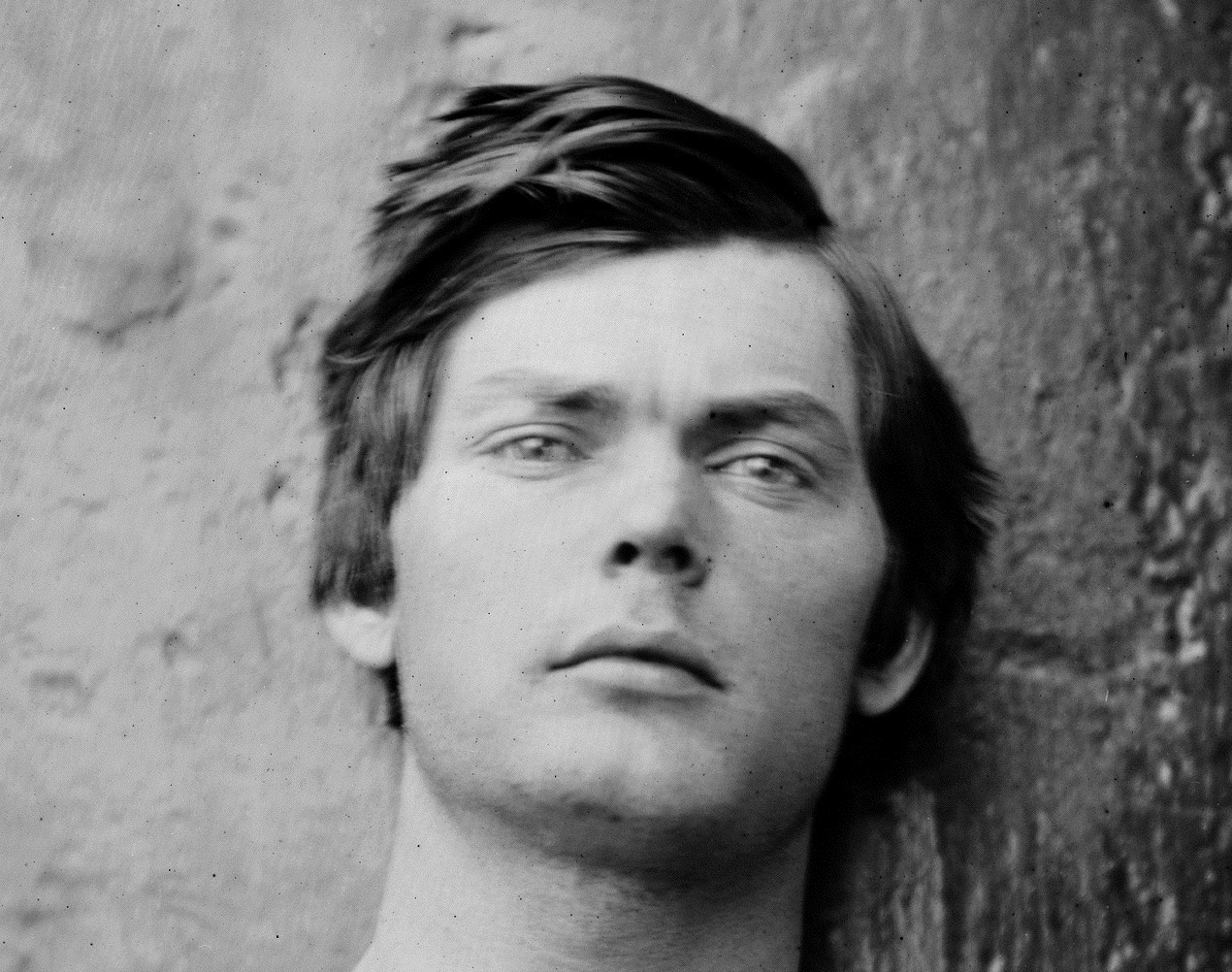
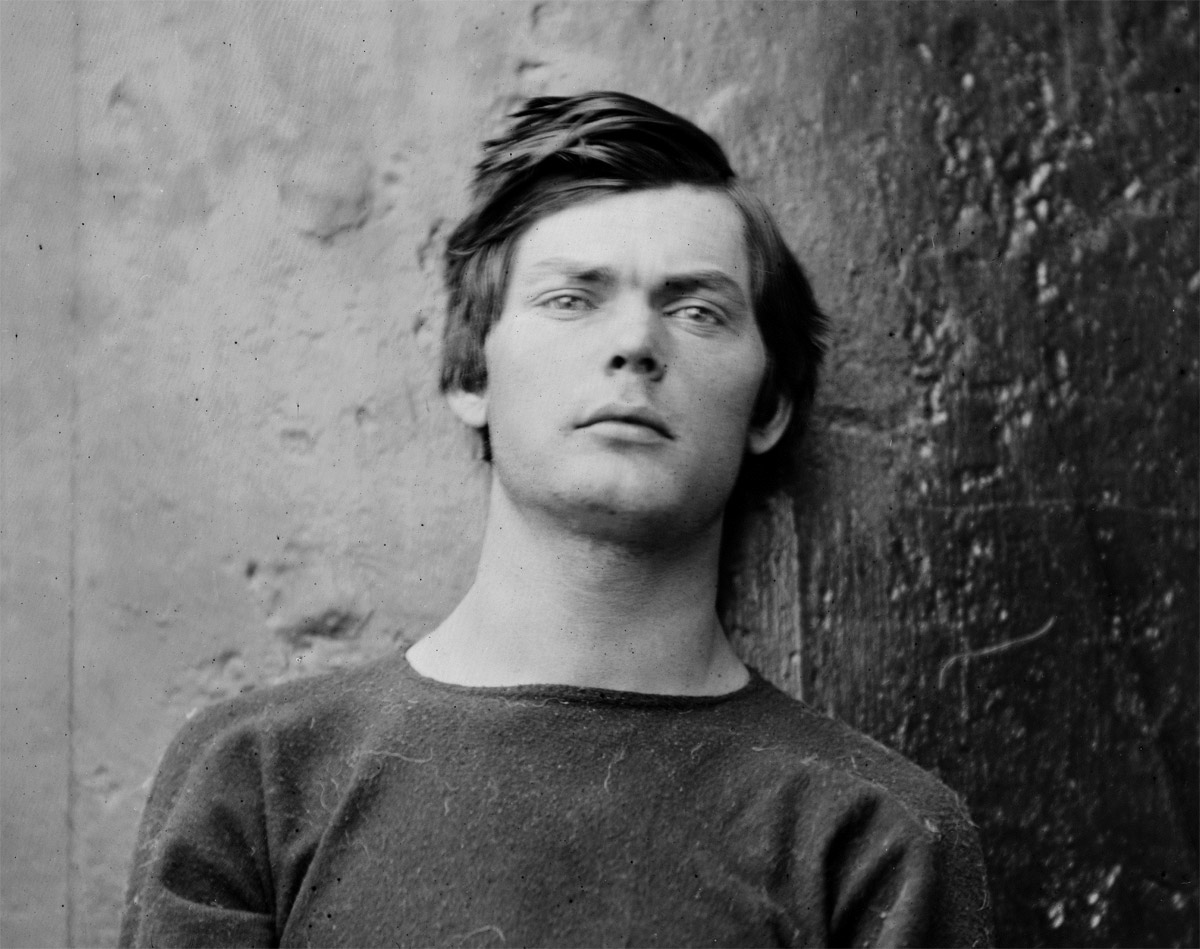
Taken by Alexander Gardner in April 1865, this photograph is a portrait of Lewis Thornton Powell (aka Lewis Payne or Paine) who was one of the conspirators in the assassination of Abraham Lincoln which had happened the same month. The photograph has a background of dark metal, and was taken on one of the ironclads U.S.S. Montauk or Saugus, where the conspirators were for a time confined. Paine was executed in July 1865 just eight short weeks later.
Alexander Gardner (American, 1821-1882) Three photographs of Lewis Paine 26th April, 1865
This is the triptych of photographs by Gardner in the form they are usually displayed, like a three-panel renaissance altar-piece. The left and right hand photographs were taken within minutes of each other, with the camera in the same position, whereas in the centre photograph the camera has been lowered to show more of the body, and the image has been cropped at the top. In the central plate the figure of Paine has been raised up in the frame – almost prematurely brought back to life by his placement.
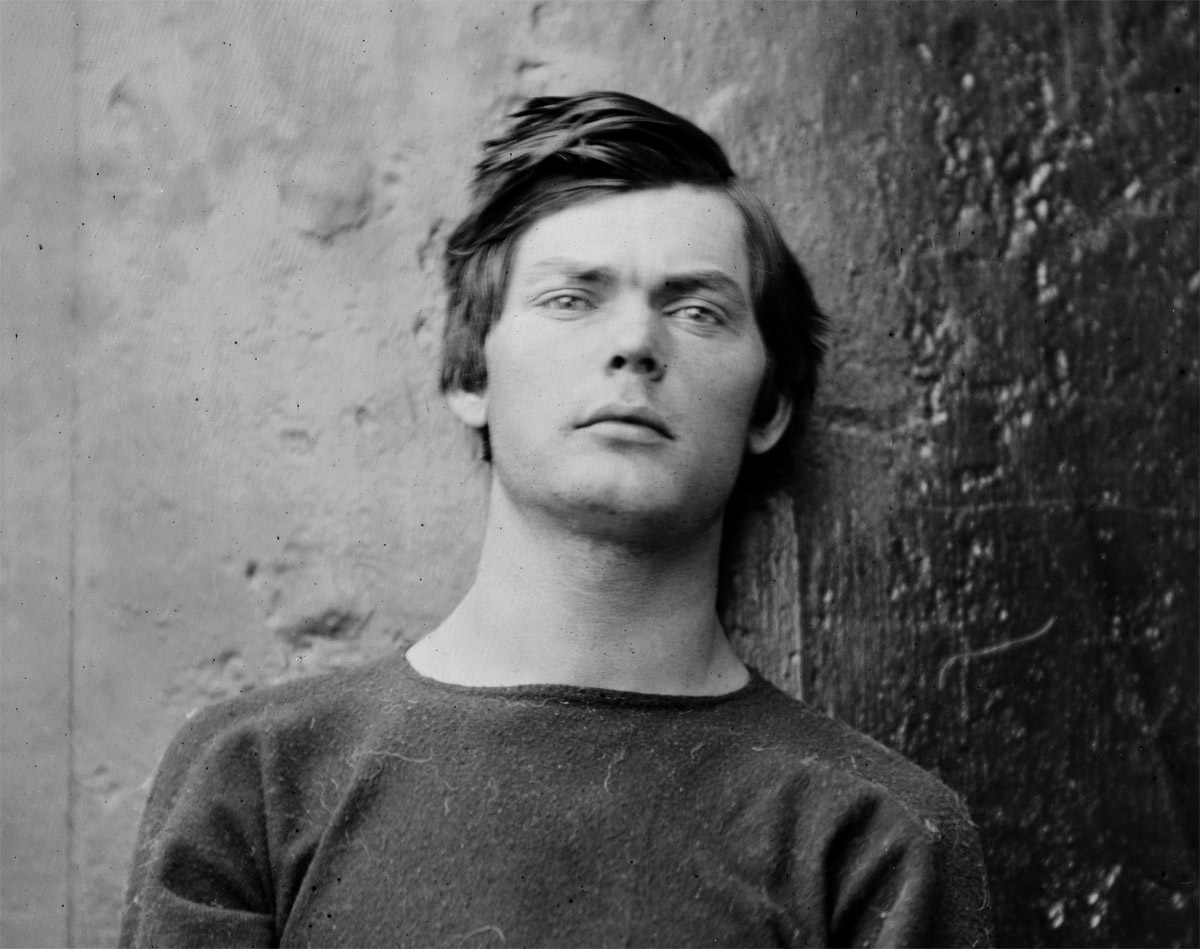
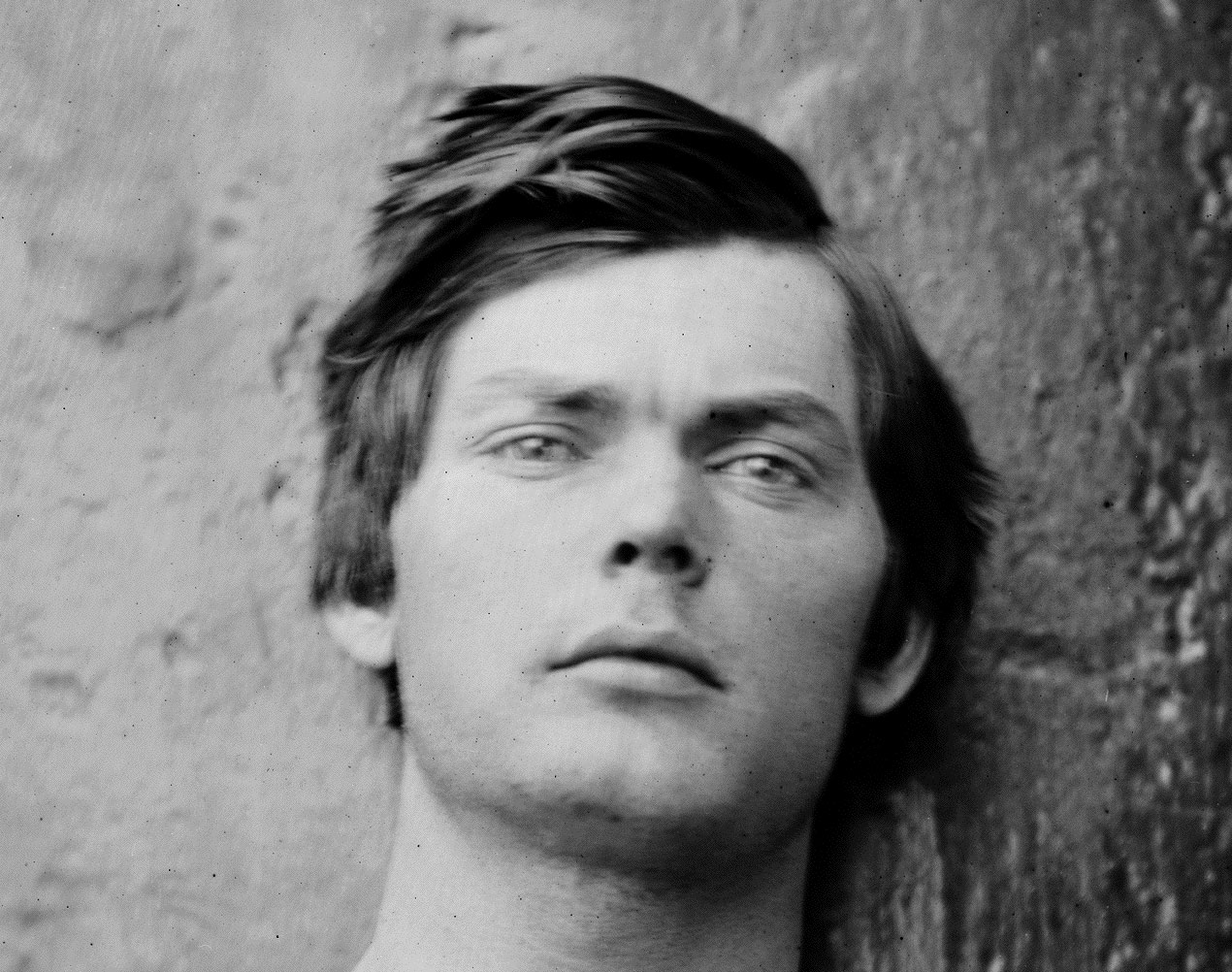
The centre image is the only one where Paine stares directly at the camera. He surveys the viewer with a gaze I find enigmatic.
This is a very modern face, a very contemporary face. His hair is just like Justin Beiber’s.
Who brushed his hair across for this picture, and would it normally be this long, or has it just been ignored because of his fate?
He still has good muscle tone – has he been exercising in his cell?
And finally his clothing – is it navy issue, as his top appears to have been given to him, perhaps the coarse, navy blue wool of the Northern states.
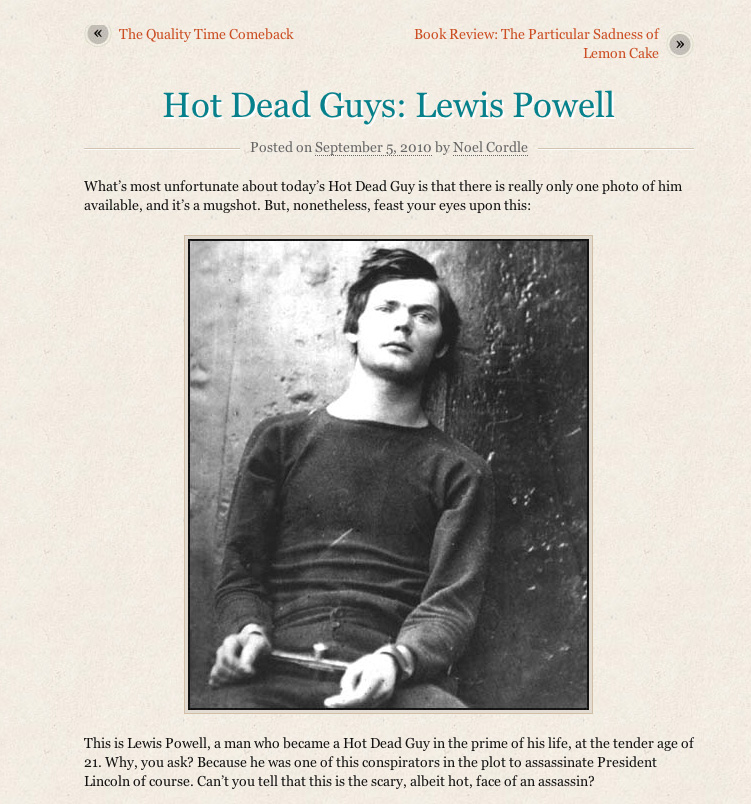
Noel Cordle Hot Dead Guys: Lewis Powell Posted on September 5th, 2010 Mere Musings blog [Online] Cited 01/12/2012 no longer available online
There’s even a web page dedicated to him on “hot dead guys” where there’s that awkward moment when one of Lincoln’s conspirators is so sexy its ridiculous…
He wasn’t all bad. Biographers of Powell describe him as a quiet, introverted boy who enjoyed fishing and caring for sick and injured animals. Apparently, Lewis was an intelligent, sensitive, soul with great potential.
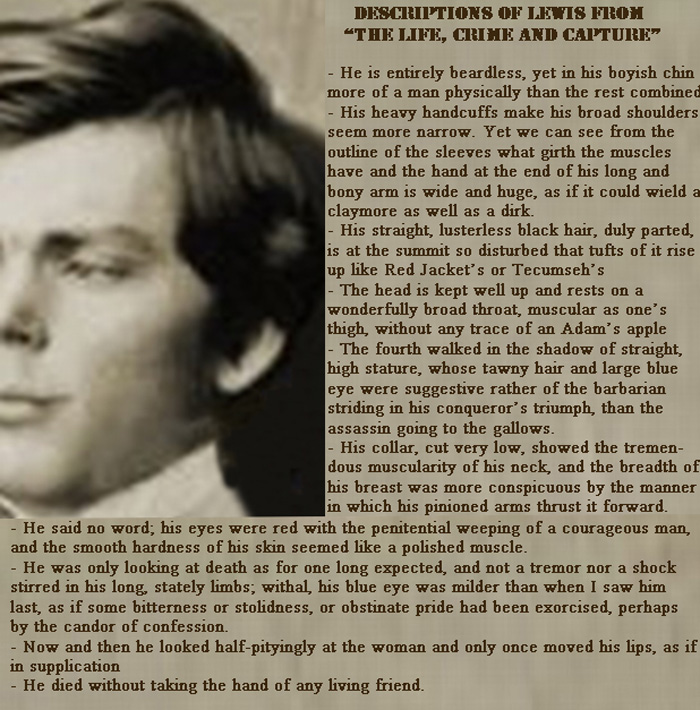
Descriptions of Lewis from “The Life, Crime and Capture”
.
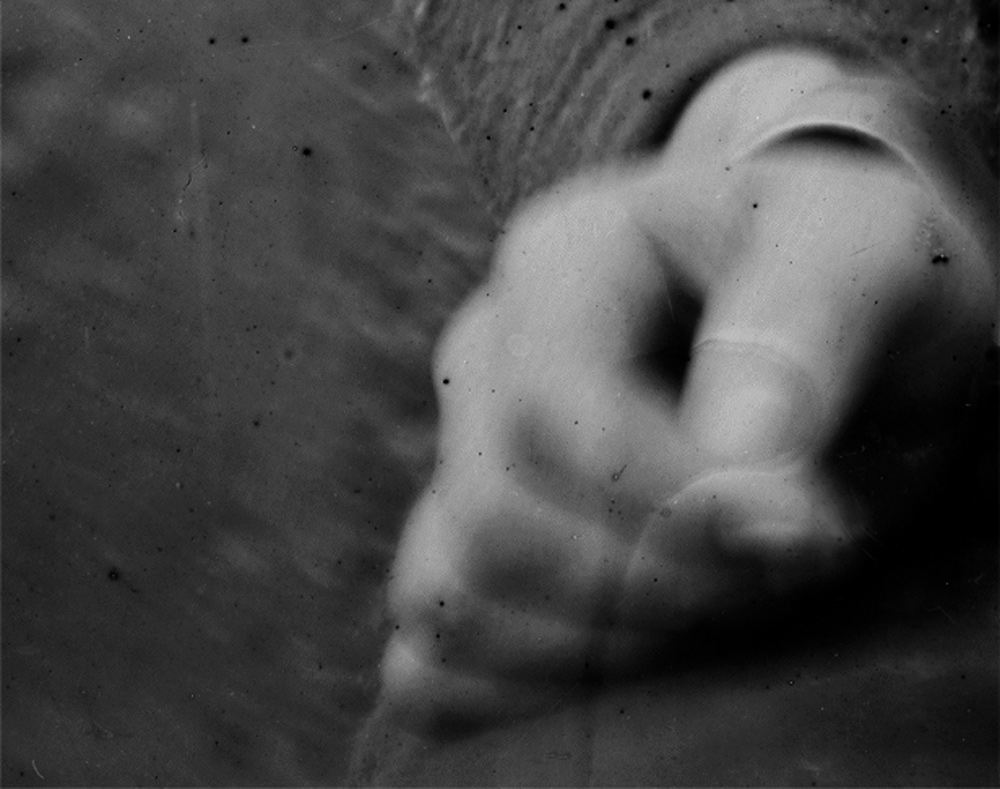
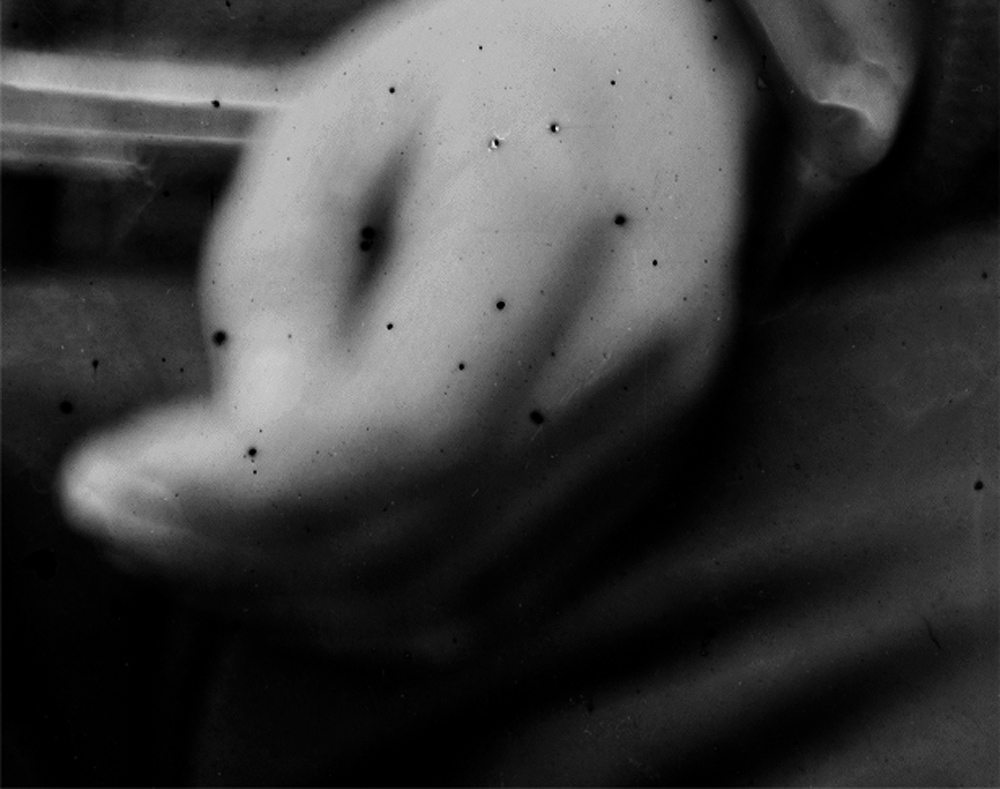
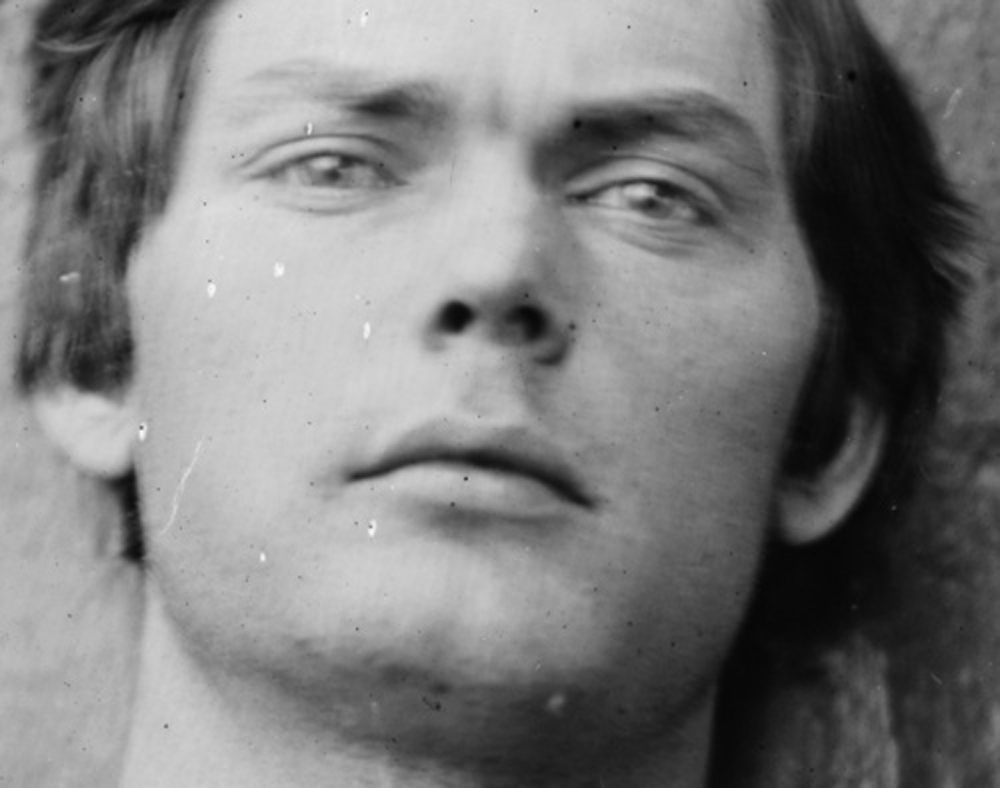
Alexander Gardner (American, 1821-1882) Lewis Paine (detail) 26th April, 1865 Albumen silver print from a Collodion glass plate negative
Could we say that he is left-handed given the different size of his fingers (?)
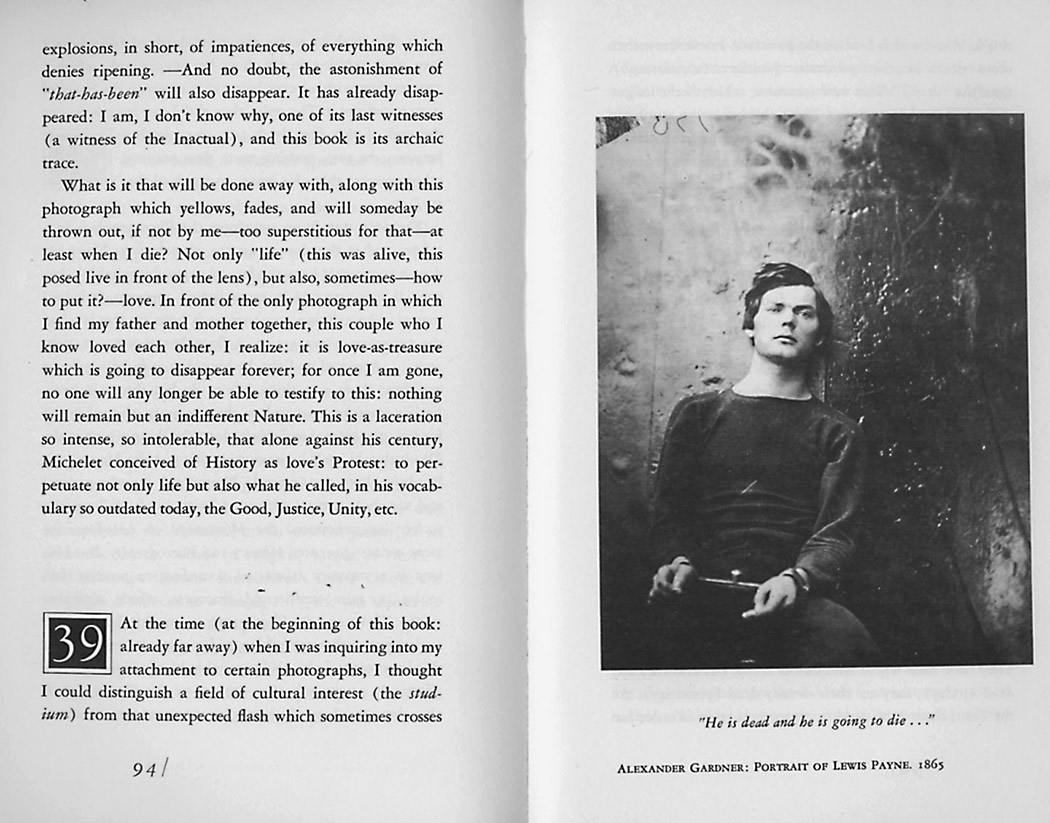
Roland Barthes (French, 1915-1980) Camera Lucida (La Chambre claire) 1980
Roland Barthes in his seminal work Camera Lucida said in Section 39: “He is dead and he is going to die…
“The photograph is handsome, as is the boy: that is the studium. But the punctum is: he is going to die. I read at the same time: this will be and this has been; I observe with horror an anterior future of which death is the stake. By giving me the absolute past of the pose, the photograph tells me death in the future. What pricks me is the discovery of this equivalence.”
If we were to place this image within the metaphysical school of photography which peaked with Paul Caponigro and Minor White we could say:
Hovering above his head, has his spirit already begun to leave his body?
One reading of his gaze is that he is really interested in what the photographer is doing – almost the gaze of an apprentice wanting to apply these skills in the future.
Given his fate is he insane because of his interest?
What is really going on in his mind – what is his perspective?
Another reading could be as looking out to the future in the hope of finding that he will be judged in another way.
And another is the immediacy of his gaze – it is a gaze that is happening now!
The other thing that I find quite mysterious is the distance of the photographer from the subject.
Was it fear that stopped him getting any closer or are there deck fittings we cannot see that prevented his approach?
What brought Paine to this place?
Michel Foucault calls the methods and techniques through which human beings constitute themselves, “Technologies of the self.” Foucault argued that we as subjects are perpetually engaged in processes whereby we define and produce our own ethical self-understanding. According to Foucault, technologies of the self are the forms of knowledge and strategies that “permit individuals to effect by their own means or with the help of others a certain number of operations on their own bodies and souls, thoughts, conduct, and way of being, so as to transform themselves in order to attain a certain state of immortality.”1
As we look into his eyes he knows that we know he is going to die, has already died but the intensity of that knowledge is brought into present time. What Paine emanates is a form of i-mortality.
I wonder, did Gardner ever show him the finished photographs before he died?
This is Barthes anterior future, a moment where truth is interpreted in the mind of the photographer, not out there but in here [points to head and heart], where past, present and future coalesce into single point in time – his death and our death are connected through his gaze, the knowledge of our discontinuity. Eons contracted into an eternal moment.
In this moment in time, what we are doing is we are making a list about the human condition when we talk about something that is remarkable. We are moving towards a language that defines the human condition…
But ultimately language can never fully describe the human condition, much as it may try… and this is why this photograph is remarkable, because it is ineffable, unknowable.
This photograph inhabits you, it haunts you like few others.
Early Wittgenstein described a world of facts pictured by thoughts. He said, “Don’t Think, But Look!”
I would add “Don’t think, but feel and look”
This photograph is a memoriam to a young man and his present death. As such it is a REMARKABLE photograph that haunts us all.
Dr Marcus Bunyan December 2012
1/ Foucault, Michel. “Technologies of the self,” in L. H. Martin, H. Gutman and P. H. Hutton (eds.). Technologies of the self. Amherst: University of Massachusetts Press, 1988,p. 18.
Postscript
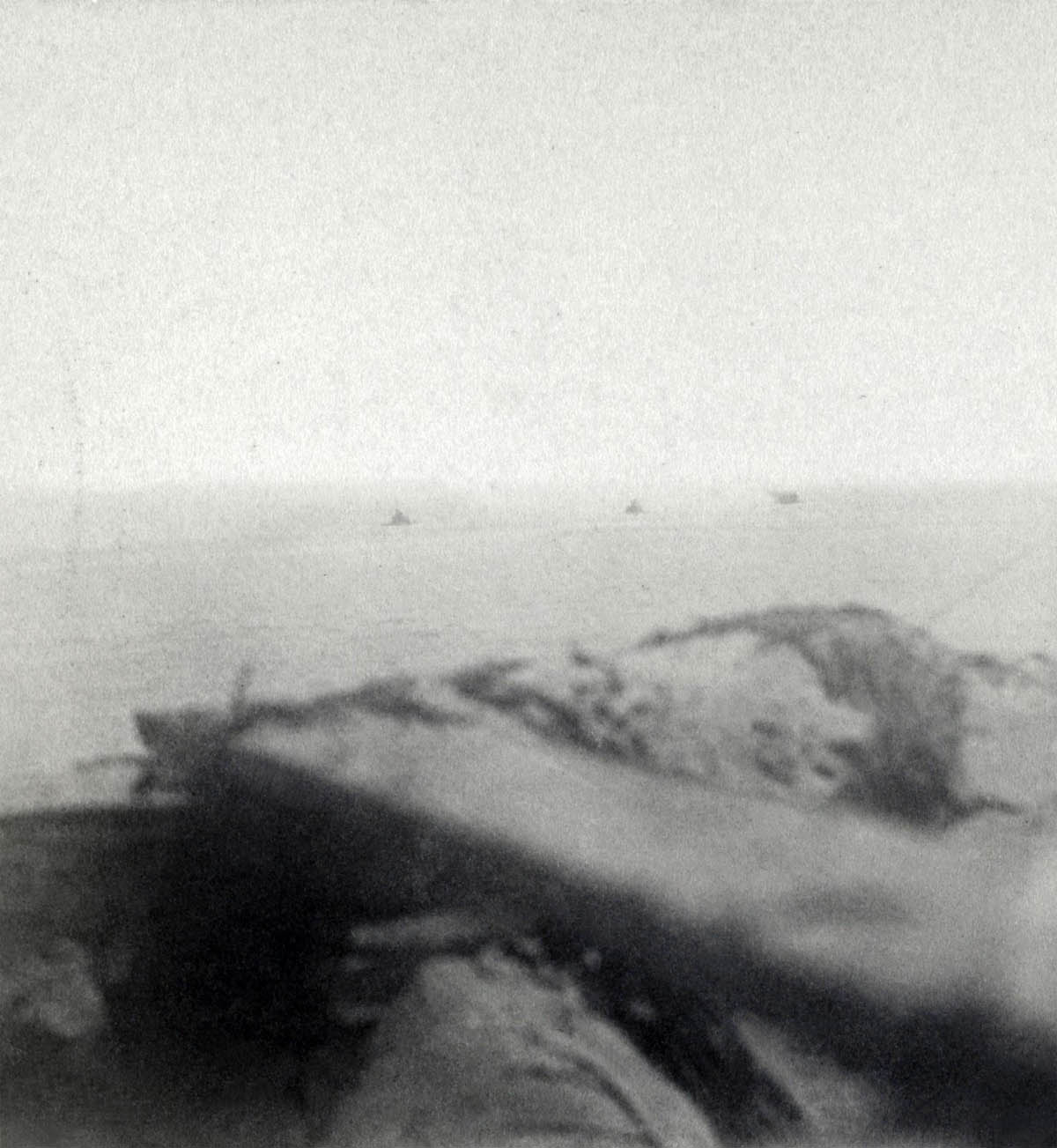
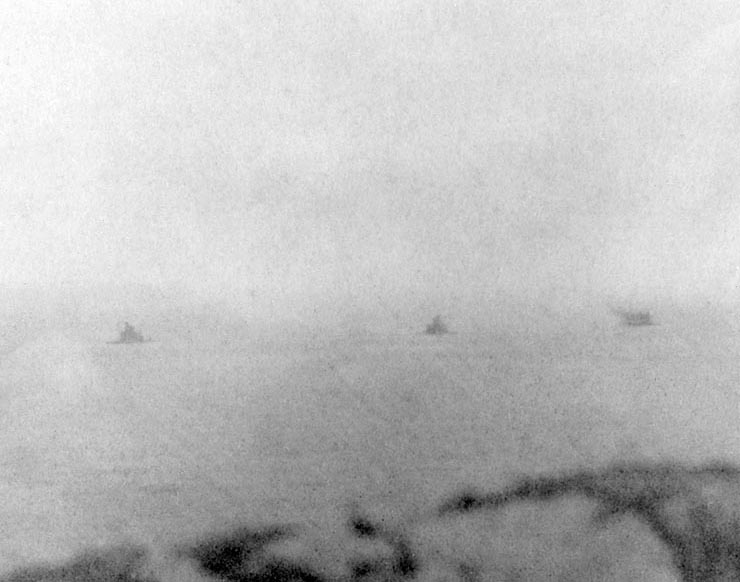
George Cook (American, 1819-1902) Union ironclads firing on Fort Moultrie, S.C., (detail) 8th September 1863
“On the highest point of the battered dust heap that was the still untaken fortress of Sumter. the Confederate photographer, Cook, planted his camera on September 8, 1863, and took the first photograph of ironclads in action – the monitors W’echaten. Montauk and Passaic. as they were actually firing on the Confederate batteries at Fort Moultrie. The three low-freeboarded vessels, lying almost bows-on, at the distance of nearly two miles, look like great iron buoys in the channel, but the smoke from their heavy guns is drifting over the water, and the flames can almost be seen leaping from the turret ports. Although Fort Moultrie was the aim of their gunners, Cook, with his head under the dark cloth, saw on the ground glass a shell passing within a few feet of him. Another shell knocked one of plate-holders off the parapet into the rain-water cistern. He gave a soldier five dollars to fish it out for him. He got his picture – and was ordered off the parapet, since he was drawing upon the fort the fire of all the Union batteries on Morris Island. It seems incredible that such a daring photographic feat, and one of such historic interest, could have remained unpublished for nearly half a century – until one recalls the absence of any satisfactory method for reproducing photographs direct during the generation succeeding the war. Before photo-engraving became perfected, thirty years or more had passed, and most of the few negatives taken by Confederates had vanished through fire, loss, and breakage. Fortunately, this has been preserved one of the most vivid of any war.”
Francis Trevelyan Miller. “First Preface: Photographing The Civil War,” in The Photographic History of The Civil War In Ten Volumes. New York: The Review of Reviews, 1911, p. 24.
George Cook (American, 1819-1902) Union ironclads firing on Fort Moultrie, S.C., 8th September 1863 Photo courtesy of the Cook Collection, Valentine Richmond History
George Cook’s photograph of Union ironclads firing on Fort Moultrie, S.C., believed to be the world’s first combat photograph. Monitors engage Confederate batteries on Sullivan’s Island, Charleston, South Carolina. Photographed from one of the Confederate emplacements, the ships are identified as (from left to right): Weehawken, Montauk and Passaic. The monitor on the right appears to be firing its guns. Date is given as 8 September 1863, when other U.S. Navy ships were providing cover for Weehawken, which had gone aground on the previous day. She was refloated on the 8th after receiving heavy gunfire from the Confederate fortifications.
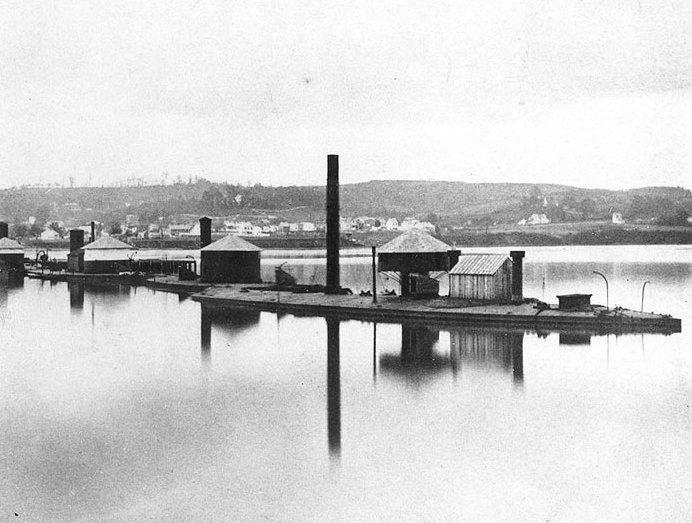
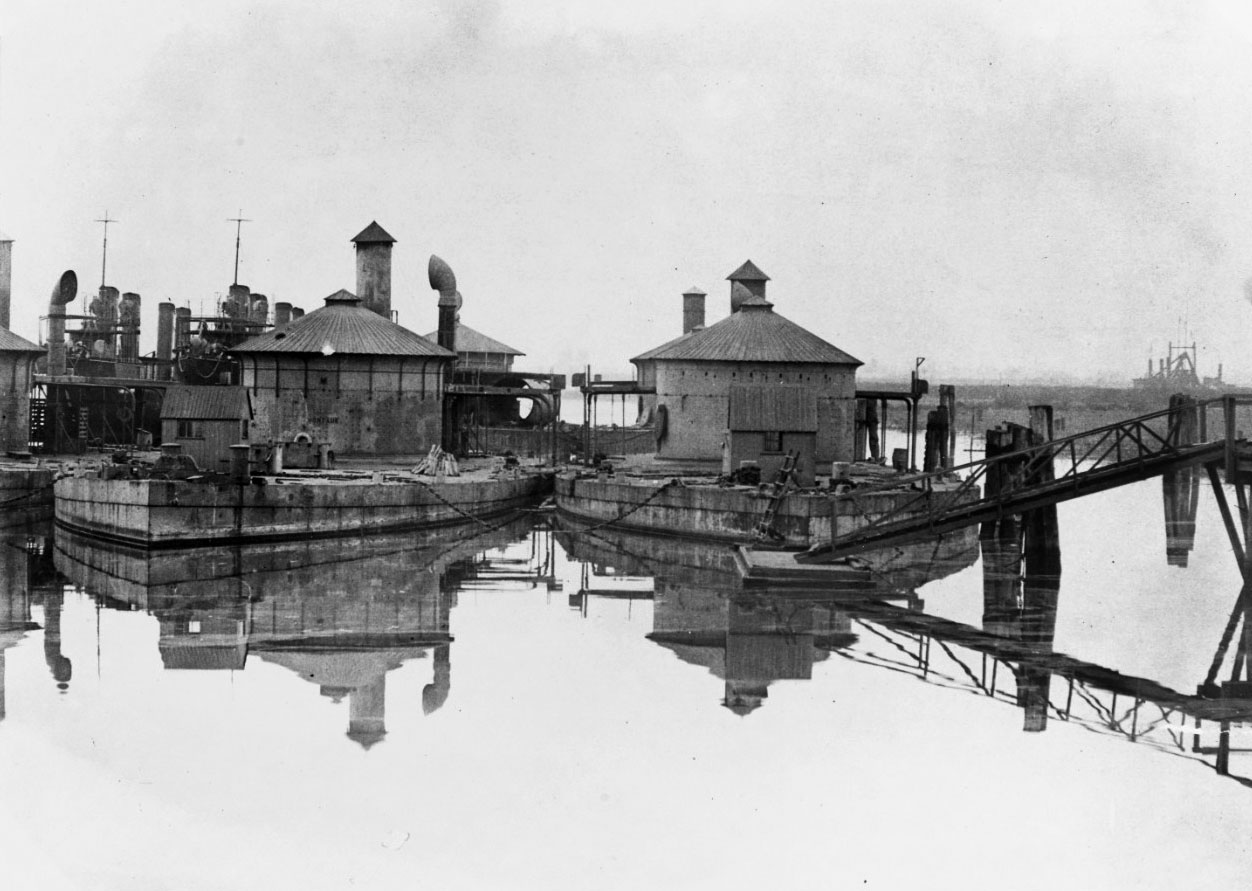
Kilburn Brothers (Edward and Benjamin Kilburn, American) Four monitors laid up in the Anacostia River, off the Washington Navy Yard c. 1866 Ships are (from left to right): USS Mahopac, USS Saugus, USS Montauk (probably), and either USS Casco or USS Chimo Photo mounted on a stereograph card, marked: “Photographed and published by Kilburn Brothers, Littleton, N.H.”
Anonymous photographer ‘Montauk’ at left, and ‘Lehigh’ at right, laid up at the Philadelphia Navy Yard, Pennsylvania c. late 1902 or early 1903 U.S. Naval Historical Center photograph
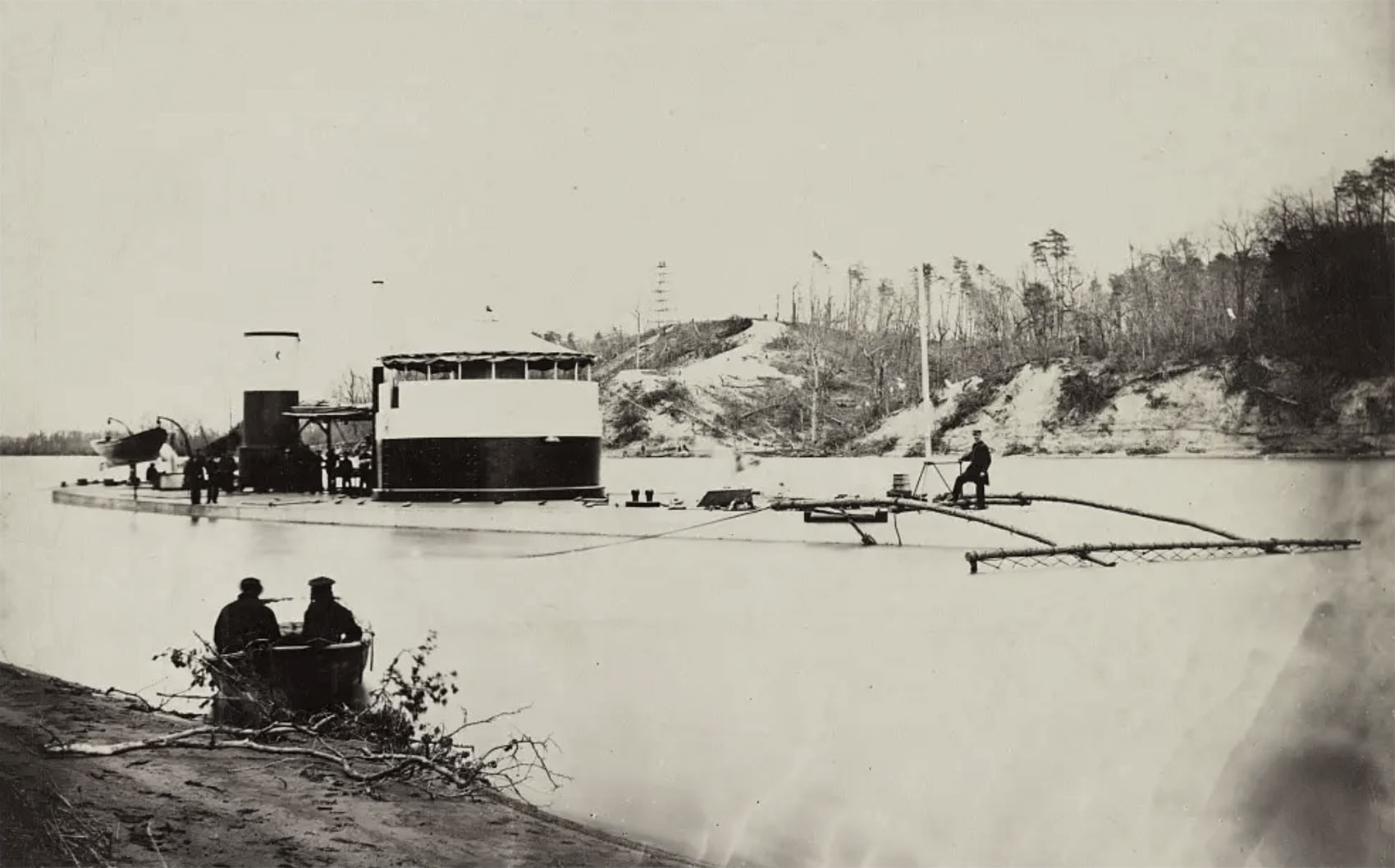
Anonymous photographer Saugus, in Trent’s Reach on the James River, Virginia c. early 1865 Note the mine sweeping “rake” attached to her bow U.S. Naval Historical Center photograph
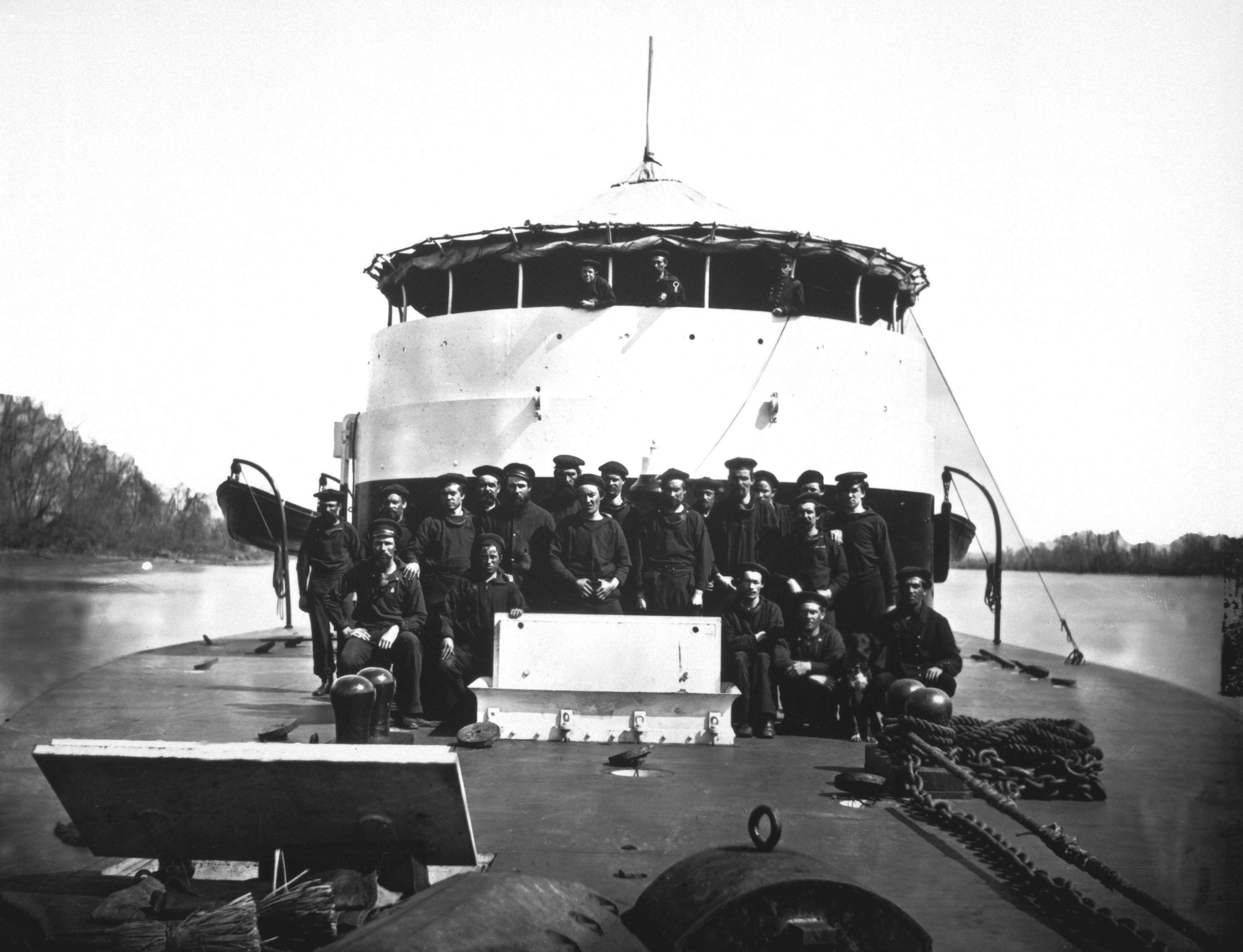
Anonymous photographer Officers pose on deck of the Saugus, in front of the gun turret, probably while the ship was serving on the James River, Virginia c. early 1865 Note ship’s bell and other details of the turret and deck fittings U.S. Naval Historical Center photograph
Exhibition dates: 12th October – 9th November, 2012
Curator: James Hyman
Edouard Baldus (French, 1813-1889) Vue generale de Paris pont neuf c. 1855 Salt print mounted on card 33.6 x 43.9cm (13.20 x 17.25 ins) Negative: Lower left inscribed in negative: no 82 Mount: Lower right beneath negative: stamped E. Baldus Lower left bottom: Vue generales des Paris pont neuf
A beautiful, complimentary post to the last one on the exhibition Eugène Atget: Old Paris. It is interesting to compare the styles of the two photographers and the change in photography that takes place between the 1850s and the 1890s. Baldus’ photographs are eloquent in their grandeur and frontality, tonality and texture. Atget’s photographs on the other hand are slightly claustrophobic in their intensity, the camera obliquely placed to capture old buildings, narrow cobbled streets and distant vanishing points. Both, in their own way, are very modern photographers. Baldus’ legacy, as Dr James Hyman correctly notes, was his influence on his German compatriots such as the Bechers, Thomas Struth and, to a lesser extent, Andreas Gursky. His rigorous frontality (the photographing of the thing itself) gives his photographs the simplicity of diagrams and emphasises their topographical state, while their density of detail offers encyclopaedic richness. This straightforward “objective” point of view was most notably used by Bernd and Hilla Becher in contemporary photography. Atget’s photographs, on the other hand, aroused an immediate interest “among the Surrealists because of the composition, ghosting, reflections, and its very mundanity.”
Conversely, it is the subjective signature of both artists that make their work truly great – not the mundanity, not the topographic objectivity but their intimate vision of this city, Paris. As I noted in an earlier posting on the Bechers,
“These are subjective images for all their objective desire. The paradox is the more a photographer strives for objectivity, the more ego drops away, the more the work becomes their own: subjective, beautiful, emotive… What makes great photographers, such as Eugène Atget, Walker Evans, August Sander and the Bechers, is the idiosyncratic “nature” of their vision: how Atget places his large view camera – at that particular height and angle to the subject – leaves an indelible feeling that only he could have made that image, to reveal the magic of that space in a photograph. It is their personal, unique thumbprint, recognisable in an instant.”
The same can be said of Baldus and these magnificent, ethereal photographs.
Dr Marcus Bunyan
Many thankx to James Hyman Gallery for allowing me to publish the photographs in the posting. Please click on the photographs for a larger version of the image.
Edouard Baldus (French, 1813-1889) Le Nouveau Louvre c. 1857 Salt print mounted on card 31.6 x 44.3cm (12.42 x 17.41 ins) Le Nouveau Louvre series: 1855-1857 Negative: Lower left inscribed in negative: no 107 Mount: Lower right beneath negative: stamped E. Baldus Lower left bottom: Le Nouveau Louvre
Mid-nineteenth century Paris was a city in the midst of modernisation, and as such, was ripe for documentation of its changing landscape. Counted as one of the premier photographers of his day, Edouard Baldus captured the aesthetic of the Second Empire’s ideology in his monumental views of both old and new Parisian landmarks. In 1855, Baldus received his largest commission, to document the construction of the Musee du Louvre. This rich salt print is a survey of the project as it nears almost full completion. Baldus produced over two thousand images of each part of the new Louvre, from large pavilions to small decorative statue. This photograph, however, takes a step back from the individual pieces of the lengthy project, and allows the viewer to appreciate the endeavour as a whole.
Edouard Baldus (French, 1813-1889) Le Pantheon 1853 Salt print mounted on card 33.8 x 43.5cm (13.28 x 17.10 ins) Negative: Lower left inscribed in negative: Le Pantheon Lower right inscribed in negative: Baldus Mount: Lower right beneath negative: stamped E. Baldus Lower left bottom: Le Pantheon
Due to the strength of his architectural imagery and work with the Mission Heliographique, Baldus would go on to gain the support of a government commission, Les Villes de France Photographies, which focused on the landmarks of Paris in particular, such as the Pantheon. Similar in style to the frontal views of the Louvre pavilions, this image is a precursor to that project, and also includes Saint Etienne du Mont in its background. The Pantheon is one of Paris’ best-known landmarks, and was originally built as a church dedicated to Saint Genevieve. Looking out over the whole of the city, it is now a mausoleum that houses the remains of distinguished French citizens.
Edouard Baldus (French, 1813-1889) Arc de Caroussel c. 1853 Salt print mounted on card 34.1 x 44.3 cms (13.40 x 17.41 ins) Negative: Lower left inscribed in negative: signature of E.Baldus Lower right inscribed in negative: no.81 Mount: Lower right beneath negative: stamped E.Baldus Lower left bottom: Arc de Caroussel Mount: 43.9 x 61 cms Image: 34.1 x 44.3 cms
One of Baldus’ greatest projects was to provide a photographic inventory of the New Louvre and adjoing Tuilleries. A number of these works are of particular interest, expecially those of the Tuilleries Palace, which would be burnt down in 1870-1871. All that remains today is the central triumphal arch, the Caroussel, which is depicted here, still with the palace visible in the background. Built between 1806 and 1808, the Arc de Caroussel is a monument commemorating Napolean’s military victories, with Peace riding a triumphal chariot atop the central archway. Two guards flank the sides of the arch, each atop their own horse, which not only provide for a sense of scale, but, being slightly blurred, also hint at the length of Baldus’ exposure. This enhances the effects of the delicately carved sculptures that adorn the archway, presented here with a clarity that defined the standard Baldus set with his architectural images.
James Hyman is proud to present a loan exhibition of one of the greatest photographers of the nineteenth century, Edouard Baldus. Remarkably, this is the first major exhibition of Edouard Baldus ever to be staged in London. Baldus was famed for his monumental photographs of the buildings of Paris at a time of massive transition under Napoleon III, Baron Haussman and Viollet Le Duc, as well as the depiction of the contemporary landscape of France. Acclaimed as the greatest architectural photographer of the nineteenth century, Baldus’s prints were some of the largest photographs in existence and pioneered an aesthetic of presenting modernity and the modern city that would have a profound influence on later photographers from the Bechers to John Davies.
Baldus was one of the great calotypists of the 1850s, producing works of an unprecedented range and scale. He moved to Paris in 1838 to study painting alongside other future photographers such as Le Gray, Le Secq, and Negre. He frequently retouched his paper negatives, adding pencil and ink, to add clouds or clarify details, then printing his own large-scale negatives. He was also adept at stitching several negatives together to re-create architectural views, most famously in his views of the cloisters of Saint Trophime.
Famed especially for his depiction of architecture, Baldus not only documented the modernisation of Paris but also travelled widely through France recording modernity and new construction – including new railways and aqueducts, as well as the building of the new Louvre. In 1851 the Commission des Monuments Historiques cited Baldus as one of the five best architectural photographers and he was commissioned to record the monuments of France for what became known as the Mission heliographic. His beginnings in photography are not well documented before his participation in the Mission heliographique, although it is known that he took photographs of Montmajour in 1849.
In 1852 he began Villes de France photographies to which the minister of Beaux-Arts subscribed until 1860. In 1854 he travelled with his student Petiot-Groffier in Auvergne and in 1855 the Baron James de Rothschild commissioned him to photograph the new Northern train line from Paris to Boulogne as a gift, in the form of a commemorative album, for Queen Victoria before her visit to the Exposition Universelle. Later, in his commission to document the reconstruction of the Louvre, Baldus took more than two thousand views in a period of three years. His last big commission was from 1861-1863 documenting the Paris-Lyon-Mediterranean train line illustrating seventy views of the train’s track. After this, Baldus tried to provide more commercial alternatives to his large-format works, creating smaller prints and heliogravures of his earlier work. Unfortunately, the effort was unsuccessful and Baldus passed away in bankruptcy and relative obscurity.
Press release from the James Hyman website
Edouard Baldus (French, 1813-1889) Pavillon Colbert, Nouveau Louvre, Paris c. 1855 Salt print mounted on card 43.2 x 34.1cm (16.98 x 13.40 ins) Stamped ‘E. Baldus’ on the lower right of the mount and titled lower left ‘Pavillon Colbert Nouveau Louvre’
Of the many photographs Baldus took of the Louvre during the period 1855-1857, it is his large-format photographs of the main pavilions that best demonstrate the stretch of his artistic achievements. Commissioned by the French government once again, Baldus was charged with documenting every aspect of the new Palace’s construction, which was to be the Second Empire’s largest building project. Consequently, over the course of two years, it also evolved into the largest photographic commission to date, and Baldus took over two thousand photographs ranging in subject matter from individual statuary to the grand frontal views of each completed pavilion, such as this example of the Pavillon Colbert.
This particular photograph is an astounding example of the precision and clarity wet plate negatives afforded Baldus in capturing the texture of New Louvre’s stonework. Each part of the façade, from the temple relief statuary to the columns flanking the entryway, is bathed in a bright light that emphasises the three-dimensionality of the new pavilion. The sense of crisp stonework evident in this image is only heightened by the blurred tree in the bottom left corner, as well as the trace of a ghostly figure in the foreground – a horse and cart that paused long enough to be captured, just barely, in Baldus’ long exposure.
The subject of this picture brings to bear the importance of the symbolism of the architecture of the Nouveau Louvre for the reign of Napoleon III. The relief and figures on the façade of the Pavillon Colbert highlight France’s greatest realms of achievement, from the conquering of nature through to industry. The upmost relief represents Earth and Water, while the figures to either side personify Science and Industry. Baldus has also ensured that a human figure on the right-hand side of the central entrance has stood still long enough to provide the viewer with a sense of the imposing scale of the statuary, as well as the entire façade. The result is a striking image that is sharper than any contemporary enlargement, exemplary of Baldus’ ability to isolate and capture architecture while giving a slight hint to the life that continued to move around it.
Edouard Baldus (French, 1813-1889) Pavillon de la Bibliotheque, Rue de Rivoli, Paris c. 1855 Salt print mounted on card 43.2 x 34.3cm (16.98 x 13.48 ins) Inscribed ‘no 103’ in the negative, lower left. Stamped E. Baldus on the lower right of the mount and titled lower left ‘Nouveau Louvre Rue Rivoli’
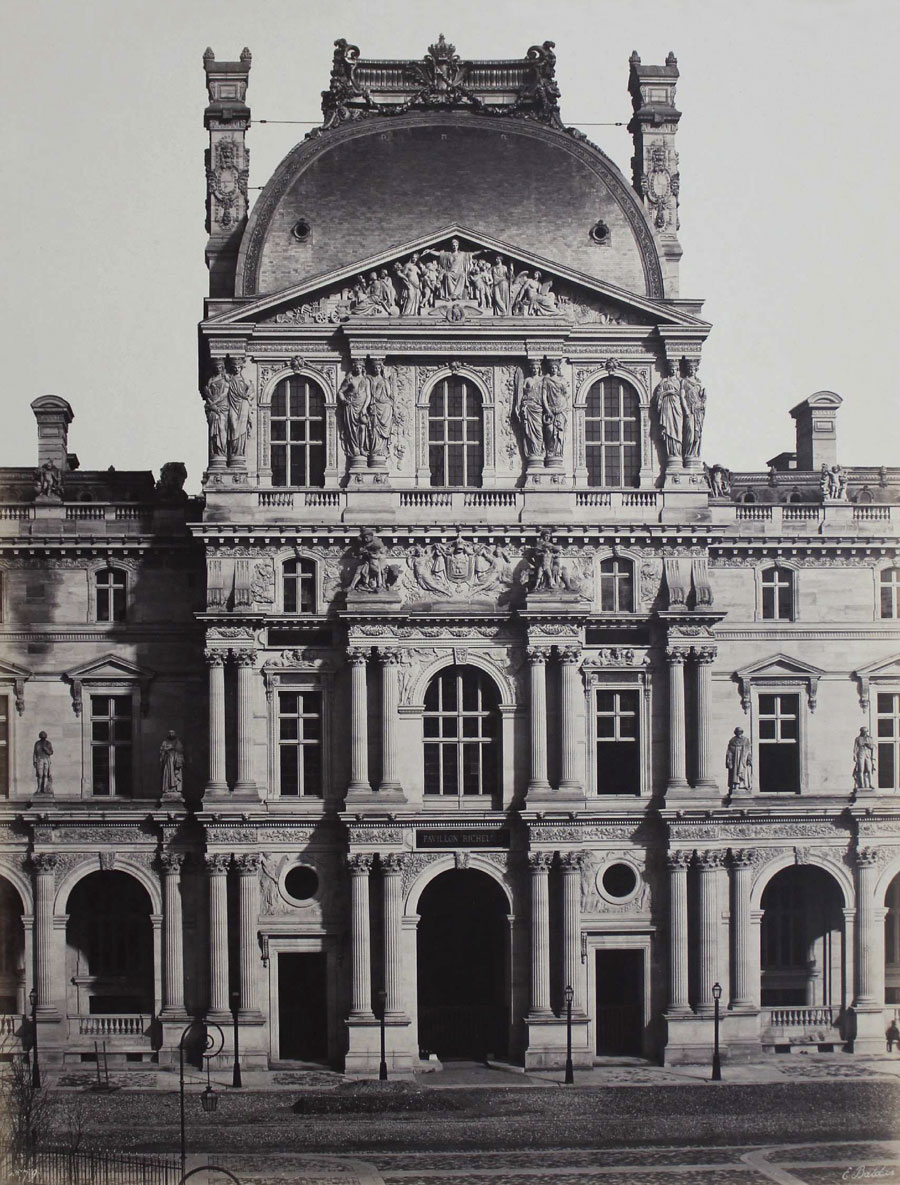
Edouard Baldus (French, 1813-1889) Pavillon Richelieu, Nouveau Louvre, Paris c. 1855 Salt print mounted on card 45 x 34.5cm (17.69 x 13.56 ins) Inscribed ‘no 79’ in the negative, lower left and signed in the negative lower right ‘E. Baldus’ Stamped E. Baldus on the lower right of the mount and titled lower left ‘Pavillon Richelieu Nouveau Louvre’
An image that the Metropolitan Museum of Art describes as “among the most spectacular of all Baldus photographs,” it is clear that Baldus took full advantage of the opportunity to use larger equipment, which was necessary to capture his tremendous subject. The technical advantages afforded by glass plate negatives allowed him to create equally large contact prints without joining separate negatives, as was his practice with many of his earlier images. Here, the resulting photograph depicts the Pavillon Richelieu in a striking range of tonality, from the crisp texture of the street to the glowing reflection of the pavilion’s new tiled roof.
Edouard Baldus (French, 1813-1889) Pavillon Sully, Nouveau Louvre, Paris c. 1857 Salt print mounted on card 44.5 x 34.5cm (17.49 x 13.56 ins) Inscribed ‘no 92’ in the negative, lower left. Stamped E. Baldus on the lower right of the mount and titled lower left ‘Pavillon Sully Nouveau Louvre’
Baldus returned to this particular pavilion numerous times, his earliest images of the structure produced while he was photographing for the Mission Heliographique. The Pavillon Sully was originally built during the Classical Period of Louis XIV in 1625, and served as a model for the Second Empire additions. One of the grandest of all the completed facades, the Pavillon Sully acquired many sculptural additions during the reconstruction, but the central clock from which the pavilion derived its original name (Pavillon de l’Horloge) remained central.
Taking an elevated view, Baldus depicted the Pavillon Sully with exemplary precision that is sharper than any contemporary enlargement. The result is one of the most imposing images of the Nouveau Louvre pavilions, giving the entire façade a commanding sense of presence as it rises above trees in the foreground, which are just blurred enough to reveal Baldus’ long exposure.
Edouard Baldus (French, 1813-1889) Saint Etienne du Mont, Paris c. 1858 Salt print mounted on card 44.1 x 34.2cm (17.33 x 13.44 ins) Stamped E Baldus on the lower right of the mount and titled lower left ‘St Etienne du Mont’ Mount: 61 x 43.9 cms Image: 44.1 x 34.2 cms
Edouard Baldus(French, 1813-1889) Notre Dame, Facade Principale, Paris 1857 Salt print mounted on card 44.5 x 34.2cm (17.49 x 13.44 ins) Inscribed ‘no 34’ in the negative, lower right. Stamped E. Baldus on the lower right of the mount and titled lower left ‘Notre Dame Facade Principal’ Dimensions Mount: 61 x 44 cms Image: 44.5 x 34.2 cms
This iconic image of Notre Dame embodies the direct and frontal style that came to define Baldus’ architectural images. Here, he has captured the majesty of one of Paris’ most notable landmarks by elevating his vantage point and placing the viewer at eye level with its magnificent rose window. This print is a carefully executed example of the type of balance and symmetry Baldus aimed to capture while working on this commission.
James Hyman Gallery 16 Savile Row London W1S 3PL Phone: 020 7494 3857
One of the purposes of this archive is to bring relatively unknown artists into the spotlight. Eva Besnyö is one such artist.
Leaving the repressive atmosphere of Hungary in 1930, Besnyö joined László Moholy-Nagy, Martin Munkácsi, György Kepes and Endre Friedmann (Robert Capa) in Berlin before, sensing the danger of National Socialism, she moved to the Netherlands in 1932. After the invasion of the Netherlands by Nazi Germany in 1940 Besnyö survived four long years in hiding before obtaining false papers in 1944 that allowed her to emerge into the open. She was Jewish.
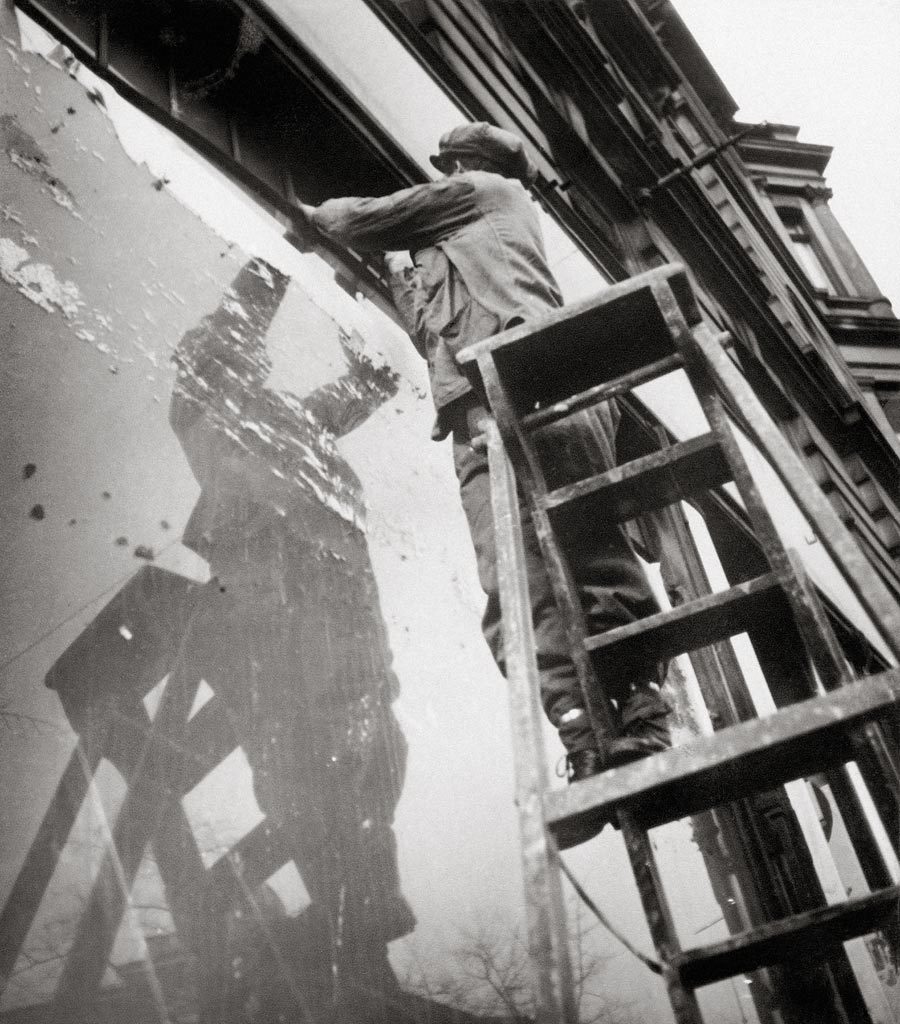
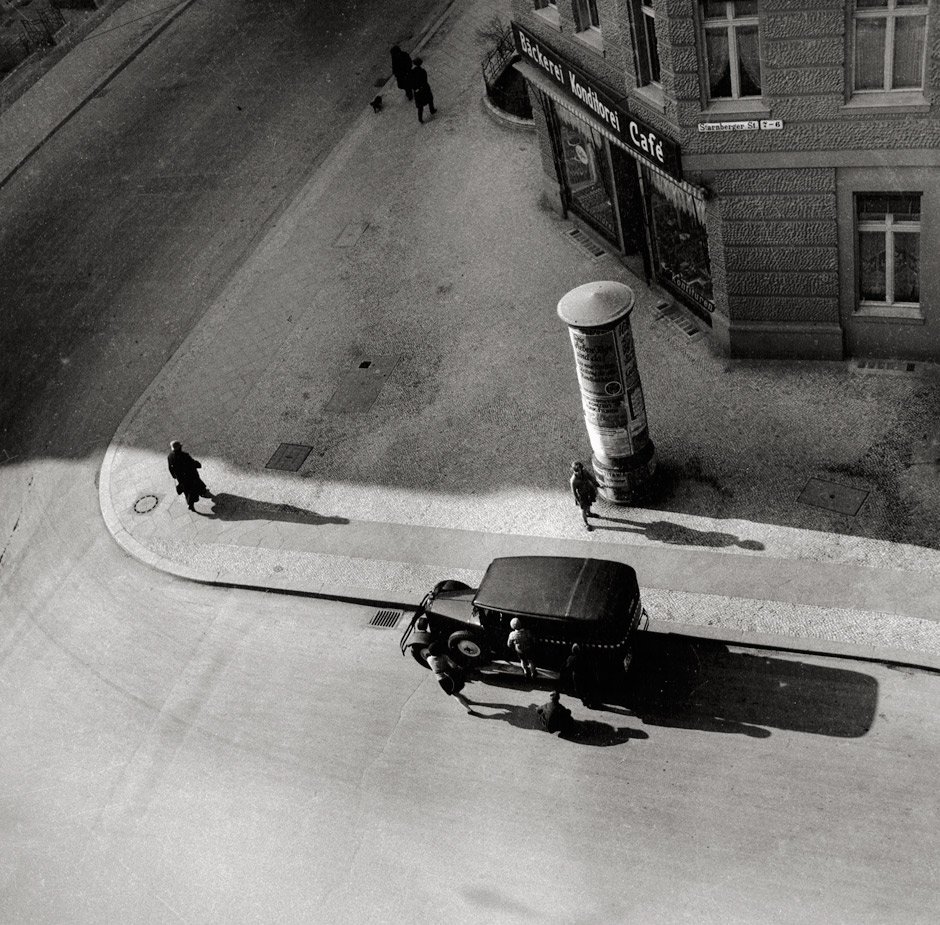
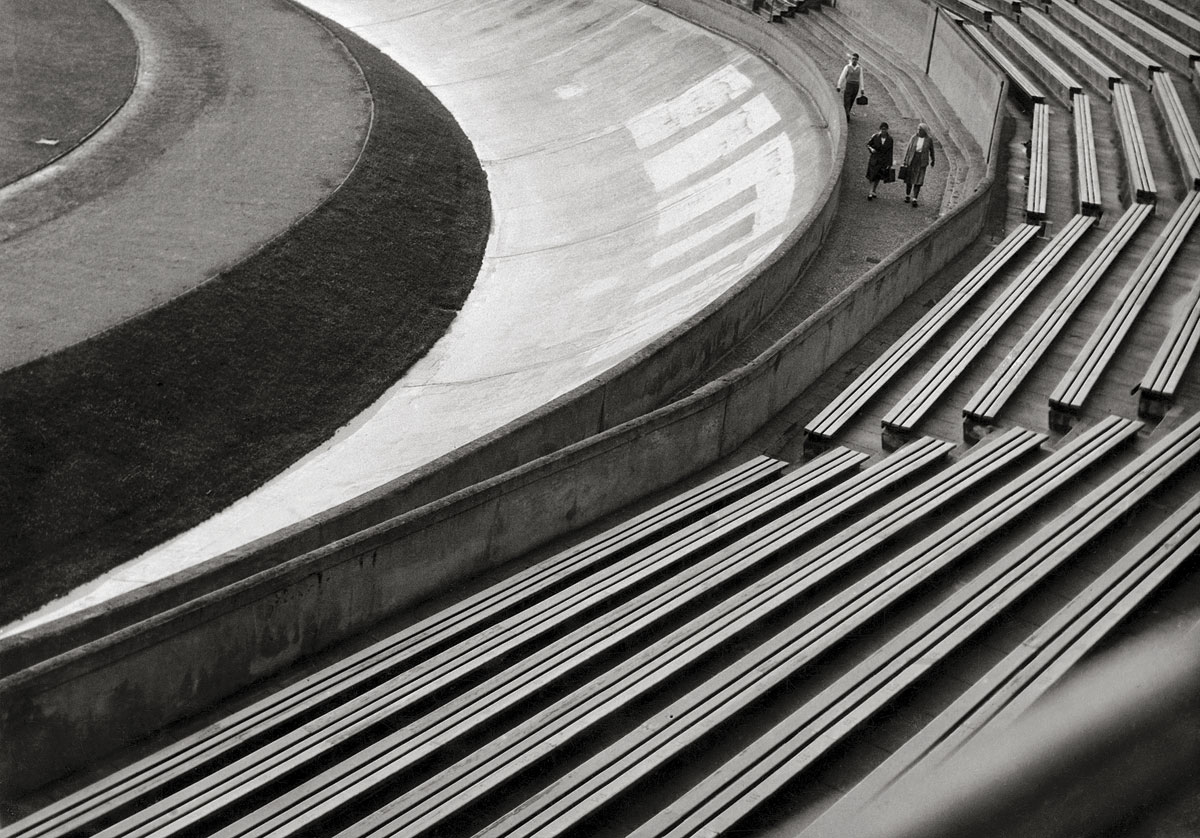
Exploring elements of the New Vision and New Objectivity in her work, Besnyö explored “the different terrains that photography was opening up” through various bodies of work: “ranging from experimental to the photojournalistic, from street scenes to portraits, and from new architecture to the aftermath of the aerial bombardment of Rotterdam.” As John Yau observes in the quote at the top of the posting, “The various bodies of work make it difficult to characterise her… she seems to have no signature body of work, which is one of her abiding strengths. Just when you think you have gotten some sense of her, she slips through your fingers.”
Continuing the conversation from my recent review of the work of Pat Brassington (where I noted that curators and collectors alike try to pigeon hole artists into one particular style, mainly so that they can compartmentalise and order the work that they produce: such and such produces this kind of work – and that the work produced in this style is not necessarily their best), Besnyö can be seen to be a transmogrifying artist, one that experimented and investigated the same themes through different subject matter – hence no signature body of work. One of my friends observed that this kind of art making could be mistaken for a strange form of nihilism (in which nothing in the world has a real existence). It could be argued that the artist keeps changing subject matter, just dabbling really, pleasing herself with the images that she took, without committing to a particular style. Without seeing the 120 vintage prints it is hard to make a judgement.
From the work posted here it would seem that for Besnyö, observation and exploration of the lines of sight of life were the most critical guide to her art. In other words her shifting viewpoints create a multi-dimensional narrative that coalesces in a holistic journey that challenges our point of view in a changing world. As Victor Burgin notes in Thinking Photography, “The structure of presentation – point-of-view and frame – is intimately implicated in the reproduction of ideology (the ‘frame of mind’ of our ‘points-of-view’)” (1982, p. 146).
The frame of mind of our points of view… this is what Eva’s work challenges, the reproduction of our own ideology. Her morphology (the philosophical study of forms and structures) challenges the cameras and our own point of view. As Paul Virilio observes,
“In calling his first photographs of his surroundings ‘points of view’, around 1820, their inventor, Nicéphore Nièpce came as close as possible to Littré’s rigorous definition: ‘The point of view is a collection of objects to which the eye is directed and on which it rests within a certain distance.'” (Virilio, Paul. The Vision Machine (trans. Julie Rose). Bloomington: Indiana University Press, 1994, p. 19.)
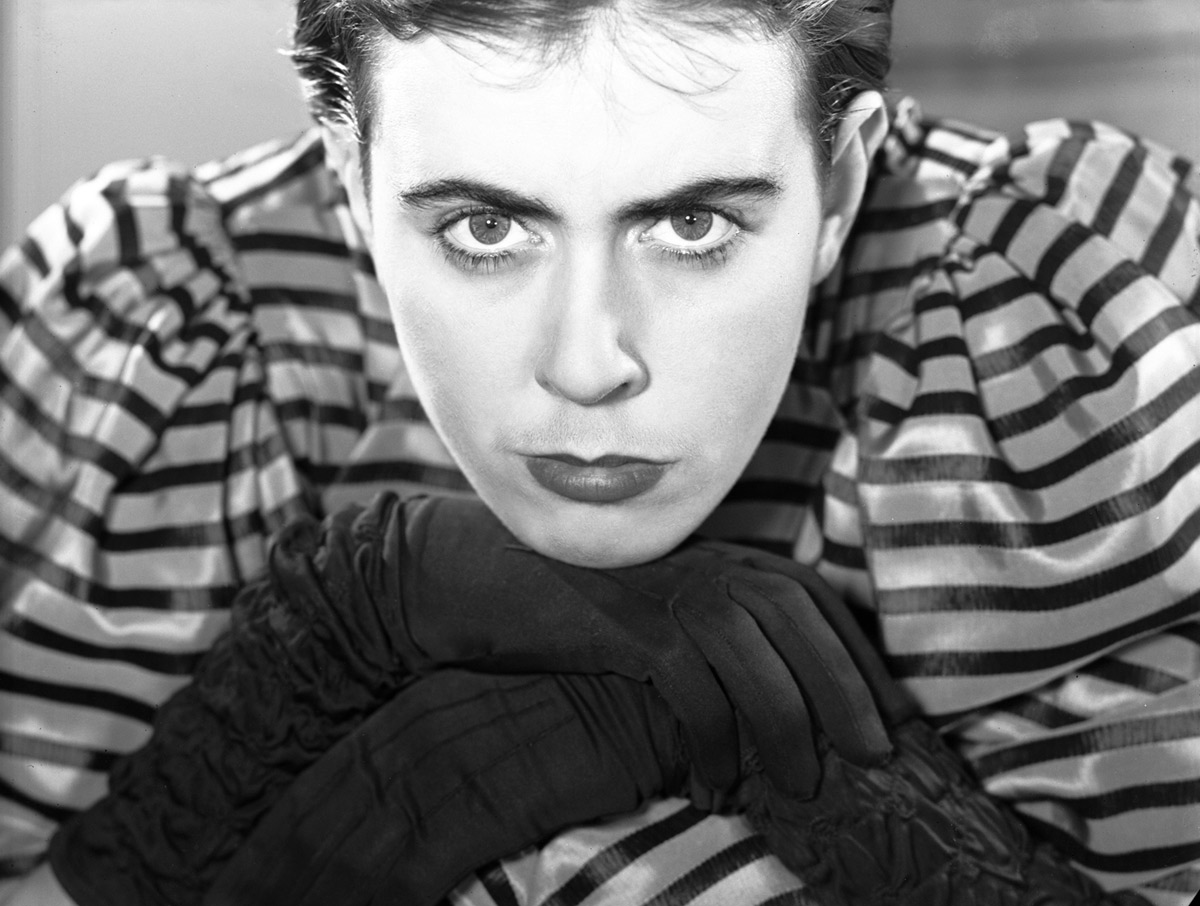
Besnyö changes the collection of objects to which the eye is directed as she also changes the distance and feeling of the objects upon which the eye rests. Notice how in most of the photographs the human subjects all have their back to the camera or are looking away from the instrument of objectification (or looking down into it). Even in the two self portraits Besnyö – formal in one with bobbed hair and skirt, wild in the other with a shock of tousled hair – she avoids the gaze of the camera. Like most of her subjects she remains hard to pin down. What Besnyö does so well (and why she isn’t just pleasing herself) is to construct a mythology of the city, a mythology of life which resonates through the ages. She creates a visual acoustics (if you like), a vibration of being that is commensurate with an understanding of the vulnerability of existence.
Dr Marcus Bunyan
Many thankx to Jeu de Paume for allowing me to publish the photographs in the posting. Please click on the photographs for a larger version of the image.
“Ranging from the experimental to the photojournalistic, from street scenes to portraits, and from new architecture to the aftermath of the aerial bombardment of Rotterdam, July 1940, Besnyö explored the different terrains that photography was opening up, while at the same time helping to define them. The various bodies of work make it difficult to characterise her… she seems to have no signature body of work, which is one of her abiding strengths. Just when you think you have gotten some sense of her, she slips through your fingers.”
Renger-Patzsch was associated with the Neue Sachlichkeit (New Objectivity), an attitude towards life and art that many Germans understood as distinctly American: the cult of the objective. Along with Regner-Patzsch, August Sander is another photographer associated with this tendency. (Karl Hubbuch, Otto Dix and Christian Schad are among the painters associated with it). The difference between the two photographers is that the human being is at the center of Sander’s work, while the world of things is at the center of Renger-Patcsch’s. Besnyö situates herself between the two, finding her own way.
The other influence on Besnyö was Låslø Moholy-Nagy’s New Vision, a term he coined to define his belief that photography enabled the viewer to see the world in ways the eyes could not. In 1930, at the age of 20, she moved to Berlin, rather than to Paris, where Hungarian photographers such as Andre Kertesz and Brassaï had gone. According to Besnyö, “The whole German side interested me. Paris was the Romantic, old-fashioned trend. The second reason was Gyørgy Kepes, who was a good friend of mine and had gone to Berlin as an assistant to Moholy.”
It was Gyørgy Kepes who said to Besnyö; “If you want to be a photographer, you must go to Berlin.” It was from this relationship and the circle around Moholy-Nagy that Besnyö learned of Russian Constructivism and began incorporating the diagonal into her photographs.
Eva Besnyö (1910-2003) is one of those women who found in photography not just a profession but also a form of liberation, and of those cosmopolitan avant-garde artists who chose Europe as their playing field for both play and work. Immediately after her photographic training in the studio of József Pécsi in Budapest, Eva Besnyö left the repressive, anti-progressive environment of her native Hungary for ever. Then aged 20, she decided, like her compatriots László Moholy-Nagy, Martin Munkácsi, György Kepes and Endre Friedmann (Robert Capa), to go to Berlin. As soon as she arrived in autumn 1930, she discovered there a dynamic photographic scene, open to experimentation and placed under the double sign of the New Vision and the New Objectivity, whose modern language would allow her to develop her personal style.
Of Jewish origins, Eva Besnyö, who foresaw the threat of National Socialism, moved to the Netherlands in 1932 where she met again her companion the film director John Fernhout. There she was welcomed into the circle of international artists around the painter Charley Toorop, and rapidly became known in Amsterdam, where she had her own photographic studio. A solo exhibition at the Kunstzaal van Lier in 1933 gained the attention notably of the Dutch followers of the “Neues Bauen” (New Building), whose architecture she recorded, in a highly personal manner, over a long period. The invasion of the Netherlands by Nazi Germany in 1940 marked a dramatic turning point in Eva Besnyö’s life. If she managed to come out of hiding in 1944, thanks to an invented genealogy, the traces of this experience would remain acute throughout the postwar decades. During the 1950s and 60s, her family life led her to abandon street photography for commissions. Finally, in the twilight of her career, the photographer militated in the Dolle Mina feminist movement, whose street actions she chronicled in the 1970s.
With more than 120 vintage prints, some modern prints and numerous documents, this first French retrospective devoted to Eva Besnyö aims to show the public the different facets of her work, which is situated between New Vision, New Objectivity and social documentary, at the crossroads between poetry and political activism.
With other eyes
In 1929, during her second year of apprenticeship to József Pécsi, portrait and advertising photographer in Budapest, Eva Besnyö received the book of photographs Die Welt ist schön (The World is Beautiful), published a few months earlier in Munich. Its author, Albert Renger-Patzsch, is the precursor of New Objectivity in photography. While pictorialism reigned in Hungary, Eva Besnyö discovered the world with other eyes: from up close and under unexpected angles. With these new models in mind and her Rolleiflex in hand, she strode along the banks of the Danube in search of subjects and daring viewpoints, showing concern for a precise, close-up description of the most diverse objects, as well as a taste for fragmentation and for the repetition of the motif in the frame.
As soon as she finished her studies, Eva Besnyö went to Berlin on the advice of the painter and photographer György Kepes – and against the wishes of her father who would have preferred that she chose Paris. The Berlin years, between 1930 and 1932, were for her those of a political and aesthetic awakening. Besides the influence of the revolutionary aesthetic of Russian cinema, she came under that of the New Vision, which took off with László Moholy-Nagy and his book PaintingPhotography Film (1925), using a whole stylistic grammar, advocating downward perspectives or low-angle shots, a taste for the isolated object and its repetition, as well as optical manipulations revealing an unknown, but very real, world. The activity of the town or the empty crossroads of Starnberger Straße, portraits and images of summer on the banks of Lake Wannsee count among Besnyö’s most successful compositions.
Worker and social photography
At the Marxist Workers’ School in Berlin, Eva Besnyö schooled her social and political conscience. In her circle of friends gathered around fellow Hungarian György Kepes, she discussed passionately the role of the workers’ movements. In Berlin, as earlier in Budapest, Eva Besnyö took her camera to the principal sites of trade and business, where she photographed labourers hard at work: dockers on the Spree, coalmen in the street, fitters perched on ladders; in the city centre, she followed the workers at Alexanderplatz, in around 1930 the largest construction site in Europe. In Hungary, where she returned from time to time from Berlin, she carried out an extraordinary documentary project on the people of Kiserdö, in the suburbs of Budapest. Blessed with a heightened political awareness, she had already understood by 1932 that, as a Jew, her future was not in this country, and left Berlin for Amsterdam.
New Vision and New Building
In 1933, the solo show devoted by the Kunstzaal van Lier to Eva Besnyö just one year after her arrival in Amsterdam aroused the enthusiasm of numerous architects – her principal clients in the years to come. Mostly members of the group de 8 in Amsterdam and the radical abstract collective Opbouw in Rotterdam, they discerned in her images, which emphasised the functional side of objects, their structure and their texture, a suitable approach for explaining their buildings.
Equipped with a Linhof 9 x 12 cm plate camera acquired especially for the purpose, Eva Besnyö went to building sites and photographed public and private buildings, notably the studios of the Dutch radio station AVRO at Hilversum, the Cineac cinema in Amsterdam and a summer house in Groet, in the north of the country. Become, in the 1930s, the preferred photographer of Dutch New Building, Eva Besnyö made most of her income at the time from architectural photography.
Bergen and Westkapelle
From Amsterdam, where from 1935 to 1939 she shared a studio at Keizersgracht 522 with the photographer Carel Blazer and the architect Alexander Bodon, Eva Besnyö went regularly to Bergen and Westkapelle, two villages where many artists gathered. In Bergen, north of Amsterdam, Charley Toorop, Expressionist painter and mother of the film director John Fernhout, whom Eva had married in 1933, held an artistic salon in the De Vlerken studio. It was at Westkapelle, a centuries-old village built on a polder in Zealand, that the family often spent their holidays. In this landscape shaped by the natural elements, Eva Besnyö returned to a free photographic practice, with views of vast beaches of white sand, of black silhouettes against a background of old windmills and cut-out shadows.
Rotterdam
In July 1940, Eva Besnyö photographed the old town of Rotterdam destroyed by German airforce bombing. Far from classic photo-journalism, these images of ruins and traces of devastation – from which, in retrospect, she distanced herself – are today silent, bare statements of the wounds and scars of history.
Dolle Mina
The Dolle Mina feminist movement gathered both men and women, mainly from the student protest movement. In the 1970s, Eva Besnyö militated actively within it, alongside sympathisers of all ages. In a second phase, she focused on photographic documentation of the movement’s actions and activities, taking responsibility for sending out images daily, like a press agency.
Text by Marion Beckers and Elisabeth Moortgat, curators of the exhibition
In 1930, when Eva Besnyö arrived in Berlin at the age of only twenty, a certificate of successful apprenticeship from a recognised Budapest photographic studio in her bag, she had made two momentous decisions already: to turn photography into her profession and to put fascist Hungary behind her forever.
Like her Hungarian colleagues Moholy-Nagy, Kepes and Munkacsi and – a little later – Capa, Besnyö experienced Berlin as a metropolis of deeply satisfying artistic experimentation and democratic ways of life. She had found work with the press photographer Dr. Peter Weller and roamed the city with her camera during the day, searching for motifs on construction sites, by Lake Wannsee, at the zoo or in the sports stadiums, and her photographs were published – albeit, as was customary at the time, under the name of the studio. Besnyö’s best-known photo originates from those years: the gypsy boy with a cello on his back – an image of the homeless tramp that has become familiar all over the world.
Eva Besnyö had a keen political sense, evidenced by the fact that she fled in good time from anti-Semitic, National Socialist persecution, leaving Berlin for Amsterdam in autumn 1932. Supported by the circle surrounding woman painter Charley Toorop, filmmaker Joris Ivens and designer Gerrit Rietveld, Besnyö – meanwhile married to cameraman John Fernhout – soon enjoyed public recognition as a photographer. An individual exhibition in the internationally respected Van Lier art gallery in 1933 made her reputation in the Netherlands practically overnight. Besnyö experienced a further breakthrough with her architectural photography only a few years later: translating the idea of functionalist “New Building” into a “New Seeing.” In the second half of the 30s, Besnyö demonstrated an intense commitment to cultural politics, eg. at the anti-Olympiad exhibition “D-O-O-D” (De Olympiade onder Diktatuur) in 1936; in the following year, 1937, she was curator of the international exhibition “foto ’37” in the Stedelijk Museum Amsterdam.
The invasion of German troops in May 1940 meant that as a Jew, Eva Besnyö was compelled to go into hiding underground. She was attracted to a world view shaped by humanism in the post-war years, and her photographs became stylistically decisive for neo-Realism and immensely suitable for the moralising exhibition, the “Family of Man” (1955). The mother of two children, she had experienced the classic female conflict between bringing up children and a profession career as a crucial and very personal test. Consequentially, Besnyö became an activist in the Dutch women’s movement “Dolle Mina” during the 70s, making a public commitment to equal rights and documenting demonstrations and street protests on camera.
This first retrospective exhibition, showing approximately 120 vintage prints, aims to introduce the public to the life and work of this emigrant and “Berliner by choice”, a convinced cosmopolitan and the “Grande Dame” of Dutch photography. “Like many other talents, that of Eva Besnyö was lost to Germany and its creative art as a direct consequence of the National Socialists’ racial mania.” (Karl Steinorth, DGPh, 1999)
Katrin Koenning (Australian born Germany, b. 1978) Untitled from the series Transit 2009
Transit is a stimulating body of work by Melbourne artist Katrin Koenning that documents mostly everyday journeys. As Koenning notes, “It is concerned with the space that lies between destinations, routines and obligations – the space between distances, if you so like,” where strangers are thrown together in an intimate space. The outcome of these encounters is mainly silence. In these works photography and the depiction of the lived world becomes the primer and reference point for a mediated existence, one based on longing, desire, reverie, absent presence and the phantasies of daydreams.
Compositionally the work is strong. Koenning shows an excellent understanding of the construction of the image plane and the use of colour, light and dark complements her intellectual enquiry. This much is given: these are excellent images that immerse the viewer in a visual dreamscape. What I am more interested in here is the transitional spaces of the journey, the traces of light that reflect back to us the concerns of the photographer and the conceptual ideas upon which the work is based.
Even when people are asleep in these photographs (which they sometimes are) it is as if an internal image, a day dream, a subconscious image is projected into/onto the external world in an act of scopophilic [the desire for pleasurable looking] voyeurism. It is as though our daydreams are inscribed in a physical location and we identify with this imaginary image and take it for reality.1 “This specific joy of receiving from the external world images that are usually internal… of seeing them inscribed in a physical location… of discovering in this way something almost realisable in them”2 becomes one reality of the journey. We become possessed, possessed by the phantasies of our daydreams, possessed by desire for this imaginary image.
Paradoxically these daydreams, the longing and yearning of the inner voice for a better place to be, for a holiday, for an escape from the drudgery of everyday life (for an imaginary, hallucinatory image) promote an escapism in the traveller and the absenting of presence that can be seen on any tram or train, any day of the week in cities throughout the world. The enactment of absent presence is usually performed through technology of some kind – a book, headphones, smart phones that connect to the internet, conversation on the mobile which is mainly gossip and texting – that distract people from having a quiet mind that leads to the contemplation of Self. The fear of silence is the fear of quietening the chattering voice in your head, being afraid of what you might find. The act of non-engagement is supplemented by the necessity of avoiding eye contact with fellow travellers, of making conversation, of engaging with strangers in any meaningful way. Hence the silence of forcibly intimate spaces.
The photographs that make up the series Transit form a theatrical space, a dramatic space where the people in them are separated from the outside world, neither here nor there, present but absent at one and the same time. This ritual of (non)spectatorship begins long before we begin our journey: the preparation, leaving the house with headphones and iPod, iPad, iPhone and I. This is followed by the ritual of buying a ticket (or not), boarding the train, tram, bus, plane or car being an effective way of transforming time and space. Our practices of mobility, that is our acts of moving are constituted in our acts of staying. What we take with us (for example our passport when we go overseas), always takes our place of residing, of staying, with us. Travel becomes the enactment or enfolding of bodies that move and bodies that stay, of stability.3
As Mary Louise Pratt has observed recently, the Western subject is an autonomous being with inherent conditions attached to its body and mobility is the privileged figure of its freedom, the proof and performance of its liberated state. In the metaphor of flow there is the enactment of freedom.4 Ironically, in the flow of travel envisaged in these photographs there is a dis/placement of desire onto the object of our (non)attention: in other words if we observe the world and desire it (as in the woman looking out of the window onto the distant view of the city, below) we displace our desire onto the object of our affection.
If, on the other hand, we ignore the distant vista (as in the man playing with his iPod while the world flashes past outside, below) we displace our own presence through non-attention and our desire becomes a narcissistic attraction to Self. The remainer (who remains) and the remainder (what is left) is dictated by the place and placedness of the encounter, the interdependent modalities along the points of un/freedom (displacement of desires onto other may, in fact, not be freedom at all!)
In a sense, and I use that word advisedly, these images become trans-sensual, hovering between one desirous place and the next, between one condition or possibility of becoming and another. Here I must note that I see a philosophical difference between ‘transit’ and ‘in transit’. ‘Transit’ suggests a pre-determined path between point A and point B: for example in the transit of Venus that recently took place the path that Venus would take was already mapped out, even before the event happened, even if Venus was absent. The DNA of the journey, its blueprint if you like, is already formed in the knowledge: we are going to Collins Street, Melbourne, the path immanent in the tabula rasa of the journey even before it has started.
‘In transit’ on the other hand, suggests an amorphous space that has no beginning and no end. There is no boundary that defines the journey, much as in these images “amorphous thinking in visual terms is inextricably bound up with sensation and perception. In many ways, how we think is how we see and vice versa.”5 Perhaps the series should have been called In Transit, for the images visualise a conception of boundary and form that is constantly in flux, emanating as it does from the subconscious desires of the traveller. These are scenarios for an intuitive vision of an amorphous space that image a lapse in time, where energy and information, light and shadow, harmony and form challenge an absolute identity, the pre-determined path.6
Projection of inner desires onto the actual world becomes the locality for the contemporary mythologies of values, beliefs, dreams and desires.7 In a Buddhist sense, in the longing of an individual to effect his or her liberation this flow of sense-desire must be cut completely. Instead of a desire to possess the object of their longing and then to be possessed by that desire (desire to possess / possessed by desire) we must learn, as Krishnamurti has insightfully observed, not to make images out of every word, out of every vision and desire. We must be attentive to the clarity of not making images – of desire, of prejudice, of flattery – and then we might become aware of the world that surrounds us, just for what it is and nothing more.8 Then there would be less need for the absenting of self into the technological ether or the day dreams of foreign lands or the desire for a better life.
The strength of this work is the trans-sensuality of the photographs. Their trans-sensuality initiates differently configured constructions of the world, one that will not allow the world to simply be displaced by a lack of awareness, a lack of presence in the world. The photographs physically queer the performative aspect of the actor upon the stage, allowing the viewer to understand the process that is happening within the photographs and then NOT construct alternate narratives of longing and desire if they so wish. What they do for the viewer is collapse the boundaries between the subjective and the objective, between the conscious and the subconscious, inducing in the viewer a glimpse of self-actualization,9 whereby the viewer has the ability to enjoy the experience of just being.
As the viewer becomes the person in the photograph (by understanding the experience of being, not by making an image) the permeability and lack of fixity of the boundaries between self and other, between self and amorphous space, between self and the physical world becomes evident. We become aware of the suspension of time and space in these momentary, (photographic) acts of transcendence. These wonderful, never ending moments.
Dr Marcus Bunyan July 2012
1/ Leonard, Richard. The Mystical Gaze of the Cinema: the Films of Peter Weir. Melbourne: Melbourne University Press, 2009, p. 23
2/ Metz, C. Essais Sémiotiques. Paris: Klincksieck, 1977, p. 136 quoted in Leonard, Op. cit.
3/ Pratt, Mary Louise. “On Staying.” Keynote speech presented at the international conference Travel Ideals: Engaging with Spaces of Mobility. July 18th 2012 at the University of Melbourne
4/ Ibid.,
5/ Navarro, Kevin. “An Amorphous Image Process,” on Rhizome: Image Theory website. January 19th 2010 [Online] Cited 29/07/2012
6/ Ibid.,
7/ Leonard Op. cit., p. 56
8/ Krishnamurti. Beginnings of Learning. London: Penguin, 1975, p. 131
9/ “It must be noted that self-actualization is not necessarily related to vocation or career choice … From Malsow’s (Maslow, A (1970) Motivation and Personality. New York, Harper & Row) standpoint, self-actualization is not primarily concerned with results of a particular kind of activity – it is concerned with the experience of the activity itself – not the composition but the composing – not the work of art but the creative process by which it is produced – not the taste of the food, but the creativity in the cooking of it. This is not to say that the product has no importance. What Maslow is emphasizing is the fact that the self-actualized persons is fulfilling his potentiatlities in the act itself. A byproduct of this creative act is a unique outcome. He may admire the result of this process. But the enjoyment of the process itself is also extremely important. The ability to enjoy the experience of being, therefore, is one of the essential capabilities of the healthy individual.” (My italics)
Benson, Lou. Images,Heroes and Self-Perceptions. Englewood Hills, New Jersey: Prentice Hall, 1974, pp. 352-354
Katrin Koenning (Australian born Germany, b. 1978) Untitled from the series Transit 2009
Transit documents people on mostly everyday journeys. It is concerned with the space that lies between between destinations, routines and obligations – the space between distances, if you so like. While I travel and observe, I write down snippets of overheard conversations. Old ladies talk about the weather, teenagers gossip, you hear laughter and bits of stories in amongst the monotonous sighing of the train or the mourning sound of an aching ship. Mostly, you hear silence – strangers are thrown together for a short while, forced to share an intimate space. They rarely talk.
Artist statement
Katrin Koenning (Australian born Germany, b. 1978) Untitled from the series Transit 2009
“Mexican documentary photography is imbued with a revolutionary spirit and validated by the investment of the photographer in the subject itself, as though the image ‘is’ the country ‘is’ the photographer.” Dr Marcus Bunyan
Exhibition dates: 10th March – 8th July, 2012
Curator: Jessica S. McDonald, Assistant Curator of Photography at SFMOMA
List of Photographers Included: Katya Brailovsky, Lola Alvarez Bravo, Manuel Alvarez Bravo, Manuel Carrillo, Alejandro Cartagena, Eduardo del Valle and Mirta Gomez, Pia Elizondo, Dave Gatley, Oscar Fernando Gomez, Héctor Garcia, Lourdes Grobet, Graciela Iturbide, Geoffrey James, Mark Klett, Pablo Lopez Luz, Elsa Medina, Susan Meiselas, Enrique Metinides, Pedro Meyer, Tina Modotti, Rodrigo Moya, Pablo Ortiz Monasterio, Paolo Pellegrin, Antonio Reynoso, Daniela Rossell, Mark Ruwedel, Victoria Sambunaris, Alec Soth, Paul Strand, Yvonne Venegas, Brett Weston, Edward Weston, and Mariana Yampolsky.
Manuel Alvarez Bravo (Mexican, 1902-2002) Obrero en huelga, asesinado (Striking Worker, Assassinated) 1934 Gelatin silver print 19.2 x 23.8cm
Manuel Alvarez Bravo (Mexican, 1902-2002) La buena fama durmiendo (The Good Reputation Sleeping) 1939 Gelatin silver print 20.3 x 25.4cm
Compilation by Dr Marcus Bunyan
“There is no one ‘Mexican photography,’ but one strand that runs throughout is a synthesis of aesthetics and politics. We see that with Manuel Alvarez Bravo, and we still see it in work made decades later.”
Jessica S. McDonald
One of my early heroes in photography was Manuel Alvarez Bravo whom I rate as one of the best photographers that has ever lived, up there with Atget and Sudek. His photograph Parabola optica (Optical Parable, 1931, below) lays the foundation for an inherent language of Mexican photography: that of a parable, a short allegorical story designed to illustrate or teach some truth, religious principle, or moral lesson. Many Mexican photographs tell such stories based on the mythology of the country: there are elements of the absurd, surrealism, macabre, revolution, political and socio-economic issues, also of death, violence, beauty, youth, sexuality and religion to name but a few – a search for national identity that is balanced in the photographs of Bravo by a sense of inner peace and redemption. This potent mix of issues and emotions is what makes Mexican photography so powerful and substantive. In the “presence” (or present, the awareness of the here and now) of Mexican photography there is a definite calligraphy of the body in space located in most of the work. This handwriting is idiosyncratic and emotive; it draws the viewer into an intimate narrative embrace.
Two famous photographs by Bravo illustrate some of these themes (Apollonian / Dionysian; utopian / dystopian). When placed together they seem to have a strange attraction one to the other (see photographs above).
Unlike most Australian documentary photography where there is an observational distance present in the photographs – a physical space between the camera/photographer and the subject – Mexican documentary photography is imbued with a revolutionary spirit and validated by the investment of the photographer in the subject itself, as though the image is the country is the photographer. There is an essence and energy to the Mexican photographs that seems to turn narrative on its head, unlike the closed loop present in the tradition of Australian story telling. The intimate, swirling narratives of Mexican photography could almost be termed lyrical socio-realist. The halo of the golden child of Yvonne Venegas’ Nirvana (2006, below) menaced by the upturned forks is a perfect example.
Some of the themes mentioned above are evidenced in the photographs in this posting. Not the placid nude or heroic pyramid of Weston but the howl of the masked animal and surrealism of Our Lady of the Iguanas demands our close engagement.I only wish Australian photographers could be as forthright in their investigation of the morals and ethics of this country and our seemingly never ending search for a national identity (other than war, mateship, the beach, sport and the appropriation of Aboriginal painting exported as the Australian art “identity”).
Dr Marcus Bunyan
Many thankx to SFMoMA for allowing me to publish the photographs in the posting. Please click on the photographs for a larger version of the image.
From March 10 through July 8, 2012, the San Francisco Museum of Modern Art (SFMOMA) will present the exhibition Photography in Mexico: Selected Works from the Collections of SFMOMA and Daniel Greenberg and Susan Steinhauser. Exploring the distinctively rich and diverse tradition of photography in Mexico from the 1920s to the present, the exhibition showcases works by important Mexican photographers as well as major American and European artists who found Mexico to be a place of great artistic inspiration.
Organised by SFMOMA Assistant Curator of Photography Jessica S. McDonald, the selection of more than 150 works draws from SFMOMA’s world-class photography holdings and highlights recent major gifts and loans from collectors Daniel Greenberg and Susan Steinhauser. The presentation reflects the collections’ particular strengths, featuring photographs made in Mexico by Tina Modotti, Paul Strand, and Edward Weston, along with works by key Mexican photographers including Lola Alvarez Bravo, Manuel Alvarez Bravo, Manuel Carrillo, Héctor Garcia, Lourdes Grobet, Graciela Iturbide, Enrique Metinides, Pedro Meyer, Pablo Ortiz Monasterio, and Mariana Yampolsky.
The exhibition begins with the first artistic flowering of photography in Mexico after the Mexican Revolution (1910-1920) and goes on to look at the explosion of the illustrated press at midcentury; the documentary investigations of cultural traditions and urban politics that emerged in the 1970s and 1980s; and more recent considerations of urban life, globalisation, and issues particular to the U.S.-Mexico border region. Rather than attempting to define a national style, the exhibition considers the range of approaches and concerns that photographers in Mexico have pursued over time. As McDonald notes, “There is no one ‘Mexican photography,’ but one strand that runs throughout is a synthesis of aesthetics and politics. We see that with Manuel Alvarez Bravo, and we still see it in work made decades later.”
As arts and culture flourished in Mexico after the Revolution, many European and American artists were drawn to the country. Among them were Edward Weston and Tina Modotti, who arrived in Mexico in 1923. Inspired by what they saw there, Weston and Modotti in turn motivated Mexican photographers to pursue the medium’s artistic possibilities; their influence helped “give Mexican photographers confidence that art photography was a viable path,” says McDonald. Hence, the exhibition opens with a selection of works made in Mexico by Modotti, Weston, his son Brett Weston, and Paul Strand during the 1920s and 1930s.
One of the Mexican photographers encouraged by Modotti and Weston was Manuel Alvarez Bravo, who went on to become one of the most influential photographers and teachers in the country’s history as well as a key figure in the broader international history of the medium. The exhibition features a substantial number of major works by the photographer, many of them donated or loaned to SFMOMA by Daniel Greenberg and Susan Steinhauser. In considering Alvarez Bravo’s career, the exhibition illuminates the birth and development of a tradition of art photography in Mexico. The presentation also includes a selection of works by Alvarez Bravo’s first wife, Lola Alvarez Bravo, an important photographer in her own right who established a successful commercial and artistic practice.
In mid-20th-century Mexico, as in the United States and Europe, earning an adequate income as an art photographer was an unlikely proposition. Instead, many photographers made a living through photojournalism, contributing to the numerous illustrated publications in circulation during this period. In the decades following the Revolution, there was great interest in traditional ways of life and in defining what it meant to be Mexican. Some photographers, such as Manuel Carrillo, created images documenting the nation’s traditions and celebrating its common people. Others, like Hector Garcia and Rodrigo Moya, rejected this sentimental approach, focusing instead on contemporary concerns and the political and social turbulence that continued to influence post-revolutionary Mexican life.
The late 1960s and 1970s saw the rise of critical theory and a new interest in investigating the nature of photography as a medium; in Mexico as elsewhere, there were more opportunities to study photography and to pursue noncommercial projects. A number of Mexican photographers, such as Lourdes Grobet, Graciela Iturbide, Pedro Meyer, and Pablo Ortiz Monasterio, created extended documentary series. Iturbide lived among indigenous people and recorded the details of their daily lives; Grobet focused on wrestling and the cultural concept of the mask; Ortiz Monasterio captured gritty, dystopian views of Mexico City. The exhibition draws extensively on gifts from Daniel Greenberg and Susan Steinhauser to represent directions in Mexican photography of the 1970s and 1980s.
Since the 1990s, the attention of many Mexican photographers has turned away from cultural traditions and rural landscapes and toward the cities and suburbs where many Mexicans now live. Works by Katya Brailovsky, Alejandro Cartagena, Pablo Lopez Luz, Daniela Rossell, and Yvonne Venegas reflect this interest in the changing social landscape, looking at issues of wealth and class, urbanization and land use, and the effects of the globalised economy. The exhibition closes with contemporary international photographers’ perspectives on U.S.-Mexico border issues. Images by Mark Klett, Victoria Sambunaris, and Alec Soth consider the border as landscape, while works by Elsa Medina, Susan Meiselas, and Paolo Pellegrin document the experiences of migrant workers and people trying, successfully or unsuccessfully, to cross into the United States.
About Daniel Greenberg and Susan Steinhauser
Based in Los Angeles, Daniel Greenberg and Susan Steinhauser have a deep and longstanding interest in Mexican photography, which they have been collecting since 1995. The photography department at SFMOMA has benefited greatly from their generosity: they have donated more than 175 works to the museum over the last six years. Their recent major gift of Mexican work, including over 50 photographs by Manuel Alvarez Bravo, Graciela Iturbide, and others, has created an ideal opportunity for SFMOMA to present this exhibition exploring photography in Mexico.
Hector Garcia Cobo (August 23, 1923 – June 2, 2012) was a Mexican photographer and photojournalist who had a sixty-year career chronicling Mexico’s social classes, Mexico City and various events of the 20th century, such as the 1968 student uprising. He was born poor but discovered photography in his teens and early 20s, deciding to study it seriously after his attempt to photograph the death of a co-worker failed. He was sent to the Academia Mexicana de Artes y Ciencias Cinematográficas by magazine director Edmundo Valdés who recognised García’s talent. Most of García’s career was related to photojournalism, working with publications both inside and outside of Mexico. However, a substantial amount of his work had more artistic and critical qualities. Many of these were exhibited in galleries and museums, with sixty five individual exhibitions during his lifetime. This not only included portraits of artists and intellectuals (including a famous portrait of David Alfaro Siqueiros at Lecumberri Prison) but also portraits of common and poor people. He was also the first photojournalist to explicitly criticise Mexico’s elite, either making fun of them or contrasting them to the very poor.
Lourdes Grobet Argüelles (25 July 1940 – 15 July 2022) was a Mexican contemporary photographer, known for her photographs of Mexican lucha libre wrestlers.
Grobet spent some time as a painter before focussing on photography. Her photography led her to explore lucha libre, and she spent a lot of time getting to know the luchadores (wrestlers). Grobet did some theatre and video, and published several books. Grobet’s work has been the subject of numerous exhibitions, and she received many grants and awards for her work.
Career
Kati Horna introduced Grobet to the world of photography, though the main influences in her early career were Mathias Goeritz, Gilberto Aceves Navarro, El Santo and others. Grobet studied as a painter in Mexico for some time and then took a trip to Paris in 1968; it changed her life and the way that she viewed the art world.
While she was in Paris, Grobet visited many art galleries and discovered kinetic art; because of this, she liked working with multimedia. She spent some time working at a jazz concert, controlling lighting and kinetic projections. When Grobet returned to Mexico, she decided that she wanted to focus on photography; after she got back home, she decided to burn all of her old work and start over.
In 1981 Grobet released her first set of photographs. At the beginning of her career in photography, she was part of a group called Consejo Mexicano de Fotografía (Mexican Council of Photography), formed by Pedro Meyer in 1977. With her participation in this group, she was able to revitalise photography in Mexico,[citation needed] which led to a movement called the Grupos. Grobet was focused on establishing a community-based perspective.
Grobet spent some time with indigenous people during a time of great struggle for them. She took the time to learn more about them and photograph them in a theatrical way. She wanted to relate to indigenous people using her artistic initiative, so they made costumes and scenery of their own and she then took their photos. Later on, Grobet took interest in the Mayan culture. Wanting to learn more about the Mayans she went to the suburbs; while this was not a common thing to do, she wanted to steer clear of any tourists. She wanted to get accurate information about the people she documented and explore an area less traveled. She discovered temples that were made by an unknown civilisation and she decided they were to be called the Olmayazetec.
After her education and her travels, Grobet came back to México City. She once again started to explore her childhood interest of luchadores. She found that there was very little information pertaining to the luchadores, and so she decided that she wanted to make them more known to the world.
Grobet spent thirty years devoted to taking pictures of the luchadores and studying their way of life. She spent time photographing lucha libre wrestlers inside and outside of the ring, both in their masks, but also in their own homes. Grobet wanted to show that they lived normal lives, just like everyone else. She got very close with well known Lucha Libre wrestlers such as: El Santo, Blue Demon, Mil Mascaras, Sagrada, Octagon, Misioneros de la Muerte, Los Perros del Mal, and Los Brazos. Influenced greatly by Mathias Goeritz, the Polish sculptor from Gdańsk, and by Gilberto Aceves Navarro, a Mexican master of art murals, who were her teachers, Grobet worked on pictures of El Santo, one of the most important Mexican wrestlers, and a hero of lucha libre who starred in more than 50 films. Since 1975, she has published more than 11,000 photographs of the sport, including those on the sport in the United States since the 1930s, and as an important part of Mexican popular culture, adopting a sociological attitude. The sport involves many costumes and masks, leading it to a sport-carnival air which is much appreciated by Mexicans.
She also ventured into cinema. In her 2013 movie Bering. Balance and Resistance, Grobet questions the political separation between the Big Diomede Island (Russia) and the Little Diomede Island (USA) in the Bering Strait, a border between the United States and Russia. Showing the consequences of the separation between both Islands. After the American-Soviet conflict of the 21st century, the Beringia region was divided in two, which caused the separation of complete Nanook families and also, paradoxically, separated the place where the first human beings that populated the American continent crossed.
Grobet has had over one hundred exhibitions of her photographs, both group and solo exhibitions. She had her work exhibited at the London Mexfest festival in 2012. She won an award at the Second Biennal in Fine Art Photography. In 1975, for the exhibition Hora y media, she transformed a gallery into a photographic laboratory. She developed the photographs, but without fixing them, and displayed them on three walls. While the public looked at the photographs, the lights from the gallery made it look like they disappeared.
In 1977, Grobet presented Travelling, an exhibition of photography on an escalator. Among her other works were Paisajes pintados, Teatro campesino, Strip Tease.
Mariana Yampolsky (Mexican, 1925–2002) Caricia (Caress) 1989 Gelatin silver print 13 3/8 x 17 1/2 in (34 x 44.5cm) San Francisco Museum of Modern Art
Susan Meiselas (American, b. 1948) Shortie on the Bally, Barton, VT 1974 Gelatin silver print
The exhibition closes with contemporary international photographers’ perspectives on U.S.-Mexico border issues. Images by Mark Klett, Victoria Sambunaris, and Alec Soth consider the border as landscape, while works by Elsa Medina, Susan Meiselas, and Paolo Pellegrin document the experiences of migrant workers and people trying, successfully or unsuccessfully, to cross into the United States.
“The lens of the camera becomes an extension of Self, the shutter his very existence and the digital screen on the back of the camera his tabula rasa, a “blank slate” upon which he writes his experience and perception, his knowledge of the world.” Dr Marcus Bunyan
Exhibition dates: 4th August – 18th August, 2012
Curator: Kate Martin
Andrew Follows (Australian, d. 2019) Untitled 2012 From the sequence Night’s Ocean Shore Digital inkjet print
This sequence is part of a joint exhibition by blind photographers Andrew Follows and Rosita McKenzie titled Through the Looking Glass Dimly to be held at The Old Ambulance Depot, Edinburgh in August 2012. The exhibition is part of the Edinburgh Art Festival.
On his first trip overseas Follows is travelling to Scotland with his trusty companion Eamon, his guide dog. The words below are an analysis of Andrew’s work, a photographer who only has 15% vision in one eye and is legally blind. This is the first time anyone has written about Andrew’s work in any depth. It has been great fun to work with Andrew on this project and it is a privilege to write some hopefully insightful words about his art practice.
The exhibition by Follows and McKenzie takes a twofold path. Firstly, work from both photographers will investigate the resilience of bush-fire prone landscapes in both Scotland and Australia. Secondly, work will portray the fluid spaces of the urban and natural landscape at night in both the Southern and Northern hemispheres. The exhibition is curated by Kate Martin from the Contemporary Art Exchange.
This is a beautiful, well resolved sequence that has a very intimate narrative, a journey of discovery from the stars in the night sky to our own star, the sun and on to the illumination of the earth at night. Under any circumstances, Follows’ vision is outstanding.
Dr Marcus Bunyan
Please click on the photographs for a larger version of the image. Many thankx to Andrew Follows for allowing me to publish the photographs in the posting.
Andrew Follows Night’s Ocean Shore sequence 2012
The Eye that sees the Sun: Andrew Follows and his Tabula rasa
“‘The world is my representation’: this is a truth valid with reference to every living and knowing being, although man alone can bring it into reflective, abstract consciousness. If he really does so, philosophical discernment has dawned on him. It then becomes clear and certain to him that he does not know a sun and an earth, but only an eye that sees a sun, a hand that feels the earth; that the world around him is there only as representation, i.e. only in reference to another, the representer, which is he himself.”
Arthur Schopenhauer. The World as Will and Representation 1818
Please close your left eye and place your left hand over it; now make a circle with the thumb and forefinger of your right hand and curl the rest of your fingers to make a tunnel; now place this hand to your right eye and close the aperture until you can only see a small amount of the world. Imagine, seeing the world through this one eye with only fifteen percent vision. This is the field of vision, the line of sight of artist Andrew Follows.
The artist’s visual acuity (the capacity of the eye to see fine detail, measured by determining the finest detail that can just be detected) has been with him since birth. He has always seen the world this way and does not regard it as a disability. In fact, his highly refined sense of “sight” enables spaces of poss/ability (not dis/ability) within his artistic practice. The development of an abnormal keen-sightedness helps him record his impression of the world via the medium of photography.
His is not the vision of im(pair)ment as the rest of us see the world, through two eyes, but the holistic vision of a monocular eye that becomes the root of his photography. The lens of the camera becomes an extension of Self, the shutter his very existence and the digital screen on the back of the camera his tabula rasa, a “blank slate” upon which he writes his experience and perception, his knowledge of the world. His experience of vision and the evidence of his photographs become both the beginning and the end of the work, a place in which his fundamental nature resides.
In today’s polyvocal world, with the proliferation of visual protheses (such as smart phones and digital cameras) we are now seeing the encoding of increasingly mental images of the material world. Follows’ photographs are an amalgamation of these mental images and what he can physically see on the screen, for when taking a photograph he cannot see details in the image he is taking. Follows takes the ‘I can see’ of sight, located within his field of vision, and through his organisation of the spatio-temporal field of vision and perception, he offers the viewer a unique ‘take’ on the world. His point of view is a collection of objects to which the eye is directed and on which it rests within a certain distance.
From a visual point of view this resting facilitates in Follows’ work a particular serenity and beauty. His skill as an artist is to combine his imagination with what he sees through the screens of camera and computer to create ‘other’ worlds. These other worlds are evidenced in Follows’ love of night time photography, as though his view of the environment, the spaces and places that surround him, is enhanced through a doubling of perception: of light, at night, through tunnel vision. Our eyes rest upon the effervescent lights of an oil refinery on the outskirts of Melbourne; the star trails blazing across the night sky; the reflections in water at Corio Bay, Geelong. Most importantly, it is the quality of light that imbues Follows’ work that enhances the narrative, the journey on which the artist takes us.
Follows’ shows us his world, and our world, as we have never seen it before. What is important in the work is that he asks us to embrace his vision and incorporate his photographs into our collective memory. The world is his representation, a truth valid with reference to every living and knowing being, brought by us into reflective, abstract consciousness. We the viewer become his eye, his only eye that sees Schopenhauer’s sun.
Dr Marcus Bunyan May 2012
Andrew Follows (Australian, d. 2019) Untitled From the sequence Night’s Ocean Shore 2012 Digital inkjet prints
Contemporary Art Exchange presents Through the Looking Glass Dimly a unique collaboration and exchange project between Australian and Scottish photographers Andrew Follows (Melbourne) and Rosita McKenzie (Edinburgh). Drawn together by their shared passion for photography, their experiences of visual impairment, and a desire to share their knowledge and skills globally, Andrew and Rosita have embarked on an ambitious visual arts project to raise awareness about visual impairment issues, celebrate recent artistic achievements and create the first international network for visually impaired artists.
Digital photography is an excellent medium for reflecting and exploring blind or vision impaired artists’ life experiences. For Rosita it provides ‘a voice’ and dispels the myth that totally blind people cannot possess vision and artistic imagination or participate fully in the visual arts. For Andrew, who has Retinitis Pigmentosa – a degenerative eye condition leaving him blind in one eye and with only fifteen percent vision in the other – it is a tool that enables him to see small glimpses of his fading world.
Andrew and Rosita have been collaborating to develop an exhibition of previous and new work. Since 2009, Andrew has documented the effects of, and resilience to, the devastating Black Saturday bushfires in the Victorian Highlands. Rosita, although having never ‘seen’ Andrew’s work, has responded to it by embarking on her own documentation of the effects of and regrowth after the unusual forest fires in the Scottish Highlands earlier this year. Andrew has also been experimenting with night photography and has developed a number of photographs capturing the Southern Hemisphere by night. In response, Rosita will develop a new body of work capturing the night sky from a Northern Hemisphere perspective. Both artists will also showcase examples from their wide range of photographs dealing with similar themes from natural and urban settings.
The project will be registered with the 2012 Edinburgh Art Festival and the Year of Creative Scotland. Through the Looking Glass Dimly will also coincide with other major international events taking place in Edinburgh during August such as the first International Cultural Summit, the Edinburgh International Festival, the Edinburgh Fringe Festival and the Festival of Politics at The Scottish Parliament.”
Text from the Contemporary Art Exchange
The Old Ambulance Depot 77 Brunswick Street Edinburgh EH7 5HS
Only open to the public during exhibitions and events
The joy of the discharged soldier (upon survival); the regimentation of the market place; the inquisitiveness of youth.
The blackness (incineration) of the body; the blackest sun; the memorial of mapping.
Dr Marcus Bunyan
Many thankx to the Berlin Museum of Photography for allowing me to publish the photographs in the posting. Please click on the photographs for a larger version of the image.
On August 15th, 1945 the Pacific War came to an end and with it fourteen years of bombings, of deprivation and of great sacrifice for the Japanese people. The collapse of Japanese militaristic rule and the arrival of the US occupation forces thrust the nation into a new and uncertain era. It was in this context that photography took on a central role in the nation’s rediscovery of self and it soon became a vital contributor to Japanese society in the immediate postwar years. Metamorphosis of Japan after the War. Photography 1945-1964 reveals the changing face of life in Japan from the end of the Pacific War in 1945 to the Tokyo Olympic Games in 1964 through photographs by 11 of Japan’s leading post-war photographers. By observing the role of photography in the evolution of post-war Japan, this exhibition shows how photography was able to play a crucial role in the search for the nation’s new identity. The works of these 11 photographers are an extraordinary document of the birth of a new Japan and of a new photographic generation whose dynamism and creativity laid the foundations for modern Japanese photography. The exhibition is divided into 3 thematic sections based around the major periods of the postwar years:
The aftermath of war
With the end of the war magazines and newspapers flourished as years of censorship gave way to an editorial boom. Publications that had been banned during the war resurfaced just as new ones went to press for the first time. Improvements in printing techniques also allowed the mass production and distribution of publications containing photographic reproductions. Photographs played a central role in this information boom, as people sought objectivity in the place of the military propaganda that they had been subjected to for several years. People turned to photography to find the ‘truth’ that they sought. This photographic explosion brought about a profound reflection on the nature of the medium and on its role in society. The public’s demand for objectivity led to the emergence of a powerful social realism movement in the immediate post-war years. The atrocities of the war and the massive physical destruction of the country led photographers to adopt a direct approach and to focus on bearing witness and documenting what they saw around them. Photographers abandoned pictorialism and the propaganda techniques of the wartime years to immerse themselves in reality. Of those photographers who had already been active in the pre-war years including Domon Ken, Hamaya Hiroshi, Kimura Ihee and Hayashi Tadahiko, Domon became the leading proponent of the photo-realism movement. He advocated “the pure snapshot, absolutely unstaged” and urged photographers to “pay attention to the screaming voice of the subject and simply operate the camera exactly according to its indications.” As a regular contributor to Camera magazine, he became very active in the world of amateur photography and encouraged camera club members to follow this realist path.
Tradition versus modernity
Despite its predominance in the immediate post-war years, the social realist movement was not to last. It captured a specific moment in time when the nation needed to take stock of the Pacific War and of its consequences. Photographers increasingly began to view the movement as too rigid and heavily politicised. Hamaya for instance chose to break away and adopted a new approach, both in terms of style and subject, when he began his work on the coast of the Sea of Japan, leading to the series Yukiguni (Snow country) and Ura Nihon (Japan’s Back Coast). In these series Hamaya displayed a more humanist approach than seen in social realism and chose to focus instead on a timeless aspect of Japanese rural society, rather than on the social issues linked directly to the immediate post-war. By the mid 1950s many photographers were turning away from documenting the destruction of the war to focus on the stark contrast between ‘traditional’ Japan and the modernisation of Japanese society associated with the American occupation. The hardships of the 1940s were rapidly replaced with rapid industrialisation and economic growth as Japan was modernised. These changes had a deep impact as Japan’s complex social structures were thrown into upheaval with the country’s economic transformation. Photographers focused not only on capturing the emergence of this new economic and social paradigm in Japan’s cities, but also sought to document those areas of Japan which were less affected by modernisation and offered a window onto the country’s past.
A new Japan
In addition during the second half of the 1950s a new generation of photographers was coming of age. They had grown up during the war but were only beginning to find their photographic eye during the post-war years. From this generation, a new photographic approach referred to as ‘subjective documentary’ was born. In 1959, the most innovative photographers of the time founded the agency Vivo which, despite its short lifespan, was to become a key contributor to the evolution of Japanese photography. With photographers such as Narahara Ikko, Tomatsu Shomei, Kawada Kikuji or Hosoe Eikoh, Vivo put forward the idea that personal experience and interpretation were essential elements in the value of a photographic image. These photographers developed a particular sensibility influenced by ‘traditional’ Japan as well as by the turbulence of postwar reconstruction and the explosion of economic growth. Their photographic eye turned both to the past, to the Japan of their childhood that they saw disappearing, and to the future and the ever-increasing modernisation that was transforming Japanese society. Over 10 years after the atomic bombings, this new generation of photographers also began to engage with the legacy of these events and their future significance, both for Japan and for all of humanity. The series that emerged including Kawada’s Chizu (The Map), Hosoe’s Kamaitachi and Tomatsu’s Nagasaki 11:02, are amongst some of the most powerful statements in twentieth century photography.
Press release from the Berlin Museum of Photography
You must be logged in to post a comment.