
Exhibition dates: 20th June – 5th October, 2026
Curators: Melanie Eastburn, Art Gallery of New South Wales senior curator of Asian art and in collaboration with Dr Chaitanya Sambrani, associate professor of art history and curatorial studies at the Australian National University
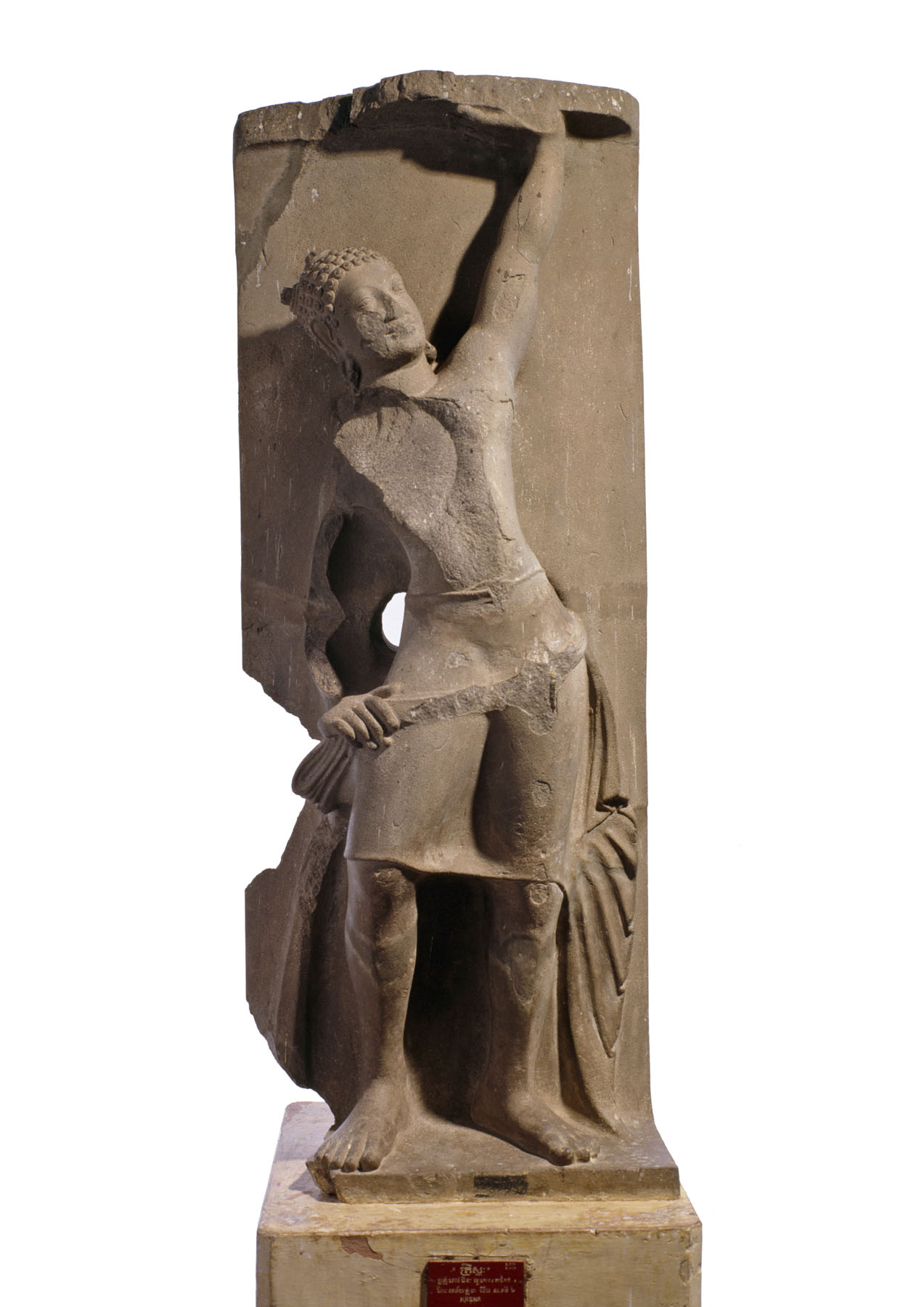
Cambodia, Takeo, Angkor Borei, Wat Koh, Pre-Angkor period (c. 100-800) Phnom Da style
Krishna Govardhana
Late 500s
Sandstone
161 x 65.5 x 35.2 cm excl tenon
National Museum of Cambodia, Phnom Penh
Krishna Govardhana refers to the divine episode and iconic iconography of the Hindu deity Lord Krishna lifting Govardhan Hill on his finger to protect the people and animals of Braj from a torrential storm.
Among other things, form is the visible outer appearance or physical makeup of an object or body. But form can also represent something intangible, a vibration of energy, a belief, a faith, in god (or God), whatever form they may take.
The physical objects in this exhibition, created by human hand, give “form” to the majesty of the divine – the sacred nature, power, or presence of a god or supreme being – a representation of the ineffable, the unknowable, for nobody can know whether god exists. They can believe, they can have faith, but they can never absolutely know.
To me faith, a trust in a higher power or the sacred teachings of a religion, is an entirely personal choice. I myself form my nebulous consciousness about the world, the cosmos and god from parts of Zen Buddhism, Krishnamurti, Carlos Castaneda, William Blake, Carl Jung, mandalas, tarot and more. To me, nothing is excluded, everything is open and receptive to spirit – of yourself, the earth, the stars and the cosmos. God even.
I believe that god (a general supernatural being, a deity in a polytheistic religion) and God is inside everyone and everything. But it is up to the individual to bring their rich personal stories to the inquiry into what you believe, including the fact that our understanding of god must acknowledge that the divine is never purely good, “it must encompass all opposites, including darkness and destructive power.” (Carl Jung)
All gods are interconnected in their creation stories; all humans are connected to the energy and spirit of the cosmos. Inter-connected, inter-stellar, inter can be a verb meaning to bury a dead body, or a common prefix meaning “between” or “among” – for in this discontinuous life while we may bury our physical body we may continue to live among the energy of the stars.
Dr Marcus Bunyan
Many thankx to the AGNSW for allowing me to publish the photographs in the posting. Please click on the photographs for a larger version of the image.
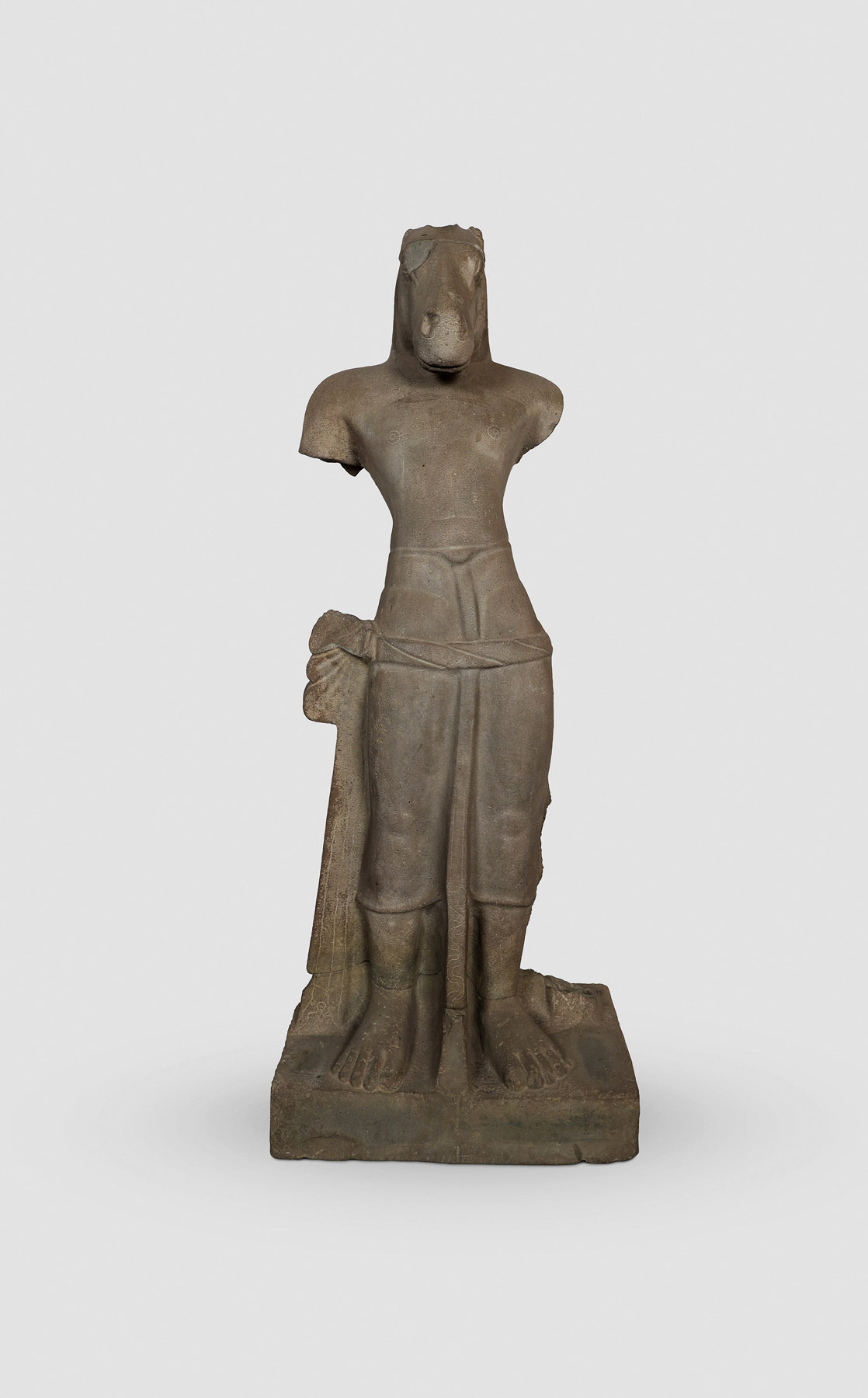
Cambodia, Svay Rieng, Kouk Trap, Pre-Angkor period (c. 100-800)
Vajimukha (Hayagriva or Kalkin)
Late 500s to early 600s
Sandstone
134.5 x 60.5 x 33.3cm
National Museum of Cambodia, Phnom Penh
This captivating exhibition brings together centuries of art and storytelling from South and Southeast Asia celebrating Vishnu, the Hindu deity who preserves order in the universe.
Avatar, meaning ‘descent’ in Sanskrit, describes the many forms Vishnu takes to descend from the heavens to restore balance on earth. In sculpture, painting, textiles and photographs, the exhibition traces the ways artists have envisioned Vishnu’s various avatars, including Matsya the fish, Kurma the tortoise, the beloved Krishna, the noble prince Rāma, and Kalki, the future avatar who will bring renewal.
Brimming with tales of heroism, love and devotion, the exhibition presents exceptional historical and contemporary art from renowned collections in Australia, India, Cambodia, Switzerland and the United Kingdom. It also includes work by contemporary artists Gitanjali Das, Kalyan Joshi, Jumaadi, Desmond Lazaro, Kalam Patua, Nalini Malani, Pushpamala N, Sumakshi Singh and Satyanarayan Suthar.
With thanks to Dr Chaitanya Sambrani, and the School of Art and Design, Australian National University.
Text from the AGNSW website
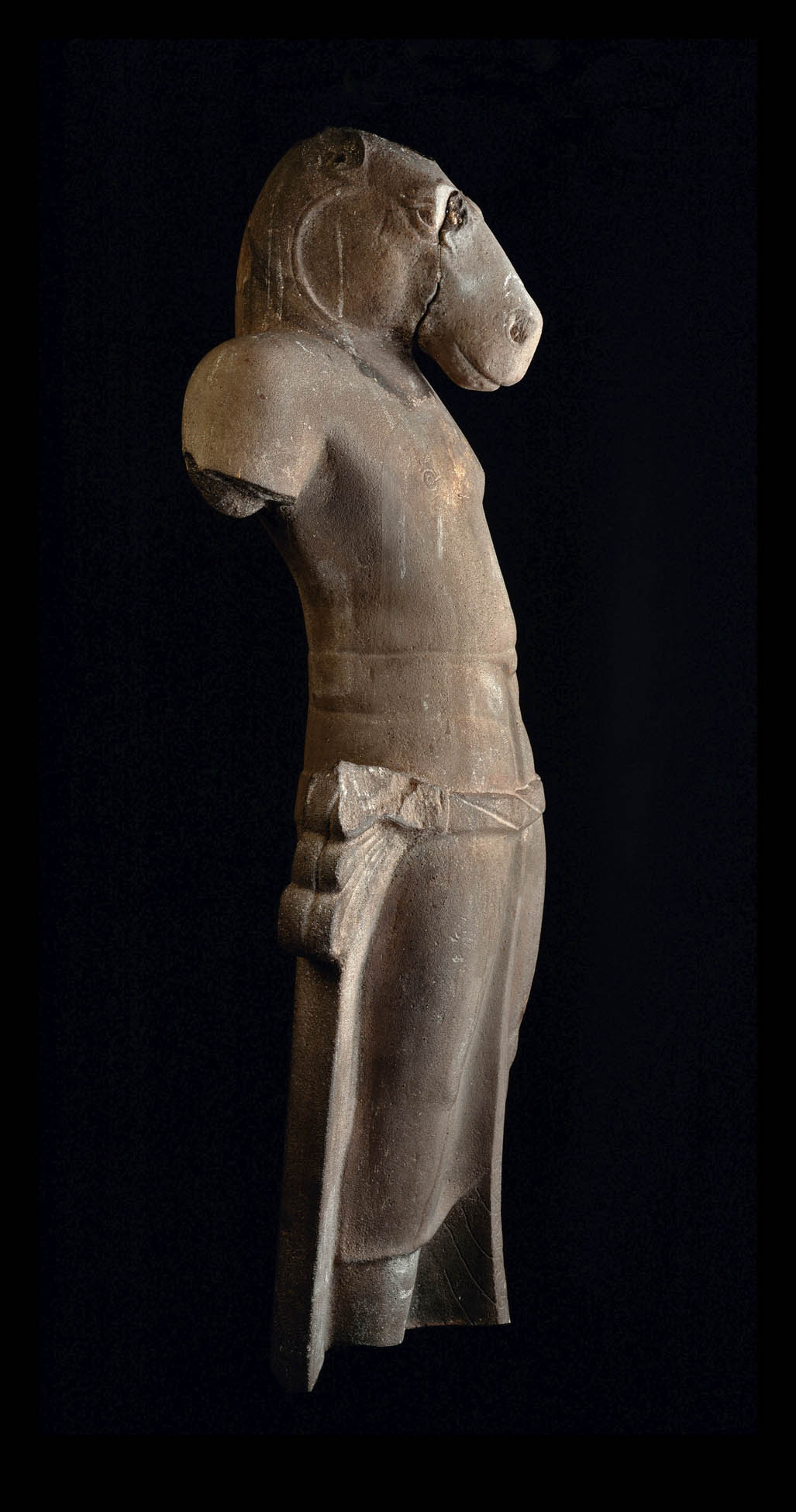
Cambodia, Svay Rieng, Kouk Trap, Pre-Angkor period (c. 100-800)
Vajimukha (Hayagriva or Kalkin)
Late 500s to early 600s
Sandstone
134.5 x 60.5 x 33.3cm
National Museum of Cambodia, Phnom Penh
Vajimukha translates from Sanskrit as “horse-faced” (vaji meaning horse and mukha meaning face). It refers to a rare horse-headed divine sculpture in Southeast Asian (Khmer) art. It typically depicts a human body with a crowned horse head, representing an equine avatar of the Hindu god Vishnu – either Hayagriva or Kalkin.
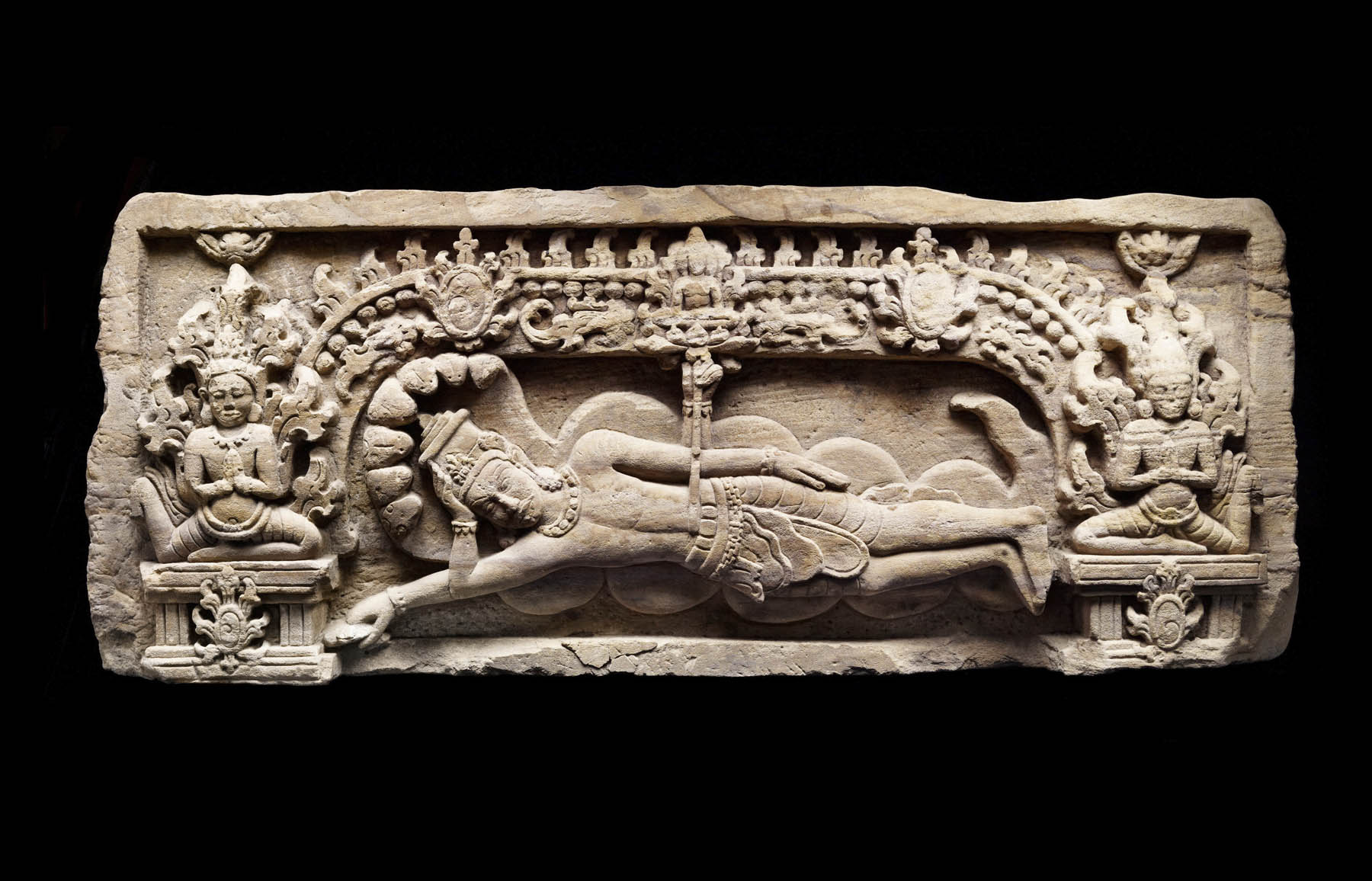
Cambodia, Battambang, Tuol Baset, Pre-Angkor period (c. 100-800)
Lintel depicting Vishnu reclining on the serpent Ananta Shesha (Anantashayin) and the birth of Brahma
mid 600s
Sandstone
63 x 158 x 28cm
Battambang Provincial Museum, transferred from National Museum of Cambodia, Phnom Pen
Photo © The Metropolitan Museum of Art/Art Resource, NY
Ananta Shesha (also known as Adi-shesha or Sheshanaga) is the king of serpents and a primordial being in Hindu mythology. The term Anantashayin (or Anantashayana) describes the iconic iconography of Lord Vishnu reclining or sleeping upon the endless coils of Ananta Shesha amidst the cosmic ocean.
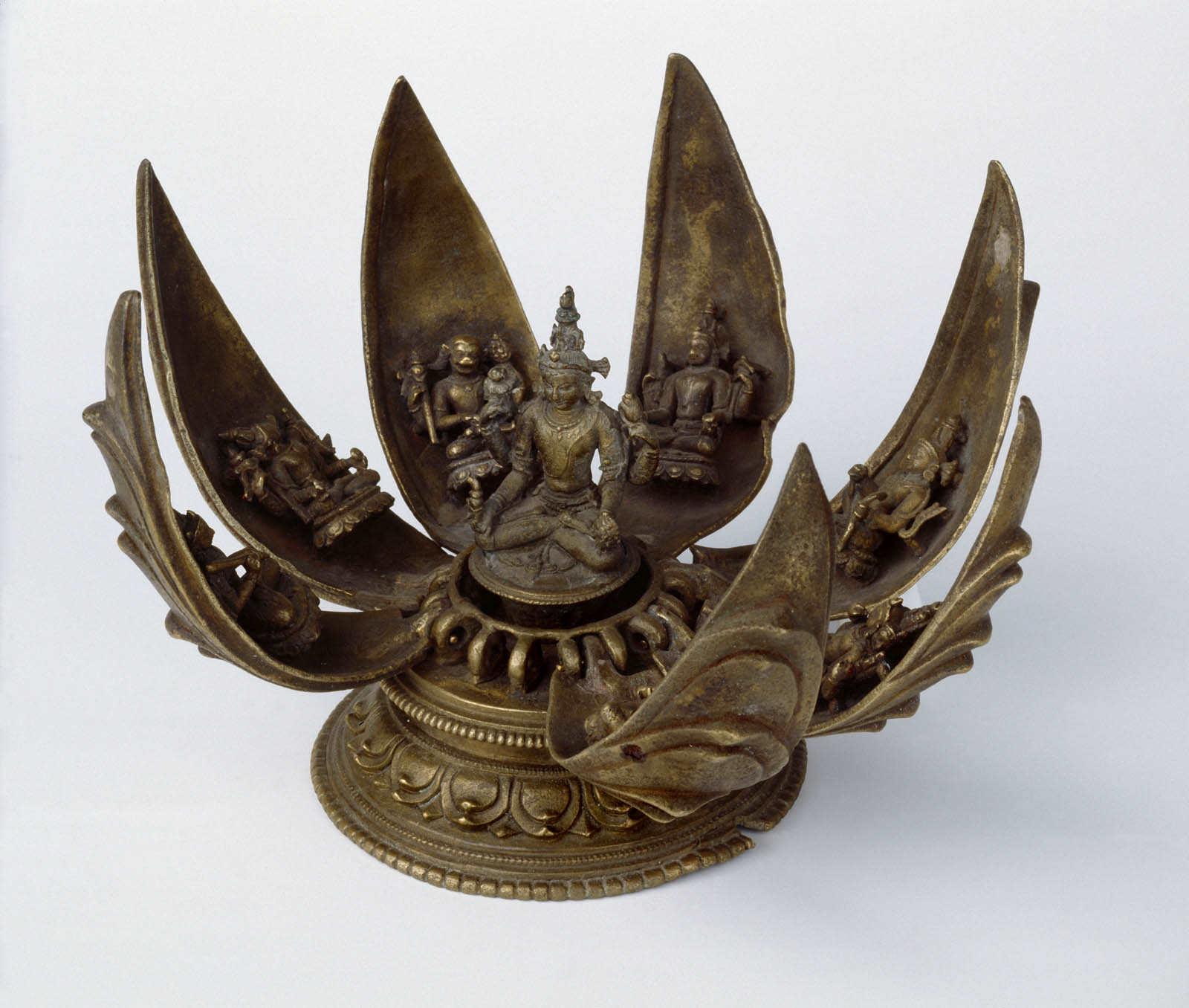
East India/Nepal
Figure of Vishnu in the lotus
1100s
Bronze
13 x 20cm (diam)
Ashmolean Museum, Oxford
Presented by Mrs Hoey
Photo © Ashmolean Museum, University of Oxford
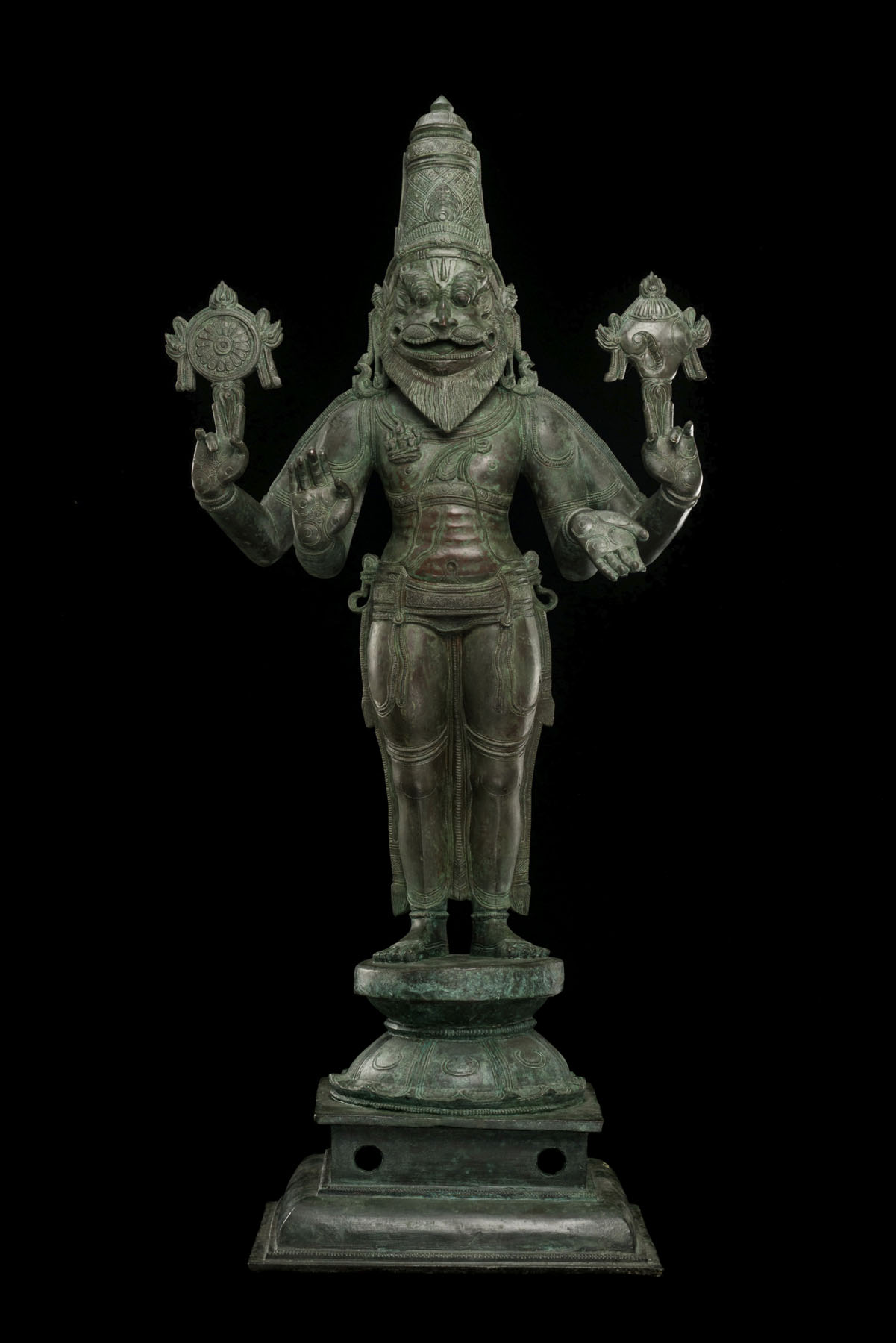
India, Tamil Nadu, Nayaka period (c. 1529-1736)
Narasimha
1600s
Bronze
96 x 46 x 31cm
Courtesy of the trustees of Chhatrapati Shivaji Maharaj Vastu Sangrahalaya, Mumbai
Gift of Cowasji Jehangir
Narasimha (meaning “man-lion” in Sanskrit) is the fourth major avatar of the Hindu god Vishnu. He manifested as a fierce, half-man, half-lion deity to destroy the tyrannical demon king Hiranyakashipu and protect his devoted son, Prahlada.
The legend of the man-lion is celebrated for how Vishnu brilliantly outsmarted the demon’s seemingly invincible boons:
The Trap: Hiranyakashipu had a boon from Brahma that he could not be killed by man or animal, indoors or outdoors, on earth or in the sky, by day or night, and by any weapon.
The Slaying: Bursting from a palace pillar, Narasimha caught the demon at twilight (neither day nor night), on the threshold of the palace (neither inside nor outside), placed him on his lap (neither ground nor sky), and killed him using only his claws (not considered a weapon).
Narasimha is revered as the ultimate protector who destroys evil and safeguards the vulnerable when all other logic fails.
Avatar: Forms of Vishnu | A curatorial introduction
Join Avatar: Forms of Vishnu co-curators Melanie Eastburn, Art Gallery of New South Wales and Chaitanya Sambrani, Australian National University as they introduce the exhibition and explore its key themes and ideas.
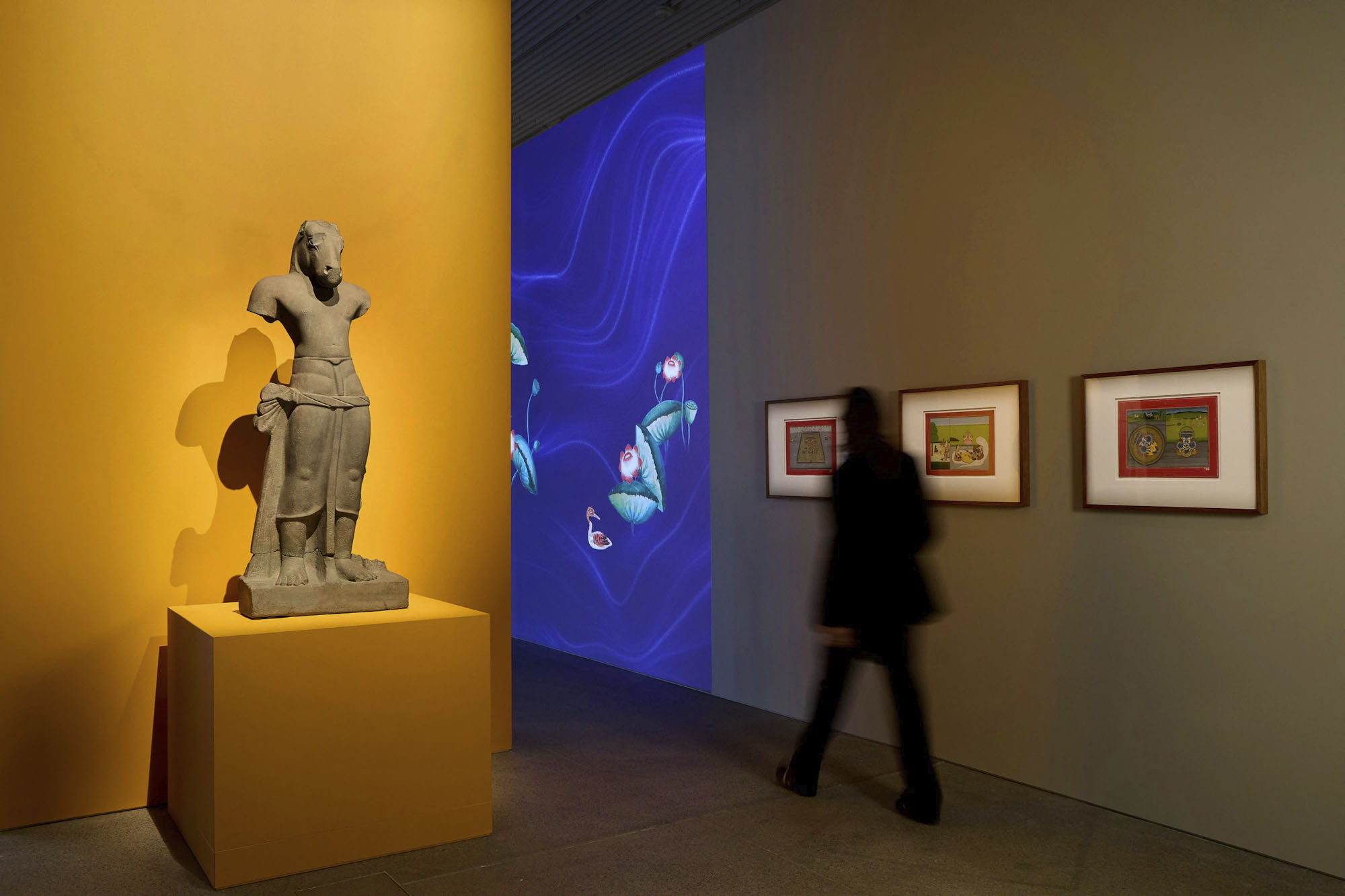
Installation view of the Avatar – Forms of Vishnu exhibition at the Art Gallery of New South Wales, Sydney showing at left, Cambodia, Svay Rieng, Kouk Trap, Pre-Angkor period (c. 100-800) Vajimukha (Hayagriva or Kalkin) Late 500s to early 600s (above)
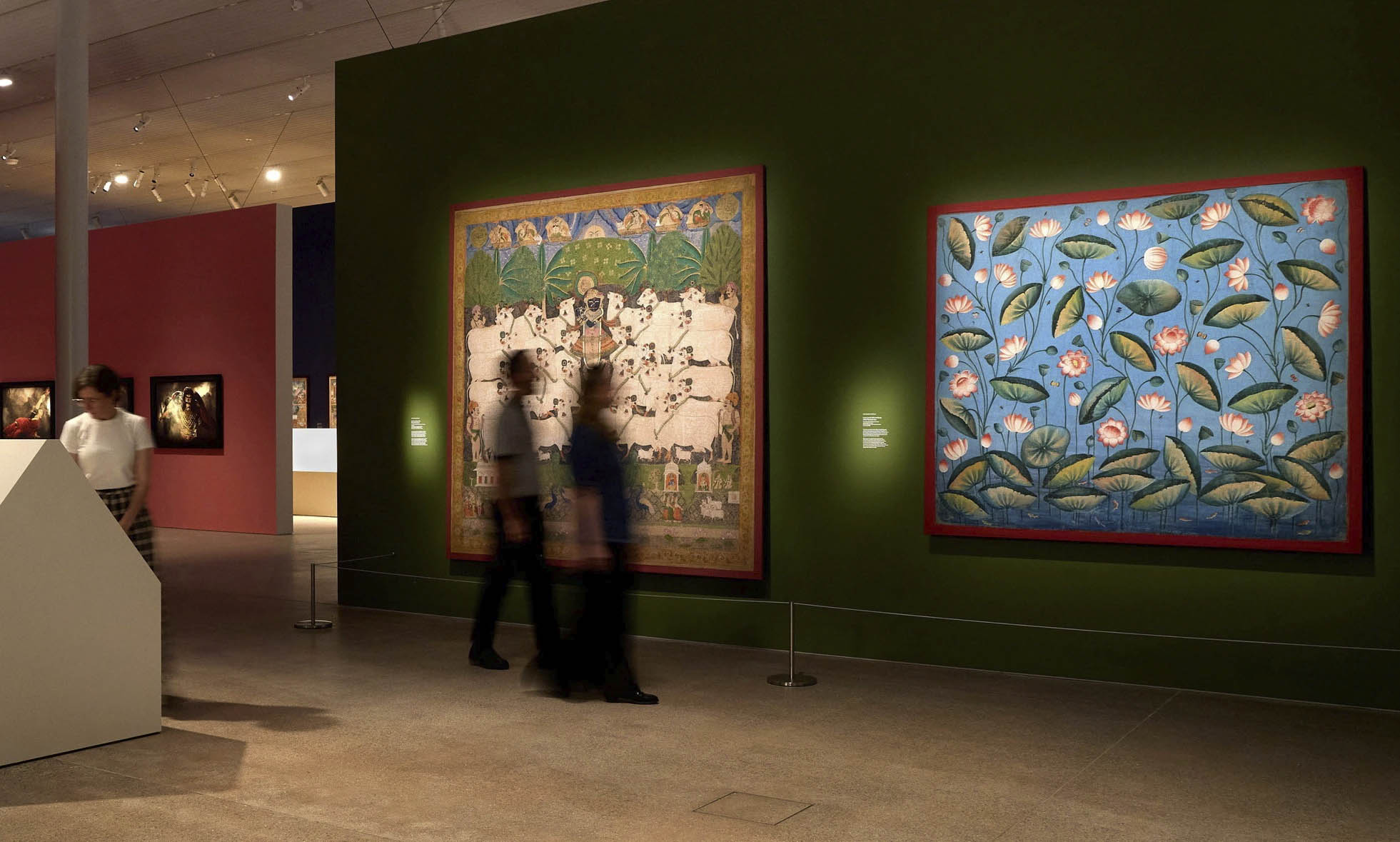
Installation view of the Avatar – Forms of Vishnu exhibition at the Art Gallery of New South Wales, Sydney showing at right, (Indian) Lotus ponds (Kamal Vana) of the Yamuna 1800s (below)
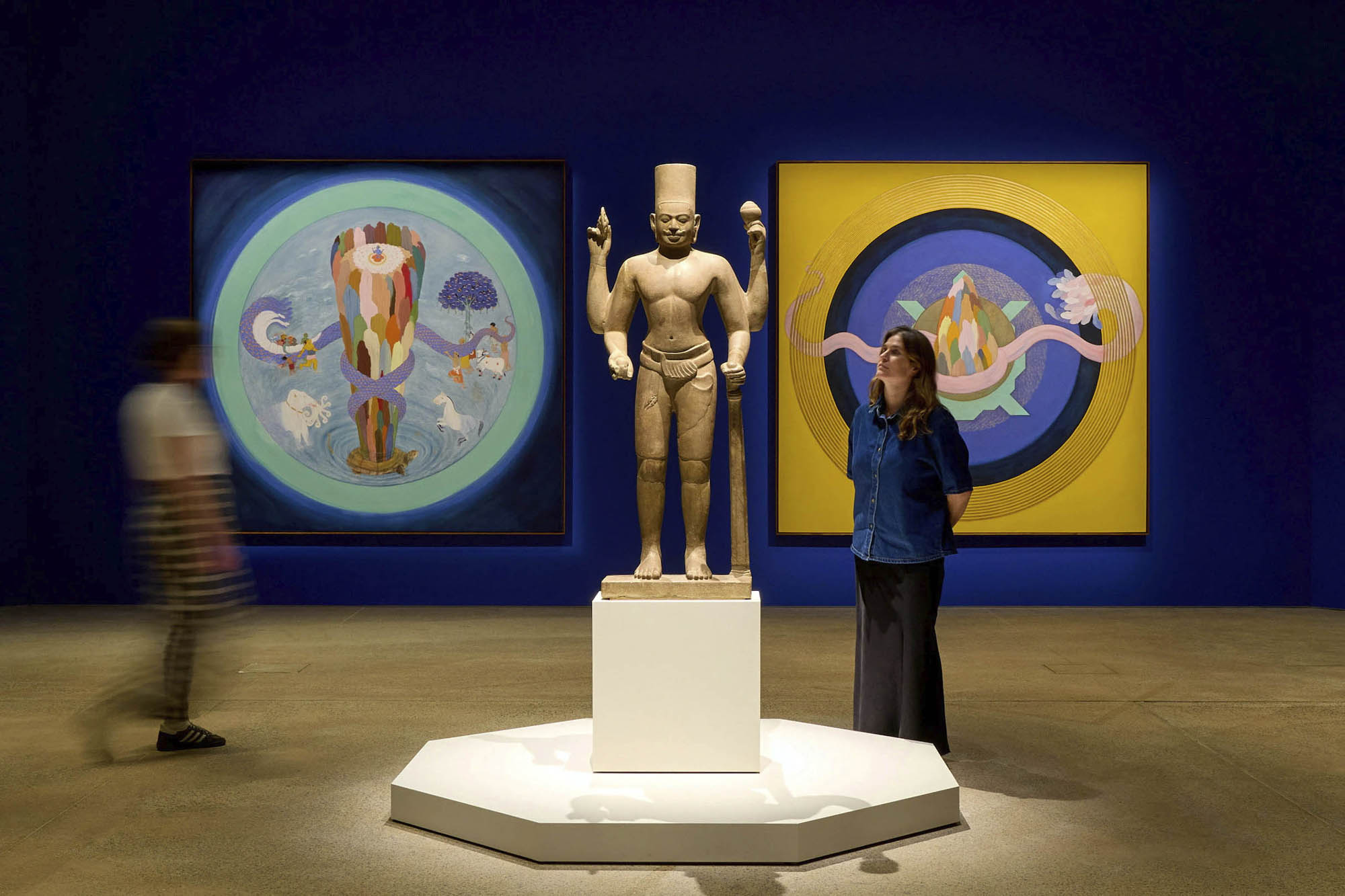
Installation view of the Avatar – Forms of Vishnu exhibition at the Art Gallery of New South Wales, Sydney showing at left, Desmond Lazaro. Samudra Manthana, Churning of the Ocean of Milk 2026 (below); and at right, Desmond Lazaro. Mount Mandara 2026 (below)
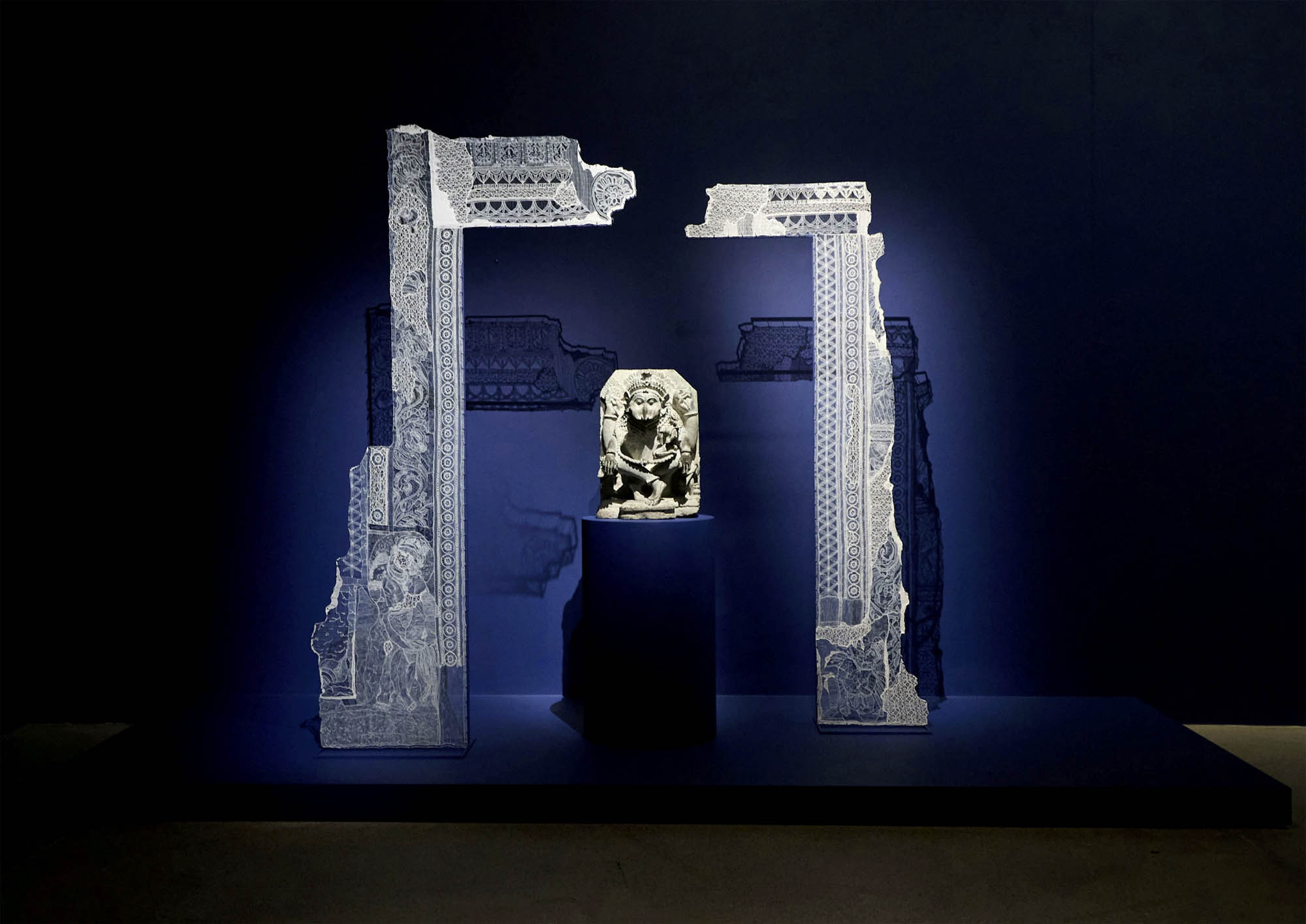
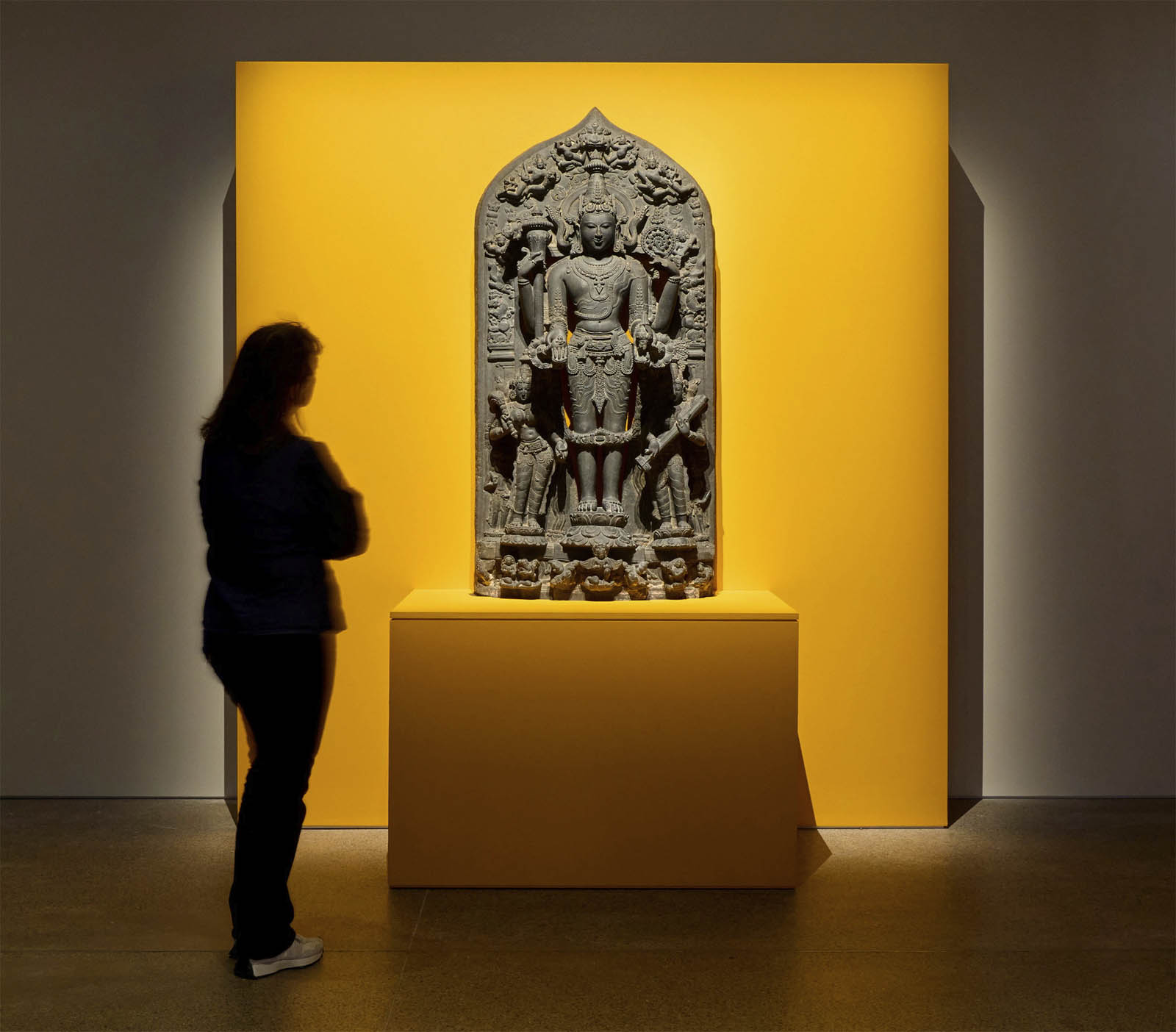
Installation views of the Avatar – Forms of Vishnu exhibition at the Art Gallery of New South Wales, Sydney
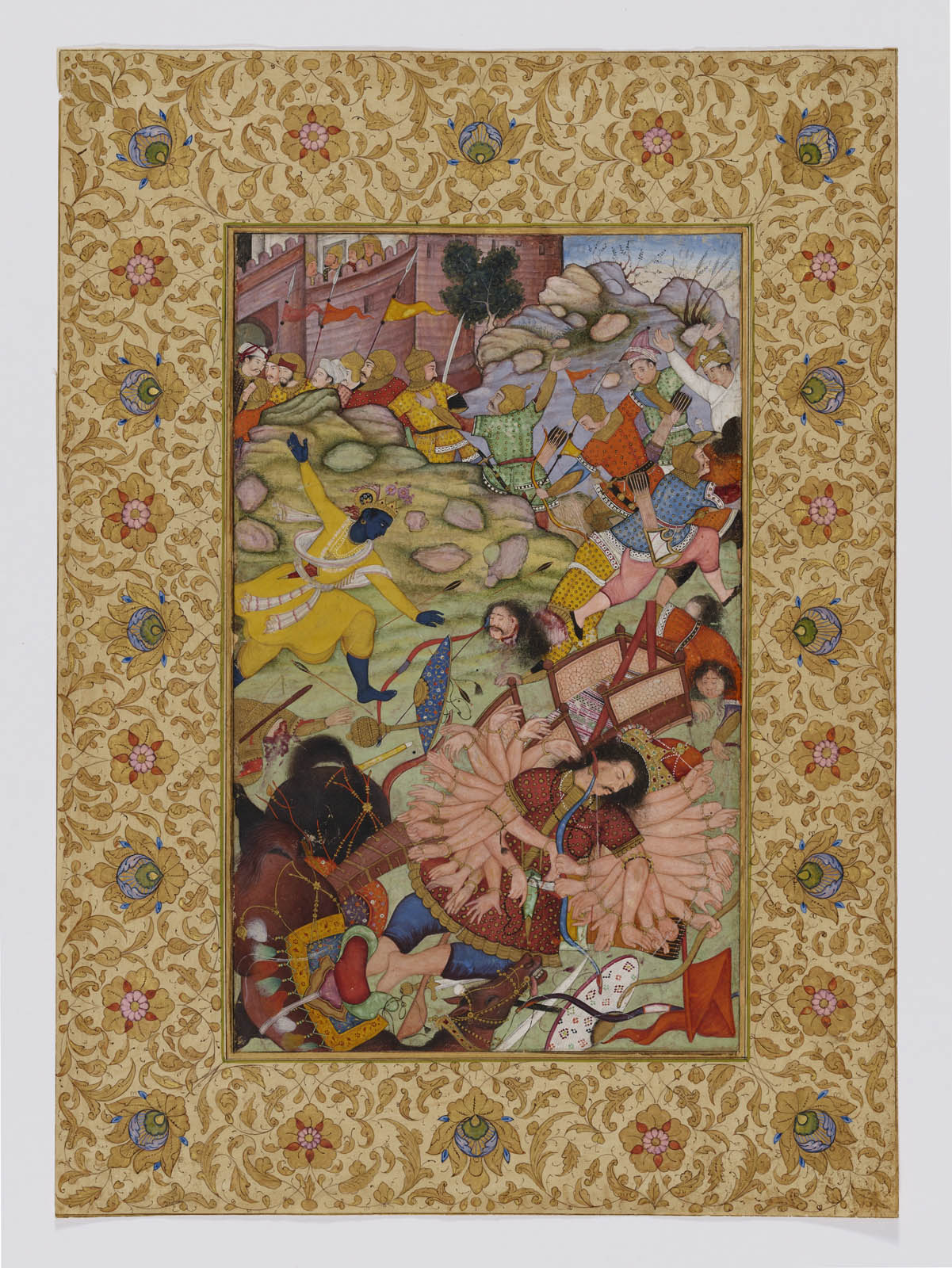
India/Pakistan, Agra/Lahore, Mughal style, Akbar period (1556-1605)
Krishna defeats the demon Bāna
c. 1585-1590
Folio from a Harivamsa (Legend of Hari)
Opaque watercolour and gold on paper; margins completed in Lucknow, late 1700s
28.7 × 17.8cm
Museum Rietberg, Zurich
Gift of Catharina Dohrn
Lord Krishna defeated the thousand-armed demon king Bāṇāsura (Bana) in an epic battle at Shonitapura after Bana imprisoned Krishna’s grandson, Aniruddha, who had married Bana’s daughter Usha. Bound by a promise to protect Bana, Lord Shiva initially intervened and fought Krishna, but Krishna subdued Shiva and severed most of Bana’s arms, sparing his life.
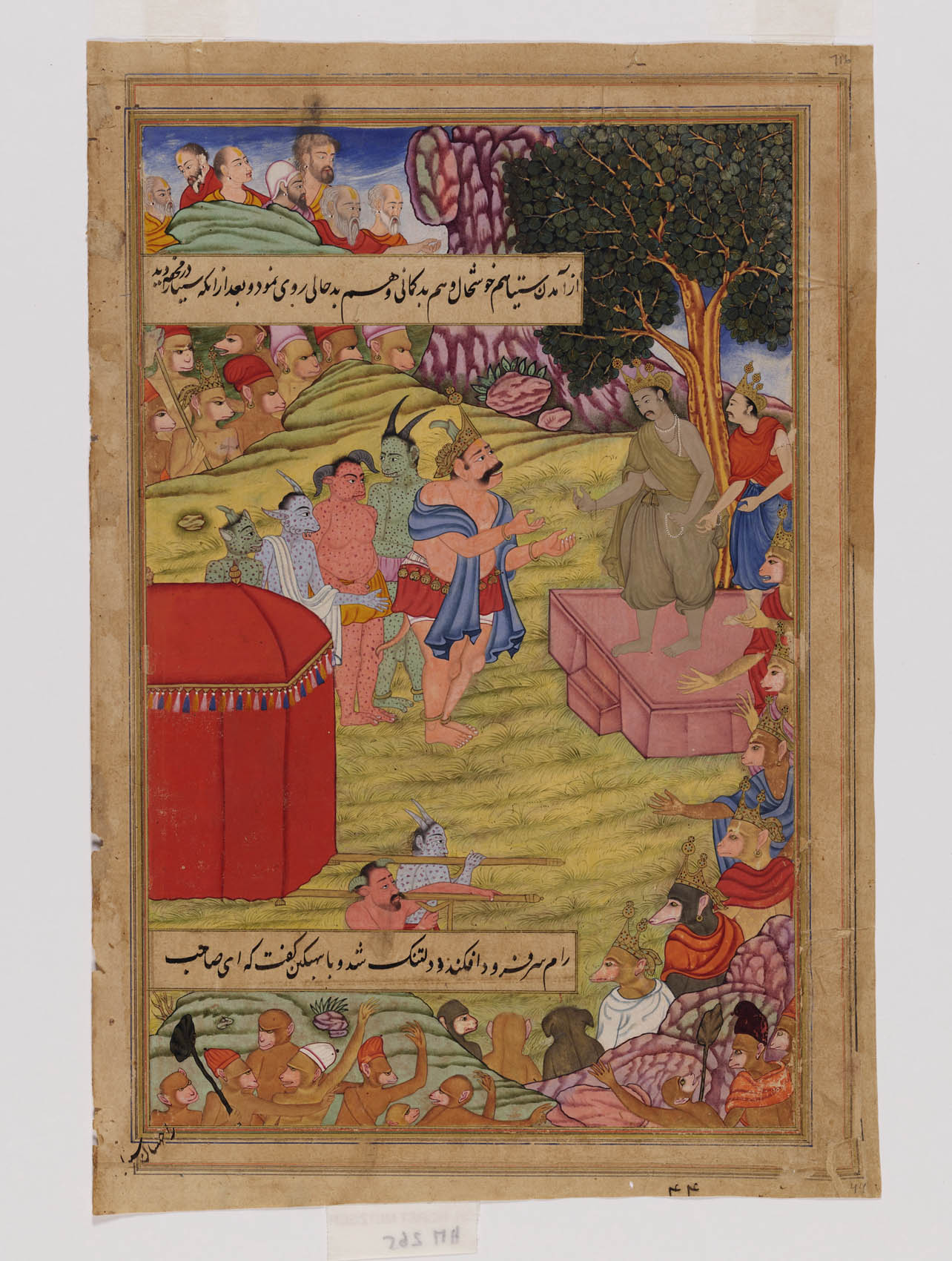
India, Mughal style, Akbar period (1556-1605)
Vibhishana meeting Rāma and Lakshmana
16 May 1594 (colophon dated)
From the Ramayana of Hamida Banu Begum
Opaque watercolour and gold on paper
32.6 x 21.2cm
Museum Rietberg, Zurich
Gift of Balthasar and Nanni Reinhart
Vibhishana, the younger brother of Ravana, met Lord Rama and Lakshmana by surrendering to them across the ocean near Lanka. After Ravana rejected his advice to return Sita, Vibhishana chose righteousness (dharma), crossed the sea, and sought Rama’s protection. Despite doubts from some leaders like Sugriva, Rama accepted him with compassion and promised to crown him king.
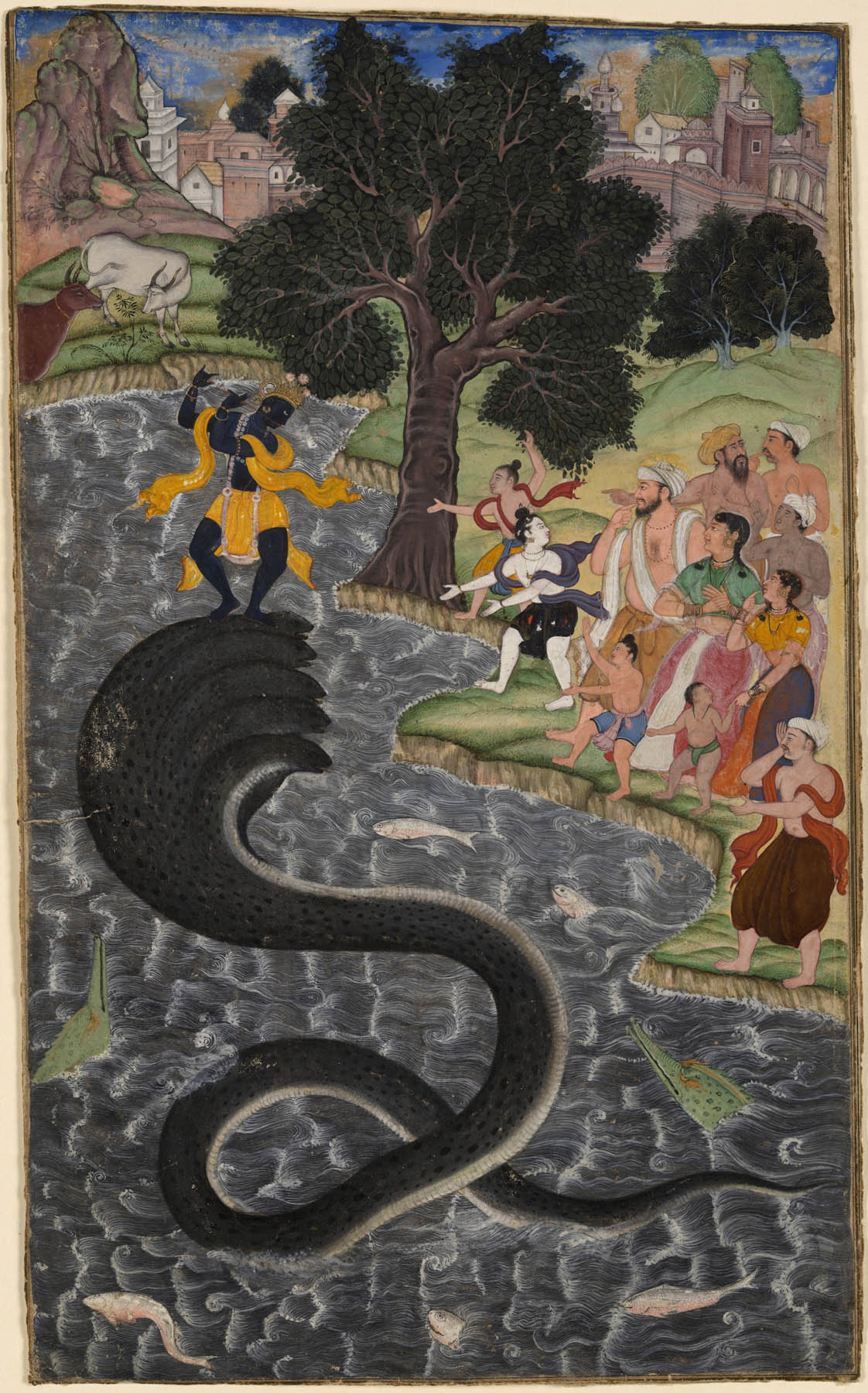
India
Krishna Dances on the Head of Kaliya
c. 1590-1595
Opaque pigments and gold on paper
29 x 32.2cm
Metropolitan Museum of Art, New York, Howard Hodgkin Collection
Purchase, Florence and Herbert Irving Acquisitions, Harris Brisbane Dick, and 2020 Benefit Funds; Howard S and Nancy Marks, Lila Acheson Wallace, and Friends of Islamic Art Gifts; Louis V Bell, Harris Brisbane Dick, Fletcher, and Rogers Funds and Joseph Pulitzer Bequest; and funds from various donors, 2022
Lord Krishna jumped into the poisoned Yamuna River in Vrindavan, fought the giant multi-headed snake Kaliya, and danced lightly on his hoods. This divine act – known as Kaliya Mardan – forced the serpent to yield, cleared the toxic water, and spared the village
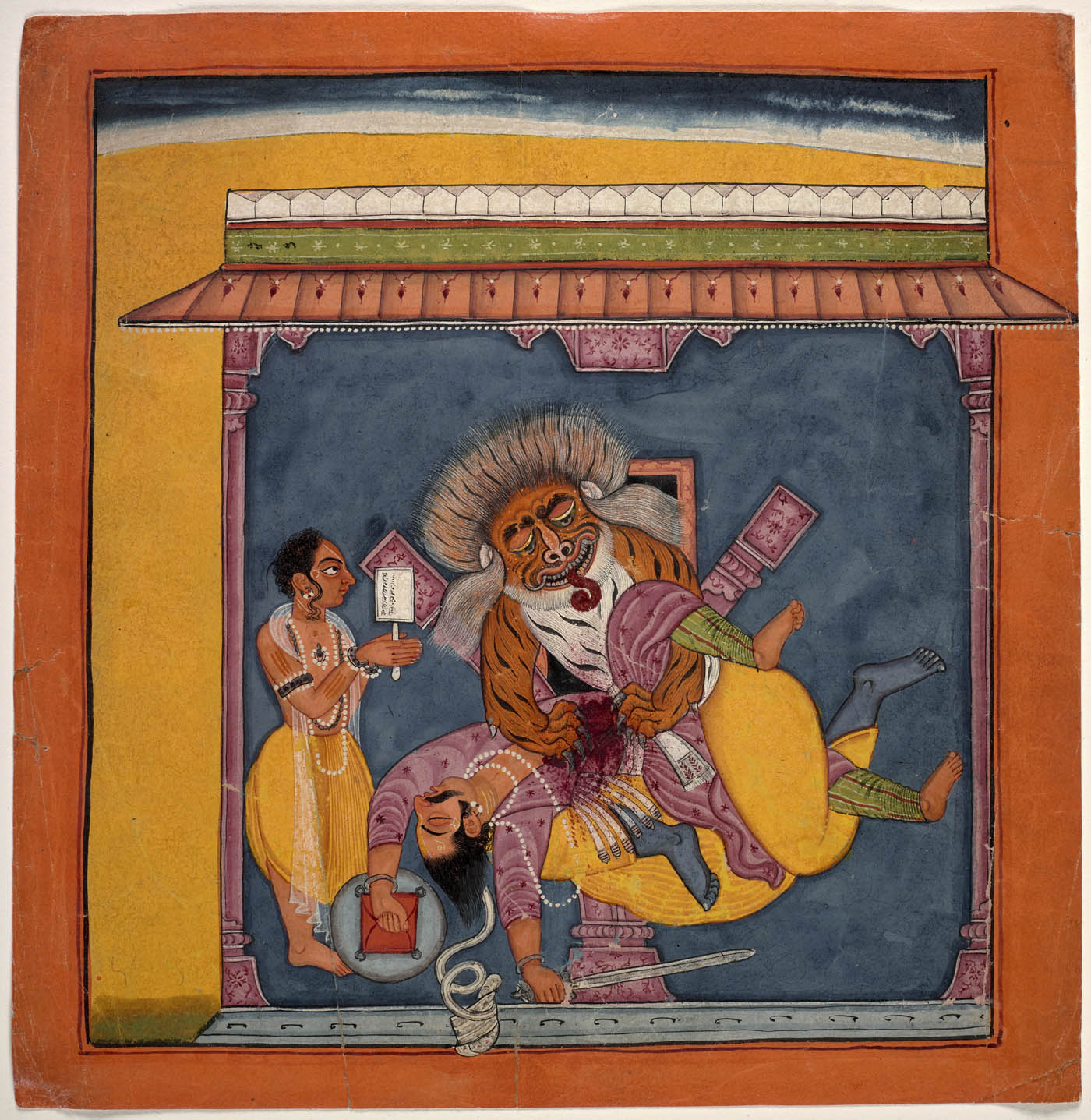
Devidasa (attrib)
Vishnu as the man-lion Narasimha killing Hiranyakashipu
c. 1690-1700
Opaque watercolour and gold on paper
17 x 18cm
Art Gallery of New South Wales, Peter and Pam Binnie Bequest
Purchased 2020
Lord Vishnu took the fierce form of Narasimha – half-man and half-lion – to kill the tyrant demon king Hiranyakashipu. He did this to protect his young devotee Prahlada, Hiranyakashipu’s own son, who worshipped Vishnu despite his father’s cruel abuse.
Narasimha is the fourth avatar of the Hindu god Vishnu. Here he is attacking the demon Hiranyakashipu. Their location between courtyard pillars is significant as the god Brahma promised Hiranyakashipu that he could not be killed by a human or animal, on earth or in the heavens, inside or outside. Hiranyakasipu swore revenge on Vishnu who, in his boar-headed form Varaha, had killed the demon’s brother Hiranyakhsa. In order to defeat Hiranyakashipu, Vishnu took a half human, half lion form, laid the creature across his thighs and killed him with his claws on a threshold at twilight.
The demon’s son Prahlada was a devotee of Vishnu and it was Prahlada’s prayers that called the god to conquer Hiranyakashipu. Prahlada appears beside Narasimha and his victim with his hands held together around a board inscribed with a prayer to Vishnu.
Text from the AGNSW website
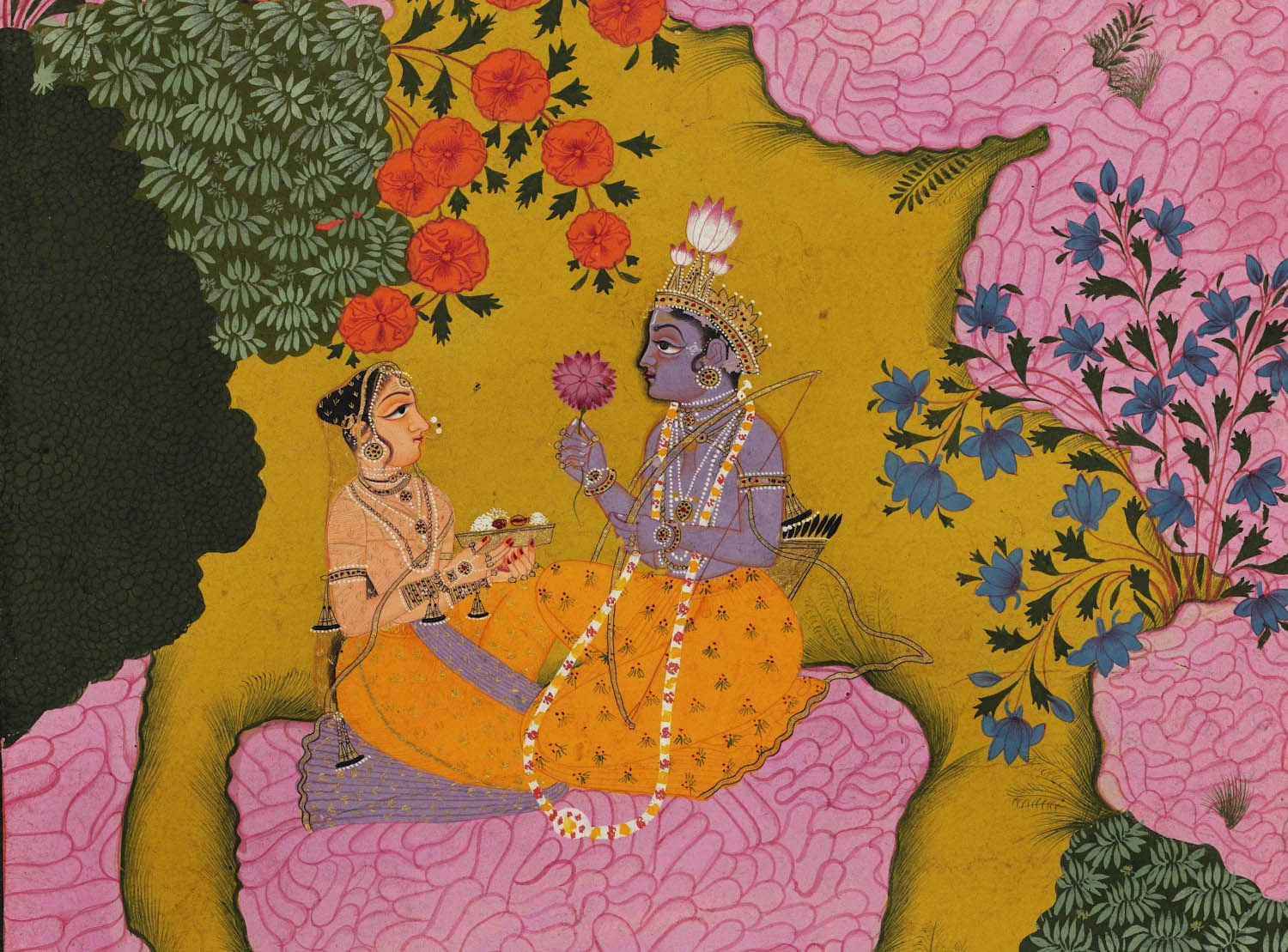
India, Raghogarh style
Sita offering fruits to Rāma in the Dandaka forest (detail)
Late 1700s
National Museum, New Delhi
“Sita offering fruits to Rāma in the Dandaka forest” is a famous late 18th-century Indian miniature painting from Raghogarh (Central India), housed in the National Museum, New Delhi. It portrays an intimate, quiet moment of exile from the Ramayana, showing Rāma and Sítā seated together on a small hillock amidst a stylised, vibrant wilderness.
The painting depicts a scene from the epic Ramayana during the period of exile of the prince of Ayodhya, Rama. Here amidst the woodlands of Dandaka, a forest infested with a host of demons, Rama and Sita sit oblivious to their wild surroundings. On top of a hillock, in solemn stillness, Rama and Sita sit facing each other; Sita holds up a tray bearing fruit for Rama. Everything is forgotten however, as their gazes are intertwined in rapturous adoration. Against a plain mustard-olive hue, the colour of their skin is almost luminescent. The beautiful purple-blue of Rama’s face is contrasted with the light skin tone of Sita’s skin. The vibrant yellow lower garments that they wear however erases the differences – Rama’s blue hue is echoed in the skirt that Sita wears…
The couple’s charged interaction is echoed in the elements. The artist conjures up a visionary forest – nature is reconstructed in a colored dream. Swaying rocks painted in mauves rise against a mustard-olive meadow. Colourful patches of patterns jostle playfully; the pungent mauves are thrown with dark seaweed green. Joyful sprigs of flowers burst forth in happy abandon. Each tree, mound or hillock fits into the composition like a coloured puzzle piece enlivening the entire landscape.
Text from Google Arts & Culture
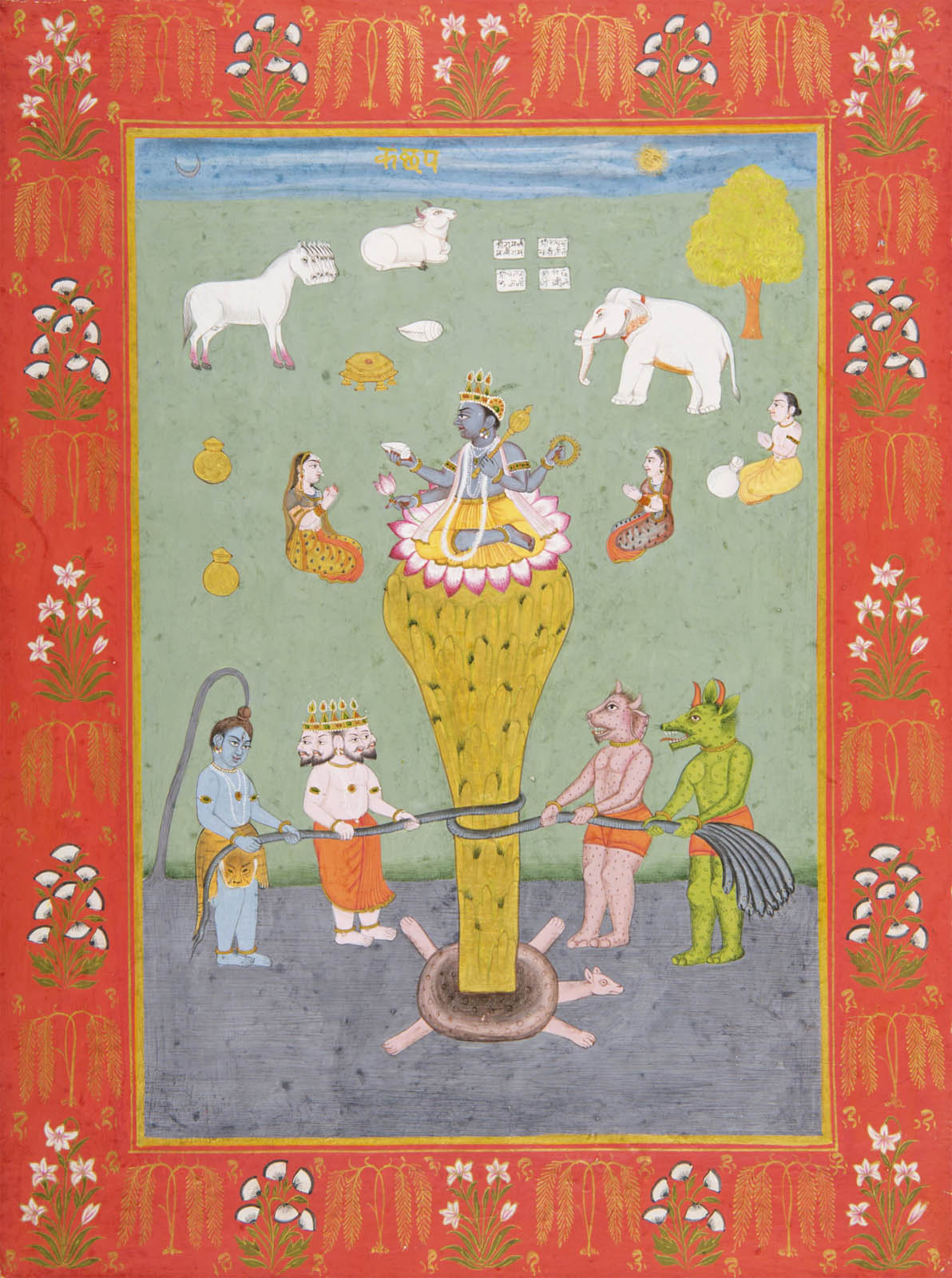
Central India
Kurma Avatar
18th century
Folio from a series depicting Vishnu’s avatars
Museum of Art and Photography, Bengaluru
Kurma Avatar is the second avatar (incarnation) of the Hindu god Vishnu, taking the form of a giant turtle or tortoise to support Mount Mandara on his back during the cosmic ocean churning (Samudra Manthan)
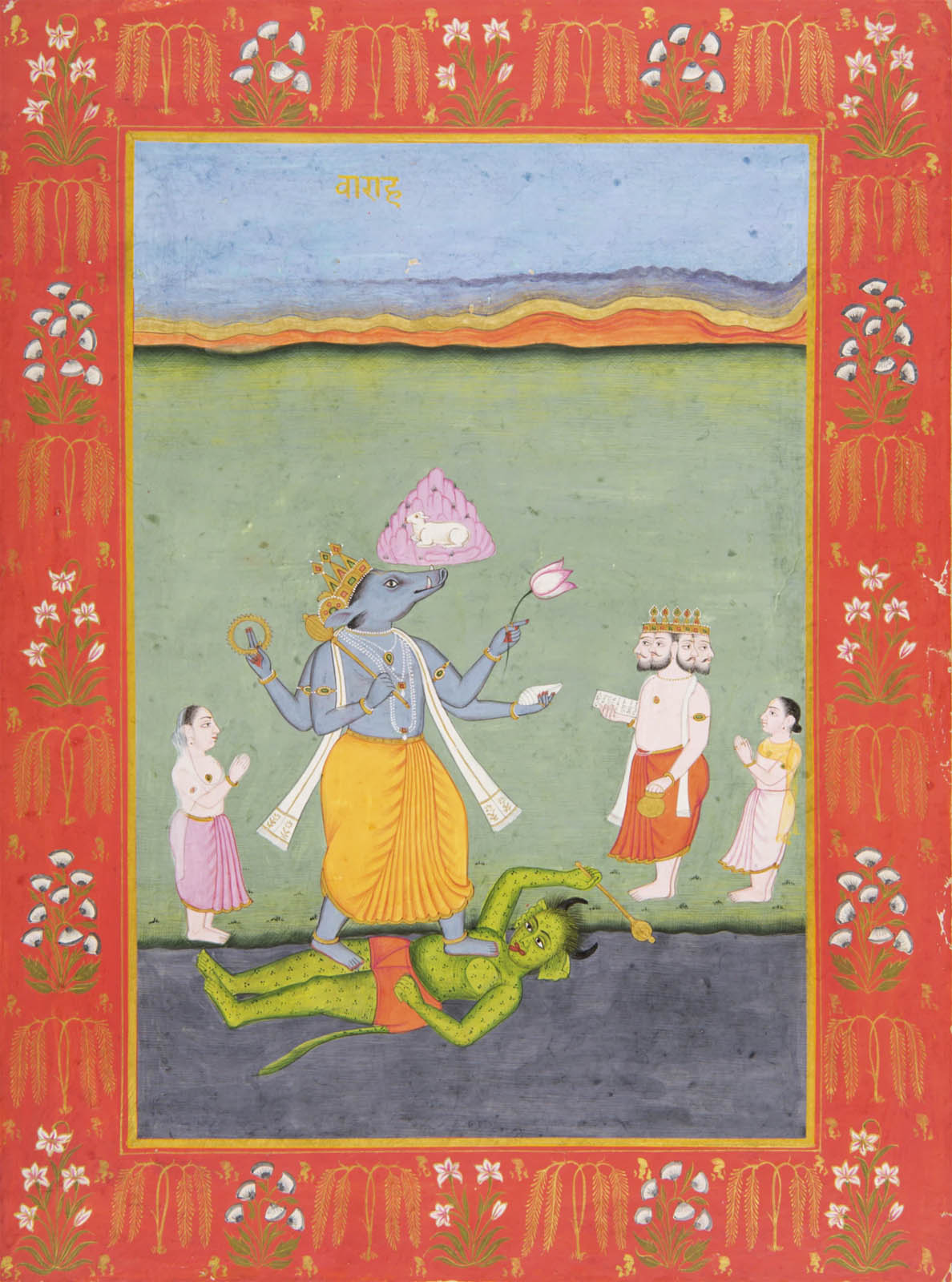
Central India
Varaha Avatar
18th century
Folio from a series depicting Vishnu’s avatars
Museum of Art and Photography, Bengaluru
Varaha Avatar is the third incarnation of the Hindu deity Vishnu, appearing as a boar to rescue the earth. Vishnu is shown with a boar head and blue skin, defeating a demon while lifting the earth, represented by a white figure on a lotus, with his tusk.
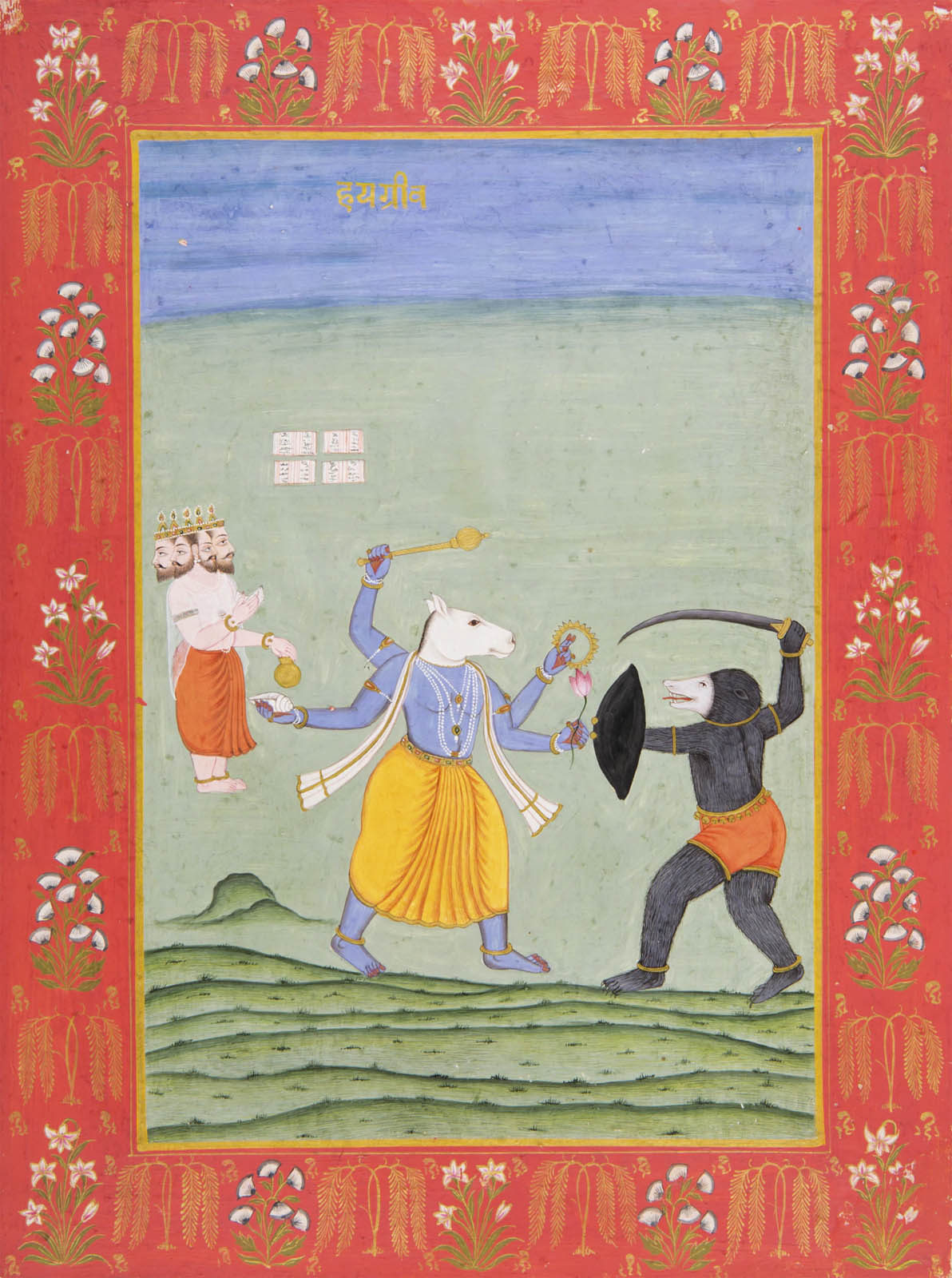
Central India
Hayagriva Avatar
18th century
Folio from a series depicting Vishnu’s avatars
Museum of Art and Photography, Bengaluru
Hayagriva Avatar is a four-armed, horse-headed avatar of the Hindu deity Lord Vishnu. He is worshipped as the divine god of knowledge, wisdom, and learning, and is often considered a guru to both Lord Brahma and Goddess Saraswati. The painting depicts the Hayagriva avatar of Vishnu engaging in battle with a demon. The four-headed deity in the background is Brahma.
The Art Gallery of New South Wales presents an ambitious exhibition devoted to the infinite stories of the Hindu god Vishnu.
Spanning 15 centuries of transformation, devotion and imagination, Avatar: Forms of Vishnu will be the largest presentation of South and Southeast Asian art shown at the Art Gallery of New South Wales in over 20 years, and the first Australian exhibition devoted to the Hindu deity Vishnu. Across many times, places and mediums, artists have reimagined Vishnu and his many avatars, giving form to one of the world’s most enduring and richly visual traditions.
Opening on 20 June and featuring more than 200 works, the exhibition brings together historical and contemporary art, ranging from ancient sculptures, textiles and paintings to photography and installation. Contemporary artists have a strong presence in the exhibition, which features works by leading Australian and Indian artists, including Gitanjali Das, Jumaadi, Desmond Lazaro, Nalini Malani, Pushpamala N, Kalam Patua, Sumakshi Singh and Gulammohammed Sheikh.
Art Gallery of New South Wales director Maud Page said: ‘Avatar: Forms of Vishnu is unmissable. Expansive in scope and unprecedented in scale, it’s the evocative power of visual storytelling from South and Southeast Asia – spanning history to the present – that makes this exhibition so compelling.’
‘Through Avatar, we open a deeper way of seeing and understanding this rich and captivating subject, while furthering the Art Gallery’s longstanding commitment to staging exemplary exhibitions of Asian art. We invite visitors to journey through centuries of extraordinary storytelling and to witness incredible works of art from Cambodia and India, some that have never before travelled for exhibition.’
In Hindu tradition, Vishnu preserves order in the universe and manifests to restore peace and justice. While he is thought to have ten main avatars, their number can be endless. Brimming with tales of heroism, love and devotion, the exhibition traces the ways in which artists have envisioned Vishnu’s various transformations.
His avatars include those that are entirely in animal form or combine human and animal characteristics such as Matsya the fish, Kurma the tortoise, Varaha the boar and Narasimha the man-lion. Other avatars appear in human form and include Prince Rāma, the hero of the Ramayana; Krishna, the beloved cowherd and spiritual guide; and Mohini, the only female manifestation of Vishnu. Vishnu’s final avatar is Kalki, a being depicted either in human form and accompanied by a brilliant white horse, or as a horse-headed human. All of Vishnu’s avatars share the same purpose: to defeat forces of disorder and restore justice and harmony.
The Art Gallery has collaborated closely with museums across the world to present significant works on loan from their collections. Lenders to the exhibition include the National Museum of Cambodia, Phnom Penh; the National Museum of India, New Delhi; the Chhatrapati Shivaji Maharaj Vastu Sangrahalaya, Mumbai; Museum of Art and Photography, Bengaluru; the Kiran Nadar Museum of Art, New Delhi; Museum Rietberg, Zurich; Ashmolean Museum, Oxford; and the British Museum, London. Many of these artworks are being shown for the first time in Australia, with some works rarely leaving their countries of origin. The exhibition also brings together a remarkable selection of works from the Art Gallery’s own collection alongside key works from other state and national collections.
The exhibition has been developed and curated by Art Gallery of New South Wales senior curator of Asian art, Melanie Eastburn, in collaboration with associate professor of art history and curatorial studies at the Australian National University, Dr Chaitanya Sambrani.
On the exhibition, Melanie Eastburn said: ‘Across South and Southeast Asia, tales of Vishnu’s avatars have inspired contemplation and devotion, as well as entertainment. Vishnu’s avatars are responsive, dynamic and shaped by the cultures and communities that embrace them – whether in centuries past or today.’
Dr Chaitanya Sambrani added: ‘Being the focus of worship for many hundreds of millions of people in India and beyond, the avatars of Vishnu and their marvellous narratives have also provided plentiful opportunities for artistic imagination. Artists have engaged with the mythological lore of Vishnu’s avatars to express philosophical, emotional, ethical and political meanings that reflect the full spectrum of human experience.’
Among the exhibition highlights are some of the earliest paintings made to illustrate India’s great Ramayana and Mahabharata epics. Made in 1594, during the reign of Mughal Emperor Akbar, they highlight the engagement of the Islamic Mughal court with Hindu literature and mythology. Other extraordinary works include a sixth-century Cambodian representation of Krishna holding up Mount Govardhana and the Australian debut of a recently restored seventh-century Cambodian sculpture of a horse-headed avatar of Vishnu.
New works made especially for the exhibition include a pair of large paintings by Desmond Lazaro interpreting the creation legend of the Churning of the Ocean of Milk, and an intricate lace installation by the New Delhi-based artist Sumakshi Singh referencing the legend of Vishnu’s man-lion avatar, Narasimha. Singh is one of five artists representing India at this year’s Venice Biennale.
A significant accompanying publication brings together essays offering new scholarship and critical insight into the exhibition’s themes. Contributors include the exhibition curators Melanie Eastburn and Dr Chaitanya Sambrani, assistant curator Johanna Bear, and contributing authors Carol Cains, Neeraja Poddar, Seang Sokha and Caroline Widmer.
Avatar: Forms of Vishnu is exclusively on show at the Art Gallery of New South Wales from 20th June to 5th October 2026.
Press release from AGNSW
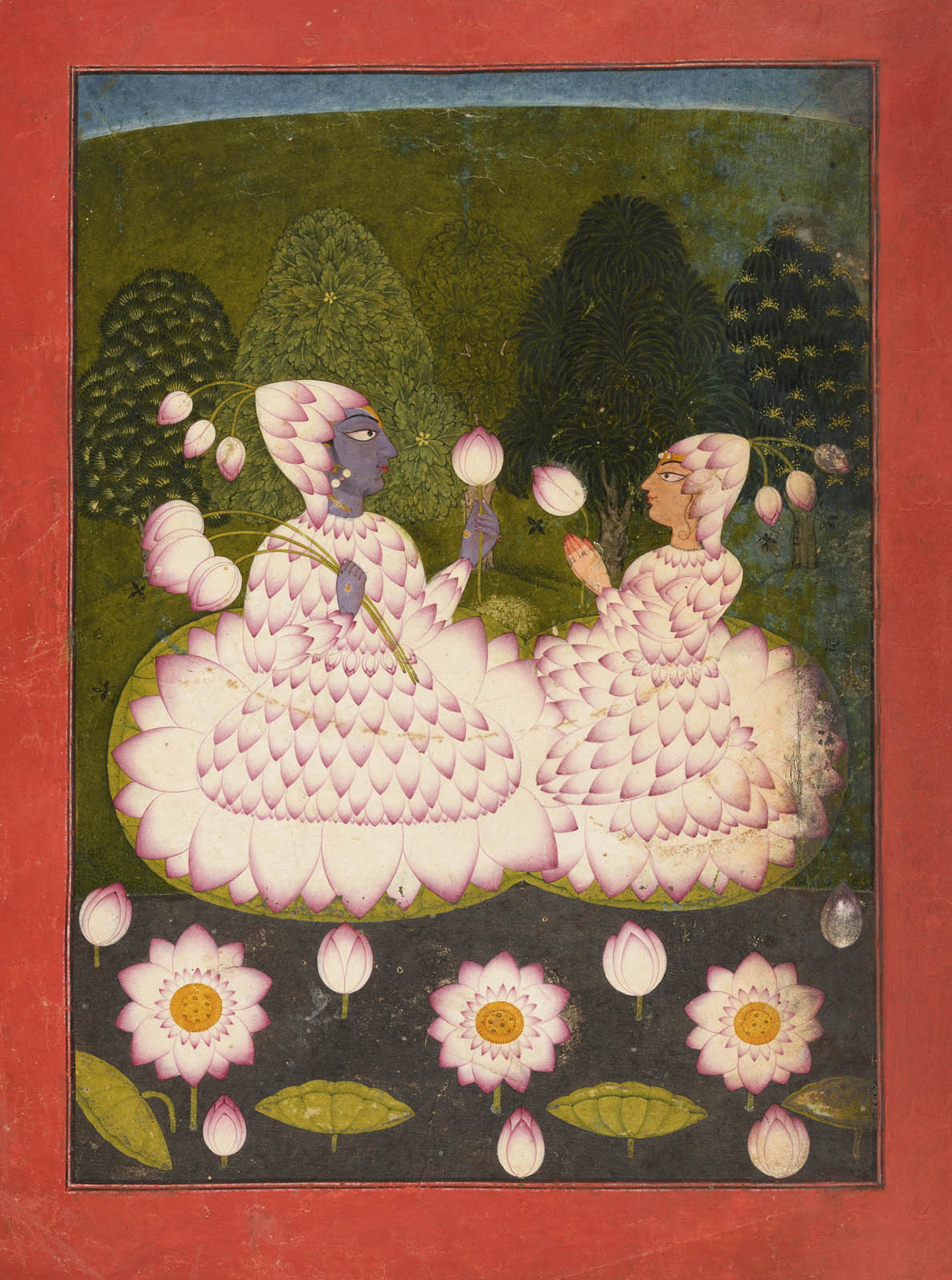
India
Lotus-clad Radha and Krishna
c. 1700-1710
Opaque watercolour on paper
Image: 21.9 x 16.2cm
Sheet: 28.6 x 21.3cm
Art Gallery of New South Wales
Purchased 2007
In this painting, the divine couple, Radha and Krishna, clad in lotus petals, sit amidst a lush grove, by the edge of a lotus-filled pond. The pair appears to be exchanging lotus blossoms as they gaze adoringly at each other. The dark-skinned Krishna holds a bouquet of three flowers in his right hand and a single stem in his left. Radha, with folded hands, clutches the long stalk of another delicate blossom. Sprigs of buds spring jauntily from their lotus headdresses. Adding to the profusion of petals, lotuses in full bloom form the seat on which each figure sits.
While such paintings on the one hand express a tender earthly love, on the other they reference profound religious ideas. The paintings reflect the mystical doctrine of ‘bhakti’, which dictates that devotees may seek unity with god through ardent devotion and unquestioning faith. The intense passion that Radha feels for Krishna and her consuming love for him, therefore, serve as metaphors for deep spiritual yearning and a devotee’s desire for union with the divine. The theme of Radha and Krishna clad in lotus petals also alludes to the practice of ‘phulasiya’, or flower-dressing, wherein venerated images are lovingly dressed and decorated.
The painting was produced in the region of what is today Jammu and Himachal Pradesh in north India. Nestled among the snow-capped peaks and fertile gorges of the Himalayan foothills, this region – often referred to as the Punjab Hills, a name by which it was known prior to Indian independence – developed an artistic convention that paralleled in vision, creativity and excellence the Imperial Mughal school as well as those of the contemporaneous Rajput principalities to Rajasthan. The Punjab Hills region comprised a number small feudal states, each with a ruling Rajput court and its distinctive style of painting. This painting betrays features of the art of the state of Mankot. The heavily-outlined, elongated eyes of the figures, as well as their somewhat fleshy chins are characteristic of the early 18th century Mankot style. As is common with paintings from the Punjab Hills, the artist revels in the depiction of nature, particularly the leafy trees that form a verdant backdrop for the couple.
Chaya Chandrasekhar, ‘Love amongst the lotuses: Radha and Krishna Find Bliss in the AGNSW Collection’ in Look, August 2007, pg. 15 published on the AGNSW website Nd [Online] Cited 25/07/2026. Used under fair use conditions for the purposes of education and research
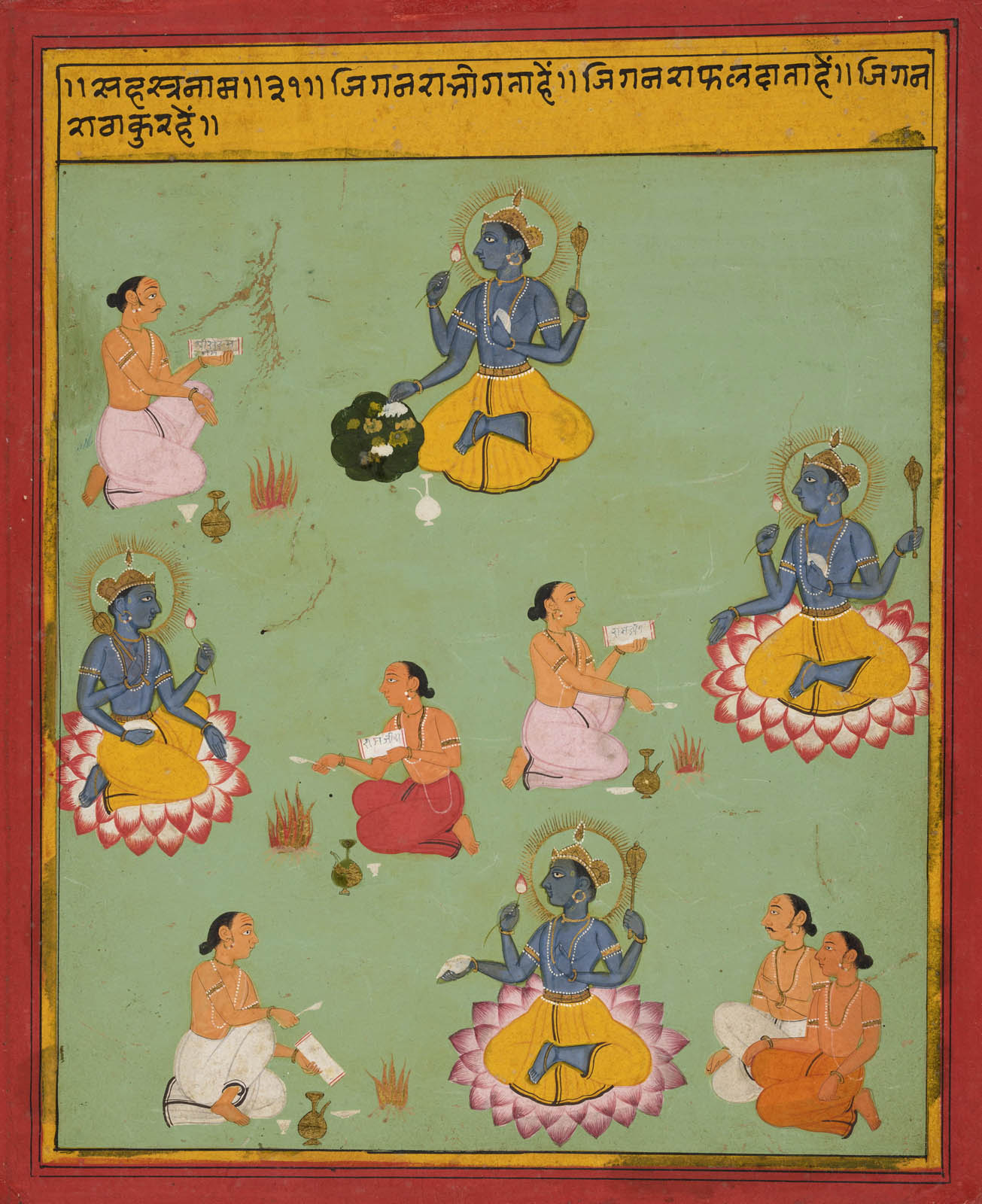
India, Rajasthan, Mewar
The worship of Vishnu
c. 1730
Opaque watercolour on paper
25.7 x 21cm
Art Gallery of New South Wales
Bequest of Mr J Kitto 1986
Image © Art Gallery of New South Wales
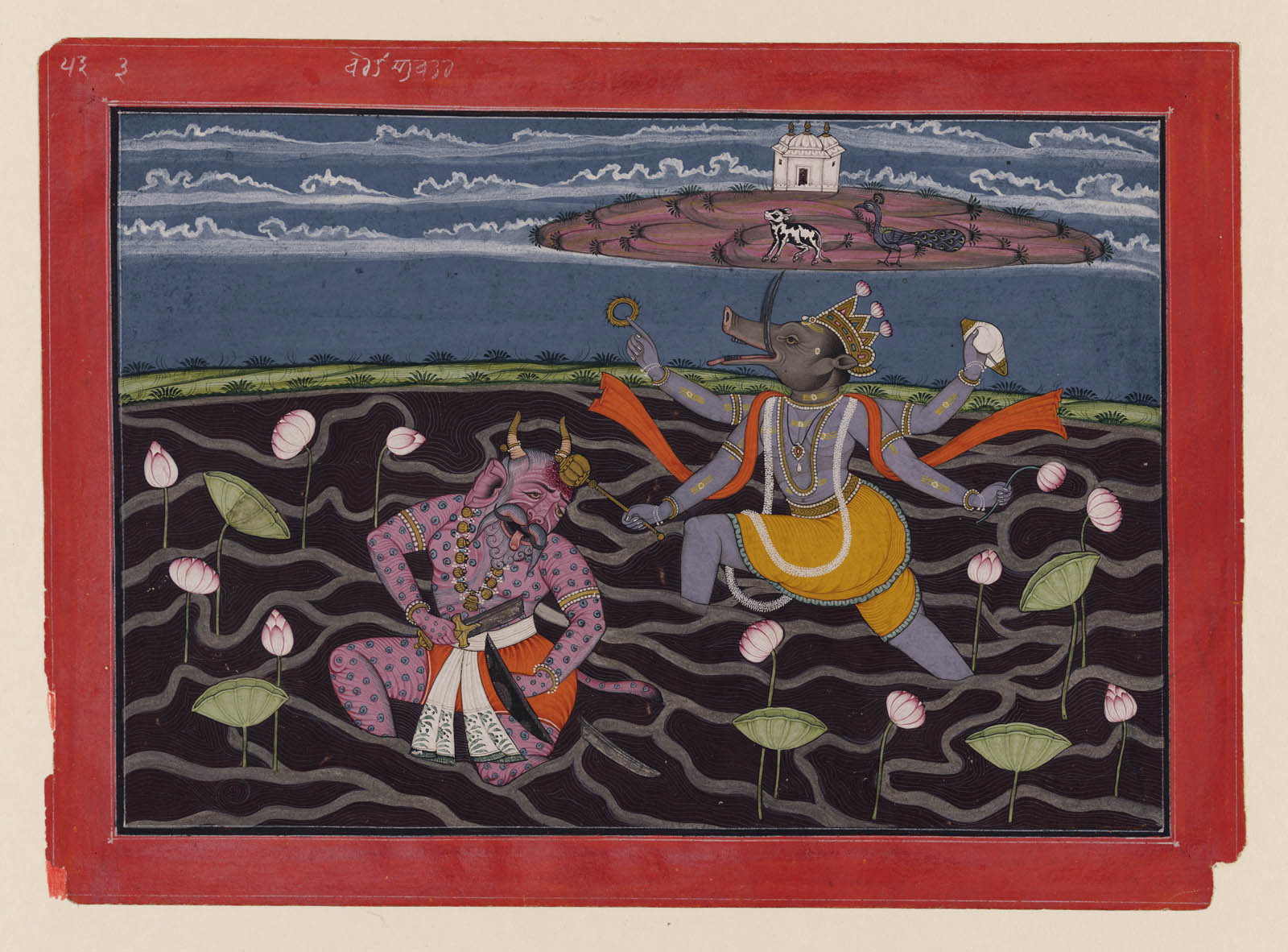
Mahesh of Chamba (India active c. 1730-1775)
Varāha avatar
c. 1750-1775
Folio from a Dashāvatara series
Opaque watercolour on paper
16.3 x 24.1cm
Museum Rietberg, Zurich
Purchased with funds from Balthasar and Nanni Reinhart
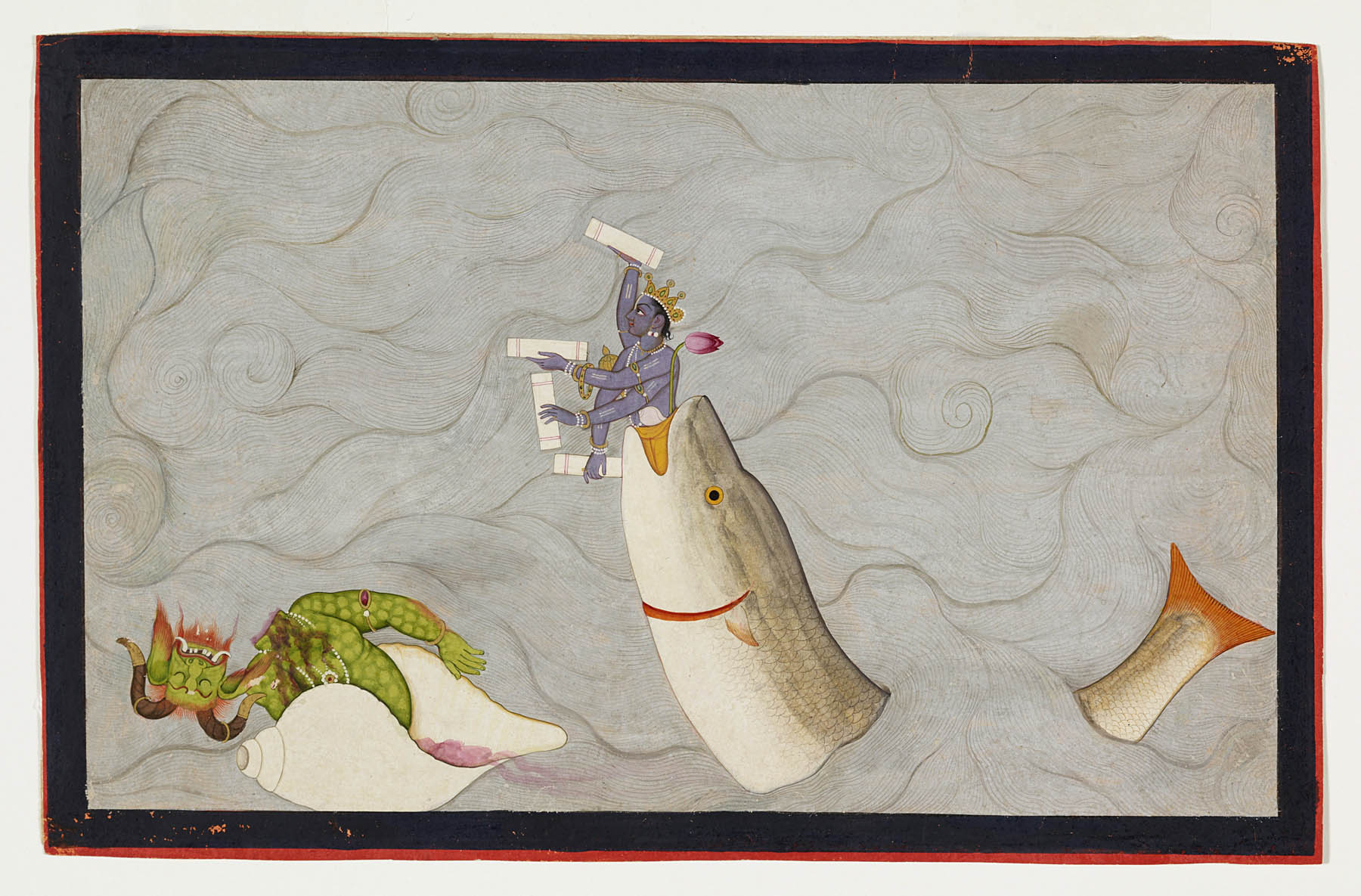
Master of the first generation after Manaku and Nainsukh of Guler
Matsya avatar
c. 1775
Folio from the second Guler Gita Govinda series
Opaque watercolour and gold on paper
15.4 x 25.2cm
Museum Rietberg, Zurich
Gift of Horst Metzger
Matsya is the first primary fish incarnation (avatar) of the Hindu god Vishnu, who saved King Manu, the sacred Vedas, and seeds of life from a great universal flood.
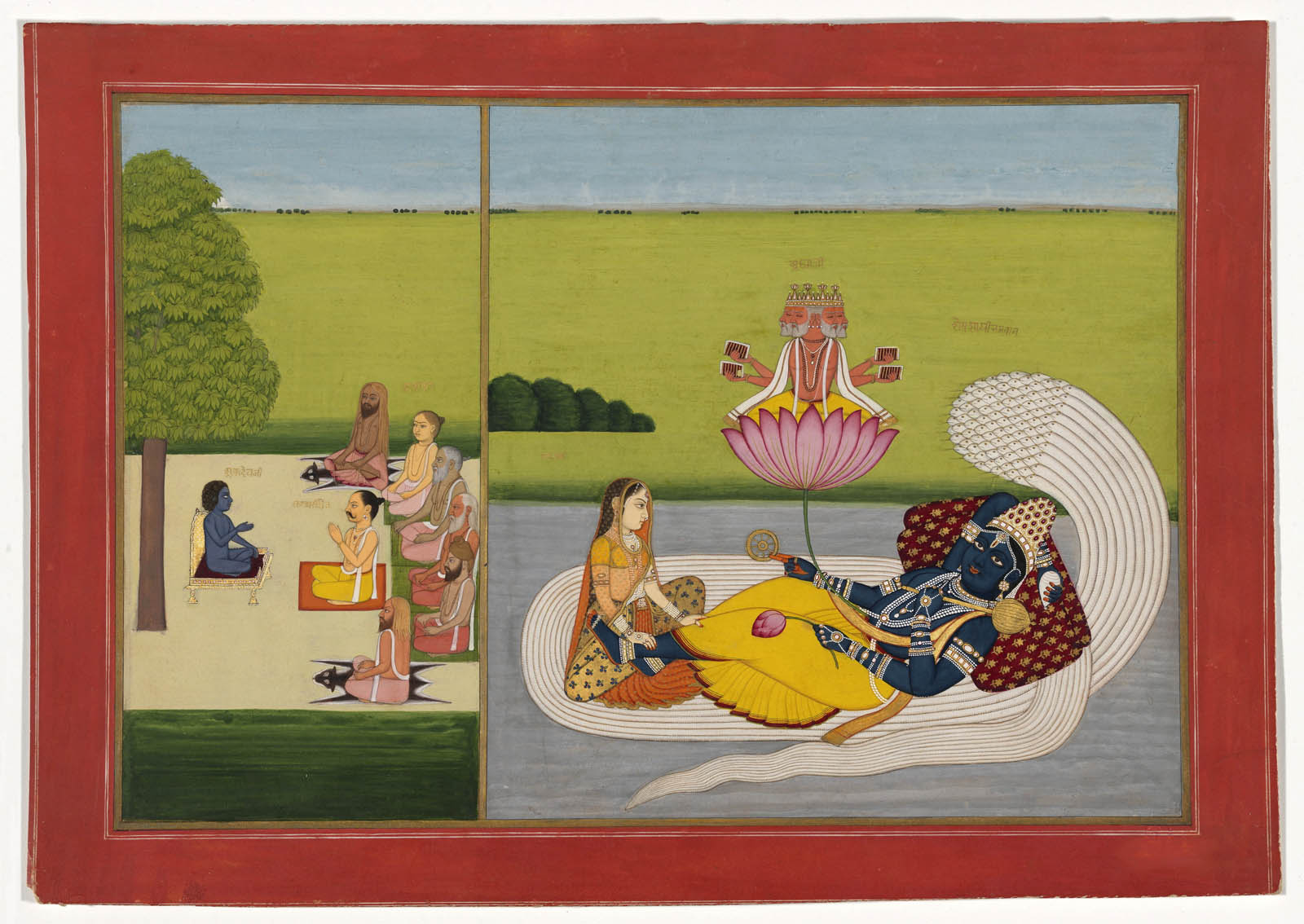
India, Rajasthan, Jaipur
Vishnu reclines on the cosmic serpent
mid 1800s
Opaque watercolour, gold and silver on paper
23 x 35 cm
National Gallery of Australia, Canberra
Purchased 2013
In Hindu mythology, Lord Vishnu reclines on the multi-headed cosmic serpent named Shesha (or Ananta Shesha) upon the primordial cosmic ocean (Kshira Sagara) during the interval between cycles of creation. This posture is known as Anantasayin, representing eternal order, preservation, and the universe resting in pure potential.
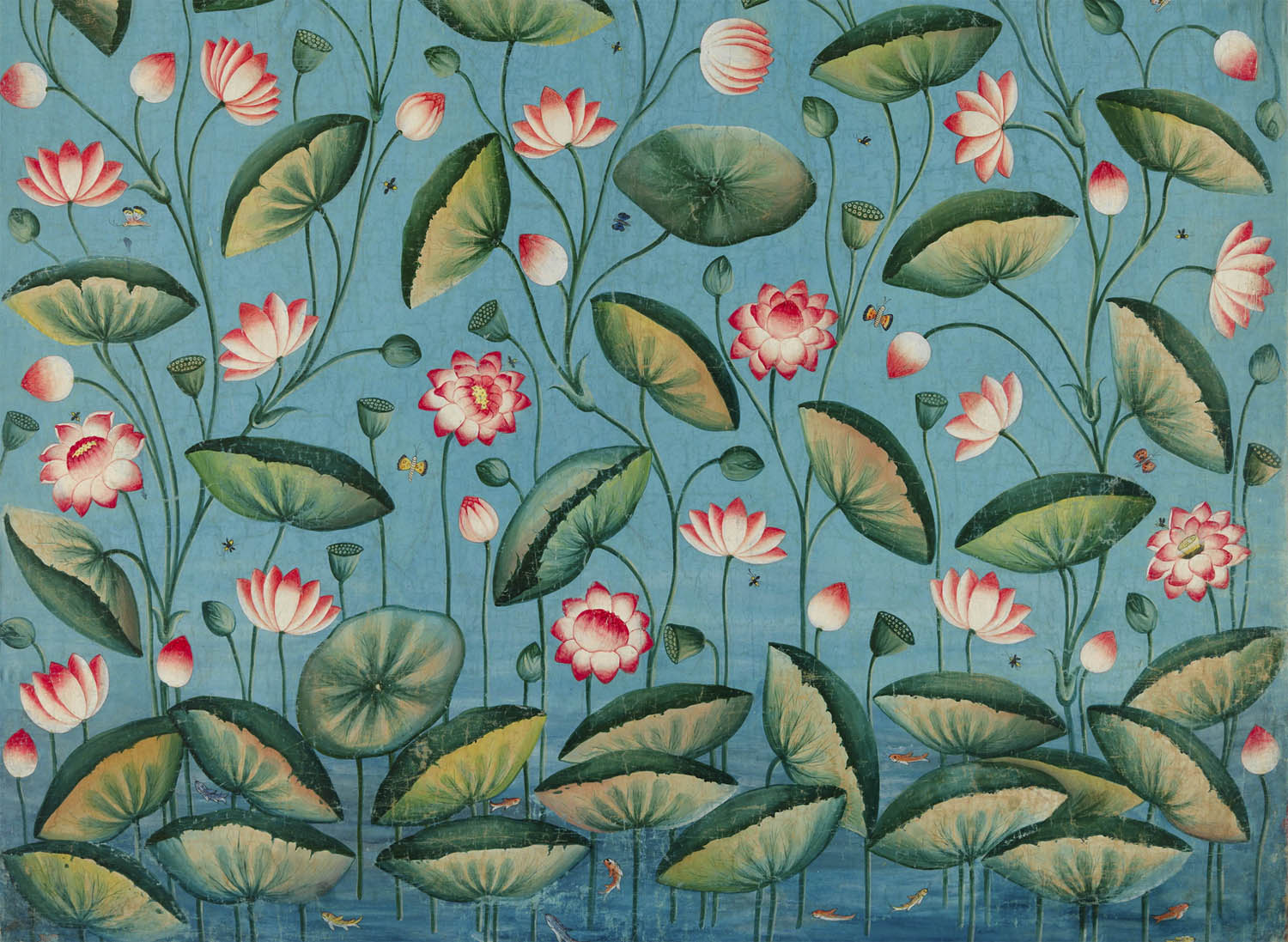
India
Lotus ponds (Kamal Vana) of the Yamuna
1800s
National Gallery of Australia, Canberra
Purchased 2009
In this pichhavai, lotus blooms and images of fish and insects play against the blue background of the Yamuna River. The sacred Yamuna winds through the landscape in which the legendary Krishna spent his childhood and youth. This jal vihara, water games, image commemorates the hot summer days when Krishna played in the river with the milkmaids, gopis, of his village. Hangings of this type are shown behind sculptures of Krishna, dressed in diaphanous muslin, to cool and comfort the deity.
Text from the National Gallery of Australia website
Pichhwai (also pichwai, pichhavai, pichhvai, pechhavai etc), literally meaning ‘that which hangs from the back’ from the Sanskrit words “Pichh” means back and “wais” means hanging, are large devotional Hindu painted pictures, normally on cloth.
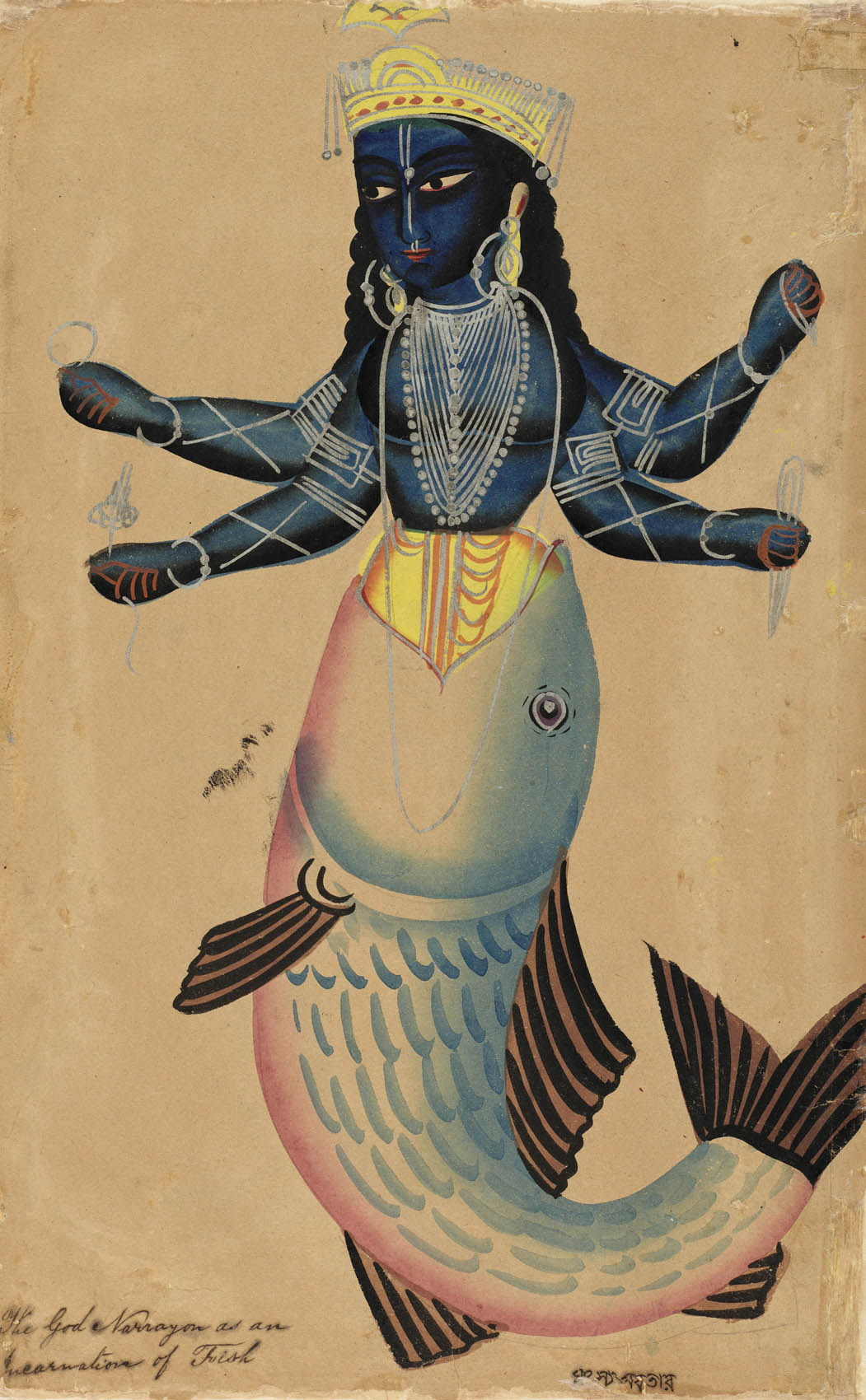
India, Kalighat style
Matsya, the fish incarnation of Vishnu
1880-1899
Watercolour with silver paint on paper
42.5 x 27.3cm
Art Gallery of New South Wales
Purchased 1959
Matsya is the first primary fish incarnation (avatar) of the Hindu god Vishnu, who saved King Manu, the sacred Vedas, and seeds of life from a great universal flood.
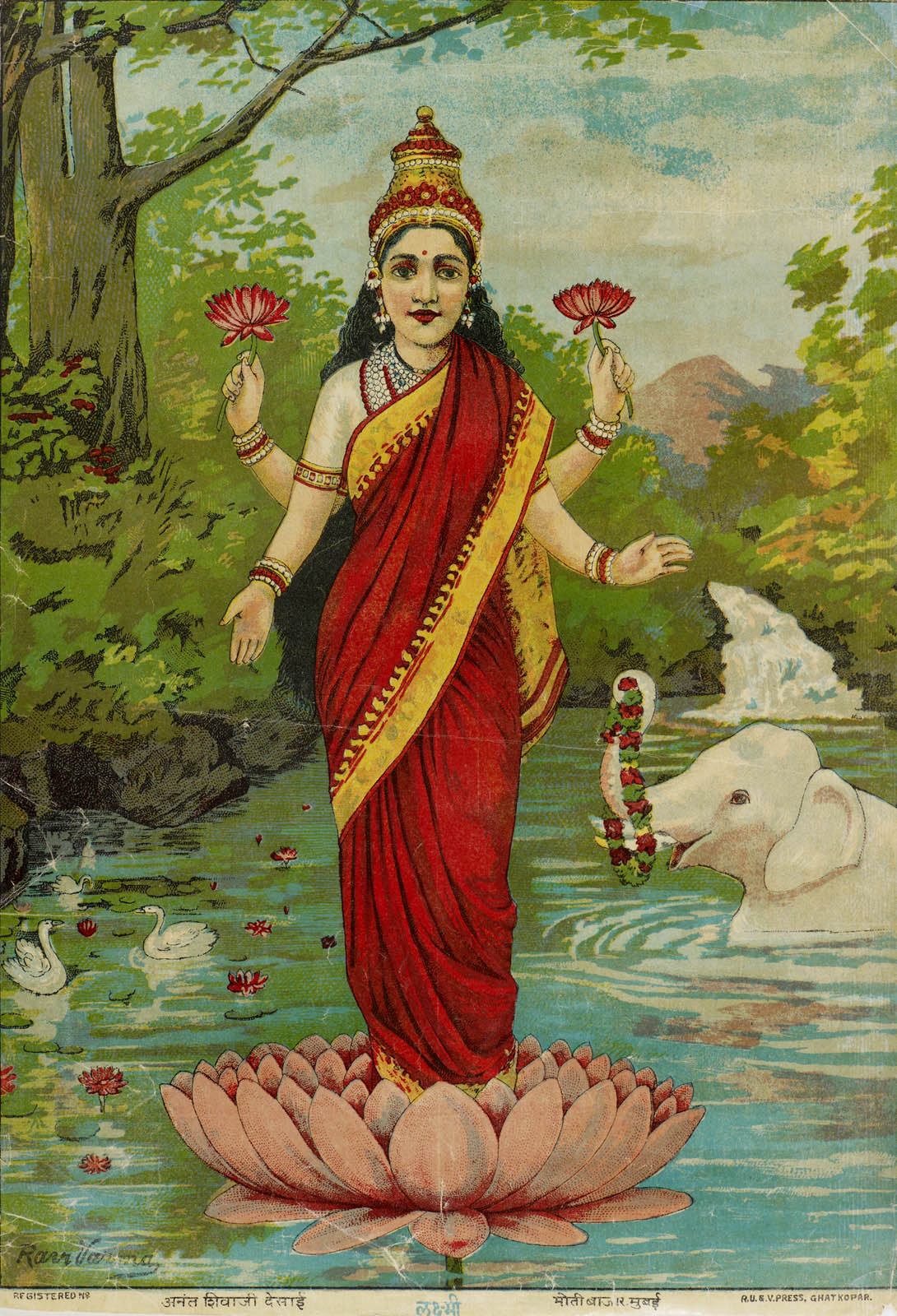
Ravi Varma Press (India, 1894-1972)
Lakshmi
Designed 1894, printed early 1900s
Chromolithograph
35.8 x 25cm
Art Gallery of New South Wales
Gift of Dr Jim Masselos 2011
Image © Art Gallery of New South Wales
Lakshmi is the Hindu goddess of wealth, good fortune, and beauty, best known as the consort of Lord Vishnu and the central deity celebrated during the festival of Diwali.
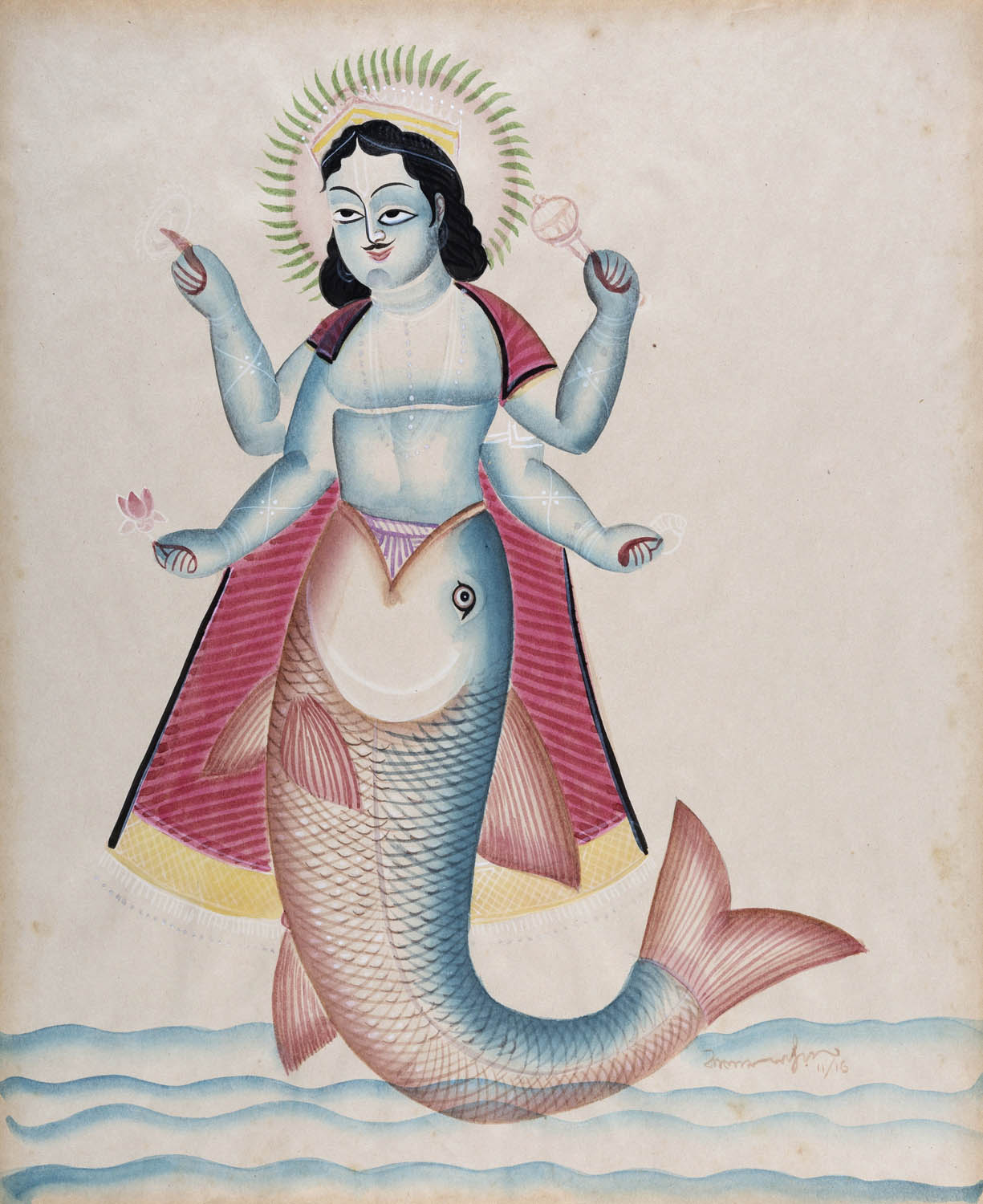
Kalam Patua (Indian, b. 1962)
One of ‘Dashāvatara (Ten Avatars)’
2015-2016
Watercolour and silver pigment on paper
Each 41 x 33cm
Courtesy of Museum of Art and Photography (MAP), Bengaluru
© Kalam Patua
Kalam Patua is a contemporary exponent of Kalighat painting. He was born into the Patua community of scroll painters and storytellers and subsequently taught himself the Kalighat style, which draws on conventions from West Bengal scroll paintings and Indian miniature painting. Kalighat painting developed in the vicinity of the Kali temple in Kolkata in the mid nineteenth century and departs from the linear, narrative style of the scrolls to focus on single scenes, with graphic, simplified forms and often satirical, contemporary content. Patua’s watercolours include elements of autobiography and myth, and reflect on social issues or current news events. This has included the changing nature of Indian society, dowry deaths, or violence against women, but also light, humorous works such as a series about working in the postal system, or depicting crowds that gather at art gallery openings.
Text from the QAGOMA website
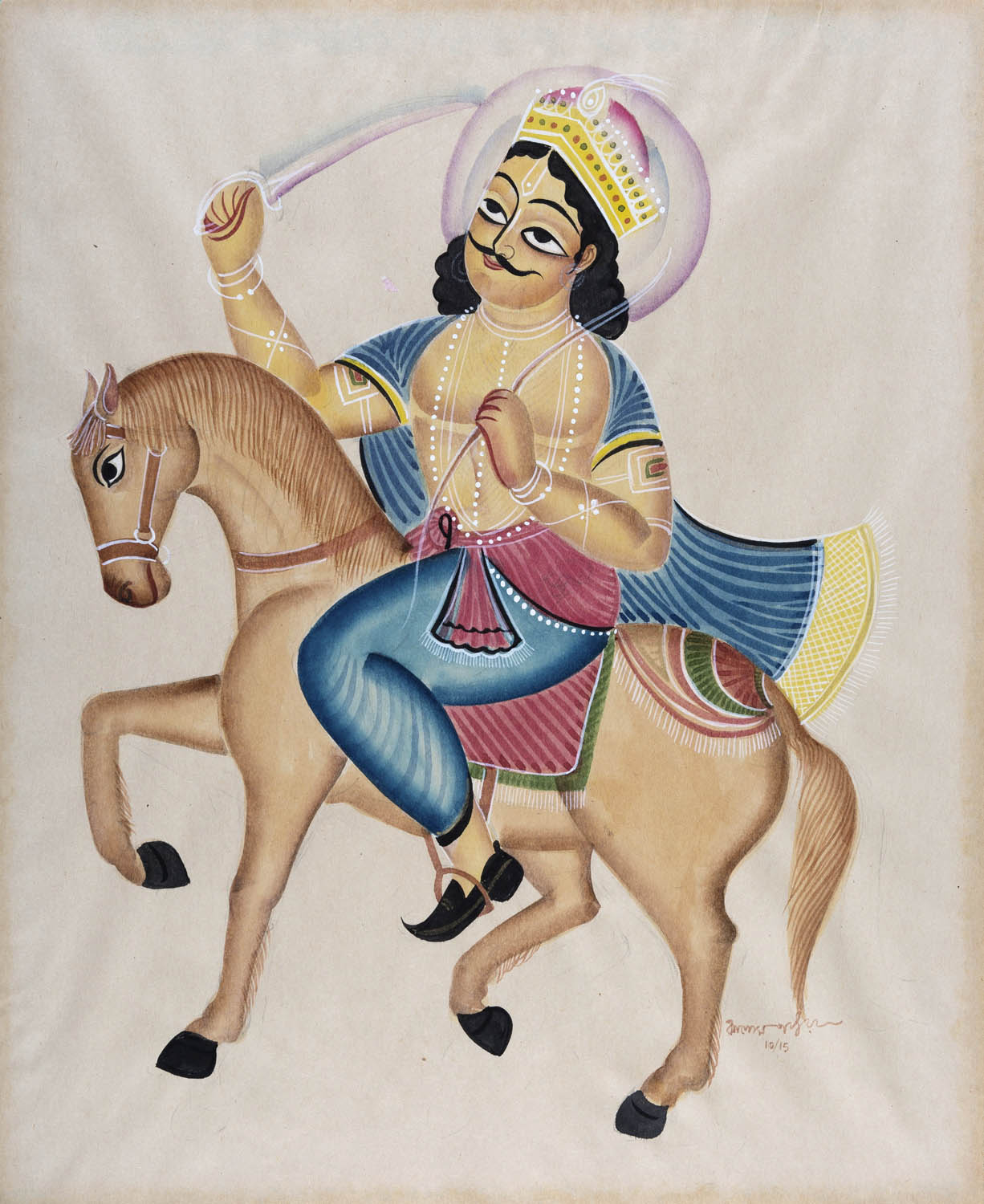
Kalam Patua (Indian, b. 1962)
One of ‘Dashāvatara (Ten Avatars)’
2015-2016
Watercolour and silver pigment on paper
Each 41 x 33cm
Courtesy of Museum of Art and Photography (MAP), Bengaluru
© Kalam Patua
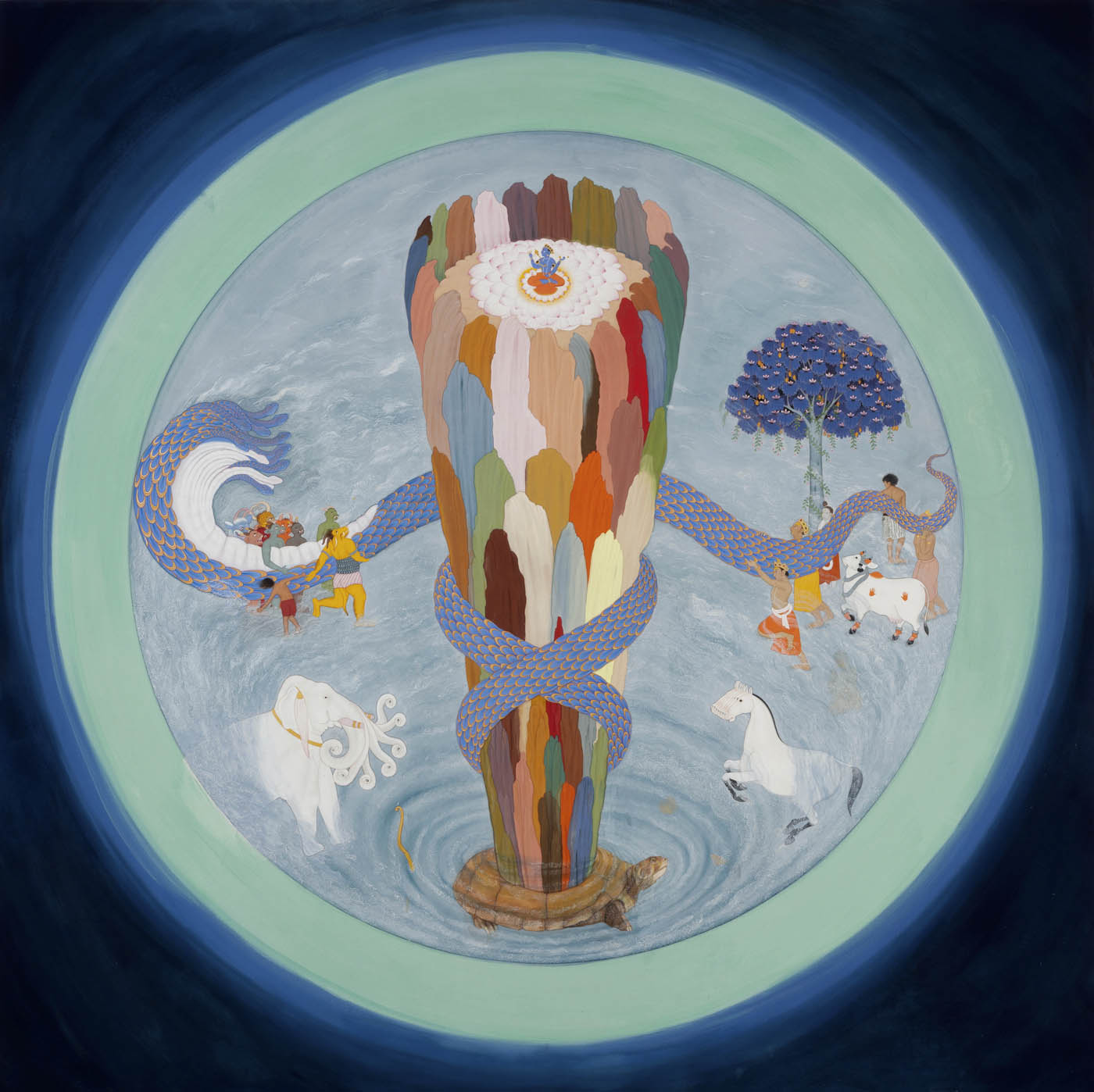
Desmond Lazaro (Australia, India, England, b. 1968)
Samudra Manthana, Churning of the Ocean of Milk
2026
Natural pigments and gold on birch board
200 x 200cm
Courtesy of the artist
© Desmond Lazaro
Samudra Manthana is a famous story in Hindu writing. Gods and demons worked together to churn the cosmic ocean of milk to get Amrita, the sweet drink of eternal life.
To churn the ocean, the devas and asuras uprooted Mount Mandara – a spur of Mount Meru, the world axis – and used it as a churning stick. Vishnu, in his avatar (incarnation) as the tortoise Kurma, supported the mountain on his back to keep it from sinking into the ocean. The asuras held the head of the naga (half-human, half-cobra) Vasuki, who was procured as a churning rope, and the devas held Vasuki’s tail.
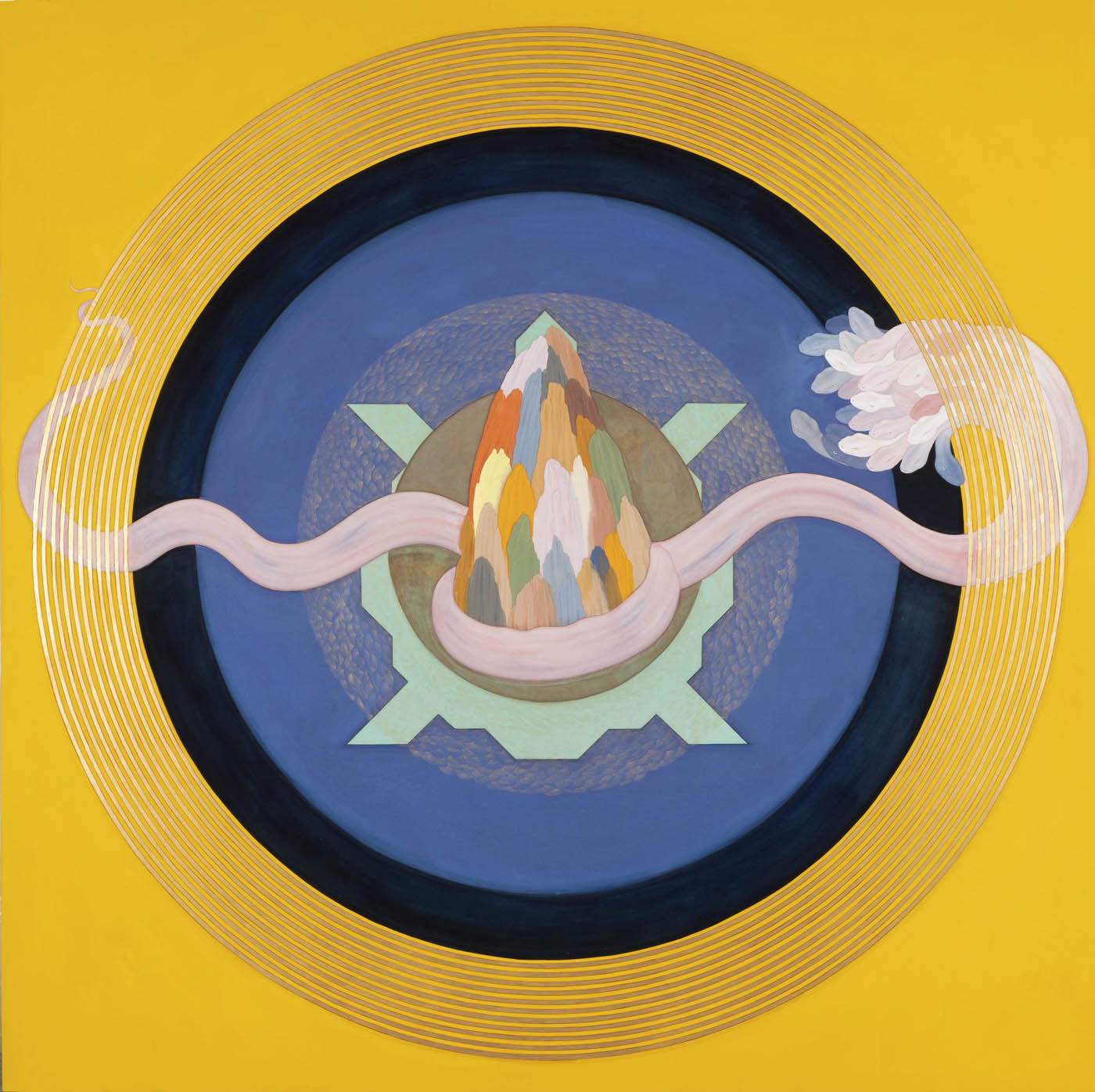
Desmond Lazaro (Australia, India, England, b. 1968)
Mount Mandara
2026
Natural pigments and gold on birch board
200 x 200cm
Courtesy of the artist
© Desmond Lazaro
The name of the mountain that appears in the Samudra Manthana episode in the Hindu Puranas, where it was used as a churning rod to churn the ocean of milk.
Art Gallery of New South Wales
Art Gallery Road, The Domain
Sydney NSW 2000, Australia
Opening hours:
Open every day 10am – 5pm
except Christmas Day and Good Friday
Art Gallery of New South Wales website


You must be logged in to post a comment.