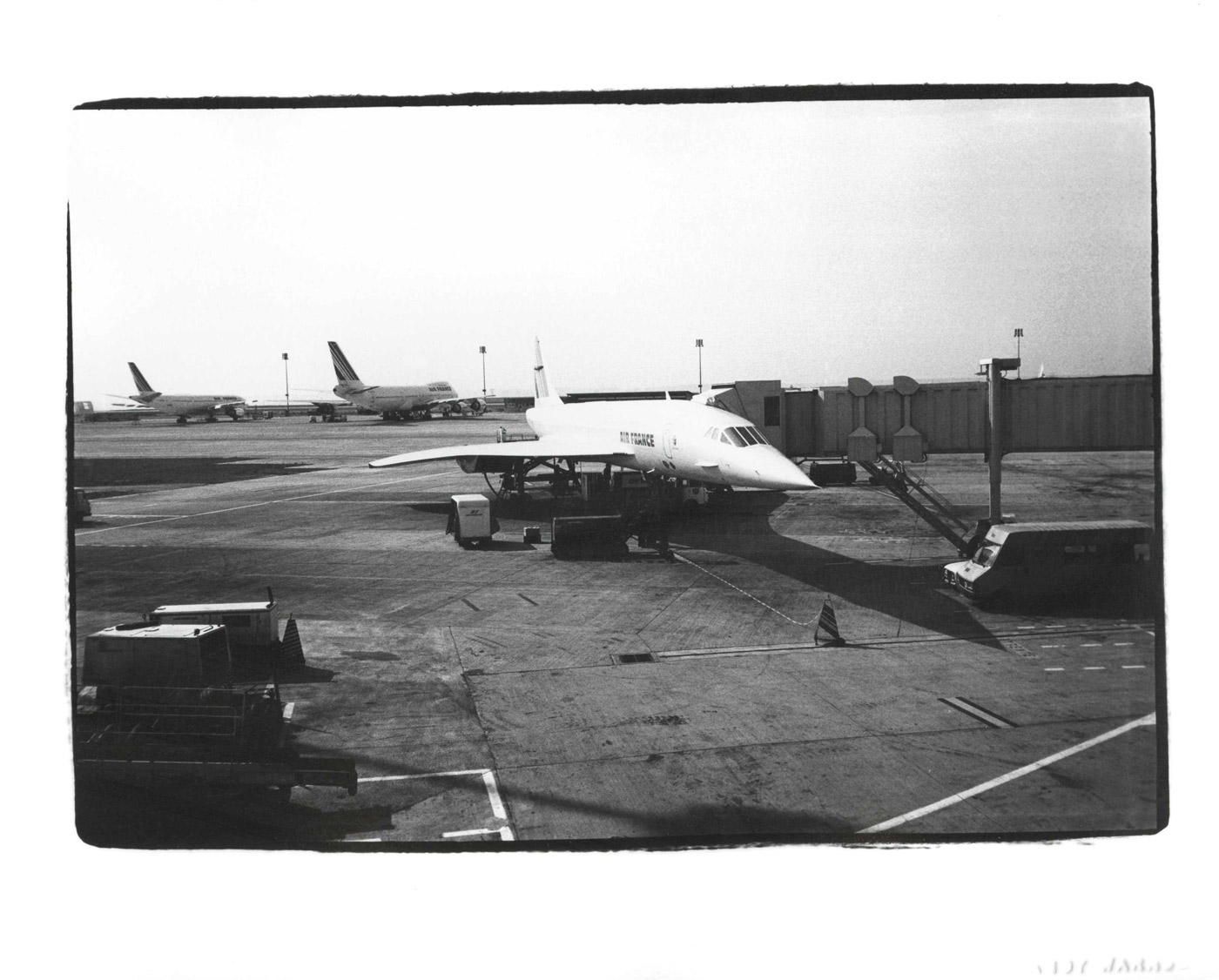
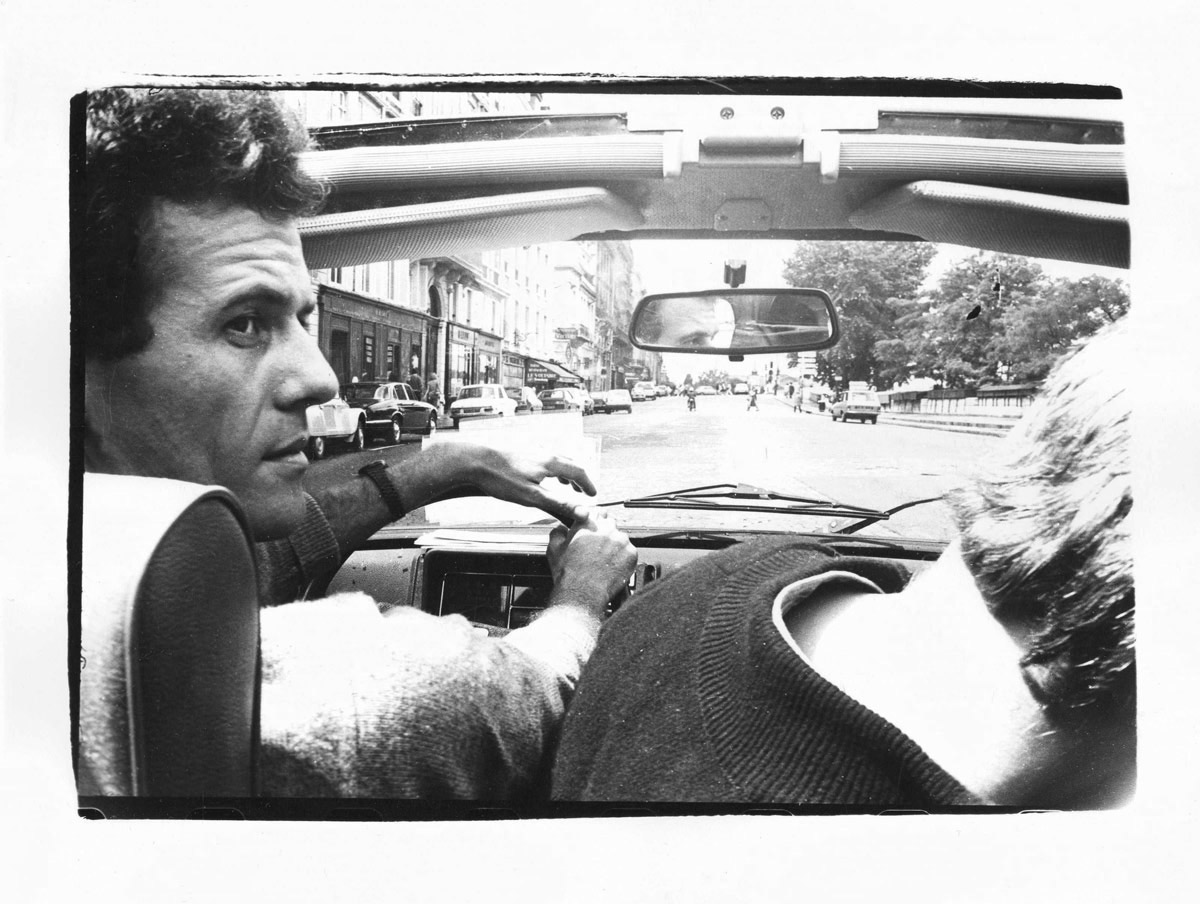
Andy Warhol (American, 1928-1987) Air France Jun 21 1982 Unique gelatin silver print 8 x 10 in. (20.3 x 25.4cm)
Andy Warhol being, well … Andy Warhol.
Artist, tourist, celebrity, poofter, man about town and spontaneous, thoughtful snapper. The photograph of the Prado at night is superb as are the multiple, stitched together photographs. Warhol certainly loved his high key, 35mm images.
Marcus
Please click on the photographs for a larger version of the image.
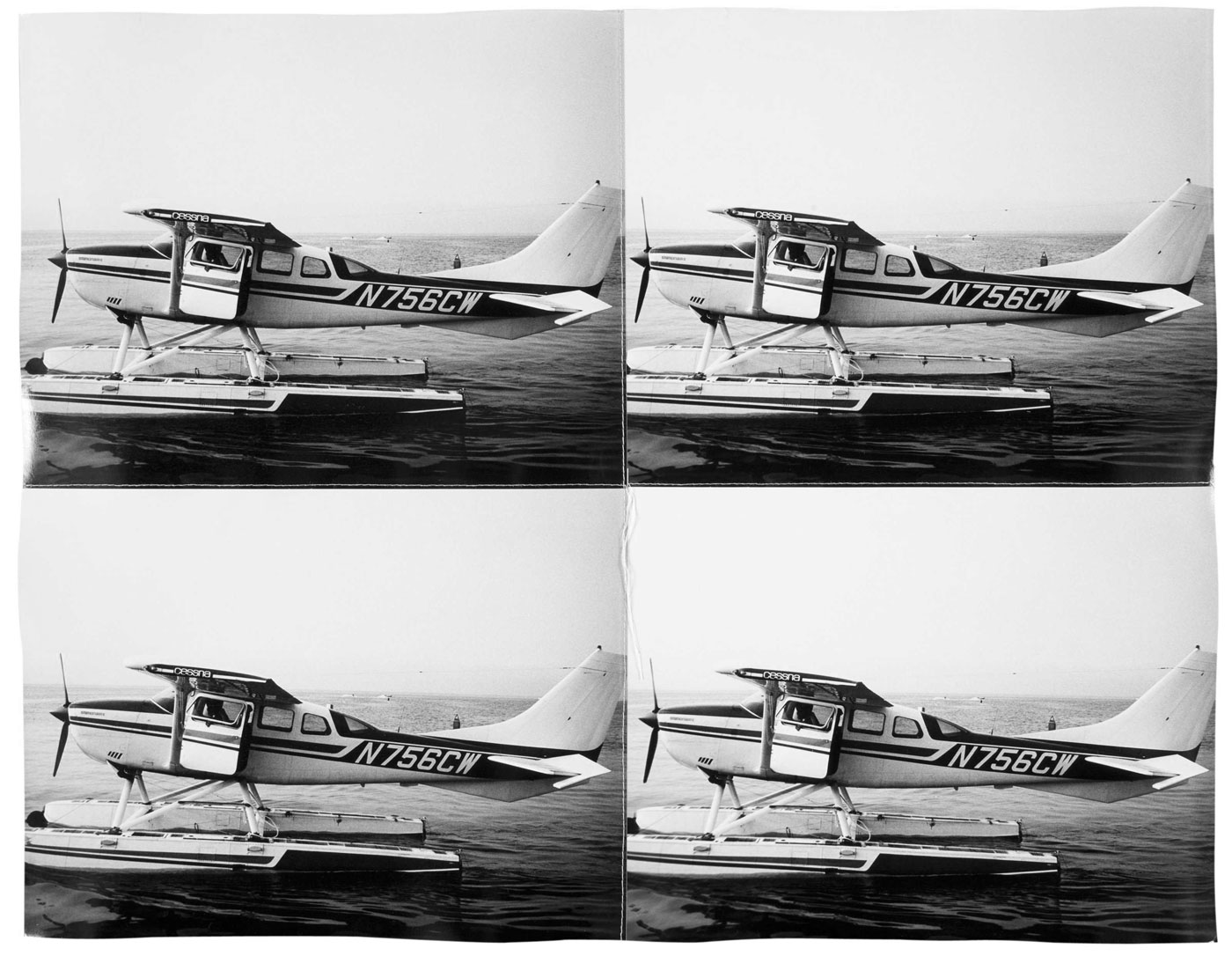
Andy Warhol (American, 1928-1987) Cessna Plane c. 1977 Four stitched gelatin silver prints Each: 11 x 14 in. (27.9 x 35.6cm) Overall: 2 1 1/4 x 27 3/8 in. (54 x 69.5cm)
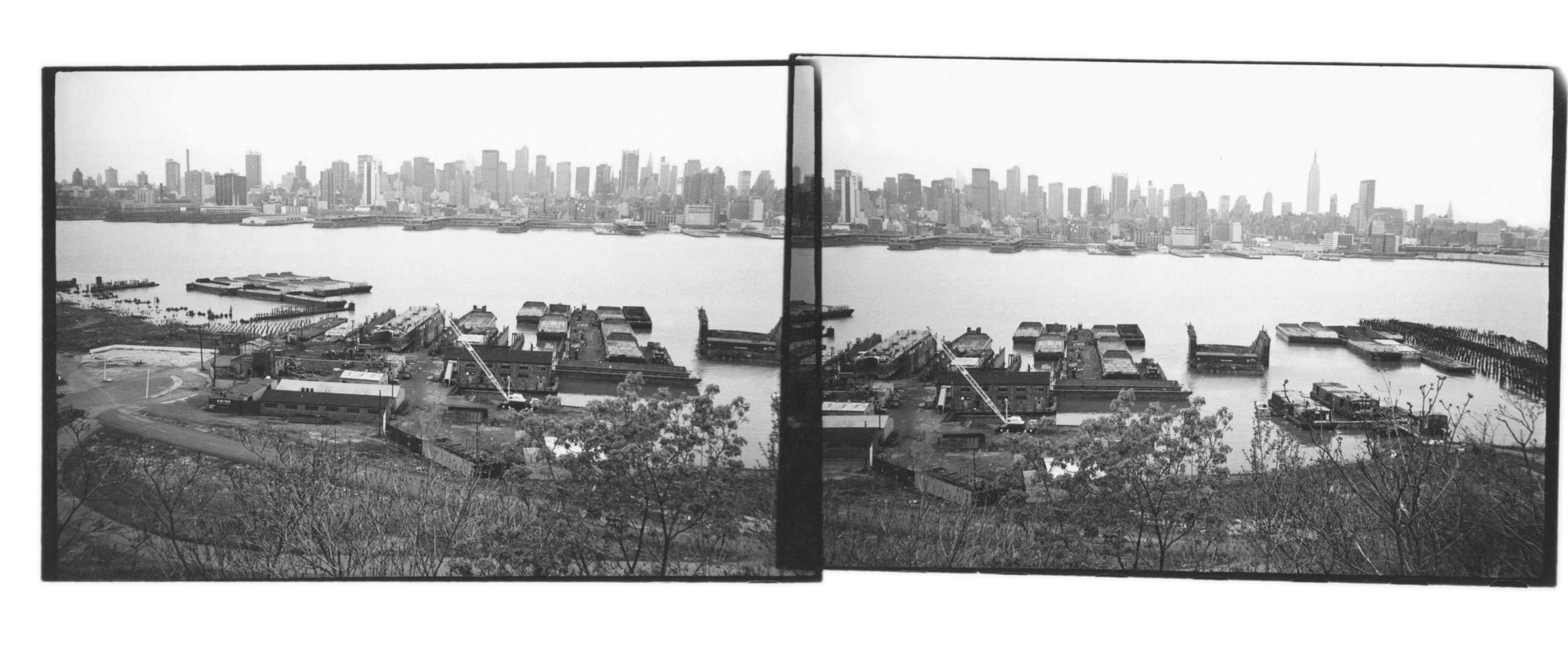
Andy Warhol (American, 1928-1987) City View May 07 1984 Unique gelatin silver print 8 x 10 in. (20.3 x 25.4cm)
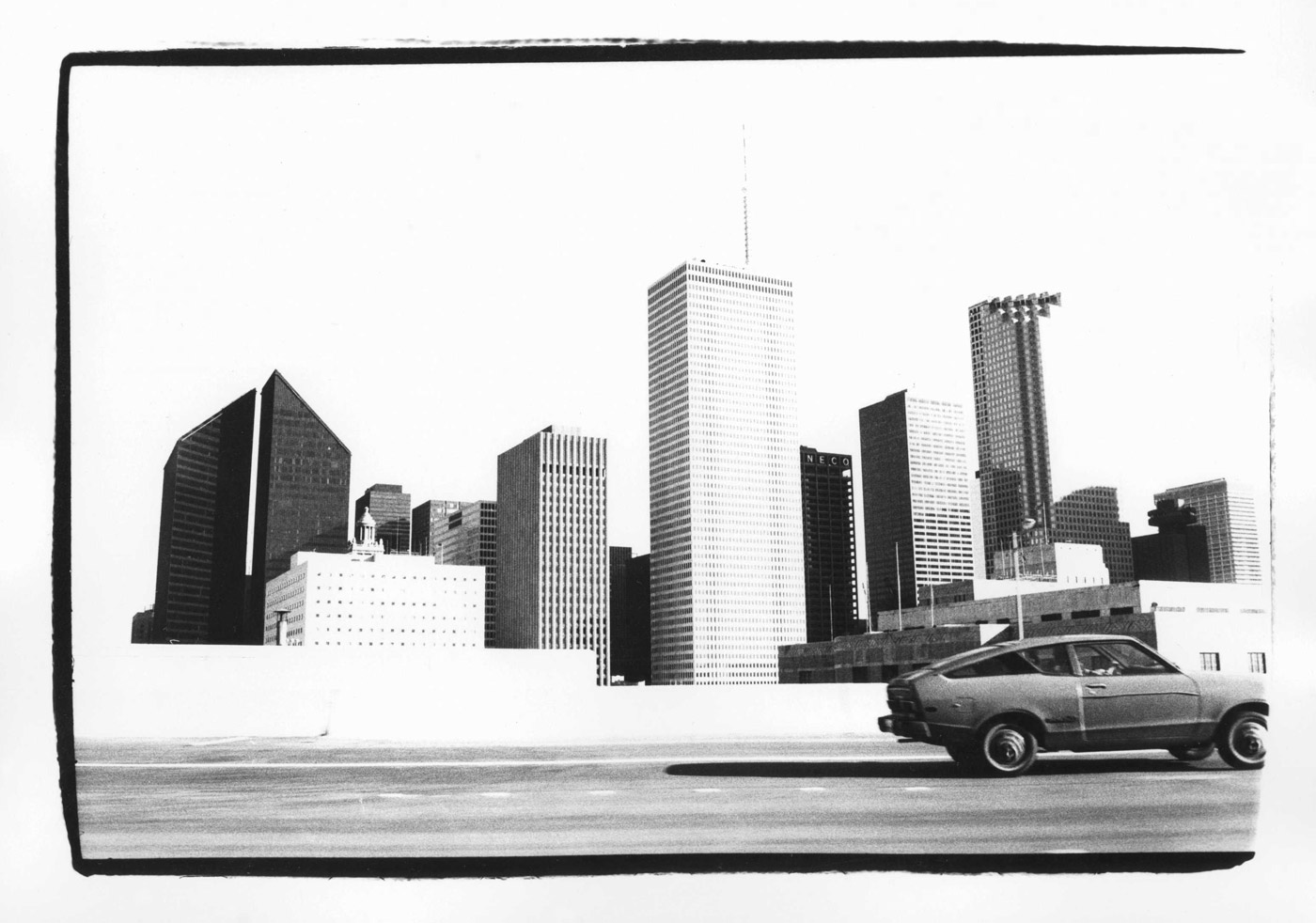
Andy Warhol (American, 1928-1987) Houston Skyline c. 1979 Unique gelatin silver print 8 x 10 in. (20.3 x 25.4cm)
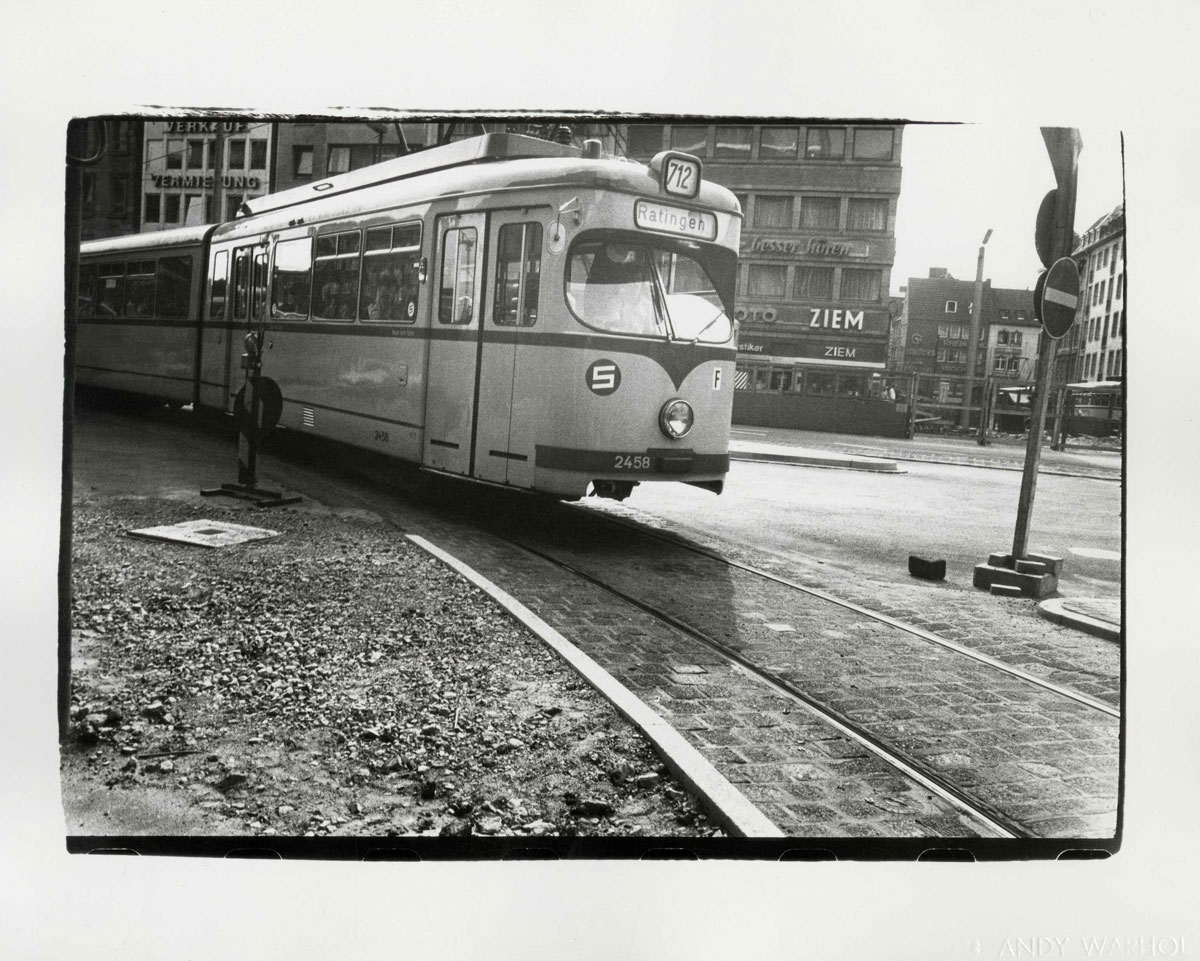
Andy Warhol (American, 1928-1987) German Trolley Jun 23 1980 Unique gelatin silver print 8 x 10 in. (20.3 x 25.4cm)
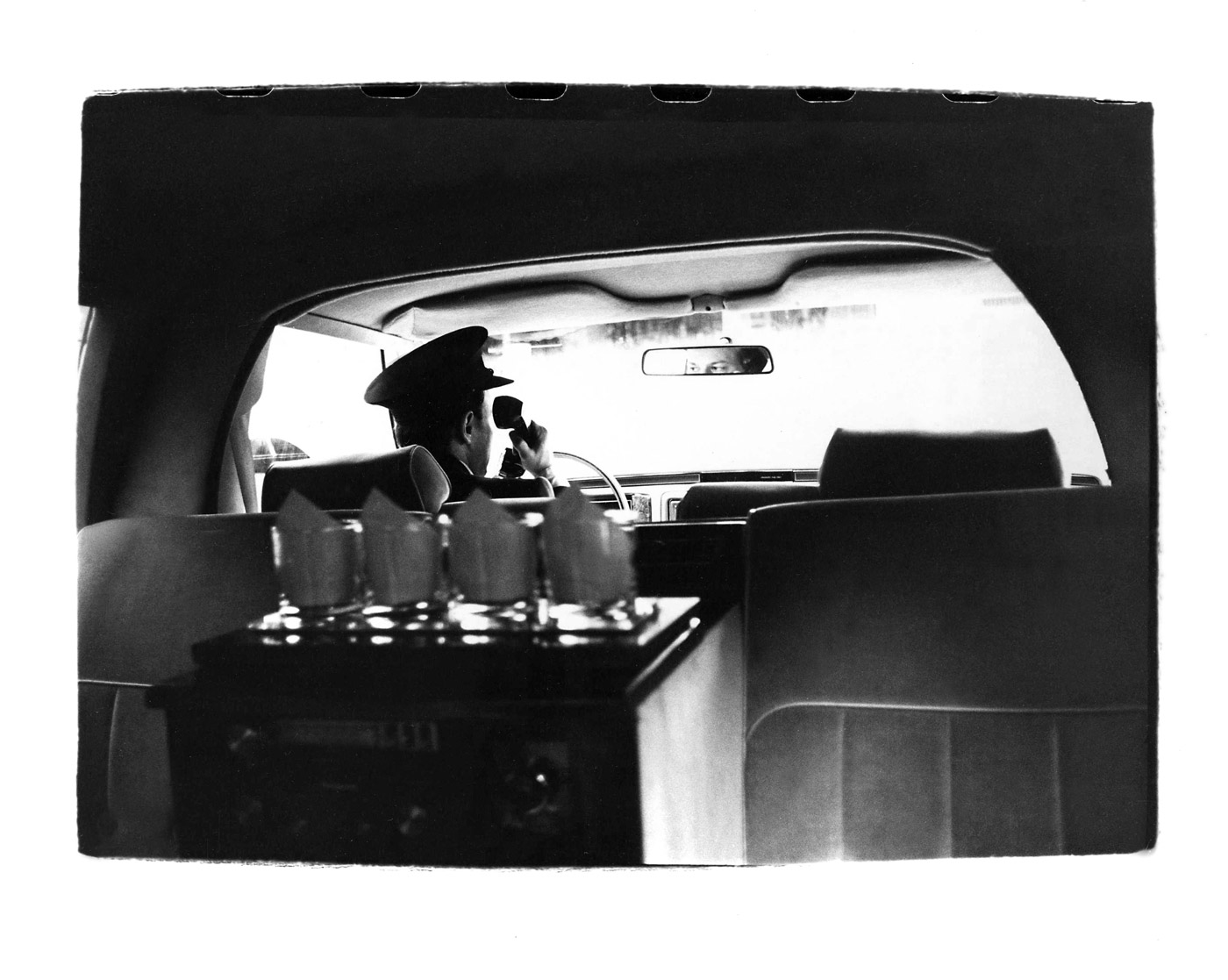
Andy Warhol (American, 1928-1987) Limousine Interior c. 1980 Unique gelatin silver print 8 x 10 in. (20.3 x 25.4cm)
Andy Warhol (American, 1928-1987) Luxor Temple c. 1977 Two unique gelatin silver prints Each: 8 x 5 in. (20.3 x 12.7cm)
Andy Warhol (American, 1928-1987) Luxor Temple (detail) c. 1977 Two unique gelatin silver prints Each: 8 x 5 in. (20.3 x 12.7cm)
Andy Warhol (American, 1928-1987) Ocean Landscape 1986 Four stitched gelatin silver prints Each: 11 x 14 in. (27.9 x 35.6cm) Overall: 2 1/4 x 27 1/2 in. (54 x 69.9cm)
Andy Warhol (American, 1928-1987) Statues Outside Musée D’Orsay c. 1980 Unique gelatin silver print 8 x 10 in. (20.3 x 25.4cm)
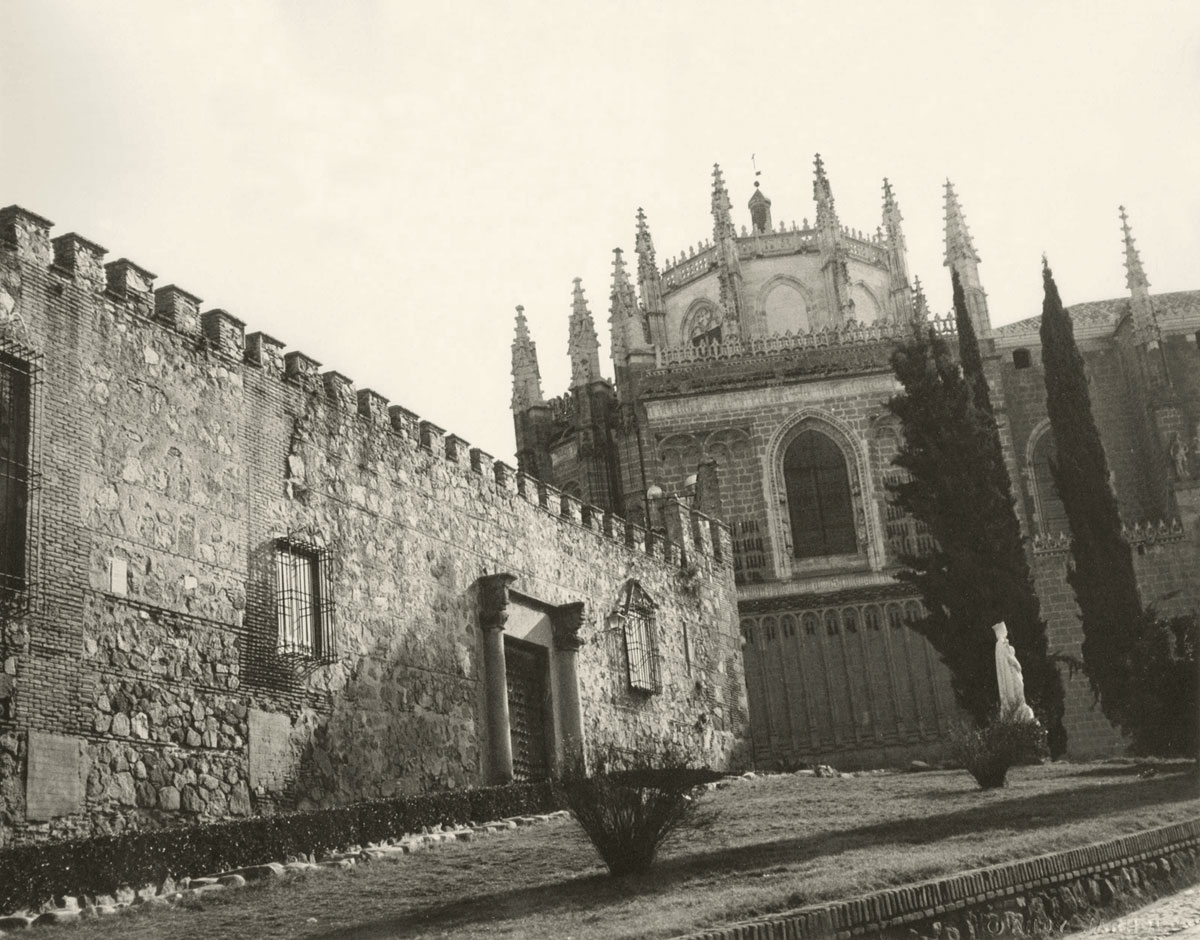
Andy Warhol (American, 1928-1987) Monastery of Saint John of the Kings, Toledo Jan 24 1983 Unique gelatin silver print 8 x 10 in. (20.3 x 25.4 cm)
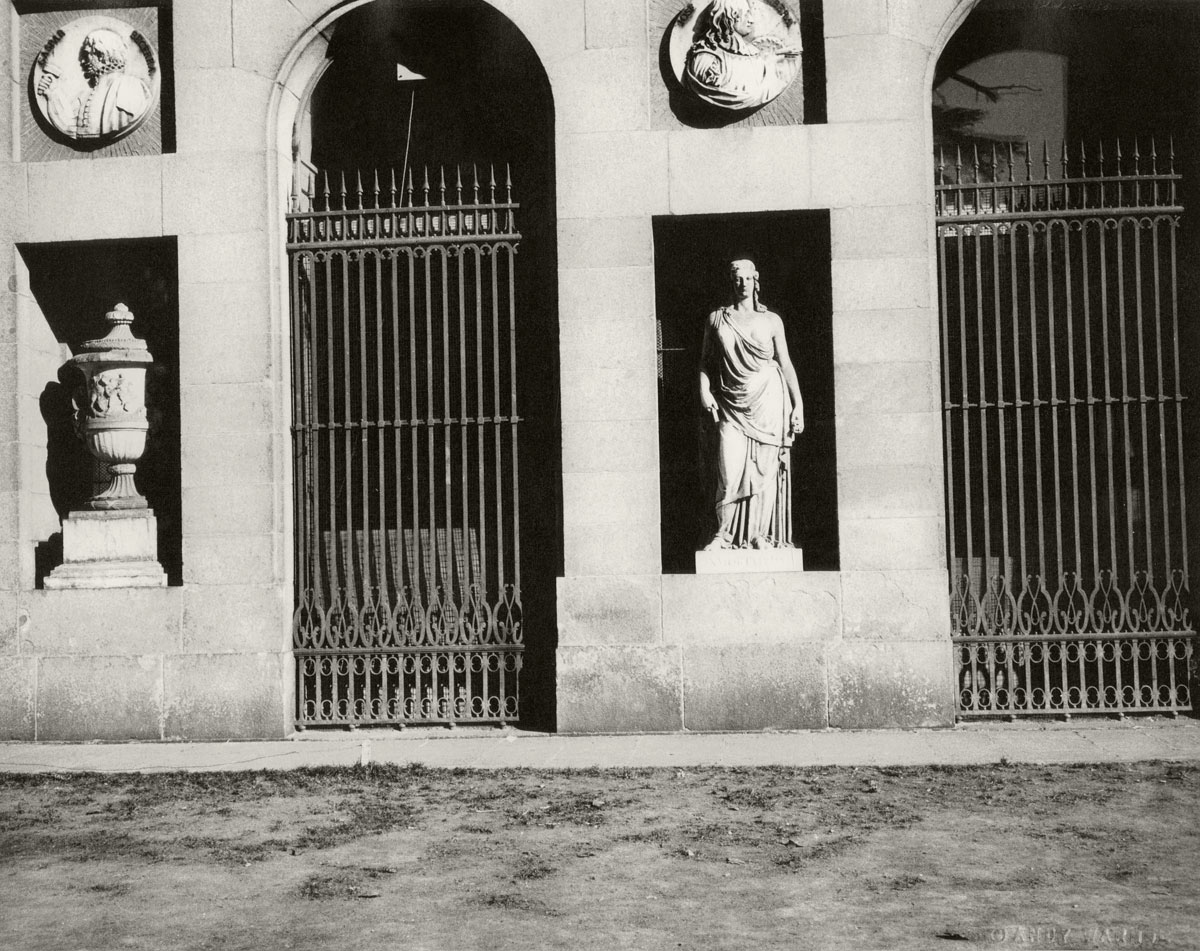
Andy Warhol (American, 1928-1987) Museo del Prado Exterior, Madrid, Spain Jan 24 1983 Unique gelatin silver print 8 x 10 in. (20.3 x 25.4cm)
Andy Warhol (American, 1928-1987) Spanish Portico Jan 24 1983 Unique gelatin silver print 8 x 10 in. (20.3 x 25.4cm)
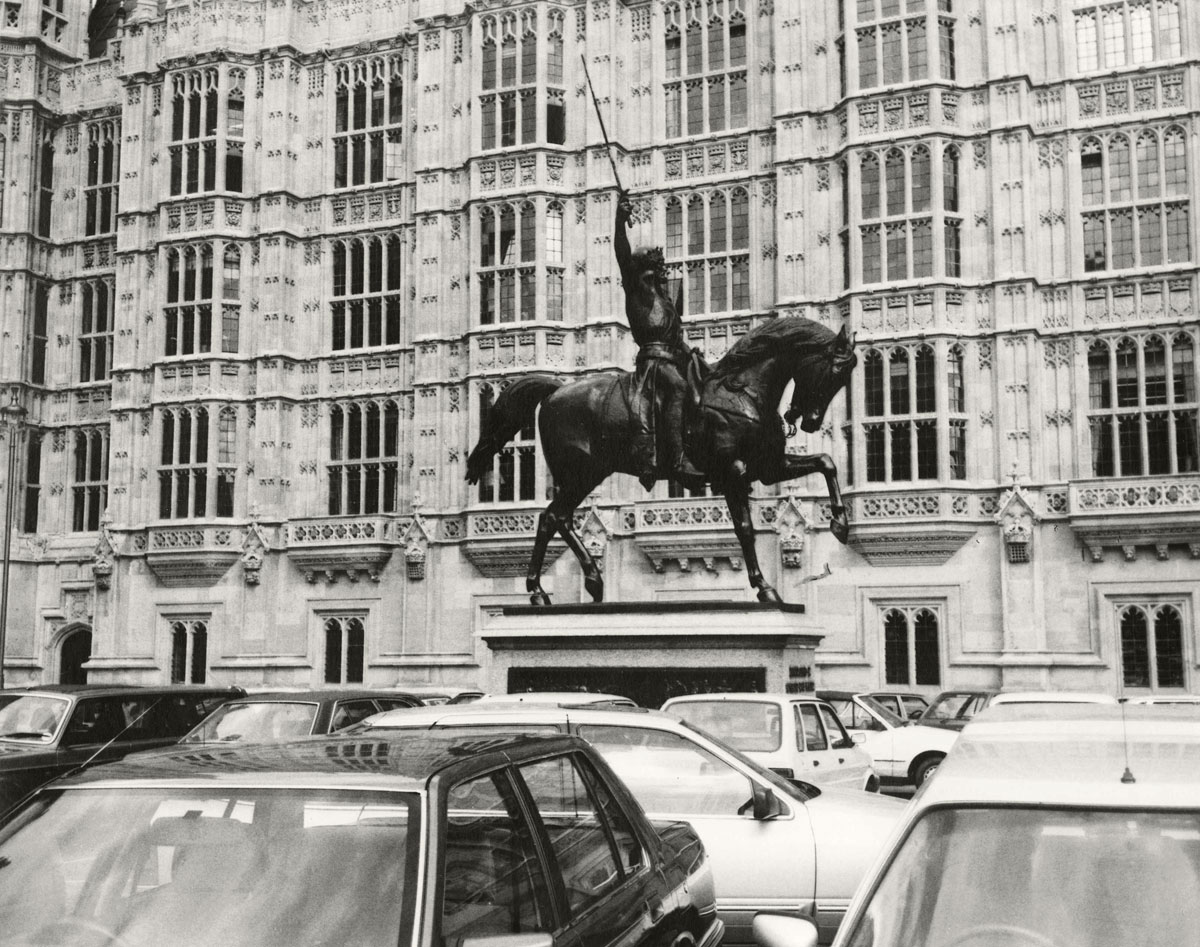
Andy Warhol (American, 1928-1987) Richard Coeur de Lion at Westminster c. 1980 Unique gelatin silver print 8 x 10 in. (20.3 x 25.4cm)
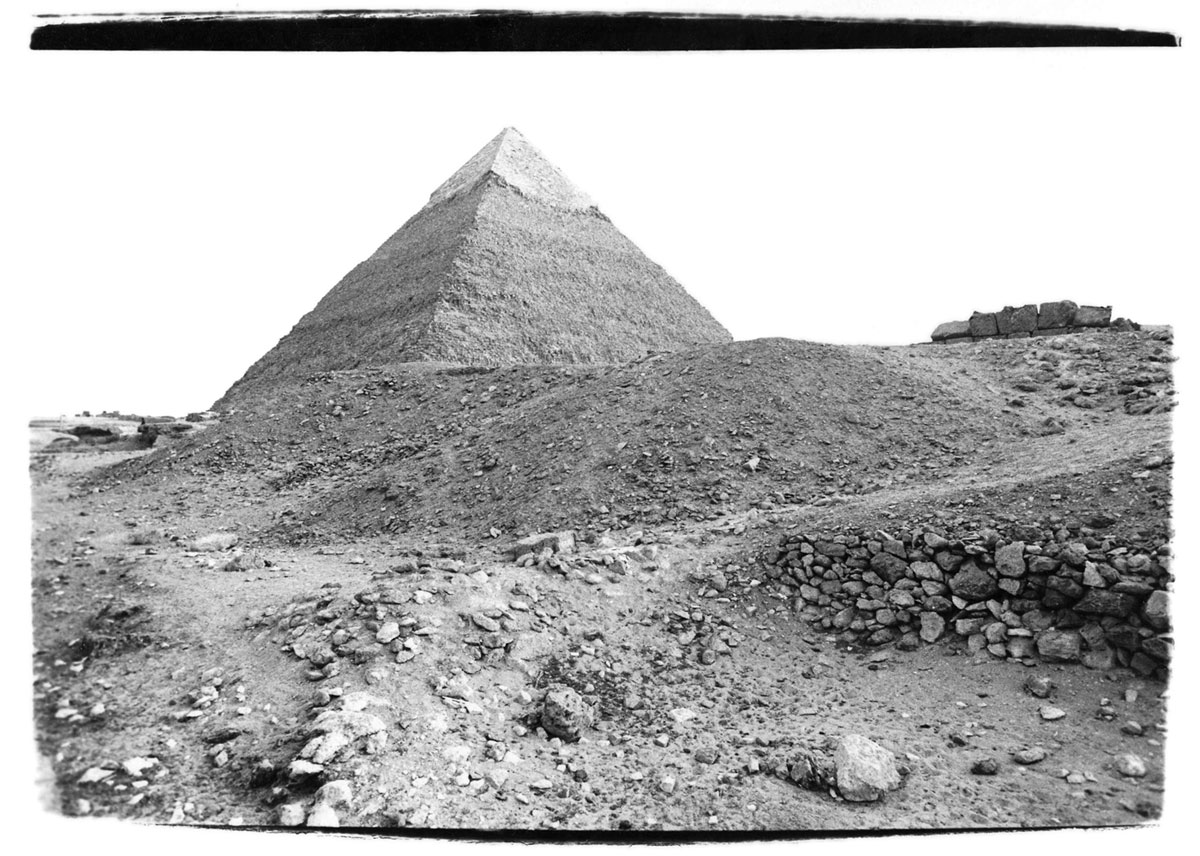
Andy Warhol (American, 1928-1987) Pyramid c. 1977 Unique gelatin silver print 5 x 8 in. (12.7 x 20.3cm)
Andy Warhol (American, 1928-1987) Street Scene c. 1982 Unique gelatin silver print 8 x 10 in. (20.3 x 25.4cm)
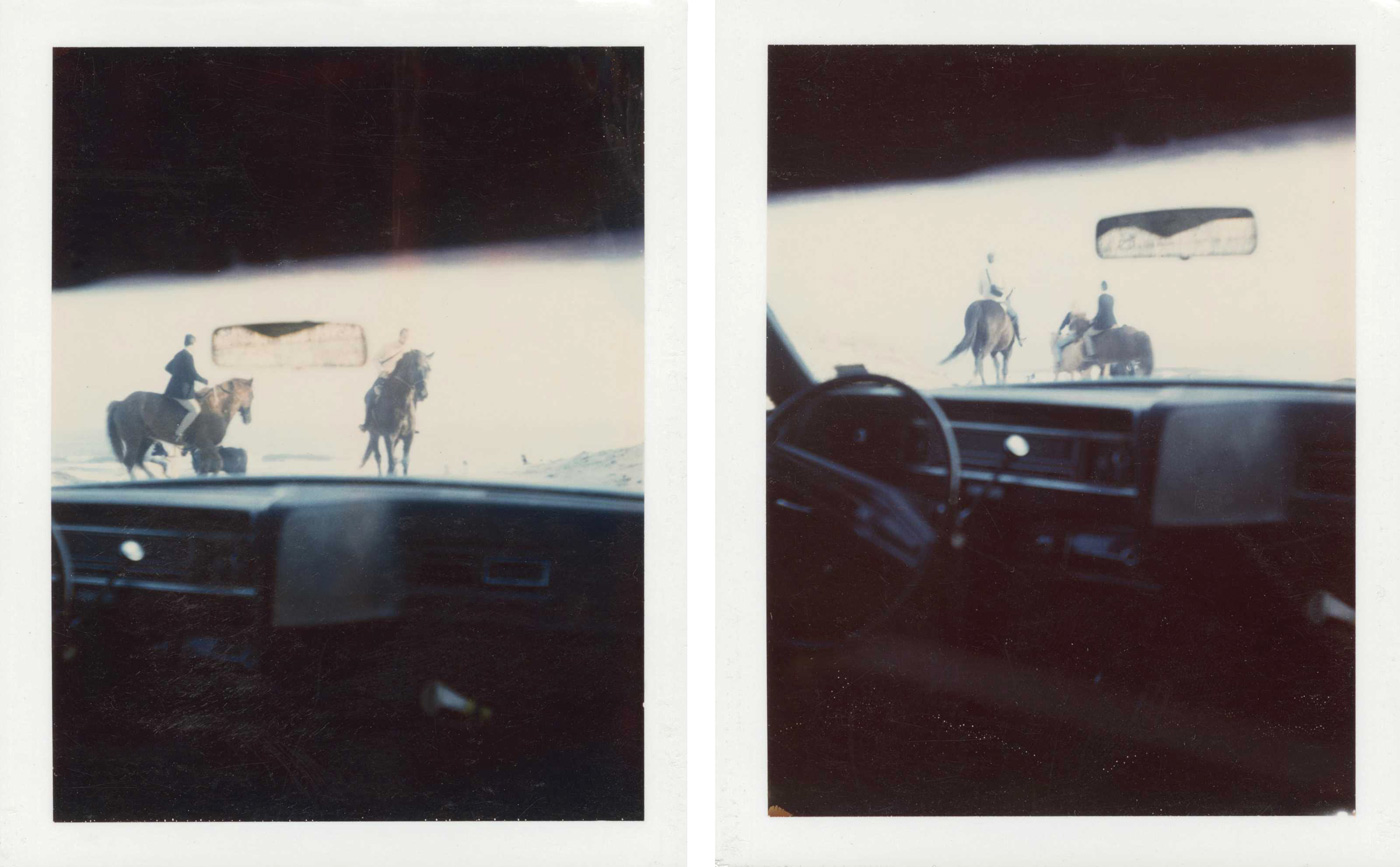
Andy Warhol (American, 1928-1987) Riders from the Car c. 1979 Two unique polaroid prints mounted on board Each: 4 1/4 x 3 3/8 in. (10.8 x 8.6cm)
Andy Warhol (American, 1928-1987) Unidentified Men c. 1980 Unique gelatin silver print 8 x 10 in. (20.3 x 25.4cm)
Andy Warhol (American, 1928-1987) Venetian Canal 1977 Unique gelatin silver print 8 x 10 in. (20.3 x 25.4cm)
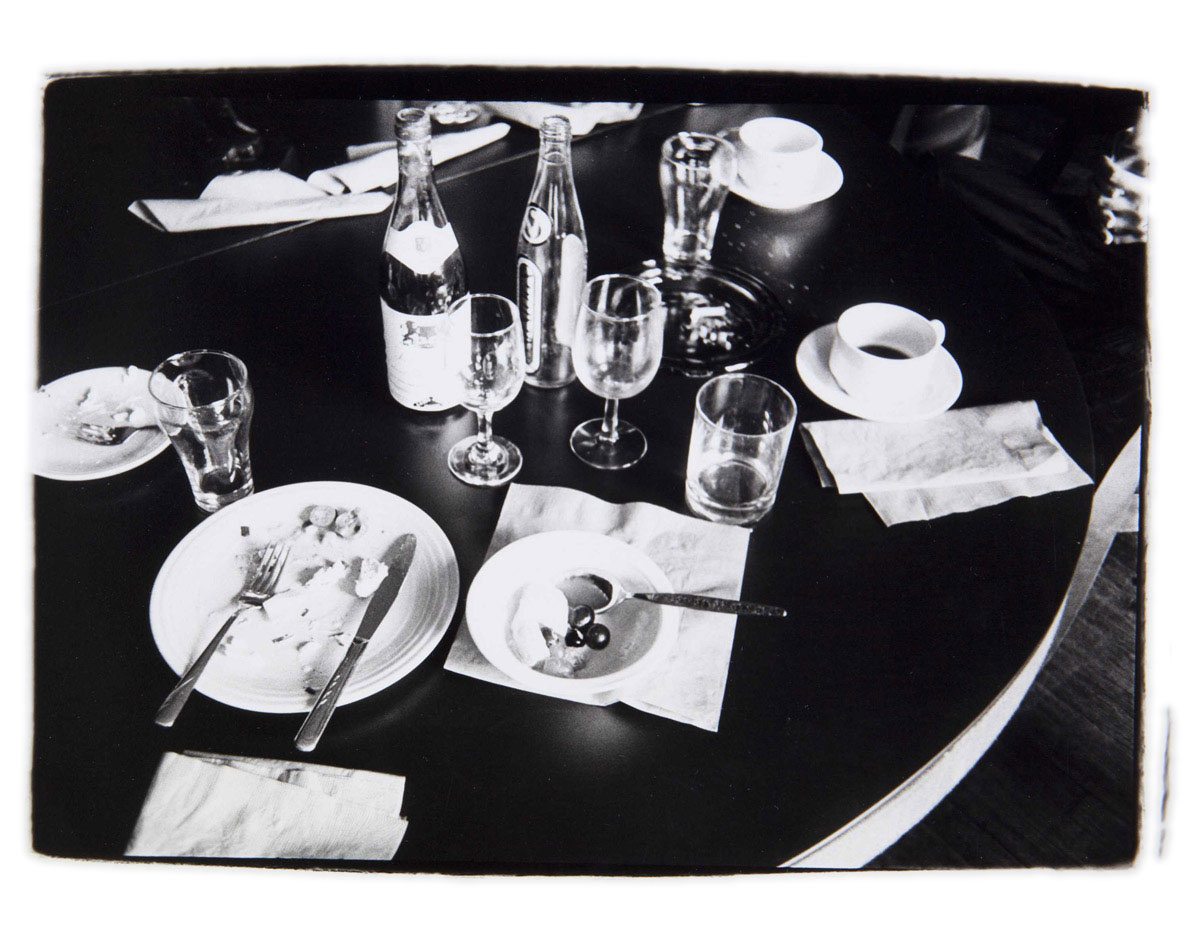
Andy Warhol (American, 1928-1987) Table Setting c. 1980 Unique gelatin silver print 8 x 10 in. (20.3 x 25.4cm)
Andy Warhol (American, 1928-1987) Beach Scene c. 1975 Unique polaroid print 4¼ x 3½ in. (10.8 x 8.8cm)
Andy Warhol (American, 1928-1987) Place de la Concorde c. 1980 Unique gelatin silver print 10 x 8 in. (25.4 x 20.3cm)
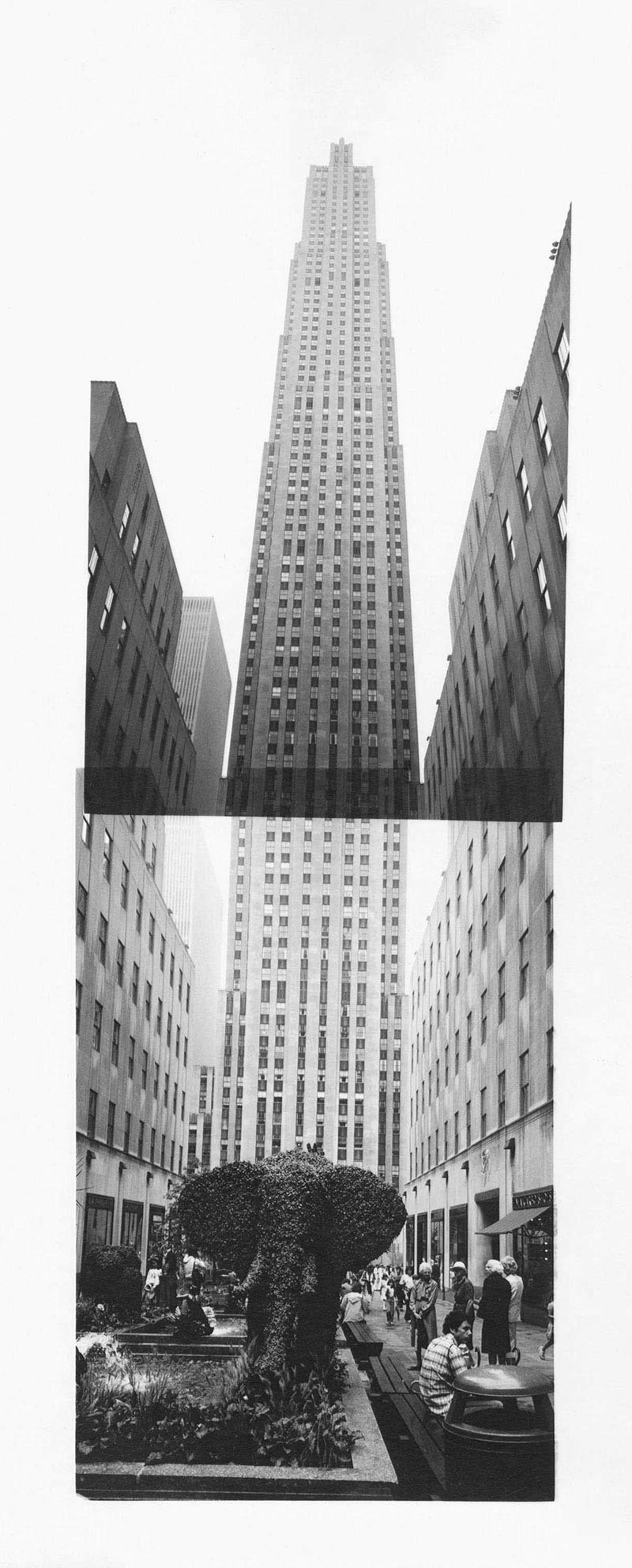
Andy Warhol (American, 1928-1987) Rockefeller Center c. 1984 Unique gelatin silver print 10 x 8 in. (25.4 x 20.3cm)
Andy Warhol (American, 1928-1987) Sears Tower c. 1980 Unique gelatin silver print 10 x 8 in. (25.4 x 20.3cm)
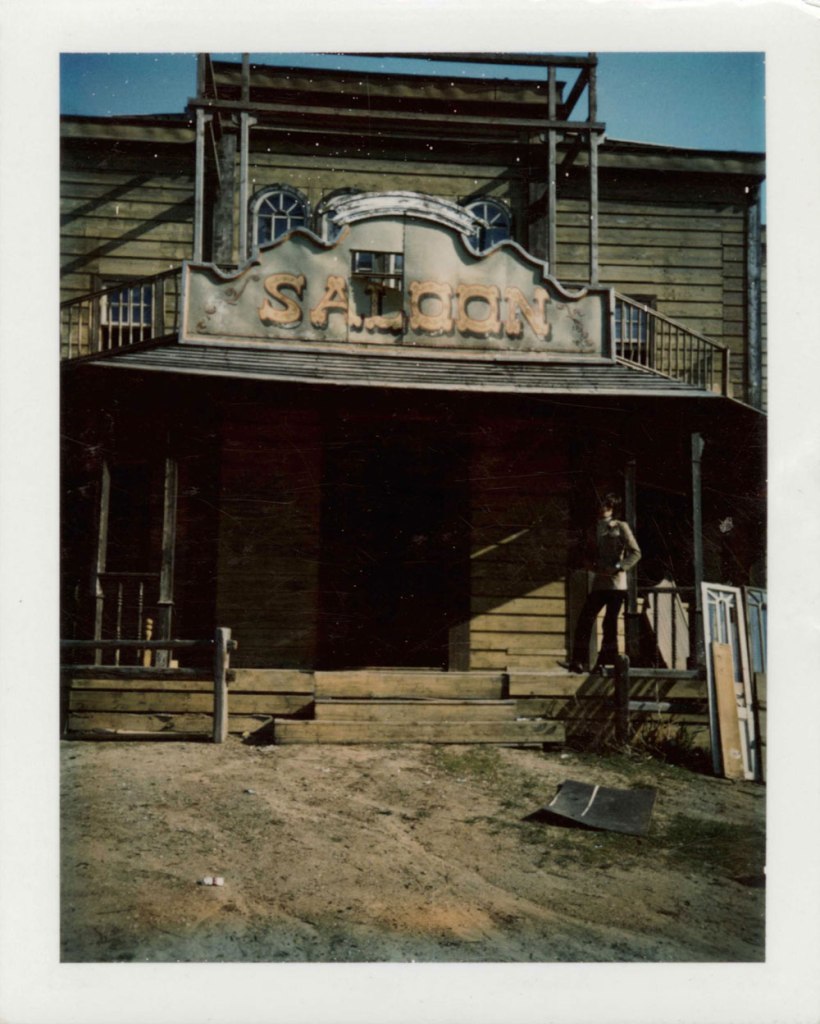
Andy Warhol (American, 1928-1987) Max Delys at the Saloon c. 1980 Unique polaroid print mounted on board 4 1/4 x 3/ 3/8 in. (10.8 x 8.5cm)
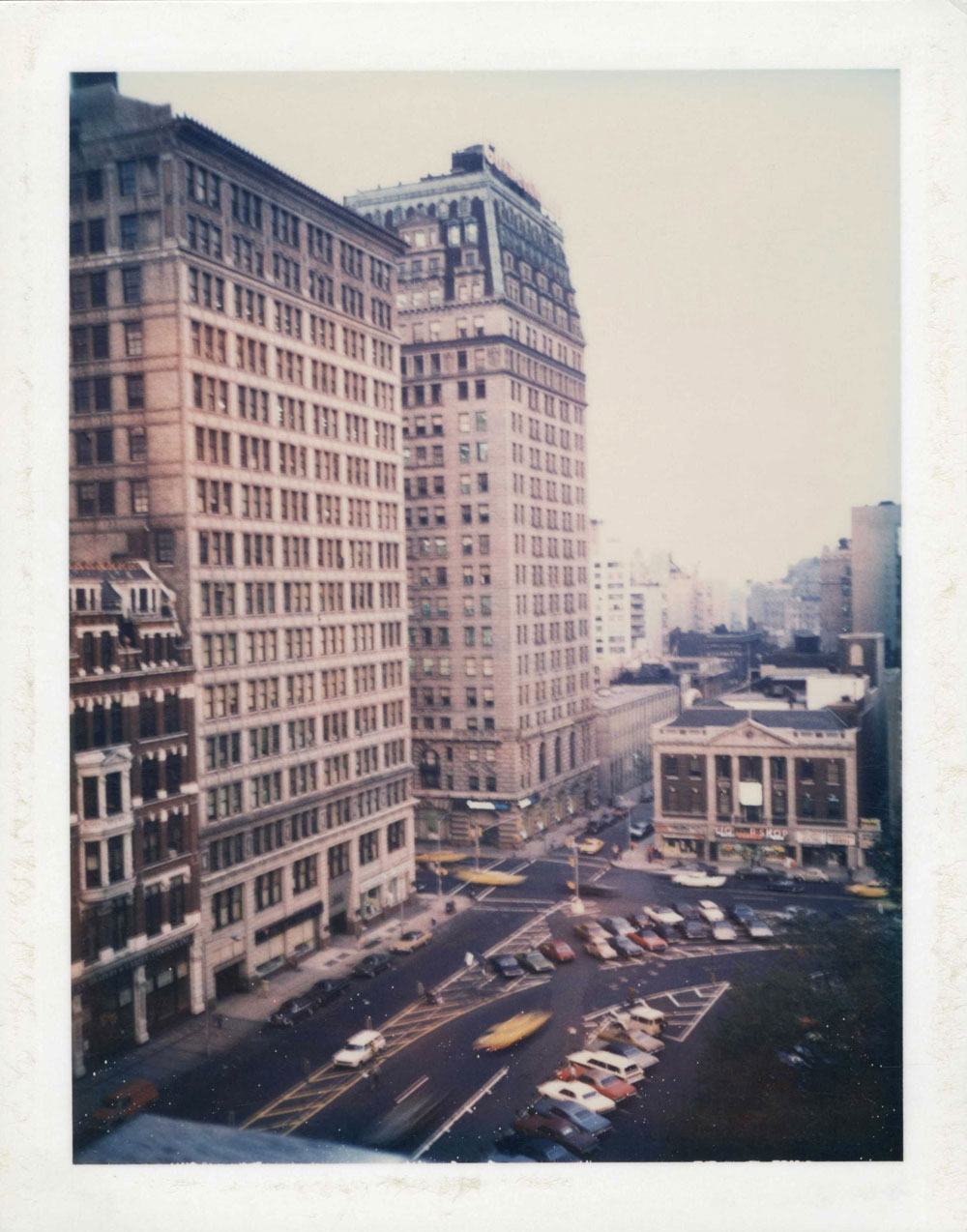
Andy Warhol (American, 1928-1987) Union Square c. 1975 Unique polaroid print 4 1/4 x 3 3/8 in. (10.8 x 8.5cm)
Andy Warhol (American, 1928-1987) Tunnel c. 1980 Unique gelatin silver print 8 x 10 in. (20.3 x 25.4cm)
Curators: Anne Wilkes Tucker, the Gus and Lyndall Wortham Curator of Photography; Will Michels, collections photographer and exhibition co-curator; Natalie Zelt, curatorial assistant
**Please be aware that there are graphic photographs in this posting.**
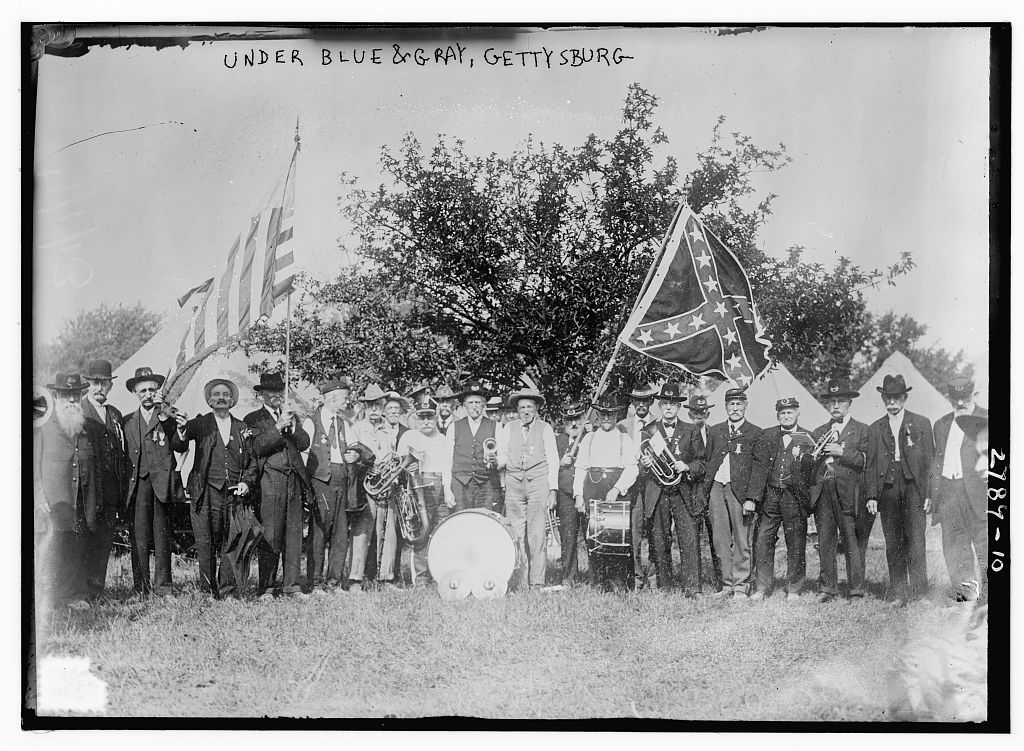
Anonymous photographer Under blue & gray – Gettysburg July 1913 Photo shows the Gettysburg Reunion (the Great Reunion) of July 1913, which commemorated the 50th anniversary of the Battle of Gettysburg Library of Congress Prints and Photographs Division Washington, D.C.
Part 4 of the biggest posting on one exhibition that I have ever undertaken on Art Blart!
As befits the gravity of the subject matter this posting is so humongous that I have had to split it into 4 separate postings. This is how to research and stage a contemporary photography exhibition that fully explores its theme. The curators reviewed more than one million photographs in 17 countries, locating pictures in archives, military libraries, museums, private collections, historical societies and news agencies; in the personal files of photographers and service personnel; and at two annual photojournalism festivals producing an exhibition that features 26 sections (an inspired and thoughtful selection) that includes nearly 500 objects that illuminate all aspects of WAR/PHOTOGRAPHY.
I have spent hours researching and finding photographs on the Internet to support the posting. It has been a great learning experience and my admiration for photographers of all types has increased. I have discovered the photographs and stories of new image makers that I did not know and some enlightenment along the way. I despise war, I detest the state and the military that propagate it and I surely hate the power, the money and the ethics of big business that support such a disciplinarian structure for their own ends. I hope you meditate on the images in this monster posting, an exhibition on a subject matter that should be consigned to the history books of human evolution.
**Please be aware that there are graphic photographs in all of these postings.**Part 1, Part 2, Part 3
Dr Marcus Bunyan
Many thankx to the Museum of Fine Arts, Houston for allowing me to publish some of the photographs in the posting. Please click on the photographs for a larger version of the image.
Memorials
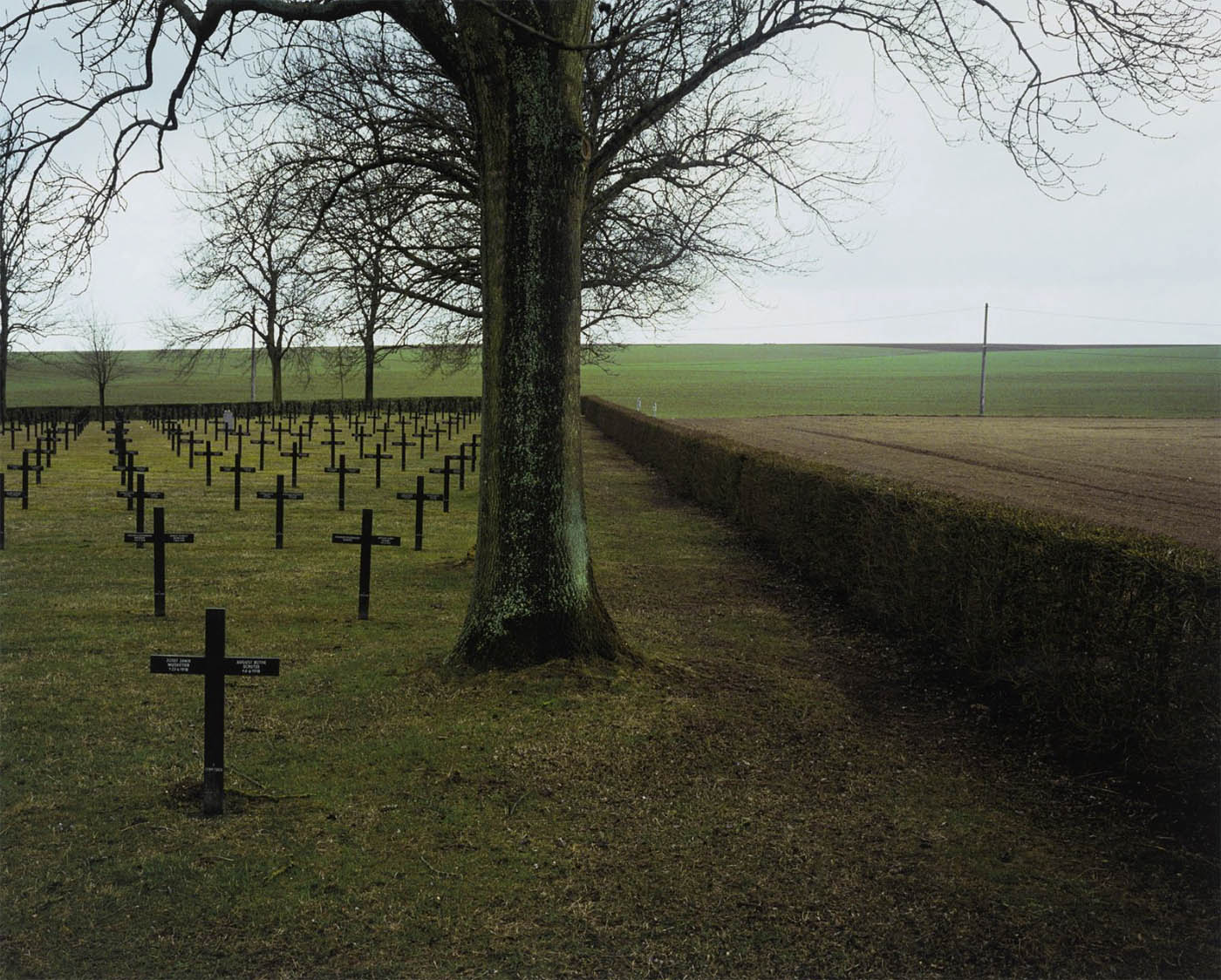
25. Photographs in the “Memorials” section range from the tomb of an unknown World War I soldier in England, by Horace Nicholls; and a landscape of black German crosses throughout a World War II burial site, by Bertrand Carrière; to an anonymous photograph of a reunion scene in Gettysburg of the opposing sides in the Civil War; and Joel Sternfeld’s picture of a woman and her daughter at the Vietnam Veterans Memorial in Washington, DC, in 1986. (8 images)
In order to commemorate the many soldiers with no known grave, it was decided to bury an ‘Unknown Warrior’ with all due ceremony in Westminster Abbey on Armistice Day in 1920. The photograph shows the coffin resting on a cloth in the nave of Westminster Abbey before the ceremony at the Cenotaph and its final burial.
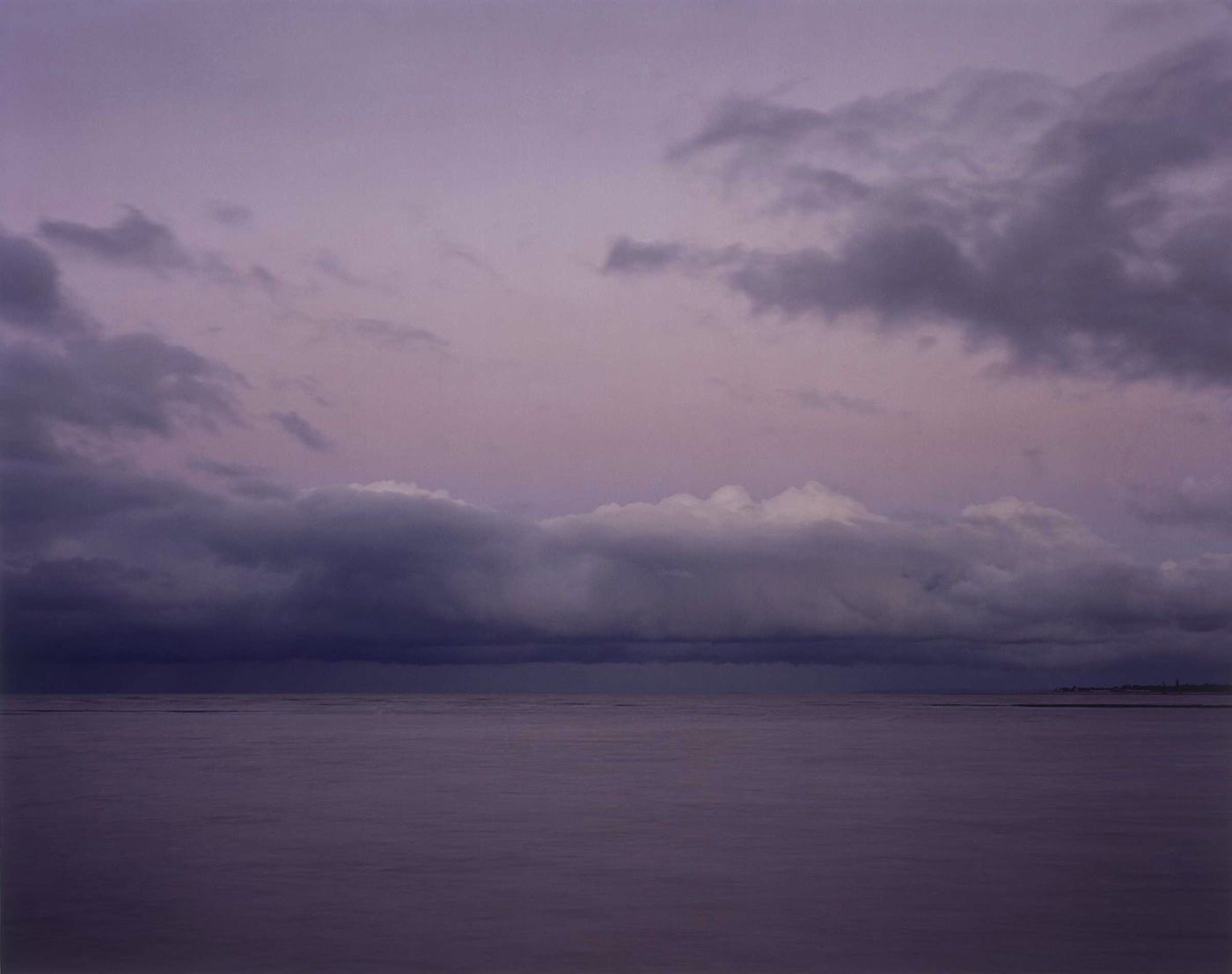
Bertrand Carrière (Canadian, b. 1957) Untitled 2005-2009 From the series Lieux Mêmes [Same Places]
In 2005, Carrière and historian Guth Desprez started to investigate the deeper history surrounding the found photo album. They travelled to Europe, with the photo album as their guide, in order to retrace the path of the Canadian Expeditionary Force. By photographing the locations in the soldier’s images, Carrière explores the themes of memory and history through the changing landscape. They visited the long list of places marked by the horrendous battles of The Great War: the Somme in Picardy, Artois in the North Pas-de-Calais and up to the vast fields of Flanders in Belgium. Carrière’s photographs document the sites which appear in the soldier’s album along with others on the Western Front, offering a contemporary view approximately 90 years after the infamous events, which continue to stigmatise these locations to this very day. The incredible light of the regions of northern France and the flatness of the land helps Carrière build a sense of mystery. The photographs initiate dialogue about how the landscape was affected and the ways in which it has recovered. It is not only what is there or the evidence that remains, but also what is not there and the evidence of what no longer exists.
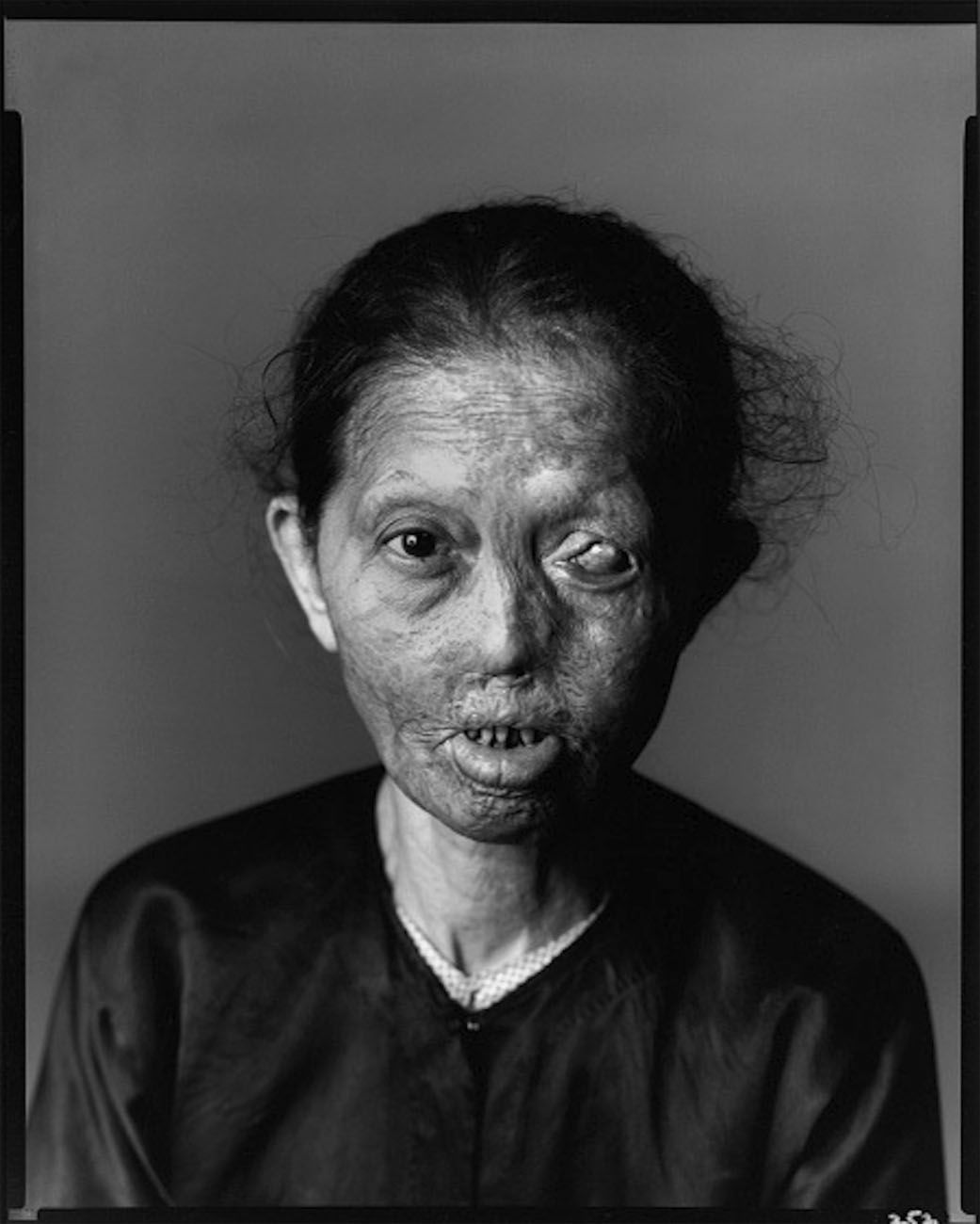
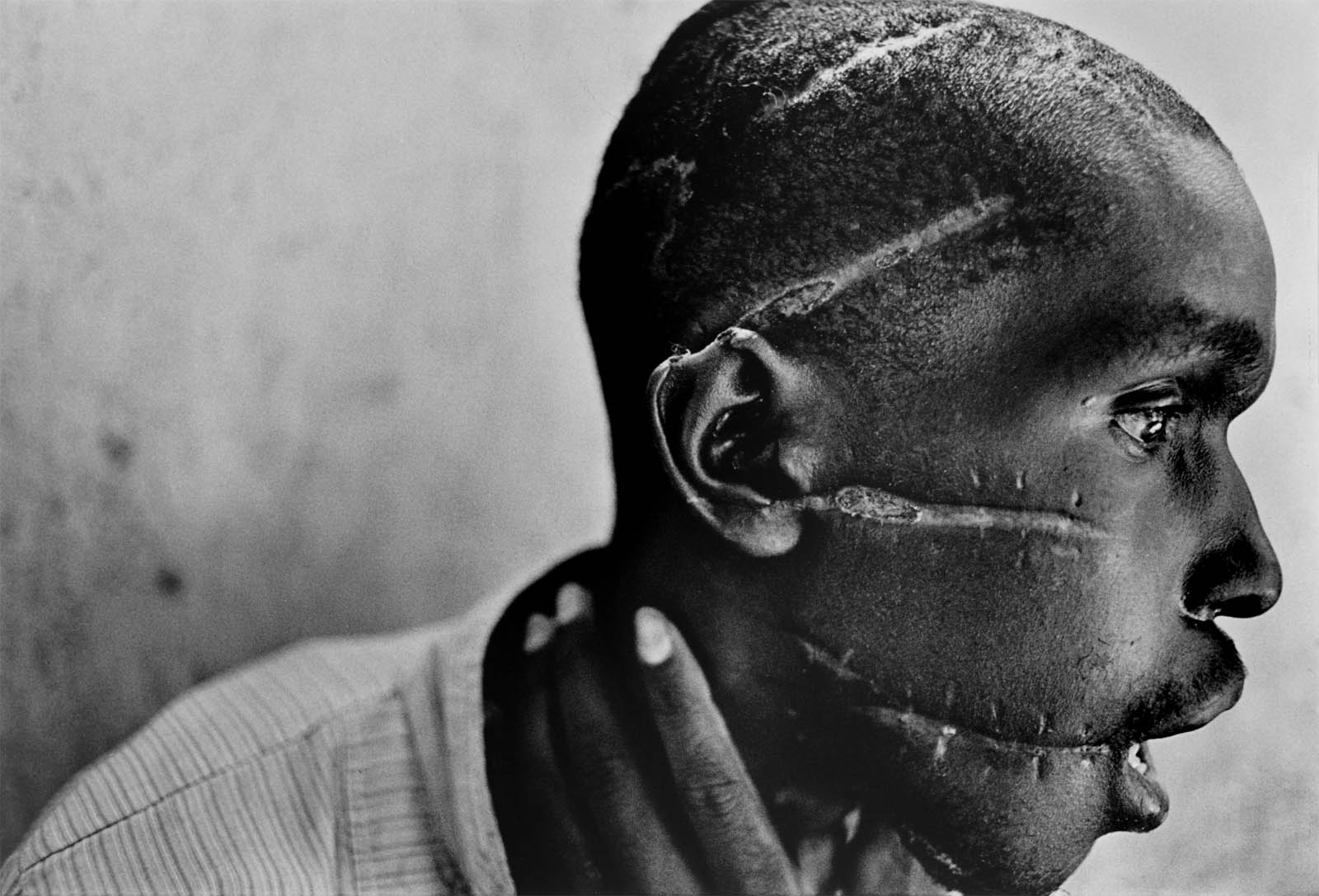
26. The last gallery in the exhibition is “Remembrance.”Most of these images were taken by artists seeking to come to terms with a conflict after fighting had ceased. Included are Richard Avedon’s picture of a Vietnamese napalm victim; a survivor of a machete attack in a Rwandan death camp, by James Nachtwey; a 1986 portrait of a hero who rescued Jews during the Holocaust, by Houston native Gay Block; and Suzanne Opton’s 2004 portrait of a soldier who survived the Iraq War and returned to the United States to work as a police officer, only to be murdered on duty by a fellow veteran. The final wall features photographs by Simon Norfolk of sunrises at the five D-Day beaches in 2004. The only reference to war is the title of the series: The Normandy Beaches: We Are Making a New World (33 images)
Gay Block (American, b. 1942) Zofia Baniecka, Poland 1986 From the series Rescuers: Portraits of Moral Courage in the Holocaust, a record of non-Jewish citizens from European countries who risked their lives helping to hide Jews from the Nazis Chromogenic print, printed 1994 Courtesy of Museum of Fine Arts, Houston, gift of Clinton T. Wilour in honour of Eve France
Zofia Baniecka (born 1917 in Warsaw – 1993) was a Polish member of the Resistance during World War II. In addition to relaying guns and other materials to resistance fighters, Baniecka and her mother rescued over 50 Jews in their home between 1941 and 1944.
A Hutu man at a Red Cross hospital in Nyanza, Rwanda. His face was mutilated by the Hutu ‘Interahamwe’ militia, who suspected him of sympathising with the Tutsi rebels.
Liberated from a nearby Hutu camp, where mainly Tutsis were incarcerated, starved, beaten, and killed, this man did not support the genocide and was thus subjected to the same treatment. Starved and attacked with machetes, he had managed to survive, though he was unable to speak and could barely walk or swallow when this photo was made.
Alexander Gardner (American, 1821-1882) Scouts and Guides to the Army of the Potomac, Berlin, MD, October, 1862 October 1862 Albumen silver print Photograph by Alexander Gardner, from “Incidents of the War. Guide to the Army of the Potomac,” from Gardner’s Photographic Sketch Book of the War, Washington Records of the War Department General and Special Staffs, Record Group 165, National Archives Still Picture Branch, College Park, Maryland
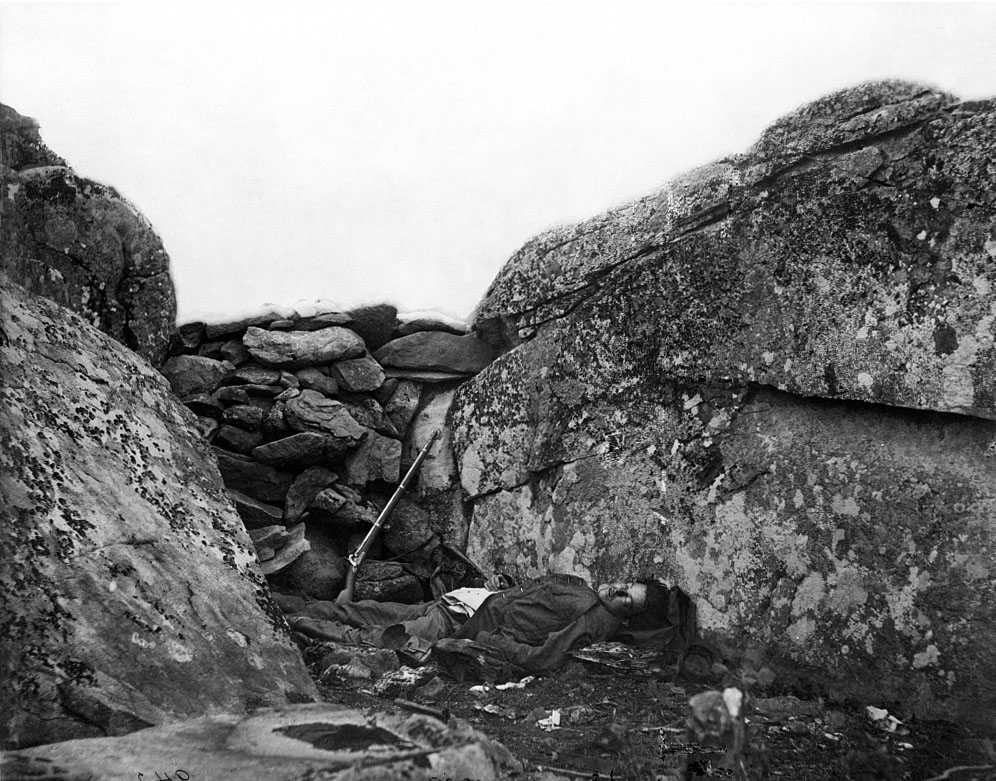
Alexander Gardner (American, 1821-1882) The Home of a Rebel Sharpshooter / Dead Confederate soldier in the devil’s den, Gettysburg, Pennsylvania July 1863 Albumen paper print copied from glass, wet collodion negative Library of Congress, Prints and Photographs Division
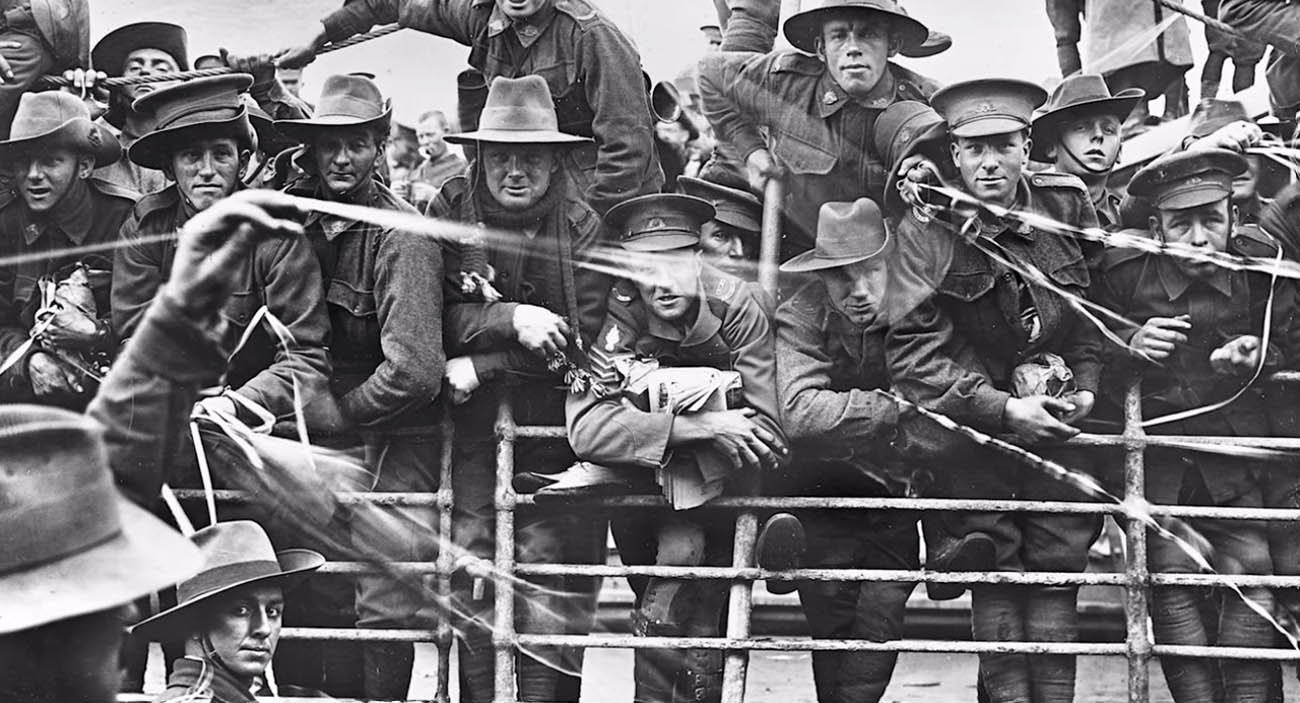
Josiah Barnes (Australian, 1858-1921) Embarkation of HMAT Ajana, Melbourne, July 8, 1916 1916 Gelatin silver print from original glass half-plate negative (printed 2012) On loan from the Australian War Memorial
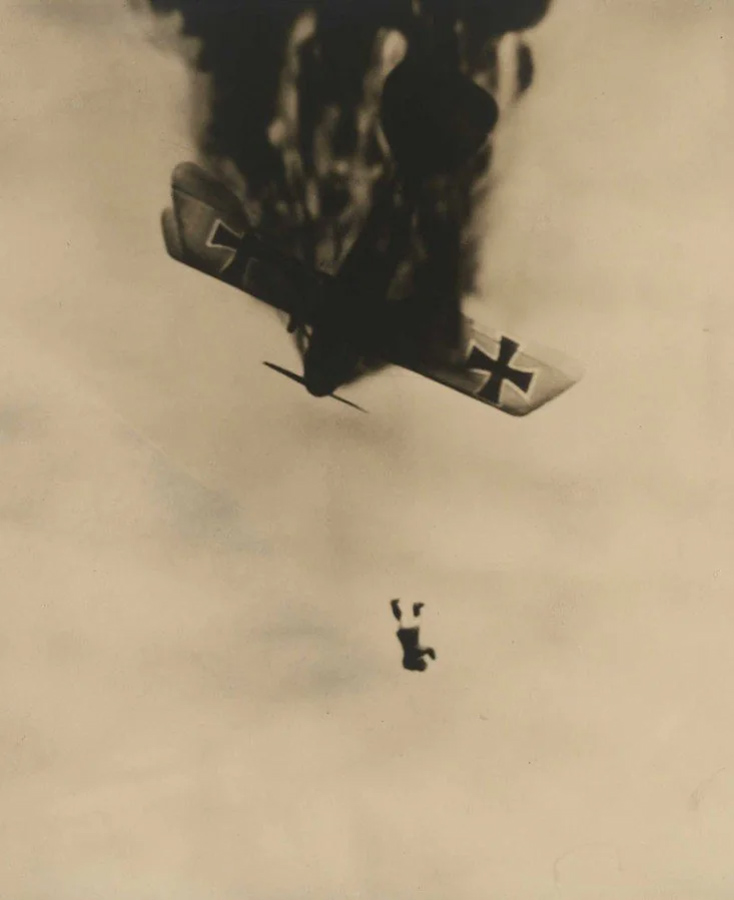
Wesley D. Archer (American, d. 1952) Just as he left the burning plane 1933 From the publication Death in the Air: The War Diary and Photographs of a Flying Corps Pilot
The typewritten script of a First World War pilot’s diary with a large number of photographs was submitted to the publishers William Heinemann and published by them in 1933. Heinemann stated on the book’s jacket that the diary contained no names, dates, or anything that could reveal the identity of the writer or the squadron in which he served. The publishers understood that the diarist was killed in action in 1918 and that it was in deference to the wishes of those who were close to him that his diary should be published.
So remarkable were the photographs that their veracity was immediately questioned, but no proof of their authenticity or otherwise could be ascertained. It was not until 1983 that a collection of documents, photographs and artifacts was presented to the Smithsonian’s National Air and Space Museum. Some of the photographs were recognized as being those of the mystery diarist and the truth was soon revealed.
The author was Wesley Archer, an American with Canadian parents who served with the RFC in the First World War, and the photographs and diary had been faked.
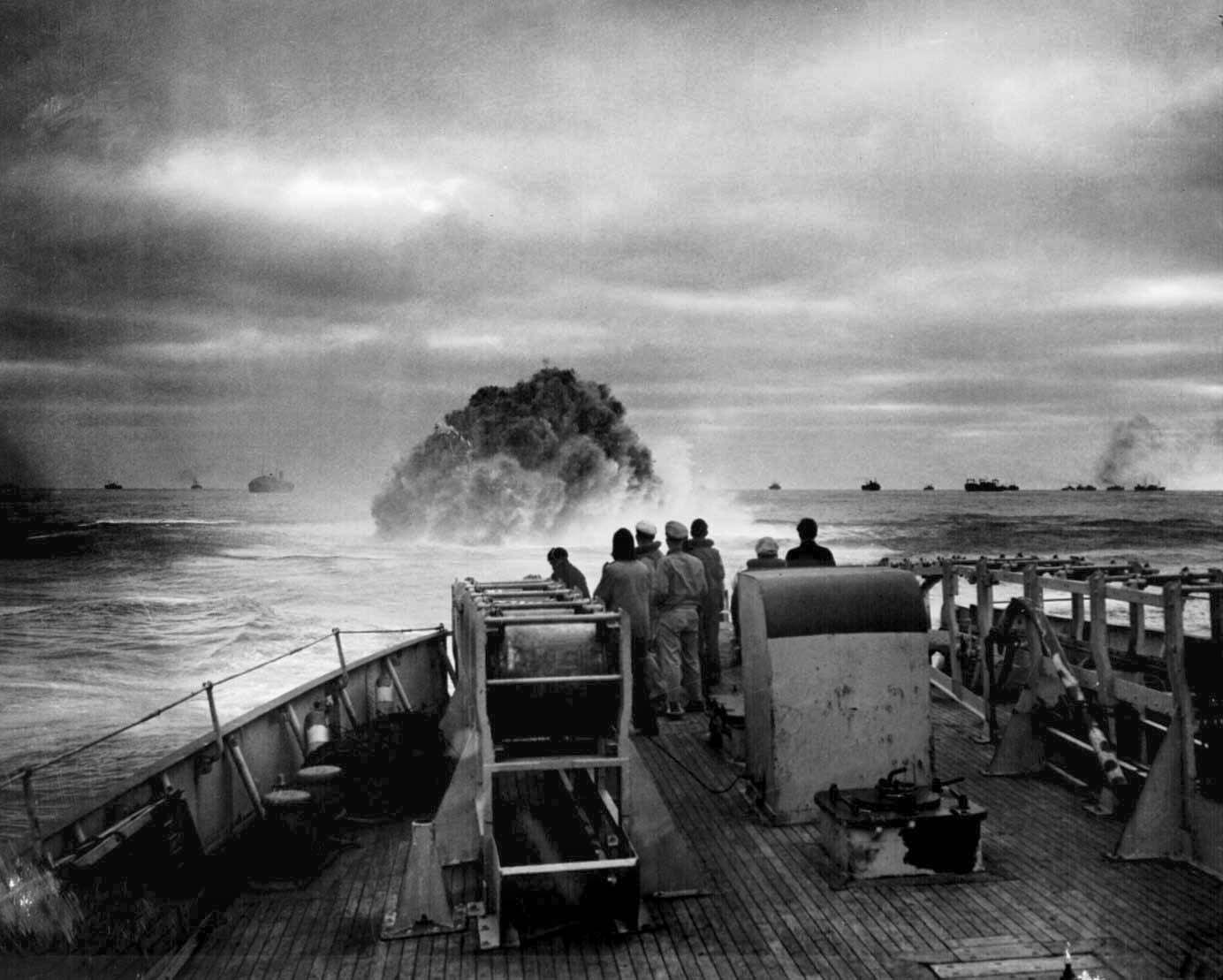
Anonymous photographer U.S. Department of Defense US Coast Guard crew of cutter Spencer watched as a depth charge exploded near U-175, North Atlantic, 500nm WSW of Ireland, 17 Apr 1943 17 April 1943 Public domain
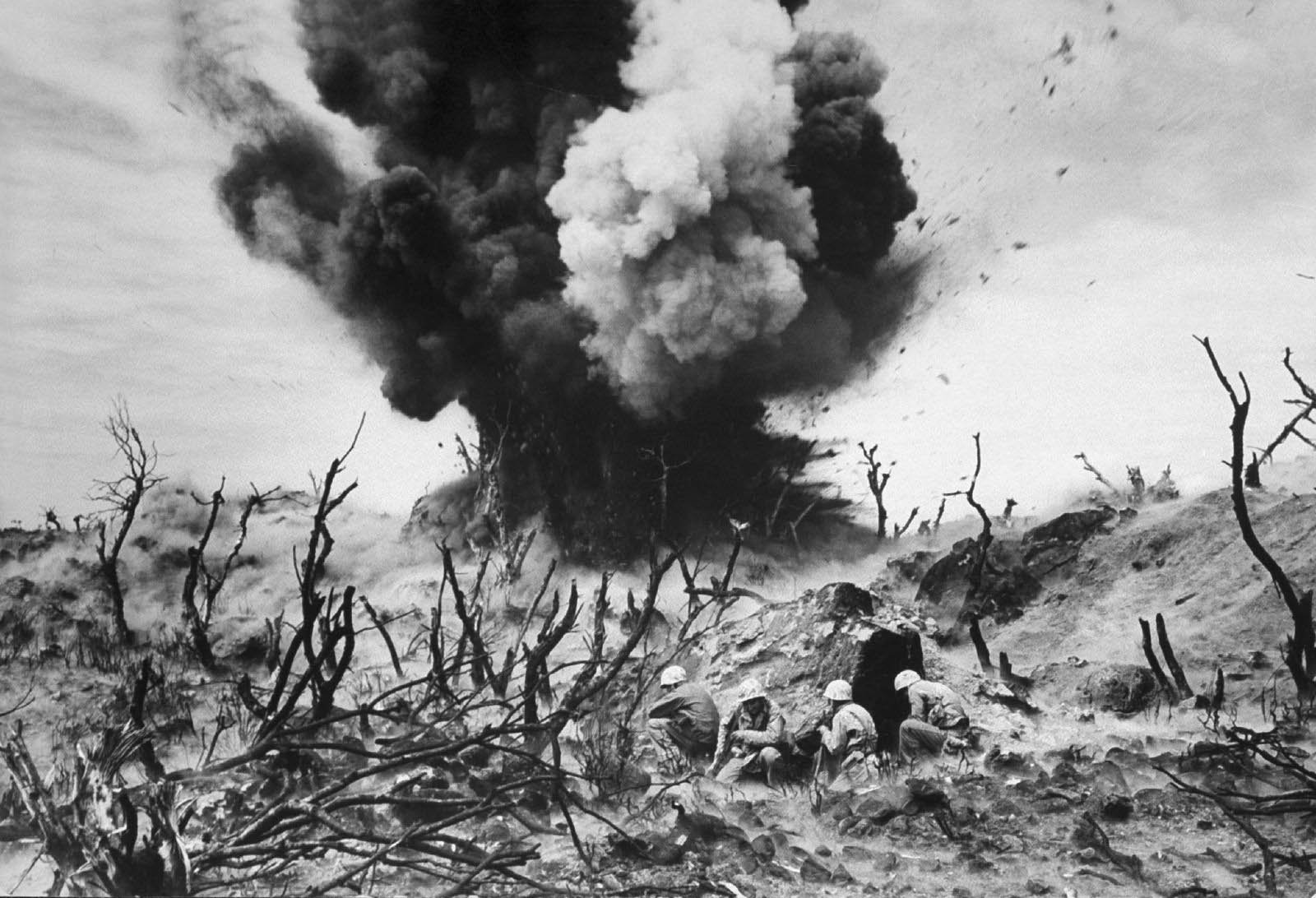
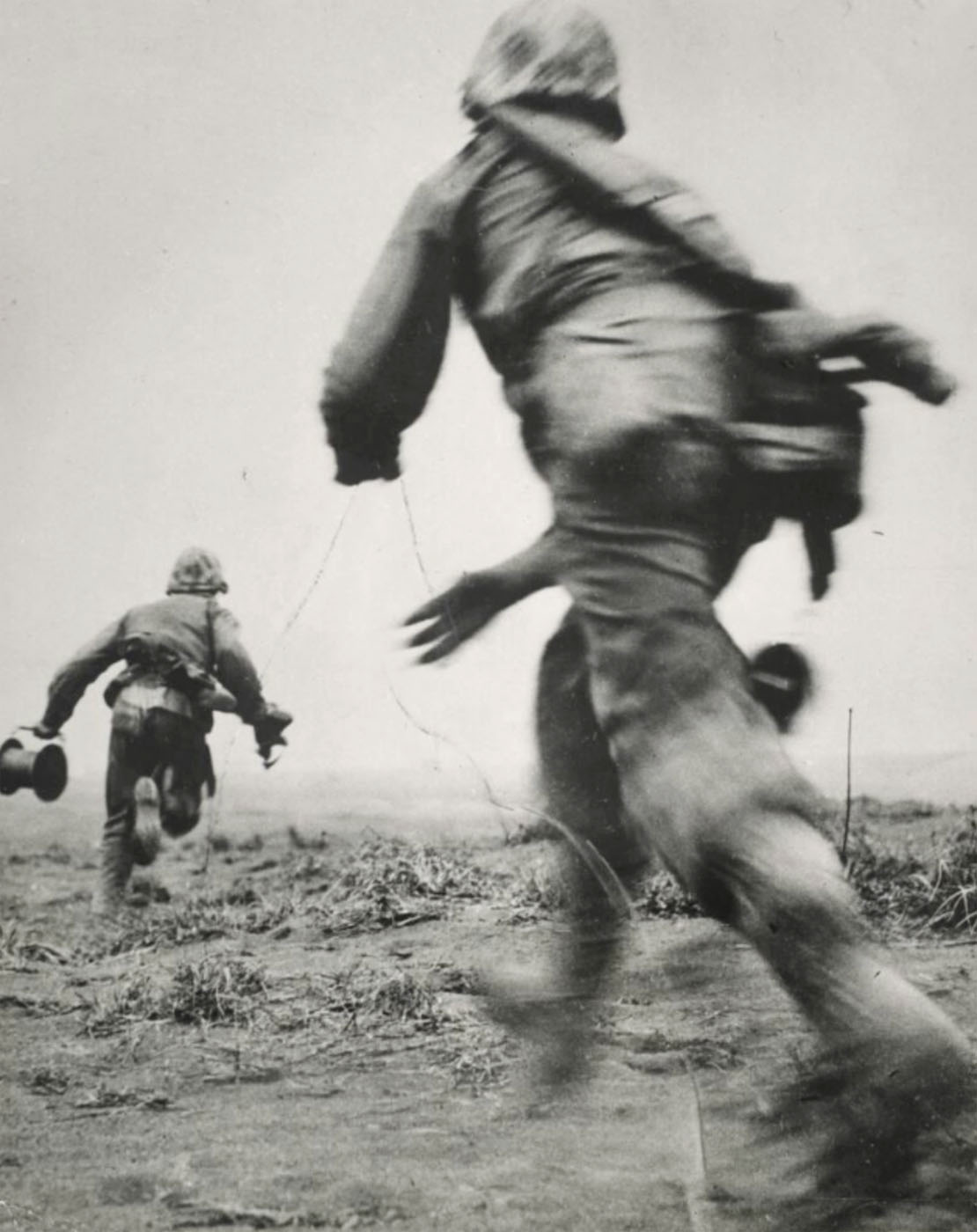
Joseph Schwartz (American, 1913–2013) Hold the Phone – Two Marine wiremen on Iwo Jima race across an open field, under heavy enemy fire to establish field telephone contact with the front lines February 19, 1945, printed early 1950s Gelatin silver print mounted on board 18 13/16 x 14 15/16 in. (47.8 x 37.9cm) The Museum of Fine Arts, Houston Museum purchase funded by Knox Nunnally at “One Great Night in November, 2009,” in honor of Houston trial lawyer Joe Reynolds, a U.S. Marine who fought on Iwo Jima
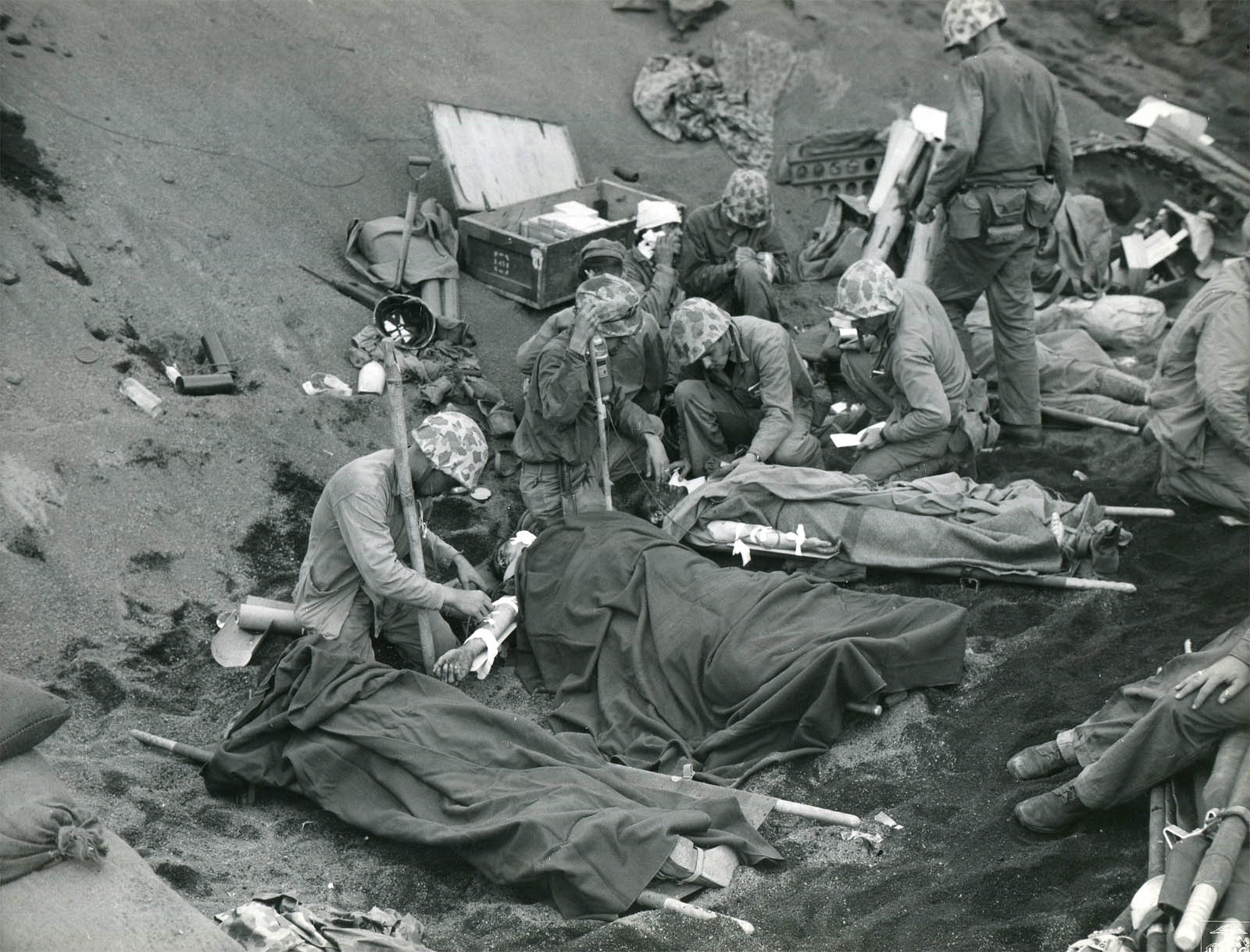
Anonymous photographer U.S. Department of Defense / USMC Official Photograph PLASMA WARD – Navy doctors and corpsmen administer to wounded Marines at an aid station established in a gully on Iwo Jima. The high casualty rate in this operation required the use of gallons of plasma and whole blood sent by air from the West Coast 1945 Gelatin silver print Creative Commons Attribution 2.0 Generic
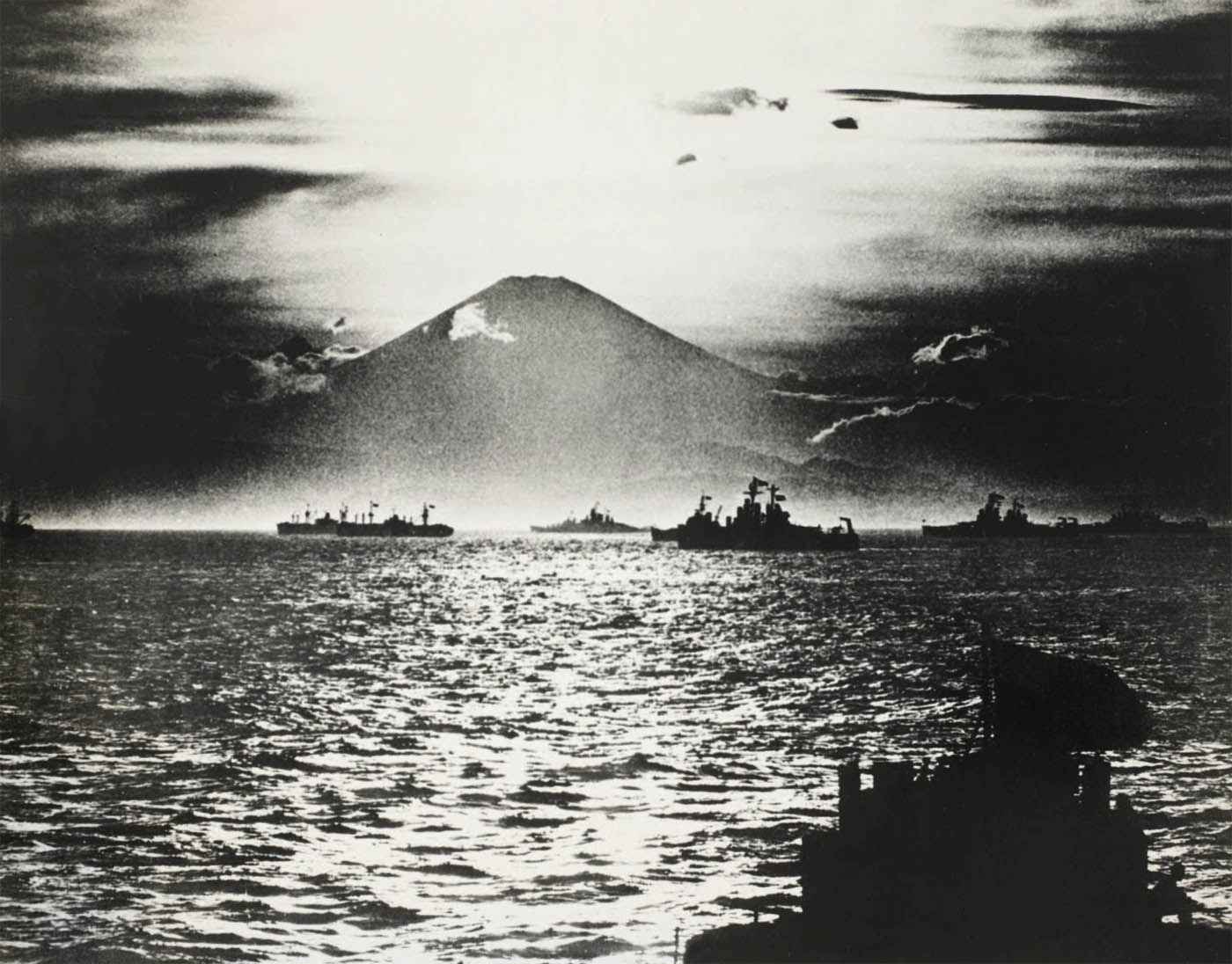
U.S. Navy Photographic Team U.S. and British Warships Anchored in Sagami Wan, Outside of Tokyo Bay, Japan, on the Day the Allied Ships Entered Japanese Waters 27th August 1945 Gelatin silver print The Museum of Fine Arts, Houston, museum purchase funded by Laura and Tony Visage in honor and memory of William A. Visage and his fellow soldiers in Battery “E” of the 2nd Battalion, 131st Field Artillery, U.S. Army Air Corps
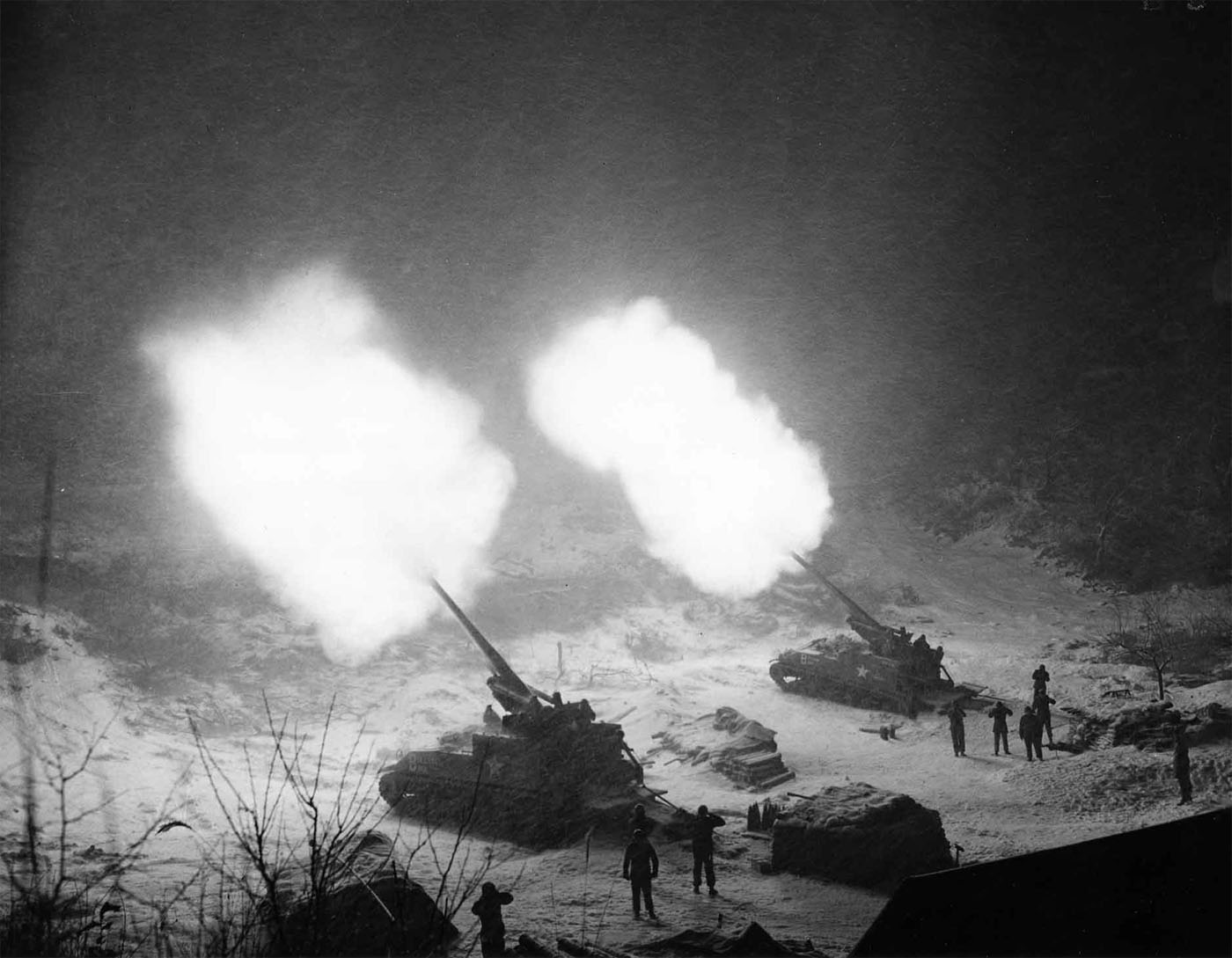
Unknown photographer A pair of M-40 155mm Gun Motor Carriages of Battery B, 937th Field Artillery Battalion, providing fire support to U.S. Army 25th Infantry Division, Munema, Korea 26 November 1951 Gelatin silver print U.S. Department of Defense
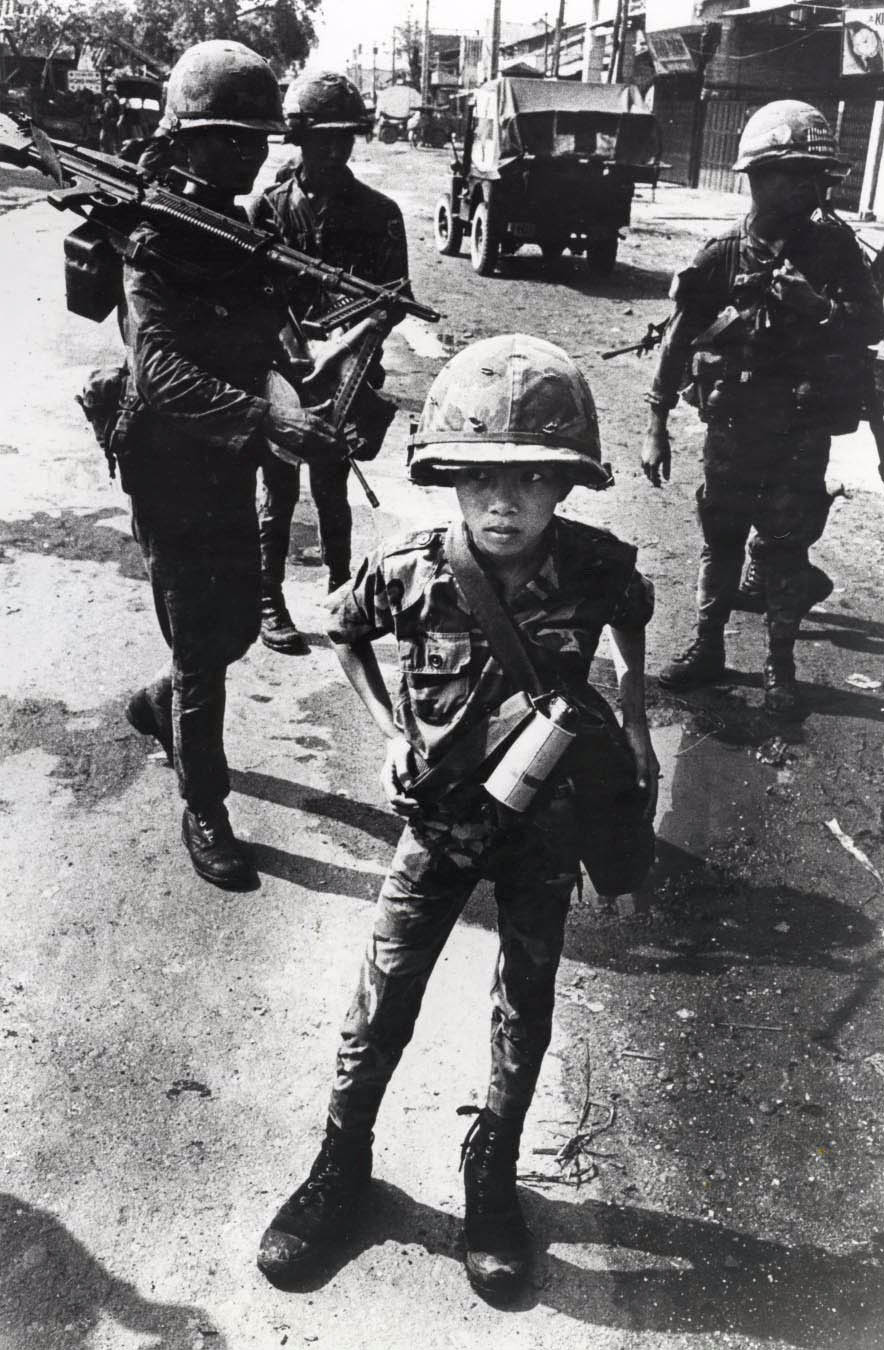
Her pictures from Vietnam were stunning. Her photos from Battle of Hill 881 evoked “ghosts of Iwo Jima and Pork Chop Hill,” Time magazine wrote in May 1967. Her photos of corpsman Vernon Wike during the battle was a triptych of an all-too-familiar scene: in the first, Wike has two hands on his friend’s chest, trying to staunch the wound; in the second, he tries to find a heartbeat; in the third frame, “Corpsman In Anguish”, he realised the man is dead.
LeRoy herself came very close to death two weeks later. Her Nikon barely stopped a piece of mortar shrapnel that ripped open her chest. She said that she thought the last words she would ever hear were, “I think she’s dead, sarge.” During the Tet offensive in 1968, LeRoy was briefly captured by the North Vietnamese during the battle for Hue. LeRoy’s photos of her captivity later made the cover of Life, ‘A Remarkable Day in Hue: the Enemy Lets Me Take His Picture’. She was the first person to take photos of North Vietnamese Army Regulars behind their lines.
Anonymous. “Corpsman In Anguish | Cathy LeRoy,” on the Iconic Photos website January 13, 2014 [Online] Cited 27/07/2024. Used under fair use conditions for the purposes of education and research
A licensed parachutist, Leroy jumped with the U.S. 173rd Airborne Brigade into combat during Operation Junction City in February of 1967. It was in this action, the battle for Hill 881, that Leroy photographed U.S. Navy Corpsman Vernon Wike as he rushed to the aid of a fallen comrade. “Corpsman in anguish” is the third frame of a series that Leroy shot, capturing the unimaginable grief of war. Later, in an interview for the documentary “The Hill Fights”, Wike recounted the moment that Leroy photographed.
“I know there was chaos going on around me, but there was no sound,” she says. “… I knew he didn’t have a chance, but I still got p—–d off when he died.” Leroy describes the aftermath as the corpsman “lost in this nightmare landscape” grabbed the fallen marine’s M16 and charged a Viet bunker alone in a hail of obscenities. The fallen marine was a man called “Rock”, a New Yorker from Puerto Rico. Earlier that day he had told Wike that he only had 60 days left “in country” – his deployment in Vietnam.
Anonymous. “Giving War a Face: Catherine Leroy,” on the Dismal Nitch website September 04, 2020 [Online] Cited 27/07/2024. Used under fair use conditions for the purposes of education and research
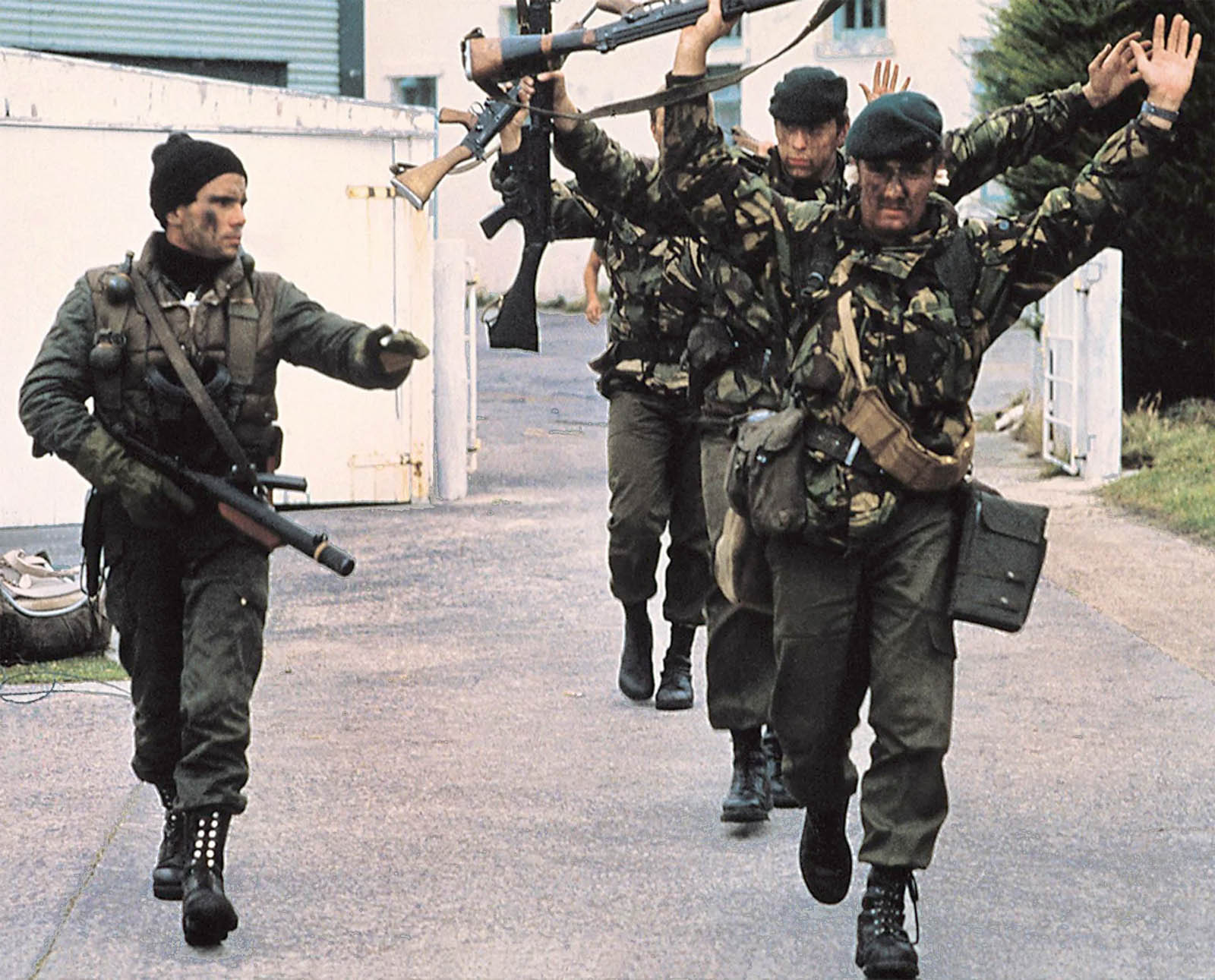
Rafael Wollmann (Argentinian, b. 1958) British Marines surrender to Argentinean troops in Malvinas/Falklands April 2, 1982, printed 2012 Inkjet print 15 7/8 × 20 in. (40.4 × 50.8cm) The Museum of Fine Arts, Houston Gift of Rafael Wollmann
David Leeson (American, b. 1957) Death of a Soldier, Iraq March 24, 2003 Inkjet print, printed 2012 Courtesy of the artist
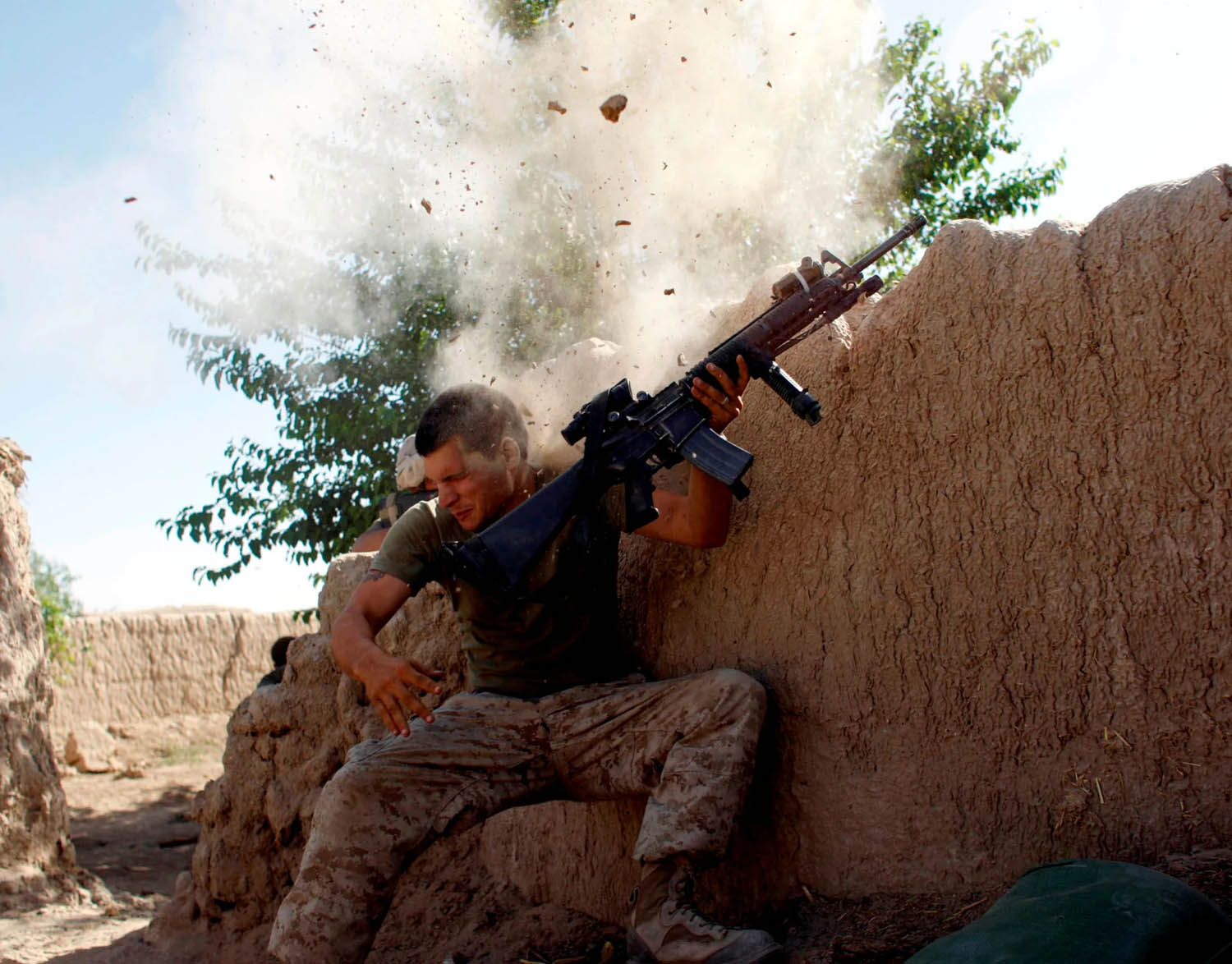
Goran Tomasevic (Serbian, b. 1959) /Reuters SHOOTING. Sgt. William Olas Bee, a US Marine from the 24th Marine Expeditionary Unit, has a close call after Taliban fighters opened fire near Garmser in Helmand Province of Afghanistan May 18, 2008. The Marine was not injured. 2008
Tomašević began photographing the war that followed the breakup of Yugoslavia from 1991 for daily newspaper Politika. In 1996 he joined the world’s largest news agency, Reuters, covering the simmering political tensions in Kosovo and the anti-Milošević demonstrations in his hometown of Belgrade since mid-1990s. During three-month NATO bombing of Yugoslavia in 1999, Tomašević was the only photographer working for foreign press to spend the duration of the conflict in Kosovo.
Tomašević moved to Jerusalem in 2002, covering the second Palestinian intifada. During the U.S. led invasions of Iraq in 2003, his picture of a U.S. Marine watching the toppling of a Saddam Hussein statue became one of the most memorable images of the war. He often returned to Iraq as sectarian violence escalated and regularly photographed America’s other war in Afghanistan. His sequence of photographs of U.S. Marine Sergeant Bee narrowly escaping Taliban bullets became an iconic image in U.S. war history.
Tomašević moved to Cairo in 2006 and was at the heart of Reuters’ coverage of the Arab Springs. In Libya, his image of a fireball that spewed up after an air strike on pro-Gaddafi fighters became an iconic image of the Libyan war, gracing the front pages of more than 100 newspapers around the globe. He stayed in Cairo until 2012. His raw pictures of rebel fighters battling pro-Assad forces among the ruins of Aleppo and Damascus during the Syrian Civil War have won international acclaim, as did his coverage of the bloody siege on a Nairobi shopping mall in Kenya. Tomašević worked for Reuters until 2022.
Curators: Anne Wilkes Tucker, the Gus and Lyndall Wortham Curator of Photography; Will Michels, collections photographer and exhibition co-curator; Natalie Zelt, curatorial assistant
Salvor Hardin in Isaac Asimov’s ‘Foundation’ series
Part three of the biggest posting on one exhibition that I have ever undertaken on Art Blart!
As befits the gravity of the subject matter this posting is so humongous that I have had to split it into 4 separate postings. This is how to research and stage a contemporary photography exhibition that fully explores its theme. The curators reviewed more than one million photographs in 17 countries, locating pictures in archives, military libraries, museums, private collections, historical societies and news agencies; in the personal files of photographers and service personnel; and at two annual photojournalism festivals producing an exhibition that features 26 sections (an inspired and thoughtful selection) that includes nearly 500 objects that illuminate all aspects of WAR/PHOTOGRAPHY.
I have spent hours researching and finding photographs on the Internet to support the posting. It has been a great learning experience and my admiration for photographers of all types has increased. I have discovered the photographs and stories of new image makers that I did not know and some enlightenment along the way. I despise war, I detest the state and the military that propagate it and I surely hate the power, the money and the ethics of big business that support such a disciplinarian structure for their own ends. I hope you meditate on the images in this monster posting, an exhibition on a subject matter that should be consigned to the history books of human evolution.
**Please be aware that there are graphic photographs in all of these postings.**Part 1, Part 2, Part 4
Dr Marcus Bunyan
Many thankx to the Museum of Fine Arts, Houston for allowing me to publish some of the photographs in the posting. Please click on the photographs for a larger version of the image.
Civilians
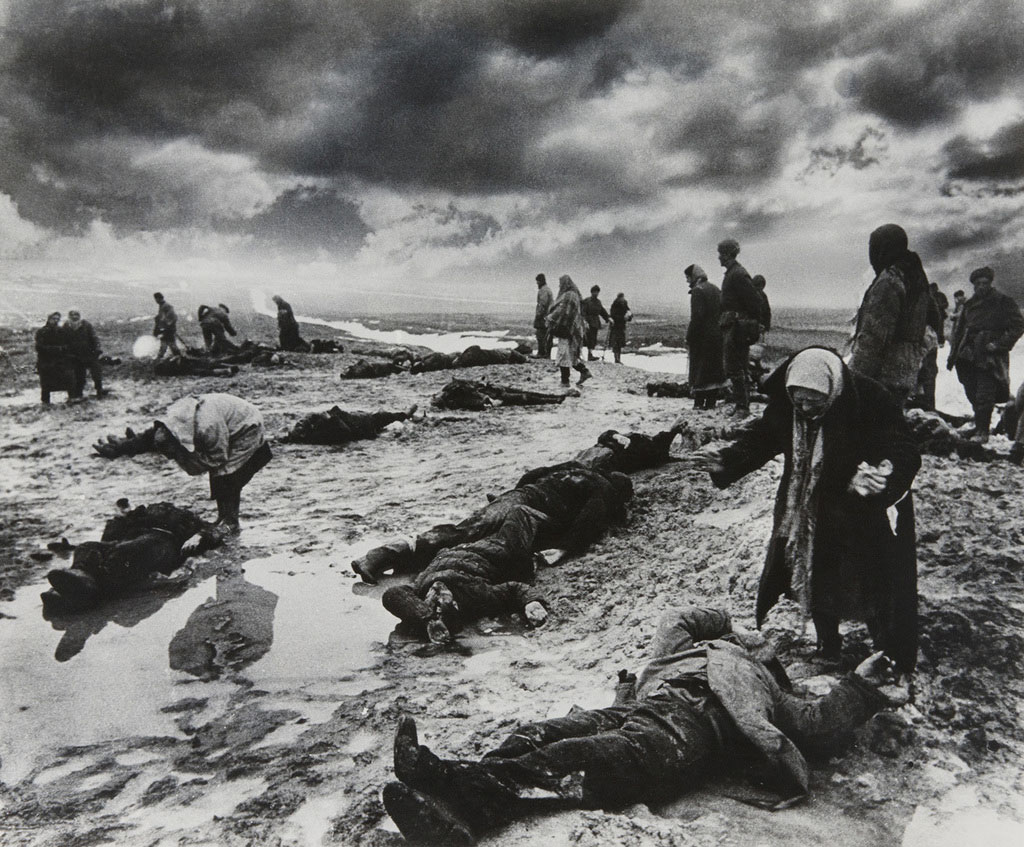
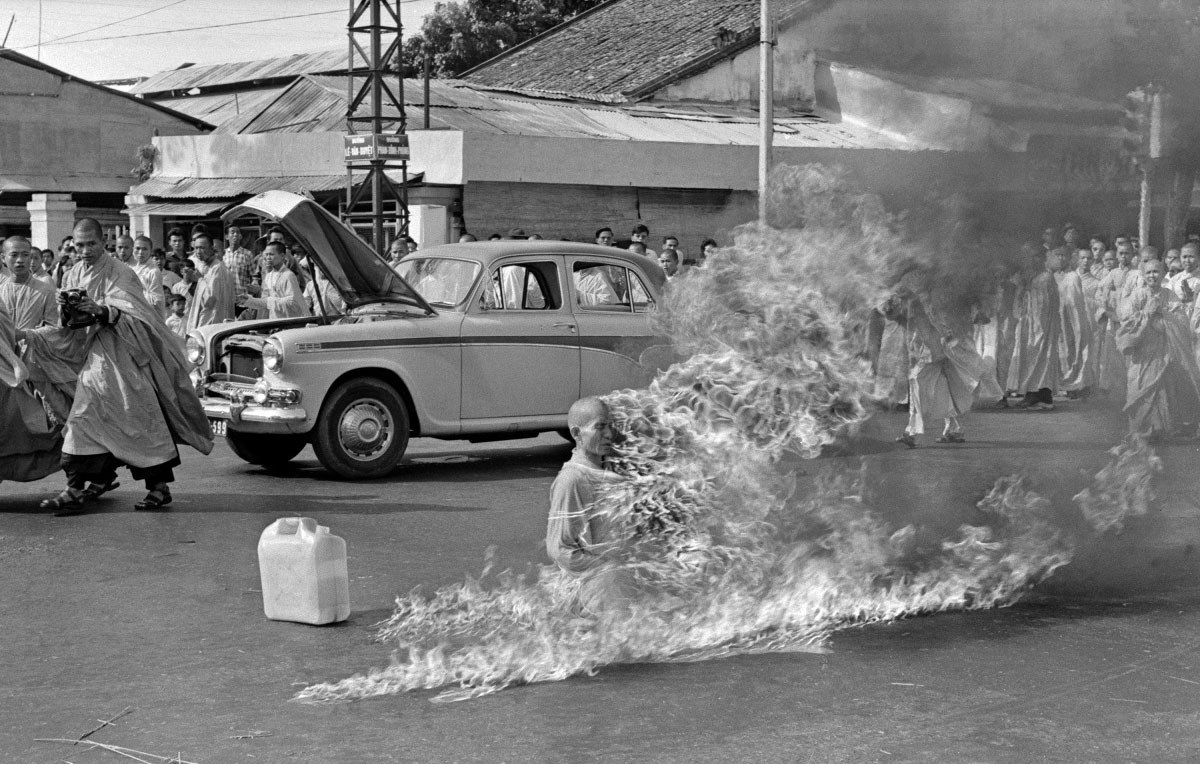
21. Civilians spans World War II through 2008. The subsection “Dead and Wounded” includes Grief, Kerch, Crimea, by Dmitri Baltermants, of civilians in 1942 searching the bodies of Russian Jewish family members who had been executed by Germans soldiers as they retreated. A 2003 photograph, taken by Ahmed Jadallah for the news agency Reuters while he lay wounded from shrapnel, shows bodies in the street in the largest refugee camp in the Gaza Strip. “Daily Life” shows a Congolese woman breastfeeding as a tank rolls by, in a 2008 image by Walter Astrada; Londoners sleeping in an underground train station in 1940, by Bill Brandt; a woman eating bread in Amsterdam during the Hongerwinter famine of 1944, by Cas Oorthuys; a 1940/1941 meeting in New York of members of the Bund, an American Nazi party, by Otto Hagel; a monk burning himself in Saigon in 1963, in protest against alleged religious persecution by the South Vietnamese government, by Malcolm Browne; and a man uncovering an anti-personnel land mine in Angola in 2004, by Sean Sutton. Pictures of civilian “Grief” are common, and the images here include a woman in Tehran inspecting photographs of the missing, by Gilles Peress; a man at an airport, grieving alone and holding a folded American flag, by Harry Benson; a father digging a grave for his daughter in a soccer field in Somalia, by Howard Castleberry; and a woman mourning in Afghanistan in 1996, at the grave of her brother who was killed by a Taliban rocket, by James Nachtwey. (46 images)
Otto Hagel (American born Germany, 1909-1973) German-Americans at a meeting in New Jersey of the Deutsche Bund 1940-1941 Silver gelatin print
Dmitri Baltermants (Russian born Poland, 1912-1990) Grief, Kerch, Crimea Spring 1942 Silver gelatin print
“War, is, above all, grief. I photographed non-stop for years and I know that in all that time I produced only five or six real photographs. War is not for photography. If, heaven forbid, I had to photograph war again, I would do it quite differently. I agonise now at the thought of all the things that I did not photograph.”
Dmitri Baltermants quoted in “The Russian War, 1941-1945” (J. Cape, London, 1978)
Cas Oorthuys (Dutch, 1908-1975) Portrait of starving woman in the hunger winter, Amsterdam 1944-1945 Silver gelatin print
Harry Benson (Scottish, b. 1929) Grieving man, holding flag 1971 Gelatin silver print
Children
22. Children have been consistently photographed during wartime as both victims and soldiers. Images in this section include Sir Cecil Beaton’s Three-year-old Eileen Dunne in Hospital for Sick Children, England (1940); children viewing the bodies of other children who were hanged as collaborators in Russia in the 1940s, by Mark Redkin; Philip Jones Griffiths’ image of a young boy, Called “Little Tiger” for killing two “Vietcong women cadre” – his mother and teacher, it was rumored (1968); children playing “execution” in Italy, by Enzo Sellerio; two orphaned boys smoking cigarettes in post-World War II Japan, by Hayashi Tadahiko; a father home on leave reading the newspaper with his son, who wears his dad’s helmet, by Andrea Bruce; and the 2005 photograph, by Chris Hondros, of a blood-splattered Iraqi girl whose family was mistakenly ambushed by U.S. troops. (13 images)
Andrea Bruce (American, b. 1973) Untitled [A father home on leave reading the newspaper with his son, who wears his dad’s helmet] 2006 From the series When the War Comes Home Gelatin silver print
Portraits
23. Portraits are the most common type of photograph made during conflicts. Dispersed throughout the exhibition, lining the main walkway through the galleries, are the faces of leaders, the enlisted, heroes and war criminals, as well as group portraits. One of the earliest prints in the exhibition is a daguerreotype from the Mexican-American War of a high-ranking officer. Matthew Brady, one of the most famous photographers of the 19th century, was renowned for coverage of the Civil War; his Major‑General Joseph Hooker, c. 1863, is on view. Among the most recent is a self-portrait by American Cpl. Reynaldo Leal USMC. Leal – who was born and grew up in Edinburg, Texas, and now lives in El Paso – served in Iraq conducting combat patrols through the villages along the Euphrates. (40 images)
Matthew B. Brady (American, 1823-1896) Colonel William Gates, believed to have been taken upon his return from the Mexican War c. 1848 Half plate daguerreotype, gold toned Library of Congress
Mathew B. Brady (American, 1823-1896) Major-General Joseph Hooker c. 1863 Salted paper print, hand coloured The Museum of Fine Arts, Houston, museum purchase with funds provided by the S. I. Morris Photography Endowment
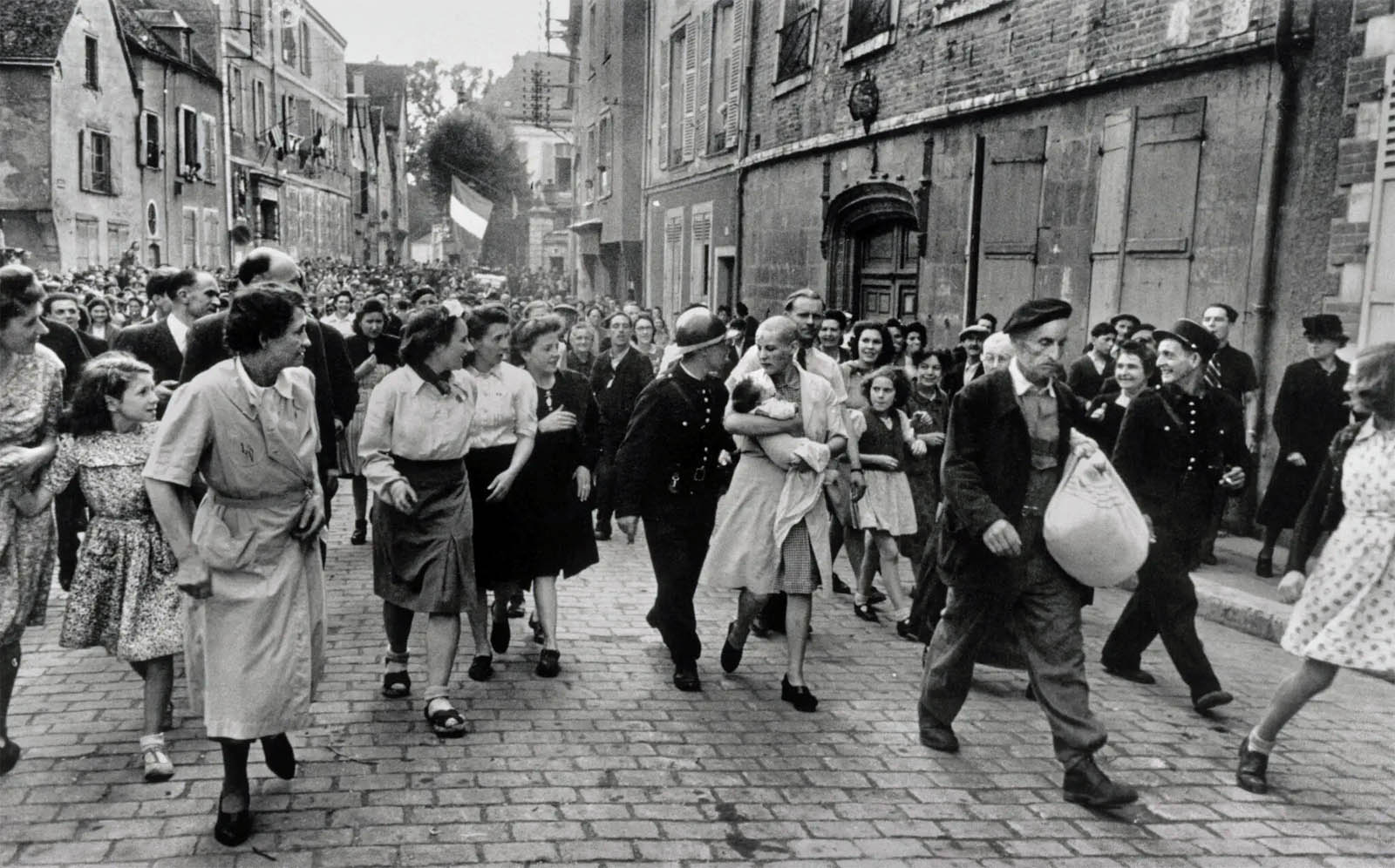
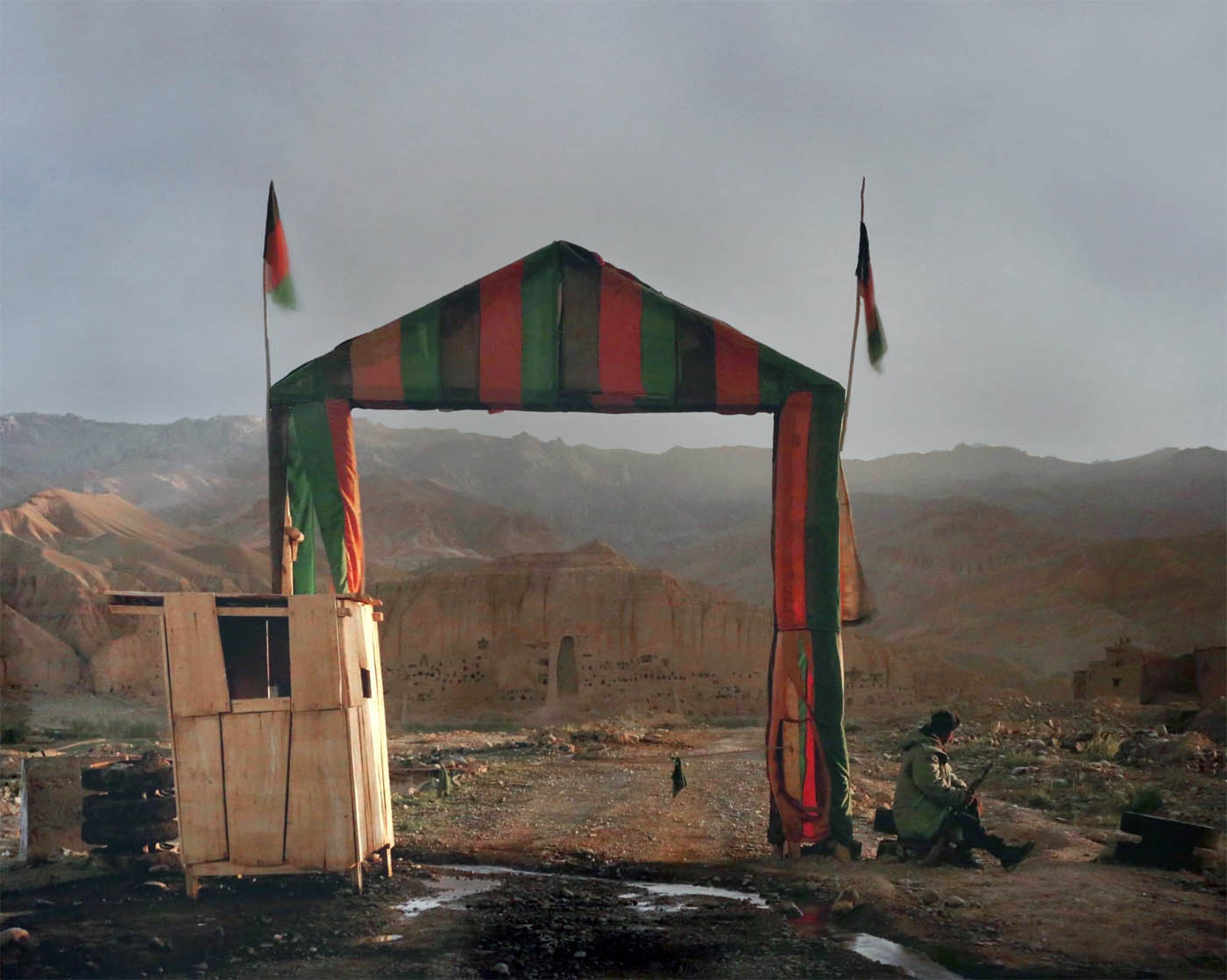
24. War’s End is identifiable at the moment a photograph is taken. The subsection “Victory/Defeat” is the visual manifest of the outcome of war, from the Japanese signing peace documents on board the USS Missouri, by Carl Mydans; to German generals discussing terms of surrender in the woods just four days after Adolf Hitler committed suicide in 1945, by E. G. Malindine; and the raising of the Hammer and Sickle over the Reichstag in Berlin in 1945, by Evgeny Khaldey. Also included is Simon Norfolk’s Victory arch built by the Northern Alliance at the entrance to a local commander’s headquarters in Bamiyan. The empty niche housed the smaller of the two Buddhas, destroyed by the Taliban in 2001, from the series Afghanistan: Chronotopia.“Retribution” contains a 1945 image, by Lee Miller, of a concentration-camp guard who was beaten by prisoners after their liberation; and a photograph by Robert Capa of a Frenchwoman who had been impregnated by a German soldier, as she walks through a jeering crowd with her head shaved in punishment and carrying her baby. The photographs in “Homecoming” establish an emotive connection: a family reunion on the tarmac at an Air Force base in California in 1973, by Sal Veder; a mother and son embracing at the Ben-Gurion Airport in Israel in 1976, by Micha Bar-Am; and a man who has returned from duty in Bosnia in 1995 to discover that his home and everyone in it is gone, by Ron Haviv. (23 images)
Robert Capa (Hungarian-American, 1913-1954) Collaborator woman who had a German soldier’s child, Chartres, 18 August 1944 1944 Gelatin silver print 33 x 49cm
Evgeny Khaldey (Russian, 1917-1997) The Flag of Victory 1945 Gelatin silver print
E. G. Malindine (British, 1906-1970) No 5 Army Film & Photographic Unit, Malindine E G (Capt), Morris (Sgt) German Military Forces Seek Surrender Terms, May 1945 1945 Gelatin silver print Public domain
Field Marshal Sir Bernard Montgomery with the German delegates outside his headquarters at 21st Army Group
Carl Mydans (American, 1907-2004) Japanese signing peace documents on board the ‘USS Missouri’ 1945 Gelatin silver print
Simon Norfolk (British born Nigeria, b. 1963) Victory arch built by the Northern Alliance at the entrance to alocal commander’s headquarters in Bamiyan. The empty niche housed the smaller of the two Buddhas, destroyed by the Taliban in 2001 2001 From the series Afghanistan: Chronotopia
Museum of Fine Arts, Houston 1001 Bissonnet Street Houston, TX 77005
Curators: Anne Wilkes Tucker, the Gus and Lyndall Wortham Curator of Photography; Will Michels, collections photographer and exhibition co-curator; Natalie Zelt, curatorial assistant
This is the biggest posting on one exhibition that I have ever undertaken on Art Blart!
As befits the gravity of the subject matter this posting is so humongous that I have had to split it into 4 separate postings. This is how to research and stage a contemporary photography exhibition that fully explores its theme. The curators reviewed more than one million photographs in 17 countries, locating pictures in archives, military libraries, museums, private collections, historical societies and news agencies; in the personal files of photographers and service personnel; and at two annual photojournalism festivals producing an exhibition that features 26 sections (an inspired and thoughtful selection) that includes nearly 500 objects that illuminate all aspects of WAR/PHOTOGRAPHY.
I have spent hours researching and finding photographs on the Internet to support the posting. It has been a great learning experience and my admiration for photographers of all types has increased. I have discovered the photographs and stories of new image makers that I did not know and some hidden treasures along the way. I hope you enjoy this monster posting on a subject matter that should be consigned to the history books of human evolution.
**Please be aware that there are graphic photographs in all of these postings.**Part 1, Part 3, Part 4
Dr Marcus Bunyan
Many thankx to the Museum of Fine Arts, Houston for allowing me to publish some of the photographs in the posting. Please click on the photographs for a larger version of the image.
Photographic Essays
14. Photographic Essays showcases selections from two distinct storylines: Larry Burrows’ Yankee Papa 13, published in Life magazine; and Pulitzer Prize winner Todd Heisler’s series Final Salute, for Denver’s Rocky Mountain News. Burrows follows a man through a rescue attempt in Vietnam; Heisler documents a Marine major assigned to casualty notifications. (12 images, 6 from each photographer, as well as the magazine and newspaper in which the series were published)
The view from inside Marine helicopter Yankee Papa 13, Vietnam, March 1965
The caption that accompanied this photograph in the April 16, 1965, issue of LIFE: “From the downed YP3 in the background, the wounded gunner, Sergeant Owens, races to Yankee Papa 13, where Farley waits in the doorway.”
The caption that accompanied this photograph in LIFE: “Farley, unable to leave his gun position until YP13 is out of enemy range, stares in shock at YP3’s co-pilot, Lieutenant Magel, on the floor.”
Farley and Hoilien, dead tired, linger beside their helicopter and continue to talk over the mission
In a supply shack, hands covering his face, an exhausted, worn James Farley gives way to grief
The night before the burial of her husband’s body, Katherine Cathey refused to leave the casket, asking to sleep next to his body for the last time. The Marines made a bed for her, tucking in the sheets below the flag. Before she fell asleep, she opened her laptop computer and played songs that reminded her of “Cat,” and one of the Marines asked if she wanted them to continue standing watch as she slept. “I think it would be kind of nice if you kept doing it,” she said. “I think that’s what he would have wanted.”
Executions
15. Executions are among the frequent photographs in wartime: Officials and the public seek confirmation that the enemy is dead; the executioners often forcefully request images to signify their power. An 1867 photograph by François Aubert shows the bloodied shirt of Maximilian I after the Austro-Hungarian archduke was shot by a nationalist firing squad in Mexico. Eddie Adams’ Pulitzer Prize-winning photograph of the Vietnamese police chief shooting a Viet Cong prisoner came to symbolise the brutality of the Vietnam War. Jahangir Razmi’s Firing Squad in Iran (1979) also won a Pulitzer; Razmi’s newspaper, Ettela’at, ran the photograph without credit, in order to protect him. He was not recognised until a 2006 Wall Street Journal article. (20 images)
Eddie Adams (American, 1933-2004) Saigon Execution (General Nguyen Ngoc Loan executing a Viet Cong prisoner in Saigon) February 1, 1968 Silver gelatin photograph
Although the image brought Adams the Pulitzer Prize, he would express discomfort with it later in life.
“The general killed the Viet Cong; I killed the general with my camera. Still photographs are the most powerful weapon in the world. People believe them; but photographs do lie, even without manipulation. They are only half-truths. … What the photograph didn’t say was, ‘What would you do if you were the general at that time and place on that hot day, and you caught the so-called bad guy after he blew away one, two or three American people?” (Wikipedia)
For Adams, the lie was the omission of context – that the plainclothes Lem had allegedly just been caught having murdered not only South Vietnamese police but their civilian family members; that Loan was a good officer and not a cold-blooded killer… Like any great work of art, Adams’ serendipitous photograph took on a life of its own… and a tapestry of meanings richer than its creator could ever have intended.
Headsman. “1968: Nguyen Van Lem,” on the ExecutedToday website February 1st, 2009 [Online] Cited 03/09/2022. Used under fair use conditions for the purposes of education and research
Eddie Adams Talk About The Saigon Execution Photo
Leisure Time
16. Leisure Time is another popular subject. This section features images that range from a 1958 photograph (by Loomis Dean) of an Elvis Presley serenade in the barracks to Stephen Colbert’s 2009 Iraq appearance in a camouflage suit (by Moises Saman). More-intimate moments show an off-duty serviceman sleeping on a cot next to a wall of pinups (by Edouard Gluck) as well as another serviceman listening to music on headphones (by Alvaro Zavala). Army Staff Sergeant Mark Grimshaw captures an American soldier stationed in Iraq, tending grass that the soldier has grown. (The soldier’s wife sent him seeds from the United States, but he couldn’t get the grass to grow until he purchased sod from a local Iraqi farmer.) (21 images)
Álvaro Ybarra Zavala (Spanish, b. 1979) Untitled 2003 From the series Apocalypse
More images and text from the sequence can be seen at Álvaro Ybarra Zavala’s Projects web page
17. Support features photographs of people planning operations and supplying troops behind the front, from flying troops and supplies to the battlefront, to making bread in factories and building temporary bridges. One iconic 1942 photo by Alfred Palmer shows women aircraft workers polishing the noses of bomber planes. A 1915-18 picture by an unknown photographer depicts two men working early battery-operated phones. In 2001, James Nachtwey captured a firefighter walking over burning rubble at the World Trade Center in New York. (13 images)
Alfred Palmer (American, 1906-1993) Women aircraft workers finishing transparent bomber noses for fighter and reconnaissance planes at Douglas Aircraft Co. Plant in Long Beach, California 1942 Gelatin silver print The Museum of Fine Arts, Houston, gift of Will Michels in honor of his sister, Genevieve Namerow
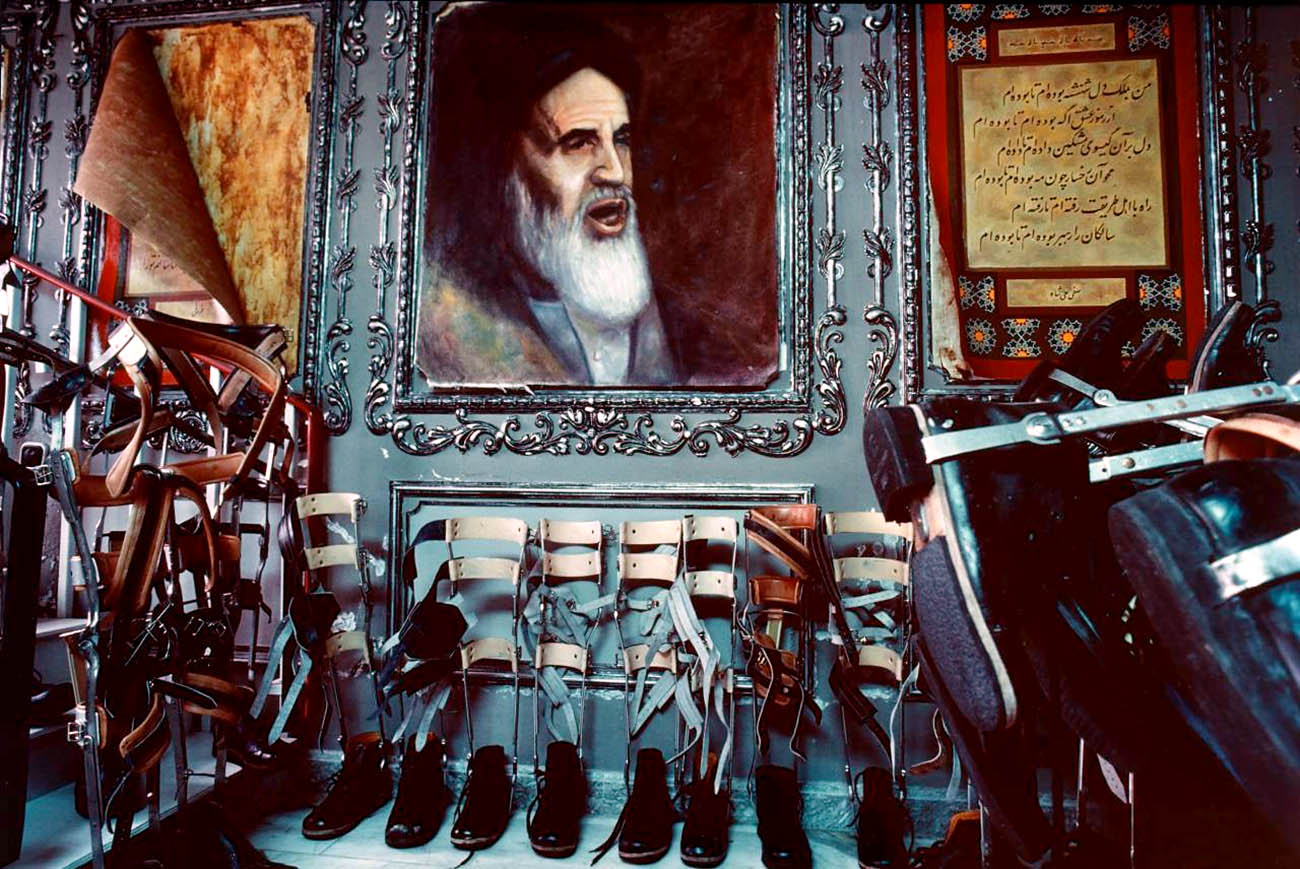
18. Medicine, divided into two subsections, presents doctors and nurses at work at the front, and individuals who are surviving with injuries. “Wartime Medicine” presents the conditions of medical operations on the battlefield, from Vo Anh Khanh’s photograph of North Vietnam surgeons working in a swamp to Larry Burrows’ emergency dressing station in Vietnam. “Subsequent to War” showcases survivors. A 2007 photograph by Peter van Agtmael shows a soldier with a prosthetic leg playing with his two sons and light sabres in a field. A 1985 photograph by Michael Coyne pictures a rehabilitation centre stacked with braces and artificial limbs for the victims of war in Iran and Iraq. Nina Berman’s 2004 portrait of PTSD patient Randall Clunen, from the series Purple Hearts, relates the psychic scars of war. (22 images)
Michael Coyne (Australian, b. 1945) Rehabilitation Centre – Iran 1985 Type C print 55cm x 36.6cm
Nina Berman (American, b. 1960) Randall Clunen 2004 From the series Purple Hearts Pigment print 28 x 28 in.
Faith
19. Faith presents devotion during wartime. The Oath of War (1942), by Mark Markov-Grinberg, taken minutes before a regiment attacked an entrenched German defensive position, shows a soldier kissing his gun. A 1918 image by an unknown photographer depicts a soldier’s grave in France, marked by a wooden cross and the soldier’s helmet, under which his Bible was found. Naval photographer R. Woodward’s 1945 photograph depicts a shipboard service performed after a Japanese plane dropped two bombs on the ship; the officiating chaplain is possibly Father O’Callahan, who subsequently received the Medal of Honor. Three days before the start of the Iraq War in 2003, Hayne Palmour IV captured the baptism of a Marine by a Navy chaplain in Kuwait, in a pool of water constructed from sandbags. (12 images)
Mark Borisovich Markov-Grinberg (Russian, 1907-2003) The Oath of War (Soviet soldier kissing his rifle) 1939, printed later Ferrotyped gelatin silver print
R. Woodward, USNR, American (birth date unknown) Religious services under the blasted flight deck of the USS Franklin March 1945 Gelatin silver print, the Museum of Fine Arts, Houston, gift of St. Paul’s United Methodist Church
Religious services under the blasted flight deck of the USS Franklin (CV-13), for the 807 men killed from two bomb blasts while off the coast of Japan. The only American warship to suffer greater losses was the battleship Arizona at Pearl Harbor. March 1945 by R. Woodward, USNR.
PLEASE NOTE:This information is incorrect. 883 servicemen perished when the heavy cruiser USS Indianapolis was torpedoed and sunk by a Japanese submarine on 30 July 1945 and the survivors were not spotted until three and a half days later. Many succumbed to exposure to the elements, dehydration and shark attacks.
Refugee
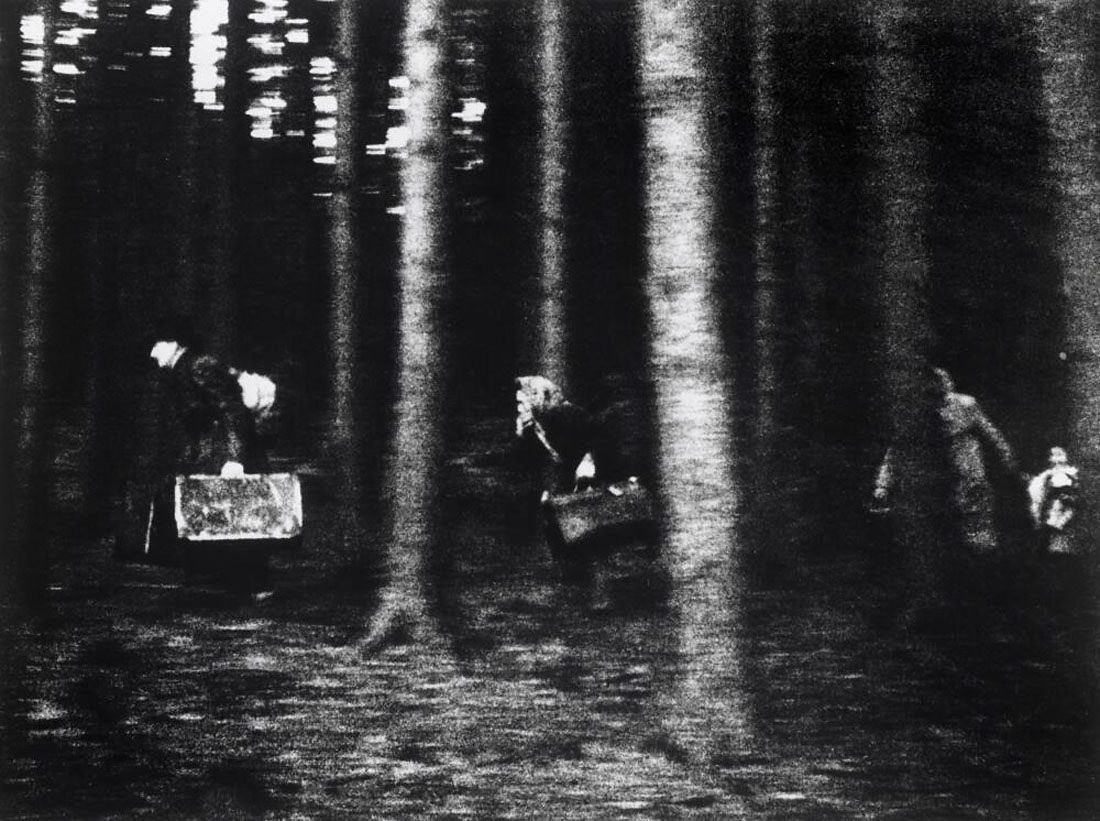
20. The focus of Refugee moves away from the combatants’ standpoint and into the perspectives of others, including individuals who have been displaced as well as left behind. This section presents people either fleeing battle or living as expatriates in a new place. The Pulitzer Prize-winning image shot in 1965 by Sawada Kyoichi shows a Vietnamese mother and her children wading across a river to escape from a U.S. napalm strike on their village. An image by Hilmar Pabel depicts a family fleeing across the border in the Bavarian Forest to the West, escaping in the night carrying suitcases. A famous 1993 picture by Gilles Peress, of hands pressing against both sides of a windowpane, documents the evacuation of Jews from Sarajevo. A 1994-1995 portrait by Fazal Sheikh depicts a mother and her two children sitting on the ground somewhere in Tanzania; her newborn’s name, Makantamba, means “one who was born at the time of war.” Jonathan C. Torgovnik’s Valentine with her daughters Amelie and Inez, Rwanda (2006) is taken from the series Intended Consequences. An image by Alexandria Avakian depicts a Lebanese refugee in traditional dress mowing a lawn in suburban Michigan. (8 images)
Sawada Kyoichi (Japanese, 1936-1970) Mother and children wade across river to escape U.S. bombing. Qui Nhon, South Vietnam September 1965
Gilles Peress (French, b. 1946) Evacuation of the Jews, Skanderia, Sarajevo, Bosnia 1993 From the book Farewell to Bosnia, 1994 Gelatin silver print 16 x 20 inches
Alexandria Avakian (American, b. 1960) Dearborn, Michigan, June 2002: Tufaha Baydayn, a Lebanese American, fled Lebanon’s civil war in the 1970s 2002
Curators: Anne Wilkes Tucker, the Gus and Lyndall Wortham Curator of Photography; Will Michels, collections photographer and exhibition co-curator; Natalie Zelt, curatorial assistant
Roger Fenton (British, 1819-1869) The Valley of the Shadow of Death 1855
This is the biggest posting on one exhibition that I have ever undertaken on Art Blart!
As befits the gravity of the subject matter this posting is so humongous that I have had to split it into 4 separate postings. This is how to research and stage a contemporary photography exhibition that fully explores its theme (NGV please note!). The curators reviewed more than one million photographs in 17 countries, locating pictures in archives, military libraries, museums, private collections, historical societies and news agencies; in the personal files of photographers and service personnel; and at two annual photojournalism festivals producing an exhibition that features 26 sections (an inspired and thoughtful selection) that includes nearly 500 objects that illuminate all aspects of WAR/PHOTOGRAPHY.
I have spent hours researching and finding photographs on the Internet to support the posting. It has been a great learning experience and my admiration for photographers of all types has increased. I have discovered the photographs and stories of new image makers that I did not know and some hidden treasures along the way. I hope you enjoy this monster posting on a subject matter that should be consigned to the history books of human evolution.
**Please be aware that there are graphic photographs in all of these postings.**Part 2, Part 3, Part 4
Dr Marcus Bunyan
Many thankx to the Museum of Fine Arts, Houston for allowing me to publish some of the photographs in the posting. Please click on the photographs for a larger version of the image.
On November 11, 2012, the Museum of Fine Arts, Houston, debuts an unprecedented exhibition exploring the experience of war through the eyes of photographers. WAR / PHOTOGRAPHY: Images of Armed Conflict and Its Aftermath features nearly 500 objects, including photographs, books, magazines, albums and photographic equipment. The photographs were made by more than 280 photographers, from 28 nations, who have covered conflict on six continents over 165 years, from the Mexican-American War of 1846 through present-day conflicts. The exhibition takes a critical look at the relationship between war and photography, exploring what types of photographs are, and are not, made, and by whom and for whom. Rather than a chronological survey of wartime photographs or a survey of “greatest hits,” the exhibition presents types of photographs repeatedly made during the many phases of war – regardless of the size or cause of the conflict, the photographers’ or subjects’ culture or the era in which the pictures were recorded. The images in the exhibition are organised according to the progression of war: from the acts that instigate armed conflict, to “the fight,” to victory and defeat, and images that memorialise a war, its combatants and its victims. Both iconic images and previously unknown images are on view, taken by military photographers, commercial photographers (portrait and photojournalist), amateurs and artists.
“‘WAR/PHOTOGRAPHY’ promises to be another pioneering exhibition, following other landmark MFAH photography exhibitions such as ‘Czech Modernism: 1900-1945’ (1989) and ‘The History of Japanese Photography’ (2003),” said Gary Tinterow, MFAH director. “Anne Tucker, along with her co-curators, Natalie Zelt and Will Michels, has spent a decade preparing this unprecedented exploration of the complex and profound relationship between war and photography.” “Photographs serve the public as a collective memory of the experience of war, yet most presentations that deal with the material are organised chronologically,” commented Tucker. “We believe ‘WAR / PHOTOGRAPHY’ is unique in its scope, exploring conflict and its consequences across the globe and over time, analysing this complex and unrelenting phenomenon.”
The earliest work in the exhibition is from 1847, taken from the first photographed conflict: the Mexican-American War. Other early examples include photographs from the Crimean War, such as Roger Fenton’s iconic The Valley of the Shadow of Death (1855) and Felice Beato’s photograph of the devastated interior of Fort Taku in China during the Second Opium War (1860). Among the most recent images is a 2008 photograph of the Battle Company of the 173rd Airborne Brigade in the remote Korengal Valley of Eastern Afghanistan by Tim Hetherington, who was killed in April 2011 while covering the civil war in Libya. Also represented with two photographs in the exhibition is Chris Hondros, who was killed with Hetherington. While the exhibition is organised according to the phases of war, portraits of servicemen, military and political leaders and civilians are a consistent presence throughout, including Yousuf Karsh’s classic 1941 image of Winston Churchill, and the Marlboro Marine (2004), taken by embedded Los Angeles Times photographer Luis Sinco of soldier James Blake Miller after an assault in Fallujah, Iraq. Sinco’s image was published worldwide on the cover of 150 publications and became a 2005 Pulitzer Prize finalist.
The exhibition was initiated in 2002, when the MFAH acquired what is purported to be the first print made from Joe Rosenthal’s negative of Old Glory Goes Up on Mount Suribachi, Iwo Jima (1945). From this initial acquisition, the curators decided to organise an exhibition that would focus on war photography as a genre. During the evolution of the project, the museum acquired more than a third of the prints in the exhibition. The curators reviewed more than one million photographs in 17 countries, locating pictures in archives, military libraries, museums, private collections, historical societies and news agencies; in the personal files of photographers and service personnel; and at two annual photojournalism festivals: World Press Photo (Amsterdam) and Visa pour l’Image (Perpignan, France). The curators based their appraisals on the clarity of the photographers’ observation and capacity to make memorable and striking pictures that have lasting relevance. The pictures were recorded by some of the most celebrated conflict photographers, as well as by many who remain anonymous. Almost every photographic process is included, ranging from daguerreotypes to inkjet prints, digital captures and cell-phone shots.
Press release from the Museum of Fine Arts, Houston
WAR/PHOTOGRAPHY: Images of Armed Conflict and Its Aftermath is organised into 26 sections, which unfold in the sequence that typifies the stages of war, from the advent of conflict through the fight, aftermath and remembrance. Each section showcases images appropriate to that category while cutting across cultures, time and place. Outside of this chronological approach are focused galleries for “Media Coverage and Dissemination” (with an emphasis on technology); “Iwo Jima” (a case study); and “Photographic Essays” (excerpts from two landmark photojournalism essays, by Larry Burrows and Todd Heisler).
Media Coverage and Dissemination
1. Media Coverage and Dissemination provides an overview of how technology has profoundly affected the ways that pictures from the front reach the public: from Roger Fenton and his horse-drawn photography van (commissioned by the British government to document the Crimean War), to Joe Rosenthal’s 1940s Anniversary Speed Graphic (4 x 5) camera, to pictures taken with the Hipstamatic app of an iPhone by photojournalist Michael Christopher Brown in Egypt during the protests and clashes of the Arab Spring. (22 images / objects)
Roger Fenton (British, 1819-1869) The artist’s van [Marcus Sparling, full-length portrait, seated on Roger Fenton’s photographic van] 1855 Salted paper print 17.5 x 16.5cm Library of Congress, Prints & Photographs Division
Manufactured by Graflex, active 1912-1973 Anniversary Speed Graphic (4 x 5), “Scott S. Wigle camera” (First American-made D-Day picture) c. 1940 Camera Collection of George Eastman House (Gift of Graflex, Inc.)
An Advent of War
2. The photographs in An Advent of War depict the catalytic events of war. These moments of instigation are rarely captured, as photographers are not always present at the initial attack or provocation. Photographs that Robert Clark took on the morning of September 11, 2001, and the aerial view of torpedoes approaching Battleship Row during the Pearl Harbor attack, taken by an unknown Japanese airman on December 7, 1941, both convey with clarity the concept of war’s advent. (11 images).
Unknown photographer (Japanese) War in Hawaiian Water. Japanese Torpedoes Attack Battleship Row, Pearl Harbor December 7, 1941 Gelatin silver print The Museum of Fine Arts, Houston, gift of Will Michels
Recruitment & Embarkation
3. Recruitment & Embarkation shows mobilisation: the movement toward the front. Mikhail Trakhman captures a Russian mother kissing her son goodbye in Kolkhoz farmer M. Nikolaïeva bids her son Ivan goodbye before he joins the partisans (1942), while a 1916 photograph by Josiah Barnes, known as the “Embarkation Photographer,” shows an archetypal moment: young Australian soldiers waving goodbye from a ship as they depart their home country to fight in World War I. (7 images)
Josiah Barnes (Australian, 1858-1921) Embarkation of HMAT Ajana, Melbourne July 8, 1916 Gelatin silver print (printed 2012) On loan from the Australian War Memorial
Known as “the embarkation photographer”, the Kew, Melbourne photographer Josiah Barnes took an interest in photographing Australian troopships as they departed for war from Melbourne. He had two sons, “Norm and Victor, who left for war in 1916 (both returned to Australia after their service),” which may have fuelled his interest.
Mikhail Trakhman (Russian, 1918-1976) Kolkhoz farmer M. Nikolaïeva bids her son Ivan goodbye before he joins the partisans 1942 Gelatin silver print
A kolkhoz was a form of collective farm in the Soviet Union which, alongside sovkhoz (state farm), formed the main components of the socialised farm sector which emerged after the October Revolution of 1917 as an antithesis to feudalism, aristocratic landlords, serfdom and individual farming.
Mikhail Trakhman
Mikhail Trakhman was born in Moscow in 1918. After graduating from school, he began working at the newsreel studio and at the same time studying for courses in the field of assistant operator. From 1938 he became the photo reporter of the Uchitelskaya Gazeta, and in 1939 he was drafted into the army and participated in the Soviet-Finnish war. During the Great Patriotic War, Mikhail Trakhman worked as a press photographer for the Soviet Information Bureau. His main instrument was the famous “Leica” camera, but often military weapons fell into his hands. He shot in besieged Leningrad, in Pskov and in Belarus, participated in the liberation of Poland and Hungary. The most famous are his photographs from the partisan series taken in the rear of the German troops. In his diaries, he wrote: “I take a lot of things, although I know that 80% of the shot will go to the basket, but I need to shoot it, since such things happen once in a lifetime.” Thanks to these photos, he entered the history of war reporting. Mikhail Trakhman was awarded the Order of the Red Star and the medal “For the Defense of Leningrad” and “Partisan Medal”, which he especially valued.
Anonymous. “Mikhail Trakhman,” on the Lumiere Brothers Gallery website [Online] Cited 06/09/2020. Used under fair use conditions for the purposes of education and research
Training
4. Training explores photographs of soldiers in boot camp or more-advanced phases of instruction and exercise. World War II Royal Navy officers gather around a desk to study different types of aircraft in a photograph by Sir Cecil Beaton. Also included is the iconic Vietnam-era photograph of a U.S. Marine drill sergeant reprimanding a recruit in South Carolina, from Thomas Hoepker’s series US Marine Corps boot camp, 1970. In one photograph, shot by a Japanese soldier and published in 1938 by Look magazine, Japanese soldiers use living Chinese prisoners in bayonet practice. (13 images)
5. Daily Routine features moments of boredom, routine and playfulness. A member of the U.S. Army Signal Corps wears a gas mask as he peels onions. A 1942 photograph by Sir Cecil Beaton catches the off-guard expression of a Royal Navy man at a sewing machine, mending a signal flag. (13 images)
Anonymous photographer Soldiers trying out their gas masks in every possible way. Putting the respirator to good use while peeling onions. 40th Division, Camp Kearny, San Diego, California 1918 National Archives and Records Administration
HMS Alcatara was an RML passenger liner of 22,209 tons and 19 knots launched in 1926, and taken up by the Royal Navy for conversion to an armed merchant cruiser to counter the threat posed by German surface raiders against shipping. When Jim Hingston joined her as an ordinary seaman at Freetown she was still largely in merchant dress, with wood panelling throughout. Much to the regret of her crew this was removed during their stay at Simonstown – the wisdom of that was apparent to them only too soon.
There were some 53 such ships in all, poorly armed, in Alcantara‘s case with eight 6 inch and two 3 inch guns, the former having a range of some 14,200 yards (13,000 metres). Such armament could not be much more than defensive, the intention being that the AMCs should radio the position of the German ship and not only give merchant shipping a chance to escape but delay the commerce raider long enough to allow regular RN warships to get to the scene.
Alcantara‘s opponent, the Thor, was laid down in 1938 as a freighter of 9,200 tons displacement and a speed of 18 knots, but commissioned as a commerce raider on 14 March 1940. Though she had only 6 150 mm guns they had a much greater range, at 20,000 yards, than Alcantara and other British AMCs. She also carried a scout floatplane. During the engagement with Alcantara on 28 July 1940 the Thor inflicted significant damage but the Alcantara successfully closed, and after being hit the Thor withdrew in order to avoid the risk of being crippled or being forced to abort her mission. In later encounters with AMCs the Thor severely damaged the Carnarvon Castle and sank Voltaire.
HMS Alcantara later had her 6 in armament upgraded and was equipped with a seaplane, but as the threat of surface raiders receded she was converted to her more natural role of troopship in 1943.
Reconnaissance, Resistance and Sabotage
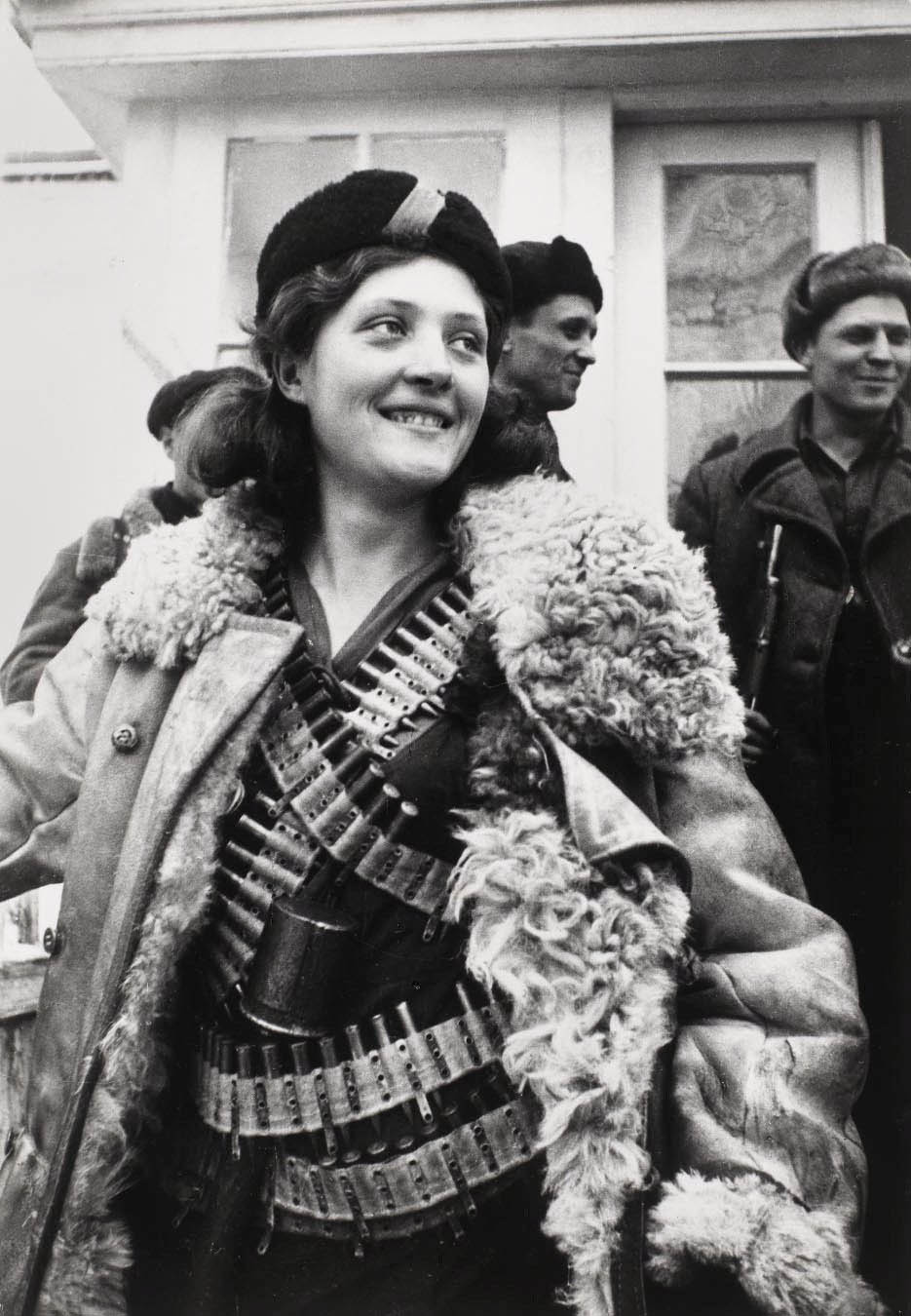
6. Images of Reconnaissance, Resistance and Sabotage are scarce by nature, as they reveal spies in the act and could be used against those depicted or their families. A U.S. soldier on night watch sits atop a mountain in Afghanistan, wrapped in a blanket and peering into night-vision equipment, in a photograph by Adam Ferguson. A photograph by T. E. Lawrence (known as Lawrence of Arabia) documents the bombing of the Hejaz Railway during the Arab Revolt. Cas Oorthuys’ photograph Under German Occupation (Dutch Worker’s Front), Amsterdam (c. 1940-1945), taken with a camera hidden in his jacket, shows the back of a fellow countryman who is helping to conceal the photographer, with German troops in the distance. Also included is Arkady Shaikhet’s 1942 photograph Partisan Girl depicting Olga Mekheda, who was renowned for her ability to get through German roadblocks – even while pregnant. (10 images)
T.E. Lawrence (British, 1888-1935) Untitled [A Tulip bomb explodes on the railway Hejaz Railway, near Deraa, Hejaz, Ottoman Empire] 1918 Collection of the MFA Houston
Cas Oorthuys (Dutch, 1908-1975) Under German Occupation (Dutch Worker’s Front), Amsterdam c. 1940-1945 Gelatin silver print 13 7/8 × 11 5/8 in. (35.2 × 29.5cm) Museum of Fine Arts, Houston Museum purchase funded by Anne Wilkes Tucker in honor of the 50th wedding anniversary of Max and Isabell Smith Herzstein
Adam Ferguson (Australian, b. 1978) September 4, Tangi valley, Wardak province, Afghanistan, a soldier of the U.S. Army 10th Mountain Division was attentively monitoring a highway September 4, 2009
“To me, this picture epitomises the abstract idea of the ‘enemy’ that exists within the U.S. led war in Afghanistan: a young infantryman watches a road with a long-range acquisition sight surveying for insurgents planting Improvised Explosive Devices. U.S. Army Infantrymen rarely knowingly come face to face with their enemy, combat is fleeting and fought like cat and mouse, and the most decisive blows are determined by intelligence gathering, and then delivered through technology that maintains a safe distance, just like a video game.”
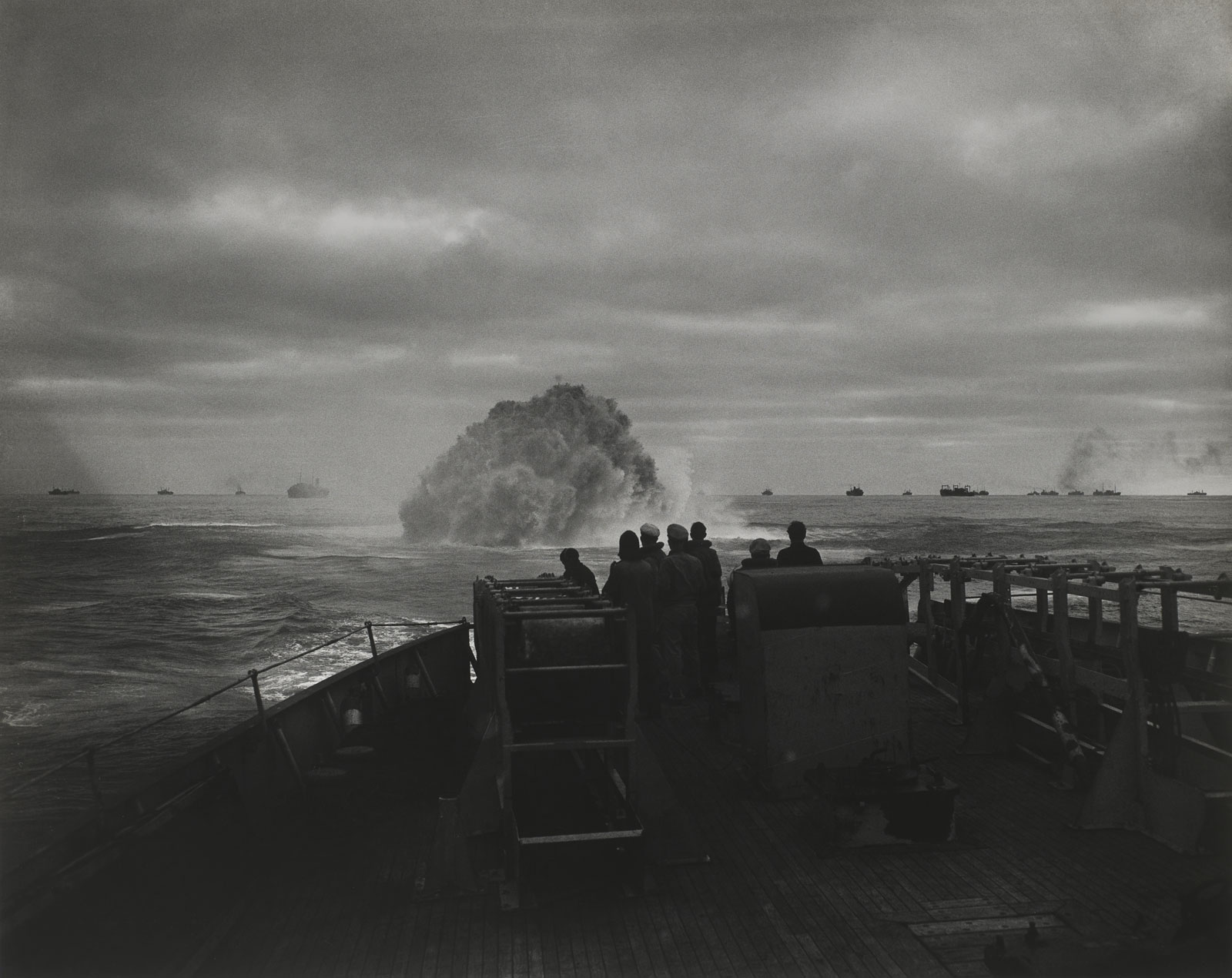
7. Patrol & Troop Movement conveys the mass movements of peoples and personnel by land, sea and air, from the movement of troops and supplies to patrols by all five divisions of military service: Army, Navy, Marine Corps, Coast Guard and Air Force. Combat patrols are detachments of forces sent into hostile terrain for a range of missions, and they – as well as the photographers accompanying them – face considerable danger. João Silva’s three sequenced frames show, through his eyes, the tilted earth just after he was felled by an IED while on patrol in Afghanistan in 2010; he lost both legs in the incident. A tranquil, 1917 image by Australian James Frank Hurley depicts silhouetted soldiers walking in a line, their reflections captured in a body of water. A 1943 photograph by American Warrant Photographer Jess W. January USCGR shows members of the U.S. Coast Guard observing a depth-charge explosion hitting a German submarine that stalked their convoy. (14 images)
Frank Hurley (Australian, 1885-1962) Supporting troops of the 1st Australian Division walking on a duckboard track 1917
Warrant Photographer Jess W. January USCGR, American USCG Cutter Spencer destroys Nazi sub April 17, 1943 Gelatin silver print The Museum of Fine Arts, Houston
The Wait
8. The Wait depicts a common situation of wartime. Susan Meiselas captures a tense moment during a 1978 street fight in Nicaragua, when muchachos with Molotov cocktails line up in an alleyway, ready to initiate an attack on the National Guard. Robert Capa shows two female French ambulance drivers in Italy during World War II, leaning against their vehicle, knitting, as they wait to be called. (8 images)
9. The Fight is one of the most extensive sections in the exhibition. Dmitri Baltermants shot Attack – Eastern Front WWII (cover image of the exhibition catalogue) in 1941 from the trench, as men charged over him. Sky Over Sevastopol (1944), by Evgeny Khaldey, is an aerial photograph of planes on their way to a bombing raid of the strategically important naval point. Joe Rosenthal’s Over the Top – American Troops Move onto the Beach at Iwo Jima (1945) pictures infantrymen emerging from the protection of their landing craft into enemy fire. Staged photographs, presented as authentic documents, tend to proliferate during wartime, and several examples are included here. In 1942 the Public Relations Department of the War issued an assignment to photographers to create “representative” images of combat in North Africa for more dynamic images; official British photographer Len Chetwyn staged an Australian officer leading the charging line in the battle of El Alamein, using smoke in the background from the cookhouse to create a lively image. (21 images)
Len Chetwyn (English, 1909-1980) Australians approached the strong point, ready to rush in from different sides November 3, 1942 Silver gelatin photograph
Dmitri Baltermants (Russian, 1912-1990) Attack – Eastern Front WWII 1941 Silver gelatin photograph
The Wait and Rescue
10. The Wait and Rescue bookend The Fight. Among the photographs in Rescue are Ambush of the 173rd AB, South Vietnam (1965), by Tim Page, showing soldiers immediately combing through a battleground to assist the wounded; American Lt. Wayne Miller’s image of a wounded gunner being lifted from the turret of a torpedo bomber; and Life magazine photographer W. Eugene Smith’s 1944 photograph of an American soldier rescuing a dying Japanese infant. Smith wrote about that moment, stating “hands trained for killing gently… extricated the infant” to be transported to medical care. (8 images)
Lt. Wayne Miller (American, 1918-2013) Crewmen lifting Kenneth Bratton out of turret of TBF on the USS SARATOGA after raid on Rabaul November 1943 Silver gelatin photograph
More information: Kenneth C. Bratton – Mississippi (WWII vet). He was born in Pontotoc, MS, December 17, 1918. He passed away April 15, 1982. Lt. Bratton won a purple heart for his bravery during the attack on Rabaul November 11, 1943.
Wayne Forest Miller (September 19, 1918 – May 22, 2013) was an American photographer known for his series of photographs The Way of Life of the Northern Negro. Active as a photographer from 1942 until 1975, he was a contributor to Magnum Photos beginning in 1958. …
War photographer
Miller then served as a lieutenant in the U.S. Navy where he was assigned to Edward Steichen’s World War II Naval Aviation Photographic Unit. He was among the first Western photographers to document the destruction at Hiroshima.
The Grumman TBF Avenger (designated TBM for aircraft manufactured by General Motors) is an American World War II-era torpedo bomber developed initially for the United States Navy and Marine Corps, and eventually used by several air and naval aviation services around the world.
The Avenger entered U.S. service in 1942, and first saw action during the Battle of Midway. Despite the loss of five of the six Avengers on its combat debut, it survived in service to become the most effective and widely-used torpedo bomber of World War II, sharing credit for sinking the super-battleships Yamato and Musashi (the only ships of that type sunk exclusively by American aircraft while under way) and being credited for sinking 30 submarines. Greatly modified after the war, it remained in use until the 1960s.
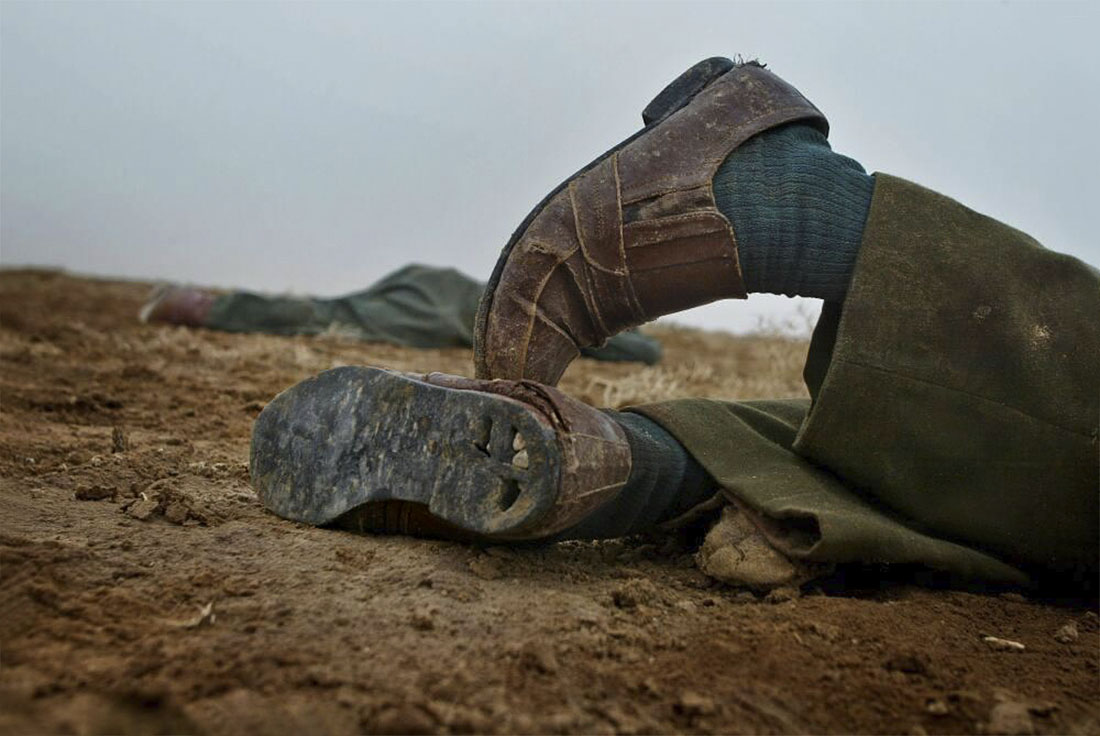
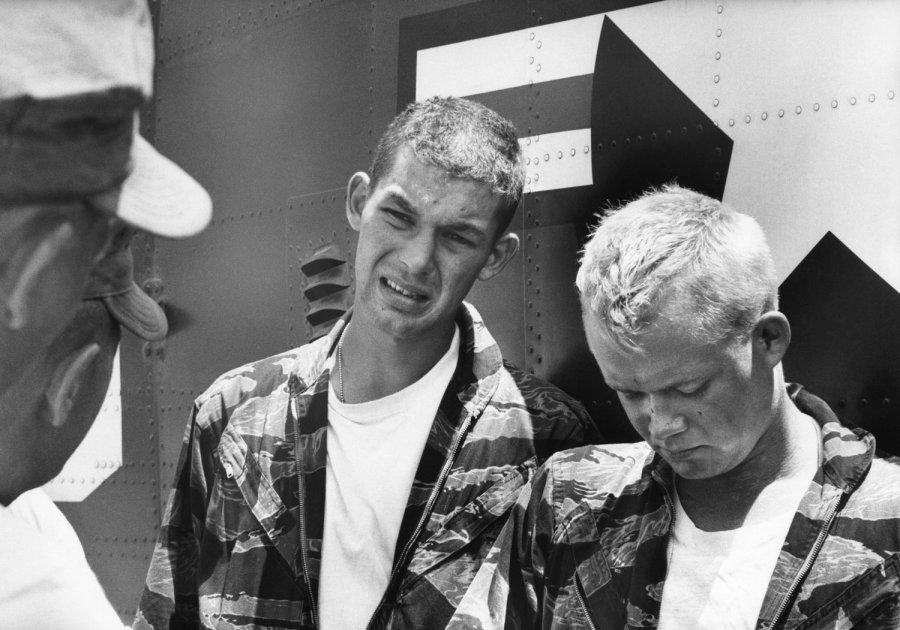
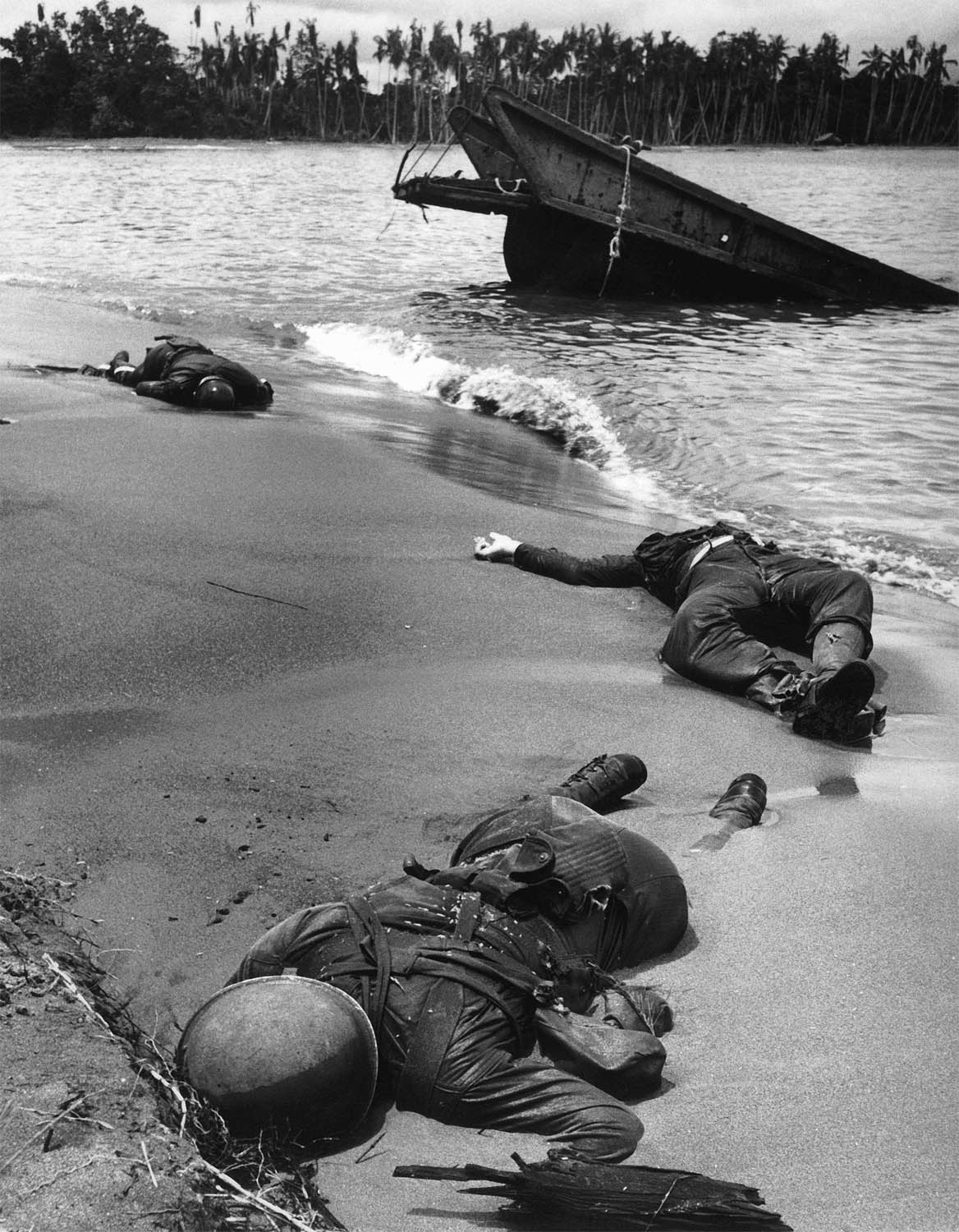
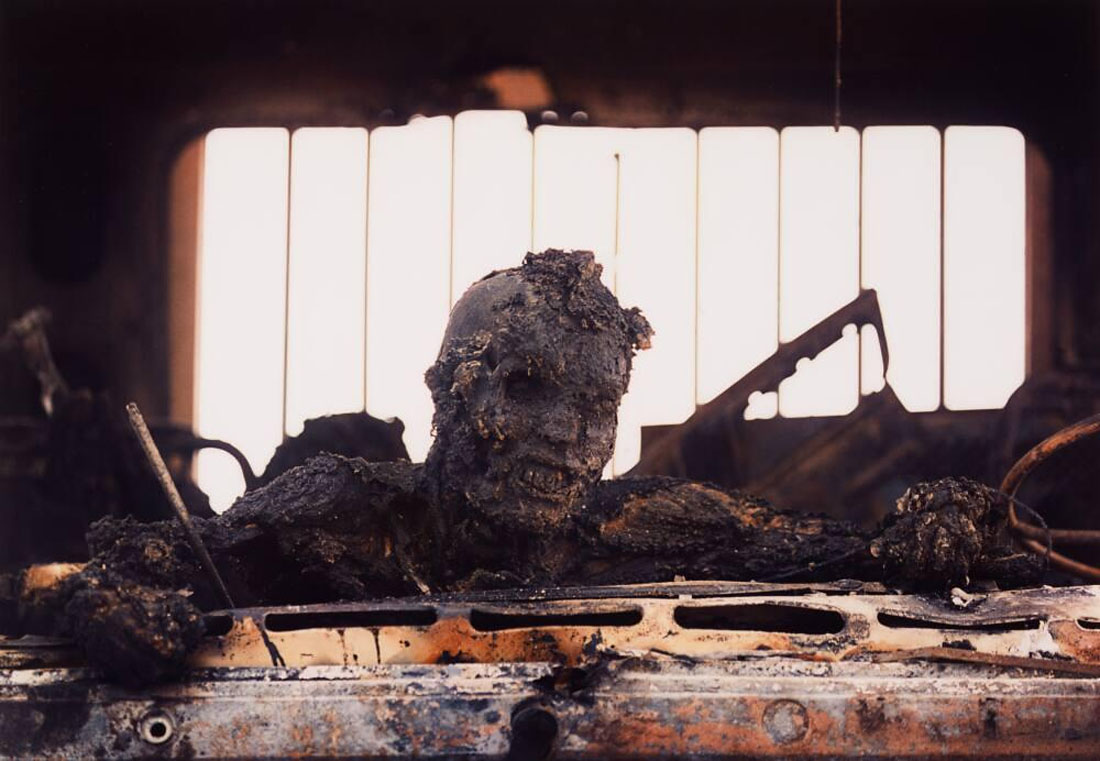
11. Aftermath, with four subsections, features photographs taken after the battle has ended. “Death” on the battlefield is one of the earliest types of war images: Felice Beato photographed the dead in the interior of Fort Taku in the Second Opium War (1860). George Strock’s Dead GIs on Buna Beach, New Guinea (1943), which ran in Life magazine with personal details about the casualties, was the first published photograph from any conflict of American dead in World War II. In 1966, Associated Press photographer Henri Huet documented an American paratrooper, who was killed in action, being raised to an evacuation helicopter. Incinerated Iraqi, Gulf War, Iraq, taken by Kenneth Jarecke, was published in Europe, but the American Associated Press editors withheld it in the United States. “Shell Shock and Exhaustion” shows impenetrable exhaustion after battle. In Don McCullin’s Shell-shocked soldier awaiting transportation away from the front line, Hué, Vietnam (1968), the man looks forward with the “thousand-yard stare.” Robert Attebury photographed Marines so exhausted after a 2005 battle in Iraq that lasted 17 hours that they fell asleep where they had been standing, amid the rubble of a destroyed building. “Grief and Battlefield Burial” were taken at the site of the conflict, including David Turnley’s 1991 picture of a weeping soldier who has just learned that the remains in a nearby body bag are those of a close friend. “Destruction of Property” shows collateral damage from war. Christophe Agou, for instance, photographed the smouldering steel remains of the twin towers of the World Trade Center in 2001. (39 images)
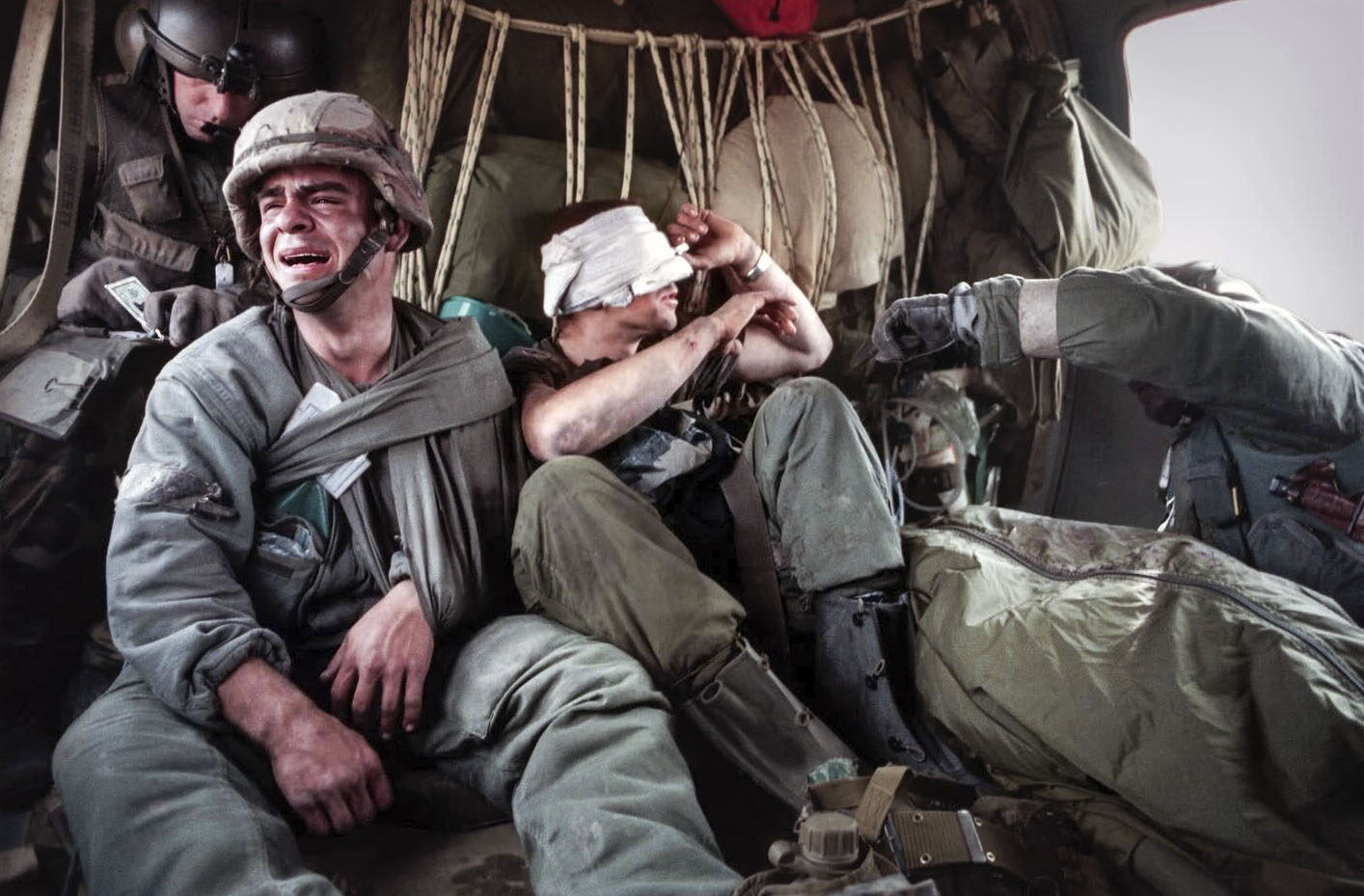
David Turnley (American, b. 1955) American Soldier Grieving for Comrade Iraq, 1991
Ken Kozakiewicz (left) breaks down in an evacuation helicopter after hearing that his friend, the driver of his Bradley Fighting Vehicle, was killed in a “friendly fire” incident that he himself survived. Michael Tsangarakis (centre) suffers severe burns from ammunition rounds that blew up inside the vehicle during the incident. All of the soldiers were exposed to depleted uranium as a result of the explosion. They and the body of the dead man are on their way to a MASH (Mobile Army Surgical Hospital).
Prisoners of War (Civilian and Military)/Interrogation
12. Prisoners of War (Civilian and Military)/Interrogation is a frequently photographed subject because such pictures can be made outside an area of conflict. Moreover, the people in control often documented their prisoners as a show of power. The photographs in this section include the official recording of a prisoner of war before his execution by the Khmer Rouge, taken by Nhem Ein. (14 images)
13. Iwo Jima is a case study within the exhibition that presents the complete thematic narrative in photographs from a specific battle. Included in this section is the inspiration for the exhibition: Joe Rosenthal’s iconic, Pulitzer Prize-winning Old Glory Goes Up on Mount Suribachi, Iwo Jima, a photograph he took as an Associated Press photographer in World War II showing U.S. Marines and one Navy medic raising the American flag on the remote Pacific island. (25 images)






















![Andrea Bruce (American, b. 1973) 'Untitled [A father home on leave reading the newspaper with his son, who wears his dad’s helmet]' 2006](https://artblart.com/wp-content/uploads/2012/12/andrea-bruce.jpg "Andrea Bruce (American, b. 1973) 'Untitled [A father home on leave reading the newspaper with his son, who wears his dad’s helmet]' 2006")












![Roger Fenton (English, 1819-1869) 'The artist's van [Marcus Sparling, full-length portrait, seated on Roger Fenton's photographic van]' 1855](https://artblart.com/wp-content/uploads/2012/12/roger_fentons_waggon2.jpg "Roger Fenton (English, 1819-1869) 'The artist's van [Marcus Sparling, full-length portrait, seated on Roger Fenton's photographic van]' 1855")


![T.E. Lawrence. 'Untitled [A Tulip bomb explodes on the railway Hejaz Railway, near Deraa, Hejaz, Ottoman Empire]' 1918](https://artblart.com/wp-content/uploads/2026/06/lawrence-a-tulip-bomb-explodes-on-the-railway-hejaz-railway.jpg)









You must be logged in to post a comment.