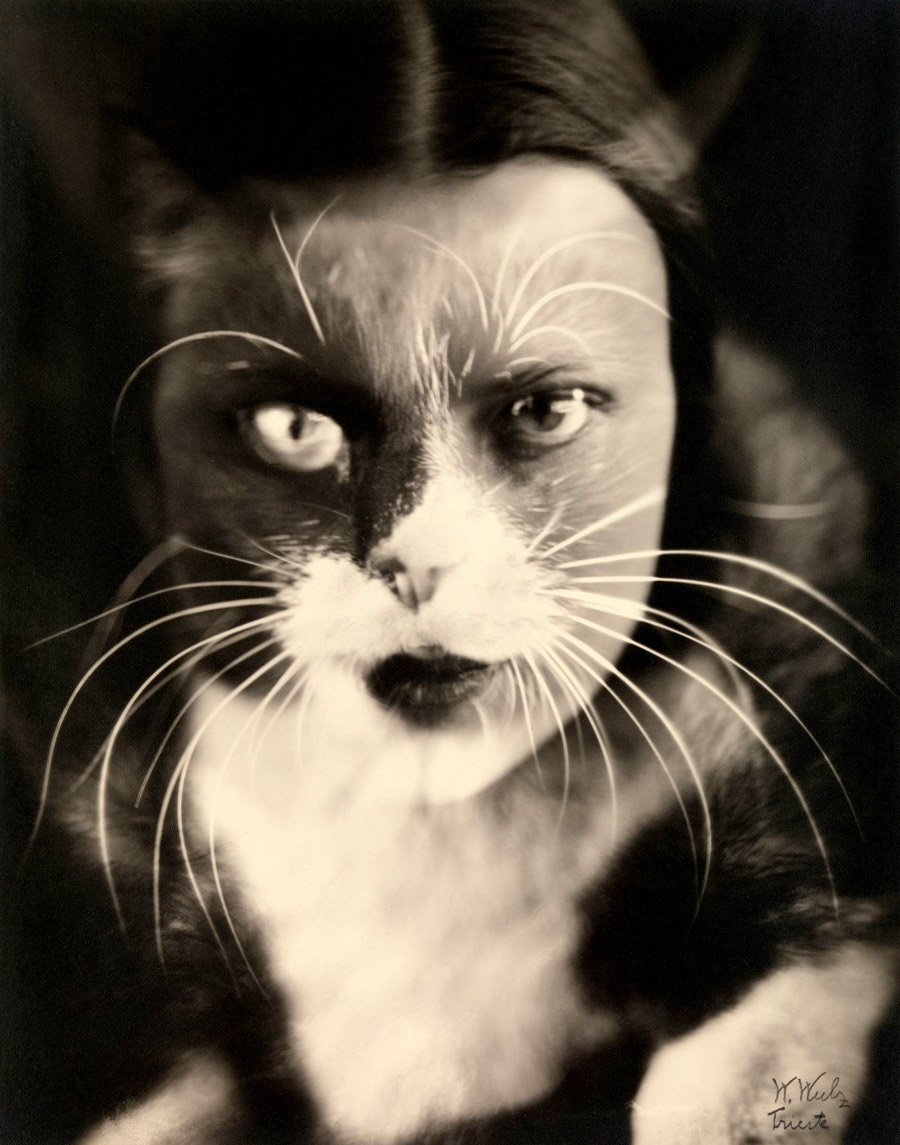
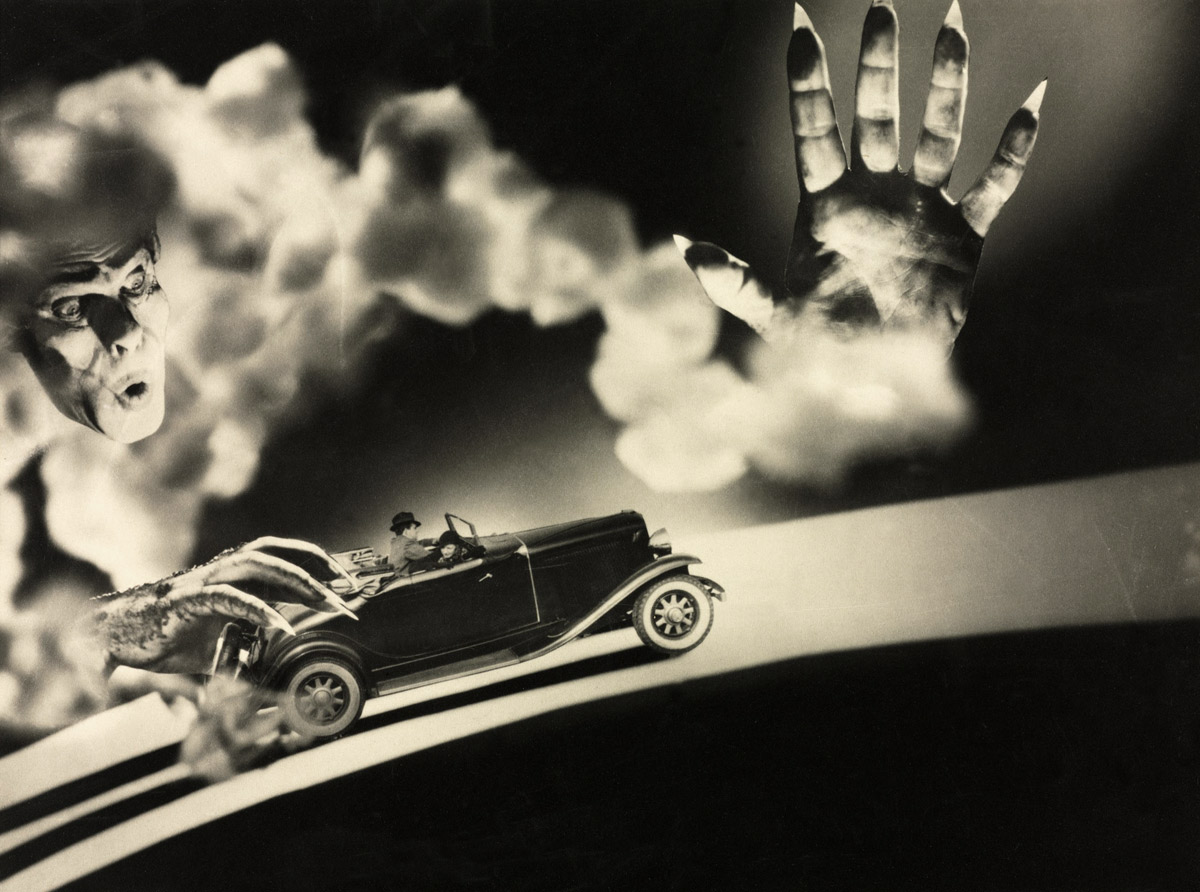
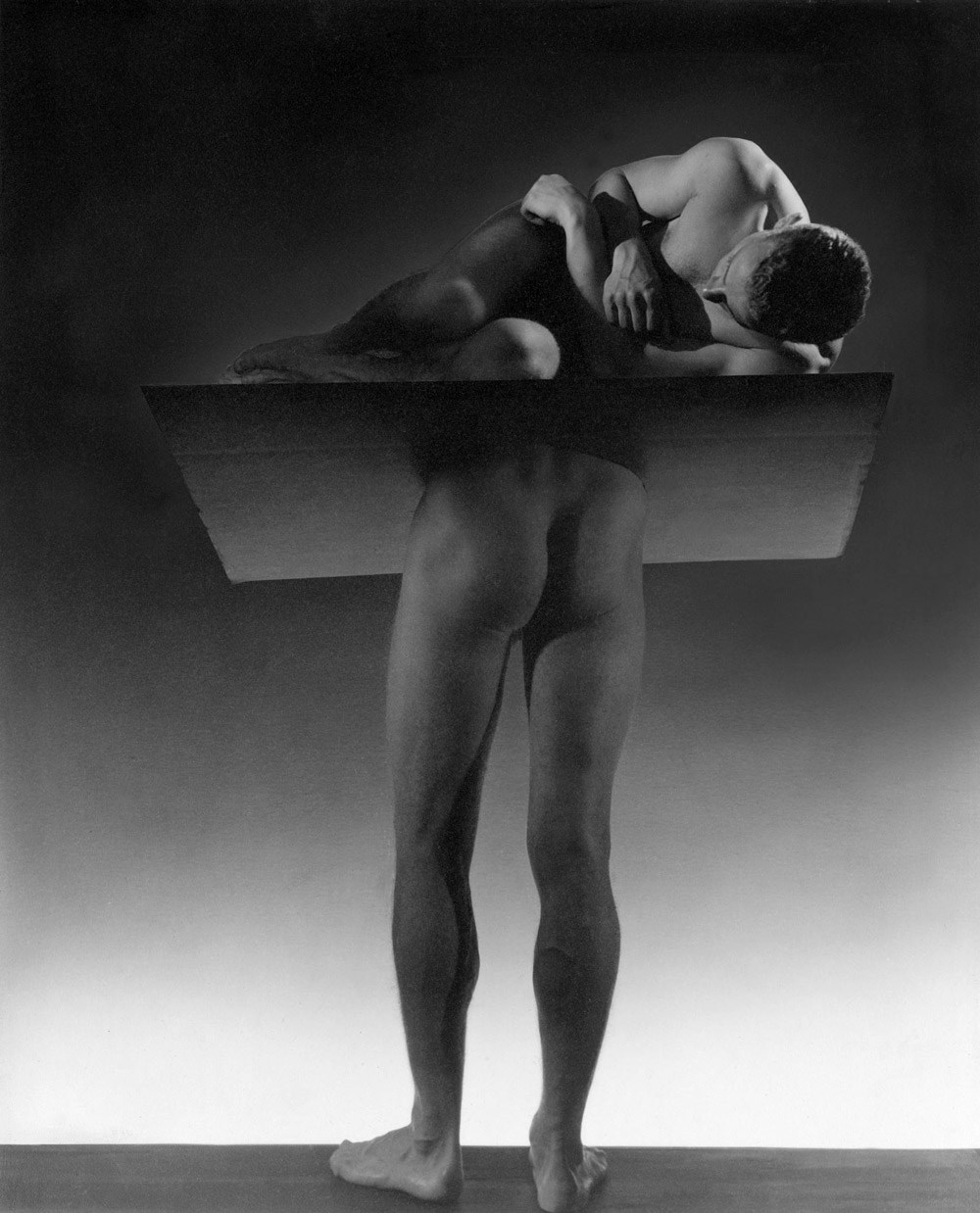
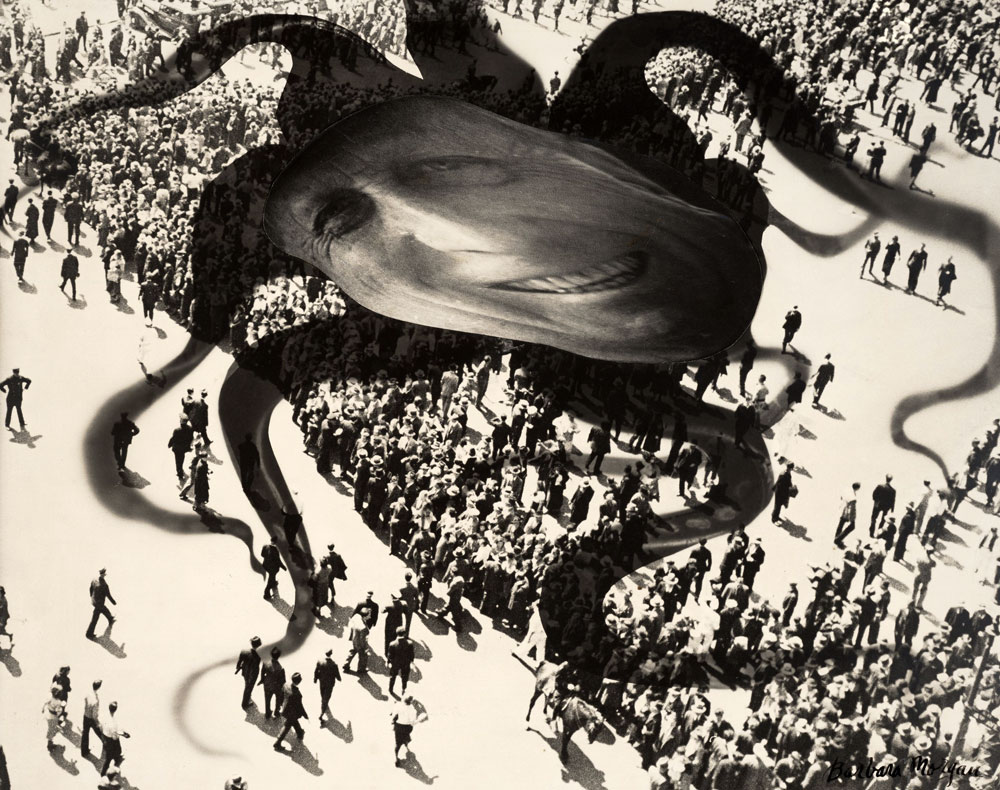
Exhibition: ‘Faking It: Manipulated Photography Before Photoshop’ at The National Gallery of Art, Washington

Exhibition dates: 17th February – 5th May 2013
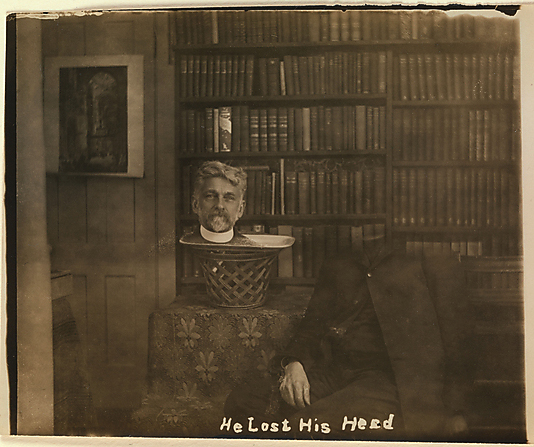
 

Unknown photographer (American). 'He Lost His Head' Nd


Unknown photographer (American)
He Lost His Head
Nd


Further images from this impressive exhibition devoted to the art of photographic manipulation before the advent of digital imagery from its second stop, at The National Gallery of Art, Washington.

See the first posting on this exhibition.

Dr Marcus Bunyan


Many thankx to the National Gallery of Art for allowing me to publish the photographs in the posting. Please click on the photographs for a larger version of the image.


Henry Peach Robinson (English, 1830-1901) 'Fading Away' 1858


Henry Peach Robinson (English, 1830-1901)
Fading Away
1858
Albumen silver print from glass negatives


“I am far from saying that a photograph must be an actual, literal, and absolute fact … but it must represent truth. Truth and fact are not only two words, but, in art at least, they represent two things. A fact is anything done or that exists – a reality. Truth is conformity to fact or reality – absence of falsehood. So that truth in art may exist without an absolute observance of facts.”

~ Henry Peach Robinson


Henry Peach Robinson (British, 1830-1901) 'She Never Told Her Love' 1857


Henry Peach Robinson (British, 1830-1901)
She Never Told Her Love
1857
Albumen silver print from glass negative
18 x 23.2cm (7 1/16 x 9 1/8in.)
Gilman Collection, Purchase, Jennifer and Joseph Duke Gift, 2005


Consumed by the passion of unrequited love, a young woman lies suspended in the dark space of her unrealised dreams in Henry Peach Robinson’s illustration of the Shakespearean verse “She never told her love, / But let concealment, like a worm i’ the bud, / Feed on her damask cheek” (Twelfth Night II, iv, 111-13). Although this picture was exhibited by Robinson as a discrete work, it also served as a study for the central figure in his most famous photograph, Fading Away, of 1858.

Purportedly showing a young consumptive surrounded by family in her final moments, Fading Away was hotly debated for years. On the one hand, Robinson was criticised for the presumed indelicacy of having invaded the death chamber at the most private of moments. On the other, those who recognised the scene as having been staged and who understood that Robinson had created the picture through combination printing (a technique that utilised several negatives to create a single printed image) accused him of dishonestly using a medium whose chief virtue was its truthfulness.

Text from the Metropolitan Museum of Art website
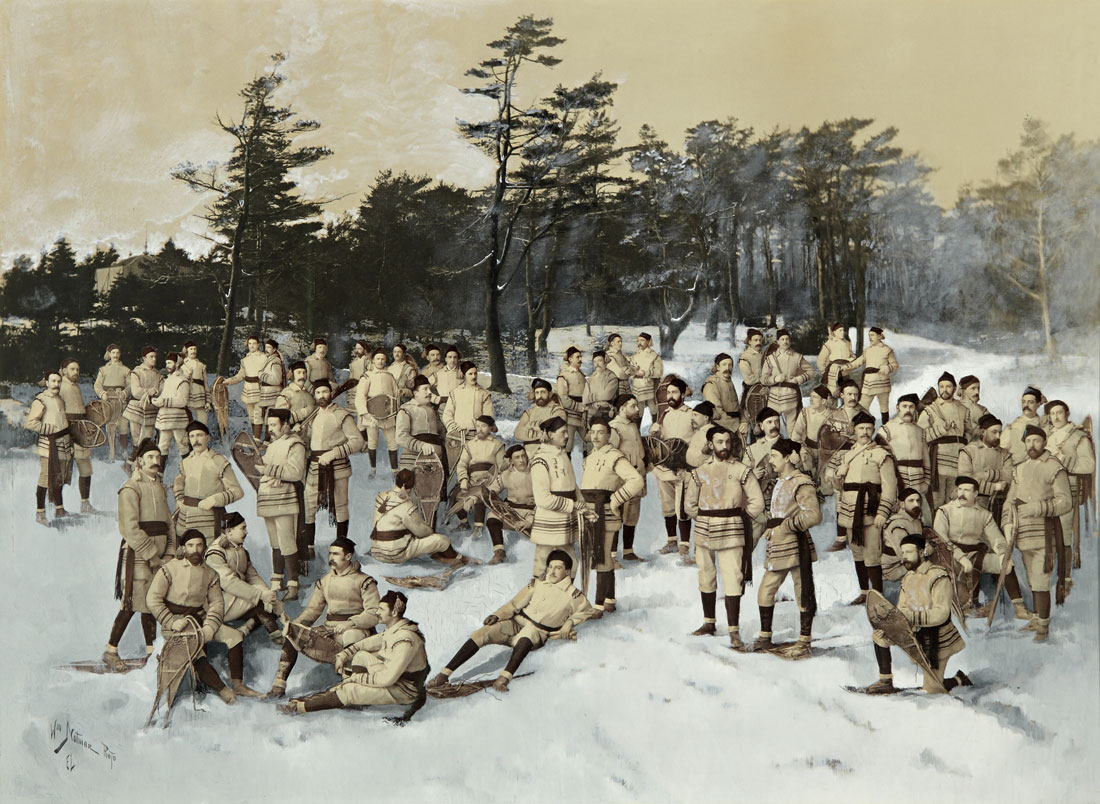
 

Wm. Notman & Son, Montreal, Eugène L'Africain, William Notman. 'Red Cap Snow Shoe Club, Halifax, Nova Scotia' c. 1888


Wm. Notman & Son, Montreal, Eugène L’Africain, William Notman
Red Cap Snow Shoe Club, Halifax, Nova Scotia
c. 1888
Collage of albumen prints with applied media
71.1 x 83.8cm (28 x 33 in.)
McCord Museum, Montreal


Notman established his first photography studio in Montreal in 1856 and relentlessly expanded his operations over the next two decades. At its peak, his company had twenty-four branches throughout Canada and New England, making it the most successful photographic enterprise in North America at the time. Notman specialised in composite portraits of large groups, including sporting clubs, trade associations, family gatherings, clergymen, and college graduates, some featuring more than four hundred figures. Each figure in a group was photographed separately in the studio then printed at the proper scale and pasted onto a painted background, as in this portrait of a Nova Scotia snowshoe club. The entire collage was then re-photographed. The final, relatively seamless tableau could then be printed and sold in a variety of sizes and formats.

Text from the Metropolitan Museum of Art website


Edward Steichen (American, 1879-1973) 
'The Pond – Moonrise' 1904


Edward Steichen (American, 1879-1973)

The Pond – Moonrise
1904
Platinum print with applied colour
 image
39.7 x 48.2cm (15 5/8 x 19 in.)
Lent by The Metropolitan Museum of Art, Alfred Stieglitz Collection, 1933
© The Metropolitan Museum of Art/ Permission Estate of Edward Steichen. All rights reserved


Using a painstaking technique of multiple printing, Steichen achieved prints of such painterly seductiveness they have never been equaled. This view of a pond in the woods at Mamaroneck, New York is subtly coloured as Whistler’s Nocturnes, and like them, is a tone poem of twilight, in-distinction, and suggestiveness. Commenting on such pictures in 1910, Charles Caffin wrote in Camera Work: “It is in the penumbra, between the clear visibility of things and their total extinction into darkness, when the concreteness of appearances becomes merged in half-realised, half-baffled vision, that spirit seems to disengage itself from matter to envelop it with a mystery of soul-suggestion.”

Text from the Metropolitan Museum of Art website
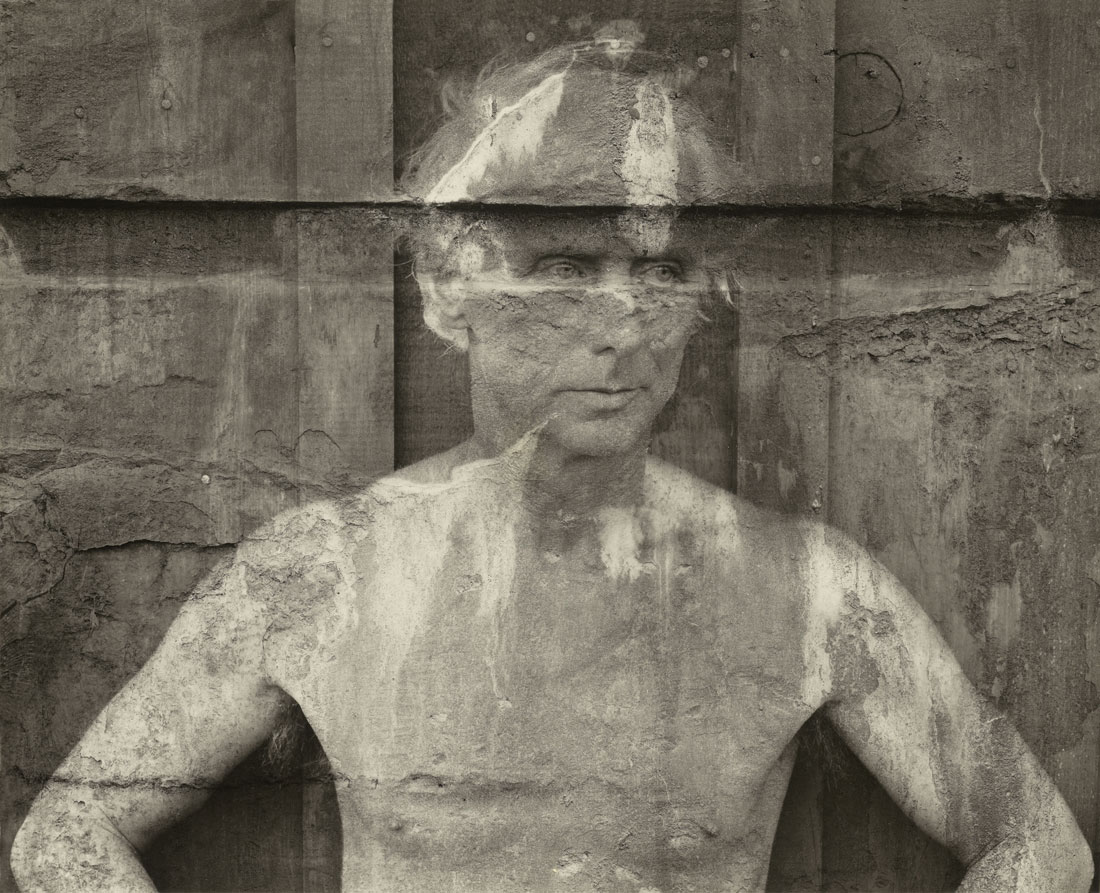
 

Frederick Sommer (American, 1905-1999) 'Max Ernst' 1946


Frederick Sommer (American, 1905-1999)
Max Ernst
1946
Gelatin silver print
19.2 x 23.97cm (7 9/16 x 9 7/16 in.)
The J. Paul Getty Museum, Los Angeles
© Frederick and Frances Sommer Foundation


The National Gallery of Art presents the first major exhibition devoted to the art of photographic manipulation before the advent of digital imagery. Faking It: Manipulated Photography before Photoshop will be on view in the West Building’s Ground Floor galleries from February 17 through May 5, 2013, following its debut at the Metropolitan Museum of Art (from October 11, 2012, through January 27, 2013). In June it travels to the Museum of Fine Arts, Houston.

“Following in its tradition of exhibiting and collecting the finest examples of photography, the Gallery is pleased to present some 200 photographs from the 1840s through the 1980s demonstrating the medium’s complicated relationship to truth in representation,” said Earl A. Powell III, director, National Gallery of Art. “We are grateful to the many lenders, both public and private, who have generously shared works from their collections – especially the Metropolitan Museum of Art, the largest lender and the organiser of this fascinating exhibition.”

The Exhibition

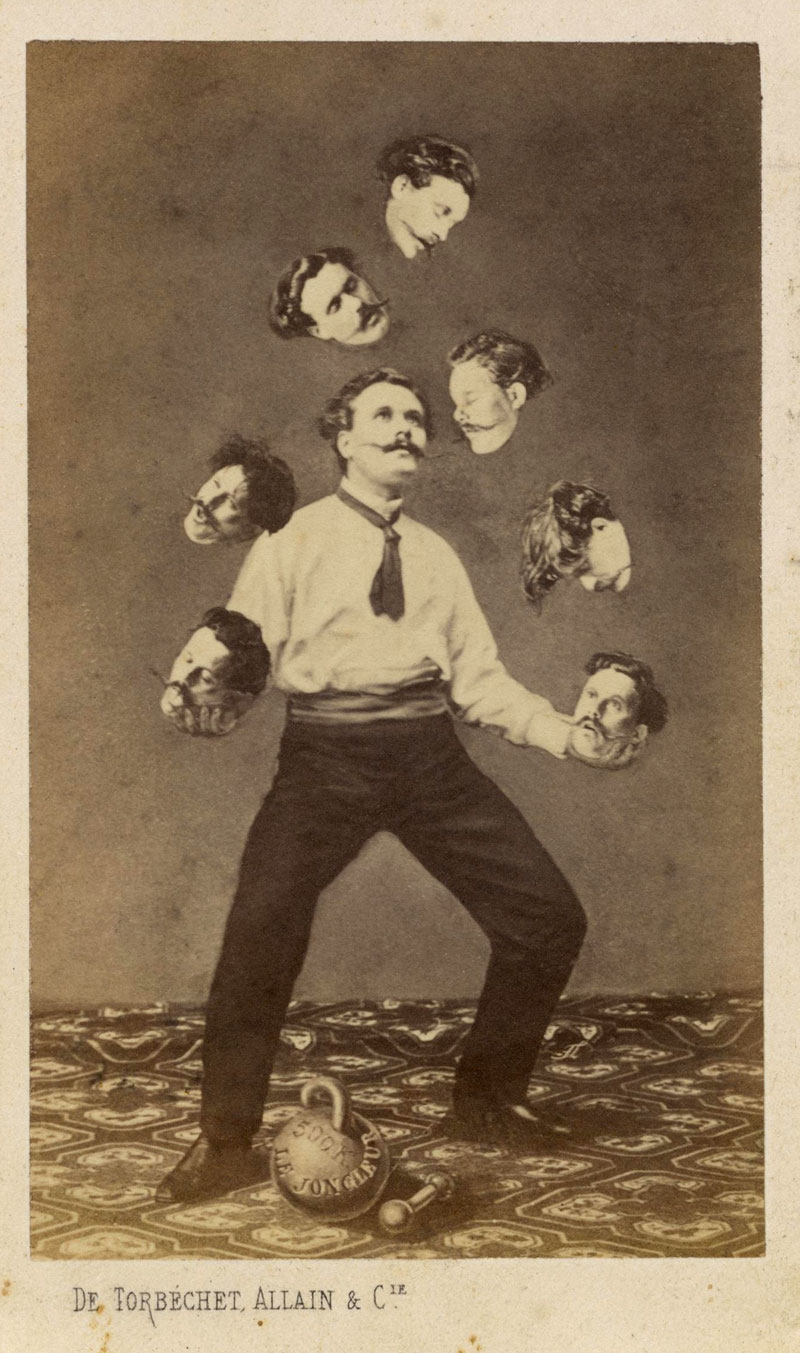
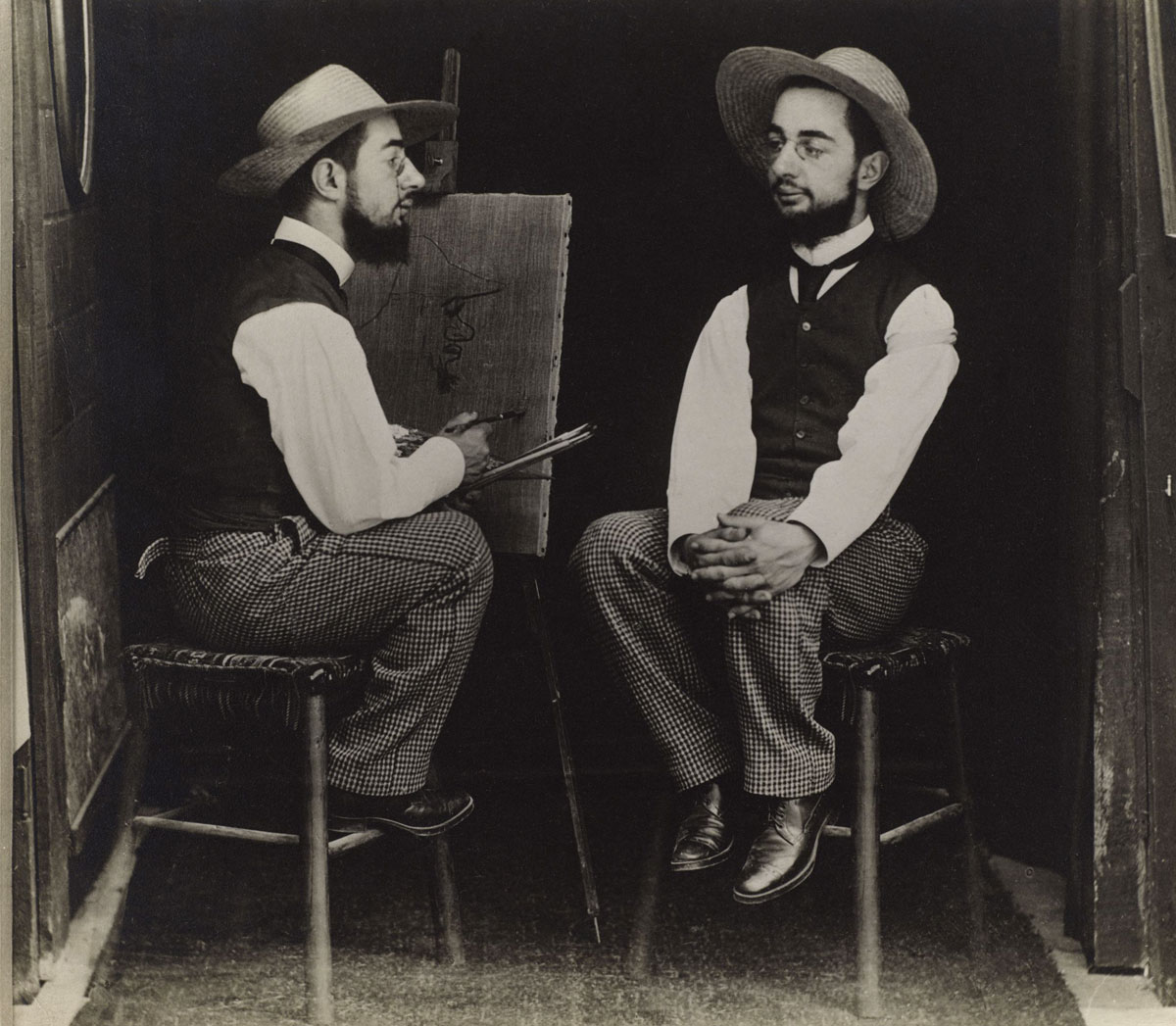
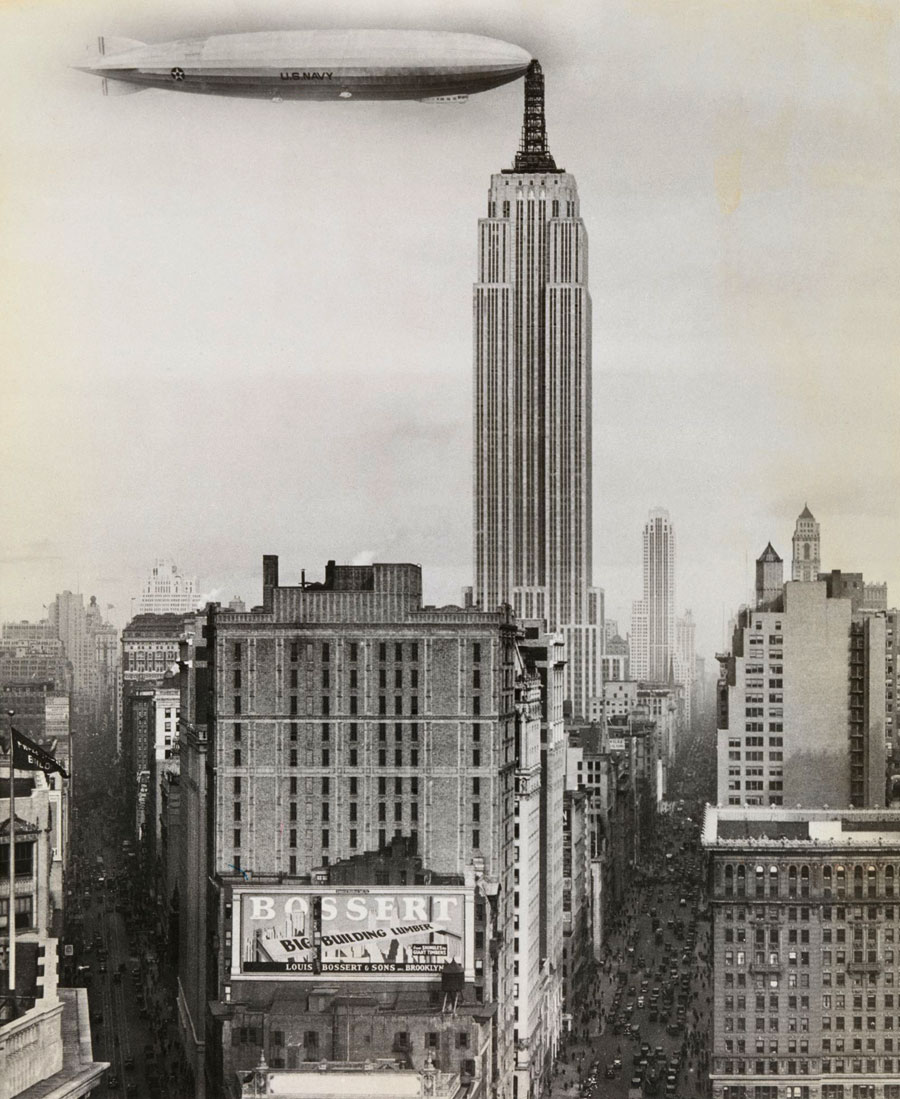
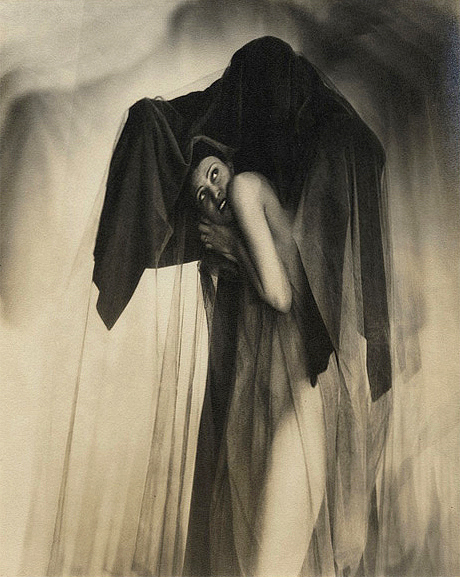
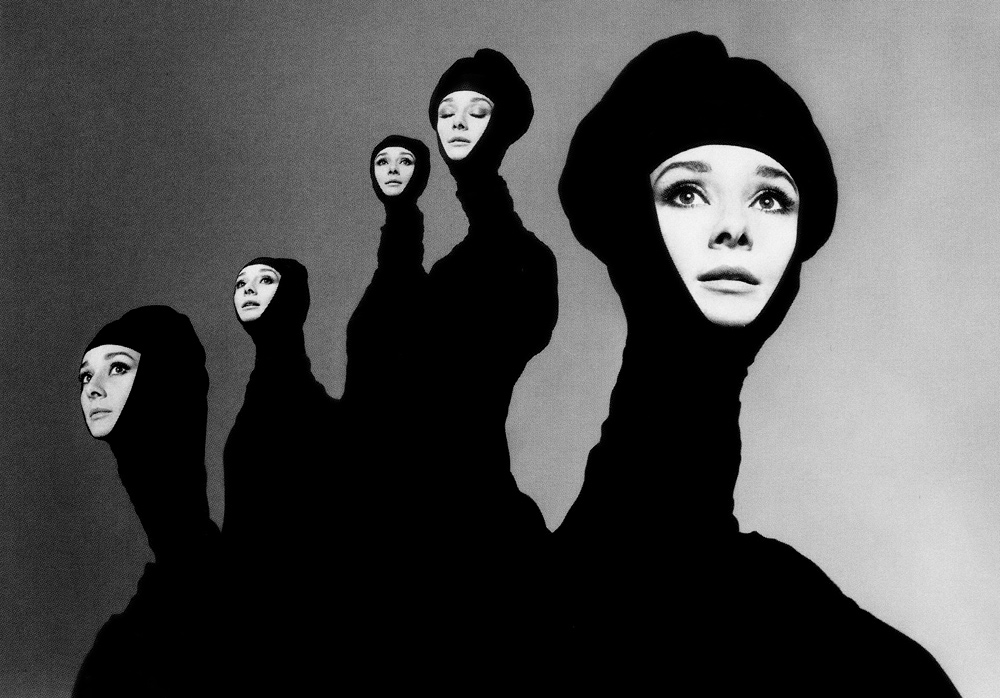
This is the first major exhibition devoted to the history of manipulated photography before the digital age. While the widespread use of Adobe® Photoshop® software has brought about an increased awareness of the degree to which photographs can be doctored, photographers – including such major artists as Gustave Le Gray, Edward Steichen, Weegee, and Richard Avedon – have been fabricating, modifying, and otherwise manipulating camera images since the medium was first invented. This exhibition demonstrates that today’s digitally manipulated images are part of a continuum that extends back to photography’s first decades. Through visually captivating pictures created in the service of art, politics, news, entertainment, and commerce, Faking It not only traces the medium’s complex and changing relationship to visual truth, but also significantly revises our understanding of photographic history.

Organised thematically, the exhibition begins with some of the earliest instances of photographic manipulation – those attempting to compensate for the new medium’s technical limitations. In the 19th century, many photographers hand tinted portraits to make them appear more vivid and lifelike. Others composed large group portraits by photographing individuals separately in the studio and creating a collage by pasting them onto painted backgrounds depicting outdoor scenes. As the art and craft of photography grew increasingly sophisticated, photographers devised a staggering array of techniques with which to manipulate their images, including combination printing, photomontage, overpainting, ink and airbrush retouching, sandwiched negatives, multiple exposures, and other darkroom magic.

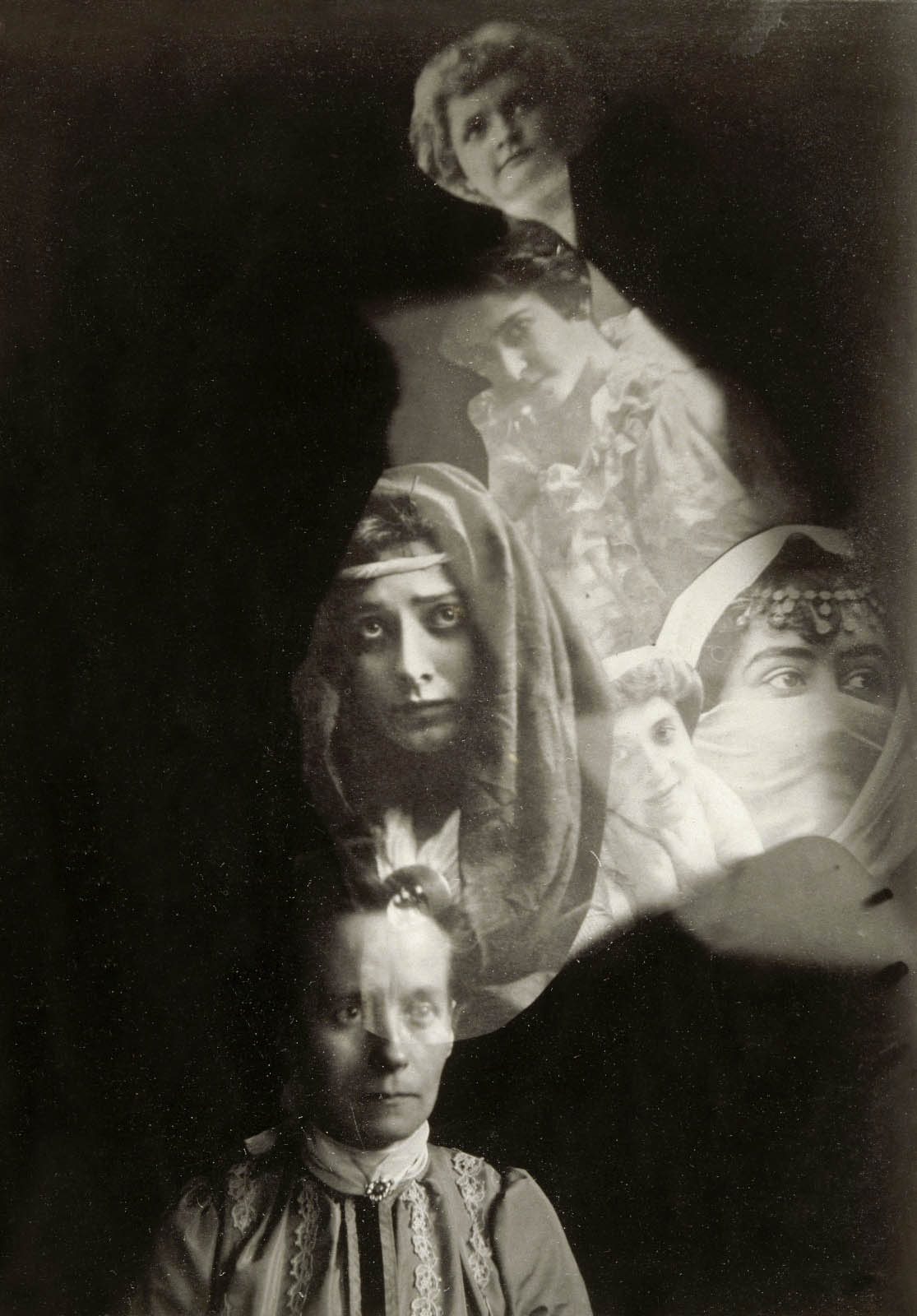
The exhibition presents a superb selection of manually altered photographs created under the mantle of art, including 19th-century genre scenes composed of multiple negatives, stunning Pictorialist landscapes from the turn of the 19th century, and the pre-digital dreamscapes of surrealist photographers in the 1920s and 1930s. A section of doctored images made for political or ideological ends includes faked composite photographs of the 1871 Paris Commune massacres, anti-Nazi photomontages by John Heartfield, and falsified images from Stalin-era Soviet Russia. The show also explores popular uses of photographic manipulation such as spirit photography, tall-tale and fantasy postcards, advertising and fashion spreads, and doctored news images.

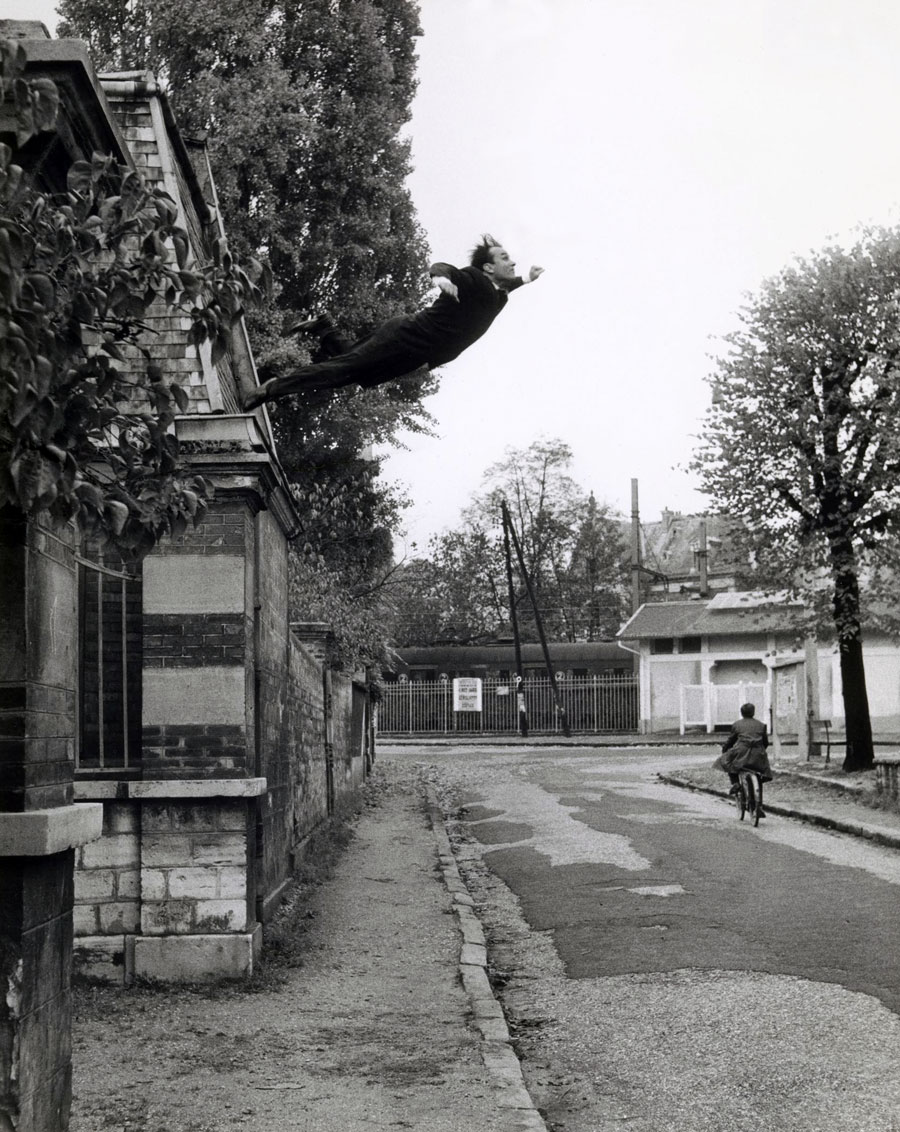
The final section features the work of contemporary artists – including Duane Michals, Jerry Uelsmann, and Yves Klein – who have reclaimed earlier techniques of image manipulation to creatively question photography’s presumed objectivity. By tracing the history of photographic manipulation from the 1840s to the present, Faking It vividly demonstrates that photography is – and always has been – a medium of fabricated truths and artful lies.

Press release from the National Gallery of Art website
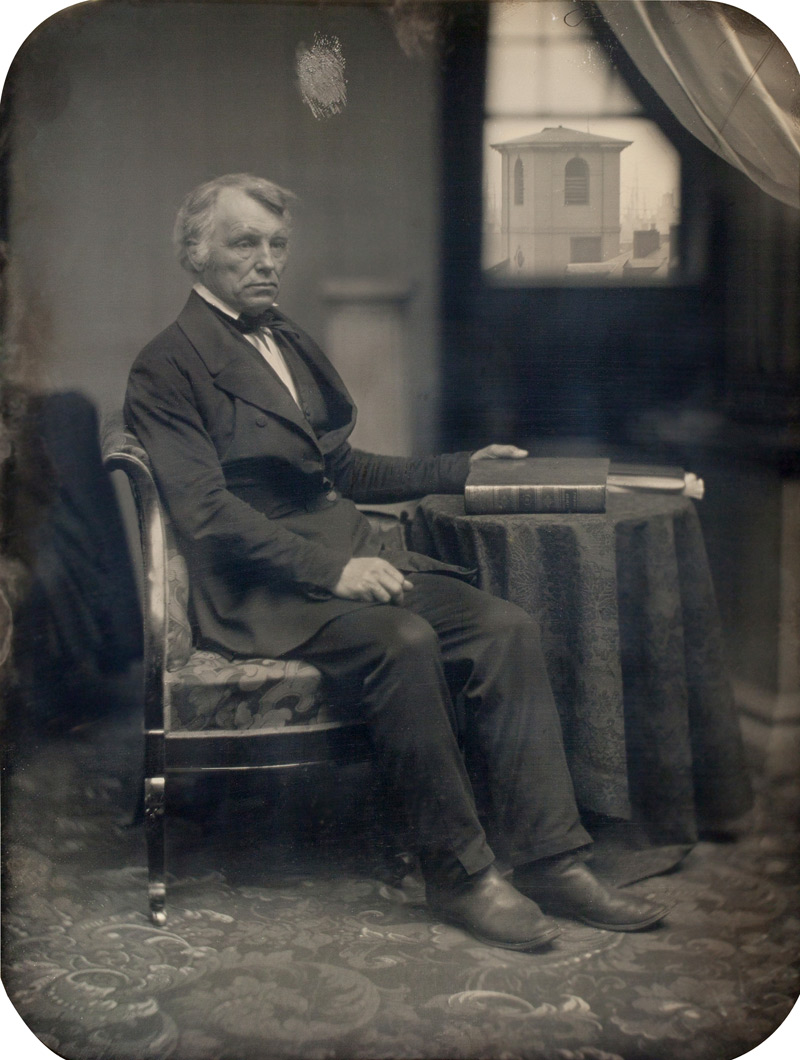
 

Albert Sands Southworth (American, 1811-1894) and Josiah Johnson Hawes (American, 1808-1901) 'Seated man with Brattle Street Church seen through window' 1850s


Albert Sands Southworth (American, 1811-1894) and Josiah Johnson Hawes (American, 1808-1901)
Seated man with Brattle Street Church seen through window
1850s
Daguerreotype
21.6 x 16.5cm (8 1/2 x 6 1/2 in.)
The Isenburg Collection at AMC Toronto
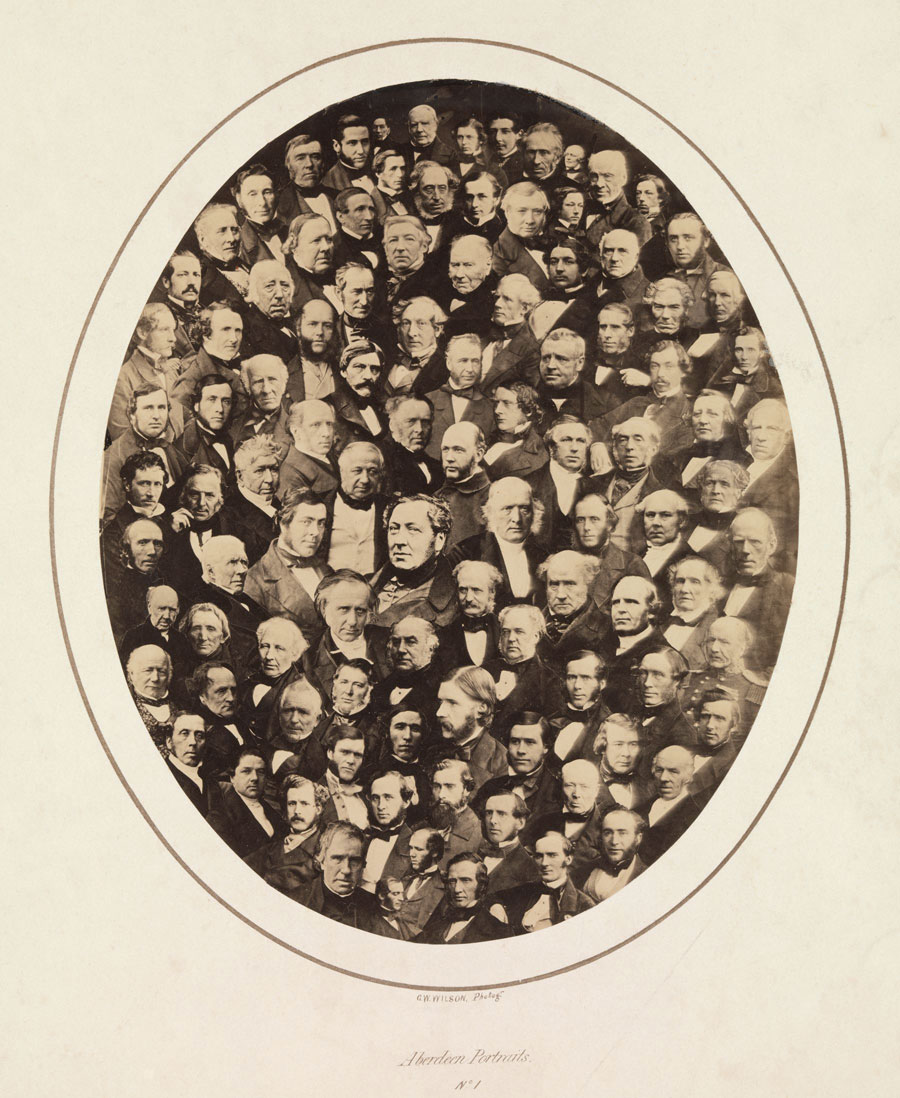
 

George Washington Wilson. 'Aberdeen Portraits No. 1' 1857


George Washington Wilson (Scottish, 1823-1893)
Aberdeen Portraits No. 1
1857
Albumen silver print from glass negative


Unknown (American) '[Decapitated Man with Head on a Platter]' c. 1865


Unknown (American)
[Decapitated Man with Head on a Platter]
c. 1865
Tintype with applied colour
8.4 x 6cm (3 5/16 x 2 3/8 in.)
© International Center of Photography, Gift of Steven Kasher and Susan Spungen Kasher, 2008
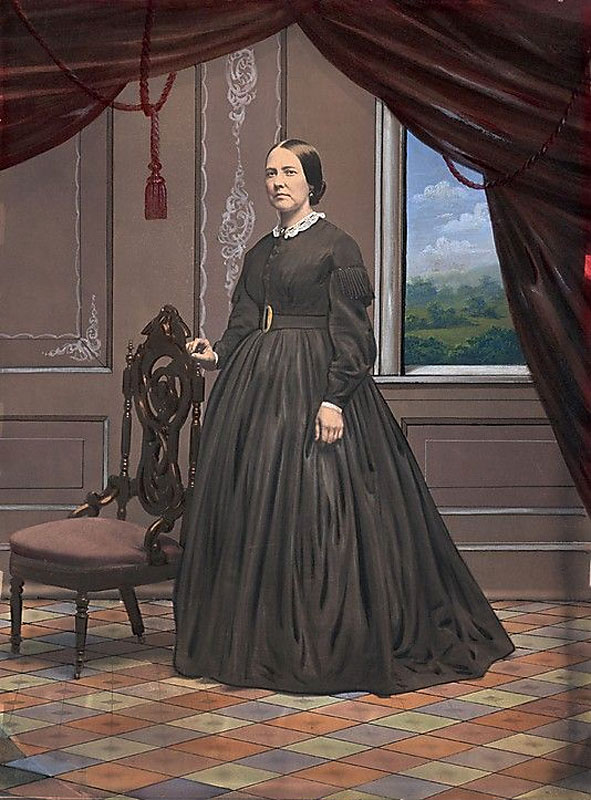
 

Unidentified photographer (American) 'Susan M. Davis' 1865


Unidentified photographer (American)
Susan M. Davis
1865
Salted paper print from glass negative, with applied color
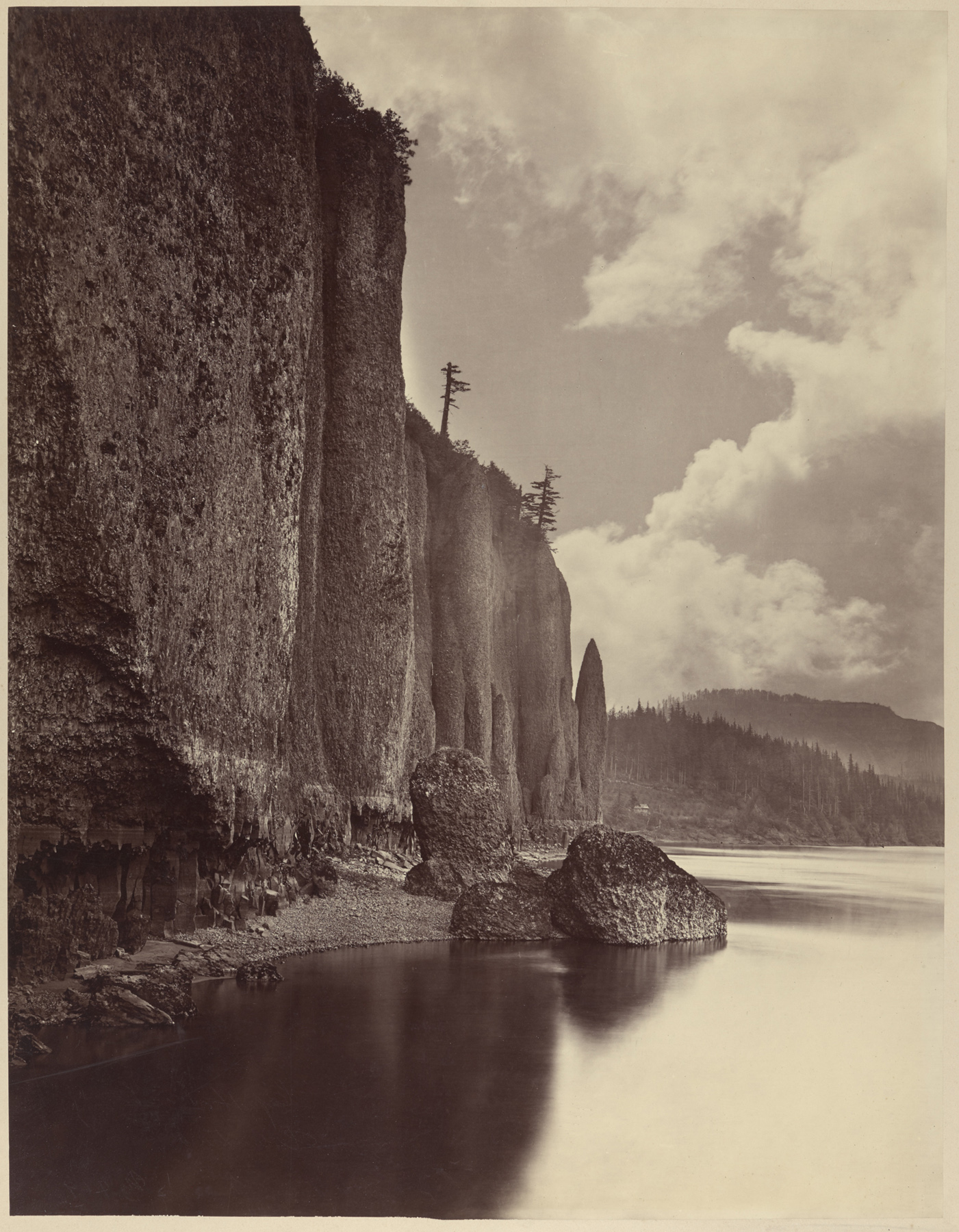
 

Carleton E. Watkins (American, 1829-1916) 'Cape Horn, Columbia River, Oregon' 1867


Carleton E. Watkins (American, 1829-1916)
Cape Horn, Columbia River, Oregon
1867, printed 1880-1890
Albumen silver print from glass negatives
52.3 x 40.4cm (20 9/16 x 15 7/8 in.)
© George Eastman House, International Museum of Photography and Film, Rochester


Watkins, the consummate photographer of the American West, combined a virtuoso mastery of the difficult wet plate negative process with a rigorous sense of pictorial structure. For large-format landscape work such as Watkins produced along the Columbia River in Oregon, the physical demands were great. Since there was as yet no practical means of enlarging, Watkins’s glass negatives had to be as large as he wished the prints to be, and his camera large enough to accommodate them. Furthermore, the glass negatives had to be coated, exposed, and developed while the collodion remained tacky, requiring the photographer to transport a traveling darkroom as he explored the rugged virgin terrain of the American West. The crystalline clarity of Watkins’s remarkable “mammoth” prints is unmatched in the work of any of his contemporaries and is approached by few artists working today. Here the clouds have been printed in (compare to the work below)

Text from the Metropolitan Museum of Art website
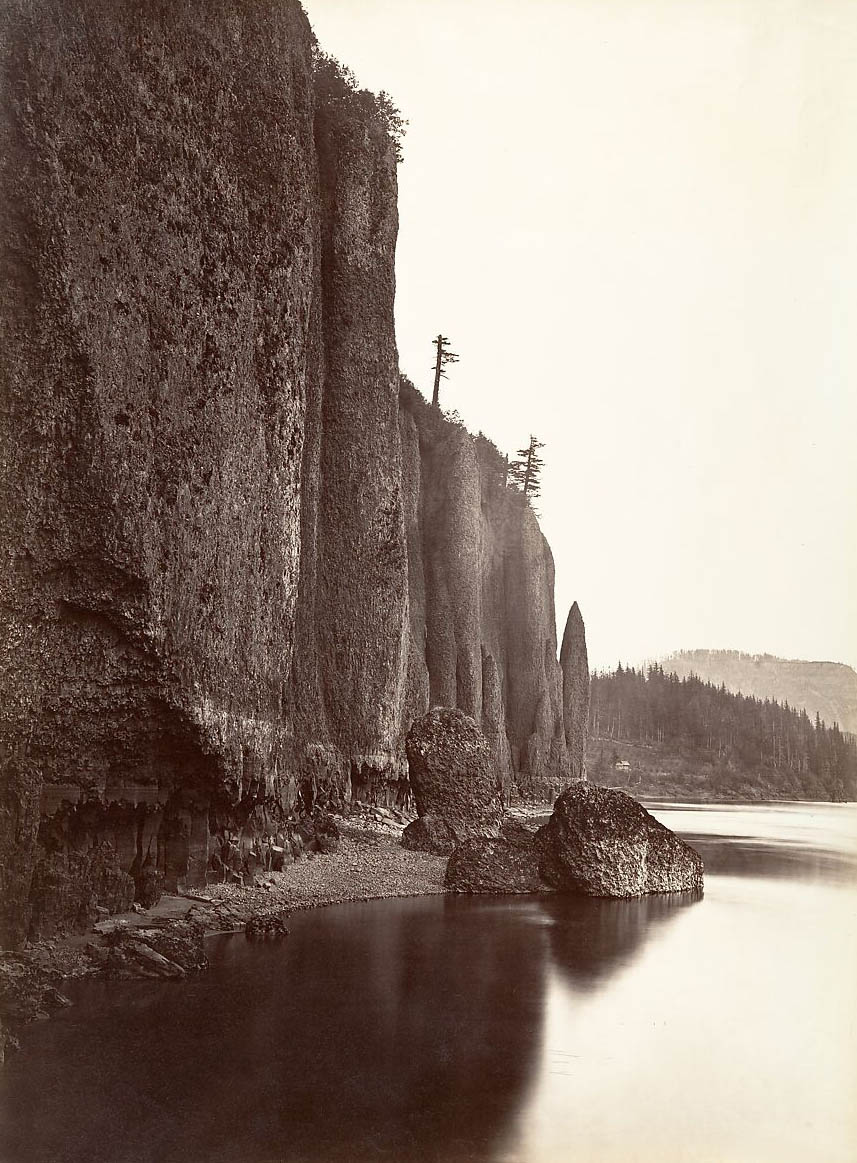
 

Carleton E. Watkins (American, 1829-1916) 'Cape Horn, Columbia River, Oregon' 1867


Carleton E. Watkins (American, 1829-1916)
Cape Horn, Columbia River, Oregon
1867
Albumen silver print from glass negative
52.1 x 39cm (20 1/2 x 15 3/8 in.)
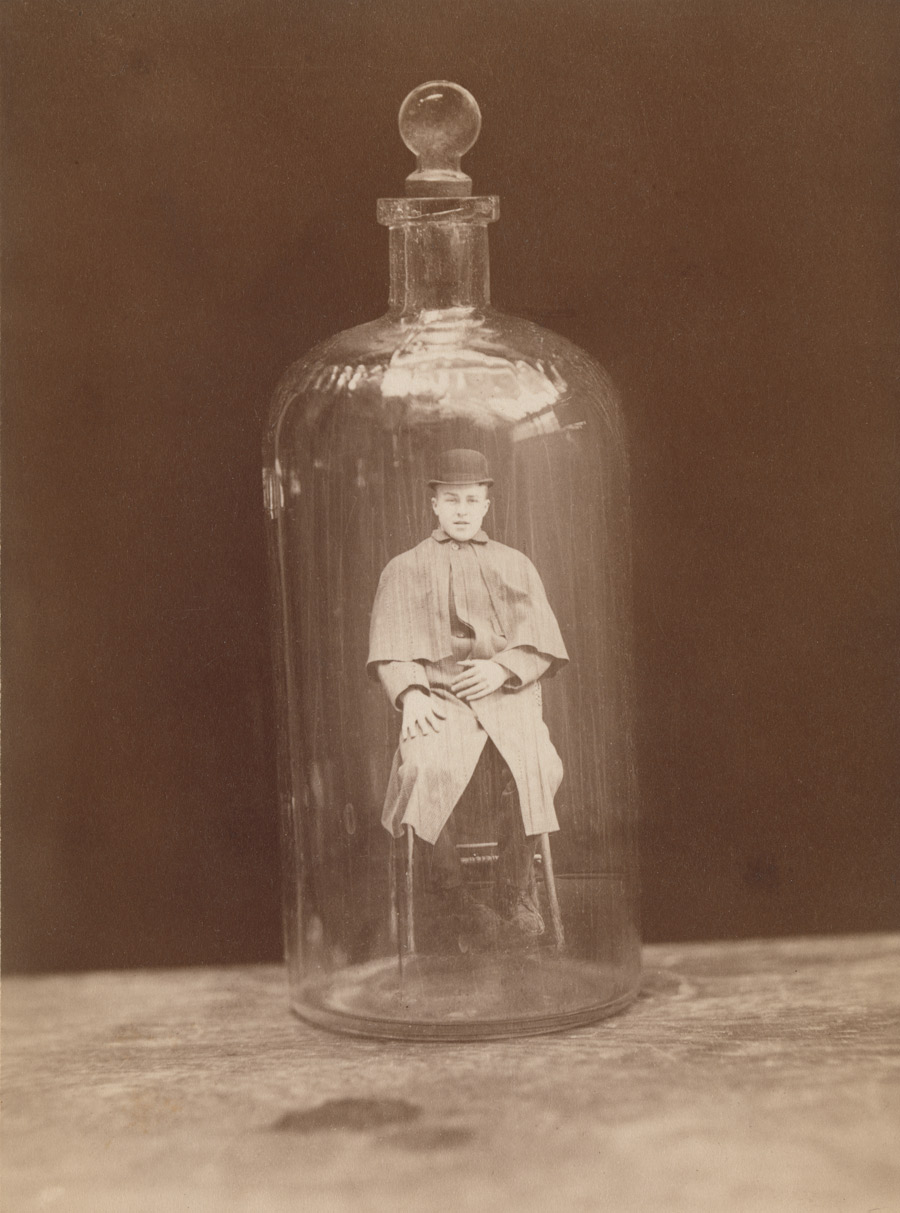
 

J.C. Higgins and Son (American) 'Man in bottle' c. 1888


J.C. Higgins and Son (American)
Man in bottle
c. 1888
Albumen print
13.5 x 10cm (5 5/16 x 3 15/16 in.)
Lent by The Metropolitan Museum of Art, Purchase, Susan and Thomas Dunn Gift, 2011
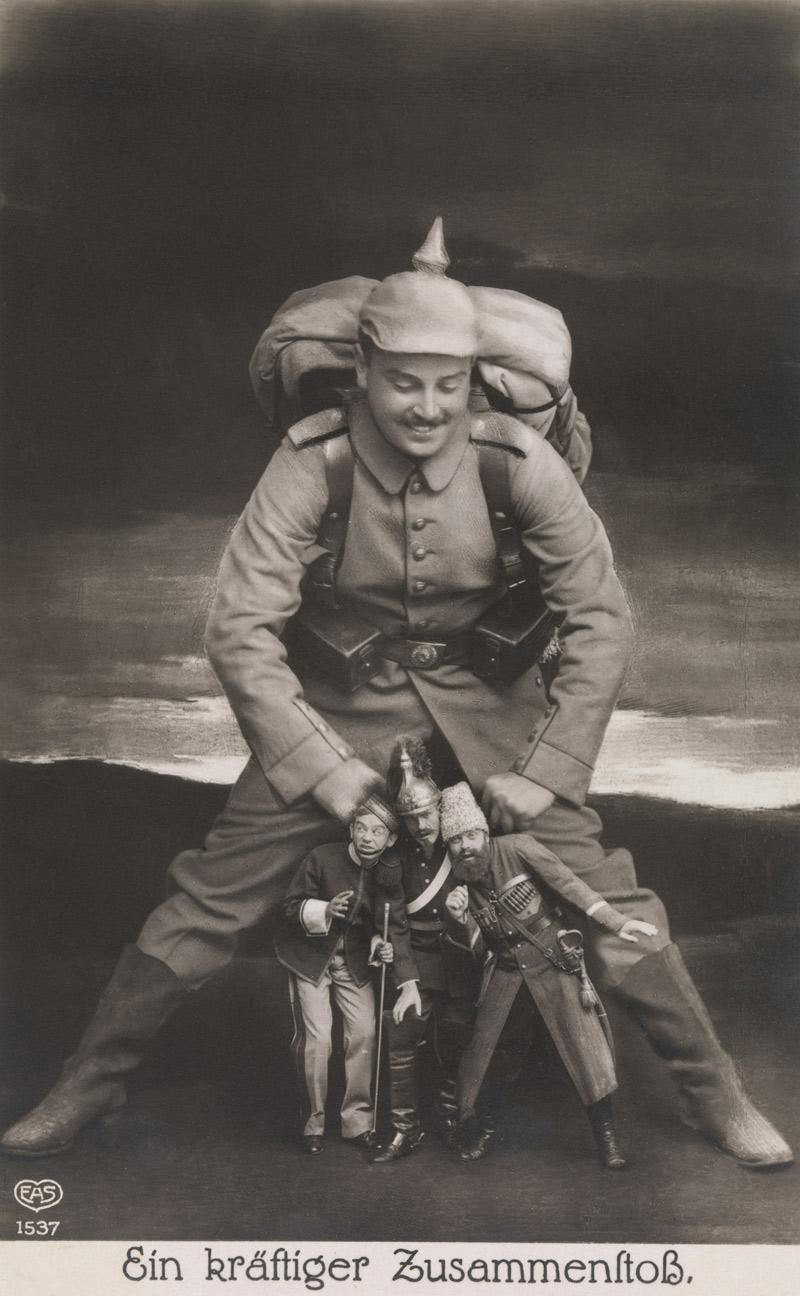
 

Unknown Photographer (German) 'Ein kräftiger Zusammenstoss (A Powerfull Collision)' 1914


Unknown Photographer (German)
Ein kräftiger Zusammenstoss (A Powerfull Collision)
1914
Gelatin silver print
8.7 x 13.7cm (3 7/16 x 5 3/8 in.)
Lent by The Metropolitan Museum of Art, Twentieth-Century Photography Fund, 2010


Dora Maar (French, 1907-1997) 'The Simulator' 1936


Dora Maar (French, 1907-1997)
Le simulateur
1936
Gelatin silver print
29.2 x 22.9cm (11 1/2 x 9 in.)
Collection of The Sack Photographic Trust for the San Francisco Museum of Modern Art


Maar’s haunting photomontages of the mid-1930s evoke a mood of oneiric ambiguity. Here, the world is turned literally upside-down: a boy bends sharply backward, echoing the curve of the vaulted ceiling on which he stands. On the print, Maar scratched out the figure’s eyes, exploiting Surrealism’s strong association of blindness with inner sight.


Bill Brandt (English born Germany, 1904-1983) 'London (Multiple Exposure Nude)' 1956


Bill Brandt (English born Germany, 1904-1983
London (Multiple Exposure Nude)
1956
Gelatin silver print with applied media
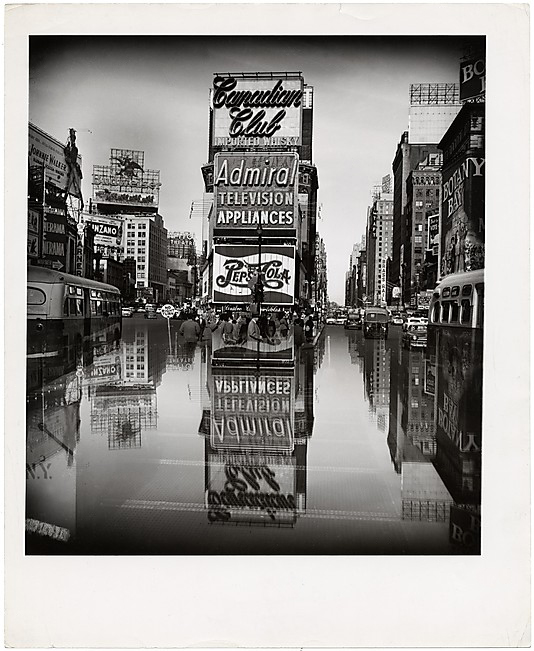
 

Arthur Felig - Weegee (American born Hungary, 1899-1968) 'Times Square, New York' 1952-1959


Weegee (Arthur Felig) (American born Hungary, 1899-1968)
Times Square, New York
1952-1959
Gelatin silver print
20.3 x 17.8cm (8 x 7 in.)
© International Center of Photography, Bequest of Wilma Wilcox, 1993


Famous for his gritty tabloid crime photographs, Weegee devoted the last twenty years of his life to what he called his “creative work.” He experimented prolifically with distorting lenses and comparable darkroom techniques, producing photo caricatures of politicians and Hollywood celebrities, novel variations on the man-in-the-bottle motif, and uncanny doublings and reflections, such as this striking image, which he described as “Times Square under 10 feet of water on a sunny afternoon.”


Jerry N. Uelsmann (American, 1934-2022) 'Untitled' 1976


Jerry N. Uelsmann (American, 1934-2022)
Untitled
1976
Gelatin silver print
49.3 x 36cm (19 7/16 x 14 3/16 in.)
Lent by The Metropolitan Museum of Art, David Hunter McAlpin Fund, 1981
© The Metropolitan Museum of Art/ © Jerry N. Uelsmann


Jerry Norman Uelsmann (June 11, 1934 – April 4, 2022) was an American photographer.

As an emerging artist in the 1960s, Jerry Uelsmann received international recognition for surreal, enigmatic photographs (photomontages) made with his unique method of composite printing and his dedication to revealing the deepest emotions of the human condition. Over the next six decades, his contributions to contemporary photography were firmly established with important exhibitions, prestigious awards and numerous publications. Among his awards were a Guggenheim Fellowship, National Endowment, Royal Photographic Society Fellowship, and Lucie Award.

Uelsmann described his creative process as a journey of discovery in the darkroom (visual research laboratory). Going against the established practice of previsualization (Ansel Adams, Edward Weston and others), he coined a new term, post-visualization. He decided the contents of the final print after rather than before pressing the shutter button. Uelsmann constructed his dreams like a visual poet with results that often seemed emotionally more real than the factual world. By the 1980s he became one of the most collected photographers in America. His work influenced generations of both analog and digital photographers. Although he admired digital photography, he remained completely dedicated to the alchemy of film photography in the black and white darkroom.

Text from the Wikipedia website
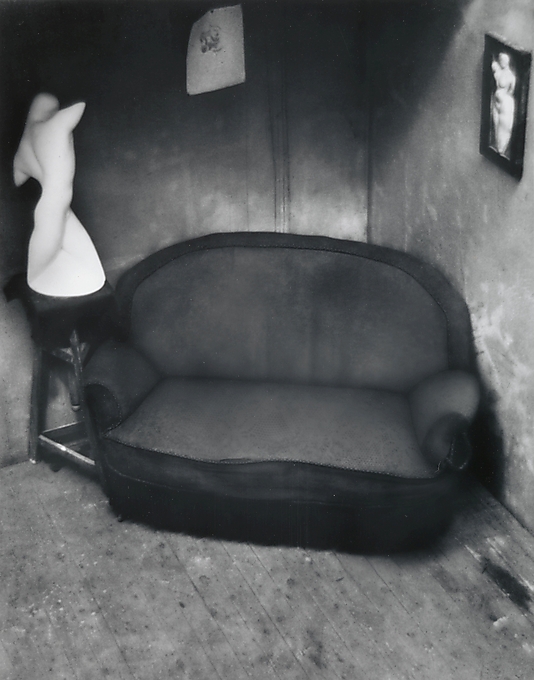
 

Kathy Grove (American, b. 1948) 'The Other Series (After Kertész)' 1989-90


Kathy Grove (American, b. 1948)
The Other Series (After Kertész)
1989-1990
Gelatin silver print
19.7 x 15.2cm (7 3/4 x 6 in.)
Purchase, Charina Foundation Inc. Gift, 2010
© Kathy Grove


In the late 1980s Grove, an artist who supports herself as a professional photo retoucher, began seamlessly altering images of famous works of art, using bleach, dyes, and airbrush to remove the female figure from each image and leaving the rest of the scene intact. Her cunning excisions mimic the process by which art historians, echoing the culture at large, have erased the achievements of actual women while enshrining Woman as a blank screen upon which the ideas and desires of both artist and viewer are projected. If photographs are presumed to represent the truth, Grove’s pictures remind us to ask: Whose truth?


National Gallery of Art
National Mall between 3rd and 7th Streets
Constitution Avenue NW, Washington

Opening hours:
Daily 10am – 5pm

National Gallery of Art website

LIKE ART BLART ON FACEBOOK

Back to top

Review: ‘Louise Bourgeois: Late Works’ at Heide Museum of Modern Art, Melbourne

Exhibition dates: 24th November 2012 – 11th March 2013

Louise Bourgeois & Australian Artists
13 October 2012 – 14 April 2013


'Louise Bourgeois: Late Works' installation view Heide Museum of Modern Art, Melbourne Photograph: John Gollings 2012


Louise Bourgeois: Late Works installation view
Heide Museum of Modern Art, Melbourne
Photograph: John Gollings 2012


Tough Love

This is a tough, stimulating exhibition of late works by Louise Bourgeois at Heide Museum of Modern Art, Melbourne. All the main themes of the artist’s work explored over many years are represented in these late works: memory, emotion, anxiety, family, relationships, childhood, pain, desire and eroticism are all present as are female subjectivity and sexuality, expressed through the body. As the quotation above by Bourgeois states, her body became her sculpture.

I am no expert on the work of the artist. But what I will try and enunciate are my feelings when viewing the exhibition. Firstly, I thought the drawings by Louise Bourgeois in Heide II were the most magical thing that I saw all day; they seemed to be the well spring of her creativity, the initial thought sketched quickly and imperiously. Secondly, series such as Dawn (2007, below) and The Waiting Hours (2007), assemblages of cut fragments of her dresses and other textiles used to create spiral three-dimensional realities, were the most beautiful, peaceful Zen based works in the exhibition possessing as they did a calm, resolved, mandala-like presence. Lastly, the main group of sculptures were, for me, hard to look at. A series of severed heads, dismembered bodies, tapestry fragments, spiders, bones, an orrery-like planetarium, pendulous objects stuck with needles, kitchen implements and the house brought back memories of my own childhood.

I was born in the late 1950’s to a mother who didn’t really want to have children, to a mother who was already being beaten up by an abusive husband before she was even married, who lived on a remote, isolated farm in the middle of nowhere. I can’t imagine what my mother went through in those early years raising two children – with no hope of help or escape, with no women’s refuge to flee to, stuck there doing her best to protect her children and herself from a violent, mentally ill man. You cannot imagine the torment I went through for the first 18 years of my life, trying to protect my mother when I was old enough, creating my own worlds to escape the reality of the present (which is why I probably became an artist, to still create my own worlds). There were good times at Christmas and bonfire night, but the best part was growing up on the land, learning the rhythms of nature, learning to drive on a tractor and combine harvester, but always in the back of your mind was the instant of abuse lurking around the corner, the inherent violence of life. It is only now, as I have grown older, that I can truly appreciate the dire predicament that my mother was in and acknowledge a profound sense of gratitude towards her protection of me as a baby and child.

That is why this exhibition is, for me, tough love. The emotions of Bourgeois’ sculptures are close to the bone. As Jason Smith observes, “Bourgeois saw her mother as rational, patient and stoic in her nurturing, in contrast to the temperament of her father whom she regarded as irrationally emotional, unreasonable and capable of psychological cruelty. Bourgeois became aware at an early age that she was living in a time and social environment in which women and their identities were subordinate to men.”As Bourgeois says of the spider (her mother), “she was deliberate, clever, patient, soothing, reasonable, dainty, subtle, indispensable, neat and as useful as a spider. She could also defend herself, and me.” This is what my mother did as well, at great cost to herself.

Bourgeois’ work gives me an overall feeling of immersion in a world view, one that transcends the pain and speaks truth to power. Bourgeois confronted the emotion, memory or barrier to communication that generated her mood and the work. She observed, “My art is an exorcism. My sculpture allows me to re-experience fear, to give it a physicality, so that I am able to hack away at it.” By weaving, stitching and sewing Bourgeois threaded the past through the present and enacted, through artistic performance, a process of repair and reconstruction, giving meaning and shape to frustration and suffering. I have not been so lucky. My mother refuses to discuss the past, will not even come close to the subject for the pain is so great for her. I am left with a heaviness of heart, dealing with the demons of the past that constantly lurk in the memory of childhood, that insistently impinge on the man I am today. Louise Bourgeois’ sculptures brought it all flooding back as the work of only a great artist can, forcing me to become an ethical witness to her past, my past. A must see exhibition this summer in Melbourne.

Dr Marcus Bunyan


Many thankx to curator and Director Jason Smith and Heide Museum of Modern Art for allowing me to publish the photographs in the posting. Please click on some of the photographs for a larger version of the image.


“What counts, our whole purpose, is to try to understand what we are about, to scrutinise ourselves… Every day you have to abandon your past or accept it, and then, if you cannot accept it, you become a sculptor.”

“The fears of the past were connected with the functions of the body, they reappear through the body. For me, sculpture is the body. My body is my sculpture.”


Louise Bourgeois


“What images can art find for depicting femaleness from within, as distinct from the familiar male conventions of looking at it from the outside, from the eye-line of another gender?” Hughes questioned in a commentary that implied no precedents. “… [Her] influence on young artists has been enormous.”


Robert Hughes quoted by Annemarie Kiely on the Vogue Living Blog [Online] Cited 28/02/2013 no longer available online


“Yes, there are the oft-told stories of the father and the mistress, but it is Bourgeois’s intense love of her mother and her [mother’s] death that completely transformed her life… The art ultimately became about her never-ending grief… and her continuing desire  as a woman. It’s still so potent; not just as a memory, but as a constant.”


Jason Smith, Curator, Director and CEO of Heide quoted by Annemarie Kiely on the Vogue Living Blog [Online] Cited 28/02/2013 no longer available online


'Louise Bourgeois: Late Works' installation view Heide Museum of Modern Art, Melbourne Photograph: John Gollings 2012


Louise Bourgeois: Late Works installation view
Heide Museum of Modern Art, Melbourne
Photograph: John Gollings 2012


“The friend (the spider – why the spider?) because my best friend was my mother and she was deliberate, clever, patient, soothing, reasonable, dainty, subtle, indispensable, neat and as useful as a spider. She could also defend herself, and me.”


Louise Bourgeois, from Ode to my Mother, 1995


Louise Bourgeois (French-American, 1911-2010) 'Spider' 1997 (detail)


Louise Bourgeois (French-American, 1911-2010)
Spider (detail)
1997
Steel, tapestry, wood, glass, fabric, rubber, silver, gold, bone
449.6 × 665.5 × 518.2cm
The Easton Foundation, New York, NY
Photograph: John Gollings 2012


Louise Bourgeois (French-American, 1911-2010) 'Dawn' 2007 (detail)


Louise Bourgeois (French-American, 1911-2010)
Dawn (detail)
2007
Fabric book, 12 pages
12 1/4 x 9 3/4 inches each


Around 1996, aged 85, Bourgeois began to mine her closets for the garments and textiles that she had worn, collected and stored over a lifetime, and use them to make sculpture and ‘fabric drawings’, continuing her lifelong recall and articulations of familial dysfunction, desire and fear, anger and remorse, isolation and connectedness. In the recycling and reconstruction of her clothing and collected textiles Bourgeois intensified her work’s expression of the human body and of life’s episodes (those as daughter, wife, mother, woman, artist). The materiality of these works testifies to the impression of Bourgeois’ past on her psyche and on reparative acts of making through which her past was reconciled in her present. The beauty of the past for Bourgeois resided in the nurturing, repairing, fortifying and protective tendencies of her mother, which she aligned with the processes of stitching and assembling.

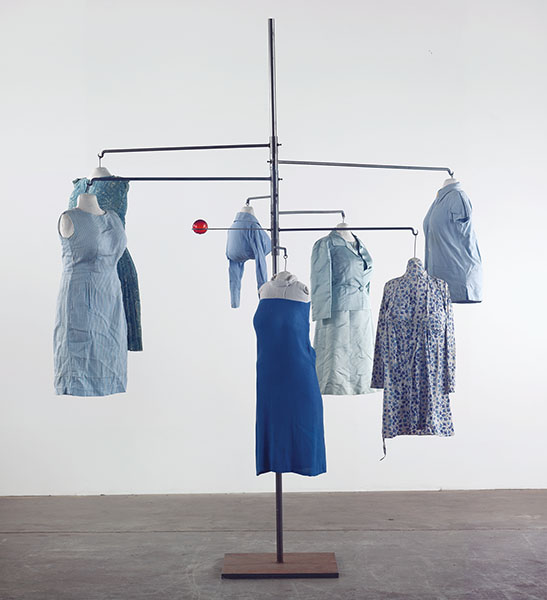
Blue Days (1996) is one of a number of works in which Bourgeois suspended, stuffed and shaped her dresses and shirts, sometimes adding abstract sculptural elements like the red glass sphere that operates here like a nucleus around which the new sculptural bodies circulate. With its intimate relation to the skin and contours of the body, to time and seasons, clothing was used for its power to summon memory: ‘You can retell your life … by the shape, weight, colour and smell of those clothes in your closet. They are like the weather, the ocean, changing all the time.’

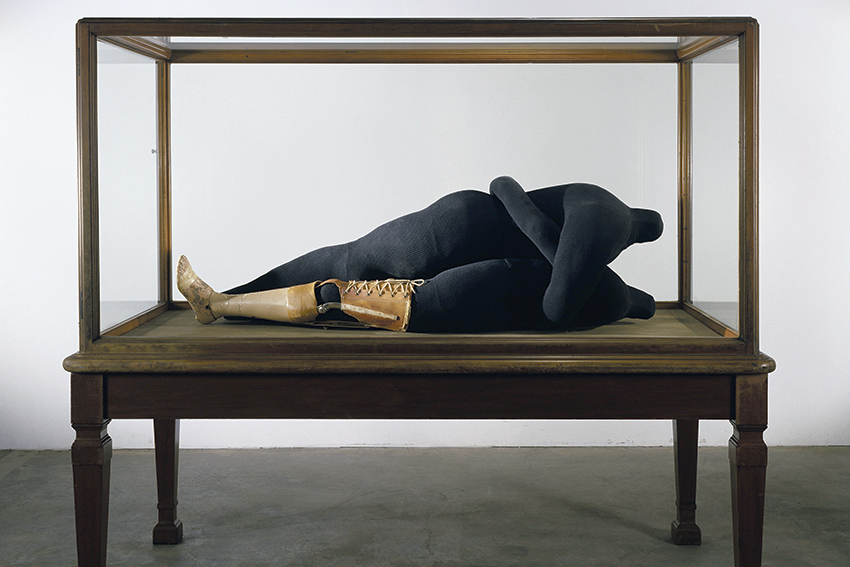
In other works Bourgeois’ fragmented figures and anatomical parts give physical form to anxieties rising from unfulfilled desire, acts of betrayal, losses or thwarted communication. Couple IV embodies the dark confusion of the child happening upon the sexual embrace of the adults. The copulating, decapitated lovers appear as an encased ‘archaeological specimen’ and signal Bourgeois’ fraught obsession not only with the infidelities of her father, but also with sex itself. For Bourgeois there is ‘a fatal attraction not towards one or the other, but to the phenomena of copulation … I am exasperated by the vision of the copulating couple, and it makes me so furious … that I chop their heads [off]. This is it … I turn violent. The sewing is a defence. I am so afraid of the things I might do. The defence is to do the opposite of what you want to do.’

Louise Bourgeois’ practice was an elaborate articulation of an existence in which the sculpting world and the living world were one. Her late works summoned the past and confronted the present, and the passage of time, by using the very garments in which the experiences of her life, loves and longings resided.

Jason Smith, Curator, Director and CEO, Heide Museum of Modern Art. “Louise Bourgeois,” on The Melbourne Review website, November 2012 [Online] Cited 26/02/2013 no longer available online


Louise Bourgeois (French-American, 1911-2010) 'Blue Days' 1996


Louise Bourgeois (French-American, 1911-2010)
Blue Days
1996
cloth, steel, glass
292.1 × 205.7 × 241.3cm
Courtesy Cheim & Read and Hauser & Wirth
© Louise Bourgeois Trust / Licensed by VAGA, New York / Viscopy, Sydney


Louise Bourgeois (French-American, 1911-2010) 'Femme Maison' 2001


Louise Bourgeois (French-American, 1911-2010)
Femme Maison
2001
fabric, steel
35.6 × 38.1 × 66cm
Courtesy Cheim & Read and Hauser & Wirth
© Louise Bourgeois Trust / Licensed by VAGA, New York / Viscopy, Sydney


Louise Bourgeois (French-American, 1911-2010) 'Femme Maison' 2001


Louise Bourgeois (French-American, 1911-2010)
Femme Maison (detail)
2001
fabric, steel
35.6 × 38.1 × 66cm
Courtesy Cheim & Read and Hauser & Wirth
© Louise Bourgeois Trust / Licensed by VAGA, New York / Viscopy, Sydney


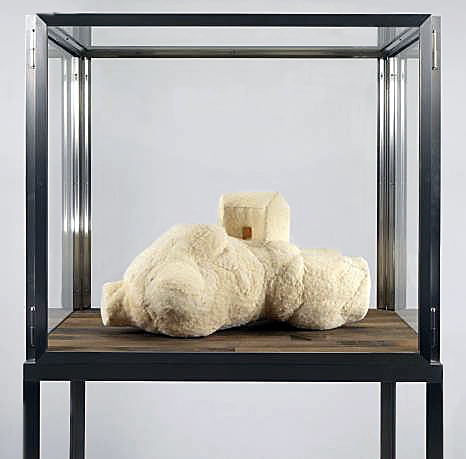
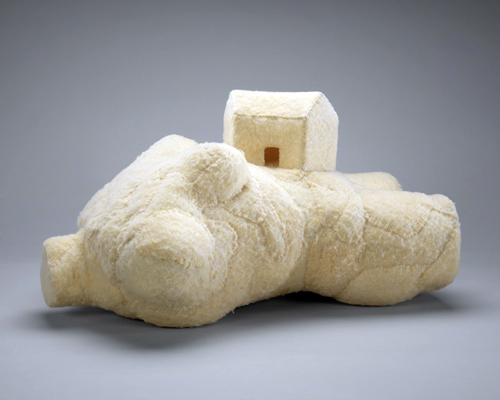
Note that Femme Maison and other artworks are encased in ‘cells’. In one sense, the cell encases and protects the artwork; however, Louise Bourgeois’ intention was to use the cell also as a way of containing the memory held within the work.

The hybrid form of Femme Maison – with its dual translations to ‘woman house’ or housewife – appeared in drawings, paintings and sculpture, and in degrees of abstraction and figuration, from the mid 1940s onwards. In this key late work the textured fabric affirms the central relationship of woman with the domestic space. Stories of the house and the home defined Bourgeois’ identity. The architectural house and its contents – especially the table, bed and chair – and the familial home and its occupants, were the structures that shaped Bourgeois’ unstable sense of self, and her relationships with others. This work plays on the house literally growing out of the woman’s body (the nurturing mother) or, conversely, pinning her dismembered body to the ground, registering the paralysing power of fear, and recalling a painful childhood.


Louise Bourgeois (French-American, 1911-2010) 'Knife Figure' 2002


Louise Bourgeois (French-American, 1911-2010)
Knife Figure
2002
fabric, steel, wood
22.2 × 76.2 × 19.1cm
Courtesy Cheim & Read and Hauser & Wirth
© Louise Bourgeois Trust / Licensed by VAGA, New York / Viscopy, Sydney


Louise Bourgeois (French-American, 1911-2010) 'Untitled' 2002


Louise Bourgeois (French-American, 1911-2010)
Untitled
2002
Tapestry and aluminium
43.2 x 30.5 x 30.5cm
Courtesy Cheim & Read and Hauser & Wirth
© Louise Bourgeois Trust
Photo: Christopher Burke


Louise Bourgeois (French-American, 1911-2010) 'Couple IV' 1997


Louise Bourgeois (French-American, 1911-2010)
Couple IV
1997
fabric, leather, stainless steel, plastic
50.8 × 165.1 × 77.5cm
Courtesy Cheim & Read and Hauser & Wirth
© Louise Bourgeois Trust / Licensed by VAGA, New York / Viscopy, Sydney


Louise Bourgeois (French-American, 1911-2010) 'Untitled' 2002


Louise Bourgeois (French-American, 1911-2010)
Untitled
2002
Tapestry, aluminium
43.2 x 30.5 x 30.5cm
The Easton Foundation, New York, NY.


Louise Bourgeois (French-American, 1911-2010) 'Cinq' 2007


Louise Bourgeois (French-American, 1911-2010)
Cinq
2007
fabric, stainless steel
61 × 35.6 × 35.6cm
Courtesy Cheim & Read and Hauser & Wirth
© Louise Bourgeois Trust / Licensed by VAGA, New York / Viscopy, Sydney


Heide Museum of Modern Art is proud to present two major exhibitions featuring the work of Louise Bourgeois. The first, Louise Bourgeois: Late Works includes over twenty, key works direct from the late artist’s studio in New York. The second exhibition, Louise Bourgeois and Australian Artists presents a selection of works by contemporary Australian artists who have been inspired by Bourgeois alongside prints and drawings from her vast graphic oeuvre. Louise Bourgeois (1911-2010) was one of the most inventive, provocative and influential artists of the twentieth century. Although her work has been exhibited extensively overseas, it has rarely been seen in Australia, and only once in significant depth, at the National Gallery of Victoria (NGV) in 1995 in an exhibition curated by then NGV curator Jason Smith. Louise Bourgeois: Late Works focuses on Bourgeois’s use of fabric in sculpture and what she termed ‘fabric drawings’. A preoccupation with memory and time, human relationships, fear and its annihilation, sexuality and the erotic body, are all emphases of Bourgeois’ final works.

Louise Bourgeois: Late Works is the first exhibition in Australia to survey the work of this profoundly important artist since her death in 2010 and has been curated by Jason Smith, now Heide Director & CEO – in close collaboration with the Bourgeois studio, New York – as a follow up to the 1995 exhibition at the NGV. Focusing on the final fifteen years of Bourgeois’ career, the exhibition examines the use of fabric in her works, and includes 18 sculptures, two suites of ‘fabric drawings’, watercolours, embroidered texts and lithographs never before seen in Australia. In the fabric works the processes of deconstructing and reconstructing, are applied to the contents of Bourgeois’ closets. The recycling of her garments, collected textiles and tapestry fragments intensifies her work’s expression of self-portraiture, and the profound personal experiences that defined her life and art.

Fabric was important to Louise Bourgeois, who grew up in her parents’ tapestry making business. In 1996, in her mid-eighties, Bourgeois began to transform the garments and textiles that she had worn, collected and stored over a lifetime into sculptures and ‘fabric drawings’. For her, sewing was an act of healing or reparation, linked to memories of her mother who ‘would sit out in the sun and repair a tapestry or a petit point’, an image of calm amid more distressing family dynamics.

Central to the exhibition is Spider, 1997 one of the Bourgeois’ Cells sculptures which is dominated, enclosed and protected by a gargantuan spider – a recurring and powerful motif in the artist’s work. Bourgeois created her spider sculptures partly in tribute to her mother, saying: ‘Like a spider, my mother was a weaver. Spiders are helpful and protective, just like my mother’. The female body and female subjectivity are concentrations in the exhibition.

The familial, biographical stories that provided life-long fuel for Bourgeois’ art are well known: her parents’ tapestry workshop in which she learnt the value of art as a form of reparation; her father’s public infidelity; her mother’s betrayal and early death; her complex sense of abandonment; her constant analysis of self; her belief in art a form of exorcism and as a potential reconciliation with the past.

Another highlight of the exhibition is the haunting Couple IV 1997, depicting a pair of copulating, and decapitated, lovers. The embracing figures are cast in the black of mourning, and appear as an encased ‘archaeological specimen’ in the vitrine. The work signals Bourgeois’ fraught obsession with the past, the infidelities of her father, and with sex itself.

Surrealism and pathos combine in Bourgeois’ smaller, intimate works like Knife figure 2002 and Untitled 2002. Here we see a dark side of the domestic with the knife and the whisk looming threateningly large in relation to the prone, dismembered bodies. In their colouration and homely material qualities they inspire tenderness and protection, yet as with so many of Bourgeois’ bodies, each remains cut off from the world and isolated to deal with its fate.”

Press release from the Heide Museum of Modern Art website


Louise Bourgeois & Australian Artists

This exhibition looks at relationships, both real and imagined, between the art of Louise Bourgeois (1911-2010) and that of ten Australian artists, in the rare context of a solo Bourgeois exhibition at Heide. Some pay direct homage to Bourgeois’ work or consider similar themes, while the connection of others registers more instinctually, on the level of a shared psychological intensity. Many of the works are rooted in memory and emotion, with a core that remains indecipherable – they do not illustrate or explain.

Forged regardless of fashion or fortune, Bourgeois’ oeuvre gave several artists in this exhibition the impetus to use personal subject matter as a creative source in the late 1980s and 1990s, an era when a cool, detached conceptualism dominated. Many share Bourgeois’ subjective focus and use the human body as a vehicle for self-expression, while for others her work’s formal precision and constant reinvention inspire. All respond to the exemplary fusion in Bourgeois’ art between inner compulsion and formal discipline, instinct and intelligence.

The Australian artists are Del Kathryn Barton, Pat Brassington, Janet Burchill, Carolyn Eskdale, Brent Harris, Joy Hester, Kate Just, Patricia Piccinini, Heather B. Swann.

Statement from the from the Heide Museum of Modern Art website


Janet Burchill (Australian, b. 1955) 'Following the Blind Leading the Blind' 1997


Janet Burchill (Australian, b. 1955)
Following the Blind Leading the Blind
1997
Synthetic polymer and enamel paint on wood
144.6 × 142.6 × 29.8cm
National Gallery of Victoria, Melbourne Purchased 1999


“The grid is a very peaceful thing, because nothing can go wrong … everything is complete. There is no room for anxiety … everything has a place. Everything is welcome.”


Louise Bourgeois


I had a weak-at-the-knees, tingle-all-over moment when I saw Louise Bourgeois’ work for the first time about fifteen years ago in Los Angeles. Yes I am a CRAZY fan. And, yes, it’s true I lay under her big spider in Tokyo and cried…

These are the releases I hope for in our vast world of art. Encounters when the artwork is somehow so inexplicably intimate, so beyond, so seemingly effortless that there can be no defence. In these moments there is an opening-up within the body, the mind, within all the senses … an experience of recognition, relief and awe that informs one’s deeper creative makeup.


Del Kathryn Barton


Del Kathryn Barton (Australian, b. 1972) 'no other side' 2012


Del Kathryn Barton (Australian, b. 1972)
no other side
2012
(one part of nine)
Dupion silk and embroidery cotton
9 parts, each 42 × 45cm
In collaboration with Karen Barton
Courtesy of the artist and Roslyn Oxley9 Gallery, Sydney


“I guess every artist has other practices that they aspire to. Louise Bourgeois’ practice – by which I mean the combination of the works, the way that they were made, the artist and the way that she conducted herself – is such a practice for me. The way that she worked for so long, and continued to develop her work in good times and bad, as well as the way that her works are so much of their times but at the same time not quite in sync with them inspires me. The fact that I hardly know the work she made prior to her fifties demonstrates the truth of the idea that art is a lifetime project that can continue to evolve as an artist matures. And then, of course, there is the work itself.”


Patricia Piccinini


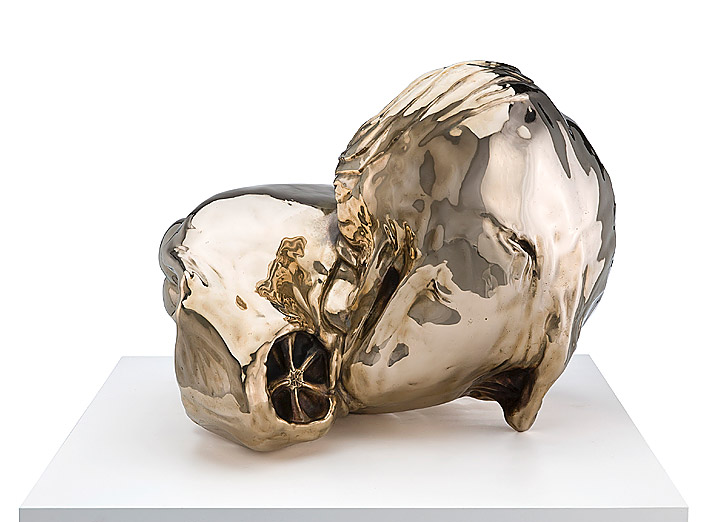
Patricia Piccinini (Australian, b. 1965) 'The Uprising' 2008 bronze


Patricia Piccinini (Australian, b. 1965)
The Uprising
2008
Bronze


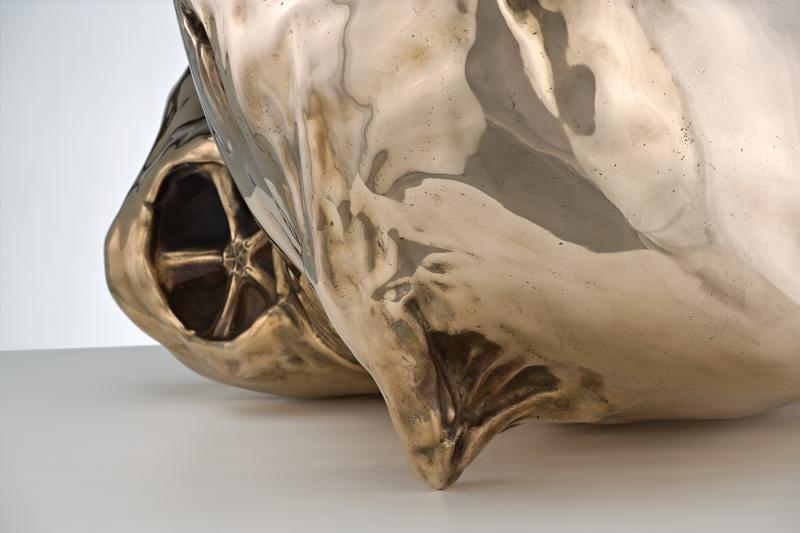
Patricia Piccinini (Australian, b. 1965) 'The Uprising' 2008 bronze (detail)


Patricia Piccinini (Australian, b. 1965)
The Uprising (detail)
2008
Bronze


“The massive aorta-like The Uprising, with its labyrinthine musculature, is a much stranger work. It establishes a bridge between the Vespa stags and the transgenic creatures, while being simultaneously amorphous and representational. Corporeal and mechanical, it suggests the plastic, porous, and uncertain world of the new nature that is at the core of the figurative works. For this reason it is physically sited at the boundary between natural history and art history…”


Juliana Engberg


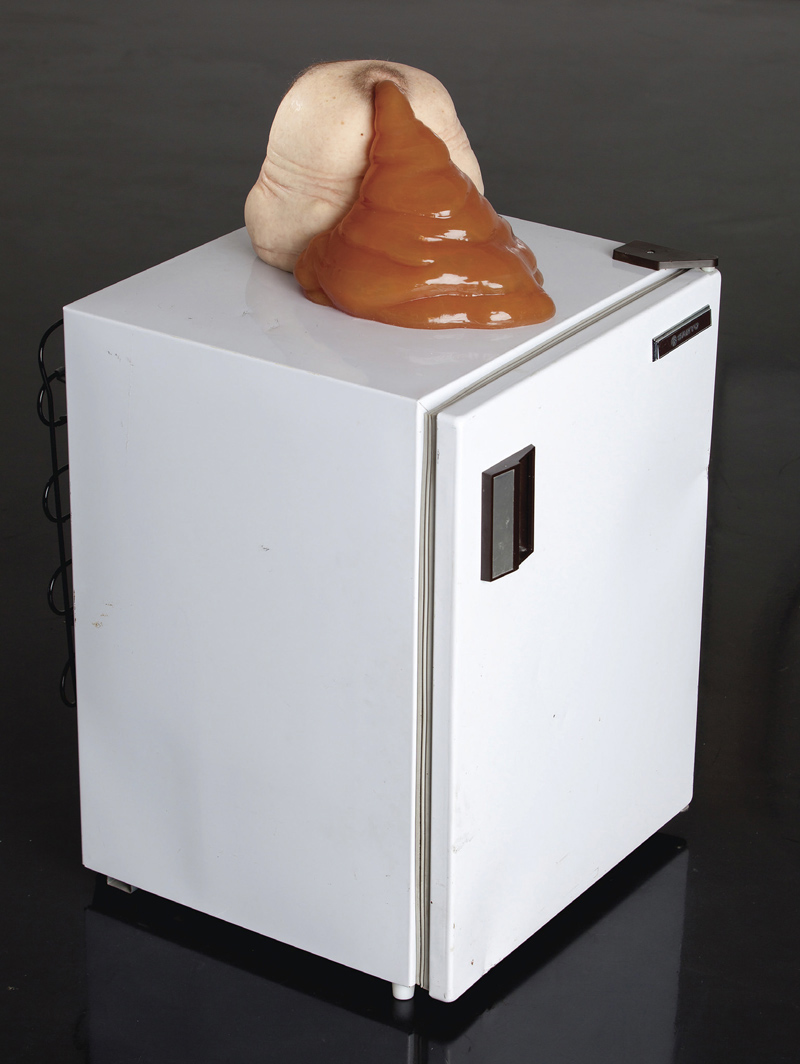
Patricia Piccinini (Australian, b. 1965) 'Nectar' 2012


Patricia Piccinini (Australian, b. 1965)
Nectar
2012
Silicone, fibreglass, human hair, refrigerator edition 1/6
83 × 48 × 51cm
Courtesy of the artist, Tolarno Galleries, Melbourne, and Haunch of Venison, London and New York


“Taking her cue from the vague boundaries of the biotech world, ‘where it is difficult to figure exactly where the good becomes tainted and the bad becomes justifiable’, Piccinini considers her own hybrid creations, however abject or grotesque, as lovable, associated with fecundity, growth and optimism. Like Bourgeois, she presents strange couplings of the animal and the human, that despite their de-formations always convey intimacy and warmth. Here the title Nectar suggests that there may be something nourishing in what might otherwise appear as a failed experiment.”

Text from educational pdf


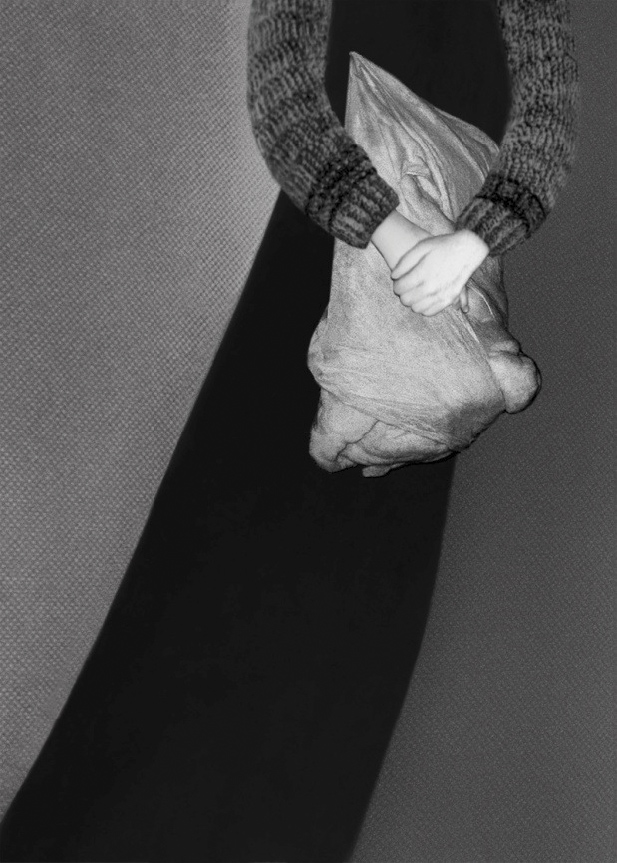
Pat Brassington (Australian, b. 1942) 'House guest #2' 2007


Pat Brassington (Australian, b. 1942)
House guest #2
2007


Pat Brassington (Australian, b. 1942) 'The Guardian' 2009


Pat Brassington (Australian, b. 1942)
The Guardian
2009
Pigment print on paper edition 6/8
112 × 87.5cm
Heide Museum of Modern Art, Melbourne
Purchased with funds from the Robert Salzer Foundation 2009


Louise Bourgeois at Heide Museum

A behind-the-scenes look at how the works of Louise Bourgeois, including her famous Spider were installed at Heide Museum.


Heide Museum of Modern Art
7, Templestowe Road
Bulleen, Victoria 3105

Opening hours:
(Heide II and Heide III)
Tuesday, Wednesday, Sunday, 10am – 5pm
Thursday – Saturday, 10am – 8pm

Heide Museum of Modern Art website

LIKE ART BLART ON FACEBOOK

Back to top

Exhibition: ‘WAR/PHOTOGRAPHY: Images of Armed Conflict and Its Aftermath’ at the Museum of Fine Arts, Houston – Posting Part 4

Exhibition dates: 11th November 2012 – 3rd February 2013


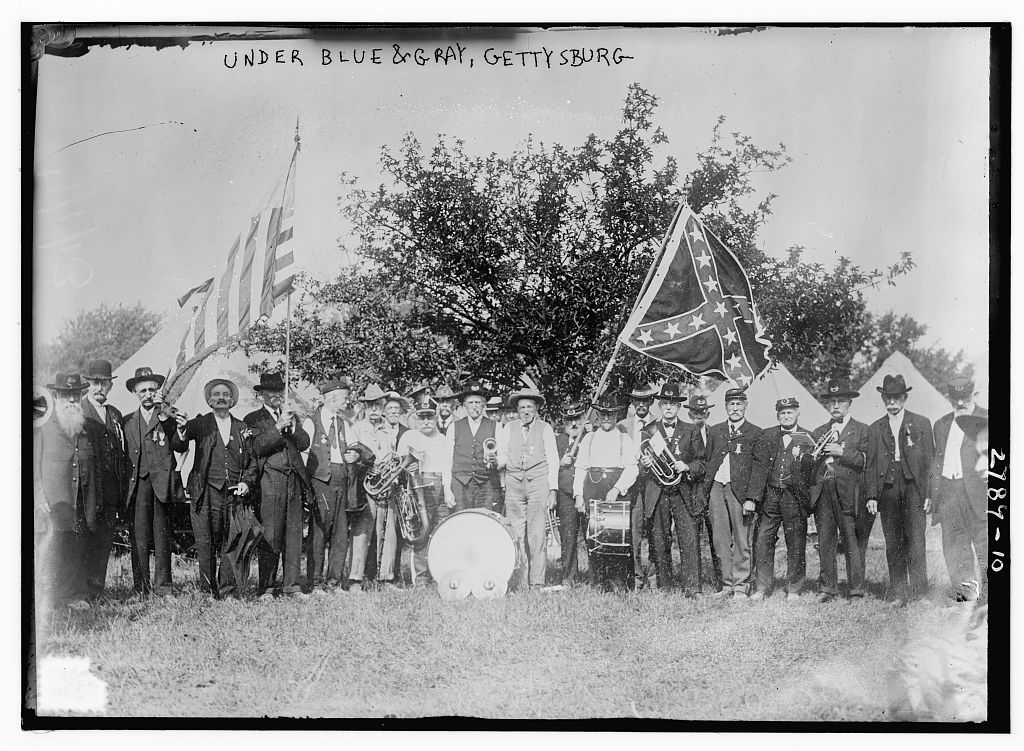
Anonymous photographer. 'Under blue & gray – Gettysburg' July 1913


Anonymous photographer
Under blue & gray – Gettysburg
July 1913
Photo shows the Gettysburg Reunion (the Great Reunion) of July 1913, which commemorated the 50th anniversary of the Battle of Gettysburg
Library of Congress Prints and Photographs Division Washington, D.C.


Part 4 of the biggest posting on one exhibition that I have ever undertaken on Art Blart!

As befits the gravity of the subject matter this posting is so humongous that I have had to split it into 4 separate postings. This is how to research and stage a contemporary photography exhibition that fully explores its theme. The curators reviewed more than one million photographs in 17 countries, locating pictures in archives, military libraries, museums, private collections, historical societies and news agencies; in the personal files of photographers and service personnel; and at two annual photojournalism festivals producing an exhibition that features 26 sections (an inspired and thoughtful selection) that includes nearly 500 objects that illuminate all aspects of WAR / PHOTOGRAPHY.

I have spent hours researching and finding photographs on the Internet to support the posting. It has been a great learning experience and my admiration for photographers of all types has increased. I have discovered the photographs and stories of new image makers that I did not know and some enlightenment along the way. I despise war, I detest the state and the military that propagate it and I surely hate the power, the money and the ethics of big business that support such a disciplinarian structure for their own ends. I hope you meditate on the images in this monster posting, an exhibition on a subject matter that should be consigned to the history books of human evolution.

**Please be aware that there are graphic photographs in all of these postings.** Part 1Part 2Part 3

Dr Marcus Bunyan


Many thankx to the Museum of Fine Arts, Houston for allowing me to publish some of the photographs in the posting. Please click on the photographs for a larger version of the image.


Memorials

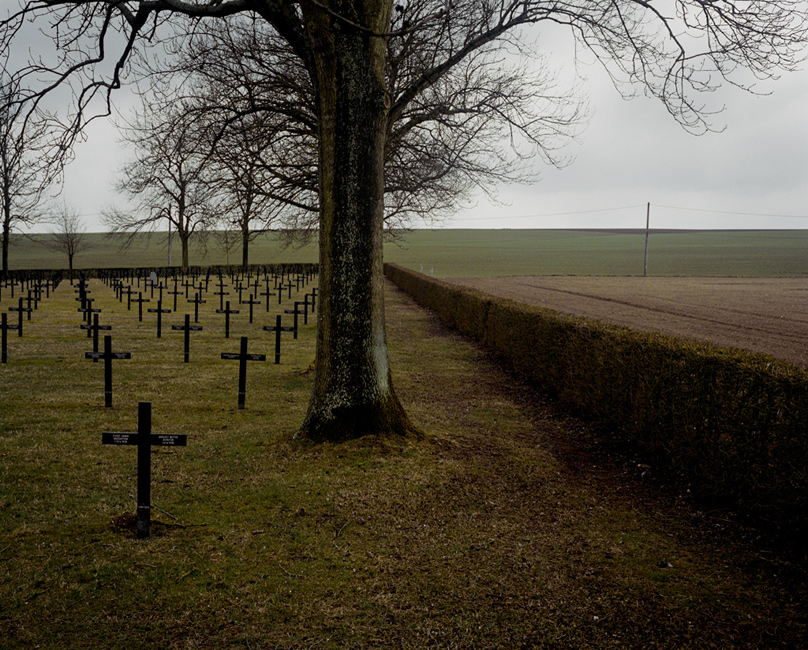
25. Photographs in the “Memorials” section range from the tomb of an unknown World War I soldier in England, by Horace Nicholls; and a landscape of black German crosses throughout a World War II burial site, by Bertrand Carrière; to an anonymous photograph of a reunion scene in Gettysburg of the opposing sides in the Civil War; and Joel Sternfeld’s picture of a woman and her daughter at the Vietnam Veterans Memorial in Washington, DC, in 1986. (8 images)


Horace Nicholls (English, 1867-1941) 'The Unknown Warrior at Westminster Abbey, London, November 1920' 1920


Horace Nicholls (English, 1867-1941)
The Unknown Warrior at Westminster Abbey, London, November 1920
1920
Silver gelatin print
© IWM (Q 31514)


In order to commemorate the many soldiers with no known grave, it was decided to bury an ‘Unknown Warrior’ with all due ceremony in Westminster Abbey on Armistice Day in 1920. The photograph shows the coffin resting on a cloth in the nave of Westminster Abbey before the ceremony at the Cenotaph and its final burial.


Bertrand Carrière (Canadian, b. 1957) 'Untitled' 2005-2009


Bertrand Carrière (Canadian, b. 1957)
Untitled
2005-2009
From the series Lieux Mêmes [Same Places]


Joel Sternfeld (American, b. 1944) 'Vietnam Veterans Memorial, Washington, D.C.,' May 1986


Joel Sternfeld (American, b. 1944)
Vietnam Veterans Memorial, Washington, D.C.,
May 1986
Chromogenic print, ed. #1/25 (printed October 1986)
The Museum of Fine Arts, Houston, the Target Collection of American Photography, gift of the artist
© 1986 Joel Sternfeld


Remembrance

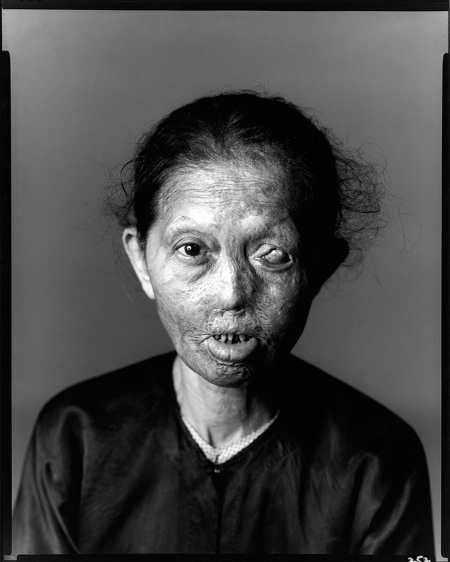
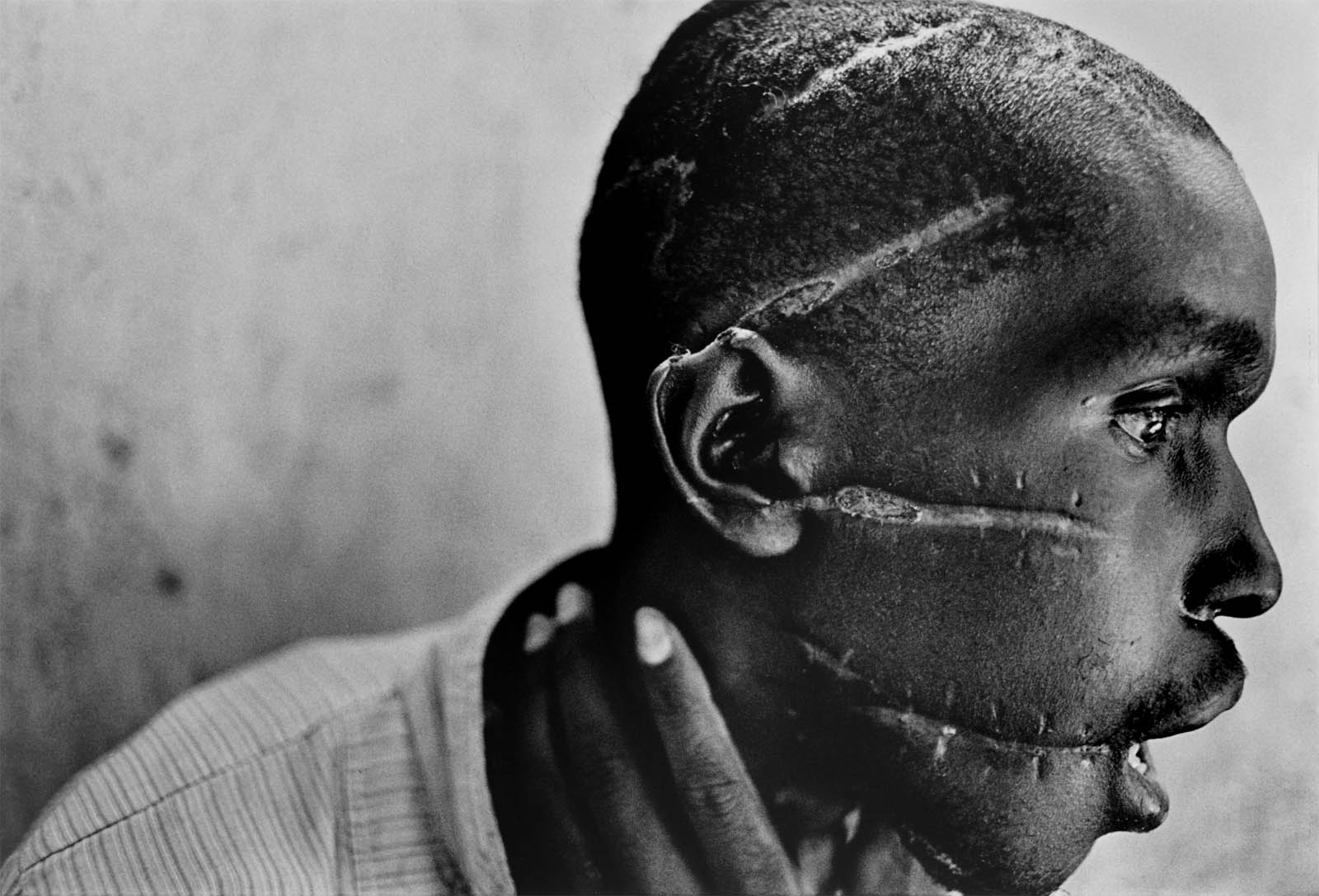
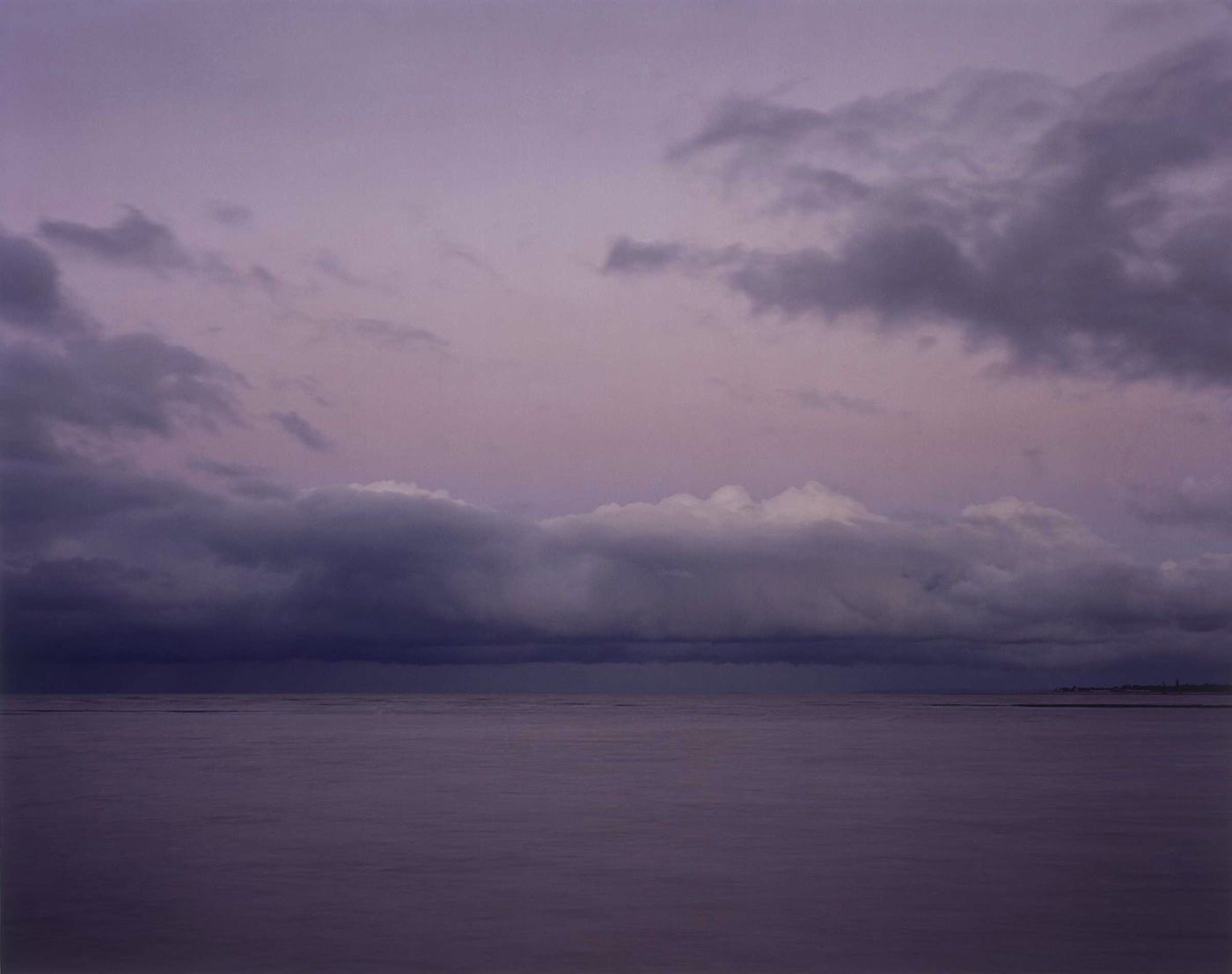
26. The last gallery in the exhibition is “Remembrance.” Most of these images were taken by artists seeking to come to terms with a conflict after fighting had ceased. Included are Richard Avedon’s picture of a Vietnamese napalm victim; a survivor of a machete attack in a Rwandan death camp, by James Nachtwey; a 1986 portrait of a hero who rescued Jews during the Holocaust, by Houston native Gay Block; and Suzanne Opton’s 2004 portrait of a soldier who survived the Iraq War and returned to the United States to work as a police officer, only to be murdered on duty by a fellow veteran. The final wall features photographs by Simon Norfolk of sunrises at the five D-Day beaches in 2004. The only reference to war is the title of the series: The Normandy Beaches: We Are Making a New World(33 images)


Richard Avedon (American, 1923-2004) 'Napalm Victim #1, Saigon, South Vietnam, April 29, 1971' 1971


Richard Avedon (American, 1923-2004)
Napalm Victim #1, Saigon, South Vietnam, April 29, 1971
1971
Silver gelatin print
© Richard Avedon


Gay Block (American, b.1942) 'Zofia Baniecka, Poland' 1986


Gay Block (American, b. 1942)
Zofia Baniecka, Poland
1986
From the series Rescuers: Portraits of Moral Courage in the Holocaust, a record of non-Jewish citizens from European countries who risked their lives helping to hide Jews from the Nazis
Chromogenic print, printed 1994
Courtesy of Museum of Fine Arts, Houston, gift of Clinton T. Wilour in honour of Eve France


Zofia Baniecka (born 1917 in Warsaw – 1993) was a Polish member of the Resistance during World War II. In addition to relaying guns and other materials to resistance fighters, Baniecka and her mother rescued over 50 Jews in their home between 1941 and 1944.


James Nachtwey (American, b. 1948) 'A Hutu man who did not support the genocide had been imprisoned in the concentration camp, was starved and attacked with machetes. He managed to survive after he was freed and was placed in the care of the Red Cross, Rwanda, 1994' 1994


James Nachtwey (American, b. 1948)
A Hutu man who did not support the genocide had been imprisoned in the concentration camp, was starved and attacked with machetes. He managed to survive after he was freed and was placed in the care of the Red Cross, Rwanda, 1994
1994
Silver gelatin print
© James Nachtwey / TIME

World Press Photo of the Year, prize singles


A Hutu man at a Red Cross hospital in Nyanza, Rwanda. His face was mutilated by the Hutu ‘Interahamwe’ militia, who suspected him of sympathising with the Tutsi rebels.

Liberated from a nearby Hutu camp, where mainly Tutsis were incarcerated, starved, beaten, and killed, this man did not support the genocide and was thus subjected to the same treatment. Starved and attacked with machetes, he had managed to survive, though he was unable to speak and could barely walk or swallow when this photo was made.

Jibran Abbasi. “Mutilated By The Hutu ‘Interahamwe’ by James Nachtwey,” on the Business Recorder website April 5, 2017 [Online] Cited 27/07/2024


Simon Norfolk (British, b. Nigeria, 1963) 'Sword Beach' 2004


Simon Norfolk (British born Nigeria, b. 1963)
Sword Beach
2004
From the series The Normandy Beaches: We Are Making a New World
Chromogenic print, ed. #1/10 (printed 2006)
The Museum of Fine Arts, Houston
Gift of Bari and David Fishel, Brooke and Dan Feather and Hayley Herzstein in honor of Max Herzstein and a partial gift of the artist and Gallery Luisotti, Santa Monica
© Simon Norfolk / Gallery Luisotti


WAR/PHOTOGRAPHY Extended Info


Other photographs from the exhibition


Alexander Gardner (1821-1882) 'Scouts and Guides to the Army of the Potomac, Berlin, MD, October, 1862' October 1862 (detail)


Alexander Gardner (American, 1821-1882)
Scouts and Guides to the Army of the Potomac, Berlin, MD, October, 1862
October 1862
Albumen silver print
Photograph by Alexander Gardner, from “Incidents of the War. Guide to the Army of the Potomac,” from Gardner’s Photographic Sketch Book of the War, Washington
Records of the War Department General and Special Staffs, Record Group 165, National Archives Still Picture Branch, College Park, Maryland


Alexander Gardner (American, 1821-1882) ‘The Home of a Rebel Sharpshooter, Gettysburg, Pennsylvania’. Albumen paper print


Alexander Gardner (American, 1821-1882)
The Home of a Rebel Sharpshooter / Dead Confederate soldier in the devil’s den, Gettysburg, Pennsylvania
July 1863
Albumen paper print copied from glass, wet collodion negative
Library of Congress, Prints and Photographs Division


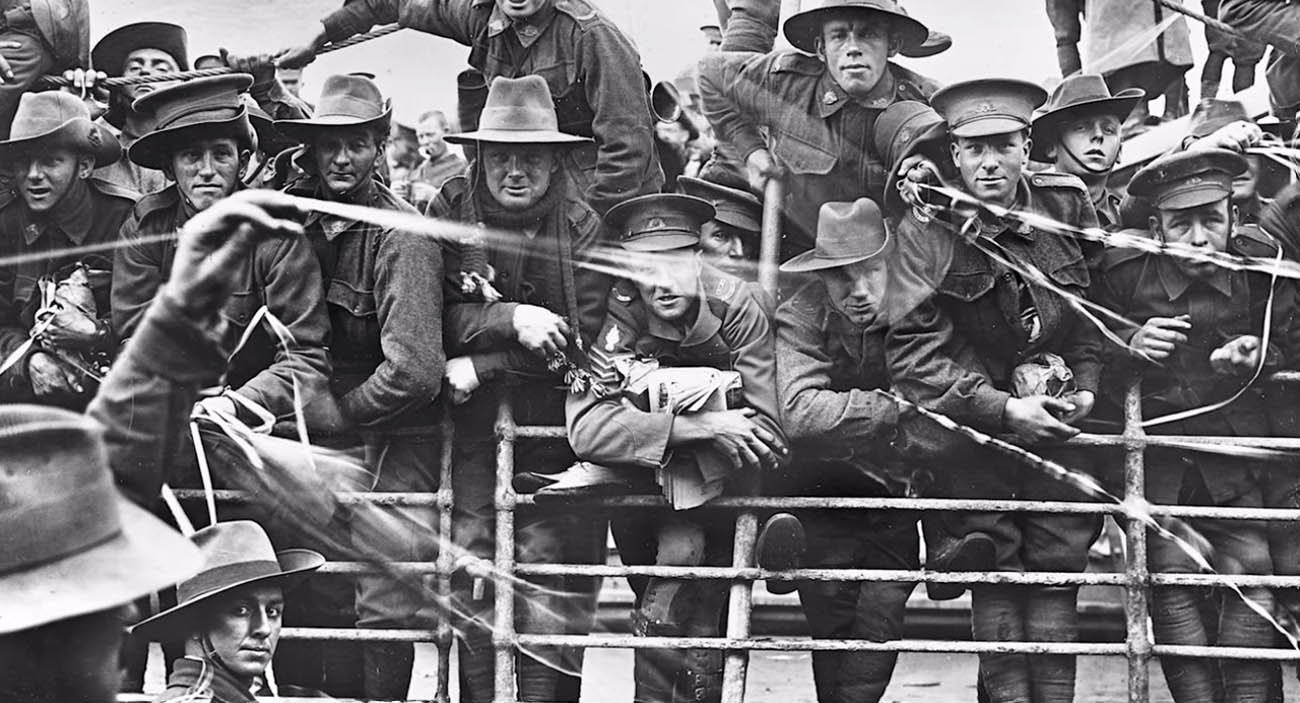
Josiah Barnes (Australian, 1858-1921) 'Embarkation of HMAT Ajana, Melbourne, July 8, 1916' 1916


Josiah Barnes (Australian, 1858-1921)
Embarkation of HMAT Ajana, Melbourne, July 8, 1916
1916
Gelatin silver print from original glass half-plate negative (printed 2012)
On loan from the Australian War Memorial


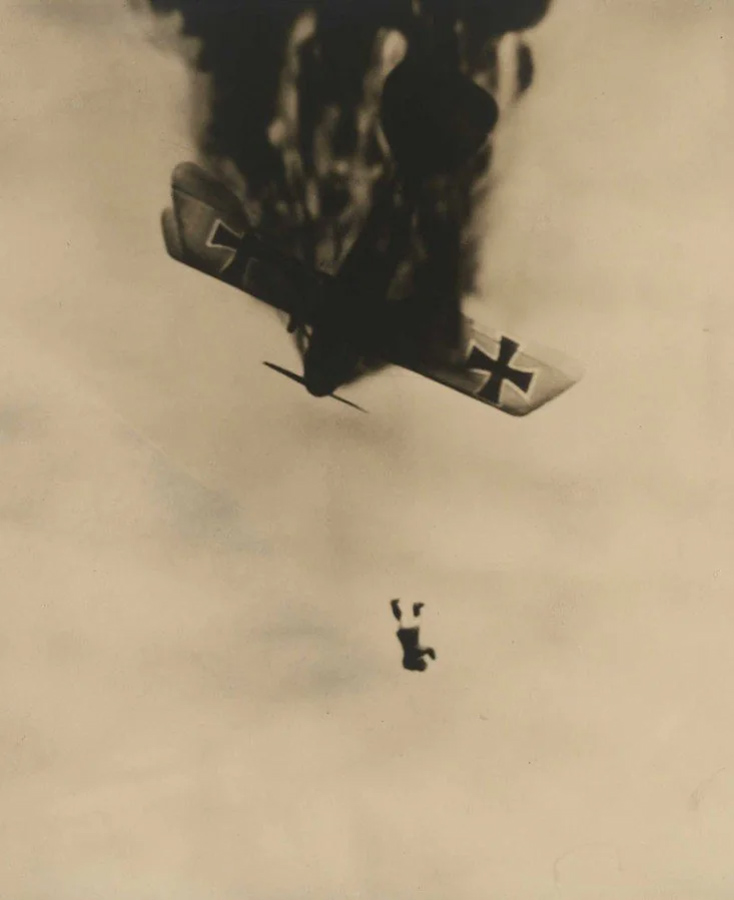
Wesley D. Archer (American, d. 1952) 'Just as he left the burning plane' 1933


Wesley D. Archer (American, d. 1952)
Just as he left the burning plane
1933
From the publication Death in the Air: The War Diary and Photographs of a Flying Corps Pilot


The typewritten script of a First World War pilot’s diary with a large number of photographs was submitted to the publishers William Heinemann and published by them in 1933. Heinemann stated on the book’s jacket that the diary contained no names, dates, or anything that could reveal the identity of the writer or the squadron in which he served. The publishers understood that the diarist was killed in action in 1918 and that it was in deference to the wishes of those who were close to him that his diary should be published.

So remarkable were the photographs that their veracity was immediately questioned, but no proof of their authenticity or otherwise could be ascertained. It was not until 1983 that a collection of documents, photographs and artifacts was presented to the Smithsonian’s National Air and Space Museum. Some of the photographs were recognized as being those of the mystery diarist and the truth was soon revealed.

The author was Wesley Archer, an American with Canadian parents who served with the RFC in the First World War, and the photographs and diary had been faked.

Text from the Google Books website

For more information on the faked photographs see the article “How dramatic images of WWI dogfights in the skies of Europe were FAKED by a conman who was just looking to make some money”.


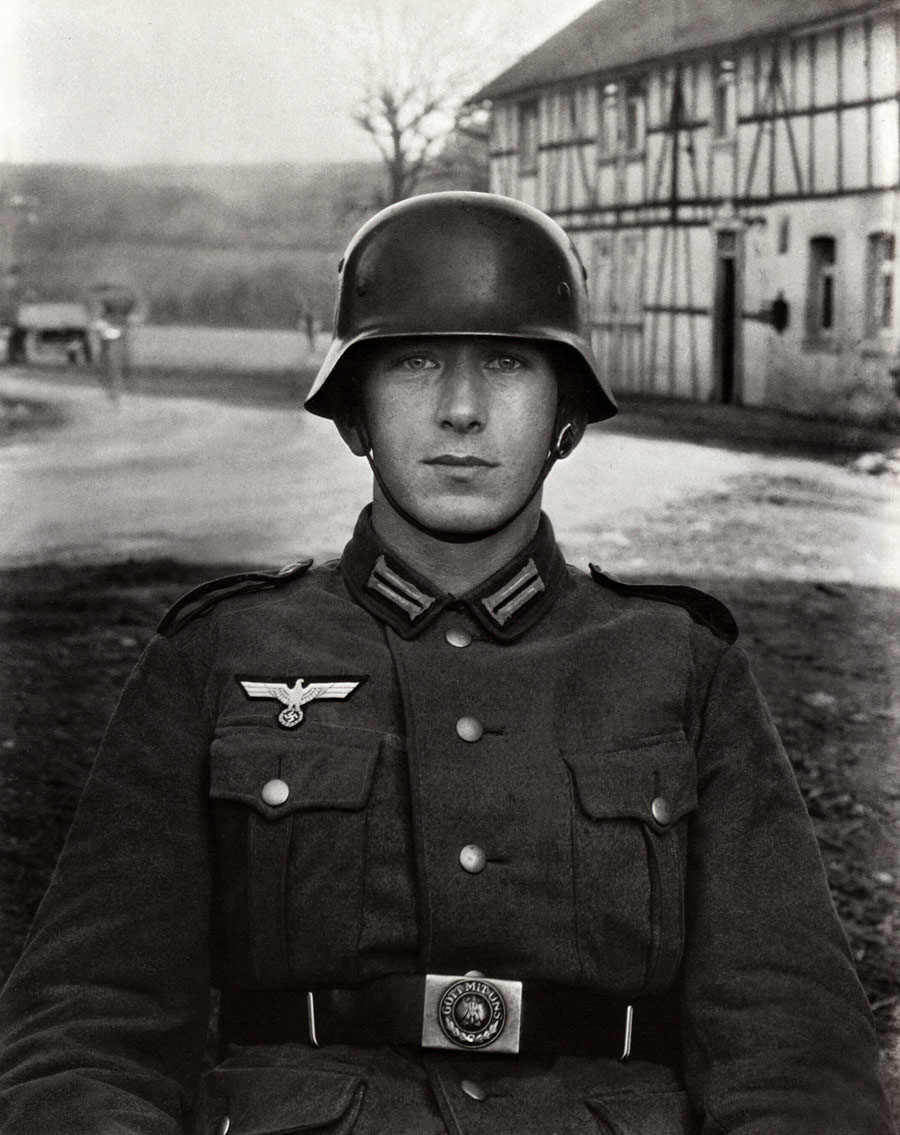
August Sander (German, 1876-1964) 'Soldier' c. 1940


August Sander (German, 1876-1964)
Soldier
c. 1940
Gelatin silver print, printed by Gunther Sander, 1960s
The Museum of Fine Arts, Houston
Gift of John S. and Nancy Nolan Parsley in honour of the 65th birthday of Anne Wilkes Tucker
© Die Photographische Sammlung/SK StiftungKultur – August Sander Archiv, Cologne; DACS, London 2012


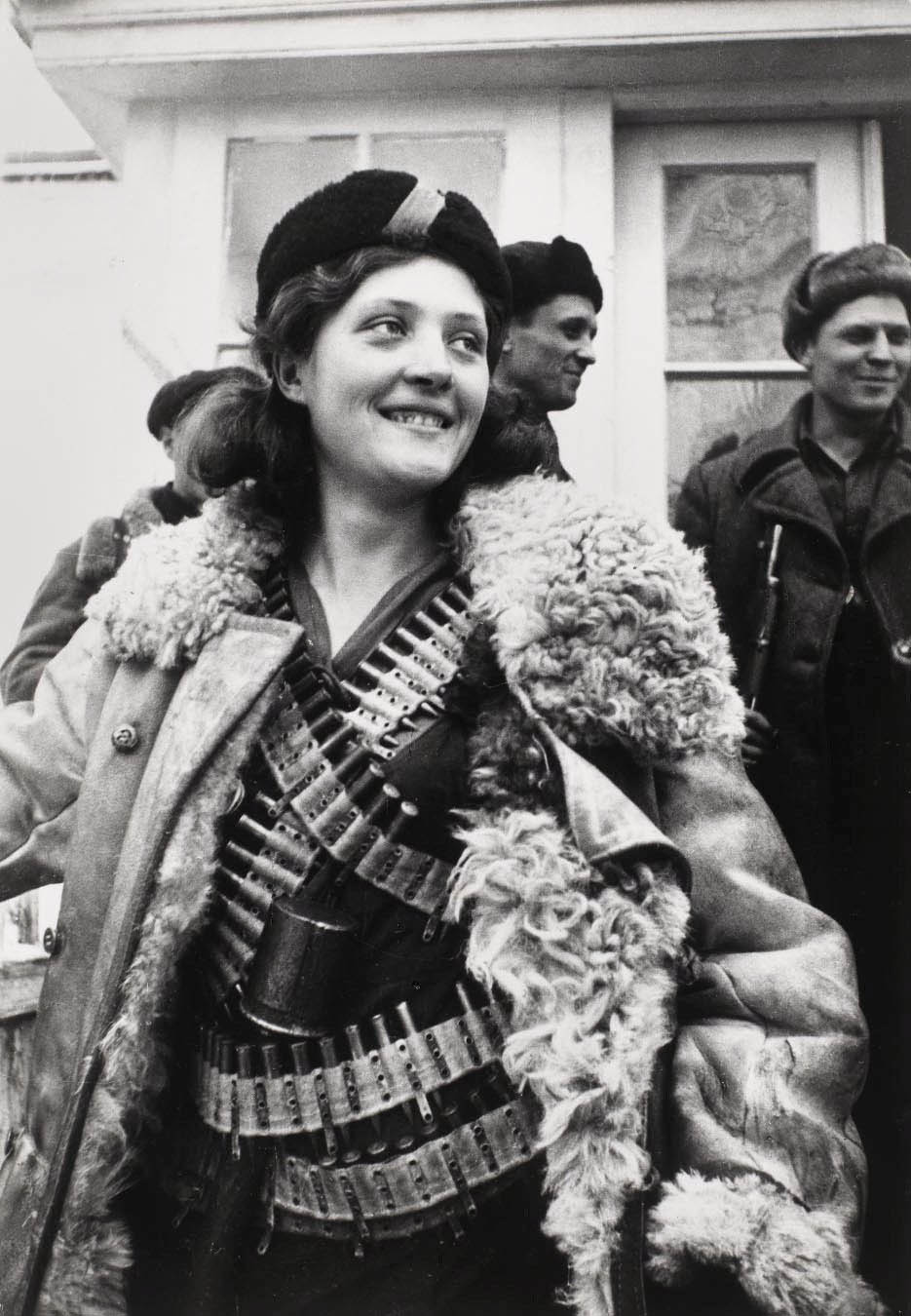
Arkady Shaikhet (Soviet, 1898-1959) 'Partisan Girl' 1942


Arkady Shaikhet (Soviet, 1898-1959)
Partisan Girl
1942
Gelatin silver print
Gift of Marion Mundy
© Arkady Shaikhet Estate, Moscow


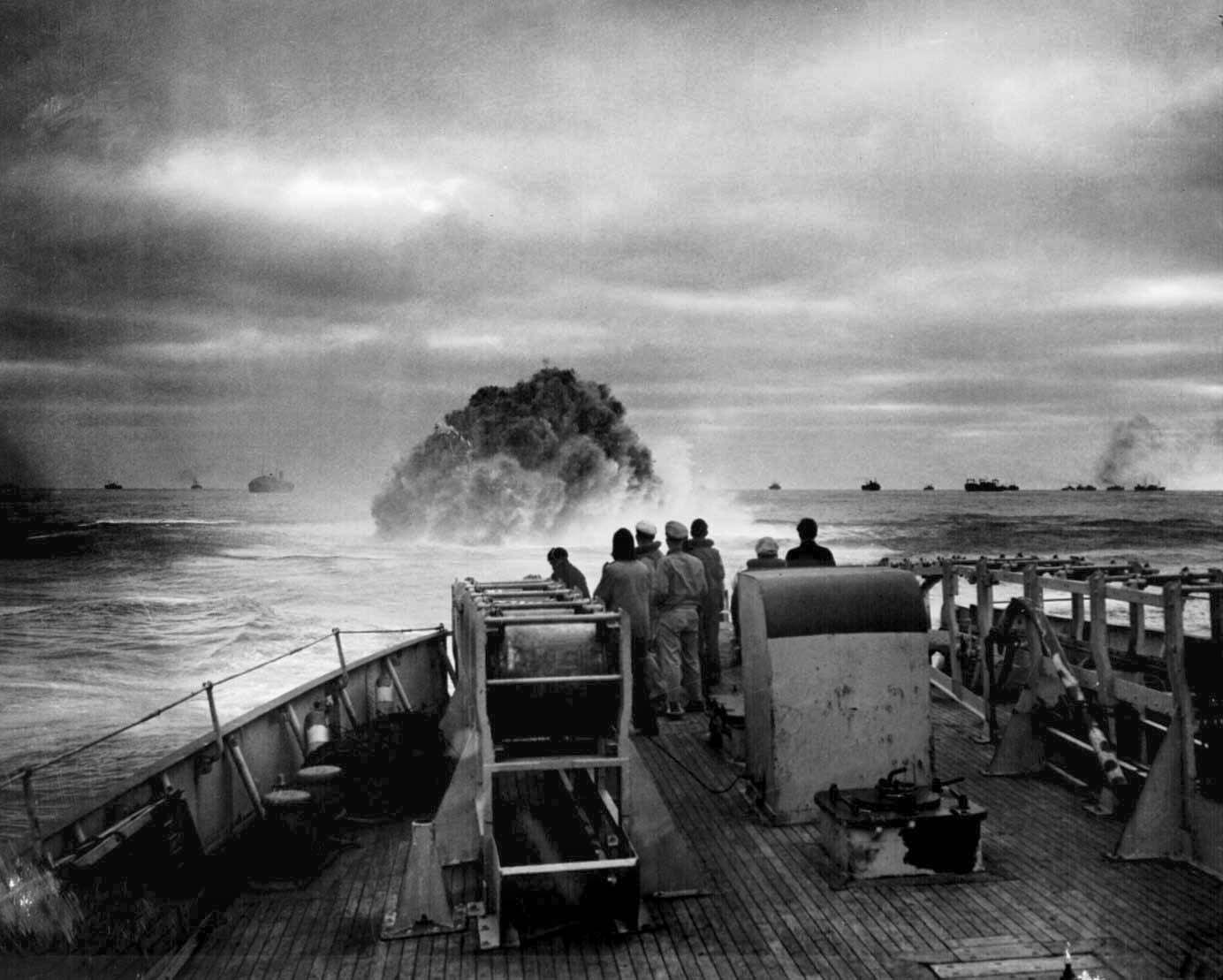
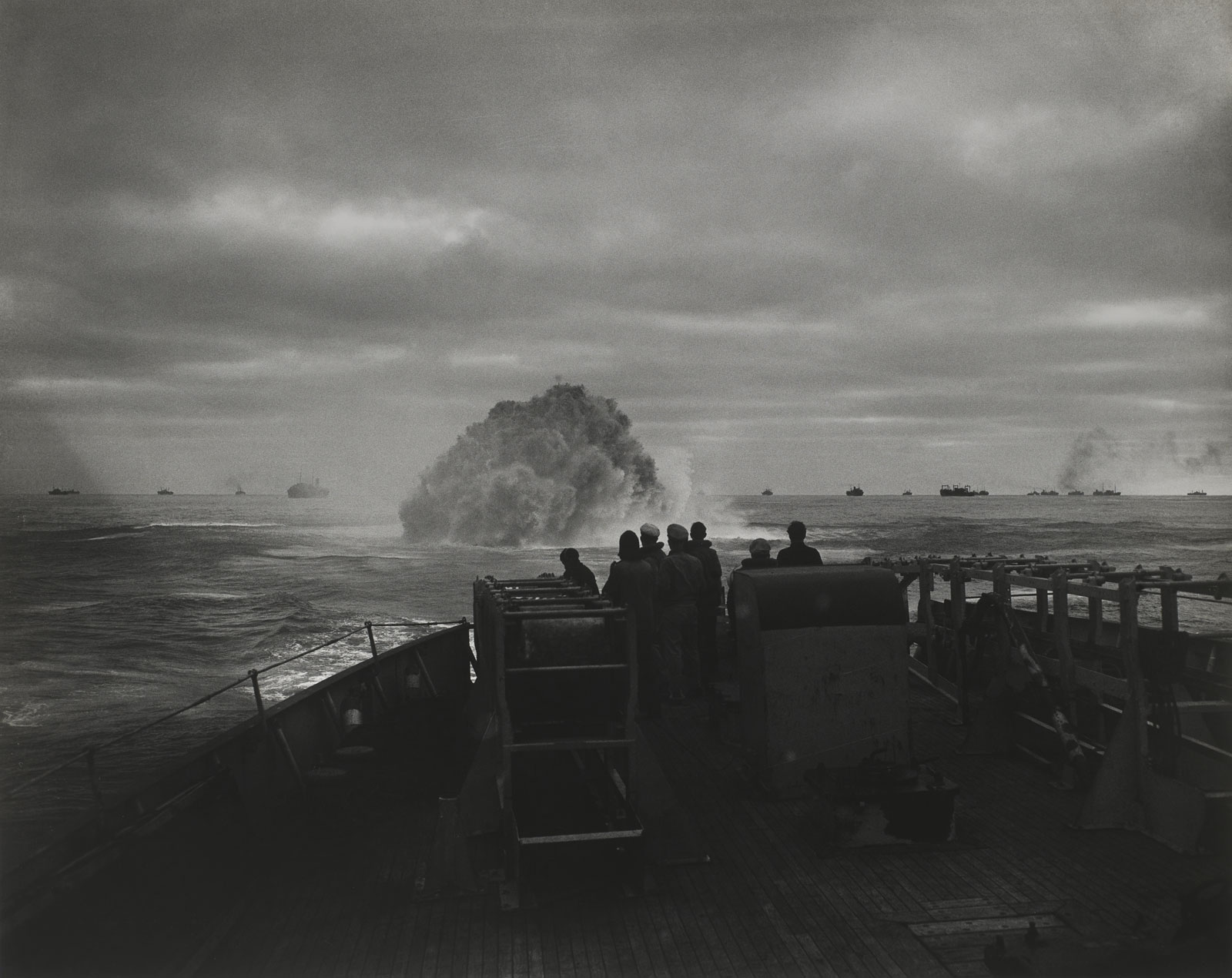
Anonymous photographer / U.S. Department of Defense. 'US Coast Guard crew of cutter Spencer watched as a depth charge exploded near U-175, North Atlantic, 500nm WSW of Ireland, 17 Apr 1943'


Anonymous photographer
U.S. Department of Defense
US Coast Guard crew of cutter Spencer watched as a depth charge exploded near U-175, North Atlantic, 500nm WSW of Ireland, 17 Apr 1943
17 April 1943
Public domain


W. Eugene Smith (American, 1918-1978) 'Wounded, dying infant found by American soldier in Saipan Mountains' June 1944


W. Eugene Smith (American, 1918-1978)
Wounded, dying infant found by American soldier in Saipan Mountains
June 1944
Gelatin silver print
© W. Eugene Smith


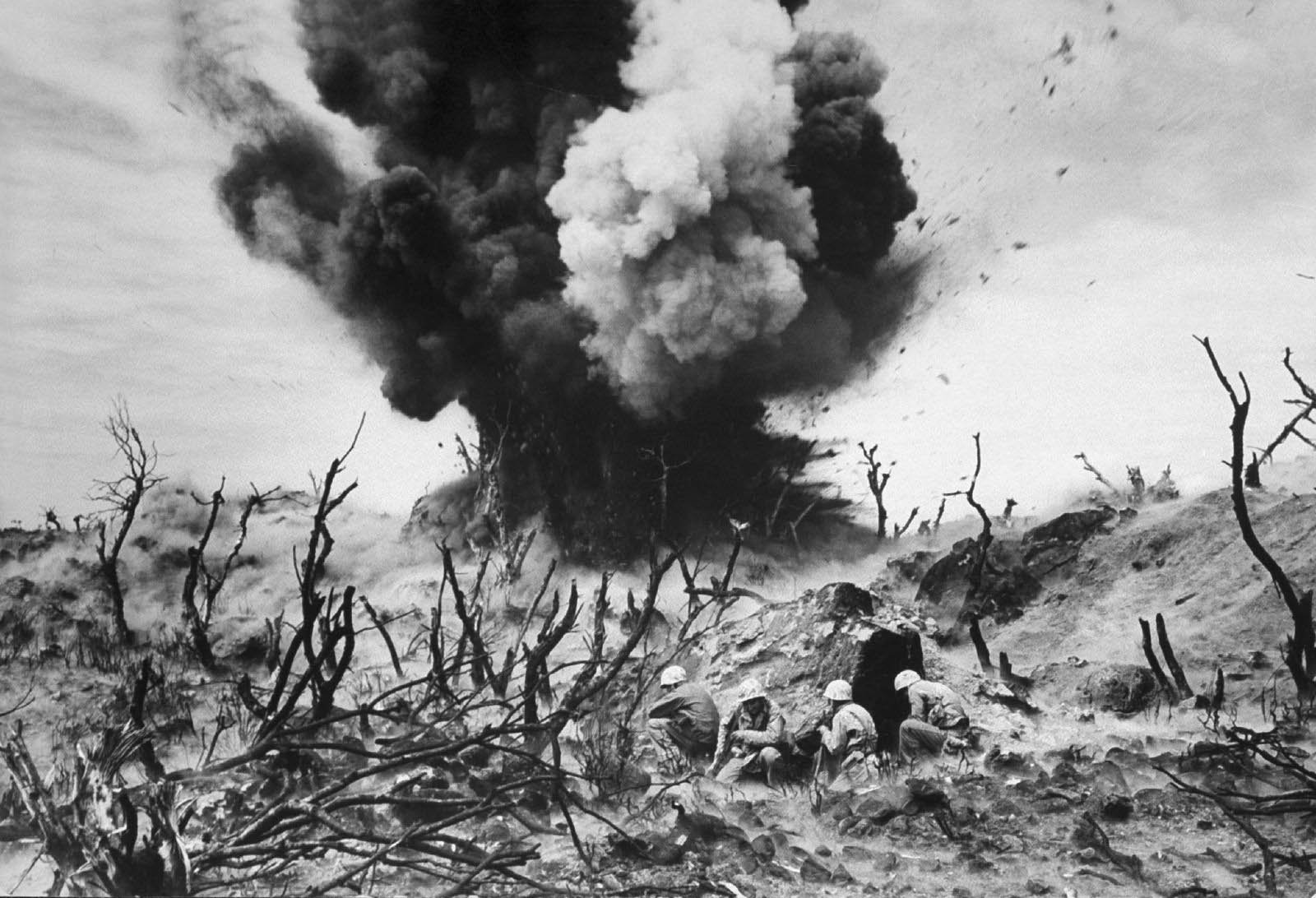
W. Eugene Smith (American, 1918-1978) 'World War II. The Pacific Campaign. The Battle of Iwo Jima (Japanese island). US Marine demolition team blasting out a cave on Hill 382. Iwo Jima. February, 1945' 1945


W. Eugene Smith (American, 1918-1978)
World War II. The Pacific Campaign. The Battle of Iwo Jima (Japanese island). US Marine demolition team blasting out a cave on Hill 382. Iwo Jima. February, 1945
1945
Gelatin silver print
© W. Eugene Smith


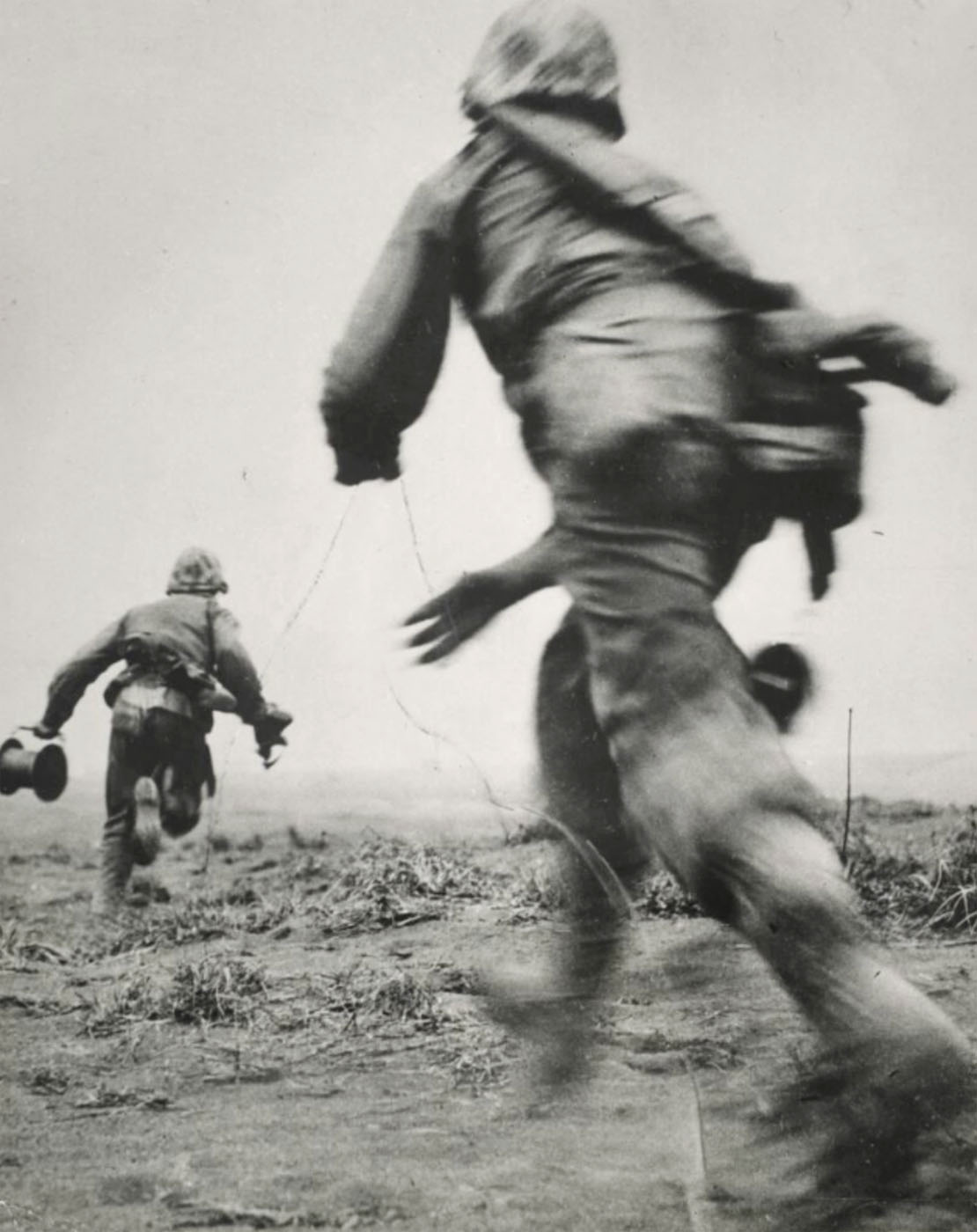
Joseph Schwartz (American, 1913–2013) 'Hold the Phone - Two Marine wiremen on Iwo Jima race across an open field, under heavy enemy fire to establish field telephone contact with the front lines' February 19, 1945, printed early 1950s


Joseph Schwartz (American, 1913–2013)
Hold the Phone – Two Marine wiremen on Iwo Jima race across an open field, under heavy enemy fire to establish field telephone contact with the front lines
February 19, 1945, printed early 1950s
Gelatin silver print mounted on board
18 13/16 × 14 15/16 in. (47.8 × 37.9cm)
The Museum of Fine Arts, Houston
Museum purchase funded by Knox Nunnally at “One Great Night in November, 2009,” in honor of Houston trial lawyer Joe Reynolds, a U.S. Marine who fought on Iwo Jima


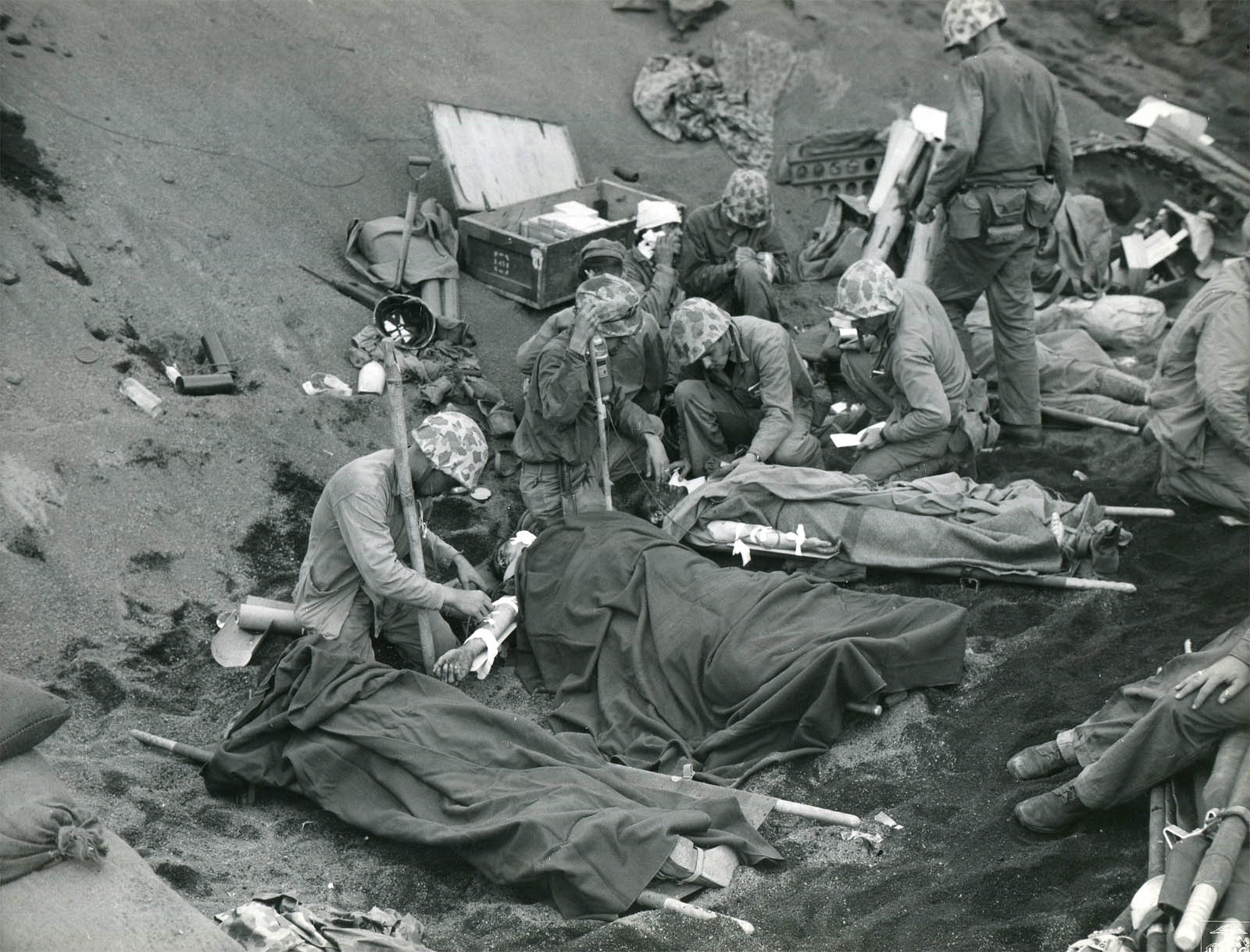
Anonymous photographer. U.S. Department of Defense / USMC Official Photograph 'PLASMA WARD – Navy doctors and corpsmen administer to wounded Marines at an aid station established in a gully on Iwo Jima. The high casualty rate in this operation required the use of gallons of plasma and whole blood sent by air from the West Coast' 1945


Anonymous photographer
U.S. Department of Defense / USMC Official Photograph
PLASMA WARD – Navy doctors and corpsmen administer to wounded Marines at an aid station established in a gully on Iwo Jima. The high casualty rate in this operation required the use of gallons of plasma and whole blood sent by air from the West Coast
1945
Gelatin silver print
Creative Commons Attribution 2.0 Generic


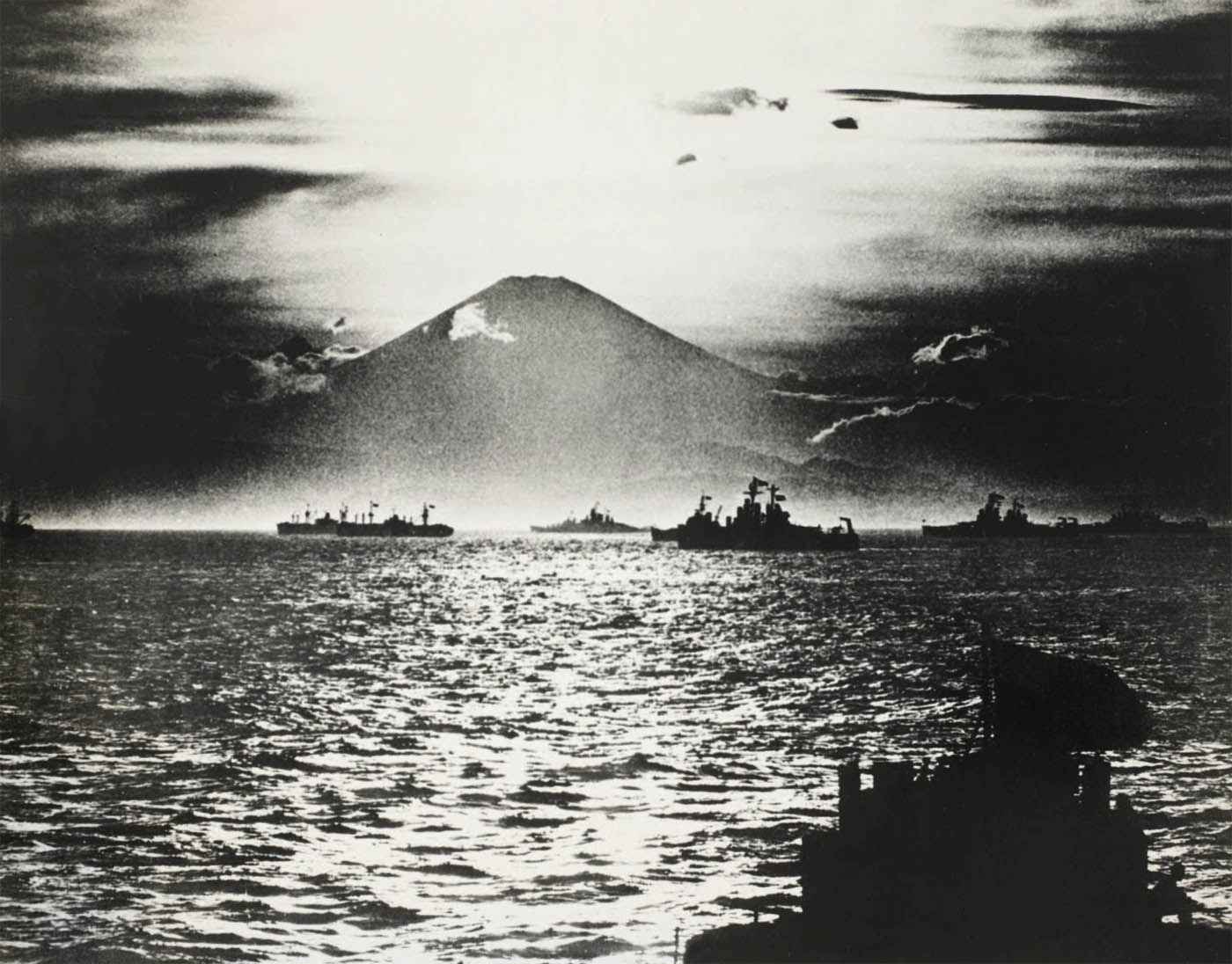
U.S. Navy Photographic Team. 'U.S. and British Warships Anchored in Sagami Wan, Outside of Tokyo Bay, Japan, on the Day the Allied Ships Entered Japanese Waters' 27th August 1945


U.S. Navy Photographic Team
U.S. and British Warships Anchored in Sagami Wan, Outside of Tokyo Bay, Japan, on the Day the Allied Ships Entered Japanese Waters
27th August 1945
Gelatin silver print
The Museum of Fine Arts, Houston, museum purchase funded by Laura and Tony Visage in honor and memory of William A. Visage and his fellow soldiers in Battery “E” of the 2nd Battalion, 131st Field Artillery, U.S. Army Air Corps


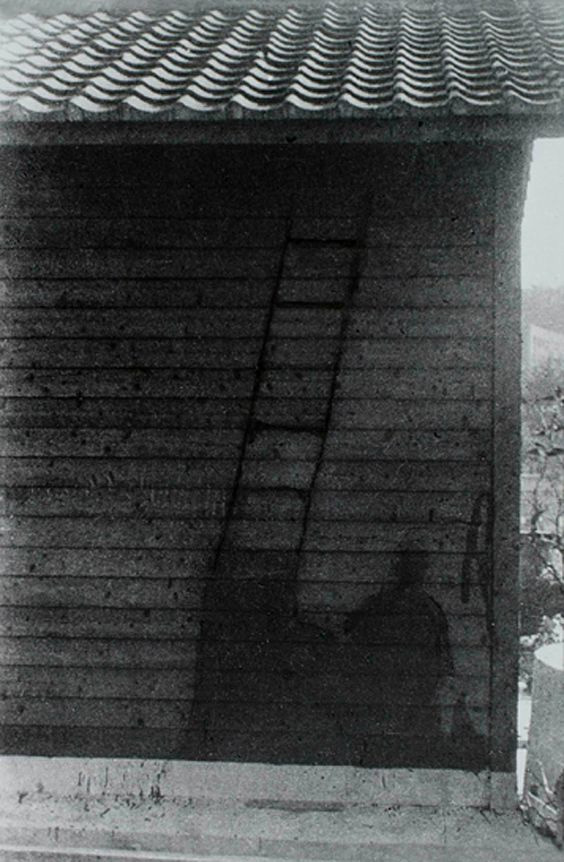
Matsumoto Eiichi (Japanese, 1915-2004) 'Shadow of a soldier remaining on the wooden wall of the Nagasaki military headquarters (Minami-Yamate machi, 4.5km from Ground Zero)' 1945


Matsumoto Eiichi (Japanese, 1915-2004)
Shadow of a soldier remaining on the wooden wall of the Nagasaki military headquarters (Minami-Yamate machi, 4.5km from Ground Zero)
1945
Gelatin silver print
Collection of the Tokyo Metropolitan Museum of Photography
© Matsumoto Eiichi


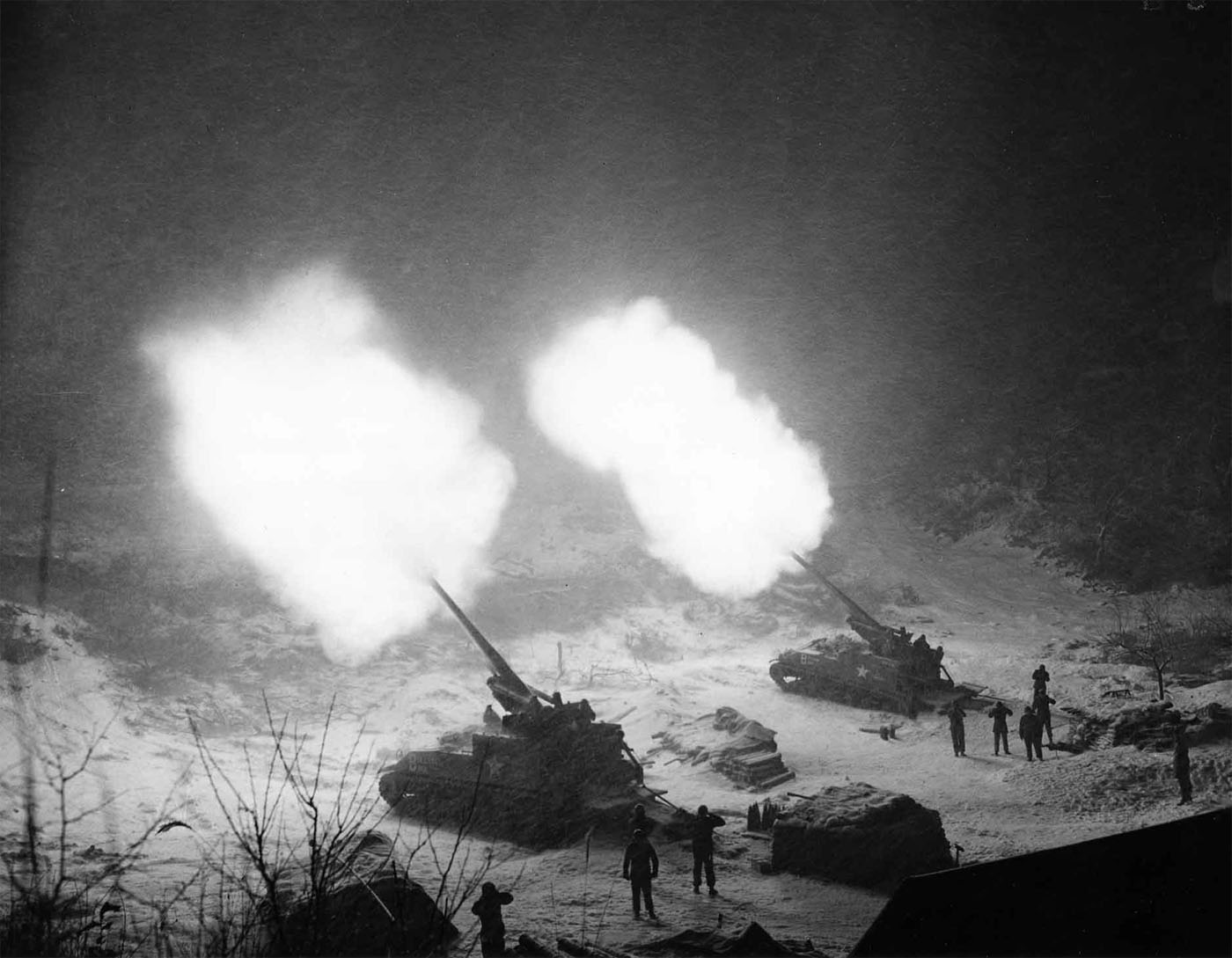
Unknown photographer. 'A pair of M-40 155mm Gun Motor Carriages of Battery B, 937th Field Artillery Battalion, providing fire support to U.S. Army 25th Infantry Division, Munema, Korea' 26 November 1951


Unknown photographer
A pair of M-40 155mm Gun Motor Carriages of Battery B, 937th Field Artillery Battalion, providing fire support to U.S. Army 25th Infantry Division, Munema, Korea
26 November 1951
Gelatin silver print
U.S. Department of Defense


Cathy LeRoy (French, 1944-2006) 'Corpsman In Anguish' 1967


Cathy LeRoy (French, 1944-2006)
Corpsman In Anguish
1967
Gelatin silver print


Her pictures from Vietnam were stunning. Her photos from Battle of Hill 881 evoked “ghosts of Iwo Jima and Pork Chop Hill,” Time magazine wrote in May 1967. Her photos of corpsman Vernon Wike during the battle was a triptych of an all-too-familiar scene: in the first, Wike has two hands on his friend’s chest, trying to staunch the wound; in the second, he tries to find a heartbeat; in the third frame, “Corpsman In Anguish”, he realised the man is dead.

LeRoy herself came very close to death two weeks later. Her Nikon barely stopped a piece of mortar shrapnel that ripped open her chest. She said that she thought the last words she would ever hear were, “I think she’s dead, sarge.” During the Tet offensive in 1968, LeRoy was briefly captured by the North Vietnamese during the battle for Hue. LeRoy’s photos of her captivity later made the cover of Life, ‘A Remarkable Day in Hue: the Enemy Lets Me Take His Picture’. She was the first person to take photos of North Vietnamese Army Regulars behind their lines.

Anonymous. “Corpsman In Anguish | Cathy LeRoy,” on the Iconic Photos website January 13, 2014 [Online] Cited 27/07/2024


A licensed parachutist, Leroy jumped with the U.S. 173rd Airborne Brigade into combat during Operation Junction City in February of 1967. It was in this action, the battle for Hill 881, that Leroy photographed U.S. Navy Corpsman Vernon Wike as he rushed to the aid of a fallen comrade. “Corpsman in anguish” is the third frame of a series that Leroy shot, capturing the unimaginable grief of war. Later, in an interview for the documentary “The Hill Fights”, Wike recounted the moment that Leroy photographed.

“I know there was chaos going on around me, but there was no sound,” she says. “… I knew he didn’t have a chance, but I still got p—–d off when he died.” Leroy describes the aftermath as the corpsman “lost in this nightmare landscape” grabbed the fallen marine’s M16 and charged a Viet bunker alone in a hail of obscenities. The fallen marine was a man called “Rock”, a New Yorker from Puerto Rico. Earlier that day he had told Wike that he only had 60 days left “in country” – his deployment in Vietnam.

Anonymous. “Giving War a Face: Catherine Leroy,” on the Dismal Nitch website September 04, 2020 [Online] Cited 27/07/2024


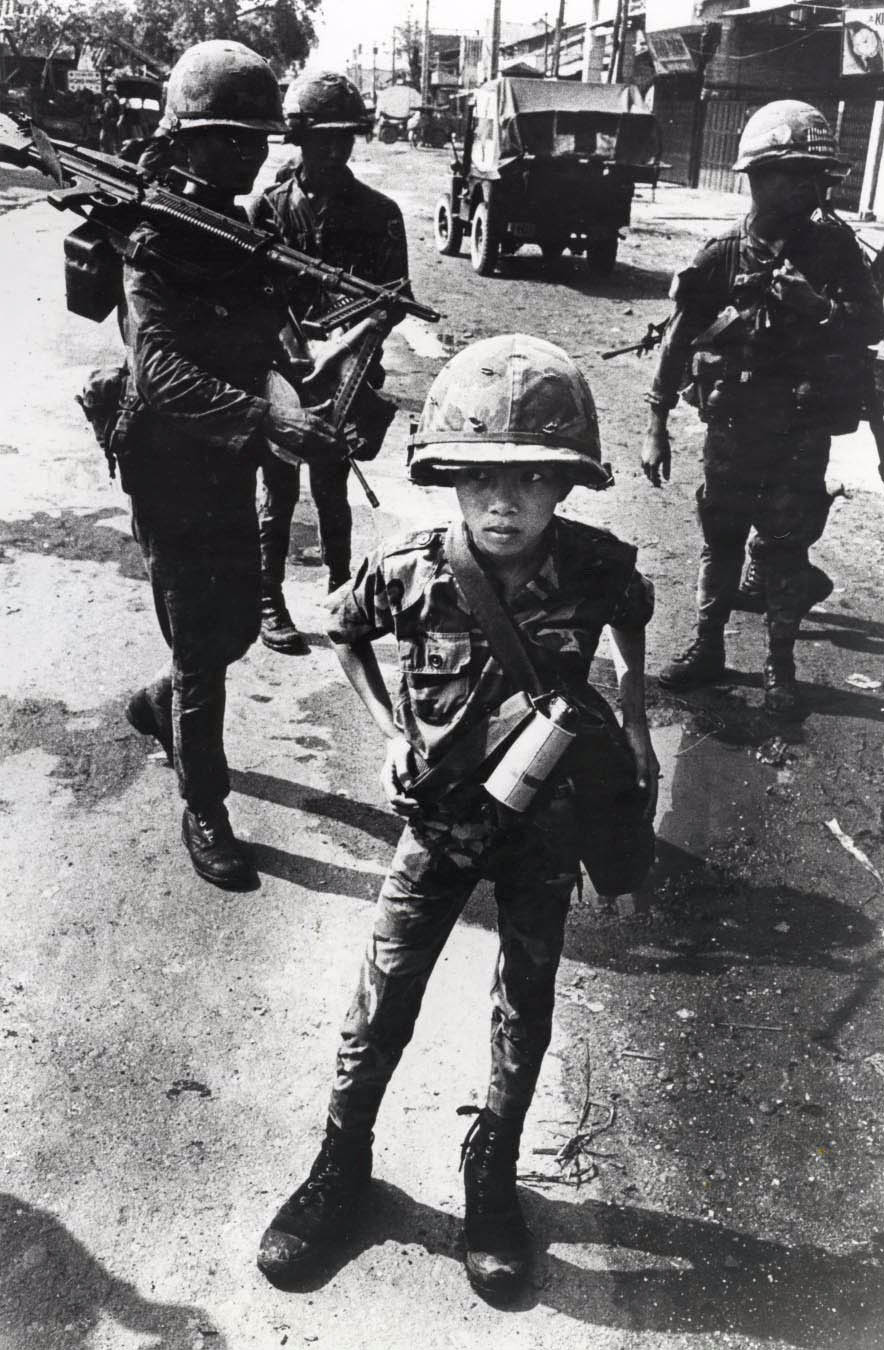
Arkady Shaikhet (Soviet, 1898-1959) 'Partisan Girl' 1942


Philip Jones Griffiths (Welsh, 1936-2008)
​Called “Little Tiger” for killing two “Viet Cong women cadre” – his mother and teacher, it was rumored, Vietnam​
1968
Gelatin silver print
The Philip Jones Griffiths Foundation, courtesy of Howard Greenberg Gallery
© Philip Jones Griffiths / Magnum Photos


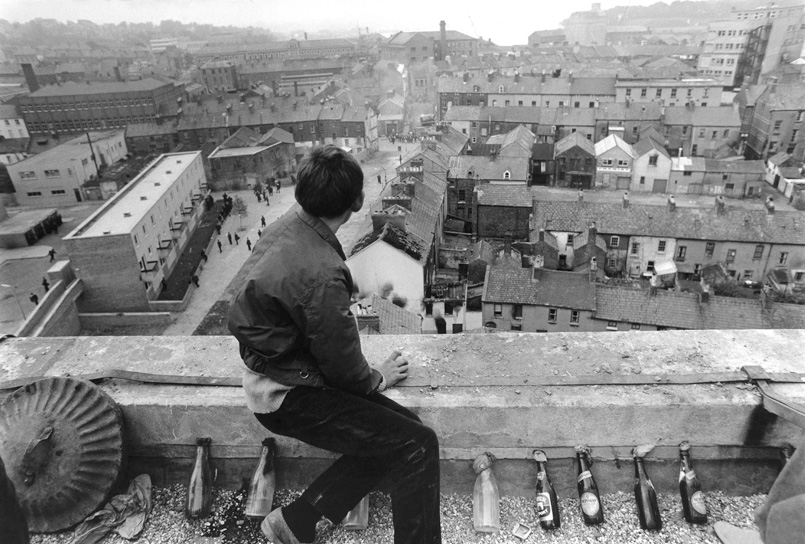
Gilles Caron (French, 1939-1970) 'Young Catholic demonstrator on Londonderry Wall, Northern Ireland' 1969


Gilles Caron (French, 1939-1970)
Young Catholic demonstrator on Londonderry Wall, Northern Ireland
1969
Gelatin silver print
Courtesy of Foundation Gilles Caron and Contact Press Images
© Gilles Caron


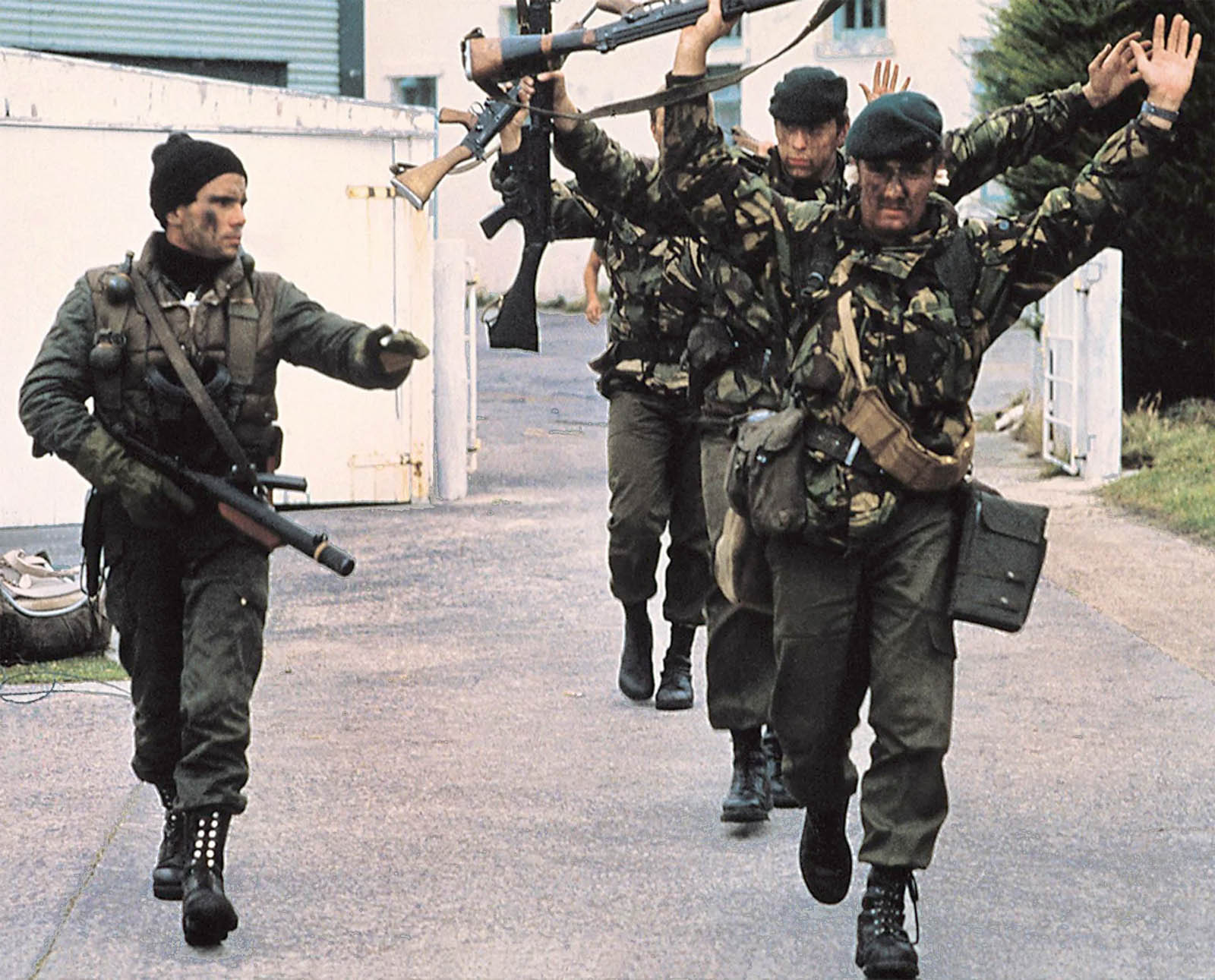
Rafael Wollmann (Argentinian, b. 1958) 'British Marines surrender to Argentinean troops in Malvinas/Falklands' April 2, 1982, printed 2012


Rafael Wollmann (Argentinian, b. 1958)
British Marines surrender to Argentinean troops in Malvinas/Falklands
April 2, 1982, printed 2012
Inkjet print
15 7/8 × 20 in. (40.4 × 50.8cm)
The Museum of Fine Arts, Houston
Gift of Rafael Wollmann


David Leeson (American, b. 1957) 'Death of a Soldier, Iraq' March 24, 2003


David Leeson (American, b. 1957)
Death of a Soldier, Iraq
March 24, 2003
Inkjet print, printed 2012
Courtesy of the artist


Ziv Koren (Israeli, b. 1970) 'A sniper’s-eye view of Rafah, in the Southern Gaza strip, during an Israeli military sweep' 2006


Ziv Koren (Israeli, b. 1970)
A sniper’s-eye view of Rafah, in the Southern Gaza strip, during an Israeli military sweep
2006
Inkjet print, printed 2012
© Ziv Koren/Polaris Images


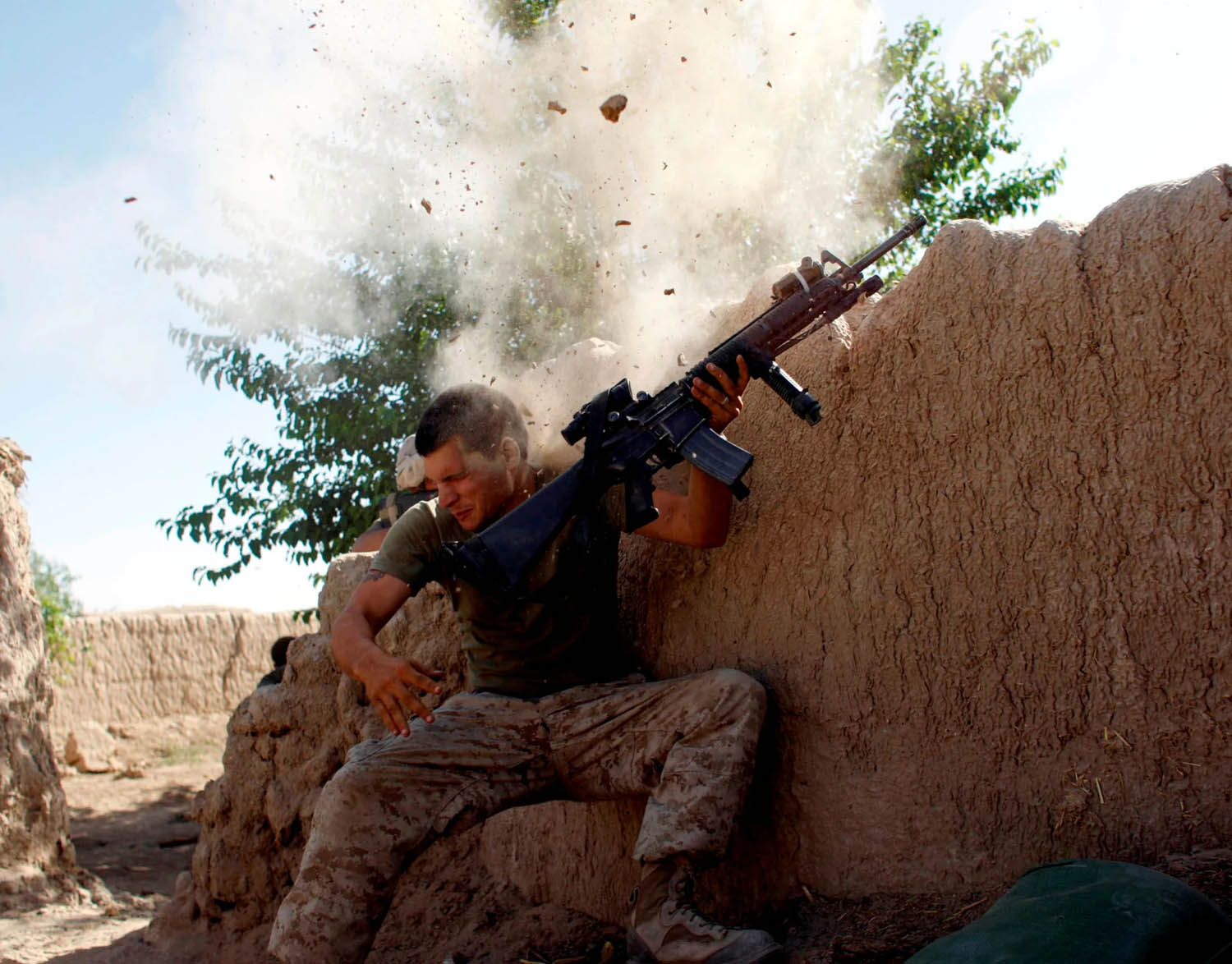
Goran Tomasevic (Serbian, b. 1959) /Reuters. 'SHOOTING. Sgt. William Olas Bee, a US Marine from the 24th Marine Expeditionary Unit, has a close call after Taliban fighters opened fire near Garmser in Helmand Province of Afghanistan May 18, 2008. The Marine was not injured.' 2008


Goran Tomasevic (Serbian, b. 1959) /Reuters
SHOOTING. Sgt. William Olas Bee, a US Marine from the 24th Marine Expeditionary Unit, has a close call after Taliban fighters opened fire near Garmser in Helmand Province of Afghanistan May 18, 2008. The Marine was not injured.
2008


Tomašević began photographing the war that followed the breakup of Yugoslavia from 1991 for daily newspaper Politika. In 1996 he joined the world’s largest news agency, Reuters, covering the simmering political tensions in Kosovo and the anti-Milošević demonstrations in his hometown of Belgrade since mid-1990s. During three-month NATO bombing of Yugoslavia in 1999, Tomašević was the only photographer working for foreign press to spend the duration of the conflict in Kosovo.

Tomašević moved to Jerusalem in 2002, covering the second Palestinian intifada. During the U.S. led invasions of Iraq in 2003, his picture of a U.S. Marine watching the toppling of a Saddam Hussein statue became one of the most memorable images of the war. He often returned to Iraq as sectarian violence escalated and regularly photographed America’s other war in Afghanistan. His sequence of photographs of U.S. Marine Sergeant Bee narrowly escaping Taliban bullets became an iconic image in U.S. war history.

Tomašević moved to Cairo in 2006 and was at the heart of Reuters’ coverage of the Arab Springs. In Libya, his image of a fireball that spewed up after an air strike on pro-Gaddafi fighters became an iconic image of the Libyan war, gracing the front pages of more than 100 newspapers around the globe. He stayed in Cairo until 2012. His raw pictures of rebel fighters battling pro-Assad forces among the ruins of Aleppo and Damascus during the Syrian Civil War have won international acclaim, as did his coverage of the bloody siege on a Nairobi shopping mall in Kenya. Tomašević worked for Reuters until 2022.

Text from the Wikipedia website


Museum of Fine Arts, Houston
1001 Bissonnet Street
Houston, TX 77005

Opening hours:
Wednesday 11am – 5pm
Thursday 11am – 9pm
Friday 11am – 6pm
Saturday 11am – 6pm
Sunday 12.30pm – 6pm
Closed Monday and Tuesday, except Monday holidays
Closed Thanksgiving Day and Christmas Day

Museum of Fine Arts, Boston website

LIKE ART BLART ON FACEBOOK

Back to top

Exhibition: ‘Cartier-Bresson: A Question of Colour’ at Somerset House, London

Exhibition dates: 8th November 2012 – 27th January 2013

Curator: William E. Ewing


Henri Cartier-Bresson (French, 1908-2004) 'Harlem, New York' 1947


Henri Cartier-Bresson (French, 1908-2004)
Harlem, New York, 1947
1947
Gelatin silver print / printed 1970s
Image: 29.1 x 19.6cm
Paper: 30.4 x 25.4cm
© Henri Cartier-Bresson/Magnum Photos, Courtesy Fondation Henri Cartier-Bresson


They may be channelling the master, but none does it like Cartier-Bresson. There is a spareness and spatial intensity to Cartier-Bresson’s work that is absolutely his own. Look at the photograph directly above (Harlem, New York, 1947). A railing leads the eye in bottom right, echoed by the bottom jamb of the window. The opening is set for the old man to perform complete with curtains, talking stage right. The jamb zig zags above a trilby-wearing, cigarette-smoking man’s head leading to a wire mesh fence that takes the eye out of the frame on the left. The two men, lower than the old man in the framed window, look in a completely different direction to him.

Counterpoise. The image pulls in two directions. Above their head a series of cantilevered staircases ascends to the heavens, thought ascending. A masterpiece.

So many of the other photographers in this posting crowd the plane with people looking in all directions, closed off foregrounds or tensionless images. Images that are too complex or too simple. There is an opposition to Cartier-Bresson’s images that is difficult for the viewer to resolve neatly, yet they appear as if in perfect balance. Look at Brooklyn, New York, 1947 towards the bottom of the posting. Nothing in this still life is out of place (from the light to the multiple, overlapping shadows and the out of focus elements of the composition) yet there is humbling agony about the whole thing. It is almost is if he is saying, “cop a load of this, this is what I can see.” And what a fabulous eye it is.

Dr Marcus Bunyan


Many thankx to Somerset House for allowing me to publish the photographs in the posting. Please click on the photographs for a larger version of the image.


Ernst Haas (Austrian-American, 1921-1986) 'New Orleans, USA' 1960


Ernst Haas (Austrian-American, 1921-1986)
New Orleans, USA,
1960
Chromogenic archival print
50 x 35cm
© Ernst Haas Estate, New York


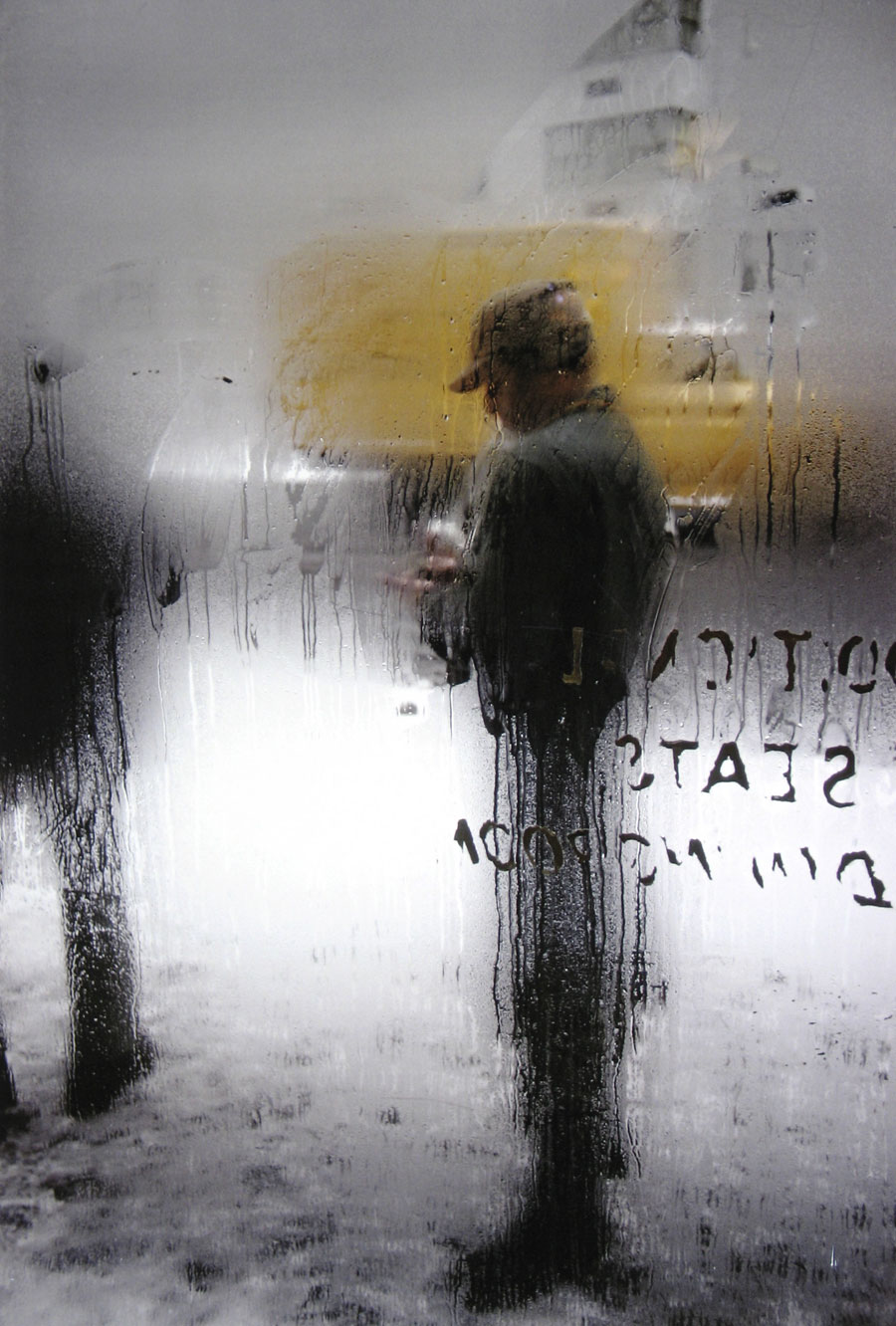
Saul Leiter (American, 1923-2013) 'Snow' 1960


Saul Leiter (American, 1923-2013)
Snow
1960
© Saul Leiter
Courtesy: Saul Leiter, Howard Greenberg Gallery, New York


Helen Levitt (American, 1913-2009) 'Cat next to red car, New York' 1973


Helen Levitt (American, 1913-2009)
Cat next to red car, New York,
1973
Type C prints
18 x 12 inches
© Estate of Helen Levitt


Alex Webb (American, b. 1952) 'Tehuantepec, Mexico' 1985


Alex Webb (American, b. 1952)
Tehuantepec, Mexico
1985
71 x 47cm
Digital Type C print
© Alex Webb


“I only know how to approach a place by walking. For what does a street photographer do but walk and watch and wait and talk, and then watch and wait some more, trying to remain confident that the unexpected, the unknown, or the secret heart of the known awaits just around the corner.”

~ Alex Webb


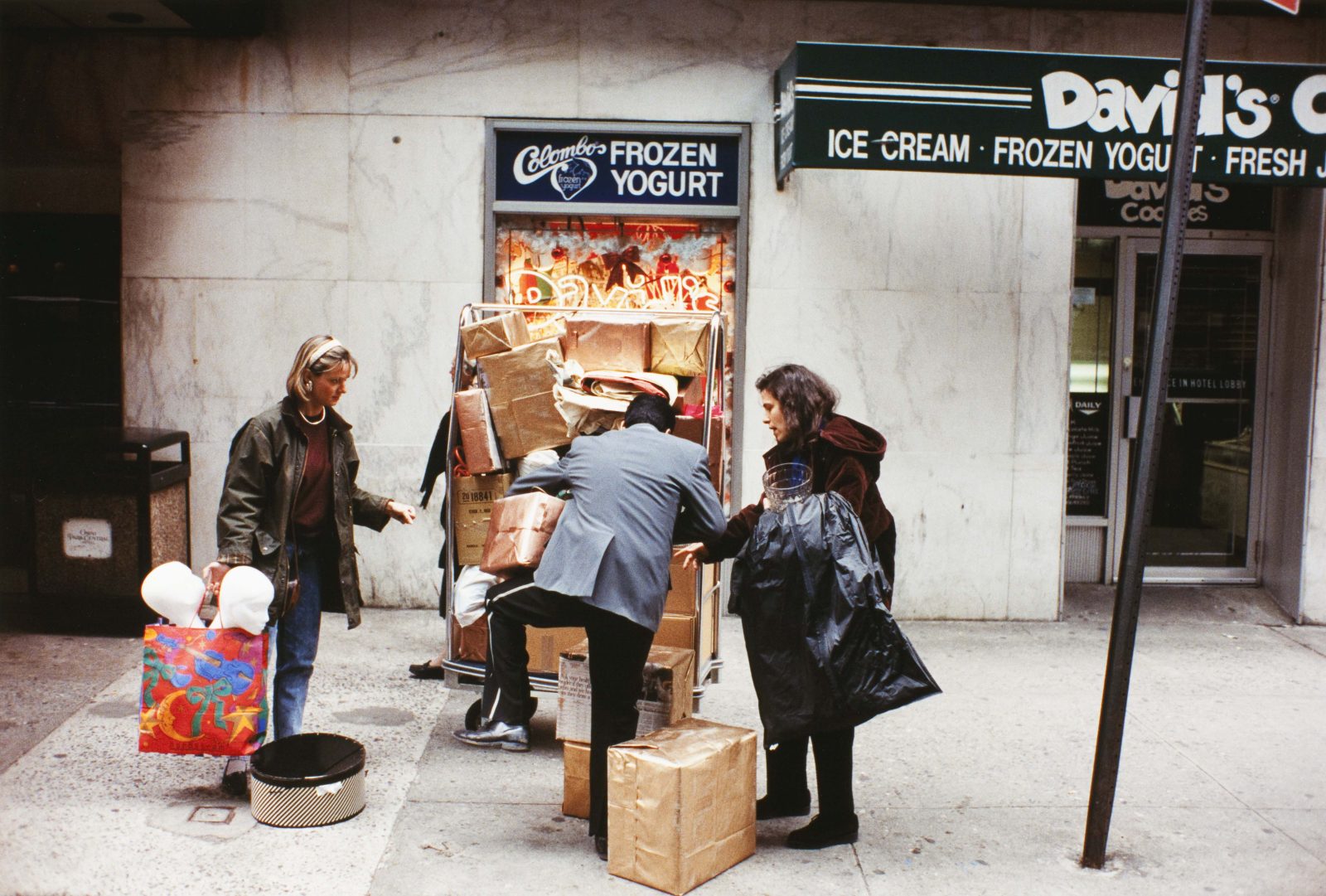
Jeff Mermelstein (American, b. 1957) 'Untitled (Package Pile Up, New York City)' 1995


Jeff Mermelstein (American, b. 1957)
Untitled (Package Pile Up, New York City)
1995
Chromogenic print
© Jeff Mermelstein
Courtesy Rick Wester Fine Art, New York


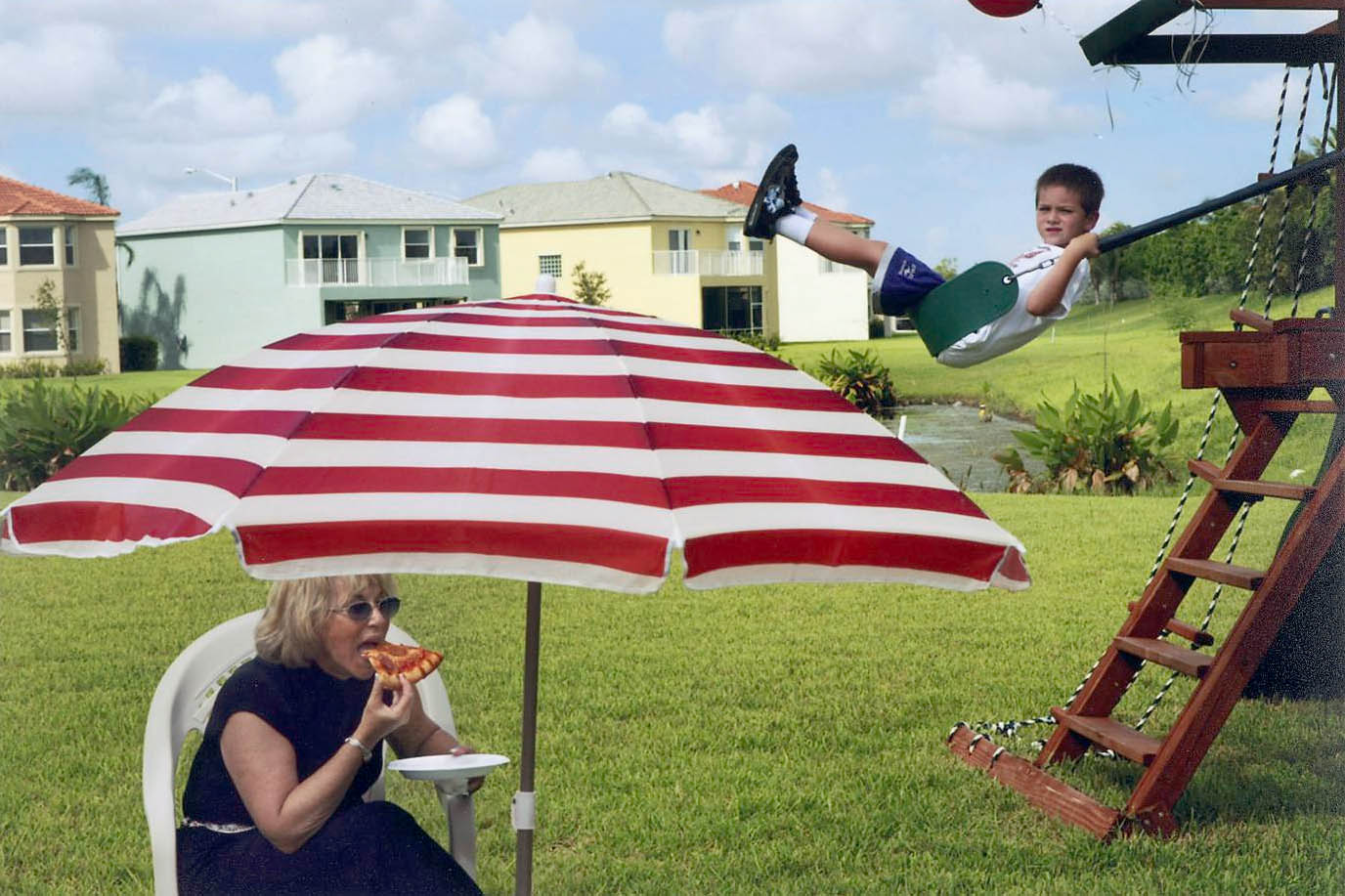
Carolyn Drake (American, b. 1971) 'Birthday party at Olympia, a gated community, Wellington, Florida' 2005


Carolyn Drake (American, b. 1971)
Birthday party at Olympia, a gated community, Wellington, Florida
2005
Digital Pigment Print
© Carolyn Drake / Magnum Photos


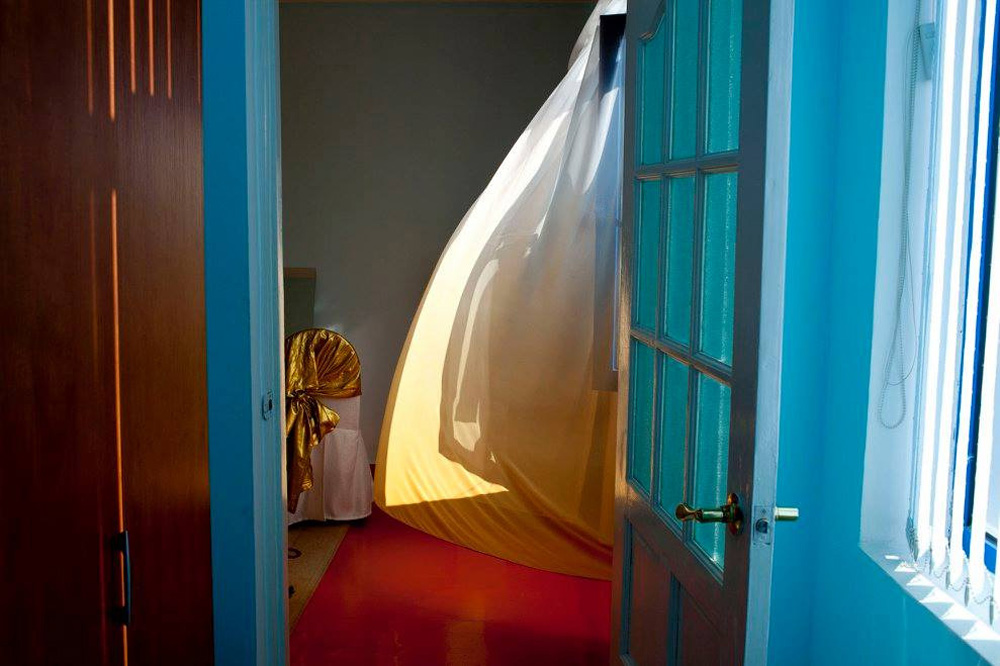
Carolyn Drake (American, b. 1971) 'Hotel room. Zhetisay, Kazakhstan. Carolyn Drake' 2009


Carolyn Drake (American, b. 1971)
Hotel room. Zhetisay, Kazakhstan. Carolyn Drake
2009
Digital Pigment Print
© Carolyn Drake/Magnum Photos


Andy Freeberg (American, b. 1958) 'Sean Kelly, Art Basel Miami' 2010


Andy Freeberg (American, b. 1958)
Sean Kelly, Art Basel Miami
2010
From the series Art Fare
Artist: Kehinde Wiley
63 x 43cm
Pigment ink print
© Andy Freeberg
Courtesy Kopeikin Gallery


Carolyn Drake (American, b. 1971) 'New Kashgar. Kashgar, China'  2011


Carolyn Drake (American, b. 1971)
New Kashgar. Kashgar, China  
2011
30.48 x 20.32cm
Digital Light Jet print
© Carolyn Drake 2012


Positive View Foundation announces its inaugural exhibition Cartier-Bresson: A Question of Colour, to be held at Somerset House, 8 November 2012 – 27 January 2013. Curated by William A. Ewing, the exhibition will feature 10 Henri Cartier-Bresson photographs never before exhibited in the UK alongside over 75 works by 15 international contemporary photographers, including: Karl Baden (US), Carolyn Drake (US), Melanie Einzig (US), Andy Freeberg (US), Harry Gruyaert (Belgium), Ernst Haas (Austrian), Fred Herzog (Canadian), Saul Leiter (US), Helen Levitt (US), Jeff Mermelstein (US), Joel Meyerowitz (US), Trent Parke (Australian), Boris Savelev (Ukranian), Robert Walker (Canadian), and Alex Webb (US).

The extensive showcase will illustrate how photographers working in Europe and North America adopted and adapted the master’s ethos famously known as  ‘the decisive moment’ to their work in colour. Though they often departed from the concept in significant ways, something of that challenge remained: how to seize something that happens and capture it in the very moment that it takes place.

It is well-known that Cartier-Bresson was disparaging towards colour photography, which in the 1950s was in its early years of development, and his reasoning was based both on the technical and aesthetic limitations of the medium at the time. Curator William E. Ewing has conceived the exhibition in terms of, as he puts it, ‘challenge and response’. “This exhibition will show how Henri Cartier-Bresson, in spite of his skeptical attitude regarding the artistic value of colour photography, nevertheless exerted a powerful influence over photographers who took up the new medium and who were determined to put a personal stamp on it. In effect, his criticisms of colour spurred on a new generation, determined to overcome the obstacles and prove him wrong. A Question of Colour simultaneously pays homage to a master who felt that black and white photography was the ideal medium, and could not be bettered, and to a group of photographers of the 20th and 21st centuries who chose the path of colour and made, and continue to make, great strides.”

Cartier-Bresson: A Question of Colour will feature a selection of photographers whose commitment to expression in colour was – or is – wholehearted and highly sophisticated, and which measured up to Cartier-Bresson’s essential requirement that content and form were in perfect balance. Some of these artists were Cartier-Bresson’s contemporaries, like Helen Levitt, or even, as with Ernst Haas, his friends; others, such as Fred Herzog in Vancouver, knew the artist’s seminal work across vast distances; others were junior colleagues, such as Harry Gruyaert, who found himself debating colour ferociously with the master; and others still, like Andy Freeberg or Carolyn Drake, never knew the man first-hand, but were deeply influenced by his example.

Press release from Somerset House website


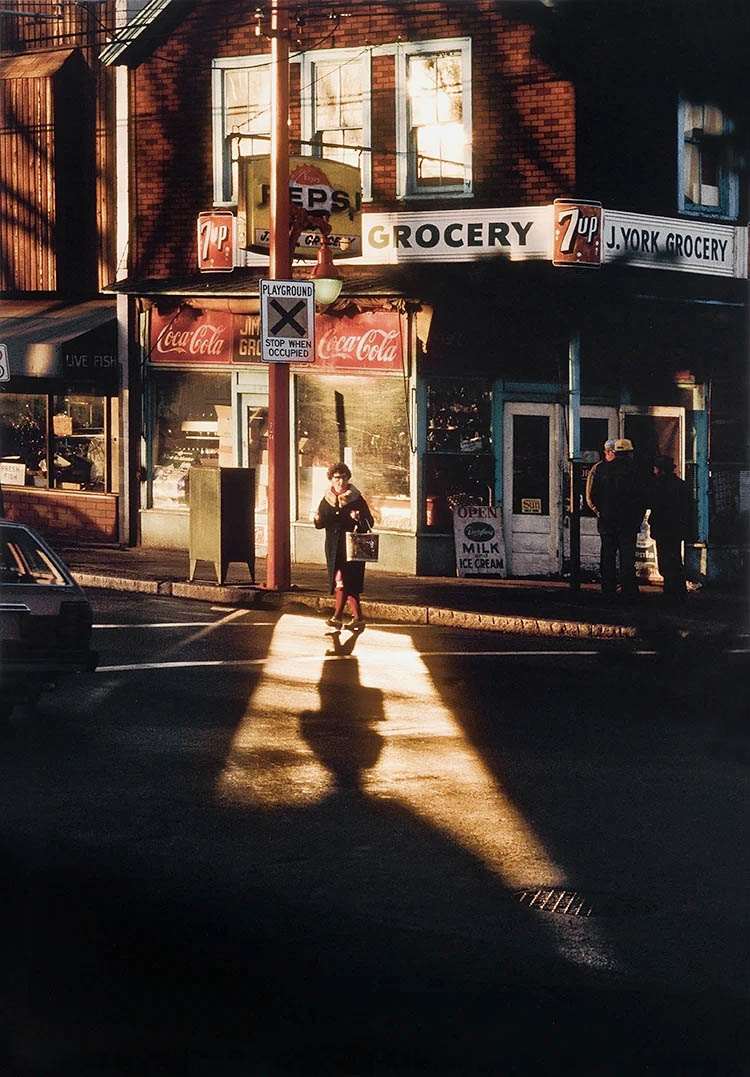
Fred Herzog (Canadian born Germany, 1930-2019)
'Man with Bandage, Vancouver, Canada'
1968


Fred Herzog (Canadian born Germany, 1930-2019)
Man with Bandage, Vancouver, Canada
1968


Joel Meyerowitz (American, b. 1938) 'Madison Avenue, New York City 1975


Joel Meyerowitz (American, b. 1938)
Madison Avenue, New York City
1975
Archival Pigment Print
© Joel Meyerowitz 2012
Courtesy Howard Greenberg Gallery, NYC


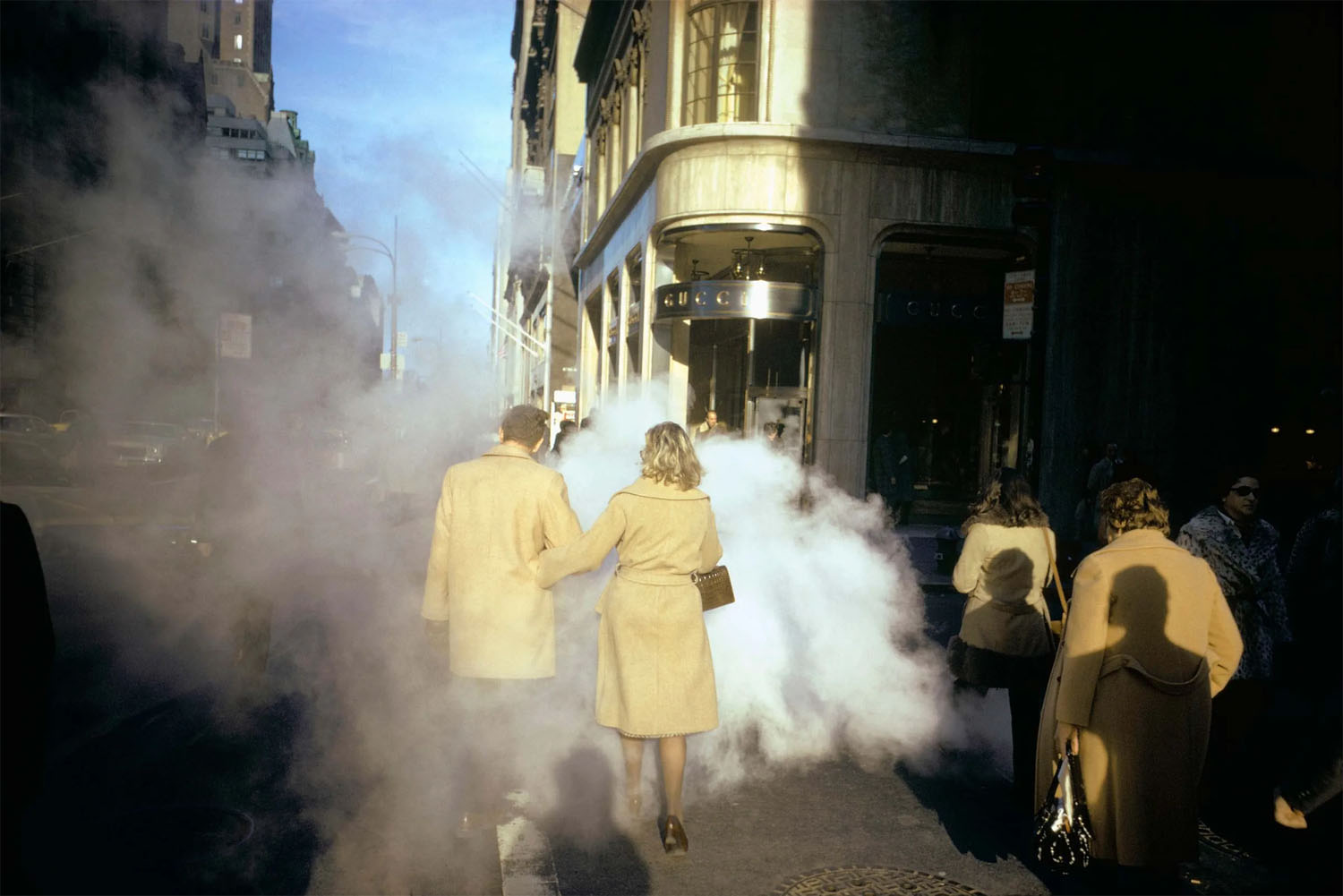
Joel Meyerowitz (American, b. 1938) Camel Coats, Fifth Avenue, New York 1975


Joel Meyerowitz (American, b. 1938)
Camel Coats, Fifth Avenue, New York
1975
Archival Pigment Print
© Joel Meyerowitz 2012
Courtesy Howard Greenberg Gallery, NYC


Ernst Haas (American, 1921-1986) 'New York City, US' 1981


Ernst Haas (American, 1921-1986)
New York City, US
1981


Fred Herzog (Canadian born Germany, 1930-2019) 'Crossing Powell 2' 1984


Fred Herzog (Canadian born Germany, 1930-2019)
Crossing Powell 2
1984
Ink jet print


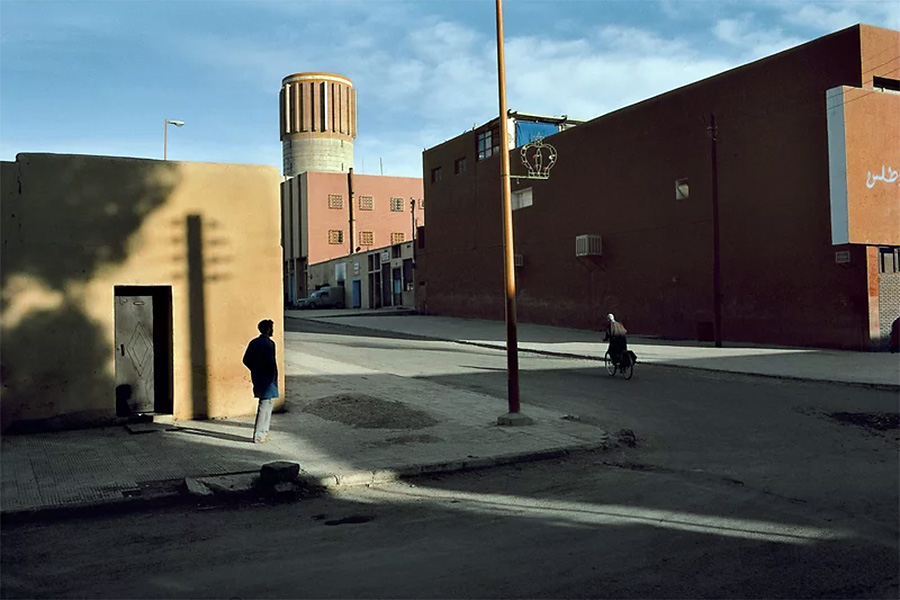
Harry Gruyaert (Belgian, b. 1941) 'Morocco, town of Duarzazte' 1986


Harry Gruyaert (Belgian, b. 1941)
Morocco, town of Duarzazte
1986
© 2015 Harry Gruyaert / Magnum Photos


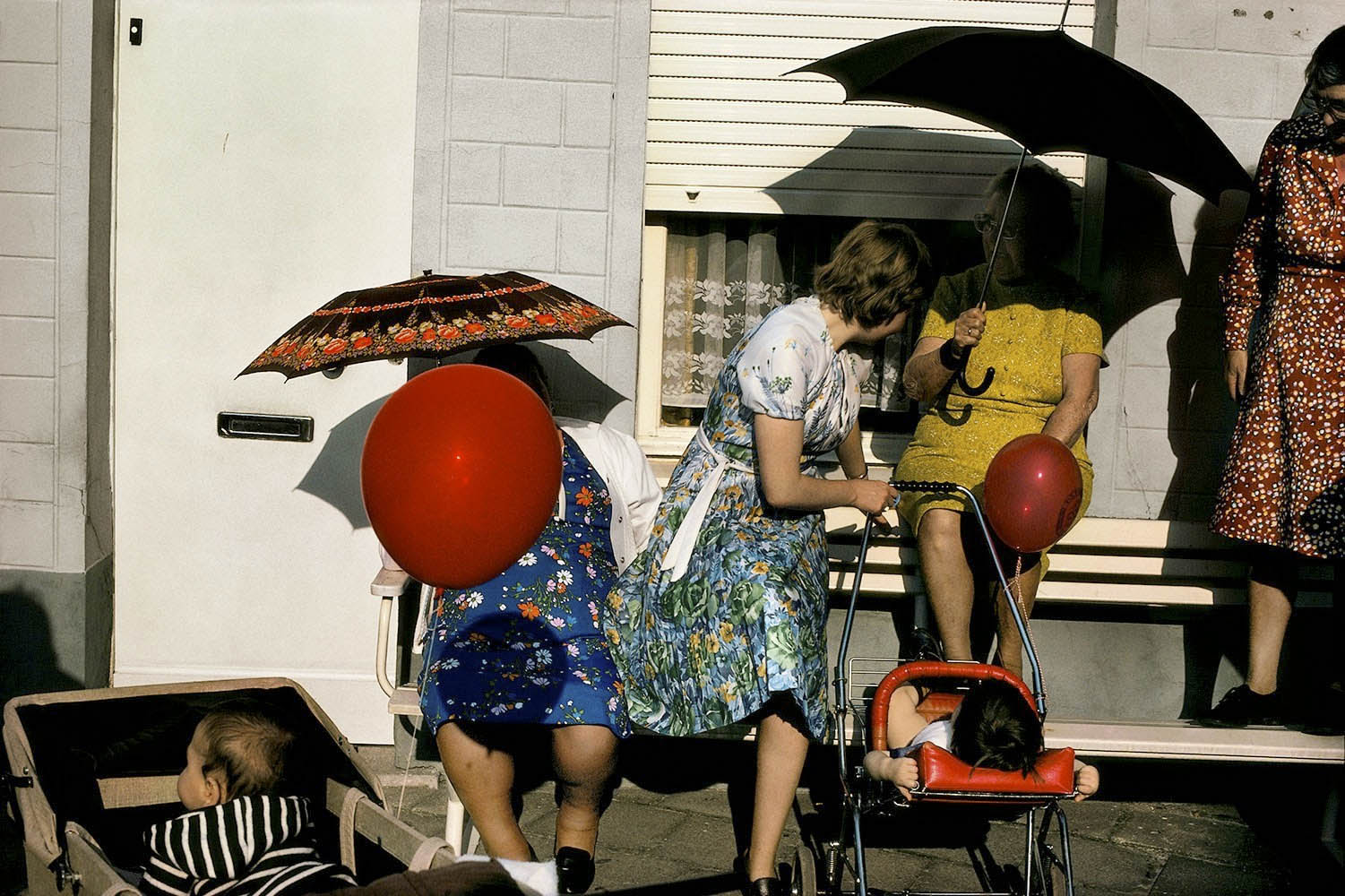
Harry Gruyaert (Belgian, b. 1941) 'Province of Brabant, Flanders region, Belgium' 1988


Harry Gruyaert (Belgian, b. 1941)
Province of Brabant, Flanders region, Belgium
1988
© 2015 Harry Gruyaert / Magnum Photos


Harry Gruyaert is known for his extraordinary photographic work with color. Born in Antwerp in 1941, he originally dreamed of becoming a film director. In the late 1970s, Pop art and a trip to Morocco inspired him to become one of the first photographers in Europe to devote his work entirely to color photography. Gruyaert’s cinematographic background instilled in him an aesthetic conception of photography. Rather than telling stories or documenting the world through his lens, he searches for beauty in everyday elements. His images are simply snapshots of magical moments in which different visual aspects, primarily color, form, light and movement, spontaneously come together in front of his lens.

Text from the Magnum website


Jeff Mermelstein (American, b. 1957) 'Unitled ($10 bill in mouth) New York City' 1992


Jeff Mermelstein (American, b. 1957)
Unitled ($10 bill in mouth) New York City, 1992
1992
Chromogenic print
20 x 16 in.
© Jeff Mermelstein
Courtesy Rick Wester Fine Art, New York


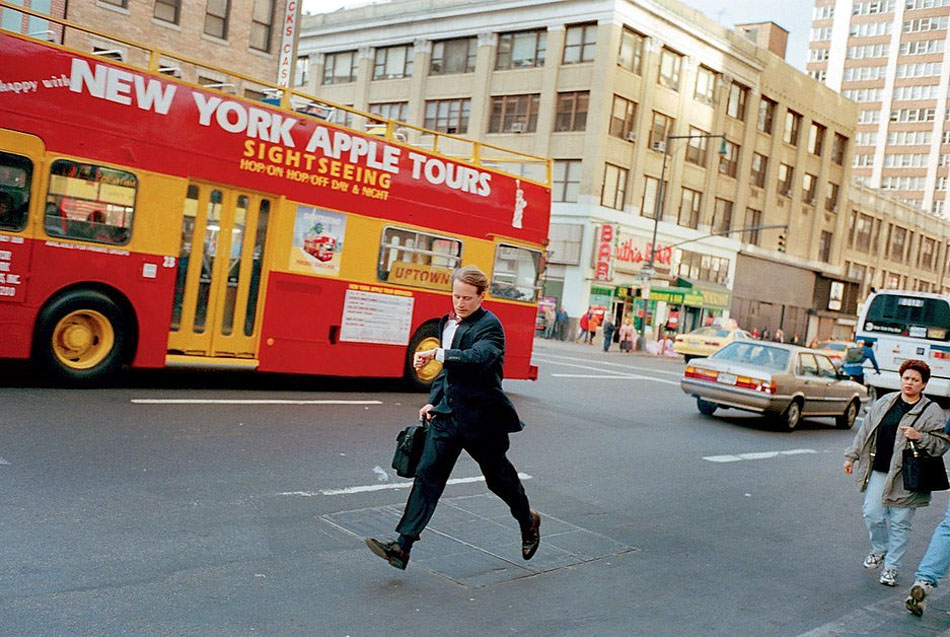
“My process is linked to everyday life. Only on rare occasions do I go out specifically to ‘shoot’. My best photographs were taken going to or from work, or some other destination. Sometimes a picture appears that helps me sum up a strange mood or thought that I’ve struggled with for weeks. Other times my work is more documentary in nature.

Photographing in public keeps me awake and aware, always looking around, in awe at what we humans are up to. In a time when staged narratives and rendered images are popular, I am excited by the fact that life itself offers situations far more strange and beautiful than anything I could set up.”

~ Jeff Mermelstein


Jeff Mermelstein (American, b. 1957) 'Run #9, New York' 1999-2000


Jeff Mermelstein (American, b. 1957)
Run #9, New York
1999-2000
© Jeff Mermelstein


Trent Parke (Australian, b. 1971) 'Man Vomiting, Gerald #1' 2006


Trent Parke (Australian, b. 1971)
Man Vomiting, Gerald #1
2006
Type C print
© Trent Parke
Courtesy Magnum Photos


Karl Baden (American, b. 1952) 'Chestnut Hill, Massachusetts' 2009


Karl Baden (American, b. 1952)
Chestnut Hill, Massachusetts
2009
Archival Inkjet
40.64 x 54.19cm
© Karl Baden


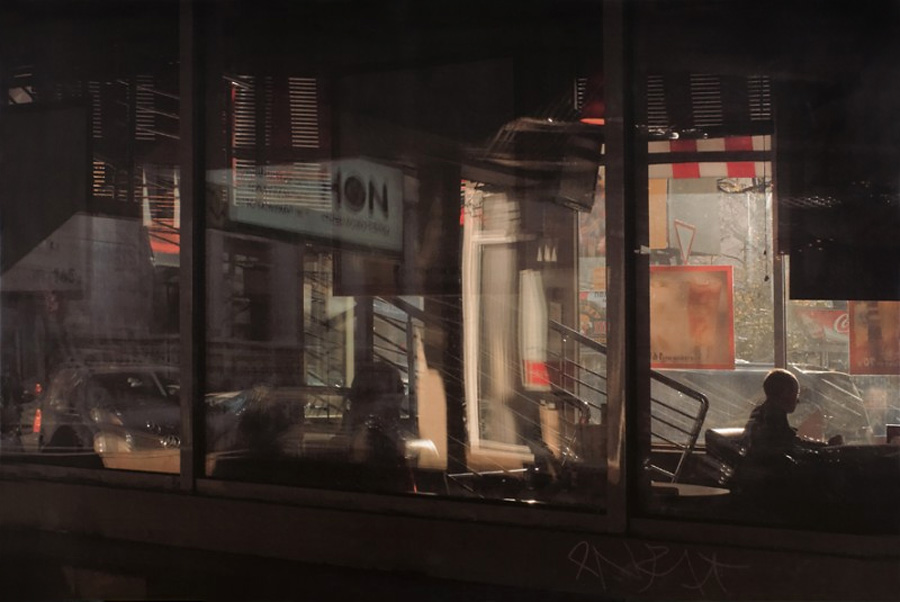
Boris Savelev (Russian, b. 1947) 'Cafe Ion, Moscow' 2009


Boris Savelev (Russian, b. 1947)
Cafe Ion, Moscow
2009
© Boris Savelev


Andy Freeberg (American, b. 1958) 'Nina Menocal, Armory Show' 2011


Andy Freeberg (American, b. 1958)
Nina Menocal, Armory Show
2011
From the series Art Fare
Pigment ink print
© Andy Freeberg
Courtesy Kopeikin Gallery


Henri Cartier-Bresson (French, 1908-2004) 'Brooklyn, New York' 1947


Henri Cartier-Bresson (French, 1908-2004)
Brooklyn, New York, 1947
1947
Gelatin silver print / printed in 2007
Image: 19.8 x 29.8cm
Paper: 22.9 x 30.4cm
© Henri Cartier-Bresson/Magnum Photos, Courtesy Fondation Henri Cartier-Bresson


Melanie Einzig (American, b. 1967) 'September 11th, New York' 2001


Melanie Einzig (American, b. 1967)
September 11th, New York 2001
2001
21 x 33cm
Inkjet print
© Melanie Einzig 2012


Terrace Rooms & Courtyard Rooms, Somerset House
Strand, London, WC2R 1LA

Opening hours:
10am – 6pm daily

Somerset House website

LIKE ART BLART ON FACEBOOK

Back to top

Exhibition: ‘Faking It: Manipulated Photography Before Photoshop’ at The Metropolitan Museum of Art, New York

Exhibition dates at the MMA: 11th October 2012 – 27th January 2013


Unidentified American artist. 'Two-Headed Man' c. 1855


Unidentified American artist
Two-Headed Man
c. 1855
Daguerreotype
The Nelson-Atkins Museum of Art, Kansas City, Missouri, Gift of Hallmark Cards, Inc.


What a fascinating subject. Having completed multiple exposure work under the black and white enlarger I can attest to how difficult it was to get a print correctly exposed. I was using multiple negatives, moving the piece of photographic paper and printing in grids. Trying to get the alignment right was quite a task but the outcomes were very satisfying. Of course today these skills have mainly been lost to be replaced by other technological skills within the blancmange that is Photoshop. Somehow it’s not the same. My admiration for an artist like Jerry Uelsmann will always remain undimmed for the undiluted joy, beauty and skill of their analogue imagery.

I will post different photographs in this exhibition from the National Gallery of Art hang when I receive them!

See the second posting on this exhibition.

Dr Marcus Bunyan


Many thankx to the The Metropolitan Museum of Art, New York for allowing me to publish the photographs in the posting. Please click on the photographs for a larger version of the image.


George Washington Wilson (Scottish, 1823-1893) 'Aberdeen Portraits No. 1' 1857


George Washington Wilson (Scottish, 1823-1893)
Aberdeen Portraits No. 1
1857
Albumen silver print from glass negative
The Metropolitan Museum of Art, The Horace W. Goldsmith Foundation Fund, through Joyce and Robert Menschel, 2011


Henry Peach Robinson (English, 1830-1901) 'Fading Away' 1858


Henry Peach Robinson (English, 1830-1901)
Fading Away
1858
Albumen silver print from glass negatives
The Royal Photographic Society Collection at the National Media Museum, Bradford, United Kingdom


Unidentified artist / De Torbechet, Allain & Cie (publisher) 'Man Juggling His Own Head' c. 1880


Unidentified artist
De Torbechet, Allain & Cie
(publisher)
Man Juggling His Own Head
c. 1880
Albumen silver print from glass negative
Collection of Christophe Goeury


Maurice Guibert (French, 1856-1913) 'Henri de Toulouse-Lautrec as Artist and Model' c. 1900


Maurice Guibert (French, 1856-1913)
Henri de Toulouse-Lautrec as Artist and Model
c. 1900
Gelatin silver print
Philadelphia Museum of Art


F. Holland Day (American, 1864-1933) 'The Vision (Orpheus Scene)' 1907


F. Holland Day (American, 1864-1933)
The Vision (Orpheus Scene)
1907
Platinum print
The Royal Photographic Society Collection at the National Media Museum, Bradford, United Kingdom


Unidentified American artist. 'Man on Rooftop with Eleven Men in Formation on His Shoulders' c. 1930


Unidentified American artist
Man on Rooftop with Eleven Men in Formation on His Shoulders
c. 1930
Gelatin silver print
Collection of George Eastman House, International Museum of Photography and Film, Rochester


Unidentified American artist. 'Dirigible Docked on Empire State Building, New York' 1930


Unidentified American artist
Dirigible Docked on Empire State Building, New York
1930
Gelatin silver print
The Metropolitan Museum of Art, Twentieth-Century Photography Fund, 2011


While digital photography and image-editing software have brought about an increased awareness of the degree to which camera images can be manipulated, the practice of doctoring photographs has existed since the medium was invented. Faking It: Manipulated Photography Before Photoshop at The Metropolitan Museum of Art is the first major exhibition devoted to the history of manipulated photography before the digital age. Featuring some 200 visually captivating photographs created between the 1840s and 1990s in the service of art, politics, news, entertainment, and commerce, the exhibition offers a provocative new perspective on the history of photography as it traces the medium’s complex and changing relationship to visual truth. 

The exhibition is made possible by Adobe Systems Incorporated. 

The photographs in the exhibition were altered using a variety of techniques, including multiple exposure (taking two or more pictures on a single negative), combination printing (producing a single print from elements of two or more 
negatives), photomontage, overpainting, and retouching on the negative or print. 

In every case, the meaning and content of the camera image was significantly transformed in the process of manipulation.

Faking It is divided into seven sections, each focusing on a different set of motivations for manipulating the camera image. “Picture Perfect” explores 19th-century photographers’ efforts to compensate for the new medium’s technical limitations – specifically, its inability to depict the world the way it looks to the naked eye. To augment photography’s monochrome palette, pigments were applied to portraits to make them more vivid and lifelike. Landscape photographers faced a different obstacle: the uneven sensitivity of early emulsions often resulted in blotchy, overexposed skies. To overcome this, many photographers, such as Gustave Le Gray and Carleton E. Watkins, created spectacular landscapes by printing two negatives on a single sheet of paper – one exposed for the land, the other for the sky. This section also explores the challenges involved in the creation of large group portraits, which were often cobbled together from dozens of photographs of individuals. 

For early art photographers, the ultimate creativity lay not in the act of taking a photograph but in the subsequent transformation of the camera image into a hand-crafted picture.

“Artifice in the Name of Art” begins in the 1850s with elaborate combination prints of narrative and allegorical subjects by Oscar Gustave Rejlander and Henry Peach Robinson. It continues with the revival of Pictorialism at the dawn of the twentieth century in the work of artist-photographers such as Edward Steichen, Anne W. Brigman, and F. Holland Day. 

“Politics and Persuasion” presents photographs that were manipulated for explicitly political or ideological ends. It begins with Ernest Eugene Appert’s faked photographs of the 1871 Paris Commune massacres, and continues with images used to foster patriotism, advance racial ideologies, and support or protest totalitarian regimes. Sequences of photographs published in Stalin-era Soviet Russia from which purged Party officials were erased demonstrate the chilling ease with which the historical record could be falsified. Also featured are composite portraits of criminals by Francis Galton and original paste-ups of John Heartfield’s anti-Nazi photomontages of the 1930s.

“Novelties and Amusements” brings together a broad variety of amateur and commercial photographs intended to astonish, amuse, and entertain. Here, we find popular images of figures holding their own severed heads or appearing doubled or tripled. Also included in this light-hearted section are ghostly images by the spirit photographer William Mumler, “tall-tale” postcards produced in Midwestern farming communities in the 1910s, trick photographs by amateurs, and Weegee’s experimental distortions of the 1940s. 

”Pictures in Print” reveals the ways in which newspapers, magazines, and advertisers have altered, improved, and sometimes fabricated images in their entirety to depict events that never occurred – such as the docking of a zeppelin on the tip of the Empire State Building. Highlights include Erwin Blumenfeld’s famous “Doe Eye” Vogue cover from 1950 and Richard Avedon’s multiple portrait of Audrey Hepburn from 1967.

“Mind’s Eye” features works from the 1920s through 1940s by such artists as Herbert Bayer, Maurice Tabard, Dora Maar, Clarence John Laughlin, and Grete Stern, who have used photography to evoke subjective states of mind, conjuring dreamlike scenarios and surreal imaginary worlds. 

The final section, “Protoshop,” presents photographs from the second half of the 20th century by Yves Klein, John Baldessari, Duane Michals, Jerry Uelsmann, and other artists who have adapted earlier techniques of image manipulation – such as spirit photography or news photo retouching – to create works that self-consciously and often humorously question photography’s presumed objectivity.

Press release from The Metropolitan Museum of Art website


William Mortensen (American, 1897-1965) 'Obsession' c. 1930


William Mortensen  (American, 1897-1965)
Obsession
c. 1930
Gelatin silver print
18.4 x 14.5cm
The Elisha Whittelsey Collection, The Elisha Whittelsey Fund, 1975


Maurice Tabard (French, 1897-1984) 'Room with Eye' 1930


Maurice Tabard (French, 1897-1984)
Room with Eye
1930
Gelatin silver print
The Metropolitan Museum of Art, The Elisha Whittelsey Collection, The Elisha Whittelsey Fund, 1962


Wanda Wulz (Italian, 1903-1984) 'Io + gatto (Cat + I)' 1932


Wanda Wulz (Italian, 1903-1984)
Io + gatto (Cat + I)
1932
Gelatin silver print
The Metropolitan Museum of Art, Ford Motor Company Collection, Gift of Ford Motor Company and John C. Waddell, 1987
Alinari / Art Resource © Wanda Wulz


John Paul Pennebaker (American, 1903-1953) 'Sealed Power Piston Rings' 1933


John Paul Pennebaker (American, 1903-1953)
Sealed Power Piston Rings
1933
Gelatin silver print
1934 Art and Industry Exhibition Photograph Collection, Baker Library Historical Collections, Harvard Business School, Boston, Mass.
© John Paul Pennebaker


George Platt Lynes (American, 1907-1955) 'The Sleepwalker' 1935


George Platt Lynes (American, 1907-1955)
The Sleepwalker
1935
Gelatin silver print with applied media
The Metropolitan Museum of Art, Ford Motor Company Collection, Gift of Ford Motor Company and John C. Waddell, 1987
© The Estate of George Platt Lynes


Barbara Morgan (American, 1900-1992) 'Hearst over the People' 1939


Barbara Morgan (American, 1900-1992)
Hearst over the People
1939
Collage of gelatin silver prints with applied media
The Nelson-Atkins Museum of Art, Kansas City, Missouri, Gift of Hallmark Cards, Inc.


Grete Stern (Argentinian born Germany, 1904-1999) 'Dream No. 1: Electrical Appliances for the Home' 1948


Grete Stern (Argentinian born Germany, 1904-1999)
Dream No. 1: Electrical Appliances for the Home
1948
Gelatin silver print
The Metropolitan Museum of Art, Twentieth-Century Photography Fund, 2012
Courtesy of Galería Jorge Mara – La Ruche, Buenos Aires


Erwin Blumenfeld (American born Germany, 1897-1969) '"Doe Eye" Vogue cover' 1950


Erwin Blumenfeld (American born Germany, 1897-1969)
“Doe Eye” Vogue cover
1950


Yves Klein (French, 1928-1962) Photographed by Harry Shunk (German, 1924-2006) and János (Jean) Kender (Hungarian, 1937-2009) 'Leap into the Void' 1960


Yves Klein (French, 1928-1962)
Photographed by Harry Shunk (German, 1924-2006) and János (Jean) Kender (Hungarian, 1937-2009)
Leap into the Void
1960
Gelatin silver print
Purchase, The Horace W. Goldsmith Foundation Gift, through Joyce and Robert Menschel, 1992
© Yves Klein / Artists Rights Society (ARS), New York / ADAGP, Paris
Photograph Shunk-Kender © Roy Lichtenstein Foundation


Weegee (Arthur Fellig) (American, 1899-1968) 'Judy Garland' 1960


Weegee (Arthur Fellig) (American, 1899-1968)
Judy Garland
1960
Silver gelatin photograph
Copyright Weegee/International Center of Photography/Getty Images


Weegee (Arthur Fellig) (American, 1899-1968) 'American, 1899-1968 Draft Johnson for President' c. 1968


Weegee (Arthur Fellig) (American, 1899-1968)
Draft Johnson for President
c. 1968
Gelatin silver print
International Center of Photography, Bequest of Wilma Wilcox, 1993
Copyright Weegee/International Center of Photography/Getty Images.


Richard Avedon (American 1923-2004) 'Audrey Hepburn, New York, January 1967' 1967


Richard Avedon (American, 1923-2004)
Audrey Hepburn, New York, January 1967
1967
Collage of gelatin silver prints, with applied media, mylar overlay with applied media


Jerry N. Uelsmann (American, 1934-2022) 'Untitled' 1969


Jerry N. Uelsmann (American, 1934-2022)
Untitled
1969
Gelatin silver print
The Metropolitan Museum of Art, Twentieth-Century Photography Fund, 2011
© Jerry N. Uelsmann


Martha Rosler (American, b. 1943) 'Red Stripe Kitchen', from the series "House Beautiful: Bringing the War Home" 1967-72


Martha Rosler (American, b. 1943)
Red Stripe Kitchen
1967-1972, printed early 1990s
From the series “House Beautiful: Bringing the War Home”
Chromogenic print
The Metropolitan Museum of Art, Purchase, Anonymous Gift, 2002
© Martha Rosler


The Metropolitan Museum of Art
1000 Fifth Avenue at 82nd Street
New York, New York 10028-0198
Phone: 212-535-7710

Opening hours:
Sunday – Tuesday 10am – 5pm
Closed Wednesdays

The Metropolitan Museum of Art website

National Gallery of Art
National Mall between 3rd and 7th Streets
Constitution Avenue NW, Washington

Opening hours:
Daily 10.00am – 5.00pm

National Gallery of Art website

LIKE ART BLART ON FACEBOOK

Back to top

Exhibition: ‘WAR/PHOTOGRAPHY: Images of Armed Conflict and Its Aftermath’ at the Museum of Fine Arts, Houston Part 2

Exhibition dates: 11th November 2012 – 3rd February 2013


This is the biggest posting on one exhibition that I have ever undertaken on Art Blart!

As befits the gravity of the subject matter this posting is so humongous that I have had to split it into 4 separate postings. This is how to research and stage a contemporary photography exhibition that fully explores its theme. The curators reviewed more than one million photographs in 17 countries, locating pictures in archives, military libraries, museums, private collections, historical societies and news agencies; in the personal files of photographers and service personnel; and at two annual photojournalism festivals producing an exhibition that features 26 sections (an inspired and thoughtful selection) that includes nearly 500 objects that illuminate all aspects of WAR/PHOTOGRAPHY.

I have spent hours researching and finding photographs on the Internet to support the posting. It has been a great learning experience and my admiration for photographers of all types has increased. I have discovered the photographs and stories of new image makers that I did not know and some hidden treasures along the way. I hope you enjoy this monster posting on a subject matter that should be consigned to the history books of human evolution.

**Please be aware that there are graphic photographs in all of these postings.** Part 1Part 3Part 4

Dr Marcus Bunyan


Many thankx to the Museum of Fine Arts, Houston for allowing me to publish some of the photographs in the posting. Please click on the photographs for a larger version of the image.


Photographic Essays

14. Photographic Essays showcases selections from two distinct storylines: Larry Burrows’ Yankee Papa 13, published in Life magazine; and Pulitzer Prize winner Todd Heisler’s series Final Salute, for Denver’s Rocky Mountain News. Burrows follows a man through a rescue attempt in Vietnam; Heisler documents a Marine major assigned to casualty notifications. (12 images, 6 from each photographer, as well as the magazine and newspaper in which the series were published)


Larry Burrows (American, 1926-1971) 'The view from inside Marine helicopter Yankee Papa 13, Vietnam, March 1965' 1965


The view from inside Marine helicopter Yankee Papa 13, Vietnam, March 1965


Larry Burrows (English, 1926-1971) 'The caption that accompanied this photograph in the April 16, 1965, issue of LIFE: "From the downed YP3 in the background, the wounded gunner, Sergeant Owens, races to Yankee Papa 13, where Farley waits in the doorway."' 1965


The caption that accompanied this photograph in the April 16, 1965, issue of LIFE: “From the downed YP3 in the background, the wounded gunner, Sergeant Owens, races to Yankee Papa 13, where Farley waits in the doorway.”


Larry Burrows (English, 1926-1971) 'One Ride with Yankee Papa 13' 1965 The caption that accompanied this photograph in LIFE: "Farley, unable to leave his gun position until YP13 is out of enemy range, stares in shock at YP3's co-pilot, Lieutenant Magel, on the floor."


The caption that accompanied this photograph in LIFE: “Farley, unable to leave his gun position until YP13 is out of enemy range, stares in shock at YP3’s co-pilot, Lieutenant Magel, on the floor.”


Larry Burrows (English, 1926-1971) 'Farley and Hoilien, dead tired, linger beside their helicopter and continue to talk over the mission' 1965


Farley and Hoilien, dead tired, linger beside their helicopter and continue to talk over the mission


Larry Burrows (English, 1926-1971) 'One Ride with Yankee Papa 13' 1965 'In a supply shack, hands covering his face, an exhausted, worn James Farley gives way to grief'


In a supply shack, hands covering his face, an exhausted, worn James Farley gives way to grief


Larry Burrows (English, 1926-1971)
One Ride with Yankee Papa 13
1965
Photo Essay
© Time & Life Pictures/Getty Images


Todd Heisler (American, b. 1972) 'Untitled' 2005 From the series 'Final Salute'


Todd Heisler (American, b. 1972)
Untitled
2005
From the series Final Salute
© Todd Heisler/Rocky Mountain News


The night before the burial of her husband’s body, Katherine Cathey refused to leave the casket, asking to sleep next to his body for the last time. The Marines made a bed for her, tucking in the sheets below the flag. Before she fell asleep, she opened her laptop computer and played songs that reminded her of “Cat,” and one of the Marines asked if she wanted them to continue standing watch as she slept. “I think it would be kind of nice if you kept doing it,” she said. “I think that’s what he would have wanted.”


Executions

15. Executions are among the frequent photographs in wartime: Officials and the public seek confirmation that the enemy is dead; the executioners often forcefully request images to signify their power. An 1867 photograph by François Aubert shows the bloodied shirt of Maximilian I after the Austro-Hungarian archduke was shot by a nationalist firing squad in Mexico. Eddie Adams’ Pulitzer Prize-winning photograph of the Vietnamese police chief shooting a Viet Cong prisoner came to symbolise the brutality of the Vietnam War. Jahangir Razmi’s Firing Squad in Iran (1979) also won a Pulitzer; Razmi’s newspaper, Ettela’at, ran the photograph without credit, in order to protect him. He was not recognised until a 2006 Wall Street Journal article. (20 images)


Francois Aubert (French, 1829-1906) 'The Shirt of the Emperor, Worn during His Execution, Mexico' 1867


Francois Aubert (French, 1829-1906)
The Shirt of the Emperor, Worn during His Execution, Mexico
1867
Albumen print
The Metropolitan Museum of Art, Gilman Collection, gift of the Howard Gilman Foundation, 2005
© The Metropolitan Museum of Art / Art Resource, NY


Eddie Adams (American, 1933-2004) 'Saigon Execution (General Nguyen Ngoc Loan executing a Viet Cong prisoner in Saigon)' February 1, 1968


Eddie Adams (American, 1933-2004)
Saigon Execution (General Nguyen Ngoc Loan executing a Viet Cong prisoner in Saigon)
February 1, 1968
Silver gelatin photograph


Although the image brought Adams the Pulitzer Prize, he would express discomfort with it later in life.

“The general killed the Viet Cong; I killed the general with my camera. Still photographs are the most powerful weapon in the world. People believe them; but photographs do lie, even without manipulation. They are only half-truths. … What the photograph didn’t say was, ‘What would you do if you were the general at that time and place on that hot day, and you caught the so-called bad guy after he blew away one, two or three American people?” (Wikipedia)

For Adams, the lie was the omission of context – that the plainclothes Lem had allegedly just been caught having murdered not only South Vietnamese police but their civilian family members; that Loan was a good officer and not a cold-blooded killer… Like any great work of art, Adams’ serendipitous photograph took on a life of its own… and a tapestry of meanings richer than its creator could ever have intended.

Headsman. “1968: Nguyen Van Lem,” on the ExecutedToday website February 1st, 2009 [Online] Cited 03/09/2022


Eddie Adams Talk About The Saigon Execution Photo


Leisure Time

16. Leisure Time is another popular subject. This section features images that range from a 1958 photograph (by Loomis Dean) of an Elvis Presley serenade in the barracks to Stephen Colbert’s 2009 Iraq appearance in a camouflage suit (by Moises Saman). More-intimate moments show an off-duty serviceman sleeping on a cot next to a wall of pinups (by Edouard Gluck) as well as another serviceman listening to music on headphones (by Alvaro Zavala). Army Staff Sergeant Mark Grimshaw captures an American soldier stationed in Iraq, tending grass that the soldier has grown. (The soldier’s wife sent him seeds from the United States, but he couldn’t get the grass to grow until he purchased sod from a local Iraqi farmer.) (21 images) 


Álvaro Ybarra Zavala (Spanish, b. 1979) 'Untitled' 2003 From the series 'Apocalypse'


Álvaro Ybarra Zavala (Spanish, b. 1979)
Untitled
2003
From the series Apocalypse


More images and text from the sequence can be seen at Álvaro Ybarra Zavala’s Projects web page


Mark A. Grimshaw (American, b. 1968) 'First Cut, Iraq' July 2004


Mark A. Grimshaw (American, b. 1968)
First Cut, Iraq
July 2004
Inkjet print, printed 2012
Courtesy of the photographer
© Mark Grimshaw


Support

17. Support features photographs of people planning operations and supplying troops behind the front, from flying troops and supplies to the battlefront, to making bread in factories and building temporary bridges. One iconic 1942 photo by Alfred Palmer shows women aircraft workers polishing the noses of bomber planes. A 1915-18 picture by an unknown photographer depicts two men working early battery-operated phones. In 2001, James Nachtwey captured a firefighter walking over burning rubble at the World Trade Center in New York. (13 images)


Alfred Palmer (American, 1906-1993) 'Women aircraft workers finishing transparent bomber noses for fighter and reconnaissance planes at Douglas Aircraft Co. Plant in Long Beach, California' 1942


Alfred Palmer (American, 1906-1993)
Women aircraft workers finishing transparent bomber noses for fighter and reconnaissance planes at Douglas Aircraft Co. Plant in Long Beach, California
1942
Gelatin silver print
The Museum of Fine Arts, Houston, gift of Will Michels in honor of his sister, Genevieve Namerow


James Nachtwey (American, b. 1948) 'Firefighters search for survivors at Ground Zero' 2001


James Nachtwey (American, b. 1948)
Firefighters search for survivors at Ground Zero
2001
© James Nachtwey


Medicine

18. Medicine, divided into two subsections, presents doctors and nurses at work at the front, and individuals who are surviving with injuries. “Wartime Medicine presents the conditions of medical operations on the battlefield, from Vo Anh Khanh’s photograph of North Vietnam surgeons working in a swamp to Larry Burrows’ emergency dressing station in Vietnam. Subsequent to War showcases survivors. A 2007 photograph by Peter van Agtmael shows a soldier with a prosthetic leg playing with his two sons and light sabres in a field. A 1985 photograph by Michael Coyne pictures a rehabilitation centre stacked with braces and artificial limbs for the victims of war in Iran and Iraq. Nina Berman’s 2004 portrait of PTSD patient Randall Clunen, from the series Purple Hearts, relates the psychic scars of war. (22 images)


Vo Anh Khanh (Vietnamese, 1936-2023) 'A Cambodian guerrilla is carried to an improvised operating room in a mangrove swamp in this Viet Cong haven on the Ca Mau Peninsula' 1970


Vo Anh Khanh (Vietnamese, 1936-2023)
A Cambodian guerrilla is carried to an improvised operating room in a mangrove swamp in this Viet Cong haven on the Ca Mau Peninsula
1970
© National Geographic Society


This scene was an actual medical situation, not a publicity setup.


Peter van Agtmael (American, b. 1981) 'Darien, Wisconsin, October 22, 2007' 2007, printed 2009


Peter van Agtmael (American, b. 1981)
Darien, Wisconsin, October 22, 2007
2007, printed 2009
Chromogenic print, ed. # 1/10
The Museum of Fine Arts, Houston, gift of David and Cindy Bishop Donnelly, John Gaston, Mary and George Hawkins and Mary and Jim Henderson in memory of Beth Block
© Peter van Agtmael / Magnum Photos


Michael Coyne (Australian, b. 1945) 'Rehabilitation Centre – Iran' 1985


Michael Coyne (Australian, b. 1945)
Rehabilitation Centre – Iran
1985
Type C print
55cm x 36.6cm


Nina Berman (American, b. 1960) 'Randall Clunen' 2004 from the series 'Purple Hearts'


Nina Berman (American, b. 1960)
Randall Clunen
2004
From the series Purple Hearts
Pigment print
28 x 28 in.


Faith

19. Faith presents devotion during wartime. The Oath of War (1942), by Mark Markov-Grinberg, taken minutes before a regiment attacked an entrenched German defensive position, shows a soldier kissing his gun. A 1918 image by an unknown photographer depicts a soldier’s grave in France, marked by a wooden cross and the soldier’s helmet, under which his Bible was found. Naval photographer R. Woodward’s 1945 photograph depicts a shipboard service performed after a Japanese plane dropped two bombs on the ship; the officiating chaplain is possibly Father O’Callahan, who subsequently received the Medal of Honor. Three days before the start of the Iraq War in 2003, Hayne Palmour IV captured the baptism of a Marine by a Navy chaplain in Kuwait, in a pool of water constructed from sandbags. (12 images)


Markov-Grinberg Mark Borisovich (Russian, 1907-2003) 'The Oath of War (Soviet soldier kissing his rifle)' 1939


Mark Borisovich Markov-Grinberg (Russian, 1907-2003)
The Oath of War (Soviet soldier kissing his rifle)
1939, printed later
Ferrotyped gelatin silver print


R. Woodward, USNR, American (birth date unknown) 'Religious services under the blasted flight deck of the USS Franklin' March 1945


R. Woodward, USNR, American (birth date unknown)
Religious services under the blasted flight deck of the USS Franklin
March 1945
Gelatin silver print, the Museum of Fine Arts, Houston, gift of St. Paul’s United Methodist Church


Religious services under the blasted flight deck of the USS Franklin (CV-13), for the 807 men killed from two bomb blasts while off the coast of Japan. The only American warship to suffer greater losses was the battleship Arizona at Pearl Harbor. March 1945 by R. Woodward, USNR.

PLEASE NOTE: This information is incorrect. 883 servicemen perished when the heavy cruiser USS Indianapolis was torpedoed and sunk by a Japanese submarine on 30 July 1945 and the survivors were not spotted until three and a half days later. Many succumbed to exposure to the elements, dehydration and shark attacks.


Refugee

20. The focus of Refugee moves away from the combatants’ standpoint and into the perspectives of others, including individuals who have been displaced as well as left behind. This section presents people either fleeing battle or living as expatriates in a new place. The Pulitzer Prize-winning image shot in 1965 by Sawada Kyoichi shows a Vietnamese mother and her children wading across a river to escape from a U.S. napalm strike on their village. An image by Hilmar Pabel depicts a family fleeing across the border in the Bavarian Forest to the West, escaping in the night carrying suitcases. A famous 1993 picture by Gilles Peress, of hands pressing against both sides of a windowpane, documents the evacuation of Jews from Sarajevo. A 1994-1995 portrait by Fazal Sheikh depicts a mother and her two children sitting on the ground somewhere in Tanzania; her newborn’s name, Makantamba, means “one who was born at the time of war.” Jonathan C. Torgovnik’s Valentine with her daughters Amelie and Inez, Rwanda (2006) is taken from the series Intended Consequences. An image by Alexandria Avakian depicts a Lebanese refugee in traditional dress mowing a lawn in suburban Michigan. (8 images)


Sawada Kyoichi (Japanese, 1936-1970) 'Mother and children wade across river to escape U.S. bombing. Qui Nhon, South Vietnam' September 1965


Sawada Kyoichi (Japanese, 1936-1970)
Mother and children wade across river to escape U.S. bombing. Qui Nhon, South Vietnam
September 1965


Hilmar Pabel (German, 1910-2000) 'A family flees across the border in the Bavarian Forest to the West' 1948-1949


Hilmar Pabel (German, 1910-2000)
A family flees across the border in the Bavarian Forest to the West
1948-1949
Gelatin silver print, printed 1995
Collection of Alan Lloyd Paris
© bpk, Berlin / Art Resource, NY


Gilles Peress (French, b. 1946) 'Evacuation of the Jews, Skanderia, Sarajevo, Bosnia' 1993


Gilles Peress (French, b. 1946)
Evacuation of the Jews, Skanderia, Sarajevo, Bosnia
1993
From the book Farewell to Bosnia, 1994
Gelatin silver print
16 x 20 inches


Alexandria Avakian (American, b. 1960) 'Dearborn, Michigan, June 2002: Tufaha Baydayn, a Lebanese American, fled Lebanon's civil war in the 1970s' 2002


Alexandria Avakian (American, b. 1960)
Dearborn, Michigan, June 2002: Tufaha Baydayn, a Lebanese American, fled Lebanon’s civil war in the 1970s
2002


Jonathan C. Torgovnik (American, b. 1969) 'Valentine with her daughters Amelie and Inez, Rwanda' 2006


Jonathan C. Torgovnik (American, b. 1969)
Valentine with her daughters Amelie and Inez, Rwanda
2006
from the series Intended Consequences
Chromogenic print, ed. #11/25
The Museum of Fine Arts, Houston, gift of the artist
© Jonathan Torgovnik


Exhibition posting continued in Part 3…
Exhibition posting Part 1…


Museum of Fine Arts, Houston
1001 Bissonnet Street
Houston, TX 77005

Opening hours:
Wednesday 11.00 am – 5.00 pm
Thursday 11.00 am – 9.00pm
Friday, Saturday 11.00am – 6.00pm
Sunday 12.30 – 6.00pm
Closed Monday and Tuesday

Museum of Fine Arts, Boston website

LIKE ART BLART ON FACEBOOK

Back to top

Exhibition: ‘WAR/PHOTOGRAPHY: Images of Armed Conflict and Its Aftermath’ at the Museum of Fine Arts, Houston, Part 1

Exhibition dates: 11th November 2012 – 3rd February 2013

Curators: Anne Tucker, Natalie Zelt and Will Michels


Roger Fenton (British, 1819-1869) 'The Valley of the Shadow of Death' 1855


Roger Fenton (British, 1819-1869)
The Valley of the Shadow of Death
1855


This is the biggest posting on one exhibition that I have ever undertaken on Art Blart!

As befits the gravity of the subject matter this posting is so humongous that I have had to split it into 4 separate postings. This is how to research and stage a contemporary photography exhibition that fully explores its theme (NGV please note!). The curators reviewed more than one million photographs in 17 countries, locating pictures in archives, military libraries, museums, private collections, historical societies and news agencies; in the personal files of photographers and service personnel; and at two annual photojournalism festivals producing an exhibition that features 26 sections (an inspired and thoughtful selection) that includes nearly 500 objects that illuminate all aspects of WAR/PHOTOGRAPHY.

I have spent hours researching and finding photographs on the Internet to support the posting. It has been a great learning experience and my admiration for photographers of all types has increased. I have discovered the photographs and stories of new image makers that I did not know and some hidden treasures along the way. I hope you enjoy this monster posting on a subject matter that should be consigned to the history books of human evolution.

**Please be aware that there are graphic photographs in all of these postings.** Part 2Part 3Part 4

Dr Marcus Bunyan


Many thankx to the Museum of Fine Arts, Houston for allowing me to publish some of the photographs in the posting. Please click on the photographs for a larger version of the image.


On November 11, 2012, the Museum of Fine Arts, Houston, debuts an unprecedented exhibition exploring the experience of war through the eyes of photographers. WAR / PHOTOGRAPHY: Images of Armed Conflict and Its Aftermath features nearly 500 objects, including photographs, books, magazines, albums and photographic equipment. The photographs were made by more than 280 photographers, from 28 nations, who have covered conflict on six continents over 165 years, from the Mexican-American War of 1846 through present-day conflicts. The exhibition takes a critical look at the relationship between war and photography, exploring what types of photographs are, and are not, made, and by whom and for whom. Rather than a chronological survey of wartime photographs or a survey of “greatest hits,” the exhibition presents types of photographs repeatedly made during the many phases of war – regardless of the size or cause of the conflict, the photographers’ or subjects’ culture or the era in which the pictures were recorded. The images in the exhibition are organised according to the progression of war: from the acts that instigate armed conflict, to “the fight,” to victory and defeat, and images that memorialise a war, its combatants and its victims. Both iconic images and previously unknown images are on view, taken by military photographers, commercial photographers (portrait and photojournalist), amateurs and artists.

“‘WAR/PHOTOGRAPHY’ promises to be another pioneering exhibition, following other landmark MFAH photography exhibitions such as ‘Czech Modernism: 1900-1945’ (1989) and ‘The History of Japanese Photography’ (2003),” said Gary Tinterow, MFAH director. “Anne Tucker, along with her co-curators, Natalie Zelt and Will Michels, has spent a decade preparing this unprecedented exploration of the complex and profound relationship between war and photography.” “Photographs serve the public as a collective memory of the experience of war, yet most presentations that deal with the material are organised chronologically,” commented Tucker. “We believe ‘WAR / PHOTOGRAPHY’ is unique in its scope, exploring conflict and its consequences across the globe and over time, analysing this complex and unrelenting phenomenon.”

The earliest work in the exhibition is from 1847, taken from the first photographed conflict: the Mexican-American War. Other early examples include photographs from the Crimean War, such as Roger Fenton’s iconic The Valley of the Shadow of Death (1855) and Felice Beato’s photograph of the devastated interior of Fort Taku in China during the Second Opium War (1860). Among the most recent images is a 2008 photograph of the Battle Company of the 173rd Airborne Brigade in the remote Korengal Valley of Eastern Afghanistan by Tim Hetherington, who was killed in April 2011 while covering the civil war in Libya. Also represented with two photographs in the exhibition is Chris Hondros, who was killed with Hetherington. While the exhibition is organised according to the phases of war, portraits of servicemen, military and political leaders and civilians are a consistent presence throughout, including Yousuf Karsh’s classic 1941 image of Winston Churchill, and the Marlboro Marine (2004), taken by embedded Los Angeles Times photographer Luis Sinco of soldier James Blake Miller after an assault in Fallujah, Iraq. Sinco’s image was published worldwide on the cover of 150 publications and became a 2005 Pulitzer Prize finalist.

The exhibition was initiated in 2002, when the MFAH acquired what is purported to be the first print made from Joe Rosenthal’s negative of Old Glory Goes Up on Mount Suribachi, Iwo Jima (1945). From this initial acquisition, the curators decided to organise an exhibition that would focus on war photography as a genre. During the evolution of the project, the museum acquired more than a third of the prints in the exhibition. The curators reviewed more than one million photographs in 17 countries, locating pictures in archives, military libraries, museums, private collections, historical societies and news agencies; in the personal files of photographers and service personnel; and at two annual photojournalism festivals: World Press Photo (Amsterdam) and Visa pour l’Image (Perpignan, France). The curators based their appraisals on the clarity of the photographers’ observation and capacity to make memorable and striking pictures that have lasting relevance. The pictures were recorded by some of the most celebrated conflict photographers, as well as by many who remain anonymous. Almost every photographic process is included, ranging from daguerreotypes to inkjet prints, digital captures and cell-phone shots.

Press release from the Museum of Fine Arts, Houston


Yousuf Karsh (Armenian-Canadian, 1908-2002) 'Winston Churchill' 1941


Yousuf Karsh (Armenian-Canadian, 1908-2002)
Winston Churchill
1941
Gelatin silver print


WAR/PHOTOGRAPHY: Images of Armed Conflict and Its Aftermath is organised into 26 sections, which unfold in the sequence that typifies the stages of war, from the advent of conflict through the fight, aftermath and remembrance. Each section showcases images appropriate to that category while cutting across cultures, time and place. Outside of this chronological approach are focused galleries for “Media Coverage and Dissemination” (with an emphasis on technology); “Iwo Jima” (a case study); and “Photographic Essays” (excerpts from two landmark photojournalism essays, by Larry Burrows and Todd Heisler).

Media Coverage and Dissemination

1. Media Coverage and Dissemination provides an overview of how technology has profoundly affected the ways that pictures from the front reach the public: from Roger Fenton and his horse-drawn photography van (commissioned by the British government to document the Crimean War), to Joe Rosenthal’s 1940s Anniversary Speed Graphic (4 x 5) camera, to pictures taken with the Hipstamatic app of an iPhone by photojournalist Michael Christopher Brown in Egypt during the protests and clashes of the Arab Spring. (22 images / objects)


Roger Fenton (English, 1819-1869) 'The artist's van [Marcus Sparling, full-length portrait, seated on Roger Fenton's photographic van]' 1855


Roger Fenton (British, 1819-1869)
The artist’s van [Marcus Sparling, full-length portrait, seated on Roger Fenton’s photographic van]
1855
Salted paper print
17.5 × 16.5cm
Library of Congress, Prints & Photographs Division


Manufactured by Graflex, active 1912-1973. 'Anniversary Speed Graphic (4 x 5), "Scott S. Wigle camera" (First American-made D-Day picture)' c. 1940


Manufactured by Graflex, active 1912-1973
Anniversary Speed Graphic (4 x 5), “Scott S. Wigle camera” (First American-made D-Day picture)
c. 1940
Camera
Collection of George Eastman House (Gift of Graflex, Inc.)


An Advent of War

2. The photographs in An Advent of War depict the catalytic events of war. These moments of instigation are rarely captured, as photographers are not always present at the initial attack or provocation. Photographs that Robert Clark took on the morning of September 11, 2001, and the aerial view of torpedoes approaching Battleship Row during the Pearl Harbor attack, taken by an unknown Japanese airman on December 7, 1941, both convey with clarity the concept of war’s advent. (11 images).


Unknown photographer (Japanese) 'War in Hawaiian Water. Japanese Torpedoes Attack Battleship Row, Pearl Harbor' December 7, 1941


Unknown photographer (Japanese)
War in Hawaiian Water. Japanese Torpedoes Attack Battleship Row, Pearl Harbor
December 7, 1941
Gelatin silver print
The Museum of Fine Arts, Houston, gift of Will Michels


Recruitment & Embarkation

3. Recruitment & Embarkation shows mobilisation: the movement toward the front. Mikhail Trakhman captures a Russian mother kissing her son goodbye in Kolkhoz farmer M. Nikolaïeva bids her son Ivan goodbye before he joins the partisans (1942), while a 1916 photograph by Josiah Barnes, known as the “Embarkation Photographer,” shows an archetypal moment: young Australian soldiers waving goodbye from a ship as they depart their home country to fight in World War I. (7 images)


Josiah Barnes (Australian, 1858-1921) 'Embarkation of HMAT Ajana, Melbourne' July 8, 1916


Josiah Barnes (Australian, 1858-1921)
Embarkation of HMAT Ajana, Melbourne
July 8, 1916
Gelatin silver print (printed 2012)
On loan from the Australian War Memorial


Known as “the embarkation photographer”, the Kew, Melbourne photographer Josiah Barnes took an interest in photographing Australian troopships as they departed for war from Melbourne. He had two sons, “Norm and Victor, who left for war in 1916 (both returned to Australia after their service),” which may have fuelled his interest.


Mikhail Trakhman (Russian, 1918-1976) 'Kolkhoz farmer M. Nikolaïeva bids her son Ivan goodbye before he joins the partisans' 1942


Mikhail Trakhman (Russian, 1918-1976)
Kolkhoz farmer M. Nikolaïeva bids her son Ivan goodbye before he joins the partisans
1942
Gelatin silver print


A kolkhoz was a form of collective farm in the Soviet Union which, alongside sovkhoz (state farm), formed the main components of the socialised farm sector which emerged after the October Revolution of 1917 as an antithesis to feudalism, aristocratic landlords, serfdom and individual farming.

Mikhail Trakhman

Mikhail Trakhman was born in Moscow in 1918. After graduating from school, he began working at the newsreel studio and at the same time studying for courses in the field of assistant operator. From 1938 he became the photo reporter of the Uchitelskaya Gazeta, and in 1939 he was drafted into the army and participated in the Soviet-Finnish war. During the Great Patriotic War, Mikhail Trakhman worked as a press photographer for the Soviet Information Bureau. His main instrument was the famous “Leica” camera, but often military weapons fell into his hands. He shot in besieged Leningrad, in Pskov and in Belarus, participated in the liberation of Poland and Hungary. The most famous are his photographs from the partisan series taken in the rear of the German troops. In his diaries, he wrote: “I take a lot of things, although I know that 80% of the shot will go to the basket, but I need to shoot it, since such things happen once in a lifetime.” Thanks to these photos, he entered the history of war reporting. Mikhail Trakhman was awarded the Order of the Red Star and the medal “For the Defense of Leningrad” and “Partisan Medal”, which he especially valued.

Anonymous. “Mikhail Trakhman,” on the Lumiere Brothers Gallery website [Online] Cited 06/09/2020


Training

4. Training explores photographs of soldiers in boot camp or more-advanced phases of instruction and exercise. World War II Royal Navy officers gather around a desk to study different types of aircraft in a photograph by Sir Cecil Beaton. Also included is the iconic Vietnam-era photograph of a U.S. Marine drill sergeant reprimanding a recruit in South Carolina, from Thomas Hoepker’s series US Marine Corps boot camp, 1970. In one photograph, shot by a Japanese soldier and published in 1938 by Look magazine, Japanese soldiers use living Chinese prisoners in bayonet practice. (13 images) 


Thomas Hoepker (German, 1936-2024) 'A US Marine drill sergeant delivers a severe reprimand to a recruit, Parris Island, South Carolina' 1970


Thomas Hoepker (German, 1936-2024)
A US Marine drill sergeant delivers a severe reprimand to a recruit, Parris Island, South Carolina
1970
From the series US Marine Corps boot camp, 1970
Inkjet print
Thomas Hoepker / Magnum Photos
© Thomas Hoepker / Magnum Photos


Daily Routine

5. Daily Routine features moments of boredom, routine and playfulness. A member of the U.S. Army Signal Corps wears a gas mask as he peels onions. A 1942 photograph by Sir Cecil Beaton catches the off-guard expression of a Royal Navy man at a sewing machine, mending a signal flag. (13 images)


Anonymous photographer. 'Soldiers trying out their gas masks in every possible way. Putting the respirator to good use while peeling onions. 40th Division, Camp Kearny, San Diego, California' 1918


Anonymous photographer
Soldiers trying out their gas masks in every possible way. Putting the respirator to good use while peeling onions. 40th Division, Camp Kearny, San Diego, California
1918
National Archives and Records Administration


Cecil Beaton (English, 1904-1980) 'A Royal Navy sailor on board HMS Alcantara uses a portable sewing machine to repair a signal flag during a voyage to Sierra Leone' March 1942


Cecil Beaton (English, 1904-1980)
A Royal Navy sailor on board HMS Alcantara uses a portable sewing machine to repair a signal flag during a voyage to Sierra Leone
March 1942
Gelatin silver print, printed 2012
The Museum of Fine Arts, Houston
Gift of the Phillip and Edith Leonian Foundation
© The Imperial War Museums (neg. #CBM 1049)


HMS Alcantara

HMS Alcatara was an RML passenger liner of 22,209 tons and 19 knots launched in 1926, and taken up by the Royal Navy for conversion to an armed merchant cruiser to counter the threat posed by German surface raiders against shipping. When Jim Hingston joined her as an ordinary seaman at Freetown she was still largely in merchant dress, with wood panelling throughout. Much to the regret of her crew this was removed during their stay at Simonstown – the wisdom of that was apparent to them only too soon.

There were some 53 such ships in all, poorly armed, in Alcantara‘s case with eight 6 inch and two 3 inch guns, the former having a range of some 14,200 yards (13,000 metres). Such armament could not be much more than defensive, the intention being that the AMCs should radio the position of the German ship and not only give merchant shipping a chance to escape but delay the commerce raider long enough to allow regular RN warships to get to the scene.

Alcantara‘s opponent, the Thor, was laid down in 1938 as a freighter of 9,200 tons displacement and a speed of 18 knots, but commissioned as a commerce raider on 14 March 1940. Though she had only 6 150 mm guns they had a much greater range, at 20,000 yards, than Alcantara and other British AMCs. She also carried a scout floatplane. During the engagement with Alcantara on 28 July 1940 the Thor inflicted significant damage but the Alcantara successfully closed, and after being hit the Thor withdrew in order to avoid the risk of being crippled or being forced to abort her mission. In later encounters with AMCs the Thor severely damaged the Carnarvon Castle and sank Voltaire.

HMS Alcantara later had her 6 in armament upgraded and was equipped with a seaplane, but as the threat of surface raiders receded she was converted to her more natural role of troopship in 1943.


Reconnaissance, Resistance and Sabotage

6. Images of Reconnaissance, Resistance and Sabotage are scarce by nature, as they reveal spies in the act and could be used against those depicted or their families. A U.S. soldier on night watch sits atop a mountain in Afghanistan, wrapped in a blanket and peering into night-vision equipment, in a photograph by Adam Ferguson. A photograph by T. E. Lawrence (known as Lawrence of Arabia) documents the bombing of the Hejaz Railway during the Arab Revolt. Cas Oorthuys’ photograph Under German Occupation (Dutch Worker’s Front), Amsterdam (c. 1940-1945), taken with a camera hidden in his jacket, shows the back of a fellow countryman who is helping to conceal the photographer, with German troops in the distance. Also included is Arkady Shaikhet’s 1942 photograph Partisan Girl depicting Olga Mekheda, who was renowned for her ability to get through German roadblocks – even while pregnant. (10 images)


T.E. Lawrence. 'Untitled [A Tulip bomb explodes on the railway Hejaz Railway, near Deraa, Hejaz, Ottoman Empire]' 1918


T.E. Lawrence (British, 1888-1935)
Untitled [A Tulip bomb explodes on the railway Hejaz Railway, near Deraa, Hejaz, Ottoman Empire]
1918
Collection of the MFA Houston


Cas Oorthuys (Dutch, 1908-1975) 'Under German Occupation (Dutch Worker's Front), Amsterdam' c. 1940-1945


Cas Oorthuys (Dutch, 1908-1975)
Under German Occupation (Dutch Worker’s Front), Amsterdam
c. 1940-1945
Gelatin silver print
13 7/8 × 11 5/8 in. (35.2 × 29.5cm)
Museum of Fine Arts, Houston
Museum purchase funded by Anne Wilkes Tucker in honor of the 50th wedding anniversary of Max and Isabell Smith Herzstein


Adam Ferguson (Australian, b. 1978) 'September 4, Tangi valley, Wardak province, Afghanistan, a soldier of the U.S. Army 10th Mountain Division was attentively monitoring a highway' September 4, 2009


Adam Ferguson (Australian, b. 1978)
September 4, Tangi valley, Wardak province, Afghanistan, a soldier of the U.S. Army 10th Mountain Division was  attentively monitoring a highway
September 4, 2009


“To me, this picture epitomises the abstract idea of the ‘enemy’ that exists within the U.S. led war in Afghanistan: a young infantryman watches a road with a long-range acquisition sight surveying for insurgents planting Improvised Explosive Devices. U.S. Army Infantrymen rarely knowingly come face to face with their enemy, combat is fleeting and fought like cat and mouse, and the most decisive blows are determined by intelligence gathering, and then delivered through technology that maintains a safe distance, just like a video game.”

~ Adam Ferguson


Arkady Shaikhet (Russian, 1898-1959) 'Partisan Girl' 1942


Arkady Shaikhet (Russian, 1898-1959)
Partisan Girl
1942
Gelatin silver print
The Museum of Fine Arts, Houston, gift of Marion Mundy
© Arkady Shaikhet Estate, Moscow, courtesy Nailya Alexander Gallery, NYC


Patrol & Troop Movement

7. Patrol & Troop Movement conveys the mass movements of peoples and personnel by land, sea and air, from the movement of troops and supplies to patrols by all five divisions of military service: Army, Navy, Marine Corps, Coast Guard and Air Force. Combat patrols are detachments of forces sent into hostile terrain for a range of missions, and they – as well as the photographers accompanying them – face considerable danger. João Silva’s three sequenced frames show, through his eyes, the tilted earth just after he was felled by an IED while on patrol in Afghanistan in 2010; he lost both legs in the incident. A tranquil, 1917 image by Australian James Frank Hurley depicts silhouetted soldiers walking in a line, their reflections captured in a body of water. A 1943 photograph by American Warrant Photographer Jess W. January USCGR shows members of the U.S. Coast Guard observing a depth-charge explosion hitting a German submarine that stalked their convoy. (14 images)

.

João Silva (South African born Portugal, b. 1966) 'Soldiers of Charlie Company, 1st Battalion, 66th Armored Regiment, 4th Infantry Division react to photographer Joao Silva stepping on a mine in the Arghandab district of Kandahar Province, Afghanistan, on Oct. 23, 2010'


João Silva (South African born Portugal, b. 1966)
Soldiers of Charlie Company, 1st Battalion, 66th Armored Regiment, 4th Infantry Division react to photographer Joao Silva stepping on a mine in the Arghandab district of Kandahar Province, Afghanistan, on Oct. 23, 2010, in a three-photo combination. For American troops in heavily-mined Afghan villages, steering clear of improvised explosive devices is the most difficult task
October 23, 2010
© João Silva / The New York Times via Redux


Frank Hurley (Australian, 1885-1962) 'Supporting troops of the 1st Australian Division walking on a duckboard track' 1917


Frank Hurley (Australian, 1885-1962)
Supporting troops of the 1st Australian Division walking on a duckboard track
1917


Warrant Photographer Jess W. January USCGR, American USCG. 'Cutter Spencer destroys Nazi sub' April 17, 1943


Warrant Photographer Jess W. January USCGR, American
USCG Cutter Spencer destroys Nazi sub
April 17, 1943
Gelatin silver print
The Museum of Fine Arts, Houston


The Wait

8. The Wait depicts a common situation of wartime. Susan Meiselas captures a tense moment during a 1978 street fight in Nicaragua, when muchachos with Molotov cocktails line up in an alleyway, ready to initiate an attack on the National Guard. Robert Capa shows two female French ambulance drivers in Italy during World War II, leaning against their vehicle, knitting, as they wait to be called. (8 images)


Robert Capa (American-Hungarian, 1913-1954) 'Drivers from the French ambulance corps near the front, waiting to be called' Italy, 1944


Robert Capa (American-Hungarian, 1913-1954)
Drivers from the French ambulance corps near the front, waiting to be called
Italy, 1944
Original album – Italy. Cassino Campaign. W.W.II.
© 2001 By Cornell Capa, Agentur Magnum


Susan Meiselas (American, b. 1948) 'Muchachos Await Counter Attack by The National Guard, Matagalpa, Nicaragua' 1978


Susan Meiselas (American, b. 1948)
Muchachos Await Counter Attack by The National Guard, Matagalpa, Nicaragua
1978
Chromogenic print (printed 2006)
The Museum of Fine Arts, Houston, museum purchase with funds provided by Photo Forum 2006
© Susan Meiselas / Magnum Photos


The Fight

9. The Fight is one of the most extensive sections in the exhibition. Dmitri Baltermants shot Attack – Eastern Front WWII (cover image of the exhibition catalogue) in 1941 from the trench, as men charged over him. Sky Over Sevastopol (1944), by Evgeny Khaldey, is an aerial photograph of planes on their way to a bombing raid of the strategically important naval point. Joe Rosenthal’s Over the Top – American Troops Move onto the Beach at Iwo Jima (1945) pictures infantrymen emerging from the protection of their landing craft into enemy fire. Staged photographs, presented as authentic documents, tend to proliferate during wartime, and several examples are included here. In 1942 the Public Relations Department of the War issued an assignment to photographers to create “representative” images of combat in North Africa for more dynamic images; official British photographer Len Chetwyn staged an Australian officer leading the charging line in the battle of El Alamein, using smoke in the background from the cookhouse to create a lively image. (21 images)


Len Chetwyn (English, 1909-1980) 'Australians approached the strong point, ready to rush in from different sides' November 3, 1942


Len Chetwyn (English, 1909-1980)
Australians approached the strong point, ready to rush in from different sides
November 3, 1942
Silver gelatin photograph


Joe Rosenthal (American, 1911-2006) 'Over the Top – American Troops Move onto the Beach at Iwo Jima' 1945

Joe Rosenthal (American, 1911-2006) 'Over the Top - American Troops Move onto the Beach at Iwo Jima' February 19, 1945


Joe Rosenthal (American, 1911-2006)
Over the Top – American Troops Move onto the Beach at Iwo Jima
February 19, 1945 (printed February 23, 1945)
Gelatin silver print with applied ink
The Museum of Fine Arts, Houston, gift of Richard S. and Dodie Otey Jackson in honor of Ira J. Jackson, M.D., and his service in the Pacific Theater during World War II
© AP / Wide World Photos


Dmitri Baltermants (Russian, 1912-1990) 'Attack – Eastern Front WWII' 1941


Dmitri Baltermants (Russian, 1912-1990)
Attack – Eastern Front WWII
1941
Silver gelatin photograph


The Wait and Rescue

10. The Wait and Rescue bookend The Fight. Among the photographs in Rescue are Ambush of the 173rd AB, South Vietnam (1965), by Tim Page, showing soldiers immediately combing through a battleground to assist the wounded; American Lt. Wayne Miller’s image of a wounded gunner being lifted from the turret of a torpedo bomber; and Life magazine photographer W. Eugene Smith’s 1944 photograph of an American soldier rescuing a dying Japanese infant. Smith wrote about that moment, stating “hands trained for killing gently… extricated the infant” to be transported to medical care. (8 images) 


Lt. Wayne Miller. 'Crewmen lifting Kenneth Bratton out of turret of TBF on the USS SARATOGA after raid on Rabaul' November 1943


Lt. Wayne Miller (American, 1918-2013)
Crewmen lifting Kenneth Bratton out of turret of TBF on the USS SARATOGA after raid on Rabaul
November 1943
Silver gelatin photograph


More information: Kenneth C. Bratton – Mississippi (WWII vet). He was born in Pontotoc, MS, December 17, 1918. He passed away April 15, 1982. Lt. Bratton won a purple heart for his bravery during the attack on Rabaul November 11, 1943.


Wayne Forest Miller (September 19, 1918 – May 22, 2013) was an American photographer known for his series of photographs The Way of Life of the Northern Negro. Active as a photographer from 1942 until 1975, he was a contributor to Magnum Photos beginning in 1958. …

War photographer

Miller then served as a lieutenant in the U.S. Navy where he was assigned to Edward Steichen’s World War II Naval Aviation Photographic Unit. He was among the first Western photographers to document the destruction at Hiroshima.

Text from the Wikipedia website


The Grumman TBF Avenger (designated TBM for aircraft manufactured by General Motors) is an American World War II-era torpedo bomber developed initially for the United States Navy and Marine Corps, and eventually used by several air and naval aviation services around the world.

The Avenger entered U.S. service in 1942, and first saw action during the Battle of Midway. Despite the loss of five of the six Avengers on its combat debut, it survived in service to become the most effective and widely-used torpedo bomber of World War II, sharing credit for sinking the super-battleships Yamato and Musashi (the only ships of that type sunk exclusively by American aircraft while under way) and being credited for sinking 30 submarines. Greatly modified after the war, it remained in use until the 1960s.

Text from the Wikipedia website


W. Eugene Smith (American, 1918-1978) 'Dying Infant Found by American Soldiers in Saipan' June 1944


W. Eugene Smith (American, 1918-1978)
Dying Infant Found by American Soldiers in Saipan
June 1944
Gelatin silver print
The Museum of Fine Arts, Houston, gift of Will Michels in honor of Anne Wilkes Tucker
© Estate of W. Eugene Smith / Black Star


Aftermath

11. Aftermath, with four subsections, features photographs taken after the battle has ended. “Death” on the battlefield is one of the earliest types of war images: Felice Beato photographed the dead in the interior of Fort Taku in the Second Opium War (1860). George Strock’s Dead GIs on Buna Beach, New Guinea (1943), which ran in Life magazine with personal details about the casualties, was the first published photograph from any conflict of American dead in World War II. In 1966, Associated Press photographer Henri Huet documented an American paratrooper, who was killed in action, being raised to an evacuation helicopter. Incinerated Iraqi, Gulf War, Iraq, taken by Kenneth Jarecke, was published in Europe, but the American Associated Press editors withheld it in the United States. “Shell Shock and Exhaustion” shows impenetrable exhaustion after battle. In Don McCullin’s Shell-shocked soldier awaiting transportation away from the front line, Hué, Vietnam (1968), the man looks forward with the “thousand-yard stare.” Robert Attebury photographed Marines so exhausted after a 2005 battle in Iraq that lasted 17 hours that they fell asleep where they had been standing, amid the rubble of a destroyed building. “Grief and Battlefield Burial” were taken at the site of the conflict, including David Turnley’s 1991 picture of a weeping soldier who has just learned that the remains in a nearby body bag are those of a close friend. “Destruction of Property” shows collateral damage from war. Christophe Agou, for instance, photographed the smouldering steel remains of the twin towers of the World Trade Center in 2001. (39 images)


George Strock (American, 1911-1977) 'Dead GIs on Buna Beach, New Guinea' January 1943


George Strock (American, 1911-1977)
Dead GIs on Buna Beach, New Guinea
January 1943
© George Strock / LIFE


Henri Huet (French, 1927-1971) 'The body of an American paratrooper killed in action in the jungle near the Cambodian border is raised up to an evacuation helicopter, Vietnam' 1966


Henri Huet (French, 1927-1971)
The body of an American paratrooper killed in action in the jungle near the Cambodian border is raised up to an evacuation helicopter, Vietnam
1966
Gelatin silver print (printed 2004)
The Museum of Fine Arts, Houston, museum purchase
© AP / Wide World Photos


Kenneth Jarecke (American, b. 1963) 'Gulf War: Incinerated Iraqi soldier in personnel carrier'
Nasiriyah, Iraq, March 1991


Kenneth Jarecke (American, b. 1963)
Gulf War: Incinerated Iraqi soldier in personnel carrier
Nasiriyah, Iraq, March 1991


Felice Beato (Italian-British, 1832-1909) 'Angle of North Taku Fort at which the French entered' August 21-22, 1860


Felice Beato (Italian-British, 1832-1909)
Angle of North Taku Fort at which the French entered
August 21-22, 1860


Don McCullin (British, b. 1935) 'Shell-shocked US soldier awaiting transportation away from the front line' Hue, Vietnam, 1968


Don McCullin (British, b. 1935)
Shell-shocked US soldier awaiting transportation away from the front line
Hue, Vietnam, 1968
© Don McCullin


David Turnley (American, b. 1955) 'American Soldier Grieving for Comrade' Iraq, 1991


David Turnley (American, b. 1955)
American Soldier Grieving for Comrade
Iraq, 1991


Ken Kozakiewicz (left) breaks down in an evacuation helicopter after hearing that his friend, the driver of his Bradley Fighting Vehicle, was killed in a “friendly fire” incident that he himself survived. Michael Tsangarakis (centre) suffers severe burns from ammunition rounds that blew up inside the vehicle during the incident. All of the soldiers were exposed to depleted uranium as a result of the explosion. They and the body of the dead man are on their way to a MASH (Mobile Army Surgical Hospital).


Prisoners of War (Civilian and Military)/Interrogation

12. Prisoners of War (Civilian and Military)/Interrogation is a frequently photographed subject because such pictures can be made outside an area of conflict. Moreover, the people in control often documented their prisoners as a show of power. The photographs in this section include the official recording of a prisoner of war before his execution by the Khmer Rouge, taken by Nhem Ein. (14 images)


Nhem Ein (Cambodian, b. 1959) 'Untitled (prisoner #389 of the Khmer Rouge; man)' 1975-79


Nhem Ein (Cambodian, b. 1959)
Untitled (prisoner #389 of the Khmer Rouge; man)
1975-1979
Gelatin silver print (printed 1994)
Courtesy of Museum of Modern Art
Arthur M. Bullowa Fund and Geraldine Murphy Fund
Digital image © The Museum of Modern Art / Licensed by SCALA Art Resource, NY. Used with permission of Photo Archive Group


Iwo Jima

13. Iwo Jima is a case study within the exhibition that presents the complete thematic narrative in photographs from a specific battle. Included in this section is the inspiration for the exhibition: Joe Rosenthal’s iconic, Pulitzer Prize-winning Old Glory Goes Up on Mount Suribachi, Iwo Jima, a photograph he took as an Associated Press photographer in World War II showing U.S. Marines and one Navy medic raising the American flag on the remote Pacific island. (25 images)


Joe Rosenthal (American, 1911-2006) 'Old Glory Goes Up on Mount Suribachi, Iwo Jima' February 23, 1945


Joe Rosenthal (American, 1911-2006)
Old Glory Goes Up on Mount Suribachi, Iwo Jima
February 23, 1945
Gelatin silver print
The Museum of Fine Arts, Houston, The Manfred Heiting Collection, gift of the Kevin and Lesley Lilly Family
© AP / Wide World Photos


Exhibition posting continued in Part 2…


Museum of Fine Arts, Houston
1001 Bissonnet Street
Houston, TX 77005

Opening hours:
Wednesday 11am – 5pm
Thursday 11am – 9pm
Friday, Saturday 11am – 6pm
Sunday 12.30 – 6pm
Closed Monday and Tuesday

Museum of Fine Arts, Boston website

LIKE ART BLART ON FACEBOOK

Back to top

Exhibition: ‘Dark Romanticism. From Goya to Max Ernst’ at the Städel Museum, Frankfurt

Exhibition dates: 26th September 2012 – 20th January, 2013


Many thankx to the Städel Museum for allowing me to publish the reproductions of the artwork in the posting. Please click on the photographs for a larger version of the image.


This slideshow requires JavaScript.


Installation photographs of the exhibition Dark Romanticism. From Goya to Max Ernst at the Städel Museum, Frankfurt
Photos: Norbert Miguletz


Installation view of the exhibition 'Dark Romanticism. From Goya to Max Ernst' at the Städel Museum, Frankfurt

Installation view of the exhibition 'Dark Romanticism. From Goya to Max Ernst' at the Städel Museum, Frankfurt showing at left, Thomas Cole's 'Expulsion: Moon and Firelight '(c. 1828); at centre, Johann Henry Fuseli's 'The Nightmare (The Incubus)' (1781-1782); at second right, Samuel Colman's 'The Edge of Doom' (1836-1838); and at right, William Blake's 'The Great Red Dragon and the Woman Clothed with the Sun' (c. 1803-1805)


Installation views of the exhibition Dark Romanticism. From Goya to Max Ernst at the Städel Museum, Frankfurt showing at left in the bottom image, Thomas Cole’s Expulsion: Moon and Firelight (c. 1828, below); at centre, Johann Henry Fuseli’s The Nightmare (The Incubus) (1781-1782, below); at second right, Samuel Colman’s The Edge of Doom (1836-1838, below); and at right, William Blake’s The Great Red Dragon and the Woman Clothed with the Sun (c. 1803-1805, below)
Photos: Norbert Miguletz


Thomas Cole (American born England, 1801-1848) 'Expulsion: Moon and Firelight' c. 1828


Thomas Cole (American born England, 1801-1848)
Expulsion: Moon and Firelight
c. 1828
Oil on canvas
91.4 by 122cm (36.0 in × 48.0 in)
Thyssen-Bornemisza Museum, Madrid


Johann Henry Fuseli (Swiss, 1741-1825) 'The Nightmare (The Incubus)' 1781-1782


Johann Henry Fuseli (Swiss, 1741-1825)
The Nightmare (The Incubus)
1781-1782
Oil on canvas
77cm (30.3 in) x 64cm (25.1 in)
Goethehaus (Frankfurt) collection


Samuel Colman (British, 1780-1845) 'The Edge of Doom' 1836-1838


Samuel Colman (British, 1780-1845)
The Edge of Doom
1836-1838
Oil on canvas
54 x 78 1/2 in. (137.2 x 199.4cm)
Brooklyn Museum


William Blake (British, 1757-1827) 'The Great Red Dragon and the Woman Clothed with the Sun' c.1803-1805


William Blake (British, 1757-1827)
The Great Red Dragon and the Woman Clothed with the Sun
c. 1803-1805
Watercolour, graphite and incised lines
43.7 x 34.8cm
Brooklyn Museum, Gift of William Augustus White


Johann Henry Fuseli (Swiss, 1741-1825) 'The Nightmare' 1781


Johann Henry Fuseli (Swiss, 1741-1825)
The Nightmare
1781
Oil on canvas
101.6 × 126.7cm
Detroit Institute of Arts, Founders Society
© Bridgeman Art Library


Johann Henry Fuseli (Swiss, 1741-1825) 'Die wahnsinnige Kate'(La folie de Kate) (Mad Kate) 1806-1807


Johann Henry Fuseli (Swiss, 1741-1825)
Die wahnsinnige Kate (La folie de Kate) (Mad Kate)
1806-1807
Oil on canvas
92cm (36.2 in) x 72.3cm (28.4 in)
Francfort-sur-le-Main, Frankfurter Goethe-Haus
Freies Deutsches Hochstift, inv.1955-007
© Ursula Edelmann/ARTOTHEK


Installation view of the exhibition 'Dark Romanticism. From Goya to Max Ernst' at the Städel Museum, Frankfurt showing Paul Delaroche's 'The Wife of the Artist, Louise Vernet, on her Death Bed' (1845)


Installation view of the exhibition Dark Romanticism. From Goya to Max Ernst at the Städel Museum, Frankfurt showing Paul Delaroche’s The Wife of the Artist, Louise Vernet, on her Death Bed (1845, below)
Photo: Norbert Miguletz


Paul Hippolyte Delaroche (French, 1797-1856) 'Louise Vernet, the artist's wife, on her Deathbed' 1845-46


Paul Hippolyte Delaroche (French, 1797-1856)
Louise Vernet, the artist’s wife, on her Deathbed
1845-1846
Oil on canvas
62 x 74.5cm
Musée des Beaux-Arts de Nantes
© Musée des Beaux-Arts de Nantes


Installation view of the exhibition 'Dark Romanticism. From Goya to Max Ernst' at the Städel Museum, Frankfurt showing Gabriel von Max's 'The White Woman' (1900)


Installation view of the exhibition Dark Romanticism. From Goya to Max Ernst at the Städel Museum, Frankfurt showing Gabriel von Max’s The White Woman (1900, below)
Photo: Norbert Miguletz


Gabriel von Max (Austrian, 1840-1915) 'The White Woman' 1900


Gabriel von Max (Austrian, 1840-1915)
The White Woman
1900
Oil on canvas
100 x 72cm
Private Collection


Johann Henry Fuseli (Swiss, 1741-1825) 'Sin Pursued by Death' 1794-1796


Johann Henry Fuseli (Swiss, 1741-1825)
Sin Pursued by Death
1794-1796
Oil on canvas
Kunsthaus, Zürich


Théodore Géricault (French, 1791–1824) Cuirassier blessé quittant le feu / The Wounded Cuirassier 1814


Théodore Géricault (French, 1791–1824)
Cuirassier blessé quittant le feu / The Wounded Cuirassier
1814
Oil on canvas
358cm (11.7 ft) x 294cm (115.7 in)
Louvre Museum


The Wounded Cuirassier (French: Le Cuirassier blessé quittant le feu) is an oil painting of a single anonymous soldier descending a slope with his nervous horse by the French Romantic painter and lithographer Théodore Géricault (1791–1824). In this 1814 Salon entry, Géricault decided to turn away from scenes of heroism in favour of a subject that is on the losing side of the battle. On display in the aftermath of France’s disastrous military campaign in Russia, this life-size painting captured the feeling of a nation in defeat. There are no visible wounds on the figure, and the title has sometimes been interpreted to refer to soldier’s injured pride. The painting stood in stark contrast with Géricault’s Charging Chasseur, as it didn’t focus on glory or the spectacle of battle. Only his Signboard of a Hoofsmith, which is currently in a private collection, bears any resemblance in form or function to this painting.

The final salon version of The Wounded Cuirassier is at the Musée du Louvre and the smaller, study version, is located at the Brooklyn Museum.

Text from the Wikipedia website


Caspar David Friedrich (German, 1774-1840) 'Kügelgen's Tomb' 1821-1822


Caspar David Friedrich (German, 1774-1840)
Kügelgen’s Tomb
1821-1822
Oil on canvas
41.5 x 55.5cm
Die Lübecker Museen, Museum Behnhaus Drägerhaus, on loan from private collection


Ernst Ferdinand Oehme (German, 1797-1855) 'Procession in the Fog' 1828


Ernst Ferdinand Oehme (German, 1797-1855)
Procession in the Fog
1828
Oil on canvas
81.5 x 105.5cm
Galerie Neue Meister, Staatliche Kunstsammlungen Dresden


Caspar David Friedrich (German, 1774-1840) Rivage avec la lune cachée par des nuages (Clair de lune sur la mer) / Mond hinter Wolken über dem Meeresufer (Meeresküste bei Mondschein) / Moon behind clouds over the seashore (seashore by moonlight) 1836


Caspar David Friedrich (German, 1774-1840)
Rivage avec la lune cachée par des nuages (Clair de lune sur la mer) / Mond hinter Wolken über dem Meeresufer (Meeresküste bei Mondschein) / Moon behind clouds over the seashore (seashore by moonlight)
1836
Hambourg, Hamburger Kunsthalle
© BPK, Berlin, dist. RMN-Grand Palais / Elke Walford


Samuel Colman (American, 1780-1845) 'The Edge of Doom' 1836-1838


Samuel Colman (American, 1780-1845)
The Edge of Doom
1836-1838
Oil on canvas
137.2 x 199.4cm
Brooklyn Museum, Bequest of Laura L. Barnes


William-Adolphe Bouguereau (French, 1825-1905) 'Dante And Virgil In Hell' 1850


William-Adolphe Bouguereau (French, 1825-1905)
Dante And Virgil In Hell
1850
Oil on canvas
280.5cm (110.4 in) x 225.3cm (88.7 in)
Musée d’Orsay
© Musée d’Orsay, Dist. RMN-Grand Palais / Patrice Schmidt


Arnold Böcklin (Swiss, 1827-1901) 'Villa by the Sea' 1871-1874


Arnold Böcklin (Swiss, 1827-1901)
Villa by the Sea
1871-1874
Oil on canvas
108 x 154cm
Städel Museum, Frankfurt am Main


Serafino Macchiati (Italian, 1860-1916) 'Le Visionnaire' (The Visionary) 1904


Serafino Macchiati (Italian, 1860-1916)
Le Visionnaire (The Visionary)
1904
Oil on canvas
55.0 x 38.5cm
Don Serafino Macchiati, 1916
© Musée d’Orsay, Dist. RMN-Grand Palais / Patrice Schmidt


Pierre Bonnard (French, 1867-1945) 'Femme assoupie sur un lit' (Woman sleeping on a bed) 1899


Pierre Bonnard (French, 1867-1945)
Femme assoupie sur un lit (Woman sleeping on a bed)
1899
huile sur toile
96.4 x 105.2cm
Achat en vente publique, 1948
© Musée d’Orsay, Dist. RMN-Grand Palais / Patrice Schmidt


Pierre Bonnard (1867-1947)

A veritable hymn to voluptuousness, The Indolent Woman is a painting which relies on contrasts: the title already clashes with the young woman’s posture. Her body with its tense muscles – the left foot is literally hooked on to the right thigh – belies any idea of rest or laziness. Similarly, the modest gesture of the arm across the breasts is contradicted by the spread thighs. Sinuous lines run throughout the composition, materialised by the dark shadows on the sheets still bearing the undulating line of the bodies and the heavy jumble of the bedclothes. The electric blue “smoke” drifting across the woman’s thigh and ankle and the sumptuous dark hair spread across the bed accentuate the painting’s erotic charge.

This woman spread out for all to see after lovemaking is the epitome of unveiled intimacy, violent, passionate and sombre and, in the end, very “fin de siècle”. We are also struck by the modernity of the composition seen from above, with its monumental bed which seems to tip towards the viewer. The woman’s body, gnawed by shadows, has a tonic vibrant texture which gives it a strong timeless presence.

This is a crucial work in Bonnard’s career because it is one of the first nudes he painted, previously showing little interest in the theme. It can be compared with two other canvases from the same period: Blue Nude from the Kaganovitch collection and Man and Woman.

After seeing this painting, the famous art dealer and publisher Ambroise Vollard asked Bonnard to illustrate a collection of Paul Verlaine’s poetry, Parallèlement, which was published in 1900.

Text from the Musée d’Orsay website


Salvador Dalí (Spanish, 1904-1989) 'Dream caused by the Flight of a Bee around a Pomegranate a Second before Awakening' 1944


Salvador Dalí (Spanish, 1904-1989)
Dream caused by the Flight of a Bee around a Pomegranate a Second before Awakening
1944
Oil on wood
51 x 41cm
Museo Thyssen-Bornemisza, Madrid
© VG Bild-Kunst, Bonn 2012


The Städel Museum’s major special exhibition Dark Romanticism. From Goya to Max Ernst will be on view from September 26th, 2012 until January 20th, 2013. It is the first German exhibition to focus on the dark aspect of Romanticism and its legacy, mainly evident in Symbolism and Surrealism. In the museum’s exhibition house this important exhibition, comprising over 200 paintings, sculptures, graphic works, photographs and films, will present the fascination that many artists felt for the gloomy, the secretive and the evil. Using outstanding works in the museum’s collection on the subject by Francisco de Goya, Eugène Delacroix, Franz von Stuck or Max Ernst as a starting point, the exhibition is also presenting important loans from internationally renowned collections, such as the Musée d’Orsay, the Musée du Louvre, both in Paris, the Museo del Prado in Madrid and the Art Institute of Chicago. The works on display by Goya, Johann Heinrich Fuseli and William Blake, Théodore Géricault and Delacroix, as well as Caspar David Friedrich, convey a Romantic spirit which by the end of the 18th century had taken hold all over Europe. In the 20th century artists such as Salvador Dalí, René Magritte or Paul Klee and Max Ernst continued to think in this vein. The art works speak of loneliness and melancholy, passion and death, of the fascination with horror and the irrationality of dreams. After Frankfurt the exhibition, conceived by the Städel Museum, will travel to the Musée d’Orsay in Paris.

The exhibition’s take on the subject is geographically and chronologically comprehensive, thereby shedding light on the links between different centres of Romanticism, and thus retracing complex iconographic developments of the time. It is conceived to stimulate interest in the sombre aspects of Romanticism and to expand understanding of this movement. Many of the artistic developments and positions presented here emerge from a shattered trust in enlightened and progressive thought, which took hold soon after the French Revolution – initially celebrated as the dawn of a new age – at the end of the 18th century. Bloodstained terror and war brought suffering and eventually caused the social order in large parts of Europe to break down. The disillusionment was as great as the original enthusiasm when the dark aspects of the Enlightenment were revealed in all their harshness. Young literary figures and artists turned to the reverse side of Reason. The horrific, the miraculous and the grotesque challenged the supremacy of the beautiful and the immaculate. The appeal of legends and fairy tales and the fascination with the Middle Ages competed with the ideal of Antiquity. The local countryside became increasingly attractive and was a favoured subject for artists. The bright light of day encountered the fog and mysterious darkness of the night.

The exhibition is divided into seven chapters. It begins with a group of outstanding works by Johann Heinrich Fuseli. The artist had initially studied to be an evangelical preacher in Switzerland. With his painting The Nightmare (Frankfurt Goethe-Museum) he created an icon of dark Romanticism. This work opens the presentation, which extends over two levels of the temporary exhibition space. Fuseli’s contemporaries were deeply disturbed by the presence of the incubus (daemon) and the lecherous horse – elements of popular superstition – enriching a scene set in the present. In addition, the erotic-compulsive and daemonic content, as well as the depressed atmosphere, catered to the needs of the voyeur. The other six works by Fuseli – loans from the Kunsthaus Zürich, the Royal Academy London and the Staatsgalerie Stuttgart – represent the characteristics of his art: the competition between good and evil, suffering and lust, light and darkness. Fuseli’s innovative pictorial language influenced a number of artists – among them William Blake, whose famous water colour The Great Red Dragon from the Brooklyn Museum will be on view in Europe for the first time in ten years.

The second room of the exhibition is dedicated to the Spanish artist Francisco de Goya. The Städel will display six of his works – including masterpieces such as The Witches’ Flight from the Prado in Madrid and the representations of cannibals from Besançon. A large group of works on paper from the Städel’s own collection will be shown, too. The Spaniard blurs the distinction between the real and the imaginary. Perpetrator and victim repeatedly exchange roles. Good and evil, sense and nonsense – much remains enigmatic. Goya’s cryptic pictorial worlds influenced numerous artists in France and Belgium, including Delacroix, Géricault, Victor Hugo and Antoine Wiertz, whose works will be presented in the following room. Atmosphere and passion were more important to these artists than anatomical accuracy.

Among the German artists – who are the focus of the next section of the exhibition – it is Carl Blechen who is especially close to Goya and Delacroix. His paintings are a testimony to his lust for gloom. His soft spot for the controversial author E. T. A. Hoffmann – also known as “Ghost-Hoffmann” in Germany – led Blechen to paint works such as Pater Medardus (Alte Nationalgalerie, Berlin) – a portrait of the mad protagonist in The Devil’s Elixirs. The artist was not alone in Germany when it came to a penchant for dark and disturbing subjects. Caspar David Friedrich’s works, too, contain gruesome elements: cemeteries, open graves, abandoned ruins, ships steered by an invisible hand, lonely gorges and forests are pervasive in his oeuvre. One does not only need to look at the scenes of mourning in the sketchbook at the Kunsthalle Mannheim for the omnipresent theme of death. Friedrich is prominently represented in the exhibition with his paintings Moon Behind Clouds above the Seashore from the Hamburger Kunsthalle and Kügelgen’s Grave from the Lübecker Museums, as well as with one of his last privately owned works, Ship at Deep Sea with full Sails.

Friedrich’s paintings are steeped in oppressive silence. This uncompromising attitude anticipates the ideas of Symbolism, which will be considered in the next chapter of the exhibition. These ‘Neo-Romantics’ stylised speechlessness as the ideal mode of human communication, which would lead to fundamental and seminal insights. Odilon Redon’s masterpiece Closed Eyes, a loan from the Musée d’Orsay in Paris, impressively encapsulates this notion. Paintings by Arnold Böcklin, James Ensor, Fernand Khnopff or Edvard Munch also embody this idea. However, as with the Romantics, these restrained works are face to face with works where anxiety and repressed passions are brought unrestrainedly to the surface; works that are unsettling in their radicalism even today. While Gustave Moreau, Max Klinger, Franz von Stuck and Alfred Kubin belong to the art historical canon, here the exhibition presents artists who are still to be discovered in Germany: Jean-Joseph Carriès, Paul Dardé, Jean Delville, Julien-Adolphe Duvocelle, Léon Frédéric, Eugène Laermans and Lucien Lévy-Dhurmer.

The presentation concludes with the Surrealist movement, founded by André Breton. He inspired artists such as Ernst, Brassaϊ or Dalí, to create their wondrous pictorial realms from the reservoir of the subconscious and celebrated them as fantasy’s victory over the “factual world”. Max Ernst vehemently called for “the borders between the so-called inner and outer world” to be blurred. He demonstrated this most clearly in his forest paintings, four of which have been assembled for this exhibition, one of them the major work Vision Provoked by the Nocturnal Aspect of the Porte Saint-Denis (private collection). The art historian Carl Einstein considered the Surrealists to be the Romantics’ successors and coined the phrase ‘the Romantic generation’. In spite of this historical link the Surrealists were far from retrospective. On the contrary: no other movement was so open to new media; photography and film were seen as equal to traditional media. Alongside literature, film established itself as the main arena for dark Romanticism in the 20th century. This is where evil, the thrill of fear and the lust for horror and gloom found a new home. In cooperation with the Deutsches Filmmuseum the Städel will for the first time present extracts from classics such as Frankenstein (1931), Dracula (1931), Faust (1926), Vampyr (1931-32) and The Phantom Carriage (1921) within an exhibition.

The exhibition, which presents the Romantic as a mindset that prevailed throughout Europe and remained influential beyond the 19th century, is accompanied by a substantial catalogue. As is true for any designation of an epoch, Romanticism too is nothing more than an auxiliary construction, defined less by the exterior characteristics of an artwork than by the inner sentiment of the artist. The term “dark Romanticism” cannot be traced to its origins, but – as is also valid for Romanticism per se – comes from literary studies. The German term is closely linked to the professor of English Studies Mario Praz and his publication La carne, la morte e il diavolo nella letteratura romantica of 1930, which was published in German in 1963 as Liebe, Tod und Teufel. Die schwarze Romantik (literally: Love, Death and Devil. Dark Romanticism).

Press release from the Städel Museum website


Francisco de Goya (Spanish, 1746-1828) 'Witches in the Air' 1797-1798


Francisco de Goya (Spanish, 1746-1828)
Witches in the Air
1797-1798
Oil on canvas
43.5 × 30.5cm (17 1/8 in × 12 in)
Madrid, Museo Nacional del Prado
© Museo Nacional del Prado


Witches’ Flight (Spanish: Vuelo de Brujas, also known as Witches in Flight or Witches in the Air) is an oil-on-canvas painting completed in 1798 by the Spanish painter Francisco Goya. It was part of a series of six paintings related to witchcraft acquired by the Duke and Duchess of Osuna in 1798. It has been described as “the most beautiful and powerful of Goya’s Osuna witch paintings.” …

At center point are three semi-nude witches wearing penitential coroza bearing aloft a writhing nude figure, their mouths close to their victim, as if to devour him or suck his blood. Below, two figures in peasants’ garb recoil from the spectacle: one has thrown himself to the ground covering his ears, the other attempts to escape by covering himself with a blanket, making the fig hand gesture to ward off the evil eye. Finally, a donkey emerges on the right, seemingly oblivious to the rest of the scene.

The general scholarly consensus is that the painting represents a rationalist critique of superstition and ignorance, particularly in religious matters: the witches’ corozas are not only emblematic of the violence of the Spanish Inquisition (the upward flames indicate that they have been condemned as unrepentant heretics and will be burned at the stake), but are also reminiscent of episcopal mitres, bearing the characteristic double points. The accusations of religious tribunals are thus reflected back on themselves, whose actions are implicitly equated with superstition and ritualised sacrifice. The bystanders can then be understood either as appalled but unable to do anything or wilfully ignorant and unwilling to intervene.

The donkey, finally, is the traditional symbol of ignorance.

Text from the Wikipedia website


Eugène Delacroix (French, 1798-1863) 'Mephistopheles in the air, illustration from Goethe's Faust' 1828


Eugène Delacroix (French, 1798-1863)
Mephistopheles in the air, illustration for from Goethe’s Faust
1828
Lithograph
Frankfurt am Main, Städel Museum
© All rights reserved


Francisco de Goya (Spanish, 1746-1828) 'Flying Folly (Disparate Volante)' 1816-1819


Francisco de Goya (Spanish, 1746-1828)
Flying Folly (Disparate Volante)
from “The proverbs (Los proverbios)”, plate 5, 1816-1819, 1
Edition, 1864
Etching and aquatint
21.7 x 32.6cm
Städel Museum, Frankfurt am Main


“I am not afraid of witches, goblins, apparitions, boastful giants, evil spirits, leprechauns, etc., nor of any other kind of creatures except human beings.”


Francisco Goya


An enthusiastic champion of Enlightenment values, Goya was also on close terms with the progressive nobility, but his doubts and disillusionment increased as the French Revolution was succeeded by the Terror, and Europe was torn apart by warring armies.

The deceptively clear distinction between enlightenment and obscurantism was now supplanted by the vision of a new, grey, frightening and uncertain world, in which no sharp line could be drawn between good and evil, reality and fantasy, reason and absurdity, the beliefs of the past and the revolutionary fervour of the present.

But instead of living in the past or doing nothing, Goya swapped his court painter’s brush for the etcher’s unsparing needle. Black in all its shades was the keynote of the many series of engravings he now produced on freely chosen themes, with only the Inquisition’s censors to contend with.

The Caprices, a series produced at the end of the 18th century, reflects his amazement and exasperation at the imaginative wealth of Spanish popular culture, steeped in the superstition, fanaticism and ignorance promoted by the Jesuits.

Ten years later, the atrocities which marked the war against Napoleon inspired The Disasters of War – a cry of outrage and horror at the barbaric excesses of the “Grande Nation” and the terrifying emptiness of a world with no God or morality.

Anonymous. “The Angel of the Odd. Dark Romanticism from Goya to Max Ernst,” on the Musée D’Orsay website Nd [Online] Cited 12/08/2024


Louis Candide Boulanger (French, 1806-1867) 'Les Fantômes' 1829


Louis Candide Boulanger (French, 1806-1867)
Les Fantômes
1829
Oil on canvas
Maison de Victor Hugo


Carl Blechen (German, 1798-1840) 'Scaffold in Storm' 1834


Carl Blechen (German, 1798-1840)
Scaffold in Storm
1834
Oil on canvas and on board
29.5cm (11.6 in) x 46cm (18.1 in)
Galerie Neue Meister


Carl Eduard Ferdinand Blechen (29 July 1798 – 23 July 1840) was a German landscape painter and a professor at the Academy of Arts, Berlin. His distinctive style was characteristic of the Romantic ideals of natural beauty.


Eugène Delacroix (French, 1798-1863) 'Hamlet and Horatio in the Graveyard' 1839


Eugène Delacroix (French, 1798-1863)
Hamlet and Horatio in the Graveyard
1839
Oil on canvas
29.5cm (11.6 in) x 36cm (14.1 in)
Louvre Museum


Gustave Moreau (French, 1826-1898) 'Galatea' c. 1880


Gustave Moreau (French, 1826-1898)
Galatea
c. 1880
Oil on panel
85.5cm (33.6 in) x 66cm (25.9 in)
Musée d’Orsay


Paul Gauguin (French, 1848-1903) 'Madame la Mort' 1890-1891


Paul Gauguin (French, 1848-1903)
Madame la Mort
1890-1891
Charcoal on paper with wash highlights
33,5 x 23cm
Don de la société des Amis du musée d’Orsay, 1991
© RMN-Grand Palais (Musée d’Orsay) / Gérard Blot


Jean Delville (Belgium, 1867-1953) 'L'Idole de la Perversité' (The Idol of Perversity) 1891


Jean Delville (Belgium, 1867-1953)
L’Idole de la Perversité (The Idol of Perversity)
1891
81.5 x 48.5cm
Museum Wiesbaden, Collection Ferdinand Wolfgang Neess


Eugène Grasset (French, 1845-1917) 'Trois Femmes et Trois Loups' 1892


Eugène Grasset (French, 1845-1917)
Trois Femmes et Trois Loups
1892
Pencil, watercolour, Indian ink and gold highlights on paper
35.3 x 27.3cm
Musée des Arts Décoratifs, Paris


Franz von Stuck (German, 1863-1928) 'Le Péché' (Die Sünde) (The Sin) 1893


Franz von Stuck (German, 1863-1928)
Le Péché (Die Sünde) (The Sin)
1893
Zurich, galerie Katharina Büttiker
© Galerie Katharina Büttiker, Zürich


Franz Stuck (German, 1863-1928) 'The Kiss of the Sphinx' (Le Baiser du Sphinx) (Der Kuss der Sphinx) 1895


Franz Stuck (German, 1863-1928)
The Kiss of the Sphinx (Le Baiser du Sphinx) (Der Kuss der Sphinx)
1895
Collection particulière
© Droits réservés


Franz Ritter von Stuck (February 23, 1863 – August 30, 1928), born Franz Stuck, was a German painter, sculptor, printmaker, and architect. Stuck was best known for his paintings of ancient mythology, receiving substantial critical acclaim with The Sin in 1892. In 1906, Stuck was awarded the Order of Merit of the Bavarian Crown and was henceforth known as Ritter von Stuck.


Odilon Redon (French, 1840-1916) 'La Mort: C'est moi qui te rends sérieuse: Enlaçons-nous' (Death: It is I who Makes You Serious; Let Us Embrace) 1896


Odilon Redon (French, 1840-1916)
La Mort: C’est moi qui te rends sérieuse: Enlaçons-nous (Death: It is I who Makes You Serious; Let Us Embrace)
1896
Plate 20 from the series “La Tentation de Saint-Antoine” (The Temptation of Saint Anthony)
Lithograph
Sheet: 17 1/8 in. x 13 in. (43.5 x 33cm)


La Mort: C’est moi qui te rends sérieuse: Enlaçons-nous is one of twenty-four prints by the French artist Odilon Redon (1840-1916) that illustrated Flaubert’s play Temptation of Saint Anthony, a lesser-known work of the literary giant but one that Flaubert laboured on painstakingly throughout his life. A contemporary to Flaubert, Redon had worked in lithography for about two decades when the final version of Temptation of Saint Anthony was published. Already working with a repertoire of dark and absurd subjects, Redon was drawn to the grotesque characters described by Flaubert and wrote fondly of the play, calling it “a literary marvel and a mine for me.”

La Mort depicts a scene in the play where Death and Lust, disguised respectively as an emaciated old woman and a fair young one, reveal their real likenesses after failed attempts to seduce Saint Anthony:

The winding-sheet flies open, and reveals the skeleton of Death. The robe bursts open, and presents to view the entire body of Lust, which has a slender figure, with an enormous development behind, and great, undulating masses of hair, disappearing towards the end.

Death tries to lead Saint Anthony to step into the abyss under the cliff and take his own life, thereby ending all pain. “It is I who make you serious, let us embrace each other,” she says, telling Saint Anthony that, by destroying himself, a work of God, he will become God’s equal.

Redon’s accomplished use of chiaroscuro, the sharp contrast between light and dark, underscores the dramatic nature of this moment. Death’s winding-sheet is enveloped by the dazzling rays of light radiating from the voluptuous body of Lust, and Lust’s hair vanishes into the darkness that seeps through Death;s skeletal body. Although the appearance of Lust differs greatly from that of Death, the overlap of their bodies suggests that they are but different phantoms created by the Devil.

Ningyi Xi. “Odilon Redon,” on the Davis Museum website 2017 [Online] Cited 11/08/2024


Arnold Böcklin (Swiss, 1827-1901) 'Shield with Gorgon's head' (Bouclier avec le visage de Méduse) 1897


Arnold Böcklin (Swiss, 1827-1901)
Shield with Gorgon’s head (Bouclier avec le visage de Méduse)
1897
Papier-mâché
610 x 610cm
© RMN (Musée d’Orsay) / Hervé Lewandowski


Carlos Schwabe (Swiss, 1866-1926) 'La Mort et le fossoyeur' (Death and the Gravedigger) 1900


Carlos Schwabe (Swiss, 1866-1926)
La Mort et le fossoyeur (Death and the Gravedigger)
1900
Paris, musée d’Orsay, conservé au département des Arts Graphiques du musée du Louvre
Legs Michonis, 1902
© RMN (Musée d’Orsay) / Jean-Gilles Berizzi / Patrice Schmidt


Julien Adolphe Duvocelle (French, 1873-1961) 'Crâne aux yeux exorbités et mains agrippées à un mur' (Skull with bulging eyes and hands gripping a wall) 1902


Julien Adolphe Duvocelle (French, 1873-1961)
Crâne aux yeux exorbités et mains agrippées à un mur (Skull with bulging eyes and hands gripping a wall)
1902
Pencil and charcoal mounted on a sheet blackened with charcoal
Paris, musée d’Orsay, conservé au département des Arts Graphiques du musée du Louvre
Don de Mme Fourier en souvenir de son fils, 1995
© DR – RMN-Grand Palais (Musée d’Orsay) / Jean-Gilles Berizzi


Anonymous photographer. 'Photographie spirite (médium et spectres)' / Spiritual photography (medium and ghosts) c. 1910


Anonymous photographer
Photographie spirite (médium et spectres) / Spiritual photography (medium and ghosts)
c. 1910
Musée d’Orsay
© RMN-Grand Palais (Musée d’Orsay) / Hervé Lewandowski / DR


Paul Dardé (French, 1888-1963) 'Eternelle douleur' (Eternal Pain)
1913


Paul Dardé (French, 1888-1963)
Eternelle douleur (Eternal Pain)
1913
Plaster, direct carving
50cm
Musée de Lodève


Paul Dardé created Eternal Pain at 25, even though he had only just finished his year of training. Having gone through the Paris National School of Beaux-Arts and Rodin’s workshop, it is probably his journey to Italy and his mythological reading which fixed the theme of the Medusa in the mind of the artist. Carved from a block of plaster gleaned on the heights of Lodève, the piece would be exhibited seven years later side by side with the great Faun, at the Salon of French artists in 1920.

Text from the Musée de Lodève website


Edvard Munch (Norwegian, 1863-1944) 'Vampire' 1916-1918


Edvard Munch (Norwegian, 1863-1944)
Vampire
1916-1918
Oil on canvas
85 x 110cm
Collection Würth
Photo: Archiv Würth
© VG Bild-Kunst, Bonn 2012


Friedrich Wilhelm Murnau (German, 1888-1931) 'Nosferatu – A Symphony of Horror' Germany 1922


Friedrich Wilhelm Murnau (German, 1888-1931)
Nosferatu – A Symphony of Horror
Germany 1922
Filmstill
Silent film
© Friedrich-Wilhelm-Murnau-Stiftung


Roger Parry (French, 1905-1977) 'Untitled' 1929


Roger Parry (French, 1905-1977)
Untitled
1929
Illustration from Léon-Paul Fargue’s “Banalité” (Paris 1930)
Gelatin silver print
21.8 x 16.5cm
Collection Dietmar Siegert
© VG Bild-Kunst, Bonn 2012


Jacques-André Boiffard (French, 1902-1961) 'Renée Jacobi' 1930


Jacques-André Boiffard (French, 1902-1961)
Renée Jacobi
1930
Paris, Centre Pompidou, musée national d’Art moderne, Centre de création industrielle
© Centre Pompidou, MNAM-CCI, dist. RMN-Grand Palais
Image: Centre Pompidou MNAM-CCI © Mme Denise Boiffard


Hans Bellmer. 'La Poupée (tête et couteau)' / The Doll (head and knife) 1935


Hans Bellmer (German, 1902-1975)
La Poupée (tête et couteau) / The Doll (head and knife)
1935
Collection Dietmar Siegert
© ADAGP, Paris


René Magritte (Belgian, 1898-1967) 'Sentimental Conversation' 1945


René Magritte (Belgian, 1898-1967)
Sentimental Conversation
1945
Oil on canvas
54 x 65cm
Private Collection
© VG Bild-Kunst, Bonn 2012


Städelsches Kunstinstitut und Städtische Galerie
Schaumainkai 63, 60596 Frankfurt
Phone: +49(0)69-605098-170

Opening hours:
Tuesday – Wednesday, Friday – Sunday 10 – 18 h
Thursday 10 – 21 h
Monday closed

Städel Museum website

LIKE ART BLART ON FACEBOOK

Back to top

Exhibition: ‘Edouard Baldus and the Modern Landscape. Important Salt Prints of Paris from the 1850s’ at James Hyman Gallery, London

Exhibition dates: 12th October – 9th November 2012


Edouard Baldus (French, 1813-1889) 'Vue generale de Paris pont neuf' c. 1855


Edouard Baldus (French, 1813-1889)
Vue generale de Paris pont neuf
c. 1855
Salt print mounted on card
33.6 x 43.9cm (13.20 x 17.25 ins)
Negative: Lower left inscribed in negative: no 82 Mount: Lower right beneath negative: stamped E. Baldus Lower left bottom: Vue generales des Paris pont neuf


A beautiful, complimentary post to the last one on the exhibition Eugène Atget: Old ParisIt is interesting to compare the styles of the two photographers and the change in photography that takes place between the 1850s and the 1890s. Baldus’ photographs are eloquent in their grandeur and frontality, tonality and texture. Atget’s photographs on the other hand are slightly claustrophobic in their intensity, the camera obliquely placed to capture old buildings, narrow cobbled streets and distant vanishing points. Both, in their own way, are very modern photographers. Baldus’ legacy, as Dr James Hyman correctly notes, was his influence on his German compatriots such as the Bechers, Thomas Struth and, to a lesser extent, Andreas Gursky. His rigorous frontality (the photographing of the thing itself) gives his photographs the simplicity of diagrams and emphasises their topographical state, while their density of detail offers encyclopaedic richness. This straightforward “objective” point of view was most notably used by Bernd and Hilla Becher in contemporary photography. Atget’s photographs, on the other hand, aroused an immediate interest “among the Surrealists because of the composition, ghosting, reflections, and its very mundanity.”

Conversely, it is the subjective signature of both artists that make their work truly great – not the mundanity, not the topographic objectivity but their intimate vision of this city, Paris. As I noted in an earlier posting on the Bechers,

“These are subjective images for all their objective desire. The paradox is the more a photographer strives for objectivity, the more ego drops away, the more the work becomes their own: subjective, beautiful, emotive… What makes great photographers, such as Eugène Atget, Walker Evans, August Sander and the Bechers, is the idiosyncratic “nature” of their vision: how Atget places his large view camera – at that particular height and angle to the subject – leaves an indelible feeling that only he could have made that image, to reveal the magic of that space in a photograph. It is their personal, unique thumbprint, recognisable in an instant.”

The same can be said of Baldus and these magnificent, ethereal photographs.

Dr Marcus Bunyan


Many thankx to James Hyman Gallery for allowing me to publish the photographs in the posting. Please click on the photographs for a larger version of the image.


Edouard Baldus (French, 1813-1889) 'Le Nouveau Louvre' c. 1857


Edouard Baldus (French, 1813-1889)
Le Nouveau Louvre
c. 1857
Salt print mounted on card
31.6 x 44.3cm (12.42 x 17.41 ins)
Le Nouveau Louvre series: 1855-1857 Negative: Lower left inscribed in negative: no 107 Mount: Lower right beneath negative: stamped E. Baldus Lower left bottom: Le Nouveau Louvre


Mid-nineteenth century Paris was a city in the midst of modernisation, and as such, was ripe for documentation of its changing landscape. Counted as one of the premier photographers of his day, Edouard Baldus captured the aesthetic of the Second Empire’s ideology in his monumental views of both old and new Parisian landmarks. In 1855, Baldus received his largest commission, to document the construction of the Musee du Louvre. This rich salt print is a survey of the project as it nears almost full completion. Baldus produced over two thousand images of each part of the new Louvre, from large pavilions to small decorative statue. This photograph, however, takes a step back from the individual pieces of the lengthy project, and allows the viewer to appreciate the endeavour as a whole.


Edouard Baldus (French, 1813-1889) 'Le Pantheon' 1853


Edouard Baldus (French, 1813-1889)
Le Pantheon
1853
Salt print mounted on card
33.8 x 43.5cm (13.28 x 17.10 ins)
Negative: Lower left inscribed in negative: Le Pantheon Lower right inscribed in negative: Baldus Mount: Lower right beneath negative: stamped E. Baldus Lower left bottom: Le Pantheon


Due to the strength of his architectural imagery and work with the Mission Heliographique, Baldus would go on to gain the support of a government commission, Les Villes de France Photographies, which focused on the landmarks of Paris in particular, such as the Pantheon. Similar in style to the frontal views of the Louvre pavilions, this image is a precursor to that project, and also includes Saint Etienne du Mont in its background. The Pantheon is one of Paris’ best-known landmarks, and was originally built as a church dedicated to Saint Genevieve. Looking out over the whole of the city, it is now a mausoleum that houses the remains of distinguished French citizens.


Edouard Baldus (French, 1813-1889) 'Arc de Caroussel' c. 1853


Edouard Baldus (French, 1813-1889)
Arc de Caroussel
c. 1853
Salt print mounted on card
34.1 x 44.3 cms (13.40 x 17.41 ins)
Negative: Lower left inscribed in negative: signature of E.Baldus Lower right inscribed in negative: no.81 Mount: Lower right beneath negative: stamped E.Baldus Lower left bottom: Arc de Caroussel
Mount: 43.9 x 61 cms
Image: 34.1 x 44.3 cms


One of Baldus’ greatest projects was to provide a photographic inventory of the New Louvre and adjoing Tuilleries. A number of these works are of particular interest, expecially those of the Tuilleries Palace, which would be burnt down in 1870-1871. All that remains today is the central triumphal arch, the Caroussel, which is depicted here, still with the palace visible in the background. Built between 1806 and 1808, the Arc de Caroussel is a monument commemorating Napolean’s military victories, with Peace riding a triumphal chariot atop the central archway. Two guards flank the sides of the arch, each atop their own horse, which not only provide for a sense of scale, but, being slightly blurred, also hint at the length of Baldus’ exposure. This enhances the effects of the delicately carved sculptures that adorn the archway, presented here with a clarity that defined the standard Baldus set with his architectural images.


James Hyman is proud to present a loan exhibition of one of the greatest photographers of the nineteenth century, Edouard Baldus. Remarkably, this is the first major exhibition of Edouard Baldus ever to be staged in London. Baldus was famed for his monumental photographs of the buildings of Paris at a time of massive transition under Napoleon III, Baron Haussman and Viollet Le Duc, as well as the depiction of the contemporary landscape of France. Acclaimed as the greatest architectural photographer of the nineteenth century, Baldus’s prints were some of the largest photographs in existence and pioneered an aesthetic of presenting modernity and the modern city that would have a profound influence on later photographers from the Bechers to John Davies.

Baldus was one of the great calotypists of the 1850s, producing works of an unprecedented range and scale. He moved to Paris in 1838 to study painting alongside other future photographers such as Le Gray, Le Secq, and Negre. He frequently retouched his paper negatives, adding pencil and ink, to add clouds or clarify details, then printing his own large-scale negatives. He was also adept at stitching several negatives together to re-create architectural views, most famously in his views of the cloisters of Saint Trophime.

Famed especially for his depiction of architecture, Baldus not only documented the modernisation of Paris but also travelled widely through France recording modernity and new construction – including new railways and aqueducts, as well as the building of the new Louvre. In 1851 the Commission des Monuments Historiques cited Baldus as one of the five best architectural photographers and he was commissioned to record the monuments of France for what became known as the Mission heliographic. His beginnings in photography are not well documented before his participation in the Mission heliographique, although it is known that he took photographs of Montmajour in 1849.

In 1852 he began Villes de France photographies to which the minister of Beaux-Arts subscribed until 1860. In 1854 he travelled with his student Petiot-Groffier in Auvergne and in 1855 the Baron James de Rothschild commissioned him to photograph the new Northern train line from Paris to Boulogne as a gift, in the form of a commemorative album, for Queen Victoria before her visit to the Exposition Universelle. Later, in his commission to document the reconstruction of the Louvre, Baldus took more than two thousand views in a period of three years. His last big commission was from 1861-1863 documenting the Paris-Lyon-Mediterranean train line illustrating seventy views of the train’s track. After this, Baldus tried to provide more commercial alternatives to his large-format works, creating smaller prints and heliogravures of his earlier work. Unfortunately, the effort was unsuccessful and Baldus passed away in bankruptcy and relative obscurity.

Press release from the James Hyman website


Edouard Baldus (French, 1813-1889) 'Pavillon Colbert, Nouveau Louvre, Paris' c.1855


Edouard Baldus (French, 1813-1889)
Pavillon Colbert, Nouveau Louvre, Paris
c. 1855
Salt print mounted on card
43.2 x 34.1cm (16.98 x 13.40 ins)
Stamped ‘E. Baldus’ on the lower right of the mount and titled lower left ‘Pavillon Colbert Nouveau Louvre’


Of the many photographs Baldus took of the Louvre during the period 1855-1857, it is his large-format photographs of the main pavilions that best demonstrate the stretch of his artistic achievements. Commissioned by the French government once again, Baldus was charged with documenting every aspect of the new Palace’s construction, which was to be the Second Empire’s largest building project. Consequently, over the course of two years, it also evolved into the largest photographic commission to date, and Baldus took over two thousand photographs ranging in subject matter from individual statuary to the grand frontal views of each completed pavilion, such as this example of the Pavillon Colbert.

This particular photograph is an astounding example of the precision and clarity wet plate negatives afforded Baldus in capturing the texture of New Louvre’s stonework. Each part of the façade, from the temple relief statuary to the columns flanking the entryway, is bathed in a bright light that emphasises the three-dimensionality of the new pavilion. The sense of crisp stonework evident in this image is only heightened by the blurred tree in the bottom left corner, as well as the trace of a ghostly figure in the foreground – a horse and cart that paused long enough to be captured, just barely, in Baldus’ long exposure.

The subject of this picture brings to bear the importance of the symbolism of the architecture of the Nouveau Louvre for the reign of Napoleon III. The relief and figures on the façade of the Pavillon Colbert highlight France’s greatest realms of achievement, from the conquering of nature through to industry. The upmost relief represents Earth and Water, while the figures to either side personify Science and Industry. Baldus has also ensured that a human figure on the right-hand side of the central entrance has stood still long enough to provide the viewer with a sense of the imposing scale of the statuary, as well as the entire façade. The result is a striking image that is sharper than any contemporary enlargement, exemplary of Baldus’ ability to isolate and capture architecture while giving a slight hint to the life that continued to move around it.


Edouard Baldus (French, 1813-1889) 'Pavillon de la Bibliotheque, Rue de Rivoli, Paris' c. 1855


Edouard Baldus (French, 1813-1889)
Pavillon de la Bibliotheque, Rue de Rivoli, Paris
c. 1855
Salt print mounted on card
43.2 x 34.3cm (16.98 x 13.48 ins)
Inscribed ‘no 103’ in the negative, lower left. Stamped E. Baldus on the lower right of the mount and titled lower left ‘Nouveau Louvre Rue Rivoli’


Edouard Baldus (French, 1813-1889) 'Pavillon Richelieu, Nouveau Louvre, Paris' c. 1855


Edouard Baldus (French, 1813-1889)
Pavillon Richelieu, Nouveau Louvre, Paris
c. 1855
Salt print mounted on card
45 x 34.5cm (17.69 x 13.56 ins)
Inscribed ‘no 79’ in the negative, lower left and signed in the negative lower right ‘E. Baldus’ Stamped E. Baldus on the lower right of the mount and titled lower left ‘Pavillon Richelieu Nouveau Louvre’


An image that the Metropolitan Museum of Art describes as “among the most spectacular of all Baldus photographs,” it is clear that Baldus took full advantage of the opportunity to use larger equipment, which was necessary to capture his tremendous subject. The technical advantages afforded by glass plate negatives allowed him to create equally large contact prints without joining separate negatives, as was his practice with many of his earlier images. Here, the resulting photograph depicts the Pavillon Richelieu in a striking range of tonality, from the crisp texture of the street to the glowing reflection of the pavilion’s new tiled roof.


Edouard Baldus (French, 1813-1889) 'Pavillon Sully, Nouveau Louvre, Paris' c. 1857


Edouard Baldus (French, 1813-1889)
Pavillon Sully, Nouveau Louvre, Paris
c. 1857
Salt print mounted on card
44.5 x 34.5cm (17.49 x 13.56 ins)
Inscribed ‘no 92’ in the negative, lower left. Stamped E. Baldus on the lower right of the mount and titled lower left ‘Pavillon Sully Nouveau Louvre’


Baldus returned to this particular pavilion numerous times, his earliest images of the structure produced while he was photographing for the Mission Heliographique. The Pavillon Sully was originally built during the Classical Period of Louis XIV in 1625, and served as a model for the Second Empire additions. One of the grandest of all the completed facades, the Pavillon Sully acquired many sculptural additions during the reconstruction, but the central clock from which the pavilion derived its original name (Pavillon de l’Horloge) remained central.

Taking an elevated view, Baldus depicted the Pavillon Sully with exemplary precision that is sharper than any contemporary enlargement. The result is one of the most imposing images of the Nouveau Louvre pavilions, giving the entire façade a commanding sense of presence as it rises above trees in the foreground, which are just blurred enough to reveal Baldus’ long exposure.


Dr James Hyman text


Edouard Baldus (French, 1813-1889) 'Saint Etienne du Mont, Paris' c. 1858


Edouard Baldus (French, 1813-1889)
Saint Etienne du Mont, Paris
c. 1858
Salt print mounted on card
44.1 x 34.2cm (17.33 x 13.44 ins)
Stamped E Baldus on the lower right of the mount and titled lower left ‘St Etienne du Mont’
Mount: 61 x 43.9 cms
Image: 44.1 x 34.2 cms


Edouard Baldus (French, 1813-1889) 'Notre Dame, Facade Principale, Paris' 1857


Edouard Baldus (French, 1813-1889)
Notre Dame, Facade Principale, Paris
1857
Salt print mounted on card
44.5 x 34.2cm (17.49 x 13.44 ins)
Inscribed ‘no 34’ in the negative, lower right. Stamped E. Baldus on the lower right of the mount and titled lower left ‘Notre Dame Facade Principal’
Dimensions Mount: 61 x 44 cms Image: 44.5 x 34.2 cms


This iconic image of Notre Dame embodies the direct and frontal style that came to define Baldus’ architectural images. Here, he has captured the majesty of one of Paris’ most notable landmarks by elevating his vantage point and placing the viewer at eye level with its magnificent rose window. This print is a carefully executed example of the type of balance and symmetry Baldus aimed to capture while working on this commission.


James Hyman Gallery
16 Savile Row
London W1S 3PL
Telephone 020 7494 3857

Opening hours:
By appointment

James Hyman Gallery website

LIKE ART BLART ON FACEBOOK

Back to top

Exhibition: ‘Eugène Atget: Old Paris’ at the Art Gallery of New South Wales, Sydney

Exhibition dates: 24th August – 4th November 2012


Eugène Atget (French, 1857-1927) 'Fireplace, Hôtel Matignon, former Austrian embassy, 57 rue de Varenne, 7th arrodissement' 1905


Eugène Atget (French, 1857-1927)
Fireplace, Hôtel Matignon, former Austrian embassy, 57 rue de Varenne, 7th arrodissement
1905
Albumen photograph
© Musée Carnavalet, Paris / Roger-Viollet / TopFoto


“… I have assembled photographic glass negatives… in all the old streets of Old Paris, artistic documents showing the beautiful civil architecture from the 16th to the 19th century. The old mansions, historic or interesting houses, beautiful façades, lovely doors, beautiful panelling, door knockers, old fountains, stylish staircases (wrought iron and wood) and interiors of all the churches in Paris… This enormous documentary and artistic collection is now finished. I can say that I possess the whole of Old Paris.”


Eugène Atget 1920


“The first time I saw photographs by Eugène Atget was in 1925 in the studio of Man Ray in Paris. Their impact was immediate and tremendous. There was a sudden flash of recognition – the shock of realism unadorned. The subjects were not sensational, but nevertheless shocking in their very familiarity. The real world, seen with wonderment and surprise, was mirrored in each print.”


Berenice Abbott 1964


Spaces That Matter…

[In revelatio, in revelation] the photographers trained eye is perhaps more of a hindrance than may at first be thought. The photographer may struggle with, “a sense of intense inevitability, insofar as this kind of image seems to be one that the photographer ‘could not not photograph’.”9 Awareness may become a double bind for the photographer. It may force the photographer to photograph because he can do nothing else, because he is aware of the presence of ‘punctum’ within a space, even an empty ‘poetic space’, but this awareness may then blind him, may ossify the condition of revealing through his directed gaze, unless he is very attentive and drops, as Harding says, “memory and imagination and desire, and just take what’s given.”10 The object, as Baudrillard notes,”isolates itself and creates a sense of emptiness … and then it irradiates this emptiness,”11 but this irradiation of emptiness does require an awareness of it in order to stabilise the transgressive fluctuations of the ecstasy of photography (which are necessarily fluid), through the making of an image that, as Baudrillard notes, “may well retrieve and immobilise subjective and objective punctum from their ‘thunderous surroundings’.”12 Knowledge of awareness is a key to this immobilisation and image making. The philosopher Krishnamurti has interesting things to say about this process, and I think it is worth quoting him extensively here:

“Now with that same attention I’m going to see that when you flatter me, or insult me, there is no image, because I’m tremendously attentive … I listen because the mind wants to find out if it is creating an image out of every word, out of every contact. I’m tremendously awake, therefore I find in myself a person who is inattentive, asleep, dull, who makes images and gets hurt – not an intelligent man. Have you understood it at least verbally? Now apply it. Then you are sensitive to every occasion, it brings its own right action. And if anybody says something to you, you are tremendously attentive, not to any prejudices, but you are attentive to your conditioning. Therefore you have established a relationship with him, which is entirely different from his relationship with you. Because if he is prejudiced, you are not; if he is unaware, you are aware. Therefore you will never create an image about him. You see the difference?”13


Now apply this attention to the awareness of the photographer. If he does not create images that are prejudice, could this not stop a photographer ‘not not’ photographing because he sees spaces with clarity, not as acts of performativity, spaces of ritualised production overlaid with memory, imagination, desire, and nostalgia?

Here an examination of the work of two photographers is instructive. The first, the early 20th century Parisian photographer Eugène Atget, brings to his empty street and parkscapes visions that elude the senses, visions that slip between dreaming and waking, between conscious and subconscious realms. These are not utopian spaces, not felicitous spaces that may be grasped and defined with the nostalgic fixity of spaces we love,14 but spaces of love that cannot be enclosed because Atget made no image of them.

I believe Atget moved his photographs onto a different spatio-temporal plane by not being aware of making images, aware-less-ness, dropping away the appendages of image making (technique, reality, artifice, reportage) by instinctively placing the camera where he wanted it, thus creating a unique artistic language. His images become a blend of the space of intimacy and world-space as he strains toward, “communion with the universe, in a word, space, the invisible space that man can live in nevertheless, and which surrounds him with countless presences.”15 These are not just ‘localised poetics’16 nor a memento of the absent, but the pre-essence of an intimate world space re-inscribed through the vision (the transgressive glance not the steadfast gaze) of the photographer. Atget is not just absent or present, here or there,17 but neither here nor there. His images reverberate (retentir), in Minkowski’s sense of the word, with an essence of life that flows onward in terms of time and space independent of their causality.18”

Dr Marcus Bunyan

Excerpt from the paper Spaces That Matter: Awareness and Entropia in the Imaging of Place (2002). Read the full paper…


Endnotes

9/ Barthes, Roland. Camera Lucida. (trans. Richard Howard). New York: Hill and Wang, 1981, p. 47, quoted in Zurbrugg, Nicholas. “‘Apocalyptic’? ‘Negative’? ‘Pessimistic’?: Baudrillard, Virilio, and techno-culture,” in Koop, Stuart (ed.,). Photography Post Photography. Melbourne: Centre for Contemporary Photography, 1995, p. 79.

10/ See Endnote 2. I believe that this form of attentiveness to present experience is not the same as Featherstone’s fragmentation of time into affect-charged experiences of the presentness of the world in postmodern culture. “Postmodern everyday culture is … a culture of stylistic diversity and heterogeneity (comprising different parts or qualities), of an overload of imagery and simulations which lead to a loss of the referent or sense of reality. The subsequent fragmentation of time into a series of presents through a lack of capacity to chain signs and images into narrative sequences leads to a schizophrenic emphasis on vivid, immediate, isolated, affect-charged experiences of the presentness of the world – of intensities.”
Featherstone, Mike. Consumer Culture and Postmodernism. London: Sage Publications, 1991, p. 124.

11/ Baudrillard, Jean. The Transparency of Evil. (trans. James Benedict). London: Verso, 1993, quoted in Zurbrugg, Nicholas. “‘Apocalyptic’? ‘Negative’? ‘Pessimistic’?: Baudrillard, Virilio, and techno-culture,” in Koop, Stuart (ed.,). Photography Post Photography. Melbourne: Centre for Contemporary Photography, 1995, p. 80.

12/ Baudrillard, Jean. The Art of Disappearance. (trans. Nicholas Zurbrugg). Brisbane: Institute of Modern Art, 1994, p.9, quoted in Zurbrugg, Nicholas. “‘Apocalyptic’? ‘Negative’? ‘Pessimistic’?: Baudrillard, Virilio, and techno-culture,” in Koop, Stuart (ed.,). Photography Post Photography. Melbourne: Centre for Contemporary Photography, 1995, p. 83.

13/ Krishnamurti. Beginnings of Learning. Harmondsworth: Penguin Books, 1978, pp. 130-131.

14/ Bachelard, Gaston. The Poetics of Space. (trans Maria Jolas). Boston: Beacon Press, 1994, p. xxxv.

15/ Ibid., p. 203.

16/ Palmer, Daniel. “Between Place and Non-Place: The Poetics of Empty Space,” in Palmer, Daniel (ed.,). Photofile Issue 62 (‘Fresh’). Sydney: Australian Centre for Photography, April 2001, p. 47.

17/ Bachelard, Gaston. The Poetics of Space. (trans Maria Jolas). Boston: Beacon Press, 1994, p. 212.

18/ See the editor’s note by Gilson, Etienne (ed.,) in Bachelard, Gaston. The Poetics of Space. (trans Maria Jolas). Boston: Beacon Press, 1994, p. xvi.


Many thankx to the Art Gallery of New South Wales for allowing me to publish the photographs in this posting. Please click on the photographs for a larger version of the image.


Eugene Atget: Old Paris

Lose yourself in the beauty of old Paris with over 200 rare and original prints from the founder of documentary photography.

His bellows camera, glass plates and printing technique may link him to earlier 19th-century photography, but the vision of Eugène Atget (1857-1927) was an astonishingly modern one.

The best of Atget’s work is revealed through his images of the streets of Old Paris. In a time of rapid transformation, Atget captured the buildings, gardens, old shops and streets that had not been touched by Baron Haussmann’s 19th-century modernisation program. We are shown a city remote from the clichés of the Belle Époque, a genuine glimpse into the past of this iconic metropolis.

Considered the founder of documentary photography, Atget and his enigmatic images inspired numerous artists including Brassaï, the Surrealists, Walker Evans and Berenice Abbott, as well as Man Ray, who collected some of the photographs included in the exhibition.


Eugène Atget (French, 1857-1927) 'Street vendor, place Saint-Médard, 5th arrondissement' September 1898


Eugène Atget (French, 1857-1927)
Street vendor, place Saint-Médard, 5th arrondissement
September 1898
Albumen photograph
© Musée Carnavalet, Paris / Roger-Viollet / TopFoto


Eugène Atget (French, 1857-1927) 'Street vendor selling shellfish' 1903


Eugène Atget (French, 1857-1927)
Street vendor selling shellfish
1903
Albumen print


Eugène Atget (French, 1857-1927) "'Spring', by the sculptor François Barois, jardin des Tuileries, 1st arrondissement" 1907


Eugène Atget (French, 1857-1927)
‘Spring’, by the sculptor François Barois, jardin des Tuileries, 1st arrondissement
1907
Albumen photograph
© Musée Carnavalet, Paris / Roger-Viollet / TopFoto


Eugène Atget (French, 1857-1927) 'Cabaret au Tambour, 62 quai de la Tournelle, 5th arrodissement' 1908


Eugène Atget (French, 1857-1927)
Cabaret au Tambour, 62 quai de la Tournelle, 5th arrodissement
1908
Albumen photograph
© Musée Carnavalet, Paris / Roger-Viollet / TopFoto


Eugène Atget (French, 1857-1927) 'Cour, 28 rue Bonaparte dépendant de l'abbaye de Saint-Germain, Editeur Ernest Leroux, 6ème arrondissement, Paris' 1910


Eugène Atget (French, 1857-1927)
Cour, 28 rue Bonaparte dépendant de l’abbaye de Saint-Germain, Editeur Ernest Leroux, 6ème arrondissement, Paris
1910
Albumen photograph
Musée Carnavalet, Histoire de Paris


Eugène Atget (French, 1857-1927) 'Cabaret de l'Enfer, Boulevard de Clichy, Paris' c. 1910


Eugène Atget (French, 1857-1927)
Cabaret de l’Enfer, Boulevard de Clichy, Paris
c. 1910
Albumen photograph


Eugène Atget (French, 1857-1927) 'Boulevard de Strasbourg' 1912


Eugène Atget (French, 1857-1927)
Boulevard de Strasbourg
1912
Albumen photograph
George Eastman House, International Museum of Photography and Film, Rochester


Eugène Atget (French, 1857-1927) 'Boutique Coiffeur, Boulevard de Strasbourg' 1912


Eugène Atget (French, 1857-1927)
Boutique Coiffeur, Boulevard de Strasbourg
1912
Albumen photograph


Eugène Atget (French, 1857-1927) 'Courtyard, 7 Rue de Valence, 5th arr.' June 1922


Eugène Atget (French, 1857-1927)
Courtyard, 7 Rue de Valence, 5th arr.
June 1922
Albumen photograph


Eugène Atget (French, Libourne 1857-1927 Paris) 'Quai d’Anjou, 6h du matin' 1924


Eugène Atget (French, 1857-1927)
Quai d’Anjou, 6h du matin
1924
Albumen photograph


Eugène Atget (French, 1857-1927) 'Rue du Figuier' 1924


Eugène Atget (French, 1857-1927)
Rue du Figuier
1924
Albumen photograph


Eugène Atget (French, 1857-1927) 'Un coin, rue de Seine' 1924


Eugène Atget (French, 1857-1927)
Un coin, rue de Seine
1924
Albumen photograph


Eugène Atget (French, 1857-1927) 'Le Dôme, boulevard Montparnasse' June 1925


Eugène Atget (French, 1857-1927)
Le Dôme, boulevard Montparnasse
June 1925
Albumen photograph


Eugène Atget (French, 1857-1927) 'Coin de la rue Valette et Pantheon, 5e arrondissement, matinee de mars' 1925


Eugène Atget (French, 1857-1927)
Coin de la rue Valette et Pantheon, 5e arrondissement, matinee de mars
1925, printed 1978
Albumen photograph


The first comprehensive exhibition in Australia of Eugène Atget’s (1857-1927) work will showcase over 200 photographs primarily from the more than 4000 strong collection of Musée Carnavalet, Paris with the important inclusion of Atget’s work, as compiled by Man Ray, from the collection of George Eastman House, Rochester, USA.

Atget was considered a commercial photographer who sold what he called ‘documents for artists’, ie. photographs of landscapes, close-up shots, genre scenes and other details that painters could use as reference. As soon as Atget turned his attention to photographing the streets of Paris, his work attracted the attention of leading institutions such as Musée Carnavalet and the Bibliothèque Nationale which became his principal clients. It is in these photographs of Paris that we find the best of Atget, the artist who shows us a city remote from the clichés of the Belle Époque. Atget’s images of ‘old Paris’ depict areas that had not been touched by Baron Haussmann’s 19th century modernisation program of the city. We see empty streets and buildings, details that usually pass unnoticed, all presented as rigorous, original compositions that offer a mysterious group portrait of the city.

The exhibition is organised into 11 sections that correspond to the thematic groupings used by Atget himself. They are: small trades, Parisian types and shops 1898-1922; the streets of Paris 1898-1913; ornaments 1900-1921; interiors 1901-1910; vehicles 1903-1910; gardens 1898-1914; the Seine 1900-1923; the streets of Paris 1921-1924; and outside the city centre 1899-1913.

The equipment and techniques deployed by Atget link him to 19th-century photography. He had an 18 x 24cm wooden, bellows camera which was heavy and had to be supported on a tripod. The use of glass plates allowed Atget to capture every tiny detail with great precision. Also traditional was his printing method, usually on albumen paper made light-sensitive with silver nitrate, exposed under natural light and subsequently gold-tinted. Atget’s vision of photography was, however, an astonishingly modern one. The photographs selected by Man Ray, who met Atget in the 1920s, indicate the immediate interest that the work aroused among the Surrealists because of the composition, ghosting, reflections, and its very mundanity. The first to appreciate his talents and importance as an artist were the photographer Berenice Abbott and Man Ray himself, both of whom lobbied to preserve Atget’s photographs.

As a result, he inspired artists and photographers such as Brassaï, the Surrealists, Walker Evans and Bernd & Hilla Becher amongst many others, and he can also be considered a starting-point for 20th-century documentary photography.

Press release from the AGNSW website


Eugène Atget (French, 1857-1927) 'Rue Hautefeuille, 6th arrondissement' 1898


Eugène Atget (French, 1857-1927)
Rue Hautefeuille, 6th arrondissement
1898
Albumen photograph
© Musée Carnavalet, Paris / Roger-Viollet / TopFoto


Eugène Atget (French, 1857-1927) 'Shop sign, au Rémouleur' 1899


Eugène Atget (French, 1857-1927)
Shop sign, au Rémouleur on the corner of the rue des Nonnains-d’Hyères and rue de l’Hôtel-de-Ville, 4th arrondissement
July 1899
Albumen photograph
© Musée Carnavalet, Paris / Roger-Viollet / TopFoto


Eugène Atget (French, 1857-1927) 'The former Collège de Chanac, 12 rue de Bièvre, 5th arrondissement' 1900


Eugène Atget (French, 1857-1927)
The former Collège de Chanac, 12 rue de Bièvre, 5th arrondissement
August 1900
Albumen photograph
© Musée Carnavalet, Paris / Roger-Viollet / TopFoto


Eugène Atget (French, 1857-1927) 'Porte d'Asnieres – cité Trébert' 1913


Eugène Atget (French, 1857-1927)
Porte d’Asnieres – cité Trébert
1913
Albumen print
21.7 x 18.0cm (trimmed)
Collection of George Eastman House, International Museum of Photography and Film, Rochester


Eugène Atget (French, 1857-1927) 'Rue de l'Hôtel de Ville' 1921


Eugène Atget (French, 1857-1927)
Rue de l’Hôtel de Ville
1921
Gelatin silver photograph
22.8 x 17.7cm
Collection Art Gallery of New South Wales


Eugène Atget (French, 1857-1927) 'Rue de l'Hôtel de Ville' 1921 (detail)


Eugène Atget (French, 1857-1927)
Rue de l’Hôtel de Ville (detail)
1921
Gelatin silver photograph
22.8 x 17.7cm
Collection Art Gallery of New South Wales


Art Gallery of New South Wales
Art Gallery Road, The Domain
Sydney NSW 2000, Australia

Opening hours:
Open every day 10am – 5pm
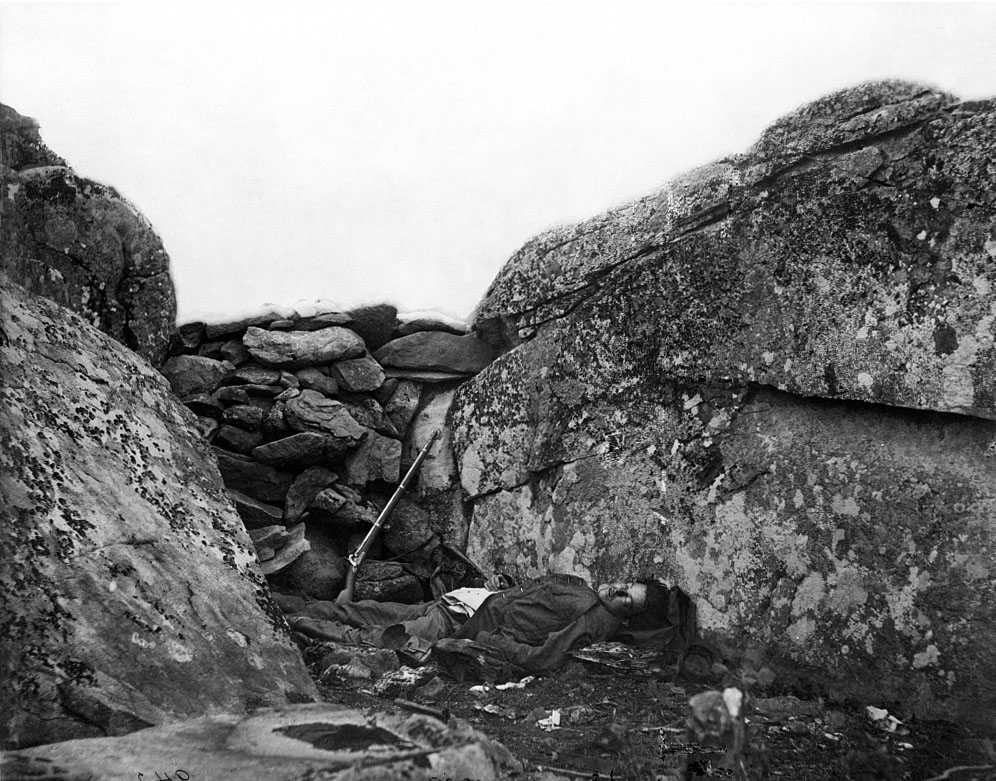
except Christmas Day and Good Friday

Art Gallery of New South Wales website

LIKE ART BLART ON FACEBOOK

Back to top