Charles Sheeler is a cracking good photographer who’s work has not got the recognition that it deserves – in comparison to, say, Stieglitz, Strand, Steichen or Weston. When you think of those top echelon artists from the early twentieth century, his name is never mentioned. And it should be.
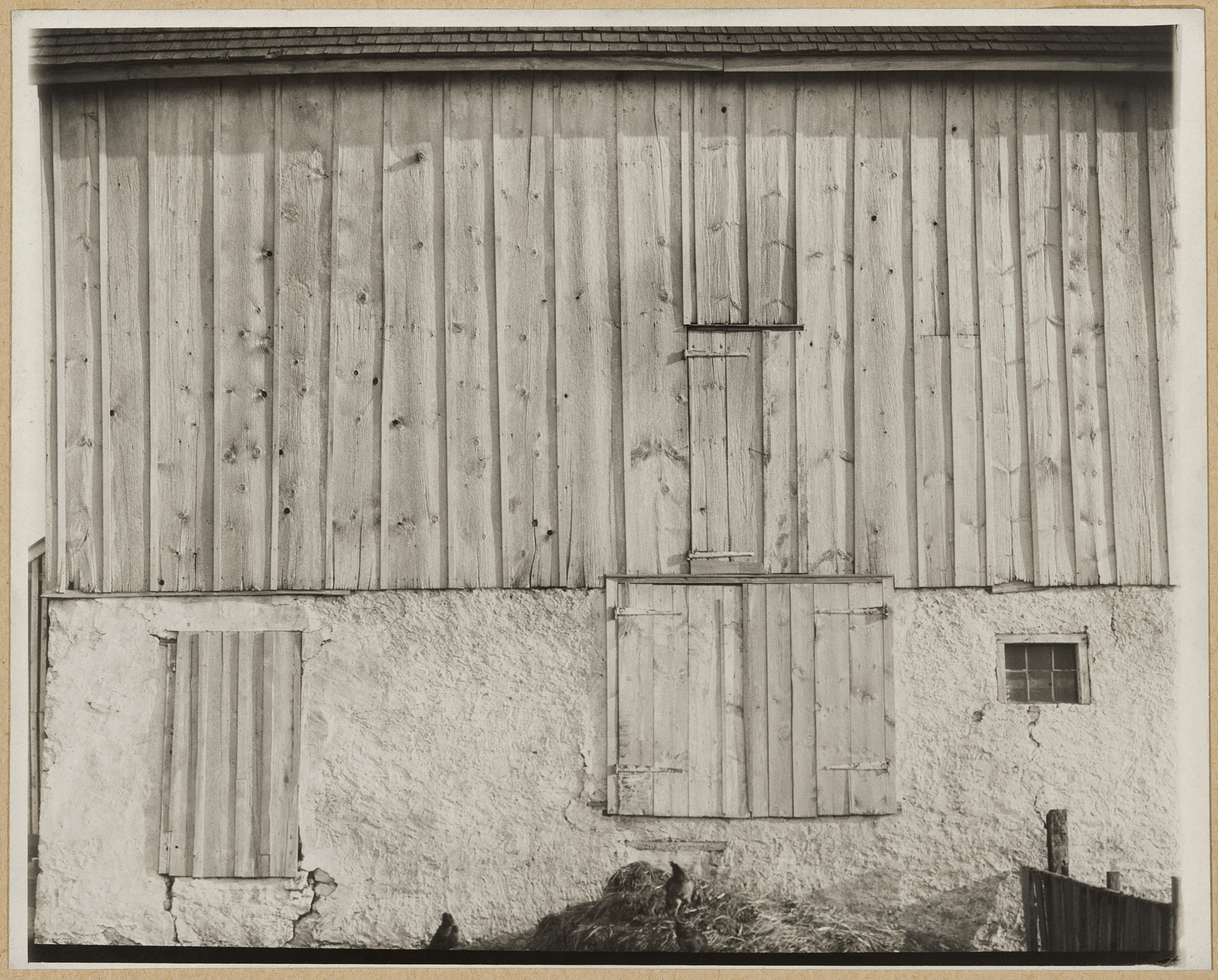
Sheeler’s Side of White Barn, Bucks County, Pennsylvania (1915, above) predates one of the most famous early modernist photographs, Strand’s White Fence, Port Kent, New York (1916, above) by a year, yet is hardly known. While Strand’s image possesses low depth of field, strong lighting and a focus on the fence as physical, geometric, sculptural object within the picture frame, Sheeler’s photograph is much more subtle but no less effective in its modernist vocation. The pictorial space is flattened into geometric shapes, the bottom of the photograph grounded by a cracked wall, hay, chickens and a fence, the top of the image foreclosed by the tiled roof of the barn and its attendant shadow (showing that the sun was high in the sky when this image was taken). Within the boundaries of the rectangle are subtle graduations of tone, colour and form, almost like an modernist etching with light, so beautifully does the artist both understand what he is seeing and how to render it through the physicality of the print. Unlike Strand’s “knock you over the head with the white picket fence”, Sheeler’s subtle paean to the modern world requires contemplation on the nature of light, photography and the fine art print. This is a masterpiece in the history of photographic art.
I am similarly convinced by Sheeler’s Ford Plant – Criss–Crossed Conveyors (1927, below), in my opinion one of the top ten photographs of all time.
I cannot fault this image. The light falling on the subject is incredible (notice the shadow from the beam mid-upper left, telling us the time of day the photograph was taken), the tonality superb, the framing of the subject admirable – all elements tensioned perfectly within the pictorial plane. The bottom of the photograph is grounded by stacked tyres and the structure ascends to the heavens from there… not just in one element, but in five! The main criss-cross of the conveyors is placed off centre supported by an iron tower, which allows the eye to roam freely across the image. The placement also allows for another elevator to ascend behind the main two, while a set of steps climbs higher and higher eventually exiting the picture stage left. Behind the criss-crossed conveyors the depth of space that must exist in reality is proposed by two tanks, further reinforced by 8 chimney stacks, and yet this photograph evidences no such depth of field. While everything is reduced to flattened shapes in this machine age, modernist, objectified world – and while no human being is presented for scale – the human hand is all over this image: in the construction of such technology, in the presence of the human scale stairs, in the ascension to the sky of the organ pipes of the industrial cathedral, in the comprehending eye of the photographer, and in the presence, the aura, of this magnificent print. While this image may seem the antithesis of humanist photography in one sense, conversely it reaffirms the very act of humanity in another. Or perhaps I’m just an old romantic.
Dr Marcus Bunyan
Many thankx to the Museum of Fine Arts Boston for allowing me to publish the photographs in the posting. Please click on the photographs for a larger version of the image.
This exhibition celebrates the MFA’s unparalleled holdings of works by Charles Sheeler (1883-1965), presenting 40 photographs from three significant series created during the heyday of his career as a founder of American modernism.
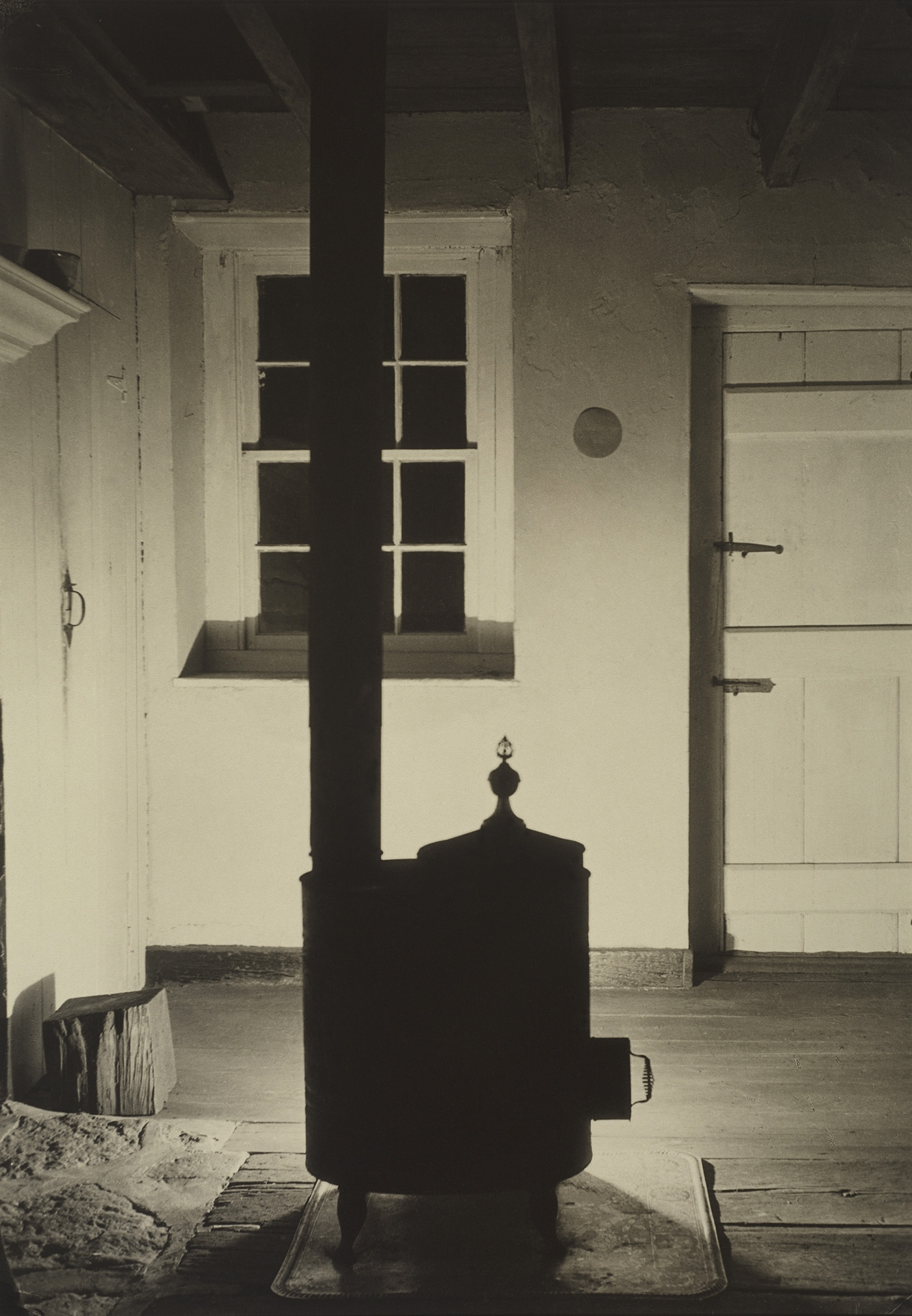
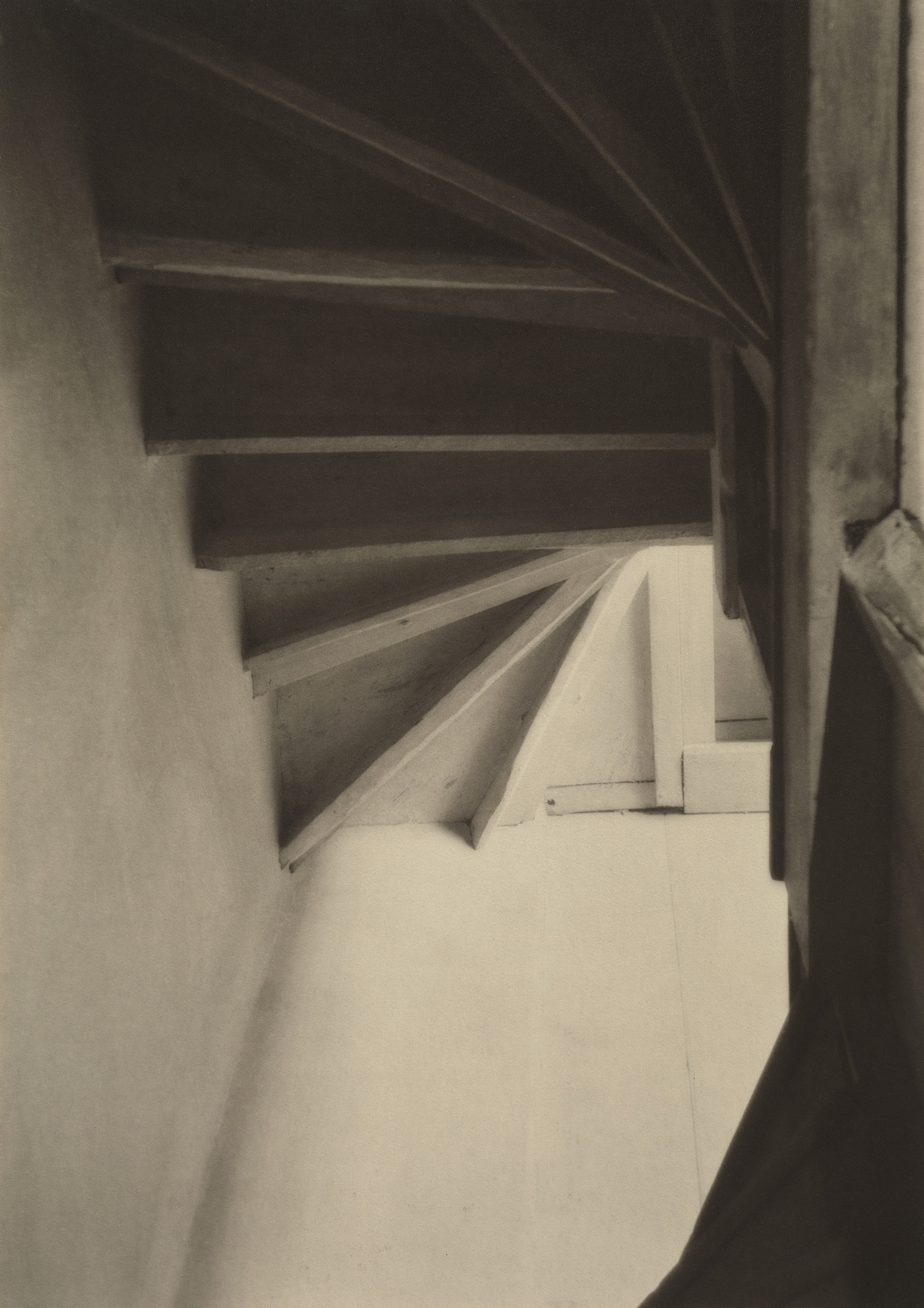
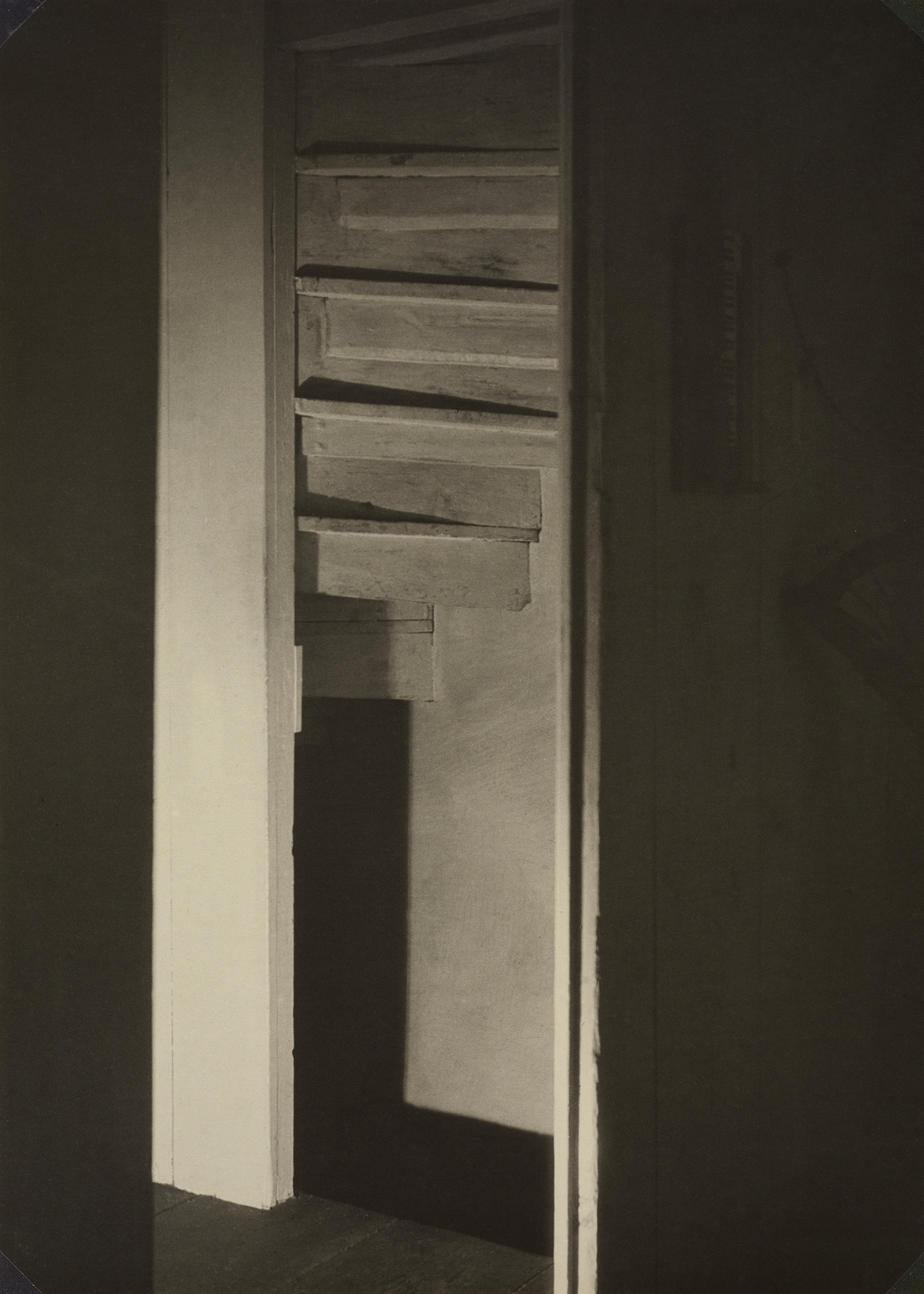
After enjoying success as a painter, Sheeler initially took up photography as a way to make a living. His experiments with the medium included the 1916-1917 series of photographs capturing various elements of an 18th-century house he rented in Doylestown, Pennsylvania. The sequence of stark, geometric compositions was among the most abstract and avant-garde work being made in the US at the time – created in response to the Cubist art of Picasso and Braque that Sheeler had previously encountered in Europe.
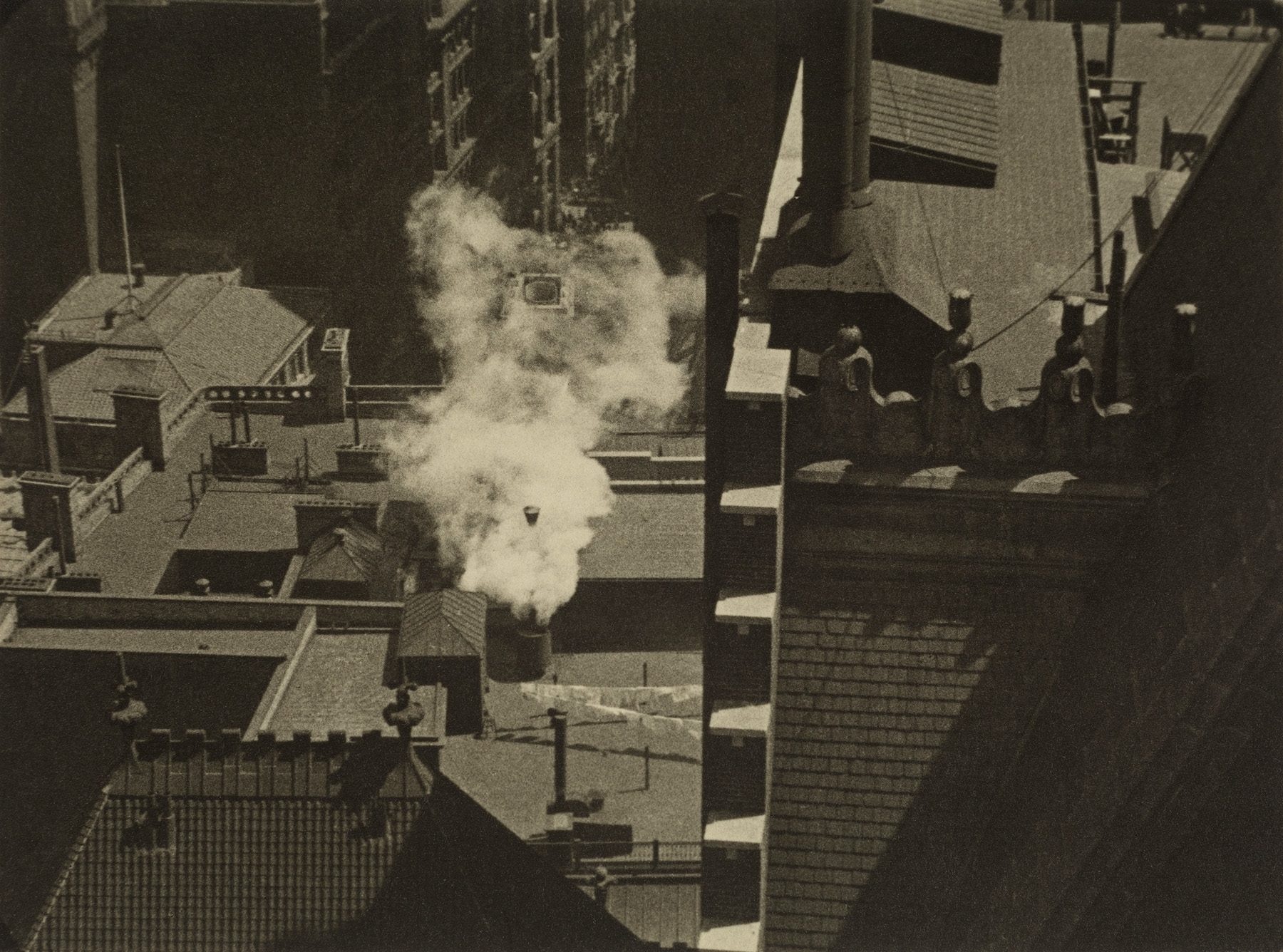
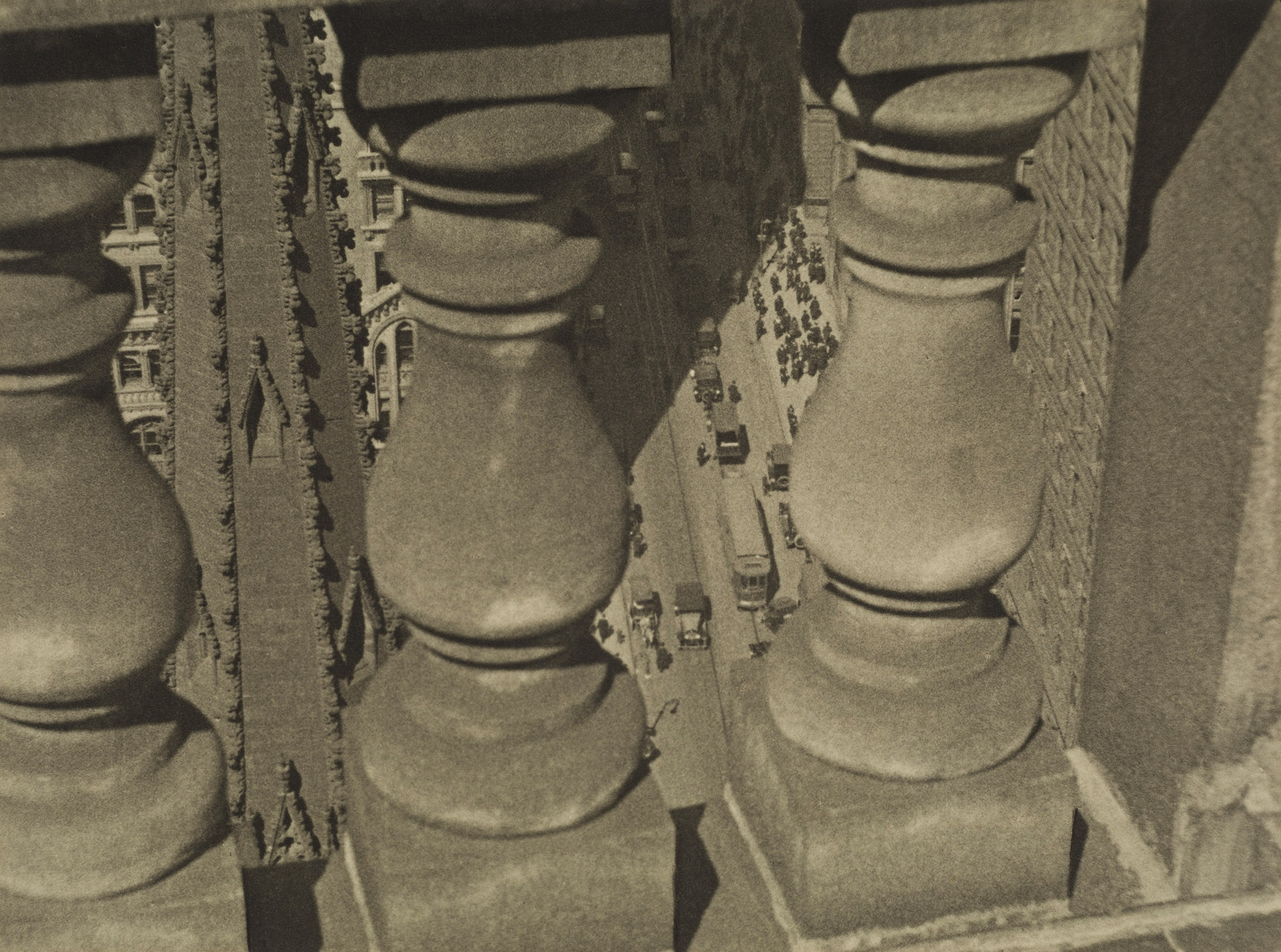
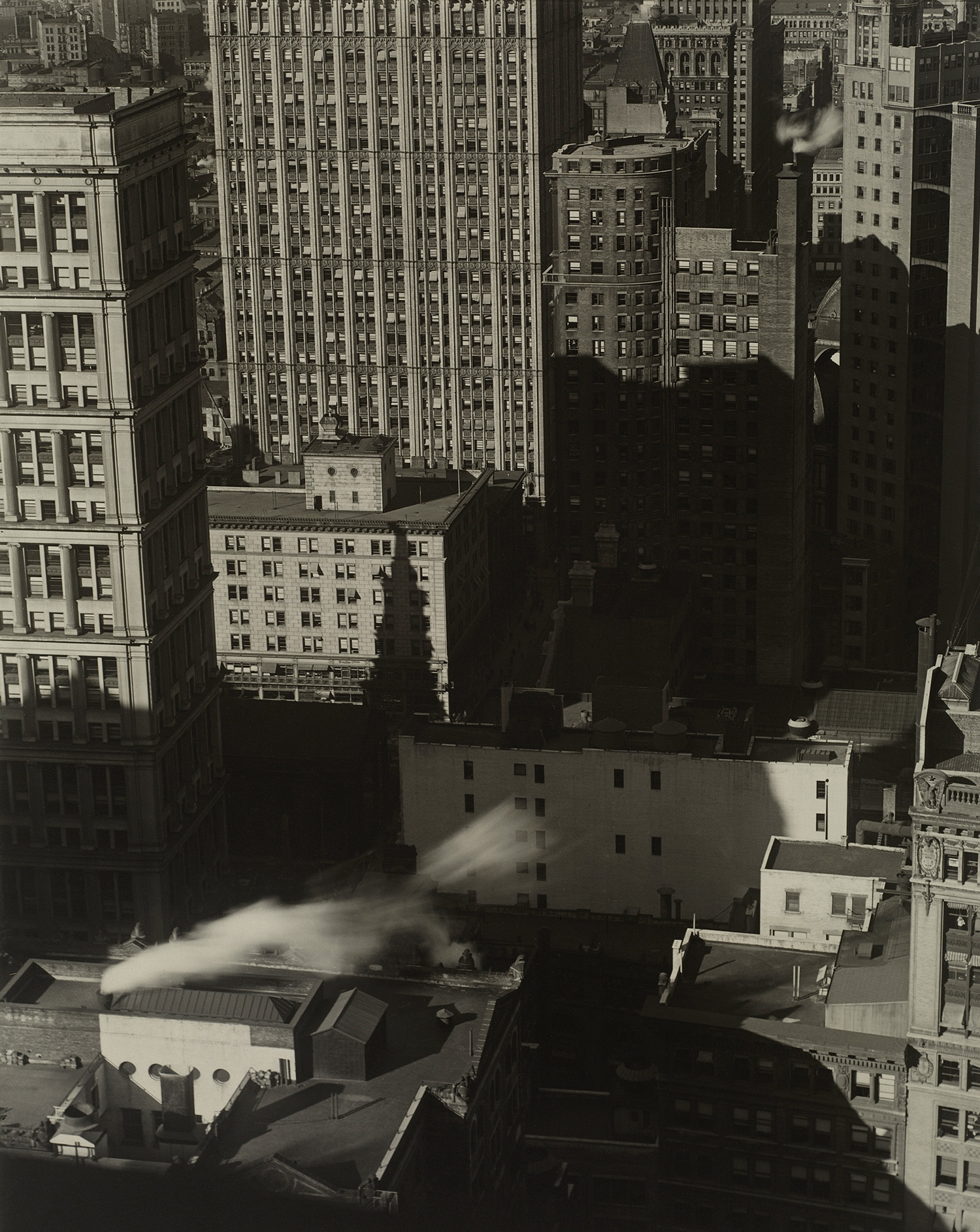
In 1920, Sheeler collaborated with fellow photographer Paul Strand on the short film Manhatta, presenting dramatic views of lower Manhattan. Abstract stills from the 35mm film, which was shot from steep angles, are presented alongside larger prints of Sheeler’s cinematic images of New York City, produced shortly after Manhatta – which he used as source material for his paintings. The film Manhatta is on view in the gallery.
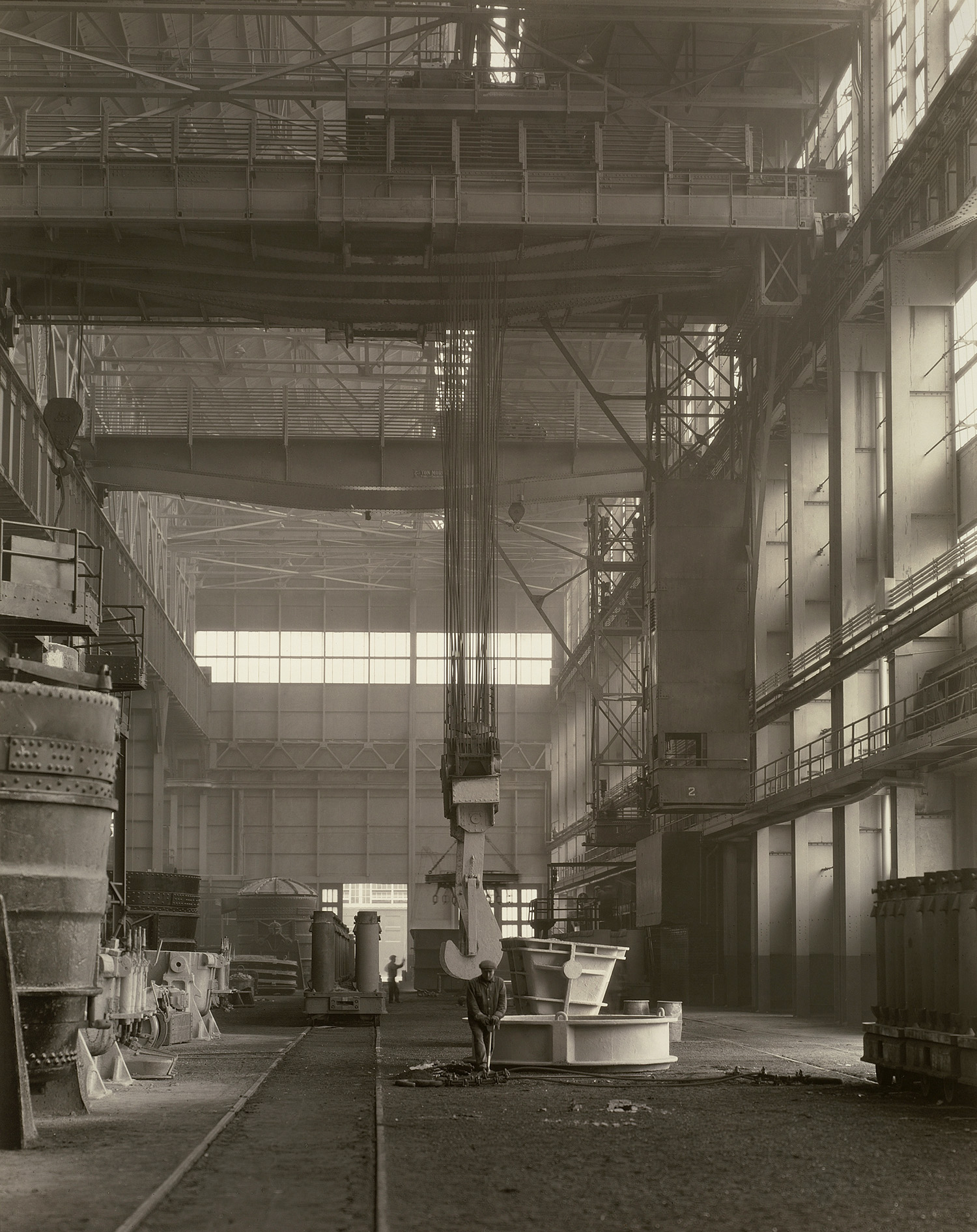
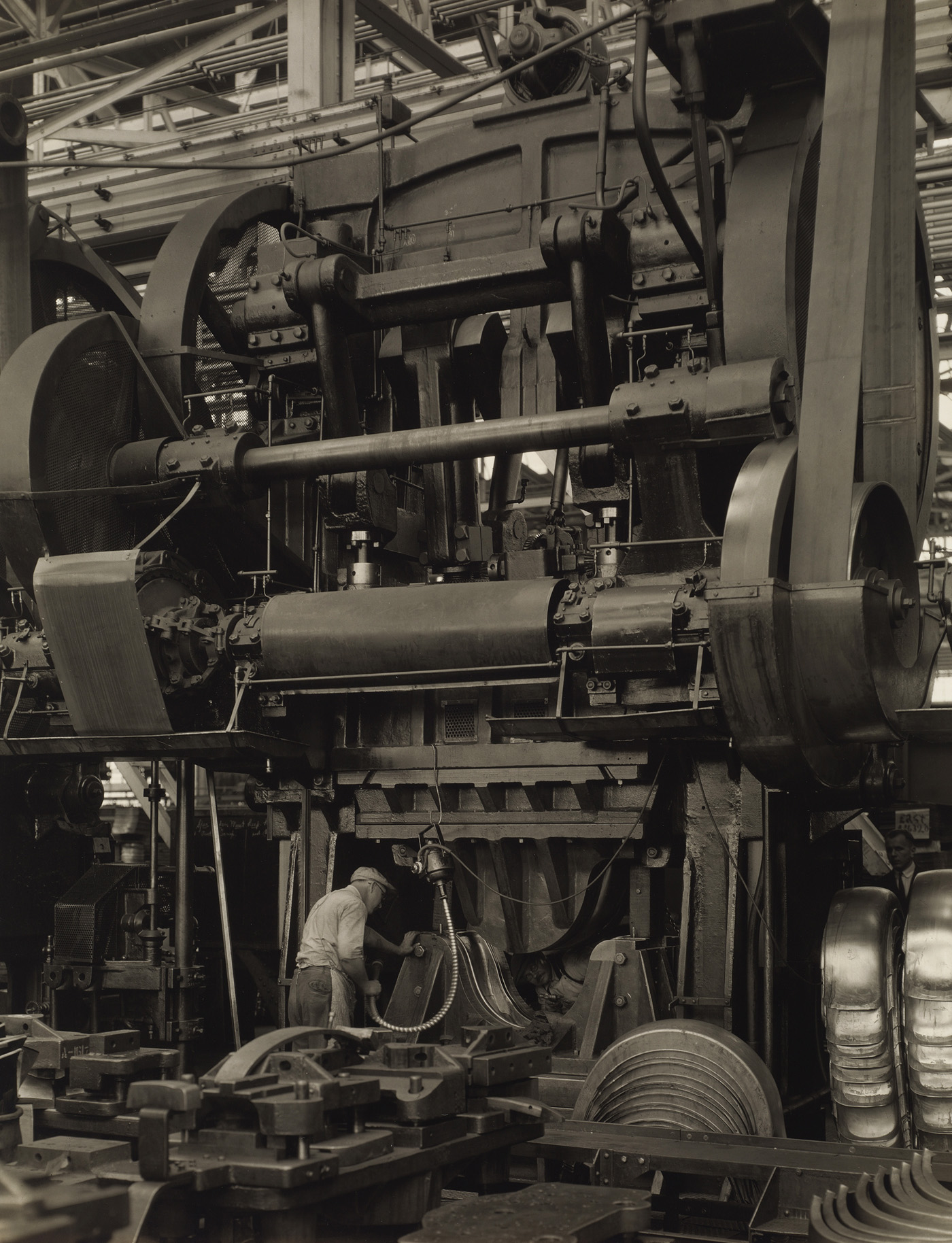
Charles Sheeler from Doylestown to Detroit culminates with the 1927 photographs of the Ford Motor Company plant in River Rouge, Michigan, commissioned to celebrate the introduction of Ford’s Model A. The cathedral-like scenes convey an optimism for American industry, and are now considered icons of Machine Age photography. All of the photographs in the exhibition are drawn from the Museum’s Lane Collection – one of the finest private holdings of 20th-century American art in the world, including Sheeler’s entire photographic estate – given to the MFA in 2012.
In 1920 Paul Strand and artist Charles Sheeler collaborated on Manhatta, a short silent film that presents a day in the life of lower Manhattan. Inspired by Walt Whitman’s book “Leaves of Grass,” the film includes multiple segments that express the character of New York. The sequences display a similar approach to the still photography of both artists. Attracted by the cityscape and its visual design, Strand and Sheeler favoured extreme camera angles to capture New York’s dynamic qualities. Although influenced by Romanticism in its view of the urban environment, Manhatta is considered the first American avant-garde film.
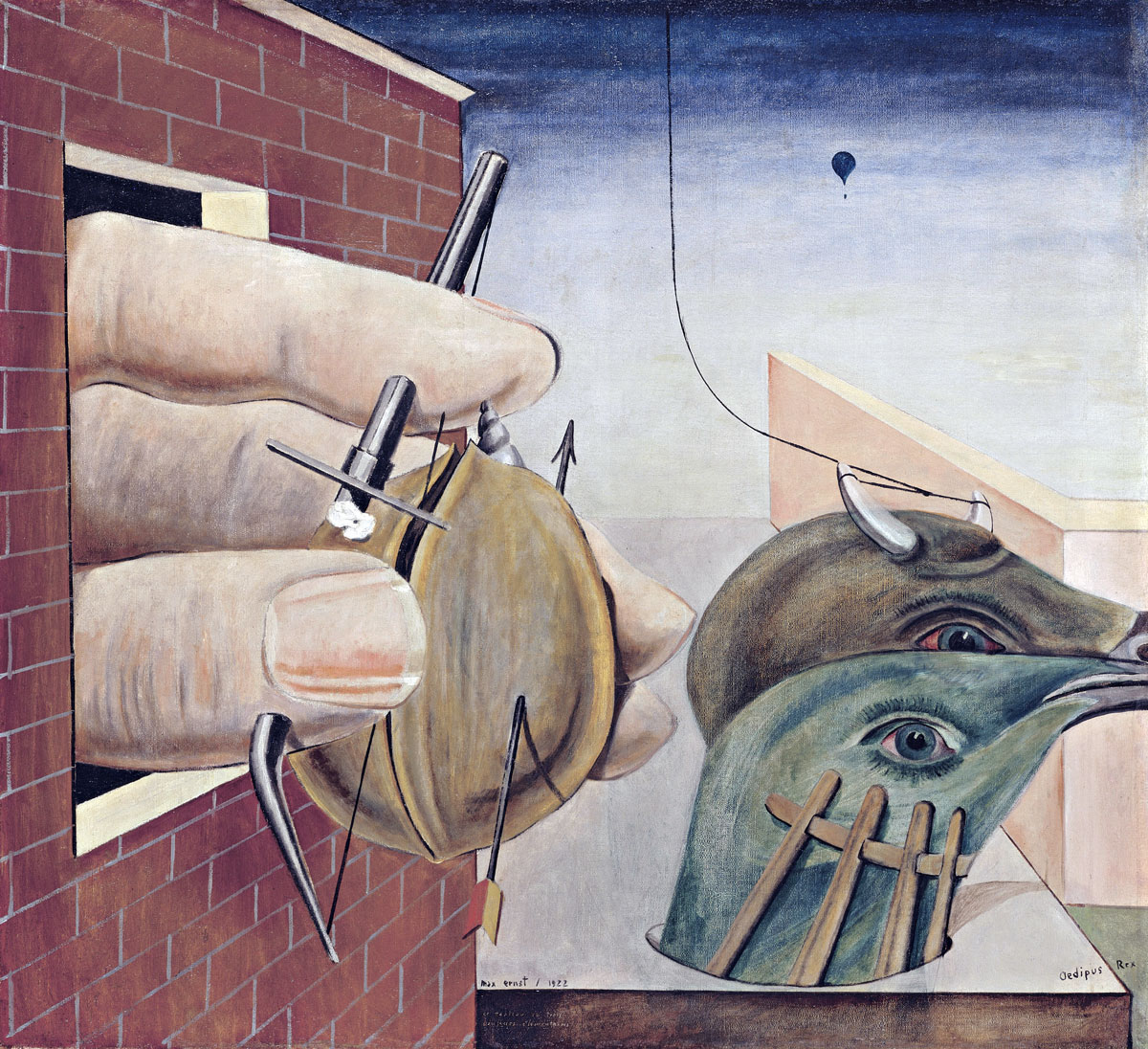
This work is innately Freudian just in name, let alone in content. The Oedipus complex is one of the most well recognised components of Freudian theory and it is seen in this work names after it in many ways. The first is through the process of condensation. This can be seen as the bird headed man, which shows up in many of Ernst’s images: the association in this image between the man and the bird is the desire of man to be free from the inhibitions imposed upon him by society, and despite the fact that these two still retain their separate identities, they are consistent with Freud’s ideas. In the case of this work, the head is removed from the body, showing a detachment from true feeling and true understanding of life. Another Freudian idea is the use of the joke, which is seen in the treatment of several of the objects in this work. Such as the contrast and juxtaposition of the wall, the over-sized fingers, upside down eyes on the birds, and the balloon in the aft of the painted collage. Several other associations relating this work to Freud can be drawn as well.
This work has intense sexual undercurrents. The nut represents the female and the crack in the nut is a symbol for the vulva. The cracking of the nut by the hands of a male is a metaphor for sexual intercourse and also gender roles in traditional patriarchal cultures. The idea of the treatment of woman and of her place within society is also visible in another piece by Ernst, The Tottering Woman. In this piece, he addresses the constraints in which woman are held in the world and the patriarchy that she must deal with on a daily basis. It also touches upon the objectification of woman as well. Hoffman also theorises that the squeezing of the nut has implications of sadomasochistic roles as the nut is being dominated and crushed, the spike is punishing the hand equally and finally, once forced open, the “nut” could always snap back shut, injuring the index finger and thereby is a signifier of neurotic sexual attachment. The bird head towards the back of the picture plane is tethered by some sort of rope, which could be seen as societal restrictions on deviant sexuality and possibly is a reaction to the taboo associated with incest. Additionally, the arrow as it pierces the shell of the nut could be seen as a phallic signifier or also as a representation for the idea of love and then a refutation of the existence of love within the constraints of sexual desire and sexuality. The imagery in this piece by Ernst is intensely psychosexual in nature and content and can be seen mostly in those terms.
In defence of picking Oedipus Rex to write about in the context of collage, it is true that it is an oil painting, but its imagery was taken from print sources and then was transposed into the work by the act of painting them. The nut squeezing image was taken from an article entitled “Experience sur l’elasticite, faite avec une noix,” from the popular 19th century French Magazine La Nature.
Anonymous. “Ernst: Chance, Collage and the Study of Freud,” on the Center for Biological Computing, Indiana State University Department of Life Sciences website [Online] Cited 12/12/2020. No longer available online. Used under fair use conditions for the purposes of education and research
This is one of the rare pictures by Max Ernst which refer directly to a political incident. He commented on this: “The Fireside Angel is a picture I painted after the defeat of the Republicans in Spain. This is, of course, an ironical title for a kind of clumsy oaf which destroys everything that gets in the way. That was my impression in those days of the things that might happen in the world. And I was right.” The Fireside Angel is depicted as an avenging character from the Bible. Its destructive potential is stressed by its aggressive colouring. In the figure of the angel, blind traumatising force is expressed, against which mankind is defenceless. Since there is no hope for negotiations with an inhuman force, the blind aggressor seems even more frightening.
With the exhibition of over 160 of his works at the Fondation Beyeler in cooperation with the Albertina, Vienna, the “artist of the century” Max Ernst (1891-1976) will be given the first comprehensive retrospective in Switzerland since his death as well as the first held in a German-speaking country since 1999.
Max Ernst is one of Modernism’s most versatile artists. After his beginnings as a rebellious Dadaist in Cologne, he moved to Paris in 1922, where he soon became one of the pioneers of Surrealism. He was interned twice as an enemy alien during the Second World but was released thanks to the intervention of the poet Paul Éluard, who was his friend. In 1941 Max Ernst fled to the USA, where he found new stimuli for his work as well as providing new impulses for the generation of young American artists. A decade later he returned to a Europe that had been devastated by the war and where the once highly esteemed Max Ernst seemed to have been forgotten, only to be rediscovered as one of the 20th century’s most multifaceted artists. In 1958, having renounced his German nationality in 1948 in order to take US citizenship, Max Ernst eventually became a French citizen.
Ernst was indeed one of the “artists of the century” – not only because of the high quality and wide range of his oeuvre but also because of the length of his creative career, which lasted around 60 years from 1915 to 1975. Active at a time of tremendous artistic, social, political and technical upheaval, he knew how to integrate these changes into his oeuvre, which therefore reflects key characteristics of the 20th century. The pleasure Max Ernst took in experimenting with different techniques made him a pioneer of multimedia expression. With no apparent effort, he combined in his work the themes, styles and techniques that were important to successive generations. His ceaseless quest for new forms of expression, questions and subjects is emblematic of modern man. Max Ernst appears to us as the artist who never wanted to find himself, as he once said: “A painter is lost when he finds himself”.
With his early Dadaist experience, his key position among the Surrealists and his prelude to action painting, Max Ernst travelled between worlds and cultures, moving to Paris from Cologne and from New York back to France. At a time of political unrest, he maintained his critical, creative gaze, seeking refuge in a country, the USA, which he scarcely knew but to which he nonetheless responded with curiosity and which provided him with important impulses for his late work. With exhibitions in New York, projects in Arizona and Touraine, participation in the Venice Biennale and Documenta, Max Ernst was an early 20th century example of the kind of “cultural and artistic nomad” who only later became a customary figure.
Collage
As early as 1919, Max Ernst started working with the technique of collage, which he used to design or simulate new pictorial realities. He created his collages from illustrations taken from various novels, textbook catalogues, natural science journals and 19th century sales catalogues. He excised the fragments from wood engravings, using a scalpel in order to achieve cut edges that were perfectly exact and smooth. In around 1929 / 1930 Max Ernst created his most famous collage novels La femme 100 têtes (Hundred-Headed Woman / Headless Woman) and Rêve d’une petite fille qui voulut entrer au Carmel (A little Girl dreams of taking the Veil), which are among Surrealism’s most fascinating, enigmatic works.
Frottage
In around 1925, Max Ernst began his Natural History series, in which he used the technique of frottage for the first time (the French word frotter means “to rub”) as a semi-automatic procedure. He placed objets trouvés he found outdoors, such as leaves and wood, under a sheet of paper and rubbed over them with a pencil. Then he took the structures that emerged and transformed them into fantastic pictures. In his frottages, Ernst breathes new life into lifeless objects, giving them another, to some extent uncustomary, significance. Max Ernst developed frottage while he was staying in Brittany. In his essay Beyond Painting he describes a kind of visionary revelation that caused him to use the wooden floor and other objects in his guest-house room as objects for his frottages.
Grattage
Grattage is an artistic technique used by Max Ernst in painting that he developed in around 1927 as an extension of frottage. In a first phase, he applied several superimposed layers of paint to a canvas. Underneath the painting ground that he prepared in that way, he placed objects such as metal grids, wooden boards and string, the relief of which could be seen through the canvas. In order to transfer those structures to the picture, he scratched away the top layers of paint (gratteris the French word for “to scratch”). In a subsequent phase, he reworked the patterns that had become visible, transforming them into forests, shellflowers, birds and petrified cities.
Decalcomania
Decalcomania is a transfer technique in which the damp pigment on a piece of glass or a sheet of paper is pressed against a canvas, leaving behind fine streaks, bubbles or marbled traces of paint when they are removed. In a subsequent phase, the artist reworks the complex surface structure. This artistic technique had already been developed in the 18th century and was used by other Surrealist artists too. Max Ernst adopted the technique in the late 1930s, using it to represent mysterious landscapes peopled by eery faces, figures and animals hiding in the thickets of nature.
Oscillation
In around 1942, while an exile in the USA, Max Ernst started developing the technique of oscillation. He let paint drip out of a tin perforated with a number of holes, which he attached to a long string and swung to and fro over the canvas. This largely uncontrollable and, once again, semi-automatic procedure created reticulated compositions of circles, lines and points on the surface that were reminiscent of planets’ orbits. Oscillation was an innovative technique that not only extended the range of Surrealism’s artistic repertoire but also heralded Jackson Pollock’s Drip Painting.
At the First Limpid Word is one such puzzle. A monumental work, it formed part of the decoration of the house that Max Ernst shared with Paul Éluard and his wife Gala (who later became Dalí’s muse). It was only in the 1960s that the wall painting, which had been painted over, was rediscovered. This painting, “an allegory of seduction,” is such a simple composition but is filled with symbolism in colour and subject.
Like many of Ernst’s paintings during his Paris period (1922-1941), Ubu Imperator resembles a collage in painted form. The artist’s knowledge of Freudian theories, familiarity with myth and extreme wit are reflected in this early painting, which is now considered proto-Surrealist due to its strange juxtapositions.
In Ubu Imperator (1923), an anthropomorphic top dances in a vast, empty landscape. Such works captured early on the surrealist notion of estrangement and commitment to the subconscious, but also they seem surprisingly contemporary. The red Ubu Imperator marked the entry of Ernst in the articulated stage of surrealism by his use of a literary narrative that was sometimes personal, sometimes political. In this seminal work a spinning top, a red carcass with iron reinforcement, and human hands express an astonishing image of the Ubu Father, a grotesque symbol of authority invented by Alfred Jarry. Other paintings suggest Ernst’s impressions of ancient Buddhist temples (à la Angkor Wat) as inspired from his trip to Asia following the breakup of his famous ménage à trois with Gala and Paul Eluard. This structure and thickly overgrown plants appear in many of his engravings and grattage [Grattage is a surrealist painting technique that involves laying a canvas prepared with a layer of oil paint over a textured object and then scraping the paint off to create an interesting and unexpected surface (Tate)] oil paintings, such as The Entire City (1935-1936) and The Petrified City (1935).
Valery Oisteanu. “Max Ernst: A Retrospective,” on the The Brooklyn Rail website, May 2005 [Online] Cited 12/12/2020. Used under fair use conditions for the purposes of education and research
The Pleiades, companions of Artemis, were the seven daughters of the titan Atlas and the sea-nymph Pleione born on Mount Cyllene. They are the sisters of Calypso, Hyas, the Hyades, and the Hesperides. The Pleiades were nymphs in the train of Artemis, and together with the seven Hyades were called the Atlantides, Dodonides, or Nysiades, nursemaids and teachers to the infant Bacchus. There is some debate as to the origin of the name Pleiades. Previously, it was accepted the name is derived from the name of their mother, Pleione. However, the name Pleiades may derive from πλεῖν(to sail) because of their importance in delimiting the sailing season in the Mediterranean Sea. (Wikipedia)
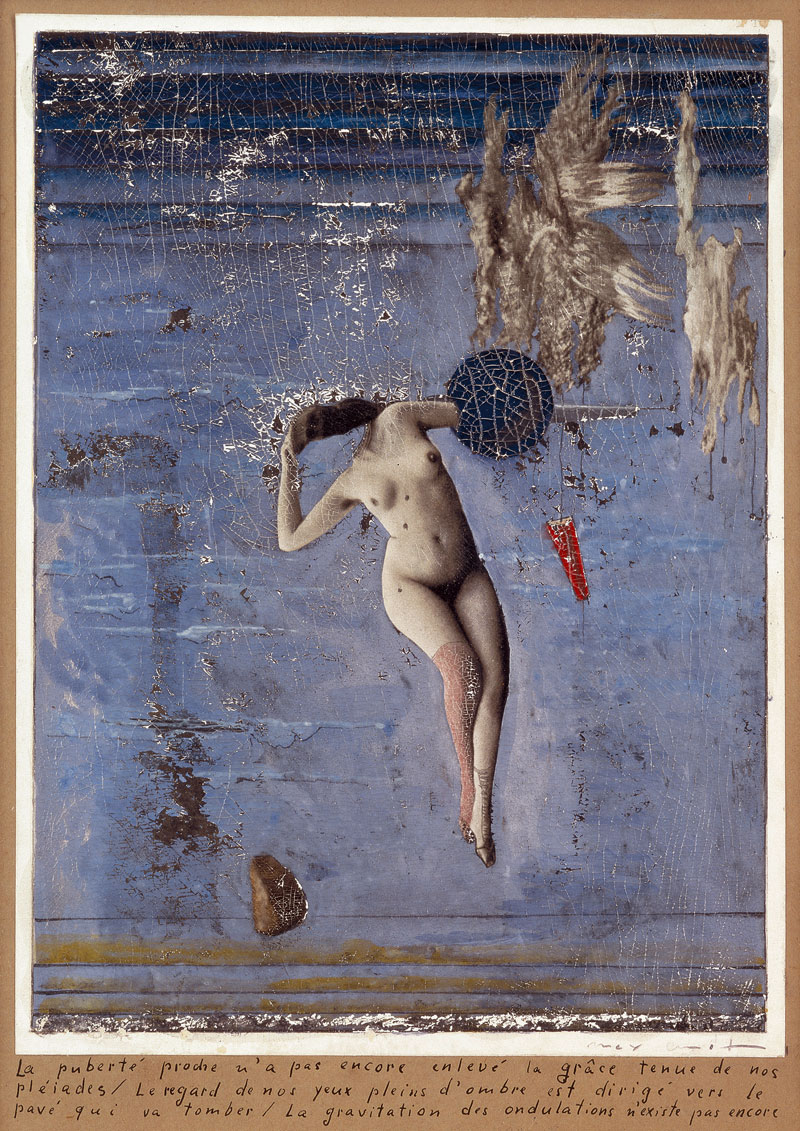
For Ernst eroticism was another way of entering the unconscious, of escaping from convention, and possibly of tweaking bourgeois taste. But he was aware that adult sexuality had its limits, as is apparent in the exquisite Approaching Puberty… (1921). A photograph of a nude, faceless girl floats in a blue space stratified by horizontal lines, suggesting water or the sky. A few strangely disparate forms surround the girl, and the short text at the bottom ends, “The gravitation of the undulations does not yet exist.” The title, this line, and the fact that the girl floats in space rather than standing on the ground – as most of Ernst’s figures do – suggests that he sees in pubescence a kind of weightless freedom. In a related but nonsexual image, an Untitled c. 1921 collage, four schoolboys peer out of their classroom (from which a wall is missing) at a vast blue sky in which a hot-air balloon floats. A schoolmaster stands alone and ignored at his desk; next to him one of the boys balances a giant pencil on a pointer. What’s learned in school, Ernst seems to say, is far less important than visions of the sky.
Fred Camper. “Max Ernst’s Theater of Reveries,” on the Chicago Reader website, November 1993 [Online] Cited 12/12/2020. Used under fair use conditions for the purposes of education and research
In Max Ernst’s painting Napoleon in the Wilderness (1941), a strange whimsical trumpet appears in the hand of a female figure that seems to have sprung from the sinister rock and coral formations of a world in ruin. This painting formed part of suite of decalcomania [A transfer technique, developed in the 18th century, in which ink, paint, or another medium is spread onto a surface and, while still wet, covered with material such as paper, glass, or aluminium foil, which, when removed, transfers a pattern that may be further embellished upon. The technique was adopted by the Surrealists to create imagery by chance rather than through conscious control (MoMA)] works, in which Carrington’s semi-naked figure haunts a series of eerie landscapes, richly textured and abundant with mythological hybrid forms. Between periods of internment during the war, Ernst had managed to continue painting, producing haunting images of his abandoned lover in works that evoke his own sense of loss and grief in macabre scenes that promise both decay and renewal.
Text from Natalya Lusty, Surrealism, Feminism, Psychoanalysis. Ashgate Publishing, 2007.
The exhibition is a chronological presentation of all the major creative phases and groups of themes in Max Ernst’s work, opening with Capricorn, his most important sculpture. Max Ernst, who was born on 2 April 1891 in Brühl (Germany), first learnt about painting from his father. He had a conservative, middle-class upbringing, against which he soon rebelled. Starting in 1910, he studied art history as well as psychology, Romance languages and philosophy. Initially influenced by Expressionism and Futurism, he soon came in contact with other artists and art movements.
His early work City with Animals demonstrates this unique combination of different styles, displaying both Cubist and Futurist features. His encounter with Hans Arp (also represented in the Beyeler Collection along with the Surrealists Dalí, Giacometti and Miró) came at a time full of turmoil. Dada is born; the years after the First World War are a time of radical change, protest and experimentation.
Dada brings Max Ernst into contact with Surrealist artists. He ceases to be just a German artist and becomes a leading figure in the Surrealist art movement in Paris. There his works begin to acquire enigmatic qualities, for the unconscious and dreams are important elements of Surrealism, which it took over from psychoanalysis. Max Ernst remains an innovator, experimenting with frottage from the mid-1920s onwards. Hybrid creatures are created from different natural species; his interest in the natural sciences finds expression in his works.
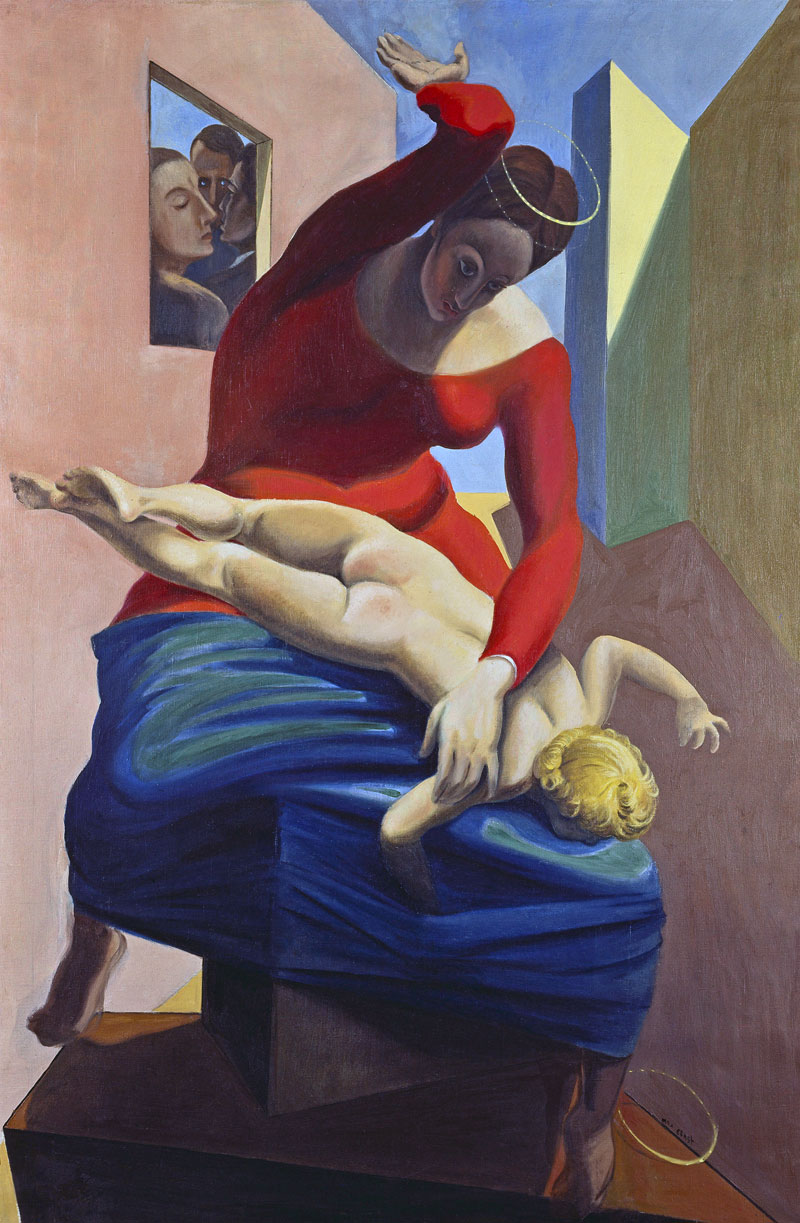
At the First Limpid Word is one such puzzle. A monumental work, it formed part of the decoration of the house that Max Ernst shared with Paul Éluard and his wife Gala (who later became Dalí’s muse). It was only in the 1960s that the wall painting, which had been painted over, was rediscovered. The Blessed Virgin Chastising the Infant Jesus is an equally spectacular work, a scandal-provoking painting with blasphemous elements that deconstructs the traditional sacred image of the Madonna, representing a radical liberation from Ernst’s middle class roots. One whole room in the exhibition is developed to the theme of the forest, with a number of masterpieces from that series. Considerable importance is also attached to the series of Horde paintings from the late 1920s; the metamorphosed figures convey the theme of transformation. With the Flowers and Cities series (which focus on the antitheses of nature and culture), other important groups of themes are also presented.
Room 11 will contain a number of key works with the jungle paintings from the second half of the 1930s including Nature at Dawnwith its dark, sinister character. Different traditions are echoed here, ranging from borrowings from Henri Rousseau to the Romanticism of a painter like Caspar David Friedrich. With The Robing of the Bride there is not only an obvious reference to Renaissance art but also a more differentiated context. The transformation of a woman into an animal and vice versa is an erotic motif that the painting conveys through a number of details. The Fireside Angel, on the other hand, thematises the Spanish Civil War of the late 1930s, with which many artists and intellectuals concerned themselves. With the brightly coloured, mask-like, terrifying dimension of its figure, which seems to fly towards the viewer as an unstoppable whirlwind between aggression and mockery, Max Ernst prefigures the political catastrophe that was to befall Europe.
Ernst’s late work displays thematic caesura – on the one hand, a poetical and sensuous contemplation using over-painting in the refined, technically innovative work The Garden of France and, on the other, Birth of a Galaxy, a splendid late work in which air, water, earth and light all rise into a starry firmament. As a free spirit – ironical, elegant and rebellious – and a man of many different facets, Max Ernst today remains an artist whose work is both accessible and complex. His works speak to us, evoking uncharted depths and hidden mysteries, as well as prompting reflection. Like mercury – which continuously changes shape in a fascinating way, hence being impossible to grasp – Max Ernst is still an exceptional artist almost forty years after his death, exemplary in his artistic independence and possessing an urge for freedom and a bold readiness for innovation in his work and life that preserve his oeuvre from stylistic opportunism and conventionality.
Max Ernst’s creativity in handling sources of imagery and inspiration, the breaks between his many phases and types of subject matter, are still capable of astonishing viewers today. Like a revolutionary of vision, he rearranged images and elements, and as a Surrealist established links between pictures and the viewer’s unconscious mind. What remained a constant was the persistence of Ernst’s rebellion. Like his life, he once said, his work was “not harmonious in the sense of classical composers.” A master of metamorphosis, Ernst was a searcher and discoverer, an honorary doctor of philosophy who increasingly expanded his range of investigation to include astronomy, ethnology, ornithology, mathematics and psychoanalysis, following up his love of the natural sciences and creative chance.
The Robing of the Bride (1939-1941; Venice, Guggenheim) employs Renaissance perspective devices and Cranach-like figures to represent a pagan marriage.
Dorothea Margaret Tanning (August 25, 1910 – January 31, 2012) was an American painter, printmaker, sculptor and writer. She created ballet sets and costumes for George Balanchine’s Night Shadow, at the Metropolitan Opera House and others. She also appeared in Hans Richter’s avant-garde films. As an artist she was influenced by Dada and Surrealism and married fellow Surrealist Max Ernst.
As she recounts in her memoirs, Birthday and Between Lives, when Ernst visited her studio in 1942, they played chess, fell in love, and embarked on a life together that soon took them to Sedona, Arizona, and later to France. They met at a party in 1942 and after he would drop by Dorothea’s studio where she painted for a Surrealist movement exhibition of art by women for Peggy Guggenheim’s Art of This Century. In that exhibition, Tanning’s work showed along with the work of Louise Nevelson and Gypsy Rose Lee. Soon after this encounter Ernst moved in with her.
They married in 1946, in a double wedding with Man Ray and Juliet Browner in Hollywood, after Ernst’s divorce from Peggy Guggenheim. They remained married for 30 years until his death. In 1949, Tanning and Ernst moved to France, where they divided their time between Paris, Touraine and later Provence. They would often host guest such as Balanchine, Henri Cartier-Bresson, Marcel Duchamp, Pavel Tchelitchew and Dylan Thomas. In 1957 Tanning and Ernst moved to France again because Max Ernst was denied citizenship as a German during the McCarthy era. When speaking on her relationship with Ernst in an interview, Tanning said: “I was a loner, am a loner, good Lord, it’s the only way I can imagine working. And then when I hooked up with Max Ernst, he was clearly the only person I needed and, I assure you, we never, never talked art. Never.”
After Max Ernst died in 1979 Dorothea Tanning returned to the United States.
Text from the Wikipedia website
Max Ernst with rocking horse, Paris 1938 2013, ProLitteris, Zurich Photo: Max Ernst Museum Brühl des LVR, Stiftung Max Ernst
Fondation Beyeler Beyeler Museum AG Baselstrasse 77, CH-4125 Riehen, Switzerland
Opening hours: 10 am – 6 pm daily, Wednesdays until 8 pm
Curator: Felix Krämer, head of the department of modern art at the Städel Museum, Frankfurt
Many thankx to the Städel Museum for allowing me to publish the reproductions of the artwork in the posting. Please click on the photographs for a larger version of the image.
This slideshow requires JavaScript.
Installation photographs of the exhibition Dark Romanticism. From Goya to Max Ernst at the Städel Museum, Frankfurt Photos: Norbert Miguletz
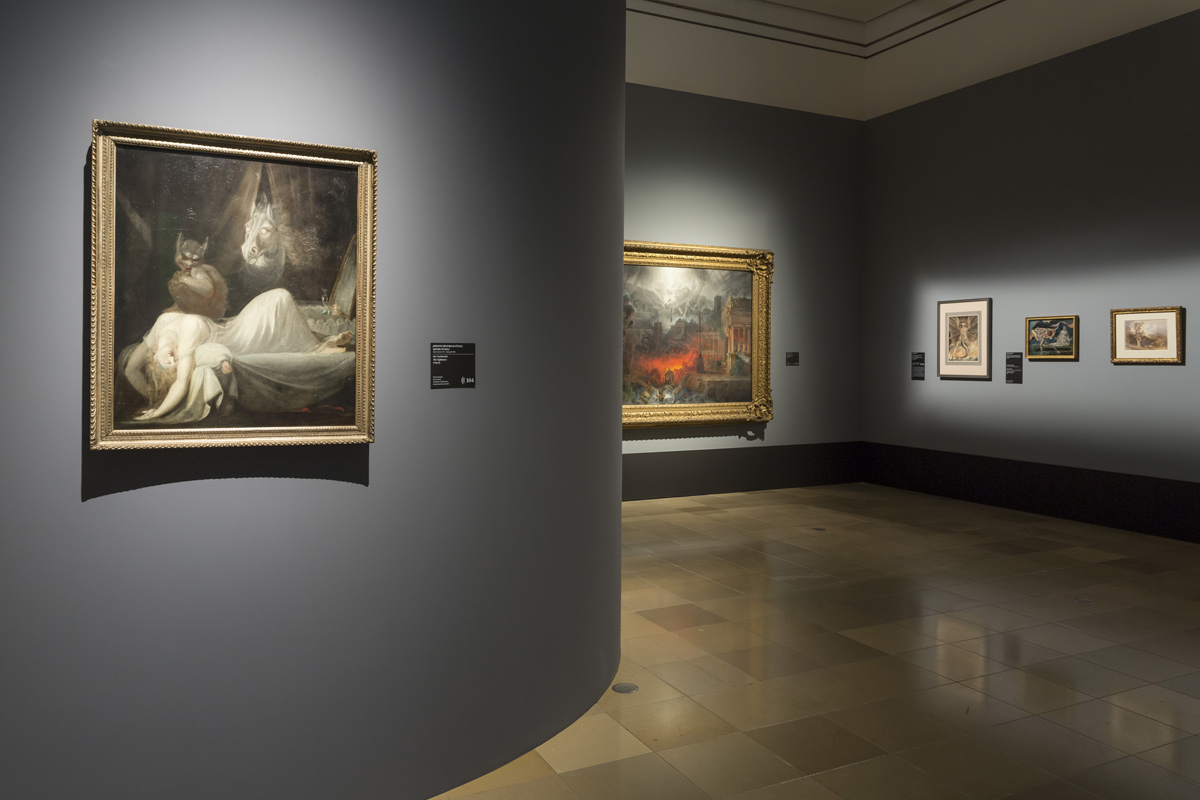
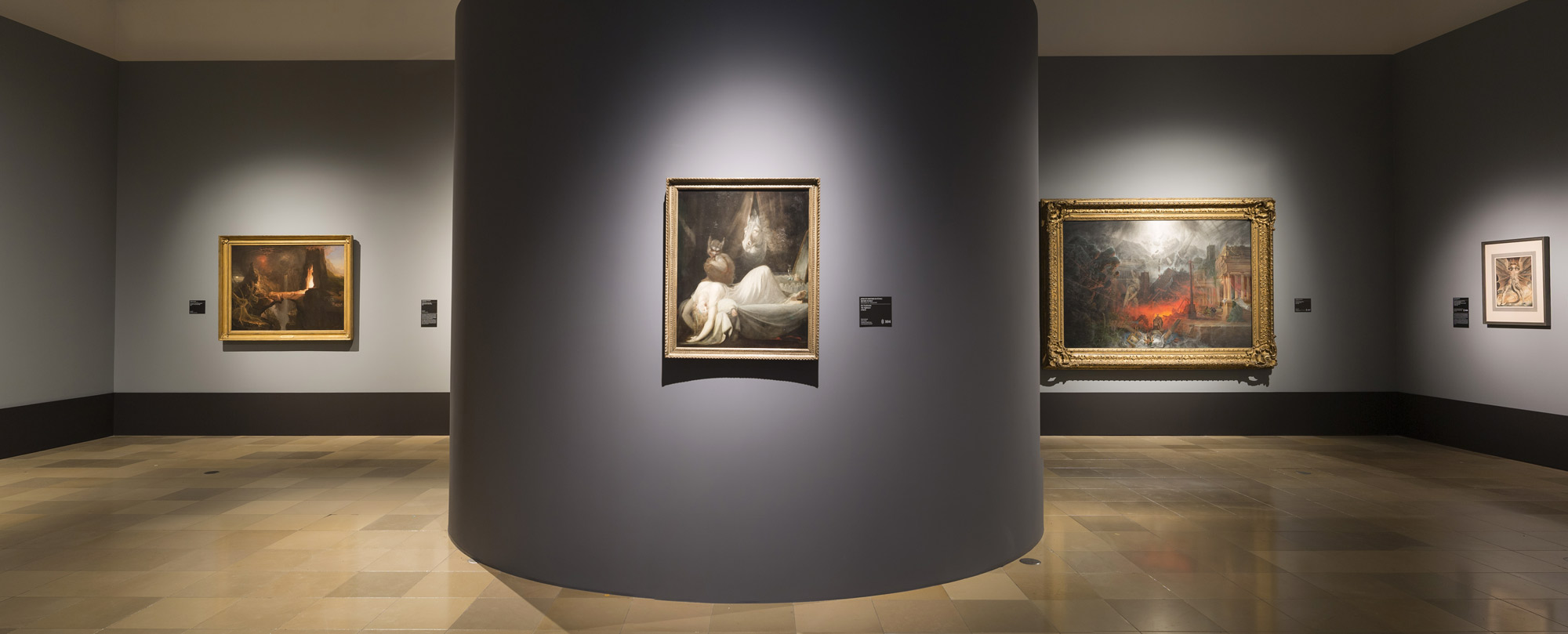
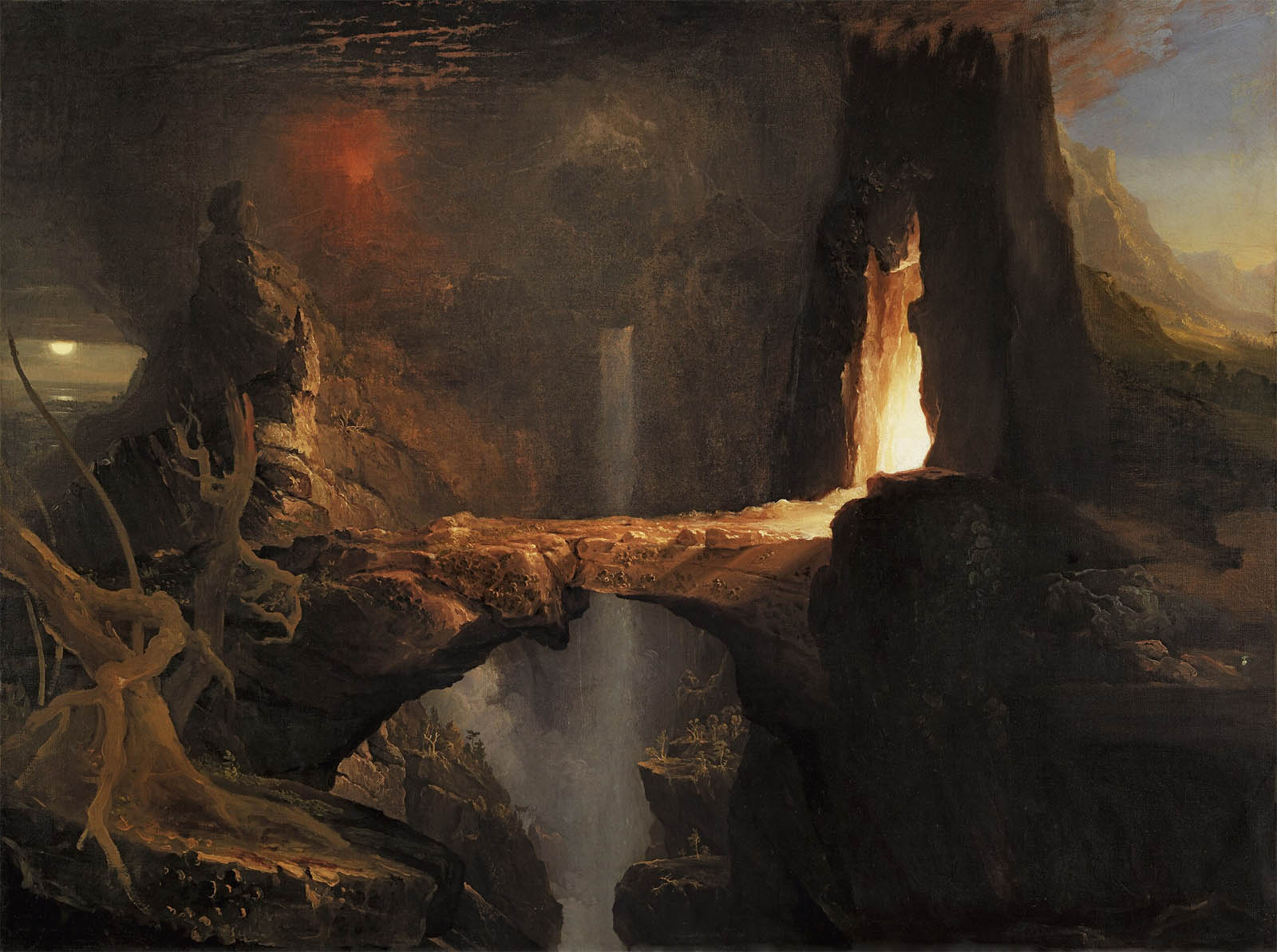
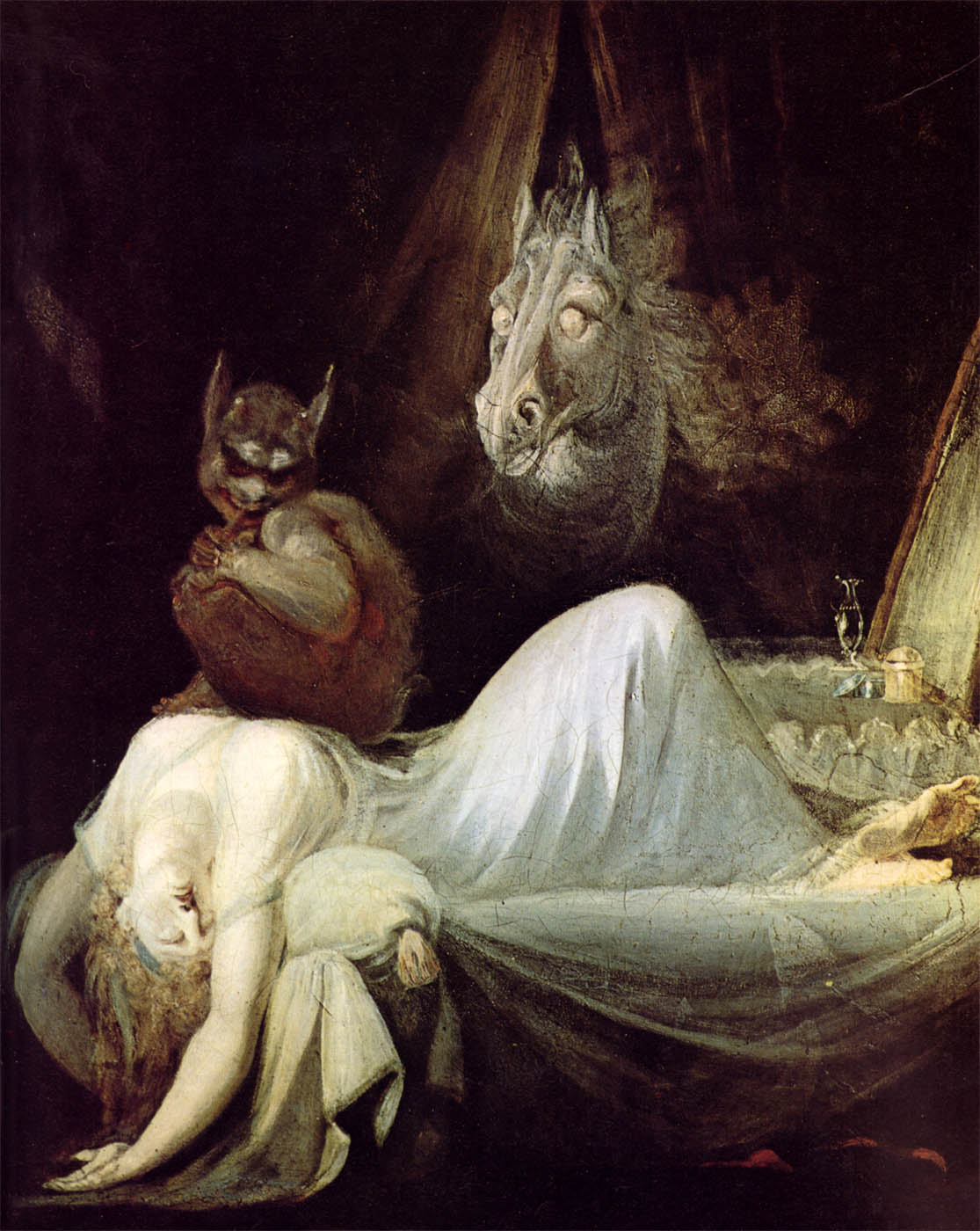
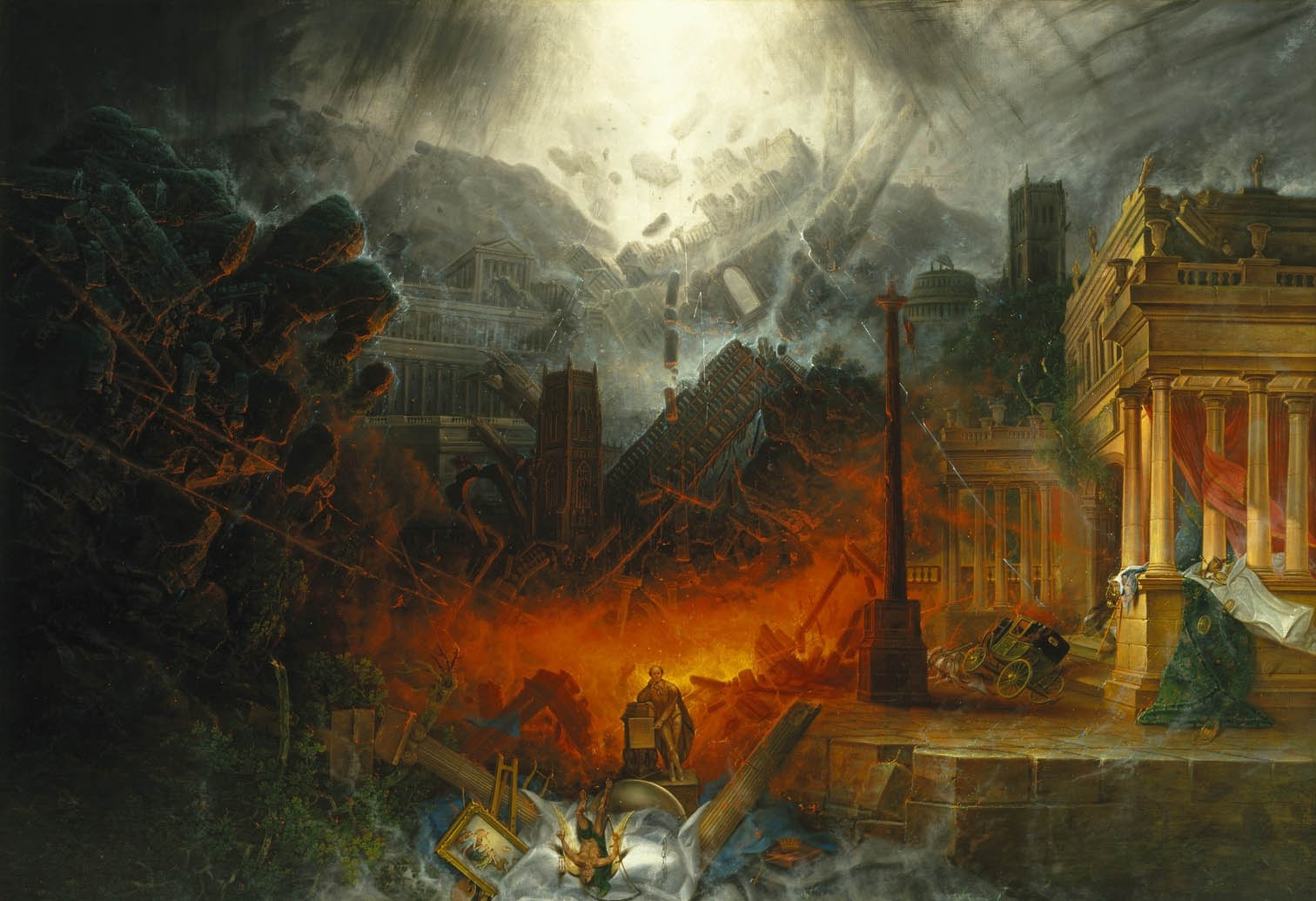
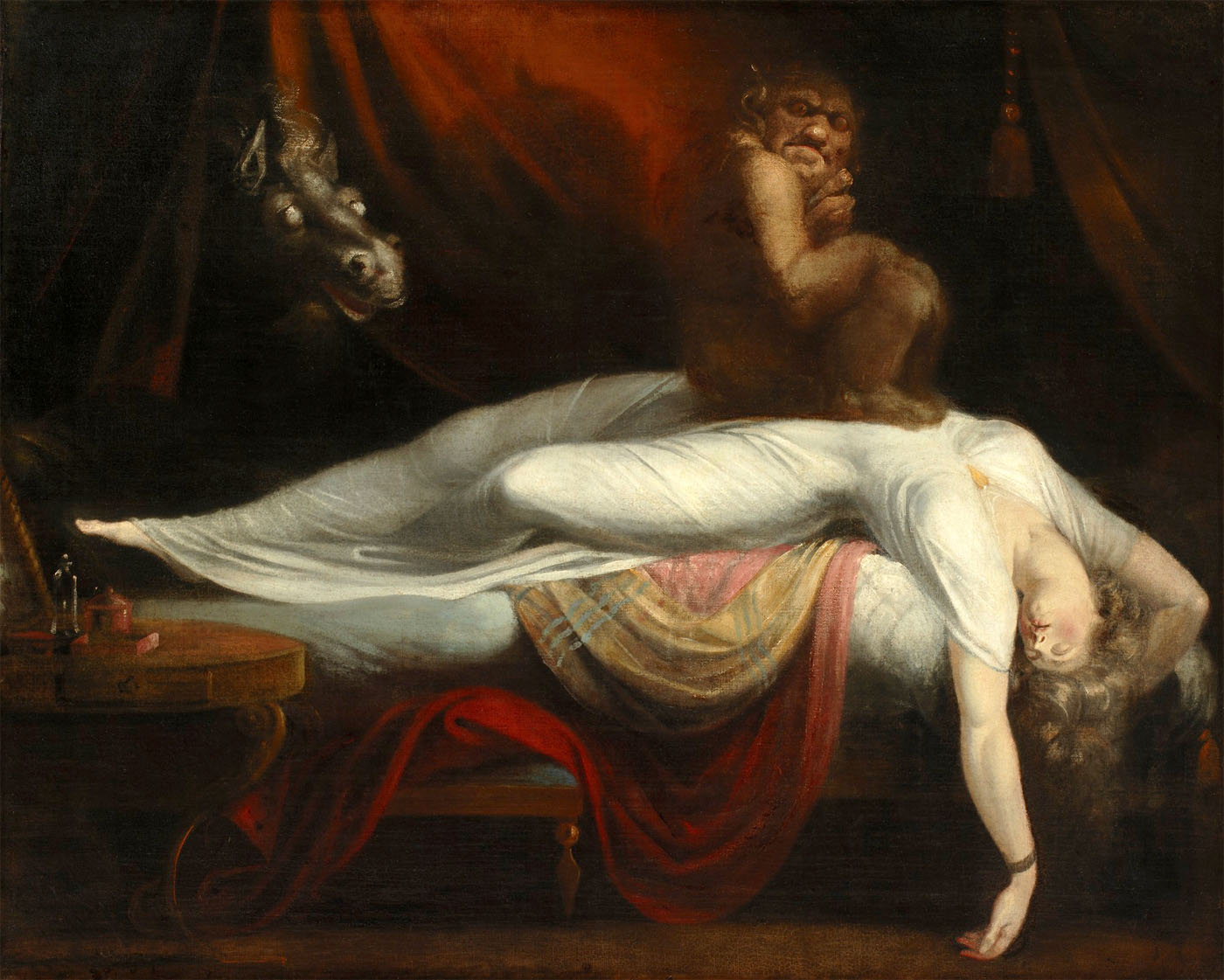
Installation views of the exhibition Dark Romanticism. From Goya to Max Ernst at the Städel Museum, Frankfurt showing at left in the bottom image, Thomas Cole Expulsion: Moon and Firelight (c. 1828, below); at centre, Johann Henry Fuseli The Nightmare (The Incubus) (1781-1782, below); at second right, Samuel Colman The Edge of Doom (1836-1838, below); and at right, William Blake The Great Red Dragon and the Woman Clothed with the Sun (c. 1803-1805, below) Photos: Norbert Miguletz
Thomas Cole (American born England, 1801-1848) Expulsion: Moon and Firelight c. 1828 Oil on canvas 91.4 x 122cm (36.0 in x 48.0 in) Thyssen-Bornemisza Museum, Madrid
Johann Henry Fuseli (Swiss, 1741-1825) The Nightmare (The Incubus) 1781-1782 Oil on canvas 77cm (30.3 in) x 64cm (25.1 in) Goethehaus (Frankfurt) collection
Samuel Colman (British, 1780-1845) The Edge of Doom 1836-1838 Oil on canvas 54 x 78 1/2 in. (137.2 x 199.4cm) Brooklyn Museum
William Blake (British, 1757-1827) The Great Red Dragon and the Woman Clothed with the Sun c. 1803-1805 Watercolour, graphite and incised lines 43.7 x 34.8cm Brooklyn Museum, Gift of William Augustus White
Installation view of the exhibition Dark Romanticism. From Goya to Max Ernst at the Städel Museum, Frankfurt showing Paul Delaroche’s The Wife of the Artist, Louise Vernet, on her Death Bed (1845, below) Photo: Norbert Miguletz
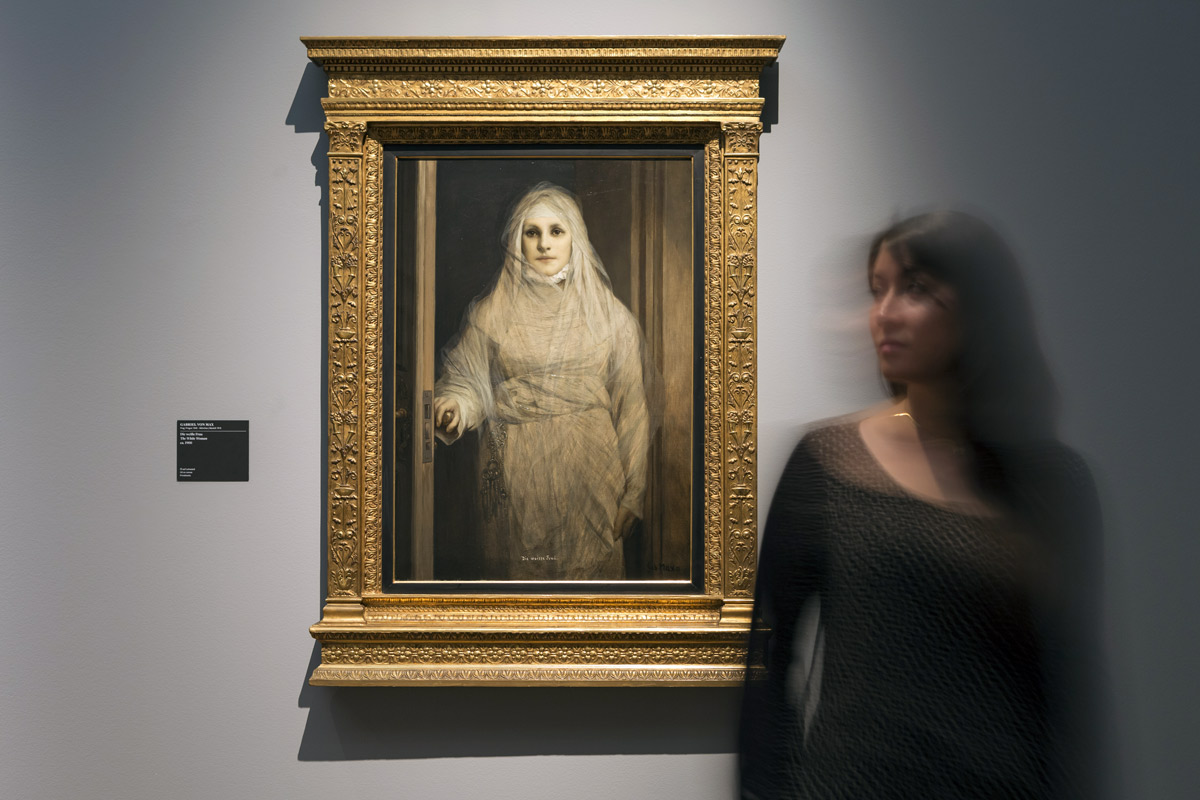
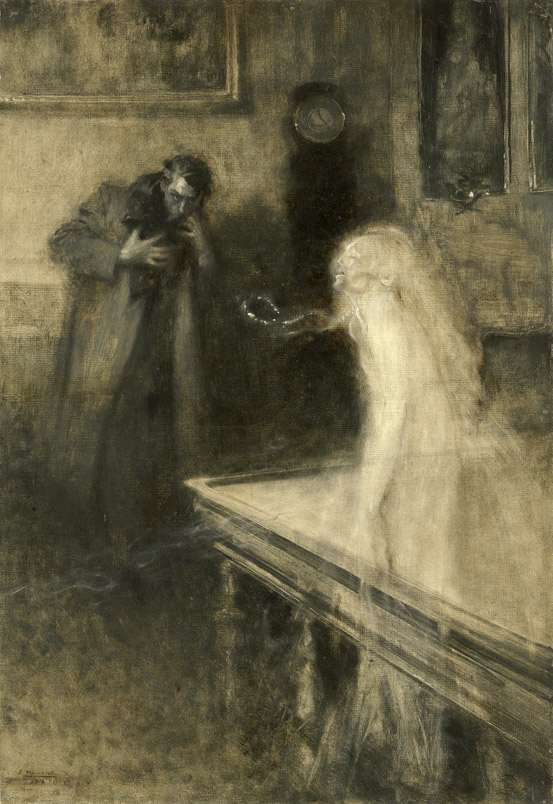
Installation view of the exhibition Dark Romanticism. From Goya to Max Ernst at the Städel Museum, Frankfurt showing Gabriel von Max’s The White Woman (1900, below) Photo: Norbert Miguletz
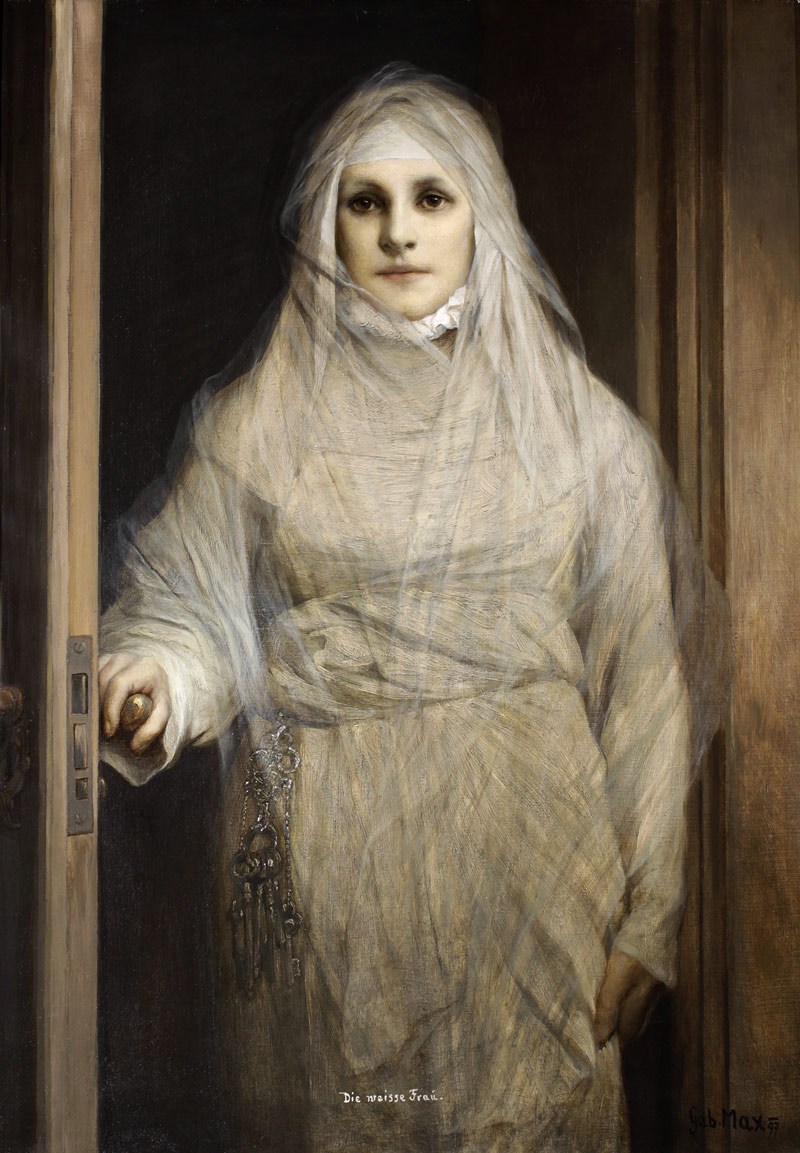
Gabriel von Max (Austrian, 1840-1915) The White Woman 1900 Oil on canvas 100 x 72cm Private Collection
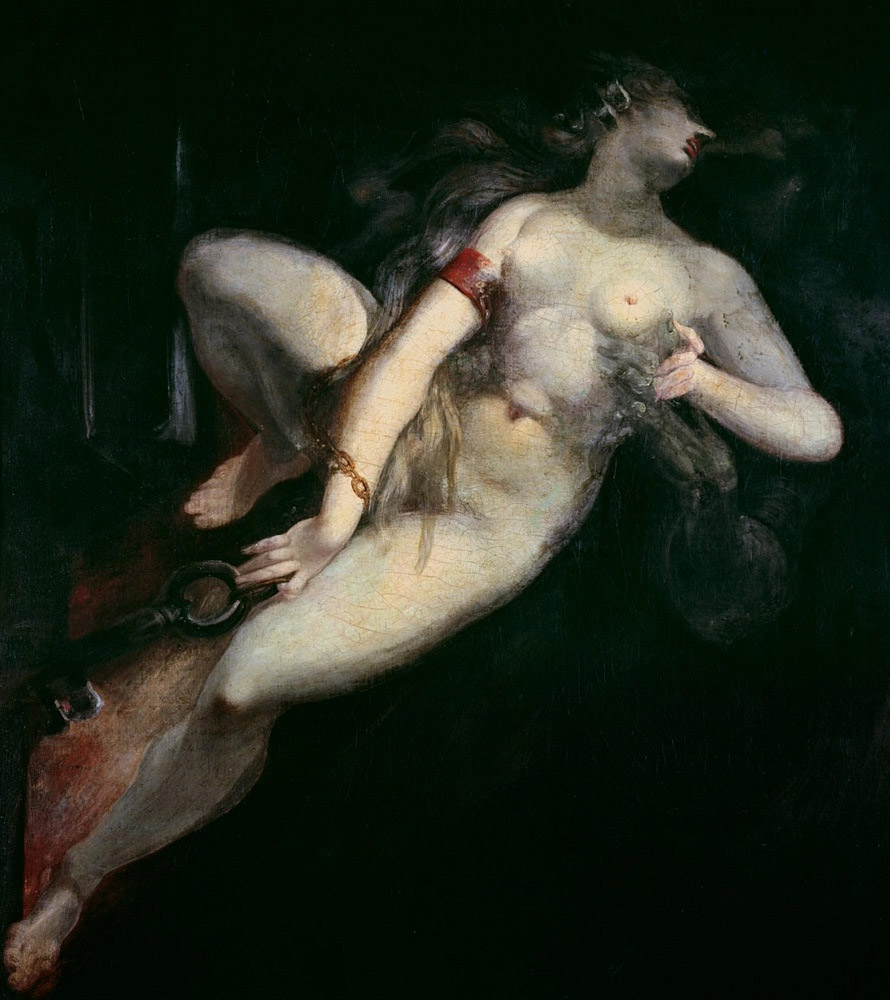
Johann Henry Fuseli (Swiss, 1741-1825) Sin Pursued by Death 1794-1796 Oil on canvas Kunsthaus, Zürich
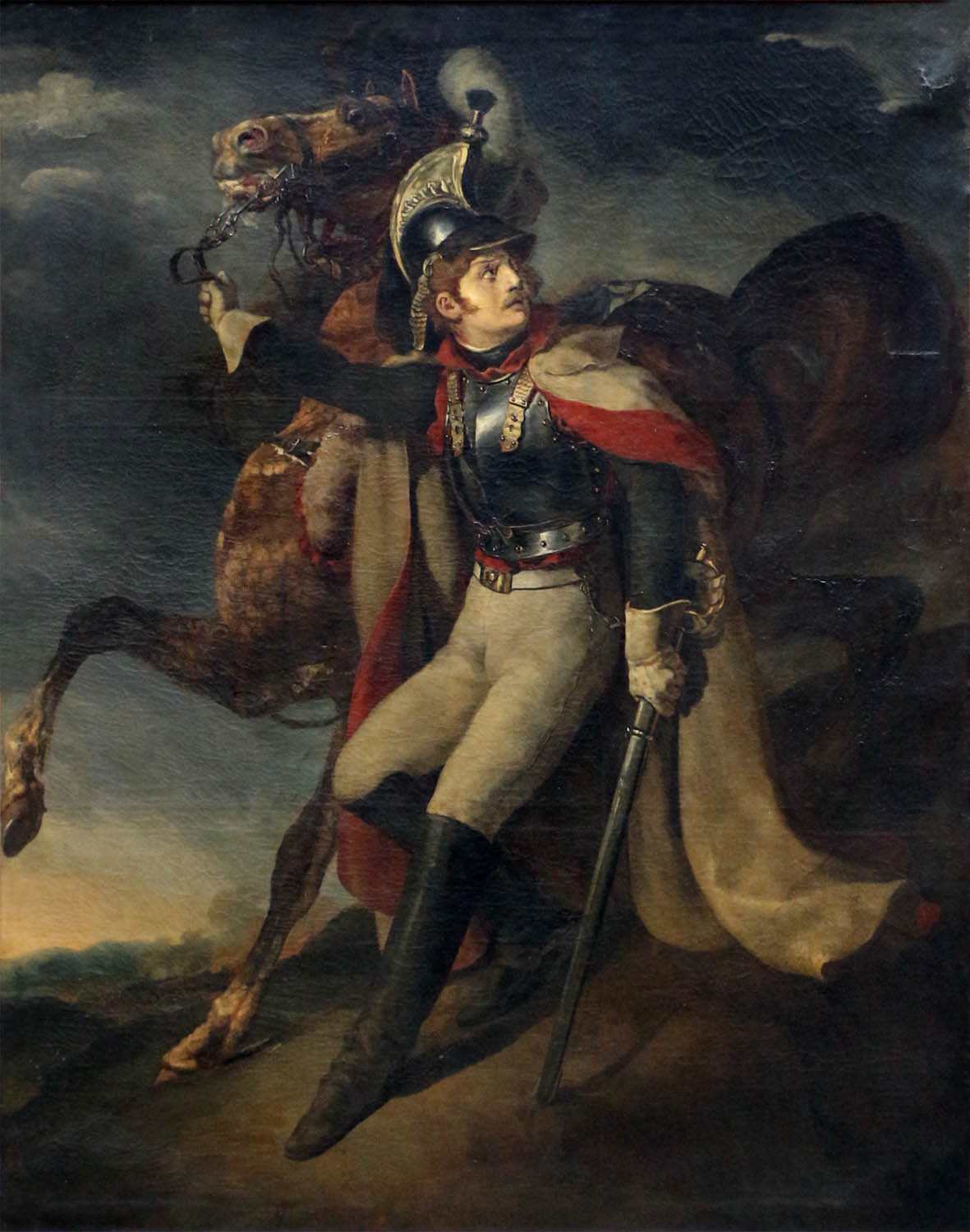
Théodore Géricault (French, 1791–1824) Cuirassier blessé quittant le feu / The Wounded Cuirassier 1814 Oil on canvas 358cm (11.7 ft) x 294cm (115.7 in) Louvre Museum
The Wounded Cuirassier (French: Le Cuirassier blessé quittant le feu) is an oil painting of a single anonymous soldier descending a slope with his nervous horse by the French Romantic painter and lithographer Théodore Géricault (1791–1824). In this 1814 Salon entry, Géricault decided to turn away from scenes of heroism in favour of a subject that is on the losing side of the battle. On display in the aftermath of France’s disastrous military campaign in Russia, this life-size painting captured the feeling of a nation in defeat. There are no visible wounds on the figure, and the title has sometimes been interpreted to refer to soldier’s injured pride. The painting stood in stark contrast with Géricault’s Charging Chasseur, as it didn’t focus on glory or the spectacle of battle. Only his Signboard of a Hoofsmith, which is currently in a private collection, bears any resemblance in form or function to this painting.
The final salon version of The Wounded Cuirassier is at the Musée du Louvre and the smaller, study version, is located at the Brooklyn Museum.
Caspar David Friedrich (German, 1774-1840) Kügelgen’s Tomb 1821-1822 Oil on canvas 41.5 x 55.5cm Die Lübecker Museen, Museum Behnhaus Drägerhaus, on loan from private collection
Ernst Ferdinand Oehme (German, 1797-1855) Procession in the Fog 1828 Oil on canvas 81.5 x 105.5cm Galerie Neue Meister, Staatliche Kunstsammlungen Dresden
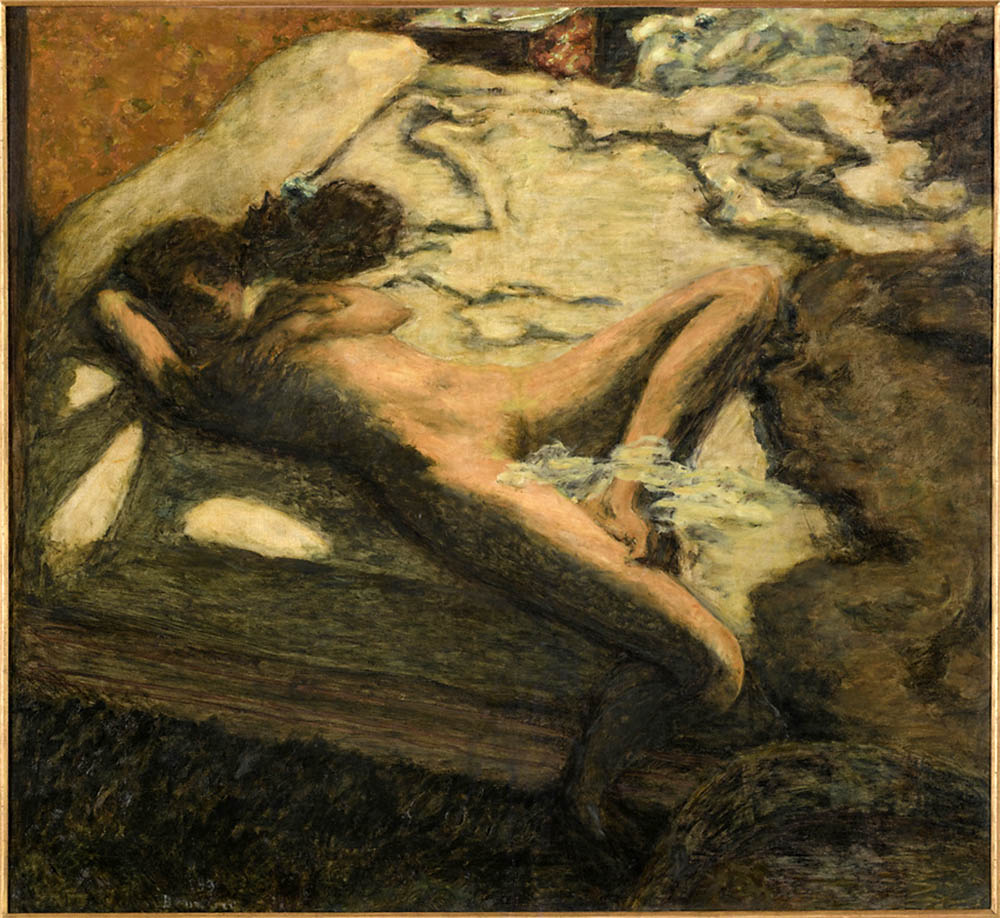
A veritable hymn to voluptuousness, The Indolent Woman is a painting which relies on contrasts: the title already clashes with the young woman’s posture. Her body with its tense muscles – the left foot is literally hooked on to the right thigh – belies any idea of rest or laziness. Similarly, the modest gesture of the arm across the breasts is contradicted by the spread thighs. Sinuous lines run throughout the composition, materialised by the dark shadows on the sheets still bearing the undulating line of the bodies and the heavy jumble of the bedclothes. The electric blue “smoke” drifting across the woman’s thigh and ankle and the sumptuous dark hair spread across the bed accentuate the painting’s erotic charge.
This woman spread out for all to see after lovemaking is the epitome of unveiled intimacy, violent, passionate and sombre and, in the end, very “fin de siècle”. We are also struck by the modernity of the composition seen from above, with its monumental bed which seems to tip towards the viewer. The woman’s body, gnawed by shadows, has a tonic vibrant texture which gives it a strong timeless presence.
This is a crucial work in Bonnard’s career because it is one of the first nudes he painted, previously showing little interest in the theme. It can be compared with two other canvases from the same period: Blue Nude from the Kaganovitch collection and Man and Woman.
After seeing this painting, the famous art dealer and publisher Ambroise Vollard asked Bonnard to illustrate a collection of Paul Verlaine’s poetry, Parallèlement, which was published in 1900.
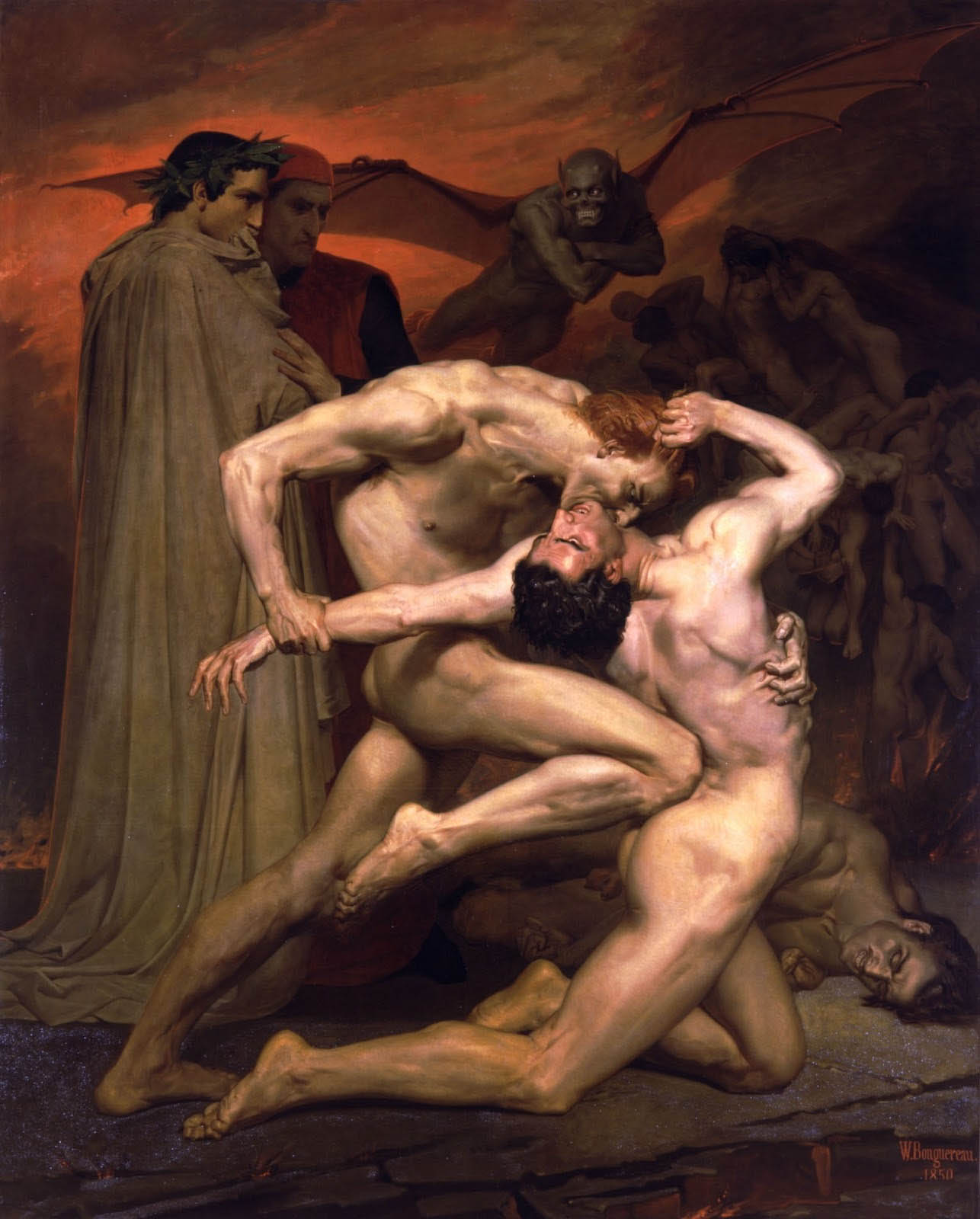
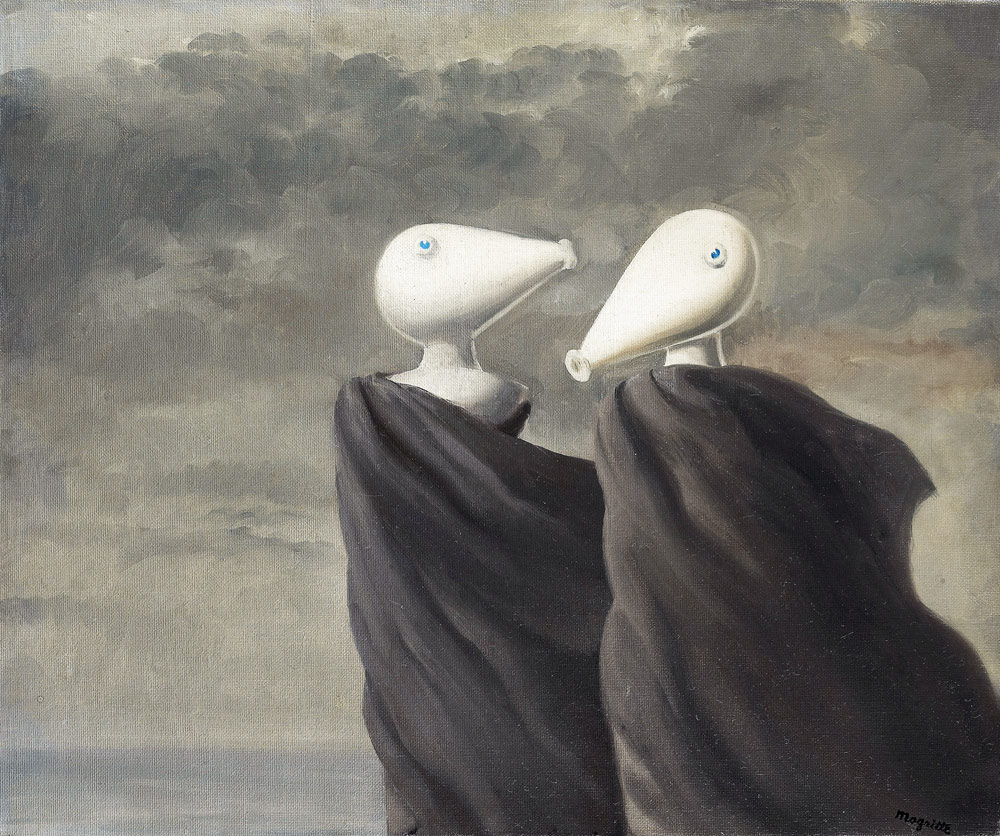
The Städel Museum’s major special exhibition Dark Romanticism. From Goya to Max Ernst will be on view from September 26th, 2012 until January 20th, 2013. It is the first German exhibition to focus on the dark aspect of Romanticism and its legacy, mainly evident in Symbolism and Surrealism. In the museum’s exhibition house this important exhibition, comprising over 200 paintings, sculptures, graphic works, photographs and films, will present the fascination that many artists felt for the gloomy, the secretive and the evil. Using outstanding works in the museum’s collection on the subject by Francisco de Goya, Eugène Delacroix, Franz von Stuck or Max Ernst as a starting point, the exhibition is also presenting important loans from internationally renowned collections, such as the Musée d’Orsay, the Musée du Louvre, both in Paris, the Museo del Prado in Madrid and the Art Institute of Chicago. The works on display by Goya, Johann Heinrich Fuseli and William Blake, Théodore Géricault and Delacroix, as well as Caspar David Friedrich, convey a Romantic spirit which by the end of the 18th century had taken hold all over Europe. In the 20th century artists such as Salvador Dalí, René Magritte or Paul Klee and Max Ernst continued to think in this vein. The art works speak of loneliness and melancholy, passion and death, of the fascination with horror and the irrationality of dreams. After Frankfurt the exhibition, conceived by the Städel Museum, will travel to the Musée d’Orsay in Paris.
The exhibition’s take on the subject is geographically and chronologically comprehensive, thereby shedding light on the links between different centres of Romanticism, and thus retracing complex iconographic developments of the time. It is conceived to stimulate interest in the sombre aspects of Romanticism and to expand understanding of this movement. Many of the artistic developments and positions presented here emerge from a shattered trust in enlightened and progressive thought, which took hold soon after the French Revolution – initially celebrated as the dawn of a new age – at the end of the 18th century. Bloodstained terror and war brought suffering and eventually caused the social order in large parts of Europe to break down. The disillusionment was as great as the original enthusiasm when the dark aspects of the Enlightenment were revealed in all their harshness. Young literary figures and artists turned to the reverse side of Reason. The horrific, the miraculous and the grotesque challenged the supremacy of the beautiful and the immaculate. The appeal of legends and fairy tales and the fascination with the Middle Ages competed with the ideal of Antiquity. The local countryside became increasingly attractive and was a favoured subject for artists. The bright light of day encountered the fog and mysterious darkness of the night.
The exhibition is divided into seven chapters. It begins with a group of outstanding works by Johann Heinrich Fuseli. The artist had initially studied to be an evangelical preacher in Switzerland. With his painting The Nightmare (Frankfurt Goethe-Museum) he created an icon of dark Romanticism. This work opens the presentation, which extends over two levels of the temporary exhibition space. Fuseli’s contemporaries were deeply disturbed by the presence of the incubus (daemon) and the lecherous horse – elements of popular superstition – enriching a scene set in the present. In addition, the erotic-compulsive and daemonic content, as well as the depressed atmosphere, catered to the needs of the voyeur. The other six works by Fuseli – loans from the Kunsthaus Zürich, the Royal Academy London and the Staatsgalerie Stuttgart – represent the characteristics of his art: the competition between good and evil, suffering and lust, light and darkness. Fuseli’s innovative pictorial language influenced a number of artists – among them William Blake, whose famous water colour The Great Red Dragon from the Brooklyn Museum will be on view in Europe for the first time in ten years.
The second room of the exhibition is dedicated to the Spanish artist Francisco de Goya. The Städel will display six of his works – including masterpieces such as The Witches’ Flight from the Prado in Madrid and the representations of cannibals from Besançon. A large group of works on paper from the Städel’s own collection will be shown, too. The Spaniard blurs the distinction between the real and the imaginary. Perpetrator and victim repeatedly exchange roles. Good and evil, sense and nonsense – much remains enigmatic. Goya’s cryptic pictorial worlds influenced numerous artists in France and Belgium, including Delacroix, Géricault, Victor Hugo and Antoine Wiertz, whose works will be presented in the following room. Atmosphere and passion were more important to these artists than anatomical accuracy.
Among the German artists – who are the focus of the next section of the exhibition – it is Carl Blechen who is especially close to Goya and Delacroix. His paintings are a testimony to his lust for gloom. His soft spot for the controversial author E. T. A. Hoffmann – also known as “Ghost-Hoffmann” in Germany – led Blechen to paint works such as Pater Medardus (Alte Nationalgalerie, Berlin) – a portrait of the mad protagonist in The Devil’s Elixirs. The artist was not alone in Germany when it came to a penchant for dark and disturbing subjects. Caspar David Friedrich’s works, too, contain gruesome elements: cemeteries, open graves, abandoned ruins, ships steered by an invisible hand, lonely gorges and forests are pervasive in his oeuvre. One does not only need to look at the scenes of mourning in the sketchbook at the Kunsthalle Mannheim for the omnipresent theme of death. Friedrich is prominently represented in the exhibition with his paintings Moon Behind Clouds above the Seashore from the Hamburger Kunsthalle and Kügelgen’s Grave from the Lübecker Museums, as well as with one of his last privately owned works, Ship at Deep Sea with full Sails.
Friedrich’s paintings are steeped in oppressive silence. This uncompromising attitude anticipates the ideas of Symbolism, which will be considered in the next chapter of the exhibition. These ‘Neo-Romantics’ stylised speechlessness as the ideal mode of human communication, which would lead to fundamental and seminal insights. Odilon Redon’s masterpiece Closed Eyes, a loan from the Musée d’Orsay in Paris, impressively encapsulates this notion. Paintings by Arnold Böcklin, James Ensor, Fernand Khnopff or Edvard Munch also embody this idea. However, as with the Romantics, these restrained works are face to face with works where anxiety and repressed passions are brought unrestrainedly to the surface; works that are unsettling in their radicalism even today. While Gustave Moreau, Max Klinger, Franz von Stuck and Alfred Kubin belong to the art historical canon, here the exhibition presents artists who are still to be discovered in Germany: Jean-Joseph Carriès, Paul Dardé, Jean Delville, Julien-Adolphe Duvocelle, Léon Frédéric, Eugène Laermans and Lucien Lévy-Dhurmer.
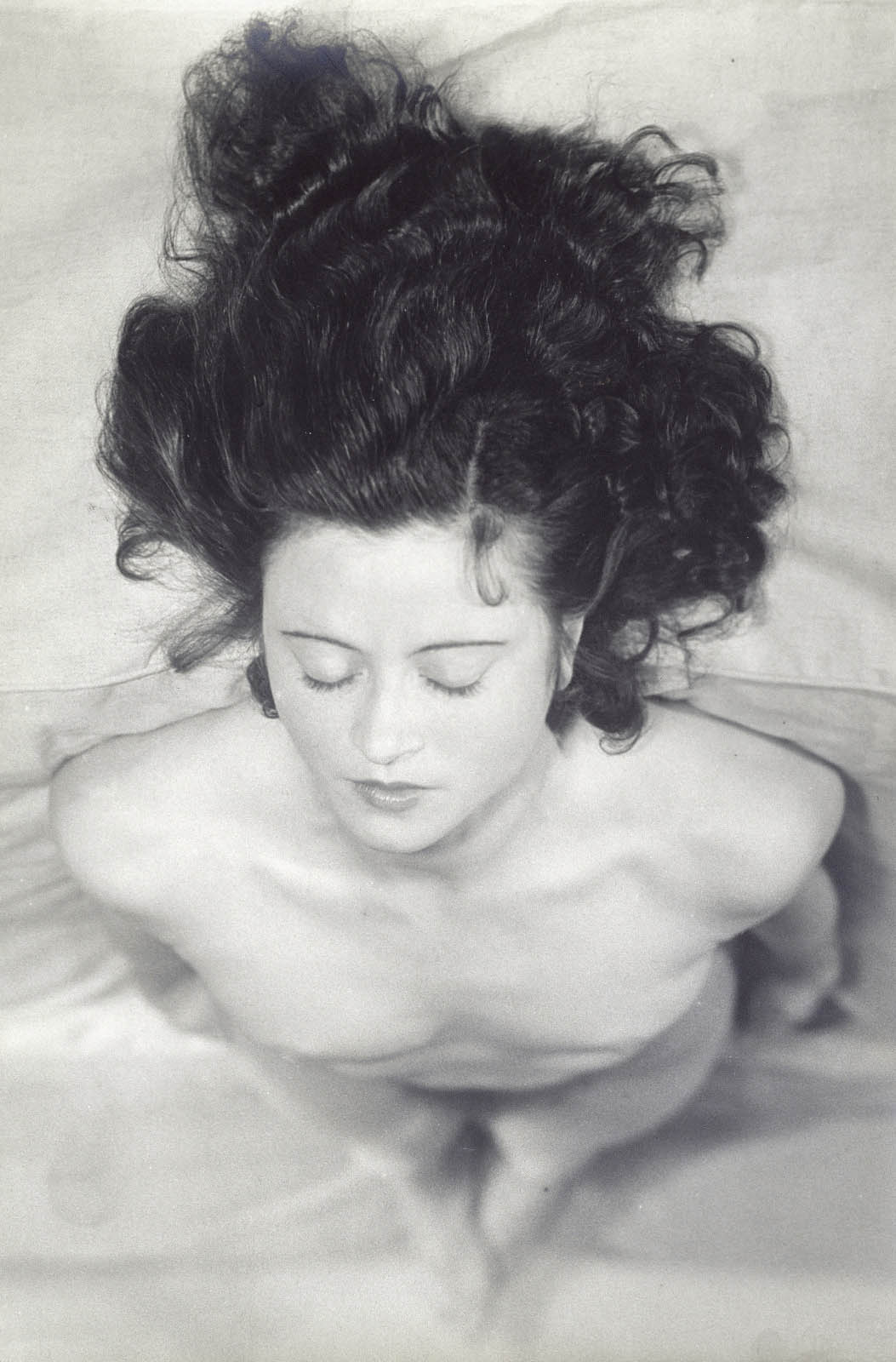
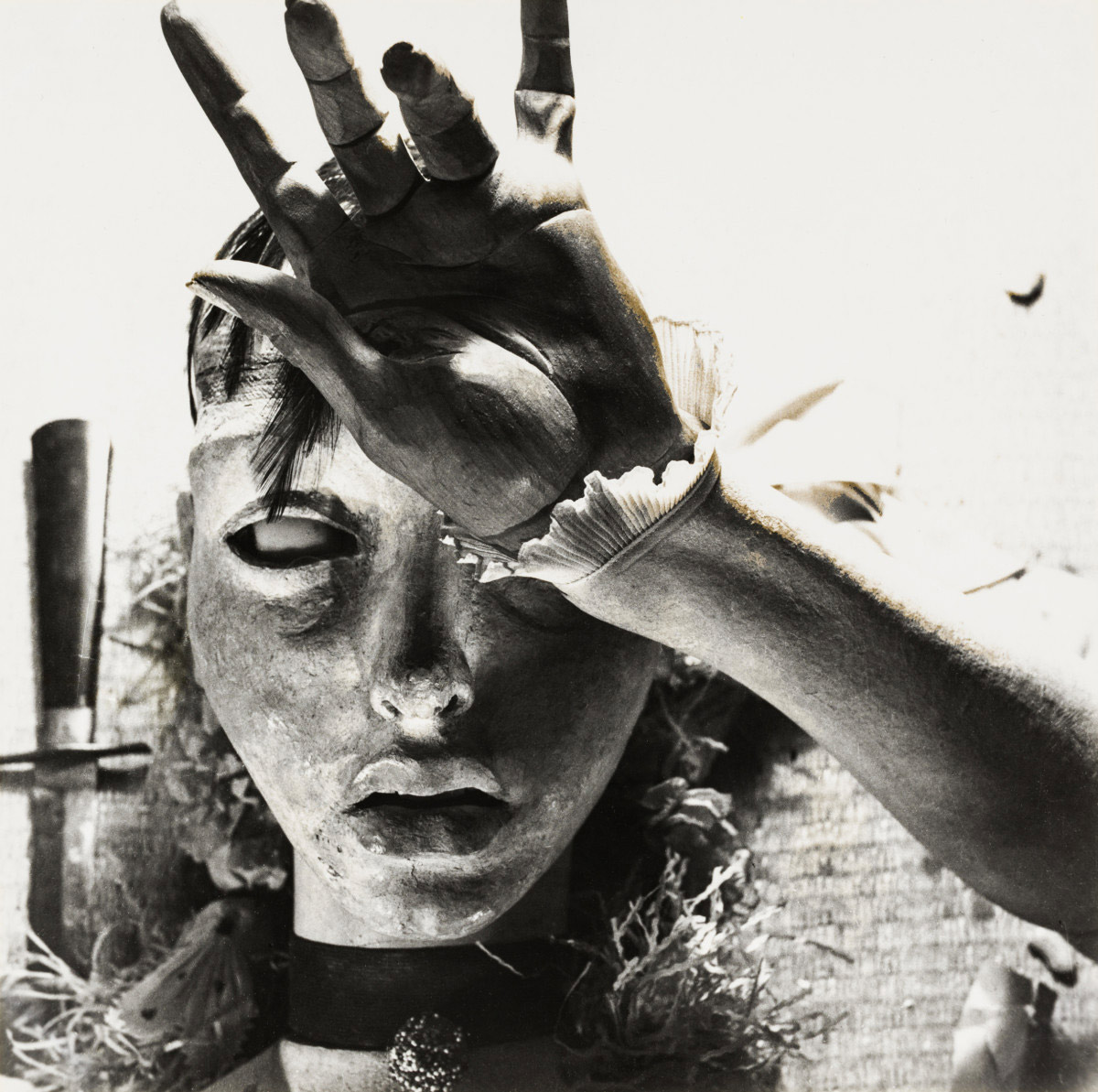
The presentation concludes with the Surrealist movement, founded by André Breton. He inspired artists such as Ernst, Brassaϊ or Dalí, to create their wondrous pictorial realms from the reservoir of the subconscious and celebrated them as fantasy’s victory over the “factual world”. Max Ernst vehemently called for “the borders between the so-called inner and outer world” to be blurred. He demonstrated this most clearly in his forest paintings, four of which have been assembled for this exhibition, one of them the major work Vision Provoked by the Nocturnal Aspect of the Porte Saint-Denis (private collection). The art historian Carl Einstein considered the Surrealists to be the Romantics’ successors and coined the phrase ‘the Romantic generation’. In spite of this historical link the Surrealists were far from retrospective. On the contrary: no other movement was so open to new media; photography and film were seen as equal to traditional media. Alongside literature, film established itself as the main arena for dark Romanticism in the 20th century. This is where evil, the thrill of fear and the lust for horror and gloom found a new home. In cooperation with the Deutsches Filmmuseum the Städel will for the first time present extracts from classics such as Frankenstein (1931), Dracula (1931), Faust (1926), Vampyr (1931-32) and The Phantom Carriage (1921) within an exhibition.
The exhibition, which presents the Romantic as a mindset that prevailed throughout Europe and remained influential beyond the 19th century, is accompanied by a substantial catalogue. As is true for any designation of an epoch, Romanticism too is nothing more than an auxiliary construction, defined less by the exterior characteristics of an artwork than by the inner sentiment of the artist. The term “dark Romanticism” cannot be traced to its origins, but – as is also valid for Romanticism per se – comes from literary studies. The German term is closely linked to the professor of English Studies Mario Praz and his publication La carne, la morte e il diavolo nella letteratura romantica of 1930, which was published in German in 1963 as Liebe, Tod und Teufel. Die schwarze Romantik (literally: Love, Death and Devil. Dark Romanticism).
Witches’ Flight (Spanish: Vuelo de Brujas, also known as Witches in Flight or Witches in the Air) is an oil-on-canvas painting completed in 1798 by the Spanish painter Francisco Goya. It was part of a series of six paintings related to witchcraft acquired by the Duke and Duchess of Osuna in 1798. It has been described as “the most beautiful and powerful of Goya’s Osuna witch paintings.” …
At center point are three semi-nude witches wearing penitential coroza bearing aloft a writhing nude figure, their mouths close to their victim, as if to devour him or suck his blood. Below, two figures in peasants’ garb recoil from the spectacle: one has thrown himself to the ground covering his ears, the other attempts to escape by covering himself with a blanket, making the fig hand gesture to ward off the evil eye. Finally, a donkey emerges on the right, seemingly oblivious to the rest of the scene.
The general scholarly consensus is that the painting represents a rationalist critique of superstition and ignorance, particularly in religious matters: the witches’ corozas are not only emblematic of the violence of the Spanish Inquisition (the upward flames indicate that they have been condemned as unrepentant heretics and will be burned at the stake), but are also reminiscent of episcopal mitres, bearing the characteristic double points. The accusations of religious tribunals are thus reflected back on themselves, whose actions are implicitly equated with superstition and ritualised sacrifice. The bystanders can then be understood either as appalled but unable to do anything or wilfully ignorant and unwilling to intervene.
The donkey, finally, is the traditional symbol of ignorance.
Francisco de Goya (Spanish, 1746-1828) Flying Folly (Disparate Volante) From “The proverbs (Los proverbios)”, plate 5, 1816-1819, 1 Edition, 1864 Etching and aquatint 21.7 x 32.6cm Städel Museum, Frankfurt am Main
“I am not afraid of witches, goblins, apparitions, boastful giants, evil spirits, leprechauns, etc., nor of any other kind of creatures except human beings.”
Francisco Goya
An enthusiastic champion of Enlightenment values, Goya was also on close terms with the progressive nobility, but his doubts and disillusionment increased as the French Revolution was succeeded by the Terror, and Europe was torn apart by warring armies.
The deceptively clear distinction between enlightenment and obscurantism was now supplanted by the vision of a new, grey, frightening and uncertain world, in which no sharp line could be drawn between good and evil, reality and fantasy, reason and absurdity, the beliefs of the past and the revolutionary fervour of the present.
But instead of living in the past or doing nothing, Goya swapped his court painter’s brush for the etcher’s unsparing needle. Black in all its shades was the keynote of the many series of engravings he now produced on freely chosen themes, with only the Inquisition’s censors to contend with.
The Caprices, a series produced at the end of the 18th century, reflects his amazement and exasperation at the imaginative wealth of Spanish popular culture, steeped in the superstition, fanaticism and ignorance promoted by the Jesuits.
Ten years later, the atrocities which marked the war against Napoleon inspired The Disasters of War – a cry of outrage and horror at the barbaric excesses of the “Grande Nation” and the terrifying emptiness of a world with no God or morality.
Louis Candide Boulanger (French, 1806-1867) Les Fantômes 1829 Oil on canvas Maison de Victor Hugo
Carl Blechen (German, 1798-1840) Scaffold in Storm 1834 Oil on canvas and on board 29.5cm (11.6 in) x 46cm (18.1 in) Galerie Neue Meister
Carl Eduard Ferdinand Blechen (29 July 1798 – 23 July 1840) was a German landscape painter and a professor at the Academy of Arts, Berlin. His distinctive style was characteristic of the Romantic ideals of natural beauty.
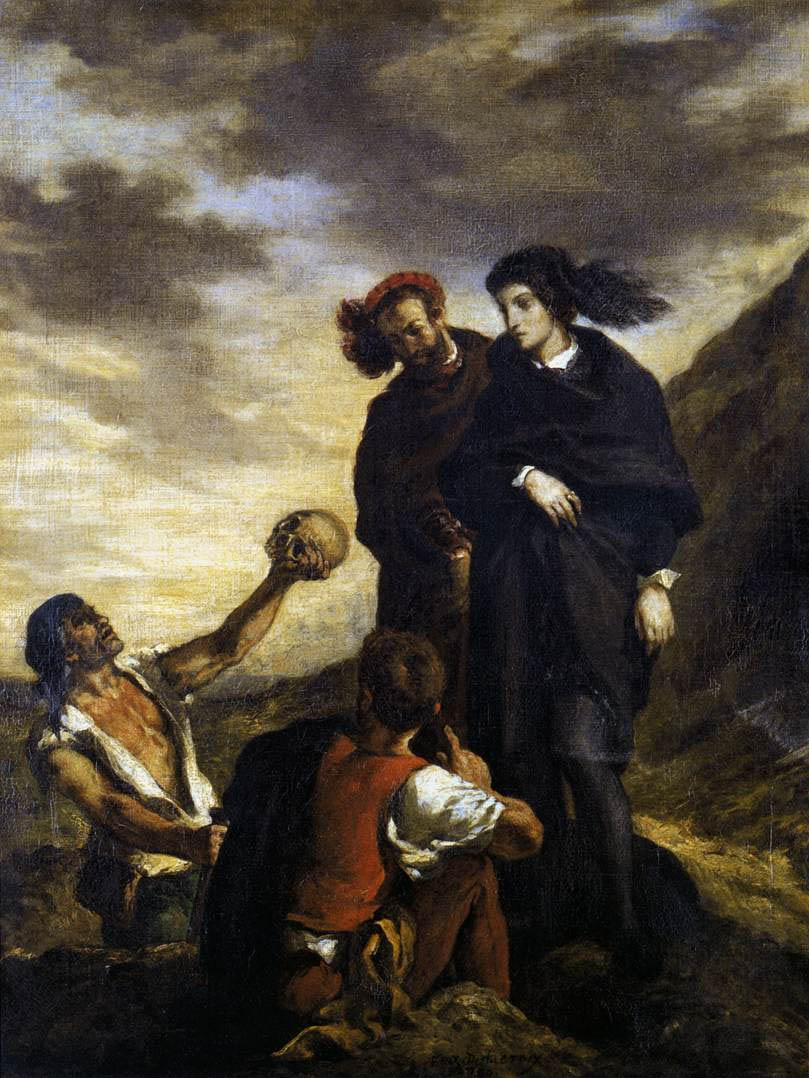
Eugène Delacroix (French, 1798-1863) Hamlet and Horatio in the Graveyard 1839 Oil on canvas 29.5cm (11.6 in) x 36cm (14.1 in) Louvre Museum
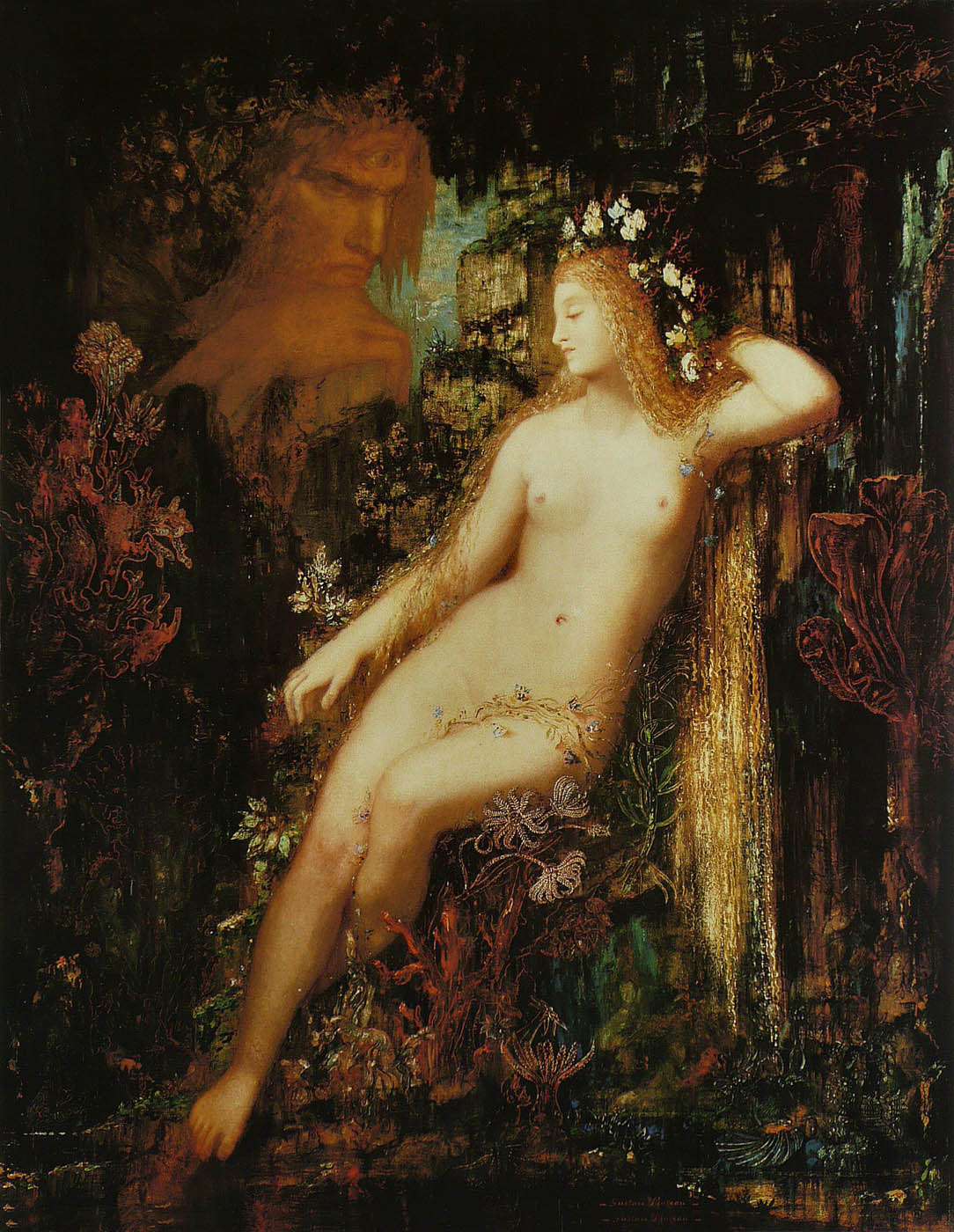
Gustave Moreau (French, 1826-1898) Galatea c. 1880 Oil on panel 85.5cm (33.6 in) x 66cm (25.9 in) Musée d’Orsay
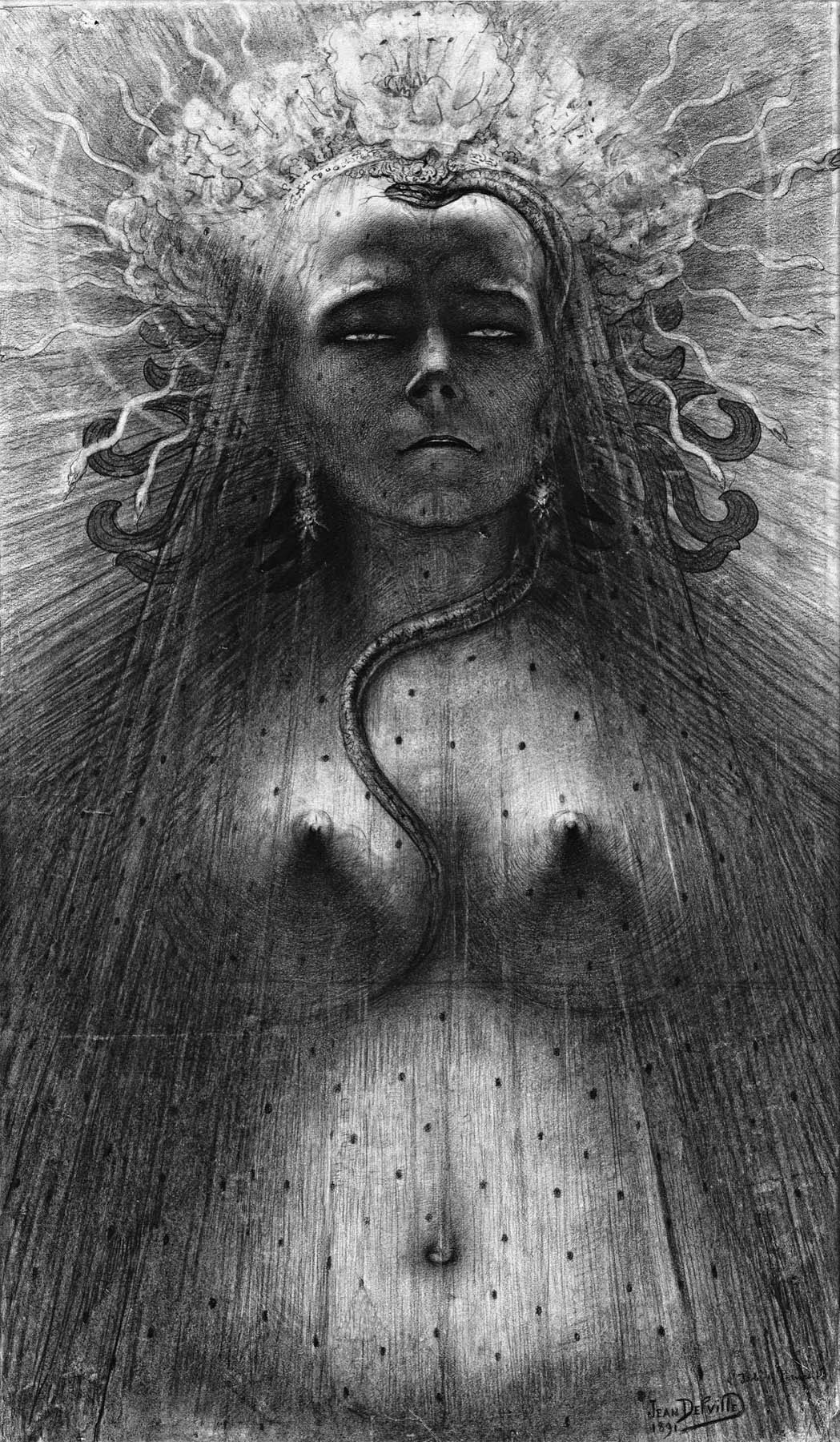
Jean Delville (Belgium, 1867-1953) L’Idole de la Perversité (The Idol of Perversity) 1891 81.5 x 48.5cm Museum Wiesbaden, Collection Ferdinand Wolfgang Neess
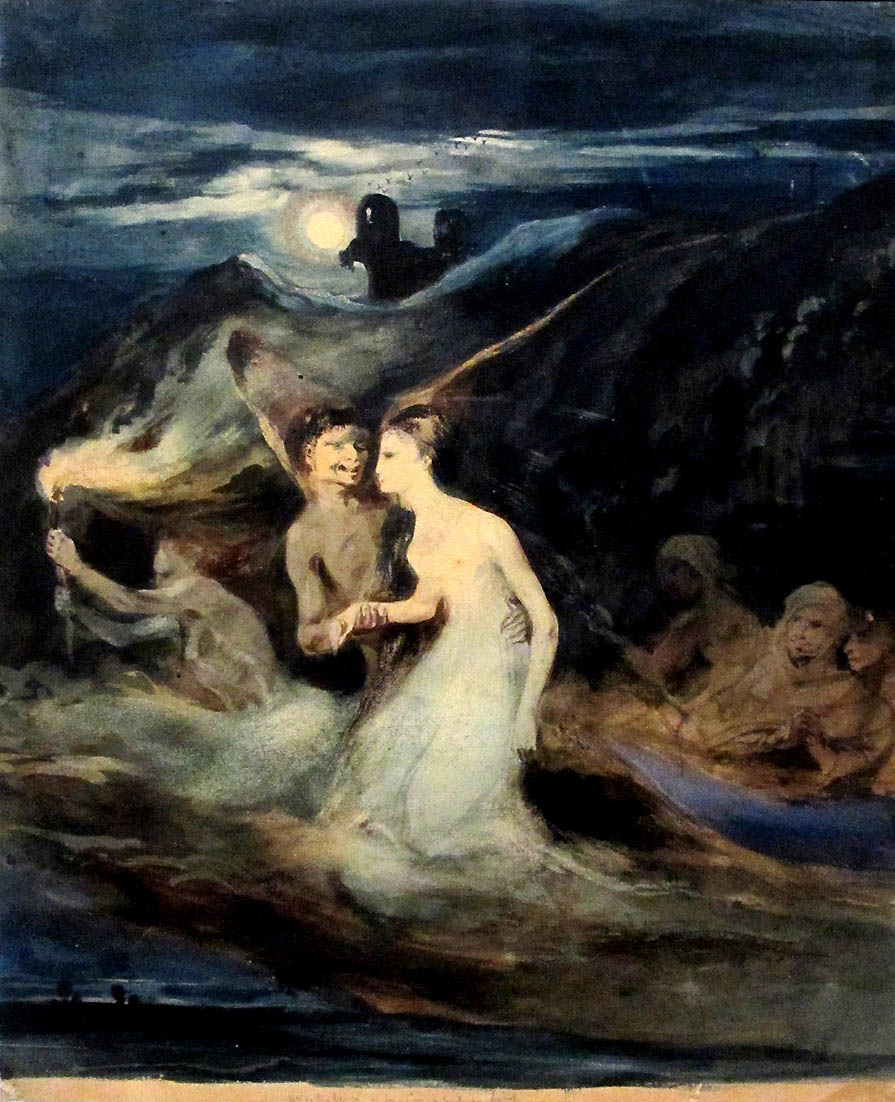
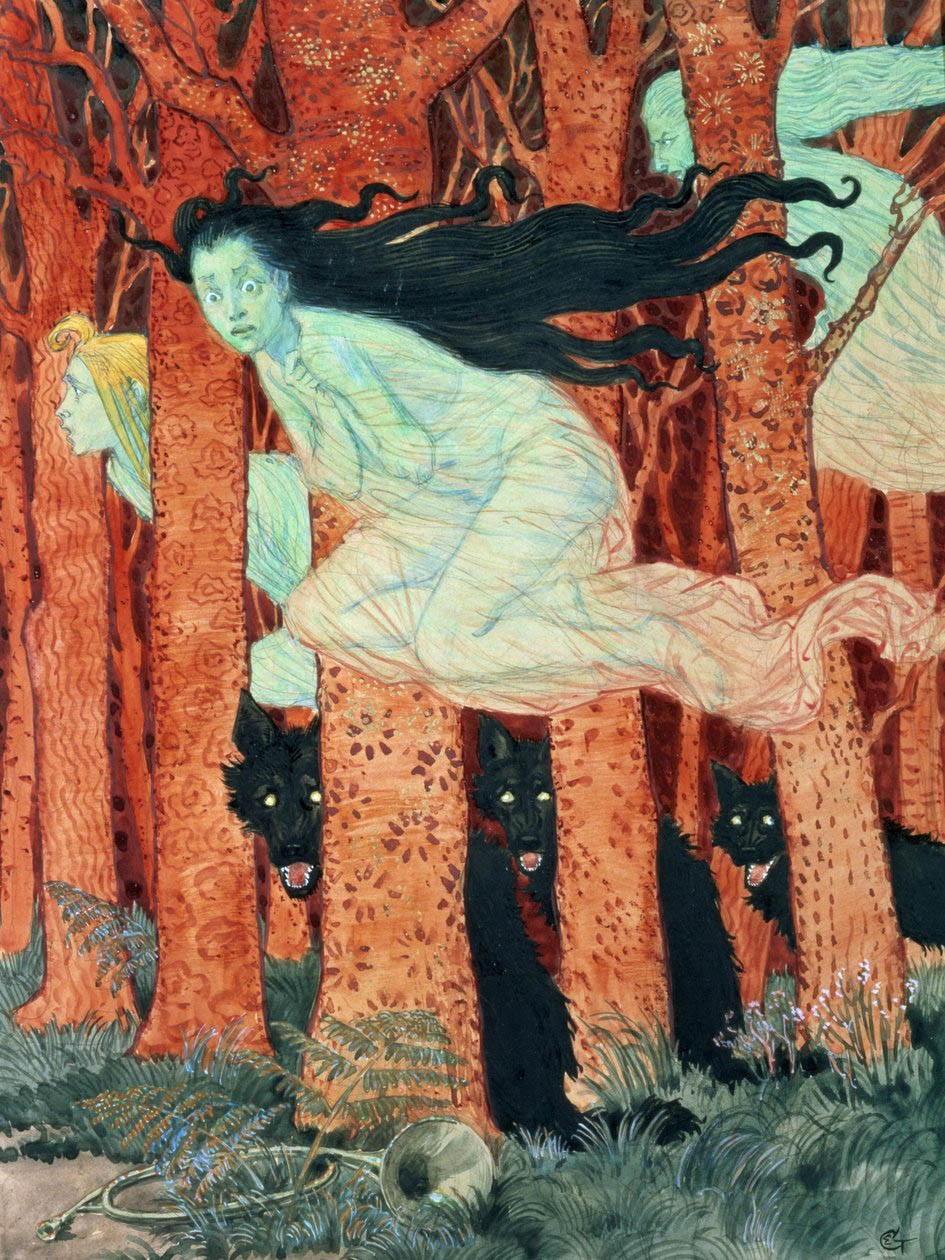
Eugène Grasset (French, 1845-1917) Trois Femmes et Trois Loups 1892 Pencil, watercolour, Indian ink and gold highlights on paper 35.3 x 27.3cm Musée des Arts Décoratifs, Paris
Franz Ritter von Stuck (February 23, 1863 – August 30, 1928), born Franz Stuck, was a German painter, sculptor, printmaker, and architect. Stuck was best known for his paintings of ancient mythology, receiving substantial critical acclaim with The Sin in 1892. In 1906, Stuck was awarded the Order of Merit of the Bavarian Crown and was henceforth known as Ritter von Stuck.
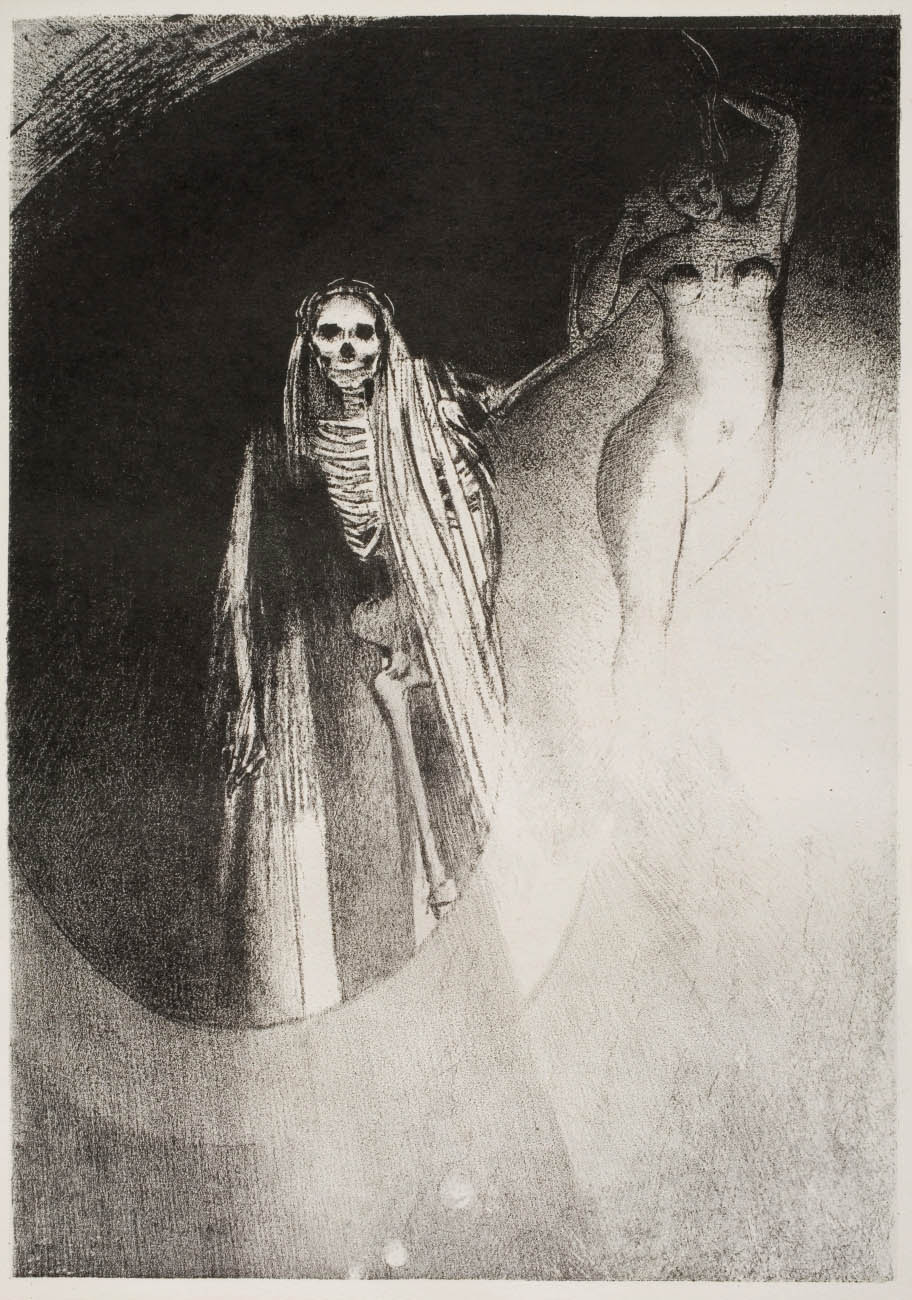
Odilon Redon (French, 1840-1916) La Mort: C’est moi qui te rends sérieuse: Enlaçons-nous (Death: It is I who Makes You Serious; Let Us Embrace) 1896 Plate 20 from the series “La Tentation de Saint-Antoine” (The Temptation of Saint Anthony) Lithograph Sheet: 17 1/8 in. x 13 in. (43.5 x 33cm)
La Mort: C’est moi qui te rends sérieuse: Enlaçons-nous is one of twenty-four prints by the French artist Odilon Redon (1840-1916) that illustrated Flaubert’s play Temptation of Saint Anthony, a lesser-known work of the literary giant but one that Flaubert laboured on painstakingly throughout his life. A contemporary to Flaubert, Redon had worked in lithography for about two decades when the final version of Temptation of Saint Anthony was published. Already working with a repertoire of dark and absurd subjects, Redon was drawn to the grotesque characters described by Flaubert and wrote fondly of the play, calling it “a literary marvel and a mine for me.”
La Mort depicts a scene in the play where Death and Lust, disguised respectively as an emaciated old woman and a fair young one, reveal their real likenesses after failed attempts to seduce Saint Anthony:
The winding-sheet flies open, and reveals the skeleton of Death. The robe bursts open, and presents to view the entire body of Lust, which has a slender figure, with an enormous development behind, and great, undulating masses of hair, disappearing towards the end.
Death tries to lead Saint Anthony to step into the abyss under the cliff and take his own life, thereby ending all pain. “It is I who make you serious, let us embrace each other,” she says, telling Saint Anthony that, by destroying himself, a work of God, he will become God’s equal.
Redon’s accomplished use of chiaroscuro, the sharp contrast between light and dark, underscores the dramatic nature of this moment. Death’s winding-sheet is enveloped by the dazzling rays of light radiating from the voluptuous body of Lust, and Lust’s hair vanishes into the darkness that seeps through Death;s skeletal body. Although the appearance of Lust differs greatly from that of Death, the overlap of their bodies suggests that they are but different phantoms created by the Devil.
Ningyi Xi. “Odilon Redon,” on the Davis Museum website 2017 [Online] Cited 11/08/2024. Used under fair use conditions for the purposes of education and research
Paul Dardé (French, 1888-1963) Eternelle douleur (Eternal Pain) 1913 Plaster, direct carving 50cm Musée de Lodève
Paul Dardé created Eternal Pain at 25, even though he had only just finished his year of training. Having gone through the Paris National School of Beaux-Arts and Rodin’s workshop, it is probably his journey to Italy and his mythological reading which fixed the theme of the Medusa in the mind of the artist. Carved from a block of plaster gleaned on the heights of Lodève, the piece would be exhibited seven years later side by side with the great Faun, at the Salon of French artists in 1920.



























 Art Blart _ art and cultural memory archive
You must be logged in to post a comment.