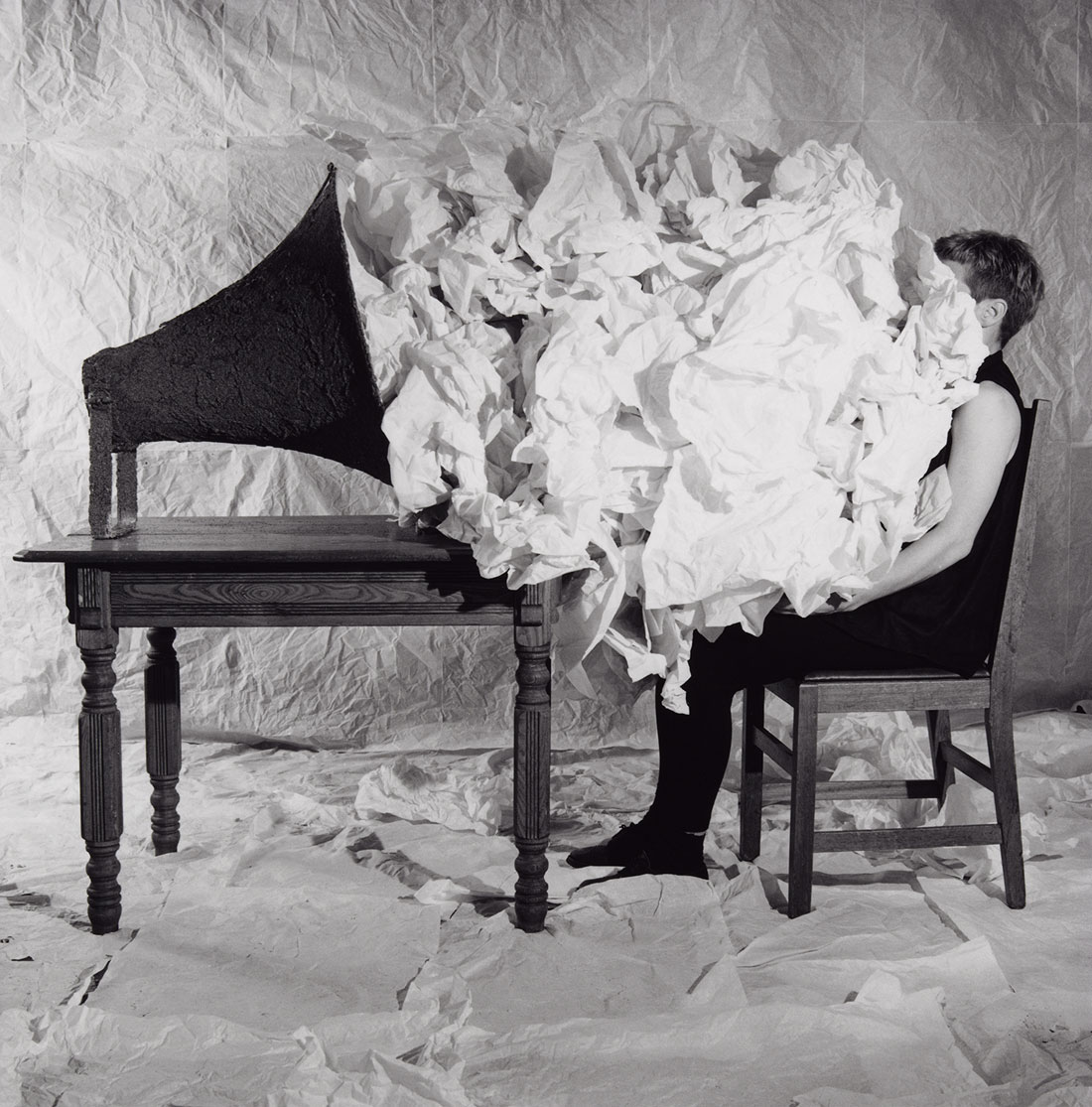
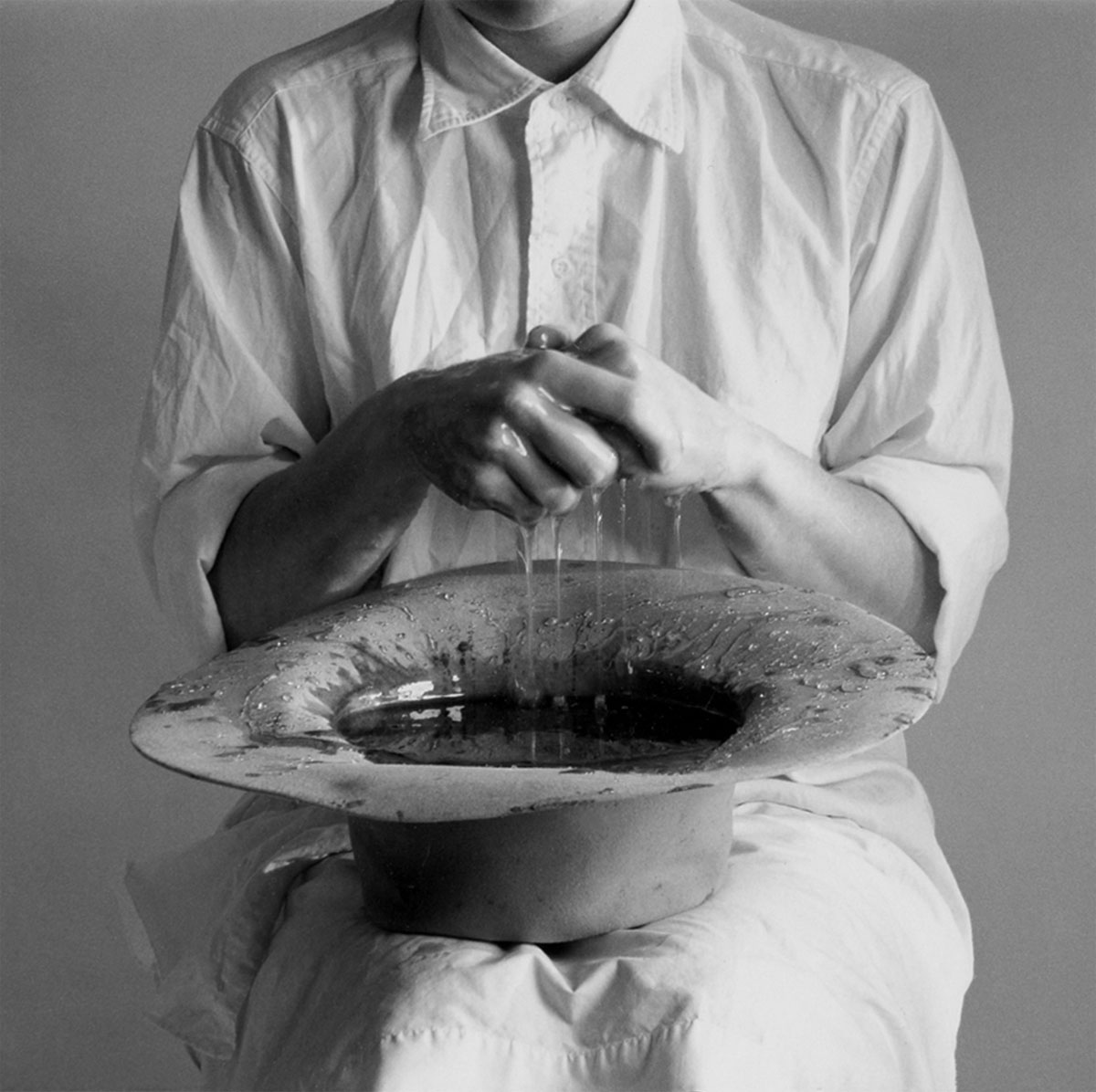
Exhibition: ‘Janina Green: Ikea’ at Edmund Pearce Gallery, Melbourne

Exhibition dates: 28th November 28 – 15th December 2012


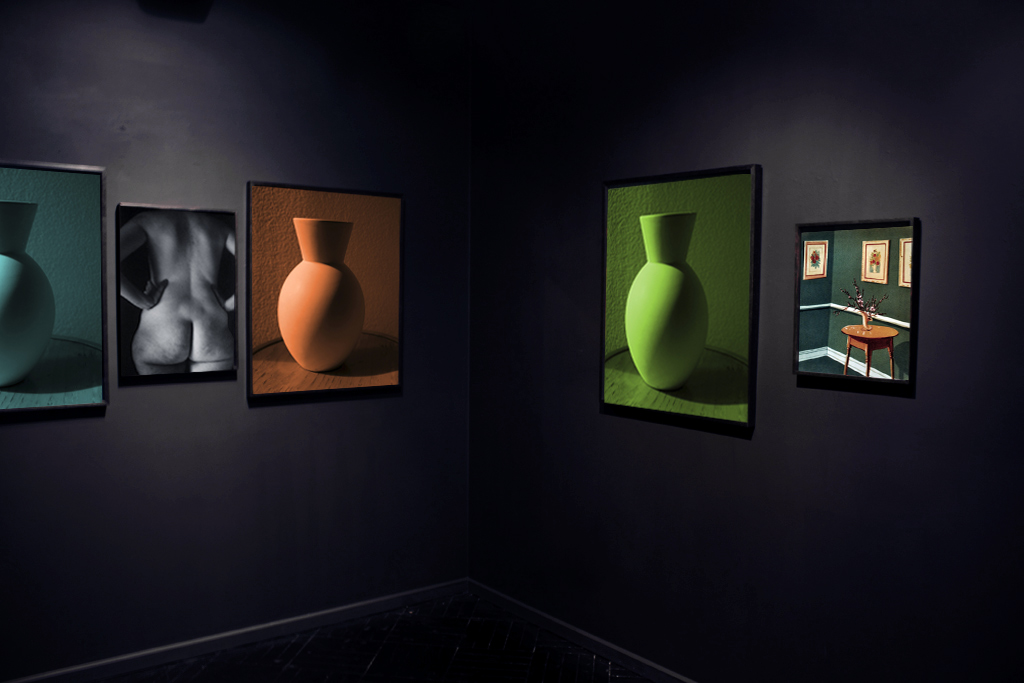
Installation photograph of 'Ikea' by Janina Green at Edmund Pearce Gallery, Melbourne


Installation photograph of Ikea by Janina Green at Edmund Pearce Gallery, Melbourne


“It is necessary to revisit what Walter Benjamin said of the work of art in the age of its mechanical reproducibility. What is lost in the work that is serially reproduced, is its aura, its singular quality of the here and now, its aesthetic form (it had already lost its ritual form, in its aesthetic quality), and, according to Benjamin, it takes on, in its ineluctable destiny of reproduction, a political form. What is lost is the original, which only a history itself nostalgic and retrospective can reconstitute as “authentic.” The most advanced, the most modern form of this development, which Benjamin described in cinema, photography, and contemporary mass media, is one in which the original no longer even exists, since things are conceived from the beginning as a function of their unlimited reproduction.”


Jean Baudrillard. ‘Simulacra and Simulation’. 1981 (English translation 1994)


“To apprehend myself as seen is, in fact, to apprehend myself as seen in the world and from the standpoint of the world. The look does not carve me out in the universe; it comes to search for me at the heart of my situation and grasps me only in irresolvable relations with instruments. If I am seen as seated, I must be seen as “seated-on-a-chair,” … But suddenly the alienation of myself, which is the act of being-looked-at, involves the alienation of the world which I organise. I am seated on this chair with the result that I do not see it at all, that it is impossible for me to see it …”


Jean-Paul Satre. ‘Being and Nothingness’ (trans. Hazel Barnes). London: Methuen, 1966, p. 263


“It must be possible to concede and affirm an array of “materialities” that pertain to the body, that which is signified by the domains of biology, anatomy, physiology, hormonal and chemical composition, illness, age, weight, metabolism, life and death. None of this can be denied. But the undeniability of these “materialities” in no way implies what it means to affirm them, indeed, what interpretive matrices condition, enable and limit that necessary affirmation. That each of those categories [BODY AND MATERIALITY] have a history and a historicity, that each of them is constituted through the boundary lines that distinguish them and, hence, by what they exclude, that relations of discourse and power produce hierarchies and overlappings among them and challenge those boundaries, implies that these are both persistent and contested regions.”


Judith Butler. ‘Bodies That Matter’. New York: Routledge, 1993, pp. 66-67


Fable = invent (an incident, person, or story)

Simulacrum = pretends to be a faithful copy, but it is a copy with no original

Performativity = power of discourse, politicisation of abjection, ritual of being

Body / identity / desire = imperfection, fluidity, domesticity, transgression, transcendence


Intimate, conceptually robust and aesthetically sensitive.
The association of the images was emotionally overwhelming.
An absolute gem. One of the highlights of the year.

Dr Marcus Bunyan


Many thankx to Edmund Pearce Gallery for allowing me to publish the photographs in the posting. Please click on the photographs for a larger version of the image.


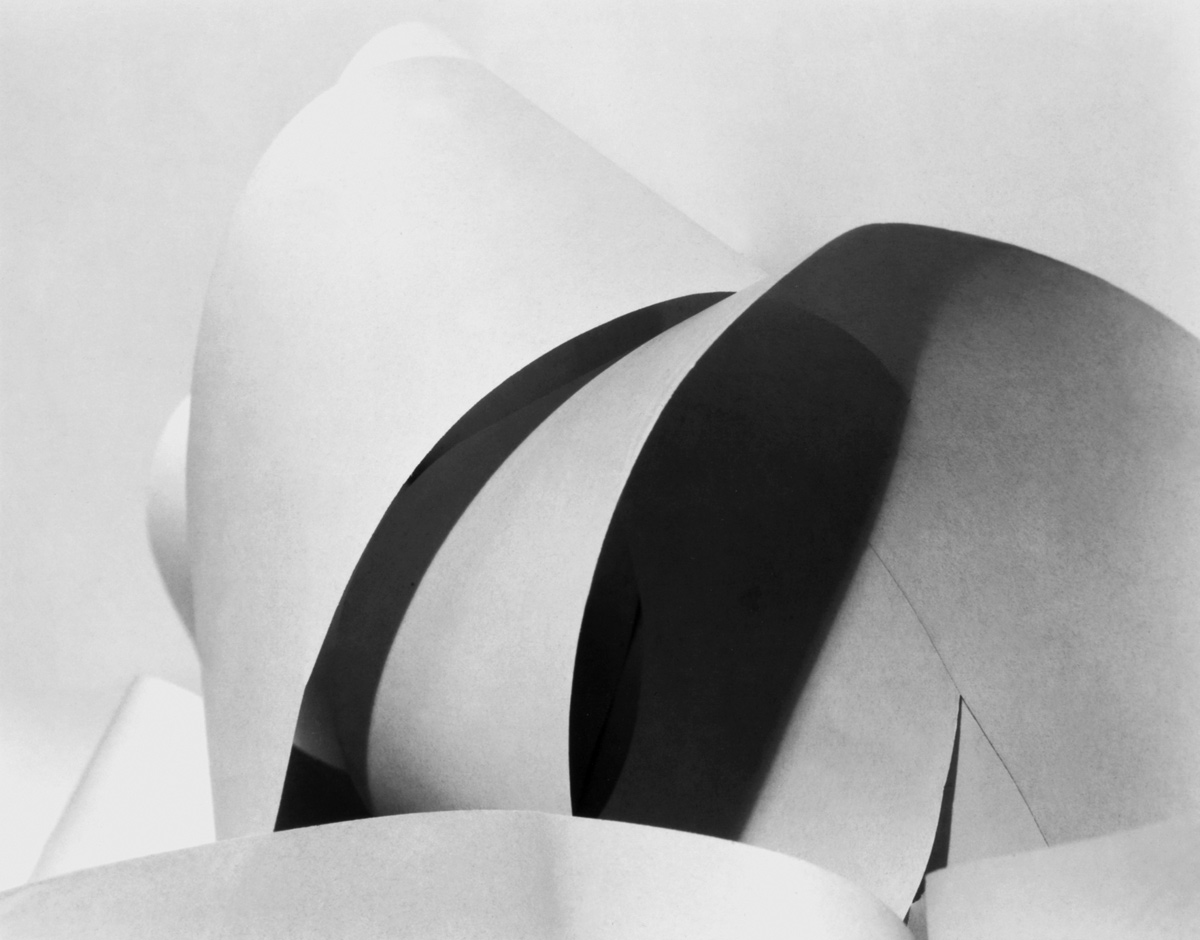
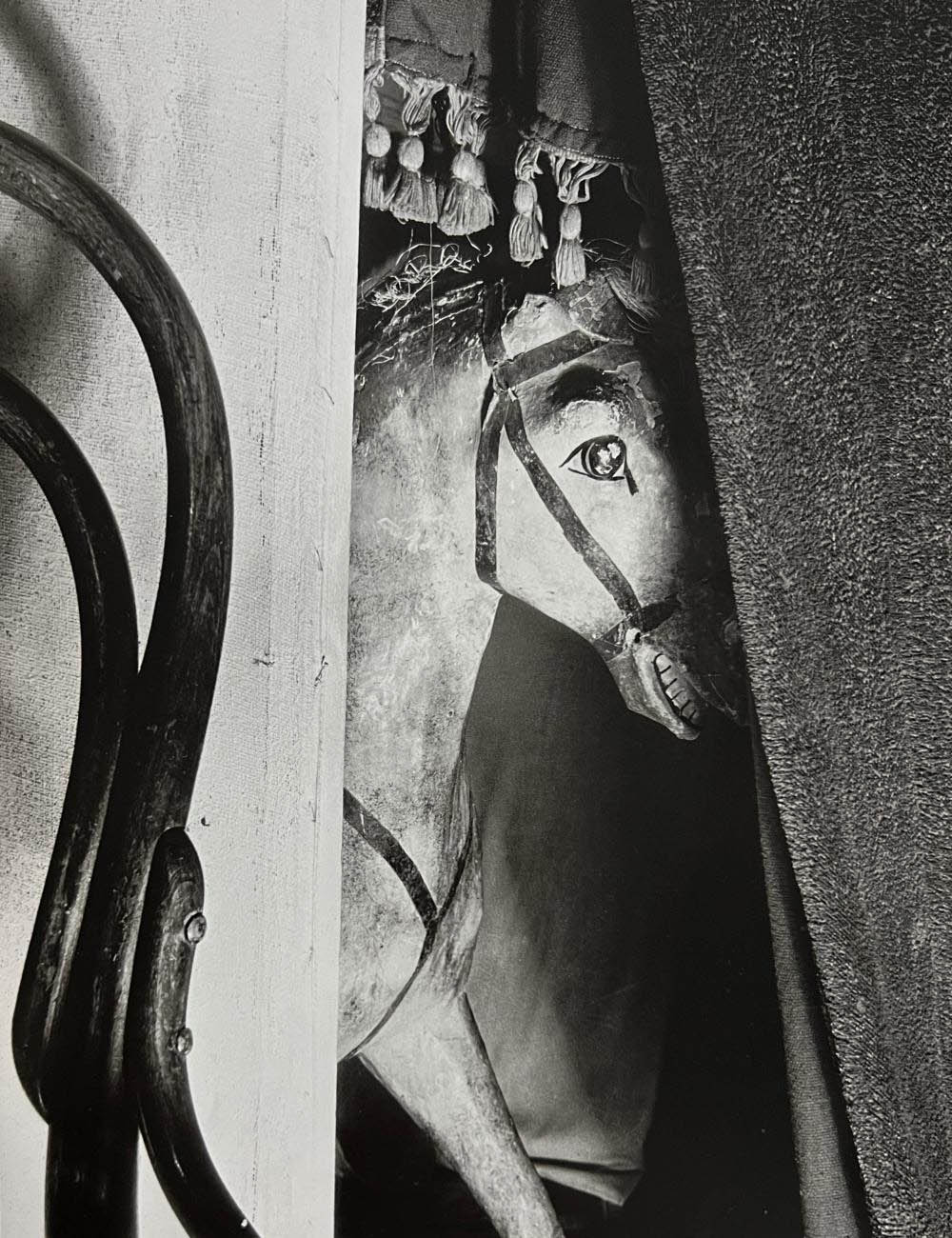
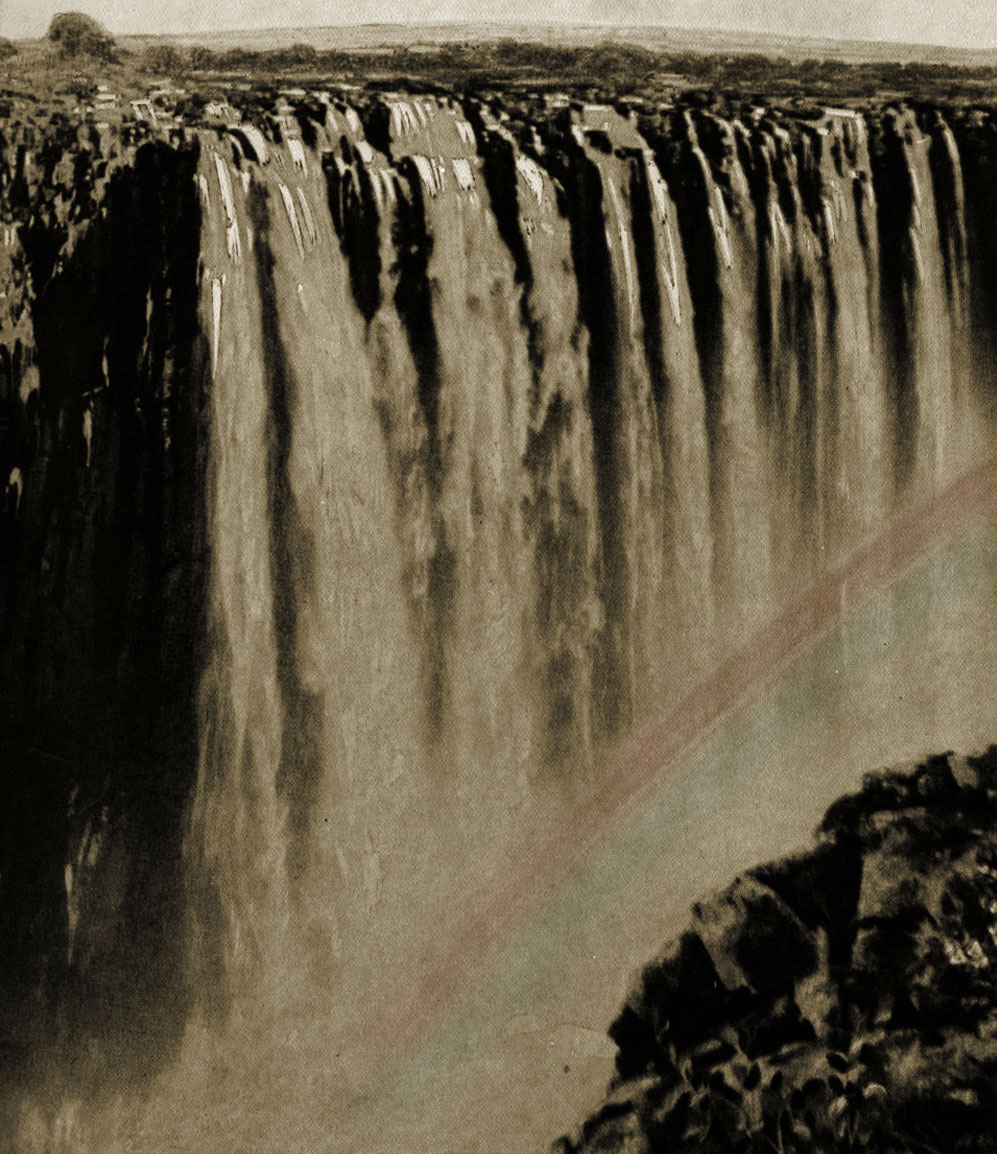
Janina Green (Australian born Germany, b. 1944) 'Waterfall' 1990


Janina Green (Australian born Germany, b. 1944)
Waterfall
1990
Silver gelatin print on Kentmere Parchment paper, tinted with coffee and photo dyes
58 x 48cm
Vintage print


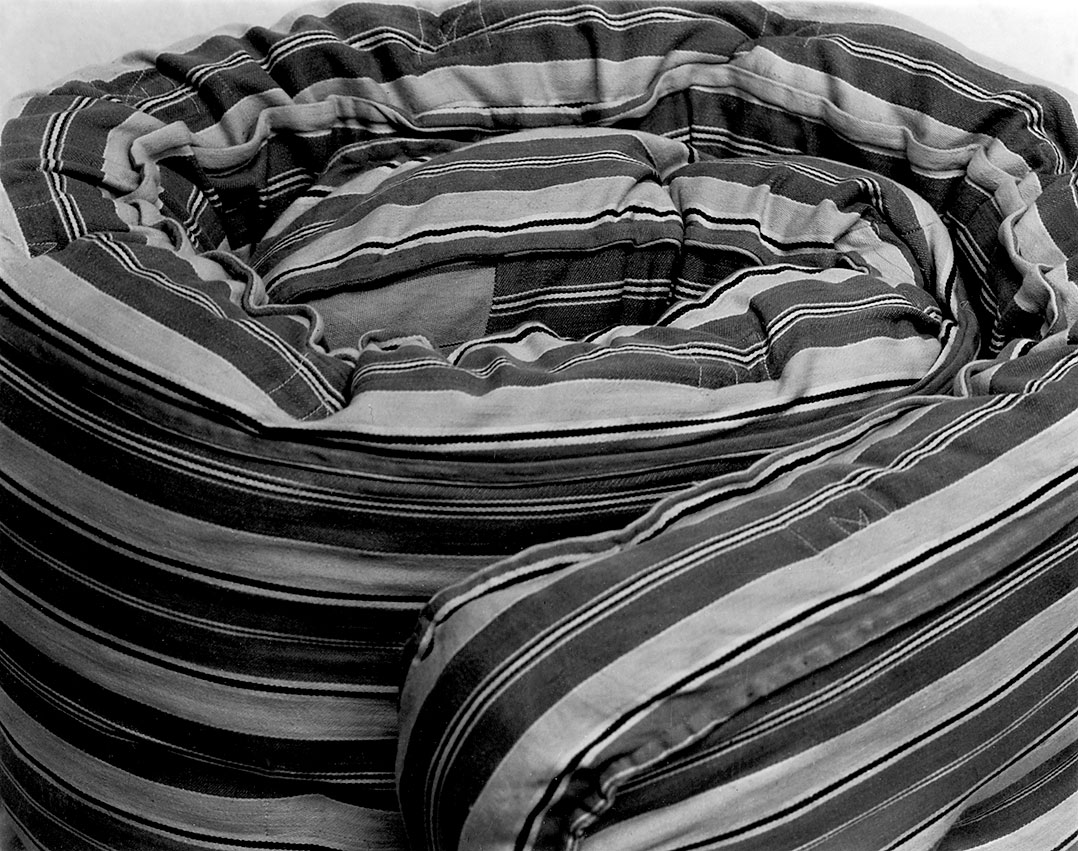
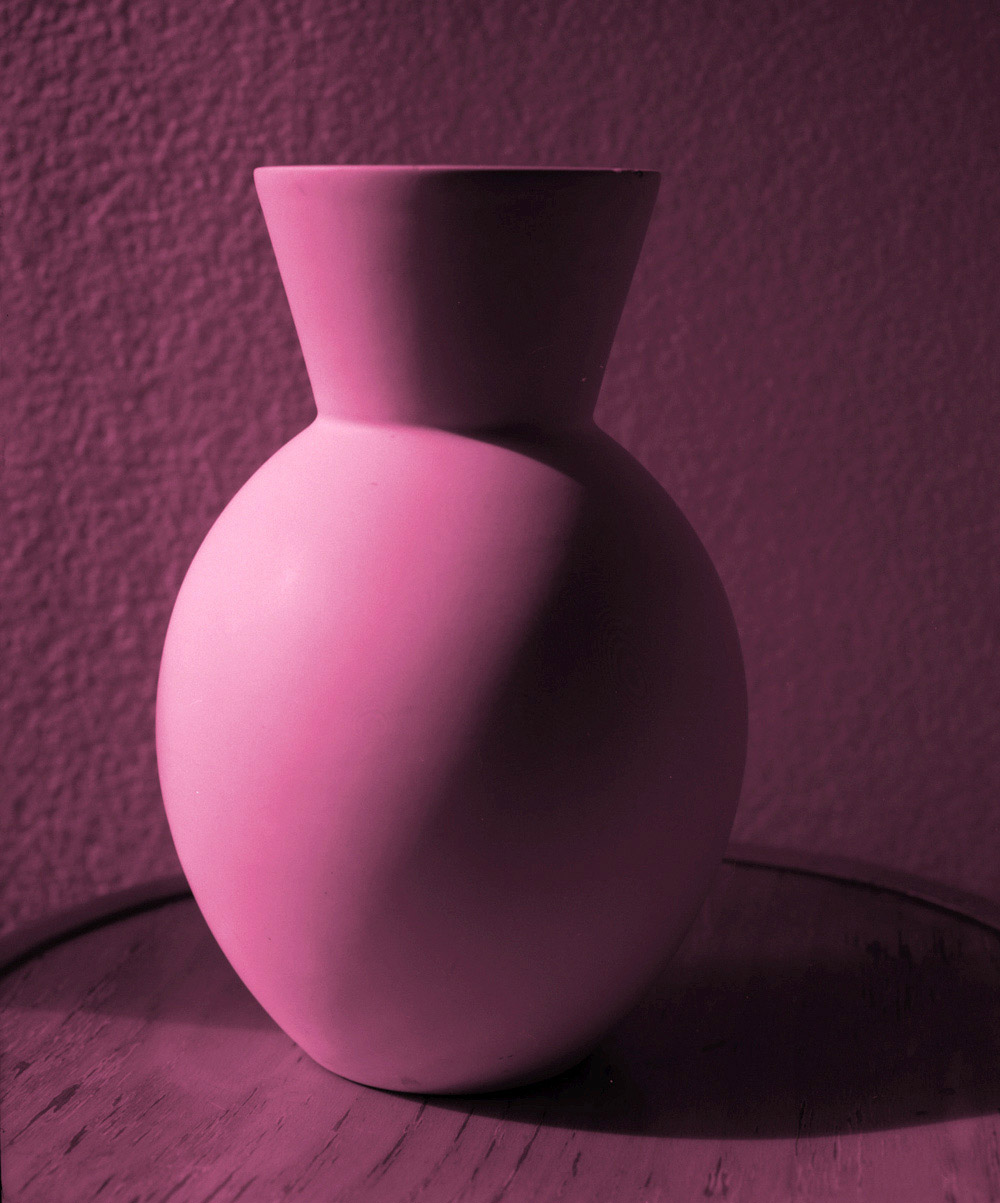
Janina Green (Australian born Germany, b. 1944) 'Pink vase' 1990 reprinted 2012


Janina Green (Australian born Germany, b. 1944)
Pink vase
1990 reprinted 2012
Silver gelatin print on fibre based paper, hand tinted with pink photo dye
85 x 70cm


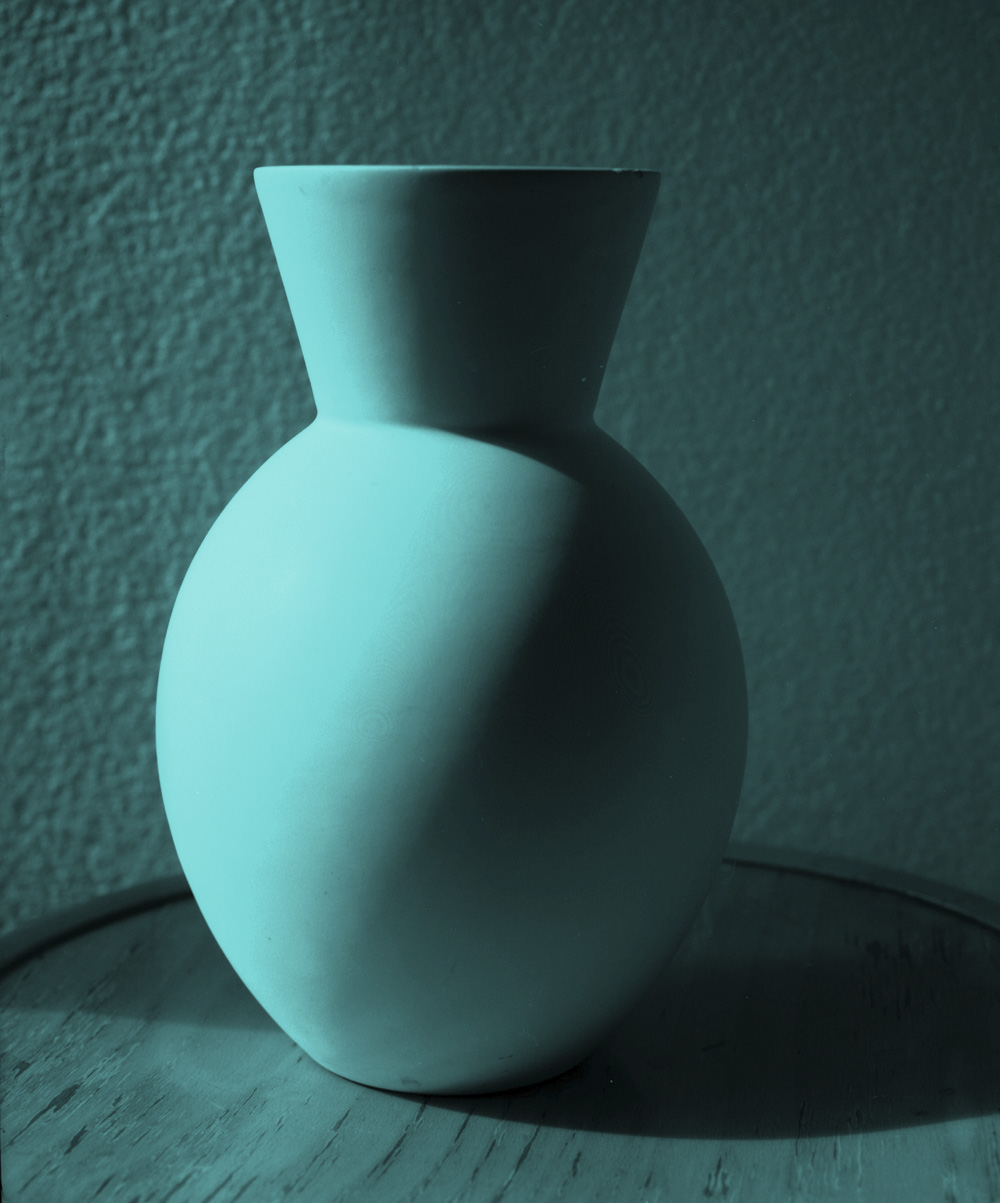
Janina Green (Australian born Germany, b. 1944) 'Blue vase' 1990 reprinted 2012


Janina Green (Australian born Germany, b. 1944)
Blue vase
1990 reprinted 2012
Silver gelatin print on fibre based paper, hand tinted with blue photo dye
85 x 70cm


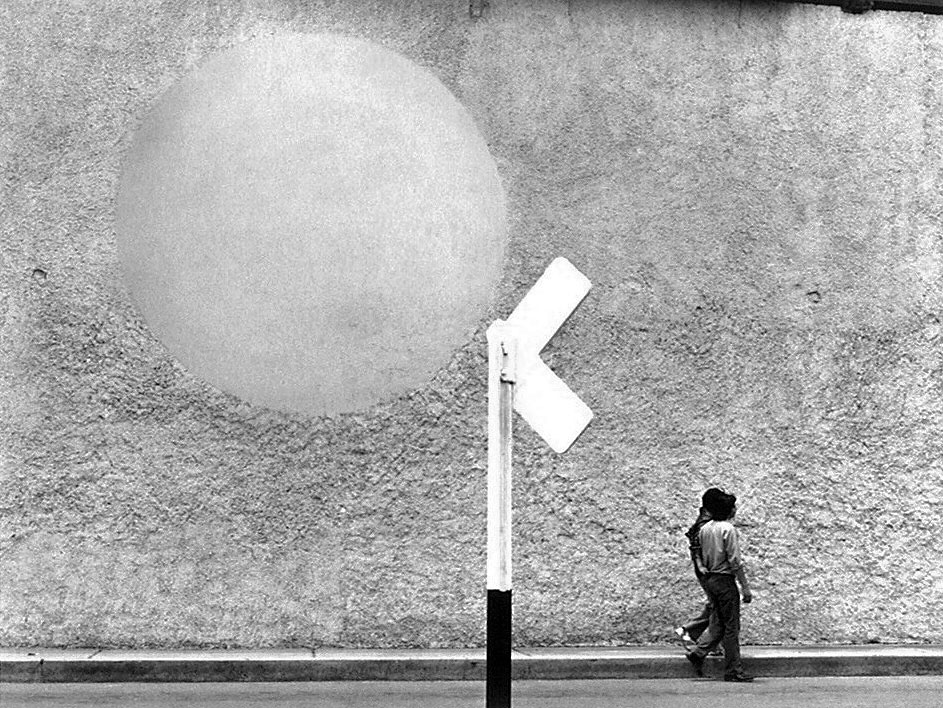
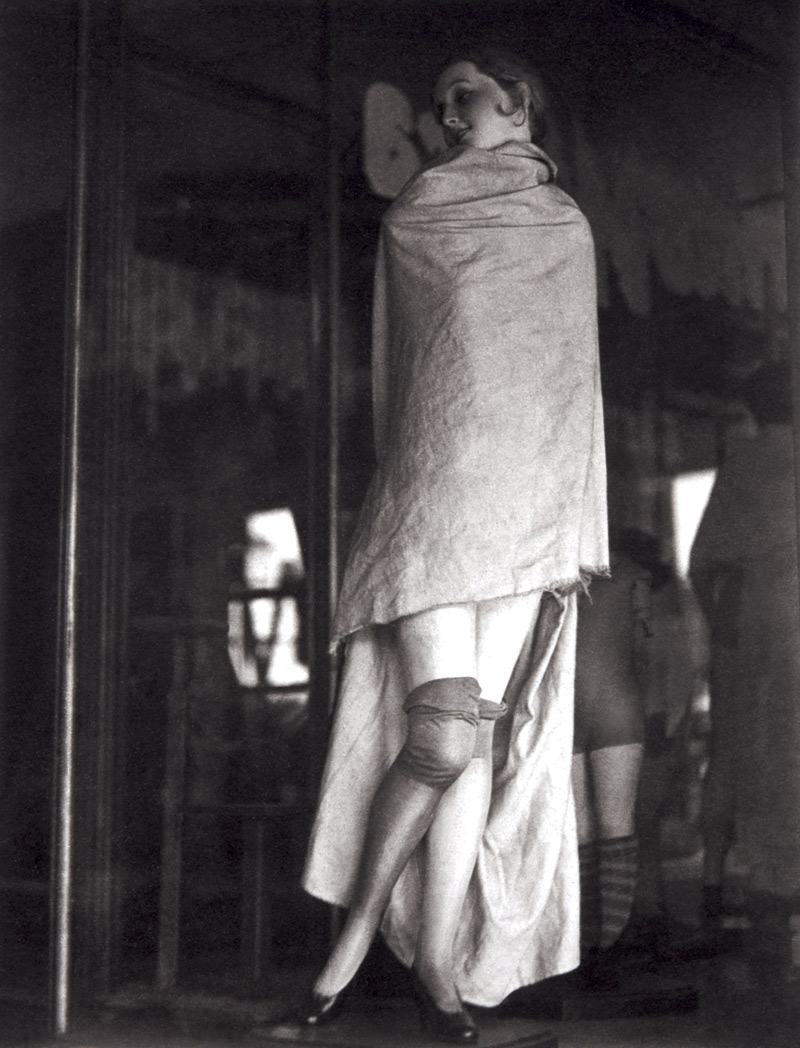
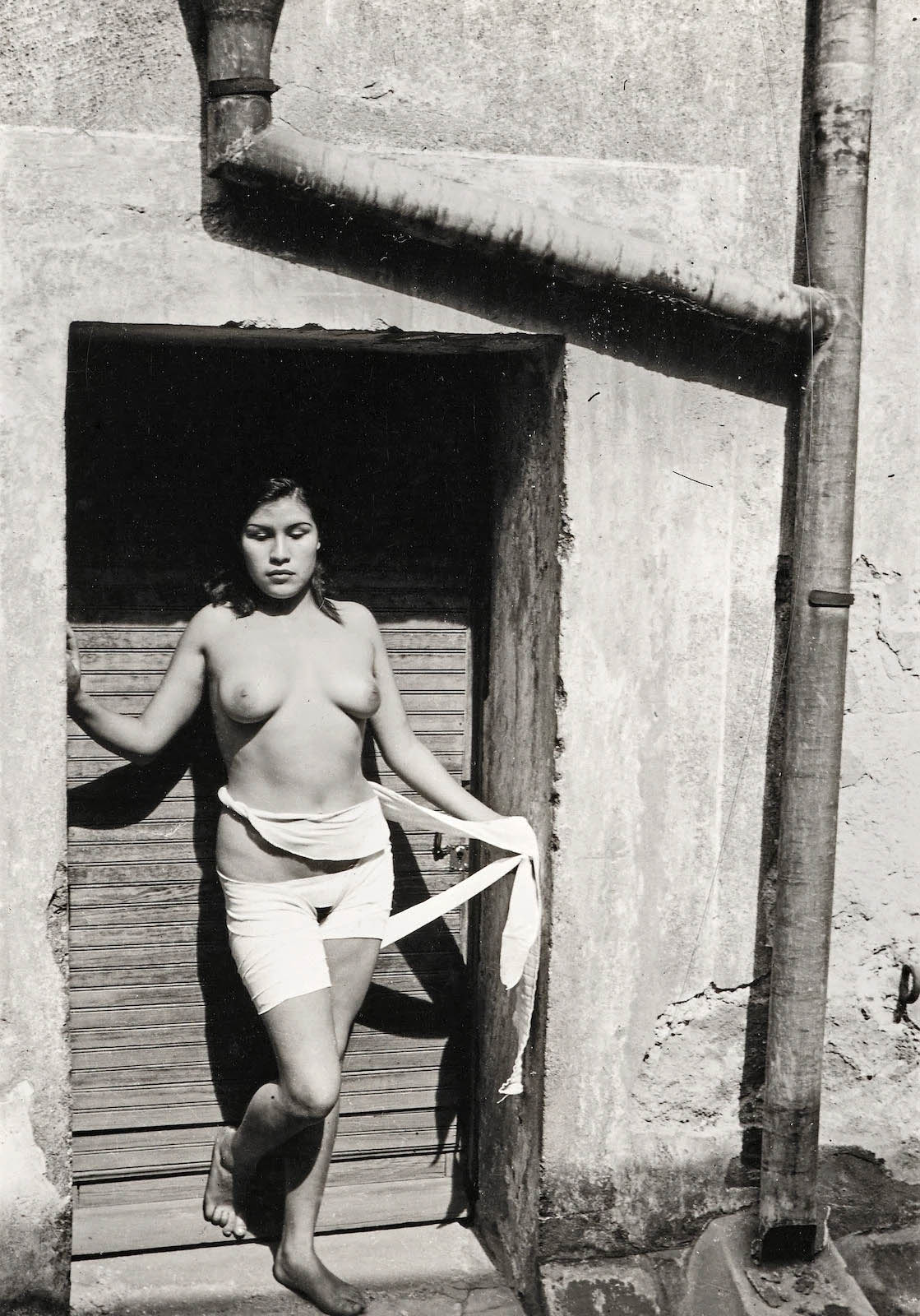
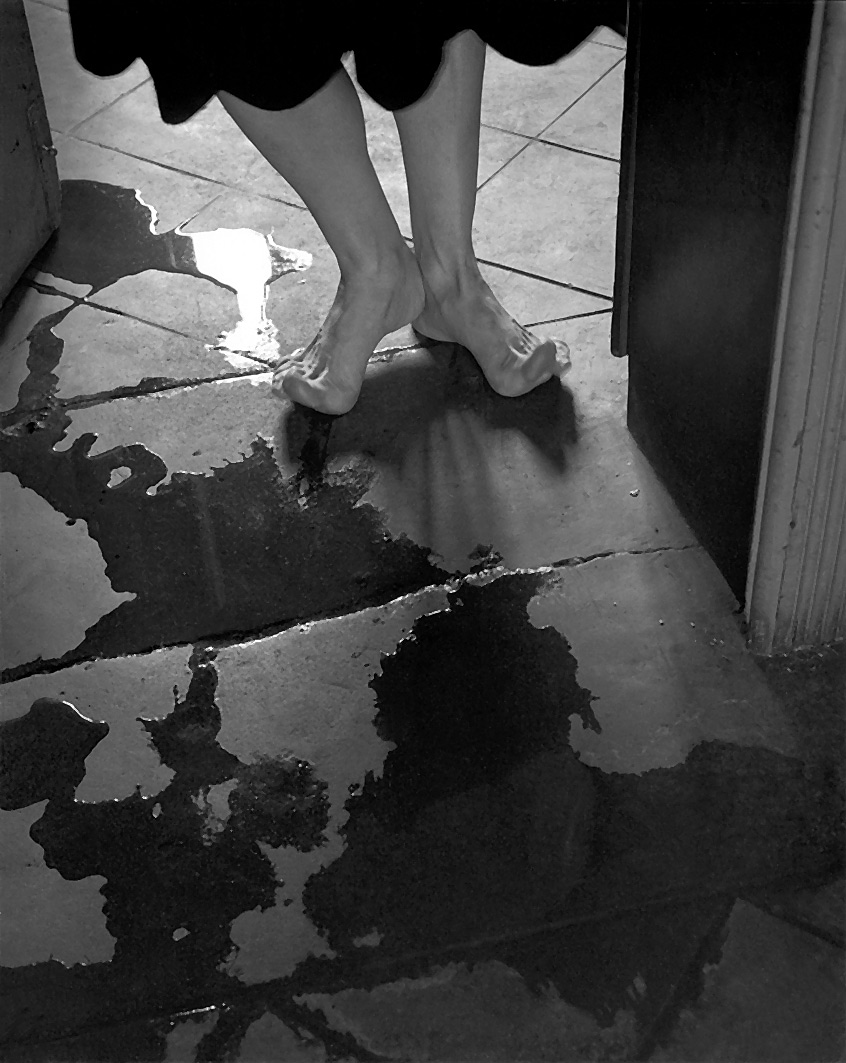
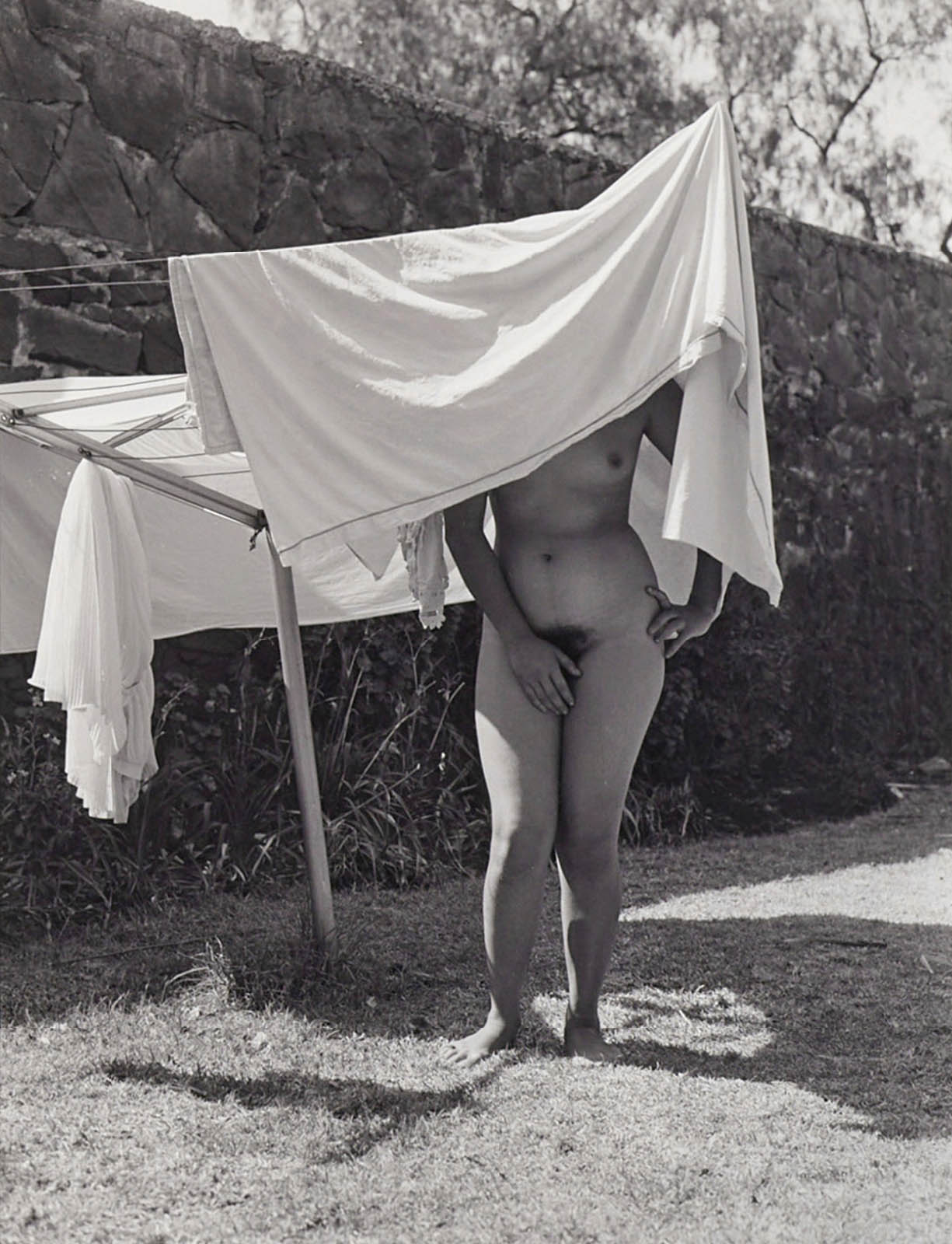
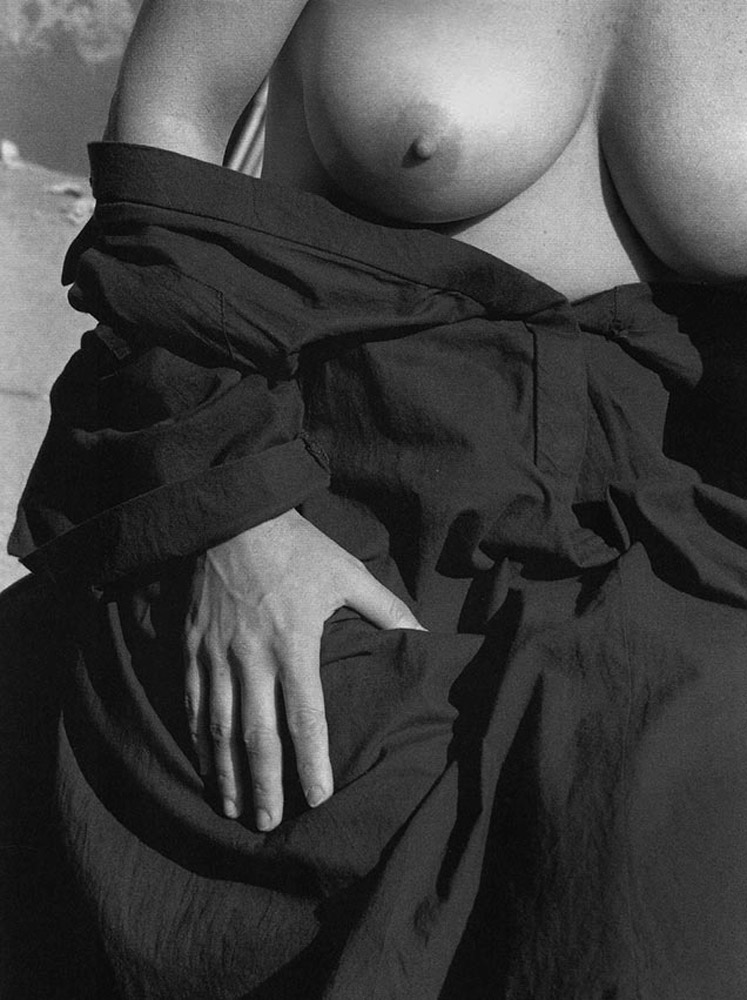
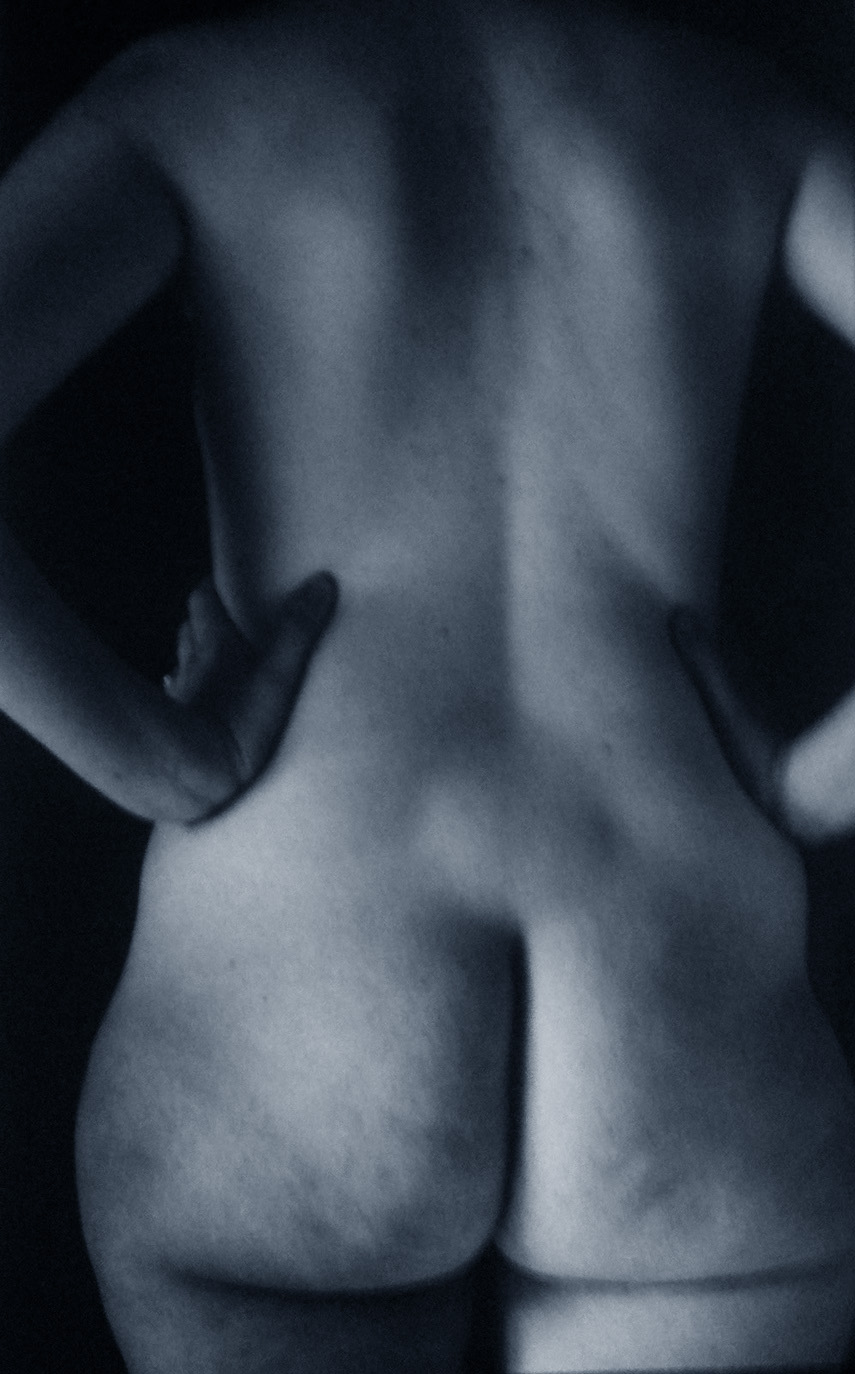
Janina Green (Australian born Germany, b. 1944) 'Nude' 1986


Janina Green (Australian born Germany, b. 1944)
Nude
1986
Silver gelatin print on fibre based paper, hand tinted with blue photo dye
60 x 45cm
Vintage print


My photographs are always about the past.

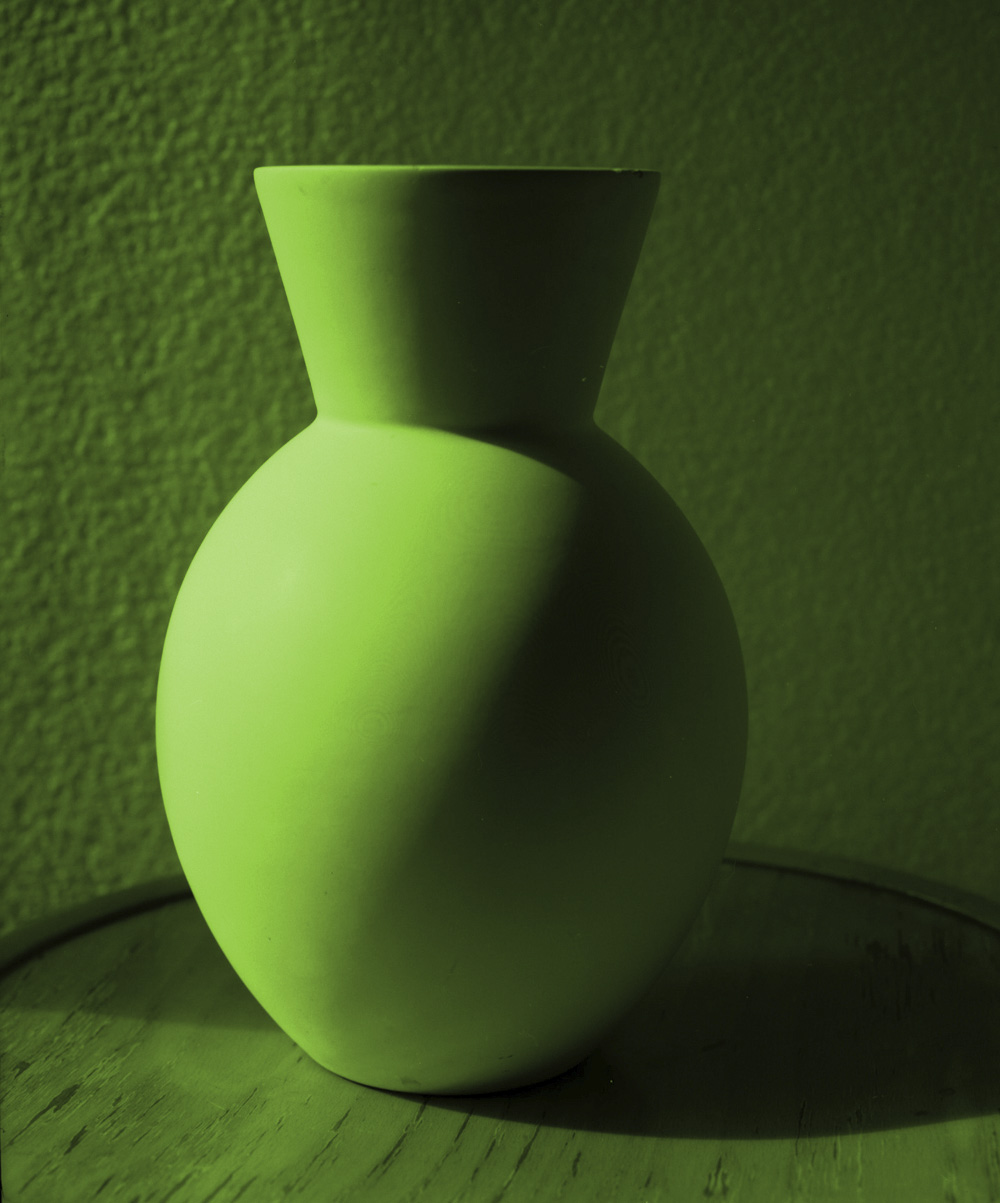
The Barthesian slogan, “this has been,” is for me, “I was there.” This series of images of a vase from Ikea consists of silver gelatin prints tinted in different coloured photographic dyes; photographs of a simple mass produced vase – its form the familiar vessel which so dominates Art History. “Ikea” for me is symbolic of the useful homely object and of the ideal home. The vase from Ikea no longer exists. The picture of that vase stands in for the vase that once existed. The photograph can be seen now – at this moment. It will continue to exist in the future. Its representation crosses time barriers.

My photographs are always documentations of a private performance.

Every photograph records what is in front of the camera, but my interest is in the occasion and the complex conditions of the making of the photograph – first the negative then the print. Each photograph ends up being a documentation of my state of mind during this intensely private moment as well as something for other people to look at. Because of changing conditions, every one of these prints from that same negative is different. For me each analogue print is an unsteady thing. They are now relics from another era, as is the vase.

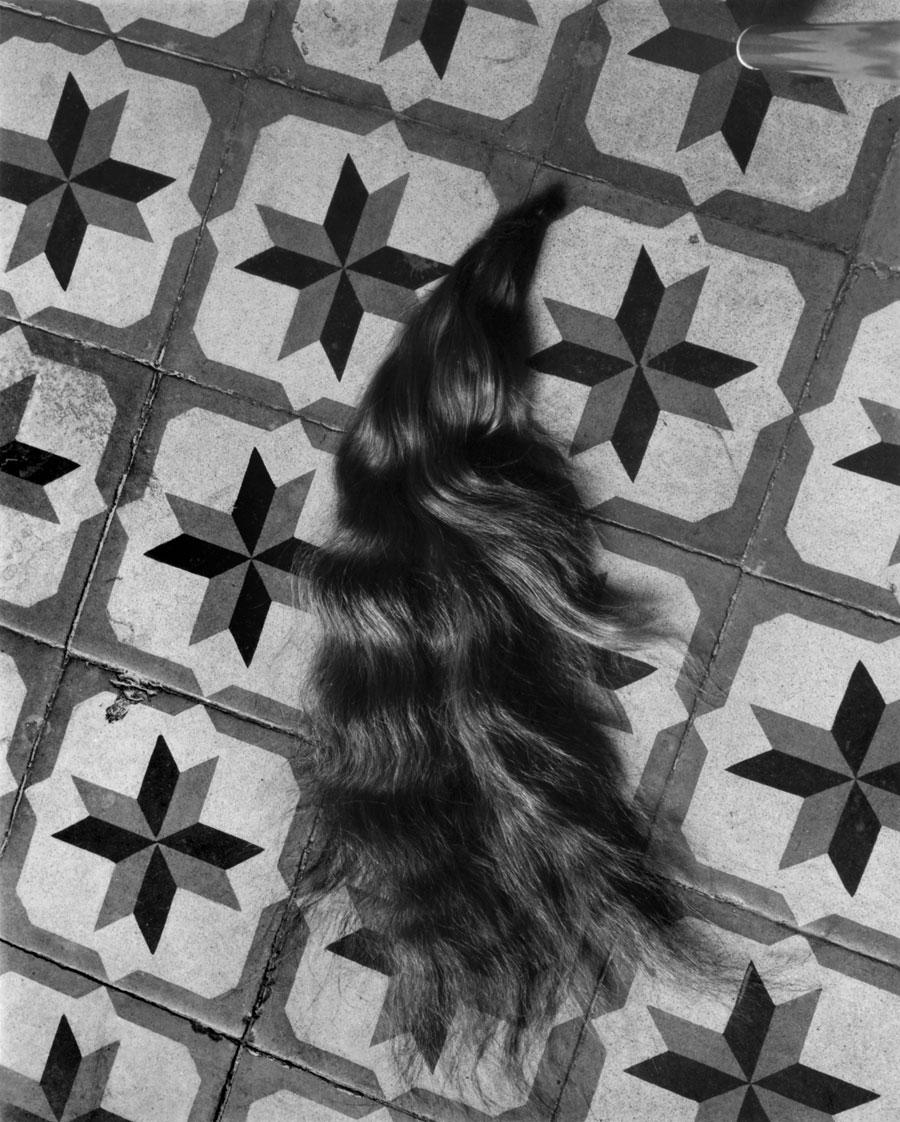
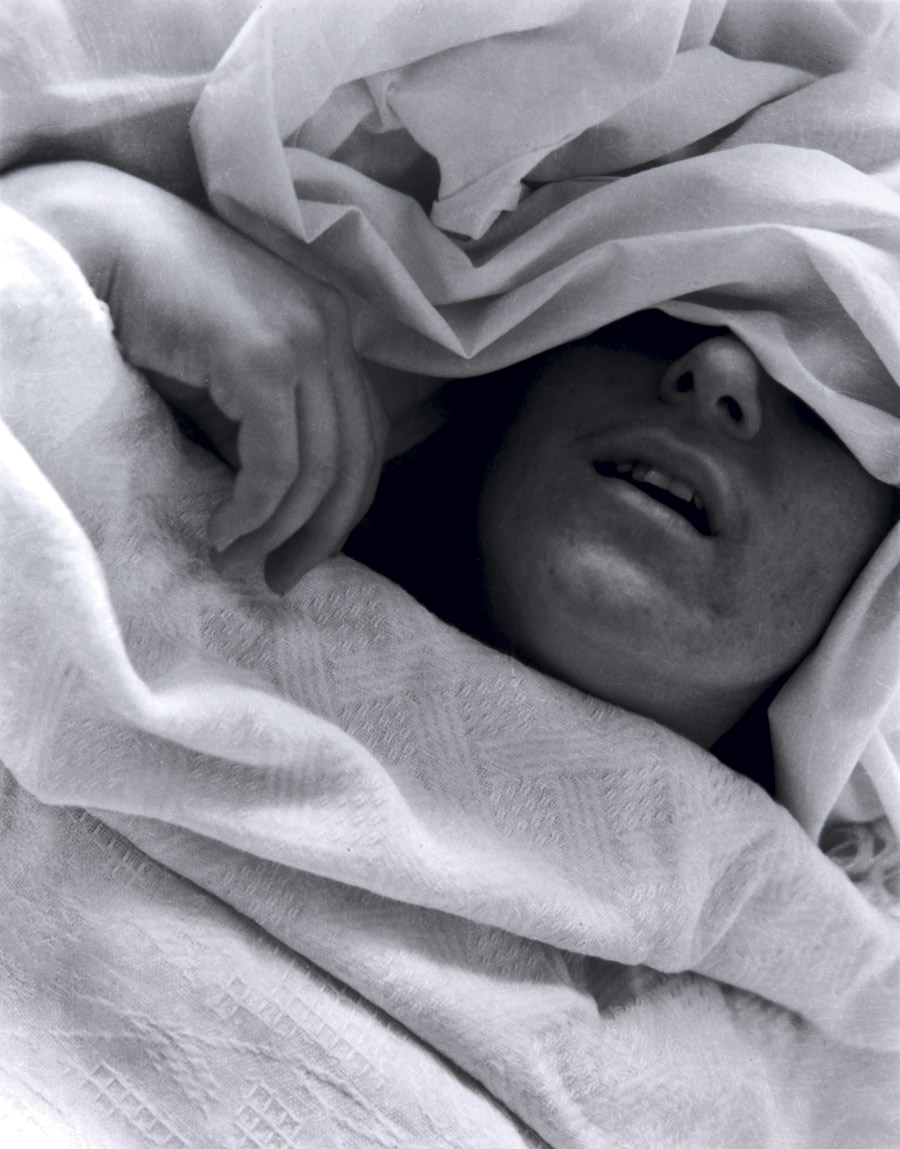
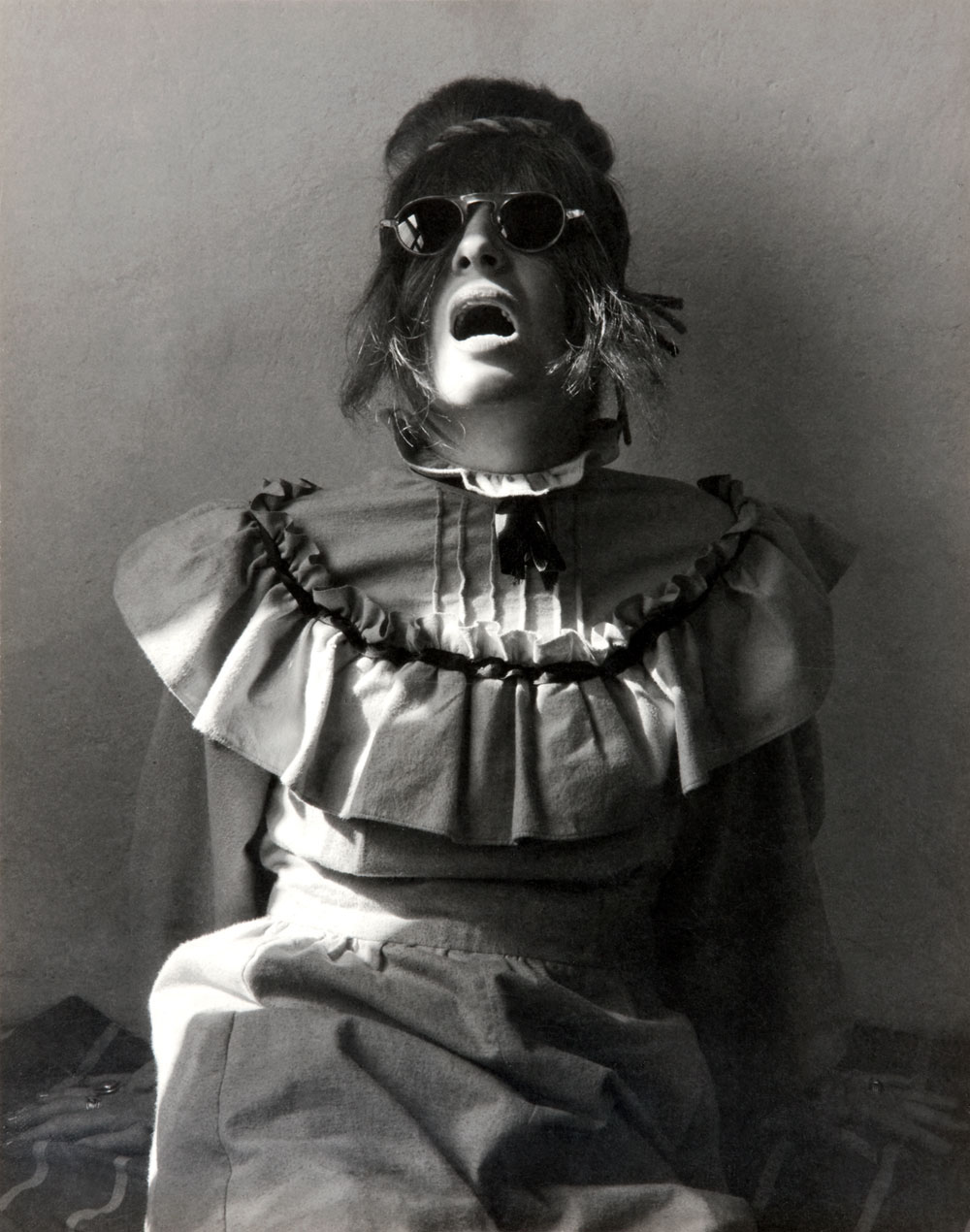
As a counterpoint to the repetition of the vase prints, I have selected four vintage works from my archive.

Artists statement by Janina Green

Janina is represented by M.33


Janina Green (Australian born Germany, b. 1944) 'Orange vase' 1990 reprinted 2012


Janina Green (Australian born Germany, b. 1944)
Orange vase
1990 reprinted 2012
Silver gelatin print on fibre based paper, hand tinted with orange photo dye
85 x 70cm


Janina Green (Australian born Germany, b. 1944) 'Green vase' 1990 reprinted 2012


Janina Green (Australian born Germany, b. 1944)
Green vase
1990 reprinted 2012
Silver gelatin print on fibre based paper, hand tinted with green photo dye
85 x 70cm


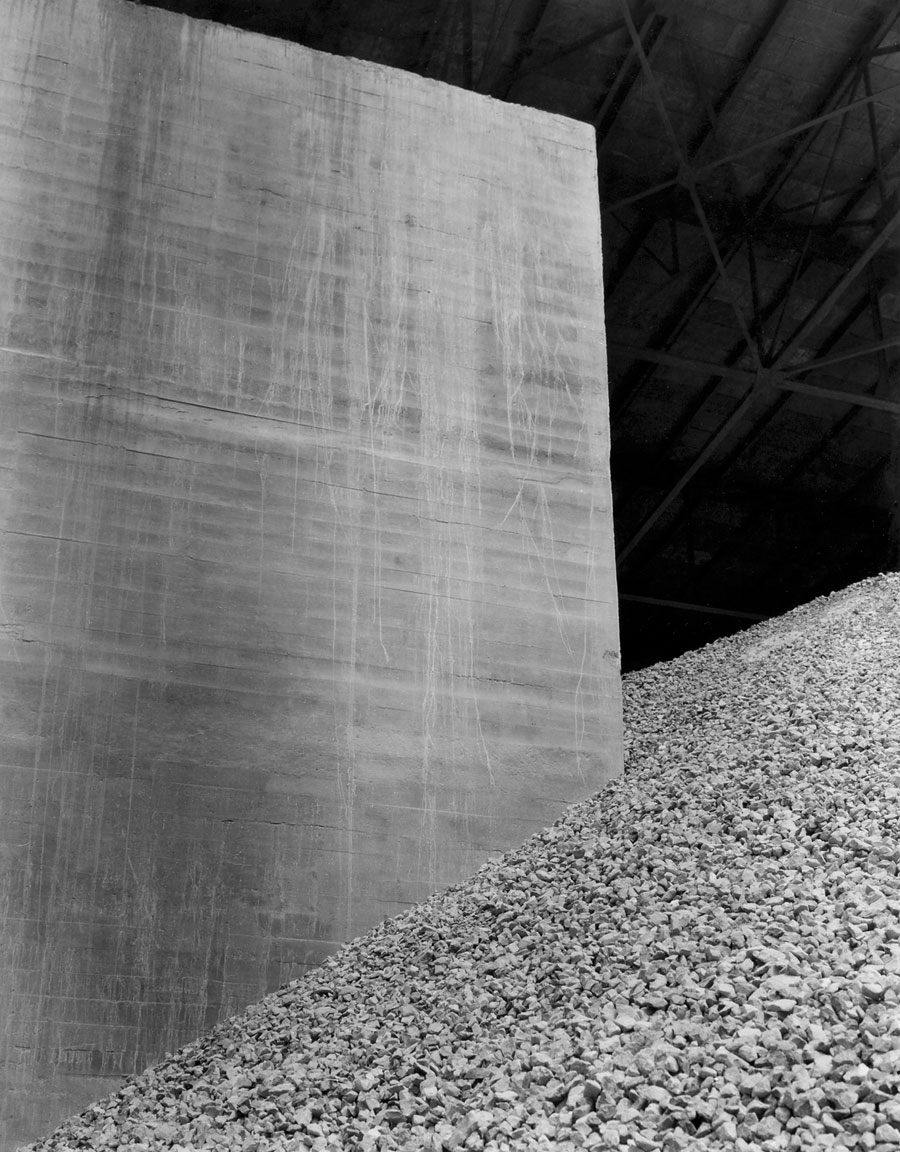
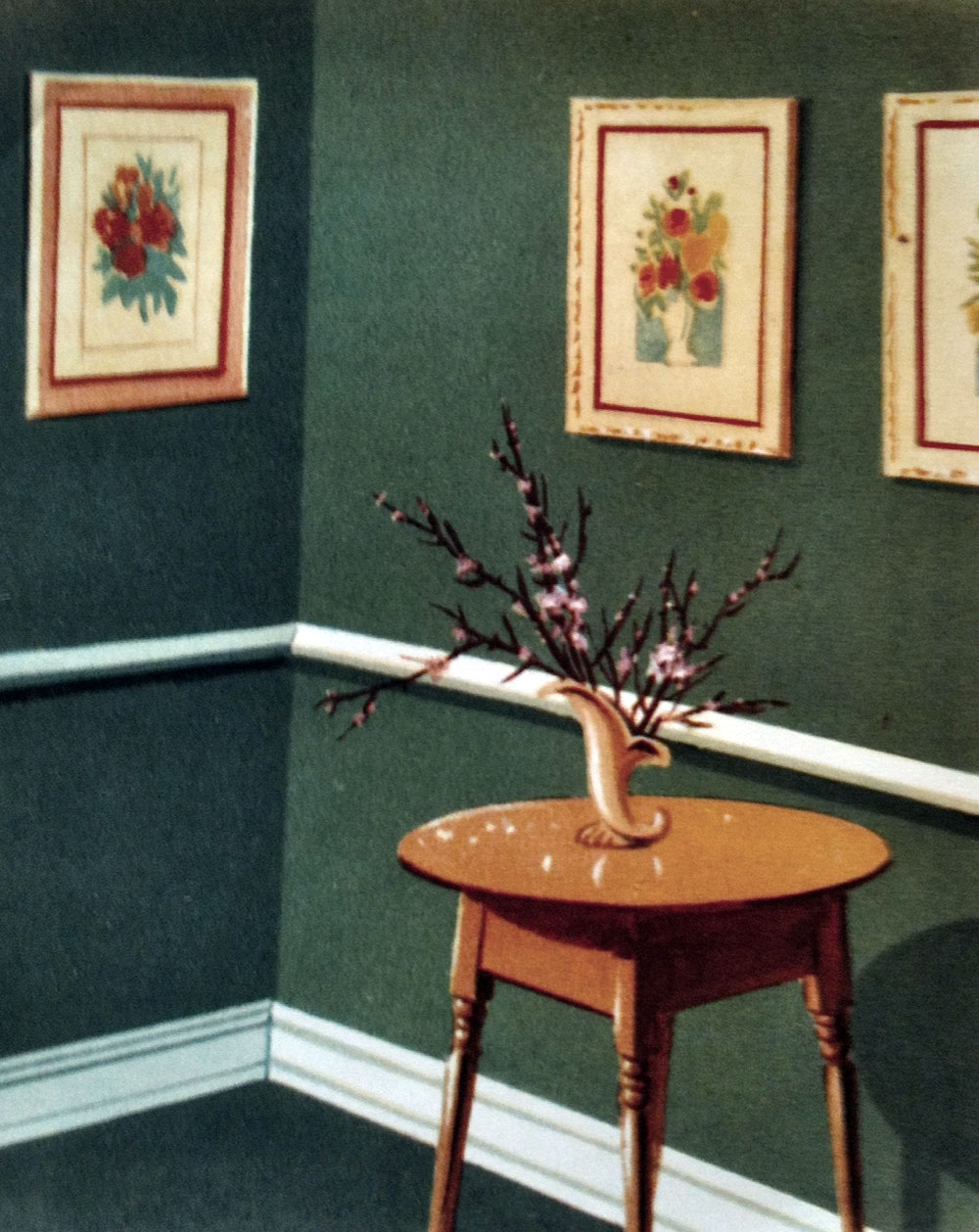
Janina Green (Australian born Germany, b. 1944) 'Interior' 1992


Janina Green (Australian born Germany, b. 1944)
Interior
1992
C Type print
38 x 30cm
Vintage print / edition of 5


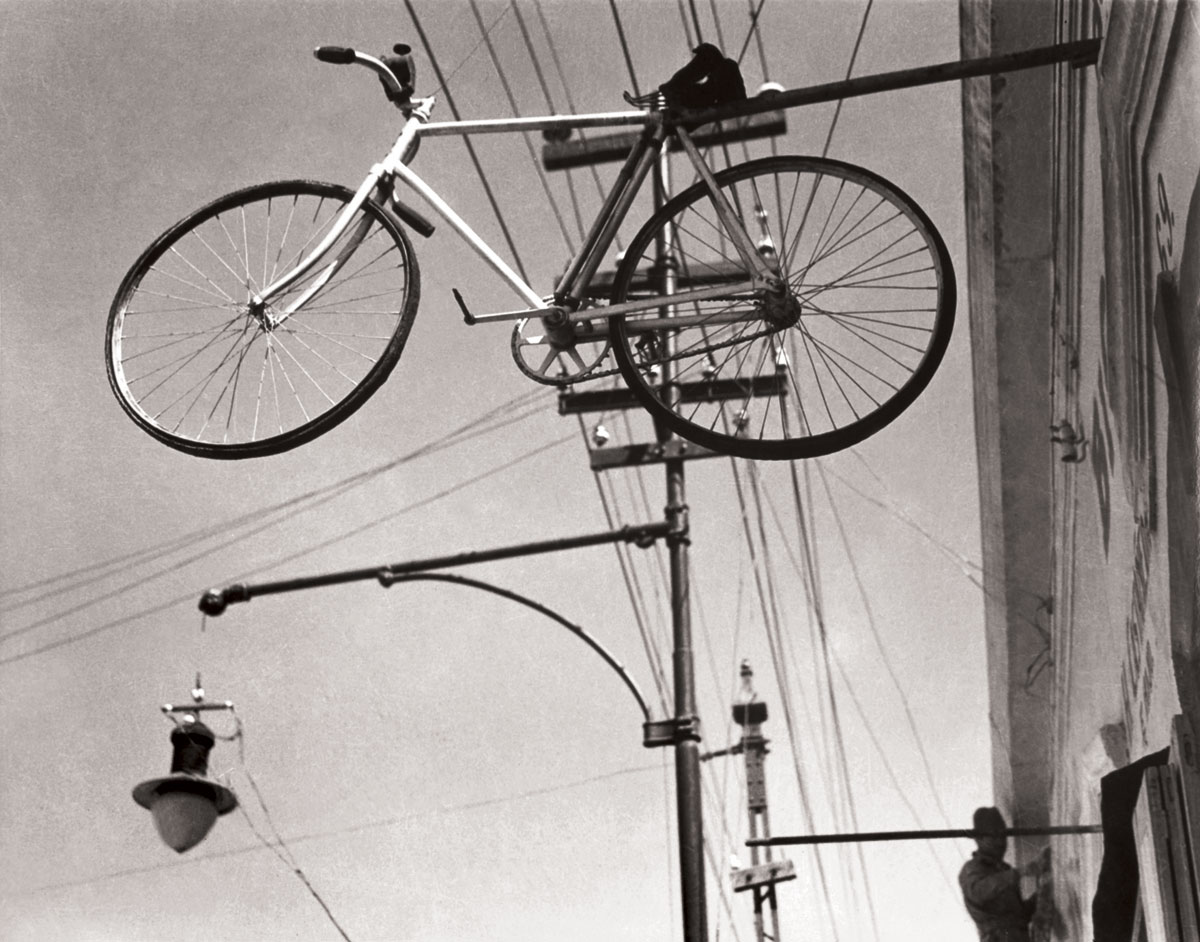
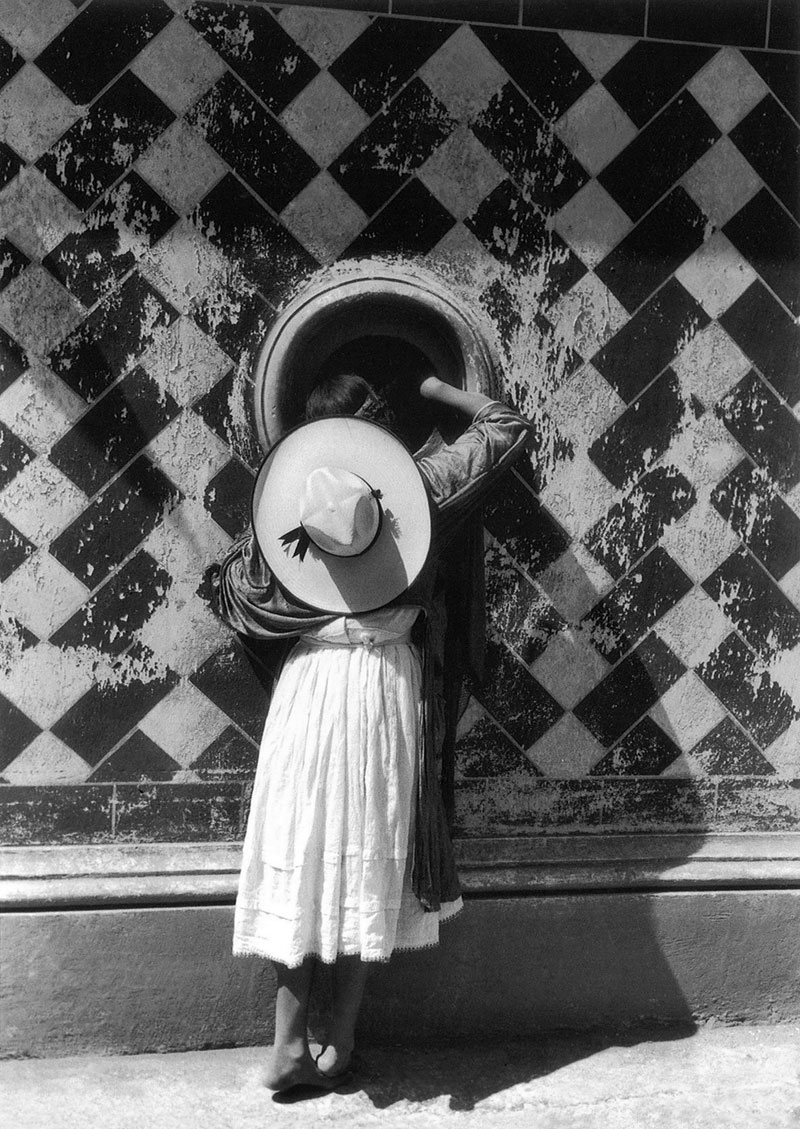
Janina Green (Australian born Germany, b. 1944) 'Telephone' 1986 reprinted 2010


Janina Green (Australian born Germany, b. 1944)
Telephone
1986 reprinted 2010
Silver gelatin print on fibre based paper, tinted with coffee
58 x 48cm


Janina Green (Australian born Germany, b. 1944) 'Yellow vase' 1990 reprinted 2012


Janina Green (Australian born Germany, b. 1944)
Yellow vase
1990 reprinted 2012
Silver gelatin print on fibre based paper, hand tinted with yellow photo dye
85 x 70cm


Edmund Pearce Gallery

This gallery is now closed.

LIKE ART BLART ON FACEBOOK

Back to top

Exhibition: ‘WAR/PHOTOGRAPHY: Images of Armed Conflict and Its Aftermath’ at the Museum of Fine Arts, Houston, Part 1

Exhibition dates: 11th November 2012 – 3rd February 2013

Curators: Anne Tucker, Natalie Zelt and Will Michels


Roger Fenton (British, 1819-1869) 'The Valley of the Shadow of Death' 1855


Roger Fenton (British, 1819-1869)
The Valley of the Shadow of Death
1855


This is the biggest posting on one exhibition that I have ever undertaken on Art Blart!

As befits the gravity of the subject matter this posting is so humongous that I have had to split it into 4 separate postings. This is how to research and stage a contemporary photography exhibition that fully explores its theme (NGV please note!). The curators reviewed more than one million photographs in 17 countries, locating pictures in archives, military libraries, museums, private collections, historical societies and news agencies; in the personal files of photographers and service personnel; and at two annual photojournalism festivals producing an exhibition that features 26 sections (an inspired and thoughtful selection) that includes nearly 500 objects that illuminate all aspects of WAR/PHOTOGRAPHY.

I have spent hours researching and finding photographs on the Internet to support the posting. It has been a great learning experience and my admiration for photographers of all types has increased. I have discovered the photographs and stories of new image makers that I did not know and some hidden treasures along the way. I hope you enjoy this monster posting on a subject matter that should be consigned to the history books of human evolution.

**Please be aware that there are graphic photographs in all of these postings.** Part 2Part 3Part 4

Dr Marcus Bunyan


Many thankx to the Museum of Fine Arts, Houston for allowing me to publish some of the photographs in the posting. Please click on the photographs for a larger version of the image.


On November 11, 2012, the Museum of Fine Arts, Houston, debuts an unprecedented exhibition exploring the experience of war through the eyes of photographers. WAR / PHOTOGRAPHY: Images of Armed Conflict and Its Aftermath features nearly 500 objects, including photographs, books, magazines, albums and photographic equipment. The photographs were made by more than 280 photographers, from 28 nations, who have covered conflict on six continents over 165 years, from the Mexican-American War of 1846 through present-day conflicts. The exhibition takes a critical look at the relationship between war and photography, exploring what types of photographs are, and are not, made, and by whom and for whom. Rather than a chronological survey of wartime photographs or a survey of “greatest hits,” the exhibition presents types of photographs repeatedly made during the many phases of war – regardless of the size or cause of the conflict, the photographers’ or subjects’ culture or the era in which the pictures were recorded. The images in the exhibition are organised according to the progression of war: from the acts that instigate armed conflict, to “the fight,” to victory and defeat, and images that memorialise a war, its combatants and its victims. Both iconic images and previously unknown images are on view, taken by military photographers, commercial photographers (portrait and photojournalist), amateurs and artists.

“‘WAR/PHOTOGRAPHY’ promises to be another pioneering exhibition, following other landmark MFAH photography exhibitions such as ‘Czech Modernism: 1900-1945’ (1989) and ‘The History of Japanese Photography’ (2003),” said Gary Tinterow, MFAH director. “Anne Tucker, along with her co-curators, Natalie Zelt and Will Michels, has spent a decade preparing this unprecedented exploration of the complex and profound relationship between war and photography.” “Photographs serve the public as a collective memory of the experience of war, yet most presentations that deal with the material are organised chronologically,” commented Tucker. “We believe ‘WAR / PHOTOGRAPHY’ is unique in its scope, exploring conflict and its consequences across the globe and over time, analysing this complex and unrelenting phenomenon.”

The earliest work in the exhibition is from 1847, taken from the first photographed conflict: the Mexican-American War. Other early examples include photographs from the Crimean War, such as Roger Fenton’s iconic The Valley of the Shadow of Death (1855) and Felice Beato’s photograph of the devastated interior of Fort Taku in China during the Second Opium War (1860). Among the most recent images is a 2008 photograph of the Battle Company of the 173rd Airborne Brigade in the remote Korengal Valley of Eastern Afghanistan by Tim Hetherington, who was killed in April 2011 while covering the civil war in Libya. Also represented with two photographs in the exhibition is Chris Hondros, who was killed with Hetherington. While the exhibition is organised according to the phases of war, portraits of servicemen, military and political leaders and civilians are a consistent presence throughout, including Yousuf Karsh’s classic 1941 image of Winston Churchill, and the Marlboro Marine (2004), taken by embedded Los Angeles Times photographer Luis Sinco of soldier James Blake Miller after an assault in Fallujah, Iraq. Sinco’s image was published worldwide on the cover of 150 publications and became a 2005 Pulitzer Prize finalist.

The exhibition was initiated in 2002, when the MFAH acquired what is purported to be the first print made from Joe Rosenthal’s negative of Old Glory Goes Up on Mount Suribachi, Iwo Jima (1945). From this initial acquisition, the curators decided to organise an exhibition that would focus on war photography as a genre. During the evolution of the project, the museum acquired more than a third of the prints in the exhibition. The curators reviewed more than one million photographs in 17 countries, locating pictures in archives, military libraries, museums, private collections, historical societies and news agencies; in the personal files of photographers and service personnel; and at two annual photojournalism festivals: World Press Photo (Amsterdam) and Visa pour l’Image (Perpignan, France). The curators based their appraisals on the clarity of the photographers’ observation and capacity to make memorable and striking pictures that have lasting relevance. The pictures were recorded by some of the most celebrated conflict photographers, as well as by many who remain anonymous. Almost every photographic process is included, ranging from daguerreotypes to inkjet prints, digital captures and cell-phone shots.

Press release from the Museum of Fine Arts, Houston


Yousuf Karsh (Armenian-Canadian, 1908-2002) 'Winston Churchill' 1941


Yousuf Karsh (Armenian-Canadian, 1908-2002)
Winston Churchill
1941
Gelatin silver print


WAR/PHOTOGRAPHY: Images of Armed Conflict and Its Aftermath is organised into 26 sections, which unfold in the sequence that typifies the stages of war, from the advent of conflict through the fight, aftermath and remembrance. Each section showcases images appropriate to that category while cutting across cultures, time and place. Outside of this chronological approach are focused galleries for “Media Coverage and Dissemination” (with an emphasis on technology); “Iwo Jima” (a case study); and “Photographic Essays” (excerpts from two landmark photojournalism essays, by Larry Burrows and Todd Heisler).

Media Coverage and Dissemination

1. Media Coverage and Dissemination provides an overview of how technology has profoundly affected the ways that pictures from the front reach the public: from Roger Fenton and his horse-drawn photography van (commissioned by the British government to document the Crimean War), to Joe Rosenthal’s 1940s Anniversary Speed Graphic (4 x 5) camera, to pictures taken with the Hipstamatic app of an iPhone by photojournalist Michael Christopher Brown in Egypt during the protests and clashes of the Arab Spring. (22 images / objects)


Roger Fenton (English, 1819-1869) 'The artist's van [Marcus Sparling, full-length portrait, seated on Roger Fenton's photographic van]' 1855


Roger Fenton (British, 1819-1869)
The artist’s van [Marcus Sparling, full-length portrait, seated on Roger Fenton’s photographic van]
1855
Salted paper print
17.5 × 16.5cm
Library of Congress, Prints & Photographs Division


Manufactured by Graflex, active 1912-1973. 'Anniversary Speed Graphic (4 x 5), "Scott S. Wigle camera" (First American-made D-Day picture)' c. 1940


Manufactured by Graflex, active 1912-1973
Anniversary Speed Graphic (4 x 5), “Scott S. Wigle camera” (First American-made D-Day picture)
c. 1940
Camera
Collection of George Eastman House (Gift of Graflex, Inc.)


An Advent of War

2. The photographs in An Advent of War depict the catalytic events of war. These moments of instigation are rarely captured, as photographers are not always present at the initial attack or provocation. Photographs that Robert Clark took on the morning of September 11, 2001, and the aerial view of torpedoes approaching Battleship Row during the Pearl Harbor attack, taken by an unknown Japanese airman on December 7, 1941, both convey with clarity the concept of war’s advent. (11 images).


Unknown photographer (Japanese) 'War in Hawaiian Water. Japanese Torpedoes Attack Battleship Row, Pearl Harbor' December 7, 1941


Unknown photographer (Japanese)
War in Hawaiian Water. Japanese Torpedoes Attack Battleship Row, Pearl Harbor
December 7, 1941
Gelatin silver print
The Museum of Fine Arts, Houston, gift of Will Michels


Recruitment & Embarkation

3. Recruitment & Embarkation shows mobilisation: the movement toward the front. Mikhail Trakhman captures a Russian mother kissing her son goodbye in Kolkhoz farmer M. Nikolaïeva bids her son Ivan goodbye before he joins the partisans (1942), while a 1916 photograph by Josiah Barnes, known as the “Embarkation Photographer,” shows an archetypal moment: young Australian soldiers waving goodbye from a ship as they depart their home country to fight in World War I. (7 images)


Josiah Barnes (Australian, 1858-1921) 'Embarkation of HMAT Ajana, Melbourne' July 8, 1916


Josiah Barnes (Australian, 1858-1921)
Embarkation of HMAT Ajana, Melbourne
July 8, 1916
Gelatin silver print (printed 2012)
On loan from the Australian War Memorial


Known as “the embarkation photographer”, the Kew, Melbourne photographer Josiah Barnes took an interest in photographing Australian troopships as they departed for war from Melbourne. He had two sons, “Norm and Victor, who left for war in 1916 (both returned to Australia after their service),” which may have fuelled his interest.


Mikhail Trakhman (Russian, 1918-1976) 'Kolkhoz farmer M. Nikolaïeva bids her son Ivan goodbye before he joins the partisans' 1942


Mikhail Trakhman (Russian, 1918-1976)
Kolkhoz farmer M. Nikolaïeva bids her son Ivan goodbye before he joins the partisans
1942
Gelatin silver print


A kolkhoz was a form of collective farm in the Soviet Union which, alongside sovkhoz (state farm), formed the main components of the socialised farm sector which emerged after the October Revolution of 1917 as an antithesis to feudalism, aristocratic landlords, serfdom and individual farming.

Mikhail Trakhman

Mikhail Trakhman was born in Moscow in 1918. After graduating from school, he began working at the newsreel studio and at the same time studying for courses in the field of assistant operator. From 1938 he became the photo reporter of the Uchitelskaya Gazeta, and in 1939 he was drafted into the army and participated in the Soviet-Finnish war. During the Great Patriotic War, Mikhail Trakhman worked as a press photographer for the Soviet Information Bureau. His main instrument was the famous “Leica” camera, but often military weapons fell into his hands. He shot in besieged Leningrad, in Pskov and in Belarus, participated in the liberation of Poland and Hungary. The most famous are his photographs from the partisan series taken in the rear of the German troops. In his diaries, he wrote: “I take a lot of things, although I know that 80% of the shot will go to the basket, but I need to shoot it, since such things happen once in a lifetime.” Thanks to these photos, he entered the history of war reporting. Mikhail Trakhman was awarded the Order of the Red Star and the medal “For the Defense of Leningrad” and “Partisan Medal”, which he especially valued.

Anonymous. “Mikhail Trakhman,” on the Lumiere Brothers Gallery website [Online] Cited 06/09/2020


Training

4. Training explores photographs of soldiers in boot camp or more-advanced phases of instruction and exercise. World War II Royal Navy officers gather around a desk to study different types of aircraft in a photograph by Sir Cecil Beaton. Also included is the iconic Vietnam-era photograph of a U.S. Marine drill sergeant reprimanding a recruit in South Carolina, from Thomas Hoepker’s series US Marine Corps boot camp, 1970. In one photograph, shot by a Japanese soldier and published in 1938 by Look magazine, Japanese soldiers use living Chinese prisoners in bayonet practice. (13 images) 


Thomas Hoepker (German, 1936-2024) 'A US Marine drill sergeant delivers a severe reprimand to a recruit, Parris Island, South Carolina' 1970


Thomas Hoepker (German, 1936-2024)
A US Marine drill sergeant delivers a severe reprimand to a recruit, Parris Island, South Carolina
1970
From the series US Marine Corps boot camp, 1970
Inkjet print
Thomas Hoepker / Magnum Photos
© Thomas Hoepker / Magnum Photos


Daily Routine

5. Daily Routine features moments of boredom, routine and playfulness. A member of the U.S. Army Signal Corps wears a gas mask as he peels onions. A 1942 photograph by Sir Cecil Beaton catches the off-guard expression of a Royal Navy man at a sewing machine, mending a signal flag. (13 images)


Anonymous photographer. 'Soldiers trying out their gas masks in every possible way. Putting the respirator to good use while peeling onions. 40th Division, Camp Kearny, San Diego, California' 1918


Anonymous photographer
Soldiers trying out their gas masks in every possible way. Putting the respirator to good use while peeling onions. 40th Division, Camp Kearny, San Diego, California
1918
National Archives and Records Administration


Cecil Beaton (English, 1904-1980) 'A Royal Navy sailor on board HMS Alcantara uses a portable sewing machine to repair a signal flag during a voyage to Sierra Leone' March 1942


Cecil Beaton (English, 1904-1980)
A Royal Navy sailor on board HMS Alcantara uses a portable sewing machine to repair a signal flag during a voyage to Sierra Leone
March 1942
Gelatin silver print, printed 2012
The Museum of Fine Arts, Houston
Gift of the Phillip and Edith Leonian Foundation
© The Imperial War Museums (neg. #CBM 1049)


HMS Alcantara

HMS Alcatara was an RML passenger liner of 22,209 tons and 19 knots launched in 1926, and taken up by the Royal Navy for conversion to an armed merchant cruiser to counter the threat posed by German surface raiders against shipping. When Jim Hingston joined her as an ordinary seaman at Freetown she was still largely in merchant dress, with wood panelling throughout. Much to the regret of her crew this was removed during their stay at Simonstown – the wisdom of that was apparent to them only too soon.

There were some 53 such ships in all, poorly armed, in Alcantara‘s case with eight 6 inch and two 3 inch guns, the former having a range of some 14,200 yards (13,000 metres). Such armament could not be much more than defensive, the intention being that the AMCs should radio the position of the German ship and not only give merchant shipping a chance to escape but delay the commerce raider long enough to allow regular RN warships to get to the scene.

Alcantara‘s opponent, the Thor, was laid down in 1938 as a freighter of 9,200 tons displacement and a speed of 18 knots, but commissioned as a commerce raider on 14 March 1940. Though she had only 6 150 mm guns they had a much greater range, at 20,000 yards, than Alcantara and other British AMCs. She also carried a scout floatplane. During the engagement with Alcantara on 28 July 1940 the Thor inflicted significant damage but the Alcantara successfully closed, and after being hit the Thor withdrew in order to avoid the risk of being crippled or being forced to abort her mission. In later encounters with AMCs the Thor severely damaged the Carnarvon Castle and sank Voltaire.

HMS Alcantara later had her 6 in armament upgraded and was equipped with a seaplane, but as the threat of surface raiders receded she was converted to her more natural role of troopship in 1943.


Reconnaissance, Resistance and Sabotage

6. Images of Reconnaissance, Resistance and Sabotage are scarce by nature, as they reveal spies in the act and could be used against those depicted or their families. A U.S. soldier on night watch sits atop a mountain in Afghanistan, wrapped in a blanket and peering into night-vision equipment, in a photograph by Adam Ferguson. A photograph by T. E. Lawrence (known as Lawrence of Arabia) documents the bombing of the Hejaz Railway during the Arab Revolt. Cas Oorthuys’ photograph Under German Occupation (Dutch Worker’s Front), Amsterdam (c. 1940-1945), taken with a camera hidden in his jacket, shows the back of a fellow countryman who is helping to conceal the photographer, with German troops in the distance. Also included is Arkady Shaikhet’s 1942 photograph Partisan Girl depicting Olga Mekheda, who was renowned for her ability to get through German roadblocks – even while pregnant. (10 images)


T.E. Lawrence. 'Untitled [A Tulip bomb explodes on the railway Hejaz Railway, near Deraa, Hejaz, Ottoman Empire]' 1918


T.E. Lawrence (British, 1888-1935)
Untitled [A Tulip bomb explodes on the railway Hejaz Railway, near Deraa, Hejaz, Ottoman Empire]
1918
Collection of the MFA Houston


Cas Oorthuys (Dutch, 1908-1975) 'Under German Occupation (Dutch Worker's Front), Amsterdam' c. 1940-1945


Cas Oorthuys (Dutch, 1908-1975)
Under German Occupation (Dutch Worker’s Front), Amsterdam
c. 1940-1945
Gelatin silver print
13 7/8 × 11 5/8 in. (35.2 × 29.5cm)
Museum of Fine Arts, Houston
Museum purchase funded by Anne Wilkes Tucker in honor of the 50th wedding anniversary of Max and Isabell Smith Herzstein


Adam Ferguson (Australian, b. 1978) 'September 4, Tangi valley, Wardak province, Afghanistan, a soldier of the U.S. Army 10th Mountain Division was attentively monitoring a highway' September 4, 2009


Adam Ferguson (Australian, b. 1978)
September 4, Tangi valley, Wardak province, Afghanistan, a soldier of the U.S. Army 10th Mountain Division was  attentively monitoring a highway
September 4, 2009


“To me, this picture epitomises the abstract idea of the ‘enemy’ that exists within the U.S. led war in Afghanistan: a young infantryman watches a road with a long-range acquisition sight surveying for insurgents planting Improvised Explosive Devices. U.S. Army Infantrymen rarely knowingly come face to face with their enemy, combat is fleeting and fought like cat and mouse, and the most decisive blows are determined by intelligence gathering, and then delivered through technology that maintains a safe distance, just like a video game.”

~ Adam Ferguson


Arkady Shaikhet (Russian, 1898-1959) 'Partisan Girl' 1942


Arkady Shaikhet (Russian, 1898-1959)
Partisan Girl
1942
Gelatin silver print
The Museum of Fine Arts, Houston, gift of Marion Mundy
© Arkady Shaikhet Estate, Moscow, courtesy Nailya Alexander Gallery, NYC


Patrol & Troop Movement

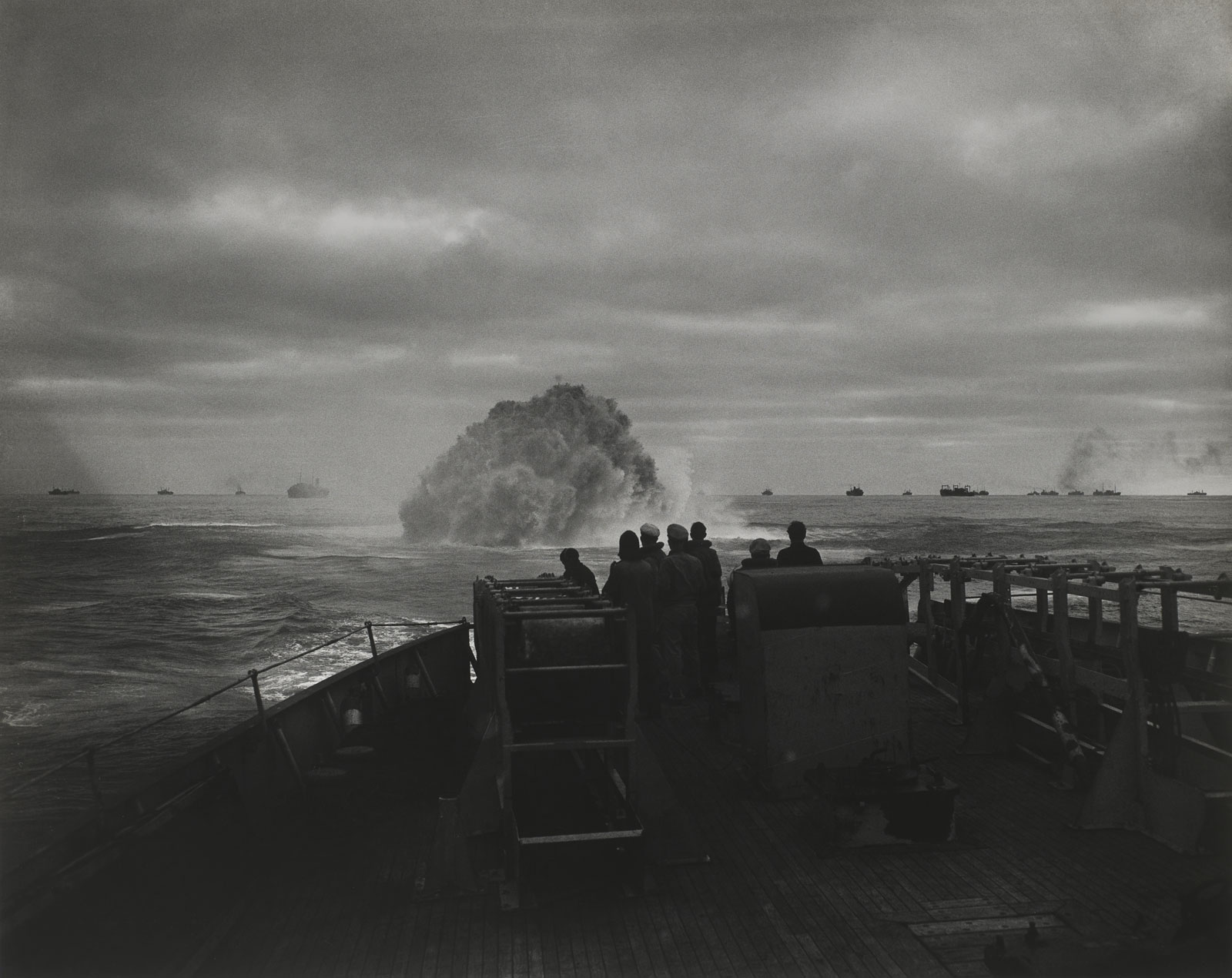
7. Patrol & Troop Movement conveys the mass movements of peoples and personnel by land, sea and air, from the movement of troops and supplies to patrols by all five divisions of military service: Army, Navy, Marine Corps, Coast Guard and Air Force. Combat patrols are detachments of forces sent into hostile terrain for a range of missions, and they – as well as the photographers accompanying them – face considerable danger. João Silva’s three sequenced frames show, through his eyes, the tilted earth just after he was felled by an IED while on patrol in Afghanistan in 2010; he lost both legs in the incident. A tranquil, 1917 image by Australian James Frank Hurley depicts silhouetted soldiers walking in a line, their reflections captured in a body of water. A 1943 photograph by American Warrant Photographer Jess W. January USCGR shows members of the U.S. Coast Guard observing a depth-charge explosion hitting a German submarine that stalked their convoy. (14 images)

.

João Silva (South African born Portugal, b. 1966) 'Soldiers of Charlie Company, 1st Battalion, 66th Armored Regiment, 4th Infantry Division react to photographer Joao Silva stepping on a mine in the Arghandab district of Kandahar Province, Afghanistan, on Oct. 23, 2010'


João Silva (South African born Portugal, b. 1966)
Soldiers of Charlie Company, 1st Battalion, 66th Armored Regiment, 4th Infantry Division react to photographer Joao Silva stepping on a mine in the Arghandab district of Kandahar Province, Afghanistan, on Oct. 23, 2010, in a three-photo combination. For American troops in heavily-mined Afghan villages, steering clear of improvised explosive devices is the most difficult task
October 23, 2010
© João Silva / The New York Times via Redux


Frank Hurley (Australian, 1885-1962) 'Supporting troops of the 1st Australian Division walking on a duckboard track' 1917


Frank Hurley (Australian, 1885-1962)
Supporting troops of the 1st Australian Division walking on a duckboard track
1917


Warrant Photographer Jess W. January USCGR, American USCG. 'Cutter Spencer destroys Nazi sub' April 17, 1943


Warrant Photographer Jess W. January USCGR, American
USCG Cutter Spencer destroys Nazi sub
April 17, 1943
Gelatin silver print
The Museum of Fine Arts, Houston


The Wait

8. The Wait depicts a common situation of wartime. Susan Meiselas captures a tense moment during a 1978 street fight in Nicaragua, when muchachos with Molotov cocktails line up in an alleyway, ready to initiate an attack on the National Guard. Robert Capa shows two female French ambulance drivers in Italy during World War II, leaning against their vehicle, knitting, as they wait to be called. (8 images)


Robert Capa (American-Hungarian, 1913-1954) 'Drivers from the French ambulance corps near the front, waiting to be called' Italy, 1944


Robert Capa (American-Hungarian, 1913-1954)
Drivers from the French ambulance corps near the front, waiting to be called
Italy, 1944
Original album – Italy. Cassino Campaign. W.W.II.
© 2001 By Cornell Capa, Agentur Magnum


Susan Meiselas (American, b. 1948) 'Muchachos Await Counter Attack by The National Guard, Matagalpa, Nicaragua' 1978


Susan Meiselas (American, b. 1948)
Muchachos Await Counter Attack by The National Guard, Matagalpa, Nicaragua
1978
Chromogenic print (printed 2006)
The Museum of Fine Arts, Houston, museum purchase with funds provided by Photo Forum 2006
© Susan Meiselas / Magnum Photos


The Fight

9. The Fight is one of the most extensive sections in the exhibition. Dmitri Baltermants shot Attack – Eastern Front WWII (cover image of the exhibition catalogue) in 1941 from the trench, as men charged over him. Sky Over Sevastopol (1944), by Evgeny Khaldey, is an aerial photograph of planes on their way to a bombing raid of the strategically important naval point. Joe Rosenthal’s Over the Top – American Troops Move onto the Beach at Iwo Jima (1945) pictures infantrymen emerging from the protection of their landing craft into enemy fire. Staged photographs, presented as authentic documents, tend to proliferate during wartime, and several examples are included here. In 1942 the Public Relations Department of the War issued an assignment to photographers to create “representative” images of combat in North Africa for more dynamic images; official British photographer Len Chetwyn staged an Australian officer leading the charging line in the battle of El Alamein, using smoke in the background from the cookhouse to create a lively image. (21 images)


Len Chetwyn (English, 1909-1980) 'Australians approached the strong point, ready to rush in from different sides' November 3, 1942


Len Chetwyn (English, 1909-1980)
Australians approached the strong point, ready to rush in from different sides
November 3, 1942
Silver gelatin photograph


Joe Rosenthal (American, 1911-2006) 'Over the Top – American Troops Move onto the Beach at Iwo Jima' 1945

Joe Rosenthal (American, 1911-2006) 'Over the Top - American Troops Move onto the Beach at Iwo Jima' February 19, 1945


Joe Rosenthal (American, 1911-2006)
Over the Top – American Troops Move onto the Beach at Iwo Jima
February 19, 1945 (printed February 23, 1945)
Gelatin silver print with applied ink
The Museum of Fine Arts, Houston, gift of Richard S. and Dodie Otey Jackson in honor of Ira J. Jackson, M.D., and his service in the Pacific Theater during World War II
© AP / Wide World Photos


Dmitri Baltermants (Russian, 1912-1990) 'Attack – Eastern Front WWII' 1941


Dmitri Baltermants (Russian, 1912-1990)
Attack – Eastern Front WWII
1941
Silver gelatin photograph


The Wait and Rescue

10. The Wait and Rescue bookend The Fight. Among the photographs in Rescue are Ambush of the 173rd AB, South Vietnam (1965), by Tim Page, showing soldiers immediately combing through a battleground to assist the wounded; American Lt. Wayne Miller’s image of a wounded gunner being lifted from the turret of a torpedo bomber; and Life magazine photographer W. Eugene Smith’s 1944 photograph of an American soldier rescuing a dying Japanese infant. Smith wrote about that moment, stating “hands trained for killing gently… extricated the infant” to be transported to medical care. (8 images) 


Lt. Wayne Miller. 'Crewmen lifting Kenneth Bratton out of turret of TBF on the USS SARATOGA after raid on Rabaul' November 1943


Lt. Wayne Miller (American, 1918-2013)
Crewmen lifting Kenneth Bratton out of turret of TBF on the USS SARATOGA after raid on Rabaul
November 1943
Silver gelatin photograph


More information: Kenneth C. Bratton – Mississippi (WWII vet). He was born in Pontotoc, MS, December 17, 1918. He passed away April 15, 1982. Lt. Bratton won a purple heart for his bravery during the attack on Rabaul November 11, 1943.


Wayne Forest Miller (September 19, 1918 – May 22, 2013) was an American photographer known for his series of photographs The Way of Life of the Northern Negro. Active as a photographer from 1942 until 1975, he was a contributor to Magnum Photos beginning in 1958. …

War photographer

Miller then served as a lieutenant in the U.S. Navy where he was assigned to Edward Steichen’s World War II Naval Aviation Photographic Unit. He was among the first Western photographers to document the destruction at Hiroshima.

Text from the Wikipedia website


The Grumman TBF Avenger (designated TBM for aircraft manufactured by General Motors) is an American World War II-era torpedo bomber developed initially for the United States Navy and Marine Corps, and eventually used by several air and naval aviation services around the world.

The Avenger entered U.S. service in 1942, and first saw action during the Battle of Midway. Despite the loss of five of the six Avengers on its combat debut, it survived in service to become the most effective and widely-used torpedo bomber of World War II, sharing credit for sinking the super-battleships Yamato and Musashi (the only ships of that type sunk exclusively by American aircraft while under way) and being credited for sinking 30 submarines. Greatly modified after the war, it remained in use until the 1960s.

Text from the Wikipedia website


W. Eugene Smith (American, 1918-1978) 'Dying Infant Found by American Soldiers in Saipan' June 1944


W. Eugene Smith (American, 1918-1978)
Dying Infant Found by American Soldiers in Saipan
June 1944
Gelatin silver print
The Museum of Fine Arts, Houston, gift of Will Michels in honor of Anne Wilkes Tucker
© Estate of W. Eugene Smith / Black Star


Aftermath

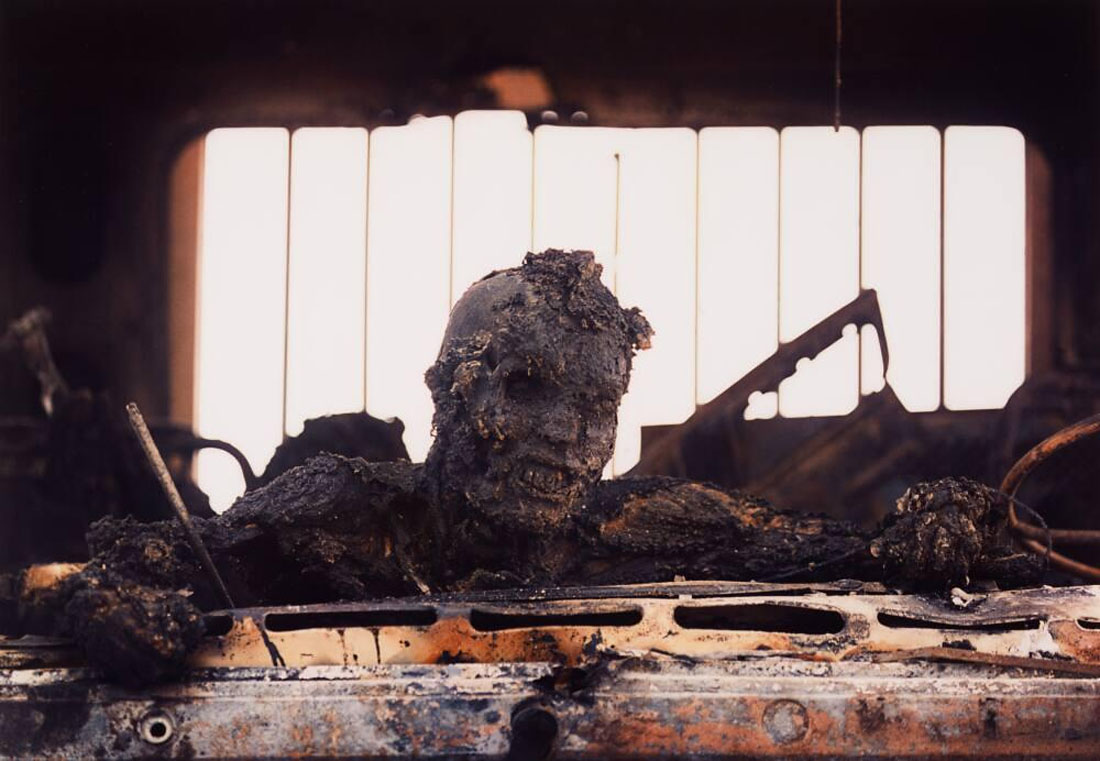
11. Aftermath, with four subsections, features photographs taken after the battle has ended. “Death” on the battlefield is one of the earliest types of war images: Felice Beato photographed the dead in the interior of Fort Taku in the Second Opium War (1860). George Strock’s Dead GIs on Buna Beach, New Guinea (1943), which ran in Life magazine with personal details about the casualties, was the first published photograph from any conflict of American dead in World War II. In 1966, Associated Press photographer Henri Huet documented an American paratrooper, who was killed in action, being raised to an evacuation helicopter. Incinerated Iraqi, Gulf War, Iraq, taken by Kenneth Jarecke, was published in Europe, but the American Associated Press editors withheld it in the United States. “Shell Shock and Exhaustion” shows impenetrable exhaustion after battle. In Don McCullin’s Shell-shocked soldier awaiting transportation away from the front line, Hué, Vietnam (1968), the man looks forward with the “thousand-yard stare.” Robert Attebury photographed Marines so exhausted after a 2005 battle in Iraq that lasted 17 hours that they fell asleep where they had been standing, amid the rubble of a destroyed building. “Grief and Battlefield Burial” were taken at the site of the conflict, including David Turnley’s 1991 picture of a weeping soldier who has just learned that the remains in a nearby body bag are those of a close friend. “Destruction of Property” shows collateral damage from war. Christophe Agou, for instance, photographed the smouldering steel remains of the twin towers of the World Trade Center in 2001. (39 images)


George Strock (American, 1911-1977) 'Dead GIs on Buna Beach, New Guinea' January 1943


George Strock (American, 1911-1977)
Dead GIs on Buna Beach, New Guinea
January 1943
© George Strock / LIFE


Henri Huet (French, 1927-1971) 'The body of an American paratrooper killed in action in the jungle near the Cambodian border is raised up to an evacuation helicopter, Vietnam' 1966


Henri Huet (French, 1927-1971)
The body of an American paratrooper killed in action in the jungle near the Cambodian border is raised up to an evacuation helicopter, Vietnam
1966
Gelatin silver print (printed 2004)
The Museum of Fine Arts, Houston, museum purchase
© AP / Wide World Photos


Kenneth Jarecke (American, b. 1963) 'Gulf War: Incinerated Iraqi soldier in personnel carrier'
Nasiriyah, Iraq, March 1991


Kenneth Jarecke (American, b. 1963)
Gulf War: Incinerated Iraqi soldier in personnel carrier
Nasiriyah, Iraq, March 1991


Felice Beato (Italian-British, 1832-1909) 'Angle of North Taku Fort at which the French entered' August 21-22, 1860


Felice Beato (Italian-British, 1832-1909)
Angle of North Taku Fort at which the French entered
August 21-22, 1860


Don McCullin (British, b. 1935) 'Shell-shocked US soldier awaiting transportation away from the front line' Hue, Vietnam, 1968


Don McCullin (British, b. 1935)
Shell-shocked US soldier awaiting transportation away from the front line
Hue, Vietnam, 1968
© Don McCullin


David Turnley (American, b. 1955) 'American Soldier Grieving for Comrade' Iraq, 1991


David Turnley (American, b. 1955)
American Soldier Grieving for Comrade
Iraq, 1991


Ken Kozakiewicz (left) breaks down in an evacuation helicopter after hearing that his friend, the driver of his Bradley Fighting Vehicle, was killed in a “friendly fire” incident that he himself survived. Michael Tsangarakis (centre) suffers severe burns from ammunition rounds that blew up inside the vehicle during the incident. All of the soldiers were exposed to depleted uranium as a result of the explosion. They and the body of the dead man are on their way to a MASH (Mobile Army Surgical Hospital).


Prisoners of War (Civilian and Military)/Interrogation

12. Prisoners of War (Civilian and Military)/Interrogation is a frequently photographed subject because such pictures can be made outside an area of conflict. Moreover, the people in control often documented their prisoners as a show of power. The photographs in this section include the official recording of a prisoner of war before his execution by the Khmer Rouge, taken by Nhem Ein. (14 images)


Nhem Ein (Cambodian, b. 1959) 'Untitled (prisoner #389 of the Khmer Rouge; man)' 1975-79


Nhem Ein (Cambodian, b. 1959)
Untitled (prisoner #389 of the Khmer Rouge; man)
1975-1979
Gelatin silver print (printed 1994)
Courtesy of Museum of Modern Art
Arthur M. Bullowa Fund and Geraldine Murphy Fund
Digital image © The Museum of Modern Art / Licensed by SCALA Art Resource, NY. Used with permission of Photo Archive Group


Iwo Jima

13. Iwo Jima is a case study within the exhibition that presents the complete thematic narrative in photographs from a specific battle. Included in this section is the inspiration for the exhibition: Joe Rosenthal’s iconic, Pulitzer Prize-winning Old Glory Goes Up on Mount Suribachi, Iwo Jima, a photograph he took as an Associated Press photographer in World War II showing U.S. Marines and one Navy medic raising the American flag on the remote Pacific island. (25 images)


Joe Rosenthal (American, 1911-2006) 'Old Glory Goes Up on Mount Suribachi, Iwo Jima' February 23, 1945


Joe Rosenthal (American, 1911-2006)
Old Glory Goes Up on Mount Suribachi, Iwo Jima
February 23, 1945
Gelatin silver print
The Museum of Fine Arts, Houston, The Manfred Heiting Collection, gift of the Kevin and Lesley Lilly Family
© AP / Wide World Photos


Exhibition posting continued in Part 2…


Museum of Fine Arts, Houston
1001 Bissonnet Street
Houston, TX 77005

Opening hours:
Wednesday 11am – 5pm
Thursday 11am – 9pm
Friday, Saturday 11am – 6pm
Sunday 12.30 – 6pm
Closed Monday and Tuesday

Museum of Fine Arts, Boston website

LIKE ART BLART ON FACEBOOK

Back to top

Exhibition: ‘Jeff Wall Photographs’ at The Ian Potter Centre: National Gallery of Victoria Australia, Melbourne

Exhibition dates: 30th November 2012 – 17th March 2013


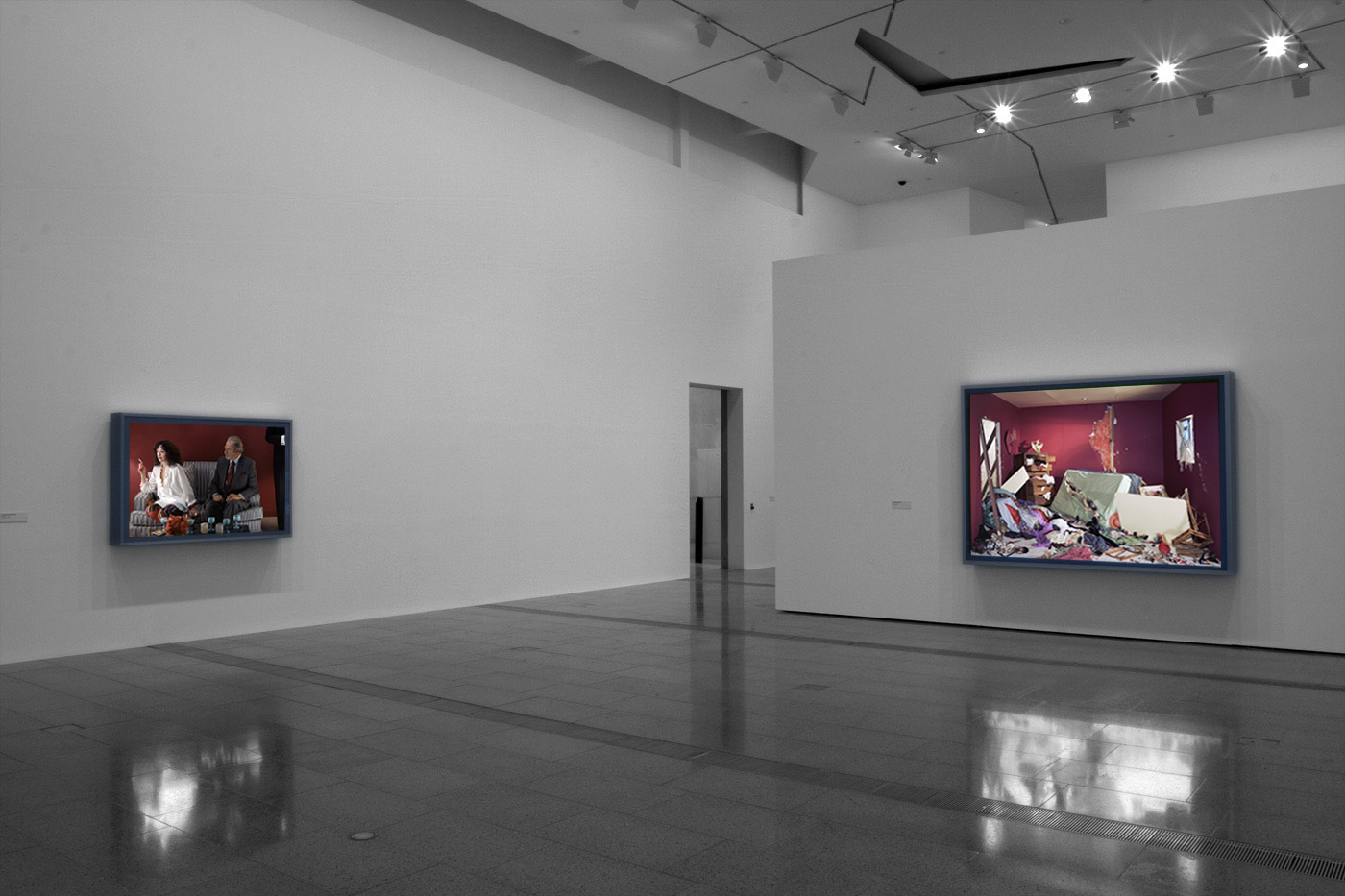
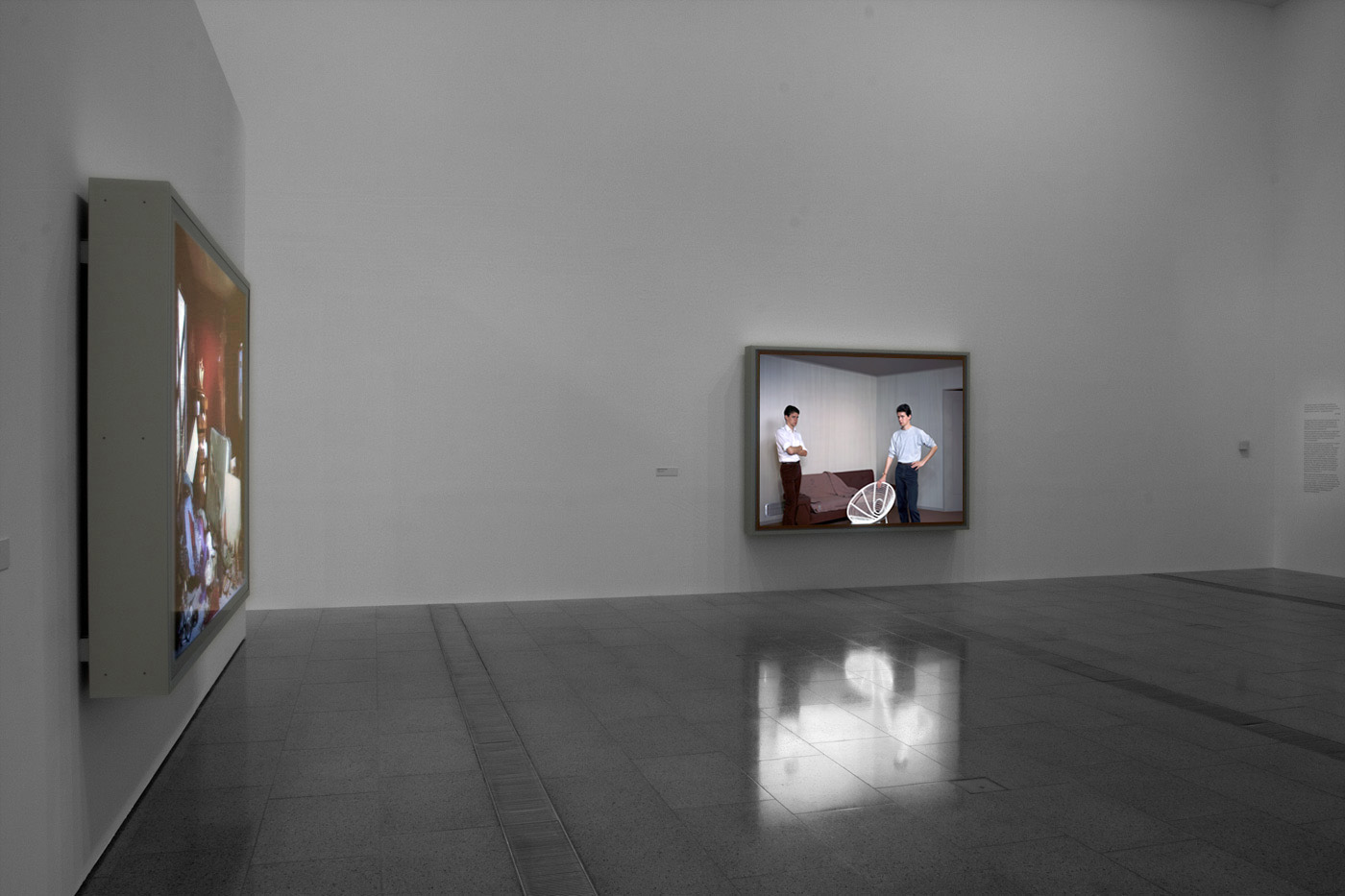
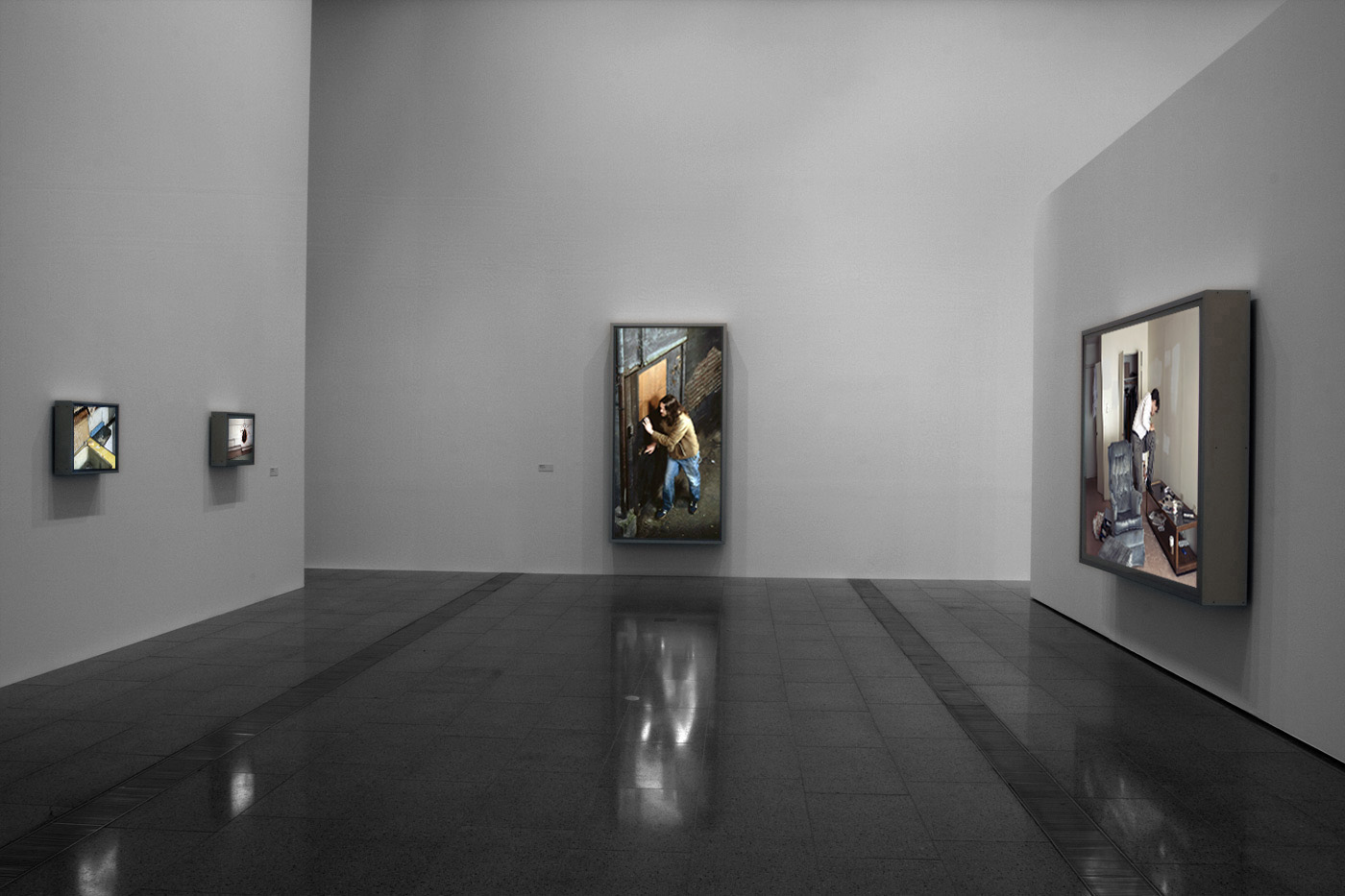
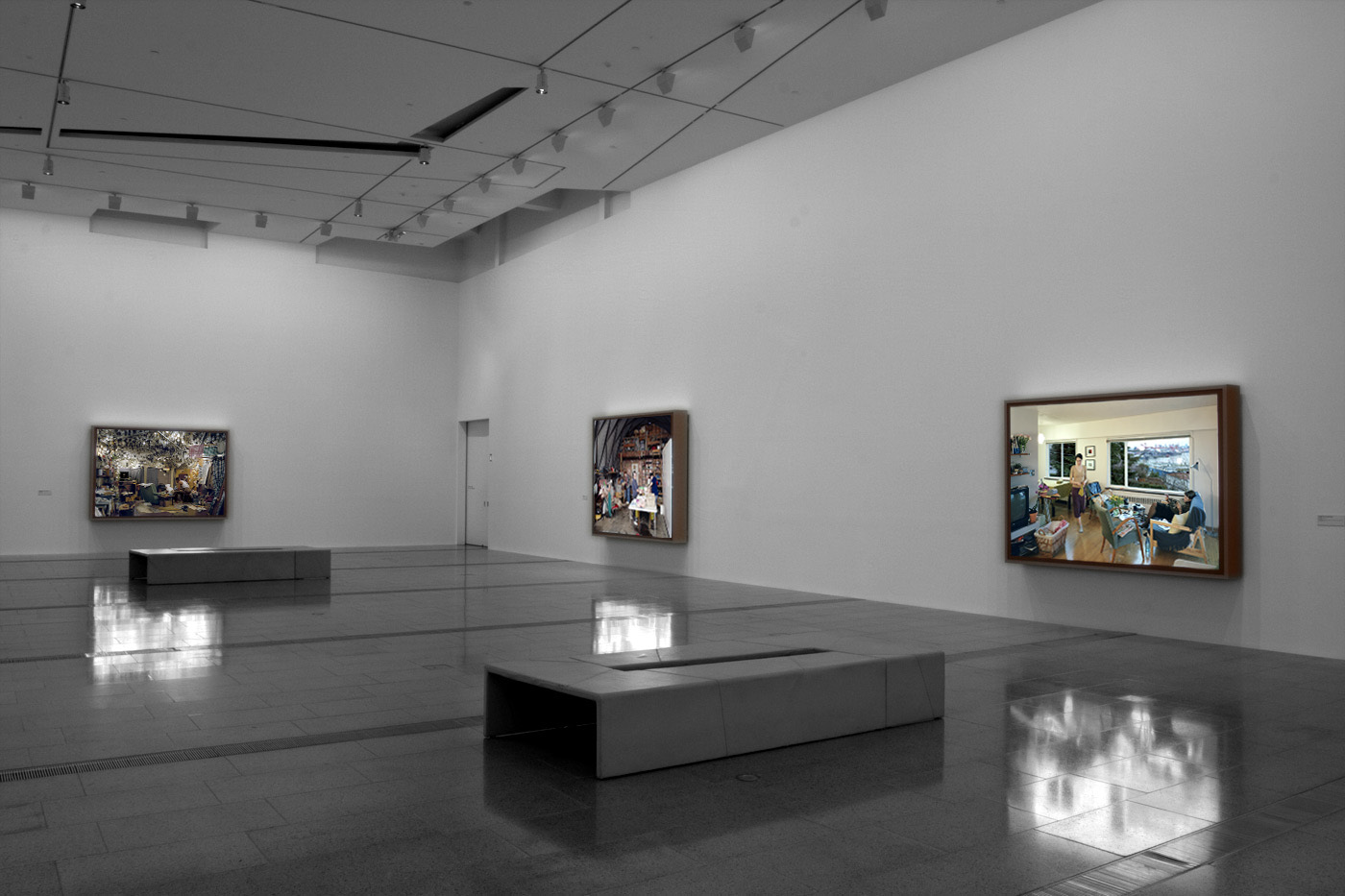
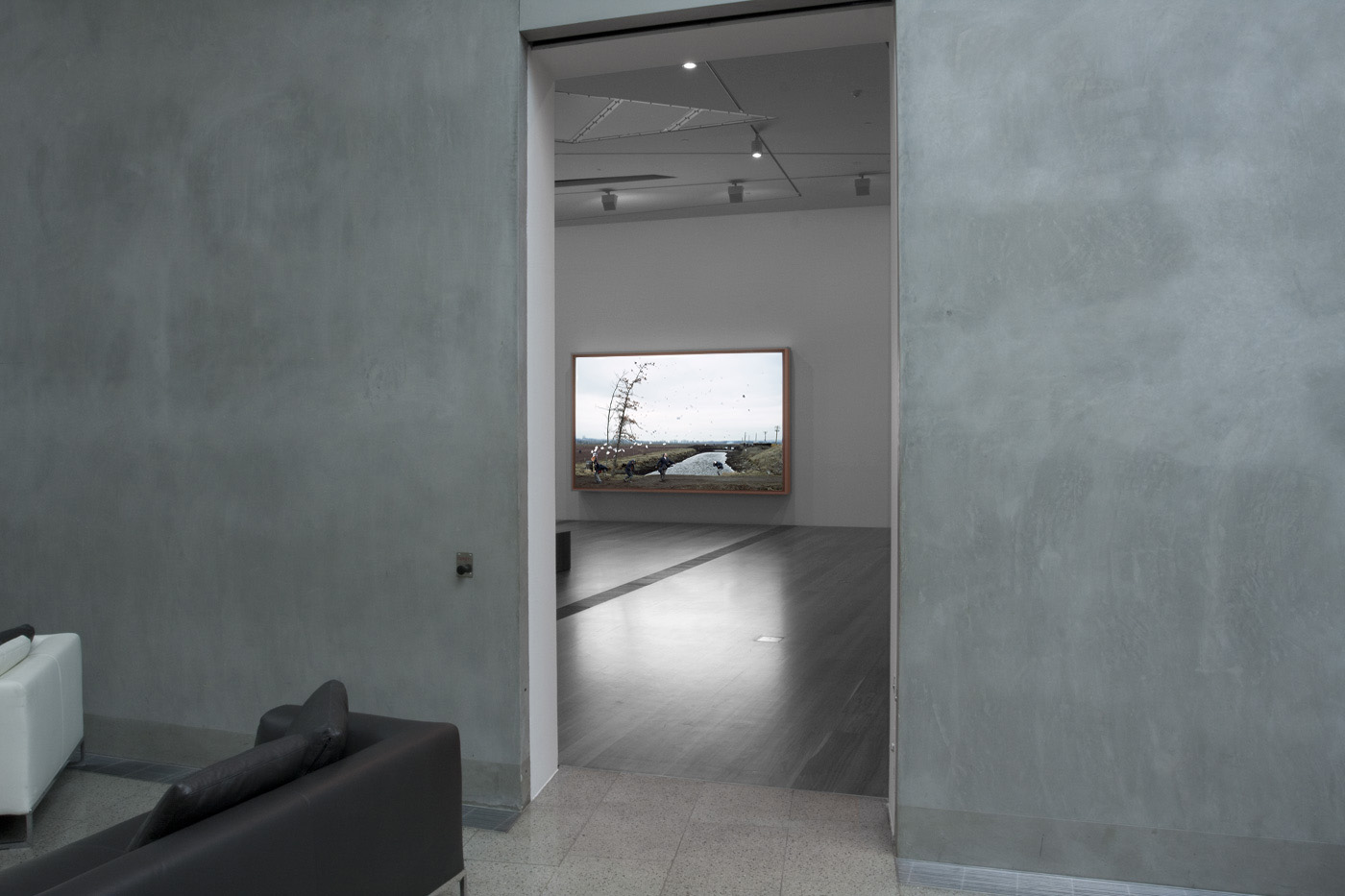
Installation view of 'Jeff Wall Photographs' at NGV Australia showing, at right, 'The Destroyed Room' 1978


Installation view of Jeff Wall Photographs at NGV Australia showing, at right, The Destroyed Room 1978
Photo: Marcus Bunyan


Installation shots of the new Jeff Wall exhibition at NGV Australia. Review to follow in due course.

Many thankx to Jemma Altmeier and all the media team at NGV for all their wonderful help and congratulations to the curators, Susan van Wyk and Dr Isobel Crombie, for their restrained yet contemporary installations and for getting the exhibitions to Melbourne. They look magnificent. Well done!

Dr Marcus Bunyan


Many thankx to the NGV for allowing me to publish the photographs in the posting. Please click on the photographs for a larger version of the image. All photographs © Marcus Bunyan © National Gallery of Victoria. May not be reproduced without permission.


Jeff Wall & Thomas Demand: In Conversation, National Gallery of Victoria


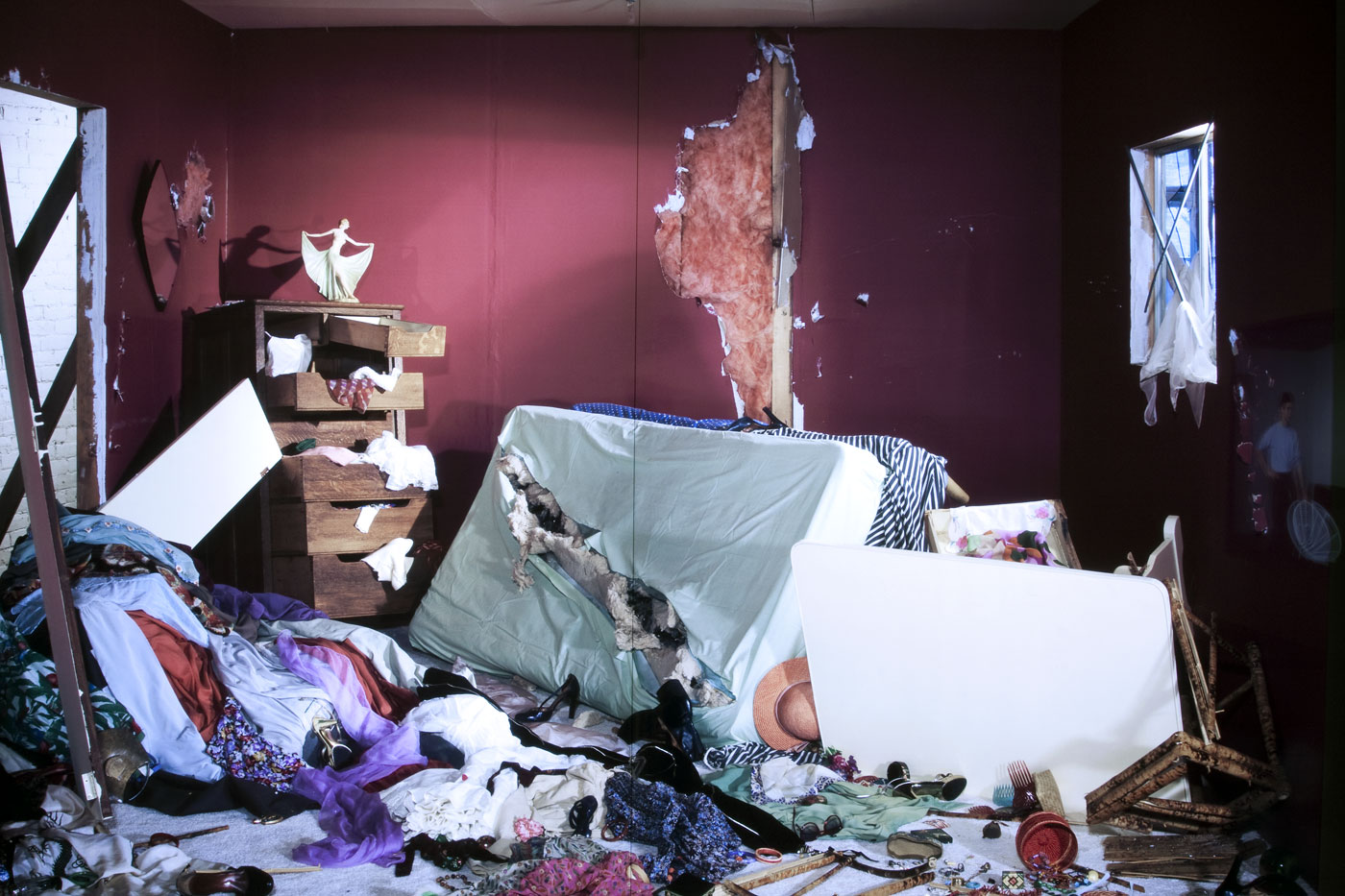
Jeff Wall (Canadian, b. 1946) 'The Destroyed Room' 1978 (detail)


Jeff Wall (Canadian, b. 1946)
The Destroyed Room (detail)
1978
Transparency in light box, AP
159.0 x 234.0cm
Collection of the artist
© Jeff Wall


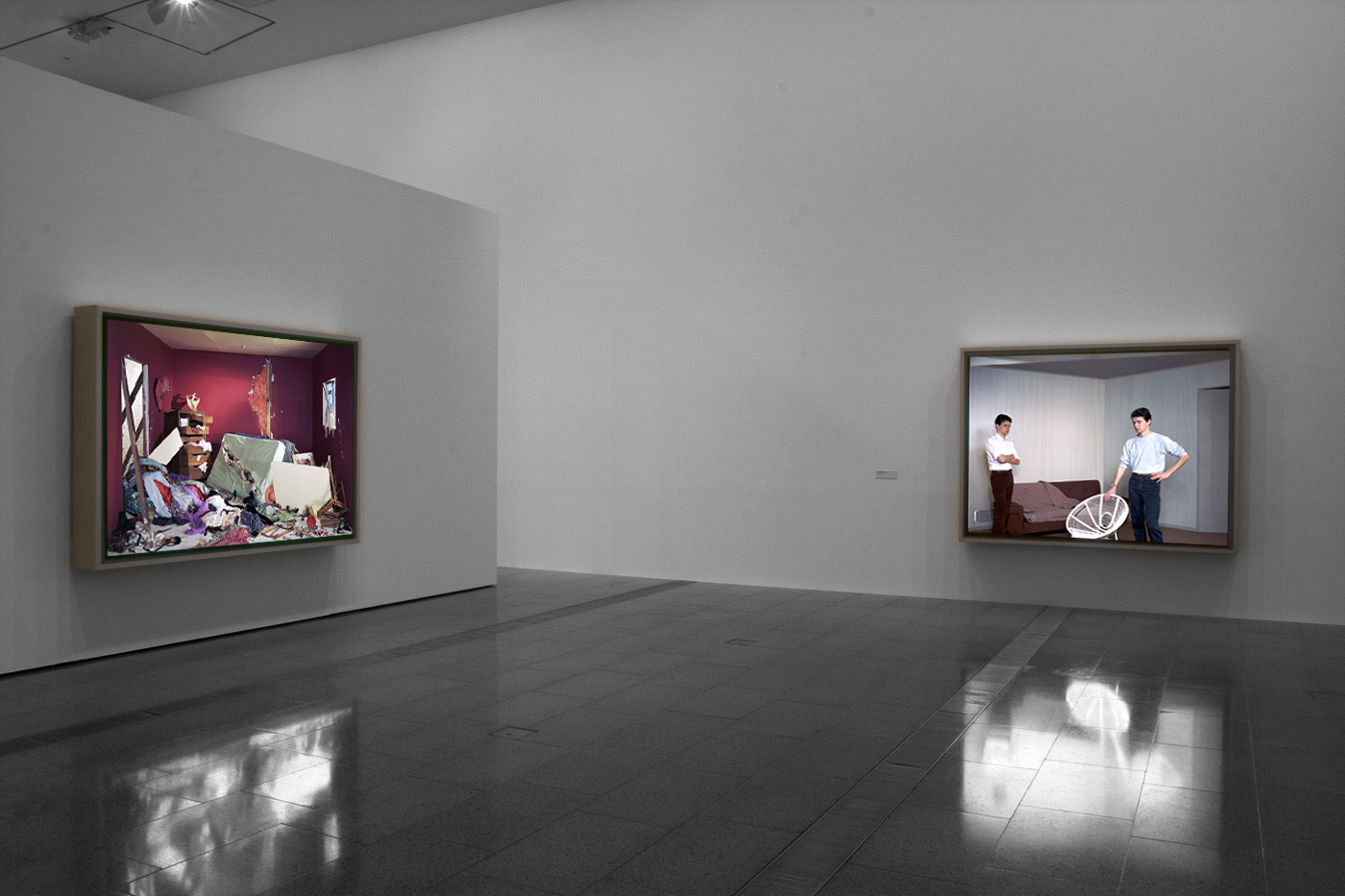
Installation view of 'Jeff Wall Photographs' at NGV Australia showing, at left, 'The Destroyed Room' 1978, and at right, 'Double Self-Portrait' 1979


Installation view of Jeff Wall Photographs at NGV Australia showing, at left, The Destroyed Room 1978, and at right, Double Self-Portrait 1979
Photo: Marcus Bunyan


Installation view of 'Jeff Wall Photographs' at NGV Australia showing, at right, 'Double Self-Portrait' 1979


Installation view of Jeff Wall Photographs at NGV Australia showing, at right, Double Self-Portrait 1979
Photo: Marcus Bunyan


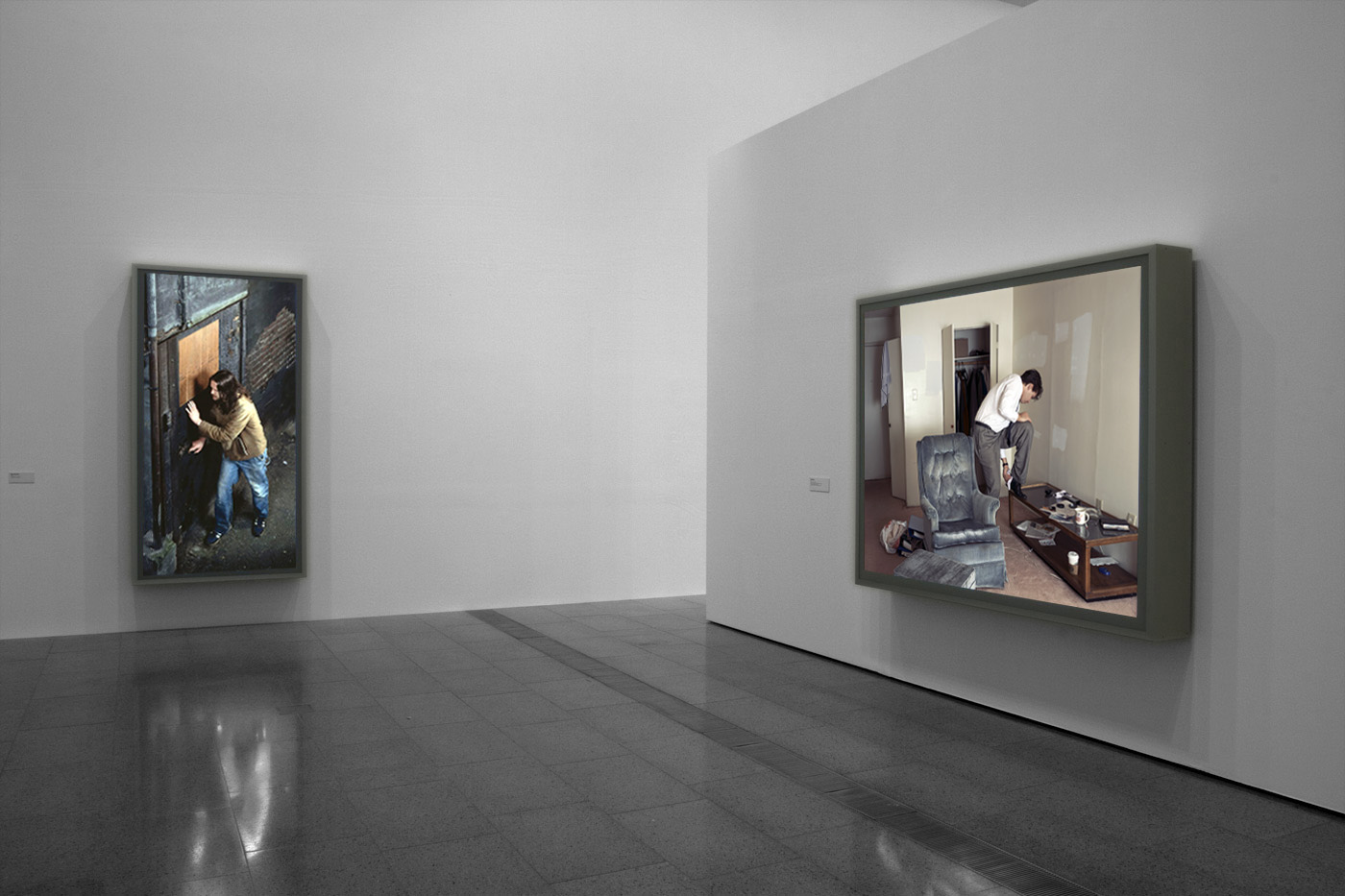
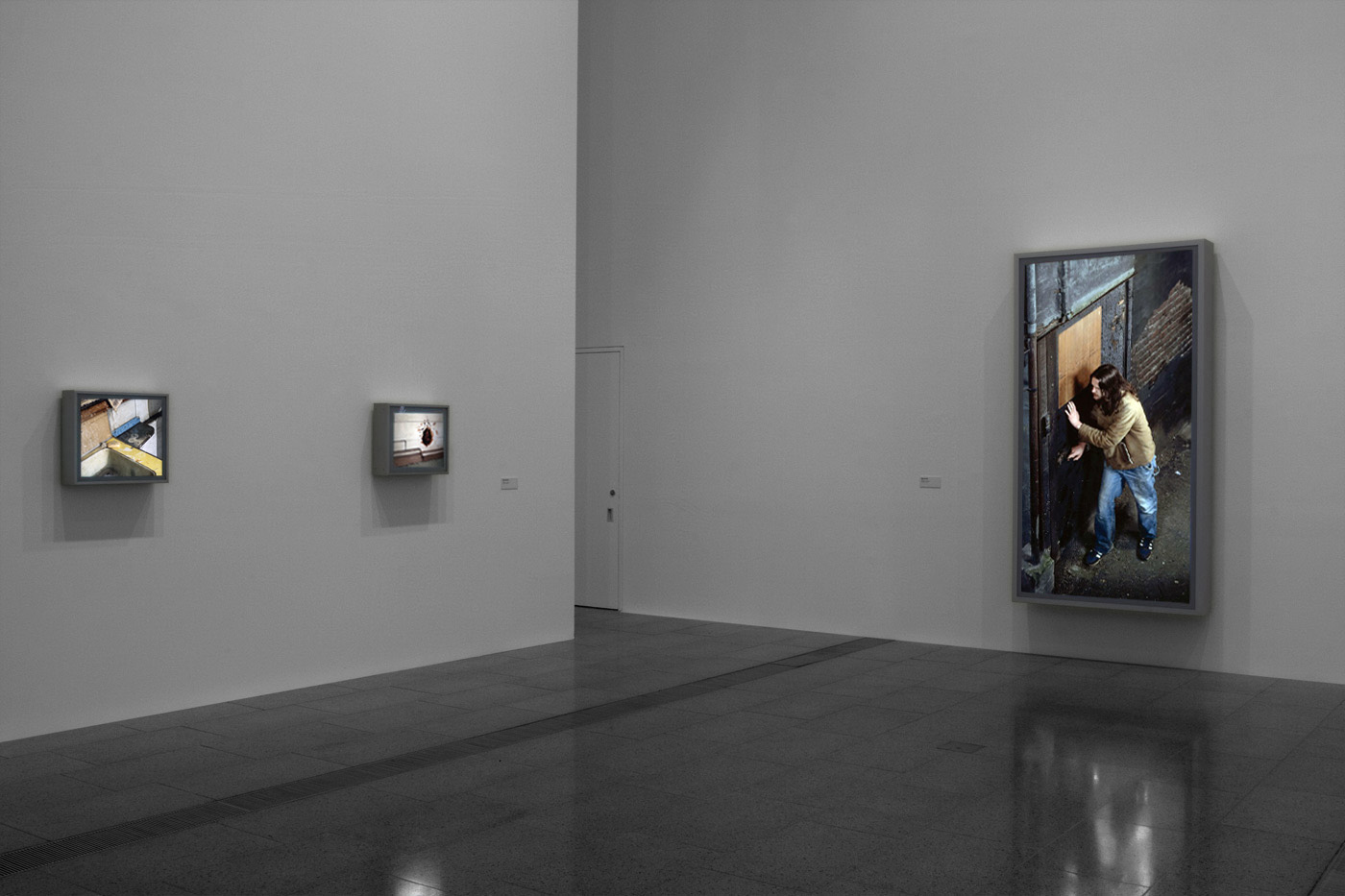
Installation view of 'Jeff Wall Photographs' at NGV Australia showing, at left, 'Doorpusher' 1984, and at right, 'Polishing' 1998


Installation view of Jeff Wall Photographs at NGV Australia showing, at left, Doorpusher 1984, and at right, Polishing 1998
Photo: Marcus Bunyan


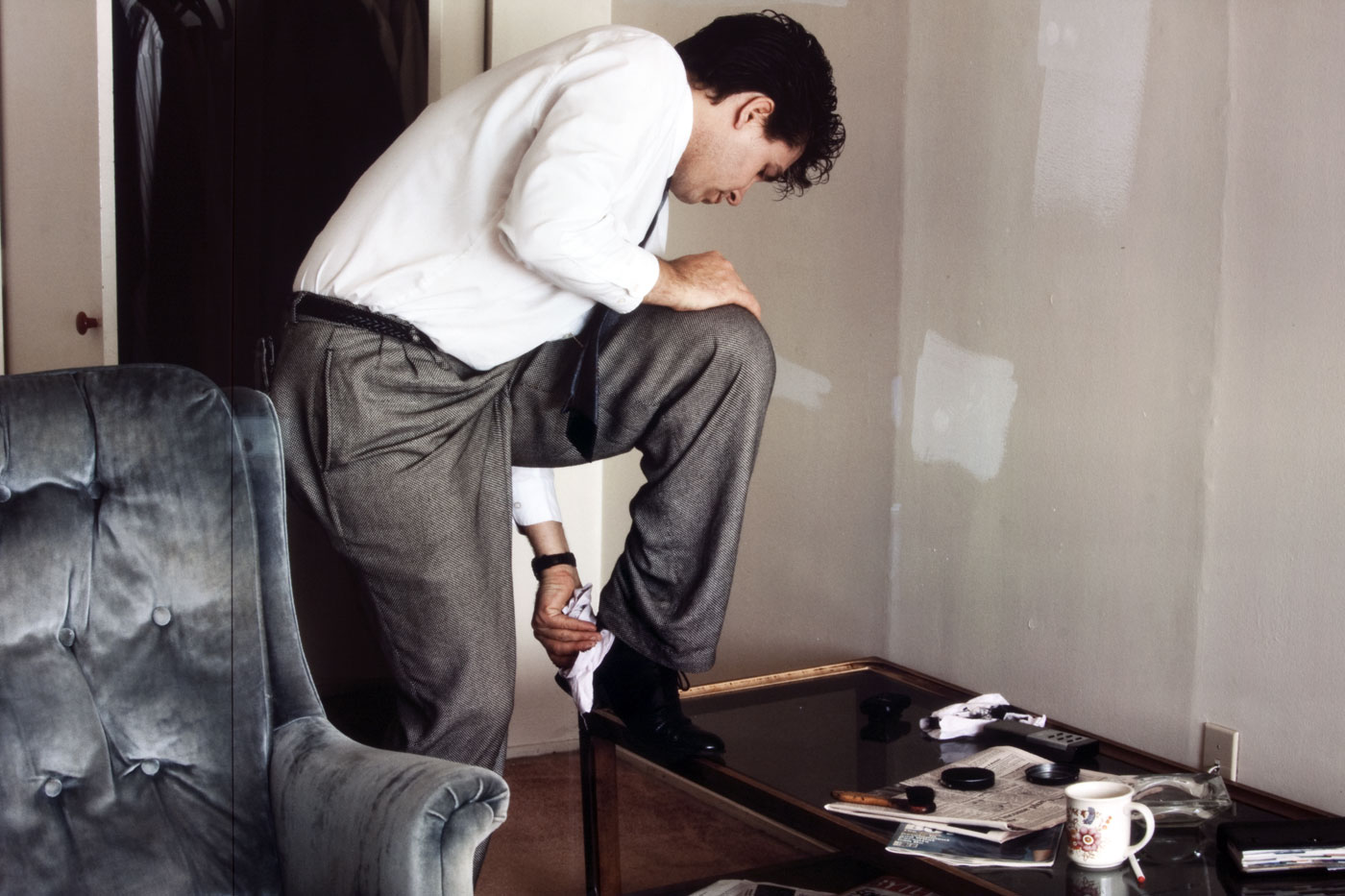
Jeff Wall (Canadian, b. 1946) 'Polishing' 1998 (detail)


Jeff Wall (Canadian, b. 1946)
Polishing (detail)
1998
Transparency in light box, 1/2
162.0 x 207.0cm
State Art Collection, Art Gallery of Western Australia
Purchased with assistance from the Art Gallery of Western Australia Foundation, 1999
© Jeff Wall


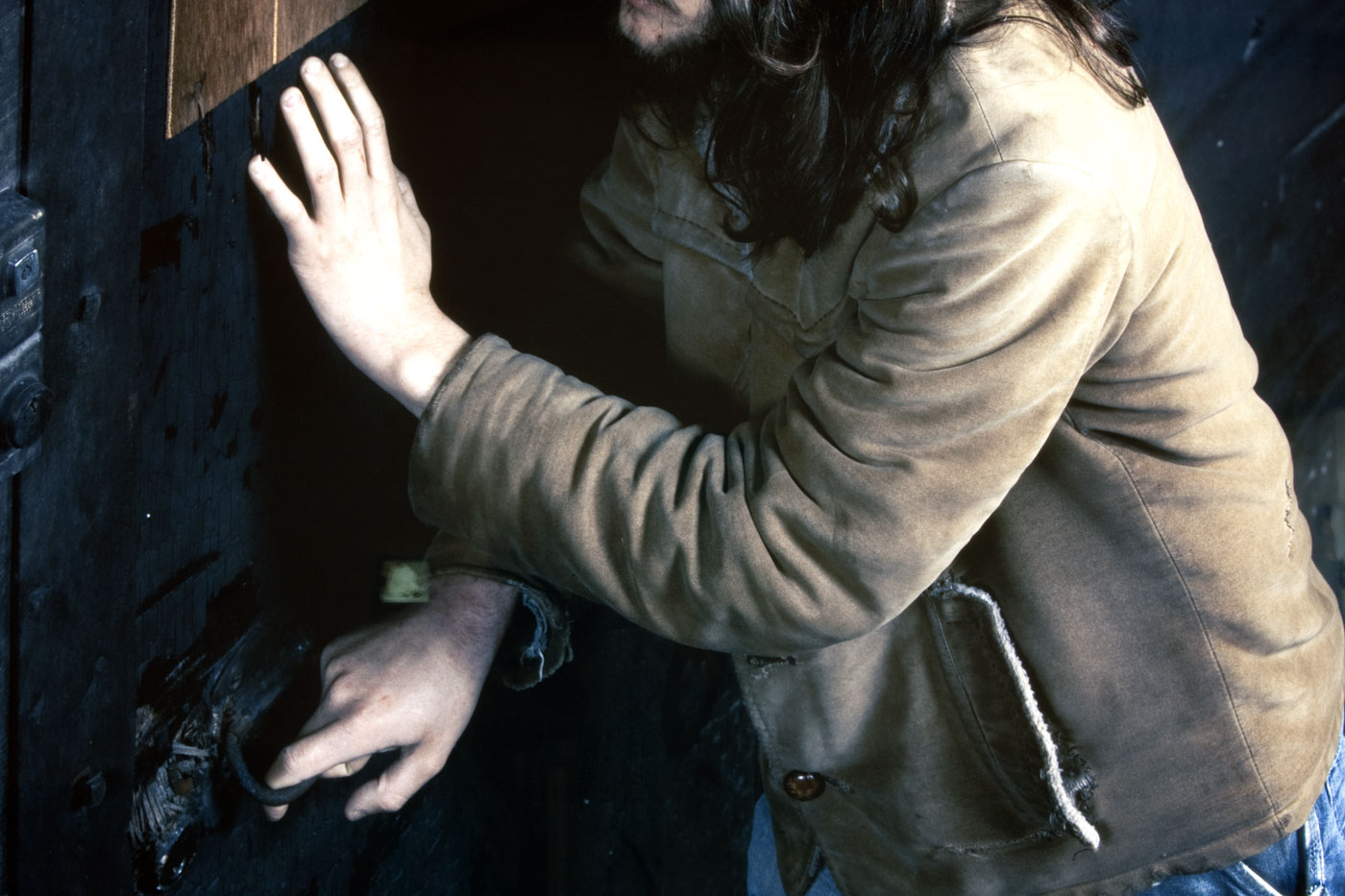
Jeff Wall (Canadian, b. 1946) 'Doorpusher' 1984 (detail)


Jeff Wall (Canadian, b. 1946)
Doorpusher
(detail)
1984
Transparency in lightbox
249 x 122cm
© Jeff Wall


Installation view of 'Jeff Wall Photographs' at NGV Australia showing, at centre, 'Doorpusher' 1984, and at right, 'Polishing' 1998


Installation view of Jeff Wall Photographs at NGV Australia showing, at centre, Doorpusher 1984, and at right, Polishing 1998
Photo: Marcus Bunyan


Installation view of 'Jeff Wall Photographs' at NGV Australia showing, at left, 'Diagonal Composition' 1993, and at right, 'Doorpusher' 1984


Installation view of Jeff Wall Photographs at NGV Australia showing, at left, Diagonal Composition 1993, and at right, Doorpusher 1984
Photo: Marcus Bunyan


Jeff Wall (Canadian, b. 1946) 'Diagonal Composition' 1993


Jeff Wall (Canadian, b. 1946)
Diagonal Composition
1993
Transparency in light box, AP
40 x 46cm
Collection of the artist
© Jeff Wall


Jeff Wall (Canadian, b. 1946) 'Pipe Opening' 2002 (detail)


Jeff Wall (Canadian, b. 1946)
Pipe Opening (detail)
2002
Transparency in light box, AP
40 x 46cm
Collection of the artist
© Jeff Wall


Installation view of 'Jeff Wall Photographs' at NGV Australia showing, at right, 'A view from an apartment' 2004-2005


Installation view of Jeff Wall Photographs at NGV Australia showing, at right, A view from an apartment 2004-2005
Photo: Marcus Bunyan


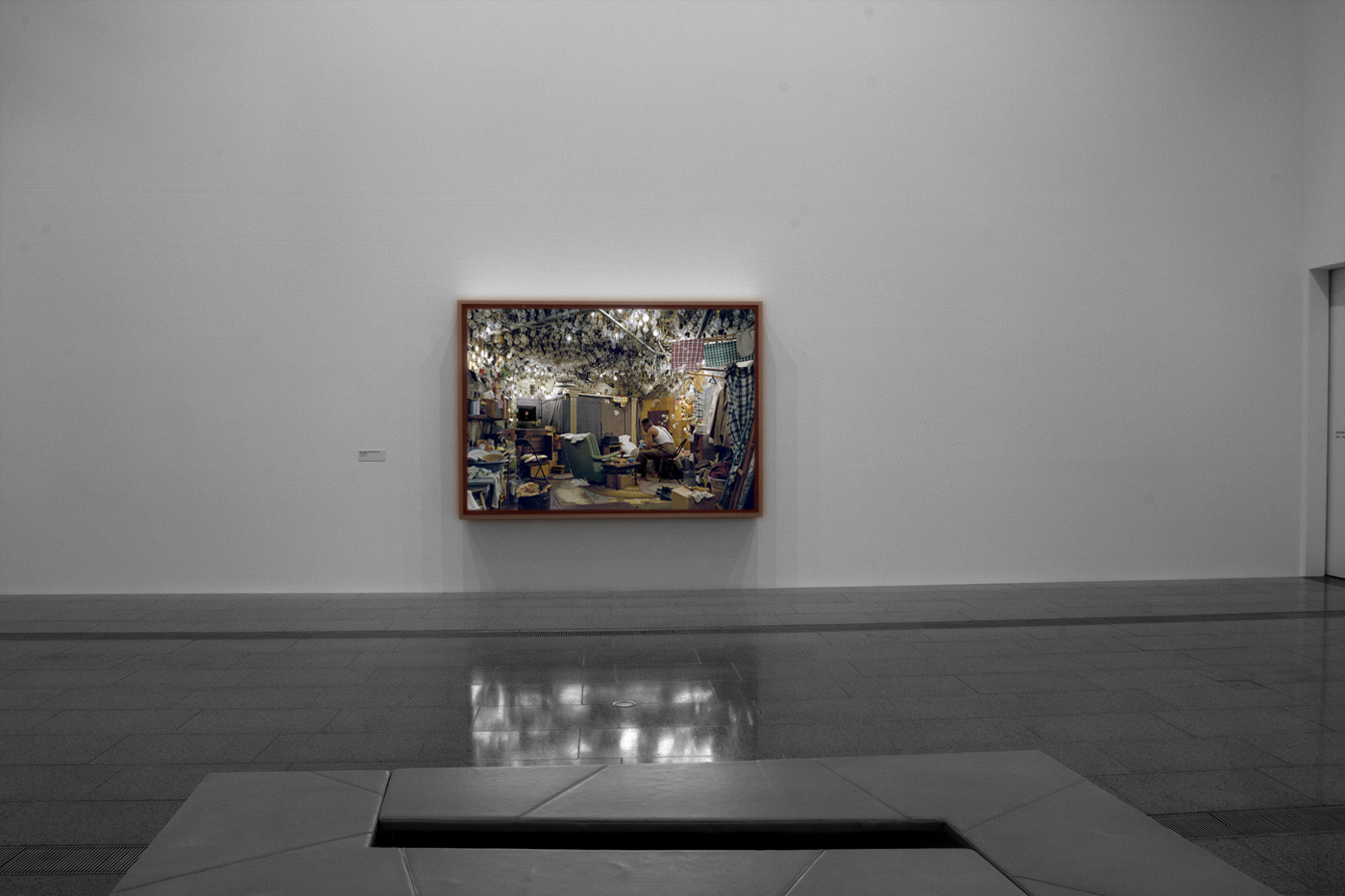
Installation view of 'Jeff Wall Photographs' at NGV Australia showing 'After 'Invisible Man' by Ralph Ellison, the Prologue' 1999-2000


Installation view of Jeff Wall Photographs at NGV Australia showing After ‘Invisible Man’ by Ralph Ellison, the Prologue 1999-2000
Photo: Marcus Bunyan


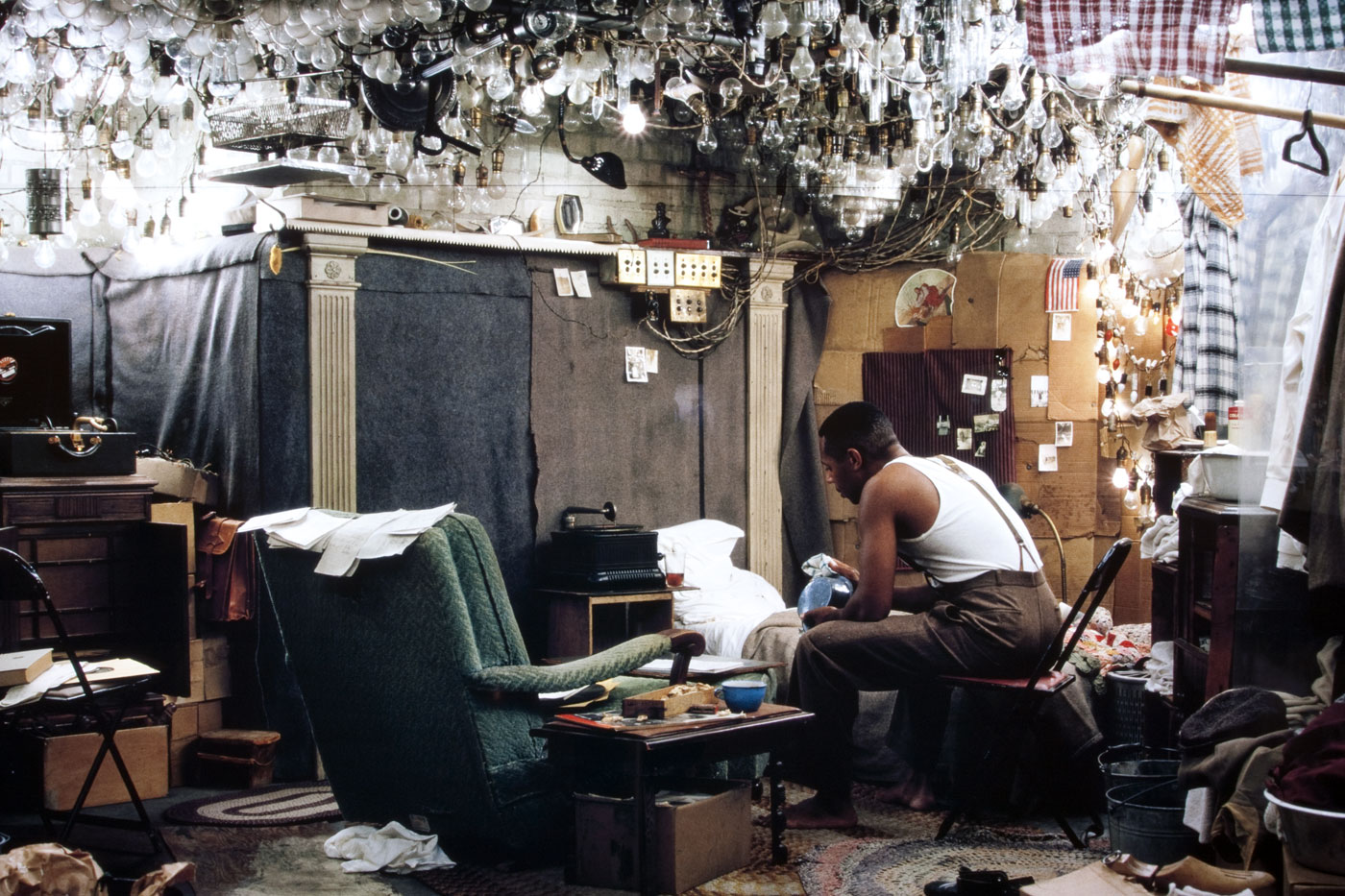
Jeff Wall (Canadian, b. 1946) 'After 'Invisible Man' by Ralph Ellison, the Prologue' 1999-2000 (detail)


Jeff Wall (Canadian, b. 1946)
After ‘Invisible Man’ by Ralph Ellison, the Prologue (detail)
1999-2000
Transparency in light box, AP
174 x 250.5cm
Collection of the artist
© Jeff Wall


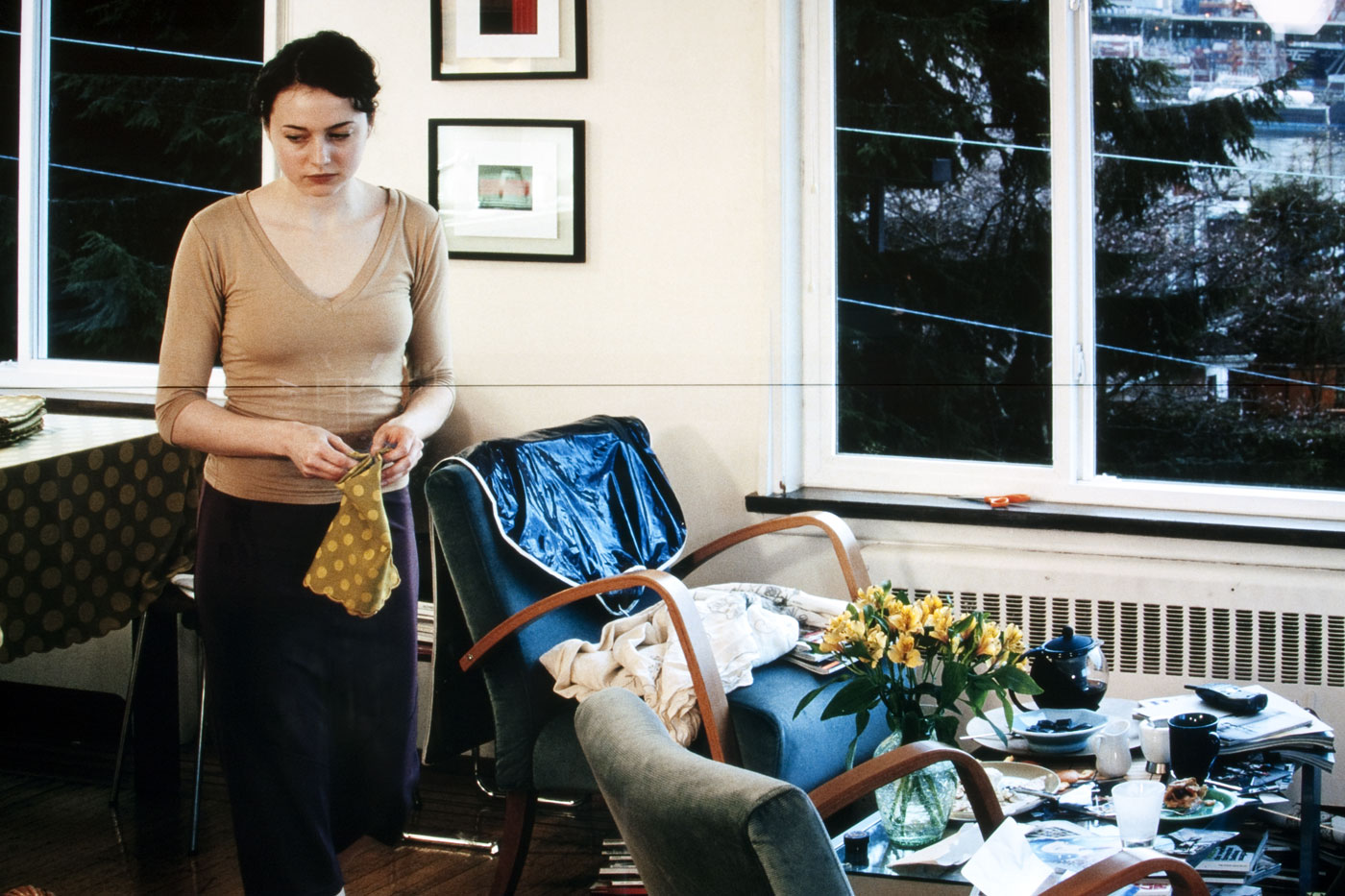
Jeff Wall (Canadian, b. 1946) 'A view from an apartment' 2004-05 (detail)


Jeff Wall (Canadian, b. 1946)
A view from an apartment (detail)
2004-2005
Transparency in light box, 1/2
167.0 x 244.0cm
Tate, London
Purchased with assistance from the American Fund for the Tate Gallery and Tate Members, 2006
© Jeff Wall


Installation view of 'Jeff Wall Photographs' at NGV Australia showing 'A sudden gust of wind (after Hokusai)' 1993


Installation view of Jeff Wall Photographs at NGV Australia showing A sudden gust of wind (after Hokusai) 1993
Photo: Marcus Bunyan


The Ian Potter Centre: NGV Australia
Federation Square
Corner of Russell and 
Flinders Streets, Melbourne

Opening hours:
Daily 10am – 5pm

National Gallery of Victoria website

LIKE ART BLART ON FACEBOOK

Back to top

Exhibition: ‘Dark Romanticism. From Goya to Max Ernst’ at the Städel Museum, Frankfurt

Exhibition dates: 26th September 2012 – 20th January, 2013


Many thankx to the Städel Museum for allowing me to publish the reproductions of the artwork in the posting. Please click on the photographs for a larger version of the image.


This slideshow requires JavaScript.


Installation photographs of the exhibition Dark Romanticism. From Goya to Max Ernst at the Städel Museum, Frankfurt
Photos: Norbert Miguletz


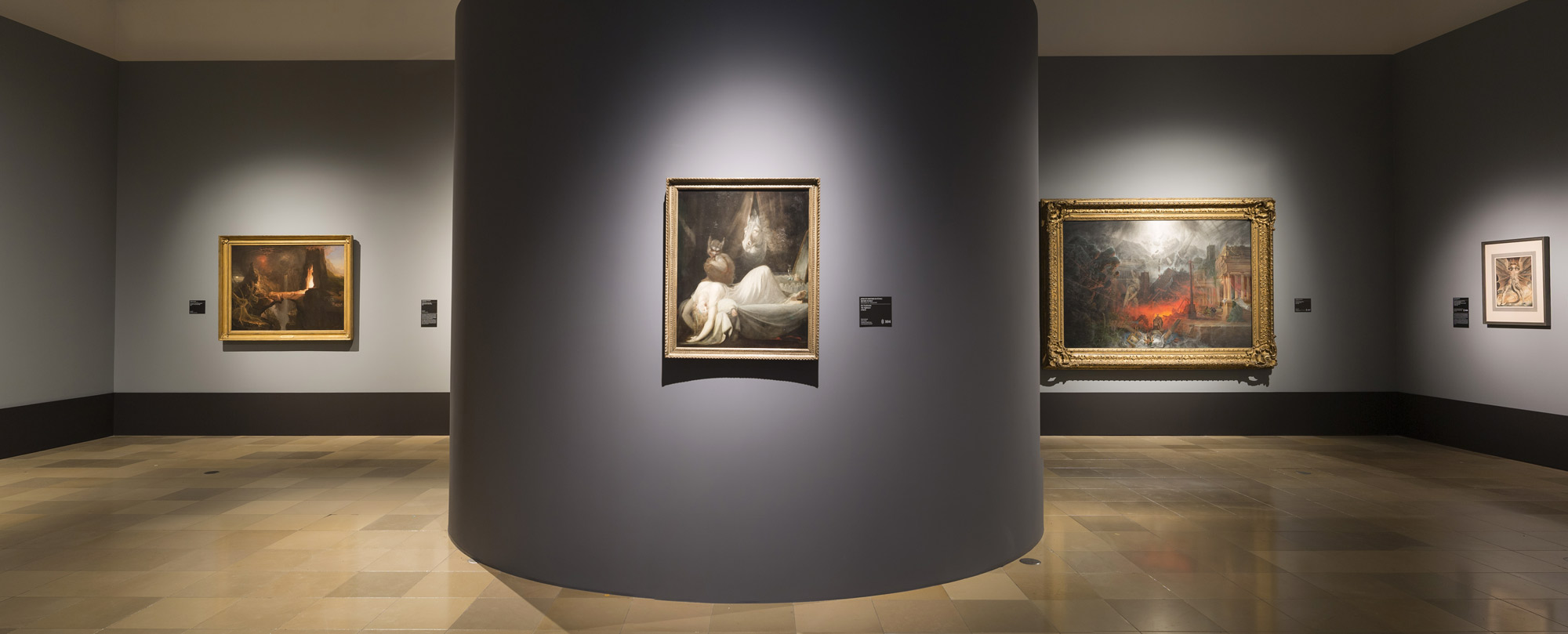
Installation view of the exhibition 'Dark Romanticism. From Goya to Max Ernst' at the Städel Museum, Frankfurt

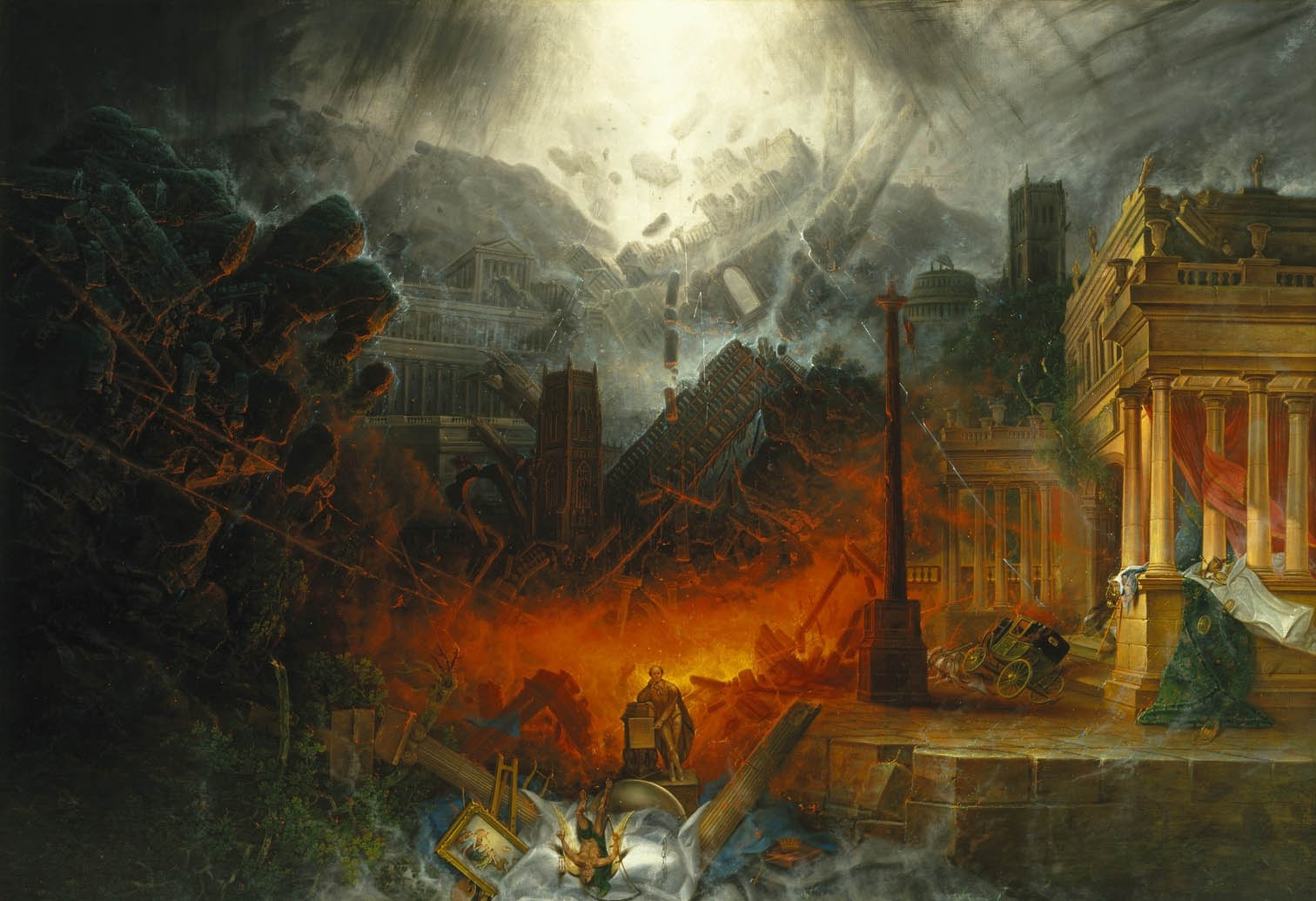
Installation view of the exhibition 'Dark Romanticism. From Goya to Max Ernst' at the Städel Museum, Frankfurt showing at left, Thomas Cole's 'Expulsion: Moon and Firelight '(c. 1828); at centre, Johann Henry Fuseli's 'The Nightmare (The Incubus)' (1781-1782); at second right, Samuel Colman's 'The Edge of Doom' (1836-1838); and at right, William Blake's 'The Great Red Dragon and the Woman Clothed with the Sun' (c. 1803-1805)


Installation views of the exhibition Dark Romanticism. From Goya to Max Ernst at the Städel Museum, Frankfurt showing at left in the bottom image, Thomas Cole’s Expulsion: Moon and Firelight (c. 1828, below); at centre, Johann Henry Fuseli’s The Nightmare (The Incubus) (1781-1782, below); at second right, Samuel Colman’s The Edge of Doom (1836-1838, below); and at right, William Blake’s The Great Red Dragon and the Woman Clothed with the Sun (c. 1803-1805, below)
Photos: Norbert Miguletz


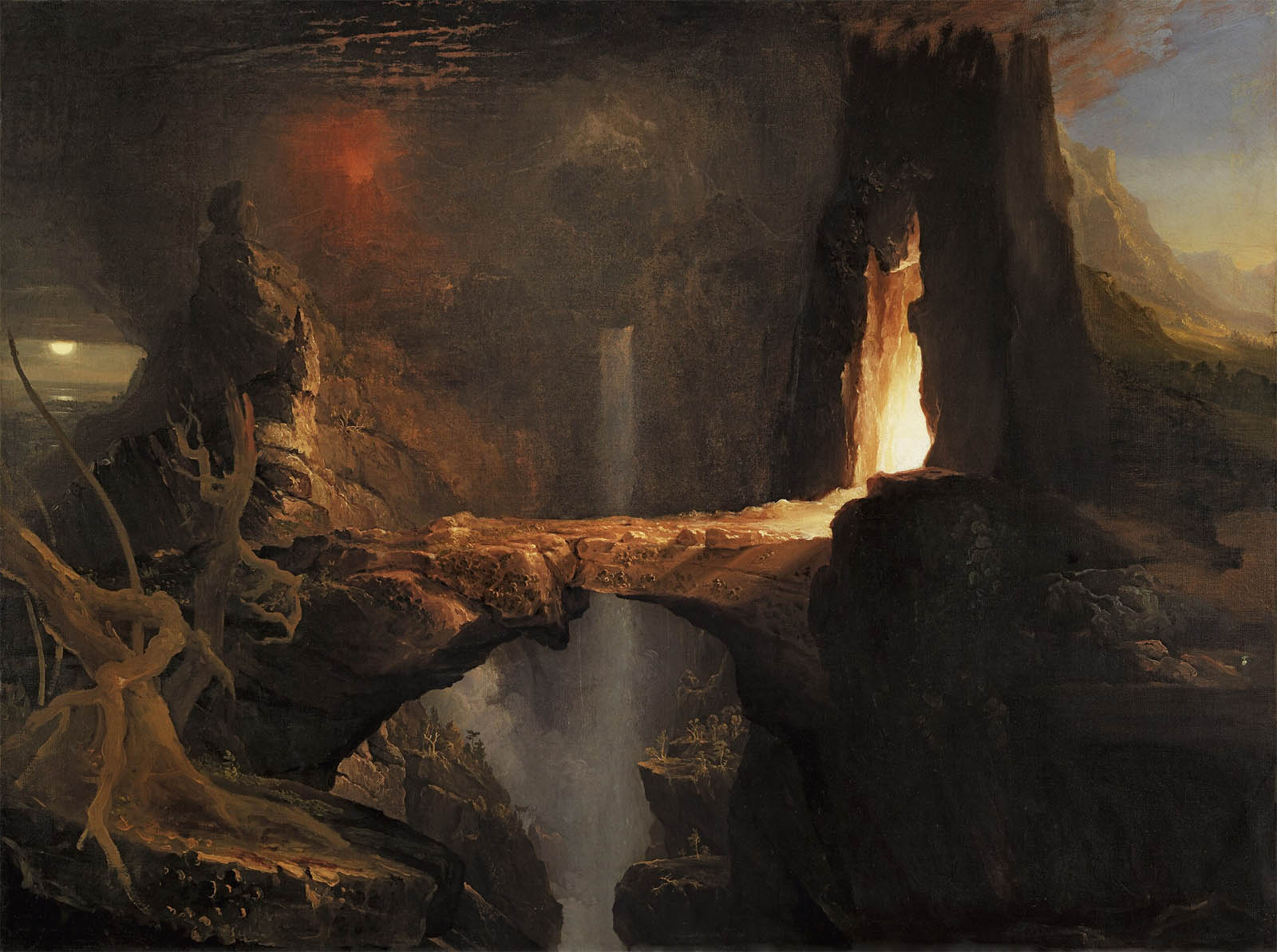
Thomas Cole (American born England, 1801-1848) 'Expulsion: Moon and Firelight' c. 1828


Thomas Cole (American born England, 1801-1848)
Expulsion: Moon and Firelight
c. 1828
Oil on canvas
91.4 by 122cm (36.0 in × 48.0 in)
Thyssen-Bornemisza Museum, Madrid


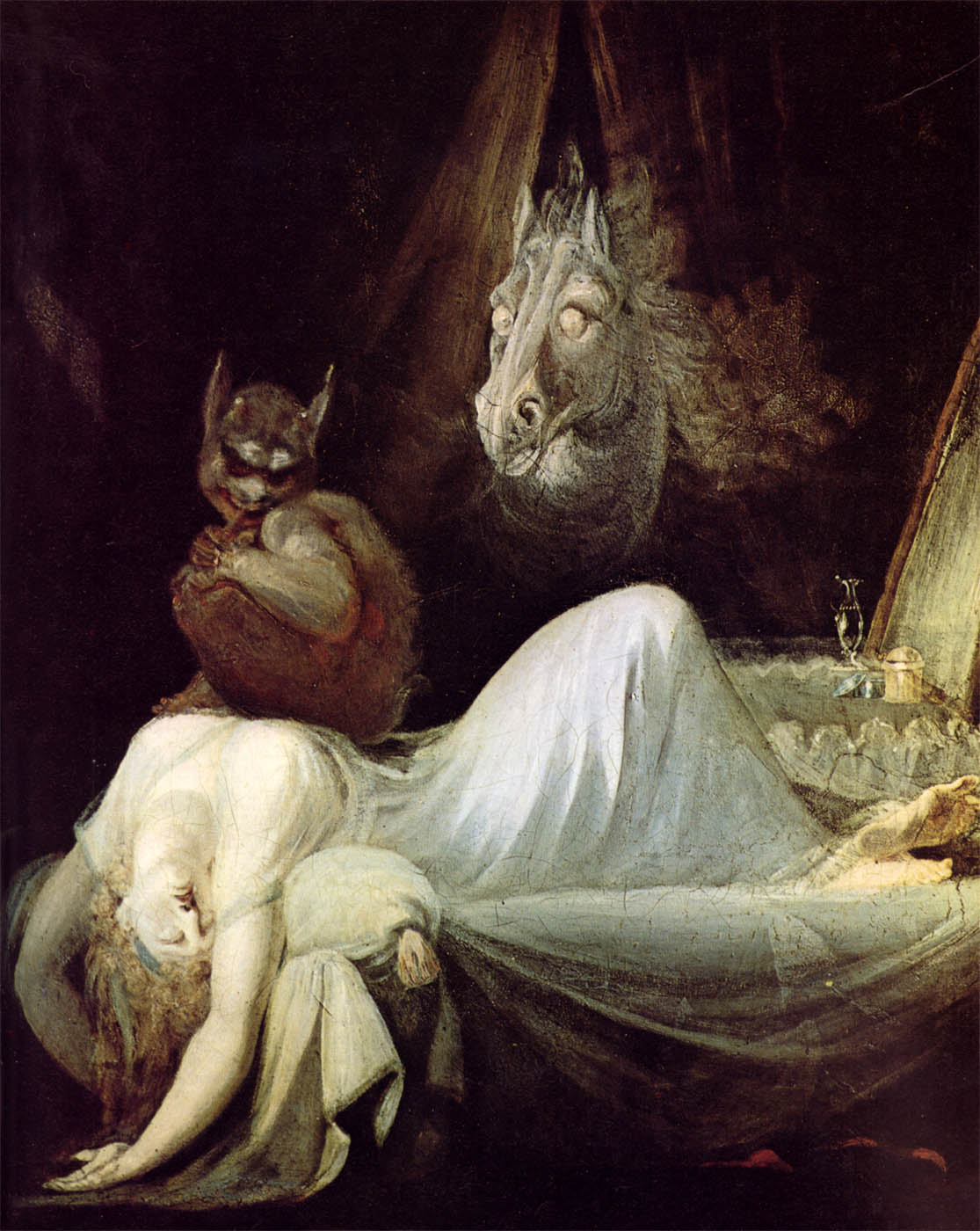
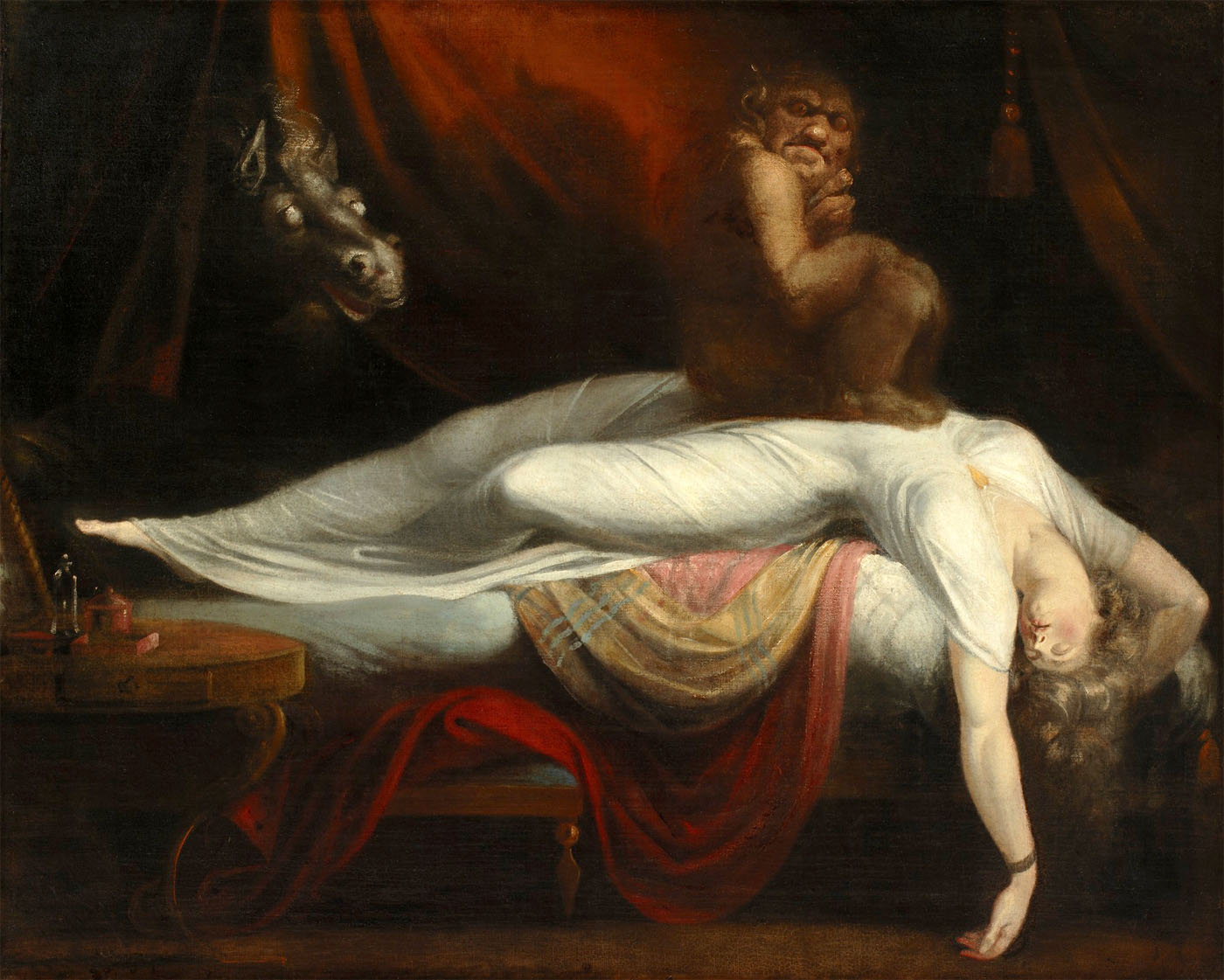
Johann Henry Fuseli (Swiss, 1741-1825) 'The Nightmare (The Incubus)' 1781-1782


Johann Henry Fuseli (Swiss, 1741-1825)
The Nightmare (The Incubus)
1781-1782
Oil on canvas
77cm (30.3 in) x 64cm (25.1 in)
Goethehaus (Frankfurt) collection


Samuel Colman (British, 1780-1845) 'The Edge of Doom' 1836-1838


Samuel Colman (British, 1780-1845)
The Edge of Doom
1836-1838
Oil on canvas
54 x 78 1/2 in. (137.2 x 199.4cm)
Brooklyn Museum


William Blake (British, 1757-1827) 'The Great Red Dragon and the Woman Clothed with the Sun' c.1803-1805


William Blake (British, 1757-1827)
The Great Red Dragon and the Woman Clothed with the Sun
c. 1803-1805
Watercolour, graphite and incised lines
43.7 x 34.8cm
Brooklyn Museum, Gift of William Augustus White


Johann Henry Fuseli (Swiss, 1741-1825) 'The Nightmare' 1781


Johann Henry Fuseli (Swiss, 1741-1825)
The Nightmare
1781
Oil on canvas
101.6 × 126.7cm
Detroit Institute of Arts, Founders Society
© Bridgeman Art Library


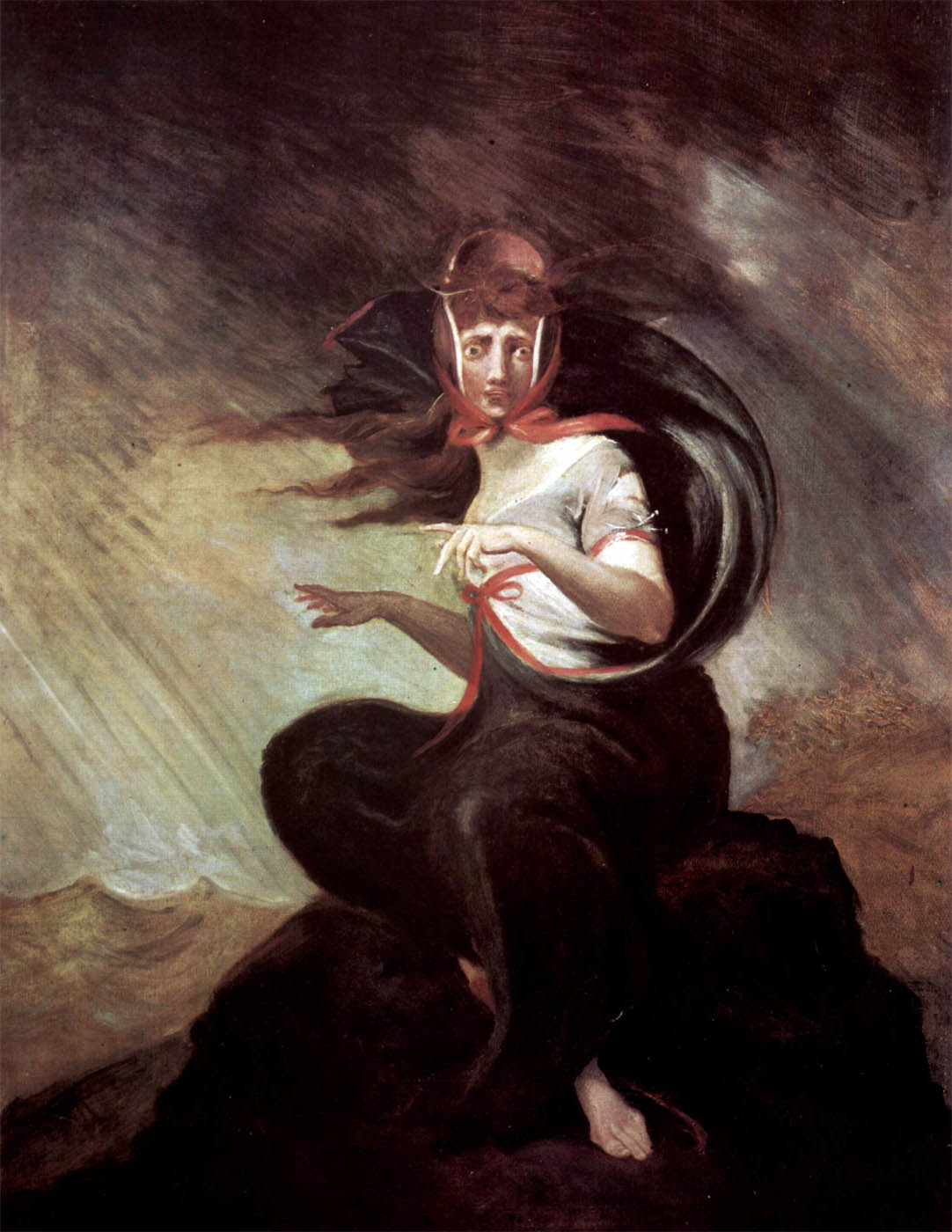
Johann Henry Fuseli (Swiss, 1741-1825) 'Die wahnsinnige Kate'(La folie de Kate) (Mad Kate) 1806-1807


Johann Henry Fuseli (Swiss, 1741-1825)
Die wahnsinnige Kate (La folie de Kate) (Mad Kate)
1806-1807
Oil on canvas
92cm (36.2 in) x 72.3cm (28.4 in)
Francfort-sur-le-Main, Frankfurter Goethe-Haus
Freies Deutsches Hochstift, inv.1955-007
© Ursula Edelmann/ARTOTHEK


Installation view of the exhibition 'Dark Romanticism. From Goya to Max Ernst' at the Städel Museum, Frankfurt showing Paul Delaroche's 'The Wife of the Artist, Louise Vernet, on her Death Bed' (1845)


Installation view of the exhibition Dark Romanticism. From Goya to Max Ernst at the Städel Museum, Frankfurt showing Paul Delaroche’s The Wife of the Artist, Louise Vernet, on her Death Bed (1845, below)
Photo: Norbert Miguletz


Paul Hippolyte Delaroche (French, 1797-1856) 'Louise Vernet, the artist's wife, on her Deathbed' 1845-46


Paul Hippolyte Delaroche (French, 1797-1856)
Louise Vernet, the artist’s wife, on her Deathbed
1845-1846
Oil on canvas
62 x 74.5cm
Musée des Beaux-Arts de Nantes
© Musée des Beaux-Arts de Nantes


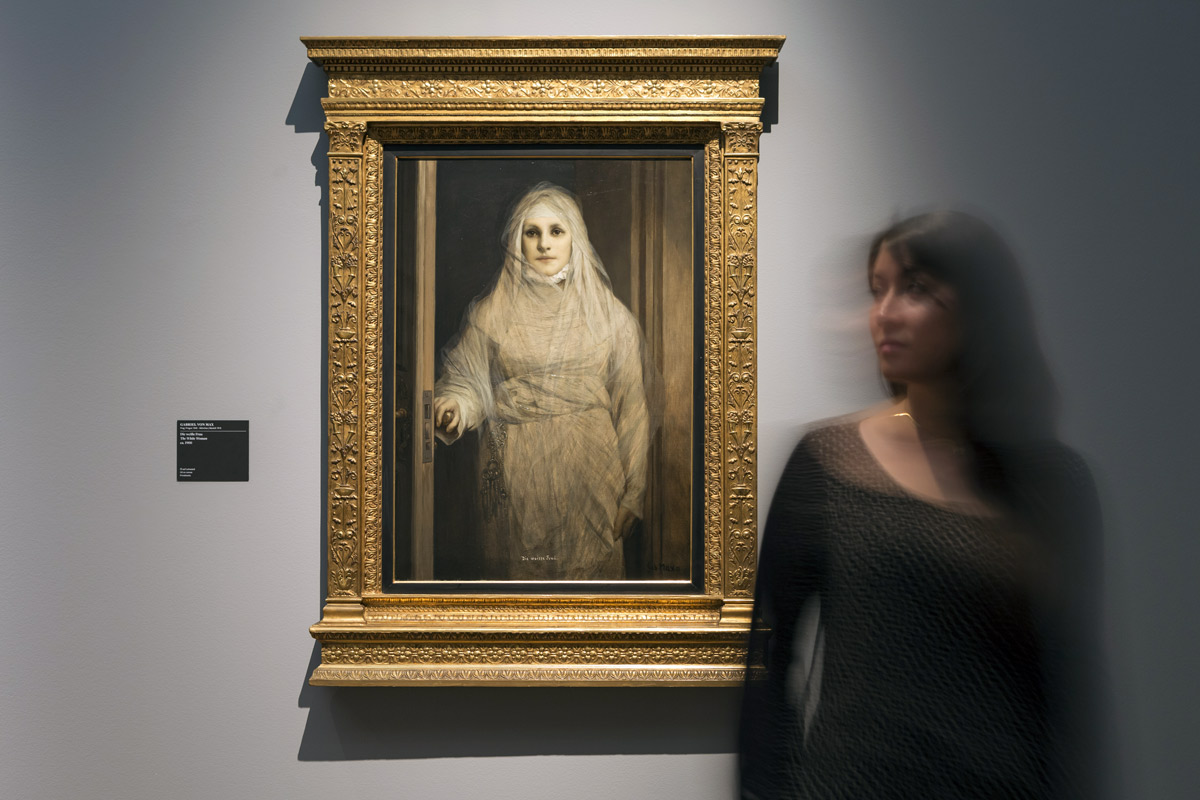
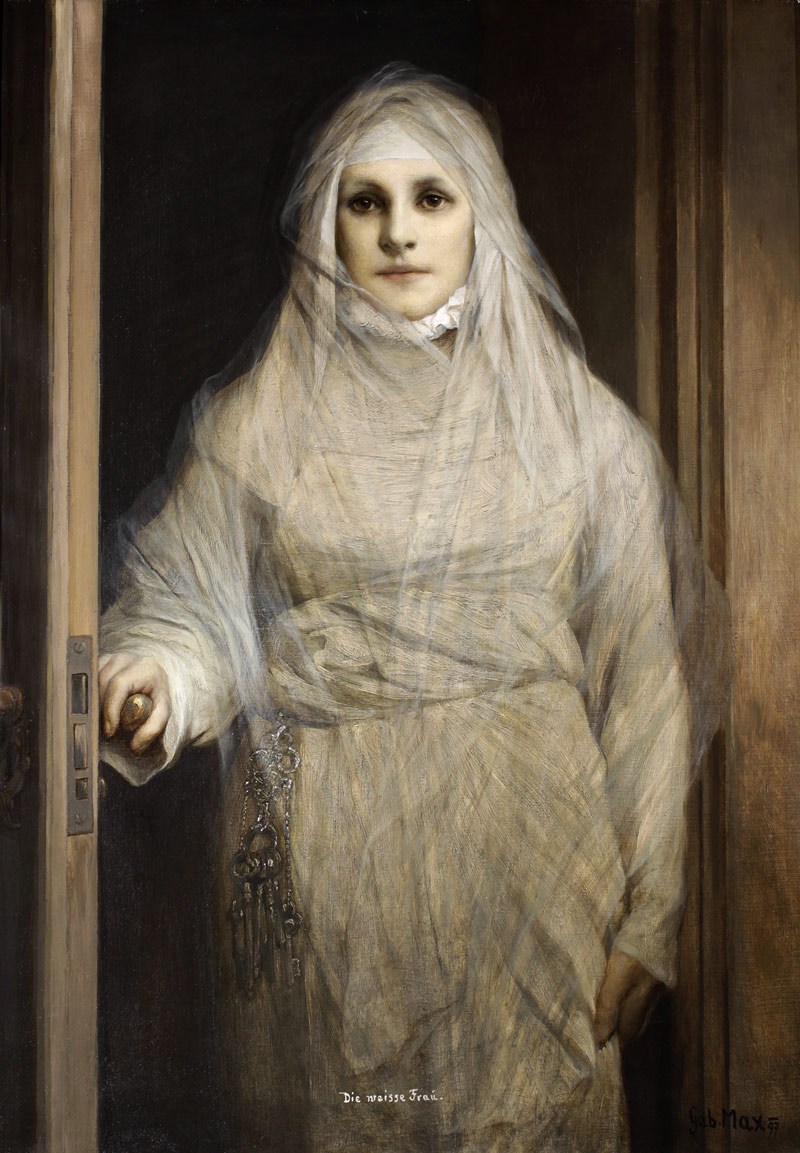
Installation view of the exhibition 'Dark Romanticism. From Goya to Max Ernst' at the Städel Museum, Frankfurt showing Gabriel von Max's 'The White Woman' (1900)


Installation view of the exhibition Dark Romanticism. From Goya to Max Ernst at the Städel Museum, Frankfurt showing Gabriel von Max’s The White Woman (1900, below)
Photo: Norbert Miguletz


Gabriel von Max (Austrian, 1840-1915) 'The White Woman' 1900


Gabriel von Max (Austrian, 1840-1915)
The White Woman
1900
Oil on canvas
100 x 72cm
Private Collection


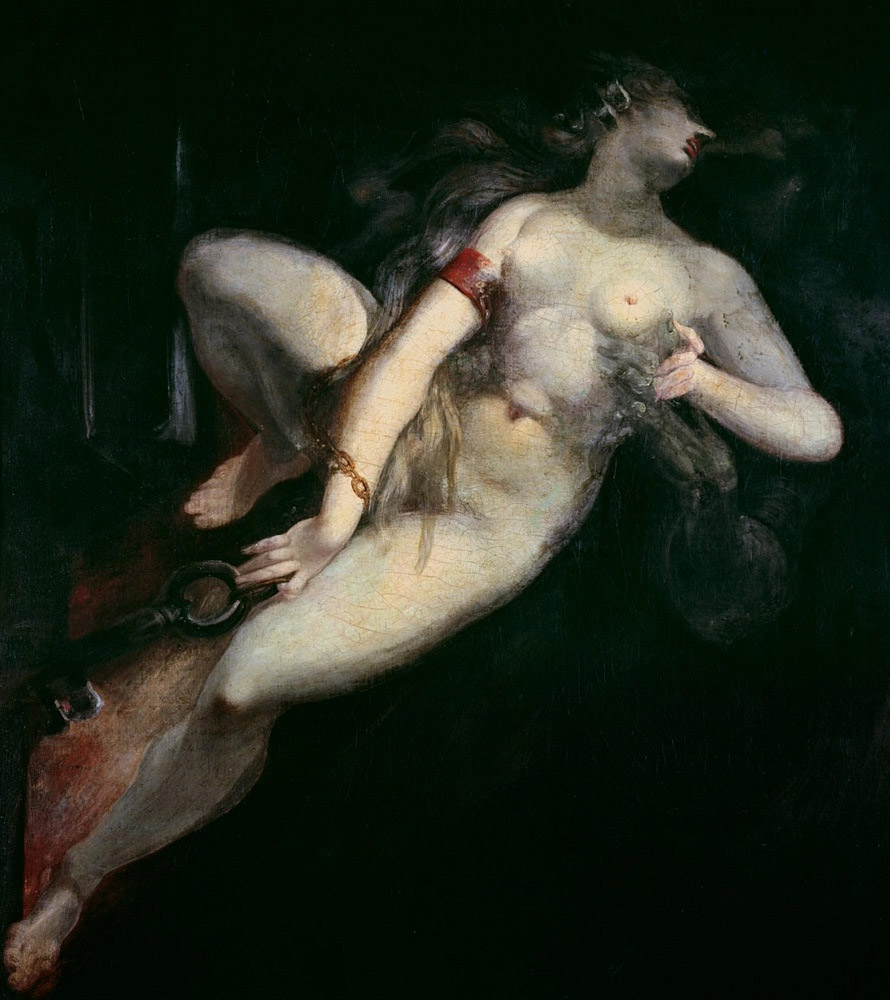
Johann Henry Fuseli (Swiss, 1741-1825) 'Sin Pursued by Death' 1794-1796


Johann Henry Fuseli (Swiss, 1741-1825)
Sin Pursued by Death
1794-1796
Oil on canvas
Kunsthaus, Zürich


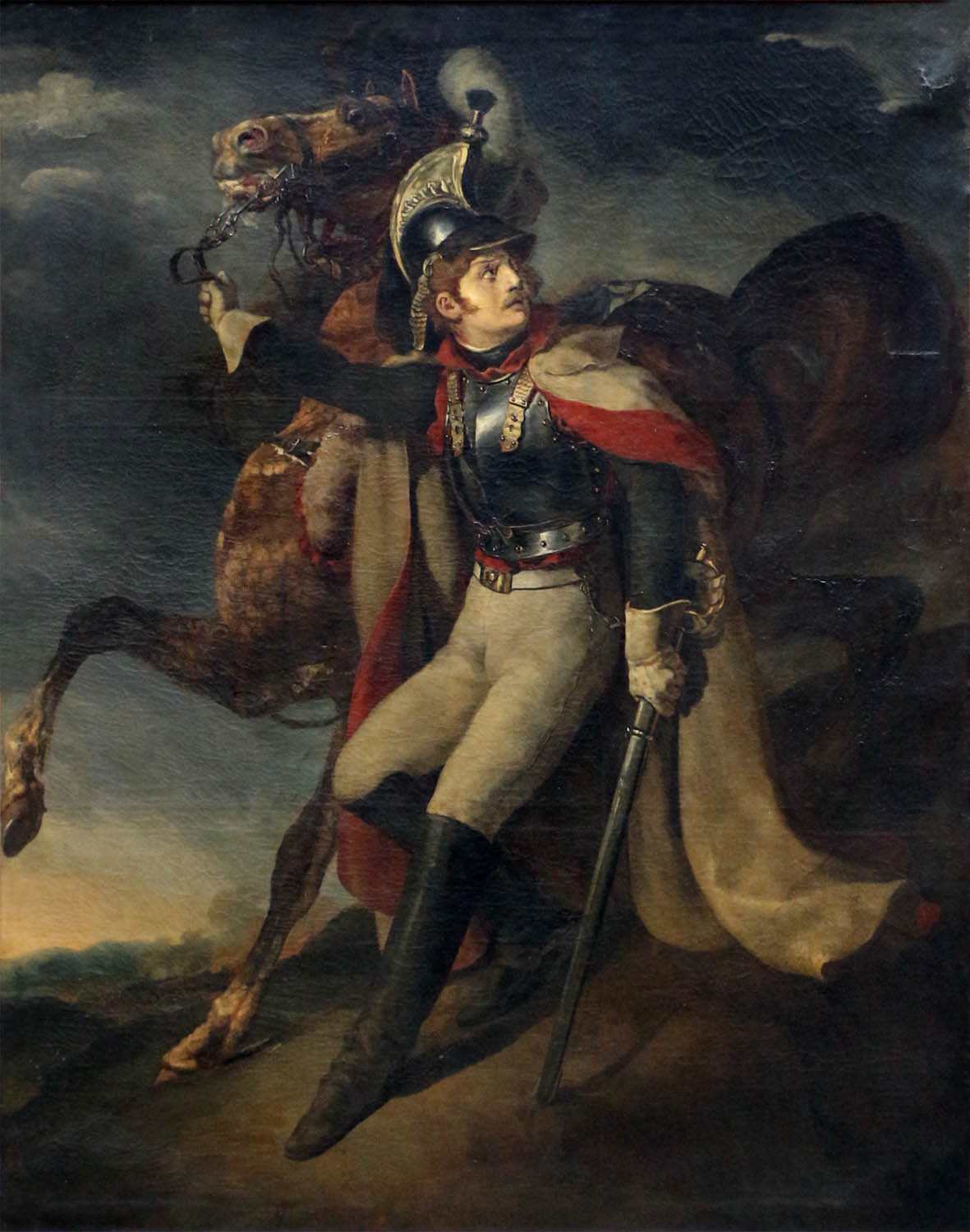
Théodore Géricault (French, 1791–1824) Cuirassier blessé quittant le feu / The Wounded Cuirassier 1814


Théodore Géricault (French, 1791–1824)
Cuirassier blessé quittant le feu / The Wounded Cuirassier
1814
Oil on canvas
358cm (11.7 ft) x 294cm (115.7 in)
Louvre Museum


The Wounded Cuirassier (French: Le Cuirassier blessé quittant le feu) is an oil painting of a single anonymous soldier descending a slope with his nervous horse by the French Romantic painter and lithographer Théodore Géricault (1791–1824). In this 1814 Salon entry, Géricault decided to turn away from scenes of heroism in favour of a subject that is on the losing side of the battle. On display in the aftermath of France’s disastrous military campaign in Russia, this life-size painting captured the feeling of a nation in defeat. There are no visible wounds on the figure, and the title has sometimes been interpreted to refer to soldier’s injured pride. The painting stood in stark contrast with Géricault’s Charging Chasseur, as it didn’t focus on glory or the spectacle of battle. Only his Signboard of a Hoofsmith, which is currently in a private collection, bears any resemblance in form or function to this painting.

The final salon version of The Wounded Cuirassier is at the Musée du Louvre and the smaller, study version, is located at the Brooklyn Museum.

Text from the Wikipedia website


Caspar David Friedrich (German, 1774-1840) 'Kügelgen's Tomb' 1821-1822


Caspar David Friedrich (German, 1774-1840)
Kügelgen’s Tomb
1821-1822
Oil on canvas
41.5 x 55.5cm
Die Lübecker Museen, Museum Behnhaus Drägerhaus, on loan from private collection


Ernst Ferdinand Oehme (German, 1797-1855) 'Procession in the Fog' 1828


Ernst Ferdinand Oehme (German, 1797-1855)
Procession in the Fog
1828
Oil on canvas
81.5 x 105.5cm
Galerie Neue Meister, Staatliche Kunstsammlungen Dresden


Caspar David Friedrich (German, 1774-1840) Rivage avec la lune cachée par des nuages (Clair de lune sur la mer) / Mond hinter Wolken über dem Meeresufer (Meeresküste bei Mondschein) / Moon behind clouds over the seashore (seashore by moonlight) 1836


Caspar David Friedrich (German, 1774-1840)
Rivage avec la lune cachée par des nuages (Clair de lune sur la mer) / Mond hinter Wolken über dem Meeresufer (Meeresküste bei Mondschein) / Moon behind clouds over the seashore (seashore by moonlight)
1836
Hambourg, Hamburger Kunsthalle
© BPK, Berlin, dist. RMN-Grand Palais / Elke Walford


Samuel Colman (American, 1780-1845) 'The Edge of Doom' 1836-1838


Samuel Colman (American, 1780-1845)
The Edge of Doom
1836-1838
Oil on canvas
137.2 x 199.4cm
Brooklyn Museum, Bequest of Laura L. Barnes


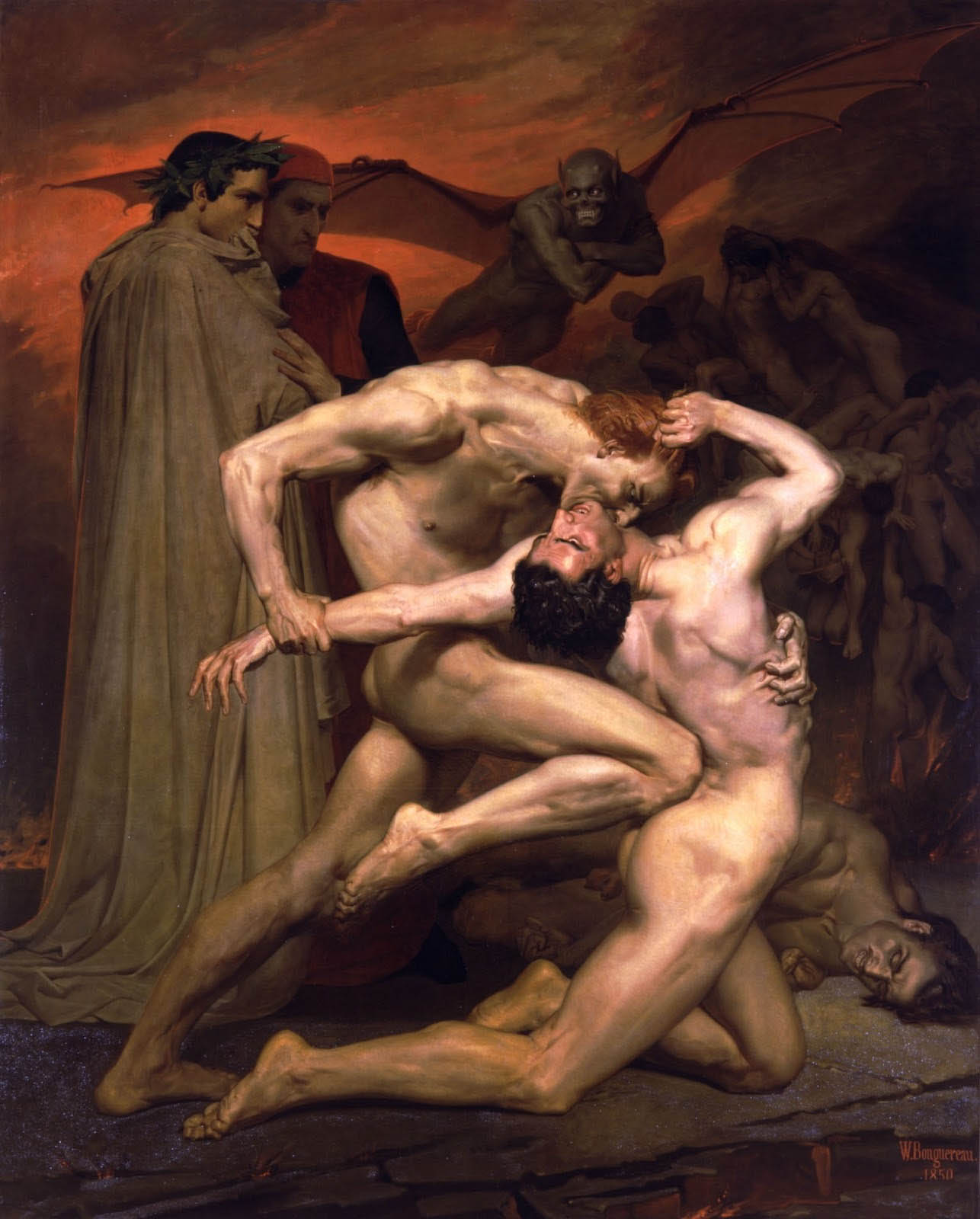
William-Adolphe Bouguereau (French, 1825-1905) 'Dante And Virgil In Hell' 1850


William-Adolphe Bouguereau (French, 1825-1905)
Dante And Virgil In Hell
1850
Oil on canvas
280.5cm (110.4 in) x 225.3cm (88.7 in)
Musée d’Orsay
© Musée d’Orsay, Dist. RMN-Grand Palais / Patrice Schmidt


Arnold Böcklin (Swiss, 1827-1901) 'Villa by the Sea' 1871-1874


Arnold Böcklin (Swiss, 1827-1901)
Villa by the Sea
1871-1874
Oil on canvas
108 x 154cm
Städel Museum, Frankfurt am Main


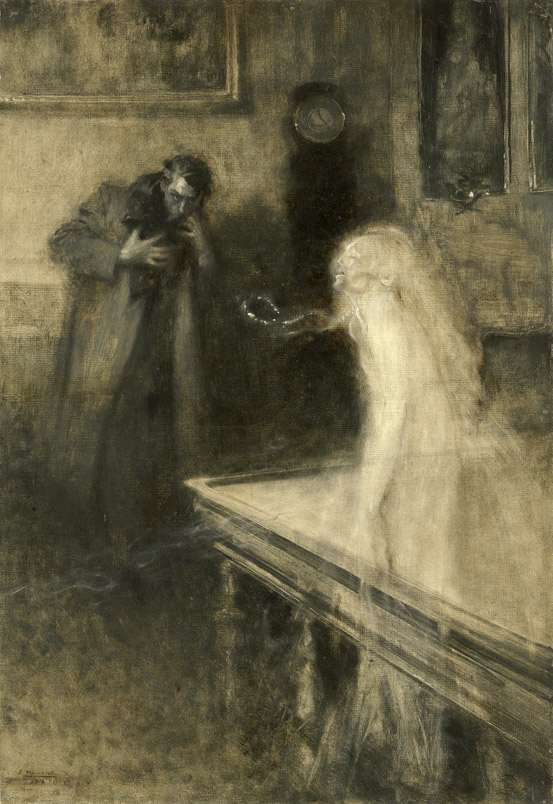
Serafino Macchiati (Italian, 1860-1916) 'Le Visionnaire' (The Visionary) 1904


Serafino Macchiati (Italian, 1860-1916)
Le Visionnaire (The Visionary)
1904
Oil on canvas
55.0 x 38.5cm
Don Serafino Macchiati, 1916
© Musée d’Orsay, Dist. RMN-Grand Palais / Patrice Schmidt


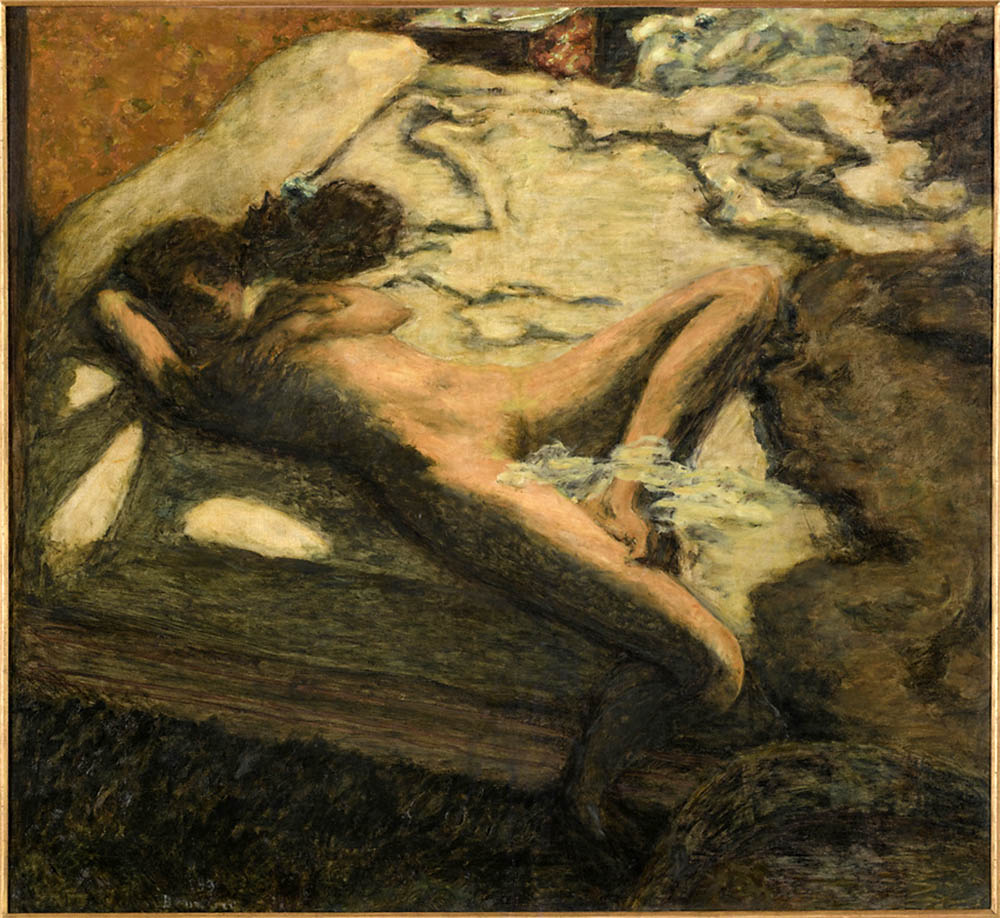
Pierre Bonnard (French, 1867-1945) 'Femme assoupie sur un lit' (Woman sleeping on a bed) 1899


Pierre Bonnard (French, 1867-1945)
Femme assoupie sur un lit (Woman sleeping on a bed)
1899
huile sur toile
96.4 x 105.2cm
Achat en vente publique, 1948
© Musée d’Orsay, Dist. RMN-Grand Palais / Patrice Schmidt


Pierre Bonnard (1867-1947)

A veritable hymn to voluptuousness, The Indolent Woman is a painting which relies on contrasts: the title already clashes with the young woman’s posture. Her body with its tense muscles – the left foot is literally hooked on to the right thigh – belies any idea of rest or laziness. Similarly, the modest gesture of the arm across the breasts is contradicted by the spread thighs. Sinuous lines run throughout the composition, materialised by the dark shadows on the sheets still bearing the undulating line of the bodies and the heavy jumble of the bedclothes. The electric blue “smoke” drifting across the woman’s thigh and ankle and the sumptuous dark hair spread across the bed accentuate the painting’s erotic charge.

This woman spread out for all to see after lovemaking is the epitome of unveiled intimacy, violent, passionate and sombre and, in the end, very “fin de siècle”. We are also struck by the modernity of the composition seen from above, with its monumental bed which seems to tip towards the viewer. The woman’s body, gnawed by shadows, has a tonic vibrant texture which gives it a strong timeless presence.

This is a crucial work in Bonnard’s career because it is one of the first nudes he painted, previously showing little interest in the theme. It can be compared with two other canvases from the same period: Blue Nude from the Kaganovitch collection and Man and Woman.

After seeing this painting, the famous art dealer and publisher Ambroise Vollard asked Bonnard to illustrate a collection of Paul Verlaine’s poetry, Parallèlement, which was published in 1900.

Text from the Musée d’Orsay website


Salvador Dalí (Spanish, 1904-1989) 'Dream caused by the Flight of a Bee around a Pomegranate a Second before Awakening' 1944


Salvador Dalí (Spanish, 1904-1989)
Dream caused by the Flight of a Bee around a Pomegranate a Second before Awakening
1944
Oil on wood
51 x 41cm
Museo Thyssen-Bornemisza, Madrid
© VG Bild-Kunst, Bonn 2012


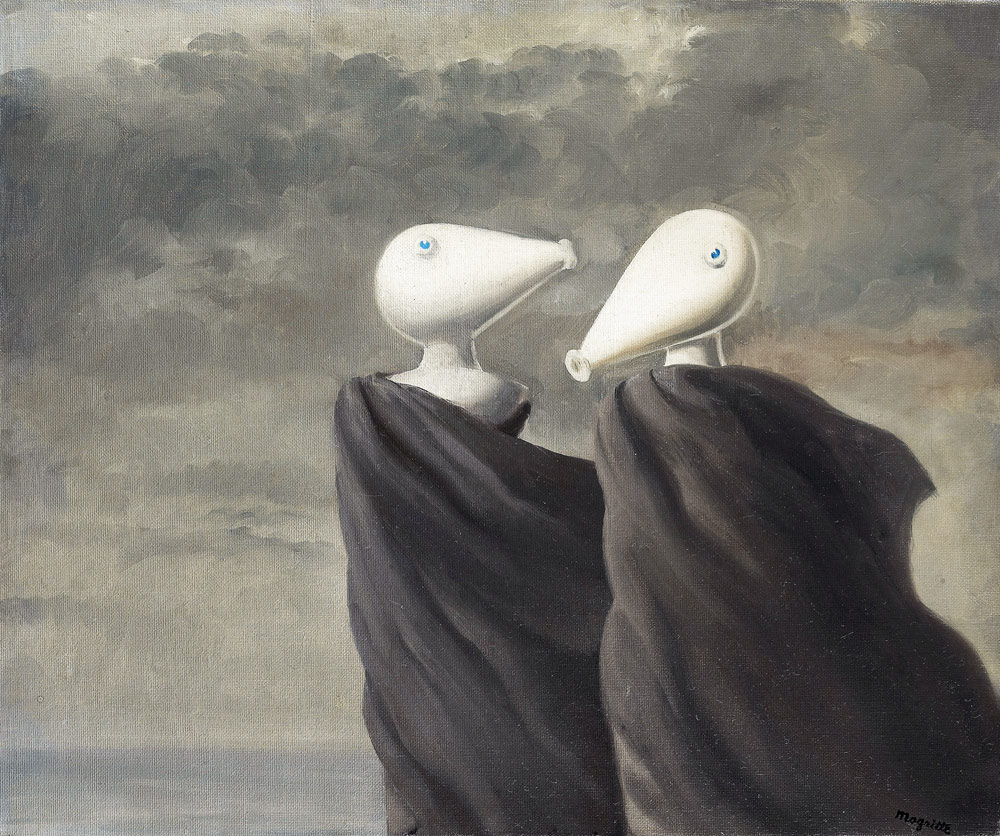
The Städel Museum’s major special exhibition Dark Romanticism. From Goya to Max Ernst will be on view from September 26th, 2012 until January 20th, 2013. It is the first German exhibition to focus on the dark aspect of Romanticism and its legacy, mainly evident in Symbolism and Surrealism. In the museum’s exhibition house this important exhibition, comprising over 200 paintings, sculptures, graphic works, photographs and films, will present the fascination that many artists felt for the gloomy, the secretive and the evil. Using outstanding works in the museum’s collection on the subject by Francisco de Goya, Eugène Delacroix, Franz von Stuck or Max Ernst as a starting point, the exhibition is also presenting important loans from internationally renowned collections, such as the Musée d’Orsay, the Musée du Louvre, both in Paris, the Museo del Prado in Madrid and the Art Institute of Chicago. The works on display by Goya, Johann Heinrich Fuseli and William Blake, Théodore Géricault and Delacroix, as well as Caspar David Friedrich, convey a Romantic spirit which by the end of the 18th century had taken hold all over Europe. In the 20th century artists such as Salvador Dalí, René Magritte or Paul Klee and Max Ernst continued to think in this vein. The art works speak of loneliness and melancholy, passion and death, of the fascination with horror and the irrationality of dreams. After Frankfurt the exhibition, conceived by the Städel Museum, will travel to the Musée d’Orsay in Paris.

The exhibition’s take on the subject is geographically and chronologically comprehensive, thereby shedding light on the links between different centres of Romanticism, and thus retracing complex iconographic developments of the time. It is conceived to stimulate interest in the sombre aspects of Romanticism and to expand understanding of this movement. Many of the artistic developments and positions presented here emerge from a shattered trust in enlightened and progressive thought, which took hold soon after the French Revolution – initially celebrated as the dawn of a new age – at the end of the 18th century. Bloodstained terror and war brought suffering and eventually caused the social order in large parts of Europe to break down. The disillusionment was as great as the original enthusiasm when the dark aspects of the Enlightenment were revealed in all their harshness. Young literary figures and artists turned to the reverse side of Reason. The horrific, the miraculous and the grotesque challenged the supremacy of the beautiful and the immaculate. The appeal of legends and fairy tales and the fascination with the Middle Ages competed with the ideal of Antiquity. The local countryside became increasingly attractive and was a favoured subject for artists. The bright light of day encountered the fog and mysterious darkness of the night.

The exhibition is divided into seven chapters. It begins with a group of outstanding works by Johann Heinrich Fuseli. The artist had initially studied to be an evangelical preacher in Switzerland. With his painting The Nightmare (Frankfurt Goethe-Museum) he created an icon of dark Romanticism. This work opens the presentation, which extends over two levels of the temporary exhibition space. Fuseli’s contemporaries were deeply disturbed by the presence of the incubus (daemon) and the lecherous horse – elements of popular superstition – enriching a scene set in the present. In addition, the erotic-compulsive and daemonic content, as well as the depressed atmosphere, catered to the needs of the voyeur. The other six works by Fuseli – loans from the Kunsthaus Zürich, the Royal Academy London and the Staatsgalerie Stuttgart – represent the characteristics of his art: the competition between good and evil, suffering and lust, light and darkness. Fuseli’s innovative pictorial language influenced a number of artists – among them William Blake, whose famous water colour The Great Red Dragon from the Brooklyn Museum will be on view in Europe for the first time in ten years.

The second room of the exhibition is dedicated to the Spanish artist Francisco de Goya. The Städel will display six of his works – including masterpieces such as The Witches’ Flight from the Prado in Madrid and the representations of cannibals from Besançon. A large group of works on paper from the Städel’s own collection will be shown, too. The Spaniard blurs the distinction between the real and the imaginary. Perpetrator and victim repeatedly exchange roles. Good and evil, sense and nonsense – much remains enigmatic. Goya’s cryptic pictorial worlds influenced numerous artists in France and Belgium, including Delacroix, Géricault, Victor Hugo and Antoine Wiertz, whose works will be presented in the following room. Atmosphere and passion were more important to these artists than anatomical accuracy.

Among the German artists – who are the focus of the next section of the exhibition – it is Carl Blechen who is especially close to Goya and Delacroix. His paintings are a testimony to his lust for gloom. His soft spot for the controversial author E. T. A. Hoffmann – also known as “Ghost-Hoffmann” in Germany – led Blechen to paint works such as Pater Medardus (Alte Nationalgalerie, Berlin) – a portrait of the mad protagonist in The Devil’s Elixirs. The artist was not alone in Germany when it came to a penchant for dark and disturbing subjects. Caspar David Friedrich’s works, too, contain gruesome elements: cemeteries, open graves, abandoned ruins, ships steered by an invisible hand, lonely gorges and forests are pervasive in his oeuvre. One does not only need to look at the scenes of mourning in the sketchbook at the Kunsthalle Mannheim for the omnipresent theme of death. Friedrich is prominently represented in the exhibition with his paintings Moon Behind Clouds above the Seashore from the Hamburger Kunsthalle and Kügelgen’s Grave from the Lübecker Museums, as well as with one of his last privately owned works, Ship at Deep Sea with full Sails.

Friedrich’s paintings are steeped in oppressive silence. This uncompromising attitude anticipates the ideas of Symbolism, which will be considered in the next chapter of the exhibition. These ‘Neo-Romantics’ stylised speechlessness as the ideal mode of human communication, which would lead to fundamental and seminal insights. Odilon Redon’s masterpiece Closed Eyes, a loan from the Musée d’Orsay in Paris, impressively encapsulates this notion. Paintings by Arnold Böcklin, James Ensor, Fernand Khnopff or Edvard Munch also embody this idea. However, as with the Romantics, these restrained works are face to face with works where anxiety and repressed passions are brought unrestrainedly to the surface; works that are unsettling in their radicalism even today. While Gustave Moreau, Max Klinger, Franz von Stuck and Alfred Kubin belong to the art historical canon, here the exhibition presents artists who are still to be discovered in Germany: Jean-Joseph Carriès, Paul Dardé, Jean Delville, Julien-Adolphe Duvocelle, Léon Frédéric, Eugène Laermans and Lucien Lévy-Dhurmer.

The presentation concludes with the Surrealist movement, founded by André Breton. He inspired artists such as Ernst, Brassaϊ or Dalí, to create their wondrous pictorial realms from the reservoir of the subconscious and celebrated them as fantasy’s victory over the “factual world”. Max Ernst vehemently called for “the borders between the so-called inner and outer world” to be blurred. He demonstrated this most clearly in his forest paintings, four of which have been assembled for this exhibition, one of them the major work Vision Provoked by the Nocturnal Aspect of the Porte Saint-Denis (private collection). The art historian Carl Einstein considered the Surrealists to be the Romantics’ successors and coined the phrase ‘the Romantic generation’. In spite of this historical link the Surrealists were far from retrospective. On the contrary: no other movement was so open to new media; photography and film were seen as equal to traditional media. Alongside literature, film established itself as the main arena for dark Romanticism in the 20th century. This is where evil, the thrill of fear and the lust for horror and gloom found a new home. In cooperation with the Deutsches Filmmuseum the Städel will for the first time present extracts from classics such as Frankenstein (1931), Dracula (1931), Faust (1926), Vampyr (1931-32) and The Phantom Carriage (1921) within an exhibition.

The exhibition, which presents the Romantic as a mindset that prevailed throughout Europe and remained influential beyond the 19th century, is accompanied by a substantial catalogue. As is true for any designation of an epoch, Romanticism too is nothing more than an auxiliary construction, defined less by the exterior characteristics of an artwork than by the inner sentiment of the artist. The term “dark Romanticism” cannot be traced to its origins, but – as is also valid for Romanticism per se – comes from literary studies. The German term is closely linked to the professor of English Studies Mario Praz and his publication La carne, la morte e il diavolo nella letteratura romantica of 1930, which was published in German in 1963 as Liebe, Tod und Teufel. Die schwarze Romantik (literally: Love, Death and Devil. Dark Romanticism).

Press release from the Städel Museum website


Francisco de Goya (Spanish, 1746-1828) 'Witches in the Air' 1797-1798


Francisco de Goya (Spanish, 1746-1828)
Witches in the Air
1797-1798
Oil on canvas
43.5 × 30.5cm (17 1/8 in × 12 in)
Madrid, Museo Nacional del Prado
© Museo Nacional del Prado


Witches’ Flight (Spanish: Vuelo de Brujas, also known as Witches in Flight or Witches in the Air) is an oil-on-canvas painting completed in 1798 by the Spanish painter Francisco Goya. It was part of a series of six paintings related to witchcraft acquired by the Duke and Duchess of Osuna in 1798. It has been described as “the most beautiful and powerful of Goya’s Osuna witch paintings.” …

At center point are three semi-nude witches wearing penitential coroza bearing aloft a writhing nude figure, their mouths close to their victim, as if to devour him or suck his blood. Below, two figures in peasants’ garb recoil from the spectacle: one has thrown himself to the ground covering his ears, the other attempts to escape by covering himself with a blanket, making the fig hand gesture to ward off the evil eye. Finally, a donkey emerges on the right, seemingly oblivious to the rest of the scene.

The general scholarly consensus is that the painting represents a rationalist critique of superstition and ignorance, particularly in religious matters: the witches’ corozas are not only emblematic of the violence of the Spanish Inquisition (the upward flames indicate that they have been condemned as unrepentant heretics and will be burned at the stake), but are also reminiscent of episcopal mitres, bearing the characteristic double points. The accusations of religious tribunals are thus reflected back on themselves, whose actions are implicitly equated with superstition and ritualised sacrifice. The bystanders can then be understood either as appalled but unable to do anything or wilfully ignorant and unwilling to intervene.

The donkey, finally, is the traditional symbol of ignorance.

Text from the Wikipedia website


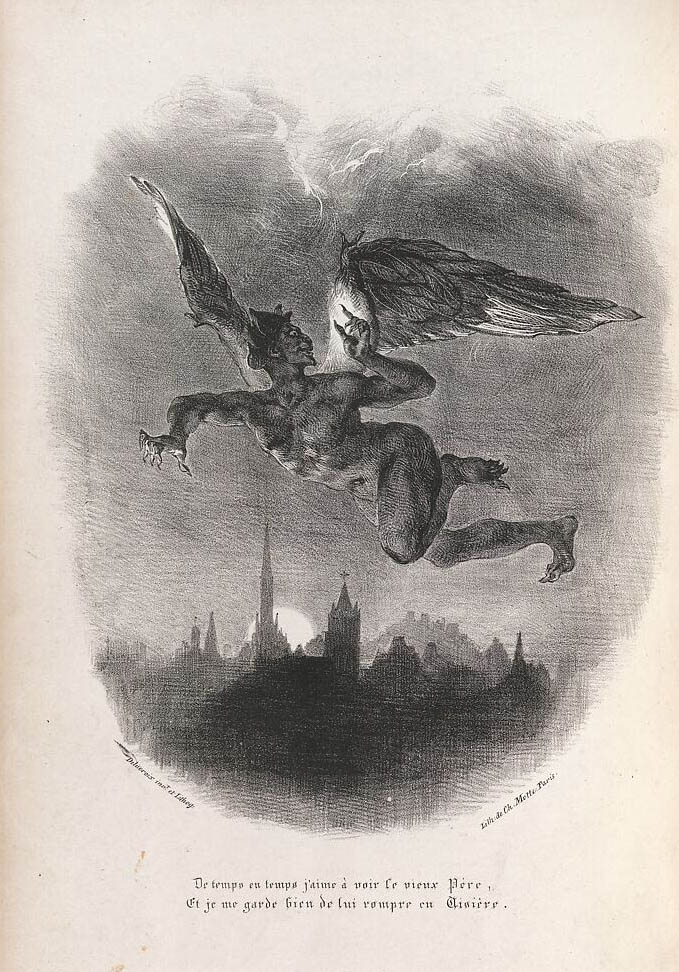
Eugène Delacroix (French, 1798-1863) 'Mephistopheles in the air, illustration from Goethe's Faust' 1828


Eugène Delacroix (French, 1798-1863)
Mephistopheles in the air, illustration for from Goethe’s Faust
1828
Lithograph
Frankfurt am Main, Städel Museum
© All rights reserved


Francisco de Goya (Spanish, 1746-1828) 'Flying Folly (Disparate Volante)' 1816-1819


Francisco de Goya (Spanish, 1746-1828)
Flying Folly (Disparate Volante)
from “The proverbs (Los proverbios)”, plate 5, 1816-1819, 1
Edition, 1864
Etching and aquatint
21.7 x 32.6cm
Städel Museum, Frankfurt am Main


“I am not afraid of witches, goblins, apparitions, boastful giants, evil spirits, leprechauns, etc., nor of any other kind of creatures except human beings.”


Francisco Goya


An enthusiastic champion of Enlightenment values, Goya was also on close terms with the progressive nobility, but his doubts and disillusionment increased as the French Revolution was succeeded by the Terror, and Europe was torn apart by warring armies.

The deceptively clear distinction between enlightenment and obscurantism was now supplanted by the vision of a new, grey, frightening and uncertain world, in which no sharp line could be drawn between good and evil, reality and fantasy, reason and absurdity, the beliefs of the past and the revolutionary fervour of the present.

But instead of living in the past or doing nothing, Goya swapped his court painter’s brush for the etcher’s unsparing needle. Black in all its shades was the keynote of the many series of engravings he now produced on freely chosen themes, with only the Inquisition’s censors to contend with.

The Caprices, a series produced at the end of the 18th century, reflects his amazement and exasperation at the imaginative wealth of Spanish popular culture, steeped in the superstition, fanaticism and ignorance promoted by the Jesuits.

Ten years later, the atrocities which marked the war against Napoleon inspired The Disasters of War – a cry of outrage and horror at the barbaric excesses of the “Grande Nation” and the terrifying emptiness of a world with no God or morality.

Anonymous. “The Angel of the Odd. Dark Romanticism from Goya to Max Ernst,” on the Musée D’Orsay website Nd [Online] Cited 12/08/2024


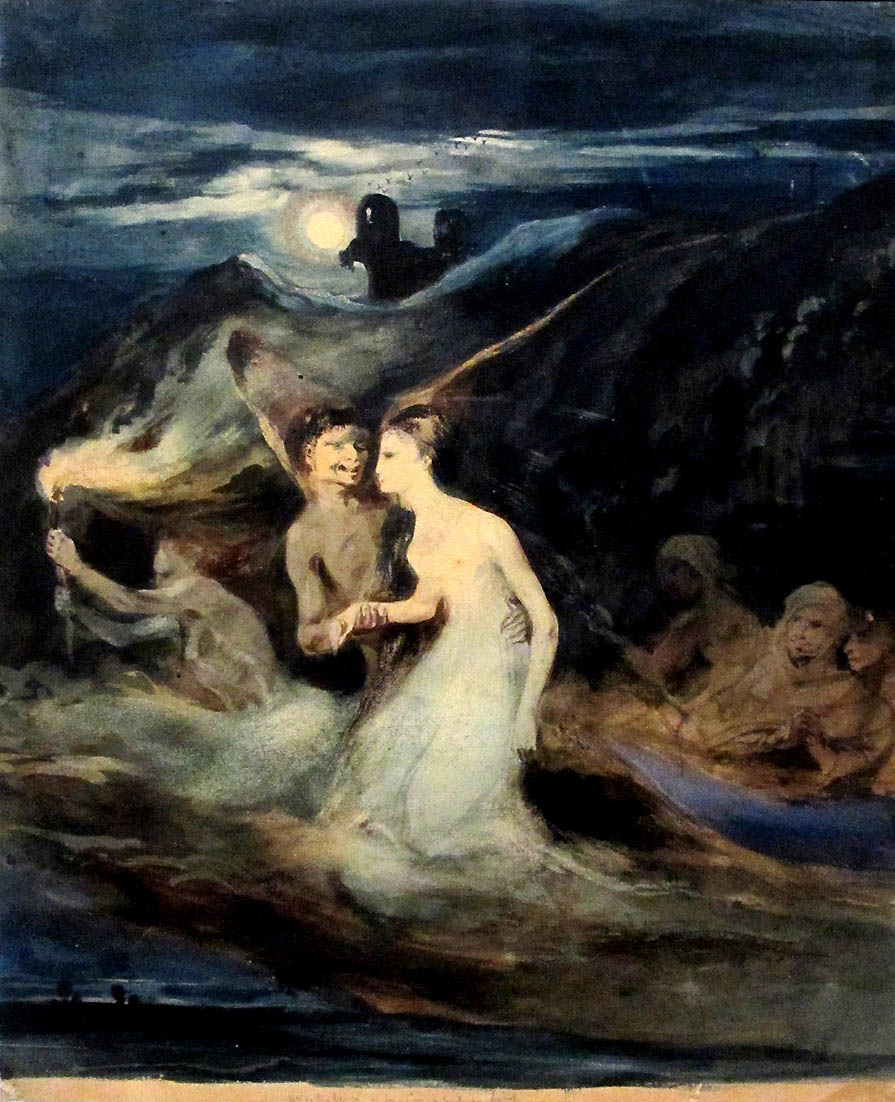
Louis Candide Boulanger (French, 1806-1867) 'Les Fantômes' 1829


Louis Candide Boulanger (French, 1806-1867)
Les Fantômes
1829
Oil on canvas
Maison de Victor Hugo


Carl Blechen (German, 1798-1840) 'Scaffold in Storm' 1834


Carl Blechen (German, 1798-1840)
Scaffold in Storm
1834
Oil on canvas and on board
29.5cm (11.6 in) x 46cm (18.1 in)
Galerie Neue Meister


Carl Eduard Ferdinand Blechen (29 July 1798 – 23 July 1840) was a German landscape painter and a professor at the Academy of Arts, Berlin. His distinctive style was characteristic of the Romantic ideals of natural beauty.


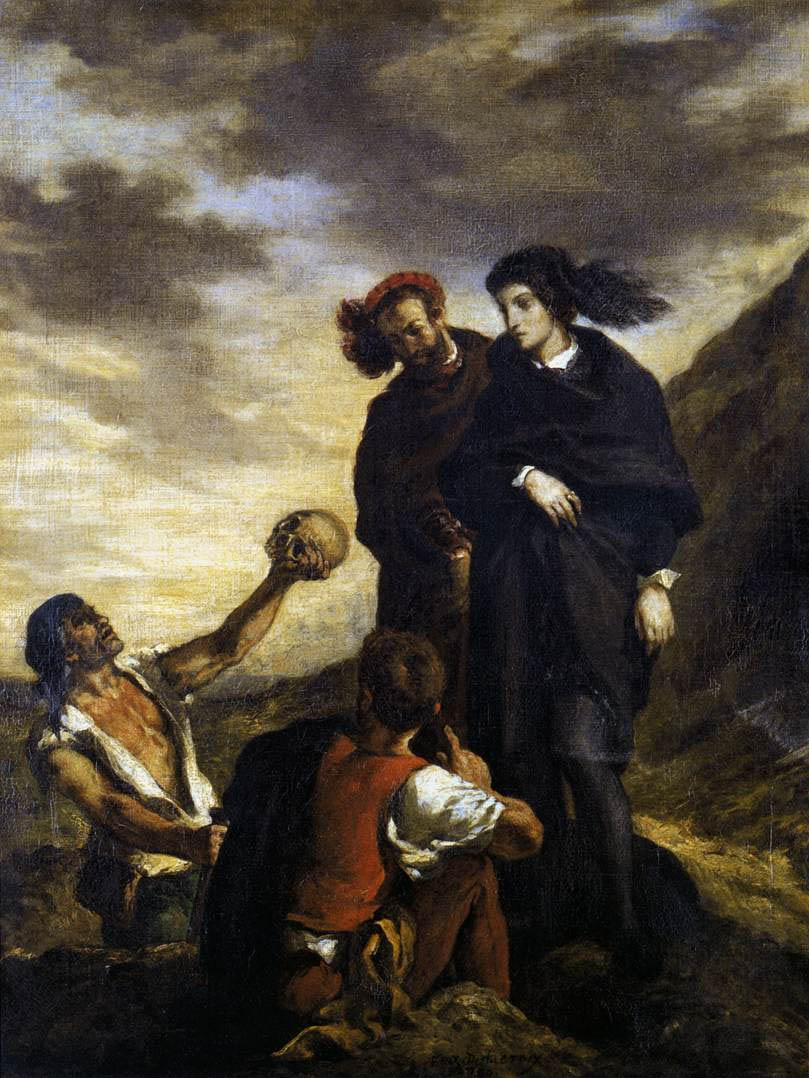
Eugène Delacroix (French, 1798-1863) 'Hamlet and Horatio in the Graveyard' 1839


Eugène Delacroix (French, 1798-1863)
Hamlet and Horatio in the Graveyard
1839
Oil on canvas
29.5cm (11.6 in) x 36cm (14.1 in)
Louvre Museum


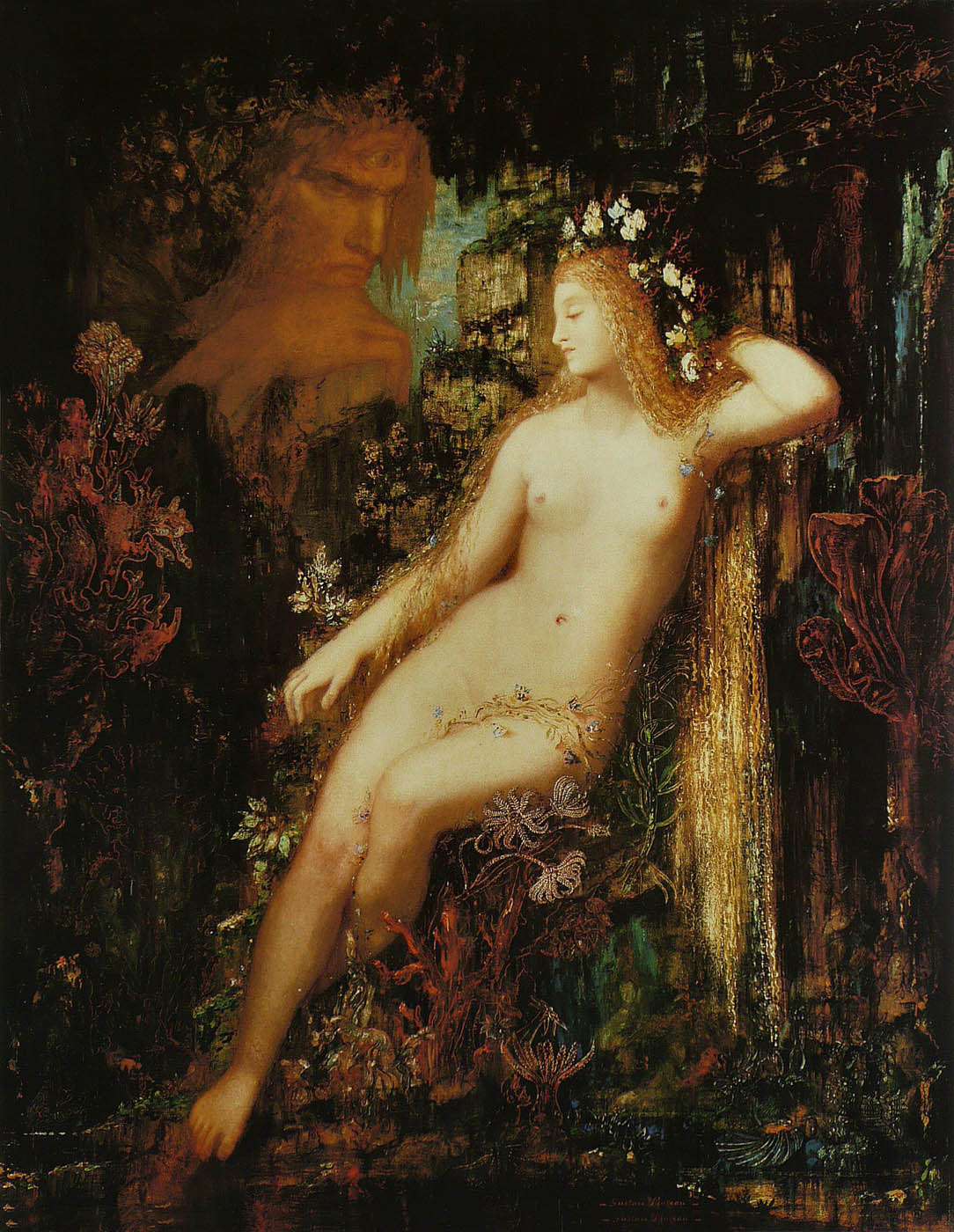
Gustave Moreau (French, 1826-1898) 'Galatea' c. 1880


Gustave Moreau (French, 1826-1898)
Galatea
c. 1880
Oil on panel
85.5cm (33.6 in) x 66cm (25.9 in)
Musée d’Orsay


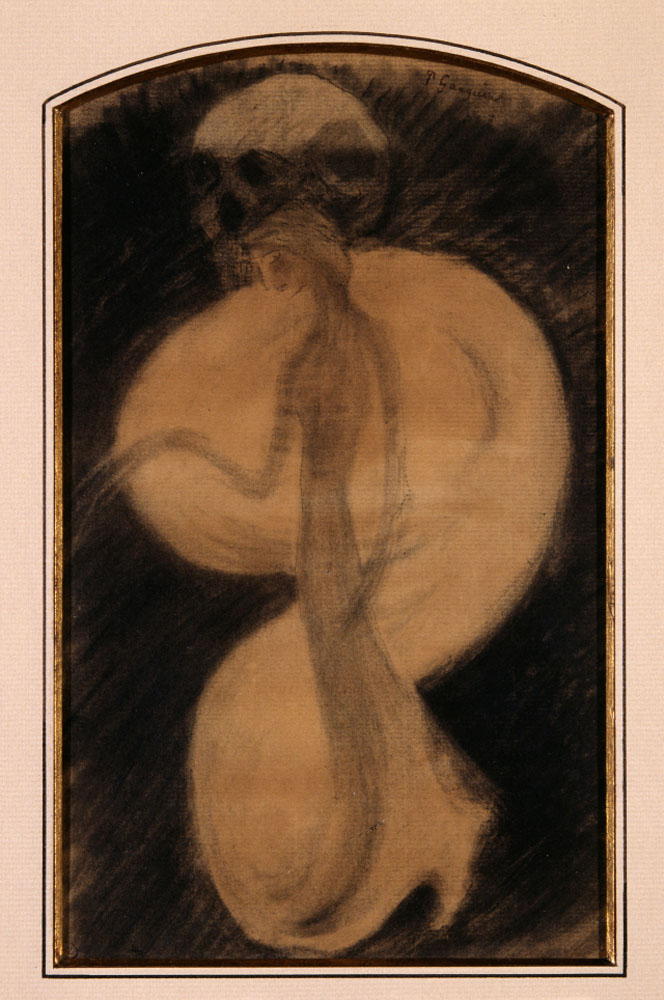
Paul Gauguin (French, 1848-1903) 'Madame la Mort' 1890-1891


Paul Gauguin (French, 1848-1903)
Madame la Mort
1890-1891
Charcoal on paper with wash highlights
33,5 x 23cm
Don de la société des Amis du musée d’Orsay, 1991
© RMN-Grand Palais (Musée d’Orsay) / Gérard Blot


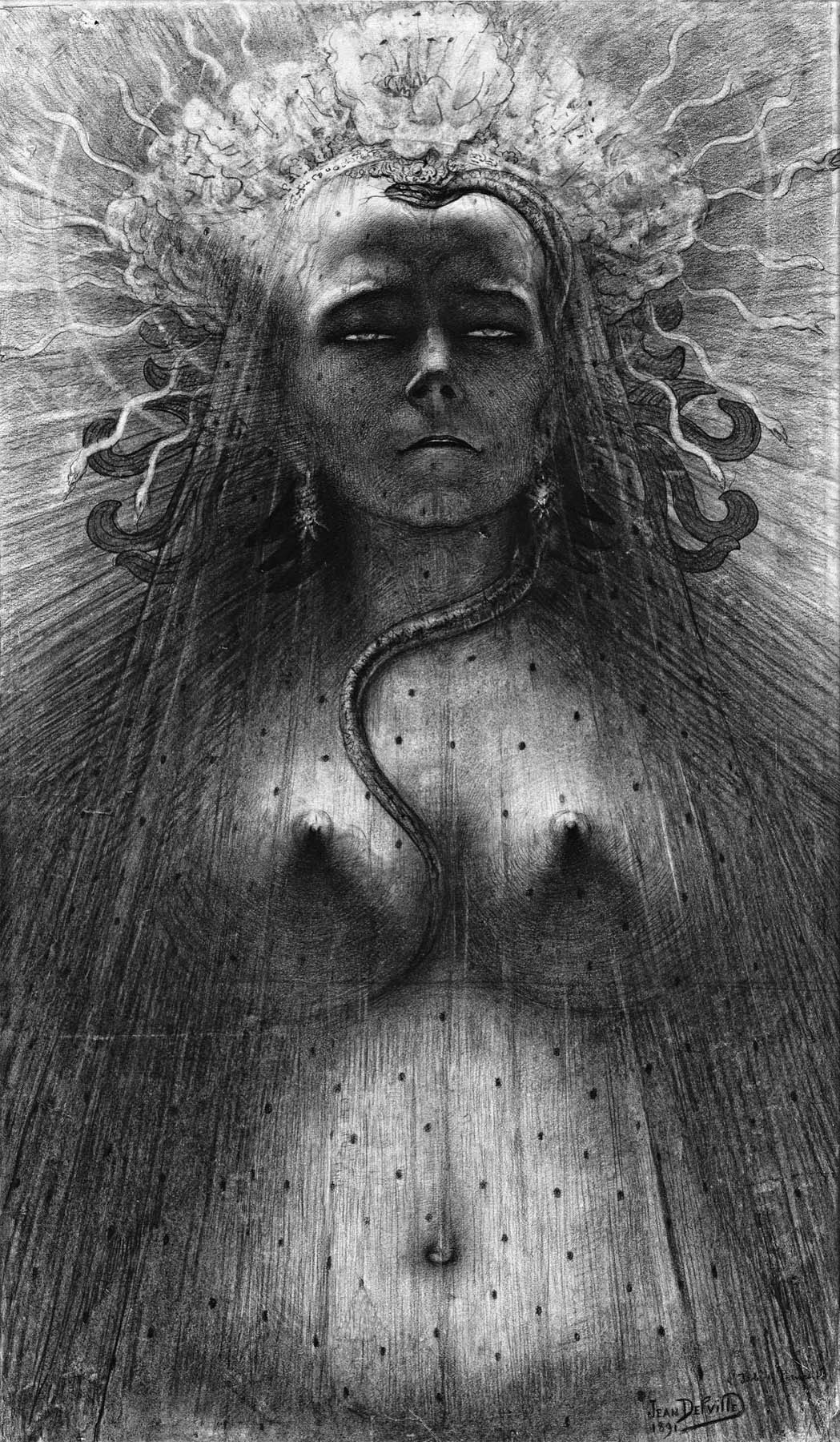
Jean Delville (Belgium, 1867-1953) 'L'Idole de la Perversité' (The Idol of Perversity) 1891


Jean Delville (Belgium, 1867-1953)
L’Idole de la Perversité (The Idol of Perversity)
1891
81.5 x 48.5cm
Museum Wiesbaden, Collection Ferdinand Wolfgang Neess


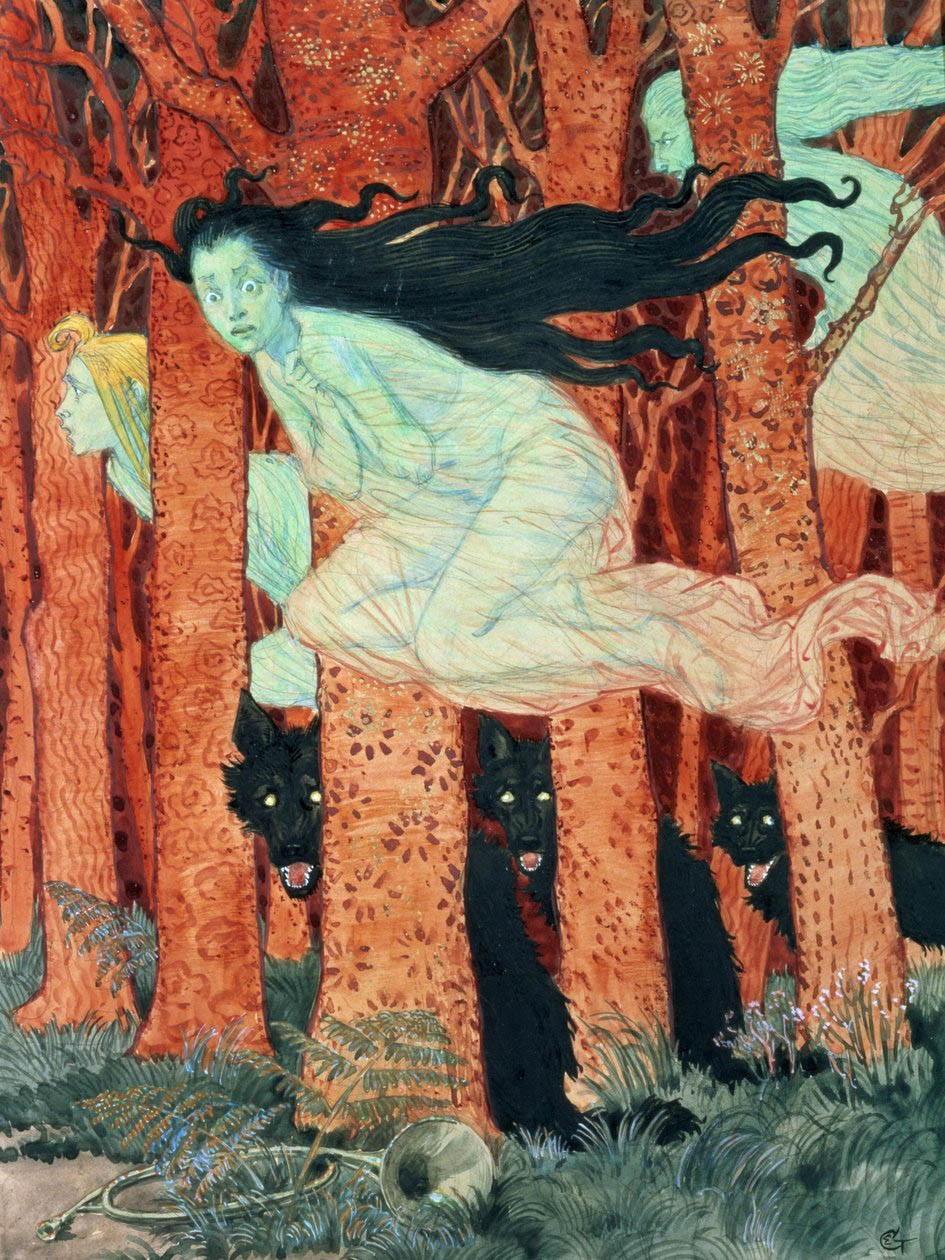
Eugène Grasset (French, 1845-1917) 'Trois Femmes et Trois Loups' 1892


Eugène Grasset (French, 1845-1917)
Trois Femmes et Trois Loups
1892
Pencil, watercolour, Indian ink and gold highlights on paper
35.3 x 27.3cm
Musée des Arts Décoratifs, Paris


Franz von Stuck (German, 1863-1928) 'Le Péché' (Die Sünde) (The Sin) 1893


Franz von Stuck (German, 1863-1928)
Le Péché (Die Sünde) (The Sin)
1893
Zurich, galerie Katharina Büttiker
© Galerie Katharina Büttiker, Zürich


Franz Stuck (German, 1863-1928) 'The Kiss of the Sphinx' (Le Baiser du Sphinx) (Der Kuss der Sphinx) 1895


Franz Stuck (German, 1863-1928)
The Kiss of the Sphinx (Le Baiser du Sphinx) (Der Kuss der Sphinx)
1895
Collection particulière
© Droits réservés


Franz Ritter von Stuck (February 23, 1863 – August 30, 1928), born Franz Stuck, was a German painter, sculptor, printmaker, and architect. Stuck was best known for his paintings of ancient mythology, receiving substantial critical acclaim with The Sin in 1892. In 1906, Stuck was awarded the Order of Merit of the Bavarian Crown and was henceforth known as Ritter von Stuck.


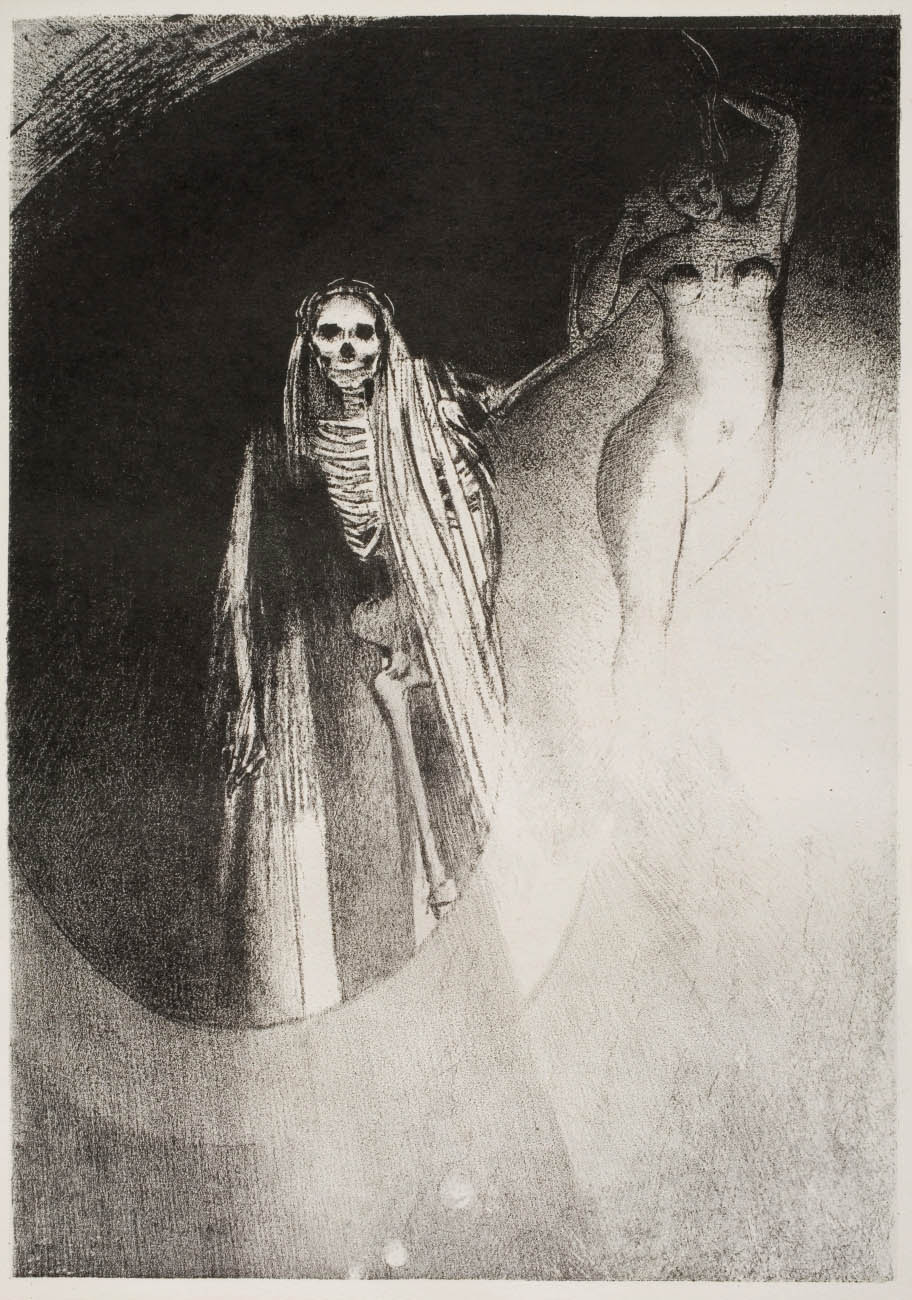
Odilon Redon (French, 1840-1916) 'La Mort: C'est moi qui te rends sérieuse: Enlaçons-nous' (Death: It is I who Makes You Serious; Let Us Embrace) 1896


Odilon Redon (French, 1840-1916)
La Mort: C’est moi qui te rends sérieuse: Enlaçons-nous (Death: It is I who Makes You Serious; Let Us Embrace)
1896
Plate 20 from the series “La Tentation de Saint-Antoine” (The Temptation of Saint Anthony)
Lithograph
Sheet: 17 1/8 in. x 13 in. (43.5 x 33cm)


La Mort: C’est moi qui te rends sérieuse: Enlaçons-nous is one of twenty-four prints by the French artist Odilon Redon (1840-1916) that illustrated Flaubert’s play Temptation of Saint Anthony, a lesser-known work of the literary giant but one that Flaubert laboured on painstakingly throughout his life. A contemporary to Flaubert, Redon had worked in lithography for about two decades when the final version of Temptation of Saint Anthony was published. Already working with a repertoire of dark and absurd subjects, Redon was drawn to the grotesque characters described by Flaubert and wrote fondly of the play, calling it “a literary marvel and a mine for me.”

La Mort depicts a scene in the play where Death and Lust, disguised respectively as an emaciated old woman and a fair young one, reveal their real likenesses after failed attempts to seduce Saint Anthony:

The winding-sheet flies open, and reveals the skeleton of Death. The robe bursts open, and presents to view the entire body of Lust, which has a slender figure, with an enormous development behind, and great, undulating masses of hair, disappearing towards the end.

Death tries to lead Saint Anthony to step into the abyss under the cliff and take his own life, thereby ending all pain. “It is I who make you serious, let us embrace each other,” she says, telling Saint Anthony that, by destroying himself, a work of God, he will become God’s equal.

Redon’s accomplished use of chiaroscuro, the sharp contrast between light and dark, underscores the dramatic nature of this moment. Death’s winding-sheet is enveloped by the dazzling rays of light radiating from the voluptuous body of Lust, and Lust’s hair vanishes into the darkness that seeps through Death;s skeletal body. Although the appearance of Lust differs greatly from that of Death, the overlap of their bodies suggests that they are but different phantoms created by the Devil.

Ningyi Xi. “Odilon Redon,” on the Davis Museum website 2017 [Online] Cited 11/08/2024


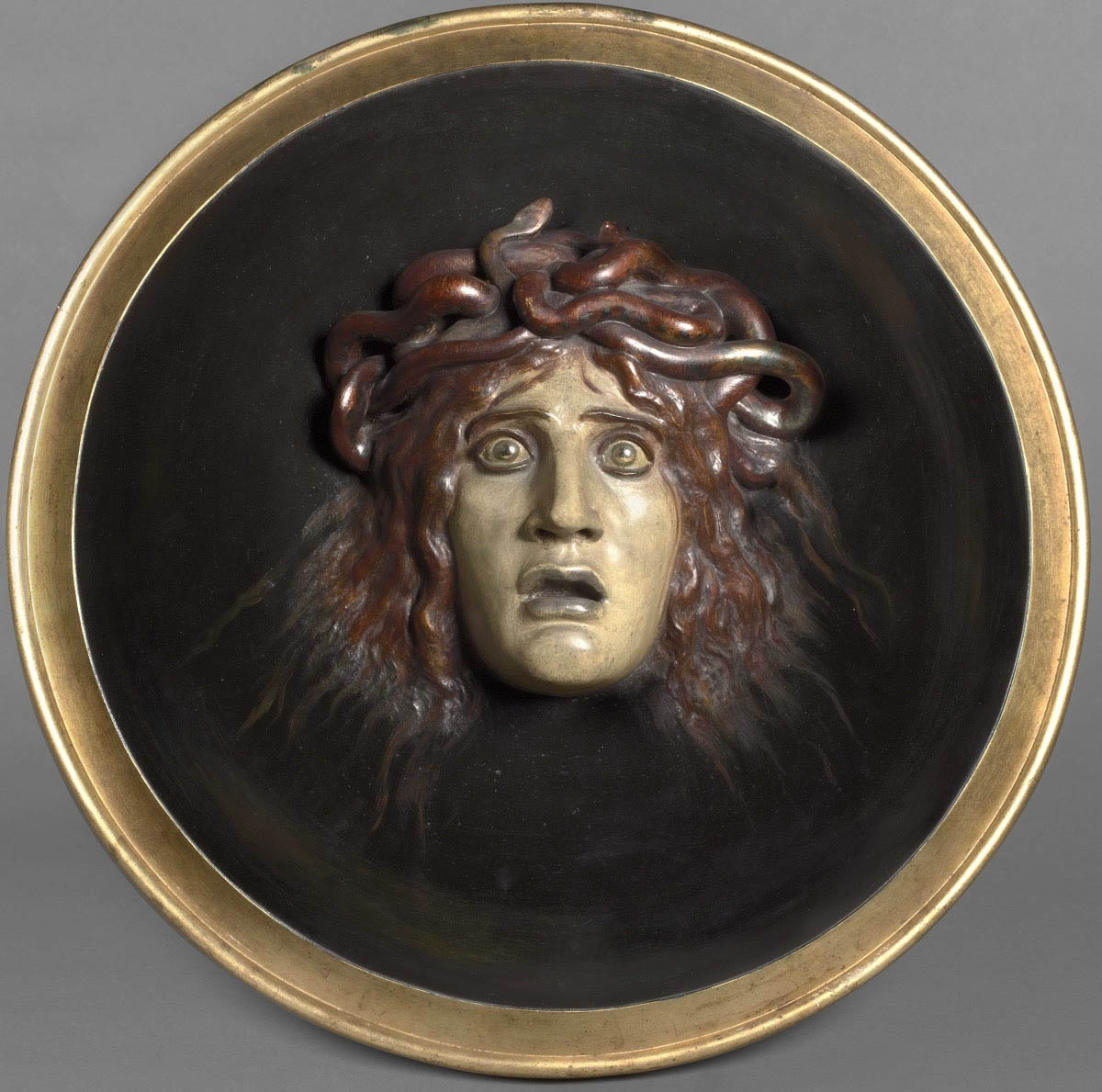
Arnold Böcklin (Swiss, 1827-1901) 'Shield with Gorgon's head' (Bouclier avec le visage de Méduse) 1897


Arnold Böcklin (Swiss, 1827-1901)
Shield with Gorgon’s head (Bouclier avec le visage de Méduse)
1897
Papier-mâché
610 x 610cm
© RMN (Musée d’Orsay) / Hervé Lewandowski


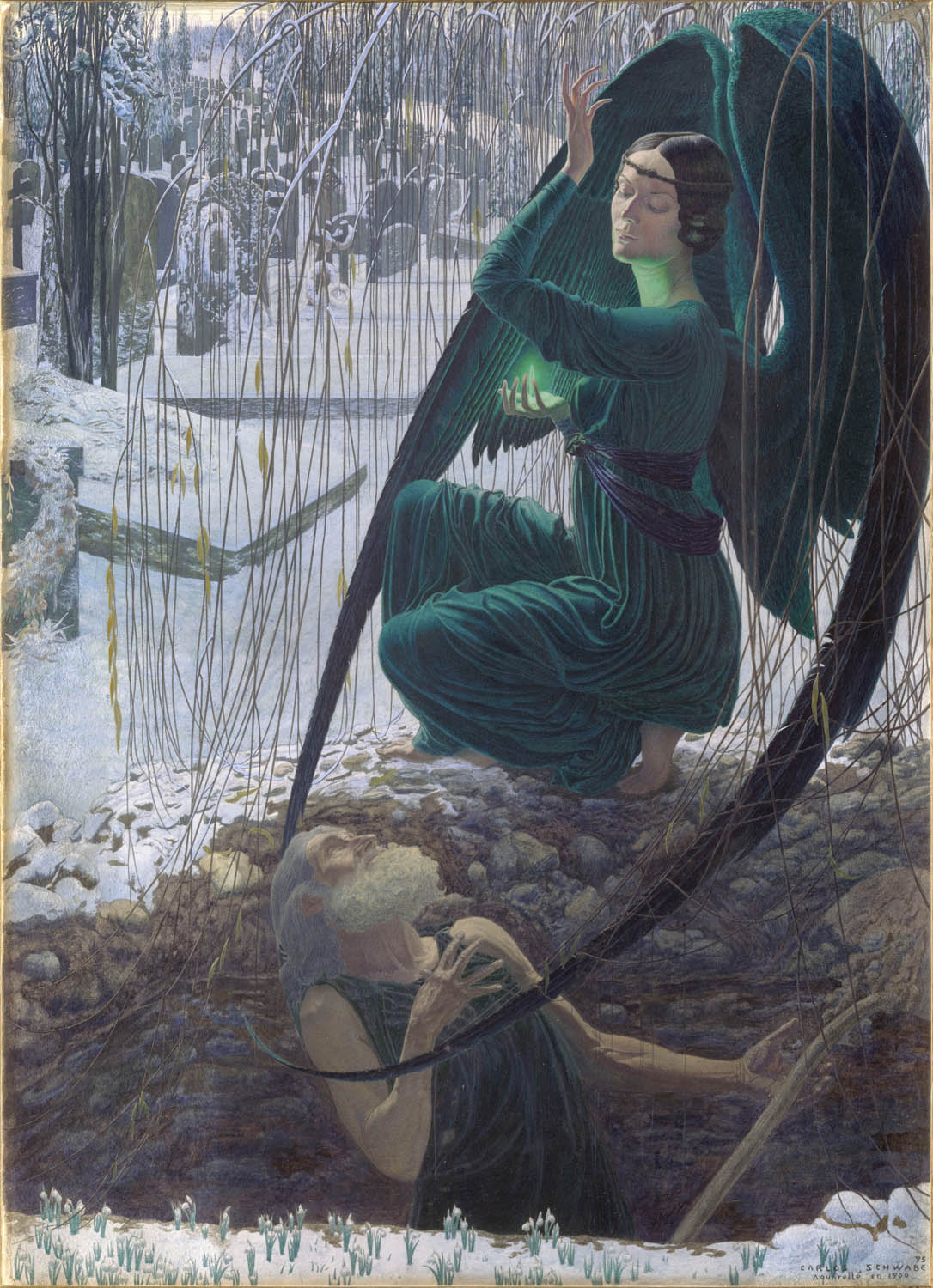
Carlos Schwabe (Swiss, 1866-1926) 'La Mort et le fossoyeur' (Death and the Gravedigger) 1900


Carlos Schwabe (Swiss, 1866-1926)
La Mort et le fossoyeur (Death and the Gravedigger)
1900
Paris, musée d’Orsay, conservé au département des Arts Graphiques du musée du Louvre
Legs Michonis, 1902
© RMN (Musée d’Orsay) / Jean-Gilles Berizzi / Patrice Schmidt


Julien Adolphe Duvocelle (French, 1873-1961) 'Crâne aux yeux exorbités et mains agrippées à un mur' (Skull with bulging eyes and hands gripping a wall) 1902


Julien Adolphe Duvocelle (French, 1873-1961)
Crâne aux yeux exorbités et mains agrippées à un mur (Skull with bulging eyes and hands gripping a wall)
1902
Pencil and charcoal mounted on a sheet blackened with charcoal
Paris, musée d’Orsay, conservé au département des Arts Graphiques du musée du Louvre
Don de Mme Fourier en souvenir de son fils, 1995
© DR – RMN-Grand Palais (Musée d’Orsay) / Jean-Gilles Berizzi


Anonymous photographer. 'Photographie spirite (médium et spectres)' / Spiritual photography (medium and ghosts) c. 1910


Anonymous photographer
Photographie spirite (médium et spectres) / Spiritual photography (medium and ghosts)
c. 1910
Musée d’Orsay
© RMN-Grand Palais (Musée d’Orsay) / Hervé Lewandowski / DR


Paul Dardé (French, 1888-1963) 'Eternelle douleur' (Eternal Pain)
1913


Paul Dardé (French, 1888-1963)
Eternelle douleur (Eternal Pain)
1913
Plaster, direct carving
50cm
Musée de Lodève


Paul Dardé created Eternal Pain at 25, even though he had only just finished his year of training. Having gone through the Paris National School of Beaux-Arts and Rodin’s workshop, it is probably his journey to Italy and his mythological reading which fixed the theme of the Medusa in the mind of the artist. Carved from a block of plaster gleaned on the heights of Lodève, the piece would be exhibited seven years later side by side with the great Faun, at the Salon of French artists in 1920.

Text from the Musée de Lodève website


Edvard Munch (Norwegian, 1863-1944) 'Vampire' 1916-1918


Edvard Munch (Norwegian, 1863-1944)
Vampire
1916-1918
Oil on canvas
85 x 110cm
Collection Würth
Photo: Archiv Würth
© VG Bild-Kunst, Bonn 2012


Friedrich Wilhelm Murnau (German, 1888-1931) 'Nosferatu – A Symphony of Horror' Germany 1922


Friedrich Wilhelm Murnau (German, 1888-1931)
Nosferatu – A Symphony of Horror
Germany 1922
Filmstill
Silent film
© Friedrich-Wilhelm-Murnau-Stiftung


Roger Parry (French, 1905-1977) 'Untitled' 1929


Roger Parry (French, 1905-1977)
Untitled
1929
Illustration from Léon-Paul Fargue’s “Banalité” (Paris 1930)
Gelatin silver print
21.8 x 16.5cm
Collection Dietmar Siegert
© VG Bild-Kunst, Bonn 2012


Jacques-André Boiffard (French, 1902-1961) 'Renée Jacobi' 1930


Jacques-André Boiffard (French, 1902-1961)
Renée Jacobi
1930
Paris, Centre Pompidou, musée national d’Art moderne, Centre de création industrielle
© Centre Pompidou, MNAM-CCI, dist. RMN-Grand Palais
Image: Centre Pompidou MNAM-CCI © Mme Denise Boiffard


Hans Bellmer. 'La Poupée (tête et couteau)' / The Doll (head and knife) 1935


Hans Bellmer (German, 1902-1975)
La Poupée (tête et couteau) / The Doll (head and knife)
1935
Collection Dietmar Siegert
© ADAGP, Paris


René Magritte (Belgian, 1898-1967) 'Sentimental Conversation' 1945


René Magritte (Belgian, 1898-1967)
Sentimental Conversation
1945
Oil on canvas
54 x 65cm
Private Collection
© VG Bild-Kunst, Bonn 2012


Städelsches Kunstinstitut und Städtische Galerie
Schaumainkai 63, 60596 Frankfurt
Phone: +49(0)69-605098-170

Opening hours:
Tuesday – Wednesday, Friday – Sunday 10 – 18 h
Thursday 10 – 21 h
Monday closed

Städel Museum website

LIKE ART BLART ON FACEBOOK

Back to top

Marcus Bunyan black and white archive: ‘Circumnavigation’, 1992-1994

November 2012

*PLEASE NOTE THIS POSTING CONTAINS ART PHOTOGRAPHS OF MALE SEXUAL NUDITY- IF YOU DO NOT LIKE PLEASE DO NOT LOOK, FAIR WARNING HAS BEEN GIVEN*


The titles from this period tend to be poetic, pragmatic or composed, like Japanese haiku. The photographs are a mixture of personal narrative and universal archetype, hence the affinity to Frederick Sommer’s incantation: Circumnavigation of the blood is always Circumnavigation of the world.

I am scanning my negatives made during the years 1991-1997 to preserve them in the form of an online archive as a process of active memory, so that the images are not lost forever. These photographs were images of my life and imagination at the time of their making, the ideas I was thinking about and the people and things that surrounded me.

All images © Marcus Bunyan. Please click the photographs for a larger version of the image; remember these are just straight scans of the negatives!

Photographs are available from this series for purchase. As a guide, a vintage 8″ x 10″ silver gelatin print costs $700 plus tracked and insured shipping. For more information please see my Store web page.


Marcus Bunyan (Australian, b. 1958) 'Doll on chair' 1992-94


Marcus Bunyan (Australian, b. 1958)
Doll on chair
1992-1994
Silver gelatin photograph


Marcus Bunyan (Australian, b. 1958) 'Paul on the balcony, Mcilwrick Street, Windsor' 1992-94


Marcus Bunyan (Australian, b. 1958)
Paul on the balcony, Mcilwrick Street, Windsor
1992-1994
Silver gelatin photograph


Marcus Bunyan (Australian, b. 1958) 'Paul resting' 1992-94


Marcus Bunyan (Australian, b. 1958)
Paul resting
1992-1994
Silver gelatin photograph


Marcus Bunyan (Australian, b. 1958) 'Marcus holding his cock' 1992-94


Marcus Bunyan (Australian, b. 1958)
Marcus holding his cock
1992-1994
Silver gelatin photograph


Marcus Bunyan (Australian, b. 1958) 'Post with finial, tree' 1992-94


Marcus Bunyan (Australian, b. 1958)
Post with finial, tree
1992-1994
Silver gelatin photograph


Marcus Bunyan (Australian, b. 1958) 'People who live in glass houses shouldn't throw stars' 1992-1994


Marcus Bunyan (Australian, b. 1958)
People who live
in glass houses
shouldn’t throw stars
1992-1994
Silver gelatin photograph


Marcus Bunyan (Australian, b. 1958) 'Paul, Windsor and the city' 1992-1994


Marcus Bunyan (Australian, b. 1958)
Paul, Windsor and the city
1992-1994
Silver gelatin photograph


Marcus Bunyan (Australian, b. 1958) 'Self portrait with punk jacket and flanny' 1992-1994


Marcus Bunyan (Australian, b. 1958)
Self portrait with punk jacket and flanny
1992-1994
Silver gelatin photograph


Marcus Bunyan (Australian, b. 1958) 'Release' 1992-1994


Marcus Bunyan (Australian, b. 1958)
Release
1992-1994
Silver gelatin photograph


Marcus Bunyan (Australian, b. 1958) 'Jesus, Mary and Joseph.' 1992-1994


Marcus Bunyan (Australian, b. 1958)
Jesus, Mary and Joseph.
1992-1994
Silver gelatin photograph


Marcus Bunyan (Australian, b. 1958) 'Circumnavigation of the blood is always Circumnavigation of the world (for Frederick Sommer)' 1992-1994


Marcus Bunyan (Australian, b. 1958)
Circumnavigation of the blood is always Circumnavigation of the world (for Frederick Sommer)
1992-1994
Silver gelatin photograph


Marcus Bunyan (Australian, b. 1958) 'Release (cock, hands, cum)' 1992-1994


Marcus Bunyan (Australian, b. 1958)
Release (cock, hands, cum)
1992-1994
Silver gelatin photograph


Marcus Bunyan (Australian, b. 1958) 'Madonna and child, skull' 1992-94


Marcus Bunyan (Australian, b. 1958)
Madonna and child, skull
1992-1994
Silver gelatin photograph


Marcus Bunyan black and white archive 1991-1997

LIKE ART BLART ON FACEBOOK

Back to top

Exhibition: ‘The Body as Protest’ at the Albertina, Vienna

Exhibition dates: 5th September – 2nd December 2012


Ishiuchi Miyako (Japanese, b. 1947) '1906#38' Nd


Ishiuchi Miyako (Japanese, b. 1947)
1906#38
Nd
Courtesy by The Third Gallery Aya


“The past neglect of the body in social theory was a product of Western mind-body dualism that divided human experience into bodily and cognitive realms. The knowledge-body distinction identifies knowledge, culture, and reason with masculinity and identifies body, nature, and emotion with femininity. Viewing human reason as the principal source of progress and emancipation, it perceives “the rational” as separate from, and exalted over, the corporeal. In other words, consciousness was grasped as separate from and preceding the body (Bordo 1993; Davis 1997). Following feminist thinking about women’s bodies in patriarchal societies, contemporary social theories shifted focus from cognitive dimensions of identity construction to embodiment in the constitution of identities (Davis 1997). Social construction theories do not view the body as a biological given but as constituted in the intersection of discourse, social institutions, and the corporeality of the body. Body practices, therefore, reflect the basic values and themes of the society, and an analysis of the body can expose the intersubjective meaning common to society. At the same time, discourse and social institutions are produced and reproduced only through bodies and their techniques (Frank 1991, 91). Thus, social analysis has expanded from studying the body as an object of social control and discipline “in order to legitimate different regimes of domination” (Bordo 1993; Foucault 1975, 1978, 1980) to perceiving it as a subject that creates meaning and performs social action (Butler 1990). The body is understood as a means for self-expression, an important feature in a person’s identity project (Giddens 1991), and a site for social subversiveness and self-empowerment (Davis 1997).”


Orna Sasson-Levy and Tamar Rapoport. “Body, Gender, and Knowledge in Protest Movements: The Israeli Case,” in ‘Gender & Society’ 17, 2003, p. 381. No longer available online


Despite my great admiration for John Coplans’ photographs of his body, on the evidence of these press photographs and the attached video, this exhibition seems a beautiful if rather tame affair considering the subject matter. Of course these photographs of the body can be understood as a means for self-expression and self-empowerment but there seems little social subversiveness in the choice of work on display.

The two Mapplethorpe’s are stylised instead of stonkingly subversive. The exhibition could have been taken photographs from his ‘X’ portfolio (the self portrait of him with a bull whip up his arse would have been particularly pleasing to see in this context). The exhibition could also have included some of the many artists using the body as protest during the AIDS crisis (perhaps some photographs by David Wojnarowicz or William Yang’s Sadness), the famous Burning Monk – The Self-Immolation (1963) by Malcolm Browne, photographs by Stellarc, Arthur Tress, Duane Michals, Nan Goldin, Diane Arbus, Francesca Woodman, Sally Mann, Cindy Sherman to name but a few; even the Farm Security Administration photographs of share cropper families by Walker Evans and Dorothea Lange would have had more impact than some of the photographs on display here.

Having not seen the entire exhibition it is hard to give an overall reading, but on the selection presented here it would seem that this was a missed opportunity, an exhibition where the body did not protest enough.

Dr Marcus Bunyan


Many thankx to the Albertina, Vienna for allowing me to publish the photographs in the posting. Please click on the photographs for a larger version of the image.


theartVIEw – The Body as Protest at ALBERTINA


Bruce Nauman (American, b. 1941) 'Studies for Holograms' Siebdruck, 1970


Bruce Nauman (American, b. 1941)
Studies for Holograms
Siebdruck, 1970
© VBK, Wien 2012
Foto: © Rheinisches Bildarchiv Köln


Ketty La Rocca (Italian, 1938-1976) 'Le mie parole e tu' 1974


Ketty La Rocca (Italian, 1938-1976)
Le mie parole e tu
1974
Courtesy Private Collection, Austria


Robert Mapplethorpe (American, 1946-1989) 'Vincent' 1981


Robert Mapplethorpe (American, 1946-1989)
Vincent
1981
Silbergelatinepapier
© Robert Mapplethorpe Foundation


Hannah Villiger (Swiss, b. 1974) 'Block XXX' 1993-1994


Hannah Villiger (Swiss, b. 1974)
Block XXX
1993-1994
© The Estate of Hannah Villiger


John Coplans (British, 1920-2003) 'Self Portrait Interlocking Fingers No 6' 1999


John Coplans (British, 1920-2003)
Self Portrait Interlocking Fingers No 6
1999
Silbergelatinepapier
Albertina, Wien


The exhibition The Body as Protest highlights the photographic representation of the human body – a motif that has provided a wide variety of photographers with an often radical means of expression for their visual protest against social, political, but also aesthetic norms.

The show centres on an outstanding group of works by the artist John Coplans from the holdings of the Albertina. In his serially conceived large-format pictures, the photographer focused on the rendering of his own nude body, which he defamiliarised through fragmentation far from current forms of idealisation. Relying on extremely sophisticated lighting, he presented himself in a monumental and sculptural manner over many years. His photographs can be understood as amalgamations of theoretical and artistic ideas, which in the show are accentuated through selective juxtapositions with works by other important exponents of body-related art.

The body also features prominently in the work of other artists such as Hannah Wilke, Ketty La Rocca, Hannah Villiger, Vito Acconci, Bruce Nauman, Robert Mapplethorpe, and Miyako Ishiuchi. By means of these positions, such diverse themes as self-dramatisation, conceptual photography, feminism, body language, and even transience are analysed within an expanded artistic range. Moreover, the exhibition offers a differentiated view of the critical depiction of the human body as it has been practiced since 1970.

Text from the Albertina website


Ketty La Rocca (Italian, 1938-1976) 'Craniologia' 1973


Ketty La Rocca (Italian, 1938-1976)
Craniologia
1973
Radiografie mit überblendeter Fotografie
SAMMLUNG VERBUND


Hannah Wilke (American, 1940-1993) 'Gestures' 1974-1976 (stills)


Hannah Wilke (American, 1940-1993)
Gestures (stills)
1974-1976
Basierend auf der gleichnamigen
Video Performance von 1974
(35:30 min, b&w, sound)
Silbergelatinepapier
12 Blatt je 12,7x 17,8 cm
© Marsie, Emanuelle, Damon and Andrew Scharlatt, The Hannah Wilke Collection & Archive, L.A./ VBK, Wien 2012


Robert Mapplethorpe (American, 1946-1989) 'Thomas' 1986


Robert Mapplethorpe (American, 1946-1989)
Thomas
1986
Silbergelatinepapier
© Robert Mapplethorpe Foundation


John Coplans (British, 1920-2003) 'Back with Arms Above' 1984


John Coplans (British, 1920-2003)
Back with Arms Above
1984
Silbergelatinepapier
© The John Coplans Trust


John Coplans (British, 1920-2003) 'Self Portrait (Hands)' 1988


John Coplans (British, 1920-2003)
Self Portrait (Hands)
1988
Silbergelatinepapier
Albertina, Wien


John Coplans (British, 1920-2003) 'Frieze No. 6' 1994


John Coplans (British, 1920-2003)
Frieze No. 6
1994
Silbergelatinepapier
Albertina, Wien


John Coplans (British, 1920-2003) 'Self Portrait Interlocking Fingers No 17' 2000


John Coplans (British, 1920-2003)
Self Portrait Interlocking Fingers No 17
2000
Silbergelatinepapier
Albertina, Wien


Albertina
Albertinaplatz 1
1010 Vienna, Austria
Phone: +43 (0)1 534 83-0

Opening hours:
Daily 10am – 6pm
Wednesday 10am – 9pm

Albertina website

LIKE ART BLART ON FACEBOOK

Back to top

Artwork: Hamzeh Carr. ‘Lord Buddha’ 1926

November 2012


Hamzeh Carr. 'Lord Buddha' 1926


Hamzeh Carr
Lord Buddha
1926
Frontispiece
From Sir Edwin Arnold. The Light of Asia. London: John Lane The Bodley Head Ltd
Limited edition of 3,000 copies


Absolutely divine. In the flesh, the colouring and radiance of these plates has to be seen to be believed.
God they knew how to print back then!

I shall be posting more of these stunning works over the coming weeks. They deserve to be seen and meditated upon. Please click on the artwork for a larger version of the image.

Marcus


Please click on the image for a larger version of the art work.


LIKE ART BLART ON FACEBOOK

Back to top

Exhibition: ‘Dennis Hopper – The Lost Album. Vintage Photographs of the 1960s’ at Martin-Gropius-Bau, Berlin

Exhibition dates: 20th September – 17th December 2012


Dennis Hopper (American, 1936-2010) 'Guy With 5 Hogs' 1961-67


Dennis Hopper (American, 1936-2010)
Guy With 5 Hogs
1961-1967
Location: USA
6.97 x 9.85 inch
© The Dennis Hopper Trust, Courtesy of The Dennis Hopper Trust


Unlike an earlier posting of photographs by a well known film director (the underwhelming, in fact pretty awful, Wim Wenders: Places, Strange and Quiet), these “lost” photographs by Dennis Hopper are very good. I love their quiet, intimate strength, their fun, wit and vivacity; and the portraits capture the essence of the sitter with a decisive elegance and eloquence.

The photographs perfectly capture the social milieu of the time and the pervading ethos of the fracturing of the image plane, a la Gary Winogrand or Lee Friedlander. Nice to see the work full frame as well, meaning that the photographers’ previsualisation was strong in camera; that Hopper had an excellent understanding of the construction of the pictorial frame negating the necessity for cropping of the image.

Enlarging the face of Martin Luther King Jr., (below) and then looking into his eyes, I felt I had a connection with this person. Nostalgia, longing, sadness and joy at his life and the feeling that I was looking into the eyes of one of the great human beings of the twentieth century.

Dr Marcus Bunyan


Many thankx to Martin-Gropius-Bau for allowing me to publish the photographs in the posting. Please click on the photographs for a larger version of the image.


“I never made a cent from these photos. They cost me money but kept me alive. These are my photos. I started at eighteen taking pictures. I stopped at thirty-one. (…) These represent the years from twenty-five to thirty-one, 1961 to 1967. I didn’t crop my photos. They are full frame natural light Tri-X. I went under contract to Warner Brothers at eighteen. I directed Easy Rider at thirty-one. I married Brooke at twenty-five and got a good camera and could afford to take pictures and print them. They were the only creative outlet I had for these years until Easy Rider. I never carried a camera again.”


Dennis Hopper 1986


“The necessity to make these photos and paintings came from a real place – a place of desperation and solitude – with the hope that someday these objects, paintings, and photos would be seen filling the void I was feeling.”


Dennis Hopper 2001


Dennis Hopper (American, 1936-2010) 'Double Standard' 1961


Dennis Hopper (American, 1936-2010)
Double Standard
1961
Location: Los Angeles, Ca USA
6.87 x 9.79 inch
© The Dennis Hopper Trust, Courtesy of The Dennis Hopper Trust


Dennis Hopper (American, 1936-2010) 'Andy Warhol, Henry Geldzahler, David Hockney, and Jeff Goodman' 1963


Dennis Hopper (American, 1936-2010)
Andy Warhol, Henry Geldzahler, David Hockney, and Jeff Goodman
1963
Location: USA
17.25 x 24.74cm
© The Dennis Hopper Trust, Courtesy of The Dennis Hopper Trust


'Dennis Hopper The Lost Album – Vintage Prints From the Sixties' book. Prestel, 2012, p. 78 


Dennis Hopper The Lost Album – Vintage Prints From the Sixties book. Prestel, 2012, p. 78


Dennis Hopper (American, 1936-2010) 'James Rosenquist' 1964


Dennis Hopper (American, 1936-2010)
James Rosenquist
1964
Location: Billboard Factory, Los Angeles, Ca USA
6.81 x 9.68 inch
© The Dennis Hopper Trust, Courtesy of The Dennis Hopper Trust


Dennis Hopper (American, 1936-2010) 'Artist Ed Ruscha' 1964


Dennis Hopper (American, 1936-2010)
Artist Ed Ruscha
1964
© The Dennis Hopper Trust, Courtesy of The Dennis Hopper Trust


Dennis Hopper (American, 1936-2010) 'Roger Vadim and Jane Fonda at their wedding, Las Vegas' 1965


Dennis Hopper (American, 1936-2010)
Roger Vadim and Jane Fonda at their wedding, Las Vegas
1965
Location: Las Vegas, USA
© The Dennis Hopper Trust, Courtesy of The Dennis Hopper Trust


Dennis Hopper (American, 1936-2010) 'Tuesday Weld' 1965


Dennis Hopper (American, 1936-2010)
Tuesday Weld
1965
© The Dennis Hopper Trust, Courtesy of The Dennis Hopper Trust


Dennis Hopper (American, 1936-2010) 'Jane Fonda (with bow & arrow), Malibu' 1965


Dennis Hopper (American, 1936-2010)
Jane Fonda (with bow & arrow), Malibu
1965
© The Dennis Hopper Trust, Courtesy of The Dennis Hopper Trust


Dennis Hopper (American, 1936-2010) 'Bruce Conner (in tub), Toni Basil, Teri Garr, and Ann Marshall' 1965


Dennis Hopper (American, 1936-2010)
Bruce Conner (in tub), Toni Basil, Teri Garr, and Ann Marshall
1965
© The Dennis Hopper Trust, Courtesy of The Dennis Hopper Trust


Dennis Hopper (American, 1936-2010) 'Untitled (Blue Chips Stamps)' 1961-1967


Dennis Hopper (American, 1936-2010)
Untitled (Blue Chips Stamps)
1961-1967
© The Dennis Hopper Trust, Courtesy of The Dennis Hopper Trust


'Dennis Hopper The Lost Album – Vintage Prints From the Sixties' p. 154


Dennis Hopper The Lost Album – Vintage Prints From the Sixties book. Prestel, 2012, p. 154


Dennis Hopper (American, 1936-2010) 'Untitled (Hippie Girl Dancing)' 1967


Dennis Hopper (American, 1936-2010)
Untitled (Hippie Girl Dancing)
1967
© The Dennis Hopper Trust, Courtesy of The Dennis Hopper Trust


The exhibition shows a spectacular portfolio of over four hundred vintage photographs taken by Dennis Hopper in the 1960s. Tucked away in five crates and forgotten, they were discovered after his death. There can be no doubt that these works are those personally selected by Hopper from the wealth of shots he took between 1961 and 1967 for the first major exhibition of his photography. The pictures themselves document how the works were installed in the Fort Worth Art Center Museum, Texas, in 1970 by himself and Henry T. Hopkins, the museum’s director at the time. None of these works have been displayed in Europe before. The portfolio that has now come to light is a treasure. It consists of small plates, sometimes numbered on the back with brief notes in Hopper’s hand and showing traces of wear. Mounted on cardboard, without frame of glass, they were attached directly to the wall.

The images have a legendary quality. Spontaneous, intimate, poetic, unabashedly political and keenly observed, they document an exciting epoch, its protagonists and milieus. These photographs reflect the atmosphere of an era, being outstanding testimonials to America’s dynamic cultural scene in the 1960s. On the viewer they exercise an irresistible attraction, bearing him away on a journey into the past, often into his own history.

Many of these pictures are icons, such as the portraits of Robert Rauschenberg, Andy Warhol, Paul Newman and Jane Fonda. They also cover a wide range of subjects. Dennis Hopper is interested in everything. Wherever he happens to be, whether in Los Angeles, New York, London, Mexico or Peru, he takes in his surroundings with empathy, enthusiasm and intense curiosity. He seeks and savours the “essential moment”, capturing the celebrities and types of his time with the camera: actors, artists, musicians, his family, bikers and hippies. He leaves an impressive photographic record of the “street life” of Harlem, of cemeteries in Mexico, and of bullfights in Tijuana. Hopper accompanies Martin Luther King Jr. on the march from Selma to Montgomery, Alabama, and, in images of great beauty and serenity, he converts the every day life and the neglected into a picture of beauty and silence as if converting Abstract Expressionism from the language of painting into that of photography.

Between 1961 and 1967 Hopper applied himself intensely on photography.

Hopper’s photographs are legendary images, spontaneous, intimate, and poetic as well as decidedly political and keenly observant – documents of an exciting period, its protagonists and milieus. Many of these photos have become iconic: the portraits of Robert Rauschenberg, Andy Warhol, Paul Newman or Jane Fonda. They also cover a range of topics and motifs. Hopper was interested in everything. Wherever he was, in Los Angeles, New York, London, Mexico or Peru, he was a precise observer, full of empathy and curiosity. He captured the geniuses of his day, the actors, artists, musicians and poets, his family and friends, the “scene”, bikers and hippies. He wandered the streets of Harlem and the graveyards of Durango and watched the bullfights in Tijuana with fascination. Hopper followed Martin Luther King Jr. with his camera on the march from Selma to Montgomery, Alabama. And he paid attention to things small, ordinary, and neglected, transforming the “remains of our world” into images of great beauty and tranquility, as if converting Abstract Expressionist painting into the language of photography.

Press release from the Martin-Gropius-Bau website


Dennis Hopper (American, 1936-2010) 'Beverly Renee on Bed' 1961


Dennis Hopper (American, 1936-2010)
Beverly Renee on Bed
1961
© The Dennis Hopper Trust, Courtesy of The Dennis Hopper Trust


'Dennis Hopper The Lost Album – Vintage Prints From the Sixties' book. Prestel, 2012, p. 62


Dennis Hopper The Lost Album – Vintage Prints From the Sixties book. Prestel, 2012, p. 62


Dennis Hopper (American, 1936-2010) 'Andy Warhol and Members of The Factory (Gregory Markopoulos, Taylor Mead, Gerard Malanga, Jack Smith)' 1963


Dennis Hopper (American, 1936-2010)
Andy Warhol and Members of The Factory (Gregory Markopoulos, Taylor Mead, Gerard Malanga, Jack Smith)
1963
Location: in The Factory, NYC, NY USA
6.57 x 9.87 inch
© The Dennis Hopper Trust, Courtesy of The Dennis Hopper Trust


Dennis Hopper (American, 1936-2010) 'Niki de Saint Phalle (kneeling)' 1963


Dennis Hopper (American, 1936-2010)
Niki de Saint Phalle (kneeling)
1963
Location: USA
6.66 x 9.83 inch
© The Dennis Hopper Trust, Courtesy of The Dennis Hopper Trust


Dennis Hopper (American, 1936-2010) 'Art dealer Irving Blum with model Peggy Moffitt' 1964


Dennis Hopper (American, 1936-2010)
Art dealer Irving Blum with model Peggy Moffitt
1964
© The Dennis Hopper Trust, Courtesy of The Dennis Hopper Trust


The Lost Album

Gelatine silver vintage prints, 1970
Collection of the Dennis Hopper Art Trust

More than four hundred photos came to light after Hopper’s death. He had selected them for his first photography exhibition in 1970 at the Fort Worth Art Center Museum. They show signs of wear: fingerprints, scratches, discolouration, a frayed corner or tiny dent. Mounted on cardboard, numbered on the back with notes in Hopper’s handwriting, they were hung directly on the wall from small wooden strips without frames or glass. The hanging in the Martin-Gropius-Bau is based on the original installation of 1970.

The vintage prints, in portrait and landscape format, are all of a similar size, c. 24 x 16cm; twenty of them are in a larger format (c. 33 x 23cm). Of the 429 Hopper chose for his first exhibition, eleven are believed lost; they are replaced here by new prints, which will be clearly indicated. In only two cases was it impossible to locate the corresponding negative, and a placeholder with the title is mounted instead. The rediscovered boxes contained an additional nineteen, unnumbered vintage prints along with the 429, which Hopper took with him to Fort Worth but probably never hung in the exhibition. They have been incorporated into the “Album” here (I-XIX).

Additional information on the photographs

1. Brooke Hayward, Marin Hopper

Brooke Hayward, born and raised in Los Angeles, was at home in the glamorous world of Hollywood through her parents, the film producer Leland Hayward and Hollywood star Margaret Sullavan, and Hopper in turn knew a lot of extraordinary people through his involvement in the acting and art worlds. Hopper and Hayward’s home became the center of an illustrious group of actors, artists, musicians, writers, and film producers. Soon after moving [into their house] they threw a “movie star party” for Andy Warhol to celebrate his second exhibition at the Ferus Gallery (1963).

“Since I was a small child, growing up in L.A., I remember that my dad was always capturing the scene around him through the lens of his camera. What he always described as taking the most pleasure in exploring, or focusing on, much like Marcel Duchamp signing the Hotel-Green-Sign for him on the night of his opening at the Pasadena Art Museum in 1963, and Rauschenberg’s practice, was the philosophy that an artist can point to something and claim it’s art because in that moment it is to them.” (Marin Hopper, 2012)

2. Los Angeles Art Scene

Walter Hopps and Edward Kienholz founded the Ferus Gallery at 736A North La Cienega Boulevard in March 1957. Ferus was very underground, like a crazy club with exhibitions, readings and fashion shows. “The openings were wild, everybody had a blast, and nobody made a penny.” Hopper attended every opening and went to performances and happenings, whether it was Oldenburg’s Los Angeles performance Autobodys in 1963, Robert Rauschenberg’s performance Pelican at the Culver City Ice Rink in 1966, or Allan Kaprow’s Fluids in 1967, when with the help of friends he stacked blocks of ice to form enclosures at different sites in Los Angeles.

In 1966, Claes Oldenburg made a piece of plaster wedding cake (which he stamped on the back) for each guest at the wedding party for Jim Elliot, curator at the Los Angeles County Museum of Art. Rauschenberg was wearing this stamp on his tongue when Hopper photographed him at the wedding.

3. New York

Hopper frequently traveled to New York, strolling through the Museum of Modern Art and the galleries, sometimes in the company of Henry Geldzahler, curator at the Metropolitan Museum of Art, and visited Warhol, at whose Factory he encountered Gerard Malanga, Taylor Mead or David Hockney. Hopper met Robert Rauschenberg in New York and visited Roy Lichtenstein in his studio.

In London, where he exhibited his assemblages at the Robert Fraser Gallery in 1964, he made the acquaintance of Peter Blake, one of the key figures of British Pop Art, David Hemmings, the star of Michelangelo Antonioni’s Blow up (1966), and Brian Jones of the Rolling Stones.

4. Civil Rights Marches

The Selma to Montgomery March: “[Marlon] Brando got me involved [in the march] … He pulled up in his car and said, ‘What are you doing day after tomorrow?’ and I said ‘Nothing’, and he said, ‘You want to go to Selma?’ And I said, ‘Sure, man. Thanks for asking me!’ [Then at the march, police] dogs were biting, and people were being bombed, and it was like, ‘Where are we?'” (Dennis Hopper)

The third march from Selma to Montgomery, the capital of Alabama, began on March 21, 1965, extended for 54 miles, took five days, and involved 4,000 marchers led by Martin Luther King Jr. and allies such as Ralph David Abernathy, Sr. It was the highpoint of the American Civil Rights Movements. Hundreds of ministers, priests, nuns, and rabbis followed King’s call to Selma. “It was like a holy crusade …” Numerous photographers, such as Spider Martin, James Karales, Steve Shapiro, and Bruce Davidson, documented the largest ever gathering of people during the civil rights movement in the South.

5. Mexico

He was completely obsessed with bullfighting and began attending fights regularly at the Tijuana arena in the 1950s. Hopper went to Mexico as an actor in 1965 when Henry Hathaway surprisingly offered him a role in his film The Sons of Katie Elder (1965).

A Western town was erected in the middle of Durango. Of course, Hopper had his camera with him. He photographed John Wayne and Dean Martin on the set and natives who were part of the crew or who just stopped by to watch, but he also roamed the area and the streets of Durango and Mexico City. In the 1920s and 1930s Mexico had held a great fascination for European as well as American avant-garde painters, photographers, and writers. Edward Weston lived in Mexico City; Henri Cartier-Bresson went there for a year in 1934, befriending the young photographer Manuel Álvarez Bravo. Their images have shaped our perception of that country, a perception that is also echoed by some of Hopper’s photographs.

Wall texts from the exhibition


Dennis Hopper (American, 1936-2010) 'Paul Newman' 1964


Dennis Hopper (American, 1936-2010)
Paul Newman
1964
Location: Malibu, Ca USA
9.7 x 6.66 inches
© The Dennis Hopper Trust, Courtesy of The Dennis Hopper Trust


Dennis Hopper (American, 1936-2010) 'Ike and Tina Turner' 1965


Dennis Hopper (American, 1936-2010)
Ike and Tina Turner
1965
© The Dennis Hopper Trust, Courtesy of The Dennis Hopper Trust


Dennis Hopper (American, 1936-2010) 'Martin Luther King, Jr.' 1965


Dennis Hopper (American, 1936-2010)
Martin Luther King, Jr.
1965
Location: Montgomery, Alabama, USA
9.2 x 13.6 inch
© The Dennis Hopper Trust, Courtesy of The Dennis Hopper Trust


Dennis Hopper (American, 1936-2010) 'Martin Luther King, Jr.,' 1965 (detail)


Dennis Hopper (American, 1936-2010)
Martin Luther King, Jr. (detail)
1965
Location: Montgomery, Alabama, USA
9.2 x 13.6 inch
© The Dennis Hopper Trust, Courtesy of The Dennis Hopper Trust


Dennis Hopper (American, 1936-2010) 'James Brown' 1966


Dennis Hopper (American, 1936-2010)
James Brown
1966
Location: USA
9.7 x 6.77 inch
© The Dennis Hopper Trust, Courtesy of The Dennis Hopper Trust


Dennis Hopper (American, 1936-2010) 'Self-portrait at porn stand' 1962


Dennis Hopper (American, 1936-2010)
Self-portrait at porn stand
1962
© The Dennis Hopper Trust, Courtesy of The Dennis Hopper Trust


'Dennis Hopper The Lost Album – Vintage Prints From the Sixties' book cover


Dennis Hopper The Lost Album – Vintage Prints From the Sixties book cover

Lying hidden away in Dennis Hopper’s home until their discovery months after the artist’s death in 2010, this collection of spectacular photographs, exhibited only once in 1969-70 at the Fort Worth Art Center Museum, is a testament to Hopper’s prolific and enormous talent behind the camera. These photographs are spontaneous, intimate, poetic, observant, and decidedly political. While some are portraits of figures within Hopper’s circle of actor, artist, musician, and poet friends – including Jane Fonda, Paul Newman, and Robert Rauschenberg – they also include images from his extensive travels in Los Angeles, New York, London, Mexico, and Peru. Hopper’s abiding support of the Civil Rights movement and social justice is evident in his shots from the march on Selma and Harlem street scenes. In images of beauty and stillness he transfers Abstract Expressionism into the artistic language of photography. Throughout this stunning volume Hopper’s sensitive, keenly observant eye shines through, making it clear that he was a deeply committed chronicler of the events that were unfolding around him.

Author: Petra Giloy-Hirtz
Prestel
240 pages
25 x 2.5 x 30cm
25 September 2012

Purchase on the Amazon website


Martin-Gropius-Bau Berlin
Niederkirchnerstraße 7
Corner Stresemannstr. 110
10963 Berlin
Phone: +49 (0)30 254 86-0

Opening hours:
Wednesday – Monday 10 – 19
Tuesday closed

Martin-Gropius-Bau website

LIKE ART BLART ON FACEBOOK

Back to top

Review: ‘Valerio Ciccone: Peripheral Observer’ at Arts Project Australia, Melbourne

Exhibition dates: 8th September – 16th October 2012


Valerio Ciccone (Australian, b. 1970) 'Not titled (After Holbein)' 1991


Valerio Ciccone (Australian, b. 1970)
Not titled (After Holbein)
1991
Pastel on paper
50 x 66cm
Courtesy of MADMusee, Belgium


This is a beautiful and vibrant exhibition by Arts Project Australia artist Valerio Ciccone. As you can see from the reproductions in the posting the art work is engaging and enveloping. The work makes me happy, it makes me smile. Arts Project Australia does a wonderful job promoting their artists. It must be very difficult for the curators to append a conceptual idea onto an artist’s work without much input from the artist themselves. Such is the case here. Talking with curator of the exhibition Dr Cheryl Daye, she told me that the title of the exhibition was as much about the person Valerio Ciccone as the work itself; how Valerio circles around people before coming up to say hello, before approaching the subject directly. He is always “keeping an eye out” for what is going on around him.

In the top quotation above – the only paragraph in the two catalogue essays that addresses the conceptual idea of the exhibition – the terms peripheral gaze, peripheral viewer and by extension the title of the exhibition (peripheral observer), are conjoined. Personally, I think that there is a distinct difference between each term that caused me some conceptual unease when they are used together as such.

1/ The peripheral gaze is a temporary, short state of uncertainty, before and between the active or passive state – perhaps! In studying social interaction, Michael Watson (1970) found cultural variability in the intensity of gaze. He distinguished between three forms of gaze:

~ sharp: focusing on the other person’s eyes
~ clear: focusing about the other person’s head and face
~ peripheral: having the other person within the field of vision, but not focusing on his head or face1

2/ A peripheral viewer is active, recipient and creative; sometimes part of the thing itself. They are able to transform into 3, passive.

3/ A peripheral observer can be passive, sometimes unconsciously so, as when someone is watching TV commercials, pictures on a channel that they do not like. Given more choice over control of the channels they become more active and the retain more interest in the program they are watching. The analogy could be that of a flaneur, strolling, looking but not interacting. They are able to transform into 2, active.


According to Jules Romains, “Seeing, and its spatio-temporal organisation, precede gesture and speech and their co-ordination in knowing, recognising, making known (as images of our thoughts), our thoughts themselves and cognitive functions, which are never passive …”2 and Merleau-Ponty notes in an important formulation that, “Everything I see is in principle within my reach, at least within reach of my sight, marked on the map of the ‘I can’.”3

Marked on the map of ‘I can’: active. This is what Valerio does in his artwork, he marks his vision on the map of ‘I can’; not the centre or the periphery (for in postmodernism there is no centre, no periphery for the periphery is the centre!) but an equal balance between what passes before his eyes: background and subject given equal wait / weight within the picture plane where, “in the new democracy of images everything is equal and everything is the same.” This is not a peripheral observer but an artist who actively/passively addresses with equal importance the elements placed before his vision, a passing flow over which he has little control. Sight is decentred and becomes seeing on the field of the other, seeing under the Gaze.

“In the same way, when I see, what I see is formed by paths or networks laid down in advance of my seeing. It may be the case that I feel myself to inhabit some kind of center in my speech, but what decentres me is the network of language. It may be similarly be that I always feel myself to live at the center of my vision – somewhere (where?) behind my eyes; but, again, that vision is decentred by the networks of signifiers that come to me from the social milieu …

Lacan’s analysis of vision unfolds in the same terms: the viewing subject does not stand at the center of the perceptual horizon, and cannot command the chains and series of signifiers passing across the visual domain. Vision unfolds to the side of, in tangent to, the field of the other. And to that form of seeing Lacan gives a name: seeing on the field of the other, seeing under the Gaze.”4


For me Valerio’s work is a result of a direct looking from a tangental position, not the other way around. His subjects and backgrounds are frontal to the viewer, his figures only rarely looking off to the side. The viewing subject, the artist in this case, stands not at the centre of the perceptual horizon and he cannot command what he sees, when he sees it. But what Valerio so brilliantly and sympathetically does is capture the visions that unfold in front of him with a wonderful joy of life that is breathtaking in its tangental difference, in its recognition of Otherness.

Dr Marcus Bunyan


1/ Watson, Michael. Proxemic Behavior: A Cross-Cultural Study. The Hague: Mouton, 1970 quoted in Chandler, Daniel. “Notes on “The Gaze”,” on the Aberystwyth University website [Online] Cited 05/10/2012 No longer available online

2/ Romains, Jules. La Vision extra-rétinienne et le sens paroptique. Paris: Gallimard, 1964 quoted in Virilio, Paul. The Vision Machine (trans. Julie Rose). Bloomington: Indiana University Press, 1994, p. 7

3/ Merleau-Ponty, Maurice. “Eye and Mind” (trans. Carleton Dallery) in The Primacy of Perception: And Other Essays on Phenomenological Psychology. Northwest University Press, 1964, p. 162

4/ Foster, Hal (ed.,). Vision and Visuality. Bay Press, Seattle: Dia Art Foundation Discussions in Contemporary Culture, Number 2, 1988, p. 94


Many thankx to the artist and Arts Project Australia for allowing me to publish the reproductions of the art in the posting. Please click on the photographs for a larger version of the image.


“Whatever medium he chooses, Ciccone’s work reflects a quiet connection with his subject, as well as a delicate poignancy or gentle sense of irony. There is a certain likeness between the peripheral gaze of his subjects and the way in which Ciccone, whilst remaining focused on his work, is able to keep a watchful eye on all that is happening around him. The subjects in Ciccone’s portraits rarely look directly at the viewer. They seem absorbed by action that is taking place off to the side, beyond the picture plane. Yet there is intentness in the expression, the feeling that the peripheral viewer does not miss a trick.”


Dr Cheryl Daye, “Valerio Ciccone: Peripheral Observer,” Arts Project Australia catalogue, 2012, p. 14


“When his gaze moves out into the world. whilst paradoxically he stays in the same spot, we realise that in the new democracy of images everything is equal and everything is the same. Gary Ablett is next to John Howard who sidles up the Kuwaiti Crown Prince. Cathedrals are as important as the corner of a studio, and lions lie with mice, elephants with koala bears. That expands out to other images too, like that of old standard ‘the nude’ or ‘the model’ from life drawing class. Or fluid instinctual portraits of his studio colleagues. Again, not moving far, finding magic around the corner or across the room.”


Glenn Barkly. “This is me – some thoughts on the art of Valerio Ciccone,” Arts Project Australia catalogue, 2012, p. 8


Valerio Ciccone (Australian, b. 1970) 'Not titled' 1991


Valerio Ciccone (Australian, b. 1970)
Not titled
1991
Pastel on paper
56 x 76.5cm
Arts Project Australia Permanent Collection


Valerio Ciccone (Australian, b. 1970) 'Not titled' 1991


Valerio Ciccone (Australian, b. 1970)
Not titled
1991
Pastel on paper
76 x 57cm
Arts Project Australia Permanent Collection


Valerio Ciccone (Australian, b. 1970) 'Not titled (Gary Ablett)' 1998


Valerio Ciccone (Australian, b. 1970)
Not titled (Gary Ablett)
1998
Pastel on paper
66 x 50cm
Arts Project Australia Permanent Collection


Spanning a career of almost thirty years, Valerio Ciccone is an artist of complexity and subtly and this major survey exhibition is a testament to the varied terrain he has covered on his rich artistic journey. Valerio Ciccone: Peripheral Observer is a major survey exhibition that has been curated by Dr Cheryl Daye and will be officially opened by Glenn Barkley, Curator, Museum of Contemporary Art Australia on Saturday 8 September 2012.

Ciccone’s work reflects his fascination with the world around him. With drawing as his primary mode of expression, Ciccone also effectively employs ceramics and animation to create whimsical figures and narratives. Since commencing at Arts Project Australia in 1984, Ciccone’s work has undergone a series of changes: from his earliest watercolours through the powerful text-based monochromatic pastel portraits, to his colourful recreation of scenes from AFL and his enduring repertoire of animals, still life and pop culture icons, he continues to delight with his gentle insights.

Although warm and gregarious, Ciccone likes to place himself as a peripheral observer in relation to his subjects, quietly transforming what he sees into unique visual statements. Curator Dr Cheryl Daye first meet Ciccone in 1984 and says, “Ciccone is a man of few words…  He cannot tell you about his artwork, what it means, how he made it or why. He cannot tell you about the subjects or why he chose them, but the deliberation of each mark made speaks of that which is important to him, his interpretation of the world and desire to share his experience of it.”

Accompanying this exhibition is the Leonard Joel Series catalogue Valerio Ciccone: Peripheral Observer, which is the second publication proudly supported by Leonard Joel.

Press release from the Arts Project Australia website


Valerio Ciccone (Australian, b. 1970) 'Not titled (life model)' 1990


Valerio Ciccone (Australian, b. 1970)
Not titled (life model)
1990
Ink on paper
76 x 57cm
Arts Project Australia Permanent Collection


Valerio Ciccone (Australian, b. 1970) 'Not titled (Notre Dame)' 1990


Valerio Ciccone (Australian, b. 1970)
Not titled (Notre Dame)
1990
Acrylic on paper
66 x 50cm
Arts Project Australia Permanent Collection


Valerio Ciccone (Australian, b. 1970) 'Not titled' 1987


Valerio Ciccone (Australian, b. 1970)
Not titled
1987
Pastel and felt pen on paper
66 x 50cm


Valerio Ciccone (Australian, b. 1970) 'Not titled (still life)' 1990


Valerio Ciccone (Australian, b. 1970)
Not titled (still life)
1990
Pastel on paper
66 x 50cm


Valerio Ciccone (Australian, b. 1970) 'Not titled (seated figure)' 1997


Valerio Ciccone (Australian, b. 1970)
Not titled (seated figure)
1997
Pastel on paper
66 x 50cm


Valerio Ciccone (Australian, b. 1970) 'Not titled (life drawing)' 1996


Valerio Ciccone (Australian, b. 1970)
Not titled (life drawing)
1996
Pastel on paper
66 x 50cm


Arts Project Australia

Studio
24 High Street
Northcote Victoria 3070
Phone: + 61 3 9482 4484

Gallery
Level 1 Perry Street building
Collingwood Yards
Enter via 35 Johnson Street or 30 Perry Street, Collingwood
Phone: +61 477 211 699

Opening hours:
Wednesday – Friday 11am – 5pm
Saturday & Sunday 12 – 4pm

Arts Project Australia website

LIKE ART BLART ON FACEBOOK

Back to top

Exhibition: ‘In Focus: Picturing the Landscape’ at the J. Paul Getty Museum, Los Angeles

Exhibition dates: 22nd May – 7th October 2012

Curator: Brett Abbott


Francis Frith (English, 1822-1898) 'The Pyramids of Dahshoor, From the East' 1857


Francis Frith (English, 1822-1898)
The Pyramids of Dahshoor, From the East
1857
Albumen silver print
11.6 x 16.2cm
The J. Paul Getty Museum, Los Angeles


“Hence the photographer’s most important and likewise most difficult task is not learning to manage his camera, or to develop, or to print. It is learning to see photographically.”


Edward Weston. The Complete Photographer. January 20, 1943


Many thankx to the J. Paul Getty Museum, Los Angeles for allowing me to publish the photographs in the posting. Please click on the photographs for a larger version of the image.


Sir John Frederick William Herschel (British, 1792-1871) 'Valley of the Saltina near Brieg at Entrance of the Simplon' 1821


Sir John Frederick William Herschel (British, 1792-1871)
Valley of the Saltina near Brieg at Entrance of the Simplon
1821
Graphite drawing made with the aid of a camera lucida
19.7 × 29.7cm (7 3/4 × 11 11/16 in.)
Gift of the Graham and Susan Nash Collection
The J. Paul Getty Museum, Los Angeles


Dr Samuel A. Bemis (American, 1793-1881) 'View within Crawford Notch, New Hampshire' c. 1840


Dr Samuel A. Bemis (American, 1793-1881)
View within Crawford Notch, New Hampshire
c. 1840
Daguerreotype
The J. Paul Getty Museum, Los Angeles


Boston dentist Samuel Bemis, one of the first Americans to use a daguerreotype outfit successfully, practiced photography during his summer months in the White Mountains of New Hampshire. His landscape views of the area are the earliest surviving American photographs to depict untamed nature. Here he depicts a scene of rugged beauty.

An innovative amateur, Bemis was not a masterful technician of the complicated daguerreotype process. The dark tone of the sky and the light areas along the slope of the mountain indicate inadequate processing of the daguerreotype plate.


John Beasly Greene
 (American, 1832-1856) 'Thebes, Village of Ghezireh' 1853-1854


John Beasly Greene
 (American, 1832-1856)
Thebes, Village of Ghezireh
1853-1854
Salted paper print from a waxed paper negative
9 1/8 x 12 inches
The J. Paul Getty Museum, Los Angeles


John Greene was an archaeologist, the well-to-do son of a banker from Boston who lived in Paris, and a photographer. By 1853 the twenty-one-year-old Greene had learned to use Le Gray’s waxed-paper process, the technique of choice for traveling Frenchmen. That same year he made the first of two expeditions to Egypt and Nubia, bringing back more than two hundred negatives of monuments and landscapes, some ninety-four of which, printed by Blanquart-Evrard in 1854, comprise the album “Le Nil, monuments, paysages, explorations photographiques par J. B. Greene.” So rare are these albums that we assume that Greene published them at his own expense. On his second trip, in 1854-1855, he not only photographed but also excavated, especially at Medinet-Habou. During an archaeological and photographic expedition to Algeria the following winter, this exceptionally talented young man died of an undisclosed illness.

Greene’s Egyptian landscapes are startlingly barren. Coalescing from large, softly nuanced tonal planes, the views seem to shimmer above the page almost to the point of evaporating, like distant desert mirages. Generally, Greene placed the geological or archeological structure of these pictures at a distance, surrounded by sand and sky. This, the most minimal of his visions, sums up the Egyptian landscape. Stretching between the great river and the endless expanse of sky, and between the great river and the desert, is a thin band of fertile earth – the ligament of life that gave rise to a great civilisation. That the picture functions like a diagram may owe to Greene’s knowledge of hieroglyphics; the Egyptian pictograph for “country” is a flat, floating disk, hardly more than a horizontal line.

Text from the Metropolitan Museum of Art website
 

Charles Marville (French, 1813-1879) 'Fontainebleau' 1854


Charles Marville (French, 1813-1879)
Fontainebleau
1854
Salted paper print
15.9 × 21.3cm (6 1/4 × 8 3/8 in.)
The J. Paul Getty Museum, Los Angeles


Francis Frith (English, 1822-1898) 'The Pyramids of Dashour' 1856-1857


Francis Frith (English, 1822-1898)
The Pyramids of Dashour
1856-1857
Albumen silver print
6.8 × 6.5cm (2 11/16 × 2 9/16 in.)
The J. Paul Getty Museum, Los Angeles
Gift of Weston J. and Mary M. Naef


Ansel Adams (American, 1902 - 1984) 'Sugar Pine Cones' Negative 1925-1930; print 1931-1932


Ansel Adams (American, 1902-1984)
Sugar Pine Cones
Negative 1925-1930; print 1931-1932
Gelatin silver print
11.6 x 16.2cm
The J. Paul Getty Museum, Los Angeles
© The Ansel Adams Publishing Rights Trust


Edward Weston (American, 1886-1958) 'Kelp on Tide Pool, Point Lobos' 1939


Edward Weston (American, 1886-1958)
Kelp on Tide Pool, Point Lobos
1939
The J. Paul Getty Museum, Los Angeles


Rather than depicting a traditionally picturesque vista or capturing accurate perspective, photographers of the 20th century began to explore the various but particularly photographic ways that the natural world could be seen through the camera lens. Often this led to spatial experimentation. Taken at Point Lobos in California, this image by Edward Weston plays with the perception, and misperception, of space. The photographer cropped his photograph of a tide pool to show kelp puncturing the water’s surface in the foreground, while in the upper register an underwater landscape appears simultaneously near and far.
 

Harry Callahan (American, 1912-1999) '[Detroit]' 1941


Harry Callahan (American, 1912-1999)
[Detroit]
1941
Gelatin silver print
8.1 × 11.4cm (3 3/16 × 4 1/2 in.)
The J. Paul Getty Museum, Los Angeles
© Estate of Harry Callahan


Callahan referred to this photograph, made shortly after an inspiring encounter with Ansel Adams, as “my first good picture.” Unlike Adams’s dramatic landscapes, Callahan’s composition focuses on an overlooked pedestrian setting in his native Detroit. Raising the horizon line, the artist achieved a delicate, calligraphic interplay among the reeds and telephone poles and their reflections across the surface of a bog.


Wynn Bullock (American, 1902–1975) 'Point Lobos Tide Pool' 1957


Wyn Bullock (American, 1902-1975)
Point Lobos Tide Pool
1957
Gelatin silver print
19.1 × 24.1cm (7 1/2 × 9 1/2 in.)
The J. Paul Getty Museum, Los Angeles
© Bullock Family Photography LLC. All rights reserved


In Focus: Picturing Landscape, at the J. Paul Getty Museum, the Getty Center, May 22 – October 7, 2012, offers a rich trove of landscape photography from some of the most innovative photographers in the genre. Drawn exclusively from the Getty Museum’s permanent collection, the exhibition brings together the work of twenty photographers, spanning the medium from the mid-1800s to the current decade, including Ansel Adams, Robert Adams, Manuel Alvarez Bravo, Imogen Cunningham, William Garnett, John Beasly Greene, Eliot Porter, Clifford Ross, Toshio Shibata and Edward Weston.

“The range of photographs chosen for this exhibition were selected from hundreds of extraordinary landscape works in the Getty Museum’s photography collection with an eye towards the various ways that photographers have responded to the daunting challenge of depicting the natural landscape photographically,” says Karen Hellman, assistant curator, Department of Photographs, the J. Paul Getty Museum, and curator of the exhibition.

Since the invention of the medium, photographers have turned to the landscape as a source of inspiration. Changing artistic movements and continual technical advancements have provided opportunities for camera artists to approach the subject in diverse and imaginative ways. The Getty originally presented In Focus: The Landscape in June 2008, curated by Brett Abbott. Expanding on the first presentation of photographs, this second exhibition on landscape in the Getty Museum’s In Focus series examines how photographers have sought to capture the breadth and perspective of the landscape through a camera lens. The exhibition is organised around three main themes: nineteenth-century technical developments by photographers such as Francis Frith who captured intriguing views of the Egyptian Pyramids in the 1850s; works that show purely photographic approaches such as those by Edward Weston and Harry Callahan; and more recent ways in which photographers have framed the landscape to make environmental and conceptual statements.

One of the earliest works in the exhibition is actually not a photograph but a drawing made by Sir John Frederick Herschel in 1821 with the aid of a camera lucida, an optical device sometimes used as a drawing aid by artists of the period. The exhibition also includes a very early full-plate daguerreotype of a landscape made by Boston dentist Samuel Bemis in 1840. During the first decades of the 20th century, artistic experimentation flourished and tested the boundaries of the genre. Photographers such as Edward Weston and Harry Callahan sought to explore the landscape as abstraction and pure form. In the second half of the 20th century, photographers began to explore the landscape in more socially conscious ways. Eliot Porter devoted himself to publishing work in concert with conservation efforts. Virginia Beahan has delved into the landscape as a site of human history, rather than simply a subject of aesthetic contemplation.

Contemporary artists continue to be inspired by the rich tradition of landscape photography. Also included in the exhibition is a large-scale photograph by Clifford Ross from his 2006 Mountain series, produced from extremely high-resolution digital files in order to make prints that came as close as possible to replicating reality. Several works will be on view for the first time, including a photograph taken in the forest of Fontainebleau, outside of Paris, by Charles Marville in the 1850s, and a photograph from Point Lobos, California, by Wynn Bullock, as well as a work by the Japanese photographer Toshio Shibata acquired with funds from the Getty Museum Photographs Council.

In Focus: Picturing Landscape is the eleventh installation of the ongoing In Focus series of thematic presentations of photographs from the Getty’s permanent collection, and includes twenty-two works by twenty photographers.

Press release from the J. Paul Getty Museum website


William A. Garnett (American, 1916-2006) 'Sandbars, Cape Cod, Massachusetts' 1966
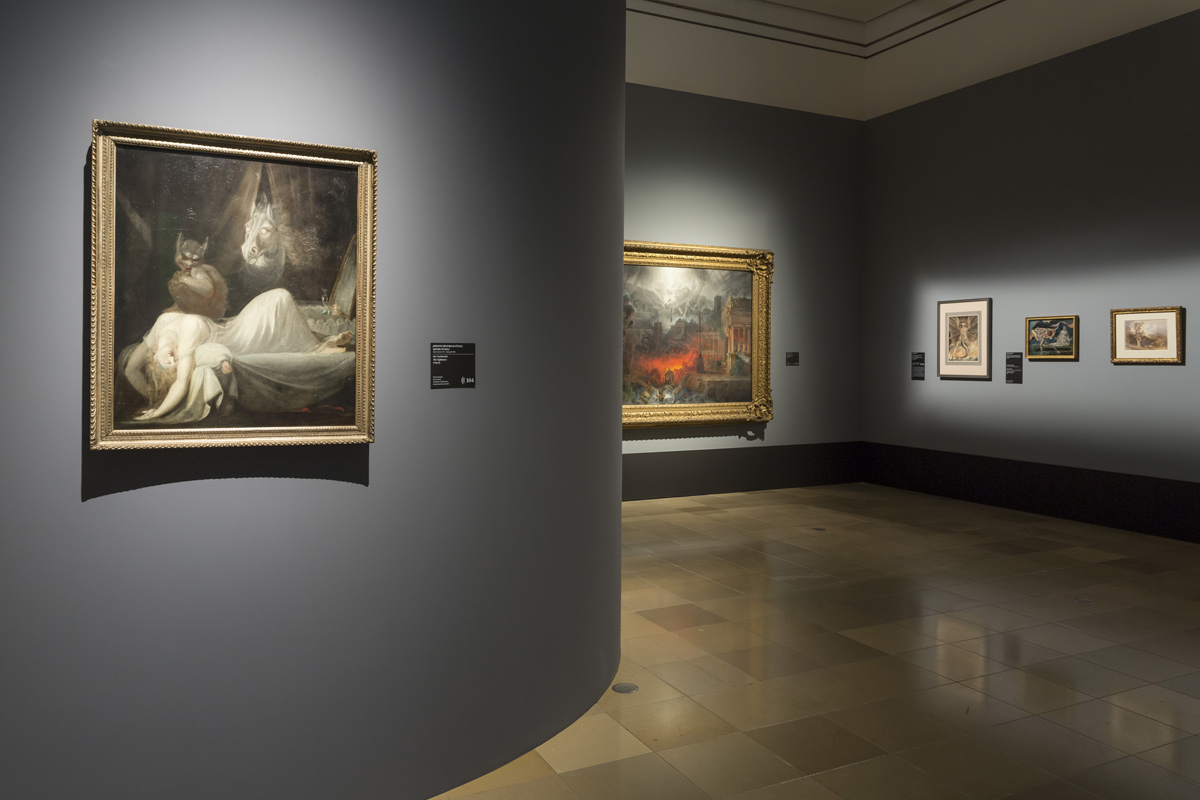
 

William A. Garnett (American, 1916-2006)
Sandbars, Cape Cod, Massachusetts
1966
Cibachrome print
34.4 x 51cm
The J. Paul Getty Museum, Los Angeles
© Estate of William A. Garnett


Nature and photography have been linked since the inception of the medium. Whether driven by the challenge of capturing the expanse and perspective of a vista or by the myriad possibilities of creating a unique artistic experience, the act of depicting the natural landscape has inspired photographers from the 1800s to the present.

To create this image, photographer William Garnett piloted his plane over sand bars in Cape Cod. In addition to the natural beauty of the ocean, the photographer invites us to explore space and perception in a unique way. The undulating forms of the sandbars play with the boundaries between foreground and background. Changing tones of blue challenge us to know if we look at water, sky, or even a view from outer space.


Eliot Porter (American, 1901-1990) 'Aspens and Grass, Elk Mountain Road, New Mexico, October 3, 1972' 1972


Eliot Porter (American, 1901-1990)
Aspens and Grass, Elk Mountain Road, New Mexico, October 3, 1972
1972
Dye transfer print
26.2 x 20.6cm
The J. Paul Getty Museum, Los Angeles
Gift of Daniel Greenberg and Susan Steinhauser
Bequest of the artist
© 1990 Amon Carter Museum of American Art, Fort Worth, Texas


Toshio Shibata (Japanese, b. 1949) 'Tsuru City, Yamanashi Prefecture' 1989


Toshio Shibata (Japanese, b. 1949)
Tsuru City, Yamanashi Prefecture
1989
Gelatin silver print
44.5 × 55.5cm (17 1/2 × 21 7/8 in.)
The J. Paul Getty Museum, Los Angeles
Purchased with funds provided by the Photographs Council
© Toshio Shibata


Virginia Beahan (American, b. 1946) and Laura McPhee (American, b. 1958) 'Apple Orchard, Manzanar Japanese-American Relocation Camp, Owens Valley, California' 1995


Virginia Beahan (American, b. 1946) and Laura McPhee (American, b. 1958)
Apple Orchard, Manzanar Japanese-American Relocation Camp, Owens Valley, California
1995
Chromogenic print
75.3 × 95.3cm (29 5/8 × 37 1/2 in.)
The J. Paul Getty Museum, Los Angeles
Gift of Nancy and Bruce Berman
© Virginia Beahan and Laura McPhee


Here Beahan and McPhee delve into the landscape as a site of human history and conflict. With the High Sierra as a backdrop, rusty remnants of the Manzanar relocation camp, used to detain Japanese Americans during World War II, occupy the foreground. In the middle ground stand the desiccated trunks of an orchard, part of an 1860s settlement that was abandoned after the land’s water was diverted in the 1920s to irrigate Los Angeles. The orchard, in turn, had uprooted a community of Paiute Indians, who had lived there for generations.


Virginia Beahan (American, born 1946) and Laura McPhee (American, born 1958) 'Mount Rainier, Washington' 2000


Virginia Beahan (American, b. 1946) and Laura McPhee (American, b. 1958)
Mount Rainier, Washington
2000
Chromogenic dye coupler print
75.5 x 96.5cm
The J. Paul Getty Museum, Los Angeles
Gift of Nancy Goliger and Bruce Berman
© Virginia Beahan and Laura McPhee


Clifford Ross (American, b. 1952) 'Mountain IV' 2004


Clifford Ross (American, b. 1952)
Mountain IV
2004
Chromogenic colour print
63 x 118 in
The J. Paul Getty Museum, Los Angeles
© Clifford Ross Studio


A persistent aspect of picturing a landscape has been the concept of the ideal. Recent photographers have framed nature not only to emphasise its beauty but also to highlight its unattainability in a modern context.

Photographer Clifford Ross was inspired to create this image of Mount Sopris while on a family holiday. In order to, as the photographer put it, “grab as much of the mountain as [he] possibly could in one shot,” Ross invented a camera, the R1, which exposes 9 x 18 inch aerial film. When processed by hand and scanned, the negatives produce files with a hundred times higher resolution than those made with the average professional digital camera. Yet even though he pursues a near replica of reality, Ross also manipulates the digital file to re-create the landscape as he remembers experiencing it. Viewers have the ability to examine the scene in greater detail than they might even in person.


The J. Paul Getty Museum
1200 Getty Center Drive
Los Angeles, California 90049

Opening hours:
Daily 10am – 5pm

The J. Paul Getty Museum website

LIKE ART BLART ON FACEBOOK

Back to top