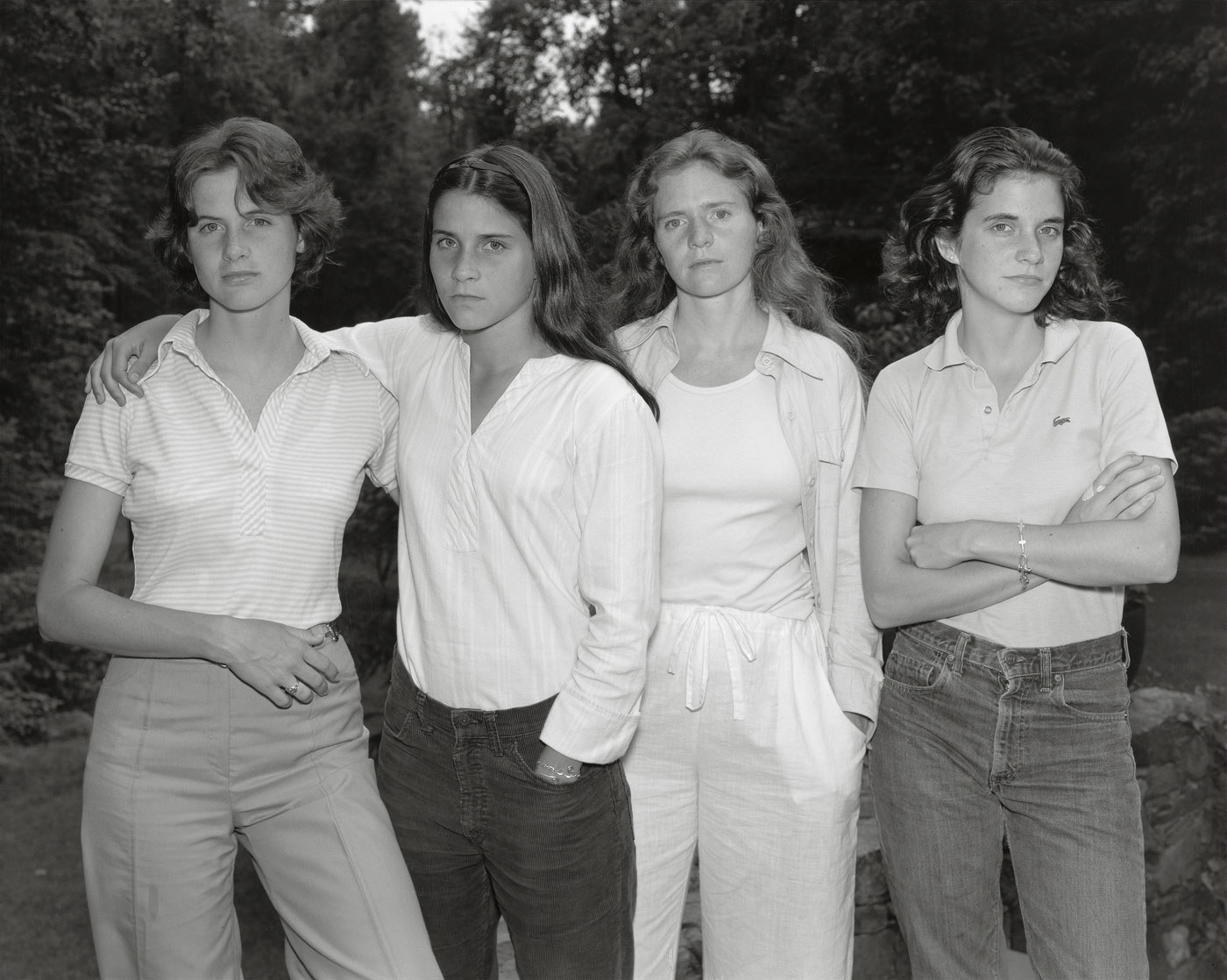
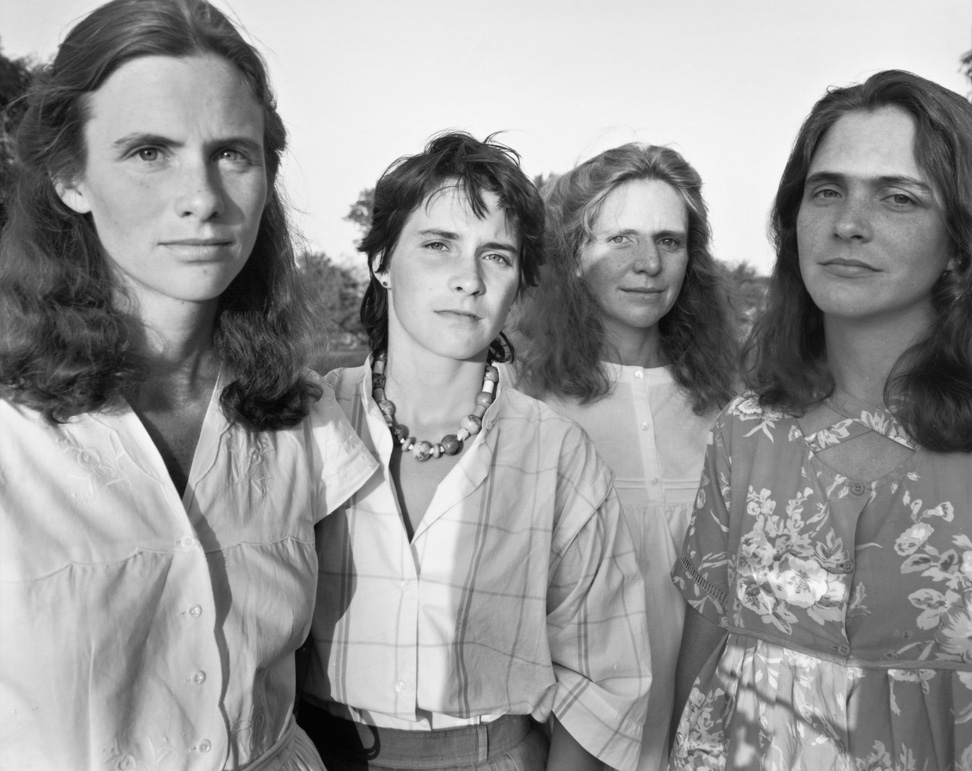
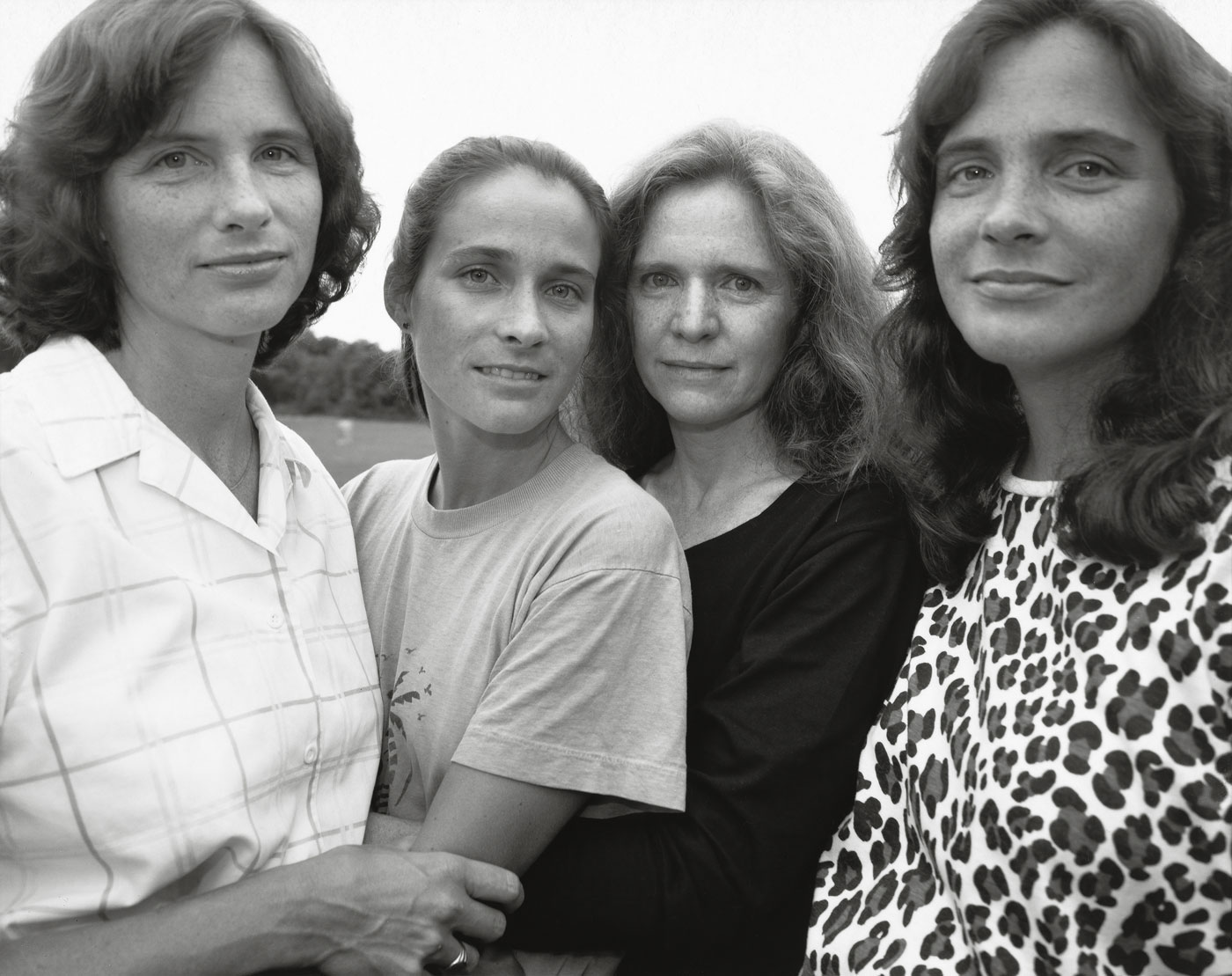
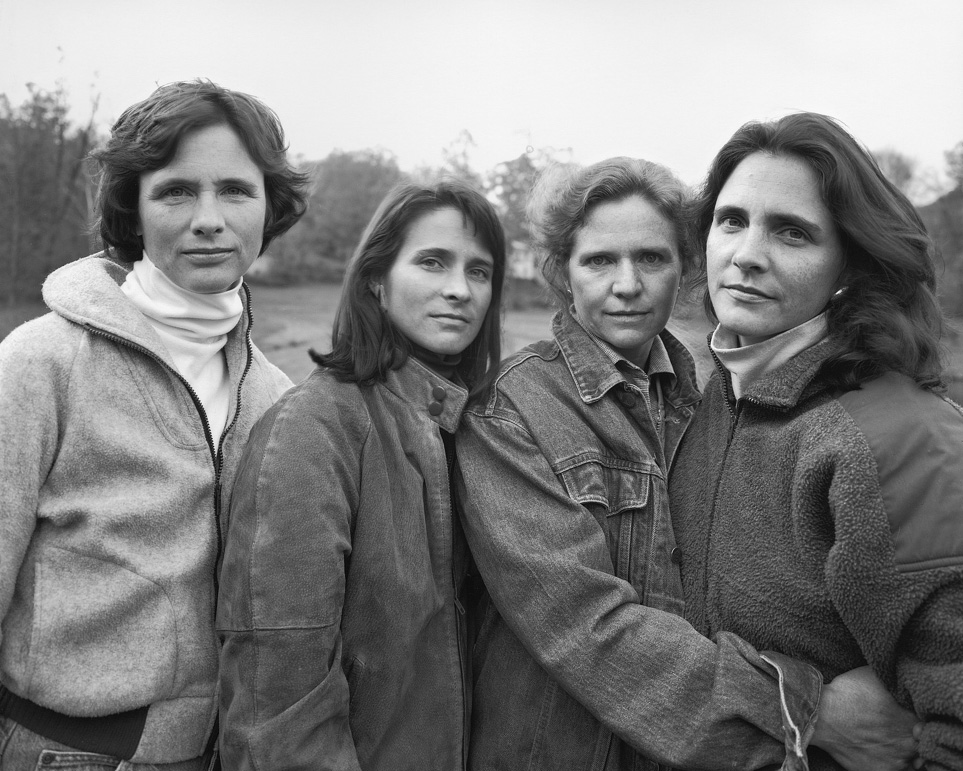
This is the most successful, long running group portrait series in the history of photography. I have always liked the images because of their stunning clarity, delicate tonality and wonderful arrangement of the figures. Much as they shield their privacy, as a viewer I feel like I have grown up with these women, the sisters I never had. Some images are more successful than others, but as a body of work that focuses on the “face” we present to the world, they are without peer.
Just imagine being these women (and being the photographer), taking on this project and not knowing where it would lead, still not knowing where it will lead. There is a fascinating period in the photographs between 1986 and 1990, as we see the flush of youth waning, transitioning towards the beginning of middle age. As they grow older and closer I feel that I know their characters. I look for that inflection and nuance of presentation that make them more than just faces, more than just photographic representation. The lines on their faces are the handwriting of their travails and I love them all for that.
In each photograph they are as beautiful as the next, not in a Western sense, but in the sense of archetypal beauty, the Platonic form of all beauty – the beauty of women separated from the individuality of the object and considered by itself. In each of these images you can contemplate that form through the faces of these women – they are transcendent and pure. It is as if they live beyond space and time, that the photographs capture this sense of the sublime. Usually the sublime is regarded as beyond time… but not here.
A simply magnificent series.
Dr Marcus Bunyan
PS. Let’s hope that there are more images from the series that we can eventually see and that there are some platinum prints being produced. The images deserve such a printing.
Many thankx to MoMA for allowing me to publish the photographs in the posting. Please click on the photographs for a larger version of the image.
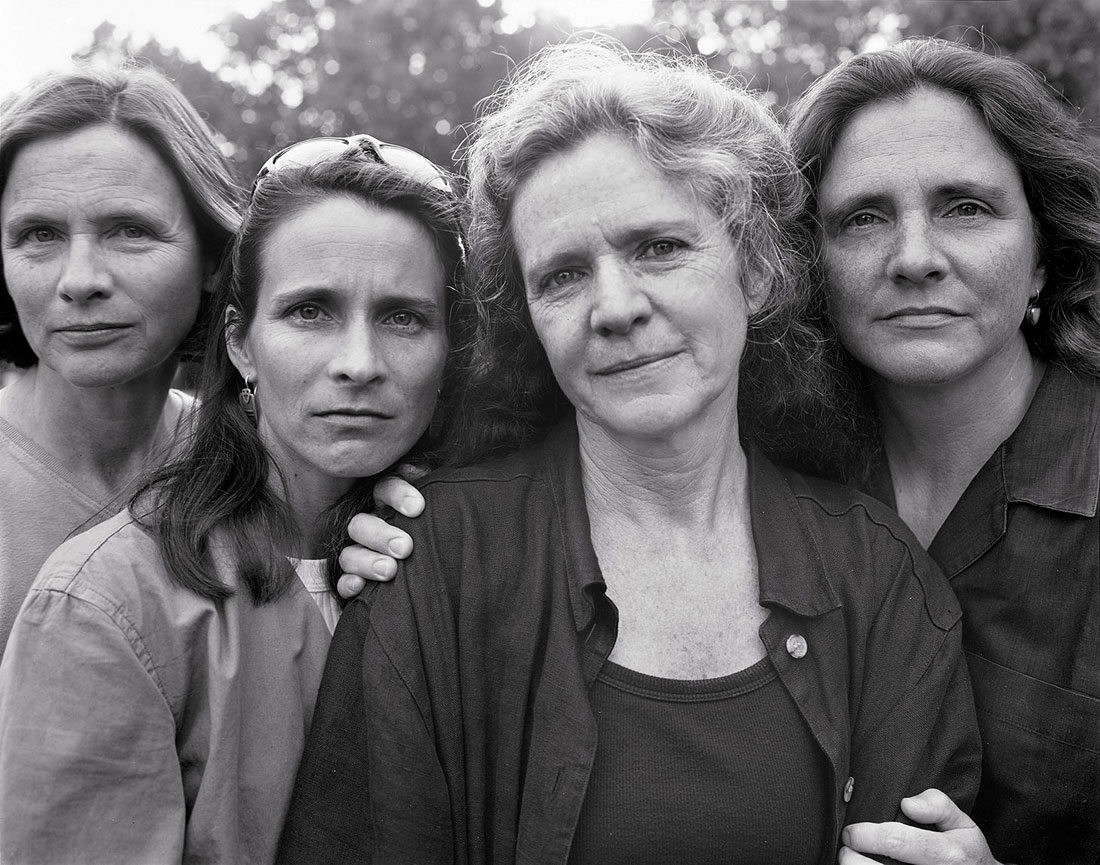
“Throughout this series, we watch these women age, undergoing life’s most humbling experience. While many of us can, when pressed, name things we are grateful to Time for bestowing upon us, the lines bracketing our mouths and the loosening of our skin are not among them. So while a part of the spirit sinks at the slow appearance of these women’s jowls, another part is lifted: They are not undone by it. We detect more sorrow, perhaps, in the eyes, more weight in the once-fresh brows. But the more we study the images, the more we see that ageing does not define these women. Even as the images tell us, in no uncertain terms, that this is what it looks like to grow old, this is the irrefutable truth, we also learn: This is what endurance looks like. …
These subjects are not after attention, a rare quality in this age when everyone is not only a photographer but often his own favourite subject. In this, Nixon has pulled off a paradox: The creation of photographs in which privacy is also the subject. The sisters’ privacy has remained of utmost concern to the artist, and it shows in the work. Year after year, up to the last stunning shot with its triumphant shadowy mood, their faces and stances say, Yes, we will give you our image, but nothing else.”
Susan Minot. “Forty Portraits in Forty Years: Photographs by Nicholas Nixon,” on the ‘New York Times’ website, October 2014 [Online] Cited 01/01/2015. No longer available online. Used under fair use conditions for the purposes of education and research
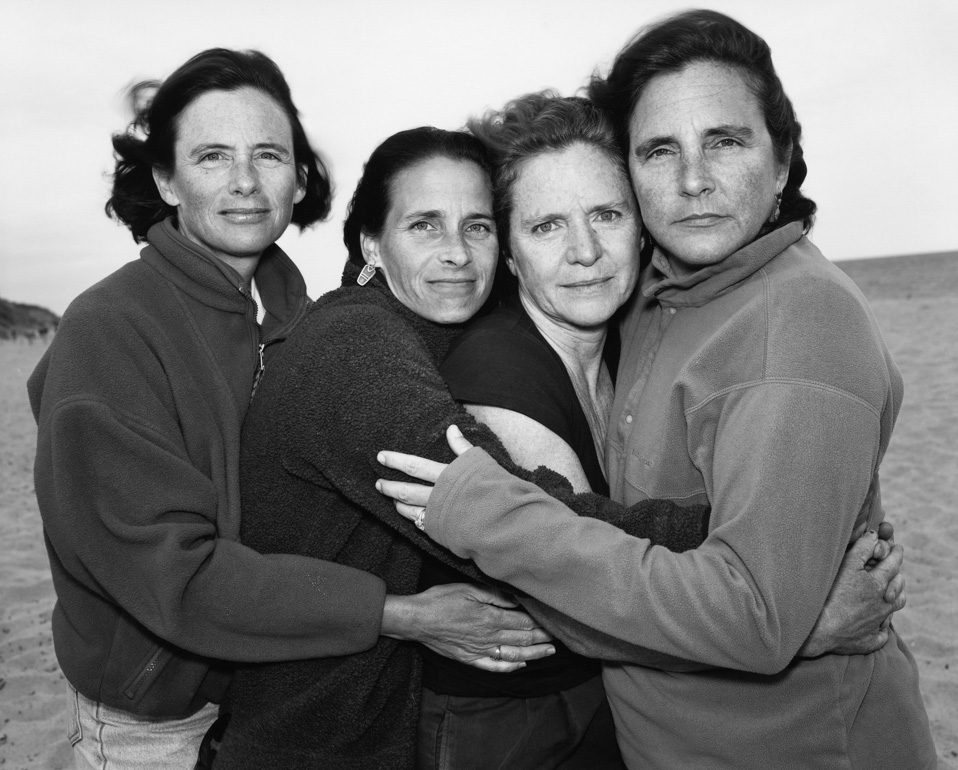
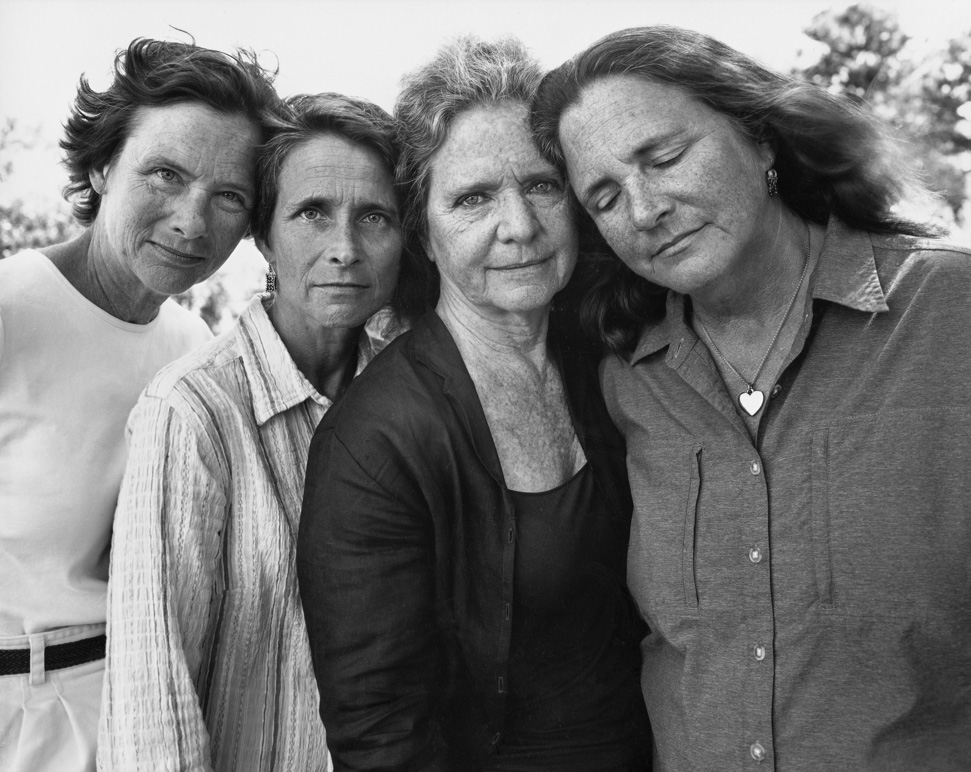
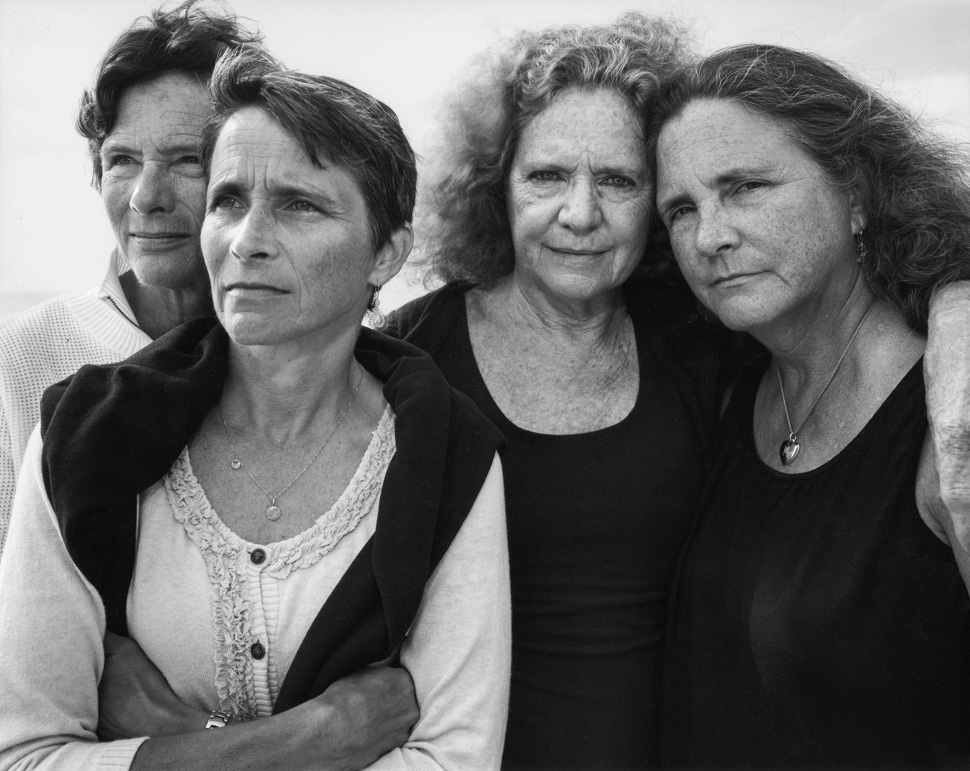
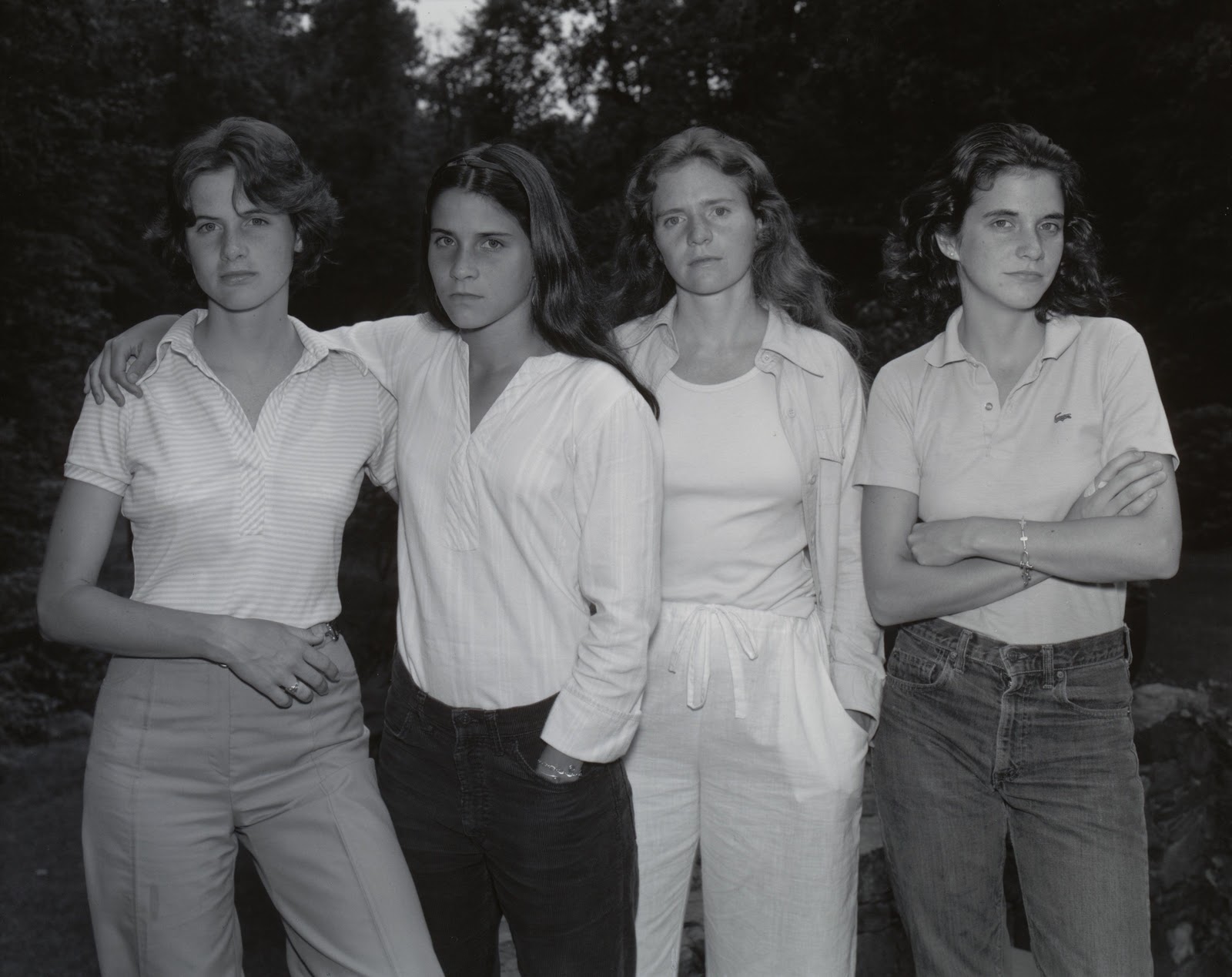
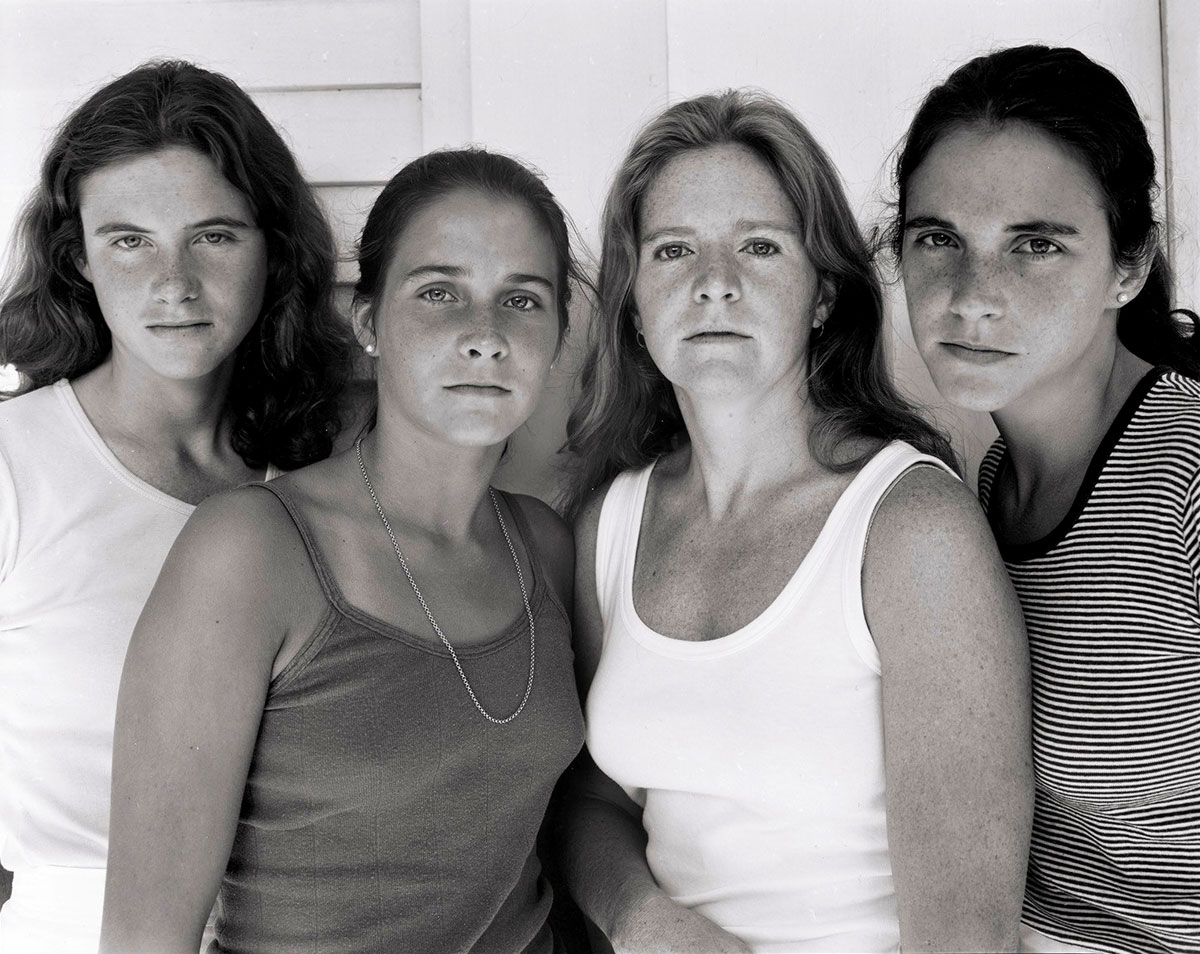
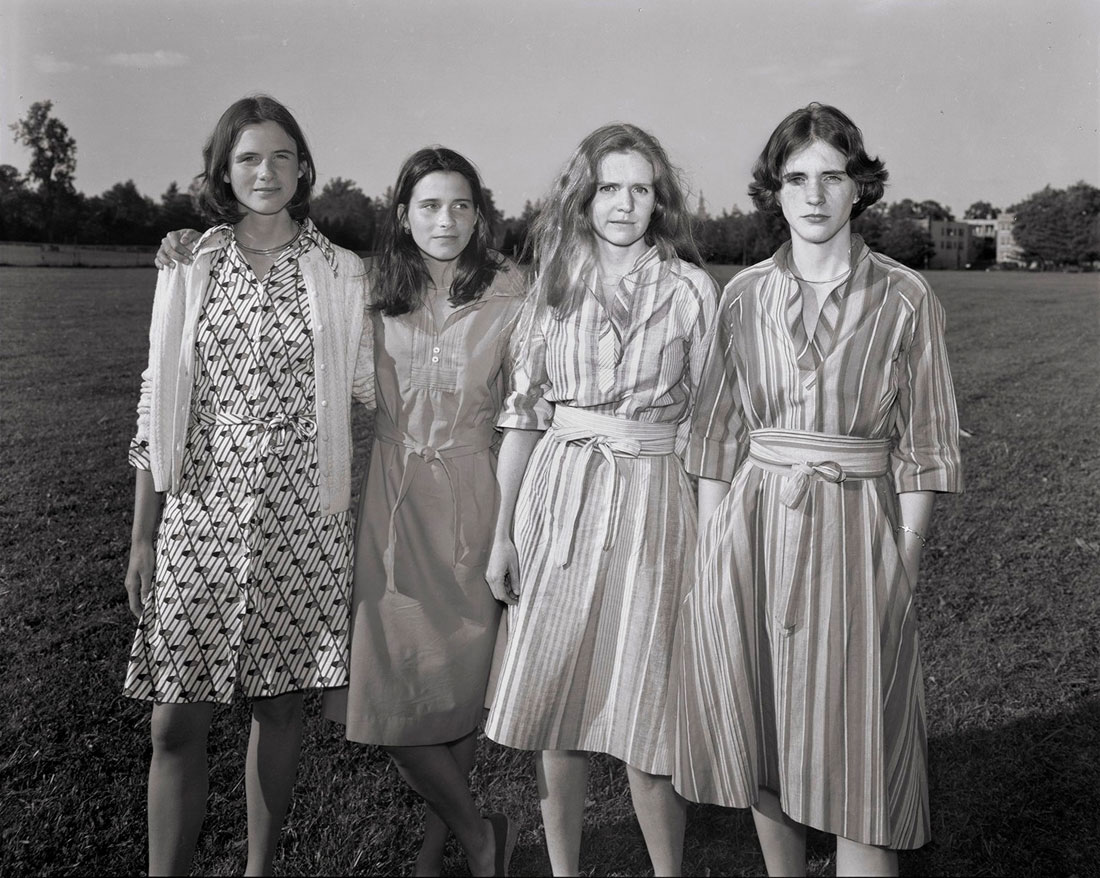
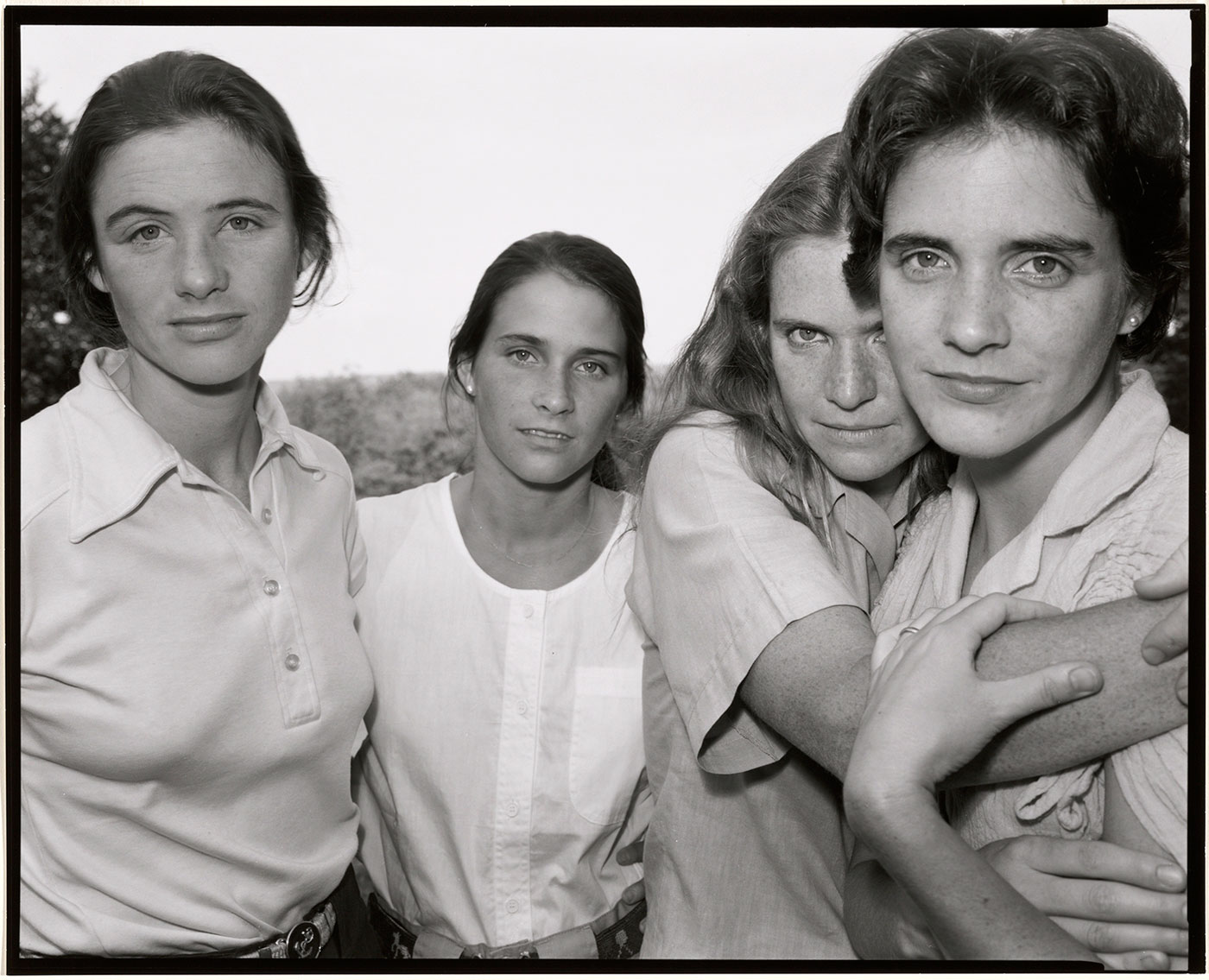
In August 1974, Nicholas Nixon made a photograph of his wife, Bebe, and her three sisters. He wasn’t pleased with the result and discarded the negative. In July 1975 he made one that seemed promising enough to keep. At the time, the Brown sisters were 15 (Mimi), 21 (Laurie), 23 (Heather), and 25 (Bebe). The following June, Laurie Brown graduated from college, and Nick made another picture of the four sisters. It was after this second successful picture that the group agreed to gather annually for a portrait, and settled on the series’ two constants: the sisters would always appear in the same order – from left to right, Heather, Mimi, Bebe, and Laurie – and they would jointly agree on a single image to represent a given year. Also significant, and unchanging, is the fact that each portrait is made with an 8 x 10″ view camera on a tripod and is captured on a black-and-white film negative.
The Museum has exhibited and collected the Brown Sisters from the beginning; since 2006, acquiring the series both as lusciously tactile contact prints and as striking 20 x 24″ enlargements (a new scale for Nixon). This installation – featuring all 40 images – marks the first time the Museum has displayed these larger prints.
In his first published statement about photography, written the year he made the first of the Brown Sisters portraits, Nixon remarked, “The world is infinitely more interesting than any of my opinions about it.” If he was modest about his opinions, though, his photographs clearly show how the camera can capture that infinitely interesting world. And to the attentive viewer, these silent records, with their countless shades of visual and emotional grey, can promote a new appreciation of an intangible part of it: the world of time and age, of commitment and love.
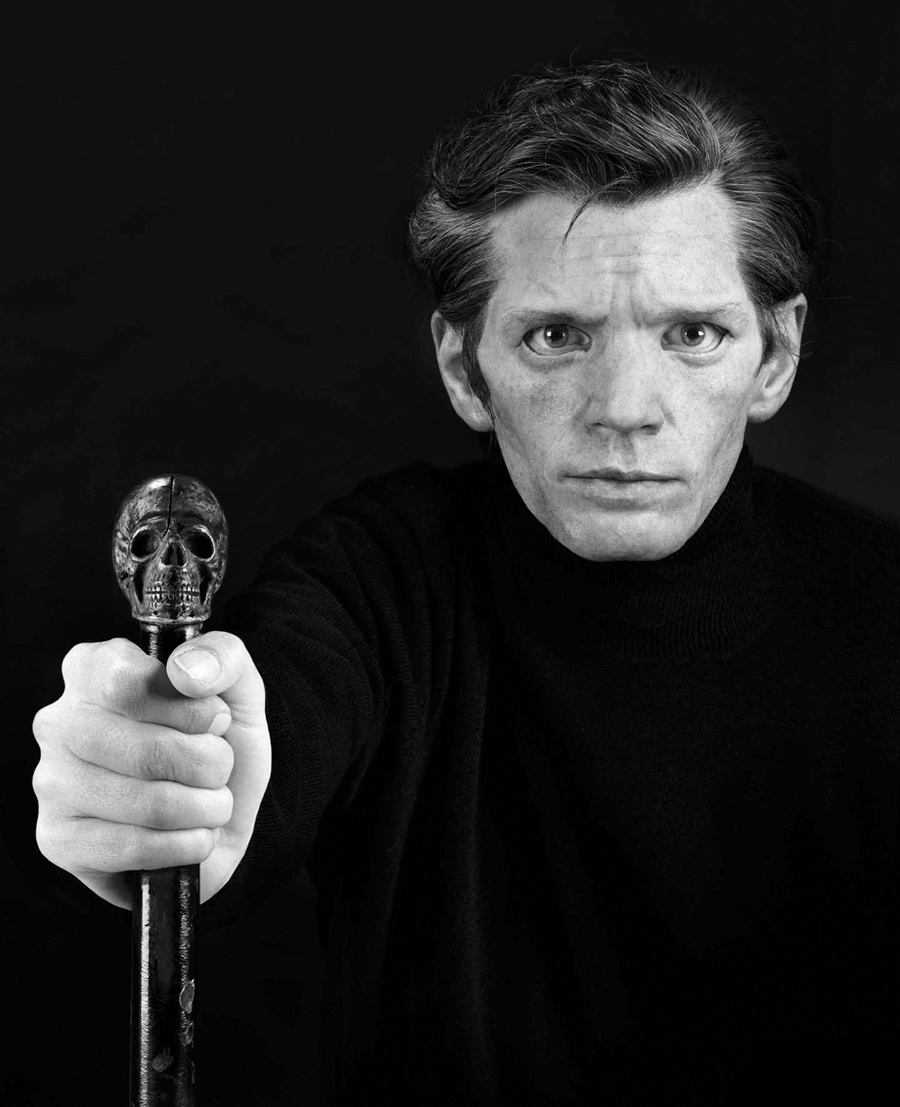
~ Alfred Stieglitz / Georgia O’Keeffe ~ Paul Strand / Rebecca Strand ~ Emmet Gowin / Edith Gowin ~ Harry Callahan / Eleanor and Barbara Callahan ~ Robert Mapplethorpe / Patti Smith ~ Nicholas Nixon / The Brown Sisters ~ Andy Warhol / Serial Photography / Photo Booth Portraits ~ Mario Testino / Kate Moss ~ Baron Adolf de Meyer / Baroness Olga de Meyer ~ Edward Weston / Charis Weston ~ Lee Friedlander / Maria Friedlander ~ Paul Caponigro / The woods of Connecticut ~ Bernd and Hilla Becher / grids ~ Gerhard Richter / Overpainted Photographs ~ Masahisa Fukase / wife and family ~ Seiichi Furuya / Christine Furuya-Gößler ~ Sally Mann / children and husband ~ William Wegman / dogs
Australia?
Nobody that I can think of except Sue Ford.
Notice how all the artists are men except two: Sally Mann and Hilla Becher.
Dr Marcus Bunyan
Many thankx to the National Gallery of Art for allowing me to publish the photographs in the posting. Please click on the photographs for a larger version of the image.
Introduction
Alfred Stieglitz, one of the most influential photographers of the twentieth century, argued that “to demand the [single] portrait… be a complete portrait of any person is as futile as to demand that a motion picture be condensed into a single still.” Stieglitz’s conviction that a person’s character could not be adequately conveyed in one image is consistent with a modern understanding of identity as constantly changing. For Stieglitz, who frequently made numerous portraits of the same sitters – including
striking photographs of his wife, the painter Georgia O’Keeffe – using the camera in a serial manner allowed him to transcend the limits of a single image.
Drawn primarily from the National Gallery of Art’s collection, the Serial Portrait exhibition features twenty artists who photographed the same subjects – primarily friends, family, or themselves – multiple times over the course of days, months, or years. This brochure presents a selection of works by seven of these artists. Like Stieglitz’s extended portrait of O’Keeffe, Emmet Gowin’s ongoing photographic study of his wife, Edith, explores her character and reveals the bonds of love and affection between the couple. Milton Rogovin’s photographs of working-class residents of Buffalo, New York, record shifts in the appearance and situation of individuals in the context of their community over several decades.
A number of photographers in the exhibition have made serial self-portraits that investigate the malleability of personal identity. Photographing themselves as shadows, blurs, or partial reflections, Lee Friedlander and Francesca Woodman have made disorienting images that hint at the instability of self-representation. Ann Hamilton has employed unusual props and materials to transform herself into a series of hybrid objects. Finally, work by Nikki S. Lee takes the idea of mutable identity to its logical conclusion as the artist photographs herself masquerading as members of different social and ethnic groups.
Emmet Gowin (born 1941) met Edith Morris in 1961 in their hometown of Danville, Virginia, just as he had decided to abandon business school to study art. Several years later at the Rhode Island School of Design, his teacher Harry Callahan, who made numerous photographs of his wife, Eleanor, encouraged Gowin to photograph the subject he knew most intimately – his family and in particular Edith, whom he married in 1964.
The Gowins’ artistic and marital collaboration has endured for half a century, yielding an extraordinary series of quiet, attentive portraits. In some photographs, such as Edith, Danville, Virginia, 1963 (fig. 4, above), Edith appears contemplative, even reserved. The somber beauty of this work stems in part from Gowin’s use of a tripod-mounted, large-format camera, which requires a lengthy exposure but produces photographs with exquisite details, such as the delicate shadow of a twig that falls across Edith’s face. To make the dramatic circular shadow that surrounds her in Edith, Danville, Virginia, 1971 (fig. 5, above), Gowin attached a lens meant for a 4 x 5 camera to a large 8 x 10 camera. This focus draws our attention to her figure, but the screen door simultaneously frames and obscures her form, resulting in a play between presence and elusiveness. While Gowin’s photographs are born of a deep intimacy, they refuse to lay bare his wife’s soul or expose the couple’s private passions.
The same delicate balance between revelation and reserve marks a group of portraits made during the couple’s travels in Central and South America. Edith and Moth Flight, 2002 (fig. 6, below), made at night using a ten-second exposure, combines Gowin’s enchantment with natural beauty and his interest in the nuances of his wife’s gestures and moods. Placing a pulsing ultraviolet light behind Edith’s head, Gowin recorded the luminous traces left by moths as they danced around her blurred face, transforming her into a ghostly and even otherworldly presence, visible yet just out of our reach.
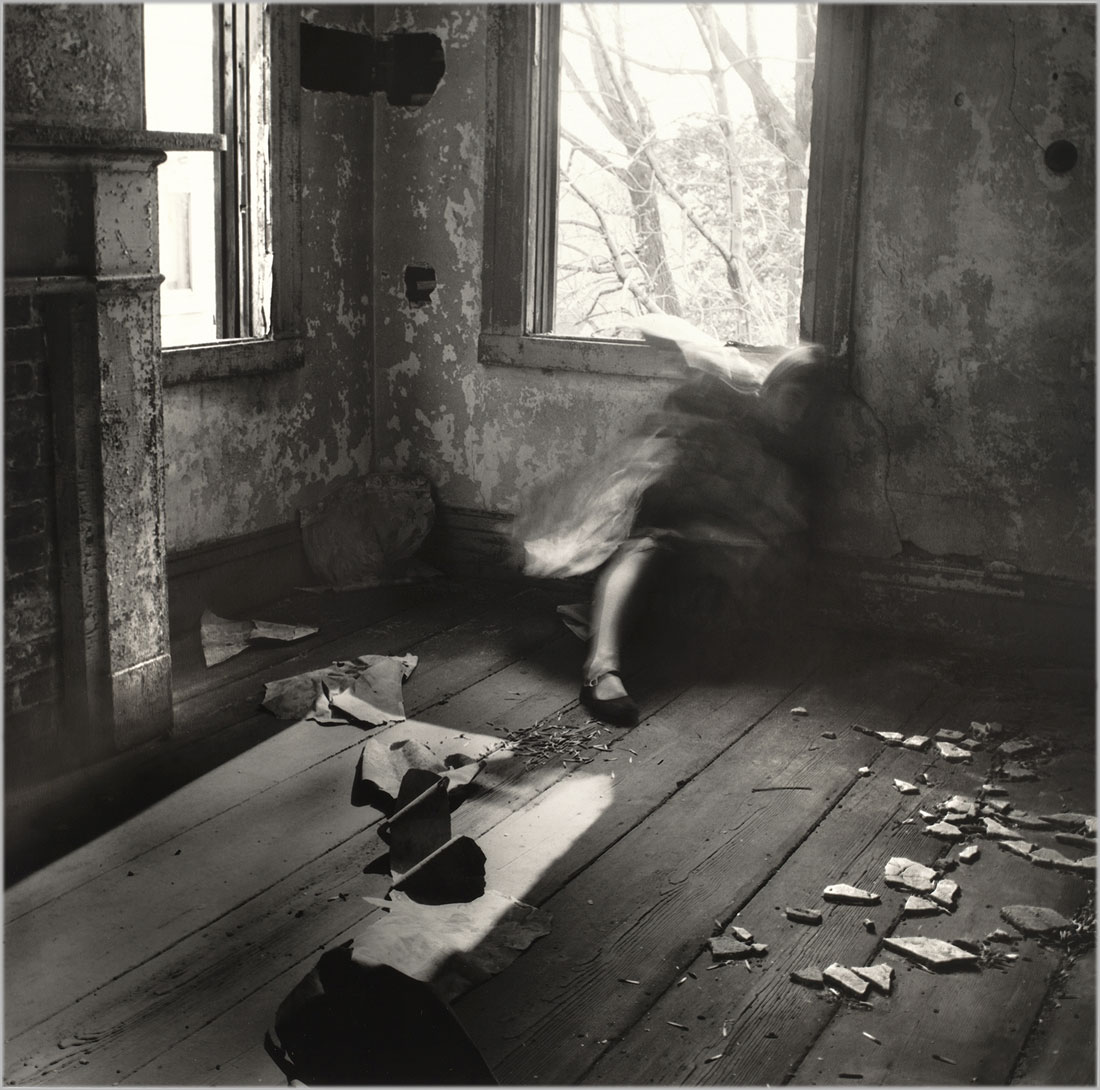
Francesca Woodman (American, 1958-1981) House #3, Providence, Rhode Island 1976 Gelatin silver print 16.1 x 16.3cm (6 5/16 x 6 7/16 in.) National Gallery of Art, Washington Gift of the Heather and Tony Podesta Collection
Francesca Woodman
Francesca Woodman (1958-1981) began making photographs at age thirteen, and by the time she entered the Rhode Island School of Design in 1975, she was already a skilled photographer. Using herself as the subject of nearly all her work, Woodman put her body in the service of exploring such themes as feminine identity, sexuality, mythology, and the relationship of the body to its surroundings. Conjuring visions of a complex inner world, Woodman’s photographs are powerful for their ability to suggest psychic turmoil within images of serene, ethereal beauty.
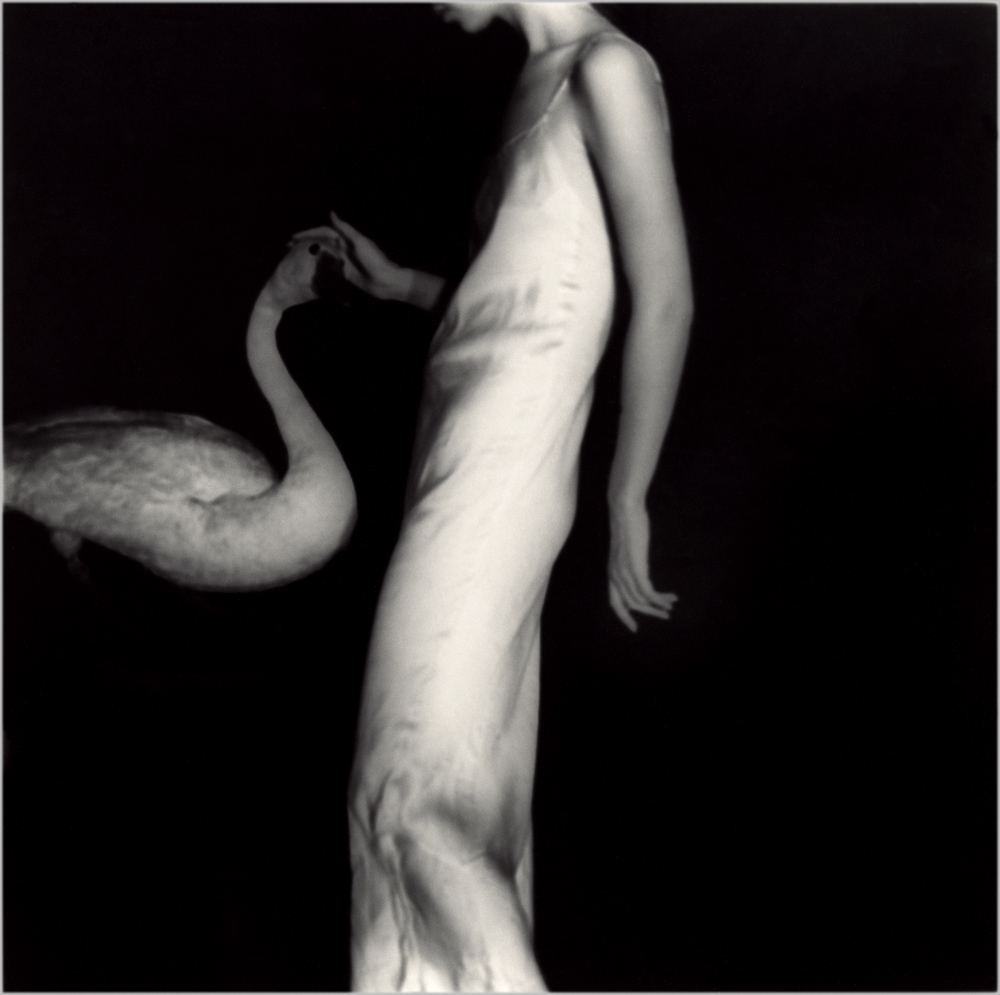
Woodman’s interest in the emotional affect of space can be seen in House #3, Providence, Rhode Island, 1976 (fig. 14, above). Using an abandoned house as a makeshift studio, Woodman often photographed herself merging with her surroundings, including doors, walls, and windows, dissolving physical or psychic boundaries. She also frequently moved during long exposures or allowed the camera to record only part of her body in order to obscure her figure. By invoking a ghostly presence, Woodman’s photographs often present her as someone who refuses to commit to a solid image of herself.
Woodman’s lush and intimate photographs thus offer a tantalising glimpse of a mysterious, private world. Yet they are more than romantic expressions of a young woman’s subjective experience. Notes in Woodman’s diary suggest, for instance, that Untitled, Providence, Rhode Island, 1975-1978 (fig. 15, below), alludes to the Greek mythological story of Leda, who was seduced by the god Zeus in the form of a swan.
Toward the end of her brief but prolific career (Woodman committed suicide when she was twenty-two) the artist began working on a much larger scale, using her body more as a structural element. Caryatid, New York, 1980 (fig. 16, below), made as part of a monumental photo-installation called Temple Project, draws both its title and inspiration from the columns carved in the shape of women that were used in ancient Greek and Roman architecture. Although Woodman displays her figure in a more expansive and direct manner than in her earlier work, the gesture that obscures her face and leaves her partial and unknowable is typical for the artist, who always preferred suggestion over declaration.
Text from the NGA website
Francesca Woodman (American, 1958-1981) Untitled, Providence, Rhode Island 1975-1978 Gelatin silver print 10.5 x 10.5cm (4 1/8 x 4 1/8 in.) National Gallery of Art, Washington Gift of the Collectors Committee and R. K. Mellon Family Foundation
Francesca Woodman (American, 1958-1981) Caryatid, New York 1980 National Gallery of Art, Washington William and Sarah Walton Fund and Gift of the Collectors Committee
Figure 17. Ann Hamilton (American, b. 1956) body object series #13, toothpick suit/chair 1984 Gelatin silver print, printed 1993 11 x 11cm (4 5/16 x 4 5/16 in.) National Gallery of Art, Washington Gift of Heather and Tony Podesta Collection
Ann Hamilton
An artist known for multimedia environments, performances, and videos, Ann Hamilton (born 1956) made the first photographs in the body object series in 1984 with objects left over from an installation she had presented as an MFA student at Yale. Later images from the series were based on subsequent performances and installations, documenting both the objects used and the actions performed with them. Hamilton appears in each photograph with objects attached to or touching her body, her face only rarely visible. The results are striking, unsettling, and often witty.
Despite emerging from Hamilton’s installation and performance practice, the photographs in the series stand on their own as works of art. Paying close attention to the material qualities of familiar objects, Hamilton models creative new uses for them, changing their function and meaning. In body object series #13, toothpick suit/chair, 1984 (fig. 17, above), for example, thousands of toothpicks transform Hamilton’s clothes into a porcupine-like hide while a chair becomes a burdensome instrument of torture. The image elicits visceral emotions – alienation, hostility, fear – though it does so with a dose of absurdist humour.
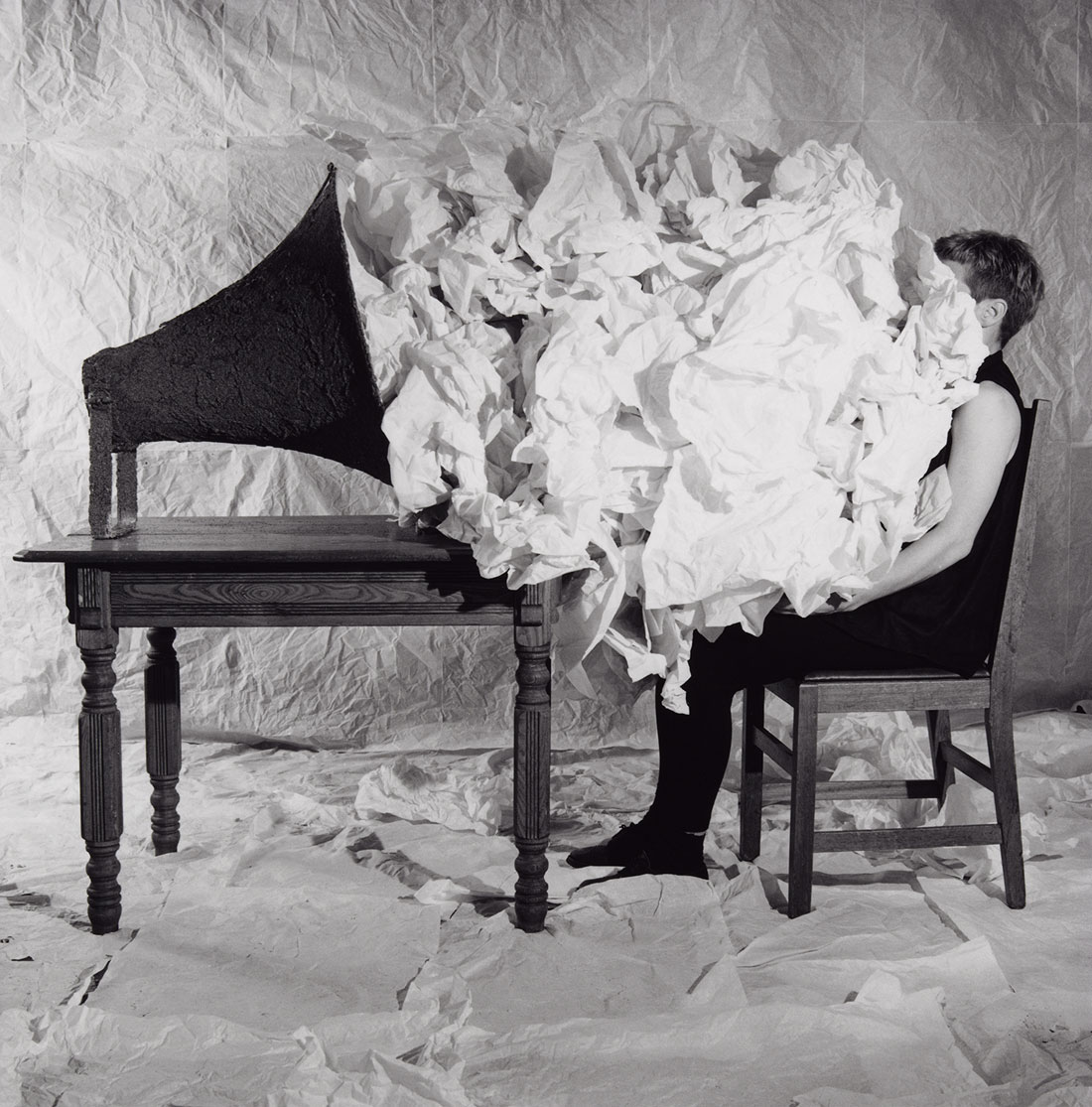
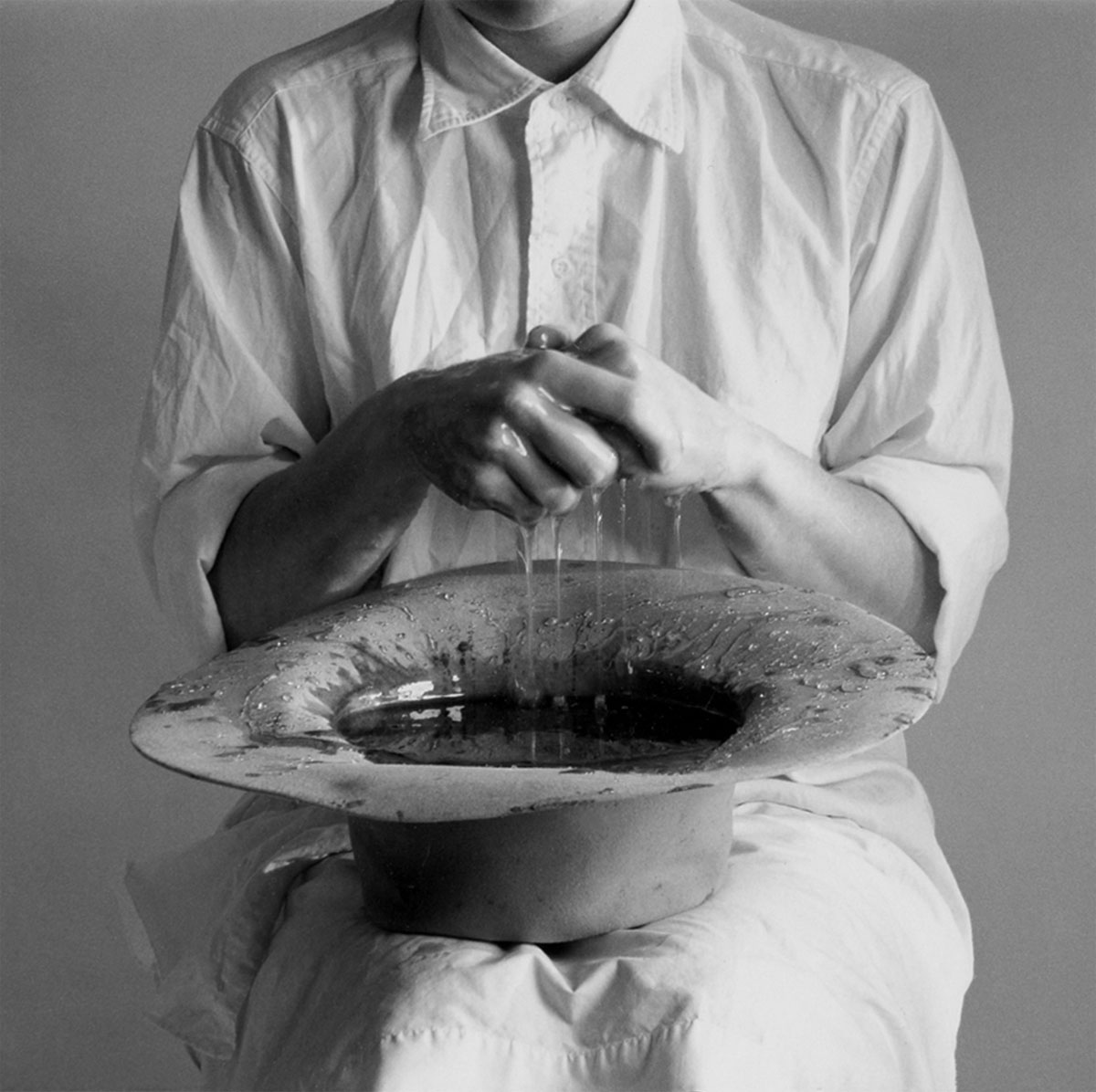
As self-representations, the photographs in the body object series depart radically from any traditional notion of portraiture. Instead of insisting on Hamilton’s uniqueness as an individual, these images present her body almost as an object on a par with other objects. Some of the photographs are linked directly to her biography: Hamilton had studied textile design before getting her MFA, and the toothpick suit refers to her love of fabrics. In other photographs she makes abstract concepts more graspable through the senses. Sound is given tactile and visual form as tissue paper in body object series #14, megaphone, 1986 (fig. 18, below), while in body object series #15, honey hat, 1989 (fig. 19, below), Hamilton wrings her hands in honey to suggest the idea of washing one’s hands of guilt. Based on an installation in which the artist embedded money – 750,000 pennies – in a layer of honey, this image also gives new meaning to the phrase “sticky fingers” and highlights the connections between language, images, and objects that Hamilton explores in both her photographs and installations.
Text from the NGA website
Figure 18. Ann Hamilton (American, b. 1956) body object series #14, megaphone 1986 Gelatin silver print, printed 1993 11 x 11cm (4 5/16 x 4 5/16 in.) National Gallery of Art, Washington Gift of Heather and Tony Podesta Collection
Figure 19. Ann Hamilton (American, b. 1956) body object series #15, honey hat 1989 Gelatin silver print, printed 1993 11 x 11cm (4 5/16 x 4 5/16 in.) National Gallery of Art, Washington Gift of Heather and Tony Podesta Collection
The National Gallery of Art explores how the practice of making multiple portraits of the same subjects produced some of the most revealing and provocative photographs of our time in The Serial Portrait: Photography and Identity in the Last One Hundred Years, on view in the West Building’s Ground Floor photography galleries from September 30 through December 31, 2012. Arranged both chronologically and thematically, the exhibition features 153 works by 20 artists who photographed the same subjects – friends, family, and themselves – numerous times over days, months, or years to create compelling portrait studies that investigate the many facets of personal and social identity.
“The Gallery’s photography collection essentially began with the donation of Alfred Stieglitz’s ‘key set,’ so it is fitting that this exhibition opens with portraits by Stieglitz, who understood that a person’s character was best captured through a series of photographs taken over time,” said Earl A. Powell III, director, National Gallery of Art. “Although the exhibition is drawn largely from the Gallery’s significant collection of photographs, we are grateful to the lenders who have allowed us to present more fully the serial form of portraiture that Stieglitz championed.”
Since the introduction of photography in 1839, portraiture has been one of the most widely practiced forms of the medium. Starting in the early 20th century, however, some photographers began to question whether one image alone could adequately capture the complexity of an individual. As Alfred Stieglitz, the era’s leading champion of American fine art photography, argued: “to demand the [single] portrait that will be a complete portrait of any person is as futile as to demand that a motion picture will be condensed into a single still.”
Along with Stieglitz, some of the 20th century’s most prominent photographers – Paul Strand, Harry Callahan, and Emmet Gowin – used the camera serially to transcend the limits of a single image. Each of these photographers made numerous studies of their lovers that sought to redefine the expressive possibilities of portraiture while probing the affective bonds of love and desire. By employing the camera’s capacity to record fluctuating states of being and mark the passage of time, other photographers such as Nicholas Nixon and Milton Rogovin have documented individuals – in families or communities – over four decades. Capturing subtle and dramatic shifts in appearance, demeanour, and situation, these series are poignant and elegiac memorials that remind us of our own mortality.
Other photographers have made serial self-portraits that explore the malleability of personal identity and the possibility of reinvention afforded by the camera. By photographing themselves as shadows, blurs, or partial reflections, Ilse Bing, Lee Friedlander, and Francesca Woodman have created inventive but elusive images that hint at the instability of self-representation. Conceptual artists of the 1970s and 1980s such as Vito Acconci, Blythe Bohnen, and Ann Hamilton have explicitly combined performance and self-portraiture to stage continual self-transformations. The exhibition concludes with work from the last 15 years by artists such as Nikki S. Lee and Gillian Wearing, who take the performance of self to its limits by adopting masquerades to delve into the ways identity is inferred from external appearance.
Press release from the National Gallery of Art website
In the 1960s Lee Friedlander (born 1934) sought, by his own account, to create images of “the American social landscape and its conditions.” Other photographers in his New York circle, including Diane Arbus and Garry Winogrand, also explored the chaotic beauty and contradictions of modern life. Friedlander, however, was the only member of this group to turn repeatedly to self-portraiture in order to understand the world around him. He stalked city streets with camera in hand, recording not only the haphazard incidents of daily life but also his own presence, often as a shadow or a reflection.
In the shop window of Westport, Connecticut, 1968 (fig. 11, above), for example, a reflection of Friedlander’s legs appears to merge with the shapely limbs of a woman in a bathing suit who points a camera at the viewer. The woman is an illusion, a cutout advertisement – but she is also a stand-in for the camera-wielding Friedlander, whose torso and head also appear faintly, as a shadow cast against her legs.
By letting the reflection in a window obscure what is inside, or allowing his shadow to intrude into the frame, Friedlander violates many of the rules of “good” photography. Works such as New York City, 1966 (fig. 12, below) testify to Friedlander’s ability to transform such “mistakes” into witty, ironic juxtapositions. In this case, the startling intrusion of Friedlander’s shadow onto the back of a fellow pedestrian is visually confusing, simultaneously threatening and humorous, as Friedlander’s spiky hair merges with the woman’s fur collar. A sly commentary on the predatory nature of such street photography, the looming shadow that engulfs the subject is also an effect of Friedlander’s equipment, a 35mm Leica with a wide-angle lens. In order to fill the picture frame with his chosen subject, Friedlander had to make the picture at close range, resulting in the inclusion of his own shadow.
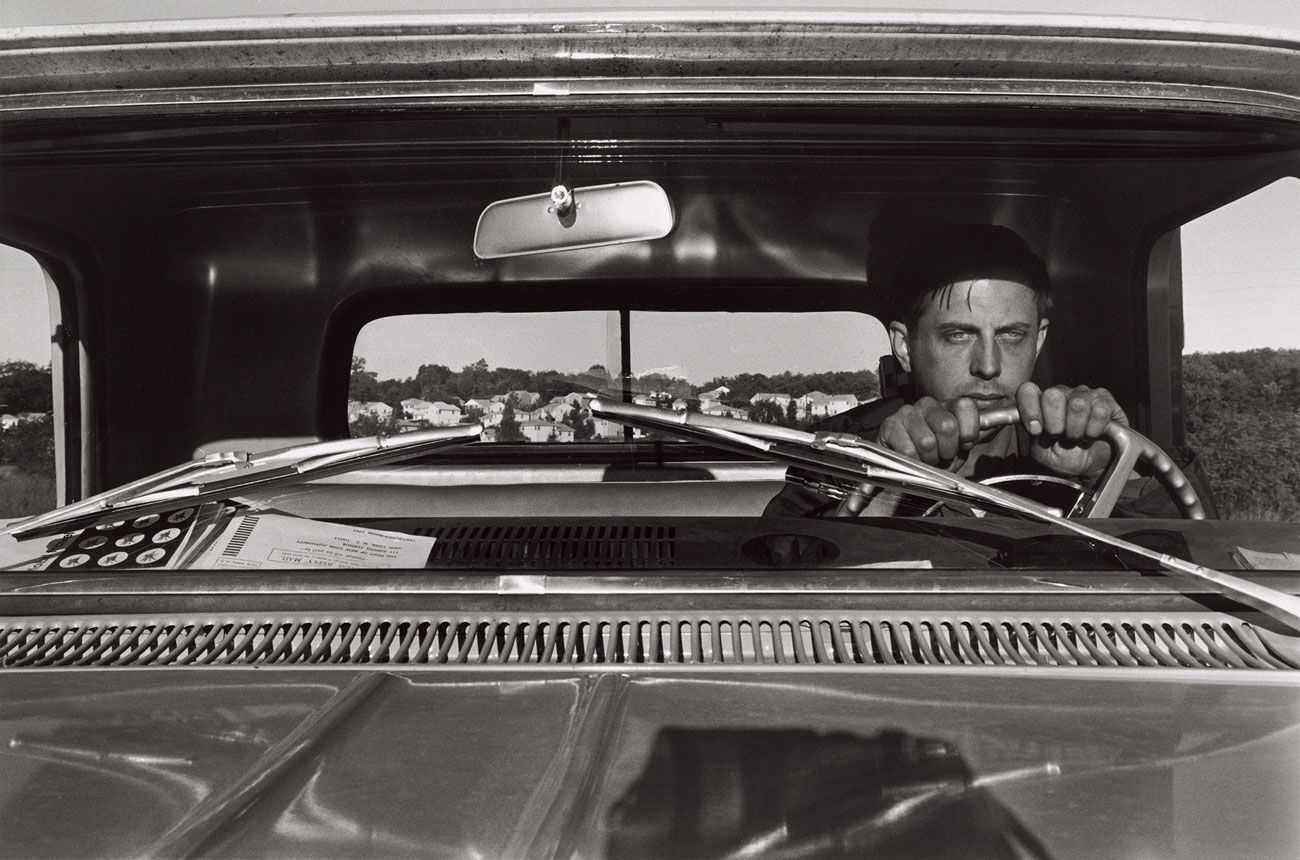
Even in self-portraits in which Friedlander makes himself fully visible to the camera, the artist often makes humorously self-deprecating deadpan images, appearing, for example, as a disheveled driver on a manic mission in Haverstraw, New York, 1966 (fig. 13, below). Edgy but unpretentious, brimming with pictorial detail, Friedlander’s self-portraits are visual puzzles that explore the place of the self in the chaos of contemporary urban life.
Ilse Bing (German, 1899-1998) Self-Portrait with Leica 1931 Gelatin silver print, printed c. 1988 26.7 x 29.7cm (10 1/2 x 11 11/16 in.) National Gallery of Art, Washington Gift of Ilse Bing Wolff
Figure 1. Alfred Stieglitz (American, 1864-1946) Georgia O’Keeffe probably 1918 Platinum print 18.4 x 23.1cm (7 1/4 x 9 1/8 in.) National Gallery of Art, Washington Alfred Stieglitz Collection
Alfred Stieglitz
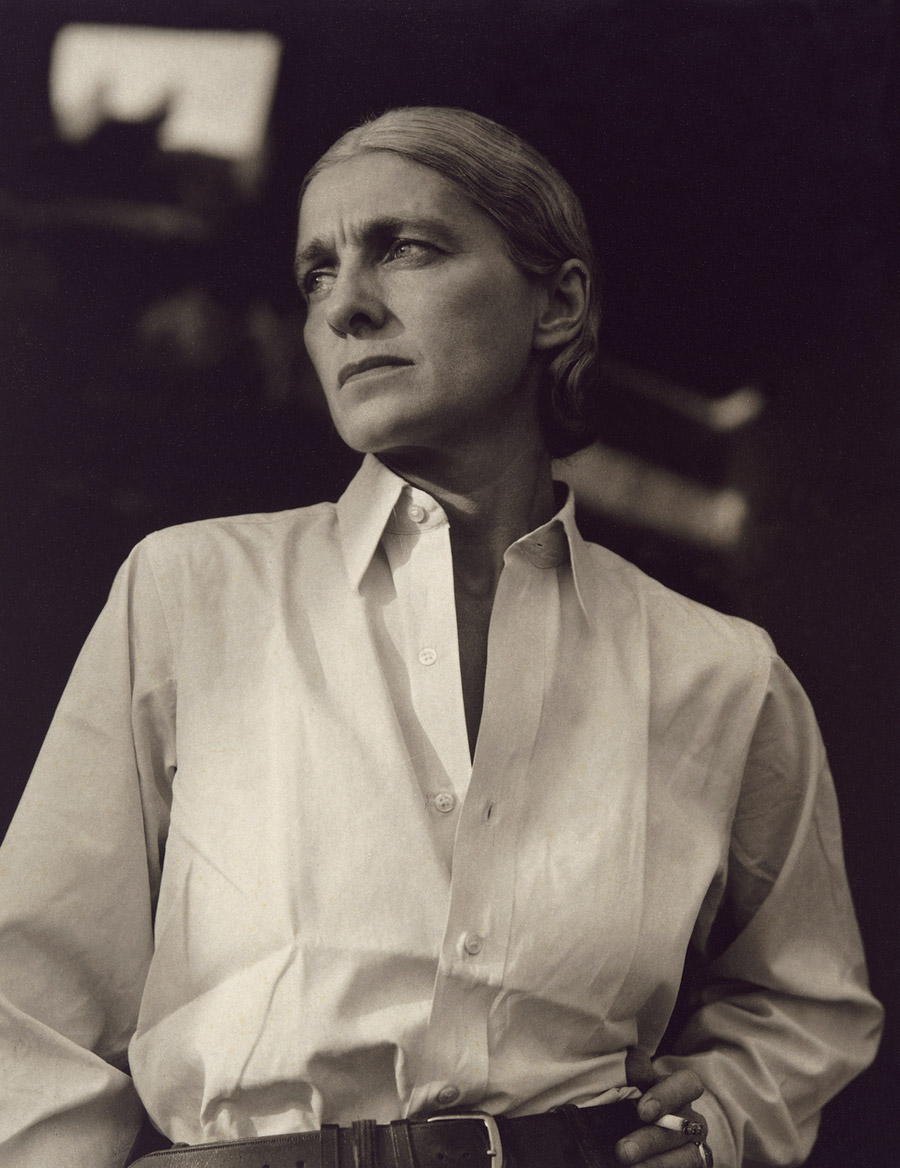
Alfred Stieglitz (1864-1946) was already an accomplished photographer, publisher, and champion of modern art when he the first encountered the work of Georgia O’Keeffe in 1916. He made his first photographs of her in 1917 and sent them to her with the note, “I think I could do thousands of things of you – a life work to express you.” Over the next two decades Stieglitz made more than three hundred photographs of O’Keeffe, whom he married in 1924, creating what he called a “composite portrait.” This extraordinary body of work charts the couple’s relationship and expresses Stieglitz’s conviction that portraiture should function as a kind of “photographic diary.”
Many of the photographs Stieglitz made of O’Keeffe in the early years of their relationship, including Georgia O’Keeffe, c. 1918 (fig. 1, above), are palpably erotic, reflecting the intense passion they shared. Revealing herself to the lens with a bewitching vulnerability, O’Keeffe exudes a tenderness and seductiveness that belie the strain of holding the pose during the long exposures required by Stieglitz’s large-format camera. Often, his photographs express both his desire and admiration for O’Keeffe, at times verging on idealisation of the person he called “Nature’s child – a Woman.” Yet his portraits also look beyond her face to find eloquence in all parts of her body, as in the print Georgia O’Keeffe – Hands and Thimble (fig. 2, below), where her hands display an almost tactile physicality. Here, Stieglitz used a printing technique that resulted in tonal reversal, causing deep shadows to print as bronze tones and creating the dark outlines that dramatise O’Keeffe’s graceful fingers and emphasise the metallic gleam of the thimble.
After Stieglitz exhibited more than forty portraits of O’Keeffe, including some provocative nudes, in 1921, the painter was dismayed to find that her own art began to be interpreted in a sexualised way, and she rarely posed unclothed after 1923. O’Keeffe’s desire to control her image, along with the increasingly attenuated nature of their relationship after 1929, when she began spending several months a year working in New Mexico while he stayed in New York, further strained their partnership. In Georgia O’Keeffe, 1930 (fig. 3, below), the artist stands before one of the paintings she had made in New Mexico. Gazing steadily at the camera, she appears as a monumental force at one with her art, confident yet untouchable.
Text from the NGA website
Figure 2. Alfred Stieglitz (American, 1864-1946) Georgia O’Keeffe – Hands and Thimble 1919 Palladium print 24 x 19.4cm (9 7/16 x 7 5/8 in.) National Gallery of Art, Washington Alfred Stieglitz Collection
Figure 3. Alfred Stieglitz (American, 1864-1946) Georgia O’Keeffe 1930 Gelatin silver print 23.9 x 19.1cm (9 7/16 x 7 1/2 in.) National Gallery of Art, Washington Alfred Stieglitz Collection
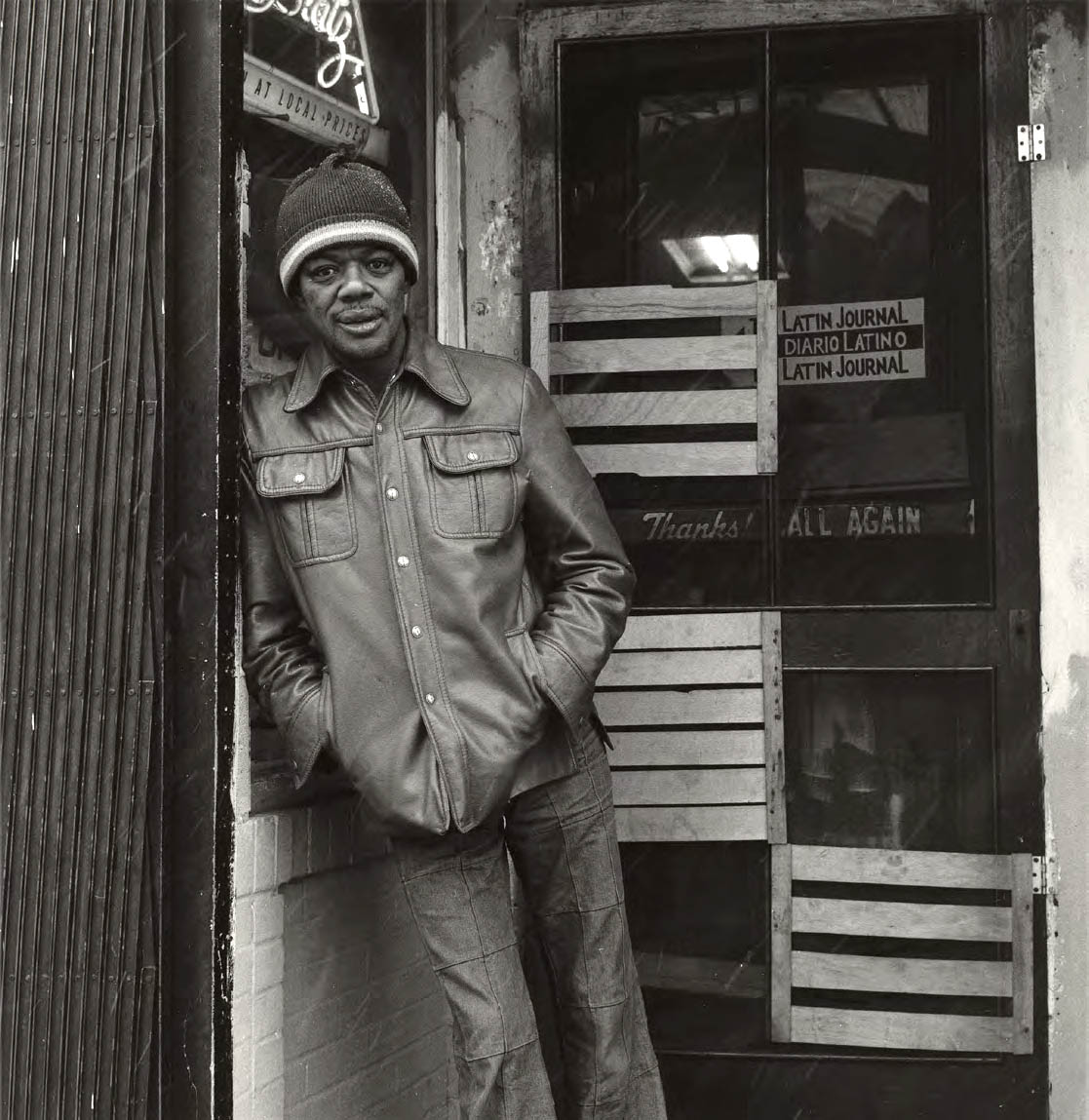
Figure 7. Milton Rogovin (American, 1909-2011) Samuel P. “Pee Wee” West (Lower West Side series) 1974 Gelatin silver print National Gallery of Art, Washington Gift of Dr. J. Patrick and Patricia A. Kennedy
Milton Rogovin
Milton Rogovin (1909-2011) belongs to a rich photographic tradition of documenting the social and personal histories of people who would otherwise be forgotten. He did so serially, returning over many years to encapsulate not just single moments but entire lifetimes. Rogovin started his career as an optometrist in Buffalo, New York. In 1957, after he refused to testify before the House Committee on Un-American Activities about his association with the Communist Party, the local paper labeled him the “Top Red in Buffalo.” His optometry practice folded as a result, leaving his family of five to survive on the salary of his wife, Anne. With free time suddenly available, Rogovin turned to photography with a strong sense of purpose. “My voice was essentially silenced,” he recalled, “so I decided to speak out through photographs.”
Rogovin’s candid, powerfully direct pictures gave voice to those who traditionally had none: immigrants, minorities, and working-class people. Even though he traveled around the world making photographs of workers, his best-known work was made closer to home. In 1972 he began photographing residents of Buffalo’s Lower West Side, the city’s poorest and most ethnically diverse neighbourhood. With his bulky twin-lens Rolleiflex camera, the photographer was sometimes suspected of working for the police or the FBI. Over time, however, Rogovin gained the trust of his sitters by visiting regularly and by giving them prints of their portraits. Dignified and occasionally tender, these photographs depict the circumstances of each subject with sober honesty.
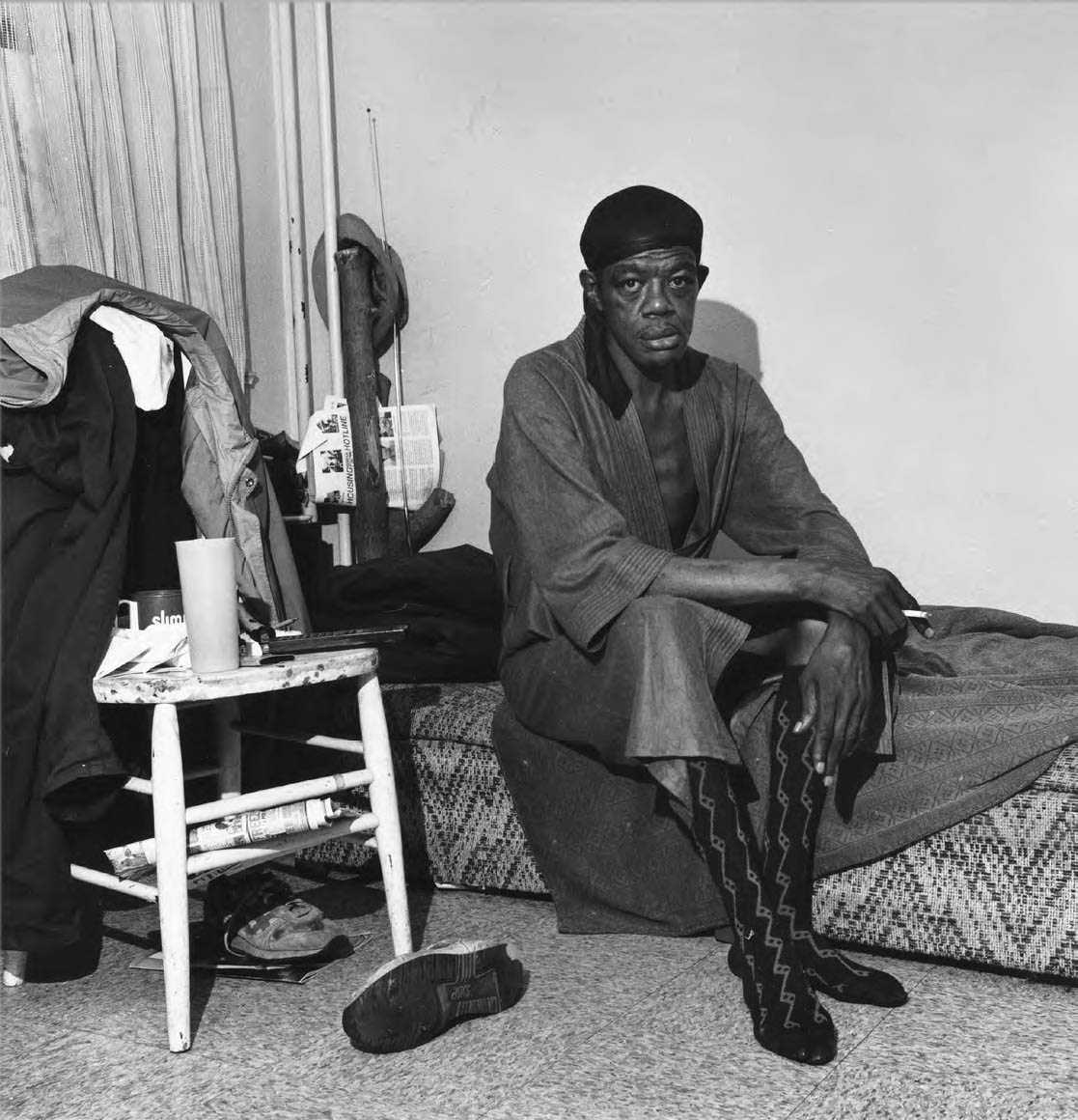
Several times over the next three decades, Rogovin sought out and re-photographed many of his original subjects, capturing the changes wrought by time and circumstance. The series Samuel P. “Pee Wee” West (figs. 7-10) registers changes in the sitter’s situation over the course of twenty-eight years, from 1974 to 2002. In 2003 the oral historian Dave Isay, working
alongside Rogovin, interviewed West, who related the story of his decades of heavy drinking. Reflecting on a photograph Rogovin had made of him in 1985 (fig. 8), West said, “That… picture actually changed my life”; it prompted him to stop drinking for six months before relapsing. A later brush with death led to permanent recovery and the founding of a program to help local youth reject drugs and alcohol. In this and other serial portraits, Rogovin honoured the everyday lives of his subjects, offering a powerful visual legacy of a community he respected and loved.
Text from the NGA website
Figure 8. Milton Rogovin (American, 1909-2011) Samuel P. “Pee Wee” West (Lower West Side series) 1985 Gelatin silver print National Gallery of Art, Washington Gft of Dr. J. Patrick and Patricia A. Kennedy
Figure 9. Milton Rogovin (American, 1909-2011) Samuel P. “Pee Wee” West (Lower West Side series) 1992 Gelatin silver print National Gallery of Art, Washington Gft of Dr. J. Patrick and Patricia A. Kennedy
Figure 10. Milton Rogovin (American, 1909-2011) Samuel P. “Pee Wee” West (Lower West Side series) 2002 Gelatin silver print National Gallery of Art, Washington Gift of Dr. J. Patrick and Patricia A. Kennedy
National Gallery of Art National Mall between 3rd and 7th Streets Constitution Avenue NW, Washington
Many thankx to Michaela Hille for her help and to Museum für Kunst und Gewerbe, Hamburg for allowing me to publish the photographs in the posting. Please click on the photographs to view a larger version of the image.
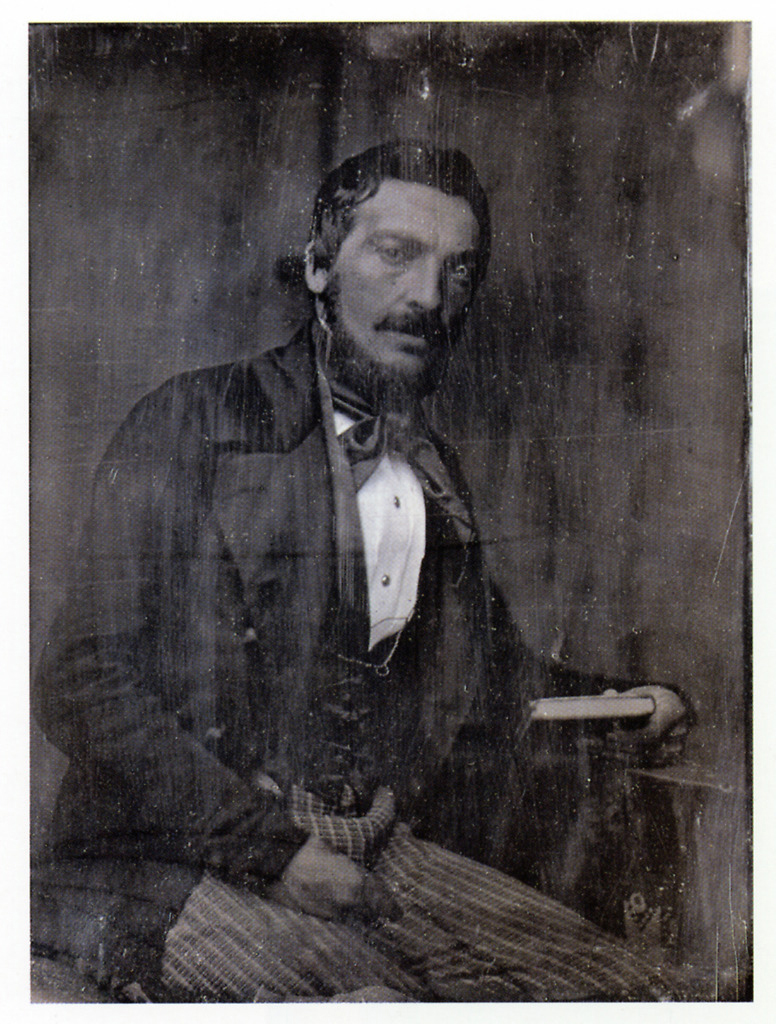
Hermann Biow (German, 1804-1850) Heinrich Jakob Venedey
1848
Daguerreotype
20.8 x 15.4cm
Museum für Kunst und Gewerbe, Hamburg
Hermann Biow was an important German daguerreotypist in the early days of photography. Biow became known through his portrait photography during his lifetime. He portrayed politicians, celebrities and wealthy citizens, including Franz Liszt, Alexander von Humboldt and Friedrich Wilhelm IV. He is also known for his parliamentarian portraits of the first German National Assembly in the Paulskirche in Frankfurt in 1848/1849. Today Biow is primarily seen as the founder of German documentary photography.
A daguerreotype of Heinrich Jakob Venedey from 1848 made by Hermann Biow in Frankfurt. Venedey (1805-1871) was a member of the German National Assembly in Frankfurt’s Paulskirche in 1848/1849 as a deputy for Hessen-Homburg. The lawyer belonged to the factions Deutscher Hof and Westendhall of the National Assembly.
Text translated by Google Translate from the German Wikipedia website
Hermann Biow (German, 1804-1850) Heinrich Joseph Gerhard Compes
1848
Daguerreotype
20.4 x 14.8cm
Museum für Kunst und Gewerbe, Hamburg
A daguerreotype of Heinrich Joseph Gerhard Compes (that’s Gerhard Compes) from 1848 by Hermann Biow in Frankfurt. Compes was a member of the German National Assembly in Frankfurt’s Paulskirche in 1848/1849 as a deputy for the 19th province of Rhineland (Siegburg). The Cologne lawyer belonged to the Württemberger Hof faction of the National Assembly.
Text translated by Google Translate from the German Wikipedia website
The first section of People of the Twentieth Century is dedicated to the farmer. It begins with a Stammappe, or portfolio of archetypes. Usually three-quarter-length portraits, the photographs depict old farming men, women, and couples seated in their homes or against a natural backdrop. Each is captioned to suggest the fundamental role played by the individual in a balanced society. Sander referred to this farmer as the “earthbound man.” Other archetypes include the “philosopher,” the “fighter or revolutionary,” and the “sage.” All had female counterparts, while couples were labeled as “propriety and harmony.”
Identifying this figure as the “earthbound man,” Sander forged an implicit reference to the soil as a source of livelihood. The farmer’s hands grasp the cane, which keeps him upright and connected to the earth.
Text from the J. Paul Getty Museum website [Online] Cited 04/02/2020
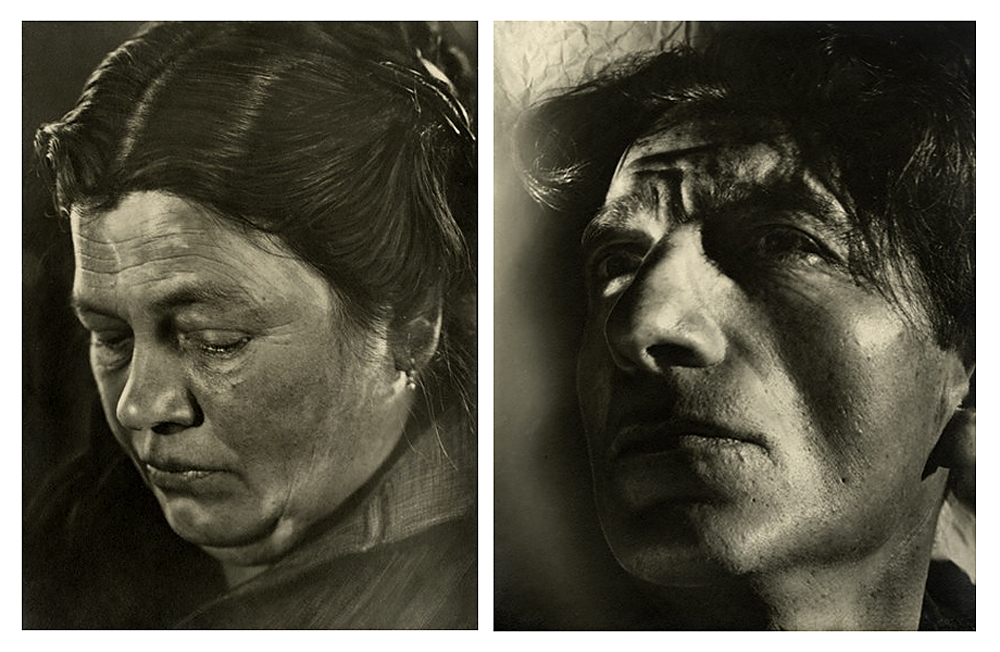
The portraits in Lerski’s Everyday Heads show unemployed workers whom the photographer met at a Berlin job centre where he hired them to sit for him. Old Working Woman from Germany 1928-1931 is a close-up shot of a woman’s face, eyes down and mouth shut as though she is quietly contemplating something outside of the picture’s frame (left, above). It is impossible to tell whether this meditative look, a common feature of his portraits, was suggested by Lerski but it is evident that he was in control of nearly every aspect of his pictures. An experienced movie cameraman, he used artificial light reflected by mirrors and screens to give his models an aura and monumentality that people would be familiar with from expressionist feature films. Oblique angles, in line with modernist sensibilities, helped to reinforce the impression of grandeur. He also cropped the images and introduced extra screens so as to eliminate the space around his models heads, and any details from what remained of the background. This also served on occasions to compromise the integrity of the subject’s face though, in other cases, he preferred to blur the contours of the face using strong shadows, as can be seen in Beggar from Saxony 1928-1931 (right, above). The results produced a general notion of everyday people rather than an endorsement of individuality as praised in traditional portraiture. Like Sander and Retzlaff, Lerski only gave the individuals’ professions in the captions, and was keen not to exemplify their class affiliation or social rank. The pictures provide no information about either, focusing instead on the face. In this way Lerski enhanced the common human dignity normally ignored in ‘everyday’ faces, and more especially in those humiliated by unemployment during the post-1929 economic crisis.
Wolfgang Brückle. “Face-Off in Weimar Culture: The Physiognomic Paradigm, Competing Portrait Anthologies, and August Sander’s Face of Our Time,” in Tate Papers No.19 Spring 2013 [Online] Cited 04/20/2020
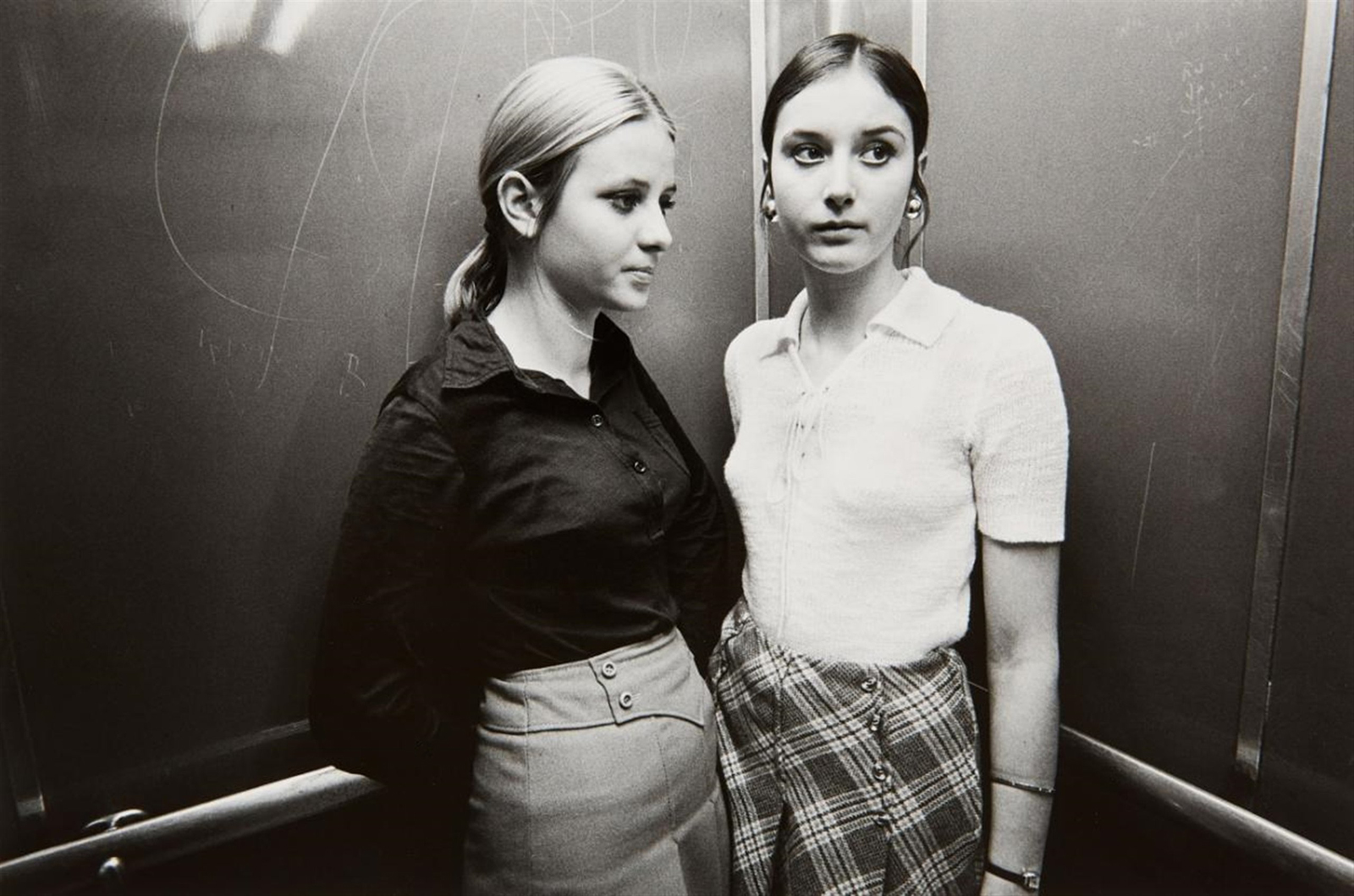
Heinrich Riebesehl (German, 1938-2010) Menschen im Fahrstuhl (People in the elevator)
1969
Gelatin silver print
Heinrich Riebesehl (German, 1938-2010) Menschen im Fahrstuhl (People in the elevator)
1969
Gelatin silver print
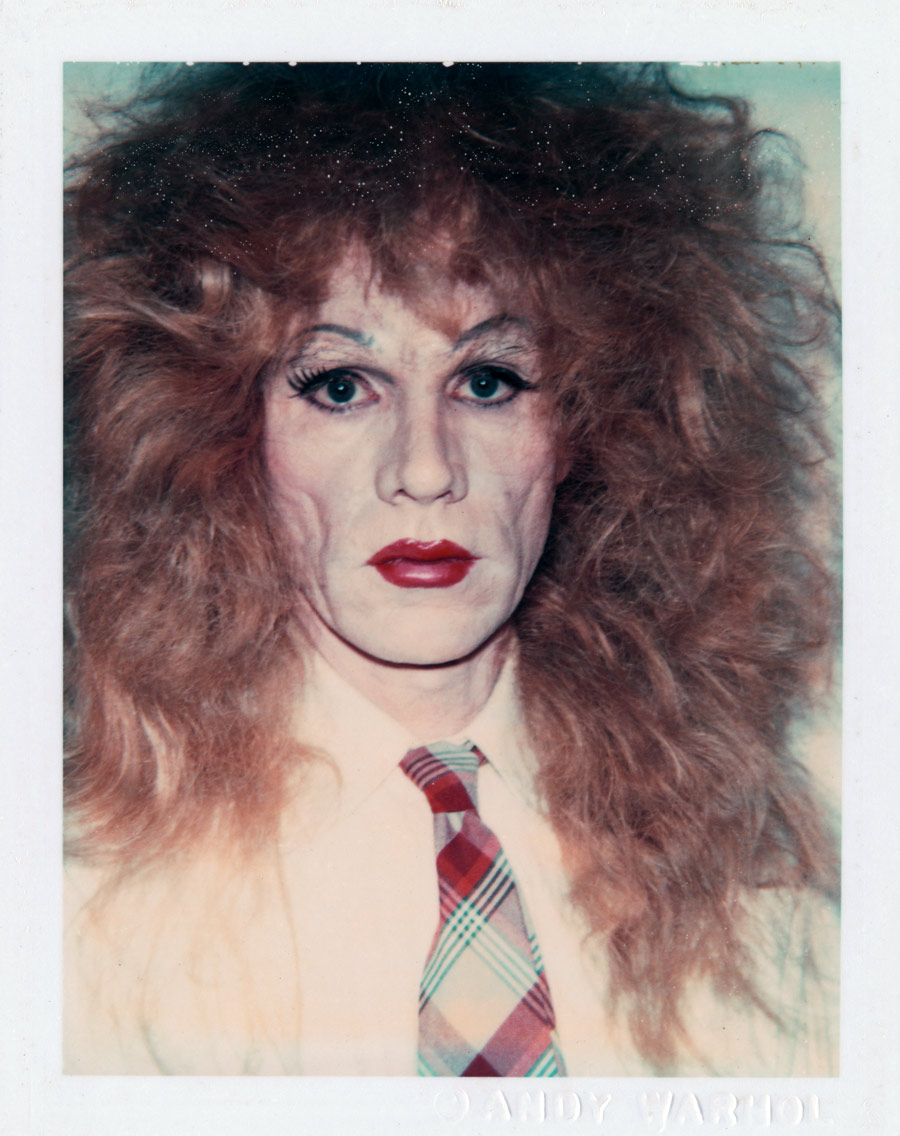
The exhibition comprises 400 exhibits and reflects on important artistic positions in photographic portraiture. During the eventful 20th century portrait photography continually redefines itself, between dissolution of the traditional concept of the subject in the masses and the pursuit of individuality and identity – culturally, socially and in terms of gender. Portraiture is one of the traditional genres in art and was one of the driving forces behind the invention of photography in the 19th century. The image of the human being is subject to constant change, which is also reflected in photography. In postmodern society mass media create ever-changing ideals according to various requirements in tune with a quick succession of trends. Art photography responds to the changes and reflects the development sometimes with spectacular results while it questions the medium of photography itself. The exhibition presents 35 carefully chosen international artists, who through history have opened up a dialogue among themselves; they are referencing each other’s work, and are received and interpreted in ever new contexts. On show are works by Diane Arbus, Hans-Peter Feldmann, Lee Friedlander, Nan Goldin, Roni Horn, Jurgen Klauke, Annie Leibovitz, Helmar Lerski, Irving Penn, Judith Joy Ross, Thomas Ruff, August Sander, Cindy Sherman, Andy Warhol and others. An exhibition in cooperation with the Sammlung Niedersächsische Sparkassenstiftung on the occasion of the 5th Photography Triennial in Hamburg.
“The PORTRAIT-PHOTOGRAPH is a closed field of forces. Four image-repertoires intersect here, oppose and distort each other. In front of the lens, I am at the same time: the one I think I am, the one I want others to think I am, the one the photographer thinks I am, and the one he makes use of to exhibit his art.” (Roland Barthes, Camera Lucida, London, 1984, p. 13). The photographic portrait does indeed combine contrary interests. The relationship between photographer and sitter is crucial. The third factor is the viewer, who is already being considered during the process of photographing. In the knowledge of the particular psychological situation resulting from the presence of a camera, Richard Avedon laconically stated: “A photographic portrait is a picture of someone who knows he is being photographed.” The sitters’ reactions to the camera differ, depending on how experienced they are. Fact is: It is not possible to not communicate, as Paul Watzlawick’s research on communication shows. People demean themselves, even if they withdraw or turn away.
The confrontation climaxes in the principle of frontality, which remains valid today although it is constantly being tried and questioned. The project Serial Portraits invites the visitor on a journey through time starting from the beginnings with Hermann Biow’s (1804-1850) daguerreotypes, David Octavius Hill’s (1802-1870) and Robert Adamson’s (1821-1848) talbotypes up to the digital present with Michael Najjar’s (b. 1966) cyborgs, and wondering whether classical portraiture has come to its end.
The beginning includes a model case, where due to the long exposure necessary the models do not live out of the moment but into the moment, as Walter Benjamin said (Little History of Photography, 1931). Thirty-Minute Dialogue by Kyungwoo Chun (b. 1969) from 2000 is examining the synthesis of expression, which is necessitated by the models’ keeping still for so long. An exposure time of half an hour allows the work to penetrate the depths of the pictorial space.
The creativity of the 1920s and the New Vision inspires a “visual vocabulary” appropriate for modernity. Its different forms can be seen in the individual responses of photographers such as August Sander (1876-1964). Being a typical studio photographer, he works on a typology of “man of the 20th century”, beginning with the agricultural type, his Stammappe (engl.: Germinal Portfolio) being a memorial to the latter. Helmar Lerski (1871-1956) takes a different stance; having originally worked in film, he is photographing his Everyday Heads in extreme close-ups. Making use of effective lighting in his studio, he invites unknown sitters from the street and fashions characteristic heads.
Sander’s oeuvre represents a turning point for comparative vision as a genuine principle in series. Considering photography of the 1920s and questioning the photographer’s position as well as the medium itself, author-photography in the 1970s is developing a new idea of documentary. Thomas Ruff (b. 1958) is testing the limits, when he presupposes that photography can merely reflect the surface of things. Bernhard Fuchs is adding a personal touch when he is seeking out the places of his own past. The great portrait photographer Irving Penn is cornering his celebrities in a corner of his studio and allows them to find their place, according to their inclinations and abilities to self-represent.
Diane Arbus (1923-1971) is holding a one-sided dialog, certainly not giving equal weight to the photographer’s interests and that of her models. While the frontality signals the conventionally due deference, the complex composition of her pictures is dominated by the superior gaze directed at the supposedly others, the freaks of bourgeois society. Until now Arbus is misinterpreted as a documentary photographer. It is being ignored that photography inevitably presents a specific view of reality and that the viewer’s position has been carefully constructed within the picture.
Only pictures that have been taken without the awareness of those represented document a found situation at the same time as they present a monologue. Heinrich Riebesehl (1938-2010) chose this method for his series Menschen im Fahrstuhl (engl.: People in an Elevator), which he completed in just one day. In a moment of pause people can reflect and are not forced to react to being observed. In his pictures the photographer respects their individuality without judging social differences.
Examples for comparability as principle in a series can be found early on. Hermann Biow’s (1804-1850) daguerreotypes as unique copies of the members of parliament in the Paulskirche in Frankfurt from 1848/1849 were later reproduced as lithographs and distributed in portfolios. These politicians were the direct successors to the galleries of ancestral portraits in stately homes, whereby the new medium was democratic. Rudolph Duhrkoop’s Hamburgische Männer und Frauen amAnfang des XX. Jahrhunderts (engl.: Men and Women of Hamburg in the Early XXth Century) represent the citizens in this tradition.
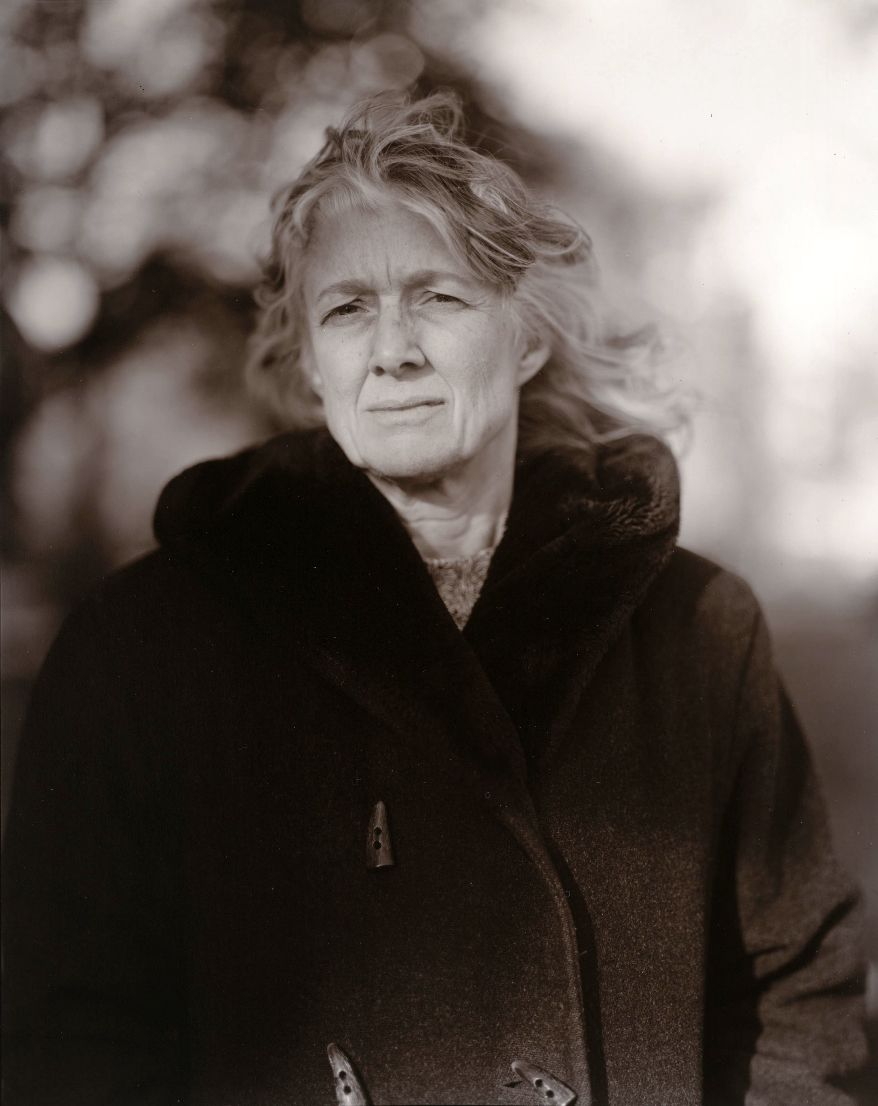
Since 1975 Nicholas Nixon (b. 1974) is extending the series The Brown Sisters every year. His study is observing changes, while Hans-Peter Feldmann (b. 1941) is representing a century through 101 average people in his sequence 100 Jahre (engl.: 100 Years). It is fascinating, how the uniqueness of each person even if they remain anonymous is transported in the photographic portrait. Judith Joy Ross’ (b. 1946) series Protesting the U. S. War in Iraq documents a seriousness in the sitters’ faces, the political dimension of which can only be fully grasped with the information on the context. As with every photograph the title or accompanying text is part of the message.
Press release from the Museum für Kunst und Gewerbe, Hamburg website
Thomas Ruff (German, b. 1958) Portrait (T. Ruff)
1983
Colour Print
24 x 18cm
Thomas Ruff/VG Bild-Kunst, Bonn 2011
Niedersachsische Sparkassenstiftung, Hannover
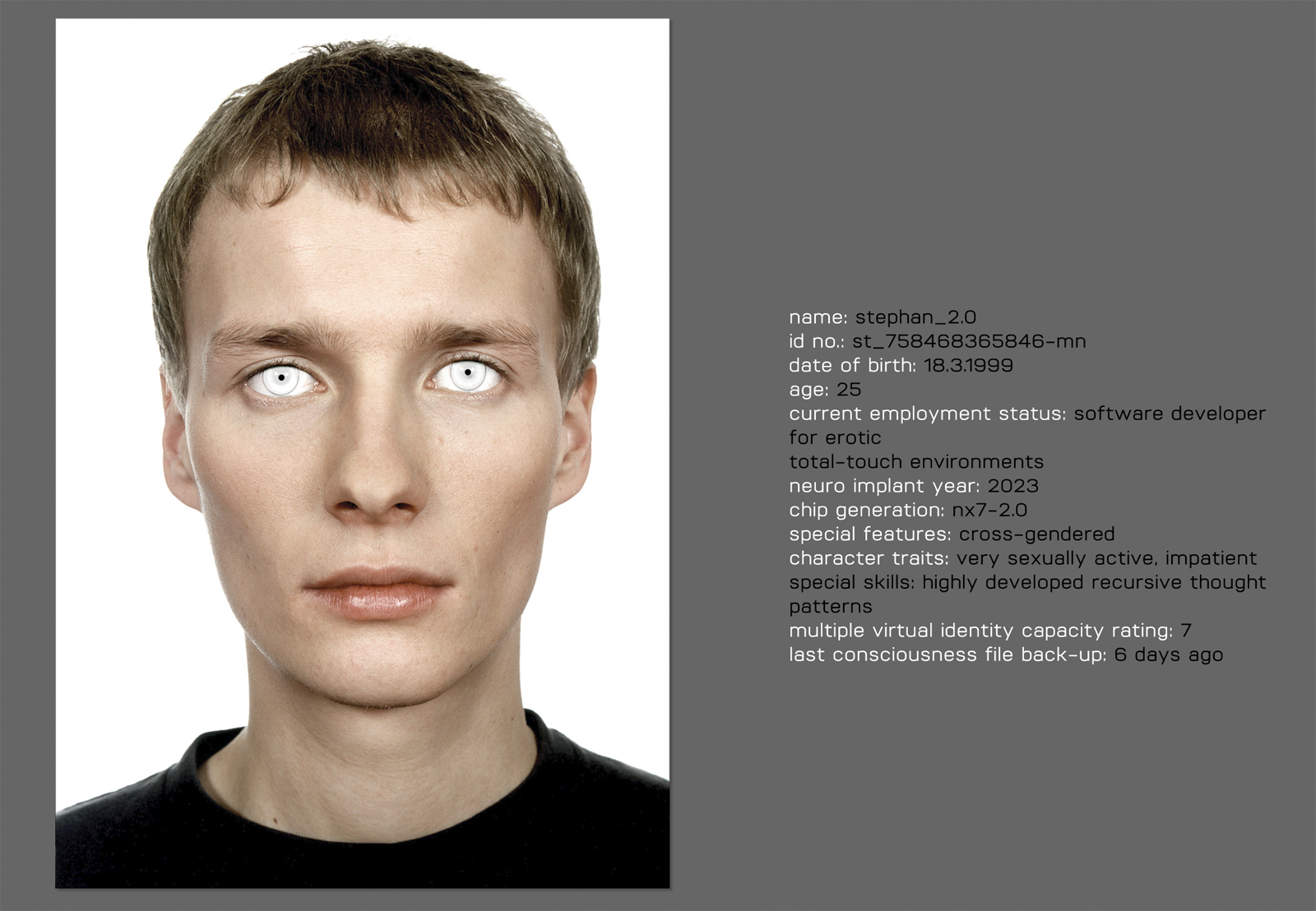
Michael Najjar (German, b. 1966) Stephan_2.0 from the nexus project part I
1999
Hybrid photography, archival pigment print, aludibond, diasec
140 x 100cm / 56 x 40 in, edition of 6
Nexus Project
The series “nexus project part I” investigates the implications of the future enhancement of the human brain with miniaturised computer chips, infiltrated in the neuronal structures of the human organism.
Such a development will give birth to a new form of life – the cyborg, a hybrid compound of human and machine. A new set of questions are raised concerning issues of difference and identification between biologically correct beings and technically or genetically enhanced humans.
This development brings with it a host of new concerns: What impact will neuro-implants have on human consciousness? How will society cope with this kind of being, and what implications will they have for our social and cultural interaction?
“nexus project part I” consists of eight photographic portraits. These have undergone a digital modification of the iris, which gives the portrait faces an intimidating, almost inhuman look whilst at the same time it exerts a strong direct fascination on the viewer.
The highly charged poles of tensions and cross-tensions between fascination and intimidation also shape the para-meters in which the future development of human being to hybrid organism will take place.
Text from the Michael Najjar website [Online] Cited 04/02/2020
Judith Joy Ross (American, b. 1946) Jane C. Keller, Protesting the U.S. War in Iraq, Williamsport, Pennsylvania, from the series Protest the War 2006
Gelatin silver print
Judith Joy Ross (American, b. 1946) Lynn Estomin, Protesting the U.S. War in Iraq, Williamsport, Pennsylvania, from the series Protest the War 2006
Gelatin silver print
Nicholas Nixon (American, b. 1947) The Brown Sisters, East Greenwich, R.I.
1980
Gelatin silver print
Nicholas Nixon (American, b. 1947) The Brown Sisters, Boston
2012
Gelatin silver print
Museum für Kunst und Gewerbe Hamburg
Steintorplatz, 20099 Hamburg
In the history of group photography Nixon’s ongoing series of family portraits The Brown Sisters (1975- ) is the best in the world. Beautifully structured and composed the photographs are nuanced and sensitive to the people portrayed and the passage of time. The subjects project and recede within the image frame, exposing vulnerability, intimacy and strength. Simply breathtaking!
Dr Marcus Bunyan
Many thankx to Amelia Kantrovitz for her help and to the Museum of Fine Arts, Boston for allowing me to publish the photographs in the posting. Please click on the photographs for a larger version of the image.
Themes such as the passage of time and the enduring nature of close family relationships are brought into focus in the exhibition Nicholas Nixon: Family Album at the Museum of Fine Arts, Boston (MFA). The show, on view from July 28, 2010, through May 1, 2011, in the MFA’s Herb Ritts Gallery, features more than 70 black and white portrait photographs by Nicholas Nixon, one of the most celebrated American photographers of this generation. Among them are pictures of Nixon’s wife, Beverly (Bebe) Brown Nixon, and their two children, Clementine and Sam. Nicholas Nixon also includes The Brown Sisters, the ongoing annual series of portraits of Bebe and her sisters taken each summer for the past 35 years. Nixon will take another photograph of the sisters this summer, which will be hung in the gallery during the course of the exhibition.
The promised gift to the MFA of The Brown Sisters series is the impetus for Nicholas Nixon. The group of photographs has been lent to the Museum for the exhibition from the collection of James Krebs, a Distinguished Benefactor of the MFA, and his late wife, Margie. Also included are works by Nixon purchased by the Museum, and a number that were given and lent to the MFA by the artist. Nicholas Nixon is presented with support from the Shelly and Michael Kassen Fund.
“Nicholas Nixon rose to prominence in the mid 1970s for his large-format black-and-white views of Boston and New York. Since then, he has turned almost exclusively to portraiture, and has produced many celebrated series of pictures – of the elderly, people with AIDS, and couples – but his portrayals of his family are particularly evocative and beloved. Nick has been a friend of the MFA for a long time and has generously given the Museum many of his photographs,” said Malcolm Rogers, Ann and Graham Gund Director of the MFA.
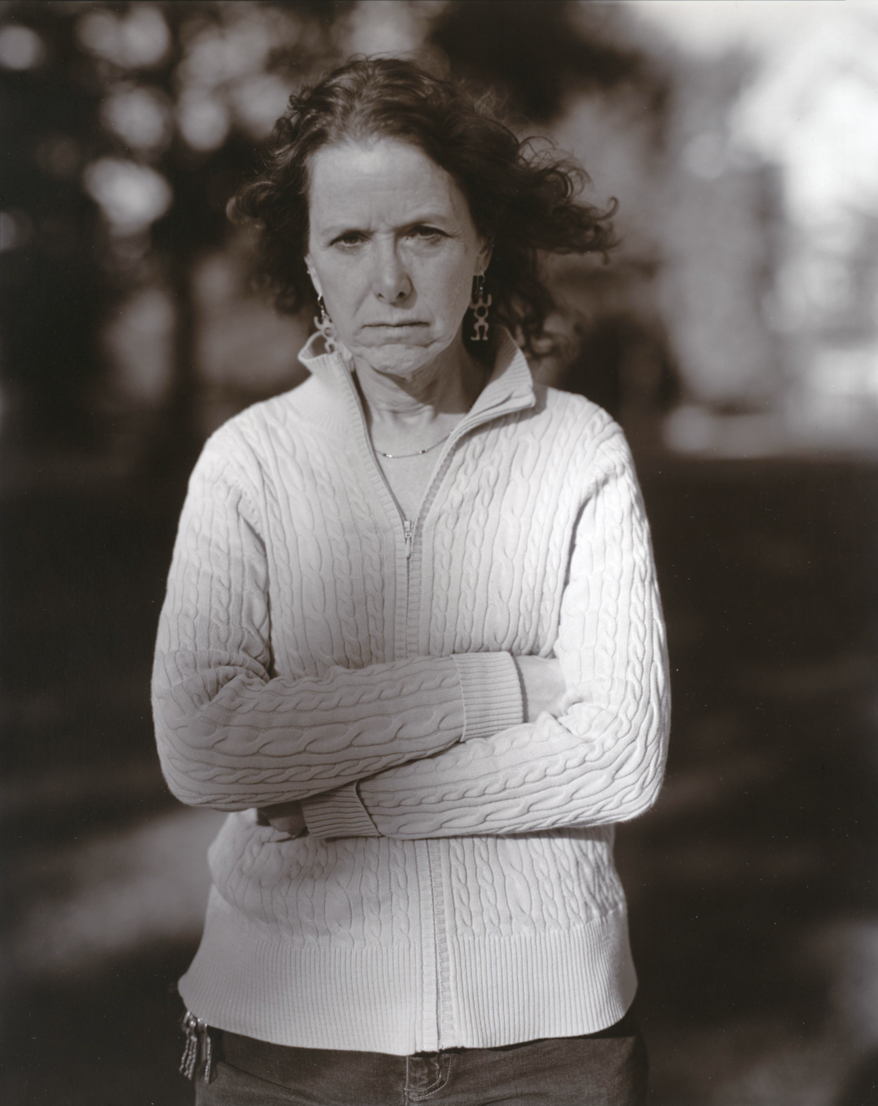
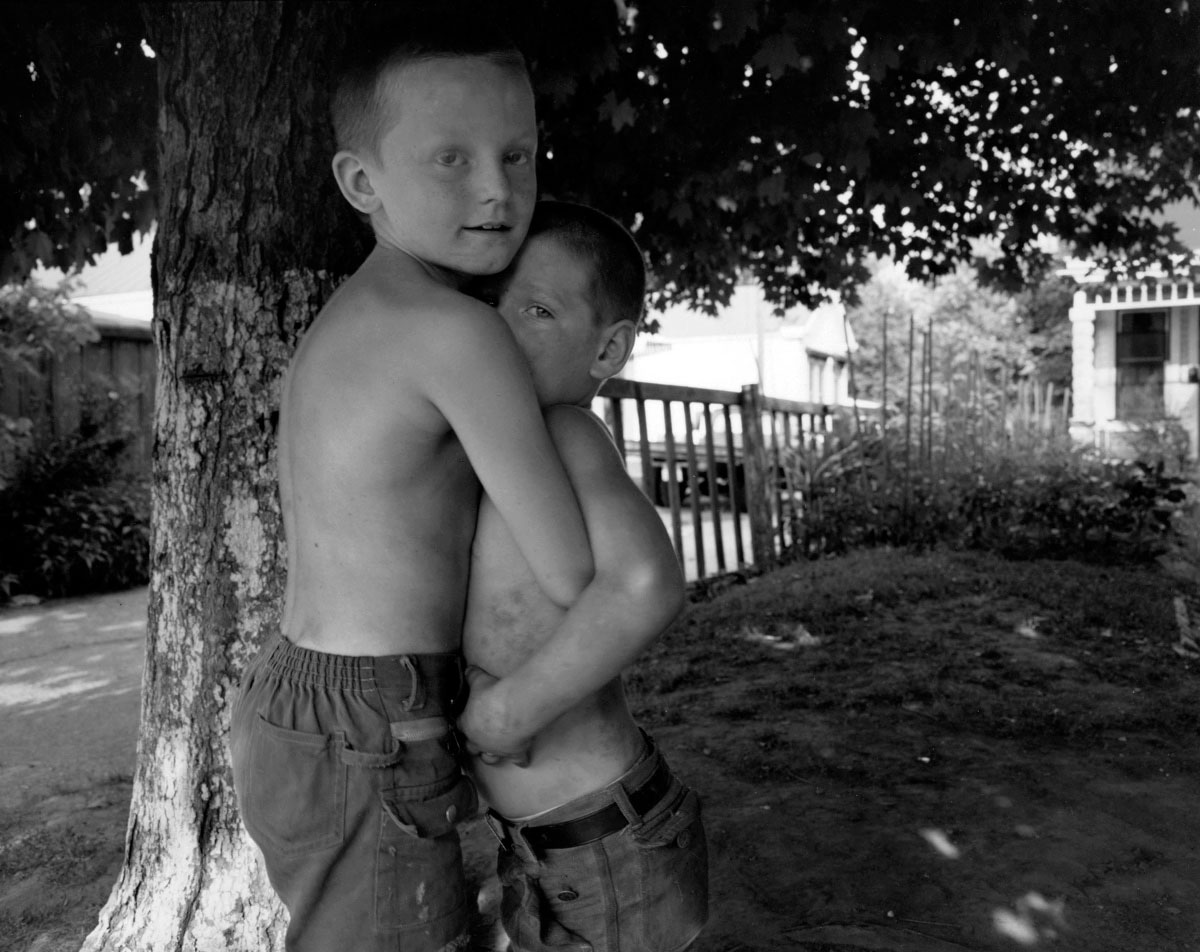
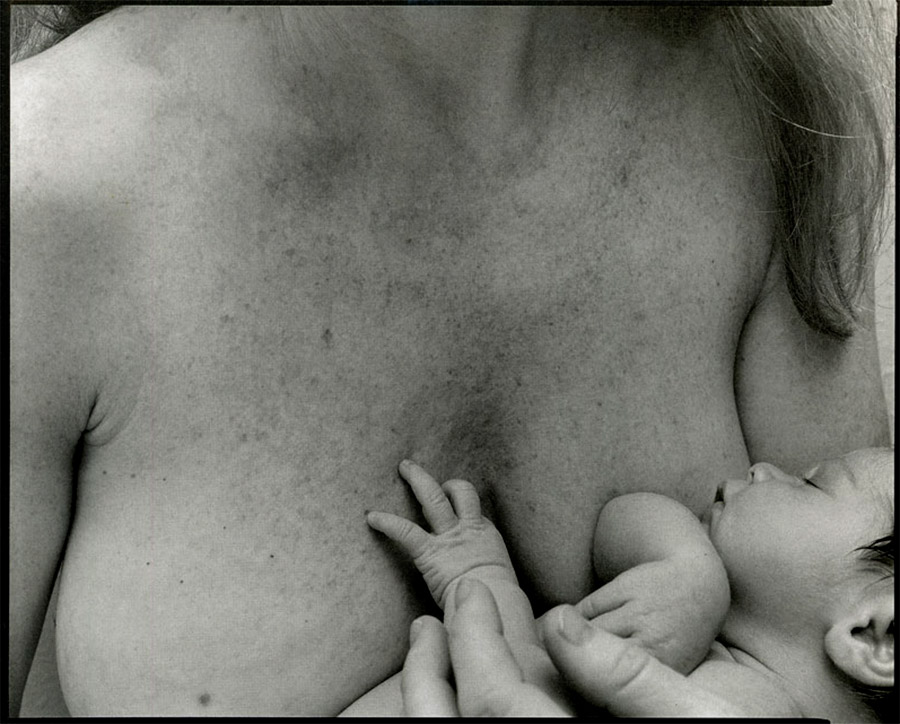
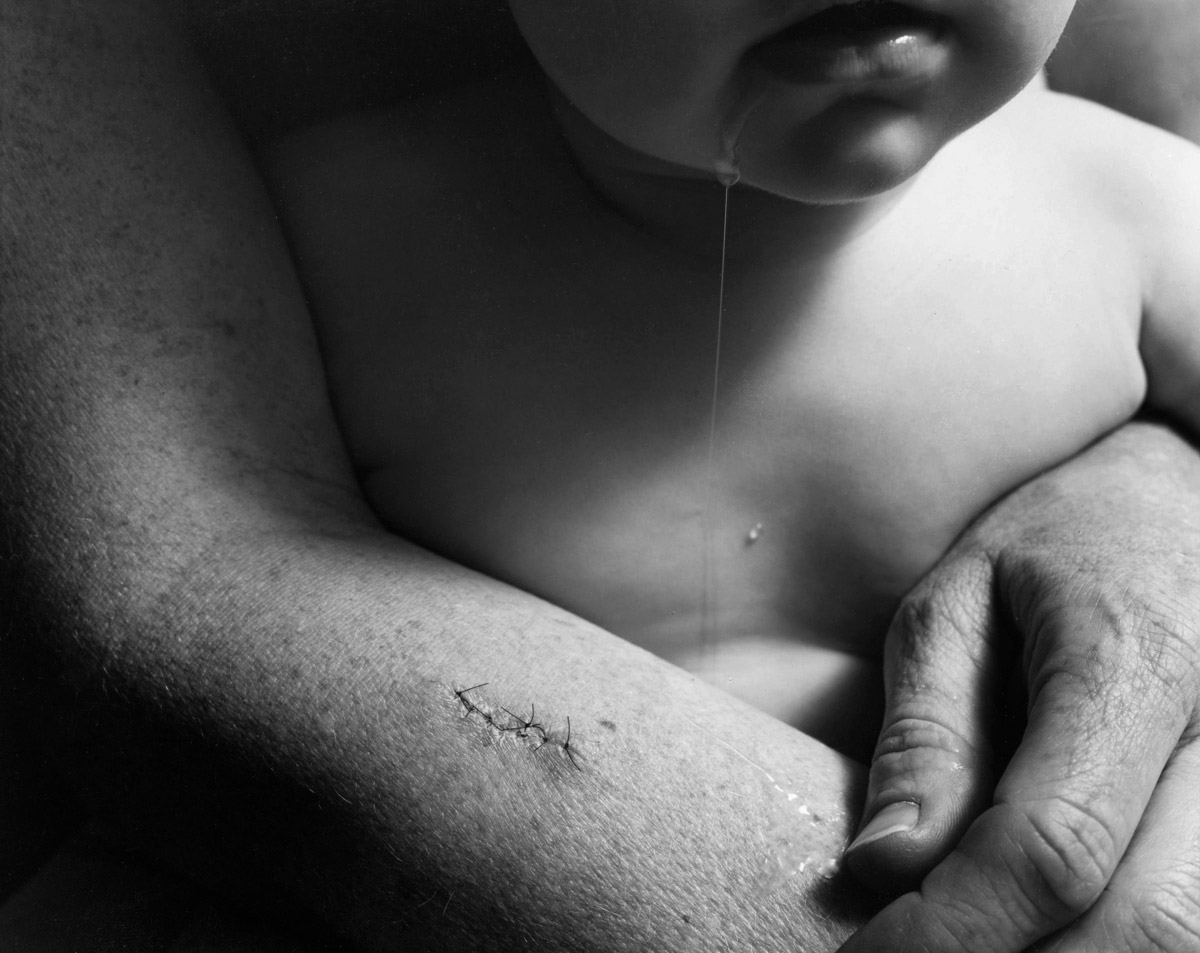
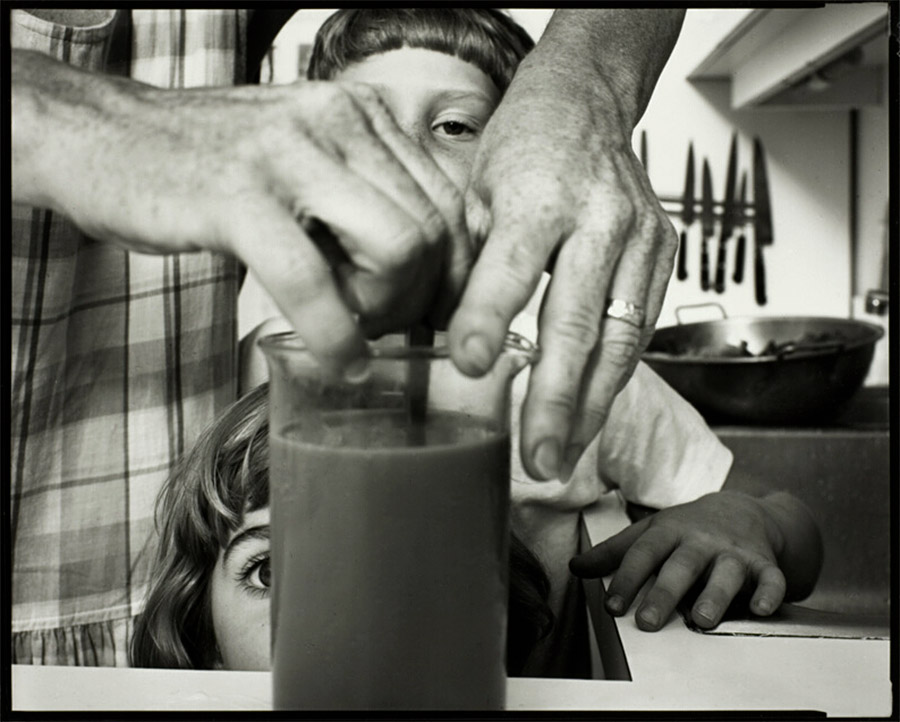
Nicholas Nixon’s photographs of family are both personal in nature and have a universality with which observers can connect. These pictures, a number of which have never been publicly displayed, celebrate the bonds of close family relationships, especially as they grow over time. Included in the exhibition is the luminous image that Nixon took of his wife in the bathtub, Bebe, Cambridge (MFA, Boston, 1980). The beautiful glowing light on her face suggests her interior state, as well as the depth of their long relationship. There are also many photographs in the show that highlight the richness and warmth of daily life with children. In an image from 1985, a cropped view of Bebe pictures her gazing downward, as Clementine’s fist emerges from the bottom of the frame, evoking the power of a new life. A close-up of Clementine’s face made the following year, with her wide eyes gazing upward, captures the toddler’s impression of wonder. The latest photograph of Clementine in the exhibition dates to 2003 and depicts her as a young woman, embracing her mother. Images of Nixon’s son, Sam, are also included, showing him in different stages over the years and in portraits with his sister.
The most recognised images in the exhibition are those that Nixon has taken of the Brown sisters each summer since 1975. The four women – Heather, Mimi, Bebe, and Laurie – always appear in the same order in the portraits, from left to right. These compelling photographs reveal the evolving nature of the sisters’ relationship over time. The serial portraits begin with The Brown Sisters, 1975 (James and Margie Krebs Collection, 1975), which captures them as young women, ranging in age from 15 to 25. With each passing year, observers can note changes in appearance, stance, and demeanour. In several of the portraits, the presence of the photographer is suggested through the shadow of himself and his camera projected across the figures, which makes reference to his role in the family dynamic. The series unfolds in a grid display on the central wall of the Ritts Gallery.
“In his serial pictures of family, Nicholas Nixon explores a classic conundrum in photography: how to suggest the passage of time by means of an instrument that records the instantaneous image. His effort is related to that of several predecessors – Alfred Stieglitz, Edward Weston, Harry Callahan, to name the most important – who, like him, used their wives as subject matter, photographing them over a period of years. What Nixon has added to the discussion – beyond recording facets of appearance, personality, or emphasising formal concerns – is his emphasis on the meaning of family,” said Anne Havinga, the MFA’s Estrellita and Yousuf Karsh Senior Curator of Photographs, who curated the show with Emily Voelker, the MFA’s Estrellita and Yousuf Karsh Assistant Curator of Photographs.
Born in Detroit in 1947, Nixon graduated from the University of Michigan in 1969 with a bachelor’s degree in English, and from the University of New Mexico in 1974 with a Masters of Fine Arts degree. Later that year, he moved to Boston, where he teaches at the Massachusetts College of Art and Design. Nixon is known for his documentary photography, especially city views and portraits rooted in the snapshot tradition. He works primarily in black and white, creating gelatin silver prints with a 8 x 10-inch view camera as did many of the great photographers who influenced him, including Alfred Stieglitz, Edward Weston, and Walker Evans. Working in large format and making contact prints enables him to create images of crisp detail and subtle tone. In recent years, Nixon has also begun to experiment with colour, although the photographs in the exhibition are all black-and-white, for which he is best known. He is the recipient of three National Endowment for the Arts Fellowships and two Guggenheim Fellowships, and, in addition to the MFA, his work is included in numerous museum collections, among them, the Metropolitan Museum of Art and the Los Angeles County Museum of Art.
Press release from the Museum of Fine Arts, Boston website [Online] Cited 26/04/2011 no longer available online
Nicholas Nixon (American, b. 1947) The Brown Sisters 1976 Gelatin silver print Promised gift of James and Margie Krebs Courtesy, Museum of Fine Arts, Boston
Nicholas Nixon (American, b. 1947) The Brown Sisters 1978 Gelatin silver print Promised gift of James and Margie Krebs Courtesy, Museum of Fine Arts, Boston
Nicholas Nixon (American, b. 1947) The Brown Sisters 1980 Gelatin silver print Promised gift of James and Margie Krebs Courtesy, Museum of Fine Arts, Boston
Nicholas Nixon (American, b. 1947) The Brown Sisters 1996 Gelatin silver print Promised gift of James and Margie Krebs Courtesy, Museum of Fine Arts, Boston
Nicholas Nixon (American, b. 1947) The Brown Sisters 1999 Gelatin silver print Promised gift of James and Margie Krebs Courtesy, Museum of Fine Arts, Boston
Museum of Fine Arts, Boston Avenue of the Arts 465 Huntington Avenue Avenue of the Arts Boston, Massachusetts 02115-5523 617-267-9300
Opening hours: Thursday and Friday 10am – 10pm Saturday – Monday 10am – 5pm Closed Tuesday and Wednesday





















![August Sander (German, 1876-1964) [Farmer, Westerwald (Bauer, Westerwald)] 1910](https://artblart.com/wp-content/uploads/2011/06/sander-farmer.jpg "August Sander (German, 1876-1964) [Farmer, Westerwald (Bauer, Westerwald)] 1910")













 Art Blart _ art and cultural memory archive
You must be logged in to post a comment.