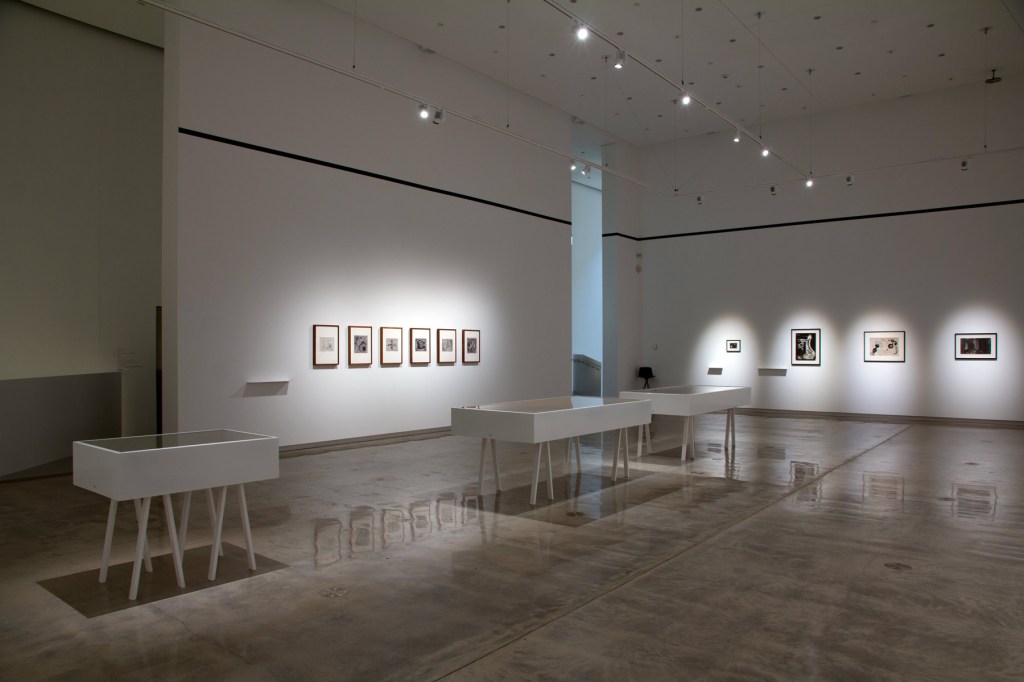
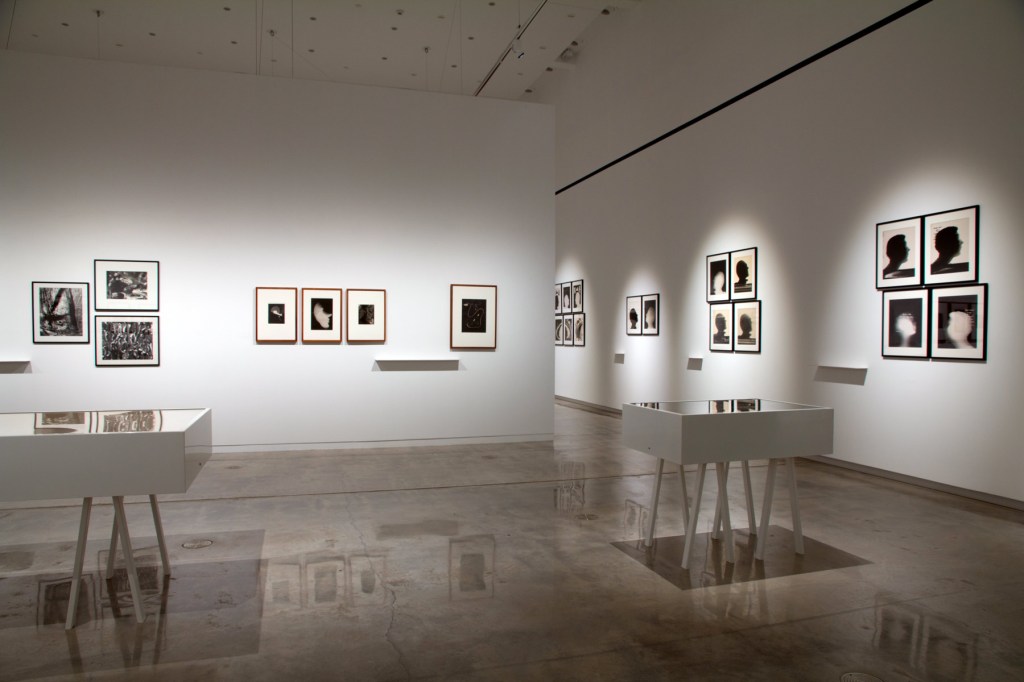
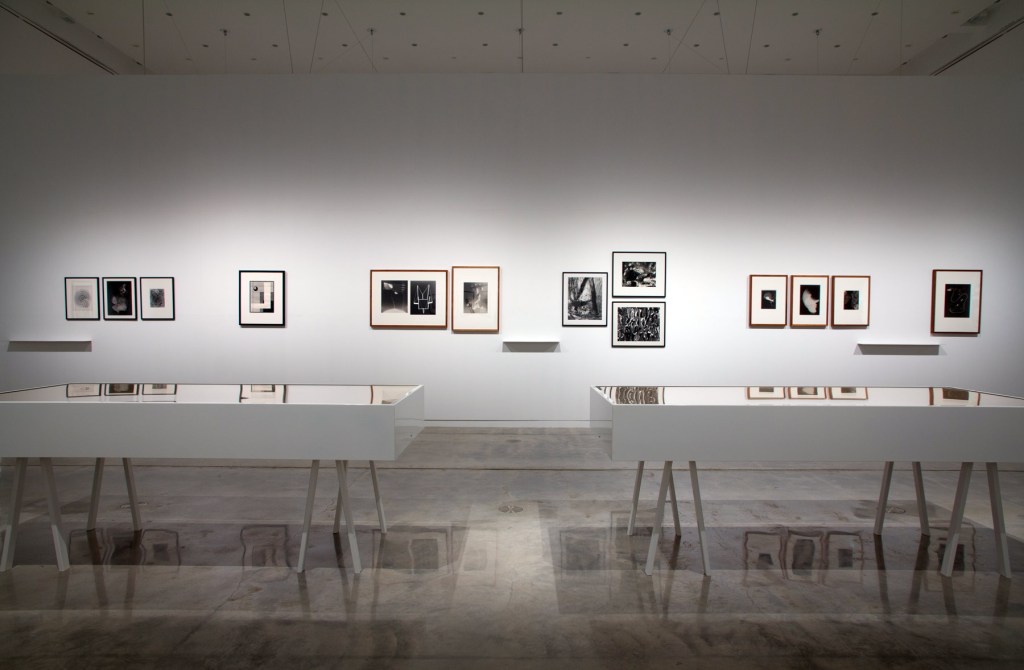
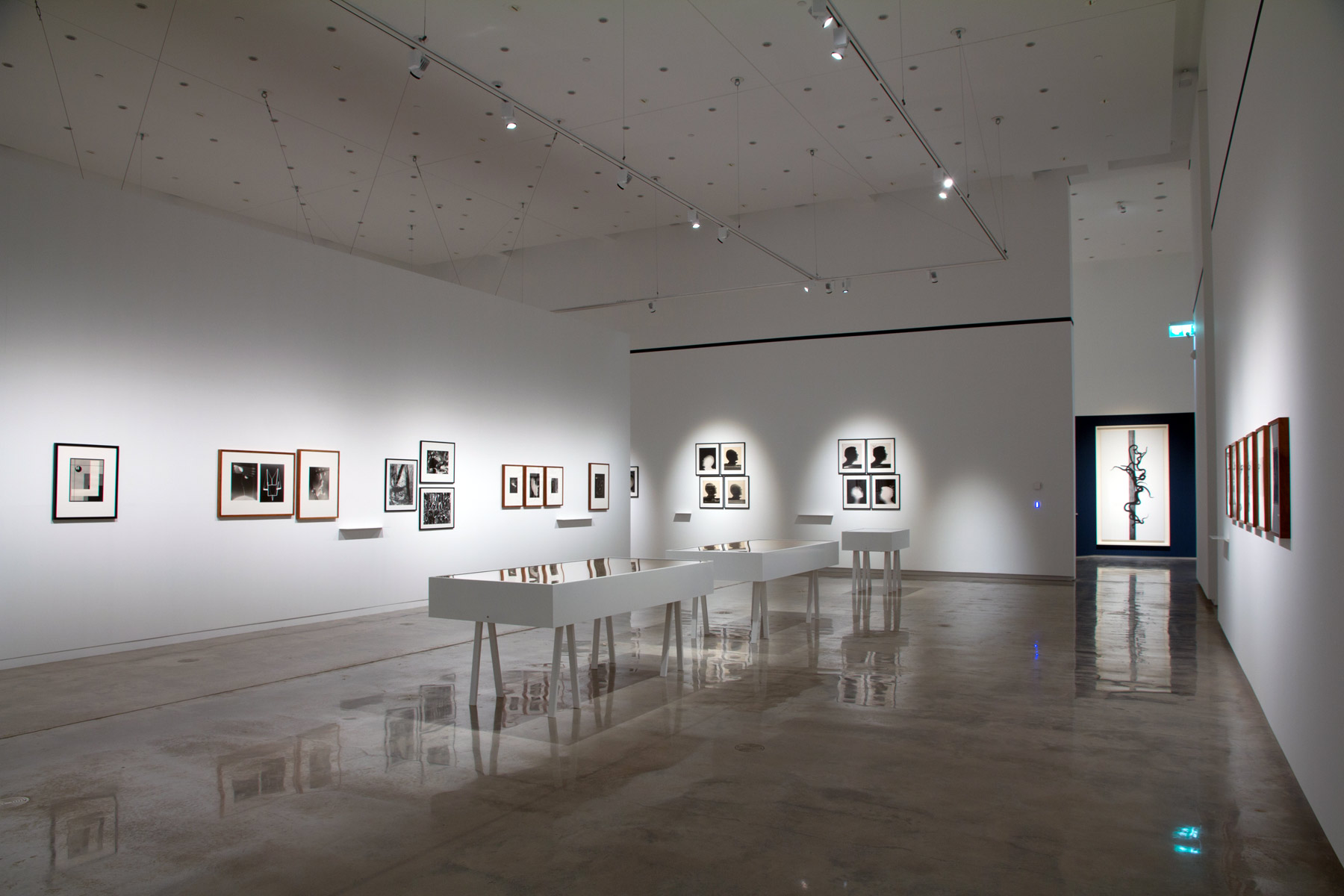
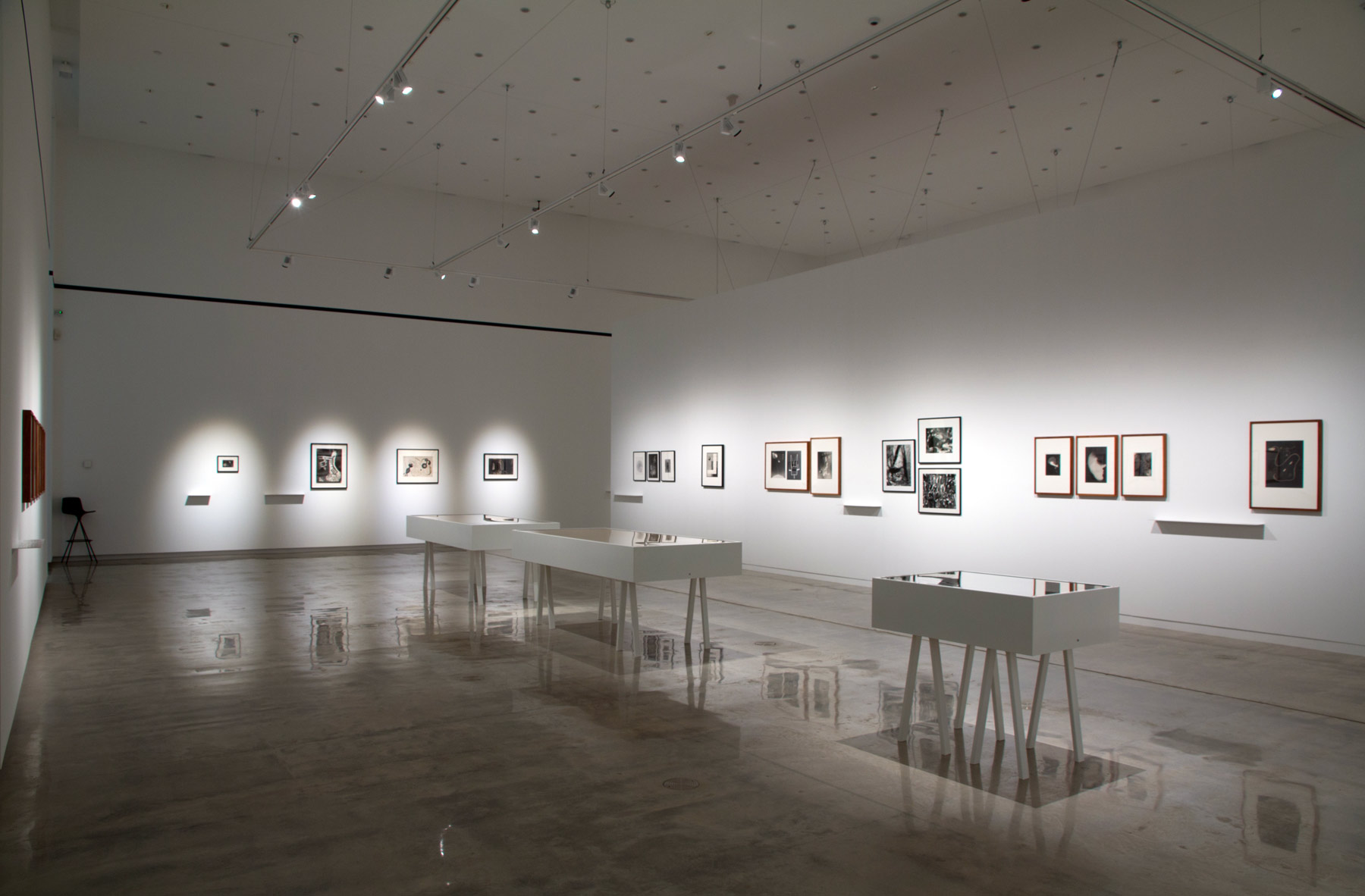
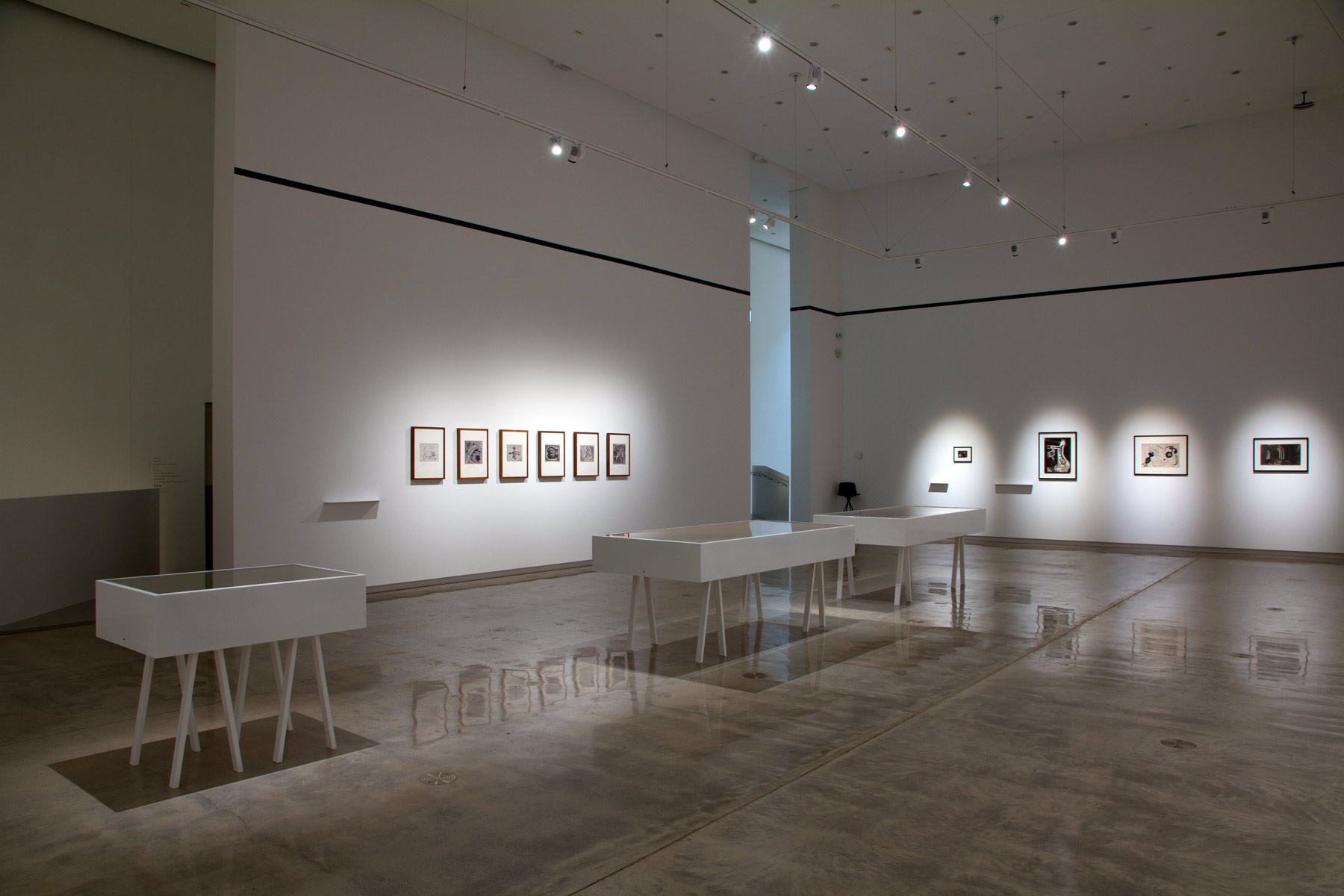
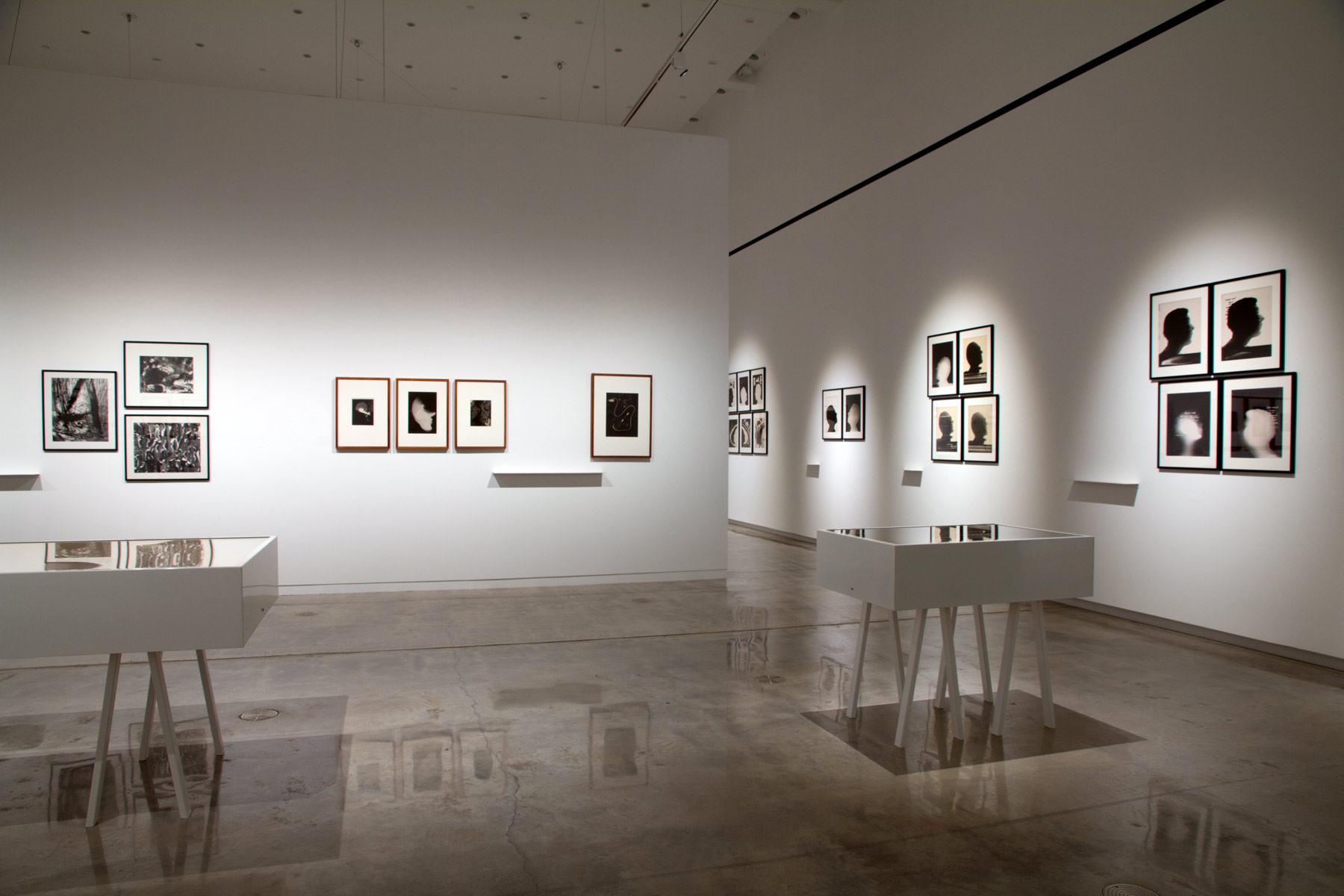
Exhibition: ‘Intersections: Photographs and Videos from the National Gallery of Art and the Corcoran Gallery of Art’ at the National Gallery of Art, Washington

Exhibition dates: 29th May, 2016 – 2nd January, 2017

Curators: Sarah Greenough, senior curator, department of photographs, and Philip Brookman, consulting curator, department of photographs, both National Gallery of Art, are the exhibition curators.


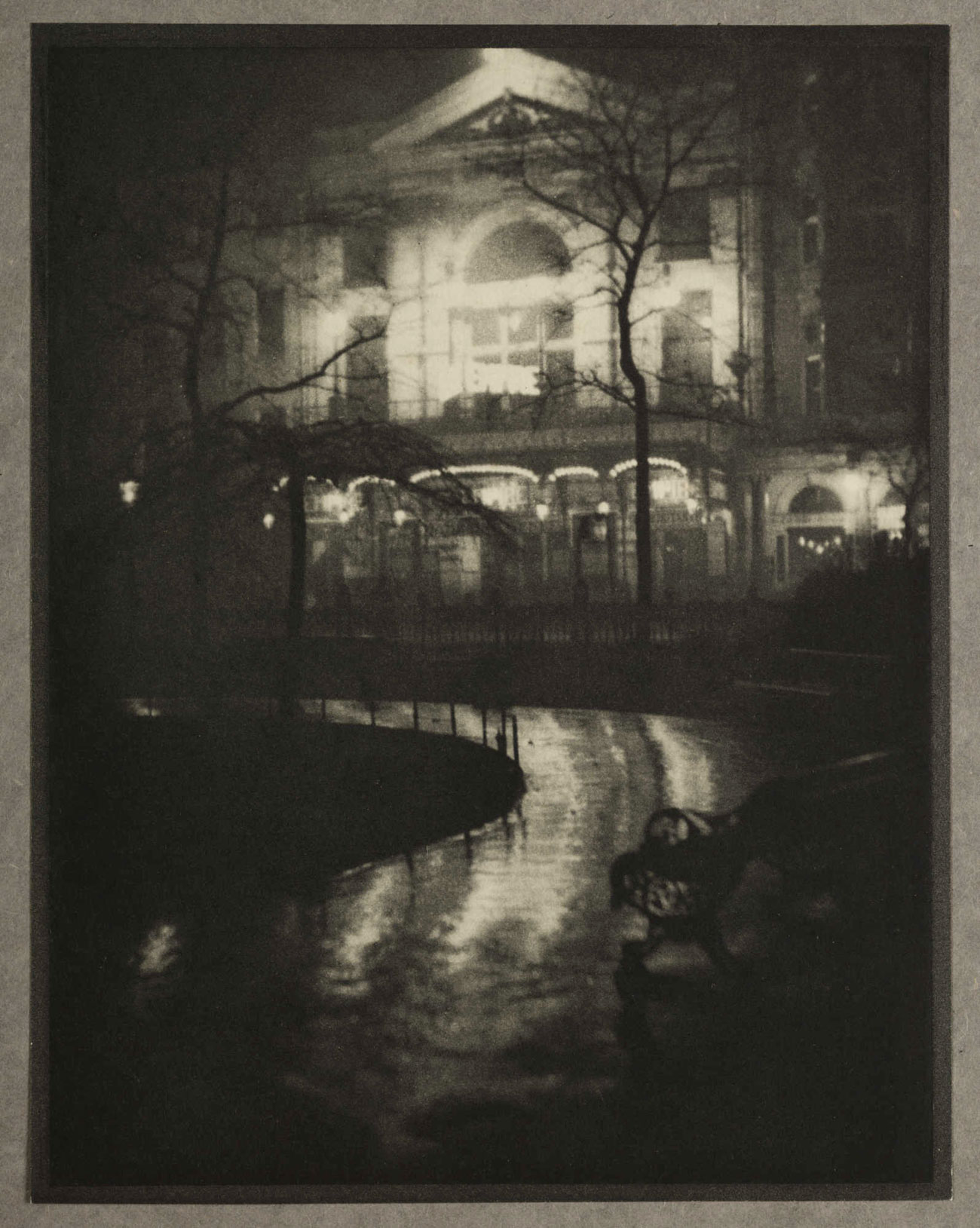
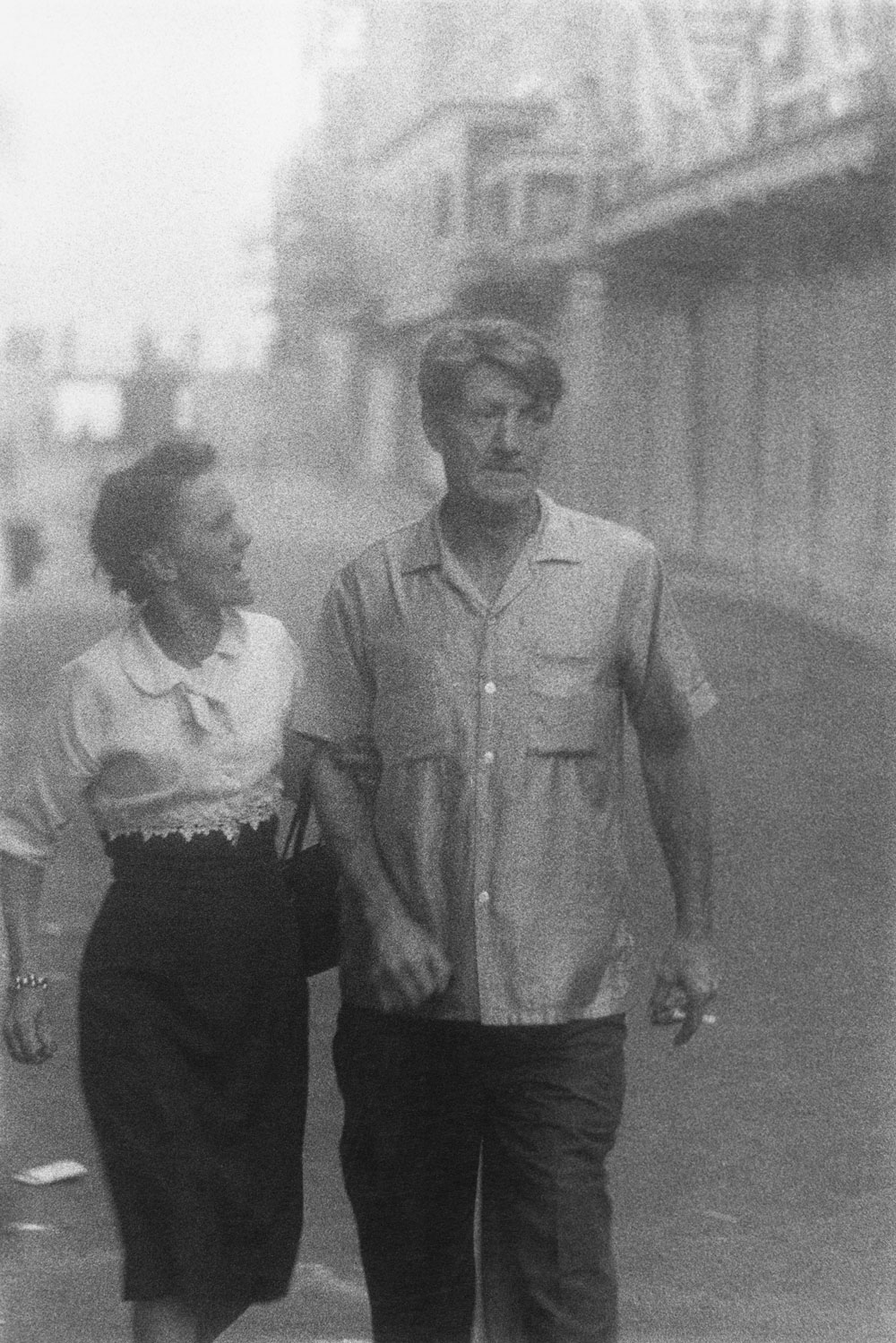
Louis Stettner (American, 1922-2016) 'Times Square, New York City' 1952-1954 from the exhibition Exhibition: 'Intersections: Photographs and Videos from the National Gallery of Art and the Corcoran Gallery of Art' at the National Gallery of Art, Washington, May 2016 - Jan 2017


Louis Stettner (American, 1922-2016)
Times Square, New York City
1952-1954
Gelatin silver print
Sheet (trimmed to image): 42.1 x 27.5cm (16 9/16 x 10 13/16 in.)
National Gallery of Art, Washington, Patrons’ Permanent Fund


The last posting of a fruitful year for Art Blart. I wish all the readers of Art Blart a happy and safe New Year!

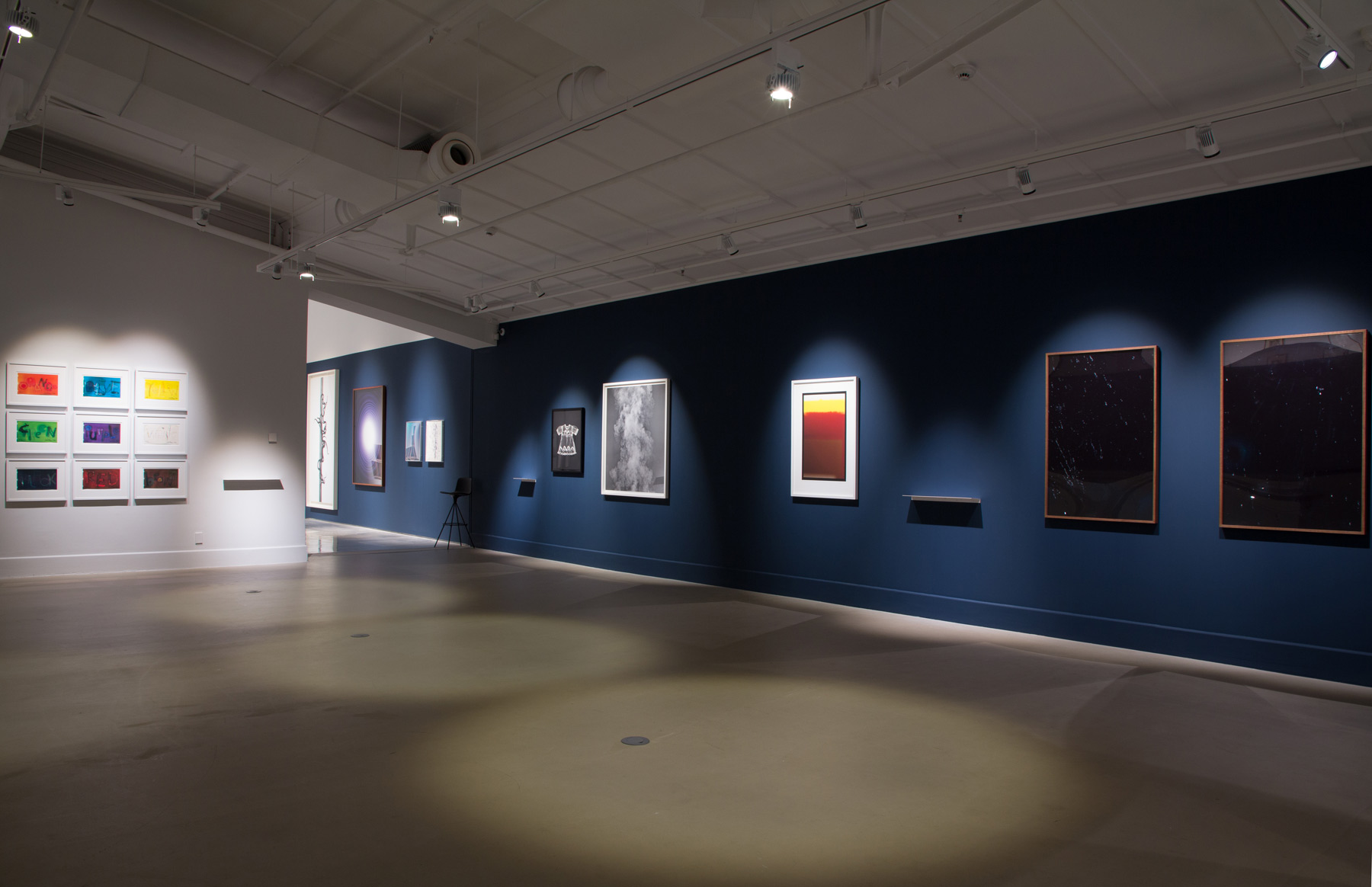
The exhibition is organised around five themes – movement, sequence, narrative, studio, and identity – found in the work of Muybridge and Stieglitz, themes then developed in the work of other artists. While there is some interesting work in the posting, the conceptual rationale and stand alone nature of the themes and the work within them is a curatorial ordering of ideas that, in reality, cannot be contained within any one boundary, the single point of view.

Movement can be contained in sequences; narrative can be unfolded in a sequence (as in the work of Duane Michals); narrative and identity have a complex association which can also be told through studio work (eg. Gregory Crewdson), etc… What does Roger Mayne’s Goalie, Street Football, Brindley Road (1956, below) not have to do with identity, the young lad with his dirty hands, playing in his socks, in a poverty stricken area of London; why has Hiroshi Sugimoto’s Oscar Wilde (1999, below) been included in the studio section when it has much more to do with the construction of identity through photography – “Triply removing his portrait from reality – from Oscar Wilde himself to a portrait photograph to a wax sculpture and back to a photograph” – which confounds our expectations of the nature of photography. Photography is nefariously unstable in its depiction of an always, constructed reality, through representation(s) which reject simple causality.

To isolate and embolden the centre is to disclaim and disavow the periphery, work which crosses boundaries, is multifaceted and multitudinous; work which forms a nexus for networks of association beyond borders, beyond de/lineation – the line from here to there. The self-contained themes within this exhibition are purely illusory.

Dr Marcus Bunyan


Many thankx to the National Gallery of Art for allowing me to publish the photographs in the posting. Please click on the photographs for a larger version of the image.


“We can no longer accept that the identity of a man can be adequately established by preserving and fixing what he looks like from a single viewpoint in one place.”


John Berger. “No More Portraits,” in New Society August 1967


“Intersections: Photographs and Videos from the National Gallery of Art and the Corcoran Gallery of Art explores the connections between the two newly joined photography collections. On view from May 29, 2016, through January 2, 2017, the exhibition is organised around themes found in the work of the two pioneers of each collection: Eadweard Muybridge (1830-1904) and Alfred Stieglitz (1864-1946). Inspired by these two seminal artists, Intersections brings together more than 100 highlights of the recently merged collections by a range of artists from the 1840s to today.

Just as the nearly 700 photographs from Muybridge’s groundbreaking publication Animal Locomotion, acquired by the Corcoran Gallery of Art in 1887, became the foundation for the institution’s early interest in photography, the Key Set of more than 1,600 works by Stieglitz, donated by Georgia O’Keeffe and the Alfred Stieglitz Estate, launched the photography collection at the National Gallery of Art in 1949.”

Press release from the National Gallery of Art


Exhibition highlights

The exhibition is organised around five themes – movement, sequence, narrative, studio, and identity – found in the work of Muybridge and Stieglitz.

Movement

Works by Muybridge, who is best known for creating photographic technologies to stop and record motion, anchor the opening section devoted to movement. Photographs by Berenice Abbott and Harold Eugene Edgerton, which study how objects move through space, are included, as are works by Roger Mayne, Alexey Brodovitch, and other who employed the camera to isolate an instant from the flux of time.

Wall text

Intersections wall text


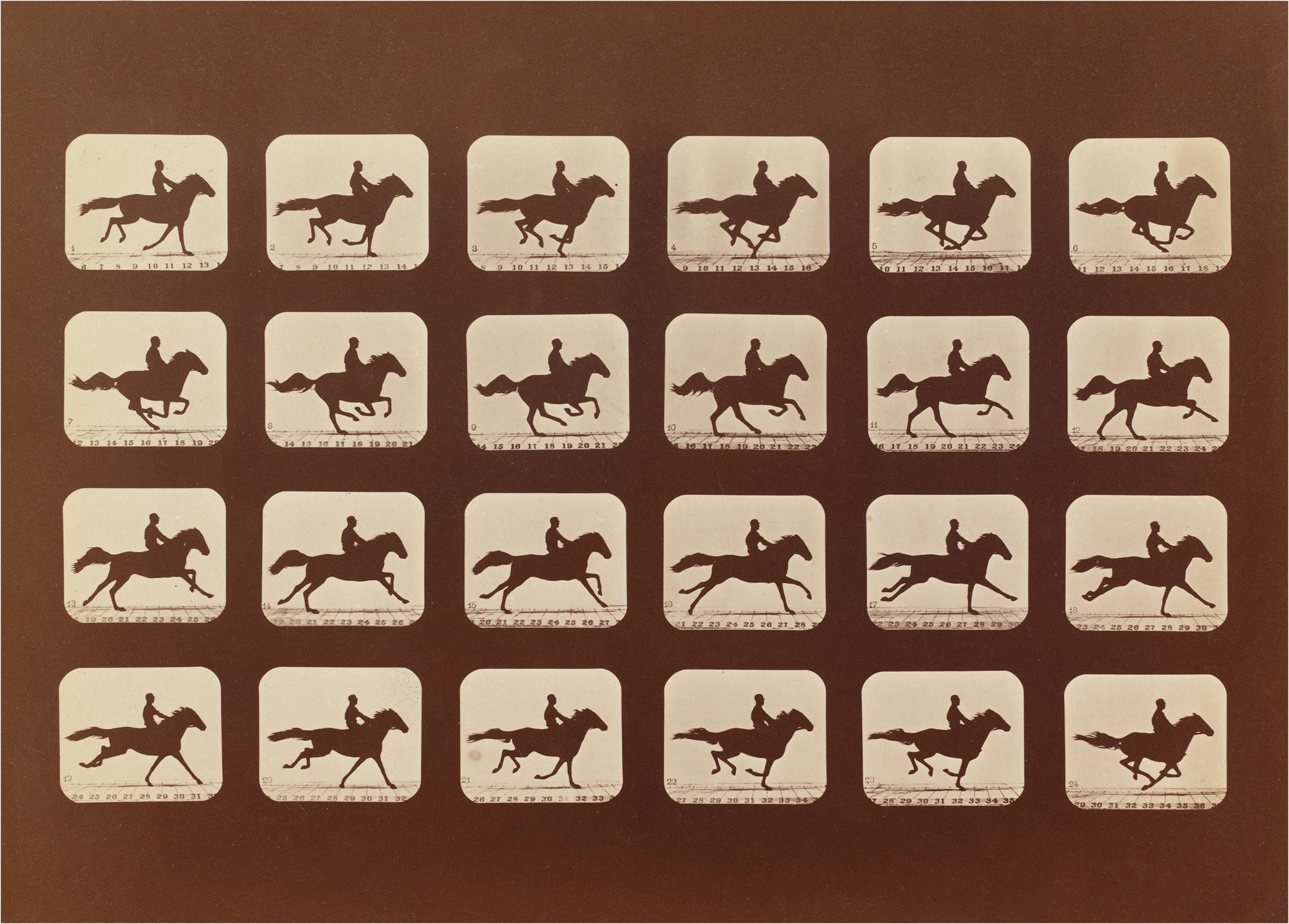
Eadweard Muybridge (English, 1830-1904) 'Horses. Running. Phyrne L. No. 40, from The Attitudes of Animals in Motion' 1879 from the National Gallery of Art and the Corcoran Gallery of Art' at the National Gallery of Art, Washington, May 2016 - Jan 2017


Eadweard Muybridge (English, 1830-1904)
Horses. Running. Phyrne L. No. 40, from The Attitudes of Animals in Motion
1879
Albumen print
Image: 16 x 22.4cm (6 5/16 x 8 13/16 in.)
Sheet: 25.7 x 32.4cm (10 1/8 x 12 3/4 in.)
National Gallery of Art, Washington, Gift of Mary and Dan Solomon


In order to analyse the movement of racehorses, farm animals, and acrobats, Muybridge pioneered new and innovative ways to stop motion with photography. In 1878, he started making pictures at railroad magnate Leland Stanford’s horse farm in Palo Alto, California, where he developed an electronic shutter that enabled exposures as fast as one-thousandth of a second. In this print from Muybridge’s 1881 album The Attitudes of Animals in Motion, Stanford’s prized racehorse Phryne L is shown running in a sequential grid of pictures made by 24 different cameras with electromagnetic shutters tripped by wires as the animal ran across the track. These pictures are now considered a critical step in the development of cinema.
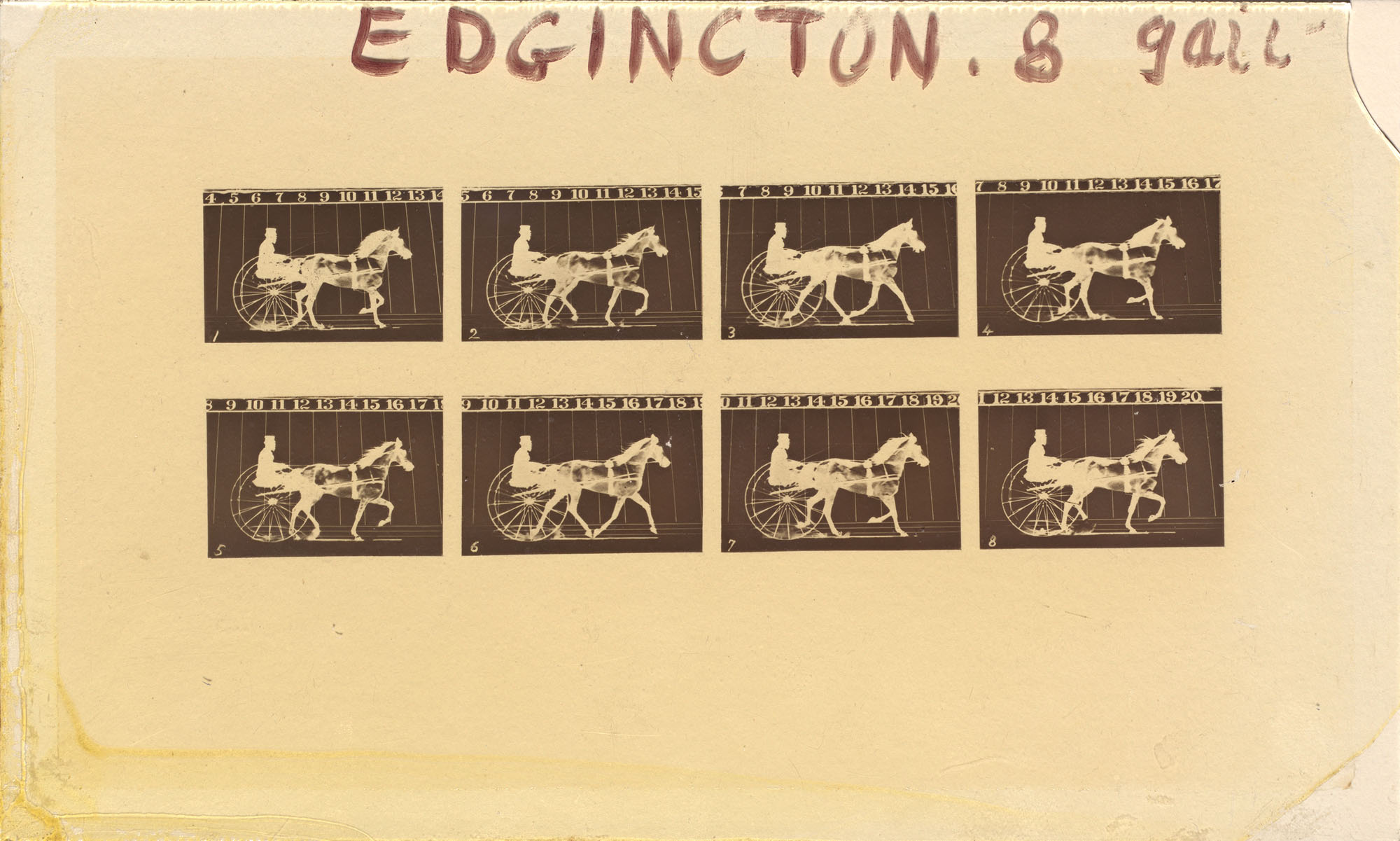
 

Eadweard Muybridge (English, 1830-1904) 'Internegative for Horses. Trotting. Abe Edgington. No. 28, from The Attitudes of Animals in Motion' 1878


Eadweard Muybridge (English, 1830-1904)
Internegative for Horses. Trotting. Abe Edgington. No. 28, from The Attitudes of Animals in Motion
1878
Collodion negative
Overall (glass plate): 15.3 x 25.4cm (6 x 10 in.)
National Gallery of Art, Washington, Gift of Mary and Dan Solomon and Patrons’ Permanent Fund


This glass negative shows the sequence of Leland Stanford’s horse Abe Edgington trotting across a racetrack in Palo Alto, California – a revolutionary record of the changes in the horse’s gait in about one second. Muybridge composed the negative from photographs made by eight different cameras lined up to capture the horse’s movements. Used to print the whole sequence together onto albumen paper, this internegative served as an intermediary step in the production of Muybridge’s 1881 album The Attitudes of Animals in Motion.
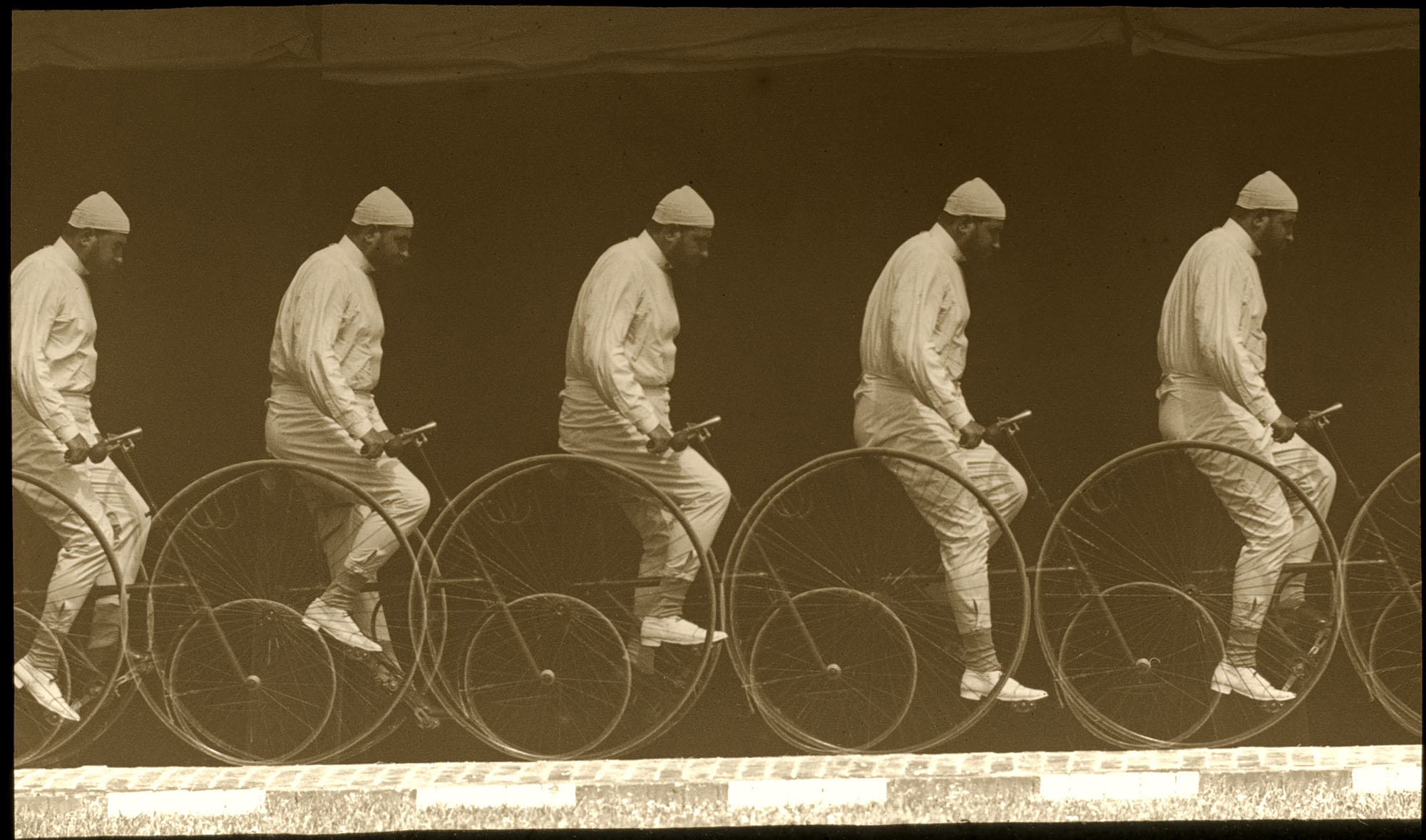
 

Étienne Jules Marey (French, 1830-1904) 'Chronophotograph of a Man on a Bicycle' c. 1885-1890


Étienne Jules Marey (French, 1830-1904)
Chronophotograph of a Man on a Bicycle
c. 1885-1890
Glass lantern slide
Image: 4 x 7.5cm (1 9/16 x 2 15/16 in.)
Plate: 8.8 x 10.2cm (3 7/16 x 4 in.)
National Gallery of Art, Washington, Gift of Mary and David Robinson


A scientist and physiologist, Marey became fascinated with movement in the 1870s. Unlike Muybridge, who had already made separate pictures of animals in motion, Marey developed in 1882 a means to record several phases of movement onto one photographic plate using a rotating shutter with slots cut into it. He called this process “chronophotography,” meaning photography of time. His photographs, which he published in books and showed in lantern slide presentations, influenced 20th-century cubist, futurist, and Dada artists who examined the interdependence of time and space.
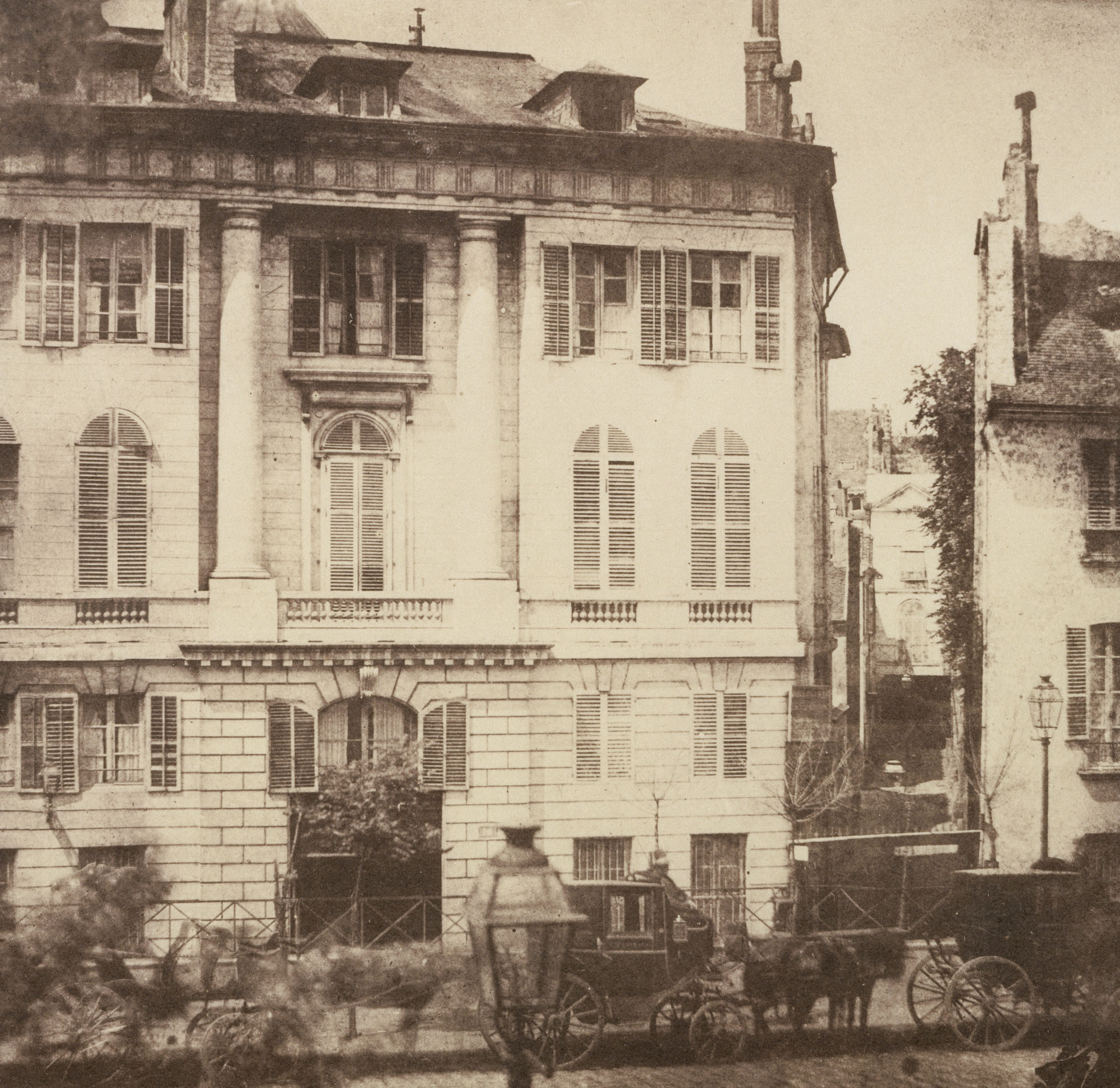
 

William Henry Fox Talbot (English, 1800-1877) 'The Boulevards of Paris' 1843


William Henry Fox Talbot (English, 1800-1877)
The Boulevards of Paris
1843
Salted paper print
Image: 16.6 × 17.1cm (6 9/16 × 6 3/4 in.)
Sheet: 19 × 23.2cm (7 1/2 × 9 1/8 in.)
National Gallery of Art, Washington, New Century Fund


As soon as Talbot announced his invention of photography in 1839, he realised that its ability to freeze time enabled him to present the visual spectacle of the world in an entirely new way. By capturing something as mundane as a fleeting moment on a busy street, he could transform life into art, creating a picture that could be savoured long after the event had transpired.


David Octavius Hill (Scottish, 1802-1870) and Robert Adamson (Scottish, 1821-1848) 'Colinton Manse and weir, with part of the old mill on the right' 1843-1847


David Octavius Hill (Scottish, 1802-1870) and Robert Adamson (Scottish, 1821-1848)
Colinton Manse and weir, with part of the old mill on the right
1843-1847
Salted paper print
Image: 20.7 x 14.6cm (8 1/8 x 5 3/4 in.)
National Gallery of Art, Washington, Paul Mellon Fund


In 1843, only four years after Talbot announced his negative / positive process of photography, painter David Octavius Hill teamed up with engineer Robert Adamson. Working in Scotland, they created important early portraits of the local populace and photographed Scottish architecture, rustic landscapes, and city scenes. Today a suburb southwest of Edinburgh, 19th-century Colinton was a mill town beside a river known as the Water of Leith. Because of the long exposure time required to make this photograph, the water rushing over a small dam appears as a glassy blur.


Thomas Annan (Scottish, 1829-1887) 'Old Vennel, Off High Street' 1868-1871


Thomas Annan (Scottish, 1829-1887)
Old Vennel, Off High Street
1868-1871
Carbon print
Image: 26.9 x 22.3cm (10 9/16 x 8 3/4 in.)
Sheet: 50.8 x 37.9cm (20 x 14 15/16 in.)
National Gallery of Art, Washington, Patrons’ Permanent Fund


In 1868, Glasgow’s City Improvements Trust hired Annan to photograph the “old closes and streets of Glasgow” before the city’s tenements were demolished. Annan’s pictures constitute one of the first commissioned photographic records of living conditions in urban slums. The collodion process Annan used to make his large, glass negatives required a long exposure time. In the dim light of this narrow passage, it was impossible for the photographer to stop the motion of the restless children, who appear as ghostly blurs moving barefoot across the cobblestones.
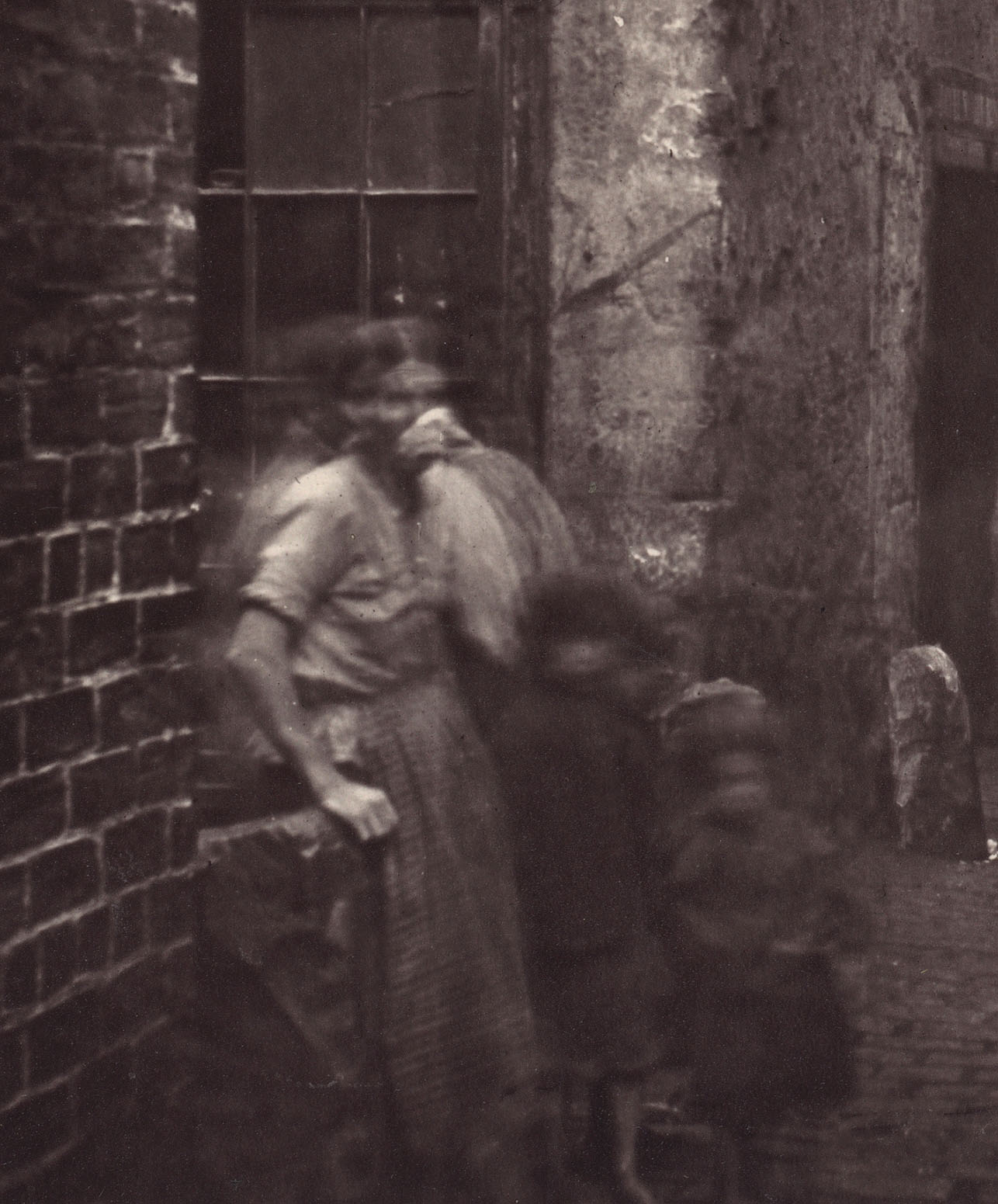
 

Thomas Annan (Scottish, 1829-1887) 'Old Vennel, Off High Street' 1868-1871 (detail)


Thomas Annan (Scottish, 1829-1887)
Old Vennel, Off High Street (detail)
1868-1871
Carbon print
Image: 26.9 x 22.3cm (10 9/16 x 8 3/4 in.)
Sheet: 50.8 x 37.9cm (20 x 14 15/16 in.)
National Gallery of Art, Washington, Patrons’ Permanent Fund
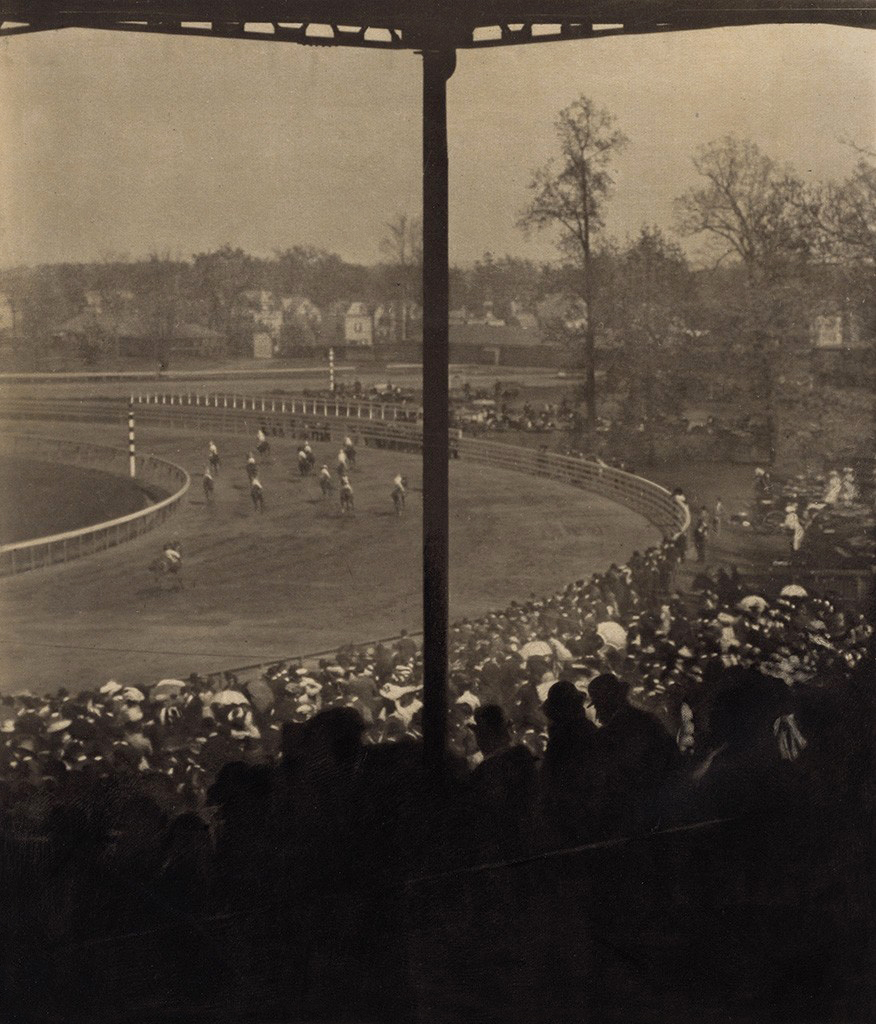
 

Alfred Stieglitz (American, 1864-1946) 'Going to the Post, Morris Park' 1904


Alfred Stieglitz (American, 1864-1946)
Going to the Post, Morris Park
1904
Photogravure
Image: 30.8 x 26.4cm (12 1/8 x 10 3/8 in.)
Sheet: 38.5 x 30.3cm (15 3/16 x 11 15/16 in.)
National Gallery of Art, Washington, Alfred Stieglitz Collection


In the 1880s and 1890s, improvements in photographic processes enabled manufacturers to produce small, handheld cameras that did not need to be mounted on tripods. Faster film and shutter speeds also allowed practitioners to capture rapidly moving objects. Stieglitz was one of the first fine art photographers to exploit the aesthetic potential of these new cameras and films. Around the turn of the century, he made many photographs of rapidly moving trains, horse-drawn carriages, and racetracks that capture the pace of the increasingly modern city.


Harold Eugene Edgerton (American, 1903-1990) 'Wes Fesler Kicking a Football' 1934


Harold Eugene Edgerton (American, 1903-1990)
Wes Fesler Kicking a Football
1934
Gelatin silver print
Image: 11 1/2 x 9 5/8 in.
Sheet: 13 15/16 x 11 in.
National Gallery of Art, Washington, Corcoran Collection (Museum Purchase with the aid of funds from the National Endowment for the Arts, Washington, D.C., a Federal Agency, and The Polaroid Corporation)


A professor of electrical engineering at the Massachusetts Institute of Technology, Edgerton in the early 1930s invited the stroboscope, a tube filled with gas that produced high-intensity bursts of light at regular and very brief intervals. He used it to illuminate objects in motion so that they could be captured by a camera. At first he was hired by industrial clients to reveal flaws in their production of materials, but by the mid-1930s he began to photography everyday events… Edgerton captured phenomena moving too fast for the naked eye to see, and revealed the beauty of people and objects in motion.
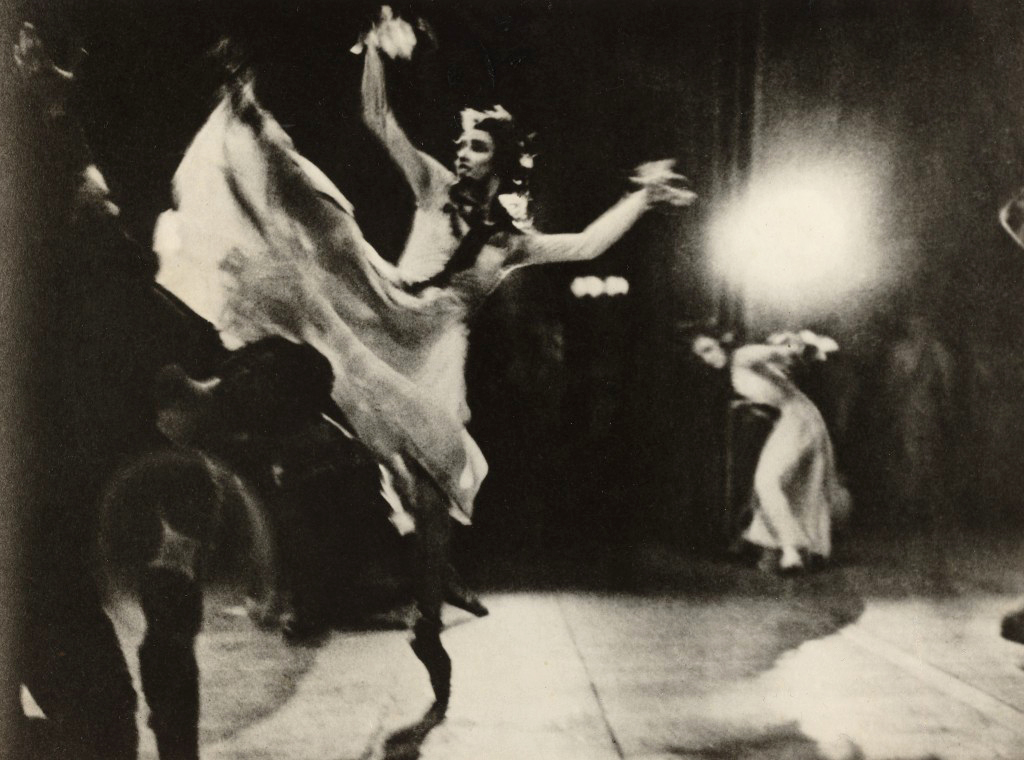
 

Alexey Brodovitch (American born Russia, 1898-1971) 'Untitled from "Ballet" series' 1938


Alexey Brodovitch (American born Russia, 1898-1971)
Untitled from “Ballet” series
1938
Gelatin silver print
Overall: 20.4 x 27.5cm (8 1/16 x 10 13/16 in.)
National Gallery of Art, Washington, Diana and Mallory Walker Fund


A graphic artist, Russian-born Brodovitch moved to the United States from Paris in 1930. Known for his innovative use of photographs, illustrations, and type on the printed page, he became art director for Harper’s Bazaar in 1934, and photographed the Ballets Russes de Monte Carlo during their American tours from 1935 to 1939. Using a small-format, 35 mm camera, Brodovitch worked in the backstage shadows and glaring light of the theatre to produce a series of rough, grainy pictures that convey the drama and action of the performance. This photograph employs figures in motion, a narrow field of focus, and high-contrast effects to express the stylised movements of Léonide Massine’s 1938 choreography for Beethoven’s Seventh Symphony.
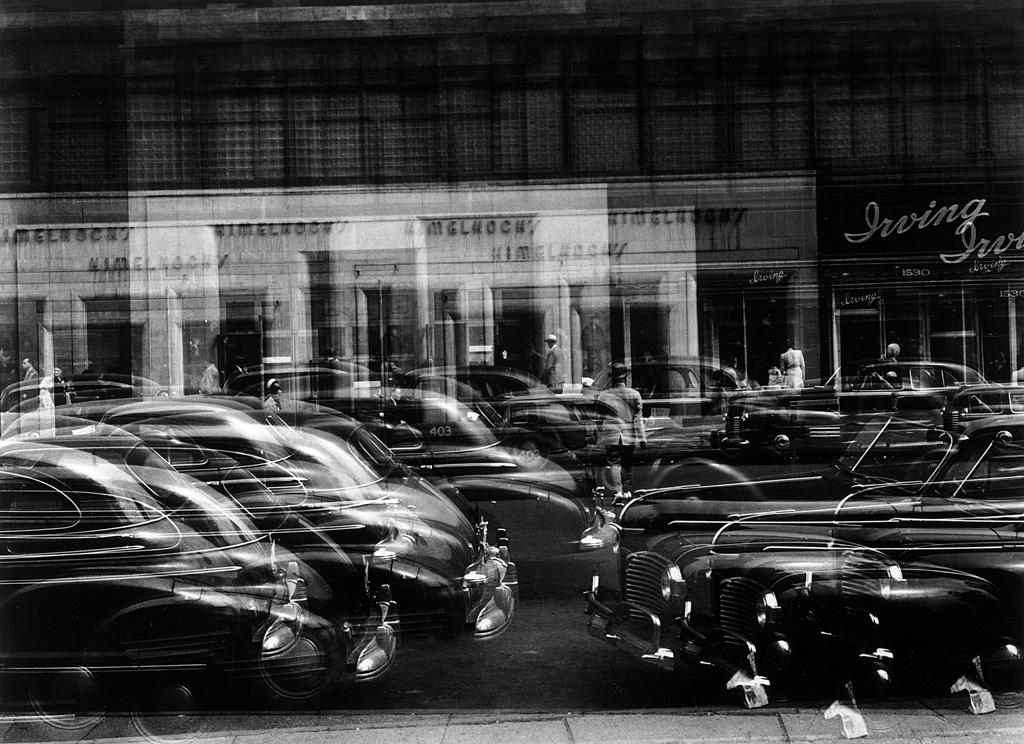
 

Harry Callahan (American, 1912-1999) 'Detroit' 1943


Harry Callahan (American, 1912-1999)
Detroit
c. 1943
Dye imbibition print, printed c. 1980
Overall (image): 18 x 26.7cm (7 1/16 x 10 1/2 in.)
Sheet: 27.31 x 36.83cm (10 3/4 x 14 1/2 in.)
National Gallery of Art, Washington, Gift of the Callahan Family
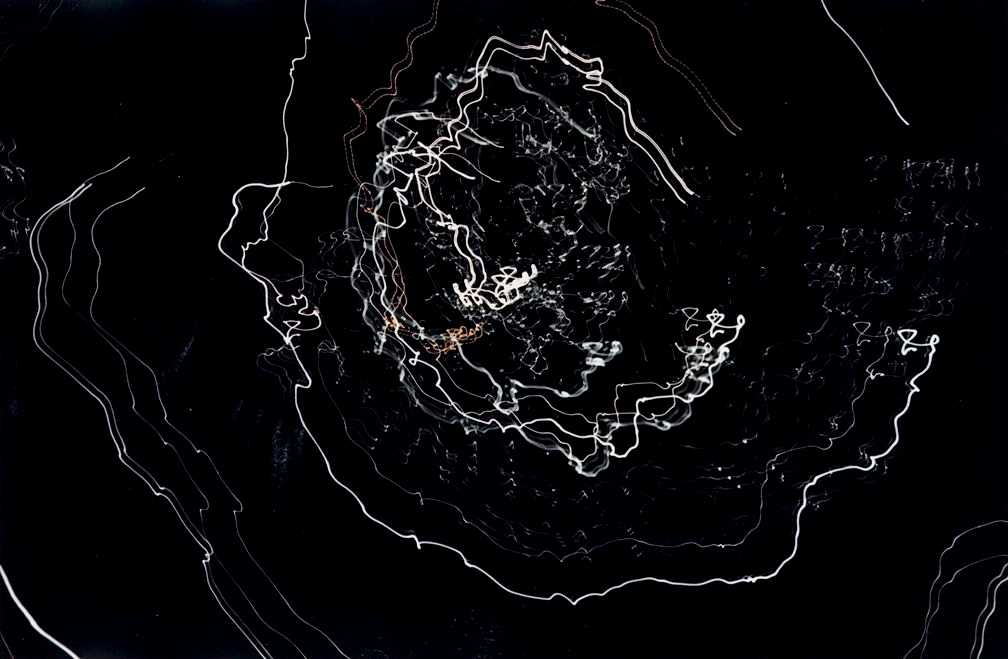
 

Harry Callahan (American, 1912-1999) 'Camera Movement on Neon Lights at Night' 1946


Harry Callahan (American, 1912-1999)
Camera Movement on Neon Lights at Night
1946
Dye imbibition print, printed 1979
Image: 8 3/4 x 13 5/8 in.
Sheet: 10 3/8 x 13 15/16 in.
National Gallery of Art, Washington, Corcoran Collection (Gift of Richard W. and Susan R. Gessner)
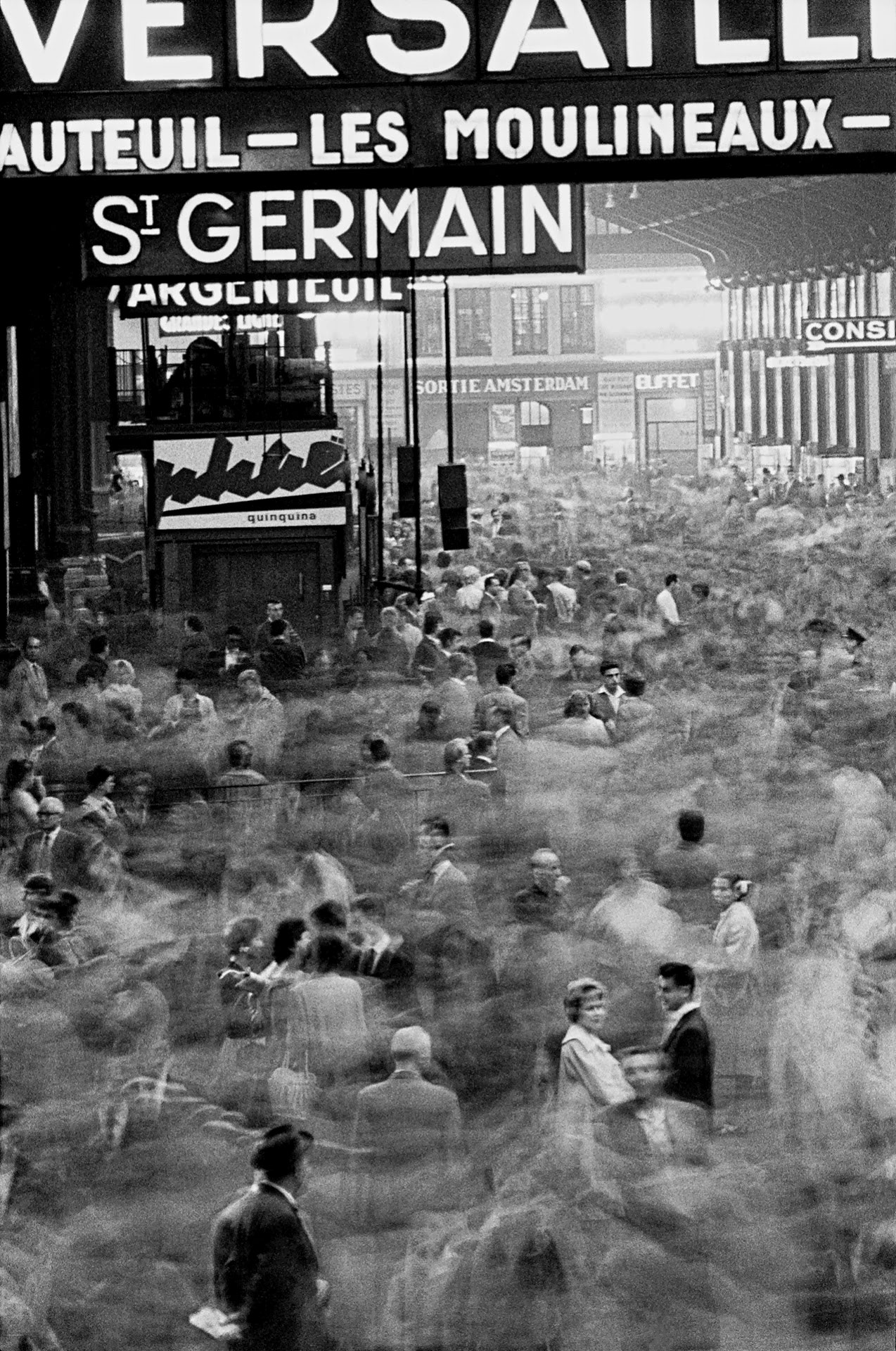
 

Frank Horvat (Italian, 1928-2020) 'Paris, Gare Saint-Lazare' 1959


Frank Horvat (Italian, 1928-2020)
Paris, Gare Saint-Lazare
1959
Gelatin silver print
Overall: 39.3 x 26.2cm (15 1/2 x 10 5/16 in.)
National Gallery of Art, Washington, Patrons’ Permanent Fund


Gare Saint-Lazare is one of the principal railway stations in Paris. Because of its industrial appearance, steaming locomotives, and teeming crowds, it was a frequent subject for 19th-century French painters – including Claude Monet, Édouard Manet, and Gustave Caillebotte – who used it to express the vitality of modern life. 20th-century artists such as Horvat also depicted it to address the pace and anonymity that defined their time. Using a telephoto lens and long exposure, he captured the rushing movement of travellers scattered beneath giant destination signs.
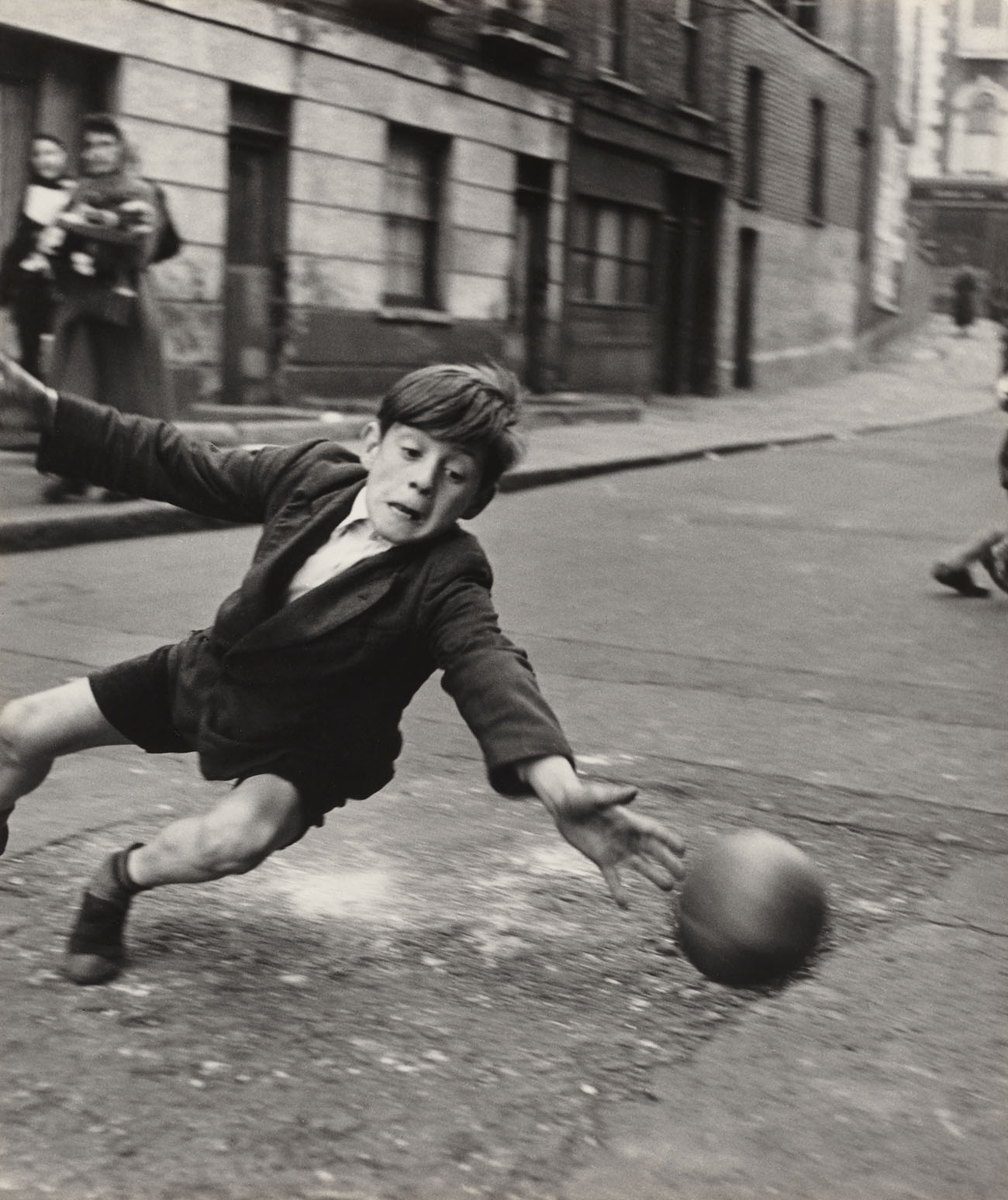
 

Roger Mayne (English, 1929-2014) 'Goalie, Street Football, Brindley Road' 1956


Roger Mayne (English, 1929-2014)
Goalie, Street Football, Brindley Road
1956
Gelatin silver print
Image: 34.7 × 29.1cm (13 11/16 × 11 7/16 in.)
National Gallery of Art, Washington, Patrons’ Permanent Fund


From 1956 to 1961, Mayne photographed London’s North Kensington neighbourhood to record its emergence from the devastation and poverty caused by World War II. This dramatic photograph of a young goalie lunging for the ball during an after-school soccer game relies on the camera’s ability to freeze the fast-paced and unpredictable action. Because the boy’s daring lunge is forever suspended in time, we will never know its outcome.
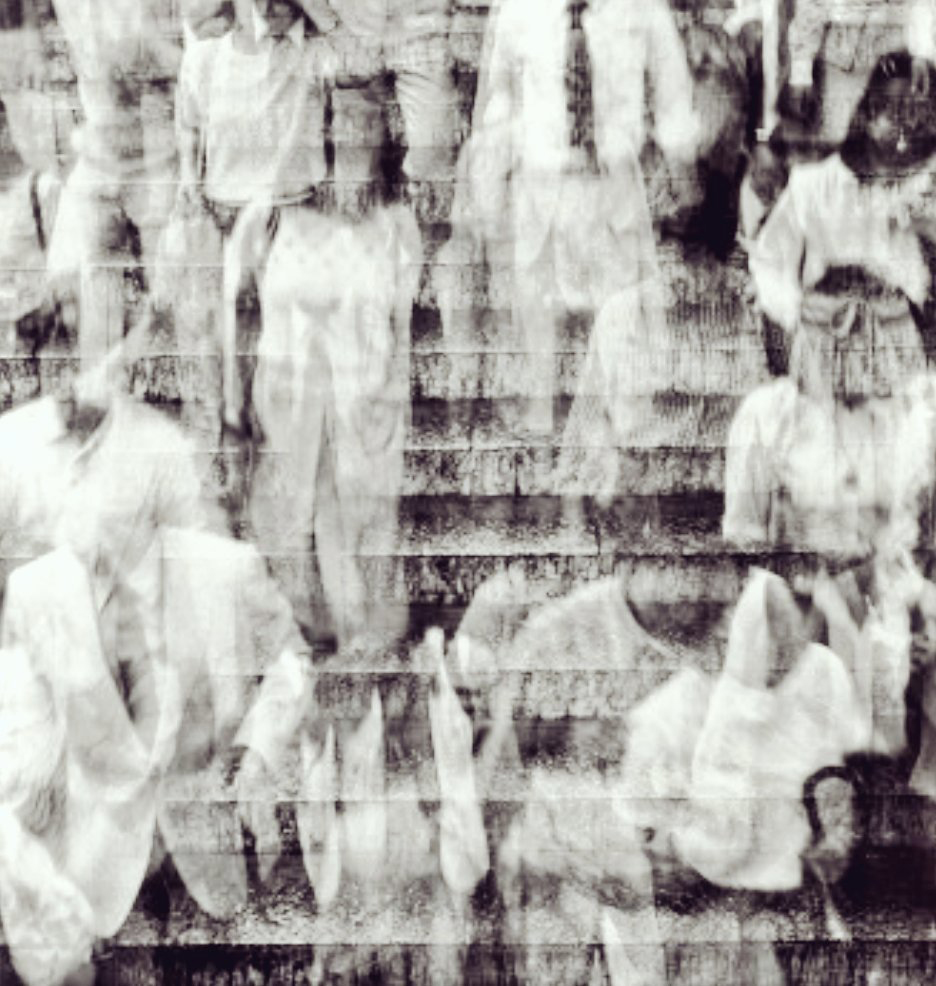
 

Shōmei Tōmatsu (Japanese, 1930-2012) 'Rush Hour, Tokyo' 1981 (detail)


Shōmei Tōmatsu (Japanese, 1930-2012)
Rush Hour, Tokyo (detail)
1981
Gelatin silver print
Sheet: 11 5/16 x 9 7/16 in. (28.73 x 23.97 cm)
National Gallery of Art, Washington, Corcoran Collection (Gift of Michael D. Abrams)


Best known for his expressive documentation of World War II’s impact on Japanese culture, Tomatsu was one of Japan’s most creative and influential photographers. Starting in the early 1960s, he documented the country’s dramatic economic, political, and cultural transformation. This photograph – a long exposure made with his camera mounted on a tripod – conveys the chaotic rush of commuters on their way through downtown Tokyo. Tomatsu used this graphic description of movement, which distorts the faceless bodies of commuters dashing down a flight of stairs, to symbolise the dehumanising nature of work in the fast-paced city of the early 1980s.


Sequence

Muybridge set up banks of cameras and used electronic shutters triggered in sequence to analyse the motion of people and animals. Like a storyteller, he sometimes adjusted the order of images for visual and sequential impact. Other photographers have also investigated the medium’s capacity to record change over time, express variations on a theme, or connect seemingly disparate pictures. In the early 1920s, Stieglitz began to create poetic sequences of cloud photographs meant to evoke distinct emotional experiences. These works (later known as Equivalents) influenced Ansel Adams and Minor White – both artists created specific sequences to evoke the rhythms of nature or the poetry of time passing.

Wall text

Intersections wall text


Alfred Stieglitz (American, 1864-1946) 'From My Window at An American Place, Southwest' March 1932


Alfred Stieglitz (American, 1864-1946)
From My Window at An American Place, Southwest
March 1932
Gelatin silver print
Sheet (trimmed to image): 23.8 x 18.4cm (9 3/8 x 7 1/4 in.)
National Gallery of Art, Washington, Alfred Stieglitz Collection


Alfred Stieglitz (American, 1864-1946) 'From My Window at An American Place, Southwest' April 1932


Alfred Stieglitz (American, 1864-1946)
From My Window at An American Place, Southwest
April 1932
Gelatin silver print
Sheet (trimmed to image): 23.8 x 18.8cm (9 3/8 x 7 3/8 in.)
National Gallery of Art, Washington, Alfred Stieglitz Collection
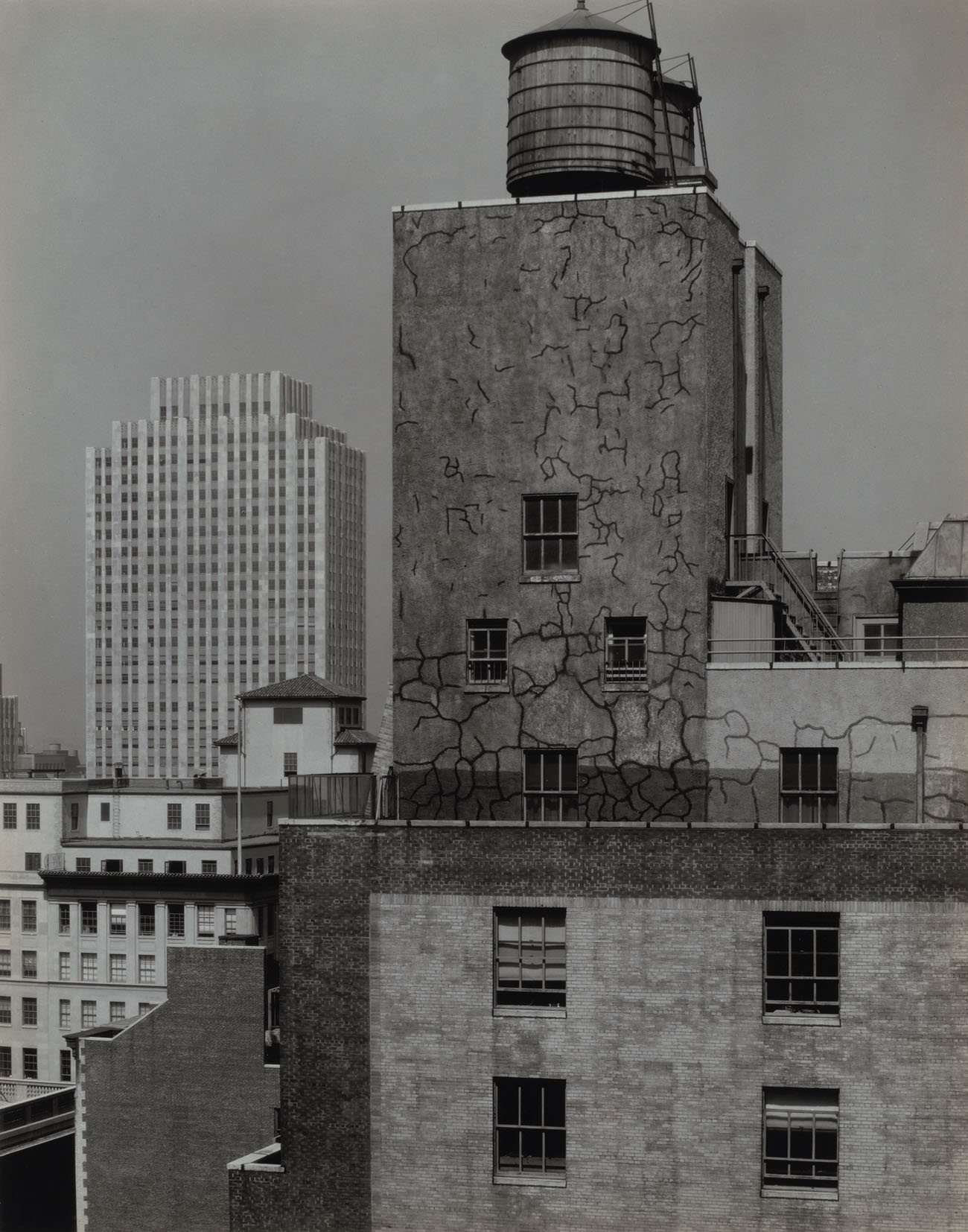
 

Alfred Stieglitz (American, 1864-1946) 'Water Tower and Radio City, New York' 1933


Alfred Stieglitz (American, 1864-1946)
Water Tower and Radio City, New York
1933
Gelatin silver print
Sheet: 23.7 x 18.6cm (9 5/16 x 7 5/16 in.)
National Gallery of Art, Washington, Alfred Stieglitz Collection


Whenever Stieglitz exhibited his photographs of New York City made in the late 1920s and early 1930s, he grouped them into series that record views from the windows of his gallery, An American Place, or his apartment at the Shelton Hotel, showing the gradual growth of the buildings under construction in the background. Although he delighted in the formal beauty of the visual spectacle, he lamented that these buildings, planned in the exuberance of the late 1920s, continued to be built in the depths of the Depression, while “artists starved,” as he said at the time, and museums were “threatened with closure.”
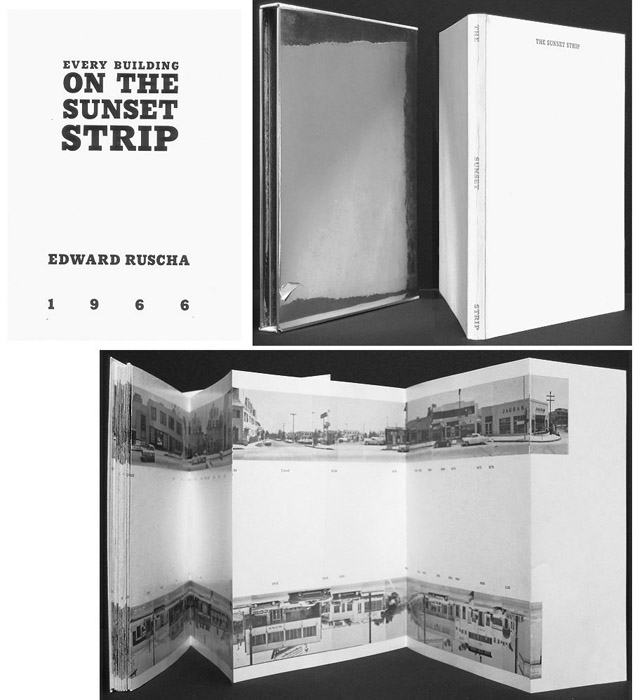
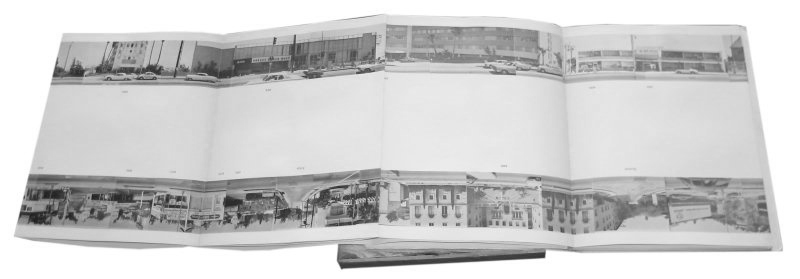
 

Ed Ruscha (American, b. 1937) 'Every Building on Sunset Strip' 1966

Ed Ruscha (American, b. 1937) 'Every Building on Sunset Strip' 1966

Ed Ruscha (American, b. 1937) 'Every Building on Sunset Strip' 1966


Ed Ruscha (American, b. 1937)
Every Building on the Sunset Strip
1966
Offset lithography book: 7 x 5 3/4 in. (17.78 x 14.61cm)
Unfolded (open flat): 7 x 276 in.
National Gallery of Art, Washington, Corcoran Collection (Gift of Philip Brookman and Amy Brookman)
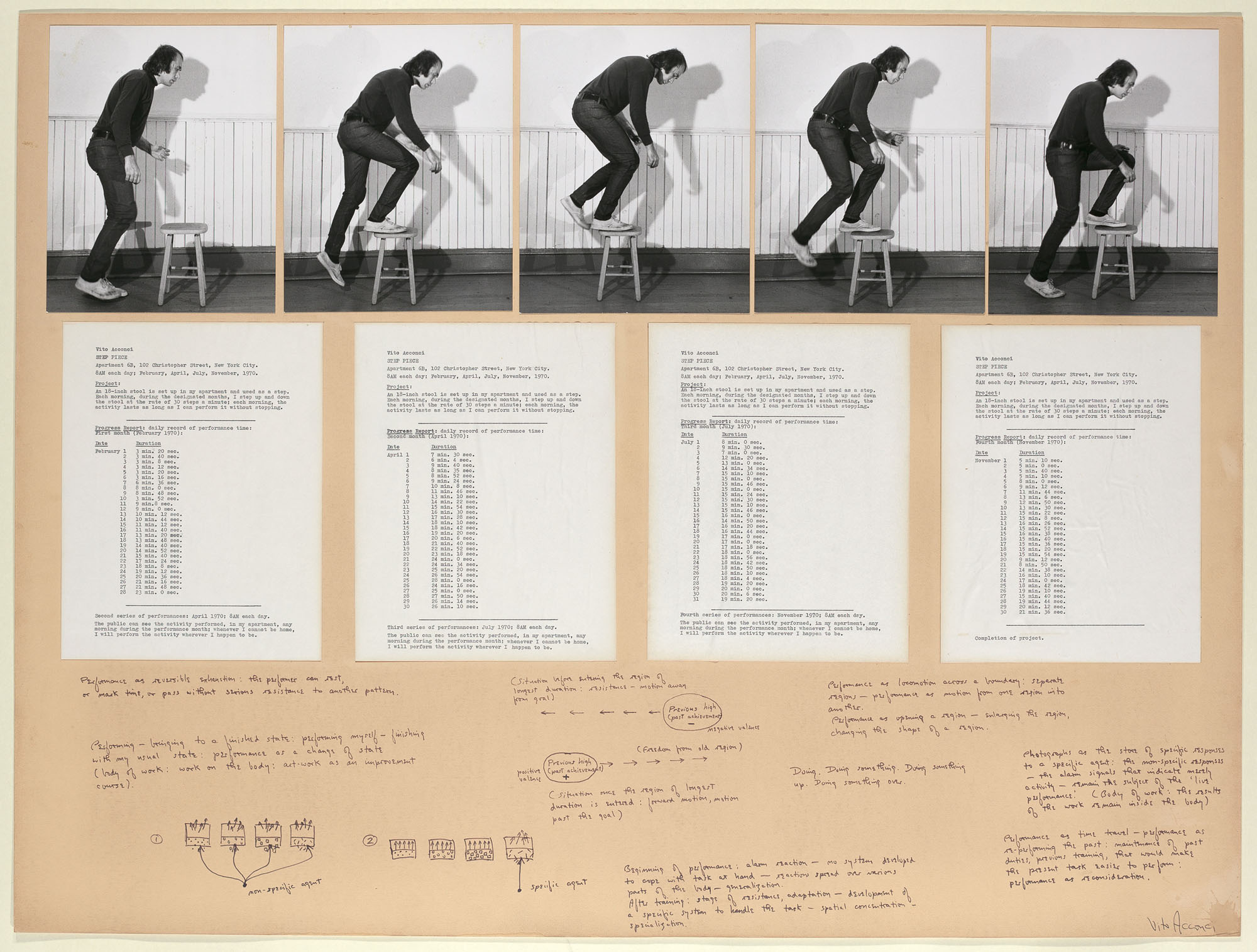
 

Vito Acconci (American, 1940-2017) 'Step Piece' 1970


Vito Acconci (American, 1940-2017)
Step Piece
1970
Five gelatin silver prints and four sheets of type-written paper, mounted on board with annotations in black ink
Sheet: 76.2 x 101.6cm (30 x 40 in.)
National Gallery of Art, Washington, Dorothy and Herbert Vogel Collection


Acconci’s Step Piece is made up of equal parts photography, drawing, performance, and quantitative analysis. It documents a test of endurance: stepping on and off a stool for as long as possible every day. This performance-based conceptual work is rooted in the idea that the body itself can be a medium for making art. To record his activity, Acconci made a series of five photographs spanning one complete action. Like the background grid in many of Muybridge’s motion studies, vertical panels in Acconci’s studio help delineate the space. His handwritten notes and sketches suggest the patterns of order and chaos associated with the performance, while typewritten sheets, which record his daily progress, were given to people who were invited to observe.


Narrative

The exhibition also explores the narrative possibilities of photography found in the interplay of image and text in the work of Robert Frank, Larry Sultan, and Jim Goldberg; the emotional drama of personal crisis in Nan Goldin’s image grids; or the expansion of photographic description into experimental video and film by Victor Burgin and Judy Fiskin.

Wall text

Intersections wall text


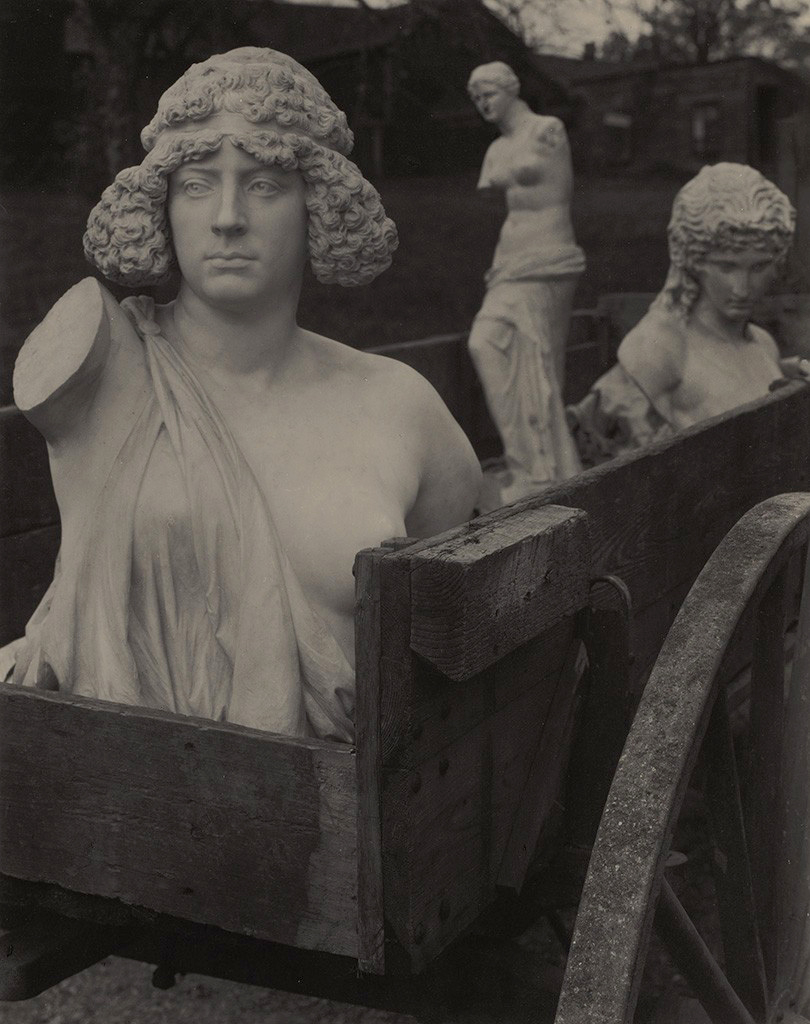
Alfred Stieglitz (American, 1864-1946) 'Judith Being Carted from Oaklawn to the Hill. The Way Art Moves' 1920


Alfred Stieglitz (American, 1864-1946)
Judith Being Carted from Oaklawn to the Hill. The Way Art Moves
1920
Gelatin silver print
Image: 24.1 x 18.8cm (9 1/2 x 7 3/8 in.)
Sheet: 25.2 x 20.1cm (9 15/16 x 7 15/16 in.)
National Gallery of Art, Washington, Alfred Stieglitz Collection


In 1920, Stieglitz’s family sold their Victorian summerhouse on the shore of Lake George, New York, and moved to a farmhouse on a hill above it. This photograph shows three sculptures his father had collected – two 19th-century replicas of ancient statues and a circa 1880 bust by Moses Ezekiel depicting the Old Testament heroine Judith – as they were being moved in a wooden cart from one house to another. Stieglitz titled it The Way Art Moves, wryly commenting on the low status of art in American society. With her masculine face and bared breast, Judith was much maligned by Georgia O’Keeffe and other younger family members. In a playful summer prank, they later buried her somewhere near the farmhouse, where she remained lost, despite many subsequent efforts by the perpetrators themselves to find her.
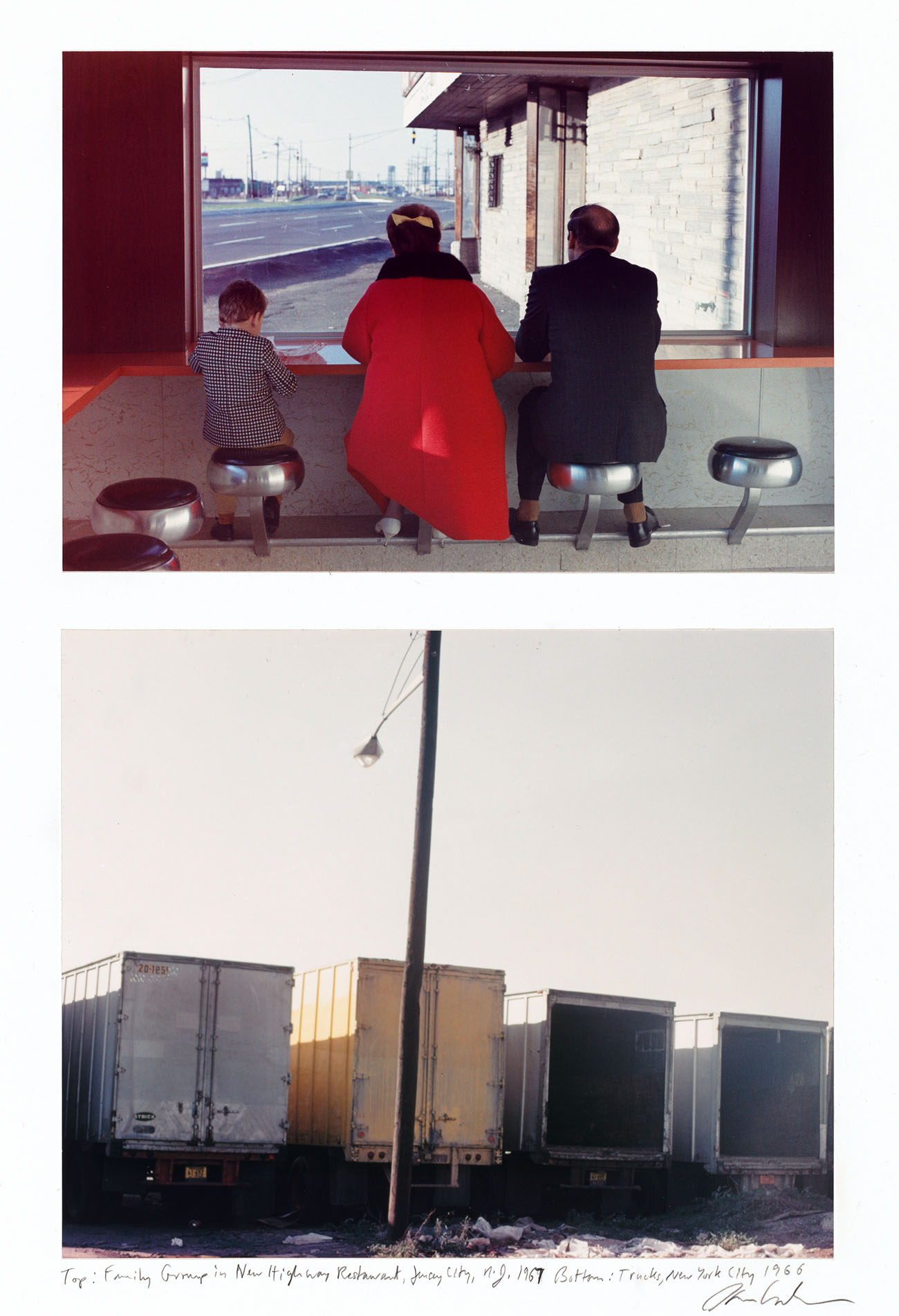
 

Dan Graham (American, 1942-2022) 'Homes for America' 1966-1967


Dan Graham (American, 1942-2022)
Homes for America
1966-1967
Two chromogenic prints
Image (top): 23 x 34cm (9 1/16 x 13 3/8 in.)
Image (bottom): 27.8 x 34cm (10 15/16 x 13 3/8 in.)
Mount: 101 x 75cm (39 3/4 x 29 1/2 in.)
Framed: 102 x 76.2 x 2.8cm (40 3/16 x 30 x 1 1/8 in.)
National Gallery of Art, Washington, Glenstone in honour of Eileen and Michael Cohen


Beginning in the mid-1960s, conceptual artist Dan Graham created several works of art for magazine pages and slide shows. When Homes for America was designed for Arts magazine in 1966, his accompanying text critiqued the mass production of cookie-cutter homes, while his photographs – made with an inexpensive Kodak Instamatic camera – described a suburban world of offices, houses, restaurants, highways, and truck stops. With their haphazard composition and amateur technique, Graham’s pictures ironically scrutinised the aesthetics of America’s postwar housing and inspired other conceptual artists to incorporate photographs into their work. Together, these two photographs link a middle-class family at the opening of a Jersey City highway restaurant with the soulless industrial landscape seen through the window.
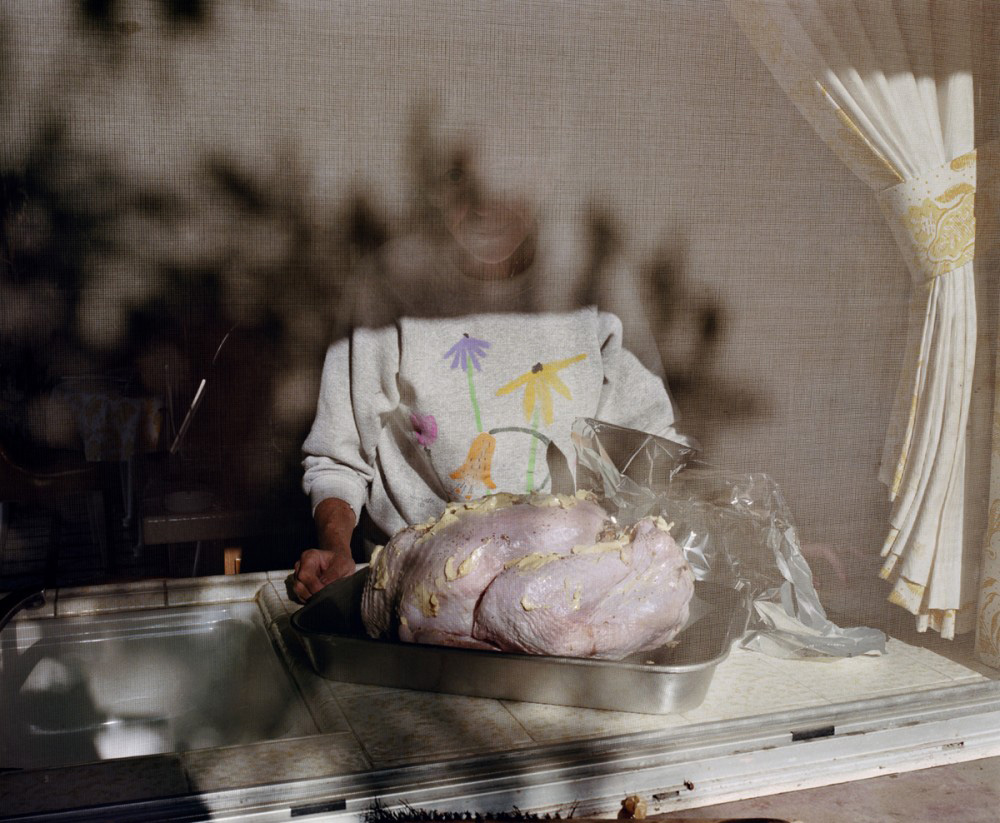
 

Larry Sultan (American, 1946-2009) 'Thanksgiving Turkey' 1985

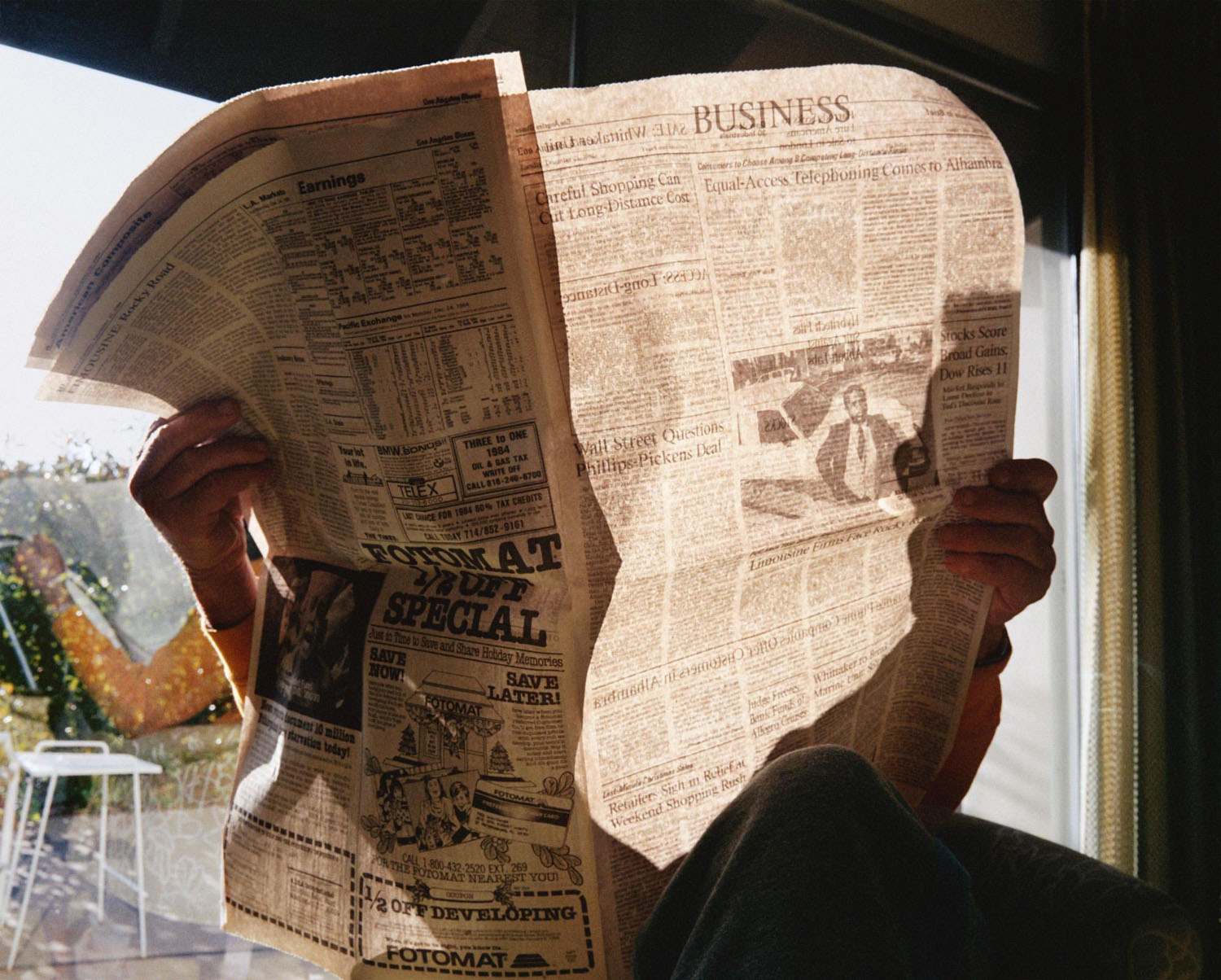
Larry Sultan (American, 1946-2009) 'Business Page' from the series 'Pictures from Home' 1985


Larry Sultan (American, 1946-2009)
Thanksgiving Turkey/Newspaper (detail)
1985-1992
Two plexiglass panels with screen printing
Framed (Thanksgiving Turkey): 76 × 91cm (29 15/16 × 35 13/16 in.)
Framed (Newspaper): 76 × 91cm (29 15/16 × 35 13/16 in.)
Other (2 text panels): 50.8 × 76.2cm (20 × 30 in.)
Overall: 30 x 117 in.
National Gallery of Art, Washington, Corcoran Collection (Gift of the FRIENDS of the Corcoran Gallery of Art)


From 1983 to 1992, Sultan photographed his parents in retirement at their Southern California house. His innovative book, Pictures from Home, combines his photographs and text with family album snapshots and stills from home movies, mining the family’s memories and archives to create a universal narrative about the American dream of work, home, and family. Thanksgiving Turkey/Newspaper juxtaposes photographs of his mother and father, each with their face hidden and with adjacent texts where they complain about each other’s shortcomings. “I realise that beyond the rolls of film and the few good pictures … is the wish to take photography literally,” Sultan wrote. “To stop time. I want my parents to live forever.”
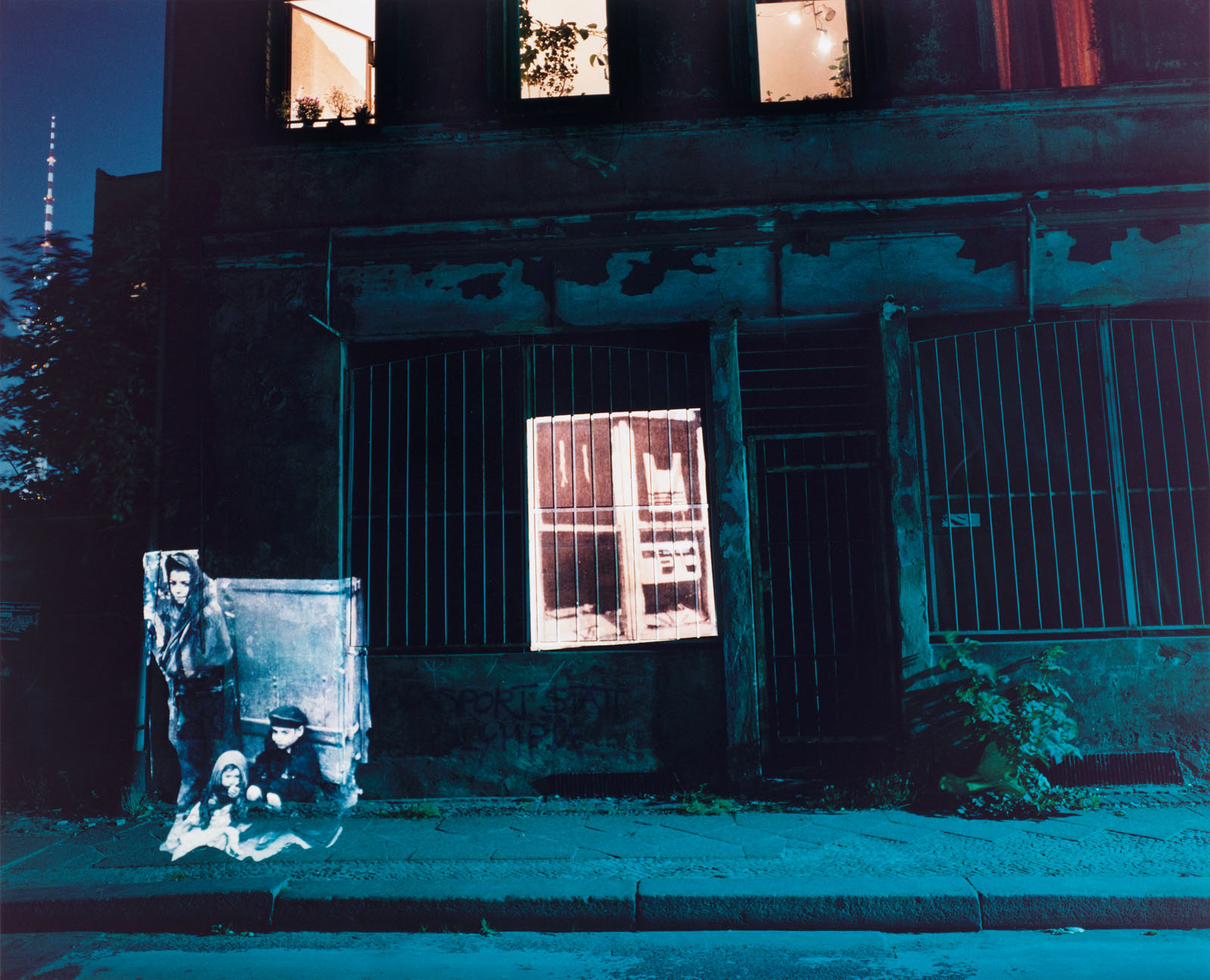
 

Shimon Attie (American, b. 1957) 'Mulackstrasse 32: Slide Projections of Former Jewish Residents and Hebrew Reading Room, 1932, Berlin' 1992


Shimon Attie (American, b. 1957)
Mulackstrasse 32: Slide Projections of Former Jewish Residents and Hebrew Reading Room, 1932, Berlin
1992
Chromogenic print
Unframed: 20 x 24 in. (50.8 x 60.96cm)
National Gallery of Art, Washington, Corcoran Collection (Gift of Julia J. Norrell in honor of Hilary Allard and Lauren Harry)


Attie projected historical photographs made in 1932 onto the sides of a building at Mulackstrasse 32, the site of a Hebrew reading room in a Jewish neighbourhood in Berlin during the 1930s. Fusing pictures made before Jews were removed from their homes and killed during World War II with photographs of the same dark, empty street made in 1992, Attie has created a haunting picture of wartime loss.
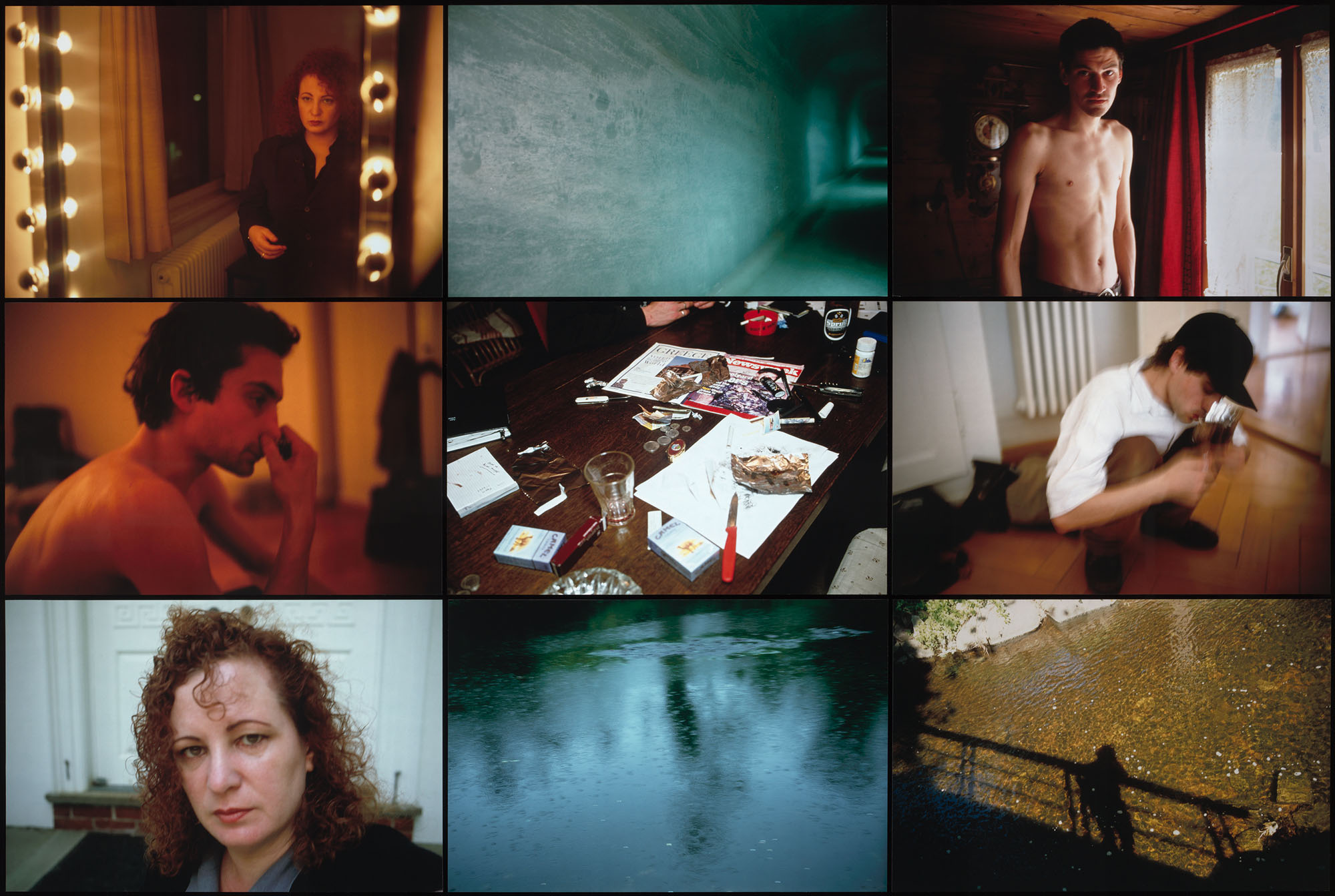
 

Nan Goldin (American, b. 1953) 'Relapse/Detox Grid' 1998-2000


Nan Goldin (American, b. 1953)
Relapse/Detox Grid
1998-2000
Nine silver dye bleach prints
Overall: 42 1/2 x 62 1/8 in. (107.95 x 157.8cm)
National Gallery of Art, Washington, Corcoran Collection (Museum Purchase with funds donated by the FRIENDS of the Corcoran Gallery of Art)


Goldin has unsparingly chronicled her own community of friends by photographing their struggles, hopes, and dreams through years of camaraderie, abuse, addiction, illness, loss, and redemption. Relapse/Detox Grid presents nine colourful yet plaintive pictures in a slide show-like narrative, offering glimpses of a life rooted in struggle, along with Goldin’s own recovery at a detox center, seen in the bottom row.
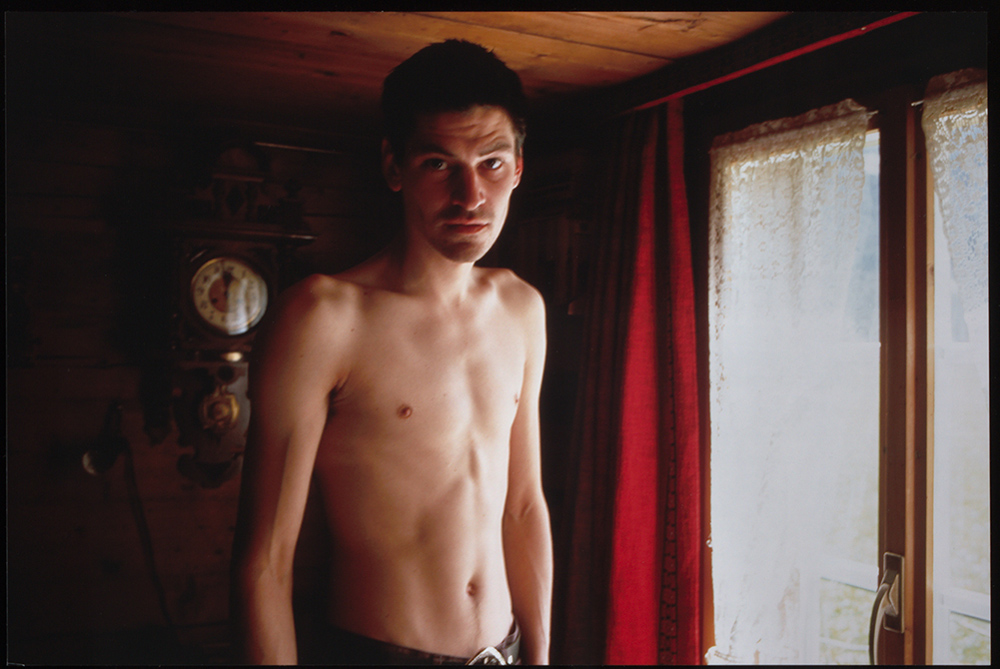
 

Nan Goldin (American, b. 1953) 'Relapse/Detox Grid' 1998-2000 (detail)


Nan Goldin (American, b. 1953)
Relapse/Detox Grid (detail)
1998-2000
Nine silver dye bleach prints
Overall: 42 1/2 x 62 1/8 in. (107.95 x 157.8cm)
National Gallery of Art, Washington, Corcoran Collection (Museum Purchase with funds donated by the FRIENDS of the Corcoran Gallery of Art)
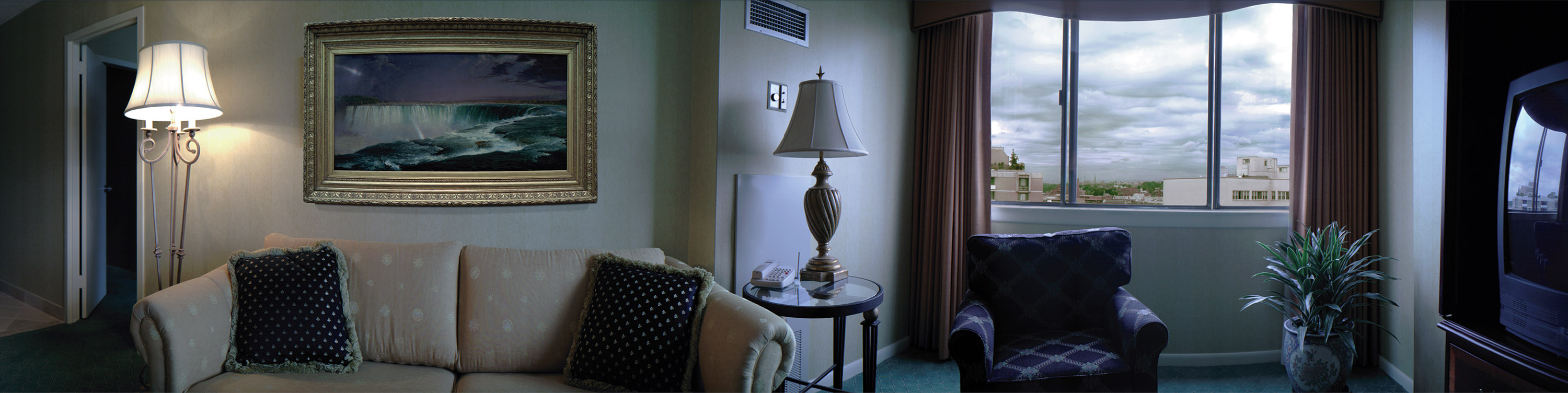
 

Victor Burgin (British, b. 1941) 'Watergate' 2000


Victor Burgin (British, b. 1941)
Watergate
2000
Video with sound, 9:58 minutes
National Gallery of Art, Washington, Corcoran Collection (Museum Purchase, with funds from the bequest of Betty Battle to the Women’s Committee of the Corcoran Gallery of Art)


An early advocate of conceptual art, Burgin is an artist and writer whose work spans photographs, text, and video. Watergate shows how the meaning of art can change depending on the context in which it is seen. Burgin animated digital, 160-degree panoramic photographs of nineteenth-century American art hanging in the Corcoran Gallery of Art and in a hotel room. While the camera circles the gallery, an actor reads from Jean-Paul Satre’s Being and Nothingness, which questions the relationship between presence and absence. Then a dreamlike pan around a hotel room overlooking the nearby Watergate complex mysteriously reveals Niagara, the Corcoran’s 1859 landscape by Frederic Church, having on the wall. In 1859, Niagara Falls was seen as a symbol of the glory and promise of the American nation, yet when Church’s painting is placed in the context of the Watergate, an icon of the scandal that led to Richard Nixon’s resignation, it assumes a different meaning and suggests an ominous sense of disillusionment.


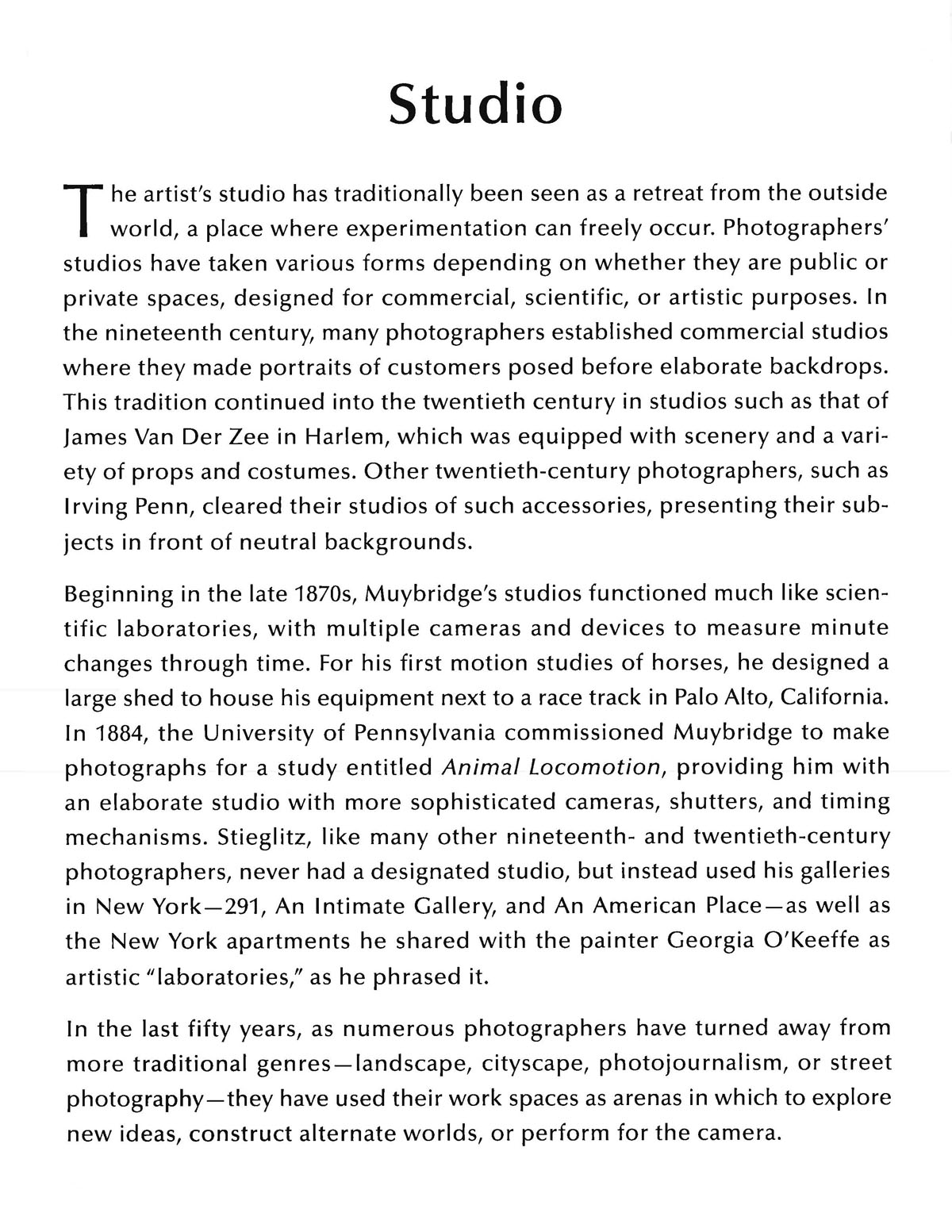
Studio

Intersections also examines the studio as a locus of creativity, from Stieglitz’s photographs of his gallery, 291, and James Van Der Zee’s commercial studio portraits, to the manipulated images of Wallace Berman, Robert Heinecken, and Martha Rosler. Works by Laurie Simmons, David Levinthal, and Vik Muniz also highlight the postmodern strategy of staging images created in the studio.

Wall text
Intersections wall text


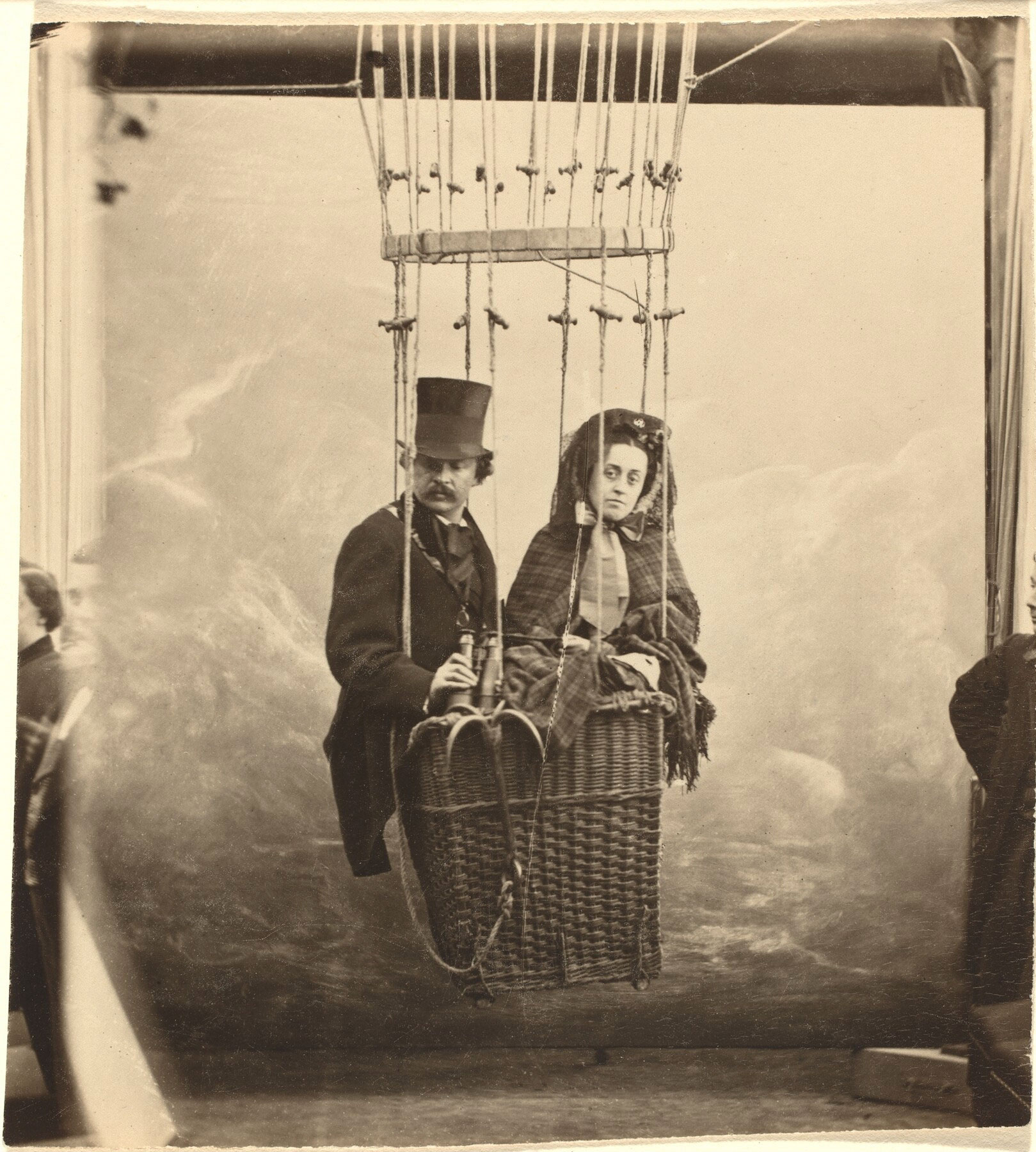
Nadar (Gaspard-Félix Tournachon) (French, 1820-1910) 'Self-Portrait with Wife Ernestine in a Balloon Gondola' c. 1865


Nadar (Gaspard-Félix Tournachon) (French, 1820-1910)
Self-Portrait with Wife Ernestine in a Balloon Gondola
c. 1865
Gelatin silver print, printed c. 1890
8.6 × 7.7cm (3 3/8 × 3 1/16 in.)
National Gallery of Art, Washington, Horace W. Goldsmith Foundation through Robert and Joyce Menschel


Nadar (a pseudonym for Gaspard-Félix Tournachon) was not only a celebrated portrait photographer, but also a journalist, caricaturist, and early proponent of manned flight. In 1863, he commissioned a prominent balloonist to build an enormous balloon 196 feet high, which he named The Giant. The ascents he made from 1863 to 1867 were widely covered in the press and celebrated by the cartoonist Honoré Daumier, who depicted Nadar soaring above Paris, its buildings festooned with signs for photography studios. Nadar made and sold small prints like this self-portrait to promote his ballooning ventures. The obviously artificial construction of this picture – Nadar and his wife sit in a basket far too small for a real ascent and are posed in front of a painted backdrop – and its untrimmed edges showing assistants at either side make it less of the self-aggrandising statement that Nadar wished and more of an amusing behind-the-scenes look at studio practice.


Alfred Stieglitz (American, 1864-1946) 'Self-portrait' 1907, printed 1930


Alfred Stieglitz (American, 1864-1946)
Self-Portrait
probably 1911
Platinum print
Image: 24.2 x 19.3cm (9 1/2 x 7 5/8 in.)
Sheet: 25.3 x 20.3cm (9 15/16 x 8 in.)
National Gallery of Art, Washington, Alfred Stieglitz Collection


Unlike many other photographers, Stieglitz made few self-portraits. He created this one shortly before he embarked on a series of portraits of the artists who frequented his New York gallery, 291. Focusing only on his face and leaving all else in shadow, he presents himself not as an artist at work or play, but as a charismatic leader who would guide American art and culture into the 20th century.
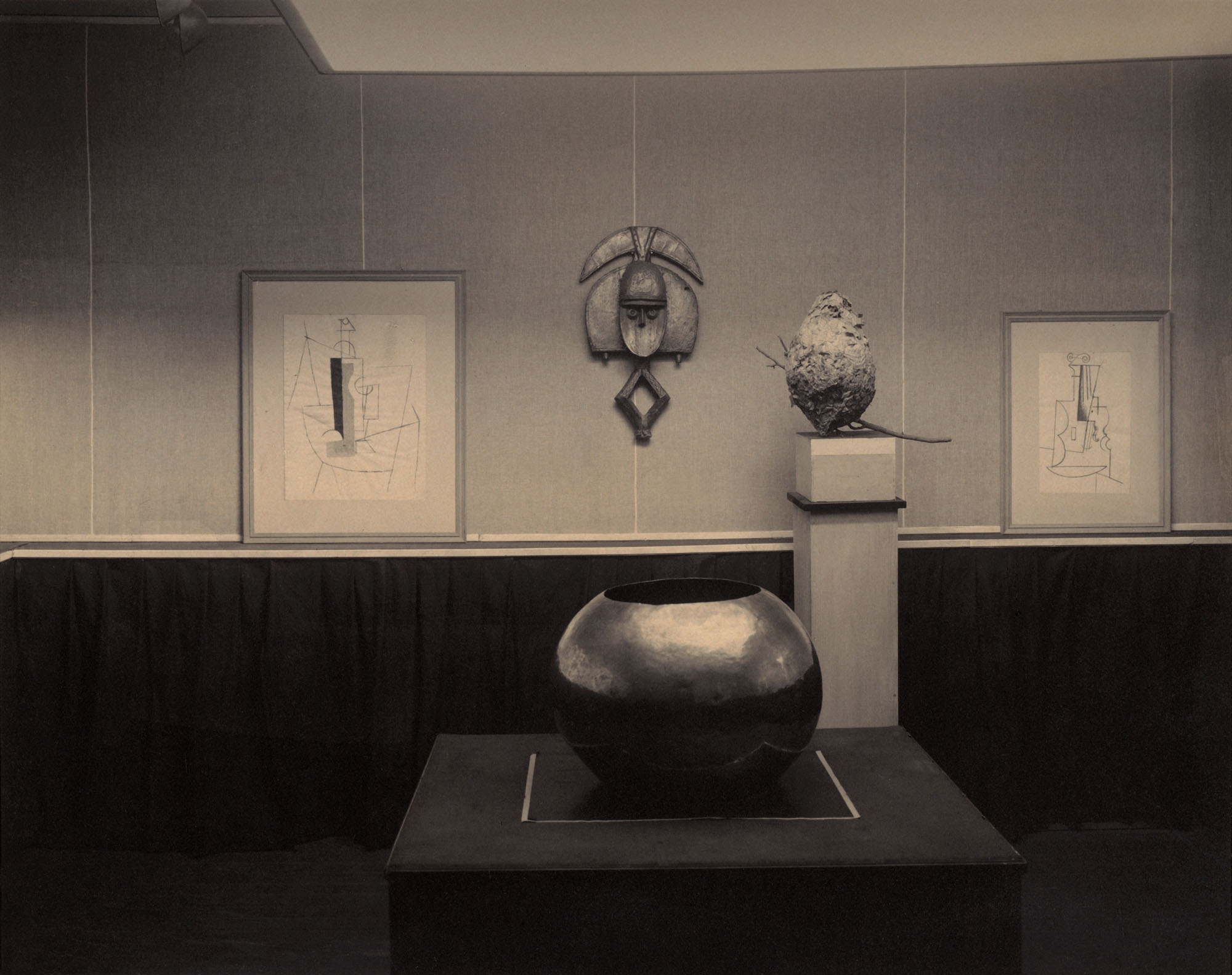
 

Alfred Stieglitz (American, 1864-1946) '291 – Picasso-Braque Exhibition' 1915


Alfred Stieglitz (American, 1864-1946)
291 – Picasso-Braque Exhibition
1915
Platinum print
Image: 18.5 x 23.6 cm (7 5/16 x 9 5/16 in.)
Sheet: 20.1 x 25.3 cm (7 15/16 x 9 15/16 in.)
National Gallery of Art, Washington, Alfred Stieglitz Collection


291 was Stieglitz’s legendary gallery in New York City (its name derived from its address on Fifth Avenue), where he introduced modern European and American art and photography to the American public. He also used 291 as a studio, frequently photographing friends and colleagues there, as well as the views from its windows. This picture records what Stieglitz called a “demonstration” – a short display of no more than a few days designed to prompt a focused discussion. Including two works by Picasso, an African mask from the Kota people, a wasps’ nest, and 291’s signature brass bowl, the photograph calls into question the relationship between nature and culture, Western and African art.
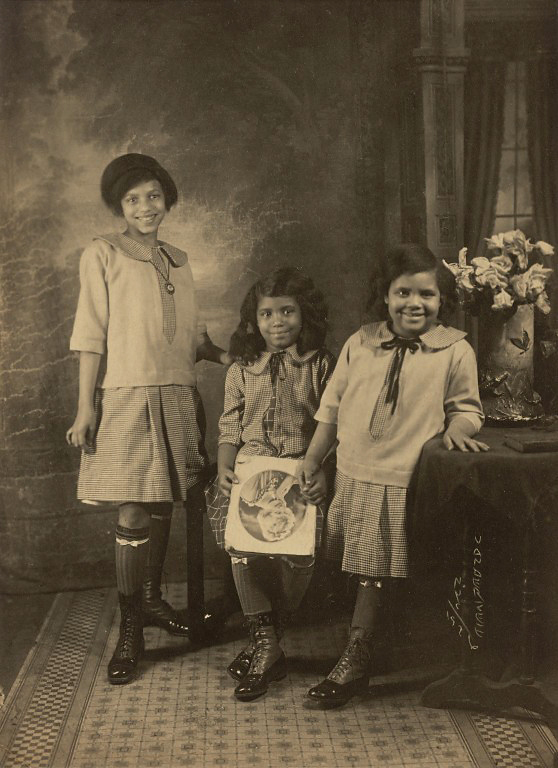
 

James Van Der Zee (American, 1886-1983) 'Sisters' 1926


James Van Der Zee (American, 1886-1983)
Sisters
1926
Gelatin silver print
Sheet (trimmed to image): 17.6 x 12.5cm (6 15/16 x 4 15/16 in.)
National Gallery of Art, Washington, Horace W. Goldsmith Foundation through Robert and Joyce Menschel


James Van Der Zee was a prolific studio photographer in Harlem during a period known as the Harlem Renaissance, from the end of World War I to the middle of the 1930s. He photographed many of Harlem’s celebrities, middle-class residents, and community organisations, establishing a visual archive that remains one of the best records of the era. He stands out for his playful use of props and retouching, thereby personalising each picture and enhancing the sitter’s appearance. In this portrait of three sisters, clasped hands show the tender bond of the two youngest, one of whom holds a celebrity portrait, revealing her enthusiasm for popular culture.
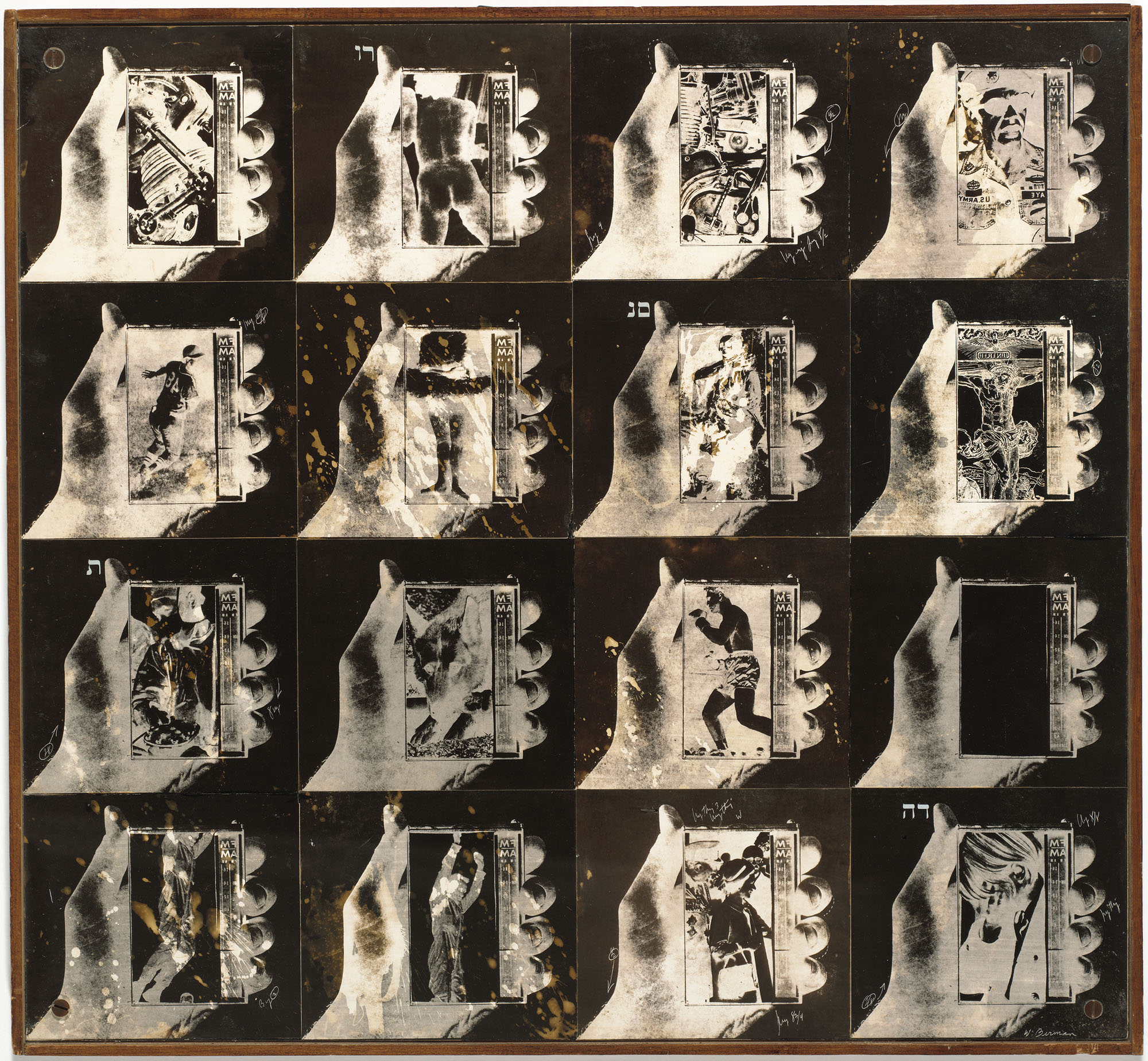
 

Wallace Berman (American, 1926-1976) 'Silence Series #7' 1965-1968


Wallace Berman (American, 1926-1976)
Silence Series #7
1965-1968
Verifax (wet process photocopy) collage
Actual: 24 1/2 x 26 1/2 in. (62.23 x 67.31cm)
National Gallery of Art, Washington, Corcoran Collection (Museum Purchase, William A. Clark Fund)


An influential artist of California’s Beat Generation during the 1950s and 1960s, Berman was a visionary thinker and publisher of the underground magazine Semina. His mysterious and playful juxtapositions of divers objects, images, and texts were often inspired by Dada and surrealist art. Silence Series #7 presents a cinematic sequence of his trademark transistor radios, each displaying military, religious, or mechanical images along with those of athletes and cultural icons, such as Andy Warhol. Appropriated from mass media, reversed in tone, and printed backward using an early version of a photocopy machine, these found images, pieced together and recopied as photomontages, replace then ew transmitted through the radios. Beat poet Robert Duncan once called Berman’s Verify collages a “series of magic ‘TV’ lantern shows.”
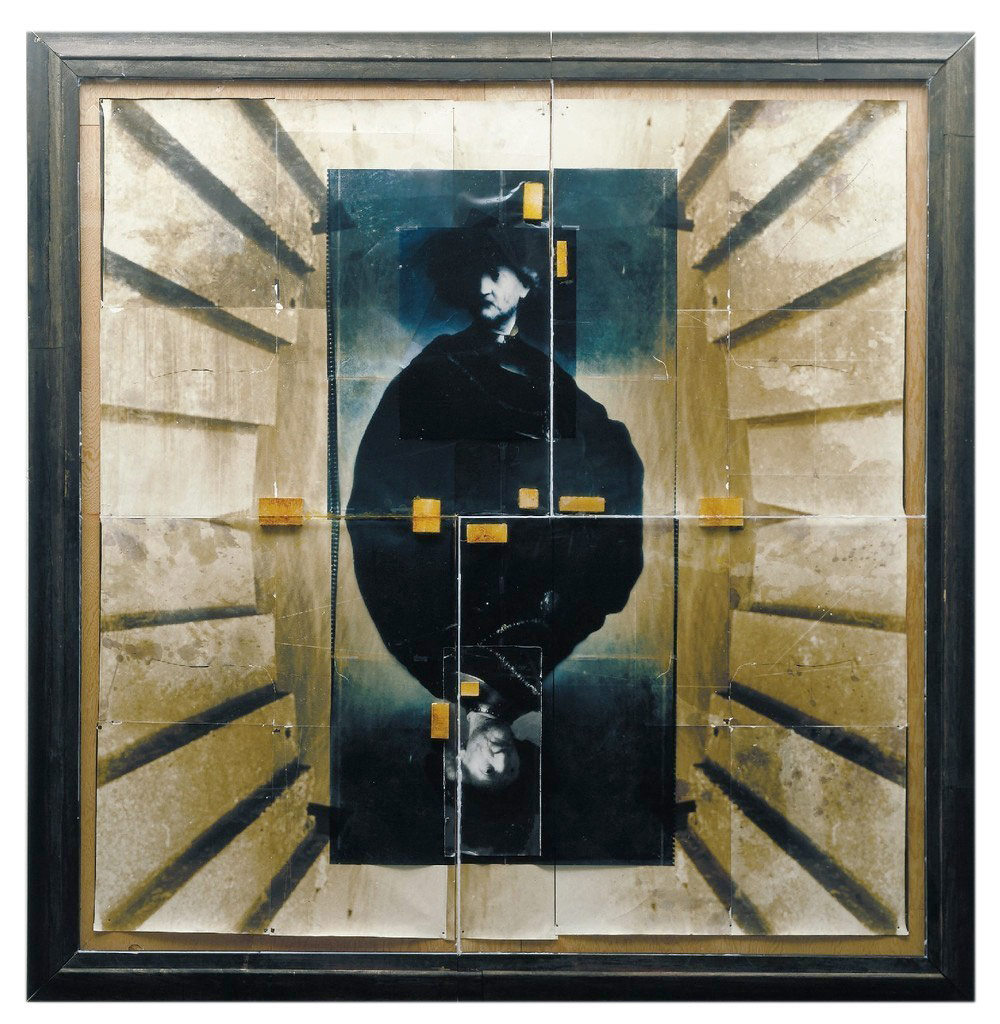
 

Doug and Mike Starn (American) 'Double Rembrandt with Steps' 1987-1991


Doug and Mike Starn (American)
Double Rembrandt (with steps)
1987-1991
Gelatin silver prints, ortho film, tape, wood, plexiglass, glue and silicone
2 interlocking parts:
Part 1 overall: 26 1/2 x 13 7/8 in.
Part  2 overall: 26 3/8 x 13 3/4 in.
Overall: 26 1/2 x 27 3/4 in.
National Gallery of Art, Washington, Gift of Susan and Peter MacGill


Doug and Mike Starn, identical twins who have worked collaboratively since they were thirteen, have a reputation for creating unorthodox works. Using take, wood, and glue, the brothers assembles sheets of photographic film and paper to create a dynamic composition that includes an appropriated image of Rembrandt van Rijn’s Old Man with a Gold Chain (1631). Double Rembrandt (with steps) challenges the authority of the austere fine art print, as well as the aura of the original painting, while playfully invoking the twins’ own double identity.
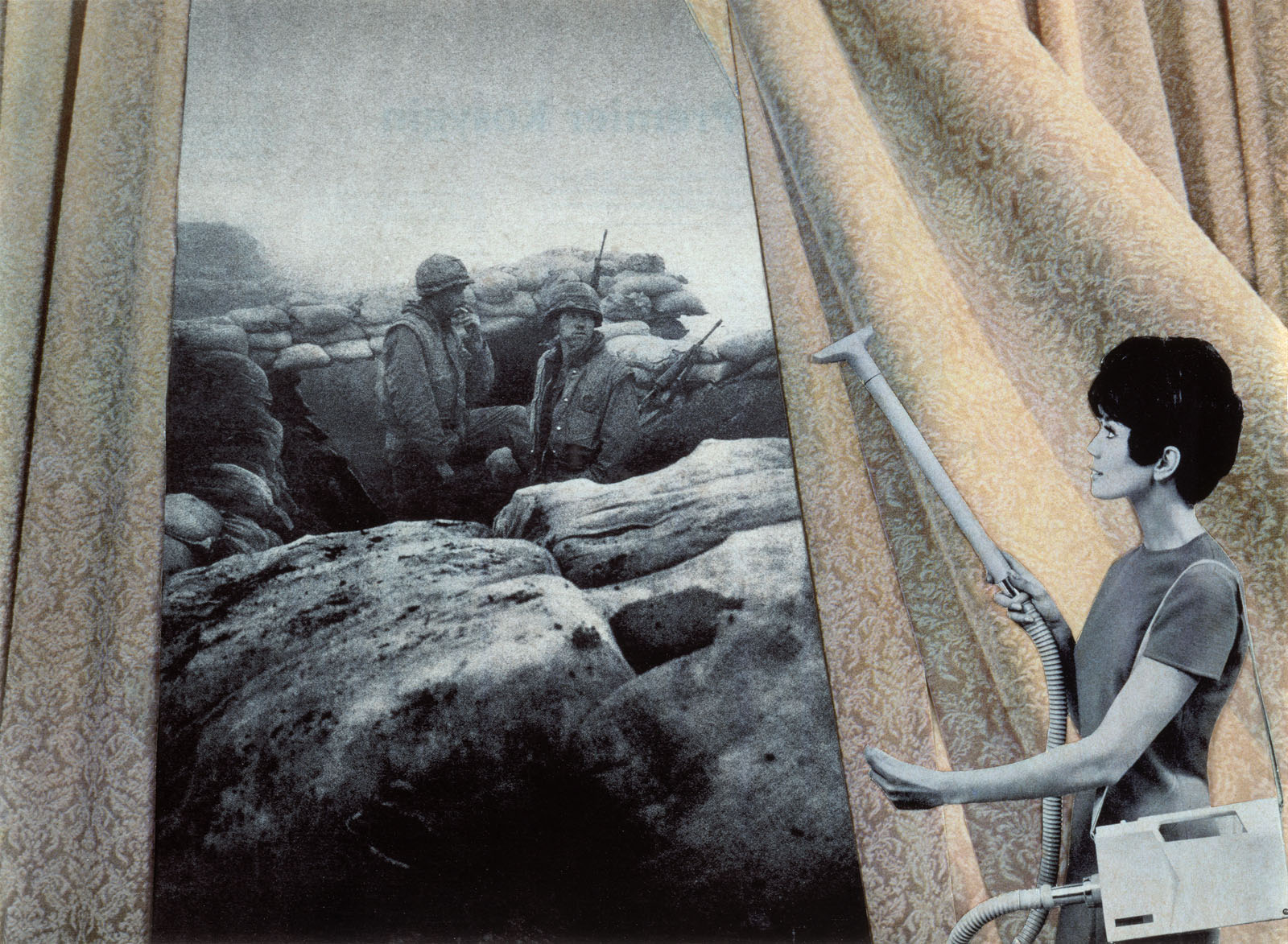
 

Martha Rosler (American, b. 1943) 'Cleaning the Drapes', from the series, 'House Beautiful: Bringing the War Home' 1967-1972


Martha Rosler (American, b. 1943)
Cleaning the Drapes, from the series, House Beautiful: Bringing the War Home
1967-1972
Inkjet print, printed 2007
Framed: 53.5 × 63.3cm (21 1/16 × 24 15/16 in.)
National Gallery of Art, Washington, Gift of the Collectors Committee and the Pepita Milmore Memorial Fund


A painter, photographer, video artist, feminist, activist writer, and teacher, Martha Rosler made this photomontage while she was a graduate student in the late 1960s and early 1970s. Frustrated by the portrayal of the Vietnam War on television and in other media, she wrote: “The images were always very far away and of a place we couldn’t imagine.” To bring “the war home,” as she announced in her title, she cut out images from Life magazine and House Beautiful to make powerfully layered collages that contrast American middle-class life with the realities of the war. She selected colour pictures of the idealised American life rich in the trappings of consumer society, and used black-and-white pictures of troops in Vietnam to heighten the contrast between here and there, while also calling attention to stereotypical views of men and women.


Sally Mann (American, b. 1951) 'Self-Portrait' 1974


Sally Mann (American, b. 1951)
Self-Portrait
1974
Gelatin silver print
Image: 17 × 14.9cm (6 11/16 × 5 7/8 in.)
Sheet: 35 × 27.2cm (13 3/4 × 10 11/16 in.)
National Gallery of Art, Washington, Corcoran Collection (Gift of Olga Hirshhorn)


Sally Mann, who is best known for the pictures of her children she made in the 1980s and 1990s, began to photograph when she was a teenager. In this rare, early, and intimate self-portrait, the artist is reflected in a mirror, clasping her loose shirt as she stands in a friend’s bathroom. Her thoughtful, expectant expression, coupled with her finger pointing directly at the lens of the large view camera that towers above her, foreshadows the commanding presence photography would have in her life.
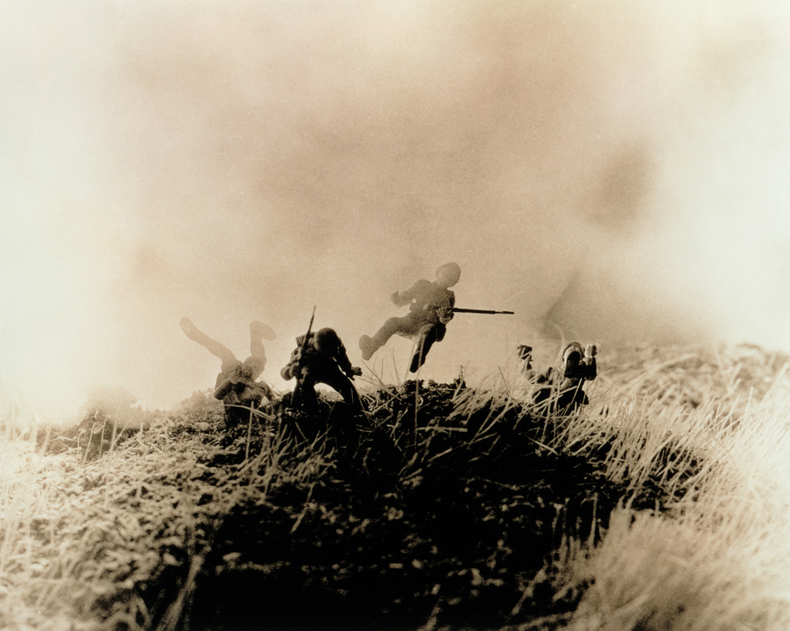
 

David Levinthal (American, b. 1949) 'Untitled (from the series Hitler Moves East)' 1975


David Levinthal (American, b. 1949)
Untitled (from the series Hitler Moves East)
1975
Gelatin silver print
Sheet: 15 15/16 x 20 in. (40.48 x 50.8cm)
Image: 10 9/16 x 13 7/16 in. (26.83 x 34.13cm)
National Gallery of Art, Washington, Corcoran Collection (Gift of the artist)


Levinthal’s series of photographs Hitler Moves East was made not during World War II, but in 1975, when the news media was saturated with images of the end of America’s involvement in the Vietnam War. In this series, he appropriates the grainy look of photojournalism and uses toy soldiers and fabricated environments to stage scenes from Germany’s brutal campaign on the Eastern Front during World War II. His pictures are often based on scenes found in television and movies, further distancing them from the actual events. A small stick was used to prop up the falling soldier and the explosion was made with puffs of flour. Hitler Moves East casts doubt on the implied authenticity of photojournalism and calls attention to the power of the media to define public understanding of events.


Hiroshi Sugimoto (Japanese, b. 1948) 'Oscar Wilde' 1999


Hiroshi Sugimoto (Japanese, b. 1948)
Oscar Wilde
1999
Gelatin silver print
Image: 148.59 × 119.6cm (58 1/2 × 47 1/16 in.)
Framed: 182.25 × 152.4cm (71 3/4 × 60 in.)
National Gallery of Art, Washington, Corcoran Collection (Gift of The Heather and Tony Podesta Collection)


Hiroshi Sugimoto (Japanese, b. 1948) 'Oscar Wilde' 1999 (detail)


Hiroshi Sugimoto (Japanese, b. 1948)
Oscar Wilde (detail)
1999
Gelatin silver print
Image: 148.59 × 119.6cm (58 1/2 × 47 1/16 in.)
Framed: 182.25 × 152.4cm (71 3/4 × 60 in.)
National Gallery of Art, Washington, Corcoran Collection (Gift of The Heather and Tony Podesta Collection)


While most traditional portrait photographers worked in studios, Sugimoto upended this practice in a series of pictures he made at Madame Tussaud’s wax museums in London and Amsterdam, where lifelike wax figures, based on paintings or photographs, as is the case with Oscar Wilde, are displayed in staged vignettes. By isolating the figure from its setting, posing it in a three-quarter-length view, illuminating it to convey the impression of a carefully lit studio portrait, and making his final print almost six feet tall, Sugimoto renders the artificial as real. Triply removing his portrait from reality – from Oscar Wilde himself to a portrait photograph to a wax sculpture and back to a photograph – Sugimoto collapses time and confounds our expectations of the nature of photography.


Vik Muniz (Brazilian, b. 1961) 'Alfred Stieglitz (from the series Pictures of Ink)' 2000


Vik Muniz (Brazilian, b. 1961)
Alfred Stieglitz (from the series Pictures of Ink)
2000
Silver dye bleach print
Image: 152.4 × 121.92cm (60 × 48 in.)
Framed: 161.29 × 130.81 × 5.08cm (63 1/2 × 51 1/2 × 2 in.)
National Gallery of Art, Washington, Corcoran Collection (Museum Purchase with funds provided by the FRIENDS of the Corcoran Gallery of Art)


Muniz has spent his career remaking works of art by artists as varied as Botticelli and Warhol using unusual materials – sugar, diamonds, and even junk. He has been especially interested in Stieglitz and has re-created his photographs using chocolate syrup and cotton. Here, he refashioned Stieglitz’s celebrated self-portrait using wet ink and mimicking the dot matrix of a halftone reproduction. He then photographed his drawing and greatly enlarged it so that the dot matrix itself becomes as important as the picture it replicates.


Identity

Historic and contemporary works by August Sander, Diane Arbus, Lorna Simpson, and Hank Willis Thomas, among others, make up the final section, which explores the role of photography in the construction of identity.”

Wall text

Intersections wall text


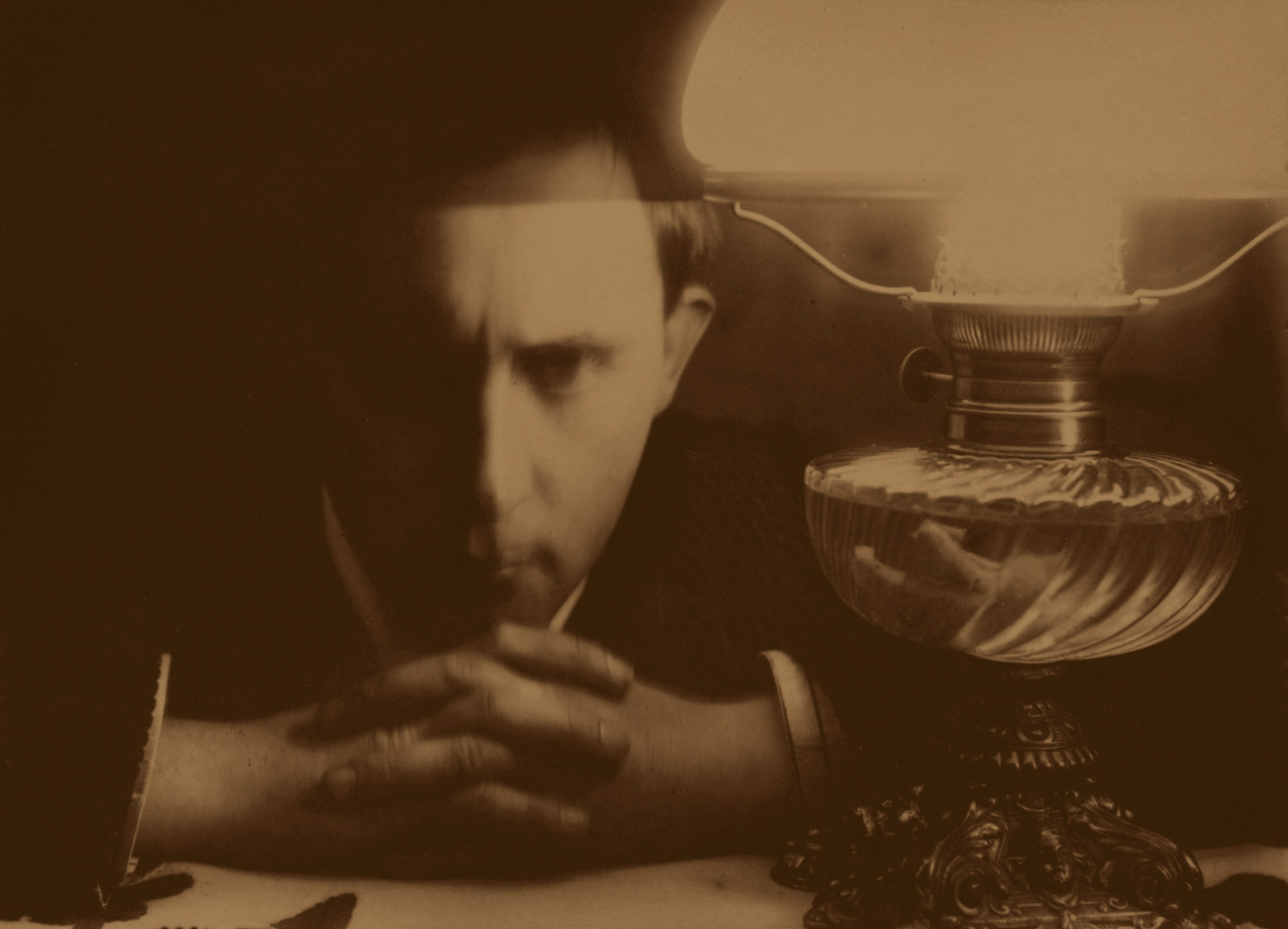
Witkacy (Stanislaw Ignacy Witkiewicz) (Polish, 1885-1939) 'Self-Portrait (Collapse by the Lamp/Kolaps przy lampie)' c. 1913


Witkacy (Stanislaw Ignacy Witkiewicz) (Polish, 1885-1939)
Self-Portrait (Collapse by the Lamp/Kolaps przy lampie)
c. 1913
Gelatin silver print
12.86 x 17.78cm (5 1/16 x 7 in.)
National Gallery of Art, Washington, Foto Fund and Robert Menschel and the Vital Projects Fund


A writer, painter, and philosopher, Witkiewicz began to photograph while he was a teenager. From 1911 to 1914, while undergoing psychoanalysis and involved in two tumultuous relationships (one ending when his pregnant fiancée killed herself in 1914), he made a series of startling self-portraits. Close-up, confrontational, and searching, they are pictures in which the artist seems to seek understanding of himself by scrutinising his visage.


August Sander (German, 1876-1964) 'The Bricklayer' 1929


August Sander (German, 1876-1964)
The Bricklayer
1929, printed c. 1950
Gelatin silver print
Sheet (trimmed to image): 50.4 x 37.5cm (19 13/16 x 14 3/4 in.)
National Gallery of Art, Washington, Gift of Gerhard and Christine Sander, in honour of the 50th Anniversary of the National Gallery of Art


In 1911, Sander began a massive project to document “people of the twentieth century.” Identifying them by their professions, not their names, he aimed to create a typological record of citizens of the Weimar Republic. He photographed people from all walks of life – from bakers, bankers, and businessmen to soldiers, students, and tradesmen, as well as gypsies, the unemployed, and the homeless. The Nazis banned his project in the 1930s because his pictures did not conform to the ideal Aryan type. Although he stopped working after World War II, he made this rare enlargement of a bricklayer for an exhibition of his photographs in the early 1950s.


Walker Evans (American, 1903-1975) 'Photographer's Display Window, Birmingham, Alabama' 1936


Walker Evans (American, 1903-1975)
Photographer’s Display Window, Birmingham, Alabama
1936
Gelatin silver print
Image: 24.1 x 19.3cm (9 1/2 x 7 5/8 in.)
Sheet: 25.2 x 20.3cm (9 15/16 x 8 in.)
National Gallery of Art, Washington, Gift of Mr. and Mrs. Harry H. Lunn, Jr. in honor of Jacob Kainen and in Honor of the 50th Anniversary of the National Gallery of Art
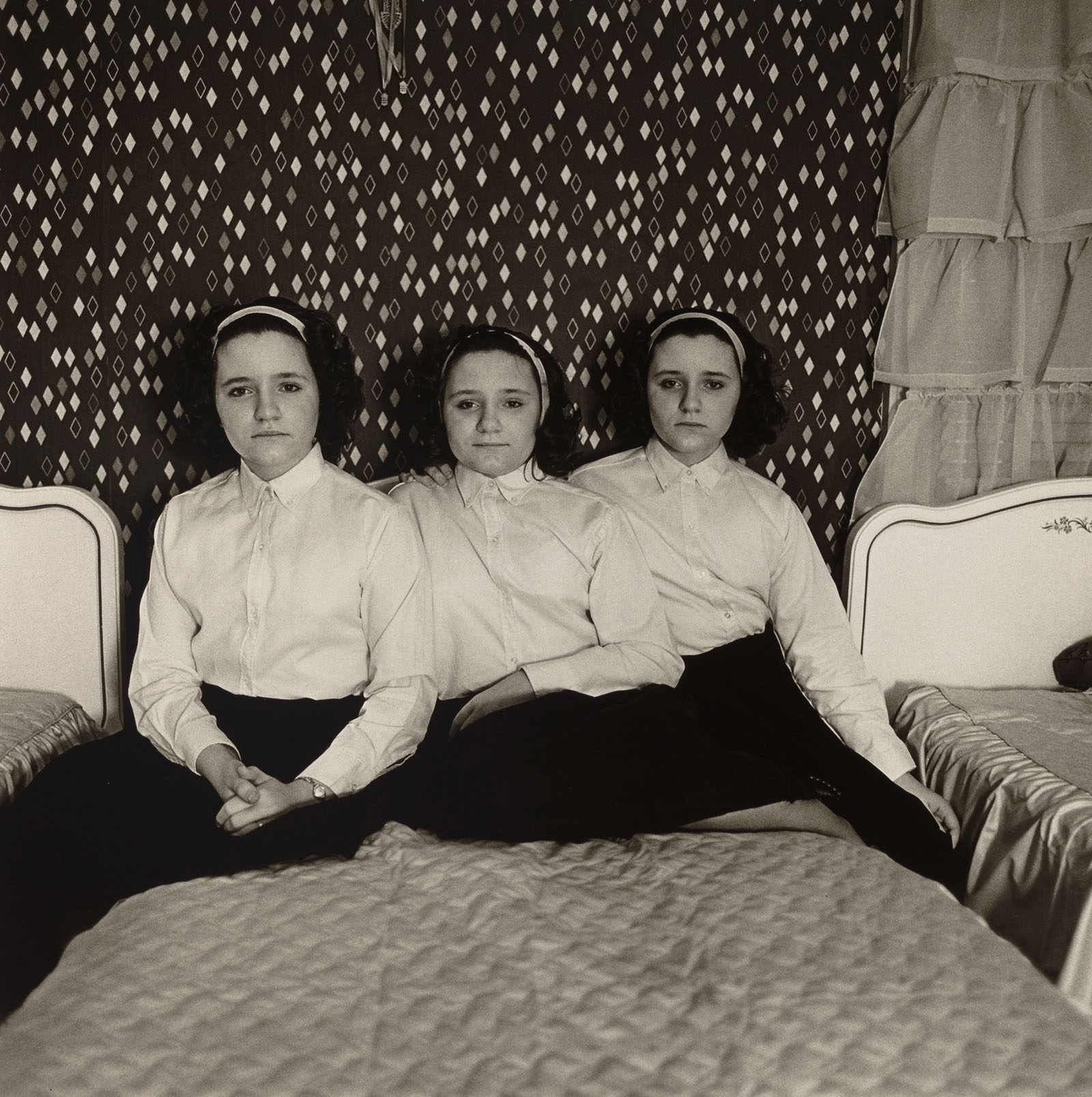
 

Diane Arbus (American, 1923-1971) 'Triplets in their Bedroom, N.J.,' 1963


Diane Arbus (American, 1923-1971)
Triplets in their Bedroom, N.J.,
1963
Gelatin silver print
Image: 37.7 x 37.8cm (14 13/16 x 14 7/8 in.)
Sheet: 50.4 x 40.4cm (19 13/16 x 15 7/8 in.)
National Gallery of Art, Washington, R. K. Mellon Family Foundation


Celebrated for her portraits of people traditionally on the margins of society – dwarfs and giants – as well as those on the inside – society matrons and crying babies – Arbus was fascinated with the relationship between appearance and identity. Many of her subjects, such as these triplets, face the camera, tacitly aware of their collaboration in her art. Rendering the familiar strange and the strange familiar, her carefully composed pictures compel us to look at the world in new ways. “We’ve all got an identity,” she said. “You can’t avoid it. It’s what’s left when you take away everything else.”
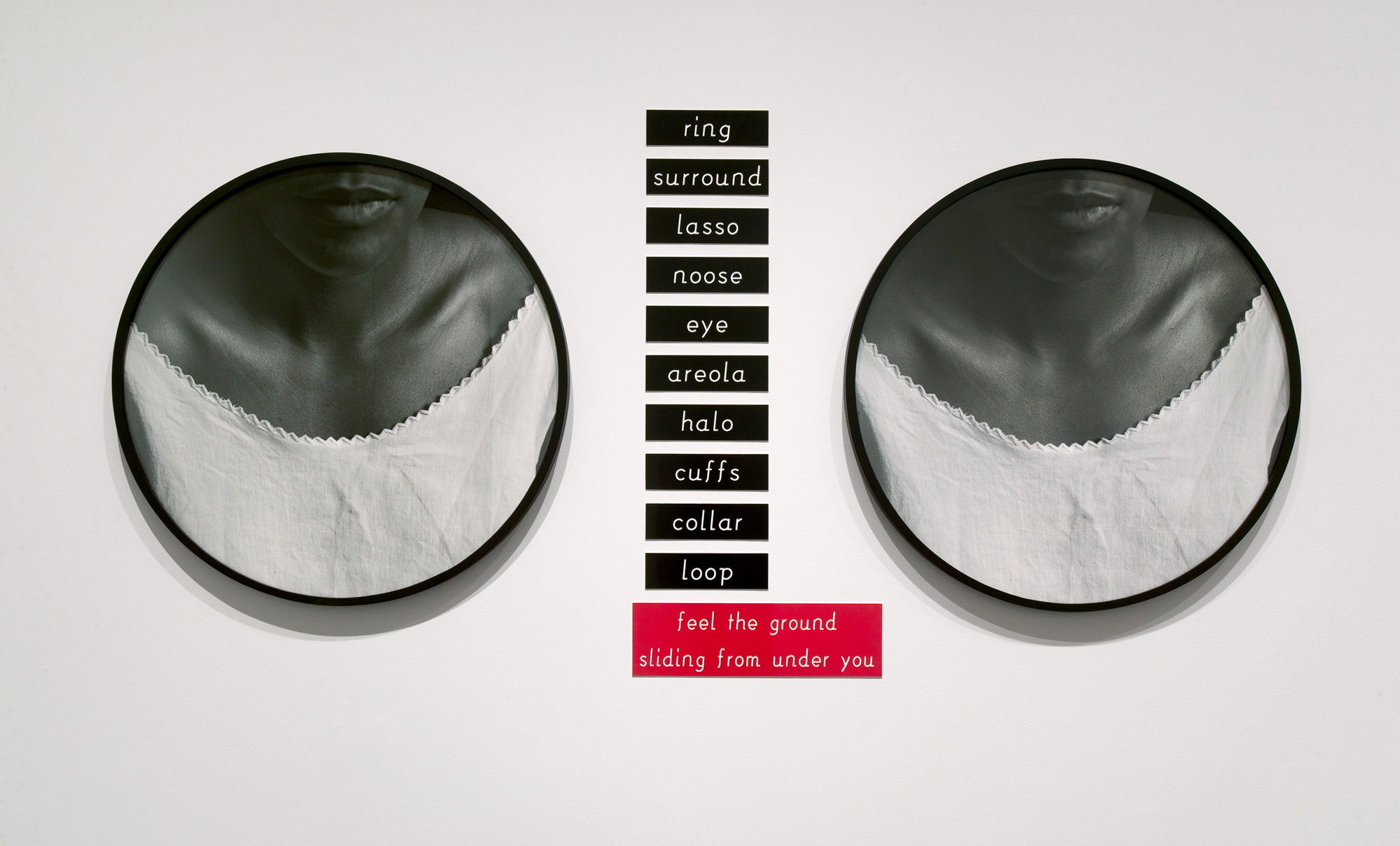
 

Lorna Simpson (American, b. 1960) 'Untitled (Two Necklines)' 1989


Lorna Simpson (American, b. 1960)
Untitled (Two Necklines)
1989
Two gelatin silver prints with 11 plastic plaques
Overall: 101.6 x 254 cm (40 x 100 in.)
National Gallery of Art, Washington, Gift of the Collectors Committee


From the mid-1980s to the present, Simpson has created provocative works that question stereotypes of gender, identity, history, and culture, often by combining photographs and words. Two Necklines shows two circular and identical photographs of an African American woman’s mouth, chin, neck, and collarbone, as well as the bodice of her simple shift. Set in between are black plaques, each inscribed with a single word: “ring, surround, lasso, noose, eye, areola, halo, cuffs, collar, loop.” The words connote things that bind and conjure a sense of menace, yet when placed between the two calm, elegant photographs, their meaning is at first uncertain. But when we read the red plaque inscribed “feel the ground sliding from under you” and note the location of the word “noose” adjacent to the two necklines, we realise that Simpson is quietly but chillingly referring to the act of lynching.
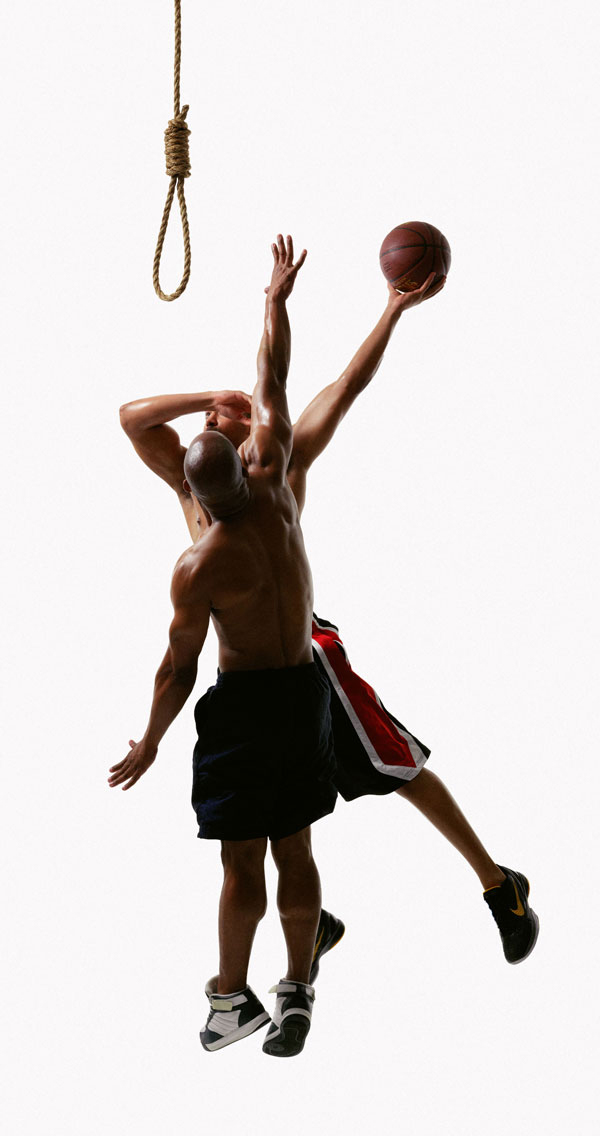
 

Hank Willis Thomas (American, b. 1976) 'And One' 2011


Hank Willis Thomas (American, b. 1976)
And One
2011
Digital chromogenic print
Framed: 248.29 × 125.73 × 6.35cm (97 3/4 × 49 1/2 × 2 1/2 in.)
National Gallery of Art, Washington, Corcoran Collection (Gift of the artist and Jack Shainman Gallery, New York)


And One is from Thomas’s Strange Fruit series, which explores the concepts of spectacle and display as they relate to modern African American identity. Popularised by singer Billie Holiday, the series title Strange Fruit comes from a poem by Abel Meeropol, who wrote the infamous words “Black bodies swinging in the southern breeze; Strange fruit hanging from the poplar trees” after seeing a photograph of a lynching in 1936. In And One, a contemporary African American artist reflects on how black bodies have been represented in two different contexts: lynching and professional sports. Thomas ponders the connections between these disparate forms through his dramatic photograph of two basketball players frozen in midair, one dunking a ball through a hanging noose.


National Gallery of Art
National Mall between 3rd and 7th Streets
Constitution Avenue NW, Washington

Opening hours:
Daily 10.00am – 5.00pm
National Gallery of Art website

LIKE ART BLART ON FACEBOOK

Back to top

Exhibition: ‘Painting with Light: Art and Photography from the Pre-Raphaelites to the Modern Age’ at Tate Britain, London

Exhibition dates: 11th May – 25th September, 2016

Curators: Dr Carol Jacobi, Curator of British Art 1850-1915 at Tate Britain, and Dr Hope Kingsley, Curator, Education and Collections, Wilson Centre for Photography, with Tim Batchelor, Assistant Curator at Tate Britain


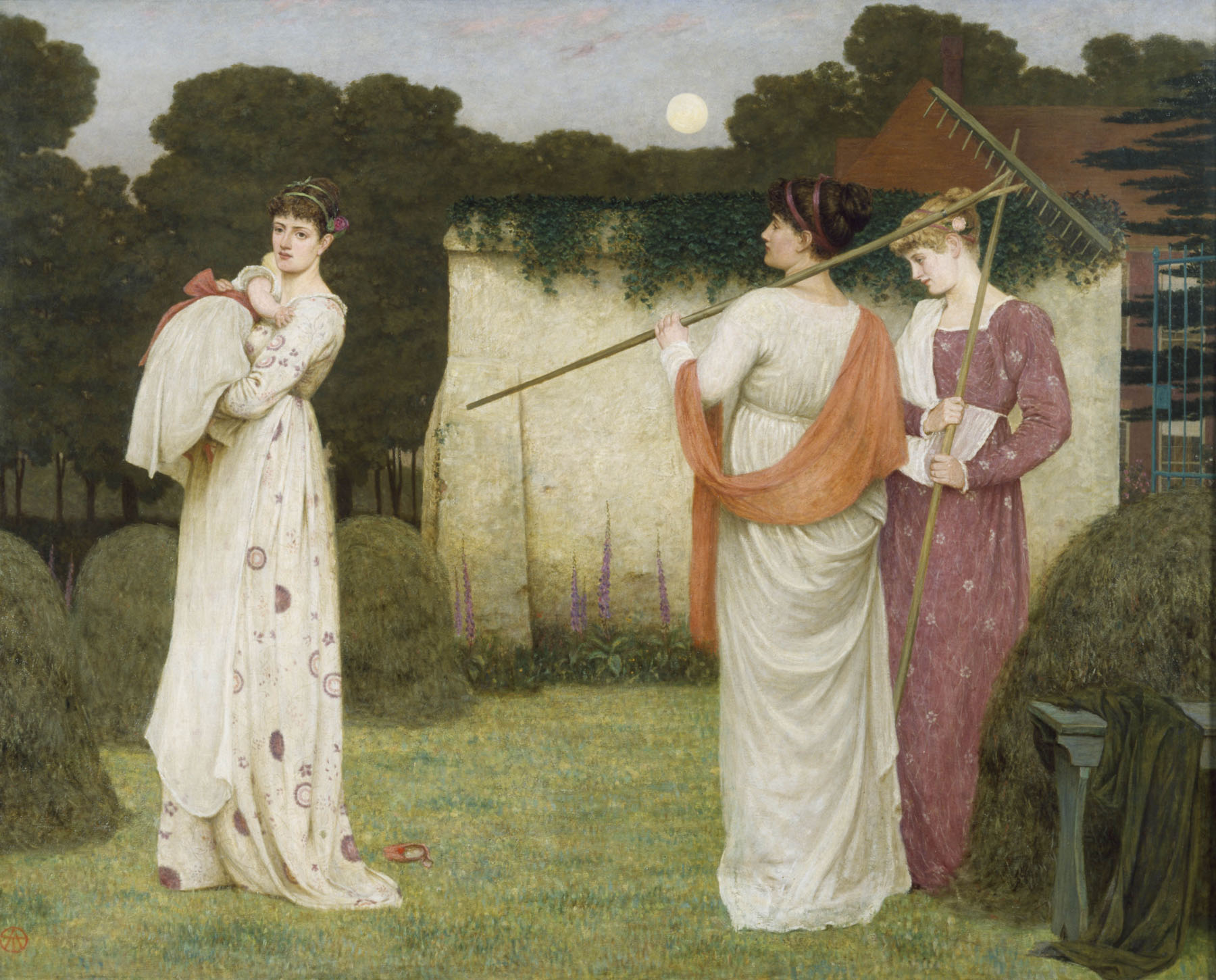
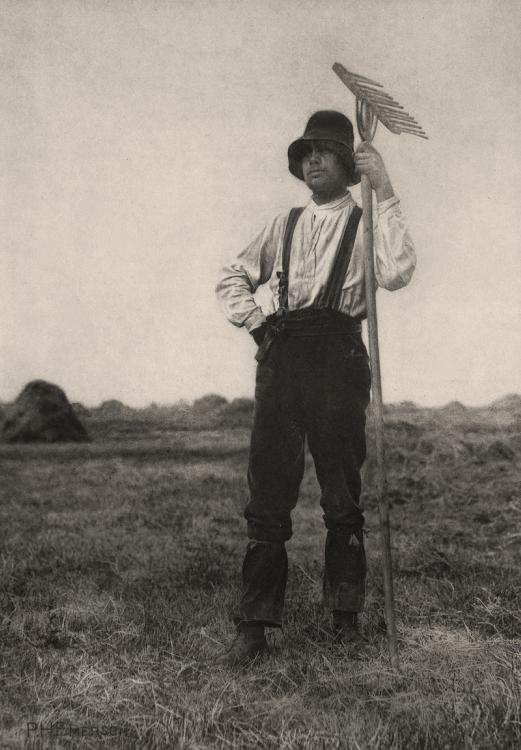
Peter Henry Emerson (British, 1856-1936) 'Haymaker with Rake' c. 1888, published 1890 from the exhibition 'Painting with Light: Art and Photography from the Pre-Raphaelites to the Modern Age' at Tate Britain, London, May - Sept, 2016


Peter Henry Emerson (British, 1856-1936)
Haymaker with Rake
c. 1888, published 1890
From Pictures of East Anglian Life portfolio
Photogravure on paperImage: 277 x 196mm
Victoria and Albert Museum
Gift from the photographer


An interesting concept for an exhibition. I would have liked to have seen the exhibition to make a more informed comment. Parallels can be drawn, but how much import you put on the connection is up to you vis-à-vis the aesthetic feeling and formal construction of each medium. It is fascinating to note how many of the original art works are photographs with the painting following at a later date, or vice versa. Photographically, Julia Margaret Cameron and John Cimon Warburg are the stars.

Photographs have always been used by artists as aide-mémoire since the birth of photograph. Eugené Atget called his photographs of Paris “Documents pour artistes”, declaring his modest ambition to create images for other artists to use as source material … but I take that statement with a pinch of salt. Perhaps a salt print from a calotype paper negative!

Dr Marcus Bunyan


Many thankx to the Tate for allowing me to publish the art work and photographs in the posting. Please click on the photographs for a larger version of the image.


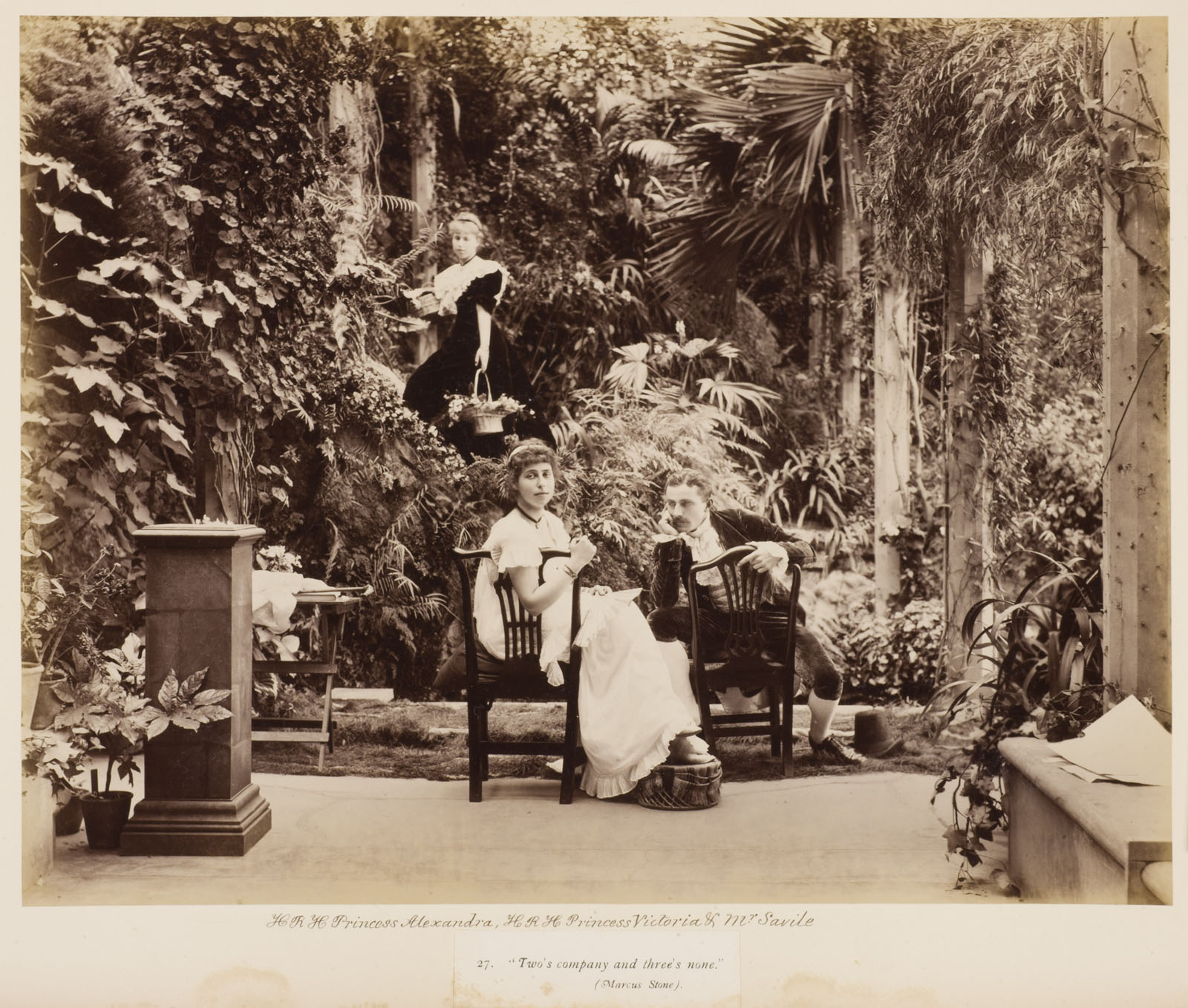
Tate Britain presents the first major exhibition to celebrate the spirited conversation between early photography and British art. It brings together photographs and paintings including Pre-Raphaelite, Aesthetic and British impressionist works. Spanning 75 years across the Victorian and Edwardian ages, the exhibition opens with the experimental beginnings of photography in dialogue with painters such as J.M.W. Turner and concludes with its flowering as an independent international art form.

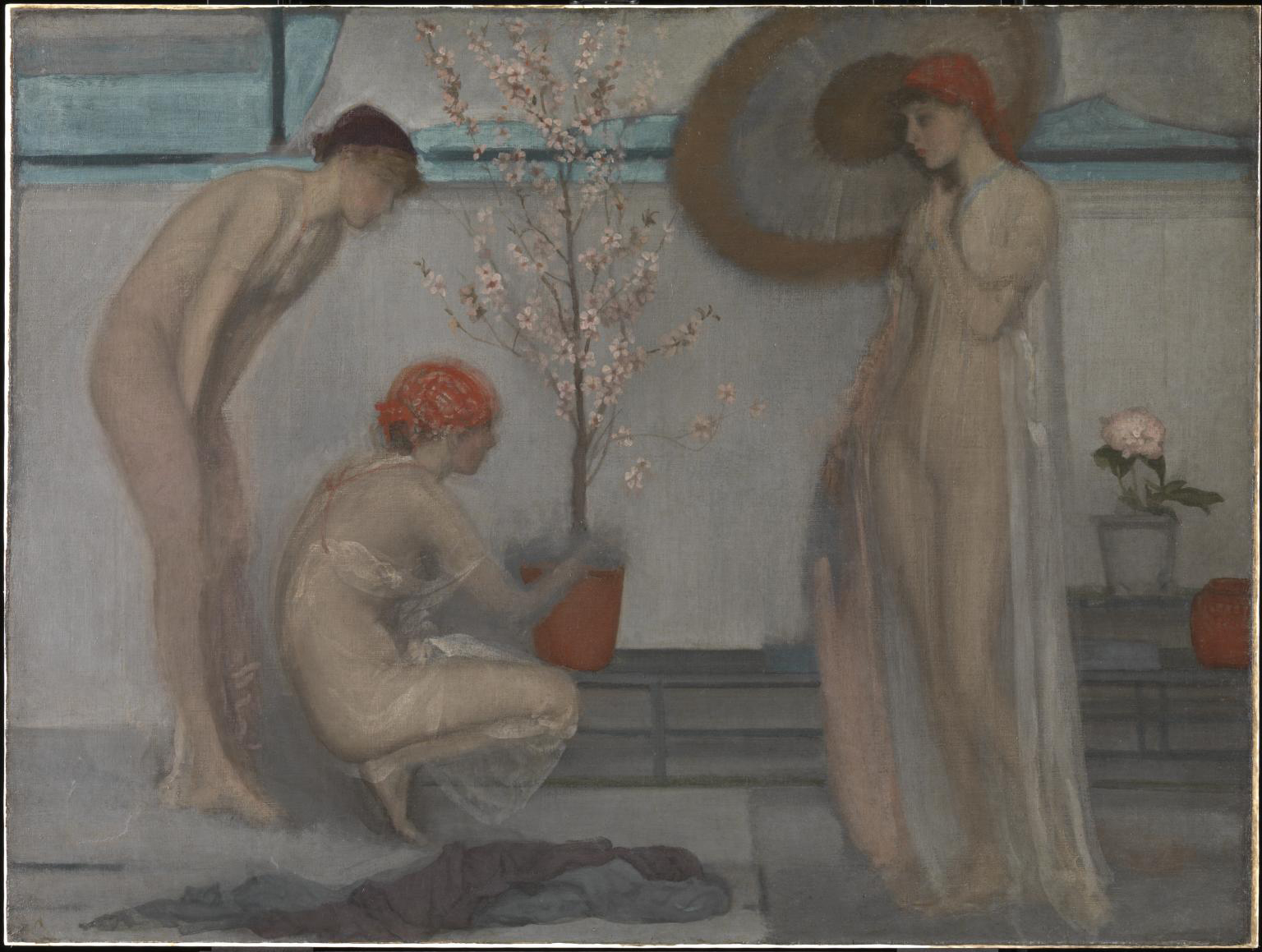
Stunning works by John Everett Millais, Dante Gabriel Rossetti, JAM Whistler, John Singer Sargent and others will for the first time be shown alongside ravishing photographs by pivotal early photographers such as Julia Margaret Cameron, which they inspired and which inspired them.


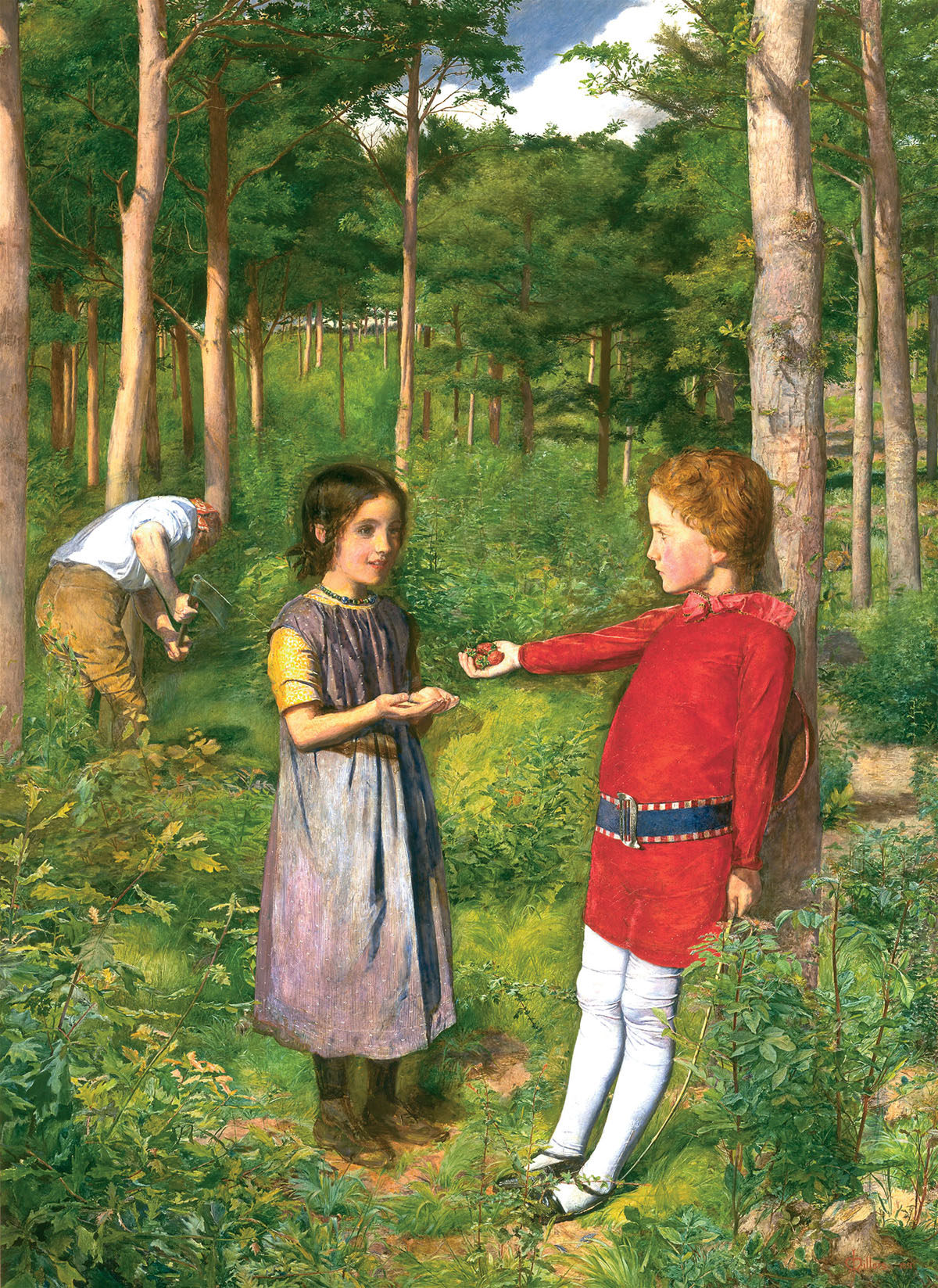
John Everett Millais (English, 1829-1896) 'The Woodman's Daughter' 1850-1851 from the exhibition 'Painting with Light: Art and Photography from the Pre-Raphaelites to the Modern Age' at Tate Britain, London, May - Sept, 2016


John Everett Millais (English, 1829-1896)
The Woodman’s Daughter
1850-51
Oil paint on canvas
889 x 648mm
Guildhall Art Gallery, City of London


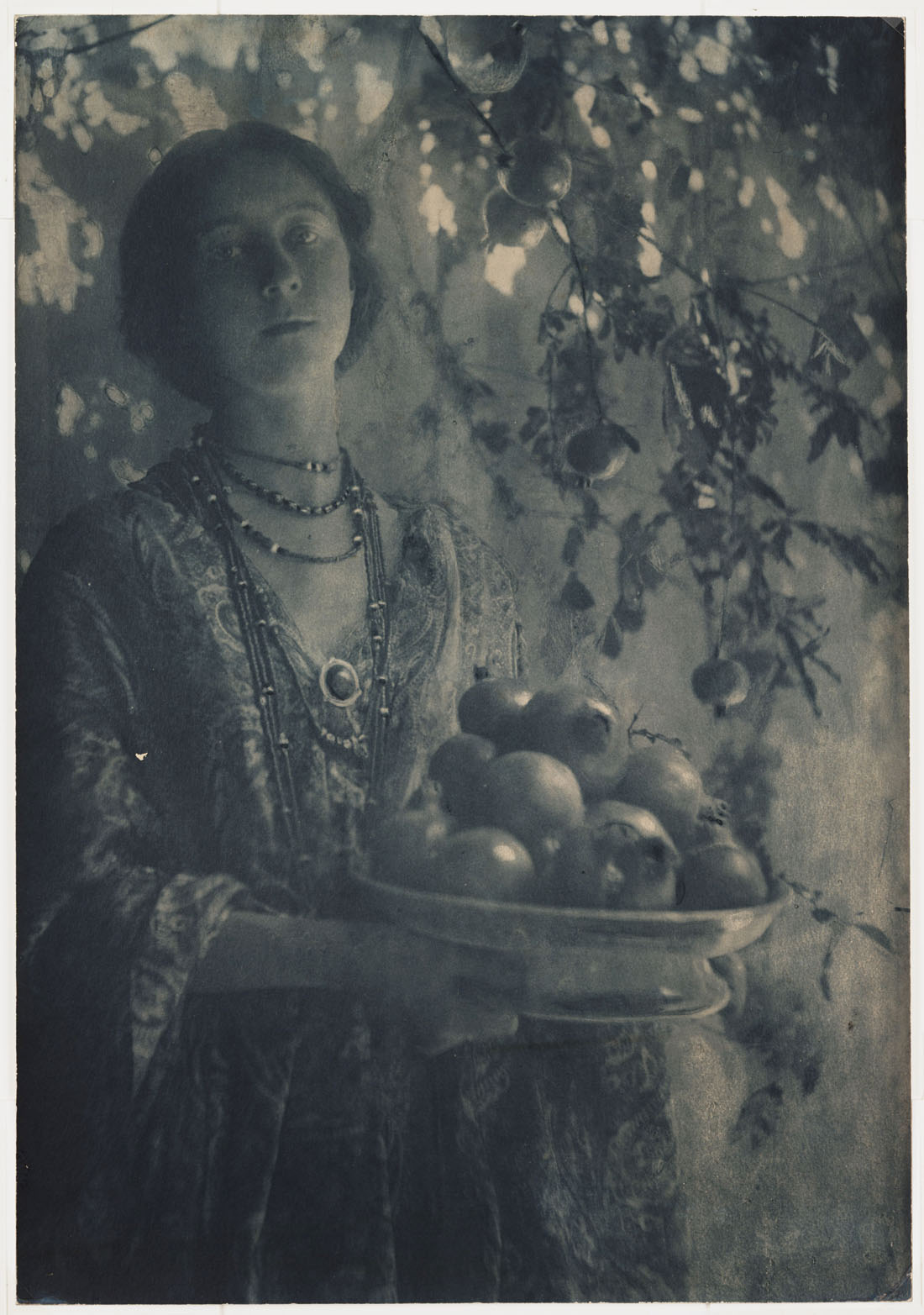
Minna Keene (Canadian born Germany, 1861-1943) 'Decorative Study' c. 1906


Minna Keene (Canadian born Germany, 1861-1943)
Decorative Study
c. 1906
© Royal Photographic Society / National Media Museum/ Science & Society Picture Library


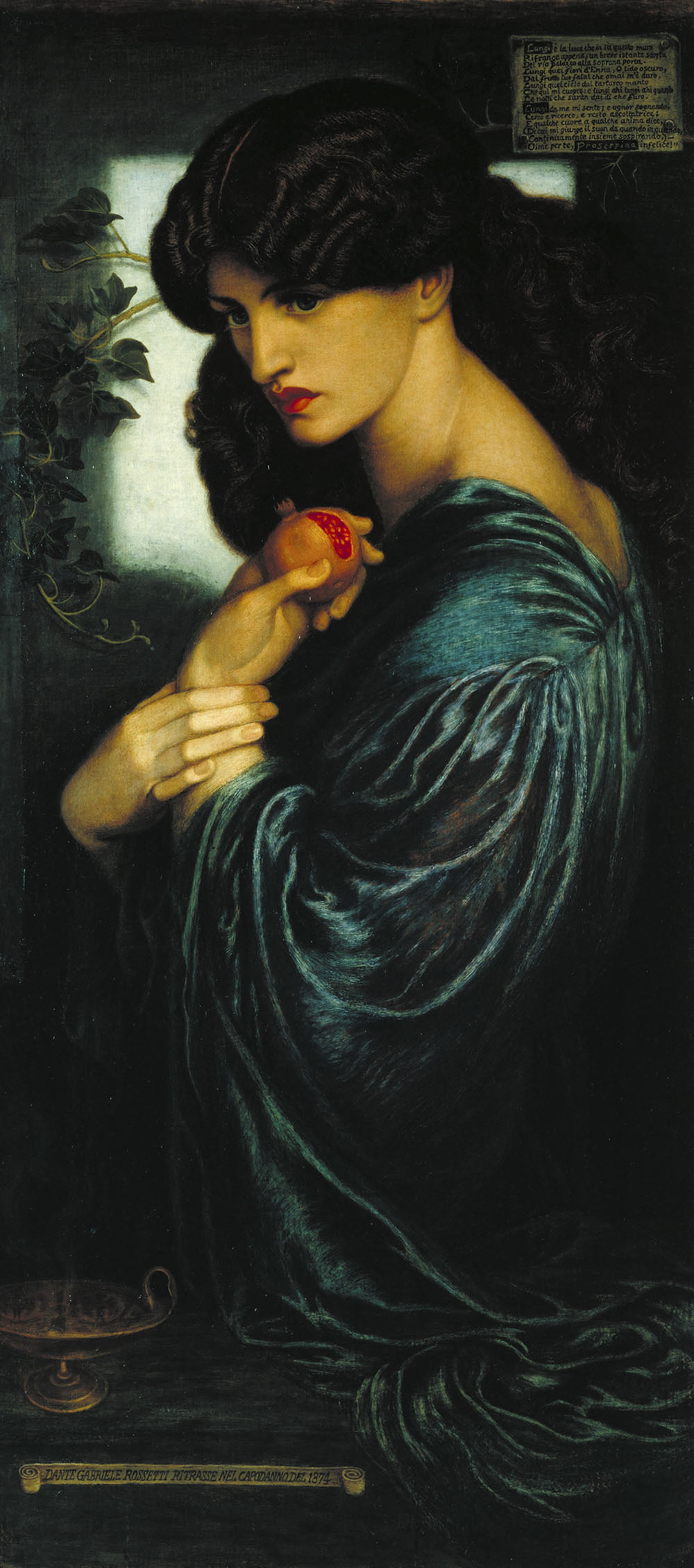
Dante Gabriel Rossetti (English, 1828-1882) 'Proserpine' 1874


Dante Gabriel Rossetti (English, 1828-1882)
Proserpine
1874
Oil on canvas
Support: 1251 x 610mm
Frame: 1605 x 930 x 85mm
Presented by W. Graham Robertson 1940


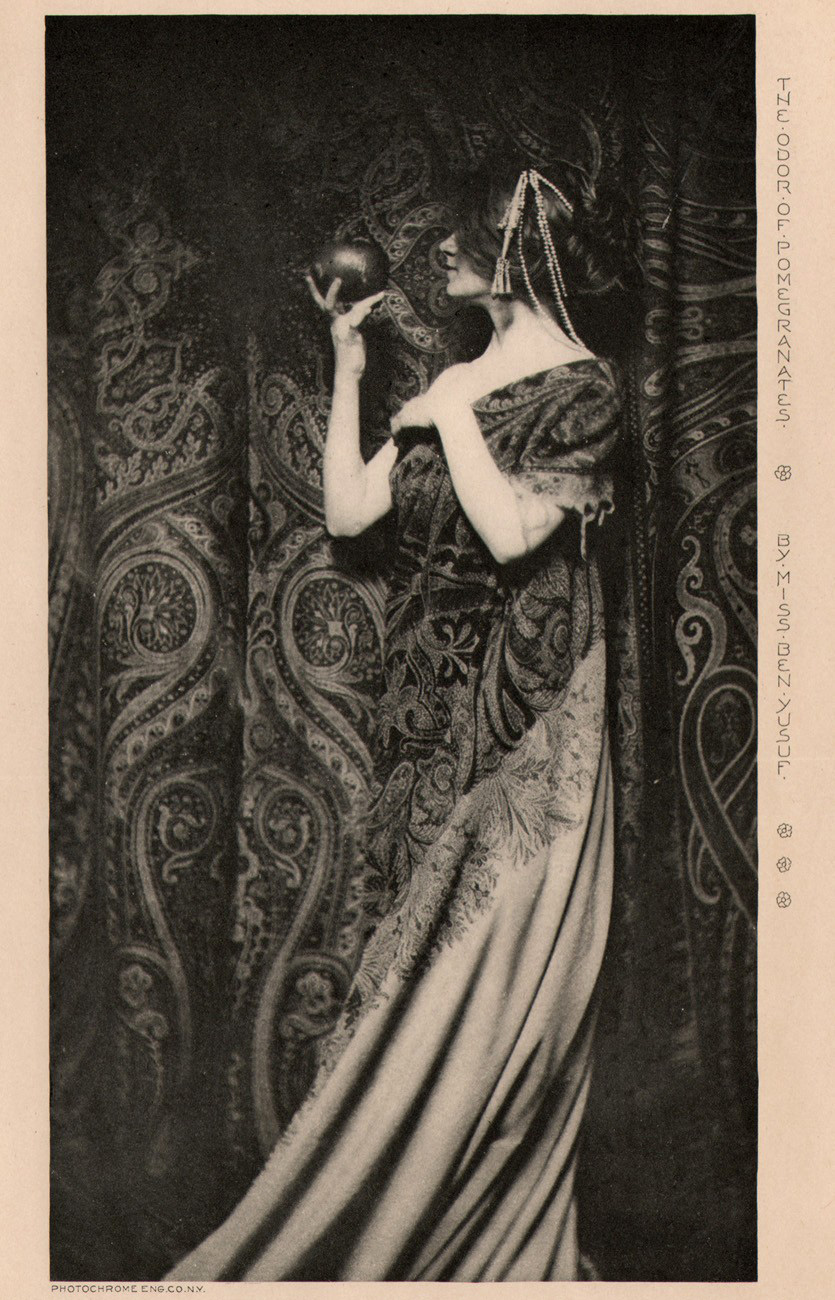
Zaida Ben-Yusuf (American born England, 1869-1933) 'The Odor of Pomegranates' 1899


Zaida Ben-Yusuf (American born England, 1869-1933)
The Odor of Pomegranates
1899, published 1901
Photogravure on paper
Tate


Zaida Ben-Yusuf (American born England, 1869-1933)

Zaida Ben-Yusuf (21 November 1869 – 27 September 1933) was a New York-based portrait photographer noted for her artistic portraits of wealthy, fashionable, and famous Americans of the turn of the 19th-20th century. She was born in London to a German mother and an Algerian father, but became a naturalised American citizen later in life. In 1901 the Ladies Home Journal featured her in a group of six photographers that it dubbed, “The Foremost Women Photographers in America.” In 2008, the Smithsonian National Portrait Gallery mounted an exhibition dedicated solely to Ben-Yusuf’s work, re-establishing her as a key figure in the early development of fine art photography…

In 1896, Ben-Yusuf began to be known as a photographer. In April 1896, two of her pictures were reproduced in The Cosmopolitan Magazine, and another study was exhibited in London as part of an exhibition put on by The Linked Ring. She travelled to Europe later that year, where she met with George Davison, one of the co-founders of The Linked Ring, who encouraged her to continue her photography. She exhibited at their annual exhibitions until 1902.

In the spring of 1897, Ben-Yusuf opened her portrait photography studio at 124 Fifth Avenue, New York. On 7 November 1897, the New York Daily Tribune ran an article on Ben-Yusuf’s studio and her work creating advertising posters, which was followed by another profile in Frank Leslie’s Weekly on 30 December. Through 1898, she became increasingly visible as a photographer, with ten of her works in the National Academy of Design-hosted 67th Annual Fair of the American Institute, where her portrait of actress Virginia Earle won her third place in the Portraits and Groups class. During November 1898, Ben-Yusuf and Frances Benjamin Johnston held a two-woman show of their work at the Camera Club of New York.

In 1899, Ben-Yusuf met with F. Holland Day in Boston, and was photographed by him. She relocated her studio to 578 Fifth Avenue, and exhibited in a number of exhibitions, including the second Philadelphia Photographic Salon. She was also profiled in a number of publications, including an article on female photographers in The American Amateur Photographer, and a long piece in The Photographic Times in which Sadakichi Hartmann described her as an “interesting exponent of portrait photography”.

1900 saw Ben-Yusuf and Johnston assemble an exhibition on American women photographers for the Universal Exposition in Paris. Ben-Yusuf had five portraits in the exhibition, which travelled to Saint Petersburg, Moscow, and Washington, D.C. She was also exhibited in Holland Day’s exhibition, The New School of American Photography, for the Royal Photographic Society in London, and had four photographs selected by Alfred Stieglitz for the Glasgow International Exhibition of 1901, Scotland.

In 1901, Ben-Yusuf wrote an article, “Celebrities Under the Camera”, for the Sunday Evening Post, where she described her experiences with her sitters. By this stage she had photographed Grover Cleveland, Franklin Roosevelt, and Leonard Wood, amongst others. For the September issue of Metropolitan Magazine she wrote another article, “The New Photography – What It Has Done and Is Doing for Modern Portraiture”, where she described her work as being more artistic than most commercial photographers, but less radical than some of the better-known art photographers. The Ladies Home Journal that November declared her to be one of the “foremost women photographers in America”, as she began the first of a series of six illustrated articles on “Advanced Photography for Amateurs” in the Saturday Evening Post.

Ben-Yusuf was listed as a member of the first American Photographic Salon when it opened in December 1904, although her participation in exhibitions was beginning to drop off. In 1906, she showed one portrait in the third annual exhibition of photographs at Worcester Art Museum, Massachusetts, the last known exhibition of her work in her lifetime.

Text from the Wikipedia website


In the Studio

Many photographers trained as painters. They set up studios and employed artists’ models, skilled at holding poses for the time it took to take a picture. Later in the century, improved photographic negatives required shorter exposure times and it became easier to stage and capture difficult positions and spontaneous gestures.

Painters and illustrators used photographs as preparatory studies and as substitutes for props, costumes and models, and art schools created photographic archives for their students. Photographs commissioned and sold by institutions such as the British Museum made classical sculpture and old master paintings more accessible, inspiring both painters and photographers.


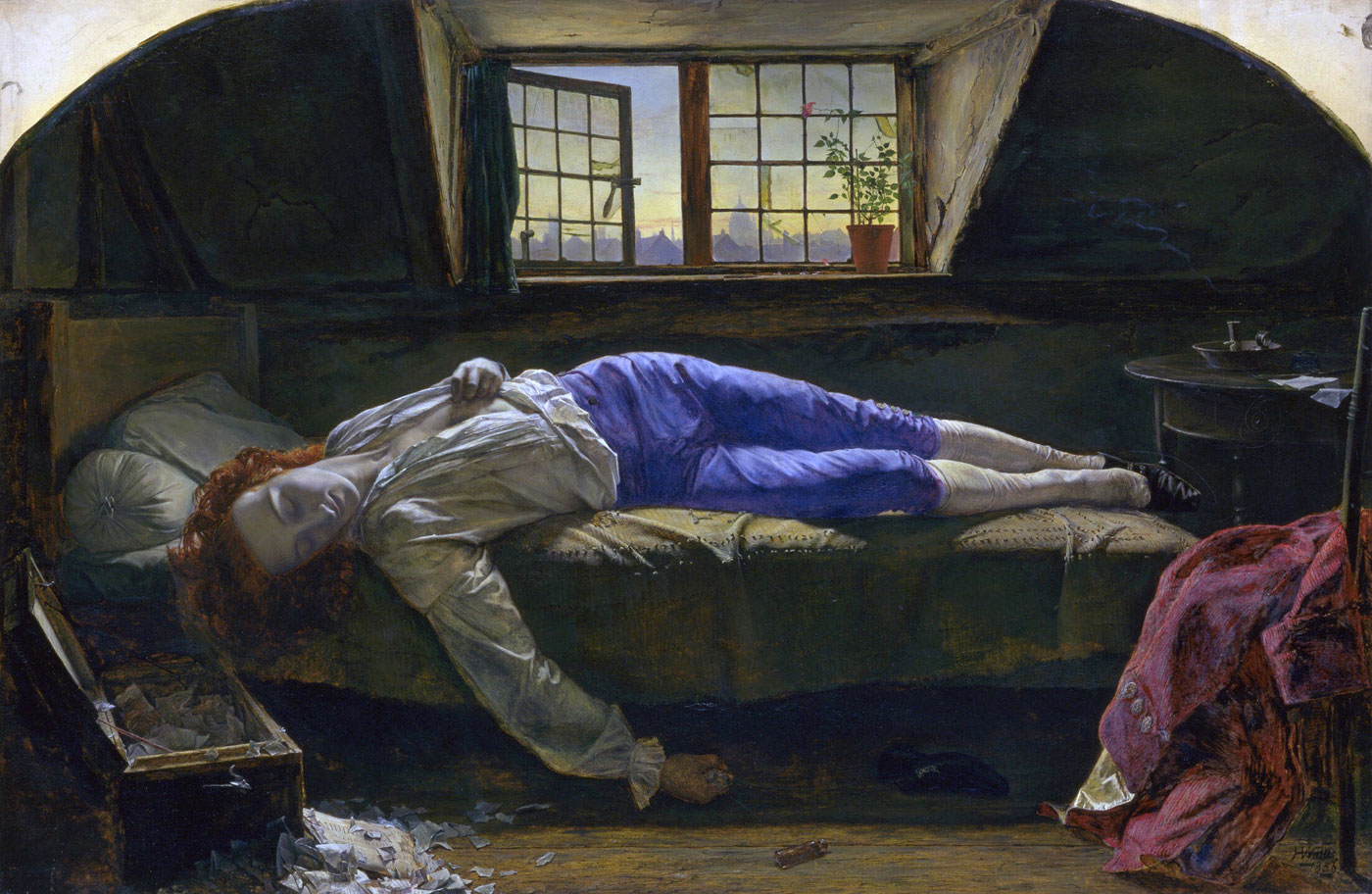
Henry Wallis (British, 1830-1916) 'Chatterton' 1856


Henry Wallis (British, 1830-1916)
Chatterton
1856
Oil paint on canvas
Support: 622 x 933mm
Frame: 905 x 1205 x 132mm
Tate
Bequeathed by Charles Gent Clement 1899


Chatterton is Wallis’s earliest and most famous work. The picture created a sensation when it was first exhibited at the Royal Academy in 1856, accompanied by the following quotation from Marlowe:

Cut is the branch that might have grown full straight
And burned is Apollo’s laurel bough.


Ruskin described the work in his Academy Notes as ‘faultless and wonderful’.

Thomas Chatterton (1752-1770) was an 18th Century poet, a Romantic figure whose melancholy temperament and early suicide captured the imagination of numerous artists and writers. He is best known for a collection of poems, written in the name of Thomas Rowley, a 15th Century monk, which he copied onto parchment and passed off as mediaeval manuscripts. Having abandoned his first job working in a scrivener’s office he struggled to earn a living as a poet. In June 1770 he moved to an attic room at 39 Brooke Street, where he lived on the verge of starvation until, in August of that year, at the age of only seventeen, he poisoned himself with arsenic. Condemned in his lifetime as a forger by influential figures such as the writer Horace Walpole (1717-1797), he was later elevated to the status of tragic hero by the French poet Alfred de Vigny (1797-1863).

Wallis may have intended the picture as a criticism of society’s treatment of artists, since his next picture of note, The Stonebreaker (1858, Birmingham City Museum and Art Gallery), is one of the most forceful examples of social realism in Pre-Raphaelite art. The painting alludes to the idea of the artist as a martyr of society through the Christ-like pose and the torn sheets of poetry on the floor. The pale light of dawn shines through the casement window, illuminating the poet’s serene features and livid flesh. The harsh lighting, vibrant colours and lifeless hand and arm increase the emotional impact of the scene. A phial of poison on the floor indicates the method of suicide. Following the Pre-Raphaelite credo of truth to nature, Wallis has attempted to recreate the same attic room in Gray’s Inn where Chatterton had killed himself. The model for the figure was the novelist George Meredith (1828-1909), then aged about 28. Two years later Wallis eloped with Meredith’s wife, a daughter of the novelist Thomas Love Peacock (1785-1866).

Frances Fowle. “Chatterton,” on the Tate website December 2000 [Online] Cited 16/02/2023


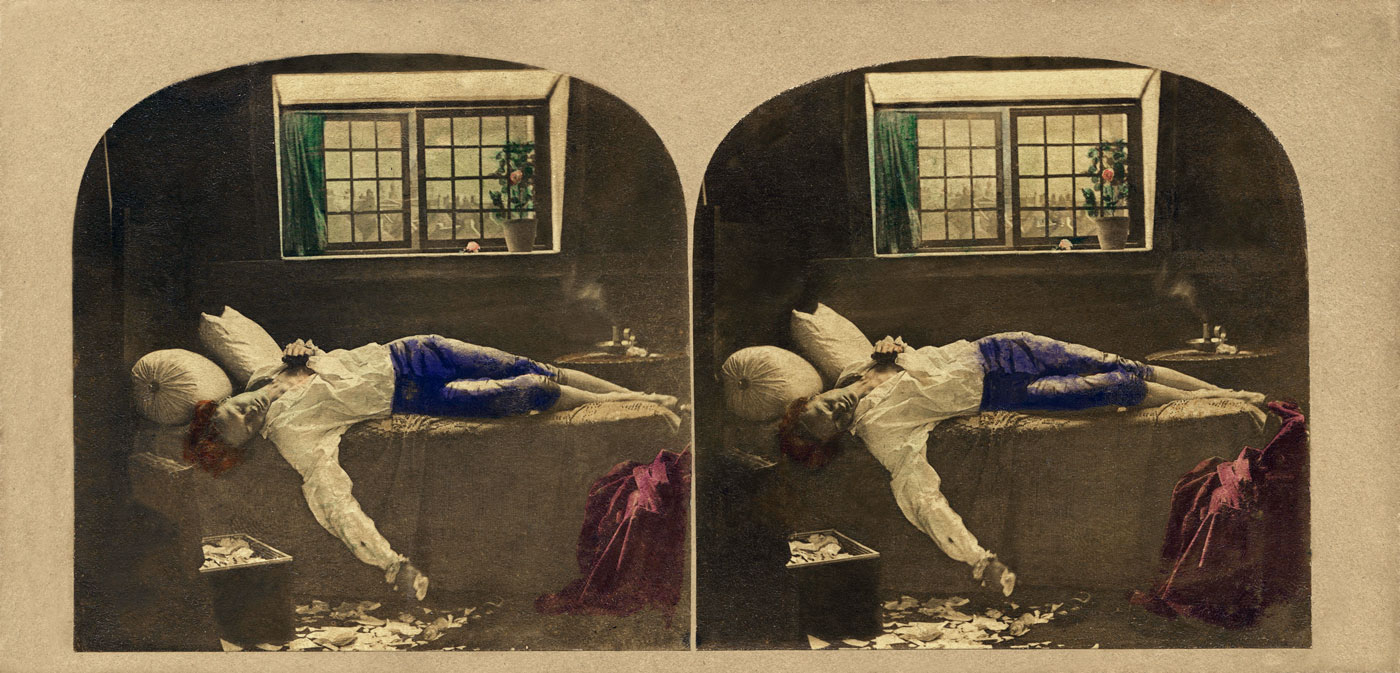
James Robinson. 'The Death of Chatterton' 1859


James Robinson
The Death of Chatterton
1859
Two photographs, hand-tinted albumen prints on paper mounted on card
Collection Dr Brian May

THIS STEREOCARD IS NOT IN THE EXHIBITION


James Robinson. 'The Death of Chatterton' 1859 (detail)


James Robinson
The Death of Chatterton (detail)
1859
Two photographs, hand-tinted albumen prints on paper mounted on card
Collection Dr Brian May

THIS STEREOCARD IS NOT IN THE EXHIBITION


One of the most famous paintings of Victorian times was Chatterton, 1856 (Tate) by the young Pre-Raphaelite-style artist, Henry Wallis (1830-1916). Again, the tale of the suicide of the poor poet, Thomas Chatterton, exposed as a fraud for faking medieval histories and poems to get by, had broad appeal. Chatterton was also an 18th-century figure, but Wallis set his picture in a bare attic overlooking the City of London which evoked the urban poverty of his own age. The picture toured the British Isles and hundreds of thousands flocked to pay a shilling to view it. One of these was James Robinson, who saw the painting when it was in Dublin. He immediately conceived a stereographic series of Chatterton’s life. Unfortunately Robinson started with Wallis’s scene (The Death of Chatterton, 1859). Within days of its publication, legal procedures began, claiming his picture threatened the income of the printmaker who had the lucrative copyright to publish engravings of the painting. The ensuing court battles were the first notorious copyright cases. Robinson lost, but strangely, in 1861, Birmingham photographer Michael Burr published variations of Death of Chatterton with no problems. No other photographer was ever prosecuted for staging a stereoscopic picture after a painting and the market continued to thrive…

Robinson’s The Death of Chatterton illustrates the way this uncanny quality [the ability to record reality in detail] distinguishes the stereograph from even the immaculate Pre-Raphaelite style of Wallis’s painting of the same subject. The stereograph represented a young man in 18th-century costume on a bed. The backdrop was painted, but the chest, discarded coat and candle were real. Again, the light and colour appear crude in comparison with the painting but the stereoscope records ‘every stick, straw, scratch’ in a manner that the painting cannot. The torn paper pieces, animated by their three-dimensionality, trace the poet’s recent agitation, while the candle smoke, representing his extinguished life, is different in each photograph due to their being taken at separate moments. The haphazard creases of the bed sheet are more suggestive of restless movement, now stilled, than Wallis’s elegant drapery. Even the individuality of the boy adds potency to his death.

Extract from the essay by Carol Jacobi. “Tate Painting and the Art of Stereoscopic Photography,” on the Tate website 17th October, 2014 [Online] Cited 14/02/2015


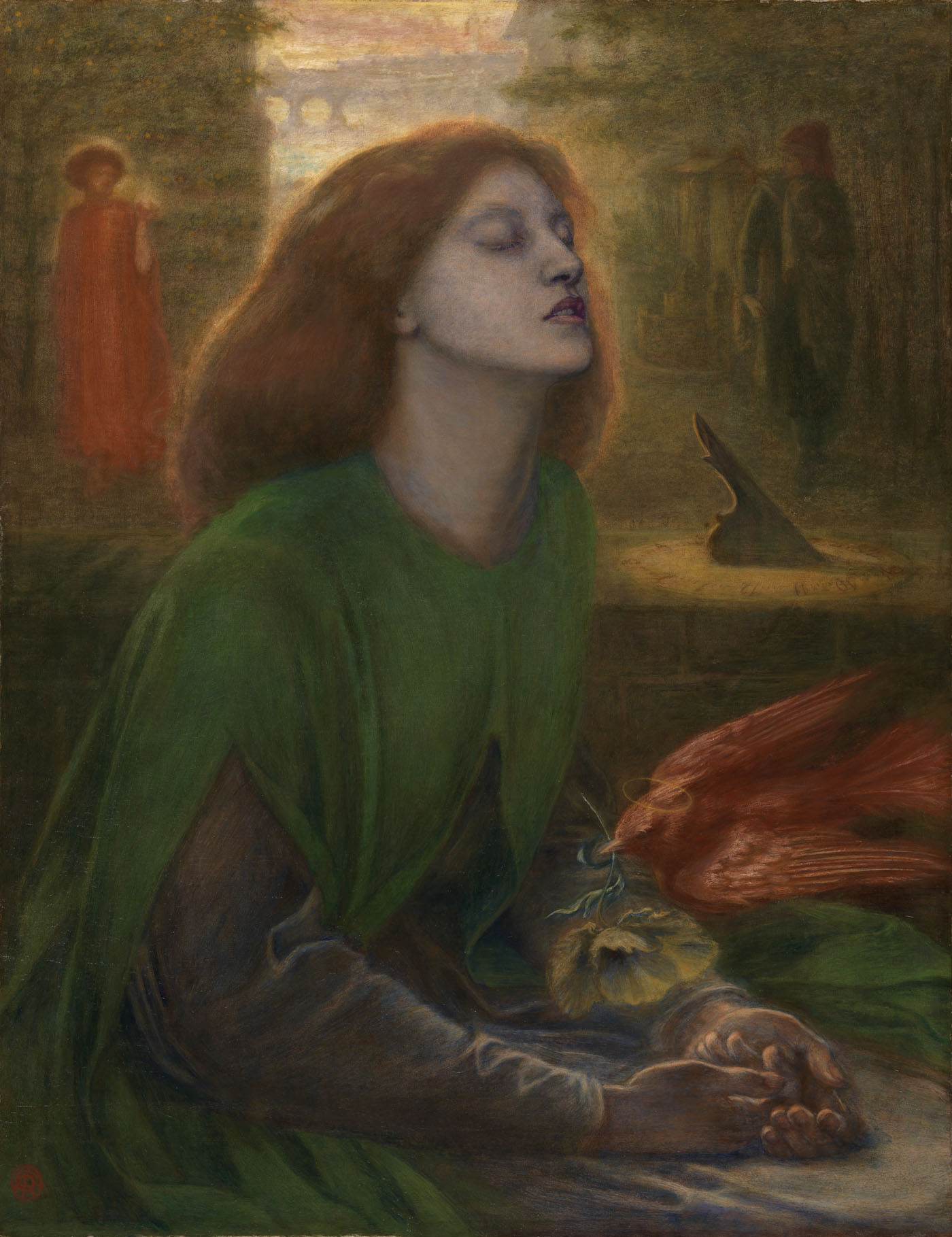
Dante Gabriel Rossetti (English, 1828-1882) 'Beata Beatrix' c. 1864-1870


Dante Gabriel Rossetti (English, 1828-1882)
Beata Beatrix
c. 1864-1870
Oil on canvas
Support: 864 x 660mm
Frame: 1212 x 1015 x 104mm
Presented by Georgiana, Baroness Mount-Temple in memory of her husband, Francis, Baron Mount-Temple 1889


Rossetti draws a parallel in this picture between the Italian poet Dante’s despair at the death of his beloved Beatrice and his own grief at the death of his wife Elizabeth Siddal, who died on 11 February 1862. Dante Alighieri (1265-1321) recounted the story of his unrequited love and subsequent mourning for Beatrice Portinari in the Vita Nuova. This was Rossetti’s first English translation and appeared in 1864 as part of his own publication, The Early Italian Poets.

The picture is a portrait of Elizabeth Siddall in the character of Beatrice. It has a hazy, transcendental quality, giving the sensation of a dream or vision, and is filled with symbolic references. Rossetti intended to represent her, not at the moment of death, but transformed by a ‘sudden spiritual transfiguration’ (Rossetti, in a letter of 1873, quoted in Wilson, p.86). She is posed in an attitude of ecstasy, with her hands before her and her lips parted, as if she is about to receive Communion. According to Rossetti’s friend F.G. Stephens, the grey and green of her dress signify ‘the colours of hope and sorrow as well as of love and life’ (‘Beata Beatrix by Dante Gabriel Rossetti’, Portfolio, vol. 22, 1891, p. 46).

In the background of the picture the shadowy figure of Dante looks across at Love, portrayed as an angel and holding in her palm the flickering flame of Beatrice’s life. In the distance the Ponte Vecchio signifies the city of Florence, the setting for Dante’s story. Beatrice’s impending death is evoked by the dove – symbol of the holy spirit – which descends towards her, an opium poppy in its beak. This is also a reference to the death of Elizabeth Siddall, known affectionately by Rossetti as ‘The Dove’, and who took her own life with an overdose of laudanum. Both the dove and the figure of Love are red, the colour of passion, yet Rossetti envisaged the bird as a messenger, not of love, but of death. Beatrice’s death, which occurred at nine o’clock on 9th June 1290, is foreseen in the sundial which casts its shadow over the number nine. The picture frame, which was designed by Rossetti, has further references to death and mourning, including the date of Beatrice’s death and a phrase from Lamentations 1:1, quoted by Dante in the Vita Nuova: ‘Quomodo sedet sola civitas’ (‘how doth the city sit solitary’), referring to the mourning of Beatrice’s death throughout the city of Florence.

Frances Fowle. “Beata Beatrix,” on the Tate website December 2000 [Online] Cited 16/02/2023


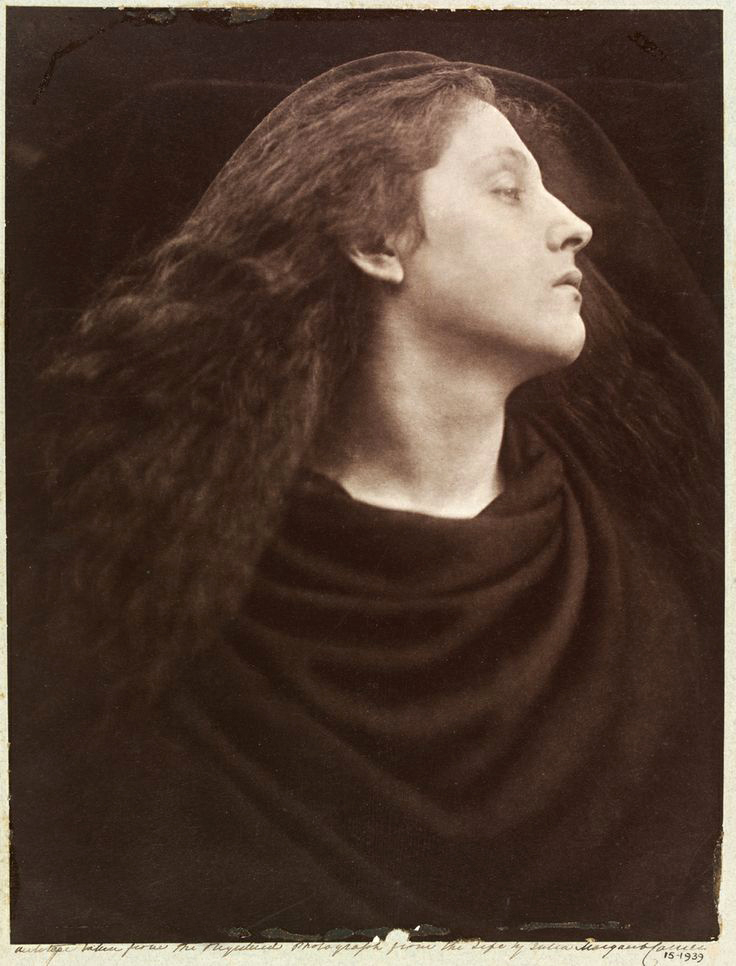
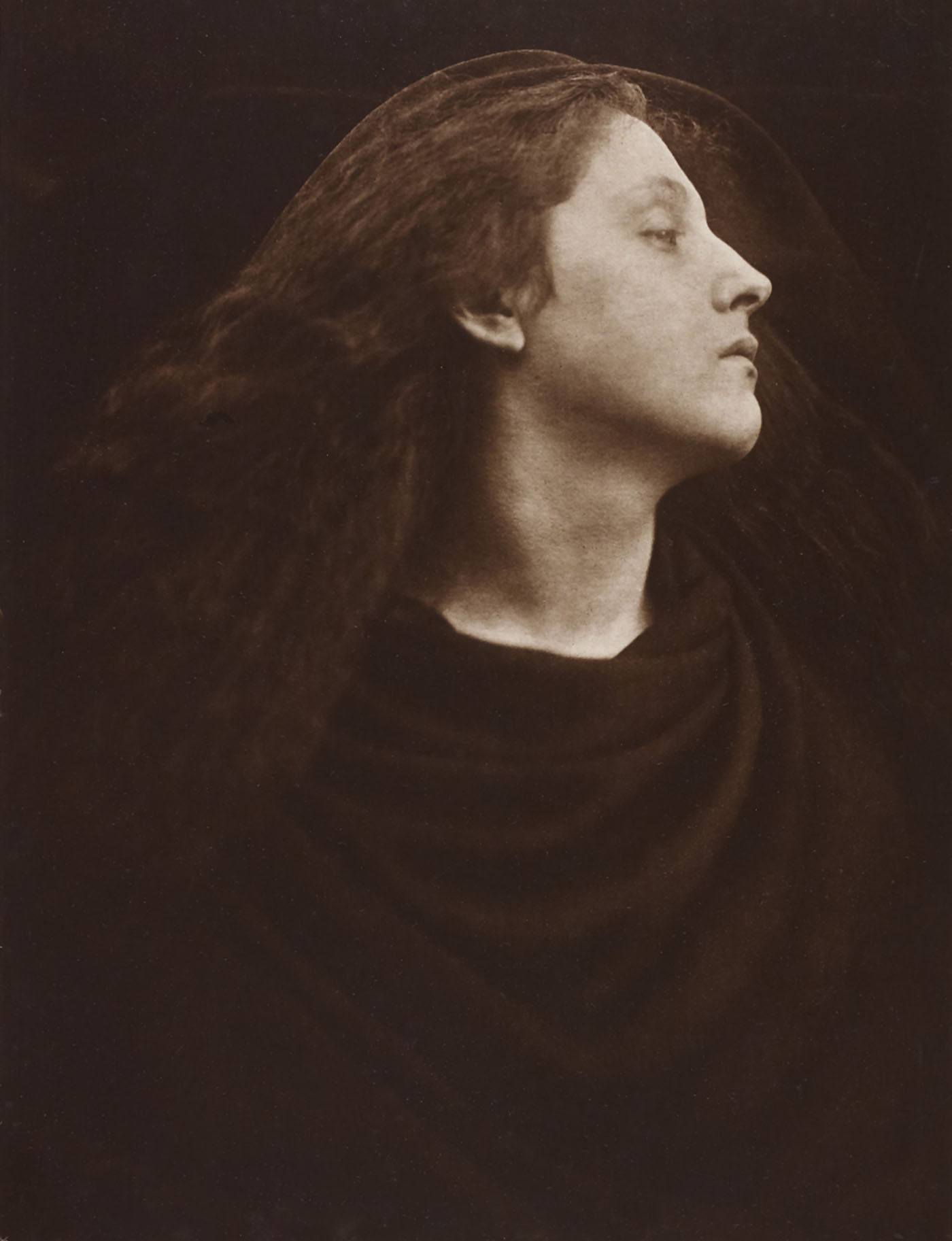
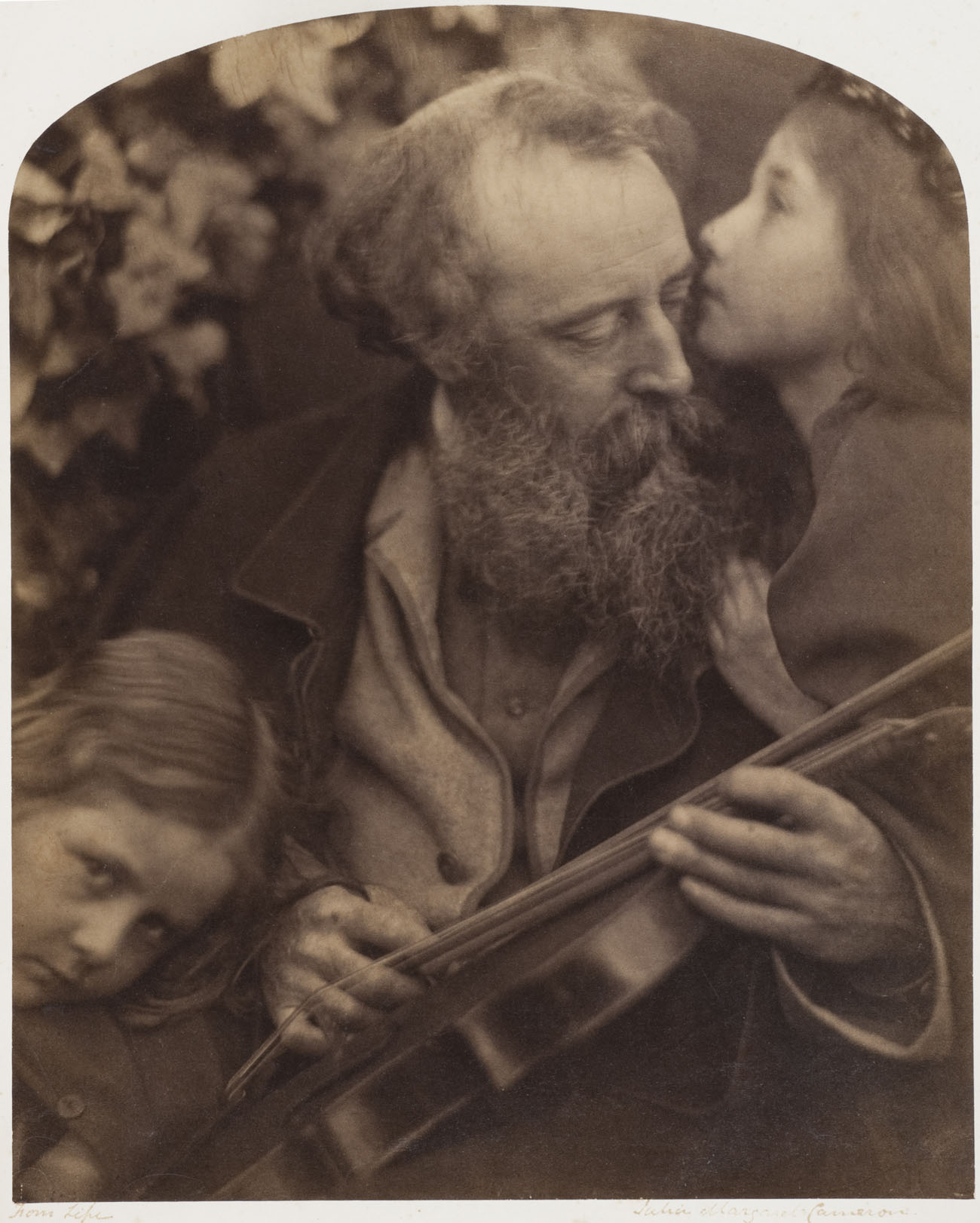
Julia Margaret Cameron (British born India, 1815-1879) 'Call, I Follow, I Follow, Let Me Die!' 1867

Julia Margaret Cameron (British born India, 1815-1879) 'Call, I Follow, I Follow, Let Me Die!' 1867


Julia Margaret Cameron (British born India, 1815-1879)
Call, I Follow, I Follow, Let Me Die!
1867
© Royal Photographic Society / National Media Museum / Science & Society Picture Library


In late 1865, Julia Margaret Cameron began using a larger camera. It held a 15 x 12 inch glass negative, rather than the 12 x 10 inch negative of her first camera. Early the next year she wrote to Henry Cole with great enthusiasm – but little modesty – about the new turn she had taken in her work. Cameron initiated a series of large-scale, closeup heads that fulfilled her photographic vision. She saw them as a rejection of ‘mere conventional topographic photography – map-making and skeleton rendering of feature and form’ in favour of a less precise but more emotionally penetrating form of portraiture. Cameron also continued to make narrative and allegorical tableaux, which were larger and bolder than her previous efforts.

In this image, Cameron concentrates upon the head of her maid Mary Hillier by using a darkened background and draping her in simple dark cloth. The lack of surrounding detail or context obscures references to narrative, identity or historical context. The flowing hair, lightly parted lips and exposed neck suggest sensuality. The title, taken from a line in the poem ‘Lancelot and Elaine’ from Alfred Tennyson’s ‘Idylls of the King’, transforms the subject into a tragic heroine.

Anonymous. “Call, I Follow, I Follow, Let Me Die!,” on the V&A website [Online] Cited 16/02/2023


New truths

Mid-nineteenth century innovations in science and the arts became part of intense debates about ‘truth’ – variously defined as objective observation and as individual artistic vision. Inspired by artist and critic John Ruskin, the Pre-Raphaelite circle took a new approach to nature, discovering meaning in details previously overlooked, ‘rejecting nothing, selecting nothing’.

As the quality of paints and lenses improved, painters and photographers tested the bounds of perception and representation. They moved out of the studio, to explore light and other atmospheric effects as well as geological subjects, landscape and architecture. New photographic materials like glass plate negatives and coated printed papers offered greater accuracy and photography became a valuable aid for painters.


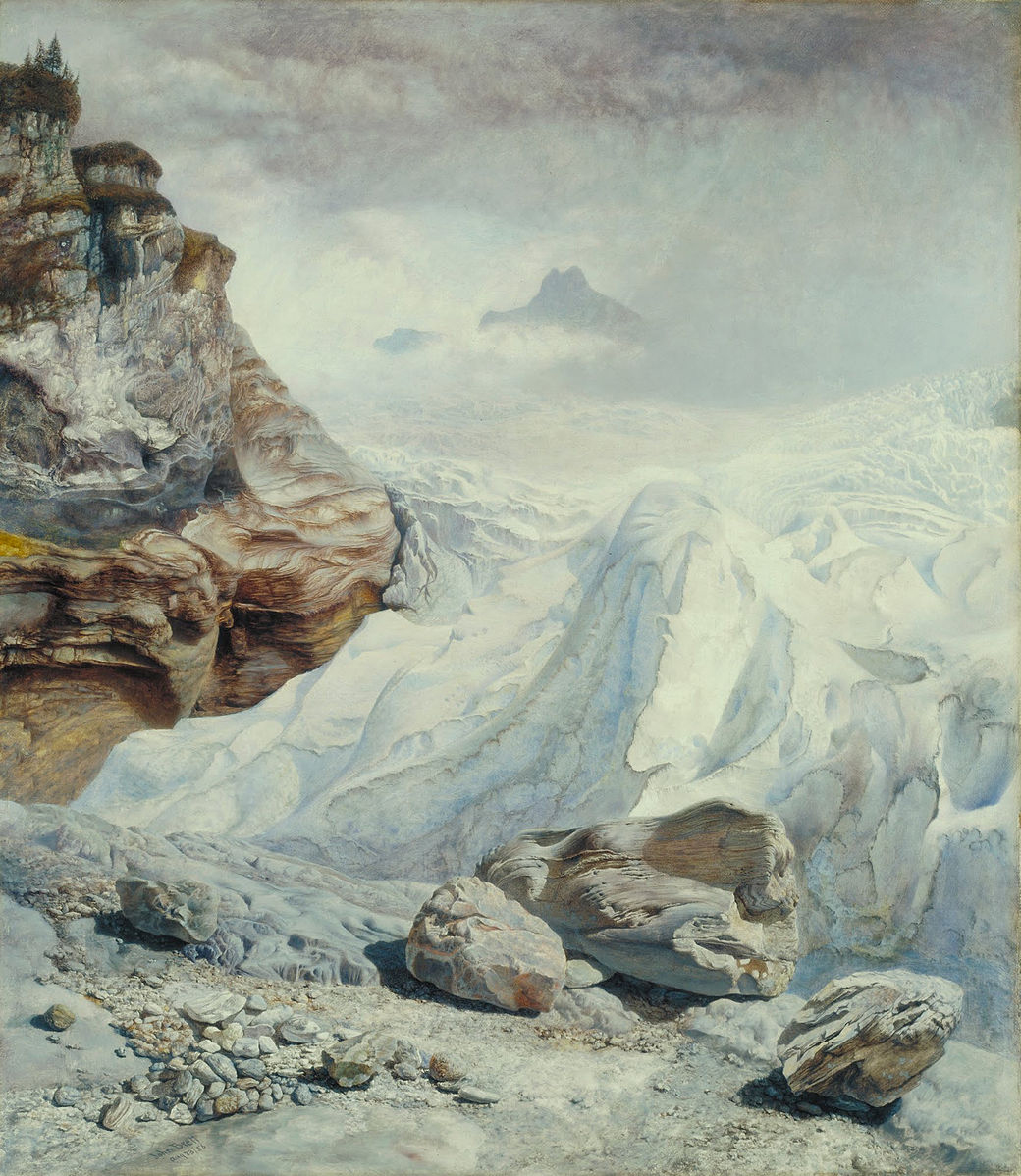
John Brett (British, 1831-1902) 'Glacier of Rosenlaui' 1856


John Brett (British, 1831-1902)
Glacier of Rosenlaui
1856
Oil on canvas
Height: 445 mm (17.52 in)
Width: 419 mm (16.5 in)
Tate Britain
Purchased 1946
Photo: Tate, London, 2011


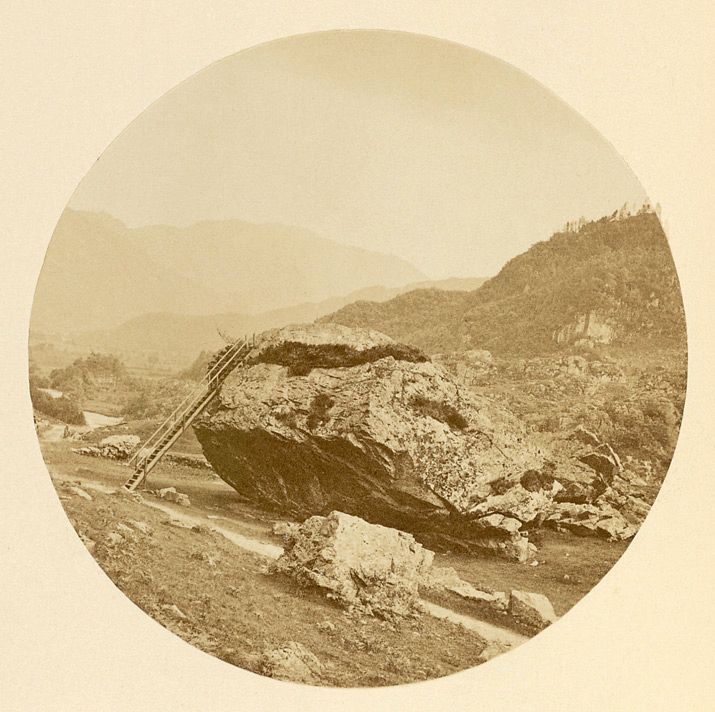
Thomas Ogle (British, 1813 - about 1882) 'The Bowder Stone in Our English Lakes, Mountains and Waterfalls as seen by William Wordsworth by A.W. Bennett' Published 1864


Thomas Ogle (British, 1813 – about 1882)
The Bowder Stone in Our English Lakes, Mountains and Waterfalls as seen by William Wordsworth by A.W. Bennett
Published 1864
Tate


View taken by Thomas Ogle of the Bowder Stone in Borrowdale, Cumbria, illustrating Our English Lakes, Mountains, And Waterfalls, as seen by William Wordsworth (1864). The book juxtaposes photographs of the Lake District with poems by the English Romantic poet. The Bowder Stone, an enormous boulder, was probably deposited by glaciation during the last Ice Age. It rests in Borrowdale, a valley of woods and crags in the Lake District whose scenic beauty inspired artists, writers and poets of the Romantic Movement in the late 18th and early 19th centuries. Wordsworth (1770-1850) was among them, and the photograph of the Bowder Stone accompanies his poem, Yew-Trees (1803), from which the following passage is taken:

“…But worthier still of note
Are those fraternal four of Borrowdale,
Joined in one solemn and capacious grove;
Huge trunks! – and each particular trunk a growth
Of intertwined fibres serpentine
Up-coiling, and inveterately convolved, –
Nor uninformed with phantasy, and looks
That threaten the profane; – a pillared shade,
Upon whose grassless floor of red-brown hue,
By sheddings from the pining umbrage tinged
Perenially – beneath whole sable roof
Of boughs, as if for festal purpose, decked
With unrejoicing berries, ghostly shapes
May meet at noontide – Fear and trembling Hope,
Silence and Foresight – Death the skeleton
And Time the shadow…”

Text from the British Library website [Online] Cited 18/09/2016


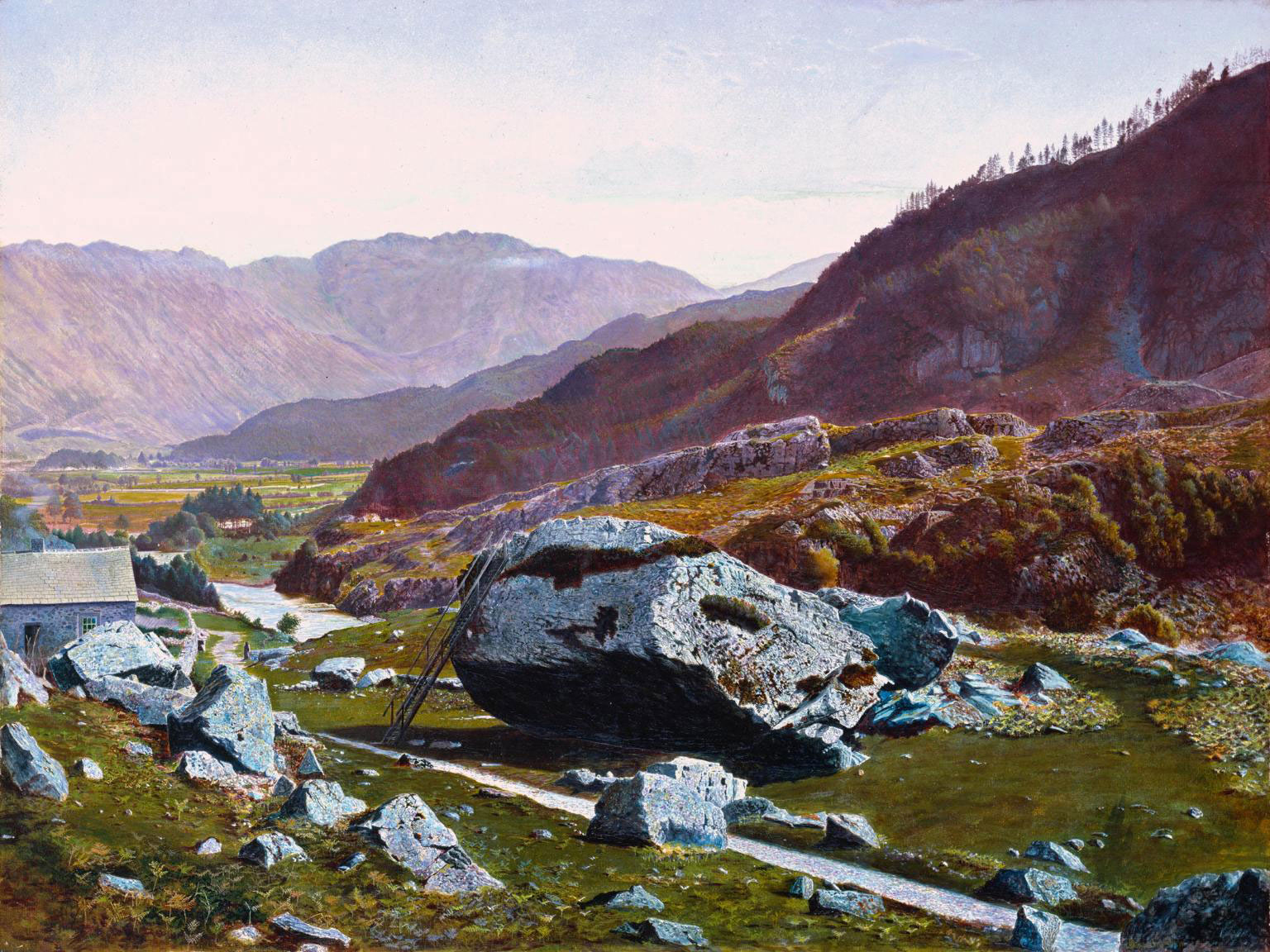
Atkinson Grimshaw (English, 1836-1893) 'Bowder Stone, Borrowdale' c. 1863-1868


Atkinson Grimshaw (English, 1836-1893)
Bowder Stone, Borrowdale
c. 1863-1868
Oil on canvas
Support: 400 x 536mm
Frame: 662 x 709 x 100mm
Purchased with assistance from the Friends of the Tate Gallery 1983


Tate Britain uncovers the dynamic dialogue between British painters and photographers; from the birth of the modern medium to the blossoming of art photography. Spanning over 70 years, the exhibition brings together nearly 200 works – many for the first time – to reveal their mutual influences. From the first explorations of movement and illumination by David Octavius Hill (1802-1870) and Robert Adamson (1821-1848) to artful compositions at the turn-of-the-century, the show discovers how painters and photographers redefined notions of beauty and art itself.

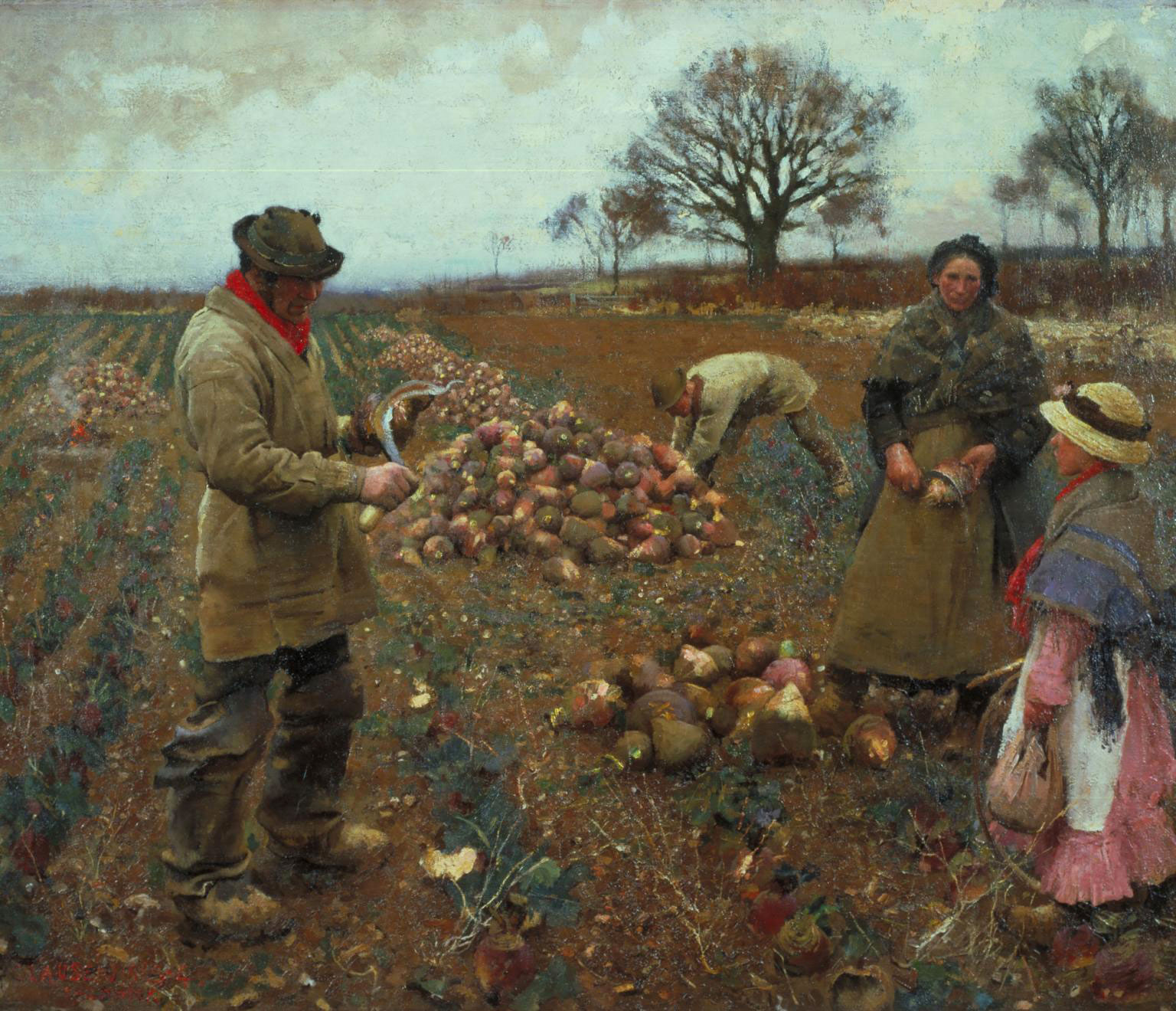
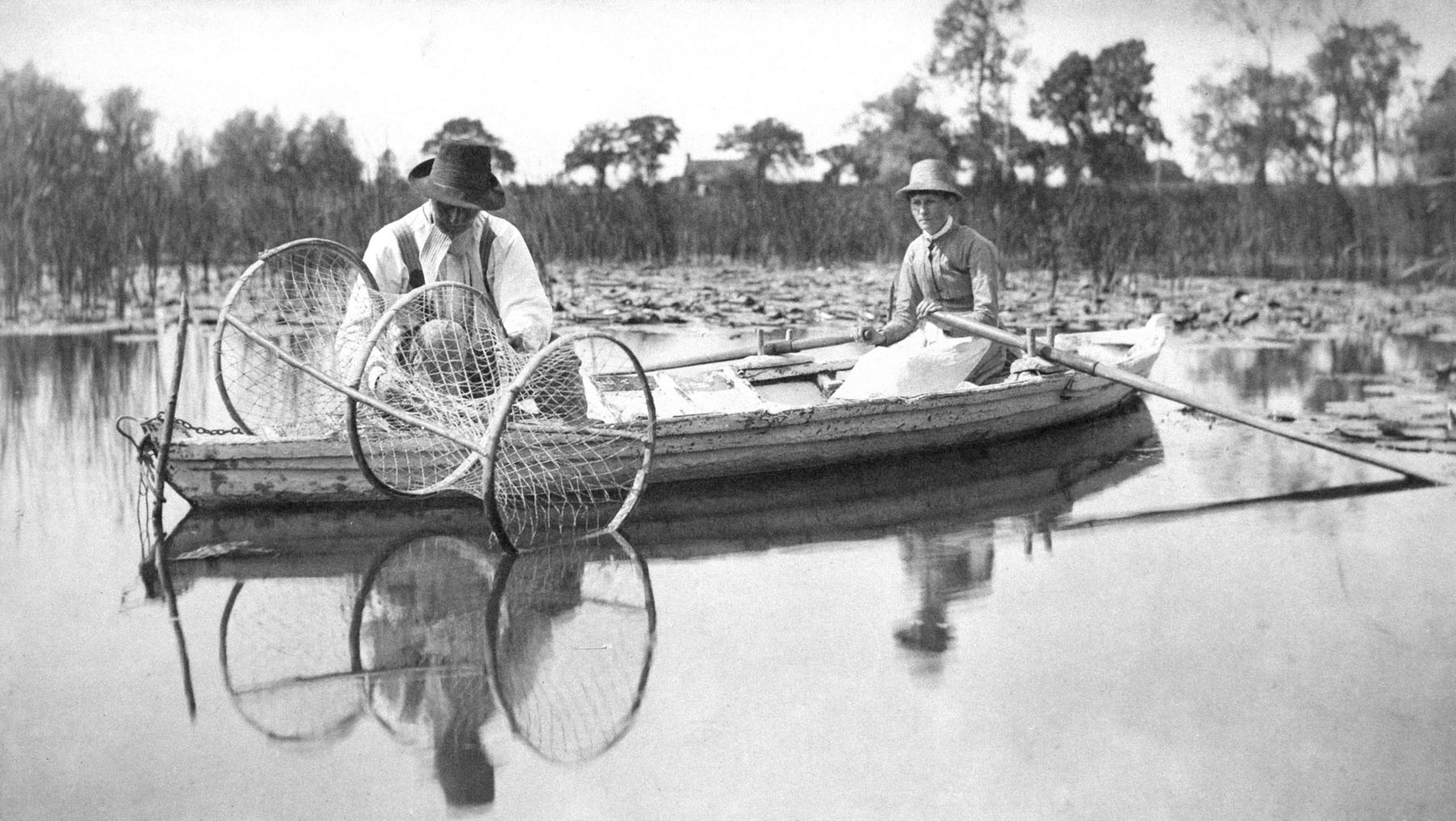
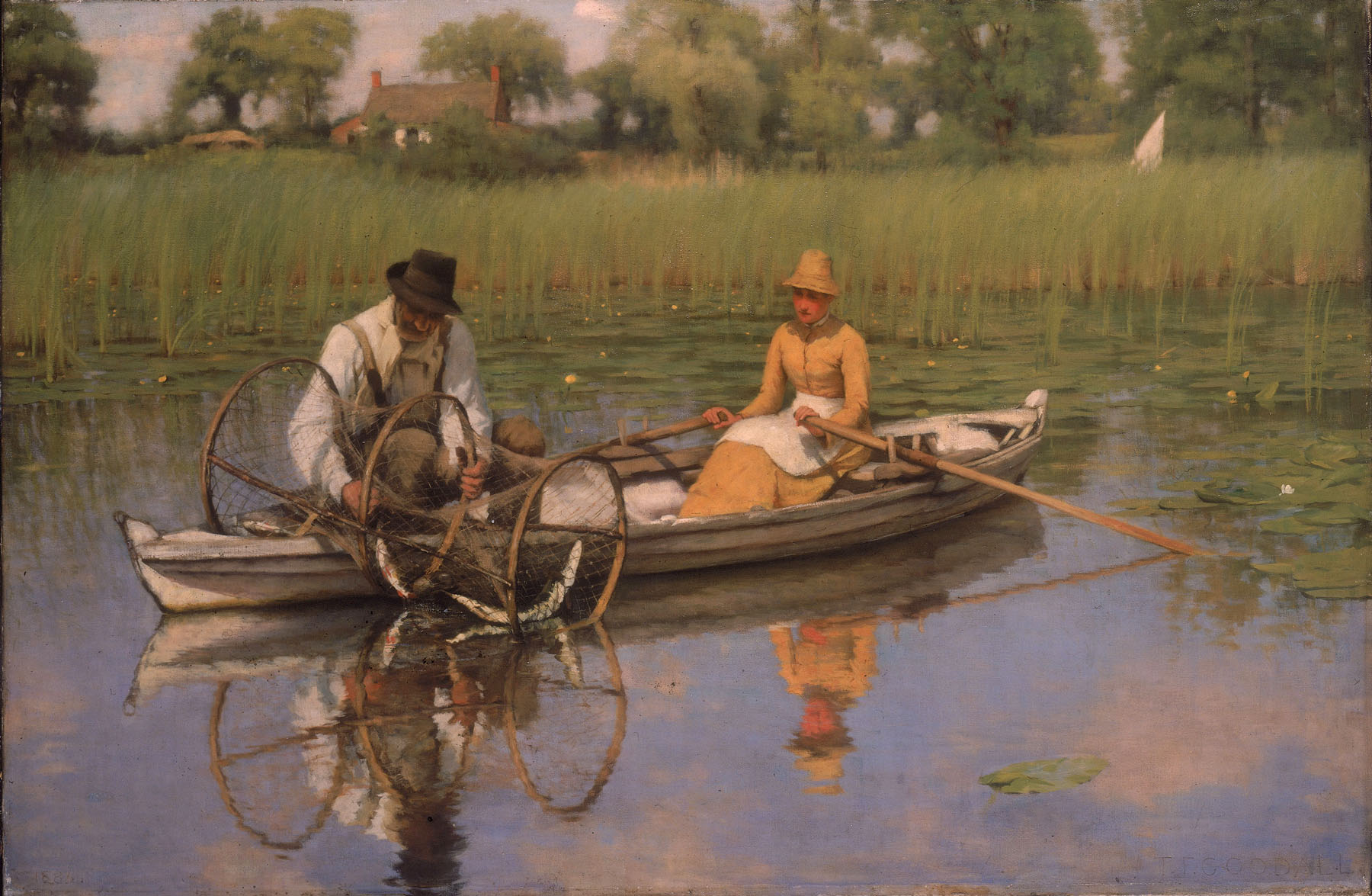
The dawn of photography coincided with a tide of revolutionary ideas in the arts, which questioned how pictures should be created and seen. Photography adapted the Old Master traditions within which many photographers had been trained, and engaged with the radical naturalism of JMW Turner (1775-1851), the Pre-Raphaelites, and their Realist and Impressionist successors. Turner inspired the first photographic panoramic views, and, in the years that followed his death, photographers and painters followed in his footsteps and composed novel landscapes evoking meaning and emotion. The exhibition includes examples such as John Everett Millais’s (1829-1896) nostalgic The Woodman’s Daughter and John Brett’s (1831-1902) awe inspiring Glacier Rosenlaui. Later in the century, PH Emerson (1856-1936) and TF Goodall’s (c. 1856-1944) images of rural river life allied photography to Impressionist painting, while JAM Whistler (1834-1903) and Alvin Langdon Coburn (1882-1966) created smoky Thames nocturnes in both media.

The exhibition celebrates the role of women photographers, such as Zaida Ben-Yusuf (1869-1933) and the renowned Julia Margaret Cameron (1815-1879). Cameron’s artistic friendships with George Frederic Watts (1817-1904) and Dante Gabriel Rossetti (1830-94) are recognised in a room devoted to their beautiful, enigmatic portraits of each other and shared models, where works including Cameron’s Call, I Follow, I Follow, Let Me Die and Rossetti’s Beata Beatrix are on display.

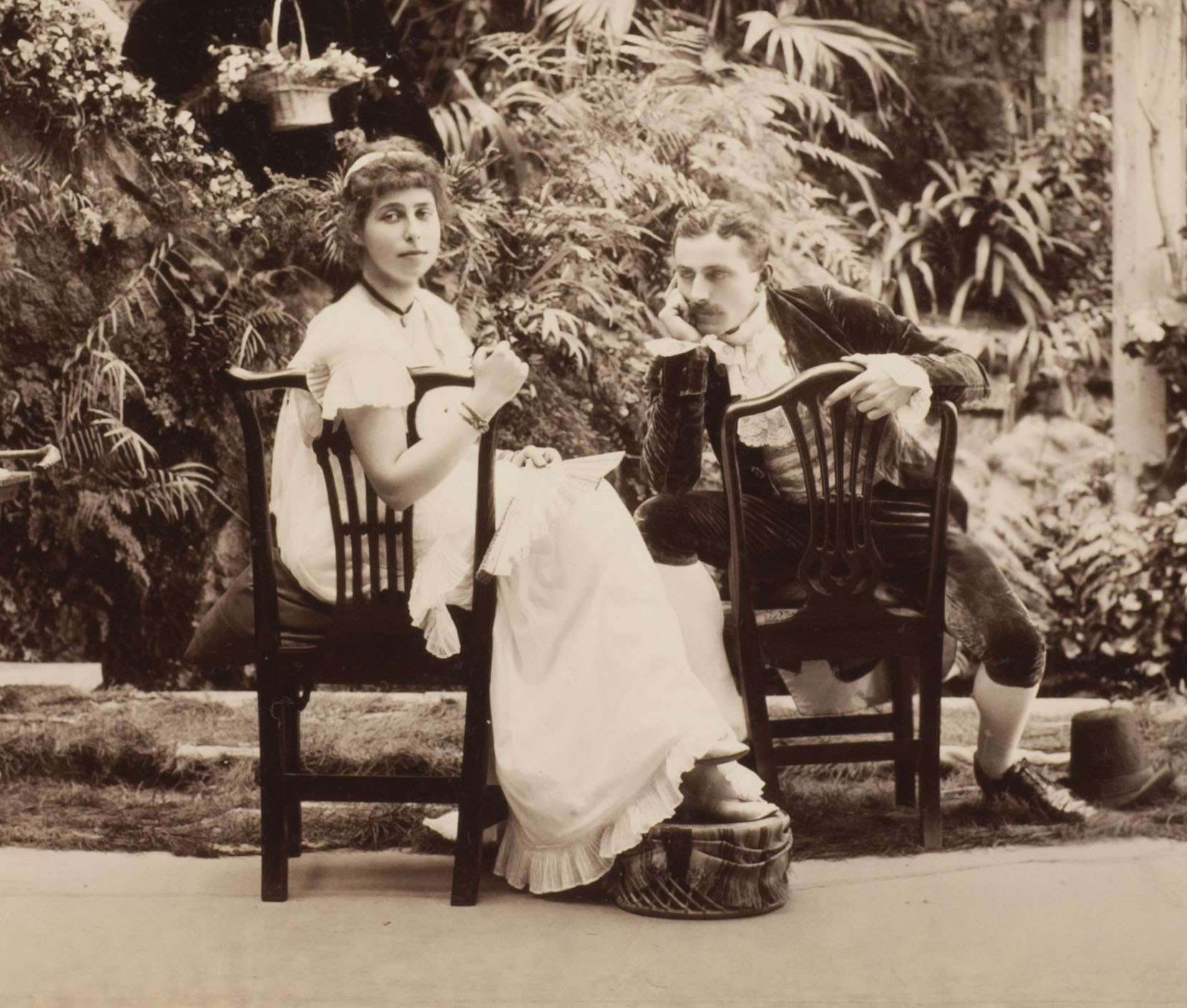
Highlights of the show include examples of three-dimensional photography, which incorporated the use of models and props to stage dramatic tableaux from popular works of the time, re-envisioning well-known pictures such as Henry Wallis’s (1830-1916) Chatterton. Such stereographs were widely disseminated and made art more accessible to the public, often being used as a form of after-dinner entertainment for middle class Victorian families. A previously unseen private album in which the Royal family painstakingly re-enacted famous paintings is also exhibited, as well as rare examples of early colour photography.

Carol Jacobi, Curator British Art 1850-1915, Tate Britain says: “Painting with Light offers new insights into Britain’s most popular artists and reveals just how vital painting and photography were to one another. Their conversations were at the heart of the artistic achievements of the Victorian and Edwardian era.”

Painting with Light: Art and Photography from the Pre-Raphaelites to the Modern Age is curated by Dr Carol Jacobi, Curator of British Art 1850-1915 at Tate Britain, and Dr Hope Kingsley, Curator, Education and Collections, Wilson Centre for Photography, with Tim Batchelor, Assistant Curator at Tate Britain. The exhibition is accompanied by a fully illustrated catalogue from Tate Publishing and a programme of talks and events in the gallery.”

Press release from Tate Britain


‘Whisper of the Muse’

As the nineteenth century progressed, some artists moved away from the clarity and detail that had been the aim of earlier Pre-Raphaelite art, turning instead to a search for pure beauty. The aesthetic movement, as this tendency came to be known, emphasised the sensual qualities of art and design and explored imaginative themes and effects.

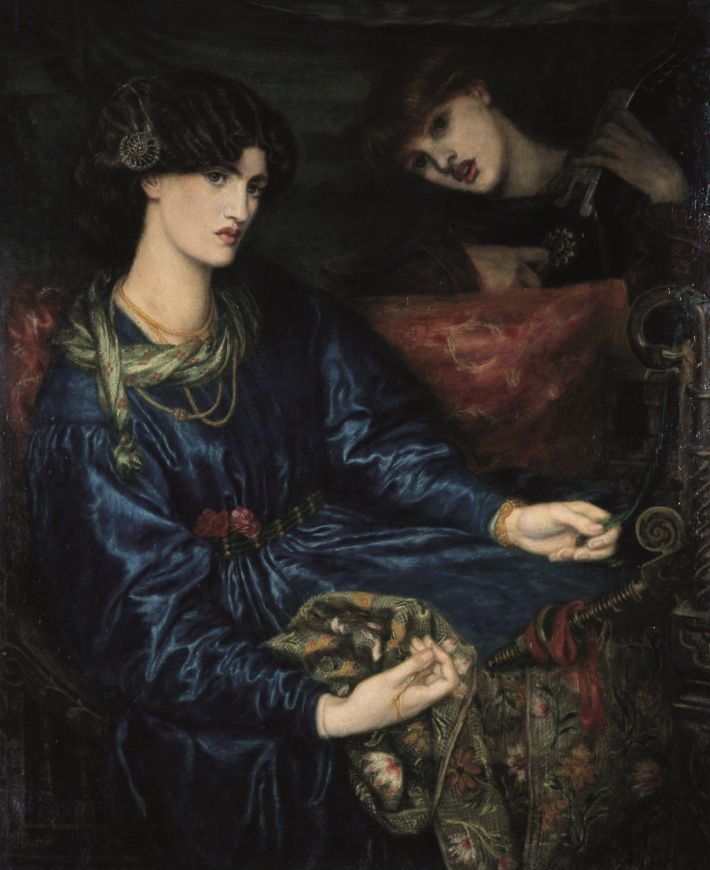
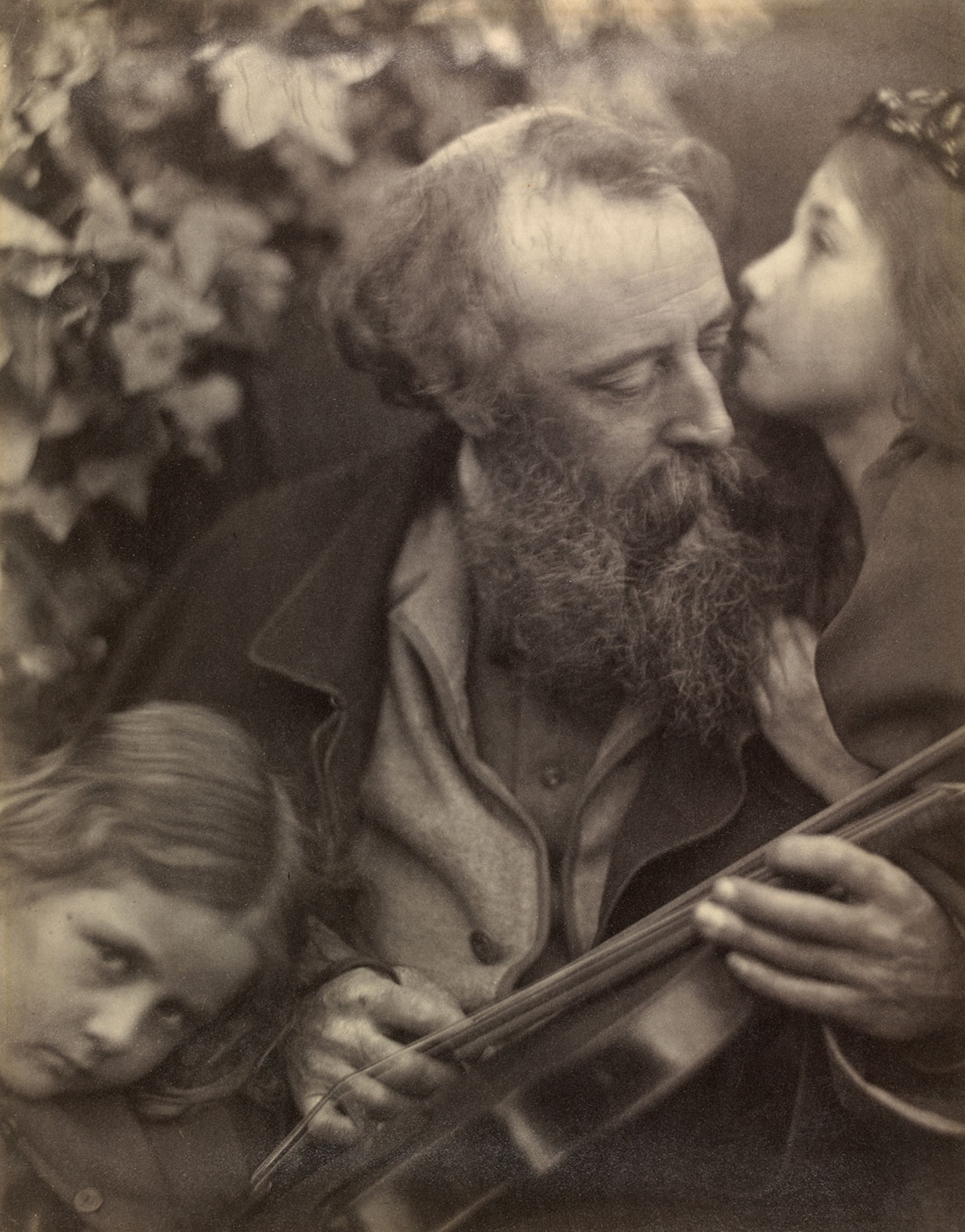
In London and on the Isle of Wight, a community of artists forged closer links between the visual arts, music and literature. This circle included the photographer Julia Margaret Cameron, painters George Frederic Watts and Dante Gabriel Rossetti, and the poet Alfred Tennyson. Rossetti and Cameron worked with similar subjects, many inspired by Tennyson’s poetry. Together with Watts they developed a newly-intimate form of portraiture, exploring emotional and psychological states. They also shared models, whose striking looks introduced new types of modern beauty.


Julia Margaret Cameron (British born India, 1815-1879) 'Whisper of the Muse' 1865


Julia Margaret Cameron (British, 1815-1879)
Whisper of the Muse
1865
Photograph, albumen print on paper
325 x 238mm
Wilson Centre for Photography


Dante Gabriel Rossetti (English, 1828-1882) 'Mariana' 1870


Dante Gabriel Rossetti (English, 1828-1882)
Mariana
1870
Oil on canvas
Aberdeen Art Gallery & Museum Collection


Into Light and Colour

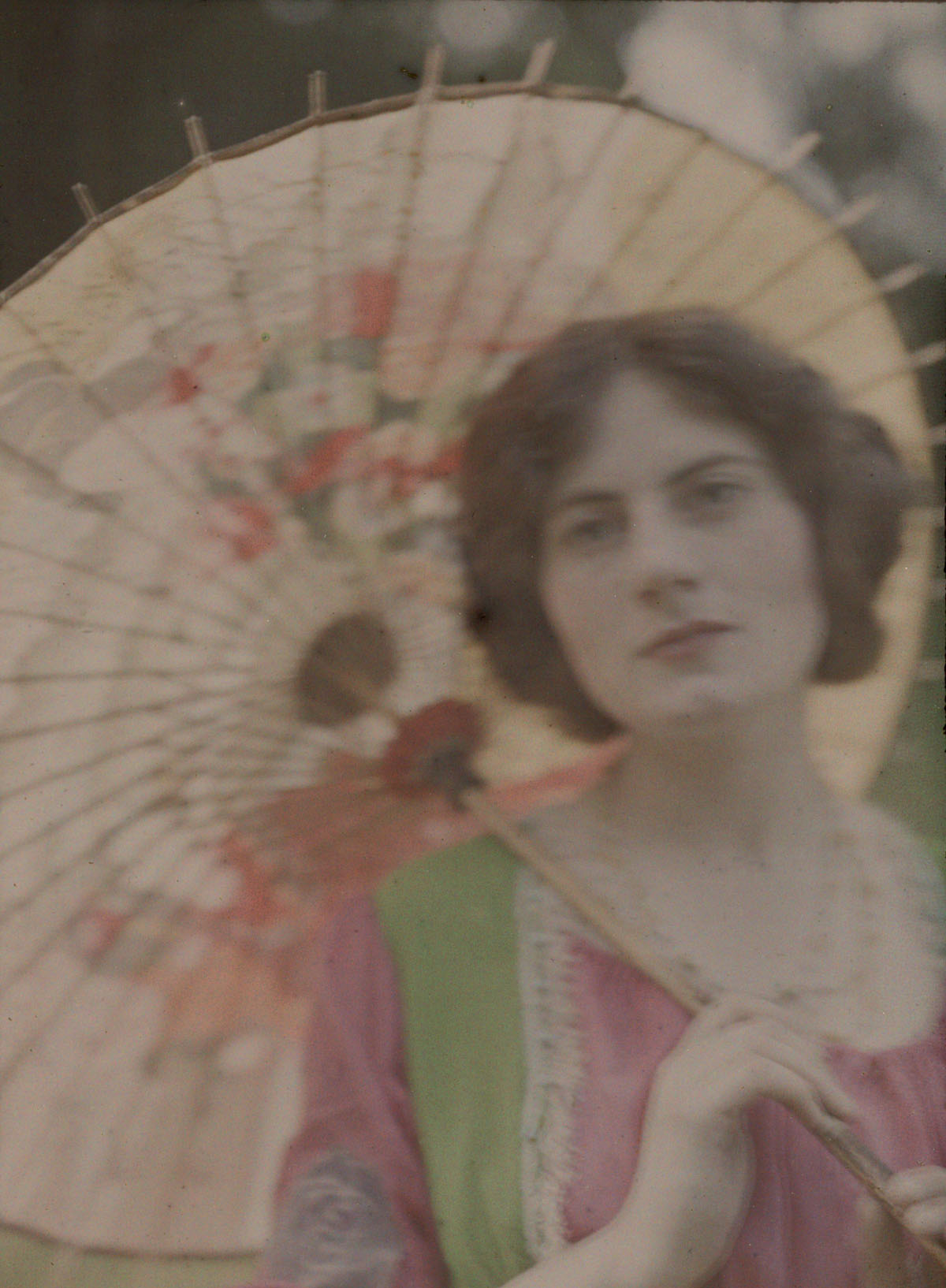
In the second half of the nineteenth century Japanese culture became an important influence in Britain. Japanese goods were sold in London in new department stores such as Liberty, while the Japanese Village, established in Knightsbridge in 1885, attracted more than a million visitors.

Japanese props and motifs appeared in art and design and the vogue for Japanese prints inspired painters and photographers. Painters experimented with new colour palettes, flattened picture planes and condensed, cropped formats, innovations also important to later British impressionist works. Such experiments in light and colour were paralleled in photography with the 1907 introduction of the autochrome, the first practical colour photographic process.


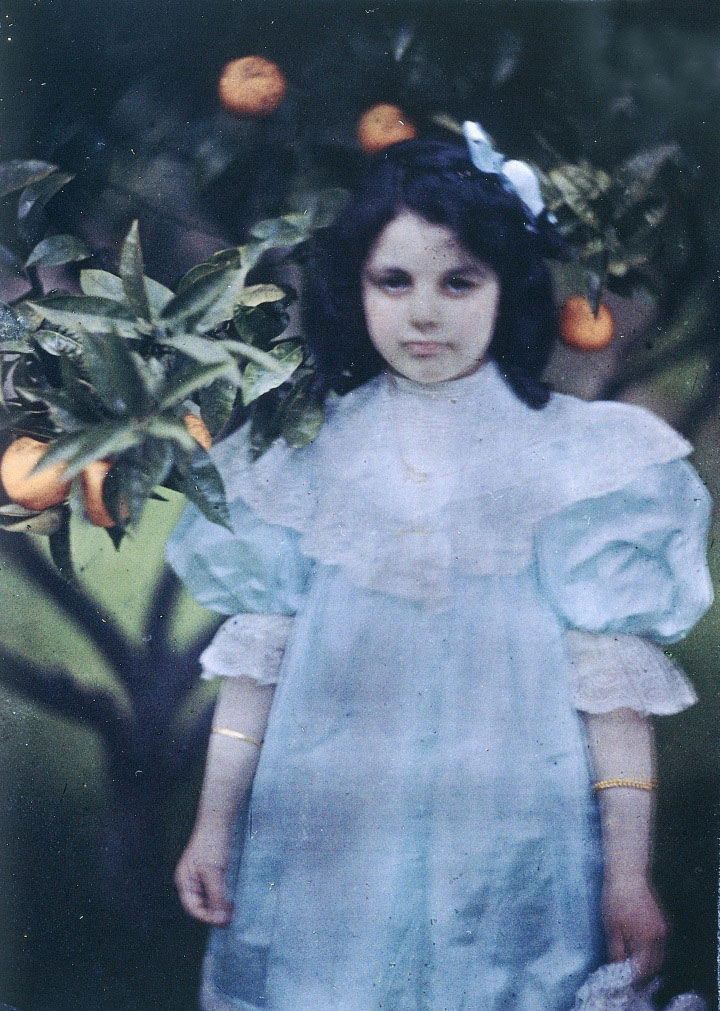
John Cimon Warburg (British, 1867-1931) 'Peggy in the Garden' 1909, printed 2016


John Cimon Warburg (British, 1867-1931)
Peggy in the Garden
1909, printed 2016
Photograph, transparency on lightbox from autochrome
Royal Photographic Society / National Media Museum / Science and Society Picture Library


John Cimon Warburg (1867-1931) British photographer born to a wealthy family dedicated his whole life to photography. In 1897, he joined the Royal Photographic Society. During his photographic career, John Cimon Warburg used a wide range of photographic processes, but excelled especially in autochromes. Best known for his atmospheric landscapes and its fascinating studies of his children, Warburg lectured and written about the process and explained his autochromes the annual exhibition of the Royal Photographic Society.

Text from the Autochrome website [Online] Cited 18/09/2016. No longer available online


Patented by the Lumière brothers in 1903, Autochrome produced a colour transparency using a layer of potato starch grains dyed red, green and blue, along with a complex development process. Autochromes required longer exposure times than traditional black-and-white photos, resulting in images with a hazy, blurred atmosphere filled with pointillist dots of colour.


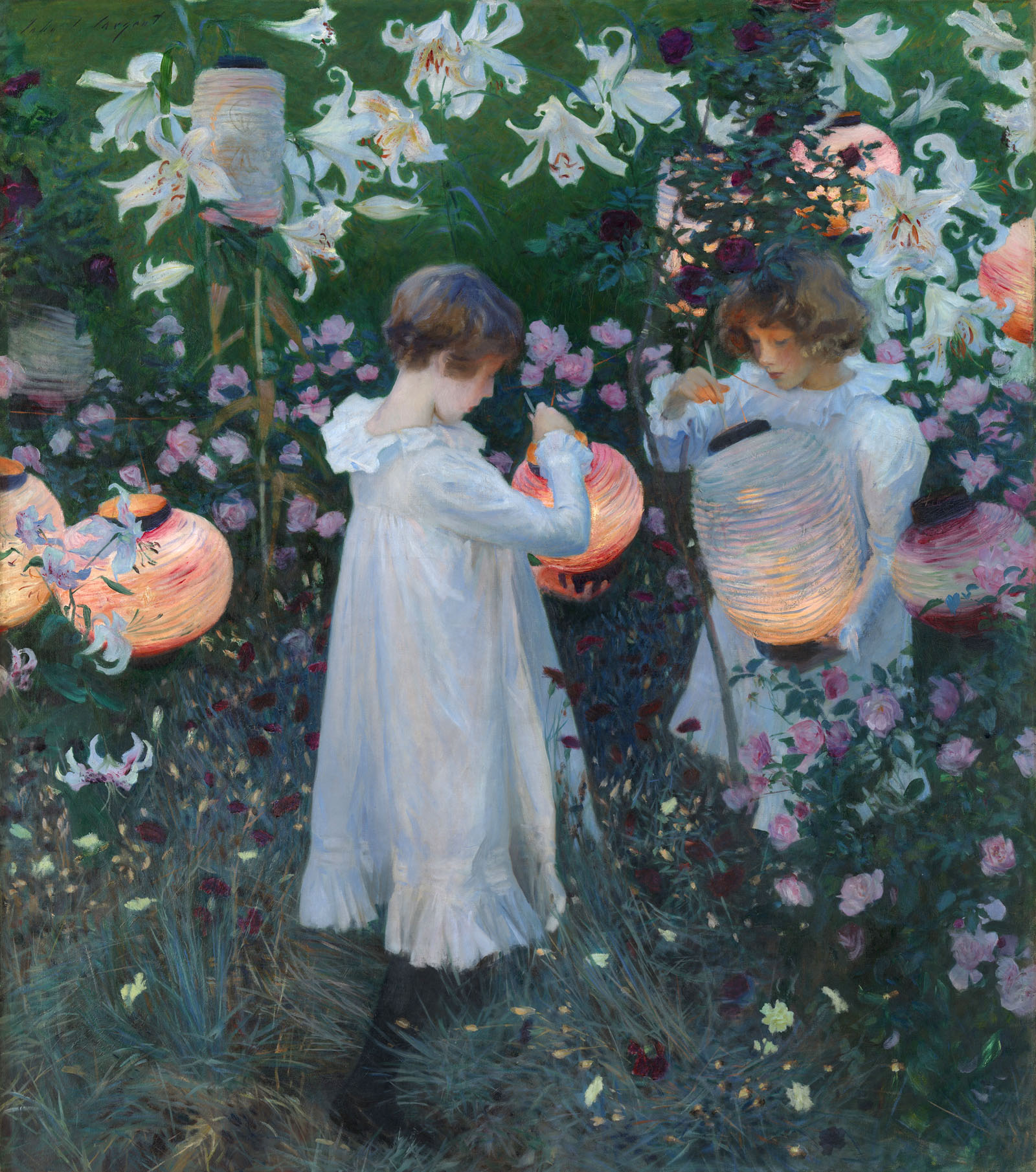
John Singer Sargent (American, 1856-1925) 'Carnation, Lily, Lily, Rose' 1885-1886


John Singer Sargent (American, 1856-1925)
Carnation, Lily, Lily, Rose
1885-1886
Oil paint on canvas
1740 x 1537 mm
Tate. Presented by the Trustees of the Chantrey
Bequest 1887


The inspiration for Carnation, Lily, Lily, Rose came during a boating expedition Sargent took on the Thames at Pangbourne in September 1885, with the American artist Edwin Austin Abbey, during which he saw Chinese lanterns hanging among trees and lilies. He began the picture while staying at the home of the painter F.D. Millet at Broadway, Worcestershire, shortly after his move to Britain from Paris. At first he used the Millets’s five-year-old daughter Katharine as his model, but she was soon replaced by Polly and Dorothy (Dolly) Barnard, the daughters of the illustrator Frederick Barnard, because they had the exact hair-colour Sargent was seeking.

He worked on the picture, one of the few figure compositions he ever made out of doors in the impressionist manner, from September to early November 1885, and again at the Millets’s new home, Russell House, Broadway, during the summer of 1886, completing it some time in October. Sargent was able to work for only a few minutes each evening when the light was exactly right. He would place his easel and paints beforehand, and pose his models in anticipation of the few moments when he could paint the mauvish light of dusk.

As autumn came and the flowers died, he was forced to replace the blossoms with artificial flowers. The picture was both acclaimed and decried at the 1887 Royal Academy exhibition. The title comes from the song The Wreath, by the eighteenth-century composer of operas Joseph Mazzinghi, which was popular in the 1880s. Sargent and his circle frequently sang around the piano at Broadway. The refrain of the song asks the question ‘Have you seen my Flora pass this way?’ to which the answer is ‘Carnation, Lily, Lily, Rose’.

Terry Riggs. “Carnation, Lily, Lily, Rose,” on the Tate website February 1998 [Online] Cited 16/02/2023


Unknown photographer. 'H.R.H. Princess Alexandra, H.R.H. Princess Victoria & Mr. Savile, “Two’s company and three’s none” in Tableaux Vivants Devonport' c. 1892-1893


Unknown photographer
H.R.H. Princess Alexandra, H.R.H. Princess Victoria & Mr. Savile, “Two’s company and three’s none” in Tableaux Vivants Devonport
c. 1892-1893
Bound volume. Displayed open at Marcus C. Stone’s ‘Two’s Company, Three’s None”
Photograph, albumen print on paper
360 x 480 x 58mm – book closed
Wilson Centre for Photography


Unknown photographer. 'H.R.H. Princess Alexandra, H.R.H. Princess Victoria & Mr. Savile, “Two’s company and three’s none” in Tableaux Vivants Devonport' c. 1892-1893 (detail)


Unknown photographer
H.R.H. Princess Alexandra, H.R.H. Princess Victoria & Mr. Savile, “Two’s company and three’s none” in Tableaux Vivants Devonport (detail)
c. 1892-1893
Bound volume. Displayed open at Marcus C. Stone’s ‘Two’s Company, Three’s None”
Photograph, albumen print on paper
360 x 480 x 58mm – book closed
Wilson Centre for Photography


Thomas Armstrong (English, 1832-1911) 'The Hay Field' 1869


Thomas Armstrong (English, 1832-1911)
The Hay Field
1869
© Victoria and Albert Museum, London


Atmosphere and Effect

The relationship between landscape painting and photography continued to develop into the twentieth century. The etchings and nocturnes of James Abbott McNeill Whistler inspired photographers, who adopted his atmospheric subjects and aesthetics. While photography had achieved a technical sophistication that allowed photographers to produce highly resolved, realistic images, many chose to pursue soft-focus effects rather than detail and precision. Such photographs paralleled the unpeopled landscapes of painters like John Everett Millais and the gas-lit cityscapes of John Atkinson Grimshaw.


James Abbott McNeill Whistler (American, 1834-1903) 'Three Figures Pink and Grey' 1868-1878


James Abbott McNeill Whistler (American, 1834-1903)
Three Figures Pink and Grey
1868-1878
Oil paint on canvas
Support: 1391 x 1854mm
Frame: 1701 x 2158 x 75mm
Tate
Purchased with the aid of contributions from the International Society of Sculptors, Painters and Gravers as a Memorial to Whistler, and from Francis Howard 1950


This picture derives from one of six oil sketches that Whistler produced in 1868 as part of a plan for a frieze, commissioned by the businessman F.R. Leyland (1831-1892), founder of the Leyland shipping line. Known as the ‘Six Projects’, the sketches (now in the Freer Art Gallery, Washington) were all scenes with women and flowers, and all six were strongly influenced by his admiration for Japanese art. Another precedent for these works was The Story of St George, a frieze that Edward Burne-Jones (1833-1898) executed for the artist and illustrator Myles Birket Foster (1825-1899) in 1865-1867. The series of large pictures was destined for Leyland’s house at Prince’s Gate, but never produced, and only one – The White Symphony: Three Girls (1867) was finished, but was later lost. Whistler embarked on a new version, Three Figures: Pink and Grey, but was never satisfied with this later painting, and described it as, ‘a picture in no way representative, and in its actual condition absolutely worthless’ (quoted in Wilton and Upstone, p. 117). He followed the original sketch closely, but made a number of pentimenti which suggest that the picture is not simply a copy of the lost work. In spite of Whistler’s dissatisfaction, it has some brilliant touches and a startlingly original composition.

Although the three figures are clearly engaged in tending a flowering cherry tree, Whistler’s aim in this picture is to create a mood or atmosphere, rather than to suggest any kind of theme. Parallels have been drawn with the work of Albert Moore, whose work of this period is equally devoid of narrative meaning. The design is economical and the picture space is partitioned like a Japanese interior. The shallow, frieze-like arrangement, the blossoming plant and the right-hand figure’s parasol are also signs of deliberate Japonisme. Whistler has suppressed some of the details in the oil sketch, effectively disrobing the young girls by depicting them in diaphanous robes. The painting is characterised by pastel shades, a ‘harmony’ of pink and grey, punctuated by the brighter reds of the flower pot and the girls’ bandannas, and the turquoise wall behind. It has been suggested that Whistler derived his colour schemes, and even the figures themselves, in their rhythmically flowing drapery, from polychrome Tanagra figures in the British Museum, which was opposite his studio in Great Russell Street.

Frances Fowle. “Three Figures: Pink and Grey,” on the Tate website December 2000 [Online] Cited 16/02/2023


John Cimon Warburg (British, 1867-1931) 'The Japanese Parasol' c. 1906


John Cimon Warburg (British, 1867-1931)
The Japanese Parasol
c. 1906
Autochrome
711 x 559mm
© Royal Photographic Society / National Media
Museum/ Science & Society Picture Library


Life and Landscape

The 1880s brought a renewed interest in landscape. Rural scenes provided common ground for British painters and photographers. Their distinctive style derived from French realism and impressionism, which had been introduced by independent galleries, and by artists such as George Clausen and Henry La Thangue who studied in Paris. This new approach was shared by their friend and fellow painter Thomas Goodall, and influenced his collaboration with the photographer Peter Henry Emerson. Emerson and Goodall’s first project, a photographic series on the Norfolk Broads, focused on the life of working people, as described in their album Life and Landscape on the Norfolk Broads, published in 1887.


Sir George Clausen (British, 1852-1944) 'Winter Work' 1883-1884


Sir George Clausen (British, 1852-1944)
Winter Work
1883-1884
Oil on canvas
Frame: 1075 x 1212 x 115mm
Support: 775 x 921mm
Purchased with assistance from the Friends of the Tate Gallery 1983
© The estate of Sir George Clausen


In the 1880s Clausen devoted himself to painting realistic scenes of rural work after seeing such pictures by the French artist Jules Bastien-Lepage (1848-1884). In this picture he shows a family of field workers topping and tailing swedes for sheep fodder. It was painted at Chilwick Green near St Albans, where the artist had moved in 1881. He uses subdued colouring to capture the dull light and cold of winter, and manages to convey the hard reality of country work. Such unromanticised scenes of country life were often rejected by the selectors of the Royal Academy annual exhibitions.


Thomas Frederick Goodall (British, 1856-1944) and Peter Henry Emerson (British, 1856-1936) 'Setting the Bow-Net, in Life and Landscape on the Norfolk Broads' 1885, published 1887


Thomas Frederick Goodall (British, 1856-1944) and Peter Henry Emerson (British, 1856-1936)
Setting the Bow-Net, in Life and Landscape on the Norfolk Broads
1885, published 1887
Book – open at The Bow Net
Photograph, platinum print on paper
300 x 420mm (book closed)
Private collection


Thomas Frederick Goodall (British, 1856-1944) 'The Bow Net' 1886


Thomas Frederick Goodall (British, 1856-1944)
The Bow Net
1886
Oil paint on canvas
838 x 1270mm
National Museums Liverpool, Walker Art Gallery


Roger Fenton (British, 1819-1869) 'The Water Carrier' 1858


Roger Fenton (British, 1819-1869)
The Water Carrier
1858
Albumen Print, Wilson Center for Photography


Frederick Goodall (English, 1822-1904), R.A. 'The Song of the Nubian Slave' 1863


Frederick Goodall (English, 1822-1904), R.A.
The Song of the Nubian Slave
1863
Diploma Work, accepted 1863
71.2 x 92 x 2.3cm
Oil on canvas
Photo credit: © Royal Academy of Arts, London; Photographer: John Hammond


Out of the Shadows

In the late nineteenth century, painters and photographers pursued the representation of an idealised beauty, inspired by Italian Renaissance artists such as Michelangelo and Leonardo da Vinci. Themes of allegory and myth were widely explored in the arts at this time, particularly in Britain in the writings of Walter Pater and Oscar Wilde.

At the turn of the century painting and photography were part of a wider artistic search for harmony between subject matter and expression. Artists found inspiration in each other’s practice and continued to share ideas through illustrated books and journals. This spirit of collaboration and interchange led photographer Fred Holland Day to claim that ‘the photographer no longer speaks the language of chemistry, but that of poetry’.


Alvin Langdon Coburn (American, 1882-1966) 'Regent's Canal' c. 1904-1905, published 1909


Alvin Langdon Coburn (American, 1882-1966)
Regent’s Canal
c. 1904-1905, published 1909
Photogravure on paper
Image: 206 x 161 mm
Frame: 508 x 406 mm

Wilson Centre for Photography


Arthur Hacker (English, 1858-1919) 'A Wet Night at Piccadilly Circus' 1910


Arthur Hacker (English, 1858-1919)
A Wet Night at Piccadilly Circus
1910
Oil on canvas
710 x 915mm
Royal Academy of Arts, London


Alvin Langdon Coburn (American, 1882-1966) 'Leicester Square (The Old Empire Theatre)' 1908, published 1909


Alvin Langdon Coburn (American, 1882-1966)
Leicester Square (The Old Empire Theatre)
1908, published 1909
Photogravure on paper
Image: 206 x 172mm
Frame: 508 x 406mm
Wilson Centre for Photography


Edward Linley Sambourne (English, 1844-1910) 'Ethel Warwick, Camera Club, 2 August 1900'


Edward Linley Sambourne (English, 1844-1910)
Ethel Warwick, Camera Club, 2 August 1900
Photograph, cyanotype on paper
Dimensions
Image: 165 x 120mm
Frame: 507 x 855mm
18 Stafford Terrace, The Royal Borough of Kensington and Chelsea


Tate Britain
Millbank, London SW1P 4RG
United Kingdom
Phone: +44 20 7887 8888

Opening hours:
Daily 10.00am – 18.00pm

Tate Britain website

LIKE ART BLART ON FACEBOOK

Back to top

Exhibition: ‘A History: Contemporary Art from the Centre Pompidou’ at the Haus der Kunst, Munich

Exhibition dates: 25th March – 4th September, 2016

Curator: Christine Macel

Artists include: Pawel Althamer/ Maja Bajević / Yto Barrada / Jean-Michel Basquiat / Taysir Batniji / Christian Boltanski / Erik Boulatov / Mohammed Bourouissa / Frédéric Bruly Bouabré / Sophie Calle and Greg Shephard / Mircea Cantor / Chen Zhen / Hassan Darsi / Destroy All Monsters / Atul Dodiya / Marlene Dumas / Ayşe Erkmen / Fang Lijun / Harun Farocki and Andrei Ujica / Samuel Fosso / Michel François / Coco Fusco und Paula Heredia / Regina José Galindo / Kendell Geers / Liam Gillick / Fernanda Gomes / Dominique Gonzalez-Foerster / Felix Gonzalez-Torres / Renée Green / Subodh Gupta / Andreas Gursky / Hans Haacke / Petrit Halilaj / Edi Hila / Gregor Hildebrandt / Thomas Hirschhorn / Nicholas Hlobo / Carsten Höller / Pierre Huyghe / Fabrice Hyber / Isaac Julien / Oleg Kulik / Glenn Ligon / Robert Longo / Sarah Lucas / Gonçalo Mabunda / David Maljković / Chris Marker / Ahmed Mater / Mike Kelley and Paul McCarthy / Annette Messager / Rabih Mroué / Zanele Muholi / Jun Nguyen-Hatsushiba / Roman Ondák / Gabriel Orozco / Damián Ortega / Philippe Parreno / Nira Pereg / Dan Perjovschi / Wilfredo Prieto / Tobias Putrih / Walid Raad / Sara Rahbar / Tobias Rehberger / Nick Relph und Oliver Payne / Pipilotti Rist / Chéri Samba / Anne-Marie Schneider / Santiago Sierra / Mladen Stilinović / Georges Tony Stoll / Wolfgang Tillmans / Rirkrit Tiravanija / Danh Vo / Marie Voignier / Akram Zaatari / Zhang Huan


Thomas Hirschhorn (Swiss, b. 1957) 'Outgrowth' 2005 from the exhibition 'A History: Contemporary Art from the Centre Pompidou' at the Haus der Kunst, Munich, March - Sept, 2016


Thomas Hirschhorn (Swiss, b. 1957)
Outgrowth
2005
Wood, plastic, newspaper clipping, tape, metal, bubble wrap
Installation: 374 x 644 x 46cm
Minimum dimensions of the rail: 400 x 670cm
Achat en 2006, Ankauf / Purchase
Collection Centre Pompidou, Paris
Musée national d’art moderne – Centre de création industrielle
Crédit photographique: © Centre Pompidou, MNAM-CCI/Georges Meguerditchian/Dist. RMN-GP
Copyright de l’oeuvre: © VG Bild-Kunst, Bonn 2016


Take your pick: some interesting, some not. My favourite: Annette Messager Mes voeux (1989, below) … such a strong, creative and inspiring artist.

I’m not writing so much as I have bad RSI in my left wrist at the moment.

Dr Marcus Bunyan


Many thankx to Haus der Kunst for allowing me to publish the art work in the posting. Please click on the photographs for a larger version of the image.


In 2016, two prominent exhibition projects explore the pressing question of which factors remain relevant to the writing of art history. While “Postwar – Art between the Pacific and Atlantic, 1945-1965” concentrates on the time immediately after World War II, “A History: Contemporary Art from the Centre Pompidou” provides an overview of contemporary art since the 1980s with 160 works by more than 100 artists.

The year 1989 marked a break with the past and the start of a new era. The fall of the Berlin Wall toppled divisions in the world of European art, while the events of Tiananmen Square focused attention on a new China. The ongoing globalisation allows for an unprecedented mobility. The static understanding of identity, once based on origin and nationality, has since given way to a more transnational and variable narrative. Contemporary artistic proposals, which arise from the new “decolonised subjectivity”, are also based on a new understanding of site-specificity. For example, in the 1960s and 1970s the protagonists of Land Art still understood landscapes primarily as post-industrial ruins. In contemporary artistic practice, however, space is defined above all socially and politically – by traumatic historical events, home country, exile, diaspora and hybrid identities, such as African-American, Latino, Turkish-German, African-Brazilian, and so forth. The new presentation of the Centre Pompidou contemporary collections at Haus der Kunst focuses particularly on this altered geography, notably the former Eastern Europe, China, Lebanon, and various Middle Eastern countries, India, Africa, and Latin America. This is the first time such a large-scale view of the Centre Pompidou collection has been presented outside France.


Lijun Fang (Chinese, b. 1963) 'Sans titre' 2003 from the exhibition 'A History: Contemporary Art from the Centre Pompidou' at the Haus der Kunst, Munich, March - Sept, 2016


Lijun Fang (Chinese, b. 1963)
Sans titre
2003
Woodcut on paper
400 x 854cm
Each panel: 400 x 120cm
Achat en 2004, Ankauf / Purchase
Collection Centre Pompidou, Paris
Musée national d’art moderne – Centre de création industrielle


Marlene Dumas (South African, b. 1953) 'The Missionary' (Le Missionnaire) 2002-2004


Marlene Dumas (South African, b. 1953)
The Missionary (Le Missionnaire)
2002-2004
Oil on canvas
60 x 230cm
Don de la Clarence Westbury Foundation, 2005
Collection Centre Pompidou, Paris
Musée national d’art moderne – Centre de création industrielle
Crédit photographique: © Centre Pompidou, MNAM-CCI/Philippe Migeat/Dist. RMN-GP
Copyright de l’oeuvre: © Marlene Dumas


Jean-Michel Basquiat (American, 1960-1988) 'Slave Auction (Vente aux enchères d’esclaves)' 1982


Jean-Michel Basquiat (American, 1960-1988)
Slave Auction (Vente aux enchères d’esclaves)
1982
Acrylic paint, oil pastel and collages
Collage of crumpled papers, oil pastel and acrylic paint on canvas
183 x 305.5cm
Don de la Société des Amis du Musée national d’art moderne, 1993
Collection Centre Pompidou, Paris
Musée national d’art moderne – Centre de création industrielle
Crédit photographique: © Centre Pompidou, MNAM-CCI/Philippe Migeat/Dist. RMN-GP
Copyright de l’oeuvre: © The estate of Jean-Michel Basquiat / VG Bild-Kunst, Bonn 2016


Fabrice Hyber (French, b. 1961) 'Peinture homéopathique n° 10 (Guerre désirée)' (Homeopathic painting n° 10 (Desired war)) 1983-1996


Fabrice Hyber (French, b. 1961)
Peinture homéopathique n° 10 (Guerre désirée) (Homeopathic painting n° 10 (Desired war))
1983-1996
Mixed media on canvas
Graphite lead, charcoal, coloured pencil, resin, gouache, India ink, acrylic, pastel, watercolour, felt-tip pen, adhesive tape, on paper, photocopy, photographs and tissue paper pasted on canvas
225 x 450cm
Each panel: 225 x 225cm
Achat en 1996, Ankauf / Purchase
Collection Centre Pompidou, Paris
Musée national d’art moderne – Centre de création industrielle
Crédit photographique: © Centre Pompidou, MNAM-CCI/Jacques Faujour/Dist. RMN-GP
Copyright de l’oeuvre: © Adagp, Paris


Hans Haacke (German, b. 1936) 'MetroMobiltan' 1985


Hans Haacke (German, b. 1936)
MetroMobiltan
1985
Fibreglass, photography, hardboard, polyester fabric, aluminum, acrylic paint
Fibreglass pediment, 1 fibreglass plate with English text, 1 black and white photograph in 5 parts laminated on hardboard, 3 banners in synthetic polyester fabric each mounted on 2 aluminium tubes: on the left and on the right 2 banners blue with English text (letters in cut and sewn white polyester fabric), in the centre 1 brown banner with photographic enlargement in cut and sewn fabric and English text), platform in 8 elements of acrylic painted fibreglass
Installation: 355.6 x 609.6 x 152.4cm
Achat en 1988, Ankauf / Purchase
Collection Centre Pompidou, Paris
Musée national d’art moderne – Centre de création industrielle
Crédit photographique: © Centre Pompidou, MNAM-CCI/Georges Meguerditchian/Dist. RMN-GP
Copyright de l’oeuvre: © VG Bild-Kunst, Bonn 2016


Chéri Samba (Democratic Republic of Congo, b. 1956) 'Marche de soutien à la campagne sur le SIDA' 1988


Chéri Samba (Democratic Republic of Congo, b. 1956)
Marche de soutien à la campagne sur le SIDA
1988
Oil and glitter on prepared canvas
134.5 x 200cm
Purchase in 1990
Collection Centre Pompidou, Paris Musée national d’art moderne – Centre de création industrielle
© Chéri Samba, photo © Centre Pompidou, MNAM-CCI/Philippe Migeat/Dist. RMN-GP


Haus der Kunst is pleased to present A History: Contemporary Art from Centre Pompidou, an exhibition originally curated by Christine Macel at the Centre Pompidou, Paris. With approximately 160 works by more than 100 artists from across the world, “A History: Contemporary Art from the Centre Pompidou” provides an incisive overview of artistic positions since the 1980s in painting, sculpture, installation, video, photography, and performance.

The Centre Pompidou’s collection of contemporary art has rarely been presented so comprehensively outside France. The selected works on view date from the 1980s to the present raising two significant questions: What factors are relevant for ensuring that art history is written in a specific way, and what does an ever changing understanding of the term ‘contemporary’ mean for public museums and their collections? Still, the concentration on Euro- American domains, which many museums formerly pursued in the acquisition of works for their collections, can hardly be sustained today and is no longer the aspiration of most museums. Globalisation, with its expanded narratives, has recently become too determining for the position of contemporary art to ignore. Curator Christine Macel defines her intention accordingly: to present ‘one’ among many possible histories of contemporary art.

With the progression of globalisation – understood here as the consolidation of economic, technological and financial systems, but also the questioning of linear history, and hegemonic cultural narratives – our perception of identity has changed. Since the first globally-oriented biennial in Havana in 1986, exhibition organisers and larger museums in Europe and North America have strived to display art created beyond the Western artistic circuit. The static understanding of identity as something based in origins and a “home base” has largely given way to a transnational and variable one.

The turning point for Centre Pompidou was its 1989 exhibition “Les Magiciens de la Terre”, in which curator Jean-Hubert Martin aimed to confront the problematic phenomenon of “one hundred percent of exhibitions that ignore eighty percent of the world.” Half the participating artists came from non-Western countries, while the other half came from the West. In addition, all exhibiting artists were – without exception – still active, making the presentation truly contemporary. Since then, the Centre Pompidou, like many large museums, has had to confront the reality of the expanded circuits of contemporary art. Over the years the museum gradually changed its acquisition practices and has increasingly opened its focus toward Eastern Europe, China, Lebanon, the Middle East, India, Congo, Nigeria, South Africa, Cameroon, Mexico and Brazil.

Meanwhile, our understanding of the term “origins” has continued to evolve. Consequently, the definition of “site-specific” has also changed. In the 1960s and 70s, artists of the Land Art movement still essentially regarded landscapes as post-industrial ruins. By contrast, Okwui Enwezor, director of Haus der Kunst believes that, in today’s artistic practice, space is defined by impermanence, by the mutability of politically and socially grounded positions, by aesthetic pluralism, and by cultural differences. Furthermore, colonial and postcolonial experiences shaped by traumatic historical events, home, exile, diaspora produced hybrid identities – such as African-American, Euro- American, Latino, Turkish-German, French-Arabic, African-Brazilian, etc. Consequently new forms of cosmopolitanism and provincialism jostle next to one another. It is no coincidence that the exhibition practice of today can already look back on a number of shows that focused on borders and issues of migration.

Against this backdrop of dynamism and permanent transition the exhibition is divided into seven chapters:

The Artist as Historian

An interest in the historical document and a more general obsession with the past, have led to the nostalgic excavation and re-enactments of existing works of art. Artists from the Arab speaking world are increasingly present in the art world; having borne witness to the Gulf War in 1991, these artists have developed new practices around the examination of history.

The Artist as Archivist

A passion for the archive initially led to a demand for completeness and later to an acceptance of the fragmentary, resulting on the one hand in concurrence of taxonomic efforts and endless accumulation, and, on the other, in an insight into the accelerated loss of memory. On a higher level, both coincide: Archives are especially useful in helping to identify and address wounds in the collective memory.

Sonic Boom

Trying to capture the sensation of listening to music in an image has a long tradition. Yet, even for artists who take their works to the edge of physical dissolution, listening often moves to the fore. Further, changes in the music industry and music production have reinforced the permeability of art and composition.

The Artist as Producer: The “Traffic” Generation

The concept of artwork is transformed through its dematerialisation. An awareness of temporality, volatility, and process shifts to the foreground. Artists develop new forms of collaboration and collective creation, and make aesthetic use of clips, sampling, and film narrative (which is also regarded as an exhibition platform). As a result, copyright as an object of reflection has come into focus.

The Artist as Documentarist: As Close as Possible to the Real

The proliferation of the Internet in the context of a market economy and consumer society has led to a greater interest in the real, in the status quo of the observer and the reporter and generally in an engagement with all areas of human life. The artist takes on the role of a witness who accepts the subjectivity of his observations.

Artist and Object

Between 1980 and 1990, artists turned to an exploration of the everyday and the object; the 1990’s can be considered as the ultimate epoch of the aesthetic of the mundane. The now-famous video, “The Way Things Go” by Fischli and Weiss (1986-87) sings this song of songs to the everyday. No less iconic is Gabriel Orozco’s modified Citroën (La DS, 1993). The confrontation with consumer society is manifested in photography in detailed and richly coloured compositions like Gursky’s 99 Cent (1999), and in sculpture with the integration of found objects. The common denominator is the attention artists pay to excessive consumption – as an opportunity or as a fact.

The Artist and the Body

Video and photography seem to be particularly fitting mediums for artists whose works include a performative element. The theme of the human body – wounded or damaged by oppression – returns as a theme with a vengeance. Many works with erotic and sexual overtones emerge. New technical possibilities, either through plastic surgery or image manipulation, bring the grotesque into the fold.

Press release from Haus der Kunst


Fischli and Weiss
The Way Things Go
1986-1987


Erik Boulatov (Russian, b. 1933) 'Printemps dans une maison de repos des travailleurs' 1988


Erik Boulatov (Russian, 1933-2025)
Printemps dans une maison de repos des travailleurs
1988
Oil on canvas
169.2 x 239 x 4cm
Purchased in 1989
Collection Centre Pompidou, Paris Musée national d’art moderne – Centre de création industrielle
© VG Bild-Kunst, Bonn 2016,
Photo © Centre Pompidou, MNAM-CCI/Philippe Migeat/Dist. RMN-GP


Michel François (Belgian, b. 1956) 'Affiche Cactus' 1997


Michel François (Belgian, b. 1956)
Affiche Cactus
1997
Print on paper
120 x 178cm
Don de l’artiste en 2003
Collection Centre Pompidou
Paris Musée national d’art moderne – Centre de création industrielle
© VG Bild-Kunst, Bonn 2016
Photo © Centre Pompidou, MNAM-CCI/Philippe Migeat/Dist. RMN-GP


Pawel Althamer (Polish, b. 1967) 'Tecza' (Rainbow) 2004


Pawel Althamer (Polish, b. 1967)
Tecza (Rainbow)
2004
Metal, cotton, felt, rubber, cork, plastic
120 x 185 x 57cm
Purchased in 2006
Collection Centre Pompidou, Paris Musée national d’art moderne – Centre de création industrielle
© Pawel Althamer
Photo © Centre Pompidou, MNAM-CCI/Service de la documentation photographique du MNAM/Dist. RMN-GP


Samuel Fosso (Nigerian born Cameroon, b. 1962) 'La Femme américaine libérée des années 70' 1997


Samuel Fosso (Nigerian born Cameroon, b. 1962)
La Femme américaine libérée des années 70
1997
Chromogenic print
127 x 101cm
Crédit photographique: © Centre Pompidou, MNAM-CCI/Philippe Migeat/Dist. RMN-GP
Copyright de l’oeuvre: © Samuel Fosso, courtesy J.M. Patras, Paris
Achat en 2004, Ankauf / Purchase
Collection Centre Pompidou, Paris
Musée national d’art moderne – Centre de création industrielle


Atul Dodiya (Indian, b. 1959) 'Charu' 2004


Atul Dodiya (Indian, b. 1959)
Charu
2004
Enamel paint and synthetic varnish on plywood
183 x 122cm
Don de la Société des Amis du Musée national d’art moderne, 2013
Collection Centre Pompidou, Paris
Musée national d’art moderne – Centre de création industrielle
Crédit photographique: © Centre Pompidou, MNAM-CCI/Philippe Migeat/Dist. RMN-GP
Copyright de l’oeuvre: © Atul Dodiya


Huan Zhang (Chinese, b. 1966) 'Family Tree' 2000


Huan Zhang (Chinese, b. 1966)
Family Tree
2000
9 chromogenic prints
396 x 318cm
Each print 132 x 106cm
Montage of the nine prints
Collection Centre Pompidou, Paris
Musée national d’art moderne – Centre de création industrielle,
Purchased in 2004
© droits réservés, photo © Centre Pompidou, MNAM-CCI/Philippe Migeat/Dist. RMN-GP


Huan Zhang (Chinese, b. 1966) 'Family Tree' 2000 (detail)

Huan Zhang (Chinese, b. 1966) 'Family Tree' 2000 (detail) 'Family Tree' 2000 (detail)


Huan Zhang (Chinese, b. 1966)
Family Tree (details)
2000
9 chromogenic prints
396 x 318cm
Each print 132 x 106cm
Montage of the nine prints
Musée national d’art moderne – Centre de création industrielle,
Achat en 2004
© droits réservés, photo
© Centre Pompidou, MNAM-CCI/Philippe Migeat/Dist. RMN-GP


Andreas Gursky (German, b. 1955) 'Madonna I' 2001


Andreas Gursky (German, b. 1955)
Madonna I
2001
Chromogenic print
282 x 213 x 6.5cm
Achat en 2003, Ankauf / Purchase
Collection Centre Pompidou, Paris
Musée national d’art moderne – Centre de création industrielle
Crédit photographique: © Centre Pompidou, MNAM-CCI/Georges Meguerditchian/Dist. RMN-GP
Copyright de l’oeuvre: © Courtesy: Monika Sprüth Galerie, Cologne / VG Bild-Kunst, Bonn 2016


Ahmed Mater (Saudi, b. 1979) 'From the Real to the Symbolic City' 2012


Ahmed Mater (Saudi, b. 1979)
From the Real to the Symbolic City
2012
Digital proof
292 x 245cm
Don de Athr Gallery, avec le soutien de Sara Binladin et Zahid Zahid, Sara Alireza et Faisal Tamer, Abdullah Al-Turki, 2013
Collection Centre Pompidou, Paris
Musée national d’art moderne – Centre de création industrielle
Crédit photographique: © Centre Pompidou, MNAM-CCI/Georges Meguerditchian/Dist. RMN-GP
Copyright de l’oeuvre: © droits réservés


Annette Messager (French, b. 1943) 'Mes voeux' 1989


Annette Messager (French, b. 1943)
Mes voeux
1989
263 gelatin silver prints framed under glass held in place by black adhesive paper and hung on the wall by long strings
Overall dimensions: 320 x 160cm
1 épreuve 24 x 17cm, 50 épreuves 20 x 14cm, 57 épreuves 15 x 11cm, 49 épreuves 13 x 9cm, 106 épreuves 8 x 6cm
Collection Centre Pompidou, Paris
Musée national d’art moderne – Centre de création industrielle
Achat en 1990
© VG Bild-Kunst, Bonn 2016, photo Centre Pompidou, MNAM-CCI/Philippe Migeat/Dist. RMN-GP


Annette Messager (French, b. 1943) 'Mes voeux' 1989 (detail)


Annette Messager (French, b. 1943)
Mes voeux (detail)
1989
263 gelatin silver prints framed under glass held in place by black adhesive paper and hung on the wall by long strings
Overall dimensions: 320 x 160cm
1 épreuve 24 x 17cm, 50 épreuves 20 x 14cm, 57 épreuves 15 x 11cm, 49 épreuves 13 x 9cm, 106 épreuves 8 x 6cm
Collection Centre Pompidou, Paris
Musée national d’art moderne – Centre de création industrielle
Achat en 1990
© VG Bild-Kunst, Bonn 2016, photo Centre Pompidou, MNAM-CCI/Philippe Migeat/Dist. RMN-GP


Ayse Erkmen (Turkish, b. 1949) 'Netz' 2006


Ayse Erkmen (Turkish, b. 1949)
Netz
2006
Cotton garment labels, nails
Installation: 220 x 60 x 20cm
Purchased in 2012
Collection Centre Pompidou, Paris
Musée national d’art moderne – Centre de création industrielle
© Ayse Erkmen
Photo © Centre Pompidou, MNAM-CCI/Georges Meguerditchian/Dist. RMN-GP


Wolfgang Tillmans (German, b. 1968) 'Suzanne & Lutz, white dress, army skirt' 1993


Wolfgang Tillmans (German, b. 1968)
Suzanne & Lutz, white dress, army skirt
1993
Chromogenic print
99 x 66 x 2cm
Donation de la Caisse des Dépôts en 2006
Collection Centre Pompidou, Paris
Musée national d’art moderne – Centre de création industrielle
© Wolfgang Tillmans
Photo © Centre Pompidou, MNAM-CCI/Philippe Migeat/Dist. RMN-GP


Gabriel Orozco (Mexican, b. 1962) 'La D.S.' 1992

Gabriel Orozco (Mexican, b. 1962) 'La D.S.' 1992 'La D.S.' 1992


Gabriel Orozco (Mexican, b. 1962)
La D.S.
1992
Centre national des arts plastiques, FNAC 94003
© Gabriel Orozco/CNAP, courtesy photo Galerie Crousel-Robelin-Bama


Gonçalo Mabunda (Mozambique, b. 1975) 'O trono de um mundo sem revoltas (Le trône d’un monde sans révolte)' 2011


Gonçalo Mabunda (Mozambique, b. 1975)
O trono de um mundo sem revoltas (Le trône d’un monde sans révolte) (The throne of the world without revolt)
2011
Recycled iron, weapons of the civil war in Mozambique
79 x 88 x 49cm
Don de la Société des Amis du Musée national d’art moderne, 2012. Projet pour l’art contemporain 2011, avec le soutien de Nathalie Quentin-Mauroy
Collection Centre Pompidou, Paris
Musée national d’art moderne – Centre de création industrielle
Crédit photographique: © Centre Pompidou, MNAM-CCI/Georges Meguerditchian/Dist. RMN-GP
Copyright de l’oeuvre: © Gonçalo Mabunda


Chen Zhen (Chinese-French, 1955-2000) 'Paris Round Table' 1995


Chen Zhen (Chinese-French, 1955-2000)
Paris Round Table
1995
Wood, metal
180cm, diameter 550cm
Purchased in 2002
Dépôt du Centre national des arts plastiques, 2002
Collection Centre Pompidou, Paris
Musée national d’art moderne – Centre de création industrielle
© VG Bild-Kunst, Bonn 2016, Présentation dans “Extra Large”, Grimaldi Forum, Monaco, juillet 2012
Photo © Centre Pompidou, MNAM-CCI/Philippe Migeat/Dist. RMN-GP


Yto Barrada (Franco-Moroccan, b. 1971) 'Sans titre' 1998-2004


Yto Barrada (Franco-Moroccan, b. 1971)
Sans titre
1998-2004
Chromogenic print
73 x 73cm
Donation de la Caisse des Dépôts en 2006
Collection Centre Pompidou, Paris
Musée national d’art moderne – Centre de création industrielle
© Yto Barrada
Photo © Centre Pompidou, MNAM-CCI/Georges Meguerditchian/Dist. RMN-GP


Haus der Kunst
Prinzregentenstraße 1
80538 Munich
Germany
Phone: +49 89 21127 113

Opening hours:
Mon | Wed | Fri | Sat | Sun 10am – 8pm
Thurs 10am – 10pm
Tues closed

Haus der Kunst website

LIKE ART BLART ON FACEBOOK

Back to top

Exhibition: ‘Emanations: The Art of the Cameraless Photograph’ at the Govett-Brewster Art Gallery/Len Lye Centre, New Plymouth, New Zealand Part 2

Exhibition dates: 29th April – 14 August, 2016

Curator: Geoffrey Batchen


Installation view of the exhibition 'Emanations: The Art of the Cameraless Photograph' at the Govett-Brewster Art Gallery


Installation view of the exhibition Emanations: The Art of the Cameraless Photograph at the Govett-Brewster Art Gallery with at left, Christian Marclay and at right, Hiroshi Sugimoto


Part 2 of a posting on the wonderful exhibition Emanations: The Art of the Cameraless Photograph at the Govett-Brewster Art Gallery / Len Lye Centre, New Plymouth, New Zealand. See Part 1 of the posting.


While there is no doubt as to the quality and breadth of the work on display, nor how it has been curated or installed in these beautiful contemporary spaces, I question elements of the conceptual rationale that ground the exhibition. Curator Geoffrey Batchen correctly notes that “artists are coming back to the most basic and elemental chemistry of photography, hands on, making unique images where there is a direct relationship between the thing being imaged and then image itself” as a response to the dematerialisation of the image that occurs in a digital environment and the proliferation of reproductions of digital images, but his assertion in a Radio New Zealand interview that the cameraless photograph has a direct relationship to the world, unmediated – through the unique touch of the object on the photographic paper – is an observation that seems a little disingenuous.

Batchen observes, “it’s as if nature represents itself, completely unmediated and directly. In some ways … [this] is far more realist, far more true to the original object than any camera picture could be.” Note how he qualifies his assertion and position by the statement “in some ways”.

The reality of the situation is that every photograph is mediated to one degree or another, whether through the use of the camera, the choice of developer, photographic paper, size, perspective and so forth. The physicality of the actual print and the context of capture and display are also mediated, in each instance and on every occasion. Every photograph is mediated through the choices of the photographer, even more so in the production of cameraless photographs (what to choose to photograph, where to position the object, what to draw with the light) because the artist has the ultimate control on what is being pictured (unlike the reality of the world). To say that cameraless photographs have a more direct and unmediated relationship to the world than analogue and digital photographs could not be further from the truth – it is just that the taxonomic system of ordering “reality” is of a different order.

Batchen further states in the Radio new Zealand interview that “in these photographs the object is still there, that’s the strange thing about cameraless photographs. There is a sense of presentness to this kind of photograph. … Cameraless photographs seem to exist in a kind of eternal present, and in that sense they complicate our understanding both of photography but also to the world that is being represented here.”

This is a contentious observation that argues for some special state of being that exists within the cameraless photograph which I believe does not exist. I argue that EVERY photograph possesses the POSSIBILITY of a sense of presentness of the object being photographed (whether it be landscape, portrait, street, abstract, etc…). It just depends whether the photographer is attuned to what is present before their eyes, whether they are attuned to the mediation of the camera and whether the print reveals what has been captured in the negative. Minor White’s “revelation of spirit”.

A “hands on” process does not guarantee a more meaningful form of photographic authenticity, or cameraless photographs possess some inherent authentic reality (the appeal to the aura of the object, Benjamin), any more than analogue or digitally reproduced photographs do. They are all representations of a mediated reality in one form or another. Some photographs will simply not capture that “presence” no matter how hard you try, be they cameraless or not.

Further, every photograph exists in an eternal present, bringing past time to present and, in the process of existence, transcending time. In this regard, to claim special status for cameraless photographs is a particularly incongruous and elliptical argument, an argument which posits an obfuscation of the theoretical history of photography.

Dr Marcus Bunyan

PS. I particularly love Len Lye’s work for its visual dexterity and robustness.


Many thankx to the Govett-Brewster Art Gallery for allowing me to publish the photographs in the posting. Please click on the photographs for a larger version of the image. All images are photographed by Bryan James.


“You assume that the image caught by the camera is “the” image, but of course a camera is ultimately a device – about from the Renaissance on – in which perspective is organised within a box using a lens, based on a principle that light travels in straight lines. So what you get when you use a camera is a mediated image, an image constructed according to certain conventions developed during the Renaissance and beyond in which the world is developed … according to the rules of perspective, and we’ve learnt to accept those rules as, as reality itself. But … when you put an object directly onto a piece of paper without any mediation [of a machine], it’s as if nature represents itself, completely unmediated and directly. In some ways … [this] is far more realist, far more true to the original object than any camera picture could be.”


Geoffrey Batchen


Geoffrey Batchen: Cameraless Photography

From Standing Room Only, 2:25 pm on 17 April 2016 Radio New Zealand
Today, if you have a smartphone, you have a camera with you wherever you go. But how were the first ever photos taken?  Professor of Art History at Victoria University and world-renowned historian Geoffrey Batchen is the curator of ‘Emanations: The Art of the Cameraless Photograph’ exhibition at the Govett-Brewster Art Gallery and Len Lye Centre in New Plymouth.


Installation view of the exhibition Emanations: The Art of the Cameraless Photograph at the Govett-Brewster Art Gallery showing Christian Marclay's 'Large Cassette Grid No. 6', 2009 (left) and 'Allover (Rush, Barbra Streisand, Tina Turner, and Others)', 2008 (right)


Installation view of Christian Marclay’s Large Cassette Grid No. 6, 2009 (left) and Allover (Rush, Barbra Streisand, Tina Turner, and Others), 2008 (right)


Christian Marclay (US) 'Large Cassette Grid No. 6' 2009 from the exhibition 'Emanations: The Art of the Cameraless Photograph' at the Govett-Brewster Art Gallery/Len Lye Centre, New Plymouth, New Zealand, April - August, 2016
 

Christian Marclay (American, b. 1955)
Large Cassette Grid No. 6
2009
Cyanotype photograph


Christian Marclay (American, b. 1955) 'Allover (Rush, Barbra Streisand, Tina Turner, and Others)' 2008


Christian Marclay (American, b. 1955)
Allover (Rush, Barbra Streisand, Tina Turner, and Others)
2008
Cyanotype photograph


Using hundreds of cassette tapes bought in thrift stores, Christian Marclay has scattered the entangled strands of the tapes across large sheets of specially prepared blueprint paper, deliberately adopting the “action painter” techniques of Jackson Pollock and similar artists. He then exposed them, sometimes multiple times, under a high-powered ultraviolet lamp. In other cases, the cassettes themselves were stacked in translucent grids to make a minimalist composition.


Installation view of the exhibition 'Emanations: The Art of the Cameraless Photograph' at the Govett-Brewster Art Gallery with at left, Christian Marclay and at right, Hiroshi Sugimoto


Installation view of the exhibition Emanations: The Art of the Cameraless Photograph at the Govett-Brewster Art Gallery with at left, Christian Marclay and at right, Hiroshi Sugimoto


Walead Beshty (American, b. 1976) 'Two Sided Picture (RY), January 11, 2007, Valencia, California, Fujicolor Crystal Archive, 2007' from the exhibition 'Emanations: The Art of the Cameraless Photograph' at the Govett-Brewster Art Gallery/Len Lye Centre, New Plymouth, New Zealand, April - August, 2016


Walead Beshty (American, b. 1976)
Two Sided Picture (RY), January 11, 2007, Valencia, California, Fujicolor Crystal Archive, 2007
Chromogenic photograph


In the series from which this work comes American photographic artist Walead Beshty cut and folded sheets of photographic paper into three-dimensional forms and then exposed each side to a specific colour of light, facilitating the production of multi-faceted prints with the potential to exhibit every possible colour combination. The trace of this process remains visible, with the original folds transformed into a network of contours on the surface of the print.


Hiroshi Sugimoto (Japanese, b. 1948) 'Lightning Fields 168' 2009 (installation view)


Hiroshi Sugimoto (Japanese, b. 1948)
Lightning Fields 168 (installation view)
2009


Hiroshi Sugimoto (Japanese, b. 1948) 'Lightning Fields 168' 2009


Hiroshi Sugimoto (Japanese, b. 1948)
Lightning Fields 168
2009
Gelatin silver photograph


Hiroshi Sugimoto’s photographs of static electricity were inspired by his unsuccessful efforts to banish such discharges from the surface of his negatives during the printing process. Sugimoto decided instead to try and harness such discharges for the purposes of image making. Utilising a Van der Graaf generator, he directed as many as 40,000 volts onto metal plates on which rested unexposed film. He soon changed tactics when he discovered that immersing the film in saline water during the discharge gave much better results.


Installation view of the exhibition 'Emanations: The Art of the Cameraless Photograph' at the Govett-Brewster Art Gallery

Installation view of the exhibition 'Emanations: The Art of the Cameraless Photograph' at the Govett-Brewster Art Gallery

Installation view of the exhibition 'Emanations: The Art of the Cameraless Photograph' at the Govett-Brewster Art Gallery


Installation views of the exhibition Emanations: The Art of the Cameraless Photograph at the Govett-Brewster Art Gallery with at left, Andreas Müller-Pohle Digital Scores (after Nicéphore Niépce) 1995, and to the right in the second and third images, Susan Purdy


In 1995 the German artist Andreas Müller-Pohle took the digital code generated by a scan of the supposed “first photograph,” Nicéphore Niépce’s 1827 heliograph View from the window at Le Gras, and spread it across eight panels as a messy swarm of numbers and computer notations. Each of Müller-Pohle’s separations represents an eighth of a full byte of memory, a computer’s divided remembrance of the first photograph. The Scores are therefore less about Niépce’s photograph than about their own means of production (as the title suggests, they bear the same abstracted relation to an image as sheet music has to sound). We see here, not a photograph, but the new numerical rhetoric of digital imaging.


Installation view of Ian Burn (Australian, 1939-1993) 'Xerox book # 1', 1968 from the exhibition 'Emanations: The Art of the Cameraless Photograph' at the Govett-Brewster Art Gallery


Installation view of Ian Burn (Australian, 1939-1993) Xerox book # 1, 1968 from the exhibition Emanations: The Art of the Cameraless Photograph at the Govett-Brewster Art Gallery


In the 1960s a number of artists sought to distil artwork from the new imaging technologies becoming commonly available. Ian Burn, an Australian artist then living in New York, made a series of Xerox Books in 1968 in which he churned out 100 copies of a blank sheet of white paper on a Xerox 660 photocopying machine, copying each copy in turn until the final sheet was filled with the speckled visual noise left by the machine’s own imperfect operations.


Installation view of the exhibition 'Emanations: The Art of the Cameraless Photograph' at the Govett-Brewster Art Gallery


Installation view of the exhibition Emanations: The Art of the Cameraless Photograph at the Govett-Brewster Art Gallery


Installation view of the exhibition 'Emanations: The Art of the Cameraless Photograph' at the Govett-Brewster Art Gallery with at left, the cyanotypes of Anna Atkins

Installation view of the exhibition 'Emanations: The Art of the Cameraless Photograph' at the Govett-Brewster Art Gallery

Installation view of the exhibition 'Emanations: The Art of the Cameraless Photograph' at the Govett-Brewster Art Gallery with in foreground display case, Herbert Dobbie's illustrated cyanotype books 'New Zealand Ferns (148 Varieties)' 1880, 1882, 1892 and background, the cyanotypes of Anna Atkins


Installation views of the exhibition Emanations: The Art of the Cameraless Photograph at the Govett-Brewster Art Gallery with in foreground display case, Herbert Dobbie’s illustrated cyanotype books New Zealand Ferns (148 Varieties) 1880, 1882, 1892 and background, the cyanotypes of Anna Atkins


Herbert Dobbie, a railway station master and amateur botanist who emigrated to New Zealand from England in 1875, made cyanotype contact prints of specimens of all 148 known species of fern in his new country in 1880 and sold them in album form. Dobbie was responding to a fashion for collecting and displaying ferns among his local audience, a fashion driven in part by a nostalgia for a pre-modern style of life and in part by a developing nationalism. The end result is a group of images that hover somewhere between science and art, between popular aesthetic enjoyment and commercial profit.


Anna Atkins (English, 1799-1871) 'Untitled' (from the disassembled album 'Cyanotypes of British and Foreign Flowering Plants and Ferns') c. 1854


Anna Atkins (English, 1799-1871)
Untitled (from the disassembled album Cyanotypes of British and Foreign Flowering Plants and Ferns)
c. 1854
Cyanotype photographs


The English photographer Anna Atkins issued albums of cyanotype prints of seaweed and algae from 1843, and these are often regarded as the earliest photographic books.

In the 1850s, Atkins collaborated with her friend Anne Dixon to produce at least three presentation albums of cyanotype contact prints, including Cyanotypes of British and Foreign Ferns (1853) and Cyanotypes of British and Foreign Flowering Plants and Ferns (1854). These albums included examples from places like Jamaica, New Zealand and Australia – a reminder that, for an English observer, all these places were but an extension of home, a part of the British Empire. These cyanotypes look as if they were made yesterday, offering a trace from the past that nevertheless always remains contemporary.


William Henry Fox Talbot (British, 1800-1877) 'Lace' c. 1845


William Henry Fox Talbot (British, 1800-1877)
Floral patterned lace
c. 1845
Salted paper print
23.0 x 18.8 cm (irregular)


During the 1850s, William Henry Fox Talbot focused his energies on the invention of a way of producing photographic engravings on metal plates, so that permanent ink on paper imprints could be taken from them. In April 1858, having found a way to introduce an aquatint ground to the process, he filed a patent for a system which he called photoglyphic engraving.

Talbot described his invention in terms of an ability to make accurate photographic impressions without a camera: “The objects most easily and successfully engraved are those which can be placed in contact with the metallic plate, – such as the leaf of fern, the light feathery flowers of a grass, a piece of lace, etc. In such cases the engraving is precisely like the object; so that it would almost seem to any one, before the process was explained to him, as if the shadow of the object had itself corroded the metal, – so true is the engraving to the object.”

This photograph was made using the calotype process, patented in 1841 by its inventor, the English gentleman William Henry Fox Talbot. The increased exposure speeds allowed by the process made it easier to print positive photographs from a negative image, so that multiple versions of that image could be produced. In this case, a positive photograph has been made from a contact print of a piece of lace.


Installation view of the exhibition 'Emanations: The Art of the Cameraless Photograph' at the Govett-Brewster Art Gallery

Installation view of the exhibition 'Emanations: The Art of the Cameraless Photograph' at the Govett-Brewster Art Gallery featuring Len Lye's cameraless photographic portraits

Installation view of the exhibition 'Emanations: The Art of the Cameraless Photograph' at the Govett-Brewster Art Gallery

Installation view of the exhibition 'Emanations: The Art of the Cameraless Photograph' at the Govett-Brewster Art Gallery

Installation view of the exhibition 'Emanations: The Art of the Cameraless Photograph' at the Govett-Brewster Art Gallery


Installation views of the exhibition Emanations: The Art of the Cameraless Photograph at the Govett-Brewster Art Gallery featuring Len Lye’s cameraless photographic portraits


Len Lye (New Zealand, 1901-1980) 'Georgia O'Keeffe' 1947


Len Lye (New Zealand, 1901-1980)
Georgia O’Keeffe
1947
Courtesy of the Len Lye Foundation Collection
Govett-Brewster Art Gallery/Len Lye Centre


Len Lye (New Zealand, 1901-1980) 'Le Corbusier' 1947


Len Lye (New Zealand, 1901-1980)
Le Corbusier
1947
Courtesy of the Len Lye Foundation Collection and Archive
Govett-Brewster Art Gallery/Len Lye Centre


Lye’s subjects included notable artists such as Joan Miró, Hans Richter, and Georgia O’Keeffe (who brought some deer antlers to the shoot), the architect Le Corbusier, the jazz musician Baby Dodds, the scientist Nina Bull, and the writer W. H. Auden. But they also included a baby and a young woman who remain unnamed; Lye’s new partner, Ann Hindle; and Albert Bishop, a plumber who had come by to do some repairs. (Referencing the history of “silhouette” art)


Len Lye (New Zealand, 1901-1980) 'Marks and Spencer in a Japanese Garden (Pond People)' 1930


Len Lye (New Zealand, 1901-1980)
Marks and Spencer in a Japanese Garden (Pond People)
1930
Courtesy of the Len Lye Foundation Collection and Archive
Govett-Brewster Art Gallery/Len Lye Centre


Len Lye’s earliest cameraless photographs were made around 1930 as he settled into the London art scene and before he emerged as a leading figure in experimental cinema. His practice was eclectic during this period. He exhibited paintings, batiks, photographs and sculpture as part of the Seven and Five Society, Britain’s leading avant-garde group. During a visit to Mallorca with his friends Robert Graves and Laura Riding, Lye made a number of photograms with plasticine and cellophane shapes arranged over the photographic paper. Two of these, Self-Planting at Night (Night Tree) and Watershed, were exhibited in the 1936 International Surrealist Exhibition in London.


Installation view of the exhibition 'Emanations: The Art of the Cameraless Photograph' at the Govett-Brewster Art Gallery featuring James Cant's 'Six Signed Artist's Prints' 1948


Installation view of the exhibition Emanations: The Art of the Cameraless Photograph at the Govett-Brewster Art Gallery featuring James Cant’s Six Signed Artist’s Prints 1948


James Cant (Australian, 1911-1982) 'The struggle for life' 1948


James Cant (Australian, 1911-1982)
The struggle for life
1948
Cliché verre print (cyanotype blueprint from one hand-drawn glass plate)
35 x 29.6cm sheet


A number of Australian artists, some working in Melbourne and some in London, issued prints in the 1940s and early 50s using architectural blueprint (or cyanotype) paper, perhaps because, during the deprivations that attended the aftermath of World War Two, it was a cheap and available material for this purpose. James Cant, an artist interested in both Surrealism and Australian Aboriginal art, brought the two together in his designs for a portfolio of Six Signed Artist’s Prints that he issued in a print run of 150 in 1948. Each image was painted on a sheet of glass and then this glass was contact printed onto the blueprint paper to create a photograph.

In August 1834, while resident in Geneva, William Henry Fox Talbot had a friend make some drawings on sheets of varnished glass exposed to smoke, using an engraver’s needle to scratch through this darkened surface. The procedure came to be known as cliché verre.


Kilian Breier (German, 1931-2011) 'Kilian Breier: Fotografik 1953-1990' 1991 (cover)


Kilian Breier (German, 1931-2011)
Kilian Breier: Fotografik 1953-1990 (cover)
1991


The German artist Kilian Breier began making abstract photographs in the 1950s, some by folding his photographic paper and others by allowing rivulets of developer to flow across and stain it. A 1991 exhibition catalogue, Kilian Breier: Fotografik 1953-1990, gave the artist an opportunity to make a provocative gesture in line with his dedication to the self-generated image; he included in it a loose unfixed piece of signed photographic paper that continues to develop every time it is exposed to light. It therefore inhabits the book that protects it like a ghost, unable to be seen but nonetheless always present.


Max Dupain (Australian, 1911-1992) 'Untitled rayograph [with water]' 1936


Max Dupain (Australian, 1911-1992)
Untitled rayograph [with water]
1936
Gelatin silver photograph


The Australian modernist photographer Max Dupain was a great admirer of the work of Man Ray. In 1935 Dupain reviewed a book of the American’s photographs for The Home magazine in Sydney, declaring that “He is alone. A pioneer of the 20th century who has crystallised a new experience in light and chemistry.” With this book as his inspiration, Dupain himself made a number of experimental cameraless photographs in the later 1930s.


Běla Kolářová (Czechoslovakia, 1923-2010) 'Pecky broskve' (z 'cyklu' Stopy) 'Peach Stones' (From 'Traces' series) 1961


Běla Kolářová (Czechoslovakia, 1923-2010)
Pecky broskve (z cyklu Stopy)
Peach Stones
(From Traces series)
1961
Gelatin silver photograph from an artificial negative


Taking up photography in 1956 during the Cold War, the Czech artist Běla Kolářová wrote about the need to photograph things normally beneath the notice of photography, the negligible detritus of everyday life. Her initial experiments along these lines involved the making of prints from what she called “artificial negatives.” Collecting all sorts of discarded items (onion peels, peach pits), she either placed her scraps directly on celluloid or embedded them in a layer of paraffin, projecting the resulting image onto bromide paper using an enlarger. Kolářová also began to produce photographic images by placing her light-sensitive paper on a record turntable, rotating it at varying speeds, and allowing the light to produce a series of overlapping and wavy concentric circles.


Installation view of György Kepes (Hungarian, 1906-2001) 'Black, great and white light composition', 1949; 'Black and white calligraphy', 1951; 'Fluid patterns', 1938; '(Calligraphic light)', 1948; 'Optical transformation', 1938; 'Hieroglyphic body', 1942; '(Magnetic pattern)', 1938


Installation view of
György Kepes (Hungarian, 1906-2001)
Black, great and white light composition, 1949
Black and white calligraphy, 1951
Fluid patterns, 1938
(Calligraphic light), 1948
Optical transformation, 1938
Hieroglyphic body, 1942
(Magnetic pattern), 1938
Gelatin silver photographs (printed c. 1977)


The Hungarian-born artist György Kepes moved to the United States in the late 1930s, where he published a series of interdisciplinary books concerned with the “language of vision.” Informed by his study of psychological theory, Kepes particularly favoured the cameraless photograph as offering a kind of universal language, stressing the need for images that combined “transparency and interpenetration… the order of our time is to knead together the scientific and technical knowledge required, into an integrated whole on the biological and social plane.” Even when they appear to be abstractions, Kepes’s own photograms were intended as an expression of the interdependence of natural and manmade structures and as an advocacy for the interrelationship of art, science, and technology.


Installation view of the exhibition 'Emanations: The Art of the Cameraless Photograph' at the Govett-Brewster Art Gallery showing the work of Herbert Matter (left), Chargesheimer (centre), and Roger Catherineau (right)


Installation view of the work of Herbert Matter (left), Chargesheimer (centre), and Roger Catherineau (right)


Herbert Matter (American born Switzerland, 1907-1984) 'Untitled' c. 1939-1943


Herbert Matter (American born Switzerland, 1907-1984)
Untitled
c. 1939-1943
Gelatin silver photograph


Born in Switzerland, Herbert Matter studied with Fernand Léger in Paris before working there and in Switzerland as a graphic designer, incorporating photographic images into his many posters. In 1935 he moved to the United States, involving himself in the design and art world he found there, with a special interest in the work of abstract painters. He produced a number of experimental photographs in this period, deliberately designed to break with what he called “the chains of documentation.” These included a calligraphic image made in 1944 by tracing brush strokes on a wet emulsion plate charged by an electrical current and a series of sinuous, painterly photographs, perhaps made by pouring chemicals on sheets of glass already marked with a resist and then printing from them.


Chargesheimer (German, 1924-1972) 'Scenarium' 1961


Chargesheimer (German, 1924-1972)
Scenarium
1961
Gelatin silver chemigram


In 1961, the German artist Karl-Heinz Hargesheimer, who went by the single name of Chargesheimer, published a limited-edition book titled Lichtgrafik [Light Graphic]. He described the ten unique prints gathered in it as photochemische Malereien or “photo-chemical paintings,” inducing their strange combinations of gestural calligraphic marks and organic-looking surface using only developer and fixer on gelatin silver photographic paper.


Roger Catherineau (French, 1925-1962) 'Photogramme' 1957


Roger Catherineau (French, 1925-1962)
Photogramme
1957
Gelatin silver photograph


Starting in the 1950s, French artist Roger Catherineau drew on his interest in sculpture and dance to produce sinuous, layered photograms that look more like graphics than paintings. Their ambiguous depths were made even more elusive by the addition of coloured inks to their surfaces.


Installation view of the exhibition 'Emanations: The Art of the Cameraless Photograph' at the Govett-Brewster Art Gallery with at left, Marco Breuer and at right, Lynn Cazabon


Installation view of the exhibition Emanations: The Art of the Cameraless Photograph at the Govett-Brewster Art Gallery with at left, Marco Breuer and at right, Lynn Cazabon


Installation view of Danica Chappell (Australia) 'Slippery Image #1' 2014-2015 'Slippery Image #2' 2014-2015 and 'Traversing Edges & Corners (Orange #9)' 2014 'Traversing Edges & Corners (Orange #10)' 2014 tintype


Installation view of
Danica Chappell (Australian, b. 1972)
Slippery Image #1, 2014-2015
Slippery Image #2, 2014-2015
Daguerreotype

Danica Chappell (Australian, b. 1972)
Traversing Edges & Corners (Orange #9), 2014
Traversing Edges & Corners (Orange #10), 2014
Tintype


The work of Australian artist Danica Chappell brings together the formal experiments of early modernist avant-garde groups, such as the Russian Constructivists and the German Bauhaus, with some of photography’s earliest techniques, resulting in geometrically patterned daguerreotypes and tintypes. These patterns of light and shadow animate the surface of Chappell’s metallic photographs, while also recording her work in the darkroom, her negotiation of radiation, object, body and time.


Installation view of Lynn Cazabon (American, b. 1964) 'Diluvian' 2010-2013


Installation view of
Lynn Cazabon (American, b. 1964)
Diluvian
2010-2013
40 unique silver gelatin solar photographs


Diluvian, by American artist Lynn Cazabon, comprises a grid of unique contact prints, with their imagery and the means of its production both being directly generated by the work’s subject matter. Embedded in a simulated waste dump, covered with discarded cell phones and computer parts as well as organic material, expired sheets of gelatin silver paper were sprayed with baking soda, vinegar and water, sandwiched under a heavy sheet of glass, and left in direct sunlight for up to six hours, four prints at a time. The chemical reactions that ensued left visual traces – initially vividly coloured and then gradually fading when fixed – of our society’s flood of toxic consumer items, produced by the decomposing after-effects of those very items.


Installation view of works by Marco Breuer (German, b. 1966) Untitled (C-1378), 2013; Untitled (C-1598), 2014; Untitled (C-1526), 2014; Untitled (C-1338), 2013


Installation view of
Marco Breuer (German, b. 1966)
Untitled (C-1378), 2013
Untitled (C-1598), 2014
Chromogenic paper, embossed/burned/scraped

Marco Breuer (German, b. 1966)
Untitled (C-1526), 2014
Chromogenic paper, burned/scraped

Marco Breuer (German, b. 1966)
Untitled (C-1338), 2013
Chromogenic paper, burned


By folding, scoring, burning, scouring, abrading, and/or striking his pieces of photographic paper, German-born, US-based artist Marco Breuer coaxes a wide range of colours, markings and textures from his chosen material. Both touched and tactile, Breuer’s photographs have become surrogate bodies, demonstrating the same fragility and relationship to violence as any other organism. And like any other body, they also bear the marks of time, not of a single instant from the past, like most photographs, but rather of a duration of actions that have left accumulated scars.


Installation view of the exhibition 'Emanations: The Art of the Cameraless Photograph' at the Govett-Brewster Art Gallery with at left, the work of Anne Noble

Installation view of the exhibition 'Emanations: The Art of the Cameraless Photograph' at the Govett-Brewster Art Gallery with at centre, the work of Anne Noble


Installation views of the exhibition Emanations: The Art of the Cameraless Photograph at the Govett-Brewster Art Gallery with at centre, the work of Anne Noble


Anne Noble (New Zealand, b. 1954) 'Bruissement: Bee Wing Photograms #10' 2015


Anne Noble (New Zealand, b. 1954)
BruissementBee Wing Photograms #10
2015
Pigment print on Canson baryta paper
320 x 110cm
Courtesy of the artist, Wellington


In recent times, the New Zealand artist Anne Noble has made a number of works that address the calamitous collapse of the global honeybee population. In these two cameraless photographs, cascading vertically down the wall like Chinese scroll paintings, we get to see the imprint of thousands of detached bee wings, their determined hum stilled by disease, human interference and a toxic ecology. The haunting beauty of these delicate traceries and strange shadows is also a warning. A beekeeper herself, Noble looks at bees as a living system under stress but also as a model for our own society; as she says, “what is happening to the bees we are likely doing to ourselves.”


Installation view of works by Alison Rossiter (American, b. 1953) Agfa Cykora, expired January 1942, processed 2013; Eastman Kodak Velox, expired March 1919a, processed 2014; Eastman Kodak Medalist E2, expired September 1956, processed 2010; Eastman Kodak Velox, expired March 1919b, processed 2014; Eastman Kodak PMC No.11, expired September 1937, processed 2013; Defender Argo, exact expiration date unknown, c. 1910, processed 2013; Velox T4, expiry date October 1, 1940, processed 2008

Installation view of works by Alison Rossiter (American, b. 1953) Agfa Cykora, expired January 1942, processed 2013; Eastman Kodak Velox, expired March 1919a, processed 2014; Eastman Kodak Medalist E2, expired September 1956, processed 2010; Eastman Kodak Velox, expired March 1919b, processed 2014; Eastman Kodak PMC No.11, expired September 1937, processed 2013; Defender Argo, exact expiration date unknown, c. 1910, processed 2013; Velox T4, expiry date October 1, 1940, processed 2008


Installation views of
Alison Rossiter
(American, b. 1953)
Agfa Cykora, expired January 1942, processed 2013
Eastman Kodak Velox, expired March 1919a, processed 2014
Eastman Kodak Medalist E2, expired September 1956, processed 2010
Eastman Kodak Velox, expired March 1919b, processed 2014
Eastman Kodak PMC No.11, expired September 1937, processed 2013
Defender Argo, exact expiration date unknown, c. 1910, processed 2013
Velox T4, expiry date October 1, 1940, processed 2008
Unique gelatin silver photographs


Since 2007, American photographic artist Alison Rossiter has been buying old expired packets of unexposed film at auction or on the internet, some of them dating from as early as 1900. She then develops these sheets in her darkroom with no further exposure to light, never quite sure what the resulting object-image will look like. The one inscribed Velox T4, expiry date October 1, 1940, for example, was developed in 2008, and displays a Mark Rothko-like grid of pale impressions on a dark ground. These are the chemical traces left behind by the wrapping paper that once protected it from light. We’re looking, then, at an exposure – to chemicals as well as to leaked light – of approximately seventy years.


Installation view of works by Matt Higgins (Australia) Untitled 134-5, 2014; Untitled 254-5, 2014; Untitled 287-5, 2014; Untitled 292-5, 2014


Installation view of
Matt Higgins (Australia)
Untitled 134-5, 2014
Untitled 254-5, 2014
Untitled 287-5, 2014
Untitled 292-5, 2014
Unique chemigram on gelatin silver photographic paper


Australian artist Matt Higgins makes what are called ‘chemigrams,’ created by the interplay of various manual and chemical processes on a single sheet of photographic paper or film. Higgins also uses resists to help create his patterned surfaces, from soft organic substances such as apple syrup to industrial compounds such as epoxy enamel. He thereby returns photography to its historical roots: the desire to coax images from a chemical reaction to light.


Installation view of the exhibition 'Emanations: The Art of the Cameraless Photograph' at the Govett-Brewster Art Gallery

Installation view of the exhibition 'Emanations: The Art of the Cameraless Photograph' at the Govett-Brewster Art Gallery

Installation view of the exhibition 'Emanations: The Art of the Cameraless Photograph' at the Govett-Brewster Art Gallery

Installation view of the exhibition 'Emanations: The Art of the Cameraless Photograph' at the Govett-Brewster Art Gallery

Installation view of the exhibition 'Emanations: The Art of the Cameraless Photograph' at the Govett-Brewster Art Gallery

Installation view of the exhibition 'Emanations: The Art of the Cameraless Photograph' at the Govett-Brewster Art Gallery

Installation view of the exhibition 'Emanations: The Art of the Cameraless Photograph' at the Govett-Brewster Art Gallery


Installation views of the exhibition Emanations: The Art of the Cameraless Photograph at the Govett-Brewster Art Gallery


Govett-Brewster Art Gallery/Len Lye Centre
Queen St, New Plymouth, New Zealand
Phone: +64 6 759 6060
Email: info@govettbrewster.com

Opening hours:
Daily 10am – 5pm
Govett-Brewster Art Gallery/Len Lye Centre website

LIKE ART BLART ON FACEBOOK

Back to top

Exhibition: ‘Emanations: The Art of the Cameraless Photograph’ at the Govett-Brewster Art Gallery/Len Lye Centre, New Plymouth, New Zealand Part 1

Exhibition dates: 29th April – 14 August, 2016

Curator: Geoffrey Batchen


Installation view of the exhibition 'Emanations: The Art of the Cameraless Photograph' at the Govett-Brewster Art Gallery


Installation view of the exhibition Emanations: The Art of the Cameraless Photograph at the Govett-Brewster Art Gallery


This is how best a contemporary art exhibition can show the work to advantage. Just gorgeous!

The well curated, comprehensive content is complemented by a beautifully paced hang nestled within stunning contemporary art spaces. Labels are not just plonked on the wall, but are discretely displayed on horizontal shelves next to the work – accessible but so as not to interrupt the flow of the work. Coloured walls add to the ambience of the installation and act as an adjunct to the colours of the art. Beautiful modernist contemporary display cabinets keep the spaces fresh and vibrant.

A discussion of the content of the exhibition to follow in part 2 of the posting.

Dr Marcus Bunyan


Many thankx to the Govett-Brewster Art Gallery for allowing me to publish the photographs in the posting. Please click on the photographs for a larger version of the image. All images are photographed by Bryan James.


“Exploring the art of cameraless photography, encompassing historical, modern and contemporary works. Emanations: The Art of the Cameraless Photograph is the first comprehensive survey of cameraless photography held anywhere in the world, presenting more than 200 examples, from 1839 – when photography’s invention was announced – through to contemporary artists. We present the most complete study of cameraless photography to date, focusing on the cameraless mode from the 1830s through to today and offering a global perspective on this way of working.
The theme of the exhibition is inspired by artist Len Lye’s cameraless photographs from 1930 and 1947, and it’s the first time all 52 of Lye’s photograms have been seen together. Emanations is an opportunity to put Lye’s photographic work in a suitably global context, surrounded by his predecessors, contemporaries and successors. Emanations includes many masterpieces of photographic art and showcases the talents of some of the world’s leading contemporary photographic artists.

The exhibition has work by photographic pioneers William Henry Fox Talbot and Anna Atkins, important modernist photographers Man Ray and László Moholy-Nagy, and many of today’s most significant photographic artists including Walead Beshty, Marco Breuer, Liz Deschenes, Joan Fontcuberta, Christian Marclay, Thomas Ruff, and Hiroshi Sugimoto. Emanations also includes work by both senior and emerging Australian and New Zealand artists, from Anne Noble and Anne Ferran to Andrew Beck and Justine Varga.

The exhibition presents artwork by more than 50 artists hailing from New Zealand, Australia, Japan, Poland, Czechoslovakia, Hungary, France, Germany, Italy, England, Canada and the United States. Almost every photographic process is included in the exhibition – photogenic drawings, calotypes, daguerreotypes, and tintypes, as well as gelatin silver, chromogenic and ink-jet photographic prints, photocopies, verifax and thermal prints.

The exhibition is accompanied by a major book by the same name and on the same theme, co-published by the Govett-Brewster Art Gallery and DelMonico Books/Prestel, based in New York and Munich. The book contains 184 full-page colour plates and a 25,000 word essay by Geoffrey Batchen. The Govett-Brewster is also publishing another book reproducing all the cameraless photographs by Len Lye, along with an essay by Wystan Curnow.

Emanations is curated by Geoffrey Batchen, Professor of Art History at Victoria University of Wellington, and a world-renowned historian and curator of photography.”

Text from the Govett-Brewster Art Gallery website


Installation view of Andrew Beck ‘Double Screen’ 2016 part of the exhibition 'Emanations: The Art of the Cameraless Photograph' at the Govett-Brewster Art Gallery

Installation view of Andrew Beck ‘Double Screen’ 2016 part of the exhibition 'Emanations: The Art of the Cameraless Photograph' at the Govett-Brewster Art Gallery

Installation view of Andrew Beck ‘Double Screen’ 2016 part of the exhibition 'Emanations: The Art of the Cameraless Photograph' at the Govett-Brewster Art Gallery


Installation views of
Andrew Beck (New Zealand, b. 1987)
Double Screen
2016
Glass, acrylic paint, gelatin silver photographs


In the 1930s, László Moholy-Nagy made art that combined a cameraless photograph, plexiglass and paint. New Zealand artist Andrew Beck works in a similar way to produce sculptural installations that complicate our expectations of the relationship between light and shadow, the natural and the artificial, images and objects, art and reality. He forces us to look very closely at what we are seeing, and even to critically reflect on the act of seeing itself.


Installation view of the exhibition 'Emanations: The Art of the Cameraless Photograph' at the Govett-Brewster Art Gallery with at left, works by Anne Ferran and at right, Joyce Campbell


Installation view of the exhibition Emanations: The Art of the Cameraless Photograph at the Govett-Brewster Art Gallery with at left, Anne Ferran and at right, Joyce Campbell


Installation view of Joyce Campbell ‘LA Bloom’ 2002 part of the exhibition 'Emanations: The Art of the Cameraless Photograph' at the Govett-Brewster Art Gallery


Installation view of
Joyce Campbell (New Zealand, b. 1971)
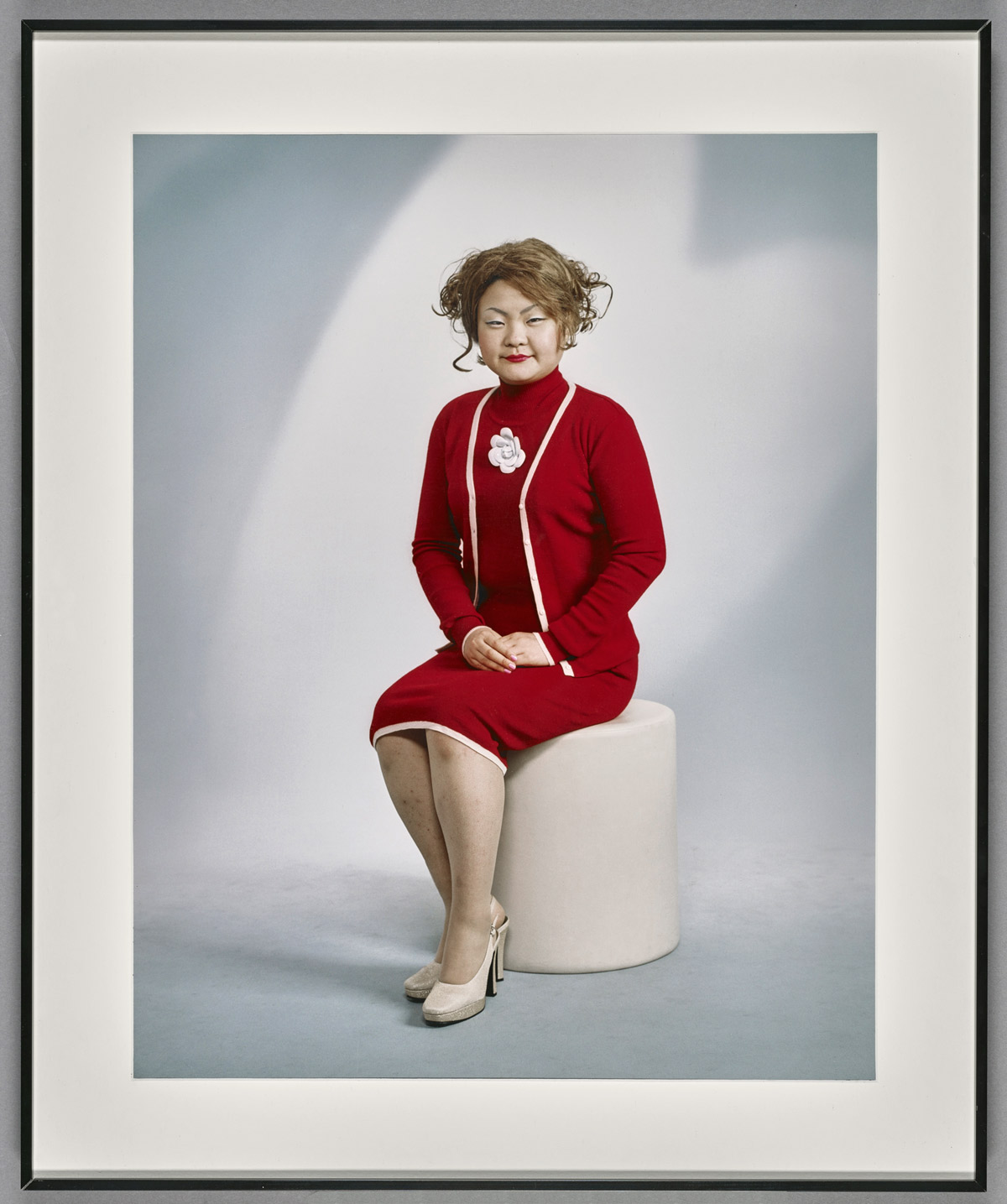
LA Bloom
2002
Cibachrome photographs
Courtesy of the artist, Auckland


In 2002 the New Zealand photographer Joyce Campbell decided to conduct a microbial survey of Los Angeles, a city in which she lives for part of each year. She swabbed the surfaces of plants and soil from twenty-seven locations chosen out of her Thomas Guide to the city. She then transferred each sample onto a sterilised plexiglass plate of agar and allowed it to grow as a living culture. The Cibachrome positive colour contact prints she subsequently made from these plates resemble abstract paintings and yet also offer a critical mapping of the relative fertility of this particular urban landscape, revealing its dependence on the politics of water distribution.


Installation view of Aldo Tambellini (Italy/US) 'Videograms' 1969
 

Installation view of
Aldo Tambellini
(Italian-American, 1930-2020)
Videogram, 1969
Videogram, 1969
Videogram, 1969
Videogram, 1969
Gelatin silver photographs


Although raised in Italy, Aldo Tambellini was working in New York in 1969 when he manipulated the cathode ray tube of a TV set into the shape of a spiral (for this artist, a universal sign of energy) and exposed sheets of light-sensitive paper by laying them over its screen. The calligraphic inscriptions that resulted made his paper look as if it had been scorched from the inside out. These ‘videograms,’ as Tambellini called them, highlight the chaos and chance operations that lurk just beneath the surface of technology’s apparent rationality.


Installation view of Shaun Waugh (New Zealand) 'ΔE2000 1.1' 2014 part of the exhibition of the exhibition 'Emanations: The Art of the Cameraless Photograph' at the Govett-Brewster Art Gallery

Installation view of Shaun Waugh (New Zealand) 'ΔE2000 1.1' 2014 part of the exhibition of the exhibition 'Emanations: The Art of the Cameraless Photograph' at the Govett-Brewster Art Gallery

Installation view of Shaun Waugh (New Zealand) 'ΔE2000 1.1' 2014 part of the exhibition of the exhibition 'Emanations: The Art of the Cameraless Photograph' at the Govett-Brewster Art Gallery


Installation views of
Shaun Waugh (New Zealand, b. 1982)
ΔE2000 1.1
2014
24 Agfa boxes with mounted solid colour inkjet photographs


This work by New Zealand artist Shaun Waugh began with the purchase of empty boxes that once held Agfa photographic paper. Waugh then took readings of all four sides of the inside lip of each box lid using a spectrophotometer, employing this data and Photoshop to generate a solid orange-red inkjet print. The box lid is used to frame a two-dimensional version of itself, bringing analogue and digital printing into an uncomfortably close proximity to create a memorial to a kind of photography that is now defunct. Hung salon style, like so many small paintings, Waugh’s work manages to turn the photograph inside out, and thus into something other than itself.


Wall text from the exhibition 'Emanations: The Art of the Cameraless Photograph' at the Govett-Brewster Art Gallery


Wall text from the exhibition Emanations: The Art of the Cameraless Photograph at the Govett-Brewster Art Gallery


Installation view of the exhibition 'Emanations: The Art of the Cameraless Photograph' at the Govett-Brewster Art Gallery with, at left, work by Anne Ferran and, at right, Adam Fuss


Installation view of the exhibition Emanations: The Art of the Cameraless Photograph at the Govett-Brewster Art Gallery with at left, Anne Ferran and at right, Adam Fuss


Installation view of the work of Anne Ferran (Australian, b. 1949) Untitled, 1998; Untitled, 1998; Untitled, 1998; Untitled (baby's petticoat), 1998; Untitled (collar), 1998; Untitled (baby's bonnet), 1998; Untitled (sailor suit), 1998; Untitled (shirts), 1998


Installation view of
Anne Ferran (Australian, b. 1949)
Untitled, 1998
Untitled, 1998
Untitled, 1998
Untitled (baby’s petticoat), 1998
Untitled (collar), 1998
Untitled (baby’s bonnet), 1998
Untitled (sailor suit), 1998
Untitled (shirts), 1998

Unique gelatin silver photographs


In 1998 Australian artist Anne Ferran was offered an artist-in-resident’s position at an historic homestead not far from Sydney that had been occupied by successive generations of the same family since 1813. Ferran spent six months systematically making contact prints using the dresses, bodices, skirts, petticoats, and collars still contained in the house. Hovering in a surrounding darkness, softly radiating an inner light, the ghostly traces of these translucent garments now act as residual filaments for a century of absorbed sunshine. Many of them have been patched over the years and their signs of wear and repair are made clear. This allows us to witness a history of the use of each piece of clothing, seeing inside them to those small and skilful acts of home economy – the labour of women – usually kept hidden from a public gaze.


Anne Ferran (Australian, b. 1949) 'Untitled (baby's bonnet)' 1998


Anne Ferran (Australian, b. 1949)
Untitled (baby’s bonnet)
1998
Unique gelatin silver photograph


Installation view of the exhibition Emanations: The Art of the Cameraless Photograph at the Govett-Brewster Art Gallery with, at left, work by Adam Fuss and, at right, Lisa Clunie


Installation view of the exhibition Emanations: The Art of the Cameraless Photograph at the Govett-Brewster Art Gallery with at left, Adam Fuss and at right, Lisa Clunie


installation view of Adam Fuss (UK/Australia/US) ‘Caduceus’ 2010 (left) and ‘Untitled’ 1991 (right)


Installation view of Adam Fuss (UK/Australia/US) Caduceus 2010 (left) and Untitled 1991 (right)


Born in England, raised in Australia, and resident in New York, Adam Fuss has produced a diverse range of large cameraless photographs since the 1980s, asking his light-sensitive paper to respond to the physical presence of such phenomena as light, water, a slithering snake, flocks of birds, and sunflowers.


Adam Fuss (British, b. 1961) 'Untitled' 1991 from the exhibition 'Emanations: The Art of the Cameraless Photograph' at the Govett-Brewster Art Gallery/Len Lye Centre, New Plymouth, New Zealand, April - August, 2016


Adam Fuss (British, b. 1961)
Untitled
1991
Type C photograph


Lisa Clunie (New Zealand) ‘Fold I’ 2014 from the exhibition 'Emanations: The Art of the Cameraless Photograph' at the Govett-Brewster Art Gallery/Len Lye Centre, New Plymouth, New Zealand, April - August, 2016


Lisa Clunie (New Zealand)
Fold I
2014
Silver gelatin photograph


The work of New Zealand artist Lisa Clunie looks back to the work of pioneer modernist László Moholy-Nagy in order to manifest the idea that our lives are shaped by a continual play of forces. Like Moholy, she wets her photographic paper and then tightly folds it, before moving the paper back and forth under her enlarger, selectively exposing these folds to the ‘force’ of light. The resulting work reminds us that a photograph has weight, surface, texture, tension and edges.


Installation view of the exhibition 'Emanations: The Art of the Cameraless Photograph' at the Govett-Brewster Art Gallery with at right, the work of Robert L. Buelteman


Installation view of the exhibition Emanations: The Art of the Cameraless Photograph at the Govett-Brewster Art Gallery with at right, the work of Robert L. Buelteman


Installation view of Robert L. Buelteman (American, b. 1954) ‘Cannabis sativa’ 2002 (left) and ‘Eucalyptus polyanthemos’ 2000 (right)


Installation view of
Robert L. Buelteman (American, b. 1954)
Cannabis sativa (left)
2002
Digital chromogenic development photograph

Robert L. Buelteman (American, b. 1954)
Eucalyptus polyanthemos (right)
2002
Digital chromogenic development photograph


The San-Franciscan artist Robert Buelteman takes his leaves and other botanical specimens and slices them into paper-thin sections, before charging them, in a complicated and dangerous process, with a pulse of 40,000 volts of electricity. This leaves behind a colorised trace on his photographic paper, a photogram in which these plants appear to be aflame, as if emitting an energy all their own. Hovering between life and death, this is a nature that seems to be on the cusp of its transmutation into something else entirely.


Installation view of the exhibition Emanations: The Art of the Cameraless Photograph at the Govett-Brewster Art Gallery with at centre, the work of Robert Owen and at right, Joan Fontcuberta


Installation view of the exhibition Emanations: The Art of the Cameraless Photograph at the Govett-Brewster Art Gallery with at centre, Robert Owen and at right, Joan Fontcuberta


Robert Owen (Australian, b. 1937) ‘Endings (Rothko died today) – Kodachrome 64, No. 21, 26/02/1970’ 2009


Robert Owen (Australian, b. 1937)
Endings (Rothko died today) – Kodachrome 64, No. 21, 26/02/1970
2009
Pigment ink-jet print


The photographic work of Australian artist Robert Owen is part of a broader tendency on the part of contemporary artists to reflect in morbid terms on aspects of photography’s past. Owen has been collecting film stubs since 1968. Although better known as a painter and sculptor, he recently decided to print these end strips of film as a series of large colour photographs, paying homage to this residue of the Kodak era in a chronological sequence of readymade chromatic fields. This one was collected on the day that the American abstract painter Mark Rothko killed himself.


Adam Fuss (British, b. 1961) 'Untitled' (from the series 'My Ghost') 2001


Adam Fuss (British, b. 1961)
Untitled (from the series My Ghost)
2001
Unique gelatin silver photograph


In his series, titled My Ghost, Adam Fuss put together a body of contact photographs of such things as plumes of smoke, patterns of light, a butterfly, a swan and a baptism dress. As his title suggests, Fuss’s work aims to evoke rather than describe; for all their evident tactility, these photographs are meant as metaphors, as prayers, perhaps even as poems.


Adam Fuss (British, b. 1961) both 'Untitled' 1989


Installation view of
Adam Fuss (British, b. 1961)
Untitled
1989
Cibachrome photograph

Adam Fuss (British, b. 1961)
Untitled
1989
Cibachrome photograph


Installation view of Joan Fontcuberta (Spain). ‘MN 62: OPHIUCUS (NGC 6266), AR 17 h. 01,2 min. / D -30º 07’’ (left) and ‘LAMBDA CORONAE AUSTRALIS (Mags 5,1/9,7 Sepn 29,2" AP 214º), AR 18 h 43,8 min. / D -38º 19’’ (right) both 1993

Installation view of Joan Fontcuberta (Spanish, b. 1955) ‘MN 62: OPHIUCUS (NGC 6266), AR 17 h. 01,2 min. / D -30º 07’’ (left) and ‘LAMBDA CORONAE AUSTRALIS (Mags 5,1/9,7 Sepn 29,2" AP 214º), AR 18 h 43,8 min. / D -38º 19’’ (right) both 1993


Installation views of
Joan Fontcuberta (Spanish, b. 1955)
MN 62: OPHIUCUS (NGC 6266), AR 17 h. 01,2 min. / D -30º 07′ (left)
LAMBDA CORONAE AUSTRALIS (Mags 5,1/9,7 Sepn 29,2″ AP 214º), AR 18 h 43,8 min. / D -38º 19′ (right)
both 1993
From the Constellations series
Cibachrome photographs


Photographs from the Constellations series by Spanish artist Joan Fontcuberta come filled with fields of sparkling blackness, their speckled surfaces redolent of infinite space and twinkling stars. Their titles imply we are looking upwards towards the heavens. But this artist’s prints actually record dust, crushed insects and other debris deposited on the windscreen of his car, a trace of the evidence of his own rapid passage through terrestrial space and time. The artist applied sheets of 8-by-10-inch film directly onto the glass windscreen and shone a light through, creating photograms which were then made into glossy Cibachrome prints.


Installation view of Paul Hartigan (New Zealand) 'Colourwords' 1980-1981 as part of the exhibition 'Emanations: The Art of the Cameraless Photograph' at the Govett-Brewster Art Gallery

Installation view of Paul Hartigan (New Zealand) 'Colourwords' 1980-1981 as part of the exhibition 'Emanations: The Art of the Cameraless Photograph' at the Govett-Brewster Art Gallery

Detail of Paul Hartigan (New Zealand, b. 1939) 'Colourwords' 1980-1981 as part of the exhibition 'Emanations: The Art of the Cameraless Photograph' at the Govett-Brewster Art Gallery

Detail of Paul Hartigan (New Zealand, b. 1939) 'Colourwords' 1980-1981 as part of the exhibition 'Emanations: The Art of the Cameraless Photograph' at the Govett-Brewster Art Gallery

Detail of Paul Hartigan (New Zealand, b. 1939) 'Colourwords' 1980-1981 as part of the exhibition 'Emanations: The Art of the Cameraless Photograph' at the Govett-Brewster Art Gallery

Detail of Paul Hartigan (New Zealand, b. 1939) 'Colourwords' 1980-1981 as part of the exhibition 'Emanations: The Art of the Cameraless Photograph' at the Govett-Brewster Art Gallery

Detail of Paul Hartigan (New Zealand, b. 1939) 'Colourwords' 1980-1981 as part of the exhibition 'Emanations: The Art of the Cameraless Photograph' at the Govett-Brewster Art Gallery


Installation views and detail of
Paul Hartigan (New Zealand, b. 1939)
Colourwords
1980-1981
Colour photocopy


Consistently defined by a subversive edge and a darkly witty humour, the work of New Zealand artist Paul Hartigan is often subtly permeated by astute social and political perceptions. Shortly after they were introduced into New Zealand in 1980, Hartigan explored the creative possibilities of a colour photocopying machine, making a series of images in which words and found objects ironically refer to each other in an endless loop. With the objects arranged to spell out their own colour, each picture offers an oscillation of word and meaning, flatness and dimension, art and detritus.


Installation view of Gavin Hipkins (New Zealand) ‘The Coil’ 1998 (left) and Lucinda Eva-May as part of the exhibition 'Emanations: The Art of the Cameraless Photograph' at the Govett-Brewster Art Gallery


Installation view of Gavin Hipkins (left) and Lucinda Eva-May (right) as part of the exhibition Emanations: The Art of the Cameraless Photograph at the Govett-Brewster Art Gallery


Installation view of Gavin Hipkins (New Zealand, b. 1968) ‘The Coil’ 1998


Installation view of
Gavin Hipkins (New Zealand, b. 1968)
The Coil
1998
Silver gelatin photographs


Inspired by the kinetic films of Len Lye, in the 1990s Gavin Hipkins made a series of cameraless photographs that play with sequence and implied movement. The 32 images that make up The Coil were made by resting polystyrene rings on sheets of photographic paper and then exposing them to light.


Installation view of Lucinda Eva-May (Australia) 'Unity in light #6' 2012 (left) 'Unity in light #9' 2012 (right)


Installation view of
Lucinda Eva-May (Australia)
Unity in light #6, 2012 (left)
Unity in light #9, 2012 (right)
C-type prints


Australian artist Lucinda Kennedy has sought to capture a phenomenological representation of the feelings and sensations of sexual intercourse through the direct imprint on sheets of photographic paper of this most primal of human interactions. Turned into a single blurred organism by the extended duration of the exposure, the artist and her partner become an abstraction, thereby aptly conjuring an experience that has always been beyond the capacity of mere description.


Installation view of the exhibition 'Emanations: The Art of the Cameraless Photograph' at the Govett-Brewster Art Gallery with at left, the work of Thomas Ruff, and at right, Justine Varga


Installation view of the exhibition Emanations: The Art of the Cameraless Photograph at the Govett-Brewster Art Gallery with at left, Thomas Ruff, and at right, Justine Varga


Installation view of Thomas Ruff (Germany, b. 1958) 'r.phg.07_II' 2013

Installation view of Thomas Ruff (Germany, b. 1958) 'r.phg.07_II' 2013


Installation views of
Thomas Ruff (Germany, b. 1958)
r.phg.07_II
2013
Chromogenic print


Thomas Ruff (Germany, b. 1958) 'r.phg.07_II' 2013


Thomas Ruff (Germany, b. 1958)
r.phg.07_II
2013
Chromogenic print


German artist Thomas Ruff uses his computers to construct virtual objects with simulated surfaces and to calculate the lights and shadows they might cast in different compositions. He then prints the results, in colour and at very large scale. Combining variations of spheres, curves, zig-zags and sharp edges, all set within richly coloured surrounds, Ruff’s images are both untethered abstractions and historical ciphers. Although referred to by the artist as photograms, the final prints are perhaps better conceived as being about the photogram, studiously replaying an analogue process in digital terms so as to make a spectacle of its logic.


Installation view of the exhibition 'Emanations: The Art of the Cameraless Photograph' at the Govett-Brewster Art Gallery with at left, Shimpei Takeda and at right, Justine Varga

Installation view of the exhibition 'Emanations: The Art of the Cameraless Photograph' at the Govett-Brewster Art Gallery


Installation view of the exhibition Emanations: The Art of the Cameraless Photograph at the Govett-Brewster Art Gallery with at left, Shimpei Takeda and at right, Justine Varga


Justine Varga (Australian, b. 1984) 'Exit (Red State)' 2014-2015


Justine Varga (Australian, b. 1984)
Exit (Red State)
2014-2015
Chromogenic photograph


Justine Varga (Australian, b. 1984) 'Desklamp' 2011-2012


Justine Varga (Australian, b. 1984)
Desklamp
2011-2012
Chromogenic photograph


Australian artist Justine Varga creates photographic works from an intimate and often prolonged exchange between a strip of film and the world that comes to be inscribed on it. Desklamp involved the year-long exposure of a large format negative placed on top of the artist’s desk lamp. Exit was derived from a similar piece of film that was scarred and weathered during a three-month exposure on her windowsill during a residency in London. Both were then turned into luscious colour photographs in the darkroom via various printing procedures.


Govett-Brewster Art Gallery/Len Lye Centre
Queen St, New Plymouth, New Zealand
Phone: +64 6 759 6060
Email: info@govettbrewster.com

Opening hours:
Daily 10am – 5pm

Govett-Brewster Art Gallery/Len Lye Centre website

LIKE ART BLART ON FACEBOOK

Back to top

Exhibition: ‘Cosa Mentale: Art and Telepathy in the 20th century’ at the Centre Pompidou-Metz, Paris

Exhibition dates: 28th October, 2015 – 28th March, 2016

Curator: Pascal Rousseau, Professor of Contemporary History of Art at the University of Paris I Panthéon Sorbonne


Louis Darget (French, 1847-1923) 'Fluidic Thought-Image Photography' 1896 from the exhibition 'Cosa Mentale: Art and Telepathy in the 20th century' at the Centre Pompidou-Metz, Paris, Oct 2015 - March 2016


Louis Darget (French, 1847-1923)
Fluidic Thought-Image Photography
1896

(L) Inscribed: “Photo… of thought. Head obtained by Mr. Henning, having a plate wrapped in black paper on his forehead while he played the piano. Opposite him on the piano was a portrait of Beethoven. Could this be that [same] portrait reflected by the brain onto the plate through the black paper. Comt. Darget”

(R) “Photograph of a Dream: The Eagle.” 25 June, 1896.
Inscribed: “Obtained by placing a photographic plate above the forehead of Mme Darget while she was asleep.”


Telepathic art in the 20th century. What a fascinating subject for a spiritual, phantasmagoric exhibition which explores artists’ fascination with the direct transmission of thought and emotion. A lot of phenomena – for example telepathy, X-rays, psychoanalysis – were named or discovered in the last half of the nineteenth century or are concepts and things that began to gain popularity in the collective consciousness at that time, such as the unconscious mind, the anima and animus, the study of signs, photographs of thought, photographs of hysteria (Charcot) and notes and photographs on unexplained paranormal experiences.

“The exhibition enables the spectator to understand how, throughout the 20th century, attempts to give material and visible form to thought processes coincide with the experiments of avant-garde artists. This fantasy of a direct projection of thought not only had a decisive impact on the birth of abstraction but also influenced surrealism and its obsession with the collective sharing of creation and, in the post war period, it gave rise to numerous visual and sound installations inspired by the revolution in information technology, leading to the declaration of “the dematerialisation of art” in conceptual practices.”

Love the work of Émile Cohl and Len Lye, both a revelation to me.

Dr Marcus Bunyan


Many thankx to the Centre Pompidou-Metz for allowing me to publish the photographs in the posting. Please click on the photographs for a larger version of the image.


Edvard Munch (Norwegian, 1863-1944) 'Madonna' 1895 from the exhibition 'Cosa Mentale: Art and Telepathy in the 20th century' at the Centre Pompidou-Metz, Paris, Oct 2015 - March 2016


Edvard Munch (Norwegian, 1863-1944)
Madonna
1895
Paris, Centre Pompidou, Musée national d’Art moderne
© Centre Pompidou, MNAM-CCI, Dist. RMN-Grand Palais / Georges Meguerditchian


Odilon Redon (French, 1840-1916) 'Portrait de Paul Gauguin' 1903-1906


Odilon Redon (French, 1840-1916)
Portrait of Paul Gauguin
1903-1906
Paris, Musée d’Orsay
© RMN-Grand Palais (musée d’Orsay) / Hervé Lewandowski


Émile Cohl (French, 1857-1938)
Le retapeur de cervelles (The creators brain)
1910


Auguste Rodin (French, 1840-1917) 'Le Penseur [The Thinker]' 1903


Auguste Rodin (French, 1840-1917)
Le Penseur [The Thinker]
1903
Plâtre patiné / patinated plaster
72 x 37 x 57.50cm
© Photographe: Christian Baraja
© Musée Rodin, Paris


When conceived in 1880 in its original size (approx. 70cm) as the crowning element of The Gates of Hell, seated on the tympanum, The Thinker was entitled The Poet. He represented Dante, author of the Divine Comedy which had inspired The Gates, leaning forward to observe the circles of Hell, while meditating on his work. The Thinker was therefore initially both a being with a tortured body, almost a damned soul, and a free-thinking man, determined to transcend his suffering through poetry. The pose of this figure owes much to Carpeaux’s Ugolino (1861) and to the seated portrait of Lorenzo de Medici carved by Michelangelo (1526-31).

While remaining in place on the monumental Gates of Hell, The Thinker was exhibited individually in 1888 and thus became an independent work. Enlarged in 1904, its colossal version proved even more popular: this image of a man lost in thought, but whose powerful body suggests a great capacity for action, has became one of the most celebrated sculptures ever known. Numerous casts exist worldwide, including the one now in the gardens of the Musée Rodin, a gift to the City of Paris installed outside the Panthéon in 1906, and another in the gardens of Rodin’s house in Meudon, on the tomb of the sculptor and his wife.

Text from the Rodin Museum website [Online] Cited 22/03/2016. No longer available online


Stephen Haweis (British, 1878-1969) and Henry Coles 'Le Penseur' c. 1903-1904


Stephen Haweis (British, 1878-1969) and Henry Coles
Le Penseur
c. 1903-1904
Epreuve au charbon / Charcoal
23 x 16.60cm
© Musée Rodin, Paris


Cosa Mentale is a unique exhibition that offers a re-reading of the history or art from 1990 to modern day by exploring artists’ fascination with the direct transmission of thought and emotion. It invites the spectator to re-live one of the unexpected adventures of modernity: telepathic art in the 20th century. This exhibition traces a chronological path from symbolism to conceptual art with a collection of some one hundred works by major artists, ranging from Edvard Munch to Vassily Kandinsky, and from Joan Miró to Sigmar Polke. These artists provide innovative ways of communicating with spectators that take us beyond conventional linguistic codes.

The exhibition enables the spectator to understand how, throughout the 20th century, attempts to give material and visible form to thought processes coincide with the experiments of avant-garde artists. This fantasy of a direct projection of thought not only had a decisive impact on the birth of abstraction but also influenced surrealism and its obsession with the collective sharing of creation and, in the post war period, it gave rise to numerous visual and sound installations inspired by the revolution in information technology, leading to the declaration of “the dematerialisation of art” in conceptual practices.

The exhibition begins with the invention of the term “telepathy” in 1882, at a time when the study of psychology interacted with rapid developments in telecommunications. Endeavours ranged from the creation of “photographs of thought” in 1895 to the first “encephalograms” in 1924 (the year when the Surrealist Manifesto was published) and it was the actual activity of the brain which was to be shown in all its transparency, which encouraged artists to reject the conventions of representation by suppressing all restrictions of translation. Telepathy was far from remaining an obscure paranormal fantasy and consistently intrigued and enthralled artists throughout the 20th century. Always present in the world of science fiction, it resurfaced in psychedelic and conceptual art in the period from 1960 to 1970 before reappearing today in contemporary practices enraptured by technologies of “shared knowledge” and the rapid development of neuroscience.

Curator

Pascal Rousseau, professor of contemporary history of art at the University of Paris I Panthéon Sorbonne. Pascal Rousseau has also curated Robert Delaunay exhibitions: From impressionism to abstraction, 1906-1914, at the Centre Pompidou (1999) and To the origins of abstraction (1800-1914) at the Musée d’Orsay (2003).

Press release from the Centre Pompidou-Metz


Joan Miró (Spanish, 1893-1983) 'La Sieste' July-September 1925


Joan Miró (Spanish, 1893-1983)
La Sieste
July – September 1925
© Successió Miró/ ADAGP, Paris, 2015


Vassily Kandinsky (Russian, 1866-1944) 'Bild mit rotem Fleck [Tableau à la tache rouge / Image with red spot]' 25 February 1914


Vassily Kandinsky (Russian, 1866-1944)
Bild mit rotem Fleck [Tableau à la tache rouge / Image with red spot]
25 February 1914
Paris, Centre Pompidou – Musée national d’art moderne
© Centre Pompidou, MNAM-CCI, Dist. RMN-Grand Palais / Adam Rzepka


Frantisek Kupka (Czech, 1871-1957) 'Facture robuste' 1920


Frantisek Kupka (Czech, 1871-1957)
Facture robuste
1920
Strasbourg, Musée d’Art moderne et contemporain
© ADAGP, Paris, 2015
© Centre Pompidou, MNAM-CCI, Dist. RMN-Grand Palais / Jacques Faujour


Len Lye (New Zealand/America, 1901-1980)
Tusalava
1929
Film
10 min. 5 sec.


As a student, Lye became convinced that motion could be part of the language of art, leading him to early (and now lost) experiments with kinetic sculpture, as well as a desire to make film. Lye was also one of the first Pākehā artists to appreciate the art of Māori, Australian Aboriginal, Pacific Island and African cultures, and this had great influence on his work. In the early 1920s Lye travelled widely in the South Pacific. He spent extended periods in Australia and Samoa, where he was expelled by the New Zealand colonial administration for living within an indigenous community.

Working his way as a coal trimmer aboard a steam ship, Lye moved to London in 1926. There he joined the Seven and Five Society, exhibited in the 1936 International Surrealist Exhibition and began to make experimental films. Following his first animated film Tusalava, Lye began to make films in association with the British General Post Office, for the GPO Film Unit. He reinvented the technique of drawing directly on film, producing his animation for the 1935 film A Colour Box, an advertisement for “cheaper parcel post”, without using a camera for anything except the title cards at the beginning of the film. It was the first direct film screened to a general audience. It was made by painting vibrant abstract patterns on the film itself, synchronising them to a popular dance tune by Don Baretto and His Cuban Orchestra. A panel of animation experts convened in 2005 by the Annecy film festival put this film among the top ten most significant works in the history of animation (his later film Free Radicals was also in the top 50).

Text from the Wikipedia website


Rudolf Steiner (Austrian, 1861-1925) 'Untitled (drawing on blackboard at a conference of 14 May 1924)' Dornach, 14 May 1924


Rudolf Steiner (Austrian, 1861-1925)
Untitled (drawing on blackboard at a conference of 14 May 1924)
Dornach, 14 May 1924
Chalk on black paper
Rudolf Steiner Archive, Dornach
© Rudolf Steiner Archiv, Dornach
© ADAGP, Paris, 2015


A room of the exhibition features ten blackboards by Rudolf Steiner. They are the instructions of a new design language that the artist wants to develop. Steiner believes in the development of a supersensible consciousness, a big change for the future of humanity. He gives many lectures in which he details his research on the concept of transmission and its influence on the social. Whether true or not, artists such as Piet Mondrian, Wassily Kandinsky and others are interested in the complex graphics of Steiner and his research. Mondrian will even write: “Art is a way of development of mankind.”

Text from the Culture Box website translated from the French


Victor Brauner (Romanian, 1903-1966) 'Signe' 1942-1945


Victor Brauner (Romanian, 1903-1966)
Signe
1942-45
© ADAGP, Paris, 2015


Exhibition layout

Introduction

The exhibition starts with a version of the famous figure of Rodin’s Thinker, set off against a sequence of seven photographs from the start of the century, in which the Pictorialist dimension seems to attempt to show lighting emissions produced by the cerebral concentration of the subject. This collection is presented opposite TV Rodin, a video installation created by the artist Nam June Paik who, in the 1970s, reinterpreted electromagnetic animation of closed-circuit thought, when interest in cybernetics was at its peak.

Auras

The direct visualisation of thought and emotional states and the impact of this on the beginnings of abstraction at the start of the 20th century.

The first room focuses on the passion during the century for “photography of thought.” As a direct response to the discovery of radiography by Röntgen, in 1895, numerous amateur researchers attempted to produce images of the brain on photosensitive plates. Since it was possible to see through opaque bodies, why not try to see through the skull, which was now transparent? A curiosity cabinet presents the photographic experiments of Hippolyte Baraduc and Louis Darget with “psychic ones” or “images of thought.” This selection of photographs interacts with two film animation extracts by Émile Cohl, showing, with some humour, the direct projection of thought onto the big screen with the arrival of the cinema.

In the second room, a collection of engravings from the theosophical works of Annie Besant and Charles Leadbeater, presented by the American artist Christian Sampson, reveals the close relationship between the representation of emotional states (thought-patterns) and early abstract painting. They inspired many pioneers of abstract painters, including Kupka and Kandinsky. A group of auras and halos is shown, associated with a colour code for different effects, captured by Kandinsky in order to paint authentic abstract (auto) portraits. In the same vein, paintings by Wilhelm Morgner, Janus de Winter and Jacob Bendien present “psychic portraits” which illustrate a psychological range of emotions by means of chromatic signs.

The third room presents a sequence of ten “blackboards” by Rudolph Steiner, the founder of anthroposophy (the “science of the mind” that was a major influence on some of the members of the avant-garde abstract movement), showing how he developed his theories of the “mental body” and “psychic force”. Next to this is a collection of watercolours by the Swedish painter Hilma af Klint, a pioneer of abstract art. Around this area a multimedia installation by the artist Tony Oursler has been specially created for this exhibition reinterpreting the historical imagination of these “mental projections”.

Magnetic fields

The spread of telepathy in the inter-war period and its influence on surrealism.

In 1924, André Breton published the Surrealist Manifesto (1924) just when the neurologist Hans Berger invented the first electroencephalogram as a result of experimental research into telepathy: this being a less than accidental coincidence, relating to automated transcriptions of the mind. The “exquisite corpses” or “communicated drawings” of the surrealists are linked to experiments that took place at that time into the telepathic transfer of images.

The first room presents a sequence of photographs of the surrealist group in poses in which heads and bodies communicate with each other to produce a collective work under the mysterious influence of “magnetic fields.” Tusalava (1929), a film by the Australian artist Len Lye, illustrates the cinematographic solution found to make mental activity visible, in the form of abstract ideograms taken from aboriginal language.

The second room shows a collection of photographs from the 1920s, some of which are presented by the artist Frédéric Vaesen, relating to the materialisation of psychic entities, the famous “ectoplasms” which give a more tangible reality to imponderable thought. Next to this is a series of works by Joan Miró, in which the painter depicts coloured auras, including a mental map of emotional states, a “photograph of his dreams”.

Mind expander

With the reconstruction of the post war period, divided between the cybernetic model and psychedelic liberation, telepathy remained more than ever a creative horizon for artists in search of perception extended to the electromagnetic manifestations of consciousness.

The New Age spirit of the 1960s witnessed the curious revival of “photographs of thought” (Ted Serios and Salas Portugal), which influenced experimental cinema and psychedelic video (Jordan Belson), a well as some photographic practices (Anna and Bernhard Blume, Dieter Appelt, Suzanne Hiller, John Baldessari and Sigmar Polke).

Under the influence of psychotropic drugs or immersed in highly intense audiovisual devices, electric thought in motion is captured with a penetrating eye. Experimental and radical architectural patterns embody “expanded consciousness”, as is seen in the Mind Expander project (1967) by the Austrian group Haus Rucker Co, which invites the spectator to venture into “superception.” Music has its role here, with the rise in “biomusic” at the end of the 1960s, led by Alvin Lucier, Pierre Henry and David Rosenboom, who produced authentic “brain symphonies,” by means of the sound transcription of the activity of electric waves emitted by the brain, directly captured by electrodes.

Telepathy

The establishment of telepathic art in the 1970s influenced by conceptual practices.

On the margins of pop art, avant-garde artists in the 1970s produced a critique of both form and the art market, by means of strategies that emphasised language and sociological discourse. This also involved a major project in the dematerialisation of art works in which telepathy could be an ideal model for a new non-standard form of communication.

The American artist Robert Morris produced his own Autoportrait in the form of an encephalogram (EEG Portrait) at the same time as his compatriot Robert Barry, a central figure in conceptual art, produced Telepathic Pieces (1969) and Vito Acconci explored extra sensory perception through the form of video (Remote Control, 1971). Against this backdrop, we see considerable new interest in a utopia of shared creation (Robert Filliou and Marina Abramovic) in the era of global communication and the “noosphere” prophetically declared by Teilhard de Chardin and Marshall McLuhan.

The exhibition ends with a vast installation by the artist Fabrice Hyber, a major figure of contemporary art in France, with experimental telepathic booths, paintings, drawings and “prototypes of operating objects” (POF). Hyber invites the spectator to participate, alone or in groups, in an experience which has several surprises, reminding us how, today, under the influence of information networks, neuroscience and the globalised internet, telepathy (ultra democratic and utopian yet also obscure) is more topical than ever and can be explored by artists with the same spirit of derision or anticipation.

Press release from the Centre Pompidou-Metz


Haus-Rucker-Co (Viennese, founded 1967) Laurids, Zamp and Pinter with 'Environment Transformern (Flyhead, Viewatomizer and Drizzler)' 1968, from the 'Mind Expander project'


Haus-Rucker-Co (Viennese, founded 1967)
Laurids, Zamp and Pinter with Environment Transformern (Flyhead, Viewatomizer and Drizzler)
1968
From the Mind Expander project
Photo: Gert Winkler


Taking their cue from the Situationist’s ideas of play as a means of engaging citizens, Haus-Rucker-Co created performances where viewers became participants and could influence their own environments, becoming more than just passive onlookers. These installations were usually made from pneumatic structures such as Oase No. 7 (1972), which was created for Documenta 5 in Kassel, Germany. An inflatable structure emerged from the façade of an existing building creating a space for relaxation and play, of which contemporary echoes can be found in the ‘urban reserves’ of Santiago Cirugeda. The different versions of the Mind Expander series (1967-1969), consisted of various helmets that could alter the perceptions of those wearing them, for example the ‘Fly Head’ disoriented the sight and hearing of the wearer to create an entirely new apprehension of reality; it also produced one of their most memorable images.

Haus-Rucker-Co’s installations served as a critique of the confined spaces of bourgeois life creating temporary, disposable architecture, whilst their prosthetic devices were designed to enhance sensory experience and highlight the taken-for-granted nature of our senses, seen also in the contemporaneous work of the Brazilian artist Lygia Clark. Contemporary versions of such work can be found in the pneumatic structures favoured by Raumlabor and Exyzt.

Anonymous text from the Spatial Agency website [Online] Cited 22/03/2016.


Installation view of Haus-Rucker-Co, 'Mindexpander 1' 1967 in the exhibition 'Cosa mentale' at the Centre Pompidou-Metz


Installation view of Haus-Rucker-Co, Mindexpander 1 1967 in the exhibition Cosa mentale at the Centre Pompidou-Metz.
Photo Pompidou Centre. MNAM CCI-distrib. RMN / G. Meguerditchian.


In 1968, the Austrian collective Haus-Rucker-Co designed the Mind Expander as an immersive capsule propelling the audience into a new mode of perception of reality: the “Superception”. This, then, is a synthesis of avant-garde utopias, throughout the twentieth century, influenced by the imagination that gave rise to the development of telecommunications, seeking to develop a way of live transmission of emotion. Its aim was to invent a new, immediate, relationship between the artist and the viewer.


Haus-Rucker-Co. 'Mind Expander' 1967


Haus-Rucker-Co (Viennese, founded 1967)
Mind Expander
1967 Vienna
Epreuve gélatino-argentique
Photo: Michael Plitz. Haus-Rucker-Co.


David Rosenboom (American, b. 1947) 'Portable Gold and Philosophers' Stones in Paris 1' 1975


David Rosenboom (American, b. 1947)
Portable Gold and Philosophers’ Stones in Paris 1
1975
© David Rosenboom 1975
All rights reserved


Pianist-composer J.B. Floyd, a long-time collaborator with David Rosenboom is seen with electrodes attached to his head while performing a solo version of Rosenboom’s brainwave music composition Portable Gold and Philosophers’ Stones at Centre Culturel Americain in Paris on 7 January 1975. The equipment shown includes a brainwave monitoring device and an ARP 2600 Synthesizer. The performance occurred simultaneously with a lecture given by David Rosenboom in a presentation titled Biofeedback and the Arts. Artist Jacqueline Humbert, who also participated in the performance, is seated off to the right of the picture frame.


Nam June Paik (American, 1932-2006) 'TV Rodin' 1976-1978 (detail)


Nam June Paik (American, 1932-2006)
TV Rodin (detail)
1976-1978
Plaster, video camera, tripod, monitor, pedestal
132 x 110 x 115 cm


Long considered the most important video artist since the advent of the form in the late 1960s, Nam June Paik’s TV Rodin is one of several related works that involve sculpture – in this case, a cast of Auguste Rodin’s Thinker, studying itself in a small video monitor via closed circuit television. As museum visitors walk around the work and look over the sculpture’s shoulder, their image also appears on the screen. Paik’s influential vision of television as a global cultural force found intelligent and witty form in his videotapes, video sculptures, and intercontinental satellite performances.

Text from the Carnegie Museum of Art website [Online] Cited 22/03/2016.


Nam June Paik (American, 1932-2006) 'TV Rodin' 1976-1978


Nam June Paik (American, 1932-2006)
TV Rodin
1976-1978
Plaster, video camera, tripod, monitor, pedestal
132 x 110 x 115cm
Photo: Primae / Claude Germain. The Estate of Nam June Paik


Marina Abramovic (Serbian, b. 1946) and Ulay (Frank Uwe Laysiepen) (German, 1943-2020) 'That Self – Point of Contact' 1980


Marina Abramovic (Serbian, b. 1946) and Ulay (Frank Uwe Laysiepen) (German, 1943-2020)
That Self – Point of Contact
1980
Performance au De Appel Art Centre, Amsterdam
© Adagp, Paris 2015
Courtesy Marina Abramovic Archives


Sigmar Polke (German, 1941-2010) 'Untitled (Blue)' 1992


Sigmar Polke (German, 1941-2010)
Untitled (Blue)
1992
Set of 10 Cibachromes trials
61 x 51cm
The estate of Sigmar Polke / ADAGP, Paris, 2015


Fabrice Hyber (French, b. 1961) 'screen+télépathy' 2013


Fabrice Hyber (French, b. 1961)
screen+télépathy
2013
Watercolour, charcoal on paper
76 x 57cm
Collection of the artist
© Photographie Marc Domage


Susan Hiller (American, 1940-2019) 'Homage to Marcel Duchamp: Aura (Blue Boy)' 2011


Susan Hiller (American, 1940-2019)
Homage to Marcel Duchamp: Aura (Blue Boy)
2011
© Susan Hiller


Centre Pompidou-Metz
1, parvis des Droits-de-l’Homme
CS 90490
F-57020 Metz Cedex 1
Phone: +33 (0)3 87 15 39 39

Opening hours:
Monday 10am – 6pm
Tuesday closed
Wednesday 10am – 6pm
Thursday 10am – 6pm
Friday 10am – 7pm
Saturday 10am – 7pm
Sunday 10am – 7pm

Centre Pompidou-Metz website

LIKE ART BLART ON FACEBOOK

Back to top

Exhibition: ‘The Younger Generation: Contemporary Japanese Photography’ at The J. Paul Getty Museum, Getty Centre, Los Angeles

Exhibition dates: 6th October, 2015 – 21st February, 2016

Curator: Amanda Maddox, assistant curator in the Museum’s Department of Photographs


Otsuka Chino (Japanese, b. 1972) ‘1976 and 2005, Kamakura, Japan’ 2005 from the exhibition 'The Younger Generation: Contemporary Japanese Photography' at The J. Paul Getty Museum, Getty Centre, Los Angeles, Oct 2015 - Feb 2016


Otsuka Chino (Japanese, b. 1972)
1976 and 2005, Kamakura, Japan
2005
From the series Imagine Finding Me
Chromogenic print
12.7 x 18.1cm (5 x 7 1/8 in.)
Wilson Centre for Photography
© Otsuka Chino


I’ll leave you to make up your own mind about these works by contemporary Japanese photographers. I particularly like Sawada Tomoko’s OMIAI ♡ (2001, below). The J. Paul Getty Museum recently acquired the series for their collection.

Dr Marcus Bunyan


Many thankx to the J. Paul Getty Museum for allowing me to publish the photographs in the posting. Please click on the photographs for a larger version of the image.


The history of Japanese photography, long dominated by men, experienced a dramatic change at the turn of the 21st century. Challenging the tradition that relegated women to the role of photographic subject, a number of young women photographers rose to prominence during this period by turning their cameras on themselves. The resulting domestic, private scenes and provocative self-portraits changed the landscape of the Japanese art world. The Younger Generation: Contemporary Japanese Photography, on view at the Getty Center October 6, 2015 – February 21, 2016, features works by five contemporary photographers born in Japan who emerged in the 1990s and 2000s: Kawauchi Rinko, Onodera Yuki, Otsuka Chino, Sawada Tomoko, and Shiga Lieko.

“These photographers bring a variety of approaches to their explorations of living in contemporary Japan and how they observe and respond to their country’s deep cultural traditions,” says Timothy Potts, director of the J. Paul Getty Museum. “From quiet morning rituals to scenes of matchmaking and marriage, this body of work provides a rich perspective on Japan’s ongoing examination of its cultural uniqueness and place in the wider world.”

As these younger photographers began to emerge at the end of the 20th century they were often viewed collectively and their work labelled onnanoko shashin, or “girl photographs,” despite their wide-ranging aesthetics and interests. This term, coined by critic Iizawa Kōtarō, was largely perceived as derisive, though some considered it a celebration of these women’s achievements. Countering the idea that “girl photography” could define a generation of practitioners, The Younger Generation showcases the breadth of work made by five mid-career photographers during the past twenty years. Selected images from one series by each of the five photographers will be featured in the exhibition, including recent acquisitions of photographs by Sawada Tomoko and Shiga Lieko made possible by the support of the Getty Museum Photographs Council.


The Photographers


Kawauchi Rinko (Japanese, b. 1972) ‘Untitled’ 2005 from the exhibition 'The Younger Generation: Contemporary Japanese Photography' at The J. Paul Getty Museum, Getty Centre, Los Angeles, Oct 2015 - Feb 2016


Kawauchi Rinko (Japanese, b. 1972)
Untitled
2005
From the series Cui Cui
Chromogenic print
24.5 x 24.5cm (9 5/8 x 9 5/8 in.)
Courtesy of and © Kawauchi Rinko


Kawauchi Rinko (Japanese, b. 1972) ‘Untitled’ 2005 from the exhibition 'The Younger Generation: Contemporary Japanese Photography' at The J. Paul Getty Museum, Getty Centre, Los Angeles, Oct 2015 - Feb 2016


Kawauchi Rinko (Japanese, b. 1972)
Untitled
2005
From the series Cui Cui
Chromogenic print
24.5 x 24.5cm (9 5/8 x 9 5/8 in.)
Courtesy of and © Kawauchi Rinko


Kawauchi Rinko (Japanese, b. 1972) ‘Untitled’ 2005


Kawauchi Rinko (Japanese, b. 1972)
Untitled
2005
From the series Cui Cui
Chromogenic print
24.5 x 24.5cm (9 5/8 x 9 5/8 in.)
Courtesy of and © Kawauchi Rinko


Kawauchi Rinko (Japanese, b. 1972) ‘Untitled’ 2005


Kawauchi Rinko (Japanese, b. 1972)
Untitled
2005
From the series Cui Cui
Chromogenic print
24.5 x 24.5cm (9 5/8 x 9 5/8 in.)
Courtesy of and © Kawauchi Rinko


In 2001, Kawauchi Rinko burst onto the Japanese photography scene with her signature snapshot style of photographing moments of everyday life that frequently escape notice. Using color film and often employing a 6×6 cm Rolleiflex camera, she presents the world around her in quiet, fragmentary scenes, as if suspended in a dreamlike state. In the featured project Cui Cui, named after the French onomatopoeia for the twitter sound made by birds, Kawauchi concentrated on the passage of time as it relates to her family and hometown. Some photographs feature ordinary objects and everyday rituals such as meals and prayer, while other images record significant events that constitute turning points in Kawauchi’s life.


Otsuka Chino (Japanese, b. 1972) ‘1982 and 2005, Paris, France’ 2005


Otsuka Chino (Japanese, b. 1972)
1982 and 2005, Paris, France
2005
From the series Imagine Finding Me
Chromogenic print
9.5 x 14cm (3 3/4 x 5 1/2 in.)
Wilson Centre for Photography
© Otsuka Chino


Otsuka Chino (Japanese, b. 1972) ‘1979 and 2006, Kitakamakura, Japan’ 2006


Otsuka Chino (Japanese, b. 1972)
1979 and 2006, Kitakamakura, Japan
2006
From the series Imagine Finding Me
Chromogenic print
14 x 9.8cm (5 1/2 x 3 7/8 in.)
Wilson Centre for Photography
© Otsuka Chino


Otsuka Chino (Japanese, b. 1972) ‘1980 and 2009, Nagayama, Japan’ 2009


Otsuka Chino (Japanese, b. 1972)
1980 and 2009, Nagayama, Japan
2009
From the series Imagine Finding Me
Chromogenic print
14 x 9.5cm (5 1/2 x 3 3/4 in.)
Wilson Centre for Photography
© Otsuka Chino


Caught between two cultures for much of her life after leaving Japan to study in England at the age of ten, Otsuka Chino draws upon the intersection of her Japanese and British identities for many of her photographic projects. The “double self-portraits” from Otsuka’s series Imagine Finding Me, a selection of which will be featured in The Younger Generation, were motivated by her curiosity about the prospect of speaking with her younger self. With the help of a digital retoucher, Otsuka seamlessly inserts contemporary self-portraits into old photographs of herself from a family photo album. The results combine pictures from different ages and moments in her life. In this context, the photograph acts as a portal to the past, a time machine that allows the artist to become a tourist in her own memory.


Shiga Lieko (Japanese, b. 1980) ‘Rasen Kaigan 21’ 2012


Shiga Lieko (Japanese, b. 1980)
Rasen Kaigan 21
2012
From the series Rasen Kaigan (Spiral Shore)
Chromogenic print
60 x 90cm (23 5/8 x 35 7/16 in.)
The J. Paul Getty Museum, Los Angeles, Purchased with funds provided by the Photographs Council
© Shiga Lieko


Shiga Lieko (Japanese, b. 1980) ‘Rasen Kaigan 39’ 2009


Shiga Lieko (Japanese, b. 1980)
Rasen Kaigan 39
2009
From the series Rasen Kaigan (Spiral Shore)
Chromogenic print
60 x 90cm (23 5/8 x 35 7/16 in.)
The J. Paul Getty Museum, Los Angeles, Purchased with funds provided by the Photographs Council
© Shiga Lieko


Shiga Lieko (Japanese, b. 1980) ‘Portrait of Cultivation’ 2009


Shiga Lieko (Japanese, b. 1980)
Portrait of Cultivation
2009
From the series Rasen Kaigan (Spiral Shore)
Chromogenic print
120 x 180cm (47 1/4 x 70 7/8 in.)
The J. Paul Getty Museum, Los Angeles, Purchased with funds provided by the Photographs Council
© Shiga Lieko


Shiga Lieko (Japanese, b. 1980) ‘Candy Castle’ 2011


Shiga Lieko (Japanese, b. 1980)
Candy Castle
2011
From the series Rasen Kaigan (Spiral Shore)
Chromogenic print
90 x 60cm (35 7/16 x 23 5/8 in.)
The J. Paul Getty Museum, Los Angeles, Purchased with funds provided by the Photographs Council
© Shiga Lieko


Shiga Lieko (Japanese, b. 1980) ‘Mother’s Gentle Hands’ 2009


Shiga Lieko (Japanese, b. 1980)
Mother’s Gentle Hands
2009
From the series Rasen Kaigan (Spiral Shore)
Chromogenic print
90 x 60cm (35 7/16 x 23 5/8 in.)
The J. Paul Getty Museum, Los Angeles, Purchased with funds provided by the Photographs Council
© Shiga Lieko


In her practice, Shiga Lieko works with local communities, immersing herself in them and incorporating their histories and myths into her photographs. In 2008 Shiga moved to the Tōhoku region in northern Japan, a largely rural area known for its association with Japanese folklore. Working out of a small studio in Kitakama, she became the official photographer of the town, documenting local events, festivals, and residents. After much of Kitakama was devastated by the 2011 Tōhoku earthquake and tsunami, Shiga continued to photograph, recording the impact on the land and people. Made between 2008 and 2012, the series Rasen Kaigan (Spiral Shore) showcases the chaos and mysteriousness of this strange place. With a history associated with mythology, natural disaster, and trauma, Kitakama resembles an otherworldly, post-apocalyptic site. Six works from Rasen Kaigan will be on display, including photographs made after the disaster in Tōhoku, during which Shiga was forced to flee her home.”


Onodera Yuki (Japanese, b. 1962) ‘Portrait of Second-hand Clothes No. 1’ 1994


Onodera Yuki (Japanese, b. 1962)
Portrait of Second-hand Clothes No. 1
1994
Gelatin silver print
41.9 x 40.6cm (16 1/2 x 16 in.)
Courtesy of the artist and Yossi Milo Gallery, New York
© Onodera Yuki, Courtesy Yossi Milo Gallery, New York


Onodera Yuki (Japanese, b. 1962) ‘Portrait of Second-hand Clothes No. 42’ 1997


Onodera Yuki (Japanese, b. 1962)
Portrait of Second-hand Clothes No. 52
1997
Gelatin silver print
41.9 x 41.3 cm (16 1/2 x 16 1/4 in.)
Courtesy of the artist and Yossi Milo Gallery, New York
© Onodera Yuki, Courtesy Yossi Milo Gallery, New York


Onodera Yuki (Japanese, b. 1962) ‘Portrait of Second-hand Clothes No. 52’ 1997


Onodera Yuki (Japanese, b. 1962)
Portrait of Second-hand Clothes No. 42
1997
Gelatin silver print
41.9 x 41.3cm (16 1/2 x 16 1/4 in.)
Courtesy of the artist and Yossi Milo Gallery, New York
© Onodera Yuki, Courtesy Yossi Milo Gallery, New York


Onodera Yuki (Japanese, b. 1962) ‘Portrait of Second-hand Clothes No. 8’ 1994


Onodera Yuki (Japanese, b. 1962)
Portrait of Second-hand Clothes No. 8
1994
Gelatin silver print
41.9 x 41.9cm (16 1/2 x 16 1/2 in.)
Courtesy of the artist and Yossi Milo Gallery, New York
© Onodera Yuki, Courtesy Yossi Milo Gallery, New York


Born in Tokyo, but based in France, Onodera Yuki pursued photography after her disenchantment with the fashion industry. Interested in subverting the notion that photography represents the world accurately – the Japanese word for photography, shashin, translates as “to copy reality” – Onodera uses the medium to generate surrealistic images that defy reality. On view in the exhibition will be photographs from her series Portrait of Second-hand Clothes, wherein Onodera repurposes garments she collected from Dispersion, an installation by the artist Christian Boltanski that contained large piles of clothing for visitors to take home and “disperse.” Onodera photographed each piece against an open window in her apartment in Montmartre, and her use of flash enhances the ghostlike quality of the garments.


Sawada Tomoko (Japanese, b. 1977) ‘OMIAI ♡’ 2001


Sawada Tomoko (Japanese, b. 1977)
OMIAI
2001
Chromogenic print
12.2 x 9.7cm (4 13/16 x 3 13/16 in.)
The J. Paul Getty Museum, Los Angeles, Purchased with funds provided by the Photographs Council
© Sawada Tomoko


Sawada Tomoko (Japanese, b. 1977) ‘OMIAI ♡’ 2001


Sawada Tomoko (Japanese, b. 1977)
OMIAI 
2001
Chromogenic print
31.7 x 25.1cm (12 1/2 x 9 7/8 in.)
The J. Paul Getty Museum, Los Angeles, Purchased with funds provided by the Photographs Council
© Sawada Tomoko


Sawada Tomoko (Japanese, b. 1977) ‘OMIAI ♡’ 2001


Sawada Tomoko (Japanese, b. 1977)
OMIAI 
2001
Chromogenic print
46.4 x 36.7cm (18 1/4 x 14 7/16 in.)
The J. Paul Getty Museum, Los Angeles, Purchased with funds provided by the Photographs Council
© Sawada Tomoko


Sawada Tomoko (Japanese, b. 1977) ‘OMIAI ♡’ 2001


Sawada Tomoko (Japanese, b. 1977)
OMIAI 
2001
Chromogenic print
46.4 x 36.7cm (18 1/4 x 14 7/16 in.)
The J. Paul Getty Museum, Los Angeles, Purchased with funds provided by the Photographs Council
© Sawada Tomoko


Sawada Tomoko (Japanese, b. 1977) ‘OMIAI ♡’ 2001


Sawada Tomoko (Japanese, b. 1977)
OMIAI 
2001
Chromogenic print
46.4 x 36.7cm (18 1/4 x 14 7/16 in.)
The J. Paul Getty Museum, Los Angeles, Purchased with funds provided by the Photographs Council
© Sawada Tomoko


Sawada Tomoko (Japanese, b. 1977) ‘OMIAI ♡’ 2001


Sawada Tomoko (Japanese, b. 1977)
OMIAI 
2001
Chromogenic print
46.4 x 36.7cm (18 1/4 x 14 7/16 in.)
The J. Paul Getty Museum, Los Angeles, Purchased with funds provided by the Photographs Council
© Sawada Tomoko


Sawada Tomoko (Japanese, b. 1977) ‘OMIAI ♡’ 2001


Sawada Tomoko (Japanese, b. 1977)
OMIAI 
2001
Chromogenic print
70.6 x 56cm (27 13/16 x 22 1/16 in.)
The J. Paul Getty Museum, Los Angeles, Purchased with funds provided by the Photographs Council
© Sawada Tomoko


Sawada Tomoko (Japanese, b. 1977) ‘OMIAI ♡’ 2001


Sawada Tomoko (Japanese, b. 1977)
OMIAI 
2001
Chromogenic print
70.8 x 56cm (27 13/16 x 22 1/16 in.)
The J. Paul Getty Museum, Los Angeles, Purchased with funds provided by the Photographs Council
© Sawada Tomoko


Sawada Tomoko (Japanese, b. 1977) ‘OMIAI ♡’ 2001


Sawada Tomoko (Japanese, b. 1977)
OMIAI 
2001
Chromogenic print
70.8 x 56cm (27 13/16 x 22 1/16 in.)
The J. Paul Getty Museum, Los Angeles, Purchased with funds provided by the Photographs Council
© Sawada Tomoko


Sawada Tomoko (Japanese, b. 1977) ‘OMIAI ♡’ 2001


Sawada Tomoko (Japanese, b. 1977)
OMIAI 
2001
Chromogenic print
83 x 65.6cm (32 11/16 x 25 13/16 in.)
The J. Paul Getty Museum, Los Angeles, Purchased with funds provided by the Photographs Council
© Sawada Tomoko


Born and raised in Kobe, Japan, Sawada Tomoko has used self-portraiture to explore identity. She transforms into various characters with the help of costumes, wigs, props, makeup, and weight gain, all of which drastically alter her appearance. Her work – a cross between portraiture and performance – plays upon stereotypes and cultural traditions in order to showcase modes of individuality and self-expression. Her project OMIAI♡, recently acquired by the J. Paul Getty Museum, includes thirty self-portraits, each one made in the same photo studio but intended to represent a different kind of woman. These images mimic photographs traditionally produced as part of the Japanese custom of omiai, or a formal meeting that occurs as part of the arranged marriage tradition. This unique set of OMIAI♡ includes vintage frames selected by Sawada to represent how such portraits would traditionally be displayed in the windows of local photo studios in Japan.

“Sawada’s playful, charming self-portraits belie a deeper commentary on her culture,” says Amanda Maddox, assistant curator in the Department of Photographs at the J. Paul Getty Museum and curator of the exhibition. “With OMIAI♡ she reminds us how such traditions still play a significant role in Japanese society.”

Press release from the J. Getty Museum website


The J. Paul Getty Museum
1200 Getty Center Drive
Los Angeles, California 90049

Opening hours:
Daily 10am – 5am

The J. Paul Getty Museum website

LIKE ART BLART ON FACEBOOK

Back to top

Exhibitions: ‘Coney Island: Visions of an American Dreamland, 1861-2008’ and ‘Forever Coney: Photographs from the Brooklyn Museum Collection’ at the Brooklyn Museum, New York

Exhibition dates: 20th November, 2015 – 13th March, 2016

Curator of Coney Island exhibition: Dr Robin Jaffee Frank


Samuel S. Carr (American, 1837-1908). 'Beach Scene' c. 1879 from the exhibition 'Coney Island: Visions of an American Dreamland, 1861-2008', Nov 2015 - March 2016


Samuel S. Carr (American, 1837-1908)
Beach Scene
c. 1879
Oil on canvas
12 x 20 in. (30.5 x 50.8cm)
Smith College Museum of Art, Northampton, Massachusetts; Bequest of Annie Swan Coburn (Mrs. Lewis Larned Coburn)


The first posting of 2016, and it is a doozy – a multimedia extravaganza of sight and sound showcasing exhibitions that focus on that eclectic playground, Coney Island.

Featuring images supplied by the gallery – plus videos, other art work featured in the exhibitions and texts that I sourced myself – this posting documents “the luridness of the sideshow acts, the drunk sailors, the amorous couples and the scantily dressed bathers who were so much a part of the allure and menace of Coney Island.” I spent many hours scouring the internet, undertaking research and cleaning poor quality images to bring this selection to you.

The exhibition is divided into five sections, and I have attempted to keep the posting in this chronological order.

~ Down at Coney Isle, 1861-1894
~ The World’s Greatest Playground, 1895-1929
~ The Nickel Empire, 1930-1939
~ A Coney Island of the Mind, 1940-1961
~ Requiem for a Dream, 1962-2008


There are some interesting art works in both exhibitions. The correspondence between elephant / handler and mural is delightful in Edgar S. Thomson’s Coney Island (1897, below), while Joseph Stella’s Battle of Lights, Coney Island, Mardi Gras (1913-1914, below) is a revelation to me, considering the date of production and the portrayal of contemporary life which is akin to our own. Walker Evans’ Couple at Coney Island, New York (1928, below) seems staged and confused in its pictorial construction, not one of his better photographs, while Edward J. Kelty’s photographs of sideshow revues including a “coloured revue” are interesting for their social context and formalism.

Paul Cadmus’ satirical view of American vacationers Coney Island (1934, below) is a riot of colour, movement and social commentary, including references to homosexuality and Hitler, while his friend Reginald Marsh’s effusive Coney Island paintings play with “reimagined bathers and sideshow audiences in poses derived from Michelangelo and Rubens” packed into compressed, collage like spaces. Particular favourites are photographs by Garry Winograd, Bruce Davidson, Diane Arbus and Robert Frank. Surprise of the posting are the black and white photographs of Morris Engel.

Dr Marcus Bunyan


Many thankx to the Brooklyn Museum for allowing me to publish the photographs in the posting. Please click on the photographs for a larger version of the image.


Strobridge Lithographing Company. 'The great Forepaugh & Sells Brothers shows combined' c. 1899 from the exhibition 'Coney Island: Visions of an American Dreamland, 1861-2008', Nov 2015 - March 2016


Strobridge Lithographing Company
The great Forepaugh & Sells Brothers shows combined. Terrific flights over ponderous elephants by a company of twenty five splendid artists in a great contest for valuable prizes, introducing high, long distance, layout, twisting, single and double somersault leapers, enlivened by mirth provoking comedy surprises.
c. 1899
Promotional poster for Forepaugh & Sells Brothers circus
Colour lithograph poster


“The mixed-media exhibit captures Coney Island’s campy, trippy aesthetic with a hodgepodge of photographs by the likes of Walker Evans, Weegee, Bruce Davidson, and Diane Arbus (since Coney Island was basically tailor-made for a Diane Arbus photo shoot). Also on view are pastoral seascapes from the 1800s; sideshow posters galore; a turn-of-the-century gambling wheel and carousel animals presented like sculpture; film stills from Woody Allen’s Annie Hall and Darren Aronofsky’s Requiem for a Dream; and a modernist abstract composition by Frank Stella. With red and yellow stripes around a blue square, Stella distills the sand and sea and sun into a primary-colored flag for Brooklyn’s most famous destination.

In these pictures, Coney Island serves as a microcosm of American mass culture as a whole, and the chronology of 140 art objects here chart major societal shifts, from the dawn of the Great Depression to desegregation. “The modern American mass-culture industry was born at Coney Island, and the constant novelty of the resort made it a seductively liberating subject for artists,” Dr Robin Jaffee Frank, curator of the exhibit, which Wadsworth Athenaeum helped organize, said in a statement. “What these artists saw from 1861 to 2008 at Coney Island, and the varied ways in which they chose to portray it, mirrored the aspirations and disappointments of the era and the country. Taken together, these tableaux of wonder and menace, hope and despair, dreams and nightmares become metaphors for the collective soul of a nation.”

Carey Dunne. “Dreamland as Muse: A Look Back at 150 Years of Coney Island Art, Photography, and Film,” on the Brooklyn Magazine website 17/08/2015 [Online] Cited 02/01/2016


Strobridge Lithographing Company. 'The Barnum & Bailey Greatest Show on Earth /The Great Coney Island Water Carnival /Remarkable Head-Foremost Dives from Enormous Heights into Shallow Depths of Water' 1898


Strobridge Lithographing Company
The Barnum & Bailey Greatest Show on Earth /The Great Coney Island Water Carnival /Remarkable Head-Foremost Dives from Enormous Heights into Shallow Depths of Water
1898
Colour lithograph poster
30 1/6 x 38 3/4 in. (76.6 x 98.4 cm)
Cincinnati Art Museum; Gift of the Strobridge Lithographing Company


Strobridge Lithographing Company. 'Beach and boardwalk scenes, Coney Island' c. 1898


Strobridge Lithographing Company
Beach and boardwalk scenes, Coney Island
c. 1898
Colour lithograph foldout poster
approx. 21 feet long


George Bradford Brainerd (American, 1845-1887). 'Bathers, Steel Pier, Coney Island' c. 1880–1885


George Bradford Brainerd (American, 1845-1887)
Bathers, Steel Pier, Coney Island
c. 1880-1885, printed 1940s
Gelatin silver photograph
7 5/8 x 12 in. (19.4 x 30.5cm)
Brooklyn Museum, Brooklyn Museum Collection
Photo: Sarah DeSantis, Brooklyn Museum


Edgar S. Thomson (American, active 1890s-1900s) 'Coney Island' 1897


Edgar S. Thomson (American, active 1890s-1900s)
Coney Island
1897
Gelatin dry glass plate negative
4 x 5 in. (10.2 x 12.7cm)
Brooklyn Museum, Brooklyn Museum/Brooklyn Public Library, Brooklyn Collection
Photo: Althea Morin, Brooklyn Museum


Edgar S. Thomson (American, active 1890s-1900s) 'Coney Island' 1897 (detail)


Edgar S. Thomson (American, active 1890s-1900s)
Coney Island (detail)
1897
Gelatin dry glass plate negative
4 x 5 in. (10.2 x 12.7cm)
Brooklyn Museum, Brooklyn Museum/Brooklyn Public Library, Brooklyn Collection
Photo: Althea Morin, Brooklyn Museum


William Merritt Chase (American, 1849-1916). 'Landscape, near Coney Island' c. 1886


William Merritt Chase (American, 1849-1916)
Landscape, near Coney Island
c. 1886
Oil on panel
8 1/8 x 12 5/8 in. (20.6 x 32cm)
The Hyde Collection, Glens Falls, New York; Gift of Mary H. Beeman to the Pruyn Family Collection


Joseph Stella (American born Italy, 1877-1946) 'Battle of Lights, Coney Island, Mardi Gras' 1913-1914


Joseph Stella (American born Italy, 1877-1946)
Battle of Lights, Coney Island, Mardi Gras
1913-1914
Oil on canvas
77 by 84 3/4 inches
Yale University Art Gallery, New Haven, Conn.


“In 1913, to celebrate Mardi Gras, Joseph Stella took a bus ride to Coney Island that changed his life. The Italian immigrant painter remembered that up until this point he had been “struggling … working along the lines of the old masters, seeking to portray a civilization long since dead.” He continued:

“Arriving at the Island I was instantly struck by the dazzling array of lights. It seemed as if they were in conflict. I was struck with the thought that here was what I had been unconsciously seeking for so many years… On the spot was born the idea for my first truly great picture.” (Joseph Stella, “I Knew Him When (1924),” in Barbara Haskell, ed., Joseph Stella, New York, Whitney Museum of American Art, distributed by Harry N. Abrams, 1994, p. 206)


The result of Stella’s revelation, the enormous oil painting Battle of Lights, Coney Island, Mardi Gras (1913-1914), was the inspiration for the traveling exhibition Coney Island: Visions of an American Dreamland, 1861-2008

If the broken planes and neon coloring of Stella’s painting suggest the exhilaration of contemporary life, they also express dislocation and alienation. Stella himself spoke of the “dangerous pleasures” of Coney Island, implying that its unleashing of desires could provoke anxiety (Joseph Stella, “Autobiographical Notes (1946),” in Barbara Haskell, ed., Joseph Stella, p. 213). And yet for all of the dynamism of Stella’s aesthetic, his painting’s sweeping arabesques are checked by the rectangle of the picture plane, and its decorative unity distances the disruptive power of its discordant subjects. The contained anarchy of Stella’s painting is the perfect metaphor for Coney Island’s manipulation and control of the unruly masses, who, at the end of the day, go back to their homes and their ordered existence.

Looking closely at Battle of Lights we might be able to make out fragments of actual rides and even shapes that suggest people, but Stella’s abstraction obscures the luridness of the sideshow acts, the drunk sailors, the amorous couples and the scantily dressed bathers who were so much a part of the allure and menace of Coney Island.”

Text from Jonathan Weinberg “Coney Island Forever,” on the Art in America website, October 1st 2015 [Online] Cited 14/12/2015.


Irving Underhill (American, 1872-1960). 'Luna Park and Surf Avenue, Coney Island' 1912


Irving Underhill (American, 1872-1960)
Luna Park and Surf Avenue, Coney Island
1912
Gelatin dry glass plate negative
Brooklyn Museum, Brooklyn Museum/Brooklyn Public Library, Brooklyn Collection
Photo: Althea Morin, Brooklyn Museum


Irving Underhill (American, 1872-1960). 'Luna Park and Surf Avenue, Coney Island' 1912 (detail)


Irving Underhill (American, 1872-1960)
Luna Park and Surf Avenue, Coney Island (detail)
1912
Gelatin dry glass plate negative
Brooklyn Museum, Brooklyn Museum/Brooklyn Public Library, Brooklyn Collection
Photo: Althea Morin, Brooklyn Museum


Roscoe Fatty Arbuckle (director)
Fatty Arbuckle and Buster Keaton (actors)
Coney Island
1917
25 mins – short, comedy


The 5th film starring the duo of Buster Keaton & Fatty Arbuckle, who also directed. Taking place at the Coney Island amusement park of New York City, it’s notable as the only film where Buster Keaton is seen laughing as this is before he developed his “Great Stoneface” persona.


Gambling Wheel, 1900-1920


Gambling Wheel
1900-1920
Wood, glass, metal
65 x 14 in. (165.1 x 35.6cm)
Collection of The New-York Historical Society; Purchase


Charles Carmel (American born Russia, 1865-1931) 'Carousel Horse with Raised Head, Coney Island, Brooklyn, New York' c. 1914


Charles Carmel (American born Russia, 1865-1931)
Carousel Horse with Raised Head, Coney Island, Brooklyn, New York
c. 1914
Paint on wood, jewels, glass eyes, horsehair tail
62 x 58 x 14 in. (157.5 x 147.3 x 36.6cm)
Collection of American Folk Art Museum, New York; Gift of Laura Harding


Born in Russia in 1865, Charles Carmel and his young bride immigrated to the U.S. in 1883 and lived in Brooklyn for most of their lives. Charles was a perfectionist in his work and a disciplinarian with his family. Their home was located close to Prospect Park and its stable of riding horses, which served as a source of inspiration for Charles’ carousel horse carving work. It is generally accepted that Charles Carmel carved carousel horses from 1905 to 1920, and sold his work to all of the major carousel manufacturers of the time including Dolle, Borelli, Murphy, and Mangels.

In 1911 Charles invested most of his money in a newly constructed carousel that he intended to operate on Coney Island. The day before the park was to open, a fire totally destroyed the amusement park along with the uninsured carousel. This was a devastating financial blow to the Carmel family. Later his health deteriorated due to diabetes and arthritis until Charles closed his shop and carved a few hours a day at home, filling orders. Charles died in 1933 of cancer, but his legacy lives on with the exquisite carousel animals that he produced throughout his life.

Text from the Gesa Carousel of Dreams website [Online] Cited 01/01/2016. No longer available online


Anonymous artist. 'Looping the Loop, Coney Island' 1901-1910


Anonymous artist
Looping the Loop, Coney Island
1901-1910
Postcard
Private Collection


Walker Evans (American, 1903-1975) 'Couple at Coney Island, New York' 1928


Walker Evans (American, 1903-1975)
Couple at Coney Island, New York
1928
Gelatin silver print
8 x 5 13/16 inches
The Metropolitan Museum of Art, New York, Ford Motor Company Collection. Gift of Ford Motor Company and John C. Waddell, 1987


Edward J. Kelty (American, 1888-1967) 'X-ray of Ajax, the sword swallower' 1928


Edward J. Kelty (American, 1888-1967)
X-ray of Ajax, “The Sword Swallower”
1928
20 x 20 inches
Collection of Ken Harck


Edward J. Kelty (American, 1888-1967) 'Wonderland Circus Sideshow, Coney Island' 1929


Edward J. Kelty (American, 1888-1967)
Wonderland Circus Sideshow, Coney Island
1929
Collection of Ken Harck
© Edward J. Kelty


Edward J. Kelty (American, 1888-1967) 'Harlem Black Birds, Coney Island' 1930


Edward J. Kelty (American, 1888-1967)
Harlem Black Birds, Coney Island
1930
12 x 20 in. (30.5 x 50.8cm)
Collection of Ken Harck
© Edward J. Kelty


Edward J. Kelty (American, 1888-1967) 'Harlem Black Birds, Coney Island' 1930 (detail)


Edward J. Kelty (American, 1888-1967)
Harlem Black Birds, Coney Island (detail)
1930
12 x 20 in. (30.5 x 50.8cm)
Collection of Ken Harck
© Edward J. Kelty


Milton Avery (American, 1885-1965) 'The Steeplechase, Coney Island' 1929


Milton Avery (American, 1885-1965)
The Steeplechase, Coney Island
1929
Oil on canvas, 32 x 40 in. (81.3 x 101.6cm)
The Metropolitan Museum of Art, New York; Gift of Sally M. Avery, 1984
Photo: © The Metropolitan Museum of Art, courtesy of Art Resource, New York
© 2013 Milton Avery Trust/Artists Rights Society (ARS), New York


Paul Cadmus (American, 1904-1999) 'Coney Island' 1934


Paul Cadmus (American, 1904-1999)
Coney Island
1934
Oil on canvas
32 7/16 x 36 5/16 inches
Los Angeles County Museum of Art. Gift of Peter Paanakker


Paul Cadmus’s “Coney Island” takes a satirical view of American vacationers. The fleshy members of the human pyramid seem carefree and frivolous in light of the ominous rise to power of the Nazi Party in Germany (Hitler’s face can be seen printed on the magazine resting on the sleeping man’s chest at the bottom of the painting).


“… Paul Cadmus, who shared Marsh’s use of old-master forms and techniques but not his heterosexuality, filled his beach painting with purposely ugly women and mostly beautiful men. The main action in Cadmus’s Coney Island (1934) is the human pyramid of men and women at its center. And yet the Adonis who lies on his stomach in the foreground has no interest in this heterosexual game. Instead, he looks off at another muscular youth farther down the beach. For Marsh, Cadmus and their fellow Coney Island artists, the chance to gaze unabashedly at the body of a stranger was one of the great pleasures of the milieu.

… traditional figuration, like that of Cadmus and Marsh, is so dominant that the exhibition arguably offers an alternate history of American art – one in which the modernist painting of Milton Avery or Frank Stella seems like a sideshow. Breaking out of the canon of modernism, “Coney Island” puts new focus on neglected realist painters like Harry Roseland, Robert Riggs, George Tooker and a particular favorite of mine, Henry Koerner.”

Text from Jonathan Weinberg “Coney Island Forever,” on the Art in America website, October 1st 2015 [Online] Cited 14/12/2015.


Curator notes

Coney Island was the first painting Cadmus made after he ceased working for the federally sponsored Public Works of Art Project. It is typical of his paintings of the period in both theme and form. Cadmus viewed the prosaic activity of bathing on a beach in devastatingly satirical terms. Poking fun at the bathers’ carefree pleasures, Cadmus accumulated an odd assortment of bulging, burnt bodies. The bathers are oblivious to their ridiculous appearance and uncouth behaviour. Swarming the beach, their bodies are strangely intertwined, their faces smiling inanely. Everything is exaggerated, the color verging on the garish to intensify their grossness. In the 1930s Cadmus used oil paint almost as if it were a graphic medium, consequently Coney Island looks more like a tinted drawing than a painting. His small, exacting brushstrokes impart a flickering quality to the surface, which intensifies the impression that the figures are in constant motion. Cadmus actually began to sketch the scene on Martha’s Vineyard, before he visited Coney Island. He was attracted to the Brooklyn beach because it offered him the opportunity to delineate the human figure with as little clothing as possible. Moreover, he considered the beach scene to be a classical subject. His treatment, however, is rather baroque.

As was his friend Reginald Marsh, Cadmus was attracted to the elaborate compositions of old master paintings. Coney Island, with its seminude figures arranged in complex groupings, their bodies twisted and in constant motion, was for Cadmus the twentieth-century version of a baroque allegorical composition. Cadmus claimed that his intent was not to be sensational, but when the painting was exhibited in the Whitney Museum of American Art’s second biennial, it suffered the same hostile reception as did his earlier The Fleet’s In!. The Coney Island Showmen’s League, a local trade group, denounced the painting as offensive and inaccurate and threatened a libel suit if the painting was not removed from the exhibition. According to the artist’s incomplete records, it seems that the painting was rejected from several annual exhibitions to which it was submitted soon after it was shown at the Whitney biennial, probably because of the controversy it stirred. In 1935 Cadmus produced an etching from a photograph of the painting in the hope that it would reach a larger public. In the etching the image is reversed but otherwise differs only in a few minor details.

Exhibition Label, 1997

Cadmus was one of the most controversial American artists of the 1930s. His satirical perspective made people uncomfortable, and consequently reviewers sometimes questioned the decency of his rollicking scenes of New York City life. Coney Island, with its amusement park and beach on the south shore of Brooklyn, was a favourite destination of working-class people. Rather than glamorise labourers enjoying their day off, Cadmus poked fun at these beachgoers and their bulging, entangled bodies. They seem oblivious to their sunburnt flesh and the silliness of their activities. Coney Island met a particularly hostile reception when it was first exhibited. A businessman organisation associated with the amusement park denounced the painting as offensive, resulting in its rejection from subsequent exhibitions. Cadmus’s meticulous painting technique – pigments applied with thin, pencil like strokes – enabled him to delineate minute detail. For example, the viewer can read the headline about Hitler in the newspaper held by the reclining man in the foreground. This subtle reference to the horrifying political developments abroad underscores the inanities of the beachgoers. Carved in wood, this simple frame was rubbed with pigment rather than gilded, a treatment that came into fashion during World War I, as gold became scarce.

Text from the LACMA website [Online] Cited 01/01/2016.


Reginald Marsh (American, 1898-1954) 'Pip and Flip' 1932


Reginald Marsh (American, 1898-1954)
Pip and Flip
1932
Tempera on paper mounted on canvas
48 1/4 x 48 1/4 in.
Terra Foundation for American Art, Chicago
Daniel J. Terra Collection


“Such bodies were the great subjects of Reginald Marsh. Instead of Stella’s spirals of lights abstracted and seen from a distance, Marsh’s George C. Tilyou’s Steeplechase Park (1936) gives us a close-up view of the Human Roulette Wheel where young women are spun into all kinds of unladylike postures. For the Yale-educated Marsh, Coney Island was a chance to go “slumming,” to mingle with the lower classes on the beach and in the amusement parks. Hostile to modernism and abstract art, he reimagined bathers and sideshow audiences in poses derived from Michelangelo and Rubens. And yet, like Stella, Marsh overpacked his Coney Island paintings so that every inch is activated and in motion like a carnival ride. The highly compressed space of a Marsh painting like Pip and Flip (1932, above)with its collage-like play of rectangular billboards advertising human-oddity sideshows, would be unthinkable without the precedent of Cubism that he supposedly detested.”

Text from Jonathan Weinberg “Coney Island Forever,” on the Art in America website, October 1st 2015 [Online] Cited 14/12/2015.


Human Roulette Wheel at Steeplechase Park, Coney Island, early 1900s


Reginald Marsh (American, 1898-1954). 'Wooden Horses' 1936


Reginald Marsh (American, 1898-1954)
Wooden Horses
1936
Tempera on board, 24 x 40 in. (61 x 101.6cm)
Wadsworth Atheneum Museum of Art, Hartford, Connecticut; The Dorothy Clark Archibald and Thomas L. Archibald Fund, The Krieble Family Fund for American Art, The American Paintings Purchase Fund, and The Ella Gallup Sumner and Mary Catlin Sumner Collection Fund
Photo: © 2013 Estate of Reginald Marsh/Art Students League, New York/Artists Rights Society (ARS), New York


Reginald Marsh (American, 1898-1954) 'George Tilyou's Steeplechase Park' 1936


Reginald Marsh (American, 1898-1954)
George Tilyou’s Steeplechase Park
1936
Oil and egg tempera on linen mounted on fiberboard
30 1/8 x 40 1/8 in. (76.5 x 101.8cm)
Smithsonian American Art Museum
Gift of the Sara Roby Foundation


Steeplechase Mechanical Horse Ride at Steeplechase Park, Coney Island, early 1900s


The spirit of Coney Island comes alive with Coney Island: Visions of an American Dreamland, 1861-2008 on view at the Brooklyn Museum. The exhibition traces the evolution of the Coney Island phenomenon from tourist destination during the Civil War to the World’s Greatest Playground to a site of nostalgia. Covering a period of 150 years, the exhibition features 140 objects, including paintings, drawings, photographs, prints, posters, artefacts, carousel animals, ephemera, and film clips. Also on view is Forever Coney, 42 photographs from the Brooklyn Museum collection.

An extraordinary array of artists have viewed Coney Island as a microcosm of the American experience and used their works to investigate the area as both a place and an idea. Coney Island: Visions of an American Dreamland offers up early depictions of “the people’s beach” by Impressionists William Merritt Chase and John Henry Twachtman; modernist depictions of the amusement park by Joseph Stella; Depression-era scenes of cheap thrills by Reginald Marsh; photographs by Walker Evans, Diane Arbus, Weegee, and Bruce Davidson; and contemporary works by Daze and Swoon.

“The modern American mass-culture industry was born at Coney Island, and the constant novelty of the resort made it a seductively liberating subject for artists,” said Dr Robin Jaffee Frank, exhibition curator. “What these artists saw from 1861 to 2008 at Coney Island, and the varied ways in which they chose to portray it, mirrored the aspirations and disappointments of the era and the country. Taken together, these tableaux of wonder and menace, hope and despair, dreams and nightmares become metaphors for the collective soul of a nation.”

Coney Island: Visions of an American Dreamland, 1861-2008 is organised by the Wadsworth Atheneum Museum of Art, Hartford, Connecticut. The Brooklyn presentation is organised by Connie H. Choi, Assistant Curator, Arts of the Americas and Europe, Brooklyn Museum. A fully illustrated 304-page catalogue, co-published by Yale University Press and the Wadsworth Athenaeum, incorporates the first continuous visual analysis of great works of art about Coney Island by Dr Frank as well as essays by distinguished cultural historians.

Forever Coney

As one of America’s first seaside resorts, Coney Island has attracted adventurous visitors and undergone multiple transformations, inspiring photographers since the mid-nineteenth century. Forever Coney: Photographs from the Brooklyn Museum Collection features forty-two images that celebrate the people and places that make up Coney Island. The earliest works, taken by photographers such as George Bradford Brainerd and Irving Underhill, document the resort from the post-Civil War period through the turn of the twentieth century. Later artists such as Harry Lapow and Stephen Salmieri have photographed the many personalities that have passed through the site.

The photographers included in this exhibition are George Bradford Brainerd, Lynn Hyman Butler, Anita Chernewski, Victor Friedman, Kim Iacono, Sidney Kerner, Harry Lapow, Nathan Lerner, Jack Lessinger, H.S. Lewis, John L. Murphy, Ben Ross, Stephen Salmieri, Edgar S. Thomson, Arthur Tress, Irving Underhill, Breading G. Way, Eugene Wemlinger, and Harvey R. Zipkin. Forever Coney: Photographs from the Brooklyn Museum Collection is organized by Connie H. Choi, Assistant Curator of American Art, Brooklyn Museum. It is presented in conjunction with the exhibition Coney Island: Visions of an American Dreamland, 1861-2008.

Text from the Brooklyn Museum website


Morris Engel (American, 1918-2005). 'Coney Island Embrace, New York City' 1938


Morris Engel (American, 1918-2005)
Coney Island Embrace, New York City
1938
Gelatin silver print
10 9/16 x 11 1/2 inches
Orkin/Engel Film and Photo Archive, New York
© Morris Engel


Morris Engel (American, 1918-2005) 'Mother with Children' 1938


Morris Engel (American, 1918-2005)
Mother with Children
1938
Gelatin silver print
8 x 10 inches
Orkin/Engel Film and Photo Archive, New York


Nieman Studios, Inc., Chicago. 'Shackles the Great' 1940


Nieman Studios, Inc., Chicago
Shackles the Great
1940
Sideshow banner
118 x 108 inches
Collection of Ken Harck


'Quito, Human Octopus' 1940


Quito, Human Octopus
1940
Sideshow banner
140 x 117 inches
Collection of Ken Harck


Anonymous maker. 'Steeplechase Funny Face' Nd


Steeplechase Funny Face
Nd
Painted metal
23 inches
Collection of Ken Harck


Henry Koerner (American born Austria, 1915-1991) 'The Barker’s Booth' 1948-1949


Henry Koerner (American born Austria, 1915-1991)
The Barker’s Booth
1948-1949
Oil on Masonite
26 x 40 1/2 in. (66 x 102.9cm)
Collection of Alice A. Grossman


George Tooker (American, 1920-2011) 'Coney Island' 1948


George Tooker (American, 1920-2011)
Coney Island
1948
Egg tempera on gesso panel
19 1/4 x 26 1/4 inches
Curtis Galleries, Minneapolis


George Tooker’s thought-provoking “Coney Island” places traditional beach goers in a Pietà tableau.


Weegee (Arthur Fellig) (American, 1899-1968) 'Coney Island' 1940


Weegee (Arthur Fellig) (American, 1899-1968)
Coney Island Beach
1940
Gelatin silver print
8 1/8 x 10 inches
The Metropolitan Museum of Art, New York. Ford Motor Company Collection, Gift of Ford Motor Company and John C. Waddell, 1987


Looking at Weegee’s photograph, it is easy to be carried away with longing for what seems like a simpler and happier time. Undoubtedly, the picture’s sense of naïve jubilation was part of its appeal for Red Grooms, who essentially copied the image in paint for Weegee 1940 (1998-1999). And yet, like much at Coney Island, Weegee’s photograph is an illusion. Taken when Europe was already at war and the Depression had not yet ended, its merriment was only a momentary respite.

Text from Jonathan Weinberg “Coney Island Forever,” on the Art in America website, October 1st 2015 [Online] Cited 14/12/2015.


Unknown artist. 'Modern Venus of 1947' Coney Island, 1947


Unknown artist
Modern Venus of 1947
Coney Island, 1947
Gelatin silver photograph
10 3/4 x 13 7/8 in. (27.3 x 35.2cm)
Brooklyn Museum, Brooklyn Museum Collection
Photo: Christine Gant, Brooklyn Museum


Unknown artist. 'Modern Venus of 1947, Coney Island, 1947' (detail)


Unknown artist
Modern Venus of 1947 (detail)
Coney Island, 1947
Gelatin silver photograph
10 3/4 x 13 7/8 in. (27.3 x 35.2cm)
Brooklyn Museum, Brooklyn Museum Collection
Photo: Christine Gant, Brooklyn Museum


Homer Page (American, 1918-1985). 'Coney Island' July 30, 1949


Homer Page (American, 1918-1985)
Coney Island
July 30, 1949
Gelatin silver print
11 x 14 in. (27.9 x 35.6cm)
The Nelson-Atkins Museum of Art, Kansas City, Missouri; Gift of the Hall Family Foundation
© Homer Page
Photo: John Lamberton


Morris Engel (American, 1918-2005) 'Little Fugitive', production still, 1953


Morris Engel (American, 1918-2005)
Under the Boardwalk, Coney Island [Production still from Little Fugitive]
1953
Gelatin silver print
8 x 10 inches
Orkin/Engel Film and Photo Archive, New York


Raymond Abrashkin (as “Ray Ashley”), Morris Engel and Ruth Orkin (directors)
Little Fugitive
1953


Joey, a young boy, runs away to Coney Island after he is tricked into believing he has killed his older brother. Joey collects glass bottles and turns them into money, which he uses to ride the rides.

Little Fugitive (1953), one of the most beautiful films featured in the exhibition, conveys the feeling of moving through the enormous crowds in Weegee’s photographThe creation of two master still photographers, Morris Engel and Ruth Orkin, and writer Ray Ashley, the film tells the story of Joey, a seven-year-old boy who runs away to Coney Island. But if Joey initially exalts in the freedom of being lost in the crowd, he feels abandoned when the amusement park closes down. Robert Frank’s photograph from the same year of a man asleep on a deserted beach with the Parachute Tower at his back [see below] echoes the film’s invocation of the resort’s fleeting joys. When Coney Island empties out it reveals the superficiality and pathos of the fantasies it evokes. In 1894, even before the big amusement parks were built, Stephen Crane mused about how in winter the “mammoth” hotels became “gaunt and hollow, impassively and stolidly suffering from an enormous hunger for the public.” (Stephen Crane, “Coney Island’s Failing Days,” in A Coney Island Reader, p. 69).”

Text from Jonathan Weinberg “Coney Island Forever,” on the Art in America website, October 1st 2015 [Online] Cited 14/12/2015.


Installation of view of the exhibition 'Coney Island: Visions of an American Dreamland, 1861-2008' at the Brooklyn Museum

Installation of view of the exhibition 'Coney Island: Visions of an American Dreamland, 1861-2008' at the Brooklyn Museum

Installation of view of the exhibition 'Coney Island: Visions of an American Dreamland, 1861-2008' at the Brooklyn Museum

Installation of view of the exhibition 'Coney Island: Visions of an American Dreamland, 1861-2008' at the Brooklyn Museum

Installation of view of the exhibition 'Coney Island: Visions of an American Dreamland, 1861-2008' at the Brooklyn Museum

Installation of view of the exhibition 'Coney Island: Visions of an American Dreamland, 1861-2008' at the Brooklyn Museum

Installation of view of the exhibition 'Coney Island: Visions of an American Dreamland, 1861-2008' at the Brooklyn Museum showing at centre left, 'Cyclops Head from Spook-A-Rama' c. 1955

Installation of view of the exhibition 'Coney Island: Visions of an American Dreamland, 1861-2008' at the Brooklyn Museum showing 'Cyclops Head from Spook-A-Rama' c. 1955


Installation of views of the exhibition Coney Island: Visions of an American Dreamland, 1861-2008 at the Brooklyn Museum, New York


Cyclops Head from Spook-A-Rama
c. 1955
Mixed media
60 x 47 x 42 inches
The Vourderis Family. Deno’s Wonder Wheel


Garry Winogrand (American, 1928-1984) 'Coney Island, New York City, N.Y.,' 1952


Garry Winogrand (American, 1928-1984)
Coney Island, New York City, N.Y.,
1952
Silver bromide
8 1/2 x 13 inches
Yale University Art Gallery, New Haven, Conn. Gift of Barbara and James L. Melcher


Bruce Davidson (American, b. 1933) 'Two Youths, Coney Island'From the series 'Brooklyn Gang, 1958' print c. 1965


Bruce Davidson (American, b. 1933)
Untitled (Cathy and Cigarette Machine), from the series Brooklyn Gang
1959, printed later
Gelatin silver print
Image: 8 3/8 x 12 5/8
Sheet: 11 x 14 inches
Yale University Art Gallery, New Haven, Conn. The Heinz Family Fund


Diane Arbus (American, 1923-1971) ‘The House of Horrors’ 1961


Diane Arbus (American, 1923-1971)
The House of Horrors
1961
Gelatin silver print
14 1/2 x 14 inches
Fraenkel Gallery, San Francisco


“As its carnival rides and sideshows became increasingly dated in the 1960s, Coney Island was unable to maintain even the phony thrills that Miller derided in the 1930s. In Diane Arbus’s The House of Horrors (1961)the fake skeleton and the cartoon ape mask aren’t as scary as the ride’s sorry state and the impression that something terrible has driven all the people away. (The 1970 low-budget slasher film Carnival of Blood, not included in the exhibition, brilliantly uses this seediness to create a sense of uncanny doom.) In Arnold Mesches’s painting Anomie 1991: Winged Victory (1991), the creaky rides mingle with images of war, turning dreamland into an apocalyptic nightmare.”

Text from Jonathan Weinberg “Coney Island Forever,” on the Art in America website, October 1st 2015 [Online] Cited 14/12/2015.


Diane Arbus (American, 1923-1971) 'Couple Arguing, Coney Island, N.Y.,' 1960


Diane Arbus (American, 1923-1971)
Couple Arguing, Coney Island, N.Y.,
1960
Vintage gelatin silver print
Image: 8 1/2 x 6 5/8 inches
Sheet: 14 x 11 inches
Collection Thomas H. Lee and Ann Tenenbaum


Robert Frank (American, 1924-2019) ‘Coney Island' 4th of July, 1958


Robert Frank (American, 1924-2019)
Coney Island
July 4, 1958
15 5/8 x 11 9/16 inches
Gelatin silver print
National Gallery of Art, Washington, D.C., Robert Frank Collection. Gift of the Richard Florsheim Art Fund and an Anonymous Donor


Frank Stella (American, b. 1936) 'Coney Island' 1958


Frank Stella (American, b. 1936)
Coney Island
1958
Oil on canvas
85 1/4 x 78 3/4 inches
Yale University Art Gallery, New Haven, Conn. Gift of Larom B. Munson, B.A. 1951


Harry Lapow (American, 1909-1982) 'Untitled (Buried Alive)' c. 1960s or 1970s


Harry Lapow (American, 1909-1982)
Untitled (Buried Alive)
c. 1960s or 1970s
Gelatin silver photograph
12 1/8 x 9 1/16 in. (30.8 x 23cm)
Brooklyn Museum, Gift of the artist
© Estate of Harry Lapow
Photo: Sarah DeSantis, Brooklyn Museum


Harry Lapow began frequenting Coney Island to capture quirks of the beach and boardwalk after receiving a Ciroflex camera on his forty-third birthday. He was intrigued by the camera’s ability to isolate details and fleeting moments of everyday life. Here, a toddler’s crossed legs appear above the head of a buried woman whose eyes are covered by a floral towel. In cropping this beach sighting, Lapow crafts a surprising juxtaposition, forming an unlikely dynamic between the lively child and the masked adult.


Bruce Davidson (American, b. 1933) 'Untitled' July 4, 1962


Bruce Davidson (American, b. 1933)
Untitled
July 4, 1962
Gelatin silver print
11 x 14 inches
Howard Greenberg Gallery, New York


Stephen Salmieri (American, b. 1945) 'Coney Island' 1971


Stephen Salmieri (American, b. 1945)
Coney Island
1971
Gelatin silver photograph
8 x 10 1/8 in. (20.3 x 25.7cm)
Brooklyn Museum, Gift of Edward Klein
© Stephen Salmieri
Photo: Sarah DeSantis, Brooklyn Museum


Harvey Stein (American, b. 1941) 'The Hug: Closed Eyes and Smile' 1982


Harvey Stein (American, b. 1941)
The Hug: Closed Eyes and Smile
1982
Digital, inkjet archival print
13 x 19 in. (33 x 48.3cm)
Collection of the artist
© Harvey Stein, 2011


Red Grooms (American, b. 1937) 'Weegee 1940' 1998-1999


Red Grooms (American, b. 1937)
Weegee 1940
1998-1999
Acrylic on paper
56 1/8 x 62 in. (142.6 x 157.5cm)
Private Collection
© 2013 Red Grooms/Artists Rights Society (ARS), New York
Photo: Courtesy of Marlborough Gallery, New York


Arnold Mesches (American, 1923-2016) 'Anomie 1991: Winged Victory' 1991


Arnold Mesches (American, 1923-2016)
Anomie 1991: Winged Victory
1991
Acrylic on canvas
92 x 135 in. (233.7 x 342.9cm)
The San Diego Museum of Art; Museum purchase with partial funding from the Richard Florsheim Art Fund
© 2013 Arnold Mesches


Daze (American, b. 1962) 'Coney Island Pier' 1995


Daze (American, b. 1962)
Coney Island Pier
1995
Oil on canvas
60 x 80 in. (152.4 x 203.2cm)
Collection of the artist


Daze (American, b. 1962) 'Kiddlyand Spirits' 1995


Daze (American, b. 1962)
Kiddyland Spirits
1995
Oil on canvas
42 x 71 inches
Collection of the artist


'Requiem for a Dream', production still, directed by Darren Aronofsky, 2000


Requiem for a Dream, production still, directed by Darren Aronofsky, 2000


Marie Roberts (American, b. 1954) 'A Congress of Curious Peoples' 2005


Marie Roberts (American, b. 1954)
A Congress of Curious Peoples
2005
Acrylic on unstretched canvas
84 x 120 in. (213.4 x 304.8cm)
Collection of Liz and Marc Hartzman


Swoon. 'Coney, Early Evening' 2005


Swoon
Coney, Early Evening
2005
Linoleum print on Mylar
Variable; overall: 213 x 39 x 113 inches
Brooklyn Museum. Healy Purchase Fund B, Emily Winthrop Miles Fund, and Designated Purchase Fund


Swoon’s “Coney, Early Evening” suspends youthful figures intertwined throughout the iconic tracks of a Coney Island roller coaster.


Frederick Brosen (American, b. 1954) 'Fortune Teller, Jones Walk, Coney Island' 2008


Frederick Brosen (American, b. 1954)
Fortune Teller, Jones Walk, Coney Island
2008
Watercolor over graphite on paper
17 7/8 x 11 1/4 in. (45.4 x 28.6cm)
Courtesy of Hirschl & Adler Modern, New York
© 2013 Frederick Brosen/Artists Rights Society (ARS), New York
Photo: Joshua Nefsky, courtesy of Hirschl & Adler Modern, New York


Brooklyn Museum
200 Eastern Parkway
Brooklyn, NY 11238-6052
Phone: (718) 638-5000

Opening hours:
Wednesday – Sunday 11am – 5pm
Closed Thanksgiving, Christmas, and New Year’s Day

Brooklyn Museum website

LIKE ART BLART ON FACEBOOK

Back to top

Exhibition: ‘Julia Margaret Cameron: from the Victoria and Albert Museum, London’ at the Art Gallery of New South Wales (AGNSW), Sydney Part 1

Exhibition dates: 14th August – 25th October, 2015

Curator: Dr Marta Weiss


Julia Margaret Cameron (British born India, 1815-1879) 'Kept in the Heart/La Madonna della Ricordanza' 1864 from the exhibition 'Julia Margaret Cameron: from the Victoria and Albert Museum, London' at the Art Gallery of New South Wales (AGNSW), Sydney, Aug - Oct, 2015


Julia Margaret Cameron (British born India, 1815-1879)
Kept in the Heart/La Madonna della Ricordanza
1864
© Victoria and Albert Museum, London


I’m heading up to Sydney on Thursday night, especially to see this exhibition on Friday at the Art Gallery of New South Wales = excitement. I’ll limit my words here until I have seen the exhibition and give you some fuller thoughts next weekend. Suffice it to say, that I consider JMC to be one of the top ten photographers of all time.

Dr Marcus Bunyan


Many thankx to the AGNSW for allowing me to publish the photographs in the posting. Please click on the photographs for a larger version of the image.


Julia Margaret Cameron (British born India, 1815-1879) 'Whisper of the Muse' 1865


Julia Margaret Cameron (British born India, 1815-1879)
Whisper of the Muse
1865
© Victoria and Albert Museum, London


The Art Gallery of New South Wales is delighted to bring to Sydney a superb exhibition of works by one of the most influential and innovative photographers of the nineteenth century – Julia Margaret Cameron (1815-1879). Drawn from the extensive collection of London’s Victoria and Albert Museum, the exhibition features over 100 photographs that trace Cameron’s early ambition and mastery of the medium. A series of letters will also be on display, along with select photographs sourced from Australian institutions.

Judy Annear, Senior Curator of Photographs at the Art Gallery of NSW, said it was a privilege to be able to bring such a fine selection of Cameron’s photographs to Australia. “Using the camera to convey both tenderness and strength, Cameron introduced an emotive sensibility to early photographic portraiture. At the time, her work was controversial and her unconventional techniques attracted both praise and criticism,” Annear said. “It is timely to reflect upon Cameron’s significant contribution to art photography, with this year marking the bicentenary of her birth and 150 years since her first exhibition was held at the South Kensington Museum, now the Victoria and Albert Museum,” Annear added.

Across her brief but prolific career, Cameron produced penetrating character studies that memorialised the intellectual and artistic elite of Victorian England, including the poet laureate Alfred Lord Tennyson, scientists Charles Darwin and Sir John Herschel, and Julia Jackson, Cameron’s niece and the mother of Virginia Woolf. To this pantheon of intellectuals Cameron added housemaids and local children who were enlisted as cherubs, Madonnas and Christ figures in photographic tableaux that re-staged allegorical scenes derived from literary and biblical narratives.

Embracing imperfection, Cameron would leave fingerprints, streak marks and swirls of collodion on her negatives. Her use of soft focus and shallow depth of field defined the painterly tone of her aesthetic signature. Cameron took up photography at the age of 48 after she was given a camera by her daughter Julia in December 1863. She transformed her house into her workspace, converting a henhouse into a studio and a coalhouse into a darkroom. While Cameron had no interest in establishing a commercial studio, concentrating instead on elevating photography as high art, she nonetheless operated as an astute businesswoman, fastidiously marketing, publishing and exhibiting her work.

Within two years of taking up photography, she had both donated and sold work to the South Kensington Museum, London. She corresponded frequently with the museum’s founding director Henry Cole. Cameron’s self-promotion was not restricted to England. In 1874, 20 of her photographs were displayed in the Drawing Room of NSW Government House. Julia Margaret Cameron: from the Victoria and Albert Museum, London will be on display at the Art Gallery of New South Wales from 14 August – 25 October 2015 after touring from Moscow and Ghent. The exhibition is organised by the Victoria and Albert Museum, London.

Dr Marta Weiss, Cameron expert and curator of the exhibition, will be visiting Sydney for the exhibition’s opening and will give a public lecture at the Gallery on Saturday 15 August 2015. The exhibition is accompanied by the book Julia Margaret Cameron: Photographs to electrify you with delight and startle the world, by Marta Weiss. Published by Mack in partnership with V&A Publishing.

Press release from the AGNSW website


Julia Margaret Cameron (British born India, 1815-1879) 'Paul and Virginia' 1864


Julia Margaret Cameron (British born India, 1815-1879)
Paul and Virginia
1864
© Victoria and Albert Museum, London


Julia Margaret Cameron (British born India, 1815-1879) 'Paul and Virginia' 1864 (detail)


Julia Margaret Cameron (British born India, 1815-1879)
Paul and Virginia (detail)
1864
© Victoria and Albert Museum, London


Julia Margaret Cameron (British born India, 1815-1879) 'Portrait of Herschel' 1867


Julia Margaret Cameron (British born India, 1815-1879)
Portrait of Herschel
1867
© Victoria and Albert Museum, London


Art Gallery of New South Wales
Art Gallery Road, The Domain
Sydney NSW 2000, Australia

Opening hours:
Open every day 10am – 5pm
except Christmas Day and Good Friday

Art Gallery of New South Wales website

LIKE ART BLART ON FACEBOOK

Back to top

Exhibition: ‘The photograph and Australia’ at the Art Gallery of New South Wales, Sydney

Exhibition dates: 21st March – 8th June, 2015

Curator: Judy Annear, Senior curator of photographs, AGNSW


Judy Annear. 'The photograph and Australia'. Sydney: Art Gallery of New South Wales, 2015. p. 236


Judy Annear. The photograph and Australia. Sydney: Art Gallery of New South Wales, 2015. p. 236


“Cultural theorist Ross Gibson has written that ‘being Australian might actually mean being untethered or placeless … and appreciating how to live in dynamic patterns of time rather than native plots of space’. Photographs always enable imaginative time and space regardless of their size and how little we might know of the ostensible subject. When people are oriented toward the camera and photographer, there is a gap which the viewer intuitively recognises. The gap is time as much as space. Occasionally – as in an anonymous 1855 daguerreotype taken at Ledcourt, Victoria, of Isabella Carfrae on horseback where we see a servant standing on the verandah, shading her eyes, and in the 1877 Fred Kruger photograph of the white-clad cricketer at Coranderrk – a subject in the photograph presses so close to the picture plane that we know for the time of the exposure they look directly into an unknowable future and collide now with our gaze as we look back.”


Judy Annear. “Time,” in Judy Annear. ‘The photograph and Australia’. Sydney: Art Gallery of New South Wales, 2015. p. 19.


This is an important exhibition and book by Judy Annear and team at the Art Gallery of New South Wales, an investigation into the history of Australian photography that is worthy of the subject. Unfortunately, I could not get to Sydney to see the exhibition and I have only just received the catalogue. I have started reading it with gusto.

With regard to the exhibition all I have to go on is a friend of mine who went to see the exhibition, and whose opinion I value highly, who said that is was the messiest exhibition that she had seen in a long while, and that for a new generation of people approaching this subject matter for the first time it’s non-chronological nature would have been quite off putting.

But this is the nature of the beast (that being a thematic not chronological approach) and personally I believe that modern audiences are a lot more understanding of what was going on in the exhibition than she would give them credit for.

In the “Introduction” to the book, Annear rightly credits the work undertaken by colleagues – especially Gael Newton’s Shades of light: photography and Australia 1839-1988, published in 1988; Alan Davis’ The mechanical eye in Australia: photography 1841-1900, published in 1977; and Helen Ennis’ Photography and Australia, published in 2007.

As the latter did, this new book “emphasises the ways in which photographs, especially in the nineteenth century, function in social, cultural and political contexts, exploring photography’s role in representing relationships between Indigenous and settler cultures, the construction of Australia, and its critique.” (Annear, p. 10)

While Ennis’ book took a chronological approach, with sections titled First Photographs, Black to Blak, Land and Landscape, Being Modern, Made in Australia, Localism and Internationalism, The Presence of the Past – Annear’s book takes a more conceptual, thematic approach, one that crosses time and space, linking past and present work in classificatory sections titled Time, Nation, People, Place and Transmission.

Both books acknowledge the key issues that have to be dealt with when formulating a book on the photograph and Australia: “the medium itself, Australia’s history, and the relationship between them. Is Australian photography different? If so, how, and in relation to what? One has to look at places with not dissimilar histories, such as Canada and New Zealand. And other questions: what has preoccupied photographers working in relation to Australia at various points in time? Have their concerns been primarily commercial, aesthetic, historical, realist, interpretive, or theoretical? Have they developed projects unique to the photographic medium; for example, large-scale classificatory projects? What have they achieved, what did it mean then, and what does it mean now?” (Annear, p.10)

These questions are the nexus of Annear’s investigation and she seeks to answer them in the well researched chapters that follow, while being mindful of “preserving some of the slipperiness of the medium.” And there is the rub.

In order to define these classificatory sections in the exhibition and book, it would seem to me that Annear shoehorns these themes onto the fluid, mutable “state of being” of the photograph, imposing classifications to order the mass of photography into bite sized entities. While “the book encourages the reader to explore connections – between different forms of photography, people and place, past and present” it also, inevitably, imposes a reading on these historical photographs that would not have been present at the time of their production.

The press release for the book says, “The photograph and Australia investigates how photography was harnessed to create the idea of a nation.”

Now I find the use of that word “harnessed” – as in control and make use of – to be hugely problematic.

Personally, I don’t think that the slipperiness and mutability of photography can ever be controlled by anyone to help create the idea (imagination?) of a nation. Nations build nations, not photography. As a friend of mine said to me, it’s a long bow to draw… and I would agree.

The crux of the matter is that THERE ARE NO HANDLES, only the ones that we impose, later, from a distance. There is no definitive answer to anything, there are always twists and turns, always another possibility of how we look at things, of the past in the present.

Photography and photographs, “with its ability to capture both things of the world and those of the imagination,” are always unstable (which is why the photograph can still induce A SENSE OF WONDER) – always uncertain in their interpretation, then and now. Photographs do not belong to a dimension or a classification of time and space because you feel their being NOT their (historical) consequence. Hence, all of these classifications are essentially the same/redundant.

Perhaps it’s only semantics, but I think the word “utilises” – make practical and effective use of – would be a better word in terms of Annear’s enquiries. It also occurred to me to turn the question around: instead of “how photography was harnessed to create the idea of a nation”; instead, “how the idea of a nation helped change photography.” Think about it.

Finally, a comment on the book itself. Beautifully printed, of a good size and weight, the paper stock is of excellent quality and thickness. The type is simple and legible and the book is lavishly illustrated with photographs. The reproductions are a little ‘flat’ but the main point of concern is the size of the reproductions. Instead of reproducing carte de visite at 1:1 scale (that is, 64 mm × 100 mm), their mounted on card size – they are reproduced at 40 mm x 68 mm (see p. 236 of the catalogue below). Small enough already, this printing size renders the detailed reading of the images almost impossible. Worse, the images are laid out horizontally on a vertical page, with no size attribution of the original, nor whether they are 1/9th, 1/6th daguerreotype’s or ambrotypes, CDV’s or cabinet cards next to the image.

The reproduction size of the daguerreotypes and ambrotypes is even worse, making the images almost unreadable. For example, in an excellent piece of writing at the end of the first chapter, “Time”, Annear refers to “an anonymous 1855 daguerreotype taken at Ledcourt, Victoria, of Isabella Carfrae on horseback where we see a servant standing on the verandah, shading her eyes,”.

In the image in this posting (below) we can clearly see this woman standing on the verandah, but in the reproduction in the book (p. 139), she is reduced to a mere smudge in history, an invisibility caused by the size of the reproduction, thereby negating all that Annear comments upon.

Instead of the “subject in the photograph presses so close to the picture plane that we know for the time of the exposure they look directly into an unknowable future and collide now with our gaze as we look back,” there is no pressing, hers has no presence, and our gaze cannot collide with this vision from the future past. Why designers of photographic books consistently fall prey to these traps is beyond me.

Dr Marcus Bunyan


Many thank to the Art Gallery of New South Wales for allowing me to publish the photographs and text in the posting. Please click on the photographs for a larger version of the image.


Unknown photographer. 'Australian scenery, Middle Harbour, Port Jackson' c. 1865 from the exhibition 'The photograph and Australia' at the Art Gallery of New South Wales, Sydney, March - June, 2015


Unknown photographer
Australian scenery, Middle Harbour, Port Jackson
c. 1865
Carte de visite
Art Gallery of New South Wales, gift of Josef & Jeanne Lebovic, Sydney 2014


Unknown photographer. 'Australian scenery, Middle Harbour, Port Jackson' c. 1865 (verso)


Unknown photographer
Australian scenery, Middle Harbour, Port Jackson (verso)
c. 1865
Carte de visite
Art Gallery of New South Wales, gift of Josef & Jeanne Lebovic, Sydney 2014


The first large-scale exhibition of its kind to be held in Australia in 27 years, The photograph and Australia presents more than 400 photographs from more than 120 artists, including Richard Daintree, Charles Bayliss, Frank Hurley, Harold Cazneaux, Olive Cotton, Max Dupain, Sue Ford, Carol Jerrems, Tracey Moffatt, Robyn Stacey, Ricky Maynard and Patrick Pound.

The works of renowned artists are shown alongside those of unknown photographers and everyday material, such as domestic and presentation albums. These tell peoples’ stories, illustrate where and how they lived, as well as communicate official public narratives. Sourced from more than 35 major collections across Australia and New Zealand, including the National Gallery of Australia, the National Library of Australia and the Australian Museum, The photograph and Australia uncovers hidden gems dating from 1845 until now.

A richly illustrated publication accompanies the exhibition, reflecting the exhibition themes and investigating how Australia itself has been shaped by photography.

Extract from “Introduction”

“The task of this book is to formulate questions around Australian photography and its history, regardless of Australia’s, and the medium’s, permeable identity. While early photography in Australia made histories of the colonies visible, and a great deal can be read from the surviving photographic archives, interpretation of this material is often conjecture, and much remains oblique. Patrick Pound describes the sheer mass of photographs and images in the world today as an “unhinged album.”11 This dynamic of making, accumulating, ordering, disseminating, reinterpreting, re-collecting and re-narrating is an important aspect of photography. The intimate relationship, historically, between the photograph and the various arts and sciences, along with the adaptability to technological change and imaginative interpretations, allows for a constant montaging or weaving together of uses and meanings. This works against the conventional linear structure of classical histories and the idea of any progressive evolution of the medium. If what we are dealing with is a phenomenon rather than simply a form then analysing the phenomenon and its dynamic relationship to art, society, peoples, sciences, genres, and processes is critical to our modern understanding of ourselves and our place in the world as well as of the medium itself.12

In the 1970s, cultural theorist Roland Barthes wrote an essay entitled The photographic message.13 While he focussed primarily on press photography and made a distinction between reportage and ‘artistic’ photography, his pinpointing of the special status of the photographic image as a message without a code – one could say, even, a face without a name – and his understanding of photography as a simultaneously objective and invested, natural and cultural, is relevant in the colonial and post-colonial context.

We search for clues in photographs of our past and present. In some ways this is a melancholy activity, in other ways valuable detective work. In many cases it is both. Photography since its inception has belonged in a nether world of being and not being, legibility and opacity. This book preserves some of the slipperiness of the medium, while providing a series of texts touching on the photographs at hand. The history of the photograph and its relationship to Australia remains tantalisingly partial; the ever-burgeoning archives await further excavation.”14

Judy Annear. “Introduction,” in Judy Annear. The photograph and Australia. Sydney: Art Gallery of New South Wales, 2015. p. 13.


11/ See ‘Transmission’ pp. 227-33
12/ See Geoffrey Batchen, A Subject For, A History About, Photography accessed 23 December 2021
13/ Roland Barthes, ‘The photographic message’, Image, music, text, trans Stephen Heath, Flamingo, London, 1984, pp. 15-31
14/ Parts of this Introduction were in a paper delivered at the symposium, Border-lands: photography & cultural contest, Art Gallery of New South Wales, Sydney 31 Mar 2012


Time

The relationship of the photograph to ‘Time’ is discussed in chapter one, which examines how contemporary artists such as Anne Ferran, Rosemary Laing and Ricky Maynard reinvent the past through photography. The activities of nineteenth-century photographers such as George Burnell and Charles Bayliss are also discussed… The manipulation by artists and photographers of imaginative time – the time of looking at the photographic image – allows for consideration of the nexus between space and time, how subjects can be momentarily tethered and, equally, how they can float free.

Nation

Chapter two considers the idea of ‘Nation’: looking at the public role of the photograph in representing Australia at world exhibitions before Federation in 1901. Photography in this period enabled new classificatory systems to come into existence… Of particular importance was the use of the photograph to cement Darwinistic views that determined racial hierarchies according to superficial physical differences. The photograph also advertised the growing colonies to potential migrants and investors through the depiction of landscapes and amenities.

People

The third chapter, ‘People’, analyses the uncertain post-colonial heritage that all Australian inherit and how that can be evidenced and examined in photographs. The chapter encompasses portraits by Tracy Moffatt and George Goodman, for example, and considerations of where and how people lived and chose to be photographed. These include the people of the Kulin nation of Victoria, those who resided at Poonindie Mission in South Australia, the Yued people living at New Norcia mission in Western Australia, as well as the Henty family in Victoria, the Mortlocks of South Australia, the children living at The Bungalow in Alice Springs and the people of Tumut in New South Wales.

Place

‘Place’ is examined in chapter four, particularly in terms of the use of photography to enable exploration, whether to Antarctica (Frank Hurley), to map stars and further the natural sciences (Henry Chamberlain Russell, Joseph Turner), or to open up ‘wilderness’ for tourism or mining (JW Beattie, Nicholas Caire, JW Lindt, Richard Daintree) … Photographs are examined as both documents and imaginative interpretations of activity and place.

Transmission

Chapter five, ‘Transmission’, considers the traffic in photographs and the fascination with the medium’s reproducibility and circulation… The evidential aspect of the photograph has proven to be fleeting and only tangentially related to the thing it traces. The possibility of being able to fully decipher a photograph’s meaning is remote, even when it has been promptly ordered and annotated in some form of album. Each photographic form expands the possibility of instant and easy communication, but the swarm of material serves only to prove the impossibility of order, classification, and accuracy. The photograph as an aestheticised object continues regardless of platform, and the imaginative possibilities of the medium have not been exhausted.

Sections from Judy Annear. “Introduction,” in Judy Annear. The photograph and Australia. Sydney: Art Gallery of New South Wales, 2015. p. 12. Used under fair use conditions for the purposes of education and research


Charles Bayliss (Australian born United Kingdom, 1850-1897) 'Group of local Aboriginal people, Chowilla Station, Lower Murray River, South Australia' 1886 from the exhibition 'The photograph and Australia' at the Art Gallery of New South Wales, Sydney, March - June, 2015


Charles Bayliss (Australian born United Kingdom, 1850-1897)
Group of local Aboriginal people, Chowilla Station, Lower Murray River, South Australia
1886
From the series New South Wales Royal Commission: Conservation of water. Views of scenery on the Darling and Lower Murray during the flood of 1886
Albumen photograph
Art Gallery of New South Wales, purchased 1984


This tableaux of Ngarrindjeri people fishing was carefully staged by photographer Charles Bayliss in 1886. Not just subjects, they actively participated in the photography process. It was observed at the time that the fishermen arranged themselves into position, with “the grace and unique character of which a skilful artist only could show.”

“In one extraordinary image created in 1886 by the photographer Charles Bayliss, the Ngarrindjeri people of the lower Murray River were active participants in the staging of a fishing scene. Writing in his journal, Bayliss’s companion Gilbert Parker noted: “Without a word of suggestion, these natives arranged themselves in a group, the grace and unique character of which a skilful artist only could show.” Annear says the image looks like a museum diorama to modern eyes. “But these people were very active in deciding how they wanted to be photographed,” she says. “They were determined to create an image they felt was appropriate.”

The first photographs of indigenous Australians were formal, posed portraits, taken in blazing sunlight. The sitters are often pictured leaning against each other (stillness was required for long exposure times) with eyes turned to the camera and bodies wrapped in blankets or kangaroo skins. Some wore headdresses or necklaces that may or may not have belonged to them.

“Indigenous Australians agreed to be photographed out of curiosity, or perhaps for food,” says Judy Annear, curator of The photograph and Australia, a major new photography exhibition at the Art Gallery of New South Wales. “In the past, it was considered that these sorts of early pictures were indicative of the colonial gaze. But now there is a lot of research going on into how these early photos were made. Often, the local people would have been invited to come into a studio and they were paid. They would have been dressed up and told what to do.””

Text in quotations from Elissa Blake. “Art Gallery of NSW photography exhibition: Stories told in black and white,” on the the Sydney Morning Herald website April 2, 2015 [Online] Cited 28/05/2015. Used under fair use conditions for the purposes of education and research


Ernest B Docker (Australian, 1842-1923) 'The Three Sisters Katoomba – Mrs Vivian, Muriel Vivian and Rosamund 7 Feb 1898' 1898


Ernest B Docker (Australian, 1842-1923)
The Three Sisters Katoomba – Mrs Vivian, Muriel Vivian and Rosamund 7 Feb 1898
1898
Stereograph
Macleay Museum, The University of Sydney


Charles Nettleton (Australian, 1825-1902) 'Untitled' 1867-1874


Charles Nettleton (Australian, 1825-1902)
Untitled
1867-1874
Carte de visite
6.2 x 9.1cm image; 6.3 x 10.0cm mount card
Purchased 2014
Art Gallery of New South Wales


Charles Nettleton was a professional photographer born in the north of England who arrived in Australia in 1854, settling in Melbourne. He joined the studio of Townsend Duryea and Alexander McDonald, where he specialised in outdoor photography. Nettleton is credited with having photographed the first Australian steam train when the private Melbourne-Sandridge (Port Melbourne) line was opened on 12 September 1854. Nettleton established his own studio in 1858, offering the first souvenir albums to the Melbourne public. He worked as an official photographer to the Victorian government and the City of Melbourne Corporation from the late 1850s to the late 1890s, documenting Melbourne’s growth from a colonial town to a booming metropolis. He photographed public buildings, sewerage and water systems, bridges, viaducts, roads, wharves, and the construction of the Botanical Gardens. In 1861 he boarded the ‘Great Britain’ to photograph the first English cricket team to visit Australia and in 1867 was appointed official photographer of the Victorian visit of the Duke of Edinburgh. For the Victorian police he photographed the bushranger Ned Kelly in 1880. This is considered to be the only genuine photograph of the outlaw.


Tracey Moffatt (Australian, b. 1960) 'I made a camera' 2003


Tracey Moffatt (Australian, b. 1960)
I made a camera
2003
Photolithograph
Collection of the artist
© Tracey Moffatt, courtesy Roslyn Oxley9 Gallery, Sydney


The Art Gallery of New South Wales is proud to present the major exhibition The photograph and Australia, which explores the crucial role photography has played in shaping our understandings of the nation. It will run from 21 March to 8 June 2015.

Tracing the evolution of the medium and its many uses from the 1840s until today, this is the largest exhibition of Australian photography held since 1988 that borrows from collections nationwide. It presents more than 400 photographs by more than 120 artists, including Morton Allport, Richard Daintree, Paul Foelsche, Samuel Sweet, JJ Dwyer, Charles Bayliss, Frank Hurley, Harold Cazneaux, Olive Cotton, Max Dupain, Sue Ford, Carol Jerrems, Tracey Moffatt, Robyn Stacey, Ricky Maynard, Anne Ferran and Patrick Pound.

Iconic images are shown alongside works by unknown and amateur photographers, including photographic objects such as cartes de visite, domestic albums and the earliest Australian X-rays. The exhibition’s curator – Judy Annear, senior curator of photographs, Art Gallery of NSW – said:

“Weaving together the multiple threads of Australia’s photographic history, The photograph and Australia investigates how photography invented modern Australia. It poses questions about how the medium has shaped our view of the world, ourselves and each other. Audiences are invited to experience the breadth of Australian photography, past and present, and the sense of wonder the photograph can still induce through its ability to capture both things of the world and the imagination.”

The exhibition brings together hundreds of photographs from more than 35 private and public collections across Australia, England and New Zealand, including the National Gallery of Australia, the National Library of Australia and the State Library of Victoria. Highlights include daguerreotypes by Australia’s first professional photographer, George Goodman, and recent works by Simryn Gill. From mass media’s evolution in the 19th century to today’s digital revolution, The photograph and Australia investigates how photography has been harnessed to create the idea of a nation and reveals how our view of the world, ourselves and each other has been changed by the advent of photography. It also explores how photography operates aesthetically, technically, politically and in terms of distribution and proliferation, in the Australian context.

Curated from a contemporary perspective, the exhibition takes a thematic rather than a chronological approach, looking at four interrelated areas: Aboriginal and settler relations; exploration (mining, landscape and stars); portraiture and engagement; collecting and distributing photography. A lavishly illustrated 308-page publication, The photograph and Australia (Thames & Hudson, RRP $75.00), accompanies the exhibition, reflecting its themes and investigating the medium’s relationship to people, place, culture and history.

Press release from the Art Gallery of New South Wales


David Moore (Australian, 1927-2003) 'Migrants arriving in Sydney' 1966, printed later


David Moore (Australian, 1927-2003)
Migrants arriving in Sydney
1966, printed later
Gelatin silver photograph
30.2 x 43.5cm
Gift of the artist 1997
© Lisa, Karen, Michael and Matthew Moore


In this evocative image Moore condenses the anticipation and apprehension of immigrants into a tight frame as they arrive in Australia to begin a new life. The generational mix suggests family reconnections or individual courage as each face displays a different emotion.

Moore’s first colour image Faces mirroring their expectations of life in the land down under, passengers crowd the rail of the liner Galileo Galilei in Sydney Harbour was published in National Geographic in 1967.1 In that photograph the figures are positioned less formally and look cheerful. But it is this second image, probably taken seconds later, which Moore printed in black-and-white, that has become symbolic of national identity as it represents a time when Australia’s rapidly developing industrialised economy addressed its labour shortage through immigration. The strength of the horizontal composition of cropped figures underpinned by the ship’s rail is dramatised by the central figure raising her hand – an ambiguous gesture either reaching for a future or reconnecting with family. The complexity of the subject and the narrative the image implies ensured its public success, which resulted in a deconstruction of the original title, ‘European migrants’, by the passengers, four of whom it later emerged were Sydneysiders returning from holiday, alongside two migrants from Egypt and Lebanon.2 Unintentionally Moore’s iconic image has become an ‘historical fiction’, yet the passengers continue to represent an evolving Australian identity in relation to immigration.

1/ Max Dupain and associates. Accessed 17/06/2006. No longer available online
2/ Thomas D & Sayers A 2000, From face to face: portraits by David Moore, Chapter & Verse, Sydney

© Art Gallery of New South Wales Photography Collection Handbook, 2007


David Moore (Australian, 1927-2003) 'Redfern Interior' 1949


David Moore (Australian, 1927-2003)
Redfern Interior
1949
Silver gelatin print
26.7 x 35.4cm
Purchased with funds provided by the Art Gallery Society of New South Wales 1985


David Moore’s career spanned the age of the picture magazines (for example: Life, Time, The Observer) through to major commissions such as the Sydney Opera House, CSR, and self initiated projects like To build a Bridge: Glebe Island. The breadth and depth of his career means there is an extraordinary archive of material which describes and interprets the last 50 years of Australian life, the life of the region, and events in Britain and the United States. He was instrumental in advancing Australian photography throughout his career and in the early 1970s was active in setting up the Australian Centre for Photography, Sydney. From well-known images such as Migrants arriving in Sydney to Redfern interior, Moore has documented events and conditions in Sydney.


Charles Bayliss (England, Australia 1850-1897) Henry Beaufoy Merlin (England, Australia 1830-1873) 'Untitled' c. 1872


Charles Bayliss (England, Australia 1850-1897)
Henry Beaufoy Merlin (England, Australia 1830-1873)
Untitled
c. 1872
Albumen photograph
Dimensions
24.5 x 29.4cm image/sheet
Gift of Josef & Jeanne Lebovic, Sydney 2014


Paul Foelsche (Australian, 1831-1914) 'Adelaide River' 1887


Paul Foelsche (Australian, 1831-1914)
Adelaide River
1887
Albumen photograph
Art Gallery of New South Wales, gift of Josef & Jeanne Lebovic, Sydney 2014


This photo of people relaxing on the banks of the Adelaide River in the Northern Territory was taken by Paul Foelsche, a policeman and amateur anthropologist.

The collection of 19th century images brought together in The photograph and Australia show indigenous people in formal group portraits or as “exotic” subjects. They are photographed alongside early settlers, working as stockmen or holding tools. Amateur gentleman photographers such as the Scottish farmer John Hunter Kerr captured such images on his own property, Fernyhurst Station, in Victoria. Another amateur photographer, Paul Foelsche, the first policeman in the Northern Territory, took portraits of the Larrakia people, which have since become a priceless archive for their descendants.


NSW Government Printer. 'The General Post Office, Sydney' 1892–1900


NSW Government Printer
The General Post Office, Sydney
1892-1900
Albumen photograph
State Library of New South Wales, Sydney, presented 1969


Melvin Vaniman (American, 1866-1912) 'Panorama of intersection of Collins and Queen Streets, Melbourne' 1903


Melvin Vaniman (American, 1866-1912)
Panorama of intersection of Collins and Queen Streets, Melbourne
1903


Melvin Vaniman (American, 1866-1912)

Chester Melvin Vaniman (October 30, 1866 – July 2, 1912) was an American aviator and photographer who specialised in panoramic images. He shot images from gas balloons, ships masts, tall buildings and even a home-made 30-metre (98 ft) pole. He scaled buildings, hung from self-made slings, and scaled dangerous heights to capture his unique images.

Vaniman’s photographic career began in Hawaii in 1901, and ended some time in 1904. He spent over a year photographing Australia and New Zealand on behalf of the Oceanic Steamship Company, creating promotional images for the company, many as panoramas and which popularised the format in Australia, which was taken up with enthusiasm by Robert Vere Scott among others. During this time the New Zealand Government also commissioned panoramas.

Beginning in 1903, he spent over a year photographing Sydney and the surrounding areas. It was during this time that he created his best known work, the panorama of Sydney, shot from a hot air balloon he had specially imported from the United States. Vaniman is best known for his images of Hawaii, Australia, and New Zealand.

Text from the Wikipedia website


J. W. Lindt (Germany 1845 - Australia from 1862, Australia 1926) 'Body of Joe Byrne, member of the Kelly gang, hung up for photography, Benalla' 1880


J. W. Lindt (Germany 1845 – Australia from 1862, Australia 1926)
Body of Joe Byrne, member of the Kelly gang, hung up for photography, Benalla
1880
Gelatin silver print


Australia’s first ever press photograph pushed boundaries few journalists would transgress today. Captured by J.W, Lindt in 1880, the photo shows the dead body of a member of Ned Kelly’s infamous gang, strung up on a door outside the jail house in Benalla in regional Victoria.

Joe Byrne died from loss of blood after being shot in the groin during the siege of Glenrowan pub. Another photographer is pictured mid-shot, while an illustrator walks away from the new technology with his hat on and portfolio tucked under his arm. “We see this as the first Australian press photograph. It has that spontaneity media photographs have, and it’s also very evocative with many different stories in it,” the gallery’s senior curator of photographs, Judy Annear, said.

Text from Rose Powell. “First Australian press photo shows body of Kelly Gang member Joe Byrne,” on the Sydney Morning Herald website March 20, 2015 [Online] Cited 30/05/2015. Used under fair use conditions for the purposes of education and research


Richard Daintree (Australian, 1832-1878) 'Midday camp' 1864-1870


Richard Daintree (Australian, 1832-1878)
Midday camp
1864-1870
Albumen photograph, overpainted with oils
Queensland Museum, Brisbane


This image was an albumen photograph (using egg whites to bind chemicals to paper) which was then hand-coloured with oil paints to bring it to life. The photographer took it in the 1860s to advertise Australia as a land of opportunity.


Ricky Maynard (Australian, b. 1953) 'The Healing Garden, Wybalenna, Flinders Island, Tasmania' 2005


Ricky Maynard (Australian, b. 1953)
Ben Lomond, Tasmania , Cape Portland, Tasmania
The Healing Garden, Wybalenna, Flinders Island, Tasmania, from the series Portrait of a distant land
2005, printed 2009
Gelatin silver photograph, selenium toned
34 x 52cm
Art Gallery of New South Wales, purchased with funds provided by the Aboriginal Collection Benefactors’ Group and the Photography Collection Benefactors’ Program 2009


Ricky Maynard has produced some of the most compelling images of contemporary Aboriginal Australia over the last two decades. Largely self taught, Maynard began his career as a darkroom technician at the age of sixteen. He first established his reputation with the 1985 series Moonbird people, an intimate portrayal of the muttonbirding season on Babel, Big Dog and Trefoil Islands in his native Tasmania. The 1993 series No more than what you see documents Indigenous prisoners in South Australian gaols.

Maynard is a lifelong student of the history of photography, particularly of the great American social reformers Jacob Riis, Lewis Hines, Dorothea Lange and Walker Evans. Maynard’s images cut through the layers of rhetoric and ideology that inevitably couch black history (particularly Tasmanian history) to present images of experience itself. His visual histories question ownership; he claims that ‘the contest remains over who will image and own this history…we must define history, define whose history it is, and define its purpose as well as the tools used for the telling it’.

In Portrait of a distant land Maynard addresses the emotional connection between history and place. He uses documentary style landscapes to illustrate group portraits of Aboriginal peoples’ experiences throughout Tasmania. Each work combines several specific historical events, creating a narrative of shared experience – for example The Mission relies on historical records of a small boy whom Europeans christened after both his parents died in the Risdon massacre. This work highlights the disparity between written, oral and visual histories, as Maynard attempts to create ‘a combination of a very specific oral history as well as an attempt to show a different way of looking at history in general’.


JW Lindt (Australian born Germany, 1845-1926) 'No 37 Bushman and an Aboriginal man' 1873


JW Lindt (Australian born Germany, 1845-1926)
No 37 Bushman and an Aboriginal man
1873
Albumen photograph
Grafton Regional Gallery Collection, Grafton, gift of Sam and Janet Cullen and family 2004


Professional photographers such as the Frankfurt-born John William Lindt (who became famous for photographing the capture of the Kelly Gang at Glenrowan in 1880) took carefully posed tableaux images in his Melbourne studio. One set of Lindt photographs, taken between 1873 and 1874, show settlers and indigenous people posing with the tools of their trade. One unusual image shows a settler holding a spear and a local man holding a rifle.

Annear says the photographs speak of a time when early settlers and indigenous people were engaged in an exchange of cultures. “These photos weren’t just a passive, one-way process,” Annear says. “It wasn’t just about capture and exoticism. We are finding contemporaneous accounts that point to a level of exchange going on that was extremely important. These photos show who those people were, where they lived and what they were doing. They have a very powerful presence in that regard, and Aboriginal people today are going back through these photographs in order to trace their family trees.” …

Annear says she could have put together an exhibition of images of the “great suffering” experienced by Aboriginal people in Australia, but chose not to. “I found the 19th century material so rich and strong and most people aren’t aware of these images. It seemed like a great opportunity to bring them forward,” she says. “I don’t want to whitewash history, but I do want people to see how rich life was, how people were adapting, and then how that was removed. After Federation and the White Australia policy and other assimilation policies, photos of indigenous people seem to disappear. Why did they disappear? The people were still here. They were greatly diminished in many senses, but nonetheless they were still here.”

Elissa Blake. “Art Gallery of NSW photography exhibition: Stories told in black and white,” on the Sydney Morning Herald website, April 2, 2015 [Online] Cited 30/05/2015. Used under fair use conditions for the purposes of education and research


Charles Bayliss (Australian born England, 1850-1897) 'Lawrence Hargrave trochoided plane model' 1884


Charles Bayliss (Australian born England, 1850-1897)
Lawrence Hargrave trochoided plane model
1884
Albumen photograph
Museum of Applied Arts and Sciences, Sydney, gift of Mr William Hudson Shaw 1994


Unknown photographer. 'Duryea Gallery, Grenfell Street, Adelaide' c. 1865


Unknown photographer
Duryea Gallery, Grenfell Street, Adelaide
c. 1865
Carte de visite
State Library of South Australia, Adelaide


J. J. Dwyer (Australian, 1869-1928) 'Kalgoorlie's first post office' c. 1900


J. J. Dwyer (Australian, 1869-1928)
Kalgoorlie’s first post office
c. 1900
Gelatin silver photograph
Kerry Stokes Collection, Perth
Photo: Acorn Photo, Perth


Harold Cazneaux (Australian, 1878-1953) 'Spirit of endurance' 1937


Harold Cazneaux (Australian, 1878-1953)
Spirit of endurance
1937
Gelatin silver photograph
Art Gallery of New South Wales, gift of the Cazneaux family 1975


Keast Burke (New Zealand, Australia 1896-1974) 'Husbandry 1' c. 1940


Keast Burke (New Zealand, Australia 1896-1974)
Husbandry 1
c. 1940
Gelatin silver photograph, vintage
30.5 x 35.5cm image/sheet
Gift of Iris Burke 1989


Eric Keast Burke (16 January 1896 – 31 March 1974) was a New Zealand-born photographer and journalist.


Unknown photographer. 'Isabella Carfrae on horseback, Ledcourt, Stawell, Victoria' c. 1855 (detail)


Unknown photographer
Isabella Carfrae on horseback, Ledcourt, Stawell, Victoria
c. 1855
Daguerreotype, hand-tinted
National Gallery of Australia, Canberra, purchased 2012


Unknown photographer. 'Isabella Carfrae on horseback, Ledcourt, Stawell, Victoria' c. 1855


Unknown photographer
Isabella Carfrae on horseback, Ledcourt, Stawell, Victoria
c. 1855
Daguerreotype, hand-tinted
National Gallery of Australia, Canberra, purchased 2012


“In the late 19th century, cameras were taking us both inside the human body and all the way to the moon. By the 1970s the National Gallery of Victoria had begun collecting photographic art, and within another decade the digital revolution was underway. But this exhibition – the largest display of Australian photography since Gael Newton mounted the 900-work Shades of Light: Photography and Australia 1838-1988 at the National Gallery of Australia 27 years ago – is not chronological.

It opens with a salon hang of portraits of 19th and 20th century photographers, as if to emphasise their say in what we see, and continues with works grouped by themes: Aboriginal and settler relations; exploration; mining, landscape and stars; portraiture and engagement; collecting and distributing photography.

“A number of institutions and curators have tackled Australian photography from a chronological perspective and have done an extremely good job of it,” Annear says. “I have used their excellent research as a springboard into another kind of examination of the history of photography in this country. Nothing in photography was actually invented here, so I have turned it around and considered how photography invented Australia.”

Most of the photographs – about three quarters of the show, in fact – date from the first 60 years after Frenchman Louis Daguerre had his 1839 revelation about how to capture detailed images in a permanent form. Annear says the decades immediately following photography’s arrival in Australia provide a snapshot of all that has followed since.

“In terms of the digital revolution it is interesting to look back at the 19th century. What is going on now was all there then, it is just an expansion. There is a very clear trajectory from the birth of photography towards multiplication. After the invention of the carte de visite in the late 1850s they were made like there was no tomorrow. There are millions of cartes de visite in existence.”

There are quite a few of these small card-mounted photographs (the process was patented in Paris, hence the French) in the exhibition too, including one of a woman reflected in water at Port Jackson dating from circa 1865. With the trillions of images now in existence, it is easy to forget that once upon a time catching your reflection in the water, glass or a mirror was the only way to glimpse your own image (short of paying hefty sums for an artist to draw you).

After the invention of photography, people were quick to see how easily they could manipulate the impression created. While photographs are about fixing a moment in time, we can never be really sure just what it is they are fixing. “It’s not as simple as windows and mirrors – what we are looking at has always been constructed in some way,” Annear says. “What’s interesting about the medium is that you think it’s recording, fixing and capturing, but it is just creating an endless meditation on whatever a photograph’s relationship might be to whatever was real at the time it was taken.”

Extract from Megan Backhouse. “How the Photograph Shaped a Nation,” on the Art Guide Australia website, 20 April 2015 [Online] Cited 30/05/2015. No longer available online. Used under fair use conditions for the purposes of education and research


Sue Ford (Australian, 1943-2009) 'Self-portrait' 1986


Sue Ford (Australian, 1943-2009)
Self-portrait
1986
From the series Self-portrait with camera (1960-2006) 2008
Colour Polaroid photograph
Art Gallery of New South Wales, purchased with funds provided by the Paul & Valeria Ainsworth Charitable Foundation, Russell Mills, Mary Ann Rolfe, the Photography Collection Benefactors and the Photography Endowment Fund 2015
© Sue Ford Archive


George Goodman (Australian born England, 1815-1891) 'Caroline and son Thomas James Lawson' 1845


George Goodman (Australian born England, 1815-1891)
Caroline and son Thomas James Lawson
1845
Daguerreotype
State Library of New South Wales, Sydney, presented 1991


Olive Cotton (Australian, 1911-2003) 'Only to taste the warmth, the light, the wind' c. 1939


Olive Cotton (Australian, 1911-2003)
Only to taste the warmth, the light, the wind
c. 1939
Gelatin silver photograph
Art Gallery of New South Wales, purchased with funds provided by John Armati 2006


Unknown photographer. 'John Gill and Joanna Kate Norton' 1856


Unknown photographer
John Gill and Joanna Kate Norton
1856
Albumen photograph
Picture Collection, State Library of Victoria, Melbourne


Unknown photographer. 'Alfred and Fred Thomas, proprietors of the Ravenswood Hotel' 1880-1890


Unknown photographer
Alfred and Fred Thomas, proprietors of the Ravenswood Hotel
1880-1890
Tintype
State Library of Western Australia, Perth


Mervyn Bishop (Australian, b. 1945) 'Prime Minister Gough Whitlam pours soil into the hands of traditional land owner Vincent Lingiari, Northern Territory' 1975


Mervyn Bishop (Australian, b. 1945)
Prime Minister Gough Whitlam pours soil into the hands of traditional land owner Vincent Lingiari, Northern Territory
1975
Type R3 photograph
Art Gallery of New South Wales, Hallmark Cards Australian Photography Collection Fund 1991
© Mervyn Bishop. Department of the Prime Minister and Cabinet


Mervyn Bishop (born July 1945) is an Australian news and documentary photographer. Joining The Sydney Morning Herald as a cadet in 1962 or 1963, he was the first Aboriginal Australian to work on a metropolitan daily newspaper and one of the first to become a professional photographer. In 1971, four years after completing his cadetship, he was named Australian Press Photographer of the Year. He has continued to work as a photographer and lecturer.


Axel Poignant (England, Australia, England 1906-1986) 'Aboriginal stockman, Central Australia' c. 1947, printed 1982


Axel Poignant (England, Australia, England 1906-1986)
Aboriginal stockman, Central Australia
c. 1947, printed 1982
Type C photograph
35.6 x 24.4cm image/sheet
Purchased 1984
© Courtesy Roslyn Poignant


Though not born in Australia, Axel Poignant’s work is largely about the ‘Outback’, its flora and fauna and the traditions of Australian and Indigenous identity. Poignant was born in Yorkshire in 1906 to a Swedish father and English mother, and arrived in Australia in 1926 seeking work and adventure. After tough early years of unemployment and homelessness, he eventually settled in Perth and found work as a portrait photographer, before taking to the road and the bush in search of new subjects. Poignant became fascinated with the photo-essay as a means of adding real humanity to the medium, and much of his work is in this form. The close relationships he developed with Aborigines on his travels are recorded in compassionate portraits of these people and their lives – the low angles and closely cropped frames appear more natural and relaxed than the stark compositions of earlier ethnographic photography.


Nicholas Caire (Australian born England, 1837-1918) 'Fairy scene at the Landslip, Blacks' Spur' c. 1878


Nicholas Caire (Australian born England, 1837-1918)
Fairy scene at the Landslip, Blacks’ Spur
c. 1878
Albumen photograph
National Gallery of Victoria, Melbourne, purchased 1994


Nicholas John Caire (28 February 1837 – 13 February 1918) was an Australian photographer. Caire was born in Guernsey, Channel Islands, to Nicholas Caire and Hannah Margeret. As a boy Caire spoke French found he had a passion for photography that his parents encouraged. Caire moved to Adelaide, Australia, along with both his parents in 1860. Around this time Caire Found a mentor in Townsend Duryea. in 1867 he opened his own studio in Adelaide, Australia. He was married to Louisa Master in 1870 and then shortly after moved to Talbot, Victoria where he continued his photography and started to write for Life and Health Magazine. Caire died in 1918 in Armadale, Victoria.


Frank Styant Browne (Australian born England, 1854-1938) 'Hand' 1896


Frank Styant Browne (Australian born England, 1854-1938)
Hand
1896
X-ray
Queen Victoria Museum and Art Gallery collection, Launceston


Art Gallery of New South Wales
Art Gallery Road, The Domain
Sydney NSW 2000, Australia

Opening hours:
Open every day 10am – 5pm
except Christmas Day and Good Friday

Art Gallery of New South Wales website

LIKE ART BLART ON FACEBOOK

Back to top