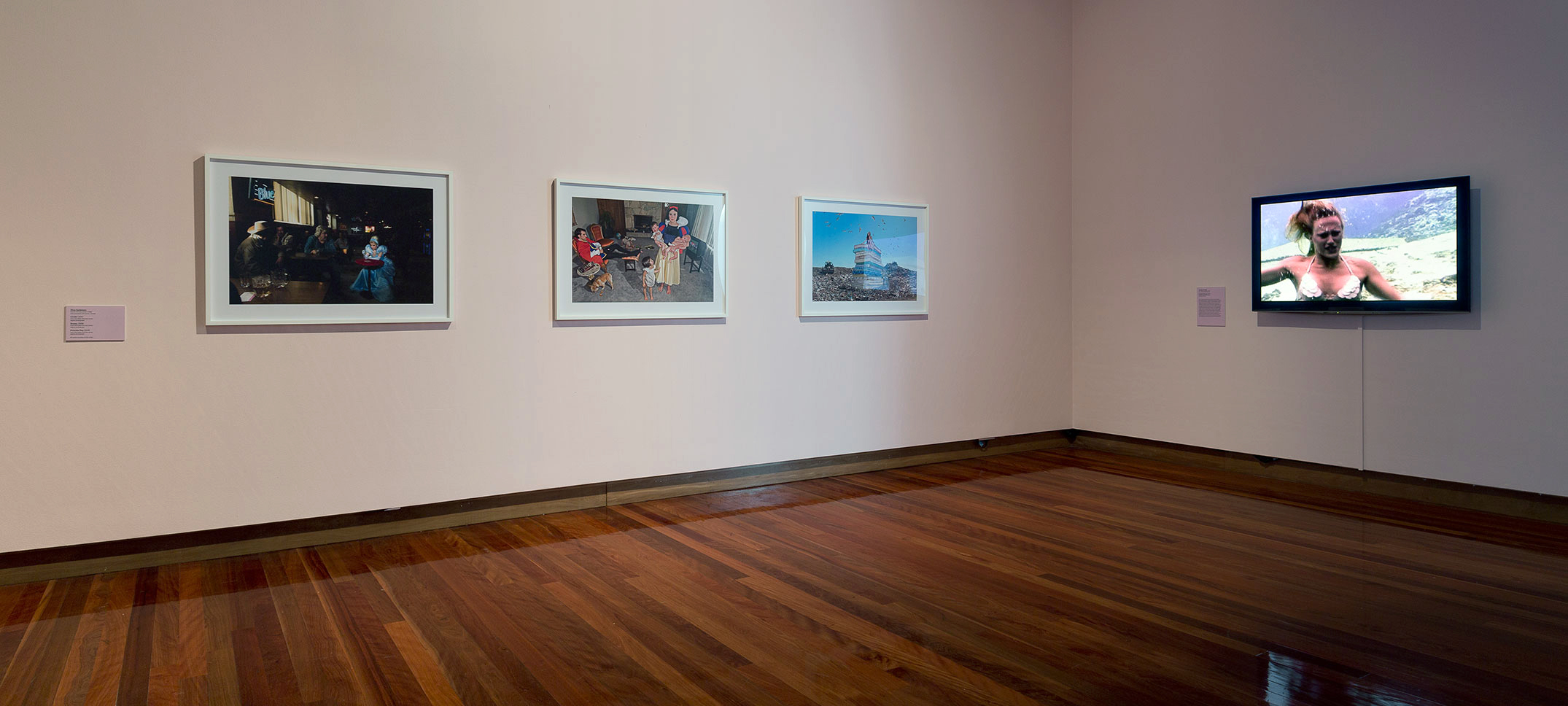
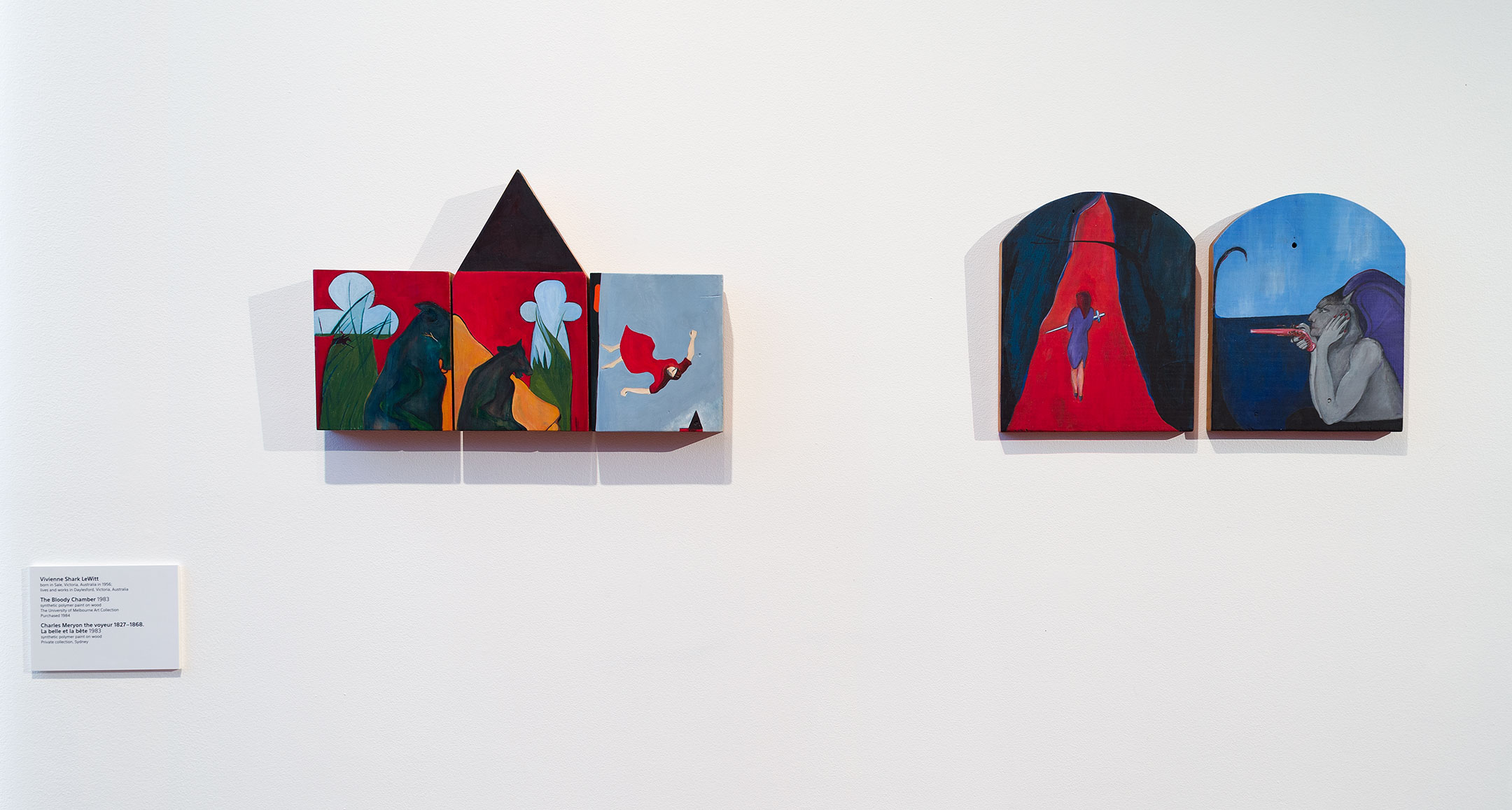
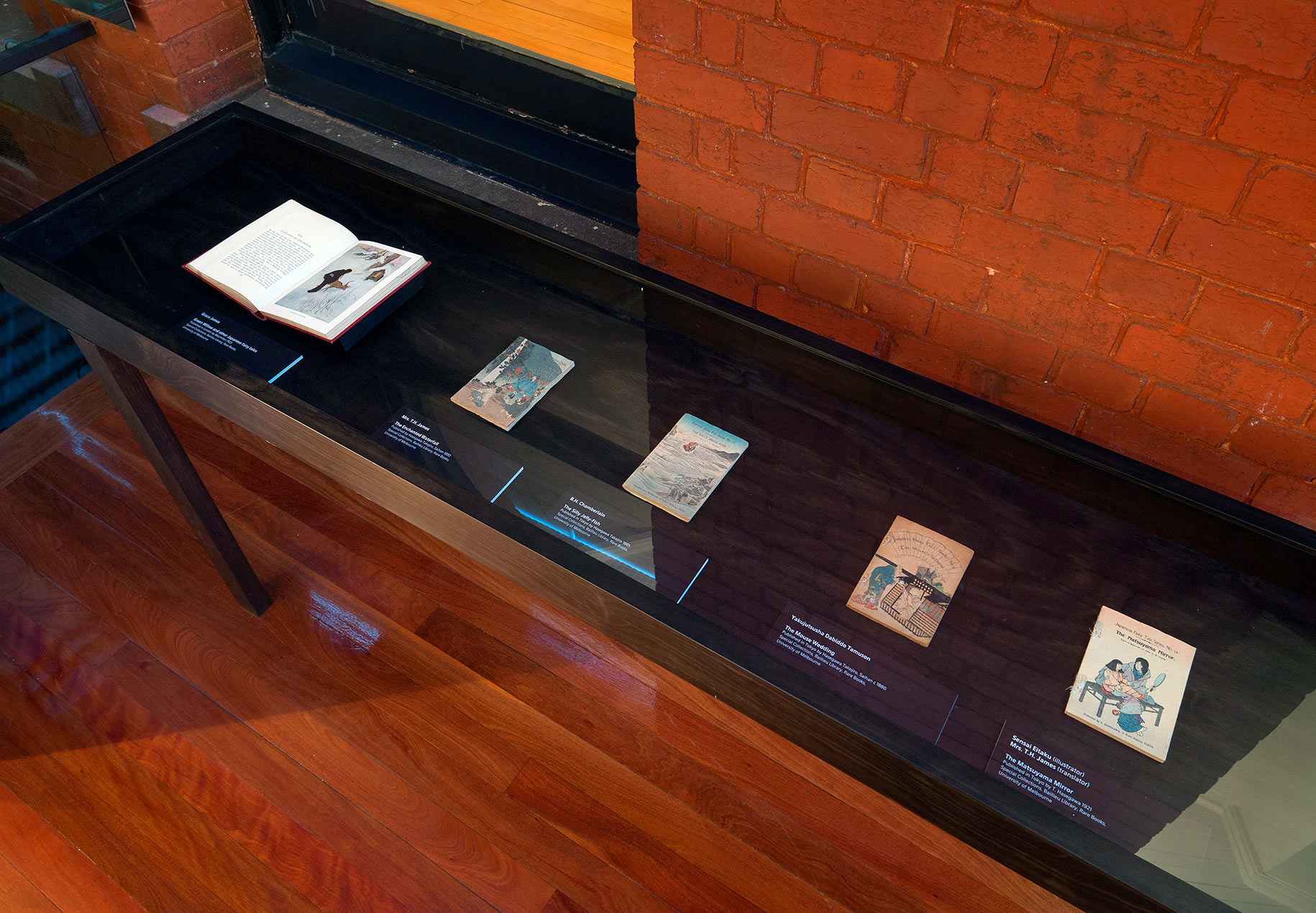
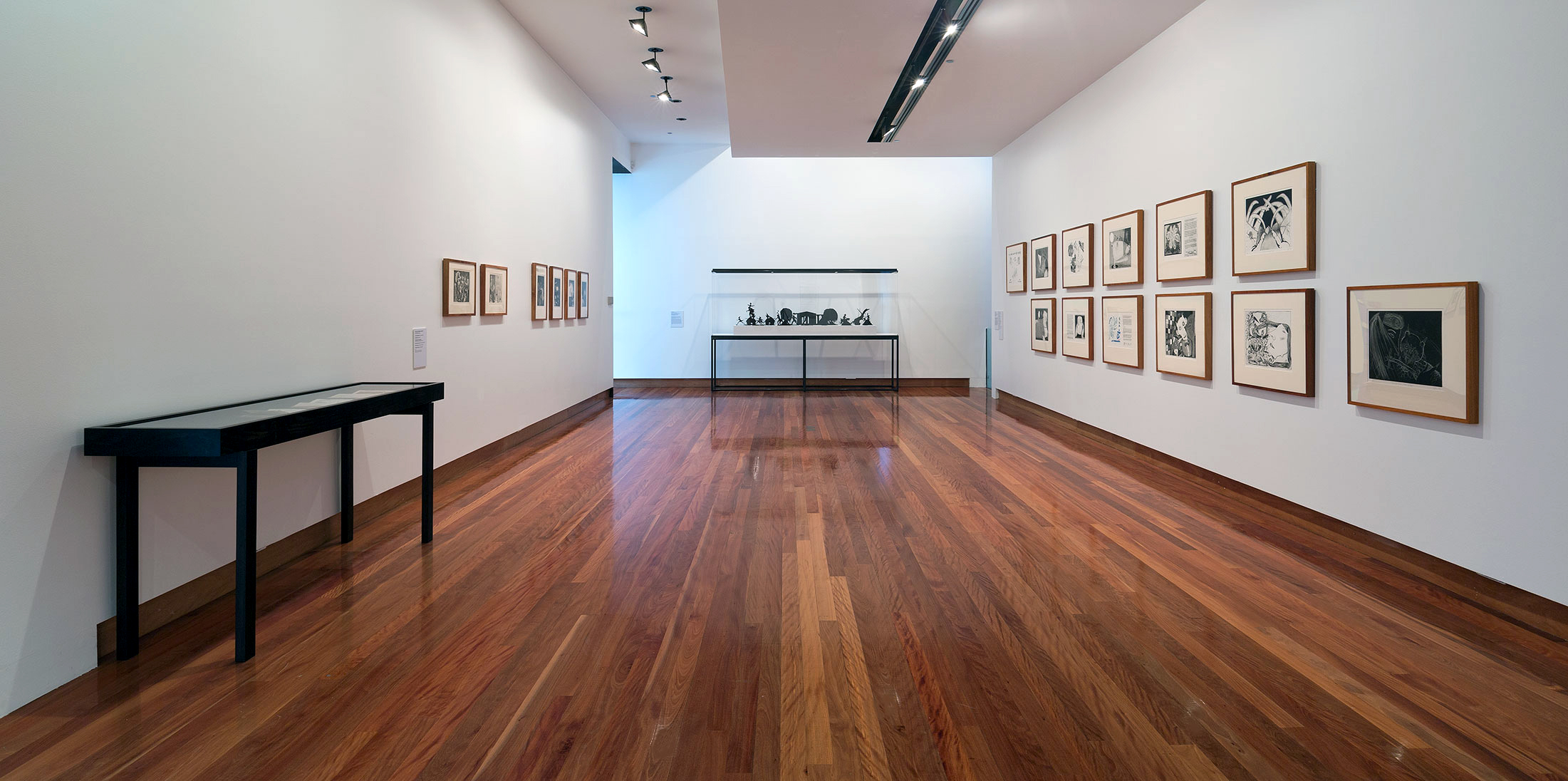
Exhibition: ‘The 80s: Photographing Britain’ at Tate Britain, London

Exhibition dates: 21st November, 2024 – 5th May, 2025

Curators: Yasufumi Nakamori, former Senior Curator of International Art (Photography) Tate Modern, Helen Little, Curator, British Art, Tate Britain and Jasmine Chohan, Assistant Curator, Contemporary British Art, Tate Britain with additional curatorial support from Bilal Akkouche, Assistant Curator, International Art, Tate Modern; Sade Sarumi, Curatorial Assistant, Contemporary British Art, Tate Britain and Bethany Husband, Exhibitions Assistant, Tate Britain

List of artists: Keith Arnatt; Zarina Bhimji; Derek Bishton; Sutapa Biswas; Tessa Boffin; Marc Boothe; Victor Burgin; Vanley Burke; Pogus Caesar; Thomas Joshua Cooper; John Davies; Poulomi Desai; Al-An deSouza; Willie Doherty; Jason Evans; Rotimi Fani-Kayode; Anna Fox; Simon Foxton; Armet Francis; Peter Fraser; Melanie Friend; Paul Graham; Ken Grant; Joy Gregory; Sunil Gupta; John Harris; Lyle Ashton Harris; David Hoffman; Brian Homer; Colin Jones; Mumtaz Karimjee; Roshini Kempadoo; Peter Kennard; Chris Killip; Karen Knorr; Sirkka-Liisa Konttinen; Grace Lau; Dave Lewis; Markéta Luskačová; David Mansell; Jenny Matthews; Don McCullin; Roy Mehta; Peter Mitchell; Dennis Morris; Maggie Murray; Tish Murtha; Joanne O’Brien; Zak Ové; Martin Parr; Ingrid Pollard; Brenda Prince; Samena Rana; John Reardon; Paul Reas; Olivier Richon; Suzanne Roden; Franklyn Rodgers; Paul Seawright; Syd Shelton; Jem Southam; Jo Spence; John Sturrock; Maud Sulter; Homer Sykes; Mitra Tabrizian; Wolfgang Tillmans; Paul Trevor; Maxine Walker; Albert Watson; Tom Wood; Ajamu X.


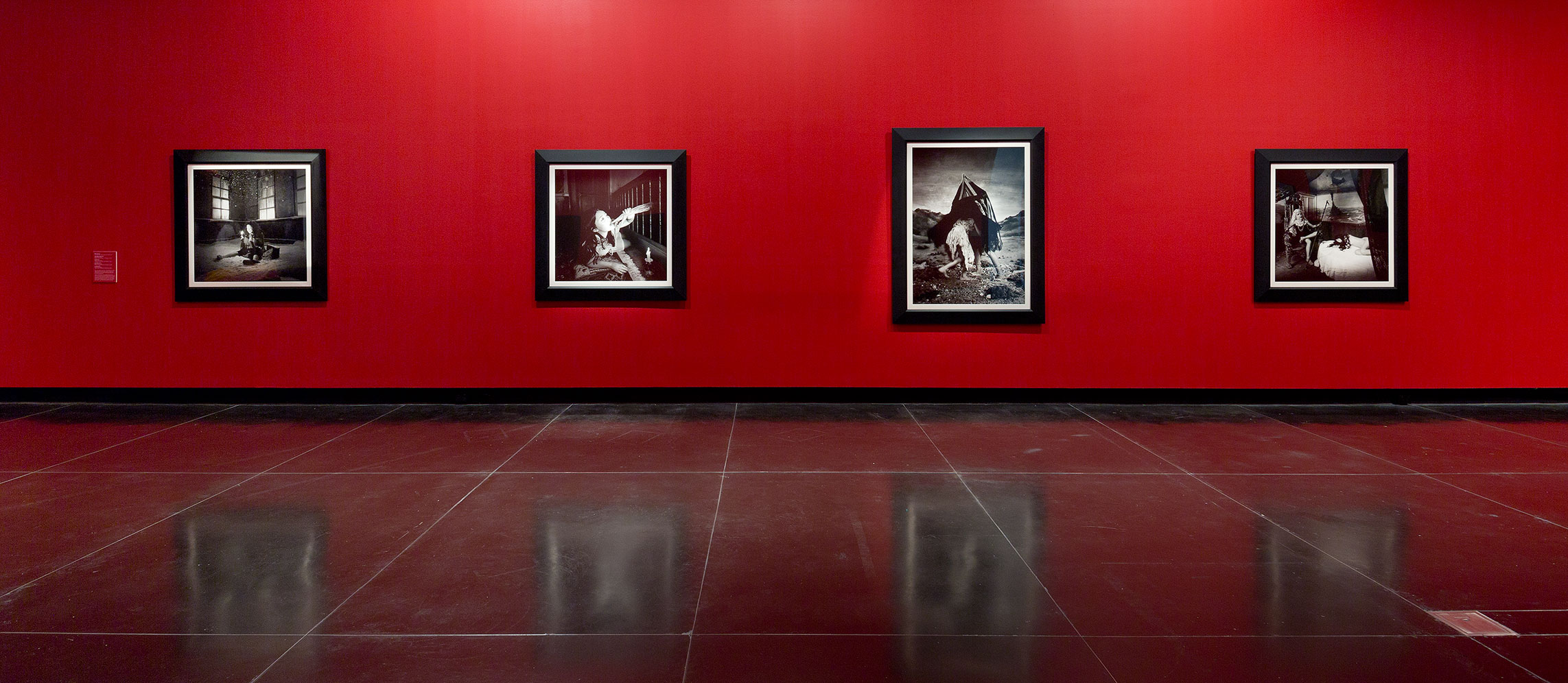
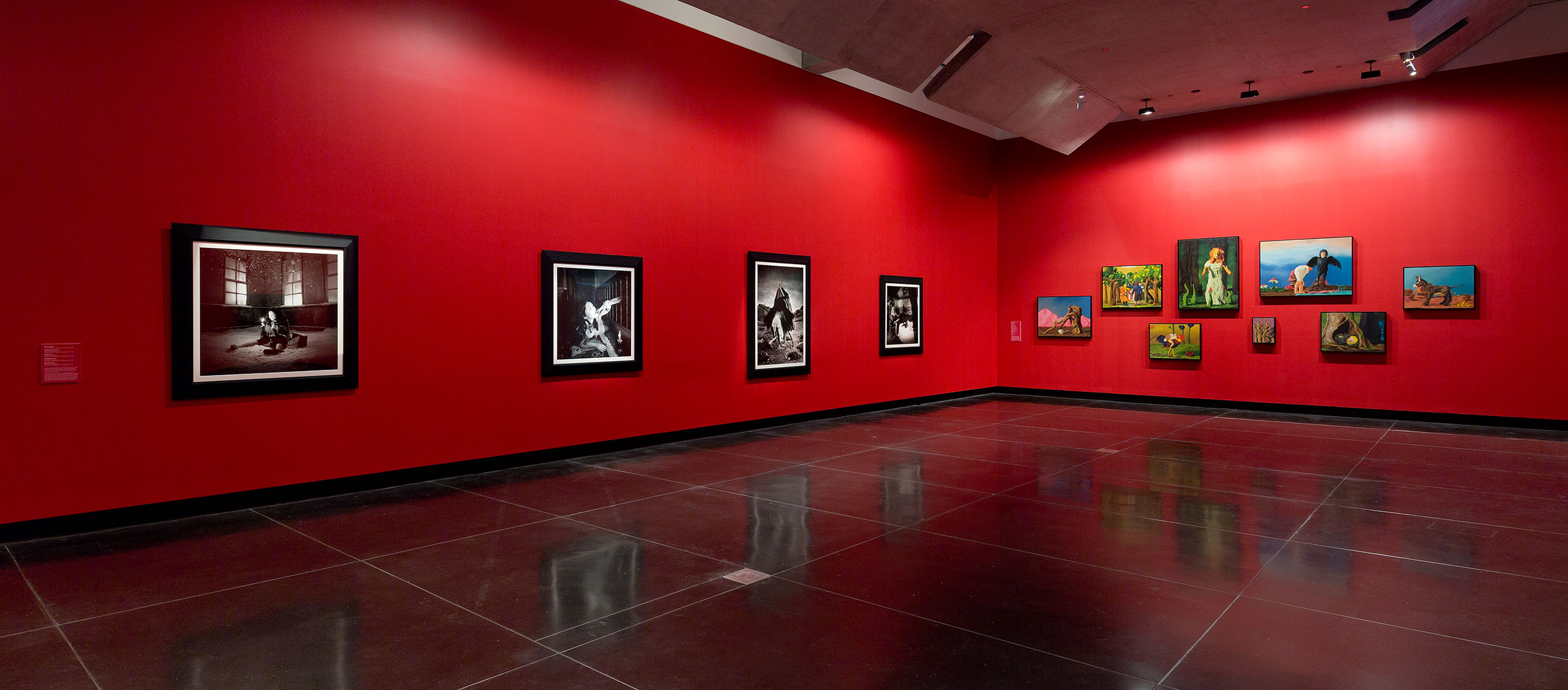
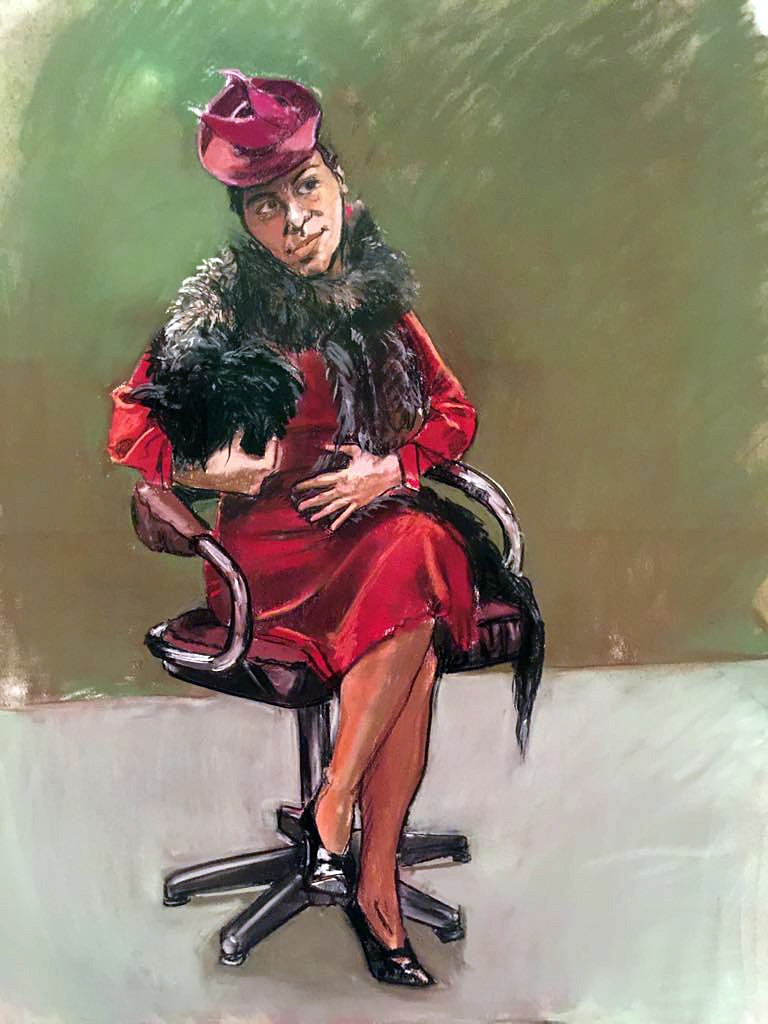
Jason Evans (Welsh, b. 1968) and Simon Foxton (British, b. 1961) 'Untitled' 1991 From the series 'Strictly' from the exhibition 'The 80s: Photographing Britain' at Tate Britain, London, Nov 2024 - May 2025


Jason Evans (Welsh, b. 1968) and Simon Foxton (British, b. 1961)
Untitled
1991
From the series Strictly
Tate
© Jason Evans


Half your luck

A humungous posting that, much like the exhibition itself, cannot do justice to the photographs and issues of an entire decade – the flow on effects of which are still being felt today.

From distant Australia and having not seen the exhibition myself, I cannot do justice – now there is an apposite word for the decade – to the flow of the exhibition, the many included or neglected artists involved or not, the bodies of work displayed or their commentary on the many disparate, competing and complex political, economic and social cataclysms (def: a sudden violent political or social upheaval) of the decade: including but not limited to, race, gender, identity, representation, activism, neoliberalism, Thatcher, The Miners’ Strike, Clause 28, HIV/AIDS, feminism, racism, class, patriarchy, money, greed, hedonism, humanism, subcultures, unemployment, strikes, poverty, luxury, consumer culture, war (Falklands) and riots, for example the Brixton riots of 1981.

I lived those years in the UK before emigrating to Australia in 1986. What I remember is the terrible weather, the cold and the damp, the vile Thatcher, and the poor quality of living. I lived in Stockwell (or Saint Ockwell as we used to call it) near Brixton in the early 80s before moving to Shepherd’s Bush were all the Mods gathered on their scooters on the roundabout as part of the mod revival.

I worked at a fish and chip restaurant called Geales just off Notting Hill Gate working double shifts, 10.30 – 3pm, 5.30 – 12, five days a week. The restaurant served fish and chips with French champagne and wines. The mostly gay floor staff were paid a pittance but we earnt our money off the tips we received from the celebrities that inhabited the place, people such as Bill Connolly, John Cleese, Divine and Kenny Everett. They loved us gay boys.

We worked hard and partied harder, often going out from Friday night to Sunday night to the clubs with a rest day on Monday. We were young. We ran from place to place living at a hundred miles an hour, not realising the ruts in London are very deep and you were spending as much as you made just to pay the rent, to eat at dive cafe (I lived on Mars bars, fish and chips, braised heart, mashed potatoes and bullet peas to name a few and I was as thin as a rake), and to go out partying, to have fun, visiting the alternative clubs in Kings Cross, Vauxhall, Brixton and the East End.

And then there was the spectre of HIV/AIDS raising its ugly head. I had my first HIV test in 1983. I had my blood taken and I went back 2 weeks later for the result. I sat outside the doctor’s room and if they called you in and said you had it, you were dead. To look death in the face at 25. The was no treatment. I survived but many of my friends, both here and in Australia, didn’t. We partied harder.


There are so many perspectives on the 80s that it is an impossible task for one exhibition to cover all of the issues. Reviews have noted that the exhibition is “a meandering look at pomp, protest” (Guardian); “exhaustive and exhausting… [the exhibition] makes for a dogged viewing experience that confuses as much as it enlightens” (Guardian); “a sense of fatigue and depletion as it went on and on … it could have been more engaging, more pleasurable” (1000 Words); and “the critical reception of the show has been rather lukewarm” (The Brooklyn Rail).

Most writer’s observe that the exhibition illuminates the way photography shifts “from monochrome to colour, from photojournalism to a more detached style of documentary” featuring “constructed, studio-based and appropriationist work.” The exhibition distils “the curatorial thrust of this sprawling exhibition, which, as its subtitle suggests, is more about photography’s often conceptually based responses to the 1980s than the turbulent nature of the decade itself.”1

Further, Bartolomeo Sala observes that the meandering view of the 1980s is consistent with the curatorial approach to the exhibition, “that is, to present eighties Britain not as a ossified relic but rather a container of multitudes, a country animated by competing, clashing energies and defying coherent description in a way that feels very reminiscent of today. A neoliberal hellhole, a nightmare of petit bourgeois conformity and cheapness, and at the same time an increasingly tolerant, multicultural, and open society, which finds its motor and pride in diversity and the endless project of self-fashioning.”2

Forty plus years on we are still paying the price for Thatcher’s neoliberal hellhole, with the loss of community, and the lack of compassion and empathy for others. I often think it was a more vibrant, more alive time in the 1980s despite all of its inherent problems. While we may have become a more tolerant, multicultural society, fascism and the right, disenfranchisement and loss of rights lurk ever closer to the surface. While we have pride we also have arrogance and self-aggrandisement, self-entitlement. While then we seemingly had freedom and love we now have surveillance and control. In some ways then I disagree with today being a more “open” society.

What social documentary and conceptual photography pictured so strongly and conscientiously in 1980s Britain was the vibrant madness of the age. The passions and the prejudices. Half your luck that you go and see this exhibition in London, that you have a chance to breathe in these photographs, for in Australia the chance of seeing such an exhibition of photographs from the 1980s by a state or national gallery would be zero.

I wouldn’t complain too much!

Dr Marcus Bunyan


1/ Sean O’Hagan. “The 80s: Photographing Britain review – in your face and to the barricades,” on The Guardian website, Sun 24 Nov 2024 [Online] Cited 02/05/2025

2/ Bartolomeo Sala. “The 80s: Photographing Britain,” on The Brooklyn Rail website March 2025 [Online] Cited 03/04/2025


Many thankx to Tate Britain for allowing me to publish the photographs in the posting. Please click on the photographs for a larger version of the image.


Installation view of the exhibition 'The 80s: Photographing Britain' at Tate Britain, London showing at left, the work of Jason Evans and Simon Foxton from the series 'Strictly' 1991; and at centre left top, Wolfgang Tillmans' 'Love (Hands in Air)' 1989


Installation view of the exhibition The 80s: Photographing Britain at Tate Britain, London showing at left, the work of Jason Evans and Simon Foxton from the series Strictly 1991 (below); and at centre left top, Wolfgang Tillmans’ Love (Hands in Air) 1989 (below)
Courtesy of Tate Britain


Installation view of the exhibition 'The 80s: Photographing Britain' at Tate Britain, London showing at rear, photographs from Maud Sulter's series 'Zabat' 1989


Installation view of the exhibition The 80s: Photographing Britain at Tate Britain, London showing at rear, photographs from Maud Sulter’s series Zabat 1989
Courtesy of Tate Britain


Maud Sulter produced the Zabat series for Rochdale Art Gallery in 1989, the 150th anniversary of the invention of photography. It was a direct response to the lack of a black presence at other celebratory events and exhibitions. Here we see the conventions of Victorian portrait photography under the command of a black woman photographer. The backdrop, props and pose are all retained but the image is transformed with African clothes, non-European objects and, most importantly, by the resolute black woman at its centre.

The title ‘Zabat’ also signifies Maud Sulter’s call for a repositioning of black women in the history of photography: the word describes an ancient ritual dance performed by women on occasions of power.

Text from the V&A website
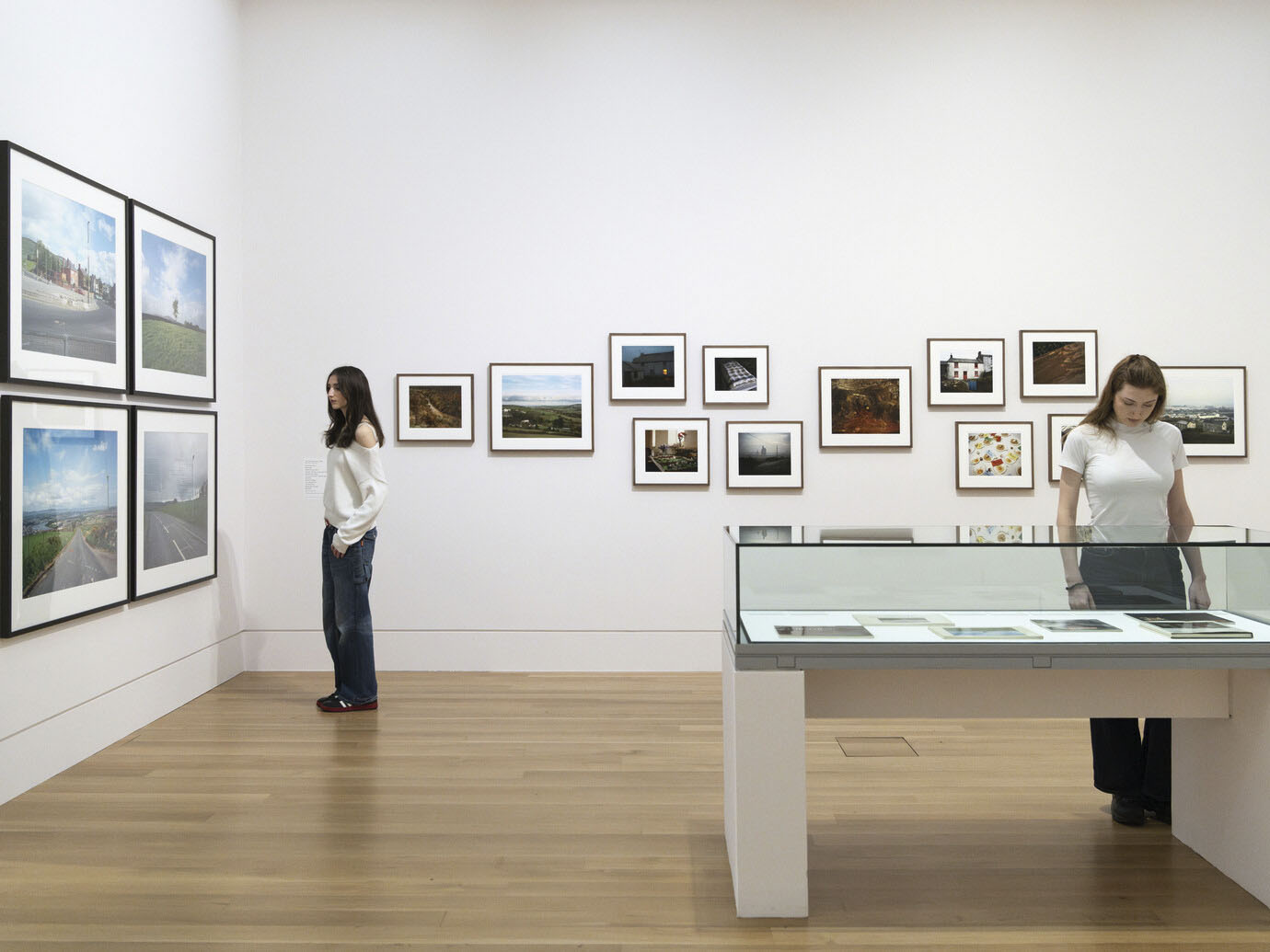
 

Installation view of the exhibition 'The 80s: Photographing Britain' at Tate Britain, London showing at left the work of Paul Graham


Installation view of the exhibition The 80s: Photographing Britain at Tate Britain, London showing at left the work of Paul Graham
Courtesy of Tate Britain


Installation view of the exhibition 'The 80s: Photographing Britain' at Tate Britain, London


Installation view of the exhibition The 80s: Photographing Britain at Tate Britain, London
Courtesy of Tate Britain


Wolfgang Tillmans (German, b. 1968) 'Love (Hands in Air)' 1989


Wolfgang Tillmans (German, b. 1968)
Love (Hands in Air)
1989


“Depending on where you stood in terms of race, gender, or class, the 1980s would seem a time of unprecedented economic expansion, an era defined by the triumph of consumerism and a particularly brass form of hedonism, or else an era of widening disparities, rising unemployment, and generalized economic crisis; a time defined by the booming of the housing market or the return of homelessness; a time of general disaffection and disillusionment toward the prospects of organized politics or an era defined by political activism and struggle, often hyperlocal in nature, as well as successive waves of discontent that at different points rocked the nation. …

In general, the critical reception of the show has been rather lukewarm. Many broadsheet commentators have lamented the meandering nature of the exhibition, while one critic noted the programmatic downplaying of the decade’s heavy-hitters. (Don McCullin and Chris Killip get a handful of photographs each, while virtuoso of political photomontage Peter Kennard is relegated to display cases.) Such assessments feel a little unfair and condescending to the excellent artists who do get a good showing, and in any case this curatorial approach is consistent with the intention of the exhibition – that is, to present eighties Britain not as a ossified relic but rather a container of multitudes, a country animated by competing, clashing energies and defying coherent description in a way that feels very reminiscent of today. A neoliberal hellhole, a nightmare of petit bourgeois conformity and cheapness, and at the same time an increasingly tolerant, multicultural, and open society, which finds its motor and pride in diversity and the endless project of self-fashioning.”


Bartolomeo Sala. “The 80s: Photographing Britain,” on The Brooklyn Rail website March 2025 [Online] Cited 03/04/2025


Derek Bishton, Brian Homer and John Reardon. 'Ting A Ling, Handsworth Self Portraits project' 1979 from the exhibition 'The 80s: Photographing Britain' at Tate Britain, London, Nov 2024 - May 2025


Derek Bishton, Brian Homer and John Reardon
Ting A Ling, Handsworth Self Portraits project
1979
© Derek Bishton, Brian Homer & John Reardon


Syd Shelton (British, b. 1947) 'Skinheads, Petticoat Lane, East London' 1979, printed 2012


Syd Shelton (British, b. 1947)
Skinheads, Petticoat Lane, East London
1979, printed 2012
Gelatin silver print on paper
417 x 281 mm
Tate
Gift Eric and Louise Franck London Collection 2016


Skinheads, known for their shaved heads and heavy boots, emerged as a working-class subculture in the 1960s. Initially non-political, some became associated with extreme nationalism. Others took an anti-racist position aligned with two-tone, a musical movement blending Jamaican ska and British punk. One of Syd Shelton’s photographs shows two members of Skins Against the Nazis proudly displaying a Rock Against Racism badge. The other was taken after an argument about racism. ‘I saw the guy at the front clenching his fists’, notes Shelton, ‘so I took the shot, said thanks and legged it as fast as I could.’

Wall text from the exhibition


Syd Shelton (British, b. 1947) 'Anti-racist Skinheads, Hackney, London' 1979, printed 2012


Syd Shelton (British, b. 1947)
Anti-racist Skinheads, Hackney, London
1979, printed 2012
Gelatin silver print on paper
417 x 282 mm
Tate
Gift Eric and Louise Franck London Collection 2016


In 1977, 500 National Front (NF) members attempted to march through Lewisham, an area in southeast London with a significant Black population. Thousands ignored a police blockade to hold a peaceful counter-demonstration that led to the NF abandoning their march. Protestors clashed with police and were met by riot shields, baton charges and mounted officers. The events became known as the Battle of Lewisham. Shelton’s photographs contrast the chaos of the streets with the resolve of the protestors. ‘Politics was one of the reasons that I became a photographer’, notes Shelton, ‘the idea of the objective photographer is nonsense.’

Wall text from the exhibition


Syd Shelton (British, b. 1947) 'Darcus Howe addressing the anti-racist demonstrators, Lewisham, 13 August 1977' Dated 1977, printed 2020 from the exhibition 'The 80s: Photographing Britain' at Tate Britain, London, Nov 2024 - May 2025


Syd Shelton (British, b. 1947)
Darcus Howe addressing the anti-racist demonstrators, Lewisham, 13 August 1977
Dated 1977, printed 2020
Tate
Presented by the artist 2021
© Syd Shelton


Explore one of the UK’s most critical decades, the 1980s. This exhibition traces the work of a diverse community of photographers, collectives and publications – creating radical responses to the turbulent Thatcher years. Set against the backdrop of race uprisings, the miner strikes, section 28, the AIDS pandemic and gentrification – be inspired by stories of protest and change.

At the time, photography was used as a tool for social change, political activism, and artistic and photographic experiments. See powerful images that gave voice and visibility to underrepresented groups in society. This includes work depicting the Black arts movement, queer experience, South Asian diaspora and the representation of women in photography.

This exhibition examines how photography collectives and publications highlighted these often-unseen stories, featured in innovative photography journals such as Ten.8 and Cameraworks. It will also look at the development of Autograph ABP, Half Moon Photography Workshop, and Hackney Flashers.

Visitors will go behind the lens to trace the remarkable transformation of photography in Britain and its impact on art and the world.

Text from the Tate Britain website


The 80s: Photographing Britain

David Preshaah and Helen Little curator of The 80s: Photographing Britain at Tate Britian discuss the show running 21st November, 2024 – 5th May, 2025. See powerful images that gave voice and visibility to underrepresented groups in society. This includes work depicting the Black arts movement, queer experience, South Asian diaspora and the representation of women in photography
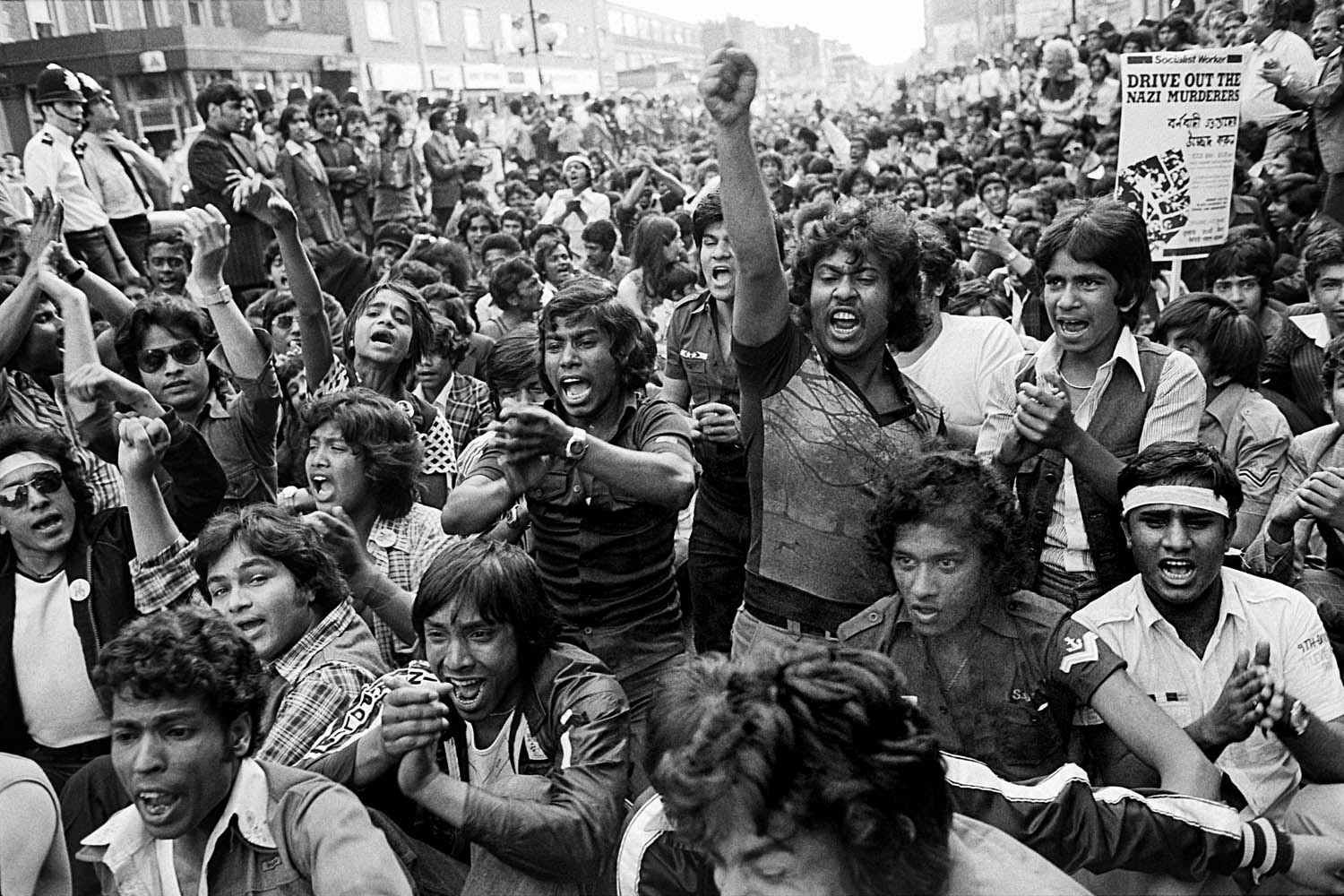
 

Paul Trevor (British, b. 1947) 'Outside police station, Bethnal Green Road, London E2, 17 July 1978. Sit down protest' 1978


Paul Trevor (British, b. 1947)
Outside police station, Bethnal Green Road, London E2, 17 July 1978. Sit down protest
1978

Paul Trevor © 2023


On 4 May 1978, Altab Ali, a 24-year-old Bangladeshi textile worker, was murdered in a racially motivated attack. During police interviews, the three teenagers responsible casually described the regularity of their racist violence. The Bangladeshi community in east London mobilised in response. 7,000 people marched from Bethnal Green’s Brick Lane to Downing Street, following a vehicle carrying Ali’s coffin. Protestors rallied in Hyde Park chanting, ‘Who killed Altab Ali? Racism, racism!’

Paul Trevor was a member of Half Moon Photography Workshop and helped produce Camerawork magazine. He contributed to an issue on the 1978 Battle of Lewisham in southeast London. While photographing the violent clashes between police and anti-fascist protestors, Trevor recalls, ‘A woman – appealing for help – shouted at me in desperation “What are you taking pictures for?” Good question, impossible to answer in that melee.’ The special issue of Camerawork, ‘What are you taking pictures for?’ was devoted to that question.

Wall text from the exhibition


Don McCullin (British, b. 1935) 'Jean, Whitechapel, London' Late 1970s


Don McCullin (British, b. 1935)
Jean, Whitechapel, London
Late 1970s
Gelatin silver print
Tate
Gift Eric and Louise Franck London Collection 2011


Photojournalist and war photographer Don McCullin spent nearly twenty years photographing people living on the streets of Aldgate and Whitechapel in east London. He documented people living at the edge of the city’s wealthy financial centre. In the late 1970s, unprofitable psychiatric institutions in the area had begun to close, leaving many residents homeless. These photographs of Jean show how closely McCullin worked with the people he photographed. Of his British social documentary work, McCullin notes: ‘Many people send me letters in England saying “I want to be a war photographer”, and I say, go out into the community you live in. There’s wars going on out there, you don’t have to go halfway around the world.’

Wall text from the exhibition


This autumn, Tate Britain will present The 80s: Photographing Britain, a landmark survey which will consider the decade as a pivotal moment for the medium of photography. Bringing together nearly 350 images and archive materials from the period, the exhibition will explore how photographers used the camera to respond to the seismic social, political, and economic shifts around them. Through their lenses, the show will consider how the medium became a tool for social representation, cultural celebration and artistic expression throughout this significant and highly creative period for photography.

This exhibition will be the largest to survey photography’s development in the UK in the 1980s to date. Featuring over 70 lens-based artists and collectives, it will spotlight a generation who engaged with new ideas of photographic practice, from well-known names to those whose work is increasingly being recognised, including Maud Sulter, Mumtaz Karimjee and Mitra Tabrizian. It will feature images taken across the UK, from John Davies’ post-industrial Welsh landscape to Tish Murtha’s portraits of youth unemployment in Newcastle. Important developments will be explored, from technical advancements in colour photography to the impact of cultural theory by scholars like Stuart Hall and Victor Burgin, and influential publications like Ten.8 and Camerawork in which new debates about photography emerged.

The 80s will introduce Thatcher’s Britain through documentary photography illustrating some of the tumultuous political events of the decade. History will be brought to life with powerful images of the miners’ strikes by John Harris and Brenda Prince; anti-racism demonstrations by Syd Shelton and Paul Trevor; images of Greenham Common by Format Photographers and projects responding to the conflict in Northern Ireland by Willie Doherty and Paul Seawright. Photography recording a changing Britain and its widening disparities will also be presented through Anna Fox’s images of corporate excess, Paul Graham’s observations of social security offices, and Martin Parr’s absurdist depictions of Middle England, displayed alongside Markéta Luskačová and Don McCullin’s portraits of London’s disappearing East End and Chris Killip’s transient ‘sea-coalers’ in Northumberland.

A series of thematic displays will explore how photography became a compelling tool for representation. For Roy Mehta and Vanley Burke, who portray their multicultural communities, photography offers a voice to the people around them, whilst John Reardon, Derek Bishton and Brian Homer’s Handsworth Self Portrait Project 1979, gives a community a joyous space to express themselves. Many Black and South Asian photographers use portraiture to overcome marginalisation against a backdrop of discrimination. The exhibition will spotlight lens-based artists including Roshini Kempadoo, Sutapa Biswas and Al-An deSouza who experiment with images to think about diasporic identities, and the likes of Joy Gregory and Maxine Walker who employ self-portraiture to celebrate ideas of Black beauty and femininity.

Against the backdrop of Section 28 and the AIDS epidemic, photographers also employ the camera to assert the presence and visibility of the LGBTQ+ community. Tessa Boffin subversively reimagines literary characters as lesbians, whilst Sunil Gupta’s ‘Pretended’ Family Relationships 1988, juxtaposes portraits of queer couples with the legislative wording of Section 28. For some, their work reclaims sex-positivity during a period of fear. The exhibition will spotlight photographers Ajamu X, Lyle Ashton Harris and Rotimi Fani-Kayode who each centre Black queer experiences and contest stereotypes through powerful nude studies and intimate portraits. It will also reveal how photographers from outside the queer community including Grace Lau were invited to portray them. Known for documenting fetishist sub-cultures, Lau’s series Him and Her at Home 1986 and Series Interiors 1986, tenderly records this underground community defiantly continuing to exist.

The exhibition will close with a series of works that celebrate countercultural movements throughout the 80s, such as Ingrid Pollard and Franklyn Rodgers’s energetic documentation of underground performances and club culture. The show will spotlight the emergence of i-D magazine and its impact on a new generation of photographers like Wolfgang Tillmans and Jason Evans, who with stylist Simon Foxton pioneer a cutting-edge style of fashion photography inspired by this alternative and exciting wave of youth culture, reflective of a new vision of Britain at the dawn of the 1990s.

Press release from Tate Britain
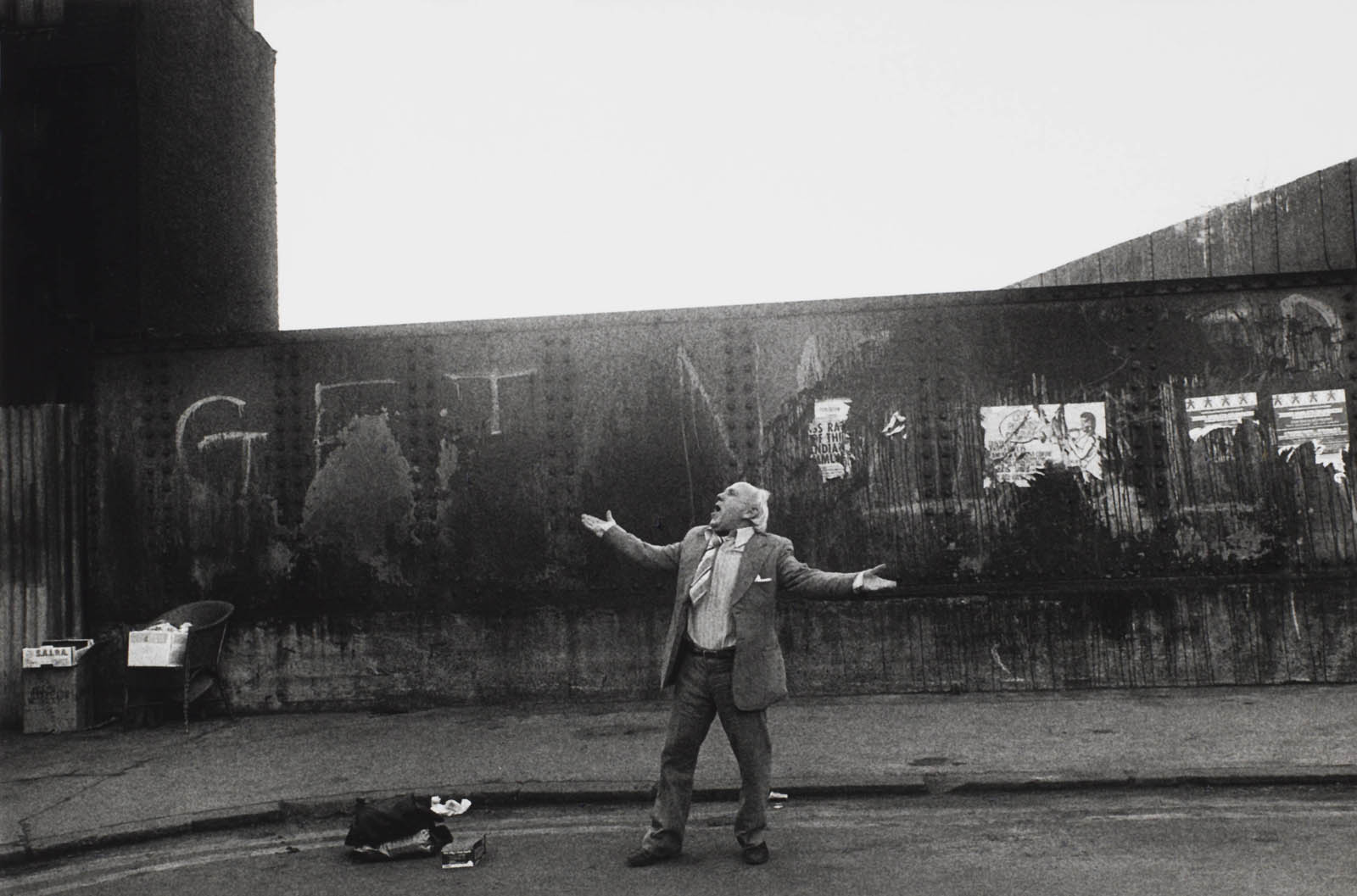
 

Markéta Luskačová (Czech, b. 1944) 'Man singing on Brick Lane, London' 1982


Markéta Luskačová (Czech, b. 1944)
Man singing on Brick Lane, London
1982
Gelatin silver print
Tate
© Markéta Luskačová


Markéta Luskačová’s London Street Musicians series includes photographs taken between 1975 and 1990. They document the lives of street musicians performing at London markets. Her photographs reveal the humanity and resilience of these often-solitary musicians. ‘The street musicians themselves were often quite lonely men, yet their music lessened the loneliness of the street, the people in it and my own loneliness’, she recalls. For Luskačová, photography is ‘a tool for trying to understand life … to remember the people and things that I photograph. I want them to be remembered.’

Wall text from the exhibition


Chris Killip (Manx, 1946-2020) ''Critch' and Sean' 1982


Chris Killip (Manx, 1946-2020)
‘Critch’ and Sean
1982
Tate
© Chris Killip


Chris Killip first visited the seacoaling community at Lynemouth Beach in Northumberland in 1976. ‘The beach beneath me was full of activity with horses and carts backed into the sea’, Killip recalls. ‘Men were standing in the sea next to the carts, using small wire nets attached to poles to fish out the coal from the water beneath them. The place confounded time.’ In 1982, Killip started photographing the community, living alongside them from 1983 to 1984. ‘I wasn’t getting close enough, so I bought a caravan and moved into the place and that made a very big difference.’

Killip used a large format plate camera to capture his subjects. ‘It’s not a casual thing’, he notes. ‘I think it works to your advantage. They know this is going to live after this moment. It’s not ephemeral.’

Wall text from the exhibition


Jo Spence (British, 1934-1992) and Terry Dennett (British, 1938-2018)
'Remodelling Photo History: Revisualization' 1981-1982


Jo Spence (British, 1934-1992) and Terry Dennett (British, 1938-2018)
Remodelling Photo History: Revisualization
1981-1982
Tate
Presented by Tate Patrons 2014
© The Jo Spence Memorial Archive


These images are from Remodelling Photo History, a collaboration between Jo Spence and Terry Dennett. The work was originally published as a sequence of 13 photographs in which Spence and Dennett both act as photographer and photographic subject. The series was devised as a critique of standard histories of photography and particularly the depiction of women in art. It employs a practice Spence called ‘photo-theatre’. Each photograph emphasises its staging and construction in order to challenge and ‘make strange’ the assumed ‘naturalism’ of photography. Spence commented ‘it is obvious that a vast amount of work still needs to be done on the so-called history of photography, and on the practices, institutions and apparatuses of photography itself, and the function they have had in constructing and encouraging particular ways of viewing and telling about the world.’

Wall text from the exhibition


Joy Gregory (British, b. 1969) 'Magenta Dress with Pink Tulips' 1984


Joy Gregory (British, b. 1969)
Magenta Dress with Pink Tulips
1984
Courtesy of the artist
© Joy Gregory. All rights reserved, DACS


Joy Gregory’s early interest in colour photography began as student at Manchester Polytechnic. The university was known for its emphasis on the technical and chemical aspects of photography. Gregory’s education taught her the craft of commercial photography but she set out to use these skills like a painter. Her early experiments informed an ongoing interest in stillness, space and light. This series of colour transparencies presents models and still lifes in a painted studio interior. By using multiple exposures and layering images, Gregory suggests a spectral presence in the works. Her focus on the painterly qualities of colour and light here are typical of her practice. She employs languages of beauty and seduction in small textured prints that invite close inspection.

Wall text from the exhibition


John Harris (British, b. 1958) 'Mounted Policeman attacking Lesley Boulton at the Battle of Orgreave'
1984, printed 2024


John Harris (British, b. 1958)
Mounted Policeman attacking Lesley Boulton at the Battle of Orgreave
1984, printed 2024


John Harris’s photographs from the 1984 Battle of Orgreave challenged government portrayals of miners as aggressors. In 1984, the National Union of Miners identified Orgreave coking plant in South Yorkshire as a key site for picketing. From May to June, strikers attempting to disrupt deliveries were met by growing police presence. Tensions came to a head on 22 June when an estimated 6,000 officers clashed with pickets. One of Harris’s images captures Lesley Boulton cowering beneath the truncheon of a mounted officer. It became an emblem of the strike, appearing on badges, banners and posters.

Wall text from the exhibition


Paul Graham (British, b. 1956) 'Union Jack Flag in Tree, Country Tyrone' 1985


Paul Graham (British, b. 1956)
Union Jack Flag in Tree, Country Tyrone
1985
C-print on paper
Tate
Presented by Tate Members 2007
© Paul Graham


From 1984 to 1986, Paul Graham documented Northern Irish locations featured in news reports of the Troubles. During his first visit, Graham was stopped by a British military patrol suspicious of his camera. As they left, he took a shot with his camera hanging from his neck. The photograph became a ‘gateway’ for Graham’s Troubled Land series. He felt his other images of rioting, murals and destruction, ‘weakly echoed what I saw in the newspapers. This one image did not’. ‘There were people walking to shops and driving cars – simply going about their day, but then there was a soldier in full camouflage, running across the roundabout.’ For Graham, the image ‘reintegrated the conflict into the landscape … it was a conflict photograph masquerading as a landscape photograph.’

Wall text from the exhibition


Pogus Caesar (British born St. Kitts, b. 1953) 'Handsworth Riots: Birmingham, United Kingdom September' 1985, printed 2020


Pogus Caesar (British born St. Kitts, b. 1953)
Handsworth Riots: Birmingham, United Kingdom
September 1985, printed 2020
Gelatin silver print
Martin Parr Foundation Collection


These photographs capture two days of uprisings in Handsworth, Birmingham, following the arrest of a Black man over a parking violation and a police raid on a pub on the Lozells Road. The photographer, Handsworth resident Pogus Caesar, notes: ‘Where possible it was vital to document.’ He explains: ‘The media has a way of portraying these type of events, I needed to document my truth.’ Caesar’s insider perspective allowed him to capture a range of images, such as artist John Akomfrah reading a sensationalist newspaper account of the two days of violence between the police and local communities.

Wall text from the exhibition


Melanie Friend (British, b. 1957)
'Greenham Common, 14 December 1985' 1985, reprinted 2023


Melanie Friend (British, b. 1957)
Greenham Common, 14 December 1985
1985, reprinted 2023
© Melanie Friend, Format Photographers Archive, Bishopsgate Institute


Exhibition guide

The 80s: Photographing Britain explores a critical decade for photography in the UK. It highlights the work of artists who were radically reconsidering the possibilities of the medium and its role in society.

The exhibition traces developments in photographic art from 1976 to 1993. It follows artists working against a backdrop of high unemployment, industrial action and civil rights activism. Many were part of local photographic communities that developed around key photography schools and collectives. Yet, through innovative publications and independent galleries, they reached national and international audiences.

The artists included in the exhibition expanded photographic practice in Britain. They often collaborated, shared ideas and debated theory. Some were inspired by the activism of the period’s protest movements, using their cameras to provide new ways of looking at society. Others embraced technical developments to push the boundaries of fine art photography. Their work highlights the medium’s range, from landscapes to self-portraiture, and social documentary to conceptual photography.

The 80s: Photographing Britain invites us to reflect on photography’s political and artistic potential. It acknowledges that the diversity of contemporary photographic practice is indebted to the groundbreaking photographers of the 1980s.

Room 1

Documenting the decade

This room documents a period of significant social and political upheaval in the UK. It features protests, uprisings and acts of violence photographed through an activist lens. These photographers challenged dominant narratives and amplified marginalised voices. Some photographed their own communities, giving them access an outsider might not be granted. Others, free from the violence and oppression their subjects faced, turned to photography as an act of solidarity.

The exhibition begins in 1976, the year Jayaben Desai walked out of Grunwick Film Processing Laboratories in London, starting a two-year strike for the right to union representation. The Grunwick dispute typifies the events explored in this room. It was led by an activist whose intersecting identities were the root of her cause. When thousands took to the streets in solidarity it revealed the power of collective action. But it is also an example of failed industrial action, hardline policing and racist media coverage.

In 1979, following months of industrial disputes during the so-called ‘Winter of Discontent’, James Callaghan’s Labour government lost the general election. When Conservative prime minister Margaret Thatcher took office, she promised to reverse the country’s ‘decline’. The answer, she argued, was free markets, traditional values and British nationalism. Her political philosophy became known as Thatcherism. It helped UK financial markets thrive but led to growing class division and inequalities.

Within this context, socially engaged photographers joined the fight for change. They documented protests and the hardline police tactics designed to silence them. Their images reveal a range of documentary practices and photography’s ability to uncover events that might otherwise remain hidden.

Anti-racist movements

The 1948 British Nationality Act allowed everyone born in Britain or its Empire to become a ‘Citizen of the United Kingdom and Colonies’. The act encouraged people from Britain’s current and former colonies to move to the UK to address labour shortages, help facilitate post-war reconstruction and build the welfare state. Yet, on arrival, citizens of colour faced hostility and racial discrimination. It marked the beginning of decades of racist rhetoric, rioting and civil rights activism.

In 1968, Conservative MP Enoch Powell delivered his ‘Rivers of Blood’ speech in Birmingham, criticising immigration and emboldening the far-right. That same year, writer Obi Egbuna founded the British Black Panthers to defend Black communities against racism and discrimination. By the mid-1970s, the far-right, anti-immigration National Front was England’s fourth largest political party. They capitalised on the perception that white workers were losing jobs to immigrants rather than government failures to address unemployment levels. Their far-right ideology was opposed by anti-fascist and anti-racist campaign groups whose members vastly outnumbered the National Front. Throughout the 1980s, high-profile uprisings in Bristol, Leeds, London, Manchester, Liverpool and Birmingham revealed the strength of anti-racist feeling across the country.

The Miners’ Strike

Following the First World War, there were 1 million miners in the UK. By the beginning of the 1980s, there were 200,000. In March 1984, the National Coal Board announced plans to close 20 collieries, putting 20,000 jobs at risk. The National Union of Mineworkers, led by Arthur Scargill, responded with a series of year-long strikes. Observed across England, Scotland and Wales, the strikes were a national issue.

Determined to disable labour movements across the UK, Margaret Thatcher took steps to break the miners’ union and limit their power. The government stockpiled coal, mobilised police forces, brought legal challenges, and made media statements heavily criticising the union and striking workers.

Journalists challenged the government’s portrayal of miners as aggressors and agitators. Photographers helped evidence instances of excessive and often unprovoked violence by law enforcement. But the government’s plans to take down miners, one of the strongest unionised workforces in the country, had worked. On 3 March 1985, after 362 days, the National Union of Mineworkers accepted defeat. Union members voted to end the strike. The strike put industrial issues and workers’ rights on the national agenda and had a profound impact on the politics of the period.

Brenda Prince was a member of Format Photographers Agency. Started by Maggie Murray and Val Wilmer in 1983, Format was set up as an agency for women. Prince joined in 1984. ‘We were all documentary photographers’, Prince notes. ‘We would work on our own stories and my miners’ strike images came out of that.’ ‘The miners’ strike gave me the opportunity to document working class people who were really struggling to keep their jobs and keep their communities alive’, Prince explains. She spent eighteen months in Nottinghamshire’s mining communities. Her works highlight the vital role women played in sustaining the strike.

(For more information on the miners’ strike please see the posting on the exhibition ONE YEAR! Photographs from the Miners Strike 1984-85 at Four Corners, London, Sept – October, 2024)

Greenham Common

On 5 September 1981, a group of women marched from Cardiff to the Royal Air Force base at Greenham Common in Berkshire. The site was common land, loaned to the US Air Force by the British Government during the Second World War and never returned. The group called themselves Women for Life on Earth. They were challenging the decision to house 96 nuclear missiles at the site. On arrival, they delivered a letter to the base commander stating: ‘We fear for the future of all our children and for the future of the living world which is the basis of all life.’ When their request for a debate was ignored, they set up camp. Others joined and the site became a women-only space.

Over the next 19 years, Greenham Common Women’s Peace Camp became a site of protest and home to thousands of women. Some stayed for months, others for years, and many visited multiple times. Greenham women saw their anti-nuclear position as a feminist one. They used their identities as mothers and carers to fight for the protection of future generations and inspired protest movements across the world.

In 1987, Soviet President Mikhail Gorbachev and US President Ronald Reagan signed a treaty which paved the way for the removal of cruise missiles from Greenham. Gorbachev has since paid tribute to the role ‘Greenham women and peace movements’ played in this historic agreement. By 1992, all missiles sited at Greenham had been removed and the US Air Force had left the base. The Peace Camp remained until 2000 as a protest against nuclear weapons.

Format Photographers Agency (1983-2003), featuring Maggie Murray, Melanie Friend, Brenda Prince and Jenny Matthews, played a crucial role in documenting social movements. Their photographs of the Greenham Common Women’s Peace Camp capture this landmark protest against nuclear missiles. They record the activism, daily life and personal stories of the women involved, highlighting their strength and creativity. They also reveal contrast between the women’s camp and their non-violent resistance and the militarised environment they were protesting.

The Gay Rights Movement

In 1967, the Sexual Offences Act partially decriminalised sexual acts between two men. It was the result of decades of campaigning but the act did nothing to address the discrimination LGBTQ+ communities faced. In 1970, the first meeting of the Gay Liberation Front took place. They wrote a manifesto outlining how gay people were oppressed and mapped out a route to liberation through activism and consciousness-raising. In the 1980s, the Gay Rights movement continued to grow. Queer communities came together in opposition to homophobia fuelled by Conservative ‘family values’ campaigns and fear of the HIV/ AIDS epidemic.

The first cases of Gay-Related Immune Deficiency (GRID) in the UK were identified in 1981. In 1982, GRID was renamed Acquired Immune Deficiency Syndrome (AIDS) and Britain saw its first deaths from the disease. By 1987, AIDS was a worldwide epidemic, with around 1,000 recorded cases in the UK. The public focus was largely on gay men, who were being infected in much greater numbers, fuelling anti-gay rhetoric in politics and the press.

In 1988, the government passed Section (formerly Clause) 28 of the Local Government Act. The legislation stated local authorities ‘shall not intentionally promote homosexuality’ or ‘promote the teaching in any maintained school of the acceptability of homosexuality as a pretended family relationship’. Section 28 forced many LGBT groups to disband and saw literature depicting gay life removed from schools and libraries. But it also galvanised the Gay Rights movement. People took to the streets in a series of marches and protests, and set up organisations to lobby for change.

Poll Tax

The community charge, commonly known as the ‘poll tax’, was introduced by Margaret Thatcher’s Conservative government in 1989 in Scotland, and 1990 in England and Wales. This flat-rate tax on every adult replaced previous taxation based on property value. The tax was accused of benefitting the rich and unfairly targeting the poor.

The national anti-poll tax movement began on the streets of Glasgow and led to a series of anti-poll tax actions across the UK. Many demonstrations saw clashes between police and protestors, and resulted in rioting. The fallout from the tax triggered leadership challenges against the prime minister and, in 1990, Thatcher resigned. In 1991, following vehement national opposition, John Major’s Conservative government announced the poll tax would be replaced by council tax.

The Troubles

The Troubles was a 30-year conflict in Northern Ireland between Protestant Ulster loyalists, who believe Northern Ireland should remain part of the United Kingdom, and Catholic Irish republicans, who believe in an independent united Ireland. The roots of the conflict date back to the twelfth century, when English settlers displaced Irish landholders and colonised areas of Ireland. In the seventeenth century, in an attempt strengthen British rule over the Catholic population, Britain moved protestants from Scotland and England to the north of Ireland. This caused sectarian divisions that continue to this day.

During the 1920 Irish War of Independence against British rule, a treaty was signed dividing the island into two self-governing areas. The majority Catholic counties, primarily in the south, formed the Irish Free State. The six majority Protestant counties in the north became a region of the United Kingdom. Catholics living in Northern Ireland faced discrimination and police harassment and, in the late 1960s, they organised civil rights marches challenging their treatment. Activists were met by counter-demonstrators and violent suppression by the almost exclusively Protestant police force. Riots ensued and the Troubles began. In 1969, the British Army was deployed to restore order in the region, but instead violence escalated. Paramilitary organisations on both sides took up arms and employed guerrilla tactics. More than 3,500 people had been killed by the time the Good Friday Agreement was signed in 1998, ending 30 years of violence.

Room 2

The cost of living

These photographs spotlight UK class dynamics in the 1980s. Images of social security waiting rooms and people living on the streets, sit alongside office workers, Conservative Party functions and gallery private views.

Margaret Thatcher believed, ‘whatever your background, you have a chance to climb to the top’. She presented social mobility as the reward for those who worked hard enough. The government encouraged people to become part of the property-owning middle classes. The 1980 Housing Act gave 5 million council house tenants the right to buy at discounted prices. But Thatcherism also advocated for limited government controls, privatisation of industry, low taxes and free markets. Conservative economic philosophy made the wealthiest in society richer. While young urban professional ‘yuppies’ in financial centres thrived, the gap between classes increased.

In the 1970s, a global economic recession and increased mechanisation had led to deindustrialisation. By the 1980s, working-class communities centred around heavy industries were greatly affected. Specialised machines replaced workers and manufacturing moved to countries where wages were lower. The government introduced legislation to limit the influence of trade unions and allow employers to sack striking workers. Thousands were left unemployed. The foundations of working-class identity were being eroded while the prospect of middle-class affluence remained out of reach for many.

The photographers in this room produced work that highlights these class dynamics. Some revealed the human stories behind the policies and statistics, others helped cement stereotypes.

Room 3

Landscape

The photographs in this room highlight different political and social narratives embedded in the landscape of the British Isles. They reveal the impact of human endeavour on the land and the effect of the land and its borders on people.

While these photographs depict a particular part of the world, they also explore how landscapes are constructed in our imaginations. As artist Jem Southam notes, ‘When we look at a photograph of a landscape, we’re looking as much at a projection of the cultural, social, historical, literary connections we have with that place, as we are with an actual physical landscape.’ Southam describes his work as ‘a description of a culture, and of a place, but also an investigation of how we carry imagery in our minds’.

Some of the featured photographers drew on the history of British landscape painting to produce nostalgic images of sublime natural vistas. Others parodied or subverted the romantic notion of a green and pleasant land, revealing British landscapes as sites of decay, conflict, deindustrialisation and racism. Several artists produced photographs that immerse us in their chosen scenes, treating industrial ruins with the same careful attention as natural phenomena. Those working with large format cameras and slow exposure times gave their chosen scenes a painterly quality. Others utilised photography’s ability to record the everyday. They embraced a medium some didn’t consider high art to capture landscapes many didn’t consider worthy of documenting.

Room 4

Image and text

Conceptual art prioritises the idea (or concept) behind an artwork. The photographs in this room focus on photography’s ability to carry ideas. They challenge the notion of the photograph as a window on the world and use text to complicate the medium’s relationship with reality.

Artist and academic, Victor Burgin wrote that our most common encounters with photographs – in advertisements, newspapers and magazines – are all mediated by text. Informed by semiotics, the study of signs and symbols, Burgin highlighted our reliance on existing systems of codes and social meanings to ‘read’ photographs. By making work that combines image and text he was ‘turning away from concerns inherited from “art” and towards everyday life and its languages, which are invariably composed of image/text relations’. Burgin used image and text to ‘dismantle existing communication codes’ and ‘generate new pictures of the world.’

Burgin’s art and ideas influenced the photographers in this room, several of whom he taught. They used text borrowed from literature, film, parliamentary speeches and journalism to expose hidden meanings, heighten emotion and confuse. The resulting artworks expanded contemporary photographic practice while offering new ways of viewing the world.

Room 5

Remodelling history

The personal and intimate photographs of Jo Spence and Maud Sulter remodel the history of representation. Their artworks and writings challenge photography’s sexist and colonial past, and its relationship to class politics. Rather than using the camera to stereotype, categorise, objectify or commodify, they used it to reclaim agency.

For both artists, their collaborative approach to image-making was key to the politics of their practice. Sulter and Spence worked closely with other artists and their subjects. Through collaboration, they discovered new ways of seeing and being seen.

For Spence, this meant ‘putting myself in the picture’. She recognised the power of having control over her representation and, together with artist Rosy Martin, developed photo-therapy. Spence noted: ‘I began to use the camera to explore links that I had never approached before, links between myself, my identity, the body, history and memory’. Known for her unflinching gaze and use of satire, Spence challenged social expectations. She questioned common visual representations of beauty, health and womanhood, as well as women’s place in society.

Sulter’s photography explores absence and presence. She was interested in the ways that ‘Black women’s experience and Black women’s contribution to culture is so often erased and marginalised’. Whether rephotographing personal family photographs or producing portraits, Sulter ‘put Black women back in the centre of the frame – both literally within the photographic image, but also within the cultural institutions where our work operates’. Sulter saw her practice as a contribution to ‘archival permanence’. As she noted: ‘Survival is visibility.’

Room 6

Reflections on the Black experience

This room examines the influence of Reflections of the Black Experience, which opened at Brixton Art Gallery in south London in 1986. The exhibition was organised by the Greater London Council’s Race Equality Unit. It invited artists ‘from a diversity of cultural/political backgrounds’ to collectively ‘challenge the existing and inadequate visual histories of the black experience’. In the 1980s, the term ‘political blackness’ was used as an organising tool to encourage people of colour to come together in the fight against racism. Reviews noted the range of practices on display and that the exhibition set ‘a new agenda where black people can begin to trace a history of representation of ourselves by ourselves’. Yet they also warned: ‘If seen as definitive representations / reflections in photographic imagery the exhibition becomes very limited.’

D-MAX: A Photographic Exhibition was a response to this possible containment of Black photographic practice. Three of the photographers featured had exhibited work in Reflections of the Black Experience. The exhibition opened at Watershed in Bristol in 1987 and toured to the Photographers’ Gallery in London and Chapter Arts Centre in Cardiff. It attempted to free Black photographers from the burden of representation and the restrictions of documentary practice.

Both exhibitions played an important role in the development of the Association of Black Photographers, now Autograph ABP. Established in 1988, its mission was to advocate for the inclusion of historically marginalised photographic practices. Working from a small office in Brixton, the agency delivered an ambitious programme of exhibitions, publications and events. Autograph ABP developed alternative models of producing and sharing photography without defining Black photographic practice or the Black experience.

Although the focus of Reflections of the Black Experience was on young photographers, the exhibition also included a tribute to Armet Francis, who was already well-established. Francis’s photographs focus on the areas of Notting Hill and Brent in west London, documenting the lives of people in the African and Caribbean diasporas. His images capture elements of everyday life, like school and church, as well as shining a light on Black community activism. Francis provided a crucial early articulation of Black identity and political presence in British photography.

Room 7

Self-portraiture

Whether putting themselves in the frame or handing the shutter release to their subjects, the photographers in this room understood the importance of people of colour having control over their image.

In the nineteenth century, photography was a valuable tool for colonial powers. Ethnographic images of Indigenous Peoples and landscapes were distributed through postcards and magazines. They ‘othered’ subjects and created racist stereotypes that legitimised the mission of empire. The photographs on display here challenge this colonial gaze. They present nuanced, multi-dimensional representations of Black and Asian British selfhood.

These artists used different photographic and post-production techniques to complicate the idea of representation and identity. The diversity of their images enhances our understanding of what it means to capture the ‘self’. By adding text, highlighting objects and layering images through projection and photomontage, they remind us that identity isn’t a fixed entity.

Three of the photographers shown here took part in Autoportraits, Autograph ABP’s first exhibition, held at Camerawork in east London in 1990. The exhibition took self-portraiture as its theme. Cultural theorist, Stuart Hall, wrote an essay for the catalogue. In ‘Black Narcissus’, he defended the use of ‘self-images’ by contemporary Black photographers. Far from ‘a narcissistic retreat to the safe zone of an already constituted “self”‘, Hall notes that self-portraiture presents a ‘strategy … of putting the self-image, as it were, for the first time, “in the frame”, on the line, up for grabs. This is a significant move in the politics and strategies of black representation.’

Room 8

Community

The photographs in this room are contributions to a people’s history. They focus on communities whose stories were often absent from the visual arts of the period. To tell these stories with integrity, photographers attempted to document communities from within. Some formed collectives, brought together by shared interests and common goals. They encouraged photographers to move to live alongside their subjects and to build relationships with local people to better represent them. Others documented their own lives and those of their local communities. Their images challenged prevailing narratives and aimed to bring about social change.

Here, photographs of everyday life are presented through a different lens. By the 1970s, most people expected to be photographed in colour, using roll film in point-and-shoot cameras. By producing black-and-white prints, these photographers appear to reference fine art and documentary practice. They invite us to view their subjects as part of the history of photography.

These photographers recorded different social pressures: inadequate housing, disproportionate unemployment, aggressive policing and stereotypical framing in the media. They also highlighted the joy, pride and humour within these communities. By working with their subjects and photographing their own experiences, they produced works that provide insight, build connections and encourage empathy.

Room 9

Colour

These photographers challenged the expectation that ‘art’ photography had to be black and white. At a time when the market for colour photography was still young, they subverted and appropriated colour’s associations with the commercial worlds of fashion and snapshot photography. They used burgeoning colour technologies to create a new visual language that became emblematic of the period. Their images offered new ways of seeing British life and culture.

Britain’s first exhibition of photography taken on colour film was Peter Mitchell’s 1979 show at Impressions Gallery in York. By this time, colour had almost entirely replaced black-and-white film in amateur photography. But many professional photographers were looking for greater nuance than the saturated results of commercially available film stock.

Across the decade, small technical leaps allowed for greater creativity in colour image-making. Kodachrome, the first commercially available colour negative film, was the most commonly used of the period. It provided rich and naturalistic colours, remarkable contrast and extraordinary sharpness. New papers such as Cibachrome II allowed artists to produce high-quality colour prints with greater permanence. Around 1984, Fuji introduced a new colour negative film offering even punchier, brighter saturation. Used with new cameras such as the Plaubel Makina 67 and daytime flash, photographers could produce detailed images in vivid colour.

Photographers exploited these technical advances. They used the camera like a painter, highlighted the garish excesses of consumer society and invented new forms of documentary. By December 1985, Creative Camera journal had announced ‘from today, black and white is dead’.

Room 10

Black Bodyscapes

The photographs of Rotimi Fani-Kayode, Ajamu X and Lyle Ashton Harris explore masculinity, sexuality and Blackness. Their staged portraits highlight the artists’ technical skills while challenging essentialist ideas of identity.

Fani-Kayode was described by Ajamu X as ‘the most visible, out, Black, queer photographer’ of the 1980s. His photographs interrogate a perceived tension between his heritage, spirituality and gay identity. Fani-Kayode commented: ‘On three counts I am an outsider: in terms of sexuality; in terms of geographical and cultural dislocation; and in the sense of not having become the sort of respectably married professional my parents might have hoped for.’ For Fani-Kayode the position of ‘outsider’ produced ‘a sense of freedom’ that he felt opened up ‘areas of creative enquiry which might otherwise have remained forbidden’.

Ajamu X’s desire to document ‘the whole of Black queer Britain’ has been dubbed ‘Pleasure Activism’. ‘There is a reluctance to talk about sex and pleasure’, he notes. ‘To me, the act of pleasure has to … be part of the conversation around making work.’ For Ajamu X, the materiality of his photography is as important as his subject. ‘I still get excited by the magic alchemy of being in the darkroom’, he reflects. ‘Process is key to my practice – in some cases, much more than the photographic image itself.’

Harris, a US photographer, was included in Autograph ABP’s first exhibition, 1990’s Autoportraits. He describes his photographs as a celebration of ‘Black beauty and sensuality’. Harris notes: ‘I think it’s important to understand that my work is not so much about trying to unpack identity as it is about relationally exploring my positionality to what has gone before and to what is unfolding in our present day lives, as a way to imagine a future to come.’

Room 11

Celebrating subculture

By the end of the decade, previous distinctions between commercial and art photography had begun to break down. Launched in 1980, popular magazines like The Face and i-D brought together fashion, art and advertising. They employed cutting-edge photographers to capture the youth movements that set trends and defined contemporary culture.

Many of the photographs in this final room of the exhibition document subcultures. They feature young people resisting dominant values and beliefs, and challenging the policies and rhetoric that informed them. Section 28 of the Local Government Act was one such policy. Passed in 1988, it prohibited local authorities from ‘promoting homosexuality’. Schools and libraries banned literature, plays and films referencing same-sex relationships and arts organisations faced censorship. Yet, in the face of discrimination, gay and lesbian communities mobilised. The government had put queer culture in the spotlight and, with great courage, many gay and lesbian photographers produced work that changed public discourse.

These artists embraced a range of photographic practices. They combined street photography with saturated colour to challenge stereotypes. They produced highly staged portraits exploring social justice issues, and they captured underground club scenes using the principles of community photography.

The photographs in this room offered a new vision of the UK. One that is both politically engaged and celebratory. They highlight the importance of self-expression, give agency to the photographic subject and make overlooked perspectives visible. Across style, format and subject, these artists asserted photography’s role in society: to document, interrogate and celebrate.

Text from the Tate Britain exhibition guide


Martin Parr (British, 1952-2025) 'New Brighton, England, 1983-85' From the series 'The Last Resort'


Martin Parr (British, 1952-2025)
New Brighton, England, 1983-85
From the series The Last Resort
1983-1985
C-type print
© Martin Parr / Magnum Photos


Martin Parr took his first colour photographs as a student at Manchester Polytechnic in 1971 and has worked exclusively in colour since 1982. These photographs are from his series The Last Resort. They document the Merseyside seaside resort of New Brighton at a time of economic decline. The series features Parr’s characteristic use of daytime flash and saturated colour to produce satirical images exploring leisure and consumption. Parr was ‘interested in showing how British society is decaying; how this once great society is falling apart.’ Of the series’ reception, Parr notes, ‘People thought it was exploitation, you know – middle-class guy photographing a working-class community, that sort of stuff. The thing is, it was shown first in Liverpool and no one batted an eyelid … middle-class people [in London] don’t know what the north of England’s like.’

Wall text from the exhibition
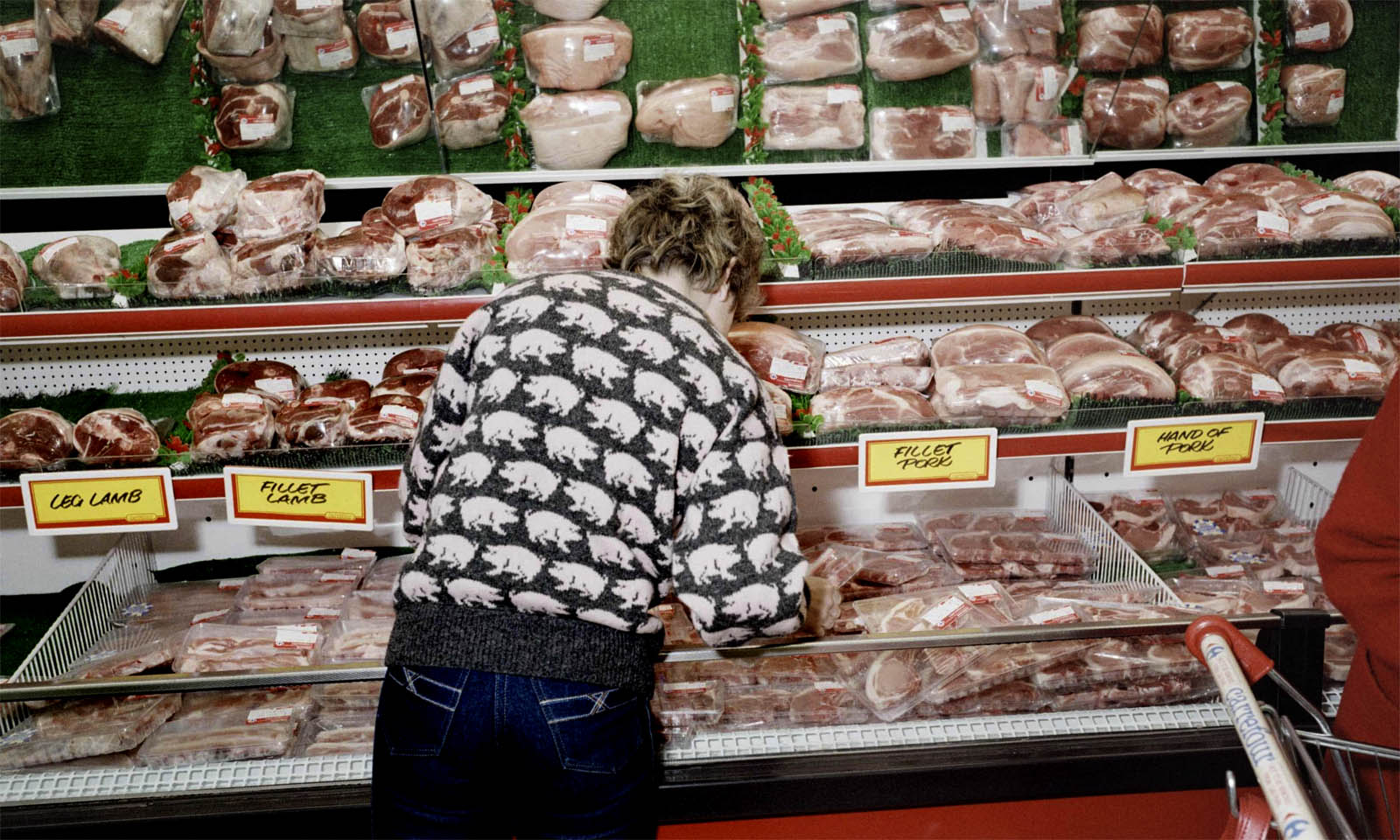
 

Paul Reas (British, b. 1955) 'Hand of Pork, Caerphilly, South Wales' 1985-1988


Paul Reas (British, b. 1955)
Hand of Pork, Caerphilly, South Wales
1985-1988
C-print on paper
© Paul Reas/Martin Parr Foundation


“Deregulation of the banking system meant credit was easy to come by and consumer spending rose fast. Shopping malls were the new cathedrals of consumption and retail parks with supermarkets and furniture stores the parish churches. Shopping became leisure”

~ Paul Reas


Inspired by the use of colour in advertising, Paul Reas dedicated his first series of colour photographs to the post- industrial consumer boom in the UK in the 1980s. These works, taken with a medium-format camera and a large flashgun, present everyday scenes at US-style retail parks, supermarkets and the new housing estates fast becoming a feature of British towns and villages. Reas’s images consider the impact of these ‘new cathedrals of consumption’. Reas has described how Margaret Thatcher’s belief in a free-market economy and individualism moved British society from a ‘we’ to a ‘me’ mentality. As he explains: ‘Although I was photographing people, I never really think about my photographs as being totally about people. They’re about the systems that we’re all subjected to.’

Wall text from the exhibition
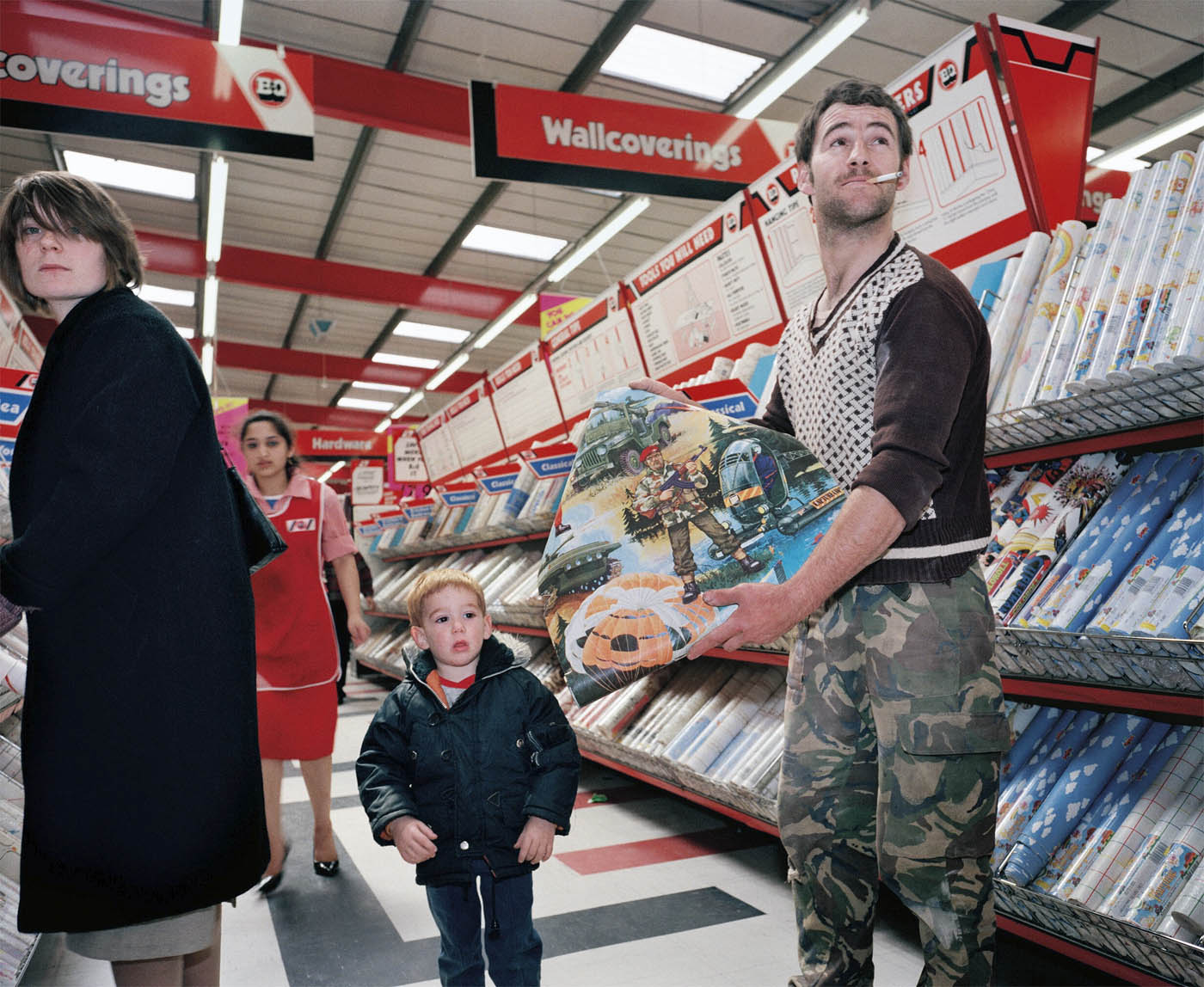
 

Paul Reas (British, b. 1955) 'Army Wallpaper, B&Q Store, Newport South Wales' c. 1987


Paul Reas (British, b. 1955)
Army Wallpaper, B&Q Store, Newport South Wales
c. 1987
C-print on paper
© Paul Reas/Martin Parr Foundation
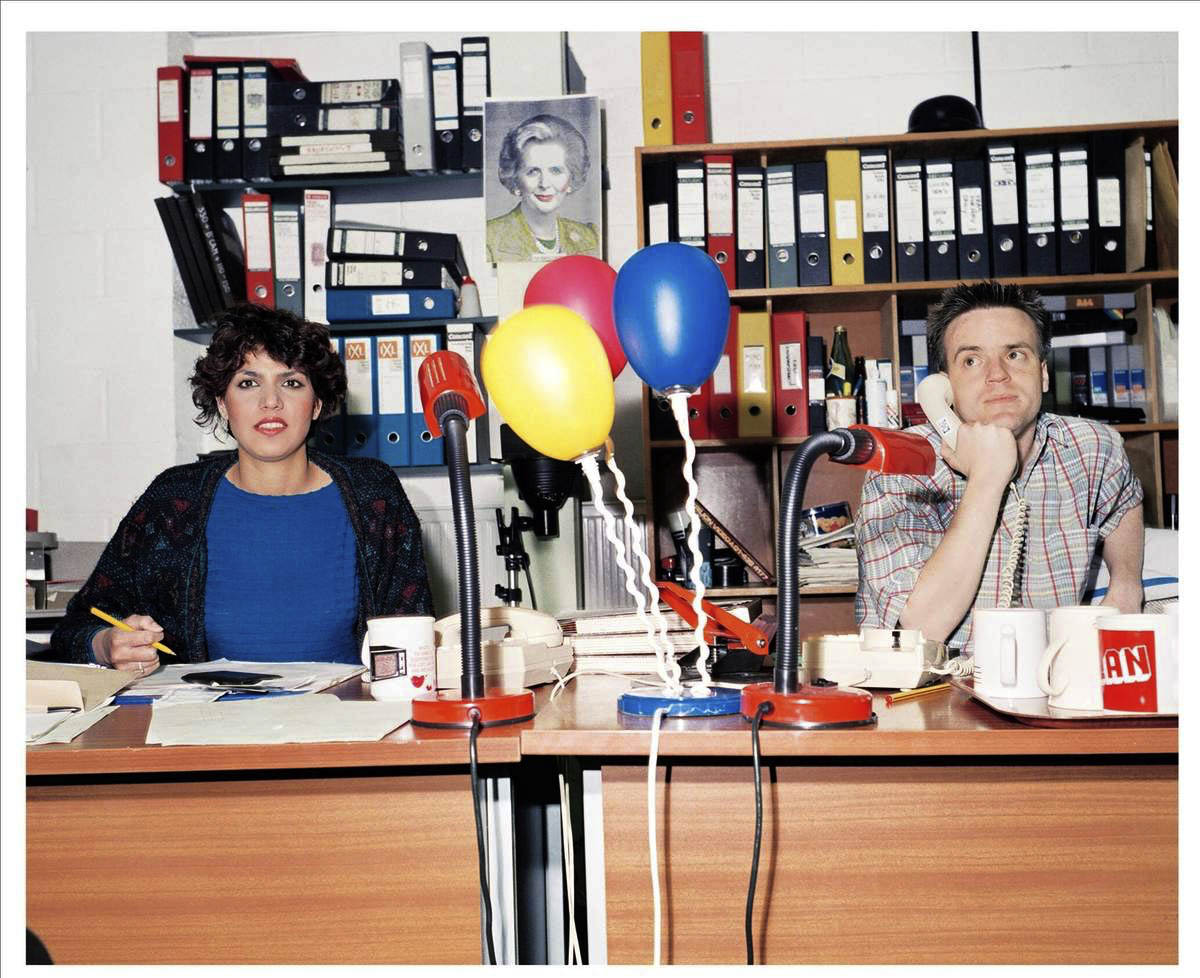
 

Anna Fox (British, b. 1961) 'Independent Video Production Company' 1988 from the series 'Work Stations'


Anna Fox (British, b. 1961)
Independent Video Production Company
1988
From the series Work Stations
The Hyman Collection
Courtesy of the Centre for British Photography
© Anna Fox


“Thatcher was a powermonger and her favourite phrase, ‘there is no such thing as society, just individuals’ saw the end of a culture of community support and a rise in the pursuit of wealth for individuals – primarily white men. Compared to now, things in some ways were more straightforward, and as artists we knew what we were making work about – there was a positive sense that we could change things; we criticised society with hope fueling us…

I made two key bodies of work in this period, including Work Stations – a study of London office life with found texts, creating satirical commentary on a very conservative Britain. I was interested in how consumerism was sweeping the floor with us and how money ruled. There were hardly any documentary images made of office life, it wasn’t considered a valid subject and this interested me. All documentary images change as time passes – design and style become more fascinating as they age – and I am so pleased these images have stayed in people’s imagination. They are a significant record of a particular time and they bring up a lot of memories of what it was like to live and work in it.”

Zoe Whitfield. “The story of 80s Britain, as seen by 7 notable photographers,” on the Dazed website, November 22, 2024 [Online] Cited 03/04/2025


Anna Fox (British, b. 1961) 'Salesperson, Cafe, the City' 1988


Anna Fox (British, b. 1961)
Salesperson, Cafe, the City
1988
From the series Work Stations
Inkjet print on paper
The Hyman Collection
Courtesy of the Centre for British Photography
© Anna Fox


In her Work Stations series, Anna Fox captures London office life in the late 1980s. ‘I was attracted to it because it’s such an ordinary subject and hardly anyone had ever photographed office life’, she says. The photographs combine colour, on-camera flash and snapshot style compositions to create hard shadows and emphasise the immediacy of each scene. The unusual framing and off-kilter camera angles give them a spontaneous and humorous feel. Fox repurposed text from business articles and magazines to loosely pair with each image in the series. They reveal the intense competition, stress and absurdities of corporate culture in Thatcher-era Britain.

Wall text from the exhibition
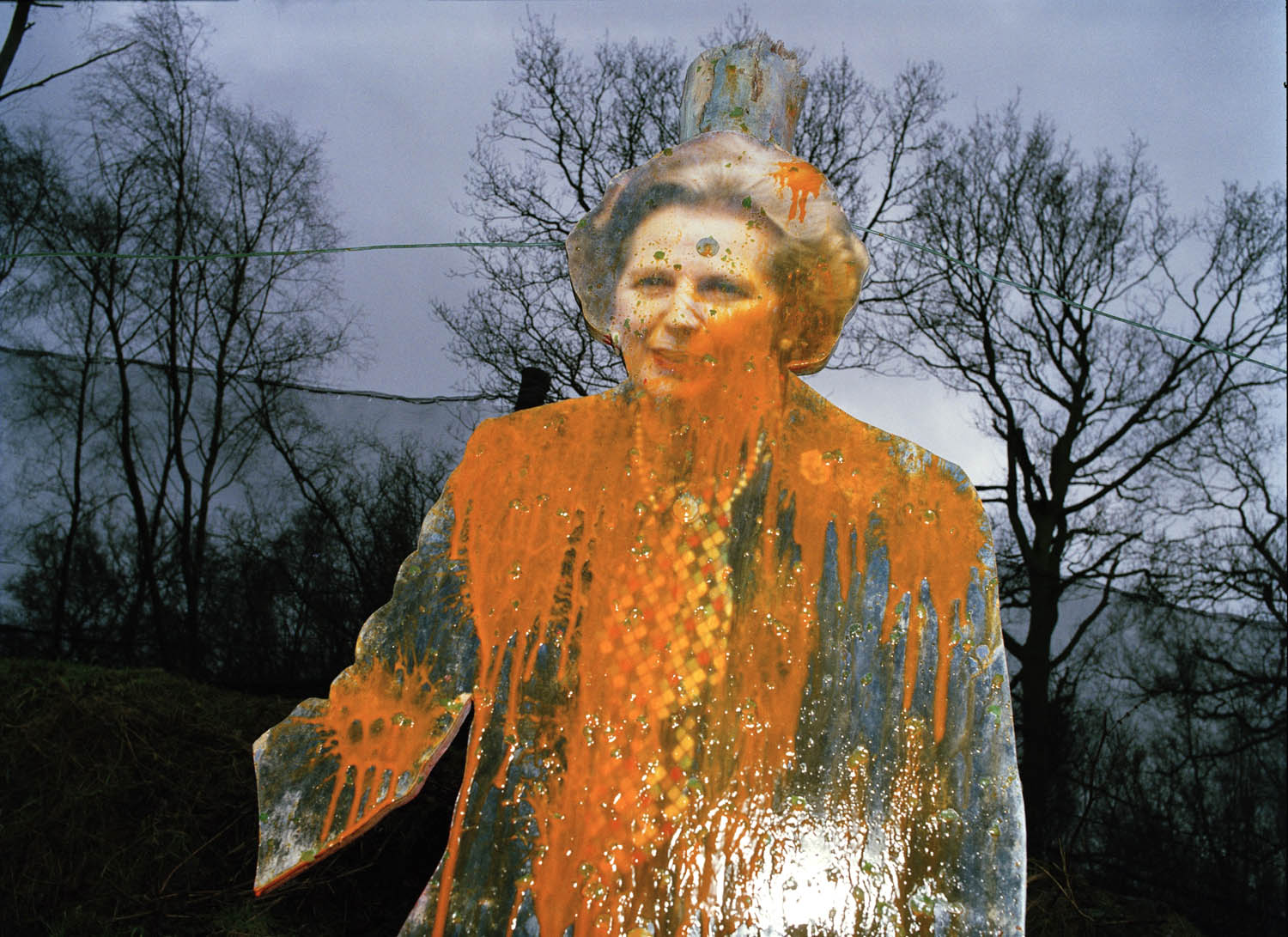
 

Anna Fox (British, b. 1961) 'Friendly Fire, target (Margaret Thatcher) / Margaret Thatcher Target' 1989


Anna Fox (British, b. 1961)
Friendly Fire, target (Margaret Thatcher) / Margaret Thatcher Target
1989
Inkjet print on paper
The Hyman Collection
Courtesy of the Centre for British Photography
© Anna Fox


While working on her 1987-1988 series Work Stations exploring office life, Anna Fox came across the phenomenon of paintballing. Learning that corporate sales teams often took part in outdoor paintball games to encourage team spirit and competitiveness, she wanted to capture these ‘weekend wargames’ in action. In her series Friendly Fire, Fox plays the role of war photographer just as the participants play at being soldiers. This image depicts a paint-splattered cardboard cutout of Margaret Thatcher used for target practice. Taken in the aftermath of the Falklands War, Fox’s work explores the connections and contrasts between these sites of simulated conflict and the experiences of military personnel.

Wall text from the exhibition


Grace Lau (British-Chinese, b. 1939)
'Interiors series' 1986


Grace Lau (British-Chinese, b. 1939)
Interiors series
1986
Colour transparency
Lent by the artist
© Grace Lau 1986


Grace Lau employs colour to explore fetish subcultures from a feminist perspective. This series was produced following an invitation to document a London cross-dressing community. Lau’s portraits are often set in private, domestic spaces where fantasies and alternative lifestyles could be acted out more openly. As the artist explains: ‘When I started making portraits of cross-dressers, many projected their alter-identities with such joyous style that I felt black-and-white could not do justice to their vibrant characters. Colour seemed to express their proud desire to project subliminal identities and these images with their saturated, bright colours, reflect my subjects’ multi-layered personalities; their bright red lipstick, glamorous dresses and jewellery blazing into life in colour transparency film.’

Wall text from the exhibition


Brenda Prince (British, b. 1950)
'Anti-Clause 28 demo in Whitehall, London' 9 June 1988


Brenda Prince (British, b. 1950)
Anti-Clause 28 demo in Whitehall, London
9 June 1988
Format Photographers Archive, Bishopsgate Institute
© Brenda Price


Did the 80s really last from 1976-94? This exhibition thinks it did – resulting in a show replete with gems, but in need of a tight edit…

The exhibition starts out along thematic lines. The opening room is dedicated to protest, from the Grunwick strike led by British/South Asian workers in Brent, through clashes between pickets and the police at the Orgreave coking plant, and marches opposing the homophobic Section 28 legislation. In a gallery dedicated to money and the growing divide between haves and have-nots, Paul Graham’s grimly atmospheric pictures of DHSS waiting rooms face off against Martin Parr’s snarky snaps of garden parties and gallery openings. In the next section, the lens is turned on the landscape, and the transformations wrought both by industry and its removal. …

The closing section Celebrating Subcultures bypasses those usually associated with the 1980s (punks, goths, rude boys, new age travellers) but includes an entire wall of 1990s photographs by Wolfgang Tillmans, most of which were shot in Germany and Greece…

The art world of the 1980s speaks strongly to our own, in particular, the shared interest in identity and representation. In short supply here is the punky irreverence of an era in which taking the piss was practically a national hobby.

Hettie Judah. “The 80s: Photographing Britain review – a meandering look at pomp, protest – and pork,” on The Guardian website Wed 20 Nov 2024 [Online] Cited 02/05/2025


For all that, I left this show feeling slightly beleaguered by the overload of images and attendant theory. The foregrounding of emerging visual strategies, from activist reportage to nascent conceptualism to identity-driven self-portraiture, is brave but often bewildering rather than enlightening. The final room, Celebrating Subculture, is a case in point, being a cursory nod to a decade that saw the emergence of the style-conscious youth culture that echoes through fashion, music and indeed everyday life until this day.

If your image of the 80s is predicated on memories of The Face magazine, or the blossoming of extravagant tribal subcultures such as goths and New Romantics in clubs such as the Batcave and Blitz, you may be as baffled as I was not to encounter a single image by the likes of Juergen Teller, Nigel Shafran or Derek Ridgers. Instead, there are four street portraits of stylish young men by Jason Evans and a recreation of Wolfgang Tillmans’s first photo installation, which mainly comprises images first published in i-D magazine. A portrait of the 80s, then, but one that at times seems determinedly out of focus.

Sean O’Hagan. “The 80s: Photographing Britain review – in your face and to the barricades,” on The Guardian website, Sun 24 Nov 2024 [Online] Cited 02/05/2025


Roy Mehta (British, b. 1968) From the series 'Revival, London' 1989-1993


Roy Mehta (British, b. 1968)
From the series Revival, London
1989-1993
C-print on paper
Courtesy of the artist and LA


Roy Mehta’s Revival, London, series focusses on Caribbean and Irish communities in Brent northwest London, where he lived in the 1980s. Much of Mehta’s practice engages with the complexity of identity and belonging.

Mehta invites us ‘to share in the atmosphere of the subject’s internal world by illustrating the gentle essence of our shared humanity through images of empathy, faith and tenderness’. He notes: ‘I wanted the work to depict compassion and solidarity, along with reflections of the everyday. I felt these were absent from some mainstream representations of diasporic identities at that time in the 1980s.’

Wall text from the exhibition
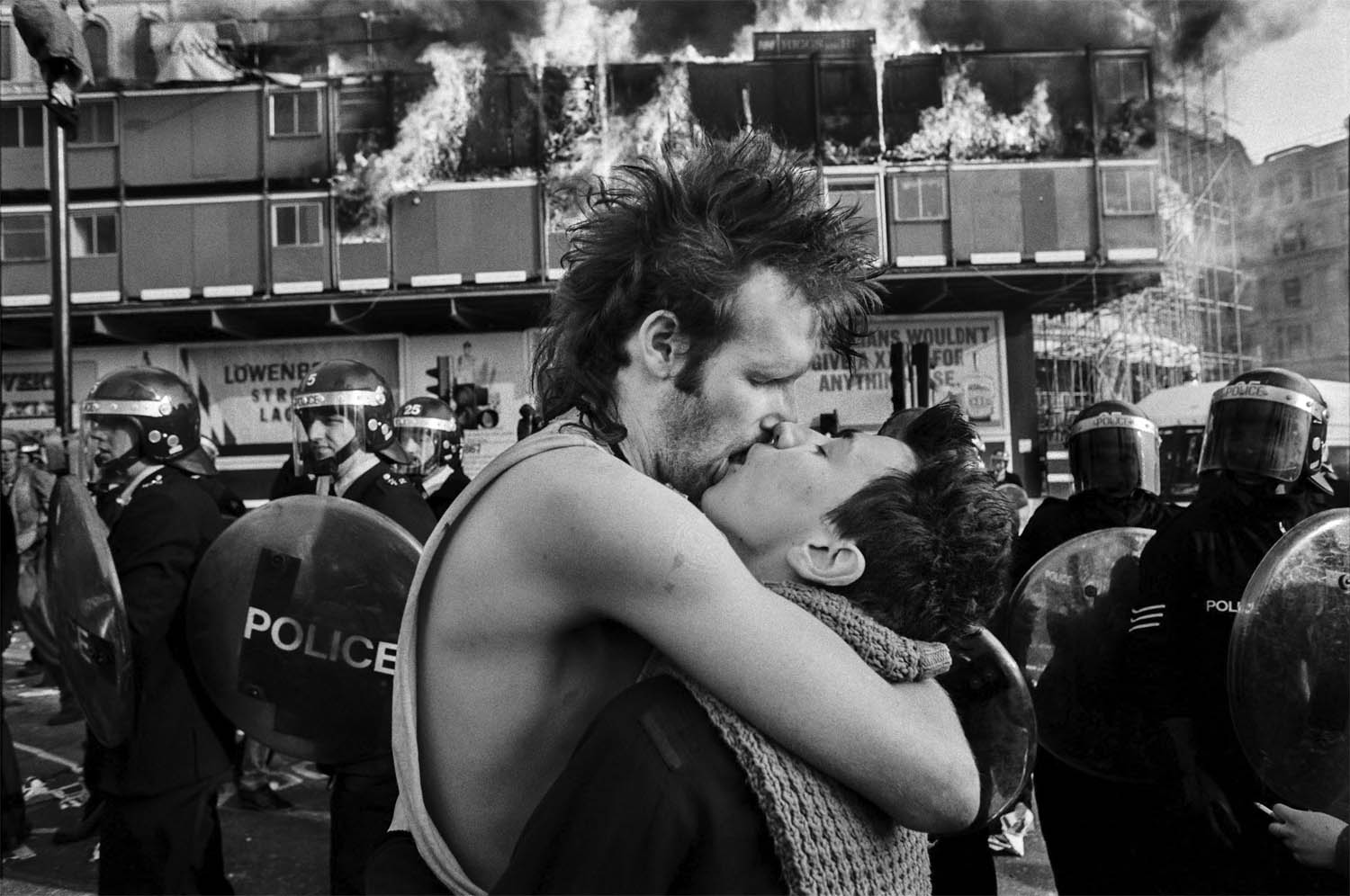
 

David Hoffman (British) 'Nidge & Laurence Kissing, taken at a poll tax protest in London' 1990


David Hoffman (British)
Nidge & Laurence Kissing, taken at a poll tax protest in London
1990
© David Hoffman
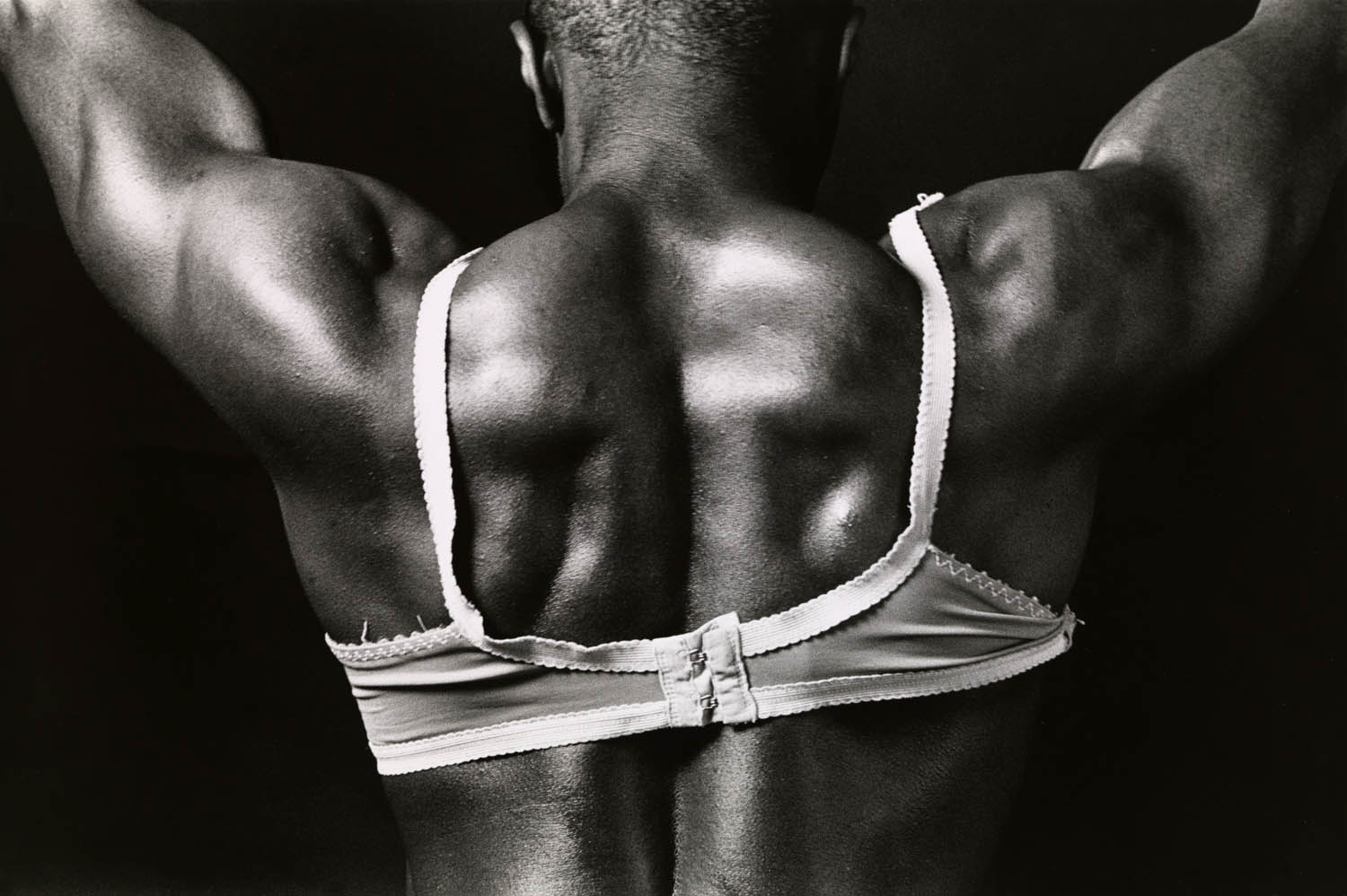
 

Ajamu X (British, b. 1963) 'Body Builder in Bra' 1990


Ajamu X (British, b. 1963)
Body Builder in Bra
1990
Gelatin silver print on paper
Tate
Presented by Tate Members 2020


When asked about the photoshoot for this image, Ajamu said: ‘we went to the local market here in Brixton, bought a bra and played around with it. This was one of the first shots.’ This spontaneity is contrasted with the carefully framed close-up of the sitter’s back. Bodybuilding has long been an area of interest for Ajamu. Although it represents ‘an archetypal image of the male body’, he describes how his practice is ‘a consistent attempt to subvert, re-think, play with these limited modes of representations around particular bodies in a multi-dimensional way.’

Wall text from the exhibition


Jason Evans (Welsh, b. 1968) and Simon Foxton (British, b. 1961) 'Untitled' 1991 From the series 'Strictly'


Jason Evans (Welsh, b. 1968) and Simon Foxton (British, b. 1961)
Untitled
1991
From the series Strictly
Tate
© Jason Evans


“This work was made in collaboration with Simon Foxton. It takes the head-to-toe ‘straight up’ documentary approach to street style as a point of departure, however they’re entirely constructed. We saw fashion photography as a political space where we could create something that pushed back at the media stereotypes of young Black men. This is a Trojan horse exercise, intended to disrupt the white supremacist media project. For many, it may be hard to imagine how racist the UK felt then, which, especially with hindsight, makes today’s politics all the harder to witness.”

Zoe Whitfield. “The story of 80s Britain, as seen by 7 notable photographers,” on the Dazed website, November 22, 2024 [Online] Cited 03/04/2025


Al-An deSouza (Kenyan, b. 1958) 'Junglee, Indian Aphorisms series'
1992/2024


Al-An deSouza (Kenyan, b. 1958)
Junglee, Indian Aphorisms series
1992/2024
Courtesy Al-An deSouza and Talwar Gallery, New York and New Delhi


In Indian Aphorisms, Al-An deSouza combines self-portraits with introspective reflections. Through the series, the artist attempts to reclaim and redefine their identity. Each work portrays the tension between public perception and private reality, illustrating the ways in which personal identity is continually negotiated and reshaped. DeSouza’s photographs reveal their struggle to separate reality from yearning and imagining. ‘I don’t know which of my memories are my own remembrance, which are tales whispered to me secretly as I lay in my bed, or which are ghostly after images, effigies petrified between the tissue leaves of photo albums’, the artist explains.

Wall text from the exhibition


'The 80s: Photographing Britain' book cover


Related publications

The 80s: Photographing Britain

Edited by Yasufumi Nakamori, Helen Little and Jasmine Chohan

Featuring contributions by Bilal Akkouche, Geoffrey Batchen, Derek Bishton, Jasmine Chohan, Taous Dahmani, Helen Little, Yasufumi Nakamori, Mark Sealy, Noni Stacey

Published November 2024, hardback £40

Available on the Amazon website


Tate Britain
Millbank, London
SW1P 4RG

Open daily 10.00 – 18.00

Tate Britain website

LIKE ART BLART ON FACEBOOK

Back to top

Exhibition: ‘Power & Light: Russell Lee’s Coal Survey’ at the National Archives Museum, Washington

“In looking through the body of work I feel what is envisioned by the photographer in his images is a wonderful empathy for the miners and their families in the situation of their becoming.” Dr Marcus Bunyan

Exhibition dates: 16th March, 2024 – 6th July, 2025

Curator: Alice Kamps


Russell Lee (American, 1903-1986) 'Mrs. Manuel Alcala and son in corner of their kitchen. The family lives in company housing project for miners. National Fuel Company, Monarch Mine, Broomfield, Boulder County, Colorado' July 2, 1946 from the exhibition 'Power & Light: Russell Lee's Coal Survey' at the National Archives Museum, Washington, March 2024 - July 2025


Russell Lee (American, 1903-1986)
Mrs. Manuel Alcala and son in corner of their kitchen. The family lives in company housing project for miners. National Fuel Company, Monarch Mine, Broomfield, Boulder County, Colorado
July 2, 1946
National Archives
Public domain


The history of today and every day

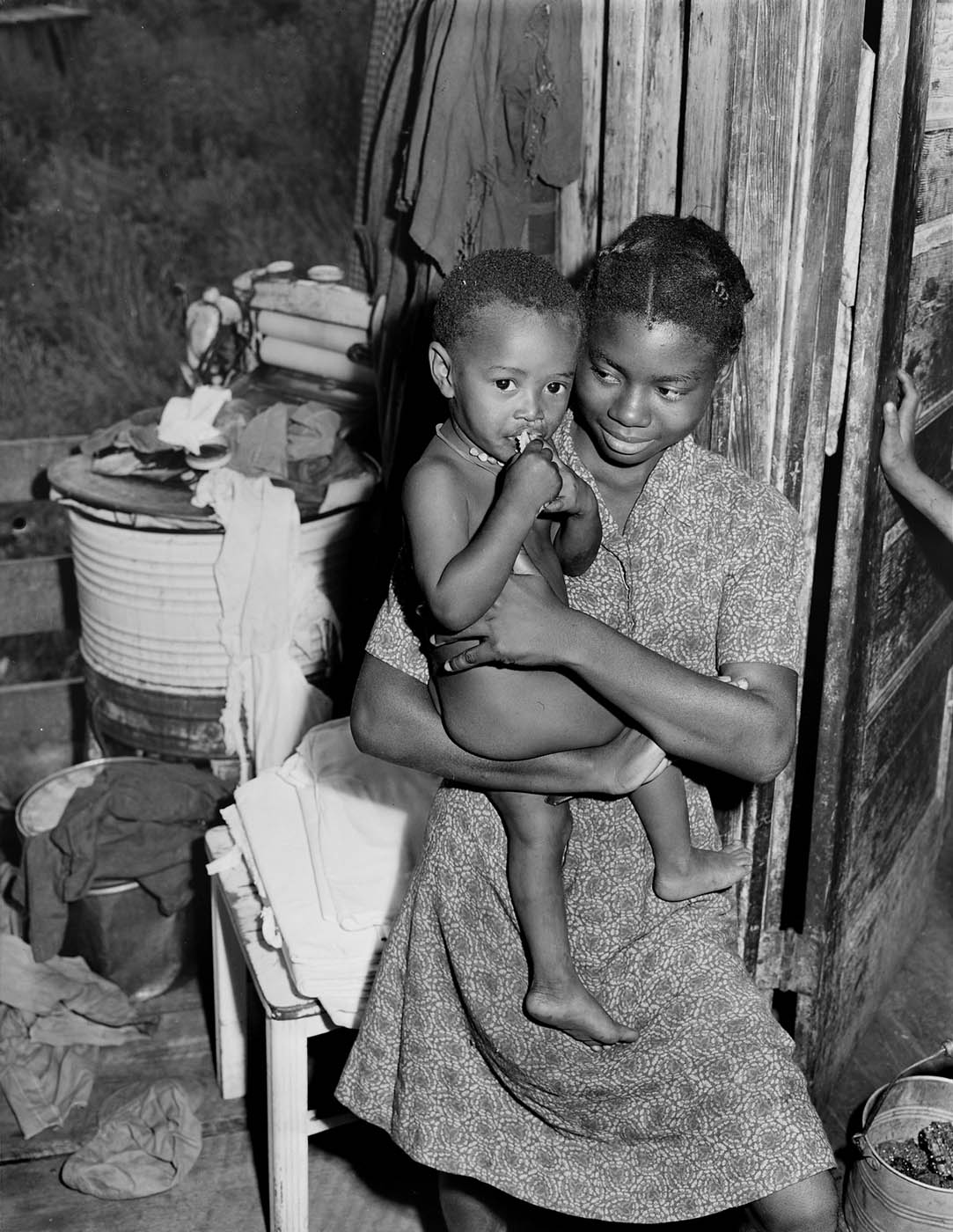
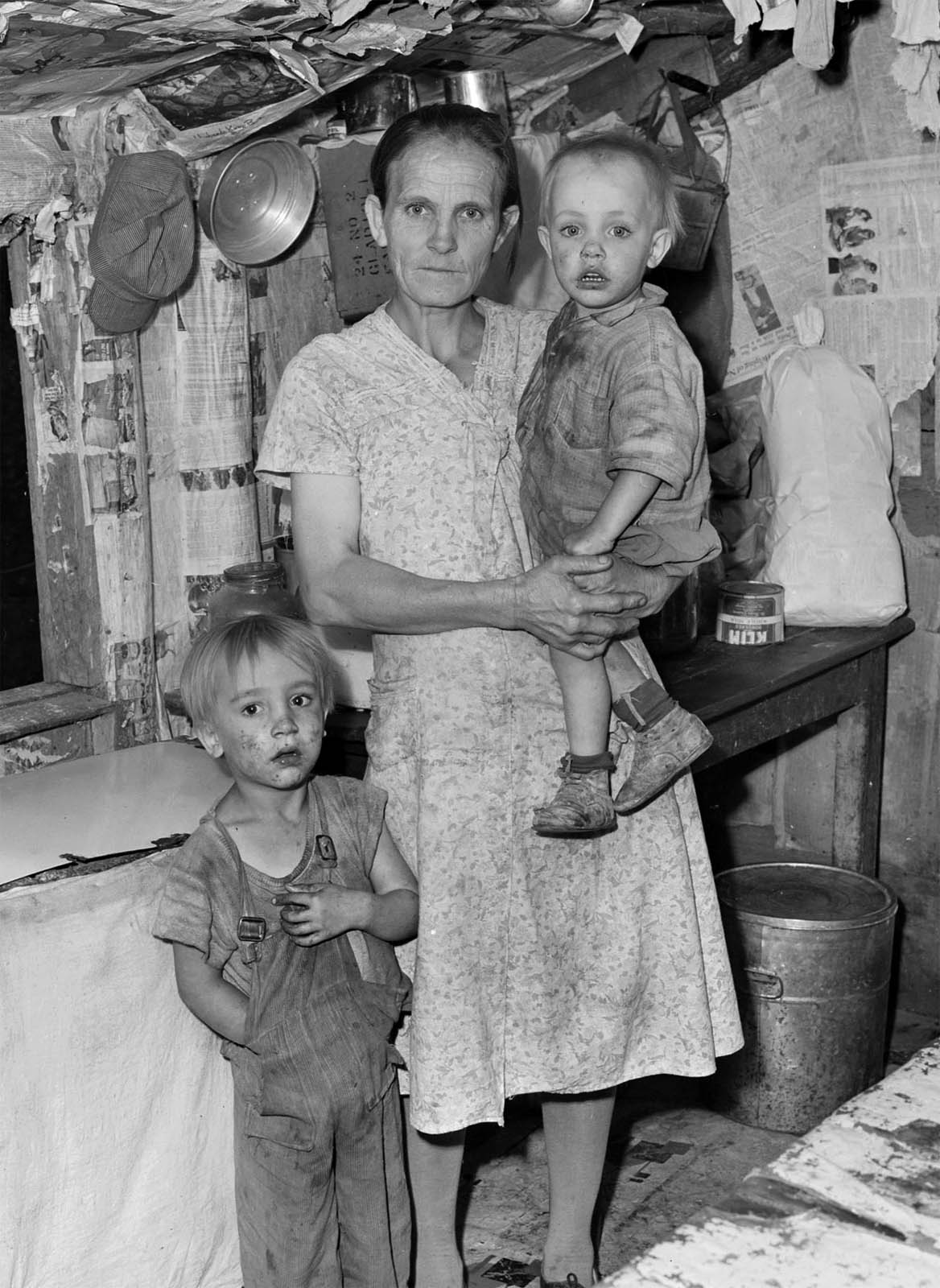
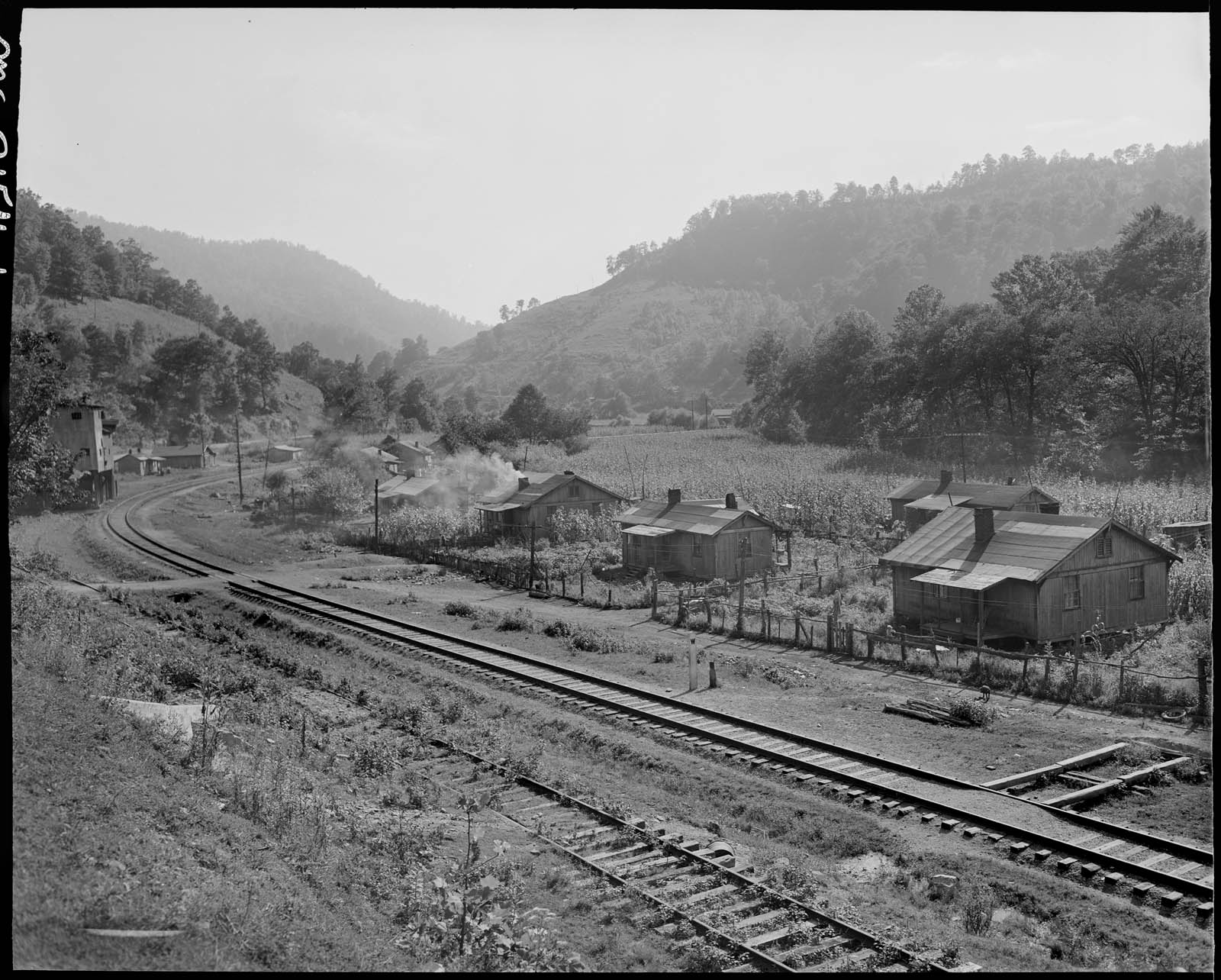
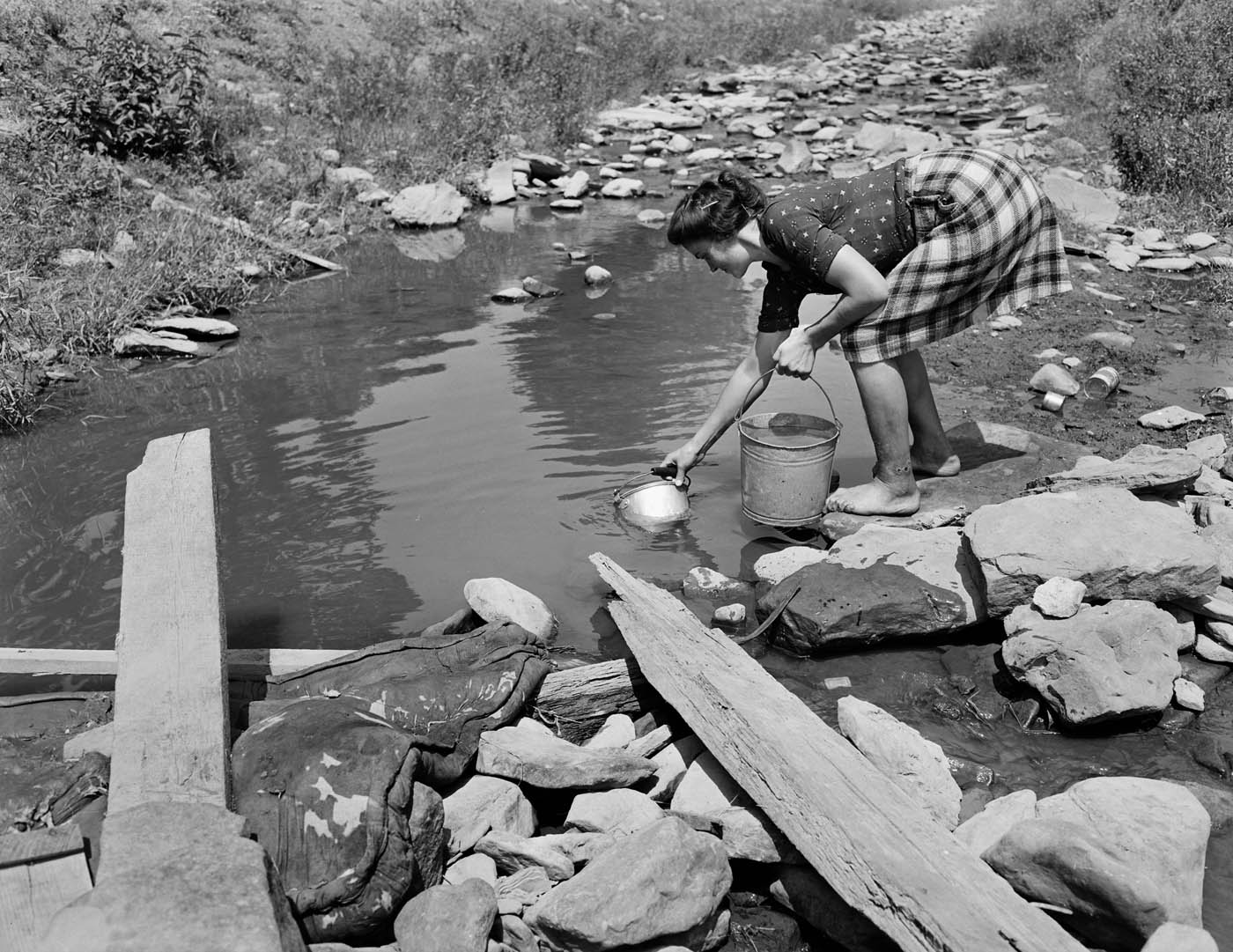
Continuing Art Blart’s support of photographers with a social conscience, this latest posting complements recent postings on the exhibitions Miners’ Strike 1984-85, and Roger Mayne: Youth. In the United States of America this type of attuned social documentary photography has a long history, both prior to and after Russell Lee’s photographs were taken.

From Danish-American social reformer Jacob Riis’ who used his “photographic and journalistic talents to help the impoverished in New York City” to the famous American sociologist and photographer Lewis Hine whose images “were instrumental in bringing about the passage of the first child labor laws in the United States”, onward to the work of the photographers employed by the Farm Security Administration / Office of War Information (FSA / OWI) between 1935-1944,* (notably Dorothea Lange, Walker Evans, Jack Delano, Russell Lee, Marion Post Wolcott) which “form an extensive pictorial record of American life” … and thus to these photographs taken by Russell Lee just after the end of the Second World War. Lee’s photographs were then followed by Gordon Parks‘ photographs of racial intolerance, Marion Palfi‘s photographs of American injustice, Milton Rogovin‘s photographs of “the forgotten ones” and, more recently, James Nachtwey‘s photographs of drug use in America. Of course, there are many other photographers who could be mentioned.

It has been a fascinating journey to engage with over 1000 of Russell Lee’s Coal Survey photographs that are available in the National Archives Catalog to try to fully understand the vision of this artist during the 1946 project picturing miners in their homes, mines, and communities. “Lee provided the photographs for the study which included 90 communities in 22 states… Over the course of the survey, Lee took over 4000 photographs, more than 200 of which are included in the exhibit.”

As with any large of body of work the quality of the photographs varies incredibly – some poor, others prosaic, some insightful, others powerful portraits, some dynamic, others occasionally revelatory. This is only to be expected. In the selection in this posting I have chosen what I think are the best photographs from the 1000 photographs available online. Please note, these photographs are not necessarily in the exhibition.

In looking through the body of work I feel what is envisioned by the photographer in his images is a wonderful empathy for the miners and their families in the situation of their becoming. What Lee pictures are communities that support each other but which are under stress.

Having worked through the Second World War to aid the American war effort, men and women were hard at work in a dangerous job, the families were living in run down houses owned by the coal mining companies, were buying food at the company store, were borrowing money on their earnings from the company to survive and living a subsistence life – having the minimal resources necessary for survival, having just enough food or money to stay alive. Rickety wooden houses with no running water [The only houses with running water inside in this camp are those in which their tennants [sic] have made the installations at no expense to the company], dead animals in streams where water is gathered, roofs lined with newspaper, children with no shoes, men holding serpents praying to an unseen god.

I believe that Lee’s most powerful photographs in the project are the images of the miners at work. There is an intimate directness to these photographs of working men and women. Nothing extraneous, nothing superfluous, just an honest directness picturing their everyday lives, in tiredness, laughter, and desperation.

In these photographs of miners we can see that Lee loved his diagonals, horizontals and verticals in the construction of the image plane. Right to left diagonals in J. M. Hawkins (left) former pharmacists mate in the U.S. Navy and Wm. Smith, former Marine, read notice on the bulletin board at the mine (July 9, 1946, below) and Women pick foreign matter out of coal (July 9, 1946, below); left to right diagonals in Miners boarding buses which will take them to washhouse from lamp house where they have checked out (August 20, 1946, below) and Miners checking in at the lamp house at completion of morning shift (August 22, 1946, below); and verticals in James Robert Howard has gotten his safety lamp at lamp house (August 13, 1946, below).

My two favourite photographs in the posting are both crackers. Firstly, Miners waiting at drift mouth for the afternoon man trip. Koppers Coal Divison, Kopperston Mines, Kopperston, Wyoming County, West Virginia (August 22, 1946, below) in which the languid easiness of the men’s postures are perfectly assimilated within the structure of the buildings and rocks to form an almost Renaissance tableaux of figures. And secondly, Miners bring in their checks and see the sign that there is no Saturday work. P V & K Coal Company, Clover Gap Mine, Lejunior, Harlan County, Kentucky (September 13, 1946, below) in which the languorous flow of bodies moves as in the stillness of a quietly flowing river, revealing a reversed “N” and misspelt “to-morrow” as if the morrow will bring more heartache.

What clarity of vision, what panache in the execution of that vision. You could only wish to be such an accomplished artist taking pictures of the history of yesterday that still have relevance today and every day.

Dr Marcus Bunyan


View Russell Lee’s Coal Survey photographs on the National Archives website.

* FSA photographers: Arthur Rothstein (1935), Theodor Jung (1935), Ben Shahn (1935), Walker Evans (1935), Dorothea Lange (1935), Carl Mydans (1935), Russell Lee (1936), Marion Post Wolcott (1936), John Vachon (1936, photo assignments began in 1938), Jack Delano (1940), John Collier (1941), Marjory Collins (1941), Louise Rosskam (1941), Gordon Parks (1942) and Esther Bubley (1942)
* OWI photographers: David Bransby (1942), John Collier (1943), Marjory Collins (1943), Jack Delano (1942-1943), Howard Hollem (1941-1943), Fenno Jacobs (1942), Alfred Palmer (1941-1943), William M. Rittase (1942), John Rous (1941), Mark Sherwood (1942), Arthur Siegel (1942), John Vachon (1942-1943), Miscellaneous photographers (Jack Downey, Andreas Feininger, unidentified)


Many thankx to the National Archives for allowing me to publish the photographs in the posting. Please click on the photographs for a larger version of the image. All photographs have been digitally cleaned and balanced by Marcus Bunyan. Please note the photographs in this posting are not necessarily in the exhibition.


“I’m taking pictures of the history of today.”


Russell Lee


Russell Lee (American, 1903-1986) 'The Sergent Family on their front porch. Reading from L. to R., Franklin D., Louis, Lucy, Mr. Blaine Sergent, Bobbie Jean, Mrs. Sergent, Wanda Lee and Donald. Mr. and Mrs. Sergent have two married sons living nearby, Rufus, who lives next door and is a coal cutter in the same mine and Junior who lives and works at Verda Mine several miles away. P V & K Coal Company, Clover Gap Mine, Lejunior, Harlan County, Kentucky' September 15, 1946 from the exhibition 'Power & Light: Russell Lee's Coal Survey' at the National Archives Museum, Washington, March 2024 - July 2025


Russell Lee (American, 1903-1986)
The Sergent Family on their front porch. Reading from L. to R., Franklin D., Louis, Lucy, Mr. Blaine Sergent, Bobbie Jean, Mrs. Sergent, Wanda Lee and Donald. Mr. and Mrs. Sergent have two married sons living nearby, Rufus, who lives next door and is a coal cutter in the same mine and Junior who lives and works at Verda Mine several miles away. P V & K Coal Company, Clover Gap Mine, Lejunior, Harlan County, Kentucky
September 15, 1946
National Archives
Public domain


Russell Lee (American, 1903-1986) 'The Sergent Family on their front porch. Reading from L. to R., Franklin D., Louis, Lucy, Mr. Blaine Sergent, Bobbie Jean, Mrs. Sergent, Wanda Lee and Donald. Mr. and Mrs. Sergent have two married sons living nearby, Rufus, who lives next door and is a coal cutter in the same mine and Junior who lives and works at Verda Mine several miles away. P V & K Coal Company, Clover Gap Mine, Lejunior, Harlan County, Kentucky' September 15, 1946 (detail)


Russell Lee (American, 1903-1986)
The Sergent Family on their front porch. Reading from L. to R., Franklin D., Louis, Lucy, Mr. Blaine Sergent, Bobbie Jean, Mrs. Sergent, Wanda Lee and Donald. Mr. and Mrs. Sergent have two married sons living nearby, Rufus, who lives next door and is a coal cutter in the same mine and Junior who lives and works at Verda Mine several miles away. P V & K Coal Company, Clover Gap Mine, Lejunior, Harlan County, Kentucky (detail)
September 15, 1946
National Archives
Public domain


Russell Lee (American, 1903-1986) 'The Blaine Sergent family's house. P V & K Coal Company, Clover Gap Mine, Lejunior, Harlan County, Kentucky' September 15, 1946


Russell Lee (American, 1903-1986)
The Blaine Sergent family’s house. P V & K Coal Company, Clover Gap Mine, Lejunior, Harlan County, Kentucky
September 15, 1946
National Archives
Public domain


Power & Light: Russell Lee’s Coal Survey is an exhibition of photographs of coal communities by American documentary photographer Russell Lee. These images tell the story of labourers who helped build the nation, of a moment when the government took stock of their health and safety, and of a photographer who recognised their humanity.

About the Exhibit

Power & Light is free and open to the public. The exhibition features more than 200 of Russell Lee’s photographs of coal miners and their families in the form of large-scale prints, projections, and digital interactives from a nationwide survey of housing and medical and community facilities of bituminous coal mining communities. The survey was conducted by Navy personnel in 1946 as part of a strike-ending agreement negotiated between the Department of the Interior and the United Mine Workers of America. The full series of photographs, which numbers in the thousands, can only be found in the holdings of the National Archives. These images document inhumane living and working conditions but also depict the joy, strength, and resilience of the miners’ families and communities.

Note: All photograph captions are original, as provided by the photographer. Unless otherwise noted, the images are in the holdings of the National Archives, Records of the Solid Fuels Administration for War.

Power & Light features Russell Lee’s 1946 coal survey photographs of miners in their homes, mines, and communities.

About Russell Lee

Russell Werner Lee (1903-1986) was born in Ottawa, Illinois. Originally trained as an engineer, he was methodical in his work, but approached his subjects with warmth and respect. The quiet Midwesterner put people at ease, enabling him to capture scenes of surprising intimacy. Many of his photographs reveal worlds through small details – keepsakes on the mantel, lined and calloused hands. What may be most distinctive about these images is their reflection of the photographer’s compassion for his subjects. Despite their plight, it is their strength, dignity, and humanity that strike the viewer.

If you recognise Lee’s photos – but not his name – you’re not alone.

Although the coal survey photos represent some of Lee’s finest work, his best-known photographs are from an earlier project. Lee was one of several photographers hired by the federal government in the 1930s to document the toll of the Great Depression and drought on rural Americans. While he worked alongside famous colleagues including Walker Evans and Dorothea Lange, Lee eschewed celebrity. His aim was to inspire social change, believing visual evidence of struggle and hardship could generate support for reforms.

Text from the National Archives Museum website


Russell Lee (American, 1903-1986) 'Miners' wives and children on the front porch of a typical, fifty year old house. Kentucky Straight Creek Coal Company, Belva Mine, abandoned after explosion [in] Dec. 1945, Four Mile, Bell County, Kentucky' (Original Caption) September 4, 1946


Russell Lee (American, 1903-1986)
Miners’ wives and children on the front porch of a typical, fifty year old house. Kentucky Straight Creek Coal Company, Belva Mine, abandoned after explosion [in] Dec. 1945, Four Mile, Bell County, Kentucky (Original Caption)
September 4, 1946
National Archives
Public domain


Russell Lee: Home

Lee’s photographs of miners at home reflect his respect for their individuality and resourcefulness, his fascination with families, and his meticulous attention to the details of everyday life.


Russell Lee (American, 1903-1986) 'Gonzalla Sullivan, miner, with his two children and another child who lives in the neighborhood. Koppers Coal Division, Federal #1 Mine, Grant Town, Marion County, West Virginia' June 13, 1946 from the exhibition 'Power & Light: Russell Lee's Coal Survey' at the National Archives Museum, Washington, March 2024 - July 2025


Russell Lee (American, 1903-1986)
Gonzalla Sullivan, miner, with his two children and another child who lives in the neighborhood. Koppers Coal Division, Federal #1 Mine, Grant Town, Marion County, West Virginia
June 13, 1946
National Archives
Public domain


Russell Lee (American, 1903-1986) 'Quarters of Japanese miner who lives in company housing project. Hudson Coal Company, Hudson Mine, Sweet Mine, Carbon County, Utah' July 4, 1946 from the exhibition 'Power & Light: Russell Lee's Coal Survey' at the National Archives Museum, Washington


Russell Lee (American, 1903-1986)
Quarters of Japanese miner who lives in company housing project. Hudson Coal Company, Hudson Mine, Sweet Mine, Carbon County, Utah
July 4, 1946
National Archives
Public domain


Russell Lee (American, 1903-1986) 'The only houses with running water inside in this camp are those in which their tennants [sic] have made the installations at no expense to the company. Gilliam Coal and Coke Company, Gilliam Mine, Gilliam, McDowell County, West Virginia' (Original Caption) August 13, 1946


Russell Lee (American, 1903-1986)
The only houses with running water inside in this camp are those in which their tennants [sic] have made the installations at no expense to the company. Gilliam Coal and Coke Company, Gilliam Mine, Gilliam, McDowell County, West Virginia (Original Caption)
August 13, 1946
National Archives
Public domain


Russell Lee (American, 1903-1986) 'There are ten children in the Lawson Mayo family, the older taking care of the youngest ones. Three of the daughters are now attending high school in Mullens and have part time jobs during summer months. Mullens Smokeless Coal Company, Mullens Mine, Harmco, Wyoming County, West Virginia' (Original Caption) August 23, 1946


Russell Lee (American, 1903-1986)
There are ten children in the Lawson Mayo family, the older taking care of the youngest ones. Three of the daughters are now attending high school in Mullens and have part time jobs during summer months. Mullens Smokeless Coal Company, Mullens Mine, Harmco, Wyoming County, West Virginia (Original Caption)
August 23, 1946
National Archives
Public domain


Russell Lee (American, 1903-1986) 'Mrs. John Whitehead, wife of miner, and two of her children (or grandchildren) in the kitchen of her three room house. Mr. and Mrs. John Whitehead, their six children and six grandchildren live here. This house, built on company owned land was built by Mr. Whitehead's half brother at no expense for materials or labor to the company; the builder (half brother) was to receive the use of the house rent-free for three years and at the end of this period the ownership of the house would revert to the company. The brother moved away at the end of one year, receiving no cash settlement from the company. The house now rents for $6 monthly. It has no running water, no electricity, access is over a mountain trail; there are three rooms. Coleman Fuel Company, Red Bird Mine, Field, Bell County, Kentucky' (Original Caption) August 31, 1946


Russell Lee (American, 1903-1986)
Mrs. John Whitehead, wife of miner, and two of her children (or grandchildren) in the kitchen of her three room house. Mr. and Mrs. John Whitehead, their six children and six grandchildren live here. This house, built on company owned land was built by Mr. Whitehead’s half brother at no expense for materials or labor to the company; the builder (half brother) was to receive the use of the house rent-free for three years and at the end of this period the ownership of the house would revert to the company. The brother moved away at the end of one year, receiving no cash settlement from the company. The house now rents for $6 monthly. It has no running water, no electricity, access is over a mountain trail; there are three rooms. Coleman Fuel Company, Red Bird Mine, Field, Bell County, Kentucky (Original Caption)
August 31, 1946
National Archives
Public domain


Russell Lee (American, 1903-1986) 'Mrs. John Whitehead, wife of miner, and two of her children (or grandchildren) in the kitchen of her three room house. Mr. and Mrs. John Whitehead, their six children and six grandchildren live here. This house, built on company owned land was built by Mr. Whitehead's half brother at no expense for materials or labor to the company; the builder (half brother) was to receive the use of the house rent-free for three years and at the end of this period the ownership of the house would revert to the company. The brother moved away at the end of one year, receiving no cash settlement from the company. The house now rents for $6 monthly. It has no running water, no electricity, access is over a mountain trail; there are three rooms. Coleman Fuel Company, Red Bird Mine, Field, Bell County, Kentucky' (Original Caption) August 31, 1946 (detail)


Russell Lee (American, 1903-1986)
Mrs. John Whitehead, wife of miner, and two of her children (or grandchildren) in the kitchen of her three room house. Mr. and Mrs. John Whitehead, their six children and six grandchildren live here. This house, built on company owned land was built by Mr. Whitehead’s half brother at no expense for materials or labor to the company; the builder (half brother) was to receive the use of the house rent-free for three years and at the end of this period the ownership of the house would revert to the company. The brother moved away at the end of one year, receiving no cash settlement from the company. The house now rents for $6 monthly. It has no running water, no electricity, access is over a mountain trail; there are three rooms. Coleman Fuel Company, Red Bird Mine, Field, Bell County, Kentucky (Original Caption) (detail)
August 31, 1946
National Archives
Public domain


Russell Lee (American, 1903-1986) 'Houses along the railroad tracks. Fox Ridge Mining Company, Inc., Hanby Mine, Arjay, Bell County, Kentucky' August 31, 1946 from the exhibition 'Power & Light: Russell Lee's Coal Survey' at the National Archives Museum, Washington


Russell Lee (American, 1903-1986)
Houses along the railroad tracks. Fox Ridge Mining Company, Inc., Hanby Mine, Arjay, Bell County, Kentucky
August 31, 1946
National Archives
Public domain


Russell Lee (American, 1903-1986) 'Mrs. Edna Lingar getting wash water from dirty stream; stock wade this stream, privies drain into it, garbage decay in it, a dead animal was in the stream about fifteen feet above where she was getting water. Kentucky Straight Creek Coal Company, Belva, Mine, abandoned after explosion, Four Mile, Bell County, Kentucky' (Original Caption) September 4, 1946


Russell Lee (American, 1903-1986)
Mrs. Edna Lingar getting wash water from dirty stream; stock wade this stream, privies drain into it, garbage decay in it, a dead animal was in the stream about fifteen feet above where she was getting water. Kentucky Straight Creek Coal Company, Belva, Mine, abandoned after explosion, Four Mile, Bell County, Kentucky (Original Caption)
September 4, 1946
National Archives
Public domain


Russell Lee: Mines

Russell Lee was attentive to miners’ issues, documenting deductions to their pay, lost work days, perilous conditions, and the union meetings where they fought for a better deal.


Russell Lee (American, 1903-1986) 'Telesfro Deluna, miner, walking on crutches. He is recovering from a foot injury in mine a accident. He has received medical care at this company owned hospital. Colorado Fuel & Iron Company, Pueblo, Colorado' July 1, 1946


Russell Lee (American, 1903-1986)
Telesfro Deluna, miner, walking on crutches. He is recovering from a foot injury in mine a accident. He has received medical care at this company owned hospital. Colorado Fuel & Iron Company, Pueblo, Colorado
July 1, 1946
National Archives
Public domain


Russell Lee (American, 1903-1986) 'J. M. Hawkins (left) former pharmacists mate in the U.S. Navy and Wm. Smith, former Marine, read notice on the bulletin board at the mine. Union Pacific Coal Company, Reliance Mine, Reliance, Sweetwater County, Wyoming' July 9, 1946


Russell Lee (American, 1903-1986)
J. M. Hawkins (left) former pharmacists mate in the U.S. Navy and Wm. Smith, former Marine, read notice on the bulletin board at the mine. Union Pacific Coal Company, Reliance Mine, Reliance, Sweetwater County, Wyoming
July 9, 1946
National Archives
Public domain


Russell Lee (American, 1903-1986) 'Women pick foreign matter out of coal as it is carried on conveyor thru tipple. Union Pacific Coal Company, Stansbury Mine, Rock Springs, Sweetwater County, Wyoming' (Original Caption) July 10, 1946


Russell Lee (American, 1903-1986)
Women pick foreign matter out of coal as it is carried on conveyor thru tipple. Union Pacific Coal Company, Stansbury Mine, Rock Springs, Sweetwater County, Wyoming (Original Caption)
July 10, 1946
National Archives
Public domain


Russell Lee (American, 1903-1986) 'James Robert Howard has gotten his safety lamp at lamp house. Of the 232 employees at this mine, 60% are Negroes. Gilliam Coal and Coke Company, Gilliam Mine, Gilliam, McDowell County, West Virginia' (Original Caption) August 13, 1946


Russell Lee (American, 1903-1986)
James Robert Howard has gotten his safety lamp at lamp house. Of the 232 employees at this mine, 60% are Negroes. Gilliam Coal and Coke Company, Gilliam Mine, Gilliam, McDowell County, West Virginia (Original Caption)
August 13, 1946
National Archives
Public domain


Russell Lee (American, 1903-1986) 'Miners boarding buses which will take them to washhouse from lamp house where they have checked out. Koppers Coal Divison, Kopperston Mine, Kopperston, Wyoming County, West Virginia' August 20, 1946


Russell Lee (American, 1903-1986)
Miners boarding buses which will take them to washhouse from lamp house where they have checked out. Koppers Coal Divison, Kopperston Mine, Kopperston, Wyoming County, West Virginia
August 20, 1946
National Archives
Public domain


Russell Lee (American, 1903-1986) 'Miners waiting at drift mouth for the afternoon man trip. Koppers Coal Divison, Kopperston Mines, Kopperston, Wyoming County, West Virginia' August 22, 1946


Russell Lee (American, 1903-1986)
Miners waiting at drift mouth for the afternoon man trip. Koppers Coal Divison, Kopperston Mines, Kopperston, Wyoming County, West Virginia
August 22, 1946
National Archives
Public domain


Russell Lee (American, 1903-1986) 'Miners checking in at the lamp house at completion of morning shift. Koppers Coal Division, Kopperston Mines, Kopperston, Wyoming County, West Virginia' August 22, 1946


Russell Lee (American, 1903-1986)
Miners checking in at the lamp house at completion of morning shift. Koppers Coal Division, Kopperston Mines, Kopperston, Wyoming County, West Virginia
August 22, 1946
National Archives
Public domain


Russell Lee (American, 1903-1986) 'Furman Currington and his son, miners. Black Mountain Corporation, 30-31 Mines, Kenvir, Harlan County, Kentucky' September 6, 1946


Russell Lee (American, 1903-1986)
Furman Currington and his son, miners. Black Mountain Corporation, 30-31 Mines, Kenvir, Harlan County, Kentucky
September 6, 1946
National Archives
Public domain


Russell Lee (American, 1903-1986) 'Miners bring in their checks and see the sign that there is no Saturday work. P V & K Coal Company, Clover Gap Mine, Lejunior, Harlan County, Kentucky' (Original Caption) September 13, 1946


Russell Lee (American, 1903-1986)
Miners bring in their checks and see the sign that there is no Saturday work. P V & K Coal Company, Clover Gap Mine, Lejunior, Harlan County, Kentucky (Original Caption)
September 13, 1946
National Archives
Public domain


Russell Lee (American, 1903-1986) 'Blaine Sergent, left, comes out of the mine at the end of the day's work. P V & K Coal Company, Clover Gap Mine, Lejunior, Harlan County, Kentucky' September 13, 1946


Russell Lee (American, 1903-1986)
Blaine Sergent, left, comes out of the mine at the end of the day’s work. P V & K Coal Company, Clover Gap Mine, Lejunior, Harlan County, Kentucky
September 13, 1946
National Archives
Public domain


Russell Lee (American, 1903-1986) 'Rufus Sergent, married son, who is now coal cutter and general all around miner. Rufus did not like school and quit before finishing grade school. He went to work in the mines ten years ago when he was thirteen years old. P V & K Coal Company, Clover Gap Mine, Lejunior, Harlan County, Kentucky' September 15, 1946


Russell Lee (American, 1903-1986)
Rufus Sergent, married son, who is now coal cutter and general all around miner. Rufus did not like school and quit before finishing grade school. He went to work in the mines ten years ago when he was thirteen years old. P V & K Coal Company, Clover Gap Mine, Lejunior, Harlan County, Kentucky
September 15, 1946
National Archives
Public domain


Russell Lee (American, 1903-1986) 'Changing shifts at the mine portal in the afternoon. Inland Steel Company, Wheelwright #1 & 2 Mines, Wheelwright, Floyd County, Kentucky' (Original Caption) September 23, 1946


Russell Lee (American, 1903-1986)
Changing shifts at the mine portal in the afternoon. Inland Steel Company, Wheelwright #1 & 2 Mines, Wheelwright, Floyd County, Kentucky (Original Caption)
September 23, 1946
National Archives
Public domain


Russell Lee (American, 1903-1986) 'Harry Fain, coal loader. Inland Steel Company, Wheelwright #1 & 2 Mines, Wheelwright, Floyd County, Kentucky' September 23, 1946


Russell Lee (American, 1903-1986)
Harry Fain, coal loader. Inland Steel Company, Wheelwright #1 & 2 Mines, Wheelwright, Floyd County, Kentucky
September 23, 1946
National Archives
Public domain


Russell Lee (American, 1903-1986) 'Harry Fain, coal loader, drills coal with hand auger. Powder charges are then placed and ignited. Inland Steel Company, Wheelwright #1 & 2 Mines, Wheelwright, Floyd County, Kentucky' September 24, 1946


Russell Lee (American, 1903-1986)
Harry Fain, coal loader, drills coal with hand auger. Powder charges are then placed and ignited. Inland Steel Company, Wheelwright #1 & 2 Mines, Wheelwright, Floyd County, Kentucky
September 24, 1946
National Archives
Public domain


Mining the Catalog – Exploring records from the Exhibit Power & Light

In March, a new exhibit opened at the National Archives building in Washington, D.C. titled “Power & Light: Russell Lee’s Coal Survey.” The exhibit features over 200 photographs of miners and mining communities in the 1940’s from Record Group 245: Records of the Solid Fuels Administration for War.

Russell Lee began his work for the federal government during the Great Depression when he was one of the photographers hired by the Farm Security Administration to document rural poverty. He later photographed the forced relocation of Japanese Americans to detention camps.

The photographs that are the subject of our exhibit come from Lee’s final project for the federal government. In 1946, he was sent to document the lives of coal miners and their communities by the Truman administration. The United Mine Workers’ 400,000 members had gone on strike demanding safer working conditions, improved health benefits, and better pay. As part of the agreement that ended the strike, the federal government agreed to survey the miners’ living conditions.

The photographs, which are part of the series “Photographs of the Medical Survey of the Bituminous Coal Industry,” show homes with backyard outhouses that were often owned by the mining companies themselves and rented to the miners. We also see miners and their families going about their everyday tasks, having fun in recreation halls, and playing outside.

Lee provided the photographs for the study which included 90 communities in 22 states. The program led to improvements in the mining communities, including the building of 13 new hospitals. Over the course of the survey, Lee took over 4000 photographs, more than 200 of which are included in the exhibit. Over 1000 of the photographs are available in the Catalog. Lee focused on three major themes for the project: home, mines, and community, capturing a moment of mid-century American life. His photographs show not just miners but their families, their homes, and their churches.

Text from the National Archives Catalog email


Russell Lee: Community

To fulfil the mandate of the survey, Lee photographed sanitary, medical, and recreational facilities and services. But he also captured moments of joy and connection that characterised the strong community bonds forged by the miners.


Russell Lee (American, 1903-1986) 'Some of the members of the baseball team of Exeter-Warwick Mines. Kingston Pocahontas Coal Company, Exeter Mine, Welch, McDowell County, West Virginia' (Original Caption) August 10, 1946


Russell Lee (American, 1903-1986)
Some of the members of the baseball team of Exeter-Warwick Mines. Kingston Pocahontas Coal Company, Exeter Mine, Welch, McDowell County, West Virginia (Original Caption)
August 10, 1946
National Archives
Public domain


Russell Lee (American, 1903-1986) 'Children of miner living in company housing project. Note the homemade baby buggy made of a powder box. Union Pacific Coal Company, Reliance Mine, Reliance, Sweetwater County, Wyoming' (Original Caption) August 10, 1946


Russell Lee (American, 1903-1986)
Children of miner living in company housing project. Note the homemade baby buggy made of a powder box. Union Pacific Coal Company, Reliance Mine, Reliance, Sweetwater County, Wyoming (Original Caption)
August 10, 1946
National Archives
Public domain


Russell Lee (American, 1903-1986) 'Children of miners on the fence in front of the Howard house. Gilliam Coal and Coke Company, Gilliam Mine, Gilliam, McDowell County, West Virginia' (Original Caption) August 13, 1946


Russell Lee (American, 1903-1986)
Children of miners on the fence in front of the Howard house. Gilliam Coal and Coke Company, Gilliam Mine, Gilliam, McDowell County, West Virginia (Original Caption)
August 13, 1946
National Archives
Public domain


Russell Lee (American, 1903-1986) 'The meat and vegetable and fruit department in the company store. Raven Red Ash Coal Company, No. 2 Mine, Raven, Tazewell County, Virginia' August 29, 1946


Russell Lee (American, 1903-1986)
The meat and vegetable and fruit department in the company store. Raven Red Ash Coal Company, No. 2 Mine, Raven, Tazewell County, Virginia
August 29, 1946
National Archives
Public domain


Russell Lee (American, 1903-1986) 'Handling serpents at the Pentecostal Church of God. Company funds have not been used in this church and it is not on company property. Most of the members are coal miners and their families. Lejunior, Harlan County, Kentucky' September 15, 1946


Russell Lee (American, 1903-1986)
Handling serpents at the Pentecostal Church of God. Company funds have not been used in this church and it is not on company property. Most of the members are coal miners and their families. Lejunior, Harlan County, Kentucky
September 15, 1946
National Archives
Public domain


Russell Lee (American, 1903-1986) 'Local UMWA union meeting is held on Sunday morning in schoolhouse. Inland Steel Company, Wheelwright #1 & 2 Mines, Wheelwright, Floyd County, Kentucky' (Original Caption) September 22, 1946


Russell Lee (American, 1903-1986)
Local UMWA union meeting is held on Sunday morning in schoolhouse. Inland Steel Company, Wheelwright #1 & 2 Mines, Wheelwright, Floyd County, Kentucky (Original Caption)
September 22, 1946
National Archives
Public domain


Lee’s next big project, and the topic of the National Archives Power & Light exhibit, came after the war. It was Lee’s last, large federally funded photo documentation project. In 1946 the Truman administration made a promise to striking coal miners that if they resumed work, the federal government would sponsor a nationwide survey of health and labor conditions in mining camps. Lee became an instrumental member of the survey.

Lee’s survey photos give an unprecedented accounting of medical, health, and housing conditions in coal-mining communities. Located in remote areas, these communities were not normally accessible to outsiders. Lee’s photographs demonstrate the difficult circumstances in which miners and their families lived but also show us the strength and resilience of these mining communities.

The National Archives has the complete series of more than 4,000 images, the bulk of which were taken by Russell Lee. They feature mining communities in several states, including Utah, West Virginia, Colorado, Kentucky, Pennsylvania, and Wyoming.

His photographs cover a complete range of activities in mining communities including: interior and exterior shots of both company-owned and private dispensaries; miners at work; mining grounds, equipment, and wash houses; women in the home; children at play; recreation facilities, churches, schools, and clubs; scenes of mining townspeople in and around company stores and town streets; family portraits; members of the medical survey group inspecting grounds and speaking to mine company administrators; and local mine operators and union officials.

The images are great primary sources, particularly because of the way Lee documented his photographs. In his extensive cataloging, he recorded the elements and details of home, workplace, and community, giving us an even greater glimpse into the daily life of miners and their families.

The Department of the Interior used many of Lee’s photographs when it published the final report in 1947, “A Medical Survey of the Bituminous Coal Industry,” and its supplemental report titled “The Coal Miner and His Family.”

Jessie Kratz. “Russell Lee’s Coal Survey Exhibit,” on the National Archives ‘Piece of History’ website March 18, 2024 [Online] Cited 20/03/2024


Unknown photographer (American) 'Russell W. Lee (with camera in hand)' c. 1942-1945


Unknown photographer (American)
Russell W. Lee (with camera in hand)
c. 1942-1945
Image courtesy of The Wittliff Collections / Texas State University


'The Coal Miner & His Family' Washington 1947

'The Coal Miner & His Family' Washington 1947

'The Coal Miner & His Family' Washington 1947

'The Coal Miner & His Family' Washington 1947

'The Coal Miner & His Family' Washington 1947

'The Coal Miner & His Family' Washington 1947


The Coal Miner and His Family
Washington 1947
A Supplement To A Medical Survey of the Bituminous-Coal Industry
Report of the Coal Mines Administration


National Archives Museum
701 Constitution Avenue, NW
[between 7th & 9th Streets]
Washington, DC 20408

Opening hours:
Daily 10am – 5.30pm

National Archives Museum website

LIKE ART BLART ON FACEBOOK

Back to top

Exhibition: ‘Suburbia. Building the American Dream’ at the Centre de Cultura Contemporània de Barcelona | CCCB

“Photographs posit a reality that promotes the dream, that verifies the dream, as ‘an offer you can’t refuse’.” Dr Marcus Bunyan

Exhibition dates: 20th March – 8th September, 2024

Curators: Philipp Engel and Francesc Muñoz


'Suburbia. Building the American Dream' exhibition poster


Suburbia. Building the American Dream exhibition poster


An offer you can’t refuse

“The “American dream” can be summed up in a mental image that seems frozen in time: a home of one’s own, surrounded by lawns, with a pool in the back garden and a couple of cars slumbering in the garage… Suburbia. Building the American Dream draws us into the imaginary of the idyllic family home and shows how this lifestyle has been sold and promoted by fiction and the entertainment industry.” (Text from the CCCB website)

To me, there has always be something slightly askew, slightly out of kilter about the “American dream”. It promotes a generalised simulation of a imaginary reality, sold as a lifestyle, more fiction than fact. It is the ghost of desire that haunts the everyday reality of life, entirely on the side of demand: I want therefore I must have.

This desire must be satiated in the nuclear family, the white picket fence, the idyllic family home, the loveable children – as much a surface that reflects the approbation of others as for the sustenance of the self. As Anthony Giddens observes we are inescapably involved in a

“‘reflexive project of the self’: this project is reflexive because it involves unremitting self-monitoring, self-scrutiny, planning and ordering of all elements of our lives appearances and performances in order to marshal them into a coherent narrative called ‘the self’. We have to interpret the past and plan the future in relation to an identity we are attempting to constitute in a particularly immediate and transient social present. Consumerism is central to this self-obsession. This is partly because we not only have to choose a self, but (as Foucault’s line of argument also indicates) have to constitute ourselves as a self who choses, a consumer.”1

The American Dream endeavours to direct the identity we are attempting to constitute (through consumerism), so that it fits into a particularly conformist idea of a wholesome life: patriarchal, hegemonic, puritan (most important in America), god fearing, white – a particularly hyperreal simulation of a world that never existed in the first place. An imaginary construction.2

Photographs reinforce this “imaginary” state of being, this desire for the American Dream. As the wonderful Victor Burgin observes,

“The structure of presentation – point-of-view and frame – is intimately implicated in the reproduction of ideology (the ‘frame of mind’ of our ‘points-of-view’). More than any other textual system, the photograph presents itself as ‘an offer you can’t refuse’. The characteristics of the photographic apparatus position the subject in such a way that the object photographed serves to conceal the textuality of the photograph itself – substituting passive receptivity for active (critical) reading. … With most photographs we see, […] decoding and investiture takes place instantaneously, unselfconsciously, ‘naturally’; but it does take place – the wholeness, coherence, identity, which we attribute to the depicted scene is a projection, a refusal of an impoverished reality in favour of an imaginary plenitude. The imaginary object here, however, is not ‘imaginary’ [as in fictive] in the usual sense of the word, it is seen, it has a projected image.”3 (My bold and italics)

The photographs of the American Dream, then, deny an impoverished reality in favour of a desired imaginary plenitude. You too can live the dream, because you have seen the evidence of the projected image, and this imaginary identification can have very real effects.

In the desire for the dream we witness (elsewhere in the world) the egocentric obsession of some of the builders in the British series “Grand Designs” where people mortgage themselves up to the hilt, become sick, have marriage breakdowns and can’t finish the project, because of a dream… to build huge houses with 7 bedrooms and 4 bathrooms that no one in their right mind needs to build for 2 people. Or the case of the Australian Melissa Caddick who, in a Ponzi scheme stole A$30 million from investors, including her friends and family, in order to appear a successful business woman. “Caddick used the proceeds of her crimes to acquire “all the trappings of wealth” and that her “success was all a façade and the financial services business was an elaborate front for Ms. Caddick’s Ponzi scheme”.”4

Ego is reinforced by the image reflected back to us by the photograph.

Christopher Lasch comments that, “The proliferation of recorded images undermines our sense of reality. As Susan Sontag observes in her study of photography, “Reality has come to seem more and more like what we are shown by cameras.” We distrust our perceptions until the camera verifies them. Photographic images provide us with the proof of our existence, without which we would find it difficult even to reconstruct a personal history…”5

Photographs posit a reality that promotes the dream, that verifies the dream, as ‘an offer you can’t refuse’.

Thankfully, some of the contemporary artists in this posting (I particularly like the work of Weronika Gęsicka) undermine the utopian ideal through wit, humour and critical inquiry.

Dr Marcus Bunyan


1/ Anthony Giddens. Modernity and Self-Identity: Self and Society in the Late Modern Age. Polity Press, Cambridge, 1991

2/ “In sociology, the imaginary as a Lacanian term refers to an illusion and fascination with an image of the body as coherent unity, deriving from the dual relationship between the ego and the specular or mirror image… “The term ‘imaginary’ is obviously cognate with ‘fictive’ but in its Lacanian sense it is not simply synonymous with fictional or unreal; on the contrary, imaginary identifications can have very real effects.””

David Macey, “Introduction”, Jacques Lacan, The Four Fundamental Concepts of Psycho-Analysis. London, 1994, p. xxi  quoted in “Imaginary (sociology)” on the Wikipedia website [Online] Cited 01/09/2024

3/ Victor Burgin (ed.,). Thinking Photography. Macmillan, Basingstoke, 1982, pp. 146-148.

4/ Farid Assaf SC quoted in Kate McClymont. “Melissa Caddick’s ‘trappings of wealth’ a front for her Ponzi scheme”. The Sydney Morning Herald 29 June 2021 in “Melissa Caddick,” on the Wikipedia website [Online] Cited 01/09/2024

5/ Christopher Lasch. The Culture of Narcissism. W.W.Norton and Company, New York, 1978, p. 48.


Many thankx to the Centre de Cultura Contemporània de Barcelona for allowing me to publish the photographs in the posting. Please click on the photographs for a larger version of the image.


Inside the exhibition: Suburbia. Building the American Dream 

Philipp Engel, curator of the exhibition “Suburbia”, examines the origin and vast expansion of residential neighbourhoods in the United States, an urban model centred on constructing large swathes of single-family homes on the outskirts of cities. Engel reflects on the allure that suburban landscapes have stirred in Western culture while highlighting the main issues and contradictions of the model, including segregation, safety paranoia and unsustainable consumption of water and energy.


Introduction

Greg Stimac (American, b. 1976) 'Chandler, Arizona' 2006 From 'Mowing the Lawn' portfolio from the exhibition 'Suburbia. Building the American Dream' at the Centre de Cultura Contemporània de Barcelona | CCCB, March - September, 2024


Greg Stimac (American, b. 1976)
Chandler, Arizona
2006
From Mowing the Lawn portfolio
Impressió digital Museum of Contemporary Photography, Columbia College Chicago


Who hasn’t longed for the American dream? A big house with a garden, a swimming pool and a couple of cars in the garage. A quiet, safe place to live as a family, close to nature in a people-friendly neighbourhood. This exhibition traces the cultural history of a lifestyle ideal that has been endlessly reproduced on television, in advertising and in cinema, and analyses the validity and the most controversial aspects of its urban planning model.

Suburbia. Building the American Dream draws us into the imaginary of the idyllic family home and shows how this lifestyle has been sold and promoted by fiction and the entertainment industry. The exhibition goes back to the origins of residential neighbourhoods in the early nineteenth century, explains how they developed massively in the 1950s, and reviews the economic, political and social context of their relentless expansion across the United States.

Now, when more and more families are pursuing their own version of the dream on the outskirts of cities, it is a good moment to analyse the contradictions of an urban planning model based on social, ethnic and gender segregation.

The dream of living in a house with a swimming pool is still very much alive today and has been exported all over the world. The exhibition shows the impact of this highly unsustainable model, based on constant car use, with examples of developments around Barcelona and Madrid.

With abundant historical material, period documentaries, photographs, paintings, films and series, novels and magazines, works of art and everyday objects, the exhibition places us in the mental paradise of the suburb and invites us to rethink the value of the city and public space today.

Suburbia. Building the American Dream presents the work of foremost creators who, from different points of view, help us to take a critical look at the famed American way of life: Jessica Chou, Gregory Crewdson, Thomas Doyle, Gerard Freixes, Rodrigo Fresán, Gabriele Galimberti, Weronika Gesicka, Benjamin Grant, Todd Hido, Joel Meyerowitz, Matthias Müller, Blanca Munt, Alberto Ortega, Bill Owens, Sheila Pree Bright, León Siminiani, Todd Solondz, Amy Stein, Greg Stimac, Angela Strassheim, Deborah Stratman, Ed & Deanna Templeton, Kate Wagner and Christopher Willan.

Text from the CCCB website


Joel Meyerowitz (American, b. 1938) 'Land. Provincetown' 1976 from the exhibition 'Suburbia. Building the American Dream' at the Centre de Cultura Contemporània de Barcelona | CCCB, March - September, 2024


Joel Meyerowitz (American, b. 1938)
Land. Provincetown
1976
Archival pigment print
Collecció Pancho Saula i Michelle Ferrara / Galeria Alta, Andorra


Joel Meyerowitz (American, b. 1938) 'Dusk, New Jersey' 1978


Joel Meyerowitz (American, b. 1938)
Dusk. New Jersey
1978
Archival pigment print
Collecció Pancho Saula i Michelle Ferrara / Galeria Alta, Andorra


The “American dream” can be summed up in a mental image that seems frozen in time: a home of one’s own, surrounded by lawns, with a pool in the back garden and a couple of cars slumbering in the garage. Suburbia. Building the American Dream traces the cultural history of a lifestyle ideal shared far and wide by literature, television, advertising and cinema, and analyses the most controversial aspects of an urban planning model that has spread beyond US territory and reached our shores. Journalist Philipp Engel curates this exhibition with geographer Francesc Muñoz collaborating as adviser on the model in the local context.

Suburbia. Building the American Dream draws us into the imaginary of the idyllic family home and shows how this lifestyle has been sold and promoted by fiction and the entertainment industry. The exhibition goes back to the origins of residential neighbourhoods in the early nineteenth century, explains how they developed massively in the 1950s, and reviews the economic, political and social context of their relentless expansion across the United States.

Since the 1990s most of the American population has lived in this sprawling urban mass that has continued to spread, even beyond US borders. At a time when more and more families are pursuing their own version of the dream on city outskirts, the exhibition analyses the contradictions of an urban planning model based on social, ethnic and gender segregation. It also shows the impact of this highly unsustainable model, based on constant car use, with examples of developments around Barcelona and Madrid. With abundant historical material, photographs, paintings, audiovisuals, literature, works of art and everyday objects, the exhibition situates us in the mental paradise of the model of residential development inspired by American suburbia, and invites us to rethink the value of the city and public space today.

Suburbia. Building the American Dream decodes an almost abstract landscape that is still valid in pop culture. It does so through the work of foremost creators who help us take a critical look at the famed American way of life. It includes works by Jessica Chou, Gregory Crewdson, Thomas Doyle, Gerard Freixes, Gabriele Galimberti, Weronicka Gęsicka, Benjamin Grant, Todd Hido, Joel Meyerowitz, Matthias Müller, Blanca Munt, Alberto Ortega, Bill Owens, Sheila Pree Bright, León Siminiani, Amy Stein, Greg Stimac, Angela Strassheim, Deborah Stratman, Ed & Deanna Templeton, Kate Wagner and Christopher Willan, among others.


Installation view of the exhibition 'Suburbia. Building the American Dream' at the Centre de Cultura Contemporània de Barcelona | CCCB

Installation view of the exhibition 'Suburbia. Building the American Dream' at the Centre de Cultura Contemporània de Barcelona | CCCB

Installation view of the exhibition 'Suburbia. Building the American Dream' at the Centre de Cultura Contemporània de Barcelona | CCCB

Installation view of the exhibition 'Suburbia. Building the American Dream' at the Centre de Cultura Contemporània de Barcelona | CCCB showing photographs by Charlotte Brooks

Installation view of the exhibition 'Suburbia. Building the American Dream' at the Centre de Cultura Contemporània de Barcelona | CCCB showing visitors looking at satellite images of US cities and suburbs that show their grid layout


Installation views of the exhibition Suburbia. Building the American Dream at the Centre de Cultura Contemporània de Barcelona | CCCB showing in the second image photographs by Charlotte Brooks (below); and in the bottom image, visitors looking at satellite images of US cities and suburbs that show their grid layout
© Alice Brazzit, CCCB, 2024


Charlotte Brooks (American, 1918-2014) '[Image from LOOK - Job 57-7621 titled Myers family]' 20th December 1957


Charlotte Brooks (American, 1918-2014)
[Image from LOOK – Job 57-7621 titled Myers family]
20th December 1957
Film negative
Look magazine photograph collection (Library of Congress)
Library of Congress Prints and Photographs Division Washington, D.C.


Installation view of the exhibition 'Suburbia. Building the American Dream' at the Centre de Cultura Contemporània de Barcelona | CCCB showing photographs by Gregory Crewdson


Installation view of the exhibition Suburbia. Building the American Dream at the Centre de Cultura Contemporània de Barcelona | CCCB showing photographs by Gregory Crewdson (below)


Gregory Crewdson (American, b. 1962) 'Untitled (Dream House)' 2002


Gregory Crewdson (American, b. 1962)
Untitled (Dream House)
2002
Digital C-print
29 x 44 inches


American photographer Gregory Crewdson is best known for his uncanny images of deceptively serene suburban life.  Using Hollywood film techniques and elaborate sets, Crewdson creates what he calls “frozen moments”: meticulously staged scenes whose narrative meaning remains a mystery.  Throughout this series, special attention is paid to light.  The twilight setting favoured by the photographer functions as a metaphor, an eerie evocation of the darkness on the edge of town.

Crewdson created this twelve-part portfolio, Dream House, as a commission for The New York Times Magazine in 2002.  The cinematic character of these frozen vignettes is underscored by the use of Hollywood actors (Gwyneth Paltrow, Tilda Swinton, and Philip Seymour Hoffman among others) whose celebrity contrasts with the “Anytown” anonymity of their environments.

Text from the Mutual Art website


Gregory Crewdson (American, b. 1962) 'Julianne Moore (Dream House)' 2002


Gregory Crewdson (American, b. 1962)
Julianne Moore (Dream House)
2002
Digital C-print
29 x 44 inches


Sections of the exhibition

Planning A Dream

When the Industrial Revolution reached the USA in the first half of the 19th century, big cities became engines of progress, but they were also seen as dangerous places, in contrast with the opulent nature of the New World. With the emergence of the railway, the tram and the automobile, the mobility revolution prompted the gradual colonisation of city outskirts, transforming the countryside into residential neighbourhoods.

From Llewellyn Park (New Jersey) to Tuxedo Park (New York), throughout the 19th century the first gated communities began to pop up across the United States. At the end of the century, after the West was won, the appearance of the tram gave the middle classes access to the periphery, giving rise to a new type of housing that led to an orderly arrangement of city grids. But it wasn’t until the popularisation of the famous Ford Model T that the US landscape was radically transformed, crisscrossed by roads that became freeways. The automobile became a symbol of freedom, marking the birth of the suburbs that were to spring up everywhere.

This first section includes historical material like the original lithograph View of New York by John William Hill (1836); The American Woman’s Home by Catharine Beecher, the bible of “domestic feminism”; a Ford T Touring (1923) produced by General Motors, and films like The Suburbanite (1908), among other Harold Lloyd and Buster Keaton classics.


Alexander Jackson Davis (American, 1803–1892) 'Villa for David Codwise, near New Rochelle, NY (project; elevation and four plans)' 1835


Alexander Jackson Davis (American, 1803–1892)
Villa for David Codwise, near New Rochelle, NY (project; elevation and four plans)
1835
Pen and ink, watercolour, graphite
Sheet: 14 5/16 x 9 in. (36.4 x 22.9 cm)
Metropolitan Museum of Art, New York
Harris Brisbane Dick Fund, 1924
Public domain


Alexander Jackson Davis (American, 1803-1892) 'Ericstan, for John J. Herrick, Tarrytown, New York (perspective)' 1855


Alexander Jackson Davis (American, 1803–1892)
Ericstan, for John J. Herrick, Tarrytown, New York (perspective)
1855
Watercolour, ink, and graphite on paper
25 5/16 x 30in. (64.3 x 76.2cm)
Metropolitan Museum of Art, New York
Harris Brisbane Dick Fund, 1924
Public domain


Davis’ most successful castellated villa was built for dry-goods merchant John J. Herrick. The design was dominated by an enormous three-story circular tower facing west over the Hudson River. The tower housed an extraordinary circular parlor that had an intricately vaulted ceiling springing from a massive central cluster of delicate Gothic columns. Ericstan was demolished in 1944.


After Alexander Jackson Davis (American, 1803-1892) Friend & Aub (Publisher Philadelphia, Pennsylvania) 'Map of Llewellyn Park and Villa Sites, on Eagle Ridge in Orange & West Bloomfield' 1857


After Alexander Jackson Davis (American, 1803-1892)
Friend & Aub (Publisher Philadelphia, Pennsylvania)
Map of Llewellyn Park and Villa Sites, on Eagle Ridge in Orange & West Bloomfield
1857
Lithograph
14 7/16 x 23 7/16 in. (36.7 x 59.6cm)
Metropolitan Museum of Art, New York
Harris Brisbane Dick Fund, 1924
Public domain


Morse & Fronti (Charles W. Morse and J. Fronti) 'Residence of Mr. E. Hooker, Fremont Ave., Orange, N.J.' 1860


Morse & Fronti (Charles W. Morse and J. Fronti)
Residence of Mr. E. Hooker, Fremont Ave., Orange, N.J.
1860
The Miriam and Ira D. Wallach Division of Art, Prints and Photographs: Photography Collection
The New York Public Library
Public domain


Currier & Ives (Publisher, New York active between 1856-1907) 'Sunnyside on the Hudson' 1856-1871


Currier & Ives (Publisher, New York active between 1856-1907)
Sunnyside on the Hudson
1856-1871
Hand coloured lithograph
Library of Congress Prints and Photographs Division Washington, D.C.
Public domain


Currier & Ives (Publisher, New York active between 1856-1907) 'Sunnyside on the Hudson' 1856-1871 (detail)


Currier & Ives (Publisher, New York active between 1856-1907)
Sunnyside on the Hudson (detail)
1856-1871
Hand coloured lithograph
Library of Congress Prints and Photographs Division Washington, D.C.
Public domain


Currier & Ives (Publisher, New York active between 1856-1907) 'American railroad scene: lightning express trains leaving the junction' 1874


Currier & Ives (Publisher, New York active between 1856-1907)
American railroad scene: lightning express trains leaving the junction
1874
Hand coloured lithograph
Library of Congress Prints and Photographs Division Washington, D.C.
Public domain


Advertising by Samuel. E. Gross 'August Gast & Co. New York' c. 1900


Advertising by Samuel. E. Gross.
August Gast & Co. New York
c. 1900
Lithography
Library of Congress


Advertising by Samuel. E. Gross 'August Gast & Co. New York' c. 1900 (detail)


Advertising by Samuel. E. Gross.
August Gast & Co. New York (detail)
c. 1900
Lithography
Library of Congress


Anonymous photographer / Bain News Service (publisher) 'Skaters on the lake at Tuxedo Park' 1910


Anonymous photographer
Bain News Service
(publisher)
Skaters on the lake at Tuxedo Park
1910
Glass negative
Library of Congress Prints and Photographs Division Washington, D.C.
Public domain


Anonymous photographer. 'Thomas Edison in the garden of his residence in Glenmont' 1917


Anonymous photographer
Thomas Edison in the garden of his residence in Glenmont
1917
Thomas Edison National Historical Park, West Orange, New Jersey


Anonymous photographer. 'General Motors Pavilion: Futurama, Norman Bel Geddes. New York World's Fair. General Motors – Crowds leading into Futurama' 1939


Anonymous photographer
General Motors Pavilion: Futurama, Norman Bel Geddes. New York World’s Fair. General Motors – Crowds leading into Futurama
1939
New York World’s Fair 1939-1940 records
Manuscripts and Archives Division, The New York Public Library
Public domain


'Catalog of the Aladdin company selling houses by mail' 1950


Catalog of the Aladdin company selling houses by mail
1950
Courtesy Historic New England


'Federal Housing Administration, Minneapolis and St. Paul, Minnesota' c. 1950


Federal Housing Administration, Minneapolis and St. Paul, Minnesota
c. 1950
Courtesy Minnesota Streetcar Museum, Minneapolis


The advertisement reads, “With a small down payment your rent money will buy a home. Consult your architect, builder, material dealer or any participating financial institution. Federal Housing Administration.”


The Suburban Room

The suburban explosion was first and foremost demographic, occurring as World War II soldiers returned, eager to set up home. There was no room for them in the crowded cities. With the support of the state, which offered generous loans, suburbs were built using the Fordist assembly-line production logic. It was the “American way of life”, the start of a collective dream that fascinated the whole world.

And so the baby boom took place in 11 million single-family homes fitted with all kinds of electrical domestic appliances, presided over by a brand new television set on which the new suburbanites watched idealised versions of themselves with identical skin colour and the same war experiences, age, mortgage and feeling of uprootedness. The media echoed this phenomenon, and cinema and literature reflected this standardised landscape in which a wife waited at home for her husband with a drink for him in her hand, children went everywhere by bicycle, and everyone had barbecues on Sundays.

Sponsored by the state, Suburbia became a paradise that excluded racial minorities. But little by little, by the sixties, the gates of paradise were opened to African Americans and other minorities, giving rise to a white exodus, the white flight.

As well as a variety of historical material, this section reviews sitcoms portraying the suburbs, from the 1940s to the present day. It also includes the famous illustration New Kids in the Neighborhood by Norman Rockwell and a broad selection of the photographs that make up Bill Owens’ Suburbia (1972), the first book of photographs about this American urban planning model.


Arthur S. Siegel (American, 1913-1978) 'Detroit, Michigan. Riot at the Sojourner Truth homes, a new U.S. federal housing project, caused by white neighbours' attempt to prevent Negro tenants from moving in. Mounted police and whites' Detroit 1942


Arthur S. Siegel (American, 1913-1978)

Detroit, Michigan. Riot at the Sojourner Truth homes, a new U.S. federal housing project, caused by white neighbours’ attempt to prevent Negro tenants from moving in. Mounted police and whites
Detroit 1942
Library of Congress
Public domain


General Electric advertisement 'It's a promise' 1945


General Electric advertisement
It’s a promise
1945
Private collection, Barcelona


Anonymous photographer. 'Aerial view of Levittown' 1949


Anonymous photographer
Aerial view of Levittown
1949
Courtesy Levittown Public Library


'Mural of household appliance advertisements published in different American magazines' 1947-1962


Mural of household appliance advertisements published in different American magazines
1947-1962


'Mural of household appliance advertisements published in different American magazines' 1947-1962 (detail)

'Mural of household appliance advertisements published in different American magazines' 1947-1962 (detail)

'Mural of household appliance advertisements published in different American magazines' 1947-1962 (detail)

'Mural of household appliance advertisements published in different American magazines' 1947-1962 (detail)


Mural of household appliance advertisements published in different American magazines (details)
1947-1962


Getting to Work. The Trials to U.S. commuters 'Time', January 18, 1960


Getting to Work. The Trials to U.S. commuters
Time, January 18, 1960
Library of Catalonia, Barcelona


John Cheever 'Time', March 27, 1964


John Cheever
Time, March 27, 1964
Library of Catalonia, Barcelona


Norman Rockwell (American, 1894-1978) 'New Kids in the Neighbourhood' 1967


Norman Rockwell (American, 1894-1978)
New Kids in the Neighbourhood
1967
Lithograph
Norman Rockwell Museum Collection


Bill Owens (American, b. 1938) 'Suburbia, Cul de sac, Pleseanton, California' 1972


Bill Owens (American, b. 1938)
Suburbia, Cul de sac, Pleseanton, California
1972
Gelatin silver
Bill Owens Archive, Milan


Bill Owens (American, b. 1938) 'I don't feel that Richie playing with guns will have a negative effect on his personality. (He already wants to be a policeman.)' 1972


Bill Owens (American, b. 1938)
I don’t feel that Richie playing with guns will have a negative effect on his personality. (He already wants to be a policeman.)
1972
Gelatin silver
Bill Owens Archive, Milan


The Residential Nightmare

And night fell on Suburbia. What had been a dream became a nightmare. The idea of a safe, healthy, happy place was gradually contaminated with fears, terrors and paranoias. Doors were bolted and alarms installed. After all, in the American Gothic tradition, the house, often haunted, had always been a source of horror – evil lurked there. With the appearance of mass-produced housing, a new sub genre called Suburban Gothic was consolidated, and began to manifest itself both in literature and in cinema. Unlike the traditional Gothic, in this new landscape the family residence was no longer tied to a specific territory, as it had been in New England; now, with its white picket fence and green lawn, it could be anywhere in the country. And evil came from outside, it threatened to invade the home and even undermine it. Under the guise of shiny normality, American suburbs always conceal cracks through which terror creeps.

To illustrate this residential nightmare, we take in historical materials of the atomic age, photographs of the dark side of suburbia by Amy Stein, Todd Hido, Gregory Crewdson, Angela Strassheim and Gabriele Galimberti, and Kate Wagner’s installation, McMansionHell. Alberto Ortega, an artist from Seville resident in the US who has devoted himself to painting the suburbs at night, presents two works for the first time at the CCCB.


Todd Hido (American, b. 1968) 'Untitled #2214' 1998


Todd Hido (American, b. 1968)
Untitled #2214
1998
From the series House Hunting


Angela Strassheim (American, b. 1969) 'Untitled (Elsa)' 2005


Angela Strassheim (American, b. 1969)
Untitled (Elsa)
2005
Left Behind series
Courtesy of the artist


Installation view of the exhibition 'Suburbia. Building the American Dream' at the Centre de Cultura Contemporània de Barcelona | CCCB showing the work of Gabriele Galimberti from the series 'The Ameriguns' with at top right, 'Joel, Lynne, Paige and Joshua (44, 43, 5 and 11 years old) – central Texas' 2021; and at bottom right, 'Eric Arnsberger (30) and Morgan Gagnier (22) – Lake Forest, California' 2021


Installation view of the exhibition Suburbia. Building the American Dream at the Centre de Cultura Contemporània de Barcelona | CCCB showing the work of Gabriele Galimberti from the series The Ameriguns with at top right, Joel, Lynne, Paige and Joshua (44, 43, 5 and 11 years old) – central Texas 2021; and at bottom right, Eric Arnsberger (30) and Morgan Gagnier (22) – Lake Forest, California 2021

© Alice Brazzit, CCCB, 2024


Gabriele Galimberti (Italian, b. 1977) 'Joel, Lynne, Paige and Joshua (44, 43, 5 and 11 years old) – central Texas' 2021


Gabriele Galimberti (Italian, b. 1977)
Joel, Lynne, Paige and Joshua (44, 43, 5 and 11 years old) – central Texas
2021
Digital printing
Courtesy of the artist


Gabriele Galimberti (Italian, b. 1977) 'Avery Skipalis (33) – Tampa, Florida' 2021


Gabriele Galimberti (Italian, b. 1977)
Avery Skipalis (33) – Tampa, Florida
2021
Digital printing
Courtesy of the artist


Avery Skipalis (33) stands with her firearms in front of her house in Tampa, Florida, USA. Her son looks on from a window. Avery joined the US Air Force when she was 17, and after serving in the UAE, Japan and Germany, left to start a company that offers firearms safety classes to adults and children.


Alberto Ortega (American born Spain, b. 1976) 'Annunciation' 2023


Alberto Ortega (American born Spain, b. 1976)
Annunciation
2023
Oil on aluminium panel
Courtesy of the artist


Alberto Ortega (Sevilla, Spain 1976) creates oil paintings made after miniature sets that he builds as references. The small-scale sets enable him to recreate suburban scenes using details that recall the 1950s. Since he’s able to control the angle and point of view, the lighting, the location of every element, much like a film director would do, his works have a strong cinematic feel.

As an immigrant to the United States, Alberto is intrigued by American suburban life as depicted in film, literature, and visual art. Through these images of American homes, buildings, and neighbourhoods, he portrays society and some of its contradictions. These scenes represent hopes and dreams, the threat of their failure, and alienation.

Text from the Alberto Ortega website


Kate Wagner (American, b. 1993) 'Observations from McMansion Hell' 2023


Kate Wagner (American, b. 1993)
Observations from McMansion Hell
2023
Digital print on palboard
Courtesy of the artist


McMansion Hell is a blog that humorously critiques McMansions, large suburban homes typically built from the 1980s to 2008 and known for their stylistic attempt to create the appearance of affluence using mass-produced architecture. The website is run by Kate Wagner, an architectural writer. …

The blog uses Wagner’s commentary atop images of the interiors and exteriors of McMansions, using arrows to note features she finds questionable or in poor taste. Besides critiquing the homes themselves, the website also criticises the perceived material culture of wastefulness McMansions can represent, gives anecdotes of situations when McMansions have been a poor financial investment, and provides other essays on urban planning and architectural history. The blog offers subscriptions with bonus content, generating sufficient funding for Wagner to work on the blog full-time.

Text from the Wikipedia website


Post-Suburbia?

The appearance of New Urbanism in the 1990s began to herald the inevitable death of Suburbia due to the announced depletion of oil that has not yet occurred. Meanwhile, Suburbia continues to spread, transform and diversify. Today, 8 out of 10 Americans live in sprawl and single-family homes, representing 75% of the residential areas where new generations continue to dream of living. This is a new suburbia that is more open but also more unequal.

This suburb is made up of very diverse communities, as captured by the cameras of the photographers Sheila Pree Bright (who portrays African American life around Atlanta) and Jessica Chou (who immortalises the Asian community in Monterrey Park, California). New lifestyles also proliferate there, like at Huntington Beach, a “contemporary suburb” and surfing capital featured in the works of artist and skateboarder Ed Templeton.

This section also focuses on the environmental impact of this highly polluting city model, through the apocalyptic bonsai of artist Thomas Doyle and the satellite photographs of Benjamin Grant, a lethal panorama of the effects of the sprawling city.


Thomas Doyle (American, b. 1976) 'Proxy (Haven Ln.)' 2012


Thomas Doyle (American, b. 1976)
Proxy (Haven Ln.)
2012
Mixed media
Courtesy of the artist


Thomas Doyle work mines the debris of memory through the creation of intricate worlds sculpted in 1:43 scale and smaller. Often sealed under glass, the works depict the remnants of things past – whether major, transformational experiences, or the quieter moments that resonate loudly throughout a life. In much the way the mind recalls events through the fog of time, the works distort reality through a warped and dreamlike lens.

Text from the Ronchini Gallery website


Weronika Gęsicka (Polish, b. 1984) 'Untitled #16' 2015-2017 From the series 'Traces'


Weronika Gęsicka (Polish, b. 1984)
Untitled #16
2015-2017
From the series Traces
Digital printing
Courtesy of the artist and Jednostka Gallery, Warsaw


For her series “Traces”, Polish artist Weronika Gęsicka searched through various online image databases for photographs from the 1940s to the 1960s that in her eyes reflect the American way of life at that time. Many of these scenes are full of clichés, showing happy-looking people in an apparently perfect world. The exact origin of the pictures is not verifiable. As a result, they are a mixture of advertisements and private photos. Gęsicka manipulates the idyllic scenes in a playful way by digitally distorting the images. In doing so, she does not follow a strict pattern, but instead decides intuitively what detail she finds fascinating and will edit. In this way, the rather stereotypical scenes of suburban American life are transformed into a humorous, but also uncomfortable reality. Covered faces, deformed bodies and peculiar superimpositions create a distorted version of the American dream. Gęsicka’s photos are characterised by a discomforting, almost oppressive mood that sometimes only reveals itself at second glance: young men at a tea dance, whose heads are submerged in the cleavages of their oversized female partners, family members hidden behind a curtain at the dinner table, or a father coming home from work, separated by a trench from his children, who are running towards him.

In “Traces”, Weronika Gęsicka questions how we perceive images. In doing so, she makes us aware that even the medium of photography, which allegedly reflects reality, is not objective. Each photograph merely satisfies a perception of what is happening and, in the photographer’s eye, remains a subjective likeness. By modifying the images, she is playing with the observer, who is initially confident that he can quickly classify and identify the scene – until he notices that nothing in these pictures is as it seems at first glance.

Anonymous. “Weronika Gęsicka: A Disconcerting Idyll,” on the Deutsche Börse Photography Foundation website Nd [Online] Cited 13/08/2024. Used under fair use conditions for the purposes of education and research


Weronika Gęsicka (Polish, b. 1984) 'Untitled #52' 2015-2017 From the series 'Traces'


Weronika Gęsicka (Polish, b. 1984)
Untitled #52
2015-2017
From the series Traces
Digital printing
Courtesy of the artist and Jednostka Gallery, Warsaw


Ed Templeton (American, b. 1972) 'Contemporary Suburbium' 2017


Ed Templeton (American, b. 1972)
Contemporary Suburbium
2017
Digital printing on baryta paper
Courtesy of Roberts Projects, Los Angeles


Jessica Chou (American born Taiwan, b. 1985) 'The Mark Keppel High School Dance Team at the 2019 Miss Dance Drill Team USA National Dance Competition' 2019


Jessica Chou (American born Taiwan, b. 1985)
The Mark Keppel High School Dance Team at the 2019 Miss Dance Drill Team USA National Dance Competition
2019
Digital printing
Courtesy of the artist


Benjamin Grant (American, b. 1984) 'Berwyn, Illinois' 2023


Benjamin Grant (American, b. 1984)
Berwyn, Illinois
2023
Digital printing
Images created by Overview, source images
© Nearmap


Overview takes its inspiration from Daily Overview – an Instagram account established by author Benjamin Grant. Since he began the project in December 2013, his daily posts have both delighted and challenged his audience from all corners of the globe. For Overview, Grant has curated and created more than 200 original images by stitching together numerous high-resolution satellite photographs. With each Overview, Grant aims to not only inspire a fresh perspective of our planet but also encourage a new understanding of what human impact looks like. He lives and rides his bike in New York City.

Text from the Penguin Books website


Benjamin Grant (American, b. 1984) 'Berwyn, Illinois' 2023 (detail)


Benjamin Grant (American, b. 1984)
Berwyn, Illinois (detail)
2023
Digital printing
Images created by Overview, source images
© Nearmap


Sprawl Reaches Our Shores

The formation of Suburbia as a cultural phenomenon in Catalonia is a reality historically ignored by narratives about the Catalan process of urbanisation, too focused on city growth and the ideological differentiation between an urban, Barcelona-based Catalonia and an “inner” Catalonia, the birthplace of what still today we call the “countryside”.

Suburban Catalonia shows how, in many territories, urban growth no longer corresponds to the well-known metaphor of city growth as an “oil stain”. In fact, an endless mass of oil stains has spread across the territory, giving rise to the same cloned reality everywhere: regional urban sprawl. The sprawl that is so commonplace today developed with the motorisation of society starting in the latter half of the 20th century as part and parcel of a very heterogeneous cultural discourse: the ideological propaganda of the American way of life mixed with local traditions derived from criticism of the built-up, crowded industrial city popularly disseminated in expressions such as “la caseta i l’hortet” (a little house and a garden) that idealised rural life. The path leading from those initial suburban choices to today’s regional urban sprawl is not a straight one, making the Catalan suburb a world yet to be discovered.

Christopher Willan has made a photographic reportage about the Catalan suburban world specially for the exhibition, which also includes Blanca Munt’s installation Mira-Sol Alert about the neighbourhood’s paranoid state of alert and an audiovisual piece by filmmaker León Siminiani that closes the exhibition.


Pere Torné Esquius (Spanish, 1879-1936) 'The rocking chair' 1913


Pere Torné Esquius (Spanish, 1879-1936)
The rocking chair (El balancí)
1913
Oil on canvas
National Art Museum of Catalonia, Barcelona


For different reasons, the singular work of the painter, illustrator and cartoonist Pere Torné Esquius (Barcelona 1879 – Flavancourt, France, 1936) doesn’t fit in with either the modernist proposals or the noucentista style (turn of the century), even though the latter considered him to be one of theirs.

Settled in Paris from 1905 onwards, although he would often return to Barcelona to regularly exhibit there, his work, of apparent simplicity, responded to a certain primitivism which was somewhat naive and with a strong French influence. His painting, highly singular, maintained pictorial and atmospheric values which provided the whole production with a sense of unity.

The favourite topics of Torné Esquius were interior or secluded spaces, such as gardens or living rooms, humble or of artisan extraction. It is worth highlighting, very often, the absence of the human figure and the main presence of inanimate elements that on occasions would cause a disturbing or even alarming effect. He also produced other genres such as landscapes or portraits.

Despite the fact that he was a painter, his professional work was based on illustration, focused on three main lines: children’s literature, the illustration of literary texts and the collaboration in magazines and periodical publications, often satirical, such as Papitu, Picarol or Le Rire, amongst others.

Anonymous. “Torné Esquius. Poetics of the Everyday,” on the Museu Nacional D’Art De Catalunya website 2017 [Online] Cited 13/08/2024. Used under fair use conditions for the purposes of education and research


'XXIII Barcelona International Exhibition Fair, 1955. USA Pavilion. OITF: Office of International Trade Fair. Single-family house model: "house beautiful prefabricated"' 1955


XXIII Barcelona International Exhibition Fair, 1955. USA Pavilion. OITF: Office of International Trade Fair. Single-family house model: “house beautiful prefabricated”
1955
Historical Archive of the College of Architects of Catalonia


Barcelona Metropolitan Area. 'Orthophoto. Dispersed urbanisation in the municipality of Corbera de Llobregat' 2015


Barcelona Metropolitan Area
Orthophoto. Dispersed urbanisation in the municipality of Corbera de Llobregat
2015


Blanca Munt (Spanish, b. 1997) 'Mira-sol alert' 2023


Blanca Munt (Spanish, b. 1997)
Mira-sol alert
2023
Digital printing
Courtesy of the artist


In 2019, photographer Blanca Munt engaged in a neighbourhood chat group created to surveil her own neighbourhood and alert to any potential home burglaries or other suspicious activity. What is initially presented as an effective tool for the neighbours soon becomes a source of speculation, suspicion and paranoia. The seemingly quiet community life in a neighbourhood of well-lit streets and conventional homes founders due to the actual burglaries, but also due to the disintegration of the idea of community when personal security is at stake: mistrust, typically based on suspicious appearance or behaviour, now extends to any neighbours who fail to rigorously conform to the group’s purpose.

With a clean and sober design reminiscent of a real estate or security company brochure, the dispassionate pictures portrayed in Mira-sol Alert intertwine with the mental images stemming from an inflamed rhetoric, which gradually take shape as we learn the self-interested views of the different actors in this landscape – neighbours, suspects, police officers, local authorities – and which appeal strongly to our fears and contradictions. In her own words, Blanca Munt calls for a “reflection on the tension between the privilege of living in a peaceful place and the constant sense of lurking threat encouraged by our current culture of fear.”

Text from the Dalpine website


Christopher Willan (British lives Spain) 'Sant Quirze del Vallès' 2023


Christopher Willan (British lives Spain)
Sant Quirze del Vallès
2023
Digital printing
Courtesy of the artist


Christopher Willan (British lives Spain) 'Els Trullols Park-1' 2023


Christopher Willan (British lives Spain)
Els Trullols Park-1
2023
Digital printing
Courtesy of the artist


The Curators

Philipp Engel: Graduate in Modern Literature from the University of Toulouse, with a thesis on Bret Easton Ellis. After ten years in the music sales and distribution business, he started to work as a cultural journalist, specializing in cinema and literature. He is currently a contributor to various periodicals, such as Cultura(s), El Mundo, Cinemanía, Sofilm and Coolt.

Francesc Muñoz: Lecturer in Urban Geography, director of the Observatory of Urban Planning at the Universitat Autònoma de Barcelona, and professor at the Università IUAV di Venezia. He has received prizes such as the Prize for the Best Doctoral Thesis Attending to Human Values in Engineering (UPC, 2004) and the Bonaplata Award for the exhibition The Light Factory, about the power station in Sant Adrià de Besòs (2014). He has curated shows such as the commemorative exhibition of 30 years of democratic town councils, Local, Local! The City to Come (CCCB, 2010), and the exhibition Architectures on the Waterfront (Fundació Mies van der Rohe, 2019), and was a member of the Cerdà Year Advisory Board (2010).

Press release from the CCCB


Centre de Cultura Contemporània de Barcelona | CCCB
Montalegre, 5 – 08001 Barcelona
Phone: (+34) 933 064 100

Opening hours:
From Tuesday to Sunday and bank holidays 11.00 – 20.00
Closed Monday

Centre de Cultura Contemporània de Barcelona | CCCB website

LIKE ART BLART ON FACEBOOK

Back to top

Exhibition: ‘Femme Fatale: Gaze – Power – Gender’ at the Hamburger Kunsthalle, Hamburg

Exhibition dates: 9th December, 2022 – 10th April, 2023

Curator: Dr. Markus Bertsch


Dante Gabriel Rossetti (English, 1828-1882) 'Helen of Troy' 1863 from the exhibition 'Femme Fatale: Gaze – Power – Gender' at the Hamburger Kunsthalle, Hamburg, December 2022 - April 2023


Dante Gabriel Rossetti (English, 1828-1882)
Helen of Troy
1863
Oil on mahogany
32.8 x 27.7cm
© Hamburger Kunsthalle / bpk
Foto: Elke Walford


What a fascinating and inspired concept for an exhibition!

In order to understand the myth and construction of the femme fatale stereotype the exhibition investigates, through art and representation, concepts such as sexuality and its demonisation, the male and female gaze, white ideals of beauty, racism, Orientalism, anti-Semitism, power relations, hate, non-binary gaze, gender roles, myth and religion and black feminism. Such areas of breath are needed to examine the myth of the femme fatale.

I just wish the media images had included some photographs from the interwar avant-garde period by photographers such as Claude Cahun, Dora Maar, Eva Besnyö, Ilse Bing, Lotte Jacobi, Yva, Grete Stern, Ellen Auerbach, Aenne Biermann and Florence Henri for example – all of whom photographed the “New Woman” of the 1920s, an image which embodied an ideal of female empowerment based on real women making revolutionary changes in life and art. I hope the exhibition contains images by some of these photographers.

“The femme fatale is a myth, a projection, a construction. She symbolises a visually coded female stereotype: the sensual, erotic and seductive woman whose allegedly demonic nature reveals itself in her ability to lure and enchant men – often leading to fatal results. It is this likewise dazzling and clichéd image, long dominated by a male and binary gaze, that is in the focus of the exhibition Femme Fatale. Gaze – Power – Gender at the Hamburger Kunsthalle. Beyond exploring a range of artistic approaches to the theme from the early 19th century to the present, the show aims to critically examine the myth of the femme fatale in its genesis and historical transformation.” (Text from the Hamburger Kunsthalle website)

Dr Marcus Bunyan

PS. I have added further images and bibliographic information about the artists to the posting.


Many thankx to the Hamburger Kunsthalle for allowing me to publish the photographs in the posting. Please click on the photographs for a larger version of the image.


The male gaze places women in the context of male desire, essentially portraying the female body as eye candy for the heterosexual man. By valuing the desires of the male audience, the male gaze supports the self-objectification of women.

According to the Theory of Gender and Power (Robert Connell), the sexual division of power reproduces inequities in power between men and women which are maintained by social mechanisms such as the abuse of authority and control in relationships.


Femme Fatale


Pages from 'Doing Feminism – With Art!' booklet to the exhibition 'Femme Fatale. Gaze – Power – Gender' showing in the bottom posting, the room layout with sections to the exhibition


Pages from Doing Feminism – With Art! booklet to the exhibition Femme Fatale. Gaze – Power – Gender showing in the bottom posting, the room layout with sections to the exhibition


The femme fatale is a myth, a projection, a construction. She symbolises a visually coded female stereotype: the sensual, erotic and seductive woman whose allegedly demonic nature reveals itself in her ability to lure and enchant men – often leading to fatal results. It is this likewise dazzling and clichéd image, long dominated by a male and binary gaze, that is in the focus of the exhibition Femme Fatale. Gaze – Power – Gender at the Hamburger Kunsthalle. Beyond exploring a range of artistic approaches to the theme from the early 19th century to the present, the show aims to critically examine the myth of the femme fatale in its genesis and historical transformation.

The “classical” image of the femme fatale feeds above all on biblical and mythological female figures such as Judith, Salome, Medusa or the Sirens, who were widely portrayed as calamitous women in art and literature between 1860 and 1920. Characteristic of the femme fatale figure is the demonisation of female sexuality associated with these narratives. Around 1900, the femme fatale image was frequently projected onto real people, mainly actors, dancers or artists such as Sarah Bernhardt, Alma Mahler or Anita Berber. What is striking here is the simultaneity of important achievements of women’s emancipation and the increased appearance of this male-dominated image of women. In the sense of a counter-image that playfully picks up on aspects of the femme fatale figure, the New Woman, an ideal emerging well into the 1920s, also becomes important for the exhibition. A decisive caesura was set in the 1960s by feminist artists concerned with deconstructing the myth of the femme fatale – along with the corresponding viewing habits and pictorial traditions. Current artistic positions, in turn, deal with traces and appropriations of the archetypic image or establish explicit counter-narratives – often with reference to the #MeToo movement, questions of gender identities, female corporeality and sexuality, and by addressing the topic of the male gaze.

To investigate the constellations of gaze, power and gender that are constitutive for the image of the femme fatale and its transformations over time, the exhibition has assembled around 200 exhibits spanning a broad range of media and periods. On display will be paintings by Pre-Raphaelite artists (including Evelyn de Morgan, Dante Gabriel Rossetti, John William Waterhouse) alongside Symbolist works (such as Fernand Khnopff, Gustave Moreau, Edvard Munch and Franz von Stuck), works of Impressionism (including Lovis Corinth, Max Liebermann, Édouard Manet, Max Slevogt), of Expressionism and New Objectivity (Dodo, Jeanne Mammen, Gerda Wegener, among others). The featured positions of the early feminist avant-garde (including VALIE EXPORT, Birgit Jürgenssen, Ketty La Rocca, Maria Lassnig, Betty Tompkins) along with current works based on queer and intersectional feminist perspectives (Nan Goldin, Mickalene Thomas, Zandile Tshabalala, among others), build a bridge all the way to the present.

Text from the Hamburger Kunsthalle website


Chapters of the exhibition


Carl Joseph Begas (German, 1794-1854) 'Die Lureley' 1835 from the exhibition 'Femme Fatale: Gaze – Power – Gender' at the Hamburger Kunsthalle, Hamburg, December 2022 - April 2023


Carl Joseph Begas (German, 1794-1854)
Die Lureley
1835
Oil on canvas
124.3 x 135.3cm
© Begas Haus – Museum für Kunst und Regionalgeschichte Heinsberg


Dangerous waters – Lorelei and her ‘fatal’ sisters

During the Romantic era, the element of water was often associated with the idea of dangerous femininity. The figure of Lorelei, in particular, was widely and diversely interpreted in numerous works of art, music and literature. Clemens Brentano laid the foundation for the legend of Lorelei with his ballad Zu Bacharach am Rheine…, written in 1801. Here, for the first time, a female figure was linked to the Lorelei – a large slate rock on the bank of the river Rhine that was known for producing an unusual echo. The broad popular appeal of this legend began with the publication of Heinrich Heine’s poem Die Lore-Ley in 1824 and continued to grow throughout the century. Although neither Brentano nor Heine stylised Lorelei as a femme fatale, many 19th-century artistic representations of this myth reduced the female figure to her siren-like, demonic qualities. The legend of Lorelei also has a remarkable resonance in contemporary art: in her video work “das Schöne muss sterben!”, for example, Gloria Zein transfers the narrative into the urban present, giving it an ironic twist and reflecting critically on the power of beauty; Aloys Rump traces the myth that surrounds this famous rock in the Rhine back to its material origins, exposing the Lorelei legend as pure invention and projection.

Aestheticised, demonised, sexualised: the femme fatale in the Victorian age

The 19th-century image of the femme fatale was largely shaped by the Pre-Raphaelite Brotherhood. This group of English artists around Dante Gabriel Rossetti and Edward Burne-Jones was founded in 1848. Drawing on ancient myths and works of English literature, the Pre-Raphaelites (as they were later known) established a very specific ideal of beauty. Their depictions above all featured female figures to whom destructive or even fatal qualities had traditionally been attributed, such as Lilith, Medea, Circe and Helen of Troy. The Pre-Raphaelites deliberately emphasised the contrast between the subjects’ mythological demonisation and their visualisation as sensual beings of ethereal beauty. Later artists who were influenced by the Pre-Raphaelites created increasingly eroticised depictions of women, portraying them as both an ideal and a vision of fear. John William Waterhouse’s painting of Circe, for example, explicitly links her power to her both enchantingly and threateningly seductive nature. John Collier’s highly sexualised interpretation of Lilith, meanwhile, presents the mythic figure primarily as an object of male desire. This white, Victorian ideal of femininity and beauty, along with its (re-)presentation in a museum context, is reflected by Sonia Boyce in her video installation Six Acts. This work emerged from a critical intervention she performed at Manchester Art Gallery in 2018.

Sexuality & Demonisation

The term femme fatale originally describes a sensual, erotically seductive woman who puts men in danger and plunges them into their misfortune – not seldom with deadly consequences. In his painting Lilith, John Collier also illustrated such a prototype of a femme fatale. Here, the woman’s body is excessively sexualised and her sexuality demonised. This narrative also suggests: a woman’s lust is something dangerous. Even today, women are often morally condemned when they live out their sexuality openly. How can that be? Female lust is declared taboo, while male lust is celebrated? That is indeed problematic. However: the figure of the femme fatale is by now often appropriated by women as an instrument for self-empowerment.

Doing Feminism – With Art! booklet to the exhibition


John William Waterhouse (English born Italy, 1849-1917) 'Circe offering the cup to Ulysses' 1891


John William Waterhouse (English born Italy, 1849-1917)
Circe offering the cup to Ulysses
1891
Oil on canvas
148 cm x 92cm
© Gallery Oldham


John William Waterhouse (English born Italy, 1849-1917)

John William Waterhouse RA (6 April 1849 – 10 February 1917) was an English painter known for working first in the Academic style and for then embracing the Pre-Raphaelite Brotherhood’s style and subject matter. His artworks were known for their depictions of women from both ancient Greek mythology and Arthurian legend.

Born in Rome to English parents who were both painters, Waterhouse later moved to London, where he enrolled in the Royal Academy of Art. He soon began exhibiting at their annual summer exhibitions, focusing on the creation of large canvas works depicting scenes from the daily life and mythology of ancient Greece. Many of his paintings are based on authors such as Homer, Ovid, Shakespeare, Tennyson, or Keats. Waterhouse’s work is displayed in many major art museums and galleries, and the Royal Academy of Art organised a major retrospective of his work in 2009.

Text from the Wikipedia website


Binarity: male & female gaze

What is the male gaze actually all about?

The male gaze refers to the concept of a predominant masculine perspective; it represents the systematic use of male control in our society and its impact on us. The term was coined by feminist film theorist Laura Mulvey who in the 1970s drew attention to how women in films were mostly portrayed as objects catering to the fantasies of heterosexual males. It was soon applied to other genres such as fashion, literature, music and art – and widely adopted in the everyday world. Whether in film, advertising, in novels, on the street, at school, during training or at university: the male gaze is omnipresent. It condemns, objectifies, defines standards and ideals, oppresses and classifies: male= active, female=passive. We all grew up with the phenomenon and are confronted with it on an everyday basis. As a result, all of us, including women and non-binary people, have more or less internalised it. Whether consciously or unconsciously, especially these groups tend to see themselves through a kind of mirror, anticipating the male gaze. But: understanding the male gaze also means being able to unlearn it.

Doing Feminism – With Art! booklet to the exhibition


John Collier (English, 1850-1934) 'Lilith' 1887


John Collier (English, 1850-1934)
Lilith
1887
Oil on canvas
194 x 104cm (76 x 41 in)
Atkinson Art Gallery and Library, Southport, Merseyside, England
© The Atkinson
Public domain


Lilith is an 1889 painting by English artist John Collier, who worked in the style of the Pre-Raphaelite Brotherhood. The painting of the Jewish mythic figure Lilith is held in the Atkinson Art Gallery in Southport, England. It was transferred from Bootle Art Gallery in the 1970s.

Collier portrayed Lilith as a golden-haired, porcelain-skinned beautiful nude woman who fondles on her shoulder the head of a serpent, coiled around her body in a passionate embrace. Against the background of a dark, brown-green jungle, stands a naked female figure, whose pale skin and long blond hair falling down her back form a stark contrast with the forest. The head position and gaze of Lilith are turned away from the viewer, concentrating on the snake’s head resting on her shoulder. The snake encircles her body in several coils, starting around its closely spaced ankles, past the knee, to her lower abdomen, where it thereby conceals. Lilith supports the snake’s body with her hands in the area of ​​her upper body, so that the snake’s head can lie over her right shoulder up to her throat. Lilith’s head is bent towards the snake, her cheek nestles against the animal. The brown tones of the snake’s body stand out in contrast with the pale woman’s body, but take up the colour scheme of the surrounding jungle. Collier presented his painting inspired by fellow painter and poet Dante Gabriel Rossetti’s 1868 poem Lilith, or Body’s Beauty, which describes Lilith as the witch who loved Adam before Eve. Her magnificent tresses gave the world “its first gold,” but her beauty was a weapon and her charms deadly.

The magazine The British Architect described the work in 1887: “Here is a nude woman, whose voluptuous, round form is most gracefully represented, surrounded by a great serpent, the thickest part of which crosses it horizontally and cuts it in half; her head slides down her chest and she seems to be pulling it in tighter coils. The background is a coarse kind of green, repulsive and abominable.”

Text from the Wikipedia website


Dante Gabriel Rossetti (British, London 1828 - 1882 Birchington-on-Sea) Henry Treffry Dunn (British, Truro 1838 - 1899 London) 'Lady Lilith' 1867


Dante Gabriel Rossetti (British, London 1828 – 1882 Birchington-on-Sea)
Henry Treffry Dunn (British, Truro 1838 – 1899 London)
Lady Lilith
1867
Watercolour and gouache
20 3/16 x 17 5/16 in. (51.3 x 44cm)
The Metropolitan Museum of Art, New York, Rogers Fund, 1908
© The Metropolitan Museum of Art, New York


Fascinated by women’s physical allure, Rossetti here imagines a legendary femme fatale as a self-absorbed nineteenth-century beauty who combs her hair and seductively exposes her shoulders. Nearby flowers symbolise different kinds of love. In Jewish literature, the enchantress Lilith is described as Adam’s first wife, and her character is underscored by lines from Goethe’s Faust attached by Rossetti to the original frame, “Beware … for she excels all women in the magic of her locks, and when she twines them round a young man’s neck, she will not ever set him free again.” The artist’s mistress, Fanny Cornforth, is the sitter in this watercolour, which Rossetti and his assistant Dunn based on an oil of 1866 (Delaware Art Museum).

Text from the Metropolitan Museum of Art website


Lady Lilith is an oil painting by Dante Gabriel Rossetti first painted in 1866-1868 using his mistress Fanny Cornforth as the model, then altered in 1872-1873 to show the face of Alexa Wilding. The subject is Lilith, who was, according to ancient Judaic myth, “the first wife of Adam” and is associated with the seduction of men and the murder of children. She is shown as a “powerful and evil temptress” and as “an iconic, Amazon-like female with long, flowing hair.” …

A large 1867 replica of Lady Lilith, painted by Rossetti in watercolour, which shows the face of Cornforth, is now owned by New York’s Metropolitan Museum of Art. It has a verse from Goethe’s Faust as translated by Shelley on a label attached by Rossetti to its frame:

“Beware of her fair hair, for she excels
All women in the magic of her locks,
And when she twines them round a young man’s neck
she will not ever set him free again.”

Text from the Wikipedia website


White Ideals (of Beauty)

Apparently, the ideal is the white woman. She is thought to be pure, innocent and therefore endearing. This racist idea reaches from colonial times all the way to the present day. In 2022 alone, it can be found in several social media trends. One of them is the clean girl look on TikTok.

But what is behind all this and who is the trend actually for? The clean girl aesthetic gone viral is rather minimalistic: simple clothes, subtle make-up with delicate lip gloss and small gold creole earrings. With this look, young women want to represent themselves as so-called “girl bosses”, meaning women who have everything under control. This, however, is no more than a male fantasy. It has nothing to do with real people. The clean girl image also reinforces perceptions of which kind of women are more socially accepted. Namely, those who, like the clean girl, have “smooth and porcelain-like skin”. This Eurocentric ideal of beauty can already be detected in the nineteenth-century work Lady Lilith by Dante Gabriel Rossetti. Lady Lilith‘s skin is ivory white; she is combing her hair smooth, which is still wavy at the hairline. In the clean girl look hair is also straight, usually tied into a tight braid or chignon. Curly hair is excluded – and along with it especially Black people with Afro hair. Their natural appearance is thus portrayed as dirty in contrast to the allegedly pure clean girl look – a racist narrative that continues to try to position Black women in particular as inferior in society. Whereas, some of those characteristics appearing in the clean girl look originally were appropriated from Black Culture and then minimised: big gold creoles and gel-combed hairdos are just two of many examples. The clean girls with the most TikTok views represent this kind of standard beauty: thin, white and wearing expensive clothes. On the social media schoolyard, they are the ones who are considered as cool. But what they are doing while they are at it is bowing to racist, classist ideals that need to be made visible and discussed.

Doing Feminism – With Art! booklet to the exhibition


Evelyn de Morgan (English, 1855-1919) 'Medea' Nd


Evelyn de Morgan (English, 1855-1919)
Medea
Nd
Oil on canvas
148 × 88cm
© Williamson Art Gallery and Museum, Birkenhead; Wirral Museums Service
Purchased 1927


Evelyn de Morgan (English, 1855-1919)

Evelyn De Morgan (30 August 1855 – 2 May 1919), née Pickering, was an English painter associated early in her career with the later phase of the Pre-Raphaelite Movement, and working in a range of styles including Aestheticism and Symbolism. Her paintings are figural, foregrounding the female body through the use of spiritual, mythological, and allegorical themes. They rely on a range of metaphors (such as light and darkness, transformation, and bondage) to express what several scholars have identified as spiritualist and feminist content.

De Morgan boycotted the Royal Academy and signed the Declaration in Favour of Women’s Suffrage in 1889. Her later works also deal with the themes of war from a pacifist perspective, engaging with conflicts like the Second Boer War and World War I.

Text from the Wikipedia website


Gustave Moreau (French, 1826-1898) 'Oedipus and the Sphinx' 1864


Gustave Moreau (French, 1826-1898)
Oedipus and the Sphinx
1864
Oil on canvas
206 x 104.8cm
© The Metropolitan Museum of Art, New York
Bequest of William H. Herriman, 1920


Racism

Racism means that people are subjected to depreciation exclusion or even to experiencing violence due to their origin, skin colour or religion. Racism comes in many forms. There is, for example, anti-Muslim, anti-Black or anti-Asian racism which is particularly directed against these groups. While such group based hostility was formerly justified above all by the “wrong” religious affiliation, from the 16th century on, allegedly scientific explanations became established. People were divided into different “races” from the time white people started enslaving Black people to then exploit them for economic profit in the new colonies. Today, most people are aware that there is no such thing as different “human races”. Instead, it is the different “social background” or “culture” that now is often used as an argument to racially stigmatise people. The ‘others’ may be described as ‘primitive’ and ‘uncultivated’, sometimes exoticised or sexualised. Men are portrayed as libidinous, women as erotic and, quite often, as their victims. The Indian postcolonialism theorist Gayatri Chakravorty Spivak critically pinpointed this colonial perspective with the sentence: “White men are saving brown women from brown men.” This ironic statement emphasises the sense of civilisational superiority of white colonisers who saw themselves as “saviours”, but often came to the country as rapists and, on top of that, oppressed the female population in their countries of origin.

Doing Feminism – With Art! booklet to the exhibition


Jean Delville (Belgian, 1867-1953) 'The Idol of Perversity' (L'idole de la perversite) 1891


Jean Delville (Belgian, 1867-1953)
The Idol of Perversity (L’idole de la perversite)
1891


Jean Delville, The Idol of Perversity (L’idole de la perversite), 1891. Delville was a Belgian symbolist painter, author, poet and Theosophist, studying mystical and occultist philosophies. Such philosophies concentrate mainly on seeking the true origins of the universe, specifically of the divine and natural kind, believing that knowledge of ancient pasts offers a path to true enlightenment and salvation. Delville was the leading patron of Belgian Idealist movement, specifically in art circa the 1890s, having a belief system that upheld art to higher standards of substance, believing that it should express higher spiritual truth, based on principles of Ideal, or spiritual Beauty. …

The goal of the living body is to spiritualise itself and to refine our material selves, meaning to elevate ourselves to the level of not requiring or wanting things that are just of material value. Without a spiritual path or goal, men and women that walk the earth become slaves to their material possessions, forever destined to succumb to the desires, passions, greed, and egotistic need to always seek power over one another. Under this belief, the physical world we live in becomes the land of Satan, and those without a spiritual goal become merely his slaves. According to Delville, the first step to true enlightenment is to gain power over earthly temptations, such as promiscuity and erotic temptation. Truly enlightened soul is one that can use the power of his mind to rise above the temptations of, what was believed “unquenched bestial desires of a woman”. In late nineteenth century femme fatale embodied the kind of misogynistic idea that women were lower on the evolutionary scale, and female sex was that of animalistic, monstrous and aggressive, hence, the femme fatale characterisation, meaning that women’s grotesque sexual desires led men away from their spiritual goals, and thus driving them to live a life in sin, forever slaves to the Devil. In this painting Delville portrays the femme fatale as an almost demonic entity, with the bellow angel as to show her looming over the viewer, with an almost phallic snake, reminiscent of Franz von Stuck’s Sin, slithering between her pointed breasts. This image is a direct representation of Delville’s esoteric ideologies of material versus spiritual.

Art Universal. “Jean Delville, The Idol of Perversity (L’idole de la perversite), 1891,” on the Art Universal website August 8, 2017 [Online] Cited 03/03/2023. Used under fair use conditions for the purposes of education and research


Fernand Khnopff (Belgian, 1858-1921) 'Who Shall Deliver Me? (Christina Georgina Rossetti)' 1891


Fernand Khnopff (Belgian, 1858-1921)
Who Shall Deliver Me? (Christina Georgina Rossetti)
1891
Conté pen and coloured pencil on paper
21.9 x 13cm
© The Hearn Family Trust


Enigmatic images – the femme fatale in Symbolist art

Fantastical scenarios, imaginary dream worlds and psychological depths are the defining characteristics of Symbolism, a cultural movement that flourished throughout Europe from the 1880s onwards. The image of the femme fatale is also omnipresent in Symbolist art, but in these depictions, the female subjects often have an enigmatic, other-worldly appearance and their meaning is ambiguous. As the epitome of the cliché of ‘female mystery’, the sphinx is a prominent motif in Symbolist art. The image of this malevolent creature – a hybrid of woman, lion and bird – was strongly influenced by Gustave Moreau’s Oedipus and the Sphinx, an important early work by the painter. Moreau’s orientalised and eroticised interpretation of Salome as an ornamental figure also shaped the perception of her as a femme fatale. A similar composition featuring a vision of John the Baptist’s floating head is found in Odilon Redon’s Apparition. His figures, however, are even further removed from objective representation and concrete corporeality. These kinds of mystifying depictions were also interpreted and elaborated by other Symbolist artists, above all in Belgium and the Netherlands. In Fernand Khnopff’s subtle drawings, the femme fatale appears as a mysterious, ambiguous projection, addressing the themes of stereotypical femininity and androgyny.

Focussing on the body – interpretations of the femme fatale in Munich

In contrast to the enigmatic dream worlds of French and Belgian Symbolism, the depictions of femmes fatales by artists of the Munich School focus more explicitly on women’s bodies. Carl Strathmann’s large-format interpretations of Gustave Flaubert’s historical novel Salammbô, which was frequently adapted in France, place the titular female figure in an ornamental Art Nouveau setting that is typical of the period. Franz von Stuck and Franz von Lenbach, on the other hand, focus on concrete physical realities; while their paintings are set in mythological and biblical contexts, they are mainly aimed at representing nudity. In Stuck’s interpretation of the Sphinx, for example, the subject is no longer depicted as a hybrid creature, but is a purely human, naked woman. Only the posture of the nude, who is reduced to her physicality and sensuality, recalls a sphinx. This kind of sexualization in images of femmes fatales often involves constructing a supposed ‘otherness’ of the depicted subject. Through the incorporation of orientalising elements and antisemitic attributions such as the stereotype of the ‘beautiful Jewess’, female subjects – above all Judith and Salome – are presented as alluring and desirable, but are at the same denigrated as ‘other’.

Orientalism

Turbans, veils, sabres, teacups, palm trees, colourful carpets and nude women in harems – this cliché-ridden image of the ‘Orient’ was spread in the West and was a major theme especially in nineteenth-century painting. In 1978, the Palestinian-American literature professor Edward Said published a book entitled Orientalism in which he characterised this image as a Western invention. By describing the ‘Orient’, meaning roughly those regions now called North Africa and the Near and Middle East, as ‘alien’ and ‘backward’, the West was able to present itself as culturally superior. This, at the same time, made it easier to justify imperialist ambitions to subjugate and exploit these regions. Orientalism has been typified by rejection and attraction alike: the people and customs of the region are portrayed as irrational, lazy and dishonest just as much as sensual, pleasure-oriented and seductive. A widespread symbol of this in painting was the figure of the “Odalisque”, a white slave girl, preferably drawn naked in the bath. She strikingly exemplifies the kind of fantasies that (mainly) white European men would live out in their depictions of the Orient: at once a ‘chaste’ victim of ‘Oriental’ tyrants and a ‘sinful’ seductress of Western conquerors. Many of these Orientalist clichés have survived to this day and can also be found, in anti-Muslim racisms, for example.

Doing Feminism – With Art! booklet to the exhibition


Bruno Piglhein (German, 1848-1894) 'Egyptian Sword Dancer' 1891


Bruno Piglhein (German, 1848-1894)
Egyptian Sword Dancer
1891
Oil on canvas
138 x 89cm
Private collection
© Courtesy Kunkel Fine Art, München


Franz Von Stuck (German, 1863-1928) 'Judith and Holofernes' 1926


Franz Von Stuck (German, 1863-1928)
Judith and Holofernes
1926
Oil on canvas
157 × 83cm
Staatliche Schlösser, Gärten und Kunstsammlungen Mecklenburg-Vorpommern, Schwerin
© Staatliche Schlösser, Gärten und Kunstsammlungen Mecklenburg-Vorpommern, Staatliches Museum Schwerin
Foto: Elke Walford


Anti-Semitism

The term anti-Semitism describes a hostile attitude towards Jews. It manifests itself in various forms, from prejudice, to insults, to violence. Anti-Semitism, which has existed for thousands of years, is the oldest known form of group-specific hatred of people, regardless of gender. Its worst manifestation was during German National Socialism under Adolf Hitler when over six million Jewish people were murdered between 1933 and 1945 in Europe. What distinguishes anti-Semitism from other forms of discrimination is the idea of a cultural and economic superiority of the group being attacked, unlike, for example, racism or Islamophobia, where the counterpart is usually devalued. Instead of labelling Jews as backward, in stereotypes they often appear as representatives of a modern and sophisticated worldview, which is, however, portrayed as ‘decadent’ and ‘threatening’. Conspiracy theories also often contain anti-Semitic elements, as it is imagined that all Jewish people are wealthy, influential and well-connected and thus able to act as secret ‘string-pullers’ in international affairs. Anti-Semitic prejudices often refer to categories such as wealth and power, sexuality or external characteristics.

Visually, anti-Semitic body stereotypes are sometimes expressed through the depiction of large, crooked noses (‘hooknose’), bulging lips, narrow eyes, hunched posture, bowlegs and flat feet. Somewhat more subtle, but no less problematic, is the stereotype of the “beautiful Jewess”. This cliché image from art and literature around 1900 often showed Jewish women as smart, beautiful and seductive, but at the same time marked them as ‘foreign’ and ‘different’, for example, based on orientalising elements such as jewellery, etc.

Doing Feminism – With Art! booklet to the exhibition


Antonin Idrac (French, 1849-1884) 'Salammbô' 1882


Antonin Idrac (French, 1849-1884)
Salammbô
1882
Plaster
Height: 182cm (71.6 in); width: 53cm (20.8 in); depth: 71cm (27.9 in)
Musée des Augustins
Public domain


Carl Strathmann (German, 1866-1939) 'Salammbô' 1894


Carl Strathmann (German, 1866-1939)
Salammbô
1894
Mixed media on canvas
187.5 x 287cm


Strathmann’s curious work occupies an intermediate position between the art of painting and the crafts. His paintings are strange concoctions studded with colored glass and artificial gems, foreshadowing similar extravagances by the Viennese Jugendstil painter Gustav Klimt. In Strathmann’s painting Salammbô, inspired by Flaubert’s novel, the Carthaginian temptress reclines on a carpet spread out on a flower-strewn meadow. Swathed in veils whose design is as complex as that of the harp beside her head, she submits to the kiss of the mighty snake that encircles her. Lovis Corinth described how Strathmann, while working on the large picture, gradually covered the originally nude model with “carpets and fantastic garments of his own invention so that in the end only a mystical profile and the fingers of one hand protruded from a jumble of embellished textiles. … coloured stones are sparkling everywhere; the harp especially is aglitter with fake jewels.” According to Corinth, Strathmann knew “how to glue and sew” these on the canvas “with admirable skill.”

Anonymous. “Carl Strathmann, Salammbô,” on the Dark Classics website 12/05/2011 [Online] Cited 01/03/2023. Used under fair use conditions for the purposes of education and research


Arnold Böcklin (Swiss, 1827-1901) 'Sirens' 1875


Arnold Böcklin (Swiss, 1827-1901)
Sirens
1875
Tempera on canvas
Height: 46cm (18.1 in); width: 31cm (12.2 in)
Alte Nationalgalerie
Public domain


Arnold Böcklin (16 October 1827 – 16 January 1901) was a Swiss symbolist painter. …

Influenced by Romanticism, Böcklin’s symbolist use of imagery derived from mythology and legend often overlapped with the aesthetic of the Pre-Raphaelites. Many of his paintings are imaginative interpretations of the classical world, or portray mythological subjects in settings involving classical architecture, often allegorically exploring death and mortality in the context of a strange, fantasy world.

Böcklin is best known for his five versions (painted 1880 to 1886) of the Isle of the Dead, which partly evokes the English Cemetery, Florence, which was close to his studio and where his baby daughter Maria had been buried. An early version of the painting was commissioned by a Madame Berna, a widow who wanted a painting with a dreamlike atmosphere.

Clement Greenberg wrote in 1947 that Böcklin’s work “is one of the most consummate expressions of all that is now disliked about the latter half of the nineteenth century.”

Text from the Wikipedia website


Franz Von Stuck (German, 1863-1928) 'Sphinx' 1904


Franz Von Stuck (German, 1863-1928)
Sphinx
1904
Oil on canvas
83 × 156.5cm
© Loan from the Federal Republic of Germany as a permanent loan to the Hessian State Museum in Darmstadt
Foto: Wolfgang Fuhrmannek, HLMD


Franz Ritter von Stuck (February 23, 1863 – August 30, 1928), born Franz Stuck, was a German painter, sculptor, printmaker, and architect. Stuck was best known for his paintings of ancient mythology, receiving substantial critical acclaim with The Sin in 1892. In 1906, Stuck was awarded the Order of Merit of the Bavarian Crown and was henceforth known as Ritter von Stuck. …

Stuck’s subject matter was primarily from mythology, inspired by the work of Arnold Böcklin. Large forms dominate most of his paintings and indicate his proclivities for sculpture. His seductive female nudes are a prime example of popular Symbolist content. Stuck paid much attention to the frames for his paintings and generally designed them himself with such careful use of panels, gilt carving and inscriptions that the frames must be considered as an integral part of the overall piece.

Text from the Wikipedia website


Gustav Adolf Mossa (French, 1883–1971) 'The Satiated Siren' (Die gesättigte Sirene) 1905


Gustav Adolf Mossa (French, 1883-1971)
The Satiated Siren (Die gesättigte Sirene)
1905
Oil on canvas
81 × 54cm
Musée des Beaux-Arts, Nizza
© VG Bild-Kunst, Bonn 2022
Foto: Michel Graniou


Gustav-Adolf Mossa (28 January 1883 – 25 May 1971) was a French illustrator, playwright, essayist, curator and late Symbolist painter. …

Symbolist paintings

Mossa’s decade long Symbolist period (1900-1911) was his most prolific and began as a reaction to the recent boom of socialite leisure activity on the French Rivera, his works comically satirising or condemning what was viewed as an increasingly materialistic society and the perceived danger of the emerging New Woman at the turn of the century, whom Mossa appears to consider perverse by nature.

His most common subjects were femme fatale figures, some from Biblical sources, such as modernised versions of Judith, Delilah and Salome, mythological creatures such as Harpies or more contemporary and urban figures, such as his towering and dominant bourgeoise woman in Woman of Fashion and Jockey. (1906). His 1905 work Elle, the logo for the 2017 Geschlechterkampf exhibition on representations of gender in art, is an explicit example of Mossa’s interpretation of malevolent female sexuality, with a nude giantess sitting atop a pile of bloodied corpses, a fanged cat sitting over her crotch, and wearing an elaborate headress inscribed with the Latin hoc volo, sic jubeo, sit pro ratione voluntas (What I want, I order, my will is reason enough).

Many aspects of Mossa’s paintings of this period were also indictive of the decadent movement, with his references to Diabolism, depictions of lesbianism (such as his two paintings of Sappho), or an emphasis on violent, sadistic or morbid scenes.

Though these paintings are the subject of most present day exhibitions, scholarly articles and books on the artist, they were not released to the public until after Mossa’s death in 1971.

Text from the Wikipedia website


Inverted images – the femme fatale turns grotesque

In the late 19th century, artists began using exaggeration and caricature to highlight the grotesque, bizarre and absurd qualities of the femme fatale motif, suggesting that the traditional image of the wickedly seductive enchantress had become redundant. While these inverted images of the femme fatale illustrate the constructed nature of this concept, they in turn employ clichés of demonic femininity. Arnold Böcklin gives an ironic, grotesque twist to a popular artistic motif in his painting Sirens, where the typically emphasised seductiveness of the hybrid creatures appears to have the opposite effect. In Gustav-Adolf Mossa’s The Satiated Siren, meanwhile, the siren’s outstanding feature is her bloodthirsty instinct. In Carl Strathmann’s almost humorously exaggerated depiction of the Head of Medusa, on the other hand, Medusa’s petrifying gaze is no longer intended to shock the viewer. Although ancient myths still provided the subject matter for these interpretations, they were increasingly losing their exemplary function and could often only be transposed to the present in a grotesque guise. Aubrey Beardsley’s illustrations after Oscar Wilde’s play Salome (1893) were highly influential; while these also contained some vividly macabre motifs, the unmistakable ornamental aesthetic of defined lines and flat spatial planes made them appear less frightening.


Carl Strathmann (German, 1866-1939) 'Head of Medusa' c. 1897


Carl Strathmann (German, 1866-1939)
Head of Medusa
c. 1897
Watercolour and ink
69.8 cm x 69.5cm
Münchner Stadtmuseum, Sammlung
CC BY-SA 4.0


Carl Strathmann (German, 1866-1939)

Carl Strathmann (11 September 1866, Düsseldorf – 29 July 1939, Munich) was a German painter in the Art Nouveau and Symbolist styles.

His father, also named Carl Strathmann, was a merchant and manufacturer, who later served as consul in Chile. His mother, Alice, was originally from Huddersfield, England, and was an art enthusiast. From 1882 to 1886, he studied at the Kunstakademie Düsseldorf, with Hugo Crola, Heinrich Lauenstein and Adolf Schill. After being dismissed for a “lack of talent”, he enrolled at the Grand-Ducal Saxon Art School, Weimar where, from 1888 to 1889, he studied in the master class taught by Leopold von Kalckreuth.

When Kalckreuth left, he did as well; moving to Munich, where he lived a Bohemian lifestyle as a free-lance artist, and met the painter Lovis Corinth, who became a lifelong friend and associate. In 1894, he painted one of his best known works: “Salammbô”, inspired by a novel of the same name by Gustave Flaubert. In this monumental painting (6 x 9 feet) Salammbô, a high priestess of the Carthaginians, is shown caressing a snake, as part of a ritual sacrifice. Many were horrified, calling it a “sadistic fantasy”. The scandal made him immediately famous.

Text from the Wikipedia website


Aubrey Beardsley (British, 1872-1898) 'The Toilette of Salome' (second version) 1893


Aubrey Beardsley (British, 1872-1898)
The Toilette of Salome (second version)
1893

Please note: This drawing may not be in the exhibition but Beardsley’s drawings of Salome are mentioned in the exhibition text (below)


Aubrey Beardsley (British, 1872-1898) 'J’ai baisé ta bouche Iokanaan' 1892-1893


Aubrey Beardsley (British, 1872-1898)
J’ai baisé ta bouche Iokanaan
1892-1893

Please note: This drawing may not be in the exhibition but Beardsley’s drawings of Salome are mentioned in the exhibition text (below)


Aubrey Beardsley (British, 1872-1898) 'John and Salome' 1893


Aubrey Beardsley (British, 1872-1898)
John and Salome
1893

Please note: This drawing may not be in the exhibition but Beardsley’s drawings of Salome are mentioned in the exhibition text (below)


Edvard Munch (Norwegian, 1863-1944) 'Madonna' 1895


Edvard Munch (Norwegian, 1863-1944)
Madonna
1895
Oil on canvas
90 x 71cm
Hamburger Kunsthalle, permanent loan of the Stiftung Hamburger Kunstsammlungen, acquired 1957
© SHK / Hamburger Kunsthalle / bpk
Public domain


Edvard Munch (1863-1944) 'Vampire in the forest' 1916-1918


Edvard Munch (Norwegian, 1863-1944)
Vampire in the forest
1916-1918
Oil on canvas
150 x 137cm
Munch Museet, Oslo
© Munchmuseet


Femme fatale, saint and vampire – the elevation and denigration of women in the art of Edvard Munch

Among the many images of the femme fatale that were created around 1900, Edvard Munch’s ambiguous, both positively and negatively connoted female figures occupy a place of their own. Existential questions and universal themes such as life, death, love, loss and grief are central to Munch’s art. Women are omnipresent in his compositions, appearing in a variety of roles and stereotypical depictions; at the same time, they are inseparably linked to the artist’s personal experience of life and love. The transfiguration of this experience often leads to the opposite extreme. Munch’s painting Madonna illustrates the contradictory aspects of his image of women: the depicted subject can be interpreted as a lustful femme fatale or as a saintly figure. The relationship and tension between the sexes is another leitmotif in Munch’s art. This is illustrated by his painting Vampire in the Forest, which leaves the viewer in doubt as to whether the depicted female figure is a loving woman or a bloodthirsty creature. Demonisations of femininity and female sexuality that threaten male existence appear throughout Munch’s oeuvre. They are as much an expression of his fears as of his self-stylisation as a victim – and once again reveal Munch’s image of the femme fatale to be a misogynistic projection.

Impressionist digressions – staged presentations from the theatrical to the nude

The theme of the femme fatale is even addressed in Impressionist art, which aimed to create immediate and realistic depictions rather than idealised representations. Here, however, the image was presented in very different ways. Lovis Corinth’s stage-like scenario shows a dramatically made-up, bare-breasted Salome bending over the head of John the Baptist. The abysmal aspect of her power is visualised above all through the sexualization of her body. The female figures in Max Liebermann’s interpretations of the biblical theme of Samson and Delilah, on the other hand, are far less eroticised. The choice of this subject – an unusual one for the artist – reveals his awareness of the popularity of the femme fatale motif. The lack of historicising details and focus on the strength of the austere-looking female figures, however, situate Liebermann’s stark images more decisively in the present than those of Corinth. The French sculptor Auguste Rodin also portrayed a femme fatale figure – but was evidently using this theme as a justification for an explicit nude. In his drawing, which takes its title from Gustave Flaubert’s novel Salammbô, the female subject is reduced to her sex: the reference to the fictional character is, therefore, merely a pretext.


Power Relations

Smash the Patriarchy! Free the Nipple!

Women and many non-binary people are confronted with various dress codes and rules of conduct in their everyday lives. The skirt should not be too short. Breastfeeding in public is taboo. A woman has to wear a bra in the office, otherwise there may be professional consequences. Above all, bodies perceived as female are being eroticised. The Free the Nipple movement is fighting against this. It’s a matter of choice: whether it’s a long or short skirt, bra or not – everyone decides for themselves. The breast perceived as female is also censored in social media.

The Free the Nipple movement has been criticised for not paying enough attention to the nuances concerning Black people and People of colour, for not pursuing an intersectional approach, but rather for primarily reflecting a white feminism.

Fighting for Female Freedom

In Spain, it was decided in May 2022 that catcalling should be banned. Catcalling? Many women experience obtrusive looks, being whistled at or hearing disrespectful comments about their appearance on the streets every day. Verbal sexual harassment is harmful and leaves its mark. Yet it still is often presented as an alleged compliment, also in films. In the 1968 performance Tapp- und Tastkino (Tap and Touch Cinema), VALIE EXPORT strapped a ‘scaled-down cinema’ in front of her bare chest. Passers-by had ‘public access’ for thirty seconds at a time during which they were allowed to touch her breasts. Interestingly, it was not VALIE EXPORT and her (upper) body that were thus exposed, but rather the passers-by who accepted this offer in public. Who is being embarrassed here and who is a voyeur? How are power and gaze relationships reversed here?

The Bechdel Test was introduced in 1985 by writer and cartoonist Alison Bechdel, namely with her comic dykes to watch out for. The test focuses on the stereotyping of women in film has only three rules:

1/ The movie has to have at least two women in it,
2/ Who talk to each other,
3/ About something other than a man.

Pretty simple criteria that don’t say much about whether a film is sexist!? Yet many films do not fulfil the criteria of the Bechdel Test.

Doing Feminism – With Art! booklet to the exhibition


VALIE EXPORT (Austrian, 1940-2026) 'Tapp und Tastkino' / 'Tap and Touch Cinema' (detail) 1968


VALIE EXPORT (Austrian, 1940-2026)
Tapp- und Tastkino (Tap and Touch Cinema)
1968
Video: Digibeta PAL, B/W, Sound, 1:08 min
© VALIE EXPORT / Courtesy Electric Arts Intermix (EAI), New York / VG Bild-Kunst, Bonn 2022 / SAMMLUNG VERBUND, Wien


Otto Greiner (German, 1869-1916) 'The Devil Showing Woman to the People' 1898


Otto Greiner (German, 1869-1916)
The Devil Showing Woman to the People
1898
From the five-part series Of Woman
Pen lithograph
70 x 55 cm
Museum der bildenden Künste, Leipzig
© bpk / Museum der bildenden Künste, Leipzig
Public domain


Otto Greiner (16 December 1869 – 24 September 1916) was a German painter and graphic artist. He was born in Leipzig and began his career there as a lithographer and engraver. He relocated to Munich around 1888 and studied there under Alexander Liezen-Mayer. Greiner’s mature style – characterised by unexpected spatial juxtapositions and a sharply focused, photographic naturalism – was strongly influenced by the work of Max Klinger, whom he met in 1891 while visiting Rome.


Where Does All the Hate Come From?

Hatecore

Misogyny is an attitude that refers to hatred of women (Ancient Greek: misos = hate, gyne = woman). It has existed for thousands of years all over the world. It can be seen in many historical works of art, in the extermination fantasies of Otto Greiner, for example, but also in our modern times. Since the emergence of the internet, misogyny has also increasingly manifested itself in the digital space, where people perceived as female are many times more likely than people perceived as male to be targeted, sexualised and threatened.

Doing Feminism – With Art! booklet to the exhibition


Otto Greiner (German, 1869-1916) 'The Mortar' 1900


Otto Greiner (German, 1869-1916)
The Mortar
1900
From the five-part series Of Woman
Pen lithograph, crimson print
62 x 46cm
Museum der bildenden Künste, Leipzig
© bpk / Museum der bildenden Künste, Leipzig


Lovis Corinth (German, 1858-1925) 'Salome II' 1899/1900


Lovis Corinth (German, 1858-1925)
Salome II
1899/1900
Oil on canvas
127 x 147cm
Museum der bildenden Künste Leipzig
© bpk / Museum der bildenden Künste, Leipzig / Ursula Gerstenberger


Lovis Corinth (German, 1858-1925)

Lovis Corinth (21 July 1858 – 17 July 1925) was a German artist and writer whose mature work as a painter and printmaker realised a synthesis of impressionism and expressionism.

Corinth studied in Paris and Munich, joined the Berlin Secession group, later succeeding Max Liebermann as the group’s president. His early work was naturalistic in approach. Corinth was initially antagonistic towards the expressionist movement, but after a stroke in 1911 his style loosened and took on many expressionistic qualities. His use of colour became more vibrant, and he created portraits and landscapes of extraordinary vitality and power. Corinth’s subject matter also included nudes and biblical scenes.

Text from the Wikipedia website


Max Liebermann (German, 1847-1935) 'Samson and Delila' 1902


Max Liebermann (German, 1847-1935)
Samson and Delila
1902
Oil on canvas
151.2 x 212cm
© Städel Museum, Frankfurt am Main


Max Liebermann (German, 1847-1935)

Max Liebermann (20 July 1847 – 8 February 1935) was a German painter and printmaker, and one of the leading proponents of Impressionism in Germany and continental Europe. In addition to his activity as an artist, he also assembled an important collection of French Impressionist works.

The son of a Jewish banker, Liebermann studied art in Weimar, Paris, and the Netherlands. After living and working for some time in Munich, he returned to Berlin in 1884, where he remained for the rest of his life. He later chose scenes of the bourgeoisie, as well as aspects of his garden near Lake Wannsee, as motifs for his paintings. Noted for his portraits, he did more than 200 commissioned ones over the years, including of Albert Einstein and Paul von Hindenburg.

Text from the Wikipedia website


Becoming femme fatale: between projection and self-presentation

In the period around 1900, the image of the femme fatale was increasingly projected onto real people. A cult of female actors, dancers and artists emerged, above all in cities such as Paris, Vienna and Berlin. Femmes fatales were now also situated in the realm of theatre, cinema and variety entertainment. Male projection and active self-presentation both played their part in this development, and particular modern media served to disseminate corresponding depictions of women: Alfons Mucha’s posters of Sarah Bernhardt contributed significantly to the fact that in public perception, the image of Bernhardt as a person gradually merged with her theatrical roles – although the actress herself also cultivated her reputation as an eccentric figure. In the same way, many people in the public eye used the medium of photography to increase their popularity. Portrait photographs taken by Madame d’Ora, for example, were used to publicise Anita Berber and Sebastian Droste’s scandal-ridden show Dances of Vice, Horror and Ecstasy. The composer Alma Mahler was also among those who had their portraits taken at Atelier d’Ora. Her reputation as a femme fatale was, however, mainly shaped by Oskar Kokoschka. The painter developed an obsessive desire for Mahler during their affair and at the same time stylised her as a disastrous, destructive force – a demonisation that reached its climax in the destruction of a life-size fetish doll he had commissioned in his ex-lover’s likeness.


Madame d'Ora (Atelier d'Ora) 'Anita Berber and Sebastian Droste' 1922


Madame d’Ora (Atelier d’Ora)
Anita Berber and Sebastian Droste
1922
From “The Dances of Vice, Horror and Ecstasy”

Dora Kallmus (Madame d’Ora) (Austrian, 1881-1963), Arthur Benda (German, 1885-1969)
Anita Berber and Sebastian Droste in their dance Märtyrer [Martyrs]
1922
Gelatin silver print
Albertina, Vienna


Dora Philippine Kallmus (20 March 1881 – 28 October 1963), also known as Madame D’Ora or Madame d’Ora, was an Austrian fashion and portrait photographer.

In 1907, she established her own studio with Arthur Benda in Vienna called the Atelier d’Ora or Madame D’Ora-Benda. The name was based on the pseudonym “Madame d’Ora”, which she used professionally. D’ora and Benda operated a summer studio from 1921 to 1926 in Karlsbad, Germany, and opened another gallery in Paris in 1925. She was represented by Schostal Photo Agency (Agentur Schostal) and it was her intervention that saved the agency’s owner after his arrest by the Nazis, enabling him to flee to Paris from Vienna.

Her subjects included Josephine Baker, Coco Chanel, Tamara de Lempicka, Alban Berg, Maurice Chevalier, Colette, and other dancers, actors, painters, and writers.

Text from the Wikipedia website


Arthur Benda (23 March 1885, in Berlin – 7 September 1969, in Vienna) was a German photographer. From 1907 to 1938 he worked in the photo studio d’Ora in Vienna, from 1921 as a partner of Dora Kallmus and from 1927 under the name d’Ora-Benda as the sole owner. …

In 1906, Arthur Benda met photographer Dora Kallmus, who also trained with Perscheid. When she opened the Atelier d’Ora on Wipplingerstrasse in Vienna in 1907, Benda became her assistant. The Atelier d’Ora specialised in portrait and fashion photography. Kallmus and Benda quickly made a name for themselves and soon supplied the most important magazines. The peak of renown was reached when Madame d’Ora photographed the present nobility in 1916 on the occasion of the coronation of Emperor Charles I as King of Hungary.

In 1921, Arthur Benda became a partner in Atelier d’Ora, which also ran a branch in Karlovy Vary during the season. In 1927 Arthur Benda took over the studio of Dora Kallmus, who had run a second studio in Paris since 1925, and continued it under the name d’Ora-Benda together with his wife Hanny Mittler. In addition to portraits, he mainly photographed nudes that made the new company name known in men’s magazines worldwide. A major order from the King of Albania Zogu I, who had himself and his family photographed in 1937 for three weeks by Arthur Benda in Tirana secured Arthur Benda financially. In 1938 he opened a new studio at the Kärntnerring in Vienna, which he continued to operate under his own name after the Second World War.

Text from the Wikipedia website


Anita Berber (10 June 1899 – 10 November 1928) was a German dancer, actress, and writer who was the subject of an Otto Dix painting. She lived during the time of the Weimar Republic. …

Her hair was cut fashionably into a short bob and was frequently bright red, as in 1925 when the German painter Otto Dix painted a portrait of her, titled “The Dancer Anita Berber”. Her dancer friend and sometime lover Sebastian Droste, who performed in the film Algol (1920), was skinny and had black hair with gelled up curls much like sideburns. Neither of them wore much more than low slung loincloths and Anita occasionally a corsage worn well below her small breasts.

Her performances broke boundaries with their androgyny and total nudity, but it was her public appearances that really challenged taboos. Berber’s overt drug addiction and bisexuality were matters of public chatter. In addition to her addiction to cocaine, opium and morphine, one of Berber’s favourites was chloroform and ether mixed in a bowl. This would be stirred with a white rose, the petals of which she would then eat.

Aside from her addiction to narcotic drugs, she was also a heavy alcoholic. In 1928, at the age of 29, she suddenly gave up alcohol completely, but died later the same year. She was said to be surrounded by empty morphine syringes.

Text from the Wikipedia website


Anita Berber (1899-1928), and to a lesser extent her husband / dance partner Sebastian Droste (1892-1927), have come to epitomise the decadence within Weimar era Berlin, their colourful personal lives overshadowing to a large extent their careers in dance, film and literature. Yet the couple’s daring and provocative performances are being re-assessed within the history of the development of expressive dance, and their extraordinary book ‘Tänze des Lasters, des Grauens und der Ekstase’ (‘Dances of Vice, Horror and Ecstasy’-1922), is a ‘gesamkunstwerk’ (total work of art) of Expressionist ideology largely unrecognised outside a devoted cult following.


The book

Berber and Droste chose to express themselves almost exclusively through the Expressionist / Modernist ethos, which was in itself filtered through the angst of Germany during the Weimar period.

Expressionism had been in existence before Weimar and, like many art movements, it had no formal beginnings, as opposed to a ‘school’ of artists who might band together under a common technique. It was fundamentally a reaction against the Impressionists who were seen by the Modernists as merely portrayers of ‘reality’ but who had failed to add anything of the artists own interior processes such as intuition, imagination and dream. This new wave of artists found inspiration in painters such as Van Gogh and Matisse but also drew from writers such as Rimbaud, Baudelaire, and the Symbolists, together with the philosophy of Nietzsche and Freudian psychology.

Expressionists believed the artist should utilise “what he perceives with his innermost senses, it is the expression of his being; all that is transitory for him is only a symbolic image; his own life is his most important consideration. What the outside world imprints on him, he expresses within himself. He conveys his visions, his inner landscape and is conveyed by them”. Herwert Walden: Erster Deutscher Herbstsalaon (1913).

The image is the poem as portrayed in the book by D’Ora. Interestingly, it is doubted whether the dance was performed (at least in Vienna) topless. Once again, this would indicate that the book is to be considered as its own specific entity. The poems cite their inspirations: artists Wassily Kandinsky, Marc Chagall, Pablo Picasso and Matthias Grünewald and authors lsuch as Villiers De L’Isle Adam, Edgar Allan Poe, Paul Verlaine, E.T.A. Hoffman and Hanns Heinz Ewers.

Lapetitemelancolie. “Madame d’ora – photography for Dances of Vice, Horror, & Ecstasy written and danced, by Anita Berber & Sebastian Droste, 1923,” on the La Petite Melancolie website 14/09/2015 [Online] Cited 01/03/2023. Used under fair use conditions for the purposes of education and research


Jeanne Mammen (German, 1890-1976) 'Man and Medusa' 1910-1914


Jeanne Mammen (German, 1890-1976)
Man and Medusa
1910-1914
Watercolour, pencil and ink drawing
24.7 x 21cm
Stiftung Stadtmuseum Berlin
© VG Bild-Kunst, Bonn 2022
Reproduction: Dorin Alexandru Ionita, Berlin


The New Woman – a counter-image to the femme fatale?

Strongly influenced by their experiences during the First World War, the artists associated with the New Objectivity (Neue Sachlichkeit) movement focused on present-day themes and realities. Their works reflected a changing society and a new relationship between the sexes: women were no longer only active in the domestic roles of wife and mother, but were now also participating in political and social life outside the home, wearing clothes that would traditionally be read as masculine, and pursuing careers – as artists and office workers, but also as revue dancers, waitresses or sex workers. With their bobbed hair, painted red lips, trouser suits, hats and cigarettes, they represented a new ideal: the New Woman. The image of the New Woman was omnipresent in illustrated women’s magazines and satirical journals of the time. The artist Jeanne Mammen, whose early work was greatly inspired by Symbolism, articulated women’s growing self-awareness and a new understanding of sexuality and gender in her paintings, while Gerda Wegener’s portraits of Lili Elbe drew attention to the existence of gender identities beyond the binarism of male and female. The motif of the femme fatale was now countered by a contemporary, emancipated ideal of womanhood that replaced traditional gender roles and stereotypes.


Jeanne Mammen (German, 1890-1976) 'She represents!' 1928


Jeanne Mammen (German, 1890-1976)
She represents!
1928
(In: Simplicissimus, 32, Nr. 47)
Three-colour print on paper
38.5 x 28cm
Stiftung Stadtmuseum Berlin, Jeanne Mammen Stiftung
© VG Bild-Kunst, Bonn 2022
Reproduction: Mathias Schormann


Fatale styles

Garçonne style

Black top hat slanting one way, cigarette slanting the other, red lips, short hair, men’s suit, challenging pose: this is how Berlin artist Jeanne Mammen saw the “New Woman” in the wild 1920s, the “garçonne” (feminine form of the French “garçon”, boy). She got rid of the corset, and with it the expectations of how women should dress or behave.

Snakes

Snakes are the perfect accessory to signal danger and seduction at the same time. Pure sex appeal! Remember: in the Bible, it is the nasty snake that persuades Eve to nibble from the tree of knowledge, and afterwards Adam and Eve are suddenly ashamed of being naked but also find it somehow exciting … Women are called snakes when they are considered manipulative and use their sex appeal to seduce men who supposedly don’t really want that. The combination of the naked female figure and snakes is particularly popular in the 19th century, when women had hardly any social power or status, but started rebelling against that. Strange coincidence, isn’t it?

Long flowing hair

Long Flowing Hair is considered a symbol of absolute femininity and seduction par excellence in nineteenth-century paintings. If it is shaggy or even made of snakes (beware: Medusa head!), this is supposed to indicate that its wearer is morally depraved. Conversely, in the twentieth century, short hair usually stands for emancipation from outdated gender images and for a free, sometimes queer sexuality.

Mirrors

“Women see themselves being looked at,” wrote the English art critic John Berger. Women looking at themselves (narcissistically) in the mirror in paintings are meant to prove the vanity of the female sex. Yet these paintings rather prove the dominance of the male gaze that turns women into objects through its constant scrutiny or even surveillance. Some say that the mirror in the paintings has now been replaced by computer or smartphone screens, in which especially women are reflected for the male gaze on social media. Do you see it that way too?

Doing Feminism – With Art! booklet to the exhibition


Franz von Lenbach (German, 1836-1904) 'Serpent Queen' 1894


Franz von Lenbach (German, 1836-1904)
Serpent Queen
1894
Oil on canvas
123 x 106cm
Kunstsammlung Züll, Sankt Augustin
© Kunstsammlung Züll, Sankt Augustin


Gerda Wegener (Danish, 1886-1940) 'Lili Elbe' c. 1928


Gerda Wegener (Danish, 1886-1940)
Lili Elbe
c. 1928
Watercolour

Please note: This watercolour may not be in the exhibition but Wegener’s paintings are mentioned in the exhibition text (above)


Gerda Wegener (Danish, 1886-1940) 'Lili with a Feather Fan' 1920


Gerda Wegener (Danish, 1886-1940)
Lili with a Feather Fan
1920

Please note: This art work may not be in the exhibition but Wegener’s paintings are mentioned in the exhibition text (above)


Gerda Wegener (Danish, 1886-1940) 'Queen of Hearts (Lili)' 1928


Gerda Wegener (Danish, 1885-1940)
Queen of Hearts (Lili)
1928

Please note: This art work may not be in the exhibition but Wegener’s paintings are mentioned in the exhibition text (above)


Sylvia Sleigh (American born Wales, 1916-2010) 'Lilith' 1967


Sylvia Sleigh (American born Wales, 1916-2010)
Lilith
1967
Acrylic on canvas
274.6 × 152.4cm
Rowan University Art Gallery, Glassboro, New Jersey
© Estate of Sylvia Sleigh
Foto: Karen Mauch Photography/Rowan University Art Gallery


Is There such a Thing as a non-binary Gaze?

The non-binary gaze does not exist! As long as we are living in a society dominated by men, there can be no non-binary gaze. Because it is not our own gender identity that decides how we look at others, but the system in which we live. And that, all over the world, is still patriarchy. So as long as we are living in social structures in which humanity is divided binarily into male and female, we cannot escape this gaze. For this, it does not matter where on the gender scale we locate ourselves, whether we characterise ourselves as male, female, non-binary or whatever. To have a female gaze, we would have to live in matriarchy. Therefore, under the global domination of male capitalist structures, there can be no queer, no trans (siehe LGBTQIA), no Black Gaze, because all these identities continue to be marginalised and discriminated against. Gazes, especially in art, are always connected with power, with external determinations, with conditioning. There can be no non-binary gaze for the sole reason that it would not classify living beings into different sexes, would not categorise them. In the required non-binary form of society – which would be interested in the equality of the different – this form of exercising power would not even exist.

But there would still be gazing wouldn’t there? Or does it mean that for that reason alone there can be no non-binary gaze?

The non-binary gaze is the future!

The male gaze divides people into men and women, into those who look and those who are looked at, into the active and the passive, into subjects and objects. The non-binary gaze abolishes “gender” as a distinguishing feature altogether because it has no interest in this type of category. Neither living beings nor anything else like colours, styles or smells are assigned to a single gender, but exist only for and from themselves. Individual features such as lipstick, stubble or breasts are not read as indicators of gender, but are perceived impartially and without this filter in their specific properties, such as shape, colour, structure etc. Therefore, this gaze does not exert any power, because it does not classify and evaluate what is being looked at into any existing categories. It does not look from top to bottom, not from bottom to top, not at individual parts or the overall view, but it does all this simultaneously with everyone, the gazers as well as those gazed at. The non-binary gaze has the power to destabilise our entire world order, because qualities and characteristics can now be perceived in a completely new way, without prejudices and evaluations. For this concerns not only human bodies but all forms of being that we can imagine.

Actually, it is interesting that we not only classify people, but also, for example, shapes – angular vs round – or smells – tart vs sweet – according to gender.

Doing Feminism – With Art! booklet to the exhibition


Maria Lassnig (Austrian, 1919-2014) 'Woman Power' 1979


Maria Lassnig (Austrian, 1919-2014)
Woman Power
1979
Oil on canvas
182 x 126cm
Albertina Wien – The ESSL Collection
© VG Bild-Kunst, Bonn 2022
Foto: Peter Kainz


Deconstructing, appropriating and retelling: abolishing the image of the femme fatale

The fight against the traditional image of the femme fatale began at the latest with the emergence of feminist art in the 1960s: feminist avant-garde artists challenged such outdated notions of women and began creating their own new narratives of femininity, sexuality and physicality. Self-portraiture and self-presentation, especially in the medium of photography, takes on a particular significance in the creation of self-empowering images of one’s own body. Female artists find many different ways to deal with the clichéd image of the femme fatale. Deconstructive approaches by artists such as Ketty La Rocca have contributed a great deal to dismantling this image, as have ironic and subversive appropriations by the likes of Birgit Jürgenssen. Other female artists reimagine the mythological figures who were long depicted as femmes fatales, presenting them, as Francesca Woodman did, in subtly restaged scenarios; depicting them as powerful goddesses – as seen, for example, in the works of Mary Beth Edelson; or, like Sylvia Sleigh, situating them outside the boundary of binary gender. Arresting representations of female corporeality, meanwhile, such as those created by Maria Lassnig and Dorothy Iannone, provide positive images that leave the narrative of demonic, deadly female sexuality far behind them.


Gender & Role Clichés

What does gender mean?

Gender describes the social, lived, perceived sex of a person. Gender is an English term, but is also used in German, precisely when it comes to social characteristics and gender identity. Gender is not limited to what is assigned to us at birth on the basis of physical characteristics (sex) but rather refers to socially constructed attributes, opportunities and relationships.

The teacher who says to you: “Well, your handwriting doesn’t look like that of a girl.” The colour pink is for girls and women, just like dresses and skirts; the colour blue and trousers are for boys and men. The latter should not cry, that would be weak. So, better for them to suppress their feelings? But then there is the saying “Boys will be boys”, meaning that’s just the way they all are. Boys are seen as wild and rebellious, girls as calm and understanding. But these are not biological traits; it’s the way we were brought up in a system of patriarchy. So, boys are allowed to get away with more, while girls are expected to put up with a lot of things. Role stereotypes hurt and reduce us all and press us into categories. Because they say: all people in a group should behave in the same way – which is pretty absurd.

Doing Feminism – With Art! booklet to the exhibition


Francesca Woodman (American, 1958-1981) 'Untitled, 1975-1980' 1975-1980


Francesca Woodman (American, 1958-1981)
Untitled, 1975-1980
1975-1980
Gelatin silver print

Please note: This image may not be in the exhibition but Woodman’s photographs are mentioned in the exhibition text (above)


Francesca Woodman (American, 1958-1981) 'House #4', Providence, Rhode Island, 1976


Francesca Woodman (American, 1958-1981)
House #4
Providence, Rhode Island, 1976
Gelatin silver print

Please note: This image may not be in the exhibition but Woodman’s photographs are mentioned in the exhibition text (above)


Nan Goldin (American, b. 1953) 'C performing as Madonna, Bangkok' 1992


Nan Goldin (American, b. 1953)
C performing as Madonna, Bangkok
1992
Archival pigment print, ed. #2/25
76.2 x 114.3cm
Courtesy of the artist and Marian Goodman Gallery, New York
© Nan Goldin


The varied afterlife of the femme fatale: contemporary (counter-)images

Nowadays there is no single, unambiguous vision of the femme fatale, and the counter-images are equally multifaceted. Artists examine traces of the clichéd concept, explore representations and adaptations of the femme fatale trope, reflect on the male gaze in art history, and consider gender identity, female physicality and sexuality from intersectional and queer feminist perspectives. In Jenevieve Aken’s work, for example, the ‘super femme fatale’ is a positively connoted, liberated (identificatory) figure who defies the constraints of a patriarchal society. Nan Goldin’s photographs show drag queens appropriating iconic figures who have long been stylised as femmes fatales, such as Marilyn Monroe or Madonna. In a similar way, Goldin’s video works place the mythological figures of Salome and the Sirens in new contexts. Betty Tompkins’ series of images highlight the fact that female sexuality is still being demonised today; her complex combinations of words and images reveal the continuities in a violently patriarchal art field, up to and including the #MeToo movement. Important counterpoints are also provided by artists such as Mickalene Thomas and Zandile Tshabalala, who deal with female beauty, physicality and sexuality through critical engagement with a white art canon.

Text from the Hamburger Kunsthalle website


Insectionality / Black Feminisms

Black women who are simply portrayed leading their everyday lives, without being reduced to their suffering or racial trauma experiences – unfortunately, this is a rarely shown image. The woman in the painting Lounging 1: G fabulous [below] is unmistakably depicted as Black. Next to her is a soft bathrobe. She is relaxing in a room with pompous wallpaper, on a fluffy carpet in front of a glamorous couch. Her material possessions, together with the fact that she is resting, are markers of luxury. For in the system of white supremacy, Black women are expected to live in a “hustle and grind culture”, where they continually have to prove themselves and try twice as hard as their white counterparts. Resting as a form of resistance is thus understood as a counter-movement and a radical political practice against social injustice. The slogan “rest is resistance” became famous on social media through the organisation The Nap Ministry. Though the woman in Lounging 1: G fabulous is nude, she is not depicted in a voyeuristic or sexist way – as Black women are in many works of European and American art history. The power of the gaze no longer lies with a voyeur, but in this case emanates from the sitter. Despite her nakedness, the image is in no way about conforming to a male gaze. The woman in the work simply shows herself as she is.

Likewise, Jenevieve Aken’s series The Masked Woman [below] is about self-fulfilment. Her self-portrayals show everyday scenes from the life of a woman in Nigeria who has decided against the role of the subordinate housewife. Instead, she leads a contented solo life as a “super femme fatale” – as she writes herself. A decision for a lifestyle that is not nearly as socially prestigious as living in a bourgeois nuclear family. Both works create new self-designations and show how extensive and multi-layered Black female identities are.

Doing Feminism – With Art! booklet to the exhibition


Zandile Tshabalala (South African, b. 1999) 'Lounging 1: G fabulous' 2021


Zandile Tshabalala (South African, b. 1999)
Lounging 1: G fabulous
2021
Acrylic and mixed media on canvas
120 x 200cm
Courtesy Privatsammlung Saskia Draxler und Christian Nagel
© Zandile Tshabalala / Privatsammlung Köln / Galerie Nagel Draxler Berlin / Köln / München


Jenevieve Aken (Nigeria, b. 1989) 'The Masked Woman' 2014


Jenevieve Aken (Nigeria, b. 1989)
The Masked Woman
2014
Photographs seven-part series
Courtesy of the artist
© Jenevieve Aken


The Masked Woman is a self-portrait series that explores representation of gender in Nigeria society through a performative lens. It attempts to avert the overarching male gaze by facing it head on with the artist’s own actions and choices. The images portray the solitary lifestyle of the “super femme fatale” character, choosing to achieve pleasure and contentment through self-fulfilment that not dictated by the subservient role as a house wife or defined through a man’s affection. While depicting a confident and sexually free woman, the subject’s mask and body language also suggest a nuanced tone of isolation which speaks to her stigmatization in a society that has limiting and strictly defined roles of what the proper woman should be. By diverting the status-quo and exercising freedom of choice, such women are perceived as extreme, eccentric, and outside of polite society in Nigeria. The series personifies a growing number of independent, professional women in Nigeria who at once assert their autonomy while also being ostracized by cultural norms. Rather than waiting for the narrative to be told from the outside, I choose to give birth to my own freedom, in hope that it will inspires other women in Nigeria to express their independence and free-will.

Jenevieve Aken. “The Masked Woman,” on the Jenevieve Aken website Nd [Online] Cited 04/03/2023. Used under fair use conditions for the purposes of education and research


Jenevieve Aken (born 1989) is a Nigerian documentary, self-portrait and urban portrait photographer, focusing on cultural and social issues. Her work often revolves around her personal experiences and social issues surrounding gender roles. …

The Masked Woman

This is a black and white, self-portrait series meant to depict women and their social roles in Nigerian culture. The images depict the peace and self-fulfilment of a woman without the stigmatised overarching views of women in a Nigerian culture. The images also explore how women can feel constrained by the stereotypes of what a “proper women” should act like in society. These photos are meant to exemplify women who have broken these stigmas but feel isolated by the norms of the society. In this series Aken hopes to inspire Nigerian women to practice their freedom regardless of external stereotypes.

Text from the Wikipedia website


Myth & Religion

Lilith

Lilith was the first in various respects. Apparently, not only the Adam’s first wife who lived equally with him in the Garden of Eden, but also the first feminist, because she simply flew away when he demanded submission from her. Conveniently, as recorded in older Babylonian accounts, she was a hybrid being and had wings. Others imagined her as a hybrid between a woman and a serpent. Unfortunately, as a woman who was sexually independent, she evidently did not have a good image among the patriarchy, for she was said to bring sickness and death, to seduce and kill men, be infertile and kill newborn babies with the poisonous milk from her breast. In Jewish feminist theology, however, she stands for wisdom and strength because she was the first being to convince God to tell her his name – granting her unlimited power.

Judith

Judith is described in the Old Testament as a beautiful, wealthy and, besides this, pious widow who defended her Jewish homeland against the seizure by the Assyrian general Holofernes. She saved her mountain village of Bethulia by trusting in God completely and impressing Holofernes with her charm and wise speeches, so that she was able to sneak into his confidence. On the 40th day of the occupation, there was a celebration in Judith’s honour at which Holofernes got so drunk that Judith was able to cut off his head with her sword. The Assyrians left in horror and Judith retired to her quiet widowhood. Thanks to her deed, the overall trust in God was so great that no one could shake the Israeli community for a long time. In the Western world, the figure of Judith was often used as a motif in art, from the nineteenth century onwards with an increasingly eroticising, orientalising and anti-Semitic undertone. Judy Chicago, on the other hand, showed her as a feminist icon in her famous installation Dinner Party in the 1970s.

Medusa

Today, Medusa is mainly known for her extravagant hairstyle consisting exclusively of live snakes. How did this come about? There exist several variants of her story in Greek mythology, but the best known says that Pallas Athena happened to witness her husband Poseidon raping the beautiful Medusa. Instead of helping her and imprisoning him, she disfigured the rape victim forever by conjuring up: snakes on her head, pigs’ teeth, scaly skin, arms made of bronze and a tongue hanging out. Anyone who caught sight of her would henceforth turn to stone in horror. The artistic representation of the terrifying snake’s head has fascinated artists since ancient times, and even today it plays a role in films, games or even the logo of the Versace fashion label. It appears to be the perfect antithesis to the Western ideal of women – evil, tough and ugly – and, according to some research, could represent the transition from matriarchy to patriarchy, which went hand in hand with the demonisation of female strength.

Salome

Salome, who features prominently in the New Testament, albeit without being named, became famous for a dance: she danced so impressively and seductively at a feast that her powerful stepfather Herod assured her that he would grant her any wish in return. Her mother Herodias whispered in her ear what she wanted: the head of her adversary John the Baptist, who had publicly criticised the illegitimate marriage between her and Herod and thus humiliated her. The cut-off head was presented on a platter. In the nineteenth century, art was obsessed with this female figure, generally depicted as a lightly to barely clothed vamp who, because of her enthralling sex appeal, could only cost men their lives.

Madonna

When it comes to the idealisation of femininity, nearly everything conceivable in Christian societies comes together in the image of the Madonna figure. Since the first appearance of Madonna portraits from the second century onwards, the Mother of God has been painted as an absolute symbol of a pure, innocent and self-sacrificing femininity, typically one including and suggesting motherliness. Mostly, she is shown in these pictures with the little Child Jesus in her arms or lap. The figure Mater dolorosa, meaning Mother of Sorrows, refers to the pain of childbirth and the lifelong care of a child (particularly a divine one). But there are also other, sometimes surprising expressions and variations of these representations: for example, the Madonna lactans, a nursing Madonna with visible breast, the Black Madonnas or Madonnas with a body-encompassing, almond-shaped corona shaped like a vulva.

However, a Madonna is not always staged in a supernatural, maternal manner. She can also be depicted somewhere between the extremes of ‘saint’ or ‘whore’.

Doing Feminism – With Art! booklet to the exhibition


Franz von Stuck (German, 1863-1928) 'Head of Medusa' c. 1892


Franz von Stuck (German, 1863-1928)
Head of Medusa
c. 1892
Pastel on paper
26.5 x 32.5cm
Private collection
Courtesy Kunkel Fine Art, München
© Privatsammlung


Gustave Moreau (French, 1826-1898) 'The Apparition' After 1875


Gustave Moreau (French, 1826-1898)
The Apparition
After 1875
Oil on canvas
142 x 103cm
Paris, Musée Gustave Moreau
© bpk I RMN – Grand Palais I René-Gabriel Ojéda


Edvard Munch (Norwegian, 1863-1944) 'Madonna' 1895


Edvard Munch (Norwegian, 1863-1944)
Madonna
1895
Oil on canvas
90 x 71cm
Hamburger Kunsthalle, permanent loan of the Stiftung Hamburger Kunstsammlungen, acquired 1957
© SHK / Hamburger Kunsthalle / bpk
Public domain


Birgit Jürgenssen (Austrian, 1949-2003) 'Untitled (Olga)' 1979


Birgit Jürgenssen (Austrian, 1949-2003)
Birgit Jürgenssen Untitled (Olga)
1979
SX 70 Polaroid
10.5 x 8.7cm
© Birgit Jürgenssen, Estate Birgit Jürgenssen / VG Bild-Kunst, Bonn 2022; Courtesy Galerie Hubert Winter
Foto: pixelstorm


Birgit Jürgenssen (1949-2003) was an Austrian photographer, painter, graphic artist, curator and teacher who specialised in feminine body art with self-portraits and photo series, which have revealed a sequence of events related to the daily social life of a woman in its various forms including an atmosphere of shocking fear and common prejudices. She was acclaimed as one of the “outstanding international representatives of the feminist avant-garde”. She lived in Vienna. Apart from holding solo exhibitions of her photographic and other art works, she also taught at the University of Applied Arts Vienna and the Academy of Fine Arts Vienna.

Text from the Wikipedia website


With the epoch-spanning exhibition Femme Fatale: Gaze – Power – Gender, the Hamburger Kunsthalle is dedicating itself for the first time to diverse artistic treat-ments of the dazzling and clichéd image of the femme fatale. The stereotype of the erotic and seductive woman who holds men in her thrall, ultimately leading them to their downfall, has long been shaped by the male gaze and by a binary understanding of gender. The show will focus on various artistic manifestations of this theme dating from the early nineteenth century to the present while critically examining its origins and transformations: What historical changes and subsequent appropriation processes has the image of the femme fatale undergone? What role does it still play today? How do contemporary artists negotiate the gaze, power and gender constellations this image evokes in an effort to shift our perspective? The exhibition explores these questions based on some 200 exhibits across diverse media. On display are paintings by Pre-Raphaelite artists (Evelyn de Morgan, Dante Gabriel Rossetti, John William Waterhouse) as well as works of Symbolism (Fernand Khnopff, Gustave Moreau, Franz von Stuck), Impressionism (Lovis Corinth, Max Liebermann), Expressionism and New Objectivity (Dodo, Oskar Kokoschka, Jeanne Mammen, Edvard Munch, Gerda Wegener). Early feminist avant-garde artists (VALIE EXPORT, Birgit Jürgenssen, Maria Lassnig, Betty Tompkins), alongside recent works taking intersectional and (queer) feminist approaches (Jenevieve Aken – Philipp Otto Runge Foundation Fellow, Nan Goldin, Mickalene Thomas, Zandile Tshabalala) build a bridge to the present day. Among the paintings, drawings, prints, photographs, sculptures, installations and video works on view are a wealth of high-ranking international loans as well as major works from the collection of the Hamburger Kunsthalle. Highlights include Gustave Moreau’s major Symbolist work Oedipus and the Sphinx (1864), Edvard Munch’s painting Vampire in the Forest (1916-1918), Sonia Boyce’s much-discussed video installation Six Acts (2018), and Nan Goldin’s recent video works Sirens (2019-2021) and Salome (2019).

The “classical” image of the femme fatale was inspired mainly by biblical, mythological and literary figures (such as Judith, Salome, Medusa, Salambo and the Sirens) that were associated in art between 1860 and 1920 with the notion of mortal danger. Combining the feminine ideal with ominous portents, these pictures, often featuring stylised protagonists, convey a demonisation of female sexuality. Around 1900, this female image was increasingly projected onto real people, in particular actors, dancers and artists (such as Sarah Bernhardt, Alma Mahler and Anita Berber). Striking in this context is the simultaneous advancement of women’s emancipation and an upsurge in images of the femme fatale. The exhibition therefore also takes a look at the ideal of the New Woman that emerged in the 1920s as a counter-image that subtly takes up aspects of the femme fatale. Equally telling is the caesura that feminist artists brought about starting in the 1960s by radically deconstructing the myth and, with it, entrenched points of view and pictorial traditions. Contemporary artistic positions in turn address questions of gender identity, female corporeality and sexuality as well as the #MeToo movement and the male gaze. They track the traces and transformations of the image of the femme fatale or in other cases establish explicit counter-narratives.

The exhibition is accompanied by a particularly extensive art education programme: In addition to a diverse range of guided tours including livestreams of curator talks, a chatbot module will debut that lets visitors enter into a dialogue with six femme fatale figures from the art-works on view. A text-based dialogue system using artificial intelligence playfully tells background stories about the works and their artists. Developed jointly with the Stadtteilschule am Hafen, this module specifically addresses a younger target group. The Hamburger Kunsthalle is also offering audio descriptions for the first time. For selected exhibits, supplementary tactile copies are provided, which give people with visual impairments a way of accessing the exhibition independently by feeling contours. More audio tours are available in the Hamburger Kunsthalle app: for adults in German and English, for children from 8 years and older, and in simple language (both German). On the 4th Thursday of each month, a Salon fatal will dedicate itself to socially relevant topics that tie into the exhibition such as sexuality and the construction of beauty ideals. The salon will take the form of a reading, performance, panel discussion, concert or workshop, featuring changing guests. In cooperation with the Hamburger Kunsthalle, the Metropolis Kino is showing a film series on the theme of the femme fatale – from silent films to recent productions.

A free companion booklet, produced in collaboration with Missy Magazine, opens up intersectional and (queer) feminist perspectives on the show. The exhibition theme will also be explored in interdisciplinary depth in the accompanying catalogue (Kerber Verlag), scheduled for publication in early 2023. The catalogue will be available for 39 euros in the museum shop or for the bookstore price of 50 euros at http://www.freunde-der-kunsthalle.de.

Press release from Hamburger Kunsthalle


Birgit Jürgenssen (1949-2003) 'Untitled (Self with pelts)' 1974/1977


Birgit Jürgenssen (Austrian, 1949-2003)
Untitled (Self with pelts)
1974/1977


Blickmacht

The exhibition Femme Fatale: Gaze – Power – Gender is dedicated to the myth of seductive, ominous femininity – and its deconstruction. This is an extract from Ina Hildburg-Schneider in conversation with the exhibition organisers Markus Bertsch and Ruth Stamm translated from the German by Google Translate:


Do the artists of the time deal with their fears of the early emancipatory movements in the 19th century by depicting the femme fatale?

Stamm: I believe that the picture has something to do with a growing women’s movement in the 19th century, which became more and more institutionalised from 1865 – right up to women’s suffrage. This is exactly the time when the classic femme fatale images are created. But that’s not all. There are also a number of other aspects, further emancipation movements, but also associated fears and projections. Orientalism and anti-Semitism in particular play a role in the femme fatale image.

Bertsch: And the self-perception of the man has also been very different over time. This is often overlooked. There is the age of decadence in France, in which the male artist sees himself as frail and in this way stylises himself as the victim of the apparently overpowering women. Whether this is a firm conviction or a staging remains to be seen. The structure was immensely complex and allowed very different, sometimes contradictory readings of the femme fatale.

At the beginning of the 20th century, the role models for depicting the femme fatale changed. Now the works of art show “real” women. Who do you think of first?

Bertsch: I’m thinking of Sarah Bernhardt, Alma Mahler, Anita Berber. Suddenly living people were referred to as “femmes fatales”. They sometimes even adopted the characteristics of a femme fatale themselves – or, as in the case of Alma Mahler, they were the product of an obsession. Yes, Oskar Kokoschka went particularly far with his admiration for Alma Mahler. This is documented by a photo series in the exhibition.

Stamm: Kokoschka had a fetish doll made by the doll maker Hermine Moos after Alma Mahler, according to his very specific, sometimes explicitly physical ideas. However, his wish for a doll that was as lifelike as possible was not fulfilled – the result disappointed him greatly. The photos in our exhibition show the doll, which served as his model many times, draped in various poses. After Kokoschka had created a number of paintings and drawings based on the doll, some of which brought life to life, the story ended with its violent destruction. Ultimately, in this way, Kokoschka got rid of the figure of Mahler, which he stylised, obsessively sought out and at the same time demonised.

Is the First World War a turning point in the history of the motif?

Bertsch: I think so. Everything that was previously present as a mythical reference dissolves, and art faces the current political and social realities more strongly. Certain images of femininity are being phased out. The classic type of femme fatale is eroding and disappearing.

The “New Woman” developed in the interwar period – is she the female interpretation of the femme fatale?

Stamm: The New Woman was not a concrete antithesis to the femme fatale, but a new, quite stylised, emancipated image of women that developed with the growing women’s movement. In fact, this ideal was only lived by very few women from rather elitist circles who could afford it. The “type of woman” with bob haircuts and cigarettes that accompanies this has been reflected all the more in art and of course offers a completely different narrative than the femme fatale.

Jeanne Mammen is one of the early 20th century artists on display. She was educated in Paris and Brussels. Some of the sheets shown were created there. Can she create a “Homme fatale” with the heart stabber (Herzensstecher)?

Bertsch: She definitely does. The Herzensstecher is a figure that already fascinated me in the 2016 exhibition in Frankfurt, and that can be read as a counterpart to the overpowering femme fatale motif. Mammen is a very independent artist who brought together many spheres of influence in her work and had important teachers in Brussels in Jean Delville and Fernand Khnopff, both of whom are represented in our exhibition. Both of them addressed the relationship between the sexes in their art and in some cases already created androgynous figures. Mammen dealt productively with this symbolist heritage, but created independent, deviating images of masculinity and, above all, of femininity.

Markus Bertsch heads the 19th Century Collection at the Hamburger Kunsthalle and is curator.

Ruth Stamm is project assistant for the exhibition Femme Fatale: Gaze – Power – Gender.

Ina Hildburg-Schneider is an art historian and has been an editor at the Friends of the Kunsthalle since 2022.

Ina Hildburg-Schneider. “Blickmacht,” on the Freunde Der Kunsthalle website Nd [Online] Cited 03/03/2023. Used under fair use conditions for the purposes of education and research


Dorothy Iannone (American, 1933-2022) 'The Statue Of Liberty' 1977


Dorothy Iannone (American, 1933-2022)
The Statue Of Liberty
1977
ColoUr silkscreen on paper
32 9/10 x 23 3/5 in (83.5 x 60cm)


Dorothy Iannone (American, 1933-2022)

Dorothy Iannone (August 9, 1933 – December 26, 2022) was an American visual artist. Her autobiographical texts, films, and paintings explicitly depict female sexuality and “ecstatic unity.” She lived and worked in Berlin, Germany. …

The majority of Iannone’s paintings, texts, and visual narratives depict themes of erotic love. Her explicit renderings of the human body draw heavily from the artist’s travels and from Japanese woodcuts, Greek vases, and visual motifs from Eastern religions, including Tibetan Buddhism, Indian Tantrism, and Christian ecstatic traditions like those of the seventeenth-century Baroque. Her small wooden statues of celebrities with visible genitals, including Charlie Chaplin and Jacqueline Kennedy, especially display with the artist’s interest in African tribal statues.

Text from the Wikipedia website


Mickalene Thomas (American, b. 1971) 'Racquel: Come to me' 2016


Mickalene Thomas (American, b. 1971)
Racquel: Come to me
2016
Rhinestones, acrylic, enamel and oil on wooden panel
274.6 × 213.7 × 5.1cm
Whitney Museum of American Art, New York;
Proposed gift from Rachel and Jimmy Levin © 2022
Digital image Whitney Museum of American Art / Licensed by Scala / VG Bild-Kunst, Bonn 2022


Glossary

Ableism

The term is derived from the English word “able” and denotes discrimination based on physical abilities. People whose bodies are deemed less “able” due to a disability or impairment, are socially and spatially excluded and devalued. An ableist society adopts a ‘healthy’ body as the norm and sees all others as (negative) aberrations. Ableism is, for example, when a person in a wheelchair is dependent on the help of others because buildings aren’t constructed barrier-free. Or when blind students at universities or educational institutions don’t have full access to all teaching materials.

Antisemitism

Hostile attitude toward Jews. It presents in various forms – from prejudice and verbal abuse to violence and murder. The gravest manifestation of antisemitism was German Nazism under Adolf Hitler, when between 1933 and 1945 more than six million Jewish people were murdered.

BIPoC

BIPoC is a political self-designation and short form for Black, Indigenous and People of Color. The short form BIPoC combines the communities referred to but also underlines their different experiences. Because of this, the term is sometimes used as an alternative for the term People of Color, to make Black people and indigenous identities explicitly visible and to emphasise that not all People of Color have the same experiences.

Black

Black is capitalised and is the politically correct and self-chosen term for Black people. The capital B emphasises social-political positioning within a society principally dominated by white people. The term Black is therefore not about biological characteristics but about socio-political affiliations. Black people are diverse and have completely diverse skin tones. As such, the term is more about highlighting the collective experiences that Black people have in this system and to emphasise their ongoing resistance.

Black Culture

The term Black Culture describes Black popular culture which deals mainly with entertainment, pleasure as well as knowledge and which is expressed via aesthetic codes and genres. It represents the identity and politics of Black cultures according to their beliefs, experiences and values. Although Black Culture encompasses all Black people worldwide, US-American Black pop culture is given the most attention.

Cis- and Transgenderism

Cis and trans are Latin words. Trans means “across” or “beyond” and, in relation to gender, refers to a person who does not identify with the sex assigned to them at birth and who experience themselves “beyond” it. Cis is, in a sense, the opposite. It can be translated as “on this side of” and indicates that someone lives within the boundaries of their assigned sex.

Classism

When recipients of state benefits are depicted as unwilling to work and unintelligent, this is an example of classism. Or when a working-class child is laughed at in university for not knowing certain trends or foreign words. Because people are not only discriminated against due to their gender and skin colour, but also because of the social and economic class they were brought up in. The term classism is even older than sexism and racism, the terms often associated with it: it was already in use in the 19th Century. Those who are poor and / or have less education due to a lack of resources are devalued in a classist society and have more difficulty accessing institutions seen as elitist.

Colonialism

Colonialism refers to a process of subjugation: one group of people goes to another group of people and imposes on it its rules, laws, language, customs, or religions in order to exploit it economically and culturally. When we speak of colonialism today, we mostly mean the process which began with the colonisation of the American continent by Europe’s ruling classes from the 15th century onwards and its negative consequences (such as racism, slavery, and exploitation) which can be still felt today.

Discrimination

Discrimination means the use of supposedly unambiguous distinctions to justify and rationalise unequal treatment. As a result of this unequal treatment, the persons discriminated against experience social disadvantages. Discrimination is an extensive system of social relationships, in which the discriminatory distinctions operate. Discrimination can therefore not be understood as a consequence of individual qualities. A by now very well known example for discrimination on a structural level is the Gender Pay Gap. This is the gap between the salaries of men and women as well as non-binary people for equal work. In 2022, women in Germany are still paid 18 percent less in terms of (gross) hourly wage than men.

Drag

The best-known examples are drag queens. A drag queen portrays, in a performative and artistic way, the appearance and behaviour of women, or rather femininity, a drag king the demeanour and outward appearance of men. This play with (exaggerated) femininity or masculinity is hence a show which is independent from the gender of the performer. The most famous drag practice is the embodiment of drag queens. These are often performed by queer men.

Empowerment

Mostly used as self-empowerment, it means to turn a disempowered situation into a more empowered one through certain actions. Often, this is a group process, for example, racially and sexually discriminated people who unite and fight for their cause and thus gain more confidence and, at best, more rights. This process may also take place symbolically, for example when young girls feel “empowered” by the encouraging writings of a feminist.

Eurocentrism

Eurocentrism means a view of the world that renders European history and so-called European principles as the primary measure of value. The term eurocentrism consequently makes evident global power relations and colonial historical thinking.

Feminism

Feminism is a social movement, which has already undergone several waves with different priorities, for example the achievement of women’s suffrage in the first wave or the legal equality of men and women in the second wave. While in the past many feminists assumed essentialist gender conceptions, meaning a clear distinction between only two genders – female and male – contemporary feminism is more inclusive. Often it no longer speaks of women but uses the term FLINTA*, which encompasses Female, Lesbian, Intersex, Trans and Agender and, with the asterisk, all others who identify as feminine. Earlier feminists had often focused on the concerns of middle-class, white, western women. But as part of an intersectional consideration of feminism, queer, PoC, trans and many more feminist voices have gained influence in recent decades. Initially, feminism was understood as the liberation of women from the patriarchy, but today it ideally refers to engagement for a world in which all forms of oppression, discrimination and exploitation will be abolished.

Gender and sex

Gender describes the social, lived, perceived sex of a person. Gender is an English term, but is also used in German, precisely when it comes to social characteristics and gender identity. Gender is not limited to what is assigned to us at birth on the basis of physical characteristics but rather refers to socially constructed attributes, opportunities and relationships.

Heteronormativity

When at day care little girls and boys, who are friends, are asked if they want one day to marry each other, this is an example of heteronormativity: a worldview in which heterosexuality is seen as the norm, as ‘normal’ and so what is desirable for everyone. A heteronormative society divides people into the binary categories of men and women, values men as more important and tends to be hostile towards queerness.

Hustle-Culture/Grind-Culture

Hustle-Culture/Grind-Culture describes a lifestyle, in which an aspiration to success and high-performance take priority. Long working hours and little rest are seen as the benchmarks of success.

Imperialism

Derived from the Latin word “imperium”, it means to pursue extended political and economic power outside one’s own (national) borders. By means of military or economic strategies, but also with the aid of culture and education, it is attempted to gain control over other countries or regions.

Intersectionality

The term intersectionality was coined in 1989 by lawyer, scholar and civil rights activist Kimberlé Williams Crenshaw. It is about the intersection and interaction of social identities and connected systems of oppression. Intersectionality focuses on the fact that people are often disadvantaged or benefit from several characteristics at once. Social, ethnic background, social and economic status as well as gender can be examples of such interconnected categories. A person may be Black and a woman, hence experiences racism and sexism. A white woman, on the other hand, experiences sexism too but benefits from her white privileges. Intersectional feminism therefore aims to recognise and make visible the multi-layered perspectives of people who experience overlapping forms of oppression.

LGBTQIA*

LGBTQIA* is an English-language collective term for ways of living and loving outside the heterosexual norm, which is now being used around the world. It is short form for Lesbian, Gay, Bi, Trans, Queer, Inter and Asexual. The asterisk stands for further identities that are perhaps not or not completely included therein, to leave no one out.

The male gaze

The male gaze is the concept of the male stare and stands for how systematically male control is applied and functions in our society. The term was coined by the feminist film theorist Laura Mulvey, who in the 1970s, brought attention to the fact that women in films were mostly represented as objects of male heterosexual fantasy.

Misogyny

Misogyny literally means “hatred of women” (from the ancient Greek: “misos” = “hate”, “gyne” = “woman”) and has been prevalent around the globe for thousands of years as a derogatory to murderous attitude towards about 50% of the world’s population.

(Non-) Binarity

If something is binary, it functions like a two-part system: there is always only the one and the other, like the two sides of a coin. Both mutually define each other. A binary gender system assumes that there are only men and women, and that everyone must belong to one of these two categories. Non-Binarity (NB) breaks up this rigid structure. Non-binary people, sometimes also called enbies (from NB), identify neither as man nor woman.

Objectification

Objectification describes the dehumanising treatment of certain people as things, hence as objects. The most common example is sexist objectification by men, who reduce women to sex-objects.

Orientalism

The term Orientalism exposes how the world has been divided into two parts: on the one side there is the supposedly modern, enlightened West, the ‘Occident’, which sees itself as the centre and protagonist of world events. The ‘Orient’ finds itself on the other side, depicted by the West as ‘backward’ and ‘unmodern’, yet at the same time as ‘exotic’ and ‘sensual’. According to the Palestinian-American literary scholar Edward Said, who published his influential book titled Orientalism in 1978, the ‘Orient’ was invented by Europeans in order to better dominate and exploit these regions.

Othering

With othering, a usually more powerful group, or individual, dissociates itself from another group characterising it as ‘alien’ and ‘different’, thus devaluing it and connoting it negatively. The group higher up in the power structure thus discriminates against the people described as ‘different’ who cannot defend themselves against these attributions.

Patriarchy

Patriarchy is a social system predominantly controlled and shaped by hetero-cis men. This means men determine the gender roles within society. Everything in the patriarchy is geared towards cis-men and they profit highly from such a system. Patriarchal structures are firmly established everywhere in our society. For example, for many in a heterosexual relationship it is still a given that the woman takes parental leave after a pregnancy to take care of the child while the father continues to work. Another example of patriarchal structures: the man is supposed to propose marriage. And after the wedding, the woman takes his name. A man’s power is thus always paramount, though emotions are denied to men. To cry, to be shy or insecure, or to take parental leave after the birth of a child – according to the patriarchy this is not how ‘real’ men behave. In this way men too are restricted by the patriarchy’s toxic masculinity.

People of Color

The term People of Color, PoC for short, is a self-designation and does not describe, like the terms Black and white, any particular skin tones. It is a matter of a position in society and an umbrella term for communities that experience marginalisation due to racism. The experienced racist discriminations vary and are far-reaching. To be asked every day “where are you from?” or be told “but your English is very good” are examples of this, as well as not being invited for a job interview because of one’s name or being threatened or attacked on the train.

Queer

If something is “queer” in English, it is actually peculiar or odd. Since the end of the 19th Century the word has been used derogatively for people who felt sexually attracted to their own gender. From the 1980s, this negative meaning was consciously and provocatively reversed by activists and the term was used positively. Today, many people who do not love heterosexually and / or live cisgendered, describe themselves as queer.

Racism

If people have to endure marginalisation or even violence because of their origin or their appearance, for example because of their skin colour or their religion, that is racism. Racism can take on many forms – for example anti- Muslim, anti-Black, or anti-Asian racism, that particularly targets these groups.

Sexism

Sexism is the discrimination against people because of their sex. “Blonde jokes”, unequal pay for equal work or unwanted wolf-whistles on the street – these are all examples of sexism. Since we still live in patriarchal societies in which men dominate, sexism affects people perceived as female. But men too can be restricted by patriarchal gender stereotypes such as “boys don’t cry” or “men don’t know about babies.”

Stereotyping

Stereotyping is the generalisation of a group of people. In the process, individuals and the differences between them are not considered. Instead, all people in this group are reduced to the same, often negative, characteristics.

Stigmatisation

Stigmatisation is a distinctly negative demarcation from other individuals or groups within a society. This may happen in interpersonal relationships, such as bullying in school, or on a structural level, when for example People of Color repeatedly experience rejection when searching for apartments, or when people with specific therapy experience are denied civil servant status. In this last case, derogatory characteristics are attributed to a mentally ill person by large sections of society, denying them full social acceptance.

White

White is the socio-politically correct description for white people. It is not a biological term, rather a position in society. The terms Black, PoC and BIPoC are capitalised because they are self-chosen terms. The term white, on the other hand, is written in lower case and often in italics. The call for concrete labelling of white, hence white people and white privileges, became louder through antiracist movements. Because being white, from a white perspective, is generally the norm. In this way, being white is often made invisible, while all non-white people are made visible and portrayed as supposedly ‘different’.

White Supremacy

White Supremacy is the ideology that white people, and all their ideas, actions and opinions are superior to those of BIPoC. White Supremacy is a self-sustaining system in that it marginalises People of Color though colonialism, exploitation and repression and so guarantees white people a continuous position of power.


This accompanying glossary is a cooperation between Missy Magazine and Hamburger Kunsthalle. It is published on the occasion of the exhibition.

Glossary

Concept and Realisation: Sonja Eismann, Melanie Fahden, Selvi Göktepe, Josephine Papke, Ruth Stamm, Andrea Weniger
Authors: Sonja Eismann, Josephine Papke
Editors: Nanda Bröckling, Melanie Fahden, Selvi Göktepe, Ruth Stamm, Andrea Weniger
English translation: Matthew Burbridge


Hamburger Kunsthalle
Glockengießerwall 20095 Hamburg
Phone: +49 (0)40-428 131 204

Opening hours:
Tuesdays to Sundays 10am – 6pm
Thursdays 10am – 9pm
Closed Mondays

Hamburger Kunsthalle website

LIKE ART BLART ON FACEBOOK

Back to top

Exhibition: ‘The young Picasso – Blue and Rose Periods’ at Fondation Beyeler, Riehen, Switzerland

Exhibition dates: 3rd February – 26th May, 2019

Curator: Dr Raphaël Bouvier


Pablo Picasso (Spanish, 1881-1973) 'Yo Picasso' 1901 from the exhibition 'The young Picasso – Blue and Rose Periods' at Fondation Beyeler, Riehen, Switzerland, Feb - May, 2019


Pablo Picasso (Spanish, 1881-1973)
Yo Picasso (I Picasso)
1901
Oil on canvas
73.5 x 60cm
Private collection
© Succession Picasso / 2018, ProLitteris, Zurich


Room 1

The young artist gazes defiantly over his shoulder at the viewer. His white shirt, painted with bold brushstrokes, glows against the dark background; in his right hand he holds a palette with traces of paint which, together with the lively orange and yellow in his cravat and face, create marked contrasts. The aspiring artist produced this self-portrait for his first exhibition at Ambroise Vollard’s gallery in Paris. Picasso painted himself here in a style reminiscent of Henri de Toulouse-Lautrec or Vincent van Gogh. The palette alone identifies the subject as an artist. The expressively applied colours, their brushstrokes clearly visible, carry significance: here the painter is not portrayed working, but through his work itself. The painting is a bold statement by the artist newly arrived in Paris – something that Picasso underscores with the inscription ‘Yo’ (Engl.: I) besides his signature in the upper left corner of the canvas. From this point on, he would sign his works simply ‘Picasso’ – his mother’s surname.


And now for something completely different…

My favourite periods of Picasso, probably because her tries to depict the feelings of the people he is portraying.

I love the painting’s disrupted humanism, the monumental, twisted, isolated figures placed against a colourful, pictorially flattened, sometimes contextless ground. The spirit these paintings call forth – the intense gaze in the 1901 self-portrait; the sad introspection, depression of the Melancholy Women (1901); the existential themes of death, suffering and love in La Vie (Life) (1903) – show a 21 year old artist mature beyond his years, wizened in wisdom and understanding through the death of his sister and his friend Casagemas: “poverty, dejection, creative anguish, and grief for those lost.”

“In the most emotional, emotionally expressive pictures of this phase, the artist looks into the depths of human misery and relies on expressive topics such as life, love, sexuality and death.”

The circus and acrobat paintings continue the theme of melancholy, disenchanted figures of the commedia dell’arte intertwined in the transformation of bodies in space (Henri Lefebvre).

Call me an old romantic, but the attitude and the touch of the emaciated blind man’s hand as he reaches for his flagon of wine totally does it for me in a way that the more brutish, primitivist paintings of his later raw style never can.

Dr Marcus Bunyan


Many thankx to the Fondation Beyeler for allowing me to publish the images in the posting. Please click on the images for a larger version of the art.


“I was a painter and became Picasso.”

 “The Blue Period was not a question of light and colour. It was an inner necessity to paint like that.


Pablo Picasso


At the age of just twenty, the aspiring genius Picasso (1881-1973) was already engaged in a restless search for new themes and forms of expression, which he immediately brought to perfection. One artistic revolution followed another, in a rapid succession of changing styles and visual worlds. The exhibition at the Fondation Beyeler places the focus on the Blue and Rose periods (1901-1906), and thus on a central phase in Picasso’s work. It also sheds fresh light on the emergence, from 1907 onward, of Cubism, as an epochal new movement that was nevertheless rooted in the art of the preceding period.

In these poignant and magical works, realised in Spain and France, Picasso – the artist of the century – creates images that have a universal evocative power. Matters of existential significance, such as life, love, sexuality, fate, and death, find their embodiment in the delicate beauty of young women and men, but also in depictions of children and old people who carry within them happiness and joy, accompanied by sadness.

Text from the Fondation Beyeler website [Online] Cited 19/04/2019


Unknown photographer. 'Pablo Picasso, Pere Mañach and Antonio Torres Fuster, Boulevard de Clichy 130, Paris' 1901 from the exhibition 'The young Picasso – Blue and Rose Periods' at Fondation Beyeler, Riehen, Switzerland, Feb - May, 2019


Unknown photographer
Pablo Picasso, Pere Mañach and Antonio Torres Fuster, Boulevard de Clichy 130, Paris
1901
Photo: © NMR-Grand Palace (Picasso-Paris National Museum) / Daniel Arnaudet


Pablo Picasso (Spanish, 1881-1973) 'Buveuse d'absinthe' (The Absinthe Drinker) 1901 from the exhibition 'The young Picasso – Blue and Rose Periods' at Fondation Beyeler, Riehen, Switzerland, Feb - May, 2019


Pablo Picasso (Spanish, 1881-1973)
Buveuse d’absinthe (The Absinthe Drinker)
1901
Oil on canvas
73 x 54cm
The State Hermitage Museum, St. Petersburg


Room 2

In his early years, Picasso reused his canvases multiple times, mostly due to a lack of money. He often overpainted his own pictures or – as in Femme dans la loge and Buveuse d’absinthe – used both the front and back sides. Femme dans la loge was done at the time of Picasso’s first exhibition at Ambroise Vollard’s gallery. While the figure of the ageing dancer or courtesan, along with the setting, showcase a colouristic firework, the woman’s face is carefully modelled, revealing individualised features. The work Buveuse d’absinthe, today known as the front side, was created only shortly thereafter, and marks the transition from Picasso’s early pictures to those of the Blue Period. Here, flat, opaquely applied colours extend over large areas, with individual fields of colour clearly delineated from one another by dark contours. The absinthe drinker sits away from the small table, alone, her gaze blank, self-absorbed. The scene emanates an atmosphere of melancholy and other-worldliness that would later come to typify the works of the Blue Period.

“… the images created by the young artist are sharply dramatic. For example, in this painting, the most striking detail is a giant right hand of a woman, who is absorbed in her thoughts and tries to embrace and protect herself with this hand.”


Pablo Picasso (Spanish, 1881-1973) 'Arlequin assis' (Harlequin sitting) 1901


Pablo Picasso (Spanish, 1881-1973)
Arlequin assis (Harlequin sitting)
1901
Oil on canvas
83.2 x 61.3cm
New York, Metropolitan Museum of Art, Purchase Mr. and Mrs. John L. Loeb, Gift 1960
© Succession Picasso / 2018, ProLitteris, Zurich
Photo: © The Metropolitan Museum of Art / Art Resource / Scala, Florence


Room 2

Arlequin assis is one of the earliest Harlequin depictions in Picasso’s oeuvre. In an unnaturally twisted pose, the Harlequin sits at a table and turns his head in the opposite direction to the rest of his body. The table jutting diagonally into the picture space offers him a support on which to rest his elbow. As in Picasso’s female portraits of 1901, here, too, the hands attract the viewer’s attention due to their large size and elongated shape. Surprisingly, the Harlequin with his melancholy posture in fact bears the facial features of Pierrot. Although Picasso was perfectly familiar with the differences between Harlequin and Pierrot, he often mixed up their distinguishing features. At that time, the two commedia dell’arte figures were part of popular culture, be it in magazine illustrations, the circus or in the opera.


Introduction of the exhibition

Pablo Picasso’s pioneering works of the Blue and Rose Periods, which characterise his oeuvre from 1901 to 1906, ushered in the art of the twentieth-century and at the same time constitute one of its outstanding achievements. In fact, Picasso’s pictures from these years include some of the subtlest examples of modern painting and are now among the most valuable and sought-after art treasures of all.

Extensive presentations of these works are accordingly rare. The exhibition “The Young Picasso: Blue and Rose Periods” at the Fondation Beyeler thus represents a milestone in the history of the museum. The show traces the unparalleled artistic development that began with the works of the early months of 1901, when Picasso was not yet twenty, and continued until 1907. In the course of these six years, the young Pablo Ruiz Picasso developed his own personal style and became “Picasso,” as he began to sign his works in 1901. The compelling images of the Blue and Rose Periods, characterised by a unique emotional power and depth, show the artist from an exceptionally sensitive side and thus offer a nuanced picture of his work and personality.

The exhibition begins with works from the early months of 1901, created initially in Madrid and then above all during Picasso’s second stay in Paris. These exuberantly colourful paintings, which clearly exhibit the influence of Vincent van Gogh and Henri de Toulouse-Lautrec, reveal Picasso’s personal view of Paris and the elegant world of the Belle Époque. From the late summer of 1901 onward, following the tragic suicide of his artist-friend Carles Casagemas, who had accompanied him during his first visit to Paris, in 1900, Picasso began work on a series of pictures in which the colour blue became the dominant expressive element, announcing the start of the so-called Blue Period. He created these works, pervaded by an atmosphere of melancholy and spirituality, in the following years, up to 1904, as he moved back and forth between Paris and Barcelona. They owe at least part of their inspiration to Symbolism and the singular Mannerist style of El Greco and show Picasso engaging with existential questions of life, love, sexuality, fate, and death, movingly embodied by fragile, introverted figures of all ages. The pictures of the Blue Period are mainly concerned with marginalised victims of society, in situations of extreme vulnerability – beggars, people with disabilities, prostitutes, and prisoners, living in poverty and misery, whose despair is mitigated, however, by an aura of dignity and grace. This also reflects Picasso’s own precarious circumstances before his breakthrough as an artist.

His final relocation to Paris, in 1904, when he set up his studio at the Bateau-Lavoir, marked the beginning of a new phase in his life and work. It is at this point that Picasso met Fernande Olivier, his first longer-term companion and muse. The pictures gradually break free from the limited palette dominated by blue, which gives way to warmer rose and ochre tones, although the underlying mood of melancholy still persists. Picasso’s works are increasingly populated by jugglers, performers, and acrobats, in group or family configurations, personifying the anti-bourgeois, bohemian life of the circus and the art world. In 1906 the artist achieved his first major commercial success, when the dealer Ambroise Vollard bought nearly the entire stock of new pictures in his studio. This enabled Picasso, with Olivier, to leave Paris and spend several weeks in the Catalonian mountain village of Gósol. Under the impression of the rugged landscape and the villagers’ simple way of life, Picasso painted mainly pictures of human figures in idyllic, primordial settings, combining classical and archaic elements.

In the fall of 1906, after his return to Paris, he spent some time absorbing the impressions from his recent encounters with ancient Iberian sculpture and the visual world of Paul Gauguin, and began, in his quest for a new artistic authenticity, to formulate a Primitivist pictorial language. This found expression in an innovative reduction and simplification of the human figure. In sharp contrast to the fine-limbed creatures of the circus world, Picasso’s figures from this phase are bulky and heavy, with impressive female nudes whose bodies take on almost geometric form. This new conception of the figure took a further, radical turn in 1907, in the works that would lead – also under the growing influence of African and Oceanic art – to Picasso’s revolutionary painting Les Demoiselles d’Avignon, proclaiming the advent of Cubism.

The development of the Blue and Rose Periods makes it clear that the young Picasso managed, within just six years, to achieve a preternaturally early aesthetic perfection, incorporating artistic mannerisms and archaisms into the articulation of new principles for the depiction of the human body through deformation and deconstruction. In a process that only appears contradictory, Picasso’s striving for new aesthetic possibilities advanced through several forms of refinement, and in a gradual emancipation from classical ideals of beauty, to the realisation of a groundbreaking form of artistic authenticity and autonomy. Cubism, in this light, no longer appears as a radical hiatus in Picasso’s oeuvre, but rather as the logical extension of the artistic ideas of the Blue and Rose Periods.

The exhibition at the Fondation Beyeler, which has been organised in collaboration with the Musées d’Orsay et de l’Orangerie and the Musée national Picasso-Paris, differs from the first presentation in Paris in one important respect: its prospective extension of the view of Picasso’s Blue and Rose Periods by the inclusion of the artist’s first proto-Cubist pictures from 1907, created in the context of Les Demoiselles d’Avignon. One of the preliminary studies for the latter work, titled Femme (époque des “Demoiselles d’Avignon”), forms the spectacular starting point of the Fondation Beyeler’s extensive Picasso collection, and at the same time marks the finale of this exhibition. Whereas the presentation in Paris supplemented the finished works with numerous preliminary studies and copious archive material, the exhibition at the Fondation Beyeler places the focus firmly on Picasso’s painting and sculpture in the period concerned. With some seventy-five masterpieces from renowned museums and outstanding private collections across the globe, the show presents the quintessence of Picasso’s oeuvre from 1901 to 1907, illuminating a chief phase of transition in the multifaceted work of the young artist. Many central works from this period now count among the major attractions in the collections of leading international museums. Yet, several key works are still in private hands – a number of which are on public display in Riehen for the first time in many decades.

Text from the Fondation Beyeler website [Online] Cited 19/04/2019


Pablo Picasso (Spanish, 1881-1973) 'Arlequin et sa compagne' (Harlequin and his companion) 1901


Pablo Picasso (Spanish, 1881-1973)
Arlequin et sa compagne (Harlequin and his companion)
1901
Oil on canvas
73 x 60cm
Moscow, Pushkin State Museum of Fine Arts
© Succession Picasso / 2018, ProLitteris, Zurich


Pablo Picasso (Spanish, 1881-1973) 'Casagemas dans cercueil' (Casagemas in His Coffin) 1901


Pablo Picasso (Spanish, 1881-1973)
Casagemas dans cercueil (Casagemas in His Coffin)
1901
Oil on cardboard
72.5 x 57.8cm
Private collection


Room 3

This impressive work was one of a series of paintings with which Picasso dealt with the tragic loss of his artist-friend Carles Casagemas, who committed suicide on 17 February 1901. In the vertical-format picture only part of the lifeless figure is depicted. The body, diagonally fixed into the composition, is cropped by the coffin and the picture edge. Rendered in profile, the face with its yellow-green colouration and prominent facial contours stands out against the blue-white shroud. The image represents a variation of the painting La Mort de Casagemas (below) from the same period, which is also on view in the present exhibition. In it, the subject’s head has been moved close to the viewer and a huge candle emits multicoloured light. By contrast, most of the other works in the Casagemas cycle are rendered in a range of mainly blue tones. Picasso retrospectively remarked: ‘The thought that Casagemas was dead led to me painting in blue’.


Pablo Picasso (Spanish, 1881-1973) 'La Mort de Casagemas' 1901


Pablo Picasso (Spanish, 1881-1973)
La Mort de Casagemas (The Death of Casagemas)
1901
Oil on wood
27 x 35cm
Musée national Picasso-Paris
© Succession Picasso / 2018, ProLitteris, Zurich
Photo: © RMN-Grand Palais (Musée national Picasso-Paris) / Mathieu Rabeau


Pablo Picasso (Spanish, 1881-1973) 'Le Mort (la mise au tombeau)' (Death (The Burial)) 1901


Pablo Picasso (Spanish, 1881-1973)
Le Mort (la mise au tombeau) (Death (The Burial))
1901
Oil on canvas
© Succession Picasso / 2018, ProLitteris, Zurich


Pablo Picasso (Spanish, 1881-1973) 'Courtesan with necklace of gems' 1901


Pablo Picasso (Spanish, 1881-1973)
Courtesan with necklace of gems (Courtesan avec collier de pierres précieuses)
1901
Oil on canvas
© Succession Picasso / 2018, ProLitteris, Zurich


Pablo Picasso (Spanish, 1881-1973) 'Femme en bleu' 1901


Pablo Picasso (Spanish, 1881-1973)
Femme en bleu (Woman in blue)
1901
Oil on canvas
133 x 100cm
Madrid, Museo Nacional Centro de Arte Reine Sofía
© Succession Picasso / 2018, ProLitteris, Zurich


Pablo Picasso (Spanish, 1881-1973) 'Autoportrait' 1901


Pablo Picasso (Spanish, 1881-1973)
Autoportrait (Self-portrait)
1901
Oil on canvas
81 x 60cm
Musée national Picasso-Paris
© Succession Picasso / 2018, ProLitteris, Zurich
Photo: © RMN-Grand Palais (Musée national Picasso-Paris) / Mathieu Rabeau


Room 3

Picasso painted this self-portrait at the end of his second stay in Paris. Compared with the work Yo Picasso, exhibited at the Galerie Vollard in the summer of 1901, a clear shift has taken place the following winter. The artist portrays himself bearded and pale-faced, with hollow cheeks, aged and wrapped in a heavy overcoat, making his body appear like a dense mass. The imposing, self-assured pose of the first portrait has given way to a posture conveying uncertainty. Yet here, too, Picasso’s intense gaze casts its spell on the viewer. The self-portrait is one of Picasso’s first works that emphasise the rich variety of his range of blue tones. As a means to express melancholy, blue pervades the entire composition, which is divided into blue-green and midnight blue fields of colour. Picasso kept the painting throughout his life.


Pablo Picasso (Spanish, 1881-1973) 'Femme assise au fichu' 1901


Pablo Picasso (Spanish, 1881-1973)
Femme assise au fichu (Melancholy Woman)
1901
Oil on canvas
100 x 69.2cm
The Detroit Institute of Arts, Bequest of Robert H. Tannahill
© Succession Picasso / 2018, ProLitteris, Zurich
Photo: © Bridgeman Images


Room 3

Femme assise au fichu presents a seated woman in profile, introspectively withdrawn, her arms folded and legs crossed. Her brightly illuminated face lends her an appearance both profound and monumental. She is situated in a bare room, probably a cell in the Saint-Lazare women’s prison in Paris, which Picasso visited several times in the autumn and winter of 1901-02 to make drawings for his portraits of women. The prison also housed numerous prostitutes, many of whom suffered from sexually transmitted diseases. In paintings such as this one, Picasso found a universal means of representing the social themes of poverty, misery and isolation.


Pablo Picasso (Spanish, 1881-1973) 'La Buveuse assoupie' (The Drinker dozing) 1902


Pablo Picasso (Spanish, 1881-1973)
La Buveuse assoupie (The Drinker dozing)
1902
Oil on canvas
Kunstmuseum Bern, Stiftung Othmar Huber, Berne
© Succession Picasso/ 2018, ProLitteris, Zurich


View of the installation of the painting 'La Vie' (1903) for the exhibition 'The young Picasso - Blue and Rose Periods' at Fondation Beyeler


View of the installation of the painting La Vie (1903) for the exhibition The young Picasso – Blue and Rose Periods at Fondation Beyeler, Riehen, Switzerland


Pablo Picasso (Spanish, 1881-1973) 'La Vie' 1903


Pablo Picasso (Spanish, 1881-1973)
La Vie (Life)
1903
Oil on canvas
197 x 127.3cm
The Cleveland Museum of Art, Donation Hanna Fund
© Succession Picasso / ProLitteris, Zurich 2018
Photo: © The Cleveland Museum of Art


Room 3

In La Vie, the allegorical masterpiece of the Blue Period, Picasso brings together existential themes such as death, suffering and love in a complexity suffused with melancholy. When the then twenty-one-year-old artist began with the preparatory drawings for this monumental painting in Barcelona in May 1903, he had already been painting primarily blue pictures for over two years. Although Picasso had originally planned the work as a self-portrait, his deceased friend Carles Casagemas appears here once again (and for the final time). Accompanied by a naked woman who nestles against his body, he stands in the left half of the picture, wearing only a white loincloth. He points his index finger at a clad woman, who carries an infant swaddled in a cloth. Appearing in the background as pictures within a picture are further figures, cowering. They lend the work an additional symbolic and enigmatic dimension.

In Picasso’s most celebrated painting from the Blue Period, however, he returns to the plight of the artist. La Vie (Life) (1903) brings us into an artist’s studio. While earlier versions of the painting, locked beneath the final work and revealed by X-rays, show Picasso as the central figure, in the end he depicted Casagemas as his subject. He is naked except for a loincloth as a nude woman clutches him, and the two look over at a mother and child. Behind them sit two canvases covered with crouching bodies.

Every element of the scene conveys vulnerability. The artist brings different facets of his troubles into a single canvas: poverty, dejection, creative anguish, and grief for those lost, like Casagemas. Interestingly, those X-rays have also revealed that the painting was executed on top of an earlier work called Last Moments, inspired by his sister’s death.

Perhaps, in bringing these various instances of heartbreak together, Picasso was also in the final stages of processing his grief. Indeed, soon after the artist finished La Vie, he moved to Paris and emerged from his Blue Period – into a palette of soft, joyful pinks. “Colours, like features, follow the changes of the emotions,” Picasso later explained.

Extract from Alexxa Gotthardt. “The Emotional Turmoil behind Picasso’s Blue Period,” on the Artsy website Dec 13, 2017 [Online] Cited 19/04/2019


Pablo Picasso (Spanish, 1881-1973) 'Le Repas de l'aveugle' (The Blind Man's Meal) 1903


Pablo Picasso (Spanish, 1881-1973)
Le Repas de l’aveugle (The Blind Man’s Meal)
1903
Oil on canvas
95.3 x 94.6cm
New York, The Metropolitan Museum of Art, Purchase Mr. and Mrs. Ira Haupt, Gift 1950
© Succession Picasso / 2018, ProLitteris, Zurich
Photo: © 2017, The Metropolitan Museum of Art / Art Resource / Scala, Florence


Room 3

Painted in Barcelona in 1903, the picture Le Repas de l’aveugle depicts an emaciated blind man sitting before a frugal meal. The man’s whole suffering is conveyed by the exaggeration of his body with his bony shoulders, hollow-cheeked face and thin fingers. He is one of those miserable and solitary figures that appear like modern martyrs in Picasso’s pictures. The depicted provisions – the bread and wine – could be interpreted as Christian symbols. The starkly reduced range of colours and the dramatic effect of the scene created by the light lend the image a mystical quality. Here we feel the influence of El Greco’s paintings and Spanish religious art of the sixteenth and seventeenth centuries.


This exhibition, the most ambitious ever staged by the Fondation Beyeler, is devoted to the paintings and sculptures of the young Pablo Picasso from the so-called Blue and Rose periods, between 1901 and 1906. For the first time in Europe, the masterpieces of these crucial years, most of them a milestone on Picasso’s path to preeminence as the twentieth century’s most famous artist, are presented together, in a concentration and quality that are unparalleled. Picasso’s pictures from this phase of creative ferment are some of the finest and most emotionally compelling examples of modern painting, and are counted among the most valuable and sought-after works in the entire history of art. It is unlikely that they will be seen again in such a selection in a single place.

At the age of just twenty, the rising genius Picasso (1881-1973) embarked on a quest for new themes and forms of expression, which he immediately refined to a pitch of perfection. One artistic revolution followed another, in a rapid succession of changing styles and visual worlds. The focus of the exhibition is on the Blue and Rose periods, and thus on the six years in the life of the young Picasso that can be considered central to his entire oeuvre, paving the way for the epochal emergence of Cubism, which developed from Picasso’s previous work, in 1907. Here, the exhibition converges with the Fondation Beyeler’s permanent collection, whose earliest picture by Picasso is a study, dating from this pivotal year, for the Demoiselles d’Avignon.

In the chronologically structured exhibition, Picasso’s early painting career is explored through examples of his treatment of human subjects. Journeying back and forth between Paris and Barcelona, he addressed the human figure in a series of different approaches. In the phase dominated by the colour blue, from 1901, he observed the material deprivation and the psychological suffering of people on the margins of society, before turning – in 1905, when he had settled in Paris – to the themes of the Rose period, conferring the dignity of art on the hopes and yearnings of circus performers: jugglers, acrobats and harlequins. In his search for a new artistic authenticity, Picasso stayed for several weeks in mid-1906 in the village of Gósol, in the Spanish Pyrenees, and created a profusion of paintings and sculptures uniting classical and archaic ideals of the body. Finally, the increasing deformation and fragmentation of the figure, apparent in the “primitivist” pictures, especially of the female nude, which were painted subsequently in Paris, heralds the emergence of the new pictorial language of Cubism.

Press release from Fondation Beyeler website [Online] Cited 19/04/2019


Pablo Picasso (Spanish, 1881-1973) 'Femme en chemise (Madeleine)' 1904-1905


Pablo Picasso (Spanish, 1881-1973)
Femme en chemise (Madeleine) (Young Woman in a Chemise (Madeleine))
1904-1905
Oil on canvas
72.7 x 60cm
London, Tate, Bequeathed by C. Frank Stoop 1933
© Succession Picasso / 2018, ProLitteris, Zurich
Photo: © Tate, London 2018


Room 4

A young woman, depicted in profile, stands isolated in an empty, dark-blue space. Her slender body is draped in a white blouse. Her left breast, its curve emphasised, is simultaneously concealed and revealed by the flimsily thin cloth. The woman’s pale skin and distinct facial features, as well as the delicately defined contours of her body, set her apart from the background. The colour scheme, suffused with light and depth, hints at Picasso’s gradual turn to warm pink and brown tones. The identity of the model long remained unclear because Picasso had overpainted the figure of a boy here with the slender silhouette of his first muse and lover, Madeleine. The artist first met Madeleine in 1904, after moving into his studio at the Bateau-Lavoir in Paris. She posed repeatedly for Picasso’s paintings in the transitional phase from the Blue to the Rose Period, until the spring of 1905.


Pablo Picasso (Spanish, 1881-1973) 'Fillette nue au panier de fleurs' (Le panier fleuri) (Girl with a Basket of Flowers) 1905


Pablo Picasso (Spanish, 1881-1973)
Fillette nue au panier de fleurs (Le panier fleuri) (Girl with a Basket of Flowers)
1905
Oil on canvas
155 x 66 cm
Private collection, New York


The painting Fillette au panier de fleurs is surprising in many respects. First of all, because of the extended vertical format, which also makes the girl appear elongated. The adolescent stands quite naked before us, with her body turned to the side and a serious expression on her face. A slight counter-movement is suggested in the transition from her feet to her torso. The girl’s face is turned towards the viewer and carefully modelled in the manner of a portrait. The body, by contrast, appears somewhat withdrawn, almost unreal. The radiant red flowers in the woven basket create a strong accent against the pale skin, black hair and light blue background. The art dealer Clovis Sagot purchased the picture from Picasso for the modest sum of seventy-five francs. It was one of the first works that the American writer and art collector Gertrude Stein acquired together with her brother Leo, as early as 1905. The Stein siblings subsequently built up a significant Picasso collection


Pablo Picasso (Spanish, 1881-1973) 'Le Marchand de gui' (The Mistletoe Seller) 1902-1903


Pablo Picasso (Spanish, 1881-1973)
Le Marchand de gui (The Mistletoe Seller)
1902-03
Oil on Canvas
55 x 38cm
© Succession Picasso / 2018 ProLitteris, Zurich 2018


Room 5

With an empathetic eye, Picasso concentrates here on the representation of two poverty-stricken people who together go about their hard, daily work – the selling of mistletoe. The wrinkled yet gentle face of the bearded old man contrasts with the smooth, fresh, yet serious visage of the boy, for whom the companion is at once antithesis and role model. While the two figures do not look at one another, their physical closeness and the old man’s affectionate gesture nevertheless suggest the greatest tenderness. With the subtle play of colours, Picasso succeeds in generating a mystical atmosphere. In his dignified appearance, the mistletoe vendor with the child comes here to symbolise a life of poverty endured without resignation and at the same time the hope of happiness.


Pablo Picasso (Spanish, 1881-1973) 'Tête d'un arlequin' (Head of a harlequin) 1905


Pablo Picasso (Spanish, 1881-1973)
Tête d’un arlequin (Head of a harlequin)
1905
Oil on canvas
40.7 x 31.8cm
The Detroit Institute of Arts, Bequest of Robert H. Tannahill
© Succession Picasso / 2018, ProLitteris, Zurich
Photo: © Bridgeman Images


Pablo Picasso (Spanish, 1881-1973) 'Femme de l'Île de Majorque' (Woman from Mallorca) 1905


Pablo Picasso (Spanish, 1881-1973)
Femme de l’Île de Majorque (Woman from Mallorca)
1905
Gouache and watercolour on cardboard
67 x 51cm
Moscow, Pushkin State Museum of Fine Arts
© Succession Picasso / 2018, ProLitteris, Zurich


Pablo Picasso (Spanish, 1881-1973) 'Femme à l'éventail' (Woman with a fan) 1905


Pablo Picasso (Spanish, 1881-1973)
Femme à l’éventail (Woman with a fan)
1905
Oil on canvas
100.3 x 81cm
Washington, National Gallery of Art, Gift of the W. Averell Harriman Foundation in memory of Marie N. Hariman
© Succession Picasso / 2018, ProLitteris, Zurich


Pablo Picasso (Spanish, 1881-1973) 'Famille de saltimbanques avec un singe' (Family of acrobats with a monkey) 1905


Pablo Picasso (Spanish, 1881-1973)
Famille de saltimbanques avec un singe (Family of acrobats with a monkey)
1905
Oil on canvas
© Succession Picasso/2018, ProLitteris, Zurich
Photo: © Göteborg Konstmuseum


Une vie pas tout à fait en rose: A life not quite in pink

Regarding the pink period, Apollinaire preferred to call it the “period of acrobats”, which would be more accurate as the works are not only pink. In 1905, without actually adopting this colour, Picasso moved away from cold nocturnal tonalities for a semblance of serenity, as if the colours corresponded indeed to a state of mind. The tones are earthy, pastels. The unit is more likely to come from the circus theme and in particular from the Circus Medrano, not far from the Bateau-Lavoir, which Picasso frequents as many painters and poets of his time. It’s less about the circus, like Seurat’s, than about his backstage, like a family of acrobats with a monkey. The characters of the commedia dell’arte are intertwined, the figure of the buffoon and the figure of the madman who will be the subject of a sculpture. This one, exposed to the Foundation, was the portrait of the poet Max Jacob, to whom Picasso then added the cap which completed the analogy between the madman and the artist. Picasso liked to be assimilated to this strange, wandering, unattached, somewhat marginalised person who, like the artist, can afford a critical look at the world. There is still a lot of blue and melancholy. The same misery permeates the scene of the couple watching an empty plate, the clumsy and lonely pink acrobat or the sickly Harlequin. No acrobatic scenes under the applause of the public. Here we find the same disenchantment. Apollinaire always speaks of “pulmonary” rose. The blue / pink partition therefore remains relative.

Extract from Geneviève Nevejan. “Picasso jeune et mélancolique,” on the Choisir website 31 January 2019 [Online] Cited 19/04/2019. No longer available online


Pablo Picasso (Spanish, 1881-1973) 'Acrobate et jeune arlequin' 1905


Pablo Picasso (Spanish, 1881-1973)
Acrobate et jeune arlequin (Acrobat and Young Harlequin)
1905
Gouache on cardboard
105 x 76cm
Private collection
© Succession Picasso / 2018, ProLitteris, Zurich


Room 5

Acrobate et jeune arlequin is among Picasso’s most impressive pictures from the world of the circus. Two performers of delicate appearance sit in front of a tattered looking blue backdrop. On the left is an androgynous boy in Harlequin costume with a chalk-white face, gazing to the right, towards the young man in acrobat’s clothing. The latter is depicted with arms clasped and eyes closed. At the transition point between the worlds of blue and pink, both the space and the figures seem to be in a state of transformation. Can the diamond pattern of the Harlequin’s costume and the geometric shape of the acrobat’s arms be seen as anticipating a ‘Cubification’ of the body? As the first-ever museum purchase of a work by Picasso, Acrobate et jeune arlequin was acquired for the municipal museum in Elberfeld near Wuppertal in 1911; today it is privately owned.


Pablo Picasso (Spanish, 1881-1973) 'Arlequin assis sur fond rouge' 1905


Pablo Picasso (Spanish, 1881-1973)
Arlequin assis sur fond rouge (Seated Harlequin on Red Background)
1905
Watercolour and ink on cardboard
57.5 x 41.2cm
Staatliche Museen zu Berlin, Nationalgalerie, Museum Berggruen
© Succession Picasso / 2018 ProLitteris, Zurich 2018
Photo: bpk / Nationalgalerie, SMB, Museum Berggruen / Jens Ziehe


Room 6

Picasso never presents his Harlequins as tricksters or buffoons entertaining the audience with wild leaps, but rather as passive, melancholy figures. In Arlequin assis au fond rouge the Harlequin sits, motionless, his mouth closed. His naked, slightly splayed legs dangle from a wall. He appears bare, exposed, even though he wears a thin, washed-out costume and a hat. Despite his conspicuously frontal pose, his gaze is not directed exactly at the viewer. Picasso aims at capturing the essence of the figure, his great solitude, which is further accentuated by the vibrant, pulsating red background. The Harlequin figure may also embody the creative, sensitive artist, who must stand his ground in modern society


Installation view of the exhibition 'The young Picasso - Blue and Rose Periods' at Fondation Beyeler, Riehen, Switzerland


Installation view of the exhibition The young Picasso – Blue and Rose Periods at Fondation Beyeler, Riehen, Switzerland showing at left, La toilette (1906) and at right, Les Deux Frères (The Two Brothers) (1906)


Room 7

In Deux Frères a boy carries his younger brother on his back; the two appear to merge together. The elder boy’s facial features are finely modelled, whereas those of the younger one are somewhat blurred and reduced to a few shapes. Both figures are naked, and place and time are uncertain. Only the edge of the floor and dark shadows indicate the room in which they are located. The artist makes it seem here that the figures are made of the same material as the space surrounding them. The painting was produced in Gósol, a Catalan mountain village in the eastern Pyrenees, where Picasso retreated for several weeks in the early summer of 1906. Far from urban life, he began developing a new pictorial language characterised by simplicity and earthiness. Here, Picasso drew inspiration notably from the naked body, initially from the male and then the female one.


Pablo Picasso (Spanish, 1881-1973) 'La toilette' 1906


Pablo Picasso (Spanish, 1881-1973)
La toilette
1906
Oil on canvas
59 1/2 x 39 inches (151.13 x 99.06cm)
Collection Albright-Knox Art Gallery, Buffalo, New York
Fellows for Life Fund, 1926
© Succession Picasso / 2018 ProLitteris, Zurich 2018


Room 7

In the summer of 1904 Picasso met Fernande Olivier, who would become his most important model and was also his companion until 1912. She shared with him a desperately poor life at the run-down Bateau-Lavoir studio building, in Montmartre, Paris. In 1906 she accompanied him to the Pyrenean village of Gósol in Spain. Olivier posed for Picasso, and to an extent her figure became a field for artistic experimentation. In La Toilette, Picasso’s search for a new archaic formal language still manifests itself in predominantly classical figures. In a bare interior, a naked young woman stands to the left, turned towards the viewer, arranging her hair in a mirror held by a black-haired woman dressed in blue and seen in profile. It is possible that the depictions of both women are portraits of Olivier, highlighting different, contrasting facets of the same person.


Pablo Picasso (Spanish, 1881-1973) 'Autoportrait' (Self-portrait) 1906


Pablo Picasso (Spanish, 1881-1973)
Autoportrait (Self-portrait)
1906
Oil on canvas
65 x 54cm
Musée national Picasso-Paris
© Succession Picasso / 2018, ProLitteris, Zurich
Photo: © RMN-Grand Palais (Musée national Picasso-Paris) / Mathieu Rabeau


Room 8

In his early years Picasso frequently portrayed himself. Although not identified by obvious attributes, this image is also a self-portrait of the artist in which he illustrates his most recent achievements as a painter. The stocky man’s solid torso, his greyish skin tone and mask-like face exemplify the Primitivist pictorial language that Picasso developed in 1906. The artist was seeking new means of expression, painting almost exclusively nudes and in the process moving noticeably away from his earlier work. He was no longer interested in depicting feelings, wanting rather to experiment with new forms and render his subjects with new pictorial means. Picasso’s facial features in this painting appear formulaic, stereotypical – and he has moved quite some distance from the aesthetic of the Blue and Rose Periods.


Pablo Picasso (Spanish, 1881-1973) 'Femme nue assise, les jambes croisées' (Seated Female Nude with Crossed Legs) 1906


Pablo Picasso (Spanish, 1881-1973)
Femme nue assise, les jambes croisées (Seated Female Nude with Crossed Legs)
1906
Oil on canvas


Room 8

Picasso’s discovery of centuries-old Iberian sculpture flowed, in the autumn of 1906, into numerous female nudes in which a new, raw style emerged. Among them is this imposing representation of a seated woman in which the artist limited himself to brown and grey tones. The schematically rendered robust body composed of geometric volumes and the ossified, mask-like face with its empty eyes are typical of Picasso’s Primitivism in this period. Thus, the artist introduced here, within a classical picture theme, a new image of the body, aimed at reduction. This was to prove seminal for his artistic development in subsequent years culminating in the painting Les Demoiselles d’Avignon.


Pablo Picasso (Spanish, 1881-1973) 'Nu sur fond rouge (Jeune femme nue à la chevelure)' 1906


Pablo Picasso (Spanish, 1881-1973)
Nu sur fond rouge (Jeune femme nue à la chevelure) (Nude on red background (Young nude woman with hair)
1906
Oil on canvas
81 x 54cm
Paris, Musée de l’Orangerie, Collection Jean Walter and Paul Guillaume
© Succession Picasso / 2018, ProLitteris, Zurich
Photo: © RMN-Grand Palais (Musée de l’Orangerie) / Hervé Lewandowski


Pablo Picasso (Spanish, 1881-1973) 'Femme' (Epoque des "Demoiselles d’Avignon") 1907


Pablo Picasso (Spanish, 1881-1973)
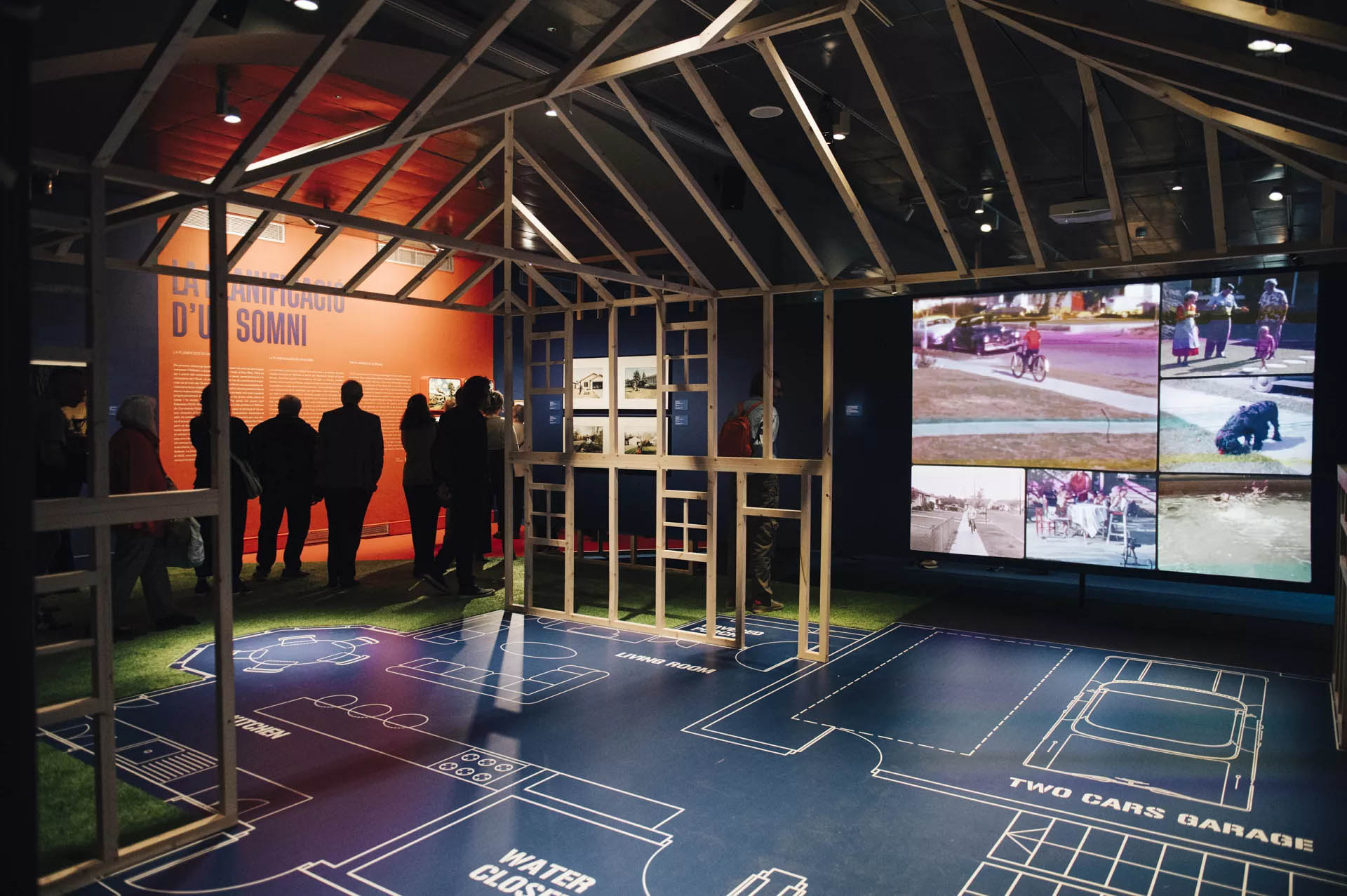
Femme (Epoque des “Demoiselles d’Avignon”) (Woman (‘Demoiselles d’Avignon’ Period))
1907
Oil on canvas
119 x 93.5cm
Fondation Beyeler, Riehen / Basel
© Succession Picasso / 2018 ProLitteris, Zurich Photo: Robert Bayer, Basel


Room 9

Femme, from 1907, also originated in the context of Picasso’s seminal picture Les Demoiselles d’Avignon and is the earliest work in the extensive Picasso collection assembled by Ernst and Hildy Beyeler. The sketch-like painting shows a naked female figure with raised arms, depicted in a pose that remains ambivalent. Wearing the cap of a sailor or ship’s captain (perhaps her hair is also set in a chignon), she is presented next to a yellow curtain drawn to the side and in front of a blue and green background. The face, whose features recall those of African masks, clearly reveals the great influence that non-European sculpture had on Picasso in this phase of his career. Whereas the figure’s face, arms and breasts are fully painted and bordered with clear contours, the lower body is sketched with just a few lines. In Femme Picasso seems to be deliberately playing with an aesthetic of incompletion – yet in light of its expressive power and manner of composition, the work is unquestionably finished.


Anonymous photographer. 'Pablo Picasso on Place Ravignan, Montmartre, Paris' 1904


Anonymous photographer
Pablo Picasso on Place Ravignan, Montmartre, Paris
1904
Silver gelatin print on paper
12 x 8.9cm
Musée national Picasso-Paris


Fondation Beyeler
Beyeler Museum AG
Baselstrasse 77, CH-4125
Riehen, Switzerland

Opening hours:
10am – 6pm daily, Wednesdays until 8pm

Fondation Beyeler website

LIKE ART BLART ON FACEBOOK

Back to top

Exhibition: ‘Black Mist Burnt Country’ at the National Museum of Australia, Canberra

Exhibition dates: 24th August – 18th November, 2018

Curator: JD Mittmann

Aboriginal and Torres Strait Islander viewers are advised that the following post may contain images and voices of people who have died.


Rosemary Laing (Australian, 1959-2024) 'One Dozen Considerations - Emu Totem I' 2013 from the exhibition 'Black Mist Burnt Country' at the National Museum of Australia, Canberra, August - November, 2018


Rosemary Laing (Australian, 1959-2024)
One Dozen Considerations – Emu Totem I
2013
C type photograph
49 x 76cm
© Rosemary Laing


The empty yet altered landscape takes on different moods with Rosemary Laing’s, One Dozen Considerations Totem 1 – Emu (2013) monument marking the site of an weapon’s test with a British flag flying behind it. Both look like conqueror’s claims to territory, powerful images of the attempts to colonise Indigenous space, to write a colonial history through markers of significance, to write out the Indigenous voice but at the same time to appropriate Indigenous ideas and language.

Larissa Behrendt. “Black Mist Burnt Country,” on the Artlink website 12 October 2016 [Online] Cited 07/11/2018


Field of thunder ~ big devil spirit ~ colonial fireworks

a/atom

late 15th century: from Old French atome, via Latin from Greek atomos ‘indivisible’, based on a- ‘not’ + temnein ‘to cut’.

a/secret

something that is not properly understood; a mystery

a/secretion

from French sécrétion or Latin secretio(n- ) ‘separation’, from secret- ‘moved apart’, from the verb secernere

a/desecration

late 17th century: from de- (expressing reversal) + a shortened form of consecrate

a/segregation

the enforced separation of different racial groups in a country, community, or establishment


Lest we forget what was bequeathed the land, Traditional Owners and servicemen by the British and Australian governments. Death, disease, displacement from Country and radioactivity so they can never return. Literally sickening.

Shame, shame and more shame.

Dr Marcus Bunyan


Many thankx to the National Museum of Australia for allowing me to publish the art work in the posting. Please click on the photographs for a larger version of the image.


There was also a lot of tearing down of Aboriginal sites according to what I’ve heard and just sort of this blinkered vision, and I think it’s a horrible education to learn that’s the way Aboriginal in those areas were perceived… and then you look at the ramifications of the health of both the people and the land and how that has been totally compromised…

Whether it came to treatment of Aboriginal people or whether it came to treatment of the environment. Hopefully [the exhibition will] engender something that people will fight, fight for their rights and fight for their land.


Waanyi artist Judy Watson


Jessie Boylan (Australian, b. 1986) 'Yami Lester at Walatinna Station, South Australia' 2006 from the exhibition 'Black Mist Burnt Country' at the National Museum of Australia, Canberra, August - November, 2018


Jessie Boylan (Australian, b. 1986)
Yami Lester at Walatinna Station, South Australia
2006
Digital inkjet print
85 x 85cm
© Jessie Boylan


Yami Lester, Walatinna Station, South Australia, 2006 – In 1953, Yami, a Yankunytjatjara man, was ten years old, living at Wallatinna Station when Totem One went off, it was part of a series of atmospheric atomic bombs that the British and Australian governments were testing during the 50’s and 60’s at Emu Field and Maralinga in South Australia and the Monte Bello Islands off the West Australian coast. He was blinded not long after the fallout.

Jessie Boylan


Yami Lester (Boylan)
Yunkunytjatjara man Yami Lester talks about the mysterious poisonous ‘black mist’ that badly affected Aboriginal area after the Totem 1 atomic test in 1952


At Maralinga, the tests caused adverse effects on both the local people and military personnel, but in many cases it was difficult to determine the extent to which people had been affected. But for Yankunytjatjara Elder Tjamu Yami Lester it was devastating. He was blinded at 10 years old as a result of the ‘black mist’ that descended onto his country.

He died last year at the age of 75.

Much of his life was spent fighting for people affected by nuclear testing, subsequently becoming the public face of a tireless campaign. He led the push for the 1984 Royal Commission into British Nuclear Tests in Australia, which resulted in a clean-up of the testing ground and compensation for the Anangu people. While reparations can never repair the damage inflicted upon Yami Lester, his people and country, his remarkable legacy lives on.

Extract from Nakari Thorpe. “Art beneath the ‘black mist’ of Maralinga,” on the NITV website 27 September 2018 [Online] Cited 07/11/2018


Blak Douglas (Australian, b. 1970) 'Tjarutja Tragedy' 2016


Blak Douglas (Australian, b. 1970)
Tjarutja Tragedy
2016
Tragedy
Synthetic polymer on canvas
100 x 200cm
© Blak Douglas


The burnt, barren trees in Blak Douglas’s Tjarutja Tragedy are bent, leaning to one side with their branches split in two representing the letter Y.

“That’s because I’m asking why did this happened to us people?”

The Dunghutti artist’s work captures a land destroyed by atomic testing in Australia and speaks to the deep displacement of its Traditional Owners.

“I wanted to create a piece that really encapsulated the return of blackfellas to their country when your country has been blasted. It’s metaphoric for a lot of blackfellas… [And] effectively it’s a metaphor for the continent en masse, and how much of us can’t return to our tribal homelands including myself.”

“Whole peoples were dispossessed from their country and this was done complicity on behalf of the British government and the Australian people really had no say in it.” …

Blak Douglas says his own work was inspired by Mr Lester’s spirited crusade [see above].

“I remember seeing images of him and I googled Maralinga on YouTube a long time ago and I saw Uncle Yami as he was blinded as result of the atomic tests,” he said.

“I’ve dedicated this painting to that mob and I’m proud of that and I’m sure that Uncle Yami, or that mob there when I meet them in due time, will be embracing of it.”

He says Maralinga was one of the “worst atrocities any blackfella has suffered.”

“To blow bombs like that on country and to name them gammin white names or code names that’s just the epitome of colonial fireworks,” he says.

Extract from Nakari Thorpe. “Art beneath the ‘black mist’ of Maralinga,” on the NITV website 27 September 2018 [Online] Cited 07/11/2018


Blak Douglas
Sydney-based artist Blak Douglas talks about his painting ‘Tjarutja Tragedy’ which is part of the exhibition Black Mist Burnt Country


Paul Ogier (New Zealand, b. 1974) 'One Tree (former emu field atom test site)' 2010


Paul Ogier (New Zealand, b. 1974)
One Tree (former emu field atom test site)
2010
Carbon pigment on rag paper
94 x 117cm
© Paul Ogier


An award-winning national touring exhibition of artworks by over 30 Indigenous and non-Indigenous artists, commemorating the British atomic tests in Australia in the 1950s, opens today at the National Museum of Australia in Canberra.

Black Mist Burnt Country features artworks from the past seven decades, selected from public and private collections, including works by Sidney Nolan, Arthur Boyd, Pam Debenham, Toni Robertson, Rosemary Laing, Jonathan Kumintjarra Brown, Judy Watson, Hilda Moodoo and Yvonne Edwards.

Developed by the Burrinja Dandenong Ranges Cultural Centre, Black Mist Burnt Country revisits the history of the British atomic test program at Maralinga, Emu Field and Montebello Islands and examines the impact on people and land, as well as its on-going legacies.

It presents works across the mediums of painting, printmaking, sculpture, photography, new media and music, while exploring the varied perspectives and creative approaches of artists from post-Second World War modernists to contemporary artists.

A variety of interactive elements enable visitors to gain insights into the social, political and environmental dimensions, while placing the Australian atomic tests in the context of the nuclear arms race and its present-day realities.

Margo Neale, Head of the National Museum’s Indigenous Knowledge Centre and Advisor to the Director, said, ‘This potent exhibition by a cast of great artists broaches a number of thresholds in the telling of Australian history through art, and the role of museums in bringing these relatively little-known stories to life. These visual stories penetrate the heart while revealing little-known truths of human consequence about a tragic event in our shared history.’

Burrinja exhibition curator JD Mittmann said, ‘It is surprising how few people are aware that atomic bombs were exploded in Australia, and how little they know about the dislocation of Aboriginal people, the exposure of Australian servicemen and the contamination of the land. This exhibition offers some remarkable insights into a chapter of our history that has long-lasting consequences, while it poses some important questions in relation to contemporary nuclear issues’.

The project has been produced by Burrinja Dandenong Ranges Cultural Centre, Upwey, Victoria and has been on tour nationally since September 2016, when it marked the 60th anniversary of the first British test at Maralinga. The project has been assisted by the Australian Government’s Visions of Australia program and developed through the Exhibition Development Fund of National Exhibition Touring Support (NETS) Victoria. The project has also received financial assistance from the Gordon Darling Foundation.

Black Mist Burnt Country received the 2017 Museums Australia Victoria Archival Survival Award (Small Museums) and a Highly Commended at the Museums Australia National Conference (Touring and Temporary Exhibitions).

Press release from the National Museum of Australia


Karen Standke (German, b. 1973) 'Road to Maralinga II' 2007


Karen Standke (German, b. 1973)
Road to Maralinga II
2007
Oil on canvas
112 x 85cm
© Karen Standke


Kate Shaw (Australian, b. 1969) 'Charcoal, UK: Maralinga' 2012


Kate Shaw (Australian, b. 1969)
Charcoal, UK: Maralinga
2012
Acrylic and resin on board
120 x 240cm
© Kate Shaw


Adam Norton (English, b. 1964) 'Prohibited Area' 2010


Adam Norton (English, b. 1964)
Prohibited Area
2010
Acrylic paint on board, wooden poles and bolts
240 x 122x 7cm
© Adam Norton


Adam Norton
Sydney-based artist Adam Norton talks about his work Prohibited Area, which is part of a series of reproduced signs he encountered in “nuclear badlands”.


'Maralinga Prohibited Area sign on Emu/Nawa Road' 1974


Maralinga Prohibited Area sign on Emu/Nawa Road
1974
National Archives of Australia NAA: A6457, P042


British nuclear tests at Maralinga

Historical context

On 3 October 1952, the United Kingdom tested its first nuclear weapon, named “Hurricane”, at the Monte Bello Islands off the coast of Western Australia. A year later the first nuclear test on the Australian mainland was Totem 1 (9.1 kilotonnes of TNT (38 TJ)) at Emu Field in the Great Victoria Desert, South Australia, on 15 October 1953. Totem 2 (7.1 kilotonnes of TNT (30 TJ)) followed two weeks later on 27 October. The Supply Minister, Howard Beale, stated in 1955 that “England has the know how; we have the open spaces, much technical skill and a great willingness to help the Motherland. Between us we should help to build the defences of the free world, and make historic advances in harnessing the forces of nature.”

The British government formally requested a permanent test facility on 30 October 1953. Due to concerns about nuclear fallout from the previous tests at Emu Field and the site’s inadequate infrastructure and water supply, the recently surveyed Maralinga site was selected for this purpose. The new site was announced in May 1955. It was developed as a joint, co-funded facility between the British and Australian governments.

Prior to selection, the Maralinga site was inhabited by the Pitjantjatjara and Yankunytjatjara Aboriginal people, for whom it had a great spiritual significance. Many were relocated to a new settlement at Yalata, and attempts were made to curtail access to the Maralinga site. These were often unsuccessful. (My emphasis) …

A Department of Veterans’ Affairs study concluded that “Overall, the doses received by Australian participants were small. … Only 2% of participants received more than the current Australian annual dose limit for occupationally exposed persons (20 mSv).” However, such findings are contested. Australian servicemen were ordered to: repeatedly fly through the mushroom clouds from atomic explosions, without protection; and to march into ground zero immediately after bomb detonation. Airborne drifts of radioactive material resulted in “radioactive rain” being dropped on Brisbane and Queensland country areas. A 1999 study for the British Nuclear Test Veterans Association found that 30 per cent of involved veterans had died, mostly in their fifties, from cancers.

Successive Australian governments failed to compensate servicemen who contracted cancers following exposure to radiation at Maralinga. However, after a British decision in 1988 to compensate its own servicemen, the Australian Government negotiated compensation for several Australian servicemen suffering from two specific conditions, leukaemia (except lymphatic leukaemia) and the rare blood disorder multiple myeloma.

One author suggests that the resettlement and denial of aboriginal access to their homelands “contributed significantly to the social disintegration which characterises the community to this day. Petrol sniffing, juvenile crime, alcoholism and chronic friction between residents and the South Australian police have become facts of life.” In 1994, the Australian Government reached a compensation settlement with Maralinga Tjarutja, which resulted in the payment of $13.5 million in settlement of all claims in relation to the nuclear testing. (My emphasis)

Media coverage

According to Liz Tynan from James Cook University, the Maralinga tests were a striking example of what can happen when the popular media are unable to report on activities that the government may be trying to hide. Maralinga was an example of extreme secrecy, but by the late 1970s there was a marked change in how the Australian media covered the British nuclear tests. Some resourceful investigative journalists emerged, whistle-blowers such as Avon Hudson [see photograph below] spoke out and political scrutiny became more intense. The investigative journalist Brian Toohey ran a series of stories in the Australian Financial Review in October 1978, based in part on a leaked Cabinet submission.

In June 1993, New Scientist journalist Ian Anderson wrote an article entitled “Britain’s dirty deeds at Maralinga” and several related articles. They are a detailed analysis of the legacy of Vixen B and the Australian government’s prolonged negotiations with the United Kingdom on cleaning up Maralinga and sharing the cost of “safe-sealing” waste plutonium. Previously, much of this highly toxic nuclear waste had simply been lightly bulldozed into the soil rather than buried in deep, secure, purpose-built, concrete bunkers. In 1993, Anderson won two Michael Daley Awards for his Maralinga articles.

Maralinga: Australia’s Nuclear Waste Cover-up is a book by Alan Parkinson about the clean-up following the British nuclear tests at Maralinga, published in 2007. Parkinson, a nuclear engineer, explains that the clean-up of Maralinga in the late 1990s was compromised by cost-cutting and simply involved dumping hazardous radioactive debris in shallow holes in the ground. Parkinson states that “What was done at Maralinga was a cheap and nasty solution that wouldn’t be adopted on white-fellas land.”

Text from the Wikipedia website


Australian Atomic Confessions

Sacrificial Lambs on the High Alter of Science

Australian servicemen and nomadic Aboriginals reveal the devastating effects of atomic weapons testing carried out in Australia by the British during the 1950s. For the first time, members of the Royal Australian Army, Air Force and Navy describe former top secret aspects of those tests. With the use of rare archival film and photographs, as well as eye witness accounts, Australian Atomic Confessions chronicles the hidden history and exposes previously hidden Government cover-ups. The consequences of nuclear testing imposed on the Australian people and land are not just skeletons of the past. Sydney’s new nuclear reactor continues to pose a threat to the environment and civilians, and the problem of removing and disposing of the old nuclear reactor remains an unanswered question. Prominent Aboriginal Elders also warn that an imminent catastrophe may occur in Central Australia as a result of two uranium mines. Australian Atomic Confessions is a chilling expose of nuclear testing and its damaging legacy, one that continues to this day.


Jessie Boylan (Australian, b. 1986) 'Portrait of a whistleblower: Avon Hudson was a leading aircraftman for the RAAF during the nuclear tests in Maralinga' 2011-2015


Jessie Boylan (Australian, b. 1986)
Portrait of a whistleblower: Avon Hudson was a leading aircraftman for the RAAF during the nuclear tests in Maralinga
2011-2015
Image: Burrinja Cultural Centre


This series chronicles Avon Hudson’s life, from early years growing up in regional South Australia, to service in the Royal Australian Air Force as a Leading Aircraftman, through the experience of British atomic bomb tests, to his “whistle blower” act of revealing Maralinga’s deadly legacy.

What Avon knew, and was prepared to tell publically about Maralinga, contributed to the establishment of the Royal Commission into British Nuclear Tests in Australia (1984-1985). His motivation was to put a halt to government plans to return Maralinga to its traditional owners, pending a full clean-up of land still contaminated by radioactive debris.

The story of nuclear testing is unknown to most Australians. Between 1952 and 1963, after a decision made by Prime Minister Menzies alone, nine atomic bombs were exploded and hundreds of ‘minor’ experiments were conducted at the British-run testing ranges at Emu and Maralinga in South Australia. Three bombs were also exploded at Monte Bello Islands in Western Australia.

The impacts of these experiments continue to play out in the ill health and changed lives of both Aboriginal and non-Aboriginal communities, who were exposed to or involved in the tests, over multiple generations. The tests have also left a deep-future legacy of environmental contamination.

It is a portrait of someone with a photographic memory, capable of grasping and articulating every detail of the atomic age as he experienced it.

It depicts a committed citizen and serviceman, husband and father, always an advocate and an activist, who in civilian life became a Wakefield councillor for over 20 years. It shows a practical man – mechanic, wood-turner and furniture maker; and portrays a nature-enthusiast and an educator on environmental and social issues.

It is also a portrait of someone who has invariably lived by his convictions – as that’s what whistleblowers do. Since the 1970s, Avon has campaigned for recognition of nuclear veterans and civilian personnel. As his co-authored book “Beyond Belief” records, “His life has been deeply affected by a sense of injustice and by the callousness of successive Australian and British governments ignoring the plight of those caught up in ‘the grand game’.”

This series is a recognition and celebration of the significant role Avon has played South Australia’s unfolding atomic history. His life as an activist seems to belong to the present, as the future of nuclear science and technology is considered anew.

Text from the Jessie Boylan website (with permission)


Boylan is a photomedia artist who explores issues relating to human impacts on the land and communities in relation to environmental and social devastation – nuclear testing, mining and war. Through her work Boylan’s has expressed ideas of history and place in relation to contemporary Australian identity, community and activism. She recently completed her MFA on the topic of photography, the campsite and the anti-nuclear movement in Australia.

Jessie Boylan is a key member of the Atomic Photographers Guild, an international group who aim to render visible all aspects of the nuclear age. She won first place in Images of Justice at Adelaide University 2015 and has been a finalist for the Josephine Ulrick and Win Schubert Photography Award in 2007, 2009 & 2012, the Spirit of Youth Award in 2009, the Head On Alternative Portrait Awards, ACP, Sydney in 2009 & 2010.

Text from the Black Mist Burnt Country website


Craig McDonald (Australian) 'Maralinga Test Dummy' 2010


Craig McDonald (Australian)
Maralinga Test Dummy
2010
Bronze sculpture
Photograph: Julie Millowick/Craig McDonald


Hugh Ramage (New Zealand, b. 1958, emigrated to Sydney in 1978) 'Taranaki' 2014


Hugh Ramage (New Zealand, b. 1958, emigrated to Sydney in 1978)
Taranaki
2014
Oil on canvas
42 x 37cm
© Hugh Ramage


Taranaki test site-and cleanup-area


Taranaki test site-and cleanup-area
(image source: Google Earth)


Jonathan Kumintjarra Brown

Pitjantjatjara artist Jonathan Kumintjarra Brown talks about his country and the effects the atomic tests had on it.

Jonathan Brown was removed from his parents at Ooldea and grew up with foster parents in Melbourne and Sydney. At a later stage of his life he located his parents at Yalata and learnt about the atomic tests, the removal of his people from their traditional lands and the destruction of country. Jonathan first came to recognition as artist when he worked with Lin Onus for the 1990 exhibition Balance at the Queensland Art Gallery. His later paintings were heavily influenced by the experiences of the Pitjantjatjara / Anangu which became the focus of his work.

Text from the Black Mist Burnt Country website


Jonathan Kumintjarra Brown (Australian, 1960-1997) 'Maralinga before the Atomic Test' 1994


Jonathan Kumintjarra Brown (Australian, 1960-1997)
Maralinga before the Atomic Test
1994
Ochres, sand and kapok on linen
227 x 205cm
Yarra Ranges McLeod Gift Collection


Much of the exhibition centres on the story of artist Jonathan Kumintjara Brown who was removed from his family at Ooldea Mission, located on the transcontinental railway near Watson about 250 kilometres west of Ceduna.

Three of his works feature in the exhibition, and grainy textures bring his pieces to life. One in particular, Black Rain, powerfully illustrates the destruction of country through a black sky punctured by white thick stripes of rain and cloud.

“He did it with such a great sense of power and visual impact,” says Burrinja Executive Director Ross Farnell.

“He would depict the landscape and then basically throw a whole heap of ochre, sand and glue over the top of it and then just obliterate most of the painting and then go that’s Maralinga after the test, ‘that’s what happened to my country’,” Mr Farnell told NITV News.

Extract from Nakari Thorpe. “Art beneath the ‘black mist’ of Maralinga,” on the NITV website 27 September 2018 [Online] Cited 07/11/2018


Jonathan’s story

One of the central stories of Black Mist Burnt Country is the story of artist Jonathan Kumintjarra Brown. Jonathan was removed from his parents at Ooldea mission station at very early age and grew up with in a foster family in Melbourne and Sydney. At a later stage of his life he located his parents at Yalata and went back to be reunited with them.

The return to his people was traumatic. Neither could he speak Pitjantjatjara, nor did he know he had a brother. He learned about the removal of his people from their country and the destruction of country through atomic testing.

Fabian Peel, who worked as a nurse in the community at the time and is now director of Tullawon Health Clinic in Yalata, took Jonathan around the country. He remembers: “It was very painful. Jonathan cried all the way.”

Jonathan went on to make several paintings depicting the impacts of the nuclear testing program on Anangu and the land, some of which will be included in the exhibition.

Text from the Black Mist Burnt Country website


Jonathan Kumintjarra Brown (Australian, 1960-1997) 'Maralinga' 1992


Jonathan Kumintjarra Brown (Australian, 1960-1997)
Maralinga
1992
Acrylic, sand and lizard skeleton on linen
Ebes Collection
© the artist estate
Photograph: Jonathan Kumintjarra Brown


Jonathan Kumintjarra Brown (Australian, 1960-1997) 'Maralinga' 1992 'Maralinga' 1992 (detail)


Jonathan Kumintjarra Brown (Australian, 1960-1997)
Maralinga (detail)
1992
Acrylic, sand and lizard skeleton on linen
Ebes Collection
© the artist estate


Jonathan Kumintjarra Brown (Australian, 1960-1997) 'Maralinga Atomic Test Dust Storm and Old Sites Significance' 1996


Jonathan Kumintjarra Brown (Australian, 1960-1997)
Maralinga Atomic Test Dust Storm and Old Sites Significance
1996
Synthetic polymer paint, natural ochres and sand on canvas
122 x 92cm
© the artist estate


Jonathan Kumintjarra Brown (Australian, 1960-1997) 'Frogmen' 1996


Jonathan Kumintjarra Brown (Australian, 1960-1997)
Frogmen
1996
Synthetic polymer paint, natural ochre and sand on canvas
122 x 92cm
© the artist estate


Kate Downhill (English, b. 1955, emigrated to Australia 2009) 'Operation Hurricane' 2013


Kate Downhill (English, b. 1955, emigrated to Australia 2009)
Operation Hurricane
2013
Acrylic on dress fabric laid on canvas
101 x 76cm
© Kate Downhill


Kate studied graphic design at Newcastle-upon-Tyne College of Art and worked in London during the 1970s as an illustrator and layout artist in various publishing houses. In the 1980s she studied painting at Exeter College of Art, graduating with a BA in Fine Art and Literature and concentrated on her purely abstract paintings in the tradition of the St. Ives School of painters with whom she trained. In the mid 1990s her working style changed dramatically and abstraction became a background element in new works where a variety of figurative styles and painting techniques were used within the same image. Since then she has worked to combine both painterly and graphic imagery to narrative effect. A life-long interest in textiles, quilting and the language of stitching is also evident in her work.

Since emigrating to Australia Kate has been concentrating on a series of paintings whose theme is the fragmentary and personal nature of memory and the process of memorialisation, as with the paintings she presents in this exhibition. Here she is using the naive imagery of rural community quilting to bring together varied scraps of information and family anecdotes about the British Australian nuclear tests. Kate’s father was a seismologist for the Atomic Weapons Research Institute and he was closely involved in the development and testing of the H Bomb during the 1950s. Her work here is a deeply personal response to historical events.

Text from the Black Mist Burnt Country website


Kate Downhill
Kate Downhill talks about her father’s involvement in the British atomic test program as a seismologist and explains her painting’s reference to quilting.


Tjariya Stanley (Pitjantjatara/Australian, 1939-2020) 'Puyu - Black Mist' 2015


Tjariya Stanley (Pitjantjatara/Australian, 1939-2020)
Puyu – Black Mist
2015
Acrylic on canvas
© Margo Birnberg and the artist


Tjariya Stanley was a Pitjantjatara woman, born in Wingellina (Irrunytju) in 1939. Until recently, she went by her birth name Nungalka, but changed to Tjariya following a death in the community. She lived and worked in Ernabella and had two daughters, one of whom (Renata) is also a senior artist at Ernabella. Tjariya has been involved in the art centre for a long time and mastered several different media.

Initially she assisted in making floor rugs, painting moccasins and knitting jumpers, the first enterprise undertaken by the Ernabella craft room. In the 1970’s she learnt batik from Daisy Baker following her visit to Indonesia, and developed into one of Ernabella’s most accomplished batik artists. She also taught herself weaving with grass and raffia (tjanpi) and crocheting mukata (beanies) with the sheep wool that she still hand spun. Stanley also developed as a painter and ceramic designer, and used these mediums to tell tjukurpa (creation stories) of her country and family, or used designs of the landscape such as tjukula (rockholes) and flowers.

Tjariya was a stalwart of the community and the heart of the art centre. Her traditional knowledge was strong and deep and she was also a ngankari (traditional healer). She was an excellent story teller, and delighted in telling stories of when she was a young girl growing up in Ernabella mission. Her grandson Ngunytjima is also an accomplished potter. Tjariya’s works are in a number of public collections including the Queen Victoria Museum & Art Gallery of Tasmania, the National Museum of Australia, the National Museum of Scotland, the National Gallery of Australia and Artbank.

Anonymous text from the Every When Art website


Hilda Moodoo (Australian, b. 1952) and Jeffrey Quema (Pitjantjatjara/Australian, 1947-2009) 'Destruction II' 2002


Hilda Moodoo (Australian, b. 1952) and Jeffrey Quema (Pitjantjatjara/Australian, 1947-2009)
Destruction II
2002
Synthetic polymer paint on canvas
101 x 122cm
Santos Fund for Aboriginal Art 2002, Art Gallery of South Australia, Adelaide
Courtesy of the artists


Hilda Moodoo painting began at Oak Valley in December 2001 when Victorian Yorta Yorta artist Lance Atkinson spent two months in the community teaching the technical skills for painting on canvas. Hilda Moodoo and Kunmanara Queama’s collaborative paintings Destruction I and II were included in the resulting Desert Oaks exhibition at the Adelaide Festival Centre in March 2002 and are now in the collection of the Art Gallery of South Australia. The Desert Oaks project was a deliberate expression of identity and an opportunity to pass on knowledge through painting.

Text from the Black Mist Burnt Country website


Queama, a Pitjantjatjara man, was born at Ooldea, on the eastern edge of the Nullabor Plain. With the dispersal of residents after the closure of the United Aborigines Mission (UAM) at Ooldea in 1952, he was sent to the Lutheran mission school at Koonibba, near Ceduna. He worked for many years on land conservation and management boards, and lobbied tirelessly for the return of the Maralinga-Tjarutja lands to the traditional owners. In 1984 the lands were been returned, and he and his wife Hilda Moodoo among others founded Oak Valley community, 150 kilometres northwest of Maralinga.

Text from the Black Mist Burnt Country website


Arthur Boyd (Australian, 1920-1999) 'Jonah on the Shoalhaven Outside the City' 1976


Arthur Boyd (Australian, 1920-1999)
Jonah on the Shoalhaven Outside the City
1976
Oil on canvas
Bundanon Trust Collection
© Bundanon Trust


In Arthur Boyd’s Jonah on the Shoalhaven – Outside the City (1976), the iconic cloud sits on the horizon, almost like a puff of dust rising off the white sand. Boyd had been conscripted into the army and became a pacifist. For him, the threat of nuclear destruction sits in the backdrop, no less menacing than Nolan’s apocalyptic response two decades earlier.

Larissa Behrendt. “Black Mist Burnt Country,” on the Artlink website 12 October 2016 [Online] Cited 07/11/2018


Sidney Nolan (Australian, 1917-1992) 'Central Desert Atomic Test' 1952-1957


Sidney Nolan (Australian, 1917-1992)
Central Desert Atomic Test
1952-1957
Oil on canvas


Nolan’s landscape sits harsh and red under a blue sky and the mushroom cloud of the bomb. Nolan was living in London at the time but news of the tests started appearing in the media. The cloud and dust were added to one of Nolan’s desert paintings as an act of protest over the events taken place back in Australia and the addition turns a rugged landscape into an image that seethes with anger at the act of destruction. In Nolan’s landscape, the bomb looms large.

Larissa Behrendt. “Black Mist Burnt Country,” on the Artlink website 12 October 2016 [Online] Cited 07/11/2018


Toni Robertson (Australian, b. 1953) 'The Royal Nuclear Show - 6' 1981


Toni Robertson (Australian, b. 1953)
The Royal Nuclear Show – 6
1981
Screen print on paper (set of 6 screenprints)
Prints, screenprints, printed in colour inks, each from four hand-cut and three photo-stencils
Flinders University Art Museum Collection
Image courtesy of National Gallery of Australia, Canberra


Toni Robertson studied fine arts at the University of Sydney in the 1970s and was a founding member of the influential Earthworks Poster Collective (1971-1980) at the University’s Tin Sheds. Robertson’s work has appeared in many group exhibitions in the 1970s and 1980s, and along with Chips Mackinolty and others she is recognised as a leading figure in Australian political printmaking. Her work is held in many public collections, including the National Gallery of Australia, the Art Gallery of New South Wales, the National Gallery of Victoria, the Australian War Memorial, Artbank and the Museum of Contemporary Art, Sydney as well as tertiary, state library and union collections.

Text from the Black Mist Burnt Country website


Toni Robertson (Sydney, New South Wales, Australia, b. 1953) and Chips Mackinolty (Morwell, Victoria, Australia, b. 1954) 'Daddy, what did YOU do in the Nuclear War?' 1977


Toni Robertson and Chips Mackinolty
Toni Robertson
(Sydney, New South Wales, Australia, b. 1953)
Chips Mackinolty
(Morwell, Victoria, Australia, b. 1954)
Earthworks Poster Collective
(commenced 1971-1980 | poster design studio (organisation))
Tin Sheds Art Workshop
(commenced 1969 | print workshop (organisation))
Daddy, what did YOU do in the Nuclear War?
1977
Prints, posters, screenprint, printed in colour inks, from multiple stencils
Printed image: 73.4 h x 48.2 w cm
Sheet: 76.2 h x 50.7 w cm
National Gallery of Australia, Given in memory of Mitch Johnson 1988
© Toni Robertson


The political poster movement in Australia was at its height in the 1970s, supporting anti-war, anti-uranium, pro-land rights and pro-feminist causes. Members of the Earthworks Poster Collective, opposed to the egotism of individual artistic fame, worked from the Tin Sheds (University of Sydney Art Workshop). In Daddy what did you do in the nuclear war? Toni Robertson and Chips Mackinolty appropriated a British recruiting poster from the First World War, adapting the children’s bodies to reflect the genetic consequences of radiation.

Christine Dixon


Victorian-born artist Chips Mackinolty was involved in the campaigns against the war in Vietnam by producing protest posters. He was a key figure in the radical poster movement and was introduced to screen printing in Goulburn Street, Sydney. During the 1970s posters became an art form artists using the cheap posters as a political tool. The Earthworks Poster Collective, established in 1971, was the most active and well-known of these groups. Earthworks operated from the Sydney University Art Workshop, commonly known as the Tin Sheds, finally demolished in 2007. Mackinolty used sharp, flat colours and increasingly professional techniques to produce posters such as “For the man who said life wasn’t meant to be easy – make life impossible.” The poster is a multi-imaged send-up of former Australian Prime Minister Malcolm Fraser. It was posted up at night around Sydney, helping to politicise a generation. His work is held in major national and international institutions.

Text from the Black Mist Burnt Country website


Pam Debenham (Launceston, Tasmania, Australia, b. 1955) 'No nukes in the Pacific' 1984


Pam Debenham (Launceston, Tasmania, Australia, b. 1955)
Tin Sheds Posters (Sydney, New South Wales, Australia | commenced 1984 (organisation))
Tin Sheds Art Workshop (commenced 1969 | print workshop (organisation))
No nukes in the Pacific
1984
Prints, posters, screenprint, printed in colour inks, from multiple stencils
Printed image: 88.0 h x 62.0 w cm
Sheet: 91.0 h x 65.0 w cm
National Gallery of Australia, purchased 1990


Pam Debenham (Launceston, Tasmania, Australia, b. 1955) 'No Nukes No Tests' 1984


Pam Debenham (Launceston, Tasmania, Australia, b. 1955)
Tin Sheds Posters (Sydney, New South Wales, Australia | commenced 1984 (organisation))
Tin Sheds Art Workshop (commenced 1969 | print workshop (organisation))
No Nukes No Tests
1984
Screenprint on paper
© Pam Debenham
Image courtesy of the National Gallery of Australia, Canberra


Adam Norton (English, b. 1964) 'Prohibited Area' 2010


Adam Norton (English, b. 1964)
Prohibited Area
2010
Acrylic paint on board, wooden poles and bolts,
240 x 122x 7cm
© Adam Norton


National Museum of Australia
Lawson Crescent
Acton Peninsula, Canberra

Opening hours:
Daily 9am – 5pm

Black Mist Burnt Country website

National Museum of Australia website

LIKE ART BLACK ON FACEBOOK

Back to top

Exhibition: ‘In the Beginning: Minor White’s Oregon Photographs’ at the Portland Art Museum Phase 1, Part 2

Exhibition dates: 9th December, 2017 – 6th May, 2018

Curated by Julia Dolan PhD, the Minor White Curator of Photography


Over two postings, Phase 1 of this exhibition which features one of the greatest collections of early photographs by Minor White!

View Part 1 of the posting


Minor White (American, 1908-1976) 'Untitled (Dock)' c. 1939 from the exhibition 'In the Beginning: Minor White's Oregon Photographs' at the Portland Art Museum Phase 1, Dec 2017 - May 2018


Minor White (American, 1908-1976)
Untitled (Dock)
c. 1939
Gelatin silver print
Courtesy of the Fine Arts Program, Public Buildings Service, U.S. General Services Administration
Commissioned through the New Deal art projects
Public domain


Catching fire

It is a memorable experience to be able to observe a great artist experimenting with his craft, which is exactly what MW is doing in the photographs in these two postings. Here is an artist at the start of the path, honing his skills as a “creative photographer”: for these are creative, public photographs not expressive, private ones.

The photographs are a strange mix… part modernism, part romanticism, with a large dose of Pictorialism (dare I mention the word!) thrown in for good measure. I can see influences of the night work of Brassaï; the architectural photographs of Charles Sheeler; the photographs of Albert Renger-Patzsch and the German New Objectivity; the urban and urbane photographs of Walker Evans (The Customer, c. 1939 and Joseph, Oregon (Joseph Cemetery) c. 1940 below); the spatiality, surrealism and detail of Eugene Atget’s Paris photographs; and the landscape work of Ansel Adams. Overlay these influences with feelings of spirituality, sexuality and the atmosphere of place and you have a heady mix. And yet these photographs are purely his own.

What a time MW was having when he made these photographs. There were no limits to where he could point his camera.

As I talk to my friend and mentor Ian Lobb about photography, we have brave conversations about artists, vision, looking, previsualisation, representation, the print, and more generally life, words, spirit. He observed of this group of photographs:

“There were things that looked like photographs that other people had made.
There were things that were naively interesting to him for what they were.
There were things that allowed him to experiment with ideas of metaphor.
There was a combination of subject matter and light that enabled him to touch upon a world of symbol and ritual without him ever really being confident in that world (at this time).

There were also affirmations of how he could organise the world through his camera. He knew he was really accomplished with organising the edges of his image (particularly the right hand edge) and how this segued into the centre of his images where he hoped he could also organise subject matter – but he was not as skilled with this. He was still learning his craft.

He also knew that he could escape reality by changing scale, changing the lightness of his subject matter, changing the mood of his images with print colour (cold events printed warm) and then affirming the mood of his images with print colour. He knew there must be more with how he printed – was he beginning to understand that there his knowledge of printing chemistry could also be applied to film chemistry? Maybe there was an inkling of this but he was never extremely skilful with this. And he was not trying to expose and change film development techniques according to the subject matter – but there were emerging confused questions about this that would be exceptionally refined later.

I don’t think he applied labels like modernist or romantic to himself – but he was burningly aware of his authorship – and it excited him to the bone. Sometimes he was aware that he was walking an edge between various worlds and this was starting to take a form where he was both teacher and student – he could sense it starting to appear in his images and this made him secretly full of delight.”

(Ian Lobb in conversation with Marcus Bunyan)


My friend has such a tremendous knowledge of the work of MW and of photography and life in general. I most appreciate the passing on of these observations to me. You really can feel that the artist is walking an edge between various worlds and that the photographs embody a critical shift in consciousness, from “truth in appearances” to a longing for transcendence. The work is full of symbolic and metaphorical allusions/illusions.

That MW’s photographs still offer these affirmations to the viewer nigh on 80 years later show’s the intensity of their visualisation. They are a gift from the cosmos to one human being and back to the cosmos (in the form of an ensō, or Zen circle), and should be accepted as such.

Dr Marcus Bunyan


Many thankx to the Portland Art Museum for allowing me to publish the photographs in the posting. Please click on the photographs for a larger version of the image.


Minor White (American, 1908-1976) 'Untitled (Propeller)' c. 1939 from the exhibition 'In the Beginning: Minor White's Oregon Photographs' at the Portland Art Museum Phase 1, Dec 2017 - May 2018


Minor White (American, 1908-1976)
Untitled (Propeller)
c. 1939
Gelatin silver print
Courtesy of the Fine Arts Program, Public Buildings Service, U.S. General Services Administration
Commissioned through the New Deal art projects
Public domain


“A banquet of frustration”: Minor White penned the phrase in 1939, after reading T. S. Eliot’s 1922 poem The Waste Land. “I perceived that if one could put out the energy to produce a banquet of frustration, then frustration had power,” White commented. “It was worth pursuing.”1

“The duplicity one senses in White’s career, in both his writing and his images, stems certainly from this frustration about sexuality (as Peter Bunnell has written, “White’s sexuality underlies the whole of the autobiographical statement contained in his work”), but it also mirrors a much larger counter tradition found within modernism itself, a romantic tradition that draws from Romanticism, Symbolism, Dada, and Surrealism. More specifically, White’s frustration coincides with the collapse of modernist ideals during the postwar era. This passage in the history of photography, if examined at all, is normally pinned to the arid vision of Robert Frank. Aesthetically, White’s vision was less dark than Frank’s, and in no sense nihilistic. Yet White’s work embodies a critical shift in consciousness, from the heroic modernist notion of “truth in appearances” toward the acknowledgment – and even the cultivation – of illusion, deception, and buried meanings. White’s banquet of frustration would look like a tea setting compared to the theoretical abattoirs of generations of later artists; nevertheless, the historical narrative of photographic modernism’s dissolution owes an early chapter to White and his longing for transcendence, which he seems not to have attained.”

Extracts from Kevin Moore. “Cruising and Transcendence in the Photographs of Minor White,” on the Aperture website [Online] Cited 27/04/2018

1/ Minor White. “Memorable Fancies,” 1932-1937 quoted in Peter C. Bunnell. Minor White: The Eye That Shapes. Princeton and Boston: The Art Museum, Princeton University; Bulfinch/Little Brown, 1989, p. 19.


Minor White (American, 1908-1976) 'Freight Depot' c. 1939


Minor White (American, 1908-1976)
Freight Depot
c. 1939
Gelatin silver print
Courtesy of the Fine Arts Program, Public Buildings Service, U.S. General Services Administration
Commissioned through the New Deal art projects
Public domain


Minor White (American, 1908-1976) 'Untitled (Girder)' c. 1939


Minor White (American, 1908-1976)
Untitled (Girder)
c. 1939
Gelatin silver print
Courtesy of the Fine Arts Program, Public Buildings Service, U.S. General Services Administration
Commissioned through the New Deal art projects
Public domain


Minor White (American, 1908-1976) 'Untitled (Portland Lumber Mills)' c. 1939


Minor White (American, 1908-1976)
Untitled (Portland Lumber Mills)
c. 1939
Gelatin silver print
Courtesy of the Fine Arts Program, Public Buildings Service, U.S. General Services Administration
Commissioned through the New Deal art projects
Public domain


Minor White (American, 1908-1976) 'Log Boom' c. 1940


Minor White (American, 1908-1976)
Log Boom
c. 1940
Gelatin silver print
Courtesy of the Fine Arts Program, Public Buildings Service, U.S. General Services Administration
Commissioned through the New Deal art projects
Public domain


Minor White (American, 1908-1976) 'Boats at Dock' c. 1939


Minor White (American, 1908-1976)
Boats at Dock
c. 1939
Gelatin silver print
Courtesy of the Fine Arts Program, Public Buildings Service, U.S. General Services Administration
Commissioned through the New Deal art projects
Public domain


Minor White (American, 1908-1976) 'East Side of Willamette' c. 1939


Minor White (American, 1908-1976)
East Side of Willamette
c. 1939
Gelatin silver print
Courtesy of the Fine Arts Program, Public Buildings Service, U.S. General Services Administration
Commissioned through the New Deal art projects
Public domain


Minor White (American, 1908-1976) 'Boards' c. 1939


Minor White (American, 1908-1976)
Boards
c. 1939
Gelatin silver print
Courtesy of the Fine Arts Program, Public Buildings Service, U.S. General Services Administration
Commissioned through the New Deal art projects
Public domain


Minor White (American, 1908-1976) 'Lily Pads and Pike' c. 1939


Minor White (American, 1908-1976)
Lily Pads and Pike
c. 1939
Gelatin silver print
Courtesy of the Fine Arts Program, Public Buildings Service, U.S. General Services Administration
Commissioned through the New Deal art projects
Public domain


Minor White (American, 1908-1976) 'The Patch' c. 1939


Minor White (American, 1908-1976)
The Patch
c. 1939
Gelatin silver print
Courtesy of the Fine Arts Program, Public Buildings Service, U.S. General Services Administration
Commissioned through the New Deal art projects
Public domain


Minor White (American, 1908-1976) 'Horsetail and Skunk Cabbage' 1940


Minor White (American, 1908-1976)
Horsetail and Skunk Cabbage
1940
Gelatin silver print
Courtesy of the Fine Arts Program, Public Buildings Service, U.S. General Services Administration
Commissioned through the New Deal art projects
Public domain


Minor White (American, 1908-1976) 'Tree Root' c. 1939


Minor White (American, 1908-1976)
Tree Root
c. 1939
Gelatin silver print
Courtesy of the Fine Arts Program, Public Buildings Service, U.S. General Services Administration
Commissioned through the New Deal art projects
Public domain


Minor White (American, 1908-1976) 'Detail (California Foundry)' c. 1939


Minor White (American, 1908-1976)
Detail (California Foundry)
c. 1939
Gelatin silver print
Courtesy of the Fine Arts Program, Public Buildings Service, U.S. General Services Administration
Commissioned through the New Deal art projects
Public domain


Minor White (American, 1908-1976) 'Detail (227 Southeast Front Street)' 1938


Minor White (American, 1908-1976)
Detail (227 Southeast Front Street)
1938
Gelatin silver print
Courtesy of the Fine Arts Program, Public Buildings Service, U.S. General Services Administration
Commissioned through the New Deal art projects
Public domain


Minor White (American, 1908-1976) 'Front and Burnside' c. 1939


Minor White (American, 1908-1976)
Front and Burnside
c. 1939
Gelatin silver print
Courtesy of the Fine Arts Program, Public Buildings Service, U.S. General Services Administration
Commissioned through the New Deal art projects
Public domain


Minor White (American, 1908-1976) 'Ladd and Tilton Bank (1868 Southwest First and Stark Streets)' c. 1939


Minor White (American, 1908-1976)
Ladd and Tilton Bank (1868 Southwest First and Stark Streets)
c. 1939
Gelatin silver print
Courtesy of the Fine Arts Program, Public Buildings Service, U.S. General Services Administration
Commissioned through the New Deal art projects
Public domain


Minor White (American, 1908-1976) 'Pioneer Post Office and Portland Hotel Gate' c. 1939


Minor White (American, 1908-1976)
Pioneer Post Office and Portland Hotel Gate
c. 1939
Gelatin silver print
Courtesy of the Fine Arts Program, Public Buildings Service, U.S. General Services Administration
Commissioned through the New Deal art projects
Public domain


Minor White (American, 1908-1976) 'Southwest Fourth and Salmon Streets, Courthouse' c. 1939


Minor White (American, 1908-1976)
Southwest Fourth and Salmon Streets, Courthouse
c. 1939
Gelatin silver print
Courtesy of the Fine Arts Program, Public Buildings Service, U.S. General Services Administration
Commissioned through the New Deal art projects
Public domain


Minor White (American, 1908-1976) 'Kamm Building (Southwest Pine near First Avenue)' c. 1939


Minor White (American, 1908-1976)
Kamm Building (Southwest Pine near First Avenue)
c. 1939
Gelatin silver print
Courtesy of the Fine Arts Program, Public Buildings Service, U.S. General Services Administration
Commissioned through the New Deal art projects
Public domain


Minor White (American, 1908-1976) 'Fifth at Yamhill (Public Service Building)' c. 1939


Minor White (American, 1908-1976)
Fifth at Yamhill (Public Service Building)
c. 1939
Gelatin silver print
Courtesy of the Fine Arts Program, Public Buildings Service, U.S. General Services Administration
Commissioned through the New Deal art projects
Public domain


Minor White (American, 1908-1976) 'New on Old (Southeast Corner, First and Burnside)' c. 1939


Minor White (American, 1908-1976)
New on Old (Southeast Corner, First and Burnside)
c. 1939
Gelatin silver print
Courtesy of the Fine Arts Program, Public Buildings Service, U.S. General Services Administration
Commissioned through the New Deal art projects
Public domain


Minor White (American, 1908-1976) 'The Iron Fronts' c. 1939


Minor White (American, 1908-1976)
The Iron Fronts
c. 1939
Gelatin silver print
Courtesy of the Fine Arts Program, Public Buildings Service, U.S. General Services Administration
Commissioned through the New Deal art projects
Public domain


Minor White (American, 1908-1976) 'Front Street' 1939


Minor White (American, 1908-1976)
Front Street
1939
Gelatin silver print
Courtesy of the Fine Arts Program, Public Buildings Service, U.S. General Services Administration
Commissioned through the New Deal art projects
Public domain


Minor White (American, 1908-1976) 'Arches of the Dodd Building (Southwest Front Avenue and Ankeny Street)' 1938


Minor White (American, 1908-1976)
Arches of the Dodd Building (Southwest Front Avenue and Ankeny Street)
1938
Gelatin silver print
Courtesy of the Fine Arts Program, Public Buildings Service, U.S. General Services Administration
Commissioned through the New Deal art projects
No known copyright restrictions


In 1939 White was living at the Portland YMCA, where he had organised a camera club and had built a darkroom and modest gallery for exhibiting pictures. White’s photographs from this period concentrate on the environs of Portland, particularly the area of the commercial waterfront, which was undergoing demolition for redevelopment. Hired by the Oregon Art Project, an arm of the Works Progress Administration (WPA), White trawled the city’s Front Avenue neighbourhood, documenting the nineteenth-century buildings with cast-iron façades that were about to be torn down. White’s photographs are anything but clinical. His street views, many taken at night, have a ghostlike quality, with the occasional lone figure haunting the wet pavement; boarded-up doorways are cast in deep shadow; and mercantile objects, heaped onto the sidewalk before emptied warehouses, take on a forlorn anthropological character.

Among these pictures is a group of five depicting a handsome young man leaning in a doorway on Front Avenue. He is dressed like a labourer in jeans, work shirt, and boots, but there is something of the dandy in the raffish positioning of the man’s newsie cap, the tight cut of his trousers, pulled high and cinched at the waist, and the studied nonchalance of his pose. In one image, his hand is shoved into a pocket, leaving the index finger exposed and pointing downward toward a prominent bulge. Most importantly, he gazes – not at the photographer but down the street – intently and expectantly, as if anticipating something that has not yet come into view. A second photograph shows the man from behind, revealing the nape of his neck, a pair of rounded buttocks, and white stains splashed down the right thigh of his trousers. The pose suggests that he is urinating in this abject doorway with its peeling paint and debris underfoot; he could be taken for a plasterer relieving himself during a break. Another image, taken in a different boarded-up doorway, shows the man leaning with one arm raised and smiling coyly (again, not at the photographer), with his thumbs slipped under his belt and his fingers cupped, calling attention once again to his bulge. An “Air Circus” poster behind him advertises “Tex Rankin and other famous flyers” as well as “stunts” and “thrills.”

The scene is both explicit and coded, even to contemporary eyes. This handsome loitering man might have been taken by certain passersby for an ordinary labourer, on break or looking for work. Others might have recognised him as a man looking for sex (or for another kind of work) with other men. White’s sexual interest in men and his approach to looking at things “for what else they are” stratify the two narratives, establishing layers of meaning on parallel planes. This man is both a labourer and a cruising homosexual. He is, then, just what the photographic image in general would come to signify for White: a common trace from the visible world, transformed into another set of charged meanings.

Extract from Kevin Moore. “Cruising and Transcendence in the Photographs of Minor White,” on the Aperture website [Online] Cited 27/04/2018


Minor White (American, 1908-1976) 'Doorway, Dodd Building' c. 1939


Minor White (American, 1908-1976)
Doorway, Dodd Building
c. 1939
Gelatin silver print
Courtesy of the Fine Arts Program, Public Buildings Service, U.S. General Services Administration
Commissioned through the New Deal art projects
Public domain


White’s earlier Portland series, by contrast, is the darker product of a romantic turn of mind and conveys not the affirmative, civic-minded Whitman of poems such as “A Broadway Pageant” but the melancholy, searching Whitman of the “Calamus” poems. In Portland, we see White engaging Front Avenue for its sense of mystery and possibility, an investigation among darkened doorways and in the silhouettes of passing strangers for moments of revelation. More than simply a celebration of the manifold aspects of the city, the desired charge might be specified as the possibility of an erotic connection, however ephemeral, as proposed by Whitman in “City of Orgies”:

City of orgies, walks and joys,
City whom that I have lived and sung in your midst will one
   day make you illustrious,
Not the pageants of you, not your shifting tableaus, your
   spectacles, repay me,
Not the interminable rows of your houses, nor the ships
   at the wharves,
Nor the processions in the streets, nor the bright windows
   with goods in them,
Nor to converse with learn’d persons, or bear my share in
   the soiree or feast;
Not those, but as I pass O Manhattan, your frequent and
   swift flash of eyes offering me love,
Offering response to my own – these repay me, 
Lovers, continual lovers, only repay me.

Extract from Kevin Moore. “Cruising and Transcendence in the Photographs of Minor White,” on the Aperture website [Online] Cited 27/04/2018


Minor White (American, 1908-1976) 'Pilaster and Hood Molding, Dodd Building (Southwest Front and Ankeny)' c. 1939


Minor White (American, 1908-1976)
Pilaster and Hood Molding, Dodd Building (Southwest Front and Ankeny)
c. 1939
Gelatin silver print
Courtesy of the Fine Arts Program, Public Buildings Service, U.S. General Services Administration
Commissioned through the New Deal art projects
Public domain


Minor White (American, 1908-1976) 'Door of Iron – First Brick Building in Portland, 1852 (Ladd and Tilton Building)' 1939


Minor White (American, 1908-1976)
Door of Iron – First Brick Building in Portland, 1852 (Ladd and Tilton Building)
1939
Gelatin silver print
Courtesy of the Fine Arts Program, Public Buildings Service, U.S. General Services Administration
Commissioned through the New Deal art projects
Public domain


Minor White (American, 1908-1976) 'China Town' c. 1939


Minor White (American, 1908-1976)
China Town
c. 1939
Gelatin silver print
Courtesy of the Fine Arts Program, Public Buildings Service, U.S. General Services Administration
Commissioned through the New Deal art projects
Public domain


Minor White (American, 1908-1976) 'Morrison Bridge – Winter' 1938


Minor White (American, 1908-1976)
Morrison Bridge – Winter
1938
Gelatin silver print
Courtesy of the Fine Arts Program, Public Buildings Service, U.S. General Services Administration
Commissioned through the New Deal art projects
Public domain


Minor White (American, 1908-1976) 'St. Johns Bridge' c. 1939


Minor White (American, 1908-1976)
St. Johns Bridge
c. 1939
Gelatin silver print
Courtesy of the Fine Arts Program, Public Buildings Service, U.S. General Services Administration
Commissioned through the New Deal art projects
Public domain


Minor White (American, 1908-1976) 'Catherine Creek' c. 1941


Minor White (American, 1908-1976)
Catherine Creek
c. 1941
Gelatin silver print
Courtesy of the Fine Arts Program, Public Buildings Service, U.S. General Services Administration
Commissioned through the New Deal art projects
Public domain


Minor White (American, 1908-1976) 'Joseph, Oregon (Joseph Cemetery)' c. 1940


Minor White (American, 1908-1976)
Joseph, Oregon (Joseph Cemetery)
c. 1940
Gelatin silver print
Courtesy of the Fine Arts Program, Public Buildings Service, U.S. General Services Administration
Commissioned through the New Deal art projects
Public domain


Minor White (American, 1908-1976) 'Hurricane Creek (Trees and Rock)' 1941


Minor White (American, 1908-1976)
Hurricane Creek (Trees and Rock)
1941
Gelatin silver print
Courtesy of the Fine Arts Program, Public Buildings Service, U.S. General Services Administration
Commissioned through the New Deal art projects
Public domain


Minor White (American, 1908-1976) 'Ice Lake' 1940


Minor White (American, 1908-1976)
Ice Lake
1940
Gelatin silver print
Courtesy of the Fine Arts Program, Public Buildings Service, U.S. General Services Administration
Commissioned through the New Deal art projects
Public domain


Minor White (American, 1908-1976) 'The Customer' c. 1939


Minor White (American, 1908-1976)
The Customer
c. 1939
Gelatin silver print
Courtesy of the Fine Arts Program, Public Buildings Service, U.S. General Services Administration
Commissioned through the New Deal art projects
Public domain


Minor White (American, 1908-1976) '1323-29 Southwest First Avenue' 1939


Minor White (American, 1908-1976)
1323-29 Southwest First Avenue
1939
Gelatin silver print
Courtesy of the Fine Arts Program, Public Buildings Service, U.S. General Services Administration
Commissioned through the New Deal art projects
Public domain


Minor White (American, 1908-1976) 'Untitled (Young Man)' c. 1939


Minor White (American, 1908-1976)
Untitled (Young Man)
c. 1939
Gelatin silver print
Courtesy of the Fine Arts Program, Public Buildings Service, U.S. General Services Administration
Commissioned through the New Deal art projects
Public domain


Minor White (American, 1908-1976) 'Shipmates Visit the Photographer' c. 1939


Minor White (American, 1908-1976)
Shipmates Visit the Photographer
c. 1939
Gelatin silver print
Courtesy of the Fine Arts Program, Public Buildings Service, U.S. General Services Administration
Commissioned through the New Deal art projects
Public domain


Minor White (American, 1908-1976) 'Untitled (Woman Sitting)' c. 1939


Minor White (American, 1908-1976)
Untitled (Woman Sitting)
c. 1939
Gelatin silver print
Courtesy of the Fine Arts Program, Public Buildings Service, U.S. General Services Administration
Commissioned through the New Deal art projects
Public domain


Minor White (American, 1908-1976) 'Untitled (Man Praying)' c. 1939


Minor White (American, 1908-1976)
Untitled (Man Praying)
c. 1939
Gelatin silver print
Courtesy of the Fine Arts Program, Public Buildings Service, U.S. General Services Administration
Commissioned through the New Deal art projects
Public domain


Portland Art Museum
1219 SW Park Avenue
Portland, OR 97205

Opening hours:
Thursday – Sun 10am – 6pm
Closed Monday, Tuesday and Wednesday

Portland Art Museum website

LIKE ART BLART ON FACEBOOK

Back to top

Exhibition: ‘In the Beginning: Minor White’s Oregon Photographs’ at the Portland Art Museum Phase 1, Part 1

Exhibition dates: 9th December, 2017 – 6th May, 2018

Curated by Julia Dolan PhD, the Minor White Curator of Photography


Minor White (American, 1908-1976) 'Untitled (Union Station Loading Platform)' c. 1939 from the exhibition 'In the Beginning: Minor White's Oregon Photographs' at the Portland Art Museum Phase 1, Dec 2017 - May 2018


Minor White (American, 1908-1976)
Untitled (Union Station Loading Platform)
c. 1939
Gelatin silver print
Courtesy of the Fine Arts Program, Public Buildings Service, U.S. General Services Administration
Commissioned through the New Deal art projects, public domain


Phase 1 of this exhibition, over two postings on Art Blart, features one of the greatest collections of early photographs by Minor White!

In this posting it’s so nice to see the great man metaphorically getting his hands dirty – feet in the water, hand cupped to the eye looking through it to gauge the composition (his previsualisation), before getting under the black cloth to make final adjustments to his 4 x 5 view camera.

Other things to note in the Minor White During a Workshop photographs of MW using his camera are this:

1/ MW has tilted forward the front of the camera to extend the depth of field that recedes away from him, for example the sand or the surface of the water

2/ MW has also raised the front of the camera slightly

3/ MW is using a large Majestic tripod

4/ MW is possibly using a Weston light meter, for which he gave specific instructions in the first edition of his Zone System manual. The light meter can be seen still in it’s leather case with hanging strap in various images, with MW’s thumb on the dial in two images. In one image you can see him calculating his light meter exposure

5/ His glasses case is in his top shirt pocket, and he is wearing a well used hat (so important when taking photographs) with sweat stains on its brim


In these valuable pictures, the 51 year-old Minor White is making tiny adjustments to the camera movements to control the depth of field.

Paul Caponigro, a student of Minor White, observed that watching MW use the view camera was more than instructive, it was a joy. The very last sentence in the Fourth Sequence colophon reinforces the notion that the camera’s strongest point was its photographic authenticity, that is, a faithful camera technique leads to an authentic photograph, or to authenticity.1

“For technical data – the camera was faithfully used.” ~ MW

Further comment on the photographs in Part 2 of the posting.

Dr Marcus Bunyan


1/ Andrew E. Hershberger. “White’s Theory of Sequential Photography,” in Anna-Teresa Tymieniecka (ed.,). Analecta Husserliana: The Yearbook of Phenomenological Research Vol. LXXXVII. Human Creation Between Reality and Illusion. Springer, 2005, p. 212.


Many thankx to the Portland Art Museum for allowing me to publish the photographs in the posting. Please click on the photographs for a larger version of the image.


Maxwell Allara (American born Italy, 1906-1981) 'Untitled (Minor White During a Workshop)' 1959 from the exhibition 'In the Beginning: Minor White's Oregon Photographs' at the Portland Art Museum Phase 1, Dec 2017 - May 2018


Maxwell Allara (American born Italy, 1906-1981)
Untitled (Minor White During a Workshop)
1959
Gelatin silver print
Gift of the artist by his family: Helen D. Allara, Morgan F. Allara, and Mitchell W. Allara
© Maxwell Allara


Maxwell Allara (American born Italy, 1906-1981) 'Untitled (Minor White During a Workshop)' 1959 from the exhibition 'In the Beginning: Minor White's Oregon Photographs' at the Portland Art Museum Phase 1, Dec 2017 - May 2018


Maxwell Allara (American born Italy, 1906-1981)
Untitled (Minor White During a Workshop)
1959
Gelatin silver print
Gift of the artist by his family: Helen D. Allara, Morgan F. Allara, and Mitchell W. Allara
© Maxwell Allara


Maxwell Allara (American born Italy, 1906-1981) 'Untitled (Minor White During a Workshop)' 1959


Maxwell Allara (American born Italy, 1906-1981)
Untitled (Minor White During a Workshop)
1959
Gelatin silver print
Gift of the artist by his family: Helen D. Allara, Morgan F. Allara, and Mitchell W. Allara
© Maxwell Allara


Maxwell Allara (American born Italy, 1906-1981) 'Untitled (Minor White During a Workshop)' 1959 from the exhibition 'In the Beginning: Minor White's Oregon Photographs' at the Portland Art Museum Phase 1, Dec 2017 - May 2018


Maxwell Allara (American born Italy, 1906-1981)
Untitled (Minor White During a Workshop)
1959
Gelatin silver print
Gift of the artist by his family: Helen D. Allara, Morgan F. Allara, and Mitchell W. Allara
© Maxwell Allara


Maxwell Allara (American born Italy, 1906-1981) 'Untitled (Minor White During a Workshop)' 1959 from the exhibition 'In the Beginning: Minor White's Oregon Photographs' at the Portland Art Museum Phase 1, Dec 2017 - May 2018


Maxwell Allara (American born Italy, 1906-1981)
Untitled (Minor White During a Workshop)
1959
Gelatin silver print
Gift of the artist by his family: Helen D. Allara, Morgan F. Allara, and Mitchell W. Allara
© Maxwell Allara


Maxwell Allara (American born Italy, 1906-1981) 'Untitled (Minor White During a Workshop)' 1959 from the exhibition 'In the Beginning: Minor White's Oregon Photographs' at the Portland Art Museum Phase 1, Dec 2017 - May 2018


Maxwell Allara (American born Italy, 1906-1981)
Untitled (Minor White During a Workshop)
1959
Gelatin silver print
Gift of the artist by his family: Helen D. Allara, Morgan F. Allara, and Mitchell W. Allara
© Maxwell Allara


Maxwell Allara (American born Italy, 1906-1981) 'Untitled (Minor White During a Workshop)' 1959 from the exhibition 'In the Beginning: Minor White's Oregon Photographs' at the Portland Art Museum Phase 1, Dec 2017 - May 2018


Maxwell Allara (American born Italy, 1906-1981)
Untitled (Minor White During a Workshop)
1959
Gelatin silver print
Gift of the artist by his family: Helen D. Allara, Morgan F. Allara, and Mitchell W. Allara
© Maxwell Allara


Maxwell Allara (American born Italy, 1906-1981) 'Untitled (Minor White During a Workshop)' 1959 from the exhibition 'In the Beginning: Minor White's Oregon Photographs' at the Portland Art Museum Phase 1, Dec 2017 - May 2018


Maxwell Allara (American born Italy, 1906-1981)
Untitled (Minor White During a Workshop)
1959
Gelatin silver print
Gift of the artist by his family: Helen D. Allara, Morgan F. Allara, and Mitchell W. Allara
© Maxwell Allara


Maxwell Allara (American born Italy, 1906-1981) 'Untitled (Minor White During a Workshop)' 1959 from the exhibition 'In the Beginning: Minor White's Oregon Photographs' at the Portland Art Museum Phase 1, Dec 2017 - May 2018


Maxwell Allara (American born Italy, 1906-1981)
Untitled (Minor White During a Workshop)
1959
Gelatin silver print
Gift of the artist by his family: Helen D. Allara, Morgan F. Allara, and Mitchell W. Allara
© Maxwell Allara


Maxwell Allara (American born Italy, 1906-1981) 'Untitled (Minor White During a Workshop)' 1959 from the exhibition 'In the Beginning: Minor White's Oregon Photographs' at the Portland Art Museum Phase 1, Dec 2017 - May 2018


Maxwell Allara (American born Italy, 1906-1981)
Untitled (Minor White During a Workshop)
1959
Gelatin silver print
Gift of the artist by his family: Helen D. Allara, Morgan F. Allara, and Mitchell W. Allara
© Maxwell Allara


Maxwell Allara (American born Italy, 1906-1981) 'Untitled (Minor White During a Workshop)' 1959 from the exhibition 'In the Beginning: Minor White's Oregon Photographs' at the Portland Art Museum Phase 1, Dec 2017 - May 2018


Maxwell Allara (American born Italy, 1906-1981)
Untitled (Minor White During a Workshop)
1959
Gelatin silver print
Gift of the artist by his family: Helen D. Allara, Morgan F. Allara, and Mitchell W. Allara
© Maxwell Allara


Maxwell Allara (American born Italy, 1906-1981) 'Untitled (Minor White During a Workshop)' 1959 from the exhibition 'In the Beginning: Minor White's Oregon Photographs' at the Portland Art Museum Phase 1, Dec 2017 - May 2018


Maxwell Allara (American born Italy, 1906-1981)
Untitled (Minor White During a Workshop)
1959
Gelatin silver print
Gift of the artist by his family: Helen D. Allara, Morgan F. Allara, and Mitchell W. Allara
© Maxwell Allara


Long before co-founding Aperture magazine or establishing the groundbreaking photography program at Massachusetts Institute of Technology, renowned modernist photographer Minor White (American, 1908-1976) moved to Portland, where he sowed the seeds of what would become a forceful artistic vision. This exhibition of White’s rarely exhibited early works celebrates the artist’s influence on the region, and honours the Portland Art Museum’s dedication to acquiring and exhibiting photography as the institution enters its 125th year.

In 1937, after traveling to Portland from Minnesota and taking up residence at the downtown YMCA, White joined the Oregon Camera Club, using its darkroom and library to hone his photography skills. He instituted a darkroom, education, and exhibition program at the YMCA, and in 1938 was hired as a “creative photographer” for the Oregon Art Project, a division of the federal government’s Works Progress Administration. Charged with documenting the Front Avenue buildings slated for demolition as well as the waterfront factories, he captured the beauty of iron-front facades, the distinct forms of industrial architecture, and the cultural undercurrents of a city under transition. These photographs, much more than straightforward government documents, mark a critical period in Portland’s history and hold clues to White’s mature modernist approach.

In 1942, after touring the nation, White’s WPA images returned to Portland and became the first photographs to be accessioned into the Museum’s permanent collection. That same year, the Museum gave White his first solo exhibition and commissioned him to photograph two historic Portland homes. White was drafted into the Army later that spring, and although he never returned to live in the city, his bonds to the community remained strong, resulting in multiple Oregon-based workshops in the 1950s and 1960s. To this day he remains a significant influence on photographic practice in the Northwest and beyond.

The first phase of In the Beginning (on view December 9, 2017, through May 6, 2018) presents approximately 60 photographs of waterfront industrial buildings, Portland Civic Theatre portraits, night scenes, and images of Minor White teaching workshops in Oregon during the late 1950s and early 1960s. The second phase of the exhibition (on view May 6 through October 21, 2018) will feature downtown and Front Street scenes, photographs of Eastern Oregon, and images of two historic houses that White photographed for the Museum in 1942.

Text from the Portland Art Museum website


Minor White (American, 1908-1976) 'Plane Study' c. 1939 from the exhibition 'In the Beginning: Minor White's Oregon Photographs' at the Portland Art Museum Phase 1, Dec 2017 - May 2018


Minor White (American, 1908-1976)
Plane Study
c. 1939
Gelatin silver print
Courtesy of the Fine Arts Program, Public Buildings Service, U.S. General Services Administration
Commissioned through the New Deal art projects, public domain


Minor White (American, 1908-1976) 'Plane Study' c. 1939


Minor White (American, 1908-1976)
Plane Study
c. 1939
Gelatin silver print
Courtesy of the Fine Arts Program, Public Buildings Service, U.S. General Services Administration
Commissioned through the New Deal art projects, public domain


Minor White (American, 1908-1976) 'Untitled (Grain Elevators)' c. 1939


Minor White (American, 1908-1976)
Untitled (Grain Elevators)
c. 1939
Gelatin silver print
Courtesy of the Fine Arts Program, Public Buildings Service, U.S. General Services Administration
Commissioned through the New Deal art projects
Public domain


Minor White (American, 1908-1976) 'Grain Tanks' c. 1940


Minor White (American, 1908-1976)
Grain Tanks
c. 1940
Gelatin silver print
Courtesy of the Fine Arts Program, Public Buildings Service, U.S. General Services Administration
Commissioned through the New Deal art projects
Public domain


Minor White (American, 1908-1976) 'Grain Loading Depot' 1939


Minor White (American, 1908-1976)
Grain Loading Depot
1939
Gelatin silver print
Courtesy of the Fine Arts Program, Public Buildings Service, U.S. General Services Administration
Commissioned through the New Deal art projects, public domain


Minor White (American, 1908-1976) 'Untitled (Elevator, Tree, Car)' c. 1939


Minor White (American, 1908-1976)
Untitled (Elevator, Tree, Car)
c. 1939
Gelatin silver print
Courtesy of the Fine Arts Program, Public Buildings Service, U.S. General Services Administration
Commissioned through the New Deal art projects, public domain


Minor White (American, 1908-1976) 'Untitled (Grain Elevator from the Water)' c. 1939


Minor White (American, 1908-1976)
Untitled (Grain Elevator from the Water)
c. 1939
Gelatin silver print
Courtesy of the Fine Arts Program, Public Buildings Service, U.S. General Services Administration
Commissioned through the New Deal art projects, public domain


Minor White (American, 1908-1976) 'Untitled (Ship and Grain Elevator)' c. 1939


Minor White (American, 1908-1976)
Untitled (Ship and Grain Elevator)
c. 1939
Gelatin silver print
Courtesy of the Fine Arts Program, Public Buildings Service, U.S. General Services Administration
Commissioned through the New Deal art projects, public domain


Minor White (American, 1908-1976) 'Untitled (Dagmar Salen)' c. 1939


Minor White (American, 1908-1976)
Untitled (Dagmar Salen)
c. 1939
Gelatin silver print
Courtesy of the Fine Arts Program, Public Buildings Service, U.S. General Services Administration
Commissioned through the New Deal art projects, public domain


Minor White (American, 1908-1976) 'Water Street, Portland' 1939


Minor White (American, 1908-1976)
Water Street, Portland
1939
Gelatin silver print
Courtesy of the Fine Arts Program, Public Buildings Service, U.S. General Services Administration
Commissioned through the New Deal art projects, public domain


Minor White (American, 1908-1976) 'After the Fire Architecture (1211 Southwest First Avenue at Madison)' c. 1939


Minor White (American, 1908-1976)
After the Fire Architecture (1211 Southwest First Avenue at Madison)
c. 1939
Gelatin silver print
Courtesy of the Fine Arts Program, Public Buildings Service, U.S. General Services Administration
Commissioned through the New Deal art projects, public domain


Minor White (American, 1908-1976) 'Untitled (House at 27th Southwest Hall Street)' c. 1939


Minor White (American, 1908-1976)
Untitled (House at 27th Southwest Hall Street)
c. 1939
Gelatin silver print
Courtesy of the Fine Arts Program, Public Buildings Service, U.S. General Services Administration
Commissioned through the New Deal art projects, public domain


Minor White (American, 1908-1976) 'Untitled (Houses at Hall and First Street)' 1940


Minor White (American, 1908-1976)
Untitled (Houses at Hall and First Street)
1940
Gelatin silver print
Courtesy of the Fine Arts Program, Public Buildings Service, U.S. General Services Administration
Commissioned through the New Deal art projects, public domain


Minor White (American, 1908-1976) 'Jacobs House (Jacobs-Dolph House, Southwest Park and Montgomery)' c. 1939


Minor White (American, 1908-1976)
Jacobs House (Jacobs-Dolph House, Southwest Park and Montgomery)
c. 1939
Gelatin silver print
Courtesy of the Fine Arts Program, Public Buildings Service, U.S. General Services Administration
Commissioned through the New Deal art projects, public domain


Minor White (American, 1908-1976) 'Untitled (St. Mary's Academy, Third Avenue Entrance)' c. 1939


Minor White (American, 1908-1976)
Untitled (St. Mary’s Academy, Third Avenue Entrance)
c. 1939
Gelatin silver print
Courtesy of the Fine Arts Program, Public Buildings Service, U.S. General Services Administration
Commissioned through the New Deal art projects, public domain


Minor White (American, 1908-1976) 'Untitled (Beach and Pilings)' c. 1939


Minor White (American, 1908-1976)
Untitled (Beach and Pilings)
c. 1939
Gelatin silver print
Courtesy of the Fine Arts Program, Public Buildings Service, U.S. General Services Administration
Commissioned through the New Deal art projects, public domain


Minor White (American, 1908-1976) 'Portland' 1939


Minor White (American, 1908-1976)
Portland
1939
Gelatin silver print
Courtesy of the Fine Arts Program, Public Buildings Service, U.S. General Services Administration
Commissioned through the New Deal art projects, public domain


Minor White (American, 1908-1976) 'Hand Forge' c. 1939


Minor White (American, 1908-1976)
Hand Forge
c. 1939
Gelatin silver print
Courtesy of the Fine Arts Program, Public Buildings Service, U.S. General Services Administration
Commissioned through the New Deal art projects, public domain


Minor White (American, 1908-1976) 'Untitled (Sawdust)' c. 1939


Minor White (American, 1908-1976)
Untitled (Sawdust)
c. 1939
Gelatin silver print
Courtesy of the Fine Arts Program, Public Buildings Service, U.S. General Services Administration
Commissioned through the New Deal art projects, public domain


Minor White (American, 1908-1976) 'Untitled (Municipal Market, from a Barge on East Side of the River)' c. 1939


Minor White (American, 1908-1976)
Untitled (Municipal Market, from a Barge on East Side of the River)
c. 1939
Gelatin silver print
Courtesy of the Fine Arts Program, Public Buildings Service, U.S. General Services Administration
Commissioned through the New Deal art projects, public domain


Minor White (American, 1908-1976) 'Untitled (Pier B Municipal Terminal No. 1)' c. 1939


Minor White (American, 1908-1976)
Untitled (Pier B Municipal Terminal No. 1)
c. 1939
Gelatin silver print
Courtesy of the Fine Arts Program, Public Buildings Service, U.S. General Services Administration
Commissioned through the New Deal art projects, public domain


Minor White (American, 1908-1976) 'Design (Portland Dry Docks)' c. 1939


Minor White (American, 1908-1976)
Design (Portland Dry Docks)
c. 1939
Gelatin silver print
Courtesy of the Fine Arts Program, Public Buildings Service, U.S. General Services Administration
Commissioned through the New Deal art projects, public domain


Minor White (American, 1908-1976) 'Design' 1939


Minor White (American, 1908-1976)
Design
1939
Gelatin silver print
Image: 13 1/2 in x 10 3/8 in
Sheet: 13 1/2 in x 10 3/8 in
Courtesy of the Fine Arts Program, Public Buildings Service, U.S. General Services Administration. Commissioned through the New Deal art projects


Minor White (American, 1908-1976) 'Design (Cable and Chain)' c. 1940


Minor White (American, 1908-1976)
Design (Cable and Chain)
c. 1940
Gelatin silver print
Courtesy of the Fine Arts Program, Public Buildings Service, U.S. General Services Administration
Commissioned through the New Deal art projects, public domain


Portland Art Museum
1219 SW Park Avenue
Portland, OR 97205

Opening hours:
Thursday – Sun 10am – 6pm
Closed Monday, Tuesday and Wednesday

Portland Art Museum website

LIKE ART BLART ON FACEBOOK

Back to top

Review: ‘All the better to see you with: Fairy tales transformed’ at The Ian Potter Museum of Art, The University of Melbourne

Exhibition dates: 13th January – 3rd March, 2018

Curator: Samantha Comte

Artists: Broersen and Lukács, Kate Daw, Peter Ellis, Dina Goldstein, Mirando Haz, Vivienne Shark Le Witt, Amanda Marburg, Tracey Moffatt, Polixeni Papapetrou, Patricia Piccinini, Paula Rego, Lotte Reiniger, Allison Schulnik, Sally Smart, Kiki Smith, Kylie Stillman, Tale of Tales, Janaina Tschäpe, Miwa Yanagi, Kara Walker and Zilverster (Goodwin and Hanenbergh).

Review synposis: Simply put, this is the best local exhibition I have seen this year. A must see before it closes.


Polixeni Papapetrou (Australian, 1960-2018) 'Hanging Rock 1900 #3' 2006 from the exhibition 'All the better to see you with: Fairy tales transformed' at The Ian Potter Museum of Art, The University of Melbourne, Jan - March, 2018


Polixeni Papapetrou (Australian, 1960-2018)
Hanging Rock 1900 #3
2006
Pigment ink print
105 x 105cm
Courtesy the artist, Michael Reid Gallery, Sydney + Berlin and Jarvis Dooney Galerie, Berlin


Oh my, what big teeth you have! Wait just a minute, they need a good clean and they’re all crooked and subverted (or a: how well-known stories are turned on their head and b: how real histories become fantasies, and how fantasies are reimagined)


This is going to be the shortest review in the known universe. Just one word

SUPERLATIVE


Every piece of artwork in this extraordinary, quirky, spellbinding exhibition (spread over the three floors of the The Ian Potter Museum of Art at The University of Melbourne) is strong and valuable to the investigation of the overall concept, that of fairy tales transformed.

The hang, the catalogue, and the mix of a: international and local artists; b: historical and contemporary works; and c: animation, video, gaming, sculpture, photography, painting, drawing and other art forms – is dead set, spot on.

There are too many highlights, but briefly my favourites were the historical animations of Lotte Reiniger; the painting Born by Kiki Smith which adorns the catalogue cover; the theatrical tableaux of Polixeni Papapetrou; the mesmerising video art of Allison Schulnik; and the subversive etchings of both Peter Ellis and Mirando Haz. But really, every single artwork had something interesting and challenging to say about the fabled construction of fairy tales and their place in the mythic imagination, a deviation from the normative, patriarchal telling of tales.

My only regret, that a: there hadn’t been another three floors of the exhibition; b: that there was only one work by Kiki Smith; and c: that there were not another set of disparate voices other than the feminine and black i.e. transgender, gay, disabled – other artists (if they exist?) that were working with this concept.

Simply put, this is the best local exhibition I have seen this year. A must see before it closes.

Dr Marcus Bunyan


Many thankx to The Ian Potter Museum of Art for allowing me to publish the photographs in the posting. Please click on the photographs for a larger version of the image. Installation photographs by Christian Capurro.


All the better to see you with: Fairy tales transformed, the Ian Potter Museum of Art’s 2017 summer show, traces the genre of the fairy tale, exploring its function in contemporary society. The exhibition presents contemporary art work alongside a selection of key historical fairy tale books that provide re-interpretations of the classic fairy tales for a 21st-century context, including Little Red Riding Hood, Hansel and Gretel and The Little Mermaid.

Ground floor


Installation view of the exhibition 'All the better to see you with: Fairy tales transformed' at The Ian Potter Museum of Art, Melbourne showing the work of Lotte Reiniger with 'Cinderella/Aschenputtel' (1922) at left


Installation view of the exhibition All the better to see you with: Fairy tales transformed at The Ian Potter Museum of Art, Melbourne showing the work of Lotte Reiniger with Cinderella/Aschenputtel (1922) at left


Lotte Reiniger (born 1899, Berlin-Charlottenburg, Germany; died 1981, Dettenhausen, West Germany)
with new music by Karim Al-Zand
Cinderella/Aschenputtel
1922
Silhouette animation film
Primrose Productions
Directed and animated by Lotte Reiniger
Production team: Carl Coch, Louis Hagen, Vivian Milroy Music: Freddie Phillips
12.35 minutes


Lotte Reiniger began making her ground-breaking animations in Berlin during the 1920s. Influenced by early fairy tale illustrations, in particular, Andrew Lang’s The Blue Fairy (1887), Reiniger was attracted to the graphic nature of the imagery but also the compelling complexities of fairy tale narratives. Adapting the art of shadow puppetry, she created more than forty intricately crafted fairy tale films.

In 1935, she left Berlin for England, in response to the unjust treatment of the Jewish people. World War II had an enduring impact on Reiniger’s work and life. For example, when she made Hansel and Gretel, in 1953-1954, she changed the ending of the narrative from the Brothers Grimm original, in which the witch is burnt in the over after being tricked by the children, because the taboo nature of this imagery was understandably too close to the horrors of the Holocaust. From her first film, Reiniger was attracted to the timelessness of fairy tale stories for her animations. Aschenputtel (Cinderella) (1922) was among her first filmic subjects and is amongst the words presented here. While Reiniger belonged to the cinematic avant-garde, working in independent production and experimental film making, her spirit harked back to an earlier age of innocence.

Wall text from the exhibition


The Art of Lotte Reiniger, 1970 | From the Vaults

Lotte Reiniger is known today for her extraordinarily elaborate silhouette animations. Her 1926 feature, “The Adventures of Prince Achmed,” is the oldest surviving full-length animated film. This short documentary provides a fascinating look at Reiniger’s process, offering viewers the opportunity to watch a prolific and pioneering artist at work. Here, she works on two projects: her fantastical short animation, “Papageno” (1935), about the cheerful bird-catcher from Mozart’s opera “The Magic Flute,” along with a dazzling struggle between the Frog Prince and a covetous octopus.

Text from the YouTube website


Installation view of the exhibition 'All the better to see you with: Fairy tales transformed' at The Ian Potter Museum of Art, Melbourne showing the work of Lotte Reiniger (left) and Sally Smart (right)


Installation view of the exhibition All the better to see you with: Fairy tales transformed at The Ian Potter Museum of Art, Melbourne showing the work of Lotte Reiniger (left) and Sally Smart (right)


Installation view of the exhibition 'All the better to see you with: Fairy tales transformed' at The Ian Potter Museum of Art, Melbourne showing Sally Smart's work 'Blaubart (The Choreography of Cutting)' 2017


Installation view of the exhibition All the better to see you with: Fairy tales transformed at The Ian Potter Museum of Art, Melbourne showing Sally Smart’s work Blaubart (The Choreography of Cutting) 2017


Sally Smart‘s Blaubart (The Choreography of Cutting) is a complex assemblage of elements and ideas that relate to Smart’s recent work on the Russian Fairy tale, Chout (1921) where she found connections to Perrault’s murderous tale of Blue Beard, a lurid story about a noble man who marries numerous women killing each of them and storing their bodies in an underground bloody chamber.

Smart’s work explores this narrative by combining the blue and black silhouetted forms from Lotte Reiniger’s animation of The Adventures of Prince Achmed (1926) with the black and white photographs of a modern dance performance of Blue Beard devised by Pina Bausch, a noted German dance choreographer. In Smart’s dramatic work a series of hanging dresses and wigs stand in for blue beards wives, whose bodies, in the story, were gruesomely hung from hooks. Blue Beard is a story of violence and betrayal that contains one of the most powerful fairy tale symbols, that of the forbidden room and the quest for knowledge. While we often try to make sense of the world through chronological narrative, Smart’s work suggests that it is the disconnected layers of experiences, stories, images and sensations that lead to a rich life of possibility.

Wall text


Sally Smart (born 1960, Quorn, South Australia; lives and works Melbourne, Victoria) 'Blaubart (The Choreography of Cutting)' 2017 (detail)

Sally Smart (born 1960, Quorn, South Australia; lives and works Melbourne, Victoria) 'Blaubart (The Choreography of Cutting)' 2017 (detail)


Sally Smart (born 1960, Quorn, South Australia; lives and works Melbourne, Victoria)
Blaubart (The Choreography of Cutting) (detail)
2017
Mixed media installation
Dimensions variable
Courtesy of the artist and Sarah Scout Presents, Melbourne


Installation view of the exhibition 'All the better to see you with: Fairy tales transformed' at The Ian Potter Museum of Art, Melbourne showing the work of Miwa Yanagi (left to right, 'Little Match Girl' 2004; 'Gretel' 2004; 'Untitled IV' 2004; and 'Erendira' 2004)


Installation view of the exhibition All the better to see you with: Fairy tales transformed at The Ian Potter Museum of Art, Melbourne showing the work of Miwa Yanagi (left to right, Little Match Girl 2004; Gretel 2004; Untitled IV 2004; and Erendira 2004)


Japanese photographer, Miwa Yanagi constructs elaborate and complex images that examine the representation of women in contemporary Japanese society. Her third major series of works, Fairy tales focuses on a key theme, that of the young girl moving into womanhood and her relationship to the older woman.

Recasting the familiar tales of Grimm and Hans Christian Andersen, Yanagi explores the complex relationship between old women and young girls, often presented as the witch and the innocent princess. In this series, Yanagi returns to traditional methods of photography, creating complex backdrops, lighting and costumes. She dresses some of the young girls in wigs, make up and masks to look old and witch-like, creating a strangely unresolved image of an old woman with a young body, playing with the idea of binaries – innocence and heartlessness, maturity and youth.

Wall text from the exhibition


Miwa Yanagi (born in born in 1967 in Kobe, Japan; lives and works in Kyoto, Japan) 'Gretel' 2004


Miwa Yanagi (born in born in 1967 in Kobe, Japan; lives and works in Kyoto, Japan)
Gretel
2004
Gelatin silver print
116 x 116cm (framed)
Collection of the Hara Museum of Contemporary Art


Installation view of the exhibition 'All the better to see you with: Fairy tales transformed' at The Ian Potter Museum of Art, Melbourne showing the work of Amanda Marburg (right) and Miwa Yanagi (left)


Installation view of the exhibition All the better to see you with: Fairy tales transformed at The Ian Potter Museum of Art, Melbourne showing the work of Amanda Marburg (right) and Miwa Yanagi (left)


Installation view of the exhibition 'All the better to see you with: Fairy tales transformed' at The Ian Potter Museum of Art, Melbourne showing the work of Amanda Marburg ('Juniper Tree' 2016; 'Hansel and Gretel' 2016; 'Maiden without hands' 2016; 'Death and the Goose boy' 2015; 'The Golden Ass' 2016; 'Hans My Hedgehog' 2016; 'Briar Rose' 2016; and 'All Fur' 2016)


Installation view of the exhibition All the better to see you with: Fairy tales transformed at The Ian Potter Museum of Art, Melbourne showing the work of Amanda Marburg (Juniper Tree 2016; Hansel and Gretel 2016; Maiden without hands 2016; Death and the Goose boy 2015; The Golden Ass 2016; Hans My Hedgehog 2016; Briar Rose 2016; and All Fur 2016)


Amanda Marburg has an enduring fascination with the macabre, referencing dark tales from film, literature and art history to create distinctive paintings that often picture sinister and menacing subjects within brightly rendered, plasticine environments. In this body of work, Marburg looks to the famous Brothers Grimm tales, particularly the first edition of Grimm’s Fairy Tales, published in 1812. The brothers were dedicated to collecting largely oral folk tales from their German heritage, and among the first hey collected were narratives that told of the brutal living conditions of the time. In the better known 1857 edition of their Grimm’s Fairy Tales, more than thirty of the original stories have been removed from the earlier publication including ‘Death and the Goose Boy’ and ‘Juniper Tree’. These stories were often cautionary tales that encompassed gritty themes such as cannibalism, murder and child abuse and while they were popular when first published, they were deemed unsuitable for the later edition.

Wall text from the exhibition


Amanda Marburg (born 1976, Melbourne Australia; lives and works in Melbourne, Australia) 'Maiden without hands' 2016


Amanda Marburg (born 1976, Melbourne Australia; lives and works in Melbourne, Australia)
Maiden without hands
2016
Oil on linen
122 x 92cm
Courtesy the artist and Sutton Gallery, Melbourne


Installation view of the exhibition 'All the better to see you with: Fairy tales transformed' at The Ian Potter Museum of Art, Melbourne showing the work of Lotte Reiniger (left), Sally Smart (middle), and Miwa Yanagi (right)


Installation view of the exhibition All the better to see you with: Fairy tales transformed at The Ian Potter Museum of Art, Melbourne showing the work of Lotte Reiniger (left), Sally Smart (middle), and Miwa Yanagi (right)


Broersen and Lukács (Persijn Broersen born in Delft, The Netherlands in 1974 and Margit Lukács, in Amsterdam, The Netherlands in 1973; both live and work in Amsterdam, The Netherlands and Paris, France) 'Mastering Bambi' 2011 (video still)


Broersen and Lukács (Persijn Broersen born in Delft, The Netherlands in 1974 and Margit Lukács, in Amsterdam, The Netherlands in 1973; both live and work in Amsterdam, The Netherlands and Paris, France)
Mastering Bambi (video still)
2011
HD video
12:30 minutes
Courtesy of the artists and Akinci, Amsterdam


Mastering Bambi Preview, 2010 – Persijn Broersen & Margit Lukács from AKINCI Gallery on Vimeo.

Walt Disney’s 1942 classic animation film Bambi is well known for its distinct main characters – a variety of cute, anthropomorphic animals. However, an important but often overlooked protagonist in the movie is nature itself: the pristine wilderness as the main grid on which Disney structured his ‘Bambi’. One of the first virtual worlds was created here: a world of deceptive realism and harmony, in which man is the only enemy. Disney strived to be true to nature, but he also used nature as a metaphor for human society. In his view, deeply rooted in European romanticism, the wilderness is threatened by civilisation and technology. The forest, therefore, is depicted as a ‘magic well’, the ultimate purifying ‘frontier’, where the inhabitants peacefully coexist. Interestingly, the original 1924 Austrian novel Bambi, A Life in the Woods by Felix Salten (banned in 1936 by Hitler) shows nature (and human society) more as a bleak, Darwinist reality of competition, violence and death.

Broersen and Lukács recreate the model of Disney’s pristine vision, but they strip the forest of its harmonious inhabitants, the animals. What remains is another reality, a constructed and lacking wilderness, where nature becomes the mirror of our own imagination. The soundtrack is made by Berend Dubbe and Gwendolyn Thomas. They’ve reconstructed Bambi’s music, in which they twist and fold the sound in such a way that it reveals the dissonances in the movie.

Text from AKINCI Gallery Vimeo web page


Broersen and Lukács (Persijn Broersen born in Delft, The Netherlands in 1974 and Margit Lukács, in Amsterdam, The Netherlands in 1973; both live and work in Amsterdam, The Netherlands and Paris, France) 'Mastering Bambi' 2011 (video still)


Broersen and Lukács (Persijn Broersen born in Delft, The Netherlands in 1974 and Margit Lukács, in Amsterdam, The Netherlands in 1973; both live and work in Amsterdam, The Netherlands and Paris, France)
Mastering Bambi (video still)
2011
HD video
12:30 minutes
Courtesy of the artists and Akinci, Amsterdam


All the better to see you with: Fairy tales transformed, the Ian Potter Museum of Art’s 2017 summer show, traces the genre of the fairy tale, exploring its function in contemporary society. The exhibition presents contemporary art work alongside a selection of key historical fairy tale books that provide re-interpretations of the classic fairy tales for a 21st-century context, including Little Red Riding Hood, Hansel and Gretel and The Little Mermaid.

Featuring international and Australian contemporary artists including Kiki Smith, Patricia Piccinini, Amanda Marburg, Miwa Yanagi, Kara Walker, Allison Schulnik, Tracey Moffatt, Paula Rego, Broersen and Lukacs and Peter Ellis, All the better to see you with explores artists’ use of the fairy tale to express social concerns and anxieties surrounding issues such as the abuse of power, injustice and exploitation.

Curator, Samantha Comte said: “Fairy tales help us to articulate the way we might see and challenge such issues and, through transformation, triumph in the end. This exhibition looks at why fairy tales still have the power to attract us, to seduce us, to lure us and stir our imagination.”

A major exhibition across all three levels of the museum, the exhibition will be accompanied by a raft of public and education programs. American artist Kiki Smith uses fairy tales like Little Red Riding Hood as a metaphor to express her feelings about the feminist experience in patriarchal culture. The Portuguese-British artist Paula Rego has constructed the same tale as a feminist farce, with Red Riding Hood’s mother flaunting the wolf ‘s pelt as a stole. Japanese photographer Miwa Yanagi, in her “Fairy Tale” series has created large scale images enacted by children and adolescents in which playfulness and cruelty, fantasy and realism, merge.

The theme of the lost child in the forest is played out through tales such as Snow White and Hansel and Gretel. Tracey Moffatt’s Invocations series of 13 images is composed of three disjointed narratives about a little girl in a forest, a woman and man in the desert and a foreboding horde of spirits. The little girl lost in the forest is familiar from childhood fairy tales, and the style of these images is reminiscent of Disney movies.

Broersen and Lukacs’ powerful video work, Mastering Bambi depicts the forest as a mysterious, alluring and sinister place. Often the setting of a fairy tale, the forest is used as a metaphor for human psychology. Australian artist Amanda Marburg, in her series How Some Children Played at Slaughtering looks to the stories that both excited and haunted generations of children and adults the infamous Grimm’s fairy tales. The melancholy of Marburg’s subjects is counteracted by her use of bewitching bright colour, which creates fairy tale-like landscapes with deceptive charm.

Fairy tales can comfort and entertain us; they can divert, educate and help shape our sense of the world; they articulate desires and dilemmas, nurture imagination and encapsulate good and evil. All the Better to See You With invites us to delve into this shadowy world of ancient stories through the eyes of a diverse range of artists and art works.

Press release from the Ian Potter Museum of Art


Second floor


Installation view of the exhibition 'All the better to see you with: Fairy tales transformed' at The Ian Potter Museum of Art, Melbourne showing the work of Paula Rego at left; Kylie Stillman's 'Scape' (2017) middle; and Kiki Smith's 'Born' (2002) at right


Installation view of the exhibition All the better to see you with: Fairy tales transformed at The Ian Potter Museum of Art, Melbourne showing the work of Paula Rego at left; Kylie Stillman’s Scape (2017) middle; and Kiki Smith’s Born (2002) at right


Installation view of the exhibition 'All the better to see you with: Fairy tales transformed' at The Ian Potter Museum of Art, Melbourne showing the work of Paula Rego (from left to right, 'Happy Family - Mother, Red Riding Hood and Grandmother' 2003; 'Red Riding Hood on the Edge' 2003; 'The Wolf' 2003; 'The wolf chats up Red Riding Hood' 2003; 'Mother Takes Her Revenge' 2003; and 'Mother Wears the Wolf's Pelt' 2003)


Installation view of the exhibition All the better to see you with: Fairy tales transformed at The Ian Potter Museum of Art, Melbourne showing the work of Paula Rego (from left to right, Happy Family – Mother, Red Riding Hood and Grandmother, 2003; Red Riding Hood on the Edge, 2003; The Wolf, 2003; The wolf chats up Red Riding Hood, 2003; Mother Takes Her Revenge, 2003; and Mother Wears the Wolf’s Pelt, 2003)


Portuguese born, British based artist Paula Rego subverts traditional folk stories and fairy tales, adapting these narratives to reflect and challenge the values of contemporary society, playing with feminine roles in culturally determined contexts and turning male dominance on its head.

In Little Red Riding Hood (2003), Rego presents an alternative telling of this well-known story. Her suite of paintings is based on Charles Perrault’s version of this fairy tale Le Petit Chaperon Rouge, 1695 in which the girl and the grandmother are eaten by the wolf, rather than the more famous Grimm version in which the girl and the grandmother survive after being rescued by a male protagonist. Rego reshapes the story for a contemporary context, reflecting on current ideas around gender roles in society and casting the mother as a sharply dressed avenger who overcomes the man-wolf without the aid of a male rescuer.

Wall text from the exhibition


Paula Rego (Portuguese-British, b. 1935) 'The wolf chats up Red Riding Hood' 2003


Paula Rego (Portuguese-British, b. 1935)
The wolf chats up Red Riding Hood
2003
Pastel on paper
104 x 79cm
Collection of Gracie Smart, London
Courtesy Malborough Fine Art, London
© Paula Rego


Paula Rego (Portuguese-British, b. 1935) 'Mother Wears the Wolf's Pelt' 2003


Paula Rego (Portuguese-British, b. 1935)
Mother Wears the Wolf’s Pelt
2003
Pastel on paper
75 x 4 x 92cm
Collection of Gracie Smart, London
Courtesy Malborough Fine Art, London
© Paula Rego
Photo: Marcus Bunyan


Installation view of the exhibition 'All the better to see you with: Fairy tales transformed' at The Ian Potter Museum of Art, Melbourne showing Kylie Stillman's 'Scape' (2017) at left and Kiki Smith's 'Born' (2002) at right


Installation view of the exhibition All the better to see you with: Fairy tales transformed at The Ian Potter Museum of Art, Melbourne showing Kylie Stillman’s Scape (2017) at left and Kiki Smith’s Born (2002) at right


Kylie Stillman (born in Mordialloc, Victoria, Australia in 1975 lives and works in Melbourne Australia) 'Scape' 2017 (installation view)


Kylie Stillman (born in Mordialloc, Victoria, Australia in 1975 lives and works in Melbourne Australia)
Scape (installation view)
2017
Hand cut plywood
200 x 240 x 30cm
Courtesy of the artist and Utopian Art, Sydney


Kiki Smith (born Nuremberg, Germany 1954; lives and works in USA) 'Born' 2002


Kiki Smith (born Nuremberg, Germany 1954; lives and works in USA)
Born
2002
Lithograph in 12 colours
172.72 x 142.24cm
Edition 28
Published by Universal Limited Art Editions
© Kiki Smith / Universal Limited Art Editions Courtesy of the Artist and PACE Gallery, NY


Kiki Smith‘s practice has been shaped by her enduring interest in the human condition and the natural world. She evocatively reworks representations and imagery found in religion, mythology and folklore. Exploring themes recurrent to her practice such as birth, death and regeneration, in Born (2002) Smith alludes to an idea that has fascinated her for many years, the relationship of animals, particularly wolves and human beings. This illustration of Red Riding Hood and her grandmother emerging from the wolf’s stomach, subverts the story line of this well-known fairy tale, depicting the couple rising from the body of he wolf rather than being consumed by him. The image is simultaneously savage and tender. Significantly the illustrations of the child and the grandmother are, in fact, both portraits of the artist, the depiction of the child’s face is derived from a drawing of Smith as a child. In this work, the two female figures are no longer victims and the wolf is no longer the aggressor. Instead there is a complicity between characters. Smith’s ongoing use of surprising narrative associations allows her to interrogate ideas around gender and identity, providing a disconcerting view of traditional fairy tale narratives.

Wall text from the exhibition


Installation view of the exhibition 'All the better to see you with: Fairy tales transformed' at The Ian Potter Museum of Art, Melbourne showing Kylie Stillman's 'Scape' (2017) at left, Kiki Smith's 'Born' (2002) middle and Polixeni Papapetrou's work at right


Installation view of the exhibition All the better to see you with: Fairy tales transformed at The Ian Potter Museum of Art, Melbourne showing Kylie Stillman’s Scape (2017) at left, Kiki Smith’s Born (2002) middle and Polixeni Papapetrou’s work at right


Polixeni Papapetrou (Australian, 1960-2018) 'The Encounter' 2003


Polixeni Papapetrou (Australian, 1960-2018)
The Encounter
2003
Type C print
100 x 100cm
Courtesy the artist, Michael Reid Gallery, Sydney + Berlin and Jarvis Dooney Galerie, Berlin
Reproduced with permission


Polixeni Papapetrou was fascinated with costume and disguise throughout her more than thirty years of photographic practice. In her Fairy Tales series (2004-2014), she restages well-known stories in highly theatrical environments, combining recognisable motifs, such as the snowy-white owl in The Encounter (2006) and the brightly coloured candy house in her work The Witch’s House (2003). Papapetrou places her child actors in fantastical landscapes, capturing them performing in front of vividly painted trompe l’oeil backdrops; that evocatively suggest the rich interior world of the child’s imagination.

In her work, Papapetrou also explored the narrative of the lost child, which in the European tradition has a parallel in the tale ‘Hansel and Gretel’. In Australia, the most famous story of children lost in the bush is Joan Lindsay’s Picnic at Hanging Rock (1967), a tale embedded in our cultural imagination through both the novel and subsequent movie (1975). Set on St Valentine’s Day 1900, it is the story of three young girls on the cusp of womanhood disappearing without a trace. Papapetrou’s Hanging Rock 1900 #3 (2006), from the Haunted Country series (2006), captures the eerie quality of the Australian landscape and the hopelessness of the lost girls.

Wall text from the exhibition


Polixeni Papapetrou (Australian, 1960-2018) 'The Witch's House' 2003


Polixeni Papapetrou (Australian, 1960-2018)
The Witch’s House
2003
Type C print
100 x 100cm
Courtesy the artist, Michael Reid Gallery, Sydney + Berlin and Jarvis Dooney Galerie, Berlin
Reproduced with permission


Polixeni Papapetrou (Australian, 1960-2018) 'By the Yarra 1857 #1' 2006


Polixeni Papapetrou (Australian, 1960-2018)
By the Yarra 1857 #1
2006
Pigment ink print
105 x 105cm
Courtesy the artist, Michael Reid Gallery, Sydney + Berlin and Jarvis Dooney Galerie, Berlin
Reproduced with permission


Polixeni Papapetrou (Australian, 1960-2018) 'By the Yarra 1857 #2' 2006


Polixeni Papapetrou (Australian, 1960-2018)
By the Yarra 1857 #2
2006
Pigment ink print
105 x 105cm
Courtesy the artist, Michael Reid Gallery, Sydney + Berlin and Jarvis Dooney Galerie, Berlin
Reproduced with permission


Polixeni Papapetrou (Australian, 1960-2018) 'Lost' 2005


Polixeni Papapetrou (Australian, 1960-2018)
Lost
2005
Type C print
100 x 100cm
Courtesy the artist, Michael Reid Gallery, Sydney + Berlin and Jarvis Dooney Galerie, Berlin
Reproduced with permission


Installation view of the exhibition 'All the better to see you with: Fairy tales transformed' at The Ian Potter Museum of Art, Melbourne showing Polixeni Papapetrou's work at left and Kate Daw's work at centre right


Installation view of the exhibition All the better to see you with: Fairy tales transformed at The Ian Potter Museum of Art, Melbourne showing Polixeni Papapetrou’s work at left and Kate Daw’s work at centre right


Installation view of the exhibition 'All the better to see you with: Fairy tales transformed' at The Ian Potter Museum of Art, Melbourne showing Kate Daw's work 'Lights No Eyes Can See (2)' (2017) at left; the work of Paula Rego middle; and Kylie Stillman's 'Scape' (2017) right


Installation view of the exhibition All the better to see you with: Fairy tales transformed at The Ian Potter Museum of Art, Melbourne showing Kate Daw’s work Lights No Eyes Can See (2) (2017) at left; the work of Paula Rego middle; and Kylie Stillman’s Scape (2017) right


Installation view of the exhibition 'All the better to see you with: Fairy tales transformed' at The Ian Potter Museum of Art, Melbourne showing Kate Daw's work 'Lights No Eyes Can See (2)' (2017) at left, and her paintings 'Arietta's House' (2016), 'Lenci dolls (Lenu and Lila)' (2016), and 'Lenci doll (back to the before)' (2016) left to right


Installation view of the exhibition All the better to see you with: Fairy tales transformed at The Ian Potter Museum of Art, Melbourne showing Kate Daw’s work Lights No Eyes Can See (2) (2017) at left, and her paintings Arietta’s House (2016), Lenci dolls (Lenu and Lila) (2016), and Lenci doll (back to the before) (2016) left to right


Kate Daw (Australian, 1965-2020) 'Lights No Eyes Can See (2)' 2017


Kate Daw (Australian, 1965-2020)
Lights No Eyes Can See (2)
2017
Fired and painted clay dimensions variable
Courtesy the artist and Sarah Scout Presents, Melbourne


Kate Daw‘s practice was shaped by her ongoing interest in authorship, narrative and creative process. Daw’s work for this exhibition Lights No Eyes Can See (2) (2017, above), is one of many iterations that the artist has made: its original lyric form was written as the song ‘Attics of my Life’, in 1970 by Jerry Garcia and Robert Hunter for the rock band The Grateful Dead. In its first iteration Daw reshapes the lyrics into a typed canvas work scaled up to a giant print and a performative iteration in which she asked art students to sing this song at set times of the day.

For this exhibition, Daw transformed an excerpt of the song into a wall piece made in clay. The text describes the dreamy, subconscious space that fairy tales occupy, while the colour and form of the work suggests domestic decoration. Continuously moving between the domestic and the social, the everyday and the imagined, this work reflects Daw’s interest in how we constantly reshape and remake objects, texts and narratives to make sense of the world.

Wall text from the exhibition


Kate Daw. 'Lenci dolls (Lenu and Lila)' 2016 (installation view)


Installation view of Kate Daw’s work Lenci dolls (Lenu and Lila) 2016
Photo: Marcus Bunyan


Installation view of the exhibition 'All the better to see you with: Fairy tales transformed' at The Ian Potter Museum of Art, Melbourne

Installation view of the exhibition 'All the better to see you with: Fairy tales transformed' at The Ian Potter Museum of Art, Melbourne with a still from the video work 'Mound' (2011) by Allison Schulnik at left, and the work of Dina Goldstein from her 'Fallen Princess' series at right


Installation view of the exhibition All the better to see you with: Fairy tales transformed at The Ian Potter Museum of Art, Melbourne with a still from the video work Mound (2011) by Allison Schulnik at left, and the work of Dina Goldstein from her Fallen Princess series at right


Allison Schulnik (born in 1978, San Diego; lives and works in Los Angeles, USA)
Mound
2011
Clay-animated stop motion video
4.24 minutes
Courtesy the artist and Mark Moore Gallery, California


Allison Schulnik (born in 1978, San Diego; lives and works in Los Angeles, USA) 'Mound' 2011 (video still)


Allison Schulnik (born in 1978, San Diego; lives and works in Los Angeles, USA)
Mound (video still)
2011
Clay-animated stop motion video
4.24 minutes
Courtesy the artist and Mark Moore Gallery, California


Dina Goldstein (born 1969 in Tel Aviv, Israel; lives and works Vancouver, Canada) 'Cinder' 2007


Dina Goldstein (born 1969 in Tel Aviv, Israel; lives and works Vancouver, Canada)
Cinder
2007
From the Fallen Princess series
Digital photograph
76.2 x 106.7cm
Courtesy of the artist


Dina Goldstein (born 1969 in Tel Aviv, Israel; lives and works Vancouver, Canada) 'Princess Pea' 2009


Dina Goldstein (born 1969 in Tel Aviv, Israel; lives and works Vancouver, Canada)
Princess Pea
2009
From the Fallen Princess series
Digital photograph
76.2 x 106.7cm
Courtesy of the artist


Dina Goldstein (born 1969 in Tel Aviv, Israel; lives and works Vancouver, Canada) 'Snowy' 2008


Dina Goldstein (born 1969 in Tel Aviv, Israel; lives and works Vancouver, Canada)
Snowy
2008
From the Fallen Princess series
Digital photograph
76.2 x 106.7cm
Courtesy of the artist


Installation view of the exhibition 'All the better to see you with: Fairy tales transformed' at The Ian Potter Museum of Art, Melbourne showing the work of Dina Goldstein at left, and the video 'Untitled (scream)' by Janaina Tschäpe at right


Installation view of the exhibition All the better to see you with: Fairy tales transformed at The Ian Potter Museum of Art, Melbourne showing the work of Dina Goldstein at left, and the video Untitled (scream) by Janaina Tschäpe at right


Installation view of the exhibition 'All the better to see you with: Fairy tales transformed' at The Ian Potter Museum of Art, Melbourne showing the work of Vivienne Shark LeWitt (born Sale, Victoria, Australia in 1956; lives and works in Melbourne, Victoria) with 'The Bloody Chamber' (1983) left and 'Charles Meryon the voyeur 1827-1868. La belle et la bête' (1983) right


Installation view of the exhibition All the better to see you with: Fairy tales transformed at The Ian Potter Museum of Art, Melbourne showing the work of Vivienne Shark LeWitt (born Sale, Victoria, Australia in 1956; lives and works in Melbourne, Victoria) with The Bloody Chamber (1983) left and Charles Meryon the voyeur 1827-1868. La belle et la bête (1983) right


Vivienne Shark LeWitt (born Sale, Victoria, Australia in 1956; lives and works in Melbourne, Victoria) 'The Bloody Chamber' 1983 (installation view)


Installation view of Vivienne Shark LeWitt’s The Bloody Chamber 1983
Photo: Marcus Bunyan


Vivienne Shark LeWitt (born Sale, Victoria, Australia in 1956; lives and works in Melbourne, Victoria) 'Charles Meryon the voyeur 1827-1868. La belle et la bête' 1983 (installation view)


Installation view of Vivienne Shark LeWitt’s Charles Meryon the voyeur 1827-1868. La belle et la bête (The Beauty and the Beast) 1983
Photo: Marcus Bunyan


Installation view of the exhibition 'All the better to see you with: Fairy tales transformed' at The Ian Potter Museum of Art, Melbourne

Installation view of the exhibition 'All the better to see you with: Fairy tales transformed' at The Ian Potter Museum of Art, Melbourne

Installation view of the exhibition 'All the better to see you with: Fairy tales transformed' at The Ian Potter Museum of Art, Melbourne showing the work of Kara Walker centre and Peter Ellis right


Installation view of the exhibition All the better to see you with: Fairy tales transformed at The Ian Potter Museum of Art, Melbourne showing the work of Kara Walker centre and Peter Ellis right


Kara Walker (born in 1969, Stockton, California; lives and works in New York, USA) 'Burning African Village Play Set with Big House and Lynching' 2006 (installation view)


Kara Walker (born in 1969, Stockton, California; lives and works in New York, USA)
Burning African Village Play Set with Big House and Lynching (installation view)
2006
Painted laser cut steel – 22 parts
Dimensions variable (61 x 97.2 x 228.6cm)
Collection of Naomi Milgrom AO, Melbourne


Kara Walker is well known for her investigation of race, gender, sexuality, and violence through her elaborate silhouetted works. Since the early 1990s, Walker has been creating works that present disturbing and often taboo narratives using the disarming iconography of historical fiction.

Through the form of a child’s play set Walker reveals the brutal racism and inequality in American history. Burning African Village Play Set with Big House and Lynching (2006) uses simple cut-out silhouettes to create a series of characters and motifs that occupy a chilling, nightmarish world. Drawing from Civil War imagery of the American south, Walker creates parts for the play set – a plantation mansion, small huts, weeping willows, shackled slaves, Confederate soldiers and southern belles – then arranges these into a narrative. In the artists words, she questions how ‘real histories become fantasies and fairy tales’ and how it is, perversely, that ‘fairy tales sometimes pass for history, for truth’. In this work, Walker suggests histories can be played with – manipulated and parts removed – but also that storytelling can be adapted and reshaped to remember and reimagine the past.

Wall text from the exhibition


Kara Walker (born in 1969, Stockton, California; lives and works in New York, USA) 'Burning African Village Play Set with Big House and Lynching' 2006 (detail)


Kara Walker (born in 1969, Stockton, California; lives and works in New York, USA)
Burning African Village Play Set with Big House and Lynching (detail)
2006
Painted laser cut steel – 22 parts
Dimensions variable (61 x 97.2 x 228.6cm)
Collection of Naomi Milgrom AO, Melbourne


Installation view of the exhibition 'All the better to see you with: Fairy tales transformed' at The Ian Potter Museum of Art, Melbourne showing the work of Kara Walker left and Peter Ellis right


Installation view of the exhibition All the better to see you with: Fairy tales transformed at The Ian Potter Museum of Art, Melbourne showing the work of Kara Walker left and Peter Ellis right


The prince and the bee mistress portfolio 1986

Melbourne based artist, Peter Ellis is a prolific image maker who creates hallucinatory scenes of make-believe animals and human-like creatures. His work takes its inspiration from diverse historical sources including children’s art and literature, detective novels, the legacies of Dada and Surrealism and the transformative qualities of fairy tales.

In this narrative etching The Prince and the Bee Mistress (1986), the artist illustrates a contemporary adult fairy tale by writer Tobsha Learner. It’s a surreal Gothic horror tale about the seduction of a young prince who succumbs to the disastrous ‘charms’ of the Bee Mistress. The Bee Mistress is capable of altering and morphing her body, which is comprised of a swarm of bees. Using his encyclopaedic knowledge of animals, objects and images, Ellis creates densely layered configurations of surprising and unsettling forms. This disturbing and perplexing imagery also references traditional fairy tales, with the puppet prince (plate 3) wearing the same costume as Heinrich Hoffmann’s little boy from the 1845 German children’s book Der Struwwelpeter (Shock Haired Peter).

Wall text from the exhibition


Peter Ellis (born 1956 in Sydney, Australia, New South Wales; lives and works in Melbourne Australia) 'The Princes Dream' 1986


Peter Ellis (born 1956 in Sydney, Australia, New South Wales; lives and works in Melbourne Australia)
The Princes Dream
1986
Etching, soft-ground, drypoint, sugar-lift, photo-etching, plate-tone and relief printing
35.2 × 50.6cm (plate) 50.4 × 65.9cm (sheet)
Courtesy of the artist


Peter Ellis (born 1956 in Sydney, Australia, New South Wales; lives and works in Melbourne Australia) 'Dog Screaming' 1986


Peter Ellis (born 1956 in Sydney, Australia, New South Wales; lives and works in Melbourne Australia)
Dog Screaming
1986
Etching, soft-ground, drypoint, sugar-lift, photo-etching, plate-tone and relief printing
35.2 × 50.6cm (plate) 50.4 × 65.9cm (sheet)
Courtesy of the artist


Peter Ellis (born 1956 in Sydney, Australia, New South Wales; lives and works in Melbourne Australia) 'Examining the Bee Sting' 1986


Peter Ellis (born 1956 in Sydney, Australia, New South Wales; lives and works in Melbourne Australia)
Examining the Bee Sting
1986
Etching, soft-ground, drypoint, sugar-lift, photo-etching, plate-tone and relief printing
35.2 × 50.6cm (plate) 50.4 × 65.9cm (sheet)
Courtesy of the artist


Installation view of the exhibition 'All the better to see you with: Fairy tales transformed' at The Ian Potter Museum of Art, Melbourne showing the work of Peter Ellis left and Mirando Haz (Amedeo Pieragostini) right


Installation view of the exhibition All the better to see you with: Fairy tales transformed at The Ian Potter Museum of Art, Melbourne showing the work of Peter Ellis left and Mirando Haz (Amedeo Pieragostini) right


Installation view of the exhibition 'All the better to see you with: Fairy tales transformed' at The Ian Potter Museum of Art, Melbourne showing the work of Mirando Haz (Amedeo Pieragostini), left to right The Little Mermaid (La Sirenetta), The Needle (L'Ago), The Emperor's New Clothes (Gli Abiti Nuovi Dell'Imperatore), The Old Street Lamp (Il Vecchio Fanale), The Old House (La Vecchia Casa) all 1977


Installation view of the exhibition All the better to see you with: Fairy tales transformed at The Ian Potter Museum of Art, Melbourne showing the work of Mirando Haz (Amedeo Pieragostini), left to right The Little Mermaid (La Sirenetta), The Needle (L’Ago), The Emperor’s New Clothes (Gli Abiti Nuovi Dell’Imperatore), The Old Street Lamp (Il Vecchio Fanale), The Old House (La Vecchia Casa) all 1977


Mirando Haz (Amedeo Pieragostini) 'The Needle (L'Ago)' 1977 (installation view)


Installation view of Mirando Haz’s (Amedeo Pieragostini) work The Needle (L’Ago) 1977
Photo: Marcus Bunyan


Mirando Haz (Amedeo Pieragostini) (Italian, 1937-2018) 'The Little Mermaid (La Sirenetta)' 1977


Mirando Haz (Amedeo Pieragostini) (Italian, 1937-2018)
The Little Mermaid (La Sirenetta)
1977
Etching Plate
15.5 x 11.5; sheet 19.0 x 15.3cm
The University of Melbourne Art Collection
Gift of the Italian Cultural Institute 1985
Courtesy of the artist


Installation view of the exhibition 'All the better to see you with: Fairy tales transformed' at The Ian Potter Museum of Art, Melbourne showing the work of Zilverster (Sharon Goodwin born in Dandenong, Australia in 1973 and Irene Hanenbergh born in Erica, The Netherlands in 1966 formed the collaborative art practice Zilverster in 2010. They live and work in Melbourne, Australia) including 'The Table of Moresnet' (2016) at centre


Installation view of the exhibition All the better to see you with: Fairy tales transformed at The Ian Potter Museum of Art, Melbourne showing the work of Zilverster (Sharon Goodwin born in Dandenong, Australia in 1973 and Irene Hanenbergh born in Erica, The Netherlands in 1966 formed the collaborative art practice Zilverster in 2010. They live and work in Melbourne, Australia) including The Table of Moresnet (2016) at centre


Third floor


Installation view of the exhibition 'All the better to see you with: Fairy tales transformed' at The Ian Potter Museum of Art, Melbourne showing Tracey Moffat's 'Invocations' series (2000) (13 framed photo silkscreen works, dimensions variable, Museum of Contemporary Art Australia Collection)

Installation view of the exhibition 'All the better to see you with: Fairy tales transformed' at The Ian Potter Museum of Art, Melbourne showing Tracey Moffat's 'Invocations' series (2000) (13 framed photo silkscreen works, dimensions variable, Museum of Contemporary Art Australia Collection)

Installation view of the exhibition 'All the better to see you with: Fairy tales transformed' at The Ian Potter Museum of Art, Melbourne showing Tracey Moffat's 'Invocations' series (2000) (13 framed photo silkscreen works, dimensions variable, Museum of Contemporary Art Australia Collection)


Installation views of the exhibition All the better to see you with: Fairy tales transformed at The Ian Potter Museum of Art, Melbourne showing Tracey Moffat’s Invocations series (2000) (13 framed photo silkscreen works, dimensions variable, Museum of Contemporary Art Australia Collection)


Tracey Moffat‘s practice deals with the human condition in all its complexities, drawing on the history of cinema, art, photographs as well as popular culture and her own childhood memories to create works that explore themes around power, identity, passion, resistance and survival.

In her Invocations series, Moffatt explores a bizarre fairy tale world, inhabited by witches and spirits, a lost girl in a forest, and a man and woman in the desert battling their nightmares. It is a journey through landscape and scenes found in a rich array of different sources, from early Disney animations, Hitchcock movies such as The Birds, Goya paintings and the disturbing folkloric tales of the Brothers Grimm.

Using her skills as a filmmaker, Moffatt spent a year constructing the sets an directing actors to create each dramatic scene. She then worked with a printer for another year building the richly textured surfaces that give a powerful sense of illusion and otherworldliness to these works. Drawing on archetypal anxieties and fears, the lost child, the teenager yearning for escape and adult passions Moffatt’s Invocations series reveals the struggle for survival and the quest for power in a harsh and threatening environment.

Wall text from the exhibition


Tracey Moffatt (Australian, b. 1960) 'Invocations #5' 2000


Tracey Moffatt (Australian, b. 1960)
Invocations #5
2000
Photo silkscreen
156 x 131.5cm (framed)
Museum of Contemporary Art, donated through the Australian Government’s Cultural Gifts Program by the artist, 2013
Courtesy of the artist and and Roslyn Oxley9 Gallery, Sydney


Tracey Moffatt (Australian, b. 1960) 'Invocations #7' 2000


Tracey Moffatt (Australian, b. 1960)
Invocations #7
2000
Photo silkscreen
156 x 131.5cm (framed)
Museum of Contemporary Art, donated through the Australian Government’s Cultural Gifts Program by the artist, 2013
Courtesy of the artist and and Roslyn Oxley9 Gallery, Sydney


Tracey Moffatt (Australian, b. 1960) 'Invocations #11' 2000


Tracey Moffatt (Australian, b. 1960)
Invocations #11
2000
Photo silkscreen
119 x 105cm (framed)
Museum of Contemporary Art, donated through the Australian Government’s Cultural Gifts Program by the artist, 2013
Courtesy of the artist and and Roslyn Oxley9 Gallery, Sydney


Installation view of the exhibition 'All the better to see you with: Fairy tales transformed' at The Ian Potter Museum of Art, Melbourne showing a still from Allison Schulnik's video 'Eager' (2013-2014) at left, and Patricia Piccinini's 'Still Life with Stem Cells' (2002) at right


Installation view of the exhibition All the better to see you with: Fairy tales transformed at The Ian Potter Museum of Art, Melbourne showing a still from Allison Schulnik’s video Eager (2013-2014) at left, and Patricia Piccinini’s Still Life with Stem Cells (2002) at right


Allison Schulnik (American, b. 1978)
Eager
2013-2014
Clay-animated stop motion video
8.25 minutes
Courtesy the artist and Mark Moore Gallery, California


Allison Schulnik (American, b. 1978) 'Eager' 2013-2014 (video still)


Allison Schulnik (American, b. 1978)
Eager (video still)
2013-2014
Clay-animated stop motion video
8.25 minutes
Courtesy the artist and Mark Moore Gallery, California


Installation view of the exhibition 'All the better to see you with: Fairy tales transformed' at The Ian Potter Museum of Art, Melbourne showing at left, Patricia Piccinini's 'Still Life with Stem Cells' (2002, silicone, polyurethane, human hair, clothing, carpet dimensions variable Monash University Collection), and at right a still from her DVD 'The Gathering' (2007)


Installation view of the exhibition All the better to see you with: Fairy tales transformed at The Ian Potter Museum of Art, Melbourne showing at left, Patricia Piccinini’s Still Life with Stem Cells (2002, silicone, polyurethane, human hair, clothing, carpet dimensions variable Monash University Collection), and at right a still from her DVD The Gathering (2007)


These two works by Patricia Piccinini focus on one of the artists enduring interests, that of children and their ambiguous relationship with the imaginary creates that populate her work.

The child is the central character of most fairy tales, often at the point of transition to adulthood. Many of the tales reflect adult anxieties around this stage of childhood. But children, as both readers and central characters, often welcome fairy tales, as the stories nurture their desire for change and independence, and provide hope in a world that can be harsh and brutal. Children are also more willing to take on the strange and the magical, which we see in Piccinini’s sculptural work Still Life with Stem Cells (2002) in which a young girl is seated on the floor playing with her toys. These are not toys we are familiar with however, they are stem cells scaled up from their microscopic size, and each is different, as stem cell have the unique ability to change into other types of cells. The child is relaxed and happy, willing to take on this unfamiliar new environment. Piccinini re-enchants the world of the child, presenting an alternative narrative of the world we know. Creating possibility and wonder, she uses the fairy tale narrative to suggest new ways to look at issues facing contemporary culture.

In Piccinini’s video work The Gathering (2009) a young girl is lying on the floor of a dark house, asleep or unconscious. We watch with trepidation as furry blobs crawl towards her. Piccinini often depicts children in her work to evoke a sense of vulnerability and innocence, but it is often ambiguous as to who is more vulnerable, the creatures or the child. She confronts us with the strange and sometimes monstrous, just as fairy tales do.

Wall text from the exhibition


Patricia Piccinini (born in Freetown, Sierra Leone in 1965; lives and works in Melbourne, Australia) 'Still Life with Stem Cells' 2002 (photo detail)


Patricia Piccinini
(born in Freetown, Sierra Leone in 1965; lives and works in Melbourne, Australia)
Still Life with Stem Cells (photo detail)
2002
Silicone, polyurethane, human hair, clothing, carpet dimensions variable
Monash University Collection Purchased 2002
Courtesy the artist and Tolarno Galleries, Melbourne; Roslyn Oxley9 Gallery, Sydney; Hosfelt Gallery, San Francisco


The Gathering by Patricia Piccinini from MMAFT on Vimeo.


Patricia Piccinini (born in Freetown, Sierra Leone in 1965; lives and works in Melbourne, Australia)
The Gathering
2009
DVD, 16:9 PAL, stereo
3.30 mins
Courtesy the artist and Tolarno Galleries, Melbourne; Roslyn Oxley9 Gallery, Sydney; Hosfelt Gallery, San Francisco


Auriea Harvey and Michaël Samyn. 'The Path' 2009 (screen capture)


Auriea Harvey and Michaël Samyn (game designers and co-directors of tale of tales) Auriea Harvey was born in Indianapolis, USA in 1971 and Michaël Samyn was born in 1968 in Poperinge, Belgium; they live and work in Ghent, Belgium
The Path (screen capture)
2009
Computer game developed by TALE OF TALES
Music by Jarboe and Kris Force
Courtesy of tale of tales, Belgium


The Ian Potter Museum of Art
The University of Melbourne,
Corner Swanston Street and Masson Road
Parkville, Victoria 3010

Opening hours: Tuesday – Saturday 11am – 5pm

The Ian Potter Museum of Art website

LIKE ART BLART ON FACEBOOK

Back to top

Review: ‘Rosemary Laing’ at TarraWarra Museum of Art, Healesville, Victoria

Exhibition dates: 2nd December, 2017 – 11th February, 2018

Curator: Victoria Lynn


Rosemary Laing (Australian, 1959-2024) 'weather (Eden) #1' 2006 from the exhibition 'Rosemary Laing' at TarraWarra Museum of Art, Healesville, Victoria, Dec 2017 - Feb 2018


Rosemary Laing (Australian, 1959-2024)
weather (Eden) #1
2006
From the series weather
C Type photograph
110 x 221.5cm
Private Collection
© Rosemary Laing, Courtesy Tolarno Galleries, Melbourne


Disjunction and displacement in the Australian landscape

On a suitably apocalyptic day – in terms of our relationship to landscape, environment, elements and shelter – I drove up the Yarra Valley to the beautiful TarraWarra Museum of Art to see an exhibition of the works of Rosemary Laing. Through teeming rain, headlights gleaming, windshield wipers at full bore listening to Beethoven symphonies, I undertook an epic drive up to that most beautiful part of Victoria. The slightly surreal, disembodied experience of the drive continued once I stepped inside the gallery to view Laing’s work.

Laing’s work has always been a favourite, whether it be the floating brides, the carpet laid through the forest, or the melting newsprint after rain. I have always thought of her sensitive conceptual, performative work as evidenced through large, panoramic photographs as strong and focused, effective in challenging contemporary cultural cliché relating to the land, specifically the possession and inhabitation of it. As such, perhaps I was expecting too much of this exhibition but to put it bluntly, the presentation was a great disappointment.

There are various contributing factors that do not make this exhibition a good one.

Firstly, as the curator Victoria Lynn observes, “Laing’s photographs are conceived in series, so that each photograph is part of a larger cluster of images that are often arrange in specific sequences.” This exhibition, “includes 28 large-scale works selected from ten series over a thirty-year period” that focus on the themes of land and landscape in Laing’s oeuvre. The problem with this approach to Laing’s work is that the photographs from the different series sit uncomfortably together. The transitions between the photographs and different bodies of work as evidenced in this exhibition, simply do not work. Minor White’s ice / fire – that frisson of intensity between two disparate images that makes both images relevant to each other – is non-existent here. What might have more successful in displaying Laing’s work would have been a larger selection from a more limited number of series. It would have given the viewer a more holistic sense of belonging and investment in the work. This is the problem working in series and specific sequences… once the work leaves that cluster of energy, that magical place of nurture, nature and conceptualisation, how does it reintegrate itself into other states of being and display?

Secondly, the light levels in the gallery were so low the photographs seemed drained of all their energy. I understand that the “lux levels are quite particular according to museum requirements considering many works are lent from various institutions around Australia,” having done a conservation subject during my Master of Art Curatorship, but this is where the surreal experience from the drive continued: upon entering the gallery it was like navigating a stygian gloom, as can be seen in the installation photographs of the exhibition below. This is a museum of art situated in the most beautiful landscape and these are photographs, captured with light! that need light to bring them alive. I remember seeing Laing’s work leak at Tolarno galleries in Melbourne, and being amazed by their presence, their energy. Not here. Here the blues of the sky and the reds of the carpet seemed drained of energy, the vibrations of being of the forest and land victim to overzealous preservation.

Thirdly, and this relates to the first point, there was one work How we lost poor Flossie (fires) (1988, below) from Laing’s early series Natural Disasters. The work appeared out of nowhere at the end of the exhibition, had nothing that it related to around it, and had no explanation as to why it was there. I really would have liked to have known more about how Laing got from this work to the later series in the exhibition. What was her process of discovery, of change and experimentation. How did Laing go from Flossie – slicing together the spectacle and graphic imagery from media coverage of the Ash Wednesday fires – to the embeddedness [definition: the dependence of a phenomenon on its environment, which may be defined alternatively in institutional, social, cognitive, or cultural terms] of performances within the landscape of the later work? This would have been a more cogent, pungent and relevant investigation into the rigours of Laing’s art practice.

I emerged into the world and it was still pouring with rain. I rejoiced. It was as though I was alive again. Laing’s work is always strong and interesting. It was just such a pity that this iteration of it, specifically its closeted choreography, was not as restless as the landscape the works imagine.

Dr Marcus Bunyan


Many thankx to the TarraWarra Museum of Art for allowing me to publish the photographs in the posting. Please click on the photograph for a larger version of the image. All installation images © Dr Marcus Bunyan and TarraWarra Museum of Art.


Installation view of the exhibition 'Rosemary Laing' at the TarraWarra Museum of Art

Installation view of the exhibition 'Rosemary Laing' at the TarraWarra Museum of Art

Installation view of the exhibition 'Rosemary Laing' at the TarraWarra Museum of Art

Installation view of the exhibition 'Rosemary Laing' at the TarraWarra Museum of Art featuring the works 'welcome to Australia' (2004, C Type photograph, Collection of the University of Queensland) from the series 'to walk on a sea of salt'


Installation view of the exhibition Rosemary Laing at the TarraWarra Museum of Art featuring the works welcome to Australia (2004, C Type photograph, Collection of the University of Queensland) from the series to walk on a sea of salt
Photos: Marcus Bunyan


“… the detention centre images, so that you’ve got the Heysen, you know, trees that you want to belong to, and then you’ve got this endless vista – though it be a difficult journey across a horizon that never ends – and then you have the raised wire fence, completely closing off access to that land, and that place, and those images of belonging and heritage.”

Art Talk with Rosemary Laing


Installation view of the exhibition 'Rosemary Laing' at the TarraWarra Museum of Art featuring the works 'after Heysen' (2004) at left, and 'to walk on a sea of salt' (2004) at right, from the series 'to walk on a sea of salt'


Installation view of the exhibition Rosemary Laing at the TarraWarra Museum of Art featuring the works after Heysen (2004) at left, and to walk on a sea of salt (2004) at right, from the series to walk on a sea of salt
Photo: Marcus Bunyan


Installation view of Rosemary Laing's 'after Heysen' (2004, C Type photograph, Collection of Carey Lyon and Jo Crosby) from the series 'to walk on a sea of salt'


Installation view of Rosemary Laing’s after Heysen (2004, C Type photograph, Collection of Carey Lyon and Jo Crosby) from the series to walk on a sea of salt
Photo: Marcus Bunyan


The question of how to belong in Australia permeates Laing’s work. Australia has one of the highest immigrant populations in the world so that the question of arrival, and of making oneself at home, continues to be part of the everyday reality. We also have one of the world’s harshest policies for asylum seekers so that – in the political imaginary of contemporary Australia – land is conceived as a border that has to be protected.

The artist’s most potent response to the contested issue of being at home in Australia is the 2004 series to walk on a sea of salt, where images of Woomera detention centre, combined with photographs inspired by quintessential Australian imagery and stories, remind us that home does not travel with the asylum seeker. In after Heysen, Laing photographs the trees that Hans Heysen transformed into an Arcadian image of the Australian bush, but bleaches the image to invoke a sense of nationalistic nostalgia. By contrast, the spatial potential and magnitude of the Australian landscape is invoked by the image to walk on a sea of salt.

Wall text from the exhibition


Installation view of the exhibition 'Rosemary Laing' at the TarraWarra Museum of Art featuring works from the series 'The Paper' (2013)

Installation view of the exhibition 'Rosemary Laing' at the TarraWarra Museum of Art featuring works from the series 'The Paper' (2013)


Installation view of the exhibition Rosemary Laing at the TarraWarra Museum of Art featuring works from the series The Paper (2013)
Photos: Marcus Bunyan


Installation view of Rosemary Laing's work 'The Paper, Tuesday' (2013, C Type photograph, Monash University Collection) from the series 'The Paper' (2013)


Installation view of Rosemary Laing’s work The Paper, Tuesday (2013, C Type photograph, Monash University Collection) from the series The Paper (2013)
Photo: Marcus Bunyan


Installation view of Rosemary Laing's work 'The Paper, Thursday' (2013, C Type photograph, Monash University Collection) from the series 'The Paper' (2013)


Installation view of Rosemary Laing’s work The Paper, Thursday (2013, C Type photograph, Monash University Collection) from the series The Paper (2013)
Photo: Marcus Bunyan


Laing choreographs situations in the landscape, invoking a unique set of circumstances that reflect upon historic, social, environmental, economic and material conditions. Incongruous items are carefully positioned to flow with the compositional logic of a place.

On a hillside in Bundanon, New South Wales is a Casuarina forest sprinkled with Burrawang (cycads), an ancient plant that dates back to the Palaeozoic. The series The Paper was created on this hillside. The forest floor is covered in newspaper and photographed after the rains. The paper has literally been pressed into the forest floor by the torrent. It has been weathered. The sensationalism, headlines, imagery and opinion of the newspaper merge into a feathery ground cover of soft white, cream and beige hues. It is as if the area has flooded, not with water, but with paper. Words, colour and dates are dissolved into a tonal carpet. There is no light and shadow. This misalignment suggests the death of the daily paper, and here it inevitably returns to its natural habitat, its original ‘home’.

Wall text from the exhibition


Installation view of the exhibition 'Rosemary Laing' at the TarraWarra Museum of Art

Installation view of the exhibition 'Rosemary Laing' at the TarraWarra Museum of Art

Installation view of the exhibition 'Rosemary Laing' at the TarraWarra Museum of Art

Installation view of the exhibition 'Rosemary Laing' at the TarraWarra Museum of Art

Installation view of the exhibition 'Rosemary Laing' at the TarraWarra Museum of Art

Installation view of the exhibition 'Rosemary Laing' at the TarraWarra Museum of Art

Installation view of the exhibition 'Rosemary Laing' at the TarraWarra Museum of Art

Installation view of the exhibition 'Rosemary Laing' at the TarraWarra Museum of Art


Installation views of the exhibition Rosemary Laing at the TarraWarra Museum of Art
Photos: Marcus Bunyan


Installation view of Rosemary Laing's work 'weather (Eden) #1' (2006, C Type photograph, Collection of Peter and Anna Thomas) from the series 'weather'


Installation view of Rosemary Laing’s work weather (Eden) #1 (2006, C Type photograph, Collection of Peter and Anna Thomas) from the series weather
Photo: Marcus Bunyan


The idea of a natural disaster in the Australian landscape occupies the same intensity for Laing as the human or ‘unnatural’ disasters. The each speak of the endless transformation of the landscape, its unfolding stories and its capacity to conjure anxiety and fear.

the series weather, located on the south coast of New South Wales, was inspired by the impact of natural phenomena – coastal storms – on the area. The flash of red fish netting snagged unawares by the battered grey melaleucas in weather (Eden) #1 also signals the historic Indigenous and colonial whaling in the area and the more recent slow demise of the fishing industry. These images seem haunted.

Wall text from the exhibition


Installation view of the exhibition 'Rosemary Laing' at the TarraWarra Museum of Art showing 'The Flowering of the Strange Orchid' (2017) left, from the series 'Buddens', and at right 'weather (Eden) #2' from the series 'weather'


Installation view of Rosemary Laing’s works The Flowering of the Strange Orchid (2017) left, from the series Buddens, and at right weather (Eden) #2 from the series weather
Photo: Marcus Bunyan


Installation view of the exhibition 'Rosemary Laing' at the TarraWarra Museum of Art showing a detail of Rosemary Laing's work 'The Flowering of the Strange Orchid' (2017)


Detail of Rosemary Laing’s work The Flowering of the Strange Orchid (2017)
Photo: Marcus Bunyan


Installation view of the exhibition 'Rosemary Laing' at the TarraWarra Museum of Art showing the work 'Walter Hood' (2017) from the series 'Buddens'


Installation view of the exhibition Rosemary Laing at the TarraWarra Museum of Art showing the work Walter Hood (2017) from the series Buddens
Photo: Marcus Bunyan


In the most recent series Buddens, Laing turns again to the ‘unnatural disasters’ that impact ‘country’. The stream is covered in rolls of discarded clothing. It leads down to Wreck Bay, on the south coast of New South Wales, and is the site of multiple ship disasters. Historically these waters were used to transport convicts, goods, troops and settlers up and down the coast and they are littered with relics from shipwrecks including those of the vessels ‘Rose of Australia’ and ‘Walter Hood’.

The roof truss is like a piece of wreckage in amongst the trees, as if torn by the winds from an urban development on the outskirts of a city. Recalling the upside down house in the series leak (2010), it meets a natural A-frame in the foliage, yet the two don’t make a safe house.

The clothes seem to push through the landscape, like the rush of a river, perhaps in search of a safe haven. There is a mixture of metaphors in Buddens, highlighting the delicate balance between nature and culture required for survival.

Wall text from the exhibition


Installation view of Rosemary Laing's work 'brumby mound #5' (2003, C Type photograph, National Gallery of Victoria, Melbourne) from the series 'one dozen unnatural disasters in the Australian landscape'


Installation view of Rosemary Laing’s work brumby mound #5 (2003, C Type photograph, National Gallery of Victoria, Melbourne) from the series one dozen unnatural disasters in the Australian landscape
Photo: Marcus Bunyan


Installation view of Rosemary Laing's work 'brumby mound #6' (2003, C Type photograph, National Gallery of Victoria, Melbourne) from the series 'one dozen unnatural disasters in the Australian landscape'


Installation view of Rosemary Laing’s work brumby mound #6 (2003, C Type photograph, National Gallery of Victoria, Melbourne) from the series one dozen unnatural disasters in the Australian landscape
Photo: Marcus Bunyan


Landscape has a past, present an future; it is never the same as it used to be. In the face of wars, wrecks, and both natural and ‘unnatural’ destruction, we build shelters. We fence and furnish these landscape as we try to impose order on the precariousness and relative insignificance of life.  As can be seen in a number of Laing’s series, the introduction of elements from our ‘settled’ environment including carpet, clothing, architectural structures, newspapers and the like – creates a disjunction. Some thing is literally awry.

In the one dozen unnatural disasters in the Australian landscape series, red interior furniture occupies and unsuccessfully domesticates this landscape. Painted in red earth and glue, these items almost disappear in the desert landscape. they are both like relics of a lost civilisation, but also seem to have become attuned to the terrain.

In the series leak, Laing continues her poetic and political engagement with the Australian landscape whereby powerful and dynamic tensions are elicited through the construction and insertion of foreign objects in the natural environment. Although the land depicted has already been altered through years of cleating and grazing practices, these works metaphorically signal that the continued ‘leak’ of residential development into both remnant bushland and farmland owned by generations of families is an unwelcome accident or breach that threatens to overturn the ecological balance between nature and culture.

Wall text from the exhibition


Installation view of Rosemary Laing's work 'Aristide' (2010, C Type photograph, Collection of the University of Queensland) from the series 'leak'


Installation view of Rosemary Laing’s work Aristide (2010, C Type photograph, Collection of the University of Queensland) from the series leak
Photo: Marcus Bunyan


Landscape changes; its restless. It moves with the wind and rhymes with the seasons. It burns and floods. It is spatial, offering the visitor several perspectives that can be contradictory, paradoxical and durational. Landscape is also a ‘situation’, a complex interplay of historical and environmental conditions. Landscape has a past, present and future; it is never the same as it used to be. When we gaze out over a bay, or ponder and Indigenous site, we can’t help but wonder what it used to look like, how it used to be occupied, what tragedies and serendipities happened there. Landscape can be both a place of belonging and a destination, and depending on one’s perspective, it can embody the familiarity of home and the promise of adventure; the discomfort of displacement or the tragedy of invasion. Landscape is formed as much by natural forces as it is by human knowledge. …

Rosemary Laing introduces us to these histories by creating projects in the Australian landscape. These projects are sustained by her continuing search for understanding the multiple attitudes to belonging in the landscape. Miwon Kwon has argued that today ‘feeling out of place is the cultural symptom of late capitalism’s political and social reality’, so much so, that to be ‘situated’ is to be ‘displaced’. In Australia, the notion of displacement has a history that goes back to colonisation. Questions of who owns the land, how we inhabit it, and who feels displaced, are an intrinsic part of the Australian consciousness. Laing’s work also asks how we encounter the landscape; who or what is out of  place; who or what does not belong; are ‘we’ the alien? …

Laing choreographs situations in the landscape, invoking a unique set of circumstances that reflect upon historic, social, environmental and material conditions…

Doherty argues that rather than being site specific, art has shifted from a fixed location, to one that, in the words of Kwon, is ‘constituted through social, economic, cultural and economic processes’. Such artworks are not located in a single place, but rather take the form of interactive activities, collective actions, and spatial experiences. They are constitutive rather than absolute; propositional rather than conclusive. Rosemary Laing’s mise-en-scènes are not public, events or performances, but they forge a compositional dialogue with the natural environment that provokes a social, economic and environmental conscience.

Laing’s photographs are conceived in series, so that each photograph is part of a larger cluster of images that are often arrange in specific sequences. Moreover, the spatial tableaux and the photographic outcome have an intrinsic connection. The installations cannot be seen without the photographic apparatus and yet each mise-en-scène is presented from a variety of perspectives and angles, so that we cannot necessarily rely on the photographic outcome to be ‘truthful’. The photograph is not simply documentation. It is an activator. In many respects Laing places us in the landscape, so that we fell part of the image. She does this through both the size and relative height of the image, along with the point of view and our relation with the horizon line. Laing tests the limits of the photograph, and also provokes the viewer to rearticulate their connection to landscape, and re-energise it. She comes to be the interlocutor between the histories and meanings embedded in landscape, the installation, the photograph and the viewer.

Victoria Lynn. “Rosemary Laing – Co-belonging with the Landscape,” in Rosemary Laing exhibition catalogue, TarraWarra Art Museum, 2017, pp. 7-9.


Installation view of Rosemary Laing's work 'effort and rush #9 (swanfires)' (2013-2015, C Type photograph, Collection of Alex Cleary) from the series 'effort and rush'


Installation view of Rosemary Laing’s work effort and rush #9 (swanfires) (2013-2015, C Type photograph, Collection of Alex Cleary) from the series effort and rush
Photo: Marcus Bunyan


Detail of Rosemary Laing's work 'effort and rush #9 (swanfires)' (2013-2015)


Detail of Rosemary Laing’s work effort and rush #9 (swanfires) (2013-2015)
Photo: Marcus Bunyan


Installation view of Rosemary Laing's 'work burning Ayer #12' (2003, C Type photograph, Art Gallery of New South Wales, Sydney) from the series 'one dozen unnatural disasters in the Australian landscape'


Installation view of Rosemary Laing’s work burning Ayer #12 (2003, C Type photograph, Art Gallery of New South Wales, Sydney) from the series one dozen unnatural disasters in the Australian landscape
Photo: Marcus Bunyan


The fire in burning Ayer #12 gives us some clues to the relationship between fire and the artist’s quest to reimagine belonging in the Australian landscape. The earth-encrusted items of mass-produced domestic wooden furniture – a reference, once more, to the idea of ‘housing’, home and belonging. Their ashes fold back into the earth. The strength of the red desert plain holds its ground, as it were, as the stage for this enactment of both sacrifice and return. Fire comes to be a metaphor for the ways in which the Indigenous landscape refuses our presence and escapes from our control.

In effort and rush #9 (swanfires), the blur of movement across tall thin tree trunks, captured in a smoky black hue, considers both the rush of the fire, and the rush of escape. It is as if the camera has become a paintbrush.

Wall text from the exhibition


Installation view of Rosemary Laing's work 'swanfires, Chris's shed' (2002-2004, C Type photograph, Monash Gallery of Art) from the series 'swanfires'


Installation view of Rosemary Laing’s work swanfires, Chris’s shed (2002-2004, C Type photograph, Monash Gallery of Art) from the series swanfires
Photo: Marcus Bunyan


Detail of Rosemary Laing's work 'swanfires, Chris's shed' (2002-2004)


Detail of Rosemary Laing’s work swanfires, Chris’s shed (2002-2004)
Photo: Marcus Bunyan


Installation view of Rosemary Laing's work 'How we lost poor Flossie (fires)' (1988, Gelatin silver photograph, Art Gallery of South Australia, Adelaide) from the series 'Natural Disasters'


Installation view of Rosemary Laing’s work How we lost poor Flossie (fires) (1988, Gelatin silver photograph, Art Gallery of South Australia, Adelaide) from the series Natural Disasters
Photo: Marcus Bunyan


When Laing first tackled disasters in her 1988 Natural Disasters series, it was from the point of view of the media phenomenon. Slicing together imagery from media coverage of the Ash Wednesday fires, the series, including works such as How we lost poor Flossie (fires) was more to do with the slipstream of spectacle in the wake of the bicentennial of Australia. At the time, competing propositions about our cultural identity jostled for attention: 200 years of settlement, Aboriginal calls for recognition, the tourist panorama, and the sensationalism of fire in the landscape.

After every significant fire near her house in Swanhaven, on the south cost of New South Wales, Laing takes photographs in the aftermath of the blaze, like a marker of the irreconcilable yet continuing presence of natural and unnatural disasters.

In the series swanfires there is an overwhelming sense of loss. These two images speak of the abject disaster of fire, before the clean up. They depict situations that exceed our comprehension. In swanfires, John and Kathy’s auto services, the intersecting forms of corrugated iron – the quintessential material of rural Australia – are unexpectedly bathed in the softest of pink, their forms reflecting the tree line behind.

Wall text from the exhibition


Installation view of Rosemary Laing's work 'swanfires, John and Kathy's auto services' (2002-2004, C Type photograph,Courtesy of the artist and Tolarno Galleries, Melbourne) from the series 'swanfires'


Installation view of Rosemary Laing’s work swanfires, John and Kathy’s auto services (2002-2004, C Type photograph,Courtesy of the artist and Tolarno Galleries, Melbourne) from the series swanfires (see below)
Photo: Marcus Bunyan


Rosemary Laing (Australian, 1959-2024) 'swanfires, John and Kathy's auto services' 2002-2004


Rosemary Laing (Australian, b. 1959)
swanfires, John and Kathy’s auto services
2002-2004
From the series swanfires
C Type photograph
85 x 151cm
Courtesy the artist and Tolarno Galleries, Melbourne
© Rosemary Laing, Courtesy Tolarno Galleries, Melbourne


TarraWarra Museum of Art will stage an exhibition of the works of Rosemary Laing, one of Australia’s most significant and internationally-renowned photo-based artists, 2 December 2017 – 11 February 2018.

Focusing on the theme of land and landscape in Laing’s oeuvre, the Rosemary Laing exhibition includes 28 large scale works selected from 10 series over a thirty-year period. The exhibition, which is the first large-scale showing of Laing’s work in Victoria, will be accompanied by an exhibition of works by Fred Williams focusing on a single year of the artist’s oeuvre, Fred Williams – 1974. Curated by Anthony Fitzpatrick, the Williams exhibition reveals the ways in which colour and human intervention in the landscape became a focus for the artist.

Born in Brisbane and based in Sydney, Laing has worked with the photographic medium since the mid-1980s. Her projects have engaged with culturally and historically resonant sites in the Australian landscape, as well as choreographed performances. TarraWarra director, Victoria Lynn, curator of the exhibition, says Laing’s work is highly representative of the Museum’s central interest in the exchange between art, place and ideas.

“This exhibition reveals Laing’s compositional and technical ingenuity. It shows that Laing can create images of dazzling luminosity as well as solemnly subdued light. Flickers of bright red catch our eye, while passages of verdant greens create an all-over intensity. Her images take us to open and infinite plains as well as the depths of entangled forest trails.

“The artist builds structures and installations in coastal, farming, forest and desert landscapes from which she then creates photographic images. Whether it is papering the floor of a forest in the 2013 series The Paper, or creating a river of clothes displacing the water of a flowing creek in the new series Buddens 2017, Laing’s images reflect upon the historical and contemporary stories of human engagement with our continent. More specifically, the artist draws on colonisation and the impact of waves of asylum seekers, suggesting that the landscape is forever transformed both physically and metaphorically. The exhibition also includes works depicting the aftermath of fire, and the ways it too transforms what we thought we knew of the landscape,” Ms Lynn said.

Rosemary Laing comments: “The arrival of people, throughout history, shifts what happens in land, challenging those who have left their elsewhere, and disrupting the continuum of their destination-place. A disruption causes a reconfiguration. It elaborates both the beforehand and the afterward. The works are somewhere between – a narrative for the movement of people, the condition of landforms with a changing peopled condition, expectations of home and haven, flow and flooding, and the effect and affect of these passages.” The exhibition is supported by major exhibition partner the Balnaves Foundation, and will be accompanied by a catalogue authored by Judy Annear, funded by the Gordon Darling Foundation.

Annear, writes: “How to make sense of what humanity does in and to their environment regardless of whether that environment appears to be natural or made? What is the spectrum, the temperature of that activity? Laing is an artist who grapples with these questions and how to reflect and interpret the times in which she lives.”

Neil Balnaves AO, Founder The Balnaves Foundation said, “The exhibitions Rosemary Laing and Fred Williams – 1974 will be the third year that The Balnaves Foundation have supported the TarraWarra Museum of Art to deliver exhibitions of note by Australian artists. The Foundation is proud to partner in these major endeavours, providing vital opportunities for important Australian artists to be showcased, whilst providing art lovers – including inner-regional audiences – access to outstanding arts experiences.”

Laing has exhibited in Australia and abroad since the late 1980s. She has participated in various international biennials, including the Biennale of Sydney (2008), Venice Biennale (2007), Busan Biennale (2004), and Istanbul Biennial (1995). Her work is present in museums Australia-wide and international museums including: the Museo Nacional Centro De Arte Reina Sofia, Madrid; North Carolina Museum of Art, Raleigh; Modern Art Museum of Fort Worth, USA; 21st Century Museum of Contemporary Art, Kanazawa, Japan; Kunstmuseum Luzern, Lucerne, Switzerland; Wadsworth Atheneum Museum of Art, Hartford, Connecticut, USA.

Laing has presented solo exhibitions at several museums, including the Museum of Contemporary Art, Sydney; Kunsthallen Brandts Klædefabrik, Odense; Domus Artium 2002, Salamanca; Frist Center for the Visual Arts, Nashville; and National Museum of Art, Osaka. A monograph, written by Abigail Solomon-Godeau has been published by Prestel, New York (2012).

Press release from the TarraWarra Museum of Art


Rosemary Laing (Australian, 1959-2024) 'brumby mound #6' 2003 from the exhibition 'Rosemary Laing' at TarraWarra Museum of Art, Healesville, Victoria, Dec 2017 - Feb 2018


Rosemary Laing (Australian, 1959-2024)
brumby mound #6
2003
From the series one dozen unnatural disasters in the Australian landscape
C Type photograph
109.9 x 225cm
National Gallery of Victoria, Melbourne
Purchased with funds from the Victorian Foundation for Living Australian Artists, 2004
© Rosemary Laing, Courtesy Tolarno Galleries, Melbourne


Rosemary Laing (Australian, 1959-2024) 'The Paper, Tuesday' 2013


Rosemary Laing (Australian, b. 1959)
The Paper, Tuesday
2013
From the series The Paper
C Type photograph
90 x 189cm
Monash University Collection
Purchased by the Faculty of Science, 2015
Courtesy of Monash University Museum of Art
© Rosemary Laing, Courtesy Tolarno Galleries, Melbourne


Rosemary Laing (Australian, 1959-2024) 'Aristide' 2010


Rosemary Laing (Australian, b. 1959)
Aristide
2010
From the series leak
C Type photograph
110 x 223cm
The University of Queensland Art Museum, Brisbane
Collection of The University of Queensland, purchased 2011
© Rosemary Laing, Courtesy Tolarno Galleries, Melbourne


Rosemary Laing (Australian, 1959-2024) 'Walter Hood' 2017


Rosemary Laing (Australian, 1959-2024)
Walter Hood
2017
From the series Buddens
Archival pigment print
100 x 200.6cm
Courtesy the artist and Tolarno Galleries, Melbourne
© Rosemary Laing, Courtesy Tolarno Galleries, Melbourne


Rosemary Laing (Australian, 1959-2024) 'The Flowering of the Strange Orchid' 2017


Rosemary Laing (Australian, 1959-2024)
The Flowering of the Strange Orchid
2017
From the series Buddens
Archival pigment print
100 x 200cm
Ten Cubed Collection, Melbourne
© Rosemary Laing, Courtesy Tolarno Galleries, Melbourne


Rosemary Laing (Australian, 1959-2024) 'Drapery and wattle' 2017


Rosemary Laing (Australian, 1959-2024)
Drapery and wattle
2017
From the series Buddens
Archival pigment print
100 x 152.6cm
Collection of Sally Dan-Cuthbert Art Consultant
© Rosemary Laing, Courtesy Tolarno Galleries, Melbourne


TarraWarra Museum of Art
311 Healesville-Yarra Glen Road,
Healesville, Victoria, Australia
Melway reference: 277 B2
Phone: +61 (0)3 5957 3100

Opening hours:
Open Tuesday – Sunday, 11am – 5pm
Open all public holidays except Christmas day

Summer Season – open 7 days
Open 7 days per week from Boxing Day to the Australia Day public holiday

TarraWarra Museum of Art website

LIKE ART BLART ON FACEBOOK

Back to top