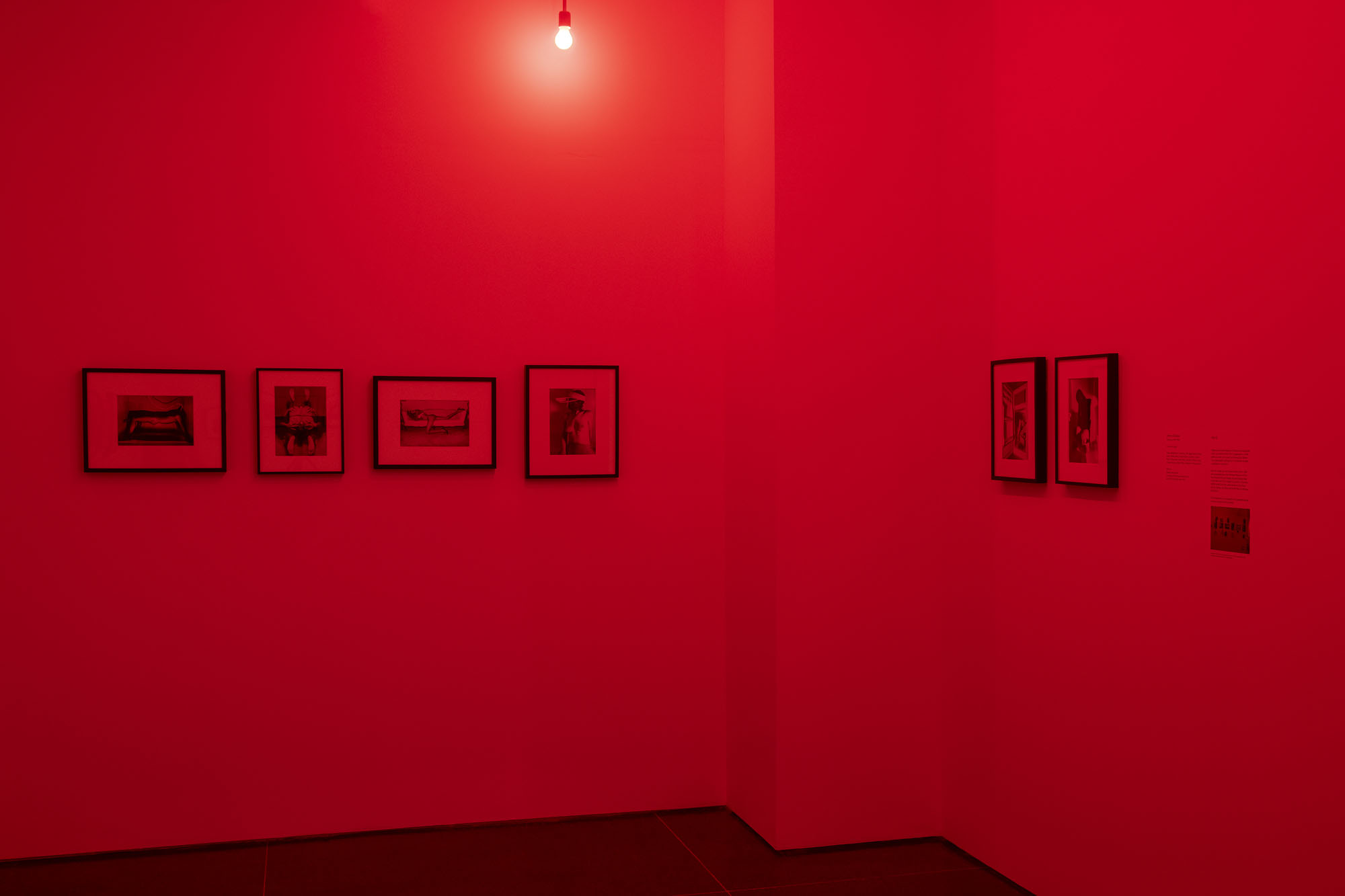
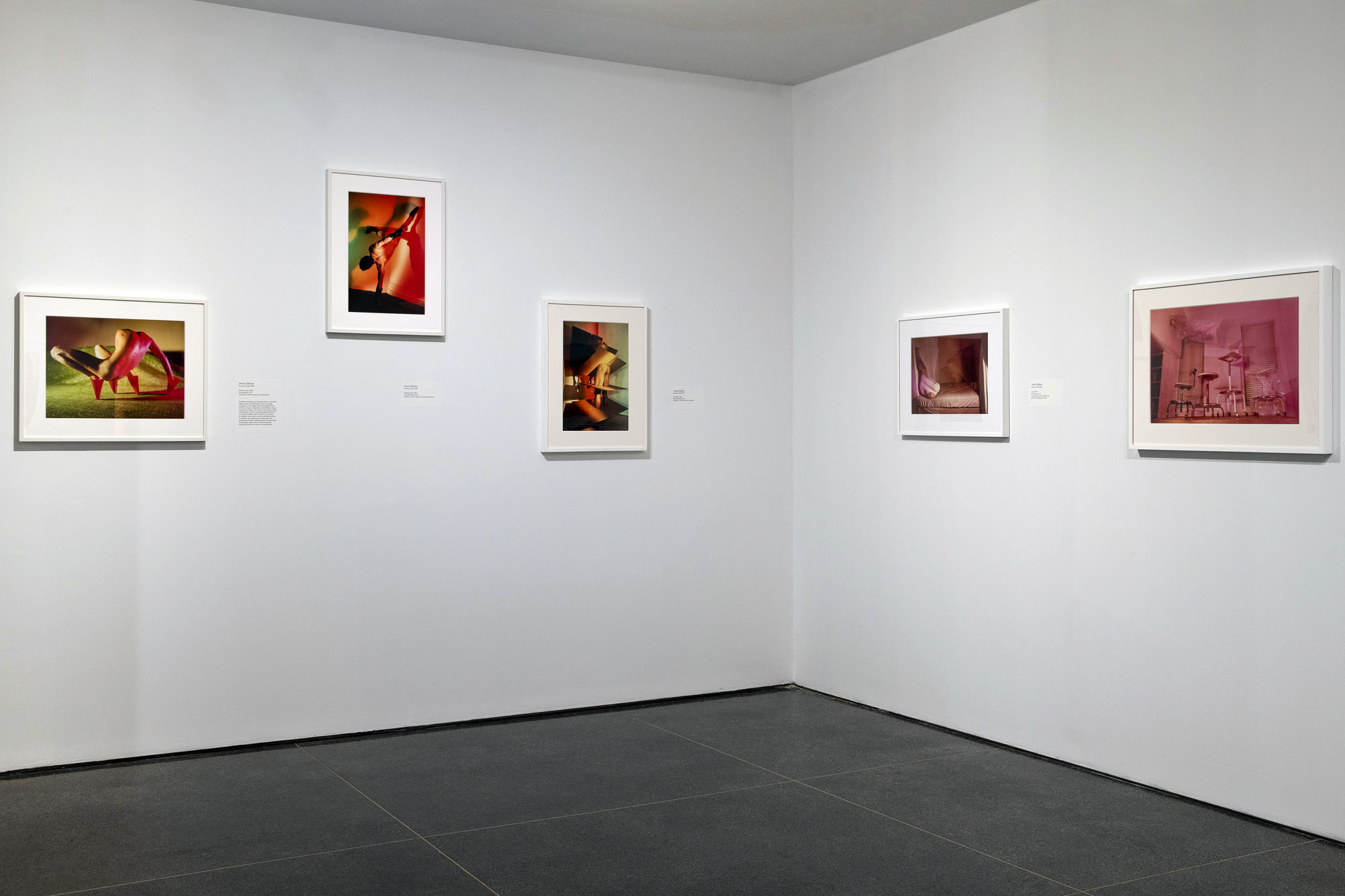
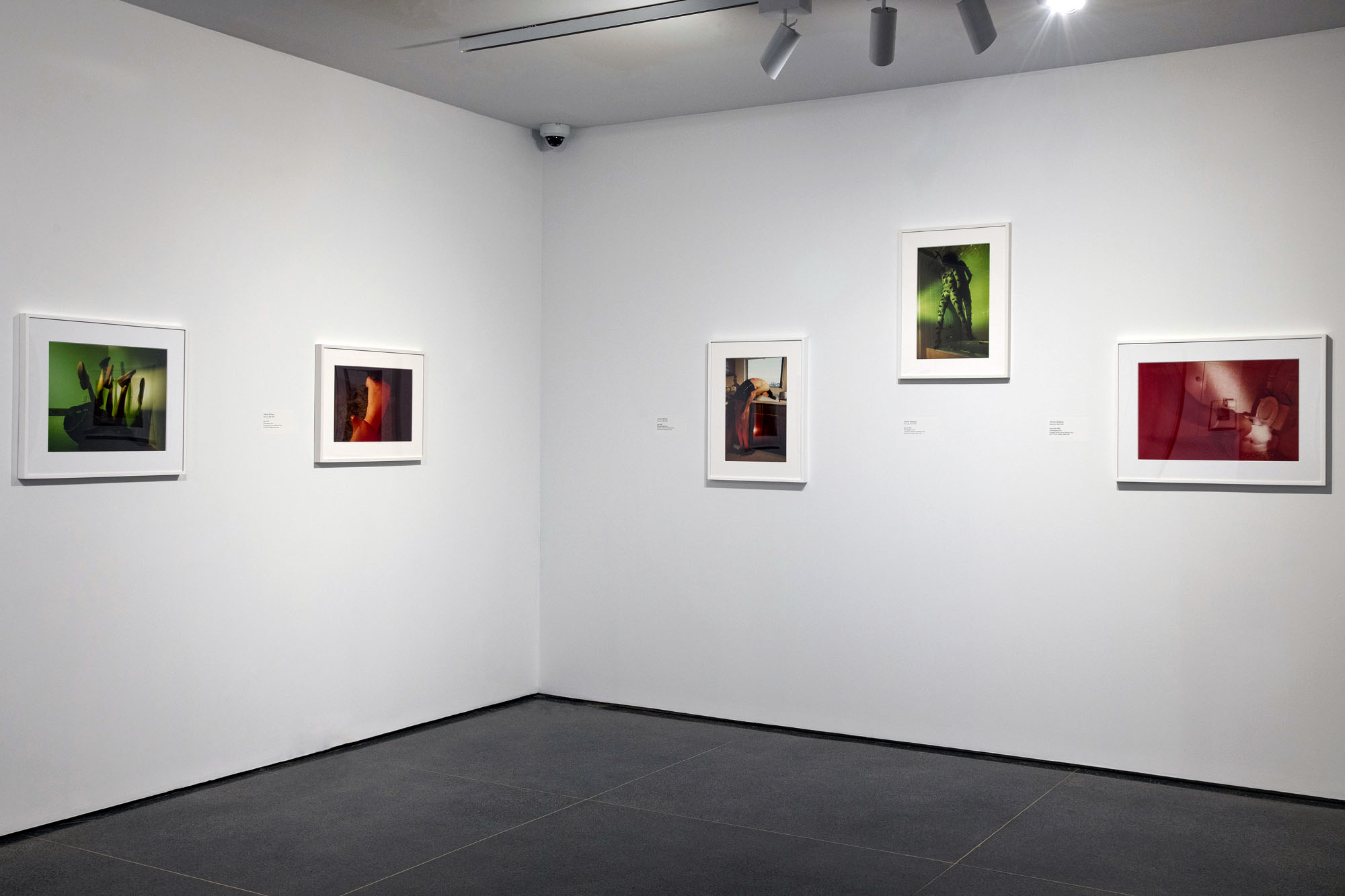
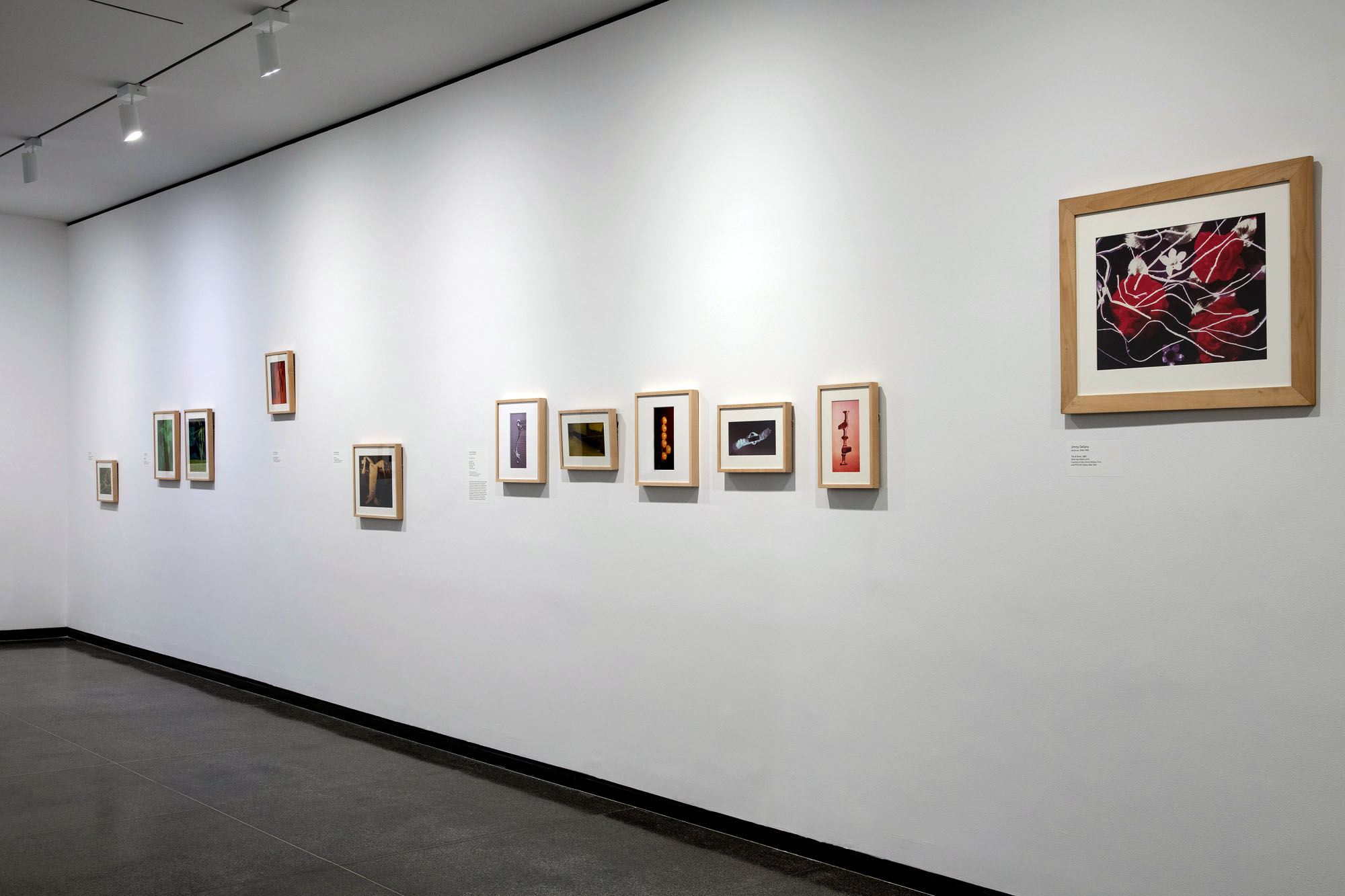
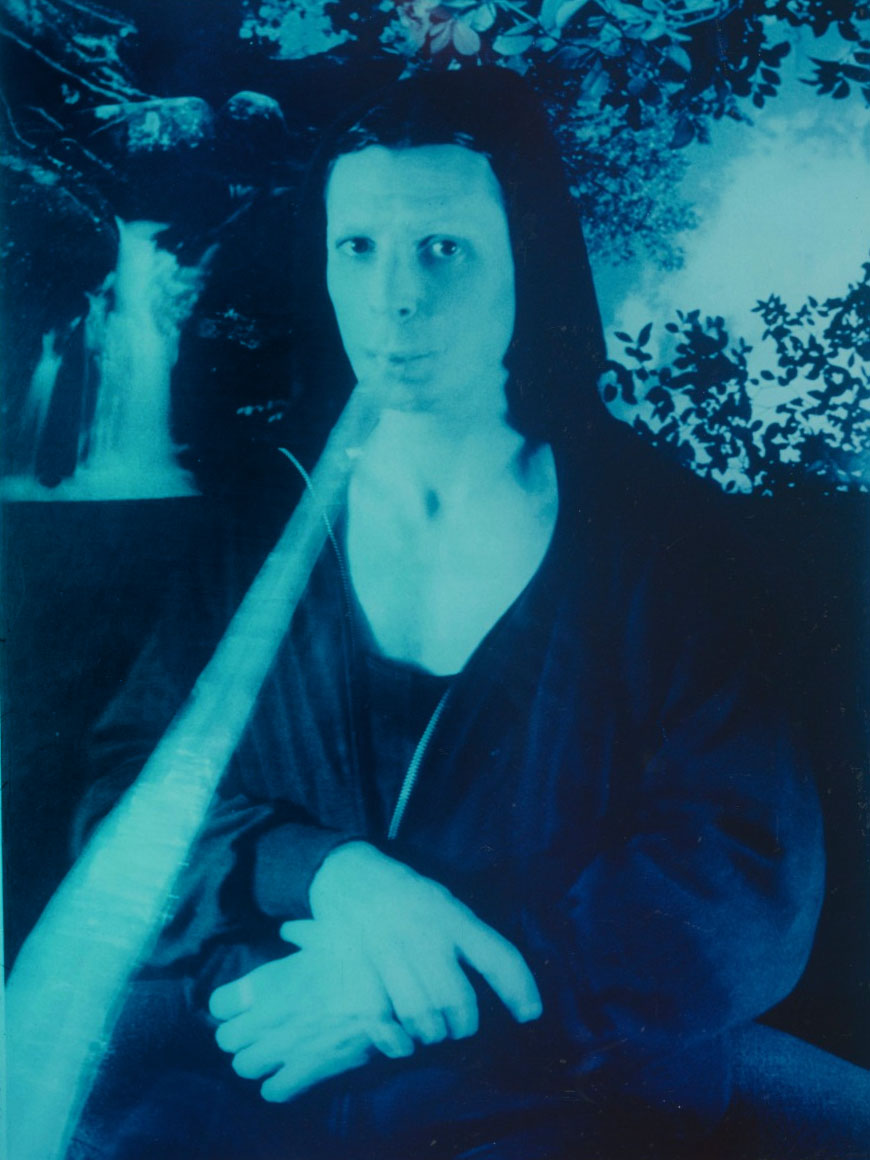
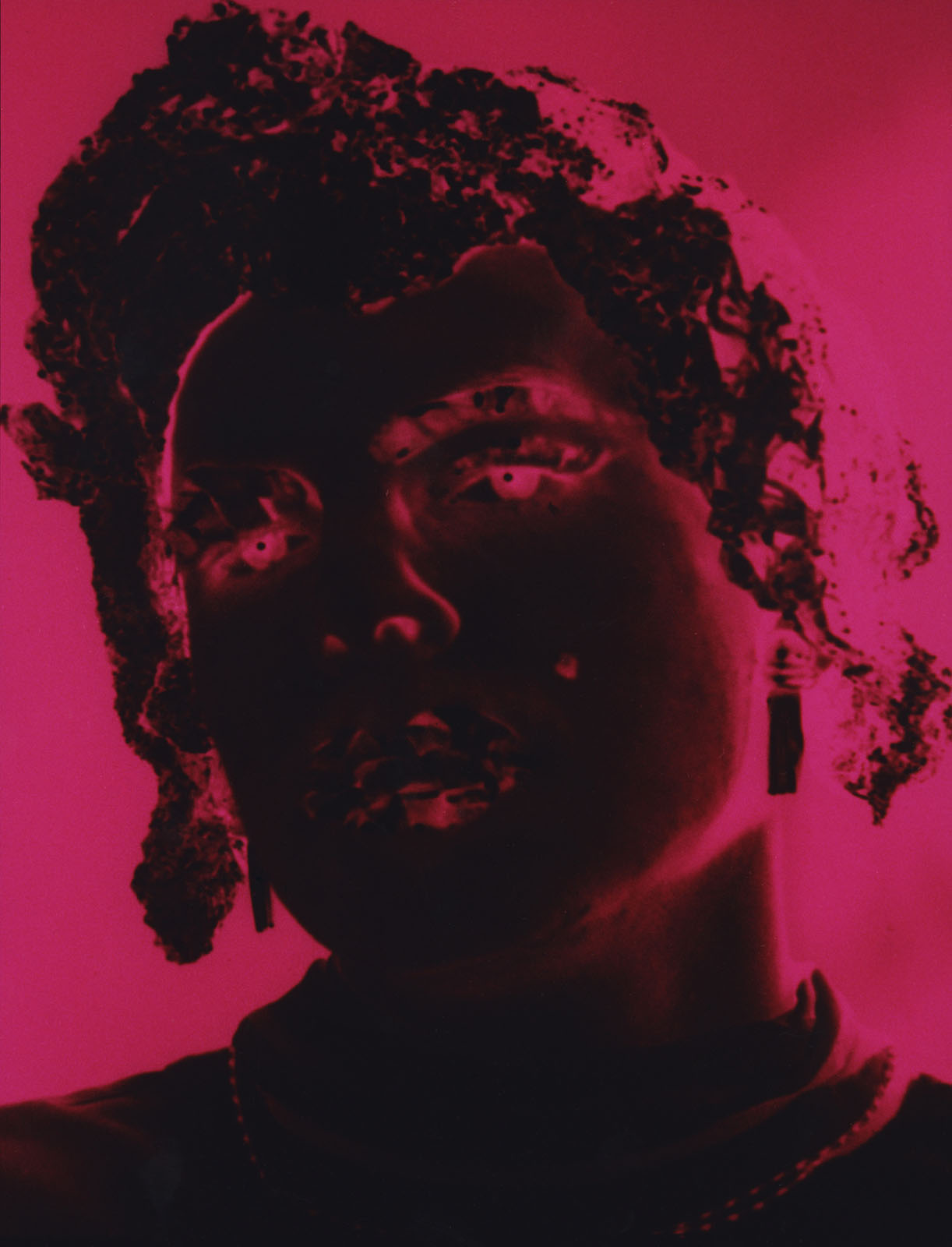
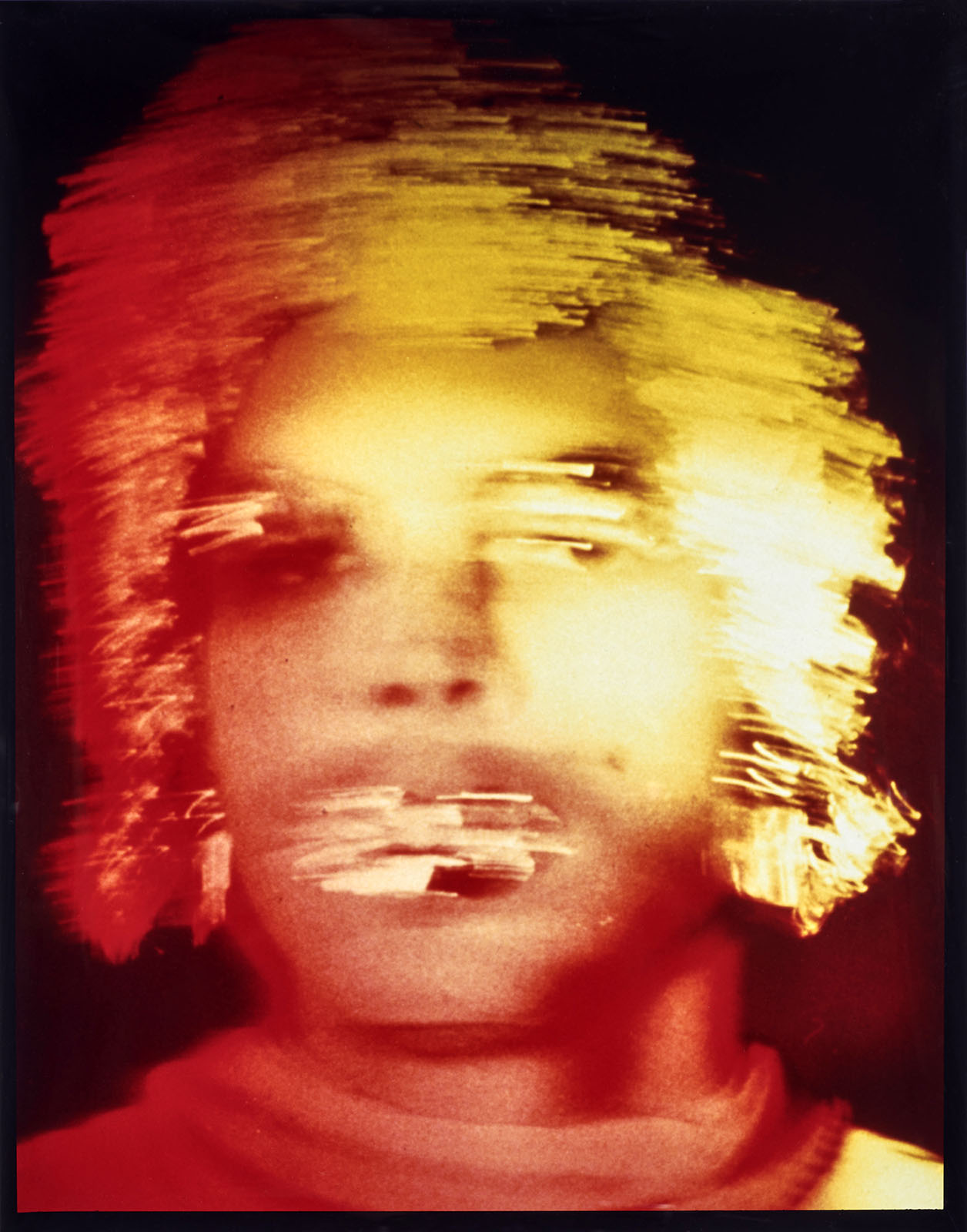
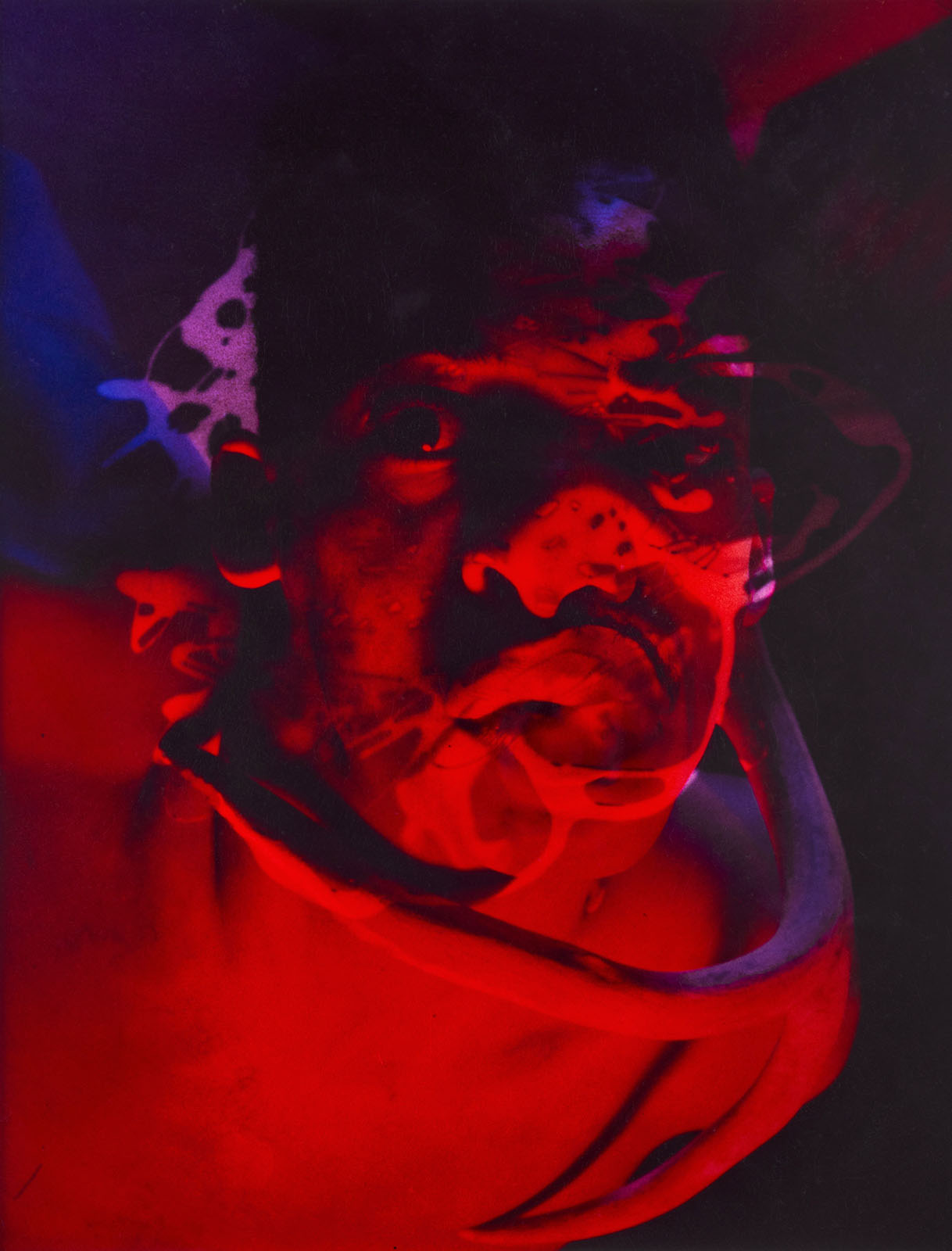
Exhibition: ‘TO BE SEEN: Queer Lives 1900-1950’ at the Munich Documentation Center for the History of National Socialism

Exhibition dates: 7th October, 2022 – 21st May, 2023

Head Curator: Karolina Kühn
Curators: Juliane Bischoff, Angela Hermann, Sebastian Huber, Anna Straetmans, Ulla-Britta Vollhardt
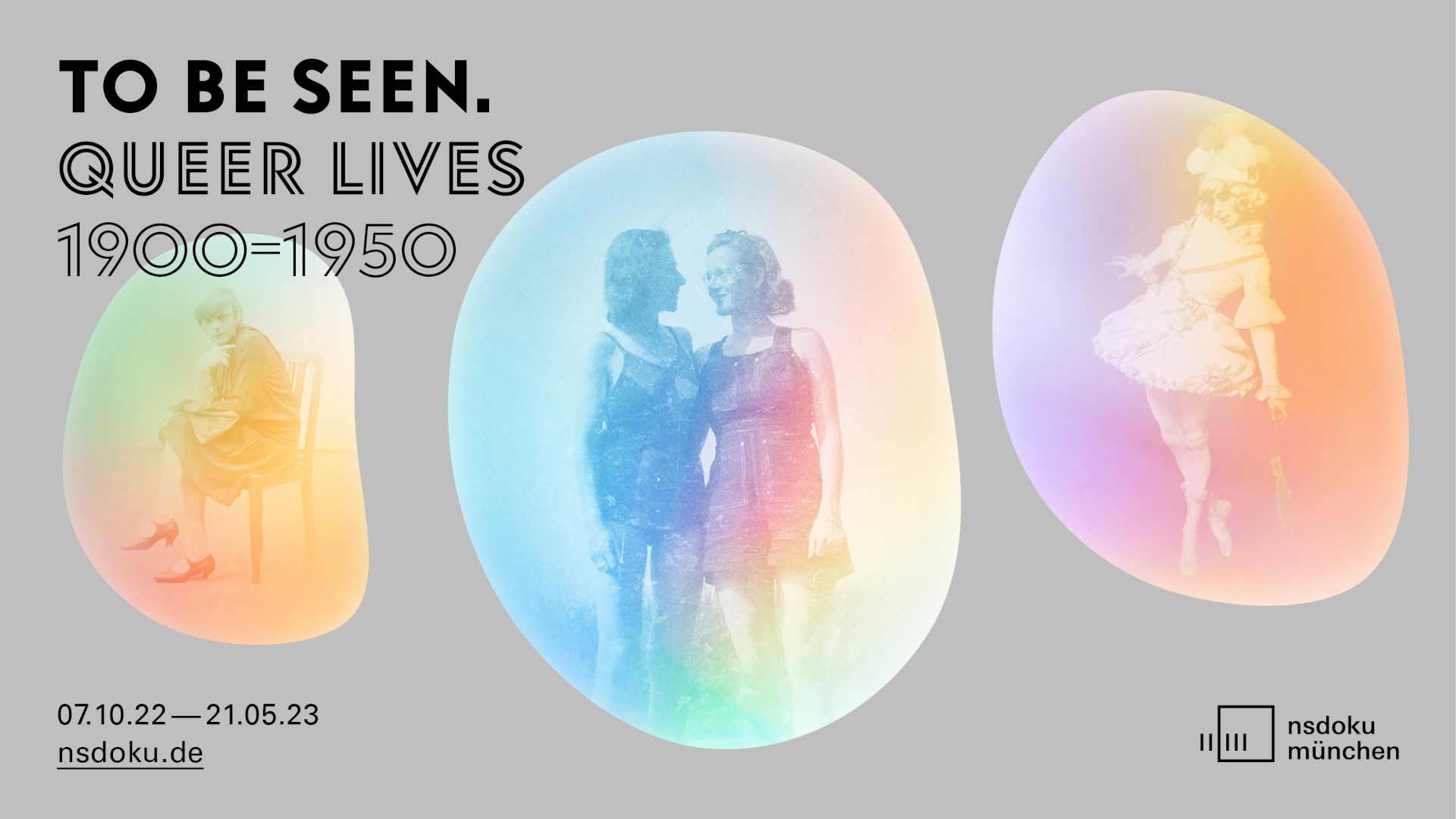
 

'TO BE SEEN: Queer Lives 1900-1950' promo poster


Wer’e here, we’re queer, we’re not going anywhere.

Despite years of persecution, death and inequality, the presence of queer identity, diversity and creativity remains undimmed.

There are some fabulous, groundbreaking human beings who are “being seen” in this posting. Equally, there are some fabulous art works that illuminate the(ir) human condition.

Let’s celebrate their existence.

Dr Marcus Bunyan


Many thankx to the Munich Documentation Center for the History of National Socialism for allowing me to publish the photographs in the posting. Please click on the photographs for a larger version of the image.


About the exhibition

TO BE SEEN is an exhibition devoted to the stories of LGBTQI+ in Germany in the first half of the twentieth century. Through historical testimony and artistic positions from then and now, it traces queer lives and networks, the areas of freedom enjoyed by LGBTQI+, and the persecution they suffered.

The exhibition takes an intimate look at a variety of genders, bodies, and identities. It shows how queer life became ever more visible during the 1920s, giving rise to a more open treatment of role models and of desire. During this period, homosexual, trans, and non-binary people achieved their first successes in their fight for equal rights and social acceptance. They organised, fought for scientific and legal recognition of their gender identity, and carved out their own spaces.

But as recognition and visibility in art and culture, science, politics, and society increased, so did resistance. After the Nazis came to power, the LGBTQI+ subculture was largely destroyed. After 1945, their stories and fates were scarcely archived or remembered.

Text from the Munich Documentation Center for the History of National Socialism website


“When a right is withheld from you, you must fight and not give in; that is a moral duty.”


Joseph Schedel opened the first meeting of the Scientific-Humanitarian Committee of Munich on September 24, 1902
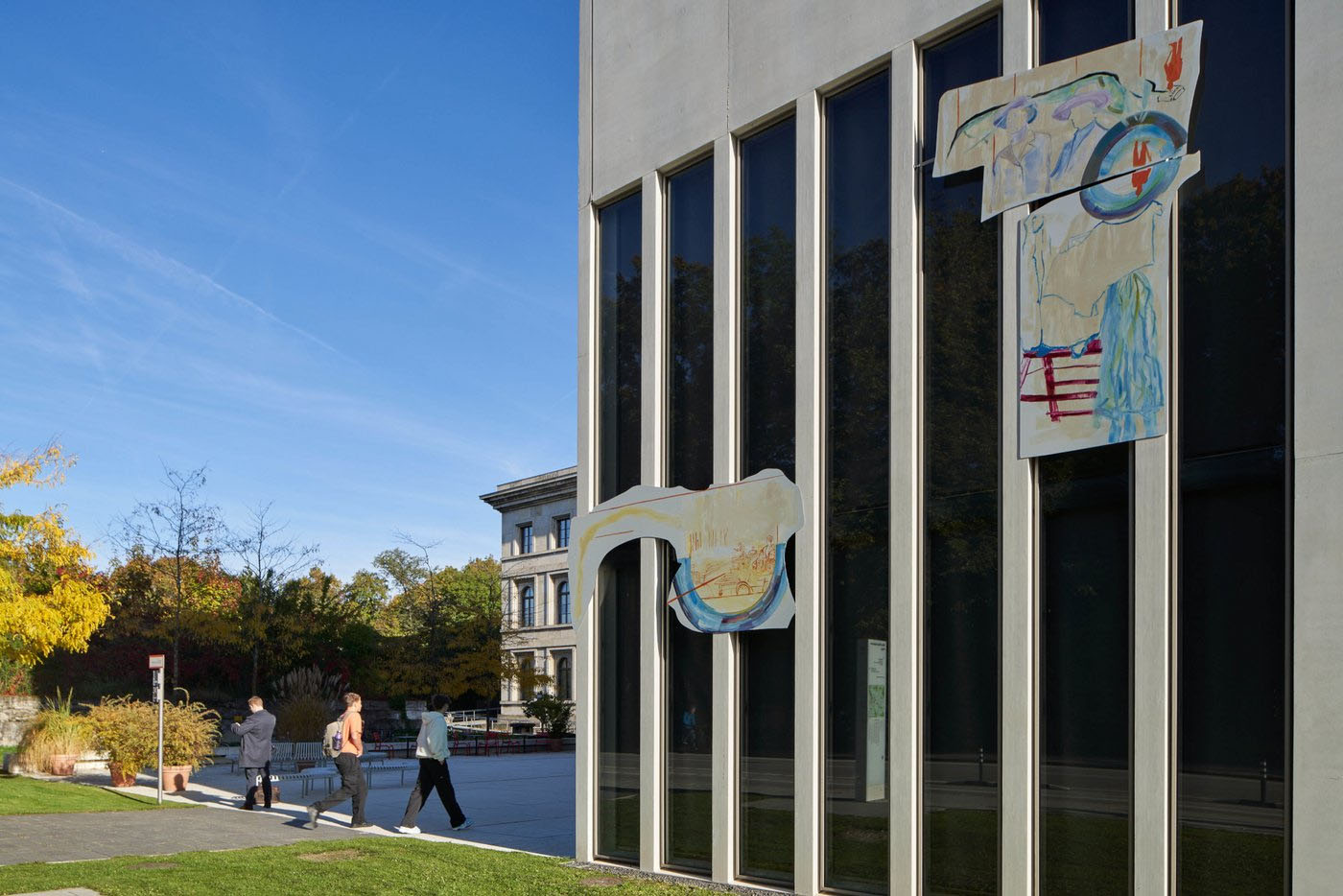


Exterior view of the NS Documentation Center in Munich showing a work in the exhibition TO BE SEEN: Queer Lives 1900-1950 – Maximiliane Baumgartner's '"You look at us – we look at you": Rubbing against the architecture of the executive gaze (Based on a paper by Anita Augspurg 'Mißgriffe der Polizei' / 'Abuses by the Police', 1902)' 2021


Exterior view of the NS Documentation Center in Munich showing a work in the exhibition TO BE SEEN: Queer Lives 1900-1950 – Maximiliane Baumgartner’s “You look at us – we look at you”: Rubbing against the architecture of the executive gaze (Based on a paper by Anita Augspurg ‘Mißgriffe der Polizei’ / ‘Abuses by the Police’, 1902) 2021
Photo: Connolly Weber Photography/NS-Dokumentationszentrum München
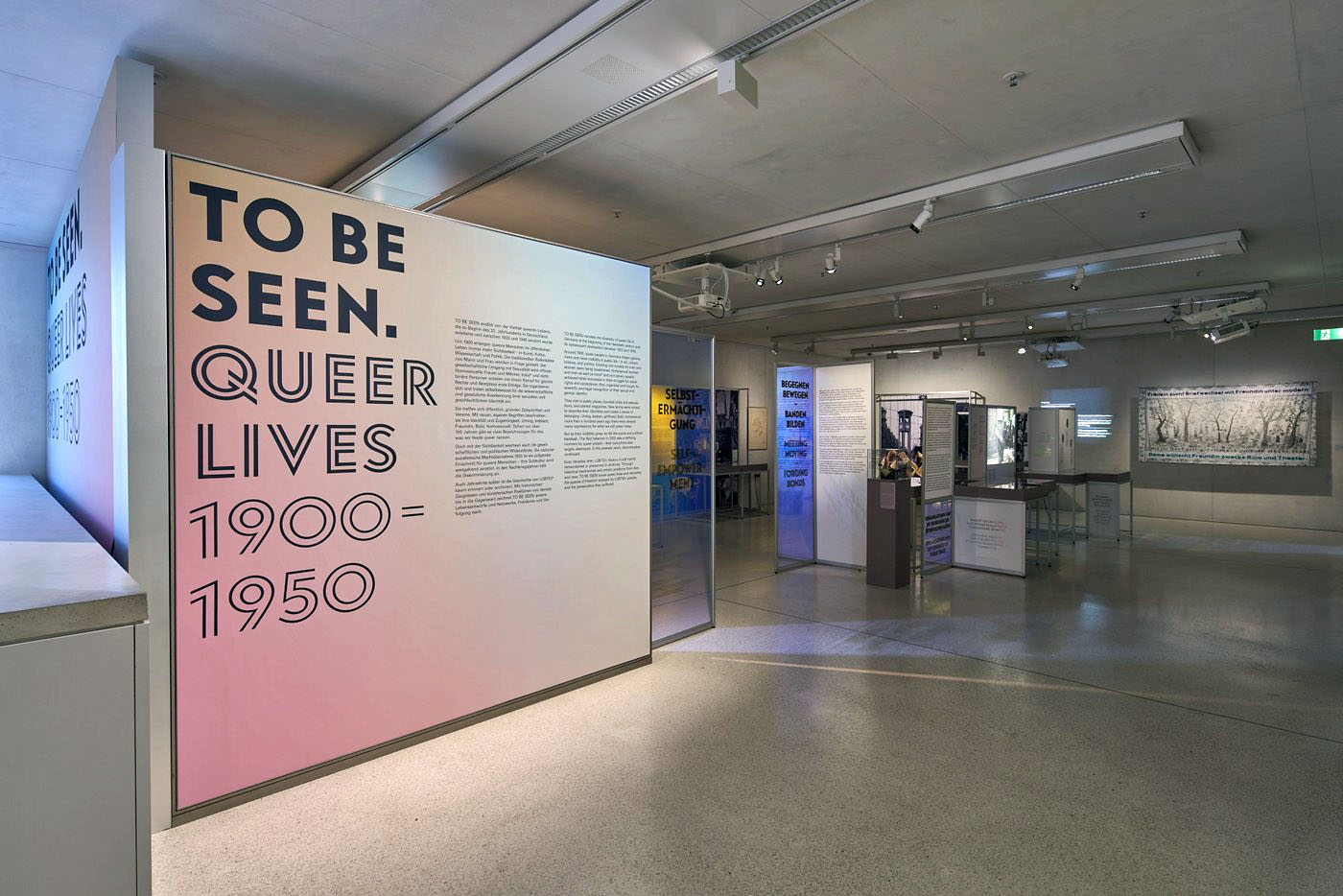
 

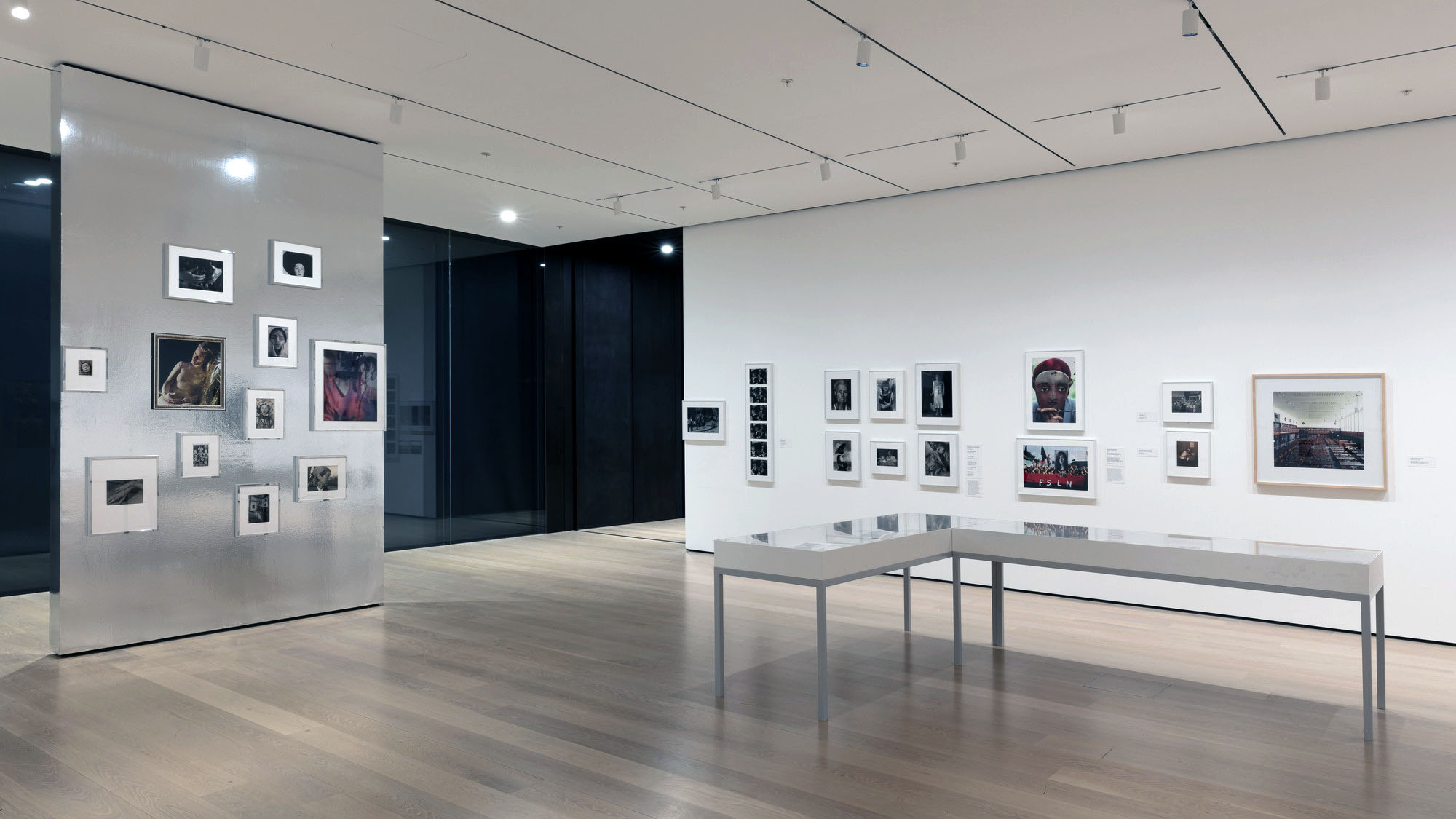
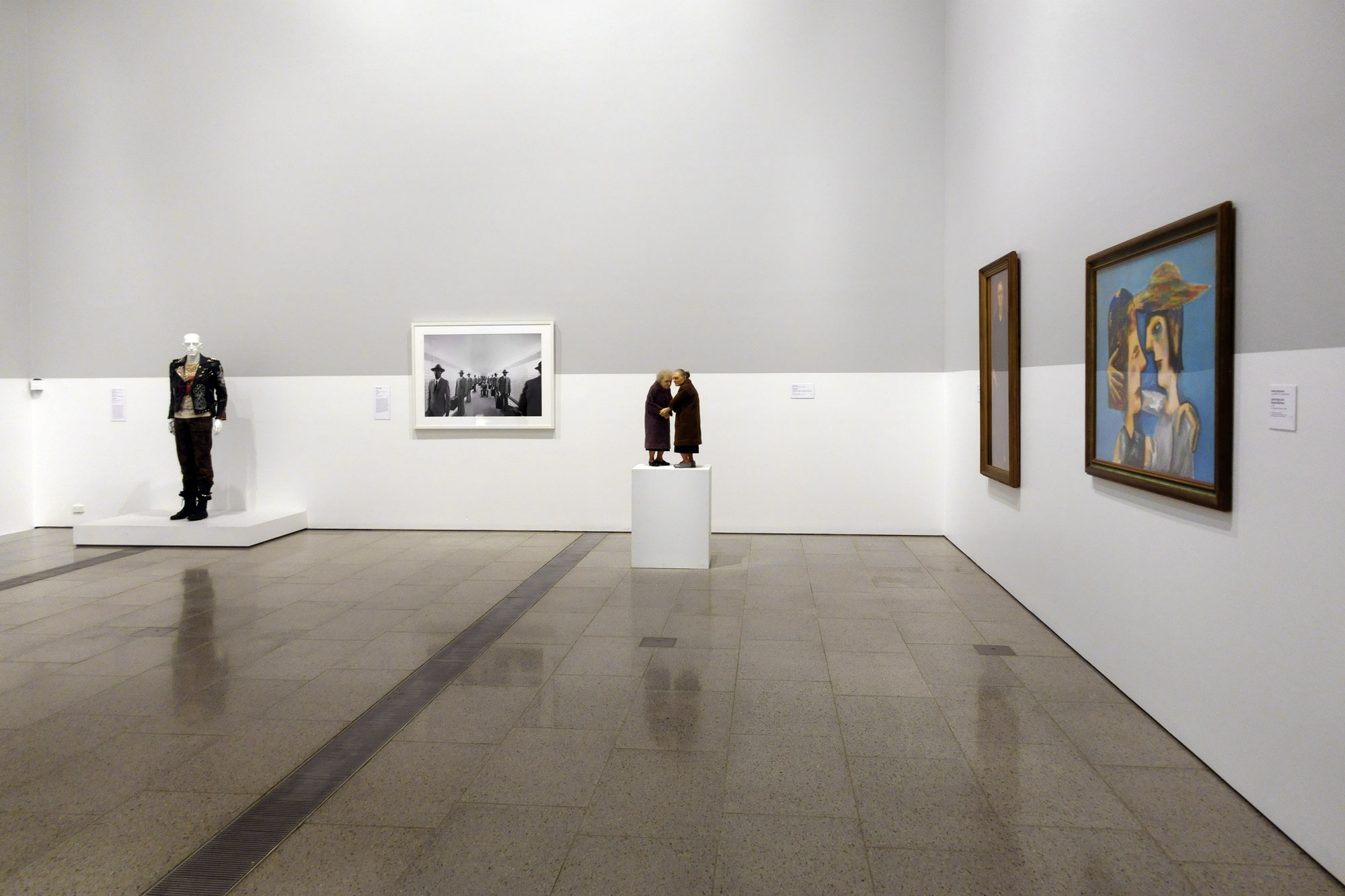
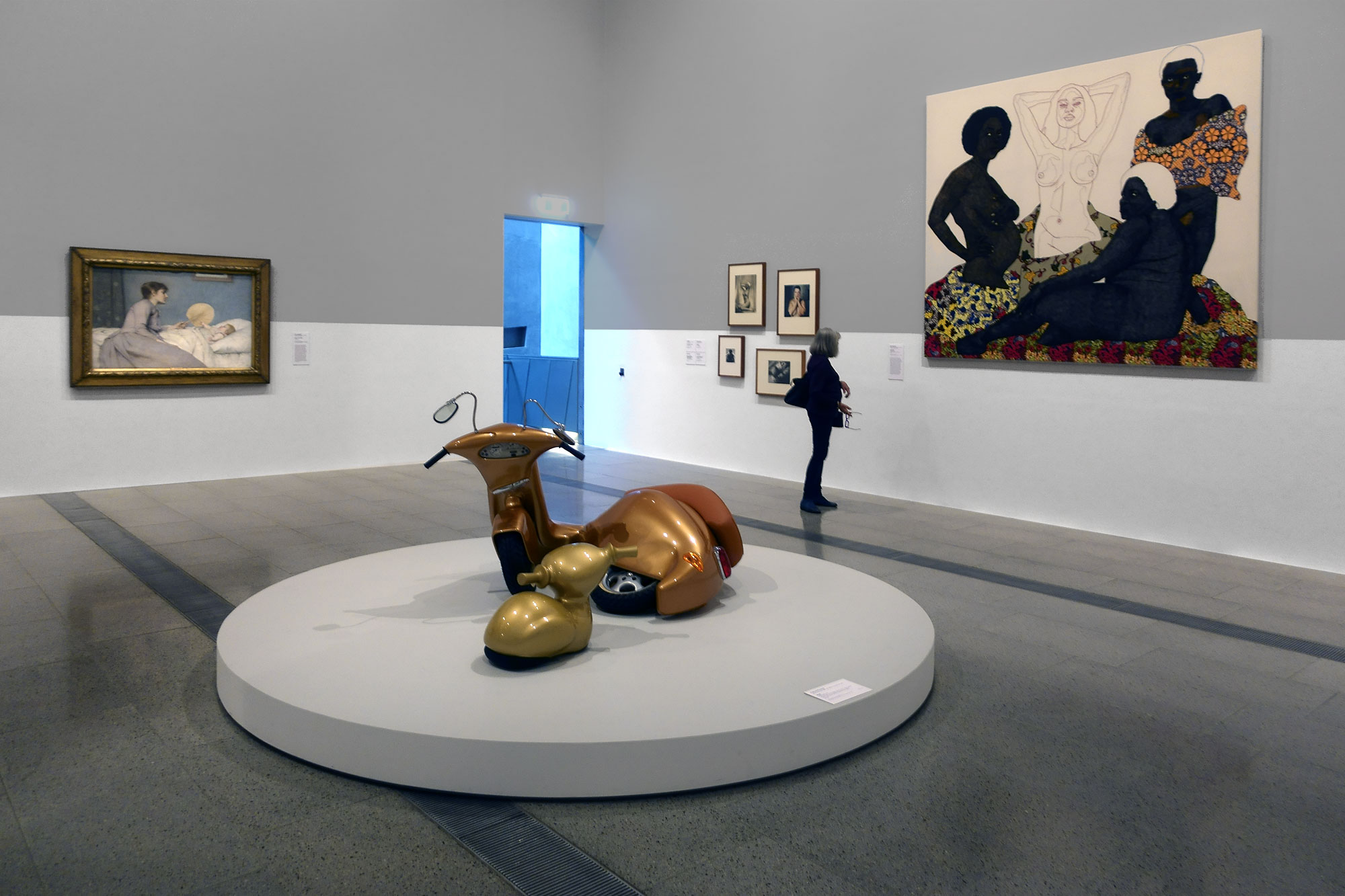
Installation view of the exhibition 'TO BE SEEN: Queer Lives 1900-1950' at the Munich Documentation Center for the History of National Socialism


Installation view of the exhibition TO BE SEEN: Queer Lives 1900-1950 at the Munich Documentation Center for the History of National Socialism
Photo: Connolly Weber Photography/NS-Dokumentationszentrum München


TO BE SEEN | Trailer

The exhibition TO BE SEEN: Queer Lives 1900-1950 is dedicated to the stories of LGBTIQ* in Germany in the first half of the 20th century from October 7th, 2022 to May 21st, 2023 at the Munich Documentation Center. With historical testimonies and artistic positions from then to the present, the exhibition traces queer life plans and networks, freedom and persecution.

The exhibition takes an intimate look at diverse genders, bodies and identities. It shows how queer life became more and more visible in the 1920s and how role models and desires were dealt with more openly. Homosexual, trans* and non-binary people achieved their first successes in their fight for equal rights and social acceptance: they organised themselves, fought for scientific and legal recognition of their gender identity and conquered their own spaces.

In addition to recognition and visibility in art and culture, science, politics and society, resistance also increased. After the National Socialists came to power, the LGBTIQ* subculture was largely destroyed. After 1945 their stories and fates were hardly archived or remembered.


Unknown photographer. 'Lili, Paris' 1926


Unknown photographer
Lili, Paris
1926
From N. Hoyer (ed.). Man into Woman. An Authentic Record of a Change of Sex. The true story of the miraculous transformation of the Danish painter Einar Wegener (Andreas Sparre). London: Jarrolds, 1933, 1926, opp. p. 40.
Attribution 4.0 International (CC BY 4.0)


Lili Elbe, a transgender woman who underwent sex reassignment surgery in Berlin in the 1930s.


Around 1900, queer people in Germany began gaining more and more visibility in public life – in art, culture, science, and politics. Existing role models for men and women were being questioned. Homosexual women and men as well as trans* and non-binary people achieved initial successes in their struggle for equal rights and acceptance: they organised and fought for scientific and legal recognition of their sexual and gender identity.

They met in public places, founded clubs and associations, and started magazines. New terms were coined to describe their identities and create a sense of belonging. Urning, lesbian, girlfriend, Bubi, homosexual: more than a hundred years ago there were already many expressions for what we call queer today. But as their visibility grew, so did the social and political backlash. The Nazi takeover in 1933 was a defining moment for queer people – their subculture was largely destroyed. In the postwar years, discrimination continued.

Even decades later, LGBTQI+ history is still hardly remembered or preserved in archives. Through historical testimonies and artistic positions from then and now, TO BE SEEN traces queer lives and networks, the spaces of freedom enjoyed by LGBTQI+ people, and the persecution they suffered.

Text from Stories of the exhibition TO BE SEEN: Queer Lives 1900-1950


Unknown photographer. 'Police photo of Liddy Bacroff' 1933


Unknown photographer
Police photo of Liddy Bacroff
1933
Gelatin silver print
© Staatsarchiv Hamburg


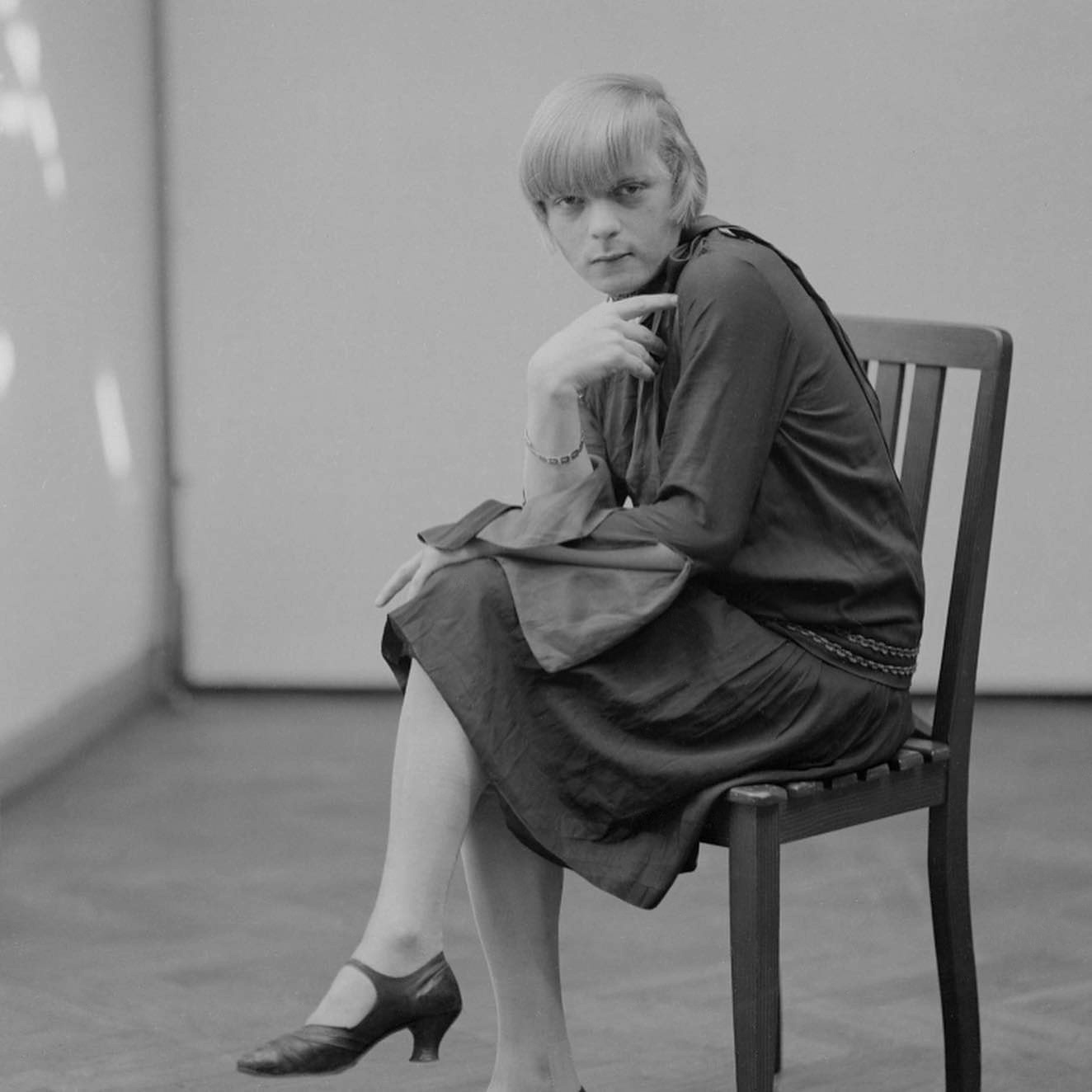
Police photo of Liddy Bacroff, taken after an arrest, 1933. Barcoff described themself as a “homosexual transvestite”, lived from sex work, and was convicted several times. In 1943, they was murdered in the Mauthausen concentration camp.


Liddy Bacroff, a transgender woman initially from Ludwigshafen, who moved to Hamburg and lived for the majority of her life publicly presenting herself as a woman. She did not perceive herself to be a man (and, indeed, in papers she left after having been imprisoned, she determined what her name would be while also conspicuously referring to herself as “Liddy Bacroff, Transvestit”). But this was effectively her own form of self-ID. Certainly the authorities didn’t see her as such — her records remain filed under her deadname and identify her as a homosexual man – and, though she’d have been given a Transvestitenschein in Berlin, she wasn’t IN Berlin. Having not visited Hirschfeld and his Institut, it’s a marvel she uses the term “Transvestit”; elsewhere she does refer to herself as a “Mann-Weib” (a “male woman”), and frequently as a girl or a woman. The authorities, again, call her a man or, occasionally, a “Zwitter.” (NB. “Zwitter” means “hermaphrodite” and is here not meant literally but rather as an epithet recorded in the official files – an insult to her.) So the language that is used to describe trans people is inconsistent and, often, absent (depending on the sources). Reading between the lines is necessary, especially in the official records, which view trans women (regardless their lived circumstances or their appearance) only as homosexual men, and charge them as such. And while Hirschfeld was conscientious, the police were… not. This is especially true as the 1930s unfolded and the country Nazified. I wrote a very long thread a while back about “Heinrich Bode”, who was assigned male at birth but frequently presented as a woman. I used that thread to highlight difficulties of definition because Bode denounced their appearance as a woman in court filings and personal testimony, but at the same time also hinted that there was something much deeper than “just” dressing as a woman. But as they were subjected to prosecution by the Nazified judiciary and security state, they were under duress. So, do we assume that Bode was trans, and denied it because of the threat of punishment? Or was their presentation simply playing with the conventions of gender?

Dr. Bodie A. Ashton Historiker, Universität Erfurt. Text from his Twitter account
 

Unknown photographer. 'Police photo of Liddy Bacroff' 1933


Unknown photographer
Police photo of Liddy Bacroff
1933
Gelatin silver print
© Staatsarchiv Hamburg
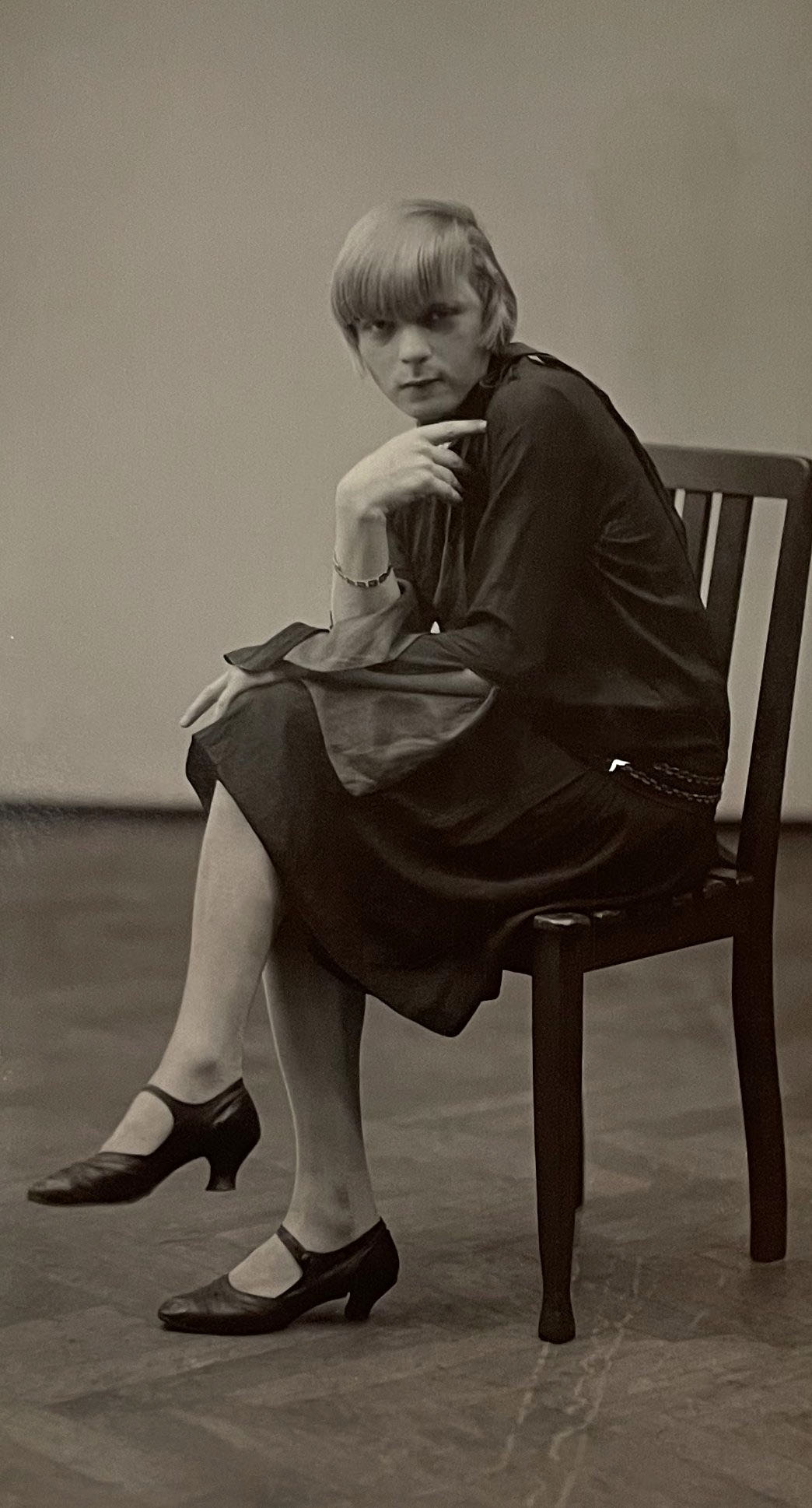
 

Unknown photographer. 'Police photo of Liddy Bacroff' 1933


Unknown photographer
Police photo of Liddy Bacroff
1933
Gelatin silver print
© Staatsarchiv Hamburg
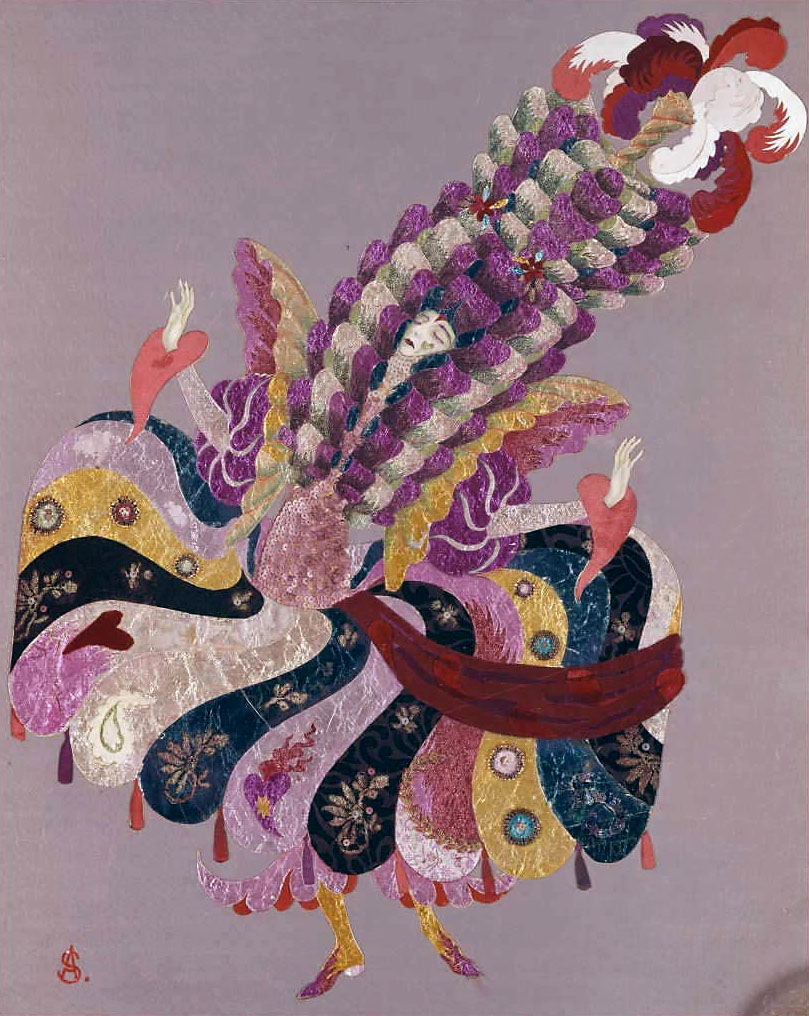
 

Alexander Sacharoff (Russian, 1886-1963) 'Pavane Fantastique' c. 1916/1917


Alexander Sacharoff (Russian, 1886-1963)
Pavane Fantastique
c. 1916/1917
© Städtische Galerie im Lenbachhaus und Kunstbau München


Unknown photographer. 'Alexander Sacharoff' c. 1914


Unknown photographer
Alexander Sacharoff
c. 1914
© Deutsches Theatermuseum München


The androgynous dancer created new body images and developed the swapping of clothes into a stage genre of its own.
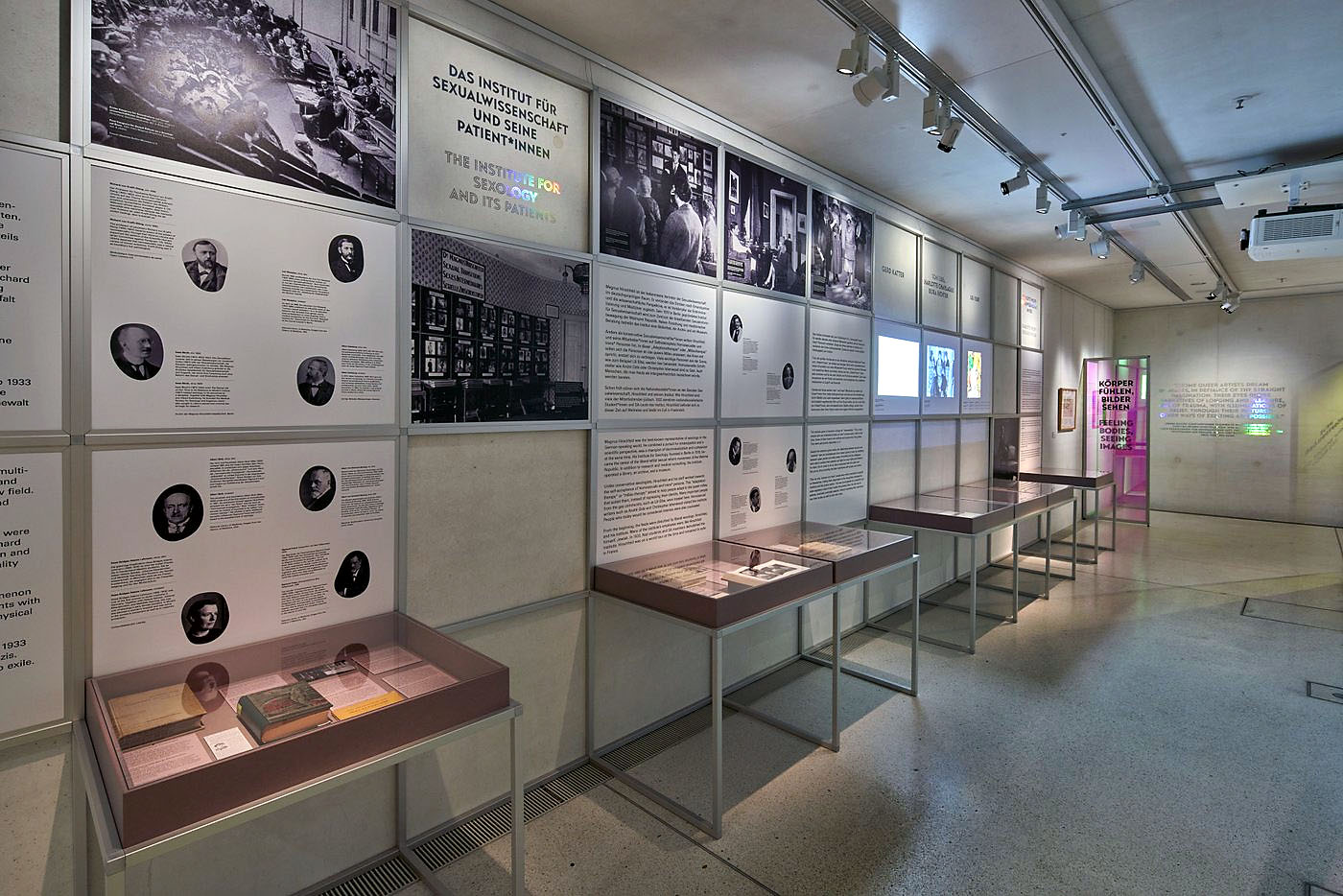
 

Installation view of the exhibition 'TO BE SEEN: Queer Lives 1900-1950' at the Munich Documentation Center for the History of National Socialism


Installation view of the exhibition TO BE SEEN: Queer Lives 1900-1950 at the Munich Documentation Center for the History of National Socialism
Photo: Connolly Weber Photography/NS-Dokumentationszentrum München


Queer

“Queer” originally referred to anything that did not fit into the usual categories. In English the word queer (meaning strange, other, suspicious), was used earlier as a derogative term for homosexuals. Since the 1990s, however, the term has been adopted by many non heterosexual and non-binary people as a positive self-designation. Within the exhibition, queer is used as a catch-all term for a variety of sexual and gender identities and practices that deviate from heterosexual ideas. The term primarily, but not only, refers to LGBTQI+ – in other words lesbian, gay, bisexual, trans and intersexual persons. Furthermore, “queering” can be understood as a practice of combating various forms of discrimination and exclusion. Applied to gender, sexuality, and identity issues, it means casting a critical gaze at the worldview that regards a heterosexual relationship between two persons as the social norm. The rigid binary division of gender into man and woman and the associated role models are thrown into question. In the exhibition, historical self-designations are used where they can be traced through sources.

Self empowerment

In the German Empire, politics, the economy, and society were dominated by men. The gender order, which was maintained over centuries by state and church, was strictly divided into two parts: men and women were assigned clear roles within which they must operate. People who did not conform to these role models and lived gender and sexual identities outside the normative order were ostracised. They were considered immoral, criminal, or ill. According to Paragraph 175 of the Imperial Criminal Code of 1871, sexual acts between men were forbidden and punishable by imprisonment. In Austria, sex between women was also punishable.

But there were individuals who rebelled against the prevailing gender order and fought for a more open society. They opposed the outlawing of homosexuality and transsexuality, advocated a change in criminal law, and assertively engaged in the recognition of their identities. New alliances and self-images emerged. Many of these pioneers paid a high price for their rebellion: they lost their jobs, their families, and their friendships, and were socially isolated.

Text from Stories of the exhibition TO BE SEEN: Queer Lives 1900-1950
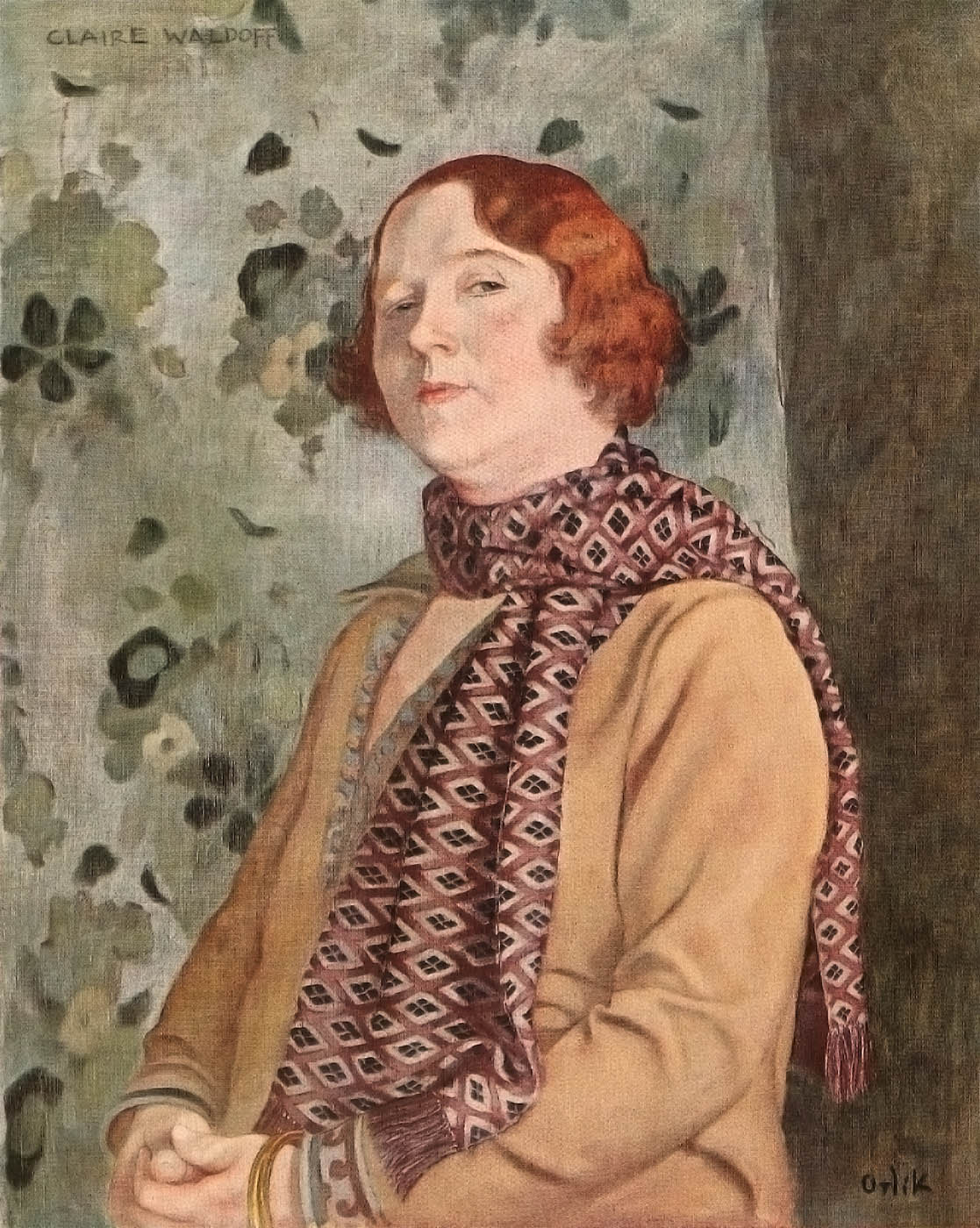
 

Emil Orlík (European born Prague, 1870-1932) 'Claire Waldoff' c. 1930


Emil Orlík (European born Prague, 1870-1932)
Claire Waldoff
c. 1930
© bpk | Stiftung Deutsches Historisches Museum


In TO BE SEEN #QueerLives we present individuals and movements who rebelled against the gender order that prevailed around 1900 and advocated a more open society. In their fight for equal rights and acceptance, they showed solidarity with each other, organised themselves in clubs, founded magazines, coined new terms and met in bars and clubs.

One of them was the chansonnière and cabaret artist Claire Waldoff (1884-1957). Born as Clara Wortmann in Gelsenkirchen, she is a central figure in the Berlin cultural scene of the 1920s. Her songs are known throughout Germany. She lives openly with her partner Olga (Olly) von Roeder and shapes the city’s lesbian scene.


Emil Orlik (European born Prague, 1870-1932)

Emil Orlik (21 July 1870 – 28 September 1932) was a painter, etcher and lithographer. He was born in Prague, which was at that time part of the Austro-Hungarian Empire, and lived and worked in Prague, Austria and Germany.

Emil Orlik was born the son of a tailor on July 21, 1870, in Prague, then the capital of a province within the Austro-Hungarian empire. He first studied art at the private art school of Heinrich Knirr, where one of his fellow pupils was Paul Klee. Other friends at this time included Franz Kafka, Max Brod, and Rainer Maria Rilke.

Starting in 1891, Orlik studied at the Munich Academy under Wilhelm Lindenschmit. He later learned engraving from Johann Leonhard Raab and proceeded to experiment with various printmaking processes, including woodcut, which he and his friend, Bernard Pankok, experimented with in 1896.

Orlik left the Academy in 1893. He performed his military service for a year before returning to Prague in 1894. He relocated to Munich in 1896, where he worked for the magazine Jugend (Youth). He spent most of 1898 travelling through Europe, visiting the Netherlands, Great Britain, Belgium, and Paris.

Emil Orlik’s prints and techniques went through extensive changes as he traveled internationally, learning new methods wherever he went. Known for his portraits of a wide variety of well-known individuals including Josephine Baker, Albert Einstein, and Marc Chagall, Orlik was an artistic chameleon, never sticking to one genre or style but studying many. His prints catalog his travels, creating a kind of pictorial diary of the years 1892 to 1900 in particular. Many of his works, often produced in color, appeared in the European periodical PAN, along with the work of Toulouse-Lautrec, Kathe Kollwitz, and Max Klinger.

Japanese art and culture fascinated Orlik. He was aware of the impact Japanese art was having on European art and decided to visit Japan. In 1900, he traveled to Japan and spent a year studying Japanese woodblock cutting and printing. His studies of the Japanese culture led him to the art of Utamaro and Hiroshige. Orlik studied the language before his departure and within four months of his arrival he was proficient enough in Japanese to converse with the artisans whose work he admired and under whom he studied.

Orlik never limited himself to popular subject matter. He studied any scene that inspired him, major events or everyday life. He produced fourteen lithographs of the trial of Arthur Schnitzler and his fellow actors; reenactment of the banned play, “Aus dem Reigin,” for which Orlik was a defence witness. After the trial, Orlik began working for the theatre as a designer of costumes, stage sets, and posters.

He kept all his early woodblocks and, in 1920, he published his celebrated portfolio Kleine Holzschnitte (Small woodcuts) in an edition of 100, which also contained the text of his descriptions of each of the prints. The portfolio contained thirty-four woodcuts, eighteen of which were printed in colours. The complete portfolio is now very rarely found. It included such delightful items as Aus London and the superb colour woodcut Schneiderwerkstatt bei Orlik in Prag (the Orlik tailoring workshop in Prague), which depicts his father and colleague’s busy sewing.

Orlik was also commissioned to design colour posters for the Best-Litovsk Peace Conference at which Russia and Germany ended their conflict. He produced seventy-two lithographs, including a number portraits of Leon Trotsky. Around this time he also began to study photography, and by the mid-1920s was photographing celebrities such as Marlene Dietrich and Albert Eintstein.

Emil Orlik died of a heart attack on September 28, 1932. His brother Hugo was willed the estate, and with it the numerous works of art Orlik had collected throughout the years. Hugo Orlik and his family perished in WWII at the hands of the Nazis, and the only survivor was an aunt who regained what little was left of Emil’s effects. To this day Orlik’s work is still exhibited throughout the world.

Anonymous. “Emil Orlik Biography” on The Annex Galleries website Nd [Online] Cited 17/04/2023. Used under fair use conditions for the purposes of education and research
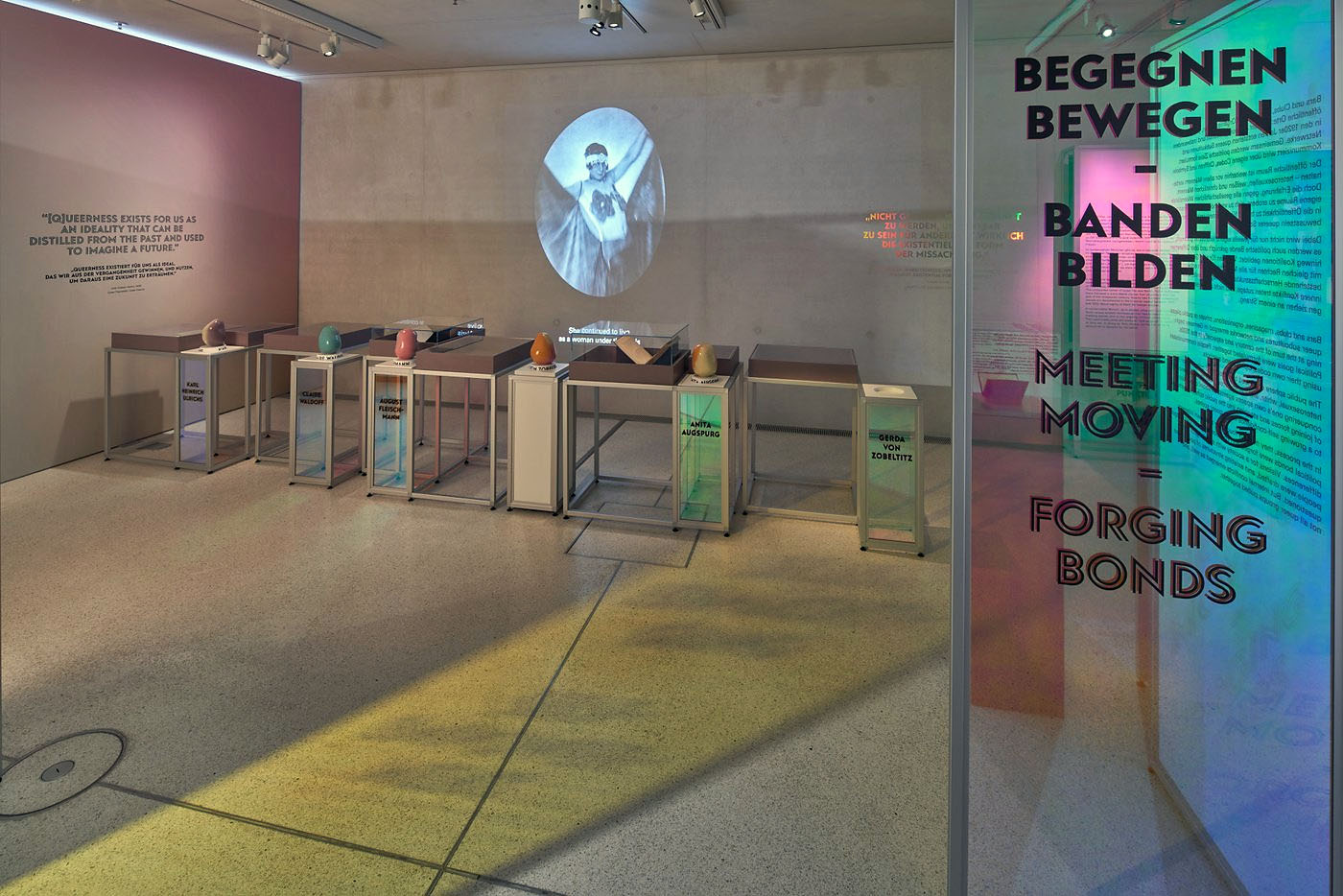
 

Installation view of the exhibition 'TO BE SEEN: Queer Lives 1900-1950' at the Munich Documentation Center for the History of National Socialism

Installation view of the exhibition 'TO BE SEEN: Queer Lives 1900-1950' at the Munich Documentation Center for the History of National Socialism


Installation views of the exhibition TO BE SEEN: Queer Lives 1900-1950 at the Munich Documentation Center for the History of National Socialism
Photo: Connolly Weber Photography/NS-Dokumentationszentrum München


Unknown photographer. 'Trans* people in the Eldorado in Berlin' 1926


Unknown photographer
Trans* people in the Eldorado in Berlin
1926
© bpk / Kunstbibliothek, SMB


Meeting, moving – forging bonds

Bars and clubs, magazines, organisations, private or public places: queer subcultures and networks emerged in Germany beginning at the turn of the century and especially in the 1920s. Political goals were formulated together. People communicated using their own codes, ciphers, and symbols.

The public sphere continued to be reserved primarily for men – heterosexual, white, and Christian men. But the experience of conquering one’s own spaces against all social opposition, of joining forces and stepping into the public sphere together, led to a growing self-confidence in the queer scenes. In the process, they not only fought for their own interests; political bonds were forged and coalitions formed that bridged differences.

Visions for a society with equal rights for all people were drafted, and existing structures of power were questioned. But internal conflicts emerged as well, and not all queer groups pulled together.

§ 175 des Reichsstrafgesetzbuchs

Trancript: “Paragraph 175: Perverse fornication committed between persons of the male sex or by persons with animals is punishable by imprisonment; loss of civil rights may also be imposed.”

According to Paragraph 175 of the Imperial Criminal Code, sexual intercourse between men was punishable. This provision originated in the Prussian Criminal Code and was introduced throughout Germany with the founding of the German Empire in 1871. Prior to this, homosexuality was exempt from punishment in some German states, such as Bavaria, Württemberg, and Baden, following the example of France. The paragraph was controversial from the beginning: ecclesiastical conservatives and extreme right-wing parties demanded it be made more severe; liberals, social democrats, and communists called for its abolition.

Organisations and the conquest of public space

At the end of the nineteenth century, gay men joined forces to fight against persecution based on Paragraph 175. They founded clubs and associations and sought supporters to achieve their vision of a more open society. Berlin became the hub of this movement and developed into a leading centre of attraction for queer people. It was in Berlin that, in 1897, the Scientific-Humanitarian Committee was founded, which aimed to achieve legal and social equality for homosexual and trans* people.

Some activists from the women’s movements joined this struggle, especially when the extension of Paragraph 175 to encompass women was debated in 1909. Their goal was far-reaching sexual and social reform: a woman’s right to sexual self-determination, abortion, extramarital relations, and independence from her husband. Some leading women’s rights activists lived with another woman, but only few openly identified as lesbian.

Queer subcultures flourished in the Weimar Republic. A diverse landscape of organisations emerged that represented the interests of gays, lesbians, and trans* persons. However, the struggle against Paragraph 175 was not always synonymous with advocacy for an open society. Among gay activists there were also those who paid homage to a homoerotic male cult. They excluded – in addition to women – all those who did not conform to their heroic, in some cases also racist ideas of masculinity.

Text from Stories of the exhibition TO BE SEEN: Queer Lives 1900-1950
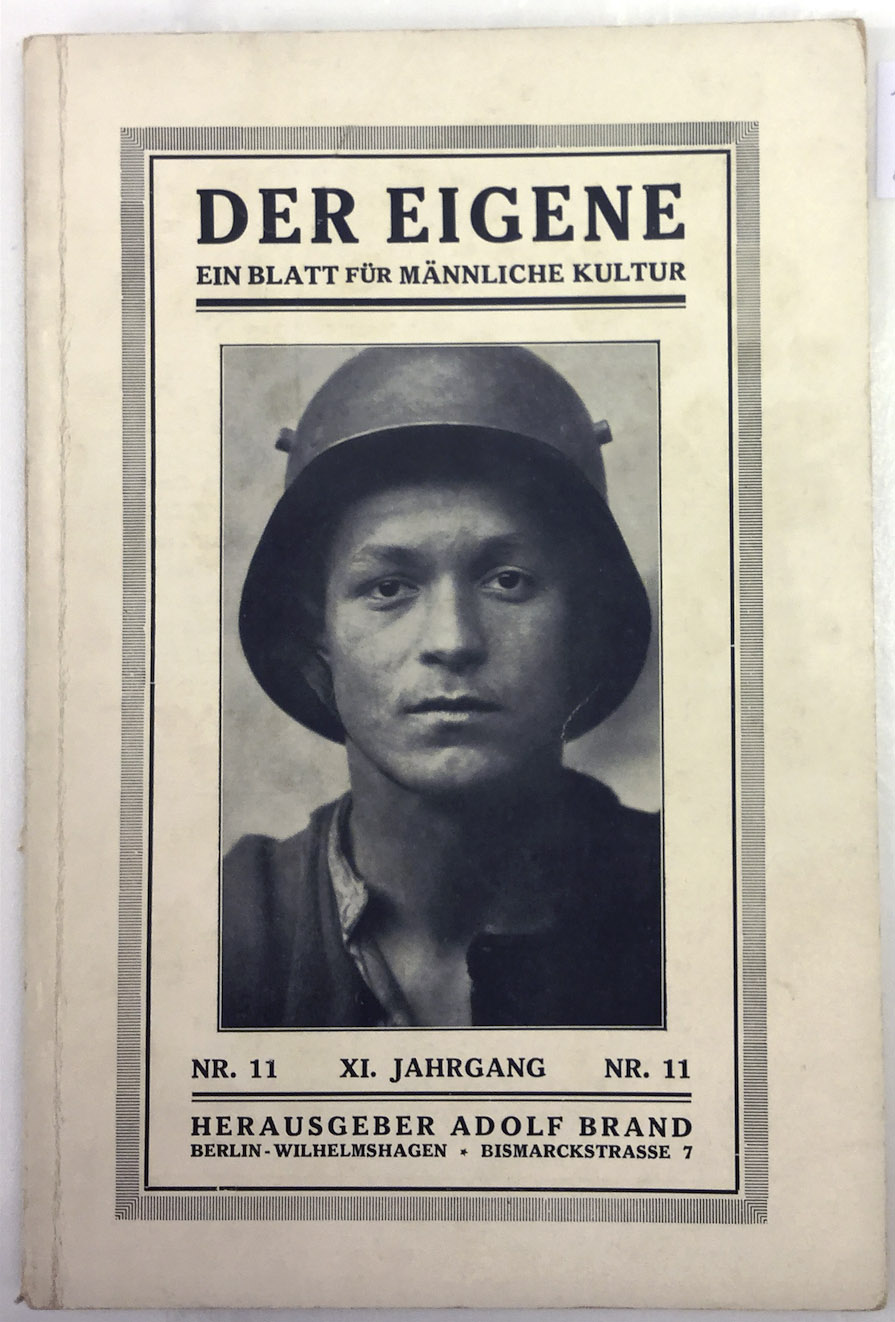
 

Der Eigene (The Unique), 1925


Adolf Brand (publisher)
Der Eigene (The Unique)
1926


Founded in 1896 by Adolf Brand, “Der Eigene” was the longest-running homosexual journal. With its literary-artistic contributions it evoked the image of heroic masculinity.


Struggle against Paragraph 175: the Scientific-Humanitarian Committee

The physician Magnus Hirschfeld (1868-1935) came from a liberal Jewish family and began actively campaigning for the abolition of Paragraph 175 at the end of the nineteenth century. His actions were motivated by the persecution to which gay men were subjected. As a sexual reformer and founder of the Scientific-Humanitarian Committee, he fought against the prevailing rigid sexual morality and contributed significantly to the visibility of queer people.

Magnus Hirschfeld utilised modern means in his educational activities. The silent film drama was shot in 1919 with his active participation. It is considered the first film to deal openly with Anders als die Andern (Different from the Others) the subject of homosexuality. Heavily attacked by conservative and right-wing extremists, and by some with anti-Semitic motives, the film was used as an opportunity to curtail the artistic freedom introduced after the 1918 revolution. After being screened publicly for a full year, the film was banned by censors in 1920 and almost all copies were destroyed.

“Anders als die Andern” is about a homosexual musician who is subject to blackmail. When he no longer knows what to do and files charges, not only is the blackmailer convicted, but he himself is also sentenced – for violating Paragraph 175. He is shattered by the verdict and takes his own life.

Text from Stories of the exhibition TO BE SEEN: Queer Lives 1900-1950


Excerpt from Different from the Others | © UCLA Film & Television Archive

Excerpts from Different From the Others (Anders als die Andern) (Germany, 1919), which was preserved by UCLA Film & Television Archive as part of the Outfest UCLA Legacy Project. Funding provided by The Andrew J. Kuehn Jr. Foundation and the members of Outfest.

Synopsis

The concert violinist Paul Koerner takes a student under his wing, much to the worry of the boy’s parents. Koerner is meanwhile being blackmailed by a former lover, since in Germany any homosexual relations at that time were punishable under the law, codified in Article 175, which was not removed from the books until the 1960s. The German film, Different From the Others is, as far as we know, the first fiction feature film to address a specifically gay audience. Fortunately, even though more than 90% of all German silent films have disappeared, this film exists today in at least half its original length. When the film was first shown in 1919, gay and lesbian audiences must have been amazed that a mainstream fiction feature film would portray their situation as a fact of nature, rather than a perversion. Today, this film celebrates the brief opening of that door, before it slammed shut for another 50 years.

The film was produced and directed by Richard Oswald, at that time one of Germany’s most prolific independents, who made films cheaply and premiered them in a Berlin cinema he owned, where his wife would often handle the office box. Oswald had earned a fortune in 1917 / 1918 with a number of “educational” feature films about sexually transmitted diseases, which were approved by the censorship authorities, simply because syphilis was rampant in the trenches. Oswald would continue to produce controversial films, like his acknowledged masterpiece, The Captain from Koepenick (1931) based on Carl Zuckmayer’s anti-authoritarian play. The Nazis never forgave Oswald for Anders als die Andern or Koepenick, forcing Oswald into exile and eventually to Hollywood, where he directed several films and televisions shows. Although long under appreciated in Germany, recent critical reappraisals have valued his in-your-face aesthetic and modern subject matter.

Only a severely truncated version of the film has survived, with Ukrainian titles, as Gosfilmofond in Russia. It was restored previously to a semblance of the original 1919 release by the Munich Film Museum. The UCLA restoration is based on that Munich reconstruction, with some changes and additions made.

Credits

Richard-Oswald-Produktion. Screenwriters: Magnus Hirschfeld and Richard Oswald. Cinematographer: Max Fassbender. With: Conrad Veidt, Leo Connard, Ilse von Tasso-Lind, Alexandra Willegh, Ernst Pittschau, Fritz Schulz.


Different From Others: A Legacy Preserved (2012)

Featurette about the restoration of German silent film Different From Others (1919). Produced for the Outfest Legacy Project and the UCLA Film & Television Archive.


On October 6 the exhibition TO BE SEEN: Queer lives 1900-1950 opens at the Munich Documentation Center for the History of National Socialism. TO BE SEEN is devoted to the stories of LGBTQI+ in Germany in the first half of the 20th century. Through historical testimony and artistic positions from then and now, it traces queer lives and networks, the areas of freedom enjoyed by LGBTQI+, and the persecution they suffered.

The exhibition takes an intimate look at a variety of genders, bodies, and identities. It shows how queer life became ever more visible during the 1920s, giving rise to a more open treatment of role models and of desire. During this period, homosexual, trans, and non-binary people achieved their first successes in their fight for equal rights and social acceptance. They organised, fought for scientific and legal recognition of their gender identity, and carved out their own spaces.

But as recognition and visibility in art and culture, science, politics, and society increased, so did resistance. After the Nazis came to power, the LGBTQI+ subculture was largely destroyed. After 1945, their stories and fates were scarcely archived or remembered.

Participating artists

Katharina Aigner, Maximiliane Baumgartner, Pauline Boudry & Renate Lorenz, Claude Cahun, Zackary Drucker & Marval Rex, Nicholas Grafia, Philipp Gufler, Richard Grune, Lena Rosa Händle, Hannah Höch, Paul Hoecker, Nina Jirsíková, Germaine Krull, Elisar von Kupffer, Zoltán Lesi & Ricardo Portilho, Herbert List, Heinz Loew, Jeanne Mammen, Michaela Melián, Henrik Olesen, Emil Orlik, Max Peiffer Watenphul, Jonathan Penca, Lil Picard, Karol Radziszewski, Alexander Sacharoff, Gertrude Sandmann, Christian Schad, Renée Sintenis, Mikołaj Sobczak, Wolfgang Tillmans and others.

TO BE SEEN will be accompanied by an extensive program of events and outreach on topics such as the persecution of LGBTQI+ persons under National Socialism, the queer history of Munich, intersectionality and drag, as well as queer identity in literature and film. All information and updates can be found at nsdoku.de/tobeseen.

The accompanying publication features a collection of texts and artworks from the exhibition as well as essays by key voices that shed light on past and present queer lives from an academic and social perspective. The book in German and English will be published in December 2022 by Hirmer Verlag. It features contributions by, among others, Gürsoy Doğtaş, Michaela Dudley, Sander L. Gilman, Dagmar Herzog, Ulrike Klöppel, Ben Miller, Cara Schweitzer, Sebastien Tremblay.

TO BE SEEN: Queer lives 1900-1950 takes place under the patronage of Claudia Roth, Minister of State for Culture and Media. The exhibition was funded by the German Federal Cultural Foundation and the German Federal Government Commissioner for Culture and the Media.

Director: Mirjam Zadoff
Head Curator: Karolina Kühn
Curators: Juliane Bischoff, Angela Hermann, Sebastian Huber, Anna Straetmans, Ulla-Britta Vollhardt
Project Management: Karolina Kühn, Anna Straetmans, Sebastian Huber

Press release from the Munich Documentation Center for the History of National Socialism


Film still from 'The Mystery of Gender' Austria 1933


Film still from The Mystery of Gender
Austria 1933
© Filmarchiv Austria


In April 1933, the film “The Mystery of the Gender” ran in Viennese cinemas for about two weeks before it was banned. The film is a mixture of romance and medical educational film, including close-ups of the women’s genitals. Among the protagonists are – without mentioning their names – Toni Ebel, Charlotte Charlaque and Dora Richter. You can find an excerpt of the film in our storytelling http://www.tobeseen.nsdoku.de

Toni Ebel converted to Judaism in early 1933, but reversed the conversion as the pressure of persecution increased. After 1945 she was recognised in the GDR as a victim of fascism. Ebel was able to start a new life as a painter.

Charlotte Charlaque and Toni Ebel remained in correspondence after their forced separation in 1942. In 1946 Charlaque told her friend about her loneliness, her arrival as a refugee in New York and the difficulties in getting her female name recognised.

Dora Richter became known as one of the first trans* women to undergo gender reassignment surgery. Since it was difficult for trans* people to find work, she took a job as a housemaid at the Institute for Sexology, which was looted by National Socialist groups in 1933. Nothing is known of Richter’s fate after 1933.

Text from the Munich Documentation Center for the History of National Socialism Instagram page
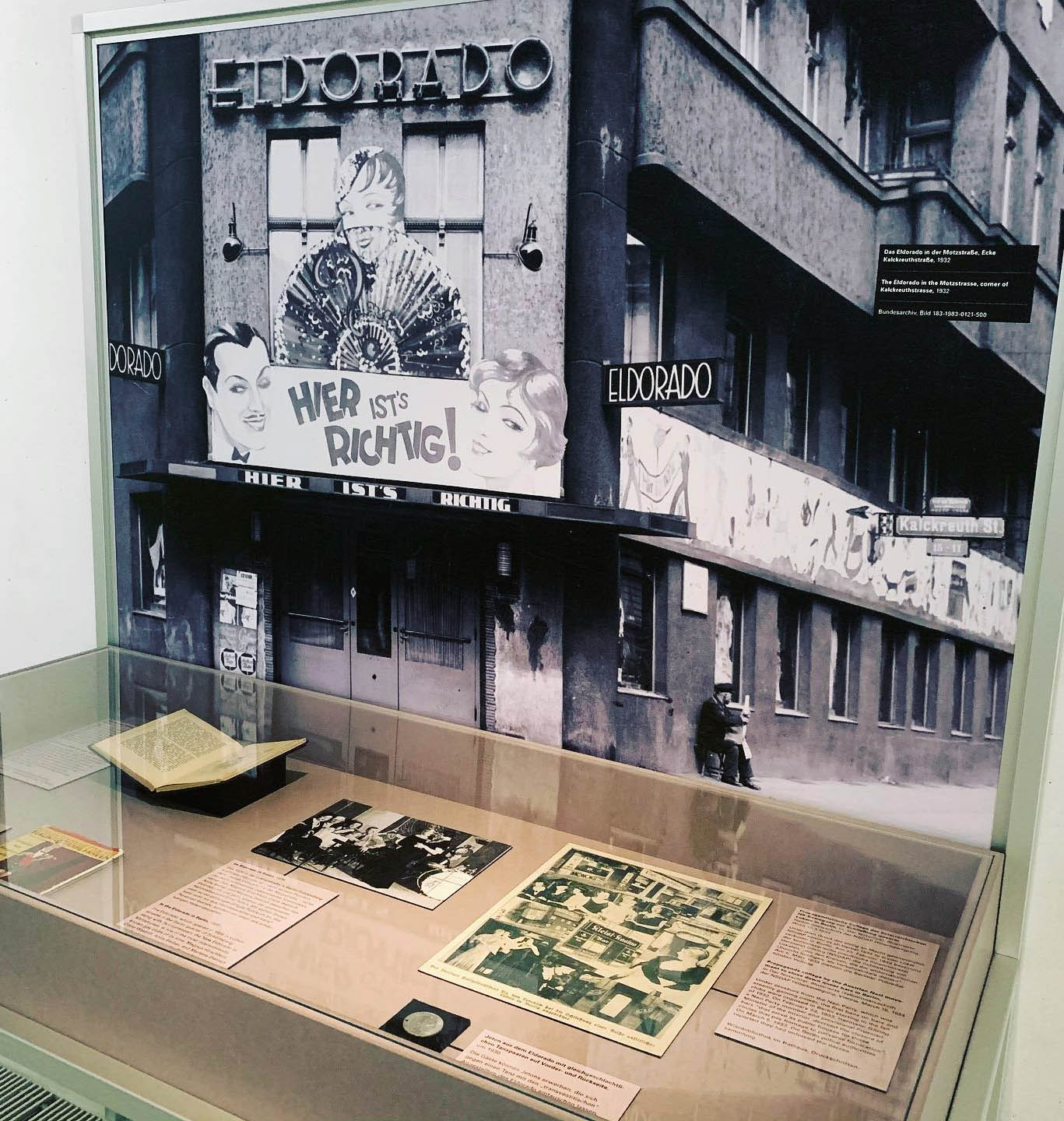
 

Installation view of the exhibition 'TO BE SEEN: Queer Lives 1900-1950' at the Munich Documentation Center for the History of National Socialism showing at rear, an enlargement of an image by an unknown photographer of the Eldorado in the Motzstrasse (1932); and at left centre in the display cabinet, an image by an unknown photographer Trans* people in the Eldorado in Berlin (1926)


Installation view of the exhibition TO BE SEEN: Queer Lives 1900-1950 at the Munich Documentation Center for the History of National Socialism showing at rear, an enlargement of an image by an unknown photographer of the Eldorado in the Motzstrasse (1932, below); and at left centre in the display cabinet, an image by an unknown photographer Trans* people in the Eldorado in Berlin (1926, above)
Photo: Connolly Weber Photography/NS-Dokumentationszentrum München


The Eldorado on Lutherstraße was one of the city’s infamous cabaret bars.

The Eldorado was the name of multiple nightclubs and performance venues in Berlin before the Nazi Era and World War II. The name of the cabaret Eldorado has become an integral part of the popular iconography of what has come to be seen as the culture of the period in German history often referred to as the “Weimar Republic”. …

Eldorado was a gay cabaret in that along with gay, lesbian, bisexual, trans* patrons, a heterosexual-identifying audience (artists, authors, celebrities, tourists) would have been present as well. “Cross-dressing” was tolerated on the premises, though for the most part legally prohibited and / or sharply regulated in public (and to an extent in private) at the time. This exception to everyday life attracted not only male patrons who wished to dress in the “clothing of the opposite sex”, and their admirers, but also to no small extent women who wished to do the same, and their admirers. Wealthy lookers-on were encouraged to come and drink and watch as so-called “Zechenmacher” (tab payers). The practice was particularly common in so-called “Lesbian bars” or at so-called “Lesbian balls” in the neighbourhood at the time and up the 1960s in places like the Nationalhof at nearby Bülowstraße 37. As women’s incomes were on average much lower than men’s then as now, male spectators with money to spend were explicitly welcome, and it was not uncommon that there were sex-workers present to offer their services. Eldorado also included what have come to be called drag shows as a regular part of the cabaret performances.

Text from the Wikipedia website


The Eldorado, which opened in 1926 on Lutherstrasse in Berlin-Schoeneberg, was – along with its counterpart, the “new Eldorado” on Motzstrasse – one of the internationally most well-known trendy bars of its time. Magnus Hirschfeld, Claire Waldoff, Anita Berber and Marlene Dietrich often and happily visited the Eldorado, as did the prominent National Socialist Ernst Röhm. With its shows, it attracted a wealthy audience, which soon consisted not only of homosexuals and trans* people, but above all of onlookers heterosexuals. Guests could purchase tokens that could be exchanged for a dance with the Eldorado’s “transvestite” staff.
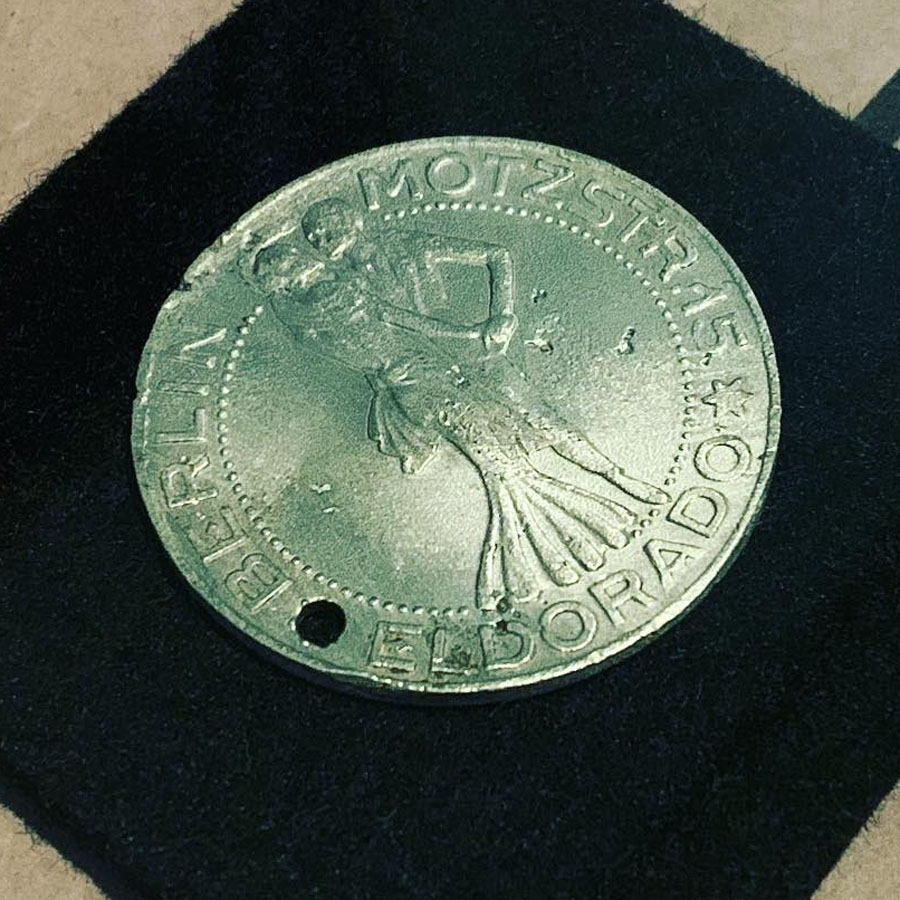
 

'Token from the Eldorado with same-sex dancing couples on the front and back' c. 1930


Token from the Eldorado with same-sex dancing couples on the front and back
c. 1930
© Gay Museum, Berlin


Dance monocle in original bag


Dance monocle in original bag
© dhmberlin


A popular accessory for lesbian women in the 1920s was the “dance monocle”

Short hair, ties, tails, and top hats were other identifying marks within part of the lesbian scene – and soon to be common among modern heterosexual women as well. The “New Woman” of the 1920s broke away from traditional gender images and appropriated new things and spaces that had previously been occupied by men.

In the Berlin scene, but also in other cities, numerous gay and lesbian clubs that rented premises, called for social activities, but also explicitly pursued political and emancipatory goals. One of the largest “women’s clubs” was the Violetta Ladies’ Club, founded in Berlin in 1926.

The founder of the women’s club Violetta was the lesbian activist Lotte Hahm (1890-1967), who also wrote for “The Girlfriend”. Together with her Jewish partner Käthe Fleischmann (1899-1967) she ran the lesbian bar Monokel-Diele in Berlin. After 1933, both initially tried to maintain lesbian networks and meeting places under cover names. Fleischmann, persecuted as a Jew, survived the Nazi era in various hiding places.

Text from the Munich Documentation Center for the History of National Socialism Instagram page


Invitations to monocle parties of the Violetta women's club in Berlin

Invitations to monocle parties of the Violetta women’s club in Berlin and the women’s association “Geselligkeit” in Chemnitz
In Garçonne 1931/1939
© forummuenchenev


Unknown photographer. 'The Eldorado in the Motzstrasse, corner of Kalckreuthstrasse' 1932


Unknown photographer
The Eldorado in the Motzstrasse, corner of Kalckreuthstrasse
1932
© nsdoku


Meeting places

A lively scene for homosexuals and trans* persons emerged in Germany during the 1920s. Especially in major cities, a number of clubhouses, bars, and clubs functioned as meeting places. The undisputed centre of queer life was Berlin. Police authorities there followed a more liberal course than elsewhere after the end of the nineteenth century. Nearly two hundred subcultural venues are documented in the imperial capital between 1919 and 1933, about eighty of them for lesbian women.

In conservative Munich, as in smaller cities and rural areas, fewer venues existed. Homosexual men had to resort to informal meeting places, due to the ongoing criminal persecution. They used public parks and toilets as “pick-up spots” to socialise or have sex. In doing so, they always ran the risk of being denounced or stopped by the police.

Magazines and informal networks

Magazines were an important means of communication for queer subcultures. They listed relevant clubs and bars, bookstores, and associations, and served as contact exchanges. These references and opportunities were essential particularly for queer people in rural areas, where there were no functioning networks. However, the publishers had to reckon with the banning of their print products at any time. It was not uncommon for entire print runs or volumes to be labeled as “trash texts” and confiscated.

In order to avoid police persecution and social exclusion, the scene employed its own linguistic codes. Camouflage terms such as “friend”, “girlfriend”, “ideal friendship”, “friendly exchange of ideas”, or “ideal-minded” were used to refer to lesbian and gay connections. Lonely hearts ads in relevant magazines were often the only way to find like-minded people, especially in smaller towns and in the countryside.

Text from Stories of the exhibition TO BE SEEN: Queer Lives 1900-1950


Installation view of the exhibition 'TO BE SEEN: Queer Lives 1900-1950' at the Munich Documentation Center for the History of National Socialism


Installation view of the exhibition TO BE SEEN: Queer Lives 1900-1950 at the Munich Documentation Center for the History of National Socialism showing historical magazines


In TO BE SEEN you can leaf through historical magazines. They were an important means of communication for queer subcultures.

Magazines such as “Die Freundsblatt”, “DasFreundschaftsblatt” or “Frauenliebe” referred to relevant pubs, bookstores and associations and served as contact exchanges. Especially for queer people in rural areas, where there were no functioning networks, these tips and opportunities were essential. However, the publishers had to expect their printed products to be banned at any time. It is not uncommon for entire editions or volumes to be marked as “trash and dirty writing” and confiscated.

“The Girlfriend” (subtitle “The Ideal Friendship Journal”, later “Weekly Journal for Ideal Female Friendship”) was a magazine for lesbian women from 1924 to 1933 in Berlin during the Weimar Republic. It is considered the first lesbian magazine and was first published monthly, then every two weeks, and later even weekly.

The editor was Friedrich Radzuweit (1876-1932), chairman of the Federation for Human Rights. The content focuses on information on lesbian life and meeting places for lesbians, political topics, short stories, serialised novels and classifieds. Although “The Girlfriend” was primarily aimed at a lesbian readership, there are also numerous articles that deal with topics such as ‘transvestism’ or transgender. It was discontinued a few weeks after the National Socialists seized power in January 1933: the last issue appeared on March 15, 1933, a week before the Enabling Act was passed.
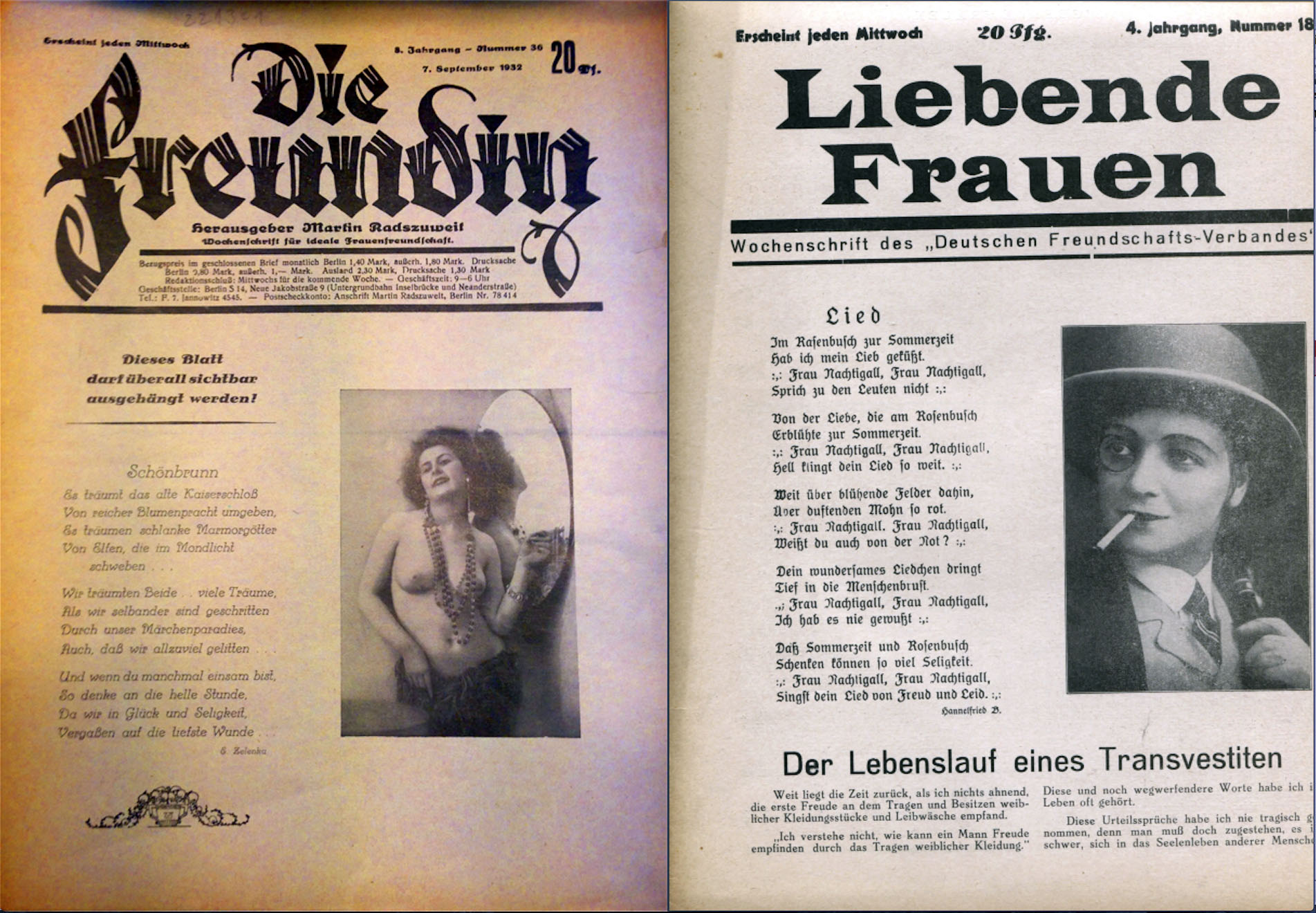
 

Die Freundin (The Girlfriend), September 1932, and Liebende Frauen (Women in Love), 1929


Covers from Die Freundin (The Girlfriend), September 1932, and Liebende Frauen (Women in Love), 1929


Cover of "Die Freundin" (The Girlfriend) 26. December 1927


Cover of “Die Freundin” (The Girlfriend)
26. December 1927
© Forum Queeres Archiv München


Unknown photographer. 'Magnus Hirschfeld' c. 1900


Unknown photographer
Magnus Hirschfeld
c. 1900
© Staatsbibliothek zu Berlin – Preußischer Kulturbesitz


Unknown photographer. "Zwischenstufenwand" (sexual transitions wall) c. 1925-1930


Unknown photographer
“Zwischenstufenwand” (sexual transitions wall)
c. 1925-1930
Bildarchiv Preussischer Kulturbesitz


The “Zwischenstufenwand” (sexual transitions wall) in the Institute for Sexology illustrated Hirschfeld’s theory that all people have male and female qualities in them.

The famous picture wall, illustrating Hirschfeld’s sex and gender theories. It was first exhibited in Leipzig (1922) on occasion of the German Natural Scientists’ and Physicians’ centenary and then in Vienna (1930) at the World League for Sexual Reform’s congress. The picture wall (2×1 m by 4×5 m) always had a prominent place in the Institute and was used to explain sexual theories to visitors.


Installation view of the exhibition 'TO BE SEEN: Queer Lives 1900-1950' at the Munich Documentation Center for the History of National Socialism


Installation view of the exhibition TO BE SEEN: Queer Lives 1900-1950 at the Munich Documentation Center for the History of National Socialism


Knowledge, diagnosis, control

Scientific interest in sexuality and gender was expanding around the turn of the century. The amount of sexological research and number of publications increased. Most writings described homosexuality or trans* identities as “pathological” conditions. This assumption has since been scientifically refuted. At the same time, groundbreaking theories emerged, for example Magnus Hirschfeld’s model of “sexual intermediates.” In it, the sexologist anticipated the later realisation that numerous other gender identities besides man and woman exist.

Yet, then as now, knowledge also meant power and control. People were examined, described, classified, and judged as patients. Some sexologists incorporated ideas in their research that drew on biologism and eugenics. These were spread throughout society and later played a central role for the Nazis: their conception of so-called “racial hygiene” distinguished between “valuable” and “unworthy” life.

The driving forces in the German-speaking world from the 1860s on were the lawyer and physician Karl Heinrich Ulrichs and the physician Richard von Krafft-Ebing. Ulrichs in particular fought for the decriminalisation and recognition of homosexuality. His insights into the diversity of sexuality and gender are still essential today. Other scientists understood the “third sex” as a pathological phenomenon and wanted to effect the “re-education” and “healing” of their patients with methods that were sometimes questionable. The result was often physical or psychological trauma.

The Institute for Sexology and its patients

Magnus Hirschfeld was the best-known representative of sexology in the German-speaking world. He combined a pursuit for emancipation and a scientific perspective, was a champion of decriminalisation and a physician at the same time. His Institute for Sexology, founded in Berlin in 1919, became the centre of the liberal-leftist sexual reform movement of the Weimar Republic. In addition to research and medical consulting, the institute operated a library, an archive, and a museum. Unlike conservative sexologists, Hirschfeld and his staff worked towards the self-acceptance of homosexuals and trans* persons.

This “adaptation therapy” or “milieu therapy” aimed to help people adapt to the queer milieu that suited them, instead of repressing their identity. Many important people from the gay community, such as Lili Elbe, were treated here. Homosexual writers such as André Gide and Christopher Isherwood visited the institute. People who today would be considered intersex were also counselled. From the beginning, the Nazis were disturbed by liberal sexology, Hirschfeld, and his institute. Many of the institute’s employees were, like Hirschfeld himself, Jewish. In 1933, Nazi students and SA members demolished the institute; Hirschfeld was on a world tour at the time and remained in exile in France.

The institute grew to become a refuge for “transvestites”. This is how people who we understand today as trans* persons were called at the time. Some of them lived in the institute and earned their living there. They were particularly dependent on it. Despite the institute’s great merits, the relationship between doctors and “patients” was not unproblematic from today’s point of view.

By mediating between queer people and state power, Hirschfeld and his colleagues were able to protect their patients and fight for more rights and freedom for them. But in order to do so, they cooperated with the police and the courts, thus providing the state institutions with access and control. Then as now, intersex and trans* people were rarely perceived as experts on themselves, making them dependent on the recognition bestowed by medicine and the justice system. This was accompanied by a scientific and state-regulatory view of their bodies that pushed them into the role of patients, externally controlled subjects, instead of granting them autonomy over their bodies as well as their own voice.

Text from Stories of the exhibition TO BE SEEN: Queer Lives 1900-1950


Hirschfeld’s medical practices are controversial today

However, Magnus Hirschfeld also referred those male homosexuals who, based on his biological research, assumed that homosexuality could also be treated, to other doctors. They castrated the patients and implanted heterosexual testicles in them.

Not only Magnus Hirschfeld’s medical practices, but also his scientific approach is controversial today. His absolute belief in biology leaned towards social Darwinism and eugenics. He founded a “Medical Society for Sexology and Eugenics”. He thus promoted “sexual selection” in order to improve the “mental fitness of the offspring”. He was thus at the same time far away and entirely in line with the National Socialists.

The National Socialists saw Hirschfeld as a security risk, a threat to the population growth of the “Aryan race” and not only in him. Tens of thousands of gay men are sentenced to prison, jail, and concentration camps, the gay civil rights movement is crushed, gay hangouts are closed, magazines are banned, and then, on May 6, 1933, the Institute for Sex Research is looted and its library burned.

Gabi Schlag and Benno Wenz. “Magnus Hirschfeld – pioneer of sex research,” on the SWR website 29.7.2021 [Online] Cited 12/04/2023. Used under fair use conditions for the purposes of education and research.


Unknown photographer. 'First Congress for Sexual Reform on a Sexological Basis' 1921


Unknown photographer
First Congress for Sexual Reform on a Sexological Basis
1921
From Magnus Hirschfeld, Sexology, vol. 4, plates
© Forum Queeres Archiv München


Session of the “International Conference for Sex Reform on a Sexological Basis”, organised by Hirschfeld 1921 in Berlin at the Langenbeck-Virchow-Haus. (Hirschfeld, leaning forward, is seated just beneath the lectern.) This was the first sexological congress held anywhere, and it laid the groundwork for the Copenhagen congress of 1928.
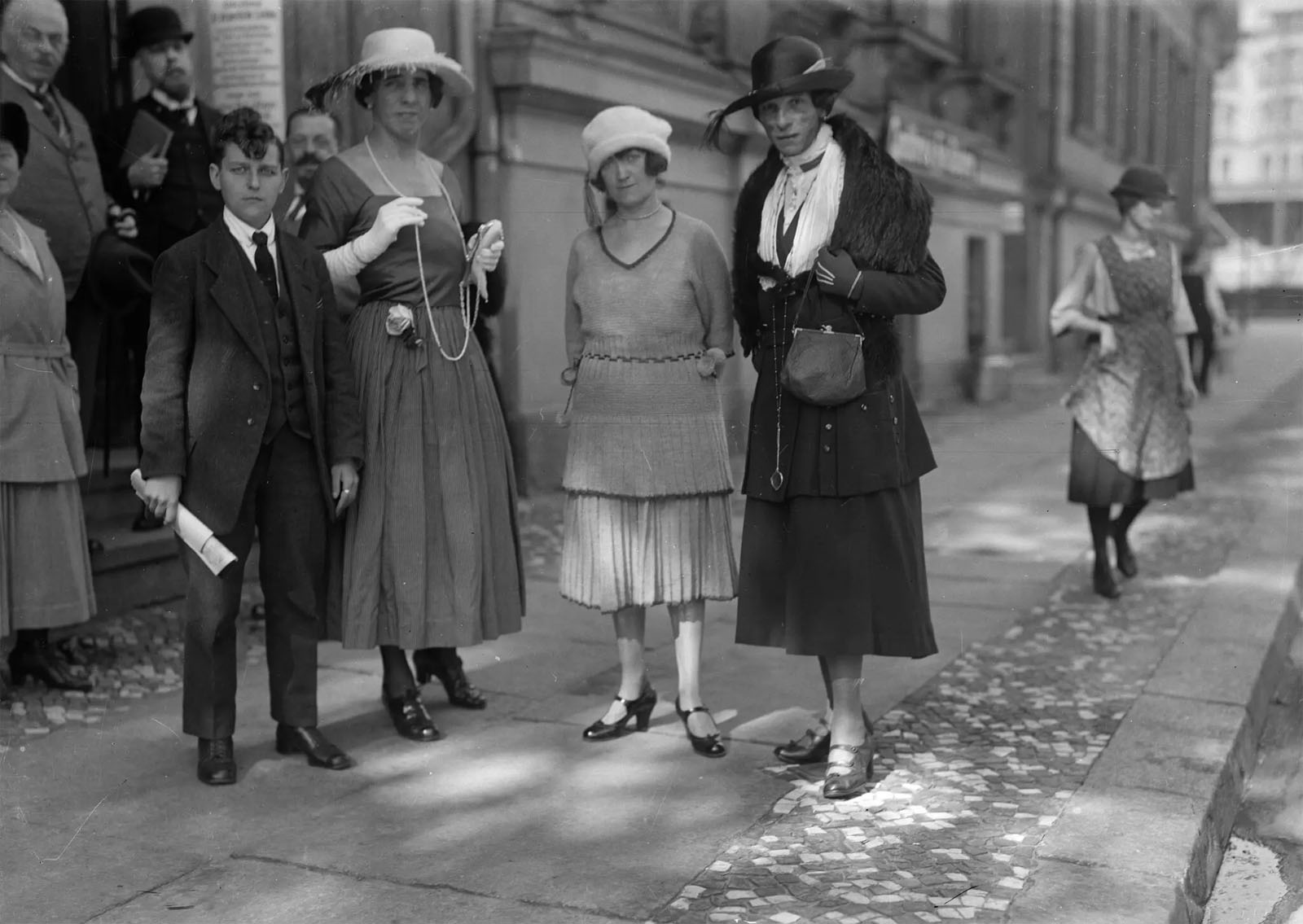
 

Willy Römer (German, 1887-1979) 'Transvestites in Front of the Institute of Sexology' 1921


Willy Römer (German, 1887-1979)
Transvestites in Front of the Institute of Sexology
1921
Gelatin silver print
© bpk / Kunstbibliothek, SMB, Photothek Willy Römer


Titled “Transvestites in Front of the Institute of Sexology” this photograph was taken on the occasion of the First International Congress for Sexual Reform on the Basis of Sexology in Berlin, 1921.

Willy Römer (December 31 , 1887 in Berlin – October 26, 1979 in West Berlin ) was a press photographer. His picture agency was one of the ten most important of the Weimar period. The pictures mainly illustrate life in Berlin from 1905 to 1935. It is thanks to a rare stroke of luck that his extensive picture archive survived the Second World War almost unscathed.


'"Transvestite Certificate" for Gerd Katter' 1928


“Transvestite Certificate” for Gerd Katter
1928
© Archiv der Magnus-Hirschfeld-Gesellschaft


Starting in 1900, “Transvestite Certificates” were issued by a doctor, that officially certified that a person was known to be “wearing men’s clothing” or “wearing women’s clothing”.

In TO BE SEEN #QueerLives we also show Gerd Katter’s “Transvestite License”. From 1900, “transvestite certificates” were issued in some cities. It is a medically certified official confirmation that a person is known as “wearing men’s clothing” or “wearing women’s clothing”. The authorities refrain from making an arrest if you show them during checks. However, those affected are thus registered with the police and can be monitored more easily.

Gerd Katter (1910-1995) came to the Institute for Sexology at the age of 16 – at that time still with a female birth name. Barred from having his breasts amputated because of his youth, Katter tries to operate on himself, which requires an emergency amputation. Katter is one of many people who receive concrete, albeit unconventional, help at the institute. So he is prescribed to visit bars where “transvestites” meet. According to the adaptation therapy pursued at the institute, those seeking advice should be brought into contact with like-minded people. This is how they should learn to accept themselves.

Magnus Hirschfeld repeatedly invited Gerd Katter to the institute to show his guests a medical case study – a practice of displaying people and their bodies that was common at the time, but which is problematic from today’s medical-ethical point of view. Gerd Katter later completed an apprenticeship as a carpenter and lived in the GDR.

Text from the Munich Documentation Center for the History of National Socialism Instagram page


Charlotte Wolff (German-British, 1897-1986) 'Bisexuality' German edition from 1981


Charlotte Wolff (German-British, 1897-1986)
Bisexuality
German edition from 1981
© NS-Dokumentationszentrum München


Charlotte Wolff – Sexology in Exile

Female homosexuality and bisexuality received little attention in the male-dominated field of sexology. An exception was the research of Charlotte Wolff (1897-1986). The physician situated precisely these topics at the centre of her work. After 1933, left-wing, Jewish, and openly lesbian women in Germany were increasingly targeted by the Nazis. Being Jewish, she emigrated to Paris in 1933, and to London in 1936. Her research on lesbian sexuality and bisexuality earned her international recognition beginning in the 1960s.

Feeling Bodies, Seeing Images

At the same time as the advancements in sexology, new notions of the body, gender, and intimacy were finding expression in art and culture. Literature, theatre, film, and the visual arts offered an opportunity to question gender stereotypes and to create new roles and body images. These served as the basis for imagining freer ways of living and to lay the foundation for what we perceive today as queer aesthetics.

While Article 142 of the Weimar Constitution promised extensive artistic freedom, censorship was simultaneously introduced for the new medium of film. Munich in particular had numerous bans on film and theatre performances deemed offensive.

Text from Stories of the exhibition TO BE SEEN: Queer Lives 1900-1950
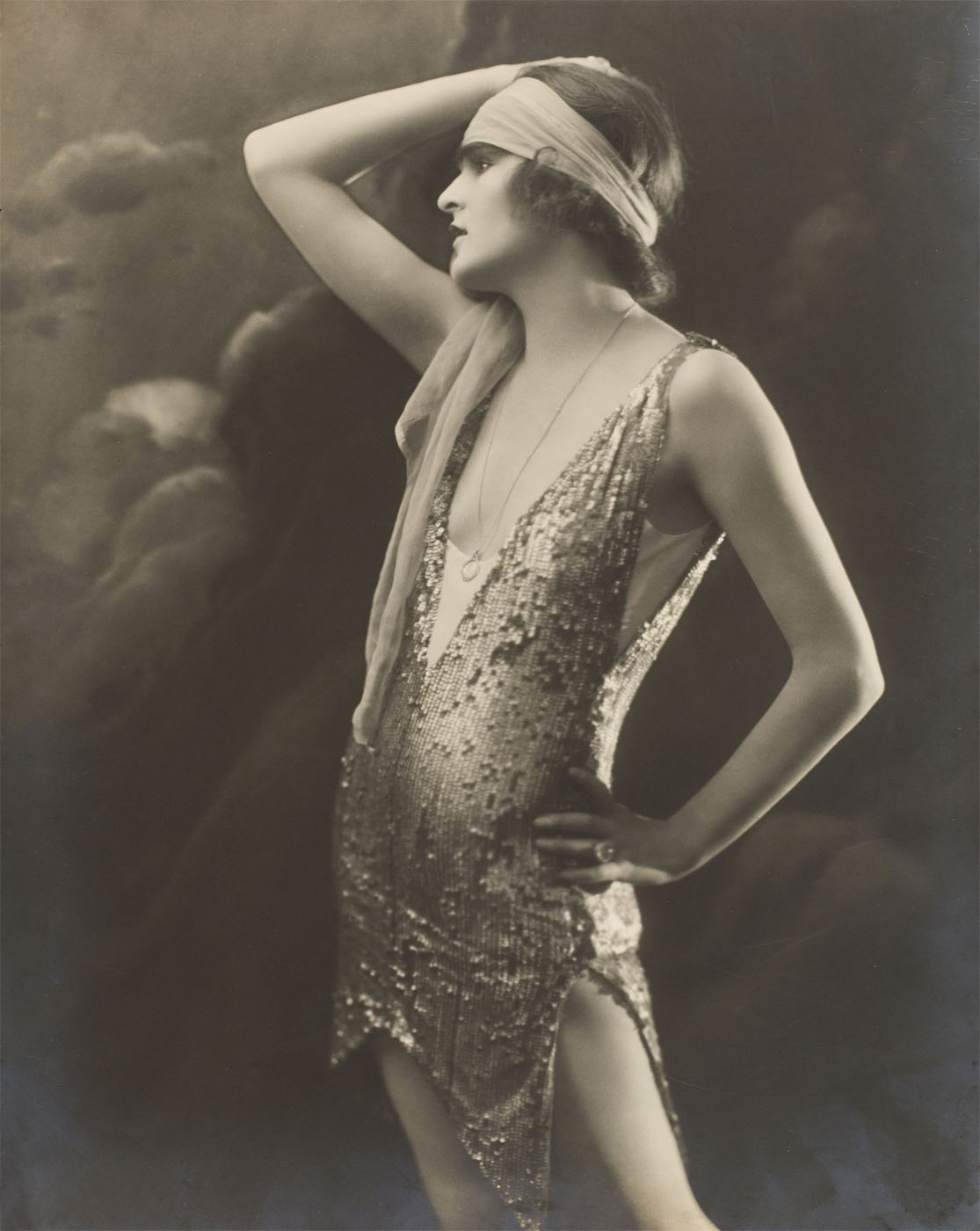
 

Unknown photographer. 'Anita Berber' c. 1925


Unknown photographer
Anita Berber
c. 1925
© Stiftung Stadtmuseum Berlin – Archive German State Opera


New images of the body

In the first half of the twentieth century, artists experimented with new representations of the human body. They conceived of a wide spectrum of possible identities and sexualities situated outside the dominant categories. Artists subverted binary notions of gender, whether through ambiguities, gender-neutral codes, or playing with androgynous body images.

In 1933, the Nazis put an end to this diversity. Avant-garde works by artists such as Hannah Höch or Jeanne Mammen were denounced as “degenerate” and confiscated, banned, or destroyed. The regime instead honoured artists such as Arno Breker, Leni Riefenstahl, and Josef Thorak, who immortalised traditional gender images in monumental depictions. Such images supported the Nazi regime’s racial ideals, and endured well into the postwar period.

Text from Stories of the exhibition TO BE SEEN: Queer Lives 1900-1950
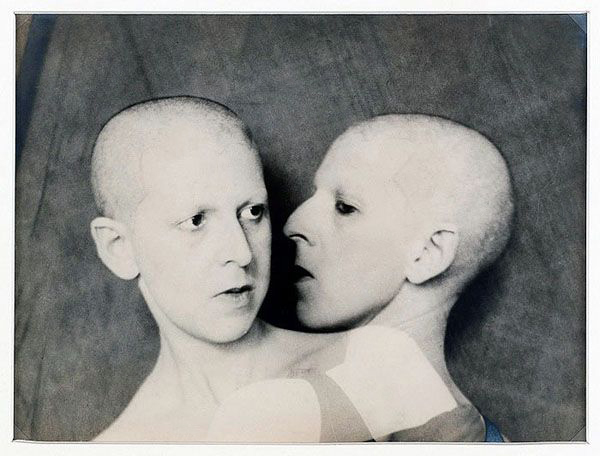
 

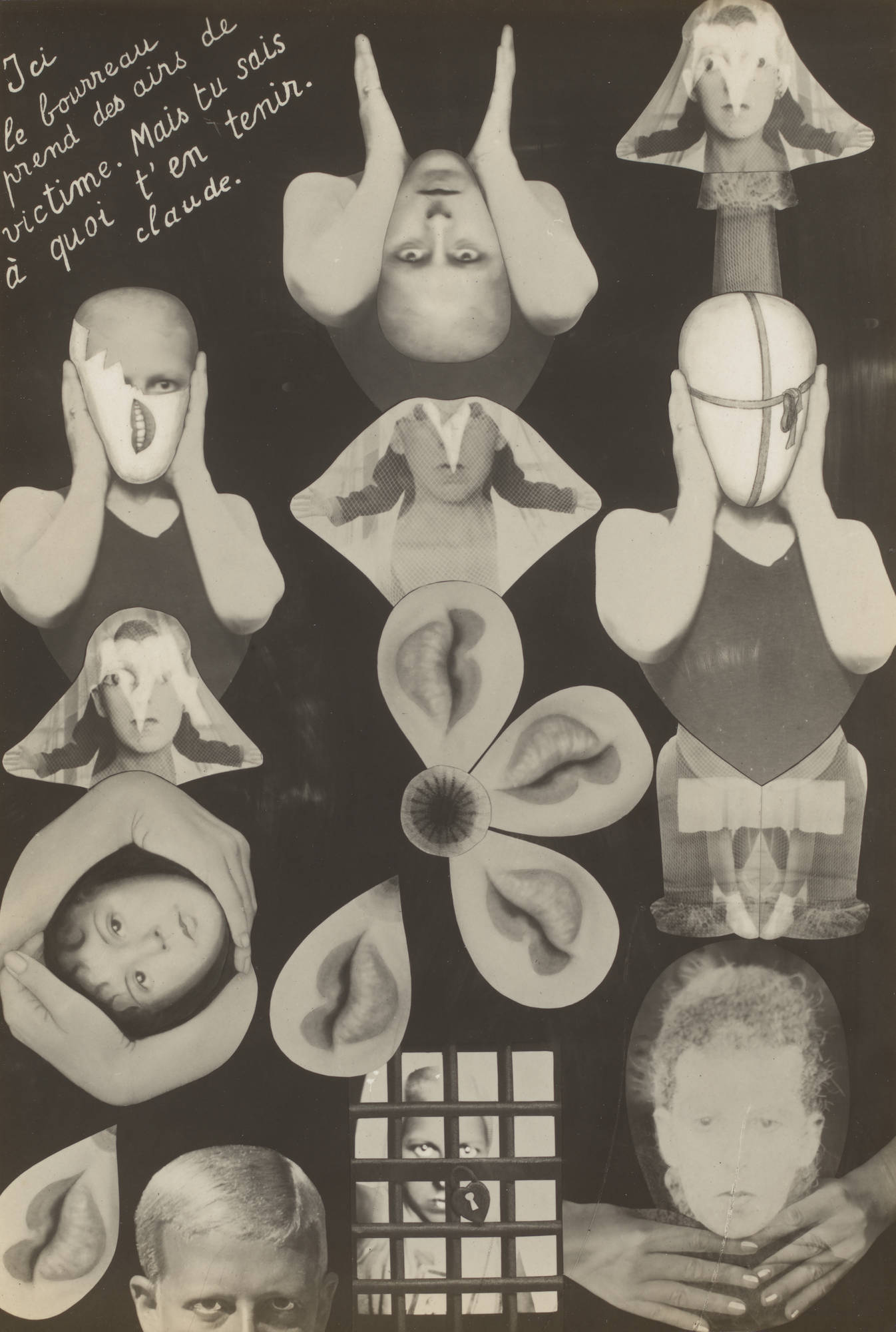
Claude Cahun (French, 1894-1954) 'Que me veux tu?' 1929


Claude Cahun (French, 1894-1954)
Que me veux-tu?
1929
Gelatin silver print
Paris Musees, musée d’Art moderne


Hannah Höch (German, 1889-1978) 'Untitled (Hannah Höch at her easel, The Hague; self-portrait (double exposure) with the painting Symbolic Landscape III)' 1930


Hannah Höch (German, 1889-1978)
Untitled (Hannah Höch at her easel, The Hague; self-portrait (double exposure) with the painting Symbolic Landscape III)
1930
Gelatin silver print
© VG Bild-Kunst, Bonn 2022


Hannah Höch worked with clichés and role models in her art and was a significant influence on the Dada movement.


Hannah Höch (German, 1889-1878)

Hannah Höch (German: [hœç]; 1 November 1889 – 31 May 1978) was a German Dada artist. She is best known for her work of the Weimar period, when she was one of the originators of photomontage. Photomontage, or fotomontage, is a type of collage in which the pasted items are actual photographs, or photographic reproductions pulled from the press and other widely produced media.

Höch’s work was intended to dismantle the fable and dichotomy that existed in the concept of the “New Woman”: an energetic, professional, and androgynous woman, who is ready to take her place as man’s equal. Her interest in the topic was in how the dichotomy was structured, as well as in who structures social roles.

Other key themes in Höch’s works were androgyny, political discourse, and shifting gender roles. These themes all interacted to create a feminist discourse surrounding Höch’s works, which encouraged the liberation and agency of women during the Weimar Republic (1919-1933) and continuing through to today.

Text from the Wikipedia website
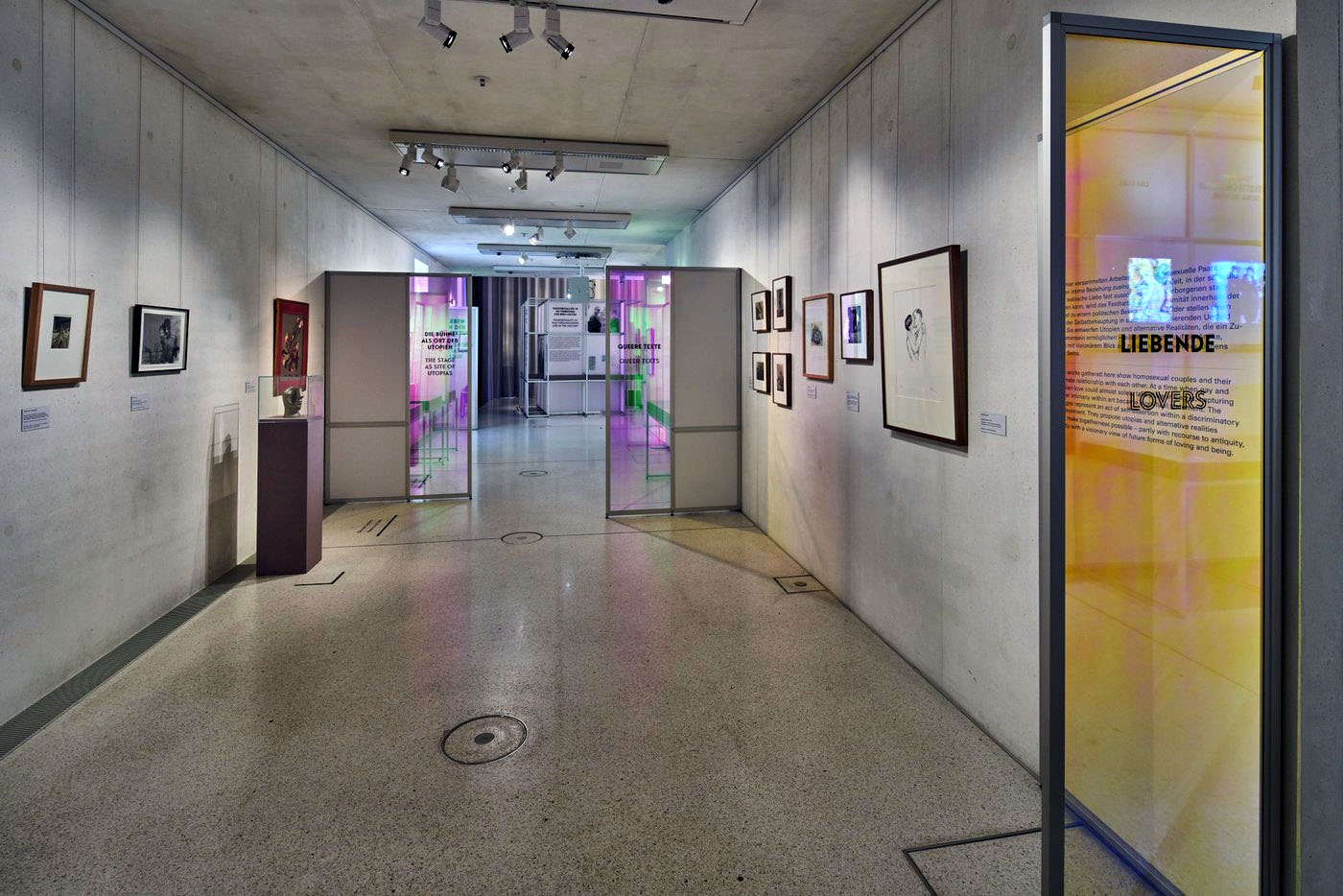
 

Installation view of the exhibition 'TO BE SEEN: Queer Lives 1900-1950' at the Munich Documentation Center for the History of National Socialism


Installation view of the exhibition TO BE SEEN: Queer Lives 1900-1950 at the Munich Documentation Center for the History of National Socialism
Photo: Connolly Weber Photography/NS-Dokumentationszentrum München


Lovers

The works gathered here show homosexual couples and their intimate relationship with each other. At a time when gay and lesbian love could almost solely take place in secret, capturing queer intimacy within art became a political statement. The images represent an act of self-assertion within a discriminatory environment. They propose utopias and alternative realities that make togetherness possible – partly with recourse to antiquity, partly with a visionary view of future forms of loving and being.

Text from Stories of the exhibition TO BE SEEN: Queer Lives 1900-1950
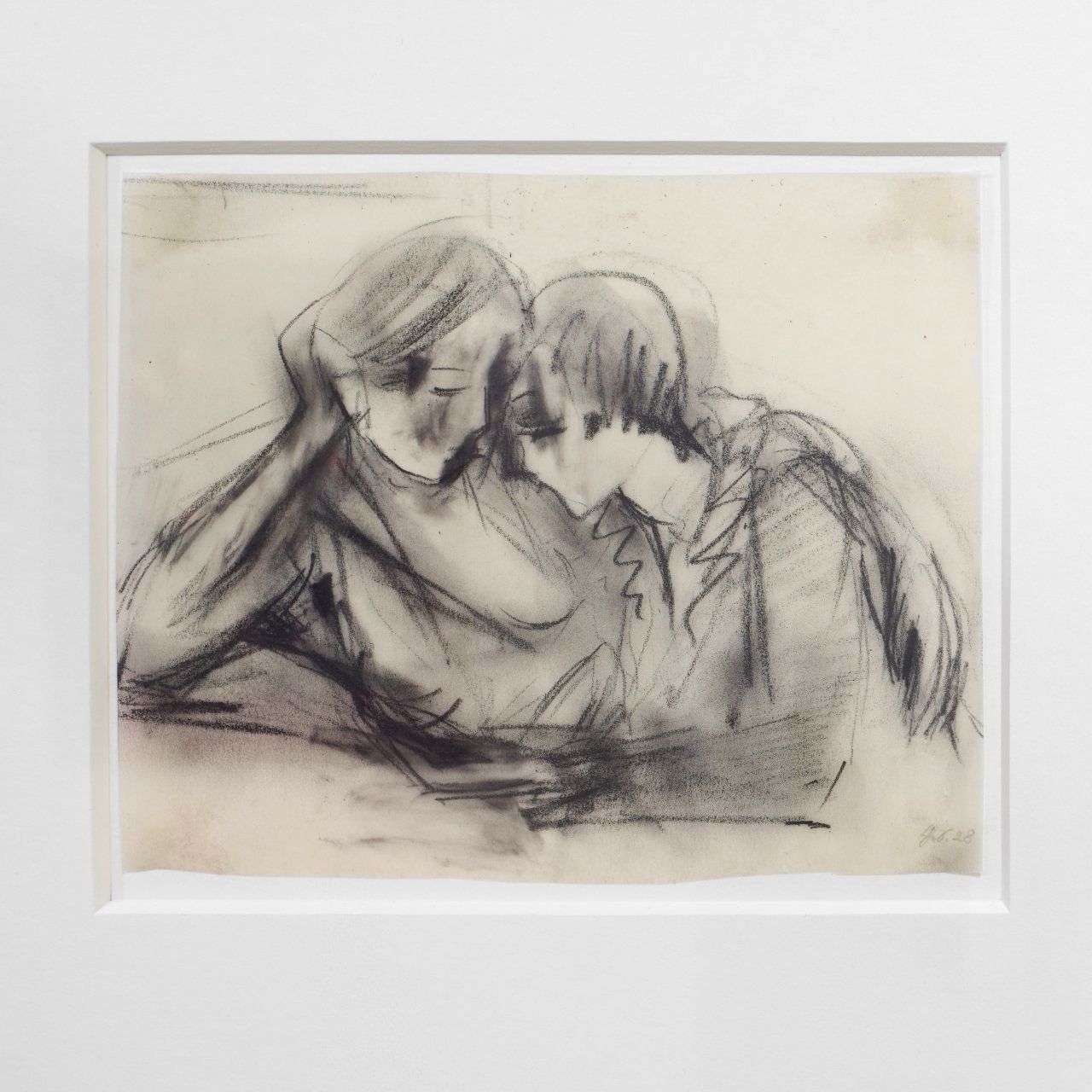
 

Gertrude Sandmann (German, 1893-1981) 'Rosa Nachthemd und schwarzer Pyjama' (Pink nightgown and black pyjamas) 1928


Gertrude Sandmann (German, 1893-1981)
Rosa Nachthemd und schwarzer Pyjama (Pink nightgown and black pyjamas)
1928
© Anja Elisabeth Witte/Berlinische Galerie


Gertrude Sandmann (16 November 1893 – 6 January 1981) was a German artist and Holocaust survivor. Born into a wealthy German-Jewish family, Sandmann studied at the Verein der Berliner Künstlerinnen and had private tutelage from Käthe Kollwitz. In 1935 she was banned from practicing her profession due to the Nuremberg Laws. Given a deportation order in 1942, she ignored it, faked her own suicide, and hid with friends in Berlin until the end of the war. She lived in an apartment in Berlin-Schöneberg until the end of her life. She was a lesbian and, after the war, worked to improve the rights and visibility of LGBT people. Much of her oeuvre is held by the Potsdam Museum.

Text from the Wikipedia website


Gertrude Sandmann (1893-1981), who trained in Berlin and Munich, took private lessons from Käthe Kollwitz in the 1920s. She and the older artist remained lifelong friends. Unlike Kollwitz, however, Sandmann was less focused on social critique. A committed feminist, women were her favourite theme, as they were for her colleague Jeanne Mammen, who was about the same age.
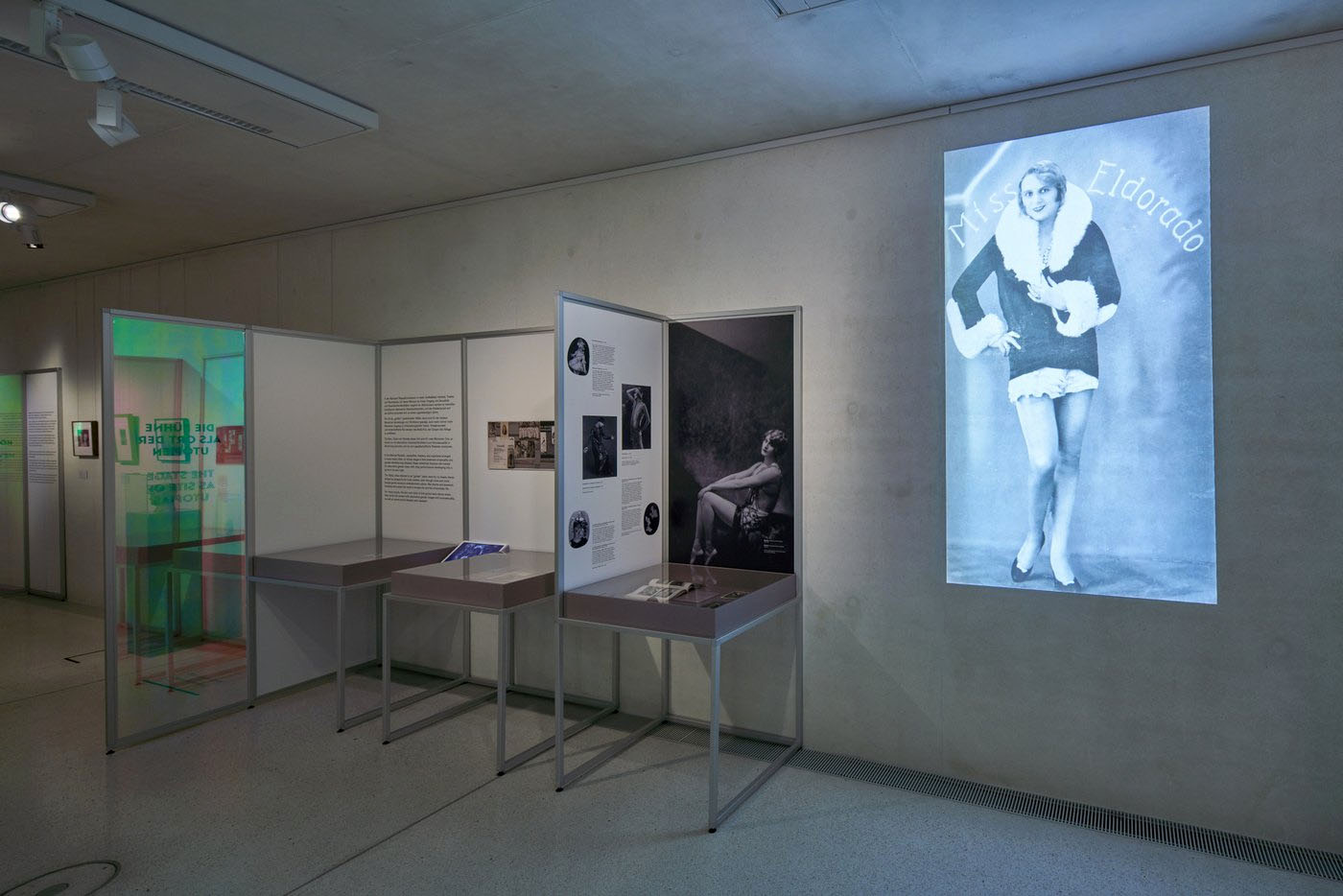
 

Installation view of the exhibition 'TO BE SEEN: Queer Lives 1900-1950' at the Munich Documentation Center for the History of National Socialism


Installation view of the exhibition TO BE SEEN: Queer Lives 1900-1950 at the Munich Documentation Center for the History of National Socialism showing at centre, Dora Kallmus’ photograph The trapeze artist Barbette (Nd, below)
Photo: Connolly Weber Photography/NS-Dokumentationszentrum München


The stage as site of utopias

In the Weimar Republic, vaudevilles, theatres, and nightclubs emerged in many major cities, on whose stages a freer treatment of sexuality and gender identities was allowed. Stage celebrities became role models for alternative gender roles, with drag performances developing into a genre in its own right.

The 1920s, often referred to as “golden” years, were by no means characterised by prosperity for most citizens, even though more and more people gained access to entertainment culture. War trauma and economic hardship stimulated the need to escape the worries of everyday life.

For many people, the bars and clubs of this period were places where they came into contact with alternative gender images and homosexuality, as well as where social debates were sparked.

Text from Stories of the exhibition TO BE SEEN: Queer Lives 1900-1950
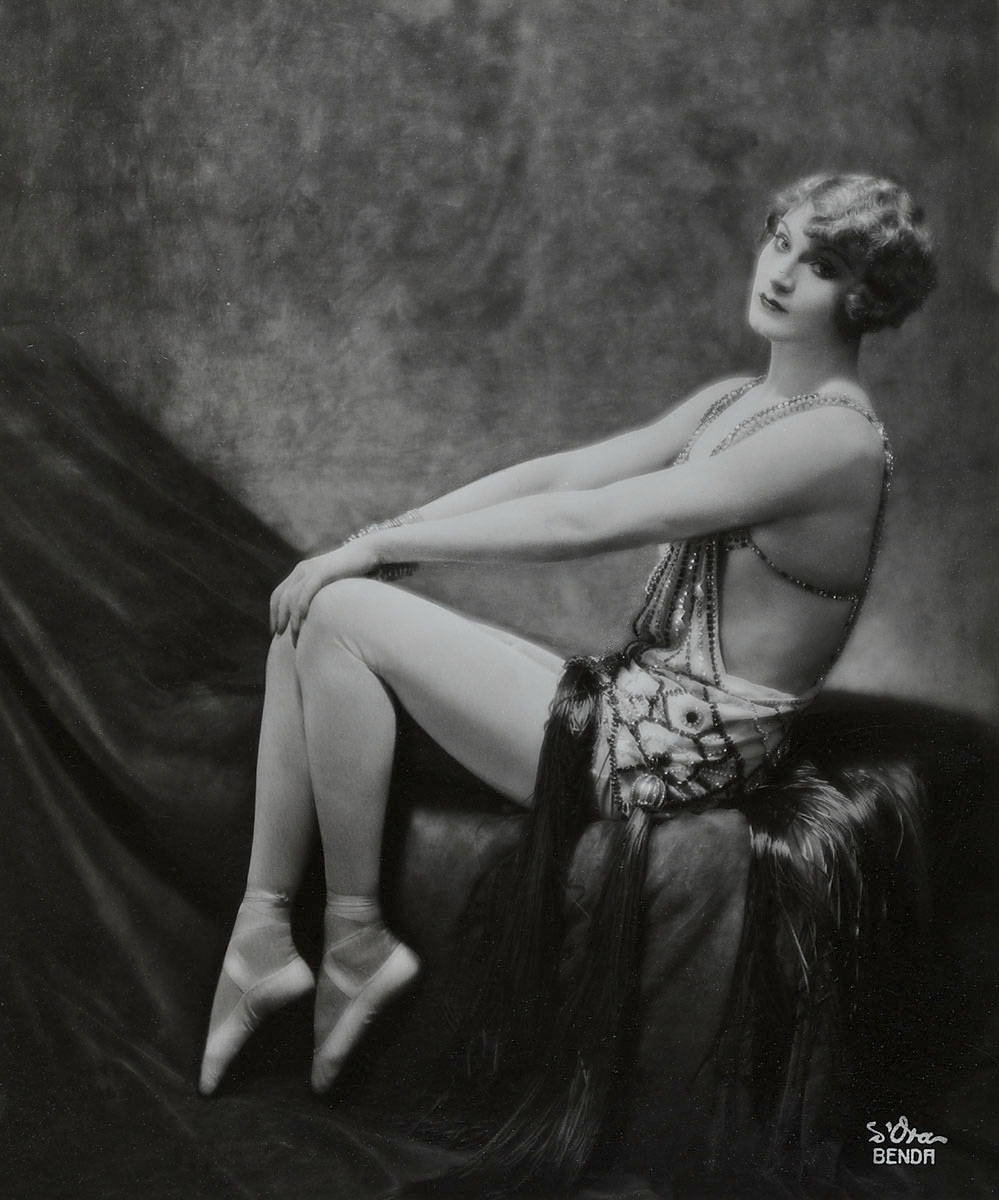
 

Dora Kallmus (Austrian, 1881-1963) 'The vaudeville and trapeze artist Barbette' Nd


Dora Kallmus (Atelier d’Ora) (Austrian, 1881-1963)
The vaudeville and trapeze artist Barbette
Nd
© Estate of Madame d’Ora, MK&G ~ Museum für Kunst und Gewerbe Hamburg


The trapeze artist Barbette (real name Vander Clyde, 1899-1973) celebrated great success in Europe from the mid-1920s. Barbette performed, among other things, in the Berlin Varieté Wintergarten. The sensational productions of the “female impersonators” became increasingly known to a mass audience – and thus also helped the male and female impersonators of the Berlin scene to gain acceptance.


Dora Philippine Kallmus (Madame D’Ora) (Austrian, 1881-1963)

Dora Philippine Kallmus (20 March 1881 – 28 October 1963), also known as Madame D’Ora or Madame d’Ora, was an Austrian fashion and portrait photographer.

Early life

Dora Philippine Kallmus was born in Vienna, Austria, in 1881 to a Jewish family. Her father was a lawyer. Her sister, Anna, was born in 1878 and deported in 1941 during the Holocaust. Although her mother, Malvine (née Sonnenberg), died when she was young, her family remained an important source of emotional and financial support throughout her career.

She and her sister, Anna, were both “well-educated,” spoke English and French, and played the piano. They had also traveled throughout Europe.

She became interested in the photography field while assisting the son of the painter Hans Makart, and in 1905 she was the first woman to be admitted to theory courses at the Graphische Lehr- und Versuchsanstalt (Graphic Training Institute). That same year she became a member of the Association of Austrian photographers. At that time she was also the first woman allowed to study theory at the Graphischen Lehr- und Versuchsanstalt, which in 1908 granted women access to other courses in photography.

Career

In 1907, she established her own studio with Arthur Benda in Vienna called the Atelier d’Ora or Madame D’Ora-Benda. The name was based on the pseudonym “Madame d’Ora”, which she used professionally. D’ora and Benda operated a summer studio from 1921 to 1926 in Karlsbad, Germany, and opened another gallery in Paris in 1925. The Karlsbad gallery allowed D’Ora to cater to the “international elite vacationers.” These same clients later convinced her to open her Paris studio.

Between 1917 and 1927, D’Ora’s studio “produced” photographs for Ludwig Zwieback & Bruder, a Viennese department store. She was represented by Schostal Photo Agency (Agentur Schostal) and it was her intervention that saved the agency’s owner after his arrest by the Nazis, enabling him to flee to Paris from Vienna.

Her subjects included Josephine Baker, Coco Chanel, Tamara de Lempicka, Alban Berg, Maurice Chevalier, Colette, and other dancers, actors, painters, and writers.

Text from the Wikipedia website


Dora Kallmus (Austrian, 1881-1963) 'The vaudeville and trapeze artist Barbette' Nd (detail)


Dora Kallmus (Austrian, 1881-1963)
The vaudeville and trapeze artist Barbette (detail)
Nd
© Museum für Kunst und Gewerbe Hamburg


Unknown photographer. 'Dance study of Alexander Sakharoff' 1912


Unknown photographer
Dance study of Alexander Sakharoff
1912
Deutsche Kunst und Dekoration: illustr. Monatshefte für moderne Malerei, Plastik, Architektur, Wohnungskunst u. künstlerisches Frauen-Arbeiten – 30.1912


Installation view of the exhibition 'TO BE SEEN: Queer Lives 1900-1950' at the Munich Documentation Center for the History of National Socialism


Installation view of the exhibition TO BE SEEN: Queer Lives 1900-1950 at the Munich Documentation Center for the History of National Socialism
Photo: Connolly Weber Photography/NS-Dokumentationszentrum München


Life under dictatorship

After the Nazis took power in 1933, every form of queer life was threatened and continued to exist only in private spaces or secret locations. Hopes for a tacit tolerance of homosexuality by the Nazis were finally dashed after the murder of Ernst Röhm, chief of- staff of the SA (Storm Troopers). The period of open persecution had begun.

During the first major Nazi raids against homosexuals on October 20, 1934, 145 men were arrested in Munich alone. Paragraph 175 of the penal code was made more severe in June 1935: any act between men bearing sexual suggestion was now punishable.

About 57,000 homosexual men were sentenced to prison, and between 6,000 and 10,000 of them were deported to concentration camps, of whom at least half were murdered.

Female homosexuality was not prosecuted in the dictatorship, but was socially ostracised. If lesbian women and persons who did not conform to their gender were denounced, they were threatened with police investigations, house searches, and interrogations. If political opposition, social deviance, or racial persecution additionally occurred, they faced repression or even internment in a concentration camp.

The graphic artist Richard Grune (1903-1983) was imprisoned almost continuously from 1934 to 1945 because of his homosexuality. After his liberation from the concentration camp, he processed what he had experienced through art.

Text from Stories of the exhibition TO BE SEEN: Queer Lives 1900-1950


Richard Grune (German, 1903-1983) 'Solidarity: Prisoner Supports His Exhausted Comrade' 1945-1947


Richard Grune (German, 1903-1983)
Solidarity: Prisoner Supports His Exhausted Comrade
1945-1947
Lithograph
© Wien Museum


“Solidarity,” a lithograph of one prisoner supporting another, by German artist Richard Grune, who spent eight years in Nazi concentration camps after being convicted for homosexuality.


Trained as an artist and graphic designer, 29-year-old Richard Grune moved to Berlin the same month that the police began forcing these establishments to shut down. Although prominent nightclubs like the Eldorado faced closure, members of these communities still found ways to continue gathering more privately. For example, Grune hosted two parties for friends in his studio in fall 1934. He was denounced afterward – along with dozens of others – by a private citizen who often passed information to police. Grune was then arrested for alleged violations of Paragraph 175, the statute of the German criminal code that criminalised sexual relations between men. He was imprisoned for several months before being convicted and sentenced to a year in prison.

After serving his sentence, Grune was arrested again by the Gestapo and held indefinitely in what was misleadingly referred to as “protective custody” (“Schutzhaft”) – an experience shared by many convicted of violating Paragraph 175 under the Nazi regime.5 Grune spent the next decade in concentration camps, including Sachsenhausen and Flossenbürg. He escaped from Flossenbürg in April 1945 as American forces approached and camp authorities evacuated the prisoners.

Grune created the featured lithograph6 – “Solidarity: Prisoner Supports His Exhausted Comrade” – in 1945 as part of a series of images inspired by his experiences as a prisoner in the Nazi camp system. These lithographs were reproduced in two published portfolios in 1947.7 Grune’s artwork reflects many of his own experiences, but it does not reference his persecution as a gay man in any specific way. Instead, his lithographs seem to suggest the idea of shared suffering among all concentration camp prisoners. Because sexual relations between men remained criminalised for decades in Germany after the end of World War II, many people convicted under Paragraph 175 chose to conceal the details of their past persecution under the Nazi regime.8

After the war, Grune chose to portray himself as a political prisoner of Nazism, but he was not able to obtain official recognition or compensation for his suffering. Although his lithographs are among the most important artistic representations of concentration camp experiences created immediately after the war, Grune could not support himself as an artist. He did occasionally find design and illustration work, but he made his living by working as a bricklayer. Grune died in obscurity in Kiel, Germany in 1983.

Anonymous. “Lithograph by Richard Grune,” on the Holocaust Sources in Context website Nd [Online] Cited 10/04/2023. Used under fair use conditions for the purposes of education and research.
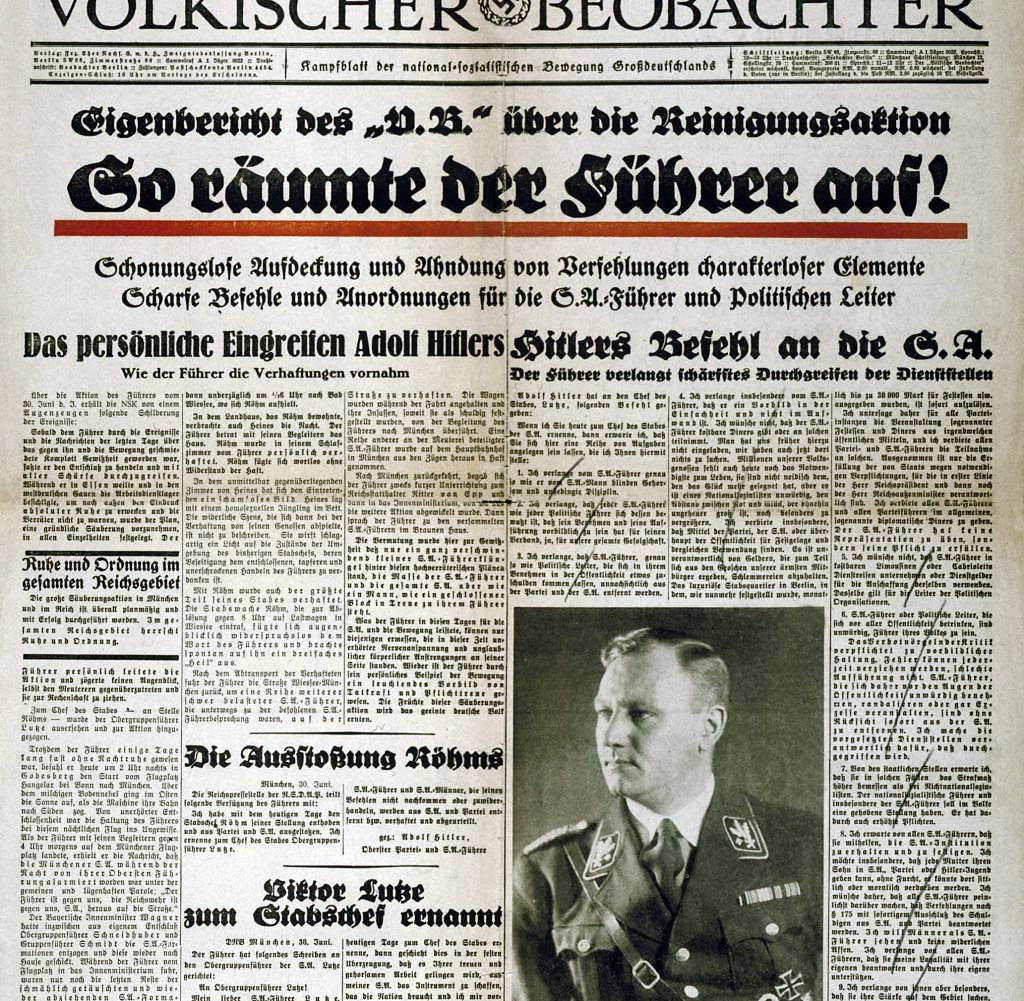
 

"This is how the Führer cleaned up!" Front page of the extra issue of the 'Völkischer Beobachter', June 30, 1934, Berlin edition


“This is how the Führer cleaned up!”
Front page of the extra issue of the Völkischer Beobachter, June 30, 1934, Berlin edition
Public domain


Homosexuality in Nazi organisations and in the military

The proscription of homosexuality was used by various sides in the political struggle. In 1931 / 1932, the Social Democrats utilised Ernst Röhm’s homosexuality to harm the Nazi Party. The Röhm case served the notion of “gay Nazis” gathering together in male associations, a phenomenon that did exist. Beginning in the mid-1930s, the Nazi regime increasingly cracked down on homosexual activity in the army, police, and Nazi associations. Intimacy between men was now punished particularly severely in party organisations and the police. Nazi propaganda labeled homosexual men as “enemies of the state” to legitimise this persecution. Nevertheless, clandestine homosexual encounters continued to occur.

Adapting to survive

After the dismantling of gay and lesbian subcultures across the entire state and the harshening of criminal law, homosexual contact took place almost exclusively in private spaces. Fear of denunciation and persecution drove most homosexuals to hide their sexuality and conform.

This also applied to lesbian women and trans* persons, who were not prosecuted per se. They could remain unhampered as long as they did not attract attention. Marriages of convenience were one of many survival strategies. Certain prominent artists were tolerated by the Nazi regime despite their widely known homosexuality. The regime, which needed these stars for its propaganda, held off on persecution, and demanded that they conform in their way of living.

Persecution and imprisonment

The Nazi regime’s treatment of homosexuals and trans* persons was not uniform. Initially, most of the men convicted under Paragraph 175 were released after serving their prison sentences. Especially since 1940 many were transferred to concentration camps. Lesbian women and trans* persons were sometimes charged with other crimes, such as prostitution or indecent behaviour. Others were persecuted for political, social, or racist reasons.

The Nazi regime’s treatment of homosexuals and trans* persons was not uniform. Initially, most of the men convicted under Paragraph 175 were released after serving their prison sentences. Especially since 1940 many were transferred to concentration camps. Lesbian women and trans* persons were sometimes charged with other crimes, such as prostitution or indecent behaviour. Others were persecuted for political, social, or racist reasons.

Text from Stories of the exhibition TO BE SEEN: Queer Lives 1900-1950
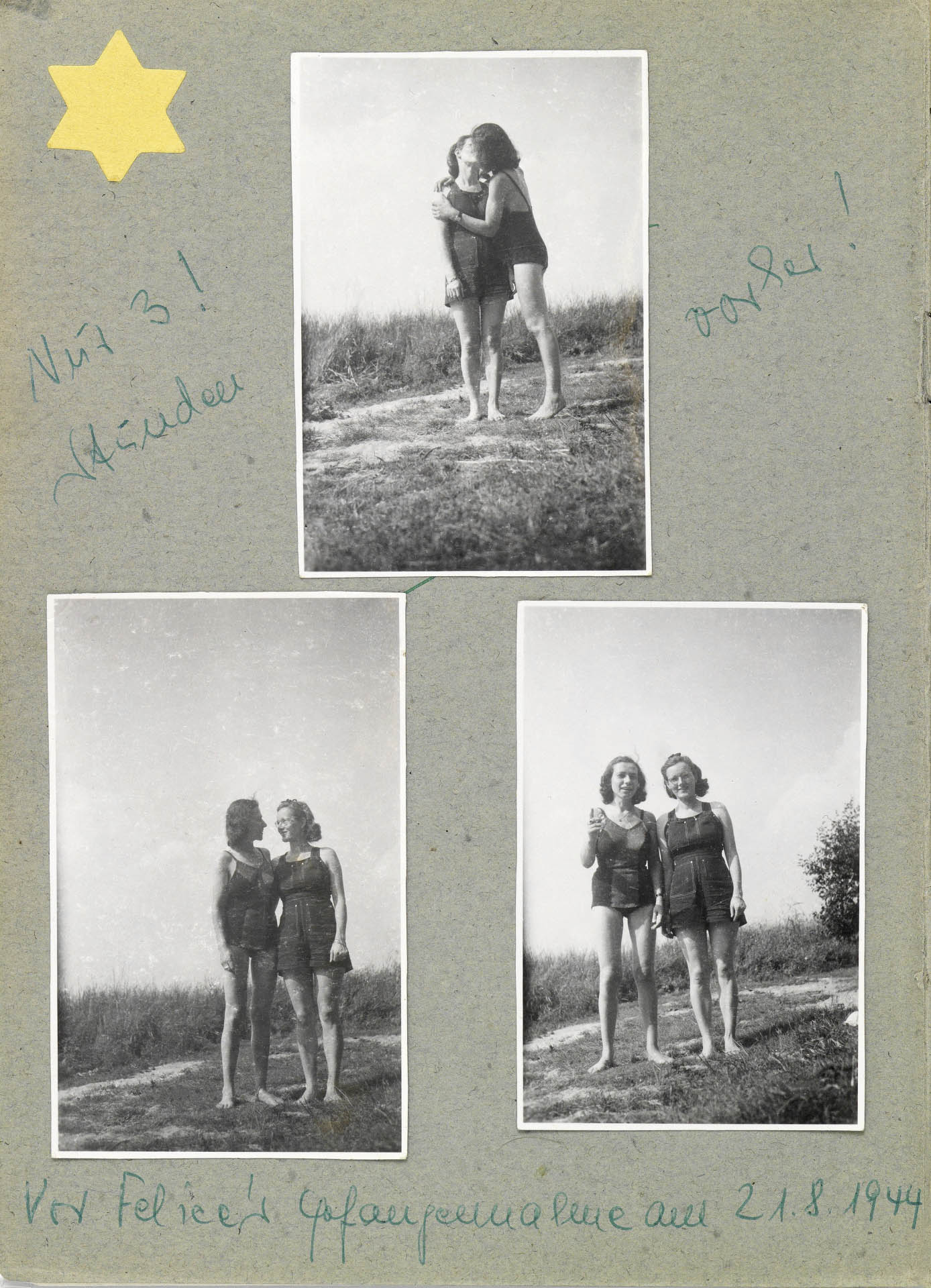
 

Unknown photographer. 'Photographs from Elisabeth (Lilly) Wust's diary entry on the deportation of her Jewish partner Felice Schragenheim to the Theresienstadt concentration camp' August 21, 1944


Unknown photographer
Photographs from Elisabeth (Lilly) Wust’s diary entry on the deportation of her Jewish partner Felice Schragenheim to the Theresienstadt concentration camp
August 21, 1944
© Jewish Museum Berlin


Part of the diary entry by Elisabeth (Lilly) Wust on the deportation of her Jewish partner Felice Schragenheim to the Theresienstadt concentration camp, August 21, 1944


Elisabeth (Lilly) Wust (1913-2006) and Felice Schragenheim (1922-1945) met in Berlin in 1942, shortly after Schragenheim went into hiding as a Jew. They moved in together a little later and promised to marry in June 1944. On August 21, 1944, Felice Schragenheim was discovered and taken to a Berlin collection point for Jews. Lilly Wust visited her there several times before the deportation to the Theresienstadt ghetto. In the hope of being able to help her beloved, Lilly Wust travelled to Theresienstadt herself in the fall of 1944.

Felice was deported to Auschwitz a little later. She died in early 1945, probably in the Bergen-Belsen concentration camp. Lilly Wust searched for her for years.

The love story of Lily Wust and Felice Schragenheim gained notoriety in the 1990s through the book “Aimée & Jaguar” and the feature film of the same name. However, there is another version of the story: Elenai Predski-Kramer, a former girlfriend of Felice Schragenheim, tells her perspective on the love story after the book was published and expresses the suspicion that Lilly Wust herself might have betrayed Felice Schragenheim. However, there is no evidence for this.

Text from the Munich Documentation Center for the History of National Socialism Instagram page
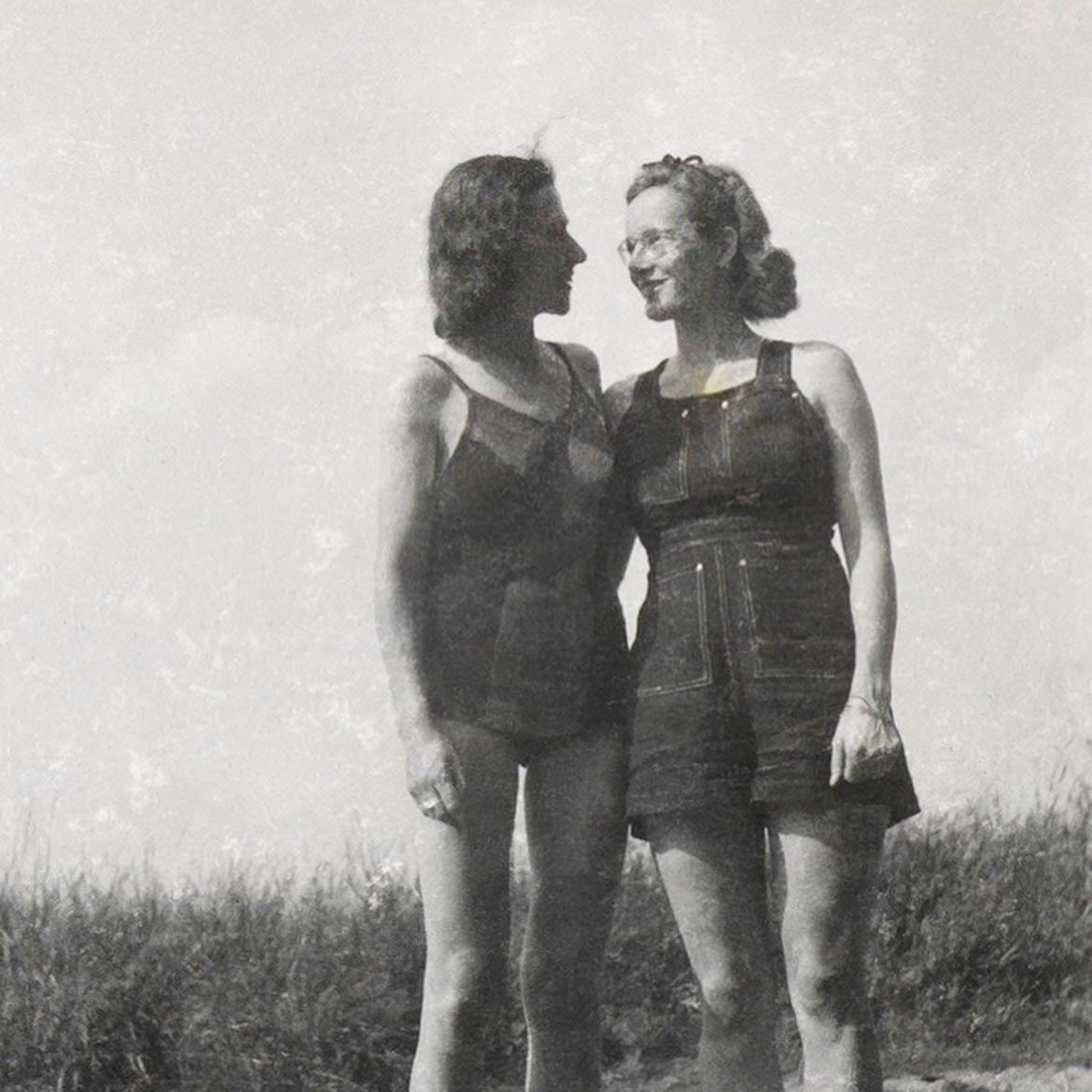
 

Unknown photographer. 'Photograph from Elisabeth (Lilly) Wust's diary entry on the deportation of her Jewish partner Felice Schragenheim to the Theresienstadt concentration camp' August 21, 1944 (detail)


Unknown photographer
Photograph from Elisabeth (Lilly) Wust’s diary entry on the deportation of her Jewish partner Felice Schragenheim to the Theresienstadt concentration camp (detail)
August 21, 1944
© Jewish Museum Berlin


Exile and resistance

Only a few homosexual and trans* people succeeded in escaping Nazi persecution through emigration. This option was usually only open to the wealthy or those who had international contacts and could find work abroad thanks to their education and language skills. Leaving Nazi Germany was made more difficult by the measures against capital transfer, which were tightened in 1934. The “Reich Flight Tax” reduced assets by 25 percent upon departure, the export of foreign currency was prohibited, and the transfer of bank or securities assets was made almost impossible.

Individual homosexual or transgender people decided to actively resist the Nazi regime, also in the territories occupied by Germany. They documented the crimes of the Nazi regime, called for resistance, carried out sabotage, committed attacks, or fought as partisans or members of foreign troops against Hitler’s Germany.

Text from Stories of the exhibition TO BE SEEN: Queer Lives 1900-1950


Claude Cahun. 'Self-portrait (with Nazi badge between her teeth)' 1945


Claude Cahun (French, 1894-1954)
Self Portrait (with Nazi badge between her teeth)
1945
Gelatin silver print
© Jersey Heritage Collection


Jewish-French author and photographer Claude Cahun (French, 1894-1954) and her partner Marcel Moore (French, 1892-1972)  put up resistance against the Nazi regime.


After four years of subversive activity, the pair were arrested by the Germans in 1944. Initially, the Nazi authorities couldn’t believe that the women carried it out by themselves. “They believed that there must be somebody else involved, there must be a man involved,” says Downie.

While waiting to be questioned, Cahun and Moore attempted suicide. They both took pills – barbiturates – which put them into a coma. Once they were well enough, they were sentenced to death for undermining the German forces. But the Bailiff of Jersey and the French Consul pleaded on their behalf – by that time, the Normandy landings had happened and Saint-Malo (the main connecting port) had been liberated, so they could no longer be deported to camps in Europe – and their sentence was commuted.

Although their lives had been saved, Moore and Cahun were not pleased. “They wanted to be martyrs for their cause,” says Downie. “To them, that would’ve been the realisation of their life of resistance, to be a martyr for freedom.”

At 3.40pm on May 9, 1945, the swastika was lowered from Fort Regent, a 19th-century fortification in St Helier, and the Union Jack was hoisted, signalling the official end of the occupation. Then the celebrations began. Cahun joined the crowds in Royal Square cheering, flag-waving, and holding a sailor aloft. Despite ill health from their time in prison, they kept on creating work after the war. In the same month, a photograph shows them gripping a Nazi eagle badge brazenly between their teeth, a silk scarf tied around their head, their hands dug into their coat pockets, their eyes staring defiantly at the camera.

Jessie Williams. “Claude Cahun: Jersey’s queer, anti-Nazi freedom fighter,” on the Huck website 14th May, 2020 [Online] Cited 17/04/2023. Used under fair use conditions for the purposes of education and research.


After 1945

Queer history was hardly remembered or archived after 1945. To this day, we know only some of the pioneers of the queer emancipation movement. We know even less about the life of those who were persecuted, driven into exile, murdered – or simply remained invisible.

After the end of the war, queer people continued to be marginalised. Gay men in particular continued to suffer in large numbers under Paragraph 175, many of whom did not go free but were transferred from concentration camps directly to prisons.

The ongoing discrimination by state and society changed only slowly. In 1969, Paragraph 175 was reformed and criminal law liberalised. Beginning in the 1970s, new social movements emerged, including a homosexual emancipation movement. Various groups reclaimed the “pink triangle” as a symbol to stand up for the rights of queer people.

Lesbian and feminist groups also gained popularity during the 1970s. Although lesbian sexuality was not directly persecuted by the state, many suffered from the misogynistic legal situation. The legal preferential treatment of men made it difficult to live out lesbian relationships, due to discrimination in labor and marriage laws.

The emergence of HIV in the 1980s affected many gay men and trans* people: thousands became infected, developed AIDS, and died. The state did not help, but instead relied on stigmatising measures and an aggressive rhetoric of exclusion, especially in Bavaria. For those affected, this recalled the previous period of open persecution.

Thanks to the efforts of activists, the health, political, and social situation of LGBTQI+ persons has improved since the 1990s. Today, queer people in Germany can celebrate some achievements and are also represented in politics. However, much remains to be done for LGBTQI+ equality. In many places around the world the situation is increasingly deteriorating. Trans* people in particular continue to face great discrimination.

Therefore, the commitment to queer self-determination is not over, but more relevant than ever. Because in the end, it not only ensures the preservation of LGBTIQ* human rights, but creates a more just society for all.

Text from Stories of the exhibition TO BE SEEN: Queer Lives 1900-1950


Paul Hoecker (German, 1854-1910)


Installation view of the exhibition 'TO BE SEEN: Queer Lives 1900-1950' at the Munich Documentation Center for the History of National Socialism

Installation view of the exhibition 'TO BE SEEN: Queer Lives 1900-1950' at the Munich Documentation Center for the History of National Socialism showing at left on the wall, Paul Hoecker's painting 'Head of a youth / Portrait of a boy' (1901); and at right on the wall, Paul Hoecker's painting 'Pierrot' (Nd)


Installation view of the exhibition TO BE SEEN: Queer Lives 1900-1950 at the Munich Documentation Center for the History of National Socialism showing in the bottom image at left on the wall, Paul Hoecker’s painting Head of a youth / Portrait of a boy (1901); and at right on the wall, Paul Hoecker’s painting Pierrot (Nd)
Photo: Connolly Weber Photography/NS-Dokumentationszentrum München
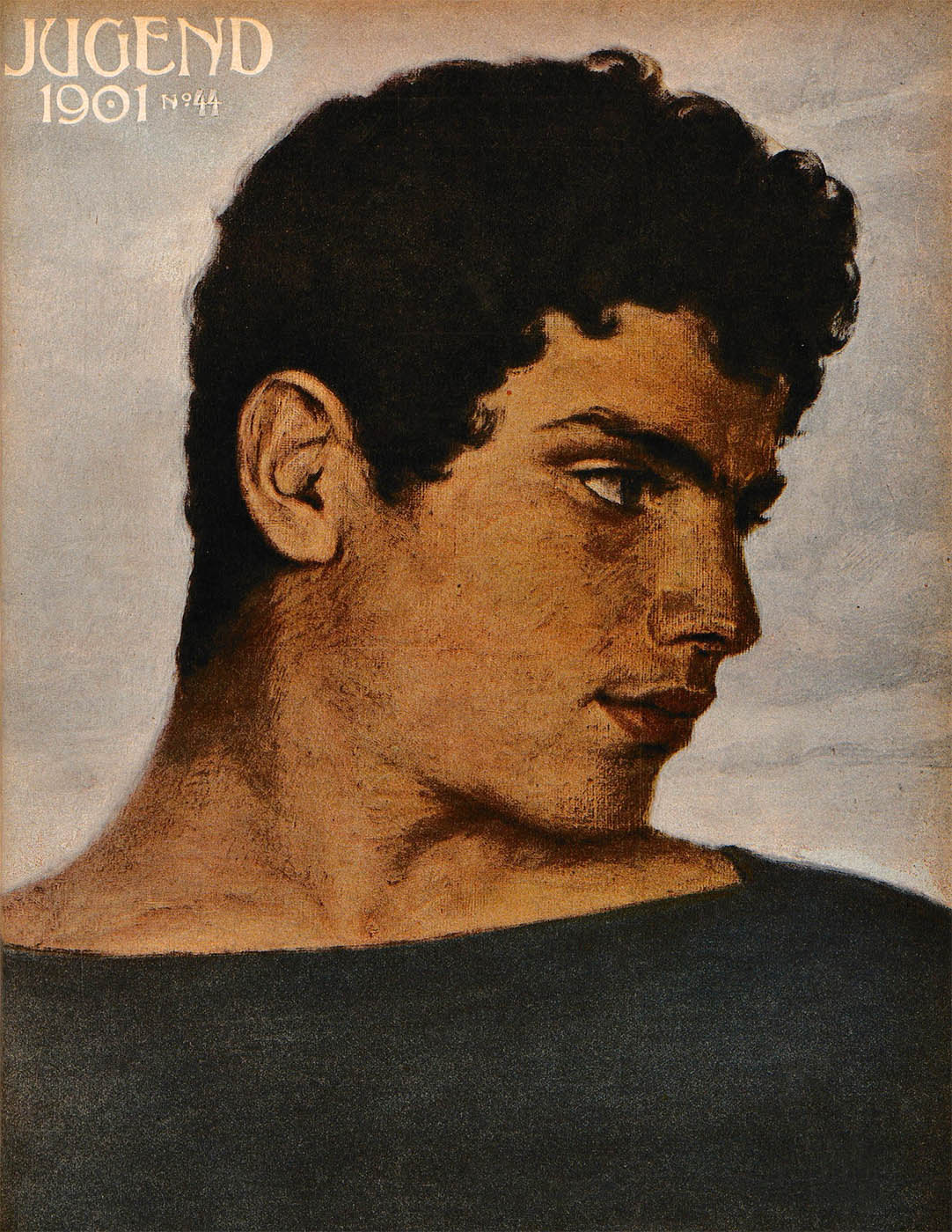
 

Paul Hoecker (German, 1854-1910) 'Young Man's Head' Cover of 'Jugen' magazine, volume 44, 1901


Paul Hoecker (German, 1854-1910)
Young Man’s Head
Cover of Jugend magazine, volume 44, 1901
Public domain


A chapter of TO BE SEEN #QueerLives is dedicated to the artist Paul Hoecker (1854-1910). It was created in collaboration with @forummuenchenev, which researches Hoecker’s story to honor and commemorate his life and work.

Paul Hoecker shaped the Munich art scene in the late 19th century. After his homosexuality became known, the artist was excluded and fell into oblivion. As a professor at the Munich Academy of Fine Arts, Hoecker had a great deal of influence during his lifetime: almost all the painters in the artist group “Die Scholle” and many illustrators for the magazines “Simplicissimus” and “Die Jugend” were among his students. The co-founder of the Munich Secession also received great recognition for his artistic work.

Hoecker privately exchanged views with the sexologist Magnus Hirschfeld about the fact that he has “contrasexual tendencies”, i.e. is gay. When a sex worker was recognised in the model of his acclaimed work “Ave Maria”, he was involuntarily outed. Paul Hoecker forestalled a scandal by resigning from his professorship. In this way he was able to avoid having to take a public position on his sexuality. He withdrew first to Italy and later to his home in Silesia, Oberlangenau.

Text from the Munich Documentation Center for the History of National Socialism Instagram page


Paul Hoecker (German, 1854-1910)

Paul Hoecker (11 August 1854, Oberlangenau – 13 January 1910, Munich) was a German painter of the Munich School and founding member of the Munich Secession…

The Munich Academy

In 1891, at the young age of 36, he was appointed to the Munich Academy, where he replaced Friedrich August von Kaulbach, who had resigned suddenly. He was the first teacher at the academy to take his students on field trips, which often lasted two weeks. He was also one of the first “modern” teachers there, exposing his students to impressionism and the latest developments from the Barbizon School. His studio was often referred to as the “Geniekasten” (Genius Box).

Due to the pervasive influence of Franz von Lenbach, very little exhibition space was available for any art that was considered modern. In 1892, shortly after being appointed a professor, this problem motivated Hoecker to become one of the founding members of the Munich Secession, acting as its secretary. The Secession ultimately inspired similar movements in Berlin and other cities.

Scandal

In 1897, a scandal broke out when it was rumoured that Hoecker had used a male prostitute as a model for a painting of the Madonna. Eventually, the scandal became more personal in nature, and he chose to resign from the academy. He then travelled to Capri, where he stayed at the Villa Lysis, home of industrialist and poet Jacques d’Adelswärd-Fersen, who had left Paris in the wake of his own scandal. While there, Hoecker painted several portraits of Fersen’s lover, Nino Cesarini, a professional model. Though the Jugend magazine published one of his Nino portraits in 1904 – a fully clothed version. By 1901 he returned to Oberlangenau. In 1910, he died of what was diagnosed as “Roman Malaria”.

Posthumous recognition

Despite his important role for the Munich art scene of the late 19th century, Paul Hoecker is hardly known today. This is probably due to the fact that he left the professorship in connection with his homosexuality. In October 2019 a research group was formed at the Forum Queeres Archiv München to investigate the life and work of the painter. Part of the family owned estate of Paul Hoecker has found its way into the archive of the Forum Queeres Archiv München and was digitalised.

Text from the Wikipedia website
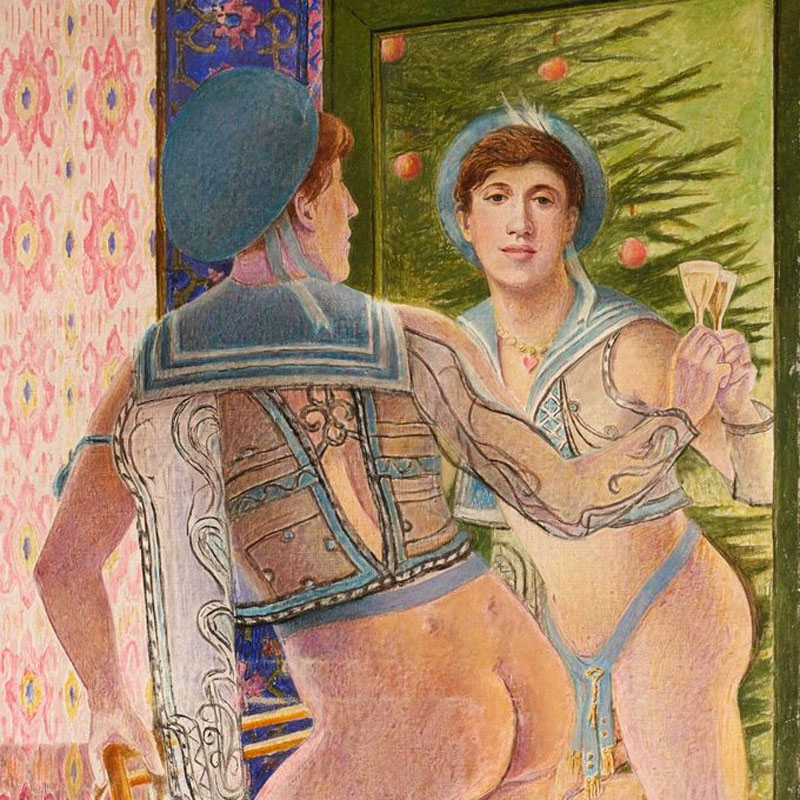
 

Elisar von Kupffer (German, 1872-1942) 'Dove Sei? / Where Are You?' 1914/1918


Elisar von Kupffer (German, 1872-1942)
Dove Sei? / Where Are You?
1914/1918
© Comune di Minusio – Centro Elisarion


Elisar von Kupffer (German, 1872-1942)

Elisàr August Emanuel von Kupffer (20 February 1872 – 31 October 1942) was a Baltic German artist, anthologist, poet, historian, translator, and playwright. He used the pseudonym “Elisarion” for most of his writings…

Career

In 1895 he published Leben und Liebe (Life and Love), a book of poetry. In autumn of that year he moved to Berlin to study at the Berlin Art Academy and moved in with Von Mayer. The following year, he left Agnes and wrote the dramas Der Herr der Welt (Master of the World), and Irrlichter (Wisps) as well as three one-act plays. In 1897 he published the anthology Ehrlos (Infamous, or Dishonorable).

Von Mayer graduated in 1897 and they travelled throughout Italy, Sicily, Southern France and Geneva before returning to Berlin. They spent the summer in Thuringia and Heiligendamm and went back to Italy in 1899. Early next year, Adolf Brand published Von Kupffer’s influential anthology of homoerotic literature, Lieblingminne und Freundesliebe in der Weltliteratur (roughly, “Love of Favourites and Love Between Friends in World Literature”. Lieblingminne is a neologism created by Von Kupffer). The anthology was researched and created, in part, as a protest against the imprisonment of Oscar Wilde in England. It was reprinted in 1995.

In 1908 he published a book on Il Sodoma, the Renaissance artist. In 1911, he and Von Mayer founded the publishing house Klaristische Verlag Akropolis in Munich and Von Kupffer published three major works: a play, Aino und Tio, Hymnen der heiligen Burg (Hymns of the Holy Castle) and Ein neuer Flug und eine heilige Burg (A New Flight and a Holy Castle). His work was also published and reviewed in the gay magazine Akademos, published by Jacques d’Adelswärd-Fersen. That same year, he and Von Meyer announced the creation of a “new religion”, Klarismus (Clarity), and established a community in Weimar. The following year he published a book on Klarismus called Der unbekannte Gott (The Unknown God). In 1913, the Brogi Gallery in Florence hosted his first art exhibition. Later that year, a Klarist community was established in Zürich.

Later life and death

In 1915, with World War I in progress and growing animosity towards Germans, they left Italy and moved to Ticino, where Von Kupffer established himself as a painter and muralist in Locarno, Switzerland. They were granted Swiss citizenship in 1922. From 1925 to 1929 they transformed their villa in Minusio, near Lake Maggiore, into an opulent collection of art, the “Sanctuarium Artis Elisarion”. He was also a photographer, making photographic studies of boys for use in the creation of his paintings, but most of his works featured a youthful version of himself. The Klarist “Elisarion Community” was founded at Minusio in 1926. During the 1930s, the number of visitors increased, then sharply decreased; stopping altogether just before the onset of World War II.

As his health declined, he became reclusive and died on 31 October 1942. Since 1981 the “Sanctuarium Artis Elisarion” has been a Museum dedicated to Von Kupffer’s work. The villa was willed to the municipality of Minusio, and his ashes are interred inside, together with Von Meyer’s. The Elisarion Community was satirically referenced as the “Polysadrion” (roughly; Place of Many Idiots), in the 1931 novel Schloss Gripsholm by Kurt Tucholsky.

Text from the Wikipedia website


Germaine Krull. 'Nude' Nd

Germaine Krull (1897-1985, photographer) From the portfolio 'Les amies' c. 1924


Germaine Krull (European, 1897-1985)
Les Amies
1924
From the portfolio Nudes
© Staatsgalerie Stuttgart


Germaine Luise Krull (20 November 1897 – 31 July 1985) was a photographer, political activist, and hotel owner. Her nationality has been categorised as German, French, and Dutch, but she spent years in Brazil, Republic of the Congo, Thailand, and India. Described as “an especially outspoken example” of a group of early 20th-century female photographers who “could lead lives free from convention”, she is best known for photographically illustrated books such as her 1928 portfolio Métal.
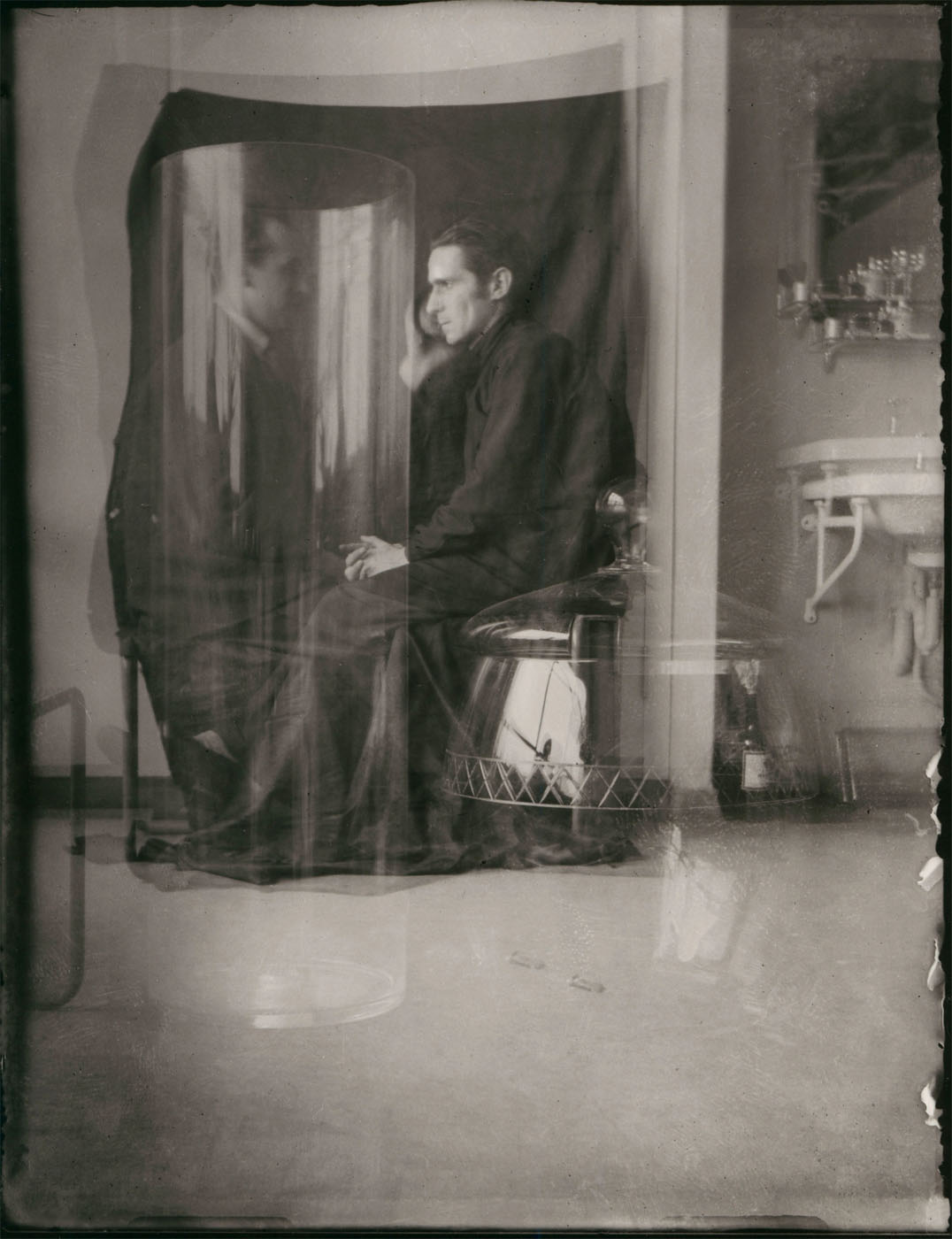
 

Heinz Loew (German, 1903-1981) 'Doppelportrait Heinz Loew und Hermann Trinkaus im Atelier, Bauhaus Dessau, Doppelbelichtung' (Double portrait of Heinz Loew and Hermann Trinkaus in the studio, Bauhaus Dessau, double exposure) 1927


Heinz Loew (German, 1903-1981)
Doppelportrait Heinz Loew und Hermann Trinkaus im Atelier, Bauhaus Dessau, Doppelbelichtung (Double portrait of Heinz Loew and Hermann Trinkaus in the studio, Bauhaus Dessau, double exposure)
1927
Gelatin silver print
3 1/2 x 4 1/4″ (9 x 12cm)
© Bauhaus-Archiv Berlin
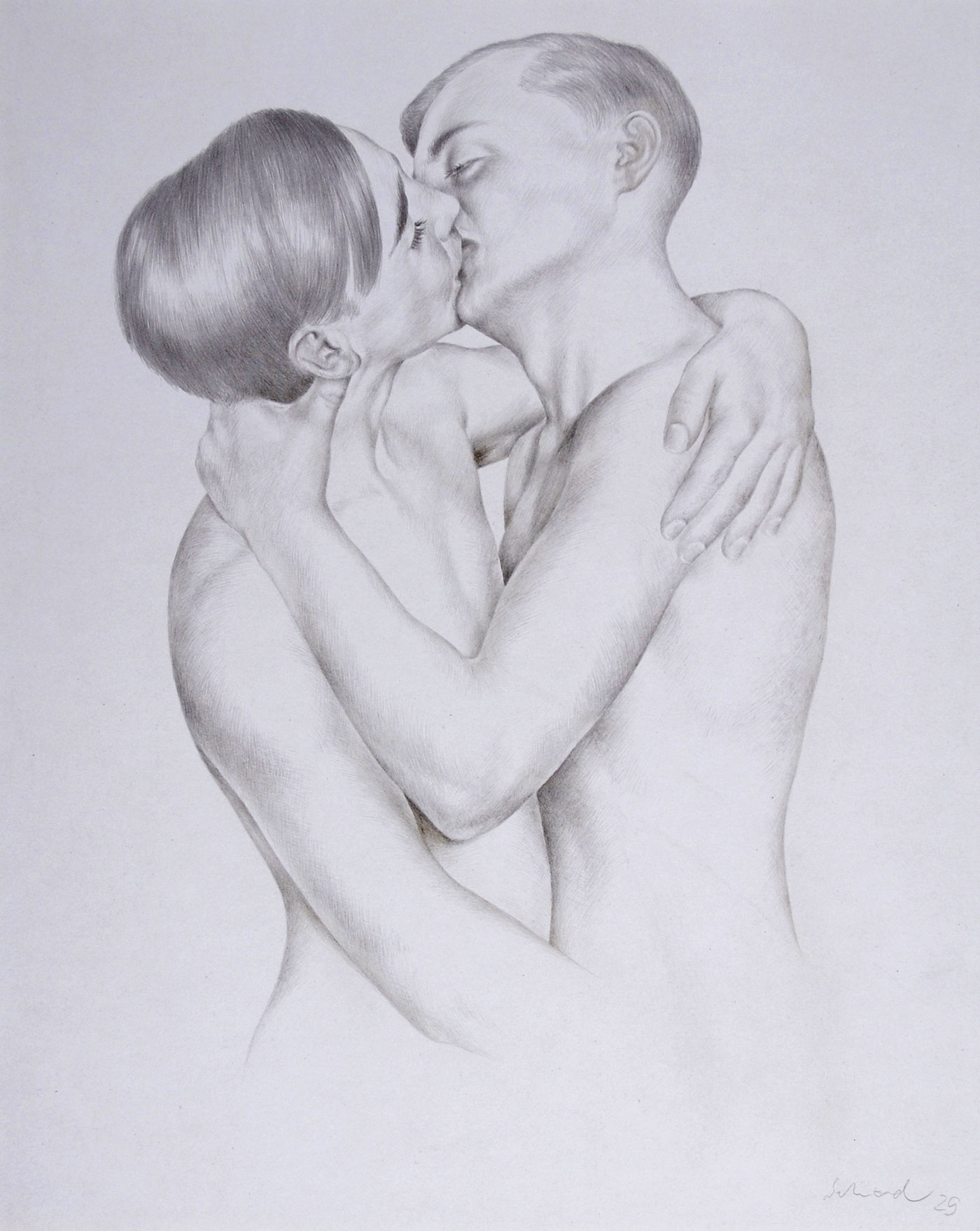
 

Christian Schad (German, 1894-1982) 'Boys in Love' (Liebende Knaben), 1929


Christian Schad (German, 1894-1982)
Boys in Love (Liebende Knaben)
1929
© Museen der Stadt Aschaffenburg / VG Bild-Kunst, Bonn 2022


Max Peiffer Watenphul (German, 1896-1976) 'Stillleben mit Mimosen' (Still Life with Mimosas) 1932


Max Peiffer Watenphul (German, 1896-1976)
Stillleben mit Mimosen (Still Life with Mimosas)
1932


Max Peiffer Watenphul (1896 – 13 July 1976) was a German artist. Described as a “lyric poet of painting”, he belongs to a “tradition of German painters for whom the Italian landscape represented Arcadia.” In addition to Mediterranean scenes, he regularly depicted Salzburg and painted many still lifes of flowers. As well as oil paintings, his extensive body of work encompasses watercolours, drawings, enamel, textiles, graphic art, and photographs.


Gerda Wegener (Danish, 1885-1940). 'Lili with a Feather Fan' 1920


Gerda Wegener (Danish, 1885-1940)
Lili with a Feather Fan
1920


Gerda Wegener (Danish, 1885-1940). 'Lili Elbe' c. 1928


Gerda Wegener (Danish, 1885-1940)
Lili Elbe
c. 1928


Gerda Wegener (Danish, 1885-1940). 'At the mirror' 1931-1936


Gerda Wegener (Danish, 1885-1940)
At the mirror
1931-1936
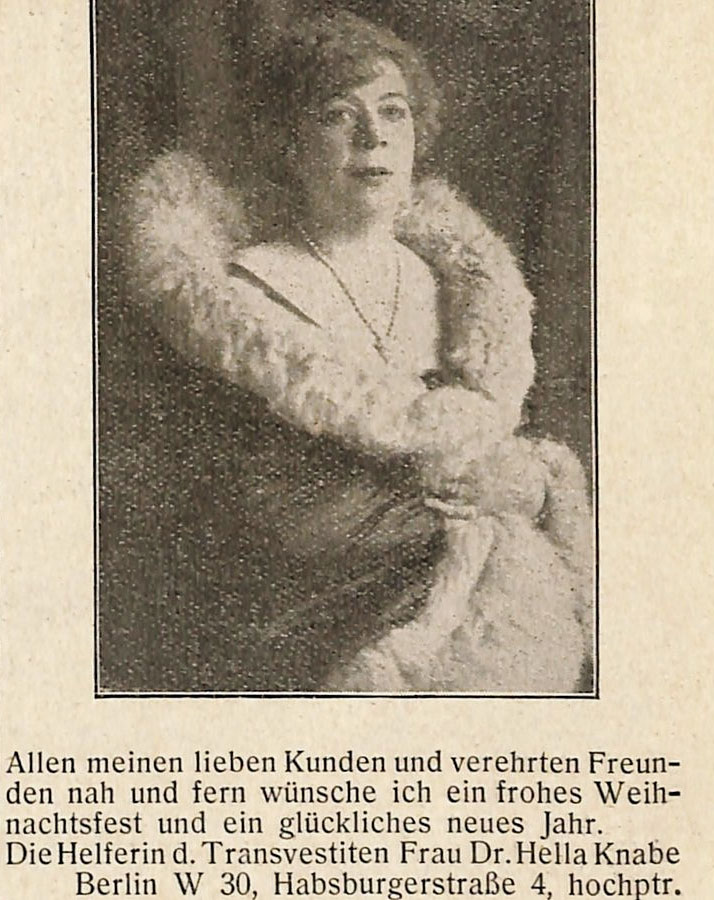
 

'Advertisement by the Hella Knabe tailoring studio' 1932


Advertisement by the Hella Knabe tailoring studio
In Die Freund, December 31, 1932
© forummuenchenev


On December 31, 1932 … this advertisement for Hella Knabe’s tailoring studio appeared in “Die Freund”. In the 1920s, a separate infrastructure was also created for “transvestites” – people who preferred the clothing of the opposite sex, including trans* people. Hella Knabe’s made-to-measure studio became a nationwide attraction. The hairdresser and seamstress, whose husband was a “transvestite” himself, advertised not only in scene magazines, but also in national magazines such as Jugend and Simplicissimus.

Hella Knabe made women’s underwear, artificial busts, corsets and chastity belts for her customers and ran a mail order business. In addition, she received boarders, clothed them, applied make-up and enabled them to live in the opposite sex for a short time. She continued to offer her services after 1933 and kept in touch with her clients through her own magazine with subcultural content. In 1938 she was therefore fined for distributing “lewd literature”.

Text from the Munich Documentation Center for the History of National Socialism Instagram page


Jeanne Mammen (German, 1890-1976) 'Damenbar' (Lesbian Bar) c. 1930-1932


Jeanne Mammen (German, 1890-1976)
Damenbar (Lesbian Bar)
c. 1930-1932
Lithograph


Jeanne Mammen (German, 1890-1976) 'Siesta' c. 1930-1932


Jeanne Mammen (German, 1890-1976)
Siesta
c. 1930-1932


Jeanne Mammen (German, 1890-1976) 'Hermaphrodite' c. 1945


Jeanne Mammen (German, 1890-1976)
Hermaphrodite
c. 1945
© Stadtmuseum Berlin / VG Bild-Kunst, Bonn 2022


Jeanne Mammen (German, 1890-1976)

Jeanne Mammen (21 November 1890 – 22 April 1976) was a German painter and illustrator of the Weimar period. Her work is associated with the New Objectivity and Symbolism movements. She is best known for her depictions of strong, sensual women and Berlin city life.

Jeanne Mammen was born in Berlin, the daughter of a successful German merchant. She and her family moved to Paris when she was five years old. She studied art in Paris, Brussels and Rome from 1906-1911. Her early work, influenced by Symbolism, Art Nouveau, and the Decadent movement, was exhibited in Brussels and Paris in 1912 and 1913.

In 1916 Mammen and her family fled Paris to avoid internment during World War I. While her parents moved to Amsterdam, Mammen chose instead to return to Berlin. She was now financially on her own for the first time, as the French government had confiscated all of her family’s property. For several years Mammen struggled to make ends meet, taking any work she could find, and spending time with people from different class backgrounds. These experiences and newfound sympathies are reflected in her artwork from the period.

In time Mammen was able to find work as a commercial artist, producing fashion plates, movie posters, and caricatures for satirical journals such as Simplicissimus, Ulk, and Jugend. In the mid-1920s she became known for her illustrations evoking the urban atmosphere of Berlin. Much of her artwork depicted women. These women subjects often included haughty socialites, fashionable middle-class shop girls, street singers, and prostitutes. Her drawings were often compared to those of George Grosz and Otto Dix. Throughout the late 1920s and early 1930s she worked mainly in pencil with watercolour washes, and in pen and ink.

In 1921, Mammen moved into an apartment with her sister in Berlin. This apartment was a former photographer’s studio which she lived in until her death. Aside from Art throughout her life Mammen also was interested in science. She was close friends with Max Delbrück who left Europe and took some of her artwork with him and exhibited them in California. In addition to bringing these art works to be exhibited he also sent Mammen care packages from the United States with art supplies.

In 1930 she had a major exhibition in the Fritz Gurlitt gallery. Over the next two years, at Gurlitt’s suggestion, she created one of her most important works: a series of eight lithographs illustrating Les Chansons de Bilitis, a collection of lesbian love poems by Pierre Louÿs.

In 1933, following Mammen’s inclusion in an exhibition of female artists in Berlin, the Nazi authorities denounced her motifs and subjects as “Jewish”, and banned her lithographs for Les Chansons de Bilitis. The Nazis were also opposed to her blatant disregard to for apparent ‘appropriate’ female submissiveness in her expressions of her subjects. Much of her work also includes imagery of lesbians. The Nazis shut down most of the journals she had worked for, and she refused to work for those that complied with their cultural policies. Until the end of the war she practiced a kind of “inner emigration”. She stopped exhibiting her work and focused on advertising. For a time she also peddled second-hand books from a handcart.

In the 1940s, in a show of solidarity, Mammen began experimenting with Cubism and expressionism, a risky move given the Nazis’ condemnation of abstract art as “degenerate”. After the war she took to collecting wires, string, and other materials from the streets of bombed-out Berlin to create reliefs. In the late 1940s she began exhibiting her work again, as well as designing sets for the Die Badewanne cabaret. She created abstract collages from various materials, including candy wrappers. In the 1950s she adopted a new style, combining thick layers of oil paint with a few fine marks on the surface.

In the 1970s there was a resurgence of interest in Mammen’s early work as German art historians, as well as art historians of the women’s movement, rediscovered her paintings and illustrations from the Weimar period. In 2013 her later, more abstract work was featured in “Painting Forever!”, a large-scale exhibition held during Berlin Art Week. In 2017-2018, the Berlinische Galerie mounted a major exhibition of Mammen’s work, titled, “Jeanne Mammen: Die Beobachterin: Retrospektive 1910-1975” (Jeanne Mammen: The Observer: Retrospective 1910-1975), which included more than 170 works in various media, covering the period from the 1920s to her late work in the 1960s and beyond. The show was conceived as an update to a show mounted by the Galerie at the Martin Gropius Bau in 1997, which featured primarily works from the 1920s. In 2010 the Des Moines Art Center exhibited 13 water colour paintings done by Mammen which were inspired by Berlin in the Weimer era.

Text from the Wikipedia website


Herbert List (German, 1903-1975) 'Beachcomber, Baltic Sea' 1933


Herbert List (German, 1903-1975)
Beachcomber, Baltic Sea
1933
Gelatin silver print
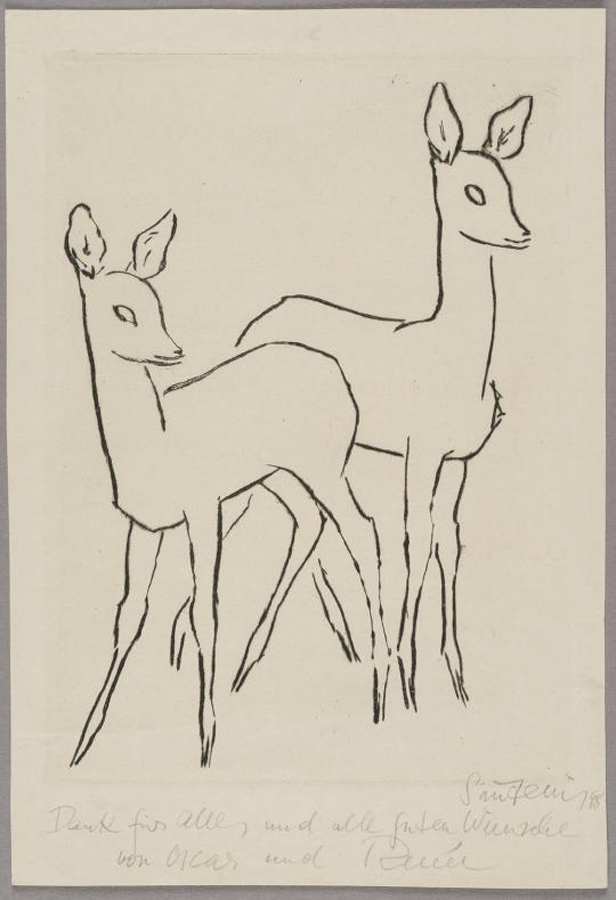
 

Renée Sintenis (German born Poland, 1888-1965) 'Zwei stehende Rehe' (Two Standing Deer) 1948


Renée Sintenis (German born Poland, 1888-1965)
Zwei stehende Rehe (Two Standing Deer)
1948
Etching
22.3 x 15.2cm
© Georg Kolbe Museum, Berlin


Renée Sintenis (German born Poland, 1888-1965)

Renée Sintenis, née Renate Alice Sintenis (20 March 1888 – 22 April 1965), also known as Frau Emil R. Weiss, was a German sculptor, medallist, and graphic artist who worked in Berlin. She created mainly small-sized animal sculptures, female nudes, portraits, and sports statuettes. She is especially known for her Berlin Bear sculptures, which was used as the design for the Berlinale’s top film award, the Golden Bear…

Career

When Renée Sintenis (as she called herself from then on) met the sculptor Georg Kolbe in 1910, she became his model. She modelled for a now lost life-sized statue.

Inspired by this activity, she began creating in sculpture female nudes, expressive heads like those of André Gide and Joachim Ringelnatz, athletes like the Finnish runner Paavo Nurmi, and self-portraits in drawings, sculptures (in terracotta) and etchings.

After 1915, the concise animal figures emerged, which became the subject of her artistic life. Since she rejected monumentality in sculpture, she mainly created small-format sculptures. These small works of art such as horses, deers, donkeys and dogs, enjoyed great popularity with the public because they were cheaper, suitable as gifts and could be placed in small rooms.

From attending Kolbe’s studio, a long-term friendship developed, which he accompanied artistically. In the 1913 Berlin autumn exhibition, the first major exhibition of the Free Secession, Sintenis took part (as in the following years) with small-format plaster sculptures.

From 1913 on, she had her works cast in the Hermann Noack fine art foundry, which she attended artistically for decades.

In 1917 she married the type artist, book designer, painter and illustrator Emil Rudolf Weiß, whom she had met years earlier as her teacher and was also and then as a fatherly friend. He supported her and introduced her to numerous other artists. Their collaboration was limited to a few joint projects, of which the edition of the 22 Songs of the poems by Sappho, for which she created the etchings and Weiß made the font designs, achieved particular fame.

From 1913 she exhibited her sculptures regularly and was highly valued by her colleagues from the Free Secession, the most important Berlin artists’ association, among others, by Max Liebermann, Max Beckmann, and Karl Schmidt-Rottluff. The opening of a gallery in Berlin in 1922 made her the most important protagonist of the well-known Flechtheim art circle in those years. The art-interested public was infatuated with her athletic figures, portraits of friends and the small-format self-portraits.

In addition, due to her body size, slim figure, charisma, her self-confident, fashionable demeanor and androgynous beauty, she was often portrayed by artists like her husband, Emil Rudolf Weiß and Georg Kolbe, and by photographers, like Hugo Erfurth, Fritz Eschen and Frieda Riess. She embodied perfectly the type of the ‘new woman’ of the 1920s, even if she appeared rather reserved.

During the Weimar Republic, Renée Sintenis became an internationally recognised artist, with exhibitions in the Berlin Nationalgalerie, in Berlin, in Paris, the Tate Gallery, in London, the Museum of Modern Art, in New York, Glasgow and Rotterdam. Her small-sized depictions of athletes (boxers, footballers, runners) and portrait busts of their circle of friends were found in public and private collections around the world.

In 1928 Sintenis won the bronze medal in the sculpture section of the art competition for the Summer Olympics in Amsterdam, for her “Footballeur”. She is thought to be the first LGBTQ+ Olympic medallist. Renée Sintenis took part in the 1929 exhibition of the German Association of Artists in the Cologne State House, with five small-format animal sculptures. In 1930 she met the French sculptor Aristide Maillol in Berlin. In 1931 she was appointed as the first sculptor, and second woman after Käthe Kollwitz, together with 13 other artists, to join the Berlin Academy of the Arts – Fine Arts section, although the National Socialists forced her to leave in 1934.

In 1932, she created a statue of the Berlin Bear, a bear standing on its hind legs with its arms raised, based on the Coat of arms of Berlin. The design was popular, and she sold many 15 cm (5.9 in) statues of the bear, which brought wealth and was taken up again in later life.

Third Reich

Emil Rudolf Weiß was dismissed from his university post on 1 April 1933, because of an angry statement against the Nazi regime and the law to reintroduce the civil service. Sintenis herself was excluded from the Academy of the Arts in 1934 because of her Jewish origins – her maternal grandmother was Jewish before her conversion. Nevertheless, she was able to stay in the Reich Chamber of Culture, even if her works were removed from public collections by the National Socialists.

During the Third Reich, Renée Sintenis and her husband Emil Rudolf Weiß lived with considerable restrictions. She continued to exhibit, although one of her self-portraits was shown in the Degenerate Art exhibition in Munich in 1934. Since she was not banned from exhibiting, she was represented in Düsseldorf by the art dealer Alex Vömel, Flechtheim’s successor. In contrast to the 1920s, she was not doing well financially, which was reinforced by the bronze casting ban of 1941.

Until the forced dissolution of the Deutscher Künstlerbund in 1936, Sintenis remained a member of the German Association of Artists. That she was sponsored by the NSDAP propagandist Hans Hinkel, as it was later claimed, has not been proven and is highly unlikely.

Her husband died unexpectedly on 7 November 1942 in Meersburg on the Lake Constance. His death plunged Sintenis into a deep crisis. As a result, she took over his studio in the Künstlerhaus on Kurfürstenstrasse, where Max Pechstein also worked. His family took temporarily on her when her studio house was destroyed by arson and several Allied bombings in 1945. Sintenis lost almost all of her possessions; all papers and parts of her work were lost. While most of the cast models were preserved, the plaster frames of most of the portrait heads were also destroyed. In a self-portrait mask from 1944, the hardships of the war years are visible in her features.

Post-war career

After the war, Sintenis and her partner Magdalena Goldmann moved into an apartment on Innsbrucker Strasse in 1945, where they both lived until their deaths. In 1948, Sintenis received the art prize of the city of Berlin and was appointed by Karl Hofer to the Berlin University of Fine Arts. She was appointed full professor in 1955, although she gave up teaching the same year. She was also appointed to the newly founded Academy of the Arts of Berlin (West) in 1955.

In the 1950s, she became very successful once again. She stayed true to her artistic focus and motifs, which she called “making animals”.

Text from the Wikipedia website


Lena Rosa Händle (German, b. 1976) 'Girl Under Trees' 2016


Lena Rosa Händle (German, b. 1976)
Girl Under Trees
2016
Courtesy the artist
Photo: @frau_orla


In “These hands – a world without equal” (2022, below), the artist Lena Rosa Händle explores the continuation of hidden lesbian codes from the 1920s to the present day. Händle refers to the dancer Tilly Losch, the painter Mariette Lydis and the artist Claude Cahun and focuses on the motif of the hands as a gesture and code of lesbian people. In her photographs, @lenarosahaendle, together with DJane and curator @tonicahunter, reinterprets traditional gestures and is reminiscent of the first female photo studios of the 1920s.

For her work “Girls under Trees” (2016, above), Händle draws on the motif of a tapestry that schoolgirls painstakingly embroidered in 1941 in needlework classes, which were compulsory for girls at the time. Händle adds two personal ads from the newsreel published in Vienna in 1942 to the motif: “Miss is looking for correspondence with a girlfriend under modern” and “Lady wants a girlfriend for the purpose of cinema and theatre”. Advertisements like these are testimonies to the few coded signs of lesbian subculture during the Nazi era. Terms such as “Miss”, “Girlfriend” and “Lady” served as lesbian identification codes, as did the colours lilac and violet. In doing so, the artist sensitively refers to issues such as political power structures, socially enforced expectations and the resulting subtlety of lesbian aesthetics.

Text from the Munich Documentation Center for the History of National Socialism Instagram page
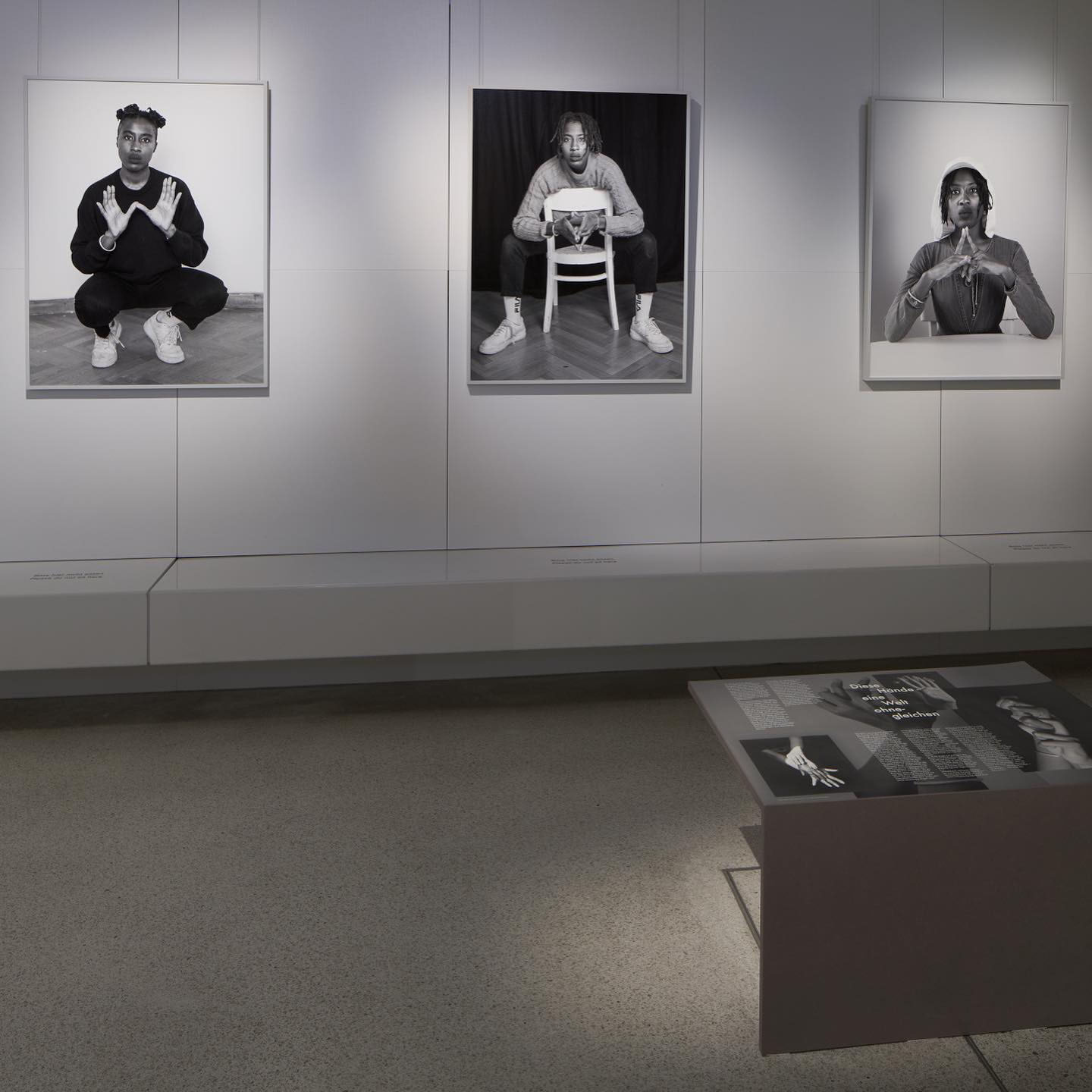
 

Lena Rosa Händle (German, b. 1976) 'These hands – a world without equal' 2022

Lena Rosa Händle (German, b. 1976) 'These hands – a world without equal' 2022


Lena Rosa Händle (German, b. 1976)
These hands – a world without equal
2022
Courtesy the artist


Installation view of the exhibition 'TO BE SEEN: Queer Lives 1900-1950' at the Munich Documentation Center for the History of National Socialism showing Wolfgang Tillmans's photograph 'The Cock (Kiss)' (2002)


Installation view of the exhibition TO BE SEEN: Queer Lives 1900-1950 at the Munich Documentation Center for the History of National Socialism showing Wolfgang Tillmans’s photograph The Cock (Kiss) (2002, below)
Photo: Connolly Weber Photography/NS-Dokumentationszentrum München


Wolfgang Tillmans (German, born 1968) 'The Cock (Kiss)' 2002


Wolfgang Tillmans (German, b. 1968)
The Cock (Kiss)
2002
Courtesy Galerie Buchholz


El Palomar. 'Schreber is a Woman' 2020


El Palomar
Schreber is a Woman
2020
Film still
© El Palomar


In their audiovisual piece Schreber is a Woman, the Barcelona-based artists’ collective El Palomar delves into the mind of Daniel Paul Schreber, a German lawyer (1842-1911) who became famous for his reports from a psychiatric clinic that later inspired Freud. In his Memoirs of My Nervous Illness from 1903 Schreber recounts feeling like a woman, among other experiences. The book influenced Sigmund Freud to elaborate his theories on paranoia and schizophrenia. Relevant to Schreber’s story is the fact that his father, Dr. Moritz Schreber, authored several books that proposed strict authoritarian models for the physical and moral education of children, which were very popular in Germany and other parts of Europe at the turn of the nineteenth century.

El Palomar uncover and reinterpret the writings of Schreber from a transfeminist perspective to deconstruct the Freudian link between Schreber and schizoprenic paranoia trough a queer viewpoint. Focusing on the images and sounds that Schreber describes in his memoirs, the film offers a rereading of the case as rooted in a period when gender identities were restricted to classical binary archetypes. Schreber is a Woman subverts the original circumstances of queer lineage, recontextualizing gender and pleasure in the present.

Anonymous. “Schreber is a Woman – Video Art on Queer and Trans History,” on the Munich Documentation Center for the History of National Socialism website Oct 7, 2022 [Online] Cited 10/04/2023. Used under fair use conditions for the purposes of education and research.


Installation view of the exhibition 'TO BE SEEN: Queer Lives 1900-1950' at the Munich Documentation Center for the History of National Socialism showing work from Philipp Gufler's series 'Quilts'

Installation view of the exhibition 'TO BE SEEN: Queer Lives 1900-1950' at the Munich Documentation Center for the History of National Socialism showing work from Philipp Gufler's series 'Quilts', with the work 'Quilt #43 (Sophia Goudstikker)' (2021)


Installation view of the exhibition TO BE SEEN: Queer Lives 1900-1950 at the Munich Documentation Center for the History of National Socialism showing work from Philipp Gufler’s series Quilts, in the bottom image Quilt #43 (Sophia Goudstikker) (2021)
Photo: Connolly Weber Photography/NS-Dokumentationszentrum München


Philipp Gufler (German, b. 1989) 'Quilt #50 (Lil Picard)' 2022


Philipp Gufler (German, b. 1989)
Quilt #50 (Lil Picard)
2022
Screenprint on fabric
Courtesy the artist and Galerie Françoise Heitsch
Photo: @frau_orla


In his quilts Philipp Gufler references queer artists, scholars, and places of queer life that have found little or no place in written memories and the historical canon. The series thus becomes an alternative archive that generates a form of intergenerational memory through the technique of “quilting.” In this technique the textiles left behind by deceased people are reassembled and contextualised. The fine materiality of the fabrics stands in direct contrast to the often massive, solid stone monuments of Western historiography. By reusing a variety of historical relics, he creates diverse personal and ancestral forms of memory of different origins. The choice of materials in the works is just as important as the choice of motifs and the associated stories that are told.

Text from the Munich Documentation Center for the History of National Socialism Instagram page
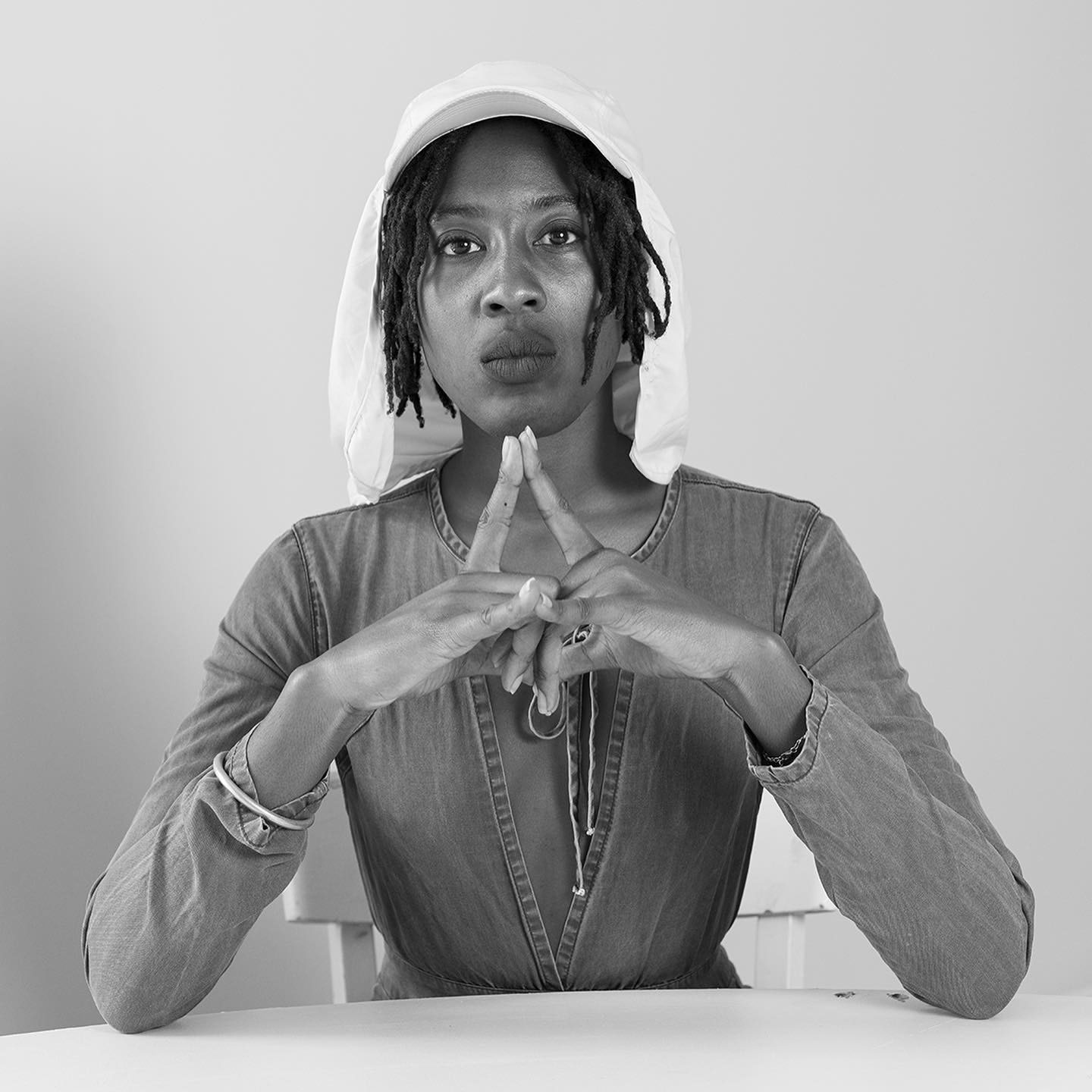
 

Zoltán Lesi (Hungarian, b. 1982) and Ricardo Portilho (Brazilian) In Frauenkleidung (In Women's Clothing) 2019


Zoltán Lesi (Hungarian, b. 1982) and Ricardo Portilho (Brazilian)
In Frauenkleidung (In Women’s Clothing)
2019
Courtesy the artists and Edition Mosaik Salzburg
Foto: @frau_orla


The poetry collection “In Frauenkleidung” (In Women’s Clothing, above) is a joint work by the lyricist Zoltán Lesi and the designer Ricardo Portilho and is dedicated to the lives of intergender athletes in the early 1930s. In their book, both artists combine documentary language with historical photographs and newspaper clippings drawn from Lesi’s image archive, which has been in the making since 2017. The resulting surrealistic collage uses historical distance to question facts, construction, and truth in a humorous yet sensitive way.

Parallel to the publication, they have created the audio installation “Ein Sprung und der Hummer” (A Jump and the Lobster, below) which, in the form of a Dadaist assemblage inspired by Joseph Cornell, blurs the line between fiction and the documentation of the biographies of the athletes, contributing another layer to the narrative level of the book of poems.

Text from the Munich Documentation Center for the History of National Socialism Instagram page


Zoltán Lesi (Hungarian, b. 1982) and Ricardo Portilho (Brazilian) 'Ein Sprung und der Hummer' (A Jump and the Lobster) 2018/2022 (installation view)


Zoltán Lesi (Hungarian, b. 1982) and Ricardo Portilho (Brazilian)
Ein Sprung und der Hummer (A Jump and the Lobster) (installation view)
2018/2022
Courtesy the artists
Foto: @frau_orla


Zoltán Lesi (Hungarian, b. 1982) and Ricardo Portilho (Brazilian) 'Ein Sprung und der Hummer' (A Jump and The Lobster) 2018/2022

Zoltán Lesi (Hungarian, b. 1982) and Ricardo Portilho (Brazilian) 'Ein Sprung und der Hummer' (A Jump and The Lobster) 2018/2022


Zoltán Lesi (Hungarian, b. 1982) and Ricardo Portilho (Brazilian)
Ein Sprung und der Hummer (A Jump and The Lobster) (installation view)
2018/2022
Courtesy the artists
Foto: @frau_orla


Munich Documentation Center for the History of National Socialism
Max-Mannheimer-Platz 1
80333 Munich
Phone: +49 (0)89 233-67000

Opening hours:
Tuesday – Sunday 10am – 7pm

Munich Documentation Center for the History of National Socialism website

LIKE ART BLART ON FACEBOOK

Back to top

Exhibition: ‘In the Eye of the Storm: Modernism in Ukraine, 1900-1930s’ at the Thyssen-Bornemisza Museum, Madrid

Exhibition dates: 29th November, 2022 – 30th April, 2023

Curators: Konstantin Akinsha, Katia Denysova and Olena Kashuba-Volvach


Davyd Burliuk (Ukrainian, 1882-1967) 'Landscape' 1912 from the exhibition 'In the Eye of the Storm: Modernism in Ukraine, 1900-1930s' at the Thyssen-Bornemisza Museum, Madrid, November, 2022 - April, 2023


Davyd Burliuk (Ukrainian, 1882-1967)
Landscape
1912
Oil on canvas
33 x 46, 3cm
Museo Nacional Thyssen-Bornemisza, Madrid


Revelation and resistance

This exhibition presents ground-breaking art produced in Ukraine in the first decades of the 20th century… in an act of ‘revelatio’, or pulling aside of the curtain to reveal what has been hidden from view in Europe for too many years.

The brief flowering of modern Ukrainian art that took place from roughly 1910s to 1933 was savagely cut short by Stalin’s purges of artists and intellectuals “in the length and breadth of the USSR, but in Ukraine repression started earlier and had a character all its own. In Russia at large, repressed artists and writers were classified as ‘enemies of people’, a broad and generic term. In Ukraine, they were accused of ‘bourgeois nationalism’, an altogether more emotive and destructive appellation. The scene was set, and the destruction of Ukrainian literature and art from 1931 onwards amounted to nothing less than mass cultural genocide.”

Many artists were either sent to the Gulag (labour camps), executed (such as the followers of Mykhalio Boichuk known as Boichukists with most of their public art subsequently destroyed) or had to adapt and tow the party line, their artistic activity cut short by a radical change in the political climate. “Art was increasingly viewed through a prism of ‘class consciousness’ and Soviet subject matter came to dominate all spheres of artistic output. In 1932, Socialist Realism was introduced as the only official artistic style to be practiced in the Soviet Union, with more value subsequently placed on the rally-like qualities in art rather than the merits of modernist experimentation.”

But as history shows us, dictatorships don’t last. As much as Stalin wanted to destroy the expression of a nascent Ukrainian modernism, a true renaissance of creative experimentation, he failed… for Stalin died and the USSR crumbled. This magnificent art remains.

And so a modern day dictator who has invaded a free Ukraine, who suppresses all opposition in his own country so ruthlessly and cruelly, will be washed with the tide of history. His secular power is vain compared to the desire for freedom… and the creativity and imagination needed to express that freedom.

Dr Marcus Bunyan


Many thankx to the Thyssen-Bornemisza Museum for allowing me to publish the art work in the posting. Please click on the photographs for a larger version of the image.


“We wanted to do something in terms of showing Ukrainian art, but also taking Ukrainian art out of Ukraine and bringing it to Europe and to safety.”


Katia Denysova (curator)


Cubo-Futurism


Installation view of the exhibition 'In the Eye of the Storm: Modernism in Ukraine, 1900-1930s' at the Thyssen-Bornemisza Museum, Madrid showing at right, Davyd Burliuk's 'Ukrainian Peasant Woman' 1910-1911


Installation view of the exhibition In the Eye of the Storm: Modernism in Ukraine, 1900-1930s at the Thyssen-Bornemisza Museum, Madrid showing at right, Davyd Burliuk’s Ukrainian Peasant Woman 1910-1911


Davyd Burliuk (Ukrainian, 1882-1967) 'Ukrainian Peasant Woman' 1910-1911 from the exhibition 'In the Eye of the Storm: Modernism in Ukraine, 1900-1930s' at the Thyssen-Bornemisza Museum, Madrid, November, 2022 - April, 2023


Davyd Burliuk (Ukrainian, 1882-1967)
Ukrainian Peasant Woman
1910-1911
Oil on canvas
132 x 70cm
Museo Nacional Thyssen-Bornemisza, Madrid


Installation view of the exhibition 'In the Eye of the Storm: Modernism in Ukraine, 1900-1930s' at the Thyssen-Bornemisza Museum, Madrid showing at left, Wladimir Baranoff-Rossiné's 'Adam and Eve' 1912; and at second right, El Lissitzky's 'Composition' 1918-1920s


Installation view of the exhibition In the Eye of the Storm: Modernism in Ukraine, 1900-1930s at the Thyssen-Bornemisza Museum, Madrid showing at left, Wladimir Baranoff-Rossiné’s Adam and Eve 1912; and at second right, El Lissitzky’s Composition 1918-1920s


Installation view of the exhibition In the 'Eye of the Storm: Modernism in Ukraine, 1900-1930s' at the Thyssen-Bornemisza Museum, Madrid showing three paintings by Alexandra Exter including at left, 'Three Female Figures' (1910) and at right 'Still Life' (1915)

Installation view of the exhibition 'In the Eye of the Storm: Modernism in Ukraine, 1900-1930s' at the Thyssen-Bornemisza Museum, Madrid showing at centre El Lissitzky's 'Composition' 1918-1920s


Installation views of the exhibition In the Eye of the Storm: Modernism in Ukraine, 1900-1930s at the Thyssen-Bornemisza Museum, Madrid showing in the top image, three paintings by Alexandra Exter including at left, Three Female Figures (1910) and at right Still Life (1915); and at centre in the bottom image, El Lissitzky’s Composition 1918-1920s


Wladimir Baranoff-Rossiné (Ukrainian, 1888-1944) 'Adam and Eve' 1912 from the exhibition 'In the Eye of the Storm: Modernism in Ukraine, 1900-1930s' at the Thyssen-Bornemisza Museum, Madrid, November, 2022 - April, 2023


Wladimir Baranoff-Rossiné (Ukrainian, 1888-1944)
Adam and Eve
1912
Oil on canvas
155 x 219.7cm
Colección Carmen Thyssen


Vladimir Davidovich Baranov-Rossiné (Ukrainian: Володимир Давидович Баранов-Росіне, Russian: Владимир Давидович Баранов-Россине) (13 January 1888, Velyka Lepetykha – 1944, Auschwitz) was a Ukrainian painter and sculptor active in France. Baranov-Rossiné was of Jewish origin. His work belonged to the avant-garde movement of Cubo-Futurism. He was also an inventor.


Born in Kherson, Ukraine, in 1888, Wladimir Baranoff-Rossiné spent his life and career between imperial Russia and Paris. After studying in Odesa and St Petersburg, he exhibited in early avant-garde exhibitions held in Moscow and St Petersburg, alongside Mijaíl Lariónov, Natalia Goncharova, Alexandra Exter and the Burliuk brothers, among others. He also participated in an important exhibition in Kyiv in 1908 devoted to the synthesis between painting, sculpture, poetry and music. An intense interest in the idea of a synthesis of the arts, a legacy of Russian Symbolism, would remain with Baranoff-Rossiné all his life.

In 1910, he left for Paris where, aside from frequenting the circles of artists from the Russian empire, he was particularly friendly with Hans Arp and Robert and Sonia Delaunay. His colourful paintings of the period show an assimilation of Cubism, Futurism and Orphism, and he exhibited regularly at the Salon des Indépendants. At the same time, he experimented with sculpture, executing two large openwork assemblage sculptures created from fragments of painted metal, wood and found objects. One of these sculptures, exhibited at the 1914 Salon des Indépendants, provoked such consternation and ridicule that he later threw it into the Seine. Only the French critic Guillaume Apollinaire understood its radical and prescient expressive idiom, comparable to the early ‘sculpto-paintings’ produced by fellow Ukrainian Alexander Archipenko.

At the outbreak of the First World War, Baranoff-Rossiné moved to Norway, where he would remain until 1917, when he went back to Russia. Between 1917 and 1925, his production was prolific; he exhibited alongside Marc Chagall, Nathan Altman, Yurii Annenkov and other representatives of the Soviet avant-garde, and taught painting. At the same time, he explored his earlier interest in a synthesis of the arts, inventing a ‘colour-clavier’ and presenting ‘optophonic’ concerts in Moscow theatres, in which, as the piano’s keys were played, the music was ‘translated’ by coloured disks projected on a screen.

Baranoff-Rossiné returned to settle in Paris in 1925. He continued to paint in a more Surrealist manner, made a few sculptures, and experimented with materials, colours and sounds, exhibiting regularly in the Parisian Salons. His works may be found in many public collections, including those of the Russian Museum in St Petersburg, the Tretiakov Gallery in Moscow, the Musée d’Art Moderne de la Ville de Paris and the Museum of Modern Art in New York.

In 1943 he was arrested in France by the Gestapo and deported. He died in the Auschwitz concentration camp (Poland) in 1944.

Margit Rowell. “Wladimir Baranoff-Rossiné,” on the Museo Nacional Thyssen-Bornemisza website Nd [Online] Cited 23/03/2023


Oleksandr Bohomazov (Ukrainian, 1880-1930) 'Landscape, Locomotive' 1914-1915 from the exhibition 'In the Eye of the Storm: Modernism in Ukraine, 1900-1930s' at the Thyssen-Bornemisza Museum, Madrid, November, 2022 - April, 2023


Oleksandr Bohomazov (Ukrainian, 1880-1930)
Landscape, Locomotive
1914-1915
Oil on canvas
33 x 41cm
European private collection


Alexander Bogomazov or Oleksandr Bohomazov (Ukrainian: Олександр Костянтинович Богомазов; March 27, 1880 – June 3, 1930) was a Ukrainian painter, cubo-futurist, modern art theoretician and is recognised as one of the key figures of the Ukrainian avant-garde scene. In 1914, Oleksandr wrote his treatise The Art of Painting and the Elements. In it he analyzed the interaction between Object, Artist, Picture, and Spectator and sets the theoretical foundation of modern art. During his artistic life Oleksandr Bohomazov mastered several art styles. The most known are Cubo-Futurism (1913-1917) and Spectralism (1920-1930). …


Cubo-Futurism Period, 1913-1915

Years of 1913-14 became a time of the artist’s intense search for ways to develop “new art”. In September 1914, Bohomazov finished the theoretical work “Painting and Its Elements”, which summarised his reflections on the nature of creativity and its components. The works belonging to the year 1913 were created by Bohomazov, when the main provisions included in his theoretical work had not yet been thought out and formulated, but the style and form-creating elements of these works testify that the master was already familiar with various artistic directions of avant-garde art, in particular and with the futuristic concept of displaying the state of the environment through the demonstration of the movement of the objects that made it.

In the works of this time, he intuitively, rather than consciously, uses a number of techniques that enhance the feeling of movement and convey the dynamism of the depicted object. So, for example, he actively uses a bundle of straight lines that converge and, in turn, form certain ray- and fan-like forms that create a powerful effect of movement. At the same time, the artist often uses such a technique as extending straight lines along their entire length and turning them into needle-like guides, as, for example, in the work “Train”.

The alternation of saturated sharp spots with unfilled empty spaces became for him another means of enriching the artistic language of the works. In a number of works, the artist arranges the forms he uses diagonally and at an angle to the borders of the picture plane. This technique is clearly visible in his painting “Train. Boyarka”. This method of constructing the picture plane makes it possible to create the impression of intense dynamic tension and convey the feeling of movement, regardless of whether it is connected to a specific object or insinuates itself. In the works of 1913, the artist pays a lot of attention to a straight line or a group of straight lines, which together create irregular dynamic impulses.

1914 can be considered a turning point in the artist’s work. And not only because the artist finally formulated his ideas about the art of the “New Age” in a theoretical treatise, but also because this year he established himself as an original artist. In 1914, Bohomazov began to consciously use all techniques in the reproduction of nature and its state, which had intuitively matured in previous works. He actively implements the new principles declared in ‘Painting and Its Elements’.

In the works of this year, we observe the artist’s interest in combining simple flat forms into more complex spatial objects. Bohomazov begins to understand: the planes and straight lines that form them limit the possibility of conveying the dynamism of the object – and he introduces new elements into his artistic lexicon, including various arc-shaped lines.

He also resorts to another new technique – mosaic toning of individual components, that is, fragmentary strengthening of forms, and this gives them a stronger sense of dynamism. At the same time, the structure of the picture alternates with forms with a mass of different saturation. Here we can note that this technique reflects the concept of interval formulated by the artist.

In 1914, he organised the exhibition Kiltse (“The Ring”) in Kyiv, where the works of 21 artists were exposed, among others Oleksandra Ekster, Eugène Konopatzky among others. For Bohomazov, this was the first significant exhibition, 88 of his works, mostly graphics, were presented there. Like Kandinsky during the second “Salon”, Bohomazov presented his theoretical work “The Essence of Four Elements”, in which he explained the principle of the new Cubo-Futurist art: the combination of line, colour, form and plane of the picture.

Kiltse was supposed to be the first in a series of exhibitions, but this did not go according to plan. Reviews in the press were positive (indicating the general acceptance of the “new art” in critical circles), but few. In fact, the exhibition was hardly noticed. After the failure of the “Ring”, significant avant-garde exhibitions were no longer held in Kyiv until the 20s.

Text from the Wikipedia website


Alexandra Exter (Russian, Ukrainian, French, 1882-1949) 'Still Life' 1913 from the exhibition 'In the Eye of the Storm: Modernism in Ukraine, 1900-1930s' at the Thyssen-Bornemisza Museum, Madrid, November, 2022 - April, 2023


Alexandra Exter (Russian, Ukrainian, French, 1882-1949)
Still Life
1913
Collage and oil on canvas
68 x 53cm
Museo Nacional Thyssen-Bornemisza, Madrid
© Exter-Lissim Archives, Paris


Alexandra Exter artistic periods

Kiev

Her painting studio in the attic at 27 Funduklievskaya Street, now Khmelnytsky Street, was a rallying stage for Kiev’s intellectual elite. In the attic in her studio there worked future luminaries of world decorative art Vadym Meller, Anatol Petrytsky and P. Tchelitchew. There she was visited by poets and writers, such as Anna Akhmatova, Ilia Ehrenburg, and Osip Mandelstam, choreographer Bronislava Nijinska and dancer Elsa Kruger, as well as many artists Alexander Bogomazov, Wladimir Baranoff-Rossine, and students, such as Grigori Kozintsev, Sergei Yutkevich, Aleksei Kapler and Abraham Mintchine among many others. In 1908, she participated in an exhibition together with members of the group Zveno (Link) organized by David Burliuk, Vladimir Burliuk and others in Kiev.

Paris

In Paris, Aleksandra Ekster became personally acquainted with Pablo Picasso and Georges Braque, who introduced her to Gertrude Stein.

Under the name Alexandra d’Exter she exhibited six works at the Salon de la Section d’Or, Galerie La Boétie, Paris, October 1912, with Jean Metzinger, Albert Gleizes, Marcel Duchamp and others.

In 1914, Exter participated in the Salon des Indépendants exhibitions in Paris, together with Kazimir Malevich, Alexander Archipenko, Vadym Meller, Sonia Delaunay-Terk and other French and Russian artists. In that same year, she participated with the “Russians” Archipenko, Koulbine and Rozanova in the International Futurist Exhibition in Rome. In 1915, she joined the group of avant-garde artists Supremus. Her friend introduced her to the poet Apollinaire, who took her to Picasso’s workshop. According to Moscow Chamber Theatre actress Alice Coonen, “In [Ekster’s] Parisian household there was a conspicuous peculiar combination of European culture with Ukrainian life. On the walls between Picasso and Braque paintings, there was Ukrainian embroidery; on the floor was a Ukrainian carpet, at the table they served clay pots, colorful majolica plates of dumplings.”

Russian avant-garde

Under the avant-garde umbrella, Ekster has been noted to be a suprematist and constructivist painter as well as a major influencer of the Art Deco movement.

While not confined within a particular movement, Ekster was one of the most experimental women of the avant-garde. Ekster absorbed from many sources and cultures in order to develop her own original style. In 1915-1916, she worked in the peasant craft cooperatives in the villages Skoptsi and Verbovka along with Kazimir Malevich, Yevgenia Pribylskaya, Natalia Davidova, Nina Genke, Liubov Popova, Ivan Puni, Olga Rozanova, Nadezhda Udaltsova and others. Ekster later founded a teaching and production workshop (MDI) in Kiev (1918-1920). Alexander Tyshler, Vadym Meller, Anatol Petrytsky, Kliment Red’ko, Tchelitchew, Shifrin, Nikritin worked there. Also during this period she was one of the leading stage designers of Alexander Tairov’s Chamber Theatre.

In 1919, together with other avant-garde artists Kliment Red’ko and Nina Genke-Meller, she decorated the streets and squares of Kiev and Odessa in abstract style for Revolution Festivities. She worked with Vadym Meller as a costume designer in a ballet studio of the dancer Bronislava Nijinska.

In 1921, she became a director of the elementary course Color at the Higher Artistic-Technical Workshop (VKhUTEMAS) in Moscow, a position she held until 1924. Her work was displayed alongside that of other Constructivist artists at the 5×5=25 exhibition held in Moscow in 1921.

In the spring of 1924, Alexandra Exter travelled to Venice to take part in organising the 14th Venice Biennale. Most of the Ekster’s works were not exposed, but were part of the exhiibition catalogue. Yet, she also created a special painting inspired by Venice at the entrance hall on the second floor of the Soviet Pavilion. Several researches for this painting are now in international and private collections.

Revolutionising costume design

In line with her eclectic avant-garde-like style, Ekster’s early paintings strongly influenced her costume design as well as her book illustrations, which are scarcely noted. All of Ekster’s works, no matter the medium, stick to her distinct style. Her works are vibrant, playful, dramatic, and theatrical in composition, subject matter, and color. Ekster constantly stayed true to her composition aesthetic across all mediums. Furthermore, each medium only enhanced and influenced her work in other mediums.

With her assimilation of many different genres her essential futurist and cubist ideas was always in tandem with her attention to colour and rhythm. Ekster uses many elements of geometric compositions, which reinforce the core intentions of dynamism, vibrant contrasts, and free brushwork. Ekster stretched the dynamic intentions of her work across all mediums. Ekster’s theatrical works such as sculptures, costume design, set design, and decorations for the revolutionary festivals, strongly reflect her work with geometric elements and vibrant intentions.

Through her costume work, she experimented with the transparency, movement, and vibrancy of fabrics. Ekster’s movement of her brushstroke in her artwork is reflected in the movement of the fabric in her costumes. Ekster’s theatrical sets used multi-coloured dimensions and experimented with spatial structures. She continued with these experimental tendencies in her later puppet designs. With her experimentation across many mediums, Ekster started to take the concept of her costume designing and integrate it into everyday life. In 1921, Ekster’s work in fashion design began. Though her mass production designs were wearable, most of her fashion design was highly decorative and innovative, usually falling under the category of haute couture.

In 1923, she continued her work in many media in addition to collaborating with Vera Mukhina and Boris Gladkov in Moscow on the decor of the All Russian Exhibition pavilions.

Ukrainian folk influences

Thanks to the connections of her husband, Mykola Ekster, Aleksandra met Natalia Davydova, who had an estate with craftsmanship in Verbivtsi near Cherkasy. It was there that the artist, who is now considered a representative of European Cubism, Futurism, Ukrainian avant-garde, one of the founders of the Art Deco style, discovered Ukrainian folk art, that was one of the influences in her works. According to Georgy Kovalenko, a researcher of Aleksandra Ekster’s work, the time in Verbivka was the determining factor in the artist’s painting, her colourful poem and became a source of imagery: “She conducted real scientific expeditions in search of ancient peasant embroideries, liturgical sewing, and weaving items,” Kovalenko wrote in his monograph.

Ekster and Davydova with other researchers searched for folk motifs, reinterpreted them, modernized them and, together with Kazimir Malevich, Ivan Puni, Ksenia Boguslavska, drew supremacist designs for embroideries on bags, pillows, carpets, and belts. Later, they created the Kiev handicraft society, and also presented embroideries from Verbivtsi at exhibitions in Kiev and European countries. In 1917, more than 400 works were exhibited in Moscow, from where they never returned.

Text from the Wikipedia website


El Lissitzky (Russian born Ukraine, 1890-1941) 'Composition' 1918-1920s


El Lissitzky (Russian born Ukraine, 1890-1941)
Composition
1918-1920s
Oil on canvas
71 x 58 cm
National Art Museum of Ukraine


Theatre Design


Installation view of the exhibition 'In the Eye of the Storm: Modernism in Ukraine, 1900-1930s' at the Thyssen-Bornemisza Museum, Madrid


Installation view of the exhibition In the Eye of the Storm: Modernism in Ukraine, 1900-1930s at the Thyssen-Bornemisza Museum, Madrid


Installation view of the exhibition 'In the Eye of the Storm: Modernism in Ukraine, 1900-1930s' at the Thyssen-Bornemisza Museum, Madrid showing the work of  Vadym Meller


Installation view of the exhibition In the Eye of the Storm: Modernism in Ukraine, 1900-1930s at the Thyssen-Bornemisza Museum, Madrid showing the work of  Vadym Meller


Vadym Meller (Ukrainian, 1884-1962) 'Sketch for choreographic movement "Masks" for Bronislava Nijinska's School of Movements, Kyiv' 1919


Vadym Meller (Ukrainian, 1884-1962)
Sketch for choreographic movement “Masks” for Bronislava Nijinska’s School of Movements, Kyiv
1919
Watercolour on cardboard
60 x 43cm
Museum of Theatre, Music and Cinema of Ukraine


Vadym Meller or Vadim Meller, (Russian: Вадим Георгиевич Меллер; Ukrainian: Вадим Георгійович Меллер, 1884-1962) was a Ukrainian Soviet painter, avant-garde Cubist, Constructivist and Expressionist artist, theatrical designer, book illustrator, and architect. In 1925 he was awarded a gold medal for the scenic design of the Berezil’ theater in the Exposition Internationale des Arts Décoratifs et Industriels Modernes (Art Deco) in Paris. …

V. Meller became the leader of the Constructivism movement in Ukrainian theatre design. He worked in the National theatre as a chief artist until 1945. From 1925 onward, he also taught at the Kyiv Art Institute (KKHI) together with Vladimir Tatlin and Alexander Bogomazov. Also in 1925, V. Meller became a member of the artists union Association of the Revolutionary Masters of Ukraine together with David Burliuk (co-founder), Alexander Bogomazov (co-founder), Vasiliy Yermilov, Victor Palmov, and Khvostenko-Khvostov.

Text from the Wikipedia website


The exhibition In the Eye of the Storm: Modernism in Ukraine, 1900-1930s presents the ground-breaking art produced in Ukraine in the first decades of the 20th century, showcasing trends that range from figurative art to futurism and constructivism. The development of Ukrainian modernism took place against a complicated socio-political backdrop of collapsing empires, the First World War, the revolutions of 1917 with the ensuing Ukrainian War of Independence (1917-1921), and the eventual creation of Soviet Ukraine. The ruthless Stalinist repressions against Ukrainian intelligentsia led to the execution of dozens of writers, theatre directors and artists, while the Holodomor, the man-made famine of 1932-1933, killed millions of Ukrainians.

Despite these tragic circumstances, Ukrainian art of the period lived through a true renaissance of creative experimentation. In the Eye of the Storm reclaims this essential – though little-known in the West – chapter of European modernism, displaying around 70 works in a full range of media, from oil paintings and sketches to collages and theatre designs. Following a strict chronological order, the show presents works by masters of Ukrainian modernism, such as Oleksandr Bohomazov, Vasyl Yermilov, Viktor Palmov, and Anatol Petrytskyi. Exploring the polyphony of styles and identities, the exhibition includes neo-Byzantine paintings by the followers of Mykhailo Boichuk and experimental works by members of the Kultur Lige, who sought to promote their vision of contemporary Ukrainian and Yiddish art, respectively. It features pieces by Kazymyr Malevych and El Lissitzky, quintessential artists of the international avant-garde who worked in Ukraine and left a significant imprint on the development of the national art scene. The exhibition also showcases artworks of internationally renowned artists who were born and started their careers in Ukraine but became famous abroad, among them Alexandra Exter, Wladimir Baranoff-Rossiné, and Sonia Delaunay.

In the most comprehensive survey of Ukrainian modern art to date, with many works on loan from the National Art Museum of Ukraine and the State Museum of Theatre, Music and Cinema of Ukraine, the Museo Nacional Thyssen-Bornemisza celebrates the dynamism and diversity of the artistic scene in Ukraine, while safeguarding the country’s heritage during the inadmissible, present-day occupation of its territory by Russia. After its presentation in Madrid, the exhibition will travel to the Museum Ludwig in Cologne.

Acknowledgements

This exhibition has been made possible by the support of President Zelensky and the Office of the President of Ukraine. Also key is Oleksandr Tkachenko, the Ukrainian Minister of Culture, whose collaboration has enabled us to secure the exceptional loan of these works from a war-torn country.

We extend our gratitude to the National Art Museum of Ukraine and the Museum of Theatre, Music and Cinema of Ukraine for their generous loans, as well as to the private collectors who have collaborated.

Special thanks are due to Baroness Francesca Thyssen-Bornemisza, a member of the Board of Trustees of the Museo Nacional Thyssen-Bornemisza, who has passionately and courageously promoted the project from the outset and facilitated the complex negotiations to bring these works to Spain.

The support of the PinchukArtCentre has also been notable.

Mention should likewise be made of the work and dedication of the curators Konstantin Akinsha, Katia Denysova and Olena Kashuba-Volvach and their revealing essays that appear, together with those of other research scholars, in the magnificent edition published by Thames & Hudson.

This exhibition has been made a reality thanks to the support of Francesca Thyssen-Bornemisza, Museums for Ukraine, the Deputy Directorate-General for State Museums of the Directorate-General for Cultural Heritage and Fine Arts (Spanish Ministry of Culture and Sport), Mastercard, Omega Capital, SITspain and Hammam Al-Andalus, among others.

Text from the Thyssen-Bornemisza Museum website


Spotify playlist In the Eye of the Storm: Modernism in Ukraine, 1900-1930s

Katia Denysova, curator of the exhibition, selects a list of recent hits, contemporary classics and the carol “Carol of the Bells”, inspired by a Ukrainian folk song.


Davyd Burliuk (Ukrainian, 1882-1967) 'Carousel' 1921


Davyd Burliuk (Ukrainian, 1882-1967)
Carousel
1921
Oil on canvas
33 x 45.5cm
National Art Museum of Ukraine


David Burliuk devoted his artistic practice – which spanned painting, poetry, drawing, and engraving – to the pursuit of the modern. Using bold typefaces, vibrant colors, and energetic brush strokes, Burliuk turned against the artistic conventions of the past, capturing Russian Futurism’s ideas of dynamism, innovation, and revolution, declared in the 1912 manifesto A Slap in the Face of Public Taste. Burliuk and his Futurist compatriots challenged audiences to question the accepted ideals of aesthetics and beauty in the hope of developing a new and more forward-thinking world.1

Artists, like Burliuk, associated with Russian Futurism sought to both question and analyze – what they called “deconstruct” – established principles of art, including a classical attention to realism, balance, and natural subject matter. Explaining his methods, Burliuk wrote:

“deconstruction is the opposite of construction.
a canon can be constructive.
a canon can be deconstructive.
construction can be shifted or displaced.”2

David Burliuk was born on January 21, 1882, in the Village of Riabushky in the Russian Empire, in what is now Ukraine. He exhibited an early affinity for creative art, beginning independent painting studies at the age of 10. By the end of the 19th century, Burliuk had enrolled in the Royal Academy of Art in Munich, the first of four formal arts programs he would attend throughout his life. It was at the Moscow Academy of Fine Art, an institution in which Burliuk enrolled in 1910, that he began participating in exhibitions and collectives that questioned the conventional standards of beauty in art. During a time of significant industrialization and political change, movements such as the famed Der Blaue Reiter, a group Burliuk associated with in 1912, while he was in Munich, emphasized a shift away from the classical styles of the past, prioritizing the innovations of the future.

Between 1910 and 1913, Burliuk began to assemble artists and poets – including Vladimir Mayakovsky, Benedict Livshits, and Velimir Khlebnikov – to form a group that would become known as Gileia. Initially formed as a modern literary collective and founded on the principles proposed by Filippo Tomasso Marinetti‘s “Manifesto of Futurism,” Gileia and its members would quickly metamorphose into the Cubo-Futurists. Marked by graphic handling of subjects and unconventional editorial displays, the Cubo-Futurists were unwavering in pushing the boundaries of accepted aesthetics.

The Cubo-Futurist movement carved out a space for artists to explore the creative possibilities of the modern future that lay ahead. Unfortunately, by 1916 the First World War had taken its toll on the creative communities of Eastern Europe, and the group dissolved. Following the Russian Revolution in 1917, political conflict forced many to search for safer havens, and in 1922 Burliuk settled in the United States. He continued creating works consistent with the style of Cubo-Futurism, now informed by the trauma and displacement of war.

Distressed by the turmoil in his homeland, Burliuk joined other displaced artists, including Alexander Bogomazov and Vadym Meller, in creating the New York-based Association of Revolutionary Masters of Ukraine in 1925. While continuing his artistic practice, he would spend much of his later life attempting to revisit his homeland, a pursuit that proved successful in 1956, when his petition to visit was granted by the Soviet government. David Burliuk passed away on January 15, 1967. His art is a testament to constant innovation and, as he wrote in a 1912 manifesto, “the new impending beauty of the self-valuable (self-creating) word.”

Emily Olek, Curatorial Assistant, Department of Drawings and Prints, 2022. “Deconstruction is the opposite of construction,” on the MoMA website 2022 [Online] Cited 24/03/2023.

1/ Margit Rowell, Deborah Wye, and Jared Ash. The Russian Avant-Garde Book 1910-1934. (New York: The Museum of Modern Art, distributed by Harry N. Abrams, Inc., 2002), p. 25.

2/ David Burliuk, “Cubism,” in John E. Bowlt, ed., Russian Art of the Avant-Garde: Theory and Criticism, 1902-1934 (New York: Thames and Hudson, 1988), p. 76.


Mykhailo Boichuk (Ukrainian, 1882-1937) 'Dairy Maid' 1922-1923


Mykhailo Boichuk (Ukrainian, 1882-1937)
Dairy Maid
1922-1923
Tempera on canvas
95 x 45cm
National Art Museum of Ukraine


Born in the region of Ternopil in Western Ukraine, Boichuk was educated in Krakiv, Munich, and Paris. It was in Paris that he established his first art school and where his “Neo-Byzantine” style gained critical acclaim. Later, Boichuk became a leading artist and art educator in 1920s Ukraine. However, he and his followers, called “Boichukists,” were brutally persecuted by the Soviet regime. Many of them, including Boichuk himself, were executed by the Soviet police in the 1930s, and most of their artworks were destroyed. In spite of this, the style of Boichukism became very influential in the twentieth-century Ukrainian art.

Anonymous. “‘Eye on Culture’: Mykhailo Boichuk (and Manuil Shekhtman) and the “Boichukist” Tradition in Painting,” on the Ukrainian Jewish Encounter website April 30th, 2020 [Online] Cited 23/03/2023


Boychuk was born in Romanivka, then in Austria-Hungary, and currently in Ternopil Oblast of Ukraine. He studied painting under Yulian Pankevych in Lviv, and subsequently in Kraków, where he graduated from the Krakow Academy of Fine Arts in 1905. He also studied at fine arts academies in Vienna and Munich. In 1905, he had his work exhibited at the Latour Gallery in Lviv and in 1907, his work was exhibited in Munich. Between 1907 and 1910 he lived in Paris where, in 1909, he founded his own studio-school. In this period, he worked with and was influenced by Félix Vallotton, Paul Sérusier and Maurice Denis. He held an exhibition at the Salon des Indépendants in 1910, featuring his and his students’ works on the revival of Byzantine art. The group of Ukrainian artists who studied and worked with him was known as the Boychukists. In 1910, Boychuk returned to Lviv, where he worked as a conservator at the National Museum. In 1911, he travelled to the Russian Empire, but, after World War I started, he was interned there as an Austrian citizen. After the war, Boychuk remained in Kyiv.

In 1917, he became one of the founders of the Ukrainian State Academy of Arts, where he taught fresco and mosaic, and in 1920 was a rector. In 1925, he co-founded the Association of Revolutionary Art of Ukraine. At the time, he already performed a number of high-profile monumental works, and formed a school of monumental painters which existed until his death. The school included renowned artists such as his brother Tymofiy Boychuk and Ivan Padalka.

Due to the Great Purge, the Association of Revolutionary Art of Ukraine was disestablished, and Boychuk was executed. His wife, Sofiia Nalepinska, also an artist, was executed several months after Boychuk.

Many of the works by Boychuk, which mainly involved frescoes and mosaics, were destroyed after he was executed. Even his paintings which were kept in museums of Lviv, were destroyed after World War II. The main projects carried out or coordinated by Boychuk and his school – which included his brother Tymofii Boichuk, Ivan Padalka, Vasyl Sedliar, Sofiia Nalepinska, Mykola Kasperovych, Oksana Pavlenko, Antonina Ivanova, Mykola Rokytsky, Kateryna Borodina, Oleksandr Myzin, Kyrylo Hvozdyk, Pavlo Ivanchenko, Serhii Kolos, Okhrym Kravchenko, Hryhorii Dovzhenko, Onufrii Biziukov, Mariia Kotliarevska, Ivan Lypkivsky, Vira Bura-Matsapura, Yaroslava Muzyka, Oleksandr Ruban, Olena Sakhnovska, Manuil Shekhtman, Mariia Trubetska, Kostiantyn Yeleva, and Mariia Yunak – are an important contribution to Ukrainian and world art.

Text from the Wikipedia website


Installation view of the exhibition 'In the Eye of the Storm: Modernism in Ukraine, 1900-1930s' at the Thyssen-Bornemisza Museum, Madrid showing at right, the work of Anatol Petrytskyi including the painting 'Disabled' (1924)


Installation view of the exhibition In the Eye of the Storm: Modernism in Ukraine, 1900-1930s at the Thyssen-Bornemisza Museum, Madrid showing at right, the work of Anatol Petrytskyi including the painting Disabled (1924, below)


Ukrainian artists at the Venice Biennale


Installation view of the exhibition 'In the Eye of the Storm: Modernism in Ukraine, 1900-1930s' at the Thyssen-Bornemisza Museum, Madrid showing at left, Anatol Petrytskyi's 'Disabled' (1924)


Installation view of the exhibition In the Eye of the Storm: Modernism in Ukraine, 1900-1930s at the Thyssen-Bornemisza Museum, Madrid showing at left, Anatol Petrytskyi’s Disabled (1924, below)


Anatol Petrytskyi (Ukrainian, 1895-1964) 'Disabled' 1924


Anatol Petrytskyi (Ukrainian, 1895-1964)
Disabled
1924
Oil on canvas


Sonia Delaunay (French born Ukraine, 1885-1979) 'Simultaneous Dresses (Three Women, Forms, Colours)' 1925


Sonia Delaunay (French born Ukraine, 1885-1979)
Simultaneous Dresses (Three Women, Forms, Colours)
1925
Oil on canvas
146 x 114cm
Museo Nacional Thyssen-Bornemisza, Madrid
© Pracusa S.A.


Boichukists

A native of Halychyna in western Ukraine, Mykhalio Boichuk completed his education in art academies of Vienna, Krakow, Munich and Paris. In late 1917, he established a fresco, mosaics and tempera studio at the newly founded Ukrainian Academy of Arts in Kyiv. Advocating for arts as a national treasure and not a mere commodity, Boichuk arrived at a synthesis of styles, drawing on Byzantine art, Italian pre-Renaissance frescoes and Ukrainian folk art. In the earl Soviety period, his studio emerged as a school of monumental art, with its students, henceforth known as Boichukists, completing numerous state commissions for public spaces and buildings. The collaboration proved short-lived, however: labelled ‘bourgeois nationalists’, Boichuk and a close circle of his associates were executed during the Stalinist purge of the 1930s, with most of their public art subsequently destroyed.

Exhibition wall text


Installation view of the exhibition 'In the Eye of the Storm: Modernism in Ukraine, 1900-1930s' at the Thyssen-Bornemisza Museum, Madrid showing at centre Manuil Shekhtman's 'Jewish Pogrom' (1926)

Installation view of the exhibition 'In the Eye of the Storm: Modernism in Ukraine, 1900-1930s' at the Thyssen-Bornemisza Museum, Madrid showing at right Manuil Shekhtman's 'Jewish Pogrom' (1926)


Installation view of the exhibition In the Eye of the Storm: Modernism in Ukraine, 1900-1930s at the Thyssen-Bornemisza Museum, Madrid showing at centre in the top image and at right in the bottom image, Manuil Shekhtman’s Jewish Pogrom 1926 (below)


Manuil Shekhtman (Ukrainian, 1900-1941) 'Jewish Pogrom' 1926


Manuil Shekhtman (Ukrainian, 1900-1941)
Jewish Pogrom
1926
Tempera on canvas
198 x 160cm
National Art Museum of Ukraine


The artist Emmanul Shekhtman was born in 1900 in the village of Lipniki in the Volyn Province (now Zhitomir Region, Ukraine). Manuil spent his childhood with his grandfather in the town of Norinsk, where he studied at a heder (traditional Jewish elementary school). The children of the family grew up in an artistic atmosphere. His sister Malka was a poet who wrote in Hebrew under the pseudonym M. Bat-Khama (“Daughter of the Sun”). She would later work as assistant director at the Kiev State Jewish (i.e. Yiddish) Theater.

In 1913, Shekhtman entered the Kiev Art School, finishing it in 1920. In his youth, Emmanuel was an ardent Zionist and member of a youth movement. During that period, he collaborated with the Kiev branch of the Tarbut organization, while working on stage sets at the Hebrew-language Omanut theater studio. In 1922, Shekhtman entered the Kiev Art Institute to study under the primary ideologue of Ukrainian national art, Mikhail Boichuk. After graduating from the Institute in 1926, Shekhtman continued to actively cooperate with Jewish cultural organisations. From 1925 to 1927, he taught drawing at a Jewish orphanage in Kiev. In 1928, he served as head of the theatrical production of the Kiev State Jewish Theater. In the following year, Shekhtman became head of the artistic division of the Odessa Museum of Jewish Culture. In the early 1930s, there was a campaign of repression against Ukrainian avant-garde artists, which singled out Mikhail Boichuk and his present and past students – including Shekhtman, who was fired from all posts. Those years saw a shift in the country’s official policy, with the authorities beginning to cultivate a sense of Soviet patriotism, with an emphasis of the Russian historical past. In 1934, Shekhtman moved to Moscow. At first, he could find no employment, and was aided by former students who secured one-time commissions for him. Later, he was able to find work at the All-Union Agricultural Exhibition (VSKhV), for which he organized celebrations and served as a landscape architect. Subsequently, he was accepted as a member into the Moscow division of the Union of Soviet Artists.

Jewish themes were central to Shekhtman’s art. Two of his main works, “Those Who Suffered from Pogroms” (1926) and “The Resettlers” (1929), were part of a series entitled “My Biographical Particulars”. Another series of graphics by him, titled “Exile” or “Exodus” (1939-1941), exudes a sense of impending catastrophe for his people.

Following the outbreak of the Soviet-German war in late June 1941, Emmanuil Shekhtman was assigned to camouflaging military targets in Moscow. He later volunteered for frontline duty. In August 1941, he fought with a division of the Moscow People’s Militia. Subsequently, he was transferred to a separate battalion of sappers. In November 1941, he went missing in action in the area of Dmitrov (Moscow Region).

Anonymous. “Emmanul Shekhtman,” on the Yad Vashem website Nd [Online] Cited 24/03/2023


Ivan Padalka (Ukrainian, 1894-1937) 'Photographer' 1927


Ivan Padalka (Ukrainian, 1894-1937)
Photographer
1927
Tempera on paper
33.5 x 45cm
National Art Museum of Ukraine


Ivan Padalka (1894-1937) was a Ukrainian painter, art professor and author who was shot during the Great Terror. Representative of the generation of the Executed Renaissance and the Boychukism movement (a cultural and artistic phenomenon in the history of Ukrainian art between the 1910s and 1930s, distinguished by its artistic monumental-synthetic style. It was an original school of Ukrainian art, formed by a synthesis of Ukrainian folk art and the church art of Byzantium, Proto-Renaissance and Ukraine. The name comes from the name of the founder of the movement: Mykhailo Boychuk.


Ivan Ivanovych Padalka (Ukrainian: Івaн Івaнович Пaдалка: 15 November 1894, Zhornoklyovy, currently Cherkasy Raion – 13 July 1937, Kiev) was a Ukrainian painter, art professor and author who was shot during the Great Terror. …

He was one of eight children born to a farming family of modest means. He began his education at the local parish school, where he first displayed a talent for art. His abilities were noticed by a local nobleman, who helped him to finance studies at the State Ceramics Vocational School in Myrhorod with Opanas Slastion. His work was often held up as a model for the class. He worked there until 1913, when he was excluded for organising revolutionary activities.

He then went to Poltava and found a position at the Ethnographic Museum [uk], where they made copies of Ukrainian carpet designs for a weaving workshop in Kiev owned by Bogdan Khanenko, who was a major patron of the arts. His earnings enabled him to enrol at the short-lived Kiev Art School. His works were regularly exhibited there, and he began to illustrate children’s books.

In 1917, after finishing his studies there, he transferred to the Ukrainian State Academy of Arts, where he became a student in the workshop of Mykhailo Boychuk. While there, he was largely involved in decorative work for buildings, designing posters and creating various revolutionary materials for public display. He also received a commission from the State Publishing House to illustrate a collection of children’s stories called Барвінок (Periwinkles). He worked on that project together with Boychuk’s younger brother Tymofiy.

After graduating in 1920, he returned to Myrhorod and became a teacher at his former ceramics school. Later, he taught the same subject at a technical school in Kiev. His proficiency in his chosen specialty was widely recognised, so he was able to secure a position at the Kharkiv Art and Industrial Institute [uk], where he worked from 1925 to 1934. That year, he returned to Kiev to accept an appointment as a Professor at the State Academy.

In 1936, he was arrested and tortured by the NKVD on charges of counterrevolutionary activities, related to his Ukrainian nationalism. In July, the following year, he was executed by firing squad, together with his former mentor and friend, Boychuk, and the painter Vasily Sedlyar. He was posthomously “rehabilitated” in 1958.

Text from the Wikipedia website


Vasyl Yermilov (Ukrainian, 1894-1967) 'Nove Mystetstvo' ([New Art], magazine cover design) c. 1927


Vasyl Yermilov (Ukrainian, 1894-1967)
Nove Mystetstvo ([New Art], magazine cover design)
c. 1927
Indian ink and gouache on paper
36 x 23.9cm
National Art Museum of Ukraine


Yermilov, Vasyl [Єрмілов, Василь; Jermilov, Vasyl’] (Ermilov, Vasilii), b 22 March 1894 in Kharkiv, d 4 December 1967 in Kharkiv. Painter and graphic designer. He studied at the Art Trade School Workshop of Decorative Painting in Kharkiv (1905-1909), the Kharkiv Art School (1910-1911), and the Moscow School of Painting, Sculpture, and Architecture (1912-1913). In 1918 he joined the avant-garde Union of Seven group in Kharkiv and designed the script for its album Sem’ plius tri (Seven Plus Three, 1918). Under Soviet rule Yermilov designed posters, ‘agit-trains’, street decorations, billboards, the interiors of public buildings (eg, the murals in the foyer of the Kharkiv Circus and the Red Army Club in Kharkiv), theatrical sets, displays, packaging, and journal and book covers; he also directed the art department of the All-Ukrainian Bureau of the Russian Telegraph Agency (1920-1921) and taught at the Kharkiv Art Tekhnikum (1921-1922) and Kharkiv Art Institute (1922-1935). He received several international prizes for his graphic designs, including a gold medal at the 1922 Leipzig International Graphics Exhibition and an award at the 1928 Köln International Press Exhibition. While a member of the Avanhard (Avant-garde) group (1926-1929) he was graphic designer of its newspaper Doba konstruktsiï, its journal Mystets’ki materiialy Avanhardu, and, with Valeriian Polishchuk, the three issues of Biuleten’ Avanhardu. From 1927 he was also a member of the Association of Revolutionary Art of Ukraine. Yermilov’s synthesis of formalist esthetics, folk designs, and traditional painting methods (including egg tempera) was an important contribution to the development of Ukrainian design of the 1920s. His distinctive style of constructivist collage and typographic design, called constructive-dynamism or spiralism, developed distinctly and in parallel with Russian constructivism. Because of his formalist interests Yermilov was forced out of the Soviet art arena in the late 1930s. In the last years of his life he taught at the Kharkiv Industrial Design Institute (1963-1937). A book about him by Z. Fogel was published in Moscow in 1975. A retrospective exhibition of Yermilov’s works was organised in Kyiv in 2011 and a monograph about his life and art, Vasyl Yermilov zhde vesnu (Vasyl Yermilov Awaits the Coming of Spring), by Tetiana Pavlova was published in Kyiv in 2012.

Anonymous. “Yermilov, Vasyl,” on the Internet Encyclopedia of Ukraine website Nd [Online] Cited 24/03/2023


Installation view of the exhibition 'In the Eye of the Storm: Modernism in Ukraine, 1900-1930s' at the Thyssen-Bornemisza Museum, Madrid showing at right, Oleksandr Bohomazov's 'Sharpening the Saws' (1927)


Installation view of the exhibition In the Eye of the Storm: Modernism in Ukraine, 1900-1930s at the Thyssen-Bornemisza Museum, Madrid showing at right, Oleksandr Bohomazov’s Sharpening the Saws 1927 (below)


Oleksandr Bohomazov (Ukrainian, 1880-1930) 'Sharpening the Saws' 1927


Oleksandr Bohomazov (Ukrainian, 1880-1930)
Sharpening the Saws
1927
Oil on canvas
138 x 155cm
National Art Museum of Ukraine


In the summer of 1930, Bohomazov’s painting The Woodcutters was exhibited in the Soviet pavilion of the 17th Venice Biennale. At that time, the USSR’s participation in the biennale had become quite politicized: Russian ideologists viewed exhibitions as a vector of propaganda activities. However, young Soviet art was still relatively free from state censorship. So, together with Bohomazov other Ukrainian avant-garde artists saw their artwork make it to Venice – artists like Anatole Petrytsky, Ivan Padalka, Vasyl Sedlyar, and Sofia Nalepynska-Boychuk. The latter three would be executed seven years later under the trumped up charges of “Ukrainian bourgeois nationalism and leading a national-fascist terrorist organization.”

At the time, Bohomazov had already been working as a professor of easel painting at Kyiv Art Institute for eight years (founded as the Ukrainian Academy of Arts in 1917), and participation in the biennale meant his recognition as an artist and a theoretician. Unfortunately, Bohomazov did not live until the biennale opening which had been delayed for five weeks: he died in Kyiv just before it opened.

He created The Work of Woodcutters in 1927-1930 in Boyarka, a dacha condominium. “The clearing was strewn with fresh sawdust, the logs almost rang in the sun, resinous and glistening. The figures of workers on the scaffolding seemed huge against the background of bright blue sky. The high sound of the saw resonated in the air,” remembered Yaroslava, Bohomazov’s daughter. The Work of Woodcutters triptych includes two paintings: The Woodcutters (1929) and Sharpening Saws (1927); the third one to be titled Rolling Logs remained only an idea, reproduced in many sketches and watercolours.

Bohomazov resumed easel painting after a long pause due brought on by his grave emotional state following the death of his father-in-law, revolutionary perturbations, and tuberculosis. Obviously feeling that the end was near, Bohomazov put all his effort into the development of the triptych defined by its dynamic rhythms and gleaming colours (corresponding to his theoretical concept of the artist engaging with four elements of art). “I have joy from work, sun, warmth, and energy. In my painting, I don’t want to show the necessity, complicated nature and adaptation, but the joy and energy, the call – so that the audience is compelled  to work, to feel like a organised part of the whole,” Bohomazov wrote in his notes.

The Woodcutters, a mature masterpiece by Oleksandr Bohomazov, continues to wow audiences all over the world. In 1931, the painting was exhibited in Zurich, and in 1932, in Japan (researchers have yet to uncover in which city the exhibition took place.) The painting was returned to Kyiv damaged. For about 90 years it remained in this state in a closed museum “special fund” where works were sent in late 1930s to be destroyed. At that time, during the fight for pure Soviet art, the avant-garde art was declared to be “formalist”, and work by these artists were banned. Only in 2019 was The Woodcutters exhibited in the National Art Museum of Ukraine – the first time in years at the exhibition “Oleksandr Bohomazov: the creative lab”. Restorers had worked on the painting for three years before releasing it for the exhibit.

For decades it was forbidden to mention the work of world-renowned cubo-futurist artists. Only in late 1960s did Bohomazov’s name resurface from its enforced oblivion. Modest exhibitions were held in Kyiv, and European avant-garde researchers, namely Jean-Claude Marcadé, Jean Chauvelin and Andrei Nakov – turned their attention to Bohomazov. His works became fashionable additions to collections ranging far beyond the Soviet Union. Bohomazov’s works are currently exhibited in the National Art Museum of Ukraine, Guggenheim and MoMA in New York, Ludwig Museums (Germany) as well as in numerous private avant-garde collections.

Anonymous. “Bohomazov Oleksandr,” on the UA View website Nd [Online] Cited 23/03/2023


Installation view of the exhibition 'In the Eye of the Storm: Modernism in Ukraine, 1900-1930s' at the Thyssen-Bornemisza Museum, Madrid showing the work of  Anatol Petrytskyi


Installation view of the exhibition In the Eye of the Storm: Modernism in Ukraine, 1900-1930s at the Thyssen-Bornemisza Museum, Madrid showing the work of  Anatol Petrytskyi


Anatol Petrytskyi (Ukrainian, 1895-1964) 'Costume designs for Minister Pinh in the opera 'Turandot’'at the State Opera Theatre, Kharkiv' 1928


Anatol Petrytskyi (Ukrainian, 1895-1964)
Costume designs for Minister Pinh in the opera ‘Turandot’ at the State Opera Theatre, Kharkiv
1928
Gouache and Indian ink on paper
72 x 54cm
Museum of Theatre, Music and Cinema of Ukraine


Anatol Petrytsky (1895-1964) was a Ukrainian painter, stage and book designer. The fate of Anatol Petrytsky (1895-1965), a first-rank artist of the Ukrainian avant-garde of the first third of the twentieth century, reflects the many twists and turns in twentieth-century Ukrainian art as part of the history of Ukraine, its struggle for independence, its defeats and victories. Like his older predecessors who were born in Ukraine at the end of the nineteenth century (Kazimir Malevich, Aleksandra Exter), he sought to develop his talent in foreign capitals and art centers. He was drawn to the Higher Art and Technical Studios (VKhUTEMAS) in Moscow, where he studied in 1922-1924, and the Bauhaus, whose entrance examination he passed in 1933 but was prevented from attending by the fateful changes in the sociopolitical life of Germany.

However, Petrytsky was already formed as an artist by the 1910s on the solid basis of the then already transformed Kyiv school of painting: the Kyiv Art School, the studios of Aleksandra Exter and Oleksandr Murashko, Mykhailo Boichuk’s monumental painting workshop at the Ukrainian State Academy of Arts, and the strong influence of Vasyl Krychevsky and Danylo Shcherbakivsky. He took part in the process of reviving Ukrainian art from his early years. Together with Mykhailo Semenko he blazed the trail for Futurism. Together with Les Kurbas he reformed Ukrainian stage design: he began working on musical productions (Mykola Lysenko’s Taras Bulba, Aleksandr Borodin’s Prince Igor), exploring new avant-garde forms fused into a single undivided whole with the artistic traditions of the professional and folk art of Ukraine. In the 1920s, Petrytsky gained fame at home and abroad primarily as a brilliant avant-garde scenographer. His high status as an artist was confirmed by his highly successful participation in the 17th Venice Biennale (1930), where his large canvas Disabled (1924, above) became the “highlight of the exhibition,” according to art historian Mykhailo Drahan.

Anonymous. “The Ukrainian Avant-garde painter Anatol Petrytsky, 1920s,” on the Cocosse website Nd [Online] Cited 24/03/2023


Installation view of the exhibition 'In the Eye of the Storm: Modernism in Ukraine, 1900-1930s' at the Thyssen-Bornemisza Museum, Madrid showing at right Viktor Palmov's 'The 1st of May' (1929)


Installation view of the exhibition In the Eye of the Storm: Modernism in Ukraine, 1900-1930s at the Thyssen-Bornemisza Museum, Madrid showing at right Viktor Palmov’s The 1st of May 1929 (below)


Kyiv Art Institute

The development of the visual arts in Ukraine in the 1920s-1930s was intimately linked to the Kyiv Art Institute – the successor to the Ukrainian Academy of Art. It was the first institution of higher art education in Ukraine, founded when the country proclaimed independence in 1917. In 1924, in consonance with the ideological tasks of the Soviet regime, the Academy was transformed into an Institute in order to bring educational methods in line with such trends in contemporary art as production design. To create more dynamic curriculum, the Institute signed on new instructors from across the Soviet Union with many prominent avant-garde artists, such as Kazymyr Malevich and Vladimir Tatlin, joining the Faculty.

Exhibition wall text


Viktor Palmov (Ukrainian born Russia, 1888-1929) 'The 1st of May' 1929


Viktor Palmov (Ukrainian born Russia, 1888-1929)
The 1st of May
1929
Oil on canvas
161 x 161cm
Museo Nacional Thyssen-Bornemisza, Madrid


Victor Nikolaevich Palmov (Ukrainian: Віктор Никандрович Пальмов) (10 October 1888 – 7 June 1929) was a Ukrainian painter of Russian origin and avant-garde artist (Futurist and Neo-primitivist) from the David Burliuk circle.

A famous artist (painter and graphic artist), art theorist, talented teacher, a prominent figure in the cultural process of the first quarter of the 20th century. Viktor Palmov is rightly considered a classic of the Ukrainian avant-garde. The artist developed his theory of “colorization” and was the author of several articles on the problems of the theory of new painting, published in the magazine “New Generation”. The master’s works were among those “arrested” and were banned from showing at galleries and museums on a par with the canvases of A. Bogomazov, D. Burliuk, A. Exter, and “Boychukists”.


Anatol Petrytskyi (Ukrainian, 1895-1964) 'Portrait of Mykhailo Semenko' 1929


Anatol Petrytskyi (Ukrainian, 1895-1964)
Portrait of Mykhailo Semenko
1929
Watercolour, lead pencil and ink on paper
61.5 x 47.5cm
National Art Museum of Ukraine


Mykhail Semenko or Mykhailo Vasyliovich Semenko (Ukrainian, 1892-1937) was a Ukrainian poet, and a prominent representative of Ukrainian futurist poetry of the 1920s. He is considered to be one of the lead figures of the Executed Renaissance.


Kazymyr Malevych (Russian, 1879-1935) 'Sketch of the painting for the conference hall of the All-Ukrainian Academy of Sciences, Kyiv' 1930


Kazymyr Malevych (Russian, 1879-1935)
Sketch of the painting for the conference hall of the All-Ukrainian Academy of Sciences, Kyiv
1930
Pastel and gouache on paper
44 x 31cm
National Art Museum of Ukraine


Kazimir Malevich, in full Kazimir Severinovich Malevich, (born February 23 [February 11, Old Style], 1878, near Kyiv, Russian Empire [now in Ukraine] – died May 15, 1935, Leningrad, Russia, U.S.S.R. [now St. Petersburg, Russia]), avant-garde painter who was the founder of the Suprematist school of abstract painting.

Malevich, who was born to parents of Polish origin, studied drawing in Kyiv and then attended the Stroganov School in Moscow and the Moscow School of Painting, Sculpture, and Architecture. In his early work he followed Impressionism as well as Symbolism and Fauvism, and, after a trip to Paris in 1912, he was influenced by Pablo Picasso and Cubism. As a member of the Jack of Diamonds group, he led the Russian Cubist movement.

In 1913 Malevich began to create abstract geometric patterns in a manner he called Suprematism, a term expressing the notion that colour, line, and shape should reign supreme over subject matter or narrative in art. During this period, he painted a few of his most influential works, including Black Square (1915) and Suprematist Composition: White on White (1918). From 1919 to 1921 he taught painting in Moscow and Petrograd (renamed Leningrad in 1924), where he lived the rest of his life. On a 1927 visit to the Bauhaus in Dessau, Germany, he met Wassily Kandinsky and published a book on his theory under the title Die gegenstandslose Welt (The Non-objective World). Later, when Soviet politicians decided against modern art, Malevich and his art fell out of favour. During his last years, his works show a return to figuration. Malevich died from cancer in poverty and oblivion.

Malevich was the first to exhibit paintings composed of abstract geometric elements. He constantly strove to produce pure cerebral compositions, repudiating all sensuality and representation in art. White on White carries his Suprematist theories to their logical conclusion.

Text from the Brittanica website

The Last Generation

The last generation of Ukrainian modernists matured in the late 1920s and early 1930s. Mainly graduates of the Kyiv Art Institute, these artists were fascinated with the Neue Sachlichkeit (New Objectivity) and Novecento Italiano international movements, but their artistic activity was cut short by a radical change in the political climate. Art was increasingly viewed through a prism of ‘class consciousness’ and Soviet subject matter came to dominate all spheres of artistic output. In 1932, Socialist Realism was introduced as the only official artistic style to be practiced in the Soviet Union, with more value subsequently placed on the rally-like qualities in art rather than the merits of modernist experimentation.


Installation view of the exhibition In the 'Eye of the Storm: Modernism in Ukraine, 1900-1930s' at the Thyssen-Bornemisza Museum, Madrid showing at left, Kostiantyn Yeleva's 'Portrait Late' 1920s - early 1930s; and at right, Semen Yoffe's 'In the Shooting Gallery' 1932


Installation view of the exhibition In the Eye of the Storm: Modernism in Ukraine, 1900-1930s at the Thyssen-Bornemisza Museum, Madrid showing at left, Kostiantyn Yeleva’s Portrait Late 1920s – early 1930s (below); and at right, Semen Yoffe’s In the Shooting Gallery 1932 (below)


Kostiantyn Yeleva (Ukrainian, 1897-1950) 'Portrait' Late 1920s - early 1930s


Kostiantyn Yeleva (Ukrainian, 1897-1950)
Portrait
Late 1920s – early 1930s
Oil on canvas
145 x 100cm
National Art Museum of Ukraine


Drawing, theatrical-decorative painting, and studio artist and teacher. Attended KKhll (1912-1918) and Ukrainian State Academy under Mykhailo Boychuk (1918-1922). Contributed to exhibitions (1917 onwards). Member of ARMU. During the Civil War (1919-1921) and World War II (1943 -1944) worked on political posters. Designer for the First Shevchenko Drama Theater of the Ukrainian SSR, Lesia Ukrainka Theater, the Odesa Ukrainian Drama Theater, and village and army clubs (1919-1926). Taught at KKhU (1926), chaired the Department of Theatrical-Decorative Art and served as Assistant Professor (1930-1932), before becoming Professor in the Drawing Department (1949). Designed patriotic posters for the TASS Windows (1943-1944). Late 1940s onwards also taught graduate courses in drawing at the Academy of Architecture of the Ukrainian SSR. Participated in the Venice Biennale (1928). One-man exhibitions in Kyiv (1940, 1945, 1950).

Text from the Ukrainian Art Library website


Semen Yoffe (Ukranian, 1909-1991) 'In the Shooting Gallery' 1932


Semen Yoffe (Ukranian, 1909-1991)
In the Shooting Gallery
1932
Oil on canvas
200 x 150cm
National Art Museum of Ukraine


Stage designer. Graduated from Kharkiv Art Institute, where he studied under Vasyl Yermylov and Ivan Padalka (1926-1929); collaborated on the journal Nova generatsiia [New Generation], which reproduced some of his surrealistic drawings (1930). Active as an exhibition installationist and stage designer (1940s onwards).

Text from the Ukrainian Art Library website


'In the Eye of the Storm: Modernism in Ukraine, 1900-1930s' book cover


Book overview

How does artistic life flourish during revolution and conflict? Ukraine in the early 1900s endured unimaginable political upheaval, yet this became a period of true renaissance in Ukrainian art, literature, theatre and cinema.

In the Eye of the Storm: Modernism in Ukraine, 1900-1930s presents the ground-breaking art produced in Ukraine in the early 20th century, focusing on the three key cultural centres of Kyiv, Kharkiv and Odesa. Against a complicated socio-political backdrop of collapsing empires, World War I, the revolutions of 1917 with the ensuing Ukrainian War of Independence, and the eventual creation of Soviet Ukraine, several strands of distinctly Ukrainian art emerged.

While émigrés such as Sonia Delaunay and Alexander Archipenko found fame outside their homeland, the followers of Mykhailo Boichuk focused on Byzantine revivalism, and the artists of the Kultur Lige sought to promote the development of contemporary Yiddish culture. The first avant-garde exhibitions in Ukraine featured the radical art of Davyd Burliuk and Alexandra Exter, and the dynamic canvases of the Kyiv-based Cubo-Futurist Oleksandr Bohomazov. In Kharkiv, Vasyl Yermilov championed the industrial art of Constructivism, while Vadym Meller, Anatol Petrytskyi, Oleksandr Khvostenko-Khvostov and Borys Kosarev revolutionized theatre design. The attempt to build a national identity in Ukraine resulted in a polyphony of styles and artistic developments across a full range of media – from oil paintings, sketches and sculpture to collages, cinema posters and theatre designs.

Twelve internationally renowned scholars, including curators from the National Art Museum of Ukraine, bring to life this astonishing period of creativity in Ukraine and all the movements it encompassed.

Text from the Thames & Hudson website

Book extract

This volume is dedicated to the dramatic story of Ukrainian modernism. The radical Ukrainian art formed in the last decade of the Russian Empire was a seismographic indicator of the tectonic changes to come, against the background of the upcoming revolution and subsequent attempts to establish an independent state. The Ukrainian modernists actively participated in nation-building, trying to create a recognizable national style. This is their story.

After nearly five years of the bloody War of Independence (1917-21), the Bolsheviks defeated nationalist Ukrainian forces and established the Ukrainian Socialist Soviet Republic (UkrSSR). However, the initial period of Communist rule created a mere illusion of Soviet-controlled cultural autonomy. The policy of ‘Ukrainization’, initially supported by Moscow for tactical reasons, facilitated the rapid development of a national culture that very much proclaimed its own home-grown identity. The 1920s became a time of bold artistic and literary experimentation, a period of true renaissance in Ukrainian art, literature, theatre and cinema. This cultural autonomy helped Ukraine prolong its period of aesthetic experimentation in comparison with other republics in the Soviet Union. Such pivotal figures of the avantgarde art as Kazymyr Malevych (Russian: Kazimir Malevich, Polish: Kazimierz Malewicz, 1879-1935) and Volodymyr Tatlin (Russian: Vladimir Tatlin, 1885-1953), blacklisted early on in Russia as dangerous ‘formalists’, nonetheless found refuge in Kyiv. In Ukraine, as late as 1930, they still could teach, exhibit and publish freely. However, this was just a short period of calm before the inevitable storm. The policy of Ukrainization was abruptly curtailed in 1931, and there were immediate and ruthless purges of the Ukrainian intellectual elite. Numerous poets, writers and theatre directors, along with many artists, faced summary execution or imprisonment in the Gulag. Manuscripts, books and artworks were incinerated. Murals were overpainted or scraped off walls. Later, the martyrs of Ukrainian culture were referred to as the ‘Executed Renaissance’. After severe waves of repression, Ukrainian modernism was doomed to oblivion. Artworks that were not destroyed were sent to secret, purpose-built repositories.

The Great Purges culled artists and intellectuals in the length and breadth of the USSR, but in Ukraine repression started earlier and had a character all its own. In Russia at large, repressed artists and writers were classified as ‘enemies of people’, a broad and generic term. In Ukraine, they were accused of ‘bourgeois nationalism’, an altogether more emotive and destructive appellation. The scene was set, and the destruction of Ukrainian literature and art from 1931 onwards amounted to nothing less than mass cultural genocide. The period 1932-33 saw a broader form of genocide – the Holodomor, often called the Terror-Famine, an artificially induced famine unleashed on Ukraine by the Soviet regime, which took millions of lives. The double catastrophe had far-reaching effects that still resonate to this day, greatly amplified by the most recent invasion of Ukraine in 2022.

During Khrushchev’s abortive de-Stalinization period, interest in Ukrainian modernism started to renew. Some ‘formalist’ works, taboo for so long, were even reinstated in national museums. However, the process was painful and patchy – and behind it lay the ever-present accusation of ‘nationalism’ that had made the rehabilitation of so many Ukrainian artists nearly impossible. At the same time, though, the West had rediscovered the revolutionary avant-garde art of the early Soviet period. The fashion for ‘the Great Experiment of Russian Art’ led to the appropriation of Ukrainian artists, as they conveniently fell under the umbrella term ‘Russian avant-garde’, adroitly coined by the Western art market. By this market-driven alchemy, artists who had spent all their lives in Ukraine, and whose artistic experimentation was integral to the development of Ukrainian art, unexpectedly became ‘Russian’. Western art dealers and museum curators alike followed the old Russian imperialist agenda. Few, if any, attempts were made to clarify the difference between Russian and Ukrainian culture of the period within the art market. In broader terms, we know that the word ‘Russia’ was (and is) frequently used to describe the Russian Empire, the Soviet Union, and the contemporary Russian Federation – a dangerously misleading if understandable Western generalization.

The real rediscovery of Ukrainian modernism started only after the fall of the Soviet Union and the declaration of Ukraine’s independence in 1991. Despite the publication of important research and the staging of breakthrough exhibitions, the process was not free from mythologizing. To reclaim the legacy of national art, Ukrainian art historians coined the definition ‘Ukrainian avant-garde’. Such a doppelganger of the generalized label, used for marking radical art from the Russian Empire and the Soviet Union, often with complete disregard for its geographic provenance, proved to be no less misleading in the Ukrainian case. Ukrainian artists, like their Russian counterparts of the first half of the 20th century, did not use the word ‘avant-garde’ to describe themselves, preferring instead the labels of different ‘isms’ – Futurism, Suprematism, Constructivism, etc. In the case of Ukrainian art, an attempt at a ‘one size fits all’ approach proved to be especially controversial. A good example is the Boichukist school, the only truly monolithic art group in the history of Ukrainian modernism. It was united by the artistic method and ideology of Byzantine revivalism and a pronounced orientation towards folk culture, so it was retrospective in essence and had nothing in common with radical experimentation. Attempts to classify it as avant-garde seem at best naive. Apart from Mykhailo Boichuk (1882-1937) and his followers, Ukrainian art did not produce any other movements united by a definite aesthetic preference. Polyphony dominated the landscape of national modernism, with artists creating their own personal ‘isms’, such as the ‘colourism’ of Viktor Palmov (1888-1929). Others developed their versions of international trends, often quite different from the source of inspiration, a principal example being the Cubo-Futurism of Oleksandr Bohomazov (1880-1930) or the ‘Constructivism’ propagated by Vasyl Yermilov (1894–1968).

Many representatives of Ukrainian modernism escape straightforward stylistic classification. A case in point is Anatol Petrytskyi (1895-1964), who was influenced by different international movements from Cubism to Constructivism, adopting them in his work in a highly individualised manner. The polyphony of identities supplemented the polyphony of styles, so that many artists born in Ukraine continued their careers in Russia or in other foreign countries but left a strong imprint on the development of Ukrainian art. One considers the mark left by Davyd Burliuk (Russian: David Burliuk, 1882-1967) and Alexandra Exter (Ukrainian: Oleksandra Ekster, 1882-1949) on the development of the local version of Cubo-Futurism, or the influence of Kazymyr Malevych, an ethnic Pole born in Kyiv, on Ukrainian artists. A further voice in this complex polyphony was Viktor Palmov, a Russian who relocated to Kyiv at the beginning of the 1920s and became one of the most active participants in the country’s artistic processes. Bearing all these complexities in mind, one might reasonably conclude that ethnic labelling within the modernist movement in Ukraine, during the time of the Russian Empire or the Soviet Union, can hardly help create an appropriately nuanced and realistic picture of the development of Ukrainian art.

Oleh Ilnytzkyj, the pioneer of research on Ukrainian literary Futurism, wrote about the reassessment of the history of the movement during the period of the Russian Empire: ‘The goal is not to place a new “Ukrainian” straitjacket on cultural activities in the empire, but to find way to do justice to the variety of sources and the myriad of cultural influences that flowed from so many directions. The recognition of Burliuk, Ekster and Malevich as Ukrainians does not diminish their relevance for either the imperial (transnational) avant-garde or for strictly Russian culture, where their impact is undeniable.’ Such an approach is also applicable to many artists of the Soviet period, from Klyment Redko (Russian: Kliment Redko, 1897-1956) to Oleksandr Tyshler (Russian: Aleksandr Thyshler, 1898-1980).

One of the main tasks for Ukrainian artists at the beginning of the 20th century was to create a national style. They were not alone. The age of nationalism, on the rise in Europe since the Napoleonic wars, provoked the nation-building earthquake following the collapse of the empires in 1917-18. Art played an essential role in the seismic shift. Art Nouveau, defined in Germany and Austria as Secession, in Italy as Liberty, and in Russia as Modern, became the last international style to produce a dominant visual language. The paradox was that similar stylistic features were used to visualize different national mythologies from Paris and Berlin to Helsinki and Kyiv. The Ukrainian version of Art Nouveau was no less of an attempt to find a national artistic form of self-expression. The cosmopolitan style of Oleksandr Murashko (1875-1919) was challenged by Mykhailo Zhuk (1883-1964), and especially by the Krychevski brothers, who opted for national topicality and found inspiration in Ukrainian folk art. In addition to folk art, there were other and no less important primary sources of inspiration for the Ukrainian Art Nouveau practitioners. Early medieval mosaics and frescoes, created under strong Byzantine influence, was one such. The Ukrainian Baroque of the 17th and early 18th centuries was another. It is not surprising, given the vigour and eclecticism of the movement, that the visual identity of the short-lived independent Ukrainian state of 1917–20, including the coat of arms and banknotes, created by Heorhii Narbut (1886–1920), was an exquisite example of the national version of Art Nouveau.

Ukrainian advocates of radical modernism were also very interested in co-opting the folk traditions. Ukrainian naïve pictures, embroideries, ornaments and painted eggs all fascinated Exter and Davyd Burliuk, both members of the Kyiv Cubo-Futurist scene. They were the pioneers of the transformation of the folklore elements into ‘radical chic’. The passion for folk art and ornament became an inherent part of ‘Ukrainian-ness’ in the country’s modernism, extending to such unexpected territory as the constructivist designs of Vasyl Yermilov. Despite this happy and inventive immersion in folklore, it is important to remember that the Ukrainian artists’ preoccupation with tradition was very different from that of their Russian counterparts, whose approach to folk art broadly proceeded in two directions. On the one hand, the Russians embraced naive village art, or the kitsch aspects of urban sub-culture, as a kind of shock tactic, a means to épater le bourgeois by glorifying ‘lower’ rather than ‘higher’ elements of culture. On the other, native folklore and folk art were often seen as a viable homegrown alternative to exotic, foreign imports from France and elsewhere – the perfect means by which Russian modernists might take a stance against Western decadence. Such calculated feelings were utterly foreign to Ukrainian artists, whose studious attention to folk art and ornamentation was quite devoid of irony or strategy. However radical Ukrainian modernists were, they felt they had inherited the task of establishing a national visual language from their predecessors, and took it very seriously. Unfortunately, Ukrainian modernism in all its aspects, aside from folklore influences, has been historically analysed predominantly through the lens of comparison with Russian art. Perhaps now is the time to look at it in the context of the development of modernist traditions in such Central European countries as Poland, Hungary and the Czech Republic, where the local schools who sought a national art style were no less influenced by folk tradition than those in Ukraine.

If the Ukrainian art of the 1910s-20s has already been reasonably researched and analysed, the enforced transition to Socialist Realism still requires profound conceptualization. The attempts of leading modernists like Oleksandr Bohomazov and Viktor Palmov to find their place in the new, politically imposed frame of reference, resulted in masterpieces characterized by a new and sometimes uncomfortable hybridity of styles that certainly requires further investigation. In the same vein, the efforts of Boichukists to adjust their art to the changing demands of the time also requires fresh analysis. Their status as martyrs of Ukrainian art often precludes a dispassionate discourse on the transformation of their style, and their participation in the development of Stalinist propaganda and iconography. Whether such a shift was the result of a Faustian pact or sincere political belief remains to be answered, case by case. Fresh territory for research and discussion in Ukrainian art history is being mapped out year after year. The ground-breaking exhibition ‘Spetsfond’ (Special Secret Holding), organized by the National Art Museum of Ukraine in 2015, resulted in the rediscovery of Ukrainian art of the early 1930s. For the first time, numerous paintings, hidden for more than half a century for political reasons, were returned to public display. The show restored to Ukrainian art history the names and reputations of such painters as Kostiantyn Yeleva (1897-1950), Semen Yoffe (1909-1991) and Yurii Sadylenko (1903-1967). This was just a start, and so much more is yet to be done. For example, the influence of such trends as Neue Sachlichkeit (New Objectivity) and Il Novecento Italiano on Ukrainian artists still requires fundamental investigation – and while research into Ukrainian cinema has been greatly stimulated though the activity of the Oleksandr Dovzhenko National Centre, the history of Ukrainian photography from the 1920s and early 1930s remains largely terra incognita. This volume and the exhibition that accompanies it constitute an attempt to introduce the international public to the complicated history of Ukrainian modernism, an essential but little-known part of European culture.

Extracted from In the Eye of the Storm: Modernism in Ukraine, 1900-1930s.


Museo Nacional Thyssen-Bornemisza
Paseo del Prado 8, 28014 Madrid, Spain
Phone: 91 791 13 70

Opening hours:
Monday: 12.00 – 16.00
Tuesday to Sunday: 10.00 – 19.00

Museo Nacional Thyssen-Bornemisza website

LIKE ART BLART ON FACEBOOK

Back to top

Exhibition: ‘Jimmy DeSana: Submission’ at the Brooklyn Museum, New York

Exhibition dates: 11th November , 2022 – 16th April, 2023

Curator: Drew Sawyer, Phillip Leonian and Edith Rosenbaum Leonian Curator of Photography, Brooklyn Museum


Jimmy DeSana (American, 1949-1990) 'Marker Cones' 1982


Jimmy DeSana (American, 1949-1990)
Marker Cones
1982
Chromogenic print
14 1/4 × 18 1/2 in. (36.2 × 47cm)
Courtesy of the Jimmy DeSana Trust and P·P·O·W Gallery, New York
© Estate of Jimmy DeSana
Photo: Courtesy of the Jimmy DeSana Trust and P·P·O·W Gallery, New York)


As DeSana developed his Suburban series in the early 1980s, gender and sexuality became increasingly ambiguous in his images. Here, photographed from behind, the body is a headless, unidentifiable creature composed of shapes. The marker cones evoke a similar indeterminacy: they are socially gendered “feminine” as makeshift stilettos and “masculine” as signifiers of roadside construction or sports, perhaps pointing to DeSana’s own experiences or ideas about the disciplining of bodies. A glittering field of bright-green artificial grass adds to this surreal composition, evoking the Astroturf surface of a football field.

Exhibition label


FORGET ME NOT

I have to be honest and say that before I started constructing this posting I had never heard of the artist Jimmy DeSana. You can’t know everything.

But now, having spent many hours reading about his life and his art, now I am at least a little more informed… and stand in awe and wonder at what this artist achieved before he died. It has been a real privilege and honour to imbibe at the fountain of DeSana.

I am still processing the work and what I have learnt about it but it would seem to me that what DeSana left behind is a body of work that is challenging, vital, full of ideas, paradoxes and questions about the human condition. Not who are we, but who can we be if we follow the path of our imagination and our soul.

Written by many other commentators, I have distilled their thoughts about his life, work, subject matter and the concepts he investigated into a few words:

1/ To play and dream
2/ punk rebel, the queer visionary, the wry interpreter of consumerism and media cultures, and the sometime transgressor of “good taste” in photography
3/ masquerades =
4/ the body as object
5/ peeled back the veneer of suburban life
6/ discrepancy between the public and private lives of post-war Americans
7/ queer and radical
8/ surrealistic, S/M-tinged, staged photos
9/ absurdist and unsettling
10/ vagaries of the human heart and the human psyche
11/ his central subject was always himself, and especially his sexual and emotional identity
12/ address the basic enigmas of identity
13/ Punk Provocateur
14/ Fierce
15/ Downtown /East Village scene
16/ post-punk New York
17/ fetishistic work about human bodies, very poetic
18/ mail art
19/ negative prints, double exposures and luridly coloured lighting
20/ psychological portraits, sexually charged tableaux and still lifes
21/ the body as a playground, gender as an ongoing invention, and domestic interiors as surreal constructions
22/ potential to push boundaries
23/ autoerotic asphyxiation
24/ visceral, more lo-fi, and more voyeuristic
25/ Transgressive Vision of Life and Desire
26/ Surrealism, Fluxus, punk and pure Pop
27 queer visibility
28/ strangeness
29/ suburban life
30/ Stonewall
31/ Gay Liberation
32/ interconnectedness of art and life
33/ Pictures Generation
34/ sexual, political, degenerated, ungendered
35/ sexual and emotional identity
36/ AIDS, sexuality and death


But these words tell what the work is about, they don’t tell you how the art makes you feel!

The art makes me feel dis/embodied and at the same time emboldened and strong. It makes me feel queer (in its original sense, when it was primarily used to mean strange, odd, peculiar or eccentric). Personally, it opens up a new vision for exploring my ordered place in the world, pushing boundaries of who I am and who I could be. Never settling for something that you don’t want to be. I love the “queerness” of the art (in the recent use of the word, used to describe a broad spectrum of non-normative sexual or gender identities and politics). I love its panache and bravado, its sensitivity and camp, it raunchiness and colour. The colour of life. Being different.

Sadly, we lost so many people, so many artists during the first wave of the HIV/AIDS epidemic, supremely talented artists such as Peter Hujar, David Wojnarowicz, Stephen Varble, Robert Mapplethorpe and Jimmy DeSana. I would like to have met Jimmy, to have talked to him about his passion, his love, his vision of the world that surrounded him. From a distance in time and space he seems to have a certain magic energy within him.

In the vitality of the work lies his im/mortality. And it is because of this energy that we will never lose the remembrance of Jimmy DeSana. Forget him not.

Dr Marcus Bunyan


Many thankx to the Brooklyn Museum for allowing me to publish the photographs in the posting. Please click on the photographs for a larger version of the image.


“My dear, it’s all so Christian and medieval and gloomy. Precisely. Jimmy DeSana, your intrepid photographer, has witnessed and preserved for posterity the unspeakable rights of these benighted natives, rites as clearly derived from Christianity as a black mass”


William Burroughs, 1979


“DeSana’s camera was as dear to him as his sexual life; the two were mutually constitutive, and his engagement with the BDSM subculture provided boundless inspiration to him, both as an artist and as a gay man.”

“As a gay man, a photographer, an artist of the AIDS era, a lover, a son, and a friend, DeSana is as beautifully complex as his work. After he died of AIDS in 1990, DeSana left his estate to his best friend and muse, the artist Laurie Simmons. Simmons told me, “I gave myself twenty years to sort out a lifetime’s worth of breathtaking material. I also felt certain that the work would look as fresh twenty years later as it did at the time of its making.” The resurgence of DeSana’s revolutionary career could not come at a more opportune moment; his oeuvre is exemplary of new outlets for reconstituting the Pictures Generation with queer modes of vision and critique.”


William J. Simmons. “Surreal Sexuality,” in Aperture Issue 218, “Queer” on the Aperture website January 18, 2017 [Online] Cited 20/03/2023


Installation view of the exhibition 'Jimmy DeSana: Submission' at the Brooklyn Museum, New York

Installation view of the exhibition 'Jimmy DeSana: Submission' at the Brooklyn Museum, New York

Installation view of the exhibition 'Jimmy DeSana: Submission' at the Brooklyn Museum, New York

Installation view of the exhibition 'Jimmy DeSana: Submission' at the Brooklyn Museum, New York

Installation view of the exhibition 'Jimmy DeSana: Submission' at the Brooklyn Museum, New York

Installation view of the exhibition 'Jimmy DeSana: Submission' at the Brooklyn Museum, New York

Installation view of the exhibition 'Jimmy DeSana: Submission' at the Brooklyn Museum, New York

Installation view of the exhibition 'Jimmy DeSana: Submission' at the Brooklyn Museum, New York

Installation view of the exhibition 'Jimmy DeSana: Submission' at the Brooklyn Museum, New York

Installation view of the exhibition 'Jimmy DeSana: Submission' at the Brooklyn Museum, New York

Installation view of the exhibition 'Jimmy DeSana: Submission' at the Brooklyn Museum, New York

Installation view of the exhibition 'Jimmy DeSana: Submission' at the Brooklyn Museum, New York

Installation view of the exhibition 'Jimmy DeSana: Submission' at the Brooklyn Museum, New York


Installation views of the exhibition Jimmy DeSana: Submission at the Brooklyn Museum, New York


The first comprehensive exhibition and book on the surreal, queer and humorous photographic art of Jimmy DeSana, a central figure in New York’s art and music scenes of the 1970s and ’80s

This is the first overview of the work of Jimmy DeSana, a pioneering yet under recognised figure in New York’s downtown art, music and film scenes during the 1970s and 1980s. The book situates DeSana’s work and life within the countercultural and queer contexts in the American South as well as New York, through his involvement in mail art, punk and No Wave music and film, and artist collectives and publications.

DeSana’s first major project was 101 Nudes, made in Atlanta during the city’s gay liberation movement. After moving to New York in 1973, DeSana became immersed in queer networks, collaborating with General Idea and Ray Johnson on zines and mail art, and documenting the genderqueer street performances of Stephen Varble.

By the mid-1970s, DeSana was a fixture in New York’s No Wave music and film scenes, serving as portraitist for much of the period’s central figures and producing album covers for Talking Heads, James Chance and others. His book Submission, made with William S. Burroughs, humorously staged scenes out of a S&M manual that explored the body as object and the performance of desire. DeSana was also an early adopter of colour photography, creating his best-known series, Suburban, in the late 1970s and early 1980s. This body of work explores relationships between gender, sexuality and consumer capitalism in often humorous, surreal ways. After DeSana became sick as a result of contracting HIV, he turned to abstraction, using experimental photographic techniques to continue to push against photographic norms.

Text from the Amazon website Nd [Online] Cited 15/03/2023


Introduction

James, Jim, Jimmy; de Sana, deSana, De Sana, DeSana. Just as Jimmy DeSana (American, 1949-1990) consistently altered his name, he refused to pin down his approach to two main artistic interests: photography and desire. From the 1960s until his death from AIDS-related illness, DeSana created experimental, subversive photographs that upended traditional approaches and viewpoints. He produced and shared these provocative works by participating in a range of avant-garde movements – from queer mail art networks to Fluxus [a loose international group of rebellious artists, poets, and musicians with a shared impulse to integrate art and life] to punk music and cinema, to the “Pictures Generation” and its image-based play with mass culture.

Jimmy DeSana: Submission, the first retrospective on this pioneering yet under recognised figure, unites these bodies of work to demonstrate how DeSana emphasised and expanded photography as a contemporary form. The first section considers his early years in Atlanta and New York (1968-1976), where he began exchanging artworks through the mail and playing with sexuality and identity. The next section follows DeSana’s entree into New York’s dynamic countercultural art, music, film, and club scenes (1976-1984). The final section delves into the artist’s darkroom experiments during his last years (1984-1990), after he was diagnosed with HIV. At a time when his own desires were considered deviant and even criminal, DeSana continually embraced transgression as a path toward both artistic and personal freedom.


Jimmy DeSana Subversion and Liberation wall text


Jimmy DeSana (American, 1949-1990) 'Untitled' 1972


Jimmy DeSana (American, 1949-1990)
Untitled
1972
From the series 101 Nudes
Offset print
12 3/4 × 8 1/2 in. (32.4 × 21.6cm)
Courtesy of the Jimmy DeSana Trust and P·P·O·W Gallery, New York
© Estate of Jimmy DeSana
Photo: Allen Phillips


DeSana was born in Detroit in 1949 to middle-class suburbanites, who raised him and his brother in Atlanta. His mother was a strict Methodist; his father abandoned the family as DeSana entered adulthood. While studying art at Georgia State University, DeSana began making precocious, conceptual photography of suburban houses, generally banal, and of his friends, often naked. But his final thesis, 101 Nudes (1972), is a landmark. Likely taken with a Leica IIIf and lit by a flash, as Sawyer notes in his catalog essay, the portraits form a kind of fanzine of queer friends. DeSana shows off their muscles like he’s making Physique Pictorial, or crouches and crops their bodies like a funnier Man Ray. A drag queen looks right into the camera, bold; a man shoves his face into a pillow, ass beckoning. Bodies are unstable, and DeSana captures how funny, and how frightening, that can be, and how those two emotions comprise desire. Sawyer hangs these prints on the wall like Teen Beat posters in a teenage bedroom. It’s hard not to be a fan. …

Jesse Dorris. “Jimmy DeSana’s Transgressive Vision of Life and Desire,” on the Aperture website December 14, 2022 [Online] Cited 02/04/2023


Jimmy DeSana (American, 1949-1990) Cover from the series '101 Nudes' 1972


Jimmy DeSana (American, 1949-1990)
Cover from the series 101 Nudes
1972
Offset prints in custom portfolio box, fifty-six parts
Each: 11 × 14 inches (27.9 × 35.6cm)
Courtesy of the Jimmy DeSana Trust and P·P·O·W Gallery, New York
© Estate of Jimmy DeSana


Photographer Jimmy De Sana was part of the countercultural “punk” community of artists and musicians living in New York’s East Village in the 1970s and ’80s. Among his best-known works are portraits of important figures from that scene, including Debbie Harry and Billy Idol, though these constitute only a small part of his practice. With work that is personal, surrealistic, and often shocking in its treatment of sexuality, De Sana helped raise the standing of photography in the art world and increased critical respect for the medium.

101 Nudes comprises 56 halftone black-and-white photographs of nude and partially nude figures posing inside or just outside homes. The artist was 20 years old and attending college in Atlanta when he first printed the series in 1972. The figures, which include De Sana’s friends as well as himself, are photographed from a variety of viewpoints. Although the series shows the influence of “grainy” pornography from the 1950s, the postures of the figures do not seem to suggest or invite sexual engagement; the artist noted that they are “without eroticism.” Sometimes the photographs feature only a fragment of the body, such as the pelvic area or buttocks. De Sana’s engagement with the history of surrealism has been noted, and these partial views in particular recall the surrealist photography of artists such as Man Ray, who in the 1920s photographed the body parts of friends and lovers in ways that removed them from their context and made them into almost abstract images.

Anonymous. “101 Nudes,” on the ICA website Nd [Online] Cited 20/03/2023


When De Sana (1950-1990) shot and self-published the 56 halftone images that would make up the “101 Nudes” series, he was just 20 years old and still a college student in Atlanta. Using his friends as models, he constructed each photograph as an insight into the possibilities of form, capturing with his flash-camera something both artful and sincere. His subjects (nearly all of them naked) were “without eroticism” as De Sana has said, the series as much about isolation as it is sexuality. The careful, strange postures of his figures, collapsed across a couch or balanced on a dining-room table, often had a touch of the surreal. His later work, in particular the S&M series that came to comprise his 1980 book “Submission” (also on display), explored sexuality and digression front-on in the spirit of William Burroughs, whose writing was a significant influence on the artist from a young age. De Sana created these images – which pre-dated Mapplethorpe’s fetish work – with an even stronger sense for composition, all the while seeking the boundaries of comfort through the bizarrely positioned, leather-bound figures.

Anonymous. “Jimmy De Sana, “101 Nudes and Other Works”,” on the NY Art Beat website 2011 [Online] Cited 20/03/2023. No longer available online


One year later, on June 28, 1969, police raided the Stonewall Inn, the gay bar in New York’s Greenwich Village, sparking an uprising that would launch the modern gay liberation movement. This spark of rebellion and hope made its way to Atlanta’s Ansley Mall Mini Cinema, where Andy Warhol’s homoerotic underground film, “Lonesome Cowboys,” was showing. Fifteen minutes into the film’s only screening, police officers raided the cinema and confiscated the reels. Many of the audience members were harassed, photographed and arrested.

DeSana may or may not have been in the audience that night, but he was certainly aware that his classmates and professors experienced censorship from school officials and the city. In the catalog accompanying the Brooklyn exhibition, curator Sawyer writes that in 1972, DeSana’s teacher, photographer John McWilliams, organized Atlanta’s annual arts festival where he displayed nudes made by his students and invited the highly regarded photographer Frederick Sommer to judge the exhibition.

“Sommer awarded prizes to several of the students, but within days there were letters and reviews in Atlanta’s daily papers complaining of the exhibition’s pornography,” writes Sawyer.

Against this backdrop of censorship and taboos, DeSana turned his perceptions of suburbia into his final thesis project, “101 Nudes,” spoofing the title of Walt Disney’s “101 Dalmations.”

The 56 humorous black-and-white images in “101 Nudes” are all fairly innocent scenes carefully posed in middle-class American homes. It’s kink for beginners: a nude perches on the edge of an overstuffed sofa; another plunges face-first into cushions; a goofy-looking naked boy stands on one leg on a dining room table. There are even close-up shots of buttocks, breasts and genitals, yet, as DeSana himself noted, they are “without eroticism,” adding, “that is the way the suburbs are, in a sense.”

As Jean Cocteau said of a Jean Genet poem, “His obscenity is never obscene.”

Jessica Robinson. “The Prurient Punk Surrealism of Photographer Jimmy DeSana,” on the Brooklyn website December 12, 2022 [Online] Cited 15/03/2023


Jimmy DeSana (American, 1949-1990) 'Untitled' 1972 From the series '101 Nudes'


Jimmy DeSana (American, 1949-1990)
Untitled
1972
From the series 101 Nudes
Offset prints in custom portfolio box, fifty-six parts
Each: 11 × 14 inches (27.9 × 35.6cm)
Courtesy of the Jimmy DeSana Trust and P·P·O·W Gallery, New York
© Estate of Jimmy DeSana


Jimmy DeSana (American, 1949-1990) 'Untitled' 1972 From the series '101 Nudes'


Jimmy DeSana (American, 1949-1990)
Untitled
1972
From the series 101 Nudes
Offset prints in custom portfolio box, fifty-six parts
Each: 11 × 14 inches (27.9 × 35.6cm)
Courtesy of the Jimmy DeSana Trust and P·P·O·W Gallery, New York
© Estate of Jimmy DeSana


Against a backdrop of gay liberation and censorship in early 1970s Atlanta, DeSana combined his explorations of suburban culture and nude figures into a final thesis project. In 1970-1972, DeSana staged photographs of his mostly queer friends, including the notorious drag performer Diamond Lil, nude in suburban environments. While other Conceptual artists were focused on the architectural homogeneity of suburbia, in 101 Nudes DeSana penetrated the veneer of seriality and conformity.

According to DeSana, both his subjects’ poses and his halftone reproduction techniques mimicked images from mass-market, soft-core pornographic magazines that emerged during his youth. The title sends up that of the wholesome 1961 Disney animated film 101 Dalmatians, which was rereleased in 1972. DeSana would continue to draw from and parody popular cultural forms into the early 1980s.

Exhibition label


Jimmy DeSana (American, 1949-1990) 'Untitled' 1972 From the series '101 Nudes'


Jimmy DeSana (American, 1949-1990)
Untitled
1972
From the series 101 Nudes
Offset prints in custom portfolio box, fifty-six parts
Each: 11 × 14 inches (27.9 × 35.6cm)
Courtesy of the Jimmy DeSana Trust and P·P·O·W Gallery, New York
© Estate of Jimmy DeSana


Jimmy DeSana (American, 1949-1990) 'Untitled' 1972 From the series '101 Nudes'


Jimmy DeSana (American, 1949-1990)
Untitled
1972
From the series 101 Nudes
Offset print
12 3/4 × 8 1/2 in. (32.4 × 21.6 cm)
Courtesy of the Jimmy DeSana Trust and P·P·O·W Gallery, New York
© Estate of Jimmy DeSana
Photo: Allen Phillips


Against a backdrop of policing, censorship, and gay liberation in early 1970s Atlanta, DeSana staged photographs of his mostly queer friends, including the notorious drag performer Diamond Lil, nude in suburban environments. While other Conceptual artists using photography like Dan Graham were focused on the architectural homogeneity of suburbia, in “101 Nudes,” a portfolio of 56 photolithographic prints, DeSana penetrated the veneer of seriality and conformity.

Both his subjects’ poses and his halftone reproduction techniques mimicked images from mass-market, soft-core pornographic magazines that emerged during the artist’s youth. The title sends up that of the wholesome 1961 Disney animated film 101 Dalmatians, which was rereleased in 1972.

DeSana eventually sent copies of the portfolio through the mail, which served as an alternative channel for sharing Conceptual art and challenging the privileged spaces of museums and commercial galleries during these years. He embraced “correspondence art” in part to connect with other gay artists and construct identities that defied mainstream standards of “respectability” for gay people.

Text from the Brooklyn Museum Tumblr website


John Jack Baylin 'Fanzini Goes to the Movies' 1974


John Jack Baylin
Fanzini Goes to the Movies
1974
Periodical; offset print
11 × 8 1/2 in. (27.9 × 21.6cm)
Courtesy of Philip Aarons and Shelley Fox Aarons


General Idea, Canadian, 1969-1994. 'File, vol. 3, no. 1, "Glamour" issue' Autumn 1975


Publisher: General Idea, Canadian, 1969-1994
File, vol. 3, no. 1, “Glamour” issue
Autumn 1975
Periodical; off-set print, staple bound, illustrated wrappers
14 × 10 11/16 in. (35.6 × 27.1cm)
Collection of Philip Aarons and Shelley Fox Aarons


General Idea, Canadian, 1969-1994. 'File, vol. 2, no. 4, "Mondo Nudo" issue' December 1973


Publisher: General Idea, Canadian, 1969-1994
File, vol. 2, no. 4, “Mondo Nudo” issue
December 1973
Periodical; offset print, staple bound, illustrated wrappers
14 × 10 3/4 in. (35.6 × 27.3cm)
Collection of Philip Aarons and Shelley Fox Aarons


General Idea, Canadian, 1969-1994 'File, vol. 2, no. 3, "Paris" issue' September 1973


Publisher: General Idea, Canadian, 1969-1994
File, vol. 2, no. 3, “Paris” issue
September 1973
Periodical; offset print, staple bound, illustrated wrappers
14 × 11 in. (35.6 × 27.9cm)
Collection of Philip Aarons and Shelley Fox Aarons


Jimmy DeSana (American, 1949-1990) 'Untitled' 1974


Jimmy DeSana (American, 1949-1990)
Untitled
1974
Dye diffusion transfer prints
Each 4 1/4 × 3 3/8 in. (10.8 × 8.6cm)
Collection of Philip Aarons and Shelley Fox Aarons
© Estate of Jimmy DeSana
Photo: David Vu


Jimmy DeSana (American, 1949-1990) 'Untitled' 1974


Jimmy DeSana (American, 1949-1990)
Untitled
1974
Dye diffusion transfer print
4 1/4 × 3 3/8 in. (10.8 × 8.6cm)
Collection of Philip Aarons and Shelley Fox Aarons
© Estate of Jimmy DeSana
Photo: David Vu


Fluxus and Dada Daddies


Jimmy DeSana (American, 1949-1990) 'Stephen Varble' 1975


Jimmy DeSana (American, 1949-1990)
Stephen Varble
1975
Gelatin silver print
11 1/4 × 16 1/2 in. (28.6 × 41.9cm)
Courtesy of the Jimmy DeSana Trust and P·P·O·W Gallery, New York
© Estate of Jimmy DeSana
Photo: Allen Phillips


During the golden age of downtown performance art in the 1970s, Jimmy DeSana documented the work of numerous artists, sometimes for income.

In 1975, he photographed public interventions by Stephen Varble, an artist who performed his “Gutter Art” in the streets of Soho and Midtown, while wearing his signature gender-bending ensembles. As the critic Gregory Battcock put it, Varble came to be “considered by some the embarrassment of SoHo, and by others the only touch of real genius south of Houston Street.” DeSana’s photographs of Varble appeared in publications during this time, including General Idea’s FILE Megazine.

DeSana’s photographs are invaluable records of an ephemeral practice, which has only recently been given its proper due thanks in part to the work of art historian David Getsy.

Text from the Brooklyn Museum Tumblr website


Jimmy DeSana (American, 1949-1990) 'Stephen Varble' 1975


Jimmy DeSana (American, 1949-1990)
Stephen Varble
1975
Gelatin silver print, printed later
18 1/4 × 23 3/4 in. (46.4 × 60.3cm)
Courtesy of the Jimmy DeSana Trust and P·P·O·W Gallery, New York
© Estate of Jimmy DeSana
Photo: Allen Phillips


Throughout the 1970s, Jimmy DeSana created campy portraits of his extended circle of friends and collaborators in New York, which included musicians, filmmakers, writers, artists, critics, and curators.

Performance artist and fixture of New York City’s downtown scene Stephen Varble, shown here, was one of DeSana’s repeat subjects. DeSana captured many of the performances staged by Varble whose guerilla practices served as commentary on gender identity, class, and capitalism. These performance-based and ephemeral events would continue to inform DeSana’s work in photography throughout the 1970s and 1980s.


Jimmy DeSana (American, 1949-1990) 'Stephen Varble' 1975


Jimmy DeSana (American, 1949-1990)
Stephen Varble
1975
Gelatin silver print
8 × 10 in. (20.3 × 25.4cm)
Courtesy of the Jimmy DeSana Trust and P·P·O·W, New York


Jimmy DeSana (American, 1949-1990) 'Jack Smith' c. 1976


Jimmy DeSana (American, 1949-1990)
Jack Smith
c. 1976
Gelatin silver print
7 × 6 in. (17.8 × 15.2 cm)
Courtesy of the Jimmy DeSana Trust and P·P·O·W, New York


Gregory Battcock. 'Trylon and Perisphere, No. 1' December 1977


Gregory Battcock
Trylon and Perisphere, No. 1
December 1977
Periodical, offset print, saddle stitched, illustrated wrappers
10 × 7 in. (25.4 × 17.8cm)
Courtesy of Philip Aarons and Shelley Fox Aarons


Jimmy DeSana (American, 1949-1990) 'Eric Mitchell' 1977


Jimmy DeSana (American, 1949-1990)
Eric Mitchell
1977
Gelatin silver print
15 3/4 × 11 1/2 in. (40 × 29.2cm)
Courtesy of the Jimmy DeSana Trust and P·P·O·W, New York


Jimmy DeSana (American, 1949-1990) 'Patti Astor' 1977


Jimmy DeSana (American, 1949-1990)
Patti Astor
1977
Gelatin silver print
15 7/8 × 11 1/2 in. (40.3 × 29.2cm)
Courtesy of the Jimmy DeSana Trust and P·P·O·W Gallery, New York
© Estate of Jimmy DeSana. (Photo: Allen Phillips)


Jimmy DeSana Submission wall text


Jimmy DeSana (American, 1949-1990) 'Sofa' 1977-1978


Jimmy DeSana (American, 1949-1990)
Sofa
1977-1978
Gelatin silver print
6 1/2 × 9 1/2 in. (16.5 × 24.1cm)
Courtesy of the Jimmy DeSana Trust and P·P·O·W Gallery, New York
© Estate of Jimmy DeSana
Photo: Allen Phillips


Throughout the 1970s, Jimmy DeSana created theatrical, often comic photographs related to his sexual S-M experiences.

Like other artists in his circle, such as Laurie Simmons and AA Bronson, he parodied advertising and fashion photography, as well as the disciplinary nature of heteronormativity and consumerism in the United States. He eventually published some of these photographs in his first book, Submission (1980), which included an introduction by the punk icon William Burroughs.

The photographs in this series typically feature nude, masked individuals eccentrically interacting with domestic interiors and objects. DeSana staged most images in his studio or the homes of friends and family. He used his signature lighting to create a heightened sense of drama and horror, calling attention to the images’ artifice. DeSana later observed: “I was trying to push sexuality to the limit. As long as I could come up with an idea that related to bizarre sexuality and still make an interesting statement about a product, the photo was successful for me.”

Text from the Brooklyn Museum Tumblr website


Jimmy DeSana (American, 1949-1990) 'Auto' 1978


Jimmy DeSana (American, 1949-1990)
Auto
1978
Gelatin silver print
6 3/4 × 9 9/16 in. (17.1 × 24.3cm)
Courtesy of the Jimmy DeSana Trust and P·P·O·W, New York


Jimmy DeSana (American, 1949-1990) 'Television' 1977-1978


Jimmy DeSana (American, 1949-1990)
Television
1977-1978
Gelatin silver print
12 1/4 × 8 1/4 in. (31.1 × 21cm)
Courtesy of the Jimmy DeSana Trust and P·P·O·W, New York


Jimmy DeSana No Wave to S-M in NYC wall text


Jimmy DeSana (American, 1949-1990) 'Refrigerator' 1978


Jimmy DeSana (American, 1949-1990)
Refrigerator
1978
Gelatin silver print
9 1/2 × 6 3/4 in. (24.1 × 17.1cm)
Courtesy of the Jimmy DeSana Trust and P·P·O·W Gallery, New York
© Estate of Jimmy DeSana
Photo: Allen Phillips


Jimmy DeSana (American, 1949-1990) 'Masking Tape' 1977-1978


Jimmy DeSana (American, 1949-1990)
Masking Tape
1977-1978
Gelatin silver print
9 1/2 × 6 1/2 in. (24.1 × 16.5cm)
Courtesy of the Jimmy DeSana Trust and P·P·O·W, New York


Jimmy DeSana (American, 1949-1990) 'Pliers' 1977-1978


Jimmy DeSana (American, 1949-1990)
Pliers
1977-1978
Gelatin silver print
6 3/4 × 9 1/4 in. (17.1 × 23.5cm)
Courtesy of the Jimmy DeSana Trust and P·P·O·W, New York


Jimmy DeSana (American, 1949-1990) 'Enema' 1977-1978


Jimmy DeSana (American, 1949-1990)
Enema
1977-1978
Gelatin silver print
Courtesy of the Jimmy DeSana Trust and P·P·O·W Gallery, New York
© Estate of Jimmy DeSana


Sadomasochism, Then and Now

DeSana’s photographs and Terence Sellers’s writings engage with a variety of often erotic practices known then as S-M (sadomasochism) and more commonly now as BDSM (bondage, dominance, and submission / sadomasochism). The term “sadomasochism” is derived from the names of two European authors: the Marquis de Sade (1740-1814), who wrote about his exploits and fantasies of deriving pleasure from inflicting pain, and Leopold von Sacher-Masoch (1836-1895), who wrote of the erotic enjoyment he experienced while being dominated and punished.

In the 1970s, DeSana and Sellers were among a growing group of practitioners, writers, artists, and activists attempting to redefine “acceptable” behaviour and desires, as well as sexual and gender identities. In exploring S-M through an aesthetic lens, Sellers and DeSana also joined a long lineage of artists and thinkers who had engaged with these practices to encourage debate on freedom of expression and power.

It was not until 2010 that the American Psychiatric Association announced it would no longer diagnose consenting adults practicing BDSM as mentally ill, which had perpetuated stigmatisation that could lead to legal and social repercussions. More recently, studies have suggested that BDSM can provide therapeutic tools to investigate control and release, and to reclaim one’s sexuality after traumatic experiences.

Exhibition label


Jimmy DeSana (American, 1949-1990) 'Toilet' 1977-1978


Jimmy DeSana (American, 1949-1990)
Toilet
1977-1978
Gelatin silver print
9 9/16 × 6 3/4 in. (24.3 × 17.1cm)
Courtesy of the Jimmy DeSana Trust and P·P·O·W Gallery, New York
© Estate of Jimmy DeSana
Photo: Allen Phillips


“The very word ‘submission’ contains the paradox of wanting and not wanting,” William S. Burroughs wrote in the introduction of Jimmy DeSana’s 1980 book Submission.

For the photogragraphic series featured in the publication, made between 1977 and 1978, DeSana built on 101 Nudes (1972) and his work for File Megazine by creating theatrical and often comic photographs that push the limits of respectability and explore domestic confinement, consumer affluence, and social conformity. He was also mocking the recent trend of S-M scenarios in fashion photography and advertisements.

He titled many of the images after the objects depicted in them – Toilet, Coffee Table, Television, Shoes, Shower – rather than sex acts or the names of the individuals shown, who are always anonymous and often wearing masks. This strategy not only protected the identity of his models, many of whom were friends, but also contrasted with his better-known portrait work during this period, which he did to make money. Many of the photographs comically equate practices of everyday life and consumerism (washing dishes, taking a shower, driving a car) with forms of bondage and discipline.

In exploring S-M through an aesthetic and performative lens, DeSana joined a long history of twentieth-century avant-gardes that engaged with these practices in order to compel debate on freedom of expression and power.

Text from the Brooklyn Museum Tumblr website


Terence Sellers (American, 1952-2016) 'The Correct Sadist: The Memoirs of Angel Stern' 1983


Terence Sellers (American, 1952-2016)
The Correct Sadist: The Memoirs of Angel Stern
1983
Book
8 1/2 × 5 9/16 in. (21.6 × 14.1 cm)
Private collection


Jimmy DeSana (American, 1949-1990) 'Untitled' 1978


Jimmy DeSana (American, 1949-1990)
Untitled
1978
From the series The Dungeon
Gelatin silver print
6 1/2 × 9 5/8 in. (16.5 × 24.4cm)
Courtesy of the Jimmy DeSana Trust and P·P·O·W Gallery, New York
© Estate of Jimmy DeSana
Photo: Allen Phillips


Jimmy DeSana The Dungeon 1978 wall text


Jimmy DeSana (American, 1949-1990) 'Coffee Table' 1977-1978


Jimmy DeSana (American, 1949-1990)
Coffee Table
1977-1978
Gelatin silver print
9 1/2 × 6 1/2 in. (24.1 × 16.5cm)
Courtesy of the Jimmy DeSana Trust and P·P·O·W Gallery, New York
© Estate of Jimmy DeSana
Photo: Allen Phillips


Jimmy DeSana (American, 1949-1990) 'Untitled' 1978 From the 'Dungeon' series


Jimmy DeSana (American, 1949-1990)
Untitled
1978
From the Dungeon series
Gelatin silver print
9 1/2 × 6 5/8 in. (24.1 × 16.8cm)
Courtesy of the Jimmy DeSana Trust and P·P·O·W, New York


Jimmy DeSana (American, 1949-1990) 'Untitled' 1978 From the 'Dungeon' series


Jimmy DeSana (American, 1949-1990)
Untitled
1978
From the Dungeon series
Gelatin silver print
9 1/2 × 6 5/8 in. (24.1 × 16.8cm)
Courtesy of the Jimmy DeSana Trust and P·P·O·W, New York


Jimmy DeSana (American, 1949-1990) 'Contact Sheet of Portraits of Jimmy DeSana and Laurie Simmons' c. 1978


Jimmy DeSana (American, 1949-1990)
Contact Sheet of Portraits of Jimmy DeSana and Laurie Simmons
c. 1978
New York University, Fales Library, Jimmy DeSana Papers, MSS.202, Box 66
Photo: Courtesy of Fales Library at NYU


In 1973, shortly after moving to New York, Jimmy DeSana met fellow artist Laurie Simmons while riding the A train to Far Rockaway.

The two soon shared a SoHo loft with twin photographic darkrooms. Simmons has often acknowledged that DeSana, who received a BFA in photography, taught her most of what she knows about the medium, acting as a friend, mentor, and interlocutor until his death in 1990. Simmons also became a model and muse for DeSana’s work.

Now the executor of the Jimmy DeSana Trust for several decades, Simmons writes, “I am immensely grateful for every moment Jimmy and I spent together, for every freezing second I floated naked in a pool or held an awkward pose for way too long, for this was my graduate program in photography – this is really where I learned to make a picture… standing within Jimmy’s quiet but determined force field, emulating his laser-like focus and his ultimate belief that making art was a space to play and dream.”

Text from the Brooklyn Museum Tumblr website


Jimmy DeSana (American, 1949-1990) 'Terence Sellers' 1978


Jimmy DeSana (American, 1949-1990)
Terence Sellers
1978
Gelatin silver print
9 5/8 × 6 1/2 in. (24.4 × 16.5cm)
Courtesy of the Jimmy DeSana Trust and P·P·O·W Gallery, New York
© Estate of Jimmy DeSana. (Photo: Allen Phillips)


Jimmy DeSana (American, 1949-1990) 'Betsy Sussler' 1978


Jimmy DeSana (American, 1949-1990)
Betsy Sussler
1978
Gelatin silver print
15 7/8 × 11 in. (40.3 × 27.9cm)
Courtesy of the Jimmy DeSana Trust and P·P·O·W, New York


Jimmy DeSana (American, 1949-1990) 'Coat Hanger' 1979


Jimmy DeSana (American, 1949-1990)
Coat Hanger
1979
Gelatin silver print
9 9/16 × 6 5/8 in. (24.3 × 16.8cm)
Courtesy of the Jimmy DeSana Trust and P·P·O·W Gallery, New York
© Estate of Jimmy DeSana
Photo: Allen Phillips


The Brooklyn Museum Presents Jimmy DeSana: Submission, the First Museum Survey of Work by the Pioneering Queer, Punk Photographer. The exhibition features more than two hundred works, which trace a career that bridged mail art networks, New York’s 1970s punk and No Wave subcultures, the illuminating image-play of the “Pictures Generation,” and the various artistic and affective responses to the beginning of the HIV/AIDS epidemic.

Jimmy DeSana: Submission is the first museum survey of work by a major yet overlooked figure in the histories of photography, LGBTQ artists, and New York City. Among his many significant contributions, Jimmy DeSana (American, 1949-1990) reintroduced the body and sexuality into the conceptual photographic practices of the late 1960s and early 1970s, helping to elevate the medium within the contemporary art world. The exhibition traces the artist’s brief but prolific career through more than two hundred works on display (some for the first time), created during a time of profound cultural and political transformation in the United States. From his early days photographing suburban landscapes in Atlanta, Georgia, to his time as a key figure in the New York art and music scenes of the 1970s and 1980s, DeSana conveyed the radical spirit of his era and a pointed, ironic critique of the American Dream and its images. Jimmy DeSana: Submission opens November 11, 2022, and is organised by Drew Sawyer, Phillip Leonian and Edith Rosenbaum Leonian Curator of Photography, Brooklyn Museum.

“This retrospective, the first since DeSana’s death from AIDS-related complications in 1990, will enable so many to view for the first time the full breadth of his iconoclastic artistic output, positioning his more well-known series within his interdisciplinary and collaborative practice in mail art, zines, performance, and film,” says Sawyer. “DeSana drew upon punk, Camp, sadomasochism, dreamworlds, performance art, experimental film, club culture, and the legacy of twentieth-century avant-gardes in ways that make his work unique among his peers. Jimmy DeSana: Submission brings together these multiple themes to show why his work is so relevant to artistic practices today.”

Along with his friends and peers, Jimmy DeSana sought to forge arts communities outside of traditional institutions (and the concurrent gentrification that displaced artists from Lower Manhattan). Instead, he chose to display his work via collectives, artist-run spaces, and the informal groupings of the underground nightclub scene, as well as the more democratised dissemination systems of mail art networks. Submission prominently features examples of DeSana’s contributions to early queer zines throughout the 1970s – from General Idea’s File magazine to John Jack Baylin and John Dowd’s Fanzini to Gregory Battcock’s Trylon & Perisphere – as well as his first major series, 101 Nudes (1972), which was circulated through mail art networks. DeSana published this portfolio of photolithographic prints, portraying his friends posing nude in the bland interiors of Atlanta’s postwar houses, at the height of the Gay Liberation Movement and the city’s reactive censorship. These formative images employ a distinctly queer approach to domesticity and invite viewers to look beneath the veneer of suburban propriety, a concept that would capture the artist’s creative attention for the rest of his career.

The exhibition also contains selections from Submission (1980), DeSana’s book of BDSM-related photographs that play with liberation and conformity, and ideological power alongside the myths of postwar capitalism. This section also includes related photographs from a collaboration with writer and sex worker Terence Sellers (American, 1952-2016) that were intended for her first book, The Correct Sadist (1983). Most of these photographs have not been previously displayed or published.

Continuing the survey is DeSana’s series Suburban (1979-1984), perhaps the artist’s best-known photographs and his first in colour. Building off of 101 Nudes, DeSana used a cast of friends and collaborators to explore the queerness of postwar suburban culture by placing nude bodies, often abstracted and contorted, in suburban backyards, wood-panelled living rooms, and tiled bathrooms. Using vivid gel-lighting to produce its characteristic heavily saturated, candy-coloured prints, Suburban mimics the seductive, materialist aesthetics of fashion photography and the set design of television advertisements – strategies that were similarly deployed by his friends and peers during this period, including model and artist Laurie Simmons. The images are often skewed and shot from oblique angles, further destabilising the viewer’s perception of the subjects.

Accompanying the dreamlike colour photographs of the Suburban series are some of DeSana’s subsequent, more abstract efforts from the late 1980s. Made after 1984, when DeSana underwent spleen removal surgery after contracting HIV, the works superimpose warped colour images of everyday objects with collage elements, text, and fragments of figures in motion. DeSana turned away from directly representing the body during this period – in the early years of the ongoing HIV / AIDS epidemic, when gay artists in particular were expected to make work about the epidemic in reaction to government inaction and neglect or misinformation by dominant media.

DeSana was seemingly omnipresent in New York’s punk and No Wave scenes during the late 1970s and 1980s, joining other artists who engaged in symbolic forms of resistance through visual art, literature, music, and film. DeSana photographed a number of prominent figures in those subcultures; the survey will be the first to feature his portraits of art and music luminaries such as Kathy Acker, Laurie Anderson, Kenneth Anger, Patti Astor, David Byrne, John Giorno, Debbie Harry, and Richard Hell. Additionally, the exhibition will highlight DeSana’s photographic contributions to collectives like Collaborative Projects (including their groundbreaking exhibitions and publication, X Motion Picture Magazine), periodicals such as the New York Rocker and Semiotext(e), and No Wave Cinema, in which he was involved as both an actor and a director.

The exhibition will be accompanied by the first scholarly publication on DeSana’s work, featuring essays by Sawyer and artist Laurie Simmons as well as more than two hundred images, co-published with DelMonico Books. Jimmy DeSana: Submission is organised by Drew Sawyer, Phillip Leonian and Edith Rosenbaum Leonian Curator of Photography, Brooklyn Museum.

Press release from the Brooklyn Museum


Jimmy DeSana (American, 1949-1990) 'Untitled (Self-Portrait w/ Graduation Cap)' 1978


Jimmy DeSana (American, 1949-1990)
Untitled (Self-Portrait w/ Graduation Cap)
1978
Polaroid
Cornell University, Division of Rare and Manuscript Collections, Diego Cortez No Wave Collection, 1972-1981, Collection Number: 8120, Box 1, Folder 17
Photo: Courtesy of Cornell University


James, Jim, Jimmy; de Sana, deSana, De Sana, DeSana. Just as Jimmy DeSana rarely stuck with one version of his name, he refused to limit two of his main artistic engagements – photography and the theme of desire – to fixed identities.⁠

Born in Detroit on November 12, 1949, James Arthur DeSana Jr. developed an early involvement in photography when he received a Kodak camera for Christmas at age seven. After graduating with a BFA in photography from Georgia State University in 1972, DeSana moved to New York, where he became involved in correspondence art, collectives and alternative publications, post-punk music, underground film, and queer nightlife. ⁠

During this time, DeSana amassed a large collection of hats, like the graduation cap he’s wearing in this Polaroid self-portrait. This fervid interest in hats coincided with DeSana’s use of masquerade and invented personae in his mail artworks; he would go on to make use of the hats in his self-portraits throughout the 1970s and 1980s, continuing his subversion of identity.

Text from the Brooklyn Museum Tumblr website


Jimmy DeSana (American, 1949-1990) 'Stitches' 1984


Jimmy DeSana (American, 1949-1990)
Stitches
1984
Silver dye bleach print
18 3/4 × 12 5/8 in. (47.6 × 32.1cm)
Courtesy of the Jimmy DeSana Trust and P·P·O·W, New York


He was extending the legacy of the Surrealist photographers of the period between the World Wars. Man Ray in particular presented his subjects with a disorienting spin: He inverted the head of a female smoker whose cigarette looks like a chimney, cast dark shadows to make the naked torso of a woman with upheld arms resemble the head of a bull, and shot his lover, the photographer Lee Miller, from an extreme lower angle so that her neck and chin take on a phallic form. He mixed genders, even species, with gleeful abandon. DeSana joined in the game.

But a 1984 DeSana self-portrait pointed to the painful direction his life was about to take. He photographed himself in red Calvin Klein briefs illuminated in a red glow, one hand on his forehead, his eyes upturned and his expression concerned. A bright beam of white light is directed toward two dozen surgical stitches running from his sternum down his left side. His spleen had just been removed, an early warning of H.I.V. infection. The diagnosis of AIDS came a year later.

Arthur Lubow. “Jimmy DeSana, Downtown Pioneer and Provocateur, Goes Mainstream,” on the New York Times website Nov. 8, 2022 [Online] Cited 02/04/2023


Jimmy DeSana (American, 1949-1990) 'Portrait with Dog' Undated


Jimmy DeSana (American, 1949-1990)
Portrait with Dog
Undated
Chromogenic print
20 × 14 in. (50.8 × 35.6cm)
Courtesy of the Jimmy DeSana Trust and P·P·O·W, New York


Jimmy DeSana 'Suburban' 1979-1984


Jimmy DeSana (American, 1949-1990) 'Condom' 1979


Jimmy DeSana (American, 1949-1990)
Condom
1979
Cibachrome print
12 1/4 × 18 3/4 in. (31.1 × 47.6cm)
Courtesy of the Jimmy DeSana Trust and P·P·O·W, New York


Jimmy DeSana (American, 1949-1990) 'Shoes' 1979


Jimmy DeSana (American, 1949-1990)
Shoes
1979
Chromogenic print
15 1/4 × 23 1/2 in. (38.7 × 59.7cm)
Courtesy of the Jimmy DeSana Trust and P·P·O·W, New York


Jimmy DeSana (American, 1949-1990) 'Gauze' 1979


Jimmy DeSana (American, 1949-1990)
Gauze
1979
Chromogenic print
12 3/4 × 19 in. (32.4 × 48.3cm)
Courtesy of the Jimmy DeSana Trust and P·P·O·W, New York


Jimmy DeSana (American, 1949-1990) 'Shoe' 1979


Jimmy DeSana (American, 1949-1990)
Shoe
1979
Chromogenic print
13 × 19 in. (33 × 48.3cm)
Courtesy of Jimmy DeSana Trust and PPOW


Jimmy DeSana (American, 1949-1990) 'Sink' 1979


Jimmy DeSana (American, 1949-1990)
Sink
1979
Silver dye bleach print
19 × 12 5/8 in. (48.3 × 32.1cm)
Courtesy of the Jimmy DeSana Trust and P·P·O·W Gallery, New York
© Estate of Jimmy DeSana
Photo: Courtesy of the Jimmy DeSana Trust and P·P·O·W Gallery, New York


Many of the photographs in Jimmy DeSana’s “Suburban” series explore themes of domestic confinement and social conformity through consumer goods and rituals.

In “Sink” (1979), shown here, an anonymous figure wearing a corset and heels leans over, head dunked in a kitchen sink filled with soap suds. DeSana allows contradictions – between agency and conformity, critique and complicity, punishment and pleasure – to remain open-ended in his work, enabling them to identify and “disidentify” with dominant culture.

Text from the Brooklyn Museum Tumblr website


Jimmy DeSana (American, 1949-1990) 'Leaves' 1979


Jimmy DeSana (American, 1949-1990)
Leaves
1979
Chromogenic print
18 3/4 × 12 1/2 in. (47.6 × 31.8cm)
Courtesy of the Jimmy DeSana Trust and P·P·O·W, New York


Jimmy DeSana (American, 1949-1990) 'Storage Boxes' 1980


Jimmy DeSana (American, 1949-1990)
Storage Boxes
1980
Inkjet print, printed 2022
15 1/2 × 23 1/2 in. (39.4 × 59.7cm)
Courtesy of the Jimmy DeSana Trust and P·P·O·W Gallery, New York
© Estate of Jimmy DeSana
Photo: Courtesy of the Jimmy DeSana Trust and P·P·O·W Gallery, New York


In the late 1970s, the status of colour photography was still disputed within the spaces of museums and art galleries, in part because of its associations with commercial and vernacular uses of the medium, such as fashion photography, advertisements, and home snapshots.

Perhaps even more than the content of his photographs, Jimmy DeSana’s use of gels and tungsten lights to create garish pinks, greens, reds, and oranges flew in the face of accepted taste and allowed him to utilise the medium in decidedly unconventional ways.

In “Storage Boxes” (1980), shown here, a pair of figures sit poolside in lounge chairs, holding hands but with their heads and feet encased in boxes. While many of the figures in his work from this time appear to be confined or dominated by objects, their performances look not like a limitation so much as a relational space that generates a capacity for self-knowledge and pleasure.

Exhibition label


Jimmy DeSana (American, 1949-1990) 'Auto' 1980


Jimmy DeSana (American, 1949-1990)
Auto
1980
Chromogenic print
15 5/16 × 22 7/8 in. (38.9 × 58.1cm)
Courtesy of the Jimmy DeSana Trust and P·P·O·W Gallery, New York
© Estate of Jimmy DeSana
Photo: Courtesy of the Jimmy DeSana Trust and P·P·O·W Gallery, New York


DeSana’s photographs frequently feature visual puns. Here, a nude person, perhaps DeSana himself, lies beneath a car with a breathing tube connecting his gas mask to the exhaust pipe. The image appears to be a visual play on “autoerotic asphyxiation,” or the intentional restriction of oxygen to the brain for the purposes of sexual arousal. The image could also be interpreted as a metaphor for America’s subservience to car culture and the harm that automobiles cause us, the red glow adding an ominous tone.

Exhibition label


Jimmy DeSana (American, 1949-1990) 'Instant Camera' 1980


Jimmy DeSana (American, 1949-1990)
Instant Camera
1980
Chromogenic print
15 1/8 × 23 in. (38.4 × 58.4 cm)
Courtesy of the Jimmy DeSana Trust and P·P·O·W, New York


Jimmy DeSana (American, 1949-1990) 'Soap Suds' 1980


Jimmy DeSana (American, 1949-1990)
Soap Suds
1980
Chromogenic print
15 1/8 × 22 3/4 in. (38.4 × 57.8cm)
Courtesy of the Jimmy DeSana Trust and P·P·O·W, New York


Jimmy DeSana (American, 1949-1990) 'Four Legs with Shoes' 1980


Jimmy DeSana (American, 1949-1990)
Four Legs with Shoes
1980
Chromogenic print
14 3/4 × 18 7/8 in. (37.5 × 47.9cm)
Courtesy of the Jimmy DeSana Trust and P·P·O·W, New York


Jimmy DeSana (American, 1949-1990) 'Party Picks' 1981


Jimmy DeSana (American, 1949-1990)
Party Picks
1981
Inkjet print, printed 2013
32 3/4 × 49 1/2 in. (83.2 × 125.7cm)
Courtesy of the Jimmy DeSana Trust and P·P·O·W, New York


Jimmy DeSana (American, 1949-1990) 'Kenneth Anger' 1980


Jimmy DeSana (American, 1949-1990)
Kenneth Anger
1980
Chromogenic print
20 × 13 1/2 in. (50.8 × 34.3 cm)
Courtesy of the Jimmy DeSana Trust and P·P·O·W, New York


Jimmy DeSana (American, 1949-1990) 'William S. Burroughs' 1981


Jimmy DeSana (American, 1949-1990)
William S. Burroughs
1981
Chromogenic print
20 × 13 1/2 in. (50.8 × 34.3cm)
Courtesy of the Jimmy DeSana Trust and P·P·O·W Gallery, New York
© Estate of Jimmy DeSana
Photo: Courtesy of the Jimmy DeSana Trust and P·P·O·W Gallery, New York


Throughout his career, DeSana befriended and photographed an older generation of pioneering queer male artists and writers who similarly transgressed societal norms through their work and life. Also like DeSana, many subverted pop culture imagery and operated outside of official institutions.

Exhibition label


Jimmy DeSana Queering Histories 1984-1990


Jimmy DeSana (American, 1949-1990) 'Bubblegum (Self-Portrait)' 1984


Jimmy DeSana (American, 1949-1990)
Bubblegum (Self-Portrait)
1984
Silver dye bleach print
19 5/8 × 15 1/2 in. (49.8 × 39.4cm)
Courtesy of the Jimmy DeSana Trust and P·P·O·W Gallery, New York
© Estate of Jimmy DeSana
Photo: Allen Phillips


In a group of photographs from 1984 and 1985, DeSana explored America’s obsession with fat and dieting, tying it in with his own interest in consumption and forms of discipline and pleasure. Bubblegum, for example, is a self-portrait with his cheeks puffed out, blowing a bubble, his oversize shirt and pants bursting at the seams from stuffing and his back slightly arched to emphasise his protruding belly. He printed this image in numerous colours, including bright pink and acid green.

Exhibition label


Jimmy DeSana (American, 1949-1990) 'Cowboy Boots' 1984


Jimmy DeSana (American, 1949-1990)
Cowboy Boots
1984
Silver dye bleach print
20 × 16 in. (50.8 × 40.6cm)
Courtesy of the Jimmy DeSana Trust and P·P·O·W Gallery, New York
© Estate of Jimmy DeSana
Photo: Courtesy of the Jimmy DeSana Trust and P·P·O·W Gallery, New York


With a wink to the commonalities of darkrooms and backrooms, Sawyer built a red-light district for DeSana’s extensive investigations of BDSM, in which piss is expelled and enjoyed, and gimp-masked figures kneel in toilets or near dog bowls. In Party Picks (1981 above), toothpicks stuck into gums between teeth make a crown of thorns around a gasping mouth, or maybe make that mouth St. Sebastian’s wound. Cardboard (1985 below) offers a room with a single, lurid red band of light and corrugated cardboard that slices a bending body. In such a place, you might think of Samuel Steward’s card catalog of his conquests, or if Flavin’s work is really about its shadows, or what to do with that butt. DeSana’s frisky, familiar portraits reject the po-faced posing of Mapplethorpe and the social-climbing sadism of Helmut Newton. He gets that such proclivities are mind games played with bodies and bets you might want to play them too.

Jesse Dorris. “Jimmy DeSana’s Transgressive Vision of Life and Desire,” on the Aperture website December 14, 2022 [Online] Cited 02/04/2023


Jimmy DeSana (American, 1949-1990) 'Cardboard' 1985


Jimmy DeSana (American, 1949-1990)
Cardboard
1985
Silver dye bleach print
19 × 12 3/4 in. (48.3 × 32.4cm)
Courtesy of the Jimmy DeSana Trust and P·P·O·W Gallery, New York
© Estate of Jimmy DeSana
Photo: Courtesy of the Jimmy DeSana Trust and P·P·O·W Gallery, New York


In his series of photographs titled Suburban, Jimmy DeSana continued to photograph anonymous nude figures while making a more explicit connection between S-M and everyday life.

Many of the photographs comically equate attachments to the objects and ideals of postwar suburban life in the U.S. (washing dishes, taking a shower, driving a car) with forms of bondage and discipline. In Cardboard, from 1985 (shown here), a nude figure is intersected by sheets of cardboard.

Lit with tungsten lights and candy-coloured gels, his collaborators often turned their backs to the camera or buried their heads in purses, sinks, toilets, etc. rather than wearing leather masks. This not only protected the identity of his nude models, many of whom were friends, but also contrasted with his better-known portrait work during this period. Perhaps most important, these images continued his subversion of subjectivity. While all the photographs in the Suburban series feature nude figures, DeSana did not intend for the work to be erotic.

Text from the Brooklyn Museum Tumblr website


Jimmy DeSana (American, 1949-1990) 'Spoon' 1985


Jimmy DeSana (American, 1949-1990)
Spoon
1985
Silver dye bleach print
7 1/2 × 9 1/2 in. (19.1 × 24.1 cm)
Courtesy of the Jimmy DeSana Trust and P·P·O·W, New York


Jimmy DeSana (American, 1949-1990) 'Socks' 1986


Jimmy DeSana (American, 1949-1990)
Socks
1986
Silver dye bleach print
4 3/4 × 9 1/2 in. (12.1 × 24.1cm)
Courtesy of the Jimmy DeSana Trust and P·P·O·W, New York


Jimmy DeSana (American, 1949-1990) 'Untitled (Self Portrait Sleeping)' 1985


Jimmy DeSana (American, 1949-1990)
Untitled (Self Portrait Sleeping)
1985
Silver dye bleach print
9 1/2 × 7 1/2 in. (24.1 × 19.1cm)
Courtesy of the Jimmy DeSana Trust and P·P·O·W, New York


Jimmy DeSana (American, 1949-1990) 'Untitled (Male Nude)' 1985


Jimmy DeSana (American, 1949-1990)
Untitled (Male Nude)
1985
Silver dye bleach print
9 1/2 × 7 1/2 in. (24.1 × 19.1cm)
Courtesy of the Jimmy DeSana Trust and P·P·O·W, New York


Jimmy DeSana (American, 1949-1990) 'Ties & Roses' 1986


Jimmy DeSana (American, 1949-1990)
Ties & Roses
1986
Silver dye bleach print
14 3/4 × 19 1/4 in. (37.5 × 48.9cm)
Courtesy of the Jimmy DeSana Trust and P·P·O·W, New York


Jimmy DeSana (American, 1949-1990) 'Balloons' 1985


Jimmy DeSana (American, 1949-1990)
Balloons
1985
Silver dye bleach print
13 1/4 × 10 1/4 in. (33.7 × 26 cm)
Courtesy of the Jimmy DeSana Trust and P·P·O·W, New York


Jimmy DeSana (American, 1949-1990) 'Cellophane Tape' 1985


Jimmy DeSana (American, 1949-1990)
Cellophane Tape
1985
Silver dye bleach print
13 15/16 × 10 1/2 in. (35.4 × 26.7cm)
Courtesy of the Jimmy DeSana Trust and P·P·O·W, New York


Jimmy DeSana (American, 1949-1990) 'Aluminum Foil #4 (Self-Portrait)' 1985


Jimmy DeSana (American, 1949-1990)
Aluminum Foil #4 (Self-Portrait)
1985
Silver dye bleach print
10 × 8 in. (25.4 × 20.3cm)
Courtesy of the Jimmy DeSana Trust and P·P·O·W Gallery, New York
© Estate of Jimmy DeSana
Photo: Courtesy of the Jimmy DeSana Trust and P·P·O·W Gallery, New York


In a series of “auto-portraits” from around 1985, DeSana assumed the guise of figures in famous portraits, such as Andy Warhol’s Marilyn Monroe and Leonardo da Vinci’s Mona Lisa. This body of work developed from DeSana’s previous experiments with role-playing, performance, and concealment.

Building on his engagement with colour photography, DeSana transformed these black-and-white negatives by enlarging them with dyed gels and colour dials. After exposing the colour photographic paper, he took the prints to a lab to finish the developing process.

Exhibition label


Jimmy DeSana (American, 1949-1990) 'Aluminum Foil #1 (Self-Portrait)' 1985


Jimmy DeSana (American, 1949-1990)
Aluminum Foil #1 (Self-Portrait)
1985
Silver dye bleach print
13 1/2 × 10 1/2 in. (34.3 × 26.7cm)
Courtesy of the Jimmy DeSana Trust and P·P·O·W Gallery, New York
© Estate of Jimmy DeSana
Photo: Allen Phillips


The vivid colour profiles of the Suburban series are riotous, yet the scenes are often subdued, serious, even melancholic. These acid-toned prints are more sinister, more surreal, and less eager to please than the images we often associate with the Pictures Generation. It’s easier to draw a line between DeSana and the surrealist photography of Man Ray and Hans Bellmer than to Cindy Sherman’s plucky film tests or the crisp portraits by Robert Mapplethorpe or Peter Hujar. Further distancing his work from that of his contemporaries, DeSana almost never reveals the identity of his sitters. Faces are almost invariably obscured by a prop: a stocking, a helmet, soap suds, or even the camera itself. The viewers’ innate desire to know the subject is stymied by the unrecognisability of these exploded, contorted anonymous bodies. By making chairs, coat hangers, helmets, and even an iguana an extension of the body, the photographs propose a flattening of the hierarchy between prop and actor, blurring the distinction between stage and sitter, foreground and background, organic and artificial. In much the same way that subjugation and compliance are fundamental to BDSM culture, here the camera becomes dominant, imploring the body to perform for the photographer. DeSana uses these bodies are props, stripping them of agency and compelling them serve the needs of the composition.

DeSana made a career of piercing through the realm of the banal and conventional with the queer and radical. His works suggest that the home itself and the objects within it are in themselves a prop to conceal an arena of libidinal play. For DeSana, the camera acts as catalyst and instigator, a tool used to coerce a performance, a device that invites us to subjugate our egos in the service of latent desires.

Bryan Barcena. “Suburban/Submission,” Focus Essay from FOAM exhibition 09.01.2019 on the Salon 94 website [Online] Cited 20/03/2023


Jimmy DeSana (American, 1949-1990) 'Untitled (Man with Antler)' 1985


Jimmy DeSana (American, 1949-1990)
Untitled (Man with Antler)
1985
Silver dye bleach print
13 1/4 × 10 1/4 in. (33.7 × 26cm)
Courtesy of the Jimmy DeSana Trust and P·P·O·W Gallery, New York
© Estate of Jimmy DeSana
Photo: Allen Phillips


In a 1986 interview with Diego Cortez, Jimmy DeSana remarked on the mutability and transgressive potential of photography: “A photograph is how much you want to lie, how far you want to stretch the truth about the object. And, as photography is always based on real objects, it lends itself, by means of technique or manipulation, to explorations of what may appear to be an absence of reality, balancing on an ambiguous line between concrete and abstract space, between reality and illusion, in a way that no other medium is able to do.”

In a series of “portraits” from the mid 1980s, DeSana played with this tension by obscuring and transforming faces through collage and darkroom techniques. His movement into abstraction – in works that nonetheless address his experience living with HIV / AIDS – was in part a reaction to dilemmas over representations of sexuality and queer bodies during the first decade of the AIDS epidemic, from media bias to conservative censorship to activist demands. Critics recognised DeSana’s masquerades and darkroom experiments in colour as tributes to Surrealist photography of the 1920s and 1930s, which still had the power to confound expectations around photography and realism.

Text from the Brooklyn Museum Tumblr website


Skilled in the art of negation, DeSana staged intimate scenes that tease out the erotic – in Pants, 1984, a model arches his muscular, shirtless back under bold lighting – yet the artist routinely undermined and lampooned this sexual content: The model’s extremely large pants are filled with stuffing, comically emphasizing his ass and thighs. In this sense, DeSana’s work seems to parody Robert Mapplethorpe’s deadpan oeuvre. In 1979, DeSana published Submission, a photobook poking fun at notions of the body as a sexualized, gendered object. As the title implies, a power dichotomy is at play in the series – the camera assumes the dominant role, forcing the models into the passive ‘sub’ position. The photos … are black-and-white, giving them a self-serious quality, yet, as in his other work, DeSana punctured that effect with dark comedy. In Masking Tape, 1978, a latex bodysuit is traded for the household adhesive, with which a male model has been mummified head to toe – scrotum, penis, nipples, and nostrils excluded. Despite occasional comic absurdity, the photographs still retain a beguiling frisson. DeSana also ably mocked the supposed dangers of sexual alterity by allowing it a certain humanity – a melancholy picture of a hog-tied woman in black lingerie and high heels crouched in a refrigerator (empty save for a dozen eggs) exudes pathos and surprising sophistication. In Television, 1978, real danger in the form of electrocution threatens the supine and masked nude performer (DeSana himself) balancing a TV on his feet. Through this action, DeSana drew out the allure of mass media but underscored its potential for propagating constricting ideologies.

The introduction of beautifully jarring, chromatic lighting to DeSana’s post-Submission scenarios amplifies their urgency and defines his work’s signature aesthetic: slick and otherworldly yet proudly homemade. Thrown against domestic spaces and active bodies, strawberry reds and lysergic greens reverberate wildly. One such multi-hued image, Cowboy Boots, 1984, depicts a nude man in the midst of a one-armed handstand, his four splayed limbs straddling a corner of an apartment, feet and hands covered in tooled-leather cowboy boots. This hybridized body à la Hans Bellmer, not quite an object but a morphing being, defies the behavioural dicta of society. Representing a poignant act of shape-shifting, Bubblegum (Self-Portrait), 1985, an image printed with light-pink dye and made five years before the artist’s AIDS-related death, shows DeSana with his cheeks puffed up while blowing a bubble, his oversize shirt and pants bursting at the seams from stuffing. Such a transformation wryly suggests our physical mutability and the unknown extent to which our bodies and selves might evolve – grossly enlarge, wither away.

Beau Rutland. “Jimmy DeSana,” on the Art Forum website 2013 [Online] 20/03/2023


Jimmy DeSana (American, 1949-1990) 'String VII' 1987


Jimmy DeSana (American, 1949-1990)
String VII
1987
Silver dye bleach print
19 × 15 in. (48.3 × 38.1cm)
Courtesy of the Jimmy DeSana Trust and P·P·O·W Gallery, New York
© Estate of Jimmy DeSana
Photo: Allen Phillips


Jimmy DeSana (American, 1949-1990) 'Soft Ball' 1985


Jimmy DeSana (American, 1949-1990)
Soft Ball
1985
Silver dye bleach print
9 1/2 × 7 1/2 in. (24.1 × 19.1cm)
Courtesy of the Jimmy DeSana Trust and P·P·O·W Gallery, New York
© Estate of Jimmy DeSana
Photo: Courtesy of the Jimmy DeSana Trust and P·P·O·W Gallery, New York


After his diagnosis with HIV in 1985, DeSana began making a series of still lifes, tackling a genre that for centuries has expressed both the abundance and transitoriness of life and earthly goods.

Like so much of DeSana’s work, this photograph transforms a prosaic object – a softball, with its associations of sports and American culture – into something strange through juxtaposition, scale, and colourisation. The image recalls DeSana’s 1984 self-portrait in which the long, curved scar on his torso evokes a baseball’s stitching.

Exhibition label


Jimmy DeSana (American, 1949-1990) 'Eyelashes' 1986


Jimmy DeSana (American, 1949-1990)
Eyelashes
1986
Silver dye bleach print
9 1/2 × 7 1/2 in. (24.1 × 19.1cm)
Courtesy of the Jimmy DeSana Trust and P·P·O·W Gallery, New York
© Estate of Jimmy DeSana
Photo: Allen Phillips


“‘Abstract photography’ not only turns its back on [the] incessant desire to know and see everything – it seeks to undermine and invert those very intentions,” Jerry Saltz wrote for the catalog that accompanied Jimmy DeSana’s first major curatorial effort at the Emerson in 1989.

The show, which included the work of 26 artists (including: Vikky Alexander, Ellen Brooks, Charlesworth, Morrisroe, Sherman, and Simmons), spoke to how artists were attempting in this era to move beyond the instrumentalisation of representation during a period of intense political divisiveness, and to expand what photography could be as art.

Text from the Brooklyn Museum Tumblr website


That uncanny language was shared with Laurie Simmons, known for her staged domestic scenes using dolls and miniature objects that, like the works of DeSana, surrealized suburbia. The two shared a studio until DeSana’s death from AIDS-related illness in 1990. Simmons watched her friend transform after his diagnosis, a change that manifested as both physical degeneration and artistic metamorphosis. “We didn’t want to be painters. We didn’t want to be sculptors,” Simmons recalls. “We wanted that sense of distance and remove. We wanted a tool that we could work with, but that didn’t have anything to do with craft.” Illness forced DeSana to put his camera down and collage. Struggling to make sense of the purpose of the body, and especially the sexualized body, amid a vicious disease that mostly took queer, sexually active bodies like his own, DeSana made sense of his world through chopping and repasting it. The distance and remove that he and Simmons craved, that the camera gave him, was impossible as the reality of death loomed so near. …

The thing that drew us to using a camera was [that] we didn’t want to use our hands. We didn’t want to be painters. We didn’t want to be sculptors. We wanted that sense of distance and remove. We wanted a tool that we could work with, but that didn’t have anything to do with craft. Collage took him to a very intimate, hands-on way of working that’s so much more personal. Yet by rephotographing the collages, he could keep that sense of distance and still see himself as a conceptual artist, which I think was part of how he needed to see himself.

“Collage took him to a very intimate, hands-on way of working that’s so much more personal. Yet by rephotographing the collages, he could keep that sense of distance and still see himself as a conceptual artist, which I think was part of how he needed to see himself.”

Laurie Simmons quoted in Megan Hullander. “Jimmy DeSana, an iconoclast even within the ’70s avant-garde, is finally entering mainstream consciousness,” on the Document Journal website July 11, 2022 [Online] Cited 20/03/2023


Jimmy DeSana (American, 1949-1990) 'Salvation' 1987-1988


Jimmy DeSana (American, 1949-1990)
Salvation
1987-1988
Maquette for book
Courtesy of the Jimmy DeSana Trust and P·P·O·W Gallery, New York
© Estate of Jimmy DeSana
Photo: David Vu


“If I could do a show that confused people so much, that was so ambiguous that they didn’t know what to think, but they felt sort of sickened by it and also entertained,” Jimmy DeSana told Laurie Simmons shortly before he passed away from AIDS-related illness in 1990, “then for me that would capture the moment that we’re going through right now.”

For his last major artistic project, DeSana collected his contradictory feelings and images in a book to be titled Salvation. Although he would not complete the volume before his death, he created this maquette. It comprises photomontages of flowers and fragments of male bodies, many recycled from older photographs of DeSana and his partner Darell Bagley. The photographs are black-and-white, but DeSana intended them to be printed with lurid colour through the Cibachrome process.

Ambiguity and opacity became increasingly important to DeSana, especially in reaction to the media’s and other artists’ objectification of queer people living with HIV / AIDS. He also pushed against the expectation that gay artists should somehow counter government inaction and misinformation around the epidemic.

Text from the Brooklyn Museum Tumblr website


Jimmy DeSana (American, 1949-1990) 'Salvation (maquette)' 1987-1988

Jimmy DeSana (American, 1949-1990) 'Salvation (maquette)' 1987-1988

Jimmy DeSana (American, 1949-1990) 'Salvation (maquette)' 1987-1988


Jimmy DeSana (American, 1949-1990)
Salvation (maquette)
1987-1988
Courtesy of the Jimmy DeSana Trust and P·P·O·W Gallery, New York
© Estate of Jimmy DeSana


JC: There’s something unrefined about DeSana’s work compared to Mapplethorpe who was more stylistically precise. They must have been aware of each other; their work would feature together in issues of BOMB magazine and such. Of course, back then Mapplethorpe was a lot more famous and upwardly mobile, whereas DeSana seemed more invested in the punk scene. Overall, I appreciate DeSana’s spirit more than his images, many of which strike me as conceptually same-samey. The pictures are cheeky at times though not particularly humorous, so I was as perplexed as you when overhearing someone loudly chuckling at a photograph. To me, there’s too much death-drive going on in the work to laugh. Maybe it’s also because after witnessing Mugler’s flamboyance, finesse, and whimsy, a show like DeSana’s feels like a grim comedown by contrast. I don’t quite know what to make of the “acrobatic” works – contorted nude figures in backbends and pseudo-tantric / yogic poses that sometimes appear as levitation or a magic trick–and then the constant recourse to the stiletto motif – they’re somehow cooler in theory than in practice? The marker cone body as landscape is one of a kind, nobody else thought of that, but beyond this, I feel that had DeSana survived beyond those years of experimentation, he might have been making his best work by now. Of course, that’s total speculation and not entirely fair…

EC: I meant to mention that visitor laughing before, after which we both turned to each other in confusion. She was guffawing at Pink Furniture, which, if I remember correctly, had a blow-up doll hanging in the corner of the room. I do tend to always chuckle at Dog in the Submission series only because it looks like that furious wee puppy is going to bite the shit out of an erection. With his angry little growling face turned towards the camera, it is the perfect shot. Grrr… But I snicker at it more than a full-throated laugh. Full-throated laughing at DeSana feels like you should be put on some sort of watch list.

I agree with what you’re saying about DeSana’s work being still experimental and somewhat unresolved. A lot of work from that Downtown / East Village scene, though I have a special place in my heart for it in all of its flaws, doesn’t quite translate or age well and so much of that is because many of these artists all died so young. That being said, I like DeSana’s work much more than Mapplethorpe’s. Even Mapplethorpe’s self-portrait with a whip in his ass feels so precisely posed. In contrast, DeSana’s work just looks like it smells like ball sweat and assholes (this is a compliment). At least DeSana’s subcultural society pics of figures like Debbie Harry, The Talking Heads, Laurie Anderson, and William S. Burroughs lighten the mood, as do some of the vitrines of zines that don’t include hanging!

Jessica Caroline and Emily Colucci. “To Be Gorgeous: A Conversation on Thierry Mugler and Jimmy DeSana at the Brooklyn Museum,” on the Filthy Dreams website February 11, 2023 [Online] Cited 01/04/2023


Jimmy DeSana Submission book cover


Jimmy DeSana Submission book cover


Book

This book is the first monograph to present the work of Jimmy DeSana, a pioneering yet under recognised figure in New York’s downtown art, music, and film scenes during the 1970s and ’80s. The book situates DeSana’s work and life within the countercultural and queer contexts in the American South as well as New York, through his involvement in mail art, punk, and No Wave music and film, and artist collectives and publications. Featuring an original text by Drew Sawyer, Phillip Leonian and Edith Rosenbaum Leonian Curator of Photography at the Brooklyn Museum, it includes his major series that helped create a No Wave aesthetic as well as his portraits of art and music luminaries of the time.

Jimmy DeSana: Submission is the first monograph of this pioneering queer punk photographer whose brief but prolific career helped elevate the medium of photography within the contemporary art world. This publication traces his brief yet prolific career through nearly two hundred works and over twenty years that bridged mail-art networks, New York’s 1970s and ’80s subcultures, the illuminating image-play of the “Pictures Generation,” and various responses to HIV / AIDS.

The book showcases DeSana’s extensive involvement in zines, artist collectives, performance art, experimental film, and club culture. Included are his most famous series – 101 Nudes (1972), his first major work made during Atlanta’s gay liberation movement; Submission (1977-1979), created with the writer William Burroughs; and Suburban (1979-1984), which showcases his work as an early adopter of colour photography. During the late 1970s and early ’80s, DeSana was heavily involved in New York’s punk and No Wave scenes. Included in this book are his portraits of such art and music luminaries as Kathy Acker, Laurie Anderson, Kenneth Anger, Patti Astor, David Byrne, John Giorno, Debbie Harry, and Richard Hell. Accompanying these works are DeSana’s more abstract efforts from the late 1980s, after he was diagnosed with AIDS, that show an artist who resisted dominant narratives about the body and sexuality in the early years of the ongoing HIV / AIDS epidemic.

Text from the Brooklyn Museum website


Jimmy DeSana Submission content page


Jimmy DeSana Submission content page


Jimmy DeSana Submission performative identities 1968-1976


Jimmy DeSana Submission Performative Identities and Radical Networks pp. 10-11


Jimmy DeSana Submission pp. 30-31


Jimmy DeSana Submission pp. 30-31


Jimmy DeSana Submission pp. 32-33


Jimmy DeSana Submission pp. 32-33


Jimmy DeSana Submission pp. 60-61


Jimmy DeSana Submission pp. 60-61


Jimmy DeSana Submission pp. 66-67


Jimmy DeSana Submission pp. 66-67


Jimmy DeSana Submission pp. 116-117


Jimmy DeSana Submission pp. 116-117


Jimmy DeSana Submission pp. 124-125


Jimmy DeSana Submission pp. 124-125


Jimmy DeSana Submission pp. 126-127


Jimmy DeSana Submission pp. 126-127


Brooklyn Museum
200 Eastern Parkway
Brooklyn, NY 11238-6052
Phone: (718) 638-5000

Opening hours:
Wednesday – Sunday 11am – 6pm
Closed Mondays and Tuesdays
Closed Thanksgiving, Christmas, and New Year’s Day

Brooklyn Museum website

LIKE ART BLART ON FACEBOOK

Back to top

Exhibition: ‘Luces y Sombras: Images of Mexico | Photographs from the Bank of America Collection’ at the Tacoma Art Museum

Exhibition dates: 15th October 2022 – 5th February 2023


Manuel Álvarez Bravo (Mexican, 1902-2002) 'Mr. Municipal President' (Señor presidente municipal) 1947 from the exhibition 'Luces y Sombras: Images of Mexico | Photographs from the Bank of America Collection' at the Tacoma Art Museum, Oct 2022 - Feb 2023


Manuel Álvarez Bravo (Mexican, 1902-2002)
Mr. Municipal President (Señor presidente municipal)
1947 (negative); printed before 1975
Gelatin silver print
Image Overall: 7 3/8 x 9 1/8 inches (18.7 x 23.1cm)
Bank of America Collection
© Archivo Manuel Álvarez Bravo, S.C


After last week’s long piece of writing something more succinct this week…

Luces y Sombras translates as Lights and Shadows. The exhibition reflects many themes: the landscape, urban life, fantasy and, especially among younger generations, gender and invented situations infused with symbolism. It begins with works by photographers active at the conclusion of the Mexican Revolution (1910-1920), notably Manuel Álvarez Bravo, considered Mexico’s first truly modern photographer. It also includes visiting artists such as the Americans Paul Strand and Edward Weston.

Later works by such figures as Manuel Carrillo, Mariana Yampolsky, and Graciela Iturbide reveal the ongoing emphasis by Mexican photographers on everyday life and Mexico’s Indigenous communities. Recent generations of photographers have found new purpose in documenting how ways of life in Mexico continue to be changed by urbanisation, migration, and the pervasive influence of popular Western culture and mass media.” (Exhibition text from the TAM)

It is interesting to hear British photographer Chris Killip’s thoughts on Mexico through a foreign lens. This quote from an upcoming posting on Killip’s work:

He says he stayed [in Newcastle] because he liked it, and that he might never have left had the Harvard job not come along – but he was also inspired by the Magnum photographer Josef Koudelka, who came to visit him early on and “talked about the importance of being in one place, to get under the surface of things”. He was also interested in how differently Paul Strand and Manuel Alvarez Bravo photographed Mexico, he says, despite Strand’s sympathetic, card-carrying Communist credentials.

“Strand beautifies poverty and simplifies the Mexican people into ‘the poor Mexicans, but isn’t this wonderful visually’,” he says. “But Alvarez Bravo was Mexican, his pictures are very complicated because he was able to accept ambiguities and contradictions, which Strand couldn’t… I think because I lived in Newcastle for so long I was able to accept ambiguities and not worry about them, just accept them and show them. I wanted to be there and be more accepting.”1


As I have said in a previous posting on Mexican photography there is something so essential and grounded, so darkly soulful about Mexican photography. They never pull their punches, not just interested in the beauty of people and place but also the rituals, traditions and politics of Mexican society.

As ever, it is the work of Mexican artist Manuel Álvarez Bravo that steals my heart. His work exudes the spirit of the country through its sensitivity and connection to the earth from which he was born. The light and form in Bravo La Siesta de los Peregrinos; the light and form in Retrato de lo Eterno (1935, below). I have studied his work quite closely. He is the blessed one. Through his music, he captures the light and life of Mexico, the spirit of the eternal, “the sunlight [as] a discreet veil that turns the shadows into velvet.” His work is the art of the People.

Further,

“One of my early heroes in photography was Manuel Alvarez Bravo whom I rate as one of the best photographers that has ever lived, up there with Atget and Sudek. His photograph Parabola optica (Optical Parable, 1931, below) lays the foundation for an inherent language of Mexican photography: that of a parable, a short allegorical story designed to illustrate or teach some truth, religious principle, or moral lesson. Many Mexican photographs tell such stories based on the mythology of the country: there are elements of the absurd, surrealism, macabre, revolution, political and socio-economic issues, also of death, violence, beauty, youth, sexuality and religion to name but a few – a search for national identity that is balanced in the photographs of Bravo by a sense of inner peace and redemption. This potent mix of issues and emotions is what makes Mexican photography so powerful and substantive. In the “presence” (or present, the awareness of the here and now) of Mexican photography there is a definite calligraphy of the body in space in most of the work. This handwriting is idiosyncratic and emotive; it draws the viewer into an intimate narrative embrace.

Unlike most Australian documentary photography where there is an observational distance present in the photographs – a physical space between the camera/photographer and the subject – Mexican documentary photography is imbued with a revolutionary spirit and validated by the investment of the photographer in the subject itself, as though the image is the country is the photographer. There is an essence and energy to the Mexican photographs that seems to turn narrative on its head, unlike the closed loop present in the tradition of Australian story telling. The intimate, swirling narratives of Mexican photography could almost be termed lyrical socio-realist.”2


What is a revelation to me in this posting is work by two Mexican photographers who I have never heard of before and I should have because they are very good: Manuel Carrillo and Flor Garduño. Carillo joined the Club Fotográfico de México at the age of 49. As James McArdle observes the politics of Carrillo’s photographic work is anchored to his own cultural identity as a Mexican by birth and his time spent in America.

“He quickly found his voice by making images of everyday life throughout Mexico, celebrating local culture and the human spirit. His work is an extension of Mexicanidad, a movement begun in the 1920s to forge a Mexican national identity free of foreign influence… His interest in indigenous cultures and his use of bright sunlight to create compositions with dramatic shadows and bold geometric forms has roots in the photographic work of Edward Weston and Paul Strand, American modernist photographers active in Mexico in the 1920s and 1930s. Rather than idealising, aestheticising, or moralising, Carrillo portrays Mexico from the perspective of an affectionate observer, transforming ordinary moments into expressions of quiet eloquence.”3


A certain paradox can be noted here: the wish for a Mexican identity free of foreign influence and photographs forged in the American modernist tradition. Interesting. It doesn’t stop the visceral photographs being very “Mexican” for all that.

“Garduño’s photographs create a bridge between the present and the past by portraying natural elements such as water, trees, earth, animals, and atmosphere. Garduño worked for the Department of Public Education in her native Mexico, traveling to rural areas to work with indigenous communities. From this she developed her style and got to know what she has referred to as the “profound truth” of the countryside in the Americas. Her work was also influenced by artists Kati Horna, who worked in a surrealistic vein, and Manuel Álvarez Bravo, who attended carefully to the tonal qualities of his photographs. Garduño similarly uses compositional and darkroom techniques to achieve moody, evocative images.”4


In the work of Mexican photographers – Manuel Álvarez Bravo, Graciela Iturbide, Manuel Carrillo and Flor Garduño – you can palpably feel the essentialness of the Mexican people and begin to understand their connection to the land from which they come. Much as in the work of Chris Killip in England with his embeddedness5 with the people of North Yorkshire … there is an honesty, integrity and openness to their work which, in the case of Mexican photography, has continuous strands (like a river) running through it: that is, a synthesis of aesthetics, politics, land and spirit. Their work is of the people for the people offering a “profound truth” about the nature of their existence in the countryside in the Americas.

Dr Marcus Bunyan


Footnotes

1/ Diane Smyth. “Now Then: Chris Killip and the Making of In Flagrante, on the British Journal of Photography website 6 June 2017 [Online] Cited 26/01/2023

2/ Marcus Bunyan. “Photography in Mexico: Selected Works from the Collections of SFMOMA and Daniel Greenberg and Susan Steinhauser,” on the Art Blart website 4th July 2012 [Online] Cited 28/01/2023

3/ Anonymous. “Manuel Carrillo: Mexican Modernist,” on the New Mexico Museum of Art website Nd [Online] Cited 28/01/2023. No longer available online

4/ Anonymous. “Get to know the work of Flor Garduño,” on the Getty Twitter website Oct 6, 2021 [Online] Cited 28/01/2023

5/ Embeddedness: an exchange that takes place within and is regulated by society rather than being located in a social vacuum.


Many thankx to the Tacoma Art Museum, Mark I. Chester and Steven Miller for allowing me to publish the photographs in the posting. Please click on the photographs for a larger version of the image.


Manuel Álvarez Bravo (Mexican, 1902-2002) 'In the Temple of Red Tiger' (En el templo del tigre rojo) 1949 from the exhibition 'Luces y Sombras: Images of Mexico | Photographs from the Bank of America Collection' at the Tacoma Art Museum, Oct 2022 - Feb 2023


Manuel Álvarez Bravo (Mexican, 1902-2002)
In the Temple of Red Tiger (En el templo del tigre rojo)
1949 (negative); print before 1975
Gelatin silver print
Image overall: 9 3/4 × 6 3/4 in. (24.8 x 17.1cm)
Bank of America Collection
© Archivo Manuel Álvarez Bravo, S.C


Manuel Álvarez Bravo (Mexican, 1902-2002) 'Portrait of the Eternal' (Retrato de lo eterno) 1935 from the exhibition 'Luces y Sombras: Images of Mexico | Photographs from the Bank of America Collection' at the Tacoma Art Museum, Oct 2022 - Feb 2023


Manuel Álvarez Bravo (Mexican, 1902-2002)
Portrait of the Eternal (Retrato de lo eterno)
1935 (negative); print before 1975
Gelatin silver print
Image Overall: 9 5/8 × 7 3/8in. (24.4 x 18.7cm)
Bank of America Collection
© Archivo Manuel Álvarez Bravo, S.C


Manuel Álvarez Bravo (Mexican, 1902-2002) 'The Daydream' (El ensueño) 1931


Manuel Álvarez Bravo (Mexican, 1902-2002)
The Daydream (El ensueño)
1931 (negative); print before 1975
Gelatin silver print
Image Overall: 9 1/4 × 7 in. (23.5 x 17.8cm)
Bank of America Collection
© Archivo Manuel Álvarez Bravo, S.C


Manuel Álvarez Bravo (Mexican, 1902-2002) 'Optic Parable' (Parábola óptica) 1931


Manuel Álvarez Bravo (Mexican, 1902-2002)
Optic Parable (Parábola óptica)
1931 (negative); print before 1975
Gelatin silver print
Image Overall: 9 1/4 × 7 in. (23.5 x 17.8cm)
Bank of America Collection
© Archivo Manuel Álvarez Bravo, S.C


Manuel Álvarez Bravo (Mexican, 1902-2002) 'The Big Fish Eats the Little Ones' (El pez grande se come a los chicos) 1932


Manuel Álvarez Bravo (Mexican, 1902-2002)
The Big Fish Eats the Little Ones (El pez grande se come a los chicos)
1932 (negative); print before 1975
Gelatin silver print
Image Overall: 9 × 7 in. (22.9 x 17.8cm)
Bank of America Collection
© Archivo Manuel Álvarez Bravo, S.C


Graciela Iturbide on Manuel Álvarez Bravo

Graciela Iturbide, Hasselblad Award Winner in 2008, talks about her friend and teacher Manuel Álvarez Bravo who received the Hasselblad Award in 1984.


Manuel Alvarez Bravo (Mexican, 1902-2002) 'La Buena Fama Durmiendo (The Good Reputation Sleeping)' 1939, printed c. 1970s


Manuel Álvarez Bravo (Mexican, 1902-2002)
The Good Reputation, Sleeping (La buena fama, durmiendo)
1938 (negative); print before 1975
Gelatin silver print
Image Overall: 7 3/8 × 9 5/8 in. (18.7 x 24.4cm)
Bank of America Collection
© Archivo Manuel Álvarez Bravo, S.C


Manuel Álvarez Bravo (Mexican, 1902-2002) 'The Maria' (La María) 1972


Manuel Álvarez Bravo (Mexican, 1902-2002)
The Maria (La María)
1972
Gelatin silver print
Image Overall: 7 × 9 1/4 in. (17.8 x 23.5 cm)
Bank of America Collection
© Archivo Manuel Álvarez Bravo, S.C


Manuel Álvarez Bravo. 'Las lavanderas sobreentendidas / The Washerwomen Implied' 1932


Manuel Álvarez Bravo (Mexican, 1902-2002)
The Washerwomen Implied (Las lavanderas sobreentendidas)
1932 (negative); print before 1975
Gelatin silver print
Image Overall: 9 1/2 × 6 in. (24.1 x 15.2cm)
Bank of America Collection
© Archivo Manuel Álvarez Bravo, S.C


Manuel Álvarez Bravo (Mexican, 1902-2002) 'The Obstacles' (Los obstáculos) 1929


Manuel Álvarez Bravo (Mexican, 1902-2002)
The Obstacles (Los obstáculos)
1929 (negative); print before 1975
Gelatin silver print
Image Overall: 7 1/4 × 9 1/4 in. (18.4 x 23.5cm)
Bank of America Collection
© Archivo Manuel Álvarez Bravo, S.C


Manuel Álvarez Bravo (Mexican, 1902-2002) 'Frida Kahlo with Globe' (Frida Kahlo con globo) c. 1930s


Manuel Álvarez Bravo (Mexican, 1902-2002)
Frida Kahlo with Globe (Frida Kahlo con globo)
c. 1930s (negative); print before 1992
Gelatin silver print
Image Overall: 9 3/8 × 7 1/4 in. (23.8 x 18.4cm)
Bank of America Collection
© Archivo Manuel Álvarez Bravo, S.C


Manuel Álvarez Bravo (Mexican, 1902-2002) 'The Daughter of the Dancers' (La hija de los danzantes) 1933


Manuel Álvarez Bravo (Mexican, 1902-2002)
The Daughter of the Dancers (La hija de los danzantes)
1933
Gelatin silver print
Image Overall: 9 × 6 1/2 in. (22.9 x 16.5cm)
Bank of America Collection
© Archivo Manuel Álvarez Bravo, S.C


More than 100 photographs spanning more than 85 years of Mexican culture and history are coming to Tacoma Art Museum in the exhibition Luces y Sombras: Images of Mexico I Photographs from the Bank of America Collection.

Luces y Sombras reflects a broad span of Mexico’s modern history, beginning with work by photographers active in the 1920s, not long after the conclusion of the Mexican Revolution. A struggle for political power that began with the overthrow in 1911 of Mexico’s authoritarian president, Porfirio Díaz, became the catalyst for a popular uprising of campesinos, agrarian indigenous and mestizo (mixed race) people who fought for agrarian and social reform. Revolutionary leader Emiliano Zapata’s rallying cry, “Tierra y Libertad” (Land and Liberty), not only galvanised the hundreds of thousands of campesinos who joined the revolt but in its wake, came to represent the affirmation of rural people, whose lives were inextricably tied to the land.

Many images in this exhibition manifest the cultural values that came to the fore in the decades following the Revolution, when politicians and intellectuals alike endeavoured to reconstruct and, indeed, re-envision their nation. In the cultural sphere, Mexico’s new leadership sought to purge the nation of the European influence favoured by the Díaz regime. Nationalist ideals and a broad-based exploration of Mexicanidad (the quality of being Mexican) were accompanied by a new reverence for Mexico’s indigenous roots and for everyday men and women. Photographs made throughout the last century of indigenous and mestizo people reflect not only the survival of indigenous communities and traditions, but also the realities of poverty and social marginalisation that persist for a large lower class up to the present day.

Luces y Sombras reflects many other themes embraced by photographers in Mexico, both native and foreign-born – the landscape, urban life and, especially among younger generations, gender and invented situations infused with symbolism. The inclusion of such foreign photographers as Paul Strand, Elliott Erwitt, Aaron Siskind, Danny Lyon, and Nan Goldin speaks to another key component of the history of photography in Mexico – the significance of a nation seen through foreign eyes.

In gathering work by such a diversity of voices, Luces y Sombras provides vivid testimony to the character of life in a nation in the throes of reinvention, modernisation and continued change over the course of the last century.

Text from the TAM website


Ana Casas Broda (Mexican born Spain, b. 1965) 'Milk III (2)' (Leche III (2)) 2010


Ana Casas Broda (Mexican born Spain, b. 1965)
Milk III (2) (Leche III (2))
2010
from the series Kinderwunsch (The Desire to Have Children)(El deseo de tener hijos)
Inkjet print on cotton paper
Image Overall: 23 5/8 × 35 1/2 in. (60 x 90.2cm)
Bank of America Collection


Manuel Carrillo (Mexican, 1906-1989) 'Mendicant girl – close up, Guanajuato, Guanajuato' (Sin título (Pordiocerita – close up, Guanajuato, Guanajuato)) 1930


Manuel Carrillo (Mexican, 1906-1989)
Mendicant girl – close up, Guanajuato, Guanajuato (Sin título (Pordiocerita – close up, Guanajuato, Guanajuato))
1930
Gelatin silver print
Image Overall: 7 1/2 × 9 1/4 in. (19.1 x 23.5cm)
Bank of America Collection


Manuel Carrillo (Mexican, 1906-1989) 'Untitled (Man inside store, contrasted, baskets on the wall, Zacapoaxtla, Pueblo)' (Sin título (Hombre dentro tienda, contrastada, canastas, pared, Zacapoaxtla, Pueblo)) 1975


Manuel Carrillo (Mexican, 1906-1989)
Untitled (Man inside store, contrasted, baskets on the wall, Zacapoaxtla, Pueblo) (Sin título (Hombre dentro tienda, contrastada, canastas, pared, Zacapoaxtla, Pueblo))
1975
Gelatin silver print
Image Overall: 7 3/4 × 10 in. (19.7 x 25.4cm)
Bank of America Collection


Manuel Carrillo worked in Mexico in the middle of the 20th century, a time in Mexico that witnessed great political changes and social transformations and a moment in the country’s history when it was establishing its strong cultural identity.

Carrillo’s work, along with the well-known Manuel Alvarez Bravo, Tina Modotti and the American photographer Edward Weston, among others, was a contributing force as to how Mexico saw itself and how the rest of the world came to perceive that complex country. A bit of the understanding and empathy for the daily life of the Mexican people seen in Carrillo’s work would be of great help in how Mexico is perceived today.


Manuel Carrillo (Mexican, 1906-1989) 'Untitled (Seller of ropes and belts, Oaxaca, Oaxaca)' (Sin título (Vendedor reatas y cinturónes, Oaxaca, Oaxaca)) Nd


Manuel Carrillo (Mexican, 1906-1989)
Untitled (Seller of ropes and belts, Oaxaca, Oaxaca) (Sin título (Vendedor reatas y cinturónes, Oaxaca, Oaxaca))
Nd
Gelatin silver print
Image Overall: 7 3/8 × 9 5/8 in. (18.7 x 24.4cm)
Bank of America Collection


Manuel Carrillo (Mexican, 1906-1989) 'Untitled (Shawl in the air, Oaxaca, Oaxaca)' (Sin título (Rebozo al aire, Oaxaca, Oaxaca)) 1958


Manuel Carrillo (Mexican, 1906-1989)
Untitled (Shawl in the air, Oaxaca, Oaxaca) (Sin título (Rebozo al aire, Oaxaca, Oaxaca))
1958
Gelatin silver print
Image Overall: 9 1/2 × 8 5/8 in. (24.1 x 21.9cm)
Bank of America Collection


Manuel Carrillo (Mexican, 1906-1989) 'Untitled (Dog on grave, cemetery, Dolores, Mexico City)' (Sin título (Perro sobre tumba, panteon, Dolores, México D.F.) 1930


Manuel Carrillo (Mexican, 1906-1989)
Untitled (Dog on grave, cemetery, Dolores, Mexico City) (Sin título (Perro sobre tumba, panteon, Dolores, México D.F.)
1930
Gelatin silver print
Image Overall: 8 × 10 3/4 in. (20.3 x 27.3cm)
Bank of America Collection


Mexican photographer Manuel Carrillo (1906-1989) turned to the camera fairly late in life, joining the Club Fotográfico de México at the age of 49. He quickly found his voice by making images of everyday life throughout Mexico, celebrating local culture and the human spirit. His work is an extension of Mexicanidad, a movement begun in the 1920s to forge a Mexican national identity free of foreign influence. Stylistically, however, Carrillo was inspired by Mexican artists trained abroad and international artists who converged on Mexico during that fertile period. His interest in indigenous cultures and his use of bright sunlight to create compositions with dramatic shadows and bold geometric forms has roots in the photographic work of Edward Weston and Paul Strand, American modernist photographers active in Mexico in the 1920s and 1930s. Rather than idealising, aestheticising, or moralising, Carrillo portrays Mexico from the perspective of an affectionate observer, transforming ordinary moments into expressions of quiet eloquence.

Anonymous. “Manuel Carrillo: Mexican Modernist,” on the New Mexico Museum of Art website Nd [Online] Cited 28/01/2023. No longer available online


Manuel Carrillo (Mexican, 1906-1989) 'Untitled (Sick woman on bench, San Miguel Allende)' (Sin título (Enferma en banca, San Miguel Allende)) 1970


Manuel Carrillo (Mexican, 1906-1989)
Untitled (Sick woman on bench, San Miguel Allende) (Sin título (Enferma en banca, San Miguel Allende))
1970
Gelatin silver print
Image Overall: 8 × 10 3/4 in. (20.3 x 27.3cm)
Bank of America Collection


Manuel Carrillo (Mexican, 1906-1989) 'Untitled (Camila from above, two faces – close up), Mexico City' (Sin título (Camila desde arriba, dos cars – close up), México D.F.)) 1961


Manuel Carrillo (Mexican, 1906-1989)
Untitled (Camila from above, two faces – close up), Mexico City (Sin título (Camila desde arriba, dos cars – close up), México D.F.))
1961
Gelatin silver print
Image Overall: 7 3/4 × 7 in. (19.7 x 17.8cm)
Bank of America Collection


By contrast, one might consider the mobility of framing in the work of Mexican Manuel Carrillo (b. 1906) who died on this date in 1989. The influence of American Modernist photographers and artists of his time, and of his better-known compatriot and contemporary Manuel Álvarez Bravo (1902-2002), is evident in this extreme point of view.

The aerial angle presents the tops of subjects’ heads, but with sufficient offset to allow a reading of the faces; the curiosity of the young boy and the protectiveness of the mother, both enclosed within a continuous ribbon of cloth and embraced by the square camera frame. The top-down view gives privileged entrée into that intense maternal relationship, encompassed by the geometry of the tiled background that contrasts with the cloth, set at an angle that enhances the figures’ complementary emotional impulses.

Aside from aesthetics, the politics of Carrillo’s photographic work is anchored to his own cultural identity as a Mexican by birth and as an American through his crossing into that country at the age of 16, when in 1922 he left Mexico for New York, becoming an Arthur Murray waltz and tango champion. When in 1930 he returned to Mexico City, he remained until his retirement. Taking up photography in 1955, he joined, at age 49, the Club Fotografico de Mexico and the Photographic Society of America, and within 5 years held his first international exhibition titled, Mi Pueblo (“My People”) in 1960 at the Chicago Public Library. Like influential writers, photographers, and artists, such as Frida Kahlo and Diego Rivera, Carrillo identified with Mexicanidad, a nationalist and anti-colonial cultural movement that emerged in the 1920s after Mexico’s Revolution. He was inducted as an honorary citizen of EL Paso, Texas in 1980 by the Photographic Society of America.

James McArdle. “January 20: Angle,” on the On This Date in Photography website 20/01/2018 [Online] Cited 31/12/2022


Manuel Carrillo (Mexican, 1906-1989) 'Untitled (Cross, human shadow, Tepeapulco, Mexico)' (Sin título (Cruz, sombra humana, Tepeapulco, México)) 1973


Manuel Carrillo (Mexican, 1906-1989)
Untitled (Cross, human shadow, Tepeapulco, Mexico) (Sin título (Cruz, sombra humana, Tepeapulco, México))
1973
Gelatin silver print
Image Overall: 9 × 7 in. (22.9 x 17.8cm)
Bank of America Collection


Manuel Carrillo (Mexican, 1906-1989) 'Untitled (Old lady, alley, pyramidal shadows, Guanajuato)' (Sin título (Viejita, callejón, sombras piramidales, Guanajuato)) Nd


Manuel Carrillo (Mexican, 1906-1989)
Untitled (Old lady, alley, pyramidal shadows, Guanajuato) (Sin título (Viejita, callejón, sombras piramidales, Guanajuato))
Nd
Gelatin silver print
Image Overall: 9 × 7 in. (22.9 x 17.8cm)
Bank of America Collection


Manuel Carrillo (Mexican, 1906-1989) 'Untitled (Toluca pulque bar (Drunken Barrels)), Toluca, Mexico)' (Sin título (Pulquería de Toluca Barriles beodos)), Toluca, México)) 1970


Manuel Carrillo (Mexican, 1906-1989)
Untitled (Toluca pulque bar (Drunken Barrels)), Toluca, Mexico) (Sin título (Pulquería de Toluca Barriles beodos)), Toluca, México))
1970
Gelatin silver print
Image Overall: 7 3/4 × 9 3/4 in. (19.7 x 24.8cm)
Bank of America Collection


The photographs in Luces y Sombras span the post-Revolutionary era of the 1920s up until the present day. With work by 28 photographers, both Mexican and other nationalities, this exhibition provides vivid testimony to the character of life in a nation in the throes of reinvention, modernisation and continued change, over the course of the last century. …

Luces y Sombras reflects a wide range of modern Mexican history, beginning with the works of photographers active in the 1920s, shortly after the conclusion of the Mexican Revolution. A struggle for political power that began with the 1911 overthrow of Mexico’s authoritarian President Porfirio Díaz and became a catalyst for a popular uprising of peasants, agrarian Indians, and mestizos (of mixed race) who fought for land and social reform. The rallying cry of peasant leader Emiliano Zapata, “Land and Liberty,” not only galvanised the hundreds of thousands of peasants who joined the revolt, but became the affirmation of the rural people, whose lives were inextricably linked to the earth.

Many images in this exhibition manifest the cultural values ​​that emerged in the decades after the Revolution, as politicians and intellectuals strove to rebuild, and indeed, disimagine their nation. In the cultural sphere, Mexico’s new leadership sought to purge the nation of the European influence favored by the Díaz regime. Nationalist ideals and a broad exploration of mexicanidad (the quality of being Mexican), were accompanied by a new reverence for Mexico’s indigenous roots and for ordinary men and women. The photographs taken throughout the last century of indigenous and mestizo peoples reflect not only the survival of indigenous communities and traditions, but also the reality of poverty and social marginalisation that persist for a large lower class to this day.

Luces y Sombras translates as Lights and Shadows. The exhibition reflects many themes: the landscape, urban life, fantasy and, especially among younger generations, gender and invented situations infused with symbolism. It begins with works by photographers active at the conclusion of the Mexican Revolution (1910-1920), notably Manuel Álvarez Bravo, considered Mexico’s first truly modern photographer. It also includes visiting artists such as the Americans Paul Strand and Edward Weston.

Later works by such figures as Manuel Carrillo, Mariana Yampolsky, and Graciela Iturbide reveal the ongoing emphasis by Mexican photographers on everyday life and Mexico’s Indigenous communities. Recent generations of photographers have found new purpose in documenting how ways of life in Mexico continue to be changed by urbanisation, migration, and the pervasive influence of popular Western culture and mass media. Alongside these images, photographs by artists such as Alejandra Laviada, Karina Juárez, and Humberto Ríos explore contemporary issues or convey the artist’s personal reactions to the world around them.

This exhibition and gallery texts have been provided by the Bank of America Art in our Communities® program.


Luces y Sombras refleja una amplia gama de la historia moderna de México, comenzado con las obras de fotógrafos activos en la década de 1920, poco después de la conclusión de la Revolución Mexicana. Una lucha por el poder político que comenzó con el derrocamiento en 1911 del presidente autoritario de México, Porfirio Díaz, y que se convirtió en catalizador de un levantamiento popular de campesinos, indígenas agrarios y mestizos (de raza mixta) que lucharon por la reforma agraria y social. El grito de guerra del líder campesino Emiliano Zapata, “Tierra y Libertad“, no solo galvanizó a los cientos de miles de campesinos que se unieron a la revuelta, sino que se convirtió en la afirmación de la gente rural, cuyas vidas estaban inextricablemente vinculadas a la tierra.

Muchas imágenes en esta exposición manifiestan los valores culturales que surgieron en las décadas posteriores a la Revolución, cuando políticos e intelectuales se esforzaron por reconstruir, y de hecho, desimaginar su nación. En la esfera cultural, el nuevo liderazgo de México busco purgar la nación de la influencia europea favorecida por el régimen de Díaz. Los ideales nacionalistas y una amplia exploración de la mexicanidad (la cualidad de ser mexicano), fueron acompañados por una nueva reverencia por las raíces indígenas de México y por los hombres y mujeres comunes. Las fotografías realizadas a lo largo del último siglo de los pueblos indígenas y mestizos refleja no solo la supervivencia de las comunidades y tradiciones indígenas, sino también la realidad de la pobreza y marginación social que persisten para una gran clase baja hasta el presente día.

Luces y Sombras refleja muchos otros temas abarcados por los fotógrafos en México, tanto nativos como extranjeros: el paisaje, la vida urbana y, especialmente entre las generaciones mas jóvenes, el género y situaciones inventadas infundidas de simbolismo. La inclusión de fotógrafos extranjeros como Paul Strand, Elliot Erwitt, Aaron Siskind, Danny Lyon y Nan Goldin habla de otro componente clave de la historia de la fotografía en México: el significado de una nación vista a travéz de ojos extranjeros.

Al recopilar las obras de una diversidad de voces, Luces y Sombras brinda un testimonio vívido del carácter de la vida en una nación en pleno proceso de invención, modernización y cambio continuo a lo largo del siglo pasado.

Esta exhibición y los textos de esta galería fueron brindados por el programa Bank of America Art in our Communities®.


Mexico Through a Foreign Lens

Mexico became a magnet for American artists and photographers in the post-Revolutionary era, an idealistic period when artists, musicians, writers and other intellectuals sought to forge a cohesive nationalist identity through the arts. This cultural renaissance, led by such celebrated figures as Diego Rivera and Frida Kahlo, if not for the country’s sheer exoticism to foreigners, endowed Mexico with an allure similar to that of Paris for earlier generations of artists.

Mexico held great appeal for figures such as Edward Weston and his partner, the Italian Tina Modotti, who arrived in Mexico City in 1923 in search of bohemian freedom and new creative possibilities. During his few years in Mexico, Weston transformed his artistic vision, articulating a modernist aesthetic that veered away from the picturesque, soft-focus style of photography prevalent at the turn of the century, in favour of an approach that emphasised sharp resolution and form. the details, or as he once wrote, “the quintessence of the thing itself.” Both photographers had a lasting impact in Mexico – Weston by promoting an aesthetic that decisively influenced the course of modern photography, and Modotti, as a pioneering photographer and model of the socially and politically engaged artist.

Another key early figure in Mexico is Paul Strand, who took a deeply humanistic approach in photographing indigenous people and their environments while traveling around the country in the 1930s. This exhibition also contains work by American photographers active in the 1950s and 1960s. Mexico remained a destination for artists and free spirits in these years, including members of the Beat Generation, counter-culture writers and musicians active at mid-century who found in Mexico ample opportunity for both creative inspiration and debauchery. Such photographers who are now considered leading figures of this era, including Elliott Erwitt, Aaron Siskind, Harry Callahan and Danny Lyon, spent extended time in Mexico and created significant bodies of work.

México a travéz de una lente extranjera

México se convirtió en un imán para los artistas y fotógrafos americanos en la era posrevolucionaria, un período idealista en el que artistas, músicos, escritores y otros intelectuales buscaron forjar una identidad nacionalista cohesiva a través de las artes. Este renacimiento cultural, liderado por figuras tan célebres como Diego Rivera y Frida Kahlo – sino fuera por el exotismo del país para los extranjeros – dotó a México un atractivo similar al de París para los artistas de generaciones anteriores.

México tuvo un gran atractivo para figuras como Edward Weston y su compañera, la italiana Tina Modotti, que llegaron a la Ciudad de México en 1923 en busca de libertad bohemia y nuevas posibilidades creativas. Durante sus pocos años en México, Weston transformó su visión artística, articulando una estética modernista que se apartó del estilo pintoresco de enfoque suave de la fotografía que prevalecía a principios del siglo, en favor de un enfoque que enfatizaba la forma y la resolución nítida de los detalles, o como escribió una vez, “la quintaesencia de la cosa misma.” Ambos fotógrafos tuvieron un impacto duradero en México – Weston al promover una estética que influyó decisivamente en el curso de la fotografía moderna, y Modotti, como una fotógrafa pionera y modelo del artista social y políticamente comprometido.

Otra figura clave en México es Paul Strand, quien adoptó un enfoque profundamente humanista al fotografiar a los indígenas y sus entornos mientras viajaba por el país en la década de 1930. Esta exposición también contiene las obras de fotógrafos americanos activos en las décadas de 1950 y 1960. México siguió siendo un destino para artistas y espíritus libres en estos años, incluidos los miembros de Beat Generation, escritores de contracultura y músicos activos a mediados de siglo que encontraron en México una gran oportunidad tanto de inspiración creativa. Tales fotógrafos que ahora se consideran figuras destacadas de esta era como Elliott Erwitt, Aaron Siskind, Harry Callahan y Danny Lyon, pasaron mucho tiempo en México y crearon importantes obras.

Contemporary Voices

Photography made in Mexico over the last twenty years or so encompasses distinct tendencies. There exists, on the one hand, the continued vitality of an aesthetic that can be traced as far back as the 1920s, favouring sharp-focus black-and-white photography and a preoccupation with recording everyday life. But especially since the 1980s, photographers have approached the medium with a sense of freedom, embracing forms of image that radically depart from long-established modes. This kind of experimentation with the medium, although a lesser recognised aspect of photography in Mexico, is not new. As early as the 1920s, smaller numbers of photographers created images with unconventional approaches, whether through darkroom manipulation, photomontage or constructing scenes for the camera. Younger generations have extended this spirit of experimentation, deploying the medium in conceptual projects and elaborately staging images to craft pointed statements about race, gender and political issues. As a result, the current photography scene in Mexico is remarkably diverse. Its practitioners respect the medium’s remarkable history in their country while illuminating timely subject matter and devising new modes of working with the camera and with digital means.

This exhibition contains the work of younger photographers whose work examines the complex construction of identity in the millennial era, whether with Ana Casas Broda’s idiosyncratic explorations of childhood, or portrayals of gender by Luis Arturo Aguirre, Nelson Morales and Roberto Tondopó. Photographs by Alejandra Laviada and Humberto Ríos reflect another mode in contemporary photography: to stage scenes, whether with individuals or with objects, for the camera – often a means of evoking dreams, the subconscious and psychological states.

Voces contemporáneas

La fotografía realizada en México durante los últimos veinte años abarca distintas tendencias. Por un lado, existe le vitalidad continúa de una estética que se remonta a la década de 1920, favoreciendo la fotografía en blanco y negro con enfoque nítido y la preocupación por la grabación de la vida cotidiana. Pero especialmente desde la década de 1980, los fotógrafos se ha acercado al medio con un sentido de libertad, abrazando formas de imagen que se alejan radicalmente de los modos establecidos desde hace mucho tiempo. Este tipo de experimentación con el medio, aunque es un aspecto menos reconocido de la fotografía en México, no es nuevo. Ya en la década de 1920, un número menor de fotógrafos crearon imágenes con enfoques no convencionales, ya sea a través de la manipulación en el cuarto oscuro, el fotomontaje o la construcción de escenas para la cámara. Las generaciones más jóvenes han ampliado este espíritu de experimentación, desplegando el medio en proyectos conceptuales y elaborando imágenes para hacer declaraciones puntuales sobre cuestiones de raza, género y problemas políticos. Como resultado, la escena fotográfica actual en México es notablemente diversa. Sus profesionales respetan la extraordinaria historia del medio en su país al tiempo que ilustran temas oportunos y diseñan nuevos modos de trabajar con la cámara y con medios digitales.

Esta exposición contiene las obras de fotógrafos mas jóvenes, que examina la compleja construcción de la identidad en la era del milenio, ya sea con las idiosincrásicas exploraciones de la infancia de Ana Casas Broda, o representaciones del género de Luis Arturo Aguirre, Nelson Morales y Roberto Tondopó. Las fotografías de Alejandra Laviada y Humberto Ríos reflejan otro modo en la fotografía contemporánea: crear escenas, ya sea con individuos o con objetos, para la cámara, a menudo un medio de evocar sueños, estados subconscientes y psicológicos.

Before the Conquest, all art was of the people, and popular art has never ceased to exist in Mexico. The art called popular is fugitive in character, with less of the impersonal and intellectual characteristics of the schools. It is the work of talent nourished by personal experience and that of the community – rather than being taken from the experiences of painters in other times and other cultures. ~ Manuel Álvarez Bravo


The perspective of Mexicanidad, the quality of being Mexican, sought to remove colonial influences from Mexican art. After the Mexican Revolution of 1910–1920, artists and intellectuals came together to forge a new Mexican culture, one that placed new value on Mexico’s indigenous, working-class and agrarian roots as a repudiation of dictator Porfirio Díaz’s focus on wealthy, powerful and often white individuals. Known as the Mexican Cultural Renaissance, this movement gave rise to art that defined a new sense of Mexican identity. Manuel Álvarez Bravo, Latin America’s best-known photographer, made visually sophisticated photographs with a formally complex approach often including symbolic elements. He didn’t identify as such, but many viewers have seen surrealist aspects in his work. His work often looks at Mexico’s traditional cultures as they experience significant and rapid change.

Artists active in the decades after the Mexican Revolution, examined what it meant to be Mexican, without the colonial, European focus of the dictatorship. Manuel Carrillo documented street scenes, workers and children with empathy and care, seeking to record a cultural identity with attention to form and composition. Graciela Iturbide makes documentary photographs that are rich with metaphor and grace, finding spirituality and beauty in traditions and everyday life.

Antes de la Conquista, todo el arte era popular. El arte nunca ha dejado de existir en México. El arte llamado popular es de carácter fugitivo, con menos de las características impersonales e intelectuales de las escuelas. Son obras de talento alimentado por la experiencia personal y la de la comunidad – en lugar de ser tomado de las experiencias de los pintores en otros tiempos y otras culturas. ~ Manuel Álvarez Bravo


La perspectiva de la mexicanidad, la cualidad de ser mexicano, buscaba eliminar las influencias coloniales del arte mexicano. Después de la revolución mexicana de 1910-1920, los artistas e intelectuales se unieron creando una nueva cultura mexicana dieron un nuevo valor a las raíces indígenas, de la clase trabajadora y agrarias de México como un repudio al enfoque del dictador Porfirio Díaz en los individuos ricos, poderosos y a menudo blancos. Este movimiento, conocido como el Renacimiento Cultural Mexicano, dio lugar a un arte que le atribuyó un nuevo sentido a la identidad mexicana. Manuel Álvarez Bravo, el fotógrafo mas conocido de América Latina, hizo fotografías visualmente sofisticadas con un enfoque formalmente complejo que a menudo incluye elementos simbólicos. No se identificó como tal, pero muchos espectadores han visto elementos surrealistas en sus obras. Estas a menudo analizan las culturas tradicionales de México a medida que experimentan un cambio significativo y rápido.

Artistas activos en las décadas posteriores a la Revolución Mexicana, examinaron lo que significaba ser mexicano, sin el enfoque colonial y europeo de la dictadura. Manuel Carrillo documentó escenas callejeras, trabajadores y niños con empatía y cuidado, buscando registrar una identidad cultural con atención a la forma y composición. Graciela Iturbide hace fotografías documentales que son ricas en metáfora y gracia, encontrando espiritualidad y belleza en las tradiciones y en la vida cotidiana.

Exhibition text from the TAM


Elliott Erwitt (American, 1928-2023) 'Guanajuato, Mexico' 1957


Elliott Erwitt (American, 1928-2023)
Guanajuato, Mexico
1957
Gelatin silver print
Image Overall: 8 1/2 × 13 1/2 in. (21.6 x 34.3cm)
Bank of America Collection


Flor Garduño (Mexican, b.1957) 'Cloud, Mexico' (Nube, México) 1982


Flor Garduño (Mexican, b.1957)
Cloud, Mexico (Nube, México)
1982
Gelatin silver print
Image Overall: 13 × 17 in. (33 x 43.2cm)
Bank of America Collection


Flor Garduño (Mexican, b. 1957) 'Tree of Life, Mexico' (Arbol de la vida, México) 1982


Flor Garduño (Mexican, b. 1957)
Tree of Life, Mexico (Arbol de la vida, México)
1982
Gelatin silver print
Image Overall: 13 × 17 in. (33 x 43.2cm)
Bank of America Collection


Garduño’s photographs create a bridge between the present and the past by portraying natural elements such as water, trees, earth, animals, and atmosphere. Garduño worked for the Department of Public Education in her native Mexico, traveling to rural areas to work with indigenous communities. From this she developed her style and got to know what she has referred to as the “profound truth” of the countryside in the Americas. Her work was also influenced by artists Kati Horna, who worked in a surrealistic vein, and Manuel Álvarez Bravo, who attended carefully to the tonal qualities of his photographs. Garduño similarly uses compositional and darkroom techniques to achieve moody, evocative images.

Anonymous. “Get to know the work of Flor Garduño,” on the Getty Twitter website Oct 6, 2021 [Online] Cited 28/01/2023


Flor Garduño (Mexican, b. 1957) 'Zinacantec Wedding, Mexico' (Matrimonio Zinacanteco, México) 1987


Flor Garduño (Mexican, b. 1957)
Zinacantec Wedding, Mexico (Matrimonio Zinacanteco, México)
1987
Gelatin silver print
Image Overall: 17 5/8 × 13 1/2 in. (44.8 x 34.3cm)
Bank of America Collection


Graciela Iturbide’s Mexico

The photographs of Graciela Iturbide not only bear witness to Mexican society but express an intense personal and poetic lyricism about her native country. One of the most influential photographers active in Latin America today, Iturbide captures everyday life and its cultures, rituals, and religions, while also raising questions about paradoxes and social injustice in Mexican society. Her photographs tell a visual story of Mexico since the late 1970s – a country in constant transition, defined by the coexistence of the historical and modern as a result of the culture’s rich amalgamation of cultures. For Iturbide, photography is a way of life and a way of seeing and understanding Mexico and its beauty, challenges, and contradictions.

In the summer of 2018, Kristen Gresh, Estrellita and Yousuf Karsh Senior Curator of Photographs, and members of the exhibition team visited Graciela Iturbide at her home and studio in Mexico City. In this documentary, produced by the MFA, the artist discusses the different series and themes explored in this exhibition, as well as her creative process.


Graciela Iturbide (Mexican, b. 1942) 'Cemetery, Juchitán, Oaxaca' (Cementerio, Juchitán, Oaxaca) 1992


Graciela Iturbide (Mexican, b. 1942)
Cemetery, Juchitán, Oaxaca (Cementerio, Juchitán, Oaxaca)
1992
Gelatin silver print
Image Overall: 12 1/4 × 8 3/4 in. (31.1 x 22.2cm)
Bank of America Collection


Graciela Iturbide (Mexican, b. 1942) 'Los Pollos, Juchitán, México' (Chickens, Juchitán, Mexico) 1979


Graciela Iturbide (Mexican, b. 1942)
The Chickens, Juchitán, México (Los pollos, Juchitán, México)
1979 (negative); print c. 1992
Image Overall: 11 3/4 × 7 3/4 in. (29.8 x 19.7cm)
Bank of America Collection


Graciela Iturbide (Mexican, b. 1942) 'Sponge Vendor, Oaxaca' (Vendedora de zacate, Oaxaca) 1974


Graciela Iturbide (Mexican, b. 1942)
Sponge Vendor, Oaxaca (Vendedora de zacate, Oaxaca)
1974 (negative); print 1992
Gelatin silver print
Image Overall: 18 1/8 × 12 1/2 in. (46 x 31.8cm)
Bank of America Collection


Graciela Iturbide (Mexican, b. 1942) 'The Sacrifice, La Mixteca, Oaxaca' (El sacrificio, la Mixteca, Oaxaca) 1992


Graciela Iturbide (Mexican, b. 1942)
The Sacrifice, La Mixteca, Oaxaca (El sacrificio, la Mixteca, Oaxaca)
1992
Gelatin silver print
Image Overall: 16 7/8 × 12 1/4 in. (42.9 x 31.1cm)
Bank of America Collection


Graciela Iturbide (Mexican, b. 1942) 'Angel Woman, Sonora Desert, Mexico' (Mujer ángel, desierto de Sonora, México) 1979


Graciela Iturbide (Mexican, b. 1942)
Angel Woman, Sonora Desert, Mexico (Mujer ángel, desierto de Sonora, México)
1979 (negative); printed later
Gelatin silver print
Image Overall: 9 1/2 × 13 in. (24.1 x 33cm)
Bank of America Collection


Kenro Izu (Japanese, b. 1949) 'Tajín #13' 1987


Kenro Izu (Japanese, b. 1949)
Tajín #13
1987 (negative and print)
From the series Sacred Places
Platinum palladium print
Image Overall: 7 3/4 × 9 3/4 in. (19.7 x 24.8cm)
Bank of America Collection


Alejandra Laviada (Mexican, b. 1980) 'Stacking' (Apilado) 2007


Alejandra Laviada (Mexican, b. 1980)
Stacking (Apilado)
2007
From the series Juarez 56
Pigment print on lustre paper
24 x 20 inches (60.9 x 50.8cm)
Bank of America Collection
© 2022 Alejandra Laviada


Danny Lyon (American, b. 1942) 'Truck in Nueva Casas Grandes, Chihuahua, Mexico' (Camión en nuevas casas grandes, Chihuahua, México) 1975


Danny Lyon (American, b. 1942)
Truck in Nueva Casas Grandes, Chihuahua, Mexico (Camión en nuevas casas grandes, Chihuahua, México)
1975 (negative and print)
Gelatin silver print
Image Overall: 8 × 12 in. (20.3 x 30.5cm)
Bank of America Collection


Paul Strand (American, 1890-1976) 'Church, Cuapiaxtla, Mexico' (Iglesia, Cuapiaxtla, México) 1933


Paul Strand (American, 1890-1976)
Church, Cuapiaxtla, Mexico (Iglesia, Cuapiaxtla, México)
1933 (negative); print 1967
from The Mexican Portfolio
Photogravure
Image Overall: 6 1/4 × 4 7/8 in. (15.9 x 12.4cm)
Bank of America Collection


Paul Strand (American, 1890-1976) 'Woman, Pátzcuaro, Michoacán, Mexico' (Mujer, Pátzcuaro, Michoacán, México) 1933


Paul Strand (American, 1890-1976)
Woman, Pátzcuaro, Michoacán, Mexico (Mujer, Pátzcuaro, Michoacán, México)
1933 (negative); print 1967
from The Mexican Portfolio
Photogravure
Image Overall: 6 3/8 × 5 in. ( 16.2 x 12.7cm)
Bank of America Collection


Paul Strand (American, 1890-1976) 'Women of Santa Ana, Michoacán, Mexico' (Mujeres de Santa Ana, Michoacán, México) 1933


Paul Strand (American, 1890-1976)
Women of Santa Ana, Michoacán, Mexico (Mujeres de Santa Ana, Michoacán, México)
1933 (negative); print 1967
From The Mexican Portfolio
Photogravure
Image Overall: 5 5/8 × 6 1/8 in. (14.3 x 15.6cm)
Bank of America Collection


Paul Strand (American, 1890-1976) 'Woman and Baby, Hidalgo, Mexico' (Mujer y bebe, Hidalgo, México) 1933


Paul Strand (American, 1890-1976)
Woman and Baby, Hidalgo, Mexico (Mujer y bebe, Hidalgo, México)
1933 (negative); print 1967
from The Mexican Portfolio
Photogravure
Image Overall: 5 1/2 × 6 1/2 in. (14 x 16.5cm)
Bank of America Collection


Paul Strand (American, 1890-1976) 'Near Saltillo, Mexico' (Cerca de Saltillo, Mexico) 1933


Paul Strand (American, 1890-1976)
Near Saltillo, Mexico (Cerca de Saltillo, Mexico)
1933 (negative); print 1967
From The Mexican Portfolio
Photogravure
Image Overall: 5 3/8 × 6 3/4 in. (13.7 x 17.1cm)
Bank of America Collection


Paul Strand (American, 1890-1976) 'Young Woman and Boy, Toluca de Lerdo, Mexico' (Mujer joven y niño, Toluca de Lerdo, México) 1933


Paul Strand (American, 1890-1976)
Young Woman and Boy, Toluca de Lerdo, Mexico (Mujer joven y niño, Toluca de Lerdo, México)
1933 (negative); print 1967
from The Mexican Portfolio
Photogravure
Image Overall: 5 1/2 × 6 1/2 in. (14 x 16.5 cm)
Bank of America Collection


Paul Strand (American, 1890-1976) 'Men of Santa Ana, Lake Pátzcuaro, Michoacán' (Hombres de Santa Ana, Lake Pátzcuaro, Michoacá) 1933


Paul Strand (American, 1890-1976)
Men of Santa Ana, Lake Pátzcuaro, Michoacán (Hombres de Santa Ana, Lake Pátzcuaro, Michoacá)
1933 (negative); print 1967
from The Mexican Portfolio
Photogravure
Image Overall: 6 7/8 × 5 1/4 in. (17.5 x 13.3cm)
Bank of America Collection


Paul Strand (American, 1890-1976) 'White Plaza, Puebla, Mexico' (Plaza blanca, Puebla, México) 1933


Paul Strand (American, 1890-1976)
White Plaza, Puebla, Mexico (Plaza blanca, Puebla, México)
1933 (negative); print 1967
from The Mexican Portfolio
Photogravure
Image Overall: 5 1/2 × 6 1/2 in. (14 x 16.5cm)
Bank of America Collection


Paul Strand (American, 1890-1976) 'Boy, Uruapan, Michoacán, Mexico' (Niño, Uruapan, Michoacán, México) 1933


Paul Strand (American, 1890-1976)
Boy, Uruapan, Michoacán, Mexico (Niño, Uruapan, Michoacán, México)
1933 (negative); print 1967
From The Mexican Portfolio
Photogravure
Image Overall: 10 × 7 7/8 in. (25.4 x 20cm)
Bank of America Collection


Paul Strand. 'Man - Tenancingo' 1933 


Paul Strand (American, 1890-1976)
Man, Tenancingo de Degollado, Mexico (Hombre, Tenancingo de Degollado, México)
1933 (negative); print 1967
From The Mexican Portfolio
Photogravure
Image Overall: 6 3/8 × 5 in. (16.2 x 12.7cm)
Bank of America Collection


Paul Strand (American, 1890-1976) 'Boy, Uruapan, Michoacán, Mexico' (Niño, Uruapan, Michoacán, México) 1933 (negative); print 1967


Paul Strand (American, 1890-1976)
Boy, Uruapan, Michoacán, Mexico (Niño, Uruapan, Michoacán, México)
1933 (negative); print 1967
From The Mexican Portfolio
Photogravure
Image Overall: 6 1/2 × 5 1/4 in. (16.5 x 13.3cm)
Bank of America Collection


Paul Strand (American, 1890-1976) 'Virgin San Felipe, Oaxaca, Mexico' (Virgen San Felipe, Oaxaca, Mexico) 1933


Paul Strand (American, 1890-1976)
Virgin San Felipe, Oaxaca, Mexico (Virgen San Felipe, Oaxaca, Mexico)
1933 (negative); print 1967
From The Mexican Portfolio
Photogravure
Image Overall: 10 1/4 × 7 7/8 in. (26 x 20cm)
Bank of America Collection


Paul Strand (American, 1890-1976) 'Cristo, Oaxaca, Mexico' (Cristo, Oaxaca, México) 1933


Paul Strand (American, 1890-1976)
Cristo, Oaxaca, Mexico (Cristo, Oaxaca, México)
1933 (negative); print 1967
From The Mexican Portfolio
Photogravure
Image Overall: 11 × 8 1/2 in. (27.9 x 21.6cm)
Bank of America Collection


Paul Strand (American, 1890-1976) 'Church Gateway, Hidalgo, Mexico' (Puerta de iglesia, Hidalgo, México) 1933


Paul Strand (American, 1890-1976)
Church Gateway, Hidalgo, Mexico (Puerta de iglesia, Hidalgo, México)
1933 (negative); print 1967
From The Mexican Portfolio
Photogravure
Image Overall: 10 1/2 × 8 1/4 in. (26.7 x 21cm)
Bank of America Collection


Paul Strand. 'Cristo with Thorns - Huexotla' 1933


Paul Strand (American, 1890-1976)
Cristo with Thorns, Huexotla, Mexico (Cristo con espinas, Huexotla, México)
1933 (negative); print 1967
From The Mexican Portfolio
Photogravure
Image Overall: 10 1/8 × 7 7/8 in. (25.7 x 20cm)
Bank of America Collection


Andrés Juárez Troncoso (Mexicano, b. 1972) 'The Virgin of the Heights' (La virge n de las alturas) 2016


Andrés Juárez Troncoso (Mexicano, b. 1972)
The Virgin of the Heights (La virge n de las alturas)
2016
From the series The Spotless Others
Digital print
Image Overall: 20 1/8 × 29 1/2 in. (51.1 x 74.9cm)
Bank of America Collection


Edward Weston (American, 1886-1958) 'Pyramid of the Sun, Mexico' (Pirámide del Sol, México) 1923


Edward Weston (American, 1886-1958)
Pyramid of the Sun, Mexico (Pirámide del Sol, México)
1923
Gelatin silver print
Image Overall: 7 1/2 × 9 3/8 in. (19.1 x 23.8cm)
Bank of America Collection


Mariana Yampolsky (Mexican, 1925-2002) 'Stable' (Caballeriza) 1982


Mariana Yampolsky (Mexican, 1925-2002)
Stable (Caballeriza)
1982 (negative); print c. 1992
Gelatin silver print
Image Overall: 13 × 17 3/4 in. (33 x 45.1cm)
Bank of America Collection


Mariana Yampolsky (Mexican, 1925-2002) 'Caress, San Simón de la Laguna' (Caricia, San Simón de la Laguna) 1989


Mariana Yampolsky (Mexican, 1925-2002)
Caress, San Simón de la Laguna (Caricia, San Simón de la Laguna)
1989
Gelatin silver print
Image Overall: 9 × 12 1/4 in. (22.9 x 31.1cm)
Bank of America Collection


Mariana Yampolsky (Mexican, 1925-2002) 'Head Cover, Pinotepa Nacional, Oaxaca' (Huipil de tapar, Pinotepa Nacional, Oaxaca) 1989


Mariana Yampolsky (Mexican, 1925-2002)
Head Cover, Pinotepa Nacional, Oaxaca (Huipil de tapar, Pinotepa Nacional, Oaxaca)
1989
Gelatin silver print
Image Overall: 13 1/2 × 13/12 in. (34.3 x 34.3cm)
Bank of America Collection


Tacoma Art Museum
1701 Pacific Avenue
Tacoma, WA 98402

Opening hours:
Wednesday – Sunday 10am – 5pm

Tacoma Art Museum website

LIKE ART BLART ON FACEBOOK

Back to top

Exhibition: ‘Ilse Bing’ at Fundación MAPFRE, Madrid

Exhibition dates: 23rd September 2022 – 8th January 2023

Curator: Juan Vicente Aliaga


Ilse Bing (American born Germany, 1899-1998) 'Scandale' 1947 from the exhibition 'Ilse Bing' at Fundación MAPFRE, Madrid, Sept, 2022 - Jan, 2023


Ilse Bing (American born Germany, 1899-1998)
Scandale
1947
Gelatin silver print
Victoria and Albert Museum, London
© Estate of Ilse Bing / Victoria and Albert Museum, London


The first exhibition for Art Blart in 2023!

The Art Blart archive has been going since November 2008. This is the first time I have posted on the avant-garde artist Isle Bing and her documentary humanism. Elements of Modernism, movement, New Vision, Bahuas, Surrealism, abstraction, form, geometry are all spontaneously and intuitively, precisely and poetically expressed in the artist’s work. Manipulation, solarisation, enlargement of fragments and cropping in the darkroom enhance the original negative.

“In addition to numerous portraits, Ilse Bing was primarily interested in urban motifs. They were fascinated by architectural elements and structures as well as urban hustle and bustle. Her way of working repeatedly explores the tracing of symmetry and rhythm in the experience of everyday situations.”1

“In Paris, Ilse Bing forged her style [using a Leica], combining poetry and realism, dreamlike enchantment and the clarity of modernity. She sought contrasts and original juxtapositions that transformed the banal reality of daily life into a new idea.”2

“Ilse Bing was once amongst the very first few women photographers to influentially master the avant-garde handheld Leica 35mm camera in the 1930s. She was also amongst the first to use solarisation, electronic flash and night photography, and established her own distinctive photographic style adoring romanticism, symbolism and dream imagery of surrealism.”3

“It was a time of exploration and discovery. … We wanted to show what the camera could do that no brush could do, and we broke every rule. We photographed into the light – even photographed the light, used distorted perspective, and showed movement as a blur. What we photographed was new, too – torn paper, dead leaves, puddles in the street – people thought it was garbage! But going against the rules opened the doors to new possibilities.” ~ Ilse Bing

Magnificent. Enjoy!

Dr Marcus Bunyan

PS. Many more works can be viewed on the MoMA website.


1/ Anonymous. “Ilse Bing,” on the Wikipedia website [Online] Cited 02/01/2023

2/ Anonymous. “Ilse Bing. Photographs 1928-1935,” on the Galerie Karsten Greve website [Online] Cited 02/01/2023

3/ Anonymous. “Ilse Bing: Paris and Beyond,” on the Exibart street website [Online] Cited 02/01/2023


Many thankx to Fundación MAPFRE for allowing me to publish the photographs in the posting. Please click on the photographs for a larger version of the image.


“I felt the camera grow as an extension of my eyes and move with me.”


Ilse Bing


Ilse Bing (American born Germany, 1899-1998) 'Dead Leaf and Tramway Ticket On Sidewalk, Frankfurt' 1929 from the exhibition 'Ilse Bing' at Fundación MAPFRE, Madrid, Sept, 2022 - Jan, 2023


Ilse Bing (American born Germany, 1899-1998)
Dead Leaf and Tramway Ticket On Sidewalk, Frankfurt
1929
Gelatin silver print
17.1 x 22.9cm
Galerie Karsten Greve, Saint Moritz / París / Colonia
© Estate of Ilse Bing


Ilse Bing (American born Germany, 1899-1998) 'Budgeheim' 1930 from the exhibition 'Ilse Bing' at Fundación MAPFRE, Madrid, Sept, 2022 - Jan, 2023


Ilse Bing (American born Germany, 1899-1998)
Budgeheim
1930
Gelatin silver print
27.9 x 21.9cm
Galerie Karsten Greve, Saint Moritz / París / Colonia
© Estate of Ilse Bing


Ilse Bing (Frankfurt, 1899 – New York, 1998) was born into a well-off Jewish family. Having discovered her true vocation while preparing the illustrations for her academic thesis, in 1929 she abandoned her university studies in order to focus entirely on photography. The medium would be her chosen form of expression for the following thirty years of her fascinating life and career.

In 1930 Bing moved to Paris where she combined photojournalism with her own more personal work, soon becoming one of the principal representatives of the modernising trends in photography which emerged in the cultural melting pot of Paris during those years. With the advance of the Nazi forces, in 1941 she and her husband, the pianist Konrad Wolff, went into exile in New York. Two decades later the sixty-year-old Bing gave up her photographic activities in order to channel her creativity into the visual arts and poetry until her death in 1998.

Bing’s work cannot be ascribed to any of the movements or tendencies that influenced her. She worked in almost all the artistic genres, from architectural photography to portraiture, self-portraits, images of everyday objects and landscapes. The diversity of styles which she employed reflect her significant and notably individual interpretation of the different cultural trends that she assimilated, from the German Bauhaus and New Objectivity to Parisian Surrealism and the ceaseless dynamism of New York.

Text from the Fundación MAPFRE website


Ilse Bing (American born Germany, 1899-1998) 'Laban Dance School, Frankfurt' 1929


Ilse Bing (American born Germany, 1899-1998)
Laban Dance School, Frankfurt
1929
Gelatin silver print
9.7 x 16.6cm
Edwynn Houk Gallery, New York
© Estate of Ilse Bing, courtesy Edwynn Houk Gallery, New York
Photograph: Jeffrey Sturges


Ilse Bing (American born Germany, 1899-1998) 'Orchestra Pit, Théâtre des Champs-Élysées, Paris' 1933


Ilse Bing (American born Germany, 1899-1998)
Orchestra Pit, Théâtre des Champs-Élysées, Paris
1933
27.9 × 35.6cm
Gelatin silver print
International Center of Photography, New York
Donation of Ilse Bing, 1991
© Estate of Ilse Bing


Ilse Bing (American born Germany, 1899-1998) 'Pommery Champagne Bottles' 1933


Ilse Bing (American born Germany, 1899-1998)
Pommery Champagne Bottles
1933
Gelatin silver print
27.9 × 19.7cm
Galerie Karsten Greve, Saint Moritz / París / Colonia
© Estate of Ilse Bing


Ilse Bing (American born Germany, 1899-1998) 'French Can-Can Dancer' 1931, printed 1941


Ilse Bing (American born Germany, 1899-1998)
French Can-Can Dancer
1931, printed 1941
Gelatin silver print
35.6 x 27.9cm
Galerie Karsten Greve, Saint Moritz / París / Colonia
© Estate of Ilse Bing


Ilse Bing (American born Germany, 1899-1998) 'Dancer Gerard Willem van Loon' 1932


Ilse Bing (American born Germany, 1899-1998)
Dancer Gerard Willem van Loon
1932
Gelatin silver print
49.2 x 34.6cm
Galerie Karsten Greve, Saint Moritz / París / Colonia
© Estate of Ilse Bing


Ilse Bing (American born Germany, 1899-1998) '"It was so Windy on the Eiffel Tower", Paris' 1931


Ilse Bing (American born Germany, 1899-1998)
“It was so Windy on the Eiffel Tower”, Paris
1931
Gelatin silver print
22.2 x 28.2cm
The Art Institute of Chicago, Julien Levy Collection
Donation of Jean and Julien Levy 1977
© Estate of Ilse Bing
© 2022 The Art Institute of Chicago / Art Resource, NY/ Scala, Florence


Ilse Bing’s photographic oeuvre, created between 1929 and the late 1950s, was influenced by the different cities where she lived and worked: Frankfurt prior to the 1930s, Paris in that decade and post-war New York where above all she experienced the situation of an enforced emigré. Her work cannot, however, be easily located within the photographic and cultural trends that she encountered, although it was certainly enriched by all of them. Bing’s output was influenced by Moholy-Nagy’s Das Neue Sehen (The New Vision) and the Weimar Bauhaus, by André Kertész and by the Surrealism of Man Ray, which she encountered when she moved to Paris in 1930. At the time of her arrival the French capital was a melting pot of artistic and intellectual trends and the setting for the emergence of a number of movements that would be crucial for the evolution of the avant-gardes. Surrealist echoes are evident in Bing’s photographs of objects and in her approach to the framing of her shots of chairs, streets and public spaces, images that transmit a sense of strangeness and almost of alienation.

The Bauhaus was an extremely important influence on Bing’s work via both El Lissitzky’s theories and those of Moholy-Nagy’s New Vision, which promoted the fusion of architecture and photography and the autonomy of photography as a medium in relation to painting. New Vision offered infinite possibilities and Bing took full advantage of them, employing some of them in her work, such as abstraction, close-ups, plunging viewpoints, di sotto in sù, photomontages and overprinting, all to be seen in the images on display in the exhibition.

Ilse Bing belonged to a generation of women photographers who achieved unprecedented visibility. It was not the norm that women should be artists in a field habitually occupied by men, who regarded their presence as active agents in the social and cultural realm with disdain and even hostility. Like many of her contemporaries – Germaine Krull, Florence Henri, Laure Albin-Guillot, Madame d’Ora, Berenice Abbott, Nora Dumas and Gisèle Freund – Bing’s camera became an essential tool of self determination and a means to confirm her own identity.

Ilse Bing was born in Frankfurt on 23 March 1899 to a middle-class Jewish family. She took her first photographs at the age of fourteen. Self-taught in this field, she realised that this would become her principal activity when she began photographing in order to illustrate her doctoral thesis. She studied mathematics and physics before opting for art history. In 1929 she gave up her university studies and, armed with her inseparable Leica, devoted herself to photography for the next thirty years. In 1930 she moved to Paris, where she continued active as a photojournalist while also producing her own more creative work, gradually becoming one of the leading representatives of modern French photography. In 1941 and with the advance of National Socialism, Bing moved to New York with her husband, the pianist Konrad Wolff. Two decades later, at the age of 60, she ceased taking photographs and focused her attention on making collages, abstract works, drawings and also poetry writing. Ilse Bing died in New York in 1998.

Text from the Fundación MAPFRE exhibition brochure


Ilse Bing (American born Germany, 1899-1998) 'Champ de Mars from the Eiffel Tower' 1931


Ilse Bing (American born Germany, 1899-1998)
Champ de Mars from the Eiffel Tower
1931
Gelatin silver print
19.3 x 28.2cm
Collection of Michael Mattis and Judith Hochberg, New York
© Estate of Ilse Bing
Photograph: Jeffrey Sturges


Ilse Bing. 'Eiffel Tower, Paris, 1931' 1931


Ilse Bing (American born Germany, 1899-1998)
Eiffel Tower, Paris
1931
Gelatin silver print
© Estate of Ilse Bing


Ilse Bing (American born Germany, 1899-1998) 'Poverty in Paris' 1931


Ilse Bing (American born Germany, 1899-1998)
Poverty in Paris
1931
Gelatin silver print
27.8 x 35.3cm
Galerie Berinson, Berlín
© Estate of Ilse Bing


Ilse Bing (American born Germany, 1899-1998) 'Three Men Sitting on the Steps by the Seine' 1931


Ilse Bing (American born Germany, 1899-1998)
Three Men Sitting on the Steps by the Seine
1931
Gelatin silver print
27.9 × 35.6 cm
International Center of Photography, Nueva York
Donation of Ilse Bing, 1991
© Estate of Ilse Bing


Ilse Bing (German, 1899-1998) 'French Can Can Dancers, Moulin Rouge' 1931


Ilse Bing (American born Germany, 1899-1998)
French Can Can Dancers, Moulin Rouge
1931
Gelatin silver print
6 1/4 × 9 in. (15.9 × 22.9cm)
Collection of Michael Mattis and Judith Hochberg
Courtesy Edwynn Houk Gallery, New York
© Estate of Ilse Bing


Ilse Bing (American born Germany, 1899-1998) 'Greta Garbo Poster, Paris' 1932


Ilse Bing (American born Germany, 1899-1998)
Greta Garbo Poster, Paris
1932
Gelatin silver print
22.3 × 30.5 cm
The Art Institute of Chicago
Donation of David C. and Sarajean Ruttenberg 1991
© Estate of Ilse Bing
© 2022 The Art Institute of Chicago / Art Resource, NY/ Scala, Florence


Overview

Ilse Bing (Frankfurt, 1899 – New York, 1998) was born into a well-off Jewish family. Having discovered her true vocation while preparing the illustrations for her academic thesis, in 1929 she abandoned her university studies in order to focus entirely on photography. The medium would be her chosen form of expression for the following thirty years of her fascinating life and career.

In 1930 Bing moved to Paris where she combined photojournalism with her own more personal work, soon becoming one of the principal representatives of the modernising trends in photography which emerged in the cultural melting pot of Paris during those years. With the advance of the Nazi forces, in 1941 she and her husband, the pianist Konrad Wolff, went into exile in New York. Two decades later the sixty-year-old Bing gave up her photographic activities in order to channel her creativity into the visual arts and poetry until her death in 1998.

Bing’s work cannot be ascribed to any of the movements or tendencies that influenced her. She worked in almost all the artistic genres, from architectural photography to portraiture, self-portraits, images of everyday objects and landscapes. The diversity of styles which she employed reflect her significant and notably individual interpretation of the different cultural trends that she assimilated, from the German Bauhaus and New Objectivity to Parisian Surrealism and the ceaseless dynamism of New York.

The exhibition

Featuring around 200 photographs and a range of documentary material, the exhibition presents a chronological and thematic survey of Ilse Bing’s career, divided into ten sections: “Discovering the world through a camera: the beginnings”, “The life of still lifes”, “The dancing body and its circumstances”, “Lights and shadows of modern architecture”, “The hustle and bustle of the street: the French years”, “The seduction of fashion”, “The United States in two phases”, “Self-image revelations”, “Portrait of time”, and “Live nature”.

Four keys

The Bauhaus. From 1910 onwards Frankfurt became the prototype of modern urban design thanks to the architect Ernst May, and the city’s medieval layout was gradually modified in a transformation based on its different societal requirements. This new architecture soon began to echo the ideas of El Lissitzky’s Constructivism, partly via the Dutch architect Mart Stam, a friend of Ilse Bing. Stam and the theories of the Bauhaus had a major influence on her works. László Moholy-Nagy, who taught at the Bauhaus, had promoted the union of architecture and photography as well as the independence of the latter in relation to painting. The possibilities of Das Neue Sehen (The New Vision) seemed endless and Bing applied some of its concepts and devices to her work: abstraction, immediate close-ups, plunging and di sotto in sù viewpoints, photo-montage and overprinting.

Surrealism, the spirit of an era. When Ilse Bing moved to Paris in 1930 the city was a melting pot of artistic and intellectual trends and the setting for the emergence of some of the key movements in the evolution of the avant-gardes. One of them – Surrealism – had a particular influence on her and its echoes are clearly discernible in her photographs of accessories taken for fashion magazines which reflect Surrealist theories on fetishism. It is also evident in the framing she chose for her images of chairs, streets and public spaces, which transmit a sense of strangeness and almost of alienation. Finally, this influence also arose from Bing’s relationship with prominent figures associated with the movement, such as Elsa Schiaparelli.

Movement. Despite her fascination with abstraction and pure compositions, evident in many of her photographs of architecture and her still lifes, Ilse Bing was also captivated by the dynamism and movement of life and changing reality. She expressed this in her photographs of the Moulin Rouge and its surrounding area and in her investigation of dance. Bing captured the dynamism of the dancers twirling their skirts but also the expressivity of their bodies as they moved, jumping into the air or doing the splits.

Woman photographer. Ilse Bing belonged to a generation of women photographers who achieved unprecedented visibility. It was not the norm that women should be artists in a field habitually occupied by men, who regarded their presence as active agents in the social and cultural realm with disdain and even hostility. Like many of her contemporaries – Germaine Krull, Florence Henri, Laure Albin-Guillot, Madame d’Ora, Berenice Abbott, Nora Dumas and Gisèle Freund – Bing’s camera became an essential tool of self-determination and a means to confirm her own identity.

Text from the Fundación MAPFRE website


Ilse Bing (American born Germany, 1899-1998) 'Prostitutes, Amsterdam' 1931


Ilse Bing (American born Germany, 1899-1998)
Prostitutes, Amsterdam
1931
Gelatin silver print
25.5 x 34cm
Collection of Michael Mattis and Judith Hochberg, New York
© Estate of Ilse Bing
Photograph: Jeffrey Sturges


Ilse Bing (American born Germany, 1899-1998) 'Self-portrait with Leica' 1931


Ilse Bing (American born Germany, 1899-1998)
Self-portrait with Leica
1931
Gelatin silver print
26.5 × 30.7cm
Collection of Michael Mattis and Judith Hochberg, New York
© Estate of Ilse Bing
Photograph: Jeffrey Sturges


Ilse Bing (American born Germany, 1899-1998) 'Pantaloons for Sale, Amsterdam' 1931


Ilse Bing (American born Germany, 1899-1998)
Pantaloons for Sale, Amsterdam
1931
Gelatin silver print
28 x 22cm
The Art Institute of Chicago, Julien Levy Collection
Donation of Jean and Julien Levy 1977
© Estate of Ilse Bing
© 2022 The Art Institute of Chicago / Art Resource, NY/ Scala, Florence


Ilse Bing (American born Germany, 1899-1998) 'Street Fair, Paris' 1933


Ilse Bing (American born Germany, 1899-1998)
Street Fair, Paris
1933
Gelatin silver print
28.2 × 22.3cm
National Gallery of Art, Washington D. C.
Donation of Ilse Bing Wolff
© Estate of Ilse Bing


Ilse Bing (American born Germany, 1899-1998) 'Equine butcher shop' 1933


Ilse Bing (American born Germany, 1899-1998)
Equine butcher shop
1933
Gelatin silver print
19.2 × 28.2cm
Galerie Berinson, Berlín
© Estate of Ilse Bing


Ilse Bing (American born Germany, 1899-1998) 'The Honorable Daisy Fellowes, Gloves by Dent in London for Harper's Bazaar' 1933


Ilse Bing (American born Germany, 1899-1998)
The Honorable Daisy Fellowes, Gloves by Dent in London for Harper’s Bazaar
1933
Gelatin silver print
27.9 × 35.6cm
International Center of Photography, New York
Donation of Ilse Bing 1991
© Estate of Ilse Bing


Ilse Bing (American born Germany, 1899-1998) 'Self-portrait' 1934


Ilse Bing (American born Germany, 1899-1998)
Self-portrait
1934
Gelatin silver print
27.9 × 21.6cm
Galerie Karsten Greve, Saint Moritz / París / Colonia
© Estate of Ilse Bing


Ilse Bing (German, 1899-1998) 'Study for "Salut de Schiaparelli" (Lily Perfume), Paris' 1934


Ilse Bing (American born Germany, 1899-1998)
Study for “Salut de Schiaparelli” (Lily Perfume), Paris
1934
Gelatin silver print
Overall: 28.2 x 22.3cm (11 1/8 x 8 3/4 in.)
Frame: 50.8 x 40.64cm (20 x 16 in.)
Frame (outer): 53.34 x 43.18cm (21 x 17 in.)
National Gallery of Art, Washington
Gift of Ilse Bing Wolff
© Estate of Ilse Bing


Ilse Bing (American born Germany, 1899-1998) 'Gold Lamé Evening Shoes' 1935


Ilse Bing (American born Germany, 1899-1998)
Gold Lamé Evening Shoes
1935
Gelatin silver print
22.2 × 27.9cm
Galerie Karsten Greve, Saint Moritz / París / Colonia
© Estate of Ilse Bing


Ilse Bing (American born Germany, 1899-1998) 'Between France and the USA (Seascapes)' 1936


Ilse Bing (American born Germany, 1899-1998)
Between France and the USA (Seascapes)
1936
Gelatin silver print
21 × 28.3 cm
Whitney Museum of American Art, New York
Legacy of Ilse Bing Wolff 2001
© Estate of Ilse Bing
© 2022 Digital image Whitney Museum of American Art / Licensed by Scala


Ilse Bing (American born Germany, 1899-1998) 'New York, the Elevated, and Me' 1936


Ilse Bing (American born Germany, 1899-1998)
New York, the Elevated, and Me
1936
Gelatin silver print
Galerie Le Minotaure, Paris
© Estate of Ilse Bing


Ilse Bing (American born Germany, 1899-1998) 'New York' 1936


Ilse Bing (American born Germany, 1899-1998)
New York
1936
Gelatin silver print
19.8 x 22.2cm
Galerie Berinson, Berlín
© Estate of Ilse Bing


The artistic career of Ilse Bing (Frankfurt, 1899-New York, 1998) can be located within a particularly complex temporal and socio-cultural context. This German photographer principally lived and worked in three places: in Frankfurt prior to the 1930s, in Paris in that decade and in post-war New York where she above all experienced the status of enforced emigré. Bing also visited other places, including Switzerland, Italy and Holland, but they never became decisive spaces that significantly influenced her way of working with regard to photography.

Analysed with the distance and perspective offered by the passing of time, Ilse Bing’s artistic corpus cannot easily be located within the various photographic trends she encountered during her lifetime, particularly in her initial German phase and the decade in Paris. While her work is charged with elements associated with both Das Neue Sehen (The New Vision) and the Bauhaus, which emerged during the Weimar Republic, as well as with the Surrealism she assimilated during her years in France, Bing’s position evades any strict norm or visual orthodoxy. In this sense it could be said that hers is a notably unique photographic gaze and approach in which modernity and formal innovation are indissolubly linked to a humanist approach involving a social conscience.

It is also important to emphasise that Ilse Bing’s career within the context of relatively difficult times was marked by a resolute determination to make her way in a world which viewed the presence of women as active agents in the social and thus the cultural realm with disdain or even hostility. Bing belonged to a generation of female photographers that achieved a previously unattainable visibility. The camera became for an essential tool of self-determination for numerous women artists, including figures such as Germaine Krull, Florence Henri, Laure Albin-Guillot, Madame d’Ora, Berenice Abbott, Nora Dumas and Gisèle Freund.

Juan Vicente Aliaga
Curator


Discovering the World Through A Camera: The Beginnings

With the exception of a few photographs of an amateur type, nothing indicated that Ilse Bing, who was born into a prosperous Jewish family in Frankfurt, would dedicate much of her life to the practice of photography. After an initial focus on scientific subjects and a period studying art history, Bing decided to illustrate her doctoral thesis with images taken in different museums. From that moment onwards and following a study trip to Switzerland when she discovered the work of Vincent van Gogh, she took the decision to focus her attention on photography. While she initially made use of a Voigtländer plate camera, she soon acquired a Leica which she would continue to use for much of her career. This was the camera she employed for the commissions she received from newspapers such as the Frankfurter Zeitung, work that gave her a degree of financial independence during the turbulent years of the Weimar Republic.

At the outset Bing covered a range of subjects, doing so with ease and formal audacity. Everything seemed to attract her attention: men at work, the spatial simplicity of a gallery, the organic lines of a roof, the leg and arm movements of the ballerinas of the Rudolf von Laban company, the modern architecture which she had discovered through her friend the Dutch architect Mart Stam, and more. Bing’s gaze sought out unusual angles, it looked upwards and downwards, at times encountering normally overlooked elements of no monetary value and ones brought together by chance, as in Dead Leaf and Tramway Ticket on Sidewalk, Frankfurt (1929).

The Life of Still Lifes

Objects from daily life are frequently present in modern art: a bottle, a newspaper, a letter, a collage-like fragment of a label, a jug, etc. Surrealism marked a revolution with regard to the representation of the object, which is never literal but rather filled with hidden aspects. The insertion of external objects into the visual space combined with other ones favours the emergence of the imaginary. By the time Ilse Bing arrived in Paris in 1930 she was already captivated by the chance encounter of often humble elements. Her French period served to accentuate her interest in a wide range of cast-off possessions and objects that seemed to allude to a universe in flux. Bing’s gaze always came to rest on real elements. The chairs she photographed existed but the framing she employed, the closeness or distance of the shot, the fact that the chairs are unoccupied and that the floor on which they stand has the silvery darkness of rain are all the result of her choices, adding an air of melancholy to the image.

Over the course of her career Bing used a range of different techniques in parallel while remaining constantly fascinated by inanimate objects. During her Paris years and despite financial difficulties her work is generally characterised by a poetic gaze in which the imagination moves towards undefined, almost dream-like realms. In contrast, in the period of exile in the United States a degree of coolness emerges, with the appearance of formal and symbolic traits such as a closing-in or enclosing of the depicted scene.

The Dancing Body and Its Circumstances

During her initial phase, in 1929 Ilse Bing established contacts with the dance and gymnastics school founded by Rudolf von Laban. She was struck by the way in which he aimed to draw a parallel between geometry and human movements and gestures.

Soon after arriving in Paris, Bing was commissioned to photograph the Moulin Rouge waxworks museum. The old Parisian dance hall where La Goulue and Toulouse-Lautrec had been leading attractions had lost much of its splendour. Bing spent time there and was attracted by numerous aspects of the place: its daily life on and off stage, including the couples who enjoyed a drink there, the boxing matches taking place, a dancer cheering up a weary boxer, the interesting nature of the clients, and the boredom of the doorman at the entrance to the cabaret. Aside from these aspects, what really caught the attention of the Paris photography world were Bing’s images of dancers in movement. Her restless eye was able to represent the vibration of the circular twists and turns, the complex, effortful open leg movements of a dancer captured in action, the troupe of dancers energetically waving their skirts, and more.

Another group of images of the troupe centres around the dancer Gerard Willem van Loon.

The third and last series of images focusing on dance was commissioned in relation to the ballet L’Errante, choreographed by the American George Balanchine and with set designs and libretto by the Russian painter Pavel Tchelitchew. Bing demonstrated her skill at capturing movement without making it seem frozen or trapped in time. Her eye translated the weightlessness of dreamlike fantasies to her images through the dynamic way in which she captured shadows.

Lights and Shadows of Modern Architecture

The architecture of Paris is generally reflected in Bing’s photography through images of middle- or working-class houses or walls and façades of dilapidated buildings. There was one notable exception, namely the Eiffel Tower. This emblematic work, constructed for the Universal Exhibition of 1889, was nothing less than a revelation for Bing. The Tower’s imposing metal structure had been captured by various photographers, including László Moholy-Nagy in 1925, followed by Erwin Blumenfeld, André Kertész, François Kollar and Germaine Krull.

Bing chose to locate herself inside the structure and take shots at different heights, the majority looking downwards. Using this method, the reality of the space occupied by passers-by becomes perfectly visible. In other words, the intention is not to emphasise the abstract core, pure geometry and beauty of the forms, girders, mainstays, braces and other constructional elements but rather to show that this architectural marvel was also located in a specific place, in this case the gardens of the Champ de Mars.

At a later date, New York’s modern architecture astonished Bing for its display of power expressed as imposing constructions. She translated her amazement into a group of images primarily characterised by a distanced and simultaneously critical gaze on the architectural spectacle before her eyes. Her position was not simply an uncritical and admiring one, as evident in various photographs of skyscrapers abutting on poor areas of the city. The thrust of the symbolic power of vertical architecture is called into question by being juxtaposed with humble spaces and buildings, as we see with Chrysler Building (1936).

The Hustle and Bustle of the Street: The French Years

When Ilse Bing arrived in Paris in late November 1930 the city’s cultural context was particularly favourable in terms of the number of illustrated publications that made use of images taken by a large group of male and female photographers. These publications included Vu, Voilà, Marianne, Regards, L’Art Vivant, Arts et Métiers Graphiques and Urbanisme.

One of the commissions that Bing received allowed her to delve into an evident reality: the existence of poverty in certain parts of a major capital such as Paris. She focused her work on portraying the soup kitchens where large numbers of destitute people gathered.

The artist revealed her abilities in Paris, rue de Valois (1932), an image that allows for a questioning of the supposedly objective truth habitually associated with photography. On an inner city street Bing’s gaze focuses on a puddle in which the roofs of an adjacent building are reflected. She shows us the paradox of something that is located above and high up appearing below, on the ground.

While Bing’s Parisian photography has a melancholy, even sombre tone to it, it also looked at areas of human activity characterised by lively bustle and social interaction, such as her images of a gingerbread fair.

These years in France provided the setting for a veritable laboratory of ideas in which the influence of Bing’s Frankfurt years is still evident. It was also a time when the emergence of Surrealism was occupying the Parisian cultural scene, with its exploration of the unconscious and of hidden desires. It can be detected in the ghostly feel of the solarised photographs that Bing took on the Place de la Concorde.

In this context, and thanks to an invitation from the Dutch-born Hendrick Willem van Loon, Bing discovered the Netherlands, visiting places such as Veere and Amsterdam and capturing different moments of daily life. The country’s nature as a terrain regained from the sea also led the artist to reflect this geographical reality in a number of snapshots.

The Seduction of Fashion

During her Paris years Bing experienced financial difficulties, a recurrent problem for her over the years, for which reason in November 1933 she began to contribute to the fashion magazine Harper’s Bazaar, an American publication noted for its modern style. She secured this work with a recommendation from the editor of the French edition, Daisy Fellowes, a fashion-world figure brought up in aristocratic circles. Some of Bing’s photographs are in fact of accessories that belonged to Fellowes, including the grey felt hat and an elegant pair of gloves. In these and other images Bing applied a highly innovative approach in which she brought out the texture of the objects and the sheen of the surfaces by cropping the frame in such a way that the various garments acquired a sensual touch as well as suggesting the attractiveness of a coveted object.

During these years Bing also met Elsa Schiaparelli, the celebrated Italian fashion designer with links to Surrealism. Bing took photographs as advertisements for perfumes such as Salut and Soucis, both of 1934. The aim of these images was to encourage the viewer to desire the product with all its sensual resonances without renouncing a modern aesthetic.

The United States in Two Stages

Bing’s experiences in New York can be divided into two quite distinct phases. The first was a visit in 1936 while the second came in 1941 with her forced departure from France following the Nazi occupation. She continued to live there until her death in 1998, although she brought her photographic activity to an end forty years earlier.

The first American trip lasted from April to June 1936. Bing was impressed by the colossal dimensions of the city’s architecture while her restless gaze also focused on other aspects of the metropolis: the harsh life of down-and-outs (Variation on Dead End), the dirtiness of the streets, a circus show with acrobats and animals, and more.

In these difficult circumstances and experiencing isolation, Bing transferred her sense of solitude to the reality that surrounded her, observing it attentively. The result is a number of desolate images in which her own feelings are transmuted into melancholy landscapes and objects: scrawny, leafless tree branches, picket fences enclosing plots, and a fire hydrant in a snowy landscape next to a fallen tree.

From 1941 onwards, still suffering from the effects of exile and in need of earning a living in a hostile environment, Bing turned her activities to various different jobs, taking passport photographs for immigrants, portrait photographs on commission and even working as a dog groomer, among other things. The illustrated magazine world clearly turned its back on her at this period.

Self-Image Revelations

In 1913 the teenage Bing took what she considered to be her first self-portrait. She poses in her bedroom in the family home in Frankfurt, sitting sideways at a desk and resting her feet on a chair. What we see in reality is her reflection in a cupboard mirror, which shows the young Ilse with her long hair. In front of a background of paintings, she looks out attentively and places her hand on the camera – a Kodak box model. She was unaware at the time that this device (albeit not this make) would become her principal working tool.

Throughout her life as an artist Bing repeated the exercise of portraying herself (usually indoors) with the aim of leaving a record of a specific moment of her existence. Through these self-portraits she forged her own identity as an emancipated and independent woman in times of enormous patriarchal pressure.

During her first visit to New York Bing conceived an image that is a clear indication of the sense of estrangement and alienation she felt at seeing herself so small before the immensity of the mecca of skyscrapers, as in New York, the Elevated, and Me (1936).

Bing would later make the representation of shadow a stark extension of her life and personality, frequently using it throughout her American years.

During the course of her lifetime Ilse Bing explored the transitory states of her own identity, sometimes presenting herself as firm and decided, at times as vulnerable and anxious and on other occasions as a fleeting shadow cast on a wall.

Portrait of Time

In addition to seeking out the intricacies of her subjectivity in her own image, from almost the outset Bing engaged in an intensive photographic activity in which she combined commissions for portraits, especially of children, with the desire to explore the human psyche.

With regard to childhood, Bing saw children as complete beings on the same level as adults, with their own internal struggles and issues. During her own childhood the prevailing view was that they were not fully formed but Bing was uncomfortable with this perception and over time she learned to see adulthood and childhood as two phases of life that had much more in common than was generally thought.

Similarly, she did not share the view that women should be conceived on the male model as if they were a mere accompaniment to their tune. She considered that “the human being can be represented and symbolised by women”, albeit without aiming to idealise them. These concepts, which clearly reflect an underlying feminist attitude, seem to allude to a holistic vision of existence devoid of hierarchies or fixed categories.

Bing went beyond merely capturing the moment, the temporal space in which her models pose. Rather, with both her child sitters and adults she aimed to show them engaged in an activity, extracting aspects of their character and personality from them.

Live Nature

Any assessment of Ilse Bing’s work must necessarily emphasise the impact on her career of her urban experiences in Frankfurt, Paris and New York. While this assertion seems indisputable, an analysis of her corpus would be diminished without a consideration of the close relationship she maintained with nature, both the untamed natural world and nature designed and organised by human hand, as in the case of the gardens of Versailles.

The natural world was also the locus in which Bing’s emotions and feelings took hold. The photographs taken on the banks of the Loire, for example, generally exude an air of calm and balance comparable to that which she felt in her own life at the time, contrasting strongly with the landscapes of wild and rugged places such as those she captured in the mountains of Colorado at a period of greater personal tension.

In 1959 Ilse Bing gave up photography for good. After three decades as a photographer and long before her work started to be recognised in museums in the United States, France and Germany, with exhibitions and publications of her work in Paris, New Orleans, Aachen and New York, the artist, who had proved herself able to represent the vibration of life, considered that she no longer had anything new to say or contribute in this medium.

Fundación MAPFRE exhibition texts


Ilse Bing (American born Germany, 1899-1998) 'Street Cleaner, Paris' 1947


Ilse Bing (American born Germany, 1899-1998)
Street Cleaner, Paris
1947
Gelatin silver print
© Estate of Ilse Bing


Ilse Bing (American born Germany, 1899-1998) 'Antigone with Teacher' 1950


Ilse Bing (American born Germany, 1899-1998)
Antigone with Teacher
1950
Gelatin silver print
33.7 × 26.7cm
International Center of Photography
Donation of Ilse Bing, 1991
© Estate of Ilse Bing


Ilse Bing (American born Germany, 1899-1998) 'Nancy Harris' 1951


Ilse Bing (American born Germany, 1899-1998)
Nancy Harris
1951
Gelatin silver print
50.3 × 40.3cm
National Gallery of Art, Washington D. C.
The Marvin Breckinridge Patterson Fund for Photography 2000
© Estate of Ilse Bing


Ilse Bing (American born Germany, 1899-1998) 'All of Paris in a Box' 1952


Ilse Bing (American born Germany, 1899-1998)
All of Paris in a Box
1952
Gelatin silver print
40.1 x 48.4cm
James Hyman Gallery, London
© Estate of Ilse Bing


Ilse Bing (American born Germany, 1899-1998) 'Picket Fence' 1953


Ilse Bing (American born Germany, 1899-1998)
Picket Fence
1953
Gelatin silver print
50.5 × 40.6cm
International Center of Photography, New York
Donation of Steven Schwartz 2013
© Estate of Ilse Bing


Ilse Bing (American born Germany, 1899-1998) 'Without Illusion, Flea Market, Paris' 1957


Ilse Bing (American born Germany, 1899-1998)
Without Illusion, Flea Market, Paris
1957
Gelatin silver print
49.5 x 40cm
Collection of Michael Mattis and Judith Hochberg, New York
© Estate of Ilse Bing
Photograph: Jeffrey Sturges


Fundación MAPFRE – Instituto de Cultura
Paseo de Recoletos, 23
28004 Madrid, Spain
Phone: +34 915 81 61 00

Opening hours:
Mondays (except holidays): 2 pm – 8 pm
Tuesday to Saturday: 11 am – 8 pm
Sunday and holidays: 11 am – 7 pm

Fundación MAPFRE website

LIKE ART BLART ON FACEBOOK

Back to top

Exhibition: ‘Boris Mikhailov: Ukrainian Diary’ at Maison Européenne de la Photographie (MEP), Paris

Exhibition dates: 7th September, 2022 – 15th January, 2023

Curator: Laurie Hurwitz


Boris Mikhaïlov (Ukrainian, b. 1938) From the series 'Luriki' (Coloured Soviet Portrait) 1971-1985 from the exhibition 'Boris Mikhailov: Ukrainian Diary' at Maison Européenne de la Photographie (MEP), Paris, Sept 2022 - Jan 2023


Boris Mikhaïlov (Ukrainian, b. 1938)
From the series Luriki (Coloured Soviet Portrait)
1971-1985
Hand-coloured gelatin silver print
61 x 81cm
© Boris Mikhailov. Collection Pinault. Courtesy Guido Costa Projects, Orlando Photo


This is the last posting for the year 2022, and what a year it has been… personally, now retired, surviving an appendicitis where they had trouble stabilising me after the operation, and in terms of the world: living with COVID, further destruction of habitat and species, global warming, and the invasion of the sovereign country of Ukraine by a Russian aggressor, and let’s call it what it really is – the war in Ukraine.

Can you imagine a creative, dissident, free-thinking political artist like Boris Mikhaïlov existing, being alive, under the dictatorship of Putin’s Russia if that country were to conquer Ukraine. He’d either be dead or packed off to a forced-labour camp in Siberia, quick smart, unless he escaped to the West.

“Since the 1960s, he has been creating a haunting record of the tumultuous changes in Ukraine that accompanied the collapse of the Soviet Union and the disastrous consequences of its dissolution. …

Early in his career, he was given a camera in order to document the state-owned factory where he was employed; he used it to take nude photographs of his wife. He developed them in the factory’s laboratory, and was fired after they were found by KGB agents.

Determined to take up the camera full-time, he eked out a living making photographs on the black market, in parallel creating a body of experimental personal work in reaction to the idealised images of Soviet life. He showed his work in “dissident kitchens”, clandestine exhibitions organised among friends in private flats, and became an active member of a collective of non-conformist photographers that would later become the core of the Kharkiv School of Photography.

At the time, taking images of the naked body or unflattering images of daily life, of people who were poor, ill, or in distress, was utterly taboo. Artists whose work did not conform to the official USSR aesthetic risked arrest, interrogation, even imprisonment. Under constant surveillance, Mikhailov was frequently harassed, his cameras broken and his rolls of film destroyed.” (Press release)

Speaking to Le Figaro, Mikhailov reflects on the early years of his career working in the former Soviet Union: “The most terrifying thing was on the street: anyone could call the police just because you took a photo, and you would be questioned. There was a very strong climate of mistrust, an omnipresent spy hunt.” (Lydia Figes)


Mikhailov’s lack of formal training as a photographer has served him well for he was able to experiment freely and was not beholden to any aesthetic or photographic style. Through irony, the artist subversively undermined official art, notably “art and its history under the Soviet Union, from the avant-garde montages of Alexander Rodchenko to the kitsch propagandist images of Socialist Realism.” (Lydia Figes) His photographs “range from political scenes to staged photos, landscapes, self-portraits and erotic images, often soiled and blemished by scratches, tears, blotches and hand-colouring.” (Exhibition text)

His surreptitious photographs are full of overlappings, slippages, collages, assemblages, and links to early photographic processes (sepia and cyanotype); full of introduced dust and scratches, application of fixer and hand-colouring; and full of concepts which deconstruct, dissect and disrupt the “official” reading of an image. “By allowing chance to connect disparate images, Mikhailov wants to bring ‘together several topics into a single, common world view inextricably linked to mass culture, memory and the collective unconscious of Soviet people in the 1960 and 1970s’.” (Boris Mikhailov quoted in Lydia Figes)

“Mikhailov has constructed his own distinct artistic language in series that vary enormously in terms of technique, format and approach. In an extraordinarily rich body of work that defies categorisation, he challenges visual codes, and uses documentary photography to conceptual ends. Combining numerous working methods, he alternately creates a dialogue between photography and text as well as between the images themselves, in superimpositions and diptychs and with blur, cropping or hand-colouring, giving them a feeling of irony, poetry or nostalgia.” (Exhibition text)


Mikhailov has constructed his own distinct artistic language, one in which “he combines humour and tragedy, consistently defending a wild and energetic artistic freedom as both a means of resistance to oppression and potential emancipation. For the artist, even the most serious subjects have a deep comedy, and every joke is deadly serious.” (Exhibition text)

His photographs are emotionally powerful, politically astute and uncannily effective conversations with the world… about subjects that should matter to all of us: war, destitution, poverty, oppression, and the power of an authoritarian state to control the thoughts and actions of human beings under its control. They are about the freedom of individual people to live their lives as they choose; and they are about the freedom of a group of people which form a country to not be subjugated under the rule of another country to which they are historically linked. His photographs are about choice and difference, they are about life. They perform a task, that is, they bring into consciousness … the ground on which we stand together, against oppression, for freedom. Of course, no country is without its problems, its historical traumas, prejudices and corruption but the alternative is being ruled over without a choice, which is totally unacceptable.

Against the “failed promises of both communism and capitalism” and the “economic history that is written on the flesh” of the poor, Boris Mikhaïlov’s Ukrainian diary documents day after day the dis-ease and fragility, but also resilience, of his subjects and the world in which they live. He uses his art as a visual tool for cultural resistance. And the thing about his images is: you remember them. They are unlike so much bland, conceptual contemporary photography because these are powerful, emotional images. In their being, in their presence, they resonate within you. Photographs such as those from my favourite series Case History remain with you as a reminder, no, not a reminder, as a prick to your consciousness – never forget! This can so easily happen to you!

Happy New Year to you all.

Dr Marcus Bunyan


Many thankx to the Maison Européenne de la Photographie (MEP) for allowing me to publish the photographs in the posting. Please click on the photographs for a larger version of the image.


PS. What I find so ironic about the current war in Ukraine is the Russian pronouncement that they were invading the country to “denazify” it… to discredit Ukrainian nationalism as Nazism. When they themselves fought to rid themselves of a tyrannical, invading regime.

“One of the Kremlin’s most common disinformation narratives to justify its devastating war against the people of Ukraine is the lie that Russia is pursuing the “denazification” of Ukraine. Russian President Vladimir Putin has referred to Ukraine’s democratically elected government as a “gang of drug addicts and neo-Nazis,” while Russian state media and propagandists have repeatedly called for the “denazification” of the entire population of Ukraine.

By evoking Nazism and the horrors associated with World War II and the Holocaust, the Kremlin hopes to delegitimize and demonize Ukraine in the eyes of the Russian public and the world. The Kremlin attempts to manipulate international public opinion by drawing false parallels between Moscow’s aggression against Ukraine and the Soviet fight against Nazi Germany, a source of pride and unity for many people of the former Soviet republics who made enormous sacrifices during World War II, including both Ukrainians and Russians.

More than 140 international historians have denounced Russia’s “equation of the Ukrainian state with the Nazi regime to justify its unprovoked aggression,” calling Moscow’s propaganda “factually wrong, morally repugnant and deeply offensive” to the “victims of Nazism and those who courageously fought against it.””

Anonymous. “To Vilify Ukraine, The Kremlin Resorts to Antisemitism,” on the U.S. Department of State website July 11, 2022 [Online] Cited 28/12/2022


A lengthy list of historians signed a letter condemning the Russian government’s “cynical abuse of the term genocide, the memory of World War II and the Holocaust, and the equation of the Ukrainian state with the Nazi regime to justify its unprovoked aggression.”

They pointed to a broader pattern of Russian propaganda frequently painting Ukraine’s elected leaders as “Nazis and fascists oppressing the local ethnic Russian population, which it claims needs to be liberated.”

And while Ukraine has right-wing extremists, they add, that does not justify Russia’s aggression and mischaracterization. …

Laura Jockusch, a professor of Holocaust studies at Brandeis University in Massachusetts, told NPR over email that Putin’s claims about the Ukrainian army allegedly perpetrating a genocide against Russians in the Donbas region are completely unfounded, but politically useful to him.

“Putin has been repeating this ‘genocide’ myth for several years and nobody in the West seems to have listened until now,” she says. “There is no ‘genocide,’ not even an ‘ethnic cleansing’ perpetrated by the Ukraine against ethnic Russians and Russian-speakers in the Ukraine. It is a fiction that is used by Putin to justify his war of aggression on the Ukraine.”

Rachel Treisman. “Putin’s claim of fighting against Ukraine ‘neo-Nazis’ distorts history, scholars say,” on the NPR website March 3, 2022 [Online] Cited 28/12/2022


Boris Mikhailov (Ukranian, b. 1938) 'Untitled' 1971-1985 From the series 'Luriki'


Boris Mikhaïlov (Ukrainian, b. 1938)
From the series Luriki (Coloured Soviet Portrait)
1971-1985
Hand-coloured gelatin silver print
61 x 81cm
© Boris Mikhailov. Collection Pinault. Courtesy Guido Costa Projects, Orlando Photo


“A photographer is not a hero. He has no great desire to be there at the end of the world to document the most important, the most interesting and the hardest things. A photographer is not a hero.”

“Art can compromise an ideology by aesthetic means.”

“A photographer’s task is to always find this subtle and vague border between the permitted and the prohibited. This border is constantly changing, like life itself.”


Boris Mikhailov


“”Boris Mikhailov: Ukrainian Diary,” which opened recently at the Maison Européenne de la Photographie (M.E.P.) in Paris, is the biggest show of his life and – to spell it out – arrives as Ukrainian culture receives attention for the worst possible reason. It includes no fewer than 800 photographs, covering almost all of the series he undertook before and after the fall of the Soviet Union. There are burlesque self-portraits, but also straight reportage from the 2013-14 Maidan Uprising in Kyiv. Conceptual mockery of “lousy” Soviet pictures, as well as aching collages of poetry and everyday snaps. Preparations for the show were well underway when Russia invaded Ukraine on Feb. 24, and the war has reformatted “Ukrainian Diary” into a show of improbable resistance: to Soviet repression and now to Russian historical revisionism, to the fraudulence of official Communist art and to the global market’s appetite for trauma porn. …

I’d stood there in Kyiv this past summer, looking up at that kitschy angel, who looked back down onto the square that the invading army planned to parade through and never reached. To see it again, through Mikhailov’s eyes, was to see at last how all of the parts fit together: the trashy and the conceptual, the heroic and the parodic, the busted utopias of the past century and the Ukrainian bravery of 2022.

“Soviet history gave us a common culture, and we had a connection to Moscow, but less and less with time,” Mikhailov told me. “And this is why Maidan happened: because people waited and waited and did not get anything.” He showed me a photo from Kyiv, one more ironic record from a lifetime spent under misrule, and said: “Whatever system there might have been, it was broken, and it brought a lot of grief. But on the other hand, that grief made the country.””


Jason Farago. “The Life’s Work of Photography’s Great Trickster, and Ukraine’s Greatest Artist,” on The New York Times website Oct. 28, 2022 [Online] Cited 21/11/2022


Boris Mikhailov (Ukrainian, b. 1938) 'Untitled' 1997-1998 From the series 'Case History' from the exhibition 'Boris Mikhailov: Ukrainian Diary' at Maison Européenne de la Photographie (MEP), Paris, Sept 2022 - Jan 2023


Boris Mikhailov (Ukrainian, b. 1938)
Untitled
1997-1998
From the series Case History
Chromogenic colour print
93″ x 49 15/16″ (236.2 x 126.8cm)
© Boris Mikhailov. Collection Pinault. Courtesy Guido Costa Projects, Orlando Photo


The MEP is proud to present, from the 7th of September, 2022 to the 15th of January, 2023, the most important retrospective to date devoted to the Ukrainian artist Boris Mikhailov (born in 1938 in Kharkiv): Boris Mikhaïlov – Ukrainian diary. Considered one of the most influential contemporary artists from Eastern Europe, he has been developing a body of experimental photographic work exploring social and political subjects for more than fifty years.

The exhibition

Boris Mikhailov’s pioneering practice encompasses documentary photography, conceptual work, painting and performance. Since the 1960s, he has been creating a haunting record of the tumultuous changes in Ukraine that accompanied the collapse of the Soviet Union and the disastrous consequences of its dissolution. Conceived in close collaboration with the artist, the exhibition brings together more than 800 images drawing on more than twenty of his most important series, up to his most recent work.

In an extraordinarily rich body of work that defies categorisation, Mikhailov unsettles visual codes. Inventing his own distinct artistic language in series that vary enormously in terms of technique, format and approach, he bears witness to the harsh social realities and absurdities of his time.

Combining humour and tragedy, Boris Mikhailov unceasingly defends artistic freedom as both a means of resistance. Through his uncompromising treatment of controversial subjects, he demonstrates the subversive power of art.

For more than half a century, he has been bearing witness to the grip of the Soviet system on his country, constructing a complex and powerful photographic narrative on Ukraine’s contemporary history that in light of current events, is all the more poignant and enlightening.

The artist

Born in 1938 in Kharkiv, Ukraine, and trained as an engineer, Boris Mikhailov is a self-taught photographer. Early in his career, he was given a camera in order to document the state-owned factory where he was employed; he used it to take nude photographs of his wife. He developed them in the factory’s laboratory, and was fired after they were found by KGB agents.

Today seen as one of the most important figures on the international art scene, he has received many prestigious awards, among them the 2015 Goslar Kaiserring Award, the Citibank Private Bank Photography Prize (now the Deutsche Börse Photography Foundation Award) in 2001 and the Hasselblad Award in 2000. He represented Ukraine at the Venice Biennale in 2007 and again in 2017.

His work has been exhibited in major international venues, including the Tate Modern in London, MoMA in New York, and more recently, the Berlinische Galerie and C/O Berlin in Berlin, the Pinchuk Art Center in Kyiv, the Sprengel Museum in Hannover and the Staatliche Kunsthalle in Baden Baden.

Boris Mikhailov is represented in Paris by the Suzanne Tarasieve Gallery. He also shows his work at the Sprovieri Gallery in London, Guido Costa Projects in Turin, Barbara Gross in Munich and Galerie Barbara Weiss in Berlin.

He lives between Berlin and Kharkiv with his wife, Vita.

Text from the MEP website


Boris Mikhailov (Ukrainian, b. 1938) 'Untitled' 1997-1998 From the series 'Case History' from the exhibition 'Boris Mikhailov: Ukrainian Diary' at Maison Européenne de la Photographie (MEP), Paris, Sept 2022 - Jan 2023


Boris Mikhailov (Ukrainian, b. 1938)
Untitled
1997-1998
From the series Case History
Chromogenic colour print
93″ x 49 15/16″ (236.2 x 126.8cm)
© Boris Mikhailov. Collection Pinault. Courtesy Guido Costa Projects, Orlando Photo


Boris Mikhailov’s pioneering practice encompasses documentary photography, conceptual work, painting and performance. Since the 1960s, he has been creating a haunting record of the tumultuous changes in Ukraine that accompanied the collapse of the Soviet Union and the disastrous consequences of its dissolution. Conceived in close collaboration with the artist, the exhibition brings together more than 800 images that draw on more than twenty of his most important series, up to his most recent work.

Mikhailov has constructed his own distinct artistic language in series that vary enormously in terms of technique, format and approach. In an extraordinarily rich body of work that defies categorisation, he challenges visual codes, and uses documentary photography to conceptual ends. Combining numerous working methods, he alternately creates a dialogue between photography and text as well as between the images themselves, in superimpositions and diptychs and with blur, cropping or hand-colouring, giving them a feeling of irony, poetry or nostalgia.

The series produced while Ukraine was part of the Soviet Union deconstruct propaganda images and question collective memory, and reflect the societal contradictions that existed at the time. In “Yesterday’s Sandwich”, starting in 1965, the artist shows a dual reality, ambiguous and poetic, juxtaposing beauty and ugliness. In “Red” (1968-1975), he underlines the omnipresence of the colour red, evoking the pervasive presence of the communist regime and the way it introduced itself into individual consciousness and collective memory. The series “Luriki” (1971-1985) and “Sots Art” (1975-1986) are a cynical reflection on the way propaganda images artificially idealise reality. The underside of the proselytised utopia is also revealed in “Salt Lake” (1986), images of bathers taken clandestinely on the shore of a lake in southern Ukraine.

Boris Mikhailov also frequently uses humour as a weapon, a means of resistance to oppression and of potential emancipation. In provocative self portraits, he uses self-deprecation and irony in series such as “Crimean Snobbism” (1982), “I am not I” (1992), “National Hero” (1992) and “If I were a German” (1994), rather than making a more frontal critique of society.

Other series realised during and after the collapse of the USSR bear witness to the failure of both communism and capitalism in Ukraine and shed light on the roots of war, from “By the ground” (1991) and “At Dusk” (1993) to “Case History” (1997-1998), “Tea, Coffee, Cappuccino” (2000-2010) and “The Theater of War, Second Act, Time Out” (2013). The iconic series “Case History” depicts a devastating portrayal of the disenfranchised in Kharkiv, left homeless by the new capitalist society; while “The Theater of War” powerfully documents the occupation of Maidan Nezalezhnosti, the central square in Kyiv, during violent protests that are inextricably linked to the current conflict.

Through his uncompromising treatment of controversial subjects, Boris Mikhailov demonstrates the subversive power of art. For more than half a century, he has been bearing witness to the grip of the Soviet system on his country, constructing a complex and powerful photographic narrative of Ukraine’s contemporary history that in the light of current events, is all the more poignant and enlightening.

The exhibition gathers more than twenty series, most being shown in France for the first time, in loaned works from major institutions and from the artist’s personal collection. From projected images and large-scale installations to small-format vintage prints or artist’s books in display cases, the hanging reflects his indefatigable investigations of photographic techniques and styles as well as his frequent oscillation between conceptual and documentary work as he explores the shifting landscape of his native Ukraine.

The exhibition is curated by Laurie Hurwitz in collaboration with Boris and Vita Mikhailov.

The exhibition is accompanied by a catalogue in French and English published by Morel Books, London, with an introduction by Simon Baker, director of the MEP.

Text from the MEP website


Reality, aesthetic innovations and the dissolution of the USSR

The first half of the exhibition introduces a number of the artist’s most important aesthetic innovations from the mid-1960s to the early 1990s – black-and-white documentary, conceptual work, superimpositions of slides, hand-colouring prints, combinations of text and image, “bad” photography – in an experimental visual language that is poetic, playful and uncompromising. At certain moments, the order of the works is non-chronological, in order to highlight connections or contrasts between the series.


Boris Mikhaïlov (Ukrainian, b. 1938) From the series 'Luriki' (Coloured Soviet Portrait) 1971-1985


Boris Mikhaïlov (Ukrainian, b. 1938)
From the series Luriki (Coloured Soviet Portrait)
1971-1985
Hand-coloured gelatin silver print
61 x 81cm
© Boris Mikhailov. Collection Pinault. Courtesy Guido Costa Projects, Orlando Photo


“Ironically, it was the Ukrainian’s lack of photographic training that led to his success, providing him with a unique and peripheral perspective. “As an unofficial photographer, I discover, I observe, I clandestinely stalk,” he said. Mikhailov’s proclivity for risk underpinned his career, though it came at a price. Speaking to Le Figaro, Mikhailov reflects on the early years of his career working in the former Soviet Union: “The most terrifying thing was on the street: anyone could call the police just because you took a photo, and you would be questioned. There was a very strong climate of mistrust, an omnipresent spy hunt.” He became known for showing his work in “dissident kitchens”, clandestine exhibitions organised in private flats, and became an active member of a collective of non-conformist photographers, later known as the Kharkiv School of Photography. In the words of his long-term friend and fellow artist Ilya Kabakov, “From the way that Boris takes pictures, I have the complete impression of a catastrophic shot on the verge of self-destruction”.”


Lydia Figes. “The MEP opens a retrospective of one of the most influential photographers from Eastern Europe, Boris Mikhailov,” on the British Journal of Photography website 22 September 2022 [Online] Cited 21/11/2022.


“Mikhailov’s series “Luriki” (1971-85) took found black-and-white photographs of anonymous soldiers and sailors, or of happy families who are all alike, and overpainted them with hand coloring – a common technique in the Soviet Union, where color printing was expensive. These were probably the first artworks in the Soviet Union to use found imagery to capture the Soviet zeitgeist and tweak the regime. Yet their garishness gave him an out with irony-blind censors, to whom he could always explain that he was just trying to make the sitters look prettier.”


Jason Farago. “The Life’s Work of Photography’s Great Trickster, and Ukraine’s Greatest Artist,” on The New York Times website Oct. 28, 2022 [Online] Cited 21/11/2022


Luriki, 1971-1985

Starting in the late 1960s, Mikhailov worked as a commercial photographer and earned extra money enlarging, retouching and hand-colouring family snapshots of weddings or newborns, or of someone lost during the war. In what is considered the first use of found material in contemporary Soviet photography, Mikhailov appropriated the photos in order to conceptualise this technique and create ironic works of art. Often using kitsch colours, he made them more “beautiful” while mocking the way Soviet propaganda glorified mundane events.

Sots Art, 1975-1986

The title “Sots Art” refers to a movement created in 1972 by the Moscow born duo Vitally Komar and Alexander Melamid, who deconstructed Socialist Realism and combined it with elements of Western Pop art. Boris Mikhailov took photographs depicting sanctioned socialist imagery (parades, students in military training, athletic youth…), then subverted them using garish colours that reflect his disillusionment with false Soviet ideals.


Boris Mikhaïlov (Ukrainian, b. 1938) From the series 'Yesterday's Sandwich' 1966-1968


Boris Mikhaïlov (Ukrainian, b. 1938)
From the series Yesterday’s Sandwich
1966-1968
© Boris Mikhailov, VG Bild-Kunst, Bonn. Courtesy Galerie Suzanne Tarasiève, Paris


“A photographer’s task is to always find this subtle and vague border between the permitted and the prohibited. This border is constantly changing, like life itself.”


Yesterday’s Sandwich, late 1960s – late 1970s

While developing colour slide film, the artist nonchalantly threw it on the bed and two slides accidentally stuck together “like a sandwich,” he says. “Suddenly, I saw a totally new, metaphoric image”. He began randomly exploring combinations in what he called “programmed accidentality” to create surreal, highly poetic images that act as a metaphor for the duality of Soviet life, between the idealised images imposed by those in power and the drab reality. “Yesterday’s Sandwich” fuses opposites or unrelated images as a way of introducing forbidden imagery, conflating beauty and the grotesque, and visualising the world of memory and the collective unconscious in a visual language not unrelated to the cinema of Andrei Tarkovsky. “I made these compositions at a time when, given the scarcity of real news, everyone was on the lookout for the smallest piece of new information, hoping to uncover a secret or read between the lines. Encryption was the only way to explore forbidden subjects such as politics, religion, nudity”, Mikhailov explains. The MEP exhibition presents the work in a large-scale projection set to Pink Floyd’s The Dark Side of the Moon, which for the artist explores the “exaggeration of beauty” and “a paradise lost”, along with individual prints.


Boris Mikhaïlov (Ukrainian, b. 1938) From the series 'Yesterday's Sandwich' 1966-1968


Boris Mikhaïlov (Ukrainian, b. 1938)
From the series Yesterday’s Sandwich
1966-1968
© Boris Mikhailov, VG Bild-Kunst, Bonn. Courtesy Galerie Suzanne Tarasiève, Paris


Boris Mikhaïlov (Ukrainian, b. 1938) From the series 'Black Archive' 1968-1979


Boris Mikhaïlov (Ukrainian, b. 1938)
From the series Black Archive
1968-1979
Black-and-white print
24 x 18cm
© Boris Mikhailov, VG Bild-Kunst, Bonn. Courtesy Galerie Suzanne Tarasiève, Paris


“By adding something previously unacceptable to my photos, I was violating the canons of Soviet photography: I was shooting allegedly wrong things in an allegedly wrong way…”

“As a photographer without official credentials, I discover, I observe, I clandestinely stalk.”


Boris Mikhailov


“These unofficial pictures were printed on cheap paper; they incorporated blurs and backlighting and too much headroom; the nudes, especially, could have gotten him packed to Siberia. Mikhailov, along with other artists of what’s now known as the Kharkiv School of Photography, could exhibit only in private, usually in friends’ kitchens. (“They were free artists,” Vita said, “because they didn’t think, ‘We should sell for money’.”) And the lack of public opportunities, not to mention a market, inspired a self-sufficiency guarded long after the Soviet censors faded from view.”


Jason Farago. “The Life’s Work of Photography’s Great Trickster, and Ukraine’s Greatest Artist,” on The New York Times website Oct. 28, 2022 [Online] Cited 21/11/202


Black Archive, 1968-1979

Small-format black-and-white vintage prints, “Black Archive” documents everyday life in Kharkiv, often revealing the disparity between outside and inside. In the public space, images taken clandestinely (at the time, anyone making photos on the street could be taken for a spy, and Mikhailov’s studio was frequently searched by the KGB) capture solitary pedestrians, often from behind and at odd angles, while in contrast, the private sphere is seen as a space of liberty, as in joyful shots of naked woman proudly showing off their curves.

The series introduces another of Boris Mikhailov’s concept of “bad” photography: unlike his fellow photographers, who sought technical perfection, his prints were deliberately low-contrast, blurry, full of visible flaws, on poor-quality paper. While it was quite difficult to procure high-quality Soviet-made film, paper or chemicals, these defects more importantly express Mikhailov’s very personal idea of beauty. They were also a way of subverting the glorified imagery of social realism; he felt glossy, impeccably crafted photographs could never reflect the hardships of the life he saw around him.


Boris Mikhaïlov (Ukrainian, b. 1938) From the series 'Black Archive' 1968-1979


Boris Mikhaïlov (Ukrainian, b. 1938)
From the series Black Archive
1968-1979
Black-and-white print
24 x 18cm
© Boris Mikhailov, VG Bild-Kunst, Bonn. Courtesy Galerie Suzanne Tarasiève, Paris


Boris Mikhaïlov (Ukrainian, b. 1938) From the series 'Dance' 1978


Boris Mikhaïlov (Ukrainian, b. 1938)
From the series Dance
1978
Gelatin silver print
16.2 x 24.5cm
© Boris Mikhailov, VG Bild-Kunst, Bonn. Courtesy Galerie Suzanne Tarasiève, Paris


Boris Mikhaïlov (Ukrainian, b. 1938) From the series 'Dance' 1978


Boris Mikhaïlov (Ukrainian, b. 1938)
From the series Dance
1978
Gelatin silver print
16.2 x 24.5cm
© Boris Mikhailov, VG Bild-Kunst, Bonn. Courtesy Galerie Suzanne Tarasiève, Paris


Dance, 1978

“Dance” captures light-hearted moments of open-air dancing in Kharkiv. These scenes reflecting Mikhailov’s interest in photographing very ordinary subjects and anti-heroes, “some sort of general uniqueness, a group of people that could easily be from anywhere.” In many images, women dance together as if preparing subconsciously for war, when the men would be sent away again.


Boris Mikhaïlov (Russian, b. 1938) From the series 'Series of four' 1982-1983


Boris Mikhaïlov (Russian, b. 1938)
From the series Series of four
1982-1983
Silver gelatin print, unique copy
From a 20-part series
Each 18 x 23.80cm


Boris Mikhaïlov (Russian, b. 1938) From the series 'Series of four' 1982-1983


Boris Mikhailow (Russian, b. 1938)
From the series Series of four
1982-1983
Silver gelatin print, unique copy
From a 20-part series
Each 18 x 23.80cm


Series of Four, early 1980s

In “Series of Four” Boris Mikhailov printed four small-format, black-and-white pictures on the same sheet, as if creating a single image. Once again an accident, here due to a technical constraint – a shortage of photographic paper – is conceptualised. Multiple viewpoints become a metaphor for a complex reality, an ambiguous, fragmented view of a world in constant flux, one that invites viewers to look for connections between them. Taken in the suburbs of Kharkiv, these “bad” images, poorly aligned and full of imperfections, depict a series of non-events.


Boris Mikhaïlov (Russian, b. 1938) From the series 'Viscidity' 1982


Boris Mikhaïlov (Russian, b. 1938)
From the series Viscidity
1982
Gelatin silver print with hand-colouring and handwritten texts
© Boris Mikhailov. VG Bild-Kunst, Bonn Private collection


Viscidity, 1982

Combining text and image in a conceptual way, Mikhailov created a new kind of artist’s book, one that would have an enormous influence on his peers and on generations of younger artists. Mikhailov carelessly pasted his photographs onto pieces of paper, then scribbled thoughts – banal, poetic or philosophical – in the margins. His fragmentary thoughts were not meant as captions, nor as an interpretation or elucidation of the photos, and did not even necessarily relate to them; they were also meant to be as important as the images and to inspire unexpected associations. “Viscidity” for Mikhailov talks about a period he calls viscous, “at the threshold of something unknown… no catharsis nor nostalgia – only frozen dayto- dayness”. In this time of “deep political stagnation”, he said “nothing is happening – nothing at all is interesting… There was a kind of certainty that society was at the threshold of something unknown, something everyone was anticipating”.

Unfinished Dissertation, 1984

On the back of each yellowed page of a tattered university thesis found in the bin, Mikhailov pasted in two messily printed, black-and-white photographs of insignificant moments, often taken just a few moments apart, then jotted down his thoughts on art and life in the margins. Totally subjective (as its subtitle, “discussions with oneself”, suggests) and bereft of any scientific value, in this project, in which he says the “text gives new life to boring pictures”, Mikhailov puts forth his own “dissertation” about a new aesthetic.


Boris Mikhaïlov (Russian, b. 1938) From the series 'Red' 1968-1975


Boris Mikhaïlov (Russian, b. 1938)
From the series Red
1968-1975
Digital chromogenic print
45.5 x 30.5cm
© Boris Mikhailov, VG Bild-Kunst, Bonn


“The word ‘red’ in Russian contains the root of the word for beauty. It also means the Revolution and evokes blood and the red flag. Everyone associates red with Communism. Maybe that’s enough. But few people know that red suffused all our lives, at all levels.”


Boris Mikhailov


Mikhailov’s work is a rich and self-referential homage to art and its history under the Soviet Union, from the avant-garde montages of Alexander Rodchenko to the kitsch propagandist images of Socialist Realism. The series Red appropriates the old-fashioned technique of making hand-coloured prints. The colourful overlaid slides in Yesterday’s Sandwich, to a degree, echo the uncanny montages of the Surrealists. By allowing chance to connect disparate images, Mikhailov wants to bring “together several topics into a single, common world view inextricably linked to mass culture, memory and the collective unconscious of Soviet people in the 1960 and 1970s.”


Lydia Figes. “The MEP opens a retrospective of one of the most influential photographers from Eastern Europe, Boris Mikhailov,” on the British Journal of Photography website 22 September 2022 [Online] Cited 21/11/2022


Red, 1965-1978

Bridging documentary and conceptual art, the “Red” series brings together 84 colour photographs taken in Kharkiv between 1968 and 1975. All contain the colour red – a powerful symbol of the revolution and the Soviet empire – either in patriotic objects (a flag, a billboard, a military parade) or mundane details (a tomato, a garage door, painted toenails, a headscarf). For the artist, together they showed the extent to which everyday life was permeated by communist ideology. Printed in small format and left unframed, the photographs are hung together in a loose, pseudo-organised grid several meters long, in random order. Drawing visitors into a disjointed vision made up of small, disparate moments, this immersive installation invites viewers to become active participants in the work.


Boris Mikhaïlov (Russian, b. 1938) From the series 'Red' 1968-1975


Boris Mikhaïlov (Russian, b. 1938)
From the series Red
1968-1975
Digital chromogenic print
45.5 x 30.5cm
© Boris Mikhailov, VG Bild-Kunst, Bonn


Boris Mikhaïlov (Russian, b. 1938) From the series 'Red' 1968-1975


Boris Mikhaïlov (Russian, b. 1938)
From the series Red
1968-1975
Digital chromogenic print
45.5 x 30.5cm
© Boris Mikhailov, VG Bild-Kunst, Bonn


Performance, social documentary and the roots of war


Boris Mikhaïlov (Russian, b. 1938) From the series 'By the Ground' 1991


Boris Mikhaïlov (Russian, b. 1938)
From the series By the Ground
1991
Gelatin silver print, toned sepia
11.5 x 29.5cm
© Boris Mikhailov, VG Bild-Kunst, Bonn. Courtesy Galerie Suzanne Tarasiève, Paris


By the Ground, 1991

In two seminal series created before and after the dissolution of the Soviet Union, Mikhailov wandered the streets with a Russian-made swing-lens Horizon camera with a rotating lens that took in a 120-degree panoramic view. Holding the camera at hip height, the artist guides the viewer’s gaze downward, as if to bring us closer to the experience of destitute figures queuing for food or lying in the street.

In “By the Ground”, Mikhailov hand-painted the silver prints with sepia, evoking dirt and dust, while imbuing the pictures with a sense of nostalgia. The bleak street scenes reminded him of Maxim Gorki’s play The Lower Depths (1901-1902) and the extreme poverty of Russia’s lower class it depicts. The artist’s protocol for installation accentuates this effect: hung low, in a single row, they force viewers to stoop down, symbolising the new, destabilising social order.


“Everything fell, collapsed, died: both the environment and human beings. Space was destroyed, people fell to the ground… I tried to express this photographically, in sepia toned, aged panoramic images.”


Boris Mikhailov


Boris Mikhaïlov (Russian, b. 1938) From the series 'At Dusk' 1993


Boris Mikhaïlov (Russian, b. 1938)
From the series At Dusk
1993
Chromogenic print
66 x 132.9 cm
© Boris Mikhailov, VG Bild-Kunst, Bonn. Courtesy Galerie Suzanne Tarasiève, Paris


At Dusk, 1993

Taken shortly after the collapse of the Soviet Union, this series is toned with cobalt blue, the colour of twilight, the transition from day into night, alluding to Ukraine’s transition to independence after the collapse of the Soviet Union. For the artist, the colour blue is also linked to the artist’s traumatic memories from World War II, when at age three he was awakened by the wailing of air-raid sirens in the middle of the night: “Blue for me is the colour of the blockade, hunger and the war… I can still remember the bombings, the howling sirens and the searchlights in the wonderful, dark-blue sky…”

A related work, “Green”, a monumental triptych of hand-coloured silver prints, shows a world falling apart: an abandoned factory, surrounded by an overgrown landscape with a figure attempting to reactivate a rusty tractor.

The second part of the exhibition introduces Mikhailov’s performative work. We see him using irreverence and humour as tools for corrosive social criticism, for revealing our fragility and the lies of Soviet propaganda – mise en scène reflects a world in which everyone seems to be playing a role. This part of the exhibition also includes Mikhailov’s best known social photography, bridging documentary work and a conceptual approach, and evoking the failures and tensions that have since led to war.


Boris Mikhaïlov (Russian, b. 1938) From the series 'At Dusk' 1993


Boris Mikhaïlov (Russian, b. 1938)
From the series At Dusk
1993
Chromogenic print
66 x 132.9 cm
© Boris Mikhailov, VG Bild-Kunst, Bonn. Courtesy Galerie Suzanne Tarasiève, Paris


“In the Soviet Union, heroism had already been destroyed by ideology. So there could only be an anti-hero.”


Boris Mikhailov


I Am Not I, 1992

In provocative, dramatically-lit black-and-white images, the naked artist plays the role of anti-hero in burlesque, self-deprecating self-portraits that mock the traditional masculine stereotype idealised by the Soviet regime. At times recalling Buster Keaton or pantomime artist Marcel Marceau, he dons a curly black wig, brandishing a sword or artificial phallus or holding an enema bag; exposing his ageing, vulnerable body, “trying on the icons of Western mass culture, like Rambo,” he assumes pseudo-athletic or contemplative poses that call to mind works by Rodin or Caravaggio. The images are presented here in a composition imagined by the artist especially for the MEP with vintage prints from his archives.


Boris Mikhaïlov (Russian, b. 1938) From the series 'I am not I' 1992


Boris Mikhaïlov (Russian, b. 1938)
From the series I am not I
1992
Sepia silver print
30 x 20 cm
© Boris Mikhailov, VG Bild-Kunst, Bonn. Courtesy Galerie Suzanne Tarasiève, Paris


Boris Mikhaïlov (Russian, b. 1938) From the series 'National Hero' 1991


Boris Mikhaïlov (Russian, b. 1938)
From the series National Hero
1991
Chromogenic print
120 x 81cm
© Boris Mikhailov, VG Bild-Kunst, Bonn. Courtesy Galerie Suzanne Tarasiève, Paris


National Hero, 1992

Dressed in Soviet military garb with Ukrainian insignia, Mikhailov creates a seemingly simple portrait of troubling ambiguity, in which the face’s delicate beauty and the pink background challenge classic images of masculinity.


Boris Mikhaïlov (Russian, b. 1938) From the series 'Crimean Snobbism' 1982


Boris Mikhaïlov (Russian, b. 1938)
From the series Crimean Snobbism
1982
Gelatin silver print, toned sepia
15 x 20cm
© Boris Mikhailov, VG Bild-Kunst, Bonn
Tate: Purchased with funds provided by the Russia and Eastern Europe Acquisitions Committee and the Photography Acquisitions Committee 2016


Boris Mikhaïlov (Russian, b. 1938) From the series 'Crimean Snobbism' 1982


Boris Mikhaïlov (Russian, b. 1938)
From the series Crimean Snobbism
1982
Gelatin silver print, toned sepia
20 x 15cm
© Boris Mikhailov, VG Bild-Kunst, Bonn
Tate: Purchased with funds provided by the Russia and Eastern Europe Acquisitions Committee and the Photography Acquisitions Committee 2016


Crimean Snobbism, 1982

Mikhailov turned the camera on himself for the first time in tongue-in-cheek snapshots of his holidays with his wife Vita and their friends in Gursuf, a seaside resort on the Crimean Peninsula and a popular destination for Russian intellectuals in the 19th century. Sepia-toned images, like photos from another era, capture the carefree protagonists swimming, sunbathing on the rocks, spouting seawater, frolicking in the park or on the pier. But their idyllic vacation is also a game, “playing at being bourgeois”; on closer inspection, the poses feel forced, exaggerated, as if mimicking the luxurious and carefree lifestyle of the West that was inaccessible to Ukrainians at the time.


Boris Mikhaïlov (Russian, b. 1938) From the series 'Crimean Snobbism' 1982


Boris Mikhaïlov (Russian, b. 1938)
From the series Crimean Snobbism
1982
Gelatin silver print, toned sepia
20 x 15cm
© Boris Mikhailov, VG Bild-Kunst, Bonn
Tate: Purchased with funds provided by the Russia and Eastern Europe Acquisitions Committee and the Photography Acquisitions Committee 2016


If I Were a German, 1994

In the early 1990s, Mikhailov, his wife Vita founded a group called “Fast Reaction” with their artist friends Sergei Bratkov and Sergei Solonski. In this controversial series, they engaged in darkly provocative, satirical role play, staging scenes inspired by interviews with Ukrainians who had witnessed the country’s wartime occupation by the Germans during World War II. At times donning Nazi uniforms, the artists pose in tableaux vivants, some with captions quoting Goethe or Dürer, in scenarios that explore how they might have felt as either victim or oppressor, and probe difficult questions about guilt, accountability and shame: “What if we had been a German? How would we have treated others? Who or what is the real enemy?”


Boris Mikhaïlov (Russian, b. 1938) From the series 'Salt Lake' 1986


Boris Mikhaïlov (Russian, b. 1938)
From the series Salt Lake
1986
Chromogenic print toned sepia
75.5 x 104.5cm
© Boris Mikhailov, VG Bild-Kunst, Bonn. Courtesy Galerie Suzanne Tarasiève, Paris


Salt Lake, 1986

Mikhailov’s large-format sepia prints of bathers were taken on the edge of a lake in Sloviansk, his father’s native city, in the Donbass region of southern Ukraine, whose inhabitants, he was told, were convinced the warm, salty water had healing properties. He found a popular bathing spot where little suggested anything salubrious: a murky, heavily polluted industrial site surrounded by factories. Mikhailov’s clandestine photographs of these scenes in which families enjoying their “freedom” with total indifference to their surroundings are both compassionate and scathing.

Promzona, 2011

A guest at the first Kyiv Biennale, Mikhailov returned to abandoned industrial sites in Donetsk, in the Donbass region, long famous as a centre for mining, steel production and machine manufacturing, largely left behind by socioeconomic transformations. The former engineer explores a constructivist aesthetic in compositions that at times echo works by Rodchenko, with their sharp, unusual camera angles and rigid geometry. “For me, these pictures are an anthem to the technologies of a past age,” says the artist.


Boris Mikhaïlov (Russian, b. 1938) From the series 'Salt Lake' 1986


Boris Mikhaïlov (Russian, b. 1938)
From the series Salt Lake
1986
Chromogenic print toned sepia
75.5 x 104.5cm
© Boris Mikhailov, VG Bild-Kunst, Bonn. Courtesy Galerie Suzanne Tarasiève, Paris


Boris Mikhaïlov (Russian, b. 1938) From the series 'Tea, Coffee, Cappuccino' 2000-2010


Boris Mikhaïlov (Russian, b. 1938)
From the series Tea, Coffee, Cappuccino
2000-2010
Chromogenic print
25.5 x 80cm
© Boris Mikhailov, VG Bild-Kunst, Bonn. Courtesy Galerie Suzanne Tarasiève, Paris


Boris Mikhaïlov (Russian, b. 1938) From the series 'Tea, Coffee, Cappuccino' 2000-2010


Boris Mikhaïlov (Russian, b. 1938)
From the series Tea, Coffee, Cappuccino
2000-2010
Chromogenic print
25.5 x 80cm
© Boris Mikhailov, VG Bild-Kunst, Bonn. Courtesy Galerie Suzanne Tarasiève, Paris


“Only when one sees misery in a picture, does one begin to notice it in the street.”


Boris Mikhailov


Tea, Coffee, Cappuccino, 2000-2010

In a continuation of “By the Ground”, “At Dusk” and “Case History”, the artist photographs Kharkiv nearly two decades after the fall of the USSR, in an independent Ukraine that has adopted the Western capitalist model. Colourful advertisements and billboards, McDonald’s, an ocean of cheap plastic objects and tote bags, anonymous figures waiting at tram stops, and the cries of street vendors who once sold only tea or coffee, but now propose cappuccino as well – they capture a moment of transition, in between east and west, past and present, and a new era of “doing business” in which “anything can be bought and sold, even children,” says Mikhailov.

Part of “Tea, Coffee, Cappuccino” was first presented in the Ukrainian Pavilion at the 2007 Venice Biennale.


Boris Mikhaïlov (Russian, b. 1938) From the series 'Tea, Coffee, Cappuccino' 2000-2010


Boris Mikhaïlov (Russian, b. 1938)
From the series Tea, Coffee, Cappuccino
2000-2010
Chromogenic print
25.5 x 80cm
© Boris Mikhailov, VG Bild-Kunst, Bonn. Courtesy Galerie Suzanne Tarasiève, Paris


Boris Mikhaïlov (Russian, b. 1938) From the series 'Tea, Coffee, Cappuccino' 2000-2010


Boris Mikhaïlov (Russian, b. 1938)
From the series Tea, Coffee, Cappuccino
2000-2010
Chromogenic print
25.5 x 80cm
© Boris Mikhailov, VG Bild-Kunst, Bonn. Courtesy Galerie Suzanne Tarasiève, Paris


The Theater of War, Second Act, Time Out, 2013

In late December 2013, Boris Mikhailov and his wife Vita documented those who had pitched their tents a few weeks earlier on the central square in Kyiv, Maidan Nezalezhnosti, to protest the Ukrainian government’s sudden decision not to sign the Association Agreement with the European Union – a key moment in the ongoing tensions that recently led to war. In photographs of the protestors’ everyday life behind the barricades, their faces express a palpable sense of anxiety. Some of the images recall 19th-century Russian realist paintings. “Emotions were so high”, the artist explains, “that at first glance, the scenes almost felt as if they had been staged”.


Boris Mikhaïlov (Russian, b. 1938) From the series 'The Theater of War, Second Act, Time Out' 2013


Boris Mikhaïlov (Russian, b. 1938)
From the series The Theater of War, Second Act, Time Out
2013
Chromogenic print
© Boris Mikhailov, VG Bild-Kunst, Bonn. Collection Akademie der Künste, Berlin


Boris Mikhaïlov (Russian, b. 1938) From the series 'The Theater of War, Second Act, Time Out' 2013


Boris Mikhaïlov (Russian, b. 1938)
From the series The Theater of War, Second Act, Time Out
2013
Chromogenic print
© Boris Mikhailov, VG Bild-Kunst, Bonn. Collection Akademie der Künste, Berlin


Boris Mikhaïlov (Russian, b. 1938) From the series 'Case History' 1997-1998


Boris Mikhaïlov (Russian, b. 1938)
From the series Case History
1997-1998
Chromogenic print
172 x 119cm
© Boris Mikhailov, VG Bild-Kunst, Bonn Private collection


“Now the war has sent Ukraine into an economic tailspin, and Russia’s attacks on Ukraine’s electrical grid threaten millions with scarcity and worse. Mikhailov never shied from misfortune and crisis, especially in the first years of Ukrainian independence, when the country fell into a spiral of hyperinflation that peaked at 10,000 percent. A new underclass of homeless people appeared in Kharkiv’s city parks, without any state aid to help them.

Out of that misery came the unshrinking “Case History,” for which Mikhailov photographed Kharkiv’s most desperate people and printed them at billboard size. He frequently had them pose nude, laughing or crying in the snow. He posed them in positions that recall a Pietà or the Descent from the Cross. He showed their chapped, burned, infected skin, their tumorous bellies and misshaped genitals; economic history is written on the flesh. Boris and Vita paid these subjects, and often invited them into their home – the 400 or so pictures of “Case History” were not reportage. They were a requiem for all of the failed promises of both communism and capitalism, a danse macabre on the grave of the 20th century.

The “Case History” pictures have compelled, disturbed and enraged viewers for two decades now, with a corpus of academic literature now trailing behind them. They certainly defy Ukraine’s current projection of itself through viral propaganda, though with their indictment of local corruption, the images in “Case History” also call forward to Ukraine’s two revolutions of the 2000s: the Orange Revolution of 2004 and especially the Revolution of Dignity in 2014, which pushed the whole country, Russian- and Ukrainian-speaking alike, into a new democratic era.”


Jason Farago. “The Life’s Work of Photography’s Great Trickster, and Ukraine’s Greatest Artist,” on The New York Times website Oct. 28, 2022 [Online] Cited 21/11/202


Boris Mikhaïlov (Russian, b. 1938) From the series 'Case History' 1997-1998


Boris Mikhaïlov (Russian, b. 1938)
From the series Case History
1997-1998
Chromogenic print
© Boris Mikhailov, VG Bild-Kunst, Bonn Private collection


Case History, 1997-1998

After spending a year in Berlin on a stipend from DAAD (German Academic Exchange Service), Mikhailov returned to Kharkiv and saw that the city had changed drastically post-communism. A new ruling elite of millionaires had emerged, but a considerable part of the population had been plunged into poverty, and the number of homeless people, or bomzhes, had swollen dramatically. A series of some 400 raw, difficult, deeply empathetic portraits, “Case History” is Mikhailov’s requiem; it documents the deeply troubling situation of this disenfranchised community. Some embrace in poignant moments of tenderness or gesticulate drunkenly; others pose in compositions that allude to scenes in paintings by Leonardo da Vinci or Rembrandt or evoke actors in a passion play; many openly exhibit their wounded bodies for the camera.

While these photographs may look like traditional photojournalism (the title even evokes the clinical detachment of a medical history), they also distance themselves from this genre – Mikhailov and his wife Vita paid their subjects, often taking them home to feed them and give them baths, in exchange for posing. Mikhailov intentionally subverted the codes of photojournalism, exploring the limits of objective representation. While this approach was controversial and perceived by some as unethical, he argued that his often theatrical shots might help draw attention to the degradation and suffering of his subjects.

For this exhibition, the artist proposed to show a selection of large-format works along with small-scale prints of the series and medium-format works specially created by the artist for the MEP collection.


“The work itself can be difficult to look at. The colour, life-size prints are unsparing in their documentation of the disease and frailty of Mikhailov’s subjects, and the grit and grime of their humble surroundings. Directed to stand naked, clothes in hand, some appear, in his words, ‘like people going to gas chambers.’ Others share heartbreaking moments of tenderness, while a few appear comatose with drink” (Little).


Boris Mikhaïlov (Russian, b. 1938) From the series 'Case History' 1997-1998


Boris Mikhaïlov (Russian, b. 1938)
From the series Case History
1997-1998
Chromogenic print
© Boris Mikhailov, VG Bild-Kunst, Bonn Private collection


Boris Mikhaïlov (Russian, b. 1938) From the series 'Case History' 1997-1998


Boris Mikhaïlov (Russian, b. 1938)
From the series Case History
1997-1998
Chromogenic print
© Boris Mikhailov, VG Bild-Kunst, Bonn Private collection


Temptation of Death, 2017-2019

This elegiac installation, composed of more than 150 diptychs, was awarded Shevchenko National Prize, the first official recognition of Mikhailov’s work in Ukraine in 2021. The project was inspired by an unfinished building for a working crematorium in Kyiv, where construction, begun in 1968, was fraught with conflict. Sensitive to the fact that the subject of cremation could provoke memories of the mass killing of Ukrainian Jews during World War II, the architects proposed a modernist design that also included a park and a huge bas-relief, “The Wall of Remembrance”. But after more than ten years of work, the government buried the wall under a layer of concrete, calling it inconsistent with the “principles of socialist realism”. Boris Mikhailov juxtaposed new photographs of the structure with images made throughout his career in a dialogue about past and present, raising questions about transformation, vulnerability and mortality.


Boris Mikhaïlov (Russian, b. 1938) From the series 'Diary' 1973-2016


Boris Mikhaïlov (Russian, b. 1938)
From the series Diary
1973-2016
Black-and-white print with hand colouring
29.5 x 21cm
© Boris Mikhailov, VG Bild-Kunst, Bonn Courtesy Galerie Suzanne Tarasiève, Paris


Diary, 1973-2016

In 2016, Boris Mikhailov published “Diary”, bringing together five decades of his work presented as an intimate scrapbook. “Diary” was not conceived in a retrospective manner; and there is no obvious historical narrative or linear progression. The selection of images, many of which are outtakes from his different series, range from political scenes to staged photos, landscapes, self-portraits and erotic images, often soiled and blemished by scratches, tears, blotches and hand-colouring.

In work often marked by irony and self-mockery, Boris Mikhailov plays with a wide range of everyday and propaganda imagery to bear witness, in uncompromising terms, to both the harsh social realities and absurdities of his time. He combines humour and tragedy, consistently defending a wild and energetic artistic freedom as both a means of resistance to oppression and potential emancipation. For the artist, even the most serious subjects have a deep comedy, and every joke is deadly serious. The interplay of these haunting images – by turns beautiful and ugly, disturbing and poignant, brutal and tender – gives rise to a compelling and unique view of history that resonates today more than ever before.


Boris Mikhailov


Boris Mikhailov
© Nobuyoshi Araki


Boris Mikhailov a dissident artist

A key figure of the Kharkiv School of Photography (KSOP)

In 1971, Boris Mikhailov was one of eight photographers who established the Vremya group in Kharkiv, an experimental non-conformist art collective that is considered the core of the Kharkiv School of Photography. The group’s members (Boris Mikhailov, Evgeniy Pavlov, Jury Rupin, Anatoliy Makiyenko, Oleg Malyovany, Oleksandr Sitnichenko, Oleksandr Suprun, and Gennadiy Tubalev), thus formalised an underground movement sparked in an informal photo club in the 1960s, to create a visual tool for cultural resistance. Although the name Vremya (Time) sounds banal, it was a call for revolution – a statement of defiance against a painful system from the past. They called their artistic objective the “blow theory”, to produce works whose impact would strike the viewer hard and fast. Boris Mikhailov, who emerged as their informal leader, was the driving force for much of their shared aesthetic.

Vremya developed a diverse but recognisable photographic language that frequently depicted nudes and an unseemly Soviet reality. Persecuted by the party’s ideological watchdogs, routinely searched by the KGB, its only public exhibition of their works, held in Kharkiv in 1983, shut down on opening day, the Vremya collective dissolved in the 1980s. The group nevertheless formed the basis for the school established a few years later.

The group’s influence was far-reaching and continues to be deeply felt throughout Ukraine; a second and third wave of younger artists are still inspired by their ideas today. Boris Mikhailov continues to be a beloved mentor for many of them. In 2018, the Museum of Kharkiv School of Photography was also founded through the initiative of Sergiy Lebedynskyy, a member of the Shilo Group, in close collaboration with Boris and Vita Mikhailov.

Biography

Born in 1938 in Kharkiv, Ukraine, and trained as an engineer, Boris Mikhailov is a self-taught photographer. Early in his career, he was given a camera in order to document the state-owned factory where he was employed; he used it to take nude photographs of his wife. He developed them in the factory’s laboratory, and was fired after they were found by KGB agents.

Determined to take up the camera full-time, he eked out a living making photographs on the black market, in parallel creating a body of experimental personal work in reaction to the idealised images of Soviet life. He showed his work in “dissident kitchens”, clandestine exhibitions organised among friends in private flats, and became an active member of a collective of non-conformist photographers that would later become the core of the Kharkiv School of Photography.

At the time, taking images of the naked body or unflattering images of daily life, of people who were poor, ill, or in distress, was utterly taboo. Artists whose work did not conform to the official USSR aesthetic risked arrest, interrogation, even imprisonment. Under constant surveillance, Mikhailov was frequently harassed, his cameras broken and his rolls of film destroyed.

Today seen as one of the most important figures on the international art scene, he has received many prestigious awards, among them the 2015 Goslar Kaiserring Award, the Citibank Private Bank Photography Prize (now the Deutsche Börse Photography Foundation Award) in 2001 and the Hasselblad Award in 2000. He represented Ukraine at the Venice Biennale in 2007 and again in 2017.

His work has been exhibited in major international venues, including the Tate Modern in London, MoMA in New York, and more recently, the Berlinische Galerie and C/O Berlin in Berlin, the Pinchuk Art Center in Kyiv, the Sprengel Museum in Hannover and the Staatliche Kunsthalle in Baden Baden.

Boris Mikhailov is represented in Paris by the Suzanne Tarasiève Gallery. He also shows his work at the Sprovieri Gallery in London, Guido Costa Projects in Turin, Barbara Gross in Munich and Galerie Barbara Weiss in Berlin.

His work is currently on display in the exhibition This is Ukraine: Defending Freedom at the Scuola Grande della Misericordia in Venice, as part of the official program accompanying the Venice Biennale.

Text from the press pack from the MEP website


Boris Mikhaïlov (Russian, b. 1938) From the series 'Case History' 1997-1998


Boris Mikhaïlov (Russian, b. 1938)
From the series Case History
1997-1998
Chromogenic print
© Boris Mikhailov, VG Bild-Kunst, Bonn Private collection


Maison Européenne de la Photographie (MEP)
5/7 rue de Fourcy
75004 Paris
Phone: +33 (0)1 44 78 75 00

Opening hours:
Wednesday and Friday 11am – 8pm
Thursday 11am – 10pm
Weekend 10am – 8pm (Only for MEP members on Sunday 10 am – 11 am)
Closed Mondays and Tuesdays

Maison Européenne de la Photographie (MEP) website

LIKE ART BLART ON FACEBOOK

Back to top

Text: “Historical Pressings” chapter from Marcus Bunyan’s PhD research ‘Pressing the Flesh: Sex, Body Image and the Gay Male’, RMIT University, Melbourne, 2001

November 2022

Warning: this text contains images of male nudity


Hippolyte Bayard (French, 1801-1887) 'Self portrait as a drowned man' 18 October 1840


Hippolyte Bayard (French, 1801-1887)
Self portrait as a drowned man
18 October 1840
Direct positive print
Public domain


Since the demise of my old website, my PhD research Pressing the Flesh: Sex, Body Image and the Gay Male (RMIT University, Melbourne, 2001) has no longer been available online.

I have now republished the first of twelve chapters, “Historical Pressings”, so that it is available to read. The chapter examines the history of photographic images of the muscular male body from the Victorian to contemporary era, as well as focusing on photographs of the gay male body and photographs of the male body that appealed to gay men. The pages are not a fully comprehensive guide to the history and context of this complex field, but may offer some insight into its development.

More chapters will be added as I get time. I hope the text is of some interest.

Other chapters of my Phd that have been published include In Press which investigates the photographic representation of the muscular male body in the (sometimes gay) media and gay male pornography; Re-pressentation which alternative investigates ways of imag(in)ing the male body and the issues surrounding the re-pressentation of different body images for gay men; and Bench Press which investigates the development of gym culture, its ‘masculinity’, ‘lifestyle’, and the images used to represent it.

Dr Marcus Bunyan
November 2022


Through plain language English (not academic speak) the text of this chapter examines the history of photographic images of the male body, including the male body as desired by gay men, and the portrayal in photography of the gay male body.

NB. This chapter should be read in conjunction with the Bench Press and Re-Pressentation chapters for a fuller overview of the development of the muscular male body. This chapter also contains descriptions of sexual activity.


Keywords

male body image, gay beauty myth, history of photographs of the male body, development of bodybuilding, queer body, gay male body, gay male body and HIV/AIDS, HIV/AIDS, photographic images of the male body, male2male sex, ephebe, muscular mesomorph, muscular male body, photography, art, erotic art, physique photography, Kinsey Institute, One Institute, gay pornography magazines, Physique Pictorial, Tom of Finland.

Sections

1/Beginnings
2/ Frederick Holland Day and Baron von Gloeden
3/ The Development of Bodybuilding
4/ WWI, Nature Worship, The Body and Propaganda
5/ Surrealism and the Body: George Platt Lynes
6/ 1930s Australian Body Architecture
7/ Minor White
8/ Physique Culture after WW2
9/ Tom of Finland
10/ 1950s Australia
11/ Later Physique Culture and gay pornography photographs
12/ Diane Arbus
13/ Robert Mapplethorpe
14/ Arthur Tress, Bill Henson and Bruce Weber
15/ Herb Ritts, Queer Press, Queer body
16/ And so it goes…

Please note: all photographs are used under “fair use” condition for the purposes of education and research.
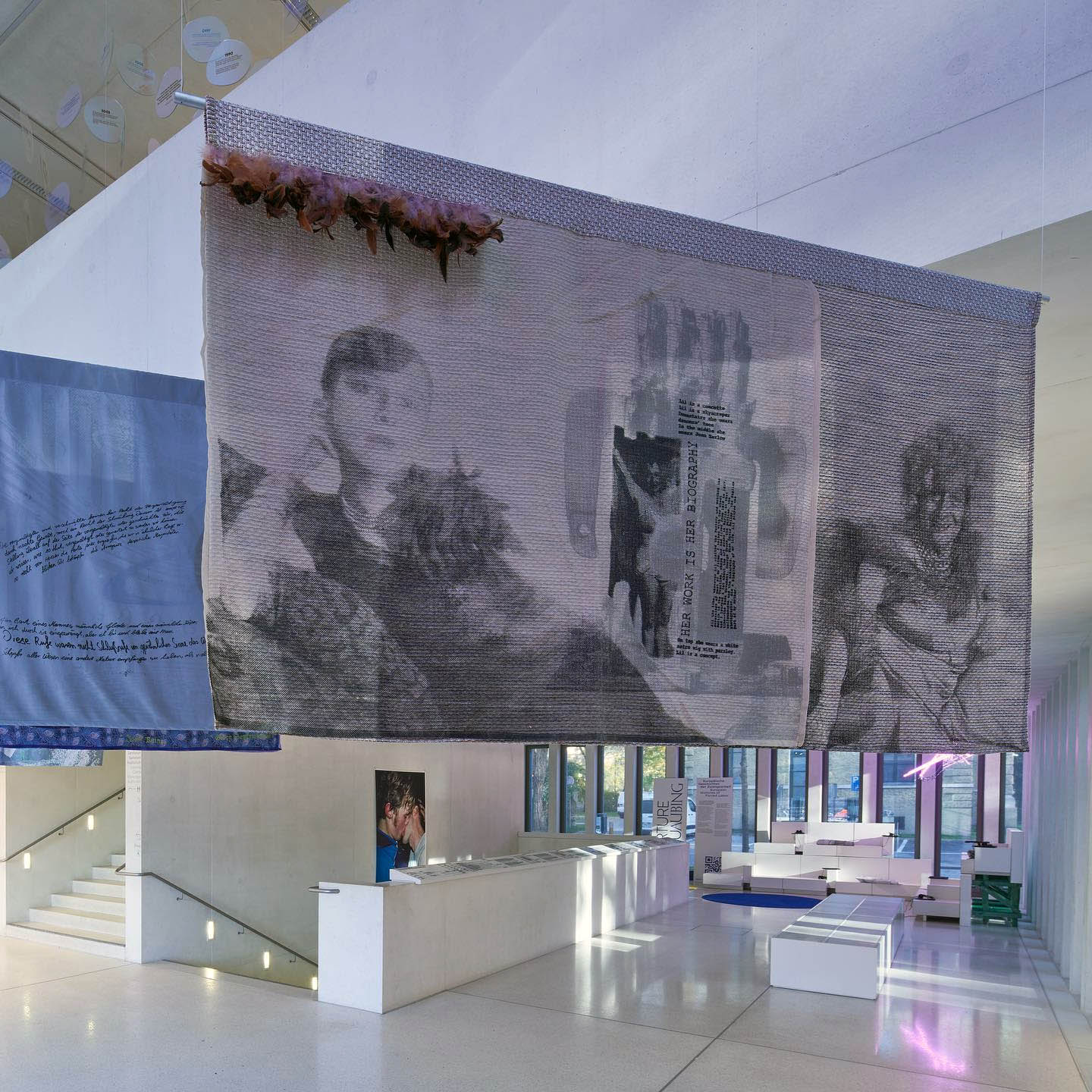
 

Beginnings

Since the invention of the camera people have taken photographs of the male body. The 1840 image by Hippolyte Bayard, “Self-portrait as a drowned man” is a self-portrait by the photographer depicting his fake suicide, taken in protest at being ignored as one of the inventors of photography. It is interesting because it is one of the earliest known photographic images of the unclothed male body and also a reflection of his self, an act of self-reflexivity. It is not his actual body but a reflection on how he would like to be seen by himself and others. This undercurrent of being seen, of projecting an image of the male body, has gradually been sexualised over the history of photography. The body in a photograph has become a canvas, able to mask or reveal the sexuality, identity and desires of the body and its owner. The male body in photography has become an object of desire for both the male and female viewer. The body is on display, open to the viewers gaze, possibly a desiring gaze. In the latter half of the twentieth century it is the muscular male body in particular that has become eroticised as an object of a desiring male2male gaze. In consumer society the muscular male body now acts as a sexualised marketable asset, used by ourselves and others, by the media and by companies to sell product. How has this sexual image of the muscular male body developed?

Within the history of art there is a profundity of depictions of the nude female form upon which the desiring gaze of the male could linger. With the advent of photography images of the nude male body became an accessible space for men desiring to look upon the bodies of other men. The nude male images featured in the early history of photography are endearing in their supposed lack of artifice. The bodies are of a natural type: everyday, normal run of the mill bodies reveal themselves directly to the camera as can be seen in the anonymous c. 1843 French daguerreotype, “Male Nude Study”.1 Although posed and required to hold the stance for a long period of time in order to expose the mercury plate, the model in this daguerreotype assumes a quiet confidence and comfort in his own body, staring directly at the camera whilst revealing his manhood for all to see. This period sees the first true revealing of the male body since the Renaissance, and the beginning of the eroticising of the male body as a visual ‘spectacle’ in the modern era.

Artists with an inclination towards the beauty of naked men were drawn towards the new medium. The photograph opened up the male body to the desiring gaze of the male viewer. The photograph reflected both reality and deception: the reality that these bodies existed in the flesh and the deception that they could be ‘had’, that the viewer could possess the body by looking, by eroticising, and through purchasing the photograph. Friendship between men was generally accepted up until the 18th century but in Victorian times homosexuality was named and classified as a sexual orientation in the early 1870’s. According to Michel Foucault2 this ‘friendship’ only became a problem with the rise of the powers of the police and the judiciary, who saw it as a deviant act; of course photography, as an instrument of ‘truth’, could prove the criminal activities of homosexuals and lead to their prosecution. When homosexual acts did come to the attention of the police and the medical profession it led to great scandals such as the trial and imprisonment of Oscar Wilde for sodomy.


Eadweard Muybridge (English, 1830-1904) 'Nude men wrestling, lock' (plate 345) 1884/1886
 

Eadweard Muybridge (English, 1830-1904)
Nude men wrestling, lock (plate 345)
1884/1886
Public domain

Eadweard Muybridge. Animal locomotion: an electro-photographic investigation of consecutive phases of animal movements. 1872-1885 / published under the auspices of the University of Pennsylvania. Plates. The plates printed by the Photo-Gravure Company. Philadelphia, 1887


On reflection there seems to have been an explosion of images around the late 1880’s to early 1890’s onwards of what we can now call homoerotic imagery; to contemporary eyes the 1887 photographs of nude wrestlers by Eadweard Muybridge have a distinct air of homo-eroticism about them. To keep such images above moral condemnation and within the bounds of propriety men where photographed in poses that were used for scientific studies (as in the case of the Muybridge photographs), as studies for other artists, or in religious poses. They appealed to the classical Greek ideal of masculinity and therefore avoided the sanctions of a society that was, on the surface, deeply conservative. For a brief moment imagine being a homosexual man in the Victorian and Edwardian eras, gazing for the first time at men in close physical proximity, touching each other in the nude, pressing each others flesh when such behaviour was thought of as subversive and illegal – what erotic desires photographs of the male body must have caused to those that appreciated such delicious pleasures, seeing them for the first time!

Frederick Holland Day and Baron von Gloeden

Two of the most famous photographers of the late Victorian and early Edwardian era who used the male body significantly in their work were Frederick Holland Day in America and Baron Wilhelm von Gloeden in Europe. Frederick Holland Day’s photographs of the male body concentrated on mythological and religious subject matter. In these photographs he tried to reveal a transcendence of spirit through an aesthetic vision of androgynous physical perfection. He revelled in the sensuous hedonistic beauty of what he saw as the perfection of the youthful male body. In the 1904 photograph “St. Sebastian,” (below) for example, the young male body is presented for our adoring gaze in the combined ecstasy and agony of suffering. In his mythological photographs Holland Day used the idealism of Ancient Greece as the basis for his directed and staged images. These are not the bodies of muscular men but of youthful boys (ephebes) in their adolescence; they seem to have an ambiguous sexuality. The models genitalia are rarely shown and when they are, the penis is usually hidden in dark shadow, imbuing the photographs with a sexual mystery. The images are suffused with an erotic beauty of the male body never seen before, a photographic reflection of a seductive utopian beauty seen through the desiring eye of a homosexual photographer.


Frederick Holland Day (American, 1864-1933) 'Saint Sebastian' c. 1906


Frederick Holland Day (American, 1864-1933)
Saint Sebastian
c. 1906
Platinum print

See Frederick Holland Day. “Saint Sebastian.” Platinum print, c. 1906, in Woody, Jack and Crump, James. F. Holland Day: Suffering The Ideal. Santa Fe: Twin Palms Publishers, 1995, Plate 53. Courtesy: Library of Congress


In Europe Wilhelm von Gloeden’s photographs of young ephebes (males between boy and man) have a much more open and confronting sexual presence. Using heavily set Sicilian peasant youths with rough hands and feet von Gloeden turned some of these bodies into heroic images of Grecian legend, usually photographing his nude figures in their entirety. In undertaking research into von Gloedens’ photographs at The Kinsey Institute, I was quite surprised at how little von Gloeden used classical props such as togas and vases in his photographs, relying instead on just the form of the body with perhaps a ribbon in the hair. His photographs depict the penis and the male rump quite openly and he hints at possible erotic sexual encounters between models through their intimate gaze and physical contact.

The photographs were collected by some people for their chaste and idyllic nature but for others, such as homosexual men, there is a subtext of latent homo-eroticism present in the positioning and presentation of the youthful male body. The imagery of the penis and the male rump can be seen as totally innocent, but to homosexual men desire can be aroused by the depiction of such erogenous zones within these photographs.

In both photographers work there is a reliance on the ‘natural’ body. In von Gloeden’s case it is the smooth peasant body with rough hands and feet; in Holland Day’s it is the smooth sinuous body of the adolescent. At the same time in both Europe and America, however, there began to emerge a new form for the body of a man, that of the muscular mesomorph, the V-shaped masculine ‘ideal’ expressed through the image of the bodybuilder, photographed in all his muscular splendour!


Baron Wilhelm von Gloeden (German, 1856-1931) 'Two nude men standing in a forest' Taormina, Sicily' 1899


Baron Wilhelm von Gloeden (German, 1856-1931)
Two nude men standing in a forest
Taormina, Sicily, 1899
Albumen print


The Development of Bodybuilding

Frederick Mueller, better known to the world as the Prussian bodybuilder Eugen Sandow, was launched on the public at the World’s Colombian Exposition in Chicago in 1893. He was the world’s first true bodybuilder and he had a thick set muscular body with an outstanding back and abdominal muscles.

Bodybuilding came into existence as a result of the perceived effeminization of men brought on by the effects of the industrial revolution – boxing, gymnastics and weightlifting were undertaken to combat slothfulness, lack of exercise and unmanliness. This led to the formation of what Elliott Gorn in his book The Manly Art (Robson Books, 1986) has called ‘The Cult of Muscularity’,3 where the ‘ideal’ of the perfect masculine body can be linked to a concern for the position and power of men in an industrialised world. Sandow promoted himself not as the strongest man in the world but as the man with the most perfect physique, the first time this had ever happened in the history of the male body. He projected an ideal of physical perfection. He used photography of his muscular torso to promote himself and his products such as books, dumbbells and a brand of cocoa. He often performed and was photographed in the nude by leading photographers in Europe and America and was not at all bashful about exposing his naked body to the admiring gaze of both men and women.

His torso appeared on numerous cartes de visite, inspiring other young men to take up bodybuilding and gradually the muscular male body became an object of adulation for middle-class men and boys. The popularity of the image of his perfect body encouraged other men to purchase images of such muscular edifices and allowed them to desire to have a body like Sandow’s themselves. It also allowed homosexual men to eroticise the body of the male through their desiring gaze. But the ‘normal’ standards of heterosexual masculinity had to be defended. A desiring male gaze (men looking at the bodies of other men) could not be allowed to be homosexual; homosexuals were portrayed by the popular press and society as effete and feminine in order to deny the fact that a ‘real’ man could desire other men.4 (See the Femi-nancy Press chapter of the CD ROM for more details on how homosexuals were portrayed as feminine). A man had to be a ‘real’ man otherwise he could be queer, an arse bandit!


Napoleon Sarony (French, 1821-1896) 'Eugen Sandow' 1893


Napoleon Sarony (French, 1821-1896)
Eugen Sandow
1893
Photographic print on cabinet card
Library of Congress, Washington, D.C.


Still, photographs of Greco-Roman wrestling continued to offer the opportunity for homosexual men to look upon the muscular bodies of other men in close physical proximity and intimacy. A classical wrestling style and classical props legitimised the subject matter. In static poses, which most photographs were at this time because of the length of the exposure, the genitalia were usually covered with a discreetly placed fig leaf or loin cloth, or the fig leaf / posing pouch were added later by retouching the photograph (as can be seen in the anonymous undated image of two wrestlers, “Otto Arco and Adrian Deraiz”).5 People such as Bernard MacFadden, publisher of Physical Culture, said these images were not at all erotic when viewed by other men. I think I would have found these images very horny (if a little illicit), if I had been a poof back in those days.

The physique of the muscular body had appeal across all class boundaries and bodybuilding was one of the first social activities that could be undertaken by any man no matter what his social position. Bodybuilding reinforced the power of traditional heterosexual behaviour – to be the breadwinner and provider for women, men had to see themselves as strong, tough and masculine. A fit, strong body is a productive body able to do more work through its shear physical bulk and endurance. Unlike the anonymous bodies in the photographs of Holland Day and von Gloeden here the bodies are named as individuals, men proud of their masculine bodies. It is the photographers that are anonymous, as though they are of little consequence in comparison to the flesh that is placed before their lenses.

I suggest that the impression the muscular body made on individual men was also linked to developments in other areas (art, construction and architecture for example), which were themselves influenced by industrialisation and its affect on social structure. In her book Space, Time and Perversion: Essays on the Politics of Bodies (Routledge, 1995), Elizabeth Grosz says that the city is an important element in the social production of sexually active bodies. As the cities became further industrialised and the population of cities increased in the Victorian era, space to build new buildings was at a premium. The 1890s saw the building of the first skyscrapers in America, impressive pieces of engineering that towered above the city skyline. Their object was to get more internal volume and external surface area into the same amount of space so that the building held more and was more visible to the human eye. I believe this construction has parallels in the similar development of the muscular male body, a facade with more surface area than other men’s bodies, which makes that man more visible, admired and (secretly) desired.

Further, in art the Futurists believed in the ultimate power of the machine and portrayed both the machine and the body in a blur of speed and motion. In the Age of the Machine the construction of the body became industrialised, the body becoming armoured against the outside world and the difficulty of living in it. The body became a machine, indestructible, superhuman. Within this demanding world men sought to confirm their dominance over women (especially after women achieved the ability to vote), and other men. Domination was affirmed partially through images of the muscular male (as can be seen in the image Charles Atlas and Tony Sansone in “The Slave” below), although viewed through contemporary eyes a definite homo-erotic element is also present.

Charles Atlas and Tony Sansone in “The Slave” also presents us with a man who challenged the fame of Eugen Sandow. His name was Tony Sansone and he emerged as the new hero of bodybuilding around the year 1925. Graced with a perfect physique for a taller man, Sansone was more lithe than the stocky, muscular Sandow and can be seen to represent a classical heroic Grecian body, perfect in it’s form. He had Valentino like features, perfect bone structure and was very photogenic, always a useful asset when selling a book of photographs of yourself.


Grace Salon of Art. 'Charles Atlas and Tony Sansone in "The Slave"' 1930s


Grace Salon of Art
Charles Atlas and Tony Sansone in “The Slave”
1930s


Edwin F. Townsend (American, 1877-1948) 'Portrait of Tony Sansone' Nd


Edwin F. Townsend (American, 1877-1948)
Portrait of Tony Sansone
Nd (1930s)


WWI, Nature Worship, The Body and Propaganda

The First World War caused a huge amount of devastation to the morale and confidence of the male population of Europe and America. Millions of young men were slaughtered on the killing fields of Flanders and Galipolli as the reality of trench warfare set in. Here it did not matter what kind of body a man had – every body was fodder for the machine guns that constantly ranged the lines of advancing men during an assault. A bullet or nerve gas kills a strong, muscular body just as well as a thin, natural body. The war created anxieties and conflicts in men and undermined their confidence and ability to cope in the world after peace came. During the war images of men were used to reinforce the patriotic message of fighting for your country. After the war the Surrealist and German Expressionist movements made use of photography of the body to depict the dreams, deprivations and abuse that men were suffering as a result of it. In opposition to this avant-garde art and to reinforce the message of the strong, omnipotent male – images of muscular bodies were again used to shore up traditional ‘masculine’ values. They were used to advertise sporting events such as boxing and wrestling matches and sporting heroes appeared on cigarette cards emphasising skills and achievements. These images and events ensured that masculinity was kept at the forefront of human endeavour and social cognisance.

After the devastation of The First World War, the 1920’s saw the development in Germany, America and England of the cult of ‘nature worship’ – a love of the outdoors, the sun and the naturalness of the body that would eventually lead to the formation of the nudist movement. This movement was exploited by governments and integrated into the training regimes of their armies in the search for a fitter more professional soldier. But the nudity aspect was frowned upon because of its homo-erotic overtones: Hitler banned all naturist clubs in Germany in 1933 and the obvious eroticism of training in the nude would not have been overlooked. Physical training had been introduced into the armies and navies of the Western world at the end of the 19th century and as the new century progressed physical fitness was seen as an integral part of the discipline and efficiency of such bodies. As fascist states started to emerge during the latter half of the 1920’s and the beginning of the 1930’s they started making use of the muscular male body as a symbol of physical perfection.

The idealised muscularity of the body was used by the state to encourage its aims. The use of classical images of muscular bodies reflected a nostalgia for the past and an appeal to nationalism. Heroic statues were recreated in stadiums in Italy and Germany, symbols that represented the power, strength and virility of the state and its leaders. In a totalitarian regime the body becomes the property of the state, and is used as a tool in collusion with the state’s moral and political agendas. Propaganda became a major tool of the state. During the decade leading up to the Second World War and during the war itself images of the body were used to help support the policies of the government, to encourage enlistment and bolster the morale of soldiers and public. Such images appealed to the patriotic nature of the population but could still include suspicions of homo-erotic activity, such as in the (probably Russian) poster from 1935 (below).


Anonymous photographer. 'The Ball Throwers' c. 1925


Anonymous photographer
The Ball Throwers
c. 1925
Army Training
Germany


“The training methods of Major Hans Suren, Chief of the German Army School of Physical Exercise in the 1920’s, involved training naked – pursuing ideals of physical perfection which were later promoted by Hitler as a sign of Aryan racial superiority.”

Anonymous photographer. “The Ball Throwers.” Army Training. Germany. c. 1925, in Dutton, Kenneth. The Perfectible Body. London: Cassell, 1995, p. 208


Unknown photographer. Josef Thorak "Comradeship" 1937


Unknown photographer
Josef Thorak “Comradeship”
1937
German Pavilion at the Paris Exposition Internationale


“Comradeship”, at the entrance to the German pavilion at the Paris World Exhibition 1937, by Josef Thorak, who was one of two “official sculptors” of the 3rd Reich. Nazi era statues were often strangely homoerotic.6

Here comradeship should not be confused with friendship which was discussed at the beginning of this chapter.


Anonymous artist. 'Propaganda poster' 1935


Anonymous artist
Propaganda poster
1935


Surrealism and the Body: George Platt Lynes

In contrast to the fascistic depictions of the male body used for propaganda, Surrealism (formed in the 1920s) was adapted by several influential gay photographers in the 1930s to express their own artistic interest in the male body. Although Surrealism was heavily anti-feminine and anti-homosexual, these gay male photographers, the Germans Herbert List, Horst P. Horst, and George Hoyningen-Huene and the American George Platt Lynes, made extensive use of the liberation of fantasies that Surrealism offered. Although the open depiction of homosexuality was still not possible in the 1930s there is an intuitive awareness on the part of the photographers and the viewer of the presence of sexual rituals and interactions. There is also the knowledge that there is a ready audience for these photographs, not only in the close circle of friends that surrounded the photographers, but also from gay men that instinctively recognise the homo-erotic quality of these images when shown them. The bodies in the images of the above photographers tend to be of two distinct types, the ephebe and the muscular mesomorphic body.


George Platt Lynes (American, 1907-1955) 'A Forgotten Model' c. 1937


George Platt Lynes (American, 1907-1955)
A Forgotten Model
c. 1937
Gelatin silver print


George Platt Lynes (American, 1907-1955) 'The Sleepwalker' 1935


George Platt Lynes (American, 1907-1955)
The Sleepwalker
1935
Gelatin silver print


George Platt Lynes (1907-1955) 'Names Withheld' 1952


George Platt Lynes (American, 1907-1955)
Names Withheld
1952
Gelatin silver print


Herbert List (German, 1903-1975) 'Armor II' 1934


Herbert List (German, 1903-1975)
Armor II
1934
Gelatin silver print
15 7/10 × 11 4/5 in (40 × 30cm)


Herbert List (German, 1903-1975) 'Young men on Naxos' 1937


Herbert List (German, 1903-1975)
Young men on Naxos
1937
Gelatin silver print


George Platt Lynes (American, 1907-1955) 'Untitled' 1936


George Platt Lynes (American, 1907-1955)
Untitled
1936
Gelatin silver print


In America George Platt Lynes was working as a fashion photographer. George Platt Lynes had his own studio in New York where he photographed dancers, artists and celebrities amongst others. He undertook a series of mythological photographs on classical themes (which are amazing for their composition which features Surrealist motifs). Privately he photographed male nudes but was reluctant to show them in public for fear of the harm that they could do to his reputation and business with the fashion magazines. Generally his earlier nude photographs concentrate on the idealised youthful body or ‘ephebe’. The 1936 photograph “Untitled” (above) is an exception. Here we gaze upon a smooth, defined muscular torso, the man (too old to be an ephebe) both in agony and ecstasy, his head thrown back, his eyes covered by one of his arms. Sightless he does not see the ‘other’ male hand that encloses his genitals, hiding them but also possibly about to molest them / release them at the same time. (NB. See my research notes on George Platt Lynes photographs in the Collection at the Kinsey Institute).

We can relate this photograph to Fred Holland Day’s photograph of “St. Sebastian” discussed earlier, this image stripped bare of most of the religious iconography of the previous image. The body is displayed for our adoration in all its muscularity, the lighting picking up the definition of diaphragm, ribs and chest, the hand hiding and perhaps, in the future, offering release to a suppressed sexuality. Here an-‘other’ hand is much closer to the origin of male2male sexual desire. Looking at this photograph you can visualise a sexual fantasy, so I imagine that it would have had the same effect on homosexual men when they looked at it in the 1930s.

In the slightly later nude photographs by George Platt Lynes the latent homo-eroticism evident in his earlier work becomes even more apparent.

In his image from 1942 “Untitled” we observe three young men in bare surroundings, likely to be Platt Lynes studio. The faces of the three men are not visible at all, evoking a sexual anonymity (According to David Leddick the models are Charles ‘Tex’ Smutney, Charles ‘Buddy’ Stanley, and Bradbury Ball.7 The image comes from a series of 30 photographs of these three boys undressing and lying on a bed together; please see my notes on Image 483 and others from this series in the Collection at The Kinsey Institute).


George Platt Lynes. 'Untitled [Charles 'Tex' Smutney, Charles 'Buddy' Stanley, and Bradbury Ball]' c. 1942


George Platt Lynes (American, 1907-1955)
Untitled [Charles ‘Tex’ Smutney, Charles ‘Buddy’ Stanley, and Bradbury Ball]
c. 1942
Gelatin silver print


On a chair sits a pile of discarded clothes and in the background a man is removing the clothing of another man. The bulge of the man’s penis is quite visible through the material of the underpants. On the bed lies another man, face down, passive, unresisting, head turned away from us, the curve of his arse signalling a site of erotic activity for a gay man. Our gaze is directed to the arse of the man lying on the bed as a site of sexual desire and although nothing is actually happening in the photograph, there is a sexual ‘frisson’ in its composition.

As Lynes became more despondent with his career as a fashion photographer his private photographs of male nudes tended to take on a darker and sharper edge. After a period of residence in Hollywood he returned to New York nearly penniless. His style of photographing the male nude underwent a revision. While the photographs of his European colleagues still relied on the sun drenched bodies of young adolescent males evoking memories of classical beauty and the mythology of Ancient Greece the later nudes of Platt Lynes feature a mixture of youthful ephebes and heavier set bodies which appear to be more sexually knowing. The compositional style of dramatically lit photographs of muscular torsos of older men shot in close up (see the undated image “Untitled,” Frontal Male Nude, for example; see also my notes on this image, Image 144, in the Collection at The Kinsey Institute), were possibly influenced by a number of things – his time in Hollywood with its images of handsome, swash-buckling movie stars with broad chests and magnificent physiques; the images of bodybuilders by physique photographers that George Platt Lynes visited; the fact that his lover George Tichenor had been killed during WWII; and the knowledge that he was penniless and had cancer. There is, I think, a certain perhaps not desperation but sadness and strength in much of his later photographs of the male nude that harnesses the inherent sexual power embedded within their subject matter.


George Platt Lynes. 'Untitled (Frontal Male Nude)' Nd


George Platt Lynes (American, 1907-1955)
Untitled [Frontal Male Nude]
Nd
Gelatin silver print

Platt Lynes, George. “Untitled,” Nd in Ellenzweig, Allen. The Homoerotic Photograph. New York: Columbia University Press, 1992, p. 103.
Courtesy: Estate of George Platt Lynes.


“The depth and commitment he had in photographing the male nude, from the start of his career to the end, was astonishing. There was absolutely no commercial impulse involved – he couldn’t exhibit it, he couldn’t publish it.”

Allen Ellenzweig. Introduction to George Platt Lynes: The Male Nudes. Rizzoli, 2011.


George Platt Lynes (American, 1907-1955) 'Untitled' 1953


George Platt Lynes (American, 1907-1955)
Untitled
Date unknown (early 1950s)
Gelatin silver print


George Platt Lynes (American, 1907-1955) 'Untitled' 1953


George Platt Lynes (American, 1907-1955)
Untitled
1953
Gelatin silver print


George Platt Lynes (American, 1907-1955) 'Ted Starkowski (standing, arms behind back)' c. 1950


George Platt Lynes (American, 1907-1955)
Ted Starkowski (standing, arms behind back)
c. 1950
Gelatin silver print from a paper negative


The monumentality of body and form was matched by a new openness in the representation of sexuality. There are intimate photographs of men in what seem to be post-coital revere, in unmade beds, genitalia showing or face down showing their butts off (See my description of Untitled Nude, 1946, in the Collection at The Kinsey Institute). Some of the faces in these later photographs remain hidden, as though disclosure of identity would be detrimental for fear of persecution. The “Untitled,” Frontal Male Nude photograph (above) is very ‘in your face’ for the conservative time from which it emerges, remembering it was the era of witch hunts against communists and subversives (including homosexuals).

This photograph is quite restrained compared to one of the most striking series of GPL’s photographs that I saw at The Kinsey Institute which involves an exploration the male anal area. A photograph from the 1951 series can be found in the book titled George Platt Lynes: Photographs from The Kinsey Institute.8 This image is far less explicit than other images of the same model from the same series that I saw during my research into GPL’s photographs at The Kinsey Institute,9 in particular one which depicts the model with his buttocks in the air pulling his arse cheeks apart (See my description of Images 186-194 in the Collection at The Kinsey Institute). After Lynes found out he had cancer he started to send his photographs to the German homoerotic magazine Der Kries under the pseudonym Roberto Rolf,10 and in the last years of his life he experimented with paper negatives, which made his images of the male body even more grainy and mysterious (See the photograph Ted Starkowski (1950, above), and see my notes on Male Nude 1951, in the Collection at The Kinsey Institute).

Personally I believe that Lynes understood, intimately, the different physical body types that gay men find desirable and used them in his photographs. He visited Lon of New York (a photographer of beefcake men) in his studio and purchased photographs of bodybuilders for himself, as did the German photographer George Hoyningen-Huene, another artist who was gay. It is likely that these images of bodybuilders did influence his later compositional style of images of men; it is also possible that he detected the emergence of this iconic male body type as a potent sexual symbol, one that that was becoming more visible and sexually available to gay men.


Max Dupain. 'Sunbaker' 1937


Max Dupain (Australian, 1911-1992)
Sunbaker
1937
Gelatin silver print


1930s Australian Body Architecture

Around the time that George Platt Lynes was photographing his earlier male nudes Max Dupain took what is seen to be an archetypal photograph of the Australian way of life. Called Sunbaker (1937, above), the photograph expresses the bronzed form of man lying prone on the ground, the man pressing his flesh into the warm sand as the sun beats down on a hot summers day. His hand touches the earth and his head rests, egg-like, on his arm. His shoulders remind me of the outline of Uluru (or Ayres Rock) in the centre of Australia, sculptural, almost cathedral like in their geometry and outline, soaring into the sky. Here the male body is a massive edifice, towering above the eye line, his body wet from the sea expressing the essence of Australian beach culture. In this photograph can be seen evidence of an Australian tradition of photographing hunky lifesavers and surfies to the delight of a gay audience which reached a peak in the late 1980’s and early 1990’s, although I’m not sure that Max Dupain would have realised the homoerotic overtones of the photograph at the time.

Minor White

Another photographer haunted by his sexuality was the American Minor White. Disturbed by having been in battle in the Second World War and seeing some of his best male friends killed, White’s early photographs of men (in their uniforms) depict the suffering and anguish that the mental and physical stress of war can cause. He was even more upset than most because he was battling his own inner sexual demons at the same time, his shame and disgust at being a homosexual and attracted to men, a difficulty compounded by his religious upbringing. In his photographs White both denied his attraction to men and expressed it. His photographs of the male body are suffused with both sexual mystery and a celebration of his sexuality despite his bouts of guilt. After the war he started to use the normal everyday bodies of his friends to form sequences of photographs, sometimes using the body as a metaphor for the landscape and vice versa. Based on a religious theme the 1948 photograph Tom Murphy (San Francisco) (1948, below) from The Temptation of Saint Anthony is Mirrors, 1948, presents us with a dismembered hairy body front on, the hands clutching and caressing the body at the same time, the lower hand hovering near the exposed genitalia. As in the photographs of Platt Lynes we see the agony and ecstasy of a homo-erotic desire wrapped up in a religious or mythological theme.


Minor White (American, 1908-1976) 'Tom Murphy (San Francisco)' 1948


Minor White (American, 1908-1976)
Tom Murphy (San Francisco)
1948
From The Temptation of Saint Anthony is Mirrors 1948
Gelatin silver print


Minor White (American, 1908-1976) 'Nude Foot, San Francisco' 1947


Minor White (American, 1908-1976)
Nude Foot, San Francisco
1947
Gelatin silver print


Other images (such as Nude Foot 1947, above) seem to have an aura of desire, mysticism, vulnerability and inner spirituality. White photographed when he was in a state of meditation, hoping for a “revelation,” a revealing of spirit in the subsequent negative and finally print. Perhaps this is why the young men in his photographs always seem vulnerable, alone, available, and have an air of mystery – they reflect his inner state of mind, and consequently express feelings about his own sexuality. In reading through my research notes on his photographs at The Minor White Archive, I notice that I found them a very intense, rich and rewarding experience. It was amazing to find Minor White photographs of erect penises dating from the 1940s amongst the archive but even more amazing was the presence that these photographs had for me. The other overriding feeling was one of perhaps loneliness, sadness, anguish(?), for the bodies seemed to be just observed and not partaken of. As with Platt Lynes photographs of men, very few of Minor White’s male portraits were ever exhibited in his lifetime because of his fear of being exposed as a homosexual.

Physique Culture after WW2

At the same time that Minor White was exploring anxieties surrounding his sexuality and his war experiences, many other American men were returning home from WWII to America to find that they had to reaffirm the traditional place of the male as the breadwinner within the family unit. Masculinity and a muscular body image was critical in this reaffirmation. Powerful in build and strong in image it was used to counter the threat of newly independent females, females who had taken over the jobs of men while they were away at war. Conversely, many gay men returned home to America after the war knowing that they were not as alone as they had previously thought, having socialised, associated, fought and had sex with others of their kind. There were other gay men out there in the world and the beginnings of contemporary gay society started to be formed. A desire by some gay men for the masculine body image found expression in the publications of body-building books and magazines that continued to be produced within the boundaries of social acceptability after the Second World War.

Photographers such as Russ Warner, Al Urban, Lon of New York (who began their careers in the late 1930’s), Bob Mizer (started Physique Pictorial in 1945), Charles Renslow (started Kris studio in 1954), and Bruce of Los Angeles, sought out models on both sides of the Atlantic (See my notes on the images of some of these photographers held in the Collection at the Kinsey Institute). Models appeared in posing pouches or the negatives were again airbrushed to hide offending genitalia. Some unpublished images from 1942-1950 by Bruce of Los Angeles show an older man sucking off a stiff younger man (See my notes on Images No. 52001-52004 from the link above) but this is the rare exception rather than the rule.


Bob Mizer/Athletic Model Guild. 'Irwin Kosewski and Jerry Ross' Nd


Bob Mizer (American, 1922-1992) / Athletic Model Guild
Irwin Kosewski and Jerry Ross
Nd

Mizer, Bob/Athletic Model Guild. “Irwin Kosewski and Jerry Ross,” Nd, in Domenique (ed.,). Art in Physique Photography. Vol. 1. Man’s World Publishing Company. Chesham: The Carlton Press, Nd, p. 19.


Joe Corey. 'Bill Henry and Bob Baker' Nd


Joe Corey
Bill Henry and Bob Baker
Nd

Corey, Joe. “Bill Henry and Bob Baker,” Nd, in Domenique (ed.,). Art in Physique Photography. Vol. 1. Man’s World Publishing Company. Chesham: The Carlton Press, Nd, p. 27.


Appealing to a closeted homosexual clientele the published images seem, on reflection, to have had a more open, homo-erotic quality to them than earlier physique photographs. This can be observed in the two undated images, “Irwin Kosewski and Jerry Ross,” by Bob Mizer / Athletic Model Guild and “Bill Henry and Bob Baker,” by Joe Carey (both above). The first image carries on the tradition of the Sansone image “The Slave,” but further develops the sado-masochistic overtones; such wrestling photographs became popular just because the models were shown touching each other, which could provide sexual arousal for gay men looking at the photographs.

Some photographs were taken out of doors instead of always in the studio, possibly an expression of a more open attitude to ways of depicting the nude male body. The bodies in the ‘beefcake’ magazines of the 1950’s tend to be bigger than that of the ephebe, even when the models were quite young in some cases. As the name ‘beefcake’ implies, the muscular mesomorphic shape was the attraction of these bodies – perfectly proportioned Adonis’s with bulging pectorals, large biceps, hard as rock abdomens and small waists. The 1950’s saw the beginning of the fixation of gay men with the muscular mesomorph as the ultimate ideal image of a male body. The lithe bodies of young dancers and swimmers now gives way to muscle – a built body, large in its construction, solid and dependable, sculpted like a piece of rock. These bodies are usually smooth and it is difficult to find a hirsute body11 in any of the photographs from the physique magazines of this time. According to Alan Berube in his book, Coming Out Under Fire,

“The post-war growth and commercialization of gay male erotica in the form of mail-order 8 mm films, photographic stills, and physique magazines were developed in part by veterans and drew heavily on World War II uniforms and iconography for erotic imagery.”12


Looking through images from the 1940s in the collection at The Kinsey Institute, I did find that uniforms were used as a fetish in some of the explicitly erotic photographs as a form of sexual iconography. These photographs of male2male sex were for private consumption only. I found little evidence of the use of uniforms as sexual iconography in the published photographs of the physique magazines. Here image composition mainly featured classical themes, beach scenes, outdoor and studio settings.


Touko Valio Laaksonen (Tom of Finland) (Finnish, 1920-1991) 'Untitled' 1973


Touko Valio Laaksonen (Tom of Finland) (Finnish, 1920-1991)
Untitled
1973


'Physique Pictorial' Volume 7, Number 1, Spring 1957


Physique Pictorial Volume 7, Number 1, Spring 1957. Tom of Finland, Touko Laaksonen (cover)

This issue features the debut American appearance of “Tom, a Finnish artist,” a.k.a. Tom of Finland who produced both the cover illustration of loggers and an interior companion shot.


Bob Mizer (American, 1922-1992) / Athletic Model Guild. Cover of 'Physique Pictorial' Vol. 14, No. 2, 1964


Bob Mizer (American, 1922-1992) / Athletic Model Guild
Cover of Physique Pictorial Vol. 14, No. 2, 1964
32 pages, black and white illustrations
Illustrated saddle-stapled self-wrappers
21cm x 13cm


Tom of Finland

Although not a photographer one gay artist who was heavily influenced by the uniforms and muscularity of soldiers he lusted after and had sex with during the war was Touko Laaksonen, known as ‘Tom of Finland’. His images featured hunky, leather clad bikers, sailors, and rough trade ploughing their enlarged, engorged penises up the rears of chunky men in graphic scenes of male2male sex. His images portrayed gay men as the hard-bodied epitome of masculinity, contrary to the nancy boy image of the limp wristed poof that was the stereotype in the hetero / homosexual community up until the 1960s and even later. His early images were again only for private consumption. His first success was a (non-sexual) drawing of a well built male body that he sent to America. It appeared on the cover of the spring 1957 issue of Physique Pictorial (above). Here we see a link between the drawings of Tom of Finland and the construction of a body engineered towards selling to a homosexual market, the male body as marketable commodity. His drawings of muscular men were influenced by the bodies in the beefcake magazines and the bodies of the soldiers he desired. Tom of Finland, in an exaggerated way, portrayed the desirability of this type of body for gay men by emphasising that, for him, gay sex and gay bodies are ultimately ‘masculine’.

1950s Australia

Very little of this iconography of the muscular male was available to gay men in Australia throughout the 1950’s. The few publications that became available were likely to have come from America or the United Kingdom. Instead heterosexual photographers such as Max Dupain took images of Australian beach culture such as the 1952 image At Newport, Australia, 1952 (below). Dupain took a series of photographs of this beautiful young man, ‘the lad’ as he calls him,13 climbing out of the pool. Elegant in its structural form ‘the lad’ is oblivious to the camera’s and our gaze. Although the body is toned and tanned this body image is a much more ‘natural’ representation of the male body than the photographs in the physique magazines, with all their posing and preening for the camera.


Max Dupain (Australian, 1911-1992) 'At Newport Baths' 1952


Max Dupain (Australian, 1911-1992)
At Newport, Australia, 1952
1952
Gelatin silver print

Dupain, Max. “At Newport, Australia, 1952.” 1952, in Bilson, Amanda (ed.,). Max Dupain’s Australia. Ringwood: Viking, 1986, p. 157.


John Graham. 'Clive Norman' Nd


John Graham
Clive Norman
Nd

Graham, John. “Clive Norman,” Nd in Domenique (ed.,). Art in Physique Photography Vol. 1. Man’s World Publishing Company. Chesham: The Carlton Press, Nd, p. 38.


John Graham. 'Detail from Parthenon Frieze'. Elgin Marble Friezes, British Museum Nd and Lon of New York in London. 'Jim Stevens' Nd


John Graham
Detail from Parthenon Frieze
Elgin Marble Friezes, British Museum
Nd

Lon of New York in London
Jim Stevens
Nd

Graham, John. “Detail from Parthenon Frieze.” Elgin Marble Friezes, British Museum, Nd in Domenique (ed.,). Art in Physique Photography. Vol. 1. Man’s World Publishing Company. Chesham: The Carlton Press, Nd, p. vi.

Lon of New York in London. “Jim Stevens,” Nd in Domenique (ed.,). Art in Physique Photography. Vol. 1. Man’s World Publishing Company. Chesham: The Carlton Press, Nd, p. 13.


Later Physique Culture and gay pornography photographs

Images of the body in the physique magazines of the 1940s-1960s are invariably smooth, muscular and defined. A perfect example of the type can be seen in the undated image Clive Norman by John Graham (above). The images rely heavily on the iconography of classical Rome and Greece to legitimise their homo-erotic overtones. Use was made of columns, drapery, and sets that presented the male body as the contemporary equivalent of idealised male beauty of ancient times.

As the 1950s turned into the 1960s other stereotypes became available to the photographers – for example the imagery of the marine, the sailor, the biker, the boy on a tropical island, the wrestler, the boxer, the mechanic. The photographs become more raunchy in their depiction of male nudity. In the 1950s, however, classical aspirations were never far from the photographers minds when composing the images as can be seen in the undated photograph Jim Stevens by Lon of New York in London (above) taken from a book called Art in Physique Photography.14 This book, illustrated with drawings of classical warrior figures by David Angelo, is subtitled: ‘An Album of the world’s finest photographs of the male physique’.

Here we observe a link between art and the body. This connection was used to confirm the social acceptability of physique photographs of the male body while still leaving them open to other alternative readings. One alternative reading was made by gay men who could buy these socially acceptable physique magazines to gaze with desire upon the naked form of the male body. It is interesting to note that with the advent of the first openly gay pornography magazines after the ruling on obscenity by the Supreme Court in America in the late 1960s (See my research notes on this subject from The One Institute),15 classical figures were still used to justify the desiring gaze of the camera and viewer upon the bodies of men. Another reason used by early gay pornography magazines to justify photographs of men having sex together was that the images were only for educational purposes!

Even in the mid 1970s companies such as Colt Studios, which has built a reputation for photographing hunky, very well built masculine men, used classical themes in their photography of muscular young men. Most of the early Colt magazines have photographs of naked young men that are accompanied by photographs and illustrations based on classical themes as can be seen in the image below. In their early magazines quite a proportion of the bodies were hirsute or had moustaches as was popular with the clone image at the time. Later models of the early 1980s tend towards the buff, tanned, stereotypical muscular mesomorph in even greater numbers. Sometimes sexual acts are portrayed in Colt magazines but mainly they are not. It is the “look” of the body and the face that the viewers desiring gaze is directed towards – not the sexual act itself. As the Colt magazine says,

“Our aim in Olympus is to wed the classic elegance of ancient Greece and Rome to the contemporary look of the ’70s. With some models that takes some doing: they may have one or two exceptional features, but the overall picture doesn’t make it … Erron, our current subject, comes closer to the ideal – in his own way … Erron stands 5’10”. He is 22 years old and is the spirit of the free-wheeling, unhampered single stud … And to many the morning after, he is ‘the man that got away’.”16


Anonymous photographer. 'Erron' 1973


Anonymous photographer
Erron
Olympus from Colt Studios Vol. 1. No 2.
1973


Erron does attempt to come closer to the ‘ideal’ but not, I think, in his own way for it is an ‘ideal’ based on a stereotypical masculine image from a past culture. Is he doing his own thing or someone else’s thing, based on an image already prescribed from the past?

As social morals relaxed in the age of ‘free love’, physique photographers such as Bob Mizer from Athletic Model Guild produced more openly homo-erotic images. In his work from the 1970s full erections are not prevalent but semi-erect penises do feature, as do revealing “moon” shots from the rear focusing on the arsehole as a site for male libidinal desires. A less closeted, more open expression of homosexual desire can be seen in the photographs of the male body in the 1970s.17 What can also be seen in the images of gay pornography magazines from the mid 1970s onwards is the continued development of the dominant stereotypical ‘ideal’ body image that is present in contemporary gay male society – that of the smooth, white, tanned, muscular mesomorphic body image.


Diane Arbus (American, 1923-1971) 'Muscle Man in his dressing room with trophy, Brooklyn, N.Y.' 1962


Diane Arbus (American, 1923-1971)
Muscle Man in his dressing room with trophy, Brooklyn, N.Y.
1962
Gelatin silver print


Diane Arbus (American, 1923-1971) 'Seated man in a bra and stockings, N.Y.C., 1967' 1967


Diane Arbus (American, 1923-1971)
Seated man in a bra and stockings, N.Y.C., 1967
1967
Gelatin silver print


Diane Arbus

In the 1960s and 1970s other photographers were also interested in alternative representations of the male body, notably Diane Arbus. Arbus was renowned for ‘in your face’ photographs of the supposed oddities and freaks of society. She photographed body-builders with their trophies, dwarfs, giants, and all sorts of interesting people she found fascinating because of their sexual orientation, hobbies and fetishes. She photographed gay men, lesbians and transsexuals in their homes and hangouts.

I think the image Seated man in a bra and stockings, N.Y.C., 1967 (above), reveals a different side of masculinity, not conforming to the stereotypical depiction of ‘masculinity’ proposed by the form of the muscular body. Yes, the subject is wary of the camera, hand gripping the chair arm, legs crossed in a protective manner. But I think that the important significance of this photograph lies in the fact that the subject allowed himself to be photographed at all, with his face visible, prepared to reveal this portion of his life to the probing of Arbus’ lens. In the closeted and conservative era of the 1960s (remember this is before Gay Liberation), to allow himself to be photographed in this way would have taken an act of courage, because of the fear of discrimination and persecution including the possible loss of job, home, friends, family and even life if this photograph ever came to the attention of employers, landlords and bigots.


Robert Mapplethorpe (American, 1946-1989) 'Charles and Jim' 1974

Robert Mapplethorpe (American, 1946-1989) 'Charles and Jim' 1974


Robert Mapplethorpe (American, 1946-1989)
Charles and Jim
1974
Gelatin silver prints

Mapplethorpe, Robert. Charles and Jim, 1974, in Holborn, Mark and Levas, Dimitri. Mapplethorpe Altars. London: Jonathan Cape, 1995, pp. 26-27.


Robert Mapplethorpe (American, 1946-1989) 'White Sheet' 1974 (detail)


Robert Mapplethorpe (American, 1946-1989)
White Sheet (detail)
1974
Gelatin silver print

Mapplethorpe, Robert. Detail of White Sheet, 1974, in Holborn, Mark and Levas, Dimitri. Mapplethorpe Altars. London: Jonathan Cape, 1995, p. 74.


Robert Mapplethorpe

Robert Mapplethorpe. The name of one of the most controversial photographers of the 20th century. Well known to gay men around the world for his ground breaking depiction of sexuality and the body through his photographs of black men and the sadomasochistic acts within the leather scene in gay community. The exhibiting of his images was only possible after the liberation of sexualities brought about by Stonewall and the start of the fight for Gay Liberation in 1969. Early images, such as three from the sequence of photographs Charles and Jim (1974, above) feature ‘natural’ bodies – hairy, scrawny, thin – in close physical proximity with each other, engaged in gay sex, sucking each others dicks in other photographs from this sequence. There is a tenderness and affection to the whole sequence, as the couple undress, suck, kiss and embrace. Compare the photographs with the photograph by Minor White of Tom Murphy (San Francisco) (1948, above) Gone is the religious agony, loneliness and isolation of a man (the photographer), who fears an open expression of his sexuality, replaced by the gaze and touch of a man comfortable with his sexuality and the object of his desire.

Although Mapplethorpe used the bodies of his friends and himself in the early photographs he was still drawn to images of muscular men that had a definite homoerotic quality to them, as can be seen in the detail of the 1974 work White Sheet. Blatant in its hard muscularity the boys stare at each other, flexing their muscles, one arm around the back of the others neck. This attraction to the perfect muscular body became more obvious in the later work of Mapplethorpe, especially in his depiction of black men and their hard, graphic bodies. Mapplethorpe even used to coat his black models in graphite so that the skin took on a grey lustre, adding to the feeling that the skin was made of marble and was impenetrable. Mapplethorpe’s photographs of black men come from a lineage that can be traced back through Frederick Holland Day (see below) to Herbert List and George Platt Lynes who all photographed black men. In the 1979 image of Bob Love (below), Mapplethorpe worships the body and the penis of Bob Love, placing him on a pedestal reminiscent of those used in the physique magazines of an earlier era.


F. Holland Day (American, 1864-1933) 'Ebony and Ivory' 1899


F. Holland Day (American, 1864-1933)
Ebony and Ivory
1899


Robert Mapplethorpe (American, 1946-1989) 'Bob Love' 1979


Robert Mapplethorpe (American, 1946-1989)
Bob Love
1979
Gelatin silver print

Mapplethorpe, Robert. Bob Love, 1979, in Holborn, Mark and Levas, Dimitri. Mapplethorpe Altars. London: Jonathan Cape, 1995, p. 71.


Around the same time that Mapplethorpe was photographing the first of his black nudes he was also portraying acts of sexual pleasure in his photographs of the gay S/M scene. In these photographs the bodies are usually shielded from scrutiny by leather and rubber but are more revealing of the intentions and personalities of the people depicted in them, perhaps because Mapplethorpe was taking part in these activities himself as well as just depicting them. There is a sense of connection with the people and the situations that occur before his lens in the S/M photographs. In the photograph of Bob, however, Bob stares out at the viewer in a passive way, revealing nothing of his own personality, directed by the photographer, portrayed like a trophy. I believe this isolation, this objectivity becomes one of the undeniable criticisms of most of Mapplethorpe’s later photographs of the body – they reveal nothing but the clarity of perfect formalised beauty and aesthetic design, sometimes fragmented into surfaces. Mapplethorpe liked to view the body as though cut up into pieces, into different libidinal zones, much as in the reclaimed artefacts of classical sculpture. The viewer is seduced by the sensuous nature of the bodies surfaces, the body objectified for the viewers pleasure. The photographs reveal very little of the inner self of the person being photographed. This surface quality can also be seen in earlier work such as the 1976 photograph of bodybuilder Arnold Schwarzenegger (1976, below).


Lorenzo Lotto (Italian, c. 1480 - 1556/1557) 'Young Man Before a White Curtain' c. 1506/1508


Lorenzo Lotto (Italian, c. 1480 – 1556/1557)
Young Man Before a White Curtain
c. 1506/1508
Oil on canvas

Lotto, Lorenzo. Young Man Before a White Curtain, Oil on Canvas. c. 1506/1508, in Schneider, Norbert. The Art of the Portrait. Koln: Benedikt Taschen, 1994, p. 66.


Robert Mapplethorpe (American, 1946-1989) 'Arnold Schwarzenegger' 1976


Robert Mapplethorpe (American, 1946-1989)
Arnold Schwarzenegger
1976
Gelatin silver print

Mapplethorpe, Robert. Arnold Schwarzenegger, 1976, in Ellenzweig, Allen. The Homoerotic Photograph. New York: Columbia University Press, 1992, p. 139.


Diane Arbus (American, 1923-1971) 'A naked man being a woman, N.Y.C.' 1968


Diane Arbus (American, 1923-1971)
A naked man being a woman, N.Y.C. 1968
1968
Gelatin silver print

Arbus, Diane. A naked man being a woman, N.Y.C. 1968, 1968, in An Aperture Monograph. Diane Arbus. New York: Millerton, 1972.


In the photograph Schwarzenegger is placed on bare floorboards with a heavy curtain pulled back to reveal a white wall. We can see connections to an oil painting by the Italian Lorenzo Lotto. According to Norbert Schneider in his book The Art of the Portrait the curtain motif is adapted from devotional painting and was used as a symbolic, majestical backdrop for saints.18 The curtain may be seen as a ‘velum’ to veil whatever was behind it, or by an act of ‘re-velatio’, or pulling aside of the curtain, reveal what is behind. In both the painting and the photograph very little is revealed about the person’s inner self, despite the fact that in Mapplethorpe’s photograph the curtain has been tied back. Schwarzenegger stands before a barren white wall, on bare floorboards. The photograph reveals nothing about his inner self or his state of mind; it is a barren landscape. Nothing is revealed about his personality or identity save that he is a bodybuilder with a body made up of large muscles that has been posed for the camera; his facial expression and look are blank much like the wall behind him. The body becomes a marketable product, the polished surface fetishised in its perfection.

Compare this photograph with the A naked man being a woman, N.Y.C. 1968, by Diane Arbus taken six years earlier (above). Again a figure stands before parted curtains in a room. Here we see an androgynous figure of a man being a woman surrounded by the physical evidence of his/her existence. The body is not muscular but of a ‘natural’ type, one leg slightly bent in quite a feminine gesture, a hand on the hip. Behind the figure is a bed, covered in a blanket. On the chair in front of the curtains and on the bed behind lies discarded clothing and the detritus of human existence. We can also see a suitcase behind the chair leg, an open beer or soft drink can on the floor and what looks like an electrical heater behind the figures legs. We are made aware we are looking at the persons place of living, of sleeping, of the bed where the person sleeps and possibly has sex. Framed by the open curtains the painted face with the plucked eyebrows stares back at us with a much more engaging openness, the body placed within the context of its lived surroundings, unlike the photograph of Schwarzenegger. Much is revealed about the psychological state of the owner and how he lives and what he likes to do. The black and white shading behind the curtains reveals the yin/yang dichotomy, the opposite and the same of his personality far better than the blank white wall that stands behind Mapplethorpe’s portrait of Arnold Schwarzenegger.


Arthur Tress (American, b. 1940) 'Superman Fantasy' 1977


Arthur Tress (American, b. 1940)
Superman Fantasy
1977
Gelatin silver print

Arthur Tress. Superman Fantasy, 1977, in Ellenzweig, Allen. The Homoerotic Photograph. New York: Columbia University Press, 1992, p. 143.


Bill Henson (Australian, b. 1955) 'Image No. 9 from an Untitled Sequence 1977' 1977


Bill Henson (Australian, b. 1955)
Image No.9 from an Untitled Sequence 1977
1977
Gelatin silver print

Henson, Bill. Image No.9 from an Untitled sequence 1977, 1977, in Henson, Bill. Bill Henson: Photographs 1974-1984. (exhibition catalogue). Melbourne: Deutscher Fine Art, 1989.


Arthur Tress, Bill Henson and Bruce Weber

Arthur Tress was not a photographer that pandered to the emerging “lifestyle” cult of gay masculinity that was beginning to formulate towards the end of the 1970’s and the early 1980’s. Borrowing elements from both a ‘camp’ aesthetic and Surrealism, his images from this time parodied the inner identity of gay men, prodding and poking beneath the surface of both the gay male psyche and their fantasies. In the 1977 image Superman Fantasy (above), Tress conveys the desire of some gay men for the ‘ideal’ of the superhero, powerful, with muscular body and large penis. But the desiree has a ‘natural’ body and it is his penis that projects between the Superman’s thighs. Superman is only a fantasy, a cut out figure with no relief, and Tress pokes fun at gay men who desire heroic masculine body images to reinforce their own sense masculinity.

At the same time in Australia there emerged the work of the photographer Bill Henson. Again, he did not use stereotypical masculine body images. In an early 1977 sequence of his work (above), we see a young man who looks emaciated (almost like a living skeleton) at rest, a moment of stasis while apparently in the act of masturbating. Here Henson links the sexual act (although never seen in the photographs) with death. Visually Henson represents Georges Bataille’s idea that the ecstasy of an orgasm is like the oblivion of death. The body in sex uses power as part of its attraction and the ultimate expression of power is death; this sequence of photographs links the two ideas together visually. With the explicit medical link between sex and death because of the HIV/AIDS virus these photographs have a powerful resonance within a contemporary social context, the emaciated body now associated in people’s minds with a person dying from AIDS.

Other photographers, notably Bruce Weber, confirmed the constructed ‘ideal’ of the commodified masculine body. Body became product, became part of an overall purchased “lifestyle,” chic, beautiful and available if you have enough money. Working mainly as a fashion photographer with an aspiration to high art, Weber paraded a plethora of stunning white, buff, muscular males before his lens. Advertising companies, such as Calvin Klein swooped on this image of perfect male flesh and played with the ambiguous homo-erotic possibilities inherent within the images. Gay men fell for what they saw as the epitome of ‘masculinity’, a reflection of their own “straight-acting” masculinity. These photographs, with a genetic lineage dating from Sansone and the photographs of sportsmen by German photographer Leni Riefenstahl in the 1930’s, are almost utopian in their aesthetic idealisation of the body.

In his personal work, examples of which can be seen below, Bruce Weber maintains his interest in the perfection of the male form. These men are just All American Jocks, supposedly your everyday boy next door, possessing no sexuality other than a placid, flaccid non-threatening penis, no messy secretions or interactions being attached to the bodies at all. There is no hint of disease or dis-ease among these images or models, even though AIDS was emerging at this time as a major killer of gay men. Perhaps even the possibility of homo/sexuality/identity is denied in the perfection of their form placed, like the Mapplethorpe photograph of Schwarzenegger, against a non-descriptive background, a context-less body in a context-less photograph.


Bruce Weber (American, b. 1946) 'Dan Harvey, New York Jets Trainer' 1983


Bruce Weber (American, b. 1946)
Dan Harvey, New York Jets Trainer
1983
Gelatin silver print

Weber, Bruce. Dan Harvey, New York Jets Trainer, 1983, 1983, in Cheim, John. Bruce Weber. New York: Alfred Knopf, 1988.


Bruce Weber (American, b. 1946) 'Paul Wadina, Santa Barbara California' 1987


Bruce Weber (American, b. 1946)
Paul Wadina, Santa Barbara California
1987
Gelatin silver print

Weber, Bruce. Paul Wadina, Santa Barbara, California, 1987, 1987, in Cheim, John. Bruce Weber. New York: Alfred Knopf, 1988.


Herb Ritts (American, 1952-2002) 'Fred with Tires' 1984


Herb Ritts (American, 1952-2002)
Fred with Tires
1984
Gelatin silver print
24 × 20 in (61 × 50.8cm)

Ritts, Herb. Fred with Tires, 1984, in Ellenzweig, Allen. The Homoerotic Photograph. New York: Columbia University Press, 1992, p. 195.


Herb Ritts, Queer Press, Queer body

Fred with Tires (1984, above) became possibly the archetypal photograph of the male body in the 1980’s and made the world-wide reputation of its commercial photographer, Herb Ritts. Gay men flocked to buy it, including myself. I was drawn by the powerful, perfectly sculpted body, the butchness of his job, the dirty trousers, the boots and the body placed within the social context. At the time I realised that the image of this man was a constructed fantasy, ie., not the ‘real’ thing, and this feeling of having been deceived has grown ever since. His hair is teased up and beautifully styled, the grease is applied to his body just so, his body twisted to just the right degree to accentuate the muscles of the stomach and around the pelvis. You can just imagine the stylist standing off camera ready to readjust the hair if necessary, the assistants with their reflectors playing more light onto the body. This/he is the seduction of a marketable homoeroticsm, the selling of an image as sex, almost camp in its overt appeal to gay archetypal stereotypes. Herb Ritts, whether in his commercial work or in his personal images such as those of the gay bodybuilders Bob Paris and Rod Jackson, has helped increase the acceptance of the openly homo-erotic photograph in a wider sphere but this has been possible only with an increased acceptance of homosexual visibility within the general population. Openly gay bodies such as that of Australian rugby league star Ian Roberts or American diver Greg Luganis can become heroes and role models to young gay men coming out of the closet for the first time, visible evidence that gay men are everywhere in every walk of life. This is great because young gay men do need gay role models to look up to but the bodies they possess only conform to the one type, that of the muscular mesomorph and this reinforces the ideal of a traditional virile masculinity. Yes, the guy in the shower next to you might be a poofter, might be queer for heavens sake, but my God, what a body he’s got!

Herb Ritts photographs are still based on the traditional physique magazine style of the 1950’s as can be seen from the examples below. He also borrows heavily from the work of George Platt Lynes and the idealised perfection of Mapplethorpe. The bodies he uses construct themselves (through going to the gym) as the ‘ideal’ of what men should look like. Seduced by the perfection of his bodies gay men have rushed to the gym since the early 1980’s in an attempt to emulate the ideal that Ritts proposes, to belong to the ‘in’ crowd, to have “the look”. (This idealisation continues to this day in 2022).

From different cultures around the world other artists who are gay have also succumbed to the heroic musculature that is the modern day epitome of the representation of gay masculinity. Although he denies any linkage to the work of ‘Tom of Finland’, Sadao Hasegawa portrays the body as a demigod using traditional Japanese and Western iconography to emphasise his themes of homosexual bondage and ritual (see below). The body in his Shunga (Japanese erotic) paintings and drawings, as in most art and images of the muscular male, becomes a phallus, the armoured body being a metaphor for the hidden power of the penis, signifying the power of mesomorphic men over women and ‘other’ not so well endowed men.


Bob Delmonteque (American) 'Glenn Bishop' 1950s


Bob Delmonteque (American)
Glenn Bishop
1950s
Gelatin silver print

Delmonteque, Bob. Glenn Bishop, 1950s, in Domenique (ed.,). Art in Physique Photography. Vol. 1. Man’s World Publishing Company. Chesham: The Carlton Press, Nd, p. 8.


Herb Ritts (American, 1952-2002) 'Male Nude with Bubble, Los Angeles' 1987


Herb Ritts (American, 1952-2002)
Male Nude with Bubble, Los Angeles
1987
Gelatin silver print

Ritts, Herb. Male Nude with Bubble, Los Angeles, 1987, in Ellenzweig, Allen. The Homoerotic Photograph. New York: Columbia University Press, 1992, p. 194.


Sadao Hasegawa (Japanese, 1945-1999) 'Untitled' 1990


Sadao Hasegawa (Japanese, 1945-1999)
Untitled
1990

Hasegawa, Sadao. Untitled, 1990, in Blue Magazine. Sydney: Studio Magazines, April 1997, p. 50.


But there are still other artists who are gay who challenge the orthodoxy of such stereotypical images, using as their springboard the ‘sensibility’ of queer theory, a theory that critiques perspectives of social and cultural ‘normality’. With the explosion of the HIV/AIDS pandemic in the mid 1980’s, numerous artists started to address issues of the body: isolation, disease, death, beauty, gay sex, friendship between men, the inscription of the bodies surface, and the place of gay men in the world in a critical and valuable way. Ted Gott, commenting on Lex Middleton’s 1992 image Gay Beauty Myth (below) in the book Don’t Leave Me This Way: Art in the Age of AIDS observes that the image,

“… reconsiders Bruce Weber’s luscious photography of the naked male body for Calvin Klein’s celebrated underwear advertising campaigns of the early 1980s. The proliferation of Weber / Klein glistening pectorals and smouldering body tone across the billboards of the United States was reaching its crescendo at the same time as the gay male ‘body’ came under threat from a ‘new’ disease not yet identified as HIV/AIDS. In opposing the rippling musculature and perfect visage of an athlete with the fragmented image of a Calvin Klein Y-fronted ‘ordinary’ man, Middleton questions the ‘gay beauty myth’, both as it touches gay men who do not fit the ‘look’ that advertising has decreed applicable to their sexuality, and from the projected perspective of HIV positive gay men who face the reality of the daily decay of their bodies.”19


Other artists, such as David McDiarmid in his celebrated series of safe sex posters for the AIDS Council of New South Wales (below)) critique the body as site for libidinal and deviant pleasures for both positive and negative gay men as long as this is always undertaken safely. In the example from the series “Some of Us Get Out of It, Some of Us Don’t. All of Us Fuck With a Condom, Every Time,” 1992, we see a brightly coloured body, both positive and negative, filled with parties, drugs and alcohol, spreading the arse cheeks to make the arsehole the site of gay male desire. Note however, that the body still has huge arms, strong legs, and a massive back redolent of the desire of gay men for the muscular mesomorphic body image.


Lex Middleton. 'Gay Beauty Myth' 1992


Lex Middleton (Australian)
Gay Beauty Myth
1992
Gelatin silver photographs


David McDiarmid (Australian, 1952-1995) 'Some of Us Get Out of It, Some of Us Don't. All of Us Fuck With a Condom, Every Time!' 1992


David McDiarmid (Australian, 1952-1995)
Some of Us Get Out of It, Some of Us Don’t. All of Us Fuck With a Condom, Every Time!
1992
Colour offset print on paper
67.1 x 44.5cm

AIDS Council of New South Wales / McDiarmid, David (designer). Some of Us Get Out of It, Some of Us Don’t. All of Us Fuck With a Condom, Every Time! 1992, in Gott, Ted (ed.,). Don’t Leave Me This Way: Art in the Age of AIDS. Melbourne: Thames and Hudson/NGA, 1994, p. 154.


Brenton Heath-Kerr (Australian, 1962-1995) 'Homosapien' 1994


Brenton Heath-Kerr (Australian, 1962-1995)
Homosapien
1994
Laminated photomechanical reproductions and cloth

Heath-Kerr, Brenton. “Homosapien,” 1994, in Gott, Ted (ed.,). Don’t Leave Me This Way: Art in the Age of AIDS. Melbourne: Thames and Hudson/NGA, 1994, p. 75.


More revealing (literally) was the work and performance art of Brenton Heath-Kerr. Growing out of his involvement in the dance party scene in Sydney, Australia in 1991, Heath-Kerr’s combination of costume and photography made his creations come to life, and he sought to critique the narcissistic elements of this gay dance culture, such as the Mardi Gras and Sleaze Ball parties. Later work included the figure Homosapiens (1994, above) which observes the workings of the body laid bare by the ravages of HIV/AIDS and comments on the politics of governments who control funding for drugs to treat those who are infected.

Californian photographer Albert J. Winn, in his series My Life until Now (1993, below) does not seek to elicit sympathy for his incurable disease, but positions his having the disease as only a small part of his overall personality and life. Other photographs in the series feature pictures of his lover, his home, old family photographs, and texts reflecting on his childhood, sexuality, and religion. As Albert J. Winn comments,

“The pictures from My Life Until Now are a progression of thinking about identity. Now I am a gay man, a gay man with AIDS, a Jew, a lover, a person who has books on the shelf, etc., not just another naked gay man with another naked gay man, and I tried to load the photograph(s) with information. I feel I am determining my identity by making the choice to show all this stuff.”20


Personally I believe that integrating your sexuality into your overall identity is the last, most important part of ‘coming out’ as a gay man, and this phenomenon is what Albert J. Winn, in his own way, is commenting on.

One of my favourite artists, now dead, who just happened to be gay and critiqued the social landscape was named David Wojnarowicz. Using an eclectic mix of black and white and colour photography (mainly 35mm), drawing, painting, collage, documenting of performances and sculpture, Wojnarowicz created a commentary on his world, the injustices, the sex, the politics, the brutality, the environments, and the people who inhabited them to name just a little of his subject matter. The Untitled 1988-1989 image from the Sex Series (below) is not a collage but a photomontage, two colour slides reverse printed onto black and white paper to make the negative image. Images from the series feature text, babies, all manner of different sexual persuasions, tornadoes, trains, ships, war images, and cells. Wojnarowicz himself states that,

“By mixing variation of sexual expressions there is an attempt to dismantle the structures formed by category; all are affected by laws and policies. The spherical structures embedded in the series are about examination and or surveillance. Looking through a microscope or looking through a telescope or the monitoring that takes place in looking through the lens of a set of binoculars. Its all about oppression and suppression.”


Oppression and suppression are the continuing themes in Wojnarowicz’s 1989 image, Bad Moon Rising (below). Here the wounded body of St. Sebastian, a recurring figure in gay iconography, has been impaled not just by arrows but by a tree, the mythological ‘tree of life’ growing up/down, from/into the ‘earth’ of money, the politics of consumerism and the illness of consumption. Again, in the small vignettes we observe the home, the sex, time, cells and their surveillance.


Albert J Winn (American, 1947-2014) 'Drug Related Skin Rashes' 1993


Albert J Winn (American, 1947-2014)
Drug Related Skin Rashes
1993
Silver gelatin photograph

Winn, Albert J. Drug Related Skin Rashes, from the series My Life Until Now, 1993, in Gott, Ted (ed.,). Don’t Leave Me This Way: Art in the Age of AIDS. Melbourne: Thames and Hudson/NGA, 1994, p. 224.


David Wojnarowicz (1954-1992) 'Untitled' 1989 From the 'Sex Series (For Marion Scemama)'


David Wojnarowicz (American, 1954-1992)
Untitled
1989
From the Sex Series


David Wojnarowicz (1954-1992) 'Untitled' 1989 From the 'Sex Series (For Marion Scemama)'


David Wojnarowicz (American, 1954-1992)
Untitled
1989
From the Sex Series


David Wojnarowicz (1954-1992) 'Bad Moon Rising' 1989


David Wojnarowicz (American, 1954-1992)
Bad Moon Rising
1989
Black and white photographs, acrylic, string, and collage on Masonite

Wojnarowicz, David. Bad Moon Rising, 1989, in Harris, Melissa. Brushfires in the Social Landscape. New York: Aperture Publications, 1994, p. 39.


And so it goes…

Meanwhile in Australia, the burgeoning cult of body worship was being fuelled by the more traditional homo-erotic photographs from America. This iconography was assimilated by local commercial photographers. They played with the traditions of surf, sand, sun and sea for which Australia is renowned and Dennis Maloney, in particular, concentrated his attention on the surf lifesavers that patrolled the beach during surf carnivals. He photographed the guys with their well built tanned bodies, good looks, swimming costumes pulled up between buttocks, and let the homosexual market for such images do the rest. He also photographed what I would classify as soft-core porn images such as the Untitled 1990 image from the series Sons of Beaches (below), the idyllic man in his reverie, wet bathing costume moulded to the curve of his buttocks, legs spread invitingly in a suggestive homo-erotic sexual position.

This trend of using images of the muscular, smooth male body for both commercial purposes and as the ‘ideal’ of what a gay man should look like continues unabated to this day. Pick up any local gay newspaper or magazine and they are full of adverts for chat lines or escorts that feature this body type. The news photographs from around the clubs also feature nearly naked well built men with their buffed torsos.

Most images on the Internet also feature this particular body type (below), whether they belong to commercial sites or as the images that are chosen, desired and lusted after in the galleries of private home pages. The most alternative photographs of the male body I have found on the Internet occur when they are the personal photographs of their authors, when they picture themselves (below). These images exhibit a massive variety in the shape, size, hirsuteness and colour of gay men, most of whom don’t come anywhere near to the supposed ‘ideal’. And what of the future for the male body? Perhaps you would like to read the Future Press chapter in the CD ROM to get a few ideas.

Dr Marcus Bunyan 2001


Denis Maloney (Australian) 'Untitled' c. 1990


Denis Maloney (Australian)
Untitled
c. 1990
From the series Sons of Beaches
Colour photograph


Anonymous photographer. 'Untitled' 1998


Anonymous photographer
Untitled
1998
Image from a commercial Internet web page


Anonymous photographer. 'Untitled' 1998


Anonymous photographer
Untitled
1998
Image from a commercial Internet web page


Footnotes

1/ Anonymous (French). “Male Nude Study.” Daguerreotype, c. 1843, in Ewing, William. The Body. San Francisco: Chronicle Books, 1994, p. 65. Courtesy: Stefan Richter, Reutlingen, Germany.

2/ “One of the things that interests me is the problem of friendship … You can find, from the sixteenth century on, texts explicitly criticize friendship as something dangerous. The army, bureaucracy, administration, universities, schools, et cetera – in the modern senses of these words – cannot function with such intense friendships. I think there can be seen a very strong attempt in all these institutions to diminish, or minimize, the affectional relations … One of my hypotheses … is that homosexuality became a problem – that is, sex between men became a problem – in the eighteenth century. We see the rise of it as a problem with the police, within the justice system, and so on. I think the reason it appears as a problem, as a social issue, at this time is that friendship has disappeared. As long as friendship was something important, was socially accepted, nobody realized men had sex together. You couldn’t say that men didn’t have sex together – it just didn’t matter … Once friendship disappeared as a culturally accepted relation, the issue arose, “What is going on between men?” And that’s when the problem appears … I’m sure I’m right, that the disappearance of friendship as a social relation and the declaration of homosexuality as a social / political / medical problem are the same process.” (My emphasis).

Gallagher, Bob and Wilson, Alexander. “Sex and the Politics of Identity: An Interview with Michel Foucault,” in Thompson, Mark. Gay Spirit: Myth and Meaning. New York: St. Martin’s Press, 1987, pp. 32-34.

3/ The formation of ‘The Cult of Muscularity’ in the last decade of the 19th century was a reaction to the perceived effeminisation of heterosexual masculinity. The position of the active, heroic hetero-male was under attack from the passivity of industrialisation, from the expansion of women’s rights and their ability to become breadwinners, and through the naming of deviant sexualities that were seen as a threat to the stability of society. By naming deviant sexualities they became visible to the general public for the fist time, creating apprehension in the minds of men gazing upon the bodies of other men lest they be thought of as ‘pansies’… Muscles became the sign of heterosexual power, prowess, and virility. A man had control over his body and his physical world. His appearance affected how he interacted with this world, how he saw himself, and was seen by others, and how closely he matched the male physical ‘ideal’ impacted on his own levels of self-esteem. The gymnasium became a meeting point for exercise, for health, for male bonding, and to show off your undoubted ‘masculinity’. Sporting and war heroes became national icons. Muscle proved the ‘masculinity’ of men, fit for power, fit to dominate women and less powerful men. By the 1950s this masculine identity construction was well established in America and many gay men sought to hid their perceived feminine traits, their (homo)sexuality from public view for fear of persecution.

Bunyan, Marcus. “Bench Press,” in Marcus Bunyan. Pressing the Flesh: Sex, Body Image and the Gay Male. RMIT University, Melbourne, 2001.

4/ “The fear that swept gay men at the height of the McCarthy Era cannot be underestimated. It exploited a prevailing fear in American culture at large of effeminate men and instilled it further, even among gay men. Not only would men, gay and straight, not want to appear effeminate lest someone think they were homosexual, but the profusely masculine pose that straight men adopted in the 1950s had a profound effect on gay men that lasted for generations. Homosexuals are, after all, attracted to men, and if men in a given culture are assuming an even more masculine appearance than previously, thus redefining once again what it means to be a man, homosexuals will perhaps by default become more attracted to that more masculine appearance … The effeminate homosexual continued to become at best someone to avoid, even among a great many gay men themselves.”

Signorile, Michelangelo. Life Outside: The Signorile Report on Gay Men: Sex, Drugs, Muscles, and the Passages of Life. New York: HarperCollins Publishers, 1997, pp. 46-47 quoted in Bunyan, Marcus. Pressing the Flesh: Sex, Body Image and the Gay Male. Melbourne: RMIT University, 2000. Femi-nancy Press chapter, p. 1.

5/ Anonymous. “Otto Arco and Adrian Deraiz.” Nd in Berry, Mark. Physical Improvement. Vol. II. Philadelphia: Milo Publishing Company, 1930, p. 39.

6/ This sculpture tightly adheres to the many criteria of the Nazi aesthetic and therefore contains the visual and thematic aspects of the Nazi aesthetic. The sculpture depicts two men in front, both in an athletic pose. This sculpture depicts the Nazi ideals of masculinity and virility. It does this by depicting an extremely athletic, in-shape fighter. The static image idolized the idealized athletic form as a goal for the rest of the nation. The figure furthers the Nazi state’s anti-Bolshevist stance as it depicts a Nazi ideal of a strong and vigorous German man, in contrast to the degraded figures often portrayed in Bolshevik art, suffering as victims of class oppression.

Anonymous. “The Nazi Aesthetic: A Vehicle of Nazi Values,” on the Grappling with the Nazi Past website May 8, 2019 [Online] Cited 10/09/2022

7/ Leddick, David. Naked Men: Pioneering Male Nudes 1935-1955. New York: Universe Publishing, 1997, p. 21.

8/ Kinsey Institute and Crump, James. George Platt Lynes: Photographs From the Kinsey Institute. Boston: Bullfinch Press, 1993, Plate 78.

9/ Whole series of studio shots of male butt and arsehole in different positions. Quite explicit. Some close-up, others full body shots with legs in the air. Not his best work but interesting for its era. Very sexually anal or anally sexual! As in GPL’s work, very about form as well. In one photograph a guy spreads his cheeks while bending over from the waist, in another photograph he spreads his cheeks while standing slightly bent forward. These are the most explicit of GPL’s images in the Collection that I saw, though perhaps not the most successful or interesting photographically. 8″ x 10″ contact print.

See Plate 78 in Kinsey Institute and Crump, James. George Platt Lynes: Photographs From the Kinsey Institute. Boston: Bulfinch Press, 1993, for an image from this series.

10/ Der Kries. No. 1. Zurich: No Publisher, January, 1952. Homosexual magazine. Typical photographs of the era in this magazine. No frontal nudity even up to the later 1965 editions. Lithe young men, drawings and articles, including one on the Kinsey Report in the 1952 first edition (pp. 6-7). Some of the photographs in Der Kries of young European men are similar to German naturist movement photographs (Cat. No. 52423 – Oct, Nov, Dec 1949. Cat. No. 52452 – May, June 1949 showing 5 nude boys outdoors throwing medicine ball in the air with their arms upraised). Also some photographs are similar to von Gloeden’s Italian peasants (Cat. No. 52424 – July 1952. Cat. No. 52425 – August 1960. Cat. No. 52426 – May, Oct 1956: all 4 photographs). The 1949 photographs are possibly taken from earlier German magazines anyway? Discus, javelin, archer, and shot putter images. Mainly nudes. George Platt Lynes contributed to the magazine under the pseudonym Roberto Rolf.

11/ Image No. 52006. Bruce of Los Angeles. Kinsey Institute acquired 1950. Annotation: Tom Matthews, 24 years old. Older man, dark hair. Big pecs, arms, tanned, hairy arms and chest, looking down and away from camera. Nude, limp cut dick. Sitting on a pedestal which is on a raffia mat. Metal chain wrapped around both wrists which are crossed. Lighting seems to be from 2 sources – high right and mid-left. Unusual in that this physique photograph shows an older, hairy man who is nude.

12/ Bérubé, Allan. Coming Out Under Fire: The History of Gay Men and Women in World War Two. New York: The Free Press, 1990, pp. 272-273.

13/ Dupain, Max. Max Dupain’s Australia. Ringwood, Victoria: Viking/Penguin Books Australia, 1986, p. 157.

14/ Domenique (ed.,). Art in Physique Photography Vol. 1. (illus. by David Angelo, designed and produced by Lon of New York in London). Worcester Park, England: Man’s World Publishing Company Ltd., 195?

15/ Album 1501: A Study of Sexual Activity Between Males. Los Angeles: Greyhuff Publishing, 1970.

Bodies in this magazine are smooth, young toned men, much as in the early photographs of George Platt Lynes. The perform both oral and anal sex on each other in a lounge room lit by strong lights (shadows on walls). Black and white photographs, well shot, magazine is about 5″ wide and 10″ high, well laid out and printed. The magazine is a thin volume and features just the two models in one sex scene of them undressing each other and then having sex. One man wears a Pepsi-Cola T-shirt at first and he also has tattoos one of which says ‘Cheri’. The photographs almost have a private feel to them.

This is the earliest commercial gay pornography magazine that I have seen that features m2m anal and oral sex and comes after the American Supreme Court ruled on obscenity laws in the late 1960s. Note the progression from physique magazines and models in posing pouches in 1966-1968, then to full erection and stories of anal penetration in Action Line in 1969, to full on photographs of gay sex in this magazine in 1970. Bodies are all smooth, quite solid, toned natural physiques, not as ‘built’ as in earlier physique magazines, but still featuring younger smooth men and not older heavier set men. In their introduction the publishers disclaim any agreement with the content of the magazine and are only publishing it for the freedom of everybody to study the material in the privacy of their own homes. In other words m2m sex is a natural phenomenon and the publication is educational. This was a common ploy in early nudist and pornographic publications to justify the content – to claim that the material was for private educational purposes only.

Bunyan, Marcus. “Research Notes on Physique Magazines and Early Gay Pornography Magazines of the 1960s from the Collection at the One Institute / International Gay and Lesbian Archives, Los Angeles, California, 28/08/1999,” in Marcus Bunyan. Pressing the Flesh: Sex, Body Image and the Gay Male. RMIT University, Melbourne, 2001.

16/ Anonymous quotation in Colt Studios. Olympus from Colt Studios Vol. 1. No 2. Hollywood, California: Colt Studios, 1973, p. 42.

17/ During my research at The One Institute in Los Angeles I investigated the type of body images that appeared in the transitional phase from physique magazines of the mid-late 1960s into the early gay pornography magazines of 1969-1970 in America which occurred after the Supreme Court ruling on obscenity. I wanted to find whether there had been a crossover, a continuation of the muscular mesomorphic body image that was a favourite of the physique photographers into the early pornography magazines. From the evidence of the images in the magazines I would have to say that there was a limited crossover of the bigger muscular bodies but most bodies that appeared in the early gay porn mags were of the youthful, smooth, muscular ephebe-type body image.

Most of the men featured in the early gay pornography magazines and films have bodies that appear to be quite ‘natural’ in their form. Models are mostly young, smooth, quite solid with toned physiques, not as ‘built’ as in the earlier physique magazines but still well put together. Examining the magazines at the One Institute I found that the bodies of older muscular / hairy men were not well represented. Perhaps this was due to the unavailability of the bigger and older bodybuilders to participate in such activity? In the male bodies of the c. late-1970s Super 8 mm pornography films we can observe the desirable image of the smooth youthful ephebe being presented for our erotic pleasure.

Bunyan, Marcus. “Gay Male Pornography,” in the ‘In-Press’ chapter in Marcus Bunyan. Pressing the Flesh: Sex, Body Image and the Gay Male. RMIT University, Melbourne, 2001.

18/ Schneider, Norbert. The Art of the Portrait. Koln: Benedikt Taschen, 1994, p. 67.

19/ Gott, Ted. “Agony Down Under: Australian Artists Addressing AIDS,” in Gott, Ted. (ed.,). Don’t Leave Me This Way: Art in the Age of AIDS. Melbourne: Thames and Hudson/NGA (National Gallery of Australia, Canberra), 1994, p. 4.

20/ Winn, Albert J. quoted in Grover, Jan. “OI: Opportunistic Identification, Open Identification in PWA Portraiture,” in Gott, Ted. (ed.,). Don’t Leave Me This Way: Art in the Age of AIDS. Melbourne: Thames and Hudson/NGA (National Gallery of Australia, Canberra), 1994, p. 223.


LIKE ART BLART ON FACEBOOK

Back to top

Exhibition: ‘Our Selves: Photographs by Women Artists from Helen Kornblum’ at the Museum of Modern Art (MoMA), New York

Exhibition dates: 16th April – 2nd October, 2022

Organised by Roxana Marcoci, The David Dechman Senior Curator of Photography, with Dana Ostrander, Curatorial Assistant, and Caitlin Ryan, Curatorial Assistant, Department of Photography, MoMA


Lotte Jacobi (American, 1896-1990) 'Head of the Dancer' 1929 from the exhibition 'Our Selves: Photographs by Women Artists from Helen Kornblum' at the Museum of Modern Art (MoMA), New York, April - Oct, 2022


Lotte Jacobi (American, 1896-1990)
Head of the Dancer Niura Norskaya
1929
Gelatin silver print
7 1/2 × 9 3/8″ (19.1 × 23.8cm)
The Museum of Modern Art, New York
Gift of Helen Kornblum in honour of Roxana Marcoci


With a focus on people, this is a challenging exhibition that can only scratch the surface of the importance of the photographic work of women artists to the many investigations critical to the promotion of equality and diversity in a complex and male orientated world.

Germaine Krull is always a favourite, as is the work of neutered genius (and my hero), Claude Cahun. Susan Meiselas’s immersive work is also impressive in its “understanding of social, political and global issues and of the potentially complex ethical relationship between photographer and subject”, especially in her early work Carnival Strippers (1972-1975). I also particularly like the sensibility of the Mexican women photographers: sensitive portraits of strong women.

The most cringe worthy photograph that illustrates some of the ills associated with a male-orientated society is Ruth Orkin’s staged but spontaneous photograph, American Girl in Florence, Italy (1951, below) which was “an instant conversation starter about feminism and street harassment long… [and which is] more relevant now than ever for what it truly represents: independence, freedom and self-determination.”

“The photos ran in Cosmopolitan magazine in 1952 in a photo essay, “When You Travel Alone…”, offering tips on “money, men and morals to see you through a gay trip and a safe one.” The article encourages readers to buy ship and train tickets ahead of time. It reminds them to bring their birth certificate and check in with the State Department. The caption on the photo of Craig walking down the street reflects cultural mores of the era.

“Public admiration … shouldn’t fluster you. Ogling the ladies is a popular, harmless and flattering pastime you’ll run into in many foreign countries. The gentlemen are usually louder and more demonstrative than American men, but they mean no harm.”

It’s a far cry from what we tell women these days, but for its time the mere notion of encouraging women to travel alone was progressive. That’s what made the photos so special, Craig says. They offered a rare glimpse of two women – behind and in front of the camera – challenging the era’s gender roles and loving every minute of it.”1


Talking of challenging gender roles, I’m rather surprised there aren’t any photographs by Diane Arbus, Cindy Sherman or Francesca Woodman for example, critical women photographers who challenge our orientation towards our selves and the world. Many others could have been included as well. But that is the joy and paradox of collecting: what do you collect and what do you leave out. You have to focus on what you like and what is available.

“Rather than presenting a chronological history of women photographers or a linear account of feminist photography, the exhibition prompts new appraisals and compelling dialogues from a contemporary, intersectional feminist perspective. African-diasporic, queer, and postcolonial / Indigenous artists have brought new mindsets and questions to the canonical narratives of art history. Our Selves will reexamine a host of topics, countering racial and gender invisibility, systemic racial injustice, and colonialism, through a diversity of photographic practices, including portraiture, photojournalism, social documentary, advertising, avant-garde experimentation, and conceptual photography.” (Press release)

Dr Marcus Bunyan


1/ Emanuella Grinberg. “The real story behind ‘An American Girl in Italy’,” on the CNN website March 30, 2017 [Online] Cited 28/08/2022


Many thankx to the Museum of Modern Art for allowing me to publish the photographs in the posting. Please click on the photographs for a larger version of the image.


The Museum of Modern Art announces Our Selves: Photographs by Women Artists from Helen Kornblum, an exhibition that will present 90 photographic works by female artists from the last 100 years, on view from April 16 to October 2, 2022. Drawn exclusively from the Museum’s collection, thanks to a transformative gift of photographs from Helen Kornblum in 2021, the exhibition takes as a starting point the idea that the histories of feminism and photography have been intertwined.


Installation view of the exhibition 'Our Selves: Photographs by Women Artists from Helen Kornblum' at the Museum of Modern Art (MoMA), New York

Installation view of the exhibition 'Our Selves: Photographs by Women Artists from Helen Kornblum' at the Museum of Modern Art (MoMA), New York

Installation view of the exhibition 'Our Selves: Photographs by Women Artists from Helen Kornblum' at the Museum of Modern Art (MoMA), New York

Installation view of the exhibition 'Our Selves: Photographs by Women Artists from Helen Kornblum' at the Museum of Modern Art (MoMA), New York

Installation view of the exhibition 'Our Selves: Photographs by Women Artists from Helen Kornblum' at the Museum of Modern Art (MoMA), New York


Installation views of the exhibition Our Selves: Photographs by Women Artists from Helen Kornblum at the Museum of Modern Art (MoMA), New York


How have women artists used photography as a tool of resistance? Our Selves: Photographs by Women Artists from Helen Kornblum reframes restrictive notions of womanhood, exploring the connections between photography, feminism, civil rights, Indigenous sovereignty, and queer liberation. “Society consumes both the good girl and the bad girl,” wrote artist Silvia Kolbowski in 1984. “But somewhere between those two polarities, space must be made for criticality.”

Spanning more than 100 years of photography, the works in this exhibition range from Frances Benjamin Johnston’s early documentary photographs of racially segregated education in turn-of-the-century United States, to a contemporary portrait by Chemehuevi artist Cara Romero that celebrates the specificity of Indigenous art forms. A tribute to the generosity of collector Helen Kornblum, Our Selves features women’s contributions to a diversity of practices, including portraiture, photojournalism, social documentary, avant-garde experimentation, advertising, and performance.

As we continue to reckon with equity and diversity, Our Selves invites viewers to meditate on the artist Carrie Mae Weems’s evocative question: “In one way or another, my work endlessly explodes the limits of tradition. I’m determined to find new models to live by. Aren’t you?”

Text from the MoMA website


Alma Lavenson (American, 1897-1989) 'Self-Portrait' 1932 from the exhibition 'Our Selves: Photographs by Women Artists from Helen Kornblum' at the Museum of Modern Art (MoMA), New York, April - Oct, 2022


Alma Lavenson (American, 1897-1989)
Self-Portrait
1932
Gelatin silver print
9 × 11 7/8″ (22.9 × 30.2cm)
The Museum of Modern Art, New York
Gift of Helen Kornblum in honour of Roxana Marcoci


Germaine Krull (Dutch born Germany, 1897-1985) 'The Hands of the Actress Jenny Burnay' c. 1930 from the exhibition 'Our Selves: Photographs by Women Artists from Helen Kornblum' at the Museum of Modern Art (MoMA), New York, April - Oct, 2022


Germaine Krull (Dutch born Germany, 1897-1985)
The Hands of the Actress Jenny Burnay
c. 1930
Gelatin silver print
6 1/2 × 8 5/8″ (16.5 × 21.9cm)
The Museum of Modern Art, New York
Gift of Helen Kornblum in honour of Roxana Marcoci


Germaine Krull (Dutch born Germany, 1897-1985)

Germaine Krull was a pioneer in the fields of avant-garde photomontage, the photographic book, and photojournalism, and she embraced both commercial and artistic loyalties. Born in Wilda-Poznań, East Prussia, in 1897, Krull lived an extraordinary life lasting nine decades on four continents – she was the prototype of the edgy, sexually liberated Neue Frau (New Woman), considered an icon of modernity and a close cousin of the French garçonne and the American flapper. She had a peripatetic childhood before her family settled in Munich in 1912. She studied photography from 1916 to 1918 at Bayerische Staatslehranstalt für Lichtbildwesen (Instructional and Research Institute for Photography), and in 1919 opened her own portrait studio. Her early engagement with left-wing political activism led to her expulsion from Munich. Then, on a visit to Russia in 1921, she was incarcerated for her counterrevolutionary support of the Free French cause against Hitler. In 1926, she settled in Paris, where she became friends with artists Sonia and Robert Delaunay and intellectuals André Malraux, Jean Cocteau, Colette, and André Gide, who were also subjects of her photographic portraits.

Krull’s artistic breakthrough began in 1928, when she was hired by the nascent VU magazine, the first major French illustrated weekly. Along with photographers André Kertész and Éli Lotar, she developed a new form of reportage rooted in a freedom of expression and closeness to her subjects that resulted in intimate close-ups, all facilitated by her small-format Icarette, a portable, folding bed camera. During this period, she published the portfolio, Metal (Métal) (1928), a collection of 64 pictures of modernist iron giants, including cranes, railways, power generators, the Rotterdam transporter bridge, and the Eiffel Tower, shot in muscular close-ups and from vertiginous angles. Krull participated in the influential Film und Foto, or Fifo, exhibition (1929-1930), which was accompanied by two books, Franz Roh’s and Jan Tschichold’s Foto-Auge (Photo-Eye) and Werner Gräff’s Es kommt der neue Fotograf! (Here Comes the New Photographer!). Fifo marked the emergence of a new critical theory of photography that placed Krull at the forefront of Neues Sehen or Neue Optik (New Vision) photography, a new direction rooted in exploring fully the technical possibilities of the photographic medium through a profusion of unconventional lens-based and darkroom techniques. After the end of World War II, she traveled to Southeast Asia, and then moved to India, where, after a lifetime dedicated to recording some of the major upheavals of the twentieth century, she decided to live as a recluse among Tibetan monks.

Introduction by Roxana Marcoci, Senior Curator, Department of Photography, 2016


Ruth Orkin (American, 1921-1985) 'American Girl in Italy' 1951


Ruth Orkin (American, 1921-1985)
American Girl in Florence, Italy
1951
Gelatin silver print
8 1/2 × 11 15/16″ (21.6 × 30.3cm)
The Museum of Modern Art, New York
Gift of Helen Kornblum in honour of Roxana Marcoci


Although this photograph appears to be a street scene caught on the fly-an instance of what Henri Cartier-Bresson called the “decisive moment”  – it was actually staged for the camera by Orkin and her model. “The idea for this picture had been in my mind for years, ever since I had been old enough to go through the experience myself,” Orkin later wrote. While travelling alone in Italy, she met the young woman in the photograph at a hotel in Florence and together they set out to reenact scenes from their experiences as lone travellers. “We were having a hilarious time when this corner of the Piazza della Repubblica suddenly loomed on our horizon,” the photographer recalled. “Here was the perfect setting I had been waiting for all these years… And here I was, camera in hand, with the ideal model! All those fellows were positioned perfectly, there was no distracting sun, the background was harmonious, and the intersection was not jammed with traffic, which allowed me to stand in the middle of it for a moment.” The picture, with its eloquent blend of realism and theatricality, was later published in Cosmopolitan magazine as part of the story “Don’t Be Afraid to Travel Alone.”

Text from the Metropolitan Museum of Art website


Imogen Cunningham (American, 1883-1976) 'Three Harps' 1935


Imogen Cunningham (American, 1883-1976)
Three Harps
1935
Gelatin silver print
9 5/8 × 7 1/2″ (24.4 × 19.1cm)
The Museum of Modern Art, New York
Gift of Helen Kornblum in honour of Roxana Marcoci


Consuelo Kanaga (American, 1894-1978) 'School Girl, St. Croix' 1963


Consuelo Kanaga (American, 1894-1978)
School Girl, St. Croix
1963
Gelatin silver print
12 13/16 × 8 15/16″ (32.5 × 22.7cm)
The Museum of Modern Art, New York
Gift of Helen Kornblum in honour of Roxana Marcoci


Gertrud Arndt (German, 1903–2000) 'Untitled (Masked Self-Portrait, Dessau)' 1930


Gertrud Arndt (German, 1903–2000)
Untitled (Masked Self-Portrait, Dessau)
1930
Gelatin silver print
9 × 5 5/8 in. (22.9 × 14.3cm)
The Museum of Modern Art, New York
Gift of Helen Kornblum in honour of Roxana Marcoci


Gertrud Arndt (German, 1903-2000)

Gertrud Arndt (born Gertrud Hantschk in Upper Silicia) set out to become an architect, beginning a three-year apprenticeship in 1919 at the architecture firm of Karl Meinhardt in Erfurt, where her family lived at the time. While there, she began teaching herself photography by taking pictures of buildings in town. She also attended courses in typography, drawing, and art history at the Kunstgewerbeschule (School of design). Encouraged by Meinhardt, a friend of Walter Gropius, Arndt was awarded a scholarship to continue her studies at the Bauhaus in Weimar. Enrolled from 1923 to 1927, Arndt took the Vorkurs (foundation course) from László Moholy-Nagy, who was a chief proponent of the value of experimentation with photography. After her Vorkurs, Georg Muche, leader of the weaving workshop, persuaded her to join his course, which then became the formal focus of her studies. Upon graduation, in March 1927, she married fellow Bauhaus graduate and architect Alfred Arndt. The couple moved to Probstzella in Eastern Germany, where Arndt photographed buildings for her husband’s architecture firm.

In 1929, Hannes Meyer invited Alfred Arndt to teach at the Bauhaus, where Arndt focused her energy on photography, entering her period of greatest activity, featuring portraits of friends, still-lifes, and a series of performative self-portraits, as well as At the Masters’ Houses, which shows the influence of her studies with Moholy-Nagy as well as her keen eye for architecture. After the Bauhaus closed, in 1932, the couple left Dessau and moved back to Probstzella. Three years after the end of World War II the family moved to Darmstadt; Arndt almost completely stopped making photographs.

Introduction by Mitra Abbaspour, Associate Curator, Department of Photography, 2014


Claude Cahun (Lucy Schwob) (French, 1894-1954) 'M.R.M (Sex)' c. 1929-1930


Claude Cahun (Lucy Schwob) (French, 1894-1954)
M.R.M (Sex)
c. 1929-1930
Gelatin silver print
6 × 4 in. (15.2 × 10.2cm)
The Museum of Modern Art, New York
Gift of Helen Kornblum in honour of Roxana Marcoci


Juliet Jacques: I’m Juliet Jacques. I am a writer and filmmaker based in London. You’re looking at a photomontage by the French artist Claude Cahun, entitled M.R.M (Sex). It’s a photomontage of Cahun’s self-portraits.

Claude Cahun was born in 1894 in France into a family of prominent Jewish intellectuals and began making photomontages in 1912 when she was 18. The works were often exploring Cahun’s own identity in terms of gender and sexuality, but also this sense of a complex and fragmented personhood. Nonbinary pronouns, as we’d understand them now, weren’t officially in existence in the 1920s. Cahun actually wrote “Masculine? Feminine? It depends on the situation. Neuter is the only gender that always suits me.” So, I think either she or they is appropriate.

M.R.M was published as one of the illustrations in Cahun’s book Aveux non Avenus in 1930. Throughout the book you see this playing with the possibilities of gender expression that are kind of funny, sometimes melancholic, but are very emotionally complicated and do really speak to a sense of sometimes being trapped by the confines of gender and sometimes finding these very playful and beautiful ways to break out of it.

Artists and writers, we’re supposed to be dreamers, I think, and people who want to come up with a better world. And of course Cahun’s work is really suggesting different possibilities of free expression.

It’s hard to know how Cahun might have felt about being included in an exhibition of women artists. But, I think Cahun definitely deserves a place within this feminist canon, if not a strictly female one.

Transcript of audio from the MoMA website


Claude Cahun (Lucy Schwob) (French, 1894-1954) 'Aveux non avenus' (Disavowals or Cancelled Confessions) 1930


Claude Cahun (Lucy Schwob) (French, 1894-1954)
Aveux non avenus (Disavowals or Cancelled Confessions)
1930
Illustrated book with photogravures
Cover (closed) approx. 8 11/16 × 6 11/16″ (22 × 17cm)
The Museum of Modern Art, New York
Gift of Helen Kornblum in honour of Roxana Marcoci


Juliet Jacques: My name is Juliet Jacques.

You’re looking at Claude Cahun’s book Aveux non Avenus, which has been translated variously as “denials” or “disavowals” or “cancelled confessions.”

It’s an autobiographical text that doesn’t just refuse the conventions of memoir, it also really refuses to open up to the reader in a clearly understandable way. It’s this mixture of photography and aphorisms and longer prose-poetic passages. It doesn’t have a formalised narrative. It’s rather just exploring the fragmented and somewhat chaotic nature of their own consciousness and what they are able to access.

I’ve just flipped to page 91. Cahun writes:

“Consciousness. The carver. My enthusiasms, my impulses, my little passions were irksome. … Come on, then. … By a process of elimination, what is necessary about me? … The material is badly cut. I want it to be straightened up. A clumsy snip with the scissors. Bach! Let’s even it up on the other side. … A stain? We’ll cover it up. Let’s trim it again. I no longer exist. Perfect. Now nothing can come between us.”


The affinity I felt with Cahun is because I ended up doing a lot of writing that got bracketed as confessional or sort of first-person autobiographical writing. You can get yourself into a situation where you’re constantly expected to give away details about your personal life. And what I have always found really interesting about Cahun is the refusal of that trap, even in the project of putting oneself on the page.

I was always looking for queer and trans writers, and Cahun’s work gave me this gender non-conforming take on art that I thought always should have been there.

Transcript of audio from the MoMA website


Hulleah J. Tsinhnahjinnie (Native American (Seminole-Muscogee-Navajo)) 'Vanna Brown, Azteca Style' 1990


Hulleah J. Tsinhnahjinnie (Native American (Seminole-Muscogee-Navajo))
Vanna Brown, Azteca Style
1990
Photocollage
15 11/16 × 22 13/16″ (39.9 × 58cm)
The Museum of Modern Art, New York
Gift of Helen Kornblum in honour of Roxana Marcoci


Veronica Passalacqua: My name is Veronica Passalacqua, and I’m a curator at the C.N. Gorman Museum at the University of California Davis. My research focus is upon contemporary Native American art with a specialty in photography. This is a work called Vanna Brown, Azteca Style by the Navajo-Tuskegee artist Hulleah Tsinhnahjinnie.

It’s a hand collage that depicts Tsinhnahjinnie’s friend, dressed in her Azteca dancing regalia within the frame of a Philco television set. It was the beginning of a series of works and videos related to a project called NTV, or Native Television. She wanted to create her own vision of what she’d like to see on television.

Curator, Roxana Marcoci: The photograph makes reference to Wheel of Fortune, a televised game show where contestants guess words and phrases one letter at a time. Vanna White has been the show’s co-host for 40 years.

Veronica Passalacqua: Vanna White was always dressed in these elaborate gowns to show the letters of the enduring game show. She was there really as a symbol of the idealised beauty that television was portraying. Tsinhnahjinnie changes the name from Vanna White to Vanna Brown, addressing the beauty that she sees in her friend. What Tsinhnahjinnie wanted to focus on was this notion that you can create these beautiful images when you have a relationship with the sitter.

I’d like to read you a quote by Tsinhnahjinnie: “No longer is the camera held by an outsider looking in, the camera is held with brown hands opening familiar worlds. We document ourselves with a humanising eye, we create new visions with ease, and we can turn the camera to show how we see you.”

Transcript of audio from the MoMA website


Laura Gilpin (American, 1881-1979) 'Navajo Weaver' 1933


Laura Gilpin (American, 1881-1979)
Navajo Weaver
1933
Platinum print
13 1/8 × 9 3/8 in. (33.3 × 23.8cm)
The Museum of Modern Art, New York
Gift of Helen Kornblum in honour of Roxana Marcoci


Lola Alvarez Bravo (Mexican, 1907-1993) 'Frida Kahlo' c. 1945


Lola Alvarez Bravo (Mexican, 1907-1993)
Frida Kahlo
c. 1945
Gelatin silver print
8 3/8 × 6 1/4″ (21.3 × 15.9cm)
The Museum of Modern Art, New York
Gift of Helen Kornblum in honour of Roxana Marcoci


Lucia Moholy (British born Prague, 1894-1989) 'Frau Finsler' 1926


Lucia Moholy (British born Prague, 1894-1989)
Frau Finsler
1926
Gelatin silver print
7 7/8 × 10″ (20 × 25.4cm)
The Museum of Modern Art, New York
Gift of Helen Kornblum in honour of Roxana Marcoci


Margaret Bourke-White (American, 1904-1971) 'Woman, Locket, Georgia' 1936


Margaret Bourke-White (American, 1904-1971)
Woman, Locket, Georgia
1936
Gelatin silver print
13 × 9 3/4″ (33 × 24.8cm)
The Museum of Modern Art, New York
Gift of Helen Kornblum in honour of Roxana Marcoci


Margrethe Mather (American, 1885-1952) 'Buffie Johnson, Painter' 1933


Margrethe Mather (American, 1885-1952)
Buffie Johnson, Painter
1933
Gelatin silver print
3 3/4 × 2 7/8″ (9.5 × 7.3cm)
The Museum of Modern Art, New York
Gift of Helen Kornblum in honour of Roxana Marcoci


Meridel Rubenstein (American, b. 1948) 'Fatman with Edith' 1993


Meridel Rubenstein (American, b. 1948)
Fatman with Edith
1993
Palladium print
18 1/2 × 22 1/2″ (47 × 57.2cm)
The Museum of Modern Art, New York
Gift of Helen Kornblum in honour of Roxana Marcoci


Helen Kornblum: I’m Helen Kornblum. If there’s a theme in my collection, I’d say it’s people. My interest in people, meeting people, knowing people, learning about people.

I have felt about my photographs almost like a third child. Each one actually has its own story for me. Where I found them, who led me to them. I’ve just attached myself in different ways to each one.

One, for instance, is Fatman with Edith by Meridel Rubenstein. With this photograph she conflates war with the feminine. She has the inhumanly destructive warhead, the plutonium bomb, called Fatman, dropped on Nagasaki, juxtaposed with a portrait of a woman, Edith Warner, and a nurturing, warm cup of tea.

Curator, Roxana Marcoci: In the early 1940s Robert Oppenheimer, a physicist in charge of The Manhattan Project developed the first atomic bomb.This photograph belongs to a series that explores encounters in New Mexico between indigenous communities and the scientists who created the bomb. These two worlds collided in the home of Edith Warner, who ran a tearoom in Los Alamos.

Helen Kornblum: Oppenheimer knew Edith Warner, who lived near Santa Fe. And when he came to create the bomb at Los Alamos, he asked Edith if he could bring scientists to her home for a place away from the creation of this bomb, and he would come with them for dinner, all during the Manhattan Project.

Roxana Marcoci: By pairing two seemingly dissimilar images, Rubenstein said she hopes “to enlarge the lives of ordinary people, and strip the mythic characters of history down to their ordinariness.”

Transcript of audio from the MoMA website


Edith Warner (1893-1951), also known by the nickname “The Woman at Otowi Crossing”, was an American tea room owner in Los Alamos, New Mexico, who is best known for serving various scientists and military officers working at the Los Alamos National Laboratory during the original creation of the atomic bomb as a part of the Manhattan Project. Warner’s influence on the morale and overall attitude of the people there has been noted and written about by various journalists and historians, including several books about her life, a stage play, a photography exhibition, an opera, and a dance.

Text from the Wikipedia website


Rosemarie Trockel (German, b. 1952) 'Untitled' 2004


Rosemarie Trockel (German, b. 1952)
Untitled
2004
Chromogenic print
20 3/4 × 19″ (52.7 × 48.3 cm)
The Museum of Modern Art, New York
Gift of Helen Kornblum in honour of Roxana Marcoci


Tatiana Parcero (Mexican, b. 1967) 'Interior Cartography #35' 1996


Tatiana Parcero (Mexican, b. 1967)
Interior Cartography #35
1996
Chromogenic print and acetate
9 3/8 × 6 3/16 in. (23.8 × 15.7cm)
The Museum of Modern Art, New York
Gift of Helen Kornblum in honour of Roxana Marcoci


Artist, Tatiana Parcero

My name is Tatiana Parcero. I’m from Mexico and I’m a visual artist and a psychologist. The work is called Interior Cartography #35, and belongs to the series of the same name.

Cartography is a science that deals with maps. I am interested in working with the body as a territory, where I can explore different paths at a physical and also in a symbolic level.

I am the one that appears in all the photographs. When I did this specific shot, I wanted to show a moment of introspection and calm. And when you see my hands near my cheeks, I wanted to represent a way to be in touch with myself, not just in a physical way, but in a more spiritual way.

The image superimposed on the face is from the Codex Tudela of the 16th century. The codices are documents that were created by ancient civilisations, like Mayans, Aztecs, that represent the pre-Columbian cultures of Mexico, their amazing universe, and the way that they lived.

When I moved to New York from Mexico, I was feeling a little bit out of place and I wanted to recreate a sense of belonging. The work is a way to connect myself with my country and the ancient cultures that are before me.

I decided to study psychology because I wanted to help people. I wanted to be able to understand emotions and be able to translate personal experiences into images and make them more accessible. It’s important for me to give the viewer several layers so that you can really explore the image and make your own interpretations and reflections. I think art can transform you and take you to a parallel universe. That is where I feel that you can be able to heal and to cure.

Transcript of audio from the MoMA website


Lorie Novak (American, b. 1954) 'Self-Portraits' 1987


Lorie Novak (American, b. 1954)
Self-Portraits
1987
Chromogenic print
22 1/2 × 18 9/16″ (57.2 × 47.1cm)
The Museum of Modern Art, New York
Gift of Helen Kornblum in honour of Roxana Marcoci


The Museum of Modern Art announces Our Selves: Photographs by Women Artists from Helen Kornblum, an exhibition that will present 90 photographic works by female artists from the last 100 years, on view from April 16 to October 2, 2022. Drawn exclusively from the Museum’s collection, thanks to a transformative gift of photographs from Helen Kornblum in 2021, the exhibition takes as a starting point the idea that the histories of feminism and photography have been intertwined. Our Selves: Photographs by Women Artists from Helen Kornblum is organised by Roxana Marcoci, The David Dechman Senior Curator, with Dana Ostrander, Curatorial Assistant, and Caitlin Ryan, Curatorial Assistant, Department of Photography, MoMA.

Rather than presenting a chronological history of women photographers or a linear account of feminist photography, the exhibition prompts new appraisals and compelling dialogues from a contemporary, intersectional feminist perspective. African-diasporic, queer, and postcolonial / Indigenous artists have brought new mindsets and questions to the canonical narratives of art history. Our Selves will reexamine a host of topics, countering racial and gender invisibility, systemic racial injustice, and colonialism, through a diversity of photographic practices, including portraiture, photojournalism, social documentary, advertising, avant-garde experimentation, and conceptual photography. Highlighting both iconic and rare or lesser-known images, the exhibition’s groupings and juxtapositions of modern and contemporary works will encourage unexpected connections in the Museum’s fifth-floor collection galleries, which are typically devoted to art from the 1880s through the 1940s.

Our Selves will open with a wall of self-portraits and portraits of female artists by such modernist photographers as Lola Álvarez Bravo, Gertrud Arndt, Lotte Jacobi, and Lucia Moholy, alongside contemporary practitioners including Tatiana Parcero, Rosemarie Trockel, and Lorie Novak. Inviting viewers to consider the structural relationship between knowledge and power, Frances Benjamin Johnston’s Penmanship Class (1899) – a depiction of racially segregated education at the turn of the 20th century in the United States – will hang near Candida Höfer’s Deutsche Bucherei Leipzig IX (1997) – a part of Höfer’s series documenting library interiors weighted by forms of social inequality and colonial supremacy. Lorna Simpson’s Details (1996), a portfolio of 21 found photographs, signals how both the camera and language can culturally inscribe the body and reinforce racial and gender stereotypes.

Works by Native artists including Cara Romero and Hulleah J. Tsinhnahjinnie, and non-Native practitioners such as Sharon Lockhart and Graciela Iturbide, explore indigeneity and its relationship to colonial history. Photographs by Flor Garduño, Ana Mendieta, Marta María Pérez Bravo, and Mariana Yampolsky attest to the overlapping histories of colonialism, ethnographic practice, and patriarchy in Latin America.

Our Selves is accompanied by a richly illustrated catalogue that features more than 100 colour and black-and-white photographs. A critical essay by curator Roxana Marcoci asks the question, “What is a Feminist Picture?” and a series of 12 focused essays by Dana Ostrander, Caitlin Ryan, and Phil Taylor address a range of themes, from dance to ecology to perception. The catalogue offers both historical context and critical interpretation, exploring the myriad ways in which different photographic practices can be viewed when looking through a feminist lens.

Press release from the MoMA website


Installation view of the exhibition 'Our Selves: Photographs by Women Artists from Helen Kornblum' at the Museum of Modern Art (MoMA), New York


Installation view of the exhibition Our Selves: Photographs by Women Artists from Helen Kornblum at the Museum of Modern Art (MoMA), New York.

The images below before the next installation image are left to right in the above installation image.


Graciela Iturbide (Mexican, b. 1943) 'Mujercita' 1981


Graciela Iturbide (Mexican, b. 1943)
Mujercita
1981
Gelatin silver print
10 1/8 × 6 3/4″ (25.7 × 17.1cm)
The Museum of Modern Art, New York
Gift of Helen Kornblum in honour of Roxana Marcoci


Mariana Yampolsky (Mexican, 1925-2002) 'Mujeres Mazahua' 1989


Mariana Yampolsky (Mexican, 1925-2002)
Mujeres Mazahua
1989
Gelatin silver print
13 5/8 × 18 1/2″ (34.6 × 47cm)
The Museum of Modern Art, New York
Gift of Helen Kornblum in honour of Roxana Marcoci


Flor Garduño (Mexican, b. 1957) 'Reina (Queen)' 1989


Flor Garduño (Mexican, b. 1957)
Reina (Queen)
1989
Gelatin silver print
12 1/4 × 8 3/4″ (31.1 × 22.2cm)
The Museum of Modern Art, New York
Gift of Helen Kornblum in honour of Roxana Marcoci


Barbara Morgan (American, 1900-1992) 'Corn Stalks Growing' 1945


Barbara Morgan (American, 1900-1992)
Corn Stalks Growing
1945
Gelatin silver print
12 3/16 × 9″ (31 × 22.9cm)
The Museum of Modern Art, New York
Gift of Helen Kornblum in honour of Roxana Marcoci


Sonya Noskowiak (American born Germany, 1900-1975) 'Plant Detail' 1931


Sonya Noskowiak (American born Germany, 1900-1975)
Plant Detail
1931
Gelatin silver print
9 11/16 × 7 1/2″ (24.6 × 19.1cm)
The Museum of Modern Art, New York
Gift of Helen Kornblum in honour of Roxana Marcoci


Imogen Cunningham (American, 1883-1976) 'Agave Design I' 1920s


Imogen Cunningham (American, 1883-1976)
Agave Design I
1920
Gelatin silver print
12 7/8 × 9 13/16″ (32.7 × 24.9cm)
The Museum of Modern Art, New York
Gift of Helen Kornblum in honour of Roxana Marcoci


Florence Henri (Swiss born United States, 1893-1982) 'Composition Nature Morte' 1931


Florence Henri (Swiss born United States, 1893-1982)
Composition Nature Morte
1931
Gelatin silver print
3 3/8 × 4 1/2″ (8.6 × 11.4cm)
The Museum of Modern Art, New York
Gift of Helen Kornblum in honour of Roxana Marcoci


Alma Lavenson (American, 1897-1989) 'Eucalyptus Leaves' 1933


Alma Lavenson (American, 1897-1989)
Eucalyptus Leaves
1933
Gelatin silver print
12 × 9″ (30.5 × 22.9cm)
The Museum of Modern Art, New York
Gift of Helen Kornblum in honour of Roxana Marcoci


Ruth Bernhard (American born Germany, 1905-2006) 'Angel Wings' 1943


Ruth Bernhard (American born Germany, 1905-2006)
Angel Wings
1943
Gelatin silver print
9 5/8 × 6 1/4″ (24.4 × 15.9cm)
The Museum of Modern Art, New York
Gift of Helen Kornblum in honour of Roxana Marcoci


Nelly (Elli Sougioultzoglou-Seraidari) (Greek born Turkey, 1899-1998) 'Elizaveta "Lila" Nikolska in the Parthenon, Athens, Greece' November 1930


Nelly (Elli Sougioultzoglou-Seraidari) (Greek born Turkey, 1899-1998)
Elizaveta “Lila” Nikolska in the Parthenon, Athens, Greece
November 1930
Gelatin silver print
6 × 8 1/2″ (15.2 × 21.6cm)
The Museum of Modern Art, New York
Gift of Helen Kornblum in honour of Roxana Marcoci


Installation view of the exhibition 'Our Selves: Photographs by Women Artists from Helen Kornblum' at the Museum of Modern Art (MoMA), New York


Installation view of the exhibition Our Selves: Photographs by Women Artists from Helen Kornblum at the Museum of Modern Art (MoMA), New York

The images below before the next installation image are left to right in the above installation image.


Laurie Simmons (American, b. 1949) 'Three Red Petit-Fours' 1990


Laurie Simmons (American, b. 1949)
Three Red Petit-Fours
1990
Chromogenic print
23 × 35″ (58.4 × 88.9cm)
The Museum of Modern Art, New York
Gift of Helen Kornblum in honour of Roxana Marcoci


Kati Horna (Mexican, 1912-2000) 'Figurines' c. 1933


Kati Horna (Mexican, 1912-2000)
Figurines
c. 1933
Gelatin silver print
8 1/2 × 8″ (21.6 × 20.3cm)
The Museum of Modern Art, New York
Gift of Helen Kornblum in honour of Roxana Marcoci


Dora Maar (French 1907-1997) 'Mannequin in Window' 1935


Dora Maar (French 1907-1997)
Mannequin in Window
1935
Gelatin silver print
9 1/2 × 6″ (24.1 × 15.2 cm)
The Museum of Modern Art, New York
Gift of Helen Kornblum in honour of Roxana Marcoci


Inge Morath (Austrian, 1923-2002) 'Siesta of a Lottery Ticket Vendor, Plaza Mayor, Madrid' 1955


Inge Morath (Austrian, 1923-2002)
Siesta of a Lottery Ticket Vendor, Plaza Mayor, Madrid
1955
Gelatin silver print
7 3/16 × 4 3/4″ (18.3 × 12.1cm)
The Museum of Modern Art, New York
Gift of Helen Kornblum in honour of Roxana Marcoci


Ringl + Pit (German) Grete Stern (Argentine born Germany, 1904-1999) Ellen Auerbach (German, 1906-2004) 'Columbus' Egg' 1930


Ringl + Pit (German)
Grete Stern (Argentine born Germany, 1904-1999)
Ellen Auerbach (German, 1906-2004)
Columbus’ Egg
1930
Gelatin silver print
8 3/4 × 7 1/2″ (22.2 × 19.1cm)
The Museum of Modern Art, New York
Gift of Helen Kornblum in honour of Roxana Marcoci


Yva (Else Ernestine Neuländer) (German, 1900-1942) 'Untitled' 1935


Yva (Else Ernestine Neuländer) (German, 1900-1942)
Untitled
1935
Gelatin silver print
9 1/16 × 6 11/16″ (23 × 17cm)
The Museum of Modern Art, New York
Gift of Helen Kornblum in honour of Roxana Marcoci


Marie Cosindas (American, 1923-2017) 'Masks, Boston' 1966


Marie Cosindas (American, 1923-2017)
Masks, Boston
1966
Dye transfer print
10 × 7″ (25.4 × 17.8cm)
The Museum of Modern Art, New York
Gift of Helen Kornblum in honour of Roxana Marcoci


Kati Horna (Mexican, 1912-2000) 'Man and Candlesticks' c. 1933


Kati Horna (Mexican, 1912-2000)
Man and Candlesticks
c. 1933
Gelatin silver print
8 × 7 3/4″ (20.3 × 19.7cm)
The Museum of Modern Art, New York
Gift of Helen Kornblum in honour of Roxana Marcoci


Barbara Probst (German, b. 1964) 'Exposure #78, NYC, Collister and Hubert St.' 2010


Barbara Probst (German, b. 1964)
Exposure #78, NYC, Collister and Hubert St.
2010
Two inkjet prints (diptych)
18 3/4 × 28″ (47.6 × 71.1cm)
The Museum of Modern Art, New York
Gift of Helen Kornblum in honour of Roxana Marcoci


Barbara Probst (German, b. 1964)

Artist, Barbara Probst: I am Barbara Probst. I’m an artist working with photography. I’m born in Munich, in Germany, and I live in New York.

I’m interested in photography as a phenomenon that seemingly and supposedly depicts reality. But maybe it is the subjectivity of the photographer, which determines the image. And not the objectivity of the world.

I get a set of pictures from the same moment. By comparing these pictures, it becomes quite clear that the link between reality and photography is very thin and fragile because every picture from this moment gives a different take of this moment.

None of these images is more true or more false than any others. They are equally truthful. The viewpoints and angles and settings of the cameras and the framing and all these things determine the picture.

It’s not what is in front of the camera that determines the picture. It’s the photographer behind the camera that decides how reality is translated into an image.

Audio of Barbara Probst from the video “Elles X Paris Photo: Barbara Probst.” © Fisheye l’Agence 2021

Transcript of audio from the MoMA website


Installation view of the exhibition 'Our Selves: Photographs by Women Artists from Helen Kornblum' at the Museum of Modern Art (MoMA), New York


Installation view of the exhibition Our Selves: Photographs by Women Artists from Helen Kornblum at the Museum of Modern Art (MoMA), New York

The images below before the next installation image are left to right in the above installation image.


Carrie Mae Weems (American, b. 1953) 'Untitled (Woman and Daughter with Makeup)' 1990


Carrie Mae Weems (American, b. 1953)
Untitled (Woman and Daughter with Makeup)
1990
Gelatin silver print
27 3/16 × 27 3/16″ (69.1 × 69.1cm)
The Museum of Modern Art, New York
Gift of Helen Kornblum in honour of Roxana Marcoci


“My work endlessly explodes the limits of tradition.”

~ Carrie Mae Weems


What does it mean to bear witness to history? The artist Carrie Mae Weems has asked this question for decades through photography, video, performance, installation, and social practice. For Weems, to examine the past is to imagine a different future. “In one way or another, my work endlessly explodes the limits of tradition,” she declared in an interview with her friend, the photographer Dawoud Bey. “I’m determined to find new models to live by. Aren’t you?”1

Weems was trained as both a dancer and a photographer before enrolling in the folklore studies program at the University of California, Berkeley, in the mid-1980s, where she became interested in the observation methods used in the social sciences. In the early 1990s, she began placing herself in her photographic compositions in an “attempt to create in the work the simultaneous feeling of being in it and of it.”2 She has since called this recurring figure an “alter-ego,” “muse,” and “witness to history” who can stand in for both the artist and audience. “I think it’s very important that as a Black woman she’s engaged with the world around her,” Weems has said, “she’s engaged with history, she’s engaged with looking, with being. She’s a guide into circumstances seldom seen.”3

In her 1990 Kitchen Table series – 20 gelatin silver prints and 14 texts on silkscreen panels – Weems uses her own persona to “respond to a number of issues: woman’s subjectivity, woman’s capacity to revel in her body, and the woman’s construction of herself, and her own image.”4 Weems, or rather her protagonist, inhabits the same intimate domestic interior throughout the series. Anchored around a wooden table illuminated by an overhead light, scenes such as Untitled (Man smoking) and Untitled (Woman and Daughter with Makeup) portray the protagonist alongside a rotating cast of characters (friends, children, lovers) and props (posters, books, playing cards, a birdcage). In Untitled (Woman and Daughter with Makeup), for example, the woman sits at the table with a young girl; they gaze into mirrors at their own reflections, applying lipstick in parallel gestures. The photograph shows that gender is a learned performance, at the same time tenderly centering its Black women subjects.

With projects such as From Here I Saw What Happened and I Cried (1995), the act of witnessing is suggested in the first-person title. The J. Paul Getty Museum commissioned the work in 1994, inviting the artist to respond to 19th-century photographs of African American subjects collected by the lawyer Jackie Napoleon Wilson. In 28 chromogenic photographic prints overlaid with text on glass, Weems appropriated images from a variety of sources: Wilson’s collection, museum and university archives, The National Geographic, and the work of photographers like Walker Evans, Robert Frank, and Garry Winogrand. The artist cropped and reformatted these photographs, adding blue and red tints, text, and circular mats resembling a camera lens. Through this reframing, Weems poses a question about power: Who is doing the looking, and for what reasons?

Among the rephotographed images are four daguerreotypes by photographer J. T. Zealy of enslaved men and women – two father-and-daughter pairs, named Renty, Delia, Jack, and Drana – commissioned as racial types by Swiss naturalist Louis Agassiz in 1850. Weems exposes Agassiz’s racist pseudoscience and the violence of the white Anglo-American gaze through the addition of texts that address the subjects: “You became a scientific profile,” “a negroid type,” “an anthropological debate,” “& a photographic subject.” Discussing the daguerreotypes, the artist has described the sitters as agents of resistance and refusal: “In their anthropological way, most of these photographs were meant to strip the subjects of their humanity. But if you look closely, what you see is the evidence of a contest of wills over contested territory, contested terrain – contested by the by the owner of the Black body and the photographer’s attempt to conquer it vis-à-vis the camera.”5

Caitlin Ryan, Curatorial Assistant, Department of Photography, 2021


1/ “Carrie Mae Weems by Dawoud Bey,” BOMB, July 1, 2009, https://bombmagazine.org/articles/carrie-mae-weems/
2/ Ibid.
3/ Ibid.
4/ Weems, quoted in Carrie Mae Weems: The Kitchen Table Series (Houston: Contemporary Arts Museum Houston, 1996), 6.
5/ Weems to Deborah Willis, “In Conversation with Carrie Mae Weems,” in To Make Their Own Way in the World: The Enduring Legacy of the Zealy Daguerreotypes, eds. Ilisa Barbash, Molly Rogers, and Deborah Willis (Cambridge, MA: Peabody Museum Press; New York, NY: Aperture, 2020), 397.


Curator, Roxana Marcocci: We’re looking at a photograph from Carrie Mae Weems’s larger body of work, the Kitchen Table series.

Artist, Carrie Mae Weems: About 1990, I think, I had been really thinking a lot about what it meant to develop your own voice. And so I made this body of work.

It started as a kind of response to my sense of what needed to happen, what needed to be and these ideas about the sort of spaces of domesticity that have historically belonged to women.

Roxana Marcoci: In this image, Weems applies makeup in front of a mirror while a young girl seated in front of another mirror, puts on lipstick and looks at her own reflection. The two enact beauty in a synchronised performance, through posing, mirroring, and self-empowerment.

Carrie Mae Weems: I made them all in my own kitchen, using a single light source hanging over the kitchen table. It just swung open this door of what I could actually do in my own environment. What I’m suggesting really is that the battle around the family, the battle around monogamy, the battle around polygamy, the social dynamics that happens between men and women, that war gets carried on in that space.

The Kitchen Table series would not be simply a voice for African-American women, but more generally for women.

Audio of Carrie Mae Weems in the Art21 digital series Extended Play, “Carrie Mae Weems / ‘The Kitchen Table Series.'” © Art21, Inc. 2011

Transcript of audio from the MoMA website


Cara Romero (Native American (Chemehuevi), b. 1977) 'Wakeah' 2018


Cara Romero (Native American (Chemehuevi), b. 1977)
Wakeah
2018
Inkjet print
52 × 44″ (132.1 × 111.8cm)
The Museum of Modern Art, New York
Gift of Helen Kornblum in honour of Roxana Marcoci


Artist, Cara Romero: My name is Cara Romero, and this photograph is called Wakeah.

The inspiration for the First American Girl series was a lifetime of seeing Native American people represented in a dehumanised way. My daughter was born in 2006 and I really wanted her self image to be different. But all of the dolls that depict Native American girls were inaccurate. They lacked the detail. They lacked the love. They lacked the historical accuracy. So the series began with Wakeah.

Wakeah is Wakeah Jhane Myers and she is an incredible artist in her own right. She descends from both the Kiowa and Comanche tribes of Oklahoma. We posed Wakeah in the doll box much like you would find on the store shelves, placing all of her cultural accoutrement around her. She is wearing a traditional Southern Buckskin dress. She has a change of moccasins and her fan that she uses in dance. A lot of people ask me about the suitcase, and this is an inside joke between Native people, many of us carry our regalia in a suitcase as a way to keep it safe.

It took five family members over a year to make her regalia that she wears to compete at the pow wow dance. These contemporary pieces of regalia are really here against all odds. They exist through activism, through resistance.

A lot of what I’m doing is constructing these stories about resisting these ideas of being powerless, of being gone. Instead, I’m constructing a story of power and of knowledge and of presence. I want the viewer to fall in love. I want them to see how much I love the people that I’m working with.

Transcript of audio from the MoMA website


Catherine Opie (American, b. 1961) 'Angela Scheirl' 1993


Catherine Opie (American, b. 1961)
Angela Scheirl
1993
Silver dye bleach print
19 5/16 × 15″ (49.1 × 38.1cm)
The Museum of Modern Art, New York
Gift of Helen Kornblum in honour of Roxana Marcoci


Louise Lawler (American, b. 1947) 'Sappho and Patriarch' 1984


Louise Lawler (American, b. 1947)
Sappho and Patriarch
1984
Silver dye bleach print
39 3/4 × 27 1/2″ (101 × 69.9cm)
The Museum of Modern Art, New York
Gift of Helen Kornblum in honour of Roxana Marcoci


Installation view of the exhibition 'Our Selves: Photographs by Women Artists from Helen Kornblum' at the Museum of Modern Art (MoMA), New York


Installation view of the exhibition Our Selves: Photographs by Women Artists from Helen Kornblum at the Museum of Modern Art (MoMA), New York

The images below before the next installation image are left to right in the above installation image.


Candida Höfer (German, b. 1944) 'Deutsche Bücherei Leipzig IX' 1997


Candida Höfer (German, b. 1944)
Deutsche Bücherei Leipzig IX
1997
C-print
The Museum of Modern Art, New York
Gift of Helen Kornblum in honour of Roxana Marcoci


Sharon Lockhart (American, b. 1964) 'Untitled' 2010


Sharon Lockhart (American, b. 1964)
Untitled
2010
Chromogenic print
37 × 49″ (94 × 124.5cm)
The Museum of Modern Art, New York
Gift of Helen Kornblum in honour of Roxana Marcoci


Installation view of the exhibition 'Our Selves: Photographs by Women Artists from Helen Kornblum' at the Museum of Modern Art (MoMA), New York


Installation view of the exhibition Our Selves: Photographs by Women Artists from Helen Kornblum at the Museum of Modern Art (MoMA), New York

The images below are left to right in the above installation image.


Mary Ellen Mark (American, 1940-2015) 'Tiny, Halloween, Seattle' 1983


Mary Ellen Mark (American, 1940-2015)
Tiny, Halloween, Seattle
1983
Gelatin silver print
Image: 13 5/16 × 9″ (33.8 × 22.9cm)
Sheet: 14 × 11″ (35.6 × 27.9cm)
The Museum of Modern Art, New York
Gift of Helen Kornblum in honour of Roxana Marcoci


Dorothea Lange (American, 1895-1965) 'Mother and Child, San Joaquin Valley' 1938


Dorothea Lange (American, 1895-1965)
Mother and Child, San Joaquin Valley
1938
Gelatin silver print
7 × 9 1/2″ (17.8 × 24.1cm)
The Museum of Modern Art, New York
Gift of Helen Kornblum in honour of Roxana Marcoci


Anne Noggle (American, 1922-2005) 'Shirley Condit de Gonzales' 1986


Anne Noggle (American, 1922-2005)
Shirley Condit de Gonzales
1986
Gelatin silver print
18 1/8 × 13″ (46 × 33cm)
The Museum of Modern Art, New York
Gift of Helen Kornblum in honour of Roxana Marcoci


Nell Dorr (American, 1893-1988) 'Mother and Child' 1940


Nell Dorr (American, 1893-1988)
Mother and Child
1940
Gelatin silver print
13 15/16 × 10 13/16″ (35.4 × 27.5cm)
The Museum of Modern Art, New York
Gift of Helen Kornblum in honour of Roxana Marcoci


Susan Meiselas (American, b. 1948) 'Carnival Strippers' book cover 1975


Susan Meiselas (American, b. 1948)
Carnival Strippers
1976
New York: Farrar, Straus and Giroux.
The Museum of Modern Art Library, New York


Susan Meiselas (American, b. 1948) 'Tentful of marks, Tunbridge, VT' 1974


Susan Meiselas (American, b. 1948)
Tentful of Marks, Tunbridge, Vermont
1974, printed c. 2000
Gelatin silver print
7 11/16 × 11 3/4″ (19.5 × 29.9cm)
The Museum of Modern Art, New York
Gift of Helen Kornblum in honour of Roxana Marcoci


Wary of photography’s power to shape our understanding of social, political and global issues and of the potentially complex ethical relationship between photographer and subject, Susan Meiselas has developed an immersive approach through which she gets to know her subjects intimately. Carnival Strippers is among her earliest projects and the first in which she became accepted by the community she was documenting. Over the summers of 1972 to 1975, she followed an itinerant, small-town carnival, photographing the women who performed in the striptease shows. She captured not only their public performances, but also their private lives. To more fully contextualise these images, Meiselas presents them with audio recordings of interviews with the dancers, giving them voice and a measure of control over the way they are presented.

Additional text from “Seeing Through Photographs online course”, Coursera, 2016


Susan Meiselas (American, b. 1948)

Artist, Susan Meiselas: My name is Susan Meiselas. I’m a photographer based in New York.

Carnival Strippers is my first real body of work. The idea of projecting a self to attract a male gaze was completely counter to my sense of culture, what I wanted for myself. So I was fascinated by women who were choosing to do that. I just felt, magnetically, I need to know more.

The feminists of that period were perceiving the girl shows as exploitative institutions that should be closed down. I actually was positioned in the place of feeling these voices should be heard. They should self-define as to who they are and what their economic realities are.

Getting to know the women was very much one by one, obviously I’m in the public fairgrounds making this photograph so there are many other people surrounding me. There weren’t many other cameras. I mean, if we were making this picture today, it’s interesting the differences of how many people would have been with cameras, iPhones, etc. So I don’t think she’s performing for me. She’s performing for the public.

The girl show moves around from town to town. My working process was to be somewhere on a weekend, go back to Boston, which at the time was my base, and process the work and bring back the contact sheets and show whoever was there the following weekend, what the pictures were. And they left little initials saying, I like this one, I don’t like that one.

This negotiated or collaborative space with photography really still fascinates me. It’s a kind of offering, it’s a moment in which someone says, I want you to be here with us. The challenge of making that moment, creating that moment, that’s what still intrigues me, I think, and keeps me engaged with photography.

Transcript of audio from the MoMA website


Susan Meiselas (American, b. 1948) 'Traditional Indian dance mask from the town of Monimbó, adopted by the rebels during the fight against Somoza to conceal identity, Nicaragua' 1978


Susan Meiselas (American, b. 1948)
Traditional mask used in the popular insurrection, Monimbo, Nicaragua
1978
Chromogenic print
23 1/2 × 15 3/4″ (59.7 × 40cm)
The Museum of Modern Art, New York
Gift of Helen Kornblum in honour of Roxana Marcoci


Traditional Indian dance mask from the town of Monimbó, adopted by the rebels during the fight against Somoza to conceal identity, Nicaragua


Susan Meiselas (American, b. 1948) 'A Funeral Procession in Jinotepe for Assassinated Student Leaders. Demonstrators Carry a Photograph of Arlen Siu, an FSLN Guerilla Fighter Killed in the Mountains Three Years Earlier' 1978


Susan Meiselas (American, b. 1948)
A Funeral Procession in Jinotepe for Assassinated Student Leaders. Demonstrators Carry a Photograph of Arlen Siu, an FSLN Guerilla Fighter Killed in the Mountains Three Years Earlier
1978
Chromogenic print
15 3/8 × 23 1/4″ (39.1 × 59.1cm)
The Museum of Modern Art, New York
Gift of Helen Kornblum in honour of Roxana Marcoci


“The camera…gives me both a point of connection and a point of separation.”

~ Susan Meiselas


“The camera is an excuse to be someplace you otherwise don’t belong,” said the photographer Susan Meiselas. “It gives me both a point of connection and a point of separation.” Meiselas studied anthropology before turning to teaching and photography, and her photographic work has remained firmly rooted in those early interests.

Beginning in 1972, Meiselas spent three consecutive summers documenting women who performed stripteases as part of itinerant, small-town carnivals throughout New England. She not only photographed them at work and during their down time, but she made audio recordings of interviews she conducted with the dancers (and the men who surrounded them), to add context and give her subjects a voice. Meiselas later reflected, “The feminists of that period were perceiving the girls’ shows as exploitative institutions that should be closed down, and so I actually was positioned in the place of feeling these voices should be heard, they should self-define as to who they are and what their economic realities are.”1 Meiselas travelled with the dancers from town to town, eventually becoming accepted by the community of women. This personal connection comes across in the intimacy of the scenes. Her photo book Carnival Strippers2 was published in 1976, the same year that Meiselas was invited to join the international photographic cooperative Magnum Photos.

Over the last 50 years, Meiselas has remained dedicated to getting to know her subjects, and she maintains relationships with them, sometimes returning to photograph them decades after the initial project. One place she has photographed again and again is Nicaragua, starting with the burgeoning Sandinista revolution. From June 1978 to July 1979, she documented the violent end of the regime of dictator Anastasio Somoza Debayle. In 1990 she returned to the country with her book of photographs made at that time, Nicaragua3, and used it as a tool to track down as many subjects of those photographs as she could: “Now I want to retrace my steps, to go back to the photos I took at the time of the insurrection, and search for the people in them. What brought them to cross my path at the moment they did? What’s happened to them since? What do they think now? What do they remember?”4 She gathered their testimonies and co-directed a film, Pictures from a Revolution 5, that explored the Nicaraguan people’s hardships after the revolution. She went back to Nicaragua yet again in 2004, on the 25th anniversary of Somoza’s overthrow, and worked with local communities to install murals of her photographs on the sites where they were taken.6 It is the job of a photojournalist to bear witness, but Meiselas also considers ways in which she can challenge and confront future communities with the scenes she has witnessed.

In 1997, Meiselas completed a six-year-long project about the photographic history of the Kurds, working to piece together a collective memory of people who faced extreme displacement and destruction. She gathered these memories in a book – Kurdistan: In the Shadow of History7 – an exhibition and an online archive that can still be added to today. Throughout this project Meiselas worked with both forensic and historical anthropologists who added their own specialised context; the innumerable oral accounts from the Kurdish people themselves provide a perspective often left out of history books.

Referring to her early studies in anthropology, Meiselas said, “Those very primary experiences of diversity led me to be more curious about the world, putting me into a certain mode of exploration and openness to difference at a young age.” She has long understood the importance of giving a voice to her often little-known and marginalised subjects, and through her work she draws attention to a wide variety of human rights and social justice issues. Meiselas constantly considers the challenging relationship between photographer and subject, and the relationship of images to memory and history, always looking for new cross-disciplinary and collaborative ways to evolve the medium of documentary storytelling.

Jane Pierce, Carl Jacobs Foundation Research Assistant, Department of Photography


1/ The Museum of Modern Art, New York, “Seeing Through Photographs,” YouTube video, 5:03. February 13, 2019 https://youtu.be/HHQwAkPj8Bc
2/ Susan Meiselas, Carnival Strippers (New York: Noonday Press, 1976) and a revised second edition with bonus CD (New York: Steidl, 2003).
3/ Susan Meiselas, Nicaragua (New York: Pantheon Books, 1981).
4/ Susan Meiselas, Alfred Guzzetti and Richard P. Rogers, Pictures from a Revolution, DVD (New York: Kino International Corp., 1991).
5/ Susan Meiselas, Alfred Guzzetti, and Richard P. Rogers, Pictures from a Revolution, DVD (New York: Kino International Corp., 1991).
6/ Susan Meiselas, Alfred Guzzetti, and Pedro Linger Gasiglia, Reframing History, DVD (2004).
7/ Susan Meiselas, Kurdistan: In the Shadow of History (New York: Random House, 1997).


Frances Benjamin Johnston (American, 1864-1952) 'Penmanship Class' 1899


Frances Benjamin Johnston (American, 1864-1952)
Penmanship Class
1899
Platinum print
7 3/8 × 9 3/8 in. (18.7 × 23.8cm)
The Museum of Modern Art, New York
Gift of Helen Kornblum in honour of Roxana Marcoci


Frances Benjamin Johnston (American, 1864-1952)

After setting up her own photography studio in 1894, in Washington, D.C., Frances Benjamin Johnston was described by The Washington Times as “the only lady in the business of photography in the city.”1 Considered to be one of the first female press photographers in the United States, she took pictures of news events and architecture and made portraits of political and social leaders for over five decades. From early on, she was conscious of her role as a pioneer for women in photography, telling a reporter in 1893, “It is another pet theory with me that there are great possibilities in photography as a profitable and pleasant occupation for women, and I feel that my success helps to demonstrate this, and it is for this reason that I am glad to have other women know of my work.”2

In 1899, the principal of the Hampton Normal and Agricultural Institute in Virginia commissioned Johnston to take photographs at the school for the 1900 Exposition Universelle in Paris. The Hampton Institute was a preparatory and trade school dedicated to preparing African American and Native American students for professional careers. Johnston took more than 150 photographs and exhibited them in the Exposition Nègres d’Amerique (American Negro Exhibit) pavilion, which was meant to showcase improving race relations in America. The series won the grand prize and was lauded by both the public and the press.

Years later, writer and philanthropist Lincoln Kirstein discovered a leather-bound album of Johnston’s Hampton Institute photographs. He gave the album to The Museum of Modern Art, which reproduced 44 of its original 159 photographs in a book called The Hampton Album, published in 1966. In its preface, Kirstein acknowledged the conflict inherent in Johnston’s images, describing them as conveying the Institute’s goal of assimilating its students into Anglo-American mainstream society according to “the white Victorian ideal as criterion towards which all darker tribes and nations must perforce aspire.”3 The Hampton Institute’s most famous graduate, educator, leader, and presidential advisor Booker T. Washington, advocated for black education and accommodation of segregation policies instead of political pressure against institutionalised racism, a position criticised by anti-segregation activists such as author W. E. B. Du Bois.

Johnston’s pictures neither wholly celebrate nor condemn the Institute’s goals, but rather they reveal the complexities of the school’s value system. This is especially clear in her photographs contrasting pre- and post-Hampton ways of living, including The Old Well and The Improved Well (Three Hampton Grandchildren). In both images, black men pump water for their female family members. The old well system is represented by an aged man, a leaning fence, and a wooden pump that tilts against a desolate sky, while the new well is handled by an energetic young boy in a yard with a neat fence, a thriving tree, and two young girls dressed in starched pinafores. Johnston’s photographs have prompted the attention of artists like Carrie Mae Weems, who has incorporated the Hampton Institute photographs into her own work to explore what Weems described as “the problematic nature of assimilation, identity, and the role of education.”4

Johnston’s photographs of the Hampton Institute were only a part of her long and productive career. Having started out by taking society and political portraits, she later extensively photographed gardens and buildings, hoping to encourage the preservation of architectural structures that were quickly disappearing. Her pictures documenting the changing landscape of early-20th-century America became sources for historians and conservationists and led to her recognition by the American Institute for Architects (AIA). At a time when photography was often thought of as scientific in its straightforwardness, Johnston recognised its expressive power. As she wrote in 1897, “It is wrong to regard photography as purely mechanical. Mechanical it is, up to a certain point, but beyond that there is great scope for individual and artistic expression.”5

Introduction by Kristen Gaylord, Beaumont and Nancy Newhall Curatorial Fellow, Department of Photography, 2016


1/ “Washington Women with Brains and Business,” The Washington Times, April 21, 1895, 9.
2/ Clarence Bloomfield Moore, “Women Experts in Photography,” The Cosmopolitan XIV.5 (March 1893), 586.
3/ Lincoln Kirstein, “Introduction,” in The Hampton Album: 44 photographs by Frances B. Johnston from an album of Hampton Institute (New York: The Museum of Modern Art, 1966), 10.
4/ Quoted in Denise Ramzy and Katherine Fogg, “Interview: Carrie Mae Weems,” Carrie Mae Weems: The Hampton Project (New York: Aperture, 2000), 78.
5/ Frances Benjamin Johnston, “What a Woman Can Do with a Camera,” The Ladies’ Home Journal (September 1897): 6-7.


Installation view of the exhibition 'Our Selves: Photographs by Women Artists from Helen Kornblum' at the Museum of Modern Art (MoMA), New York

Installation view of the exhibition 'Our Selves: Photographs by Women Artists from Helen Kornblum' at the Museum of Modern Art (MoMA), New York


Installation views of the exhibition Our Selves: Photographs by Women Artists from Helen Kornblum at the Museum of Modern Art (MoMA), New York


The Museum of Modern Art
11 West 53 Street
New York, NY 10019
Phone: (212) 708-9400

Opening hours:
10.30am – 5.30pm
Open seven days a week

MoMA website

LIKE ART BLART ON FACEBOOK

Back to top

Review: ‘WHO ARE YOU: Australian Portraiture’ at NGV Australia, Federation Square, Melbourne

Exhibition dates: 25th March – 21st August, 2022


Entrance of the exhibition 'WHO ARE YOU: Australian Portraiture' at NGV Australia, Federation Square, Melbourne


Entrance of the exhibition WHO ARE YOU: Australian Portraiture at NGV Australia, Federation Square, Melbourne
Photo: Marcus Bunyan


The black and white show

This is a challenging and stimulating exhibition at NGV Australia, Federation Square that attempts to answer the question: “who are you” when coming to terms with what it is to be an Australian.

WHO ARE YOU: Australian Portraiture is one of the most comprehensive explorations of portraiture ever mounted in Australia and the first exhibition to bring together the collections of the National Gallery of Victoria (NGV) and the National Portrait Gallery, Canberra… [it] considers portraiture in Australia across time and media, as well as the role of the portraiture genre in the development of a sense of Australian national identity… The exhibition also questions what actually constitutes portraiture by examining the surprising and sometimes unconventional ways of representing likeness… Presented across five thematic sections, the exhibition raises challenging and provocative questions about who we are and how we view others – historically, today and into the future…

The exhibition opens by considering the connection between people and place, reflecting on the relationship between artists, sitters and the environment, as well as the personification of the natural world… A further section explores the artistic tradition of the self-portrait and portraits of artists, as well as how this convention has been subverted or challenged by contemporary artists working today… Ideas of intimacy and alienation are juxtaposed through images of family and community presented alongside those of vulnerability and isolation… The exhibition also explores portraiture’s surprising capacity to reveal the inner worlds and mindsets of both the sitter and the artist… The final section of the exhibition interrogates Australian icons, identities and how we construct them.” (Press release)


This is an ambitious agenda for several large exhibitions, let alone cram so many ideas into one exhibition. And in the end the central question “who are you” is unknowable, unanswerable in any definitive way… for it all depends on your ancestry, and from what point of view you are looking and in what context – and these conditions can change from minute to minute, day to day, and era to era. Identity is always partially fixed and fluid at one and the same time. It is always a construction, a work in progress, governed by social and cultural relations.

“Identity is formed by social processes. Once crystallized, it is maintained, modified, or even reshaped by social relations. The social processes involved in both the formation and the maintenance of identity are determined by the social structure. Conversely, the identities produced by the interplay of the organism, individual consciousness and social structure react upon the given social structure, maintaining it, modifying it, or even reshaping it.”1


Identity construction is a self-referential system where identities are produced out of social systems. They (identities) then act upon those very systems to alter them, and then those systems re-act again forming anew, an ever changing identity. “The task of identity formation is to develop a stable, coherent picture of oneself that includes an integration of one’s past and present experiences and a sense of where one is headed in the future.”2 But that identity formation, while seeking to be stable, is both multiple and contestatory. It is through those contests that a future sense of self can challenge hegemonic power differentials. As Judith Butler observes,

“Thus every insistence on identity must at some point lead to a taking stock of the constitutive exclusions that reconsolidate hegemonic power differentials, exclusions that each articulation was forced to make in order to proceed. This critical reflection will be important in order not to replicate at the level of identity politics the very exclusionary moves that initiated the turn to specific identities in the first place … It will be a matter of tracing the ways in which identification is implicated in what it excludes, and to follow the lines of that implication for the map of future community that it might yield.”3


In other words, learn from the mistakes of the past and don’t let them repeat themselves in future identities! Do not exclude others in order to reconsolidate the hegemonic status quo. But people always form identities based on the “norm” – how can you change that? As A. David Napier states, “We rely, sometimes almost exclusively it seems, upon the construction and reconstruction of an evolutionary(?) sequence of events that simultaneously excludes outsiders and provides some basis for justifying our social rules and actions. Thus, we minimize diversity by reflecting on who we are, by achieving, that is, a self-conscious state that is not only accepted but considered desirable…”4

Critical reflection is thus so important in challenging who we are, both individually and collectively. In this sense, an exhibition like WHO ARE YOU is important in helping to reshape social relations, helping to challenge hegemonic power differentials, which in turn affects our personal identity construction by reflecting on who we are and changing our point of view, so that we become more informed, and more empathetic, towards different cultures and different people. So that we do not exclude other people and other points of view.

But all is not roses and light in this exhibition with regard to exclusion.

Whilst a lot of people acknowledge and empathise with First Nations people we can have NO IDEA of the ongoing pain and hurt centuries of invasion, disenfranchisement, genocide, massacres, Stolen Generation, lack of health care, massive incarceration, suicide rates and shorter life expectancy, land loss, cultural loss that the violence of the white Anglo gaze has inflicted on the oldest living culture on Earth. While there are moves afoot (as there have been for years) for Aboriginal constitutional recognition through a Voice to Parliament, a permanent body representing First Nations people that would advise government on Indigenous policy; and a treaty that would help secure sovereignty and self-determination, enabling First Nations people make their own decisions and control their own lives, economy and land, free from the effects of changing governments – personally I believe until there is a complete acknowledgement of the pain invasion has caused Aboriginal people by the whole of Australia, nothing will ever change.

Having said that, contemporary Australia is now the most multicultural country it as ever been. According to the Australian Bureau of Statistics 2021 Census, 27.6 per cent of the population were born overseas and the top 5 countries of birth (excluding Australia) were, in order, England, India, China, New Zealand and the Philippines.5 In Australia, 812,000 people identified as Aboriginal and/or Torres Strait Islander in the 2021 Census of Population and Housing. Aboriginal and Torres Strait Islander people represented 3.2% of the population.6

It is interesting to note that when looking through the art works in this exhibition – nearly all of which can be seen in this posting – how much of it is (historical) white art and how much of it is contemporary Aboriginal art, with a sop being made to art made by, or mentioning, other people including Chinese, Afghan, Muslim and Sudanese. Chinese people have been living in Australia for centuries, Afghan people similarly. Greek and Italian people arrived in droves in the 1950s-1960s, Vietnamese boat people in the 1970s, Sudanese, Indian and Sri Lankan people in the late 20th century. More (historical and contemporary) work from these people was needed in this exhibition because they inform the construction of modern Australian identities.

Obviously the inclusion of so much contemporary Aboriginal work is a deliberate curatorial decision, but its disproportionate representation in this exhibition makes it feel like a “catch all”. Why do the curators feel the need to include so much Indigenous work? Is that how they truly see Australian identity? Also, does the inclusion of this art mean it is the best contemporary art that is available in Australia at the moment, or does its inclusion simply exclude other voices from different nationalities and ethnic and religious backgrounds that are just as important in the construction of contemporary Australian identities? While there is no denying the historical significance of invasion there needs to be a balance in such representation, especially in an exhibition purporting to investigate “who are you” over a broad range of references. As it stands the inclusion of so much Indigenous work feels like an agenda, a set point of departure, perhaps even an apologia for white guilt. As the critic John McDonald noted recently, we are living “at a time when museums and commercial galleries have gone completely gaga for such [that is, Aboriginal] work.”

Personally, I would have liked to have seen a greater range of voices expressing themselves in this exhibition. It struck me that the inclusion of so much (historical) white art and so much contemporary Aboriginal art formed a rather limited framework in which to examine “who are you”. Rather, I would have liked a more balanced representation through art of the many voices that contribute to the formation of evolving Australian identities, which ultimately could lead to a greater insight into the construction of our own self-portrait. That is the truly important aspect of any navel gazing exercise.

Dr Marcus Bunyan

Word count: 1,450


1/ Peter Berger and Thomas Luckmann. The Social Construction of Reality: A Treatise in the Sociology of Knowledge. Allen Lane, London, 1967, p. 194.

2/ Erickson, E. Identity: Youth in Crisis. Norton, New York, 1968

3/ Judith Butler. Bodies That Matter. Routledge, New York, 1993, pp. 118-119

4/ A. David Napier. Foreign Bodies: Performance Art, and Symbolic Anthropology. University of California press, Berkeley, 1992, p.143

5/ “Cultural diversity: Census” 2021 on the Australian Bureau of Statistics website 28/06/2022 [Online] Cited 12/08/2022

6/ “Australia: Aboriginal and Torres Strait Islander population summary” 2021 on the Australian Bureau of Statistics website 28/06/2022 [Online] Cited 12/08/2022


Many thankx to the National Gallery of Victoria for allowing me to publish some of the photographs in the posting. All installation images © Marcus Bunyan and the National Gallery of Victoria. Please click on the photographs for a larger version of the image.


Installation view of the exhibition 'WHO ARE YOU: Australian Portraiture' at NGV Australia, Federation Square, Melbourne showing from left to right, Polixeni Papapetrou's 'Magma Man' (2012); Karla Dickens' 'Mrs Woods and 'Ere' (2013); and Kaylene Whiskey's 'Seven Sisters Song' (2021)


Installation view of the exhibition WHO ARE YOU: Australian Portraiture at NGV Australia, Federation Square, Melbourne showing from left to right, Polixeni Papapetrou’s Magma Man (2012, below); Karla Dickens’ Mrs Woods and ‘Ere (2013, below); and Kaylene Whiskey’s Seven Sisters Song (2021, below)
Photo: Marcus Bunyan


Polixeni Papapetrou (Australian, 1960-2018) 'Magma Man' 2012 from the exhibition 'WHO ARE YOU: Australian Portraiture' at NGV Australia, Federation Square, Melbourne, march - August, 2022


Polixeni Papapetrou (Australian, 1960-2018)
Magma Man
2012
From the series The Ghillies 2013
Inkjet print
120.0 x 120.0cm
National Gallery of Victoria, Melbourne
Purchased NGV Foundation, 2013
© Polixeni Papapetrou/Administered by VISCOPY, Sydney
Photo: © National Gallery of Victoria


Polixeni Papapetrou’s series The Ghillies shows the artist’s son wearing extreme camouflage costumes that are used by the defence forces to blend in with their environment. The photographs reflect on the passing of childhood, and the journey out of a maternally centred world into a wider existence. Papapetrou proposes that this is a significant moment for many young men as they seek to separate themselves from their mothers, and assume the costumes and identities of masculine stereotypes, often hiding themselves in the process. Papapetrou photographed her children fro most of her career, and explored a range of stereotypes that surround childhood. These works examine the placement of children and adolescents in a society which is determined and defined by adults.

Wall text from the exhibition


Karla Dickens (Australian / Wiradjuri, b. 1967) 'Mrs Woods and 'Ere' 2013 from the exhibition 'WHO ARE YOU: Australian Portraiture' at NGV Australia, Federation Square, Melbourne, march - August, 2022


Karla Dickens (Australian / Wiradjuri, b. 1967)
Mrs Woods and ‘Ere
2013
Inkjet print on paper, ed. 3/10
Image: 66.0 x 100.cm
Sheet: 76.5 x 110.0 cm
National Portrait Gallery, Canberra
Purchased 2019
© Karla Dickens/Copyright Agency, 2022


Tjayanka Woods (c. 1935-2014) was a senior Pitjantjatjara artist, born near Kalaya Pirti (Emu Water) near Mimili and Wataru, South Australia. She was a cultural custodian, leader and held significant knowledges regarding cultural law and medicine. As an artist, Woods often referred to the Kungkarrangkalpa Tjurkurpa (Seven Sisters) within her artworks. The Kungkarrangkalpa Tjurkurpa is an epic and ancient creation story revolving around the start cluster, also known as Pleiades. In 2013, Wiradjuri artist Karla Dickens, spent several weeks with Woods and other senior Pitjantjatjara artists research the creation story. During her time in Pitjantjatjara Country, Dickens photographed Woods as the aware and intelligent cultural leader she was, with dignity and strength.

Wall text from the exhibition


Kaylene Whiskey (Australian / Anangu Pitjantjatjara Yankunytjatjara, b. 1976) 'Seven Sisters Song' 2021 from the exhibition 'WHO ARE YOU: Australian Portraiture' at NGV Australia, Federation Square, Melbourne, march - August, 2022


Kaylene Whiskey (Australian / Anangu Pitjantjatjara Yankunytjatjara, b. 1976)
Seven Sisters Song
2021
Enamel paint on road sign
120.0 x 180.0cm irreg.
National Gallery of Victoria, Melbourne
Purchased, Victorian Foundation for Living Australian Artists, 2021
© Kaylene Whiskey. Courtesy of the artist, Iwantja Arts and Roslyn Oxley9 Gallery, Sydney


Kaylene Whiskey seamlessly combines references to daily life in Indulkana with popular culture. Painted on an old road sign, Seven Sisters Song celebrates Whiskey’s witty sense of humour and personal reflection of Kungkarangkalpa Tjukurpa, the Seven Sisters creation story. Imbued within the work themes of sisterhood and kinship bonds, Whiskey brings together two vastly different worlds. Strong female characters including Wonder Woman, Whoopi Goldberg and Dolly Parton are situated within a desert landscape and seen interacting with native plants and wildlife, including traditional Anangu activities like hunting, collecting bush tucker, and cultivating mingkulpa (a native tobacco plant).

Wall text from the exhibition


Johannes Heyer (Australian, 1872-1945) 'William Barak at work on the drawing 'Ceremony' at Coranderrk' 1902 from the exhibition 'WHO ARE YOU: Australian Portraiture' at NGV Australia, Federation Square, Melbourne, march - August, 2022


Johannes Heyer (Australian, 1872-1945)
William Barak at work on the drawing ‘Ceremony’ at Coranderrk
1902
Gelatin silver photograph, sepia toned on paper
8.7 x 8.7cm
National Portrait Gallery, Canberra
Purchased with the assistance of the Australian Decorative and Fine Arts Society 2000


Wurundjeri artist and ngurungaeta (Head Man) William Barak was an important cultural leader, diplomat and activist. Barak lived near Coranderrk Aboriginal Station, near Healesville, from 1863 until 1903, becoming an influential spokesman for the rights of his people and an informant on Wurundjeri cultural lore. The people of Coranderrk, however, were officially forbidden from observing traditional practices, so Barak began recording them in drawings, often using ochre and charcoals to depict ceremonies and aspects of Wurundjeri culture before colonisation. His artworks are significant expressions of cultural practice, and he is regarded as an important figure int he history of Indigenous Australian art.

Wall text from the exhibition


Beruk (William Barak) (1824-1903), an elder of the Wurundjeri clan of the Woi-worung, was the most famous Aboriginal person in Victoria in the 1890s. After attending the Reverend George Langhorne’s mission school, Barak joined the Native Police in 1844 and remained there until at least 1851. From 1863 until his death he lived at the government reserve at Coranderrk, at a site near the Yarra River in Victoria. The history of the reserve is one of official interference and mismanagement, and Barak played a significant part in representing the wishes of his community to the government. In the decade of the 1880s he made many paintings and artefacts, mostly of Aboriginal ceremonial subjects.


Beruk (1824-1903), artist, activist, leader and educator, was a Wurundjeri man of the Woiwurrung people, one of the five Kulin Nations whose Country encompasses Narrm (Melbourne). It is said that Beruk was present at the signing of the so-called treaty with which John Batman reckoned he’d acquired 240,000 hectares of Wurundjeri land in 1835. In reality, the men with whom Batman negotiated, including one of Beruk’s uncles, had not transferred ownership, but merely given Batman permission to stay temporarily. Beruk was given the name William Barak (a European mispronunciation) in 1844 when he joined the Native Police. He was among the group of people from across Victoria who were the first to join the settlement at Coranderrk, near Healesville, established by the Aboriginal Protection Board in 1863 following several years of petitioning by community leaders. Beruk emerged as a leader at Coranderrk, which developed into a self-sufficient agricultural settlement. Following the passing of his cousin Simon Wonga in 1874, Beruk became Ngurungaeta (head man) of the Wurundjeri people. During the same period, when European pastoral interests started lobbying for Coranderrk to be broken up and sold off, Beruk led the campaign to prevent the settlement’s closure. It was gazetted as a ‘permanent reservation’ in 1881.

By this time, Beruk was recognised as a leader of his people and as a revered custodian of language and cultural knowledge. As the people at Coranderrk were officially forbidden from observing their traditional ceremonies, including corroborees, Beruk began recording his knowledge in drawings, utilising introduced methods and materials including paper, cardboard, and watercolour to preserve and communicate important stories and aspects of culture and spirituality. On the one hand, his drawings and the artefacts he made functioned as a commodity and were sold as souvenirs to increasing numbers of tourists. Museums in Europe began acquiring examples of his work in the late nineteenth century. On the other hand, and more significantly, Beruk’s drawings represent a profound assertion of pride in his heritage and identity, and the survival of a rich and complex culture in the face of concerted attempts to diminish it. As Wurundjeri elder and Beruk’s great-great niece Aunty Joy Wandin Murphy says: “We believe that what he wanted was for people to remember those ceremonies, so that if he painted them … then people would always know about the ceremonies on Coranderrk and of Wurundjeri people.”

This photograph of Beruk was taken by Johannes Heyer, a Presbyterian clergyman called to the parish of Yarra Glen and Healesville in 1900. The drawing that Beruk is shown working on in the photograph is now in the collection of the Art Gallery of South Australia, Adelaide.

Anonymous text. “William Barak at work on the drawing ‘Ceremony’ at Coranderrk,” on the National Portrait Gallery website Nd [Online] Cited 18/06/2022


David Moore (Australia 1927-2003) 'Migrants arriving in Sydney' 1966


David Moore (Australia 1927-2003)
Migrants arriving in Sydney
1966
Gelatin silver print
National Gallery of Victoria, Melbourne
Purchased, 1961


WHO ARE YOU: Australian Portraiture is the first exhibition to comprehensively bring together the rich portrait holdings of both the National Gallery of Victoria, Melbourne, and the National Portrait Gallery, Canberra. Revealing the artistic synergies and contrasts between the two institutions’ collections, this co-curated exhibition considers portraiture in Australia across time and media.

Through the examination of diverse and sometimes unconventional ways of representing likeness, WHO ARE YOU will question what actually constitutes portraiture – historically, today and into the future. Examples of some of the more abstract notions of portraits in the exhibition include John Nixon’s Self-portrait, (1990), and Boris Cipusev’s typographic portrait of Jeff from The Wiggles, titled Jeff the wiggle, 2009-2013. Polixeni Papapetrou’s Magma man, 2013, a photograph that merges sitter and landscape until the two are almost indecipherable, and Shirley Purdie’s multi-panelled evocation of biography and Country, Ngalim-Ngalimbooroo Ngagenybe, 2018, further challenge the conventions of the genre and touch upon the intimate connection between artist, sitter and land. NGV Collection highlights include new acquisitions: Kaylene Whiskey’s Seven Sisters Song, 2021 – a playful take on portraiture by a living artist and Joy Hester’s Pauline McCarthy,1945, a rare example of Hester producing a portrait in oil.

WHO ARE YOU is the largest exhibition of Australian portraiture ever mounted by either the NGV or NPG, and is the first time the two galleries have worked collaboratively on such a large-scale project.

Text from the NGV International website


Installation view of the exhibition 'WHO ARE YOU: Australian Portraiture' at NGV Australia, Federation Square, Melbourne showing Lloyd Rees' 'Portrait of some rocks' 1948


Installation view of the exhibition WHO ARE YOU: Australian Portraiture at NGV Australia, Federation Square, Melbourne showing Lloyd Rees’ Portrait of some rocks (1948, below)
Photo: Marcus Bunyan


Lloyd Rees (Australian, 1895-1988) 'Portrait of some rocks' 1948


Lloyd Rees (Australian, 1895-1988)
Portrait of some rocks
1948
Oil on canvas
76.6 x 102.0cm
National Gallery of Victoria, Melbourne
Purchased, 1948
© Lloyd Rees/Licensed by Copyright Agency, Australia


One of Australia’s leading landscape artists of the mid-twentieth century, Lloyd Rees studied at Brisbane Technical College before moving to Sydney in 1917, where he worked as a commercial illustrator. In the early 1930s he concentrated solely on drawing, particularly the rocky landscapes around Sydney, but by the late 1930s he began painting in an increasingly romantic manner. Rocks were a meaningful subject for Rees because they evoked permanency and represented the constitution of the earth. Rees humanises his subject matter by using the word ‘portrait’ in the title, which suggests the rocks have shifted from inorganic to animate objects.

Wall text from the exhibition


Installation view of the exhibition 'WHO ARE YOU: Australian Portraiture' at NGV Australia, Federation Square, Melbourne showing at right, Marshall Claxton's 'An emigrant's thoughts of home' (1859)


Installation view of the exhibition WHO ARE YOU: Australian Portraiture at NGV Australia, Federation Square, Melbourne showing at right, Marshall Claxton’s An emigrant’s thoughts of home (1859, below)
Photo: Marcus Bunyan


Installation view of the exhibition 'WHO ARE YOU: Australian Portraiture' at NGV Australia, Federation Square, Melbourne showing at right, Marshall Claxton's 'An emigrant's thoughts of home' (1859)


Installation view of the exhibition WHO ARE YOU: Australian Portraiture at NGV Australia, Federation Square, Melbourne showing at right, Marshall Claxton’s An emigrant’s thoughts of home (1859, below)
Photo: Marcus Bunyan


Marshall Claxton (English, 1813-1881, worked in Australia 1850-1854) 'An emigrant's thoughts of home' 1859


Marshall Claxton (English, 1813-1881, worked in Australia 1850-1854)
An emigrant’s thoughts of home
1859
Oil on cardboard
60.7 × 47.0cm
National Gallery of Victoria, Melbourne
Presented by the National Gallery Women’s Association, 1974


Immigration underlies the European history of Australia. Between 1815 and 1840, more than 58,000 people, predominately from the British Isles, came to Australia in search of a better life. Women migrants were also assisted to curb a gender imbalance in the colonies, to work as domestic servants and to foster marriages and childbirth.

Text from the National Gallery of Victoria website


Immigration is central to the history of Australia. The wistful tilt of this young woman’s head and her thoughtful expression are powerful symbols of the intense nostalgia and fear of the unknown experienced by those in search of a new homeland. Despite its apparent simplicity and sentimentality, the painting captures the issues of poverty, deprivation and emigration that people, especially women, faced in the middle decades of the nineteenth century.

Wall text from the exhibition


Peter Drew (Australian, b. 1983) 'Monga Khan 1916' 2016, printed 2019


Peter Drew (Australian, b. 1983)
Monga Khan 1916
2016, printed 2019
From the Aussie series 2016
Brush and ink on screenprint
Image: 114.5 x 80.5cm
Sheet: 117.5 x 83.5cm
National Gallery of Victoria, Melbourne
Purchased, NGV Supporters of Prints and Drawings, 2020
© Peter Drew


Monga Khan was a hawker, and one of the thousands of people who applied for an exemption to the White Australia Policy, a law which came into effect in 1901. Exemptions were considered for cameleers, hawkers and other traders who were considered essential workers. Drew created this poster and others in the Aussie series using photographs from the National Archives of Australia, and pasted them around Australia’s cities.

He explains: ‘When you address the public through the street you’re entering into a tradition that emphasises our fundamental freedom of expression, over the value of property. I enjoy examining our collective identities and my aim is always to emphasise the connections that bind us, rather than the fractures that divide us’.

Wall text from the exhibition


Installation view of the exhibition 'WHO ARE YOU: Australian Portraiture' at NGV Australia, Federation Square, Melbourne showing at left, Maree Clarke's 'Walert – gum barerarerungar' (2020-2021); and at right, Uta Uta Tjangala's 'Ngurrapalangu' (1989)


Installation view of the exhibition WHO ARE YOU: Australian Portraiture at NGV Australia, Federation Square, Melbourne showing at left, Maree Clarke’s Walert – gum barerarerungar (2020-2021, below); and at right, Uta Uta Tjangala’s Ngurrapalangu (1989, below)
Photo: Marcus Bunyan


Uta Uta Tjangala (Australian / Puntupi, c. 1926-1990) 'Ngurrapalangu' 1989 (installation view)


Uta Uta Tjangala (Australian / Puntupi, c. 1926-1990)
Ngurrapalangu (installation view)
1989
Synthetic polymer paint on canvas
National Gallery of Victoria, Melbourne
Presented through the NGV Foundation by Elizabeth and Colin Laverty, Governors, 2001
Photo: Marcus Bunyan


Uta Uta Tjangala forged a new art form at Papunya during 1971-1972 with startling works such as this one. Working for the first time on a discarded scrap of composition board, artists at Papunya rendered visible and permanent ephemeral designs, formerly made only for use in closed and secret ceremonial contexts on bodies, objects or the ground. The painted designs are closely connected to the artist’s cultural identity, his understanding of Country, and of sacred men’s business, unknowable to uninitiated members of the community.

Wall text from the exhibition


Maree Clarke (Australian / Mutti Mutti/Wamba Wamba/Yorta Yorta/Boonwurrung, b. 1961) 'Walert – gum barerarerungar: Tipperary, Ireland Dunstable, Britain Yorta Yorta Trawlwoolway Boonwurrung, Muttu Mutti, Wamba Wamba' 2020-2021 (installation view)


Maree Clarke (Australian / Mutti Mutti/Wamba Wamba/Yorta Yorta/Boonwurrung, b. 1961)
Walert – gum barerarerungar: Tipperary, Ireland Dunstable, Britain Yorta Yorta Trawlwoolway Boonwurrung, Muttu Mutti, Wamba Wamba (installation view)
2020-2021
Possum pelts
National Gallery of Victoria, Melbourne
Purchase, Victorian Foundation for Living Australian Artists, 2021
Photo: Marcus Bunyan


Maree Clarke is recognised as one of the most respected possum skin cloak makers and teachers in the world. This work represents the first time Clarke produced a cloak to represent her own ancestral identity. Depicted on the cloak are seven important places, which her ancestors come from: Yorta Yorta Country, Trawlwoolway Country, Boonwurrung Country, Muttu Mutti Country and Wamba Wamba Country, as well as Tiperrary in Ideland, and Dunstable in Britain. Clarke has used a rare green ochre to represent her European ancestors. Together, these seven ancestral sites of significance inform Clarke’s identity.

Wall text from the exhibition


Maree Clarke (Australian / Mutti Mutti/Wamba Wamba/Yorta Yorta/Boonwurrung, b. 1961) 'Walert – gum barerarerungar: Tipperary, Ireland Dunstable, Britain Yorta Yorta Trawlwoolway Boonwurrung, Muttu Mutti, Wamba Wamba' 2020-2021 (installation view detail)


Maree Clarke (Australian / Mutti Mutti/Wamba Wamba/Yorta Yorta/Boonwurrung, b. 1961)
Walert – gum barerarerungar: Tipperary, Ireland Dunstable, Britain Yorta Yorta Trawlwoolway Boonwurrung, Muttu Mutti, Wamba Wamba (installation view detail)
2020-2021
Possum pelts
National Gallery of Victoria, Melbourne
Purchase, Victorian Foundation for Living Australian Artists, 2021
Photo: Marcus Bunyan


Portraiture

In its uniting of artist and sitter, the self-portrait is an intriguing facet of portraiture. The self-reflection is a format that appears to grant the viewer the assurance of revelation and intimate access to the artist’s psyche. However, what the artist intends to communicate to their audience through portraiture is highly varied, and the message each artist conveys is as individual as the artist themselves. Additionally, there is room for the viewer to question how the artist has chosen to depict their image.

Self-portraiture is a diverse genre: there are myriad ways an artist can present themselves. A typical way for the artist to portray themselves is in the role of ‘the artist’, including in the work a visual clue to their profession – for instance holding a brush or paint palette – or showing themselves at work in the studio. As part of an investigation of self, these representations can also communicate the complexities of status and gender. This selection of works explores what the artists intend to reveal or exclude about themselves through their self-representations, considering he environment in which the artists are placed, and the props and imagery they choose to include in the works.

Wall text from the exhibition


Pamela See (Australian, b. 1979) 'Making Chinese Shadows (sixteen silhouette portraits)' 2018 (installation view)


Pamela See (Australian, b. 1979)
Making Chinese Shadows (sixteen silhouette portraits) (installation view)
2018
Twelve of sixteen papercut silhouette drawings
National Portrait Gallery, Canberra
Purchased 2019
Photo: Marcus Bunyan


Brisbane-born Pamela See (Xue Mei-Ling) studied at the Queensland College of Art from 1997 to 1999. She began papercutting during a period when she was without access to a studio, and was subsequently awarded grants that enabled her to study the technique in several centres throughout China. Her method and style resemble Foshan papercutting, which is widely practices in the home of her maternal grandparents, in Guangdong province. These papercuts are from a series investigating the lives of Chinese-Australians who flourished prior to the introduction of the White Australia policy. The works connect and juxtapose European silhouette portraiture and Chinese papercutting traditions, exploring the notion that a silhouette profile provides a means of ‘measuring’ a sitter’s character with the totemic and floral symbols evoking personal narratives, identity and professions.

Wall text from the exhibition


Pamela See (Australian, b. 1979) 'Making Chinese Shadows (sixteen silhouette portraits)' 2018 (installation view detail)


Pamela See (Australian, b. 1979)
Making Chinese Shadows (sixteen silhouette portraits) (installation view detail)
2018
Twelve of sixteen papercut silhouette drawings
National Portrait Gallery, Canberra
Purchased 2019
Photo: Marcus Bunyan


Various unknown photographers (Australian) 'William and Martha Mary Robertson and their children' 1860s-1870s (installation view)

Various unknown photographers (Australian) 'William and Martha Mary Robertson and their children' 1860s-1870s (installation view)

Various unknown photographers (Australian) 'William and Martha Mary Robertson and their children' 1860s-1870s (installation view)


Various unknown photographers (Australian)
William and Martha Mary Robertson and their children (installation views)
1860s-1870s
Eight cartes de visite, hand-coloured, contained in red leather presentation case
National Portrait Gallery, Canberra
Gift of Malcolm Robertson in memory of William Thomas Robertson 2018
Donated through the Australian Government’s Cultural Gifts Program
Photos: Marcus Bunyan


LIU Xiao Xian (Australian born China, b. 1963) 'My other lives, #7' 2000


LIU Xiao Xian (Australian born China, b. 1963)
My other lives, #7
2000
From the My other lives series 2000
Type C photograph
102.0 × 145.2cm irreg.
National Gallery of Victoria, Melbourne
Purchased with funds arranged by Loti Smorgon for Contemporary Australian Photography, 2002
© LIU Xiao Xian


Popular in nineteenth-century Australia, stereographs gave the illusion of three dimensions when placed in a handheld viewer. In this work, Liu Xiao Xian enlarges a typical example of this historical form of photographic portraiture and replaces the sitter’s face with his own on one side. Through this double-take, and the playful invitation to imagine an ‘other life’ for this sitter, this work is both a subtle self-portrait and a pointed reminder of the invisibility of the Chinese migrant experience in mainstream conceptions of Australian history and identity.

Wall text from the exhibition


A. D. Colquhoun (Australian, 1894-1983) 'Artist and sitter' c. 1938 (installation view)


A. D. Colquhoun (Australian, 1894-1983)
Artist and sitter (installation view)
c. 1938
Oil on canvas
122.0 × 94.0cm
National Gallery of Victoria, Melbourne
Felton Bequest, 1940
© Dr Quentin Noel Porter
Photo: Marcus Bunyan


A. D. Colquhoun (Australian, 1894-1983) 'Artist and sitter' c. 1938


A. D. Colquhoun (Australian, 1894-1983)
Artist and sitter
c. 1938
Oil on canvas
122.0 × 94.0cm
National Gallery of Victoria, Melbourne
Felton Bequest, 1940
© Dr Quentin Noel Porter


Brush in hand, there is no mistaking A. D. Colquhoun’s occupation or the studio setting. The young, glamorous model is an essential part of this carefully orchestrated self-portrayal. By also including his painting of the model on the easel, Colquhoun presents himself in the company of not one, but two women whose presence asserts his own dominant masculinity. The artist’s gaze meets the viewer, placing them as the subject of the painter’s attention, creating a complex network of visual relationships between the artist, model and viewer.

Wall text from the exhibition


Installation view of the exhibition 'WHO ARE YOU: Australian Portraiture' at NGV Australia, Federation Square, Melbourne showing at right, Shirley Purdie's 'Ngalim-Ngalimbooroo Ngagenybe' (2018)


Installation view of the exhibition WHO ARE YOU: Australian Portraiture at NGV Australia, Federation Square, Melbourne showing at right, Shirley Purdie’s Ngalim-Ngalimbooroo Ngagenybe (2018, below)
Photo: Marcus Bunyan


Shirley Purdie (Australian / Gija, b. 1947) 'Ngalim-Ngalimbooroo Ngagenybe' 2018 (installation view)


Shirley Purdie (Australian / Gija, b. 1947)
Ngalim-Ngalimbooroo Ngagenybe (installation view)
2018
Natural ochre and pigments on canvas (36 parts)
Each: 45 x 45cm
Overall: 225 x 525cm
National Portrait Gallery, Canberra
Purchased 2019
© Shirley Purdie/Copyright Agency, 2022
Photo: Marcus Bunyan


Shirley Purdie (b. 1947) is a senior Gija artist at the Warmun Art Centre who has been painting for more than twenty years. Purdie has lived on her Country, Western Australia’s East Kimberley, all her life. Inspired by senior Warmun artists, including her late mother, Madigan Thomas, she began to paint sites and narratives associated with her Country in the early 1990s. A prominent leader in the Warmun community, her cultural knowledge and artistic skill allow her to pass on Gija stories and language to the younger generations.

In 2018, Purdie was selected to contribute to the National Portrait Gallery’s 20th anniversary exhibition, So Fine: Contemporary Women Artists Make Australian History. Composed of 36 paintings, Purdie’s self-portrait Ngalim-Ngalimbooroo Ngaginbe is an eloquent and stunning visualisation of personal history, identity and connection to Country. ‘It’s good to learn from old people. They keep saying when you paint you can remember that Country, just like to take a photo … When the old people die, young people can read the stories from the paintings. They can learn from the paintings and maybe they want to start painting too.’ Using richly textured ochres collected on her Country, Purdie’s work is a kaleidoscope of traditional Gija stories and Ngarranggarni passed down to her.

Text from the National Portrait Gallery website


Shirley Purdie is senior Gija woman and a prominent leader within the Warmup Community in Western Australia’s East Kimberley. Combining her cultural knowledge with her art, Purdie creates visual depictions of Gija life and culture. Ngalim-Ngalimbooroo Ngagenybe, meaning ‘from my women’, is informed by Aboriginal ways of seeing, knowing and understanding oneself within the world. Each of the thirty-six panels shares a story about personal history, identity and Country to produce a non-representational self-portrait of the artist and her ongoing connection to women’s stories. By drawing on the significant women in her life, their relationships and histories, Purdie describes herself through these cultural connections and stories.

Wall text from the exhibition


Installation view of the exhibition 'WHO ARE YOU: Australian Portraiture' at NGV Australia, Federation Square, Melbourne showing Sam Jink's 'Divide (Self portrait)' (2011)


Installation view of the exhibition WHO ARE YOU: Australian Portraiture at NGV Australia, Federation Square, Melbourne showing Sam Jink’s Divide (Self portrait) (2011, below)
Photo: Marcus Bunyan


Sam Jinks (Australian, b. 1973) 'Divide (Self portrait)' 2011 (installation view)

Sam Jinks (Australian, b. 1973) 'Divide (Self portrait)' 2011 (installation view)


Sam Jinks (Australian, b. 1973)
Divide (Self portrait) (installation views)
2011
Silicone, resin, horse hair
National Portrait Gallery, Canberra
Purchased 2015
© Sam Jinks
Photos: Marcus Bunyan


Sam Jinks developed a talent for drawing and constructing his ideas alongside his father, a Melbourne cabinetmaker. Jinks worked as an illustrator before turning to sculpture. He worked in film and television special effects before becoming a fabricator for artist Patricia Piccinini. For the last ten years he has sculpted independently, working in silicone, fibreglass, resin and hair – human, animal and synthetic.


Max Martin (Australian, 1889-1965) 'Portrait group' 1922


Max Martin (Australian, 1889-1965)
Portrait group
1922
Oil on canvas
152.8 x 102.2cm
National Gallery of Victoria, Melbourne
Purchased through The Art Foundation of Victoria with the assistance of Dr Joseph Brown AO OBE, Honorary Life Benefactor, 1995
© Veronica Martin


Max Martin (Australian, 1889-1965) 'Portrait group' 1922 (installation view detail)


Max Martin (Australian, 1889-1965)
Portrait group (installation view detail)
1922
Oil on canvas
152.8 x 102.2cm
National Gallery of Victoria, Melbourne
Purchased through The Art Foundation of Victoria with the assistance of Dr Joseph Brown AO OBE, Honorary Life Benefactor, 1995
© Veronica Martin
Photo: Marcus Bunyan


Herbert Badham (Australian, 1899-1961) 'Self portrait with glove' 1939 (installation view)


Herbert Badham (Australian, 1899-1961)
Self portrait with glove (installation view)
1939
Oil on canvas board
Frame: 44.4 x 40.7cm
National Portrait Gallery, Canberra
Purchased 1999
© Estate of Herbert Badham
Photo: Marcus Bunyan


Herbert Badham was an artist, writer and teacher who specialised in figures, urban life and beach scenes. Having studied for many years at the Julian Ashton School in the 1920s and 1930s, he produced a body of painting that typified the gentle, realist aspect of Sydney modernism of the prewar years. Head of the intermediate art department at East Sydney Tech from 1938 to 1961, he published the populist Study of Australian Art in 1949, and A Gallery of Australian Art in 1954. Badham’s work underwent a minor revival in the late 1980s, with a retrospective show held in Wollongong and Sydney, and three of his urban scenes were selected for the National Gallery’s Federation exhibition of 2001. Arguably the most interesting of several self-portraits of the artist, this painting was featured on the cover of the catalogue of the 1987 retrospective.

Text from the National Portrait Gallery website


Herbert Badham (Australian, 1899-1961) 'Self portrait with glove' 1939


Herbert Badham (Australian, 1899-1961)
Self portrait with glove
1939
Oil on canvas board
Frame: 44.4 x 40.7cm
National Portrait Gallery, Canberra
Purchased 1999
© Estate of Herbert Badham


Janet Dawson (Australian, b. 1935) 'Self Portrait' Between 1951 and 1953


Janet Dawson (Australian, b. 1935)
Self Portrait
Between 1951 and 1953
oil on cardboard
Frame: 57.0 x 47.5cm
National Portrait Gallery, Canberra
Gift of the artist 2000
© Janet Dawson/Copyright Agency, 2022


Janet Dawson (b. 1935) is best known for her contribution to abstract art in Australia. Following her family’s relocation from Forbes to Melbourne in the early 1940s, Dawson attended the private art school run by Harold Septimus Power. In 1951, aged sixteen, she enrolled at the National Gallery School and attended night classes with Sir William Dargie. Five years later, Dawson won a National Gallery of Victoria Travelling Scholarship and went to London, where she studied at the Slade School and the Central School. Returning to Melbourne in 1961, she held her first solo exhibition the same year and in 1963 set up an art school and workshop. Dawson was one of only three women included in the influential exhibition of Australian abstraction, The Field, at the National Gallery of Victoria in 1968. Her work is represented in all major public collections in Australia, and has been the subject of exhibitions at the NGV and the National Gallery of Australia.

Outside of her lyrical abstract work, Dawson always practised portraiture and won the Archibald Prize in 1973 with a portrait of her husband, the late writer, actor and playwright Michael Boddy. Painted during an evening class at the National Gallery School, this self portrait shows Dawson wearing an artist’s work shirt over her elegant day clothes, gazing confidently at the viewer.

Text from the National Portrait Gallery website


Installation view of the exhibition 'WHO ARE YOU: Australian Portraiture' at NGV Australia, Federation Square, Melbourne showing at left, Lina Bryans' 'The babe is wise' (1940); at middle, Janet Cumbrae Stewart's 'Portrait of Jessie C. A. Traill' (1920); and at right, Evelyn Chapman's 'Self portrait' (1911)


Installation view of the exhibition WHO ARE YOU: Australian Portraiture at NGV Australia, Federation Square, Melbourne showing at left, Lina Bryans’ The babe is wise (1940, below); at middle, Janet Cumbrae Stewart’s Portrait of Jessie C. A. Traill (1920, below); and at right, Evelyn Chapman’s Self portrait (1911, below)
Photo: Marcus Bunyan


Lina Bryans (Australian born Germany, 1909-2000) 'The babe is wise' 1940 (installation view)


Lina Bryans (Australian born Germany, 1909-2000)
The babe is wise (installation view)
1940
Oil on cardboard
National Gallery of Victoria, Melbourne
Gift of Miss Jean Campbell, 1962
Photo: Marcus Bunyan


Lina Bryans was an important part of the modern movement and a member of literary and artistic circles in Melbourne during the late 1930s and 1940s. Her vibrant paintings are characterised by bold brushwork and the expressive use of colour. In 1937, Bryans began painting portraits of her friends. Her most famous work, The babe is wise, is a portrait of the writer Jean Campbell, who had recently published a novel of the same name.

Wall text from the exhibition


Lina Bryans (Australian born Germany, 1909-2000) 'The babe is wise' 1940


Lina Bryans (Australian born Germany, 1909-2000)
The babe is wise
1940
Oil on cardboard
National Gallery of Victoria, Melbourne
Gift of Miss Jean Campbell, 1962


Janet Cumbrae Stewart (Australian, 1883-1960) 'Portrait of Jessie C. A. Traill' 1920


Janet Cumbrae Stewart (Australian, 1883-1960)
Portrait of Jessie C. A. Traill
1920
Pastel
Image and sheet: 55.5 × 45.4cm irreg.
National Gallery of Victoria, Melbourne
Gift of Jessie Traill, 1961
© Courtesy of the copyright holder


Chiefly known for her use of pastel, Janet Cumbrae Stewart devoted the most significant part of her career to producing sensuous studies of the female nude and portraits of women. Her portrait of fellow artist Jessie Traill shows Traill in the dress uniform of a Queen Alexandra Imperial Nurse. Nursing was one of the few options open to women wanting to serve in the First World War. Traill, who was living in France, volunteered and was stationed in Rouen in Northern France for three and a half years. Cumbrae Stewart and Traill were friends, both having grown up in Brighton, Victoria, and attended the National Gallery School alongside one another in the early 1900s.

Wall text from the exhibition


Evelyn Chapman (Australian, 1888-1961) 'Self portrait' 1911 (installation view)


Evelyn Chapman (Australian, 1888-1961)
Self portrait (installation view)
1911
Oil on canvas
National Portrait Gallery, Canberra
Gift of Pamela Thalben-Ball 2007
© Estate of Evelyn Chapman
Photo: Marcus Bunyan


 Evelyn Chapman (Australian, 1888-1961) 'Self portrait' 1911


Evelyn Chapman (Australian, 1888-1961)
Self portrait
1911
Oil on canvas
National Portrait Gallery, Canberra
Gift of Pamela Thalben-Ball 2007
© Estate of Evelyn Chapman


Evelyn Chapman, artist, studied with Antonio Dattilo Rubbo in Sydney and travelled overseas to paint in Paris, where she exhibited at the Salon. A few weeks after the end of World War 1 she took up the opportunity to visit the battlefields of France with her father, who was attached to the New Zealand War Graves Commission. Thus, she became the first Australian female artist to depict the devastated battlefields, towns and churches of the western front. Chapman remained overseas with her father, an organist who played in Dieppe, Venice and elsewhere, and married a brilliant organist, George Thalben-Ball, herself. After she married, she gave up painting, but she encouraged her daughter, Pamela, to pursue art. For the rest of her life, Chapman lived in England, only returning to Australia for a visit in 1960. The Art Gallery of New South Wales has her 1911 portrait of Dattilo Rubbo and a number of her paintings of France, Belgium and England. The Australian War Memorial, too, has several of her evocative French scenes.

Text from the National Portrait Gallery website


Installation view of the exhibition 'WHO ARE YOU: Australian Portraiture' at NGV Australia, Federation Square, Melbourne showing at left, William Yang's 'Self Portrait #2' (2007); and at centre in case, Alan Constable's earthenware cameras


Installation view of the exhibition WHO ARE YOU: Australian Portraiture at NGV Australia, Federation Square, Melbourne showing at left, William Yang’s Self Portrait #2 (2007, below); and at centre in case, Alan Constable’s earthenware cameras (see below)
Photo: Marcus Bunyan


William Yang (Australia b. 1943) 'Life Lines #3 – Self portrait #2 (1947)' 1947/2008


William Yang (Australian, b. 1943)
Self Portrait #2
2007
From the Self Portrait series
Inkjet print
Sheet: 84 x 50cm
National Gallery of Victoria, Melbourne
Purchased with funds donated by Ms Cora Trevarthen and Professor Andrew Reeves, 2013
© William Yang


William Yang shares childhood memories in this self-portrait. He recently reflected: ‘… I cal myself Australian, but I claim my Chinese heritage because that’s the way I look. Central to my art practice is my own story, which I tell in performances with projected images and music in theatres. My story is told against a backdrop of the times. This keys into my documentary-style photography. I have done a series of self-portraits of the same stories for exhibition in galleries. So my art and my life have become entwined and they both feed into each other. And I’ve come to terms with the way I look … It’s a great relief to feel comfortable in your own skin’.

Wall text from the exhibition


Installation view of the exhibition 'WHO ARE YOU: Australian Portraiture' at NGV Australia, Federation Square, Melbourne showing at left, Alan Constable's 'Green large format camera' (2013); and at right Alan Constable's 'Not titled (Black Mamiya large format camera)' (2013)


Installation view of the exhibition WHO ARE YOU: Australian Portraiture at NGV Australia, Federation Square, Melbourne showing at left, Alan Constable’s Green large format camera (2013, below); and at right Alan Constable’s Not titled (Black Mamiya large format camera) (2013, below)
Photo: Marcus Bunyan


Alan Constable (Australian, b. 1956) 'Not titled (Green large format camera)' 2013


Alan Constable (Australian, b. 1956)
Not titled (Green large format camera)
2013
Earthenware
16.5 × 24.0 × 9.0cm
National Gallery of Victoria, Melbourne
Yvonne Pettengell Bequest, 2014
© Courtesy of the artist and Arts Project Australia, Melbourne
Photo: Marcus Bunyan


Alan Constable (Australian, b. 1956) 'Not titled (Black Mamiya large format camera)' 2013


Alan Constable (Australian, b. 1956)
Not titled (Black Mamiya large format camera)
2013
Earthenware
25.0 × 29.0 × 26.0cm
National Gallery of Victoria, Melbourne
Yvonne Pettengell Bequest, 2014
© Courtesy of the artist and Arts Project Australia, Melbourne
Photo: Marcus Bunyan


Alan Constable (Australian, b. 1956) 'Not titled (Box Brownie)' 2013 (installation view)


Alan Constable (Australian, b. 1956)
Not titled (Box Brownie)
2013
Earthenware
17.0 × 24.5 × 18.5cm
National Gallery of Victoria, Melbourne
Yvonne Pettengell Bequest, 2014
© Courtesy of the artist and Arts Project Australia, Melbourne
Photo: Marcus Bunyan


Alan Constable’s lifelong fascination with cameras began when he was just eight years old, as he sculpted the objects picture on cereal boxes. Legally blind, Constable’s sculptural practice sometimes extends to other optical objects, such as binoculars and video recorders. Constable’s method involves holding the camera millimetres from his eyes, as he scans and feels the object, before quickly rendering his impressions in clay. Constable has worked at Arts Project Australia since 1991 and held his first solo show in 2011. His works speak to the processes of seeing and looking, and self-reflexively capture the objects that capture the image.

Display case text from the exhibition


Christian Thompson (Australian / Bidjara, b. 1978) 'Othering the Explorer, James Cook' 2016


Christian Thompson (Australian / Bidjara, b. 1978)
Authoring the explorer, James Cook
2015, printed 2016
From the Museum of Others series 2015-2016
Type C photograph on metallic paper
National Gallery of Victoria, Melbourne
Gift of an anonymous donor through the Australian Government’s Cultural Gifts Program, 2017


‘Today, we are still conditioned by historical tropes such as the bust-style portraits of colonial men who had roles in furthering the position of colonial Britain at the height of the imperial pursuit for claiming new frontiers, at the expense of the Indigenous custodians of countries including Australia. However, as famous as these colonial figures still are, I try to demonstrate that it is never too late to pierce, subvert and re-stage the spectres of history to gain agency from the position of the other. Through the work, I am proposing: let us scrutinise your history, your identities, your flaws.’ ~ Christian Thompson, 2017

Wall text from the exhibition


WHO ARE YOU: Australian Portraiture is one of the most comprehensive explorations of portraiture ever mounted in Australia and the first exhibition to bring together the collections of the National Gallery of Victoria (NGV) and the National Portrait Gallery, Canberra. The exhibition will be on display in Melbourne from 25 March to 21 August 2022 and Canberra from 1 October 2022 to 29 January 2023.

Revealing the rich artistic synergies and contrasts between the two institutions’ collections, this co-curated exhibition considers portraiture in Australia across time and media, as well as the role of the portraiture genre in the development of a sense of Australian national identity.

Featuring more than two-hundred works by Australian artists including Patricia Piccinini, Atong Atem, Howard Arkley, Vincent Namatjira and Tracey Moffatt, and featuring sitters including Cate Blanchett, Albert Namatjira, Queen Elizabeth II, Eddie Mabo and David Gulpilil, the exhibition explores our inner worlds and outer selves, as well as issues of sociability, intimacy, isolation, celebrity and ordinariness.

The exhibition also questions what actually constitutes portraiture by examining the surprising and sometimes unconventional ways of representing likeness, such as the abstract self-portrait by John Nixon and Boris Cipusev’s typographic portrait of Jeff from The Wiggles. Polixeni Papapetrou’s Magma Man, a photograph which merges sitter and landscape until the two are almost indecipherable, and Shirley Purdie’s multi-panelled evocation of biography and Country further challenge the conventions of the genre and touch upon the intimate connection between artist, sitter and land. Alongside these works, iconic self-portraits will also be displayed by artists including John Brack, Nora Heysen and William Yang.

Tony Ellwood AM, Director, NGV, said: “This exhibition marks the first major partnership between the NGV and the National Portrait Gallery in Canberra. By combining our respective portraiture collections and curatorial expertise in this area, we have been able to stage the largest thematic portraiture exhibition in the history of either institution. This presentation will no doubt offer audiences an unprecedented insight into the genre and its place in Australian art history.”

Karen Quinlan AM, Director, National Portrait Gallery, said: “The NPG is thrilled to work with the NGV on this extensive exploration of Australian portraiture. The exhibition comes at a time when, in the current global COVID environment, stories from home, about home, and the artists and identities who have shaped and continue to shape our nation are more compelling and important than ever. It is a privilege to be able to present our collection in conversation with the NGV’s and to explore the idea of Australian identity and its many layers and facets through the lens of portraiture.”

Presented across five thematic sections, the exhibition raises challenging and provocative questions about who we are and how we view others – historically, today and into the future. The exhibition opens by considering the connection between people and place, reflecting on the relationship between artists, sitters and the environment, as well as the personification of the natural world. Highlight works include a conceptual map depicting self and Country by Wawiriya Burton, Ngayaku Ngura (My Country) 2009, as well as the NGV’s recent acquisition Seven Sisters Song 2021 by Kaylene Whiskey, a painted road sign that is filled with personally significant, autobiographical references to pop culture.

A further section explores the artistic tradition of the self-portrait and portraits of artists, as well as how this convention has been subverted or challenged by contemporary artists working today. Works include Hari Ho’s Dadang Christanto 2005, which depicts the artist buried to the neck in sand, referencing the brutal killings of Indonesians in the failed military coup of September 1965, and Alan Constable’s Not titled (Green large format camera) 2013, personifying the act of photography with a hand modelled, ceramic camera.

Ideas of intimacy and alienation are juxtaposed through images of family and community presented alongside those of vulnerability and isolation. Works include Pat Larter’s Marty 1995, a graphic collage depicting a male sex worker, challenging the ease with which society consumes images of female nudity, and Naomi Hobson’s Warrior without a weapon 2019, a photographic series in which the artist challenges stereotypes about Indigenous men from her home community in Coen, by using flowers as a metaphor for male vulnerability.

The exhibition also explores portraiture’s surprising capacity to reveal the inner worlds and mindsets of both the sitter and the artist, as exemplified by Eric Thake’s satirical vignettes of figures in dream-like settings, and Hoda Afshar’s Remain 2018, a video exploring Australia’s controversial border protection policy and the human rights of those seeking asylum.

The final section of the exhibition interrogates Australian icons, identities and how we construct them. Works featured in this section include Michael Riley’s Maria 1986 and Polly Borland’s HM Queen Elizabeth II 2002, two works displayed side by side, drawing connections between archetypal imagery of royalty, with negative renderings of ‘otherness’ found in historical ethnographic portraiture.

WHO ARE YOU: Australian Portraiture is presented by the NGV and the National Portrait Gallery and will be on display at The Ian Potter Centre: NGV Australia at Fed Square from 25 March to 21 August 2022 and the National Portrait Gallery, Canberra from 1 October 2022 to 29 January 2023.

WHO ARE YOU: Australian Portraiture is generously supported by Major Partner, Deakin University.

Press release from the National Gallery of Victoria International


Installation view of the exhibition WHO ARE YOU: Australian Portraiture at NGV Australia, Federation Square, Melbourne showing at centre left, Bert Flugelman's 'self portrait' (1985)


Installation view of the exhibition WHO ARE YOU: Australian Portraiture at NGV Australia, Federation Square, Melbourne showing at centre left, Bert Flugelman’s self portrait (1985, below). The legend of the artworks on the wall is below…
Photo: Marcus Bunyan


Installation view of the exhibition 'WHO ARE YOU: Australian Portraiture' at NGV Australia, Federation Square, Melbourne


Installation view of the exhibition WHO ARE YOU: Australian Portraiture at NGV Australia, Federation Square, Melbourne
Photo: Marcus Bunyan


Bert Flugelman (Australian born Austria, 1923-2013, Australia from 1938) 'Self portrait' c. 1985


Bert Flugelman (Australian born Austria, 1923-2013, Australia from 1938)
Self portrait
c. 1985
Stainless steel
National Portrait Gallery, Canberra
Gift of the artist 2009
Donated through the Australian Government’s Cultural Gifts Program
© Bert Flugelman/Copyright Agency, 2022


Herbert ‘Bert’ Flugelman, sculptor, painter and lecturer, came to Australia from his native Vienna in 1938, aged fifteen. In the late 1940s he trained at the National Art School; he travelled and studied overseas through the first half of the 1950s. In 1967 he won first prize at the Mildura Sculpture Triennial with a large cast-iron equestrian piece. His subsequent public commissions include the untitled copper and ceramic mosaic fountain at Bruce Hall at the Australian National University; Spheres 1977 (known locally as Bert’s Balls) for the Rundle Street Mall, Adelaide; and the Dobell Memorial 1978 for Martin Place, Sydney. Controversially, Tumbling cubes (Dice) (Untitled) 1978/1979, originally made for Cameron Offices in Belconnen ACT, was some years ago moved to a nearby park, according to the artist a ‘hopelessly inappropriate site’. Cones 1982 dominates the Sculpture Garden at the National Gallery of Australia, and the Winged figure (Lawrence Hargrave memorial) 1988 towers 6m high at Mt Keira, near Wollongong. Flugelman taught from 1973 to 1983 at the South Australian School of Art, and from 1984 to 1990 at the University of Wollongong, from which he received an honorary doctorate. There was a retrospective exhibition of his five decades’ work at the Drill Hall Gallery, Australian National University in 2009.

Text from the National Portrait Gallery, Canberra website Nd [Online] Cited 23/06/2022


Lewis Morley (Hong Kong 125 - Australia 2013, England 1945-1971, Australia from 1971) 'Self portrait in reflection' 1973 (installation view)


Lewis Morley (Hong Kong 125 – Australia 2013, England 1945-1971, Australia from 1971)
Self portrait in reflection (installation view)
1973
Gelatin silver photograph
National Portrait Gallery, Canberra
Gift of the artist 2003
Donated through the Australian Government’s Cultural Gifts Program
Photo: Marcus Bunyan


Lewis Morley (Hong Kong 125 - Australia 2013, England 1945-1971, Australia from 1971) 'Self portrait in reflection' 1973


Lewis Morley (Hong Kong 125 – Australia 2013, England 1945-1971, Australia from 1971)
Self portrait in reflection
1973
Gelatin silver photograph
National Portrait Gallery, Canberra
Gift of the artist 2003
Donated through the Australian Government’s Cultural Gifts Program
© Lewis Morley Archive LLC


Lewis Morley OAM (1925-2013)

Lewis Morley OAM (1925-2013), photographer, was born in Hong Kong and went to the United Kingdom with his family at the end of World War 2. He studied commercial art in London and spent time in Paris before taking up photography in 1954, initially working for magazines like Tatler, London Life and She. In 1961, he founded Lewis Morley Studios in Peter Cook’s London club, The Establishment. Here, he built his reputation with photographs of the celebrities that defined the hip spirit of London in the 1960s, among them Cook, Dudley Moore, Charlotte Rampling, Twiggy, Vanessa Redgrave and Jean Shrimpton. In 1963, Morley took one of the world’s most famous photographic portraits – that of Christine Keeler, short-term shared mistress of a British politician and a Soviet diplomat, naked on a Scandinavian chair. By 1971, Morley’s magazine and theatre work in London was petering out, and he emigrated to Australia, where, he said, ‘bingo! there was the sixties all over again’. Shooting increasingly in colour, Morley took many photographs for Dolly, POL, Belle and other publications that now afford an evocative record of changing Australian culture through the 1970s and 1980s. Many of Morley’s portraits from this era were shown in the National Portrait Gallery’s retrospective exhibition Lewis Morley: Myself and Eye in 2003. His work was also the subject of a major exhibitions staged by the National Portrait Gallery, London, in 1989-1990; and the Art Gallery of New South Wales in 2006.

Text from the National Portrait Gallery, Canberra website Nd [Online] Cited 23/06/2022


William Dargie (Australian, 1912-2003) 'Albert Namatjira' 1958 (installation view)


William Dargie (Australian, 1912-2003)
Albert Namatjira (installation view)
1958
Oil on canvas laid on composition board
National Portrait Gallery, Canberra
Purchased with funds donated by Marilyn Darling AC and the assistance of Philip Bacon Galleries 2000
Photo: Marcus Bunyan


Albert Namatjira was a descendant of the Western Arrant people of the Northern Territory. Inspired by the spectacular landforms and vivid colours around his home at the Hermannsuburg Mission in the 1930s, Namatjira fused Western-influenced style of watercolour with unique expressions of traditional sites and sacred knowledge. Sir William Dargie CBE described Namatjira as having ‘tremendous inner dignity’ and within this portrait, he located Namatjira in his country in the MacDonnell Ranges. Holding one of his own landscapes, the portrait represents the intrinsic connection between the artist’s painting and identity. Namatjira was, and still is, an important presence in Australian art and a leading figure in the development of Aboriginal rights.

Wall text from the exhibition


William Dargie (Australian, 1912-2003) 'Albert Namatjira' 1958 (installation view detail)


William Dargie (Australian, 1912-2003)
Albert Namatjira (installation view detail)
1958
Oil on canvas laid on composition board
National Portrait Gallery, Canberra
Purchased with funds donated by Marilyn Darling AC and the assistance of Philip Bacon Galleries 2000
Photo: Marcus Bunyan


Rennie Ellis (Australian, 1940-2003) 'Sharpies, Melbourne' 1973


Rennie Ellis (Australian, 1940-2003)
Sharpies, Melbourne
1973, printed c. 1977-1978
Gelatin silver print
National Gallery of Victoria, Melbourne
Purchased NGV Foundation, 2006


‘Rather than capturing the subjects unawares I have encouraged them to pause, and even pose, from the camera. In this way they have an opportunity to communicate directly with me and to project whatever image they believe suits them best.’ ~ Rennie Ellis

Wall text from the exhibition


Max Dupain (Australian, 1911-1992) 'Hera Roberts' 1936 (installation view)


Max Dupain (Australian, 1911-1992)
Hera Roberts (installation view)
1936
Gelatin silver photograph
23.6 cm x 21.4cm
Gift of Rex Dupain 2003
Donated through the Australian Government’s Cultural Gifts Program
Photo: Marcus Bunyan


Max Dupain (Australian, 1911-1992) 'Hera Roberts' 1936


Max Dupain (Australian, 1911-1992)
Hera Roberts
1936
Gelatin silver photograph
23.6 cm x 21.4cm
Gift of Rex Dupain 2003
Donated through the Australian Government’s Cultural Gifts Program


Hera Roberts (life dates unknown) was a painter, illustrator, designer, commercial artist and milliner. During the 1920s and 30s she produced many covers for the Home magazine, and arranged photo spreads for the magazine promoting fashionable interiors and furniture. She designed a complete room for the Burdekin House exhibition of 1929, including furniture, and also designed furniture for her companion Sydney Ure Smith. Roberts was regarded as an authoritative commentator on matters of style. She was the student and cousin of the artist Thea Proctor, who was also part of the network of ‘lady artists’ who were able to make their careers in interior decorating and taste arbitration. Co-owner of a millinery shop in Pitt Street called ‘June’, Roberts was also one of the finest female fencers in the Southern Hemisphere, operating out of the Sydney Swords Club.

Text from the National Portrait Gallery, Canberra website Nd [Online] Cited 23/06/2022


Trevor Turbo Brown (Australian / Latje Latje, 1967-2017) 'Self-portrait, 'I am the Dingo Spirit'' 2015 (installation view)


Trevor Turbo Brown (Australian / Latje Latje, 1967-2017)
Self-portrait, ‘I am the Dingo Spirit’ (installation view)
2015
Synthetic polymer paint on canvas
National Gallery of Victoria, Melbourne
Photo: Marcus Bunyan


Trevor Turbo Brown, or ‘Turbo’ as he was known, was born in Mildura and grew up on Latje Latje Country. In 1981, Turbo moved to Melbourne were he became a celebrity in the Koori community. He trained as a boxer at the Fitzroy Stars Gym from 1986 to 1991 and would do breakdance street performances throughout Melbourne during the 1980s and 1990s. It was here that he got his nickname. Turbo was a regular character on the streets of Brunswick before he passed away in 2017. In this self-portrait Turbo impinges himself as a dingo, wild and free in the night.

Wall text from the exhibition


Trevor Turbo Brown (Australian / Latje Latje, b. 1967) Self-portrait, 'I am the Dingo Spirit' 2015


Trevor Turbo Brown (Australian / Latje Latje, b. 1967)
Self-portrait, ‘I am the Dingo Spirit’
2015
Synthetic polymer paint on canvas
122.3 x 102.2cm
National Gallery of Victoria, Melbourne
Gift of Vince Sinni in memory of Trevor Turbo Brown through the Australian Government’s Cultural Gifts Program, 2018
© the artist’s estate


John Brack. 'Self-portrait' 1955


John Brack (Australian, 1920-1999)
Self-portrait
1955
Oil on canvas
National Gallery of Victoria, Melbourne
Purchased with the assistance of the National Gallery Women’s Association, 2000


John Brack created images that explore the social rituals and realities of everyday living. Rendered in a subtle but complex colour scheme, with its subject stripped of vanity and dressed in early-morning attire, Self-portrait is a piercing study of a man engaged in the intimacy of shaving. Although images of women at their toilette have been recently depicted by both male and female Australian artists, it is unusual for men to be shown or to show themselves in this context.

Wall text from the exhibition


Installation view of the exhibition 'WHO ARE YOU: Australian Portraiture' at NGV Australia, Federation Square, Melbourne with second from left, Michael Cook's 'Tunnel No. 2' (2014); at third from left, Ron Mueck's 'Two Women' (2005)


Installation view of the exhibition WHO ARE YOU: Australian Portraiture at NGV Australia, Federation Square, Melbourne with second from left, Michael Cook’s Tunnel No. 2 (2014, below); at third from left, Ron Mueck’s Two Women (2005, below)
Photo: Marcus Bunyan


Michael Cook (Australian / Bidjara, b. 1968) 'Tunnel No. 2' 2014 (installation view)


Michael Cook (Australian / Bidjara, b. 1968)
Tunnel No. 2 (installation view)
2014
From the series Majority Rule
Inkjet print
National Gallery of Victoria, Melbourne
Ybonne Pettengell Bequest, 2014
Photo: Marcus Bunyan


‘In Majority Rule I created staged scenarios that question Australian history and the dominance of those in power. The series features the same anonymous Indigenous Man, multiplied over and over in each image. Australia’s Indigenous population comprises around three or four percent of our total population. My images seek to defy this reality and ask the viewer to speculate about an Australia where Aboriginal people constitute the majority of the country’s population; they paint a picture of a societal structure reversed … The works also serve as reminders fo the lack of Indigenous representation within Parliament, the judicial system and the business world.’ ~ Michael Cook, 2017

Wall text from the exhibition


Michael Cook (Australian / Bidjara, b. 1968) 'Tunnel No. 2' 2014


Michael Cook (Australian / Bidjara, b. 1968)
Tunnel No. 2
2014
From the series Majority Rule
Inkjet print
National Gallery of Victoria, Melbourne
Ybonne Pettengell Bequest, 2014
© Courtesy of the artist


Ron Mueck. 'Two woman' 2005


Ron Mueck (Australian born England, b. 1958)
Two women
2005
Polyester resin, fibreglass, silicone, polyurethane, aluminium, wire, steel, cotton, nylon, synthetic hair, plastic, metal
National Gallery of Victoria, Melbourne
Purchased, Victorian Foundation for Living Australian Artists, 2007


Ron Mueck. 'Two woman' 2005 (detail)


Ron Mueck (Australian born England, b. 1958)
Two women (detail)
2005
Polyester resin, fibreglass, silicone, polyurethane, aluminium, wire, steel, cotton, nylon, synthetic hair, plastic, metal
National Gallery of Victoria, Melbourne
Purchased, Victorian Foundation for Living Australian Artists, 2007


Installation view of the exhibition 'WHO ARE YOU: Australian Portraiture' at NGV Australia, Federation Square, Melbourne showing at left, Pierre Mukeba's 'Impartiality' (2018); at second right, William Frater's 'Reclining nude' (c. 1933); and at right, Pat Larter's 'Marty' (1995)


Installation view of the exhibition WHO ARE YOU: Australian Portraiture at NGV Australia, Federation Square, Melbourne showing at left, Pierre Mukeba’s Impartiality (2018, below); at second right, William Frater’s Reclining nude (c. 1933, below); and at right, Pat Larter’s Marty (1995, below)
Photo: Marcus Bunyan


Pierre Mukeba (Australian born Democratic Republic of the Congo, b. 1995, Australia from 2006) 'Impartiality' 2018


Pierre Mukeba (Australian born Democratic Republic of the Congo, b. 1995, Australia from 2006)
Impartiality
2018
Fibre-tipped pen and printed fabric on cotton
245.0 × 270.0cm
National Gallery of Victoria, Melbourne
Purchased with funds donated by Anne Ross, 2018
© Pierre Mukeba, courtesy of GAGPROJECTS


Pierre Mukeba was a child when he fled with his family from the Democratic Republic of the Congo to Zambia, where they lived in a refugee camp before joining family in Zimbabwe. Following the Mugabe regime’s arrest order for non-nationals, the family applied for asylum through the Australian Embassy and relocated to Adelaide in 2006. In this work, Mukeba uses patterned Dutch wax print fabrics commonly perceived as being ‘African’, while in reality, they were appropriated from traditional Javanese bark by Dutch colonisers in the nineteenth century, mass produced in Europe and exported to Africa. This painting is part of a group of works by Mukeba, in which he draws on sociocultural standards of beauty and representations of his community.

Wall text rom the exhibition


William Frater (Australian born Scotland, 1890-1974, Australia from 1913) 'Reclining nude' c. 1933 (installation view)


William Frater (Australian born Scotland, 1890-1974, Australia from 1913)
Reclining nude (installation view)
c. 1933
Oil on canvas on cardboard
National Gallery of Victoria, Melbourne
Purchased, 1950
Photo: Marcus Bunyan


William Frater (Australian born Scotland, 1890-1974, Australia from 1913) 'Reclining nude' c. 1933 (installation view detail)


William Frater (Australian born Scotland, 1890-1974, Australia from 1913)
Reclining nude (installation view detail)
c. 1933
Oil on canvas on cardboard
National Gallery of Victoria, Melbourne
Purchased, 1950
Photo: Marcus Bunyan


William Frater (Australian born Scotland, 1890-1974) 'The artist's wife' 1915


William Frater (Australian born Scotland, 1890-1974)
The artist’s wife
1915
Oil on canvas on plywood
47.0 x 32.9cm
National Gallery of Victoria, Melbourne
The Joseph Brown Collection
Presented through the NGV Foundation by Dr Joseph Brown AO OBE, Honorary Life Benefactor, 2004


Pat Larter (Australian born England, 1936-1996, Australia from 1962) 'Marty' 1995 (installation view)


Pat Larter (Australian born England, 1936-1996, Australia from 1962)
Marty (installation view)
1995
Coloured inks, synthetic polymer paint, plastic, glitter and self-adhesive plastic collage on canvas
National Gallery of Victoria, Melbourne
Purchased, 1997
Photo: Marcus Bunyan


Throughout her career, Pat Larter produced performance art, photography and multimedia images that focus on the consumption of the naked body throughout the media. Often adapting pornographic images to encourage debate on art, the body and censorship, Larter actively looked to challenge society’s ideas of the nude by producing striking, and sometimes humorous images. Marty is part of a series for which Larter visited Sydney’s brothels to photograph male sex workers. By showing the model in a full frontal, active position, Larter reflects on the double standards of how society consumes nudity in art. Images of naked women are viewed with ease, while depictions of naked men cause shock and often outrage.

Wall text from the exhibition


Installation view of the exhibition 'WHO ARE YOU: Australian Portraiture' at NGV Australia, Federation Square, Melbourne showing at left, John Longstaff's 'The young mother' (1891); at centre Patricia Piccinini's 'Nest' (2006); at second right, a group of four photographs one by each of Jack Cato, Virginie Grange, Olive Cotton and Athol Shmith; and at right Pierre Mukeba's 'Impartiality' (2018)


Installation view of the exhibition WHO ARE YOU: Australian Portraiture at NGV Australia, Federation Square, Melbourne showing at left, John Longstaff’s The young mother (1891, below); at centre Patricia Piccinini’s Nest (2006); at second right, a group of four photographs one by each of Jack Cato, Virginie Grange, Olive Cotton and Athol Shmith (see below); and at right Pierre Mukeba’s Impartiality (2018, above)
Photo: Marcus Bunyan


John Longstaff (Australian, 1861-1941, France and England 1887-1895, England 1901-1920) 'The young mother' 1891 (installation view)


John Longstaff (Australian, 1861-1941, France and England 1887-1895, England 1901-1920)
The young mother (installation view)
1891
Oil on canvas
National Gallery of Victoria, Melbourne
Purchased with funds donated by the NGV Women’s Association, Alan and Mavourneen Cowen, Paula Fox, Ken and Jill Harrison and donors to the John Longstaff Appeal, 2013
Photo: Marcus Bunyan


A gifted student, John Longstaff was awarded the National Gallery School’s inaugural travelling scholarship in 1887. Longstaff and Rosa Louisa (Topsy) Crocker married two months before departing to London in September 1887. An intimate depiction of motherhood, The young mother shows Topsy tenderly waving a palm fan over the outstretched arms of her son, Ralph, who was born in 1890. Topsy appears pale and slim after a long winter spent in their one-room apartment, divided by a curtain into sleeping and eating quarters. The subject of the mother and child has its origins in the depiction of the biblical Madonna and Child, and continued to be a popular subject for nineteenth-century artists recoding their personal and secular experiences with tenderness and conviction.

Wall text rom the exhibition


John Longstaff (Australian, 1861-1941, France and England 1887-1895, England 1901-1920) 'The young mother' 1891 (installation view detail)


John Longstaff (Australian, 1861-1941, France and England 1887-1895, England 1901-1920)
The young mother (installation view detail)
1891
Oil on canvas
National Gallery of Victoria, Melbourne
Purchased with funds donated by the NGV Women’s Association, Alan and Mavourneen Cowen, Paula Fox, Ken and Jill Harrison and donors to the John Longstaff Appeal, 2013
Photo: Marcus Bunyan


Patricia Piccinini (Australian, b. 1965) 'Nest' 2006 (installation view)


Patricia Piccinini (Australian, b. 1965)
Nest (installation view)
2006
Enamel paint on fibreglass, leather, plastic, metal, rubber, mirror, transparent synthetic polymer resin, glass
(a-b) 104.2 × 197.0 × 186.4cm (variable) (installation)
National Gallery of Victoria, Melbourne
Purchased, Victorian Foundation for Living Australian Artists, 2006
Photo: Marcus Bunyan


Patricia Piccinini (Australian, b. 1965) 'Nest' 2006


Patricia Piccinini (Australian, b. 1965)
Nest
2006
Enamel paint on fibreglass, leather, plastic, metal, rubber, mirror, transparent synthetic polymer resin, glass
(a-b) 104.2 × 197.0 × 186.4cm (variable) (installation)
National Gallery of Victoria, Melbourne
Purchased, Victorian Foundation for Living Australian Artists, 2006
© Courtesy of the artist


Installation view of the exhibition 'WHO ARE YOU: Australian Portraiture' at NGV Australia, Federation Square, Melbourne showing at top left, Jack Cato's 'No title (Nude model)' (c. 1928-1932); at top right, Virginie Grange's 'Untitled' (1990); at bottom left, Olive Cotton's 'The photographer’s shadow (Olive Cotton and Max Dupain)' (c. 1935); and at bottom right, Athol Shmith's 'No title (Nude portrait of woman on beanbag)' (1970s)


Installation view of the exhibition WHO ARE YOU: Australian Portraiture at NGV Australia, Federation Square, Melbourne showing at top left, Jack Cato’s No title (Nude model) (c. 1928-1932, below); at top right, Virginie Grange’s Untitled (1990, below); at bottom left, Olive Cotton’s The photographer’s shadow (Olive Cotton and Max Dupain) (c. 1935, below); and at bottom right, Athol Shmith’s No title (Nude portrait of woman on beanbag) (1970s)
Photo: Marcus Bunyan


Jack Cato (Australian, 1889-1971) 'No title (Nude model)' c. 1928-1932


Jack Cato (Australian, 1889-1971)
No title (Nude model)
c. 1928-1932
Gelatin silver photograph
Image and sheet: 44.1 × 33.7cm
Support: 49.1 × 37.8cm
Gallery of Victoria, Melbourne
Presented through the NGV Foundation by John Cato, Fellow, 2005


Virginie Grange (French; Australian, 1969-1990) 'Untitled' 1990


Virginie Grange (French; Australian, 1969-1990)
Untitled
1990
Type C photograph
35.0 × 35.1cm
Gallery of Victoria, Melbourne
Gift of the artist’s family, 1991
© Estate of the artist


Olive Cotton (Australian, 1911 - 2003) 'The photographer's shadow (Olive Cotton and Max Dupain)' c. 1935


Olive Cotton (Australian, 1911-2003)
The photographer’s shadow (Olive Cotton and Max Dupain)
c. 1935
Gelatin silver print
16.6 cm x 15.2cm
National Portrait Gallery, Canberra
Purchased 2010


Olive Cotton (1911-2003) and Max Dupain OBE (1911-1992) were pioneering modernist photographers. Cotton’s lifelong obsession with photography began at age eleven with the gift of a Kodak Box Brownie. She was a childhood friend of Dupain’s and in 1934 she joined his fledgling photographic studio, where she made her best-known work, Teacup Ballet, in about 1935. Throughout the 1930s, Dupain established his reputation with portraiture and advertising work and gained exposure in the lifestyle magazine The Home. Between 1939 and 1941, Dupain and Cotton were married and she photographed him often; her Max After Surfing is frequently cited as one of the most sensuous Australian portrait photographs. While Dupain was on service during World War II Cotton ran his studio, one of very few professional women photographers in Australia. Cotton remarried in 1944 and moved to her husband’s property near Cowra, New South Wales. Although busy with a farm, a family, and a teaching position at the local high school, Cotton continued to take photographs and opened a studio in Cowra in 1964. In the 1950s, Dupain turned increasingly to architectural photography, collaborating with architects and recording projects such as the construction of the Sydney Opera House. Dupain continued to operate his studio on Sydney’s Lower North Shore until he died at the age of 81. Cotton was in her seventies when her work again became the subject of attention. In 1983, she was awarded a Visual Arts Board grant to reprint negatives that she had taken over a period of forty years or more. The resulting retrospective exhibition in Sydney in 1985 drew critical acclaim and has since assured her reputation.

Text from the National Portrait Gallery, Canberra website Nd [Online] Cited 24/06/2022


Athol Shmith (Australian, 1914-1990) 'No title (Nude portrait of woman on beanbag)' 1970s


Athol Shmith (Australian, 1914-1990)
No title (Nude portrait of woman on beanbag)
1970s
Gelatin silver photograph
28.0 × 22.4cm
Gallery of Victoria, Melbourne
Presented through The Art Foundation of Victoria by the Shmith Family, Governor, 1995
© Estate of Athol Shmith


Installation view of the exhibition 'WHO ARE YOU: Australian Portraiture' at NGV Australia, Federation Square, Melbourne with at second left, Danila Vassielieff's 'Young girl (Shirley)' (1937)


Installation view of the exhibition WHO ARE YOU: Australian Portraiture at NGV Australia, Federation Square, Melbourne with at second left, Danila Vassielieff’s Young girl (Shirley) (1937, below)
Photo: Marcus Bunyan


Ruth Hollick (Australian, 1883-1977) 'Janet Armstrong, Woodbury Estate, Deniliquin, New South Wales' c. 1939


Ruth Hollick (Australian, 1883-1977)
Janet Armstrong, Woodbury Estate, Deniliquin, New South Wales
c. 1939
Gelatin silver photograph
21.6 × 28.8cm
National Gallery of Victoria, Melbourne
Gift of Mrs Lucy Crosbie Morrison, 1992


Danila Vassilieff (Australian born Russia, 1897-1958, Australia 1923-1929, Central and South America, Europe, England, 1929-1935, Australia from 1935) 'Young girl (Shirley)' 1937 (installation view)


Danila Vassilieff (Australian born Russia, 1897-1958, Australia 1923-1929, Central and South America, Europe, England, 1929-1935, Australia from 1935)
Young girl (Shirley) (installation view)
1937
Oil on canvas on composition board
National Gallery of Victoria, Melbourne
National Gallery Society of Victoria Century Fund, 1984
Photo: Marcus Bunyan


Danila Vassilieff (Australian born Russia, 1897-1958, Australia 1923-1929, Central and South America, Europe, England, 1929-1935, Australia from 1935) 'Young girl (Shirley)' 1937


Danila Vassilieff (Australian born Russia, 1897-1958, Australia 1923-1929, Central and South America, Europe, England, 1929-1935, Australia from 1935)
Young girl (Shirley)
1937
Oil on canvas on composition board
National Gallery of Victoria, Melbourne
National Gallery Society of Victoria Century Fund, 1984


Grace Cossington Smith (Australian, 1892-1984) 'Boys drawing' c. 1926-1927 (installation view)


Grace Cossington Smith (Australian, 1892-1984)
Boys drawing (installation view)
c. 1926-1927
Oil on plywood
National Gallery of Victoria, Melbourne
Purchased through The Art Foundation of Victoria with the assistance of the Marjorie Webster Memorial, Governor, 1983
© Estate of Grace Cossington Smith
Photo: Marcus Bunyan


Grace Cossington Smith (Australian, 1892-1984) 'Boys drawing' c. 1926-1927


Grace Cossington Smith (Australian, 1892-1984)
Boys drawing
c. 1926-1927
Oil on plywood
National Gallery of Victoria, Melbourne
Purchased through The Art Foundation of Victoria with the assistance of the Marjorie Webster Memorial, Governor, 1983
© Estate of Grace Cossington Smith


The 1920s saw the advancement of modernism in Australia, due in large part to the dedication of women artists such as Grace Cossington Smith to work in modern styles. Celebrated for her iconic urban images and luminous interiors, Cossington Smith first studied with Antonio Dattilo Rubbo in Sydney, and between 912 and 1914, she toured Germany and England with her family. Following her return to Rubbo’s school, Cossington Smith starting producing work in a cutting-edge Post-Impressionistic style. For several years Cossington Smith worked as a part-time teacher at Turramurra College, a day and boarding school for boys. During this period she developed a painting technique based on the idea that vibrations emanating from colour expressed a spiritual condition as well as optical movement.

Wall text rom the exhibition


Robert Dowling (England 1827-1886, Australia 1834-1857, 1884-1886) 'Masters George, William and Miss Harriet Ware with the Aborigine Jamie Ware' 1856 (installation view)


Robert Dowling (England 1827-1886, Australia 1834-1857, 1884-1886)
Masters George, William and Miss Harriet Ware with the Aborigine Jamie Ware (installation view)
1856
Oil on canvas
63.7 × 76.4cm
National Gallery of Victoria, Melbourne
Eleanor M. Borrow Bequest, 2007
Photo: Marcus Bunyan


Robert Dowling (England 1827-86, Australia 1834-57, 1884-86) 'Masters George, William and Miss Harriet Ware with the Aborigine Jamie Ware' 1856


Robert Dowling (England 1827-1886, Australia 1834-1857, 1884-1886)
Masters George, William and Miss Harriet Ware with the Aborigine Jamie Ware
1856
Oil on canvas
63.7 × 76.4cm
National Gallery of Victoria, Melbourne
Eleanor M. Borrow Bequest, 2007


Installation view of the exhibition 'WHO ARE YOU: Australian Portraiture' at NGV Australia, Federation Square, Melbourne with at left, E. Phillips Fox's 'Dolly, daughter of Hammond Clegg Esq.' (1896); at second left, Nora Heysen's 'Self portrait' (1934); and at third right, Florence Fuller's 'Paper Boy' (1888)


Installation view of the exhibition WHO ARE YOU: Australian Portraiture at NGV Australia, Federation Square, Melbourne with at left, E. Phillips Fox’s Dolly, daughter of Hammond Clegg Esq. (1896, below); at second left, Nora Heysen’s Self portrait (1934, below); and at third right, Florence Fuller’s Paper Boy (1888, below)
Photo: Marcus Bunyan


Nora Heysen (Australian, 1911-2003, lived in England and Italy 1934-1937) 'Self portrait' 1934


Nora Heysen (Australian, 1911-2003, lived in England and Italy 1934-1937)
Self portrait
1934
Oil on canvas
43.1 x 36.3cm
National Portrait Gallery, Canberra
Purchased 1999
© Lou Klepac


Florence Fuller (Australian born South Africa, 1867-1946, Australia from 1868) '(Paper boy)' 1888 (installation view)


Florence Fuller (Australian born South Africa, 1867-1946, Australia from 1868)
(Paper boy) (installation view)
1888
Oil on canvas
61.2 × 45.5cm
National Gallery of Victoria, Melbourne
Gift of Krystyna Campbell-Pretty AM and Family through the Australian Government’s Cultural Gifts Program, 2020
Photo: Marcus Bunyan


Paper boys were prominent part of street life in nineteenth-century Melbourne. Mostly from disadvantaged circumstances, boys as young as eight would work long hours selling newspapers on the city’s streets, many supporting single mothers or siblings, or working to survive independently. The boys were exposed to crime and exploitation, and were seen as hardened and cheeky, yet Florence Fuller’s portrait is sensitive and nuanced. Her work is often focused on those living in poverty, which provides insight into Melbourne’s social diversity. Fuller worked as a professional artist throughout her life – encouraged by her parents and her uncle, artist Robert Dowling – and exhibited at the Paris Salon and the Royal Academy, London.

Wall text rom the exhibition


Josephine Muntz Adams (Australian, 1862-1950) 'Italian girl's head' 1913 (installation view)


Josephine Muntz Adams (Australian, 1862-1950)
Italian girl’s head (installation view)
1913
Oil on canvas
51.0 × 42.9cm
National Gallery of Victoria, Melbourne
Felton Bequest, 1936
Photo: Marcus Bunyan


Josephine Muntz Adams (Australian, 1862-1950) 'Italian girl's head' 1913


Josephine Muntz Adams (Australian, 1862-1950)
Italian girl’s head
1913
Oil on canvas
51.0 × 42.9cm
National Gallery of Victoria, Melbourne
Felton Bequest, 1936


Installation view of the exhibition 'WHO ARE YOU: Australian Portraiture' at NGV Australia, Federation Square, Melbourne showing the work of Simon Obarzanek from his series '80 Faces' (2002)


Installation view of the exhibition WHO ARE YOU: Australian Portraiture at NGV Australia, Federation Square, Melbourne showing the work of Simon Obarzanek from his series 80 Faces (2002, below)
Photo: Marcus Bunyan


Simon Obarzanek (Australian born Israel, b. 1968, United States 1995-2001) 'Untitled (80 faces) #78' 2002


Simon Obarzanek (Australian born Israel, b. 1968, United States 1995-2001)
Untitled (80 faces) #78
2002
Gelatin silver photograph
Gallery of Victoria, Melbourne
Gift of the artist through the Australian Government’s Cultural Gifts Program, 2013
© Simon Obarzanek


The black and white photographs from Simon Obarzanek’s 80 Faces series show frontal portraits of teenagers, captured from the shoulders up with a consistent, neutral backdrop. The sitters are all aged between fourteen and seventeen, the majority from Victoria’s state schools. When capturing their image, the artist only spends five minutes with each sitter, and discusses nothing about their life. In this body of work, Obarzanek explores the idea that the identity or appearance of an individual sitter reveals something new to the audience when viewed as part of a series.

Wall text rom the exhibition


Simon Obarzanek (Australian born Israel, b. 1968, United States 1995-2001) 'Untitled (80 faces) #59' 2002


Simon Obarzanek (Australian born Israel, b. 1968, United States 1995-2001)
Untitled (80 faces) #59
2002
Gelatin silver photograph
Gallery of Victoria, Melbourne
Gift of the artist through the Australian Government’s Cultural Gifts Program, 2013
© Simon Obarzanek


Installation view of the exhibition 'WHO ARE YOU: Australian Portraiture' at NGV Australia, Federation Square, Melbourne showing at left, Maria Brownrigg's 'An evening at Yarra Cottage, Port Stephens' (1857); and at second left, Samuel Metford's 'MacKenzie family silhouette' (1846)


Installation view of the exhibition WHO ARE YOU: Australian Portraiture at NGV Australia, Federation Square, Melbourne showing at left, Maria Brownrigg’s An evening at Yarra Cottage, Port Stephens (1857, below); and at second left, Samuel Metford’s MacKenzie family silhouette (1846, below)
Photo: Marcus Bunyan


Maria Brownrigg (Australian born Ireland 1812-1880, South Africa date unknown - c. 1852, Australia from 1852) 'An evening at Yarra Cottage, Port Stephens' 1857 (installation view)


Maria Brownrigg (Australian born Ireland 1812-1880, South Africa date unknown – c. 1852, Australia from 1852)
An evening at Yarra Cottage, Port Stephens (installation view)
1857
Watercolour and collage on paper
National Portrait Gallery, Canberra
Purchased, 2017
Photo: Marcus Bunyan


Maria Brownrigg (Australian born Ireland 1812-1880, South Africa date unknown - c. 1852, Australia from 1852) 'An evening at Yarra Cottage, Port Stephens' 1857


Maria Brownrigg (Australian born Ireland 1812-1880, South Africa date unknown – c. 1852, Australia from 1852)
An evening at Yarra Cottage, Port Stephens
1857
Watercolour and collage on paper
National Portrait Gallery, Canberra
Purchased, 2017


Maria Caroline Brownrigg came to New South Wales in 1852, when her husband was appointed superintendent of the Australian Agricultural Company’s operations in the Hunter River district. The family lived at Stroud and subsequently at Port Stephens, where Brownrigg made this portrait of her six children. It is the only known example of Brownrigg’s work. Though ‘amateur’, it is valuable to decorative arts and social historians, for its detailed documentation of an appropriately conducted mid nineteenth-century drawing room, and for what it reveals about Victorian gender ideals and aspirations to gentility.

Wall text rom the exhibition


Samuel Metford (England 1810-1890, lived in United States 1834-1844) 'MacKenzie family silhouette' 1846


Samuel Metford (England 1810-1890, lived in United States 1834-1844)
MacKenzie family silhouette
1846
Brush and ink, pen and ink, stencil cutout with watercolour highlights on paper
43.2 x 64.0cm
National Portrait Gallery, Canberra
Gift of the Estate of Nancy Wiseman


Samuel Metford was born in Glastonbury, into a Quaker family. In England he came to specialise in full-length silhouette likenesses, cut from black paper and embellished with gold and white paint. According to the standard text on British silhouettes, Metford made ‘some very fine family groups – Father and Mother surrounded by their children and pets, with hand-painted backgrounds of imposing rooms whose tall windows looked out on wide landscapes, or a seascape with a tall-funnelled steamship in a prominent position.’ Metford moved to America in about 1834, and spent some ten years there, working mostly in Connecticut but also in New York and South Carolina. He returned to England in the early 1840s, and lived there for the rest of his life, although he revisited America in 1869 and 1867. He died at Weston-Super-Mare.

Samuel Metford (1810-1896), specialised in full-length silhouette likenesses on hand-painted watercolour backgrounds, sometimes embellished with gold and white paint or featuring gentrified interiors. Born in Glastonbury, Somerset, he received tuition from French silhouette artist Augustin Edouart, before going to America and working for the next ten years in New York, Philadelphia and Boston. His return to England in the mid-1840s coincided with the downturn in demand for profile portraits occasioned by photography which, by the 1860s, had rendered art forms such as the silhouette passé. This silhouette depicts the family of Francis MacKenzie (1806-1851, seated far right) at Adlington Hall in Standish, Lancashire. Following Francis MacKenzie’s death, his widow, Maria (1810-1874, third from left) emigrated to Australia with her five children. Maria’s eldest son, John (1833-1917, seated, left, at the table), was Examiner of Coalfields in the Illawarra from 1863 and 1865, later becoming Examiner of Coalfields for NSW. Her sons Walter (1835-1886, seated, right, at the table) and Kenneth (d. 1903) are thought to have become clergymen. Her youngest daughter, Maria (1842-1917, second from left), married a doctor, Alexander Morson, in 1875. Another daughter, Caroline (1837-1922, fourth from left), remained unmarried and died at the family property near Dapto in 1922. Other sitters shown in the silhouette are Maria’s mother, Mrs Thomas Edwards (far left); and her youngest child, William, who died, aged six, in 1851. Maria MacKenzie died at Wallerawang in New South Wales in 1874. The silhouette was bequeathed to the Gallery by her great-grandaughter in 2007.

Text from the National Portrait Gallery, Canberra website updated 2018 [Online] Cited 28/06/2022


Installation view of the exhibition 'WHO ARE YOU: Australian Portraiture' at NGV Australia, Federation Square, Melbourne showing by unknown artists – at left, Anna Josepha King (c. 1826-1832); and at right, Fanny Jane Marlay (c. 1841)


Installation view of the exhibition WHO ARE YOU: Australian Portraiture at NGV Australia, Federation Square, Melbourne showing by unknown artists – at left, Anna Josepha King (c. 1826-1832, below); and at right, Fanny Jane Marlay (c. 1841, below)
Photo: Marcus Bunyan


Unknown artist. 'Anna Josepha King' c. 1826-1832


Unknown artist (Australia)
Anna Josepha King
c. 1826-1832
watercolour and gouache on ivory
Frame: 9.7 cm x 8.3cm
Sheet: 8.5 cm x 6.5cm
Image: 7.0 cm x 5.7cm
National Portrait Gallery, Canberra
Purchased 2018


Before the early 1840s, when photography began to take hold, portrait miniatures were a favoured means by which people might secure tangible and enduring mementos of their loved ones. Typically executed in watercolour on panels of ivory and contained in petite frames or mounted in pendants, brooches, rings, and lockets, miniatures were designed to be clutched, kissed, carried close to the heart or displayed on a bedside table. Many early Australian colonists brought British-made miniatures with them, but increasing numbers of free settlers from the 1820s onwards soon created demand for miniatures by local, readily-available artists.

Text from the National Portrait Gallery, Canberra website Nd [Online] Cited 28/06/2022


Unknown artist. 'Fanny Jane Marlay' c. 1841


Unknown artist (Australia)
Fanny Jane Marlay
c. 1841
watercolour on ivory
Frame: 7.5 cm x 6.3cm
National Portrait Gallery, Canberra
Purchased 2013


Fanny Jane Marlay (1819-1848) came to Sydney with her free-settler family around 1825. In 1838, she met John Lort Stokes (1812-1885), an explorer, naval officer and surveyor appointed to HMS Beagle, which was then engaged in a surveying voyage of the Australian coast. In the course of it, Stokes charted much of what is now the coast of the Northern Territory; gave Darwin its name (after his former shipmate, Charles Darwin); and surveyed the Gulf of Carpentaria, the Arafura Sea, the Torres Strait, the Western Australian coast, and Bass Strait. He and Fanny married in Sydney in January 1841. Later the same year, Stoke succeeded to the command of the Beagle. Their daughter was born in 1842. Fanny returned with Stokes to England in 1843 and died while en route to Sydney again in 1848. Back in England from 1851, Stokes was eventually promoted to admiral. He died at his home, Scotchwell, in Pembrokeshire, in June 1885, survived by his second wife, Louisa, whom he’d married in 1856, and by his daughter from his marriage to Fanny.

Text from the National Portrait Gallery, Canberra website Nd [Online] Cited 28/06/2022


Installation view of the exhibition 'WHO ARE YOU: Australian Portraiture' at NGV Australia, Federation Square, Melbourne


Installation view of the exhibition WHO ARE YOU: Australian Portraiture at NGV Australia, Federation Square, Melbourne
Photo: Marcus Bunyan


Ada Whiting (Australian, 1859-1953) 'The Earl of Linlithgow' 1901


Ada Whiting (Australian, 1859-1953)
The Earl of Linlithgow
1901
Watercolour on ivory
6.6 × 5.0cm
National Gallery of Victoria, Melbourne
Gift of Mrs Violet Whiting, 1989


Ludwig Becker (Australian born Germany, 1808-1861) 'Caroline Davidson' 1854 (installation view)


Ludwig Becker (Australian born Germany, 1808-1861)
Caroline Davidson (installation view)
1854
Watercolour on fictile ivory
Image: 5.7 × 4.6cm
National Gallery of Victoria, Melbourne
Purchased, 1996
Photo: Marcus Bunyan


Unknown artist (Australia) 'Thomas and John Clarke, bushrangers, photographed in Braidwood gaol' 1867


Unknown artist (Australia)
Thomas and John Clarke, bushrangers, photographed in Braidwood gaol
1867
Albumen silver photograph laid down on a section cut from a nineteenth-century album page
National Portrait Gallery, Canberra
Purchased, 2019


John (c. 1846-1867) (left) and Thomas Clarke (c. 1840-1867), bushrangers, grew up near Braidwood and from a young age were schooled in nefarious activities including horse-theft. John was 17 when he first went to prison and Thomas was purported to have ridden with the infamous Ben Hall. In October 1865, Thomas escaped from gaol while awaiting trial for armed robbery; thereafter, aided by various mates, he embarked on a string of depredations around Braidwood, Araluen and further south. In April 1866, at Nerrigundah, the gang engaged in a hold-up that left a policeman dead. Thomas was outlawed in May, by which time John had joined him. Reports described them as ‘well-mounted, and armed to the teeth’. In September 1866 colonial secretary Henry Parkes sent four special constables to Braidwood ‘for the express purpose of hunting down the desperate marauders’. In January 1867, the four were murdered in an ambush at Jinden. The Clarkes were blamed immediately and the authorities offered rewards of £1000 each, alive or dead. Aided by an effective bush telegraph system, the brothers evaded capture until April 1867, when they were tracked to a hideout near Araluen, apprehended, and taken to Braidwood Gaol. There, an as yet unidentified photographer took portraits that were sold by a Goulburn bookseller for two shillings and sixpence each. The brothers were later tried in Sydney before Sir Alfred Stephen, who in sentencing them to death noted the more than 60 offences, excluding murders, of which they were suspected.

Text from the National Portrait Gallery, Canberra website Nd [Online] Cited 28/06/2022


Installation view of the exhibition 'WHO ARE YOU: Australian Portraiture' at NGV Australia, Federation Square, Melbourne showing a selction of cartes de visite: at top left, Freeman Brothers Studio, Sydney (Australia 1854-1900) 'Maria Windeyer' (c. 1865-1868); at second left top, Batchelder & O'Neill (Australia active 1857-1863) 'Frances Perry' (c. 1863); at second right top, Townsend Duryea (Australian born America, 1823-1888) 'Sarah and Ann Jacob' c. 1866; at top right, Batchelder & O’Neill (Australia active 1857-1863) 'Lady Barkly' (1863); at bottom left, James E. Bray (Australia 1832-1891) 'Madame Sibly, Phrenologist and Mesmerist' (c. 1870); at centre bottom, Stephen Edward Nixon (England 1842 - Australia 1910) 'Catholic clergymen from the Diocese of Adelaide' (c. 1862); and at bottom right, Archibald McDonald (Canada c. 1831 - Australia 1873, Australia from c. 1847) 'Chang the Chinese Giant with his wife Kin Foo and manager Edward Parlett' (c. 1871)


Installation view of the exhibition WHO ARE YOU: Australian Portraiture at NGV Australia, Federation Square, Melbourne showing a selction of cartes de visite: at top left, Freeman Brothers Studio, Sydney (Australia 1854-1900) Maria Windeyer (c. 1865-1868); at second left top, Batchelder & O’Neill (Australia active 1857-1863) Frances Perry (c. 1863); at second right top, Townsend Duryea (Australian born America, 1823-1888) Sarah and Ann Jacob c. 1866; at top right, Batchelder & O’Neill (Australia active 1857-1863) Lady Barkly (1863); at bottom left, James E. Bray (Australia 1832-1891) Madame Sibly, Phrenologist and Mesmerist (c. 1870); at centre bottom, Stephen Edward Nixon (England 1842 – Australia 1910) Catholic clergymen from the Diocese of Adelaide (c. 1862); and at bottom right, Archibald McDonald (Canada c. 1831 – Australia 1873, Australia from c. 1847) Chang the Chinese Giant with his wife Kin Foo and manager Edward Parlett (c. 1871)
Photo: Marcus Bunyan


James E. Bray (Australia, 1832-1891) 'Madame Sibly, Phrenologist and Mesmerist' c. 1870


James E. Bray (Australia, 1832-1891)
Madame Sibly, Phrenologist and Mesmerist
c. 1870
albumen silver carte de visite photograph
Mount: 10.1 cm x 6.2cm
Image: 9.4 cm x 5.5cm
National Portrait Gallery, Canberra
Purchased, 2017


Marie Sibly (c. 1830-1894), mesmerist and phrenologist, performed in towns throughout Australia for nearly twenty years. Purportedly French-born, she arrived in Sydney around 1867 and worked as a clairvoyant, making her first stage appearances in 1868. By 1871 she was in Melbourne, ‘manipulating heads’ for packed houses at Weston’s Opera House on Bourke Street before embarking on a tour of Victoria. Through the 1870s she toured New South Wales and Queensland, her shows incorporating séances, phrenological readings and hypnotisms whereby audiences members were induced to fight, dance, sing or behave absurdly. A report of one performance described how she convinced two men to fetch a leg of lamb from the butcher; she then made them think they were dogs and they ate it. Her later repertoire included ‘baby exhibitions’ in which prizes were awarded to the specimens with the best mental and physical capacity. She took up land at Parkes in 1877 but continued touring regardless. By the mid-1880s she was in New South Wales again, performing with her daughter, ‘Zel the Magnetic Lady’, and advertising her range of remedies for conditions such as gout, rheumatism and neuralgia. She was known by various names throughout her career although it is unclear how many husbands she had. Having ‘retired from the platform’ she ran a store at Drake, near Tenterfield, where she died in April 1894.

James E Bray ran a business called the ‘Prince of Wales Photographic Gallery’ on George Street, Sydney, which was sold in late 1865. He then went to Victoria, and by early 1868 was reported as ‘having an extensive gallery built at his place of business, Camp Street, Beechworth’. There, he was enabled to ‘execute Every Variety of Photographic Portraiture’, including ‘Cartes de Viste, Tinted or Fully Colored in Water Colors’. He appears to have stocked portraits of international celebrities (such as the conman Arthur Orton, aka The Tichborne Claimant) in addition to taking likenesses for local citizens. Notably, he was among the photographers who documented the Kelly gang and their off-shoots: such as the 22 men of Irish descent who were banged up in Beechworth Gaol for four months without charge in 1879 on the off-chance they might be Kelly sympathisers. Another of Bray’s cartes shows constable Alexander Fitzpatrick, whose attempt to arrest Dan Kelly had initiated the gang’s formation in the first place. Marie Sibly performed in the Beechworth area on several occasions during Bray’s time there. Her reading of certain gentlemen’s heads in Eldorado in August 1871 was judged so accurate that it was assumed she’d ‘received some private information about the parties’; and at a séance in Wangaratta that year, ‘a young man, while under mesmeric influence’ had ‘rudely seized’ the wife of another chap, who struck said young man with a stick. In winter 1879 Sibly was in Beechworth, Chiltern, Corowa, Bright and other towns, variously causing offence, sensation or consternation, it seems, wherever she went – and thus becoming a ‘sure card’ for photographers.

Text from the National Portrait Gallery, Canberra website Nd [Online] Cited 28/06/2022


Installation view of the exhibition 'WHO ARE YOU: Australian Portraiture' at NGV Australia, Federation Square, Melbourne


Installation view of the exhibition WHO ARE YOU: Australian Portraiture at NGV Australia, Federation Square, Melbourne
Photo: Marcus Bunyan


Ola Cohn (Australian, 1892-1964) 'Lina' 1958 (installation view)


Ola Cohn (Australian, 1892-1964)
Lina (installation view)
1958
Earthenware
34.4 x 14.9 x 21.0cm
National Gallery of Victoria, Melbourne
Gift of Mrs Lina Bryans, 1969
© Centre for Adult Education & Box Hill Institute
Photo: Marcus Bunyan


Ola Cohn (Australian, 1892-1964) 'Lina' 1958


Ola Cohn (Australian, 1892-1964)
Lina
1958
Earthenware
34.4 x 14.9 x 21.0cm
National Gallery of Victoria, Melbourne
Gift of Mrs Lina Bryans, 1969
© Centre for Adult Education & Box Hill Institute


Ah Xian (Australian born China, b. 1960) 'Dr John Yu' 2004 (installation view)


Ah Xian (Australian born China, b. 1960)
Dr John Yu (installation view)
2004
Glazed ceramic
42.0 x 42.0 depth 31.0cm
Commissioned with funds provided by Marilyn Darling AC 2004
Photo: Marcus Bunyan


Ah Xian came to Australia from Beijing in 1989, having already gained some recognition and experience as an artist here. His application for permanent residency took many years to process, and he worked for a long time as a house painter. He began casting porcelain busts and painting them with traditional Chinese designs in 1997; an artist-in-residency followed, he sold a bust to Sydney’s Powerhouse Museum, and he held his first solo show in Melbourne in 2000. The following year, he won the National Gallery of Australia’s inaugural National Sculpture Prize with his life-size painted cloisonne enamel figure Human human: “Human Human : Lotus Cloisonne Figure 1 (2000-2001)”.

Dr John Yu (b. 1934), retired paediatrician and hospital administrator, was born in Nanking, China and moved to Australia with his parents when he was three years old. Educated in Sydney, from 1961 he worked at the Royal Alexandra Hospital for Children (which became the New Children’s Hospital, Westmead), becoming Head of Medicine and serving as its Chief Executive for 19 years before retiring in 1997. For many years he chaired and served on diverse bodies related to children’s health, education, medicine and the arts. From 2004 he was Chair of VisAsia, promoting appreciation of Asian visual arts and culture. He has published a number of books and many papers on paediatrics, hospital management and the decorative arts. Accepting his Australian of the Year Award in 1996, Yu said, ‘I am proud of my Chinese heritage but even prouder to be an Australian’.

In his celadon bust, Ah Xian depicts Yu life-size with his eyes closed while four colourful miniature children clamber over him. In Chinese tradition, children indicate great prosperity and happiness. As Yu noted: ‘A lot of Chinese sculptures have young children climbing all over the subject. I was really pleased because it related to and reflected on my life work as a paediatrician.’

Text from the National Portrait Gallery, Canberra website updated 2018 [Online] Cited 28/06/2022


Ah Xian celebrates a once-threatened Chinese artisanal tradition of porcelain-ming and decoration. His portraits are a statement of creative freedom and his Chinese-Australian identity, which he shares with his sitter. The mould for this bust was cast in plaster from life – ‘a funny spooky feeling’ according to the subject, who was 1996 Australian of the Year, Dr John Yu. Yu observed of his portrait, ‘people might assume that the first thing that remains me of my heritage is my facial appearance. But it’s not. It’s actually the children … A lot of Chinese sculptures have young children climbing all over the subject. I was really pleased because it related to and reflected on my life work as a paediatrician’.

Wall text rom the exhibition


Ah Xian (Australian born China, b. 1960) 'Dr John Yu' 2004


Ah Xian (Australian born China, b. 1960)
Dr John Yu
2004
Glazed ceramic
42.0 x 42.0 depth 31.0cm
Commissioned with funds provided by Marilyn Darling AC 2004
© Ah Xian


Ricardo Idagi (Australian / Meriam Mir, b. 1957) False Evidence Appearing Real 2012 (installation view)


Ricardo Idagi (Australian / Meriam Mir, b. 1957)
False Evidence Appearing Real (installation view)
2012
Earthenware, under glaze, wood, steel, plastic and glassMeasurements
60.0 × 37.0 × 27.0cm
National Gallery of Victoria, Melbourne
Purchased, Victorian Foundation for Living Australian Artists, 2013
Photo: Marcus Bunyan


Brook Andrew. 'I Split Your Gaze' 1997


Brook Andrew (Australian, b. 1970)
I Split Your Gaze
1997, printed 2005
Gelatin silver photograph
National Gallery of Victoria, Melbourne
Purchased with funds from the Victorian Foundation for Living Australian Artists, 2005


‘I’ve cut the image in half and then reversed it so you can’t actually look at the person straight on. And I suppose that’s what racism is about. It’s about cutting racism down the centre. It’s about cutting differences down the centre. Neither part of the portrait in I split your gaze is whole and in being simultaneously halved and doubled the viewer is forced to stare blankly through the image, rather than making eye contact with the subject. Identity becomes mutable through repetition and we observe the man without really looking at him. The work operates as a metaphor for Australia as a society divided on issues concerning race relations.’ ~ Brook Andrew, 2005

Wall text from the exhibition


Mike Parr (Australian, b. 1945) John Loane (printer) (Australian, b. 1950) '12 untitled self portraits (set 3)' 1990 (installation view)


Mike Parr (Australian, b. 1945)
John Loane (printer) (Australian, b. 1950)
12 untitled self portraits (set 3) (installation view)
1990
Drypoint on 12 sheets of paper, unique state prints on paper
National Portrait Gallery, Canberra
Gift of Sara Kelly 2010. Donated through the Australian Government’s Cultural Gifts Program
Photo: Marcus Bunyan


In the early 1980s Mike Parr embarked no his ‘Self Portrait Project’, exploring representation of the psychological self. An artist who works across live performance, photography, works on paper, sculpture and installation, Parr said: ‘I am constantly finding ways to perform the alienation of likeness’. In this work, Parr’s self-image simultaneously coalesces and violently disintegrates across the drypoint plates. The work’s burrs – jagged edges where the needle has ripped through the metal – record the violence of the printing process. The butts hold more ink, creating the deep black lines and a ferocious visualisation of internal turmoil and chaos.

Wall text from the exhibition


Installation view of the exhibition 'WHO ARE YOU: Australian Portraiture' at NGV Australia, Federation Square, Melbourne


Installation view of the exhibition WHO ARE YOU: Australian Portraiture at NGV Australia, Federation Square, Melbourne showing at centre, Peter Booth’s Painting (1977, below)
Photo: Marcus Bunyan


Peter Booth (Australian, b. 1940) 'Painting' 1977


Peter Booth (Australian, b. 1940)
Painting
1977
Oil on canvas
182.5 × 304.0cm
National Gallery of Victoria, Melbourne
Gift of the artist in memory of Les Hawkins, 1978
© Peter Booth/Licensed by Copyright Agency, Australia


Installation view of the exhibition 'WHO ARE YOU: Australian Portraiture' at NGV Australia, Federation Square, Melbourne showing at left, Selina Ou's 'Anita ticket seller' (2002); and at right, Peter Booth's 'Painting' (1977)


Installation view of the exhibition WHO ARE YOU: Australian Portraiture at NGV Australia, Federation Square, Melbourne showing at left, Selina Ou’s Anita ticket seller (2002m below); and at right, Peter Booth’s Painting (1977, above)
Photo: Marcus Bunyan


Selina Ou (Australian born Malaysia, b. 1977) 'Anita ticket seller' 2002, printed 2005


Selina Ou (Australian born Malaysia, b. 1977)
Anita ticket seller
2002, printed 2005
From the Enclosure series 2002
type C photograph
Image: 100.6 × 99.3cm irreg.
Sheet: 126.6 × 119.3cm
National Gallery of Victoria, Melbourne
Purchased with funds arranged by Loti Smorgon for Contemporary Australian Photography, 2005
© Selina Ou, represented by Sophie Gannon Gallery, Melbourne
Photo: Marcus Bunyan


Installation view of the exhibition 'WHO ARE YOU: Australian Portraiture' at NGV Australia, Federation Square, Melbourne showing at second left, Petrina Hicks' 'Lauren' (2003); at third right, Christian Waller's 'Destiny' (1916); at second right, Charles Dennington's 'Adut Akech' (2018); and at right, Tony Kearney's 'Gill Hicks' (2016)


Installation view of the exhibition WHO ARE YOU: Australian Portraiture at NGV Australia, Federation Square, Melbourne showing at second left, Petrina Hicks‘ Lauren (2003, below); at third right, Christian Waller‘s Destiny (1916, below); at second right, Charles Dennington‘s Adut Akech (2018, below); and at right, Tony Kearney‘s Gill Hicks (2016, below)
Photo: Marcus Bunyan


Petrina Hicks (Australian, b. 1972) 'Lauren' 2003


Petrina Hicks (Australian, b. 1972)
Lauren
2003
From the Lauren series 2003
Lightjet photograph
152.7 x 127.0cm (image and sheet)
National Gallery of Victoria, Melbourne
Purchased with funds arranged by Loti Smorgon for Contemporary Australian Photography, 2006
© Petrina Hicks. Courtesy of Michael Reid, Sydney; and This Is No Fantasy, Melbourne


In this series, Petrina Hicks draws on the tension between perfection and imperfection, the ideal and the real. The model, Lauren, has a look of serenity and otherworldliness – her pale skin, white hair and angelic pose are suggestive of a sculptural marble bust. However, what appears to be a picture of absolute perfection, is a skilfully manipulated image using complex studio lighting and digital technologies, techniques common to glamour and celebrity portraiture that subtly manipulate and remove physical imperfections. The result is a face that appears both fundamentally ‘real’ yet with a flawless quality, resulting in an uncanny and eerie element to the work.

Wall text from the exhibition


Christian Waller (1894-1954) 'Destiny' 1916


Christian Waller (Australian, 1894-1954)
Destiny
1916
Oil on canvas
National Gallery of Victoria, Melbourne
Purchased with funds donated from the Estate of Ouida Marston, 2011


Destiny, personified by a female figure, blows gently into a large bowl of water in which can be seen hundreds of tiny need figures floating within fragile bubbles. An allegory of unpredictable foreign, Destiny would have had a particular relevance in the early years of the First World War, a time when Australians were becoming aware of the scale of loss of life the war would bring. Painted in 1916 soon after the artist’s marriage to Napier Waller in late 1915, and in the same years that Waller left for active service in France, Destiny may also have had more personal associations for the artist.

Wall text from the exhibition


Charles Dennington (Australian, b. 1982) 'Adut Akech' 2018, printed 2020 (installation view)


Charles Dennington (Australian, b. 1982)
Adut Akech (installation view)
2018, printed 2020
Inkjet print on paper
Image: 94.9 x 71.3cm
Sheet: 111.2 x 80cm
Gift of the artist 2020
© Charles Dennington
Photo: Marcus Bunyan


Charles Dennington (Australian, b. 1982) 'Adut Akech' 2018, printed 2020


Charles Dennington (Australian, b. 1982)
Adut Akech
2018, printed 2020
Inkjet print on paper
Image: 94.9x 71.3cm
Sheet: 111.2 x 80cm
Gift of the artist 2020
© Charles Dennington


Adut Akech Bior (b. 1999), supermodel, was born in South Sudan and spent the first several years of her life in the UN’s Kakuma refugee camp in north-west Kenya, after her family fled from civil war. They came to Australia in 2008 and settled in Adelaide. Her break-out modelling assignment came at the age of sixteen, when she walked the runway for Yves Saint Laurent at Paris Fashion Week 2016. In 2017, she became only the second woman of colour to model bridal gowns for Chanel. The following year she featured in the Pirelli calendar, and made 33 appearances at Paris Fashion Week. She was selected by the Duchess of Sussex to feature in British Vogue’s ‘Forces for Change’ edition in 2019, which profiled her activism on humanitarian issues, the rights of asylum seekers, and racial and gender equality.

Charles Dennington’s portrait of Akech was originally taken for the December 2018 issue of Vogue Australia. Dennington discussed plans for the shoot with Akech in advance, giving him a deeper insight into the model’s personal life. This conceptual portrait is one of a group of images that present a funky and upbeat glimpse of the Sudanese-Australian model and her family at home in Adelaide.

Text from the National Portrait Gallery, Canberra website Nd [Online] Cited 28/06/2022


Tony Kearney (Australian, b. 1958) 'Gill Hicks' 2016


Tony Kearney (Australian, b. 1958)
Gill Hicks
2016
Inkjet print on paper, edition 1/5
Image: 129.3 cm x 101.5cm
Sheet: 138.0 cm x 110.0cm
Purchased 2016
© Tony Kearney


Gill Hicks AM MBE (b. 1968) is a peace advocate, author, musician and artist. Having grown up in Adelaide, she moved to London in 1991 and worked as publishing director for architectural magazine Blueprint and as a senior curator with the Design Council. On 7 July 2005 Hicks set out for work as usual; within hours, she was the last living casualty rescued from one of three Underground trains attacked by terrorists in the ‘7/7’ London bombings. Having lost 80 per cent of her blood, she was not expected to live. Both her legs were amputated below the knee. As soon as she was able to walk on prosthetics, Hicks visited Beeston, where three of the bombers had come from, and met members of their community, who embraced her. She returned to Adelaide in 2012, where she has continued her work within the arts, launching a studio and online business, M.A.D Minds.

Tony Kearney took this photograph of Hicks in a dark basement in one of Port Adelaide’s old woolstores. Although she was in pain, Kearney notes: ‘We worked together for more than two hours, Gill uncomplaining and cheerful. Sometimes she would need to sit absolutely still for up to sixteen seconds in order to achieve the right exposure.’

Text from the National Portrait Gallery, Canberra website Nd [Online] Cited 28/06/2022


James Gleeson (Australian, 1915-2008) 'We inhabit the corrosive littoral of habit' 1940 (installation detail)


James Gleeson (Australian, 1915-2008)
We inhabit the corrosive littoral of habit (installation detail)
1940
Oil on canvas
National Gallery of Victoria, Melbourne
Anonymous gift, 1941
Photo: Marcus Bunyan


As an artist, writer and curator, James Gleeson was a key exponent of Surrealism in Australia. In 1937 he studied at Sydney Teachers’ College where he encountered the psychoanalytical theory of Sigmund Freud, and developed an interest in the art and literature of European artists associated with the Dada and Surrealist movements. He produced his first Surrealist paintings and poem-drawings soon after, in 1938. Although his style and subject matter continued to transform, Gleeson was committed to Surrealism throughout his sixty-year career and unsettling, dreamlike imagery remained a consistent thread in his work.

Wall text from the exhibition


Del Kathryn Barton (Australian, b. 1972) 'inside another land 13' 2017 (installation view)


Del Kathryn Barton (Australian, b. 1972)
inside another land 13 (installation view)
2017
Synthetic polymer paint on inkjet print
National Gallery of Victoria, Melbourne
Purchased, Victorian Foundation for Living Australian Artists, 2018
Photo: Marcus Bunyan


In this montage, Del Kathryn Barton creates post-human imagery where the female body is both human and plant. Artists belonging to the early twentieth century art movement Dadaism used collage to access the Freudian domain of the unconscious mind, and the great Dada artist Hannah Höch was a key proponent of photomontage in her exploration of the role of women in a changing world. Similarly, Barton uses collage to critique the illusion of an orderly world, in favour of absurdity. The visual delirium induces a kind of hallucinatory experience in which new creatures seem possible. In part, Barton incorporates imagery of the flower as a widely understood symbol of female sexuality: their physical resemblance to women’s genitalia is coupled with an associate significance in their blooming, invoking the creation of new life.

Wall text from the exhibition


Del Kathryn Barton (Australian, b. 1972) 'inside another land 13' 2017


Del Kathryn Barton (Australian, b. 1972)
inside another land 13
2017
Synthetic polymer paint on inkjet print
National Gallery of Victoria, Melbourne
Purchased, Victorian Foundation for Living Australian Artists, 2018


Rona Panangka Rubuntja (Australian / Arrente, b. 1970) 'I'm black (Nicky Winmar), covered vase' 2015 (installation view)


Rona Panangka Rubuntja (Australian / Arrente, b. 1970)
I’m black (Nicky Winmar), covered vase (installation view)
2015
Earthenware
(a-b) 53.1 x 24.8cm diameter (overall)
National Gallery of Victoria, Melbourne
Purchased, Victorian Foundation for Living Australian Artists, 2015
© Rona Panangka Rubuntja/Licensed by Copyright Agency, Australia
Photo: Marcus Bunyan


Rona Panangka Rubuntja (Australian / Arrente, b. 1970) 'I'm black (Nicky Winmar), covered vase' (2015)


Rona Panangka Rubuntja (Australian / Arrente, b. 1970)
I’m black (Nicky Winmar), covered vase
2015
Earthenware
(a-b) 53.1 x 24.8cm diameter (overall)
National Gallery of Victoria, Melbourne
Purchased, Victorian Foundation for Living Australian Artists, 2015
© Rona Panangka Rubuntja/Licensed by Copyright Agency, Australia


Rona Panangka Rubuntja joined the Hermannsberg Potters in 1988 and has since established herself as a prominent ceramic artist. This work celebrates legendary AFL star Nicky Winmar, who in 1993 defiantly protested racial taunts by pointing to his skin colour. Winner’s action held widespread attention across Australian media and called to action the ongoing issues of racism in Australian sport. As the artist recalls, ‘I remember when Nicky Winmar lifted his shirt to show that he was black. We will always support Nicky Winmar’.

Wall text from the exhibition


Installation view of the exhibition 'WHO ARE YOU: Australian Portraiture' at NGV Australia, Federation Square, Melbourne showing at left, Adelaide Perry's 'Rachel Roxburgh' (1939); at second left, Joy Hester's 'Pauline McCarthy' (1945); at second right, Sybil Craig's 'Peggy' (c. 1932); and at right, Constance Stokes' 'Portrait of a woman in a green dress' (1930)


Installation view of the exhibition WHO ARE YOU: Australian Portraiture at NGV Australia, Federation Square, Melbourne showing at left, Adelaide Perry‘s Rachel Roxburgh (1939, below); at second left, Joy Hester‘s Pauline McCarthy (1945, below); at second right, Sybil Craig‘s Peggy (c. 1932, below); and at right, Constance StokesPortrait of a woman in a green dress (1930, below)
Photo: Marcus Bunyan


Installation view of the exhibition 'WHO ARE YOU: Australian Portraiture' at NGV Australia, Federation Square, Melbourne showing at left, Adelaide Perry's 'Rachel Roxburgh' (1939); at second left, Joy Hester's 'Pauline McCarthy' (1945)


Installation view of the exhibition WHO ARE YOU: Australian Portraiture at NGV Australia, Federation Square, Melbourne showing at left, Adelaide Perry‘s Rachel Roxburgh (1939, below); at second left, Joy Hester‘s Pauline McCarthy (1945, below)
Photo: Marcus Bunyan


Adelaide Perry (Australian 1891-1973) 'Rachel Roxburgh' 1939


Adelaide Perry (Australian 1891-1973)
Rachel Roxburgh
1939
Oil on canvas
Frame: 77.0 cm x 67.0cm
National Portrait Gallery, Canberra
Purchased 2018


Adelaide Perry held her first solo exhibition in Sydney in 1927, when she was described by Art in Australia magazine as ‘better equipped perhaps than any of the artist of her generation in this country’. The recipient, in 1920, of the National Gallery of Victoria Travelling Scholarship, Perry had studied in Paris and at the Royal Academy Schools, and became a founding member of the Contemporary Group after settling in Sydney in 1926. In 1933 she established the Adelaide Perry School of Art. Artist and conservationist Rachel Roxburgh studies there and, like Perry, exhibited with the Society of Artists, the Contemporary Group and at the Macquarie Galleries in the 1930s.

Wall text from the exhibition


Rachel Roxburgh BEM (1915-1991), artist, educator, conservationist, and heritage campaigner, was born in Sydney and studied at East Sydney Technical College and the Adelaide Perry Art School in the early 1930s. Subsequently, she exhibited with the Contemporary Group, the Society of Artists and at the Macquarie Galleries, and in 1940 organised an exhibition in aid of the Sydney Artists’ and Journalists’ Fund. During World War II she joined a Voluntary Aid Detachment and qualified as a nurse at Sydney Hospital. After the war she spent time in Europe, furthering her studies at the London Central and Hammersmith Art Schools and travelling and sketching in France, Italy, Spain and south-west England. She held her first solo exhibition after returning to Sydney in 1956 and the same year became a member of the newly-formed Potters Society with whom she also exhibited. During the same period she joined the National Trust of Australia (NSW), later becoming a member of its council (1961-1976) and executive (1961-1963). She also served on the Trust’s women’s committee and as a member of the survey committee worked to identify and classify the colonial architectural heritage of New South Wales. A school art teacher for over twenty years, Roxburgh also wrote several articles and books on colonial Australian architecture.

Text from the National Portrait Gallery, Canberra website Nd [Online] Cited 28/06/2022


Joy Hester (Australian, 1920-1960) 'Pauline McCarthy' 1945


Joy Hester (Australian, 1920-1960)
Pauline McCarthy
1945
Oil on cardboard
45.7 x 26.0cm
National Gallery of Victoria, Melbourne
June Sherwood Bequest, 2021
© Joy Hester Estate/Licensed by Copyright Agency, Australia


Joy Hester is known for her distinctive style of portraiture, charged with great emotion and dramatic feeling. Hester’s preferred techniques were drawing and brush and ink, and this portrait of Pauline McCarthy is a rare painting in oils by the artist. From 1938 until 1947 Hester was part of the circle of artists now known as the Angry Penguins and was associated with the group who gathered at the home of Sunday and John Reed. Hester was also a regular visitor to Pauline and Jack McCarthy’s Fitzroy bookshop and private lending library, Kismet. When Hester was diagnosed with Hodgkin’s disease at the age of twenty-seven, McCarthy provided her with both emotional and physical support. Hester died from the illness at forty years of age.

Wall text from the exhibition


Sybil Craig (England 1901 - Australia 1909, Australia from 1902) 'Peggy' c. 1932


Sybil Craig (England 1901 – Australia 1909, Australia from 1902)
Peggy
c. 1932
Oil on canvas
40.4 x 30.4cm
National Gallery of Victoria, Melbourne Purchased, 1978
© The Estate of Sybil Craig


Constance Stokes (Australian, 1906-1991) 'Portrait of a woman in a green dress' 1930 (installation view)


Constance Stokes (Australian, 1906-1991)
Portrait of a woman in a green dress (installation view)
1930
Oil on canvas
National Gallery of Victoria, Melbourne
Bequest of Michael Niall, 2019
Photo: Marcus Bunyan


Installation view of the exhibition 'WHO ARE YOU: Australian Portraiture' at NGV Australia, Federation Square, Melbourne showing at second left, Polly Borland's 'HM Queen Elizabeth II' (2002); at second right, Atong Atem's 'Adut' (2015); and at right, Treahna Hamm's 'Barmah Forest breastplate' (2005)


Installation view of the exhibition WHO ARE YOU: Australian Portraiture at NGV Australia, Federation Square, Melbourne showing at second left, Polly Borland’s HM Queen Elizabeth II (2002, below); at second right, Atong Atem’s Adut (2015, below); and at right, Treahna Hamm’s Barmah Forest breastplate (2005)
Photo: Marcus Bunyan


Polly Borland (Australia, b. 1959, England 1989-2011, United States from 2011) 'HM Queen Elizabeth II' 2002


Polly Borland (Australia, b. 1959, England 1989-2011, United States from 2011)
HM Queen Elizabeth II
2002
Type C photograph on paper
National Portrait Gallery, Canberra
Purchased, 2002
© Polly Borland. Reproduced courtesy of Polly Borland and Anna Schwartz Gallery


Atong Atem (South Sudanese born Ethiopia, b. 1994) 'Adut' 2015, printed 2019


Atong Atem (South Sudanese born Ethiopia, b. 1994)
Adut
2015, printed 2019
From the Studio series 2015
Digital type C print
Image: 59.4 x 84.1cm
Sheet: 63.6 x 92.7cm
ed. 3/10
National Gallery of Victoria, Melbourne
Purchased, Victorian Foundation for Living Australian Artists, 2019
© Atong Atem, courtesy Mars Gallery, Melbourne


‘The Studio series … has developed into an exploration of my blackness and my identity and culture through African cultural iconography, black visual languages, and diasporic traditions represented in the act of posing for a photograph. The photos are traditional, staged studio photographs similar to those found in my family albums and the photo albums of many people in the diaspora – they’re bright, colourful and depict a very precarious moment in African history between traditionalism and cultural changes brought on by colonialism … This Studio series responds to the ethnographic gaze of colonial photographs of black people and speaks to the importance of creating and owning one’s own narrative and depictions.’ ~ Atong Atem, 2019

Wall text from the exhibition


Vincent Namatjira (Australian / Anangu Pitjantjatjara Yankunytjatjara, b. 1983) 'Australia in black and white' 2018 (installation view)

Vincent Namatjira (Australian / Anangu Pitjantjatjara Yankunytjatjara, b. 1983) 'Australia in black and white' 2018 (installation view)


Vincent Namatjira (Australian / Anangu Pitjantjatjara Yankunytjatjara, b. 1983)
Australia in black and white (installation views)
2018
Ink on paper
(a-p) 56.0 x 38.0cm (each)
National Gallery of Victoria, Melbourne
Purchased, Victorian Foundation for Living Australian Artists, 2019
© Vincent Namatjira/Copyright Agency, Australia
Photos: Marcus Bunyan


I’m interested in people and their stories, and how someone from today is connected with the past. I like to paint people who are famous, and paint them here in my community. Painting them in the desert puts them into an unexpected place. Having just a little bit of humour can take the power out of a serious situation, whether something is happening to you right now, or it happened long ago – it lets you be in a little bit of control again, you can get a bit of cheeky revenge. A sense of humour and a paintbrush is a powerful thing.’ ~ Vincent Namatjira

Wall text from the exhibition


Vincent Namatjira (Australian / Anangu Pitjantjatjara Yankunytjatjara, b. 1983) 'Australia in black and white' 2018 (detail)


Vincent Namatjira (Australian / Anangu Pitjantjatjara Yankunytjatjara, b. 1983)
Australia in black and white (detail)
2018
Ink on paper
(a-p) 56.0 x 38.0cm (each)
National Gallery of Victoria, Melbourne
Purchased, Victorian Foundation for Living Australian Artists, 2019
© Vincent Namatjira/Copyright Agency, Australia


Installation view of the exhibition 'WHO ARE YOU: Australian Portraiture' at NGV Australia, Federation Square, Melbourne showing centre on the pedestal, Charles Summers' 'Edmund FitzGibbon and Sarah FitzGibbon' (1877); at left, Howard Arkley's 'Nick Cave' (1999); at second left, Julie Dowling's 'Federation 1901-2001' series (2001) and at second right, Julie Rrap's 'Persona and shadow: Madonna' (1984)


Installation view of the exhibition WHO ARE YOU: Australian Portraiture at NGV Australia, Federation Square, Melbourne showing centre on the pedestal, Charles Summers’ Edmund FitzGibbon and Sarah FitzGibbon (1877); at left, Howard Arkley’s Nick Cave (1999, below); at second left, Julie Dowling’s Federation 1901-2001 series (2001, below and at second right, Julie Rrap’s Persona and shadow: Madonna (1984, below)
Photo: Marcus Bunyan


Julie Dowling (Australian / Badimaya, b. 1969) 'Federation series: 1901-2001' 2001 (installation view)

Julie Dowling (Australian / Badimaya, b. 1969) 'Federation series: 1901-2001' 2001 (installation view)


Julie Dowling (Australian / Badimaya, b. 1969)
Federation series: 1901-2001 (installation views)
2001
synthetic polymer paint, earth pigments, metallic paint and glitter on canvas
(1) 60.3 × 50.5cm (Melbin 1901-1910)
(2) 60.4 × 50.5cm (Uncle Sam 1910-1920)
(3) 60.2 × 50.4cm (Auntie Dot 1920-1930)
(4) 60.3 × 50.5cm (Ruby 1930-1940)
(5) 60.2 × 50.5cm (Mollie 1940-1950)
(6) 60.4 × 50.5cm (George 1950-1960)
(7) 60.3 × 50.4cm (Nan 1960-1970)
(8) 60.3 × 50.4cm (Ronnie 1970-1980)
(9) 60.4 × 50.5cm (Carol 1980-1990)
(10) 60.4 × 50.5cm (Julie 1990-2001)
National Gallery of Victoria, Melbourne
Purchased through the NGV Foundation with the assistance of Rupert Myer, Governor, 2001
© Julie Dowling/Licensed by Copyright Agency, Australia
Photos: Marcus Bunyan


Julie Dowling’s Federation series: 1901-2001 is a series of history paintings produced in response to the Centenary of Federation. The work registers Dowling’s dismay that the Australian Constitution did not included First Nations people when the country was declared a Federation. The narrative cycle of ten canvases, each symbolising a particular diva, presents a profound and multidimensional First Peoples history of the twentieth century. Like a family tree of resilience, the series portrays the faces of ten individual members of Dowling’s family, each affected by policies and events of history.

Wall text from the exhibition


Julie Dowling (Australian / Badimaya, b. 1969) 'Federation series: 1901-2001' 2001


Julie Dowling (Australian / Badimaya, b. 1969)
Federation series: 1901-2001
2001
synthetic polymer paint, earth pigments, metallic paint and glitter on canvas
(1) 60.3 × 50.5cm (Melbin 1901-1910)
(2) 60.4 × 50.5cm (Uncle Sam 1910-1920)
(3) 60.2 × 50.4cm (Auntie Dot 1920-1930)
(4) 60.3 × 50.5cm (Ruby 1930-1940)
(5) 60.2 × 50.5cm (Mollie 1940-1950)
(6) 60.4 × 50.5cm (George 1950-1960)
(7) 60.3 × 50.4cm (Nan 1960-1970)
(8) 60.3 × 50.4cm (Ronnie 1970-1980)
(9) 60.4 × 50.5cm (Carol 1980-1990)
(10) 60.4 × 50.5cm (Julie 1990-2001)
National Gallery of Victoria, Melbourne
Purchased through the NGV Foundation with the assistance of Rupert Myer, Governor, 2001
© Julie Dowling/Licensed by Copyright Agency, Australia


Julie Dowling (Australian / Badimaya, b. 1969) 'Julie' 2001


Julie Dowling (Australian / Badimaya, b. 1969)
Julie
2001
From the Federation series: 1901-2001 2001
synthetic polymer paint, earth pigments, metallic paint and glitter on canvas
60.4 × 50.5cm
National Gallery of Victoria, Melbourne
Purchased through the NGV Foundation with the assistance of Rupert Myer, Governor, 2001
© Julie Dowling/Licensed by Copyright Agency, Australia


Julie Dowling (Australian / Badimaya, b. 1969) 'Nan' 2001 (detail)


Julie Dowling (Australian / Badimaya, b. 1969)
Nan (detail)
2001
From the Federation series: 1901-2001 2001
synthetic polymer paint, earth pigments, metallic paint and glitter on canvas
60.4 × 50.5cm
National Gallery of Victoria, Melbourne
Purchased through the NGV Foundation with the assistance of Rupert Myer, Governor, 2001
© Julie Dowling/Licensed by Copyright Agency, Australia
Photo: Marcus Bunyan


Installation view of the exhibition 'WHO ARE YOU: Australian Portraiture' at NGV Australia, Federation Square, Melbourne showing at second left, Brenda L. Croft's 'Matilda (Ngambri)' (2020); at third right, William Buelow Gould's 'John Eason' (1838); at second right, Augustus Earle's 'Captain Richard Brooks' (1826-1827); and at right, Augustus Earle's 'Mrs Richard Brooks' (1826-1827)


Installation view of the exhibition WHO ARE YOU: Australian Portraiture at NGV Australia, Federation Square, Melbourne showing at second left, Brenda L. Croft‘s Matilda (Ngambri) (2020, below); at third right, William Buelow Gould‘s John Eason (1838); at second right, Augustus Earle‘s Captain Richard Brooks (1826-1827); and at right, Augustus Earle‘s Mrs Richard Brooks (1826-1827)
Photo: Marcus Bunyan


Brenda L. Croft (Anglo-Australian / Gurindji/Malngin/Mudburra, b. 1964) Prue Hazelgrove (wet plate collodion process technical assistant) Richard Crampton (printer) 'Matilda (Ngambri)' 2020 (installation view detail)


Brenda L. Croft (Anglo-Australian / Gurindji/Malngin/Mudburra, b. 1964)
Prue Hazelgrove (wet plate collodion process technical assistant)
Richard Crampton (printer)
Matilda (Ngambri) (installation view detail)
2020
From the Naabami (Thou shall/will see): I am/we are Barangaroo series
Inkjet print (from original tintype, wet plate collodion process) on archival paper, ed. 4/5 + 3 A/P
Image: 119.7 x 90.9cm
Sheet: 140.3 x 99.9cm
National Portrait Gallery, Canberra
Purchased with funds provided by The Calvert-Jones Foundation 2020
© Brenda L. Croft/Copyright Agency, 2022
Photo: Marcus Bunyan


Ngambri woman, Dr Matilda House, is an activist who has dedicated her life to the pursuit of social justice and equity for First Nations peoples since the 1960s. Dr House is renowned for her work in establishing the Aboriginal Legal Service in Queanbeyan and her ongoing support for the Aboriginal Tent Embassy. Using a photographic technique known as a collodion wet plate process, Dr Brenda L. Croft created a powerful series honouring the spirit of Cammeraygal woman, Barangaroo (c. 1750-1791) – one of the Eora Nations earliest influential figures. This portrait of Dr House forms part of the suite, and like Barangaroo, her resilience, cultural authority and fiercely held connection to place continues to inspire many contemporary First Nations women.

Wall text from the exhibition


Brenda L. Croft (Anglo-Australian / Gurindji/Malngin/Mudburra, b. 1964) Prue Hazelgrove (wet plate collodion process technical assistant) Richard Crampton (printer) 'Matilda (Ngambri)' 2020


Brenda L. Croft (Anglo-Australian / Gurindji/Malngin/Mudburra, b. 1964)
Prue Hazelgrove (wet plate collodion process technical assistant)
Richard Crampton (printer)
Matilda (Ngambri)
2020
From the Naabami (Thou shall/will see): I am/we are Barangaroo series
Inkjet print (from original tintype, wet plate collodion process) on archival paper, ed. 4/5 + 3 A/P
Image: 119.7 x 90.9cm
Sheet: 140.3 x 99.9cm
National Portrait Gallery, Canberra
Purchased with funds provided by The Calvert-Jones Foundation 2020
© Brenda L. Croft/Copyright Agency, 2022


Installation view of the exhibition 'WHO ARE YOU: Australian Portraiture' at NGV Australia, Federation Square, Melbourne showing at left, William Buelow Gould's 'John Eason' (1838); at centre, Augustus Earle's 'Captain Richard Brooks' (1826-1827); and at right, Augustus Earle's 'Mrs Richard Brooks' (1826-1827)


Installation view of the exhibition WHO ARE YOU: Australian Portraiture at NGV Australia, Federation Square, Melbourne showing at left, William Buelow Gould‘s John Eason (1838); at centre, Augustus Earle‘s Captain Richard Brooks (1826-1827); and at right, Augustus Earle‘s Mrs Richard Brooks (1826-1827)
Photo: Marcus Bunyan


Installation view of the exhibition 'WHO ARE YOU: Australian Portraiture' at NGV Australia, Federation Square, Melbourne showing at second left background, AñA Wojak's 'Acacius (Stigmata) – Tony Carden' (1991); at centre background, Julie Rrap's 'Persona and shadow: Madonna' (1984); and at centre on pedestal, Charles Summers' 'Edmund FitzGibbon and Sarah FitzGibbon' (1877)


Installation view of the exhibition WHO ARE YOU: Australian Portraiture at NGV Australia, Federation Square, Melbourne showing at second left background, AñA Wojak‘s Acacius (Stigmata) – Tony Carden (1991, below); at centre background, Julie Rrap‘s Persona and shadow: Madonna (1984, below); and at centre on pedestal, Charles SummersEdmund FitzGibbon and Sarah FitzGibbon (1877)
Photo: Marcus Bunyan


Installation view of the exhibition 'WHO ARE YOU: Australian Portraiture' at NGV Australia, Federation Square, Melbourne showing at centre on pedestal, Charles Summers' 'Edmund FitzGibbon and Sarah FitzGibbon' (1877); at centre background, AñA Wojak's 'Acacius (Stigmata) – Tony Carden' (1991); and at right, Julie Rrap's 'Persona and shadow: Madonna' (1984)


Installation view of the exhibition WHO ARE YOU: Australian Portraiture at NGV Australia, Federation Square, Melbourne showing at centre on pedestal, Charles SummersEdmund FitzGibbon and Sarah FitzGibbon (1877); at centre background, AñA Wojak‘s Acacius (Stigmata) – Tony Carden (1991, below); and at right, Julie Rrap‘s Persona and shadow: Madonna (1984, below)
Photo: Marcus Bunyan


AñA Wojak (Australian, b. 1954) 'Acacius (Stigmata) – Tony Carden' 1991 (installation view)


AñA Wojak (Australian, b. 1954)
Acacius (Stigmata) – Tony Carden (installation view)
1991
Oil and gold leaf on cedar panel
Support: 121.5 x 103.0cm
Gift of Lesley Saddington 2015
© AñA Wojak
Photo: Marcus Bunyan


AñA Wojak describes themselves as a ‘cross-disciplinary artist working in performance, painting, assemblage, installation and theatre design, with a particular interest in site-specificity, ritual and altered states’. Born in Australia, they studied in Gdansk, Poland in the period of martial law, attaining a master’s degree in fine arts in 1983. Wojak has been an Archibald finalist twice, a Portia Geach finalist several times and a Sculpture by the Sea finalist four times; they won the Blake Prize for religious art in 2004.

Anthony Carden (1961-1995), activist, studied acting in New York in the early 1980s before returning home to work in theatre, film and television in Sydney and Melbourne. After being diagnosed with AIDS, he joined ACTUP (AIDS Coalition to Unleash Power) and became a lobbyist for better standards of medical care, improved hospital facilities, and effective safe sex education. An activist against discrimination in all its forms, he was a prominent advocate for people living with HIV/AIDS. With Clover Moore, then the Member for Bligh in the New South Wales Legislative Assembly, he helped raise $1 million for the refurbishment of St Vincent’s Hospital’s Ward 17 South, Australia’s first dedicated ward for HIV/AIDS patients. He died five years after his diagnosis.

AñA Wojak met Carden at an ACTUP meeting in 1991, at which time the artist had begun working on a series exploring ideas of sainthood and martyrdom. Wojak painted Carden in the guise of Saint Acacius, an early Christian martyr, as he was ‘someone who was working for the rights of others whilst at the same time suffering himself’. Employing gold leaf and a blue paint derived from lapis lazuli, the work is intended to evoke Byzantine icons and Italian Renaissance altarpieces. The portrait was displayed in Don’t Leave Me This Way: Art in the Age of AIDS at the National Gallery of Australia in 1994-1995; at Carden’s wake; and later in Ward 17 South before being purchased by Carden’s mother, Lesley Saddington.

Text from the National Portrait Gallery, Canberra website Nd updated 2021 [Online] Cited 02/07/2022


AñA Wojak (Australian, b. 1954) 'Acacius (Stigmata) – Tony Carden' 1991


AñA Wojak (Australian, b. 1954)
Acacius (Stigmata) – Tony Carden
1991
Oil and gold leaf on cedar panel
Support: 121.5 x 103.0cm
Gift of Lesley Saddington 2015
© AñA Wojak


Julie Rrap. 'Persona and shadow: Madonna' 1984


Julie Rrap (Australian, b. 1950)
Persona and shadow: Madonna
1984
Cibachrome photograph
Image and sheet: 194.7 × 104.6cm
National Gallery of Victoria, Melbourne
Michell Endowment, 1984
© Julie Rrap


Julie Rrap dissects and subverts conventional visions of women in art history, so often depicted as ‘the Madonna’. This work is from a series called Persona and Shadow in which Rrap responded to her experience of seeing so few women artists represented in major contemporary art shows in Europe during the early 1980s. Rap takes outlines from work by Edvard Munch and incorporates a fractured photographic self-portrait. Her resulting vision personally and powerfully counters the dominant narrative of women in the art world.

Wall text from the exhibition


Installation view of the exhibition 'WHO ARE YOU: Australian Portraiture' at NGV Australia, Federation Square, Melbourne showing at second left, John Citizen's 'Eddie Mabo (after Mike Kelley's 'Booth's Puddle' 1985, from Plato's Cave, Rothko's Chapel, Lincoln's Profile) No. 3' (1996); at third right, TextaQueen's 'Creature from the Black Platoon starring Gary Foley 2011' (2011); and at right, Guido Maestri's 'Geoffrey Gurrumul Yunupingu' (2009)


Installation view of the exhibition WHO ARE YOU: Australian Portraiture at NGV Australia, Federation Square, Melbourne showing at second left, John Citizen’s Eddie Mabo (after Mike Kelley’s ‘Booth’s Puddle’ 1985, from Plato’s Cave, Rothko’s Chapel, Lincoln’s Profile) No. 3 (1996, below); at third right, TextaQueen’s Creature from the Black Platoon starring Gary Foley 2011 (2011, below); and at right, Guido Maestri’s Geoffrey Gurrumul Yunupingu (2009, below)
Photo: Marcus Bunyan


John Citizen (Gordon Bennett, Australian 1955-2014) 'Eddie Mabo (after Mike Kelley's 'Booth's Puddle' 1985, from Plato's Cave, Rothko's Chapel, Lincoln's Profile) No. 3' 1996 (installation view)


John Citizen (Gordon Bennett, Australian 1955-2014)
Eddie Mabo (after Mike Kelley’s ‘Booth’s Puddle’ 1985, from Plato’s Cave, Rothko’s Chapel, Lincoln’s Profile) No. 3 (installation view)
1996
Synthetic polymer paint on canvas
Support: 168.0 x 152.5cm
Purchased with funds provided by L Gordon Darling AC CMG 1999
© Gordon Bennett Estate
Photo: Marcus Bunyan


John Citizen is the artistic alter ego of Australian artist Gordon Bennett (1955-2014), painter and multi-media artist, addressed issues of identity and power in a postcolonial context. Within two years of graduating from the Queensland College of Art in 1988 he was awarded the prestigious Moët and Chandon Fellowship. He had numerous solo exhibitions and was represented in many travelling exhibitions within Australia and overseas. Of indigenous Australian and Anglo-Celtic descent, he was concerned with the use of language in delineating ethnocentric boundaries, viewing his work as ‘history painting’ in that it indicated the ways in which history is constructed after the event. Bennett is represented under both John Citizen and Gordon Bennett in many state, regional and tertiary collections.

Koiki (Eddie) Mabo (1937-1992), Torres Strait Islander man, initiated a legal case for native title against the State of Queensland in 1982. Along with his fellow Meriam people, Mabo was convinced that he owned his family’s land on Murray Island (Mer) in Torres Strait. By contrast, Queensland Crown lawyers argued that on annexation in 1879, all the land had become the property of the Crown. In 1992, the seven Justices of the High Court found 6-1 in favour of Mabo and his co-plaintiffs, overturning the accepted view that Australia had been terra nullius (empty land) before white settlement. Mabo died before the historic decision, which was to lead to the Land Title Act of 1993, and permanently to alter the way Australians think about Aboriginal land ownership.

John Citizen is the artistic alter ego of Australian artist Gordon Bennett (1955-2014). Bennett, who worked under his own name and that of John Citizen, grew up in Nambour, Queensland and only learned of his mother’s Indigenous heritage in his early teens. He went to art school as a mature student. Stating early in his career that ‘the bottom line of my work is coming to terms with my Aboriginality,’ he continued to engage with questions of cultural and personal identity, interrogating Australia’s colonial past and postcolonial present through a succession of allusive postmodern works. He won the John McCaughey Memorial Art Prize of the National Gallery of Victoria in 1997, and the NGV mounted a touring exhibition, Gordon Bennett, in 2007-2008. Bennett said that when he began to think about Eddie Mabo he ‘could not think of him as a real person … I only [knew] the Eddie Mabo of the “mainstream” news media, a very two-dimensional “copy” of the man himself.’ In making his portrait of Mabo, he used a newspaper image and headlines from newspaper articles about the Native Title furore, and combined them with an image by the American artist Mike Kelley. ‘To me the image of Eddie Mabo stood like the eye of a storm,’ Bennett said, ‘calmly asserting his rights while all around him the storm, a war of words and rhetoric, raged.’

Text from the National Portrait Gallery, Canberra website Nd updated 2020 [Online] Cited 02/07/2022


TextaQueen (Australian, b. 1975) 'Creature from the Black Platoon starring Gary Foley 2011' 2011 (installation view)


TextaQueen (Australian, b. 1975)
Creature from the Black Platoon starring Gary Foley 2011 (installation view)
2011
From the series We don’t need another hero
Fibre-tipped pen on paper
Frame: 119.0 x 135.0cm
Sheet: 97.5 x 127.2cm
National Portrait Gallery, Canberra
Purchased, 2011
Photo: Marcus Bunyan


Through a series of fictional movie posters, TextaQueen explores a re-writing of colonial history by subverting roles of power. This work combines film posters to subvert the original leading white film cast, creating a mash-up of Gary Foley as a powerful Blak militia. Foley is a renowned Indigenous activist, known for his involvement in the black Power Movement in Australia, which saw the formation of the Aboriginal Legal Service and Medical Service Redfern in the 1970s to counter the problem of police harassment. Here, TextQueen poses Foley as an outlaw of his post-apocalypse, representing him as a survivor while simultaneously creating a platform for the Indigenous experiences of colonisation and racism to be acknowledged and recognised.

Wall text from the exhibition


Gary Foley (b. 1950) Indigenous activist and historian, has written extensively on Indigenous political movements and maintains the Koori History Website, an intensive history archive and education resource. Of Gumbainggir descent, at seventeen Foley moved from his native Grafton to Sydney. There, inspired by the biography of African-American human rights activist Malcolm X, he was instrumental in establishing Sydney’s Aboriginal Legal Service and Aboriginal Medical Service, and in 1972 he came to the Aboriginal Tent Embassy in Canberra. The first Indigenous Director of the Aboriginal Arts Board, he was Senior Curator for Southeastern Australia at Museum Victoria from 2001 to 2005. Since 2005 Foley has lectured and undertaken postgraduate research at the University of Melbourne.

TextaQueen’s (b. 1975) portrait of Gary Foley is from a series featuring ‘people of colour as outlaws of their post-apocalypse, drawn as if posters for fictional movies. As an artist of colour … I’ve sought out peers from various sociocultural and racial backgrounds to propose characters, costumes, and fictional surrounds to represent themselves as survivors of their Armageddon.’ Gary Foley launched the exhibition of the series in Melbourne.

Text from the National Portrait Gallery, Canberra website Nd [Online] Cited 02/07/2022


Guido Maestri (Australian, b. 1974) 'Geoffrey Gurrumul Yunupingu' 2009 (installation view)


Guido Maestri (Australian, b. 1974)
Geoffrey Gurrumul Yunupingu (installation view)
2009
Oil on linen
National Portrait Gallery, Canberra
Gift of the artist 2011
Donated through the Australian Government’s Cultural Gifts Program
Photo: Marcus Bunyan


Born blind, Geoffrey Gurrumul Yunupingu (1970-2017), was a talented musician with an extraordinary voice. Gurrumul was a self-taught instrumentalist, playing guitar, piano, drunks and yidaki. Growing up on the remote island of Gallwin’ku (Elcho Island), Gurrumul was taught all Yolngu culture in song, dance, art and ceremony. His gentle songs draw reference to these teachings of sacred animals, the sea and seasons, ancestors and reverence for the land. Guido Maestri’s portrait of the musician was created after the artist saw Gurrumul perform in Sydney on New Year’s Eve 2008. Using just one colour and applied by building upon layers of thin oil paint, this portrait plays homage ad respect to one of Australia’s most influential musicians.

Wall text from the exhibition


Guido Maestri (Australian, b. 1974) 'Geoffrey Gurrumul Yunupingu' 2009


Guido Maestri (Australian, b. 1974)
Geoffrey Gurrumul Yunupingu
2009
Oil on linen
National Portrait Gallery, Canberra
Gift of the artist 2011
Donated through the Australian Government’s Cultural Gifts Program


Ricky Maynard. ‘Arthur, Wik elder’, from the series ‘Returning to places that name us’ 2000


Ricky Maynard (Australian / Big River/Ben Lomond, b. 1953)
Arthur, Wik elder
2000
From the series Returning to places that name us
Gelatin silver photograph
96.1 × 121.3cm irreg.
National Gallery of Victoria, Melbourne
Gift of Milton and Penny Harris, 2007


Ricky Maynard (Australian, b. 1953) 'Gladys Tybingoomba' 2001


Ricky Maynard (Australian / Big River/Ben Lomond, b. 1953)
Wik Elder, Gladys Tybingoomba
2000
From the series Returning to places that name us
Gelatin silver photograph
95.5 × 123.0cm
National Gallery of Victoria, Melbourne
Gift of Milton and Penny Harris, 2007


These intimate portraits of Wik Elders from the community of Aurukun, Far North Queensland, were inspired by the hard-fought battle for custodianship and recognition of the Wik people’s connection to traditional land and waterways. In this image, Maynard documents cultural leader and activist Gladys Tybingoompa, who is remembered today as a prolific figure in the Wik vs Queensland Case and a trailblazer for Indigenous land rights across Australia.

Wall text from the exhibition


Installation view of the exhibition 'WHO ARE YOU: Australian Portraiture' at NGV Australia, Federation Square, Melbourne showing at left, Peter Corlett's 'The connoisseur II' (1984); at second left, Howard Arkley's 'Nick Cave' (1999)


Installation view of the exhibition WHO ARE YOU: Australian Portraiture at NGV Australia, Federation Square, Melbourne showing at left, Peter Corlett’s The connoisseur II (1984); at second left, Howard Arkley’s Nick Cave (1999, below)
Photo: Marcus Bunyan


Howard Arkley (Australia 1951-1999) 'Nick Cave' 1999


Howard Arkley (Australia 1951-1999)
Nick Cave
1999
Synthetic polymer paint on canvas
175.2 x 135.2 x 4.3cm
National Portrait Gallery, Canberra
Commissioned with funds provided by L Gordon Darling AC CMG 1999
© Estate of Howard Arkley. Licensed by Kalli Rolfe Contemporary Art


Anne Zahalka (Australian, b. 1957) 'The surfers' 1989 (installation view)


Anne Zahalka (Australian, b. 1957)
The surfers (installation view)
1989
Type C photograph
76.4 x 92.5cm
National Gallery of Victoria, Melbourne
Purchased, 1991
© Anne Zahalka/Licensed by Copyright Agency, Australia
Photo: Marcus Bunyan


Anne Zahalka is best known for her photographs that address issues such as racial stereotyping, gender and difference. Using images largely drawn from art historical sources to create elaborately constructed sets, Zahalka’s work raises questions about identity, place and nationhood. The daughter of European immigrants displaced during the war, themes of belonging and national identity are intrinsic to Zahalka’s practice, allowing her to comment on the changing role migration and multiculturalism have had in Australia throughout history. The surfers challenge stereotypical representations of Australian beach-goers, presenting them against a painted backdrop of surf and sand.

Wall text from the exhibition


Anne Zahalka (Australian, b. 1957) 'The surfers' 1989


Anne Zahalka (Australian, b. 1957)
The surfers
1989
Type C photograph
76.4 x 92.5cm
National Gallery of Victoria, Melbourne
Purchased, 1991
© Anne Zahalka/Licensed by Copyright Agency, Australia


Tracey Moffatt (Australian, b. 1960) 'The Movie Star (David Gulpilil)' 1985


Tracey Moffatt (Australian, b. 1960)
The Movie Star (David Gulpilil)
1985
Type C photograph on paper
Image: 50.7 x 77.3cm
Frame: 74.5 x 99.0cm
Gift of the artist 1998. Donated through the Australian Government’s Cultural Gifts Program
Courtesy of the artist and Roslyn Oxley9 Gallery, Sydney
© Tracey Moffatt


One of Australia’s most acclaimed contemporary artists, Tracey Moffatt grew up in Brisbane and moved to Sydney after studying at the Queensland College of Art. She worked in photography, video and filmmaking, helped establish the Boomalli Aboriginal Artists Cooperative, and was part of the group of creatives engaged in reshaping the representation of First Nations peoples in the visual and performing arts. When Moffatt photographed him in 1985, Yolngu man David Gulpilil AM (1953-2021) had already appeared in several major film and television productions, including Walkabout (1971), Storm Boy (1976), The Last Wave (1977) and The Timeless Land (1980). This portrait of him was shown in NADOC ’86, which Wiradjuri / Kamilaroi artist Michael Riley described as the first exhibition where Aboriginal artists ‘were dictating … how they wanted to show images of their own people.’ Moffatt’s image of Gulpilil lazing at Bondi Beach might seem benignly tongue-in-cheek, but in fact makes an incisive reference to colonialism and the dispossession on which Australia’s supposedly egalitarian, laid-back lifestyle is based.

This work and Moffatt’s portrait of Nunukul and Yugambeh dancer Russell Page (1968-2002) were the first two photographs acquired by the National Portrait Gallery.

Text from the National Portrait Gallery, Canberra website Nd [Online] Cited 02/07/2022


Installation view of the exhibition 'WHO ARE YOU: Australian Portraiture' at NGV Australia, Federation Square, Melbourne showing photographs from Brenda L. Croft's 'A man about town' series 2004


Installation view of the exhibition WHO ARE YOU: Australian Portraiture at NGV Australia, Federation Square, Melbourne showing photographs from Brenda L. Croft’s A man bout town series (2004, below)
Photo: Marcus Bunyan


Brenda L. Croft (Australian / Gurindji/Mutpurra, b. 1965) 'A hostile landscape' 2003, printed 2004 (installation view)


Brenda L. Croft (Australian / Gurindji/Mutpurra, b. 1965)
A hostile landscape (installation view)
2003, printed 2004
From A man about town series 2004
84.0 × 124.8cm
National Gallery of Victoria, Melbourne
Purchased with funds arranged by Loti Smorgon for Contemporary Australian Photography, 2004
Photo: Marcus Bunyan


Brenda Croft stumbled upon the two photographs A hostile landscape and A man about town in 1997, while sorting the material possessions of her late father. As Croft has written, ‘I carried these images around in my mind for the next seven years, returning to them often and wondering about the city and countryscapes, the period in which they were set and the anonymous people in them’. The two photographs show Croft’s father as a solitary figure in the urban landscape. These depictions contrast with typical representations of the ‘businessman’ within society, which portray a white, middle-class man. These photographs also work to reposition prevailing imagery of Aboriginal Australians living purely in remote areas, as opposed to city environments.

Wall text from the exhibition


Brenda L. Croft (Australian / Gurindji/Mutpurra, b. 1965) 'A man about town' 2003


Brenda L. Croft (Australian / Gurindji/Mutpurra, b. 1965)
A man about town
2003, printed 2004
From A man about town series 2004
84.0 × 124.8cm
National Gallery of Victoria, Melbourne
Purchased with funds arranged by Loti Smorgon for Contemporary Australian Photography, 2004


Edward Schafer & Co., Melbourne (retailer) 'Belt buckle' c. 1900


Edward Schafer & Co., Melbourne (retailer)
Belt buckle
c. 1900
15 ct gold, garnets, enamel
(a-b) 6.2 x 8.3 x 1.8cm (overall)
National Gallery of Victoria, Melbourne
The Altmann Collection of Australian Silver
Presented through The Art Foundation of Victoria by John and Jan Altmann, Founder Benefactors, 1986


Michael Riley (Australian / Wiradjuri/Kamilaroi, 1960-2004) 'Maria' 1986, printed 2013


Michael Riley (Australian / Wiradjuri/Kamilaroi, 1960-2004)
Maria
1986, printed 2013
From the Michael Riley Portraits 1984-1990 series
Inkjet print on paper
39.1 x 40.9cm
National Portrait Gallery, Canberra.
Purchased 2013
© Michael Alan Riley/Copyright Agency, 2022


Brook Andrew (Australian, b. 1970) Trent Walter (printer) (Australian, b. 1980) 'Marcia Langton' 2009


Brook Andrew (Australian, b. 1970)
Trent Walter (printer) (Australian, b. 1980)
Marcia Langton
2009
Screenprint on paper
252.0 x 242.0 x 7.1cm
National Portrait Gallery, Canberra
Commissioned with funds provided by Marilyn Darling AC 2009
© Brook Andrew/Copyright Agency, 2022


John Nixon (Australian, b. 1949) 'Self Portrait (non-objective composition) (yellow cross)' 1990


John Nixon (Australian, b. 1949)
Self Portrait (non-objective composition) (yellow cross)
1990
Enamel paint on plywood
177.6 x 165.0cm
National Gallery of Victoria, Melbourne
Purchased through The Art Foundation of Victoria with the assistance of Chase Manhattan Overseas Corporation, Fellow, 1991
© Courtesy of the artist


The Ian Potter Centre: NGV Australia
Federation Square
Corner of Russell and 
Flinders Streets, Melbourne

Opening hours:
Daily 10am – 5pm

National Gallery of Victoria website

LIKE ART BLART ON FACEBOOK

Back to top

Exhibition: ‘The Paris of Brassaï. Photographs of the City Picasso Loved’ at the Museo Picasso Málaga

Exhibition dates: 19th October, 2021 – 3rd April, 2022


Brassaï (Hungarian-French, 1899-1984) 'Steps of Montmartre with a white dog, Paris' 1932 from the exhibition Exhibition: 'The Paris of Brassaï. Photographs of the City Picasso Loved' at the Museo Picasso Málaga, Oct, 2021 - April, 2022


Brassaï (Hungarian-French, 1899-1984)
Steps of Montmartre with a white dog, Paris
1932
Gelatin silver print
30 x 40cm
Estate Brassaï Succession, Paris
© Estate Brassaï Succession-Philippe Ribeyrolles


A quick text today as I’m still not well with bronchitis.

I really struggled to get images for this posting, the museum supplying 12 of the 21 photographs while I gathered the rest after seeing an installation image from the exhibition and deciphering further images from the preview to the catalogue of the exhibition on the Amazon website.

If you are interested in the subject matter – photographs of an environment where Picasso was in his element, a volcano at the epicentre of a vibrant, creative city – then I think the catalogue would be the way to go… but at close to $100 for just 152 pages the cost might seem a little excessive.

My favourite images in the posting are the two atmospheric photographs of Picasso’s sculptures in his studios.

Dr Marcus Bunyan


Many thankx to the Museo Picasso Málaga for allowing me to publish the photographs in the posting. Please click on the photographs for a larger version of the image.


Brassaï (Hungarian-French, 1899-1984) 'A chair in the Luxembourg Gardens, Paris' 1947 from the exhibition Exhibition: 'The Paris of Brassaï. Photographs of the City Picasso Loved' at the Museo Picasso Málaga, Oct, 2021 - April, 2022


Brassaï (Hungarian-French, 1899-1984)
A chair in the Luxembourg Gardens, Paris
1947
Gelatin silver print
23 x 17.5cm
Estate Brassaï Succession, Paris
© Estate Brassaï Succession-Philippe Ribeyrolles


Brassaï (Hungarian-French, 1899-1984) 'Luxembourg Gardens basin, Paris' 1930 from the exhibition Exhibition: 'The Paris of Brassaï. Photographs of the City Picasso Loved' at the Museo Picasso Málaga, Oct, 2021 - April, 2022


Brassaï (Hungarian-French, 1899-1984)
Luxembourg Gardens basin, Paris
1930
Gelatin silver print
29.6 x 22.3cm
Estate Brassaï Succession, Paris
© Estate Brassaï Succession-Philippe Ribeyrolles


Brassaï (Hungarian-French, 1899-1984) 'Au Cochon Limousin' 1935


Brassaï (Hungarian-French, 1899-1984)
‘Au cochon limousin’, rue Lecourbe, Paris
1935
Gelatin silver print, modern copy
29.8 x 22.9cm
Estate Brassaï Succession, Paris
© Estate Brassaï Succession-Philippe Ribeyrolles


Brassaï (Hungarian-French, 1899-1984) 'Fat Claude and her girlfriend at Le Monocle, Paris' c. 1932


Brassaï (Hungarian-French, 1899-1984)
Fat Claude and her girlfriend at Le Monocle, Paris
c. 1932
Gelatin silver print
27.6 x 22.1cm
Estate Brassaï Succession, Paris
© Estate Brassaï Succession-Philippe Ribeyrolles


Brassaï (Hungarian-French, 1899-1984) 'Kiki with her accordion player at the Cabaret des Fleurs, Rue de Montparnasse' c. 1932


Brassaï (Hungarian-French, 1899-1984)
Kiki with her accordion player at the Cabaret des Fleurs, Rue de Montparnasse
c. 1932
Gelatin silver print
© Estate Brassaï Succession-Philippe Ribeyrolles


Brassaï (Hungarian-French, 1899-1984) 'Trapeze artists, Medano Circus' 1932


Brassaï (Hungarian-French, 1899-1984)
Trapeze artists, Medano Circus
1932
Gelatin silver print
© Estate Brassaï Succession-Philippe Ribeyrolles


Brassaï (Hungarian-French, 1899-1984) 'Colonne Morris dans le Brouillard' 1933


Brassaï (Hungarian-French, 1899-1984)
Colonne Morris dans le Brouillard
1933
Gelatin silver print
© Estate Brassaï Succession-Philippe Ribeyrolles


Brassaï (Hungarian-French, 1899-1984) 'Self-portrait, Boulevard Saint-Jacques, Paris' 1930-1932


Brassaï (Hungarian-French, 1899-1984)
Self-portrait, Boulevard Saint-Jacques, Paris
1930-1932
Gelatin silver print
29.6 x 22.9cm
Estate Brassaï Succession, Paris
© Estate Brassaï Succession-Philippe Ribeyrolles


The exhibition The Paris of Brassaï. Photographs of the City Picasso Loved, presented by Museo Picasso Málaga, shows the work of one of the most famous European photographers of the first half of the 20th century. With his work, Brassaï helped to create the universal public image of Paris, the Eternal City. It is displayed here alongside works by Pablo Picasso, Pierre Bonnard, Georges Braque, Lucien Clergue, Fernand Léger, Dora Maar and Henri Michaux, and with period piece films, posters, sheet music and a large quantity of documentary material.

Brassaï’s photographs invite the viewer to wander through Paris, with its river Seine, Notre Dame, its brothels and its markets. His conjured up a superb depiction of society in his many shots of the intellectual, literary, and artistic scene of 1930s and 1940s Paris, ranging from Sartre to Beckett.

This exhibition has been organised with sponsorship from Fundación Unicaja and the special collaboration of Estate Brassaï succession, Paris; Institut Français, Seville, and Musée national Picasso-Paris. It sheds light on the professional relationship and friendship between Brassaï and Picasso, who considered Brassaï to be the best photographer of his work.


Brassaï arrived in Paris from Hungary in 1924. Little by little, he discovered the dynamic nature and the social idiosyncrasies of the great metropolis. While he initially explored the city’s nightlife, over time he began to create a precise X-ray of its architecture and its people. He joined the fascinating intellectual and artistic avant-garde community of which Picasso was a member, becoming one of its finest eyewitness photographers. But Brassaï was not just a photographer, he was also a versatile artist who drew, made sculptures, decorated, and made films.

As a photographer, Brassaï constructed a visual topography of the city of light (and shadows) in the 1930s and 40s, but this exhibition also aims to show him as a prolific creative artist. The Paris of Brassaï. Photographs of the City Picasso Loved features over 300 works, with photographs, drawings and sculptures that come mainly from the Brassaï family archives (Estate Brassaï Succession). Also on display are photographs and artworks by Pablo Picasso, alongside works by Pierre Bonnard, Georges Braque, Lucien Clergue, Fernand Léger, Dora Maar and Henri Michaux.

Films, posters, musical scores, theatre programmes and a large quantity of documentary material from the Paris of that period, make up an exhibition that takes the visitor back to an unforgettable city and time.

The structure of the exhibition comprises four sections that relate to film, the visual arts, literature, and music, based on the photographic work of one of the most famous photographers of the first half of the 20th century. The exhibition layout begins with Who is Brassaï? which displays artistic works whose main feature is their expressive freedom. Paris by Day features scenes from everyday life as if they were being shown for the first time: Paris by Night is a journey through a city of shadows that evokes the melancholy that emanated from the streets and characters. Conversations with Picasso brings together work by the two artists who enjoyed a long-lasting professional and personal relationship.

The Eye of Paris

Brassaï was the pseudonym of Gyula Halász (1899-1984), a Hungarian photographer who was best known for his work on Paris, the city where he made his career. When he was three years old, his family moved to the French capital, in the year that his father, a professor of literature, was teaching at the Sorbonne. As a young man, Brassaï studied painting and sculpture at the Academy of Fine Arts in Budapest, before joining the Cavalry of the Austro-Hungarian army during the First World War. In 1920, he went to live in Berlin to work as a journalist and to study at the University of the Arts. In 1924, he moved back to Paris, where he remained for the rest of his life. He soon made friends with writers Henry Miller (who described him in one of his books as “the eye of Paris”), León-Paul Fargue and Jacques Prévert. Inspired by his frequent night-time walks around Paris, Gyula Halász asked to borrow a camera to capture the beauty of the streets and gardens in the rain and fog. He used poetic metaphors in these pictures, leading more than one graphic reporter to describe him as a poet with a camera. He then began to sign his work with the pseudonym Brassaï. It means “the man from Brasso”, his birthplace, which is now part of Romania.

In the 1930s, Paris was by no means a feast. Various events were leaving their mark on a new age, with major financial and political repercussions. The decade began with one of the greatest financial crises the world had ever experienced: the Great Depression. This was to lead to the collapse of the financial system and to poverty for thousands of families. Europe was facing the possibility of new wars and uprisings that would lead to the rise of totalitarianism. Culture and art were not blind to these events, but art dealers and artists were irresistibly drawn to Paris, seeking in the City of Light a new artistic and personal life that matched their ideals, along with the necessary freedom to make them happen.

Brassaï’s photographic work during these years helped to construct the image we have today of the French capital, with its depictions of artistic, social and intellectual life. He took X-ray-like shots of the great city, during the day and at night, from its dark alleyways to it dazzling social and artistic scene. The exhibition The Paris of Brassaï. Photographs of the City Picasso Loved shows the modern, cosmopolitan city par excellence, in a Europe that bore the hallmarks of the great changes brought about by 19th-century industry and by the international exhibitions of the early 20th-century. It was a city that Brassaï loved, as did his colleague and friend, Pablo Picasso.

Night Walks

In 1932 he published his first photographic book, “Paris de Nuit”. It contained high-contrast night shots with full bleed and no margins that feature the play of light and shadow, taken on streets, squares, rooftops, street corners, gardens, buildings and monuments. During his nocturnal wanderings, smoking cigarette after cigarette, the gaslights, fog and car headlights lit up a unique Paris, transforming its rigorously classical architecture and capturing the strange beauty of the fleeting shadows. His negatives became black and white photographs with a strong sense of mystery. They are pictures that alter your perception of the familiar. “Paris de Nuit” was a cultural sensation and a well-deserved success that caught the attention of leading art magazines such as Minotaure, one of the most important cultural publications of the time.

Brassaï liked to say that his birthplace was very close to that of Count Dracula, and that, like him, he was a nocturnal creature. For this reason, in several of his unforgettable photobooks he showed an alternative Paris, with scenes in brothels and bars where young gay men, lesbians and transvestites are all seen having fun. They also contain scenes from the city’s social life, high society, and intellectual circles.

Portraying the Intellectual Circles

The photographer himself described 1932 and 1933 as the most important years of his life. It was during these years that he met the key figures of Parisian cultural life, many of whom were also foreigners, and he evolved alongside the intellectual milieu and the artistic avant-garde movements that were flourishing in Paris at the time.

His earliest works coincided with the rise of Surrealism in France. The movement believed that photography encouraged a division of the poetic personality simultaneously into subject and object. But although his pictures display the same attraction to the dreamworld expressed by the surrealists, and his series on graffiti indicates his interest in the wonder of random discovery and the primitive world, Brassaï always denied belonging to the movement. His photographs, based on the traditional realist style, are evocative images that condense the atmosphere of a brief moment, without becoming documentary photography.

Brassaï was part of the Paris intellectual circle, as was Picasso, at a time when art was flourishing. He took photographs of artists who were to become the sacred monsters of our age, many of whom were his friends: Pablo Picasso, Salvador Dalí, Alberto Giacometti, as well as leading writers of the time such as Jean Genet and Henri Michaux. His portraits reveal his great skill at capturing the personality of his sitters, creating a collective portrait of the intellectual circle.

On the Walls of Paris

Brassaï was the first person in the history of modern photography to intuitively consider the camera as a tool with which to dissect urban life. “The eye of Paris”, as Henry Miller dubbed him in one of his essays, also directed his gaze at the drawings, marks and doodles on Paris walls. He came across these popular anonymous signs and imprints on walls during his walks along Parisian alleyways: faces, symbols, animals, handprints, the scratched-on outlines of sketches… They were captivatingly primitive, and he elevated them to the status of “Art Maudit” or Damned Art because, for him, they were more than just ways for people to express themselves.

Over the years, Brassaï compiled a catalogue of the marks that the capital’s inhabitants left on its walls, with photos that no editor would publish, until at last they were collected together in a book, Graffiti (1961), after Edward Steichen declared his admiration for this work and his intention of organising an exhibition at MoMA in New York. When Brassaï immortalised these street pictures, the term graffiti had not yet been coined, and it was not until the 1980s that it finally became classified as Urban or Street Art.

Brassaï was a prolific creative artist who also produced drawings and sculptures, wrote numerous articles and published 17 books. His film Tant qu’il y aura des bêtes won the award for the best original short film at the Cannes Film Festival in 1956, and in 1978 he won France’s Grand Prix National de la Photographie.

Brassaï / Picasso. A Friendship

Photography constantly accompanied Picasso, not only as a testimony to his life, but often revealing his personality, work and inner circle. Of all the many relationships he struck up in Paris with writers, essayists, playwrights and visual artists, the Museo Picasso Málaga exhibition focuses on the close and prolific professional relationship between Brassaï and Pablo Picasso.

In December. 1932, the art critic Tériade invited Brassaï to take pictures of Picasso, his studio and his sculptures, to illustrate the first issue of Minotaure. This collaboration led to a long and sincere friendship that was sustained by mutual admiration. Brassaï was fascinated by Picasso’s personality, and Picasso admired the photographer’s unbiased gaze. The two friends were both foreigners in the big city: one of them was to become one of the great photographers of the 20th century, and the other, the great artist who changed the history of art. They shared an extraordinary gift for observation, as well as great curiosity. They both collected strange objects that had been thrown away and found again by chance, and they shared a keen interest in primitive art, art brut, bones, poetry and graffiti. They also had a common dislike of focussing on a single discipline, in their urge to explore other creative fields.

This obvious and very special complicity meant that Brassaï became an exceptional witness to Picasso’s private world: the places where he created art, the works themselves, his family life and his friends. Brassaï was one of the few people Picasso allowed free access to his studios, and he was the first to photograph his sculptures. The Málaga-born artist opened the doors of his studios to him in Boisgeloup, La Boétie and Grands Augustins, successively. Brassaï had a great sense of detail, he knew how to put order into disorder, and he composed his photographs in an almost architectural way, giving a new dimension to the works Picasso created and the objects and materials with which he surrounded himself.

One of the most important books in terms of getting to know Picasso, is Brassaï’s Conversations with Picasso (1964), a fascinating text that is outstanding for the immediacy and detail of a man who wrote in the same way he took pictures. This chronicle, which Brassaï illustrated with over 50 photographs, runs from September 1943 – eleven years after he first met Picasso – to September 1962. It provides us with two decades-worth of the artist’s story and, above all, of an environment where Picasso was the epicentre, while at the same time describing the history of art and the main events of those years. The relationship between Brassaï and Picasso remained intact until the Spaniard’s death in 1973. Brassaï died in the South of France in 1984 and was buried in Montparnasse cemetery, in the city that both he and Picasso loved.

For the occasion, Museo Picasso Málaga and La Fábrica have jointly published the photobook Brassaï (Paris & Picasso), which contains 105 full-page photographs and an excerpt from the text in which Henry Miller dubbed Brassaï “The eye of Paris”. This bi-lingual hardback edition is printed on coated paper, to highlight the photographs’ half-tones and nuances of light and shade. The book is now available to purchase from the Museo Picasso Málaga bookshop and is due to be distributed to Spanish, European and US bookshops.

Press release from the Museo Picasso Málaga


Brassaï (Hungarian-French, 1899-1984) 'The fireplace in Pablo Picasso's studio, Rue La Boétie' 1932


Brassaï (Hungarian-French, 1899-1984)
The fireplace in Pablo Picasso’s studio, Rue La Boétie
1932
Gelatin silver print
© Estate Brassaï Succession-Philippe Ribeyrolles


Brassaï (Hungarian-French, 1899-1984) 'Pablo Picasso in the studio on Rue la Boétie, in front of the portrait of Yadwigha by Henri Rousseau, Paris' 1932


Brassaï (Hungarian-French, 1899-1984)
Pablo Picasso in the studio on Rue la Boétie, in front of the portrait of Yadwigha by Henri Rousseau, Paris
1932
Gelatin silver print
28.1 x 21.8cm
Estate Brassaï Succession, Paris
© Estate Brassaï Succession-Philippe Ribeyrolles


“When I enter the studio, I leave my body at the door… I only allow my spirit to go in there and paint”


Pablo Picasso


Brassaï (Hungarian-French, 1899-1984) 'Plaster sculptures in Pablo Picasso's studio, Boisgeloup' December 1932


Brassaï (Hungarian-French, 1899-1984)
Plaster sculptures in Pablo Picasso’s studio, Boisgeloup
December 1932
Gelatin silver print
© Estate Brassaï Succession-Philippe Ribeyrolles


In 1930, Picasso acquires a house and land near Gisors, Normandy, with the aim of creating monumental sculptures. Of those he creates there, La femme au vase (Woman with Vase), a piece from 1933, stands out for its great symbolic weight, given that it is placed on the artist’s tomb in the Château of Vauvenargues. But it is above all the busts of Marie-Thérèse Walter, his young secret lover, who both Brassaï and Boris Kochno capture with their respective lenses in attempts to recreate the peculiar atmosphere of that country studio, inhabited by strange creatures. While Kochno’s report is that of an amateur, Brassaï’s is a commission for the first issue of Minotaure art magazine, from 1933, accompanying a text by André Breton, “Picasso dans son élément” (Picasso in his Element), which reveals Picasso as a sculptor, a facet of his work that was completely unknown until then.

Anonymous text from the Museo Picasso website Nd [Online] Cited 11/03/2022


Brassaï (Hungarian-French, 1899-1984) 'Weekend, Paris' 1936


Brassaï (Hungarian-French, 1899-1984)
Weekend, Paris
1936
Gelatin silver print
© Estate Brassaï Succession-Philippe Ribeyrolles


Brassaï (Hungarian-French, 1899-1984) 'Man with Ram (1943), Bust of Dora Maar (1941) and Seated Cat (1941-1943) by Pablo Picasso, Paris' 1943


Brassaï (Hungarian-French, 1899-1984)
Man with Ram (1943), Bust of Dora Maar (1941) and Seated Cat (1941-1943) by Pablo Picasso, Paris
1943
Gelatin silver print
30 x 20.7cm
Estate Brassaï Succession, Paris
© Estate Brassaï Succession-Philippe Ribeyrolles
© Sucesión Pablo Picasso, VEGAP, Málaga, 2021


Brassaï (Hungarian-French, 1899-1984) 'Pablo Picasso at the window of his studio on the Rue des Grands Augustins, Paris' 1939


Brassaï (Hungarian-French, 1899-1984)
Pablo Picasso at the window of his studio on the Rue des Grands Augustins, Paris
1939
Gelatin silver print
© Estate Brassaï Succession-Philippe Ribeyrolles


Pablo Picasso (Spanish, 1881-1973) 'Ile de la Cité – vue de Notre-Dame de Paris' Paris, 26 February 1945


Pablo Picasso (Spanish, 1881-1973)
Ile de la Cité – vue de Notre-Dame de Paris
Paris, 26 February 1945
Oil on canvas
80 x 120cm
Museum Ludwig, Cologne
© Rheinisches Bildarchiv Cologne
© Sucesión Pablo Picasso, VEGAP, Málaga, 2021


Brassaï (Hungarian-French, 1899-1984) 'Detail of the plaster sculpture Woman with Leaves (Pablo Picasso, 1934) in the studio on the rue des Grands- Augustins, Paris' 1943


Brassaï (Hungarian-French, 1899-1984)
Detail of the plaster sculpture Woman with Leaves (Pablo Picasso, 1934) in the studio on the rue des Grands Augustins, Paris
1943
Gelatin silver print
27.7 x 22.1cm
Estate Brassaï Succession, Paris
© Estate Brassaï Succession-Philippe Ribeyrolles
© Sucesión Pablo Picasso, VEGAP, Málaga, 2021


Pablo Picasso (Spanish, 1881-1973) 'Woman with Leaves, Boisgeloup' 1934


Pablo Picasso (Spanish, 1881-1973)
Woman with Leaves, Boisgeloup
1934
Original plaster varnished
38.5 x 27.5 x 21cm
Fundación Almine y Bernard Ruiz-Picasso para el Arte, Madrid
On temporary loan to the Museo Picasso Málaga
© Sucesión Pablo Picasso, VEGAP, Málaga, 2021


Brassaï (Hungarian-French, 1899-1984) 'Circumstantial Magic. Sprouting Potato' 1931


Brassaï (Hungarian-French, 1899-1984)
Circumstantial Magic. Sprouting Potato
1931
Gelatin silver print
© Estate Brassaï Succession-Philippe Ribeyrolles


Brassaï (Hungarian-French, 1899-1984) 'The Sun King, Paris' 1930-1950


Brassaï (Hungarian-French, 1899-1984)
The Sun King, Paris
1930-1950
From the Graffiti series
Gelatin silver print
40 x 29.5cm
Estate Brassaï Succession, Paris
© Estate Brassaï Succession-Philippe Ribeyrolles


Brassaï (Hungarian-French, 1899-1984) 'Le Poussin' 1955


Brassaï (Hungarian-French, 1899-1984)
Le Poussin
1955
From the Graffiti series
Gelatin silver print
© Estate Brassaï Succession-Philippe Ribeyrolles


Museo Picasso Málaga
Palacio de Buenavista C/ San Agustín, 8
29015 Málaga, Spain

Opening hours:
Daily 10am – 7pm

Museo Picasso Málaga website

LIKE ART BLART ON FACEBOOK

Back to top