Review: ‘Brave New World: Australia 1930s’ at The Ian Potter Centre: NGV Australia, Melbourne

Exhibition dates: 14th July – 15th October, 2017


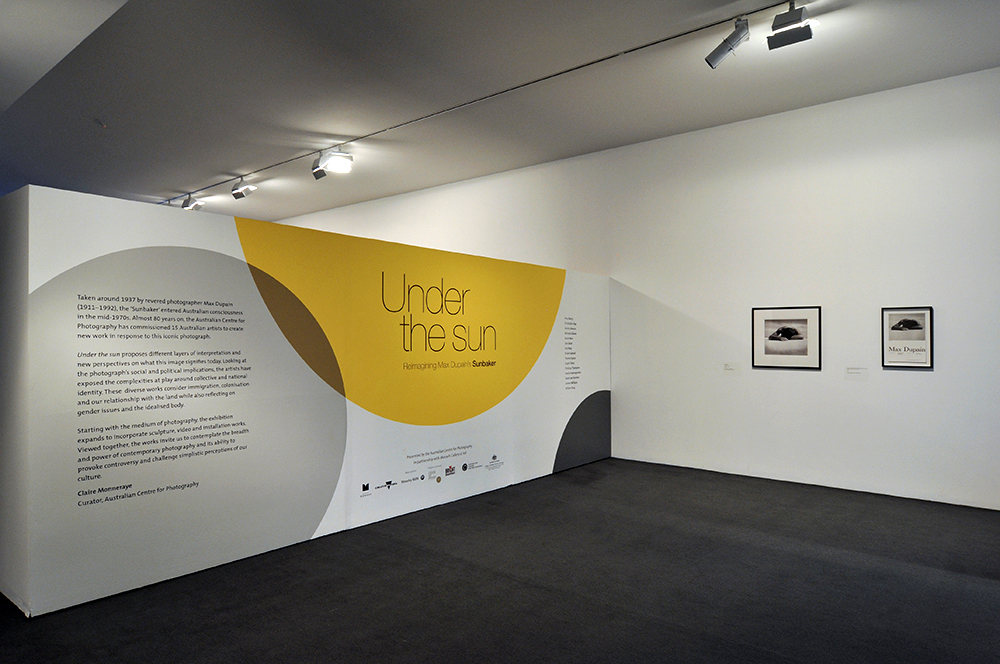
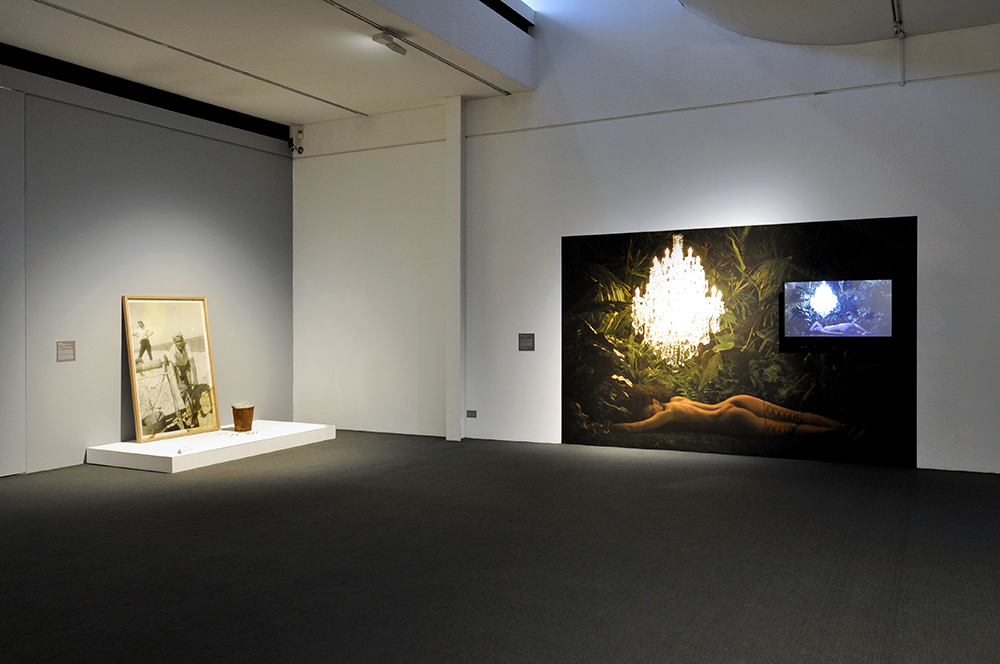
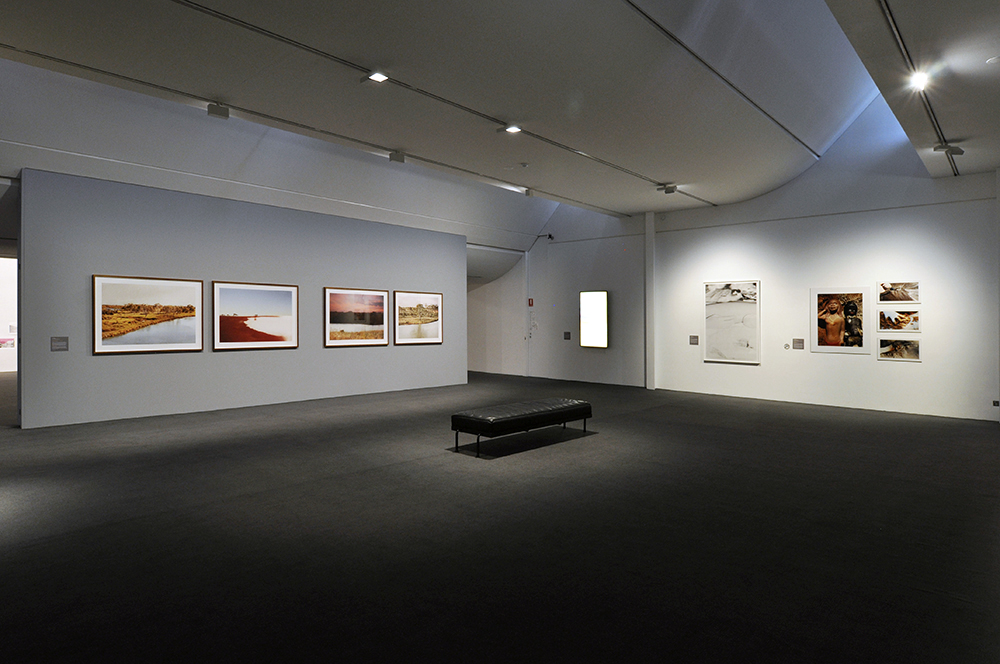
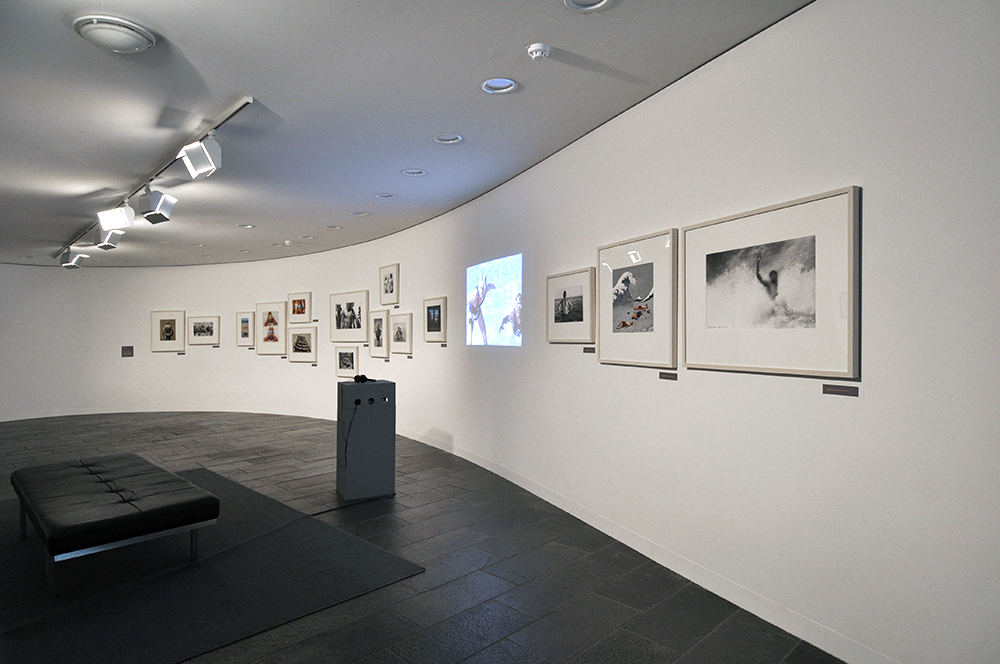
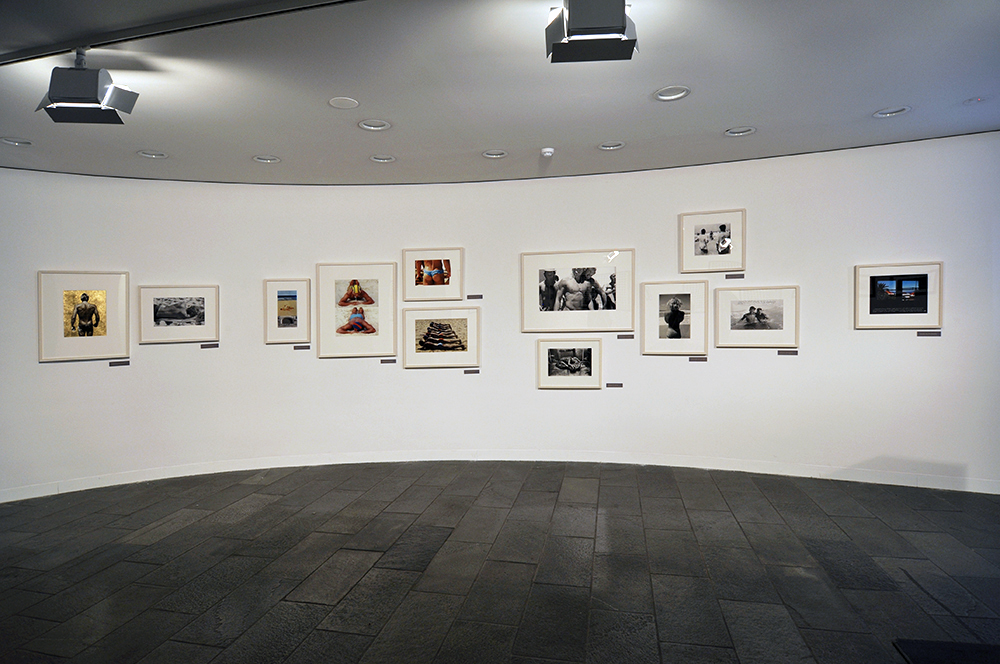
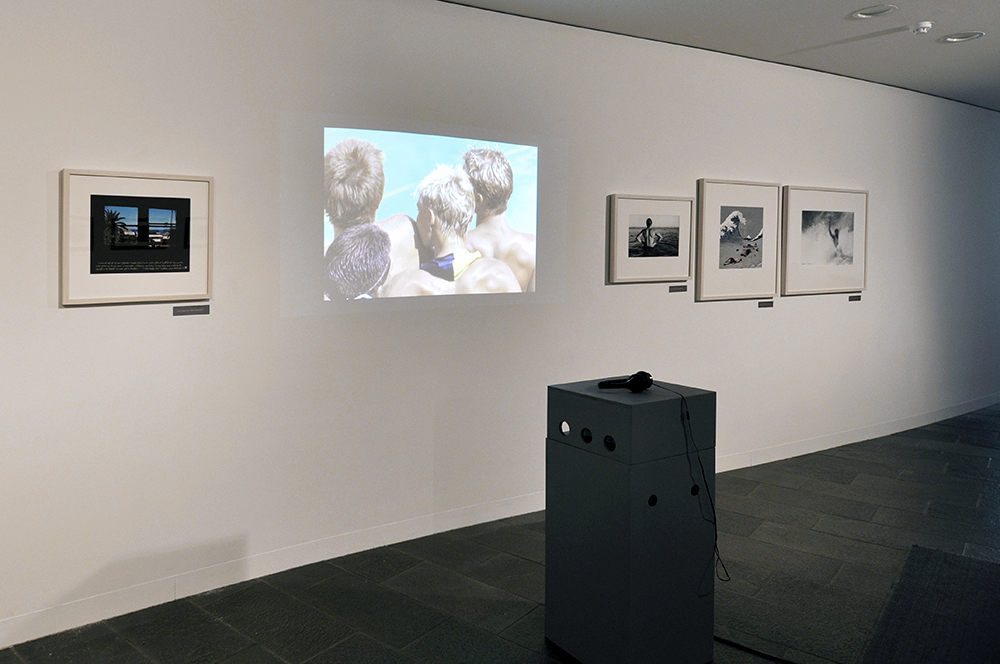
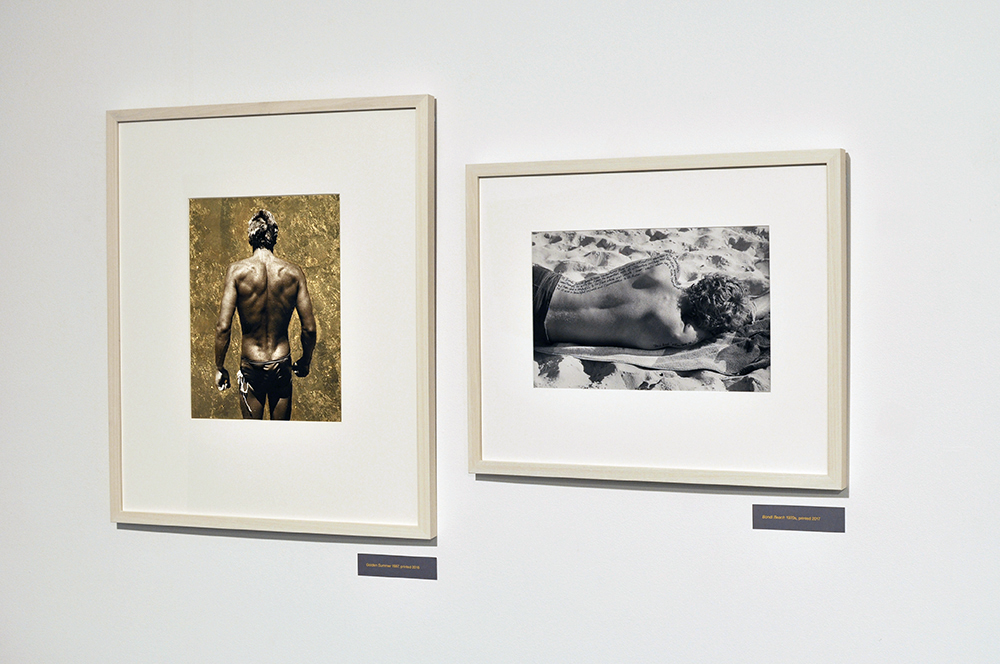
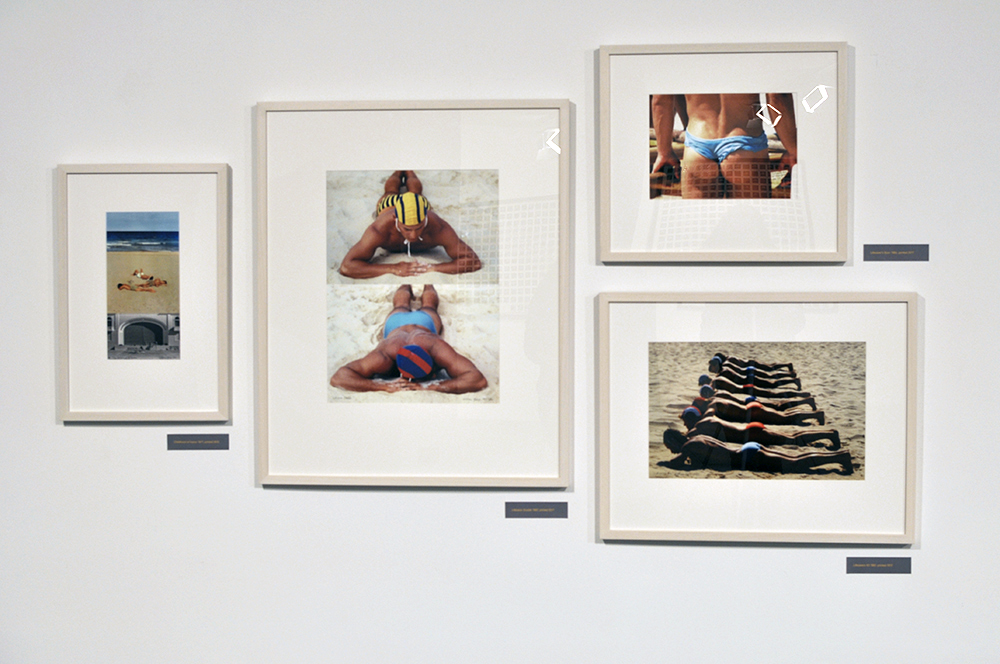
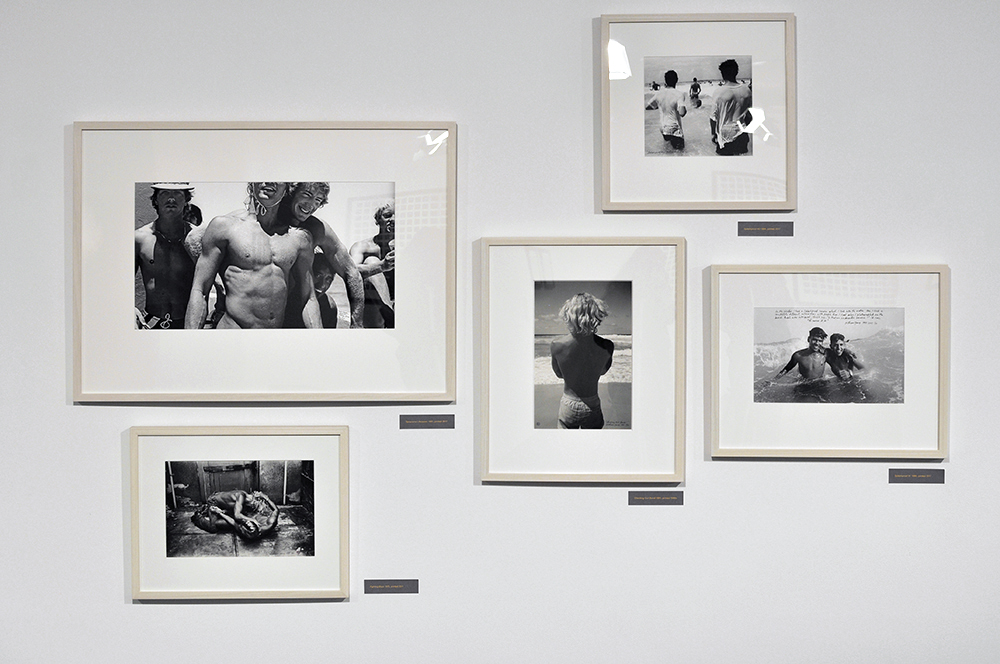
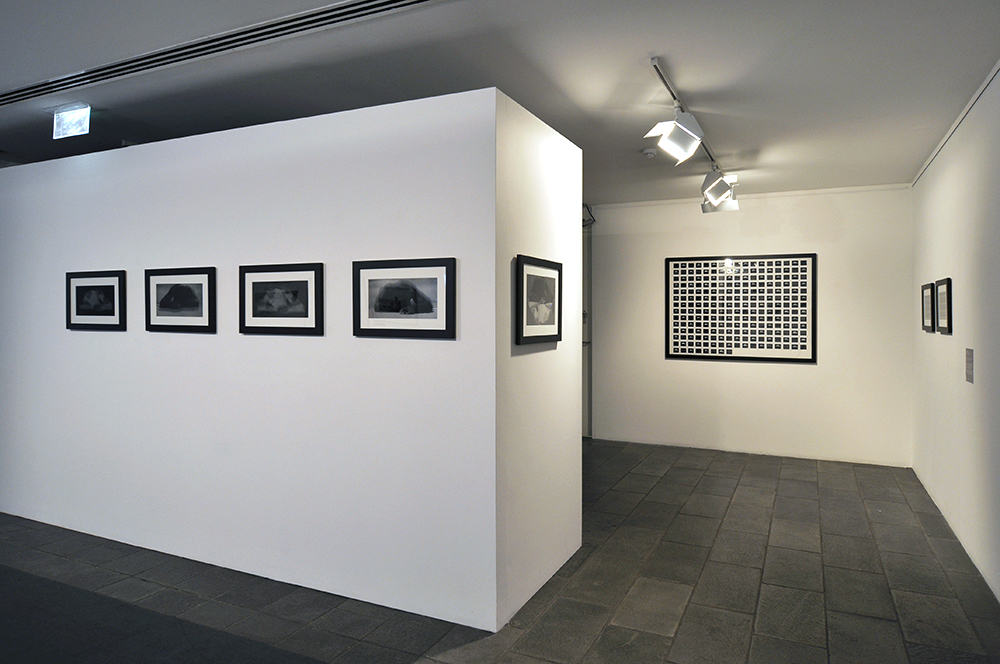
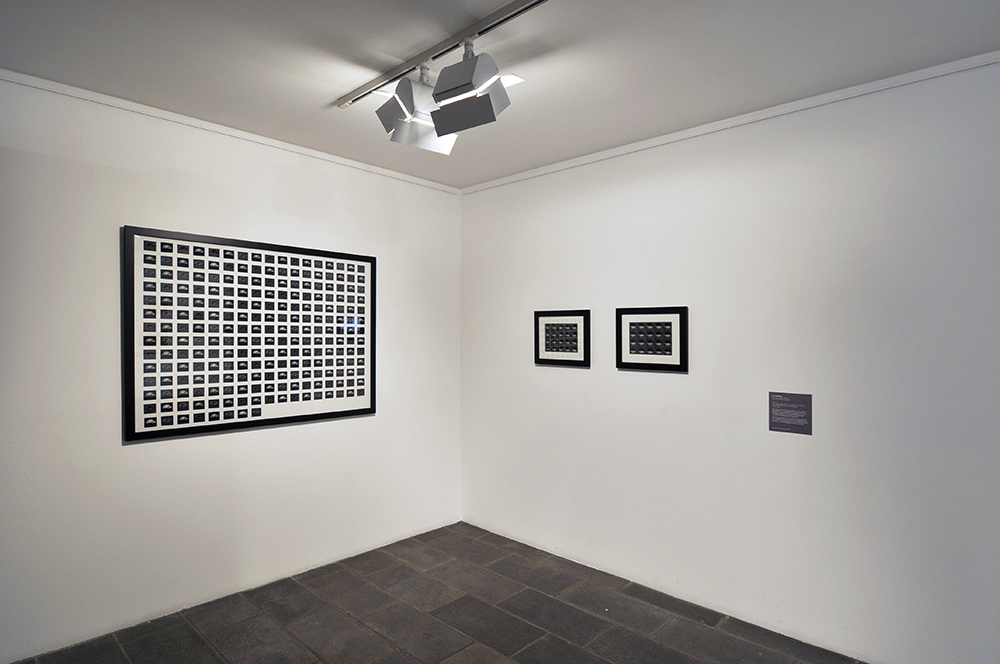
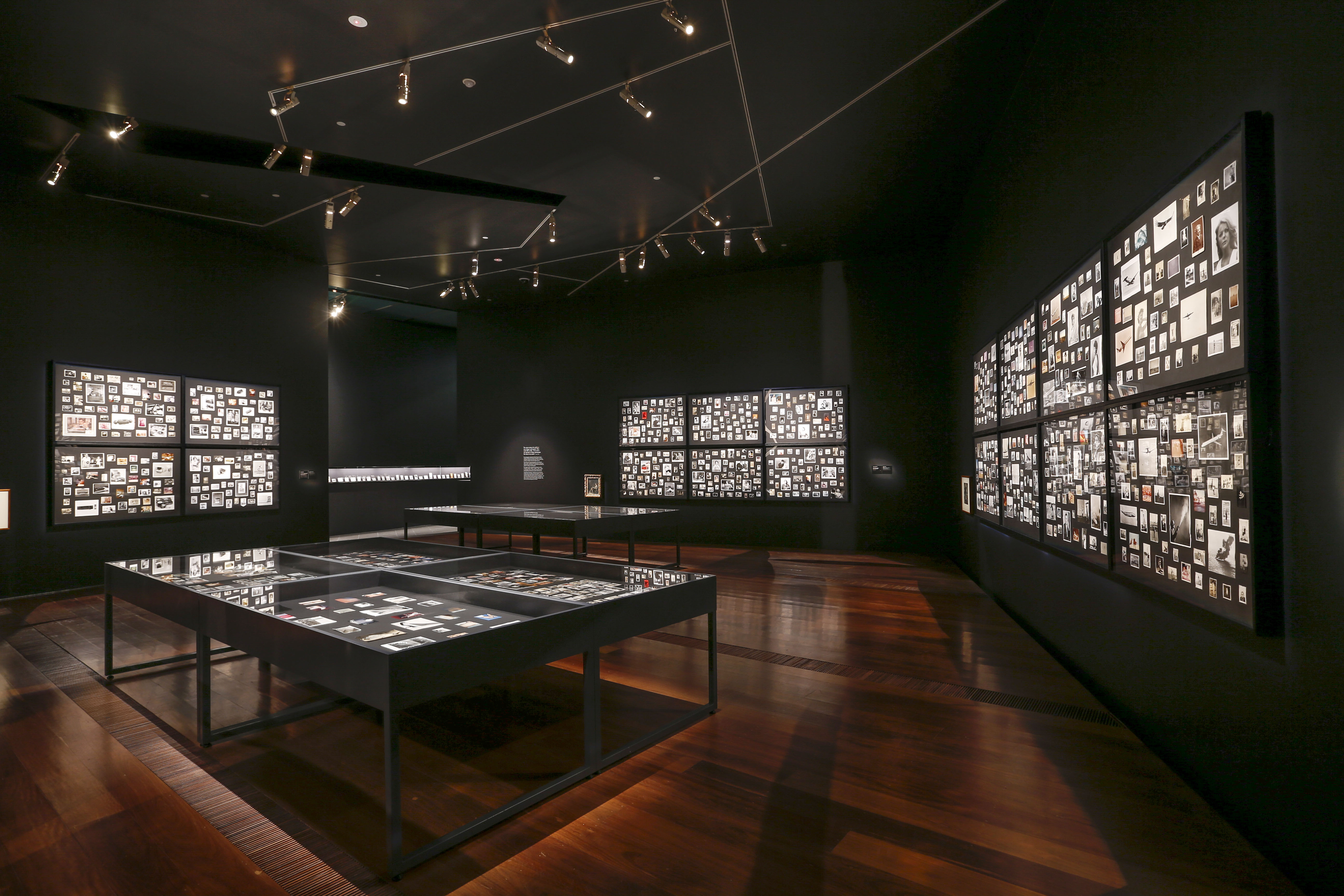
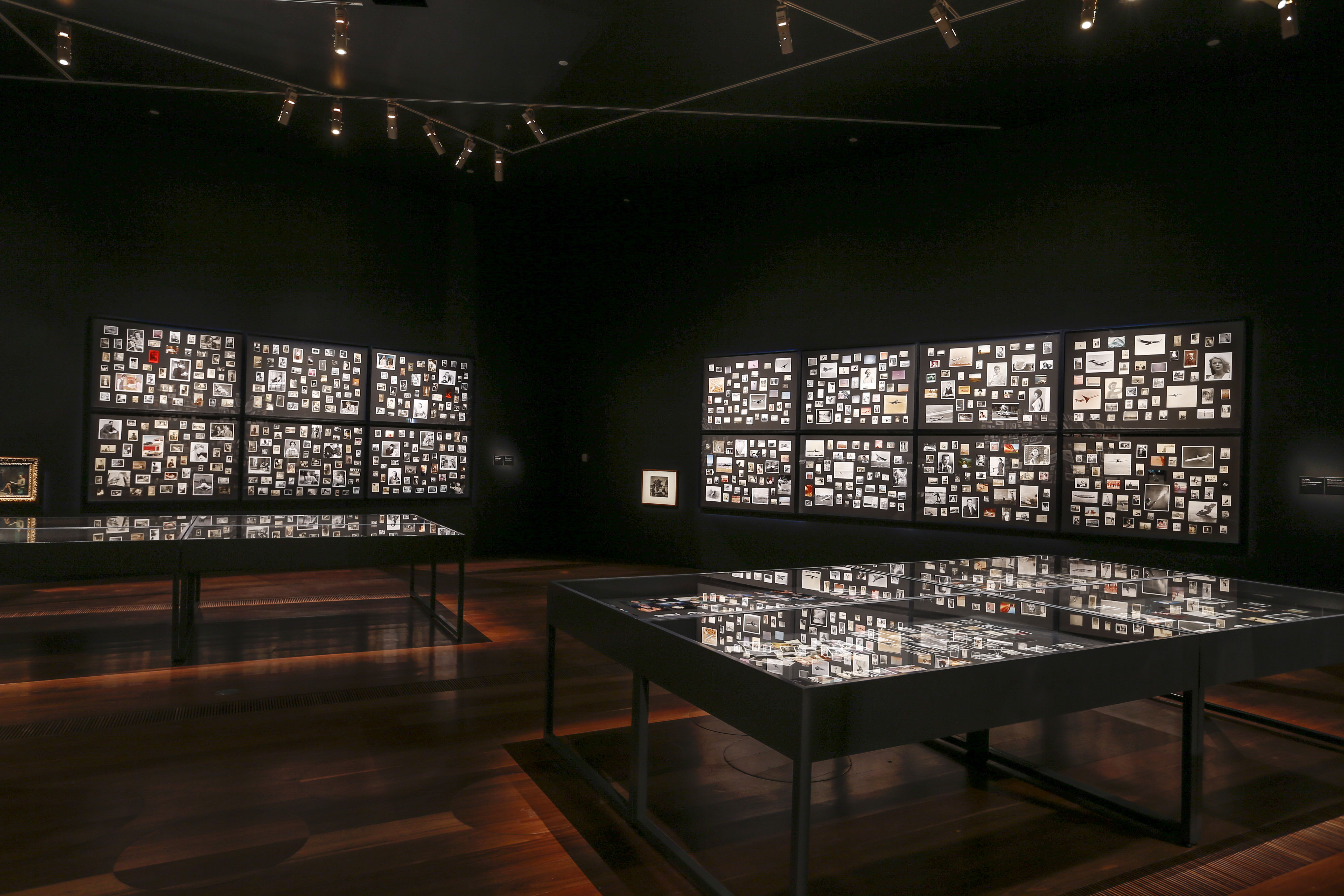
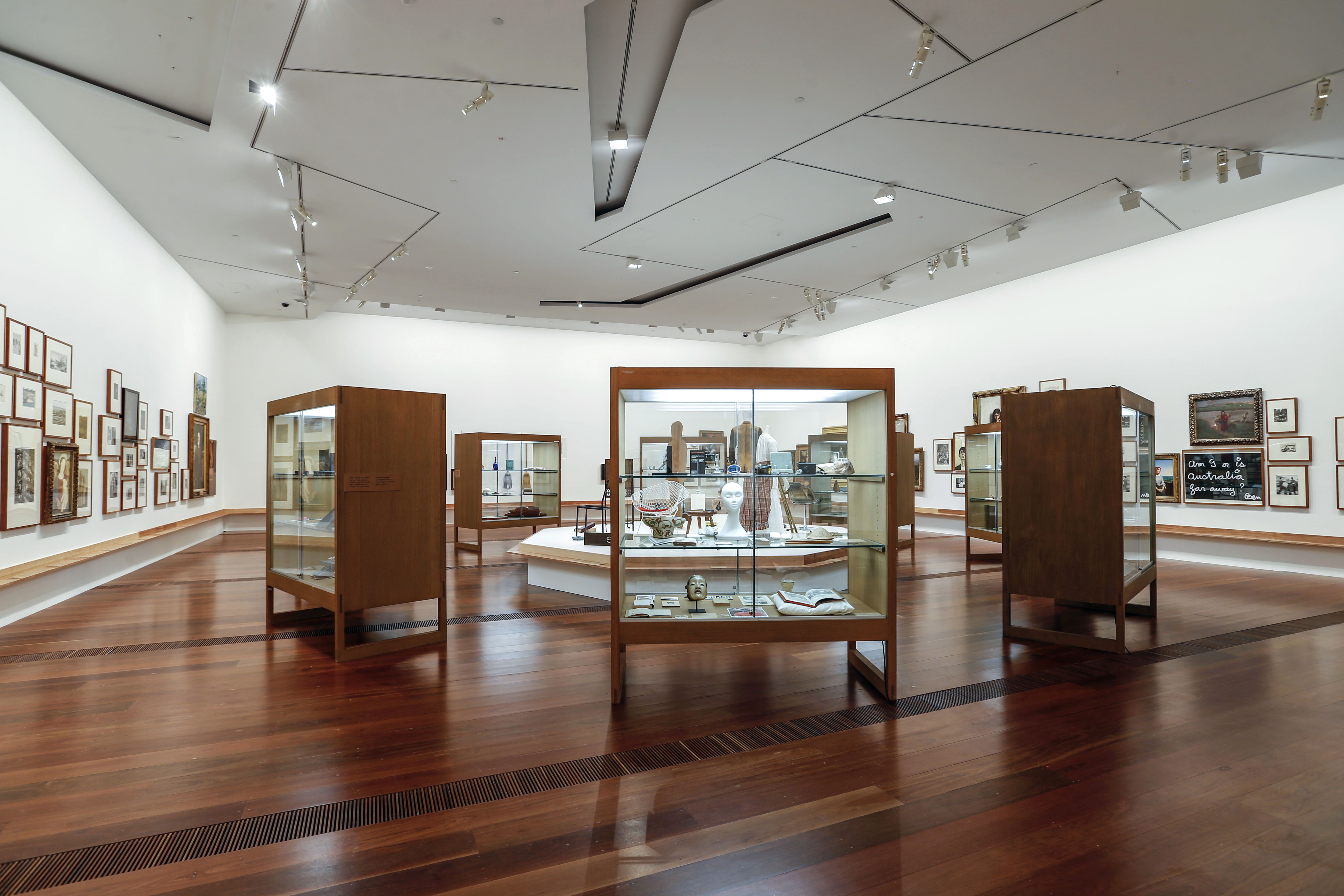
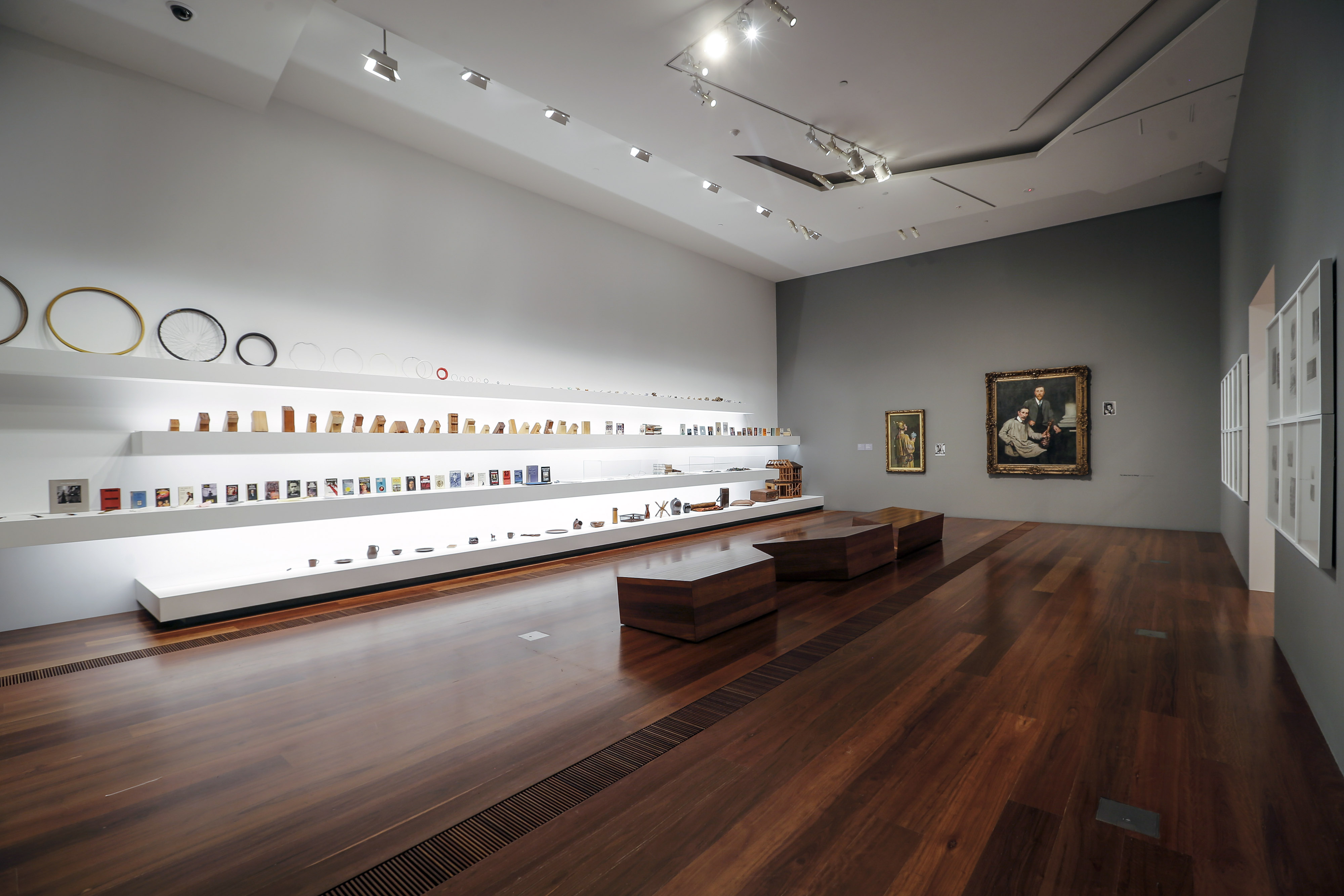
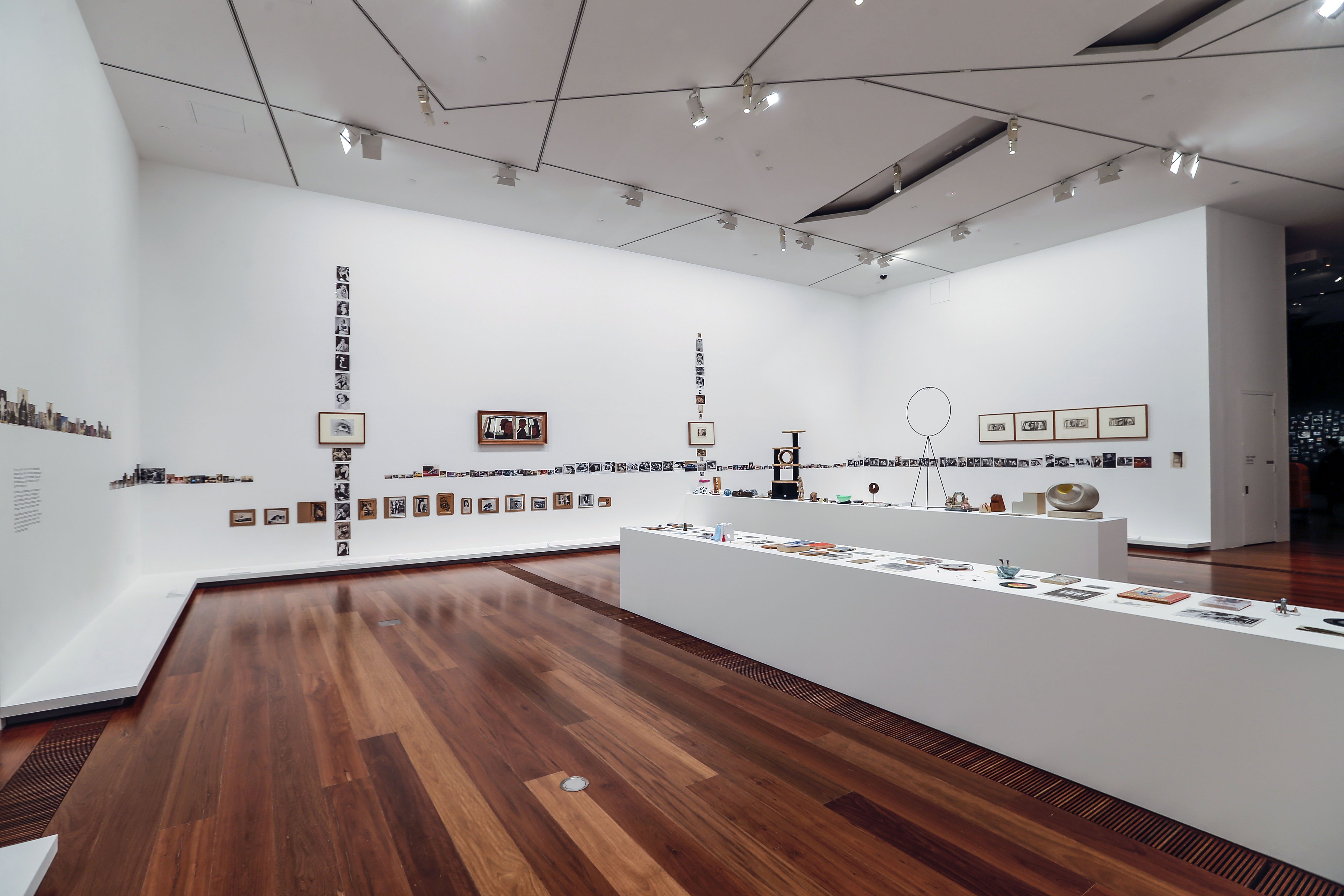
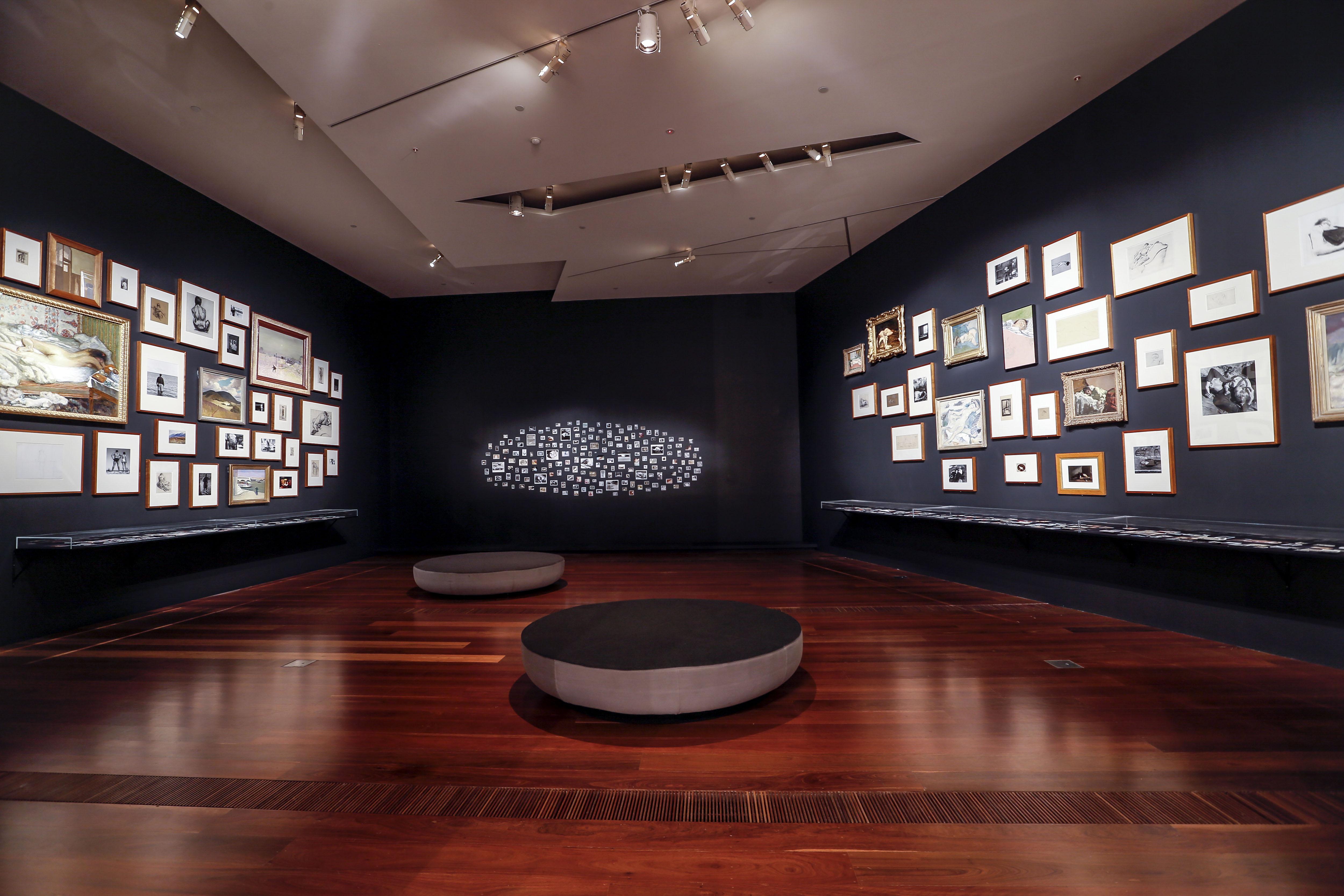
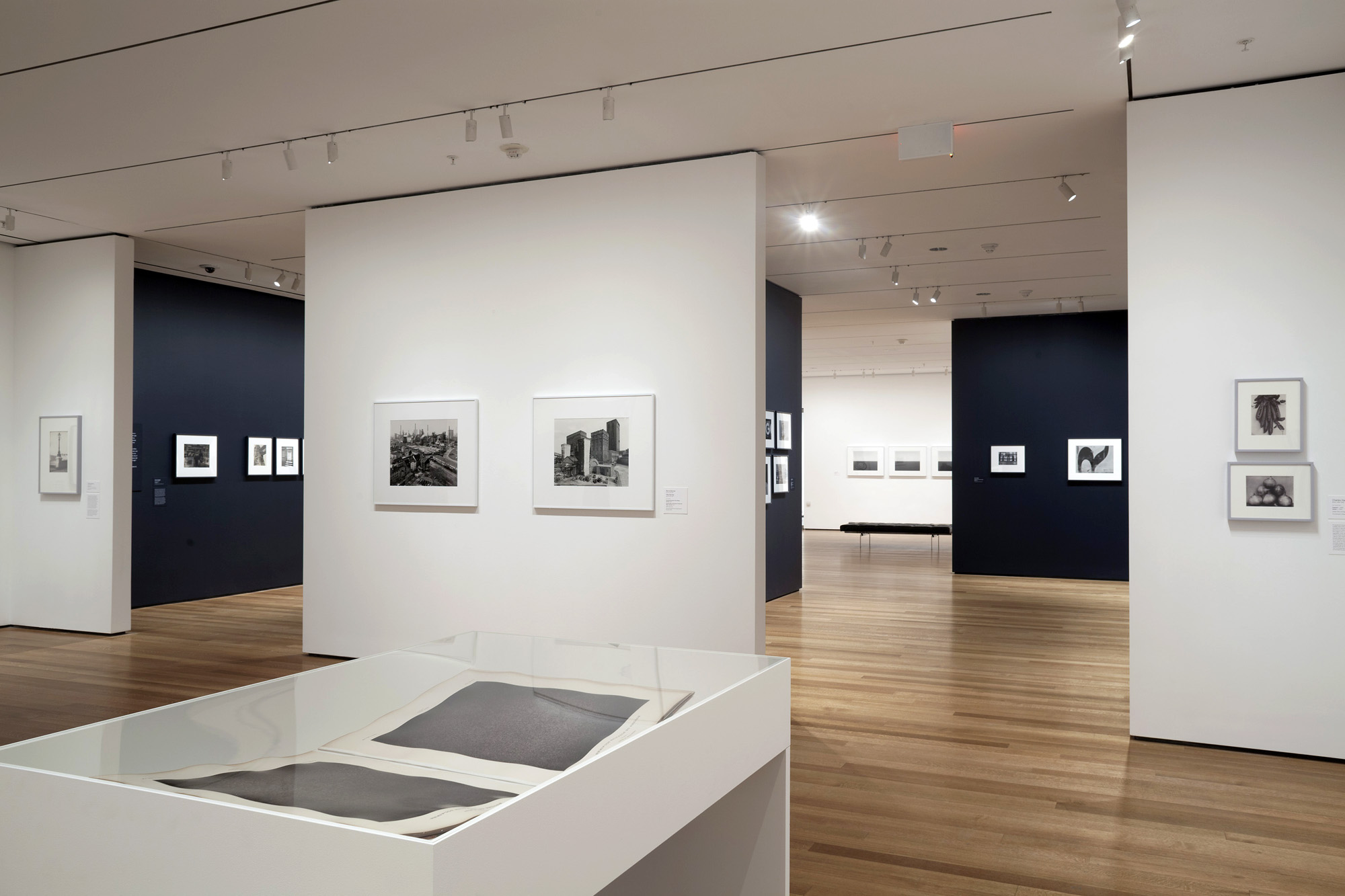
Installation view of 'Brave New World: Australia 1930s' at NGVA


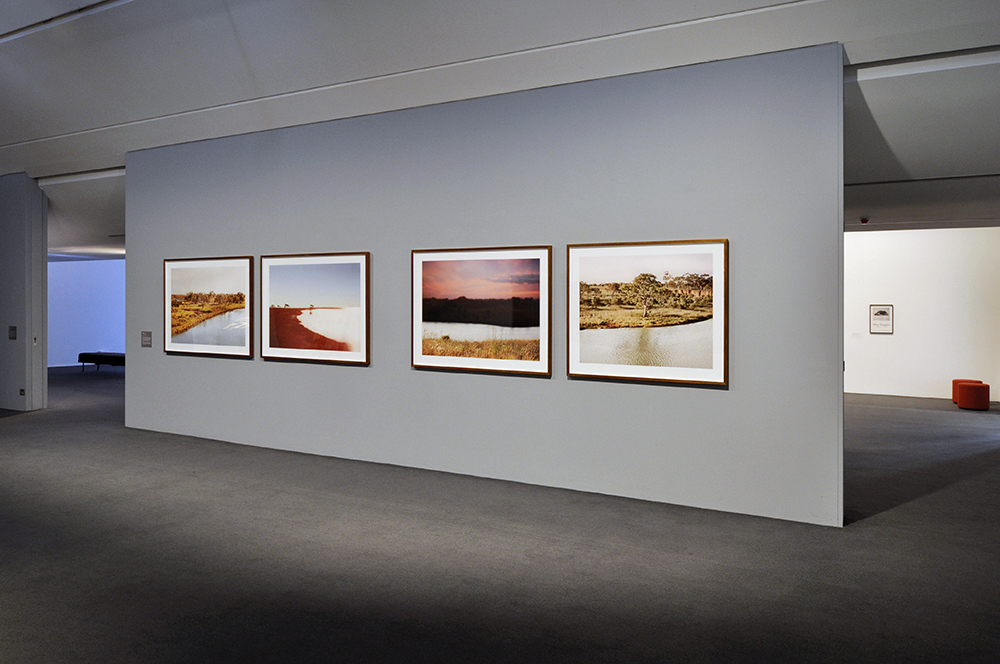
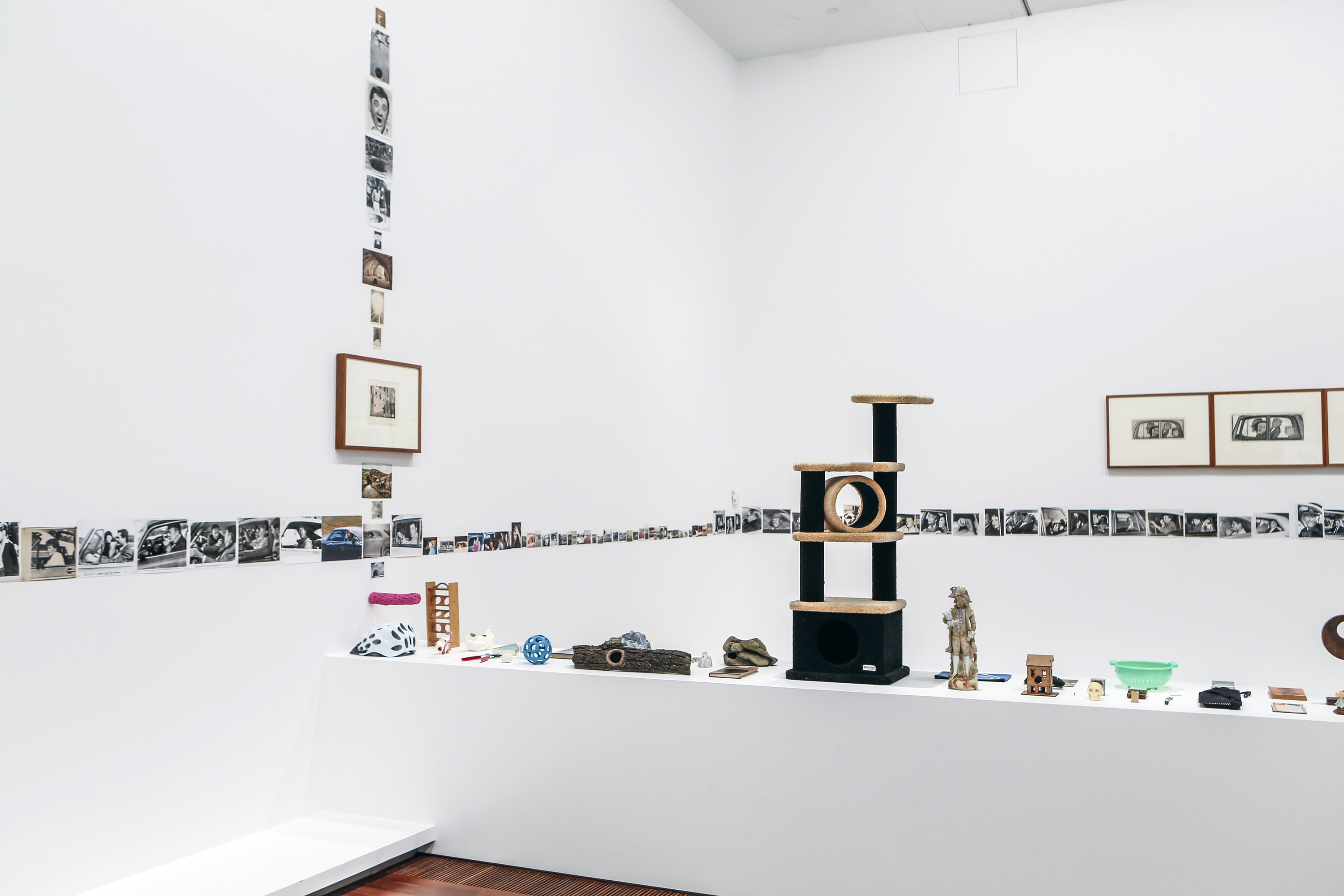
Installation view of the exhibition Brave New World: Australia 1930s at NGVA
Photo: Eugene Hyland


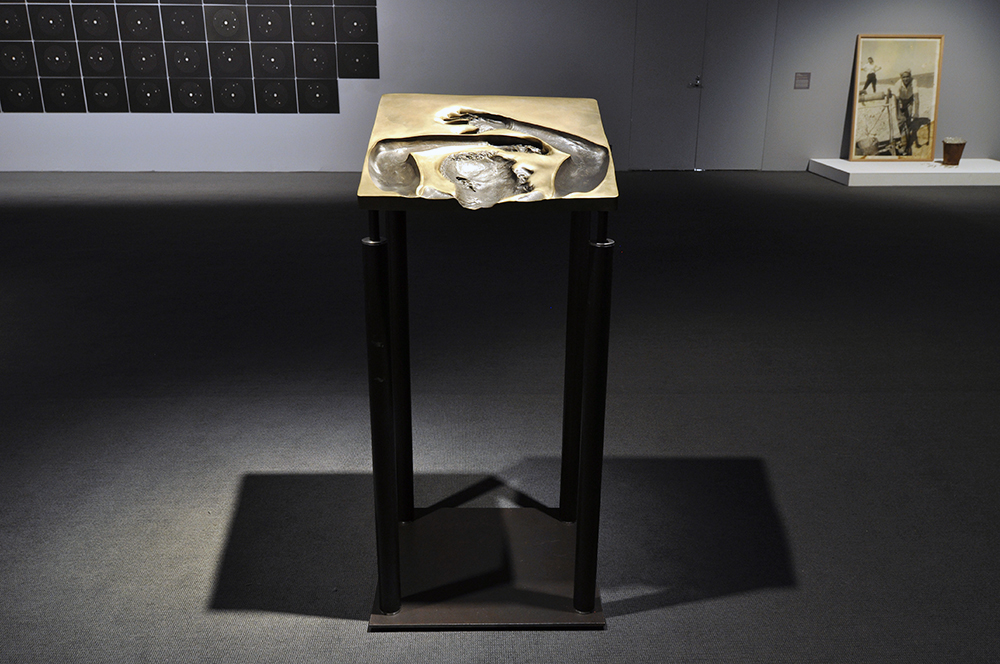
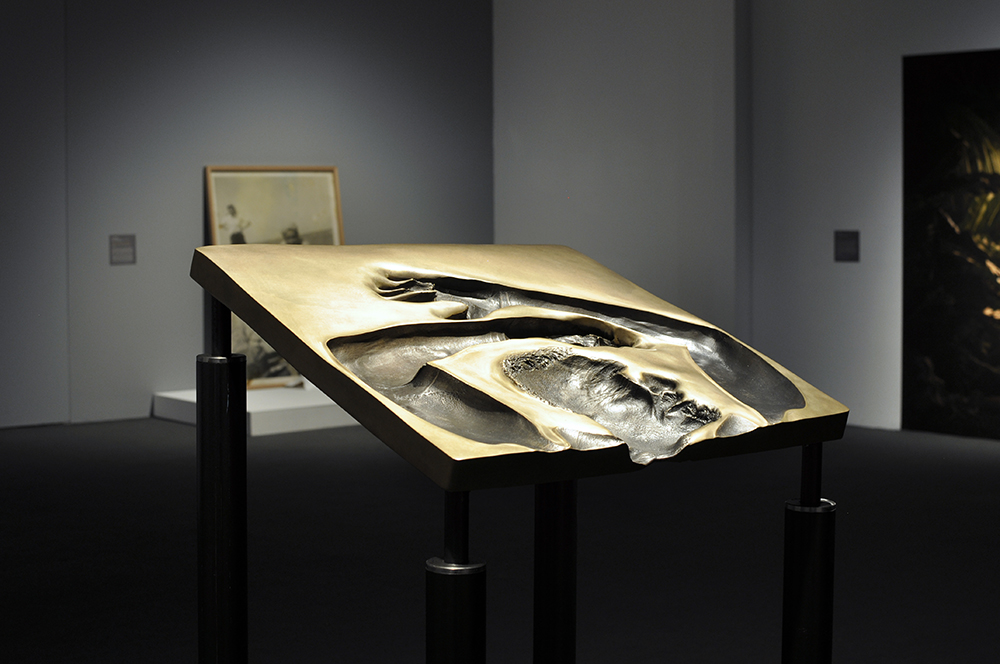
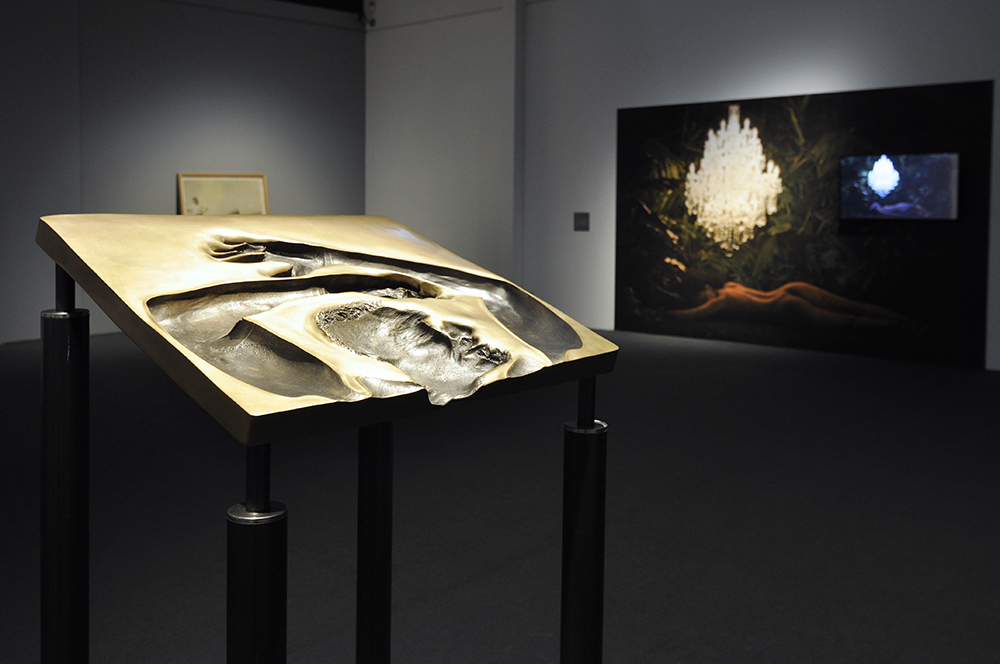
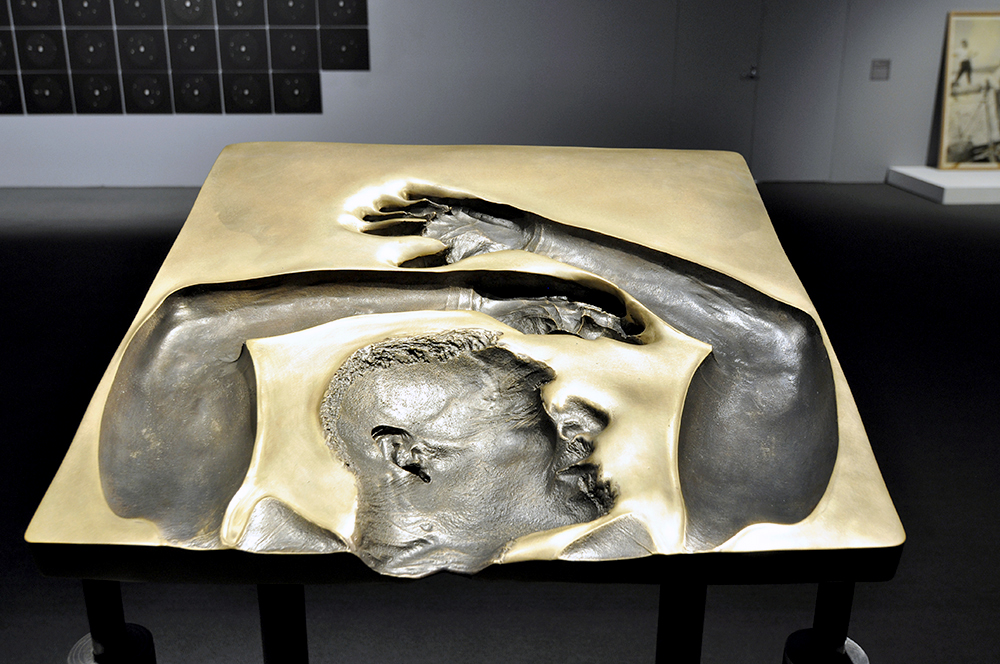
Brave New World: Australia 1930s at NGV Australia, Melbourne is a small but stylishly designed exhibition that presents well in the gallery spaces. The look and feel of the exhibition is superb, and it was a joy to see so many works in so many disparate medium brought together to represent a decade in the history of Australia: photography, sculpture, painting, drawing, ceramic art, magazine art, travel posters, Art Deco radios, film, couture, culture, Aboriginal art, and furniture making, to name but a few.

The strong exhibition addresses most of the concerns of the 1930s – The Great Depression, beach and body culture, style, fashion, identity, culture, prelude to WW2, dystopian and utopian cities etc., – but it all felt a little cramped and truncated. Such a challenging time period needed a more expansive investigation. What there is was excellent but one display case on slums or magazine art was not substantive enough. The same can be said for most of the exhibition.

There needed to a lot more about the impact of the Great Depression and people living in poverty, for you get the feeling from this exhibition that everyone was living the Modernist high-life, wearing fashionable frocks and smoking cigarettes sitting around beautifully designed furniture surrounded by geometric textiles. The reality is that this paradigm was the exception rather than the rule. Many people struggled to even feed themselves due to The Great Depression, and it was a time of extreme hardship for people in Australia. Life for many, many people in Australia during the 1930s was a life of disenfranchisement, assimilation, oppression, social struggle, poverty, hunger and a hand to mouth existence.

“After the crash unemployment in Australia more than doubled to twenty-one per cent in mid-1930, and reached its peak in mid-1932 when almost thirty-two per cent of Australians were out of work… The Great Depression’s impact on Australian society was devastating. Without work and a steady income many people lost their homes and were forced to live in makeshift dwellings with poor heating and sanitation.” (Text from “The Great Depression,” on the Australian Government website [Online] Cited 06/10/2017. No longer available online)

New artists and designers may have been emerging, new skyscrapers being built and the new ‘Modern Woman’ may have made her appearance but the changes only affected white, middle and upper social classes. Migrants, particularly those from Italy and southern Europe, were resented because they worked for less wages than others; and only brief mention is made of the White Australia policy in the exhibition but not by name (see text under Indigenous art and culture below). This section was more interested in how white artists appropriated Aboriginal design during this period for their own ends.

With this in mind, it is instructive to read sections of the illustrated handbook (see cover below, handbook not in the exhibition) produced by the National Museum of Victoria (in part, the forerunner of the NGV) to accompany a special exhibition of objects illustrating Australian Aboriginal Art in 1929:

“The subject of aboriginal Art – in this case the Art of the Australian Aboriginal – has to be approached with the utmost caution, for, though it comes directly within the domain of anthropology, it is in an indirect way a very important question in psychology and pedagogies. We possess some knowledge of our own mentality through the kind of offices of psychology; but though we have some – many in certain classes – material relics of our primitive and prehistoric ancestor, the only evidence of evolution of thought and the development of his powers of abstract conception must be derived from his art…

Still it appears possible that the study of primitive man, as represented by our Australian black, will throw some new light on the subject, and even if not more important than the old world pictographs themselves, his art work will enable the efforts of the Aurignacian and Magdalenian artists [cultures of the Upper Paleolithic in western Europe] to be better comprehended, and their import understood. But, for that study to achieve even a modicum of success, it is essential that the inquiring psychologist divest his mind of all civilized conceptions and mentality and assume those of the prehistoric man – or of the infant of the present day.”1


This is the attitude towards Aboriginal art that pervaded major art institutions right across Australia well into the 1950s. That the white has to “divest his mind of all civilised conceptions and mentality and assume those of the prehistoric man” – in other words, he has to become a savage – in order to understand Aboriginal art. It says a lot that the Trustees of the National Museum of Victoria then decided to reprint the illustrated handbook in 1952 without amendment, reprinting the publication originally used for the Exhibition in 1929. Nothing had changed in 22 years!

Other small things in the exhibition rankle. The preponderance of the work of photographer Max Dupain is so overwhelming that from this exhibition, it would seem that he was the only photographer of note working in Australia throughout the decade. While Dupain was the first Modernist photographer in Australia, and a superb artist, Modernist photography was very much on the outer during most of the 1930s… the main art form of photography being that of Pictorialism. None of this under appreciated style of photography makes an appearance in this exhibition because it does not fit the theme of “Brave New World”. This dismisses the work of such people as Cecil Bostock, Harold Cazneaux, Henri Mallard, John Eaton et al as not producing “brave”, or valuable, portraits of a country during this time frame. This is a perspective that needs to be corrected.

Highlights in this exhibition included an earthenware vase by Ethel Blundell; a painting by that most incredible of atmospheric painters, Clarice Beckett (how I long to own one of her paintings!); a wonderful portrait by the underrated Cybil Craig; two stunning Keast Burke photographs; two beautiful stained glass windows of a male and female lifesaver; the slum photographs of F. Oswald Barnett (more please!); and the graphic covers of mostly short-lived radical magazines.

These highlights are worth the price of admission alone. A must see before the exhibition closes.

Dr Marcus Bunyan


Footnotes

1/ A. S. Kenyon. “The Art of the Australian Aboriginal.” in Australian Aboriginal Art. Melbourne: Trustees of the National Museum of Victoria, (1929) reprinted 1952, p. 15.


Many thankx to the National Gallery of Victoria for allowing me to publish the photographs in the posting. Some installation photographs © Dr Marcus Bunyan. Please click on the photographs for a larger version of the image.


Australian Aboriginal Art 1952 (reprint of 1929 illustrated handbook)


National Museum of Victoria
Australian Aboriginal Art (cover)
1952 (reprint of 1929 illustrated handbook)
Brown, Prior, Anderson Pty. Ltd., Melbourne (publishers)
Trustees of the National Museum of Victoria
39 pages

See the whole pamphlet


The 1930s was a turbulent time in Australia’s history. During this decade major world events, including the Depression and the rise of totalitarian regimes in Europe, shaped our nation’s evolving sense of identity. In the arts, progressive ideas jostled with reactionary positions, and artists brought substantial creative efforts to bear in articulating the pressing concerns of the period. Brave New World: Australia 1930s encompasses the multitude of artistic styles, both advanced and conservative, which were practised during the 1930s. Included are commercial art, architecture, fashion, industrial design, film and dance to present a complete picture of this dynamic time.

The exhibition charts the themes of celebrating technological progress and its antithesis in the nostalgia for pastoralism; the emergence of the ‘New Woman’ and consumerism; nationalism and the body culture movement; the increasing interest in Indigenous art against a backdrop of the government policy of assimilation and mounting calls for Indigenous rights; the devastating effects of the Depression and the rise of radical politics; and the arrival of European refugees and the increasing anxiety at the impending threat of the Second World War. Brave New World: Australia 1930s presents a fresh perspective on the extraordinary 1930s, revealing some of the social and political concerns that were pertinent then and remain so today.

Text from the NGV website


Harold Cazneaux (New Zealand 1878 - Australia 1953, Australia from 1886) 'No title (Powerlines and chute)' c. 1935 from the exhibition 'Brave New World: Australia 1930s' at The Ian Potter Centre: NGV Australia, Melbourne, July - Oct, 2017


Harold Cazneaux (New Zealand 1878 – Australia 1953, Australia from 1886)
No title (Powerlines and chute)
c. 1935
Gelatin silver photograph
National Gallery of Victoria, Melbourne
Purchased through The Art Foundation of Victoria with the assistance of the H. J. Heinz II Charitable and Family Trust, Governor, 1993


In 1934 BHP (Broken Hill Proprietary Company Limited) commissioned leading pictorialist photographer Harold Cazneaux to record their mining and steel operations for a special publication to mark their fiftieth anniversary in 1935. Cazneaux’s dramatic industrial images blended a soft, atmospheric focus with a modernist sense of space, form and geometry. In 1935-36 Australia exported close to 300,000 tonnes of iron ore to Japan; however, after Japan’s invasion of China in 1937 fear of its expansionist aims in the Pacific increased and soon afterwards the federal government announced a ban on the export of all iron ore to Japan.


Fred Ward (designer) (Australia 1900-90) Sideboard, side table and tray table' c. 1932 from the exhibition 'Brave New World: Australia 1930s' at The Ian Potter Centre: NGV Australia, Melbourne, July - Oct, 2017


Fred Ward (designer) (Australian, 1900-1990)
E. M. Vary, Fitzroy, Melbourne (attributed to) (manufacturer) active 1920s-1940s

Sideboard
c. 1932
Mountain ash (Eucalyptus sp.), painted wood, painted plywood, steel
(a-e) 84.0 x 119.7 x 48.7cm (overall)
Proposed acquisition

Side table
c. 1932
Mountain ash (Eucalyptus sp.), jarrah (Eucalyptus marginata), steel
55.7 x 66.0 x 49.2cm
Proposed acquisition

Tray table
c. 1932
Mountain ash (Eucalyptus sp.), blackwood (Acacia melanoxylon), steel
(a-b) 52.0 x 60.9 x 42.5cm (overall)
Proposed acquisition


A new generation of artists and designers

While modern art was a source of debate and controversy throughout the 1930s, modernism in architecture, interior design, industrial design and advertising became highly fashionable. In Melbourne a small group of designers pioneered modern design in Australia. Furniture designer Fred Ward first designed and made furniture for his home in Eaglemont, where he had established a studio workshop. It was admired by friends and he was encouraged to produce furniture for sale. In 1932 Ward opened a shop in Collins Street, Melbourne. There he offered his furniture, as well as linens and Scandinavian glass. The fabrics for curtains and upholstery were printed by Australian designer Michael O’Connell with bold designs that shocked some but were favoured by a new generation looking to create modern interiors.

More than in most periods, in the 1930s art, design and architecture were closely integrated with the changing realities of contemporary life. It was a time when the last vestiges of the conservative art establishment were swept away by a new generation of artists and designers who were to drive Australian art in the second half of the twentieth century.


Installation view of 'Brave New World: Australia 1930s' at NGVA

Installation view of the exhibition 'Brave New World: Australia 1930s' at NGVA with Max Dupain's 'Illustration for Kelvinator' advertisement at left and Ethel Blundell's 'Vase' centre on sideboard


Installation views of the exhibition Brave New World: Australia 1930s at NGVA with Max Dupain’s Illustration for Kelvinator advertisement at left and Ethel Blundell’s Vase centre on sideboard
Photos: Courtesy NGV Photographic Services


Fred Ward was one of the first and most important designers of modern furniture in Australia. He began making furniture around 1930, and in 1932 opened a shop in Collins Street selling his furniture, as well as textiles by Michael O’Connell and other modern design pieces. In 1934 Ward went into partnership with Myer Emporium and established the Myer Design Unit, for which he designed a line of modular ‘unit’ furniture for commercial production. Ward’s simple, functional aesthetic and use of local timbers with a natural waxed finish was in contrast to the luxurious materials and decorative motifs of the contemporary Art Deco style.

The armchair, sideboard and occasional tables were designed by Fred Ward and purchased by Maie Casey in the early 1930s. The wife of R. G. Casey, federal treasurer in the Lyons Government, Maie was a prominent supporter of modern art and design. Moving to Canberra in 1932, she furnished her house at Duntroon in a modern style with furniture by Ward and textiles by Michael O’Connell. The design of Ward’s armchair closely resembles a 1920s armchair by German Bauhaus furniture designer Erich Dieckmann, who was known for his standardised wooden furniture based on geometric designs.


Michael O'Connell designer (England 1898-1976, Australia 1920-37) 'Textile' c. 1933 from the exhibition 'Brave New World: Australia 1930s' at The Ian Potter Centre: NGV Australia, Melbourne, July - Oct, 2017


Michael O’Connell designer (England 1898-1976, Australia 1920-1937)
Textile
c. 1933
Block printed linen
National Gallery of Victoria, Melbourne Purchased, 1988


Michael O’Connell pioneered modernist textiles in Melbourne and was an influential advocate of modern design. Working with his wife Ella from his studio in Beaumaris, O’Connell used woodblocks and linocuts to hand print onto raw linens and silks, which were used for fashion garments and home furnishing. O’Connell’s boldly patterned and highly stylised designs were considered startlingly modern. Some of his early fabrics featured ‘jazz age’ scenes of nightclubs and dancing, while later motifs were based on Australian flora and fauna, or derived from Oceanic and Aboriginal art.


Sam Atyeo. 'Album of designs: tables' c. 1933 - c. 1936


Sam Atyeo (Australian, 1910-1990)
Album of designs: tables
c. 1933 – c. 1936
Album: watercolour, brush and coloured inks, coloured pencils, 14 designs tipped into an album of 16 grey pages, card covers, tape and stapled binding
30.0 x 19.2 cm (page) 30.0 x 20.8 x 0.8cm (closed)
National Gallery of Victoria, Melbourne
Gift of the artist, 1988


Sam Atyeo was a leading figure in Melbourne’s emerging modernist circles in the early 1930s, the partner of artist Moya Dyring and lover of Sunday Reed. He had studied at the National Gallery School, where he was a brilliant and rebellious student. Around 1932 Atyeo became friendly with Cynthia Reed, who managed Fred Ward’s furniture shop and interior design consultancy on Collins Street. After she opened Cynthia Reed Modern Furnishings in Little Collins Street, Atyeo designed furniture for Reed, that was strongly influenced by Ward’s designs.
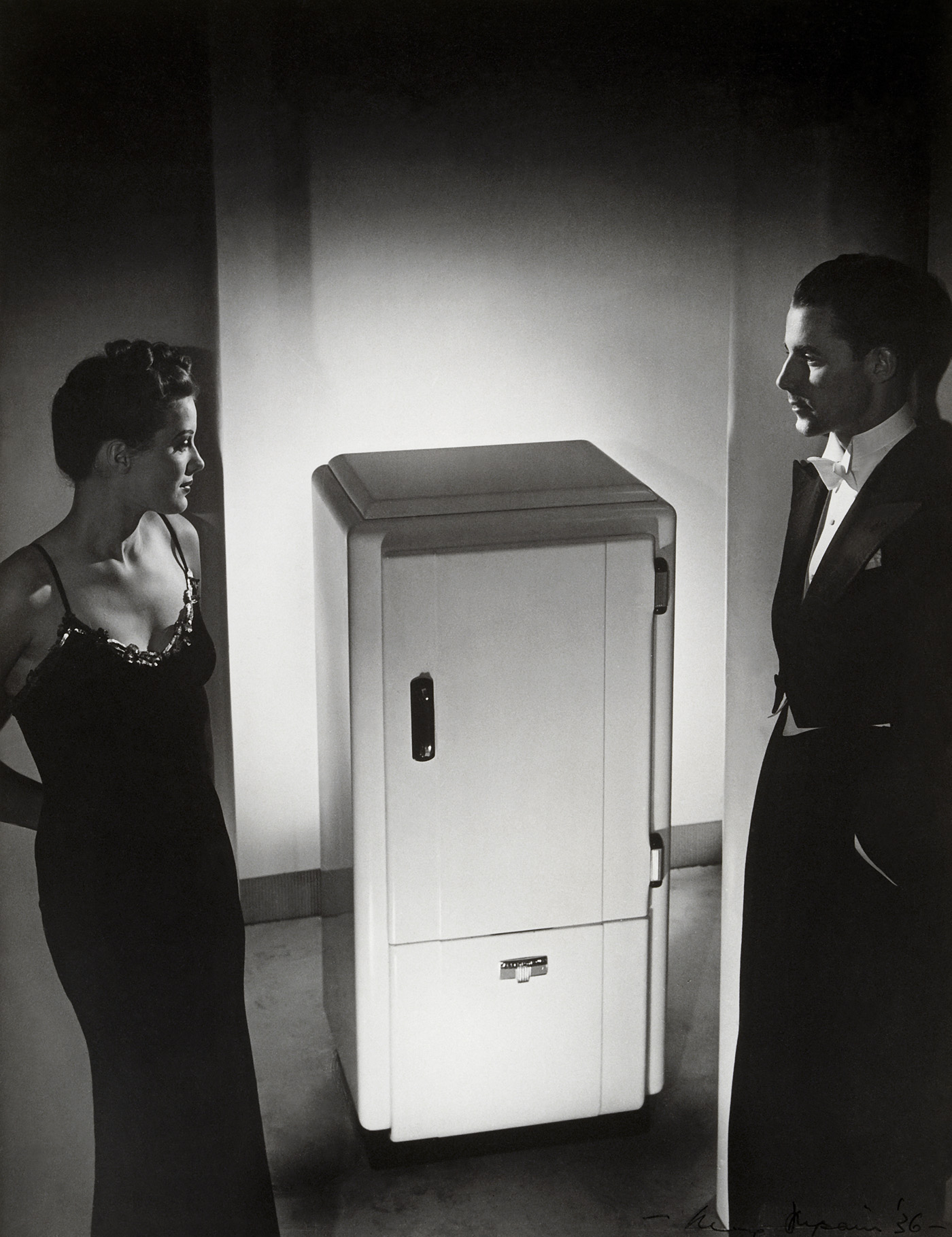
 

Max Dupain (Australia 1911-92) 'Illustration for Kelvinator advertisement' 1936


Max Dupain (Australia 1911-1992)
Illustration for Kelvinator advertisement
1936
Gelatin silver photograph
32.8 x 25.3cm
Art Gallery of New South Wales, Sydney
Purchased with funds provided by the Photography Collection Benefactors’ Program 2000


Ethel Blundell. 'Vase' 1936


Ethel Blundell (Australian, 1918-2010, worked in Switzerland 1946-2010)
Vase
1936
Earthenware
17.6 x 16.8cm diameter
National Gallery of Victoria, Melbourne
Presented through The Art Foundation of Victoria by Mrs Margaret Howie, Governor, 1999
© Ethel Blundell


Utopian cities

Modernity reflected what was new and progressive in Australian urban life. The image of the city became an allegory for this in art, and efficiency and speed became watchwords for modernity. Many artists celebrated the city and technological advancements in works utilising a modern style of hard-edged forms, flat colours and dynamic compositions. The engineering marvel of the Sydney Harbour Bridge, which opened in 1932, was an ongoing source of fascination for artists, as were images of building the city, industry and modern modes of transport.

The skyscraper was also a powerful symbol of modern prosperity, especially when the Great Depression cast doubt on the inevitability of progress; hence the advent of tall buildings in Australian cities was hailed with relief and optimism. In 1932, at the peak of the Depression, the tallest building in Melbourne was opened: the Manchester Unity Building at the corner of Swanston and Collins streets. With its ornamental tower and spire taking its overall height to 64 metres, the building was welcomed by The Age newspaper as ‘a new symbol of enterprise and confidence, undaunted by the “temporary eclipse” of the country’s economic fortune’.
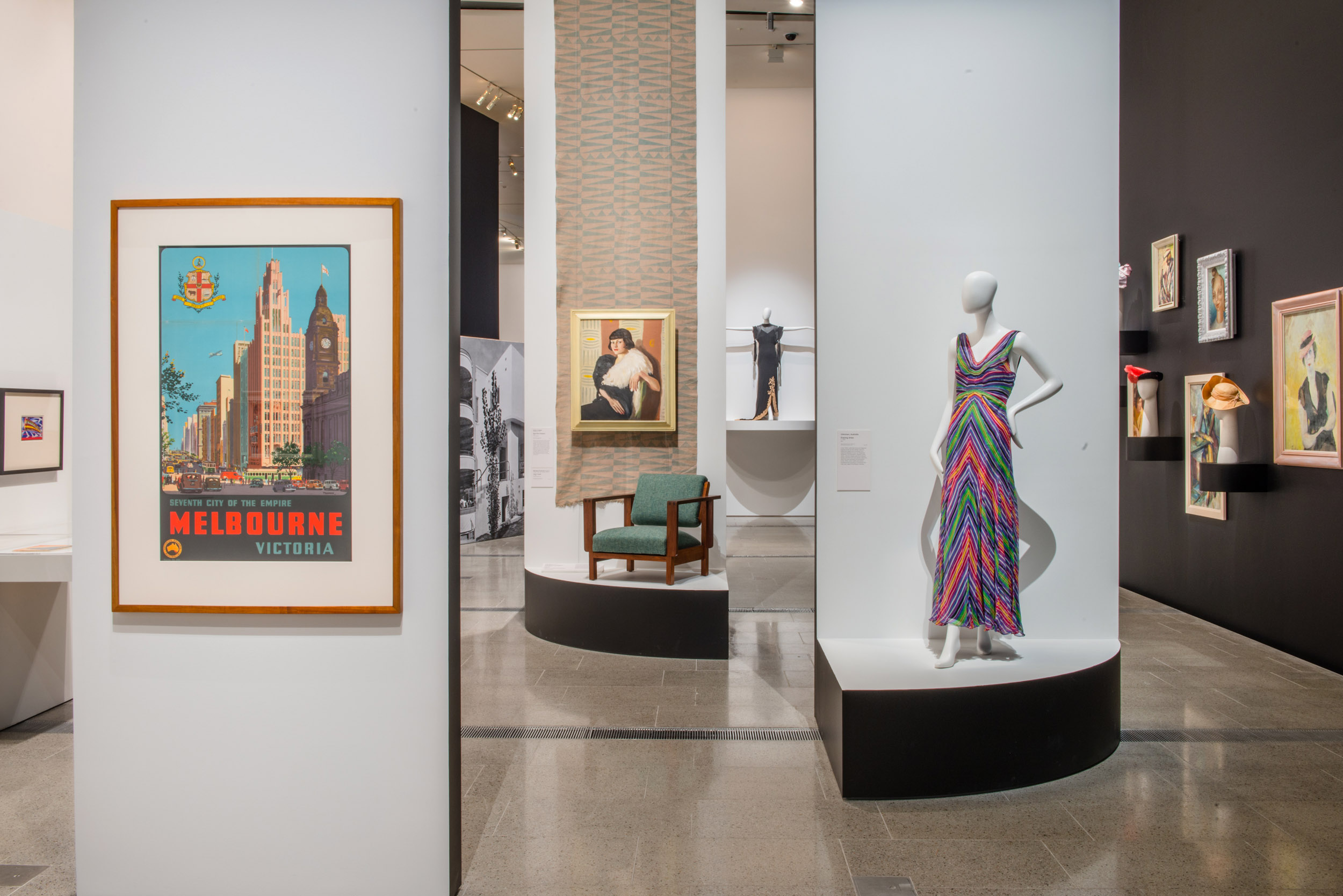
 

Installation view of the exhibition 'Brave New World: Australia 1930s' at NGVA with 'Seventh city of the Empire - Melbourne, Victoria' at left; and 'Evening dress' at right


Installation view of the exhibition Brave New World: Australia 1930s at NGVA with Seventh city of the Empire – Melbourne, Victoria at left; and Evening dress at right
Photo: Eugene Hyland


Percy Trompf (Australia 1902-64) 'Seventh city of the Empire - Melbourne, Victoria' 1930s


Percy Trompf (Australian, 1902-1964)
Seventh city of the Empire – Melbourne, Victoria
1930s
Colour lithograph printed by J. E. Hackett, Melbourne
State Library Victoria, Melbourne
Gift of Mr Grant Lee, 2007


Percy Trompf’s poster celebrates Melbourne’s first skyscraper, the iconic Manchester Unity Building on the corner of Swanston and Collins streets. Designed by architect Marcus Barlow in the Art Deco ‘Gothic’ style, it was built at high speed between 1930 and 1932, and provided much needed employment during the Depression. At twelve storeys high and topped with a decorative tower it was Melbourne’s tallest building and contained the city’s first escalators. A powerful symbol of the city’s modernity, it was often featured in images of Melbourne.


Unknown, Australia 'Evening dress' c. 1935


Unknown, Australia
Evening dress
c. 1935
Silk
144cm (centre back), 36cm (waist, flat)
National Gallery of Victoria, Melbourne
Gift of Miss Irene Mitchell, 1975


Ethel Spowers (Australia 1890-1947, England and France 1921-24) 'The works, Yallourn' 1933


Ethel Spowers (Australia 1890-1947, England and France 1921-1924)
The works, Yallourn
1933
Colour linocut, ed. 3/50
National Gallery of Victoria, Melbourne
The Joseph Brown Collection
Presented through the NGV Foundation by Dr Joseph Brown AO OBE, Honorary Life Benefactor, 2004


Ethel Spowers and Eveline Syme were leading figures in modern art in Melbourne. In the 1920s they studied with modernist Claude Flight at the Grosvenor School in London, where they learnt to make colour linocuts that followed Flight’s principles of rhythmic design combined with flat colour. In April 1933 Spowers and Syme visited the Yallourn Power Station in Gippsland, which had been opened in 1928 and was the largest supplier of electricity to the state.


Vida Lahey (Australia 1882-1968) 'Sultry noon (Central Station Brisbane)' 1931


Vida Lahey (Australian, 1882-1968)
Sultry noon (Central Station Brisbane)
1931
Oil on canvas on plywood
44.7 x 49.2cm
Queensland Art Gallery, Brisbane Purchased 1983
© QAGOMA


Clarice Beckett (Australia 1887-1935) 'Taxi rank' c. 1931


Clarice Beckett (Australian, 1887-1935)
Taxi rank
c. 1931
Oil on canvas on board
Kerry Stokes Collection, Perth


Installation view of Herbert Badham's 'George Street, Sydney' (1934) from the exhibition 'Brave New World: Australia 1930s' at NGVA


Installation view of Herbert Badham’s George Street, Sydney (1934) from the exhibition Brave New World: Australia 1930s at NGVA
Photo: Dr Marcus Bunyan


After serving in the Royal Australian Navy during the First World War, Herbert Badham studied at the Sydney Art School and began exhibiting in 1927. In his paintings he was a keen observer of everyday urban life: streets with shoppers, city workers on their lunch break and drinkers in the pub were painted in a contemporary, hard-edged realist style.
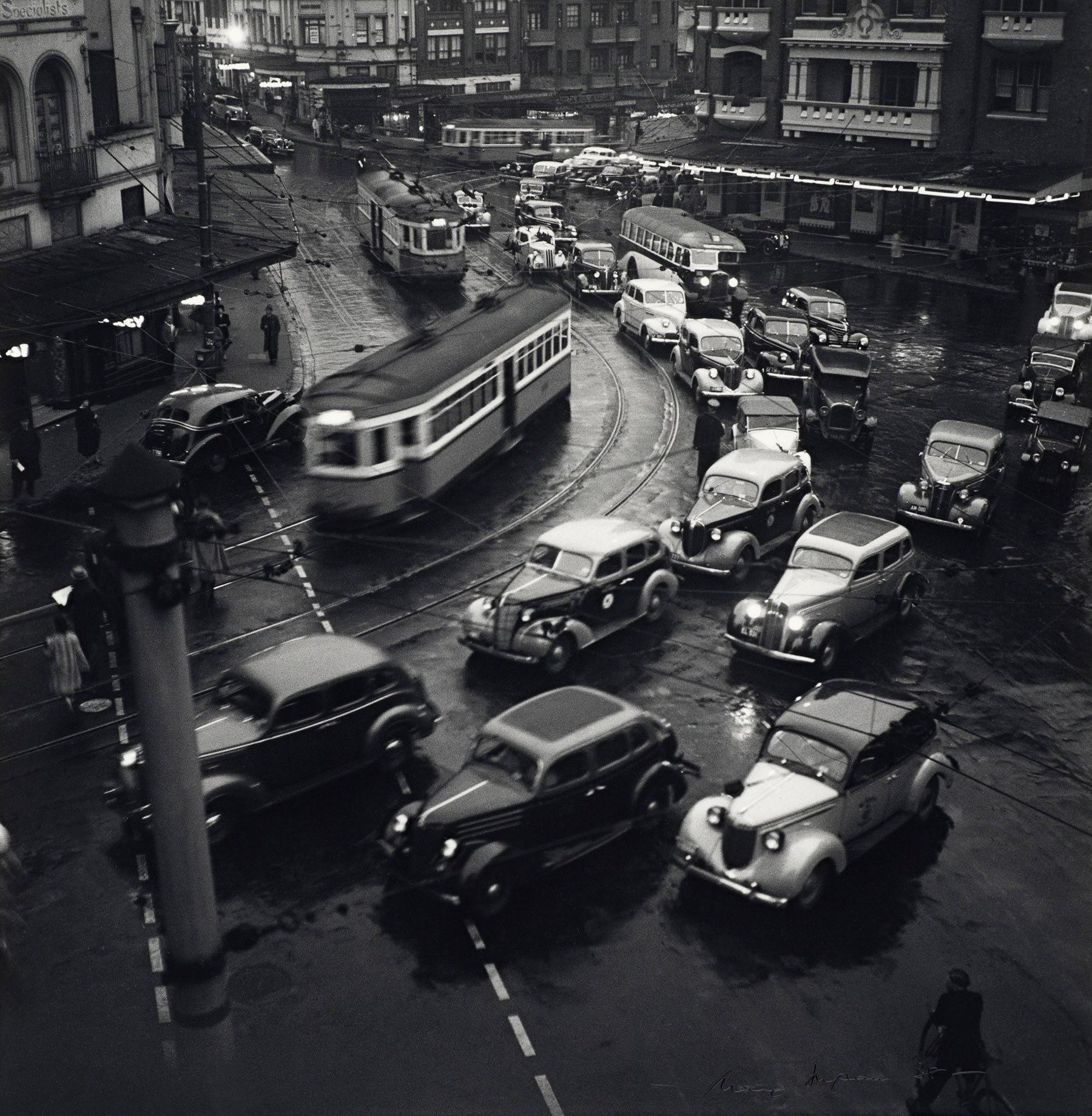
 

Max Dupain (Australia 1911-92) 'Rush hour in King's Cross' 1938, printed c. 1986


Max Dupain (Australian, 1911-1992)
Rush hour in King’s Cross
1938, printed c. 1986
Gelatin silver photograph
41.2 x 40.3cm
National Gallery of Victoria, Melbourne
Purchased through The Art Foundation of Victoria with the assistance of Mr A.C. Goode, Fellow, 1987


During the 1930s the city provided a rich source of imagery for artists working in modern styles, who celebrated the speed and efficiency of modern transport technology and expanding road and rail networks. Yet as car ownership increased during the 1930s, larger cities began to suffer congestion and the rush hour became part of urban life. Throughout the decade the pace and stress of modern life became a topic of public debate, with conservative commentators decrying this transformation of the Australian lifestyle.
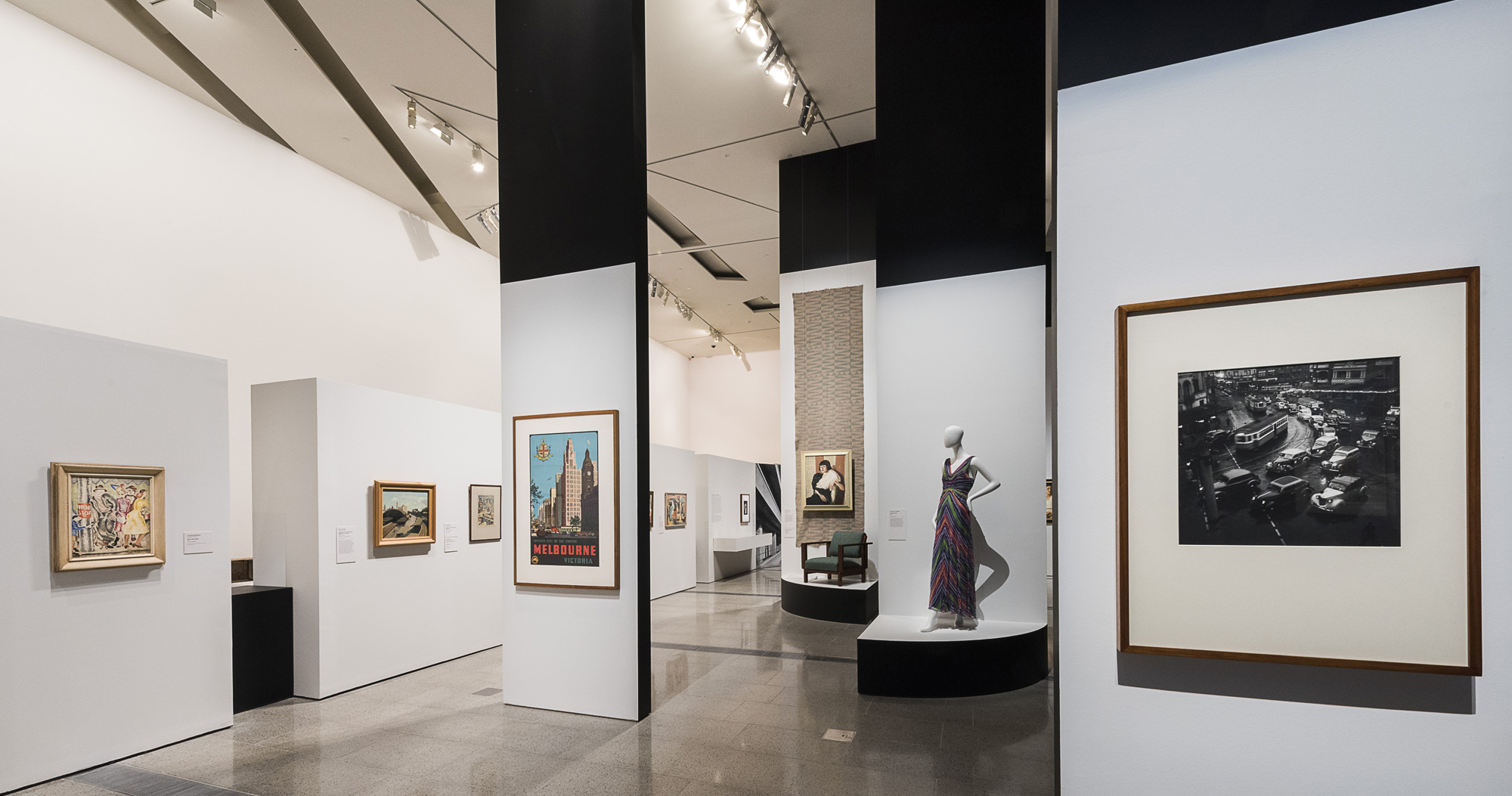
 

Installation view of the exhibition 'Brave New World: Australia 1930s' at NGVA with Max Dupain's Rush hour in King's Cross at right


Installation view of the exhibition Brave New World: Australia 1930s at NGVA with Max Dupain’s Rush hour in King’s Cross at right
Photo: Courtesy NGV Photographic Services


Installation view of the exhibition 'Brave New World: Australia 1930s' at NGVA with Grace Cossington Smith's 'The Bridge in-curve' at right


Installation view of the exhibition Brave New World: Australia 1930s at NGVA with Grace Cossington Smith’s The Bridge in-curve at right
Photo: Courtesy NGV Photographic Services


Grace Cossington Smith. 'The Bridge in-curve' 1930


Grace Cossington Smith (Australia 1892-1984, England and Germany 1912-14, England and Italy 1949-1951)
The Bridge in-curve
1930
Tempera on cardboard
83.6 x 111.8cm
National Gallery of Victoria, Melbourne
Presented by the National Gallery Society of Victoria, 1967
© Estate of Grace Cossington Smith


The slow rise of the Sydney Harbour Bridge above the city was recorded by numerous painters, printmakers and photographers, including Sydney modernist Grace Cossington Smith. Her iconic The Bridge-in-curve depicts the bridge just before its two arches were joined in August 1930, and conveys the sense of wonder, achievement and hope that was inspired by this engineering marvel. By painting the emerging, rather than the complete bridge, Cossington Smith also focuses our attention on the energy and ambition required to create it.
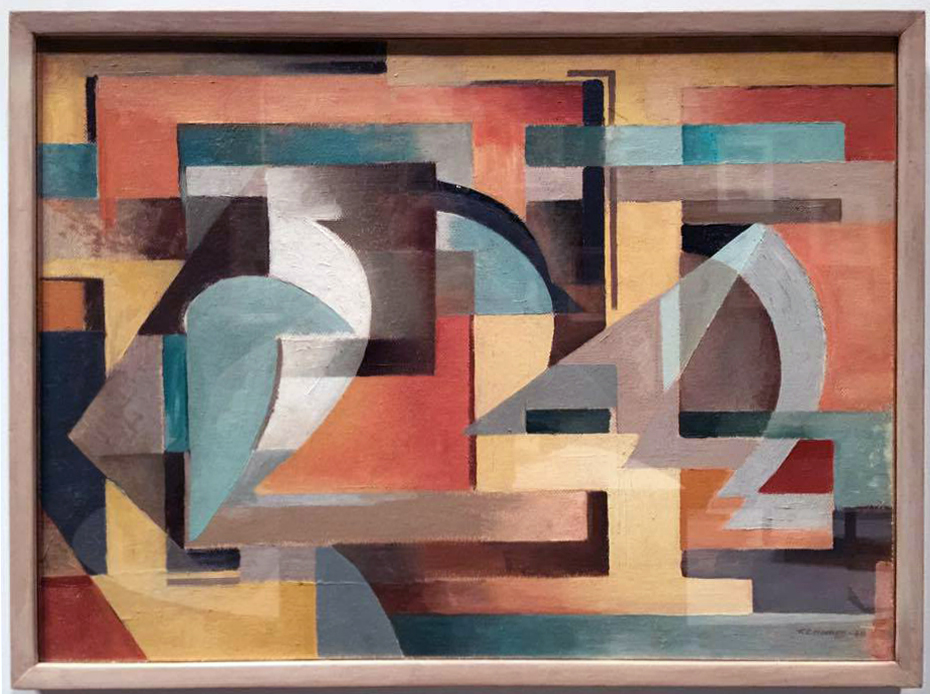
 

Frank Hinder (Australia 1906-92, United States 1927-34) 'Trains passing' 1940 (installation view)


Installation view of Frank Hinder’s Trains passing (1940) from the exhibition Brave New World: Australia 1930s at NGVA
Photo: Dr Marcus Bunyan


Frank Hinder (Australia 1906-92, United States 1927-34) 'Trains passing' 1940


Frank Hinder (Australian, 1906-1992, United States 1927-1934)
Trains passing
1940
Oil on composition board
National Gallery of Australia, Canberra
Purchased 1974


Frank Hinder was one of the first abstract artists in Australia. After living and studying in the United States, Hinder and his wife, the American sculptor Margel, returned to Sydney in 1934. There they became part of a small avant-garde group that included Grace Crowley, Rah Fizelle, Ralph Balson and the German sculptor and art historian Eleanore Lange, all of whom were interested in Cubist, Constructivist and Futurist art. Hinder later said that this work was inspired by seeing Lange, sitting next to him on a train, reflected in the windows of a passing train.


Frank Hinder (Australia 1906-92, United States 1927-34) 'Commuters' 1938


Frank Hinder (Australia 1906-1992, United States 1927-1934)
Commuters
1938
Tempera on paper on board
Private collection


Victorian Railways, Melbourne (publisher) Australia 1856-1976 'The Victorian Railways present The Spirit of Progress' 1937


Victorian Railways, Melbourne (publisher) (Australia, 1856-1976)
The Victorian Railways present The Spirit of Progress
1937
Booklet: colour photolithographs and letterpress,
12 pages, cardboard cover
printed by Queen City Printers, Melbourne
20.8 x 26.8cm (closed)
State Library Victoria, Melbourne


Launched in November 1937, The Spirit of Progress express passenger train was a source of immense pride to Victorians. Built in Newport, Victoria, the train featured many innovations, including all-steel carriages and full air-conditioning. Designed in the Art Deco, streamlined style by architectural firm Stephenson & Turner, the passenger carriages were fitted out to a level of comfort not previously seen in Australia, and included a full dining carriage. The train ran between Melbourne and the New South Wales state border at Albury, the longest non-stop train journey in Australia at that time, at an average speed of 84 kilometres per hour.
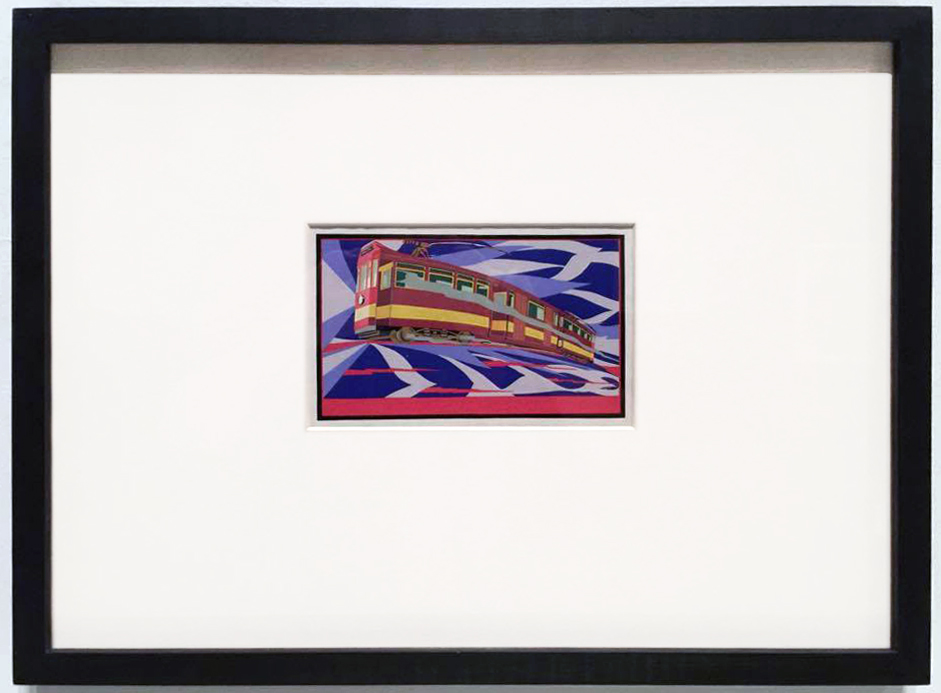
 

Installation view of Ivor Francis' 'Speed!' from the exhibition 'Brave New World: Australia 1930s' at NGVA


Installation view of Ivor Francis’ Speed! from the exhibition Brave New World: Australia 1930s at NGVA
Photo: Dr Marcus Bunyan
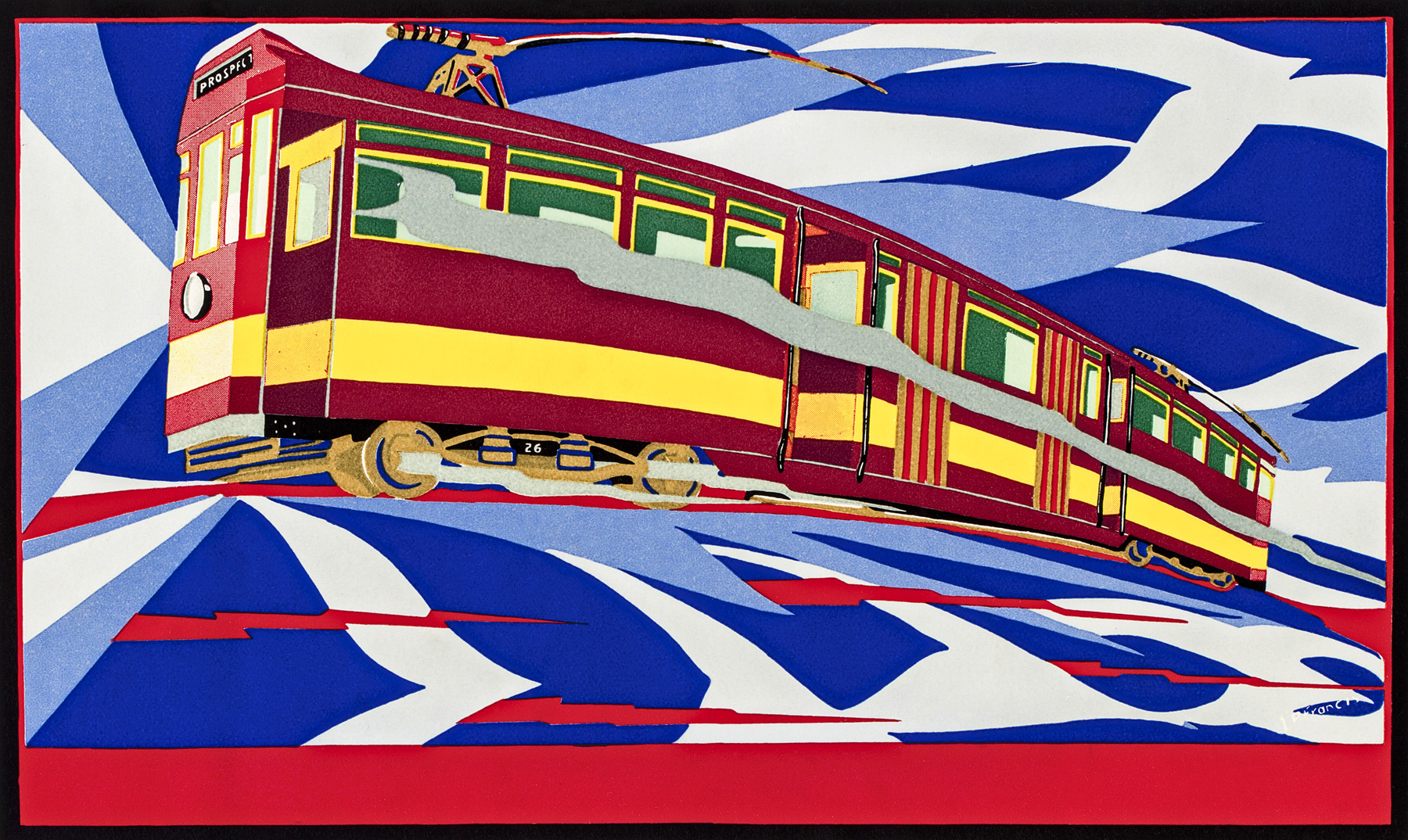
 

Ivor Francis (England 1906-Australia 1993, Australia from 1924) 'Speed!' 1931


Ivor Francis (England 1906 – Australia 1993, Australia from 1924)
Speed!
1931
Colour process block print
Art Gallery of South Australia
Adelaide South Australian Government Grant 1986


Randille, Melbourne (maker) active 1930s 'Night gown' c. 1938


Randille, Melbourne (maker) active 1930s
Night gown
c. 1938
Silk (a) 166cm (centre back) 38.9cm (waist, flat) (dress) (b) 121cm (centre back) 38cm (waist, flat) (slip)
National Gallery of Victoria, Melbourne
Presented by Mrs A. G. Pringle, 1982


Installation view of the exhibition 'Brave New World: Australia 1930s' at NGVA with Max Dupain's 'Rush hour in King's Cross' left and Frank Hinder's 'Jackhammer' third from right and Margel Hinder's 'Man with jackhammer' second right


Installation view of the exhibition Brave New World: Australia 1930s at NGVA with Max Dupain’s Rush hour in King’s Cross left and Frank Hinder’s Jackhammer third from right and Margel Hinder’s Man with jackhammer second right
Photo: Courtesy NGV Photographic Services


Margel Hinder (United States 1906-Australia 1995, Australia from 1934) 'Man with jackhammer' 1939


Margel Hinder (United States 1906 – Australia 1995, Australia from 1934)
Man with jackhammer
1939
Cedar
National Gallery of Victoria, Melbourne
Purchased through the NGV Foundation with the assistance of J. B. Were & Son, Governor, 2001


American-born Margel Hinder was one of Australia’s leading modernist sculptors. She had studied art in Boston, where she met and married Sydney artist Frank Hinder. In 1934 they moved to Australia and became an important part of Sydney’s small modern art scene. In Man with jackhammer Hinder has simplified and contained the figure within a square frame, the strong diagonal form of the jackhammer creating a sense of compressed energy and force. Man and machine have fused in this celebration of industry and progress.


Frank Hinder (Australia 1906-92, United States 1927-34) 'Jackhammer' 1936


Frank Hinder (Australia 1906-1992, United States 1927-1934)
Jackhammer
1936
Airbrush on black paper
52 x 38cm
Private collection, Sydney
© Enid Hawkins


Modern Woman

In the 1930s the new ‘Modern Woman’ made her appearance as a more serious and emancipated version of the giddy 1920s ‘flapper’. A woman who worked, she often lived alone in one of the new city apartment buildings, visited nightclubs and showed less interest in traditional marriage and child rearing. A lean body type became fashionable and was enhanced by the lengthened hemlines and defined waists introduced by French couturier Jean Patou in 1929. This slender silhouette was supported by form-fitting foundation garments by manufacturers such as Berlei.

The Modern Woman became one of the most potent images of contemporary life, being celebrated in women’s magazines such as the ultra-stylish Home and the Australian Women’s Weekly, launched in 1933. While such magazines were congratulating her and promoting new consumer goods to the Modern Woman, at the same time she was criticised by conservative commentators. In 1937 photographer Max Dupain wrote: ‘There must be a great shattering of modern values if woman is to continue to perpetuate the race… In her shred of a dress and little helmet of a hat, her cropped hair, and stark bearing, the modern woman is a sort of a soldier… It is not her fault it is her doom’.


Installation view of the exhibition 'Brave New World: Australia 1930s' at NGVA with Peter Purves Smith's 'Maisie' left, Cybil Craig's 'Peggy' second left and Peter Purves Smith's 'Lucile' at  top right


Installation view of the exhibition Brave New World: Australia 1930s at NGVA with Peter Purves Smith’s Maisie left, Cybil Craig’s Peggy second left and Peter Purves Smith’s Lucile at  top right
Photo: Eugene Hyland


Installation view of the exhibition 'Brave New World: Australia 1930s' at NGVA with Cybil Craig's 'Peggy' second left and Lina Bryans 'The babe is wise' at right


Installation view of the exhibition Brave New World: Australia 1930s at NGVA with Cybil Craig’s Peggy second left and Lina Bryans The babe is wise at right
Photo: Courtesy NGV Photographic Services


Peter Purves Smith (Australia 1912-1949, England 1935-1936, England and France 1938-1940) 'Maisie' 1938-1939


Peter Purves Smith (Australia 1912-1949, England 1935-1936, England and France 1938-1940)
Maisie
1938-1939
Gouache
National Portrait Gallery, Canberra
Bequest of Lady Maisie Drysdale 2001


In 1937 the striking, auburn-haired Maisie Newbold was a student at the George Bell School in Melbourne, where she met fellow student Peter Purves Smith and his best friend Russell Drysdale. Maisie and Purves Smith were married in 1946, only three years before latter’s premature death from tuberculosis. Purves Smith painted this portrait at the start of their relationship. It depicts Maisie as a stylish woman wearing the latest fashion, the angularity of her features contrasted by the soft fur of her collar and feathers of her hat. Many years later Maisie married Drysdale.


Installation view of Sybil Craig's work 'Peggy' c. 1932


Installation view of Sybil Craig’s work Peggy c. 1932
Photo: Dr Marcus Bunyan
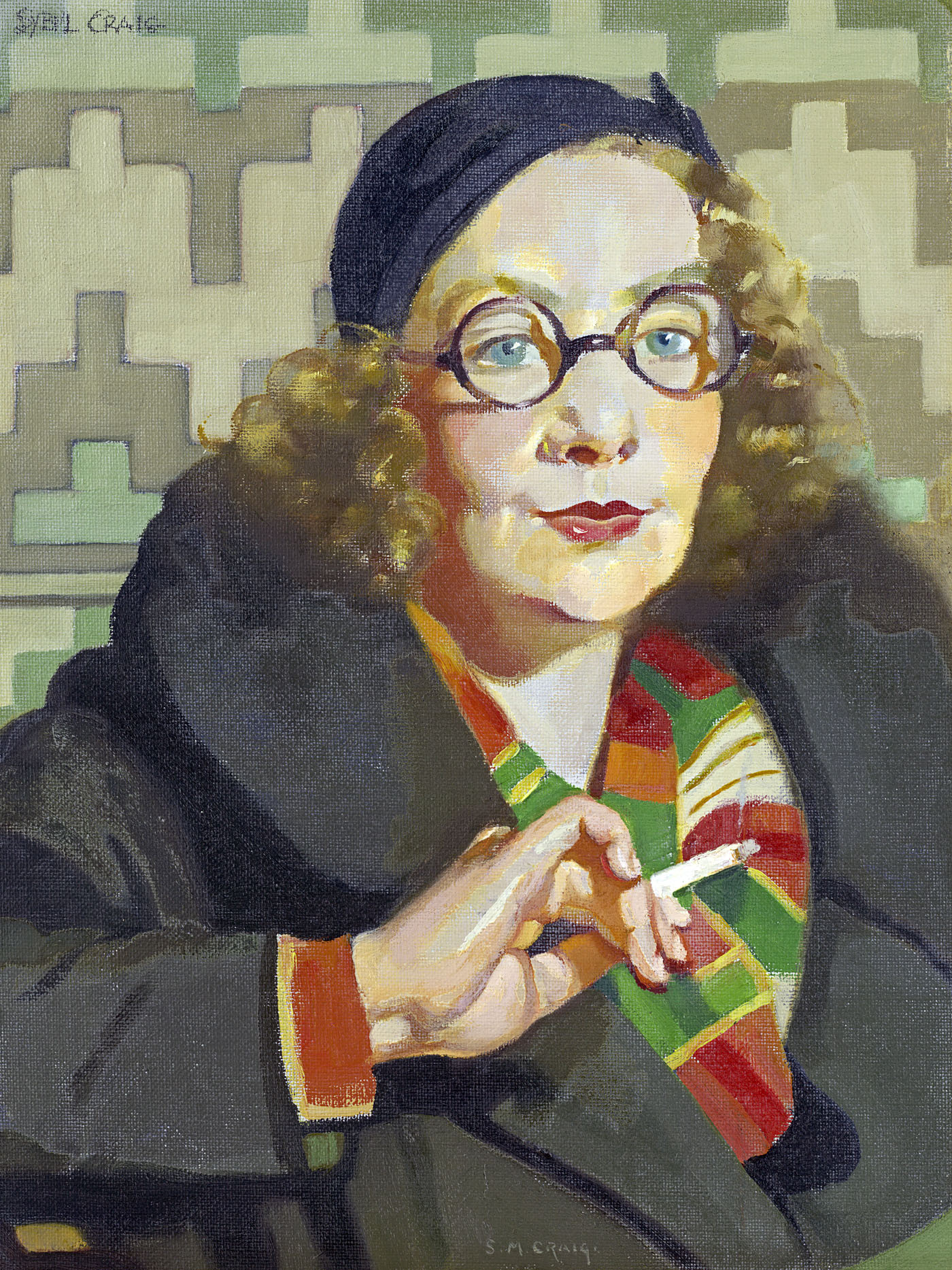
 

Sybil Craig (England 1901 - Australia 1909, Australia from 1902) 'Peggy' c. 1932


Sybil Craig (England 1901 – Australia 1909, Australia from 1902)
Peggy
c. 1932
Oil on canvas
40.4 x 30.4cm
National Gallery of Victoria, Melbourne Purchased, 1978
© The Estate of Sybil Craig


Lina Bryans (Germany (of Australian parents) 1909-Australia 2000, Australia from 1910) 'The babe is wise' 1940


Lina Bryans (Germany (of Australian parents) 1909 – Australia 2000, Australia from 1910)
The babe is wise
1940
Oil on cardboard
National Gallery of Victoria, Melbourne
Gift of Miss Jean Campbell, 1962


Lina Bryans’s portrait of author Jean Campbell is titled after Campbell’s 1939 novel The Babe is Wise, a contemporary story set in Melbourne and in which the main protagonists are European migrants. A well-known figure in Melbourne’s literary circles, Campbell was noted for her ‘quick and slightly audacious wit’. Bryans had begun painting in 1937 with the support of William Frater. In the late 1930s she lived at Darebin Bridge House, which became an informal artists’ colony and meeting place for writers associated with the journal Meanjin.


Peter Purves Smith (Australia 1912-1949, England 1935-1936, England and France 1938-1940) 'Lucile' 1937


Peter Purves Smith (Australian, 1912-1949, England 1935-1936, England and France 1938-1940)
Lucile
1937
Oil on board
Queensland Art Gallery, Brisbane
Purchased 2011 with funds raised through the Queensland Art Gallery Foundation Appeal


Nora Heysen (Australia 1911-2003, England and Italy 1934-37) 'Self-portrait' 1932


Nora Heysen (Australian, 1911-2003, England and Italy 1934-1937)
Self-portrait
1932
Oil on canvas
National Gallery of Australia, Canberra
Acquired with the assistance of the Masterpieces for the Nation Fund 2011


During the first decade of her life as a professional artist, Nora Heysen completed numerous self-portraits. In many of these she depicts herself in the act of drawing or painting, holding a palette and brush or with other accoutrements of the artist, and thereby asserting her professional identity. Yet these are also highly charged works in which Heysen scrutinises herself (and the viewer) with an unflinching and unsmiling gaze.


Installation view of the exhibition 'Brave New World: Australia 1930s' at NGVA with Arthur Challen's 'Miss Moira Madden' above chair


Installation view of the exhibition Brave New World: Australia 1930s at NGVA with Arthur Challen’s Miss Moira Madden above chair
Photo: Eugene Hyland
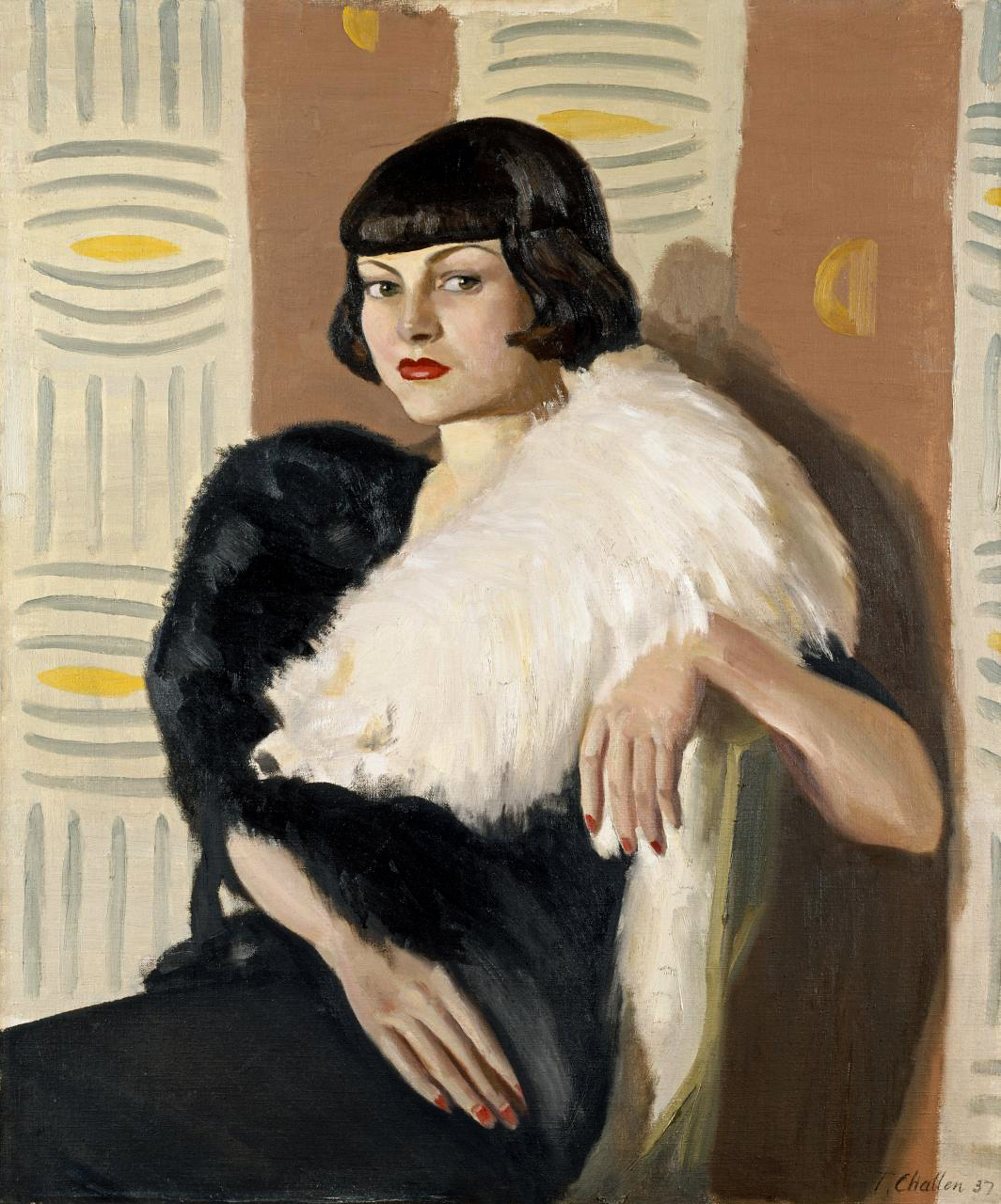
 

Arthur Challen 'Miss Moira Madden' 1937


Arthur Challen (Australian, 1911-1964)
Miss Moira Madden
1937
Oil on canvas
89.8 x 77.4cm (framed)
State Library of Victoria
Gift of Mrs S. M. Challen, 1966
© The Estate of Arthur Challen


Body culture

The terrible physical losses and psychological traumas of the First World War changed Australian society and prompted anxious concerns about the direction of the nation. For some this meant an inward-looking isolationism, a desire that Australian culture should develop independently and untouched by the ‘degenerate’ influences of Europe.

The search for rejuvenation frequently involved explorations of the capabilities and vulnerabilities of the human body. In the hands of artists, corporeal forms came to symbolise nationhood, most often expressed through references to the art of Classical Greece and mythological subjects. The evolution of a new Australian ‘type’ was also proposed in the 1930s – a white Australian drawn from British stock, but with an athletic and streamlined shape honed by time spent swimming and surfing on local beaches.

This art often has a distinctive quality to it, which in the light of history can sometimes make for disquieting viewing. With the terrible knowledge of how the Nazi Party in Germany subsequently used eugenics in its systematic slaughter of those with so-called ‘bad blood’, the Australian enthusiasm for ‘body culture’ can now seem problematic. Images of muscular nationalism soon lost their cache in Australia following the Second World War, tainted by undesirable fascistic overtones.
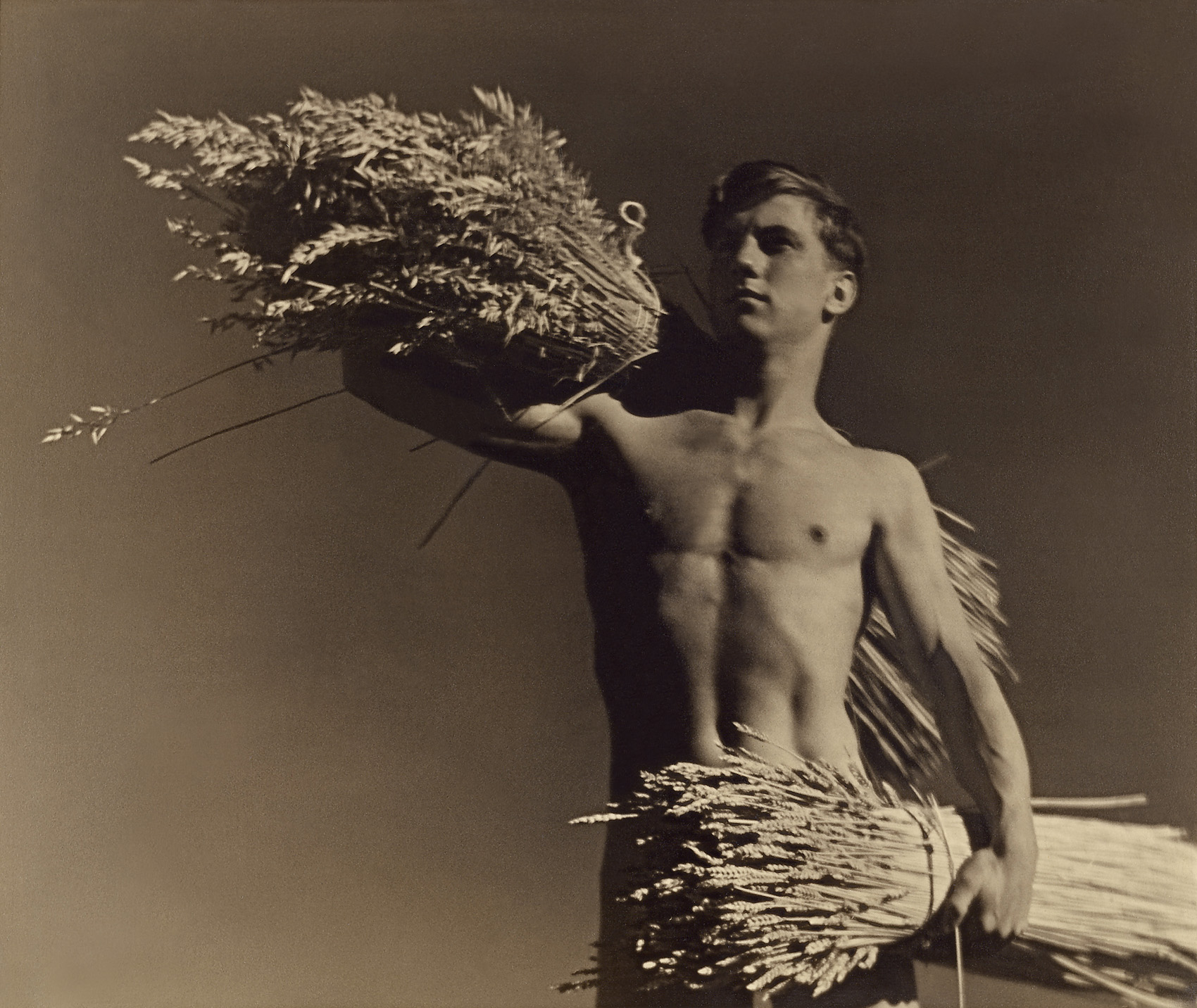
 

Keast Burke (New Zealand 1896 - Australia 1974, Australia from 1904) 'Harvest' c. 1940


Keast Burke (New Zealand 1896 – Australia 1974, Australia from 1904)
Harvest
c. 1940
Gelatin silver photograph (25.6 x 30.5cm)
National Gallery of Victoria, Melbourne
Gerstl Bequest, 2000
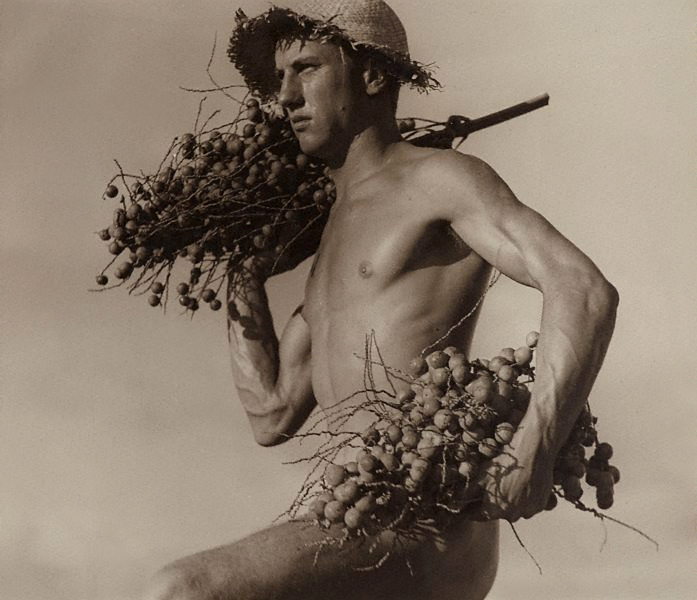
 

Keast Burke (New Zealand 1896 - Australia 1974, Australia from 1904) 'Husbandry 1' c. 1940


Keast Burke (New Zealand 1896 – Australia 1974, Australia from 1904)
Husbandry 1
c. 1940
Gelatin silver photograph
Art Gallery of New South Wales, Sydney
Gift of Iris Burke 1989


Max Dupain (Australia 1911-92) 'Discus thrower' 1937, printed (c. 1939)


Max Dupain (Australian, 1911-1992)
Discus thrower
1937, printed (c. 1939)
Gelatin silver photograph
38.5 x 37.5cm
National Gallery of Victoria, Melbourne
Purchased, 2003
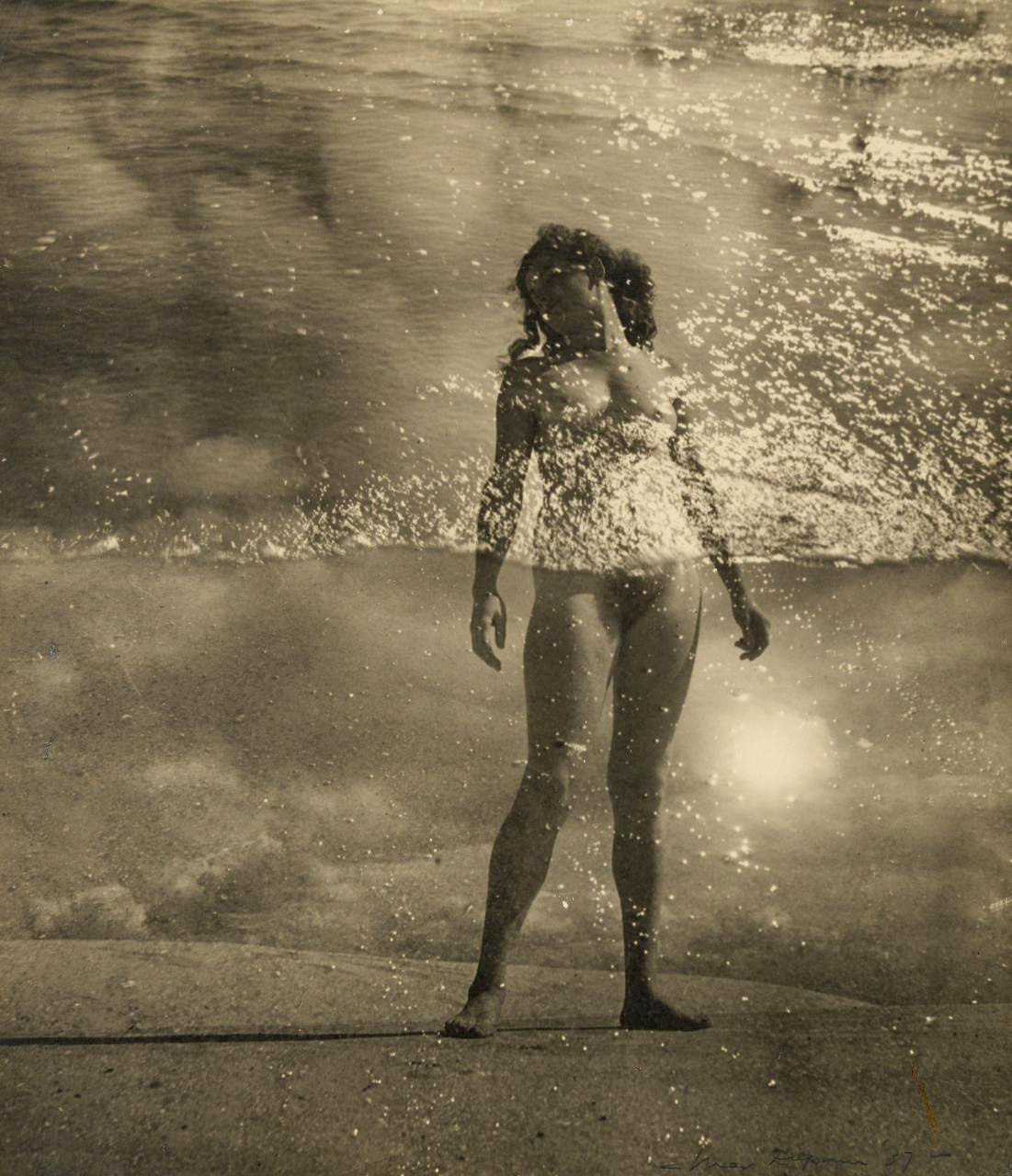
 

Max Dupain (Australia 1911-1992) 'Souvenir of Cronulla' 1937


Max Dupain (Australian, 1911-1992)
Souvenir of Cronulla
1937
Gelatin silver photograph
National Gallery of Victoria, Melbourne
Purchased through The Art Foundation of Victoria with the assistance of National Australia Bank Limited, Honorary Life Benefactor, 1992


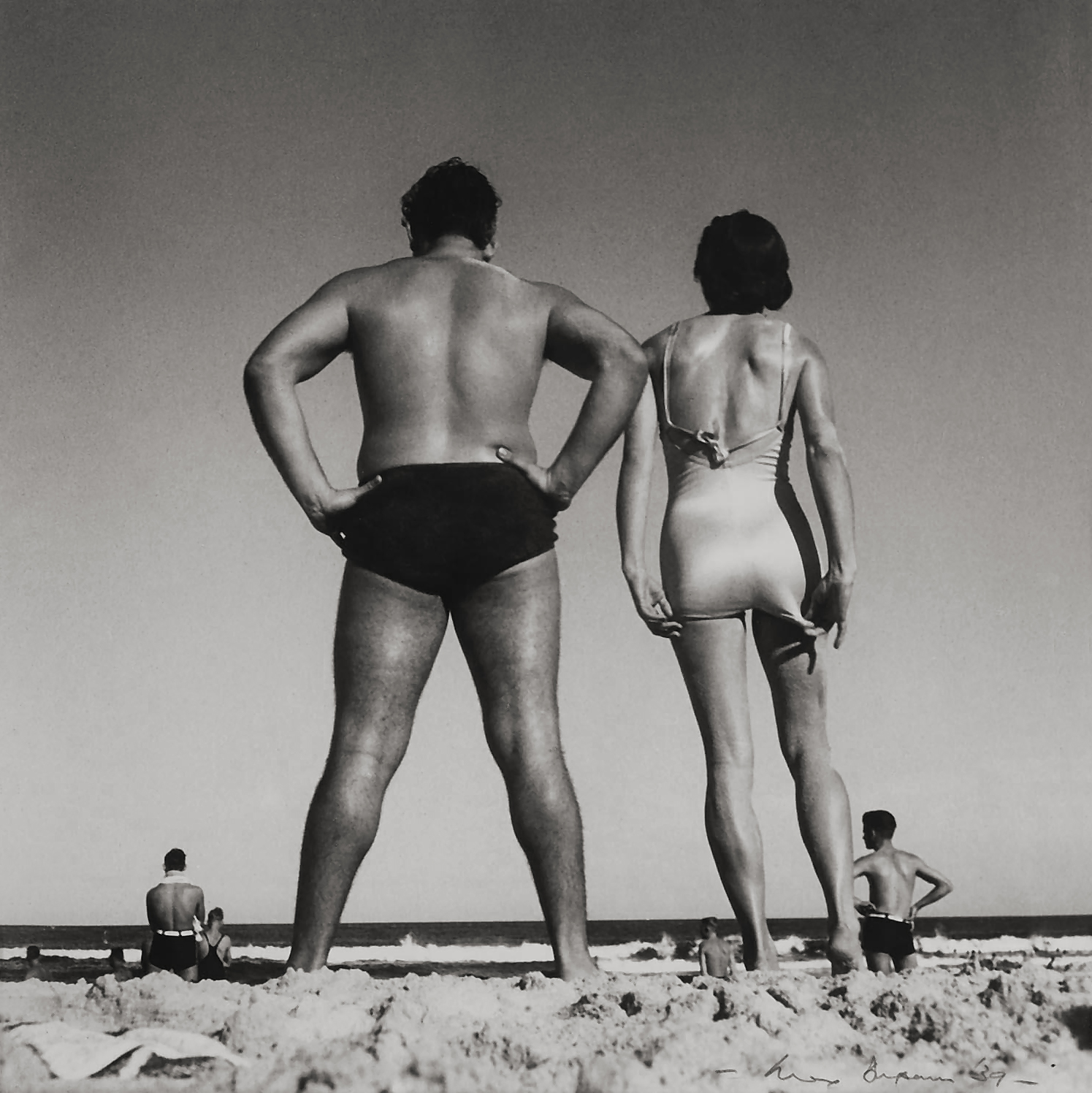
In the 1930s Max Dupain responded to Henri Bergson’s book Creative Evolution (1907) in which he considered creativity and intuition as central to the renewed development of society, and the artist as prime possessor of these powers. Vitalism, as this philosophy was termed, was believed to be expressed through polarised sexual energies. In this work Dupain focuses on the sexually differentiated ‘energies’ of men and women, associating women with the forces of nature.
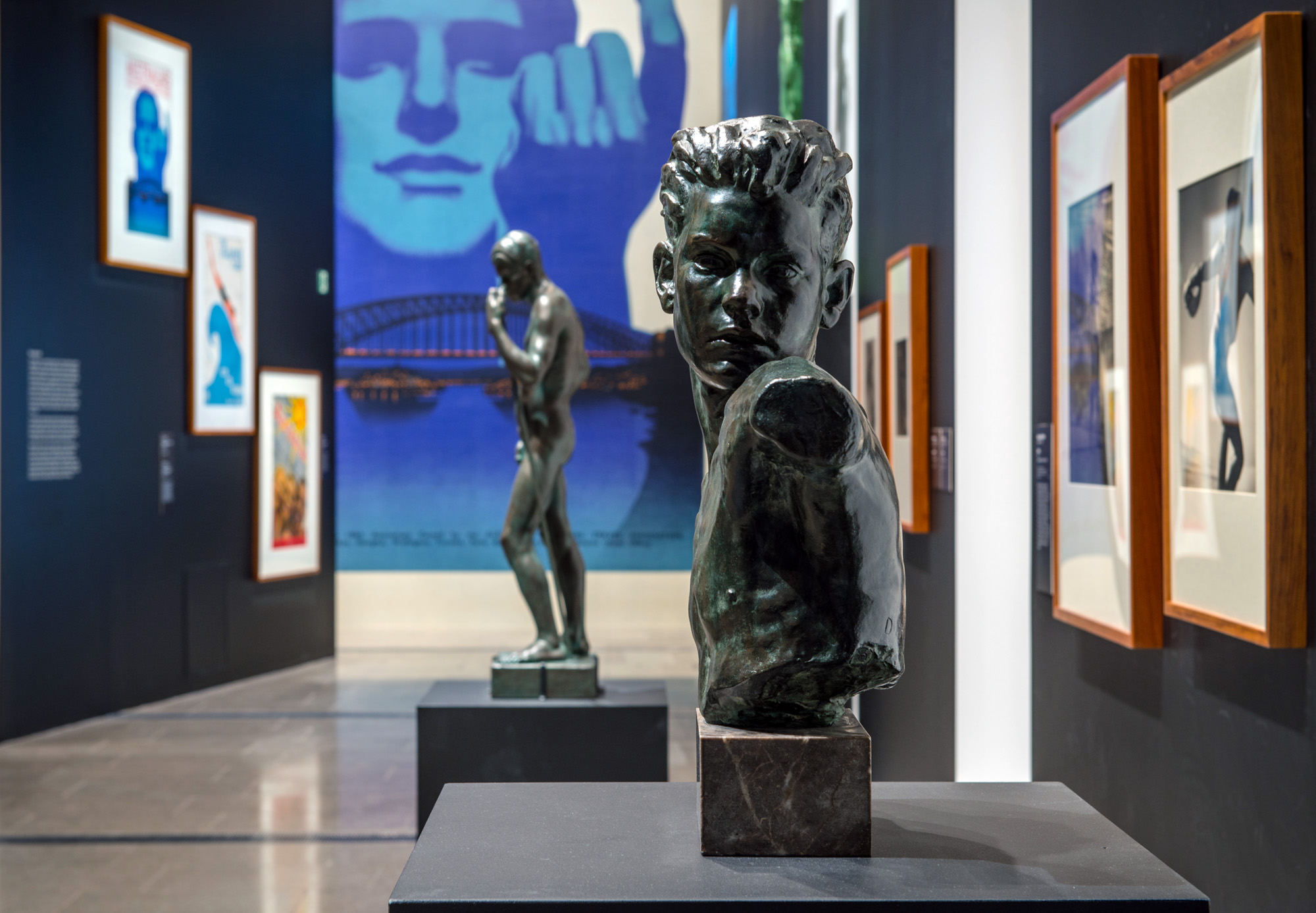
 

Installation view of the exhibition 'Brave New World: Australia 1930s' at NGVA with Daphne Mayo's 'A young Australian' in foreground


Installation view of the exhibition Brave New World: Australia 1930s at NGVA with Daphne Mayo’s A young Australian in foreground
Photo: Eugene Hyland
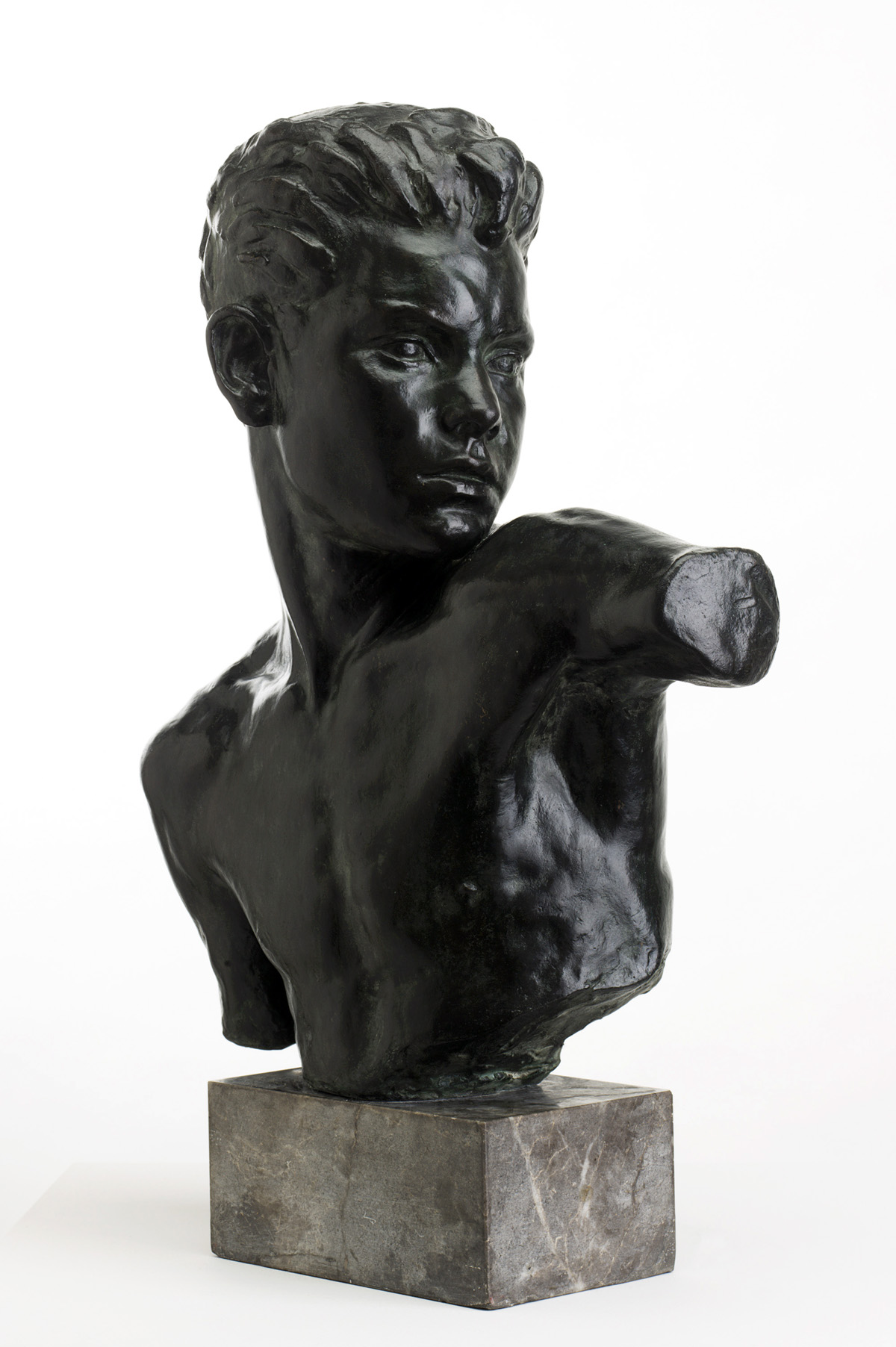
 

Daphne Mayo (Australia 1895-1982, England 1919-1923, France 1923-1925) 'A young Australian' 1930, cast 1931


Daphne Mayo (Australian, 1895-1982, England 1919-1923, France 1923-1925)
A young Australian
1930, cast 1931
Bronze, marble
(a-b) 51.0 x 35.2 x 18.1cm (overall)
Art Gallery of New South Wales, Sydney Purchased 1930
© 1982 by The Surf Life Saving Foundation and the Uniting Church in Australia Property Trust (Q.)


Installation view of the exhibition 'Brave New World: Australia 1930s' at NGVA with Dorothy Thornhill's 'Neo-classical nudes' and 'Resting Diana' at left; Tom Purvis' 'Australia's 150th Anniversary Celebrations' (wall print) at centre rear; and Jean Broome-Norton's 'Abundance' on plinth at right


Installation view of the exhibition Brave New World: Australia 1930s at NGVA with Dorothy Thornhill’s Neo-classical nudes and Resting Diana at left; Tom Purvis’ Australia’s 150th Anniversary Celebrations (wall print) at centre rear; and Jean Broome-Norton’s Abundance on plinth at right
Photo: Courtesy NGV Photographic Services


Tom Purvis (England 1888-1959) 'Australia's 150th Anniversary Celebrations' c. 1938


Tom Purvis (England, 1888-1959)
Australia’s 150th Anniversary Celebrations
c. 1938
Colour lithograph
Courtesy of Josef Lebovic Gallery, Sydney


Installation view of Dorothy Thornhill's 'Neo-classical nudes' from the exhibition 'Brave New World: Australia 1930s' at NGVA


Installation view of Dorothy Thornhill’s Neo-classical nudes from the exhibition Brave New World: Australia 1930s at NGVA
Photo: Dr Marcus Bunyan


Dorothy Thornhill (England 1910 - Australia 1987, New Zealand 1920-1929, Australia from 1929) 'Resting Diana' 1931


Dorothy Thornhill (England 1910 – Australia 1987, New Zealand 1920-1929, Australia from 1929)
Resting Diana
1931
Oil on canvas
National Gallery of Australia, Canberra
Purchased 1977


The invocation of the Classical body as a modern prototype was a powerful idea in the 1930s. The Graeco- Roman goddess Diana, the virgin patron goddess of the hunt, was popularly invoked as an ideal of female perfection, and represented with a slender and athletic physique. Dorothy Thornhill’s Diana is a remarkable visualisation of such a ‘modern Diana’, her angular body and defined musculature reflecting the masculinisation of female bodies at this time. She is a formidable presence, the quiver of arrows slung nonchalantly across her shoulders a trophy of her victory over the male gender.
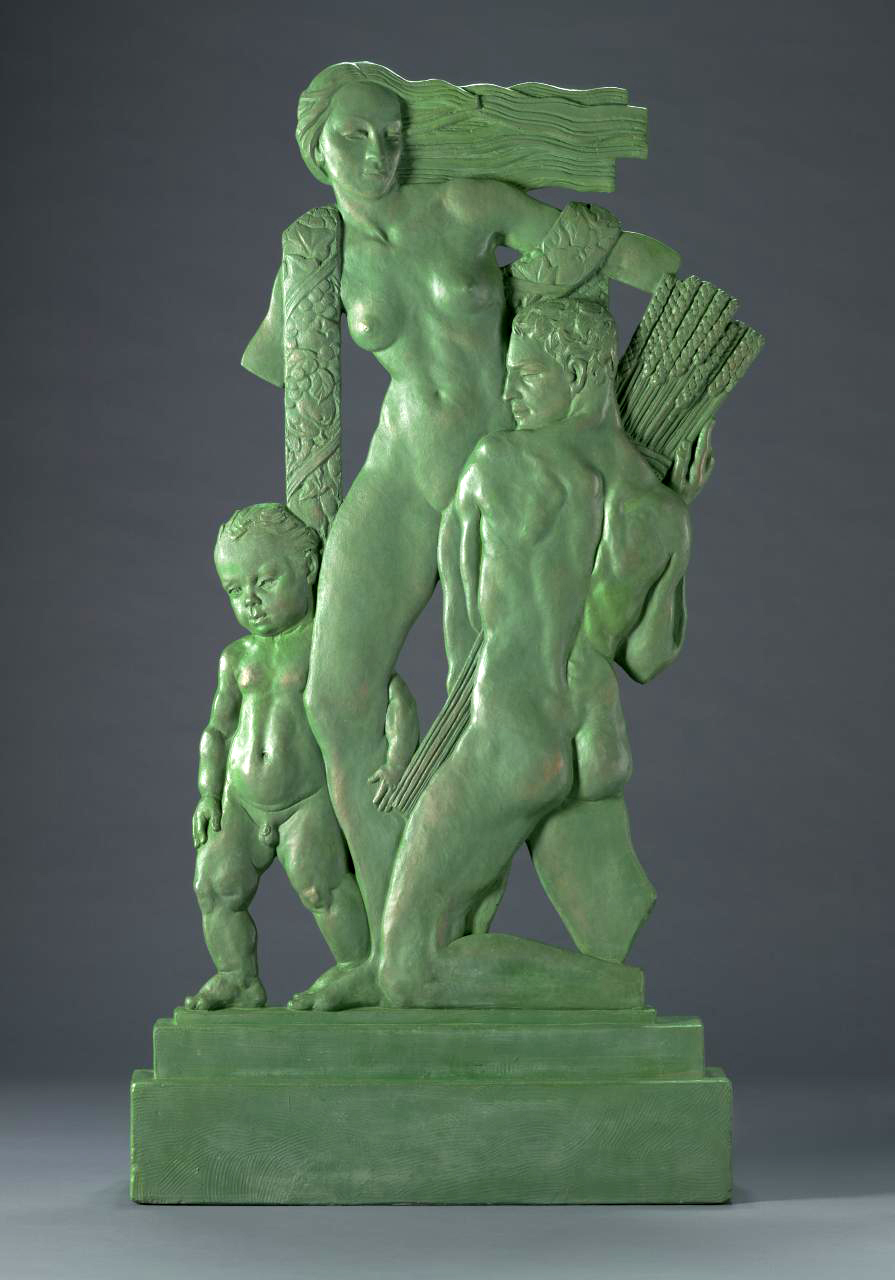
 

Jean Broome-Norton (Australia 1911-2002) 'Abundance' 1934


Jean Broome-Norton (Australian, 1911-2002)
Abundance
1934
Plaster, bronze patination
National Gallery of Victoria, Melbourne
Purchased through The Art Foundation of Victoria with the assistance of ICI Australia Limited, Fellow, 1994


“High-rise buildings, fast trains and engineering feats such as the Sydney Harbour Bridge jostled against the Great Depression, conservatism and a looming Second World War during the 1930s, one of the most turbulent decades in Australian history. The major exhibition at the NGV, Brave New World: Australia 1930s, will explore the way artists and designers engaged with these major issues providing a fresh look at a period characterised by both optimism and despair. The exhibition will present a broad-ranging collection of more than 200 works spanning photography, painting, printmaking, sculpture and decorative arts as well as design, architecture, fashion, graphics, film and dance.

Tony Ellwood, Director, NGV, commented, “Brave New World explores an important period of Australian art history during which Abstraction, Surrealism and Expressionism first emerged, and women artists arose as trailblazers of the modern art movement. It will offer an immersive look at the full spectrum of visual and creative culture of the period, from Max Dupain’s iconic depictions of the Australian body and beach culture to a vast display of nearly 40 Art Deco radios, which were an indispensable item for the Australian home during the 1930s.”

Presented thematically, Brave New World will show how artists and designers responded to major social and political concerns of the 1930s. The Great Depression, which saw Australia’s unemployment rate rise to 32% by 1932, is seen through the eyes of photographer F. Oswald Barnett in his powerful images of poverty-stricken inner Melbourne suburbs such as Fitzroy, Collingwood and Carlton, and in the works of Danila Vassilieff, Yosl Bergner, Arthur Boyd and Albert Tucker who were among the first artists to depict Australia’s working class and destitute.

In contrast, many other artists at the time chose to focus upon the vibrant city streets, cafes and buildings of contemporary Australian cities, such as renowned modernist Grace Cossington Smith with her energetic canvasses of flat colours and abstracted forms. Other artists featured in Brave New World including Hilda Rix Nicholas and Elioth Gruner concentrated on more traditional scenes of the Australian bush, which was seen as a place of respite from the frenetic pace of modern city life.

The exhibition will explore artists’ responses to the growing calls for Indigenous rights during the 1930s, which was accompanied by a rising interest in Aboriginal art and particularly the work of Albert Namatjira, the first Indigenous artist of renown in Australia; and the rise of the ‘modern woman’, a female who favoured urban living, freedom and equality over marriage and child rearing.

The 1930s also saw the idea of the ‘Australian body’, a tanned, muscular archetype shaped by sand and surf, come to the fore of the Australian identity. Artists who engaged with this idea, including Max Dupain, Charles Meere and Olive Cotton, will be presented in Brave New World. The exhibition will be accompanied by a fully-illustrated, 212-page hardback publication, featuring essays by leading writers on each of the exhibition themes. A series of public programs will also be offered including a major symposium, an Art Deco walking tour of Melbourne and a dance performance, recreating Demon machine (1924) by the Bodenweiser company that toured Australia in the late 1930s as well as an original solo by the choreographer, Carol Brown (NZ).

Press release from the NGV


Nanette Kuehn (Germany 1911-Australia 1980, Australia from 1937) 'Borislav Runanine and Tamara Grigorieva in Jeux D'Enfants, original Ballets Russes, Australian tour' 1939-1940


Nanette Kuehn (Germany 1911 – Australia 1980, Australia from 1937)
Borislav Runanine and Tamara Grigorieva in Jeux D’Enfants, original Ballets Russes, Australian tour
1939-1940
Gelatin silver photograph
Performing Arts Collection, Arts Centre, Melbourne
The Australian Ballet Collection. Gift of The Australian Ballet, 1998


The expressive body: dance in Australia

If modern art encapsulated the ideals and conflicting forces of the early twentieth century, then modern dance embodied its restless vitality and the quest for a different kind of subjectivity and expression. To many, modern dance is the pivotal art form for a mid twentieth century concerned with plasticity, the expressive body and tensions between the individual and its collective formation.

The decade of the 1930s is framed by the 1928-1929 tour of Anna Pavlova’s dance company and the three tours of the remnant Ballets Russes companies (1936-1937, 1938-1939,1939-1940) that excited many aspiring modernist artists. These tours sowed the seeds for subsequent ballet narratives in Australia, because the eruption of war in 1939 meant that Ballets Russes dancers, including Helene Kirsova and Edouard Borovansky, stayed in the country and established ballet companies. While trained in Russian dance technique, these artists were also influenced by the aesthetics of change in European art and dance that included new bodily techniques, dynamic movement patterns and modern technologies. It was the individual dancers of modern dance, however, including Louise Lightfoot and Sonia Revid, who produced the expressive intensity of a more autonomous art of movement.


Installation view of 'Brave New World: Australia 1930s' at NGVA

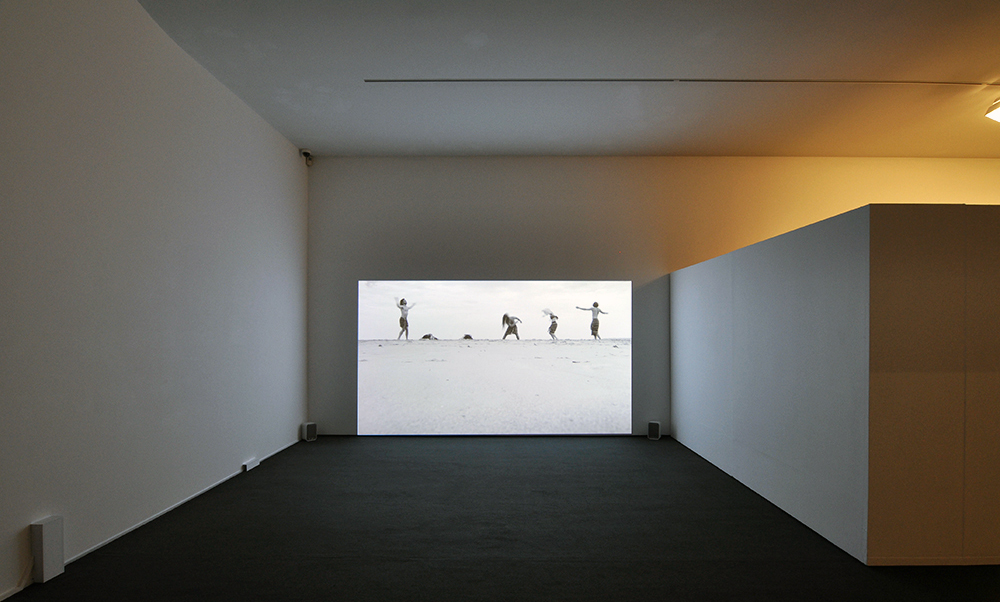
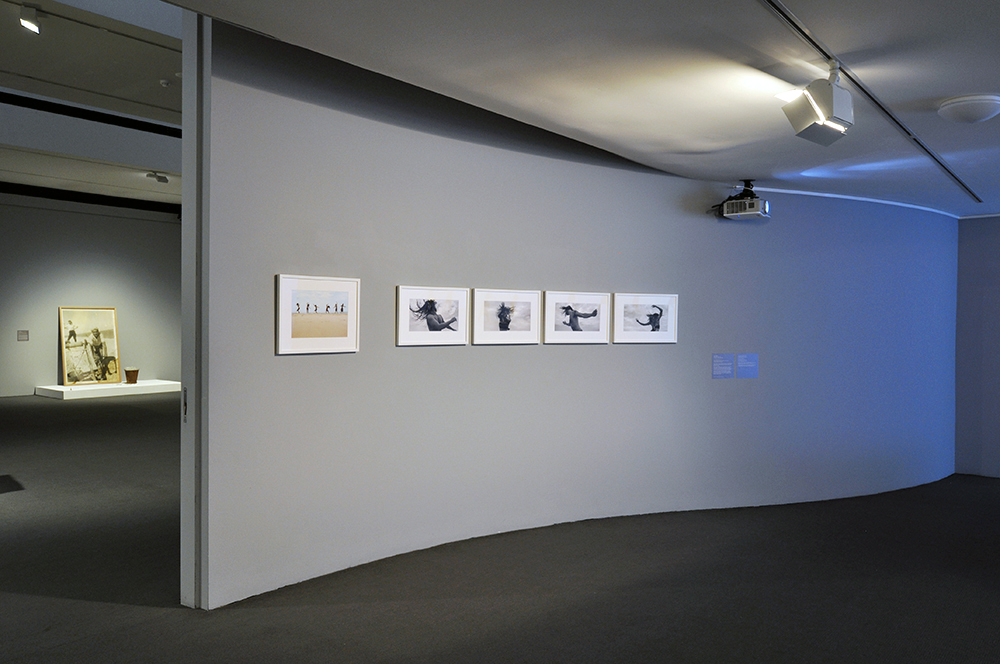
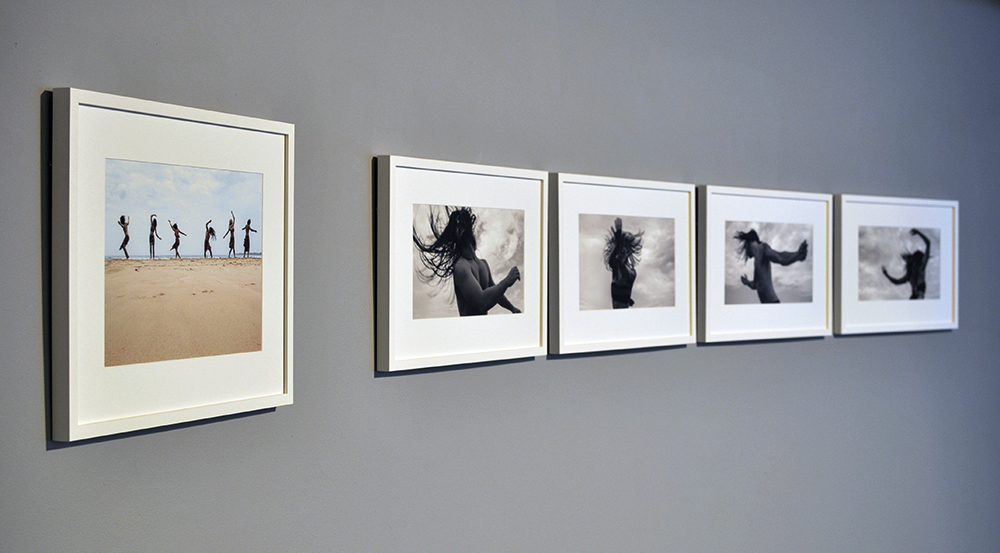
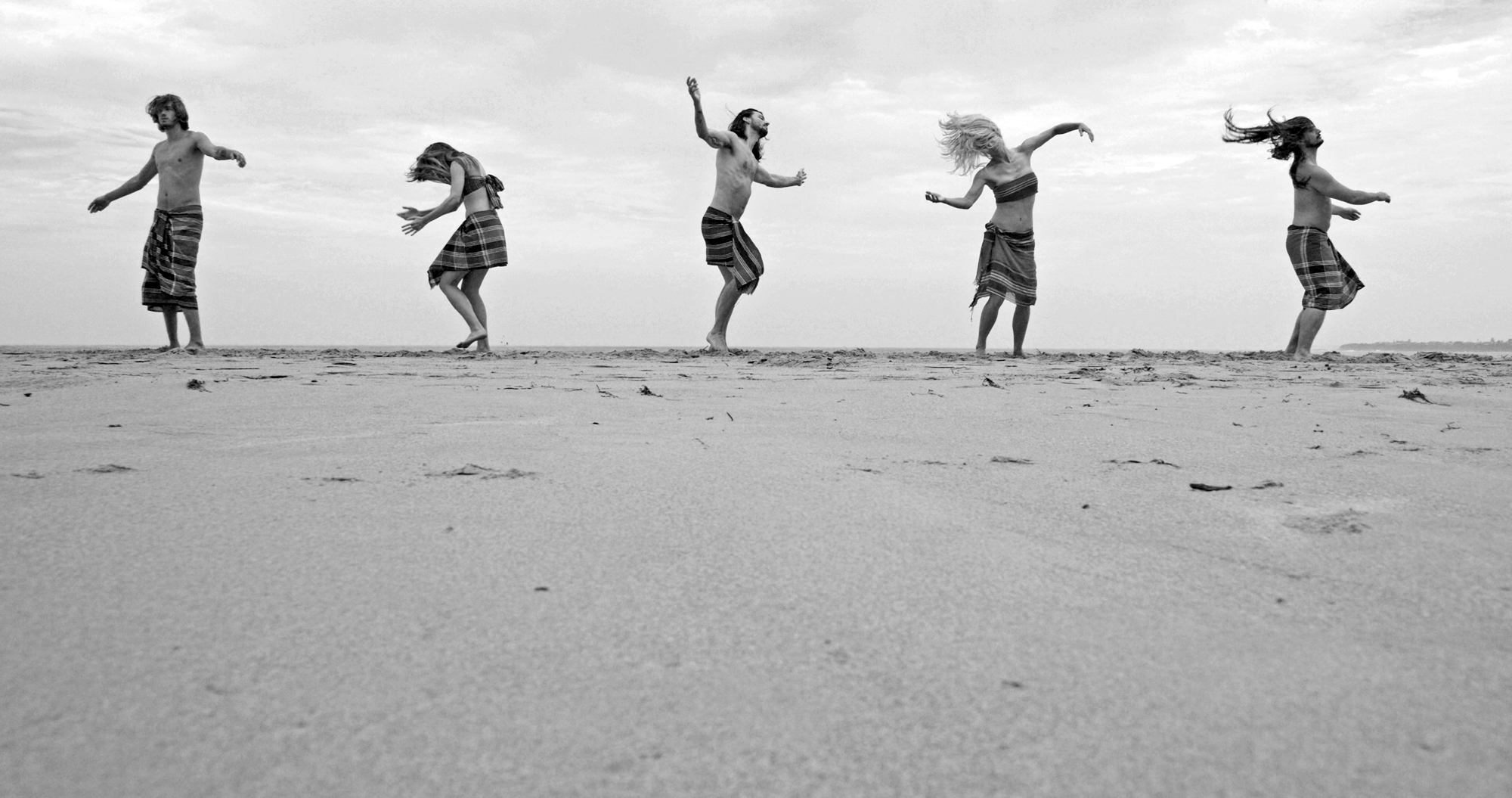
Installation views of the exhibition 'Brave New World: Australia 1930s' at NGVA featuring a wall print of 'Sonia Revid dancing on Brighton beach' c. 1935 by an unknown Australian photographer


Installation views of the exhibition Brave New World: Australia 1930s at NGVA featuring a wall print of Sonia Revid dancing on Brighton beach c. 1935 by an unknown Australian photographer
Photos: Courtesy NGV Photographic Services


Australia, Unknown photographer. 'Sonia Revid dancing on Brighton beach' c. 1935


Australia, Unknown photographer
Sonia Revid dancing on Brighton beach
c. 1935
Courtesy of State Library Victoria, Melbourne


Sonia Revid was one of the leading proponents of modern interpretative dance in Melbourne. Born in Latvia, she studied with the great dancer Mary Wigman in Germany before coming to Australia in 1932. Revid is credited with introducing the ‘German Dance’ to Australian audiences, and in the mid 1930s established the Sonia Revid School of Art and Body Culture in Collins Street. She composed her own dances, one of the best known being Bushfire drama (1940), based on the 1939 Victoria Bushfires.


Max Dupain (Australia 1911-1992) 'Ballet (Emmy Towsey and Evelyn Ippen, Bodenwieser Dancers performing Waterlilies)' 1937, printed (c. 1939)


Max Dupain (Australian, 1911-1992)
Ballet (Emmy Towsey and Evelyn Ippen, Bodenwieser Dancers performing Waterlilies)
1937, printed (c. 1939)
Gelatin silver photograph
44.5 x 33.5cm
National Gallery of Victoria, Melbourne
Purchased, 2003
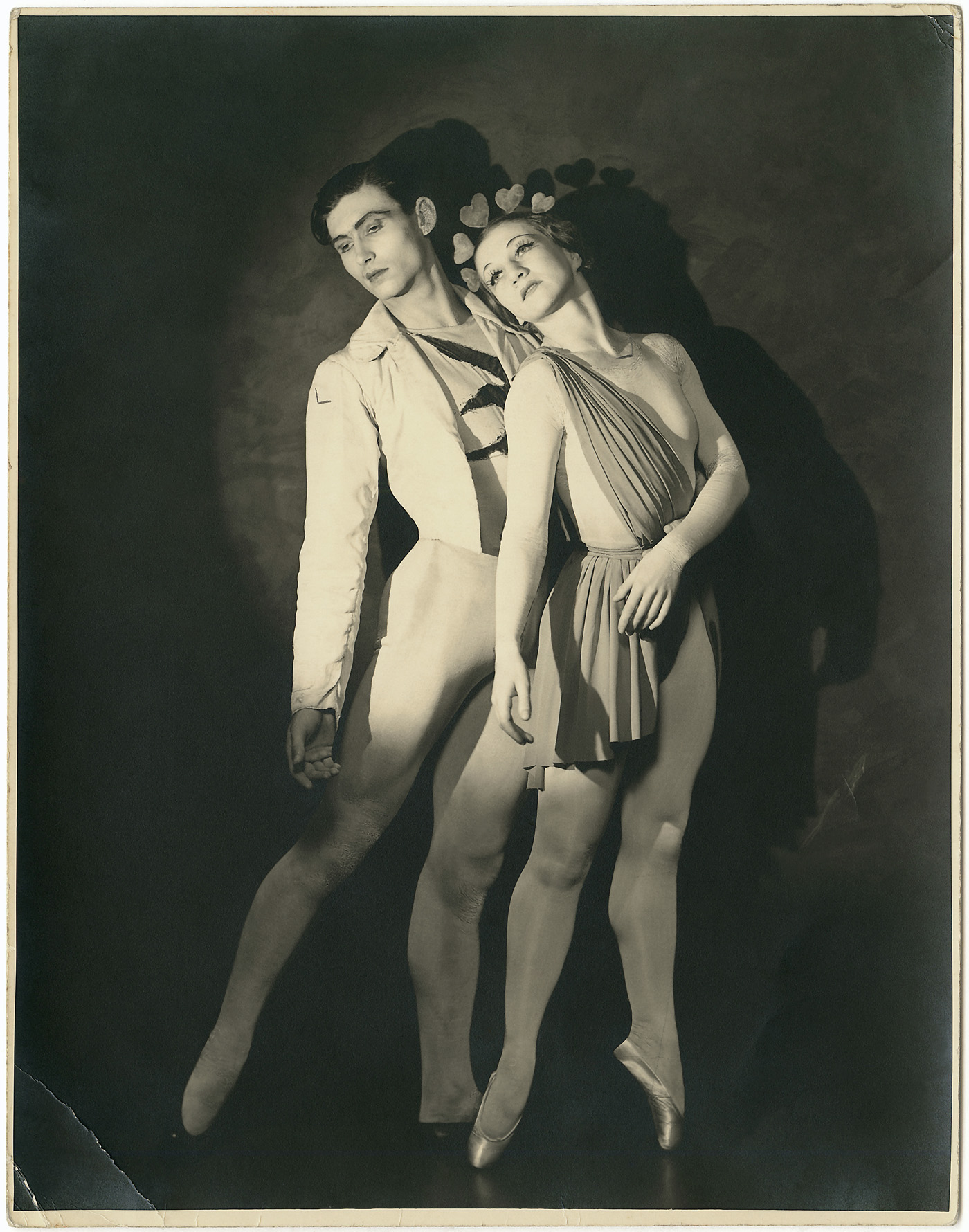
 

Jack Cato (Australia 1889-1971, England 1909-1914, South Africa 1914-1920) 'Helene Kirsova and Igor Youskevitch in Les Presages, Monte Carlo Russian Ballet' 1936-1937


Jack Cato (Australia 1889-1971, England 1909-1914, South Africa 1914-1920)
Helene Kirsova and Igor Youskevitch in Les Presages, Monte Carlo Russian Ballet
1936-1937
Gelatin silver photograph
24.8 x 19.4cm
Performing Arts Collection, Arts Centre, Melbourne
The Australian Ballet Collection
Gift of The Australian Ballet, 1998


Choreographed by Léonide Massine in 1933, Les Presages (Destiny) was a popular and avant-garde work during the Ballets Russes tours to Australia in 1936-1937. It was one of the first contemporary ballets to be choreographed to an existing musical score, Tchaikovsky’s Fifth Symphony. Portrayed in this picture are two principal dancers from the Monte Carlo Ballets Russes: Hélène Kirsova, who remained in Australia and formed her own ballet company in Sydney in the early 1940s, and Igor Youskevitch, who became a leading American ballet dancer, appearing here in the role of the Hero.


Evelyn Ippen (designer and maker active in Australia 1930s) 'Dress for Slavonic Dances' 1939


Evelyn Ippen designer and maker active in Australia 1930s
Dress for Slavonic Dances
1939
Cotton, silk (velvet) (appliqué), elastic, metal (zip) for a production of the Bodenwieser Ballet, choreographed by Gertrud Bodenwieser
Performing Arts Collection, Arts Centre, Melbourne
Bodenwieser Collection. Gift of Barbara Cuckson, 2000


The Slavonic Dances were choreographed by Gertrud Bodenwieser to represent what she described as the ‘vigour and passionate feelings of the Slavonic people’, and toured with her first company in Australia in 1939. Loosely using folk-dance motifs, this ensemble work would have been a stylish crowd-pleaser in contrast to more serious dances. The appliqué and colourful flower motifs on this dress are similar to designs by Natalia Goncharova for the Ballets Russes, although the simplified appeal of its ‘red bodice, long, swirling skirt, and gathered white sleeves’ were probably designed by one of the company dancers, Evelyn Ippen.


Max Dupain (Australia 1911-1992) 'Tamara Tchinarova in Presages' 1937


Max Dupain (Australian, 1911-1992)
Tamara Tchinarova in Presages
Published in Art in Australia, February 15, 1937
National Gallery of Victoria
Melbourne Shaw Research Library


Australia Tunes Into The World

These radios comprise a selection of Australian designed and manufactured tabletop models from the 1930s at a time when this new method of communication became an integral part of every home. They reflect the rapid spread of the streamlined style to Australia from the United States, England and Europe, where industrial designers applied machine-age styling to everyday household appliances. The use of new synthetic plastics (Bakelite) and mass production helped to make radios affordable for ordinary people, even in the depths of the Depression, and radio transmission brought the world into every Australian home. As cheap alternatives to the expensive wooden console in the lounge room, these small, portable radios allowed individual family members to listen to serials, quizzes and popular music in other rooms such as the kitchen, bedroom and verandah, as well as in the workplace.

Radios of the 1930s are now appreciated as quintessential examples of Art Deco styling, and one of the first expressions of art meeting industry. These colourful and elegant radio sets were one of the first pieces of modern styling in the Australian home. They were also a symbol of modern technology and a new future.


Installation view of Australian Art Deco radios from the exhibition 'Brave New World: Australia 1930s' at NGVA


Installation view of Australian Art Deco radios from the exhibition Brave New World: Australia 1930s at NGVA
Photo: Eugene Hyland


Airzone (1931) Ltd, Sydney (manufacturer) 'Mullard' 1938


Airzone (1931) Ltd, Sydney (manufacturer)
Mullard (white)
1938
Collection of Peter Sheridan and Jan Hatch

Airzone (1931) Ltd, Sydney (manufacturer)
Mullard (speckled green)
1938
Collection of Peter Sheridan and Jan Hatch

Airzone (1931) Ltd, Sydney (manufacturer)
Mullard (black)
1938
Collection of Peter Sheridan and Jan Hatch
Photo © Peter Sheridan


Amalgamated Wireless (Australasia) Ltd., Sydney (manufacturer) est. 1913 'AWA 'Egg crate' (various colours)' 1938


Amalgamated Wireless (Australasia) Ltd., Sydney (manufacturer) est. 1913
AWA ‘Egg crate’ (various colours)
1938
Bakelite
21.0 x 33.0 x 19.0cm (each)
Collection of Peter Sheridan and Jan Hatch
Photo © Peter Sheridan


Amalgamated Wireless (Australasia) Ltd., Sydney (manufacturer) est. 1913 'AWA Radiolette 'Empire State' and cigarette box (green)' 1934


Amalgamated Wireless (Australasia) Ltd., Sydney (manufacturer) est. 1913
AWA Radiolette ‘Empire State’ and cigarette box (green)
1934
Bakelite
(a) 28.0 x 27.0 x 15.0cm (radio) (b) 8.0 x 8.0 x 4.5cm (cigarette box)
Collection of Peter Sheridan and Jan Hatch
Photo © Peter Sheridan


Installation view of Australian Art Deco radios from the exhibition 'Brave New World: Australia 1930s' at NGVA

Installation view of Australian Art Deco radios from the exhibition 'Brave New World: Australia 1930s' at NGVA


Installation views of Australian Art Deco radios from the exhibition Brave New World: Australia 1930s at NGVA
Photos: Courtesy NGV Photographic Services


Sun and surf

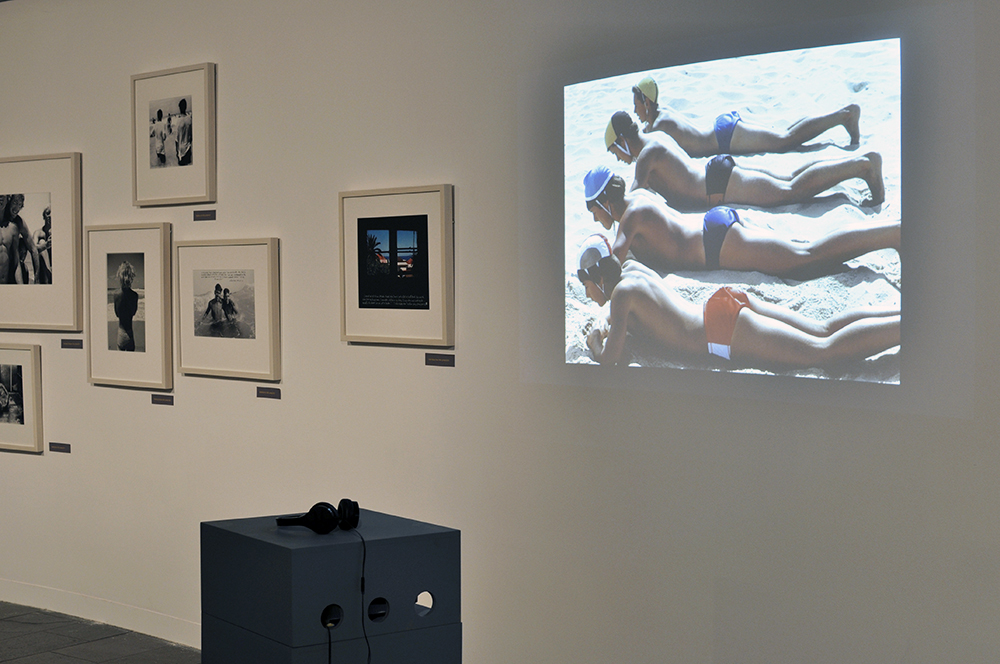
The beach was a complex location in the Australian creative imagination. It was a democratic site in which the trappings of wealth and position were abandoned as people stripped down to their bathers. It was a place of hedonistic pleasures that offered sensuous engagement with sun and surf, and a primitive landscape where natural forces restored the bodies of those depleted by modern life. It was a playground for the tourist that was considered distinctively Australian. As war loomed again in the late 1930s, it was also a pseudo-militaristic zone in which the lifesaver was honed for ‘battle’ in the surf.

The lifesavers that helped protect the beach-going public were regularly praised as physical exemplars who could build the eugenic stock of the nation. As the Second World War approached, the connection of these trained lifesavers to military servicemen also became painfully apparent.

Male lifesavers were used by artists in promoting Australia to tourists: a poster commemorating the opening of the Sydney Harbour Bridge in 1932 positioned the lifesaver as the quintessential representative of Australian manhood. Douglas Annand and Arthur Whitmore’s virile lifesaver proudly gestures towards the new bridge, his muscles as strong and protective as the steel girders that span the harbour.


Max Dupain (Australia 1911-1992) 'On the beach. Man, woman, boy' 1938


Max Dupain (Australian, 1911-1992)
On the beach. Man, woman, boy
1938
Gelatin silver photograph
39.2 x 47.2cm
National Gallery of Australia, Canberra
Purchased 1982


Showing a naked family on the beach, Max Dupain’s work is a perfect illustration of social concerns of the times. As Australia moved closer to engagement in another world war, fears about the poor physical fitness of the population were debated, with a ‘national fitness’ campaign instituted by the government in 1938. Dupain’s father, George, was one of the country’s first physical educationalists, opening the Dupain Institute of Physical Education and Medical Gymnastics in 1900 and writing extensively on the subject of health and fitness. Max Dupain attended the gym and was well versed in contemporary concerns about fitness.


Installation view of 'Brave New World: Australia 1930s' at NGVA


Installation view of the exhibition Brave New World: Australia 1930s at NGVA
Photo: Eugene Hyland


Installation view of 'Male lifesaver, window' and 'Female lifesaver, window' (both c. 1935)


Installation view of Male lifesaver, window and Female lifesaver, window (both c. 1935) from the exhibition Brave New World: Australia 1930s at NGVA
Photo: Dr Marcus Bunyan
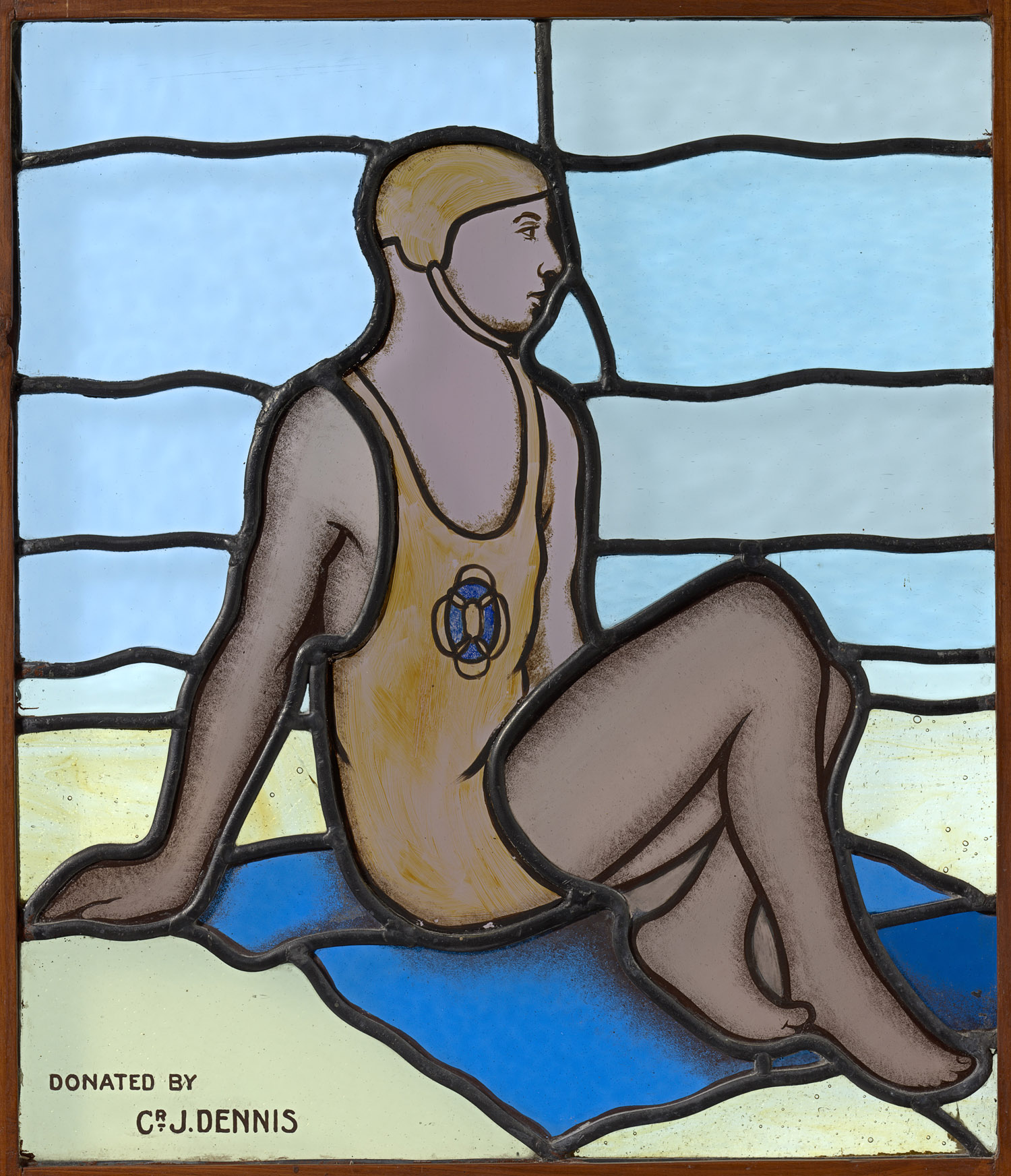
 

Unknown, Melbourne. 'Male lifesaver, window' c. 1935


Unknown, Melbourne
Male lifesaver, window
c. 1935
Stained glass, lead
47.5 x 40.8cm
Williamstown Swimming and Life Saving Club, Williamstown
Donated by C. J Dennis


‘On golden and milky sands, bodily excellence is displayed the year round, clearly defined by the sun in an atmosphere as viewless and benign as the air of Hellas as described by Euripides.’

J. S. Macdonald, 1931


Unknown, Melbourne. 'Female lifesaver, window' c. 1935


Unknown, Melbourne
Female lifesaver, window
c. 1935
Stained glass, lead
47.0 x 40.9cm
Williamstown Swimming and Life Saving Club, Williamstown
Donated by Councillor R. T. Bell


Although much was made of the ‘gods of the golden sand’, as one poet glowingly described lifesavers, lifesaving clubs were not entirely male in membership. Women lifesavers also made their mark, albeit in more limited numbers and with much less recognition. At the Williamstown Lifesaving Club in Melbourne a woman lifesaver was included in this fine and very rare stained glass window that, along with its counterpart featuring a male lifesaver, graced the newly established clubhouse around 1935.


Installation view of the exhibition 'Brave New World: Australia 1930s' at NGVA with the male and female lifesavers (centre); Max Dupain's 'The carnival at Bondi' (fourth from right); 'Sydney Bridge celebrations' (second right); and Douglas Annand and Max Dupain's 'Australia' (right)


Installation view of the exhibition Brave New World: Australia 1930s at NGVA with the male and female lifesavers (centre); Max Dupain’s The carnival at Bondi (fourth from right); Sydney Bridge celebrations (second right); and Douglas Annand and Max Dupain’s Australia (right)
Photo: Courtesy NGV Photographic Services
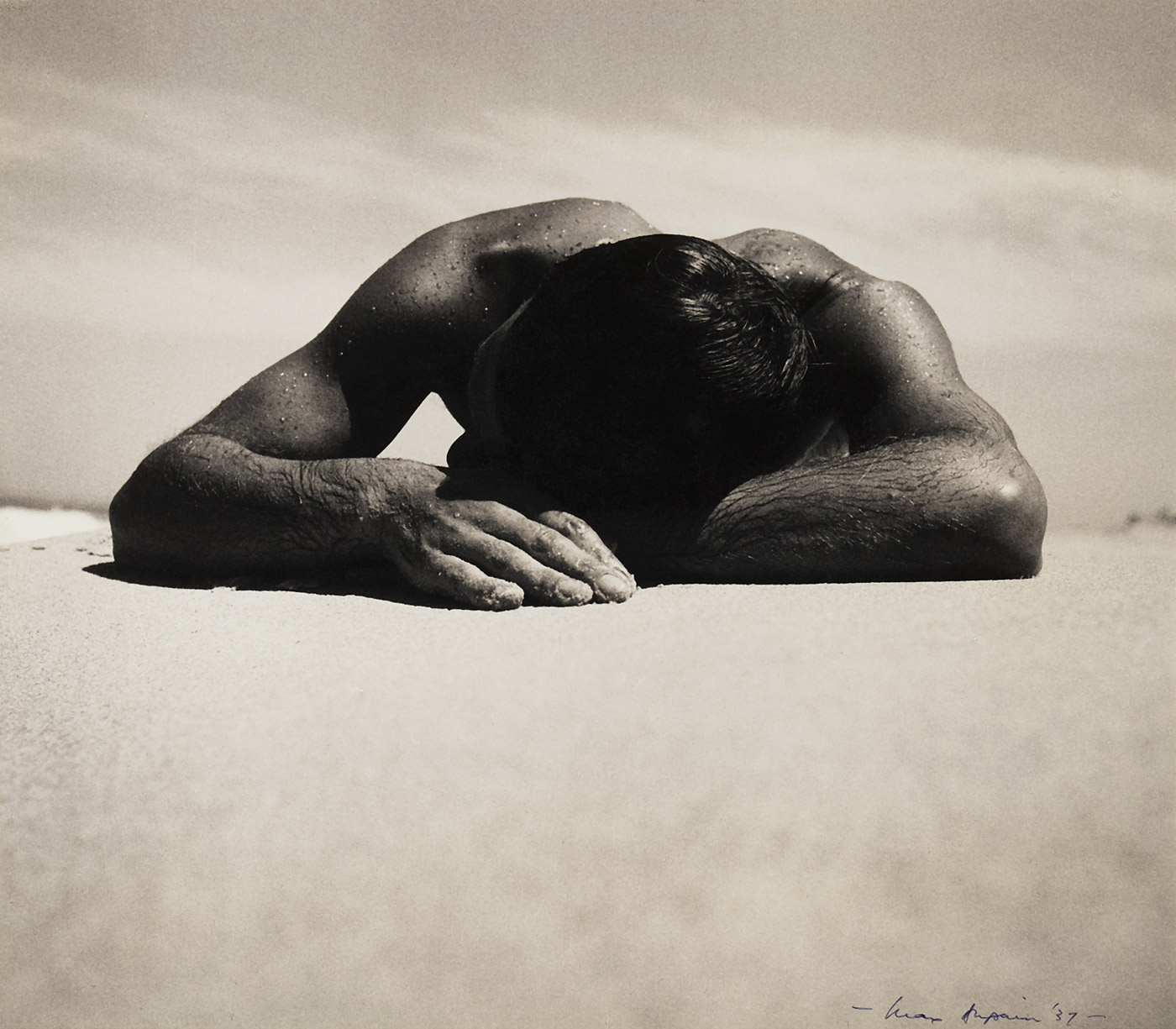
 

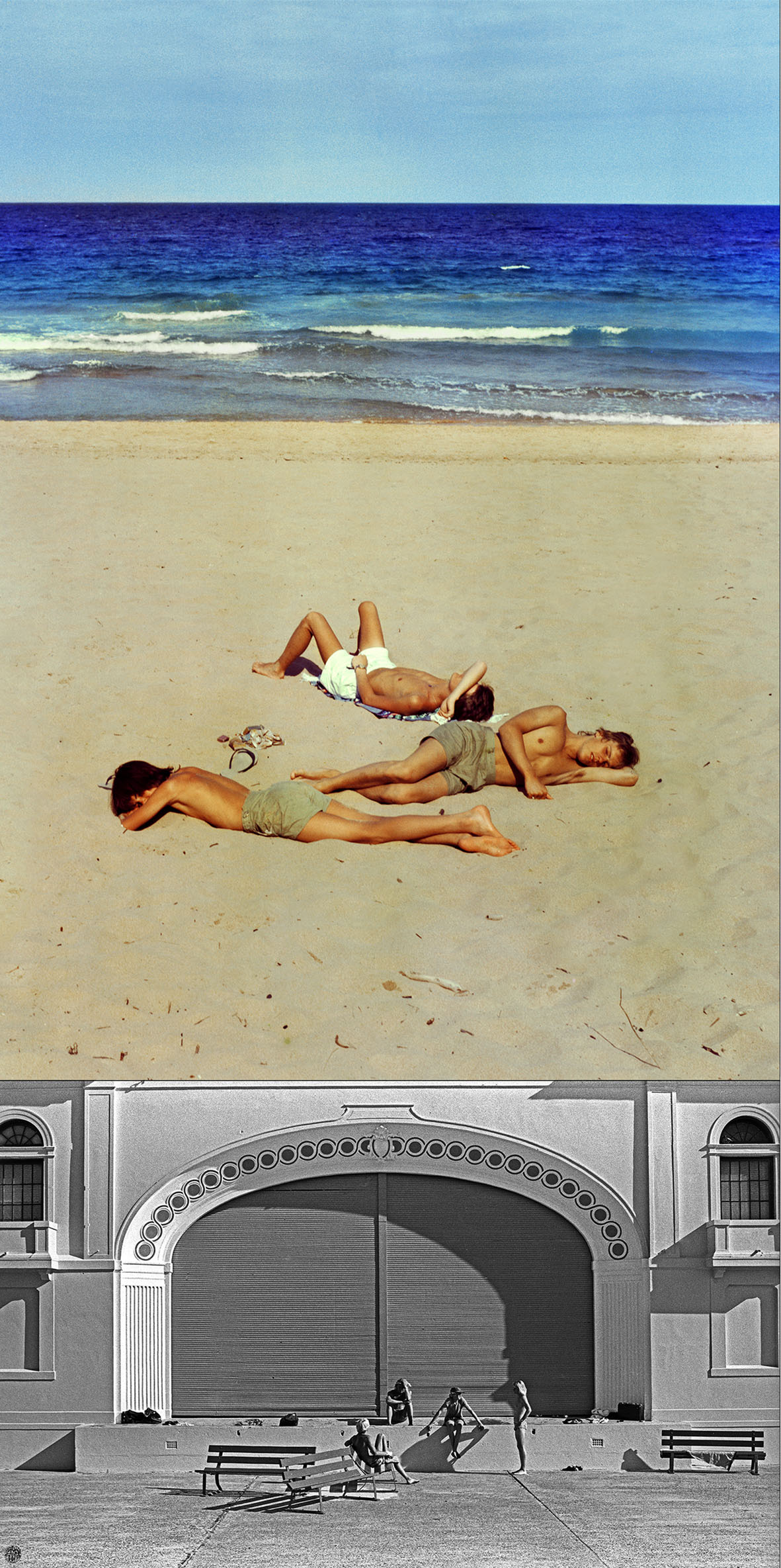
Max Dupain (Australian 1911-1992) 'Sunbaker' 1937


Max Dupain (Australian 1911-1992)
Sunbaker
(1938), dated 1937, printed c. 1975
Gelatin silver photograph
38.0 x 43.1cm
National Gallery of Victoria, Melbourne
Purchased with the assistance of the Visual Arts Board, 1976


Taken on a camping trip near Culburra, on the Shoalhaven River in New South Wales, in January 1938, Max Dupain’s original version of the Sunbaker was a much darker image that existed at the time only in an album gifted to his friend Chris Van Dyke. Dupain lost the original negative and printed this variant version in 1975 for an exhibition. It is an image that is now considered an icon in Australian photography, and has come to represent key values of the interest in ‘body culture’, celebrating health and fitness in the context of the beach.


Max Dupain (Australian, 1911-1992) 'The carnival at Bondi' 1938


Max Dupain (Australian, 1911-1992)
The carnival at Bondi
1938
Gelatin silver photograph
National Gallery of Australia, Canberra
Purchased 1982


‘The lifesaving teams … are splendid examples of the physique, resourcefulness and vitality of our youth and manhood. They are typical of the outdoor life which Australians lead and they are living testimonies to the value of surfing and the vigour and stamina of our race.’

DAILY EXAMINER, July 1935


Max Dupain (Australian, 1911-1992) 'Manly' 1938, printed c. 1986


Max Dupain (Australian, 1911-1992)
Manly
1938, printed c. 1986
Gelatin silver photograph
National Gallery of Victoria, Melbourne
Purchased from funds donated by Hallmark Cards Australia Pty Ltd, 1987
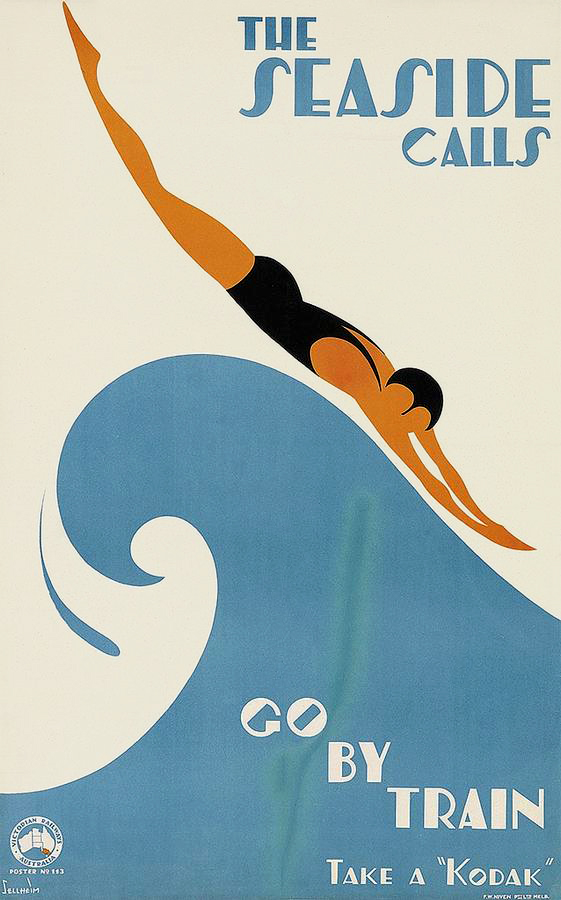
 

Gert Sellheim (Russia (of German parents) 1901-Australia 1970, Australia from 1926) 'The seaside calls - go by train - take a Kodak' 1930s


Gert Sellheim (Russia (of German parents) 1901 – Australia 1970, Australia from 1926)
The seaside calls – go by train – take a Kodak
1930s
Colour lithograph
Printed by F. W. Niven, Melbourne
State Library Victoria, Melbourne
Gift of Mr Grant Lee


Gert Sellheim was born to German parents in Estonia, at that time part of the Russian Empire. After studying architecture in Europe he travelled to Western Australia in 1926, before settling in Melbourne in 1931, where he began working as an industrial and commercial designer. Working for the Australian National Travel Association, Sellheim created a series of posters promoting beach holidays, which incorporated Art Deco motifs and typography. His most famous design is the flying kangaroo logo for Qantas, which he created in 1947.


Douglas Annand (Australian, 1903-1976) Arthur Whitmore (Australian, 1910-1965) 'Sydney Bridge celebrations' 1932


Douglas Annand (Australian, 1903-1976)
Arthur Whitmore (Australian, 1910-1965)
Sydney Bridge celebrations
1932
Colour lithograph
47.6 x 63.6cm (image and sheet)
Australian National Maritime Museum Purchased, 1991
© Courtesy of the artist’s estate


Douglas Annand (Australian, 1903-1976) Max Dupain (Australian, 1911-1992) 'Australia' c. 1937


Douglas Annand (Australian, 1903-1976)
Max Dupain (Australian, 1911-1992)
Australia
c. 1937
Colour and process lithograph
105.3 x 68.4cm (image and sheet)
Australian National Maritime Museum Purchased, 1991
© Courtesy of the artist’s estate


Douglas Annand (attributed to) (Australian, 1903-1976) 'Follow the sun - Australia's 150th Anniversary celebrations' 1938


Douglas Annand (attributed to) (Australian, 1903-1976)
Follow the sun – Australia’s 150th Anniversary celebrations
1938
Colour lithograph and photolithograph
Courtesy of Josef Lebovic Gallery, Sydney


The 1930s were the heyday of the travel poster. Posters were commissioned by railway and tourism groups or shipping companies and airlines to promote Australian holiday destinations, both at home and overseas. The Australian National Travel Association was formed in 1929 to promote Australia to overseas markets. As part of its strategy it commissioned posters from leading graphic artists, such as Percy Trompf, James Northfield and Douglas Annand. From the late 1920s Australia began to actively promote itself to the world by using the beach, sun and surf as motifs.


Installation view of the exhibition 'Brave New World: Australia 1930s' at NGVA with the work of John Rowell, Hilda Rix Nicholas, Gert Sellheim and Percy Trompf on the far wall, and Robert E. Coates 'Photographs of Australian Pavilion at New York World's Fair' (1939) on the projector screen at left

Installation view of the exhibition 'Brave New World: Australia 1930s' at NGVA with the work of John Rowell, Hilda Rix Nicholas, Gert Sellheim and Percy Trompf on the far wall, and Robert E. Coates 'Photographs of Australian Pavilion at New York World's Fair' (1939) on the projector screen at left


Installation views of the exhibition Brave New World: Australia 1930s at NGVA with the work of John Rowell, Hilda Rix Nicholas, Gert Sellheim and Percy Trompf on the far wall, and Robert E. Coates Photographs of Australian Pavilion at New York World’s Fair (1939) on the projector screen at left
Photos: Courtesy NGV Photographic Services


The Australian Pavilion at the New York World’s Fair projected an image of Australia as a young and healthy nation, a place of industry, sport and tourism. Designed by John Oldham of Sydney architectural firm Stephenson & Turner, the modern design of the building was complemented by Douglas Annand’s interior displays featuring the latest graphic design, and audio-visual and photomontage techniques. These photographs of the Australian Pavilion at the New York World’s Fair were taken by commercial photographer Robert E. Coates.


Installation view of Robert E. Coates' 'Photographs of Australian Pavilion at New York World's Fair' (1939)

Installation view of Robert E. Coates' 'Photographs of Australian Pavilion at New York World's Fair' (1939)

Installation view of Robert E. Coates' 'Photographs of Australian Pavilion at New York World's Fair' (1939)

Installation view of Robert E. Coates' 'Photographs of Australian Pavilion at New York World's Fair' (1939)

Installation view of Robert E. Coates' 'Photographs of Australian Pavilion at New York World's Fair' (1939)


Installation views of Robert E. Coates’ Photographs of Australian Pavilion at New York World’s Fair (1939) (digital images, looped)
Photos: Dr Marcus Bunyan


Pastoral landscapes

Along with the beach, another national myth evolved around the Australian bush. Although most Australians lived in cities, in the years following the First World War the nation became increasingly informed by a mythology centred on the bush and the landscape. For those who considered the modern city a profoundly depleting force, the bush was a touchstone of traditional ‘values’. It was nostalgically conceived of as an idyllic natural realm whose soil, literally and metaphorically, sustained its people. Both the classical Pastoral ideal of a land in which only sheep and cattle roam, and the Georgic tradition, which celebrated the achievements of agriculture, became dominant themes in landscape art.

Pastoral landscapes were admired above all as representing the antithesis of ‘decadent’ modern life. As art critic and gallery director J. S. Macdonald wrote, such art would ‘point the way in which life should be lived in Australia, with the maximum of flocks and the minimum of factories’. With their emphasis on farming and pastoral industries, such works affirmed white landownership, with Indigenous people largely absent.


John Rowell (Australian, 1894-1973) 'Blue hills' c. 1936


John Rowell (Australian, 1894-1973)
Blue hills
c. 1936
Oil on canvas
National Gallery of Victoria, Melbourne Felton Bequest, 1936


Gert Sellheim (Russia (of German parents) 1901-Australia 1970, Australia from 1926) 'Spring in the Grampians' 1930s


Gert Sellheim (Russia (of German parents) 1901 – Australia 1970, Australia from 1926)
Spring in the Grampians
1930s
Colour photolithograph
State Library Victoria, Melbourne
Purchased 2000


Hilda Rix Nicholas (Australian, 1884-1961, Europe 1911-1918) 'The fair musterer' c. 1935


Hilda Rix Nicholas (Australian, 1884-1961, Europe 1911-1918)
The fair musterer
c. 1935
Oil on canvas
Queensland Art Gallery, Brisbane
Purchased 1971


As a young artist Hilda Rix Nicholas had a successful career in France before returning to Australia after the First World War. In 1934, several years after the birth of her son, Rix Nicholas returned to painting and depicted her new life living on the family property Knockalong, on the Monaro Plains in New South Wales. Depicting the governess of her young son holding the reins of her horse, dog at her feet, and sheep in the distance, in The fair musterer Rix Nicholas claims for women an active role in the masculine world of pastoral Australia.
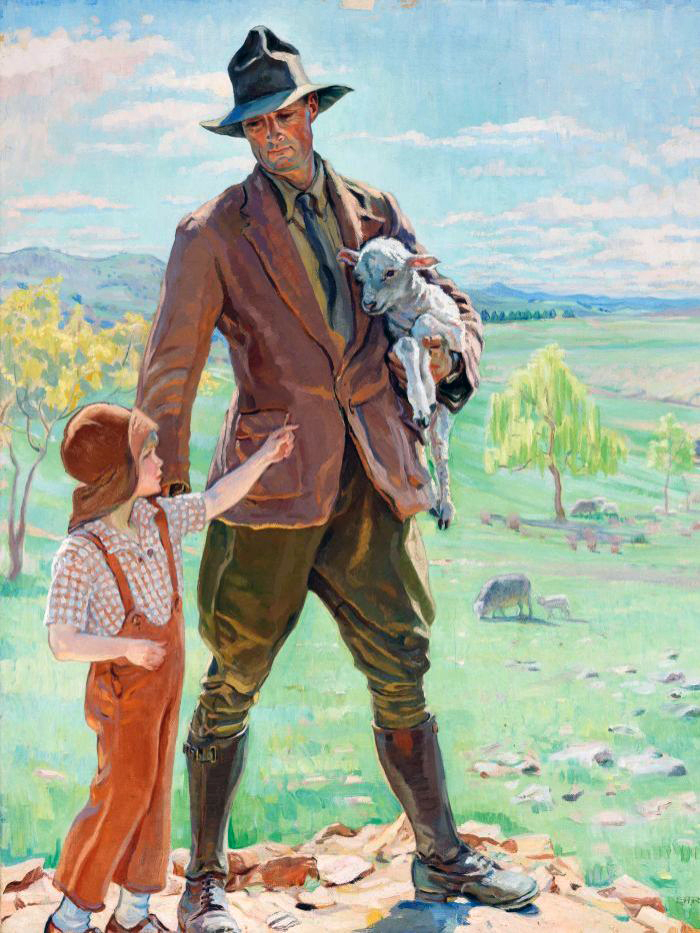
 

Hilda Rix Nicholas (Australian, 1884-1961, Europe 1911-1918) 'The shepherd of Knockalong' 1933


Hilda Rix Nicholas (Australian, 1884-1961, Europe 1911-1918)
The shepherd of Knockalong
1933
Oil on canvas
Collection of Peter Rix, Sydney
Courtesy of Deutscher & Hackett


Depicting the artist’s husband and young son, The shepherd of Knockalong is a reminder of the traditional importance of the wool industry to the nation’s economy. With his legs firmly connected to the ground and pictured as a large figure dominating the landscape setting, the farmer is the benign owner and ‘shepherd’ of the land spreading out behind him, the presence of his young son ensuring dynastic succession. At a time when Aboriginal people were confined to reservations and denied citizenship, Hilda Rix Nicholas’s painting can also be considered as an assertion of the British colonisers’ right to ownership of Australia.


Percy Trompf (Australian, 1902-1964) 'Western Australia' c. 1936


Percy Trompf (Australian, 1902-1964)
Western Australia
c. 1936
Colour lithograph
Courtesy of Josef Lebovic Gallery, Sydney


Indigenous art and culture

During the 1930s Aboriginal people were often pejoratively referred to as a ‘dying race’. The Australian Government continued to enforce a ‘divide and rule’ assimilationist policy. Determined by eugenics, this entailed removing Aboriginal people of mixed descent from their families and reserves, and absorbing them into the dominant society, with consequent loss of their own language and customary ritual practices. Increasingly during this period, Aboriginal people formed their own organisations and agitated for full citizenship rights.

This was also a decade that saw increasing awareness of, and interest in, Indigenous art. Albert Namatjira astonished Melbourne audiences at his first solo exhibition at the Athenaeum Gallery in 1938. Comprising forty-one watercolour paintings, all of his works sold within three days of the opening. The following year the Art Gallery of South Australia purchased one of Namatjira’s works. Indigenous art also inspired non-Indigenous artists, including Margaret Preston and Frances Derham who appropriated design elements in their works. The idea of ‘Aboriginalism’, in which settlers sought an Australian identity in the context of Britishness and the Empire, saw artists travelling to the outback to paint and sketch subjects they believed connected them to Indigenous history.


Frances Derham (Australian, 1894–1987, New Zealand and Ireland 1902-1908) Kangaroo and 'Aboriginal motifs' 1925-1940


Frances Derham (Australian, 1894-1987, New Zealand and Ireland 1902-1908)
Kangaroo and Aboriginal motifs
1925-1940
Linocut printed in brown ink on buff paper
4.6 x 7.3cm (image) 12.6 x 10.3cm (sheet)
National Gallery of Victoria, Melbourne
Gift of Mr Richard Hodgson Derham, 1988
© Estate of Frances Derham


Best known as a progressive educator and advocate of children’s art, Frances Derham was also an active member of the Arts and Crafts Society of Victoria, and with potter Allan Lowe shared Margaret Preston’s interest in the appropriation of Indigenous art. From the mid 1920s Derham began to incorporate Aboriginal motifs into her linocuts and in 1929, synchronous with the exhibition Australian Aboriginal Art at the Museum of Victoria, Derham presented a lecture to the Arts and Crafts Society, entitled ‘The Interest of Aboriginal Art to the Modern Designer’.


Frances Derham (Australian, 1894-1987, New Zealand and Ireland 1902-1908) 'Kangaroo (at the zoo)' c. 1931


Frances Derham (Australian, 1894-1987, New Zealand and Ireland 1902-1908)
Kangaroo (at the zoo)
c. 1931
Linocut printed in brown ink on Chinese paper
National Gallery of Victoria, Melbourne
Gift of Mr Richard Hodgson Derham, 1988


Frances Derham (Australian, 1894-1987, New Zealand and Ireland 1902-1908) 'The Aboriginal artist' 1931


Frances Derham (Australia 1894-1987, New Zealand and Ireland 1902-1908)
The Aboriginal artist
1931
Colour linocut on Japanese paper
National Gallery of Victoria, Melbourne
Gift of Mr Richard Hodgson Derham, 1988
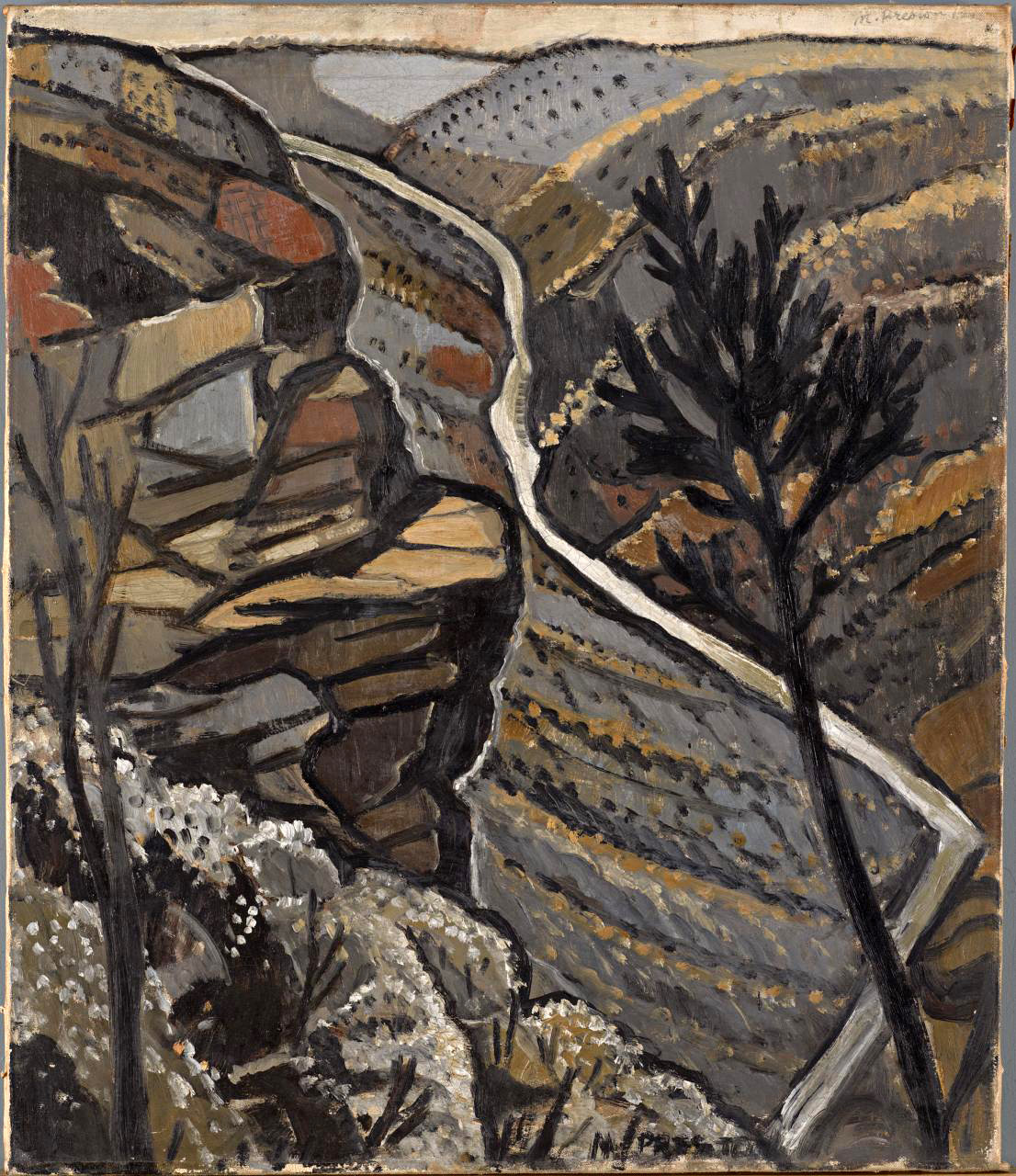
 

Margaret Preston (Australian, 1875-1963, Germany and France 1904-1907, France, England and Ireland 1912-1919) 'Shoalhaven Gorge, New South Wales' 1940-1941


Margaret Preston (Australia 1875-1963, Germany and France 1904-1907, France, England and Ireland 1912-1919)
Shoalhaven Gorge, New South Wales
1940-1941
Oil and gouache on canvas
53.7 x 45.8cm
National Gallery of Victoria, Melbourne
Purchased with funds donated from the Estate of Dr Donald Wright, 2008
© Margaret Preston/Licensed by VISCOPY, Australia


During the 1920s Margaret Preston considered Aboriginal art a source of good design in the decoration of household items. In the 1930s her study of Aboriginal culture intensified, as she developed a greater interest in its anthropological and cosmological elements. In 1940 Preston travelled to the Northern Territory to study Aboriginal art. On her return she developed a more explicit Aboriginal style in paintings featuring earthy tones, strong black outlines and patterns of dots and lines.


Unknown Walamangu active (1930s) 'Dhukurra dhaawu (Sacred clan story)' c. 1935


Unknown
Walamangu active (1930s)
Dhukurra dhaawu (Sacred clan story)
c. 1935
Earth pigments on Stringybark (Eucalyptus sp.), resin
128.3 x 63.9cm
The Donald Thomson Collection
Donated by Mrs Dorita Thomson to the University of Melbourne and on loan to Museums Victoria, Melbourne


During the late nineteenth and early twentieth centuries, segregation was the main government policy regarding Aboriginal people. It was re-enforced by the 1909 Aborigines Protection Act, which gave the Aborigines Protection Board the power to control where Aboriginal people lived in New South Wales. In 1937 the Commonwealth Government adopted a policy of assimilation, whereby Aboriginal people of mixed descent were henceforth to be assimilated into white society, while others were confined to reserves. In 1931 Arnhem Land was declared an Aboriginal Reserve by the government and non-Indigenous entry into the region was restricted.


Tjam Yilkari Katani Liyagalawumirr active 1930s 'Wagilag dhaawu (Wagilag Sisters story)' 1937


Tjam Yilkari Katani
Liyagalawumirr active 1930s
Wagilag dhaawu (Wagilag Sisters story) (installation view)
1937
Earth pigments on Stringybark (Eucalyptus sp.)
The Donald Thomson Collection Donated by Mrs Dorita Thomson to the University of Melbourne and on loan to Museums Victoria, Melbourne
Photo: Dr Marcus Bunyan


For Yolgnu people, painting on bark or objects is intimately connected with painting on the body, and the Yolgnu term barrawan means both ‘skin’ and ‘bark’. These paintings are transcriptions of the sacred designs that were painted onto men’s bodies and convey the power of the Yolgnu ancestors whose actions created their world. The Wagilag Sisters Dreaming story chronicles the creative acts of the sisters as they travelled across Arnhem Land. Such stories pass on important knowledge, cultural values and belief systems to later generations.


Arthur Murch (Australian, 1902-1989, Europe 1936-1940) 'Walila, Pintupi tribe' 1934


Arthur Murch (Australian, 1902-1989, Europe 1936-1940)
Walila, Pintupi tribe
1934
Pencil
National Gallery of Victoria, Melbourne
Purchased, 1934


In 1933, on the invitation of Professor H. Whitridge Davies, Sydney artist Arthur Murch accompanied a research team from Sydney University to Hermannsburg Lutheran Mission, south-west of Alice Springs. Murch remained there for six weeks painting the landscapes and making portraits of Indigenous people. These were exhibited in Sydney soon after his return.
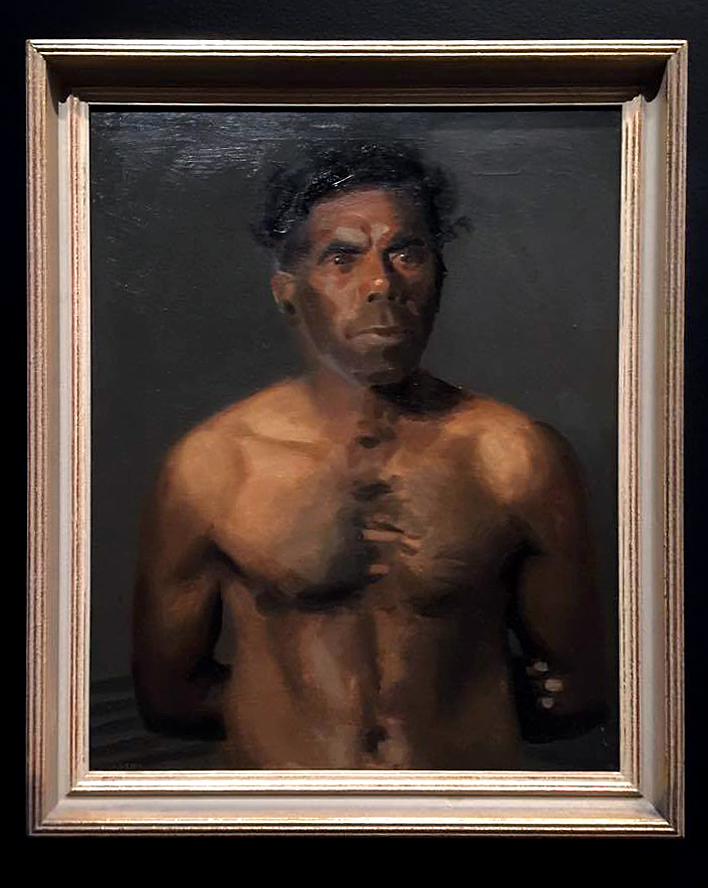
 

Percy Leason (Australia 1888-United States 1959, United States from 1938) 'Thomas Foster' (installation view) 1934


Percy Leason (Australia 1888 – United States 1959, United States from 1938)
Thomas Foster (installation view)
1934
Oil on canvas
State Library Victoria, Melbourne
Gift of Mrs Isabelle Leason, 1969
Photo: Dr Marcus Bunyan


Thomas Foster was born at Coranderrk Station in 1882, the son of Edward Foster and Betsy Benfield. Foster’s was one of the last portraits painted by Leason as part of the unfortunately titled exhibition The Last of the Victorian Aborigines. These portraits were debuted on 11 September at the Athenaeum Gallery in Collins Street, Melbourne, to great public acclaim. Foster, like most of Leason’s subjects, appears shirtless, his arms folded behind his back, pushing forward his chest and clearly showing his scarification marks.


Gert Sellheim (Russia (of German parents) 1901 - Australia 1970, Australia from 1926) 'Corroboree Australia' 1934


Gert Sellheim (Russia (of German parents) 1901 – Australia 1970, Australia from 1926)
Corroboree Australia
1934
Colour lithograph printed by F. W. Niven, Melbourne
State Library Victoria, Melbourne
Gift of the Australian National Travel Association, 1934


Dystopian cities

Australia was hit hard by the Great Depression. The worst year was 1932, when unemployment reached nearly thirty-two per cent, and by the following year almost a third of all unemployed men had been without work for three years. With wages cut and unemployment rising, many families were left struggling to survive and this poverty was most evident in run-down, inner-city areas. Two émigrés, Danila Vassilieff and Yosl Bergner, were the first Australian artists to turn their attention to the plight of the urban poor and the disposed. Their powerful, expressive style was influential upon young artists, including Arthur Boyd and Albert Tucker.

Economic hardship fostered bitterness and political unrest, and membership of radical groups on both the left and right increased. Boundaries between political agendas and art production became porous in this decade, and many artists believed, like Bergner, ‘that by painting we would change the world’. The complex enmeshment of the creative and political became a defining feature of the decade, and art in Australia became increasingly political, with the political realm involving itself with art.

By the end of the decade the worsening political situation overseas and a sense that another world war was inevitable contributed to a growing sense of unease. Many artists expressed this anxiety and foreboding in their works.
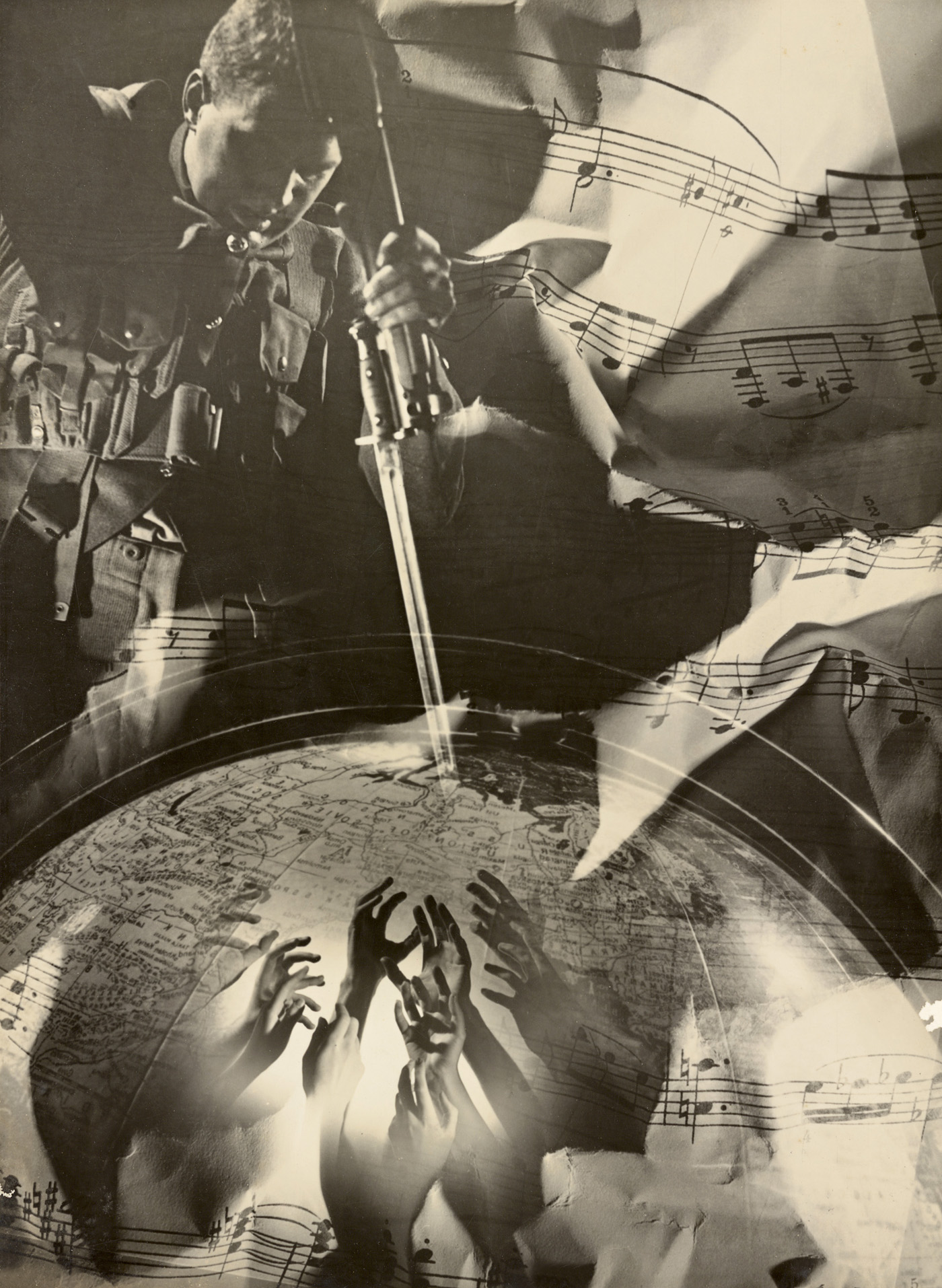
 

Laurence Le Guay (Australian, 1917-1990) 'No title (War montage with globe)' c. 1939


Laurence Le Guay (Australian, 1917-1990)
No title (War montage with globe)
c. 1939
Gelatin silver photograph
30.4 x 24.9cm
National Gallery of Victoria, Melbourne
Purchased through the NGV Foundation with the assistance of Mrs Mem Kirby, Fellow, 2001


Max Dupain (Australian, 1911-1992) 'Hot rhythm!' 1936


Max Dupain (Australian, 1911-1992)
Hot rhythm!
1936
Silver gelatin photograph
24.7 x 17.8cm
National Gallery of Victoria, Melbourne
William Kimpton Bequest, 2016


In this work, Max Dupain has the shadow of a slide trombone seemingly bisect the naked body of a woman in a photograph that, in the context of his known views, is less an erotic celebration of modern jazz culture and nightlife than a comment on the disruptive nature of modernity.


Max Dupain (Australian, 1911-1992) 'Doom of youth' 1937


Max Dupain (Australian, 1911-1992)
Doom of youth
1937
Gelatin silver photograph
National Gallery of Australia, Canberra
Purchased 1982


In Doom of youth – a title taken from Wyndham Lewis’s 1932 polemical book of the same name – Max Dupain creates an allegorical photograph in which a naked male body represents his vision of modern Australia. Using symbols that suggest disempowerment, Dupain implies that the flywheel of mechanisation has doomed youth (the representatives of a nation’s future) to a bleak fate.


Max Dupain (Australian, 1911-1992) 'Night with her train of stars and her gift of sleep' 1936-1937


Max Dupain (Australian, 1911-1992)
Night with her train of stars and her gift of sleep
1936-1937
Gelatin silver photograph
National Gallery of Victoria, Melbourne
William Kimpton Bequest, 2016


Referring to Edward Hughes’s 1912 Symbolist work of the same name, Max Dupain has replaced the painter’s dark-winged goddess of the night, who tries to calm the putti (or ‘stars’) that cling to her, with an updated modern version in which city lights replace starlight. The symbolism of the giant breast that towers over the electric lights of the urban landscape suggests an inversion of the natural for the man-made. The personification of night refers to the Greek goddess Nyx, a powerful force born of Chaos, and the mother of children including Sleep, Death and Pain. Given his often gloomy assessment of modernity, Dupain’s invocation of Nyx seems appropriate in the context.


Installation view of the exhibition 'Brave New World: Australia 1930s' at NGVA with Herbert Badham's 'Paint and morning tea' second left and Albert Tucker's 'Self-portrait' third from right

Installation view of the exhibition 'Brave New World: Australia 1930s' at NGVA with Herbert Badham's 'Paint and morning tea' second left and Albert Tucker's 'Self-portrait' third from right


Installation views of the exhibition Brave New World: Australia 1930s at NGVA with Herbert Badham’s Paint and morning tea second left and Albert Tucker’s Self-portrait third from right
Photos: Courtesy NGV Photographic Services
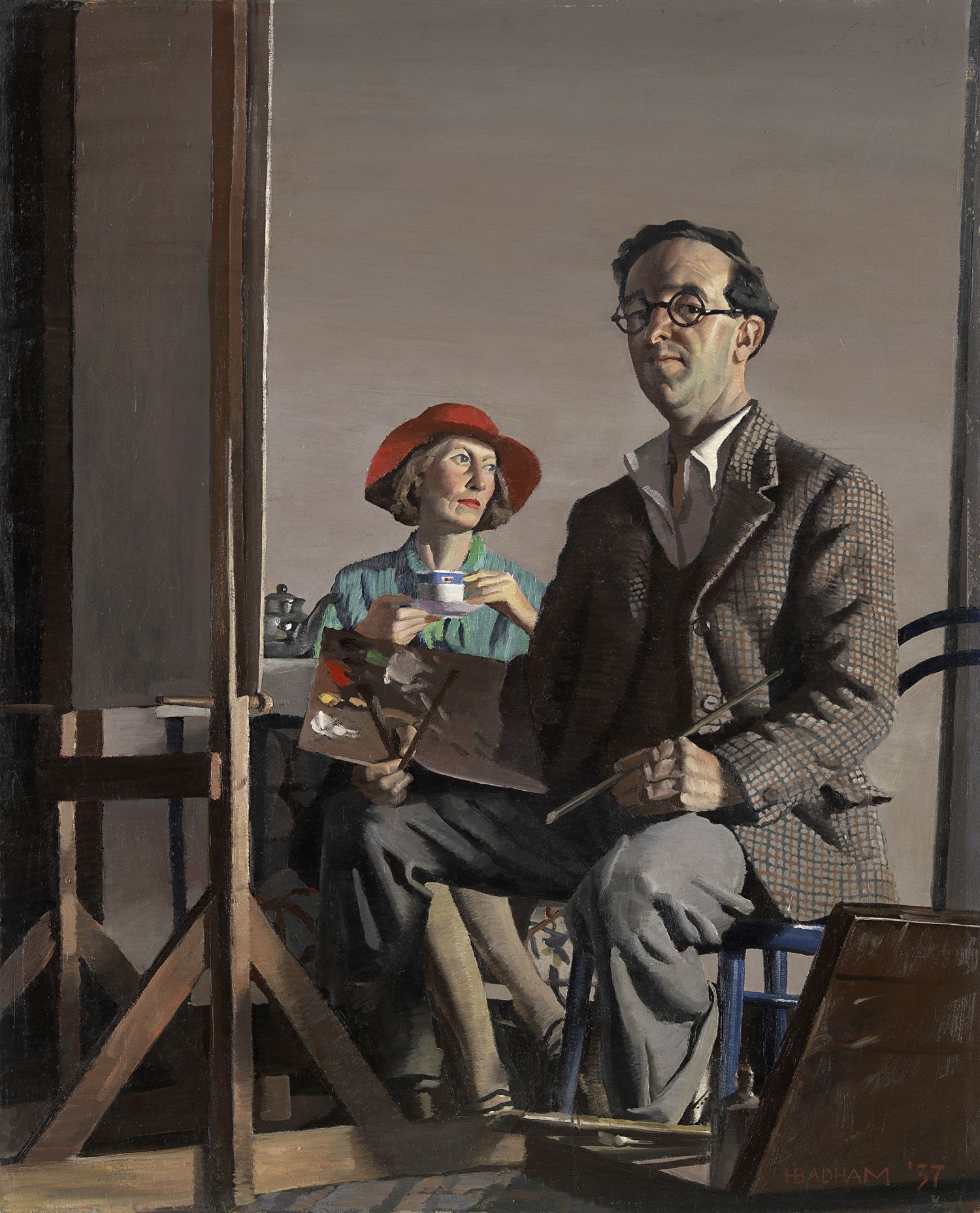
 

Herbert Badham (Australian, 1899-1961) 'Paint and morning tea' 1937


Herbert Badham (Australian, 1899-1961)
Paint and morning tea
1937
Oil on cardboard
75.6 x 71.5cm
National Gallery of Victoria, Melbourne Felton Bequest, 1937
© The Estate of Herbert Badham


Installation view of the exhibition 'Brave New World: Australia 1930s' at NGVA with Albert Tucker's 'Self-portrait' (1937) at left


Installation view of the exhibition Brave New World: Australia 1930s at NGVA with Albert Tucker’s Self-portrait (1937) at left
Photo: Eugene Hyland


Installation view of Albert Tucker's 'Self-portrait' from the exhibition 'Brave New World: Australia 1930s' at NGVA


Installation view of Albert Tucker’s Self-portrait (1937) from the exhibition Brave New World: Australia 1930s at NGVA
Photo: Dr Marcus Bunyan


In the late 1930s Albert Tucker’s contact with émigré artists Yosl Bergner and Danila Vassilieff was to provide important encouragement for him to pursue his artistic vocation and to make art that was responsive to the issues of his time. In 1938 Tucker was a founding member of the Contemporary Art Society, and he became one of the most articulate voices in the often bitter debates between modernists and conservatives. In the 1940s, together with his partner Joy Hester, Tucker was a key member of the group of artists and writers that formed around John and Sunday Reed at Heide.

From 1936 until the early 1940s Albert Tucker chronicled himself with numerous painted and drawn self-portraits. In these works we witness a harrowing disintegration of his physical self, which mirrored the artist’s overwrought emotional state. He recalled: ‘It was a period when the whole world, and all the people I knew, seemed to be seething with ideas and energies and experiences; and my own mind was a seething mess … The highly emotional, overwrought expressionist paintings suited my state at the time’.


Installation view of the exhibition 'Brave New World: Australia 1930s' at NGVA with work by Danila Vassilieff on the centre black wall including 'Street scene with graffiti' (left), 'Truth, Woolloomooloo' (second left) and 'Young girl (Shirley)' the large painting at right; and F. Oswald Barnett's photographs of Melbourne slums in the display cabinet


Installation view of the exhibition Brave New World: Australia 1930s at NGVA with work by Danila Vassilieff on the centre black wall including Street scene with graffiti (left), Truth, Woolloomooloo (second left) and Young girl (Shirley) the large painting at right; and F. Oswald Barnett’s photographs of Melbourne slums in the display cabinet
Photos: Courtesy NGV Photographic Services


Danila Vassilieff (Russia 1897-Australia 1958, Australia from 1923, Central and South America, Europe, England 1929-1934) 'Street scene with graffiti' 1938


Installation view of Danila Vassilieff ‘s Street scene with graffiti (1938) from the exhibition Brave New World: Australia 1930s at NGVA
Photo: Dr Marcus Bunyan
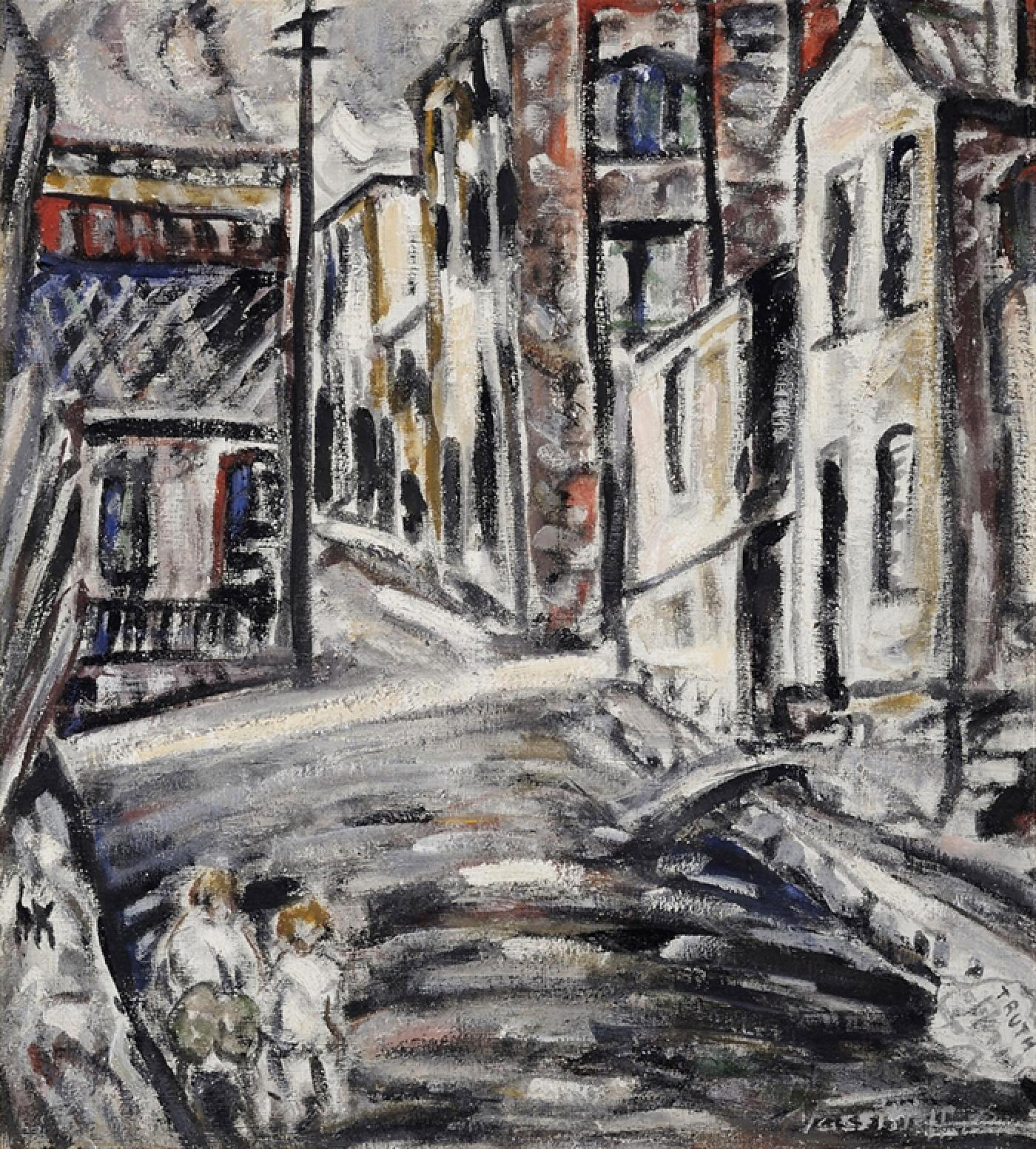
 

Danila Vassilieff (Russia 1897-Australia 1958, Australia from 1923, Central and South America, Europe, England 1929-1934) 'Truth, Woolloomooloo' 1936


Danila Vassilieff (Russia 1897 – Australia 1958, Australia from 1923, Central and South America, Europe, England 1929-1934)
Truth, Woolloomooloo
1936
Oil on canvas
Private collection


It is notable that the first artists to depict the poverty of inner-city slums were two recently arrived émigrés, Danila Vassilieff and Yosl Bergner. Russian-born Vassilieff, who had fought with the white Russian army, first arrived in Australia in 1923 before leaving again in 1929. On his return in 1935 he painted a series of dark streetscapes, depicting the inner suburban areas of Woolloomooloo and Surry Hills in Sydney. Moving to Melbourne, Vassilieff’s expressionist style influenced many young artists, including Lina Bryans, Albert Tucker, Arthur Boyd and Sidney Nolan.


Danila Vassilieff (Russia 1897-Australia 1958, Australia from 1923, Central and South America, Europe, England 1929-1934) 'Young girl (Shirley)' 1937


Danila Vassilieff (Russia 1897 – Australia 1958, Australia from 1923, Central and South America, Europe, England 1929-1934)
Young girl (Shirley)
1937
Oil on canvas on composition board
National Gallery of Victoria, Melbourne
National Gallery Society of Victoria Century Fund, 1984

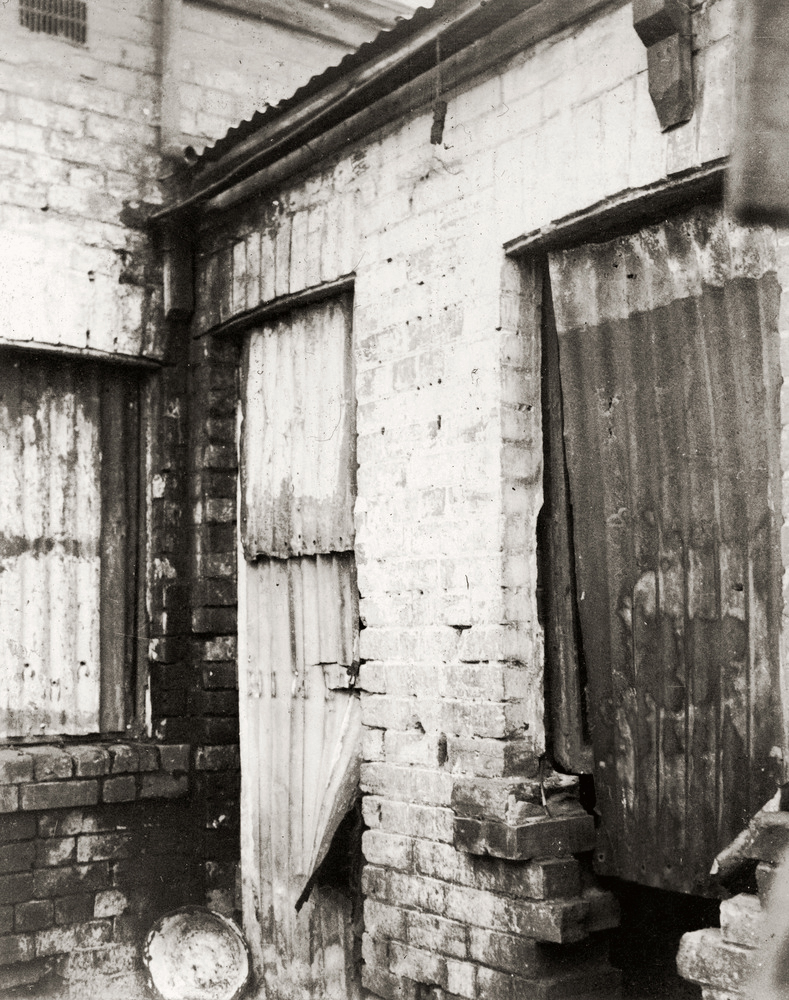
 

F. Oswald Barnett (Australian, 1883-1972) 'Fitzroy. View from the Brotherhood of St Lawrence'

F. Oswald Barnett (Australian, 1883-1972) 'Fitzroy. Rear view of house'

F. Oswald Barnett (Australian, 1883-1972) 'North Melbourne. Group of children in Erskine Place'

F. Oswald Barnett (Australian, 1883-1972) 'West Melbourne. A Dudley Mansion'

F. Oswald Barnett (Australian, 1883-1972) 'Carlton. Wash-house and bath-room 48 Palmerston Street'

F. Oswald Barnett (Australian, 1883-1972) 'North Melbourne. No. 19 Byron Street'

F. Oswald Barnett. 'West Melbourne rubbish tip'


F. Oswald Barnett (Australian, 1883-1972)

Fitzroy. View from the Brotherhood of St Lawrence
Fitzroy. Rear view of house
North Melbourne. Group of children in Erskine Place
West Melbourne. A Dudley Mansion
Carlton. Wash-house and bath-room, 48 Palmerston Street
North Melbourne. No. 19 Byron Street
West Melbourne rubbish tip

c. 1930 – c. 1935
Gelatin silver photograph and typewriting on card
State Library Victoria, Melbourne
F. Oswald Barnett Collection
Gift of Department of Human Services, Victoria 2001


One of the most visible and lasting effects of the Great Depression was the housing crisis in the poor working class areas of Melbourne and Sydney. Many of the nineteenth-century houses had fallen into disrepair, overcrowding was endemic and a great number of families lived in squalid and unhealthy conditions. Throughout the decade ‘slum’ abolition movements in Melbourne and Sydney ran public campaigns to place public housing on the political agenda, leading to the creation of the first state Housing Commissions.

In Melbourne, Methodist layman F. Oswald Barnett led a campaign calling for slum demolition and the rehousing of residents in government-financed housing. He took hundreds of photographs that were used in public lectures and to illustrate the 1937 report of the Housing Investigation and Slum Abolition Board. This led to the creation of the Housing Commission of Victoria in 1938, with its first major project being the Garden City estate at Fishermans Bend. In Sydney a similar campaign led to the Housing Improvement Act of 1936 and the construction of the first fifty-six home units at Erskineville. (NGV)

The photographs in the F. Oswald Barnett Collection were taken by Barnett and other unidentified photographers in the 1930s. Many of them were used to illustrate a government report on slum housing and/or made into lantern slides for lectures in a public campaign.  F. Oswald Barnett was born in Brunswick, Victoria. A committed Methodist and housing reformer, he led a crusade against Melbourne’s inner city slums. In 1936 he was appointed to the Slum Abolition Board and from 1938-1948 he was the vice-chair of the Housing Commission. In this position he attempted to shape compassionate public housing policy. He later protested vigorously against proposed high-rise housing (Monash Biographical Dictionary of 20th century Australia).

See my text, “Communities dismantled,” on the photographs of Frederick Oswald Barnett.


Scenes from Melbourne during the depression (extract)
c. 1935
Black and white film transferred to media player
1 min. 51 sec. silent (looped)
Courtesy of National Film and Sound Archive of Australia, Canberra
Video: Dr Marcus Bunyan


While there is an abundance of newspaper and documentary photographs which document the 1930s shanty towns, slums, relief and charity works, there is very little moving image recordings available. Instead, the moving image medium at the time was primarily focused on providing entertainment that would allow the audience temporary relief from the Depression. This rare footage depicts slum areas of inner Melbourne, and provides great insight into the horrible living conditions that many Australian families experienced.
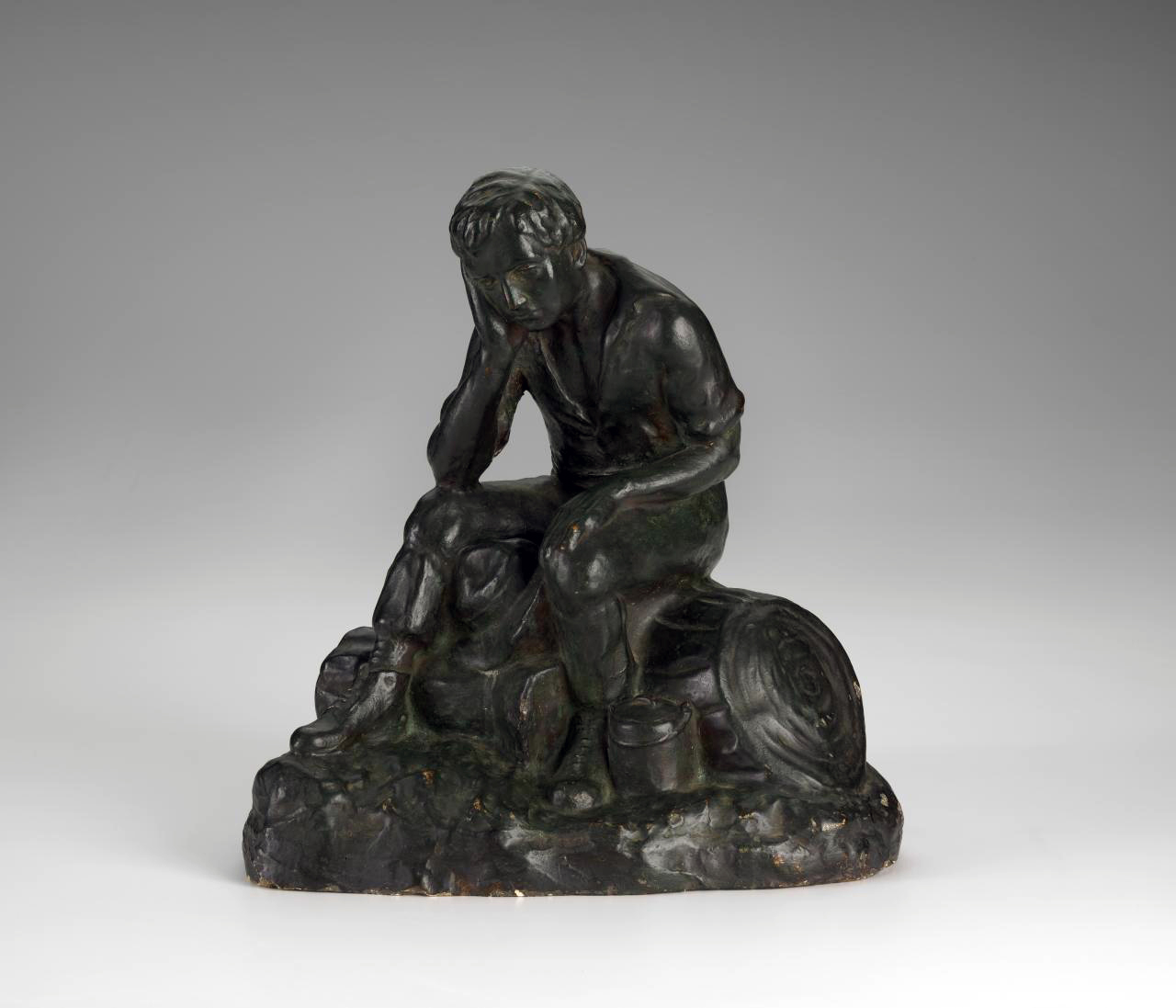
 

Ola Cohn (Australian, 1892-1964, England 1926-1930) 'The sundowner' 1932


Ola Cohn (Australian, 1892-1964, England 1926-1930)
The sundowner
1932
Painted plaster
National Gallery of Victoria, Melbourne
Gift of Jack and Zena Cohn, 2016


Ola Cohn studied sculpture with Henry Moore at the Royal College of Art in London in the 1920s. She returned to Melbourne in 1930, where the following year her solo exhibition established her as a leading proponent of modern sculpture. During the Depression the sight of ‘swagmen’ or ‘sundowners’ became commonplace as unemployed men travelled across the country in order to find work. In 1932 Cohn submitted this maquette of a sundowner to a competition for a full-scale sculpture to be erected in Fitzroy Gardens in Melbourne: unsurprisingly it was not chosen as the winning entry.


Installation view of the exhibition 'Brave New World: Australia 1930s' at NGVA with Bernard Smith's 'The advance of Lot and his Brethren' at centre and Albert Tucker's 'The futile city' at right


Installation view of the exhibition Brave New World: Australia 1930s at NGVA with Bernard Smith’s The advance of Lot and his Brethren at centre and Albert Tucker’s The futile city at right
Photo: Eugene Hyland


Installation view of Bernard Smith's 'The advance of Lot and his Brethren' from the exhibition 'Brave New World: Australia 1930s' at NGVA


Installation view of Bernard Smith’s The advance of Lot and his Brethren from the exhibition Brave New World: Australia 1930s at NGVA
Photo: Dr Marcus Bunyan


Bernard Smith (Australian, 1916-2011, England and Europe 1948-1951) 'The advance of Lot and his Brethren' 1940


Bernard Smith (Australian, 1916-2011, England and Europe 1948-1951)
The advance of Lot and his Brethren
1940
Oil on canvas
National Gallery of Australia, Canberra
Gift of the artist, 2008


In the early 1930s, artists depicted the city as a modern utopia, a place of triumphant progress and aspiration later in the decades, a new radical iconography of the city as a place of moral decay and corruption appeared. Painted at the start of the Second World War, Lot and his brethren expresses Bernard Smith’s despair at the conflagration that the world had been plunged into. Based on the biblical story of Lot, who fled from God’s destruction of Sodom, Smith depicts Karl Marx as the saviour who leads his people from the burning city.


Albert Tucker (Australian, 1914-1999, Europe and United States 1947-1960) 'The futile city' 1940


Albert Tucker (Australian, 1914-1999, Europe and United States 1947-1960)
The futile city
1940
Oil on cardboard
Heide Museum of Modern Art, Bulleen, Melbourne
Purchased from John and Sunday Reed, 1980


At the start of the Second World War Surrealism was an important influence upon Albert Tucker, as were the writings of T. S. Eliot. The futile city was inspired by Eliot’s epic poem The Waste Land (1922): ‘I came on T. S. Eliot, and instantly I recognised a twin soul because here was horror, outrage, despair, futility, and all the images that went with them. He confirmed my own feelings and also became a source … because of the images that would involuntarily form while I was reading the poetry’.


Installation view of the exhibition 'Brave New World: Australia 1930s' at NGVA with Yosl Bergner's 'Citizen' (c. 1940) at left


Installation view of the exhibition Brave New World: Australia 1930s at NGVA with Yosl Bergner’s Citizen (c. 1940) at left
Photo: Eugene Hyland


Installation view of Yosl Bergner's 'Citizen' from the exhibition 'Brave New World: Australia 1930s' at NGVA


Installation view of Yosl Bergner’s Citizen (c. 1940) from the exhibition Brave New World: Australia 1930s at NGVA
Photo: Dr Marcus Bunyan


Yosl Bergner was one of approximately 7000-8000 Jewish people, mainly from Germany, Austria and Czechoslovakia, who arrived in Australia between 1933 and 1939 fleeing Nazi persecution. This number included many artists, musicians, architects, writers and intellectuals who were to contribute greatly to Australia’s cultural life. However, government policy remained opposed to large-scale intake of Jewish refugees, and some were met with anti-Semitic sentiments upon their arrival.


Yvonne Atkinson (Australia 1918-99) 'The tram stop' 1937


Installation view of Yvonne Atkinson The tram stop (1937) from the exhibition Brave New World: Australia 1930s at NGVA
Photo: Dr Marcus Bunyan


Max Dupain (Australian, 1911-92) 'Brave New World' 1938


Max Dupain (Australian, 1911-1992)
Brave New World
1938
Gelatin silver photograph
29 x 20cm
National Gallery of Victoria, Melbourne
William Kimpton Bequest, 2017


In 1935 Max Dupain referred to Aldous Huxley’s book Brave New World (1932) in his photograph of a woman trapped by technology. Dupain was attracted to this biting satire on the ethical dilemmas of social engineering because it appeared to endorse his own fervently held ideas of how modernity was affecting the individual and national body. At the time his choice to directly reference this book was surprisingly provocative: Brave New World had been banned by the Australian customs department, with existing copies rounded up and burned. Dupain returned again to the theme in 1938, producing this variant version.
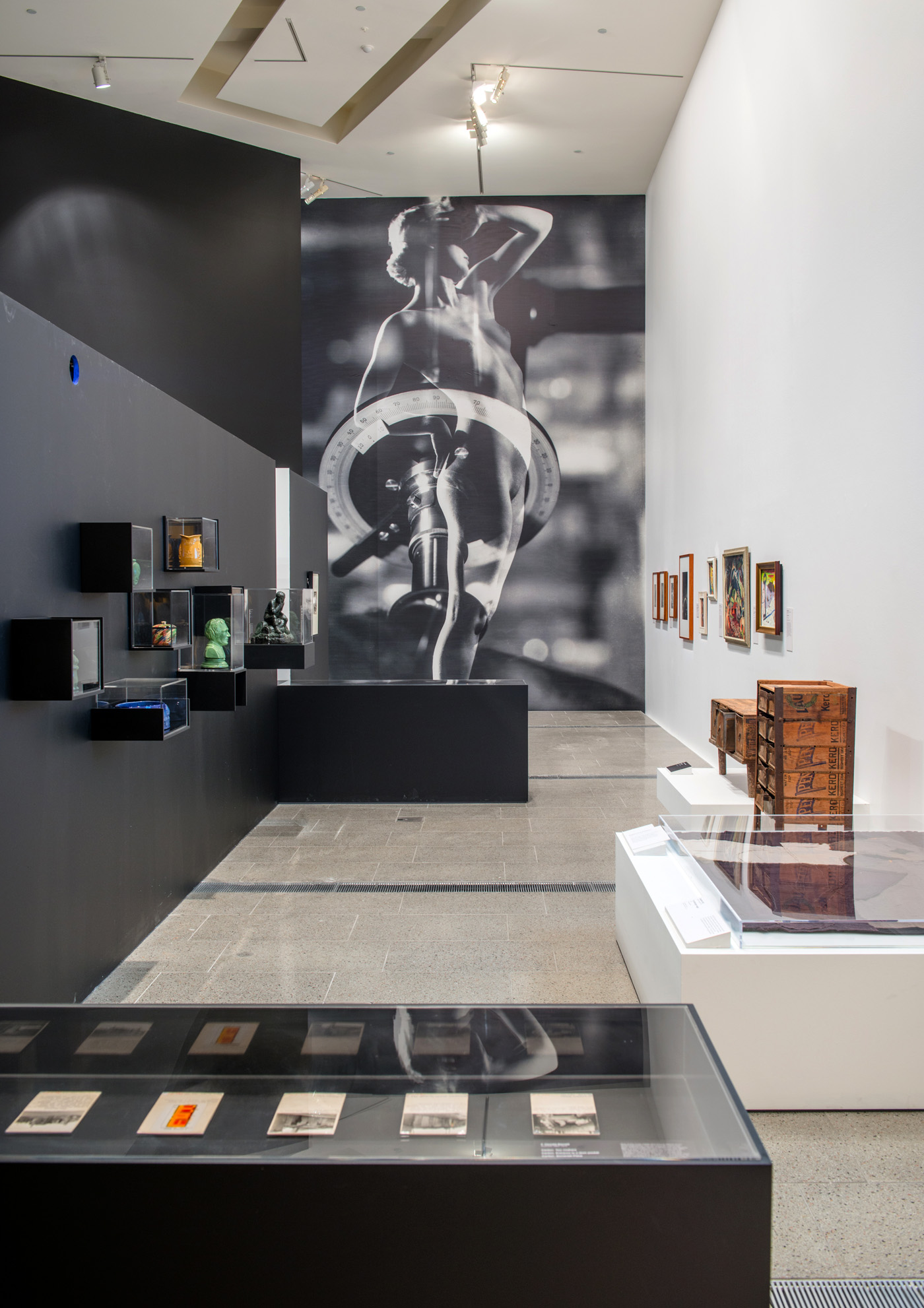
 

Installation view of the exhibition 'Brave New World: Australia 1930s' at NGVA with Max Dupain's 'Brave New World' (wall print) at centre rear with Sideboard and Chest of drawers at right


Installation view of the exhibition Brave New World: Australia 1930s at NGVA with Max Dupain’s Brave New World (wall print) at centre rear with Sideboard and Chest of drawers at right
Photo: Eugene Hyland


Installation view of Sideboard and Chest of drawers from the exhibition 'Brave New World: Australia 1930s' at NGVA


Installation view of Sideboard and Chest of drawers from the exhibition Brave New World: Australia 1930s at NGVA
Photo: Eugene Hyland

Unknown, Australia
Sideboard
1920s-1940s
Painted wood, wood, tin
National Gallery of Victoria, Melbourne
Purchased NGV Foundation, 2013

Unknown, Australia
Chest of drawers
1920s-1940s
Painted wood, wood, tin
National Gallery of Victoria, Melbourne
Purchased NGV Foundation, 2013


Unknown, Australia. 'Sideboard' 1920s-1940s


Unknown, Australia
Sideboard
1920s-1940s
Painted wood, wood, tin
National Gallery of Victoria, Melbourne
Purchased NGV Foundation, 2013


Unknown, Australia. 'Chest of drawers' 1920s-1940s


Unknown, Australia
Chest of drawers
1920s-1940s
Painted wood, wood, tin
National Gallery of Victoria, Melbourne
Purchased NGV Foundation, 2013


Working-class people were the most affected by the high levels of unemployment during the Depression. By 1932 more than 60,000 men, women and children were dependent on the susso, a state-based sustenance payment that enabled families to buy only the bare minimum of food. Many families unable to pay their rent were evicted from their homes. For those suffering economic hardship, ‘making do’ became a way of life, and furniture would be constructed from found items such as kerosene tins and packing crates.


J. M. Harcourt (writer) John Long (publisher) 'Upsurge' 1934


J. M. Harcourt (writer) (Australian, 1902-1971)
John Long (publisher)
Upsurge
1934
London, March 1934
State Library Victoria, Melbourne


Censorship of books was vigorously pursued by federal and state governments during the 1930s. Australia was one of only two countries in the world to ban Aldous Huxley’s Brave New World when it was first published in 1932. Australian author J. M. Harcourt’s novel Upsurge (1934) was the first book to be banned following a recommendation by the newly established Book Censorship Board in 1934. Portraying the lives of Western Australia’s working class during the Depression, it was described by one customs official as ‘thinly disguised propaganda on behalf of Communism and social revolution’.


Activism

During the 1930s a small number of artists became active in the militant working-class struggle through their involvement in social and cultural organisations affiliated with the Communist Party, such as the Friends of the Soviet Union, the Workers’ Art Club and the Workers’ Theatre Group, which were formed in Sydney, Melbourne and other metropolitan centres. A number of these artists were also involved with a variety of mostly short-lived radical magazines, helping with their production, as well as providing covers and illustrations. Linocuts were a preferred medium for these artists, as the materials were inexpensive and the images reproduced well.
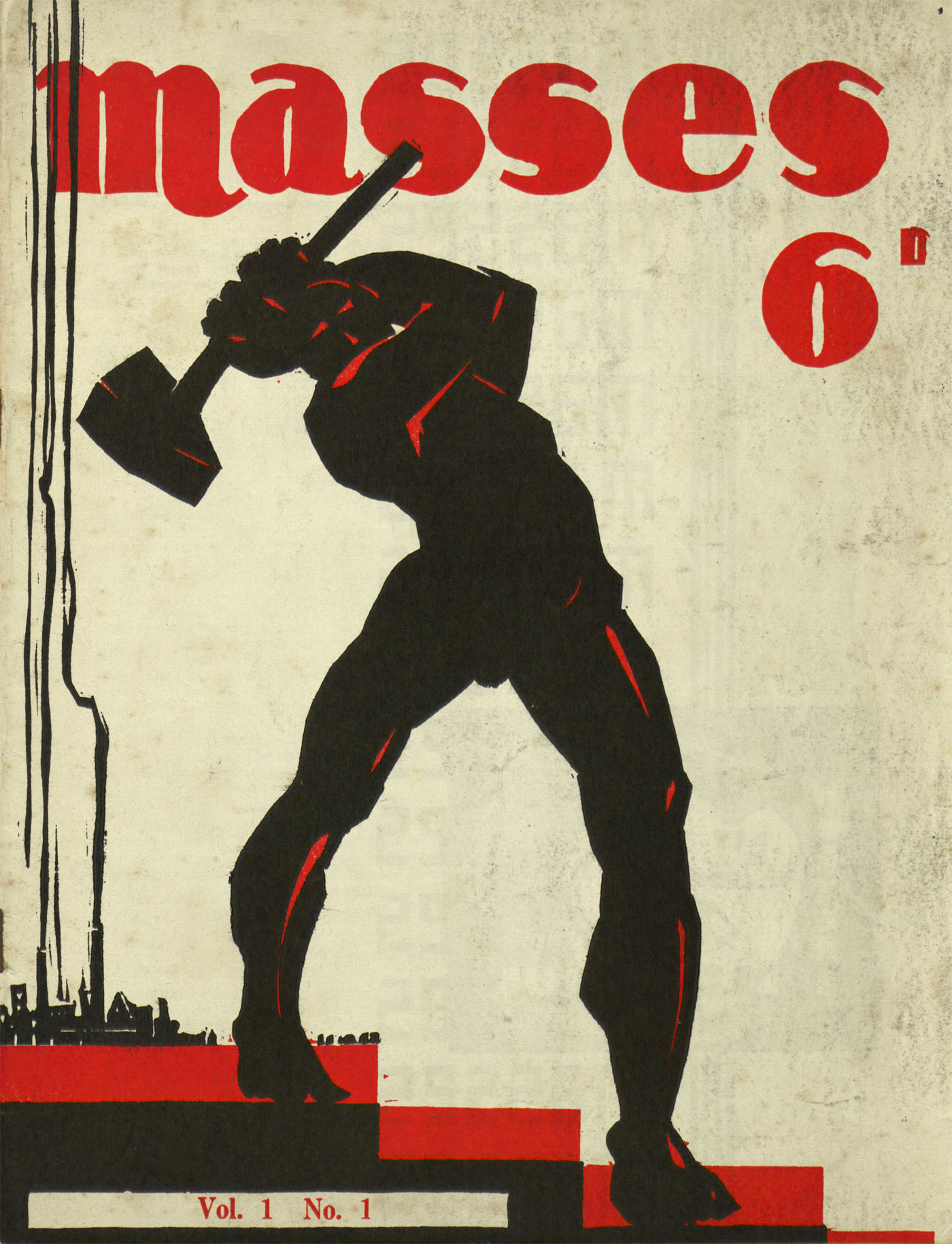
 

Jack Maughan illustrator (Australian, 1897-1980) 'Masses' 1932


Jack Maughan (illustrator) (Australia 1897-1980)
Masses
Cover illustration for Masses, vol. 1, no. 1, printed by Bright Printing Services, published by the Workers’ Art Club, Melbourne, November 1932
1932
Linocut printed in red and black ink
State Library Victoria, Melbourne


Installation view of Herbert McClintock's cover illustration for 'Strife', vol. 1, no. 1


Installation view of Herbert McClintock’s cover illustration for Strife, vol. 1, no. 1 (1930) from the exhibition Brave New World: Australia 1930s at NGVA
Photo: Dr Marcus Bunyan


Edited by eighteen-year-old communist Judah Waten, with Herbert McClintock as art editor, Strife declared itself ‘an organ of the new culture, destructive and constructive’. The first issue was due for release in October 1930; however, a blasphemous poem by Brian Fitzpatrick published in the magazine prompted a police raid on the Strife office and the editor’s hasty destruction of (most) copies of the issue.


Installation view of cover illustration for 'Proletariat', vol. 2, no. 1 (1933) by an unknown illustrator


Installation view of cover illustration for Proletariat, vol. 2, no. 1 (1933) by an unknown illustrator from the exhibition Brave New World: Australia 1930s at NGVA
Photo: Dr Marcus Bunyan


The Ian Potter Centre: NGV Australia
Federation Square
Corner of Russell and 
Flinders Streets, Melbourne

Opening hours:
Open daily 10am – 5pm
National Gallery of Victoria website

LIKE ART BLART ON FACEBOOK

Back to top

Exhibition: ‘Autophoto’ at Fondation Cartier pour l’art contemporain, Paris

Exhibition dates: 20th April – 24th September, 2017

Artists: Robert Adams • Eve Arnold • Bernard Asset • Éric Aupol • Theo Baart Et Cary Markerink • Sue Barr • Valérie Belin • Martin Bogren • Nicolas Bouvier • David Bradford • Brassaï • Alain Bublex • Edward Burtynsky • Andrew Bush • Ronni Campana • Gilles Caron • Alejandro Cartagena • Kurt Caviezel • Philippe Chancel • Larry Clark • Langdon Clay • Stéphane Couturier • Bruce Davidson • Jean Depara • Raymond Depardon • John Divola • Robert Doisneau • William Eggleston • Elliott Erwitt • Walker Evans • Barry Feinstein • Pierre De Fenoÿl • Alain Fleischer • Robert Frank • Lee Friedlander • Bernhard Fuchs • Paolo Gasparini • Óscar Fernando Gómez • Jeff Guess • Andreas Gursky • Fernando Gutiérrez • Jacqueline Hassink • Anthony Hernandez • Yasuhiro Ishimoto • Peter Keetman • Seydou Keïta • Germaine Krull • Seiji Kurata • Justine Kurland • Jacques Henri Lartigue • O. Winston Link • Peter Lippmann • Marcos López • Alex Maclean • Ella Maillart • Man Ray • Mary Ellen Mark • Arwed Messmer • Ray K. Metzker • Sylvie Meunier Et Patrick Tourneboeuf • Joel Meyerowitz • Kay Michalak et Sven Völker • Óscar Monzón • Basile Mookherjee • Daido Moriyama • Patrick Nagatani • Arnold Odermatt • Catherine Opie • Trent Parke • Martin Parr • Mateo Pérez • Jean Pigozzi • Bernard Plossu • Matthew Porter • Edward Quinn • Bill Rauhauser • Rosângela Rennó • Luciano Rigolini • Miguel Rio Branco • Ed Ruscha • Sory Sanlé • Hans-christian Schink • Antoine Schnek • Stephen Shore • Malick Sidibé • Guido Sigriste • Raghubir Singh • Melle Smets Et Joost Van Onna • Jules Spinatsch • Dennis Stock • Hiroshi Sugimoto • Juergen Teller • Tendance Floue • Thierry Vernet • Weegee • Henry Wessel • Alain Willaume


Jacques Henri Lartigue (French, 1894-1986) 'Une Delage au Grand Prix de l’Automobile Club de France, circuit de Dieppe' June 26, 1912 from the exhibition 'Autophoto' at Fondation Cartier pour l'art contemporain, Paris, April - Sept, 2017


Jacques Henri Lartigue (French, 1894-1986)
Une Delage au Grand Prix de l’Automobile Club de France, circuit de Dieppe
June 26, 1912
Gelatin silver print
30 x 40cm
Donation Jacques Henri Lartigue, Charenton-le-Pont Photographie Jacques Henri Lartigue
© Ministère de la Culture – France/AAJHL
Exhibition Autophoto from April 20 to September 24, 2017
Fondation Cartier pour l’art contemporain, Paris


I missed this exhibition when I was in Paris recently. A great pity, I would have liked to have seen it. Some rare photographs that I have never laid eyes on before. I especially love Ray K. Metzker’s Washington, DC. The photography in both Paris and London was disappointing during my month overseas. Other than a large exhibition of Gregory Crewdson’s photographs at the Photographers’ Gallery London, there was not much of interest on offer.

Dr Marcus Bunyan

PS. So many more horizontal photographs than vertical, the automobile obviously lending itself to this orientation. I love this observation: “Photography, a tool of immobility, benefited from the automobile, a mobility tool.” And this from Jean Baudrillard: “Riding is a form spectacular amnesia. Everything to discover, everything to be erased.”


Many thankx to Fondation Cartier pour l’art contemporain for allowing me to publish the photographs in the posting. Please click on the photographs for a larger version of the image.


“Photographing is a profession. Craftsmanship. A job that one learns, that one makes more or less well, like all trades. The photographer is a witness. The witness of his time. The true photographer is the witness of every day, they are the reporter. “


Germaine Krull


“I think that cars today are almost the exact equivalent of the great Gothic cathedrals; I mean the supreme creation of an era, conceived with passion by unknown artists, and consumed in image if not in usage by a whole population which appropriates them as a purely magical object.”


Roland Barthes, Mythologies, Le Seuil, Paris, 1970, p. 150


Thirty years after the exhibition Hommage à Ferrari, the Fondation Cartier pour l’art contemporain will once again focus its attention on the world of cars with the exhibition Autophoto, dedicated to photography’s relationship to the automobile. Since its invention, the automobile has reshaped our landscape, extended our geographic horizons, and radically altered our conception of space and time. The car has also influenced the approach and practice of photographers, providing them not only with a new subject but also a new way of exploring the world and a new means of expression. Based on an idea by Xavier Barral and Philippe Séclier, Autophoto will present over 500 works from the beginning of the 20th century to the present. It will invite us to discover the many facets of automotive culture – aesthetic, social, environmental, and industrial – through the eyes of photographers from around the world. The exhibition will bring together over 90 photographers including both famous and lesser-known figures such as Jacques Henri Lartigue, William Eggleston, Justine Kurland and Jacqueline Hassink, who have shown a fascination for the automobile as a subject or have used it as a tool to take their pictures.


Visite de l’exposition – Autophoto – 2017

Thirty years after the Hommage à Ferrari exhibition which put the spotlight on these legendary cars, the Fondation Cartier pour l’art contemporain presents, on a proposal by Xavier Barral and Philippe Séclier, the Autophoto exhibition devoted to the relationship between photography and the automobile. Since its creation, the automobile has shaped the landscape, allowed the discovery of new horizons and upset our conception of time and space.


Juergen Teller (German, b. 1964) 'OJ Simpson no. 5' Miami 2000 from the exhibition 'Autophoto' at Fondation Cartier pour l'art contemporain, Paris, April - Sept, 2017


Juergen Teller (German, b. 1964)
OJ Simpson no. 5
Miami 2000
Giclee print
51 x 61cm
Collection of the artist
© Juergen Teller, 2017


'Relevé photographique des voies de circulation mondiales réalisé par Michelin' c. 1930


Relevé photographique des voies de circulation mondiales réalisé par Michelin
c. 1930
Collection Michelin, Clermont-Ferrand
© Michelin


Studio portraits, 'China' c. 1950, collected by Thomas Sauvin


Studio portraits
China
c. 1950
Collected by Thomas Sauvin
Colourised gelatin silver print
7.5 x 11.5cm
Collection Beijing Silvermine/Thomas Sauvin, Paris Photo all rights reserved


Seydou Keïta (Malian, 1921-2001) 'Untitled' 1952–1955 from the exhibition 'Autophoto' at Fondation Cartier pour l'art contemporain, Paris, April - Sept, 2017


Seydou Keïta (Malian, 1921-2001)
Untitled
1952-1955
Gelatin silver print
50 × 60cm
CAAC – The Pigozzi Collection, Geneva
© SKPEAC (The Seydou Keïta Photography Estate Advisor Corporation)


Nicolas Bouvier (Swiss, 1929-1998) 'Entre Prilep et Istanbul, Turquie' 1953


Nicolas Bouvier (Swiss, 1929-1998)
Entre Prilep et Istanbul, Turquie
1953
Musée de l’Élysée, Lausanne
© Fonds Nicolas Bouvier / Musée de l’Élysée, Lausanne


O. Winston Link (American, 1914-2001) 'Hot Shot Eastbound' 1956


O. Winston Link (American, 1914-2001)
Hot Shot Eastbound
1956
Collection Mathé Perrin, Bruxelles
© O. Winston Link


Ray K. Metzker (American, 1931-2014) 'Washington, DC' 1964


Ray K. Metzker (American, 1931-2014)
Washington, DC
1964
Gelatin silver print
20 × 25.5cm
Courtesy Les Douches la Galerie, Paris/Laurence Miller Gallery, New York
© Estate Ray K. Metzker, courtesy Les Douches la Galerie, Paris/Laurence Miller Gallery, New York


Bernard Plossu (French, b. 1945) 'Sur la route d'Acapulco, Mexique' 1966


Bernard Plossu (French, b. 1945)
Sur la route d’Acapulco, Mexique
1966
From Le Voyage mexicain series
Gelatin silver print
18 × 27cm
Courtesy of the artist/Galerie Camera Obscura, Paris
© Bernard Plossu


Bernard Plossu (French, b. 1945) 'Chiapas, Mexique' 1966


Bernard Plossu (French, b. 1945)
Chiapas, Mexique
1966
From Le Voyage mexicain series
Gelatin silver print
18 × 27cm
Courtesy of the artist/Galerie Camera Obscura, Paris
© Bernard Plossu


“A panorama framed by the rectangle of the windshield. A long ribbon of asphalt, a line of flight that stretches towards the horizon. For more than a century, we can capture this image and travel the world by car, this photographic “box”. Automotive and photography, two tools to model the landscape, two mechanics of the traction and attraction, have emerged at the end of the nineteenth century, through new rhythms and new rites, the society of modern times. If the photograph allows multiple views and list them, to memorise the movement and leave a trace, the automobile makes it possible to move in space. Photography, a tool of immobility, benefited from the automobile, a mobility tool. And if the automobile like photography is constantly evolving, these two inventions have parallel paths in order to better, to master space-time. “Riding is a form spectacular amnesia. Everything to discover, everything to be erased,”1 writes Jean Baudrillard.”

From the foreword by commissioners of the exhibition Xavier Barral and Philippe Séclier

1/ Jean Baudrillard, Amérique, Grasset, Paris, 1986, p. 15


Henry Wessel (American, 1942-2018) 'Pennsylvania' 1968


Henry Wessel (American, 1942-2018)
Pennsylvania
1968
Courtesy Galerie Thomas Zander, Cologne
© Henry Wessel, courtesy Galerie Thomas Zander, Cologne.


William Eggleston (American, b. 1939) 'Los Alamos' series 1965-1968


William Eggleston (American, b. 1939)
Los Alamos series
1965-1968
Dye-transfer print
40.5 × 50.5cm
Eggleston Artistic Trust, courtesy David Zwirner, New York/London
© Eggleston Artistic Trust. Courtesy David Zwirner, New York/London


Henry Wessel (American, 1942-2018) 'Los Alamos' series c. 1974


Henry Wessel (American, 1942-2018)
Los Alamos series
c. 1974
Inkjet print
56 × 73.5cm
Eggleston Artistic Trust, Memphis
© Eggleston Artistic Trust, Memphis


Bill Rauhauser (American, 1918-2017) 'Detroit Auto Show' series c. 1975


Bill Rauhauser (American, 1918-2017)
Detroit Auto Show series
c. 1975
Detroit Institute of Arts, don de l’artiste en mémoire de Doris Rauhauser
© 2007 Rauhauser Photographic Trust. All Rights Reserved


Langdon Clay (American, b. 1949) 'Zizka Cleaners car, Buick Electra' 1976


Langdon Clay (American, b. 1949)
Zizka Cleaners car, Buick Electra
Series Cars, New York City, 1976
Slide-show
Courtesy of the artist
© Langdon Clay


Joel Meyerowitz (American, b. 1938) 'Upstate New York' 1977


Joel Meyerowitz (American, b. 1938)
Upstate New York
1977
Collection Joel Meyerowitz Photography, New York
© Joel Meyerowitz, courtesy Polka Galerie, Paris


Bernard Asset (French, b. 1955) 'Passager d'Alain Prost (Alain Prost au volant d’une Renault RE30B, tests F1 sur le circuit Dijon-Prenois)' 1982


Bernard Asset (French, b. 1955)
Passager d’Alain Prost (Alain Prost au volant d’une Renault RE30B, tests F1 sur le circuit Dijon-Prenois)
1982
Collection de l’artiste
© Bernard Asset


David Bradford (American, b. 1951) 'Coaster Ride Stealth' 1994


David Bradford (American, b. 1951)
Coaster Ride Stealth
1994
From Drive-By Shootings series
C-print
28 × 35.5cm
Courtesy of the artist
© David Bradford


Andrew Bush (American, b. 1956) 'Woman Waiting to Proceed South at Sunset and Highland Boulevards, Los Angeles, at Approximately 11:59 a.m. One Day in February 1997' 1997


Andrew Bush (American, b. 1956)
Woman Waiting to Proceed South at Sunset and Highland Boulevards, Los Angeles, at Approximately 11:59 a.m. One Day in February 1997
1997
From Vector Portraits series
C-print
122 × 151cm
Courtesy M+B Gallery, Los Angeles
© Andrew Bush


Rosângela Rennó (Brazilian, b. 1962) 'Cerimônia do Adeus' series,1997-2003


Rosângela Rennó (Brazilian, b. 1962)
Cerimônia do Adeus series
1997-2003
C-print face-mounted on Plexiglas
50 × 68 cm
Courtesy of the artist/Cristina Guerra Contemporary Art, Lisbon
© Rosângela Rennó


Valérie Belin (French, b. 1964) 'Untitled' 2002


Valérie Belin (French, b. 1964)
Untitled
2002
Gelatin silver print
61 x 71.5cm (framed)
Courtesy of the artist/Galerie Nathalie Obadia, Paris/Brussels
© Valérie Belin/ADAGP, Paris 2017


Stéphane Couturier (French, b. 1957) 'MELT, Toyota No 8' 2005


Stéphane Couturier (French, b. 1957)
MELT, Toyota No. 8
2005
From Melting Point, Usine Toyota, Valenciennes series
C-print
92 × 137cm
Collection of the artist
Courtesy La Galerie Particulière, Paris/Brussels
© Stéphane Couturier


Óscar Fernando Gómez (Mexican, b. 1970) 'Windows' series, 2009

Óscar Fernando Gómez (Mexican, b. 1970) 'Windows' series, 2009

Óscar Fernando Gómez (Mexican, b. 1970) 'Windows' series, 2009

Óscar Fernando Gómez (Mexican, b. 1970) 'Windows' series, 2009

Óscar Fernando Gómez (Mexican, b. 1970) 'Windows' series, 2009


Óscar Fernando Gómez (Mexican, b. 1970)
Windows series
2009
Slide show
Courtesy Martin Parr Studio, Bristol
© Óscar Fernando Gómez


Alain Willaume (French, b. 1956) '#5069' 2012


Alain Willaume (French, b. 1956)
#5069
2012
From the Échos de la poussière et de la fracturation series
Collection de l’artiste
© Alain Willaume (Tendance Floue)


Peter Lippmann (American works Paris, b. 1956) 'Citroën Traction 7' 2012


Peter Lippmann (American works Paris, b. 1956)
Citroën Traction 7
2012
From the Paradise Parking series
C-print
75 × 100cm
Collection of the artist
© Peter Lippmann


Justine Kurland (American, b. 1969) '280 Coup' 2012


Justine Kurland (American, b. 1969)
280 Coup
2012
Inkjet Print
47 x 61cm
Courtesy of the artist/Mitchell-Innes & Nash, New York
© Justine Kurland


Melle Smets and Joost Van Onna. 'Turtle 1. Building a Car in Africa' 2016


Melle Smets and Joost Van Onna
Turtle 1. Building a Car in Africa
2016
Courtesy des artistes / Paradox, Edam
© Melle Smets et Joost Van Onna


Luciano Rigolini (Swiss, b. 1950) 'Tribute to Giorgio de Chirico' 2017


Luciano Rigolini (Swiss, b. 1950)
Tribute to Giorgio de Chirico
2017
Duratrans in lightbox
124 x 154cm
Collection of the artist
© Luciano Rigolini (appropriation – unknown photographer, 1958)


First Visions: A New Subject for Photography

In the early 20th century, the automobile and its impact on the landscape had already become a subject of predilection for many photographers, influencing both the form and content of their work. The exhibition will begin by focusing on early photographers like Jacques Henri Lartigue, Germaine Krull, and Brassaï, who used the automobile to varying degrees in their work. They registered the thrill of speed, the chaos of Parisian traffic or the city’s dramatic car-illuminated nocturnal landscape to represent a society in transition at the birth of the modern age. Other photographers of the time were attracted by the promise of freedom and mobility offered by the automobile. Anticipating the modern road trip, Swiss writers and photographers Ella Maillart and Nicolas Bouvier, travelled throughout Asia in the 1930s and 1950s respectively, using their cars and cameras to record their adventures along the way.

Auto Portraits

The exhibition will also present a series of “auto portraits”* made by a variety of photographers from the mi-twentieth century to the present. Yashuhiro Ishimoto and Langdon Clay’s photographs, for example, are portraits in profile of cars parked on sparsely inhabited city streets, that immerse the viewer in a different eras and atmospheres. Ishimoto’s black and white photographs, taken in Chicago in the 1950s, emphasise their polished, curved silhouettes in a distanced and serial manner, while Langdon Clay’s colour pictures taken in New York in the 1970s, show their decaying and dented chassis in an eerie nocturnal light. Other works in this section, such as the found photographs of Sylvie Meunier and Patrick Tourneboeuf’s American Dream series, or the flamboyant portraits of African photographers Seydou Keïta and Sory Sanlé, focus on the role of the automobile as a emblem of social mobility showing proud owners posing with their cars.

*A play on words in French: auto portrait meaning self-portrait.

The Car as a Medium: New Perspectives on the Landscape

Many photographers have exploited the technical and aesthetic possibilities offered by the automobile, using it like a camera to capture the surrounding landscape through car windows or the reflections in rear-view mirrors.

Cars have determined the framing and composition as well as the serial nature of the photographs of Joel Meyerowitz, Daido Moriyama, John Divola and David Bradford who have all worked from moving cars. From behind their windshields, these photographers capture an amusing store sign, a white car behind a wire fence, a dog running along a dusty road, a highway stretching out into the horizon. Other photographers, including Sue Barr, Robert Adams, Ed Ruscha, and Alex MacLean scrutinise our car-altered environment. Their landscape is no longer one of magnificent mountains, wondrous waterfalls or awe-inspiring canyons, but of a world transformed by the automobile with its suburban housing complexes, parking lots, and highway infrastructure.

Our Car Culture: Industry, History and New Ways of Life

Many photographers have explored other aspects of our car culture, from the car industry and its impact on the environment to its role in history and society. Both Robert Doisneau and Robert Frank registered life in the factory, from the machines and productions lines to the activities of the workers lives, the first at the Renault plant in the 1930s and the second at Ford River Rouge in the 1950s. Their photographs, unique in their attention to individual assembly line workers, contrast with the work of contemporary photographer Stéphane Couturier whose deliberately distanced, impersonal pictures taken at a Toyota factory reflect the increasingly dehumanised nature of contemporary industry. Working in Ghana, far from the automated factory photographed by Stéphane Couturier, Dutch artist Melle Smets, and sociologist Joost Van Onna, put industrial waste from the car industry to good use. Collaborating with local craftsman in a region called Suame Magazine, where cars are disassembled and their parts traded, they created a car specifically for the African market called Turtle 1, using parts from different brands that happened to be available. Their installation, which includes photographs, drawings, and videos, documents the entire fabrication process of this car.

Photographers such as Philippe Chancel, Éric Aupol and Edward Burtynsky are concerned with the car industry’s damage to the environment. Philippe Chancel’s work focuses on the city of Flint and its dismantled General Motors factory, while Éric Aupol’s and Ed Burtynsky’s photographs reveal the sculptural yet apocalyptic beauty of industrial waste sites.

Other photographers reveal how the car plays an important role in historical events, in society and in daily life. Arwed Messmer’s Reenactement series brings together photographs from the archives of the Stasi showing how people used cars in unusual ways to escape from East Germany, and Fernando Gutiérrez work, Secuelas, explores the role of the Ford Falcon, a symbol of Argentina’s military dictatorship, in the collective imaginary of the Argentinean people. Jacqueline Hassink’s immersive projection Car Girls investigates the role and status of women who work in car shows around the world. Martin Parr’s series From A to B chronicles the thoughts dreams and anxieties of British motorists. Still other series by photographers such as Rosângela Rennó, Óscar Monzón, Kurt Caviezel and Bruce Davidson show how the car has become an extension of the home, used for weddings and picnics, living and sleeping, arguments and making love.

The Fondation Cartier has also invited artist Alain Bublex to create for the exhibition a series of 10 model cars that cast a fresh eye on the history of automobile design. His installation combines photographs, drawings and models to explore how the car design has evolved over time incorporating new techniques, forms, and practices.

Despite energy crises, ecology movements, and industrial mismanagement, the car remains essential to our daily lives. At a time when we are questioning the role and the future of the automobile in our society, the Autophoto exhibition reexamines, with nostalgia, humour, and a critical eye, this 20th century symbol of freedom and independence.

The Catalogue

Bringing together over 600 images, the catalogue of the Autophoto exhibition reveals how photography, a tool privileging immobility, benefited from the automobile, a tool privileging mobility. The catalogue features iconic images by both historic and contemporary photographers who have captured the automobile, and transformed this popular accessible object through their passionate and creative vision. Quotes by the artists, and a chronology of automobile design, as well as interviews and texts by specialists provide a deeper understanding of this vast topic through a variety of aesthetic, sociological, and historical perspectives.

Press release from The Fondation Cartier


Peter Keetman (German, 1916-2005) 'Hintere Kotflügel' 1953


Peter Keetman (German, 1916-2005)
Hintere Kotflügel (Rear fenders)
1953
From Eine Woche im Volkswagenwerk (A week at the Volkswagenwerk) series
Gelatin silver print
27 × 24.5cm
Nachlass Peter Keetman/Stiftung F.C. Gundlach, Hamburg
© Nachlass Peter Keetman/Stiftung F.C. Gundlach, Hamburg


Ed Ruscha (American, b. 1937) '7133 Kester, Van Nuys' 1967


Ed Ruscha (American, b. 1937)
7133 Kester, Van Nuys
1967
Thirtyfour Parking Lots series
Chipmunk Collection
© Ed Ruscha, courtesy Gagosian Gallery


Malick Sidibé (Malian, 1935-2016) 'Taximan avec voiture' 1970


Malick Sidibé (Malian, 1935-2016)
Taximan avec voiture
1970
Gelatin silver print
40 x 30cm
Courtesy Galerie Magnin-A, Paris
© Malick Sidibé


Lee Friedlander (American, b. 1934) 'Montana' 2008


Lee Friedlander (American, b. 1934)
Montana
2008
From the America by Car series
Gelatin silver print
37.5 × 37.5cm
Courtesy Fraenkel Gallery, San Francisco
© Lee Friedlander, courtesy Fraenkel Gallery, San Francisco


Lee Friedlander (American, b. 1934) 'California' 2008


Lee Friedlander (American, b. 1934)
California
2008
From the America by Car series
Gelatin silver print
37.5 × 37.5cm
Courtesy Fraenkel Gallery, San Francisco
© Lee Friedlander, courtesy Fraenkel Gallery, San Francisco


Alejandro Cartagena (Mexican, b. 1977) 'The Carpoolers' series 2011–2012


Alejandro Cartagena (Mexican, b. 1977)
The Carpoolers series
2011-12
Installation of 15 inkjet prints
55.5 × 35.5cm (each)
Courtesy Patricia Conde Galería, Mexico City
© Alejandro Cartagena


Ronni Campana (Italian, b. 1987) 'Badly Repaired Cars' series 2016


Ronni Campana (Italian, b. 1987)
Badly Repaired Cars series
2016
Inkjet print
60 × 40cm
Collection of the artist
© Ronni Campana


Fondation Cartier pour l’art contemporain
261 Boulevard Raspail, Paris

Opening hours: Every day except Mondays, 11am – 8pm
Opening Tuesday evenings until 10pm

Fondation Cartier website

LIKE ART BLART ON FACEBOOK

Back to top

Exhibition: ‘Thomas Struth: Figure Ground’ at Haus der Kunst, Munich

Exhibition dates: 5th May – 17th September, 2017

Curator: Thomas Weski


Installation view of the exhibition 'Thomas Struth: Figure Ground' at Haus der Kunst, Munich from the exhibition 'Thomas Struth: Figure Ground' at Haus der Kunst, Munich, May - Sept, 2017


Installation view of the exhibition Thomas Struth: Figure Ground at Haus der Kunst, Munich
Courtesy of the artist and Haus der Kunst, Munich


I have always liked this man’s work. His understanding of space, colour, form and photograph as aesthetic experience is sublime. His muscular compositions show evidence of clear thinking and seeing… an investigation into sachlichkeit, that is objectivity: the boundaries between human, animal and machine (the aesthetics of innovation).

And yet Struth’s “unheroic” images also show evidence of subjective forces at work: impulsion, chaos, and serendipity to name a few, capturing a ‘razzmatazz of sensations’ that challenge the existential nature of the human, ‘being’.

Dr Marcus Bunyan


Many thankx to Haus der Kunst for allowing me to publish the art work in the posting. Please click on the photographs for a larger version of the image.


“Most of the images are very unheroic. I have a strong relationship to clarity. That’s why my compositions and choices are very meticulous.”


Thomas Struth


Thomas Struth (German, b. 1954) 'Crosby Street, Soho, New York' 1978 from the exhibition 'Thomas Struth: Figure Ground' at Haus der Kunst, Munich, May - Sept, 2017


Thomas Struth (German, b. 1954)
Crosby Street, Soho, New York
1978
Silver gelatin print
66 x 84cm
© Thomas Struth


Thomas Struth (German, b. 1954) 'Rue de Beaugrenelle, Beaugrenelle, Paris' 1979


Thomas Struth (German, b. 1954)
Rue de Beaugrenelle, Beaugrenelle, Paris
1979
Silver gelatin print
66 x 84cm
© Thomas Struth


Installation view of the exhibition 'Thomas Struth: Figure Ground' at Haus der Kunst, Munich


Installation view of the exhibition Thomas Struth: Figure Ground at Haus der Kunst, Munich
Courtesy of the artist and Haus der Kunst, Munich


Thomas Struth (German, b. 1954) 'National Gallery 1, London' 1989


Thomas Struth (German, b. 1954)
National Gallery 1, London
1989
Chromogenic print
180 x 196cm
© Thomas Struth


Installation view of the exhibition 'Thomas Struth: Figure Ground' at Haus der Kunst, Munich with 'Louvre 4, Paris' (1989) centre left


Installation view of the exhibition Thomas Struth: Figure Ground at Haus der Kunst, Munich with Louvre 4, Paris (1989) centre left
Courtesy of the artist and Haus der Kunst, Munich


Thomas Struth (German, b. 1954) 'Louvre 4 Paris' 1989


Thomas Struth (German, b. 1954)
Louvre 4, Paris
1989
© Thomas Struth


Thomas Struth (German, b. 1954) 'Kyoko and Tomoharu Murakami, Tokyo' 1991


Thomas Struth (German, b. 1954)
Kyoko and Tomoharu Murakami, Tokyo
1991
Chromogenic print
105.5 x 126.0cm
© Thomas Struth


Installation view of the exhibition 'Thomas Struth: Figure Ground' at Haus der Kunst, Munich with 'Paradise 26 (Bougainville), Palpa, Peru (2003)' to the right


Installation view of the exhibition Thomas Struth: Figure Ground at Haus der Kunst, Munich with Paradise 26 (Bougainville), Palpa, Peru (2003) to the right
Courtesy of the artist and Haus der Kunst, Munich


Thomas Struth (German, b. 1954) 'Bright sunflower - No. 1, Winterthur' 1991


Thomas Struth (German, b. 1954)
Bright sunflower – No. 1, Winterthur
1991
Chromogenic print
84 x 66cm
© Thomas Struth


This major exhibition by the pioneering German photographer Thomas Struth (born 1954) presents the most comprehensive survey of his genre-defining oeuvre. Covering four decades of work and every phase of his illustrious artistic career, the exhibition focuses especially on the aspect of Struth’s social interests which represent the important forces of his internationally influential artistic development. Starting with his first series Unbewusste Orte (Unconscious Places) published in 1987 through his current works that deal with the field of research and technology in the globalised world, Struth’s work develops its own specific analytical nature through his choice of subject matter, the manner of its photographic realisation and its modes of presentation. These aspirations are manifested in questioning the relevance of public space and transformation of cities, the cohesive factor of family solidarity, the importance of the relationship between nature and culture, and exploring the limits and possibilities of new technologies. The momentum of participation further characterises these aspirations, as Struth’s extensive pictorial inventions and strategies allow individual interpretation based on collective knowledge.

In this exhibition, early works and research materials related to the artist’s subject matter, and collected over several decades, are shown for the first time in the context of an exhibition, offering access and insight into Struth’s working methods. Together with the photographs, these materials elucidate his longstanding interests behind the different series, demonstrating the process of artistic translation before the perfection of the image.

Featuring around 130 works, two multichannel video installations, and a selection of archival material, the exhibition in Haus der Kunst is the largest survey of Struth’s artistic career to date. The survey links his early ideas to well-known series such as Straßen (Streets), Unbewusste Orte (Unconscious Places), Portraits, Museumsbilder (Museum Pictures), Paradise, and Audiences which are placed in dialogue with site-specific works like Löwenzahnzimmer (Dandelion Room), the landscape- and flower photographs that were made for the patients’ rooms at the Hospital on the Lindberg in Winterthur, Switzerland. It also includes photographs recently shown in the exhibition Nature & Politics. Within this interplay, the exciting ability of the artist to combine analysis and individual pictorial invention in multifaceted works and techniques builds an overarching idea on how to deal with the elementary matters of our times.

The exhibition is accompanied by a publication from Schirmer / Mosel Publishers, Munich, designed by Fernando Gutierrez, with texts by Thomas Weski, Ulrich Wilmes, Jana-Maria Hartmann, and an interview with the artist by Okwui Enwezor. The exhibition is organised by Haus der Kunst and curated by Thomas Weski.

Press release from Haus der Kunst


Thomas Struth (German, b. 1954) 'Wangfujing Dong Lu, Shanghai' 1997


Thomas Struth (German, b. 1954)
Wangfujing Dong Lu, Shanghai
1997
Chromogenic print
117.5 x 143.6cm
© Thomas Struth


Thomas Struth (German, b. 1954) 'Paradise 10 (Xi Shuang Banna), Yunnan Province, China' 1999


Thomas Struth (German, b. 1954)
Paradise 10 (Xi Shuang Banna), Yunnan Province, China
1999
Chromogenic print
182 x 227cm
© Thomas Struth


Thomas Struth (German, b. 1954) 'Self-Portrait, Munich' 2000


Thomas Struth (German, b. 1954)
Self-Portrait, Munich
2000
© Thomas Struth


“Albrecht Durer painted his self-portrait in 1500, so Struth’s Self-Portrait, Munich 2000 feels like a conversation between artists across 500 years.”


Thomas Struth (German, b. 1954) 'National Gallery 2, London' 2001


Thomas Struth (German, b. 1954)
National Gallery 2, London
2001
Chromogenic print
148.0 x 170.4cm
© Thomas Struth


Thomas Struth (German, b. 1954) 'Audience 7, Florence' 2004


Thomas Struth (German, b. 1954)
Audience 7, Florence
2004
Chromogenic print
179.5 x 291.5cm
© Thomas Struth


Thomas Struth (German, b. 1954) 'Audience 11, Florence' 2004


Thomas Struth (German, b. 1954)
Audience 11, Florence
2004
Chromogenic print
179.5 x 291.5cm
© Thomas Struth


Installation view of the exhibition 'Thomas Struth: Figure Ground' at Haus der Kunst, Munich with 'Semi Submersible Rig, DSME Shipyard, Geoje Island' (2007) at centre


Installation view of the exhibition Thomas Struth: Figure Ground at Haus der Kunst, Munich with Semi Submersible Rig, DSME Shipyard, Geoje Island (2007) at centre
Courtesy of the artist and Haus der Kunst, Munich


Thomas Struth (German, b. 1954) 'Semi Submersible Rig, DSME Shipyard, Geoje Island' 2007


Thomas Struth (German, b. 1954)
Semi Submersible Rig, DSME Shipyard, Geoje Island
2007
© Thomas Struth


Installation view of the exhibition 'Thomas Struth: Figure Ground' at Haus der Kunst, Munich with 'Tokamak Asdex Upgrade Periphery, Max Planck IPP, Garching' (2009) at left


Installation view of the exhibition Thomas Struth: Figure Ground at Haus der Kunst, Munich with Tokamak Asdex Upgrade Periphery, Max Planck IPP, Garching (2009) at left
Courtesy of the artist and Haus der Kunst, Munich


Thomas Struth (German, b. 1954) 'Tokamak Asdex Upgrade Periphery, Max Planck IPP, Garching' 2009


Thomas Struth (German, b. 1954)
Tokamak Asdex Upgrade Periphery, Max Planck IPP, Garching
2009
Chromogenic print
109.3 x 85.8cm
© Thomas Struth


Thomas Struth (German, b. 1954) 'Har Homa, East Jerusalem' 2009


Thomas Struth (German, b. 1954)
Har Homa, East Jerusalem
2009
Inkjet print
148.6 x 184.8cm
© Thomas Struth


Installation view of the exhibition 'Thomas Struth: Figure Ground' at Haus der Kunst, Munich with 'The Faez Family, Rehovot' (2009) second left


Installation view of the exhibition Thomas Struth: Figure Ground at Haus der Kunst, Munich with The Faez Family, Rehovot (2009) second left
Courtesy of the artist and Haus der Kunst, Munich


Thomas Struth (German, b. 1954) 'The Faez Family, Rehovot' 2009


Thomas Struth (German, b. 1954)
The Faez Family, Rehovot
2009
© Thomas Struth


Thomas Struth (German, b. 1954) 'Grazing Incidence Spectrometer, Max Planck IPP, Garching' 2010


Thomas Struth (German, b. 1954)
Grazing Incidence Spectrometer, Max Planck IPP, Garching
2010
© Thomas Struth


Thomas Struth (German, b. 1954) 'Chemistry Fume Cabinet, The University of Edinburgh' 2010


Thomas Struth (German, b. 1954)
Chemistry Fume Cabinet, The University of Edinburgh
2010
© Thomas Struth


Take, for instance, Struth’s photograph “Chemistry Fume Cabinet, The University of Edinburgh” (2010). Ostensibly a photograph of a chemistry fume cabinet at the University of Edinburgh, photographed through a clear, glass window, the work is also a study in colour and form. Within a white background space, the back wall has black horizontal lines running along it, while the side walls have one vertical line each. These opposing lines create what appear to be a haphazard grid. A wide red horizontal structure runs across the front of the room, creating one more line that both breaks up and contributes to the grid. Various machines within the room, two square red panels on the left and right sides of the window, and six coloured balloons provide a series of objects that fit within the finely structured container of the photograph’s frame.

What struck me immediately upon seeing this image was how the various lines and objects interact with one another. Struth presents the viewer with a kind of interactive field in which she can either read the image “as is” – photograph documenting a chemistry fume cabinet – or as a purely aesthetic experience. Or, of course, she can do both, which is what makes Struth’s work so rich and gratifying. It is in the way his mastery of colour and other formal elements coincides with his documentation of the world.

Cynthia Cruz. “Seeing the Deterioration of Technology in Thomas Struth’s Photographs,” on the Hyperallergic website September 9, 2016 [Online] Cited 05/08/2017


Installation view of the exhibition 'Thomas Struth: Figure Ground' at Haus der Kunst, Munich with 'Queen Elizabeth II & The Duke of Edinburgh, Windsor Castle' (2010) at left


Installation view of the exhibition Thomas Struth: Figure Ground at Haus der Kunst, Munich with Queen Elizabeth II & The Duke of Edinburgh, Windsor Castle (2010) at left
Courtesy of the artist and Haus der Kunst, Munich


Thomas Struth (German, b. 1954) 'Queen Elizabeth II & The Duke of Edinburgh, Windsor Castle' 2010


Thomas Struth (German, b. 1954)
Queen Elizabeth II & The Duke of Edinburgh, Windsor Castle
2010
© Thomas Struth


Installation view of the exhibition 'Thomas Struth: Figure Ground' at Haus der Kunst, Munich with 'Aquarium, Atlanta, Georgia' (2013) at right


Installation view of the exhibition Thomas Struth: Figure Ground at Haus der Kunst, Munich with Aquarium, Atlanta, Georgia (2013) at right
Courtesy of the artist and Haus der Kunst, Munich


Thomas Struth (German, b. 1954) 'Aquarium, Atlanta, Georgia' 2013


Thomas Struth (German, b. 1954)
Aquarium, Atlanta, Georgia
2013
© Thomas Struth


Thomas Struth (German, b. 1954) 'Schaltwerk 1 Berlin' 2016


Thomas Struth (German, b. 1954)
Schaltwerk 1, Berlin
2016
© Thomas Struth


Haus der Kunst
Prinzregentenstraße 1
80538 Munich
Germany
Phone: +49 89 21127 113

Opening hours:
Mon | Wed | Fri | Sat | Sun 10am – 8pm
Thur 10am – 10pm
Tue closed

Haus der Kunst website

LIKE ART BLART ON FACEBOOK

Back to top

Exhibition: ‘Walker Evans’ at the Centre Pompidou, Paris

Exhibition dates: 26th April – 14th August, 2017

Curator: Mnam/Cci, Clément Cheroux


Walker Evans (American, 1903-1975) 'Stamped Tin Relic' 1929 from the exhibition 'Walker Evans' at the Centre Pompidou, Paris, April - August, 2017


Walker Evans (American, 1903-1975)
Stamped Tin Relic
1929
Gelatin silver print
23.3 x 28cm
Collection Centre Pompidou, Paris Achat en 1996
© Walker Evans Archive, The Metropolitan Museum of Art
Photo: © Centre Pompidou / Dist.RMN-GP


The un/ordinariness of ordinariness

What a pleasure.

I’ve never liked the term ‘”vernacular” photography’ because, for me, every time someone presses the shutter of the camera they have a purpose: to capture a scene, however accidental or incidental. That context may lie outside recognised networks of production and legitimation but it does not lie outside performance and ritual. As Catherine Lumby observes, what the promiscuous flow of the contemporary image culture opens up, “is an expanded and abstracted terrain of becoming… whereby images exceed, incorporate or reverse the values that are presumed to reside within them in a patriarchal social order.”1 Pace Evans.

His art of an alternate order, his vision of a terrain of becoming is so particular, so different it has entered the lexicon of America culture.

Dr Marcus Bunyan

1/ Lumby, Catharine. “Nothing Personal: Sex, Gender and Identity in The Media Age,” in Matthews, Jill (ed.,). Sex in Public: Australian Sexual Cultures. St. Leonards: Allen and Unwin, 1997, pp. 14-15.


Walker Evans: “The passionate quest to identify the fundamental features of American vernacular culture… the term “vernacular” designates those popular or informal forms of expression used by ordinary people for everyday purposes – essentially meaning all that falls outside art, outside the recognised networks of production and legitimation, and which in the US thus serves to define a specifically American culture. It is all the little details of the everyday environment that make for “Americanness”: wooden roadside shacks, the way a shopkeeper lays out his wares in the window, the silhouette of the Ford Model T, the pseudo-cursive typography of Coca-Cola signs. It is a crucial notion for the understanding of American culture.”

Text from press release


Many thankx to the Centre Pompidou for allowing me to publish the artwork in the posting. Please click on the art work for a larger version of the image.


Walker Evans (American, 1903-1975) 'Coney Island Beach' c. 1929 from the exhibition 'Walker Evans' at the Centre Pompidou, Paris, April - August, 2017


Walker Evans (American, 1903-1975)
Coney Island Beach
c. 1929
Gelatin silver print
22.5 x 31cm
The J.Paul Getty Museum, Los Angeles, Los Angeles
© Walker Evans Archive, The Metropolitan Museum of Art
Photo: © The J. Paul Getty Museum, Los Angeles


Walker Evans (American, 1903-1975) 'Truck and Sign' 1928-1930


Walker Evans (American, 1903-1975)
Truck and Sign
1928-1930
Gelatin silver print
16.5 x 22.2cm
Collection particulière, San Francisco
© Walker Evans Archive, The Metropolitan Museum of Art
Photo: © Fernando Maquieira, Cromotex


Walker Evans (American, 1903-1975) 'New York City Street Corner' 1929


Walker Evans (American, 1903-1975)
New York City Street Corner
1929
Gelatin silver print
18.4 x 12.7cm
The J. Paul Getty Museum, Los Angeles
© Walker Evans Archive, The Metropolitan Museum of Art
Photo: © The J. Paul Getty Museum, Los Angeles


Walker Evans (American, 1903-1975) 'Self-Portrait in Automated Photobooth' 1930


Walker Evans (American, 1903-1975)
Self-Portrait in Automated Photobooth
1930
Gelatin silver print
18.3 x 3.8cm
The Metropolitan Museum of Art, New York
© Walker Evans Archive, The Metropolitan Museum of Art
Photo: © The Metropolitan Museum of Art, Dist-RMN-GP/Image of the MMA


Walker Evans (American, 1903-1975) 'Self-Portrait in Automated Photobooth' 1930 (detail)

Walker Evans (American, 1903-1975) 'Self-Portrait in Automated Photobooth' 1930 (detail)


Walker Evans (American, 1903-1975)
Self-Portrait in Automated Photobooth (details)
1930
Gelatin silver print
18.3 x 3.8cm
The Metropolitan Museum of Art, New York
© Walker Evans Archive, The Metropolitan Museum of Art
Photo: © The Metropolitan Museum of Art, Dist-RMN-GP/Image of the MMA


Walker Evans (1903-1975) was one of the most important of twentieth-century American photographers. His photographs of the Depression years of the 1930s, his assignments for Fortune magazine in the 1940s and 1950s, and his “documentary style” influenced generations of photographers and artists. His attention to everyday details and the commonplace urban scene did much to define the visual image of 20th-century American culture. Some of his photographs have become iconic.

Conceived as a retrospective of Evans’s work as a whole, the Centre Pompidou exhibition presents three hundred vintage prints in a novel and revelatory thematic organisation. It highlights the photographer’s recurrent concern with roadside buildings, window displays, signs, typography and faces, offering an opportunity to grasp what no doubt lies at the heart of Walker Evans’ work: the passionate quest to identify the fundamental features of American vernacular culture. In an interview of 1971, he explained the attraction as follows: “You don’t want your work to spring from art; you want it to commence from life, and that’s in the street now. I’m no longer comfortable in a museum. I don’t want to go to them, don’t want to be ‘taught’ anything, don’t want to see ‘accomplished’ art. I’m interested in what’s called vernacular. For example, finished, I mean educated, architecture doesn’t interest me, but I love to find American vernacular”.

In the English-speaking countries, and in America more notably, the term “vernacular” designates those popular or informal forms of expression used by ordinary people for everyday purposes – essentially meaning all that falls outside art, outside the recognised networks of production and legitimation, and which in the US thus serves to define a specifically American culture. It is all the little details of the everyday environment that make for “Americanness”: wooden roadside shacks, the way a shopkeeper lays out his wares in the window, the silhouette of the Ford Model T, the pseudo-cursive typography of Coca-Cola signs. It is a crucial notion for the understanding of American culture. It is to be found in the literature as early as the 19th century, but it is only in the late 1920s that it is first deployed in a systematic study of architecture. Its importance in American art would be theorised in the 1940s, by John Atlee Kouwenhoven, a professor of English with a particular interest in American studies who was close to Walker Evans himself.

After an introductory section that looks at Evans’s modernist beginnings, the exhibition introduces the subjects that would fascinate him throughout his career: the typography of signs, the composition of window displays, the frontages of little roadside businesses, and so on. It then goes on to show how Evans himself adopted the methods or visual forms of vernacular photography in becoming, for the time of an assignment, an architectural photographer, a catalogue photographer, an ambulant portrait photographer, while all the time explicitly maintaining the standpoint of an artist.

This exhibition is the first major museum retrospective of Evans’s work in France. Unprecedented in its ambition, it retraces the whole of his career, from his earliest photographs in the 1920s to the Polaroids of the 1970s, through more than 300 vintage prints drawn from the most important American institutions (among them the Metropolitan Museum and the Museum of Modern Art, New York, the J. Paul Getty Museum, Los Angeles, the Art Institute of Chicago, and the National Gallery of Art, Washington D.C.) and also more than a dozen private collections. It also features a hundred or so other exhibits drawn from the post cards, enamel signs, print images and other graphic ephemera that Evans collected his whole life long.

Press release from the Centre Pompidou


Walker Evans (American, 1903-1975) 'Westchester, New York, farmhouse' 1931


Walker Evans (American, 1903-1975)
Westchester, New York, farmhouse
1931
Gelatin silver print pasted on cardboard
18 x 22.1cm
Collection Centre Pompidou, Paris
© W. Evans Arch., The Metropolitan Museum of Art
Photo: © Centre Pompidou / Dist. RMN-GP


Walker Evans (American, 1903-1975) 'Main Street, Saratoga Springs, New York' 1931


Walker Evans (American, 1903-1975)
Main Street, Saratoga Springs, New York
1931
Gelatin silver print
18.73 x 16.19cm
Collection particulière, San Francisco
© Walker Evans Archive, The Metropolitan Museum of Art
Photo: © Fernando Maquieira, Cromotex


Walker Evans (American, 1903-1975) 'License Photo Studio, New York' 1934


Walker Evans (American, 1903-1975)
License Photo Studio, New York
1934
Gelatin silver print
27.9 x 21.6cm (image: 18.3 x 14.4cm)
The J. Paul Getty Museum, Los Angeles
© Walker Evans Archive, The Metropolitan Museum of Art
Photo: © The J. Paul Getty Museum, Los Angeles


Walker Evans (American, 1903-1975) 'Penny Picture Display, Savannah' 1936


Walker Evans (American, 1903-1975)
Penny Picture Display, Savannah
1936
Gelatin silver print
21.9 x 17.6cm
The Museum of Modern Art, New York Gift of Willard Van Dyke
© Walker Evans Archive, The Metropolitan Museum of Art
Photo: © 2016. Digital Image, The Museum of Modern Art, New York / Scala, Florence


Walker Evans (American, 1903-1975) 'Joe's Auto Graveyard' 1936


Walker Evans (American, 1903-1975)
Joe’s Auto Graveyard
1936
Gelatin silver print
11.43 x 18.73cm
Collection particulière, San Francisco
© Walker Evans Archive, The Metropolitan Museum of Art
Photo: © Ian Reeves


Walker Evans (American, 1903-1975) 'Houses and Billboards in Atlanta' 1936


Walker Evans (American, 1903-1975)
Houses and Billboards in Atlanta
1936
Gelatin silver print
16.5 x 23.2cm
The Museum of Modern Art, New York
© Walker Evans Archive, The Metropolitan Museum of Art
Photo: © 2016. Digital Image, The Museum of Modern Art, New York / Scala, Florence


Curator’s point of view


“You don’t want your work to spring from art; you want it to commence from life, and that’s in the street now. I’m no longer comfortable in a museum. I don’t want to go to them, don’t want to be ‘taught’ anything, don’t want to see ‘accomplished’ art. I’m interested in what’s called vernacular.”

Walker Evans, interviewed by Leslie Katz (1971)


Through more than 400 photographs and documents, this retrospective of the work of Walker Evans (1903-1975) explores the American photographer’s fascination with his country’s vernacular culture. Evans was one of the most important of twentieth-century American photographers. His photographs of the Depression years of the 1930s, his “documentary style” and his interest in American popular culture influenced generations of photographers and artists. Bringing together the best examples of his work, drawn from the most important private and public collections, the exhibition also accords a large place to the artefacts that Evans himself collected throughout his life, to offer a fresh approach to the work of one of the most significant figures in the history of photography.

Study of his images – from the very first photographs of the 1920s to the Polaroids of his last years – reveals a fascination with the utilitarian, the domestic and the local. This interest in popular forms and practices emerged very early, when he started to collect postcards as a teenager. More than ten thousand items he had gathered by the time of his death are now held by the Metropolitan Museum, New York. Other everyday objects from his personal collection – enamel signs, handbills and adverts – are exhibited here.

Walker Evans’s attraction to the vernacular finds expression, above all, in his choice of subjects: Victorian architecture, roadside buildings, shopfronts, cinema posters, placards, signs, etc. His pictures also feature the faces and bodies of ordinary people, whether victims of the Depression or anonymous passers-by. Something else “typically American” was the underside of progress. During the 1930s in particular, the American landscape was strewn with ruin and waste. Evans kept an eye on them ever after. Industrial waste, building debris, automobile carcases, wooden houses in ruins, Louisiana mansions fallen in the world, antiques, garbage, faded interiors, bare patches in exterior render: these were the other face of America. Just as much as the towering skyscraper or the gleaming motor car, all this was an element of the modern. This concern with decline and obsolescence gave the photographer a critical edge and reveals a profound fascination with the mechanisms of overproduction and consumption characteristic of the age.

Evans didn’t just collect the forms of the vernacular, he also borrowed its methods. In many of his images, he adopts the codes of applied photography: the shots in series, the frontality, the apparent objectivity. Waiting, camera in hand on the corner of the street or in the subway, he accumulated portraits of city-dwellers by the dozen, releasing his shutter with the mechanical regularity of a photo booth. Working like a post-card photographer or architectural photographer, Evans built up, in surprisingly systematic fashion, a catalogue of churches, doors, monuments and small-town main streets. Sculptures, wrought-iron chairs, household tools: all seem to have been selected for their unique qualities as objects. The repetitivity, the apparent objectivity and the absence of emphasis in these images are typical of commercial photographs produced to order. In 1935, the Museum of Modern Art, New York, asked Evans to photograph the six hundred sculptures of the exhibition of “African Negro Art”. The method he adopted was that of the catalogue photographer, rigorously avoiding dramatic effects by eliminating shadow; tightly framed and set against a neutral background, the pieces find a new elegance. The photographer would often have recourse to this regime in the years that followed, notably for a portfolio entitled “Beauties of the Common Tool”, published in Fortune magazine in July 1955. This adoption of the forms and procedures of non-artistic photography even as Evans laid claim to art prefigures – some decades in advance! – the practices of the conceptual artists of the 1960s.

Clément Chéroux
Julie Jones
in Code Couleur, No. 28, May – August 2017, pp. 14-17


Walker Evans (American, 1903-1975) 'Shoeshine Stand Detail in Southern Town' 1936


Walker Evans (American, 1903-1975)
Shoeshine Stand Detail in Southern Town
1936
Gelatin silver print
14.5 x 17cm
The Metropolitan Museum of Art, New York Anonymous Gift
© Walker Evans Archive, The Metropolitan Museum of Art
Photo: © The Metropolitan Museum of Art, Dist-RMN-GP/Image of the MMA


Walker Evans (American, 1903-1975) 'Negroes' Church, South Carolina' March 1936


Walker Evans (American, 1903-1975)
Negroes’ Church, South Carolina
March 1936, circulation April 1969
Gelatin silver print
25.2 x 20.2cm
Musée des beaux-arts du Canada, Ottawa Acheté en 1969
© Walker Evans Archive, The Metropolitan Museum of Art
Photo: © Musée des Beaux-Arts du Canada, Ottawa


Walker Evans (American, 1903-1975) 'Alabama Tenant Farmer Floyd Bourroughs' 1936


Walker Evans (American, 1903-1975)
Alabama Tenant Farmer Floyd Bourroughs
1936
Gelatin silver print
22.9 x 18.4cm
Collection particulière, San Francisco
© Walker Evans Archive, The Metropolitan Museum of Art
Photo: © Fernando Maquieira, Cromotex


Walker Evans (American, 1903-1975) 'Allie Mae Burroughs, Wife of a Cotton Sharecropper, Hale Country, Alabama' 1936


Walker Evans (American, 1903-1975)
Allie Mae Burroughs, Wife of a Cotton Sharecropper, Hale Country, Alabama
1936
Gelatin silver print
22.3 x 17.3cm
Collection particulière
© Walker Evans Archive, The Metropolitan Museum of Art
Photo: © Collection particulière


Walker Evans (American, 1903-1975) 'Subway Portrait' January 1941


Walker Evans (American, 1903-1975)
Subway Portrait
January 1941
Gelatin silver print
20.9 x 19.1cm
National Gallery of Art, Washington Gift of Kent and Marcia Minichiello, in Honour of the 50th Anniversary of the National Gallery of Art
© Walker Evans Archive, The Metropolitan Museum of Art
Photo: © National Gallery of Art, Washington


Walker Evans (American, 1903-1975) 'Resort Photographer at Work' 1941


Walker Evans (American, 1903-1975)
Resort Photographer at Work
1941
Gelatin silver print, later print
15.9 x 22.4cm
The J. Paul Getty Museum, Los Angeles
© Walker Evans Archive, The Metropolitan Museum of Art
Photo: © The J. Paul Getty Museum, Los Angeles


Walker Evans (American, 1903-1975) 'Anna Maria, Florida' October 1958


Walker Evans (American, 1903-1975)
Anna Maria, Florida
October 1958
Oil on fibreboard
40 × 50.2cm
The Metropolitan Museum of Art, New York. Walker Evans Archive, 1994
© Walker Evans Archive, The Metropolitan Museum of Art
Photo: © The Metropolitan Museum of Art, Dist. RMN-Grand Palais / image of the MMA


Walker Evans (American, 1903-1975) 'Untitled, Detroit' 1946


Walker Evans (American, 1903-1975)
Untitled, Detroit
1946
Gelatin silver print
16 x 11.4cm
Fondation A.Stichting, Bruxelles
© Walker Evans Archive, The Metropolitan Museum of Art
Photo: © Fondation A.Stichting, Bruxelles


Walker Evans (American, 1903-1975) 'Tin Snips by J. Wiss and Sons Co., $1.85' 1955


Walker Evans (American, 1903-1975)
Tin Snips by J. Wiss and Sons Co., $1.85
1955
Gelatin silver print
25.2 x 20.3cm
The J. Paul Getty Museum, Los Angeles
© Walker Evans Archive, The Metropolitan Museum of Art
Photo: © The J. Paul Getty Museum, Los Angeles


Centre Pompidou 
75191 Paris cedex 04
Phone: 00 33 (0)1 44 78 12 33

Opening hours:
Exhibition open every day from 11am – 9pm except on Tuesday
Closed on May 1st

Centre Pompidou website

LIKE ART BLART ON FACEBOOK

Back to top

Review: ‘Under the sun: Reimagining Max Dupain’s Sunbaker’ at the Monash Gallery of Art, Melbourne

Exhibition dates: 6th May – 6th August, 2017

“A GREAT review Marcus. As always. A master piece.” ~ Peter Barker, artist


Installation view of the exhibition 'Under the sun Reimagining Max Dupain's 'Sunbaker'' at Monash Gallery of Art, Melbourne


Installation view of the entrance to the exhibition Under the sun: Reimagining Max Dupain’s Sunbaker at Monash Gallery of Art, Melbourne
Photo: Marcus Bunyan


The misery of too much sun

Simply put (where the work in this exhibition is anything but), this is one of the most depressing Australian group photography exhibitions that I have seen in a very long time. I left the exhibition feeling like I wanted to slit my wrists.

“Reimagining” an image is always going to be problematic, especially such an iconic photograph as Max Dupain’s no-face, monolithic, Uluru-shaped, low depth of field, wet, British male tourist lying on Culburra Beach, New South Wales in the 1930s – an image that “supposedly conveys a quintessential Australian identity,” a “casual holiday snap that came to symbolise leisure and freedom in the 1970s [which] was taken in the uncertain economic times before the Second World War.”

The scope for such a contemporary conceptual exercise is vast and the artists in this exhibition don’t waste the opportunity. Variously but not exclusively we have:

~ Snow White and the Seven Dwarfs, the Breakfast Club (1985), a movie in which five teenagers navigate identity issues
~ Indigenous massacres in Australia … positions of the planets between 1789 and 1928, when 63 massacres of Indigenous peoples took place
~ Samoan culture – malu – the female-Samoan tattoo (tatau)
~ The lifeless body of three-year-old refugee Aylan Kurdi, lying face down on a beach in Turkey which now haunts the figure of the Sunbaker
~ Sufi-inspired choreography, the dancers wearing a hammam cloth
~ 1920s swimwear based on wartime camouflage schemes
~ Reclaiming of the feminist body both as a medium of deliberate submission and active resistance through women’s strength, endurance and resilience by undertaking physical and psychological experiments that test the limits of her body, playfully and painfully
~ Denunciating the violence of the sand mining industry on the ecosystem, the land and its peoples
~ Grandfather opal-mine worker in South Australia excluded from Aboriginal rights until 1967
~ Paradox of a nation seen as a sun-blessed paradise while its shores have been a place of contestation and misery
~ Memories of childhood landscapes and research into the Massacre Map published by the Koorie Heritage Trust, which identified sites where Indigenous massacres occurred between 1836 and 1853
~ Digitally animated Sunbaker to make it resonate as a symbol of the 229 years since colonisation


How you get from a holiday snap of a tourist visiting Australia, having a swim, flopping down on the beach and all the joy that this entails to Snow White and the Seven Dwarfs, the Breakfast Club, female-Samoan tattoos, camouflage schemes, reclaiming the feminist body and more contestation and misery than you can poke a stick at – massacres, more massacres, symbol of 229 years of colonisation and a body of a three-year-old refugee which now supposedly haunts the figure of Sunbaker – is mind boggling. And no, the powerful image of that small body does not haunt Sunbaker. It never will. Only in the titular imagination of the artist!

Some of these reconceptualisations draw such a long bow that the arrow fell out of the sky long before the art work was finished. The trajectory of most of this work is so cerebral that you wonder whether the artists actually thought about visual and associative outcomes, something that the viewer would make connection to and with, before they started making the work. Is this really a good idea? Does the image, Sunbaker, actually evoke any of these relationships? For example, what have positions of the planets between 1789 and 1928 and identified sites where Indigenous massacres occurred between 1836 and 1853 have to do with a sun baker… other than to assuage white guilt over the invasion of Aboriginal land? That is the crux of the matter: it’s all about white guilt.

There is such a thing as acknowledging the past and letting it go, while taking responsibility for the present and the future. As a Black American friend of mine said to me recently, he doesn’t blame white people for slavery, and neither do most Black Americans… it’s history, acknowledge it and move on; take responsibility for present injustices. Of course, past, present and future time are linked; memory and history influence culture, narrative and identity. But to constantly conceptualise, as much contemporary Australian photography does, the past AS the present through existential angst ridden explorations that produce forgettable images simply beggars belief. Let’s have more contestation and misery; let’s perpetuate the cycle of guilt, shame, misery and despair that we acknowledge was totally wrong. Let’s invert Sunbaker into a demon – a fractured, negative identity – both literally and metaphysically. Two artists literally do this, as though by inverting an image using this trope, you give the negative image profound power.

Other than Anne Zahalka’s wonderful feminist re-imag(in)ing of Sunbaker, the most evocative excavation of relationship to the original image comes from that gorgeous photographer William Yang. Just a celebration of sun, sand, sea, and male identity through beautiful, intimate images of the male body – “At Bondi Beach, people were sunbathing. There was an attractive openness in the atmosphere…” An atmosphere and a generosity of spirit sorely lacking in the rest of the work.

Dr Marcus Bunyan

PS. And it’s Sunbaker not The Sunbaker!


Many thankx to Monash Gallery of Art for allowing me to publish the photographs in the posting. All installation images © Marcus Bunyan and the Monash Gallery of Art. Please click on the photographs for a larger version of the image.


Max Dupain (Australian, 1911-1992) 'Sunbaker' c. 1937 from the exhibition 'Under the sun: Reimagining Max Dupain's Sunbaker' at the Monash Gallery of Art, Melbourne, May - August, 2017


Max Dupain (Australian, 1911-1992)
Sunbaker
c. 1937
Gelatin silver print
Monash Gallery of Art, City of Monash Collection acquired 1980


Anne Zahalka (Australian, b. 1957) 'The sunbather #2' 1989


Anne Zahalka (Australian, b. 1957)
The sunbather #2
1989
From the series Bondi: playground of the Pacific
Monash Gallery of Art, City of Monash Collection acquired 1997


Installation view of the exhibition 'Under the sun Reimagining Max Dupain's 'Sunbaker'' at Monash Gallery of Art, Melbourne

Installation view of the exhibition 'Under the sun Reimagining Max Dupain's 'Sunbaker'' at Monash Gallery of Art, Melbourne showing Sara Oscar's 'Pleasant Island (The Pacific Solution)' (2017)

Installation view of the exhibition 'Under the sun Reimagining Max Dupain's 'Sunbaker'' at Monash Gallery of Art, Melbourne showing Sara Oscar's 'Pleasant Island (The Pacific Solution)' (2017)

Installation view of the exhibition 'Under the sun Reimagining Max Dupain's 'Sunbaker'' at Monash Gallery of Art, Melbourne showing Sara Oscar's 'Pleasant Island (The Pacific Solution)' (2017)

Installation view of the exhibition 'Under the sun Reimagining Max Dupain's 'Sunbaker'' at Monash Gallery of Art, Melbourne showing Sara Oscar's 'Pleasant Island (The Pacific Solution)' (2017)

Installation view of the exhibition 'Under the sun Reimagining Max Dupain's 'Sunbaker'' at Monash Gallery of Art, Melbourne showing Sara Oscar's 'Pleasant Island (The Pacific Solution)' (2017)


Installation views of Sara Oscar’s Pleasant Island (The Pacific Solution) (2017) from the exhibition Under the sun: Reimagining Max Dupain’s Sunbaker at Monash Gallery of Art, Melbourne
Photos: Marcus Bunyan


Sara Oscar (Australian born 1975, Sydney, NSW) 'Pleasant Island (The Pacific Solution)' 2017 from the exhibition 'Under the sun: Reimagining Max Dupain's Sunbaker' at the Monash Gallery of Art, Melbourne, May - August, 2017

Sara Oscar (Australian born 1975, Sydney, NSW) 'Pleasant Island (The Pacific Solution)' 2017

Sara Oscar (Australian born 1975, Sydney, NSW) 'Pleasant Island (The Pacific Solution)' 2017

Sara Oscar (Australian born 1975, Sydney, NSW) 'Pleasant Island (The Pacific Solution)' 2017

Sara Oscar (Australian born 1975, Sydney, NSW) 'Pleasant Island (The Pacific Solution)' 2017


Sara Oscar (Australian born 1975, Sydney, NSW)
Pleasant Island (The Pacific Solution)
2017
Inkjet print on Hahnemuehle paper
Courtesy the artist


Sara Oscar draws connections between the present and the past. Interested in how time changes the meaning of images, her practice is drawn to allegory and metaphor.

In late 2015, photographs circulated widely of the lifeless body of three-year-old refugee Aylan Kurdi, lying face down on a beach in Turkey. The pose has come to symbolise the plight of all refugees and now haunts the figure of the Sunbaker. Nauru – a picturesque island in Micronesia that imprisons refugees to Australia under the Pacific Solution – is the subject of this series that draws connections between the themes of colonialism, beach culture and immigration.


Nasim Nasr (born 1964, Tehran, Iran; lives and works Sydney, NSW)
Still for Eighty Years
2017
Courtesy the artist and Greenaway Art Gallery, Adelaide
Video: © Dr Marcus Bunyan, Monash Gallery of Art and Nasim Nasr


Nasim Nasr’s multimedia practice explores the cultural differences between East and West, looking at the complex identities that exist at their nexus.

Shot on Culburra Beach, NSW – where Dupain photographed the SunbakerStill for Eighty Years juxtaposes traditional motifs from the Middle East with the Australian beach landscape. Here, the beach becomes a place for cross-cultural dialogue. Inviting us to contemplate their mesmerising Sufi-inspired choreography, the dancers wear a hammam cloth specifically woven for the performance. Nasr’s work is a meditation on the transient nature of identity.


Installation view of the exhibition 'Under the sun Reimagining Max Dupain's 'Sunbaker'' at Monash Gallery of Art, Melbourne showing Nasim Nasr's 'Still for Eighty Years' (2017)

Installation view of the exhibition 'Under the sun Reimagining Max Dupain's 'Sunbaker'' at Monash Gallery of Art, Melbourne showing Nasim Nasr's 'Still for Eighty Years' (2017)

Installation view of the exhibition 'Under the sun Reimagining Max Dupain's 'Sunbaker'' at Monash Gallery of Art, Melbourne showing Nasim Nasr's 'Still for Eighty Years' (2017)


Installation views of Nasim Nasr’s Still for Eighty Years (2017) from the exhibition Under the sun: Reimagining Max Dupain’s Sunbaker at Monash Gallery of Art, Melbourne
Photos: Marcus Bunyan


Nasim Nasr (born 1964, Tehran, Iran; lives and works Sydney, NSW) 'Still for Eighty Years' 2017 from the exhibition 'Under the sun: Reimagining Max Dupain's Sunbaker' at the Monash Gallery of Art, Melbourne, May - August, 2017

Nasim Nasr (born 1964, Tehran, Iran; lives and works Sydney, NSW) 'Still for Eighty Years' 2017

Nasim Nasr (born 1964, Tehran, Iran; lives and works Sydney, NSW) 'Still for Eighty Years' 2017

Nasim Nasr (born 1964, Tehran, Iran; lives and works Sydney, NSW) 'Still for Eighty Years' 2017

Nasim Nasr (born 1964, Tehran, Iran; lives and works Sydney, NSW) 'Still for Eighty Years' 2017


Nasim Nasr (born 1964, Tehran, Iran; lives and works Sydney, NSW)
Still for Eighty Years
2017
Production stills from video
Courtesy the artist and Greenaway Art Gallery, Adelaide


Installation view of the exhibition 'Under the sun Reimagining Max Dupain's 'Sunbaker'' at Monash Gallery of Art, Melbourne showing Justene Williams' 'Home security: out of the sun' (2017)


Installation view of Justene Williams’ Home security: out of the sun (2017) from the exhibition Under the sun: Reimagining Max Dupain’s Sunbaker at Monash Gallery of Art, Melbourne
Photo: Marcus Bunyan


Justene Williams (Australian, b. 1970, Sydney, NSW) 'Home security: out of the sun' 2017


Justene Williams (Australian, b. 1970, Sydney, NSW)
Home security: out of the sun
2017
Dye sublimation print on chromaluxe metal
Courtesy of the artist and Sarah Cottier Gallery, Sydney


Home security is inspired by Dupain’s involvement in the Department of Home Security during the Second World War as part of the Sydney Camouflage Group. Working for the Australian Government, the group deployed visual illusions inspired by surrealism, cubism and abstraction to conceal military equipment. With his astute photographic eye for shadows, exposure and patterns, Dupain contributed to The Art of Camouflage, a manual that described techniques he later taught to soldiers in Darwin and Papua-new Guinea.

Inspired by the sheltering trees of the Sydney College of the Arts Callan Park Campus and 1920s swimwear based on wartime camouflage schemes, this work continues Williams exploration of the poetics and politics of camouflage.


Installation view of the exhibition 'Under the sun Reimagining Max Dupain's 'Sunbaker'' at Monash Gallery of Art, Melbourne showing Daniel von Sturmer's 'Sunbaker (MGA replica)' (2017)


Installation view of Daniel von Sturmer’s Sunbaker (MGA replica) (2017) from the exhibition Under the sun: Reimagining Max Dupain’s Sunbaker at Monash Gallery of Art, Melbourne
Photo: Marcus Bunyan


Continuing his After Images series (begun in 2013), Daniel von Sturmer has photographed the shadow cast by the replica of Dupain’s Sunbaker held in the Monash Gallery of Art collection. Using a specially constructed ‘set’, the resulting work – a 1:1 image of the Sunbaker shadow – questions the aura held by the original, iconic image. How relevant is the original when multiple reproductions exist?

Examining the ability of photography to accurately capture the real world, this abstract black square draws connections between an image’s meaning and how significance is transferred from the original to the shadow.


Daniel von Sturmer (Born 1972, Auckland, Aotearoa, New Zealand Lives and works in Melbourne, Vic) 'Sunbaker (MGA replica)' 2017


Daniel von Sturmer (Born 1972, Auckland, Aotearoa, New Zealand Lives and works in Melbourne, Vic)
Sunbaker (MGA replica)
2017
Unique archival pigment print
Courtesy the artist and Anna Schwartz Gallery, Melbourne / Sydney


Under the sun: Reimagining Max Dupain’s Sunbaker is a large-scale exhibition of new works commissioned from 15 artists responding to Australian photographer Max Dupain’s iconic ‘Sunbaker’ image. Artists include Peta Clancy, Christopher Day, Destiny Deacon, Michaela Gleave, Nasim Nasr, Sara Oscar, Julie Rrap, Khaled Sabsabi, Yhonnie Scarce, Christian Thompson, Angela Tiatia. Kawita Vatanajyankur, Daniel Von Sturmer, Justene Williams and William Yang. Under the sun is a travelling exhibition produced by the Australian Centre for Photography (ACP).

MGA Curator Stella Loftus-Hills said, “MGA is delighted to be hosting Under the sun and to be revisiting Max Dupain’s Sunbaker (1937) 80 years after its creation. Dupain’s iconic photograph entered MGA’s collection in 1980 and this exhibition is a wonderful opportunity for our audiences to view the work in the context of contemporary art and to reflect upon its relationship to current ideas around national identity.”

Under the sun explores views of our culture, our identity and our nationhood through works that surprise, challenge and enthuse audiences. Commissioned by ACP, the mix of artists reflects Australia’s multi-cultural, multi-ethnic and multi-faith nature, enabling a creative and often very personal exploration of the question ‘is there something new under the sun?’ These artists contemplate, challenge and interpret the representation of Max Dupain’s photograph – which became an icon of a particular time and a particular vision of Australian culture – while offering unique perspectives on what it could possibly signify in our current society.

ACP Curator, Claire Monneraye said: “Max Dupain’s ‘Sunbaker’, remains an iconic representation of the Australian way of life and a milestone in the history of Australian photography. In this exhibition, the 15 artists have interrogated the social and political implications embedded within this image but also challenged the status of this photograph in our visual culture. Pushing the boundaries of the photographic medium, their works expose the aesthetical complexities at play in discussions around collective identity.

Examining the legacy of the past and questioning the relevance that this image might retain in the future, the exhibition draws on a range of diverse practitioners and creative forms to consider questions of representation and cultural pluralism while also reflecting on the depiction of the idealised body, discussing gender issues, cultural and political ideas relating to immigration and colonisation, and our relationship with the land.”

Press release from the Monash Gallery of Art


Kawita Vatanajyankur (Born 1987, Bangkok, Thailand Lives and works Bangkok and Sydney, NSW)
Carrier (extract)
2017
Video, duration: approx. 5 mins
Courtesy the artist and Stills Gallery, Sydney
Video: © Dr Marcus Bunyan, Monash Gallery of Art and Kawita Vatanajyankur


In this video work, Kawita Vatanajyankur reflects on her experience of migrating to Australia, exploring the resulting shift of identity. Celebrating women’s strength, endurance and resilience, Vatanajyankur’s captivating, seductive – and yet disquieting – video work critiques the challenges faced by migrant Asian women in relation to everyday labour.

Referring to her performances as ‘meditation postures’, the artist undertakes physical and psychological experiments that test the limits of her body, playfully and painfully. The artist’s self-objectification is part of a feminist art tradition that reclaims the female body, both as a medium of deliberate submission and active resistance.


Installation view of the exhibition 'Under the sun Reimagining Max Dupain's 'Sunbaker'' at Monash Gallery of Art, Melbourne showing Kawita Vatanajyankur's 'Carrier' (2017)

Installation view of the exhibition 'Under the sun Reimagining Max Dupain's 'Sunbaker'' at Monash Gallery of Art, Melbourne showing Kawita Vatanajyankur's 'Carrier' (2017)


Installation views of Kawita Vatanajyankur’s Carrier (2017) from the exhibition Under the sun: Reimagining Max Dupain’s Sunbaker at Monash Gallery of Art, Melbourne
Photos: Marcus Bunyan


Kawita Vatanajyankur (Born 1987, Bangkok, Thailand Lives and works Bangkok and Sydney, NSW) 'Carrier' 2017 (video still)

Kawita Vatanajyankur (Born 1987, Bangkok, Thailand Lives and works Bangkok and Sydney, NSW) 'Carrier' 2017 (video still)


Kawita Vatanajyankur (Born 1987, Bangkok, Thailand Lives and works Bangkok and Sydney, NSW)
Carrier
2017
Video stills
Courtesy the artist and Stills Gallery, Sydney


Installation view of the exhibition 'Under the sun Reimagining Max Dupain's 'Sunbaker'' at Monash Gallery of Art, Melbourne showing Destiny Deacon's 'Sand minding and Sand grabs' (2017)

Installation view of the exhibition 'Under the sun Reimagining Max Dupain's 'Sunbaker'' at Monash Gallery of Art, Melbourne showing Destiny Deacon's 'Sand minding and Sand grabs' (2017)

Installation view of the exhibition 'Under the sun Reimagining Max Dupain's 'Sunbaker'' at Monash Gallery of Art, Melbourne showing Destiny Deacon's 'Sand minding and Sand grabs' (2017)


Installation views of Destiny Deacon’s Sand minding and Sand grabs (2017) from the exhibition Under the sun: Reimagining Max Dupain’s Sunbaker at Monash Gallery of Art, Melbourne
Photos: Marcus Bunyan


Destiny Deacon (Born 1957, Maryborough, Qld Lives and works Melbourne, Vic KuKu (Cape York) and Erub/Mer (Torres Strait) peoples) 'Sand minding' 2017

Destiny Deacon (Born 1957, Maryborough, Qld Lives and works Melbourne, Vic KuKu (Cape York) and Erub/Mer (Torres Strait) peoples) 'Sand minding' 2017

Destiny Deacon (Born 1957, Maryborough, Qld Lives and works Melbourne, Vic KuKu (Cape York) and Erub/Mer (Torres Strait) peoples) 'Sand minding' 2017

Destiny Deacon (Born 1957, Maryborough, Qld Lives and works Melbourne, Vic KuKu (Cape York) and Erub/Mer (Torres Strait) peoples) 'Sand minding' 2017


Destiny Deacon (Born 1957, Maryborough, Qld Lives and works Melbourne, Vic KuKu (Cape York) and Erub/Mer (Torres Strait) peoples)
Sand minding
2017
Archival inkjet pigment print
Sand grabs
2017
Archival inkjet pigment prints
Courtesy the artist and Roslyn Oxley9 Gallery, Sydney


Throughout her career Destiny Deacon has orchestrated a personal and political theatre of kitsch and poignant ‘Aboriginalia’ to expose and deconstruct Indigenous issues. Deacon’s anti-art aesthetic confronts us with the cruelty of racism and the sombre reality of Australia’s colonial history.

Acknowledging the sand as central to Dupain’s photograph, Destiny Deacon denunciates the violence of the sand mining industry on the ecosystem, the land and its peoples. While hands are performing a destructive soil surgery, two uncanny dolls emerge from the sand. Both whistleblowers and guardians of the land, they invite us to consider a topical issue and its consequences.


Installation view of the exhibition 'Under the sun Reimagining Max Dupain's 'Sunbaker'' at Monash Gallery of Art, Melbourne showing Christopher Day's 'Untitled' (2017)


Installation view of Christopher Day’s Untitled (2017) from the exhibition Under the sun: Reimagining Max Dupain’s Sunbaker at Monash Gallery of Art, Melbourne
Photo: Marcus Bunyan


Christopher Day (Born 1978, Melbourne, Vic, 1978 Lives and works Melbourne, Vic) 'Untitled' 2017


Christopher Day (Born 1978, Melbourne, Vic, 1978 Lives and works Melbourne, Vic)
Untitled
2017
Pigment print


After processing, developing and scanning the photographs shot on his 35 mm camera, Christopher Day assembles, crops, combines and rearranges his images, again and again. Blending personal and historical narratives, Day’s complex imagery is ambiguous, humorous and allegorical, challenging simplistic definitions of identity and gender.

In this work a shiny round apple bearing visible teeth marks alludes to the story of Snow White and the Seven Dwarfs – each character embodying a set of clichés including Snow White herself, whose beauty and feminine charm become her undoing. The artist also refers to The Breakfast Club (1985), a movie in which five teenagers navigate identity issues.


Installation view of the exhibition 'Under the sun Reimagining Max Dupain's 'Sunbaker'' at Monash Gallery of Art, Melbourne showing Michaela Gleave's 'Under One Sun' (2017)


Installation view of Michaela Gleave’s Under One Sun (2017) from the exhibition Under the sun: Reimagining Max Dupain’s Sunbaker at Monash Gallery of Art, Melbourne
Photo: Marcus Bunyan


Michaela Gleave (Born 1980, Alice Springs, NT Lives and works Sydney, NSW) 'Under One Sun' (detail) 2017


Michaela Gleave (Born 1980, Alice Springs, NT Lives and works Sydney, NSW)
Under One Sun (detail)
2017
Silver gelatin prints
Courtesy the artist and Anna Pappas Gallery, Melbourne


Under One Sun highlights the complexity of colonial history and the ambivalence of representing identity. Using Wikipedia‘s listing of Indigenous massacres in Australia, Michaela Gleave highlights the lack of the associated verified historical data. Her zoomed out installation documents the positions of the planets between 1789 and 1928, when 63 massacres of Indigenous peoples took place.

James Cook’s first Pacific voyage, to document the 1769 Transit of Venus and investigate the existence of Terra Australis Incognita, opened the way for the European settlement of Australia. Drawing parallels between the development of photography, science and colonisation, the artist reminds us that technological advances in astronomy and navigation helped expand the British Empire, with science often justifying the atrocities committed.


Installation view of the exhibition 'Under the sun Reimagining Max Dupain's 'Sunbaker'' at Monash Gallery of Art, Melbourne showing Yhonnie Scarce's 'Working Class Man (Andamooka Opal Fields)' (2017)

Installation view of the exhibition 'Under the sun Reimagining Max Dupain's 'Sunbaker'' at Monash Gallery of Art, Melbourne

Installation view of the exhibition 'Under the sun Reimagining Max Dupain's 'Sunbaker'' at Monash Gallery of Art, Melbourne showing Yhonnie Scarce's 'Working Class Man (Andamooka Opal Fields)' (2017) (detail)

Installation view of the exhibition 'Under the sun Reimagining Max Dupain's 'Sunbaker'' at Monash Gallery of Art, Melbourne showing Yhonnie Scarce's 'Working Class Man (Andamooka Opal Fields)' (2017) (detail)

Installation view of the exhibition 'Under the sun Reimagining Max Dupain's 'Sunbaker'' at Monash Gallery of Art, Melbourne showing Yhonnie Scarce's 'Working Class Man (Andamooka Opal Fields)' (2017) (detail)


Installation views of Yhonnie Scarce’s Working Class Man (Andamooka Opal Fields) (2017) from the exhibition Under the sun: Reimagining Max Dupain’s Sunbaker at Monash Gallery of Art, Melbourne
Photos: Marcus Bunyan

Yhonnie Scarce (Born 1973, Woomera, SA Lives and works Melbourne, Vic and Adelaide, SA Kokatha and Nukunu peoples)
Working Class Man (Andamooka Opal Fields)
2017
Inkjet print on cotton rag paper, vintage metal bucket, blown glass
Courtesy the artist and This Is No Fantasy + Dianne Tanzer Gallery, Melbourne


In this deeply personal work, Yhonnie Scarce pays tribute to her grandfather, who endured many hardships during his life as an opal-mine worker in South Australia. Looking at this family photograph, Scarce felt compelled to tell the story of a man who provided for his family and contributed to society, yet remained excluded from the rights of Australian citizenship until 1967.

Beyond the nostalgic, Scarce includes vernacular photographs in her installations not only to control her personal narrative but also to reaffirm the presence of unsung heroes. ‘Politically motivated and emotionally driven’, Working Class Man (Andamooka Opal Fields) epitomises the experience of many Indigenous Australians while interrogating the effects of colonisation on future generations.


Installation view of the exhibition 'Under the sun Reimagining Max Dupain's 'Sunbaker'' at Monash Gallery of Art, Melbourne showing at right, Angela Tiatia's 'Dark Light' (2017)

Installation view of the exhibition 'Under the sun Reimagining Max Dupain's 'Sunbaker'' at Monash Gallery of Art, Melbourne showing at left, Angela Tiatia's 'Dark Light' (2017)

Installation view of the exhibition 'Under the sun Reimagining Max Dupain's 'Sunbaker'' at Monash Gallery of Art, Melbourne showing at left, Angela Tiatia's 'Dark Light' (2017)

Installation view of the exhibition 'Under the sun Reimagining Max Dupain's 'Sunbaker'' at Monash Gallery of Art, Melbourne showing Angela Tiatia's 'Dark Light' (2017)


Installation views of Angela Tiatia’s Dark Light (2017) from the exhibition Under the sun: Reimagining Max Dupain’s Sunbaker at Monash Gallery of Art, Melbourne
Photos: Marcus Bunyan

Angela Tiatia (Born 1973, Auckland, Aotearoa, New Zealand Lives and works in Sydney, NSW)
Dark Light
2017
Video, duration: 4 min, self-adhesive inkjet pigment print
Courtesy the artist and Alcaston Gallery, Melbourne


With Dark Light, Angela Tiatia deconstructs every element of the Sunbaker to reconfigure its exact opposite. The sensual tension created by this process forces us to re-examine the familiar.

Tiatia also reveals deeper contradictions. A chandelier symbolising opulence and power is hung over the artist’s body which is baring the malu – the female-Samoan tattoo (tatau). In pre-Christian times, the malu signified protection and shelter as young women entered womanhood. However, it was condemned by missionaries alongside their male equivalent (pe’a) and some Samoan communities still forbid women to publicly expose the malu. Dark Light sees Tiatia resisting the forces of colonialism embedded within Samoan culture.


Christian Thompson (Born 1978, Gawler, SA Lives and works in London, England Bidjara people) 'This Brutal World' 2017


Christian Thompson (Born 1978, Gawler, SA Lives and works in London, England Bidjara people)
This Brutal World
2017
Inkjet pigment print
Courtesy the artist and Michael Reid, Sydney / Berlin


With This Brutal World, Christian Thompson focuses on portraiture and its ability to trouble the relationship between past and present.

Where Dupain’s Sunbaker supposedly conveys a quintessential Australian identity, Thompson reminds us of assimilation policies first outlined at the Aboriginal Welfare Initial Conference of Commonwealth and State Aboriginal Authorities in 1937. Here the artist wears a costume borrowed from London’s National Theatre. His eyes are covered with dried roses and his body is superimposed on the glittering shallow creek beds – images captured during trips to his traditional homelands in outback Queensland. Thompson employs references to the natural world to evoke spirituality.


Installation view of the exhibition 'Under the sun Reimagining Max Dupain's 'Sunbaker'' at Monash Gallery of Art, Melbourne showing Julie Rrap's 'Speechless' (2017)

Installation view of the exhibition 'Under the sun Reimagining Max Dupain's 'Sunbaker'' at Monash Gallery of Art, Melbourne showing Julie Rrap's 'Speechless' (2017)

Installation view of the exhibition 'Under the sun Reimagining Max Dupain's 'Sunbaker'' at Monash Gallery of Art, Melbourne showing Julie Rrap's 'Speechless' (2017)

Installation view of the exhibition 'Under the sun Reimagining Max Dupain's 'Sunbaker'' at Monash Gallery of Art, Melbourne showing Julie Rrap's 'Speechless' (2017)


Installation views of Julie Rrap’s Speechless (2017) from the exhibition Under the sun: Reimagining Max Dupain’s Sunbaker at Monash Gallery of Art, Melbourne
Photos: Marcus Bunyan


Julie Rrap (Born 1950, Lismore, NSW Lives and works Sydney, NSW) 'Speechless' 2017

Julie Rrap (Born 1950, Lismore, NSW Lives and works Sydney, NSW) 'Speechless' 2017


Julie Rrap (Born 1950, Lismore, NSW Lives and works Sydney, NSW)
Speechless
2017
Bronze and steel
Courtesy the artist and Roslyn Oxley9 Gallery, Sydney


Julie Rrap’s long interest in the politics of the human body informed her investigation of the Sunbaker pose. A casual holiday snap that came to symbolise leisure and freedom in the 1970s, Dupain’s photograph was taken in the uncertain economic times before the Second World War.

Exploring the ambivalence of the pose and transposing this contradiction to now, Rrap draws attention to the paradox of a nation seen as a sun-blessed paradise while its shores have been a place of contestation and misery. Speechless places the viewer in two positions, showing the viewpoint of both the person who speaks out and the one who keeps their head down.


Installation view of the exhibition 'Under the sun Reimagining Max Dupain's 'Sunbaker'' at Monash Gallery of Art, Melbourne showing at left, Peta Clancy's 'Fissures in time' (2017)

Installation view of the exhibition 'Under the sun Reimagining Max Dupain's 'Sunbaker'' at Monash Gallery of Art, Melbourne showing Peta Clancy's 'Fissures in time' (2017)

Installation view of the exhibition 'Under the sun Reimagining Max Dupain's 'Sunbaker'' at Monash Gallery of Art, Melbourne showing Peta Clancy's 'Fissures in time' (2017)


Installation views of Peta Clancy’s Fissures in time (2017) from the exhibition Under the sun: Reimagining Max Dupain’s Sunbaker at Monash Gallery of Art, Melbourne
Photos: Marcus Bunyan


Peta Clancy (Born 1970, Melbourne, Vic, Lives and works Melbourne, Vic) 'Fissures in time #3' 2017

Peta Clancy (Born 1970, Melbourne, Vic, Lives and works Melbourne, Vic) 'Fissures in time #3' 2017 'Fissures in time #1' 2017

Peta Clancy (Born 1970, Melbourne, Vic, Lives and works Melbourne, Vic) 'Fissures in time #2' 2017

Peta Clancy (Born 1970, Melbourne, Vic, Lives and works Melbourne, Vic) 'Fissures in time #4' 2017


Peta Clancy (Born 1970, Melbourne, Vic, Lives and works Melbourne, Vic)
Fissures in time (L to R) #3 #1 #2 #4
2017
Archival pigment prints
Courtesy the artist


Drawing on memories of childhood landscapes, Peta Clancy repeatedly visited several locations in Victoria, taking photographs with her large-format camera. Informed by her research into the Massacre Map published by the Koorie Heritage Trust, which identified sites where Indigenous massacres occurred between 1836 and 1853, the artist has produced placeless images that question our relationship to landscapes of trauma and how we perceive reality.

After photographing a site, Clancy returned to install a large print on a custom-designed frame in front of the same landscape; slicing through the paper, then revealing sections of the scene behind before re-photographing it. The resulting images challenge you to see with fresh eyes.


Installation view of the exhibition 'Under the sun Reimagining Max Dupain's 'Sunbaker'' at Monash Gallery of Art, Melbourne showing William Yang's 'SUMMER, A suite of images and My Time at South Bondi' (2017)

Installation view of the exhibition 'Under the sun Reimagining Max Dupain's 'Sunbaker'' at Monash Gallery of Art, Melbourne showing William Yang's 'SUMMER, A suite of images and My Time at South Bondi' (2017)

Installation view of the exhibition 'Under the sun Reimagining Max Dupain's 'Sunbaker'' at Monash Gallery of Art, Melbourne showing William Yang's 'SUMMER, A suite of images and My Time at South Bondi' (2017)

Installation view of the exhibition 'Under the sun Reimagining Max Dupain's 'Sunbaker'' at Monash Gallery of Art, Melbourne showing William Yang's 'SUMMER, A suite of images and My Time at South Bondi' (2017)

Installation view of the exhibition 'Under the sun Reimagining Max Dupain's 'Sunbaker'' at Monash Gallery of Art, Melbourne showing William Yang's 'SUMMER, A suite of images and My Time at South Bondi' (2017)

Installation view of the exhibition 'Under the sun Reimagining Max Dupain's 'Sunbaker'' at Monash Gallery of Art, Melbourne showing William Yang's 'SUMMER, A suite of images and My Time at South Bondi' (2017)

Installation view of the exhibition 'Under the sun Reimagining Max Dupain's 'Sunbaker'' at Monash Gallery of Art, Melbourne showing William Yang's 'SUMMER, A suite of images and My Time at South Bondi' (2017)

Installation view of the exhibition 'Under the sun Reimagining Max Dupain's 'Sunbaker'' at Monash Gallery of Art, Melbourne showing William Yang's 'SUMMER, A suite of images and My Time at South Bondi' (2017)


Installation views of William Yang’s SUMMER, A suite of images and My Time at South Bondi (2017) from the exhibition Under the sun: Reimagining Max Dupain’s Sunbaker at Monash Gallery of Art, Melbourne
Photos: Marcus Bunyan

William Yang (Born 1943, Mareeba, Qld Lives and works Sydney, NSW)
SUMMER, A suite of images
2017
Digital pigment prints
Courtesy the artist and Stills Gallery, Sydney

My Time at South Bondi
2017
Video with music by Daniel Holdsworth
Duration: 4 min
Courtesy the artist and Stills Gallery, Sydney


A prolific documentary photographer, storyteller and performer, William Yang creates works that tell an intimate, autobiographical story.

For this installation, William Yang draws on his extensive archive of images, memories and sensual experiences, showing the unique atmosphere of freedom that prevailed on Sydney beaches in the 70s, 80s and 90s. Taken around Bondi and Tamarama, Yang has captured the joy of an era and the beauty of the elements with humour and generosity. More than reminiscence or exposé, Yang’s images reveal sensitive connections and insightful reflections about cultural identity.


William Yang (Born 1943, Mareeba, Qld Lives and works Sydney, NSW) 'Golden Summer' 1987/2016


William Yang (Born 1943, Mareeba, Qld Lives and works Sydney, NSW)
Golden Summer
1987/2016
Digital print with gold foil
Courtesy the artist and Stills Gallery, Sydney


William Yang (Born 1943, Mareeba, Qld Lives and works Sydney, NSW) 'Lifesaver Double' 1987/2017


William Yang (Born 1943, Mareeba, Qld Lives and works Sydney, NSW)
Lifesaver Double
1987/2017
Digital print
Courtesy the artist and Stills Gallery, Sydney


William Yang (Born 1943, Mareeba, Qld Lives and works Sydney, NSW) 'Lifesavers #3' 1987/2017


William Yang (Born 1943, Mareeba, Qld Lives and works Sydney, NSW)
Lifesavers #3
1987/2017
Digital print
Courtesy the artist and Stills Gallery, Sydney


William Yang (Born 1943, Mareeba, Qld Lives and works Sydney, NSW) 'Splashproof #1' 1994/2017


William Yang (Born 1943, Mareeba, Qld Lives and works Sydney, NSW)
Splashproof #1
1994/2017
Digital print with digital text
Courtesy the artist and Stills Gallery, Sydney


William Yang (Born 1943, Mareeba, Qld Lives and works Sydney, NSW) 'Splashproof #2' 1994/2017


William Yang (Born 1943, Mareeba, Qld Lives and works Sydney, NSW)
Splashproof #2
1994/2017
Digital print
Courtesy the artist and Stills Gallery, Sydney


William Yang (Born 1943, Mareeba, Qld Lives and works Sydney, NSW) 'Splashproof #3' 1994/2017


William Yang (Born 1943, Mareeba, Qld Lives and works Sydney, NSW)
Splashproof #3
1994/2017
Digital print
Courtesy the artist and Stills Gallery, Sydney


William Yang (Born 1943, Mareeba, Qld Lives and works Sydney, NSW) 'Bondi Beach (1970s)' 1970s/2017


William Yang (Born 1943, Mareeba, Qld Lives and works Sydney, NSW)
Bondi Beach (1970s)
1970s/2017
Digital print with text
Courtesy the artist and Stills Gallery, Sydney


William Yang (Born 1943, Mareeba, Qld Lives and works Sydney, NSW) 'Tamarama Lifesavers' 1981/2017


William Yang (Born 1943, Mareeba, Qld Lives and works Sydney, NSW)
Tamarama Lifesavers
1981/2017
Digital print
Courtesy the artist and Stills Gallery, Sydney


William Yang (Born 1943, Mareeba, Qld Lives and works Sydney, NSW) 'Checking Out Bondi' 1981/2017


William Yang (Born 1943, Mareeba, Qld Lives and works Sydney, NSW)
Checking Out Bondi
1981/2017
Digital print
Courtesy the artist and Stills Gallery, Sydney


William Yang (Born 1943, Mareeba, Qld Lives and works Sydney, NSW) 'Childhood of Icarus' 1975/2017


William Yang (Born 1943, Mareeba, Qld Lives and works Sydney, NSW)
Childhood of Icarus
1975/2017
Digital print
Courtesy the artist and Stills Gallery, Sydney


Khaled Sabsabi (Born 1965, Tripoli, Lebanon Lives and works Sydney, NSW)
229 (extract)
2017
Three-channel video with sound
Duration: 3 min 49 sec
Hand-painted laser prints on transparencies
C-type prints
Courtesy the artist and Milani Gallery, Brisbane
Video: © Dr Marcus Bunyan, Monash Gallery of Art and Khaled Sabsabi


Khaled Sabsabi has recreated the negative of the Sunbaker by reframing the image and playing with the essential codes of the photographic medium. Sabsabi has multiplied, handpainted and digitally animated the photograph to make it resonate as a symbol of the 229 years since colonisation.

229 challenges the representation of race by inverting black and white, forcing us to question the almost imperceptible alterations, and examine notions of copyright and origin. Ultimately, 229 asks the viewer to be actively engaged and socially responsible.


Installation view of the exhibition 'Under the sun Reimagining Max Dupain's 'Sunbaker'' at Monash Gallery of Art, Melbourne showing Khaled Sabsabi's '229' (2017)

Installation view of the exhibition 'Under the sun Reimagining Max Dupain's 'Sunbaker'' at Monash Gallery of Art, Melbourne showing Khaled Sabsabi's '229' (2017)

Installation view of the exhibition 'Under the sun Reimagining Max Dupain's 'Sunbaker'' at Monash Gallery of Art, Melbourne showing Khaled Sabsabi's '229' (2017)

Installation view of the exhibition 'Under the sun Reimagining Max Dupain's 'Sunbaker'' at Monash Gallery of Art, Melbourne showing Khaled Sabsabi's '229' (2017)

Installation view of the exhibition 'Under the sun Reimagining Max Dupain's 'Sunbaker'' at Monash Gallery of Art, Melbourne showing Khaled Sabsabi's '229' (2017)

Installation view of the exhibition 'Under the sun Reimagining Max Dupain's 'Sunbaker'' at Monash Gallery of Art, Melbourne showing Khaled Sabsabi's '229' (2017)

Installation view of the exhibition 'Under the sun Reimagining Max Dupain's 'Sunbaker'' at Monash Gallery of Art, Melbourne showing Khaled Sabsabi's '229' (2017)


Installation views of Khaled Sabsabi’s 229 (2017) from the exhibition Under the sun: Reimagining Max Dupain’s Sunbaker at Monash Gallery of Art, Melbourne
Photos: Marcus Bunyan


Khaled Sabsabi (Born 1965, Tripoli, Lebanon Lives and works Sydney, NSW) '229' 2017 (video still)

Khaled Sabsabi (Born 1965, Tripoli, Lebanon Lives and works Sydney, NSW) '229' 2017 (video still)

Khaled Sabsabi (Born 1965, Tripoli, Lebanon Lives and works Sydney, NSW) '229' 2017 (video still)

Khaled Sabsabi (Born 1965, Tripoli, Lebanon Lives and works Sydney, NSW) '229' 2017 (video still)

Khaled Sabsabi (Born 1965, Tripoli, Lebanon Lives and works Sydney, NSW) '229' 2017 (video still)


Khaled Sabsabi (Born 1965, Tripoli, Lebanon Lives and works Sydney, NSW)
229
2017
Production stills from video
Courtesy the artist and Milani Gallery, Brisbane


Monash Gallery of Art
860 Ferntree Gully Road, Wheelers Hill
Victoria 3150 Australia
Phone: + 61 3 8544 0500

Opening hours:
Tue – Fri: 10am – 5pm
Sat – Sun: 10pm – 4pm
Mon/public holidays: closed

Monash Gallery of Art website

LIKE ART BLART ON FACEBOOK

Back to top

Review: ‘Patrick Pound: The Great Exhibition’ as part of the NGV Festival of Photography at NGV Australia, Melbourne Part 2

Exhibition dates: 31st March – 30th July, 2017

Photographs are in the chronological room order of the exhibition.


Entrance


Patrick Pound (New Zealander / Australian, b. 1962) 'Pairs (and the double)' 2016-2017 (detail) from the exhibition 'Patrick Pound: The Great Exhibition' as part of the NGV Festival of Photography at NGV Australia, Melbourne, March - July, 2017


Patrick Pound (New Zealand/Australian, b. 1962)
The entrants (detail)
2016-2017
Site specific installation comprising objects collected by the artist and works from the NGV Collection
Courtesy of the artist, Station, Melbourne, Stills Gallery, Sydney, Hamish McKay Gallery, Wellington and Melanie Roger Gallery, Auckland
© Patrick Pound


e e e e e e e e e e e e e e e e e e e e e e e e e e e e e e e e e e e e e e e e e e e e e e e e e e e e e e e e e e e e e e e e e e e e e e e e e e e e e e e e e e e e e e e e e e e e e e e e e e e e e e e e e e e e e e e e e e e e e e e e e e e e e e e e e e e e e e e e e e e e e e e e e e e e e e e e e e e e e e e e e e e e e e e e e e e e e e e e e e e e e e e e e e e e e e e e e e e e e e e e e e e e e e e e e e e e e e e e e e e e e e e e e e e e e e e e e e e e e e e e e e e e e e e e e e e e e e e e e e e e e e e e e e e e e e e e e e e e e e e e e e e e e e e e e e e e e e e e e e e e e e e e e e e e e e e e e e e e e e e e e e e e e e e e e e e e e e e e e e e e e e e e e e e e e e e e e e e e e e e e e e e e e e e e e e e e e e e e e e e e e e e e e e e e e e e e e e e e e e e e e e e e e e e e e e e e e e e e e e e e e e e e e e e e e e e e e e e e e e e e e e e e e e e e e e e e e e e e e e e e e e e e e e e e e e e e e e e e e e e e e e e e e e e e e e e e e e e e e e e e e e e e e e e e e e e e e e e e e e e e e e e e e e e e e e e e e e e e e e e e e e e e e e e e e e e e e e e e e e e e e e e e e e e e e e e e e e e e e e e e e e e e e e e e e e e e e e


E


This polymorphic album of an exhibition by Patrick Pound at NGV Australia, Melbourne is unfortunately stuck with a most ridiculous title.

The great “show and tell” consists of 6 large galleries which are crammed full of thousands of photographs from the artists collection and artefacts from the NGV collection which form a (according to the exhibition blurb) “diagrammatic network of intersections, and in that way shows one of the underlying ideas of the whole exhibition, which is to seek out patterns and similarities and connections across objects and works of art and ideas. In other words, one thing leads to another.”

Not necessarily.

Pound is interested in the writing of Georges Perec (a member of the Oulipo group of writers and mathematicians which formed in France in 1960) and his use of “restrictions in his writing as a way of encouraging new patterns and structures.” Perec wrote a whole novel in 1969, A Void, translated from the original French La Disparition (literally, “The Disappearance”) entirely without using the letter e (except for the author’s name). Oulipo writers sought to produce a document that undermines its own reliability. Through structures – or constraints – on composition, Oulipo writers sought to produce new and interesting works.

In a similar vein Pound restricts his collections of photographs to restrictive themes, such as people falling, sleepers, holes, readers, the air, lamps, listening to music, hands, shadows, interventions, backs, possibly dead people, holding cameras, self-portraits, doubles, entrants, etc. He seeks to gather his thoughts through these collections, and proposes that collecting found photographs “is like taking cuttings from the world.” A form of collage.

For me the grouping of all these “found” photographs together in display cases is a form of conceptual conceit: the collection of such varied instances of the shadow of the photographer appearing in every image, for example, means very little. Unlike the restrictions that Perec proposes which lead to interesting outcomes, Pound’s restrictions do not enrich the individual photographs by placing them all together, in fact the opposite. The totality is less than the sum of the parts. Reductio ad absurdum.

As individual photographs (as seen below in this posting), the images have presence, they have an aura which emanates from the moment, and context, in which the photograph was taken. Different in each instance. But in this exhibition we are overwhelmed by thousands of images and cannot give them due attention; the photographic “trace” becomes specious. The aura of the singular image is denuded; the aura of the collective does not exist. The collections become the collective photograph (of space) as reassurance: that the interrupting time freeze of individual photographs is not unique and occurs again and again and again. Pound’s collections are a form of photographic cancer… a kind of photographic plate-spinning, where the artist tries to keep all topics rotating in mid-air.

Pound’s existential typologies and classifications are a form of superficial play, using one photo to beget another. The addition of artefacts from the NGV collection only highlights the folly, in which two ceramic parrots paired with a photograph of two parrots is the indulgent nadir. The typologies and collections can, however, be seen as an ironic comment on the nature of our image saturated society, where millions of photographs are uploaded and viewed on the www every day. They can also be seen as a comment on the way people view photography in contemporary culture, where every selfie or picture of what I had for breakfast is posted online for consumption. While I admire Pound’s pugnaciousness and the obsessiveness needed to collect all of these images (being a collector myself) and, further, the tenacity required to catalogue and arrange them all – I really wonder about the clinamen, a term coined by Lucretius to describe the unpredictable swerve of atoms in his version of physics. It was adopted by the Oulipo set as – quoting Paul Klee – ‘the error in the system’. By gathering all of these photographs together in groups, the periphery becomes the centre … AND LOSES ITS UNPREDICTABILITY – the collective photographs loose their punctum, their unpredicatability. The photographs loose their individual transcendence of time. Perec’s missing eeeeeeeeeeeeeee’s at the beginning of this text thus exclude chaos, randomness, the capital E.

Other statements and ideas also grate. “The camera reduces the world to a list of things to photograph. When I click BUY on eBay – for me that’s the equivalent of taking a photograph. The mouse is my camera.” Well, no actually. The camera never reduces the world, it just is, it’s a machine. It is the person who takes the photograph, the human, that reduces the world to what they want to photograph. And when you click BUY on eBay it is not the equivalent of taking a photograph. You have used your money, your capitalism, your CAPITAL, to purchase your DESIRE. You are taking someone else’s vernacular, their moment of deciding what to photograph, to purchase their desire so that you can possess it yourself. You are coveting time and space. “Eventually every photograph is a photograph of a dead person.” Well, no actually, because not every photograph is of a person. “The camera is an idling hearse.” Yes, and so is your body, and the motor car, and walking across the road. The effect of these oblique statements is to further dumb down the public understanding of photography.

The work in the exhibition starts to come alive in Room 2 The Museum of There / Not there, where all of the things in the room are asked to stand in for an absence, where everything is a remnant or a trace. “Each thing here is a reminder of something else, it can be seen a surrogate or a partial representation.” The dissociative associations challenge the viewer to create their own connections and narratives from the objects placed before them. They mentally challenge the viewer to imagine. This challenge is further heightened in some of the best work in the exhibition, the series Portmanteau – definition: a large travelling bag; a word blending the sounds and combining the meanings of two others: podcast is a portmanteau, a made-up word coined from a combination of the words iPod and broadcast – in which visually disparate images (a cloud, a person blowing gum; a golf ball hovering over the cup, an eclipse) make unusual but sympathetic and intriguing connections across time and space. Photographs such as High wire act (2015) and The Fountainhead (2016, both below) are complex and creative examples of focused image making which reminded me of the Bauhaus collages of Josef Albers where Albers nowhere changes, “the rules of the game more profoundly than in his collages that feature a multitude of photographs. His collage of a bullfight in San Sebastian can be read as a short story or experimental film, where we as viewers recognise that we are being transported to a distant time and place, no less enchanting for its impossibility.” Randomness and synchronicity are back in the game.

Speaking of games, my favourite Pound objects in the exhibition were his Solander box series The game of things (2016, below). Their charm, wittiness, beauty, visual and mental acuity put paid to many other forced associations in the exhibition. He observes that, “Some things have little to do with each other until they come into contact.” But even when they do come into contact, they can still have very little to do with each other. Why The game of things series works so well is that Pound restricts himself (yes that Perec restriction that actually means something) in order / disorder to create something new and interesting, a document that undermines its own reliability (its a game!). The clinamen, the unpredictable swerve which, according to Lucretius occurs “at no fixed place or time” and which provides the “free will which living things throughout the world have” appears. Pound’s free will combines disparate elements in a pared down aesthetic, a playful game, where there is no need for thousands of photographs to focus his ideas.

While Pound’s description of multiplicities, repetitions and differences is engaging in a humorous and ironic way as “lines of escape from the generalities of society,” they create distance from laws and norms even while still re-enacting them. Much more interesting are Pound’s subversions of a singular reality through the overlapping of images – both mental and physical. While existing in a physical space, the “game of things” actually lives in my mind because humanness is the ultimate clinamen.

Dr Marcus Bunyan

Word count: 1,372


Many thankx to the National Gallery of Victoria for allowing me to publish the photographs in the posting. Please click on the photographs for a larger version of the image. See Part 1 of the posting.


A page from Georges Perec's book 'Species of Spaces (Espèces d'espaces) and Other Pieces' 1974


A page from Georges Perec’s book Species of Spaces (Espèces d’espaces) and Other Pieces 1974


Installation view of the exhibition 'Patrick Pound: The Great Exhibition' at NGV Australia, Federation Square with the work 'The photographer's shadow' (2000-2017) right


Entrance to the exhibition Patrick Pound: The Great Exhibition with the work The photographer’s shadow (2000-2017) right
Photo: Wayne Taylor


Installation view of the exhibition 'Patrick Pound: The Great Exhibition' at NGV Australia, Federation Square showing Patrick Pound's work 'The photographer's shadow' (2000-2017, detail)


Installation view of Patrick Pound’s work The photographer’s shadow (2000-2017, detail)
Photo: Wayne Taylor


Installation view of the exhibition 'Patrick Pound: The Great Exhibition' at NGV Australia, Federation Square showing Patrick Pound's work 'The photographer's shadow' (2000-2017, detail)


Installation view of Patrick Pound’s work The photographer’s shadow (2000-2017, detail)
Photo: Wayne Taylor


Patrick Pound (New Zealander/Australian, b. 1962)
The photographer’s shadow (detail)
2000-2017
Site specific installation comprising photographs collected by the artist
Video: © Dr Marcus Bunyan, National Gallery of Victoria and Patrick Pound


Patrick Pound (New Zealander/Australian, b. 1962) 'The photographer's shadow' 2000-2017 (detail) from the exhibition 'Patrick Pound: The Great Exhibition' as part of the NGV Festival of Photography at NGV Australia, Melbourne, March - July, 2017


Patrick Pound (New Zealander/Australian, b. 1962)
The photographer’s shadow (detail)
2000-2017
Collection of the artist
Courtesy of Station, Melbourne, Stills Gallery, Sydney, Hamish McKay Gallery, Wellington and Melanie Roger Gallery, Auckland
© Patrick Pound


Patrick Pound (New Zealander/Australian, b. 1962)
People holding cameras (detail)
2007-2017
Site specific installation comprising photographs collected by the artist
Video: © Dr Marcus Bunyan, National Gallery of Victoria and Patrick Pound


Room 1


Installation view of the exhibition 'Patrick Pound: The Great Exhibition' at NGV Australia, Federation Square. Presented as part of the NGV Festival of Photography

Installation view of the exhibition 'Patrick Pound: The Great Exhibition' at NGV Australia, Federation Square. Presented as part of the NGV Festival of Photography

Installation view of the exhibition 'Patrick Pound: The Great Exhibition' at NGV Australia, Federation Square. Presented as part of the NGV Festival of Photography

Installation view of the exhibition 'Patrick Pound: The Great Exhibition' at NGV Australia, Federation Square. Presented as part of the NGV Festival of Photography


Installation views of the exhibition Patrick Pound: The Great Exhibition at NGV Australia, Federation Square. Presented as part of the NGV Festival of Photography.
Photos: Wayne Taylor


Installation view of the exhibition 'Patrick Pound: The Great Exhibition' at NGV Australia, Federation Square showing Patrick Pound's work 'Damaged' 2008-2017 (detail)

Installation view of the exhibition 'Patrick Pound: The Great Exhibition' at NGV Australia, Federation Square showing Patrick Pound's work 'Damaged' 2008-2017 (detail)

Installation view of the exhibition 'Patrick Pound: The Great Exhibition' at NGV Australia, Federation Square showing Patrick Pound's work 'Damaged' 2008-2017 (detail)


Installation views of Patrick Pound’s work Damaged 2008-2017 (detail)
Photos: Wayne Taylor


Patrick Pound (New Zealander/Australian, b. 1962) 'Damaged' 2008-2017 (detail)

Patrick Pound (New Zealander/Australian, b. 1962) 'Damaged' 2008-2017 (detail)

Patrick Pound (New Zealander/Australian, b. 1962) 'Damaged' 2008-2017 (detail)

Patrick Pound (New Zealander/Australian, b. 1962) 'Damaged' 2008-2017 (detail)


Patrick Pound (New Zealander/Australian, b. 1962)
Damaged (details)
2008-2017
Collection of the artist
Courtesy of Station, Melbourne, Stills Gallery, Sydney, Hamish McKay Gallery, Wellington and Melanie Roger Gallery, Auckland
© Patrick Pound


Installation view of the exhibition 'Patrick Pound: The Great Exhibition' at NGV Australia, Federation Square showing Patrick Pound's work 'People holding cameras' 2007-2017 (detail)


Installation view of Patrick Pound’s work People holding cameras 2007-2017 (detail)
Photo: Wayne Taylor


Installation view of the exhibition 'Patrick Pound: The Great Exhibition' at NGV Australia, Federation Square showing Patrick Pound's work 'Listen to the music' 2016-2017 (detail)


Installation view of Patrick Pound’s work Listen to the music 2016-2017 (detail)
Photo: Wayne Taylor


Installation view of the exhibition 'Patrick Pound: The Great Exhibition' at NGV Australia, Federation Square showing Patrick Pound's work 'Self portraits' 2007-2017 (detail)


Installation view of Patrick Pound’s work Self portraits 2007-2017 (detail)
Photo: Wayne Taylor


Patrick Pound (New Zealander/Australian 1962- ) 'The hand of the photographer' (detail) 2007-2017

Patrick Pound (New Zealander/Australian 1962- ) 'The hand of the photographer' (detail) 2007-2017

Patrick Pound (New Zealander/Australian 1962- ) 'The hand of the photographer' 2007-2017  (detail)


Patrick Pound (New Zealander/Australian 1962- )
The hand of the photographer (details)
2007-2017
Collection of the artist
Courtesy of Station, Melbourne, Stills Gallery, Sydney, Hamish McKay Gallery, Wellington and Melanie Roger Gallery, Auckland
© Patrick Pound


Installation view of the exhibition 'Patrick Pound: The Great Exhibition' at NGV Australia, Federation Square showing 'The readers' 2016-2017 (installation view detail)

Installation view of the exhibition 'Patrick Pound: The Great Exhibition' at NGV Australia, Federation Square showing 'The readers' 2016-2017 (installation view detail)

Installation view of the exhibition 'Patrick Pound: The Great Exhibition' at NGV Australia, Federation Square showing 'The readers' 2016-2017 (installation view detail)

Installation view of the exhibition 'Patrick Pound: The Great Exhibition' at NGV Australia, Federation Square showing 'The readers' 2016-2017 (installation view detail)


Patrick Pound (New Zealander/Australian 1962- )
The readers (installation view details)
2016-2017
Site specific installation comprising photographs collected by the artist and works from the NGV Collection
Courtesy of the artist, Station, Melbourne, Stills Gallery, Sydney, Hamish McKay Gallery, Wellington and Melanie Roger Gallery, Auckland
© Patrick Pound
Photos: © Dr Marcus Bunyan, National Gallery of Victoria and Patrick Pound


Installation view of the exhibition 'Patrick Pound: The Great Exhibition' at NGV Australia, Federation Square showing 'Photography and air' 2016-2017 (installation view detail)

Installation view of the exhibition 'Patrick Pound: The Great Exhibition' at NGV Australia, Federation Square showing 'Photography and air' 2016-2017 (installation view detail)


Patrick Pound (New Zealander/Australian, b. 1962)
Photography and air (installation view details)
2016-2017
Site specific installation comprising photographs collected by the artist and works from the NGV Collection
Courtesy of the artist, Station, Melbourne, Stills Gallery, Sydney, Hamish McKay Gallery, Wellington and Melanie Roger Gallery, Auckland
© Patrick Pound
Photos: © Dr Marcus Bunyan, National Gallery of Victoria and Patrick Pound


Room 2


Installation view of the exhibition 'Patrick Pound: The Great Exhibition' at NGV Australia, Federation Square showing views of 'The Museum of there / Not there' 2016-2017 (detail)

Installation view of the exhibition 'Patrick Pound: The Great Exhibition' at NGV Australia, Federation Square showing views of 'The Museum of there / Not there' 2016-2017 (detail)

Installation view of the exhibition 'Patrick Pound: The Great Exhibition' at NGV Australia, Federation Square showing views of 'The Museum of there / Not there' 2016-2017 (detail)

Installation view of the exhibition 'Patrick Pound: The Great Exhibition' at NGV Australia, Federation Square showing a view of 'The Museum of there / Not there' 2016-2017 (detail) with John Brack's 'Self-portrait' (1955), David Potts 'Cat show, London' (1953), Eugène Atget's 'Eclipse' (1911, top right), Lee Friedlander's 'Mount Rushmore' (1969, middle right) and Erich Salomon's 'Banquet at the Quai d'Orsay, Paris, August 1931' (bottom right)


Installation views of The Museum of there / Not there 2016-2017 (detail) with (above) John Brack’s Self-portrait (1955), David Potts Cat show, London (1953), Eugène Atget’s Eclipse (1911, top right), Lee Friedlander’s Mount Rushmore (1969, middle right) and Erich Salomon’s Banquet at the Quai d’Orsay, Paris, August 1931 (bottom right).
Photos: Wayne Taylor


Erich Salomon (Germany 1886-1944) 'Banquet at the Quai d'Orsay, Paris, August 1931. 'A le voilà, le roi des indiscrets!'' 1931, printed 1970


Erich Salomon (German, 1886-1944)
Banquet at the Quai d’Orsay, Paris, August 1931. ‘A le voilà, le roi des indiscrets!’
1931, printed 1970
Gelatin silver photograph, ed. 3/100
Purchased, 1971


Here are some examples of how
The Museum of There / Not there works:

From Rodin’s marble head
without its helmet …
to a sculpture that’s lost its head
yet remains holding onto its hair …
and from a broken comb found in
an Egyptian tomb to a novelty wig …
it is full of missing parts,
surrogates and substitutions,
apparitions and disappearing acts.
Every representation is, after all,
something of a conjurer’s trick.
Patrick Pound


The Museum of There / Not there is a collection of my things, and the NGV’s things. All of the things in this room are asked to stand in for an absence. To make its presence shimmer.

From a ventriloquist’s dummy to a copy of Jean-Paul Sartre’s Being and Nothingness; from a photo of an empty shell to a nineteenth-century bustle; from an American toy border patrol car to a painting of an immigrant – everything in this room is a remnant or a trace. They speak of being there or not being all there.

Each thing here is a reminder of something else, it can be seen a surrogate or a partial representation. There are things that are unfinished or incomplete; there are ghosts and traces; things that are missing parts or that are simply missing. Meanings too might have changed, or become fluid, with the passing of time. In effect, this is a giant collage where things are asked to stand in for other things. They are material realisations of ephemeral and ethereal states.

There is also a soundtrack, featuring music ranging from Tom Petty’s “Refugee” to Aretha Franklin’s “I Wonder (Where You Are Tonight)”.

Patrick Pound


Installation view of Patrick Pound's 'The Museum of there / Not there' 2016-2017 (detail)

Installation view of Patrick Pound's 'The Museum of there / Not there' 2016-2017 (detail)

Installation view of Patrick Pound's 'The Museum of there / Not there' 2016-2017 (detail)

Installation view of Patrick Pound's 'The Museum of there / Not there' 2016-2017 (detail)


Patrick Pound (New Zealander/Australian, b. 1962)
The Museum of There / Not there (installation view details)
2016-2017
Site specific installation comprising objects collected by the artist, a selection of works by the artist, and works from the NGV Collection
Courtesy of the artist, Station, Melbourne, Stills Gallery, Sydney, Hamish McKay Gallery, Wellington and Melanie Roger Gallery, Auckland
© Patrick Pound
Photos: © Dr Marcus Bunyan, National Gallery of Victoria and Patrick Pound


Passageway


Patrick Pound (New Zealander/Australian, b. 1962) 'The game of things' 2016 (installation view detail)


Patrick Pound (New Zealander/Australian, b. 1962)
The game of things (installation view detail)
2016
Collection of the artist
Courtesy of Station, Melbourne, Stills Gallery, Sydney, Hamish McKay Gallery, Wellington and Melanie Roger Gallery, Auckland
© Patrick Pound
Photo: © Dr Marcus Bunyan, National Gallery of Victoria and Patrick Pound


“Photographs and things reflect on each other as if in a game or a puzzle.” ~ Patrick Pound


Patrick Pound (New Zealander/Australian, b. 1962) 'The game of things' 2016 (installation view detail)


Patrick Pound (New Zealander/Australian, b. 1962)
The game of things (installation view detail)
2016
Collection of the artist
Courtesy of Station, Melbourne, Stills Gallery, Sydney, Hamish McKay Gallery, Wellington and Melanie Roger Gallery, Auckland
© Patrick Pound
Photo: © Dr Marcus Bunyan, National Gallery of Victoria and Patrick Pound


Patrick Pound (New Zealander/Australian, b. 1962) 'The game of things' 2016 (installation view detail)


Patrick Pound (New Zealander/Australian, b. 1962)
The game of things (installation view detail)
2016
Collection of the artist
Courtesy of Station, Melbourne, Stills Gallery, Sydney, Hamish McKay Gallery, Wellington and Melanie Roger Gallery, Auckland
© Patrick Pound
Photo: © Dr Marcus Bunyan, National Gallery of Victoria and Patrick Pound


Patrick Pound (New Zealander/Australian, b. 1962) 'The game of things' 2016 (installation view detail)


Patrick Pound (New Zealander/Australian, b. 1962)
The game of things (installation view detail)
2016
Collection of the artist
Courtesy of Station, Melbourne, Stills Gallery, Sydney, Hamish McKay Gallery, Wellington and Melanie Roger Gallery, Auckland
© Patrick Pound
Photo: © Dr Marcus Bunyan, National Gallery of Victoria and Patrick Pound


Patrick Pound (New Zealander/Australian, b. 1962) 'The game of things' 2016 (installation view detail)


Patrick Pound (New Zealander/Australian, b. 1962)
The game of things (installation view detail)
2016
Collection of the artist
Courtesy of Station, Melbourne, Stills Gallery, Sydney, Hamish McKay Gallery, Wellington and Melanie Roger Gallery, Auckland
© Patrick Pound
Photo: © Dr Marcus Bunyan, National Gallery of Victoria and Patrick Pound


“To collect is to gather your thoughts through things.”

“When I began collecting photographs I was thinking of the way the camera reduces the world to a list of things to photograph. I thought that to photograph was to collect the world in the form of pictures… As writer Susan Sontag said, photography is not so much a representation of the world but a piece of it. Collecting found photos is like taking cuttings from the world. For me it is a form of collage.”

“I did suggest the call the show ‘Enough Already’ but they went with ‘The Great Exhibition’. Perhaps the best thing about that is that even people who really don’t like it will still have to call it ‘The Great Exhibition’.”

“The camera reduces the world to a list of things to photograph. When I click BUY on eBay – for me that’s the equivalent of taking a photograph. The mouse is my camera.”

“As Honoré de Balzac said, “A hobby, a mania, is pleasure transformed into the shape of an idea!””

“Some things have little to do with each other until  they come into contact.”

“To collect is to look for like-minded things. One thing inevitably leads to another. When you pair one thing with another, some things start to make sense – or not. In the end, every collection is, after all, a reflecting pool.”

“Every representation is, after all, something of a conjurer’s trick.”

“Art traditionally becalms her sitters.”

“Photography stops people in their tracks. Eventually every photograph is a photograph of a dead person. The camera is an idling hearse.”


Patrick Pound


Patrick Pound: The Great Exhibition is the first comprehensive exhibition of the New Zealand-born, Melbourne-based artist. An avid collector, Patrick Pound is equally interested in systems and the ordering of objects: an attempt, perhaps, to make things coherent. As Pound says, ‘to collect is to gather your thoughts through things’.

Through complex arrangements and installations of objects drawn from the artist’s expansive archives, Pound’s work playfully and poetically explores the art of collecting, and the ways in which things can hold and project ideas. For this exhibition Pound has created several vast new collections, which he describes as ‘museums of things’. Objects that are seemingly redundant or overlooked are meticulously collected by the artist and put back into ‘use’ in these museums. There are museums of falling, sleepers, and of holes.

The Museum of there / not there houses objects ranging from a souvenir spoon to a mask, a mourning locket to a painted ruin – one thing standing in for another. Within each museum a new logic or narrative is created for the viewer to unravel or identify. In several of Pound’s museums, works from the NGV Collection are grouped into their own categories or sit alongside his ‘things’, with the artist inviting us to rethink these works and consider what it means to collect.

Text from the NGV


Room 3


Patrick Pound (New Zealander/Australian 1962- ) 'Pairs (and the double)' 2016-2017 (detail)


Patrick Pound (New Zealander/Australian, b. 1962)
Pairs (and the double) (detail)
2016-2017
Collection of the artist
Courtesy of Station, Melbourne, Stills Gallery, Sydney, Hamish McKay Gallery, Wellington and Melanie Roger Gallery, Auckland
© Patrick Pound


“This room started with my collection of photos of reflections, and of photos of pairs of things; of twins and double exposures. I then began researching the NGV Collection and found an abundance of “pairs and doubles”, assembled within paintings, decorative arts objects, prints and photographs.

To collect is to look for like-minded things. One thing inevitably leads to another. When you pair one thing with another, some things start to make sense – or not. In the end, every collection is, after all, a reflecting pool.”

~ Patrick Pound


Patrick Pound (New Zealander/Australian 1962- ) 'Pairs (and the double)' 2016-2017 (detail)


Patrick Pound (New Zealander/Australian, b. 1962)
Pairs (and the double) (detail)
2016-2017
Collection of the artist
Courtesy of Station, Melbourne, Stills Gallery, Sydney, Hamish McKay Gallery, Wellington and Melanie Roger Gallery, Auckland
© Patrick Pound


Patrick Pound (New Zealander/Australian 1962- ) 'Pairs (and the double)' 2016-2017 (detail)


Patrick Pound (New Zealander/Australian, b. 1962)
Pairs (and the double) (detail)
2016-2017
Collection of the artist
Courtesy of Station, Melbourne, Stills Gallery, Sydney, Hamish McKay Gallery, Wellington and Melanie Roger Gallery, Auckland
© Patrick Pound


Installation view of the exhibition 'Patrick Pound: The Great Exhibition' at NGV Australia, Federation Square. Presented as part of the NGV Festival of Photography

Installation view of the exhibition 'Patrick Pound: The Great Exhibition' at NGV Australia, Federation Square. Presented as part of the NGV Festival of Photography


William De Morgan (designer, England 1839-1917) 'Startled tigers, dish' c. 1880


William De Morgan & Co., London (manufacturer, England 1872-1911)
William De Morgan (designer, England 1839-1917)
Startled tigers, dish
c. 1880
Earthenware
Felton Bequest, 1980


Installation view of the exhibition 'Patrick Pound: The Great Exhibition' at NGV Australia, Federation Square. Presented as part of the NGV Festival of Photography

Installation view of the exhibition 'Patrick Pound: The Great Exhibition' at NGV Australia, Federation Square showing at left, Man Ray's 'Solarised double portrait' 1930s; and at right, Guercino's 'Study for Esther before Ahasuerus' c. 1639


Man Ray (born United States 1890, lived in France 1921-1939, 1951-1976, died France 1976)
Solarised double portrait
1930s
Gelatin silver photograph
Purchased through The Art Foundation of Victoria with the assistance of Miss F. MacDonald Anderson and Mrs E. E. O. Lumsden, Founder Benefactors, 1983

Guercino (Italian, 1591-1666)
Study for Esther before Ahasuerus
c. 1639
Red chalk
Felton Bequest, 1923


Patrick Pound (New Zealander/Australian, b. 1962) 'Pairs (and the double)' 2016-2017 (installation view detail)


Patrick Pound (New Zealander/Australian, b. 1962)
Pairs (and the double) (installation view details)
2016-2017
Collection of the artist
Courtesy of Station, Melbourne, Stills Gallery, Sydney, Hamish McKay Gallery, Wellington and Melanie Roger Gallery, Auckland
© Patrick Pound
Photos: © Dr Marcus Bunyan, National Gallery of Victoria and Patrick Pound


Room 4


Installation view of the exhibition 'Patrick Pound: The Great Exhibition' at NGV Australia, Federation Square showing 'The collection of shelves' 1999-2017

Installation view of the exhibition 'Patrick Pound: The Great Exhibition' at NGV Australia, Federation Square showing 'The collection of shelves' 1999-2017


Patrick Pound (New Zealander/Australian, b. 1962)
The collection of shelves (installation view)
1999-2017
Circles 1999-2015
28 (screwed) 2004
Knife blocks 1999-2017
Things Change 2015
The Collector 2000-2017
Some French things 2014
Museum darts 1989-2017
Twenty six and one books 2010
Tangled 2012-2015
Blade magazine 2014
Criminal records 2012
Index cards 2012
Lost birds 1999-2014
Index photos 2013
The names 2007
Small arms 2000-2017
Soldiers 2009
Lockets 1989-2016
26 brown things 2002
Site specific installation comprising objects collected by the artist
Photos: Wayne Taylor


Installation view of the exhibition 'Patrick Pound: The Great Exhibition' at NGV Australia, Federation Square showing his 'Twenty six and one books' 2010 (detail)


Installation view of Patrick Pound’s work Twenty six and one books 2010 (detail)
Photo: Wayne Taylor


Patrick Pound (New Zealander/Australian, b. 1962) 'Twenty six and one books' 2010 (installation view detail)


Patrick Pound (New Zealander/Australian, b. 1962)
Twenty six and one books (installation view detail)
2010
Museum darts (detail)
1989-2017
From the work Twenty six and one books 2010
© Patrick Pound
Photo: © Dr Marcus Bunyan, National Gallery of Victoria and Patrick Pound


These shelves house a range of collections which Pound has been gathering over many years: they demonstrate how collections of things gradually evolved into works of art. These collections tend to be smaller than others seen throughout this exhibition, and each one operates according to a very specific constraint. Their organisational technique derives from Pound’s interest in the Oulipo group of writers and mathematicians which formed in France in 1960 and, specifically, in the writing of key member Georges Perec. Pound is fascinated by Perec’s use of restrictions in his writing as a way of encouraging new patterns and structures, and has translated some of those ideas into the formation of these collections.

In Pound’s work Twenty six and one books, 2010, each book has a number in the title, starting with Ground Zero, all the way through to Maxim Gorky’s story collection Twenty-Six and One. The entire 26 brown things, 2002, collection was found and purchased by the artist in one shop, on the same day, with everything being – you guessed it – brown.

Like some vast novel cycle, collections reflect the world. The use of such constraints when organising the collections allows for surprising and poetic responses. If we look closely enough, things are found to reflect, to hold and to project ideas.


Patrick Pound (New Zealander/Australian 1962- ) 'Tangled' 2012-2015 (installation view)

Patrick Pound (New Zealander/Australian 1962- ) 'Tangled' 2012-2015 (installation view detail)


Patrick Pound (New Zealander/Australian, b. 1962)
Tangled (installation view details)
2012-2015
Collection of the artist
Courtesy of Station, Melbourne, Stills Gallery, Sydney, Hamish McKay Gallery, Wellington and Melanie Roger Gallery, Auckland
© Patrick Pound


Installation view of the exhibition 'Patrick Pound: The Great Exhibition' at NGV Australia, Federation Square with the work 'Portmanteau' (2015-2017) at middle centre


Installation view of the exhibition Patrick Pound: The Great Exhibition at NGV Australia with the work Portmanteau (2015-2017) at middle centre. Presented as part of the NGV Festival of Photography.
Photo: Wayne Taylor


Patrick Pound (New Zealander/Australian 1962- ) 'Portmanteau' 2015-2017


Patrick Pound (New Zealander/Australian, b. 1962)
Portmanteau (detail)
2015-2017
Collection of the artist
Courtesy of Station, Melbourne, Stills Gallery, Sydney, Hamish McKay Gallery, Wellington and Melanie Roger Gallery, Auckland
© Patrick Pound


Patrick Pound (New Zealander/Australian, b. 1962) 'Portmanteau' 2015-2017 (installation view detail)


Patrick Pound (New Zealander/Australian, b. 1962)
Portmanteau (installation view detail)
2015-2017
Collection of the artist
Courtesy of Station, Melbourne, Stills Gallery, Sydney, Hamish McKay Gallery, Wellington and Melanie Roger Gallery, Auckland
© Patrick Pound
Photo: © Dr Marcus Bunyan, National Gallery of Victoria and Patrick Pound


Patrick Pound (New Zealander/Australian, b. 1962) 'Portmanteau' 2015-2017 (installation view detail)


Patrick Pound (New Zealander/Australian, b. 1962)
Portmanteau (installation view detail)
2015-2017
Collection of the artist
Courtesy of Station, Melbourne, Stills Gallery, Sydney, Hamish McKay Gallery, Wellington and Melanie Roger Gallery, Auckland
© Patrick Pound
Photo: © Dr Marcus Bunyan, National Gallery of Victoria and Patrick Pound


Patrick Pound (New Zealander/Australian, b. 1962) 'Portmanteau' 2015-2017 (installation view detail)


Patrick Pound (New Zealander/Australian, b. 1962)
Portmanteau (installation view detail)
2015-2017
Collection of the artist
Courtesy of Station, Melbourne, Stills Gallery, Sydney, Hamish McKay Gallery, Wellington and Melanie Roger Gallery, Auckland
© Patrick Pound
Photo: © Dr Marcus Bunyan, National Gallery of Victoria and Patrick Pound


Patrick Pound (New Zealander/Australian, b. 1962) 'Portmanteau' 2015-2017 (installation view detail)


Patrick Pound (New Zealander/Australian, b. 1962)
Portmanteau (installation view detail)
2015-2017
Collection of the artist
Courtesy of Station, Melbourne, Stills Gallery, Sydney, Hamish McKay Gallery, Wellington and Melanie Roger Gallery, Auckland
© Patrick Pound
Photo: © Dr Marcus Bunyan, National Gallery of Victoria and Patrick Pound


Patrick Pound (New Zealander/Australian, b. 1962) 'Portmanteau' 2015-2017 (installation view detail)


Patrick Pound (New Zealander/Australian, b. 1962)
Portmanteau (installation view detail)
2015-2017
Collection of the artist
Courtesy of Station, Melbourne, Stills Gallery, Sydney, Hamish McKay Gallery, Wellington and Melanie Roger Gallery, Auckland
© Patrick Pound
Photo: © Dr Marcus Bunyan, National Gallery of Victoria and Patrick Pound


Patrick Pound (New Zealander/Australian, b. 1962) 'High wire act' 2015 (installation view)


Patrick Pound (New Zealander/Australian, b. 1962)
High wire act (installation view)
2015
Collage of photographs
Courtesy of the artist, Station, Melbourne, Stills Gallery, Sydney, Hamish McKay Gallery, Wellington and Melanie Roger Gallery, Auckland
© Patrick Pound
Photo: © Dr Marcus Bunyan, National Gallery of Victoria and Patrick Pound


Patrick Pound (New Zealander/Australian, b. 1962) 'The Fountainhead' 2016 (installation view)


Patrick Pound (New Zealander/Australian, b. 1962)
The Fountainhead (installation view)
2016
Collage of photographs
Courtesy of the artist, Station, Melbourne, Stills Gallery, Sydney, Hamish McKay Gallery, Wellington and Melanie Roger Gallery, Auckland
© Patrick Pound
Photo: © Dr Marcus Bunyan, National Gallery of Victoria and Patrick Pound


Photographs, objects and curios sourced from the internet and op shops will be organised alongside artworks from the NGV Collection in a wondrous series of encyclopaedic displays for Patrick Pound’s major exhibition Patrick Pound: The Great Exhibition.

An avid collector, the New Zealand-born, Melbourne-based artist is fascinated by the categorisation and ordering of objects. Irreverently titled The Great Exhibition, with a knowing nod to the epic ambitions of the famous London exposition of 1851, in his largest ever presentation Pound will showcase more than 50 collections, which he describes as ‘museums of things’, featuring hundreds of items from the artist’s expansive archives.

Pound has also extensively researched the scope of the NGV Collection, identifying more than 300 works from across all of the NGV collecting departments to incorporate into his ‘museums of things’. The connections that Pound draws between objects will allow audiences to see the NGV’s diverse holdings in surprising new contexts.

Among the ‘museums’, viewers will encounter vast displays of found photographs which, at closer glance, reveal their common thread, such as The hand of the photographer, a display in which the eclipsing thumb of the photographer is ever-present, and Damaged, a huge display of photographs which have been defaced by their original owners; faces marred by cigarette burns, marker or ripped out of the photo entirely.

Other ‘museums’ incorporate seemingly disparate items, like The Museum of there / Not there, which explores the idea of absence and presence, illustrated by a curated selection of objects such as an obsolete Australian $2 banknote and a mourning locket alongside a milk jug produced to commemorate the forthcoming coronation of King Edward VIII, who abdicated before he was crowned.

Tony Ellwood, Director, NGV, commented, “Through complex arrangements of items drawn from the artist’s archives alongside works from the NGV Collection, Pound’s installations playfully explore the art of collecting, and the ways in which things can hold and project ideas. Within each museum a new logic or exciting narrative is created for the viewer to unravel or identify.”

Pound last exhibited at the NGV in the 2013 exhibition Melbourne Now with his popular “Gallery of Air”, a wunderkammer of diverse artworks and objects that held the idea of air, drawn from the NGV Collection and the artist’s archives.

Press release from the NGV


Room 5


Installation view of the exhibition 'Patrick Pound: The Great Exhibition' at NGV Australia, Federation Square. Presented as part of the NGV Festival of Photography

Installation view of the exhibition 'Patrick Pound: The Great Exhibition' at NGV Australia, Federation Square. Presented as part of the NGV Festival of Photography

Installation view of the exhibition 'Patrick Pound: The Great Exhibition' at NGV Australia, Federation Square. Presented as part of the NGV Festival of Photography

Installation view of the exhibition 'Patrick Pound: The Great Exhibition' at NGV Australia, Federation Square. Presented as part of the NGV Festival of Photography

Installation view of the exhibition 'Patrick Pound: The Great Exhibition' at NGV Australia, Federation Square. Presented as part of the NGV Festival of Photography

Installation view of the exhibition 'Patrick Pound: The Great Exhibition' at NGV Australia, Federation Square. Presented as part of the NGV Festival of Photography


Installation views of the exhibition Patrick Pound: The Great Exhibition at NGV Australia, Federation Square. Presented as part of the NGV Festival of Photography.
Photos: Wayne Taylor


This room contains several of Pound’s collections which intersect with each other in various ways, revealing what the artist describes as a ‘matrix of connections’. Occasionally the collections also connect to works of art in the NGV Collection, and vice versa. The room is a vast diagrammatic network of intersections, and in that way shows one of the underlying ideas of the whole exhibition, which is to seek out patterns and similarities and connections across objects and works of art and ideas. In other words, one thing leads to another.

This installation also reflects the way in which Pound searches on the internet, and the ways in which the internet leads us from one thing to another via algorithms. The room is a visual representation of what Pound describes as ‘thinking through things’.


Patrick Pound (New Zealander/Australian, b. 1962) 'In tears' 2016-2017 (installation view)


Patrick Pound (New Zealander/Australian, b. 1962)
In tears (installation view)
2016-2017
Site specific installation comprising photographs collected by the artist
Courtesy of the artist, Station, Melbourne, Stills Gallery, Sydney, Hamish McKay Gallery, Wellington and Melanie Roger Gallery, Auckland
© Patrick Pound


Man Ray (born United States 1890, lived in France 1921-1939, 1951-1976, died France 1976) 'Eye and tears' 1930s, printed 1972


Man Ray (born United States 1890, lived in France 1921-1939, 1951-1976, died France 1976)
Eye and tears
1930s, printed 1972
Gelatin silver photograph
Purchased, 1973


Patrick Pound (New Zealander/Australian 1962- ) 'With arms outstretched' 2016-2017 (installation view detail)


Patrick Pound (New Zealander/Australian 1962- )
With arms outstretched (installation view detail)
2016-2017
Site specific installation comprising photographs collected by the artist
Courtesy of the artist, Station, Melbourne, Stills Gallery, Sydney, Hamish McKay Gallery, Wellington and Melanie Roger Gallery, Auckland
© Patrick Pound
Photo: © Dr Marcus Bunyan, National Gallery of Victoria and Patrick Pound


Patrick Pound (New Zealander/Australian 1962- ) 'Drive by (en passant)' 2016-2017 (installation view detail)


Patrick Pound (New Zealander/Australian, b. 1962)
Drive by (en passant) (detail)
2016-2017
Collection of the artist
Courtesy of Station, Melbourne, Stills Gallery, Sydney, Hamish McKay Gallery, Wellington and Melanie Roger Gallery, Auckland
© Patrick Pound


Patrick Pound (New Zealander/Australian 1962- ) 'Drive by (en passant)' 2016-2017 (installation view detail)


Patrick Pound (New Zealander/Australian, b. 1962)
Drive by (en passant) (installation view detail)
2016-2017
Collection of the artist
Courtesy of Station, Melbourne, Stills Gallery, Sydney, Hamish McKay Gallery, Wellington and Melanie Roger Gallery, Auckland
© Patrick Pound
Photo: © Dr Marcus Bunyan, National Gallery of Victoria and Patrick Pound


Patrick Pound (New Zealander/Australian 1962- ) 'Drive by (en passant)' 2016-2017 (installation view detail)


Patrick Pound (New Zealander/Australian, b. 1962)
Drive by (en passant) (installation view detail)
2016-2017
Collection of the artist
Courtesy of Station, Melbourne, Stills Gallery, Sydney, Hamish McKay Gallery, Wellington and Melanie Roger Gallery, Auckland
© Patrick Pound
Photo: © Dr Marcus Bunyan, National Gallery of Victoria and Patrick Pound


Patrick Pound (New Zealander/Australian 1962- ) 'Drive by (en passant)' 2016-2017 (installation view detail)


Patrick Pound (New Zealander/Australian, b. 1962)
Drive by (en passant) (installation view detail)
2016-2017
Collection of the artist
Courtesy of Station, Melbourne, Stills Gallery, Sydney, Hamish McKay Gallery, Wellington and Melanie Roger Gallery, Auckland
© Patrick Pound
Photo: © Dr Marcus Bunyan, National Gallery of Victoria and Patrick Pound


The photographs collected by Patrick Pound include masses of family and vernacular snapshots, as well as newspaper archives and movie stills, which he describes as being ‘unhinged’ from their original sources. Pound does not create photographs in the traditional sense; rather, he spends hours searching for, sorting and buying prints on the internet. He describes this process as a form of ‘retaking’ the photograph.

The images are then organised according to an idea or theme or pattern, such as: ‘readers’, ‘the air’, ‘lamps’ or ‘listening to music’. Pound says he likes the idea of photographing something you cannot otherwise see. Unexpected connections, repetitions and coincidences emerge when the images are placed together in this way. Looking through these images reminds the viewer of the dramatic changes that have occurred in photography – not only in terms of the evolving technology of cameras and prints, but also in terms of what people photograph, why, and how these photographs are shared.

“When I began collecting photographs I was thinking of the way the camera reduces the world to a list of things to photograph. I thought that to photograph was to collect the world in the form of pictures. I love the way photography is so directly connected with the world. It has a remarkable familiarity. We all think we can understand it immediately. As writer Susan Sontag said, photography is not so much a representation of the world but a piece of it. Collecting found photos is like taking cuttings from the world. For me it is a form of collage.

Typically, the analogue photograph stopped life in its tracks. It couldn’t stop time, of course, but it could hold it up to a mirror. The vernacular snap reminds us that the camera is both a portal and a mirror. Photographers used to put photographs in albums and in boxes to be viewed and reviewed at will. Photographs were never made to be scanned and redistributed on eBay. Whether they are analogue or digital, printed photographs have an afterlife that no one saw coming. Photography used to be the medium of record. Now it is equally the medium of transmission.”

Wall text from the exhibition


Room 6


Installation view of the exhibition 'Patrick Pound: The Great Exhibition' at NGV Australia, Federation Square with at left, 'People from behind' 2016-2017; at centre, 'People who look dead but (probably) aren't' 2011-2014; and at right, 'The sleepers' 2007-2017


Installation view of the exhibition Patrick Pound: The Great Exhibition at NGV Australia with at left, People from behind 2016-2017; at centre, People who look dead but (probably) aren’t 2011-2014; and at right, The sleepers 2007-2017. Presented as part of the NGV Festival of Photography.
Photo: Wayne Taylor


The exhibition ends as it began, with figures whose backs are turned to us. Alongside are images of people who are asleep for the moment, and some forever; this gallery houses images of people who are all somehow removed from us. They are absorbed in their actions; they are unconscious, or not conscious, of us as they look away. There is a peculiar aspect of voyeurism that is afforded by the camera; the people in these photographs cannot see us looking at them. The camera also has a long association with the idea of stopping time – of freezing, or embalming, fleeting moments.

As Pound says, “Photography stops people in their tracks. Eventually every photograph is a photograph of a dead person. The camera is an idling hearse.”


Patrick Pound (New Zealander/Australian, b. 1962) 'People who look dead but (probably) aren't' 2011-2014


Patrick Pound (New Zealander/Australian, b. 1962)
People who look dead but (probably) aren’t
2011-2014
Gelatin silver photographs and type C photographs
Yvonne Pettengell Bequest, 2014
© Patrick Pound
Photo: Wayne Taylor


Patrick Pound (New Zealander/Australian, b. 1962) 'People who look dead but (probably) aren't' 2011-2014 (detail)


Installation view of Patrick Pound’s People who look dead but (probably) aren’t 2011-2014 (installation view detail)
Photo: Wayne Taylor


Patrick Pound (New Zealander/Australian, b. 1962) 'People who look dead but (probably) aren't' 2011-2014 (installation view detail)


Patrick Pound (New Zealander/Australian, b. 1962)
People who look dead but (probably) aren’t (installation view detail)
2011-2014
Gelatin silver photographs and type C photographs
Yvonne Pettengell Bequest, 2014
© Patrick Pound
Photo: © Dr Marcus Bunyan, National Gallery of Victoria and Patrick Pound


Installation view of the exhibition 'Patrick Pound: The Great Exhibition' at NGV Australia, Federation Square showing 'The sleepers' 2007-2017 (installation view)


Installation view of Patrick Pound’s The sleepers 2007-2017 (installation view)
Photo: Wayne Taylor


Patrick Pound (New Zealander/Australian, b. 1962) 'The sleepers' 2007-2017 (installation view detail)


Patrick Pound (New Zealander/Australian, b. 1962)
The sleepers (installation view detail)
2007-2017
Site specific installation comprising photographs collected by the artist
Courtesy of the artist, Station, Melbourne, Stills Gallery, Sydney, Hamish McKay Gallery, Wellington and Melanie Roger Gallery, Auckland
© Patrick Pound
Photo: © Dr Marcus Bunyan, National Gallery of Victoria and Patrick Pound


Installation view of the exhibition 'Patrick Pound: The Great Exhibition' at NGV Australia, Federation Square showing 'People from behind' 2016-2017


Installation view of Patrick Pound’s People from behind 2016-2017 (installation view)
Photo: Wayne Taylor


Patrick Pound (New Zealander/Australian, b. 1962) 'People from behind' 2016-2017 (installation view detail)

Patrick Pound (New Zealander/Australian, b. 1962) 'People from behind' 2016-2017 (installation view detail)


Patrick Pound (New Zealander/Australian, b. 1962)
People from behind (installation view details)
2016-2017
Site specific installation comprising works from the NGV Collection
Courtesy of the artist, Station, Melbourne, Stills Gallery, Sydney, Hamish McKay Gallery, Wellington and Melanie Roger Gallery, Auckland
© Patrick Pound
Photos: © Dr Marcus Bunyan, National Gallery of Victoria and Patrick Pound


Max Dupain (Australian, 1911-1992) 'Bondi' 1939, printed c. 1975


Max Dupain (Australian, 1911-1992)
Bondi
1939, printed c. 1975
Gelatin silver photograph
Purchased with the assistance of the Visual Arts Board, 1976


The Ian Potter Centre: NGV Australia
Federation Square
Corner of Russell and 
Flinders Streets, Melbourne

Opening hours:
Daily 10am – 5pm
National Gallery of Victoria website

LIKE ART BLART ON FACEBOOK

Back to top

Exhibition: ‘Patrick Pound: The Great Exhibition’ as part of the NGV Festival of Photography at NGV Australia, Melbourne Part 1

Exhibition dates: 31st March – 30th July, 2017

Individual art works from the NGV collection (in artist alphabetical order) appearing in Patrick Pound: The Great Exhibition at NGV Australia


” … from an air guitar to Being and nothingness … “


Antoine-Louis Barye (France, 1796-1875) 'Walking lion' c. 1840 from the exhibition 'Patrick Pound: The Great Exhibition' as part of the NGV Festival of Photography at NGV Australia, Melbourne, March - July, 2017


Antoine-Louis Barye (French, 1796-1875)
Walking lion
Lion qui marche
c. 1840, cast 1900
Bronze
National Gallery of Victoria
Felton Bequest, 1927


Part 1 of this bumper posting. See Part 2 of the posting with my review of the exhibition.

My hand is progressing slowly. A return to part-time work in the next couple of weeks, for which I will be grateful. It has been tough road dealing with this injury.

Dr Marcus Bunyan


Many thankx to the National Gallery of Victoria for allowing me to publish the photographs in the posting. Please click on the photographs for a larger version of the image.


Antoine-Louis Barye (French, 1796-1875) 'Walking tiger' c. 1841 from the exhibition 'Patrick Pound: The Great Exhibition' as part of the NGV Festival of Photography at NGV Australia, Melbourne, March - July, 2017


Antoine-Louis Barye (French, 1796-1875)
Walking tiger
Tigre qui marche
c. 1841, cast 1900
Bronze
National Gallery of Victoria
Felton Bequest, 1927


John Armstrong (English, 1893-1973) 'Invocation' 1938 from the exhibition 'Patrick Pound: The Great Exhibition' as part of the NGV Festival of Photography at NGV Australia, Melbourne, March - July, 2017


John Armstrong (English, 1893-1973)
Invocation
1938
Tempera on plywood
National Gallery of Victoria
Purchased with funds donated by Ian Hicks AM and Dorothy Hicks, 2006


Invocation is one of a series of paintings, which John Armstrong begun in the 1930’s as a direct statement against the rise of Fascism in Europe. John Armstrong observed Fascism in Italy at first hand and became an active left wing campaigner against the proliferation of nuclear weapons. He was commissioned as an official war artist, designing a cover for a leaflet in the 1945 election campaign and contributed occasional articles and poetry to left wing journals. In his painting Victory, he imagined the result of a nuclear holocaust, which attracted the attention at the Royal Academy Summer Exhibition in 1958.

Text from the Leicester Galleries website [Online] Cited 17/07/2017. No longer available online


Eugène Atget (French, 1857-1927) 'Eclipse' 1911, printed 1956- early 1970s


Eugène Atget (French, 1857-1927)
Eclipse
1911, printed 1956- early 1970s
Gelatin silver photograph
National Gallery of Victoria
Purchased, 1978


Surrogates and the Surreal

Atget’s photograph Pendant l’éclipse (During the eclipse) was featured on the cover of the seventh issue of the Parisian Surrealists’ publication La Révolution surréaliste, with the caption Les Dernières Conversions (The last converts), in June 1926. The picture was uncredited, as were the two additional photographs reproduced inside. Although Atget firmly resisted the association, his work – in particular his photographs of shop windows, mannequins, and the street fairs around Paris – had captured the attention of artists with decidedly avant-garde inclinations, such as Man Ray and Tristan Tzara. Man Ray lived on the same street as Atget, and the young American photographer Berenice Abbott (working as Man Ray’s studio assistant) learned of the French photographer and made his acquaintance in the mid-1920s – a relationship that ultimately brought the contents of Atget’s studio at the time of his death (in 1927) to The Museum of Modern Art almost forty years later.

Text from Art Blart posting Eugène Atget: “Documents pour artistes” at the Museum of Modern Art (MoMA), New York


Pierre Bonnard (France, 1867-1947) 'Siesta' 1900


Pierre Bonnard (France, 1867-1947)
Siesta
La Sieste
1900
Oil on canvas
National Gallery of Victoria
Felton Bequest, 1949


Eugène Boudin (French, 1824-1998) 'Low tide at Trouville' 1894


Eugène Boudin (French, 1824-1998)
Low tide at Trouville
Trouville, Mareé basse
1894
Oil on canvas
National Gallery of Victoria
Felton Bequest, 1939


John Brack (Australian, 1920-1999) 'Self-portrait' 1955


John Brack (Australian, 1920-1999)
Self-portrait
1955
Melbourne, Victoria
Oil on canvas
National Gallery of Victoria
Purchased with the assistance of the National Gallery Women’s Association, 2000


Striking in its candour, with its subject stripped of vanity and dressed in early-morning attire, Self portrait is a piercing study of a man engaged in the intimacy of shaving. Although images of women at their toilette have been frequently depicted by both male and female Australian artists, it is unusual for men to be shown or to show themselves in this context. Modest in scale, Brack’s image is conceived in a complex yet subtle colour scheme, applied with clarity and precision.

Geoffrey Smith. “John Brack’s Self Portrait,” on the National Gallery of Victoria website 4th June 2014 [Online] Cited 21/12/2021


Britains Ltd, London manufacturer (English, 1860-1997) 'Milk float and horse' c. 1950


Britains Ltd, London manufacturer (English, 1860-1997)
Milk float and horse
no. 45F from the Model home farm series 1921-1961
c. 1950
Painted lead alloy
National Gallery of Victoria
Presented by Miss Lucy Kerley and her nephew John Kerley, 1982


Jacques Callot (French, 1592-1635) 'The firing squad' 1633


Jacques Callot (French, 1592-1635)
The firing squad
L’Arquebusade
Plate 12 from Les Misères et les malheurs de la guerre
The miseries and misfortunes of war series
1633
Etching, 2nd of 3 states
National Gallery of Victoria
Purchased, 1950


Paul Caponigro (American, 1932-2024) 'Nahant, Massachusetts' 1965


Paul Caponigro (American, 1932-2024)
Nahant, Massachusetts
1965
Gelatin silver photograph
National Gallery of Victoria
Purchased with the assistance of the National Gallery Society of Victoria, 1977


Jean Charles Cazin (French, 1841-1901, lived in England 1871-1875) 'The rainbow' late 1880s


Jean Charles Cazin (French, 1841-1901, lived in England 1871-1875)
The rainbow
L’Arc-en-ciel
late 1880s
Oil on canvas
National Gallery of Victoria
Felton Bequest, 1913


Marshall Claxton (English, 1813-1881, lived in Australia 1850-1854) 'An emigrant's thoughts of home' 1859


Marshall Claxton (English, 1813-1881, lived in Australia 1850-1854)
An emigrant’s thoughts of home
1859
Oil on cardboard
National Gallery of Victoria
Presented by the National Gallery Women’s Association, 1974


Marshall Claxton’s painting An emigrant’s thoughts of home (1859) belongs to a clutch of works, both fine and popular, both pictorial and literary, that for an Australasian audience are perhaps the most resonant of the many products of Victorian culture. Emigration, a social and political phenomenon for mid-nineteenth-century Britain, and the essential lubricant of British imperialism, inspired a profusion of paintings, prints, novels, plays, poems, essays and letters that speak eloquently about the realities and myths of Victorian Britain and its role in the world, engaging concepts of the family, womanhood, the artist’s role and function and, indeed, the meaning of life.

Pamela Gerrish Nunn. “Look homeward Angel: Marshall Claxton’s emigrant,” on the National Gallery of Victoria website 18th June 2014 [Online] Cited 21/12/2021


Olive Cotton (Australian, 1911-2003) 'Teacup ballet' 1935, printed 1992


Olive Cotton (Australian, 1911-2003)
Teacup ballet
1935, printed 1992
Gelatin silver photograph
National Gallery of Victoria
Purchased from Admission Funds, 1992


Among Cotton’s most famous photographs, Teacup ballet has very humble origins. It was taken after hours in the Dupain studio and used a set of cheap cups and saucers Cotton had earlier bought from a Woolworths store for use around the studio. As she later recounted: ‘Their angular handles suggested to me the position of “arms akimbo” and that led to the idea of a dance pattern’. The picture uses a range of formal devices that became common to Cotton’s work, especially the strong backlighting used to create dramatic tonal contrasts and shadows. The picture achieved instant success, and was selected for exhibition in the London Salon of Photography for 1935.

Text © National Gallery of Australia, Canberra


Olive Cotton (Australian, 1911-2003) 'The sleeper' 1939, printed 1992


Olive Cotton (Australian, 1911-2003)
The sleeper
1939, printed 1992
Gelatin silver photograph, ed. 4/25
National Gallery of Victoria
Purchased from Admission Funds, 1992


The sleeper 1939, Olive Cotton’s graceful study of her friend Olga Sharp resting while on a bush picnic, made around the same time as Max Dupain’s Sunbaker, presents a different take upon the enjoyment of life in Australia. The woman is relaxed, nestled within the environment. The mood is one of secluded reverie.

Text © National Gallery of Australia, Canberra


Edward Curtis (American, 1868-1952) 'Kalóqutsuis - Qágyuhl' 1914, printed 1915


Edward Curtis (American, 1868-1952)
Kalóqutsuis – Qágyuhl
1914, printed 1915
Photogravure
National Gallery of Victoria
Gift of Ms Christine Godden, 1991


Not only was he one of the greatest ethnographic photographers of all time (as well as being an ethnographer recording more than 10,000 songs on a primitive wax cylinder, and writing down vocabularies and pronunciation guides for 75 languages) … he was also an aesthetic photographer. Looking at his photographs you can feel that he adhered to the principles of the nature and appreciation of beauty situated within the environment of the Native American cultures and peoples. He had a connection to the people and to the places he was photographing…

Curtis created a body of work unparrallleled in the annals of photography – an ethnographic study of an extant civilisation before it vanished (or so they thought at the time). Such a project stretched over thirty years, producing 45-50 thousand negatives “many of them on glass and some as large as fourteen by seventeen inches” of which 2,200 original photographs appeared in his magnum opus, The North American Indian…

While all great photographers have both technical skill and creative ability it is the dedication of this artist to his task over so many years that sets him apart. That dedication is critically coupled with his innate ability to capture the “spirit” of the Native American cultures and peoples, their humanity.

Dr Marcus Bunyan from a posting on the Palm Springs Art Museum exhibition Edward S. Curtis: One Hundred Masterworks 2016


Frances Derham (Australian, 1894-1987) 'Building the bridge' 1929


Frances Derham (Australian, 1894-1987)
Building the bridge
1929
Colour linocut on Japanese paper
National Gallery of Victoria
Gift of Mr Richard Hodgson Derham, 1988


Kerry Dundas (Australian, b. 1931, lived in Europe 1958-1967) 'A girl is carried away under arrest' 1961-1963


Kerry Dundas (Australian, b. 1931, lived in Europe 1958-1967)
A girl is carried away under arrest
From the Youth against the Bomb series
1961-1963
Gelatin silver photograph
National Gallery of Victoria
Purchased 1971


Max Dupain (Australian, 1911-1992) 'Bondi' 1939


Max Dupain (Australian, 1911-1992)
Bondi
1939
Gelatin silver photograph
30.3 × 29.5cm
National Gallery of Victoria
Purchased with the assistance of the Visual Arts Board, 1976


Walker Evans (American, 1903-1975) 'Hitchhikers, near Vicksburg, Mississippi' 1936, printed c. 1975


Walker Evans (American, 1903-1975)
Hitchhikers, near Vicksburg, Mississippi
1936, printed c. 1975
Gelatin silver photograph
National Gallery of Victoria
Purchased 1975


Walker Evans (American, 1903-1975) 'Auto dump, near Easton, Pennsylvania' 1935, printed c. 1975


Walker Evans (American, 1903-1975)
Auto dump, near Easton, Pennsylvania
1935, printed c. 1975
Gelatin silver photograph
National Gallery of Victoria
Purchased 1975


William Frater (born Scotland 1890, arrived Australia 1913, died 1974) 'The blue nude' c. 1934


William Frater (born Scotland 1890, arrived Australia 1913, died 1974)
The blue nude
c. 1934
Oil on canvas on cardboard
National Gallery of Victoria
Gift of Mrs Lina Bryans 1969


His contribution to art in Australia was, however, as a painter who introduced Post-Impressionist principles and challenged the notion that art was an imitation of nature.

Frater’s oeuvre developed between 1915 and 1920 towards a simplification of design, an interplay of massed lights and shadows, and sonorous low-keyed colour that reflected his interest in the classical seventeenth century painters in interaction with the analytical tonal theory of Max Meldrum. Notable examples of his predominantly figure and portrait paintings are ‘The artist’s wife reading’ (1915) and ‘Portrait of artist’s wife’ (1919). An experimental Colourist phase followed in the next decade. His first solo exhibition was held in May 1923 at the Athenaeum, Melbourne, and he exhibited with the Twenty Melbourne Painters from the late 1920s, and the Contemporary Group of Melbourne in the 1930s.

His approach in the 1930s was markedly indebted to Cézanne, especially in the portraits which predominated until his retirement… Frater gave aggressive leadership to the small group of modernists in the 1920s. His example, teaching, lecturing and crusty style of polemic did much to disrupt the academic style as the arbiter of pictorial values and to pioneer a change of taste in the community.

L. J. Course. “Frater, William (1890-1974),” on the Australian Dictionary of Biography website, published first in hardcopy 1981 [Online] Cited 23 December 2021


Emmanuel Frémiet (French, 1824-1910) 'Gorilla carrying off a woman' 1887


Emmanuel Frémiet (French, 1824-1910)
Gorilla carrying off a woman
Gorille enlevant une femme
1887
Bronze
National Gallery of Victoria
Gift of the artist 1907


Lee Friedlander (American, b. 1934) 'Hillcrest, New York' 1970, printed c. 1977


Lee Friedlander (American, b. 1934)
Hillcrest, New York
1970, printed c. 1977
Gelatin silver photograph
National Gallery of Victoria
Purchased 1977


Lee Friedlander (American, b. 1934) 'Mount Rushmore' 1969, printed c. 1977


Lee Friedlander (American, b. 1934)
Mount Rushmore
1969, printed c. 1977
Gelatin silver photograph
National Gallery of Victoria
Purchased 1977


The ‘tourist gaze’

As Grundberg notes, Friedlander’s terse depiction shows both the sight and the tourists themselves, being brought into existence through the effects of looking, reflecting, framing and imaging. These, he adds, are all linked to the general project of culturally appropriating the natural world. ‘Natural site has become acculturated sight’ (Grundberg 1990: 15).

As the image makes clear, the ‘sight’ or the ‘site’ is a ‘seeing’ without a subject, for it pre-exists the arrival and activity of any individual tourist-photographer, who, once located there, is framed as much as framing. The sight is not so much an object to be viewers an already structured condition of seeing, a situation which places the sightseer even as he or she freely choose to look or shoot.

The effects of photography’s presence in the tourist system merely completed a process under way before photography’s birth. As tourists, even at the moment of photographing, even if touring cameraless, we are not so much looking as looking at images, or looking for images. Tourism provides us less with experience than with events to be seen, Or rather, events to look at. The privileging of the visual grants us separation from our own experience… We look on or look in through the distancing arrangements of the camera or through eyes educated to see with the same ontological remoteness. The world of the tourist is ‘over there’, in the past-present, in the exotic-ordinary. It is framed off, the object of imaging or description, in some spectacular distance, or set back as performance (Greenwood in Smith 1989).

Peter Osborne. Traveling Light: Photography, Travel and Visual Culture. Manchester University Press, 2000, pp. 81-82.


Barbara Hepworth (English, 1903-1975) 'Eidos' 1947


Barbara Hepworth (English, 1903-1975)
Eidos
1947
Stone, synthetic polymer paint
National Gallery of Victoria
Purchased with the assistance of the Samuel E. Wills Bequest to commemorate the retirement of Dr E. Westbrook, Director of Arts for Victoria, 1981


Eidos a Greek term meaning “form” “essence”, “type” or “species”. The early Greek concept of form precedes attested philosophical usage and is represented by a number of words mainly having to do with vision, sight, and appearance. The words, εἶδος (eidos) and ἰδέα (idea) come from the Indo-European root *weid-, “see”. Eidos (though not idea) is already attested in texts of the Homeric era, the earliest Greek literature. This transliteration and the translation tradition of German and Latin lead to the expression “theory of Ideas.” The word is however not the English “idea,” which is a mental concept only.

The meaning of the term εἶδος (eidos), “visible form”, and related terms μορφή (morphē), “shape”, and φαινόμενα (phainomena), “appearances”, from φαίνω (phainō), “shine”, Indo-European *bhā-, remained stable over the centuries until the beginning of philosophy, when they became equivocal, acquiring additional specialised philosophic meanings.

“Theory of forms” on the Wikipedia website


Lewis Hine (American, 1874-1940) 'Sam Pine, 8 year old truant newsboy who lives at 717 West California Street' 1917


Lewis Hine (American, 1874-1940)
Sam Pine, 8 year old truant newsboy who lives at 717 West California Street
1917
Gelatin silver photograph
National Gallery of Victoria
Purchased 1980


David Hockney (born England 1937, worked in United States 1964-1968, 1975- ) 'Reclining figure' 1975


David Hockney (born England 1937, worked in United States 1964-1968, 1975- )
Reclining figure
1975
Etching and liftground etching, ed. 38/75
National Gallery of Victoria
Gift of Margaret Toll 2006


Edmond-François Aman-Jean (French, 1860-1936) 'Woman resting' c. 1904


Edmond-François Aman-Jean (French, 1860-1936)
Woman resting
La Femme couchée
c. 1904
Oil on canvas
National Gallery of Victoria
Felton Bequest 1905


Max Klinger (German, 1857-1920) 'Cast of artist's hands' 1920


Max Klinger (German, 1857-1920)
Cast of artist’s hands
1920
plaster
National Gallery of Victoria
Gift of Mrs Marcelle Osins, 1994


Fred Kruger (Australian born Germany, 1831-1888) 'Coast scene, Mordialloc Creek, near Cheltenham' c. 1871


Fred Kruger (Australian born Germany, 1831-1888)
Coast scene, Mordialloc Creek, near Cheltenham
c. 1871
Albumen silver photograph
National Gallery of Victoria
Gift of Mrs Beryl M. Curl, 1979


The best of the landscape photographs have nothing to do with Arcadian, pastoral life at all. For me, Kruger’s photographs only start to come alive when he is photographing gum trees against the sky. Anyone who has tried to photograph the Australian bush knows how difficult it is to evince a “feeling” for the bush and Kruger achieves this magnificently in a series of photographs of gum trees in semi-cleared land, such as Bush scene near Highton (c. 1879). These open ‘park-like’ landscapes are not sublime nor do they picture the spread of colonisation but isolate the gum trees against the sky. They rely on the thing itself to speak to the viewer, not a constructed posturing or placement of figures to achieve a sterile mise-en-scène.

Dr Marcus Bunyan from a posting on the NGV exhibition Fred Kruger: Intimate Landscapes 2012


Kusakabe Kimbei (Japanese, 1841-1934) 'No title (Couple with a cabinet photograph and ghost in background)' 1880s


Kusakabe Kimbei (Japanese, 1841-1934)
No title (Couple with a cabinet photograph and ghost in background)
1880s
Albumen silver photograph, colour dyes
National Gallery of Victoria
Purchased 2004


Kimbei Kusakabe arrived in Yokohama in 1856 and became Felice Beato’s pupil, hand-colouring his photographs until 1863. In 1881, he opened his own studio and promptly became one of the most prosperous and influential photographers of his generation, rivalling the Western artists that had until then dominated the market. With his coloured portraits, everyday scenes and landscapes, he is the purveyor of souvenir images for Westerners visiting Japan. Kimbei Kusakabe depicted men in serene social and economic contexts while women – his favourite subjects – were represented in romantic portraits as well as domestic and cultural scenes. The young mysterious and submissive geisha was particularly appealing to Western audiences and the Japanese photographer helped establish their visual identity as icons of feminine beauty and social etiquette. Kimbei Kusakabe’s rare images are a rich resource for the comprehension of a Japan that has now disappeared.

Text from The Red List website [Online] Cited 17/07/2017. No longer available online


Kusakabe Kimbei worked with Felice Beato and Baron Raimund von Stillfried as a photographic colourist and assistant before opening his own workshop in Yokohama in 1881, in the Benten-dōri quarter, and from 1889 operating in the Honmachi quarter. He also opened a branch in the Ginza quarter of Tokyo. Around 1885, he acquired the negatives of Felice Beato and of Stillfried, as well as those of Uchida Kuichi. Kusakabe also acquired some of Ueno Hikoma’s negatives of Nagasaki. He stopped working as a photographer in 1912-1913.

Text from the Wikipedia website


Dorothea Lange (American, 1895-1965) 'Towards Los Angeles, California' 1936, printed c. 1975


Dorothea Lange (American, 1895-1965)
Towards Los Angeles, California
1936, printed c. 1975
Gelatin silver photograph
National Gallery of Victoria
Purchased 1975


Dorothea Lange (American, 1895-1965) 'Ditched, stalled and stranded, San Joaquin Valley, California' 1935, printed c. 1975


Dorothea Lange (American, 1895-1965)
Ditched, stalled and stranded, San Joaquin Valley, California
1935, printed c. 1975
Gelatin silver photograph
National Gallery of Victoria
Purchased 1975


Russell Lee (American, 1903-1986) 'Interlude, after watching the Fourth of July Parade, Vale, Oregon' 1941, printed c. 1975


Russell Lee (American, 1903-1986)
Interlude, after watching the Fourth of July Parade, Vale, Oregon
1941, printed c. 1975
Gelatin silver photograph
National Gallery of Victoria
Purchased 1975


José López (born Cuba 1941, lived in United States c. 1961-1992, died United States 1992) Luis Medina (born Cuba 1942, lived in United States 1961-1985, died United States 1985) 'Boy asleep by the beach' 1976


José López (born Cuba 1941, lived in United States c. 1961-1992, died United States 1992)
Luis Medina (born Cuba 1942, lived in United States 1961-1985, died United States 1985)
Boy asleep by the beach
1976
Gelatin silver photograph
National Gallery of Victoria
Purchased 1978


Ruth Maddison (Australian, b. 1945) 'No title (Woman collecting a Christmas present from the car)' 1977-1978


Ruth Maddison (Australian, b. 1945)
No title (Woman collecting a Christmas present from the car)
from the Christmas Holidays with Bob’s Family, Mermaid Beach, Queensland series
1977-1978, printed 1979
Gelatin silver photograph, coloured pencils and fibre tipped pen, ed. 1/5
National Gallery of Victoria
Purchased 1980


This was a very hands on process, an observation confirmed by artist Ruth Maddison. “The process was like hand watering your garden, an intense exchange and engagement with the object. When I started I was completely untrained, but I loved the process. I just experimented in order to understand what medium does what on what paper surface. There was the beauty of its object and its physicality. I just loved the object.” Her series Christmas holiday with Bob’s family, Mermaid Beach, Queensland (1977-1978), photographed over Christmas Day and several days afterwards, evidences this magical transformation. Vernacular photographs of a typical Australia Christmas holiday become something else, transformed into beautiful, atypical representations of family, friendship, celebration and life.

Dr Marcus Bunyan commenting on the National Gallery of Australia exhibition Colour My World: Handcoloured Australia Photography 2015


Henri Matisse (France, 1869-1954) 'Reclining nude on a pink couch' 1919


Henri Matisse (France, 1869-1954)
Reclining nude on a pink couch
Nu couché sur canapé rose
1919
Oil on canvas
National Gallery of Victoria
Felton Bequest 1952


Amedeo Modigliani (born Italy 1884, lived in France 1906-1920, died France 1920) 'Nude resting' c. 1916-1919


Amedeo Modigliani (born Italy 1884, lived in France 1906-1920, died France 1920)
Nude resting
c. 1916-1919
Pencil on buff paper; laid down
National Gallery of Victoria
Felton Bequest 1948


László Moholy-Nagy (born Hungary 1895, lived in Germany 1920-1934, lived in United States 1935-1937, United States 1937-1946, died United States 1946) 'Helsinki' 1927, printed 1973


László Moholy-Nagy (born Hungary 1895, lived in Germany 1920-1934, lived in United States 1935-1937, United States 1937-1946, died United States 1946)
Helsinki
1927, printed 1973
Gelatin silver photograph
National Gallery of Victoria
Purchased 1975


David Moore (Australian, 1927-2003) 'Migrants arriving in Sydney' 1966


David Moore (Australian, 1927-2003)
Migrants arriving in Sydney
1966
Gelatin silver photograph
National Gallery of Victoria
Purchased 1991


In this evocative image Moore condenses the anticipation and apprehension of immigrants into a tight frame as they arrive in Australia to begin a new life. The generational mix suggests family reconnections or individual courage as each face displays a different emotion.

Moore’s first colour image Faces mirroring their expectations of life in the land down under, passengers crowd the rail of the liner Galileo Galilei in Sydney Harbour was published in National Geographic in 1967.1 In that photograph the figures are positioned less formally and look cheerful. But it is this second image, probably taken seconds later, which Moore printed in black-and-white, that has become symbolic of national identity as it represents a time when Australia’s rapidly developing industrialised economy addressed its labour shortage through immigration. The strength of the horizontal composition of cropped figures underpinned by the ship’s rail is dramatised by the central figure raising her hand – an ambiguous gesture either reaching for a future or reconnecting with family. The complexity of the subject and the narrative the image implies ensured its public success, which resulted in a deconstruction of the original title, ‘European migrants’, by the passengers, four of whom it later emerged were Sydneysiders returning from holiday, alongside two migrants from Egypt and Lebanon.2 Unintentionally Moore’s iconic image has become an ‘historical fiction’, yet the passengers continue to represent an evolving Australian identity in relation to immigration.

1/ Max Dupain and associates: Accessed 17/06/2006. No longer available online
2/ Thomas D & Sayers A 2000, From face to face: portraits by David Moore, Chapter & Verse, Sydney

© Art Gallery of New South Wales Photography Collection Handbook, 2007

From a posting on the exhibition The Photograph and Australia at the Art Gallery of New South Wales.


Henry Moore (English, 1898-1986) 'Reclining figure distorted - Sectional line' 1979


Henry Moore (English, 1898-1986)
Reclining figure distorted – Sectional line
1979
Chalk, charcoal, wax crayon, ballpoint pen and watercolour over pencil
National Gallery of Victoria
Gift of Ginny Green, Sandra Bardas OAM family, Vicki Vidor OAM and Bindy Koadlow in memory of their parents Loti Smorgon AO and Victor Smorgon AC through the Australian Government’s Cultural Gifts Program, 2014


William De Morgan (designer, England 1839-1917) 'Startled tigers, dish' c. 1880


William De Morgan & Co., London (manufacturer, England 1872-1911)
William De Morgan (designer, England 1839-1917)
Startled tigers, dish
c. 1880
Earthenware
National Gallery of Victoria
Felton Bequest 1980


Helen Ogilvie (Australian, 1902-1993) '(Four figures seated at a table listening to a phonograph through earpieces)' c. 1947


Helen Ogilvie (Australian, 1902-1993)
(Four figures seated at a table listening to a phonograph through earpieces)
Illustration to Flinders Lane: recollections of Alfred Felton by Russell Grimwade. Melbourne University Press, Carlton, 1947
c. 1947
Wood-engraving on Japanese paper, proof
National Gallery of Victoria


“What interested me I think were the English wood engravers. I would have seen them in reproductions in books … I think it appealed to me as an artistic expression because it was done so directly with the hand. I know that when a painter is painting the hand is connected with the brain. But with wood engraving it seemed to me it was almost more so. And I got very worked up about it, but I had no way of learning … I know how I got started. Eric Thake was the man who said to me, “I’ll show you how to use your tool.”‘

from Anne Ryan, ‘Australian etchings and engravings 1880s-1930s from the Gallery’s collection’, AGNSW, Sydney 2007


John Perceval (Australian, 1923-2000) 'Lover's walk in the corn, summer, England' 1964


John Perceval (Australian, 1923-2000)
Lover’s walk in the corn, summer, England
1964
Oil and toy mouse on canvas
National Gallery of Victoria
Presented through The Art Foundation of Victoria by Fingal Pastoral Property Limited, Fellow, 1997


Peter Peryer (New Zealand, 1941-2018) 'Seeing' 1989


Peter Peryer (New Zealand, 1941-2018)
Seeing
1989
Gelatin silver photograph
National Gallery of Victoria
Purchased 1996


G. B. Poletto (Italian, 1915-1988) 'No title (Ava Gardner in wardrobe still for On the beach: Street)' 1957


G. B. Poletto (Italian, 1915-1988)
No title (Ava Gardner in wardrobe still for On the beach: Street)
1957
Gelatin silver photograph
National Gallery of Victoria
Purchased 2003


David Potts (Australian, 1926-2012, lived in England 1950-1955) 'Cat show, London' 1953


David Potts (Australian, 1926-2012, lived in England 1950-1955)
Cat show, London
1953
Gelatin silver photograph
National Gallery of Victoria
Purchased through the KODAK (Australasia) Pty Ltd Fund 1975


August Sander (German, 1876-1964) 'Itinerant basket makers' 1929


August Sander (German, 1876-1964)
Itinerant basket makers
from the People of the Twentieth Century project
1929, printed 1973
Gelatin silver photograph
National Gallery of Victoria
Purchased 1974


Nomadism

In the literature on nomadism, there is considerable disagreement over the range of societies that should be designated as “nomadic,” but there is some consensus that at least three categories of mobile peoples should be recognised. The first category, to which many wish to restrict the term “nomadic,” is that of pastoral nomads… The second broad category of nomads is that of hunter-gatherers, whose mode of subsistence sets them apart from both pastoralists and sedentary farmers…

The third basic category is that of Gypsies, itinerant basket-makers, tinkers, weavers, mimes, magicians, musicians, horse dealers, nostrum traders, carnival people, circus performers, and so on. Characterised the variously as “service nomads,” “economic nomads,” “commercial nomads,” “craftsman nomads,” “non-food producing nomads,” “floating industrial populations,” “peripatetic tribes,” “peripatetic peoples” or plain “peripatetics,” these are spatially mobile peoples who primarily exploit resources in the social environment. They exploit what Berland and Salo call a distinct peripatetic niche: “the regular demand for specialised goods and/or services that more sedentary or pastoral communities cannot, or will not, support on a permanent basis.”

Ronald Bogue. Deleuze’s Way: Essays in Transverse Ethics and Aesthetics. London and New York: Routledge, 2007, pp. 114-115.


Ben Shahn (born Lithuania 1898, lived in United States c. 1925-1969, died United States 1969) 'A deputy with a gun on his hip during the September 1935 strike in Morgantown, West Virginia' 1935, printed c. 1975


Ben Shahn (born Lithuania 1898, lived in United States c. 1925-1969, died United States 1969)
A deputy with a gun on his hip during the September 1935 strike in Morgantown, West Virginia
1935, printed c. 1975
Gelatin silver photograph
National Gallery of Victoria
Purchased, 1975


Athol Shmith (Australian, 1914-1990) 'Misses Mary and Rae Plotkin, bridesmaids at the wedding of Mrs Edith Sheezel' 1940


Athol Shmith (Australian, 1914-1990)
Misses Mary and Rae Plotkin, bridesmaids at the wedding of Mrs Edith Sheezel
1940
Hand-coloured gelatin silver photograph
National Gallery of Victoria
Gift of Mary Lipshut through the Australian Government’s Cultural Gift’s Program, 2012


Baron Raimund von Stillfried (Austrian, 1839-1911, lived throughout Europe and Asia 1871-1910) 'No title (Tattooed bettōs, porters)' c. 1875, printed c. 1877-1880


Baron Raimund von Stillfried (Austrian, 1839-1911, lived throughout Europe and Asia 1871-1910)
No title (Tattooed bettōs, porters)
c. 1875, printed c. 1877-1880
Albumen silver photograph, colour dyes
National Gallery of Victoria
Purchased through the NGV Foundation with the assistance of The Herald & Weekly Times Limited, Fellow, 2001


“There are two employments which I have mentioned among those of domestic servants because they would be so classed by us, but which in Japan rank among the trades. The jinrikisha man and the groom belong, as a rule, to a certain class at the bottom of the social ladder, and no samurai would think of entering either of these occupations, except under stress of severest poverty. The bettōs, or grooms, are a hereditary class and a regular guild, and have a reputation, among both Japanese and foreigners, as a betting, gambling, cheating, good-for-nothing lot. An honest bettō is a rare phenomenon.”

Alice Mabel Bacon. Japanese Girls and Women. Boston and New York: Houghton Mifflin Company The Riverside Press, 1891, p. 319.


Hiroshi Sugimoto (born Japan 1948, lived in United States and Japan 1976- ) 'Winnetka Drive-In, Paramount' 1993


Hiroshi Sugimoto (born Japan 1948, lived in United States and Japan 1976- )
Winnetka Drive-In, Pb  aramount
1993
Gelatin silver photograph, ed. 8/25
National Gallery of Victoria
Bowness Family Fund for Contemporary Photography, 2009


Hiroshi Sugimoto’s famous series Theaters is represented in the exhibition by the work Winnetka Drive-In, Paramount (1993) where  Sugimoto “photographs auditoriums of American movie theaters, and drive-in movies, during showings. The exposure time used for the photograph corresponds with the projection time of the film. This allows him to save the duration of the entire film in a single shot. What remains visible of the film’s time-compressed, individual images is the bright screen of the movie theater, which illuminates the architecture of the space. That its content retreats into the background makes the actual film a piece of information, manifesting itself in the (movie theater) space. As a result, instead of a content-related event, film presents itself here as the relationship between time and spatial perception.”3

If we think of the camera lens as being fully open, like an eye without blinking, for the duration of the length of the film then the shutter of the lens has to be set on “B” for Bulb which allows for long exposure times under the direct control of the photographer. “The term bulb is a reference to old-style pneumatically actuated shutters; squeezing an air bulb would open the shutter and releasing the bulb would close it… It appears that when instantaneous shutters were introduced, they included a B setting so that the familiar bulb behaviour could be duplicated with a cable release.”4 In other words light waves, reflecting from the surface of objects, are controlled by the photographer over an indefinite period (not the short “snap” of the freeze frame / the decisive moment), accumulating light from thousands of years in the past through the lens of the camera onto the focal plane, coalescing into a single image, controlled and constructed by the photographer.

Dr Marcus Bunyan from a review of the NGV exhibition Light Works 2012

3/ Kellein, Thomas and Sugimoto, Hiroshi. Time Exposed. Thames & Hudson, First edition, 1995, p. 91, quoted in Heike Helfert. “Hiroshi Sugimoto “Theaters”,” on the Media Art Net website Nd [Online] Cited 08/09/2012.
4/ Anonymous. “Bulb (photography),” on the Wikipedia website Nd [Online] Cited 08/09/2012.


James Thomas (English, 1854-1921, lived in Italy 1889-1906) 'Thyrsis' 1914


James Thomas (English, 1854-1921, lived in Italy 1889-1906)
Thyrsis
1914
Bronze, patina
National Gallery of Victoria
Felton Bequest, 1915


Joseph Turner (active in Australia 1856-1880s) 'No title (Laying the foundation stone of the Geelong clock tower)' 1856


Joseph Turner (active in Australia 1856-1880s)
No title (Laying the foundation stone of the Geelong clock tower)
1856
Daguerreotype leather, wood, silk, gilt metal and glass (case)
National Gallery of Victoria
Purchased, 1974


Market Square was a town square located in the centre of Geelong, Victoria, Australia. Consisting of eight acres (2.9 hectares) of land, the area was reserved by Governor Sir George Gipps as a town square during the initial surveying of Geelong. The area later became a produce market, before being progressively built upon. Today the Market Square Shopping Centre occupies the site, having been opened in 1985 by the City of Geelong…

A clock tower was built in the centre of the square in 1856. It was the idea of the second mayor of Geelong James Austin, who offered to pay for a clock tower in Geelong to mark his term as mayor. The clock was featured in The Illustrated London News in March 1855. Components for the clock arrived in Geelong on November 13, 1855 from England, but the location for the clock had yet to be decided. Suggestions of high ground at top of Moorabool, Yarra or Gheringhap Streets were put forward at the time, the indecision lasting into early 1856. In July 1857 a decision was made, and the foundation stone was finally laid in the Market Square…

The clock tower remained until October 1923 when it was demolished to make way for the CML Building. There was a public outcry, and no one was willing to demolish it. However, it was deemed too impractical to move intact, and was brought down by steel cables attached to traction engine. The site of the clock tower is marked by a plaque in the Market Square Shopping Centre.

Text from the Wikipedia website


William Wegman (American, b. 1943) 'Horned hound' 1991


William Wegman (American, b. 1943)
Horned hound
1991
Polaroid photograph
National Gallery of Victoria
Purchased, 1992


The Ian Potter Centre: NGV Australia
Federation Square
Corner of Russell and 
Flinders Streets, Melbourne

Opening hours:
Daily 10am – 5pm
National Gallery of Victoria website

LIKE ART BLART ON FACEBOOK

Back to top

Exhibition: ‘Wolfgang Tillmans: 2017’ at Tate Modern, London

Exhibition dates: 15th February – 11th June, 2017

 Co-curators: Chris Dercon and Helen Sainsbury, Head of Programme Realisation, Tate Modern with Emma Lewis, Assistant Curator, Tate Modern


Wolfgang Tillmans (German, b. 1968) 'The State We're In, A' 2015 from the exhibition 'Wolfgang Tillmans: 2017' at Tate Modern, London, Feb - June, 2017


Wolfgang Tillmans (German, b. 1968)
The State We’re In, A (Room 14)
2015
Ink-jet print
Dimensions variable
© Wolfgang Tillmans


Wolfgang Tillmans (German, b. 1968) 'The Cock (Kiss)' 2002 from the exhibition 'Wolfgang Tillmans: 2017' at Tate Modern, London, Feb - June, 2017


Wolfgang Tillmans (German, b. 1968)
The Cock (Kiss)
2002
Ink-jet print
Dimensions variable
© Wolfgang Tillmans


If one thing matters, everything matters (A love letter to Wolfgang Tillmans)

I believe that Wolfgang Tillmans is the number one photo-media artist working today. I know it’s a big call, but that’s how I see it.

His whole body of work is akin to a working archive – of memories, places, contexts, identities, landscapes (both physical and imagined) and people. He experiments, engages, and imagines all different possibilities in and through art. As Adrian Searle observes in his review of the exhibition, “Tillmans’ work is all a kind of evidence – a sifting through material to find meaning.” And that meaning varies depending on the point of view one comes from, or adopts, in relation to the art. The viewer is allowed to make their own mind up, to dis/assemble or deepen relationships between things as they would like, or require, or not as the case may be. Tillmans is not didactic, but guides the viewer on that journey through intersections and nodal points of existence. The nexus of life.

Much as I admire the writing of art critic John McDonald, I disagree with his assessment of the work of Wolfgang Tillmans at Tate Modern (see quotation below). Personally, I find that there are many memorable photographs in this exhibition … as valuable and as valid a way of seeing the world in a contemporary sense, as Eggleston’s photographs are in a historic visualisation. I can recall Tillmans’ images just an intimately as I can Eggleston’s. But they are of a different nature, and this is where McDonald’s analysis is like comparing apples and pears. Eggleston’s classical modernist photographs depend on the centrality of composition where his images are perfectly self-contained, whether he is photographing a woman in a blue dress sitting on a kerb or an all green bathroom. They are of their time. Times have changed, and how we view the world has changed.

For Tillmans no subject matter is trivial (If One Thing Matters, Everything Matters – the title of a 2003 exhibition at Tate Britain), and how he approaches the subject is totally different from Eggleston. As he says of his work, his images are “calls to attentiveness.” What does he mean by this? Influenced by the work of the philosopher Jiddu Krishnamurti whom I have also studied, a call to attentiveness is a way of being open and responsive to the world around you, to its infinite inflections, and to not walk around as if in a dream, letting the world pass you by. To be open and receptive to the energies and connections of the world spirit by seeing clearly.

Krishnamurti insightfully observed that we do not need to make images out of every word, out of every vision and desire. We must be attentive to the clarity of not making images – of desire, of prejudice, of flattery – and then we might become aware of the world that surrounds us, just for what it is and nothing more.1 Then there would be less need for the absenting of self into the technological ether or the day dreams of foreign lands or the desire for a better life. But being aware is not enough, we must be attentive of that awareness and not make images just because we can or must. This is a very contemporary way of looking at the world. As Krishnamurti says,

“Now with that same attention I’m going to see that when you flatter me, or insult me, there is no image, because I’m tremendously attentive … I listen because the mind wants to find out if it is creating an image out of every word, out of every contact. I’m tremendously awake, therefore I find in myself a person who is inattentive, asleep, dull, who makes images and gets hurt – not an intelligent man. Have you understood it at least verbally? Now apply it. Then you are sensitive to every occasion, it brings its own right action. And if anybody says something to you, you are tremendously attentive, not to any prejudices, but you are attentive to your conditioning. Therefore you have established a relationship with him, which is entirely different from his relationship with you. Because if he is prejudiced, you are not; if he is unaware, you are aware. Therefore you will never create an image about him. You see the difference?”2


Then you are sensitive to every occasion, it brings its own right action. You are attentive and tremendously awake.

This is the essence of Tillmans work. He is tremendously attentive to the images he is making (“a representation of an unprivileged gaze or view” as he puts it) and to the associations that are possible between images, that we make as human beings. He is open and receptive to his conditioning and offers that gift to us through his art, if we recognise it and accept it for what it is. If you really look and understand what the artist is doing, these images are music, poetry and beauty – are time, place, belonging, voyeurism, affection, sex. They are archaic and shapeless and fluid and joy and magic and love…

They are the air between everything.

Dr Marcus Bunyan


1/ Krishnamurti. Beginnings of Learning. London: Penguin, 1975, p. 131
2/ Ibid., pp. 130-131


Many thankx to the Tate Modern for allowing me to publish the art work in the posting. Please click on the photographs for a larger version of the image.


“To look at Eggleston alongside those he has inspire [Wolfgang Tillmans and Juergen Teller for example] is to see a surprisingly old-fashioned artist. No matter how instinctive his approach or how trivial his subjects, Eggleston believes in the centrality of composition. His images are perfectly self-contained. They don’t depend on a splashy, messy installation or a political stance. …

In the current survey of Tillmans’s work at Tate Modern photos of every description are plastered across the walls in the most anarchic manner, with hardly a memorable composition. Yet this shapeless stuff is no longer reviled by the critics – it’s the height of fashion.”


John McDonald for The Sydney Morning Herald column. “William Eggleston: Portraits” on the John McDonald website June 1, 2017 [Online] Cited 17/12/2021


“For a long time in Britain, there was a deep suspicion of my work. People saw me as a commercial artist trying to get into the art world, and the work was dismissed as shallow or somehow lightweight. There are still many misconceptions about what I do – that my images are random and everyday, when they are actually neither. They are, in fact, the opposite. They are calls to attentiveness.”


Wolfgang Tillmans quoted in Sean O’Hagan. “Wolfgang Tillmans: ‘I was hit by a realisation – all I believed in was threatened’,” on The Guardian website Monday 13 February 2017 [Online] Cited 17/12/2021


Installation view of room 4 (detail) from the exhibition 'Wolfgang Tillmans: 2017', which includes the latest iteration of the 'truth study centre' project


Installation view of room 4 (detail), which includes the latest iteration of the truth study centre project, with
Image © Tate Modern showing Wolfgang Tillmans: 2017 at Tate Modern 15 February – 11 June


The Tate show includes a room full of his “truth study centres”, which comprise often contradictory newspaper cuttings as well as photographs and pamphlets that aim to show how news is manipulated according to the political loyalties of those who produce it. As activists go, though, Tillmans is defiantly centre ground. “This is about strengthening the centre. I can understand left-wing politics from a passionate, idealistic point of view, but I do not think it is the solution to where we are now. The solution is good governance, moderation, agreement. Post-Brexit, post-Trump, the voices of reason need to be heard more than ever.”

Wolfgang Tillmans quoted in Sean O’Hagan. “Wolfgang Tillmans: ‘I was hit by a realisation – all I believed in was threatened’,” on The Guardian website Monday 13 February 2017 [Online] Cited 17/12/2021


Installation view of room 13 (detail) from the exhibition 'Wolfgang Tillmans: 2017' at Tate Modern


Installation view of room 13 (detail), which focuses in on Tillmans’ portraiture with Eleanor / Lutz, a (2016) at right
Image © Tate Modern showing Wolfgang Tillmans: 2017 at Tate Modern 15 February – 11 June


Wolfgang Tillmans (German, b. 1968) 'Eleanor / Lutz, a' 2016


Wolfgang Tillmans (German, b. 1968)
Eleanor / Lutz, a
2016
Ink-jet print
Dimensions variable
© Wolfgang Tillmans


Portrait of Wolfgang Tillmans, Tate Modern Boiler House, Level 3, 14/02/2017 in front of his works, 'Transient 2', 2015 and 'Tag/Nacht II', 2010


Portrait of Wolfgang Tillmans, Tate Modern Boiler House, Level 3, 14/02/2017 in front of his works, Transient 2, 2015 and Tag/Nacht II, 2010


Wolfgang Tillmans (German, b. 1968) 'Tag/Nacht II' 2010


Wolfgang Tillmans (German, b. 1968)
Tag/Nacht II
2010
Ink-jet print
Dimensions variable
© Wolfgang Tillmans


The State We’re In, A, is part of Neue Welt [New World], the loose family of pictures I began at the end of the last decade. These had two points of departure: “What does the outside world look like to me 20 years after I began photographing?” and “What does it look like in particular with a new photographic medium?”


Wolfgang Tillmans


“This exhibition is not about politics, it’s about poetry, it’s about installation art. It’s about thinking about the world. I’ve never felt that l can be separated, because the political is only the accumulation of many people’s private lives, which constitute the body politics…”

“My work has always been motivated by talking about society, by talking about how we live together, by how we feel in our bodies. Sexuality, like beauty, is never un-political, because they relate to what’s accepted in society. Two men kissing, is that acceptable? These are all questions to do with beauty.”


Wolfgang Tillmans quoted in Lorena Muñoz-Alonso. “Inside Wolfgang Tillmans’s Superb Tate Modern Survey,” on the artnet website February 15, 2017 [Online] Cited 17/12/2021


“There is music. There is dancing. Bewilderment is part of the pleasure, as we move between images and photographic abstractions. Tillmans’ asks us to make connections of all kinds – formal, thematic, spatial, political. He asks what the limits of photography are. There are questions here about time, place, belonging, voyeurism, affection, sex. After a while it all starts to tumble through me.”


Adrian Searle. “Wolfgang Tillmans review – a rollercoaster ride around the world,” on The Guardian website Wednesday 15 February 2017 [Online] Cited 17/12/2021


What are we to make of the world in which we find ourselves today? Contemporary artist Wolfgang Tillmans offers plenty of food for thought.

This is Wolfgang Tillmans’s first ever exhibition at Tate Modern and brings together works in an exciting variety of media – photographs, of course, but also video, digital slide projections, publications, curatorial projects and recorded music – all staged by the artist in characteristically innovative style. Alongside portraiture, landscape and intimate still lifes, Tillmans pushes the boundaries of the photographic form in abstract artworks that range from the sculptural to the immersive.

The year 2003 is the exhibition’s point of departure, representing for Tillmans the moment the world changed, with the invasion of Iraq and anti-war demonstrations. The social and political form a rich vein throughout the artist’s work. German-born, international in outlook and exhibited around the world, Tillmans spent many years in the UK and is currently based in Berlin. In 2000, he was the first photographer and first non-British artist to receive the Turner Prize.

Room one

Static interference typically appears on a television screen when an analogue signal is switched off. This can occur when a station’s official programme finishes for the night or if a broadcast is censored. In Tillmans’s Sendeschluss / End of Broadcast 2014 it represents the coexistence of two different generations of technology. The chaotic analogue static was displayed on a digital television, which allowed Tillmans’s high-resolution digital camera to record the pattern as it really appeared, something that would not have been possible with a traditional cathode ray tube television. This work shows Tillmans’s interest in questioning what we believe to be true: the seemingly black-and-white image turns out to be extremely colourful when viewed very close up.

Other works in this room reflect on digital printmaking and photography today. For example, the technical ability to photograph a nightscape from a moving vehicle without blurring, as in these images of Sunset Boulevard, is unprecedented. Itself the subject of many famous art photographs, this iconic roadway appears here littered with large format inkjet prints in the form of advertising billboards. In Double Exposure 2012-2013 Tillmans juxtaposes images of two trade fairs – one for digital printers, the other for fruit and vegetables. Encounter 2014 shows a different photo-sensitive process. A pot had been left on top of a planter preventing light from reaching the sprouts underneath and leaving them white, while the surrounding growths that caught the daylight turned green.


Wolfgang Tillmans (German, b. 1968) 'Sendeschluss / End of Broadcast I' 2014


Wolfgang Tillmans (German, b. 1968)
Sendeschluss / End of Broadcast I
2014
Pigmented inkjet print
107 1/2 × 161 1/2″ (273.1 × 410.2cm)
© Wolfgang Tillmans


Television white noise that the artist photographed while in Russia. For Tillmans, the image signifies resistance on his part to making clear images, but without the text its ostensibly radical nature would not be known.


Installation view of room 1 (detail), with 'Sendeschluss / End of Broadcast I' 2014, at left


Installation view of room 1 (detail), with Sendeschluss / End of Broadcast I, 2014, at left


Wolfgang Tillmans (German, b. 1968) 'Double Exposure' 2012-2013


Wolfgang Tillmans (German, b. 1968)
Double Exposure
2012-2013
Pigmented inkjet print
© Wolfgang Tillmans


Room two

Tillmans spends much of his time in the studio, yet he only occasionally uses it as a set for taking portraits. Instead, it is where prints are made and exhibitions are planned in architectural models, and where he collects materials and generates ideas. Over the years this environment has become a subject for his photographs, presenting a radically different view of the artist’s studio to the more traditional depictions seen in paintings over the centuries.

These works made around the studio demonstrate Tillmans’s concern with the physical process of making photographs, from chemical darkroom processes and their potential to create abstract pictures without the camera, to digital technology that is vital to the production of contemporary images, and the paper onto which they are printed. Tillmans’s understanding of the material qualities of paper is fundamental to his work, and photographs can take on a sculptural quality in series such as Lighter, 2005-ongoing and paper drop, 2001-ongoing, seen later in the exhibition.

In CLC 800, dismantled 2011 Tillmans uses photography to record a temporary installation, the result of unfastening every single screw in his defunct colour photocopier. He prefers to photograph his three-dimensional staged scenarios rather than actually displaying them as sculptures. He has often described the core of his work as ‘translating the three dimensional world into two dimensional pictures’.


Wolfgang Tillmans (German, b. 1968) 'paper drop' 2014


Wolfgang Tillmans (German, b. 1968)
paper drop Prinzessinnenstrasse
2014
Pigmented inkjet print
© Wolfgang Tillmans


Perhaps as a continuation of his more textural photographs – depicting fabrics and still lifes so close up they become difficult to read – experiments in abstraction followed suit, many of them featuring what is perhaps his favourite motif: the fold, which, as the exhibition’s curator Chris Dercon kindly reminded us, was considered by the philosopher Leibniz as one of the most accurate ways to depict the complexities of the human soul.

Lorena Muñoz-Alonso. “Inside Wolfgang Tillmans’s Superb Tate Modern Survey,” on the artnet website February 15, 2017 [Online] Cited 17/12/2021


Wolfgang Tillmans (German, b. 1968) 'CLC 800, dismantled' 2011


Wolfgang Tillmans (German, b. 1968)
CLC 800, dismantled
2011
Pigmented inkjet print
© Wolfgang Tillmans


Room three

Having spent the preceding decade working largely on conceptual and abstract photographs, in 2009 Tillmans embarked on the four-year project Neue Welt. Looking at the world with fresh eyes, he aimed to depict how it has changed since he first took up the camera in 1988. He travelled to five continents to find places unknown to him and visited familiar places as if experiencing them for the first time. Interested in the surface of things as they appeared in those lucid first days of being in a new environment, he immersed himself in each location for just a brief period. Now using a high resolution digital camera, Tillmans captured images in a depth of detail that is immediately compelling, but also suggests the excess of information that is often described as a condition of contemporary life.

Communal spaces, people, animals, and still-life studies of nature or food are just some of the subjects that feature in Neue Welt. Seen together, these images offer a deliberately fragmented view. Rather than making an overarching statement about the changing character of modern life, Tillmans sought only to record, and to create a more empathetic understanding of the world. Over the course of the project, however, some shrewd observations about contemporary worldviews did emerge. One related to the changing shape of car headlights, which he noted are now very angular in shape, giving them a predatory appearance that might reflect a more competitive climate.


Wolfgang Tillmans (German, b. 1968) 'astro crusto, a' 2012


Wolfgang Tillmans (German, b. 1968)
astro crusto, a
2012
Pigmented inkjet print
© Wolfgang Tillmans


Installation shot of room 3 from the exhibition 'Wolfgang Tillmans: 2017' at Tate Modern showing 'Headlight (f)' 2012, at left; and 'Munuwata sky', 2011 at right


Installation view of room 3 (detail), with Headlight (f) 2012, at left; and Munuwata sky, 2011 at right
Image © Tate Modern showing Wolfgang Tillmans: 2017 at Tate Modern 15 February – 11 June


Wolfgang Tillmans (German, b. 1968) 'Headlight (f)' 2012


Wolfgang Tillmans (German, b. 1968)
Headlight (f)
2012
Pigmented inkjet print
© Wolfgang Tillmans


Wolfgang Tillmans (German, b. 1968) 'Munuwata sky' 2011


Wolfgang Tillmans (German, b. 1968)
Munuwata sky
2011
Pigmented inkjet print
© Wolfgang Tillmans


Room four

In the mid-2000s, prompted by global events, such as the claim that Iraq had weapons of mass destruction, Tillmans became interested in the assertions made by individuals, groups or organisations around the world that their viewpoint represented the absolute truth about a number of political and ethical questions.

He began his wryly-named truth study center project in 2005. Photographs, clippings from newspapers and magazines, objects, drawings, and copies of his own images are laid out in deliberate – and often provocative – juxtapositions. These arrangements reflect the presentation of information by news outlets in print and online. They also draw attention to gaps in knowledge, or areas where there is room for doubt. For each installation, the material presented in the truth study centers is selected according to its topical and geographic context. In 2017, the subject of truth and fake news is at the heart of political discourse across the world. This iteration of the project focuses in particular on how constructions of truth work on a psychological and physiological level.

The Silver 1998-ongoing prints connect to reality in a different way. Made by passing monochromatically exposed photographic paper through a dirty photo-developing machine, they collect particles and residue from the rollers and liquids. This makes them, in effect, a record of the chemical and mechanical process from which they originate.


Wolfgang Tillmans (German, b. 1968) 'truth study center' 2017


Wolfgang Tillmans (German, b. 1968)
truth study center
2017
Pigmented inkjet print
© Wolfgang Tillmans


Room five

Tillmans has described how, as a photographer, he feels increasingly less obligated to reflect solely on the outside world through documentary images. In his abstract works, he looks inwards: exploring the rudiments of photographic processes and their potential to be used as a form of self-expression.

Like the Silver works in the previous room, the abstract Greifbar 2014-2015 images are made without a camera. Working in the darkroom, Tillmans traces light directly onto photographic paper. The vast swathes of colour are a record of the physical gestures involved in their construction, but also suggest aspects of the body such as hair, or pigmentation of the skin. This reference to the figurative is reflected in the title, which translates as ‘tangible’.

Tillmans has observed that even though these works are made by the artist’s hand, they look as though they could be ‘scientific’ evidence of natural processes. For him, this interpretation is important, because it disassociates the works from the traditional gestural technique of painting. That the image is read as a photographic record, and not the result of the artist’s brushstroke, is essential to its conceptual meaning.


Wolfgang Tillmans (German, b. 1968) 'Greifbar 29' 2014


Wolfgang Tillmans (German, b. 1968)
Greifbar 29
2014
Ink-jet print
© Wolfgang Tillmans


Room six

Tillmans is interested in social life in its broadest sense, encompassing our participation in society. His photographs of individuals and groups are underpinned by his conviction that we are all vulnerable, and that our well-being depends upon knowing that we are not alone in the world.

Tillmans has observed that although cultural attitudes towards race, gender and sexuality have become more open over the three decades since he began his artistic practice, there is also greater policing of nightlife, and urban social spaces are closing down. His photographs taken in clubs, for example, testify to the importance of places where people can go today to feel safe, included, and free.

This concern with freedom also extends to the ways in which people organise themselves to make their voices heard. Images of political marches and protests draw attention to the cause for which they are fighting. They also form part of a wider study of what Tillmans describes as the recent ‘re-emergence’ of activism.


Wolfgang Tillmans (German, b. 1968) 'The Blue Oyster Bar, Saint Petersburg' 2014


Wolfgang Tillmans (German, b. 1968)
The Blue Oyster Bar, Saint Petersburg
2014
Ink-jet print
© Wolfgang Tillmans


Wolfgang Tillmans (German, b. 1968) 'NICE HERE but ever been to KRYGYZSTAN free Gender Expression WORLDWIDE' 2006


Wolfgang Tillmans (German, b. 1968)
NICE HERE but ever been to KRYGYZSTAN free Gender Expression WORLDWIDE
2006
Ink-jet print
© Wolfgang Tillmans


Room seven

Playback Room is a space designed for listening to recorded music. The project first ran at Between Bridges, the non-profit exhibition space Tillmans opened in London in 2006 and has since transferred to Berlin. In three exhibition (‘Colourbox’, ‘American Producers’ ‘Bring Your Own’) that took place between September 2014 and February 2015, he invited visitors to come and listen to music at almost the same quality at which it was originally mastered.

Whereas live music can be enjoyed in concert halls and stadiums, and visual art can be enjoyed in museums, no comparable space exists for appreciating studio music. Musicians and producers spend months recording tracks at optimal quality, yet we often listen to the results through audio equipment and personal devices that are not fit for perfect sound reproduction. Playback Room is a response to this. An example of Tillmans’s curatorial practice, he has chosen to include it here to encourage others to think about how recorded music can be given prominence within the museum setting.

The three tracks you hear in this room are by Colourbox, an English band who were active between 1982 and 1987. Tillmans, a long-term fan of the band, chose their music for Playback Room because they never performed live, thus emphasising the importance of the studio recordings.

Room eight

Tillmans began experimenting with abstraction while in high school, using the powerful enlargement function of an early digital photocopier to copy and degrade his own photographs as well as those cut from newspapers. He describes the coexistence of chance and control involved in this process as an essential ingredient in most of his work.

Ever since then, he has found ways to resist the idea that the photograph is solely a direct record of reality. In 2011, this area of his practice was compiled for the first time in his book Abstract Pictures. For a special edition of 176 copies Tillmans manipulated the printing press, for example by running it without plates or pouring ink into the wrong compartments, to create random effects and overprinted pages.

Some of his abstract photographs are made with a camera and others without, through the manipulation of chemicals, light, or the paper itself. Importantly, however, Tillmans does not distinguish between the abstract and the representational. He is more interested in what they have in common. The relationship between photography, sculpture and the body, for example, is expressed in abstract photographs made by crumpling a sheet of photographic paper, but also in close-ups of draped and wrinkled clothing such as Faltenwurf (Pines) a, 2016 in Room 9.


Wolfgang Tillmans (German, b. 1968) 'Concorde L433-11' 1997


Wolfgang Tillmans (German, b. 1968)
Concorde L433-11
1997
Ink-jet print
Tate
© Wolfgang Tillmans, courtesy Maureen Paley, London


Room nine

Artist books, exhibition catalogues, newspaper supplements and magazine spreads, posters and leaflets are an integral part of Tillmans’s output. These various formats and the ways in which they are distributed or made visible in the public space allow him to present work and engage audiences in a completely different manner to exhibitions. For him the printed page is as valid a venue for artistic creation as the walls of a museum. Many such projects are vital platforms on which he can speak out about a political topic, or express his continued interest in subjects such as musicians, or portraiture in general.

Recently, the print layout has enabled Tillmans to share a more personal aspect of his visual archive. Originally designed as a sixty-six page spread for the Winter 2015/Spring 2016 edition of Arena Homme +, this grid of images looks back at Fragile, the name he gave as a teenager to his creative alter-ego. Spanning 1983 to 1989 – the year before he moved to England to study – the photographs and illustrations provide a sensitive insight into a formative period in Tillmans’s life, predating the time when he chose photography as his main medium of expression.

The layout is also an example of the intricate collaging technique that he has employed in printed matter since 2011, deliberately obscuring some images by overlapping others on top of them


Wolfgang Tillmans (German, b. 1968) 'Faltenwurf (Pines), a' 2016


Wolfgang Tillmans (German, b. 1968)
Faltenwurf (Pines), a
2016
Ink-jet print
© Wolfgang Tillmans


Wolfgang Tillmans (German, b. 1968) 'Tukan' 2010


Wolfgang Tillmans (German, b. 1968)
Tukan
2010
Ink-jet print
© Wolfgang Tillmans


Room ten

An acute awareness of fragility endures across Tillmans’s practice in all of its different forms. Often this is expressed in his attentiveness to textures and surfaces. Collum 2011 is taken from Central Nervous System 2008-2013, a group of portraits featuring only one subject, where the focus on intimate details, such as the nape of the neck or the soft skin of the outer ear, both emphasises and celebrates the frailty of the human body.

Weed 2014, a four-metre tall photograph taken in the garden of the artist’s London home, invites us to consider the beauty and complexity of a plant usually seen as a nuisance. The dead leaf of a nearby fig tree appears as both a sculptural form and a memento mori. Dusty Vehicle 2012, photographed in Jeddah, Saudi Arabia, is highly specific in its depiction of texture, yet the reasons leading to this roadside arrangement remain a mystery.

The focus on a very few works in this room serves as an example of Tillmans’s varied approaches to exhibiting his prints. Though best known for installations comprising many pictures, he always places emphasis on the strength of the individual image. By pinning and taping work to the wall, as well as using frames, Tillmans draws attention to the edges of the print, encouraging the viewer to interact with the photograph as an object, rather than a conduit for an image.


Wolfgang Tillmans (German, b. 1968) 'Dusty Vehicle' 2012


Wolfgang Tillmans (German, b. 1968)
Dusty Vehicle
2012
Ink-jet print
© Wolfgang Tillmans


Wolfgang Tillmans (German, b. 1968) 'Collum' 2011


Wolfgang Tillmans (German, b. 1968)
Collum
2011
Ink-jet print
© Wolfgang Tillmans


Wolfgang Tillmans (German, b. 1968) 'Weed' 2014


Wolfgang Tillmans (German, b. 1968)
Weed
2014
Photograph, inkjet print on paper
© Wolfgang Tillmans


Room eleven

In this room Tillmans highlights the coexistence of the personal, private, public, and political spheres in our lives. The simultaneity of a life lived as a sexual being as well as a political being, or in Tillmans’s case as a conceptual artist as well as a visually curious individual, plays out through the installation.

The entirely white view taken from the inside of a cloud, a word charged with multiple meanings, is presented alongside the close-up and matter-of-fact view of male buttocks and testicles. Like nackt, 2 2014, the small photograph The Air Between 2016 is the result of a lifelong interest in visually describing what it feels like to live in our bodies. Here the attention lies in photographing the air, the empty space between our skin and our clothes.

In still life, Calle Real II 2013, a severed agave chunk is placed on a German newspaper article describing the online depiction of atrocities by Islamic State. The image is as startling in its depiction of the finest green hues as it is in capturing how, simultaneously, we take in world events alongside details of our personal environment.

This room, which Tillmans considers as one work or installation in its entirety, is an example of his innovative use of different photographic prints and formats to reflect upon how we experience vastly different aspects of the world at the same time.


Wolfgang Tillmans (German, b. 1968) 'The Air Between' 2016


Wolfgang Tillmans (German, b. 1968)
The Air Between
2016
Ink-jet print
© Wolfgang Tillmans


Wolfgang Tillmans (German, b. 1968) 'Still life, Calle Real II' 2013


Wolfgang Tillmans (German, b. 1968)
Still life, Calle Real II
2013
Ink-jet print
© Wolfgang Tillmans


Wolfgang Tillmans (German, b. 1968) 'Nackt, 2 (nude, 2)' 2014


Wolfgang Tillmans (German, b. 1968)
Nackt, 2 (nude, 2)
2014
Ink-jet print
© Wolfgang Tillmans


Room twelve

Tillmans has always been sensitive to the public side of his role as an artist, acknowledging that putting images out in the public world unavoidably places himself in the picture as well. His participation in activities such as lectures and interviews has been a platform for his voice from the beginning of his career.

Since 2014 he has also allowed performance to become a more prominent strand of his practice. Filmed in a hotel room in Los Angeles and an apartment in Tehran, Instrument 2015 is the first time that Tillmans has put himself in front of the camera for a video piece. Across a split screen, we see two separate occasions on which he has filmed himself dancing. The accompanying soundtrack was created by distorting the sound of his feet hitting the floor. In the absence of any other music, his body becomes an instrument.

On one side of the screen we see his body, on the other only his shadow. Referring to the shadow, New York Times critic Roberta Smith commented that:

“Disconcertingly, this insubstantial body is slightly out of sync with the fleshly one. It is a ghost, a shade, the specter that drives us all. The ease with which we want to believe that the two images are connected, even though they were filmed separately, might also act as a reminder to question what we assume to be true.”

Room thirteen

Portraiture has been central to Tillmans’s practice for three decades. For him, it is a collaborative act that he has described as ‘a good levelling instrument’. No matter who the sitter – a stranger or someone close to him, a public figure, an unknown individual, or even the artist himself – the process is characterised by the same dynamics: of vulnerability, exposure, honesty and always, to some extent, self-consciousness. Tillmans sees every portrait as resulting from the expectations and hopes of both sitter and photographer.

The portrait’s ability to highlight the relationship between appearance and identity is a recurring point of interest. In 2016, at HM Prison Reading, Tillmans took a distorted self-portrait in a damaged mirror once used by inmates. The disfigured result is the artist’s expression of the effects on the soul wrought by physical and psychological confinement and also censorship. Whoever looked into the reflective surface would gain a completely inaccurate impression of what they looked like, and how they are perceived by others.


Wolfgang Tillmans (German, b. 1968) 'Separate System, Reading Prison' 2016


Wolfgang Tillmans (German, b. 1968)
Separate System, Reading Prison
2016
Ink-jet print
© Wolfgang Tillmans


Wolfgang Tillmans (German, b. 1968) 'Anders pulling splinter from his foot' 2004


Wolfgang Tillmans (German, b. 1968)
Anders pulling splinter from his foot
2004
Ink-jet print
© Wolfgang Tillmans


“The image’s reference to both Dorian Gray and Francis Bacon is evident. This catapults a new association: perhaps Bacon was painting Gray all along. Insistently, fearlessly, longingly.

As with much of Bacon’s oeuvre, and the very particular picture of Dorian Gray, a distorted, forward-facing male figure intimidates the viewer with his unmade face. However, Tillsman’s piece is not a picture, it is a photograph. Here, the artist (as was the case with Bacon/Wilde) is not the one dissembling what’s inside the frame, subjecting it with his brush. No. In Tillsman’s image, a piece of thick glass distorts the artist. Here, the artist is no longer the lens that is able to affect his surroundings. Here, the surroundings distort the artist.

The message Tillsman delivers is clear: things have changed. The world disfigures the subject while the artist is trapped, forced to stand there and watch.”

Text by Ana Maria Caballero on The Drugstore Notebook website [Online] Cited 07/06/2017. No longer available online


Room fourteen

Symbol and allegory are artistic strategies Tillmans is usually keen to avoid. The State We’re In, A 2015 is a departure from this stance: the work’s title is a direct reference to current global political tensions. Depicting the Atlantic Ocean, a vast area that crosses time zones and national frontiers, it records the sea energised by opposing forces, but not yet breaking into waves. Differing energies collide, about to erupt into conflict.

The photographs in this room deal with borders and how they seem clear-cut but are actually fluid. In these images, borders are made tangible in the vapour between clouds, the horizon itself or the folds in the two Lighter photo-objects. The shipwreck left behind by refugees on the Italian island of Lampedusa, depicted in this photograph from 2008, is a reminder that borders, represented elsewhere in more poetic delineations, can mean a question of life and death.

The text and tables sculpture Time Mirrored 3 2017 represents Tillmans’s interest in connecting the time in which we live to a broader historical context. He always understands the ‘Now’ as the history of the future. Events perceived as having happened over a vast gulf of time between us and the past, become tangible when ‘mathematically mirrored’ and connected to more recent periods of time in our living memory.

In contrast to the epic themes of sea and time, the pictures of an apple tree outside the artist’s London front door, a subject he has photographed since 2002, suggest a day-to-day positive outlook.


Wolfgang Tillmans (German, b. 1968) 'Italian Coastal Guard Flying Rescue Mission off Lampedusa' 2008


Wolfgang Tillmans (German, b. 1968)
Italian Coastal Guard Flying Rescue Mission off Lampedusa
2008
Ink-jet print
© Wolfgang Tillmans


Wolfgang Tillmans (German, b. 1968) 'Lampedusa' 2008


Wolfgang Tillmans (German, b. 1968)
Lampedusa
2008
Ink-jet print
© Wolfgang Tillmans


Installation view of room 14 (detail), featuring at left, pictures of an apple tree outside the artist's London front door and at right, 'La Palma' 2014


Installation view of room 14 (detail), featuring at left, pictures of an apple tree outside the artist’s London front door and at right, La Palma 2014


Wolfgang Tillmans (German, b. 1968) 'La Palma' 2014


Wolfgang Tillmans (German, b. 1968)
La Palma
2014
Ink-jet print
© Wolfgang Tillmans


Wolfgang Tillmans (German, b. 1968) 'Apple tree' 2007


Wolfgang Tillmans (German, b. 1968)
Apple tree
2007
Ink-jet print
© Wolfgang Tillmans


Wolfgang Tillmans (German, b. 1968) 'Apple tree' Various dates


Wolfgang Tillmans (German, b. 1968)
Apple tree
Various dates
Ink-jet prints
© Wolfgang Tillmans


Book for Architects

Book for Architects 2014 is the culmination of Tillmans’s longstanding fascination with architecture. First presented at Rem Koolhaas’s 14th International Architecture Exhibition, Venice, 2013, it explores the contrast between the rationality and utopianism that inform design and the reality of how buildings and streets come to be constructed and inhabited.

In 450 images taken in 37 countries, across 5 continents, Tillmans hones in on the resourceful and ingenious ways in which people adapt their surroundings to fit their needs. These are individual and uncoordinated decisions that were not anticipated in architects’ plans, but still impact the contemporary built environment.

Across the double projection, we see examples of how buildings come to sit within a city plan, the ad-hoc ways in which they are modified, and the supposed ‘weaknesses’ of a space such as the corners where there are service doors, fire escapes, or alarm systems.


Wolfgang Tillmans (German, b. 1968) 'Shit buildings going up left, right and centre' 2014


Wolfgang Tillmans (German, b. 1968)
Shit buildings going up left, right and centre
2014
Book for Architects Plate 083 2014
© Wolfgang Tillmans


Wolfgang Tillmans (German, b. 1968) 'Untitled' 2012


Wolfgang Tillmans (German, b. 1968)
Untitled
2012
Book for Architects 2014
© Wolfgang Tillmans


“He has said of his photographs that “they are a representation of an unprivileged gaze or view … In photography I like to assume exactly the unprivileged position, the position that everybody can take, that chooses to sit at an airplane window or chooses to climb a tower.”


Wolfgang Tillmans quoted in Peter Halley, Midori Matsui, Jan Verwoert, Wolfgang Tillmans, London 2002, p. 136


Wolfgang Tillmans has earned recognition as one of the most exciting and innovative artists working today. Tate Modern presents an exhibition concentrating on his production across different media since 2003. First rising to prominence in the 1990s for his photographs of everyday life and contemporary culture, Tillmans has gone on to work in an ever greater variety of media and has taken an increasingly innovative approach to staging exhibitions. Tate Modern brings this variety to the fore, offering a new focus on his photographs, video, digital slide projections, publications, curatorial projects and recorded music.

Social and political themes form a rich vein throughout Tillmans’s work. The destabilisation of the world has arisen as a recurring concern for the artist since 2003, an important year when he felt the world changed with the invasion of Iraq and anti-war demonstrations. In 2017, at a moment when the subject of truth and fake news is at the heart of political discourse, Tillmans presents a new configuration of his tabletop installation truth study center 2005-ongoing. This ongoing project uses an assembly of printed matter from pamphlets to newspaper cuttings to his own works on paper to highlight Tillmans’s continued interest in word events and how they are communicated in the media.

Wolfgang Tillmans: 2017 will particularly highlight the artist’s deeper engagement with abstraction, beginning with the important work Sendeschluss / End of Broadcast I 2014. Based on images the artist took of an analogue TV losing signal, this work combines two opposing technologies – the digital and the analogue. Other works such as the series Blushes 2000-ongoing, made without a camera by manipulating the effects of light directly on photographic paper, show how the artist’s work with abstraction continues to push the boundaries and definitions of the photographic form.

The exhibition includes portraiture, landscape and still lives. A nightclub scene might record the joy of a safe social space for people to be themselves, while large-scale images of the sea such as La Palma 2014 or The State We’re In, A 2015 document places where borders intersect and margins are ever shifting. At the same time, intimate portraits like Collum 2011 focus on the delicacy, fragility and beauty of the human body. In 2009, Tillmans began using digital photography and was struck by the expanded opportunities the technology offered him. He began to travel more extensively to capture images of the commonplace and the extraordinary, photographing people and places across the world for the series Neue Welt 2009-2012.

The importance of Tillmans’s interdisciplinary practice is showcased throughout the exhibition. His Playback Room project, first shown at his Berlin exhibition space Between Bridges, provides a space within the museum for visitors to experience popular music by Colourbox at the best possible quality. The video installation Instrument 2015 shows Tillmans dancing to a soundtrack made by manipulating the sound of his own footsteps, while in the Tanks Studio his slide projection Book for Architects 2014 is being shown for the first time in the UK. Featuring thirty-seven countries and five continents, it reveals the tension between architectural form and function. In March, Tillmans will also take over Tate Modern’s south Tank for ten days with a specially-commissioned installation featuring live music events.

Wolfgang Tillmans: 2017 is co-curated by Chris Dercon and Helen Sainsbury, Head of Programme Realisation, Tate Modern with Emma Lewis, Assistant Curator, Tate Modern. The exhibition is accompanied by a catalogue from Tate Publishing designed by Wolfgang Tillmans and a programme of talks and events in the gallery.

Press release from Tate Modern


Images from the exhibition


Installation view of the exhibition 'Wolfgang Tillmans: 2017' with at left, 'Sunset night drive' (2014) and at centre right, 'Young Man, Jeddah' (2012)


Installation view of the exhibition Wolfgang Tillmans: 2017 with at left, Sunset night drive (2014) and at centre right, Young Man, Jeddah (2012)


Wolfgang Tillmans (German, b. 1968) 'Sunset night drive' 2014


Wolfgang Tillmans (German, b. 1968)
Sunset night drive
2014
Ink-jet print
© Wolfgang Tillmans


Wolfgang Tillmans (German, b. 1968) 'Young Man, Jeddah' 2012


Wolfgang Tillmans (German, b. 1968)
Young Man, Jeddah
2012
Ink-jet print
© Wolfgang Tillmans


Wolfgang Tillmans (German, b. 1968) 'Young Man, Jeddah (B)' 2012


Wolfgang Tillmans (German, b. 1968)
Young Man, Jeddah (B)
2012
Ink-jet print
© Wolfgang Tillmans


Wolfgang Tillmans (German, b. 1968) '17 Years Supply' 2014


Wolfgang Tillmans (German, b. 1968)
17 Years Supply
2014
Ink-jet print
© Wolfgang Tillmans


“Now the camera is staring into a big cardboard box, half-filled with pharmacist’s tubs and packages, 17 years’ supply of antiretroviral and other medications to treat HIV/AIDS. I imagine the sound that box would make if you shook it, what that sound might say about a human life, its vulnerability and value.”

Adrian Searle. “Wolfgang Tillmans review – a rollercoaster ride around the world,” on The Guardian website Wednesday 15 February 2017 [Online] Cited 17/12/2021


Wolfgang Tillmans (German, b. 1968) 'Market I' 2012


Wolfgang Tillmans (German, b. 1968)
Market I
2012
Ink-jet print
© Wolfgang Tillmans


Wolfgang Tillmans (German, b. 1968) 'Studio still life, c' 2014


Wolfgang Tillmans (German, b. 1968)
Studio still life, c
2014
Ink-jet print
© Wolfgang Tillmans


Wolfgang Tillmans (German, b. 1968) 'Juan Pablo & Karl Chingaza' 2012


Wolfgang Tillmans (German, b. 1968)
Juan Pablo & Karl Chingaza
2012
Ink-jet print
© Wolfgang Tillmans


Wolfgang Tillmans (German, b. 1968) 'Iguazu' 2010


Wolfgang Tillmans (German, b. 1968)
Iguazu
2010
Ink-jet print
© Wolfgang Tillmans


Wolfgang Tillmans (German, b. 1968) 'Oscar Niemeyer' 2010


Wolfgang Tillmans (German, b. 1968)
Oscar Niemeyer
2010
Ink-jet print
© Wolfgang Tillmans


Wolfgang Tillmans (German, b. 1968) 'Tube escalator joint' 2009


Wolfgang Tillmans (German, b. 1968)
Tube escalator joint
2009
Ink-jet print
© Wolfgang Tillmans


Wolfgang Tillmans (German, b. 1968) 'JAL' 1997


Wolfgang Tillmans (German, b. 1968)
JAL
1997
Ink-jet print
© Wolfgang Tillmans


Wolfgang Tillmans (German, b. 1968) 'Port-au-Prince' 2010


Wolfgang Tillmans (German, b. 1968)
Port-au-Prince
2010
Ink-jet print
© Wolfgang Tillmans


Wolfgang Tillmans (German, b. 1968) 'London Olympics' 2012


Wolfgang Tillmans (German, b. 1968)
London Olympics
2012
Ink-jet print
© Wolfgang Tillmans


Wolfgang Tillmans (German, b. 1968) 'Fespa Car' 2012


Wolfgang Tillmans (German, b. 1968)
Fespa Car
2012
Ink-jet print
© Wolfgang Tillmans


Wolfgang Tillmans (German, b. 1968) 'The Spectrum Dagger' 2016


Wolfgang Tillmans (German, b. 1968)
The Spectrum Dagger
2016
Ink-jet print
© Wolfgang Tillmans


Wolfgang Tillmans (German, b. 1968) 'Gaza Wall' 2009


Wolfgang Tillmans (German, b. 1968)
Gaza Wall
2009
Ink-jet print
© Wolfgang Tillmans


Wolfgang Tillmans (German, b. 1968) 'Simon, Sebastian Street' 2013


Wolfgang Tillmans (German, b. 1968)
Simon, Sebastian Street
2013
Ink-jet print
© Wolfgang Tillmans


Wolfgang Tillmans (German, b. 1968) 'Arms and Legs' 2014


Wolfgang Tillmans (German, b. 1968)
Arms and Legs
2014
Ink-jet print
© Wolfgang Tillmans


Tate Modern
Bankside
London SE1 9TG
United Kingdom

Opening hours:
Daily 10.00 – 18.00

Tate Modern website

LIKE ART BLART ON FACEBOOK

Back to top

Exhibition: ‘The Radical Eye: Modernist Photography from the Sir Elton John Collection’ at Tate Modern, London

Exhibition dates: 10th November, 2016 – 7th May, 2017

Curators: Shoair Mavlian with Simon Baker and Newell Harbin, Director of The Sir Elton John Photography Collection


Paul Strand (American, 1890-1976) 'Wall Street, New York' 1915 from the exhibition 'The Radical Eye: Modernist Photography from the Sir Elton John Collection' at Tate Modern, London, Nov 2016 - May 2017


Paul Strand (American, 1890-1976)
Wall Street, New York
1915
Silver gelatin print
The Sir Elton John Photographic Collection


Many thankx to Tate Modern for allowing me to publish the photographs in the posting. Please click on the photographs for a larger version of the image.

“This is a once-in-a-lifetime chance to see one of the world’s greatest private collections of photography, drawn from the classic modernist period of the 1920s-50s. An incredible group of Man Ray portraits are exhibited together for the first time, having been brought together by Sir Elton John over the past twenty-five years, including portraits of Matisse, Picasso, and Breton. With over 70 artists and nearly 150 rare vintage prints on show from seminal figures including Brassai, Imogen Cunningham, André Kertész, Dorothea Lange, Tina Modotti, and Aleksandr Rodchenko, this is a chance to take a peek inside Elton John’s home and delight in seeing such masterpieces of photography.”

Text from the Tate Modern website


Edward Weston (American, 1886-1958) 'White Door, Hornitos, California' 1940 from the exhibition 'The Radical Eye: Modernist Photography from the Sir Elton John Collection' at Tate Modern, London, Nov 2016 - May 2017


Edward Weston (American, 1886-1958)
White Door, Hornitos, California
1940
Silver gelatin print
The Sir Elton John Photographic Collection


Tate Modern presents a major new exhibition, The Radical Eye: Modernist Photography from the Sir Elton John Collection, drawn from one of the world’s greatest private collections of photography. This unrivalled selection of classic modernist images from the 1920s to the 1950s features almost 200 works from more than 60 artists, including seminal figures such as Berenice Abbott, André Kertész, Man Ray, Alexandr Rodchenko and Edward Steichen among many others. The exhibition consists entirely of rare vintage prints, all created by the artists themselves, offering a unique opportunity to see remarkable works up close. The quality and depth of the collection allows the exhibition to tell the story of modernist photography in this way for the first time in the UK. It also marks the beginning of a long term relationship between Tate and The Sir Elton John Collection, as part of which Sir Elton and David Furnish have agreed to give important works to the nation.

The Radical Eye introduces a crucial moment in the history of photography – an exciting rupture often referred to as the ‘coming of age’ of the medium, when artists used photography as a tool through which they could redefine and transform visions of the modern world. Technological advancements gave artists the freedom to experiment and test the limits of the medium and present the world through a new, distinctly modern visual language. This exhibition reveals how the timeless genres of the portrait, nude and still life were reimagined through the camera during this period, also exploring photography’s unique ability to capture street life and architecture from a new perspective.

Featuring portraits of great cultural figures of the 20th century, including Georgia O’Keeffe by Alfred Stieglitz, Edward Weston by Tina Modotti, Jean Cocteau by Berenice Abbott and Igor Stravinsky by Edward Weston, the exhibition gives insight into the relationships and inner circles of the avant-garde. An incredible group of Man Ray portraits are exhibited together for the first time, having been brought together by Sir Elton John over the past twenty-five years, depicting key surrealist figures such as Andre Breton and Max Ernst alongside artists including Henri Matisse, Pablo Picasso and Dora Maar. Ground-breaking experimentation both in the darkroom and on the surface of the print, such as Herbert Bayer’s photomontage and Maurice Tabard’s solarisation, examine how artists pushed the accepted conventions of portraiture.

As life underwent rapid changes in the 20th century, photography offered a new means to communicate and represent the world. Alexandr Rodchenko, László Moholy-Nagy and Margaret Bourke-White employed the ‘worm’s eye’ and ‘bird’s eye’ views to create new perspectives of the modern metropolis – techniques associated with constructivism and the Bauhaus. The move towards abstraction is also explored, from isolated architectural elements to camera-less photography such as Man Ray’s rayographs and Harry Callahan’s light abstractions.

A dedicated section of the exhibition looks at the new approaches that emerged in capturing the human form, highlighted in rare masterpieces such as André Kertész’s Underwater Swimmer, Hungary 1917, while Imogen Cunningham’s Magnolia Blossom, Tower of Jewels 1925 and Tina Modotti’s Bandelier, Corn and Sickle 1927 feature in a large presentation dedicated to the Still Life. The important role of documentary photography as a tool of mass communication is demonstrated in Dorothea Lange’s Migrant Mother 1936 and Walker Evans’ Floyde Burroughs, Hale County, Alabama 1936, from the Farm Security Administration project.

The Radical Eye: Modernist Photography from the Sir Elton John Collection is at Tate Modern from 10 November 2016 until 7 May 2017. It is curated by Shoair Mavlian with Simon Baker and Newell Harbin, Director of The Sir Elton John Photography Collection. The exhibition is accompanied by an exclusive audio tour of the exhibition featuring commentary from Sir Elton John, and a major new catalogue from Tate Publishing including an interview with Sir Elton John by Jane Jackson.

Press release from Tate Modern


Max Dupain (Australian, 1911-1992) 'Sunbaker' 1937


Max Dupain (Australian, 1911-1992)
Sunbaker
1937
Silver gelatin print
The Sir Elton John Photographic Collection


“We possess an extraordinary instrument for reproduction. But photography is much more than that. Today it is … bringing something entirely new into the world.”


László Moholy-Nagy, 1932


Artists in the modernist period explored what the camera could do that the human eye alone could not, and how this could be harnessed to present a new modern perspective on the world. Artist and theorist László Moholy-Nagy proclaimed that photography could radically change not just what, but how we see. He called this the ‘new vision’. Rather than emulating other art forms, photography began to embrace qualities unique to itself, from its ability to reproduce the world in sharp detail to its capacity to create new realities through the manipulation of light, chemicals and paper.

This re-evaluation of photography coincided with a period of upheaval. War, revolution and economic depression led to mass movements of people and great social change. The idea of the avant-garde took hold and dada and surrealism emerged, challenging both the art and social norms that had come before. At the same time, new art schools such as the Bauhaus in Germany and Vkhutemas in Russia fostered the role of the professional artist and challenged divisions between art and design.

The Radical Eye is arranged thematically and charts a changing emphasis from the subject of an image to the visual qualities of the photograph itself, irrespective of what it represents. The many vintage prints in this exhibition – made soon after the photographs were taken – give a rare insight into the artists’ processes and creative decisions, and foreground the photograph as a physical object. All works are shown in the frames in which they are displayed in the home of Sir Elton John and David Furnish.

Together, the works in this exhibition show how photography pushed the boundaries of the possible, changing the world through the ways in which it was seen and understood. ‘Knowledge of photography is just as important as that of the alphabet. The illiterates of the future will be ignorant of the use of camera and pen alike,’ wrote Moholy-Nagy in 1927, foreseeing the cultural dominance of the photographic image. This extraordinary period still impacts how we, the photo-literate future, read and create images today.


Alfred Stieglitz (American, 1864-1946) 'Georgia O'Keeffe' 1922


Alfred Stieglitz (American, 1864-1946)
Georgia O’Keeffe
1922
Silver gelatin print
The Sir Elton John Photographic Collection


“They collect themselves. Carefully, as if tying a cravat, they compose their features. Insolent, serious and conscious of their looks they turn around to face the world.”

From ‘Men before the Mirror’, published alongside portraits by Man Ray, 1934


Portraits

Modernist portraiture harnessed photography’s capacity to render an accurate likeness in clear, sharp focus and detail. But at the same time, artists and sitters pushed the conventions of portraiture with innovations in pose, composition and cropping.

Many of the portraits in this room are of artists, writers and musicians, giving a cross section of key cultural players of the time. Issues of control and collaboration arise particularly when the subject is an artist, raising the question of who is responsible for conveying the sitter’s persona. The modernist period also saw a boom of the illustrated press. Magazines reproduced photographic portraits of well-known figures which were instrumental in shaping their public images.


Man Ray (American, 1890-1976) 'Nusch Éluard' 1928


Man Ray (American, 1890-1976)
Nusch Éluard
1928
Silver gelatin print
The Sir Elton John Photography Collection
Photograph: Man Ray Trust/ADAGP, Paris and DACS, London 2016


Nusch Éluard (born Maria Benz; June 21, 1906 – November 28, 1946) was a French performer, model and surrealist artist…

Nusch arrived in France as a stage performer, variously described as a small-time actress, a traveling acrobat, and a “hypnotist’s stooge”. She met Paul Éluard in 1930 working as a model, married him in 1934, produced surrealist photomontage and other work, and is the subject of “Facile,” a collection of Éluard’s poetry published as a photogravure book, illustrated with Man Ray’s nude photographs of her.

She was also the subject of several cubist portraits and sketches by Pablo Picasso in the late 1930s, and is said to have had an affair with him. Nusch worked for the French Resistance during the Nazi occupation of France during World War II. She died in 1946 in Paris, collapsing in the street due to a massive stroke.

Text from the Wikipedia website


Edward Steichen (American 1879-1973, emigrated to United States 1881, worked in France 1906-23) 'Actress Gloria Swanson' 1924


Edward Steichen (American 1879-1973, emigrated to United States 1881, worked in France 1906-1923)
Actress Gloria Swanson
1924
Silver gelatin print
The Sir Elton John Photography Collection
© 1924 Condé Nast Publications


Adolph de Meyer (European / American, 1868-1946) 'For Elizabeth Arden (The Wax Head)' 1931


Adolph de Meyer (European / American, 1868-1946)
For Elizabeth Arden (The Wax Head)
1931
Silver gelatin print
The Sir Elton John Photography Collection


Edward Weston (American, 1886-1958) 'Igor Stravinsky' 1935


Edward Weston (American, 1886-1958)
Igor Stravinsky
1935
Silver gelatin print
© 1981 Center for Creative Photography


George Platt Lynes (American, 1907-1955) 'A Forgotten Model' c. 1937


George Platt Lynes (American, 1907-1955)
A Forgotten Model
c. 1937
Silver gelatin print
The Sir Elton John Photography Collection


Man Ray (American, 1890-1976) 'Juliet and Margaret Nieman in Papier-Mâché Masks' c. 1945


Man Ray (American, 1890-1976)
Juliet and Margaret Nieman in Papier-Mâché Masks
c. 1945
Gelatin silver print
The Sir Elton John Photography Collection
Photograph: © Man Ray Trust/ADAGP, Paris and DACS, London 2016


Irving Penn (American, 1917-2009) 'Salvador Dali in New York' 1947


Irving Penn (American, 1917-2009)
Salvador Dali in New York
1947
Silver gelatin print
The Sir Elton John Photography Collection
Photograph: The Irving Penn Foundation


“The enemy of photography is convention, the fixed rules ‘how to do’. The salvation of photography comes from the experiment.”


László Moholy-Nagy, c. 1940


Experiments

This was not a period of discovery but of rediscovery. Artists were rewriting the preceding century’s rules of photographic technique, harnessing ‘mistakes’ such as distortions and double exposures, or physically manipulating the printed image, cutting, marking and recombining photographs. These interventions could occur at any point in the process, from taking the image to the final print.

Used in portraiture, such experiments allowed for more psychologically charged representations. However, the transformative power of a particular technique often becomes much more important than the particular subject of the image. Above all, the rich creative possibilities of the photographic process come to the fore. While artists were seriously investigating the medium, the results are often surprising and playful.


Herbert Bayer (American born Austria, 1900-1985) 'Self-Portrait' 1932


Herbert Bayer (American born Austria, 1900-1985)
Self-Portrait
1932
Silver gelatin print
The Sir Elton John Photographic Collection
© DACS 2016


Otto Umbehr (German, 1902-1980) "Katz" – Cat 1927


Otto Umbehr (German, 1902-1980)
“Katz” – Cat
1927
Silver gelatin print
The Sir Elton John Photographic Collection
© Phyllis Umbehr/Galerie Kicken Berlin/DACS 2016


Josef Breitenbach (German, 1896-1984) 'Patricia, New York' c. 1942


Josef Breitenbach (German, 1896-1984)
Patricia, New York
c. 1942
Silver gelatin print
The Sir Elton John Photography Collection
Photograph: Josef and Yaye Breitenbach Charitable Foundation, Courtesy Gitterman Gallery


“The camera should be used for a recording of life, for rendering the very substance and quintessence of the thing itself, whether it be polished steel or palpitating flesh.”


Edward Weston, 1924


Bodies

Experimental approaches to shooting, cropping and framing could transform the human body into something unfamiliar. Photographers started to focus on individual parts of the body, their unconventional crops drawing attention to shape and form, accentuating curves and angles. Fragmented limbs and flesh were depersonalised and could be treated like a landscape or still life, dissolving distinctions between different genres. Thanks to faster shutter speeds and new celluloid roll film, photographers could also freeze the body in motion outside of the studio for the first time, capturing dancers and swimmers with a clarity impossible for the naked eye.


André Kertész (Hungarian, 1894-1985) 'Underwater Swimmer, Esztergom, Hungary, 30 June 1917' 1917


André Kertész (Hungarian, 1894-1985)
Underwater Swimmer, Esztergom, Hungary, 30 June 1917
1917
The Sir Elton John Photography Collection
© Estate of André Kertész/Higher Pictures


Rudolph Koppitz (Austrian, 1884-1936) 'Movement Study' 1925


Rudolph Koppitz (Austrian, 1884-1936)
Movement Study
1925
Gelatin silver print
The Sir Elton John Photography Collection
Photograph: ADAGP, Paris and DACS London 2016


Man Ray (American, 1890-1976) 'Noire et Blanche' 1926


Man Ray (American, 1890-1976)
Noire et Blanche
1926
Silver gelatin print
The Sir Elton John Photography Collection
Photograph: Man Ray Trust/ADAGP, Paris and DACS, London 2016


Man Ray (American, 1890-1976) 'Glass Tears (Les Larmes)' 1932


Man Ray (American, 1890-1976)
Glass Tears (Les Larmes)
1932
Gelatin silver print on paper
229 x 298 mm
Collection Elton John
© Man Ray Trust/ADAGP, Paris and DACS, London 2016


Edward Weston (American, 1886-1958) 'Nude' 1936


Edward Weston (American, 1886-1958)
Nude
1936
Silver gelatin print
The Sir Elton John Photography Collection
Photograph: 1981 Center for Creative Photography, Arizona Board of Regents


Man Ray (American, 1890-1976) 'Dora Maar' 1936


Man Ray (American, 1890-1976)
Dora Maar
1936
Silver gelatin print
The Sir Elton John Photography Collection
Photograph: Man Ray Trust/ADAGP, Paris and DACS, London 2016


Nino Migliori (Italian, b. 1926) 'Il Tuffatore' (The Diver) 1951


Nino Migliori (Italian, b. 1926)
Il Tuffatore (The Diver)
1951
Silver gelatin print
The Sir Elton John Photography Collection


“The documentary photographer is trying to speak to you in terms of everyone’s experience.”


Dorothea Lange, 1934


Documents

During the 1930s, photographers refined the formula for what we now know as social documentary. To compel the public to look at less palatable aspects of contemporary society they married creative manipulation with an appeal to viewers’ trust in the photograph as an objective visual record. This combination proved itself uniquely capable of eliciting empathy but is fraught with artistic and ethical complexity. These works highlight the vexed position of documentary photographs: historical evidence, instruments of propaganda and, latterly, works of art.

The development of new technology – particularly the portable camera and roll film – allowed photographers to capture spontaneous moments unfolding in the everyday world. Taking viewers into neighbourhoods where they might never set foot, street photography and documentary opened up new perspectives socially as much as visually.


Dorothea Lange (American, 1895-1965) 'Migrant Mother' 1936


Dorothea Lange (American, 1895-1965)
Migrant Mother
1936
Silver gelatin print
The Sir Elton John Photographic Collection


Walker Evans (American, 1903-1975) 'Floyde Burroughs, a cotton sharecropper, Hale County, Alabama' 1936


Walker Evans (American, 1903-1975)
Floyde Burroughs, a cotton sharecropper, Hale County, Alabama
1936
Silver gelatin print
The Sir Elton John Photography Collection


Dorothea Lange (American, 1895-1965) 'A young girl living in a shack town near Oklahoma City, Oklahoma' 1936


Dorothea Lange (American, 1895-1965)
A young girl living in a shack town near Oklahoma City, Oklahoma
1936
Silver gelatin print
The Sir Elton John Photography Collection


Walker Evans (American, 1903-1975) 'Christ or Chaos?' 1946


Walker Evans (American, 1903-1975)
Christ or Chaos?
1946
Gelatin silver print
The Sir Elton John Photography Collection
Photograph: Walker Evans Archives, The Metropolitan Museum of Art


“Contradictions of perspective. Contrasts of light. Contrasts of form. Points of view impossible to achieve in drawing and painting.”


Aleksandr Rodchenko, 1920s


Objects, Perspectives, Abstractions

The subjects and approaches of modernist photography vary widely, but are united by a fascination with the medium itself. Every image asks what photography is capable of and how it can be pushed further. This final room brings together three interlinked approaches. It shows the still life genre reimagined by photographers who used the technical capabilities of the camera to reveal the beauty of everyday things. Objects captured at unconventional angles or extreme close-up become strange, even unrecognisable.

A similar effect of defamiliarisation was accomplished by taking photographs from radically new perspectives, positioning a camera at the point of view of the ‘worm’s eye’ or ‘bird’s eye’. This created extreme foreshortening that transformed photographs from descriptive images of things into energetic compositions hovering between abstraction and representation.

Abstraction pushes against photography’s innate ability to record objectively. Radical techniques such as cameraless image-making simplified the medium to the point of capturing the play of light on photosensitive paper. By stripping it back to its most basic components, artists celebrated photography, not as a tool for reproduction, but as a creative medium capable of producing new imagery.


Alexander Rodchenko (Russian, 1891-1956) 'Shukov Tower' 1920


Alexander Rodchenko (Russian, 1891-1956)
Shukov Tower
1920
Silver gelatin print
The Sir Elton John Photographic Collection
© A. Rodchenko & V. Stepanova Archive, DACS, RAO 2016


Edward Steichen (American, 1879-1973) 'A Bee on a Sunflower' c. 1920


Edward Steichen (American, 1879-1973)
A Bee on a Sunflower
c. 1920
Gelatin silver print
The Sir Elton John Photography Collection


Man Ray (American, 1890-1976) "Rayograph" 1923


Man Ray (American, 1890-1976)
“Rayograph”
1923
Silver gelatin print
The Sir Elton John Photography Collection
Photograph: Man Ray Trust/ADAGP, Paris and DACS, London 2016


André Kertész (Hungarian, 1894-1985) 'Mondrian's Glasses and Pipe' 1926


André Kertész (Hungarian, 1894-1985)
Mondrian’s Glasses and Pipe
1926
Gelatin silver print
The Sir Elton John Photography Collection
© Estate of André Kertész/Higher Pictures


Tina Modotti (Italian American, 1896-1942) 'Bandelier, Corn and Sickle' 1927


Tina Modotti (Italian American, 1896-1942)
Bandelier, Corn and Sickle
1927
Silver gelatin print
The Sir Elton John Photographic Collection


Werner Mantz. 'Staircase Ursuliner Lyzeum Cologne 1928'


Werner Mantz (German, 1901-1983)
Staircase Ursuliner Lyzeum Cologne 1928
1928
Silver gelatin print
The Sir Elton John Photography Collection


Margaret Bourke-White (American, 1904-1971) 'George Washington Bridge' 1933


Margaret Bourke-White (American, 1904-1971)
George Washington Bridge
1933
Silver gelatin print
The Sir Elton John Photography Collection


László Moholy-Nagy (Hungarian, 1895-1946) 'View from the Berlin tower' 1928


László Moholy-Nagy (Hungarian, 1895-1946)
View from the Berlin tower
1928
Silver gelatin print
The Sir Elton John Photographic Collection


Margaret de Patta (American, 1903-1964) 'Ice Cube Tray with Marbles and Rice' 1939


Margaret de Patta (American, 1903-1964)
Ice Cube Tray with Marbles and Rice
1939
The Sir Elton John Photographic Collection
© Estate of Margaret de Patta


Tate Modern
Bankside
London SE1 9TG
United Kingdom

Opening hours:
Sunday – Thursday 10.00 – 18.00
Friday – Saturday 10.00 – 22.00

Tate Modern website

LIKE ART BLART ON FACEBOOK

Back to top

Exhibition: ‘The Shape of Things: Photographs from Robert B. Menschel’ at The Museum of Modern Art (MoMA), New York

Exhibition dates: 29th October, 2016 – 7th May, 2017

Curators: Quentin Bajac, the Joel and Anne Ehrenkranz Chief Curator of Photography, with Katerina Stathopoulou, Curatorial Assistant, Department of Photography, MoMA


Roger Fenton (British, 1819-1869) 'Greek Hero' c. 1857 from the exhibition 'The Shape of Things: Photographs from Robert B. Menschel' at The Museum of Modern Art (MoMA), New York, Oct 2016 - May 2017


Roger Fenton (British, 1819-1869)
Greek Hero
c. 1857
Salted-paper print from a wet-collodion glass negative
13 7/16 × 10 3/16″ (34.2 × 25.8cm)
The Museum of Modern Art, New York
Robert and Joyce Menschel Fund


Photography is … a language for asking questions about the world. The Shape of Things imbues this aphorism with a linear taxonomy in its written material (while the installation “occasionally diverges from a strict chronological progression”), no matter that each “moment” in the history of photography – historical, modern, contemporary – is never self contained or self sufficient, that each overlaps and informs one another, in a nexus of interweaving threads.

Charles Harry Jones’ Peapods (c. 1900) are as modern as Bernd and Hilla Becher’s Cooling Towers (1973); Margaret Watkins’ Design Angles (1919) are as directorial as Jan Groover’s Untitled (1983) or Charles Harry Jones’ Onions (c. 1900). And so it goes…

The ideation “the shape of things” is rather a bald fundamental statement in relation to how we imagine and encounter the marvellous. No matter the era, the country or the person who makes them; no matter the meanings readable in photographs or their specific use value in a particular context – the photograph is still the footprint of an idea and, as John Berger asks, a trace naturally left by something that has past? That flicker of imagination in the mind’s eye which has no time.

As Sartre says in Being and Nothingness, “Temporality is only a tool of vision.”

Dr Marcus Bunyan


Many thankx to MoMA for allowing me to publish the photographs in posting. Please click on the photographs for a larger version of the image.


The Shape of Things presents a compact and non-comprehensive history of photography, from its inception to the early twenty-first century, in one hundred images. The exhibition is drawn entirely from the 504 photographs that have entered The Museum of Modern Art’s collection with the support of Robert B. Menschel over the past forty years, including a notable selection of works from his personal collection that were given in 2016 and are being shown here for the first time.

“Photography is less and less a cognitive process, in the traditional sense of the term, or an affirmative one, offering answers, but rather a language for asking questions about the world,” wrote the Italian photographer and critic Luigi Ghirri in 1989. Echoing these words, the exhibition presents the history of the medium in three parts, emphasising the strengths of Menschel’s collection and mirroring his equal interest in historical, modern, and contemporary photography. Each section focuses on a moment in photography’s history and the conceptions of the medium that were dominant then: informational and documentary in the nineteenth and early twentieth centuries, more formal and subjective in the immediate postwar era, and questioning and self-referential from the 1970s onward. The installation occasionally diverges from a strict chronological progression, fuelled by the conviction that works from different periods, rather than being antagonistic, correspond with and enrich each other.


Installation view of 'The Shape of Things: Photographs from Robert B. Menschel' at The Museum of Modern Art, New York, October 29, 2016 - May 7, 2017

Installation view of 'The Shape of Things: Photographs from Robert B. Menschel' at The Museum of Modern Art, New York, October 29, 2016 - May 7, 2017

Installation view of 'The Shape of Things: Photographs from Robert B. Menschel' at The Museum of Modern Art, New York, October 29, 2016 - May 7, 2017

Installation view of 'The Shape of Things: Photographs from Robert B. Menschel' at The Museum of Modern Art, New York, October 29, 2016 - May 7, 2017

Installation view of 'The Shape of Things: Photographs from Robert B. Menschel' at The Museum of Modern Art, New York, October 29, 2016 - May 7, 2017


Installation views of The Shape of Things: Photographs from Robert B. Menschel at The Museum of Modern Art, New York, October 29, 2016 – May 7, 2017
© 2016 The Museum of Modern Art
Photo: John Wronn


The exhibition The Shape of Things: Photographs from Robert B. Menschel presents a compact history of photography, from its inception to the early 21st century, in 100 images. On view from October 29, 2016, through May 7, 2017, the exhibition is drawn entirely from the 504 photographs that have entered The Museum of Modern Art’s collection over the past 40 years with the support of longtime Museum trustee Robert B. Menschel. It includes a notable selection of works from his personal collection that were given in 2016 and are being shown here for the first time. The Shape of Things is organised by Quentin Bajac, the Joel and Anne Ehrenkranz Chief Curator of Photography, with Katerina Stathopoulou, Curatorial Assistant, Department of Photography, MoMA.

Borrowing its title from the eponymous work by Carrie Mae Weems (American, b. 1953), the exhibition presents the history of the medium in three parts, emphasising the strengths of Menschel’s collection and mirroring his equal interest in historical, modern, and contemporary photography. Each section focuses on a moment in photography’s history and the conceptions of the medium that were dominant then: informational and documentary in the 19th and early 20th centuries, more formal and subjective in the immediate postwar era, and questioning and self-referential from the 1970s onward. The installation occasionally diverges from a strict chronological progression, fuelled by the conviction that works from different periods, rather than being antagonistic, correspond with and enrich each other.

Historical

From 1840 to 1900, in photography’s infancy as a medium, artists principally sought to depict truthful representations of their surrounding environments. This primal stage is distinguished by a debate on the artistic-versus-scientific nature of the invention. Photographers engaged with the aesthetic and technical qualities of the medium, experimenting with tone, texture, and printing processes. The exhibition begins with seminal photographs such as William Henry Talbot Fox’s (British, 1800-1877) 1843 picture Rue Basse des Remparts, Paris, taken from the windows of the Hôtel de Douvres. Also on view is the astronomer Jules Janssen’s (French, 1824-1907) masterpiece L’Atlas de photographies solaires (Atlas of solar photographs), published in 1903. Summing up a quarter-century of daily photography at Janssen’s observatory in Meudon, France, the volume on view contains 30 images of the photosphere, demonstrating photography’s instrumental role in advancing the study of science. Other artists included in this section are Louis-August and Auguste-Rosalie Bisson (Bisson brothers), Eugène Cuvelier, Roger Fenton, Hugh W. Diamond, Charles Marville, and Henri Le Secq.

Modern

As photographers grappled with war and its aftermath, they began to turn their focus away from documenting the world around them and toward capturing their own personal experiences in a more formal, subjective way. A selection of works from 1940 to 1960 explores this theme, including works by two artists whose images Menschel collected extensively: Harry Callahan (American, 1912-1999) and Aaron Siskind (American, 1903-1991). A selection from Callahan’s quintessential photographs of urban environments – from Chicago and New York to Aix-en Provence and Cuzco, Peru – double exposures of city views, and portraits of his wife Eleanor and daughter Barbara, underscore the breadth of his oeuvre. In the summer of 1951, while teaching alongside Callahan at Black Mountain College in North Carolina, Siskind began the series of pictures of the surfaces of walls for which he is best known. One of the early works in the series on view, North Carolina 30 (1951), shows the bare legs of a woman framed by the words “IN” and”AND” amid layers of peeling layers of posters. In their planarity and graphic quality, these pictures also have a kinship with paintings by the Abstract Expressionists, alongside whom Siskind began exhibiting in the late 1940s. Other artists in this section include Berenice Abbott, Robert Frank, Lee Friedlander, John Gossage, André Kertész, Clarence John Laughlin, and Dora Maar.

Contemporary

From the 1970s onward, photographers began working in what A. D. Coleman defined as “The Directorial Mode,” wherein the photographer consciously creates events for the sole purpose of making images. John Coplans (British, 1920-2003) took his own body, naked and with the head invisible, as the subject of his work – both carrying on and contradicting the tradition of the self-portrait centred on the face – as seen in Self-Portrait (Back with Arms Above) (1984). Joan Fontcuberta’s (Spanish, b. 1955) series Herbarium appears at first glance to be a collection of botanical studies, depicting plants with new and distinctive contours and rigorously scientific names. However, as revealed by his fictional character Dr Hortensio Verdeprado (“green pasture” in Spanish), the “plants” are actually carefully composed by the photographer using scrap picked up in industrial areas around Barcelona. Made of bits of paper and plastic, small animal bones, and other detritus, these forms are not only non-vegetal – there is almost nothing natural about them at all. Fontcuberta is interested in the way data assumes meaning through its presentation and in the acceptance of the photographic image as evidence of truth. Other artists in this section include Jan Groover, David Levinthal, An-My Lê, Michael Spano, JoAnn Verburg, and William Wegman.

Press release from the Museum of Modern Art


Hugh W. Diamond (British, 1809-1886) 'Untitled' c. 1852-1855 from the exhibition 'The Shape of Things: Photographs from Robert B. Menschel' at The Museum of Modern Art (MoMA), New York, Oct 2016 - May 2017


Hugh W. Diamond (British, 1809-1886)
Untitled
c. 1852-55
Albumen silver print from a glass negative
6 1/2 x 5 5/16″ (16.6 x 13.5cm)
Horace W. Goldsmith Fund through Robert B. Menschel


William Henry Fox Talbot (British, 1800-1877) 'Rue Basse des Remparts, Paris' May 1843


William Henry Fox Talbot (British, 1800-1877)
Rue Basse des Remparts, Paris
May 1843
Salted paper print
6 11/16 × 6 3/4″ (17 × 17.2cm)
Promised gift of Robert B. Menschel


Charles Marville (French, 1816-1879) 'Pont Neuf' 1870s


Charles Marville (French, 1816-1879)
Pont Neuf
1870s
Albumen silver print
14 1/8 x 8 1/4″ (36 x 23.5cm)
Horace W. Goldsmith Fund through Robert B. Menschel


Charles Marville (French, 1816-1879) 'Rue des Prêtres-Saint-Germain-l'Auxerrois' c. 1866


Charles Marville (French, 1816-1879)
Rue des Prêtres-Saint-Germain-l’Auxerrois
c. 1866
Albumen silver print
11 13/16 × 10 1/2″ (30 × 26.6cm)
Promised gift of Robert B. Menschel


Charles Marville (French, 1816-1879) 'Rue du Cygne' c. 1865


Charles Marville (French, 1816-1879)
Rue du Cygne
c. 1865
Albumen silver print from a glass negative
11 3/4 x 10 9/16″ (29.9 x 26.9cm)
Horace W. Goldsmith Fund through Robert B. Menschel


Alfred Stieglitz (American, 1864-1946) 'The Terminal' 1893


Alfred Stieglitz (American, 1864-1946)
The Terminal
1893
Photogravure mounted to board
10 × 13 3/16″ (25.4 × 33.5cm)
Promised gift of Robert B. Menschel


Truthful representations, 1840-1930

“One advantage of the discovery of the Photographic Art will be, that it will enable us to introduce into our pictures a multitude of minute details which add to the truth and reality of the representation, but which no artist would take the trouble to copy faithfully from nature.

Contenting himself with a general effect, he would probably deem it beneath his genius to copy every accident of light and shade; nor could he do so indeed, without a disproportionate expenditure of time and trouble, which might be otherwise much better employed.

Nevertheless, it is well to have the means at our disposal of introducing these minutiae without any additional trouble, for they will sometimes be found to give an air of variety beyond expectation to the scene represented.”

William Henry Fox Talbot, The Pencil of Nature, 1844-1846


“I was interested in a straightforward 19th-century way of photographing an object. To photograph things frontally creates the strongest presence and you can eliminate the possibilities of being too obviously subjective. If you photograph an octopus, you have to work out which approach will show the most typical character of the animal. But first you have to learn about the octopus. Does it have six legs or eight? You have to be able to understand the subject visually, through its visual appearance. You need clarity and not sentimentality.”

Hilla Becher, in “The Music of the Blast Furnaces: Bernhard and Hilla Becher in Conversation with James Lingwood,” Art Press, no. 209 (1996)


Charles Harry Jones (British, 1866-1959) 'Peapods' c. 1900


Charles Harry Jones (British, 1866-1959)
Peapods
c. 1900
Gelatin silver printing-out-paper print
6 5/16 x 8 1/4″ (16 x 20.9cm)
Promised gift of Robert B. Menschel


Bernd Becher (German, 1931-2007), Hilla Becher (German, 1934-2015) 'Cooling Towers' 1973


Bernd Becher (German, 1931-2007), Hilla Becher (German, 1934-2015)
Cooling Towers
1973
Gelatin silver prints
Each 15 3/4 × 11 13/16″ (40 × 30cm)
The Museum of Modern Art, New York
Promised gift of Robert B. Menschel
© 2016 Estate Bernd and Hilla Becher


Berenice Abbott (American, 1898-1991) 'George Washington Bridge, Riverside Drive and West 179th Street, Manhattan' January 17, 1936


Berenice Abbott (American, 1898-1991)
George Washington Bridge, Riverside Drive and West 179th Street, Manhattan
January 17, 1936
Gelatin silver print
9 9/16 x 7 5/8″ (24.3 x 19.3cm)
The Museum of Modern Art, New York
Promised gift of Robert B. Menschel
© 2016 Berenice Abbott/Commerce Graphics


Berenice Abbott (American, 1898-1991) 'Gunsmith, 6 Centre Market Place, Manhattan' February 4, 1937


Berenice Abbott (American, 1898-1991)
Gunsmith, 6 Centre Market Place, Manhattan
February 4, 1937
Gelatin silver print
9 5/8 x 7 9/16″ (24.4 x 19.1cm)
Gift of the Robert and Joyce Menschel Foundation


Bernd Becher (German, 1931-2007), Hilla Becher (German, 1934-2015) 'Hannover Mine 1/2/5, Bochum-Hordel, Ruhr Region, Germany' 1973


Bernd Becher (German, 1931-2007), Hilla Becher (German, 1934-2015)
Hannover Mine 1/2/5, Bochum-Hordel, Ruhr Region, Germany
1973
Gelatin silver print
18 7/16 x 22 11/16″ (46.9 x 57.6cm)
Horace W. Goldsmith Fund through Robert B. Menschel


Bernd Becher (German, 1931-2007), Hilla Becher (German, 1934-2015) 'Duisburg-Bruckhausen, Ruhr Region, Germany' 1999


Bernd Becher (German, 1931-2007), Hilla Becher (German, 1934-2015)
Duisburg-Bruckhausen, Ruhr Region, Germany
1999
Gelatin silver print
19 5/16 x 24″ (49.1 x 60.9cm)
Horace W. Goldsmith Fund through Robert B. Menschel


Louis-Auguste Bisson (French, 1814-1876) 'Cathedral of Notre Dame, Paris (detail of facade)' c. 1853


Louis-Auguste Bisson (French, 1814-1876)
Cathedral of Notre Dame, Paris (detail of facade)
c. 1853
Albumen silver print from a glass negative
14 7/16 x 17 13/16″ (36.6 x 45.3cm)
Acquired through the generosity of Robert B. Menschel


Germaine Krull (Dutch, born Germany. 1897-1985) 'Rails' c. 1927


Germaine Krull (Dutch born Germany, 1897-1985)
Rails
c. 1927
Gelatin silver print
15 7/16 x 10 3/8″ (39.2 x 26.3cm)
Horace W. Goldsmith Fund through Robert B. Menschel


Germaine Krull (Dutch born Germany. 1897-1985) 'Le Metal Inspirateur d'Art (Metal Inspiration of Art)' 1930


Germaine Krull (Dutch born Germany, 1897-1985)
Le Metal Inspirateur d’Art (Metal Inspiration of Art)
1930
Gelatin silver print
6 5/8 x 8 7/16″ (16.8 x 21.5cm)
Promised gift of Robert B. Menschel


Personal experiences, 1940-1960

“As photographers, we must learn to relax our beliefs. Move on objects with your eye straight on, to the left, around on the right. Watch them grow large as you approach, group and regroup themselves as you shift your position. Relationships gradually emerge, and sometimes assert themselves with finality. And that’s your picture.

What I have just described is an emotional experience. It is utterly personal: no one else can ever see quite what you have seen, and the picture that emerges is unique, never made and never to be repeated. The picture – and this is fundamental – has the unity of an organism. Its elements were not put together, with whatever skill or taste or ingenuity. It came into being as an instant act of sight.”

Aaron Siskind, “The Drama of Objects,” Minicam Photography 8, no. 9 (1945)


“The business of making a photograph may be said in simple terms to consist of three elements: the objective world (whose permanent condition is change and disorder), the sheet of paper on which the picture will be realised, and the experience which brings them together. First, and emphatically, I accept the flat plane of the picture surface as the primary frame of reference of the picture. The experience itself may be described as one of total absorption in the object. But the object serves only a personal need and the requirements of the picture. Thus rocks are sculptured forms; a section of common decorated ironwork, springing rhythmic shapes; fragments of paper sticking to a wall, a conversation piece. And these forms, totems, masks, figures, shapes, images must finally take their place in the tonal field of the picture and strictly conform to their space environment. The object has entered the picture in a sense; it has been photographed directly. But it is often unrecognisable; for it has been removed from its usual context, disassociated from its customary neighbours and forced into new relationships.”

Aaron Siskind, “Credo,” Spectrum 6, No. 2 (1956)


Weegee (Arthur Fellig) (American born Austria, 1899-1968) 'The Gay Deceiver' c. 1939


Weegee (Arthur Fellig) (American born Austria, 1899-1968)
The Gay Deceiver
c. 1939
Gelatin silver print
13 x 10 1/4″ (33 x 26cm)
Promised gift of Robert B. Menschel


Harry Callahan (American, 1912-1999) 'Chicago' 1951


Harry Callahan (American, 1912-1999)
Chicago
1951
Dye transfer print
10 5/16 x 15 11/16″ (26.2 x 39.9cm)
Promised gift of Robert B. Menschel


Clarence John Laughlin (American, 1905-1985) 'Spectre of Coca-Cola' 1962


Clarence John Laughlin (American, 1905-1985)
Spectre of Coca-Cola
1962
Gelatin silver print, printed 1981
13 1/4 x 10 3/8″ (33.6 x 26.4cm)
Robert B. Menschel Fund


Harry Callahan (American, 1912-1999) 'Siena' 1968


Harry Callahan (American, 1912-1999)
Siena
1968
Gelatin silver print
9 × 8 7/8″ (22.9 × 22.5cm)
Promised gift of Robert B. Menschel


Harry Callahan (American, 1912-1999) 'Chicago' c. 1952


Harry Callahan (American, 1912-1999)
Chicago
c. 1952
Dye transfer print
8 3/4 × 13 7/16″ (22.3 × 34.1cm)
Promised gift of Robert B. Menschel


Harry Callahan (American, 1912-1999) 'Chicago' c. 1949


Harry Callahan (American, 1912-1999)
Chicago
c. 1949
Gelatin silver print
7 11/16 x 9 9/16″ (19.5 x 24.3cm)
Gift of Robert and Joyce Menschel


Harry Callahan (American, 1912-1999) 'Eleanor and Barbara, Chicago' 1953


Harry Callahan (American, 1912-1999)
Eleanor and Barbara, Chicago
1953
Gelatin silver print
7 11/16 x 9 11/16″ (19.5 x 24.6cm)
Gift of Robert and Joyce Menschel


Harry Callahan (American, 1912-1999) 'Providence' 1974


Harry Callahan (American, 1912-1999)
Providence
1974
Gelatin silver print
6 9/16 × 6 7/16″ (16.6 × 16.3cm)
Promised gift of Robert B. Menschel


André Kertész (American born Hungary, 1894-1985) 'New York' August 10, 1969


André Kertész (American born Hungary, 1894-1985)
New York
August 10, 1969
Gelatin silver print
13 11/16 x 9 3/4″ (34.7 x 24.7cm)
Promised gift of Robert B. Menschel


Directorial modes, 1970s and beyond

“Here the photographer consciously and intentionally creates events for the express purpose of making images thereof. This may be achieved by intervening in ongoing ‘real’ events or by staging tableaux – in either case, by causing something to take place which would not have occurred had the photographer not made it happen.

Here the authenticity of the original event is not an issue, nor the photographer’s fidelity to it, and the viewer would be expected to raise those questions only ironically. Such images use photography’s overt veracity by evoking it for events and relationships generated by the photographer’s deliberate structuring of what takes place in front of the lens as well as of the resulting image. There is an inherent ambiguity at work in such images, for even though what they purport to describe as ‘slices of life’ would not have occurred except for the photographer’s instigation, nonetheless those events (or a reasonable facsimile thereof) did actually take place, as the photographs demonstrate.

… This mode I would define as the directorial.”

A. D. Coleman, “The Directorial Mode: Notes Towards a Definition,” Artforum 15, No. 1 (1976)


Aaron Siskind (American, 1903-1991) 'Chicago 30' 1949


Aaron Siskind (American, 1903-1991)
Chicago 30
1949
Gelatin silver print
14 x 17 13/16″ (35.6 x 45.3cm)
Gift of Robert and Joyce Menschel


Aaron Siskind (American, 1903-1991) 'North Carolina 30' 1951


Aaron Siskind (American, 1903-1991)
North Carolina 30
1951
Gelatin silver print
13 1/16 × 9 11/16″ (33.2 × 24.6cm)
Promised gift of Robert B. Menschel


Lee Friedlander (American, b. 1934) 'Glenwood Springs, Colorado' 1981


Lee Friedlander (American, born 1934)
Glenwood Springs, Colorado
1981
Gelatin silver print
8 5/8 x 12 15/16″ (21.9 x 32.8cm)
Horace W. Goldsmith Fund through Robert B. Menschel


Jan Groover (American, 1943-2012) 'Untitled' 1983


Jan Groover (American, 1943-2012)
Untitled
1983
Gelatin silver print
10 3/16 x 13 1/2″ (25.9 x 34.3cm)
Promised gift of Robert B. Menschel


Margaret Watkins (Canadian, 1884-1969) 'Design Angles' 1919


Margaret Watkins (Canadian, 1884-1969)
Design Angles
1919
Gelatin silver print
8 5/16 x 6 3/8″ (21.1 x 16.2cm)
Acquired through the generosity of Robert B. Menschel


Charles Harry Jones (British, 1866-1959) 'Onions' c. 1900


Charles Harry Jones (British, 1866-1959)
Onions
c. 1900
Gelatin silver printing-out-paper print
5 7/8 x 8 1/4″ (15 x 21cm)
Promised gift of Robert B. Menschel


Aaron Siskind (American, 1903-1991) 'Jalapa 30 (Homage to Franz Kline)' 1973


Aaron Siskind (American, 1903-1991)
Jalapa 30 (Homage to Franz Kline)
1973
Gelatin silver print
9 1/2 x 9 15/16″ (24.1 x 23.6cm)
Gift of Robert and Joyce Menschel


Aaron Siskind (American, 1903-1991) 'Jalapa 38 (Homage to Franz Kline)' 1973


Aaron Siskind (American, 1903-1991)
Jalapa 38 (Homage to Franz Kline)
1973
Gelatin silver print
9 1/2 x 8 15/16″ (24.1 x 22.8cm)
Gift of Robert and Joyce Menschel


Aaron Siskind (American, 1903-1991) 'Lima 89 (Homage to Franz Klein)' 1975


Aaron Siskind (American, 1903-1991)
Lima 89 (Homage to Franz Klein)
1975
Gelatin silver print
10 3/16 × 9 5/8″ (25.9 × 24.4cm)
Promised gift of Robert B. Menschel


John Gossage (American, b. 1946) 'Monumentenbricke' 1982


John Gossage (American, b. 1946)
Monumentenbricke
1982
Gelatin silver print
12 3/16 x 9 11/16″ (30.9 x 24.6cm)
Promised gift of Robert B. Menschel


Val Telberg (American born Russia, 1910-1995) 'Exhibition of the Witch' c. 1948


Val Telberg (American born Russia, 1910-1995)
Exhibition of the Witch
c. 1948
Gelatin silver print
10 15/16 × 13 3/4″ (27.8 × 35cm)
The Museum of Modern Art, New York
Promised gift of Robert B. Menschel
© 2016 Estate of Val Telberg


Frederick Sommer (American born Italy, 1905-1999) 'I Adore You' 1947


Frederick Sommer (American born Italy, 1905-1999)
I Adore You
1947
Gelatin silver print
7 9/16 × 9 1/2″ (19.2 × 24.1 cm)
The Museum of Modern Art, New York
Promised gift of Robert B. Menschel


John Coplans (British, 1920-2003) 'Self-Portrait (Back with Arms Above)' 1984


John Coplans (British, 1920-2003)
Self-Portrait (Back with Arms Above)
1984
Gelatin silver print
19 13/16 × 15″ (50.4 × 38.1cm)
Promised gift of Robert B. Menschel


Joan Fontcuberta (Spanish, b. 1955) 'Giliandria Escoliforcia' 1983


Joan Fontcuberta (Spanish, b. 1955)
Giliandria Escoliforcia
1983
Gelatin silver print
10 9/16 x 8 1/2″ (26.8 x 21.5cm)
Robert and Joyce Menschel Fund


Joan Fontcuberta (Spanish, b. 1955) 'Mullerpolis Plunfis' 1983


Joan Fontcuberta (Spanish, b. 1955)
Mullerpolis Plunfis
1983
Gelatin silver print
10 9/16 x 8 1/2″ (26.8 x 21.5cm)
Robert and Joyce Menschel Fund


An-My Lê (American born Vietnam, b. 1960) '29 Palms: Mortar Impact' 2003-2004


An-My Lê (American born Vietnam, b. 1960)
29 Palms: Mortar Impact
2003-2004
Gelatin silver print
26 1/2 × 38 1/16″ (67.3 × 96.7cm)
The Museum of Modern Art, New York
Robert B. Menschel Fund
© 2016 An-My Lê


An-My Lê (American born Vietnam, b. 1960) '29 Palms: Infantry Platoon (Machine Gunners)' 2003-2004


An-My Lê (American born Vietnam, b. 1960)
29 Palms: Infantry Platoon (Machine Gunners)
2003-2004
Gelatin silver print
26 1/2 × 38 1/16″ (67.3 × 96.7cm)
The Museum of Modern Art, New York
Robert B. Menschel Fund
© 2016 An-My Lê


David Levinthal (American, b. 1949) 'Hitler Moves East' 1977


David Levinthal (American, b. 1949)
Untitled from the series Hitler Moves East
1975
Gelatin silver print
10 9/16 x 13 7/16″ (26.8 x 34.1cm)
The Fellows of Photography Fund and Horace W. Goldsmith Fund through Robert B. Menschel


William Wegman (American, b. 1943) 'Contemplating the Bust of Man Ray from the portfolio Man Ray' 1976


William Wegman (American, b. 1943)
Contemplating the Bust of Man Ray from the portfolio Man Ray
1976
Gelatin silver print
7 5/16 × 6 7/8″ (18.5 × 17.5cm)
Promised gift of Robert B. Menschel


Michael Spano (American, b. 1949) 'Photogram-Michael Spano' 1983


Michael Spano (American, b. 1949)
Photogram-Michael Spano
1983
Gelatin silver print
57 7/8 x 23 15/16″ (145.2 x 60.8cm) (irregular)
Robert B. Menschel Fund


Carrie Mae Weems (American, b. 1953) 'The Shape of Things' 1993


Carrie Mae Weems (American, b. 1953)
The Shape of Things
1993
Gelatin silver prints
a) 26 7/8 x 26 15/16″ (68.2 x 68.4 cm) b) 26 15/16 x 26 7/8″ (68.5 x 68.3 cm)
Gift of Robert B. Menschel


The Museum of Modern Art
11 West 53 Street
New York, NY 10019
Phone: (212) 708-9400

Opening hours:
10.30am – 5.30pm
Open seven days a week

MoMA website

LIKE ART BLART ON FACEBOOK

Back to top