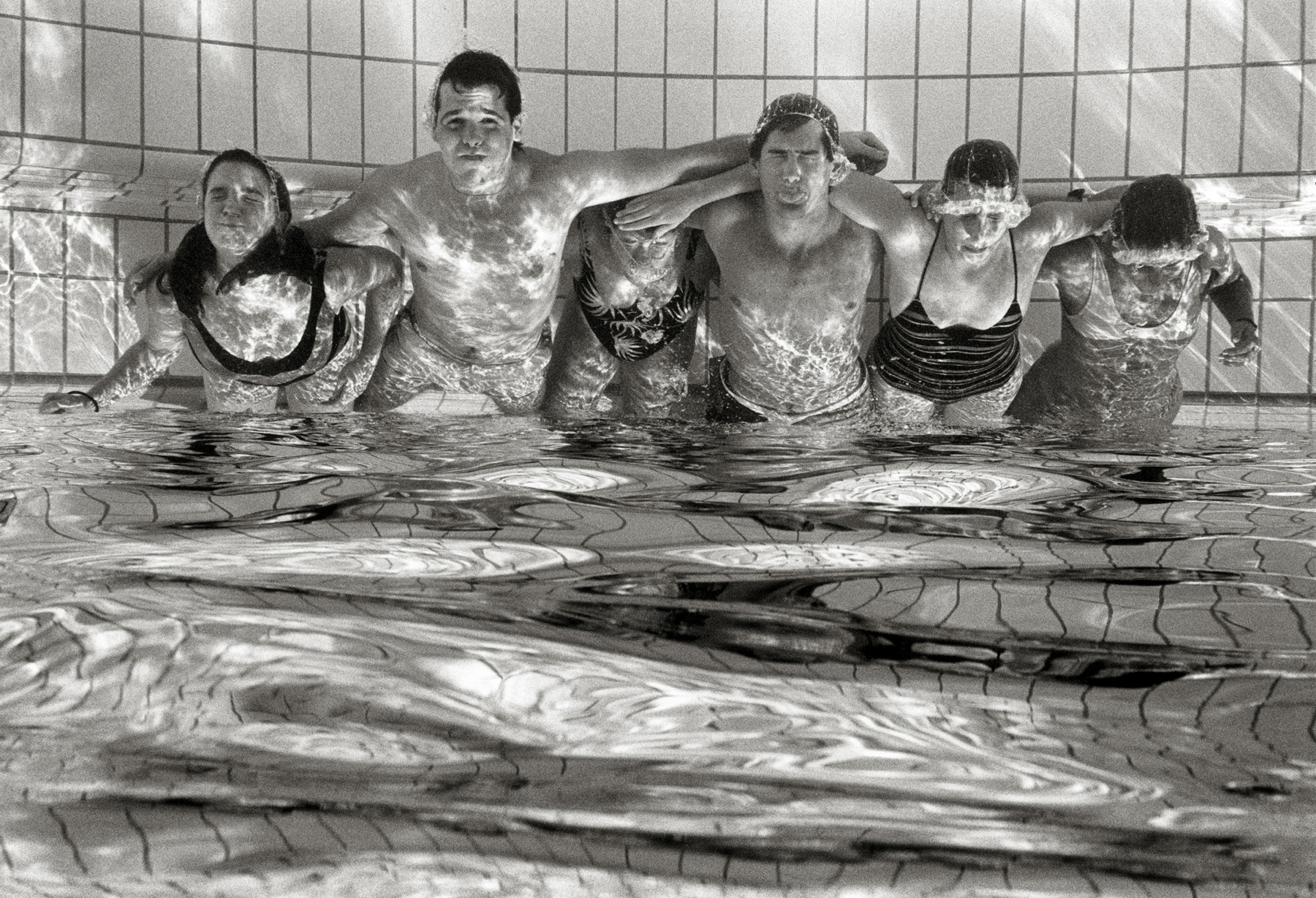
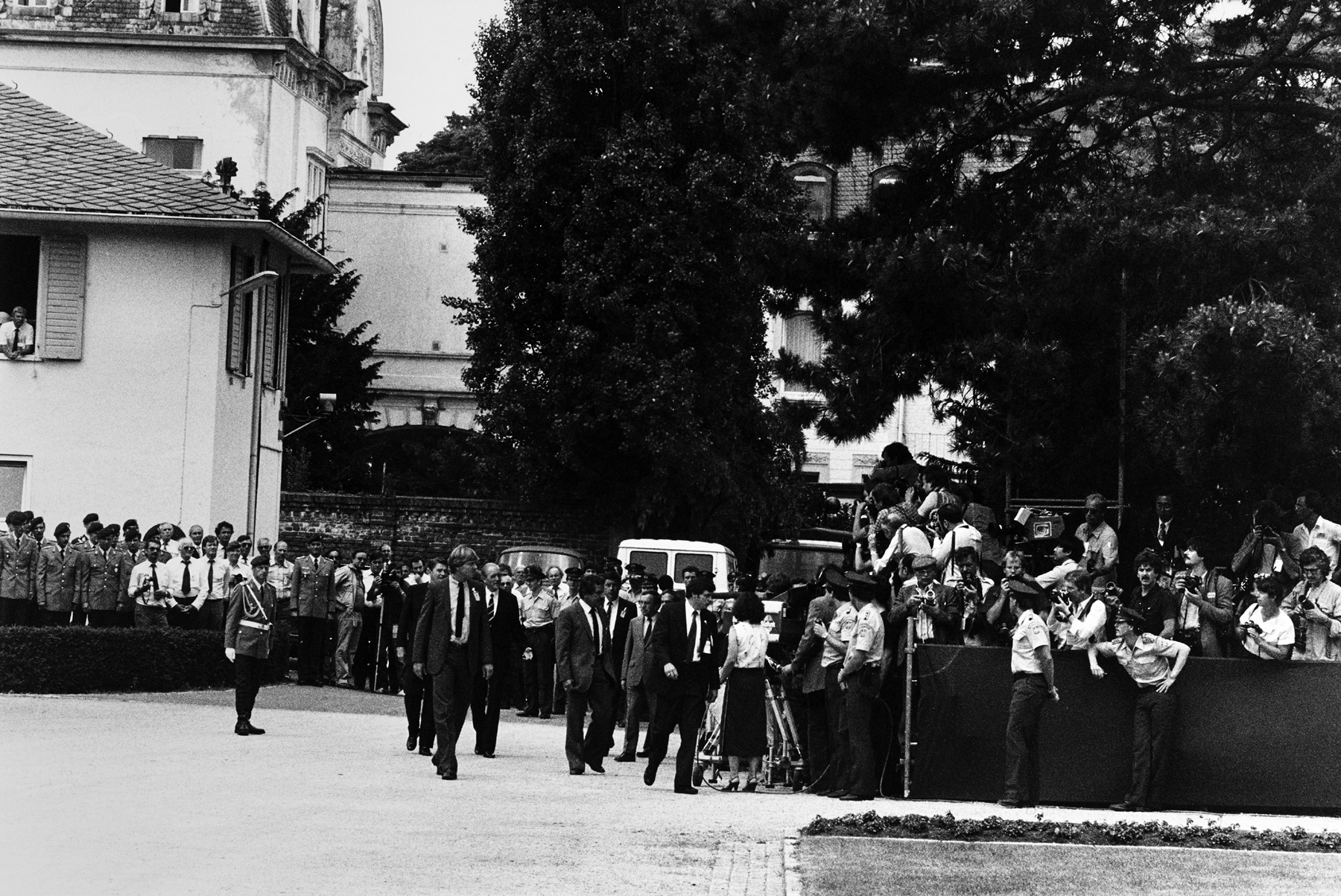
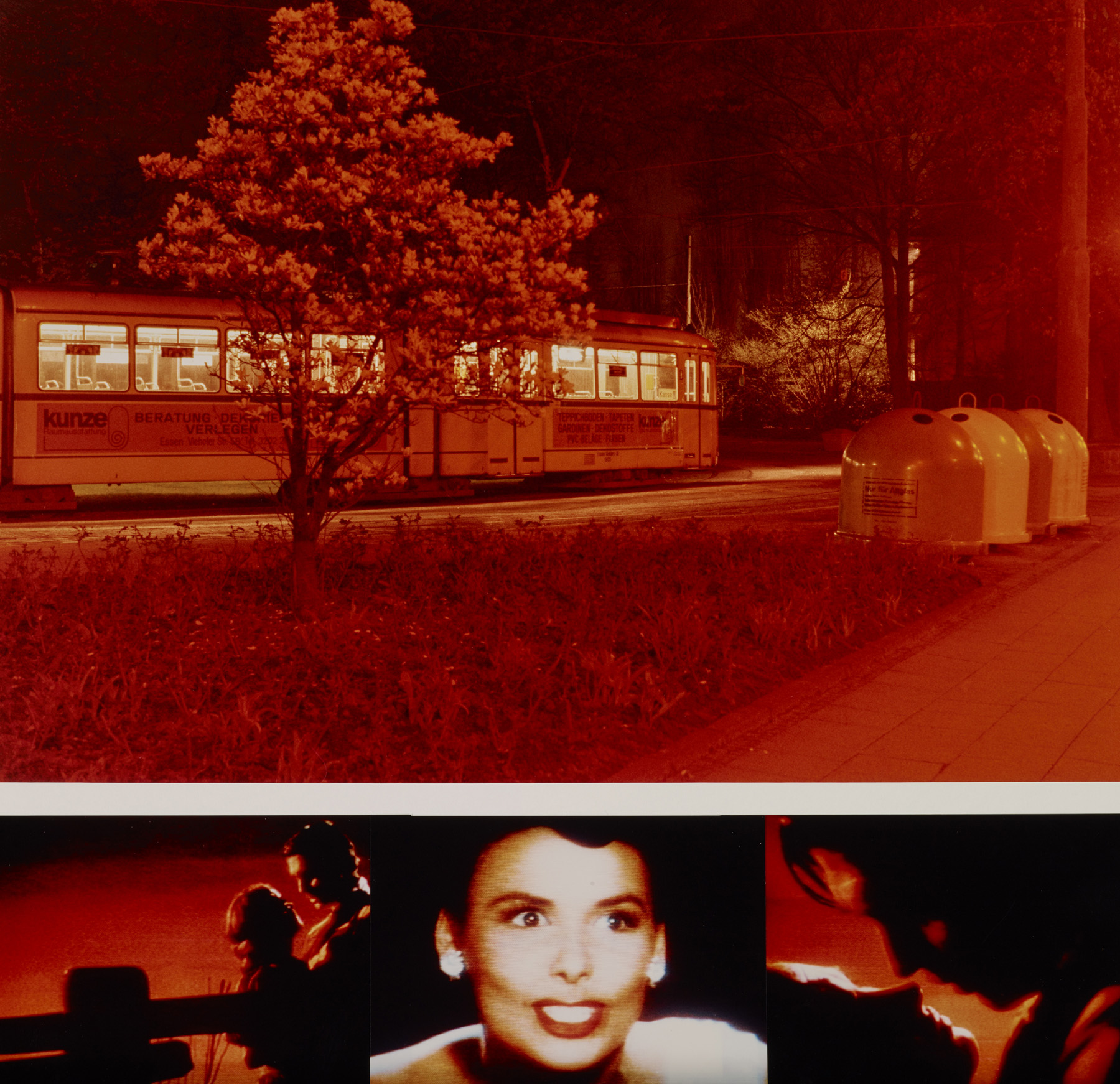
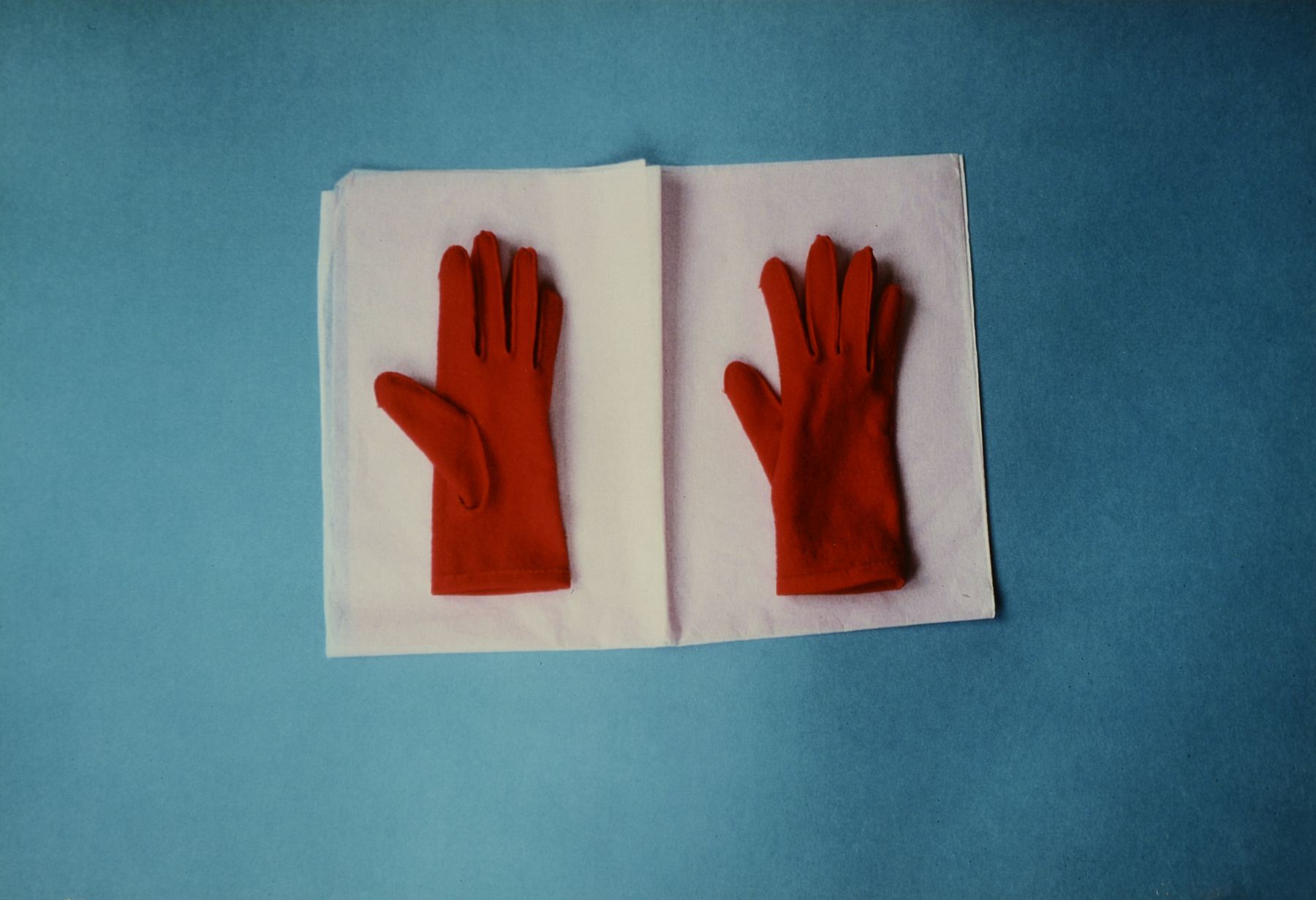
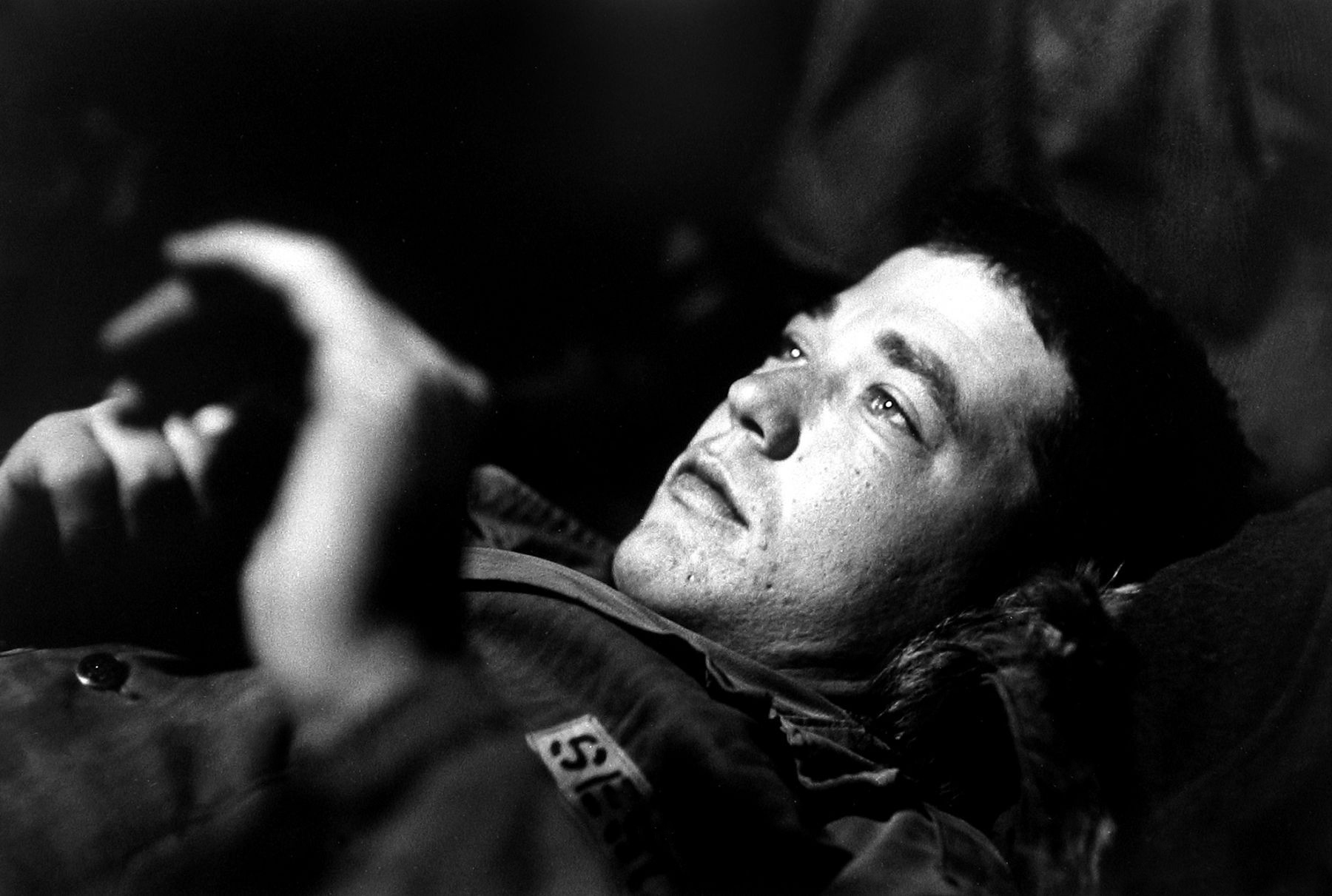
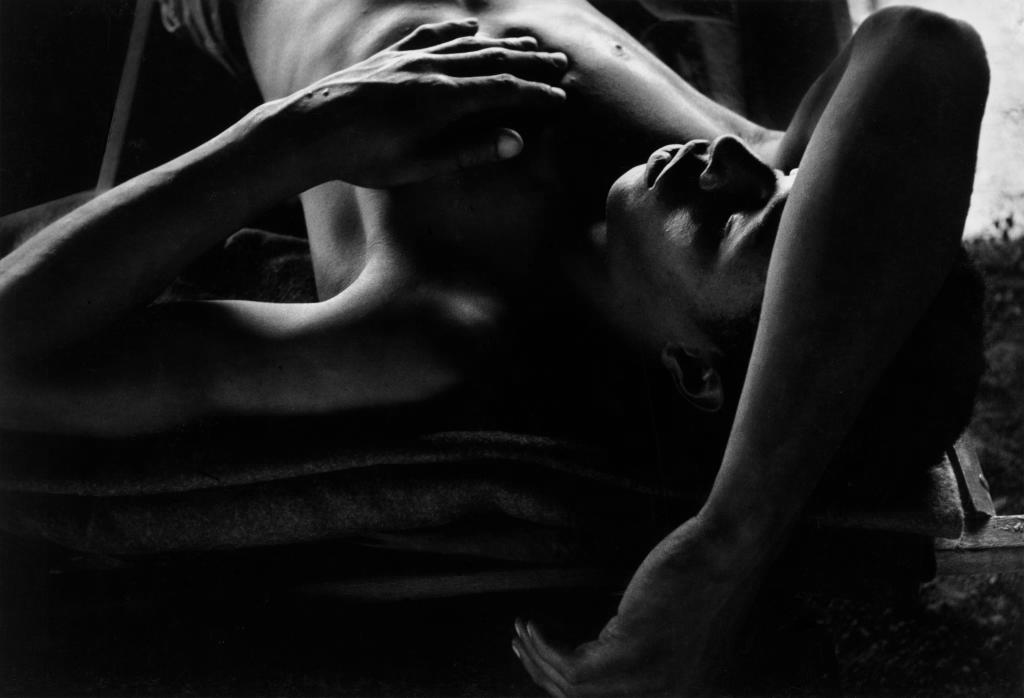
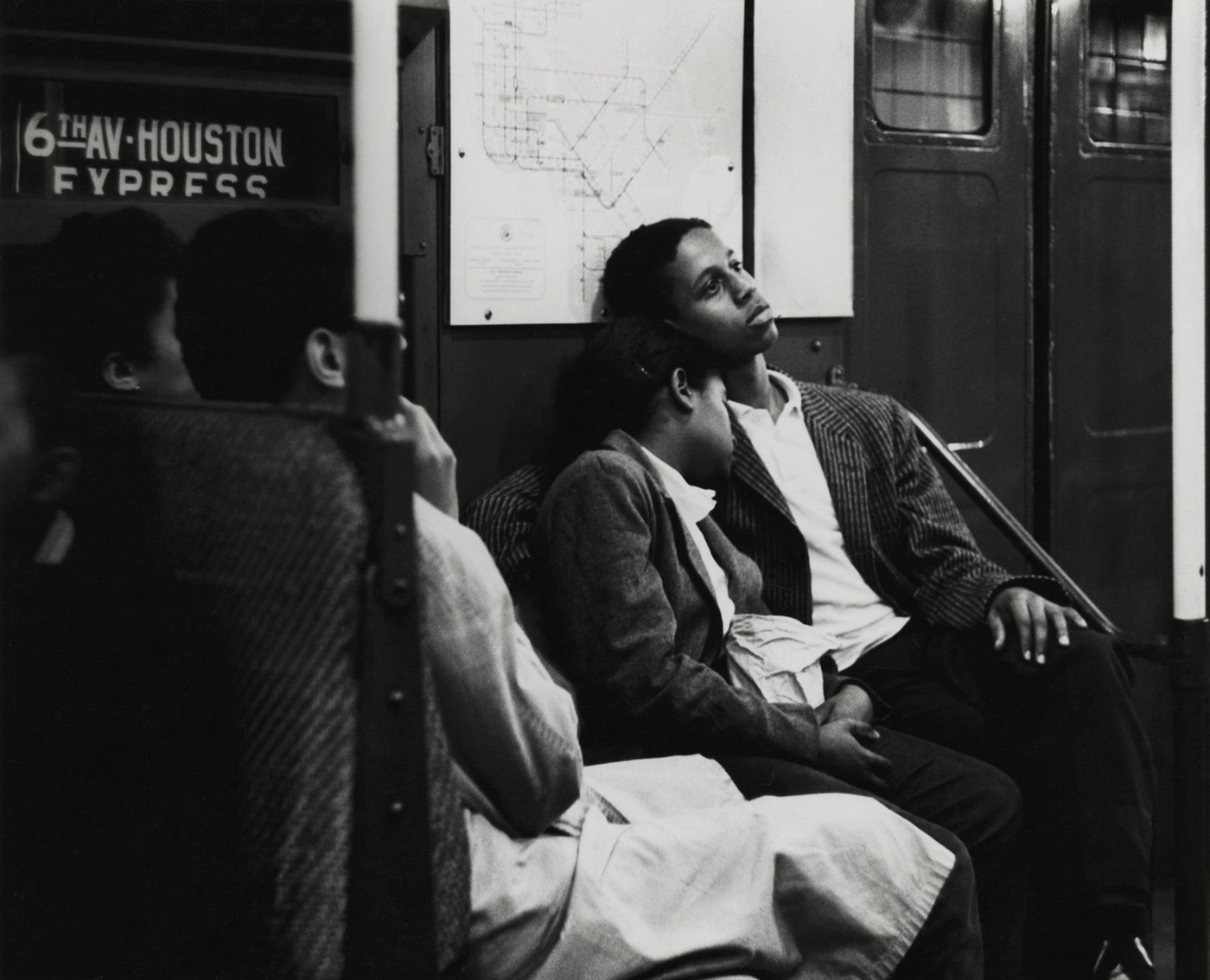
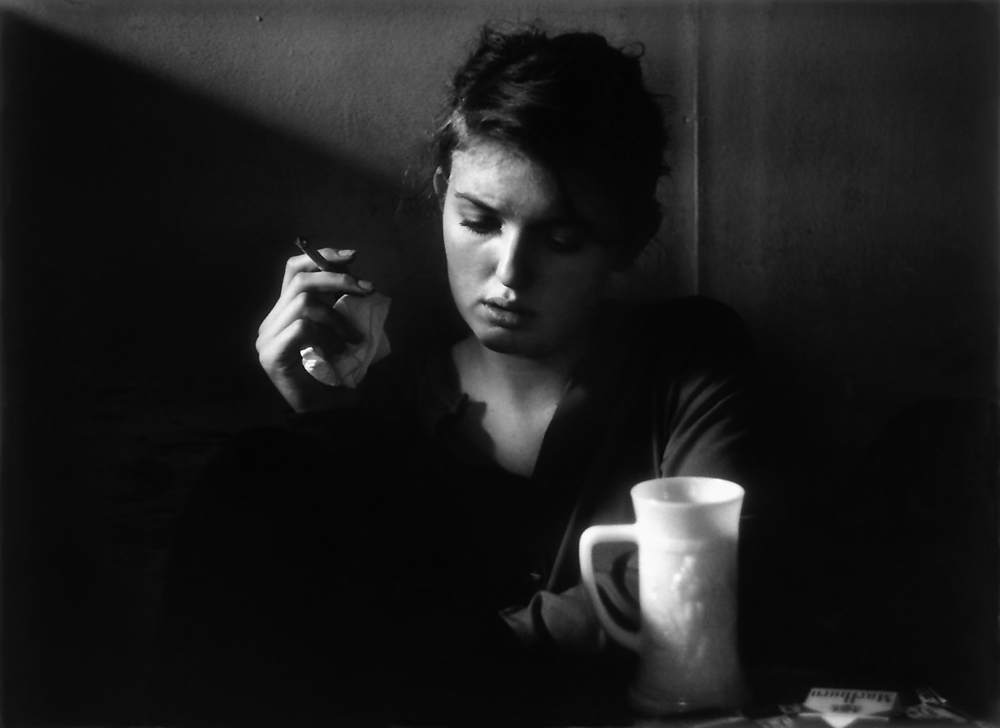
Exhibition: ‘Masculinities: Liberation through Photography’ at the Barbican Art Gallery, London

Exhibition dates: 20th February – 17th May 2020? Coronavirus

Participating artists: Bas Jan Ader, Laurie Anderson, Kenneth Anger, Knut Åsdam, Richard Avedon, Aneta Bartos, Richard Billingham, Cassils, Sam Contis, John Coplans, Jeremy Deller, Rienke Dijkstra, George Dureau, Thomas Dworzak, Hans Eijkelboom, Fouad Elkoury, Rotimi Fani-Kayode, Hal Fischer, Samuel Fosso, Anna Fox, Masahisa Fukase, Sunil Gupta, Peter Hujar, Liz Johnson Artur, Isaac Julien, Kiluanji Kia Henda, Karen Knorr, Deana Lawson, Hilary Lloyd, Robert Mapplethrope, Peter Marlow, Ana Mendieta, Anenette Messager, Duane Michals, Tracey Moffat, Andrew Moisey, Richard Mosse, Adi Nes, Catherine Opie, Elle Pérez, Herb Ritts, Kalen Na’il Roach, Collier Schorr, Paul Mpagi Sepuya, Clarie Strand, Michael Subotzky, Larry Sultan, Hank Willis Thomas, Wolfgang Tillmans, Piotr Uklański, Andy Warhol, Karlheinz Weinberger, Marianne Wex, David Wojnarowicz, Akram Zaatari.


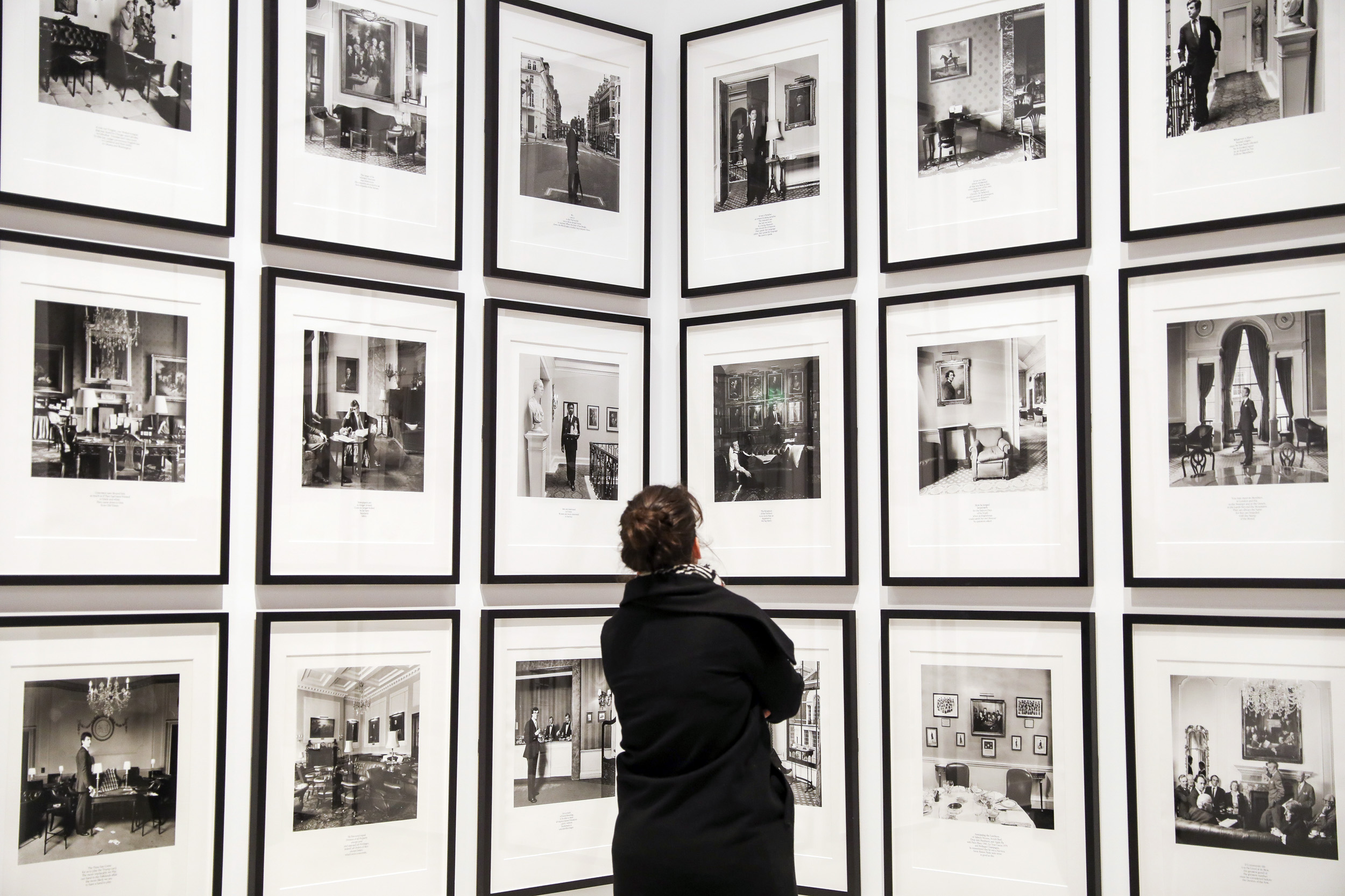
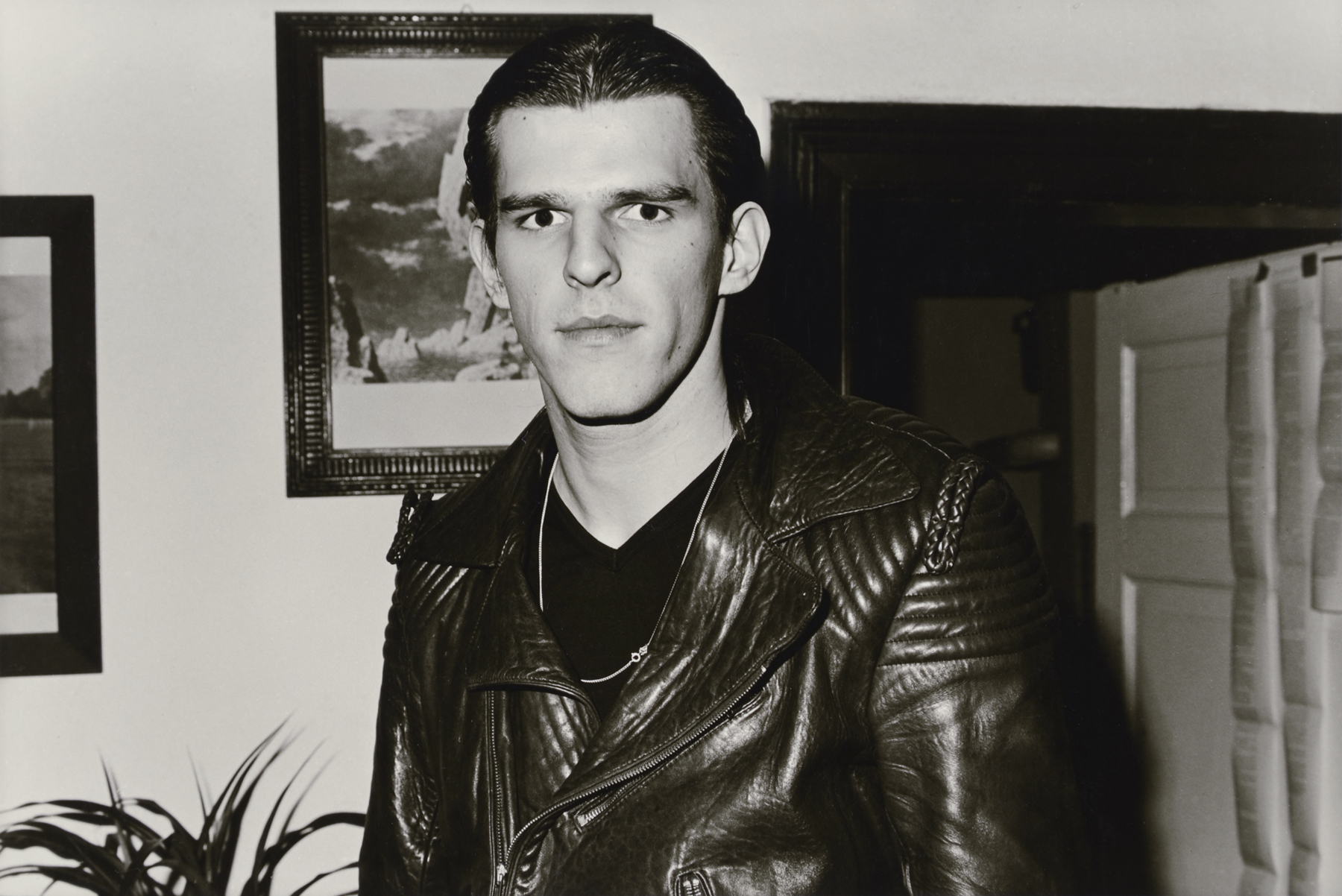
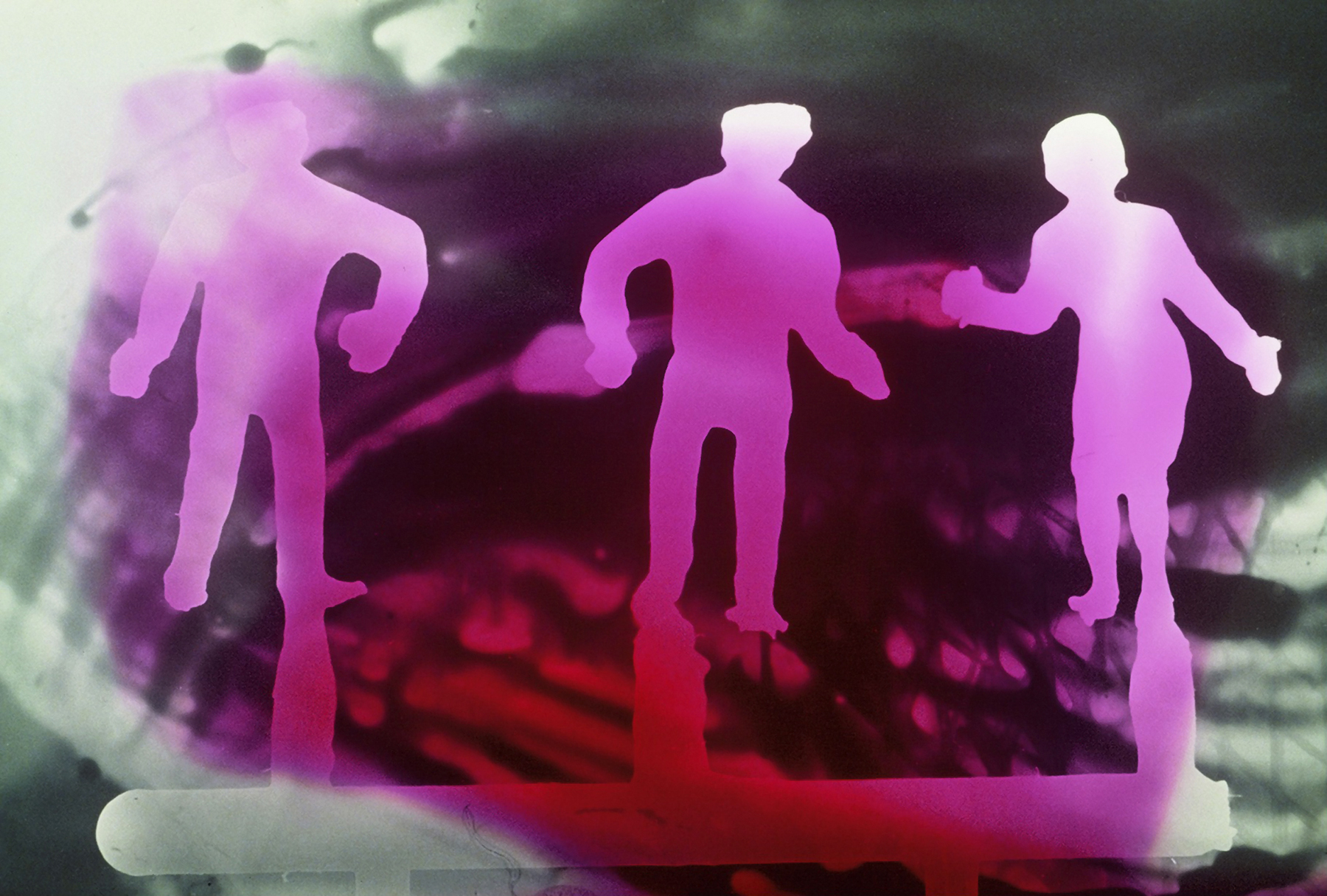
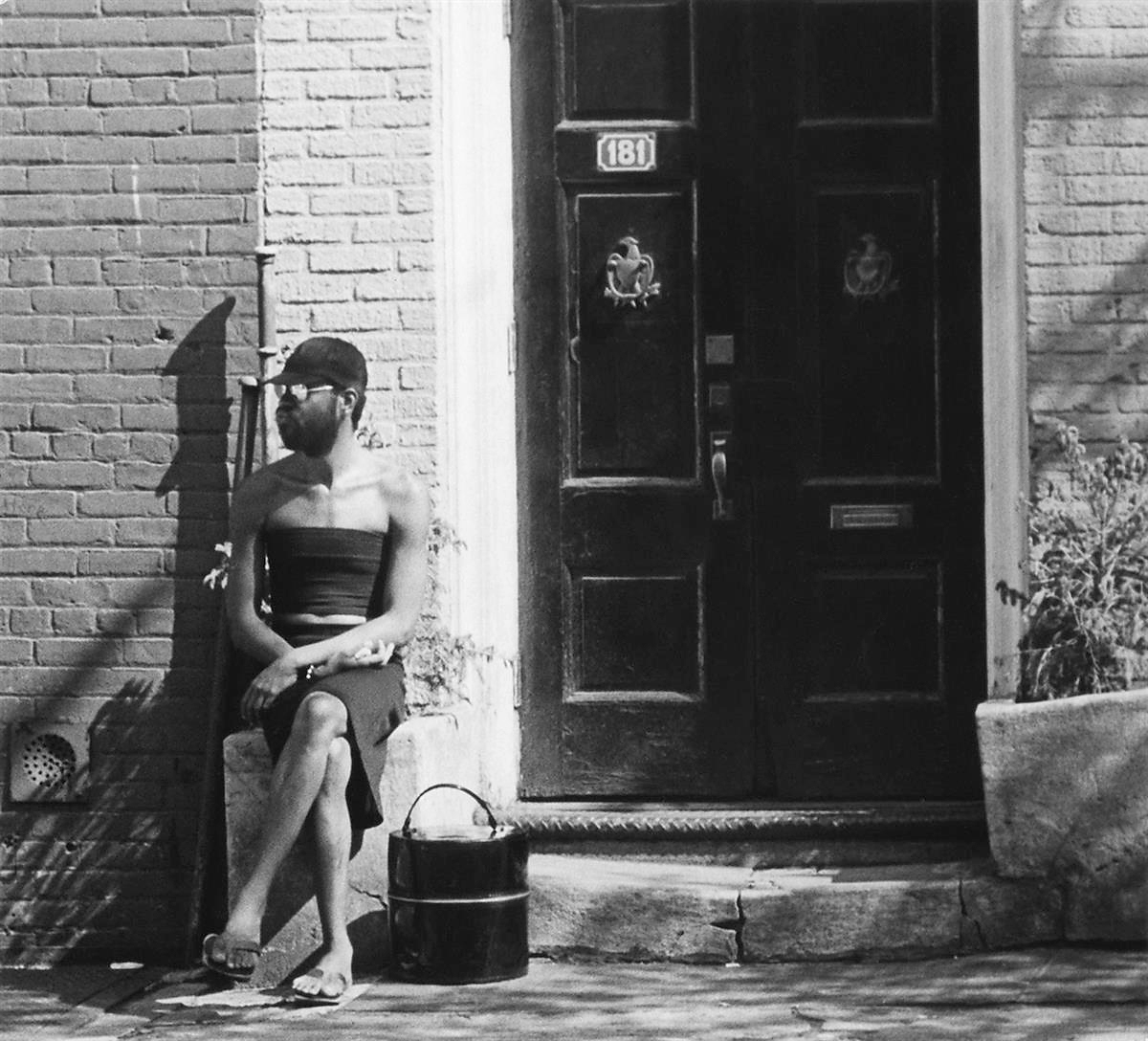
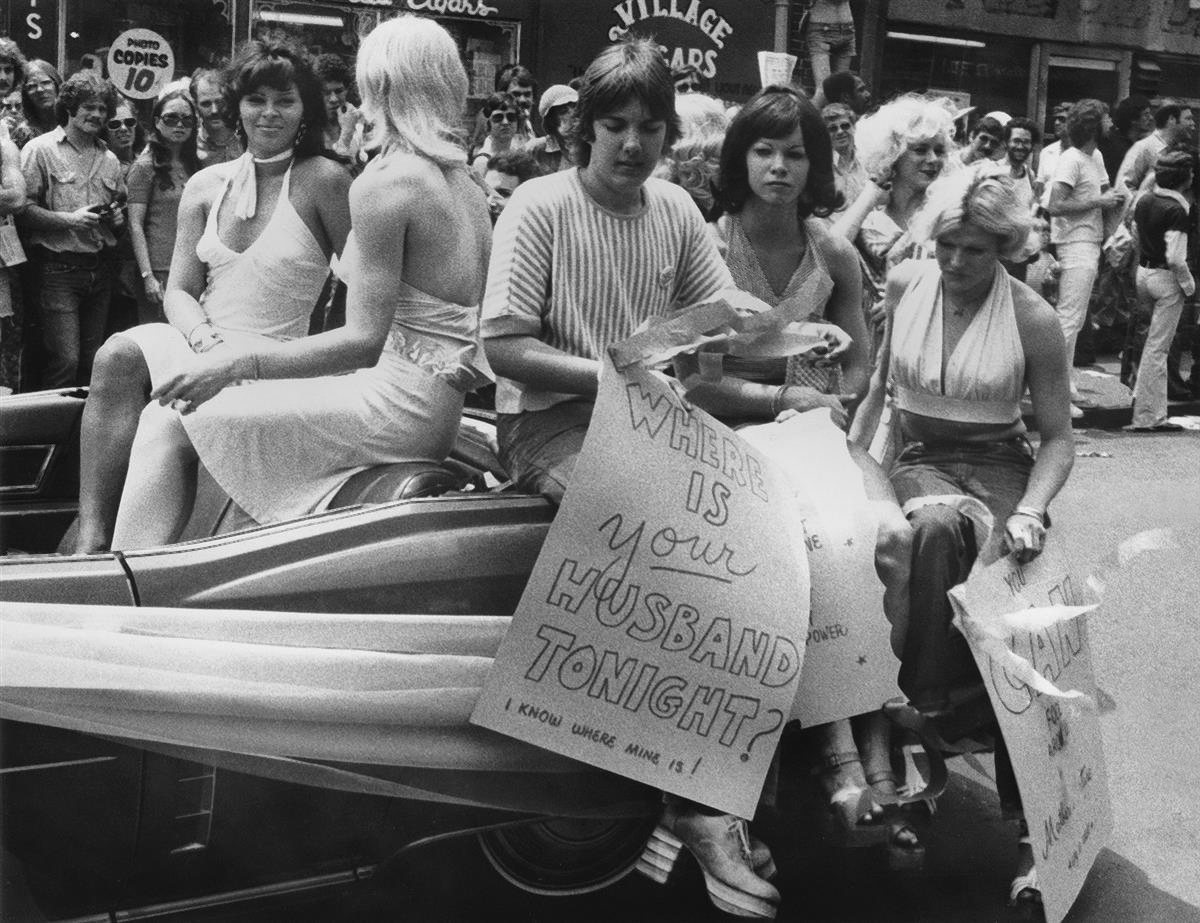
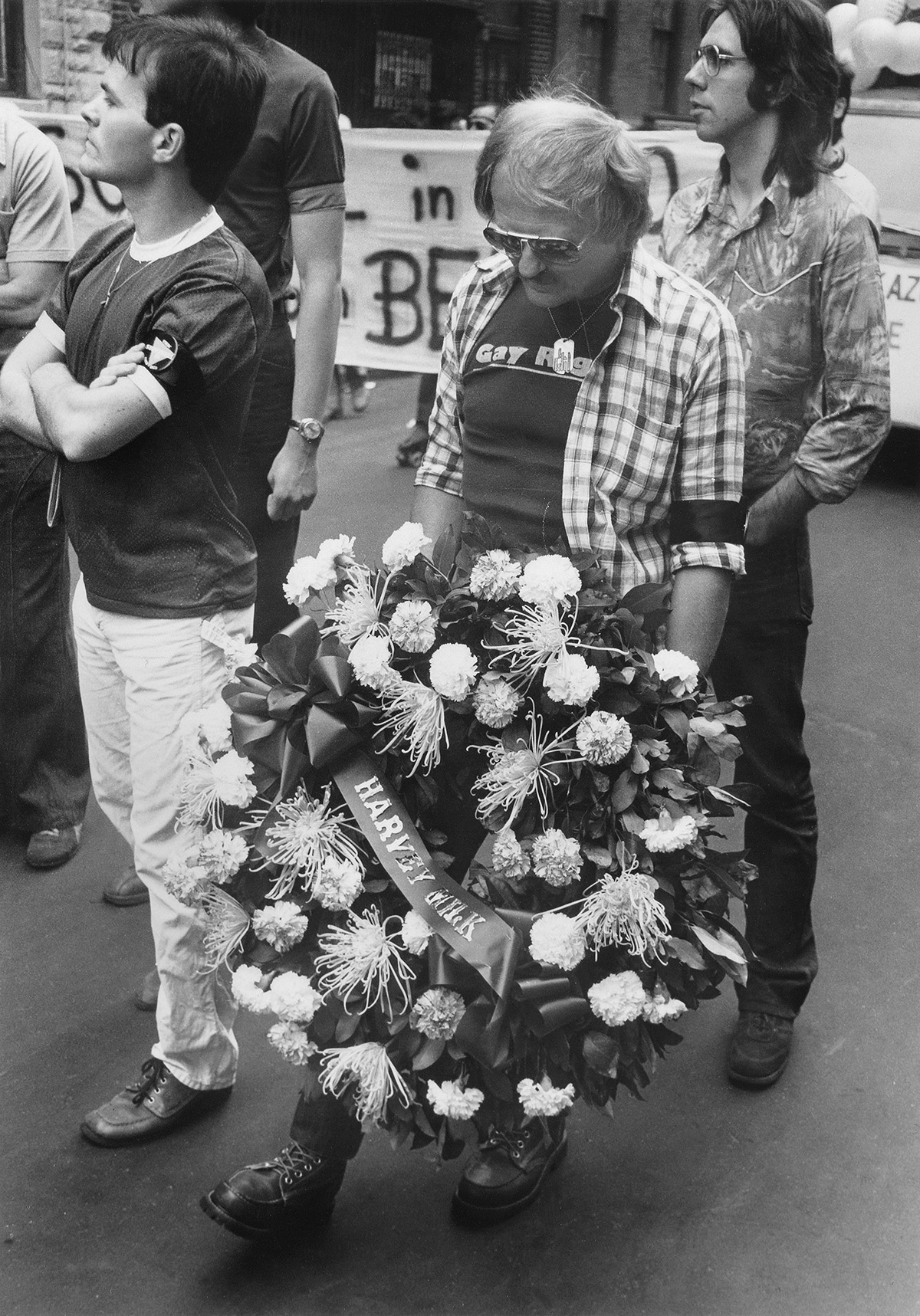
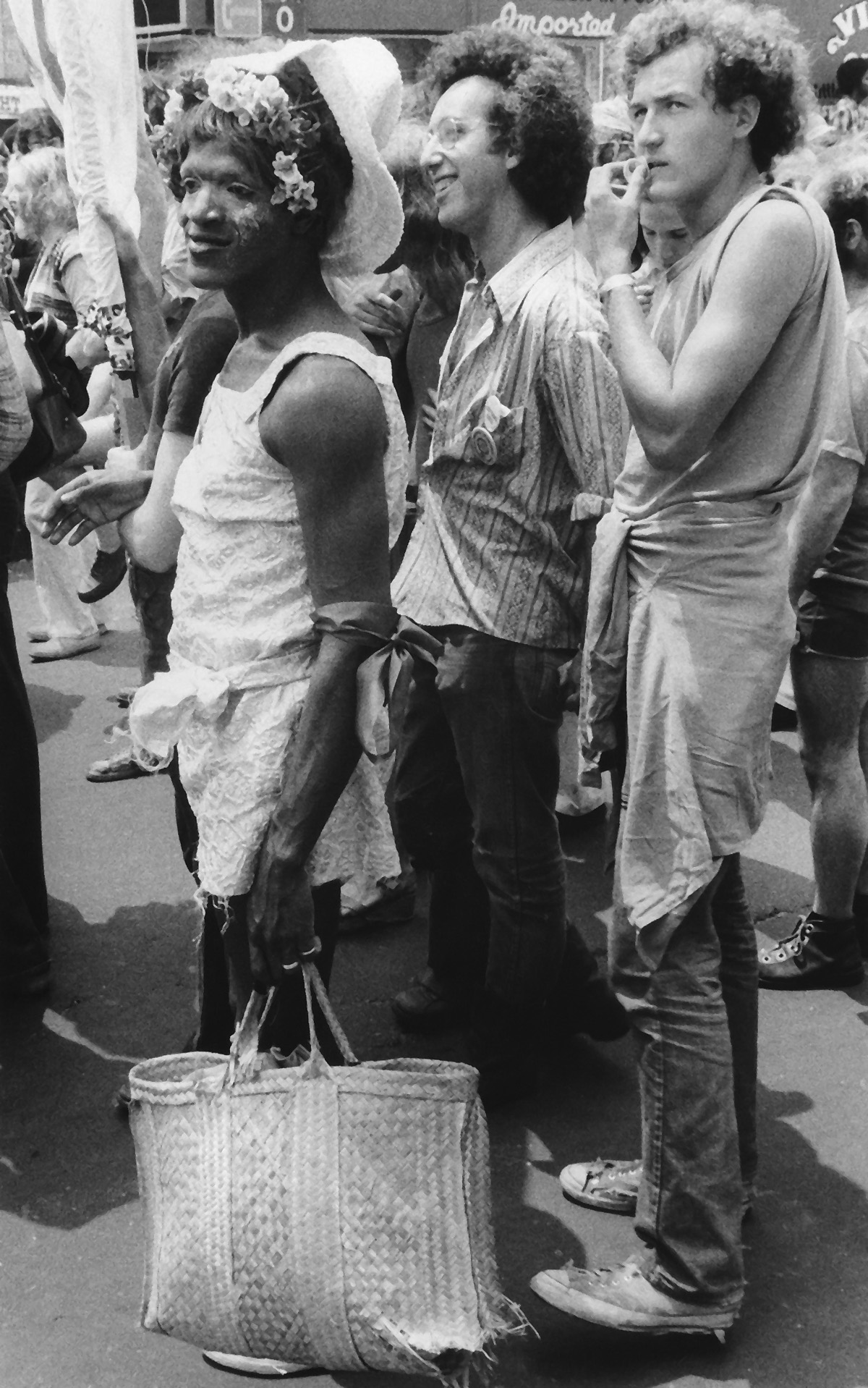
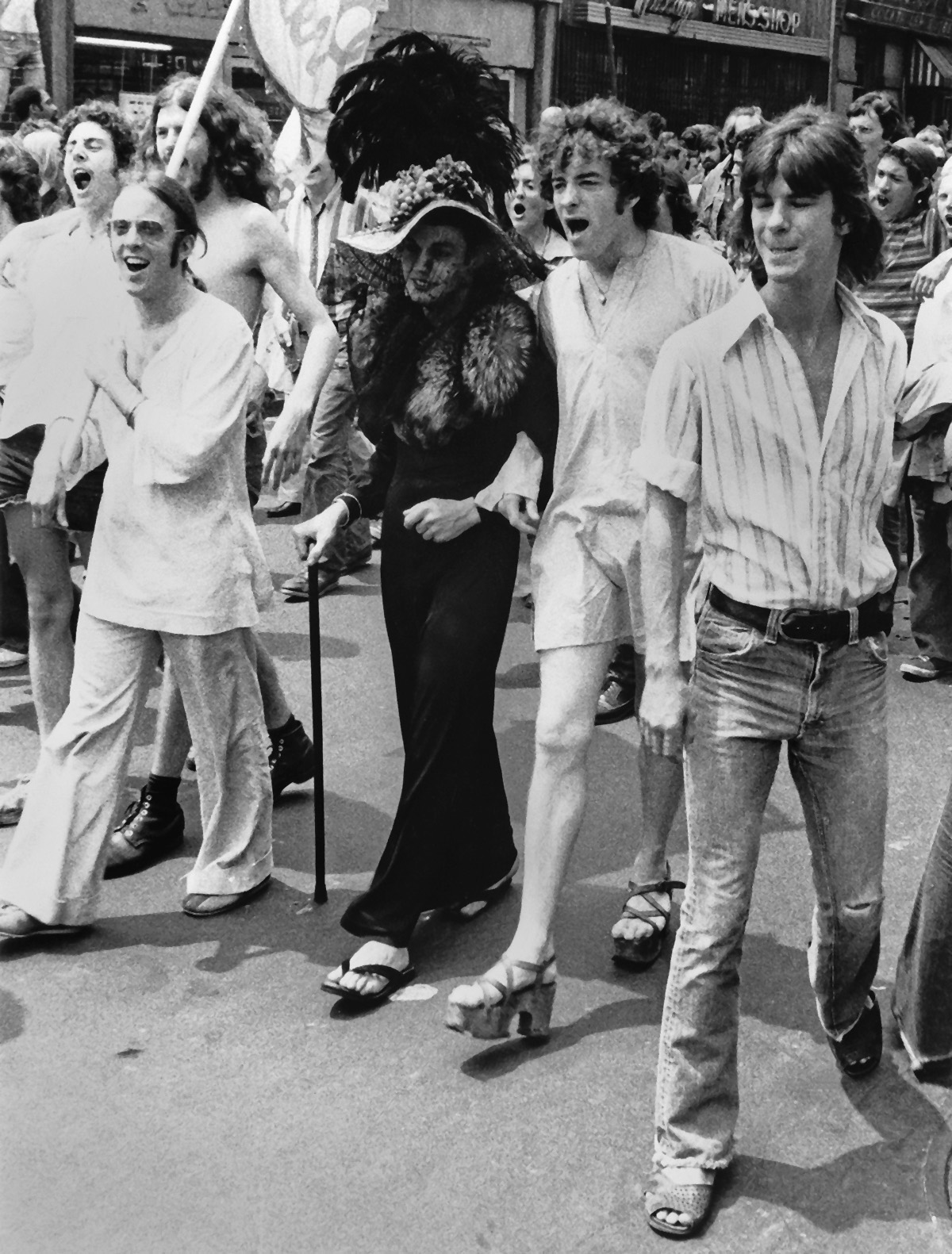
Sunil Gupta (Indian, b. 1953) 'Untitled #22' 1976 from the exhibition 'Masculinities: Liberation through Photography' at the Barbican Art Gallery, London, Feb - May, 2020


Sunil Gupta (Indian, b. 1953)
Untitled #22
1976
From the series Christopher Street
Courtesy the artist and Hales Gallery
© Sunil Gupta. All Rights Reserved, DACS 2019


“As a writer Berger recognised that experience – whether it be personal, historical or aesthetic – will never conform to theories and systems. To read him today is to accept his failures and detours as a unique willingness to take risks.”


John MacDonald. “John Berger,” in the Sydney Morning Herald, 6 June, 2020


D-Construction: deliberate masculinities in a discontinuous world

Reviewers of this exhibition (see quotations below) have noted the preponderance of images of “traditional masculinity” – defined as “idealised, dominant (and) heterosexual” – and the paucity of images that show men as working, intelligent, sensitive human beings, “that men ever earned a living, cooked a meal or read a book… scarcely anything about the heart or intellect. Men are represented here almost entirely in terms of their bodies, sexuality or supposed type.” I need make no further comment. What I will say is that I believe the title of the exhibition to be a misnomer: a person cannot be “liberated” through photography, for photography is only a tool of a personal liberation. Liberation comes through an internal struggle of acceptance (thence liberation), one that is foremost FELT (for example, the double life one leads before you acknowledge that you are gay; or experiencing discrimination aimed at others and by proxy, yourself) and SEEN (the bashing of a mother as seen by a small child). Photographs picture the outcomes of this struggle for liberation, are a tool of that process not, I would argue, liberation itself.

What I can say is that I believe in masculinities, plural. Fluid, shifting, challenging, loving, working, intimate, spiritual masculinities that challenge normalcy and hegemonic masculinity, which is defined as “a practice that legitimises men’s dominant position in society and justifies the subordination of the common male population and women, and other marginalised ways of being a man.”

What I don’t believe in is masculinities, plural, that seek to fit into this [dis]continuous world (for we are born and then die) through the stability of their outward appearance, conforming to theories and systems – personal, historical or aesthetic – without reference to subversion, small intimacies, the toil of work, love and the passion of sexual bodies. In other words, masculinities that are not afraid to push the boundaries of being and becoming. To take risks, to experience, to feel.

While I was overjoyed at the “YES” vote on gay marriage that took place in December 2017 in Australia because I felt it was a victory for love, and equality… another part of me rejected as anathema the concept of a gay person buying into a historically patriarchal, heterosexual and monogamous institution such as marriage – too honour and obey. This is an untenable concept for a person who wants to be liberated. Coming out as I did in 1975, only 6 short years after the Stonewall Riots, the last thing I EVER wanted to be, was to be the same as a “straight” person. I was different. I fought for my difference and still believe in it.

Of course, in 2020 it’s another world. Today we all mix in together. But there is still something about “masculinities”, which in some varieties, have a sense of privilege and entitlement. Of power and control over others; of violence towards women, trans, other men and anyone who threatens their little ego, who leaves them, or jilts them. Their jealousy, their ego, bruised – they are so insecure, so insular, that they can only see their own world, their own minuscule problems (but massive in their eyes), and enforce their will on others.

My advice to “masculinities’, in fact any human being, is to go out, get yourself informed, experience, accept, and be the person that nobody thinks you can be. Be a human being. Examine your inner self, look at your dark side, your other side, your empathetic side, and try and understand the journey that you are on. Then, and only then, you might begin on that great path of personal enlightenment, that golden path on which there is no turning back.

Below I discuss some of these ideas with my good friend Nicholas Henderson, curator and archivist at the Australian Lesbian and Gay Archives.


Dr Marcus Bunyan


Many thankx to the Barbican Art Gallery for allowing me to publish the photographs in the posting. Please click on the photographs for a larger version of the image.


Masculinities: Liberation through Photography is a major group exhibition that explores how masculinity is experienced, performed, coded and socially constructed as expressed and documented through photography and film from the 1960s to the present day.

Through the medium of film and photography, this major exhibition considers how masculinity has been coded, performed, and socially constructed from the 1960s to the present day. Examining depictions of masculinity from behind the lens, the Barbican brings together the work of over 50 international artists, photographers and filmmakers including Laurie Anderson, Sunil Gupta, Rotimi Fani-Kayode, Isaac Julien and Catherine Opie.

In the wake of #MeToo the image of masculinity has come into sharper focus, with ideas of toxic and fragile masculinity permeating today’s society. This exhibition charts the often complex and sometimes contradictory representations of masculinities, and how they have developed and evolved over time. Touching on themes including power, patriarchy, queer identity, female perceptions of men, hypermasculine stereotypes, tenderness and the family, the exhibition shows how central photography and film have been to the way masculinities are imagined and understood in contemporary culture.


In fact, while there are a few gender-fluid figures here, they’re vastly outnumbered by manifestations of “traditional masculinity” – defined as “idealised, dominant (and) heterosexual”. Lebanese militiamen (in Fouad Elkoury’s perky full-length portraits from 1980), US marines (in Wolfgang Tillmans’ epic montage Soldiers – The Nineties), Taliban fighters, SS generals, Israel Defence Force grunts, footballers, cowboys and bullfighters fairly spring out of the walls from every direction. And what’s evident from the outset isn’t so much their diversity, as a unifying demeanour: a threatening intentness that comes wherever men are asked to perform their masculinity, but also a childlike vulnerability.  …

Masculinity, the viewer is made to feel, criminalises men (Mikhael Subotzky’s images of South African gangsters on morgue slabs); isolates them (Larry Sultan’s poignant image of his elderly father practising his golf swing in his sitting room); renders them stupid (Richard Billingham’s excruciating, but now classic photo essay on his alcoholic father, ‘Ray’s a Laugh’). To be a man, it seems, is to be condemned to endlessly act out archetypal “masculine” behaviour, whether you’re an elderly drunk in a Birmingham high-rise or the elite American students taking part in the shouting competition staged by Irish photographer Richard Mosse.


Mark Hudson. “Does the Barbican’s Masculinities exhibition have important things to say about men?” on the Independent website Friday 21 February 2020 [Online] Cited 03/03/2020


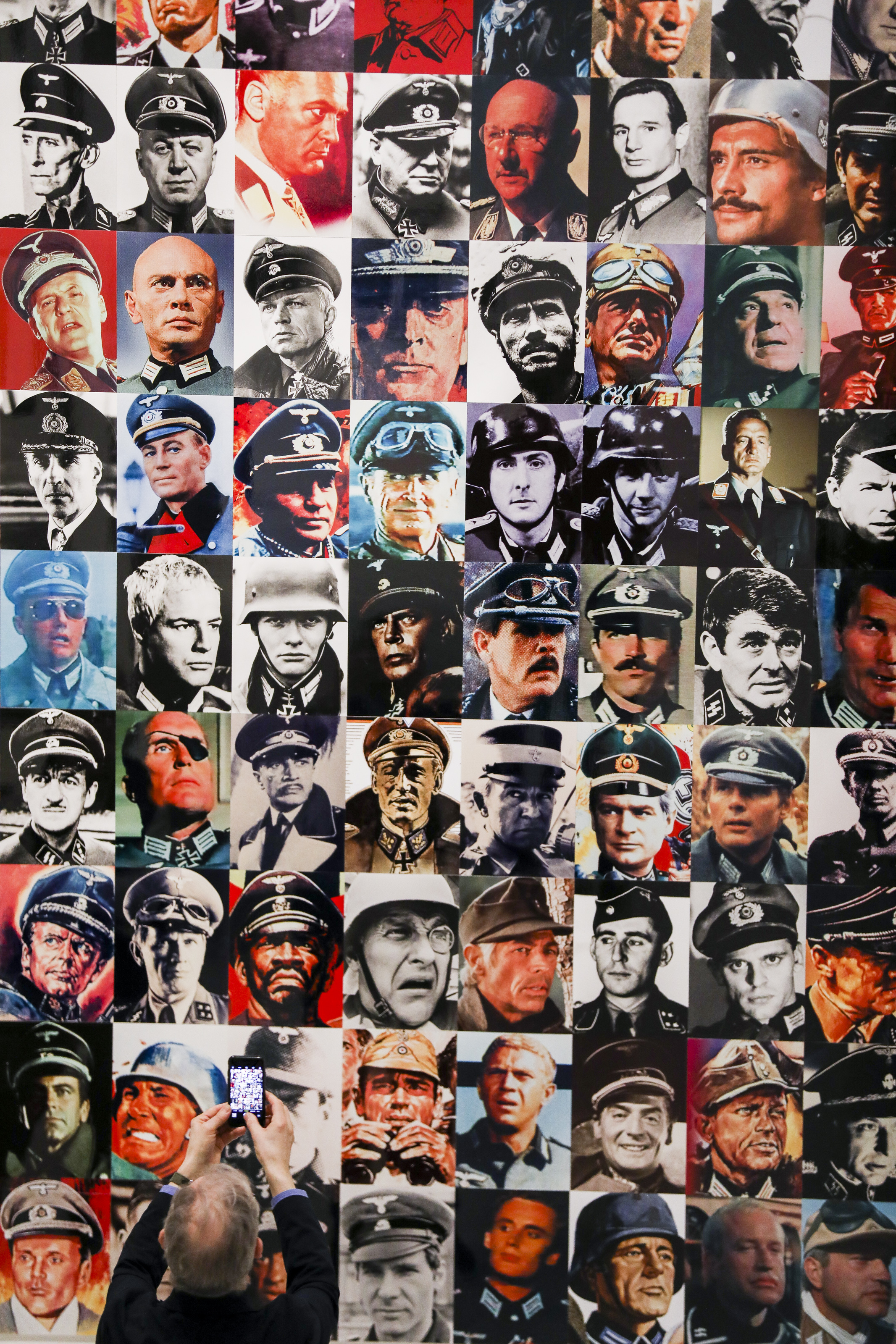
There is not much here about work – unless you count the wall of Hollywood actors playing Nazis. You would never think, from this show, that men ever earned a living, cooked a meal or read a book (though there is a sententious vitrine of ‘Men Only’ magazines). Beyond the exceptions given, there is scarcely anything about the heart or intellect. Men are represented here almost entirely in terms of their bodies, sexuality or supposed type.


Laura Cumming. “Masculinities: Liberation Through Photography review – men as types,” on the Guardian website Sun 23 Feb 2020 [Online] Cited 03/03/2020


“The body can be taken as a reflection of the self because it can and should be treated as something to be worked upon … in order to produce it as a commodity. Overweight, slovenliness and even unfashionability, for example, are now moral disorders,” notes Don Slater

“The state of the body is seen as a reflection of the state of its owner, who is responsible for it and could refashion it. The body can be taken as a reflection of the self because it can and should be treated as something to be worked upon, and generally worked upon using commodities, for example intensively regulated, self-disciplined, scrutinized through diets, fitness regimes, fashion, self-help books and advice, in order to produce it as a commodity. Overweight, slovenliness, and even unfashionability, for example, are now moral disorders; even acute illnesses such as cancer reflect the inadequacy of the self and indeed of its consumption. One gets ill because one has consumed the wrong (unnatural) things and failed to consume the correct (‘natural’) ones: self, body, goods and environment constitute a system of moral choice.”


Slater, Don. Consumer Culture and Modernity. London: Polity Press, 1997, p. 92.


Installation view of 'Masculinities: Liberation through Photography' at Barbican Art Gallery on February 19, 2020 in London, England showing John Coplans' work 'Self-portrait, Frieze No 2, Four Panels' 1994

Installation view of 'Masculinities: Liberation through Photography' at Barbican Art Gallery on February 19, 2020 in London, England showing John Coplans' work 'Self-portrait, Frieze No 2, Four Panels' 1994


Installation view of Masculinities: Liberation through Photography at Barbican Art Gallery on February 19, 2020 in London, England showing John Coplans’ work Self-portrait, Frieze No 2, Four Panels 1994
Photo: Tristan Fewings/Getty Images for Barbican Art Gallery


John Coplans (British, emigrated America 1960, 1920-2003) 'Self-portrait, Frieze No 2, Four Panels' 1994 from the exhibition 'Masculinities: Liberation through Photography' at the Barbican Art Gallery, London, Feb - May, 2020


John Coplans (British, emigrated America 1960, 1920-2003)
Self-portrait, Frieze No 2, Four Panels
1994
Tate
Presented by the American Fund for the Tate Gallery 2001
Photograph: © John Coplans Trust


Masculinities: Liberation through Photography


Plan of the 'Masculinities: Liberation through Photography' exhibition spaces


Plan of the Masculinities: Liberation through Photography exhibition spaces


Introduction

Masculinities: Liberation through Photography explores the diverse ways masculinity has been experienced, performed, coded and socially constructed in photography and film from the 1960s to the present day.

Simone de Beauvoir’s famous declaration that ‘one is not born a woman, but rather becomes one’ provides a helpful springboard for considering what it means to be a male in today’s world, as well as the place of photography and film in shaping masculinity. What we have thought of as ‘masculine’ has changed considerably throughout history and within different cultures. The traditional social dominance of the male has determined a gender hierarchy which continues to underpin societies around the world.

In Europe and North America, the characteristics and power dynamics of the dominant masculine figure – historically defined by physical size and strength, assertiveness and aggression – though still pervasive today, began to be challenged and transformed in the 1960s. Amid a climate of sexual revolution, struggle for civil rights and raised class consciousness, the growth of the gay rights movement, the period’s counterculture and opposition to the Vietnam War, large sections of society argued for a loosening of the straitjacket of narrow gender definitions.

Set against the backdrop of the #MeToo movement, when manhood is under increasing scrutiny and terms such as ‘toxic’ and ‘fragile’ masculinity fill endless column inches, an investigation of this expansive subject is particularly timely, especially given current global politics characterised by male world leaders shaping their image as ‘strong’ men.

Touching on queer identity, race, power and patriarchy, men as seen by women, stereotypes of dominant masculinity as well as the family, the exhibition presents masculinity in all its myriad forms, rife with contradictions and complexities. Embracing the idea of multiple ‘masculinities’ and rejecting the notion of a singular ‘ideal man’, the exhibition argues for an understanding of masculinity liberated from societal expectations and gender norms.

Room 1-4

Disrupting the Archetype

Over the last six decades, artists have consistently sought to destabilise the narrow definitions of gender that determine our social structures in order to encourage new ways of thinking about identity, gender and sexuality. ‘Disrupting the Archetype’ explores the representation of conventional and at times clichéd masculine subjects such as soldiers, cowboys, athletes, bullfighters, body builders and wrestlers. By reconfiguring the representation of traditional masculinity – loosely defined as an idealised, dominant heterosexual masculinity – the artists presented here challenge our ideas of these hypermasculine stereotypes.

Across different cultures and spaces, the military has been central to the construction of masculine identities – which has been explored through the work of Wolfgang Tillmans (below) and Adi Nes (below) among others, while Collier Schorr (below) and Sam Contis’s powerful works (below) address the dominant and enduring representation of the lone cowboy. Athleticism, often perceived as a proxy for strength which is associated with masculinity, is called into question by Catherine Opie’s and Rineke Dijkstra’s tender portraits (below). The male body, a cornerstone for artists such as John Coplans (above), Robert Mapplethorpe and Cassils (below), is meanwhile exposed as a fleshy canvas, constantly in flux.

Historically, the non-western male body has undergone a complex process of subjectification through the Western gaze – invariably presented as either warlike or sexually charged. Viewed against this context, the work of Fouad Elkoury and Akram Zaatari, as well as the found photographs of Taliban fighters that Thomas Dworzak discovered in Afghanistan (below), can be read as deconstructing the Orientalist gaze.


Installation view of 'Masculinities: Liberation through Photography' at Barbican Art Gallery on February 19, 2020 in London, England showing a detail from Wolfgang Tillmans' epic montage 'Soldiers – The Nineties'


Installation view of Masculinities: Liberation through Photography at Barbican Art Gallery on February 19, 2020 in London, England showing a detail from Wolfgang Tillmans’ epic montage Soldiers – The Nineties
Photo: Tristan Fewings/Getty Images for Barbican Art Gallery


Installation view of 'Masculinities: Liberation through Photography' at Barbican Art Gallery on February 19, 2020 in London, England showing a detail from trans masculine artist Cassils' series 'Time Lapse' 2011


Installation view of Masculinities: Liberation through Photography at Barbican Art Gallery on February 19, 2020 in London, England showing a detail from trans masculine artist Cassils’ series Time Lapse, 2011
Photo: Tristan Fewings/Getty Images for Barbican Art Gallery


Installation view of 'Masculinities: Liberation through Photography' at Barbican Art Gallery on February 19, 2020 in London, England showing at left a detail from trans masculine artist Cassils' series 'Time Lapse' 2011, and at right the work of Rineke Dijkstra


Installation view of Masculinities: Liberation through Photography at Barbican Art Gallery on February 19, 2020 in London, England showing at left a detail from trans masculine artist Cassils’ series Time Lapse, 2011, and at right the work of Rineke Dijkstra
Photo: Tristan Fewings/Getty Images for Barbican Art Gallery


Rineke Dijkstra (Dutch, b. 1959) 'Montemor, Portugal, May 1, 1994' 1994


Rineke Dijkstra (Dutch, b. 1959)
Montemor, Portugal, May 1, 1994
1994
Chromogenic print
90 x 72cm
© Rineke Dijkstra
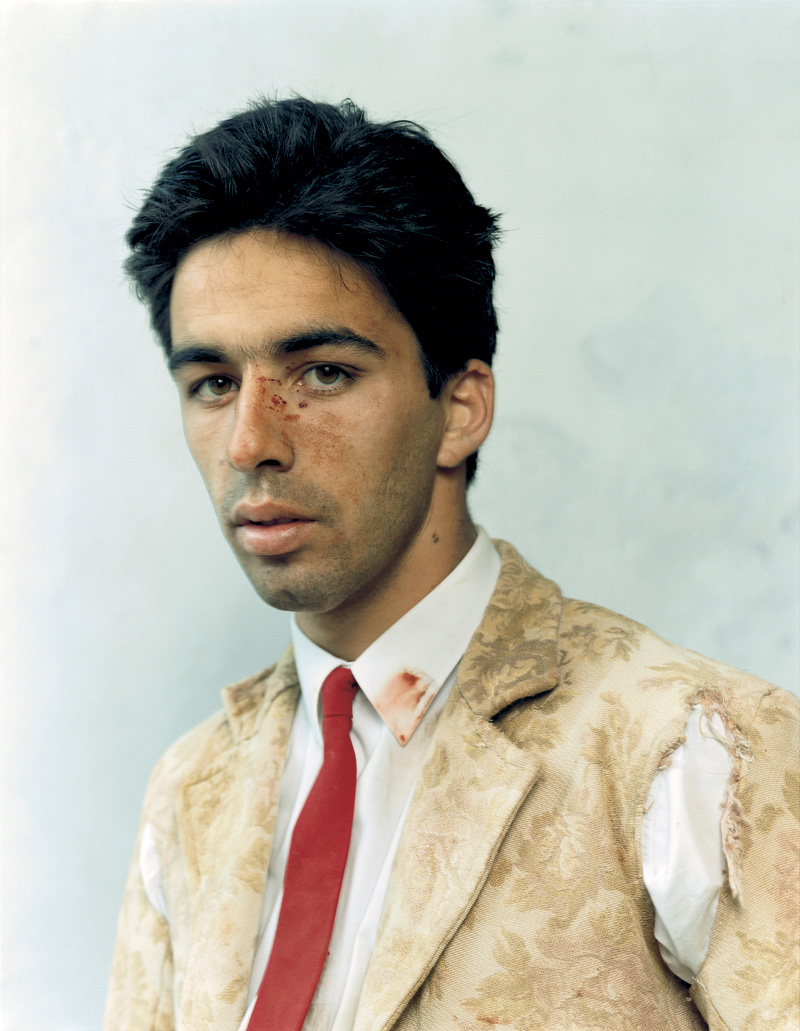
 

Rineke Dijkstra (Dutch, b. 1959) 'Vila Franca de Xira, Portugal, May 8, 1994' 1994


Rineke Dijkstra (Dutch, b. 1959)
Vila Franca de Xira, Portugal, May 8, 1994
1994
Chromogenic print
90 x 72cm
© Rineke Dijkstra


Installation view of 'Masculinities: Liberation through Photography' at Barbican Art Gallery on February 19, 2020 in London, England showing photographs from Adi Nes' series 'Soldiers' 1999


Installation views of Masculinities: Liberation through Photography at Barbican Art Gallery on February 19, 2020 in London, England showing photographs from Adi Nes’ series Soldiers, 1999
Photo: Tristan Fewings/Getty Images for Barbican Art Gallery


Adi Nes (Israeli, b. 1966) 'Untitled' 2000


Adi Nes (Israeli, b. 1966)
Untitled
2000
From the series Soldiers
Courtesy Adi Nes & Praz-Delavallade Paris, Los Angeles


Adi Nes (Israeli, b. 1966) 'Untitled' 1999


Adi Nes (Israeli, b. 1966)
Untitled
1999
From the series Soldiers
Courtesy Adi Nes & Praz-Delavallade Paris, Los Angeles


Adi Nes was born in Kiryat Gat. His parents are Jewish immigrants from Iran. He is openly gay. Nes is notable for series “Soldiers”, in which he mixes masculinity and homoerotic sexuality, depicting Israeli soldiers in a fragile way.

Nes creates cinematic images that reference war, sexuality, life, and death with the kind of stylised polish you might expect from a photographer whose images have appeared in the pages of Vogue Hommes. His partially autobiographical work is deliberate and staged in an attempt to raise questions about sexuality, masculinity and identity in Israeli culture. “The beginning point of my art is who I am,” he says. “Since I’m a man and I’m an Israeli, I deal with issues of identity with ‘Israeli-ness’ and masculinity, but my photographs are multi-layered.”

“The challenge of the photographer is to catch the viewer for more than one second in front of the picture,” says Nes, explaining his provocative images. “If you catch the viewer in front of the picture, it can touch the viewer.”

Anonymous text “Adi Nes on masculinity, sexuality and war,” from the Phaidon website 2012 [Online] Cited 07/03/2020


Thomas Dworzak (Germany, b. 1972) 'Taliban portraits' 2002

Thomas Dworzak (Germany, b. 1972) 'Taliban portraits' 2002


Thomas Dworzak (Germany, b. 1972)
Taliban portraits
2002
Kandahar, Afghanistan


While covering the US invasion of Afghanistan in 2001, Magnum photographer Thomas Dworzak came across a handful of photo studios in Kandahar which despite the Taliban’s ban on photography had been authorised to remain open, for the sole purpose of taking identity photos. Complicating the conventional image of the hypermasculine soldier, the colour portraits Dworzak found in the back rooms of these studios depict Taliban fighters variously posing in front of scenic backdrops, holding hands, using guns or flowers as props or enveloped in a halo of vibrant colours, their eyes heavily made up with black kohl. These stylised photographs directly contradict the public image of the soldier in this overwhelmingly male-dominated patriarchal society.


Sam Contis (American, b. 1982) 'Untitled (Neck)' 2015


Sam Contis (American, b. 1982)
Untitled (Neck)
2015
© Sam Contis


'Masculinities: Liberation through Photography' catalogue cover


Masculinities: Liberation through Photography catalogue cover


Installation view of 'Masculinities: Liberation through Photography' at Barbican Art Gallery on February 19, 2020 in London, England showing photographs from Catherine Opie's series 'High School Football' 2007-2009


Installation view of Masculinities: Liberation through Photography at Barbican Art Gallery on February 19, 2020 in London, England showing photographs from Catherine Opie’s series High School Football, 2007-2009
Photo: Tristan Fewings/Getty Images for Barbican Art Gallery


Catherine Opie (American, b. 1961) 'Stephen' 2009


Catherine Opie (American, b. 1961)
Stephen
2009
From the series High School Football, 2007-2009
Courtesy Regen Projects, Los Angeles, and Thomas Dane Gallery, London
© Catherine Opie


Catherine Opie (American, b. 1961) 'Rusty' 2008


Catherine Opie (American, b. 1961)
Rusty
2008
From the series High School Football, 2007-2009
Courtesy Regen Projects, Los Angeles and Thomas Dane Gallery, London
© Catherine Opie


Catherine Opie (American, b. 1961) 'Football Landscape #17 (Waianae vs. Leilehua, Waianae, HI)' 2009


Catherine Opie (American, b. 1961)
Football Landscape #17 (Waianae vs. Leilehua, Waianae, HI)
2009
From the series High School Football, 2007-2009
Courtesy Regen Projects, Los Angeles, and Thomas Dane Gallery, London
© Catherine Opie


Kenneth Anger (American, b. 1927)
Kustom Kar Kommandos
1965
3 mins 22 secs


Collier Schorr (American, b. 1963) 'Americans #3' 2012


Collier Schorr (American, b. 1963)
Americans #3
2012
© Collier Schorr, courtesy 303 Gallery, New York


Room 5-6

Male Order: Power, Patriarchy and Space

‘Male Order’ invites the viewer to reflect on the construction of male power, gender and class. The artists gathered here have all variously attempted to expose and subvert how certain types of masculine behaviour have created inequalities both between and within gender identities. Two ambitious, multi-part works, Richard Avedon’s The Family, 1976, and Karen Knorr’s Gentlemen, 1981-1983, focus on typically besuited white men who occupy the corridors of power, while foregrounding the historic exclusion not only of women but also of other marginalised masculinities.

Male-only organisations, such as the military, private members’ clubs and college fraternities, have often served as an arena for the performance of ‘toxic’ masculinity, as chronicled in Andrew Moisey’s The American Fraternity: An Illustrated Ritual Manual, 2018. This startling book charts the misdemeanours of fraternity members alongside an indexical image bank of US Presidents, alongside leaders of government and industry who have belonged at one time or another to these fraternities. Richard Mosse’s film, Fraternity, 2007, takes a different tack by painting a portrait of male rage that is both playful and alarming.


Installation view of 'Masculinities: Liberation through Photography' at Barbican Art Gallery on February 19, 2020 in London, England showing photographs from Richard Avedon's series 'The Family' (1976)

Installation view of 'Masculinities: Liberation through Photography' at Barbican Art Gallery on February 19, 2020 in London, England showing photographs from Richard Avedon's series 'The Family' (1976)


Installation view of Masculinities: Liberation through Photography at Barbican Art Gallery on February 19, 2020 in London, England showing photographs from Richard Avedon’s series The Family (1976)
Photo: Tristan Fewings/Getty Images for Barbican Art Gallery


Early  in 1976, with both the post-Watergate political atmosphere and the approaching bicentennial celebration in mind, Rolling Stone asked Richard Avedon to cover the presidential primaries and the campaign trail. Avedon counter-proposed a grander idea – he had always wanted to photograph the men and women he believed to have constituted political, media and corporate elite of the United States.

For the next several months, Avedon traversed the country from migrant grape fields of California to NFL headquarters in Park Avenue and returned with an amazing portfolio of soldiers, spooks, potentates, and ambassadors that was too late for the bicentennial but published in Rolling Stone’s Oct. 21, 1976, just in time for the November elections.

Sixty-nine black-and-white portraits … were in Avedon’s signature style – formal, intimate, bold, and minimalistic. Appearing in them are President Ford and his three immediate successors – Carter, Reagan, and Bush. Other familiars of the American polity such as Kennedys and Rockefellers are here, and as are giants who held up the nation’s Fourth Pillar during that challenging decade: A. M. Rosenthal of the New York Times who decided to publish the Pentagon Papers, and Katharine Graham who led Woodward and Bernstein at Washington Post.

Alex Selwyn-Holmes. “The Family, 1976; Richard Avedon” on the Iconphotos website May 18, 2012 [Online] Cited 03/03/2020


Installation view of 'Masculinities: Liberation through Photography' at Barbican Art Gallery on February 19, 2020 in London, England showing at left photographs from Karen Knorr's series 'Gentlemen' 1981-1983; and at right, Piotr Uklanski's 'Untitled (The Nazis)' 1998, a collage of actors dressed as Nazis

Installation view of 'Masculinities: Liberation through Photography' at Barbican Art Gallery on February 19, 2020 in London, England showing photographs from Karen Knorr's series 'Gentlemen' 1981-1983

Installation view of 'Masculinities: Liberation through Photography' at Barbican Art Gallery on February 19, 2020 in London, England showing photographs from Karen Knorr's series 'Gentlemen' 1981-1983


Installation views of Masculinities: Liberation through Photography at Barbican Art Gallery on February 19, 2020 in London, England showing photographs from Karen Knorr’s series Gentlemen, 1981-1983
Photo: Tristan Fewings/Getty Images for Barbican Art Gallery


Karen Knorr (American, born Germany 1954) 'Newspapers are no longer ironed, Coins no longer boiled So far have Standards fallen' 1981-1983


Karen Knorr (American born Germany, b. 1954)
Newspapers are no longer ironed, Coins no longer boiled So far have Standards fallen
1981-1983
From the series Gentlemen
Tate: Gift Eric and Louise Franck London Collection 2013
© Karen Knorr


Installation view of 'Masculinities: Liberation through Photography' at Barbican Art Gallery on February 19, 2020 in London, England showing Piotr Uklanski's 'Untitled (The Nazis)' 1998, a collage of actors dressed as Nazis, courtesy of Massimo De Carlo

Installation view of 'Masculinities: Liberation through Photography' at Barbican Art Gallery on February 19, 2020 in London, England showing Piotr Uklanski's 'Untitled (The Nazis)' 1998, a collage of actors dressed as Nazis, courtesy of Massimo De Carlo

Installation view of 'Masculinities: Liberation through Photography' at Barbican Art Gallery on February 19, 2020 in London, England showing Piotr Uklanski's 'Untitled (The Nazis)' 1998, a collage of actors dressed as Nazis, courtesy of Massimo De Carlo


Installation view of Masculinities: Liberation through Photography at Barbican Art Gallery on February 19, 2020 in London, England showing Piotr Uklanski’s Untitled (The Nazis), 1998, a collage of actors dressed as Nazis, courtesy of Massimo De Carlo
Photo: Tristan Fewings/Getty Images for Barbican Art Gallery


Room 7-8

Too Close to Home: Family and Fatherhood

Since its invention photography has been a powerful vehicle for the construction and documentation of family narratives. In contrast to the conventions of the traditional family portrait, the artists gathered here deliberately set out to record the ‘messiness’ of life, reflecting on misogyny, violence, sexuality, mortality, intimacy and unfolding family dramas, presenting a more complex and not always comfortable vision of fatherhood and masculinity.

Loss and the ageing male figure are central to the work of both Masahisa Fukase and Larry Sultan (both below). Their respective projects marked a new departure in the way men photographed each other, serving as a commentary on how old age engenders a loss of masculinity. An examination of everyday life, Richard Billingham’s tender yet bleak portraits of his father, as chronicled in Ray’s a Laugh, cast a brutally honest eye on his alcoholic father Ray against a backdrop of social decline (below).

Anna Fox’s disturbing autobiographical work undermines expectations of the traditional family album while revealing the mechanics of paternalistic power. Meanwhile, the father-daughter relationship is brought into sharp focus in Aneta Bartos’s sexually charged series Family Portrait which unsettles traditional family boundaries (below).


Masahisa Fukase (Japan, 1934-2012) 'Masahisa and Sukezo' 1972


Masahisa Fukase (Japan, 1934-2012)
Masahisa and Sukezo
1972
From the series Family, 1971-1990
© Masahisa Fukase Archives


Masahisa Fukase (Japan, 1934-2012) 'Upper row, from left to right: A, a model; Toshiteru, Sukezo, Masahisa. Middle row, from left to right: Akiko, Mitsue, Hisashi Daikoji. Bottom row, from left to right: Gaku, Kyoko, Kanako, and a memorial portrait of Miyako' 1985


Masahisa Fukase (Japan, 1934-2012)
Upper row, from left to right: A, a model; Toshiteru, Sukezo, Masahisa. Middle row, from left to right: Akiko, Mitsue, Hisashi Daikoji. Bottom row, from left to right: Gaku, Kyoko, Kanako, and a memorial portrait of Miyako
1985
From the series Family, 1971-1990
© Masahisa Fukase Archives


Masahisa Fukase (Japan, 1934-2012) 'Masahisa and Sukezo' 1985


Masahisa Fukase (Japan, 1934-2012)
Masahisa and Sukezo
1985
From the series Family, 1971-1990
© Masahisa Fukase Archives


‘A magnificent memorial to paternal love’.


Installation view of 'Masculinities: Liberation through Photography' at Barbican Art Gallery on February 19, 2020 in London, England showing the photographs of Larry Sultan from the series 'Pictures from Home'

Installation view of 'Masculinities: Liberation through Photography' at Barbican Art Gallery on February 19, 2020 in London, England showing the photographs of Larry Sultan from the series 'Pictures from Home'


Installation view of Masculinities: Liberation through Photography at Barbican Art Gallery on February 19, 2020 in London, England showing the photographs of Larry Sultan from the series Pictures from Home
Photo: Tristan Fewings/Getty Images for Barbican Art Gallery


Larry Sultan (American, 1946-2009) 'Dad on Bed' 1984


Larry Sultan (American, 1946-2009)
Dad on Bed
1984
From the series Pictures from Home
Chromogenic print
Courtesy the Estate of Larry Sultan, Yancey Richardson, Casemore Kirkeby, and Galerie Thomas Zander
© Estate of Larry Sultan


Larry Sultan (American, 1946-2009) 'Practicing Golf Swing' 1986


Larry Sultan (American, 1946-2009)
Practicing Golf Swing
1986
From the series Pictures from Home
Chromogenic print
Courtesy the Estate of Larry Sultan, Yancey Richardson, Casemore Kirkeby, and Galerie Thomas Zander
© Estate of Larry Sultan


Installation view of 'Masculinities: Liberation through Photography' at Barbican Art Gallery on February 19, 2020 in London, England showing Richard Billingham's photographs from the series 'Ray's a Laugh'


Installation view of Masculinities: Liberation through Photography at Barbican Art Gallery on February 19, 2020 in London, England showing Richard Billingham’s photographs from the series Ray’s a Laugh
Photo: Tristan Fewings/Getty Images for Barbican Art Gallery

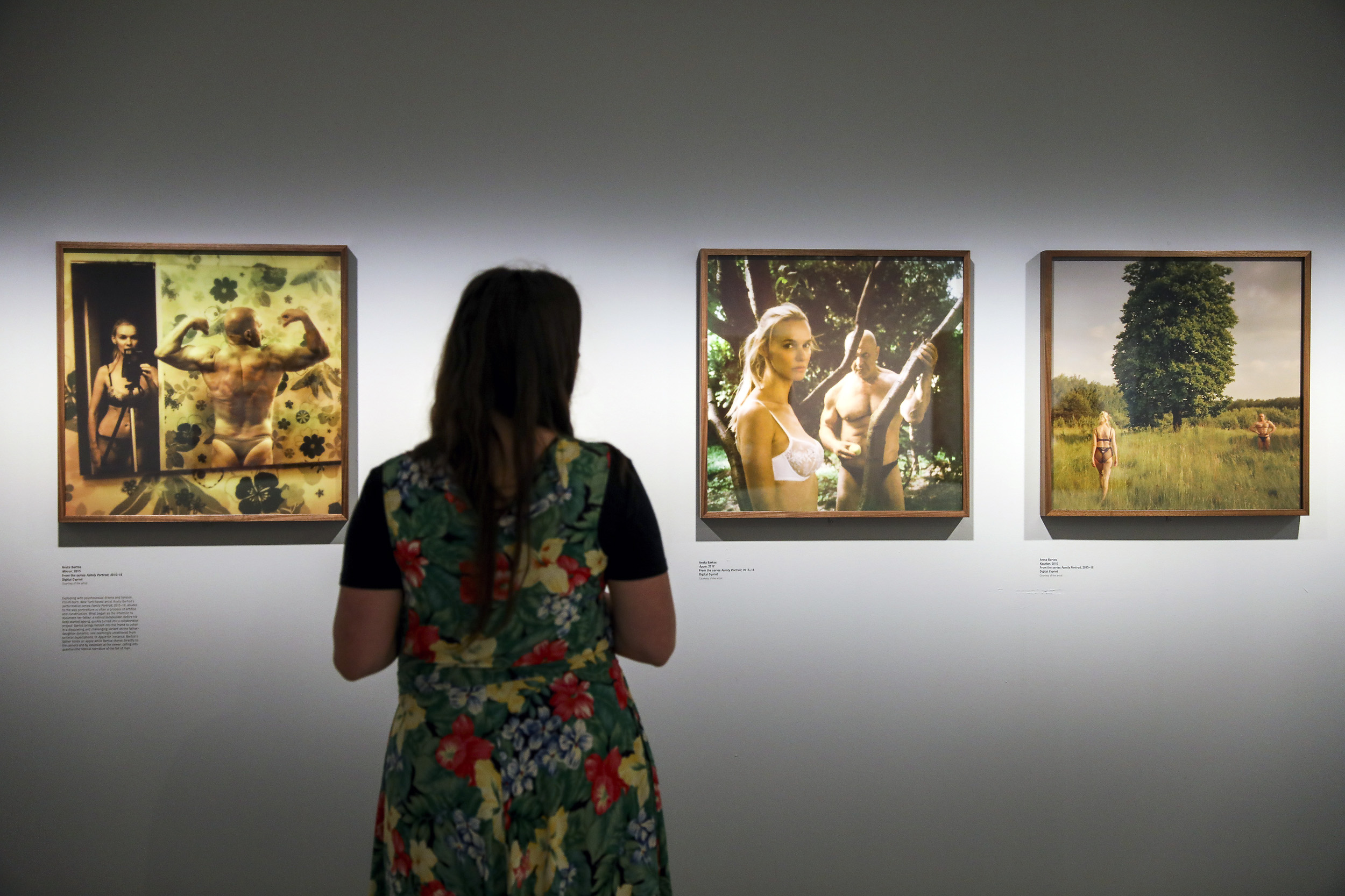
 

Installation view of 'Masculinities: Liberation through Photography' at Barbican Art Gallery on February 19, 2020 in London, England showing the photographs of Aneta Bartos's sexually charged series 'Family Portrait'

Installation view of 'Masculinities: Liberation through Photography' at Barbican Art Gallery on February 19, 2020 in London, England showing the photographs of Aneta Bartos's sexually charged series 'Family Portrait'


Installation view of Masculinities: Liberation through Photography at Barbican Art Gallery on February 19, 2020 in London, England showing the photographs of Aneta Bartos’s sexually charged series Family Portrait
Photo: Tristan Fewings/Getty Images for Barbican Art Gallery


Aneta Bartos (Born Poland, lives New York) 'Mirror' 2015


Aneta Bartos (Born Poland, lives New York)
Mirror
2015
From the series Family Portrait
Archival inkjet print
30 x 30.65 inches


Aneta Bartos (Born Poland, lives New York) 'Apple' 2015


Aneta Bartos (Born Poland, lives New York)
Apple
2015
From the series Family Portrait
Archival inkjet print
30 x 30.65 inches


Since 2013 New York based artist Aneta Bartos has been traveling back to her hometown Tomaszów Mazowiecki, where she was raised by her father as a single parent from the age of eight until fourteen. Then 68 years old, and having spent a lifetime as a competitive body builder, Bartos’ father asked her to take a few shots documenting his physique before it degenerated and inevitably ran its course. The original request of her father inspired Bartos to transform his idea into a long-term project called Dad. A few summers later Dad developed into a new series of portraits, titled Family Portrait, exploring the complex dynamics between father and daughter.

Text from the Antwerp Art website [Online] Cited 01/03/2020


“The pastoral setting is a romanticised portal to Bartos’s past. Her father’s poses are often heroic; at times the pictures are playful and flirty, almost seductive. Seen together, they display the sadness of a man who knows he is ageing, with the subtext of his waning sexuality. They are bittersweet, images of time passing and memories being preserved.”

Elisabeth Biondi quoted on the Postmasters website 2017 [Online] Cited 01/03/2020


Installation view of 'Masculinities: Liberation through Photography' at Barbican Art Gallery on February 19, 2020 in London, England showing photographs from Peter Hujar's series 'Orgasmic Man' 1969

Installation view of 'Masculinities: Liberation through Photography' at Barbican Art Gallery on February 19, 2020 in London, England showing photographs from Peter Hujar's series 'Orgasmic Man' 1969


Installation views of Masculinities: Liberation through Photography at Barbican Art Gallery on February 19, 2020 in London, England showing photographs from Peter Hujar’s series Orgasmic Man 1969 (see below)
Photo: Tristan Fewings/Getty Images for Barbican Art Gallery


Room 9-12

Queer Masculinity

In defiance of the prejudice and legal constraints against homosexuality in Europe, the United States and beyond over the last century, the works presented in ‘Queering Masculinity’ highlight how artists from the 1960s onwards have forged a new politically charged queer aesthetic.

In the 1970s, artists such as Peter Hujar (below), David Wojnarowicz, Sunil Gupta (below) and Hal Fischer (below) photographed gay lifestyles in New York and San Francisco in a bid to claim public visibility and therefore legitimacy at a time when homosexuality was still a criminal offence. Reflecting on their own queer experience and creating sensual bodies of work, artists such as Rotimi Fani-Kayode (below) and Isaac Julien (below) portrayed black gay desire while Catherine Opie’s seminal work Being and Having, 1991 (below), documented members of the dyke, butch and BDSM communities in San Francisco playing with the physical attributes associated with hypermasculinity in order to overturn traditional binary understandings of gender.


Installation view of 'Masculinities: Liberation through Photography' at Barbican Art Gallery on February 19, 2020 in London, England showing photographs by Karlheinz Weinberger


Installation views of Masculinities: Liberation through Photography at Barbican Art Gallery on February 19, 2020 in London, England showing photographs by Karlheinz Weinberger
Photo: Tristan Fewings/Getty Images for Barbican Art Gallery


Karlheinz Weinberger (Swiss, 1921-2006) 'Horseshoe buckle' 1962


Karlheinz Weinberger (Swiss, 1921-2006)
Horseshoe buckle
1962
Courtesy Galerie Esther Woerdehoff
© Karlheinz Weinberger
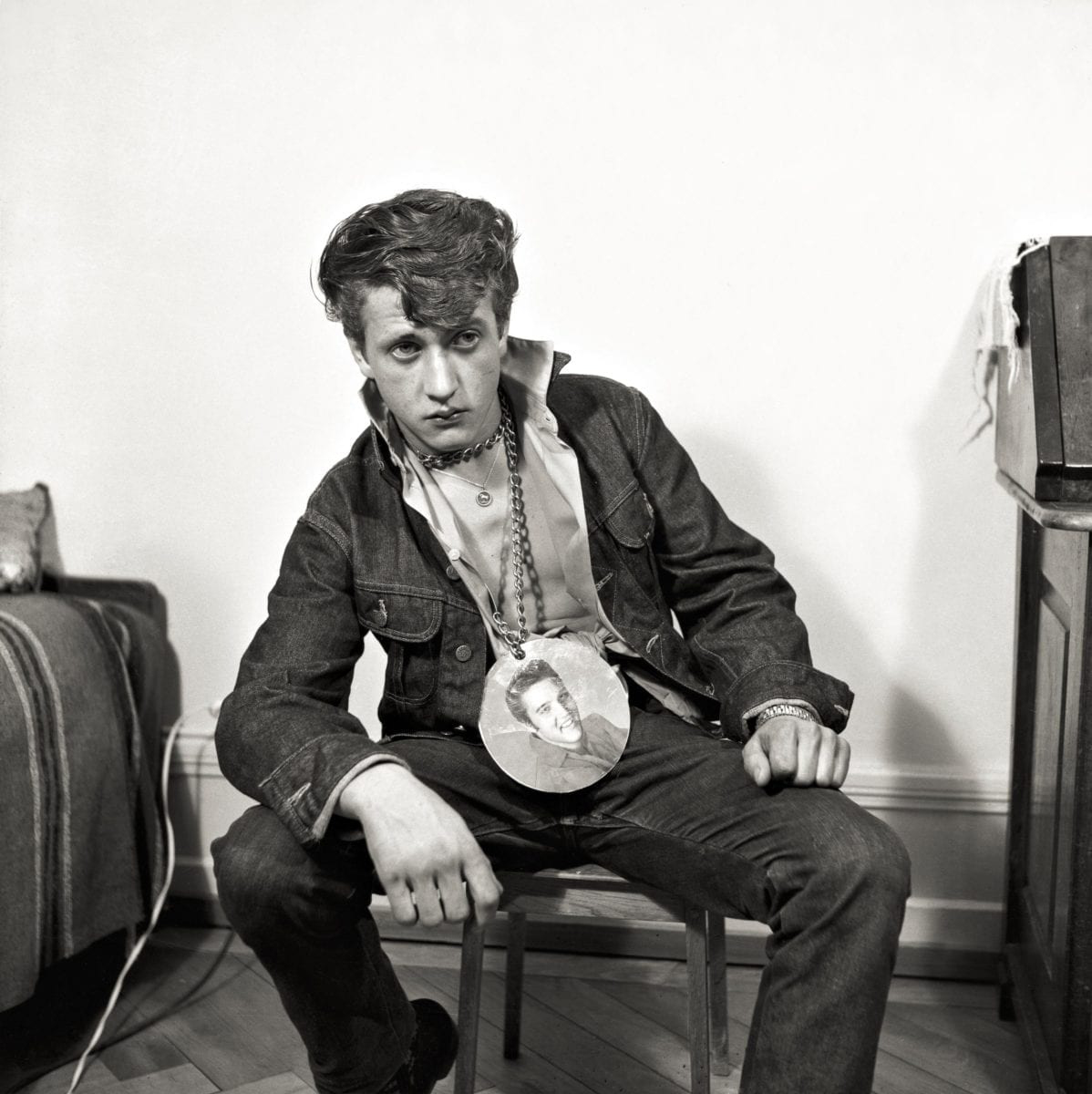
 

Karlheinz Weinberger (Swiss, 1921-2006) 'Sitting boy with elvis necklace in KHW studio, Zurich' 1961


Karlheinz Weinberger (Swiss, 1921-2006)
Sitting Boy with Elvis Necklace in KHW studio, Zurich
1961
Courtesy Galerie Esther Woerdehoff
© Karlheinz Weinberger


Peter Hujar. 'Orgasmic Man' 1969


Peter Hujar (American, 1934-1987)
Orgasmic Man
1969
Gelatin silver print
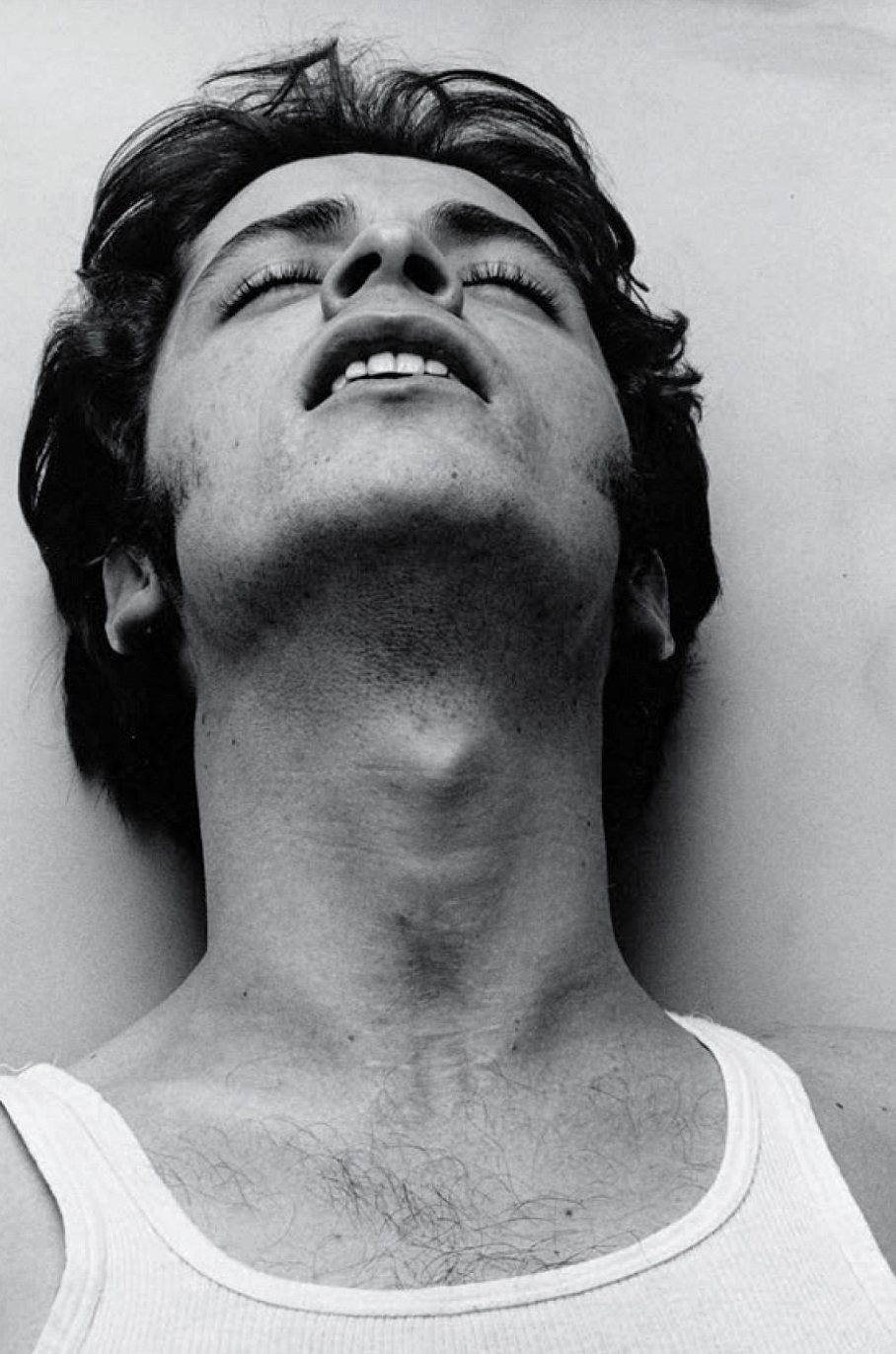
 

Peter Hujar (American, 1934-1987) 'Orgasmic Man (I)' 1969


Peter Hujar (American, 1934-1987)
Orgasmic Man (I)
1969
Gelatin silver print
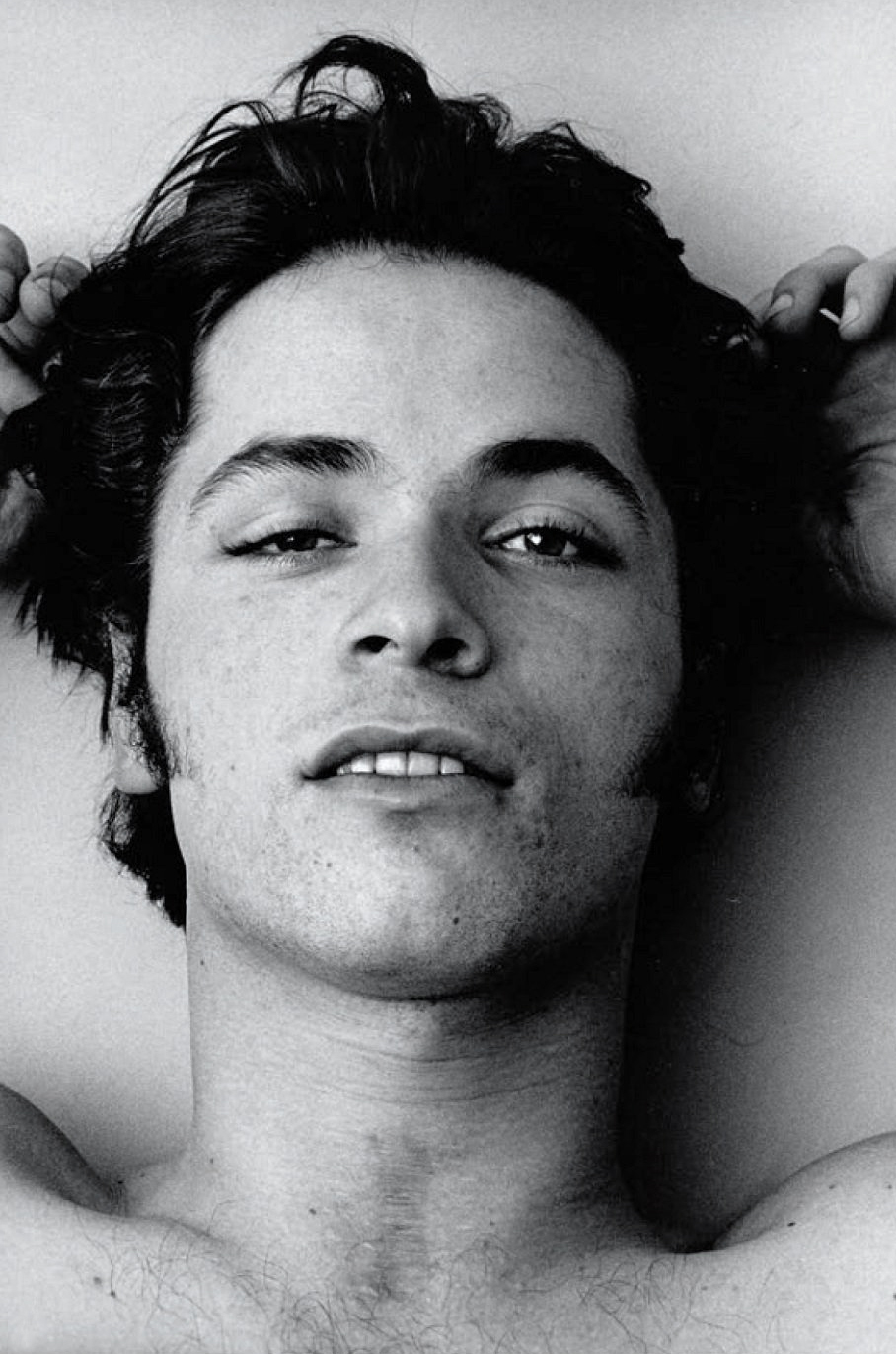
 

Peter Hujar. 'Orgasmic Man (II)' 1969


Peter Hujar (American, 1934-1987)
Orgasmic Man (II)
1969
Gelatin silver print
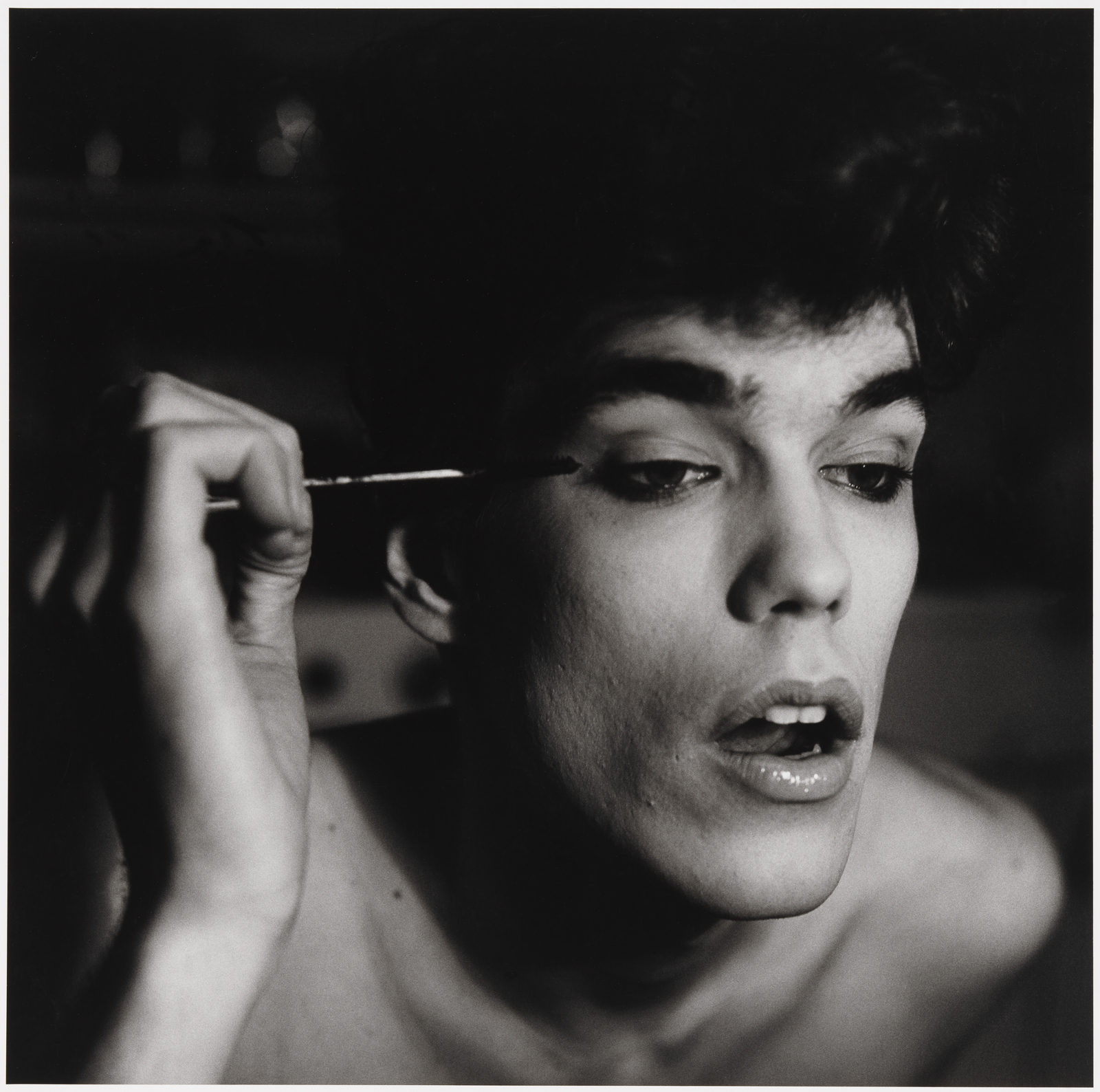
 

Peter Hujar (American, 1934-1987) 'David Brintzenhofe Applying Makeup (II)' 1982


Peter Hujar (American, 1934-1987)
David Brintzenhofe Applying Makeup (II)
1982
Courtesy Pace/MacGill Gallery, New York, and Fraenkel Gallery, San Francisco
© 1987 The Peter Hujar Archive LLC


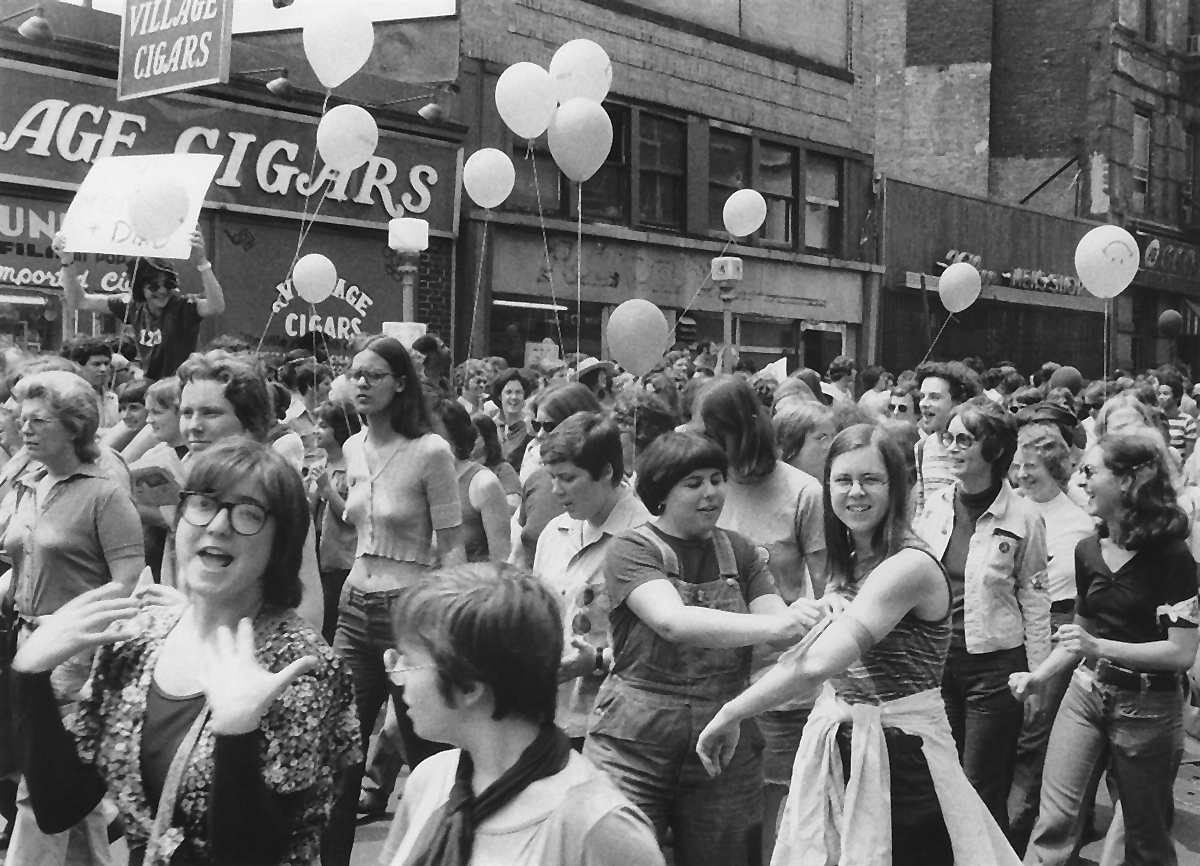
Installation view of 'Masculinities: Liberation through Photography' at Barbican Art Gallery on February 19, 2020 in London, England showing photographs from Sunil Gupta's series 'Christopher Street' 1976


Installation view of Masculinities: Liberation through Photography at Barbican Art Gallery on February 19, 2020 in London, England showing photographs from Sunil Gupta’s series Christopher Street 1976
Photo: Tristan Fewings/Getty Images for Barbican Art Gallery


Sunil Gupta (Indian, b. 1953) 'Untitled #21' 1976


Sunil Gupta (Indian, b. 1953)
Untitled #21
1976
From the series Christopher Street
Courtesy the artist and Hales Gallery
© Sunil Gupta. All Rights Reserved, DACS 2019


Gupta went on to study under Lisette Model at the New School and take his place among the most accomplished photographers, editors, and curators of his generation, exploring the way identities flower under various sexual, geographical, and historical conditions. But Christopher Street is where it all began. His subjects are engaged in an unprecedented moment in which it seemed possible to build a world of their own. He shows inner lives, barely concealed within the downturned face of a mustachioed man with his hands in his pockets, and outer ones as well, as other men cruise the lens right back, or laugh with each other, unbothered by the stranger with the camera. They were often just engaged in the everyday and extraordinary act of simply existing as gay. In each photograph, Gupta somehow projects a protective and versatile desire: to remember and be remembered at once.

Extract from Jesse Dorris. “Christopher Street Revisited,” on the Aperture website May 30th, 2019 [Online] Cited 29/02/2020


Sunil Gupta (Indian, b. 1953) 'Untitled #56' 1976


Sunil Gupta (Indian, b. 1953)
Untitled #56
1976
From the series Christopher Street
Courtesy the artist and Hales Gallery
© Sunil Gupta. All Rights Reserved, DACS 2019


The 1976 Christopher Street series marks the first set of photographs Gupta made as a practicing artist, using the camera as a tool for open expression. His decision to use black and white film was partly aesthetic, yet also practical, as he was developing the prints in his bathroom. Although he uses a documentarian style, Gupta was by no means an impartial observer behind the camera, he was a participant, enthralled by his subjects.

The series … captures a specific moment in history – a cross section of a thriving community in one of New York’s most dynamic areas – Manhattan’s Christopher Street. Dressed in the latest fashions, moving confidently and relaxing on street corners, their visible presence is a signifier of a specific period of public consciousness. Un-staged and spontaneous, most of the artist’s subjects are unaware of the camera and are simply going about their day. Now, with hindsight, Gupta is struck by the routineness of the images, stating:

‘There is a poignancy they never had at the time… A few years later, the AIDS crisis took hold. The public nature of gay life was forced back into the shadows. Thousands of men died. New York shut down its bathhouses, gay parties became private, and this whole world became hidden again.’

Fusing the public with the personal, the Christopher Street series reflects the openness of the gay liberation movement, as well as Gupta’s own “coming out” as an artist. More than a nostalgic time capsule, the photographs reveal a community that shaped Gupta as a person and cemented his lifelong dedication to portraying people who have been denied a space to be themselves.

Extract from Anonymous. “Sunil Gupta: Christopher Street,” on the Monovisions website 24 May 2019 [Online] Cited 29/02/2020


Hal Fischer (American, b. 1950) 'Handkerchiefs' 1977


Hal Fischer (American, b. 1950)
Handkerchiefs
1977
From the series Gay Semiotics
Gelatin silver print


Hal Fischer (American, b. 1950) 'Street Fashion Jock' 1977


Hal Fischer (American, b. 1950)
Street Fashion Jock
1977
From the series Gay Semiotics
Gelatin silver print


Rotimi Fani-Kayode (Nigerian, 1955-1989) 'Untitled' c. 1985


Rotimi Fani-Kayode (Nigerian, 1955-1989)
Untitled
c. 1985
Courtesy of Autograph, London
© Rotimi Fani-Kayode


Installation view of 'Masculinities: Liberation through Photography' at Barbican Art Gallery on February 19, 2020 in London, England showing at left, photographs from Isaac Julien's series 'After Mazatlàn' 1999/2000


Installation view of Masculinities: Liberation through Photography at Barbican Art Gallery on February 19, 2020 in London, England showing at left, photographs from Isaac Julien’s series After Mazatlàn, 1999/2000
Photo: Tristan Fewings/Getty Images for Barbican Art Gallery


Isaac Julien (British, b. 1960) From 'After Mazatlàn III - VI' 1999/2000


Isaac Julien (British, b. 1960)
From After Mazatlàn III – VI
1999/2000
Colour photogravures
33 x 43.2cm; 13 x 17 in
Courtesy the artist and Victoria Miro, London/Venice
© Isaac Julien


Installation view of 'Masculinities: Liberation through Photography' at Barbican Art Gallery on February 19, 2020 in London, England showing Catherine Opie's series 'Being and Having' 1991


Installation view of Masculinities: Liberation through Photography at Barbican Art Gallery on February 19, 2020 in London, England showing Catherine Opie’s series Being and Having 1991
Photo: Tristan Fewings/Getty Images for Barbican Art Gallery


Catherine Opie (American, b. 1961) 'Bo from "Being and Having"' 1991


Catherine Opie (American, b. 1961)
Bo from “Being and Having”
1991
Collection of Gregory R. Miller and Michael Wiener
© Catherine Opie, Courtesy Regen Projects, Los Angeles; Thomas Dane Gallery, London; and Solomon R. Guggenheim Museum, New York


The exhibition brings together over 300 works by over 50 pioneering international artists, photographers and filmmakers such as Richard Avedon, Peter Hujar, Isaac Julien, Rotimi Fani-Kayode, Robert Mapplethorpe, Annette Messager and Catherine Opie to show how photography and film have been central to the way masculinities are imagined and understood in contemporary culture. The show also highlights lesser-known and younger artists – some of whom have never exhibited in the UK – including Cassils, Sam Contis, George Dureau, Elle Pérez, Paul Mpagi Sepuya, Hank Willis Thomas, Karlheinz Weinberger and Marianne Wex amongst many others. Masculinities: Liberation through Photography is part of the Barbican’s 2020 season, Inside Out, which explores the relationship between our inner lives and creativity.

Jane Alison, Head of Visual Arts, Barbican, said: ‘Masculinities: Liberation through Photography continues our commitment to presenting leading twentieth century figures in the field of photography while also supporting younger contemporary artists working in the medium today. In the wake of the #MeToo movement and the resurgence of feminist and men’s rights activism, traditional notions of masculinity has become a subject of fierce debate. This exhibition could not be more relevant and will certainly spark conversations surrounding our understanding of masculinity.’

With ideas around masculinity undergoing a global crisis and terms such as ‘toxic’ and ‘fragile’ masculinity filling endless column inches, the exhibition surveys the representation of masculinity in all its myriad forms, rife with contradiction and complexity. Presented across six sections by over 50 international artists to explore the expansive nature of the subject, the exhibition touches on themes of queer identity, the black body, power and patriarchy, female perceptions of men, heteronormative hypermasculine stereotypes, fatherhood and family. The works in the show present masculinity as an unfixed performative identity shaped by cultural and social forces.

Seeking to disrupt and destabilise the myths surrounding modern masculinity, highlights include the work of artists who have consistently challenged stereotypical representations of hegemonic masculinity, including Collier Schorr, Adi Nes, Akram Zaatari and Sam Contis, whose series Deep Springs, 2018 draws on the mythology of the American West and the rugged cowboy. Contis spent four years immersed in an all-male liberal arts college north of Death Valley meditating on the intimacy and violence that coexists in male-only spaces. Complicating the conventional image of the fighter, Thomas Dworzak‘s acclaimed series Taliban consists of portraits found in photographic studios in Kandahar following the US invasion of Afghanistan in 2001, these vibrant portraits depict Taliban fighters posing hand in hand in front of painted backdrops, using guns and flowers as props with kohl carefully applied to their eyes. Trans masculine artist Cassils‘ series Time Lapse, 2011, documents the radical transformation of their body through the use of steroids and a rigorous training programme reflecting on ideas of masculinity without men. Elsewhere, artists Jeremy Deller, Robert Mapplethorpe and Rineke Dijkstra dismantle preconceptions of subjects such as the wrestler, the bodybuilder and the athlete and offer an alternative view of these hyper-masculinised stereotypes.

The exhibition examines patriarchy and the unequal power relations between gender, class and race. Karen Knorr‘s series Gentlemen, 1981-83, comprised of 26 black and white photographs taken inside men-only private members’ clubs in central London and accompanied by texts drawn from snatched conversations, parliamentary records and contemporary news reports, invites viewers to reflect on notions of class, race and the exclusion of women from spaces of power during Margaret Thatcher’s premiership. Toxic masculinity is further explored in Andrew Moisey‘s 2018 photobook The American Fraternity: An Illustrated Ritual Manual which weaves together archival photographs of former US Presidents and Supreme Court Justices who all belonged to the fraternity system, alongside images depicting the initiation ceremonies and parties that characterise these male-only organisations.

With the rise of the Gay Liberation Movement through the 1960s followed by the AIDS epidemic in the early 1980s, the exhibition showcases artists such as Peter Hujar and David Wojnarowiz, who increasingly began to disrupt traditional representations of gender and sexuality. Hal Fischer‘s critical photo-text series Gay Semiotics, 1977, classified styles and types of gay men in San Francisco and Sunil Gupta’s street photographs captured the performance of gay public life as played out on New York’s Christopher Street, the site of the 1969 Stonewall Uprising. Other artists exploring the performative aspects of queer identity include Catherine Opie‘s seminal series Being and Having, 1991, showing her close friends in the West Coast’s LGBTQ+ community sporting false moustaches, tattoos and other stereotypical masculine accessories. Elle Pérez‘s luminous and tender photographs explore the representation of gender non-conformity and vulnerability, whilst Paul Mpagi Sepuya‘s fragmented portraits explore the studio as a site of homoerotic desire.

During the 1970s women artists from the second wave feminist movement objectified male sexuality in a bid to subvert and expose the invasive and uncomfortable nature of the male gaze. In the exhibition, Laurie Anderson‘s seminal work Fully Automated Nikon (Object/Objection/Objectivity), 1973, documents the men who cat-called her as she walked through New York’s Lower East Side while Annette Messager‘s series The Approaches, 1972, covertly captures men’s trousered crotches with a long-lens camera. German artist Marianne Wex‘s encyclopaedic project Let’s Take Back Our Space: ‘Female’ and ‘Male’ Body Language as a Result of Patriarchal Structures, 1977, presents a detailed analysis of male and female body language and Australian indigenous artist Tracey Moffatt‘s awkwardly humorous film Heaven, 1997, portrays male surfers changing in and out of their wet suits.

Further highlights include New York based artist Hank Willis Thomas, whose photographic practice examines the complexities of the black male experience; celebrated Japanese photographer Masahisa Fukase‘s The Family, 1971-1989, chronicles the life and death of his family with a particular emphasis on his father; and Kenneth Anger‘s technicolour experimental underground film Kustom Kar Kommandos, 1965, explores the fetishist role of hot rod cars amongst young American men.

Press release from the Barbican Art Gallery
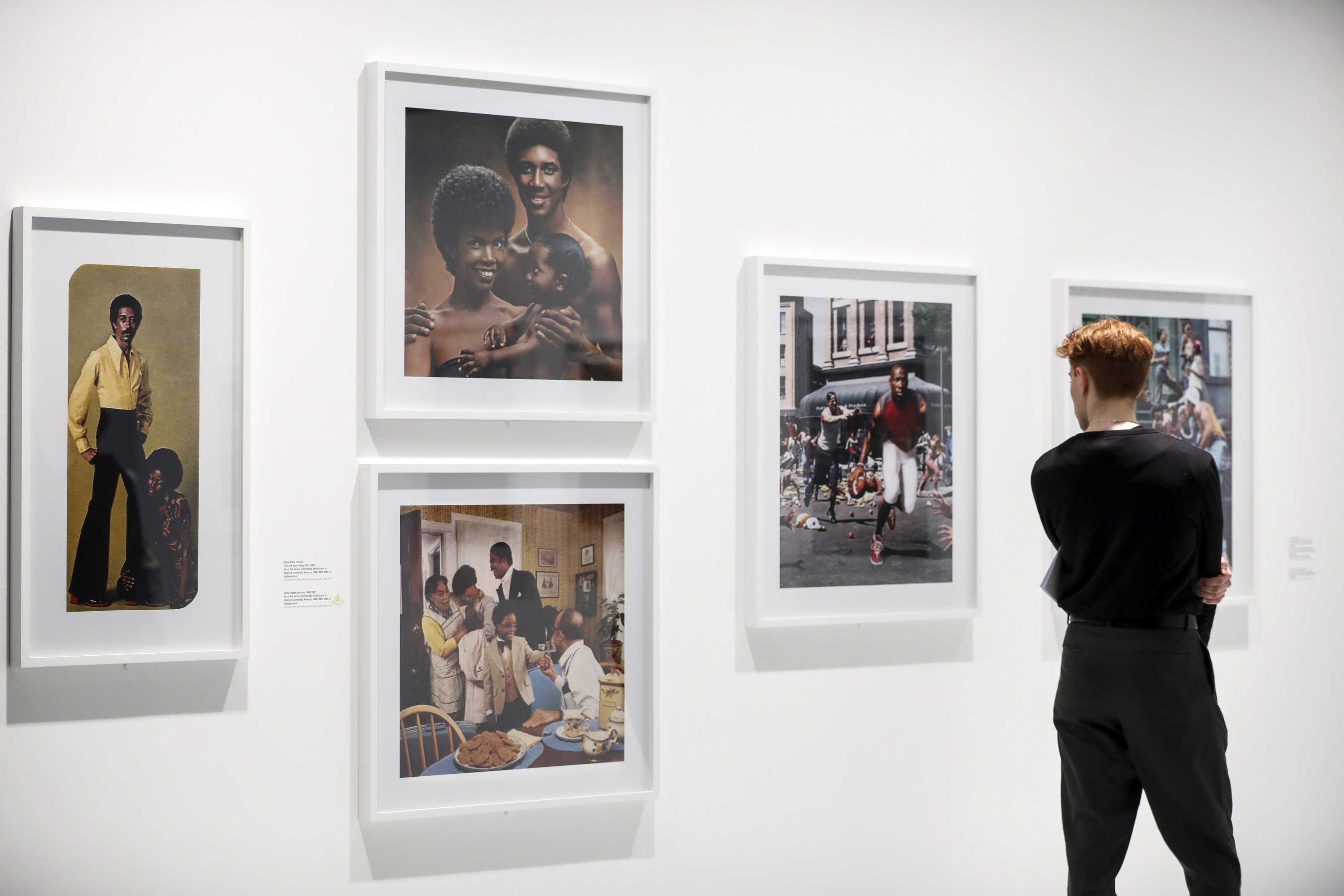
 

Installation view of 'Masculinities: Liberation through Photography' at Barbican Art Gallery on February 19, 2020 in London, England showing Hank Willis Thomas' series 'Unbranded: Reflections in Black by Corporate America 1968-2008' 2005-2008


Installation view of Masculinities: Liberation through Photography at Barbican Art Gallery on February 19, 2020 in London, England showing Hank Willis Thomas’ series Unbranded: Reflections in Black by Corporate America 1968-2008 2005-2008 (below)
Photo: Tristan Fewings/Getty Images for Barbican Art Gallery


Room 13-14

Reclaiming the Black Body

Giving visual form to the complexity of the black male experience, this section foregrounds artists who over the last five decades have consciously subverted expectations of race, gender and the white gaze by reclaiming the power to fashion their own identities.

From Samuel Fosso’s playfully staged self-portraits, taken in his studio, in which he performs to the camera sporting flares and platforms boots or flirtatiously revealing his youthful male physique (below) to Kiluanji Kia Henda’s fictional scenarios in which he adopts the troubled personas of African men of power, the works presented here reflect on how black masculinity challenges the status quo (below).

The representation of black masculinity in the US is born out of a violent history of slavery and prejudice. Unbranded: Reflections in Black by Corporate America 1968-2008 by Hank Willis Thomas (below) draws attention to the ways in which corporate America has commodified the African American male experience while simultaneously perpetuating and reinforcing cultural stereotypes. Similarly, Deana Lawson’s powerful work Sons of Cush, 2016, highlights how the black male figure is often ‘idealised (in their physical beauty) and pathologised by the culture (as symbols of violence or fear)’.


Hank Willis Thomas (American, b. 1976) 'The Johnson Family' 1981/2006


Hank Willis Thomas (American, b. 1976)
The Johnson Family
1981/2006
From the series Unbranded: Reflections in Black by Corporate America 1968-2008
2005-08


Concerned with the literal and figural objectifications of the African American male body, in his complex series Unbranded Hank Willis Thomas redeploys magazine adverts featuring African Americans made between 1968 – a pivotal moment in the struggle for civil rights – and 2008, which witnessed the accession of Barack Obama to the US presidency. By digitally stripping the ads of all text, branding and logos, Thomas draws attention to the ways in which corporate America has commodified the African American experience while simultaneously perpetuating and reinforcing cultural stereotypes.


Hank Willis Thomas (American, b. 1976) 'It's the Real Thing!' 1978/2008


Hank Willis Thomas (American, b. 1976)
It’s the Real Thing!
1978/2008
From the series Unbranded: Reflections in Black by Corporate America 1968-2008
2005-2008


Samuel Fosso (Cameroonian, b. 1962) 'Self-portrait' 1975-1977


Samuel Fosso (Cameroonian, b. 1962)
Self-portrait
1975-1977
From the series 70s lifestyle
Courtesy Jean Marc Patras, Paris
© Samuel Fosso


Installation view of 'Masculinities: Liberation through Photography' at Barbican Art Gallery on February 19, 2020 in London, England showing a photograph from Kiluanji Kia Henda's series 'The Last Journey of the Dictator Mussunda Nzombo Before the Great Extinction Act I'


Installation view of Masculinities: Liberation through Photography at Barbican Art Gallery on February 19, 2020 in London, England showing a photograph from Kiluanji Kia Henda’s series The Last Journey of the Dictator Mussunda Nzombo Before the Great Extinction Act I
Photo: Tristan Fewings/Getty Images for Barbican Art Gallery


Hilary Lloyd (British, b. 1964) 'Colin #2' 1999


Hilary Lloyd (British, b. 1964)
Colin #2
1999
Courtesy Galerie Neu, Berlin; Sadie Coles HQ, London; Greene Naftali, New York
© Hilary Lloyd
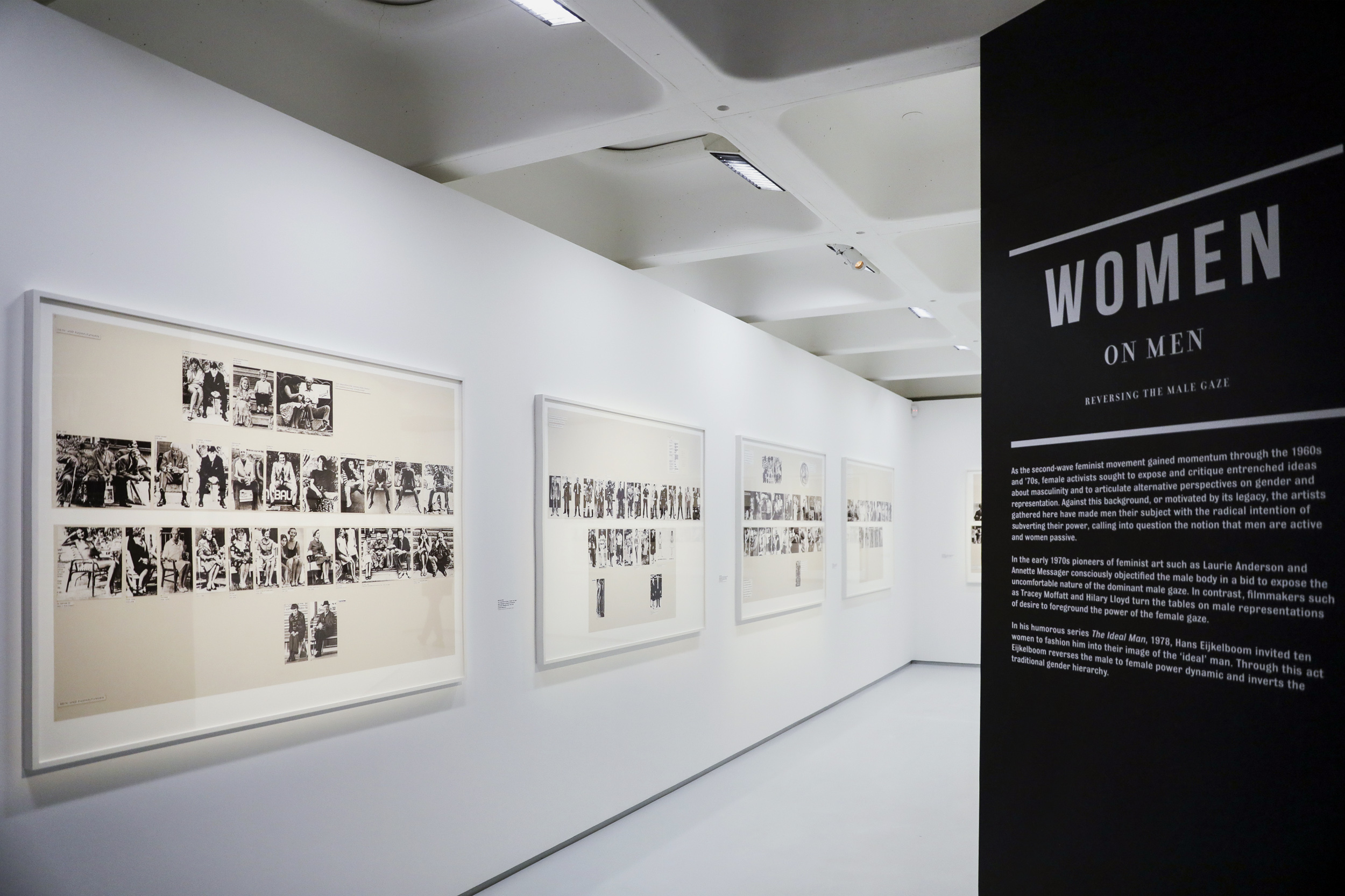
 

Installation view of 'Masculinities: Liberation through Photography' at Barbican Art Gallery on February 19, 2020 in London, England showing part of Marianne Wex's encyclopaedic project 'Let's Take Back Our Space: 'Female' and 'Male' Body Language as a Result of Patriarchal Structures' 1977


Installation view of Masculinities: Liberation through Photography at Barbican Art Gallery on February 19, 2020 in London, England showing part of Marianne Wex’s encyclopaedic project Let’s Take Back Our Space: ‘Female’ and ‘Male’ Body Language as a Result of Patriarchal Structures, 1977
Photo: Tristan Fewings/Getty Images for Barbican Art Gallery


Room 15-16

Women on Men: Reversing the Male Gaze

As the second-wave feminist movement gained momentum through the 1960s and ’70s, female activists sought to expose and critique entrenched ideas about masculinity and to articulate alternative perspectives on gender and representation. Against this background, or motivated by its legacy, the artists gathered here have made men their subject with the radical intention of subverting their power, calling into question the notion that men are active and women passive.

In the early 1970s pioneers of feminist art such as Laurie Anderson (below) and Annette Messager consciously objectified the male body in a bid to expose the uncomfortable nature of the dominant male gaze. In contrast, filmmakers such as Tracey Moffatt (below) and Hilary Lloyd (above) turn the tables on male representations of desire to foreground the power of the female gaze.

In his humorous series The Ideal Man, 1978 (below), Hans Eijkelboom invited ten women to fashion him into their image of the ‘ideal’ man. Through this act Eijkelboom reverses the male to female power dynamic and inverts the traditional gender hierarchy.


Laurie Anderson (American, b. 1947) 'Man with a Cigarette' 1973


Laurie Anderson (American, b. 1947)
Man with a Cigarette
1973
From the series Fully Automated Nikon (Object/Objection/Objectivity)


Laurie Anderson (American, b. 1947) 'Two men in a car' 1973


Laurie Anderson (American, b. 1947)
Two men in a car
1973
From the series Fully Automated Nikon (Object/Objection/Objectivity)


Anderson photographed men who called to her or whistled her on the street.  In her artist statement she writes about one experience,

“As I walked along Houston Street with my fully automated Nikon. I felt armed, ready. I passed a man who muttered ‘Wanna fuck?’ This was standard technique: the female passes and the male strikes at the last possible moment forcing the woman to backtrack if she should dare to object. I wheeled around, furious. ‘Did you say that?’ He looked around surprised, then defiant ‘Yeah, so what the fuck if I did?’ I raised my Nikon, took aim began to focus. His eyes darted back and forth, an undercover cop? CLICK.

As it turned out, most of the men I shot that day had the opposite reaction. When i confronted them, the acted innocent, then offended, like some nasty invisible ventriloquist had ticked them into saying dirty words against their will. By the time I took their pictures they were posing, like taking their picture was the least I could do.”

“I decided to shoot pictures of men who made comments to me on the street. I had always hated this invasion of my privacy and now I had the means of my revenge. As I walked along Houston Street with my fully automated Nikon, I felt armed, ready. I passed a man who muttered ‘Wanna fuck?’ This was standard technique: the female passes and the male strikes at the last possible moment forcing the woman to backtrack if she should dare to object. I wheeled around, furious. ‘Did you say that?’ He looked around surprised, then defiant. ‘Yeah, so what the fuck if I did?’ I raised my Nikon, took aim, began to focus. His eyes darted back and forth, an undercover cop? CLICK.”

Anderson takes the power from her male pursuers, allowing them nothing more than the momentary fear that their depravity has just been captured in a picture.
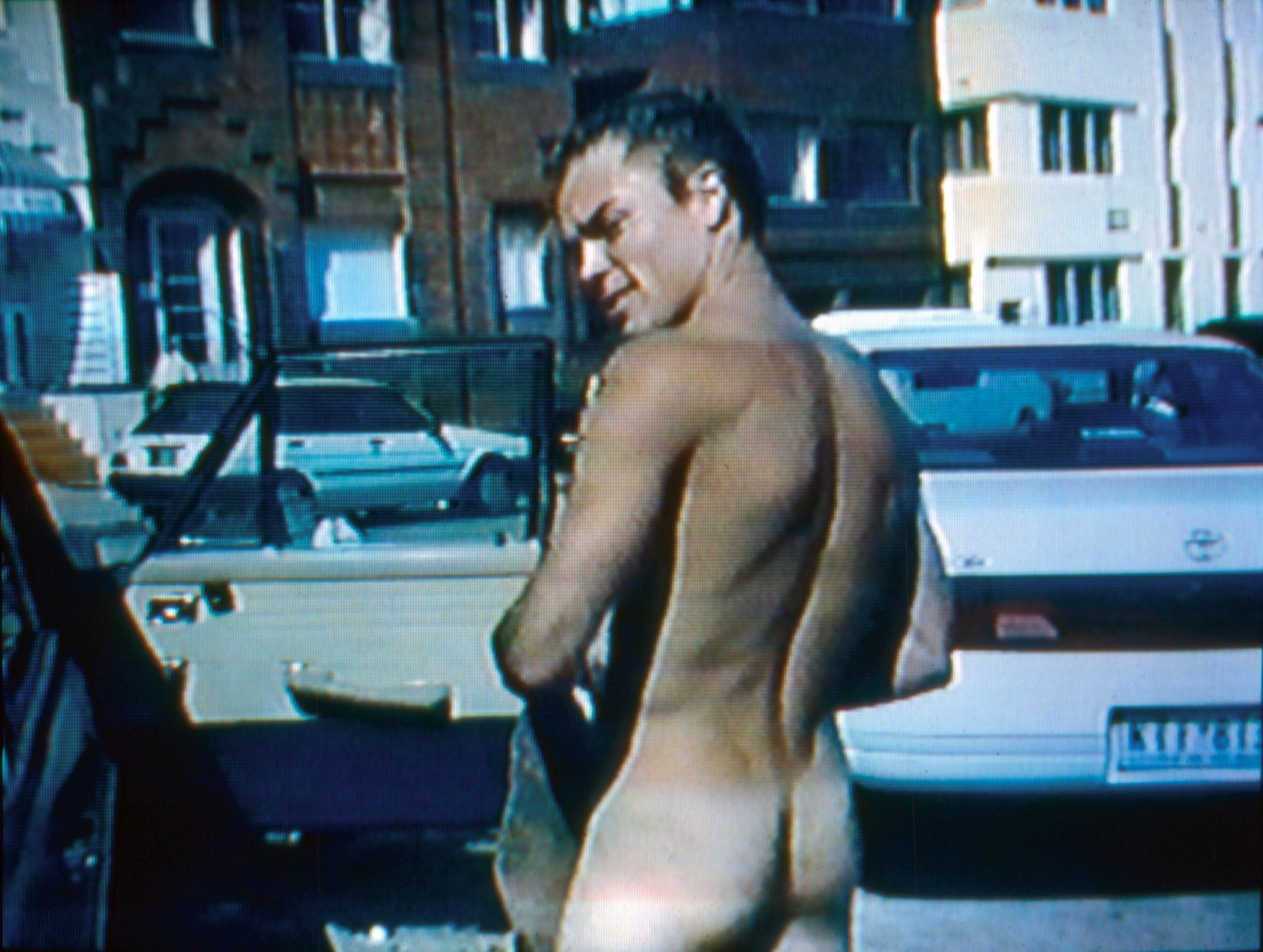
 

Tracey Moffatt (Australian, b. 1960) 'Heaven' (still) 1997


Tracey Moffatt (Australian, b. 1960)
Heaven (still)
1997
Video tape (28 minutes)
© Tracey Moffatt / DACS Courtesy of the artist and Roslyn Oxley9 Gallery, Sydney, Australia


“A playful video that glories in the female gaze and objectification of men. It zeros in on the Australian national sport, surfing, and in particular on several dozen good-looking muscular men changing into or out of their swimming trunks. This ritual is usually conducted in parking lots or on sidewalks, always near cars and sometimes inside them; it usually but not always involves a beach towel wound carefully around the torso. Ms Moffatt begins by shooting her subject unseen from inside a house and gradually moves closer and closer, engaging some in conversations that are never heard. The soundtrack alternates between the ocean surf and the sounds of drumming and chanting, male rituals of another, more authentic Australian culture. By the tape’s end, the artist’s voyeurism has shifted to participation; the camera shows her free hand, the one not holding the camera, darting into view, trying to undo the towel of the last surfer.”

New York Times


Installation view of 'Masculinities: Liberation through Photography' at Barbican Art Gallery on February 19, 2020 in London, England showing part of Hans Eijkelboom's series 'The Ideal Man' 1978


Installation view of Masculinities: Liberation through Photography at Barbican Art Gallery on February 19, 2020 in London, England showing part of Hans Eijkelboom’s series The Ideal Man, 1978


Glossary of Terms by CN Lester

Homosociality: Typically non-romantic and/or non-sexual same-sex relationships and social groupings – may sometimes include elements of homoeroticism, as they are frequently interdependent phenomena.

Normativity: The process by which some groups of people, forms of expression and types of behaviour are classified according to a perceived standard of what is ‘normal’, ‘natural’, desirable and permissible in society. Inevitably, this process designates people, expressions and behaviours that do not fit these norms as abnormal, unnatural, undesirable and impermissible.

Hegemonic Masculinity: ‘Hegemonic’ means ‘ruling’ or ‘commanding’ – hegemonic masculinity, therefore, indicates male dominance and the forms of masculinity occupying and perpetuating this dominant position. The term was coined in the 1980s by the scholar R. W. Connell, drawing on the Marxist philosopher Antonio Gramsci’s notion of cultural hegemony.

Hierarchy: Across many cultures throughout history, and continuing into the present moment throughout large parts of the world, gender functions as a hierarchy: some gender categories and gender expressions are granted higher value and more power than others. Men are often higher up the gender hierarchy than women, but the gender hierarchy is affected by racism, disablism, ageism, transphobia and other factors; in the West, men in their thirties are likely to be considered higher up the gender hierarchy than men in their eighties, for example.

Gender roles: Specific cultural roles defined by the weight of gendered ideas, restrictions and traditions. Men and women are often expected, sometimes forced, to occupy oppositional gender roles: aggressor versus victim, protector versus nurturer and so on. Many gender roles are specific to intersections of race, class, sexuality, religion and disabled status – examples of these types of gender roles can be seen in the stereotypes of the Jezebel or the Dragon Lady.

Patriarchy: Literally ‘the rule of the father’, a patriarchy is a society or structure centred around male dominance and in which women (and those of other genders) are not treated as or considered equal.

Queer: A slur, a term of reclamation and a specific and radical site of community and activism in solidarity with many kinds of difference, and specifically opposed to heteronormativity and cisnormativity. Queer studies and queer theory are important emerging fields of study.

Gender identity: Identity refers to what, who, and how someone or something is, both in the way this is understood as selfhood by an individual, and also the self as it is shaped and positioned by the world. Gender identity can be a surprisingly difficult term to pin down and is perhaps best understood as the stated truth of a person’s gender (or lack of gender), which is in itself the sum of many different factors.

Fetishisation: To turn the subject into a fetish, sexually or otherwise. Fetishisation in terms of gender and desire frequently occurs in conjunction with objectification and power. Men and women of colour are frequently fetishised by white people, in society and in artistic practice, through different stereotypes and limitations. Trans and disabled people are also subject to fetishisation, particularly in bodily terms. Kobena Mercer’s critical essay on Robert Mapplethorpe, ‘Reading Radical Fetishism’,1 and David Henry Hwang’s play and afterword to M. Butterfly (1988) both explore the notion of fetishisation.

1/ Kobena Mercer, ‘Reading Racial Fetishism: The Photographs of Robert Mapplethorpe’, in Emily Apter and William Pietz, eds, Fetishism as Cultural Discourse (Ithaca, NY: Cornell University Press, 1993), pp. 307-29.

Critical race theory: A branch of scholarship emerging from the application of critical theory to the study of law in the 1980s, critical race theory (CRT) is now taken as an approach and theoretical foundation across both academic and popular discourse. CRT names, examines and challenges the social constructions and functions of race and racism. Rejecting the idea of race as a ‘natural’ category, CRT looks instead to the cultural, structural and legal creation and maintenance of difference and oppression. Scholars working in this field include Kimberlé Williams Crenshaw, Eduardo Bonilla-Silva and Patricia Williams.

Me Too movement: ‘#MeToo is a movement that was founded in 2006 to support survivors of sexual violence, in particular black and brown girls, who were in the program that we were running. It has grown since then to include supporting grown people, women, and men, and other survivors, as well as helping people to understand what community action looks like in the fight to end sexual violence’ – Tarana Burke, founder of the Me Too movement.

Male gaze: A term coined by film critic Laura Mulvey, the notion of the male gaze develops Jean-Paul Sartre’s concept of le regard (the gaze) to take into account the power differentials and gender stereotyping inherent in ways of looking within patriarchal, sexist culture. The male gaze refers to how the world – and women in particular – are looked at and presented from a cisgender, straight, frequently white male perspective. In visual art the male gaze can be understood in multiple ways, from the male creator of the work, to men within the work viewing women or the world around them, to the (assumed) male viewer of the work itself. Many women artists have countered the male gaze through deconstruction and through the creation and promotion of works that centre the ‘female gaze’.


Installation view of 'Masculinities: Liberation through Photography' at Barbican Art Gallery on February 19, 2020 in London, England

Installation view of 'Masculinities: Liberation through Photography' at Barbican Art Gallery on February 19, 2020 in London, England


Installation views of Masculinities: Liberation through Photography at Barbican Art Gallery on February 19, 2020 in London, England
Photo: Tristan Fewings/Getty Images for Barbican Art Gallery


Barbican Art Gallery
Silk Street, London
EC2Y 8DS

Opening hours:
Mon – Tue 12 noon – 6pm
Wed – Fri 12 noon – 9pm
Sat 10am – 9pm
Sun 10am – 6pm

Barbican Art Gallery website

LIKE ART BLART ON FACEBOOK

Back to top

European photographic research tour: V&A Photography Centre, London

Visited October 2019 posted May 2020


Unknown photographer. 'Photograph of Allied War exhibition, Serbian Section, V&A' 1917 (installation view)


Unknown photographer
Photograph of Allied War exhibition, Serbian Section, V&A (installation view)
1917
Gelatin silver print
The Royal Photographic Society Collection at the V&A Museum
Photo: Marcus Bunyan


The older I grow, the more exponentially I appreciate and love these early photographs. Imagine having a collection like this!

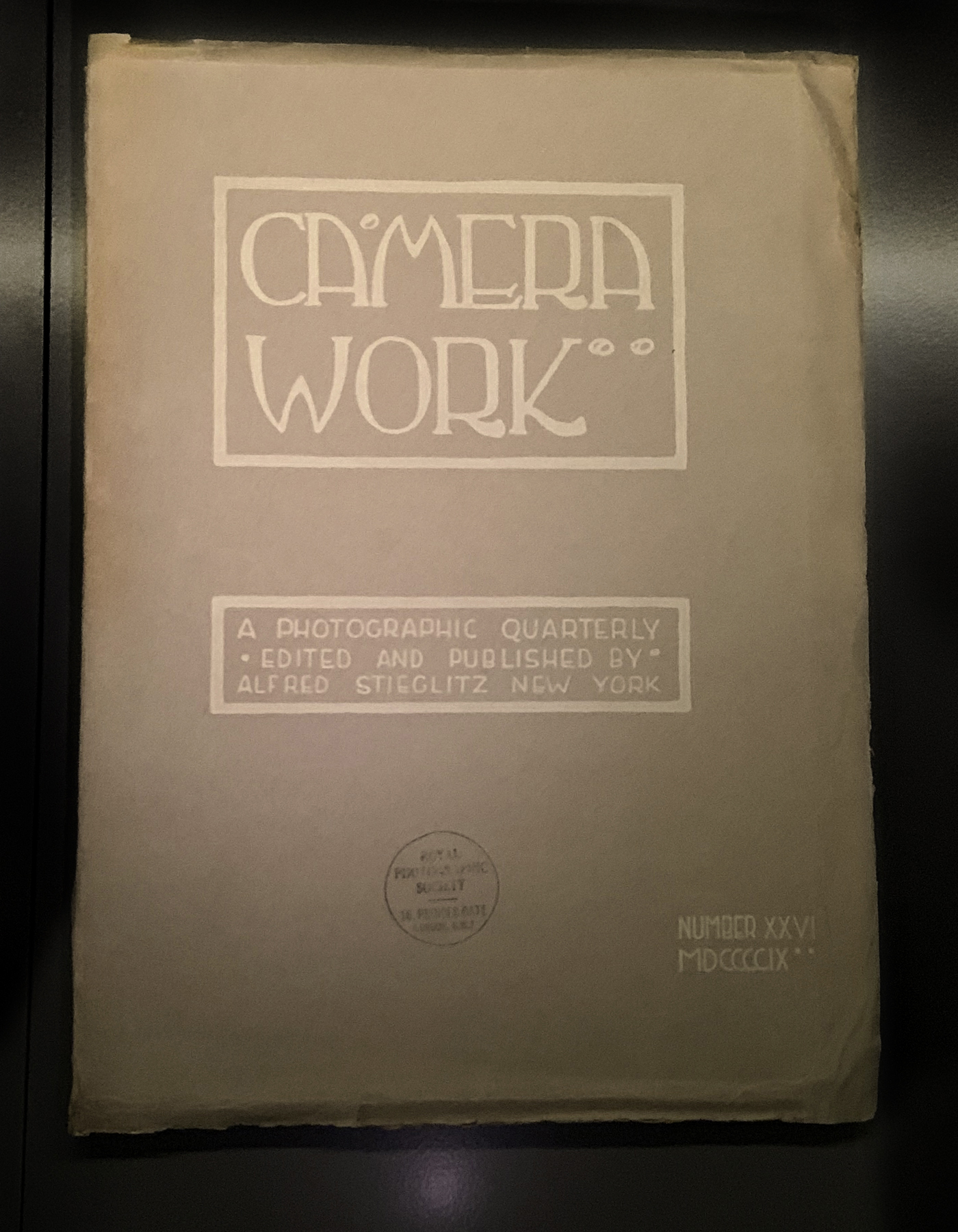
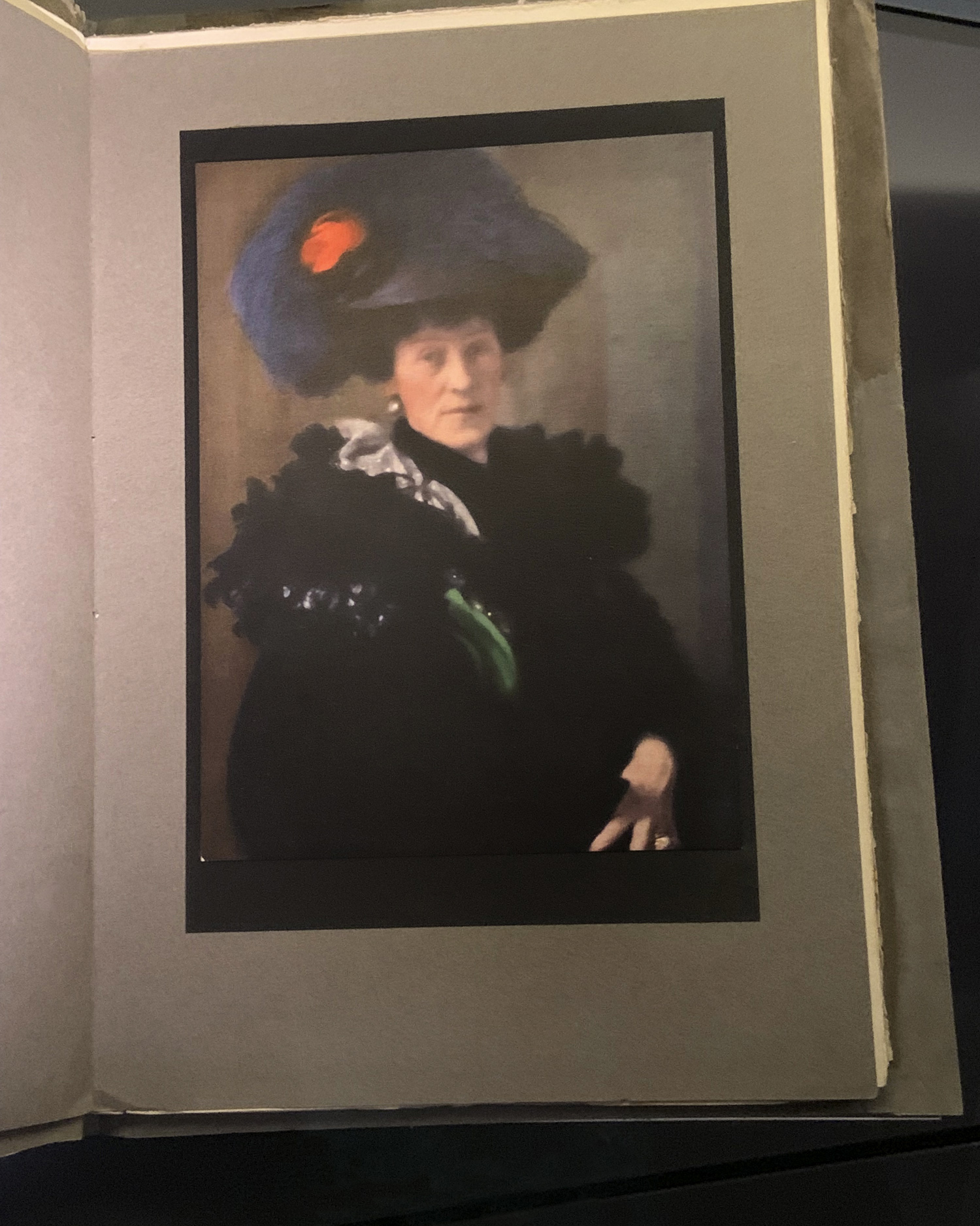
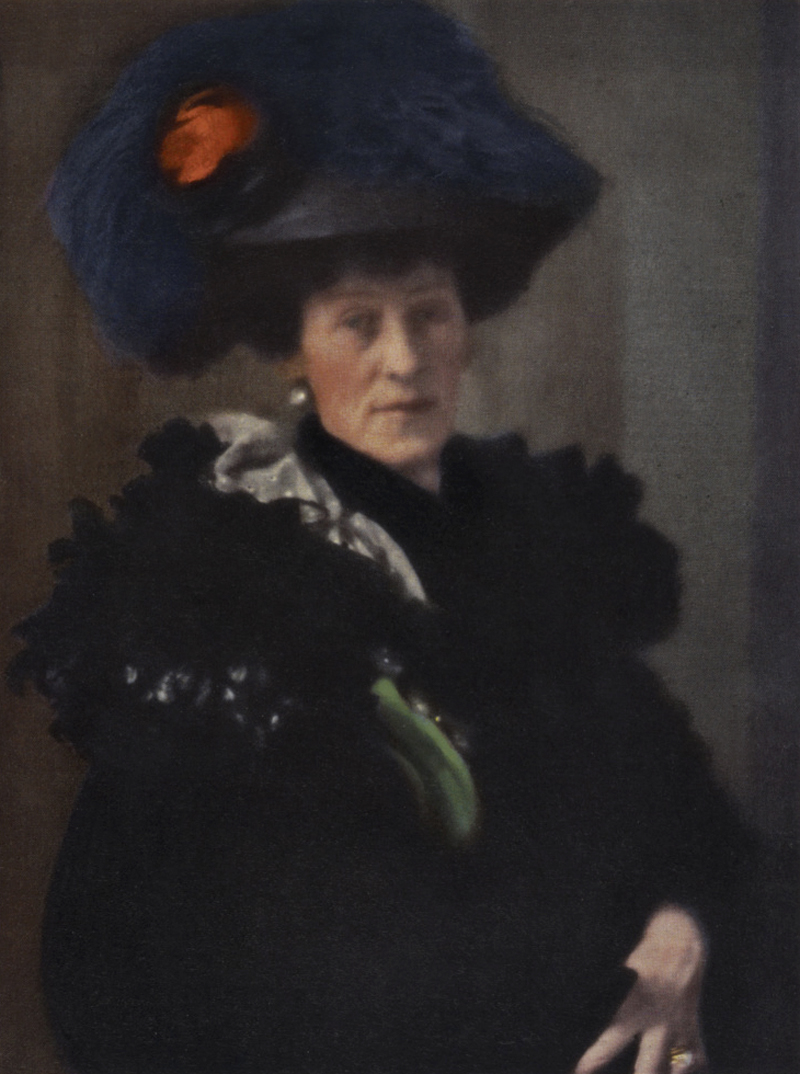
Wonderful to see Edward Steichen’s Portrait – Lady H (1908, below) as I have a copy of Camera Work 22 in my collection.

Dr Marcus Bunyan


All iPhone images © Dr Marcus Bunyan. Please click on the photographs for a larger version of the image.


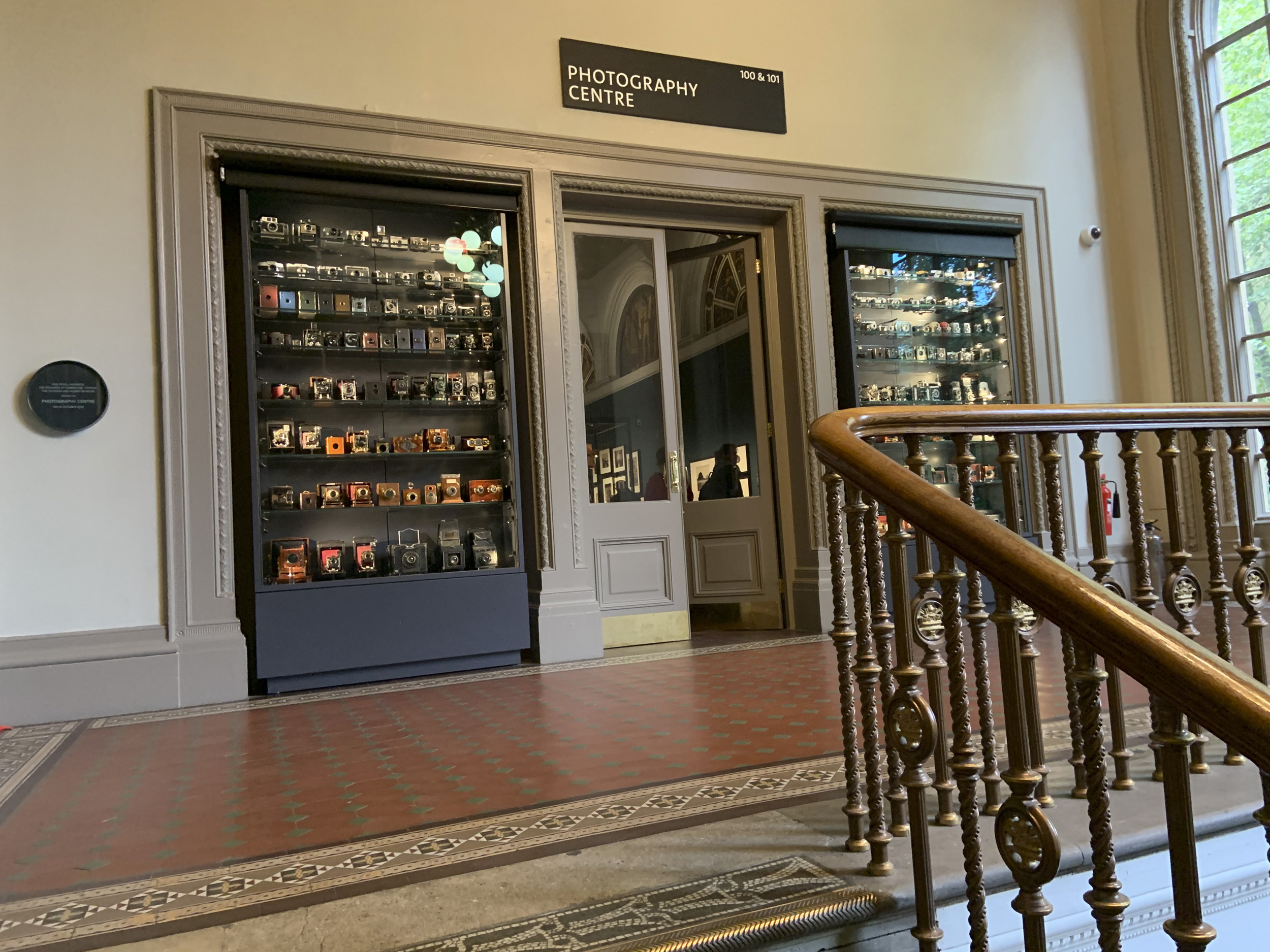
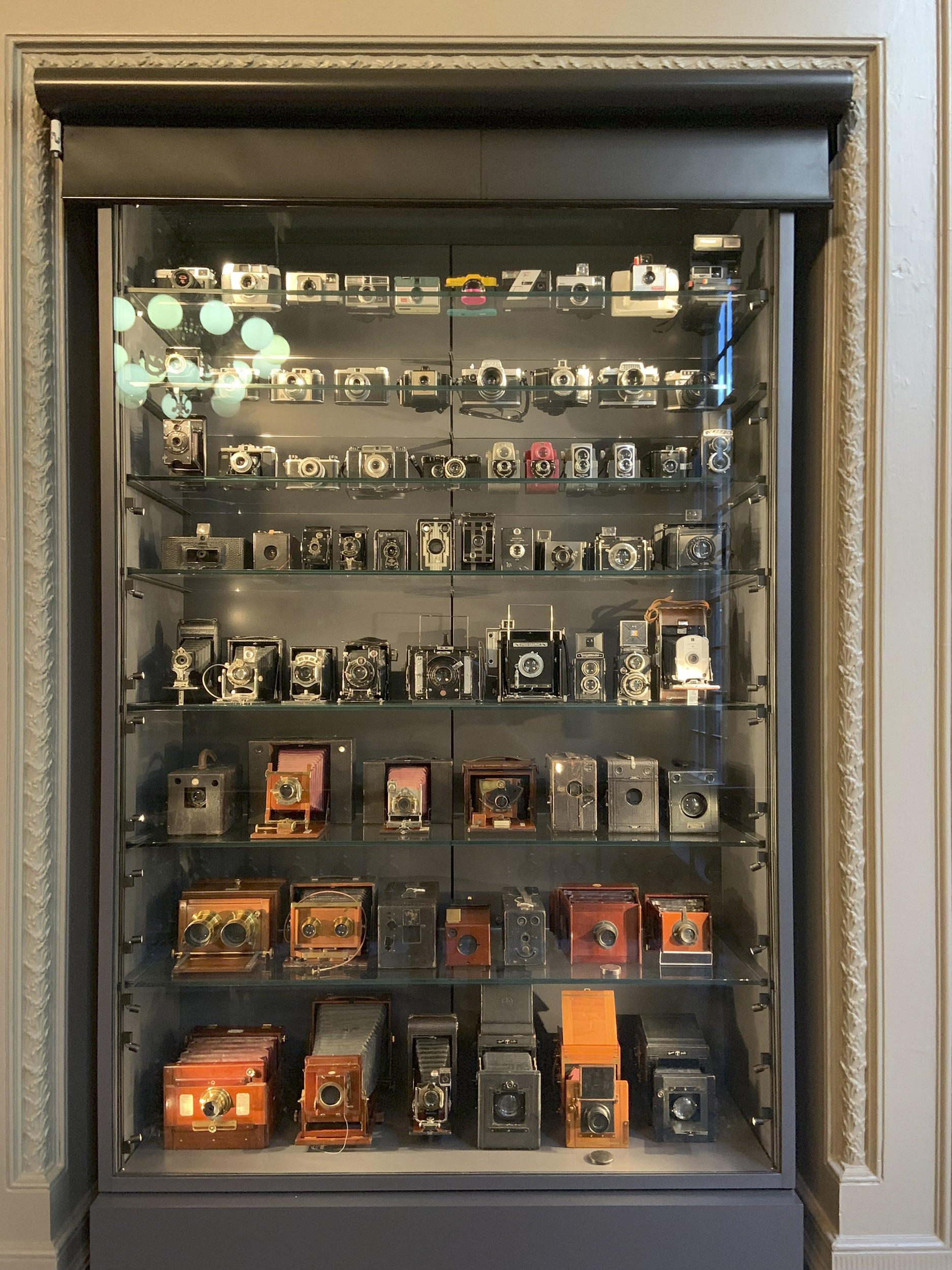
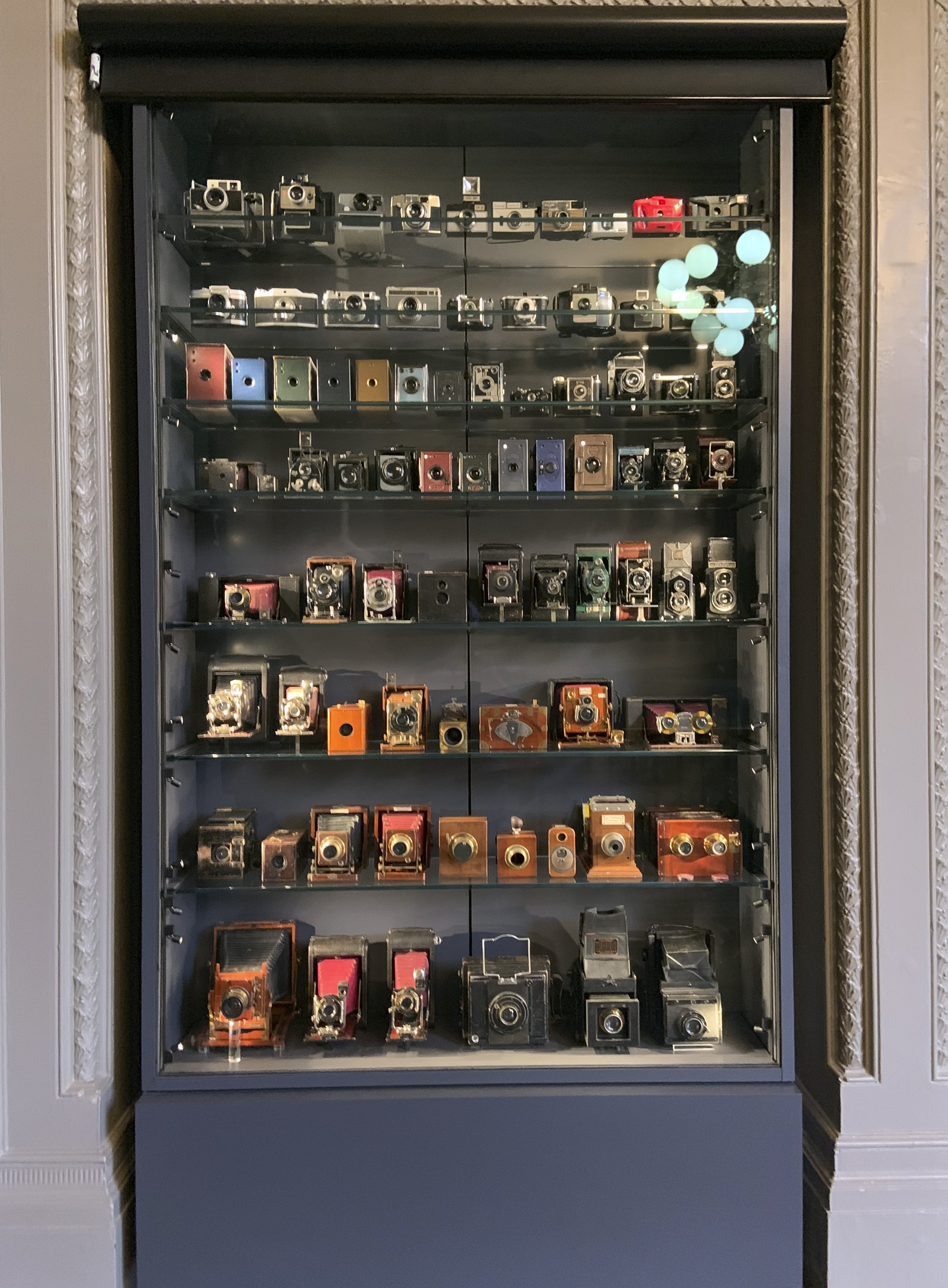
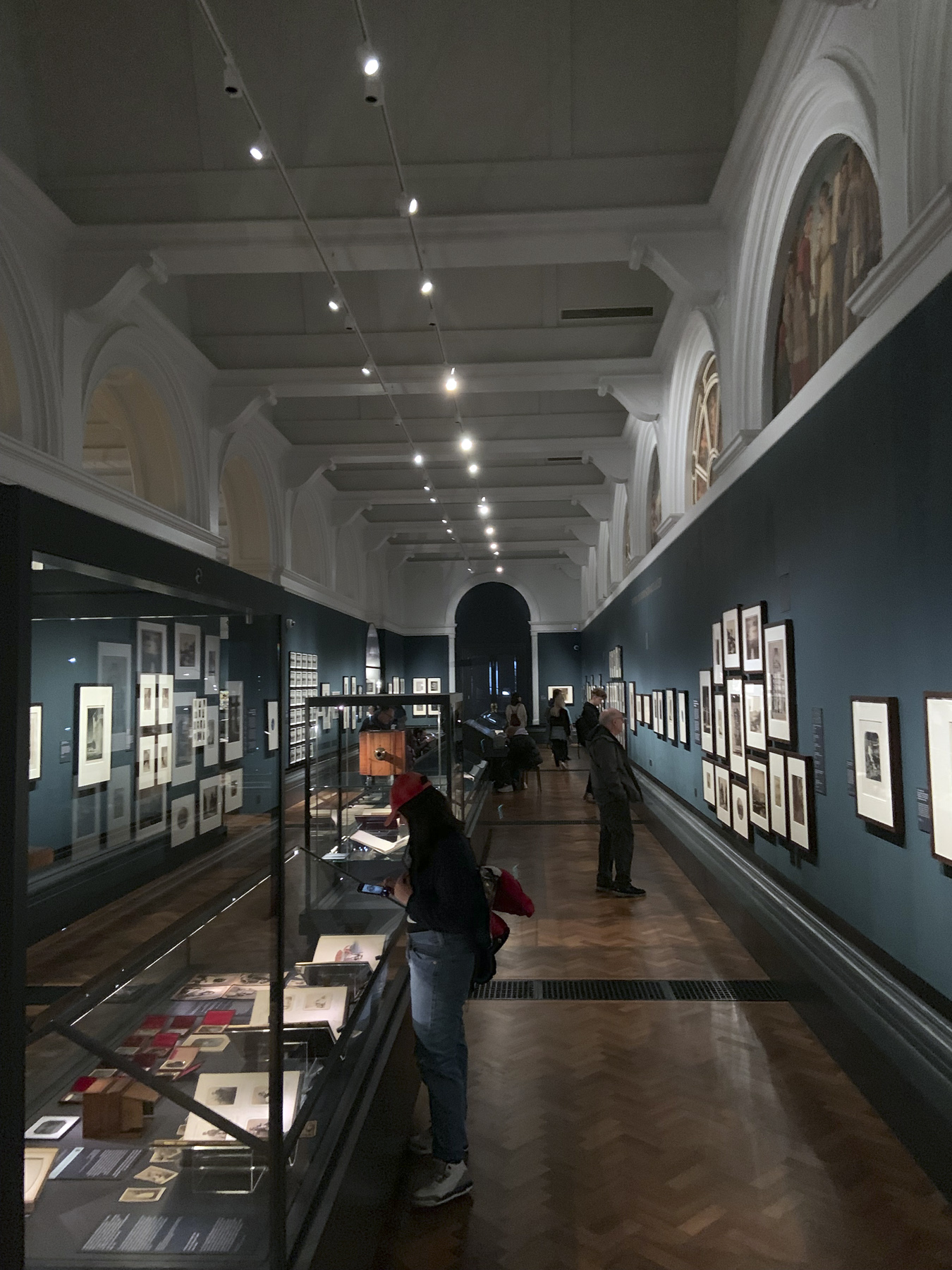
The V&A has been collecting photographs since 1856, the year the Museum was founded, and it was one of the first museums to present photography exhibitions. Since then the collection has grown to be one of the largest and most important in the world, comprising around 500,000 images. The V&A is now honoured to have added the Royal Photographic Society (RPS) collection to its holdings, which contains around 270,000 photographs, an extensive library, and 6,000 cameras and pieces of equipment associated with leading artists and photographic pioneers.

Take a behind-the-scenes look at our world class photography collection following the transfer of the Royal Photographic Society (RPS) Collection, which has enabled a dramatic reimagining of the way photography is presented at the V&A. The photographs curators introduce a series of five highlights that are on display in the new Photography Centre, which opened on 12th October 2018. The first phase of the centre will more than double the space dedicated to photography at the Museum.

Text from the V&A and YouTube websites


Unknown photographer. 'Photograph of Allied War exhibition, Serbian Section, V&A' 1917


Unknown photographer
Photograph of Allied War exhibition, Serbian Section, V&A (installation view)
1917
Gelatin silver print
The Royal Photographic Society Collection at the V&A Museum
Photo: Marcus Bunyan


The V&A has been collecting and exhibiting photographs since the 1850s. This image shows part o a photographic exhibition held over 100 years ago in the same galleries you are standing in today. The exhibition presented a densely packed display of images depicting the Allied Powers during the First World War.


Installation view of the V&A Photography Centre, London

Installation view of the V&A Photography Centre, London

Installation view of the V&A Photography Centre, London

Installation view of the V&A Photography Centre, London

Wall text from the V&A Photography Centre, London

Installation view of the V&A Photography Centre, London


Installation views of the V&A Photography Centre, London
Photos: Marcus Bunyan


Joseph Nicéphore Niépce (French, 1765-1833) 'Christ Carrying his Cross' 1827 (installation view)

Joseph Nicéphore Niépce (French, 1765-1833) 'Christ Carrying his Cross' 1827 (installation view)


Joseph Nicéphore Niépce (French, 1765-1833)
Christ Carrying his Cross (installation views)
1827
Heliograph on pewter plate
The Royal Photographic Society Collection at the V&A Museum
Photos: Marcus Bunyan


The French inventor Niépce made the earliest surviving photographic images, which he called ‘heliographs’ or ‘sun-writing’. Only 16 are thought to still exist. Although Niépce experimented with light-sensitive plates inside a camera, he made most of his images, including this one, by placing engravings of works by other artists directly onto a metal plate. He would probably have had the resulting heliographs coated in ink and printed.


Joseph Nicéphore Niépce (French, 1765-1833) 'Christ Carrying his Cross' 1827 (installation view)


Joseph Nicéphore Niépce (French, 1765-1833)
Christ Carrying his Cross (installation view)
1827
Heliograph on pewter plate
The Royal Photographic Society Collection at the V&A Museum
Photo: Marcus Bunyan


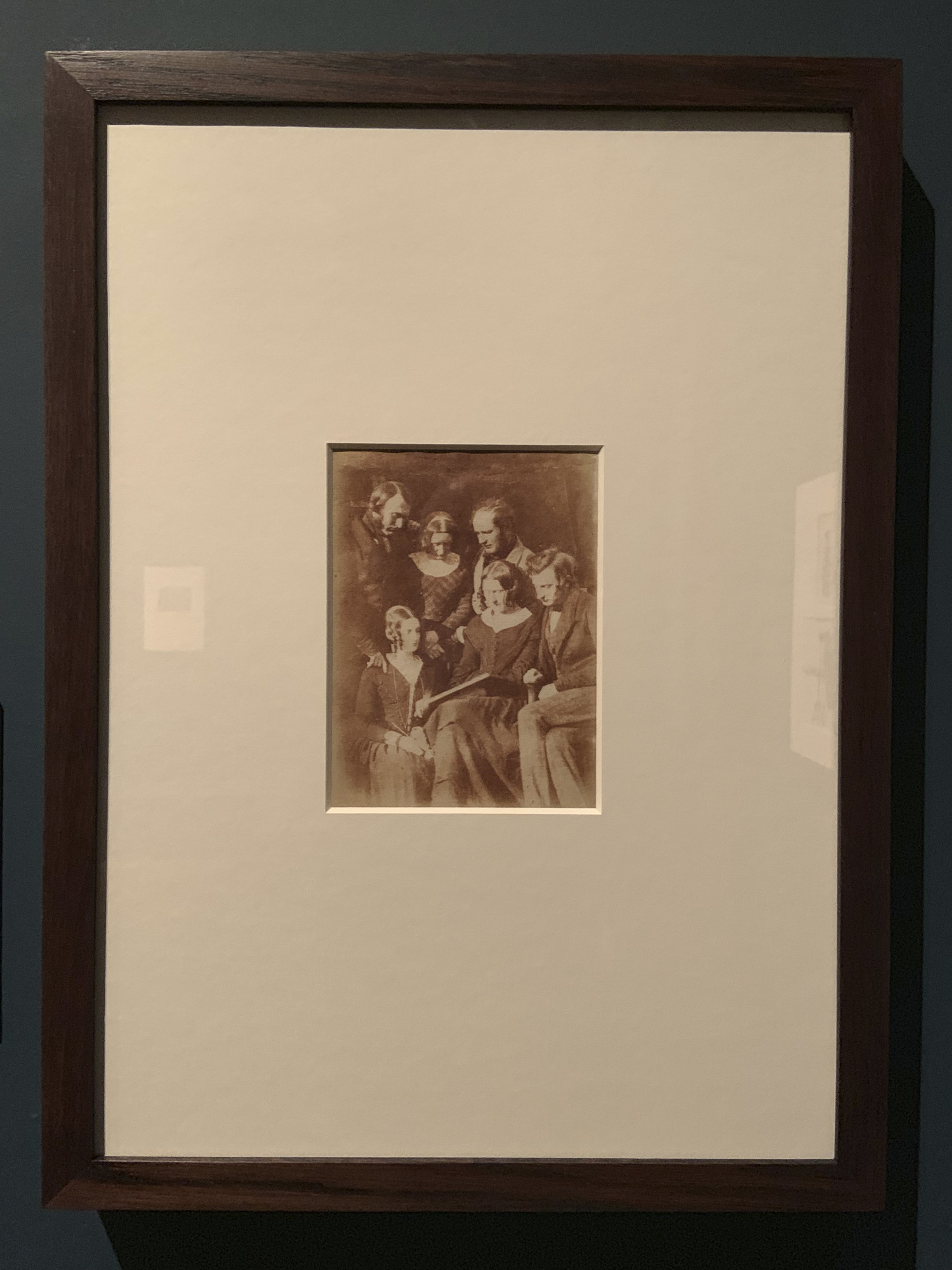
David Octavius Hill (Scottish, 1802-70) and Robert Adamson (Scottish, 1821-48) 'The Adamson Family' 1843-1845 (installation view)


David Octavius Hill (Scottish, 1802-1870) and Robert Adamson (Scottish, 1821-1848)
The Adamson Family (installation view)
1843-1845
Salted paper print
The Royal Photographic Society Collection at the V&A Museum
Photo: Marcus Bunyan


The partnership between Scottish painter Hill and chemist Adamson merged the art and science of photography. The pair initially intended to create preliminary studies for Hill’s paintings, but soon recognised photography’s artistic potential. With Hill’s knowledge of composition and lighting, and Adamson’s considerable sensitivity and dexterity in handling the camera, together they produced some of the most accomplished photographic portraits of their time.


William Henry Fox Talbot (British, 1800-77) 'The Haystack' 1844 from  the V&A Photography Centre, London 2019


William Henry Fox Talbot (British, 1800-1877)
The Haystack
1844
From The Pencil of Nature
Salted paper print
The Royal Photographic Society Collection at the V&A Museum


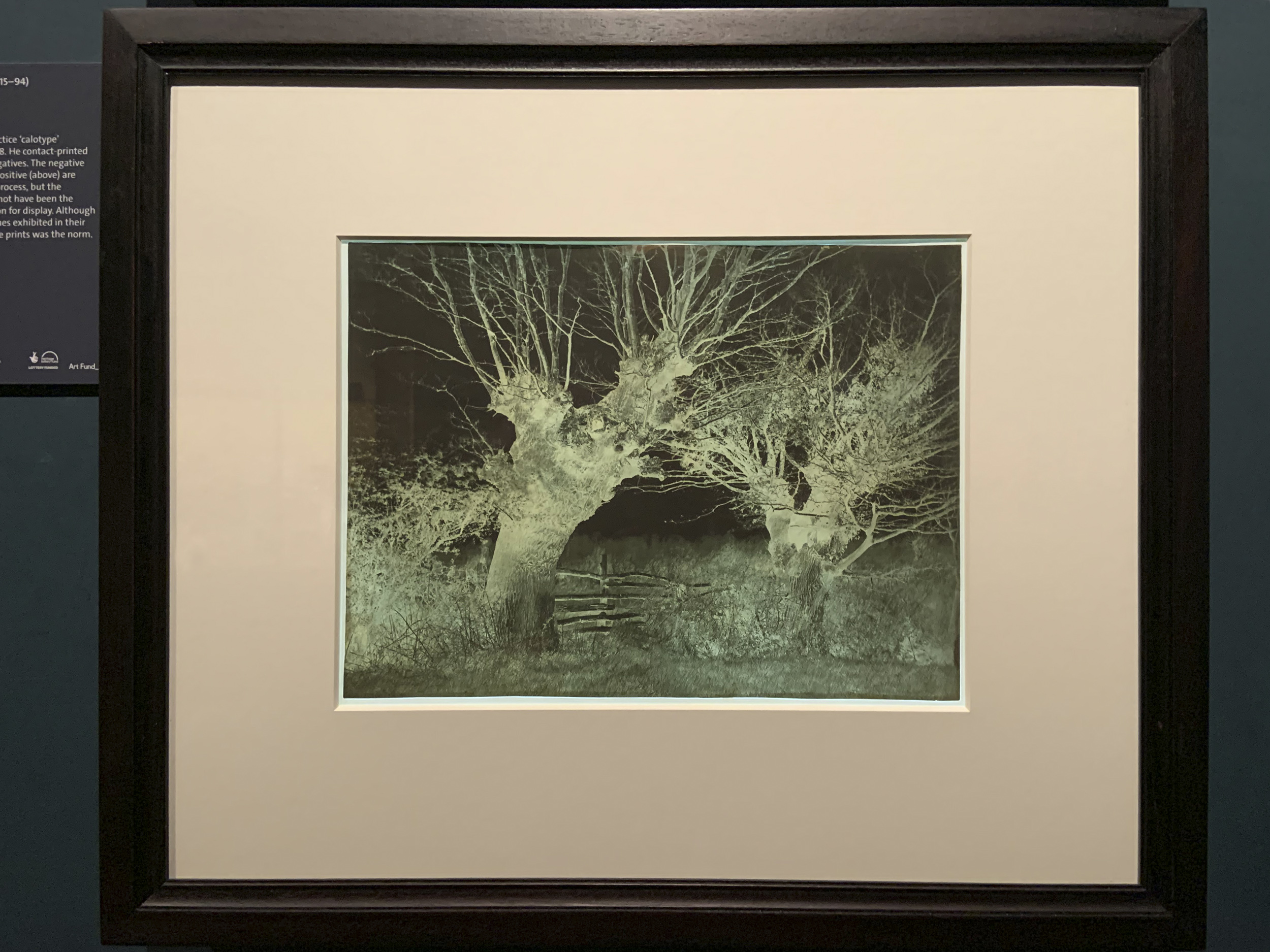
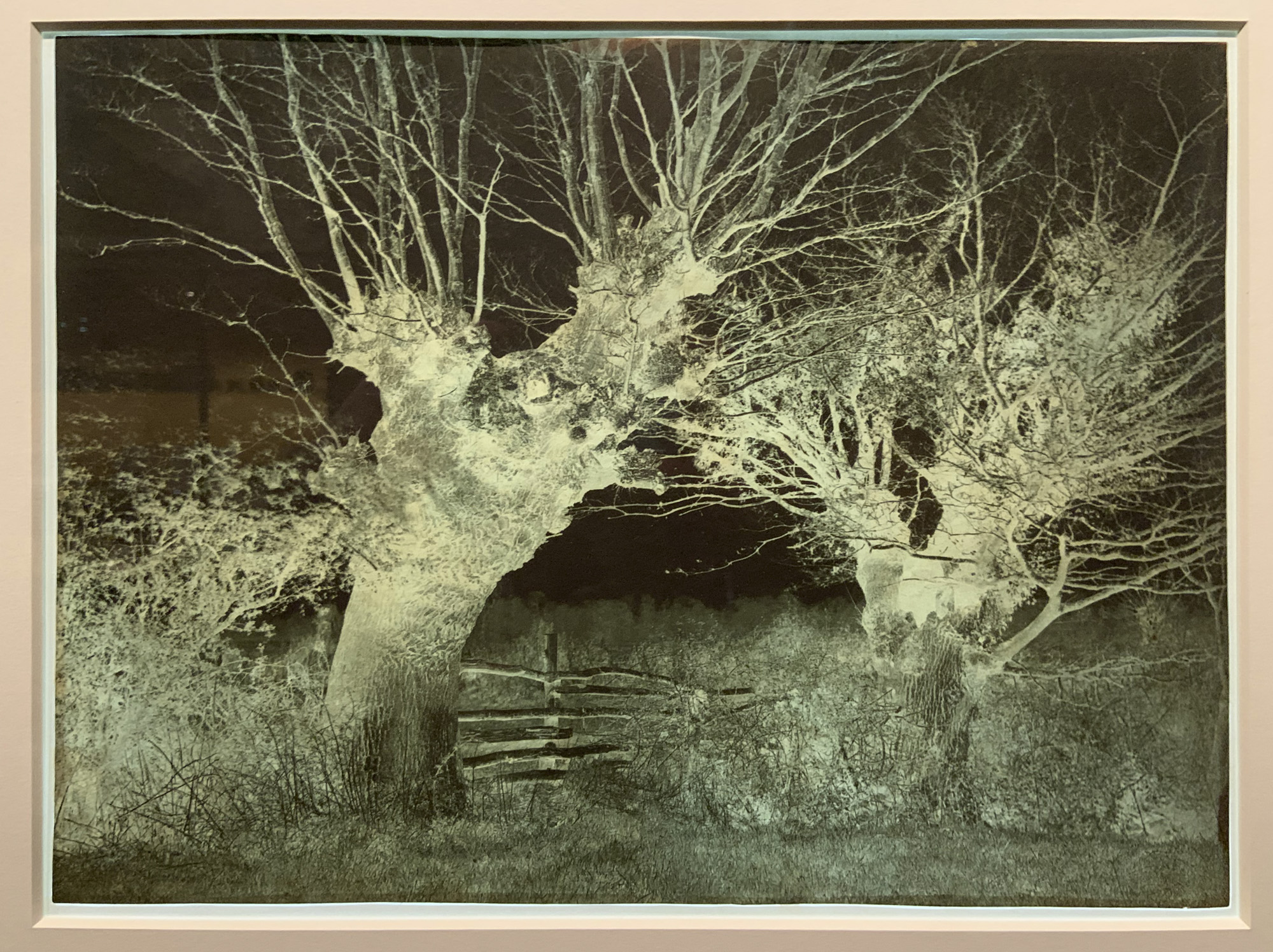
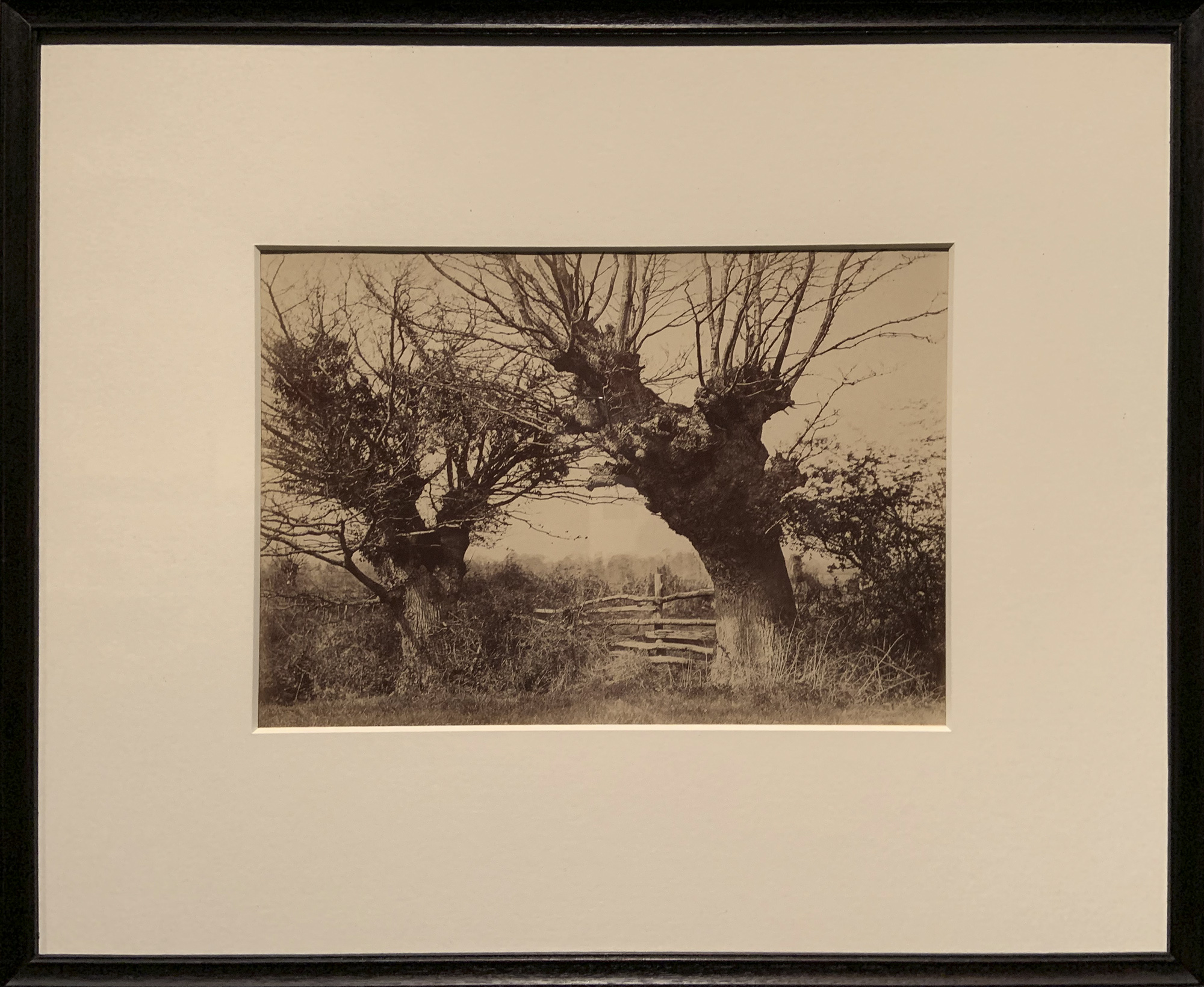
Benjamin Brecknell Turner (British, 1815-94) 'Hedgerow Trees, Clerkenleap' 1852-1854 (installation view)

Benjamin Brecknell Turner (British, 1815-94) 'Hedgerow Trees, Clerkenleap' 1852-1854 (installation view)


Benjamin Brecknell Turner (British, 1815-1894)
Hedgerow Trees, Clerkenleap (installation views)
1852-1854
Albumen print; Calotype negative
The Royal Photographic Society Collection at the V&A Museum
Photos: Marcus Bunyan


Turner took out a licence to practice ‘calotype’ photography from Talbot in 1848. He contact-printed positive images from paper negatives. The negative (below) and its corresponding positive (above) are reunited here to illustrate this process, but the pairing as you see them would not have been the photographer’s original intention for display. Although unique negatives were sometimes exhibited in their own right, only showing positive prints was the norm.


Benjamin Brecknell Turner (British, 1815-94) 'Hedgerow Trees, Clerkenleap' 1852-1854 (installation view)


Benjamin Brecknell Turner (British, 1815-1894)
Hedgerow Trees, Clerkenleap (installation view)
1852-1854
Albumen print; Calotype negative
The Royal Photographic Society Collection at the V&A Museum
Photo: Marcus Bunyan


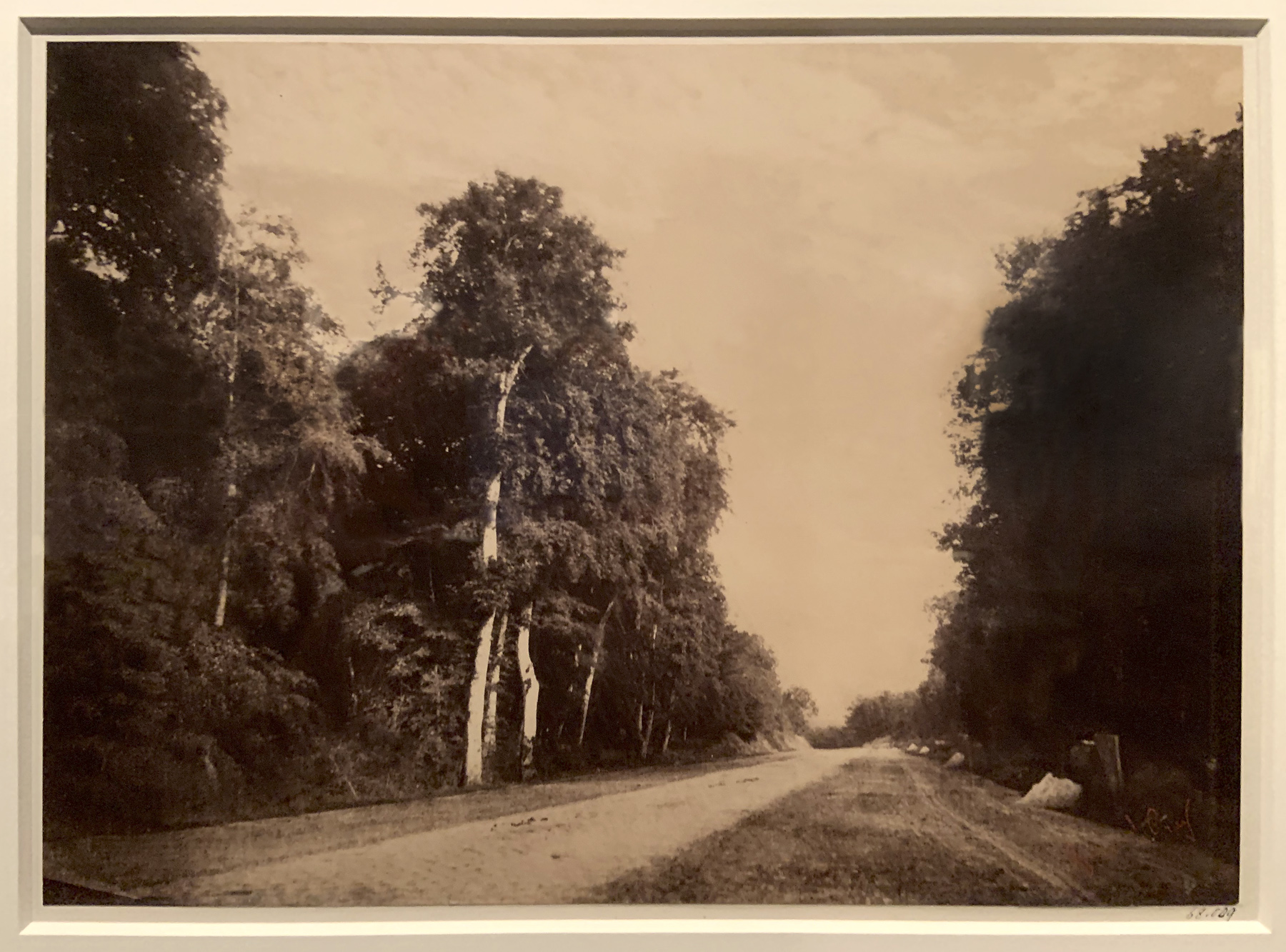
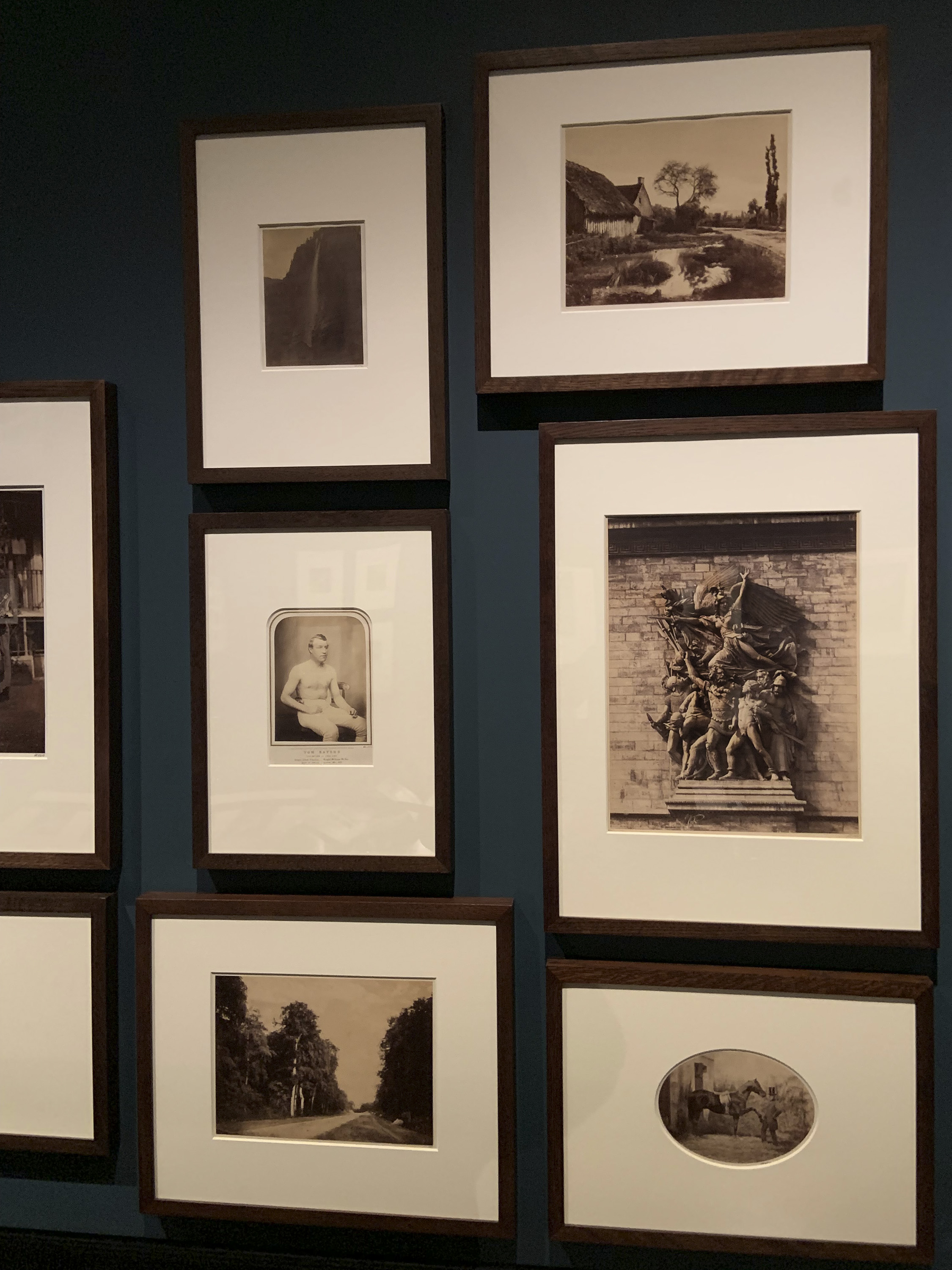
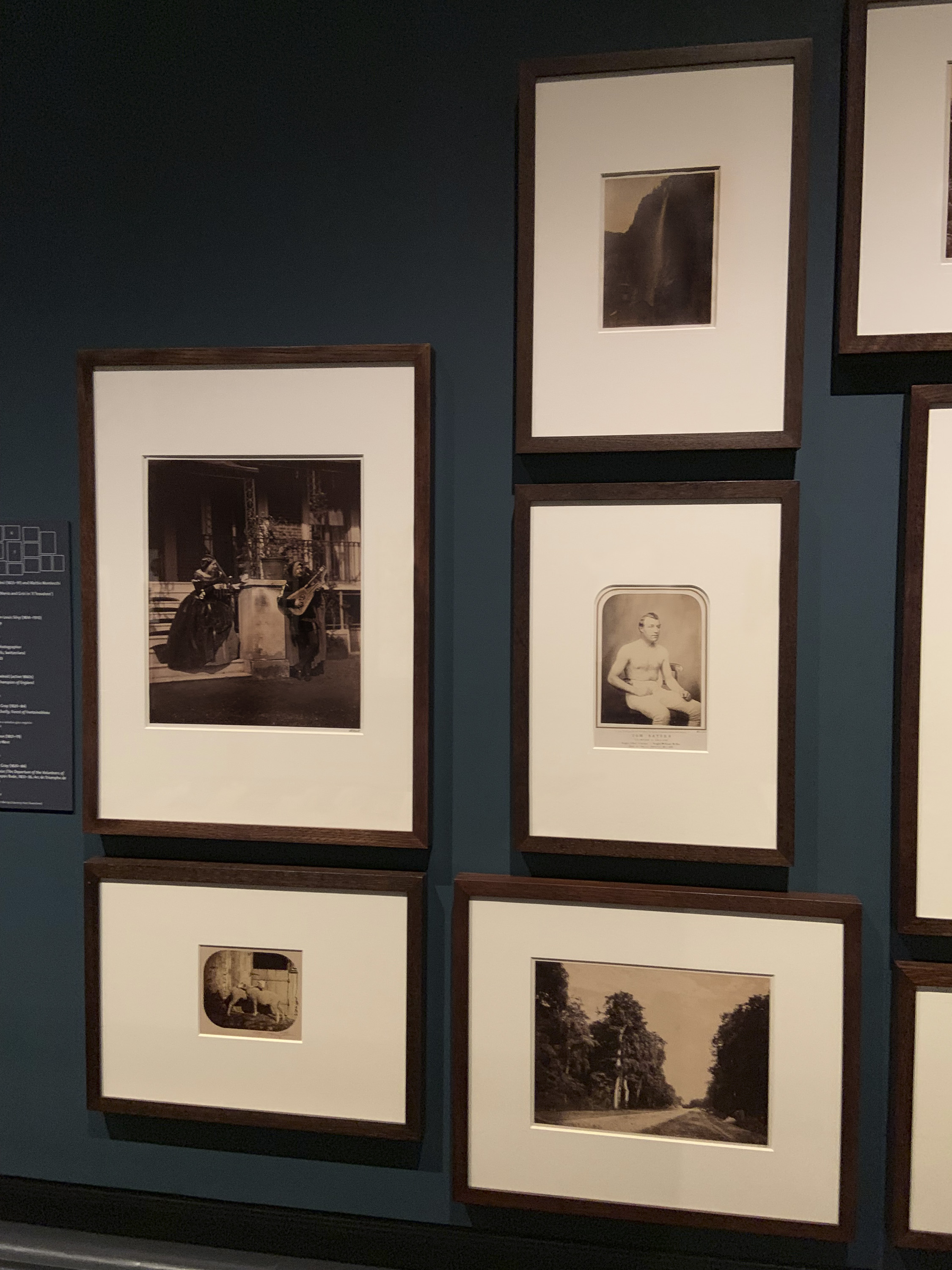
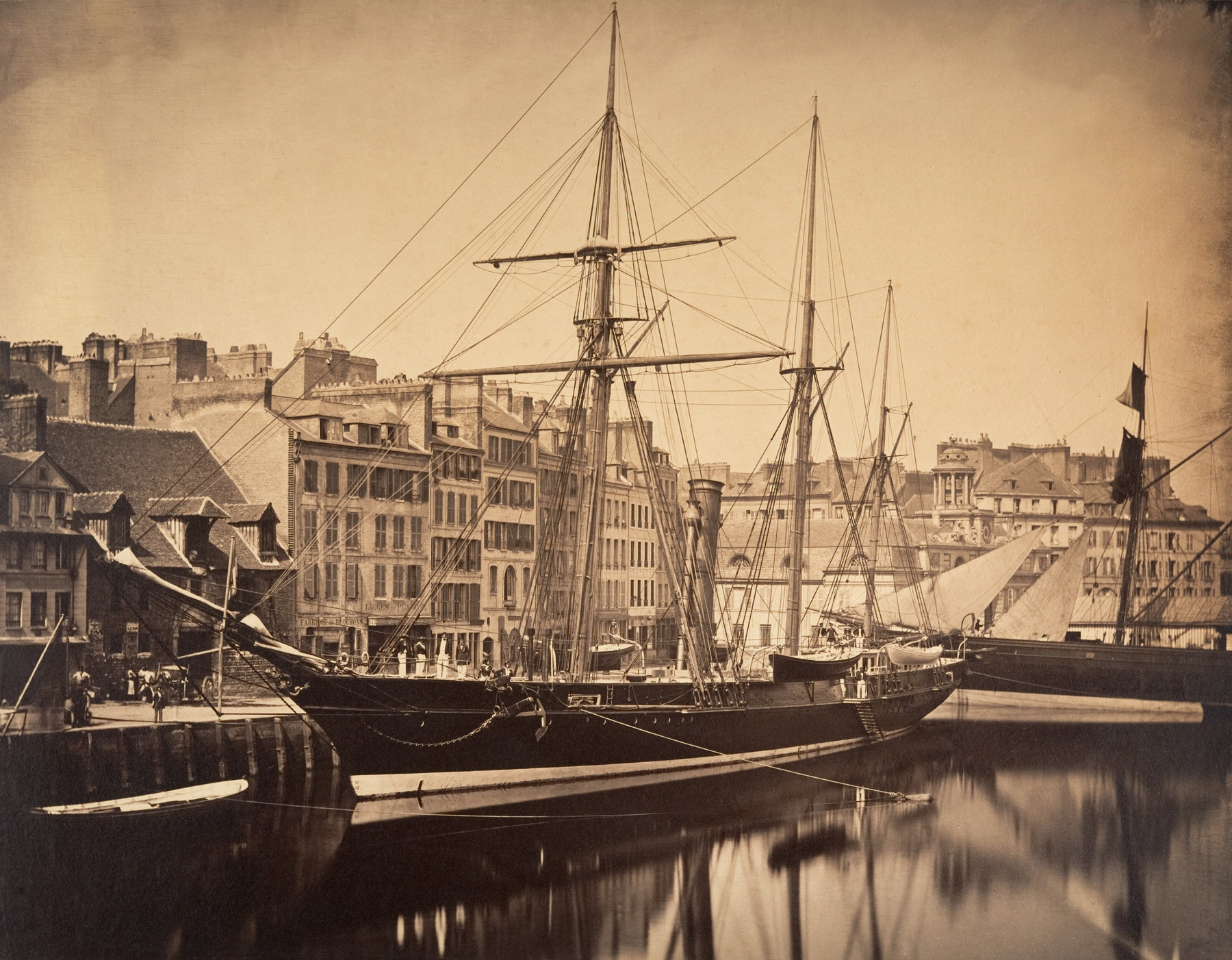
Gustave Le Gray (French, 1820-84) 'The Road to Chailly, Forest of Fontainebleau' 1852 (installation view)


Gustave Le Gray (French, 1820-1884)
The Road to Chailly, Forest of Fontainebleau (installation view)
1852
Albumen print from a collodion glass negative
Bequeathed to the V&A by Chauncey Hare Townshend
Photo: Marcus Bunyan


Installation view of the V&A Photography Centre, London

Installation view of the V&A Photography Centre, London

Wall text from the V&A Photography Centre, London


Installation views of the V&A Photography Centre, London
Photos: Marcus Bunyan


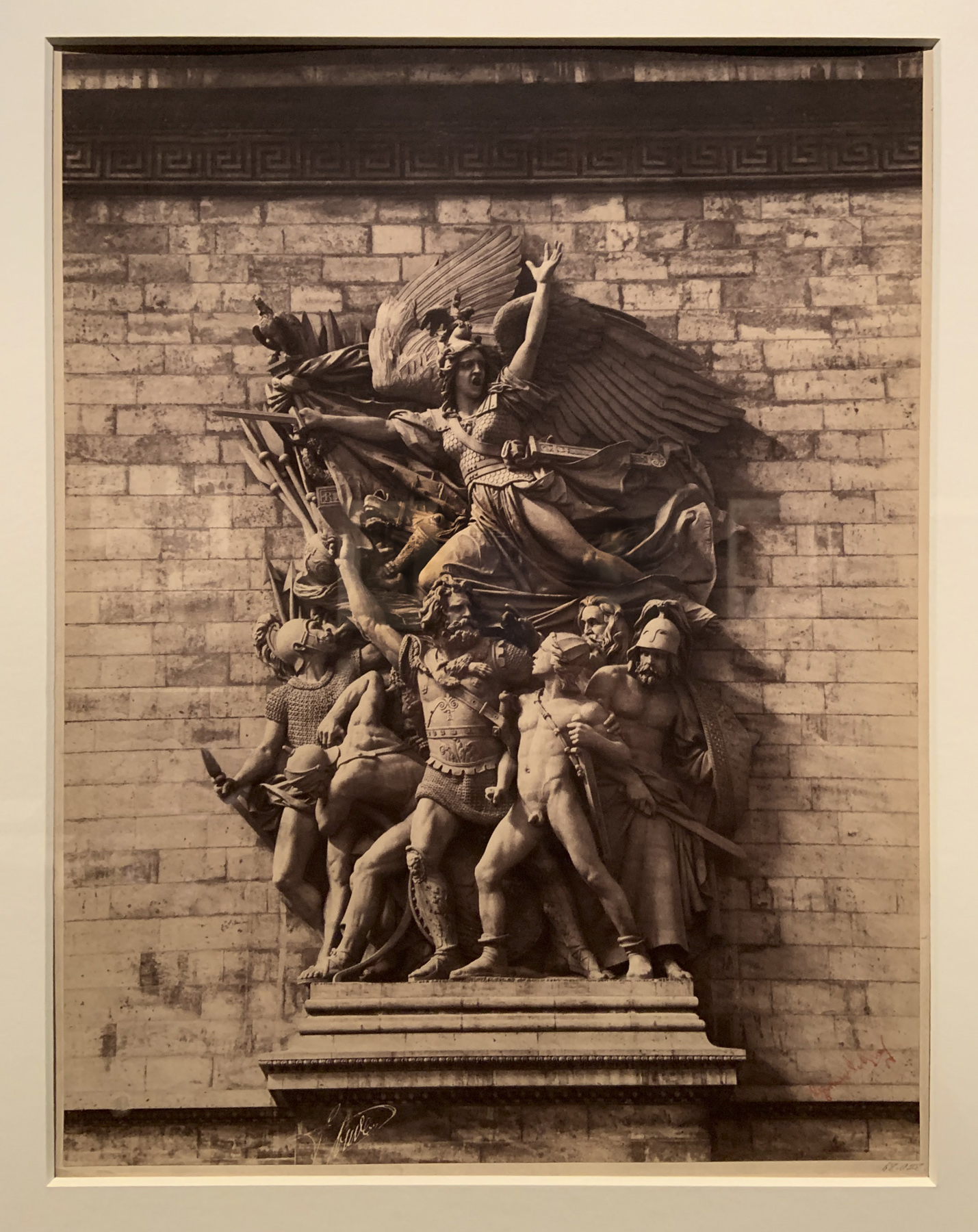
Gustave Le Gray (French, 1820-84) 'The Marseillaise (The Departure of the Volunteers of 1792), by Francois Rude, 1833-35, Arc de Triomphe de l’Etoile, Paris' 1852 (installation view)


Gustave Le Gray (French, 1820-1884)
The Marseillaise (The Departure of the Volunteers of 1792), by Francois Rude, 1833-35, Arc de Triomphe de l’Etoile, Paris (installation view)
1852
Albumen print
Bequeathed to the V&A by Chauncey Hare Townshend
Photo: Marcus Bunyan


Gustave Le Gray (French, 1820-1884) 'The Marseillaise (The Departure of the Volunteers of 1792), by Francois Rude, 1833-1835, Arc de Triomphe de l’Etoile, Paris' 1852 (installation view)


Gustave Le Gray (French, 1820-1884)
The Marseillaise (The Departure of the Volunteers of 1792), by Francois Rude, 1833-35, Arc de Triomphe de l’Etoile, Paris (installation view)
1852
Albumen print
Bequeathed to the V&A by Chauncey Hare Townshend
Photo: Marcus Bunyan


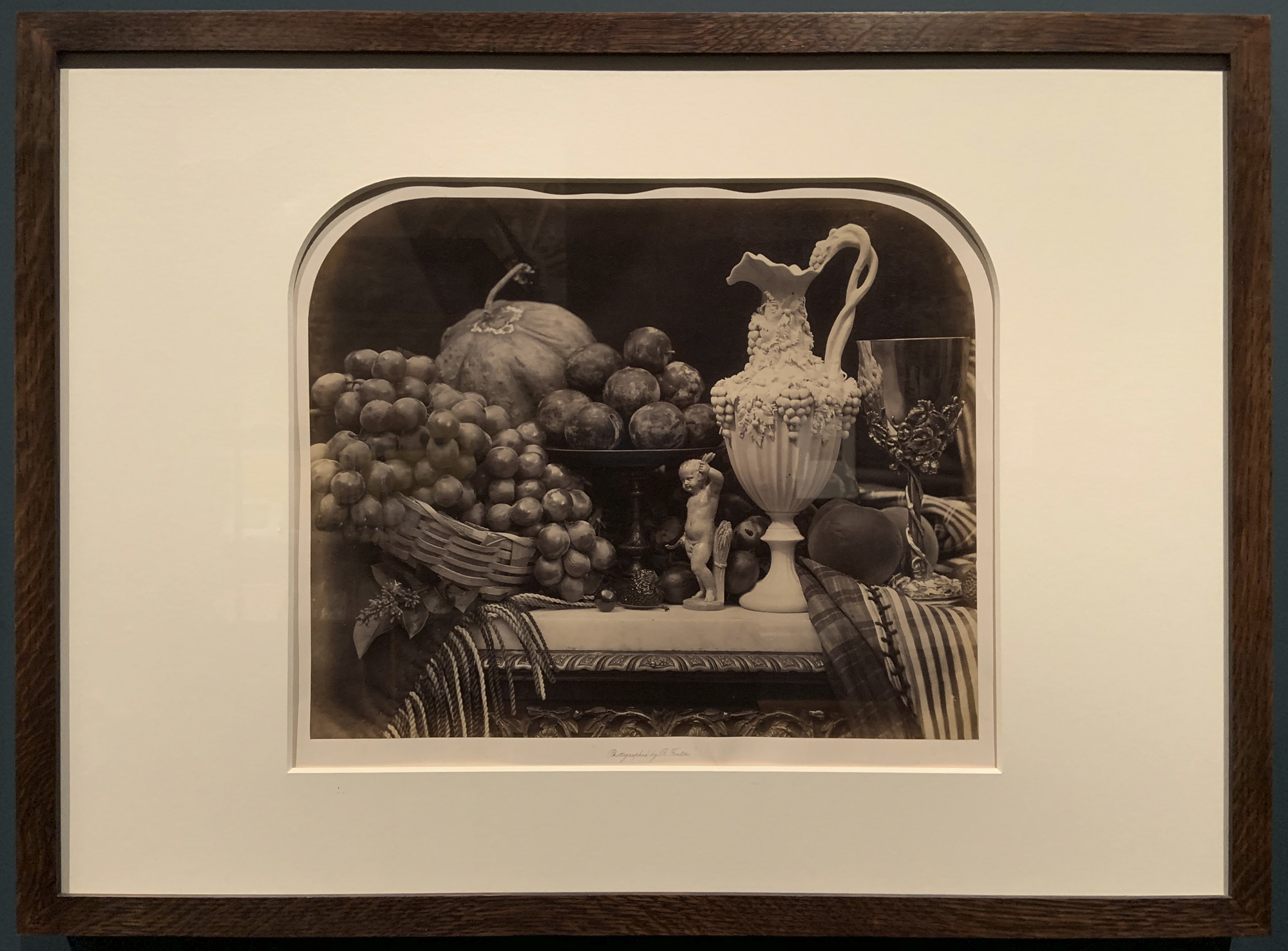
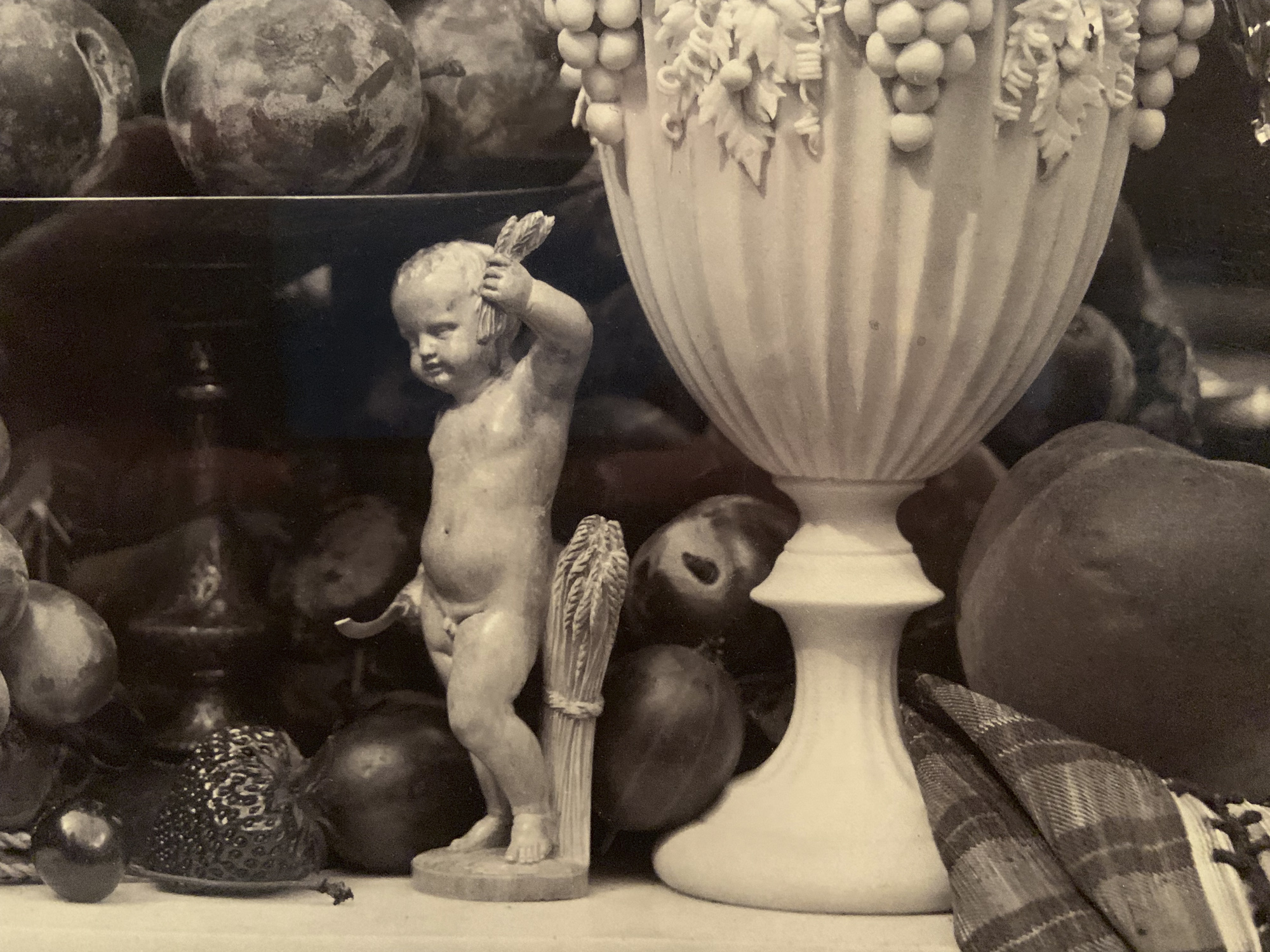
Roger Fenton (British, 1819-1869) 'Parian Vase, Grapes and Silver Cup' 1860 (installation view)


Roger Fenton (British, 1819-1869)
Parian Vase, Grapes and Silver Cup (installation view)
1860
Albumen print
The Royal Photographic Society Collection at the V&A Museum
Photo: Marcus Bunyan


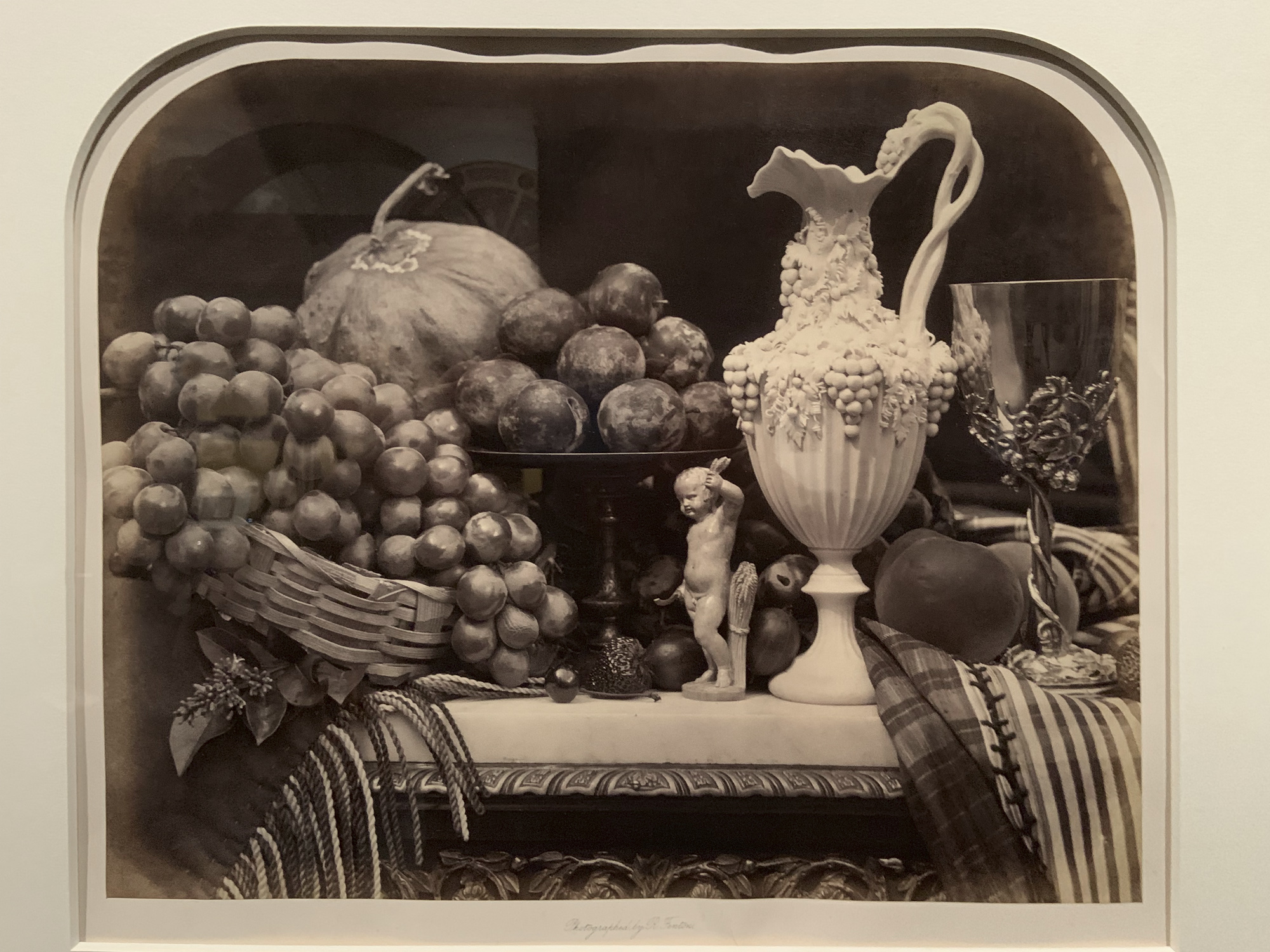
Fenton was one of the most versatile and technically brilliant photographers of the 19th century. He excelled at many subjects, including war photography, portraiture, architecture and landscape. He also made a series of lush still lives. Here, grapes, plums and peaches are rendered in exquisite detail, and the silver cup on the right reflects a camera tripod.


Roger Fenton (British, 1819-1869) 'Parian Vase, Grapes and Silver Cup' 1860 (installation view)


Roger Fenton (British, 1819-1869)
Parian Vase, Grapes and Silver Cup (installation view)
1860
Albumen print
The Royal Photographic Society Collection at the V&A Museum
Photo: Marcus Bunyan


Roger Fenton (British, 1819-1869) 'Parian Vase, Grapes and Silver Cup' 1860 (installation view)


Roger Fenton (British, 1819-1869)
Parian Vase, Grapes and Silver Cup (installation view)
1860
Albumen print
The Royal Photographic Society Collection at the V&A Museum
Photo: Marcus Bunyan


Roger Fenton (British, 1819-1869) 'Parian Vase, Grapes and Silver Cup' 1860 (installation view detail)


Roger Fenton (British, 1819-1869)
Parian Vase, Grapes and Silver Cup (installation view detail)
1860
Albumen print
The Royal Photographic Society Collection at the V&A Museum
Photo: Marcus Bunyan


Roger Fenton (British, 1819-1869) 'Still Life with Fruit and Decanter' 1860 from the V&A Photography Centre, London 2019


Roger Fenton (British, 1819-1869)
Still Life with Fruit and Decanter
1860
Albumen print
The Royal Photographic Society Collection at the V&A Museum


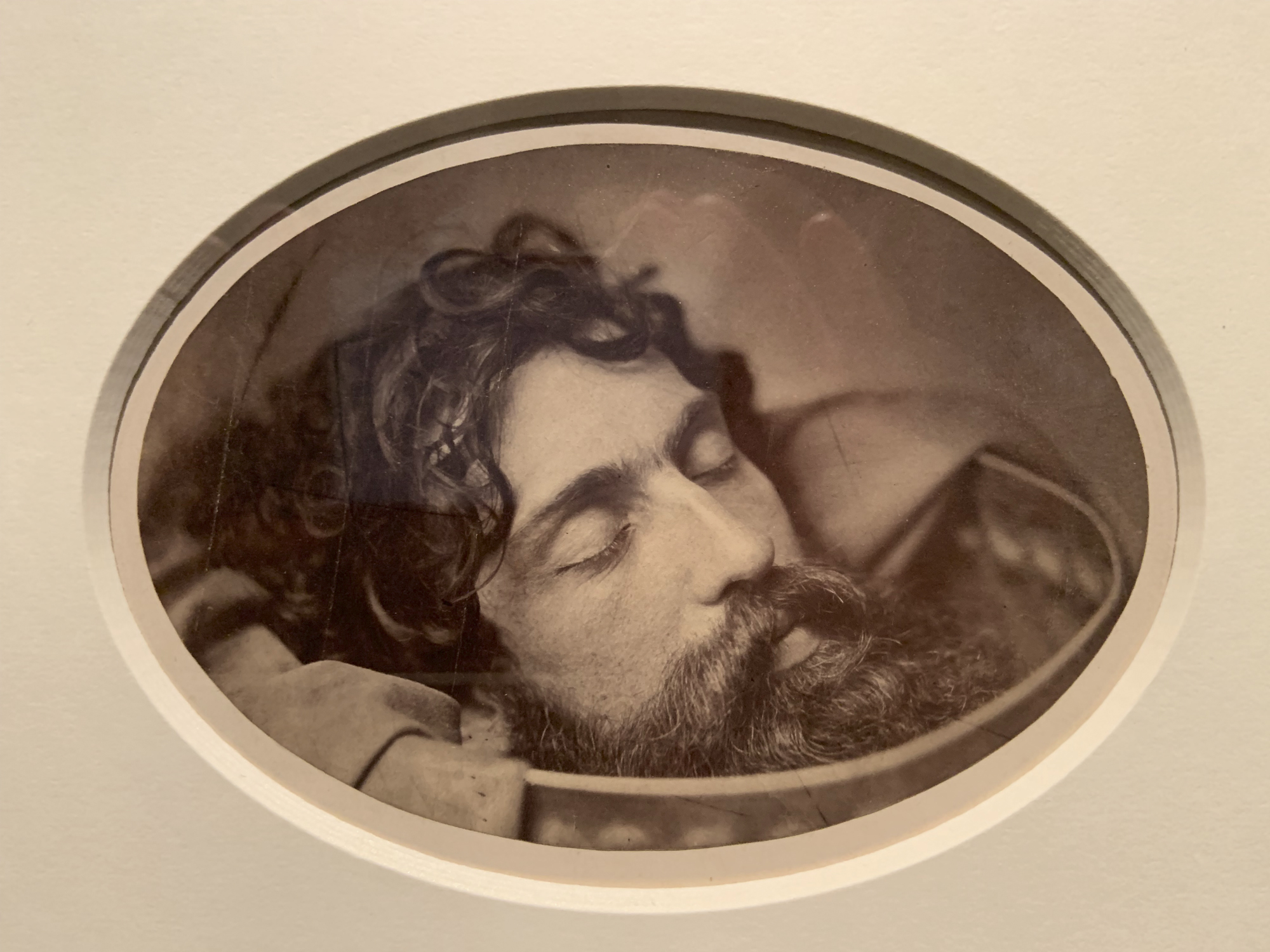
Oscar Gustaf Rejlander (British born Sweden, 1813-1875) 'Head of St John the Baptist on a Charger' c. 1856 (installation view)


Oscar Gustaf Rejlander (British born Sweden, 1813-1875)
Head of St John the Baptist on a Charger (installation view)
c. 1856
Albumen print
The Royal Photographic Society Collection at the V&A Museum
Photo: Marcus Bunyan


Rejlander probably intended this photograph to be part of a larger composition telling the biblical story of Salome, in which the severed head of John the Baptist was presented to her on a plate. Rejlander never made the full picture, however, and instead produced multiple prints of the head alone.


Oscar Gustaf Rejlander (British born Sweden, 1813-75) 'Head of St John the Baptist on a Charger' c. 1856 (installation view)


Oscar Gustaf Rejlander (British born Sweden, 1813-1875)
Head of St John the Baptist on a Charger (installation view)
c. 1856
Albumen print
The Royal Photographic Society Collection at the V&A Museum


Francis Frith (British, 1822-1898) 'Th', from Egypt, Sinai, and Jerusalem: A Series of Twenty Photographic Views by Francis Frith 1858 (published 1860 or 1862) (installation view)


Francis Frith (British, 1822-1898)
The Pyramids of Dahshoor [Dahshur], from the East, from Egypt, Sinai, and Jerusalem: A Series of Twenty Photographic Views by Francis Frith (installation view)
1858 (published 1860 or 1862)
Albumen print
The Royal Photographic Society Collection at the V&A Museum
Photo: Marcus Bunyan


Frith’s photographs were popular and circulated widely, both because of their architectural interest and because they often featured sites mentioned in the Bible. Photographs of places described in biblical stories brought a new level of realism to a Christian Victorian audience, previously only available through the interpretations of a painter or illustrator.


Francis Frith (British, 1822-1898) 'Th', from Egypt, Sinai, and Jerusalem: A Series of Twenty Photographic Views by Francis Frith 1858 (published 1860 or 1862) (installation view)


Francis Frith (British, 1822-1898)
The Pyramids of Dahshoor [Dahshur], from the East, from Egypt, Sinai, and Jerusalem: A Series of Twenty Photographic Views by Francis Frith (installation view)
1858 (published 1860 or 1862)
Albumen print
The Royal Photographic Society Collection at the V&A Museum
Photo: Marcus Bunyan


Francis Frith (British, 1822-98) 'The Pyramids of Dahshoor [Dahshur], from the East, from Egypt, Sinai, and Jerusalem: A Series of Twenty Photographic Views by Francis Frith' 1858 (published 1860 or 1862) from the V&A Photography Centre, London 2019


Francis Frith (British, 1822-1898)
The Pyramids of Dahshoor [Dahshur], from the East, from Egypt, Sinai, and Jerusalem: A Series of Twenty Photographic Views by Francis Frith
1858 (published 1860 or 1862)
Albumen print
The Royal Photographic Society Collection at the V&A Museum
Photo: Marcus Bunyan


Installation view of the V&A Photography Centre, London


Installation view of the V&A Photography Centre, London
Photo: Marcus Bunyan


Gustave Le Gray (French, 1820-1884) 'Solar Effect in the Clouds – Ocean' 1856-1859 (installation view)


Gustave Le Gray (French, 1820-1884)
Solar Effect in the Clouds – Ocean (installation view)
1856-1859
Albumen Print
Bequeathed to the V&A by Chauncey Hare Townshend
Photo: Marcus Bunyan


Gustave Le Gray (French, 1820-1884) 'Solar Effect in the Clouds – Ocean' 1856-1859


Gustave Le Gray (French, 1820-1884)
Solar Effect in the Clouds – Ocean
1856-1859
Albumen Print
Art Institute of Chicago
Creative Commons Zero (CC0)


Gustave Le Gray (French, 1820-1884) 'The Imperial Yacht, La Reine Hortense, Le Havre' 1856-1857 (installation view)


Gustave Le Gray (French, 1820-1884)
The Imperial Yacht, La Reine Hortense, Le Havre (installation view)
1856-1857
Albumen print
Bequeathed to the V&A by Chauncey Hare Townshend
Photo: Marcus Bunyan


Gustave Le Gray (French, 1820-1884) 'The Imperial Yacht, La Reine Hortense, Le Havre' 1856-1857 (installation view)


Gustave Le Gray (French, 1820-1884)
The Imperial Yacht, La Reine Hortense, Le Havre (installation view)
1856-1857
Albumen print
Bequeathed to the V&A by Chauncey Hare Townshend
Photo: Marcus Bunyan


Gustave Le Gray (French, 1820-1884) 'The Imperial Yacht, La Reine Hortense, Le Havre' 1856-1857


Gustave Le Gray (French, 1820-1884)
The Imperial Yacht, La Reine Hortense, Le Havre
1856-1857
Albumen print
The Metropolitan Museum of Art
Public domain


Gustave Le Gray (French, 1820-1884) 'Pavilion Richelieu, Louvre, Paris' 1857-1859 (installation view)


Gustave Le Gray (French, 1820-1884)
Pavilion Richelieu, Louvre, Paris (installation view)
1857-1859
Albumen print
Bequeathed to the V&A by Chauncey Hare Townshend
Photo: Marcus Bunyan


Gustave Le Gray (French, 1820-1884) 'Pavilion Richelieu, Louvre, Paris' 1857-1859 (installation view)


Gustave Le Gray (French, 1820-1884)
Pavilion Richelieu, Louvre, Paris (installation view)
1857-1859
Albumen print
Bequeathed to the V&A by Chauncey Hare Townshend
Photo: Marcus Bunyan


Roger Fenton (British, 1819-1869) 'Balaclava from Guard’s Hill, the Crimea' 1855 (installation view)


Roger Fenton (British, 1819-1869)
Balaclava from Guard’s Hill, the Crimea (installation view)
1855
Albumen print
Bequeathed to the V&A by Chauncey Hare Townshend
Photo: Marcus Bunyan


Roger Fenton (British, 1819-1869) 'Balaclava from Guard’s Hill, the Crimea' 1855 (installation view)


Roger Fenton (British, 1819-69)
Balaclava from Guard’s Hill, the Crimea (installation view)
1855
Albumen print
Bequeathed to the V&A by Chauncey Hare Townshend
Photo: Marcus Bunyan


Julia Margaret Cameron (British born India, 1815-1879) 'Lucia' 1864-1865 (installation view)


Julia Margaret Cameron (British, born India, 1815-1879)
Lucia (installation view)
1864-1865
Albumen print
The Royal Photographic Society Collection at the V&A Museum
Photo: Marcus Bunyan


Charles Lutwide Dodgson (also known as Lewis Carroll)(British, 1832-1898) 'Tea Merchant (On Duty)' and 'Tea Merchant (Off Duty)' 1873 (installation view)


Charles Lutwide Dodgson (also known as Lewis Carroll)(British, 1832-1898)
Tea Merchant (On Duty) and Tea Merchant (Off Duty) (installation view)
1873
Albumen prints
The Royal Photographic Society Collection at the V&A Museum
Photo: Marcus Bunyan


Lewis Carroll is best known as the author of Alice’s Adventures in Wonderland, but he was also an accomplished amateur photographer. Approximately half of his photographs are portraits of children, sometimes wearing foreign costumes or acting out scenes. Here, Alexandra ‘Xie’ Kitchen, his most frequent child sitter, poses in Chinese dress on a stack of tea chests.


Charles Lutwide Dodgson (also known as Lewis Carroll)(British, 1832-1898) 'Tea Merchant (On Duty)' 1873 (installation view)


Charles Lutwide Dodgson (also known as Lewis Carroll)(British, 1832-1898)
Tea Merchant (On Duty) (installation view)
1873
Albumen prints
The Royal Photographic Society Collection at the V&A Museum
Photo: Marcus Bunyan


Charles Lutwide Dodgson (also known as Lewis Carroll)(British, 1832-1898) 'Tea Merchant (Off Duty)' 1873 (installation view)


Charles Lutwide Dodgson (also known as Lewis Carroll)(British, 1832-1898)
Tea Merchant (Off Duty) (installation view)
1873
Albumen prints
The Royal Photographic Society Collection at the V&A Museum
Photo: Marcus Bunyan


Julia Margaret Cameron (British, born India, 1815-1879) 'Pomona' 1887 (installation view)


Julia Margaret Cameron (British, born India, 1815-1879)
Pomona (installation view)
1887
Albumen print
The Royal Photographic Society Collection at the V&A Museum
Photo: Marcus Bunyan


The South Kensington museum (now the V&A) was the only museum to collect and exhibit Julia Margaret Cameron’s during her lifetime. This is one of several studies she made of Alice Liddell, who as a child had modelled for the author and photographer Lewis Carroll and inspired his novel Alice’s Adventures in Wonderland. Cameron, Carroll and Liddell moved in overlapping artistic and intellectual circles. Here, surrounded by foliage, a grown-up Alice poses as the Roman goddess of orchards and gardens.


Julia Margaret Cameron (British, born India, 1815-1879) 'Pomona' 1887 (installation view)


Julia Margaret Cameron (British, born India, 1815-1879)
Pomona (installation view)
1887
Albumen print
The Royal Photographic Society Collection at the V&A Museum
Photo: Marcus Bunyan


Installation view of the V&A Photography Centre, London


Installation view of the V&A Photography Centre, London
Photo: Marcus Bunyan


Alvin Langdon Coburn (American 1882-1966) 'Frederick Holland Day' 1900 (installation view)


Alvin Langdon Coburn (American 1882-1966)
Frederick Holland Day (installation view)
1900
Gum platinum print
The Royal Photographic Society Collection at the V&A Museum
Photo: Marcus Bunyan


The British-American photographer Alvin Langdon Coburn enjoyed success on both sides of the Atlantic. Active in the early 20th century, he gained recognition from a young age as a talented photographer. His style ranged from the painterly softness of Pictorialism to the unusual vantage points and abstraction of Modernism. As well as being a practising photographer, Coburn was an avid collector. In 1930 he donated over 600 photographs to the Royal Photographic Society. The gift included examples of Coburn’s own work alongside that of his contemporaries, many of whom are now considered to be the most influential of their generation. Coburn also collected historic photographs, and was among the first in his time to rediscover and appreciate the work of 19th-century masters like Julia Margaret Cameron and Hill and Adamson.


Fredrick Holland Day (American, 1864-1933) 'Head of a Girl, Hampton, Virginia' 1905 (installation view)


Fredrick Holland Day (American, 1864-1933)
Head of a Girl, Hampton, Virginia (installation view)
1905
Gum platinum print
The Royal Photographic Society Collection at the V&A Museum
Photo: Marcus Bunyan


Day made this portrait when he visited the Hampton Institute in Virginia, which was founded after the American Civil War as a teacher-training school for freed slaves. The institute’s camera club invited Day to visit the school and critique the work of its students. Day’s friend and fellow photographer, Frederick Evans, donated this strikingly modern composition to the Royal Photographic Society in 1937.


Fredrick Holland Day (American, 1864-1933) 'Head of a Girl, Hampton, Virginia' 1905 (installation view)


Fredrick Holland Day (American, 1864-1933)
Head of a Girl, Hampton, Virginia (installation view)
1905
Gum platinum print
The Royal Photographic Society Collection at the V&A Museum
Photo: Marcus Bunyan


Fredrick Holland Day (American, 1864-1933) 'Head of a Girl, Hampton, Virginia' 1905 (installation view)


Fredrick Holland Day (American, 1864-1933)
Head of a Girl, Hampton, Virginia (installation view)
1905
Gum platinum print
The Royal Photographic Society Collection at the V&A Museum
Photo: Marcus Bunyan


Fredrick Holland Day (American, 1864-1933) 'Head of a Girl, Hampton, Virginia' 1905


Fredrick Holland Day (American, 1864-1933)
Head of a Girl, Hampton, Virginia
1905
Gum platinum print
The Royal Photographic Society Collection at the V&A Museum


Gertrude Käsebier (American, 1852-1934) 'The Letter' 1906


Gertrude Käsebier (American, 1852-1934)
The Letter
1906
Platinum print
The Royal Photographic Society Collection at the V&A Museum


Käsebier studied painting before opening a photography studio in New York. Her Pictorialist photographs often combine soft focus with experimental printing techniques. These sisters were dressed in historic costume for a ball, but their pose transforms a society portrait into a narrative picture. In a variant image, they turn to look at the framed silhouette on the wall.


Installation view of the V&A Photography Centre, London

Wall text from the V&A Photography Centre, London


Installation views of the V&A Photography Centre, London
Photo: Marcus Bunyan


Francis James Mortimer (British, 1874-1944) 'Alvin Langdon Coburn at the Opening of His One-Man Exhibition the Royal Photographic Society, London' 1906 (installation view)


Francis James Mortimer (British, 1874-1944)
Alvin Langdon Coburn at the Opening of His One-Man Exhibition the Royal Photographic Society, London (installation view)
1906
Carbon print
The Royal Photographic Society Collection at the V&A Museum
Photo: Marcus Bunyan


Annie Wardrope Brigman (American, 1869-1950) 'The Spirit of Photography' c. 1908


Annie Wardrope Brigman (American, 1869-1950)
The Spirit of Photography
c. 1908
Platinum print
The Royal Photographic Society Collection at the V&A Museum


Alvin Langdon Coburn (American 1882-1966) 'Kensington Gardens' 1910 (installation view)


Alvin Langdon Coburn (American 1882-1966)
Kensington Gardens (installation view)
1910
Platinum print
The Royal Photographic Society Collection at the V&A Museum
Photo: Marcus Bunyan


Cover of 'Camera Work'


Cover of Camera Work Number XXVI (installation view)
Photo: Marcus Bunyan


Edward Steichen (American, 1879-1973) 'Portrait – Lady H' 1908 from 'Camerwork 22'


Edward Steichen (American, 1879-1973)
Portrait – Lady H (installation view)
1908
Camera Work 22
1908
Photogravure
The Royal Photographic Society Collection at the V&A Museum
Photo: Marcus Bunyan


Edward Steichen (American, 1879-1973) 'Portrait – Lady H' 1908 from 'Camerwork 22'


Edward Steichen (American, 1879-1973)
Portrait – Lady H
1908
Camera Work 22
1908
Photogravure
The Royal Photographic Society Collection at the V&A Museum


Paul Strand (American, 1890-1976) 'New York' 1916 from 'Camerwork 48' (installation view)


Paul Strand (American, 1890-1976)
New York (installation view)
1916
Camera Work 48
1916
Photogravure
The Royal Photographic Society Collection at the V&A Museum
Photo: Marcus Bunyan


Alfred Stieglitz (American, 1864-1946) was an American photographer, publisher, writer and gallery owner. From 1903-1917, he published the quarterly journal Camera Work, which featured portfolios of exquisitely printed photogravures (a type of photograph printed in ink), alongside essays and reviews. Camera Work promoted photography as an art form, publishing the work of Pictorialist photographers who drew inspiration from painting, and reproducing 19th-century photographs. It also helped to introduce modern art to American audiences, including works by radical European painters such as Matisse and Picasso.


Alvin Langdon Coburn (American 1882-1966) 'Vortograph' 1917 (installation view)


Alvin Langdon Coburn (American 1882-1966)
Vortograph (installation view)
1917
Bromide print
The Royal Photographic Society Collection at the V&A Museum
Photo: Marcus Bunyan


Rudolph Koppitz. 'Movement Study' 1925


Rudolph Koppitz (American, 1884-1936)
Bewegungsstudie (Movement Study)
1926
Carbon print
The Royal Photographic Society Collection at the V&A Museum


Koppitz was a leading art photographer in Vienna between the two World Wars, as well as a master of complex printing processes, including the pigment, gum and broccoli process of transfer printing. Tis dynamic and sensual composition captures dancers from the Vienna State Opera Ballet frozen mid-movement.


Herbert Bayer (Austrian American, 1900-1985) 'Shortly Before Dawn' 1932-1939 (installation view)


Herbert Bayer (Austrian American, 1900-85)
Shortly Before Dawn (installation view)
1932-39
Gelatin silver print
The Royal Photographic Society Collection at the V&A Museum
Photo: Marcus Bunyan


Bayer had a varied and influential career as a designer, painter, photographer, sculptor, art director and architect. He taught at the Bauhaus school in Dessau, Germany, and later began to use photomontage, both in his artistic and advertising work. Using this process, he combined his photographs with found imagery, producing surreal or dreamlike pictures.


Herbert Bayer (Austrian American, 1900-1985) 'Shortly Before Dawn' 1932-1939 (installation view)


Herbert Bayer (Austrian American, 1900-85)
Shortly Before Dawn (installation view)
1932-39
Gelatin silver print
The Royal Photographic Society Collection at the V&A Museum
Photo: Marcus Bunyan


Bernard Eilers (Dutch, 1878-1951) 'Reguliersbreestraat, Amsterdam' 1934 (installation view)


Bernard Eilers (Dutch, 1878-1951)
Reguliersbreestraat, Amsterdam (installation view)
1934
Foto-choma Eilers
Given by Joan Luckhurst Eilers
Photo: Marcus Bunyan


In the 1930s, the Dutch photographer Bernard Eilers developed an experimental new photographic colour separation process known as ‘Foto-chroma Eilers’. Although the process was short-lived, Eilers successfully used this technique to produce prints like this of great intensity and depth of colour. Here, the misty reflections and neon lights create an atmospheric but modern view of a rain-soaked Amsterdam at night.


Bernard Eilers (Dutch, 1878-1951) 'Reguliersbreestraat, Amsterdam' 1934 (installation view)


Bernard Eilers (Dutch, 1878-1951)
Reguliersbreestraat, Amsterdam (installation view)
1934
Foto-choma Eilers
Given by Joan Luckhurst Eilers
Photo: Marcus Bunyan


Edward Weston (American, 1886-1958) 'Valentine to Charis' 1935 (installation view)


Edward Weston (American, 1886-1958)
Valentine to Charis (installation view)
1935
Gelatin silver print
The Royal Photographic Society Collection at the V&A Museum
Photo: Marcus Bunyan


When Weston met the model and writer Charis Wilson in 1934, he was immediately besotted. This valentine to her contains a cluster of objects arranged as a still life, including the photographer’s camera lens and spectacles. Some of the objects seem to hold a special significance that only the lovers could understand. The numbers on the right possibly refer to their ages – there were almost thirty years between them.


Horst P. Horst (German-American, 1906-1999) 'Portrait of Gabrielle ('Coco') Chanel' 1937 (installation view)


Horst P. Horst (German-American, 1906-1999)
Portrait of Gabrielle (‘Coco’) Chanel
1937
Gelatin silver print
The Royal Photographic Society Collection at the V&A Museum

Variant, American Vogue, 1 December 1937, p. 86: ‘Fashion: Mid-Season Prophecies’

Caption reads: Chanel in her fitted, three-quarters coat / Mademoiselle Chanel, in one of her new coats that are making the news – a three quarters coat buttoned tightly and trimmed with astrakham like her cap. 01/12/1937


Nickolas Muray (American, 1892-1965) 'Women with headscarf, 'McCall’s' Cover, July 1938' 1938 (installation view)


Nickolas Muray (American, 1892-1965)
Women with headscarf, McCall’s Cover, July 1938 (installation view)
1938
Tricolour carbro print
The Royal Photographic Society Collection at the V&A Museum


Berenice Abbott (American, 1898-1991) 'Hardware Store' 1938 (installation view)


Berenice Abbott (American, 1898-1991)
Hardware Store (installation view)
1938
Gelatin silver print
The Royal Photographic Society Collection at the V&A Museum
Photo: Marcus Bunyan


Between 1935 and 1939, the Federal Art Project emptied Abbott to make a series of photographs entitled Changing New York, documenting the rapid development and urban transformation of the city. This picture shows the facade of a downtown hardware store, its wares arranged in a densely-packed window display with extend onto the pavement.


Berenice Abbott (American, 1898-1991) 'Hardware Store' 1938 (installation view)


Berenice Abbott (American, 1898-1991)
Hardware Store (installation view)
1938
Gelatin silver print
The Royal Photographic Society Collection at the V&A Museum
Photo: Marcus Bunyan


Berenice Abbott (American, 1898-1991) 'Hardware Store' 1938


Berenice Abbott (American, 1898-1991)
Hardware Store
1938
Gelatin silver print
The Royal Photographic Society Collection at the V&A Museum


Walker Evans (American, 1903-1975) 'Photographs of African masks, from an exhibition entitled African Negro Art at the Museum of Modern Art, New York' 1935 (installation view)


Walker Evans (American, 1903-75)
Photographs of African masks, from an exhibition entitled African Negro Art at the Museum of Modern Art, New York (installation view)
1935
Gelatin silver prints
The Royal Photographic Society Collection at the V&A Museum
Photo: Marcus Bunyan


In 1935, the Museum of Modern Art commissioned Evans to photograph objects in its major exhibition of African art. Using his 8 x 10 inch view camera, he highlighted the artistry and detail of the objects, alternating between front, side and rear views. In total, Evans produced 477 images, and 17 complete sets of them were printed. Several of these sets were donated to colleges and libraries in America, and the V&A bought one set in 1936 to better represent African art in its collection.

The term ‘negro’ is given here in its original historical context.


Walker Evans (American, 1903-1975) 'Photograph of African mask, from an exhibition entitled African Negro Art at the Museum of Modern Art, New York' 1935 (installation view)


Walker Evans (American, 1903-75)
Photograph of African mask, from an exhibition entitled African Negro Art at the Museum of Modern Art, New York (installation view)
1935
Gelatin silver prints
The Royal Photographic Society Collection at the V&A Museum
Photo: Marcus Bunyan


Walker Evans (American, 1903-1975) 'Photograph of African mask, from an exhibition entitled African Negro Art at the Museum of Modern Art, New York' 1935 (installation view)


Walker Evans (American, 1903-75)
Photograph of African mask, from an exhibition entitled African Negro Art at the Museum of Modern Art, New York (installation view)
1935
Gelatin silver prints
The Royal Photographic Society Collection at the V&A Museum
Photo: Marcus Bunyan


Walker Evans (American, 1903-1975) 'Photograph of African mask, from an exhibition entitled African Negro Art at the Museum of Modern Art, New York' 1935 (installation view)


Walker Evans (American, 1903-75)
Photograph of African mask, from an exhibition entitled African Negro Art at the Museum of Modern Art, New York (installation view)
1935
Gelatin silver prints
The Royal Photographic Society Collection at the V&A Museum
Photo: Marcus Bunyan


Bill Brandt (British, 1904-1983) 'Dubuffet’s Right Eye, Alberto Giacometti’s Left Eye, Louise Nevelson’s Eye, Max Ernst’s Left Eye' 1960-1963 (installation view)


Bill Brandt (British, 1904-1983)
Dubuffet’s Right Eye
Alberto Giacometti’s Left Eye
Louise Nevelson’s Eye
Max Ernst’s Left Eye (installation view)
1960-1963
Gelatin silver print
The Royal Photographic Society Collection at the V&A Museum
Photo: Marcus Bunyan


Bill Brandt (British, 1904-1983) 'Dubuffet’s Right Eye' 1960-1963 (installation view)


Bill Brandt (British, 1904-83)
Dubuffet’s Right Eye (installation view)
1960-1963
Gelatin silver print
The Royal Photographic Society Collection at the V&A Museum
Photo: Marcus Bunyan


German-born Brandt moved to London in the 1930s. In his long and varied career, he made many compelling portraits of people including Ezra Pound, Dylan Thomas, the Sitwell family, Robert Graves and E.M. Forster. For this series he photographed the eyes of well-known artists over several years, creating a substantial collection of intense and unique portraits. The pictures play upon ideas of artistic vision and the camera lens, which acts as a photographer’s ‘mechanical eye’.


Josef Sudek (Czech, 1896-1976) 'Simple Still Life, Egg' 1950 (installation view)


Josef Sudek (Czech, 1896-1976)
Simple Still Life, Egg (installation view)
1950
Gelatin silver print
The Royal Photographic Society Collection at the V&A Museum
Photo: Marcus Bunyan


Throughout his career, Sudek used various photographic styles but always conveyed an intensely lyrical vision of the world. Here, his formal approach to a simple still life presents a poetic statement, and evokes an atmosphere of contemplation. Sudek’s motto and advice to his students – ‘hurry slowly’ – encapsulates his legendary patience and the sense of meditative stillness in his photographs.


Otto Steiner (German, 1915-1978) 'Luminogram' 1952 (installation view)


Otto Steiner (German, 1915-1978)
Luminogram (installation view)
1952
Gelatin silver print
The Royal Photographic Society Collection at the V&A Museum
Photo: Marcus Bunyan


Otto Steiner (German, 1915-1978) 'Luminogram' 1952 (installation view)


Otto Steiner (German, 1915-1978)
Luminogram (installation view)
1952
Gelatin silver print
The Royal Photographic Society Collection at the V&A Museum
Photo: Marcus Bunyan


Mark Cohen (American, b. 1943) 'True Color' 1974-1987 (installation view)

Mark Cohen (American, b. 1943) 'True Color' 1974-1987 (installation view)


Mark Cohen (American, b. 1943)
True Color (installation views)
1974-1987
Portfolio of thirty dye transfer prints, printed in 2007
American Friends of the V&A through the generosity of The Michael G. and C. Jane Wilson 2007 Trust
Photos: Marcus Bunyan


Known for his dynamic street photography, Cohen’s work presents a fragmented, sensory image of his hometown of Wiles-Barre, Pennsylvania. This set of pictures was taken at a time when colour photography was just beginning to be recognised as a fine art. Until the 1970s, colour had largely been associated with other advertising or family snapshots, and was not thought of as a legitimate medium for artists. Cohen and other photographers like William Eggleston transferred this perception using the dye-transfer printing process. Although complicated and time-consuming, the technique results in vibrant and high quality colour prints.


Mark Cohen (American, b. 1943) 'True Color' 1974-1987 (installation view detail)


Mark Cohen (American, b. 1943)
True Color (installation view detail)
1974-1987
Portfolio of thirty dye transfer prints, printed in 2007
American Friends of the V&A through the generosity of The Michael G. and C. Jane Wilson 2007 Trust
Photo: Marcus Bunyan


Mark Cohen (American, b. 1943) 'True Color' 1974-1987 (installation view detail)


Mark Cohen (American, b. 1943)
True Color (installation view detail)
1974-1987
Portfolio of thirty dye transfer prints, printed in 2007
American Friends of the V&A through the generosity of The Michael G. and C. Jane Wilson 2007 Trust
Photo: Marcus Bunyan


Graham Smith (British, b. 1947) 'What she wanted & who she got' 1982  (installation view)


Graham Smith (British, b. 1947)
What she wanted & who she got (installation view)
1982
Gelatin silver print
The Royal Photographic Society Collection at the V&A Museum
Photo: Marcus Bunyan


Since the 1980s, Graham Smith has been photographing his hometown of South Bank near Middlesbrough. His images convey his deep sensitivity towards the effects of changing working conditions on the former industrial north-east. In this photograph, despite the suggested humour of the title, we are left wondering who the couple are and what the nature of their relationship might be.


Jan Kempenaers (b. 1968) 'Spomenik #3' 2006


Jan Kempenaers (Belgian, b. 1968)
Spomenik #3
2006
C-type print


The Kosmaj monument in Serbia is dedicated to soldiers of the Kosmaj Partisan detachment from World War II.


Jan Kempenaers (b. 1968) 'Spomenik #4' 2007


Jan Kempenaers (Belgian, b. 1968)
Spomenik #4
2007
C-type print


This monument, authored by sculptor Miodrag Živković, commemorates the Battle of Sutjeska, one of the bloodiest battles of World War II in the former Yugoslavia.


Kempenaers toured the balkans photographing ‘Spomeniks’ – monuments built in former Yugoslavia in the 1960s and ’70s on the sites of Second World War battles and concentration camps. Some have been vandalised in outpourings of anger against the former regime, while others are well maintained. In Kempenaers’ photographs, the monuments appear otherworldly, as if dropped from outer space into a pristine landscape.


Installation view of the V&A Photography Centre, London


Installation view of the V&A Photography Centre, London
Photo: Marcus Bunyan


Victoria and Albert Museum
Cromwell Road
London
SW7 2RL
Phone: +44 (0)20 7942 2000

Opening hours:
Daily 10.00 – 17.45
Friday 10.00 – 22.00

V&A website

V&A Photography Centre website

LIKE ART BLART ON FACEBOOK

Back to top

Exhibition: ‘Dorothea Lange: Words & Pictures’ at the Museum of Modern Art, New York

Exhibition dates: 9th February – 9th May, 2020

Curator: Sarah Hermanson Meister, with River Bullock, Beaumont & Nancy Newhall Curatorial Fellow, assisted by Madeline Weisburg, Modern Women’s Fund Twelve-Month Intern, Department of Photography, The Museum of Modern Art.


Dorothea Lange (American, 1895-1965) 'Six Tenant Farmers without Farms, Hardeman County, Texas' 1937, printed 1965 from the exhibition 'Dorothea Lange: Words & Pictures' at the Museum of Modern Art, New York, Feb - May, 2020


Dorothea Lange (American, 1895-1965)
Six Tenant Farmers without Farms, Hardeman County, Texas
1937, printed 1965
Gelatin silver print
12 15/16 × 16 5/8″ (32.9 × 42.2cm)
The Museum of Modern Art, New York. Purchase


This image appeared in Land of the Free and later in Lange and Paul Taylor’s documentary photobook An American Exodus: A Record of Human Erosion (1941), where Lange cropped out the sixth, smaller man, perhaps to simplify the idea of strength and virility conveyed there.


Dorothea Lange (American, 1895-1965) 'A Half-Hour Later, Hardeman County, Texas' 1937, printed 1965 from the exhibition 'Dorothea Lange: Words & Pictures' at the Museum of Modern Art, New York, Feb - May, 2020


Dorothea Lange (American, 1895-1965)
A Half-Hour Later, Hardeman County, Texas
1937, printed 1965
Gelatin silver print
12 1/8 × 15 3/16″ (30.8 × 38.6cm)
The Museum of Modern Art, New York. Purchase


“All photographs – not only those that are so-called ‘documentary,’ … can be fortified by words.”

“And the assignment was… see what was really there. What does it look like, what does it feel like, what actually is the human condition.”


Dorothea Lange


“Lange took so many memorable photographs that it is challenging to shortlist them. One of the greatest is at the entrance to the MoMA show: “Migratory Cotton Picker, Eloy, Arizona” (1940). The farmworker’s hands are close to the lens of the camera. One hand is holding a wooden beam; it could be the implement of his impending crucifixion. The other hand, with its open palm and splayed fingers, covers his mouth. Unforgettably powerful, the photograph resembles self-portraits by Austrian expressionist painter Egon Schiele, who shared Lange’s interest in extremities – hands and feet, and also, wretched misery.”


Arthur Lubow


Closer and closer

While MoMA has closed temporarily due to the novel coronavirus (COVID-19) pandemic, I believe it is important to document and write about those exhibitions that would have been running during this distressing time, as a form of social inclusion, social connection if you like, in the virtual world. I know that I am feeling particularly isolated at the moment, fighting off depression, with a lack of my usual routine and coffee with friends.

Great art always inspires, engages me, makes me feel and care about the world around me. In these photographs by that most excellent of photographers Dorothea Lange, of another desperate time, The Great Depression, we can feel her sincerity and intensity, that resolute gift of seeing the world clearly, despite the abject misery that surrounds her. Fast forward future, and we see the lines of the newly unemployed, desperate, penniless, snaking around the block of the social security buildings here in Australia, this very day.

Lange’s photographs don’t need words. Words are never enough.

The faces weary, furrowed, parched under baking sun, rutted like the land, Tractored Out, Childress County, Texas (1938). Dark eyes pierce the marrow, astringent lines, heavy eyebrows, mirror, set above, tight, tight mouth, Young Sharecropper, Macon County, Georgia (July 1937). I feel what, his pain? his sadness? his despair? Hands, arms, feet, form an important part of Lange’s visual armoury, arm/ory, amour. The hand to chin of Migrant Mother, Nipomo, California (March 1936); the bony arms of Woman of the High Plains, Texas Panhandle (June 1938); hand obscuring face, steely gaze, Funeral Cortege, End of an Era in a Small Valley Town, California (1938); weathered, beaten hands, beaten, Migratory Cotton Picker, Eloy, Arizona (November 1940). These extremities are expressions not just of her subjects, but of herself. A virtual self-portrait.

“One of the greatest is at the entrance to the MoMA show: “Migratory Cotton Picker, Eloy, Arizona” (1940). The farmworker’s hands are close to the lens of the camera. One hand is holding a wooden beam; it could be the implement of his impending crucifixion. The other hand, with its open palm and splayed fingers, covers his mouth. Unforgettably powerful, the photograph resembles self-portraits by Austrian expressionist painter Egon Schiele, who shared Lange’s interest in extremities – hands and feet, and also, wretched misery.” (Press release)

Lange “is a key link in a chain of photographic history. From Evans, she learned how to frame precise images of clapboard churches. But unlike Evans, who usually preferred to keep a distance and capture a building’s architectural integrity, Lange always wanted, as she said when describing how she made “Migrant Mother,” to move “closer and closer”.” Moving closer, her photographs possess an un/bridled intimacy with troubled creatures. Moving closer, seeing clearly. Closer and closer, till death, parts.

Dr Marcus Bunyan


Many thankx to MoMA for allowing me to publish the photographs in posting. Please click on the photographs for a larger version of the image.


Dorothea Lange: Words & Pictures MoMA exhibition


'Dorothea Lange: Words & Pictures' introduction text


Dorothea Lange: Words & Pictures introduction text


Installation view of 'Dorothea Lange: Words & Pictures', The Museum of Modern Art, New York, February 9, 2020 - May 9, 2020 with at right, 'Migratory Cotton Picker, Eloy, Arizona' November 1940


Installation view of Dorothea Lange: Words & Pictures, The Museum of Modern Art, New York, February 9, 2020 – May 9, 2020 with at right, Migratory Cotton Picker, Eloy, Arizona November 1940
© 2020 The Museum of Modern Art
Photo: John Wronn


'San Francisco Streets' wall text from the exhibition 'Dorothea Lange: Words & Pictures' at the Museum of Modern Art, New York


Installation view of 'Dorothea Lange: Words & Pictures', The Museum of Modern Art, New York, February 9, 2020 - May 9, 2020 showing at centre left, 'White Angel Bread Line, San Francisco' 1933


San Francisco Streets

Installation view of Dorothea Lange: Words & Pictures, The Museum of Modern Art, New York, February 9, 2020 – May 9, 2020 showing at centre left, White Angel Bread Line, San Francisco 1933
© 2020 The Museum of Modern Art
Photo: John Wronn


Dorothea Lange (American, 1895-1965) 'White Angel Bread Line, San Francisco' 1933 from the exhibition 'Dorothea Lange: Words & Pictures' at the Museum of Modern Art, New York, Feb - May, 2020


Dorothea Lange (American, 1895-1965)
White Angel Bread Line, San Francisco
1933
Gelatin silver print
10 3/4 x 8 7/8″ (27.3 x 22.6cm)
The Museum of Modern Art, New York. Gift of Albert M. Bender


About this photograph, one of the first made outside her studio, Lange recalled, “I was just gathering my forces and that took a little bit because I wasn’t accustomed to jostling about in groups of tormented, depressed and angry men, with a camera.”


'Government Work' wall text from the exhibition 'Dorothea Lange: Words & Pictures' at the Museum of Modern Art, New York


Installation view of 'Dorothea Lange: Words & Pictures', The Museum of Modern Art, New York, February 9, 2020 - May 9, 2020 showing at fifth from left bottom, 'Funeral Cortege, End of an Era in a Small Valley Town, California' 1938; at fourth from left top, 'Grayson, San Joaquin Valley, California' 1938; and at fifth from left top, 'Ex-Slave with Long Memory, Alabama' c. 1937


Government Work

Installation view of Dorothea Lange: Words & Pictures, The Museum of Modern Art, New York, February 9, 2020 – May 9, 2020 showing at fifth from left bottom, Funeral Cortege, End of an Era in a Small Valley Town, California 1938; at fourth from left top, Grayson, San Joaquin Valley, California 1938; and at fifth from left top, Ex-Slave with Long Memory, Alabama c. 1937
© 2020 The Museum of Modern Art
Photo: John Wronn


“We use the camera as a tool of research. Upon a tripod of photographs, captions, and text we rest themes evolved out of long observations in the field.”


Dorothea Lange and Paul Taylor, 1939


Dorothea Lange (American, 1895-1965) 'Funeral Cortege, End of an Era in a Small Valley Town, California' 1938, printed c. 1958


Dorothea Lange (American, 1895-1965)
Funeral Cortege, End of an Era in a Small Valley Town, California
1938, printed c. 1958
Gelatin silver print
9 7/16 × 8″ (24 × 20.3cm)
The Museum of Modern Art, New York. Purchase


Dorothea Lange (American, 1895-1965) 'Grayson, San Joaquin Valley, California' 1938, printed 1965


Dorothea Lange (American, 1895-1965)
Grayson, San Joaquin Valley, California
1938, printed 1965
Gelatin silver print
10 3/8 x 16 15/16″ (26.3 x 43cm)
The Museum of Modern Art, New York. Purchase


Regarding this picture, Dorothea Lange’s field notes report: “Grayson was a migratory agricultural labourers’ shack town. It was during the season of the pea harvest. Late afternoon about 6 o’clock. Boys were playing baseball in the road that passes this building, which was used as a church. Otherwise, this corpse, lying at the church, was alone, unattended, and unexplained.” The full negative she made there represents not just this doorway but the entire whitewashed gabled façade. The concrete steps in front of the entrance and foundation blocks are visible. Apparently the form in the doorway was what drew Lange to the scene, however; it has been suggested that she later realised this central feature was important enough to carry the composition and proceeded to concentrate on the portion of the negative with the shallow portal holding the body. She published an even more severely cut-down version in the 1940 US Camera Annual. Bearing the title Doorstep Document, it eliminates the three plain boards that frame the doorway, making the depth of the threshold less evident and the wrapped figure and worn double doors more prominent and funereal.

It is not known why Lange identified the form as a corpse rather than a homeless person. Today we are more inclined to think the latter, since such scenes are common. The relaxed, uncovered pose of the feet indicates a voluntary reclining position. Lange was also some distance away when she made the exposure. One of the playing children may have suggested the corpse idea to test its shock value, and perhaps Lange adopted it for future propaganda purposes. Grayson was just a small town southwest of Modesto, and this church was probably one of the few places of refuge it offered.

It would seem peculiar for the feet of a dead person to be exposed. Here they represent the life, the personality, of this anonymous citizen. Always sensitive to the appearance and performance of others’ feet, due to her own deformity, Lange made hundreds of photographs on the theme. This one is among the most melancholy.

Judith Keller, Dorothea Lange, In Focus: Photographs from the J. Paul Getty Museum (Los Angeles: J. Paul Getty Museum, 2002), 40. © 2002 J. Paul Getty Trust


Dorothea Lange (American, 1895-1965) 'Ex-Slave with Long Memory, Alabama' c. 1937, printed 1965


Dorothea Lange (American, 1895-1965)
Ex-Slave with Long Memory, Alabama
c. 1937, printed 1965
Gelatin silver print
15 3/16 × 11 15/16″ (38.5 × 30.3cm)
The Museum of Modern Art, New York. Purchase


Dorothea Lange 'Land of the Free'

Dorothea Lange 'Land of the Free'


Dorothea Lange (American, 1895-1965)
Archibald Macleish (American, 1892-1982)
Land of the Free
1938
Letterpress open: 9 7/16 x 13 1/8″ (24 x 33.4cm)
The Museum of Modern Art Library, New York


Open at Lange’s Ditched, Stalled and Stranded, San Joaquin Valley, California February 1936


'Land of the Free' wall text from the exhibition 'Dorothea Lange: Words & Pictures' at the Museum of Modern Art, New York


Installation view of 'Dorothea Lange: Words & Pictures', The Museum of Modern Art, New York, February 9, 2020 - May 9, 2020 with at left, 'Ditched, Stalled and Stranded, San Joaquin Valley, California' February 1936; and at centre, 'Six Tenant Farmers without Farms, Hardeman County, Texas' 1937


Land of the Free

Installation view of Dorothea Lange: Words & Pictures, The Museum of Modern Art, New York, February 9, 2020 – May 9, 2020 with at left, Ditched, Stalled and Stranded, San Joaquin Valley, California February 1936; and at centre, Six Tenant Farmers without Farms, Hardeman County, Texas 1937
© 2020 The Museum of Modern Art
Photo: John Wronn


Installation view of 'Dorothea Lange: Words & Pictures', The Museum of Modern Art, New York, February 9, 2020 - May 9, 2020


Land of the Free and An American Exodus

Installation view of Dorothea Lange: Words & Pictures, The Museum of Modern Art, New York, February 9, 2020 – May 9, 2020
© 2020 The Museum of Modern Art
Photo: John Wronn


FOR THE ENTIRE second half of Dorothea Lange’s life, a quotation from the English philosopher Francis Bacon floated in her peripheral vision: “The contemplation of things as they are, without error or confusion, without substitution or imposture, is in itself a nobler thing than a whole harvest of invention.” She pinned a printout of these words up on her darkroom door in 1933. It remained there until she died, at 70, in 1965 – three months before her first retrospective opened at the Museum of Modern Art in New York and three decades after she took the most iconic photograph in the medium’s history.


Dorothea Lange (American, 1895-1965) 'Migrant Mother, Nipomo, California' March 1936


Dorothea Lange (American, 1895-1965)
Migrant Mother, Nipomo, California
March 1936
Gelatin silver print
11 1/8 x 8 9/16″ (28.3 x 21.8cm)
The Museum of Modern Art, New York. Purchase


The captions used to describe Migrant Mother are as varied as the publications in which they appeared: “A destitute mother, the type aided by the WPA.” “A worker in the ‘peach bowl.'” “Draggin’-around people.” “In a camp of migratory pea-pickers, San Luis Obispo County, California.” Even in ostensibly factual settings such as newspapers, government reports, or a museum cataloguing sheet, no fixed phrase or set of words was associated with the image until 1952, when it was published as Migrant Mother.


'Lange Migrant Mother / Popular Photography' wall text from the exhibition 'Dorothea Lange: Words & Pictures' at the Museum of Modern Art, New York


Installation view of 'Dorothea Lange: Words & Pictures', The Museum of Modern Art, New York, February 9, 2020 - May 9, 2020

Installation view of 'Dorothea Lange: Words & Pictures', The Museum of Modern Art, New York, February 9, 2020 - May 9, 2020

Installation view of 'Dorothea Lange: Words & Pictures', The Museum of Modern Art, New York, February 9, 2020 - May 9, 2020 with at left, 'Sunlit Oak' c. 1957


Migrant Mother / Popular Photography

Installation views of Dorothea Lange: Words & Pictures, The Museum of Modern Art, New York, February 9, 2020 – May 9, 2020 with at left in the bottom photograph, Sunlit Oak c. 1957 (below)
© 2020 The Museum of Modern Art
Photo: John Wronn


Dorothea Lange (American, 1895-1965) 'Sunlit Oak' c. 1957, printed 1965


Dorothea Lange (American, 1895-1965)
Sunlit Oak
c. 1957, printed 1965
Gelatin silver print
30 7/8 × 41 1/8″ (78.4 × 104.5cm)
The Museum of Modern Art, New York. Purchase


Dorothea Lange (American, 1895-1965) 'Kern County, California' 1938


Dorothea Lange (American, 1895-1965)
Kern County, California
1938
Gelatin silver print
12 7/16 x 12 1/2″ (31.6 x 31.7cm)
The Museum of Modern Art, New York. Purchase


'Pictures of Words' wall text from the exhibition 'Dorothea Lange: Words & Pictures' at the Museum of Modern Art, New York


Installation view of 'Dorothea Lange: Words & Pictures', The Museum of Modern Art, New York, February 9, 2020 - May 9, 2020 with at left, 'Western Addition, San Francisco, California' 1951; at fifth from left, 'Kern County, California' 1938; at third from right, 'Crossroads Store, North Carolina' July 1939


Pictures of Words

Installation view of Dorothea Lange: Words & Pictures, The Museum of Modern Art, New York, February 9, 2020 – May 9, 2020 with at left, Western Addition, San Francisco, California 1951 (below); at fifth from left, Kern County, California 1938 (above); at third from right, Crossroads Store, North Carolina July 1939 (below)
© 2020 The Museum of Modern Art
Photo: John Wronn


Dorothea Lange (American, 1895-1965) 'Western Addition, San Francisco, California' 1951, printed 1965


Dorothea Lange (American, 1895-1965)
Western Addition, San Francisco, California
1951, printed 1965
Gelatin silver print
7 3/16 × 6″ (23.8 × 17.4cm)
The Museum of Modern Art, New York. Purchase


Dorothea Lange (American, 1895-1965) 'Crossroads Store, North Carolina' July 1939, printed 1965


Dorothea Lange (American, 1895-1965)
Crossroads Store, North Carolina
July 1939, printed 1965
Gelatin silver print
9 11/16 × 13 9/16″ (24.6 × 34.4cm)
The Museum of Modern Art, New York. Purchase


Dorothea Lange (American, 1895-1965) 'Tractored Out, Childress County, Texas' 1938


Dorothea Lange (American, 1895-1965)
Tractored Out, Childress County, Texas
1938
Gelatin silver print
9 5/16 x 12 13/16″ (23.6 x 32.6cm)
The Museum of Modern Art, New York. Purchase


Lange and Taylor’s captions in An American Exodus consider the human impact of environmental crises. The one for this image reads, “Tractors replace not only mules but people. They cultivate to the very door of the houses of those whom they replace.”


Dorothea Lange (American, 1895-1965) 'The Road West, New Mexico' 1938, printed 1965


Dorothea Lange (American, 1895-1965)
The Road West, New Mexico
1938, printed 1965
Gelatin silver print
9 5/8 × 13 1/16″ (24.5 × 33.2cm)
The Museum of Modern Art, New York. Purchase


The image was memorialised later by Robert Frank


Dorothea Lange and Paul S. Taylor. 'An American Exodus. A Record of Human Erosion' New York: Reynal & Hitchcock, 1939

Dorothea Lange and Paul S. Taylor. 'An American Exodus. A Record of Human Erosion' New York: Reynal & Hitchcock, 1939


A seminal work in documentary studies, with powerful photographs of the Depression era made by the wife and husband team of Dorothea Lange and Paul Taylor. They were hired by the Farm Security Administration to document the 300,000 strong, Depression era exodus from rural America, and the struggles these migrant workers overcame in search of basic necessities. The documentary photographer and social scientist’s goal was to “use the camera as a tool of research. Upon a tripod of photographs, captions, and text we rest themes evolved out of long observations in the field. We adhere to the standards of documentary photography as we have conceived them. Quotations which accompany photographs report what the persons photographed said, not what we think might be their unspoken thoughts.” p. 6.

Text from the Abe Books website [Online] Cited 24/02/2020


Dorothea Lange (American, 1895-1965) 'Woman of the High Plains, Texas Panhandle' June 1938, printed 1965


Dorothea Lange (American, 1895-1965)
Woman of the High Plains, Texas Panhandle
June 1938, printed 1965
Gelatin silver print
29 3/4 × 24″ (75.6 × 61cm)
The Museum of Modern Art, New York. Purchase


“IF YOU DIE, YOU’RE DEAD – THAT’S ALL”

When it was published in An American Exodus, this portrait was captioned “If you die, you’re dead – that’s all.” This line was taken from Lange’s field notes, which quote the woman at greater length: “‘We made good money a pullin’ bolls, when we could pull. But we’ve had no work since March. … You can’t get no relief here until you’ve lived here a year. This county’s a hard country. They won’t help bury you here. If you die, you’re dead, that’s all.'”


'An American Exodus' wall text from the exhibition 'Dorothea Lange: Words & Pictures' at the Museum of Modern Art, New York


Installation view of 'Dorothea Lange: Words & Pictures', The Museum of Modern Art, New York, February 9, 2020 - May 9, 2020

Installation view of 'Dorothea Lange: Words & Pictures', The Museum of Modern Art, New York, February 9, 2020 - May 9, 2020 with at left, 'Young Sharecropper, Macon County, Georgia' July 1937; at second left top, 'The Road West, New Mexico' 1938; at centre 'Woman of the High Plains, Texas Panhandle' June 1938; and second right, 'Jobless on the Edge of a Peafield, Imperial Valley, California' February 1937


An American Exodus

Installation view of Dorothea Lange: Words & Pictures, The Museum of Modern Art, New York, February 9, 2020 – May 9, 2020 with at left, Young Sharecropper, Macon County, Georgia July 1937; at second left top, The Road West, New Mexico 1938; at centre Woman of the High Plains, Texas Panhandle June 1938; and second right, Jobless on the Edge of a Peafield, Imperial Valley, California February 1937
© 2020 The Museum of Modern Art
Photo: John Wronn


Dorothea Lange (American, 1895-1965) 'Young Sharecropper, Macon County, Georgia' July 1937, printed 1965


Dorothea Lange (American, 1895-1965)
Young Sharecropper, Macon County, Georgia
July 1937, printed 1965
Gelatin silver print
11 3/4 × 11 3/4″ (29.8 × 29.9cm)
The Museum of Modern Art, New York. Purchase


Dorothea Lange (American, 1895-1965) 'Jobless on the Edge of a Peafield, Imperial Valley, California' February 1937, printed 1965


Dorothea Lange (American, 1895-1965)
Jobless on the Edge of a Peafield, Imperial Valley, California
February 1937, printed 1965
Gelatin silver print
16 15/16 × 15 3/4″ (43 × 40.1cm)
The Museum of Modern Art, New York. Purchase


Dorothea Lange and Paul S. Taylor. 'An American Exodus. A Record of Human Erosion' New York: Reynal & Hitchcock, 1939

Dorothea Lange and Paul S. Taylor. 'An American Exodus. A Record of Human Erosion' New York: Reynal & Hitchcock, 1939


Dorothea Lange and Paul S. Taylor
An American Exodus. A Record of Human Erosion
New York: Reynal & Hitchcock, 1939
First edition. Hardcover
Letterpress open: 10 1/4 x 15 3/8″ (26 x 39.1cm)
The Museum of Modern Art Library, New York


Empathy and Artistry: Rediscovering Dorothea Lange

John Szarkowski was about 13 when he saw an image by Dorothea Lange that “enormously impressed” him. After he had become the powerful director of photography at the Museum of Modern Art, he would recall that he took it to be a “picture of the hard-faced old woman, looking out of the handsome oval window of the expensive automobile with her hand to her face as if the smell of the street was offending her, and I thought, ‘Isn’t that marvellous?’ That a photographer can pin that specimen to the board as some kind of exotic moth and show her there in her true colours.”

A quarter of a century after his initial encounter with the photo, working in 1965 with Lange on his first one-artist retrospective at MoMA, he read her full caption for “Funeral Cortege, End of an Era in a Small Valley Town, California,” and realised that the fancy car belonged to an undertaker and that the expression he took for haughtiness was grief.

The wry confession of his mistake, which Szarkowski made in 1982 to an interviewer, is not mentioned in “Dorothea Lange: Words and Pictures,” which opened Sunday at MoMA. But it illustrates the curatorial theme: Lange’s pictures require verbal commentary to be read legibly.

Curiously, though, the strength of Lange’s photographs at MoMA undercuts the exhibition’s concept. With or without the support of words, Dorothea Lange (1895-1965), created some of the greatest images of the unsung struggles and overlooked realities of American life. Her most iconic photograph, which came to be called “Migrant Mother,” portrays a grave-faced woman in ragged clothing in Nipomo, Calif., in 1936, with two small children burying their faces against her shoulders, and a baby nestled in her lap. It is one of the most famous pictures of all time.

Yet Lange was not simply a Depression photographer. As this revelatory, heartening exhibition shows, she was an artist who made remarkable pictures throughout a career that spanned more than four decades. The photos she took in 1942 of interned Japanese-Americans (which the government suppressed until 1964) display state-administered cruelty with stone-cold clarity: One dignified man in a three-piece suit and overcoat is wearing a tag, like a steer, while disembodied white hands on either side examine and prod him. Her prescient photographs of environmental degradation portray the human cost of building a dam that flooded the Berryessa Valley near Napa. Her empathetic portraits of African-American field hands shine a light on a system of peonage that predated and outlasted the 1930s.

Nevertheless, her fame rests largely on the indelible images she made, starting in 1935, as an employee of the Resettlement Administration and its successor, the Farm Security Administration, both under the leadership of Roy Stryker. Lange endured a fractious relationship with Stryker, who seemed deeply discomfited by a strong-minded woman. He fired her in 1940, saying she was “uncooperative.” To his credit, however, he always acknowledged that “Migrant Mother” was the key image of the Depression.

Seeking a deeper understanding of the economic crisis, Lange and her collaborators in the field interviewed her subjects, and she incorporated their words into her captions. She was the first photographer to do that systematically. The show’s curator, Sarah Hermanson Meister, who drew from the museum’s collection of more than 500 Lange prints, includes many of the captions in the wall labels, in an installation that is patterned after Szarkowski’s 1966 Lange show. (The artist died of esophageal cancer before it opened.)

Lange took so many memorable photographs that it is challenging to shortlist them. One of the greatest is at the entrance to the MoMA show: “Migratory Cotton Picker, Eloy, Arizona” (1940). The farmworker’s hands are close to the lens of the camera. One hand is holding a wooden beam; it could be the implement of his impending crucifixion. The other hand, with its open palm and splayed fingers, covers his mouth. Unforgettably powerful, the photograph resembles self-portraits by Austrian expressionist painter Egon Schiele, who shared Lange’s interest in extremities – hands and feet, and also, wretched misery. …

Many wonderful Lange photographs are not overtly political. “Bad Trouble Over the Weekend” (1964) is a close-up of a woman’s hands folded over her face; one hand bears a wedding band and holds an unlit cigarette. (The subject was her daughter-in-law.) And Lange photographed multi-trunked oaks with the same acuity as fingered hands.

The fame of “Migrant Mother” has cropped Lange’s reputation unfairly. She is a key link in a chain of photographic history. From Evans, she learned how to frame precise images of clapboard churches. But unlike Evans, who usually preferred to keep a distance and capture a building’s architectural integrity, Lange always wanted, as she said when describing how she made “Migrant Mother,” to move “closer and closer.” Her 1938 photograph, “Death in the Doorway,” of a church entrance in the San Joaquin Valley reveals a blanketed corpse that someone, probably unable to afford a burial, has deposited. Evans would never have gone there.

In turn, Lange was revered by the documentary photographers who followed her. The greatest of them, Robert Frank, paid her direct homage in “The Americans,” shooting from the same vantage point the New Mexico highway that Lange had memorialised in “An American Exodus.”

But photography was heading off in a different direction. A year after his Lange exhibition, Mr. Szarkowski mounted “New Documents,” which introduced a younger generation of American photographers: Diane Arbus, Lee Friedlander and Garry Winogrand. Speaking to me in 2003, he explained that these photographers were “rejecting Dorothea’s attitude” that “documentary photography was supposed to do some good” and instead using the camera “to explore their own experience and their own life and not to persuade somebody else what to do or what to work for.” That notion was hardly foreign to Lange. In a picture of a lame person, “Walking Wounded, Oakland” (1954), she found, as did the New Documents artists, a real-life subject that mirrored her own life.

One happy consequence of our dismal political moment is a rediscovery of Lange. In 2018, a major exhibition from her archive was staged at the Barbican Center in London and the Jeu de Paume in Paris.

Perhaps now younger photographers will be inspired to pick up her banner. The need is all too apparent. Where is the photographer of clear eyed empathy and consummate artistry to depict the disquiet, hopelessness and desperate fortitude that riddle the American body politic of today? Who will bring us our “Migrant Mother”?

Arthur Lubow. “Empathy and Artistry: Rediscovering Dorothea Lange,” on The New York Times website Feb. 13, 2020 [Online] Cited 24/03/2020.


Dorothea Lange (American, 1895-1965) 'Migratory Cotton Picker, Eloy, Arizona' November 1940


Dorothea Lange (American, 1895-1965)
Migratory Cotton Picker, Eloy, Arizona
November 1940
Gelatin silver print
19 15/16 × 23 13/16″ (50.7 × 60.5cm)
The Museum of Modern Art, New York. Purchase


Lange '12 Million Black Voices'


Dorothea Lange (American, 1895-1965)
Edwin Rosskam (American, 1903-1985)
Richard Wright (American, 1908-1960)
12 Million Black Voices: A Folk History of the Negro in the United States
1941
Offset lithography open: 10 1/4 x 14 1/2″ (26 x 36.8cm)
The Museum of Modern Art Library


'12 Million Black Voices' wall text from the exhibition 'Dorothea Lange: Words & Pictures' at the Museum of Modern Art, New York


Installation view of 'Dorothea Lange: Words & Pictures', The Museum of Modern Art, New York, February 9, 2020 - May 9, 2020


12 Million Black Voices

Installation view of Dorothea Lange: Words & Pictures, The Museum of Modern Art, New York, February 9, 2020 – May 9, 2020
© 2020 The Museum of Modern Art
Photo: John Wronn


Dorothea Lange (American, 1895-1965) 'Richmond, California' 1942


Dorothea Lange (American, 1895-1965)
Richmond, California
1942
Gelatin silver print
9 3/4 x 7 11/16″ (24.7 x 19.5cm)
The Museum of Modern Art, New York. Purchase


Dorothea Lange (American, 1895-1965) 'Richmond, California' 1942


Dorothea Lange (American, 1895-1965)
Richmond, California
1942, printed 1965
Gelatin silver print
10 7/16 × 13 3/16″ (26.5 × 33.5cm)
The Museum of Modern Art, New York. Purchase


During World War II, at the height of antiJapanese sentiment, Lange documented an explicitly racist billboard advertising the Southern Pacific railroad company. Rather than portraying the billboard in isolation, she disrupted the frame with a handmade sign that seems to undermine the commodification of such political sentiments.


'World War II' wall text from the exhibition 'Dorothea Lange: Words & Pictures' at the Museum of Modern Art, New York


Installation view of 'Dorothea Lange: Words & Pictures', The Museum of Modern Art, New York, February 9, 2020 - May 9, 2020 with at second left top, 'One Nation Indivisible, San Francisco 1942'; and at second left bottom, 'Just About to Step into the Bus for the Assembly Center, San Francisco' April 6, 1942


World War II

Installation view of Dorothea Lange: Words & Pictures, The Museum of Modern Art, New York, February 9, 2020 – May 9, 2020 with at second left top, One Nation Indivisible, San Francisco 1942 (below); and at second left bottom, Just About to Step into the Bus for the Assembly Center, San Francisco April 6, 1942 (below)
© 2020 The Museum of Modern Art
Photo: John Wronn


Dorothea Lange (American, 1895-1965) 'One Nation Indivisible, San Francisco' 1942


Dorothea Lange (American, 1895-1965)
One Nation Indivisible, San Francisco
1942
Gelatin silver print
13 1/8 × 9 13/16″ (33.4 × 25cm)
The Museum of Modern Art, New York. Purchase


Dorothea Lange (American, 1895-1965) 'Just About to Step into the Bus for the Assembly Center, San Francisco' April 6, 1942, printed 1965


Dorothea Lange (American, 1895-1965)
Just About to Step into the Bus for the Assembly Center, San Francisco
April 6, 1942, printed 1965
Gelatin silver print
10 3/8 × 9 13/16″ (26.3 × 25cm)
The Museum of Modern Art, New York. Purchase


The Museum of Modern Art presents Dorothea Lange: Words & Pictures, the first major solo exhibition at the Museum of the photographer’s incisive work in over 50 years. On view from February 9 through May 9, 2020, Dorothea Lange: Words & Pictures includes approximately 100 photographs drawn entirely from the Museum’s collection. The exhibition also uses archival materials such as correspondence, historical publications, and oral histories, as well as contemporary voices, to examine the ways in which words inflect our understanding of Lange’s pictures. These new perspectives and responses from artists, scholars, critics, and writers, including Julie Ault, Wendy Red Star, and Rebecca Solnit, provide fresh insight into Lange’s practice. Dorothea Lange: Words & Pictures is organised by Sarah Meister, Curator, with River Bullock, Beaumont & Nancy Newhall Curatorial Fellow, assisted by Madeline Weisburg, Modern Women’s Fund Twelve-Month Intern, Department of Photography, The Museum of Modern Art.

Toward the end of her life, Dorothea Lange (1895-1965) remarked, “All photographs – not only those that are so-called ‘documentary,’ and every photograph really is documentary and belongs in some place, has a place in history – can be fortified by words.” Organised loosely chronologically and spanning her career, the exhibition groups iconic works together with lesser known photographs and traces their varied relationships to words: from early criticism on Lange’s photographs to her photo-essays published in LIFE magazine, and from the landmark photobook An American Exodus to her examination of the US criminal justice system. The exhibition also includes groundbreaking photographs of the 1930s – including Migrant Mother (1936) – that inspired pivotal public awareness of the lives of sharecroppers, displaced families, and migrant workers during the Great Depression. Through her photography and her words, Lange urged photographers to reconnect with the world – a call reflective of her own ethos and working method, which coupled an attention to aesthetics with a central concern for humanity.

“It seems both timely and urgent that we renew our attention to Lange’s extraordinary achievements,” said Sarah Meister. “Her concern for less fortunate and often overlooked individuals, and her success in using photography (and words) to address these inequities, encourages each of us to reflect on our own civic responsibilities. It reminds me of the unique role that art – and in particular photography – can play in imagining a more just society.”

The exhibition begins in 1933, when Lange, then a portrait photographer, first brought her camera outside into the streets of San Francisco. Lange’s increasing interest in the everyday experience of people she encountered eventually led her to work for government agencies, supporting their objective to raise public awareness and to provide aid to struggling farmers and those devastated by the Great Depression. During this time, Lange photographed her subjects and kept notes that formed the backbone of government reports; these and other archival materials will be represented alongside corresponding photographs throughout the exhibition. Lange’s commitment to social justice and her faith in the power of photography remained constant throughout her life, even when her politics did not align with those who were paying for her work. A central focus of the exhibition is An American Exodus, a 1939 collaboration between Lange and Paul Schuster Taylor, her husband and an agricultural economist. As an object and as an idea, An American Exodus highlights the voices of her subjects by pairing first-person quotations alongside their pictures. Later, Lange’s photographs continued to be useful in addressing marginalised histories and ongoing social concerns. Throughout her career as a photographer for the US Government and various popular magazines, Lange’s pictures were frequently syndicated and circulated outside of their original context. Lange’s photographs of the 1930s helped illustrate Richard Wright’s 12 Million Black Voices (1941), and her 1950s photographs of a public defender were used to illustrate Minimizing Racism in Jury Trials (1969), a law handbook published after Black Panther Huey P. Newton’s first trial during a time of great racial strife.

This collection-based exhibition would not be possible had it not been for Lange’s deep creative ties to the Museum during her lifetime. MoMA’s collection of Lange photographs was built over many decades and remains one of the definitive collections of her work. Her relationship to MoMA’s Department of Photography dates to her inclusion in its inaugural exhibition, in 1940 which was curated by the department’s director, Edward Steichen. Lange is a rare artist in that both Steichen and his successor, John Szarkowski, held her in equally high esteem. More than a generation after her first retrospective, organised by Szarkowski at MoMA in 1966, Dorothea Lange: Words & Pictures uses both historical and contemporary words to encourage a more nuanced understanding of words and pictures in circulation.

Press release from MoMA website


Dorothea Lange (American, 1895-1965) 'Richmond, California' 1942


Dorothea Lange (American, 1895-1965)
Richmond, California
1942
Gelatin silver print
7 3/8 x 6 5/8″ (18.8 x 16.9cm)
The Museum of Modern Art, New York. Purchase


'The Family of Man' wall text from the exhibition 'Dorothea Lange: Words & Pictures' at the Museum of Modern Art, New York

Installation view of 'Dorothea Lange: Words & Pictures', The Museum of Modern Art, New York, February 9, 2020 - May 9, 2020 with at left, 'Richmond, California' 1942


The Family of Man and World War II

Installation view of Dorothea Lange: Words & Pictures, The Museum of Modern Art, New York, February 9, 2020 – May 9, 2020 with at left, Richmond, California 1942 (above)
© 2020 The Museum of Modern Art
Photo: John Wronn


Dorothea Lange (American, 1895-1965) 'Café near Pinole, California' 1956, printed 1965


Dorothea Lange (American, 1895-1965)
Café near Pinole, California
1956, printed 1965
Gelatin silver print
11 15/16 × 16 7/8″ (30.3 × 42.8cm)
The Museum of Modern Art, New York. Purchase


Dorothea Lange (American, 1895-1965) '"Guilty, Your Honor," Alameda County Courthouse, California' 1955-1957, printed 1965


Dorothea Lange (American, 1895-1965)
“Guilty, Your Honor,” Alameda County Courthouse, California
1955-1957, printed 1965
Gelatin silver print
17 1/16 × 14 15/16″ (43.3 × 37.9cm)
The Museum of Modern Art, New York. Purchase


'Public Defender' wall text from the exhibition 'Dorothea Lange: Words & Pictures' at the Museum of Modern Art, New York


Installation view of 'Dorothea Lange: Words & Pictures', The Museum of Modern Art, New York, February 9, 2020 - May 9, 2020

Installation view of 'Dorothea Lange: Words & Pictures', The Museum of Modern Art, New York, February 9, 2020 - May 9, 2020 showing at second left, '"Guilty, Your Honor," Alameda County Courthouse, California' 1955-1957; ; and at right, 'The Defendant, Alameda County Courthouse, California' 1957


Public Defender

Installation view of Dorothea Lange: Words & Pictures, The Museum of Modern Art, New York, February 9, 2020 – May 9, 2020 showing at second left, “Guilty, Your Honor,” Alameda County Courthouse, California 1955-1957 (above); and at right, The Defendant, Alameda County Courthouse, California
1957 (below)
© 2020 The Museum of Modern Art
Photo: John Wronn


Dorothea Lange (American, 1895-1965) 'The Defendant, Alameda County Courthouse, California' 1957


Dorothea Lange (American, 1895-1965)
The Defendant, Alameda County Courthouse, California
1957
Gelatin silver print
12 3/8 x 10 1/8″ (31.4 x 25.8cm)
The Museum of Modern Art, New York. Purchase


Dorothea Lange (American, 1895-1965) 'The Witness, Alameda County Courthouse, California' 1955-57, printed c. 1958


Dorothea Lange (American, 1895-1965)
The Witness, Alameda County Courthouse, California
1955-1957, printed c. 1958
Gelatin silver print
10 5/16 × 8 1/2″ (26.2 × 21.6cm)
The Museum of Modern Art, New York. Gift of the artist


'Late Work' wall text from the exhibition 'Dorothea Lange: Words & Pictures' at the Museum of Modern Art, New York


Installation view of 'Dorothea Lange: Words & Pictures', The Museum of Modern Art, New York, February 9, 2020 - May 9, 2020 with at left 'Man Stepping from Cable Car, San Francisco' 1956, and at third left 'Walking Wounded, Oakland' 1954


Late work

Installation view of Dorothea Lange: Words & Pictures, The Museum of Modern Art, New York, February 9, 2020 – May 9, 2020 with at left Man Stepping from Cable Car, San Francisco 1956, and at third left Walking Wounded, Oakland, 1954
© 2020 The Museum of Modern Art
Photo: John Wronn


Dorothea Lange (American, 1895-1965) 'Walking Wounded, Oakland' 1954, printed c. 1958


Dorothea Lange (American, 1895-1965)
Walking Wounded, Oakland
1954, printed c. 1958
Gelatin silver print
7 1/2 × 9 1/2″ (19 × 24.2cm)
The Museum of Modern Art, New York. Gift of the artist


Lange’s choice of title for this image was almost certainly influenced by her own experience with disability. As a child she had contracted polio, which left her with a permanent limp. Toward the end of her life she reflected, “No one who hasn’t lived the life of a semi-cripple knows how much that means. I think it perhaps was the most important thing that happened to me, and formed me, guided me, instructed me, helped me, and humiliated me. All those things at once. I’ve never gotten over it and I am aware of the force and the power of it.”


Dorothea Lange (American, 1895-1965) 'Man Stepping from Cable Car, San Francisco' 1956


Dorothea Lange (American, 1895-1965)
Man Stepping from Cable Car, San Francisco
1956
Gelatin silver print
9 3/4 x 6 7/16″ (24.8 x 16.4cm)
The Museum of Modern Art, New York. Purchase


Dorothea Lange (American, 1895-1965) 'Woman in Purdah, Upper Egypt' 1963, printed 1965


Dorothea Lange (American, 1895-1965)
Woman in Purdah, Upper Egypt
1963, printed 1965
Gelatin silver print
12 7/16 × 15 15/16″ (31.6 × 40.5cm)
The Museum of Modern Art, New York. Purchase


Dorothea Lange (American, 1895-1965) 'Bad Trouble Over the Weekend' 1964, printed 1965


Dorothea Lange (American, 1895-1965)
Bad Trouble Over the Weekend
1964, printed 1965
Gelatin silver print
7 3/16 × 5 3/4″ (18.2 × 14.6cm)
The Museum of Modern Art, New York. Purchase


Lange grappled extensively with the titles of the photographs included in her 1966 MoMA retrospective. In a letter to the curator, John Szarkowski, she wrote, “I propose also to caption each print separately, beyond time and place, sometimes with two or three words, sometimes with a quotation, sometimes with a brief commentary. This textual material I shall be working on for some time, on and of.” Rather than identify the subject of this photo as her daughter-in-law, Lange’s title extends the image’s affective reach.


The Museum of Modern Art
11 West 53 Street
New York, NY 10019
Phone: (212) 708-9400

Opening hours:
10.30am – 5.30pm
Open seven days a week

MoMA website

LIKE ART BLART ON FACEBOOK

Back to top

Photographs: Gordon Parks “The Atmosphere of Crime” 1957

February 2020


Gordon Parks (American, 1912-2006) 'Untitled, New York, New York' 1957 from Gordon Parks' "The Atmosphere of Crime" 1957


Gordon Parks (American, 1912-2006)
Untitled, New York, New York
1957
Pigmented inkjet print, printed 2019
13 3/4 x 21″ (35 × 53.3 cm)
The Museum of Modern Art, New York. The Family of Man Fund
© The Gordon Parks Foundation


The photo essay as haunting and elegiac poem: “a richly-hued, cinematic portrayal of a largely hidden world: that of violence, police work and incarceration, seen with empathy and candour.”

Parks is one of my favourite photographers. He continues to astound me with his experimentation and percipience, his sensitive insight, into his subjects becoming: “a more nuanced view that reflected the social and economic factors tied to criminal behaviour and a rare window into the working lives of those charged with preventing and prosecuting it.” All captured by his probing camera – using natural light, flash, low depth of field, blur, high angles, low angles, perspective,  transience, informality and chiaroscuro.

Two photographs in the posting suffice to speak of the photographers art: pointing figure, veins, clenched first and revelation, the blue fairy of light, in the beautiful Narcotics Addict, Chicago, Illinois; and body carriage interior, overweight man, braced, shadow, fag hanging out of mouth, pulling – all dreams laid bare. The photographer crouching at the same level. Shooting Victim in Cook County Morgue, Chicago, Illinois.

Wonderful to see the layout of the Life Magazine photo essay as well. Notice how Raiding Detectives, Chicago, Illinois is cropped claustrophobically tight, giving little sense of the passage of the tenement. Similarly, the hand and cigarette in Untitled, Chicago, Illinois (cover for the new book about the series), is bound by the cropping and shadows. Other images from the shoots Drug Search, Chicago, Illinois and Untitled, San Quentin, California are also used, expanding the context of the scene.

His photographs “give shape to the ground against which poverty, addiction, and race become criminalised,” allowing “Life’s readers to see the complexity of these chronically oversimplified situations.” They also enable us to enter a liminal space, where we feel both the mundane horror and specular beauty of life in medias res.

Dr Marcus Bunyan


Many thankx to the Museum of Modern Art for allowing me to publish some of the photographs in the posting. Please click on the photographs for a larger version of the image.


Gordon Parks (American, 1912-2006) 'Untitled, Chicago, Illinois' 1957 from Gordon Parks' "The Atmosphere of Crime" 1957


Gordon Parks (American, 1912-2006)
Untitled, Chicago, Illinois
1957
Pigmented inkjet print, printed 2019
11 7/8 x 17 15/16″ (30.1 x 45.6cm)
The Museum of Modern Art, New York. The Family of Man Fund
© The Gordon Parks Foundation


Gordon Parks (American, 1912-2006) 'Untitled, Chicago, Illinois' 1957 from Gordon Parks' "The Atmosphere of Crime" 1957


Gordon Parks (American, 1912-2006)
Untitled, Chicago, Illinois
1957
Pigmented inkjet print, printed 2019
13 3/4 x 21″ (35 x 53.3cm)
The Museum of Modern Art, New York. The Family of Man Fund
© The Gordon Parks Foundation


Gordon Parks (American, 1912-2006) 'Raiding Detectives, Chicago, Illinois' 1957


Gordon Parks (American, 1912-2006)
Raiding Detectives, Chicago, Illinois
1957
Pigmented inkjet print, printed 2019
11 7/8 x 17 15/16″ (30.1 × 45.6cm)
The Museum of Modern Art, New York. The Family of Man Fund
© The Gordon Parks Foundation


MoMA Acquires 56 Photographs from Gordon Parks’s Groundbreaking 1957 Series “The Atmosphere of Crime”

The Museum of Modern Art has acquired 56 prints from American artist Gordon Parks’s series of colour photographs made in 1957 for a Life magazine photo essay titled “The Atmosphere of Crime.” The Museum and The Gordon Parks Foundation collaborated closely on the selection of 55 modern colour prints that MoMA purchased from the Foundation, and the Foundation has also given the Museum a rare vintage gelatin silver print (a companion to a print Parks himself gave the Museum in 1993). A generous selection of these prints will go on view in May 2020 as part of the first seasonal rotation of the Museum’s newly expanded and re-envisioned collection galleries. The collection installation Gordon Parks and “The Atmosphere of Crime” will be located on the fourth floor, with Parks’s work as an anchor for exploring representations of criminality in photography, with a particular focus on work made in the United States.

One of the preeminent photographers of the mid-20th century, Gordon Parks (1912-2006) left behind a body of work that documents American life and culture from the early 1940s to the 2000s. Born in Fort Scott, Kansas, Parks worked as a youth in St. Paul, Minnesota, before discovering photography in 1937. He would come to view it as his “weapon of choice” for attacking issues including race relations, poverty, urban life, and injustice. After working for the US government’s Farm Security Administration in the early 1940s, Parks found success as a fashion photographer and a regular contributor to Ebony, Fortune, Glamour, and Vogue before he was hired as the first African American staff photographer at Life magazine in 1948.

In 1957, Life assigned Parks to photograph for the first in a series of articles addressing the perceived rise of crime in the US. With reporter Henry Suydam, Parks traversed the streets of New York, Chicago, Los Angeles, and San Francisco, producing a range of evocative colour images, 12 of which were featured in the debut article, “The Atmosphere of Crime,” on September 9, 1957. Parks’s empathetic, probing views of crime scenes, police precincts, hospitals, morgues, and prisons do not name or identify “the criminal,” but instead give shape to the ground against which poverty, addiction, and race become criminalised. Shot using available light, Parks’s atmospheric photographs capture mysterious nocturnal activity unfolding on street corners and silhouetted figures with raised hands in the murky haze of a tenement hallway.

A robust selection from this acquisition will anchor a display within a fourth-floor collection gallery, titled Gordon Parks and “The Atmosphere of Crime.” Using Parks’s work as a point of departure, the installation will draw from a range of other works in the Museum’s collection, offering varied representations of crime and criminality. Since the 1940s, the Museum has collected and exhibited photographs of crime as represented in newspapers and tabloids, exemplified by the dramatic, flash-lit work of Weegee, complemented by 19th-century precedents such as mug shots, whose purported objectivity was expected to facilitate the identification of criminals, as well as acquisitions across media that point to subsequent investigations and more contemporary concerns.

While Parks’s work was first displayed at MoMA in 1948, and was included in the landmark exhibition The Family of Man in 1955, it wasn’t until 1993 that five of his photographs were approved for the Museum’s collection (including a large-scale gelatin silver print from the 1957 series on crime mentioned above). The Museum has since supported the acquisition of additional vintage prints in 2011 and 2014 (including Harlem Newsboy, currently on view on the Museum’s fifth floor).

“As an artist of the highest order and a passionate advocate for civil rights, Parks made iconic photographs that continue to speak poignantly to the complexity of cultural politics and racial bias in the United States,” said Sarah Meister, curator in MoMA’s Department of Photography. “This acquisition substantially improves the Museum’s holdings of Gordon Parks’s achievement, reflecting our commitment to the artist and fostering the possibility of situating his work within a broad range of contemporary concerns. His enduring impact on the history of photography and representation cannot be overstated.”

“MoMA’s acquisition reinforces the significance of Gordon Parks as an artist whose practice continues to inspire future generations,” said Peter W. Kunhardt, Jr., executive director of The Gordon Parks Foundation. “Parks knew that his camera could be a powerful weapon, more potent than violence, and that pictures and words could further social change. The Atmosphere of Crime series remains as timeless and relevant today as when the photographs were made more than 50 years ago.”

Sarah Meister has also collaborated on The Gordon Parks Foundation’s forthcoming publication Gordon Parks: The Atmosphere of Crime, 1957, to be published by Steidl in spring 2020. The book’s expansive selection of never-before-published photographs from Parks’s original reportage was selected and sequenced by Meister, and her illustrated text situates this critically important photo essay within both Parks’s career and historic representations of crime and criminality. Other contributors include Bryan Stevenson, founder of the Equal Justice Initiative and author of Just Mercy (Spiegel & Grau, 2014), and Nicole Fleetwood, Professor of American studies and art history at Rutgers University and author of Marking Time: Art in the Age of Mass Incarceration (Harvard University Press, 2020). The book also features a foreword by MoMA’s director Glenn D. Lowry and The Gordon Parks Foundation’s executive director, Peter W. Kunhardt, Jr.

Press release from MoMA


Gordon Parks (American, 1912-2006) 'Drug Search, Chicago, Illinois' 1957


Gordon Parks (American, 1912-2006)
Drug Search, Chicago, Illinois
1957
Pigmented inkjet print, printed 2019
11 7/8 x 17 15/16″ (30.1 × 45.6cm)
The Museum of Modern Art, New York. The Family of Man Fund
© The Gordon Parks Foundation


Gordon Parks (American, 1912-2006) '"Wrong Place at the Wrong Time," Chicago, Illinois' 1957


Gordon Parks (American, 1912-2006)
“Wrong Place at the Wrong Time” Chicago, Illinois
1957
Pigmented inkjet print, printed 2019
The Museum of Modern Art, New York. The Family of Man Fund
© The Gordon Parks Foundation


Gordon Parks (American, 1912-2006) 'Untitled, San Quentin, California' 1957


Gordon Parks (American, 1912-2006)
Untitled, San Quentin, California
1957
Pigmented inkjet print, printed 2019
11 7/8 x 17 15/16″ (30.1 x 45.6cm)
The Museum of Modern Art, New York. The Family of Man Fund
© The Gordon Parks Foundation


Gordon Parks (American, 1912-2006) 'Detectives Grilling a Suspect, Chicago, Illinois' 1957


Gordon Parks (American, 1912-2006)
Detectives Grilling a Suspect, Chicago, Illinois
1957
Pigmented inkjet print, printed 2019
The Museum of Modern Art, New York. The Family of Man Fund
© The Gordon Parks Foundation


Gordon Parks (American, 1912-2006) 'Knifing Victim I, Chicago, Illinois' 1957


Gordon Parks (American, 1912-2006)
Knifing Victim I, Chicago, Illinois
1957
Pigmented inkjet print, printed 2019
The Museum of Modern Art, New York. The Family of Man Fund
© The Gordon Parks Foundation


When Life magazine asked Gordon Parks to illustrate a recurring series of articles on crime in the United States in 1957, he had already been a staff photographer for nearly a decade, the first African American to hold this position. Parks embarked on a six-week journey that took him and a reporter to the streets of New York, Chicago, San Francisco and Los Angeles. Unlike much of his prior work, the images made were in colour. The resulting eight-page photo-essay “The Atmosphere of Crime” was noteworthy not only for its bold aesthetic sophistication, but also for how it challenged stereotypes about criminality then pervasive in the mainstream media. They provided a richly-hued, cinematic portrayal of a largely hidden world: that of violence, police work and incarceration, seen with empathy and candour.

Parks rejected clichés of delinquency, drug use and corruption, opting for a more nuanced view that reflected the social and economic factors tied to criminal behaviour and a rare window into the working lives of those charged with preventing and prosecuting it. Transcending the romanticism of the gangster film, the suspense of the crime caper and the racially biased depictions of criminality then prevalent in American popular culture, Parks coaxed his camera to do what it does best: record reality so vividly and compellingly that it would allow Life‘s readers to see the complexity of these chronically oversimplified situations. The Atmosphere of Crime, 1957 includes an expansive selection of never-before-published photographs from Parks’ original reportage.

Co-published with The Gordon Parks Foundation and The Museum of Modern Art. Text by Nicole Fleetwood and Bryan Stevenson.

Text from the Steidl website [Online] Cited 16/02/2020


Gordon Parks (American, 1912-2006) 'Narcotics Addict, Chicago, Illinois' 1957


Gordon Parks (American, 1912-2006)
Narcotics Addict, Chicago, Illinois
1957
Pigmented inkjet print, printed 2019
The Museum of Modern Art, New York. The Family of Man Fund
© The Gordon Parks Foundation


Gordon Parks (American, 1912-2006) 'Police Bring in Victim, Chicago, Illinois' 1957


Gordon Parks (American, 1912-2006)
Police Bring in Victim, Chicago, Illinois
1957
Pigmented inkjet print, printed 2019
The Museum of Modern Art, New York. The Family of Man Fund
© The Gordon Parks Foundation


Gordon Parks (American, 1912-2006) 'Shooting Victim in Cook County Morgue, Chicago, Illinois' 1957


Gordon Parks (American, 1912-2006)
Shooting Victim in Cook County Morgue, Chicago, Illinois
1957
Pigmented inkjet print, printed 2019
The Museum of Modern Art, New York. The Family of Man Fund
© The Gordon Parks Foundation


Gordon Parks' photo essay 'The Atmosphere of Crime' in 'Life Magazine', September 9, 1957

Gordon Parks' photo essay 'The Atmosphere of Crime' in 'Life Magazine', September 9, 1957

Gordon Parks' photo essay 'The Atmosphere of Crime' in 'Life Magazine', September 9, 1957

Gordon Parks' photo essay 'The Atmosphere of Crime' in 'Life Magazine', September 9, 1957

Gordon Parks' photo essay 'The Atmosphere of Crime' in 'Life Magazine', September 9, 1957


Gordon Parks’ photo essay The Atmosphere of Crime in Life Magazine September 9, 1957


Gordon Parks (American, 1912-2006) 'Untitled, Chicago, Illinois' 1957


Gordon Parks (American, 1912-2006)
Untitled, Chicago, Illinois
1957
Gelatin silver print
19 1/4 x 13″ (48.9 × 33cm)
The Museum of Modern Art, New York. Gift of the Gordon Parks Foundation
© The Gordon Parks Foundation


'The Atmosphere of Crime, 1957' (cover)


The Atmosphere of Crime, 1957 (cover)
Text by Nicole Fleetwood and Bryan Stevenson
Series edited by Peter W. Kunhardt, Jr.
Edited by Sarah Hermanson Meister
168 pages, 70 images
Hardback / Half-linen
25 x 29cm
English
ISBN 978-3-95829-696-1
Published Spring 2020


The Museum of Modern Art
11 West 53 Street
New York, NY 10019
Phone: (212) 708-9400

Opening hours:
10.30am – 5.30pm
Open seven days a week

Museum of Modern Art website

LIKE ART BLACK ON FACEBOOK

Back to top

Exhibition: ‘Peter Hujar: Speed of Life’ at Jeu de Paume, Paris

Exhibition dates: 15th October, 2019 – 19th January, 2020

Curators: Joel Smith and Quentin Bajac


Installation view of the exhibition 'Peter Hujar: Speed of Life' at Jeu de Paume, Paris


Installation view of the exhibition Peter Hujar: Speed of Life at Jeu de Paume, Paris


“I photograph those who push themselves to any extreme, and people who cling to the freedom to be themselves.”


Peter Hujar


Free your mind

A huge posting to finish what has been a bumper year on Art Blart: two book chapters published, a photographic research trip to Europe in which I saw some incredible exhibitions and took over 7000 photographs for my art work, lots of postings and writing and, sadly, the loss of two friends – my mother in Australia, the bohemian photographer and poet Joyce Evans and vision impaired photographer Andrew Follows.

I couldn’t think of a better posting to finish the year than with a photographer who put it all on the line: Peter Hujar. Not for him the world of Apollonian perfection, wishing for fortune and fame, relying on some big time backer to promote him. Hujar stuck to his craft, carving images, performances if you like, from dystopian contexts and Dionysian revellers. “Hujar was the instigator of the performances captured in his portraits, as much as a director as a photographer.”

Paraphrasing Mark Durant, we might say that Hujar was a poet of the urban nocturne, a photographer of subjective desire known for his gritty, erotic, sentimental yet (im)personal images. Philip Gefter observes that, “A hallmark of Hujar’s portraiture is the invisibility of technique – a kind of visual innocence – as if the camera were not present and the subject had been happened upon.” Richard Woodward says that Hujar, “observed his companions in this outlaw life with what might be called warm objectivity.” Photographer Duane Michals says that, “Hujar was a pioneer, years ahead of Mapplethorpe in his sexual candor, as well as an artist whose photographs are less swank and less affected.”

Ah! what a time it was to be an artist and to be gay in New York, with the likes of Hujar, Warhol, Mapplethorpe, Wojnarowicz, Haring, Arthur Tress, and Duane Michals, to name but a few. A time of sexual liberation, followed by a period of disease and death. Hujar pictures this “scene” – the flowering of gay life and then the AIDS crisis of the 1980s. He pictures the constellations as they swirl around him. He allows the viewer to enter his world without judgement, just showing it how it was – a world of avant-garde dance, music, art, and drag performance; “glowing skyscrapers, assorted rubble, discarded rugs, boys in drag, and girls passed out in his doorway.” This is it he is saying, this is how I live, this is who surrounds me, suck it up and breathe it in. He allows the viewer to enter his world of ideas and possible metaphors. No judgement is offered nor accepted.

As my appreciation of his photographs grows, I reflect on the skill that it takes to make these photographs look effortless. Hujar, “a student of Lisette Model, admirer of August Sander, and friend of Diane Arbus, made his photographs distinctly his own: a perfect and unmistakable mirror of his own body and milieu.” A mirror of strength and determination / of friendship / of love – his pictures gather, together, a feeling for – the freedom of people, and places, to be themselves. Do places have feelings? yes they do! (I remember visiting the Coliseum in Rome and having to leave after 20 minutes the energy of the place was so bad; and then visiting the Loretta Sanctuary in Prague and feeling, such calm and peace in that place, that I have rarely felt before).

Hujar’s photographs are memorable. Nan Goldin and Vince Aletti said that his work, “like that of so few photographers, can’t be forgotten and becomes even deeper and more compelling over time.” His work is so compelling it’s like you can’t take tear your eyes away from the photographs. They demand repeat viewing. They seem possessed of an awareness of their own making. That is Hujar’s music, his signature.

Like any great artist, his images reveal themselves over time, expounding his love of life and his intimate and free engagement with the world. Hujar was, is, and always will be… a watcher, a dreamer, a cosmic spirit.

Dr Marcus Bunyan


Many thankx to Jeu de Paume for allowing me to publish the photographs in the posting. Many thankx to David for the iPhone installation images. Please click on the photographs for a larger version of the image.


Peter Hujar (American, 1934-1987) 'Public Garden, Taormina, Sicily' 1959 from the exhibition 'Peter Hujar: Speed of Life' at Jeu de Paume, Paris, October 2019 - January 2020


Peter Hujar (American, 1934-1987)
Public Garden, Taormina, Sicily
1959
Gelatin silver print
The Morgan Library & Museum, achat en 2013 grâce au Charina Endowment Fund
© Peter Hujar Archive, LLC, courtesy Pace/MacGill Gallery, New York and Fraenkel Gallery, San Francisco


Peter Hujar (American, 1934-1987) 'Sheep, Pennsylvania' 1969 from the exhibition 'Peter Hujar: Speed of Life' at Jeu de Paume, Paris, October 2019 - January 2020


Peter Hujar (American, 1934-1987)
Sheep, Pennsylvania
1969
Gelatin silver print
The Morgan Library & Museum, achat en 2013 grâce au Charina Endowment Fund
© Peter Hujar Archive, LLC, courtesy Pace/MacGill Gallery, New York and Fraenkel Gallery, San Francisco


The life and art of Peter Hujar (1934-1987) were rooted in downtown New York. Private by nature, combative in manner, well-read, and widely connected, Hujar inhabited a world of avant-garde dance, music, art, and drag performance. His mature career paralleled the public unfolding of gay life between the Stonewall uprising in 1969 and the AIDS crisis of the 1980s.

In his loft studio in the East Village, Hujar focused on those who followed their creative instincts and shunned mainstream success. He made, in his words, “uncomplicated, direct photographs of complicated and difficult subjects,” immortalising moments, individuals, and subcultures passing at the speed of life.

What was Hujar’s truth, his photographic truth? Hujar understood and utilized photography’s tension between document and theatricality. In the act of photographing there is a performance, not only on the part of the subject, but for the photographer as well. For Hujar, to photograph was a balancing act between fierce observation and manifesting his devotion. As Jennifer Quick observes in her essay for the catalogue, This Will Have Been: Art, Love & Politics in the 1980s, “While Arbus and Mapplethorpe are known for their detached postures, Hujar’s silent, tacit presence pervades his work. Like Avedon, Hujar was the instigator of the performances captured in his portraits, as much as a director as a photographer.” That Hujar is considered in the same company of Avedon, Arbus, and Mapplethorpe, reminds us that the retrospective Speed of Life is long overdue.

Hujar’s restlessness led him to wander beyond the confines of the studio. Like Brassai, Hujar was a poet of the urban nocturne, prowling the streets with his camera as the day unraveled. Brassai’s Paris is gritty, erotic, sentimental, yet impersonal. Hujar’s photographs of New York’s streets at night embrace emptiness and furtive gestures, glowing skyscrapers, assorted rubble, discarded rugs, boys in drag, and girls passed out in his doorway. His nighttime images of the Hudson river are disquieting, suggesting powerful currents not fully understood by the dappled surfaces. The thrill and danger of an anonymous sexual encounter is manifested in the 1981 image, Man Leaning Against Tree. It is the moment for Hujar to surveille and assess, when the object of desire is seen but has not yet turned his head to return the gaze. There is a little bit of softness in the image, due, perhaps, to the dim light or the camera moving while the shutter remained open. This image is as much a document of Hujar’s habits of looking as it is about the man leaning against the tree. Despite claims of photography’s objectivity or passive observation, the photographer, consciously or not, visually manifests subjective desire, and Hujar was masterful in this regard. …

While all photographs are tethered to mortality, there is something exemplary in Hujar’s cool acceptance of our temporality. He was fully engaged with his moment yet unsentimental in his attachment. Whether he was photographing a lover or an abandoned dog as elegant as it is scruffy, we can sense that Hujar’s interest was intellectual and physical in equal measure. He may not have been comfortable with the world as it was, but he embraced and even loved what was in front of his camera. “My work comes out of my life, the people I photograph are not freaks or curiosities to me,” he said. “I like people who dare.”

Mark Alice Durant. “Peter Hujar’s Photographic Truth,” on the Saint Lucy website [Online] Cited 01/11/2019


Peter Hujar (American, 1934-1987) 'Gay Liberation Front Poster Image' 1970


Peter Hujar (American, 1934-1987)
Gay Liberation Front Poster Image
1970
Gelatin silver print
The Morgan Library & Museum, achat en 2013 grâce au Charina Endowment Fund
© Peter Hujar Archive, LLC, courtesy Pace/MacGill Gallery, New York and Fraenkel Gallery, San Francisco


Gay Liberation Front poster image

Hujar put his art to political use in 1969. In late June, a police raid inspired fierce resistance from the patrons of the Stonewall Inn, in the West Village. Hujar’s boyfriend at the time, Jim Fouratt, arrived on the scene to organise for the Gay Liberation Front (GLF), the first political group to cite homosexuality in its name. Hujar agreed to make a photograph for a GLF poster. Early one Sunday morning that fall, members of the group assembled and ran back and forth past the photographer on Nineteenth Street, west of Broadway. The poster, bearing the slogan COME OUT!!, appeared in late spring 1970 in advance of the gay liberation march that marked the first anniversary of Stonewall.


Installation view of the exhibition 'Peter Hujar: Speed of Life' at Jeu de Paume, Paris showing 'Gay Liberation Front Poster Image' 1970 (installation view)


Peter Hujar (American, 1934-1987)
Gay Liberation Front Poster Image (installation view)
1970
Gelatin silver print
The Morgan Library & Museum, achat en 2013 grâce au Charina Endowment Fund
© Peter Hujar Archive, LLC, courtesy Pace/MacGill Gallery, New York and Fraenkel Gallery, San Francisco


Peter Hujar (American, 1934-1987) 'Candy Darling on her Deathbed' 1973


Peter Hujar (American, 1934-1987)
Candy Darling on her Deathbed
1973
Gelatin silver print
The Morgan Library & Museum, achat en 2013 grâce au Charina Endowment Fund
© Peter Hujar Archive, LLC, courtesy Pace/MacGill Gallery, New York and Fraenkel Gallery, San Francisco


Candy Darling

In September 1973, transgender Warhol Superstar Candy Darling (born James Lawrence Slattery) was hospitalised for lymphoma. She asked Hujar to make a portrait of her “as a farewell to my fans.” Out of several dozen exposures, Hujar chose to print this languorous pose. As rendered in the print, Candy’s banal, fluorescent-lit hospital room looks as elegant as the studio props in a Hollywood starlet’s portrait. Hujar later wrote that his style cues came from Candy, who was “playing every death scene from every movie.” The image, first seen in print in the New York Post after Candy’s death six months later, became the most widely reproduced of Hujar’s works during his lifetime.


Installation view of the exhibition 'Peter Hujar: Speed of Life' at Jeu de Paume, Paris showing 'Candy Darling on her Deathbed' 1973  (installation view)


Peter Hujar (American, 1934-1987)
Candy Darling on her Deathbed (installation view)
1973
Gelatin silver print
The Morgan Library & Museum, achat en 2013 grâce au Charina Endowment Fund
© Peter Hujar Archive, LLC, courtesy Pace/MacGill Gallery, New York and Fraenkel Gallery, San Francisco


Peter Hujar (American, 1934-1987) 'Fran Lebowitz at Home in Morristown, New Jersey' 1974


Peter Hujar (American, 1934-1987)
Fran Lebowitz at Home in Morristown, New Jersey
1974
Gelatin silver print
The Morgan Library & Museum, achat en 2013 grâce au Charina Endowment Fund
© Peter Hujar Archive, LLC, courtesy Pace/MacGill Gallery, New York and Fraenkel Gallery, San Francisco


Peter Hujar (American, 1934-1987) 'Self-Portrait Jumping (1)' 1974


Peter Hujar (American, 1934-1987)
Self-Portrait Jumping (1)
1974
Gelatin silver print
The Morgan Library & Museum, achat en 2013 grâce au Charina Endowment Fund
© Peter Hujar Archive, LLC, courtesy Pace/MacGill Gallery, New York and Fraenkel Gallery, San Francisco


Installation view of the exhibition 'Peter Hujar: Speed of Life' at Jeu de Paume, Paris showing 'Self-Portrait Jumping (1)' 1974 (installation view)


Peter Hujar (American, 1934-1987)
Self-Portrait Jumping (1) (installation view)
1974
Gelatin silver print
The Morgan Library & Museum, achat en 2013 grâce au Charina Endowment Fund
© Peter Hujar Archive, LLC, courtesy Pace/MacGill Gallery, New York and Fraenkel Gallery, San Francisco


Peter Hujar (American, 1934-1987) 'Susan Sontag' 1975


Peter Hujar (American, 1934-1987)
Susan Sontag
1975
Gelatin silver print
The Morgan Library & Museum, achat en 2013 grâce au Charina Endowment Fund
© Peter Hujar Archive, LLC, courtesy Pace/MacGill Gallery, New York and Fraenkel Gallery, San Francisco


Installation view of the exhibition 'Peter Hujar: Speed of Life' at Jeu de Paume, Paris


Peter Hujar (American, 1934-1987)
Susan Sontag (installation view)
1975
Gelatin silver print
The Morgan Library & Museum, achat en 2013 grâce au Charina Endowment Fund
© Peter Hujar Archive, LLC, courtesy Pace/MacGill Gallery, New York and Fraenkel Gallery, San Francisco


Peter Hujar (American, 1934-1987) 'Christopher Street Pier (2)' 1976  (installation view)


Peter Hujar (American, 1934-1987)
Christopher Street Pier (2) (installation view)
1976
Gelatin silver print
The Morgan Library & Museum, achat en 2013 grâce au Charina Endowment Fund
© Peter Hujar Archive, LLC, courtesy Pace/MacGill Gallery, New York and Fraenkel Gallery, San Francisco


Peter Hujar (American, 1934-1987) 'Christopher Street Pier (2)' 1976


Peter Hujar (American, 1934-1987)
Christopher Street Pier (2)
1976
Gelatin silver print
The Morgan Library & Museum, achat en 2013 grâce au Charina Endowment Fund
© Peter Hujar Archive, LLC, courtesy Pace/MacGill Gallery, New York and Fraenkel Gallery, San Francisco


Jeu de Paume presents a selection of 150 photographs of this singular artist from October 15th, 2019 to January 19th, 2020. The exhibition follows Hujar’s work from the beginnings mid 1950 until the 1980s, shaping a portrait of the underground New York City.

The life and art of Peter Hujar (1934-1987) were rooted in downtown New York. Private by nature, combative in manner, well-read, and widely connected, Hujar inhabited a world of avant-garde dance, music, art, and drag performance. His mature career paralleled the public unfolding of gay life between the Stonewall uprising* in 1969 and the AIDS crisis of the 1980s.

After graduating from high school in 1953, Hujar worked as an assistant to commercial photographers until 1968. Five years of contributing features to mass-market magazines convinced him that a fashion career “wasn’t right for me” and in 1973 he opted for an autonomous, near-penniless life as an artist. In his loft studio above a theater in the East Village, Hujar focused on those who obeyed their creative instincts and shunned mainstream success.

At age forty-two, he published his only monograph, Portraits in Life and Death, and opened his first solo gallery show. The searching intimacy he achieved as a portraitist carried over into unsentimental photographs of animals and plants, landscapes, buildings, and the unique features of nude bodies.

Hujar’s brief affair in 1981 with the young artist David Wojnarowicz evolved into a mentoring bond that changed both their lives. On their excursions to blighted areas around New York, Hujar crafted the portrait of a city in free fall, complementing Wojnarowicz’s dark vision of Reagan-era America.

Peter Hujar died of AIDS-related pneumonia in November 1987.

Press release from Jeu de Paume


Early years

In 1953, Peter Hujar finished high school in Manhattan, where he had studied photography. He then worked for some fifteen years as an assistant to commercial photographers. Punctuating those years were two long periods in Italy, buoyed by scholarships – a first one that was obtained by a boyfriend (1958-1959) and then his own (1962-1963). From 1968 to 1972, he tried to make it as a freelancer in the mass-market world of fashion, music, and advertising photography. The hustle “wasn’t right for me,” and he turned his back on the commercial mainstream. From this time on he lived on almost nothing, squeaking by on small jobs, taking paying jobs only when necessary and focusing on the subjects he found compelling. In 1973, he moved to the crumbling East Village, into a loft that would become the setting for his mature studio work, most notably the vast majority of his portraits.

Portraits

Portraiture was central to Hujar’s practice. The subjects of his art, Hujar wrote, were “those who push themselves to any extreme” and those who “cling to the freedom to be themselves.” “In a sense, I am still a fashion photographer. These people are chic but in a dark kind of way. Most of them are unknown or maybe known to just a few, but they have all been creative adventurers and possess a certain spirit.”

Most of his portraits were posed, but Hujar often expected his models to perform in front of the camera, which made many of the shoots truly collaborative ventures. Disguises and props were often incorporated, and his subjects were sometimes veiled, simultaneously revealing and masking themselves.

The reclining portrait is a photographic genre Hujar made his own. The pose features extensively in his 1976 monograph Portraits in Life and Death, and he continued to rely on it as a means of capturing something unique in his sitter: to face a camera lens from a reclining position is an unfamiliar and provoking experience.

New York

“The happiest times with Peter, when he wasn’t photographing, were walking around Manhattan, looking at the crowns of buildings, and the fantasies about ‘living there,'” remembers Gary Schneider, one of his close friends.

Born in New Jersey, Hujar spent all his life in New York, and more specifically in Manhattan, whose buildings, streets, and piers he started photographing more extensively in the second half of the 1970s. Divided between Downtown’s derelict areas and Midtown’s skyscrapers, Hujar’s New York is often a nocturnal city: a place of abandoned structures, night-time cruising, and early-dawn vistas. A few journeys outside New York, during the summer months, to the beaches of Fire Island in the Hamptons, and, in the early 1980s, to the countryside around Germantown, forty miles north of New York, along the Hudson River, offer other glimpses of Peter Hujar’s personal geography, testifying to the variety of subjects that he found worth photographing.

Bodies

Portraiture of bodies was another focal point of Hujar’s last decade of work. In 1978, some of his works were included in The Male Nude: A photographic Survey at the Marcuse Pfeifer Gallery in New York.

Bodies, he suggested, could be read as freely as faces for character, emotion, or life story.

He photographed bodies in the extremes of youth and old age, bodies displaying unique features, and bodies in transient states, notably pregnancy and arousal.

Whether photographing faces or bodies, Hujar was attentive to the characteristics conferred by time and experience, such as Manny Vasquez’s spinal tap scar and the imprint left by socks on Randy Gilberti’s ankles. “I want people to feel the picture and smell it,” he said of his nudes, which he contrasted to the idealised bodies in Robert Mapplethorpe’s work.

Gracie Mansion Gallery, 1986

When exhibiting his work, Hujar employed two distinct methods. He displayed prints either in isolation (notably in his loft, where just one photograph at a time was on view) or in large groupings, two images high, as on this wall. For the last exhibition during his lifetime, in January 1986 in New York, Hujar covered the walls of the Gracie Mansion Gallery with a frieze of seventy photographs in no apparent order. He fine-tuned the layout for days until no one type of image (portrait, nude, animal, still life, landscape, cityscape) appeared twice consecutively. Each of his subjects thus preserved its own identity and singularity rather than serving as a variation on an imposed theme.

The arrangement highlighted his inventive range, created echoes among seemingly unrelated images, and drew attention to preoccupations that had recurred throughout his career. The display in this room centres on images taken in the 1980s and is freely inspired by that 1986 exhibition.

Andy Warhol

In 1964 Peter Hujar was a regular visitor to The Factory, Andy Warhol’s studio at 231 East 47th Street in New York. He posed four times for Screen Tests, brief portraits filmed by Warhol and screened in slow motion. Together with his friend Paul Thek, Hujar was chosen as one of the “Thirteen Most Beautiful Boys”, whose film portraits were regularly shown at the Factory and at parties and events elsewhere. Among the other personalities figuring in the Screen Tests in 1964-1965 were the actor-directors Dennis Hopper and Jack Smith, together with writer-critic Susan Sontag and poet John Ashbery – both of whom would later pose for Hujar.


Peter Hujar (American, 1934-1987) 'From Rockefeller Center: The Equitable Building' 1976


Peter Hujar (American, 1934-1987)
From Rockefeller Center: The Equitable Building
1976
Gelatin silver print
The Morgan Library & Museum, achat en 2013 grâce au Charina Endowment Fund
© Peter Hujar Archive, LLC, courtesy Pace/MacGill Gallery, New York and Fraenkel Gallery, San Francisco


Peter Hujar (American, 1934-1987) 'Reclining Nude on Couch' 1978


Peter Hujar (American, 1934-1987)
Reclining Nude on Couch
1978
Gelatin silver print
The Morgan Library & Museum, achat en 2013 grâce au Charina Endowment Fund
© Peter Hujar Archive, LLC, courtesy Pace/MacGill Gallery, New York and Fraenkel Gallery, San Francisco


Peter Hujar (American, 1934-1987) 'Boy on Raft' 1978


Peter Hujar (American, 1934-1987)
Boy on Raft
1978
Gelatin silver print
The Morgan Library & Museum, achat en 2013 grâce au Charina Endowment Fund
© Peter Hujar Archive, LLC, courtesy Pace/MacGill Gallery, New York and Fraenkel Gallery, San Francisco


Peter Hujar (American, 1934-1987) 'Surf (2)' Nd


Peter Hujar (American, 1934-1987)
Surf (2)
Nd
Gelatin silver print
The Morgan Library & Museum, achat en 2013 grâce au Charina Endowment Fund
© Peter Hujar Archive, LLC, courtesy Pace/MacGill Gallery, New York and Fraenkel Gallery, San Francisco


Peter Hujar (American, 1934-1987) 'Boys in Car, Halloween' 1978


Peter Hujar (American, 1934-1987)
Boys in Car, Halloween
1978
Gelatin silver print
The Morgan Library & Museum, achat en 2013 grâce au Charina Endowment Fund
© Peter Hujar Archive, LLC, courtesy Pace/MacGill Gallery, New York and Fraenkel Gallery, San Francisco


Peter Hujar (American, 1934-1987) 'Dana Reitz's Legs, Walking' 1979


Peter Hujar (American, 1934-1987)
Dana Reitz’s Legs, Walking
1979
Gelatin silver print
The Morgan Library & Museum, achat en 2013 grâce au Charina Endowment Fund
© Peter Hujar Archive, LLC, courtesy Pace/MacGill Gallery, New York and Fraenkel Gallery, San Francisco


Peter Hujar (American, 1934-1987) 'Dana Reitz's Legs, Walking' 1979 (installation view)


Peter Hujar (American, 1934-1987)
Dana Reitz’s Legs, Walking (installation view)
1979
Gelatin silver print
The Morgan Library & Museum, achat en 2013 grâce au Charina Endowment Fund
© Peter Hujar Archive, LLC, courtesy Pace/MacGill Gallery, New York and Fraenkel Gallery, San Francisco


Peter Hujar (American, 1934-1987) 'Gary in Contortion (2)' 1979


Peter Hujar (American, 1934-1987)
Gary in Contortion (2)
1979
Gelatin silver print
The Morgan Library & Museum, achat en 2013 grâce au Charina Endowment Fund
© Peter Hujar Archive, LLC, courtesy Pace/MacGill Gallery, New York and Fraenkel Gallery, San Francisco


Peter Hujar (American, 1934-1987) 'David Wojnarowicz Reclining (2)' 1981


Peter Hujar (American, 1934-1987)
David Wojnarowicz Reclining (2)
1981
Gelatin silver print
The Morgan Library & Museum, achat en 2013 grâce au Charina Endowment Fund
© Peter Hujar Archive, LLC, courtesy Pace/MacGill Gallery, New York and Fraenkel Gallery, San Francisco


Peter Hujar (American, 1934-1987) 'David Wojnarowicz Reclining (2)' 1981 (installation view)


Peter Hujar (American, 1934-1987)
David Wojnarowicz Reclining (2) (installation view)
1981
Gelatin silver print
The Morgan Library & Museum, achat en 2013 grâce au Charina Endowment Fund
© Peter Hujar Archive, LLC, courtesy Pace/MacGill Gallery, New York and Fraenkel Gallery, San Francisco


A hallmark of Hujar’s portraiture is the invisibility of technique – a kind of visual innocence – as if the camera were not present and the subject had been happened upon, discovered there, as Ludlam appears to be, in medias res.

Philip Gefter. “Peter Hujar’s Downtown,” on the NYR Daily website [Online] Cited 01/11/2019


Peter Hujar (American, 1934-1987) 'David Wojnarowicz' 1981


Peter Hujar (American, 1934-1987)
David Wojnarowicz
1981
Gelatin silver print
The Morgan Library & Museum, achat en 2013 grâce au Charina Endowment Fund
© Peter Hujar Archive, LLC, courtesy Pace/MacGill Gallery, New York and Fraenkel Gallery, San Francisco


Peter Hujar (American, 1934-1987) 'David Wojnarowicz' 1981 (installation view)


Peter Hujar (American, 1934-1987)
David Wojnarowicz (installation view)
1981
Gelatin silver print
The Morgan Library & Museum, achat en 2013 grâce au Charina Endowment Fund
© Peter Hujar Archive, LLC, courtesy Pace/MacGill Gallery, New York and Fraenkel Gallery, San Francisco


“Hermetic appeal and an identification with psychic damage came together in Hujar’s last important relationship, with the meteoric younger artist David Wojnarowicz, who was a ravaged hustler when they met at a bar in late 1980 and who died from AIDS in 1992. They were lovers briefly, then buddies and soul mates. Wojnarowicz said that Hujar “was like the parent I never had, like the brother I never had.” In return, he inspired fresh energies in Hujar’s life and late work. In a breathtakingly intimate portrait of Wojnarowicz with a cigarette and tired eyes, from 1981, the young man’s gaze meets that of the camera, with slightly wary – but willing and plainly reciprocated – devotion: love, in a way. Their story could make for a good novel or movie – as it well may, in sketched outline in your mind, while you navigate this aesthetically fierce, historically informative, strangely tender show.”

Peter Schjeldahl. “The Bohemian Rhapsody of Peer Hujar: Photographs at the crossroads of high art and low life,” on The New Yorker website January 29, 2018 [Online] Cited 01/11/2019


Peter Hujar (American, 1934-1987) 'Ethyl Eichelberger as Minnie the Maid' 1981


Peter Hujar (American, 1934-1987)
Ethyl Eichelberger as Minnie the Maid
1981
Gelatin silver print
The Morgan Library & Museum, achat en 2013 grâce au Charina Endowment Fund
© Peter Hujar Archive, LLC, courtesy Pace/MacGill Gallery, New York and Fraenkel Gallery, San Francisco


Peter Hujar (American, 1934-1987) 'Greer Lankton' 1983


Peter Hujar (American, 1934-1987)
Greer Lankton
1983
Gelatin silver print
The Morgan Library & Museum, achat en 2013 grâce au Charina Endowment Fund
© Peter Hujar Archive, LLC, courtesy Pace/MacGill Gallery, New York and Fraenkel Gallery, San Francisco


Hujar observed his companions in this outlaw life with what might be called warm objectivity. Whatever the portrait subject – doll maker and transgender pioneer Greer Lankton, model Bruce St. Croix sitting naked on a chair and handling his huge erection, Warhol superstar Candy Darling on her death bed, or a pair of cows in a muddy field – he photographed them directly with his 2 1/4, often at close range, without props or gauzy lighting.

Richard B. Woodward. “Peter Hujar: Speed of Life @Morgan Library,” on the Collector Daily website February 21, 2018 [Online] Cited 01/11/2019


Peter Hujar (American, 1934-1987) 'Gary Indiana Veiled' 1981


Peter Hujar (American, 1934-1987)
Gary Indiana Veiled
1981
Gelatin silver print
The Morgan Library & Museum, achat en 2013 grâce au Charina Endowment Fund
© Peter Hujar Archive, LLC, courtesy Pace/MacGill Gallery, New York and Fraenkel Gallery, San Francisco


Some iPhone installation photographs and others


Peter Hujar (American, 1934-1987) 'Woman and Girl in Window Italy' c. 1963 (installation view)


Peter Hujar (American, 1934-1987)
Woman and Girl in Window Italy
c. 1963
Gelatin silver print
The Morgan Library & Museum, achat en 2013 grâce au Charina Endowment Fund
© Peter Hujar Archive, LLC, courtesy Pace/MacGill Gallery, New York and Fraenkel Gallery, San Francisco


Peter Hujar (American, 1934-1987) 'Woman and Girl in Window Italy' c. 1963 


Peter Hujar (American, 1934-1987)
Woman and Girl in Window Italy
c. 1963
Gelatin silver print
The Morgan Library & Museum, achat en 2013 grâce au Charina Endowment Fund
© Peter Hujar Archive, LLC, courtesy Pace/MacGill Gallery, New York and Fraenkel Gallery, San Francisco


Peter Hujar (American, 1934-1987) 'Young Man and Boy, Italy' 1958 (installation view)


Peter Hujar (American, 1934-1987)
Young Man and Boy, Italy (installation view)
1958
Gelatin silver print
The Morgan Library & Museum, achat en 2013 grâce au Charina Endowment Fund
© Peter Hujar Archive, LLC, courtesy Pace/MacGill Gallery, New York and Fraenkel Gallery, San Francisco


He began as a street photographer, on the prowl for unrehearsed gestures, as can be seen in a 1958 picture in Italy of a well-dressed young man touching his thick coif of dark hair and standing next to a pudgy boy in a cap who has his hands in his pockets.

Richard B. Woodward. “Peter Hujar: Speed of Life @Morgan Library,” on the Collector Daily website February 21, 2018 [Online] Cited 01/11/2019


Peter Hujar (American, 1934-1987) 'Young Man and Boy, Italy' 1958


Peter Hujar (American, 1934-1987)
Young Man and Boy, Italy
1958
Gelatin silver print
The Morgan Library & Museum, achat en 2013 grâce au Charina Endowment Fund
© Peter Hujar Archive, LLC, courtesy Pace/MacGill Gallery, New York and Fraenkel Gallery, San Francisco


Installation view of the exhibition 'Peter Hujar: Speed of Life' at Jeu de Paume, Paris


Peter Hujar (American, 1934-1987) 'Palermo Catacombs #11, Rows of Bodies' 1963 (installation view)

Peter Hujar. 'Palermo Catacombs (11)' 1963


Peter Hujar (American, 1934-1987)
Palermo Catacombs #11, Rows of Bodies
1963
Gelatin silver print
The Morgan Library & Museum, achat en 2013 grâce au Charina Endowment Fund
© Peter Hujar Archive, LLC, courtesy Pace/MacGill Gallery, New York and Fraenkel Gallery, San Francisco


Peter Hujar (American, 1934-1987) 'Man in Costume on Toilet, Backstage at Palm Casino Review' 1974 (installation view)


Peter Hujar (American, 1934-1987)
Man in Costume on Toilet, Backstage at Palm Casino Review (installation view)
1974
Gelatin silver print
The Morgan Library & Museum, achat en 2013 grâce au Charina Endowment Fund
© Peter Hujar Archive, LLC, courtesy Pace/MacGill Gallery, New York and Fraenkel Gallery, San Francisco


Installation view of the exhibition 'Peter Hujar: Speed of Life' at Jeu de Paume, Paris


Peter Hujar (American, 1934-1987) 'Nude Self-Portrait, Running / Nude Self-Portrait Series (Avedon Master Class)' 1966 (installation view)


Peter Hujar (American, 1934-1987)
Nude Self-Portrait, Running / Nude Self-Portrait Series (Avedon Master Class) (installation view)
1966
Gelatin silver print
The Morgan Library & Museum, achat en 2013 grâce au Charina Endowment Fund
© Peter Hujar Archive, LLC, courtesy Pace/MacGill Gallery, New York and Fraenkel Gallery, San Francisco


Peter Hujar (American, 1934-1987) 'Group Picture' 1966 (installation view)


Peter Hujar (American, 1934-1987)
Group Picture (installation view)
1966
Gelatin silver print
The Morgan Library & Museum, achat en 2013 grâce au Charina Endowment Fund
© Peter Hujar Archive, LLC, courtesy Pace/MacGill Gallery, New York and Fraenkel Gallery, San Francisco


Peter Hujar (American, 1934-1987) Stephen Varble, Soho, Franklin Street (III)' 1976 (installation view)


Peter Hujar (American, 1934-1987)
Stephen Varble, Soho, Franklin Street (III) (installation view)
1976
Gelatin silver print
The Morgan Library & Museum, achat en 2013 grâce au Charina Endowment Fund
© Peter Hujar Archive, LLC, courtesy Pace/MacGill Gallery, New York and Fraenkel Gallery, San Francisco


Peter Hujar (American, 1934-1987) 'Stephen Varble, Soho, Franklin Street (III)' 1976


Peter Hujar (American, 1934-1987)
Stephen Varble, Soho, Franklin Street (III)
1976
Gelatin silver print
The Morgan Library & Museum, achat en 2013 grâce au Charina Endowment Fund
© Peter Hujar Archive, LLC, courtesy Pace/MacGill Gallery, New York and Fraenkel Gallery, San Francisco


Peter Hujar (American, 1934-1987) 'Beauregard Under Plastic (1)' 1966 (installation view)


Peter Hujar (American, 1934-1987)
Beauregard Under Plastic (1) (installation view)
1966
Gelatin silver print
The Morgan Library & Museum, achat en 2013 grâce au Charina Endowment Fund
© Peter Hujar Archive, LLC, courtesy Pace/MacGill Gallery, New York and Fraenkel Gallery, San Francisco


Peter Hujar (American, 1934-1987) 'Beauregard Under Plastic (1)' 1966


Peter Hujar (American, 1934-1987)
Beauregard Under Plastic (1)
1966
Gelatin silver print
The Morgan Library & Museum, achat en 2013 grâce au Charina Endowment Fund
© Peter Hujar Archive, LLC, courtesy Pace/MacGill Gallery, New York and Fraenkel Gallery, San Francisco


Peter Hujar (American, 1934-1987) 'Bill Elliott' 1974 (installation view)


Peter Hujar (American, 1934-1987)
Bill Elliott (installation view)
1974
Gelatin silver print
The Morgan Library & Museum, achat en 2013 grâce au Charina Endowment Fund
© Peter Hujar Archive, LLC, courtesy Pace/MacGill Gallery, New York and Fraenkel Gallery, San Francisco


Peter Hujar (American, 1934-1987) 'Bill Elliott' 1974


Peter Hujar (American, 1934-1987)
Bill Elliott
1974
Gelatin silver print
The Morgan Library & Museum, achat en 2013 grâce au Charina Endowment Fund
© Peter Hujar Archive, LLC, courtesy Pace/MacGill Gallery, New York and Fraenkel Gallery, San Francisco


Peter Hujar (American, 1934-1987) 'Dean Savard Reclining' 1984 (installation view)


Peter Hujar (American, 1934-1987)
Dean Savard Reclining (installation view)
1984
Gelatin silver print
The Morgan Library & Museum, achat en 2013 grâce au Charina Endowment Fund
© Peter Hujar Archive, LLC, courtesy Pace/MacGill Gallery, New York and Fraenkel Gallery, San Francisco


Peter Hujar (American, 1934-1987) 'Dean Savard Reclining' 1984


Peter Hujar (American, 1934-1987)
Dean Savard Reclining
1984
Gelatin silver print
The Morgan Library & Museum, achat en 2013 grâce au Charina Endowment Fund
© Peter Hujar Archive, LLC, courtesy Pace/MacGill Gallery, New York and Fraenkel Gallery, San Francisco


Peter Hujar (American, 1934-1987) 'Chloe Finch' 1981 (installation view)


Peter Hujar (American, 1934-1987)
Chloe Finch (installation view)
1981
Gelatin silver print
The Morgan Library & Museum, achat en 2013 grâce au Charina Endowment Fund
© Peter Hujar Archive, LLC, courtesy Pace/MacGill Gallery, New York and Fraenkel Gallery, San Francisco


Peter Hujar. 'Chloe Finch' 1981


Peter Hujar (American, 1934-1987)
Chloe Finch
1981
Gelatin silver print
The Morgan Library & Museum, achat en 2013 grâce au Charina Endowment Fund
© Peter Hujar Archive, LLC, courtesy Pace/MacGill Gallery, New York and Fraenkel Gallery, San Francisco


Peter Hujar (American, 1934-1987) 'Skippy on a Chair' 1985 (installation view)


Peter Hujar (American, 1934-1987)
Skippy on a Chair (installation view)
1985
Gelatin silver print
The Morgan Library & Museum, achat en 2013 grâce au Charina Endowment Fund
© Peter Hujar Archive, LLC, courtesy Pace/MacGill Gallery, New York and Fraenkel Gallery, San Francisco


Peter Hujar (American, 1934-1987) 'Jackie Curtis and Lance Loud' 1975 (installation view)


Peter Hujar (American, 1934-1987)
Jackie Curtis and Lance Loud (installation view)
1975
Gelatin silver print
The Morgan Library & Museum, achat en 2013 grâce au Charina Endowment Fund
© Peter Hujar Archive, LLC, courtesy Pace/MacGill Gallery, New York and Fraenkel Gallery, San Francisco


Peter Hujar (American, 1934-1987) 'Zachy and Gamal Sherif (Twins)' 1985 (installation view)


Peter Hujar (American, 1934-1987)
Zachy and Gamal Sherif (Twins) (installation view)
1985
Gelatin silver print
The Morgan Library & Museum, achat en 2013 grâce au Charina Endowment Fund
© Peter Hujar Archive, LLC, courtesy Pace/MacGill Gallery, New York and Fraenkel Gallery, San Francisco


Peter Hujar (American, 1934-1987) 'Zachy and Gamal Sherif (Twins)' 1985


Peter Hujar (American, 1934-1987)
Zachy and Gamal Sherif (Twins)
1985
Gelatin silver print
The Morgan Library & Museum, achat en 2013 grâce au Charina Endowment Fund
© Peter Hujar Archive, LLC, courtesy Pace/MacGill Gallery, New York and Fraenkel Gallery, San Francisco


Peter Hujar (American, 1934-1987) 'Ethyl Eichelberger, Dressed as a Man' 1983 (installation view)


Peter Hujar (American, 1934-1987)
Ethyl Eichelberger, Dressed as a Man (installation view)
1983
Gelatin silver print
The Morgan Library & Museum, achat en 2013 grâce au Charina Endowment Fund
© Peter Hujar Archive, LLC, courtesy Pace/MacGill Gallery, New York and Fraenkel Gallery, San Francisco


Peter Hujar (American, 1934-1987) 'Girl in My Hallway' 1976 (installation view)


Peter Hujar (American, 1934-1987)
Girl in My Hallway (installation view)
1976
Gelatin silver print
The Morgan Library & Museum, achat en 2013 grâce au Charina Endowment Fund
© Peter Hujar Archive, LLC, courtesy Pace/MacGill Gallery, New York and Fraenkel Gallery, San Francisco


Peter Hujar (American, 1934-1987) 'Girl in My Hallway' 1976


Peter Hujar (American, 1934-1987)
Girl in My Hallway
1976
Gelatin silver print
The Morgan Library & Museum, achat en 2013 grâce au Charina Endowment Fund
© Peter Hujar Archive, LLC, courtesy Pace/MacGill Gallery, New York and Fraenkel Gallery, San Francisco


Hujar’s indelible portraits of famous avant-garde artists and drag queens, and his curiously gothic landscapes and animal pictures, are so fastidiously exquisite, so fussily exact, so representative of a period past (“Speed of Life” is a very odd title) that they immediately summon the ratty hauteur, the necessary obsessions, and the cold-eyed dignity that helped most gay men survive, and not survive, in the early gay lib and AIDS years. …

… His portraits often combine the freakish curiosity of Arbus and the monumental candidness of his mentor Richard Avedon into something resembling momento mori portraits suitable for displaying atop a casket. They are unmistakably contemporary but they feel historic, as if burned to silver plates. (Not for nothing did Hujar make his own display prints.) That doesn’t mean there’s no life in those portraits; far from it, these are the essences of his subjects so well-distilled that there’s really no need to go on. We see nostalgia washing over the present.

Mark B. “Peter Hujar’s brilliant, too brilliant icons,” on the 48hills website October 22, 2018 [Online] Cited 01/11/2019


Peter Hujar (American, 1934-1987) 'St. Patrick's, Easter Sunday' 1976 (installation view)


Peter Hujar (American, 1934-1987)
St. Patrick’s, Easter Sunday (installation view)
1976
Gelatin silver print
The Morgan Library & Museum, achat en 2013 grâce au Charina Endowment Fund
© Peter Hujar Archive, LLC, courtesy Pace/MacGill Gallery, New York and Fraenkel Gallery, San Francisco


Peter Hujar. 'St. Patrick's, Easter Sunday' 1976


Peter Hujar (American, 1934-1987)
St. Patrick’s, Easter Sunday
1976
Gelatin silver print
The Morgan Library & Museum, achat en 2013 grâce au Charina Endowment Fund
© Peter Hujar Archive, LLC, courtesy Pace/MacGill Gallery, New York and Fraenkel Gallery, San Francisco


Installation view of the exhibition 'Peter Hujar: Speed of Life' at Jeu de Paume, Paris

Peter Hujar (American, 1934-1987) 'Boy on a Park Bench' 1981 (installation view)


Peter Hujar (American, 1934-1987)
Boy on a Park Bench (installation view)
1981
Gelatin silver print
The Morgan Library & Museum, achat en 2013 grâce au Charina Endowment Fund
© Peter Hujar Archive, LLC, courtesy Pace/MacGill Gallery, New York and Fraenkel Gallery, San Francisco


Peter Hujar (American, 1934-1987) 'Boy on a Park Bench' 1981


Peter Hujar (American, 1934-1987)
Boy on a Park Bench
1981
Gelatin silver print
The Morgan Library & Museum, achat en 2013 grâce au Charina Endowment Fund
© Peter Hujar Archive, LLC, courtesy Pace/MacGill Gallery, New York and Fraenkel Gallery, San Francisco


Peter Hujar (American, 1934-1987) 'Mural at Piers' 1983 (installation view)


Peter Hujar (American, 1934-1987)
Mural at Piers (installation view)
1983
Gelatin silver print
The Morgan Library & Museum, achat en 2013 grâce au Charina Endowment Fund
© Peter Hujar Archive, LLC, courtesy Pace/MacGill Gallery, New York and Fraenkel Gallery, San Francisco


Peter Hujar. 'Mural at Piers' 1983


Peter Hujar (American, 1934-1987)
Mural at Piers
1983
Gelatin silver print
The Morgan Library & Museum, achat en 2013 grâce au Charina Endowment Fund
© Peter Hujar Archive, LLC, courtesy Pace/MacGill Gallery, New York and Fraenkel Gallery, San Francisco


Peter Hujar (American, 1934-1987) 'Self Portrait' 1975 (installation view)


Peter Hujar (American, 1934-1987)
Self Portrait (installation view)
1975
Gelatin silver print
The Morgan Library & Museum, achat en 2013 grâce au Charina Endowment Fund
© Peter Hujar Archive, LLC, courtesy Pace/MacGill Gallery, New York and Fraenkel Gallery, San Francisco


Peter Hujar (American, 1934-1987) 'Self Portrait in White Tank Top' 1975


Peter Hujar (American, 1934-1987)
Self Portrait in White Tank Top
1975
Gelatin silver print
The Morgan Library & Museum, achat en 2013 grâce au Charina Endowment Fund
© Peter Hujar Archive, LLC, courtesy Pace/MacGill Gallery, New York and Fraenkel Gallery, San Francisco


Peter Hujar (American, 1934-1987) 'Gary in Contortion (1)' 1979 (installation view)


Peter Hujar (American, 1934-1987)
Gary in Contortion (1) (installation view)
1979
Gelatin silver print
The Morgan Library & Museum, achat en 2013 grâce au Charina Endowment Fund
© Peter Hujar Archive, LLC, courtesy Pace/MacGill Gallery, New York and Fraenkel Gallery, San Francisco


Peter Hujar. 'Gary in Contortion (1)' 1979


Peter Hujar (American, 1934-1987)
Gary in Contortion (1)
1979
Gelatin silver print
The Morgan Library & Museum, achat en 2013 grâce au Charina Endowment Fund
© Peter Hujar Archive, LLC, courtesy Pace/MacGill Gallery, New York and Fraenkel Gallery, San Francisco


Peter Hujar (American, 1934-1987) 'Daniel Schook Sucking Toe (Close-up)' 1981 (installation view)


Peter Hujar (American, 1934-1987)
Daniel Schook Sucking Toe (Close-up) (installation view)
1981
Gelatin silver print
The Morgan Library & Museum, achat en 2013 grâce au Charina Endowment Fund
© Peter Hujar Archive, LLC, courtesy Pace/MacGill Gallery, New York and Fraenkel Gallery, San Francisco


Peter Hujar (American, 1934-1987) 'Daniel Schook Sucking Toe (Close-up)' 1981


Peter Hujar (American, 1934-1987)
Daniel Schook Sucking Toe (Close-up)
1981
Gelatin silver print
The Morgan Library & Museum, achat en 2013 grâce au Charina Endowment Fund
© Peter Hujar Archive, LLC, courtesy Pace/MacGill Gallery, New York and Fraenkel Gallery, San Francisco


Peter Hujar (American, 1934-1987) 'Pascal Imbert Scarred Abdomen' 1985 (installation view)


Peter Hujar (American, 1934-1987)
Pascal Imbert Scarred Abdomen (installation view)
1985
Gelatin silver print
The Morgan Library & Museum, achat en 2013 grâce au Charina Endowment Fund
© Peter Hujar Archive, LLC, courtesy Pace/MacGill Gallery, New York and Fraenkel Gallery, San Francisco


Peter Hujar. 'Pascal Imbert Scarred Abdomen' 1980


Peter Hujar (American, 1934-1987)
Pascal Imbert Scarred Abdomen
1985
Gelatin silver print
The Morgan Library & Museum, achat en 2013 grâce au Charina Endowment Fund
© Peter Hujar Archive, LLC, courtesy Pace/MacGill Gallery, New York and Fraenkel Gallery, San Francisco


Peter Hujar (American, 1934-1987) 'Manny Vasquez (Back with Bullet Wound)' 1979 (installation view)


Peter Hujar (American, 1934-1987)
Manny Vasquez (Back with Bullet Wound) (installation view)
1979
Gelatin silver print
The Morgan Library & Museum, achat en 2013 grâce au Charina Endowment Fund
© Peter Hujar Archive, LLC, courtesy Pace/MacGill Gallery, New York and Fraenkel Gallery, San Francisco


Peter Hujar (American, 1934-1987) 'Robert Levithan on Bed' 1977 (installation view)


Peter Hujar (American, 1934-1987)
Robert Levithan on Bed (installation view)
1977
Gelatin silver print
The Morgan Library & Museum, achat en 2013 grâce au Charina Endowment Fund
© Peter Hujar Archive, LLC, courtesy Pace/MacGill Gallery, New York and Fraenkel Gallery, San Francisco


Peter Hujar (American, 1934-1987) 'Robert Levithan on Bed' 1977


Peter Hujar (American, 1934-1987)
Robert Levithan on Bed
1977
Gelatin silver print
The Morgan Library & Museum, achat en 2013 grâce au Charina Endowment Fund
© Peter Hujar Archive, LLC, courtesy Pace/MacGill Gallery, New York and Fraenkel Gallery, San Francisco


Peter Hujar (American, 1934-1987) 'Randy Gilberti, High Heels, Halloween' 1980 (installation view)


Peter Hujar (American, 1934-1987)
Randy Gilberti, High Heels, Halloween (installation view)
1980
Gelatin silver print
The Morgan Library & Museum, achat en 2013 grâce au Charina Endowment Fund
© Peter Hujar Archive, LLC, courtesy Pace/MacGill Gallery, New York and Fraenkel Gallery, San Francisco


Peter Hujar (American, 1934-1987) 'Randy Gilberti, High Heels, Halloween' 1980


Peter Hujar (American, 1934-1987)
Randy Gilberti, High Heels, Halloween
1980
Gelatin silver print
The Morgan Library & Museum, achat en 2013 grâce au Charina Endowment Fund
© Peter Hujar Archive, LLC, courtesy Pace/MacGill Gallery, New York and Fraenkel Gallery, San Francisco


Installation view of the exhibition 'Peter Hujar: Speed of Life' at Jeu de Paume, Paris


Peter Hujar (American, 1934-1987) 'Nina Christgau (2)' 1985 (installation view)


Peter Hujar (American, 1934-1987)
Nina Christgau (2) (installation view)
1985
Gelatin silver print
The Morgan Library & Museum, achat en 2013 grâce au Charina Endowment Fund
© Peter Hujar Archive, LLC, courtesy Pace/MacGill Gallery, New York and Fraenkel Gallery, San Francisco


Peter Hujar (American, 1934-1987) 'Nina Christgau (2)' 1985


Peter Hujar (American, 1934-1987)
Nina Christgau (2)
1985
Gelatin silver print
The Morgan Library & Museum, achat en 2013 grâce au Charina Endowment Fund
© Peter Hujar Archive, LLC, courtesy Pace/MacGill Gallery, New York and Fraenkel Gallery, San Francisco


Installation view of the exhibition 'Peter Hujar: Speed of Life' at Jeu de Paume, Paris


Peter Hujar (American, 1934-1987) 'Paul Hudson (Leg)' 1979 (installation view)


Peter Hujar (American, 1934-1987)
Paul Hudson (Leg) (installation view)
1979
Gelatin silver print
The Morgan Library & Museum, achat en 2013 grâce au Charina Endowment Fund
© Peter Hujar Archive, LLC, courtesy Pace/MacGill Gallery, New York and Fraenkel Gallery, San Francisco


Peter Hujar. 'Paul Hudson (Leg)' 1979


Peter Hujar (American, 1934-1987)
Paul Hudson (Leg)
1979
Gelatin silver print
The Morgan Library & Museum, achat en 2013 grâce au Charina Endowment Fund
© Peter Hujar Archive, LLC, courtesy Pace/MacGill Gallery, New York and Fraenkel Gallery, San Francisco


Peter Hujar (American, 1934-1987) 'Isaac Hayes' 1971 (installation view)


Peter Hujar (American, 1934-1987)
Isaac Hayes (installation view)
1971
Gelatin silver print
The Morgan Library & Museum, achat en 2013 grâce au Charina Endowment Fund
© Peter Hujar Archive, LLC, courtesy Pace/MacGill Gallery, New York and Fraenkel Gallery, San Francisco


Peter Hujar (American, 1934-1987) 'Isaac Hayes' 1971


Peter Hujar (American, 1934-1987)
Isaac Hayes
1971
Gelatin silver print
The Morgan Library & Museum, achat en 2013 grâce au Charina Endowment Fund
© Peter Hujar Archive, LLC, courtesy Pace/MacGill Gallery, New York and Fraenkel Gallery, San Francisco


Peter Hujar (American, 1934-1987) 'William S. Burroughs (1)' 1975 (installation view)


Peter Hujar (American, 1934-1987)
William S. Burroughs (1) (installation view)
1975
Gelatin silver print
The Morgan Library & Museum, achat en 2013 grâce au Charina Endowment Fund
© Peter Hujar Archive, LLC, courtesy Pace/MacGill Gallery, New York and Fraenkel Gallery, San Francisco


Peter Hujar (American, 1934-1987) 'William S. Burroughs (1)' 1975


Peter Hujar (American, 1934-1987)
William S. Burroughs (1)
1975
Gelatin silver print
The Morgan Library & Museum, achat en 2013 grâce au Charina Endowment Fund
© Peter Hujar Archive, LLC, courtesy Pace/MacGill Gallery, New York and Fraenkel Gallery, San Francisco


Peter Hujar (American, 1934-1987) 'David Warrilow (1)' 1985 (installation view)


Peter Hujar (American, 1934-1987)
David Warrilow (1) (installation view)
1985
Gelatin silver print
The Morgan Library & Museum, achat en 2013 grâce au Charina Endowment Fund
© Peter Hujar Archive, LLC, courtesy Pace/MacGill Gallery, New York and Fraenkel Gallery, San Francisco


Peter Hujar. 'David Warrilow (1)' 1985


Peter Hujar (American, 1934-1987)
David Warrilow (1)
1985
Gelatin silver print
The Morgan Library & Museum, achat en 2013 grâce au Charina Endowment Fund
© Peter Hujar Archive, LLC, courtesy Pace/MacGill Gallery, New York and Fraenkel Gallery, San Francisco


Peter Hujar (American, 1934-1987) 'Jerome Robbins at Bridgehampton (3)' 1977 (installation view)


Peter Hujar (American, 1934-1987)
Jerome Robbins at Bridgehampton (3) (installation view)
1977
Gelatin silver print
The Morgan Library & Museum, achat en 2013 grâce au Charina Endowment Fund
© Peter Hujar Archive, LLC, courtesy Pace/MacGill Gallery, New York and Fraenkel Gallery, San Francisco


Peter Hujar (American, 1934-1987) 'Jerome Robbins at Bridgehampton (3)' 1977


Peter Hujar (American, 1934-1987)
Jerome Robbins at Bridgehampton (3)
1977
Gelatin silver print
The Morgan Library & Museum, achat en 2013 grâce au Charina Endowment Fund
© Peter Hujar Archive, LLC, courtesy Pace/MacGill Gallery, New York and Fraenkel Gallery, San Francisco


Peter Hujar (American, 1934-1987) 'Hudson River' 1975 (installation view)


Peter Hujar (American, 1934-1987)
Hudson River (installation view)
1975
Gelatin silver print
The Morgan Library & Museum, achat en 2013 grâce au Charina Endowment Fund
© Peter Hujar Archive, LLC, courtesy Pace/MacGill Gallery, New York and Fraenkel Gallery, San Francisco


Peter Hujar. 'Hudson River' 1975


Peter Hujar (American, 1934-1987)
Hudson River
1975
Gelatin silver print
The Morgan Library & Museum, achat en 2013 grâce au Charina Endowment Fund
© Peter Hujar Archive, LLC, courtesy Pace/MacGill Gallery, New York and Fraenkel Gallery, San Francisco


Peter Hujar (American, 1934-1987) 'Paul Hudson' 1979 (installation view)


Peter Hujar (American, 1934-1987)
Paul Hudson (installation view)
1979
Gelatin silver print
The Morgan Library & Museum, achat en 2013 grâce au Charina Endowment Fund
© Peter Hujar Archive, LLC, courtesy Pace/MacGill Gallery, New York and Fraenkel Gallery, San Francisco


Peter Hujar (American, 1934-1987) 'Paul Hudson' 1979


Peter Hujar (American, 1934-1987)
Paul Hudson
1979
Gelatin silver print
The Morgan Library & Museum, achat en 2013 grâce au Charina Endowment Fund
© Peter Hujar Archive, LLC, courtesy Pace/MacGill Gallery, New York and Fraenkel Gallery, San Francisco


Peter Hujar (American, 1934-1987) 'Rockefeller Center (2)' 1976 (installation view)


Peter Hujar (American, 1934-1987)
Rockefeller Center (2) (installation view)
1976
Gelatin silver print
The Morgan Library & Museum, achat en 2013 grâce au Charina Endowment Fund
© Peter Hujar Archive, LLC, courtesy Pace/MacGill Gallery, New York and Fraenkel Gallery, San Francisco


Peter Hujar (American, 1934-1987) 'Rockefeller Center (2)' 1976


Peter Hujar (American, 1934-1987)
Rockefeller Center (2)
1976
Gelatin silver print
The Morgan Library & Museum, achat en 2013 grâce au Charina Endowment Fund
© Peter Hujar Archive, LLC, courtesy Pace/MacGill Gallery, New York and Fraenkel Gallery, San Francisco


Peter Hujar (American, 1934-1987) 'Cat atop a cash register in a liquor store' 1957 (installation view)


Peter Hujar (American, 1934-1987)
Cat atop a cash register in a liquor store (installation view)
1957
Gelatin silver print
The Morgan Library & Museum, achat en 2013 grâce au Charina Endowment Fund
© Peter Hujar Archive, LLC, courtesy Pace/MacGill Gallery, New York and Fraenkel Gallery, San Francisco


Peter Hujar (American, 1934-1987) 'Louise Nevelson (2)' 1969 (installation view)


Peter Hujar (American, 1934-1987)
Louise Nevelson (2) (installation view)
1969
Gelatin silver print
The Morgan Library & Museum, achat en 2013 grâce au Charina Endowment Fund
© Peter Hujar Archive, LLC, courtesy Pace/MacGill Gallery, New York and Fraenkel Gallery, San Francisco


Peter Hujar (American, 1934-1987) 'Louise Nevelson (2)' 1969


Peter Hujar (American, 1934-1987)
Louise Nevelson (2)
1969
Gelatin silver print
The Morgan Library & Museum, achat en 2013 grâce au Charina Endowment Fund
© Peter Hujar Archive, LLC, courtesy Pace/MacGill Gallery, New York and Fraenkel Gallery, San Francisco


Peter Hujar (American, 1934-1987) 'Bill Rafford and Vince Aletti in Dresses Fire Island' 1971 (installation view)


Peter Hujar (American, 1934-1987)
Bill Rafford and Vince Aletti in Dresses Fire Island (installation view)
1971
Gelatin silver print
The Morgan Library & Museum, achat en 2013 grâce au Charina Endowment Fund
© Peter Hujar Archive, LLC, courtesy Pace/MacGill Gallery, New York and Fraenkel Gallery, San Francisco


Peter Hujar (American, 1934-1987) 'Bill Rafford and Vince Aletti in Dresses Fire Island' 1971


Peter Hujar (American, 1934-1987)
Bill Rafford and Vince Aletti in Dresses Fire Island
1971
Gelatin silver print
The Morgan Library & Museum, achat en 2013 grâce au Charina Endowment Fund
© Peter Hujar Archive, LLC, courtesy Pace/MacGill Gallery, New York and Fraenkel Gallery, San Francisco


Peter Hujar (American, 1934-1987) 'Robyn Brentano (1)' 1975 (installation view)


Peter Hujar (American, 1934-1987)
Robyn Brentano (1) (installation view)
1975
Gelatin silver print
The Morgan Library & Museum, achat en 2013 grâce au Charina Endowment Fund
© Peter Hujar Archive, LLC, courtesy Pace/MacGill Gallery, New York and Fraenkel Gallery, San Francisco


Peter Hujar. 'Robyn Brentano (1)' 1975


Peter Hujar (American, 1934-1987)
Robyn Brentano (1)
1975
Gelatin silver print
The Morgan Library & Museum, achat en 2013 grâce au Charina Endowment Fund
© Peter Hujar Archive, LLC, courtesy Pace/MacGill Gallery, New York and Fraenkel Gallery, San Francisco


Peter Hujar (American, 1934-1987) 'Dog in the Street, Provincetown' 1976 (installation view)


Peter Hujar (American, 1934-1987)
Dog in the Street, Provincetown (installation view)
1976
Gelatin silver print
The Morgan Library & Museum, achat en 2013 grâce au Charina Endowment Fund
© Peter Hujar Archive, LLC, courtesy Pace/MacGill Gallery, New York and Fraenkel Gallery, San Francisco


Peter Hujar (American, 1934-1987) 'Dog in the Street, Provincetown' 1976


Peter Hujar (American, 1934-1987)
Dog in the Street, Provincetown
1976
Gelatin silver print
The Morgan Library & Museum, achat en 2013 grâce au Charina Endowment Fund
© Peter Hujar Archive, LLC, courtesy Pace/MacGill Gallery, New York and Fraenkel Gallery, San Francisco


Peter Hujar (American, 1934-1987) 'Greer Lankton's Legs' 1983 (installation view)


Peter Hujar (American, 1934-1987)
Greer Lankton’s Legs (installation view)
1983
Gelatin silver print
The Morgan Library & Museum, achat en 2013 grâce au Charina Endowment Fund
© Peter Hujar Archive, LLC, courtesy Pace/MacGill Gallery, New York and Fraenkel Gallery, San Francisco


Peter Hujar (American, 1934-1987) 'Greer Lankton's Legs' 1983


Peter Hujar (American, 1934-1987)
Greer Lankton’s Legs
1983
Gelatin silver print
The Morgan Library & Museum, achat en 2013 grâce au Charina Endowment Fund
© Peter Hujar Archive, LLC, courtesy Pace/MacGill Gallery, New York and Fraenkel Gallery, San Francisco


Peter Hujar (American, 1934-1987) 'Paul Thek' 1973 (installation view)


Peter Hujar (American, 1934-1987)
Paul Thek (installation view)
1973
Gelatin silver print
The Morgan Library & Museum, achat en 2013 grâce au Charina Endowment Fund
© Peter Hujar Archive, LLC, courtesy Pace/MacGill Gallery, New York and Fraenkel Gallery, San Francisco


Peter Hujar (American, 1934-1987) 'Paul Thek' 1973


Peter Hujar (American, 1934-1987)
Paul Thek
1973
Gelatin silver print
The Morgan Library & Museum, achat en 2013 grâce au Charina Endowment Fund
© Peter Hujar Archive, LLC, courtesy Pace/MacGill Gallery, New York and Fraenkel Gallery, San Francisco


Peter Hujar (American, 1934-1987) 'Christopher Street Pier #4' 1976 (installation view)


Peter Hujar (American, 1934-1987)
Christopher Street Pier #4 (installation view)
1976
Gelatin silver print
The Morgan Library & Museum, achat en 2013 grâce au Charina Endowment Fund
© Peter Hujar Archive, LLC, courtesy Pace/MacGill Gallery, New York and Fraenkel Gallery, San Francisco


Peter Hujar (American, 1934-1987) 'Bruce de Ste. Croix' 1976 (installation view)


Peter Hujar (American, 1934-1987)
Bruce de Ste. Croix (installation view)
1976
Gelatin silver print
The Morgan Library & Museum, achat en 2013 grâce au Charina Endowment Fund
© Peter Hujar Archive, LLC, courtesy Pace/MacGill Gallery, New York and Fraenkel Gallery, San Francisco


Peter Hujar (American, 1934-1987) 'Bruce de Ste. Croix' 1976


Peter Hujar (American, 1934-1987)
Bruce de Ste. Croix
1976
Gelatin silver print
The Morgan Library & Museum, achat en 2013 grâce au Charina Endowment Fund
© Peter Hujar Archive, LLC, courtesy Pace/MacGill Gallery, New York and Fraenkel Gallery, San Francisco


Jeu de Paume
1, Place de la Concorde
75008 Paris
métro Concorde
Phone: 01 47 03 12 50

Opening hours:
Tuesday: 11.00 – 21.00
Wednesday – Sunday: 11.00 – 19.00
Closed Monday

Jeu de Paume website

LIKE ART BLART ON FACEBOOK

Back to top

Exhibition: ‘Wolfgang Schulz and the Photography Scene around 1980’ at the Museum für Kunst und Gewerbe Hamburg

Exhibition dates: 14th June – 24th November, 2019

Featured photographers: Wolfgang Schulz, Hans Christian Adam, Dörte Eißfeldt, Verena von Gagern, André Gelpke, Dagmar Hartig, Andreas Horlitz, Reinhard Matz, Angela Neuke, Heinrich Riebesehl, Wilhelm Schürmann, Holger Stumpf, Petra Wittmar, and Miron Zownir


Wolfgang Schulz (German, 1944-2020) 'Michael' 1980


Wolfgang Schulz (German, 1944-2020)
Michael
1980
Silbergelatine | Gelatin silver paper
24 x 30cm
Privatsammlung | private collection
© Wolfgang Schulz


I love this gritty, inventive, subversive German photography from the late 1970s – early 1980s. Challenge me. Take me bleak places. Tell it like it is, baby…

Marcus


Many thankx to the Museum für Kunst und Gewerbe Hamburg for allowing me to publish the photographs in the posting. Please click on the photographs for a larger version of the image.


Wolfgang Schulz (German, 1944-2020) 'Selbstportrait' | 'Self-Portrait, Riesweiler' 1978


Wolfgang Schulz (German, 1944-2020)
Selbstportrait | Self-Portrait, Riesweiler
1978
Silbergelatine | Gelatin silver paper
24 x 30cm
Privatsammlung | private collection
© Wolfgang Schulz


Wolfgang Schulz (German, 1944-2020) 'Ohne Titel' | 'Untitled' um | c. 1980


Wolfgang Schulz (German, 1944-2020)
Ohne Titel | Untitled
um | c. 1980
Silbergelatine | Gelatin silver paper
24 x 30cm
Privatsammlung | private collection
© Wolfgang Schulz


As part of its exhibition series Reconsidering Photography, the Museum für Kunst und Gewerbe Hamburg is undertaking a survey of the German photography scene around the year 1980. The springboard for the examination is the journal Fotografie. Zeitschrift internationaler Fotokunst, published by Wolfgang Schulz (b. 1944) between 1977 and 1985. On the occasion of the exhibition, MKG is inviting photography experts Reinhard Matz (Cologne), Steffen Siegel (Folkwang University Essen), and Bernd Stiegler (University of Konstanz) to relate their research project on the 1980s to the historical photographs in the MKG collection. The aim of the collaboration is to create a historical archaeology of German photography around 1980 based on the example of the journal Fotografie and its protagonists. The exhibition will show some 150 photos by Wolfgang Schulz, Hans Christian Adam, Dörte Eißfeldt, Verena von Gagern, André Gelpke, Dagmar Hartig, Andreas Horlitz, Reinhard Matz, Angela Neuke, Heinrich Riebesehl, Wilhelm Schürmann, Holger Stumpf, Petra Wittmar, and Miron Zownir, together with the journal itself, accompanied by a series of interviews conducted with contemporary witnesses expressly for the exhibition.

Something remarkable happened in the field of photography between 1975 and 1985: important galleries were established and photography increasingly became a coveted item on the art market. Suddenly, collecting and exhibiting photographs in museums was no longer the exception. Photography really stepped into the limelight in style at the so-called Mediendocumenta in 1977. Basic academic reference books were published and a large number of journals were founded. These include both periodicals that since that time have dominated the scholarly discourse, such as History of Photography and Fotogeschichte, as well as magazines designed for the broader public with an interest in photography, including Camera Austria, European Photography, Volksfoto, and Fotokritik.

Among this second group was a journal that was published between 1977 and 1985 with a total of 40 issues, for which its editor, Wolfgang Schulz, who had studied physics and then taught himself photography, chose a name that was as concise as it was ambitious: Fotografie. Zeitschrift internationaler Fotokunst (later Fotografie: Kultur jetzt). Today, this journal seems to have been almost completely forgotten. And yet the achievements of the editor and the contributing authors and photographers surely deserve a closer look. The mix of images and texts they came up with is an important resource for exploring a photography scene that, around 1980, was working hard to establish the medium as an independent art form. At the same time, the 40 issues of Fotografie exude the charm of the open-ended and were shaped by the personal predilections of their editor. An in-depth study of the journal lets us return to the origins of recent photographic history in Germany, which today – surprisingly enough – seem largely to have been buried in the dust of the past.

The exhibition is divided into four sections. It pays tribute to the photographic work of Wolfgang Schulz from the period around 1980, presents works by photographers that for the most part found their way into the MKG collection during that era, displays all 40 issues of the journal Fotografie (unfurling an impressive creative panorama), and lets contemporary witnesses have their say in video interviews as a kind of “oral history.”

Wolfgang Schulz was not merely one of the first journal editors to set himself the task of presenting “a complete overview of contemporary photography with a focus on German photography” but also a notable photographer in his own right. In his photography, as in his editorial work, Schulz tried to evade established norms, while also trying his hand at different styles and subjects. In his Ireland pictures, for example, he followed the narrative tradition of pictorial reportage but simultaneously created a strictly documentary-seeming typology of barns and their various manifestations. With a series of shots of undergrowth, he turned his attention to the unspectacular, and he also portrayed the protagonists on the photography scene who crossed his threshold. For the first time ever, the exhibition is showing his photographic works from the period around 1980.

The images in the MKG collection give an idea of the broad scope covered by art photography in the 1980s. The selection is based on the photo spreads published in Fotografie and thus undoubtedly reveals the preferences of its editor, who seems to have been interested neither in the circle around Bernd and Hilla Becher nor in Michael Schmidt, and who deliberately set out to provoke his readers. Heinrich Riebesehl (1938-2010) explored the North German landscape in his documentary series Agrarlandschaften (Agricultural Landscapes). In a similarly factual style, Wilhelm Schürmann (b. 1946) devoted himself to a highly subjective theme: his childhood surroundings on Steinhammerstrasse in Dortmund. These images are supplemented by his photographs of urban landscapes and residential architecture. Riebesehl and Schürmann both sought their motifs in the realities of life in West Germany that confronted them everywhere they looked. André Gelpke (b. 1947) for his part explored Hamburg’s St. Pauli entertainment district for an independent series he called Sex Theater. He conveys here his view of erotic theatre as a mirror of society that tellingly reveals the audience’s double standards. Wolfgang Schulz also printed Miron Zownir’s pictures of New York’s underground SM, queer, and transsexual scene. These photo spreads reflect the editor’s interest in non-establishment subcultures and in people living on the margins of society.

The photography scene around 1980 was predominantly male: of 147 portfolios published in Fotografie, only 24 presented female photographers. One of the privileged few, Dörte Eißfeldt (b. 1950), combined in her work Große Liebe (True Love, 1980) photographic montage techniques with the serial principle, creating in the darkroom photograms with motifs from her own daily life. Her approach might be dubbed “poetic photography,” the term used by photographer Verena von Gagern (b. 1946) to describe the “representation of private realities.” Von Gagern made pictures in the late 1970s within the “emotional realm” of her own family, among them the image Barbara (1978). Petra Wittmar (b. 1955) pursued by contrast a stricter documentary concept. In her series Spielplätze (Playgrounds, 1979), she takes a critical look at the dreary world of the modern metropolis.

Press release from the Museum für Kunst und Gewerbe Hamburg


André Gelpke (German, b. 1947) 'Pulverfaß' | 'Powder Keg III' 1978


André Gelpke (German, b. 1947)
Pulverfaß | Powder Keg III
1978
Silbergelatinepapier | Gelatin silver paper
22 x 32.8cm
Museum für Kunst und Gewerbe Hamburg
© André Gelpke


Miron Zownir (German-Ukrainian, b. 1953) 'New York' 1983


Miron Zownir (German-Ukrainian, b. 1953)
New York
1983
Silbergelatinepapier | Gelatin silver paper
23.2 x 15.4cm
© Miron Zownir


Verena von Gagern (German, b. 1946) 'Barbara' 1978


Verena von Gagern (German, b. 1946)
Barbara
1978
Silbergelatinepapier | Gelatin silver paper
29 x 19.8cm
Museum für Kunst und Gewerbe Hamburg
© Verena von Gagern


Reinhard Matz (German, b. 1952) 'Blutwurst' | 'Blood Sausage' 1981


Reinhard Matz (German, b. 1952)
Blutwurst | Blood Sausage
1981
Aus der neunteiligen Serie Wurst | from the nine-part series Wurst
Silbergelatinepapier | Gelatin silver paper
22.5 x 27cm
© Reinhard Matz, Köln


Hans-Christian Adam (German, b. 1948) 'Unterwasser-Gruppenportrait' | 'Underwater Group Portrait' 1985


Hans-Christian Adam (German, b. 1948)
Unterwasser-Gruppenportrait | Underwater Group Portrait (Salzburg College Photo Students)
Vigaun bei | near Hallein, Salzburg, 1985
Silbergelatinepapier | Gelatin silver paper
19.2 x 26.5cm
© Hans Christian Adam


Angela Neuke (German, 1943-1997) 'US President Ronald Reagan visiting Germany for the NATO Ministerial Conference in Bonn on June 9 and 10, 1982'


Angela Neuke (German, 1943-1997)
Deutschlandbesuch von US-Präsident Ronald Reagan in Zusammenhang mit der NATO-Ministerkonferenz am 9. und 10. Juni 1982 in Bonn, 1982 | US President Ronald Reagan visiting Germany for the NATO Ministerial Conference in Bonn on June 9 and 10, 1982
Silbergelatinepapier | Gelatin silver paper
18,6 x 28cm
LVR Landesmuseum Bonn
© L. Lutz, 2019


Andreas Horlitz (German, 1955-2016) aus der Serie | from the series "Essen, Frühling 1981" 1981


Andreas Horlitz (German, 1955-2016)
Aus der Serie | from the series Essen, Frühling 1981
1981
C-Prints
40.3 x 59.4cm + 13.9 x 59.4cm
Museum Folkwang, Essen
© VG Bild-Kunst, Bonn 2019


Dagmar Hartig (German, b. 1952) 'Ohne Titel' | 'Untitled' 1981


Dagmar Hartig (German, b. 1952)
Ohne Titel | Untitled
1981
Aus der Serie | from the series Plastic World
C-Print
20.3 x 30.2cm
© VG Bild-Kunst, Bonn 2019


Dörte Eißfeldt (German, b. 1950) Aus | from "Dunkelrücken" 1986


Dörte Eißfeldt (German, b. 1950)
Aus | from Dunkelrücken
1986
Dia-Installation mit 170 Kleinbilddias und Tonspur | Slide installation with 170 35mm slides and soundtrack
© Dörte Eißfeldt


Holger Stumpf (German, b. 1953) 'Planetarium, Stadtpark' | 'city park Hamburg' 1979


Holger Stumpf (German, b. 1953)
Planetarium, Stadtpark | city park Hamburg
1979
Silbergelatinepapier | Gelatin silver paper
16 x 23.5cm
Museum für Kunst und Gewerbe Hamburg
© Holger Stumpf


Heinrich Riebesehl (German, 1938-2010) 'Schillerslage (Hannover), Okt. 78' 1978


Heinrich Riebesehl (German, 1938-2010)
Schillerslage (Hannover), Okt. 78
1978
Aus der Serie Agrarlandschaften | from the series Agricultural landscapes
Silbergelatinepapier | Gelatin silver paper
22.6 x 35.9cm
Museum für Kunst und Gewerbe Hamburg
© VG Bild-Kunst, Bonn 2019


Wilhelm Schürmann (German, b. 1946) 'Kohlscheid' 1978


Wilhelm Schürmann (German, b. 1946)
Kohlscheid
1978
Silbergelatinepapier | Gelatin silver paper
21.4 x 28cm
Museum für Kunst und Gewerbe Hamburg
© Wilhelm Schürmann, Herzogenrath


Petra Wittmar (German, b. 1955) Aus der Serie | from the series "Spielplätze" 1979


Petra Wittmar (German, b. 1955)
Aus der Serie Spielplätze | from the series Playgrounds
1979
Silbergelatinepapier | Gelatin silver paper
17 x 26cm
© Petra Wittmar


Museum für Kunst und Gewerbe Hamburg
Steintorplatz, 20099 Hamburg

Opening hours:
Tuesday to Sunday 10am – 6pm
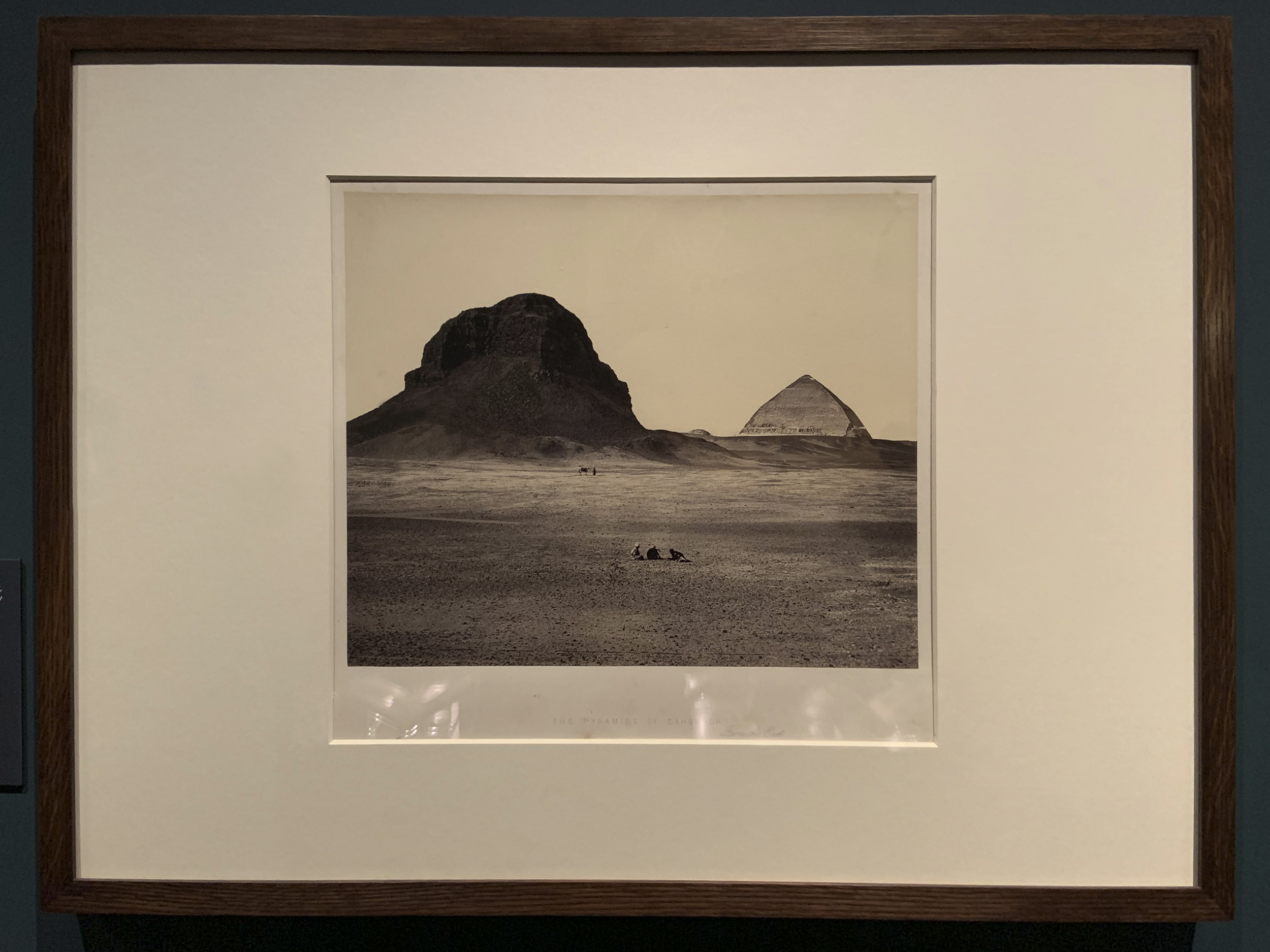
Thursday 10am – 9pm
Closed Mondays

Museum fur Kunst und Gewerbe Hamburg website

LIKE ART BLART ON FACEBOOK

Back to top

Exhibition and auction, photographs and text: ‘The Gay Day Archive 1974-83’ – photographs by Hank O’Neal; text by Alan Ginsberg

Exhibition dates: 15th June – 20th June 2019

Auction: 20th June, 2019 at 1:30pm


Hank O'Neal (American, b. 1940) 'The Gay Day Archive' 1974-1983 from the exhibition 'The Gay Day Archive 1974-83' – photographs by Hank O'Neal; text by Alan Ginsberg, June 2019
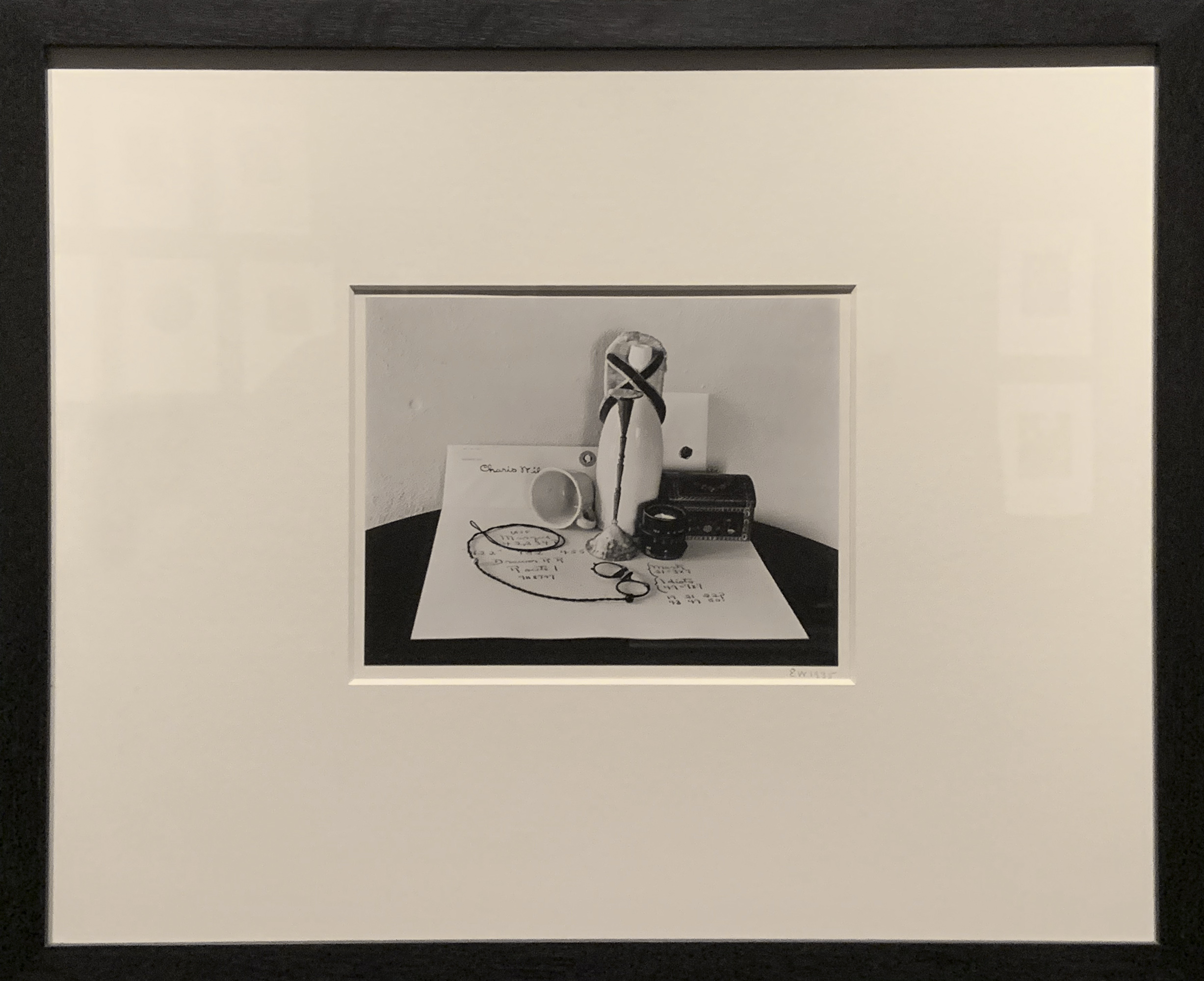
 

Hank O’Neal (American, b. 1940) (photographer)
Alan Ginsberg (American, 1926-1997) (writer)
Untitled (Gay Daddies)
1974-1983
From The Gay Day Archive
Gelatin silver print


“Born gay and free”

I was born in 1958 and came out as a gay man in 1975, six short years after the Stonewall uprising, the nominal (the UK had decriminalised homosexuality in 1967) but official start of Gay Liberation around the world, especially in the United States of America. I survived the plague that hit in the early 1980s. A lot of my friend’s didn’t.

These fabulous photographs and lilting prose make wonderful bedfellows, shining a light on those very early years of outness, campness, empowerment and sexual and personal freedom pre HIV/AIDS. From Gay Daddies to Gay Teachers, from being nowhere (in sight) … to being everywhere. As Ginsberg eloquently proposes, “wearing their hearts on a banner for nothing but love.” Gay youth, dignity and equality, proud of my gay son whoever he may be.

There is such a sense of joy, happiness and love contained in these photographs. The two lads in “Untitled [summery mouths]” are redolent of the era. Cute as a button: platform shoes, tight flared jeans, keys hanging, hands clasped around, small waists, tight singlets, sultry curly hair. Disco love is in the air. I could have been one of these men, memories of those days, those halcyon 70s days.

There are heroes too. Marsha P. Johnson, performance artist, drag mother, transgender, gender nonconforming survival sex worker political activist human… probably murdered by thugs after the 1992 pride parade. And Harvey Milk, that assassinated visionary who became a martyr to the cause, marching in spirit with the crowd. The man carrying a wreath with his name – head down, black armband, gay rights t-shirt – is such a poignant image of the loss of a hero. And then Ginsberg’s text, “Harvey Milk died for your sins.” (He had initially written “our” but crossed it out).

That erasure is so important. I remember working at Channel 7 as a set painter in Melbourne in the late 1980s to pay for university. It was a typical male only workplace at the time, all “blokes”, and I was confronted one day by one of them about being openly gay. My response: I’m quite happy being how I am, it’s you that obviously has the problem. Why don’t you look at yourself first before you start attacking other people.

This is why it is so important that Ginsberg crossed out “our” and wrote “your” sins. LGBTQI people have not sinned. There just are. They have nothing to forgive themselves for. It is the prejudice of others that leads them to fight for dignity and equality. As one of the posters in the photographs says, “People should love one another regardless of race, religion, age or sex.” A men to that.

Dr Marcus Bunyan


PS. The exhibition of these photographs is only on for a few days. Please see them if you can.

The photographs and text are used under “fair use” for the purposes of freedom of speech, research, education and informed comment. Please click on the photographs for a larger version of the image.


A festive visual compilation by the NY-based photographer and author O’Neal of the parade signifying the Gay Liberation Movement. Pictured are an array of fun-loving and politically-motivated participants, several openly displaying affection. With photographs of the transgender activist Marsha P. Johnson. Silver prints, various sizes, with most of the sheets 6 x 7 1/2 inches, 15.2 x 19 cm., or the reverse; each captioned by Ginsberg, and signed and dated by O’Neal on verso. 1974-1983. AND – An additional group of approximately 165 photographs by O’Neal of the NYC parades, comprising 95 silver prints, various sizes but most 11 x 14 inches, 28 x 35.6 cm., and the reverse, 5 are signed and dated by O’Neal and contain Ginsberg’s captions; and 70 smaller silver prints, various sizes to 8 x 10 inches, 20.3 x 25.4 cm., and the reverse, a few with O’Neal’s hand stamp and notations and many are dated, in pencil, on verso; with duplicates and triplicates. 1974-1983.

Estimate $70,000 – 100,000

Text for the Swann Auction Galleries website [Online] Cited 30/05/2019. No longer available online


Hank O'Neal (American, b. 1940) 'The Gay Day Archive' 1974-1983 from the exhibition 'The Gay Day Archive 1974-83' – photographs by Hank O'Neal; text by Alan Ginsberg, June 2019


Hank O’Neal (American, b. 1940) (photographer)
Alan Ginsberg (American, 1926-1997) (writer)
Untitled (WE ARE EVERYWHERE)
1974-1983
From The Gay Day Archive
Gelatin silver print


Hank O'Neal (American, b. 1940) (photographer) Alan Ginsberg (American, 1926-1997) (writer) 'The Gay Day Archive' 1974-1983


Hank O’Neal (American, b. 1940) (photographer)
Alan Ginsberg (American, 1926-1997) (writer)
Untitled [WE ARE EVERYWHERE] (verso)
1974-1983
From The Gay Day Archive
Gelatin silver print


We all look pretty normal,
boy next door, handsome punk,
ad man’s delight, daughters of the
American Revolution.


Hank O'Neal (American, b. 1940) 'The Gay Day Archive' 1974-1983


Hank O’Neal (American, b. 1940) (photographer)
Alan Ginsberg (American, 1926-1997) (writer)
Untitled (Hikin’ Dykes)
1974-1983
From The Gay Day Archive
Gelatin silver print


Hank O'Neal (American, b. 1940) (photographer) Alan Ginsberg (American, 1926-1997) (writer) 'The Gay Day Archive' 1974-1983


Hank O’Neal (American, b. 1940) (photographer)
Alan Ginsberg (American, 1926-1997) (writer)
Untitled (Hikin’ Dykes) (verso)
1974-1983
From The Gay Day Archive
Gelatin silver print


Black white brown boy girl what idealism! –
wearing their
hearts on a banner for nothing but love


Hank O'Neal (American, b. 1940)  'The Gay Day Archive' 1974-1983


Hank O’Neal (American, b. 1940) (photographer)
Alan Ginsberg (American, 1926-1997) (writer)
Untitled (GAY YOUTH 1969-1979)
1974-1983
From The Gay Day Archive
Gelatin silver print


Hank O'Neal (American, b. 1940) (photographer) Alan Ginsberg (American, 1926-1997) (writer) 'The Gay Day Archive' 1974-1983


Hank O’Neal (American, b. 1940) (photographer)
Alan Ginsberg (American, 1926-1997) (writer)
Untitled (GAY YOUTH 1969-1979) (verso)
1974-83
From The Gay Day Archive
Gelatin silver print


The Guy in the right looks like my daddy when
he was young (and alive).


Hank O'Neal (American, b. 1940) 'The Gay Day Archive' 1974-1983


Hank O’Neal (American, b. 1940) (photographer)
Alan Ginsberg (American, 1926-1997) (writer)
Untitled (Dominant/Submissive Love)
1974-83
From The Gay Day Archive
Gelatin silver print


Allen Ginsberg (American, 1926-1997)

Irwin Allen Ginsberg (June 3, 1926 – April 5, 1997) was an American poet, philosopher and writer. He is considered to be one of the leading figures of both the Beat Generation during the 1950s and the counterculture that soon followed. He vigorously opposed militarism, economic materialism, and sexual repression and was known as embodying various aspects of this counterculture, such as his views on drugs, hostility to bureaucracy and openness to Eastern religions. He was one of many influential American writers of his time who were associated with the Beat Generation, including Jack Kerouac and William S. Burroughs.

Ginsberg is best known for his poem “Howl”, in which he denounced what he saw as the destructive forces of capitalism and conformity in the United States. In 1956, “Howl” was seized by San Francisco police and US Customs. In 1957, it attracted widespread publicity when it became the subject of an obscenity trial, as it described heterosexual and homosexual sex at a time when sodomy laws made homosexual acts a crime in every U.S. state. “Howl” reflected Ginsberg’s own sexuality and his relationships with a number of men, including Peter Orlovsky, his lifelong partner. Judge Clayton W. Horn ruled that “Howl” was not obscene, adding, “Would there be any freedom of press or speech if one must reduce his vocabulary to vapid innocuous euphemisms?”

Ginsberg was a practicing Buddhist who studied Eastern religious disciplines extensively. He lived modestly, buying his clothing in second-hand stores and residing in downscale apartments in New York’s East Village. One of his most influential teachers was the Tibetan Buddhist Chögyam Trungpa, the founder of the Naropa Institute in Boulder, Colorado. At Trungpa’s urging, Ginsberg and poet Anne Waldman started The Jack Kerouac School of Disembodied Poetics there in 1974.

Ginsberg took part in decades of non-violent political protest against everything from the Vietnam War to the War on Drugs. His poem “September on Jessore Road”, calling attention to the plight of Bangladeshi refugees, exemplifies what the literary critic Helen Vendler described as Ginsberg’s tireless persistence in protesting against “imperial politics, and persecution of the powerless.”

His collection The Fall of America shared the annual U.S. National Book Award for Poetry in 1974. In 1979, he received the National Arts Club gold medal and was inducted into the American Academy and Institute of Arts and Letters. Ginsberg was a Pulitzer Prize finalist in 1995 for his book Cosmopolitan Greetings: Poems 1986-1992.

Full text “Alan Ginsberg,” on the Wikipedia website


Hank O'Neal (American, b. 1940) 'The Gay Day Archive' 1974-1983


Hank O’Neal (American, b. 1940) (photographer)
Alan Ginsberg (American, 1926-1997) (writer)
Untitled (Miss Rollerind)
1974-1983
From The Gay Day Archive
Gelatin silver print


Hank O'Neal (American, b. 1940) (photographer) Alan Ginsberg (American, 1926-1997) (writer) 'The Gay Day Archive' 1974-1983


Hank O’Neal (American, b. 1940) (photographer)
Alan Ginsberg (American, 1926-1997) (writer)
Untitled (Miss Rollerind) (verso)
1974-1983
From The Gay Day Archive
Gelatin silver print


Miss Rollerind, queen of late 70s
disco world universe drama, observed by
a (gay??) black man on the asphalt.


Hank O'Neal (American, b. 1940) 'The Gay Day Archive' 1974-83


Hank O’Neal (American, b. 1940) (photographer)
Alan Ginsberg (American, 1926-1997) (writer)
Untitled (COME! DIGNITY + EQUALITY)
1974-1983
From The Gay Day Archive
Gelatin silver print


Hank O'Neal (American, b. 1940) (photographer) Alan Ginsberg (American, 1926-1997) (writer) 'The Gay Day Archive' 1974-1983


Hank O’Neal (American, b. 1940) (photographer)
Alan Ginsberg (American, 1926-1997) (writer)
Untitled (COME! DIGNITY + EQUALITY) (verso)
1974-1983
From The Gay Day Archive
Gelatin silver print


Come all over the sky, look up!


Hank O'Neal (American, b. 1940) 'The Gay Day Archive' 1974-1983


Hank O’Neal (American, b. 1940) (photographer)
Alan Ginsberg (American, 1926-1997) (writer)
Untitled (ADOLPH ANITA JOE – The REAL ThREAtS to HUMANITY!)
1974-1983
From The Gay Day Archive
Gelatin silver print


Hank O'Neal (American, b. 1940) (photographer) Alan Ginsberg (American, 1926-1997) (writer) 'The Gay Day Archive' 1974-1983


Hank O’Neal (American, b. 1940) (photographer)
Alan Ginsberg (American, 1926-1997) (writer)
Untitled (ADOLPH ANITA JOE – The REAL ThREAtS to HUMANITY!) (verso)
1974-1983
From The Gay Day Archive
Gelatin silver print


What a pleasant conversation they are having under Hitler’s head,
guy with handsome bicep chest, holding the banner aloft
lightly, and the eye passed smiling inquirer.


Hank O'Neal (American, b. 1940) 'The Gay Day Archive' 1974-1983


Hank O’Neal (American, b. 1940) (photographer)
Alan Ginsberg (American, 1926-1997) (writer)
Untitled (GAY MEN’S HEALTH PROJECT)
1974-1983
From The Gay Day Archive
Gelatin silver print


Hank O'Neal (American, b. 1940) (photographer) Alan Ginsberg (American, 1926-1997) (writer) 'The Gay Day Archive' 1974-1983


Hank O’Neal (American, b. 1940) (photographer)
Alan Ginsberg (American, 1926-1997) (writer)
Untitled (GAY MEN’S HEALTH PROJECT) (verso)
1974-1983
From The Gay Day Archive
Gelatin silver print


See anyone there you’d like to leave VD with?


Hank O'Neal (American, b. 1940) 'The Gay Day Archive' 1974-1983


Hank O’Neal (American, b. 1940) (photographer)
Alan Ginsberg (American, 1926-1997) (writer)
Untitled (Good tight dress)
1974-1983
From The Gay Day Archive
Gelatin silver print


Hank O'Neal (American, b. 1940) (photographer) Alan Ginsberg (American, 1926-1997) (writer) 'The Gay Day Archive' 1974-1983


Hank O’Neal (American, b. 1940) (photographer)
Alan Ginsberg (American, 1926-1997) (writer)
Untitled (Good tight dress) (verso)
1974-1983
From The Gay Day Archive
Gelatin silver print


Good tight dress, totally olive oil lady
from midtown, but the top’s a baseball
capped ruffian whistling at the whore


Hank O'Neal (American, b. 1940) 'The Gay Day Archive' 1974-1983


Hank O’Neal (American, b. 1940) (photographer)
Alan Ginsberg (American, 1926-1997) (writer)
Untitled (I’m PROUD of my Gay Son)
1974-1983
From The Gay Day Archive
Gelatin silver print


Hank O'Neal (American, b. 1940) (photographer) Alan Ginsberg (American, 1926-1997) (writer) 'The Gay Day Archive' 1974-1983


Hank O’Neal (American, b. 1940) (photographer)
Alan Ginsberg (American, 1926-1997) (writer)
Untitled (I’m PROUD of my Gay Son) (verso)
1974-1983
From The Gay Day Archive
Gelatin silver print


Resolute parents that have gone thru the mill
& seen the skeleton in the closet & come out of the
gruesome fun house into the light – now they’re on their own feet
older + dignified; with house dresses + majestic walrus mustaches.


Hank O'Neal (American, b. 1940) 'The Gay Day Archive' 1974-1983


Hank O’Neal (American, b. 1940) (photographer)
Alan Ginsberg (American, 1926-1997) (writer)
Untitled (Look at her! Mad but actually handsome)
1974-1983
From The Gay Day Archive
Gelatin silver print


Hank O'Neal (American, b. 1940) (photographer) Alan Ginsberg (American, 1926-1997) (writer) 'The Gay Day Archive' 1974-1983


Hank O’Neal (American, b. 1940) (photographer)
Alan Ginsberg (American, 1926-1997) (writer)
Untitled (Look at her! Mad but actually handsome) (verso)
1974-1983
From The Gay Day Archive
Gelatin silver print


Look at her! Mad but actually handsome


Hank O'Neal (American, b. 1940) 'The Gay Day Archive' 1974-1983


Hank O’Neal (American, b. 1940) (photographer)
Alan Ginsberg (American, 1926-1997) (writer)
Untitled (Cops with personal mustaches)
1974-1983
From The Gay Day Archive
Gelatin silver print


Hank O'Neal (American, b. 1940) (photographer) Alan Ginsberg (American, 1926-1997) (writer) 'The Gay Day Archive' 1974-1983


Hank O’Neal (American, b. 1940) (photographer)
Alan Ginsberg (American, 1926-1997) (writer)
Untitled (Cops with personal mustaches) (verso)
1974-1983
From The Gay Day Archive
Gelatin silver print


Cops with person mustaches, shun photogs, big tit guy in pancake suffering their own vision in the sun, and a thin socialist dyke


Hank O'Neal (American, b. 1940) 'The Gay Day Archive' 1974-1983


Hank O’Neal (American, b. 1940) (photographer)
Alan Ginsberg (American, 1926-1997) (writer)
Untitled (Gay Rights)
1974-1983
From The Gay Day Archive
Gelatin silver print


Hank O'Neal (American, b. 1940) (photographer) Alan Ginsberg (American, 1926-1997) (writer) 'The Gay Day Archive' 1974-1983


Hank O’Neal (American, b. 1940) (photographer)
Alan Ginsberg (American, 1926-1997) (writer)
Untitled (Gay Rights) (verso)
1974-1983
From The Gay Day Archive
Gelatin silver print


You mean all that hair + teeth is gay?


Hank O’Neal

Hank O’Neal (born June 5, 1940) is an American music producer, author and photographer.

Photography

He began taking photographs while a teenager, and began to pursue the field seriously in 1969, when he bought a professional camera and began documenting recording sessions and jazz concerts that he was producing. Long before Berenice Abbott admonished him to always have a project, he undertook his first, in rural East Texas during 1970-1973. These photographs led to his first exhibition in September 1973, at The Open Mind Gallery in New York City.

In the 1970s he associated with a diverse group of photographers, notably Walker Evans, André Kertész and most importantly, Berenice Abbott, with whom he worked for the last 19 years of her life.

From 1970 to 1999 (in addition to undertaking many photographic projects), O’Neal also published numerous books related to photography. In 1999, at the urging of gallery director Evelyn Daitz, he had a major retrospective of his work to that point at The Witkin Gallery. Since that time, he has focused his activities toward photography, and continues to mount exhibitions yearly throughout the U.S. and Canada. In 2003 his photographic career was summarised in a profile in The New York Times.

Books (text and illustrations)

The Eddie Condon Scrapbook of Jazz (St. Martin’s Press, 1973)
A Vision Shared (St. Martin’s Press, 1976)
Berenice Abbott – American Photographer (McGraw-Hill, 1982)
Life Is Painful, Nasty and Short … In My Case It Has Only Been Painful and Nasty – Djuna Barnes L 1978-81 (Paragon, 1990)
Charlie Parker (Filipacchi, 1995)
The Ghosts of Harlem (Filipacchi, 1997) French language edition
The Ghosts of Harlem (Vanderbilt University Press, 2009) English language edition
Hank O’Neal Portraits 1971-2000 (Sordoni Art Gallery, 2000)
Billie & Lester in Oslo (A Play with Music, 2005)
Gay Day – The Golden Age of the Christopher Street Parade (Abrams, 2006)
Berenice Abbott (Steidl, 2008)
The Unknown Berenice Abbott – Steidl (October 15, 2013)
A Vision Shared – 40th Anniversary Edition – Steidl (December 1, 2016)
Berenice Abbott – The Paris Portraits – Steidl (November 22, 2016)

Books (photographs only)

Allegra Kent’s Water Beauty Book (St Martin’s Press, 1976)
All the King’s Men (Limited Editions Club, 1990)
XCIA’s Street Art Project: The First Four Decades (Siman Media Works, 2012)

Portfolios

Berenice Abbott – Portraits In Palladium (Text Only, Commerce Graphics / Lunn Limited, 1990)
Hank O’Neal – Photographs (Text and 12 gravure prints), Limited Editions Club, 1990)
The Ghosts of Harlem (Text and 12 photographs), Glenside Press, 2007)

Text from “Hank O’Neal,” on the Wikipedia website


Hank O'Neal (American, b. 1940) 'The Gay Day Archive' 1974-1983


Hank O’Neal (American, b. 1940) (photographer)
Alan Ginsberg (American, 1926-1997) (writer)
Untitled [MY SON IS GAY AND THAT’S OK]
1974-1983
From The Gay Day Archive
Gelatin silver print


Hank O'Neal (American, b. 1940) (photographer) Alan Ginsberg (American, 1926-1997) (writer) 'The Gay Day Archive' 1974-1983


Hank O’Neal (American, b. 1940) (photographer)
Alan Ginsberg (American, 1926-1997) (writer)
Untitled (MY SON IS GAY AND THAT’S OK) (verso)
1974-1983
From The Gay Day Archive
Gelatin silver print


She’s an old anarchist from the
30’s. She read Marcel Proust in the
slums of Barcelona. She used to be a movie
Star in Berlin in 1923. Now she lives
in Queens in disguise as a typical american
mother.


Hank O'Neal (American, b. 1940) 'The Gay Day Archive' 1974-1983


Hank O’Neal (American, b. 1940) (photographer)
Alan Ginsberg (American, 1926-1997) (writer)
Untitled (GOD is GAY)
1974-1983
From The Gay Day Archive
Gelatin silver print


Hank O'Neal (American, b. 1940) (photographer) Alan Ginsberg (American, 1926-1997) (writer) 'The Gay Day Archive' 1974-1983


Hank O’Neal (American, b. 1940) (photographer)
Alan Ginsberg (American, 1926-1997) (writer)
Untitled (GOD is GAY) (verso)
1974-1983
From The Gay Day Archive
Gelatin silver print


According to Barbelo Gnostic theory,
God reflected on himself (or herself) & thus shone Sophia,
the First Word-thought, who thereat made sex
with herself and birthed the first Aeon,
Laldabaoth


Barbēlō refers to the first emanation of God in several forms of Gnostic cosmogony. Barbēlō is often depicted as a supreme female principle, the single passive antecedent of creation in its manifoldness. This figure is also variously referred to as ‘Mother-Father’ (hinting at her apparent androgyny), ‘First Human Being’, ‘The Triple Androgynous Name’, or ‘Eternal Aeon’. So prominent was her place amongst some Gnostics that some schools were designated as Barbeliotae, Barbēlō worshippers or Barbēlōgnostics.

Gnosticism (from Ancient Greek: γνωστικός gnostikos, “having knowledge”, from γνῶσις gnōsis, knowledge) is a modern name for a variety of ancient religious ideas and systems, originating in Jewish Christian milieux in the first and second century AD. These systems believed that the material world is created by an emanation or ‘works’ of a lower god (demiurge), trapping the divine spark within the human body. This divine spark could be liberated by gnosis, spiritual knowledge acquired through direct experience. Some of the core teachings include the following:

1/ All matter is evil, and the non-material, spirit-realm is good.
2/ There is an unknowable God, who gave rise to many lesser spirit beings called Aeons.
3/ The creator of the (material) universe is not the supreme god, but an inferior spirit (the Demiurge).
4/ Gnosticism does not deal with “sin,” only ignorance.
5/ To achieve salvation, one needs gnosis (knowledge).

Laldabaoth is the demiurge (a heavenly being, subordinate to the Supreme Being, that is considered to be the controller of the material world and antagonistic to all that is purely spiritual) from Gnostic Christianity.


Hank O'Neal (American, b. 1940) 'The Gay Day Archive' 1974-1983


Hank O’Neal (American, b. 1940) (photographer)
Alan Ginsberg (American, 1926-1997) (writer)
Untitled (a big crowd)
1974-1983
From The Gay Day Archive
Gelatin silver print


Hank O'Neal (American, b. 1940) (photographer) Alan Ginsberg (American, 1926-1997) (writer) 'The Gay Day Archive' 1974-1983


Hank O’Neal (American, b. 1940) (photographer)
Alan Ginsberg (American, 1926-1997) (writer)
Untitled (a big crowd) (verso)
1974-1983
From The Gay Day Archive
Gelatin silver print


a big crowd of boys + girls + …? – but
that tall girl looks worried, doesn’t she have a baloon?


Hank O'Neal (American, b. 1940) 'The Gay Day Archive' 1974-1983


Hank O’Neal (American, b. 1940) (photographer)
Alan Ginsberg (American, 1926-1997) (writer)
Untitled (STONEWALL CHORALE)
1974-1983
From The Gay Day Archive
Gelatin silver print


Hank O'Neal (American, b. 1940) (photographer) Alan Ginsberg (American, 1926-1997) (writer) 'The Gay Day Archive' 1974-1983


Hank O’Neal (American, b. 1940) (photographer)
Alan Ginsberg (American, 1926-1997) (writer)
Untitled (STONEWALL CHORALE) (verso)
1974-1983
From The Gay Day Archive
Gelatin silver print


Masculine & Feminine Sopranos!
marching on the Stone
floor on Manhattan, Explaining Life


Hank O'Neal (American, b. 1940) 'The Gay Day Archive' 1974-1983


Hank O’Neal (American, b. 1940) (photographer)
Alan Ginsberg (American, 1926-1997) (writer)
Untitled (WHERE IS your HUSBAND TONIGHT?)
1974-1983
From The Gay Day Archive
Gelatin silver print


Hank O'Neal (American, b. 1940) (photographer) Alan Ginsberg (American, 1926-1997) (writer) 'The Gay Day Archive' 1974-1983


Hank O’Neal (American, b. 1940) (photographer)
Alan Ginsberg (American, 1926-1997) (writer)
Untitled (WHERE IS your HUSBAND TONIGHT?) (verso)
1974-1983
From The Gay Day Archive
Gelatin silver print


What pretty wives!
are they photocopies of men?
do they smoke cigars in secret?


Hank O'Neal (American, b. 1940) 'The Gay Day Archive' 1974-1983


Hank O’Neal (American, b. 1940) (photographer)
Alan Ginsberg (American, 1926-1997) (writer)
Untitled (singing to skyscrapers)
1974-1983
From The Gay Day Archive
Gelatin silver print


Hank O'Neal (American, b. 1940) (photographer) Alan Ginsberg (American, 1926-1997) (writer) 'The Gay Day Archive' 1974-1983


Hank O’Neal (American, b. 1940) (photographer)
Alan Ginsberg (American, 1926-1997) (writer)
Untitled (singing to skyscrapers) (verso)
1974-1983
From The Gay Day Archive
Gelatin silver print


They’ve been meeting in secret + public
for years, & now sing to skyscrapers.


Today, at least a million spectators line the Pride parade route along Fifth Avenue. But, in its earliest days, the celebration was a much smaller event characterised by NY-style high energy, pithy signage, raucous crowd chants, extensive cruising and great music (remember disco?). Most of O’Neal’s photographs focused on NY’s West Village or Christopher Street, the epicenter of gaydom. A range of sub-cultures associated with the LGBTQ+ community are depicted: young and longhaired post-hippies, bare-chested muscle men, drag queens, fairies, leather-ites, Gay Daddies, protestors, pastors, parents of gays and the hikin’ dykes.

Some participants hold placards, including those protesting Anita Bryant, the once popular singer, who emerged as an strident anti-gay crusader in the late 1970s and teamed up with the divisive evangelical figure Jerry Falwell. A banner for the Gay Men’s Health Project is a harbinger of the tragic era to come.

Ginsberg first saw the photographs in 1982 and, according to O’Neal, was inspired to add his distinctive captions to the backs of the prints. His brief handwritten notes, which often reflect personal or historic observations, strike a wonderful tone. A caption that accompanies a picture of a group of men holding the banner WE ARE EVERYWHERE reads, “We all look pretty normal, boy next door, handsome punk, ad man’s delight, daughters of the American Revolution.” A shot depicting two men dressed in ancient Roman costume reads, “Clark Gable and Nero on a date, smiling for the 1920s Hollywood photogs.” His lengthy caption for the Johnson print (featured on the catalog cover) reads: “If I keep dressing up like this I’ll save the world from nuclear apocalypse. But will anyone love me for it? I’ll save the world anyway I know that looks good.” And still others honour the courageous and brave: one participant holds a wreath bearing the name Harvey Milk; Ginsberg wrote, “Harvey Milk died for your sins.” (He had initially written “our” but crossed it out).

O’Neal’s photographs were reproduced in the book, Gay Day: The Golden Age of the Christopher Street Parade, 1974-1983 (Abrams, 2006), with a Preface by William Burroughs. Interestingly during this same period Ginsberg had revisited his own Beat-era photographs, which were shot in the 1950s and processed at a local drugstore. He developed a unique hybrid picture-text style, adding detailed, handwritten mini-narratives to the lower margins of the prints, which captured his vivid, visual memories.

Text for the Swann Auction Galleries website [Online] Cited 30/05/2019. No longer available online


Hank O'Neal (American, b. 1940) 'The Gay Day Archive' 1974-1983


Hank O’Neal (American, b. 1940) (photographer)
Alan Ginsberg (American, 1926-1997) (writer)
Untitled (HARVEY MILK)
1974-1983
From The Gay Day Archive
Gelatin silver print


Hank O'Neal (American, b. 1940) (photographer) Alan Ginsberg (American, 1926-1997) (writer) 'The Gay Day Archive' 1974-1983


Hank O’Neal (American, b. 1940) (photographer)
Alan Ginsberg (American, 1926-1997) (writer)
Untitled (HARVEY MILK) (verso)
1974-1983
From The Gay Day Archive
Gelatin silver print


Harvey Milk died for your sins


Harvey Milk (1930-1978)

Harvey Bernard Milk (May 22, 1930 – November 27, 1978) was an American politician and the first openly gay elected official in the history of California, where he was elected to the San Francisco Board of Supervisors. Although he was the most pro-LGBT politician in the United States at the time, politics and activism were not his early interests; he was neither open about his sexuality nor civically active until he was 40, after his experiences in the counterculture movement of the 1960s.

In 1972, Milk moved from New York City to the Castro District of San Francisco amid a migration of gay and bisexual men. He took advantage of the growing political and economic power of the neighbourhood to promote his interests and unsuccessfully ran three times for political office. Milk’s theatrical campaigns earned him increasing popularity, and in 1977 he won a seat as a city supervisor. His election was made possible by a key component of a shift in San Francisco politics.

Milk served almost eleven months in office, during which he sponsored a bill banning discrimination in public accommodations, housing, and employment on the basis of sexual orientation. The Supervisors passed the bill by a vote of 11-1 and was signed into law by Mayor Moscone. On November 27, 1978, Milk and Mayor George Moscone were assassinated by Dan White, who was another city supervisor. White had recently resigned to pursue a private business enterprise, but that endeavour eventually failed and he sought to get his old job back. White was sentenced to seven years in prison for manslaughter, which was later reduced to five years. He was released in 1983 and committed suicide by carbon monoxide inhalation two years later.

Despite his short career in politics, Milk became an icon in San Francisco and a martyr in the gay community. In 2002, Milk was called “the most famous and most significantly open LGBT official ever elected in the United States”. Anne Kronenberg, his final campaign manager, wrote of him: “What set Harvey apart from you or me was that he was a visionary. He imagined a righteous world inside his head and then he set about to create it for real, for all of us.” Milk was posthumously awarded the Presidential Medal of Freedom in 2009.

Extract from “Harvey Milk,” on the Wikipedia website


Hank O'Neal (American, b. 1940) 'The Gay Day Archive' 1974-1983


Hank O’Neal (American, b. 1940) (photographer)
Alan Ginsberg (American, 1926-1997) (writer)
Untitled (Blacks are most truthful)
1974-1983
From The Gay Day Archive
Gelatin silver print


Hank O'Neal (American, b. 1940) (photographer) Alan Ginsberg (American, 1926-1997) (writer) 'The Gay Day Archive' 1974-1983


Hank O’Neal (American, b. 1940) (photographer)
Alan Ginsberg (American, 1926-1997) (writer)
Untitled (Blacks are most truthful) (verso)
1974-1983
From The Gay Day Archive
Gelatin silver print


Blacks are most truthful,
it all goes back to deep
african religious ?


Hank O'Neal (American, b. 1940) 'The Gay Day Archive' 1974-1983


Hank O’Neal (American, b. 1940) (photographer)
Alan Ginsberg (American, 1926-1997) (writer)
Untitled (Judy Garland)
1974-1983
From The Gay Day Archive
Gelatin silver print


Hank O'Neal (American, b. 1940) (photographer) Alan Ginsberg (American, 1926-1997) (writer) 'The Gay Day Archive' 1974-1983


Hank O’Neal (American, b. 1940) (photographer)
Alan Ginsberg (American, 1926-1997) (writer)
Untitled (Judy Garland) (verso)
1974-1983
From The Gay Day Archive
Gelatin silver print


Judy Garland’s got big-veined
fists & activist boyfriends
singing


Hank O'Neal (American, b. 1940) 'The Gay Day Archive' 1974-1983


Hank O’Neal (American, b. 1940) (photographer)
Alan Ginsberg (American, 1926-1997) (writer)
Untitled (PEOPLE SHOULD LOVE ONE ANOTHER)
1974-1983
From The Gay Day Archive
Gelatin silver print


Hank O'Neal (American, b. 1940) (photographer) Alan Ginsberg (American, 1926-1997) (writer) 'The Gay Day Archive' 1974-1983


Hank O’Neal (American, b. 1940) (photographer)
Alan Ginsberg (American, 1926-1997) (writer)
Untitled (PEOPLE SHOULD LOVE ONE ANOTHER) (verso)
1974-1983
From The Gay Day Archive
Gelatin silver print


Well I’ll take 2 of these + 3 of those.
How old did you say you were?
Does that mean I have to sleep with 90 year old girls?


Hank O'Neal (American, b. 1940) 'The Gay Day Archive' 1974-1983


Hank O’Neal (American, b. 1940) (photographer)
Alan Ginsberg (American, 1926-1997) (writer)
Untitled (summery mouths)
1974-1983
From The Gay Day Archive
Gelatin silver print


Hank O'Neal (American, b. 1940) (photographer) Alan Ginsberg (American, 1926-1997) (writer) 'The Gay Day Archive' 1974-1983


Hank O’Neal (American, b. 1940) (photographer)
Alan Ginsberg (American, 1926-1997) (writer)
Untitled (summery mouths) (verso)
1974-1983
From The Gay Day Archive
Gelatin silver print


Young meat Catholes (?)
appreciating each other’s
summery mouths


Hank O'Neal (American, b. 1940) 'The Gay Day Archive' 1974-1983


Hank O’Neal (American, b. 1940) (photographer)
Alan Ginsberg (American, 1926-1997) (writer)
Untitled (ANITA SLEEPS WITH BIG BUSINESS)
1974-1983
From The Gay Day Archive
Gelatin silver print


Hank O'Neal (American, b. 1940) (photographer) Alan Ginsberg (American, 1926-1997) (writer) 'The Gay Day Archive' 1974-1983


Hank O’Neal (American, b. 1940) (photographer)
Alan Ginsberg (American, 1926-1997) (writer)
Untitled (ANITA SLEEPS WITH BIG BUSINESS) (verso)
1974-1983
From The Gay Day Archive
Gelatin silver print


Anita O’Day is still singing.


Hank O'Neal (American, b. 1940) 'The Gay Day Archive' 1974-1983


Hank O’Neal (American, b. 1940) (photographer)
Alan Ginsberg (American, 1926-1997) (writer)
Untitled (ANITA DEAR SHOVE IT)
1974-1983
From The Gay Day Archive
Gelatin silver print


Hank O'Neal (American, b. 1940) (photographer) Alan Ginsberg (American, 1926-1997) (writer) 'The Gay Day Archive' 1974-1983


Hank O’Neal (American, b. 1940) (photographer)
Alan Ginsberg (American, 1926-1997) (writer)
Untitled (ANITA DEAR SHOVE IT) (verso)
1974-1983
From The Gay Day Archive
Gelatin silver print


I’ll bet Anita had affairs in
high school with her girlfriends.
Pretty Girl.


Anita Bryant (American, b. 1940)

Anita Jane Bryant (born March 25, 1940) is an American singer and political activist. …

In the 1970s, Bryant became known as an outspoken opponent of gay rights in the US. In 1977, she ran the “Save Our Children” campaign to repeal a local ordinance in Dade County, Florida which prohibited discrimination on the basis of sexual orientation. Her involvement with the campaign was condemned by gay rights activists. They were assisted by many other prominent figures in music, film, and television, and retaliated by boycotting the orange juice which she had promoted. This, as well as her later divorce, damaged her financially…

Victory and defeat

On June 7, 1977, Bryant’s campaign led to a repeal of the anti-discrimination ordinance by a margin of 69 to 31 percent. However, the success of Bryant’s campaign galvanised her opponents, and the gay community retaliated against her by organising a boycott of orange juice. Gay bars all over North America stopped serving screwdrivers and replaced them with the “Anita Bryant Cocktail”, which was made with vodka and apple juice. Sales and proceeds went to gay rights activists to help fund their fight against Bryant and her campaign.

In 1977, Florida legislators approved a measure prohibiting gay adoption.The ban was overturned more than 30 years later when, on November 25, 2008, Miami-Dade Circuit Court Judge Cindy S. Lederman declared it unconstitutional.

Bryant led several more campaigns around the country to repeal local anti-discrimination ordinances, including campaigns in St. Paul, Minnesota; Wichita, Kansas; and Eugene, Oregon. In 1978, her success led to the Briggs Initiative in California, which would have made pro-gay statements regarding homosexual people or homosexuality by any public school employee cause for dismissal. Grassroots liberal organisations, chiefly in Los Angeles and the San Francisco Bay Area, organised to defeat the initiative. Days before the election, the California Democratic Party opposed the proposed legislation. President Jimmy Carter, governor Jerry Brown, former president Gerald Ford, and former governor Ronald Reagan – then planning a run for the presidency – all voiced opposition to the initiative, and it ultimately suffered a massive defeat at the polls.

In 1998, Dade County repudiated Bryant’s successful campaign of 20 years earlier and reauthorised an anti-discrimination ordinance protecting individuals from discrimination on the basis of sexual orientation by a seven-to-six vote. In 2002, a ballot initiative to repeal the 1998 law, called Amendment 14, was voted down by 56 percent of the voters. The Florida statute forbidding gay adoption was upheld in 2004 by a federal appellate court against a constitutional challenge but was overturned by a Miami-Dade circuit court in November 2008.

Bryant became one of the first persons to be publicly “pied” as a political act (in her case, on television), in Des Moines, Iowa, on October 14, 1977. Bryant quipped “At least it’s a fruit pie,” making a pun on the derogatory term of “fruit” for a gay man. While covered in pie, she began to pray to God to forgive the activist “for his deviant lifestyle” before bursting into tears as the cameras continued rolling. Bryant’s husband said that he would not retaliate, but followed the protesters outside and threw a pie at them. By this time, gay activists ensured that the boycott on Florida orange juice had become more prominent and it was supported by many celebrities, including Barbra Streisand, Bette Midler, Paul Williams, Dick Clark (Bryant had made several appearances on his shows, especially his namesake television show), Vincent Price (he joked in a television interview that Oscar Wilde’s A Woman of No Importance referred to her), John Waters, Carroll O’Connor, Linda Lavin, Mary Tyler Moore, Charles Schulz, Billie Jean King, and Jane Fonda. In 1978, Bryant and Bob Green told the story of their campaign in the book At Any Cost. The gay community continued to regard Bryant’s name as synonymous with bigotry and homophobia.

Extract from “Anita Bryant,” on the Wikipedia website


Hank O'Neal (American, b. 1940) 'The Gay Day Archive' 1974-1983


Hank O’Neal (American, b. 1940) (photographer)
Alan Ginsberg (American, 1926-1997) (writer)
Untitled (I deserve a cute boy’s kiss) (Marsha P. Johnson)
1974-1983
From The Gay Day Archive
Gelatin silver print


Hank O'Neal (American, b. 1940) (photographer) Alan Ginsberg (American, 1926-1997) (writer) 'The Gay Day Archive' 1974-1983


Hank O’Neal (American, b. 1940) (photographer)
Alan Ginsberg (American, 1926-1997) (writer)
Untitled (I deserve a Cute boy’s kiss) (verso)
1974-1983
From The Gay Day Archive
Gelatin silver print


I deserve a Cute
boy’s kiss for this truthful hat. And he’s
so sensitive, look at that
tiny white dog!


Hank O'Neal (American, b. 1940) 'The Gay Day Archive' 1974-1983


Hank O’Neal (American, b. 1940) (photographer)
Alan Ginsberg (American, 1926-1997) (writer)
Untitled (BORN GAY AND FREE)
1974-1983
From The Gay Day Archive
Gelatin silver print


Hank O'Neal (American, b. 1940) (photographer) Alan Ginsberg (American, 1926-1997) (writer) 'The Gay Day Archive' 1974-1983


Hank O’Neal (American, b. 1940) (photographer)
Alan Ginsberg (American, 1926-1997) (writer)
Untitled (BORN GAY AND FREE) (verso)
1974-1983
From The Gay Day Archive
Gelatin silver print


What a pretty mother! Brave
handsome courageous + true.


Hank O'Neal (American, b. 1940) 'The Gay Day Archive' 1974-1983


Hank O’Neal (American, b. 1940) (photographer)
Alan Ginsberg (American, 1926-1997) (writer)
Untitled (Marsha P. Johnson)
1974-1983
From The Gay Day Archive
Gelatin silver print


Hank O'Neal (American, b. 1940) (photographer) Alan Ginsberg (American, 1926-1997) (writer) 'The Gay Day Archive' 1974-1983


Hank O’Neal (American, b. 1940) (photographer)
Alan Ginsberg (American, 1926-1997) (writer)
Untitled (Marsha P. Johnson) (verso)
1974-1983
From The Gay Day Archive
Gelatin silver print


If I keep dressing up like this
I’ll save the world from
Nuclear Apocalypse. But will anyone
love me for it? I’ll save the world
anyway. I know what looks good.


Marsha P. Johnson (American, 1945-1992)

Marsha P. Johnson (August 24, 1945 – July 6, 1992) was an American gay liberation activist and self-identified drag queen. Known as an outspoken advocate for gay rights, Johnson was one of the prominent figures in the Stonewall uprising of 1969. A founding member of the Gay Liberation Front, Johnson co-founded the gay and transvestite advocacy organisation S.T.A.R. (Street Transvestite Action Revolutionaries), alongside close friend Sylvia Rivera. A popular figure in New York City’s gay and art scene, Johnson modelled for Andy Warhol, and performed onstage with the drag performance troupe, Hot Peaches. Known for decades as a welcoming presence in the streets of Greenwich Village, Johnson was known as the “mayor of Christopher Street”. From 1987 through 1992, Johnson was an AIDS activist with ACT UP.

Performance work and identity

Johnson initially called herself “Black Marsha” but later decided on “Marsha P. Johnson” as her drag queen name, getting Johnson from the restaurant Howard Johnson’s on 42nd Street. She said that the P stood for “pay it no mind” and used the phrase sarcastically when questioned about her gender, saying “it stands for pay it no mind”. She said the phrase once to a judge, who was humoured by it and released her. Johnson variably identified herself as gay, as a transvestite, and as a queen (referring to drag queen). According to Susan Stryker, a professor of human gender and sexuality studies at the University of Arizona, Johnson’s gender expression may be called gender non-conforming in absence of Johnson’s use of transgender, which was not used broadly during her lifetime.

Johnson said her style of drag was not serious (or “high drag”) because she could not afford to purchase clothing from expensive stores. She received leftover flowers after sleeping under tables used for sorting flowers in the Flower District of Manhattan, and was known for placing flowers in her hair. Johnson was tall, slender and often dressed in flowing robes and shiny dresses, red plastic high heels, and bright wigs, which tended to draw attention.

Johnson sang and performed as a member of J. Camicias’ international, NYC-based, drag performance troupe, Hot Peaches, from 1972 through to shows in the 1990s. When The Cockettes, a similar drag troupe from San Francisco, formed an East Coast troupe, The Angels of Light, Johnson was also asked to perform with them. In 1973, Johnson performed the role of “The Gypsy Queen” in the Angels’ production, “The Enchanted Miracle”, about the Comet Kohoutek. In 1975, Johnson was photographed by famed artist Andy Warhol, as part of a “Ladies and Gentlemen” series of Polaroids. In 1990, Johnson performed with The Hot Peaches in London. Now an AIDS activist, Johnson also appears in The Hot Peaches production The Heat in 1990, singing the song “Love” while wearing an ACT UP, “Silence = Death” button.

Stonewall uprising and other activism

Johnson said she was one of the first drag queens to go to the Stonewall Inn, after they began allowing women and drag queens inside; it was previously a bar for only gay men. On the early morning hours of June 28, 1969, the Stonewall uprising occurred. While the first two nights of rioting were the most intense, the clashes with police would result in a series of spontaneous demonstrations and marches through the gay neighbourhoods of Greenwich Village for roughly a week afterwards.

Johnson has been named, along with Zazu Nova and Jackie Hormona, by a number of the Stonewall veterans interviewed by David Carter in his book, Stonewall: The Riots That Sparked the Gay Revolution, as being “three individuals known to have been in the vanguard” of the pushback against the police at the uprising. Johnson denied she had started the uprising, stating in 1987 that she had arrived at around “2:00 [that morning]”, and that “the riots had already started” when she arrived and that the Stonewall building “was on fire” after cops set it on fire. The riots reportedly started at around 1:20 that morning after Stormé DeLarverie fought back against the police officer who attempted to arrest her that night.

Carter writes that Robin Souza had reported that fellow Stonewall veterans and gay activists such as Morty Manford and Marty Robinson had told Souza that on the first night, Johnson “threw a shot glass at a mirror in the torched bar screaming, ‘I got my civil rights'”. Souza told the Gay Activists Alliance shortly afterwards that it “was the shot glass that was heard around the world”. Carter, however, concluded that Robinson had given several different accounts of the night and in none of the accounts were Johnson’s name brought up, possibly in fear that if he publicly credited the uprising to Johnson due to her well-known mental state and gender nonconforming, then Stonewall, and indirectly the gay liberation movement, “could have been used effectively by the movement’s opponents”. The alleged “shot glass” incident has also been heavily disputed. Prior to Carter’s book, it was claimed Johnson had “thrown a brick” at a police officer, an account that was never verified. Johnson also claimed herself that she was not at the Stonewall Inn when the rioting broke out but instead had heard about it and went to get Sylvia Rivera who was at a park uptown sleeping on a bench to tell her about it. However, many have corroborated that on the second night, Johnson climbed up a lamppost and dropped a bag with a brick in it down on a cop car, shattering the windshield.

Following the Stonewall uprising, Johnson joined the Gay Liberation Front and participated in the first Christopher Street Liberation Pride rally on the first anniversary of the Stonewall rebellion in June 1970. One of Johnson’s most notable direct actions occurred in August 1970 when she and fellow GLF members staged a sit-in protest at Weinstein Hall at New York University after administrators canceled a dance when they found out was sponsored by gay organisations. Shortly after that, she and close friend Sylvia Rivera co-founded the Street Transvestite Action Revolutionaries (STAR) organisation (initially titled Street Transvestites Actual Revolutionaries). The two of them became a visible presence at gay liberation marches and other radical political actions. In 1973, Johnson and Rivera were banned from participating in the gay pride parade by the gay and lesbian committee who were administering the event stating they “weren’t gonna allow drag queens” at their marches claiming they were “giving them a bad name”. Their response was to march defiantly ahead of the parade. During a gay rights rally at New York City Hall in the early ’70s, photographed by Diana Davies, a reporter asked Johnson why the group was demonstrating, Johnson shouted into the microphone, “Darling, I want my gay rights now!”

During another incident around this time, which landed Johnson in court, she was confronted by police officers for hustling in New York, and when they went to apprehend her, she hit them with her handbag, which contained two bricks. When Johnson was asked by the judge why she was hustling, Johnson explained she was trying to secure enough money for her husband’s tombstone. During a time when same-sex marriage was illegal in the United States, the judge asked her what “happened to this alleged husband”, Johnson responded, “Pigs killed him”. Initially sentenced to 90 days in prison for the assault, Johnson’s lawyer eventually convinced the judge to send her to Bellevue instead.

With Rivera, Johnson established the STAR House, a shelter for gay and trans street kids in 1972, and paid the rent for it with money they made themselves as sex workers. While the House was not focused on performance, Marsha was a “drag mother” of STAR House, in the longstanding tradition of chosen family in the Black and Latino LGBT community. Johnson worked to provide food, clothing, emotional support and a sense of family for the young drag queens, trans women, gender nonconformists and other gay street kids living on the Christopher Street docks or in their house on the Lower East Side of New York.

In the 1980s Johnson continued her street activism as a respected organiser and marshal with ACT UP. In 1992, when George Segal’s Stonewall memorial was moved to Christopher Street from Ohio to recognise the gay liberation movement, Johnson commented, “How many people have died for these two little statues to be put in the park to recognise gay people? How many years does it take for people to see that we’re all brothers and sisters and human beings in the human race? I mean how many years does it take for people to see that we’re all in this rat race together.

Extract from “Marsha P. Johnson,” on the Wikipedia website


Swann Galleries
104 East 25th Street
New York, NY 10010
Phone: (212) 254-4710

Exhibition opening times:
Saturday, June 15 – 12 to 5pm
Monday, June 17 – 10am to 6pm
Tuesday, June 18 – 10am to 6pm
Wednesday, June 19 – 10am to 6pm
Thursday, June 20 – 10am to 12pm

Swann Auction Galleries website

LIKE ART BLACK ON FACEBOOK

Back to top

Exhibition: ‘Dave Heath: Dialogues with Solitudes’ at The Photographers’ Gallery, London

Exhibition dates: 8th March – 2nd June, 2019

Curator: Diane Dufour, Director of LE BAL


Dave Heath (Canadian born United States, 1931-2016) 'California' 1964 from the exhibition 'Dave Heath: Dialogues with Solitudes' at The Photographers' Gallery, London, March - June, 2019


Dave Heath (Canadian born United States, 1931-2016)
California
1964
Gelatin silver print
© Dave Heath / Courtesy of Howard Greenberg Gallery, New York, and Stephen Bulger Gallery, Toronto


The master of what we see / visions of the self

In which the visions (ghosts?) in these haunting photographs live, breathe, and barely exist in a strange closed world. Where the subjects seem so vulnerable.

In which there is little sentimentality. The portraits emit a deep sense of melancholy in their re/pose, in the subjects temporal existence separated out from time. Heath photographs people as they are. He projects himself, not his ego, into this vision of vulnerable humanity.

In which this vision of truth illuminates the complex relationship between human nature and reality through emotional energy.

Dr Marcus Bunyan


Many thankx to The Photographers’ Gallery for allowing me to publish the photographs in the posting. Please click on the photographs for a larger version of the image.


“… the conundrum of the title is a reference about how to navigate the terrain of solitude one wishes to experience (to be alone), but also how to make that extend into a conversation with the subjects in front of you that will eventually become a single body of work for many to view (to be of more than one). This is of course conditional to your position within the world at large and how you view your presence within the greater universal ether. You must carry your solipsism like a rusty bucket of dirty brown well water. In Heath’s case, the solitary monologue and the ramble of the flaneur become something of a mantra – an incessant need to repeat, to be part of the cacophony of the worship of modern life in which the self and the crowd / city are forced to adjust to one another, but at safe distance with impassioned and yearning eyes.”


Extract from Brad Feuerhelm. “David Heath: “Dialogues With Solitudes”,” on the ASX website November 23, 2018 [Online] Cited 26/05/2019


“”A Dialogue with Solitude” is a self-portrait in which the artist himself never really appears, but is revealed and interpreted by every detail. Its revolt is alive with sympathy and acceptance of man’s modern placement in the world, mated with contradictory realization and resistance which deny and combat the absurdities of existence. This is expressed with a sincere poetry which is never shocked out of countenance by reality.”


Edwards, exh. label for A Dialogue of Solitude, 1963, on file in the Photography Department, Art Institute of Chicago quoted in Hugh Edwards. “Dave Heath,” on the Art Institute of Chicago website [Online] Cited 26/05/2019


The first major UK exhibition dedicated to the work of this hugely influential American photographer.

Heath’s psychologically charged images both reflect and respond to the alienation particularly prevalent in post war North American society. He was one of the first of a new generation of artists seeking new ways to try and make sense of the increasing sense of isolation and vulnerability that typified the age.

Predominantly self-taught, Heath was nonetheless extremely informed and versed in the craft, theory and history of photography and taught extensively throughout his life. Although greatly influenced by W. Eugene Smith and the photographers of the Chicago School, including Aaron Siskind and Harry Callahan, Heath cannot be neatly pigeonholed as either a documentary or experimental photographer. His work feels more at home within a narrative or poetic tradition, where an interior reality takes precedence.

Taking his masterwork and first publication, A Dialogue With Solitude, as a point of departure, this exhibition highlights Heath’s preoccupations with solitude and contemplation and further makes explicit the importance of sequencing in his practice. Heath was clear that “the central issue of my work is sequence” and held the belief that the relativity and rhythm of images offered a truer way of conveying a universal psychological state than a single image. He perfected a form of montage, often blending text and image to create visual poems, which captured the mood of the decade in a manner akin to a photographic protest song.

Heath’s photographs are shown in dialogue with cult American films from the 1960s similarly focused on themes of solitude and alienation. These include: Portrait of Jason by Shirley Clarke (1966); Salesman by Albert and David Maysles and Charlotte Mitchell Zwerin (1968); and The Savage Eye by Ben Maddow, Sidney Meyers and Joseph Strick (1960).

“The fact that I never had a family, a place or a story that defined me, inspired a need in me to join the community of mankind. I did so by inventing a poetic form linking this community, at least symbolically, in my imagination, through this form.” ~ Dave Heath


Curated by Diane Dufour, Director of LE BAL. Exhibition conceived by LE BAL with the support of Stephen Bulger Gallery (Toronto), Howard Greenberg Gallery (New York), Archive of Modern Conflict (London) and Les Films du Camélia (Paris).

Text from the Photographers’ Gallery website [Online] Cited 25/05/2019


Dave Heath (Canadian born United States, 1931-2016) 'Sesco Corée' 1953-1954 from the exhibition 'Dave Heath: Dialogues with Solitudes' at The Photographers' Gallery, London, March - June, 2019


Dave Heath (Canadian born United States, 1931-2016)
Sesco, Corée
1953-1954
Gelatin silver print
© Dave Heath / Courtesy of Howard Greenberg Gallery, New York, and Stephen Bulger Gallery, Toronto


Dave Heath (Canadian born United States, 1931-2016) 'Carl Dean Kipper, Korea' 1953-1954


Dave Heath (Canadian born United States, 1931-2016)
Carl Dean Kipper, Korea
1953-1954
Gelatin silver print
© Dave Heath / Courtesy of Howard Greenberg Gallery, New York, and Stephen Bulger Gallery, Toronto


Dave Heath (Canadian born United States, 1931-2016) 'New York City, 1958-1959


Dave Heath (Canadian born United States, 1931-2016)
New York City
1958-1959
Gelatin silver print
© Dave Heath / Courtesy of Howard Greenberg Gallery, New York, and Stephen Bulger Gallery, Toronto


Dave Heath (Canadian born United States, 1931-2016) 'Janine Pommy Vega, Seven Arts Coffee Gallery, New York' 1959


Dave Heath (Canadian born United States, 1931-2016)
Janine Pommy Vega, Seven Arts Coffee Gallery, New York
1959
Gelatin silver print
© Dave Heath / Courtesy of Howard Greenberg Gallery, New York, and Stephen Bulger Gallery, Toronto


Dave Heath (Canadian born United States, 1931-2016) 'Washington Square, New York City' 1960


Dave Heath (Canadian born United States, 1931-2016)
Washington Square, New York City
1960
Gelatin silver print
© Dave Heath / Courtesy of Howard Greenberg Gallery, New York, and Stephen Bulger Gallery, Toronto


Dave Heath (Canadian born United States, 1931-2016) 'Washington Square, New York City' 1960


Dave Heath (Canadian born United States, 1931-2016)
Washington Square, New York City
1960
Gelatin silver print
© Dave Heath / Courtesy of Howard Greenberg Gallery, New York, and Stephen Bulger Gallery, Toronto


Dave Heath (Canadian born United States, 1931-2016) 'Washington Square, New York City' 1960


Dave Heath (Canadian born United States, 1931-2016)
Washington Square, New York City
1960
Gelatin silver print
© Dave Heath / Courtesy of Howard Greenberg Gallery, New York, and Stephen Bulger Gallery, Toronto


Dave Heath (Canadian born United States, 1931-2016) 'Washington Square, New York City' 1960


Dave Heath (Canadian born United States, 1931-2016)
Washington Square, New York City
1960
Gelatin silver print
© Dave Heath / Courtesy of Howard Greenberg Gallery, New York, and Stephen Bulger Gallery, Toronto


Dave Heath (Canadian born United States, 1931-2016) 'Erin Freed, New York City' 1963


Dave Heath (Canadian born United States, 1931-2016)
Erin Freed, New York City
1963
Gelatin silver print
© Dave Heath / Courtesy of Howard Greenberg Gallery, New York, and Stephen Bulger Gallery, Toronto


Dave Heath (Canadian born United States, 1931-2016) 'New York City (Young Couple Kissing)' 1962


Dave Heath (Canadian born United States, 1931-2016)
New York City (Young Couple Kissing)
1962
Gelatin silver print
© Dave Heath / Courtesy of Howard Greenberg Gallery, New York, and Stephen Bulger Gallery, Toronto


Dave Heath (Canadian born United States, 1931-2016) 'New York City' 1960


Dave Heath (Canadian born United States, 1931-2016)
New York City
1960
Gelatin silver print
© Dave Heath / Courtesy of Howard Greenberg Gallery, New York, and Stephen Bulger Gallery, Toronto


The Photographers’ Gallery, in collaboration with LE BAL Paris, presents Dave Heath: Dialogues with Solitudes; the first major UK exhibition dedicated to the work of this hugely influential American photographer (b. 1931 USA, d. 2016 Canada).

Heath’s psychologically charged images both reflect and respond to the alienation particularly prevalent in post war North American society. He was one of the first of a new generation of artists seeking new ways to try and make sense of the increasing sense of isolation and vulnerability that typified the age. Predominantly self-taught, Heath was nonetheless extremely informed and versed in the craft, theory and history of photography and taught extensively throughout his life. Although greatly influenced by W. Eugene Smith and the photographers of the Chicago School, including Aaron Siskind and Harry Callahan, Heath cannot be neatly pigeonholed as either a documentary or experimental photographer. His work feels more at home within a narrative or poetic tradition, where an interior reality takes precedence.

Heath was born in Philadelphia in 1931 and had a turbulent childhood, abandoned by his parents at the age of four and consigned to a series of foster homes before being placed in an orphanage. He first became interested in photography as a teenager, and joined an amateur camera club. He was fascinated by the photo essays in Life Magazine and cites one in particular as having a decisive impact on his future. Bad Boy’s Story by Ralph Crane, charted the emotional landscape of a young orphan. Not only did Heath identify with the protagonist, he immediately recognised the power of photography as a means of self expression and as a way of connecting to others. In the following years he trained himself in the craft, taking courses in commercial art, working in a photo processing lab, and studying paintings at the Philadelphia Museum of Art. While stationed in Korea with the US Army, he began to photograph his fellow soldiers, eschewing the drama of the battlefield for quiet and private moments of subdued reflection.

On his return, Heath dedicated himself to photography, continuing his interest with capturing an “inner landscape” and training his lens on anonymous strangers whom he identified as similarly lost or fragile. Although he photographed in mostly public spaces, on the streets of Chicago and New York (where he moved to in 1957), his subjects seem detached from their physical context, shot in close-up, articulated by their isolation. His frames possess an intensity of concentration, showing single figures or close-knit couples entirely wrapped up in their own world. An occasional sidelong glance conveys a momentary awareness of being photographed, but for the most part Heath is an unobserved, unobtrusive witness. By concentrating on the fragility of human connection, focusing on the personal over the political, Heath gave ‘voice’ to those largely unheard and joined a growing community of artists searching for alternative forms of expression. His work was pivotal in depicting the fractured feeling of societal unease just prior to the rise of the civil rights movement and opposition to the Vietnam War and his ground-breaking approaches to narrative and image sequence, his exquisite printing techniques, handmade book maquettes, multimedia slide presentations culminated in his poetic masterwork, A Dialogue with Solitude, 1965. This sensitive exploration of loss, pain, love and hope reveals Heath as one the most original photographers of those decades.

After 1970, Dave Heath devoted much of his time to teaching (in particular at Ryerson University, Toronto) in Canada, where he later became a citizen. He died in 2016.

Press release from The Photographers’ Gallery website [Online] Cited 25/05/2019


Dave Heath (Canadian born United States, 1931-2016) 'Philadelphia, 1952'


Dave Heath (Canadian born United States, 1931-2016)
Philadelphia
1952
Gelatin silver print
© Dave Heath / Courtesy of Howard Greenberg Gallery, New York, and Stephen Bulger Gallery, Toronto


Dave Heath (Canadian born United States, 1931-2016) 'Washington Square, New York City' 1960


Dave Heath (Canadian born United States, 1931-2016)
Washington Square, New York City
1960
Gelatin silver print
© Dave Heath / Courtesy of Howard Greenberg Gallery, New York, and Stephen Bulger Gallery, Toronto


Dave Heath (Canadian born United States, 1931-2016) 'Washington Square, New York City' 1960


Dave Heath (Canadian born United States, 1931-2016)
Washington Square, New York City
1960
Gelatin silver print
© Dave Heath / Courtesy of Howard Greenberg Gallery, New York, and Stephen Bulger Gallery, Toronto


Dave Heath (Canadian born United States, 1931-2016) 'Untitled' c. 1960


Dave Heath (Canadian born United States, 1931-2016)
Untitled
c. 1960
Gelatin silver print
© Dave Heath / Courtesy of Howard Greenberg Gallery, New York, and Stephen Bulger Gallery, Toronto


Dave Heath (Canadian born United States, 1931-2016) 'Elevated in Brooklyn, New York City' 1963


Dave Heath (Canadian born United States, 1931-2016)
Elevated in Brooklyn, New York City
1963
Gelatin silver print
© Dave Heath / Courtesy of Howard Greenberg Gallery, New York, and Stephen Bulger Gallery, Toronto


The Photographers’ Gallery
16-18 Ramillies Street
London
W1F 7LW

Opening hours:
Mon – Wed: 10.00 – 18.00
Thursday – Friday: 10.00 – 20.00
Saturday: 10.00 – 18.00
Sunday: 11.00 – 18.00

The Photographers’ Gallery website

LIKE ART BLART ON FACEBOOK

Back to top

Exhibition: ‘The Gutter Art of Stephen Varble: Genderqueer Performance Art in the 1970s, photographs by Greg Day’ at ONE Gallery, West Hollywood, California

Exhibition dates: 1st March – 17th May, 2019

Curator: David J. Getsy


Greg Day (American, b. 1944) 'Stephen Varble in the Suit of Armor' October 1975, printed 2018 from the exhibition 'The Gutter Art of Stephen Varble: Genderqueer Performance Art in the 1970s, photographs by Greg Day' at ONE Gallery, West Hollywood, California, March - May, 2025


Greg Day (American, b. 1944)
Stephen Varble in the Suit of Armor
October 1975, printed 2018
Digital print
© Greg Day 2019


“Varble’s total irreverence is no more evident than in his willingness to “cross party lines,” as he did when he wore his Suit of Armor, constructed with gold VO labels from Seagram’s boxes, to both the 1975 Easter Parade and to West Village leather bars! He was an equal opportunity offender, rubbing up against conformity in all forms.”

Bob Nickas. “Stephen Varble: Now More Than Ever,” on the Affidavit website [Online] Cited 10/04/2019


Confusing queen reigns, on parade

I love doing these posts on artists that certainly I, and I suspect a lot of the readers of this website, would have never have heard of. Artists full of spunk, full of daring-do, artists who rise to challenge the patrons of patriarchy, and the colluders of capitalism (Varble became ever-more critical of commodification and capitalism). Artists who declaim the value of the individual, who shine a light on the plight of the downtrodden and those discriminated against. Can you not once bring yourself to utter the word “AIDS” you bigoted president?

In an era of reactionary religious and right wing hypocrisy – Christian sleaze and paedophilia anyone, anti-Muslim and anti-gay Facebook posts in the Australian election, murderous right wing rampage in New Zealand – now more than ever, we need artists like Stephen Varble (American, 1946-1984). Human beings that speak up and speak out against bigotry, discrimination, and awful men in high places.

“Varble made the recombination of signs for gender a central theme in his increasingly outrageous costumes and performances… [He] sought to make a place for himself outside of art’s institutions and mainstream cultures all the while critiquing them both.” Australian artists such as Leigh Bowery and Brenton Heath-Kerr have a lot to thank Varble for.

He might have risen from the gutter, but his intentions were full of stars.

Dr Marcus Bunyan


Many thankx to the ONE Gallery for allowing me to publish the photographs in the posting. Please click on the photographs for a larger version of the image.


Varble’s work wasn’t drag in the conventional cross-dressing sense, or “gay art,” which was often defined from a predominantly masculine perspective in the immediate post-Stonewall years. His intention was to stretch and break down the very idea of binary identities, confuse the concept of gender, leave it optional. And this goal puts him well in the framework of queer and transgender thinking now. …

For a series of mid-1970s performances he called “Gutter Art,” he would arrive, elaborately dressed, by limousine (paid for by a Japanese patron, Miyazaki Morihiro) in front of luxury stores on the Upper East Side. Once parked, he unloaded old kitchen utensils from the trunk and started washing them with black ink, as if referring to the domestic life of sweatshop labor. He soon gained notoriety as a kind of cultural terrorist. (Tiffany’s hired guards to keep him out.) He turned up, uninvited, at red carpet events – film premieres, the Met’s Costume Institute gala – to dazzle and deride the guests.


Holland Cotter. “Stephen Varble: The Street Was His Stage, the Dress Was His Weapon,” on The New York Times website January 10, 2019 [Online] Cited 10/04/2019


Greg Day (American, b. 1944) 'Stephen Varble in the Demonstration Costume with Only One Shoe (for the Chemical Bank Protest)' 22 March 1976, printed 2018 from the exhibition 'The Gutter Art of Stephen Varble: Genderqueer Performance Art in the 1970s, photographs by Greg Day' at ONE Gallery, West Hollywood, California, March - May, 2025


Greg Day (American, b. 1944)
Stephen Varble in the Demonstration Costume with Only One Shoe (for the Chemical Bank Protest)
22 March 1976, printed 2018
Digital print
© Greg Day 2019


“A chauffeured Rolls Royce glides glacially to the curb in front of the Chemical Bank at New York’s Sheridan Square. The uniformed driver, out in an instant, holds open the passenger door. Rather than a well-heeled person to which such a car would belong, a more hallucinatory sight will emerge, equally glamorous and ridiculous. Two legs appear, only one of which has a shoe. The full length of the body gradually appears, improbably covered in netting and not much else, the entwined nets adorned with crumpled bills. What seem to be bare breasts droop from the chest of a figure of otherwise unidentifiable gender, further confused by a toy fighter jet, poised for takeoff, at crotch level. While no words are spoken, a cartoon speech bubble overhead proclaims, cheerily but with a disgruntled undertow: Even Though You May Be Forged, Chemical Still Banks Best!”

Bob Nickas. “Stephen Varble: Now More Than Ever,” on the Affidavit website [Online] Cited 10/04/2019


The Chemical Bank Protest was Varble’s most notorious and widely reported disruption, and it encapsulated his disdain for commerce, capitalism, and propriety. To contest a forgery against him, Varble went to the Sheridan Square bank to demand his money returned. He created his Demonstration Costume with Only One Shoe from Christmas tree packaging, gold leaf wrappers, and fake money. His costumes often combined different signs of gender, and here he wore tow condoms filled with cow’s blood for breasts and a toy jet fighter as a codpiece. The toy referenced the plane ticket the forger purchase with the money, and one shoe was missing to “symbolise his economic loss.” Hovering over his head, a speech bubble touted, “Even Though You May Be Forged, Chemical Still Banks Best!”

Varble’s performances often affected an ironic enthusiasms for his targets (be it a bank, a boutique, a gallery, or a presidential candidate), and his insincere flattery was meant to provide cover for his disruption of business as usual.

Arriving in a borrowed limousine, Varble boldly entered to make his demands as the line of customers at the teller window gawked. On being told by the manager that he could not be helped, Varble punctured the blood-filled condoms and dipped a pen in the spilled blood to write checks (for “none-million dollars”) in his dramatic, mime-like movements before sweeping out to the sound of applause from the customers.

Wall text from the exhibition


“Varble began to truly set himself apart from other gender-focused 1970s performance artists with his outré 1976 performance at Chemical Bank in Sheridan Square. After hearing that someone had forged his signature and emptied out his bank account, Varble walked into the bank dressed in fake money, with breasts made out of condoms and filled with cow’s blood. He demanded his money back. When the bank teller could not comply, Varble punctured his condom-breasts, spilling blood all over the floor, and wrote checks in blood for “none-million dollars,” which he addressed to his companion at the bank, Peter Hujar. The exhibition includes a photograph Hujar took that day, evoking a time when the lax security in banks allowed artists to perform and express themselves, however outrageously (although Varble was then escorted out of the cow’s blood-filled bank by security).”

Extract from Michael Valinsky. “A Forgotten Precursor of Genderqueer Performance Art,” in Hyperallergic website [Online] Cited 14/05/219


Installation view of the exhibition 'The Gutter Art of Stephen Varble: Genderqueer Performance Art in the 1970s, photographs by Greg Day' at ONE Gallery

Installation view of the exhibition 'The Gutter Art of Stephen Varble: Genderqueer Performance Art in the 1970s, photographs by Greg Day' at ONE Gallery


Installation views of the exhibition The Gutter Art of Stephen Varble: Genderqueer Performance Art in the 1970s, photographs by Greg Day at ONE Gallery


Installation view of the exhibition 'The Gutter Art of Stephen Varble: Genderqueer Performance Art in the 1970s, photographs by Greg Day' at ONE Gallery showing, at left top, Greg Day's 'Stephen Varble with the Enormous Pink Satin and baby Doll' (1975); left below 'Stephen Varble Performing in a Garbage Can at his Loft on Franklin Street' (1975); and at centre, 'Closing Party with Varble's Enormous Pink Satin Skirt' (1975)


Installation view of the exhibition The Gutter Art of Stephen Varble: Genderqueer Performance Art in the 1970s, photographs by Greg Day at ONE Gallery showing, at left top, Greg Day’s Stephen Varble with the Enormous Pink Satin and baby Doll (1975); left below Stephen Varble Performing in a Garbage Can at his Loft on Franklin Street (1975); and at centre, Closing Party with Varble’s Enormous Pink Satin Skirt (1975)


Franklin Street Exhibition and Party Performance

in 1976, Varble organised an exhibition of his own work in the loft her share with Jim McWilliams on Franklin Street. He painted the interiors pink, built large decorations, and displayed all his costumes on cut-out mannequins mounted on the walls. The largest piece in the exhibition was a new work the Enormous Pink Satin Skirt, some fifteen feet in length. The object played a central role in the “Gala Ending” party that closed the exhibition, as can be seen in the photograph (main above). For this major event Varble enlisted the help of established gender non-conforming performers such as Mario Montez, Jackie Curtis, and Taylor Mead to act as living mannequins for his most iconic costumes. Modelling Varble’s art they paraded with his satin silhouette dolls through the crowd and did impromptu performances – such as when Agusta Machado enacted a campy drama of claustrophobia in Varble’s refrigerator. Day was there to capture the wild party, managing to take individual portraits of some of the major performers in attendance…

In the midst of the playful chaos, Varble gathered these Warhol stars and others (such as Paul Ambrose and New York drag personality Ruth Truth) inside the Enormous Pink Satin Skirt, and at a designated time they al burst forth dancing. As the exhibition gave attendees a retrospective view of his output the performance provided a testament to Varble’s place in the queer performance culture of New York. As the art critic Gregory Battock remarked, “It was the kind of event only Stephen Varble could have planned: chaotic, meandering, spurious and very New York […] Even though invitations were hard to come by, everybody was there.”

Wall text from the exhibition


Installation view of the exhibition 'The Gutter Art of Stephen Varble: Genderqueer Performance Art in the 1970s, photographs by Greg Day' at ONE Gallery with, at left, Greg Day's 'Stephen Varble Destroying his Blue and Green Corrugated Paper Dress from the Camera' (October 1975); at second left, 'Stephen Varble in the Elizabethan Farthingale'; and at third right, 'Stephen Varble in the Suit of Armor' (October 1975)


Installation view of the exhibition The Gutter Art of Stephen Varble: Genderqueer Performance Art in the 1970s, photographs by Greg Day at ONE Gallery with, at left, Greg Day’s Stephen Varble Destroying his Blue and Green Corrugated Paper Dress from the Camera (October 1975); at second left, Stephen Varble in the Elizabethan Farthingale; and at third left, Stephen Varble in the Suit of Armor (October 1975)


Installation view of the exhibition 'The Gutter Art of Stephen Varble: Genderqueer Performance Art in the 1970s, photographs by Greg Day' at ONE Gallery


Installation view of the exhibition The Gutter Art of Stephen Varble: Genderqueer Performance Art in the 1970s, photographs by Greg Day at ONE Gallery


'Stephen Varble, Gutter Art flyer' [recto] 1975


Stephen Varble, Gutter Art flyer [recto]
1975
Xerographic print on paper
Courtesy Greg Day and the Leslie-Lohman Museum
Photo: Courtesy Greg Day and the Leslie-Lohman Museum


Installation view of the exhibition 'The Gutter Art of Stephen Varble: Genderqueer Performance Art in the 1970s, photographs by Greg Day' at ONE Gallery


Installation view of the exhibition The Gutter Art of Stephen Varble: Genderqueer Performance Art in the 1970s, photographs by Greg Day at ONE Gallery


Greg Day (American, b. 1944) 'Stephen Varble in the Elizabethan Farthingale' October 1975, printed 2018


Greg Day (American, b. 1944)
Stephen Varble in the Elizabethan Farthingale
October 1975, printed 2018
Digital print
© Greg Day, 2019


In costumes made from street trash, food waste, and stolen objects, Stephen Varble (1946-1984) took to the streets of 1970s New York City to perform his “Gutter Art.” With disruption as his aim, he led uninvited costumed tours through the galleries of SoHo, occupied Fifth Avenue gutters, and burst into banks and boutiques in his gender-confounding ensembles. Varble made the recombination of signs for gender a central theme in his increasingly outrageous costumes and performances. While maintaining he/him as his pronouns, Varble performed gender as an open question in both his life and his work, sometimes identifying as a female persona, Marie Debris, and sometimes playing up his appearance as a gay man. Only later would the term “genderqueer” emerge to describe the kind of self-made, non-binary gender options that Varble adopted throughout his life and in his disruptions of the 1970s art world.

At the pinnacle moment of Varble’s public performances, the photographer Greg Day (b. 1944) captured the inventiveness and energy of his genderqueer costume confrontations. Trained as an artist and anthropologist and with a keen eye for documenting ephemeral culture as it flourished, Day took hundreds of photographs of Varble’s trash couture, public performances, and events in 1975 and 1976. Varble understood the importance of photographers, and Day was his most important photographic collaborator. This exhibition brings together a selection of Day’s photographs of Varble performing his costume works and also includes Day’s photographs of Varble’s friends and collaborators such as Peter Hujar, Jimmy DeSana, Shibata Atsuko, Agosto Machado, and Warhol stars Jackie Curtis, Taylor Mead, and Mario Montez.

Varble sought to make a place for himself outside of art’s institutions and mainstream cultures all the while critiquing them both. The story of Varble told through Day’s photographs is both about their synergistic artistic friendship and about the queer networks and communities that made such an anti-institutional and genderqueer practice imaginable. Together, Varble and Day worked to preserve the radical potential of Gutter Art for the future.

The Gutter Art of Stephen Varble builds upon the 2018 retrospective exhibition of Stephen Varble’s work at the Leslie-Lohman Museum of Gay and Lesbian Art, New York, titled Rubbish and Dreams: The Genderqueer Performance Art of Stephen Varble, as featured in the New York Times on January 11, 2019. The new ONE Gallery exhibition, with its focus on the collaboration of Varble with the photographer Greg Day, will explore the ways in which Varble’s disruptive guerrilla performance art has lived on primarily through vibrant photographs that captured his inventive costumes, transformed trash, and public confrontations.

The Gutter Art of Stephen Varble: Genderqueer Performance Art in the 1970s photographs by Greg Day is curated by David J. Getsy, Goldabelle McComb Finn Distinguished Professor of Art History at the  School of the Art Institute of Chicago. The Gutter Art of Stephen Varble is organised by the ONE Archives Foundation, Inc. Generous support is provided by the City of West Hollywood.

About the ONE Archives Foundation, Inc.

The ONE Archives Foundation, Inc. is an independent 501(c)(3) dedicated to telling the accurate and authentic stories of LGBTQ people, history and culture through public exhibitions, educational projects and trainings, and community outreach programs. Our exhibitions, school programs, and community outreach programs are free. We depend entirely on members of the public and private foundations for support.

Press release from the ONE Gallery [Online] Cited 10/04/2019


Installation view of the exhibition 'The Gutter Art of Stephen Varble: Genderqueer Performance Art in the 1970s, photographs by Greg Day' at ONE Gallery showing, at left, a still from Stephen Varble's video 'Journey to the Sun' (1978-1983); and at right Greg Day's 'Stephen Varble in the Piggy Bank Dress' (1975)


Installation view of the exhibition The Gutter Art of Stephen Varble: Genderqueer Performance Art in the 1970s, photographs by Greg Day at ONE Gallery showing, at left, a still from Stephen Varble’s video Journey to the Sun (1978-1983); and at right Greg Day’s Stephen Varble in the Piggy Bank Dress (1975)


Stephen Varble (American, 1946-1984)
Journey to the Sun
1978-1983
U-matic video transferred to digital, 2018
Courtesy David J. Getsy


Varble receded from the art world and from street performance around 1977, becoming ever-more critical of commodification and capitalism. As he told an interviewer that year, “This is the age of pornography and contempt. The dollar is good. […] The end of capitalism is coming.” Varble instead began to develop private performances and videos about his private mythologies and messianic dreams. His last five years were consumed with working on an epic, operatic work of video art: Journey to the Sun. It started in 1978 as a performance about the mythology of Greta Garbo, and Varble invited friends to his Riverside Drive apartment to view his monologues accompanied by project slides. His ambitions soon outgrew this format, and he turned to video for its ability to combine text, image and performance. He considered these videos to be revivals of illuminated Medieval manuscripts with their rich visual play between words and pictures, and he called his group of collaborators in the video the “Happy Arts School of Manuscript Illumination.” The aim of the “school” was to promote Varble’s vision of societal transformation through the making of modern fables in the form of videos, books, and prints. His “video books,” as he called the tapes, offered an “antidote to nature’s ruin on this heavenly globe.”

Journey to the Sun tells the story of a musician, the Grey Crowned Warbler, who undergoes tribulation and metamorphosis on a journey to transcendence. The tale is a loosely autobiographical fable of an artist who encounters a stern mystical teacher, Sage Purple Pythagoras (played by his partner, Daniel Cahill) who tests the Warbler. Many of Varble’s iconic costumes feature in the video, and he combined elements of his own history with references to literature, religion, and popular culture (notably, Garbo). Combining heavily scripted monologues with improvised performances. Journey to the Sun does not offer a tidy or easily understood narrative. Rather, it sketches a fantastic and surreal visual world in which dreams are realised through the transformations of everyday objects, popular imagery, and rubbish.

To make this “rodeo-paced” video, Varble filled his apartment with drawings and writings on the walls, blacked out the windows, and began filming scenes both scripted and improvised with collaborators. Journey to the Sun is remarkable for its time due to the complexity and density of the video editing – all of which was done by Varble in his apartment. He only completed about thirty percent of his planned work before his death from AIDS-related complications in January 1984. This screening copy presents a continuous segment of around 80 minutes that has been selected from the three surviving U-matic master tapes, but no changes have been made other than the choice of where to begin and end this combined excerpt. This is but a fragment of the much longer video epic Varble hoped would be his major contribution.

Wall text from the exhibition


Installation view of the exhibition 'The Gutter Art of Stephen Varble: Genderqueer Performance Art in the 1970s, photographs by Greg Day' at ONE Gallery showing Stephen Varble's 'Blue Boy'


Installation view of the exhibition The Gutter Art of Stephen Varble: Genderqueer Performance Art in the 1970s, photographs by Greg Day at ONE Gallery showing Stephen Varble’s Blue Boy


“One afternoon, Stephen invited me to accompany him to a performance in midtown Manhattan. He bought Blue Boy with him. We took the F train uptown from Washington Square. Sitting on the subway car bench and wearing his Chemical Bank Protest attire. Stephen hugged, kissed, fondled and poked Blue Boy. He spoke to him in an affectionate and sometimes argumentative language of moans, “ohs” and clicks. I sat across from him and watched as people entered the car. They stared, laughed, gasped, and made disparaging remarks about his sanity before moving to another part of the subway car. Even riding the train was an opportunity for Stephen to shock.”

Greg Day
Wall text from the exhibition


Gutter Art: Stephen Varble and Genderqueer Performance on the Streets of 1970s New York with David J. Getsy from Leslie-Lohman Museum on Vimeo.


Greg Day (American, b. 1944) 'Stephen Varble at the 12th Annual Avant-Garde Festival' 1975


Greg Day (American, b. 1944)
Stephen Varble at the 12th Annual Avant-Garde Festival
1975
Digital print
© Greg Day 2019


ONE Gallery, West Hollywood
626 N. Robertson Boulevard
West Hollywood, CA 90069

Opening hours:
Friday 12 – 5pm
Saturday 12 – 5pm

ONE Archives website

ONE Archives at the USC Libraries

LIKE ART BLART ON FACEBOOK

Back to top

Exhibition: ‘Hilma af Klint: Paintings for the Future’ at the Solomon R. Guggenheim Museum, New York

Exhibition dates: 12th October, 2018 – 23rd April, 2019

Curators: Curated by Tracey Bashkoff, Director of Collections and Senior Curator, with the assistance of David Horowitz, Curatorial Assistant, and organised with the cooperation of the Hilma af Klint Foundation, Stockholm.


Installation viInstallation view of the exhibition 'Hilma af Klint: Paintings for the Future', Solomon R. Guggenheim Museum, New York, October 12, 2018 - April 23, 2019


Installation view of the exhibition Hilma af Klint: Paintings for the Future, Solomon R. Guggenheim Museum, New York, October 12, 2018 – April 23, 2019
Photo: David Heald


What can one say…

Magical, mystical, enchanted; chakra, mandala, golden ratio; music, spirit, energy.

Af Klint imagined displaying these works in a spiral temple, but the building never came to fruition. Now they are displayed in the spiral of the Solomon R. Guggenheim Museum, New York. I think she would have been very pleased.

She stipulated that her paintings not be shown for 20 years following her death, convinced the world was not ready for them. She was probably correct in that assumption. But now, now we are ravished by her creativity and prescience.

If she only knew how much she is now loved and adored. An enigmatic star that burns so very bright in the cosmos.

For Joyce Evans.

Dr Marcus Bunyan


Many thankx to the Solomon R. Guggenheim Museum for allowing me to publish the photographs in the posting. Please click on the photographs for a larger version of the image.


The exhibition Hilma af Klint: Paintings for the Future has attracted more than 600,000 visitors since its opening, making it the most-visited show in the history of the Solomon R. Guggenheim Museum. The survey of Hilma af Klint’s work is the first major solo exhibition in the United States devoted to the Swedish artist.

“For me, the 2018-19 art season will always belong to the Swedish painter Hilma af Klint (1862-1944). I say this simply as a measure of the psychic and historical shift caused by the Guggenheim Museum’s extraordinary full-dress retrospective of her nearly 40-year career.”


Roberta Smith, The New York Times


Hilma af Klint (Swedish, 1862-1944) 'Group X, No. 1, Altarpiece' (Grupp X, nr 1, Altarbild) 1915 (detail) from the exhibition Exhibition: 'Hilma af Klint: Paintings for the Future' at the Solomon R. Guggenheim Museum, New York


Hilma af Klint (Swedish, 1862-1944)
Group X, No. 1, Altarpiece (Grupp X, nr 1, Altarbild) (detail)
1915
From Altarpieces (Altarbilder)
Oil and metal leaf on canvas
237.5 x 179.5cm
© The Hilma af Klint Foundation, Stockholm
Photo: Albin Dahlström, the Moderna Museet, Stockholm


Hilma af Klint (Swedish, 1862-1944) 'Group X, No. 1, Altarpiece' (Grupp X, nr 1, Altarbild) 1915 from the exhibition Exhibition: 'Hilma af Klint: Paintings for the Future' at the Solomon R. Guggenheim Museum, New York


Hilma af Klint (Swedish, 1862-1944)
Group X, No. 1, Altarpiece (Grupp X, nr 1, Altarbild)
1915
From Altarpieces (Altarbilder)
Oil and metal leaf on canvas
237.5 x 179.5cm
© The Hilma af Klint Foundation, Stockholm
Photo: Albin Dahlström, the Moderna Museet, Stockholm


Installation view of the exhibition 'Hilma af Klint: Paintings for the Future', Solomon R. Guggenheim Museum, New York, October 12, 2018 - April 23, 2019

Installation view of the exhibition 'Hilma af Klint: Paintings for the Future', Solomon R. Guggenheim Museum, New York, October 12, 2018 - April 23, 2019

Installation view of the exhibition 'Hilma af Klint: Paintings for the Future', Solomon R. Guggenheim Museum, New York, October 12, 2018 - April 23, 2019

Installation view of the exhibition 'Hilma af Klint: Paintings for the Future', Solomon R. Guggenheim Museum, New York, October 12, 2018 - April 23, 2019


Installation views of the exhibition Hilma af Klint: Paintings for the Future, Solomon R. Guggenheim Museum, New York, October 12, 2018 – April 23, 2019
Photos: David Heald


Hilma af Klint (Swedish, 1862-1944) 'The Ten Largest, No. 7., Adulthood, Group IV' [The age of men] 1907


Hilma af Klint (Swedish, 1862-1944)
The Ten Largest, No. 7., Adulthood, Group IV [The age of men]
1907
Tempera on paper mounted on canvas
315 x 235cm
© The Hilma af Klint Foundation, Stockholm
Photo: Albin Dahlström/Moderna Museet


From October 12, 2018, to April 23, 2019, the Solomon R. Guggenheim Museum presents the first major solo exhibition in the United States of the Swedish artist Hilma af Klint (1862-1944). When af Klint began creating radically abstract paintings in 1906, they were like little that had been seen before: bold, colourful, and untethered from recognisable references to the physical world. It was several years before Vasily Kandinsky, Kazimir Malevich, Piet Mondrian, and others would take similar strides to free their own artwork of representational content. Yet af Klint rarely exhibited her remarkably forward-looking paintings and, convinced the world was not ready for them, stipulated that they not be shown for 20 years following her death. Ultimately, her work was not exhibited until 1986, and it is only over the past three decades that her paintings and works on paper have received serious attention.

Hilma af Klint: Paintings for the Future offers an opportunity to experience af Klint’s artistic achievements in the Guggenheim’s rotunda more than a century after she began her daring work. Curated by Tracey Bashkoff, Director of Collections and Senior Curator, with the assistance of David Horowitz, Curatorial Assistant, and organised with the cooperation of the Hilma af Klint Foundation, Stockholm, the exhibition features more than 170 of af Klint’s artworks and focus on the artist’s breakthrough years, 1906-20. It is during this period that she began to produce nonobjective and stunningly imaginative paintings, creating a singular body of work that invites a reevaluation of modernism and its development.

Hilma af Klint was born in Stockholm in 1862 and went on to study painting at the city’s Royal Academy of Fine Arts, graduating with honours in 1887. She soon established herself as a respected painter in Stockholm, exhibiting deftly rendered figurative paintings and serving briefly as secretary of the Society for Swedish Women Artists. During these years, she also became deeply engaged with spiritualism, Rosicrucianism, and Theosophy. These forms of spirituality, which were also of keen interest to other artists, including Kandinsky, František Kupka, Malevich, and Mondrian, were widely popular across Europe and the United States, as people sought to reconcile long-held religious beliefs with scientific advances and a new awareness of the global plurality of religions.

Af Klint developed her new approach to art making together with her spiritual practice, outside of Stockholm’s male-dominated art world. She had begun to regularly hold séances with four other women by 1896. During a meeting in 1906, one of the spirits that the group often channeled asked af Klint to create a cycle of paintings. Af Klint immediately accepted. She worked on the project between 1906 and 1915, completing 193 paintings and works on paper collectively called The Paintings for the Temple. These works, which included her first forays into non-objectivity, were a radical break from the more staid paintings she produced as part of her public practice. Stylistically, they are strikingly diverse, utilising biomorphic and geometric forms, expansive and intimate scales, and maximalist and reductivist approaches to composition and colour. She imagined installing them in a spiral temple, but the building never came to fruition. Af Klint described the final group of The Paintings for the Temple, called the Altarpieces, as “the summary of the series so far.” Recent research suggests this group of paintings was exhibited in 1928 at the World Conference of Spiritual Science and Its Practical Applications in London – the only known public display of The Paintings for the Temple during the artist’s lifetime. After she completed The Paintings for the Temple, af Klint continued to test the limits of her new abstract vocabulary. In these years, she experimented with form, theme, and seriality, creating some of her most incisive works.

Exhibition catalogue

Hilma af Klint: Paintings for the Future is accompanied by an illustrated catalogue representing her groundbreaking painting series while expanding recent scholarship to present the fullest picture yet of her life and art. Edited by Tracey Bashkoff, the volume includes contributions by Tessel M. Bauduin, Daniel Birnbaum, Briony Fer, Vivien Greene, Ylva Hillström, David Max Horowitz, Andrea Kollnitz, Helen Molesworth, and Julia Voss. Essays explore the social, intellectual, and artistic context of af Klint’s 1906 break with figuration and her subsequent development, placing her in the context of Swedish modernism and folk art traditions, contemporary scientific discoveries, and spiritualist and occult movements. A roundtable discussion among contemporary artists, scholars, and curators considers af Klint’s sources and relevance to art in the 21st century. The volume also delves into her unrealised plans for a spiral-shaped temple in which to display her art – a wish that finds a fortuitous answer in the Guggenheim Museum’s rotunda, the site of the exhibition.

Press release from the Solomon R. Guggenheim Museum website [Online] Cited 11/03/2019


Hilma af Klint (Swedish, 1862-1944) 'Untitled' 1920


Hilma af Klint (Swedish, 1862-1944)
Untitled
1920
From On the Viewing of Flowers and Trees (Vid betraktande av blommor och träd)
Watercolor on paper
17.9 x 25cm
© The Hilma af Klint Foundation, Stockholm
Photo: Albin Dahlström, the Moderna Museet, Stockholm


Hilma af Klint (Swedish, 1862-1944) 'No. 1' (Nr 1) 1917 (detail)


Hilma af Klint (Swedish, 1862-1944)
No. 1 (Nr 1) (detail)
1917
From The Atom Series (Serie Atom)
Watercolor on paper
27 x 25cm
© The Hilma af Klint Foundation, Stockholm
Photo: Albin Dahlström, the Moderna Museet, Stockholm


Hilma af Klint (Swedish, 1862-1944) 'No. 1' (Nr 1) 1917


Hilma af Klint (Swedish, 1862-1944)
No. 1 (Nr 1)
1917
From The Atom Series (Serie Atom)
Watercolor on paper
27 x 25cm
© The Hilma af Klint Foundation, Stockholm
Photo: Albin Dahlström, the Moderna Museet, Stockholm


Hilma af Klint (Swedish, 1862-1944) 'Group IX/SUW, The Swan, No. 17' (Grupp IX/SUW, Svanen, nr 17) 1915


Hilma af Klint (Swedish, 1862-1944)
Group IX/SUW, The Swan, No. 17 (Grupp IX/SUW, Svanen, nr 17)
1915
From The SUW/UW Series (Serie SUW/UW)
Oil on canvas
150.5 x 151cm
©  The Hilma af Klint Foundation, Stockholm
Photo: Albin Dahlström, the Moderna Museet, Stockholm


Hilma af Klint (Swedish, 1862-1944) 'Group IX/SUW, The Swan, No. 17' (Grupp IX/SUW, Svanen, nr 17) 1915 (detail)


Hilma af Klint (Swedish, 1862-1944)
Group IX/SUW, The Swan, No. 17 (Grupp IX/SUW, Svanen, nr 17) (detail)
1915
From The SUW/UW Series (Serie SUW/UW)
Oil on canvas
150.5 x 151cm
© The Hilma af Klint Foundation, Stockholm
Photo: Albin Dahlström, the Moderna Museet, Stockholm


Hilma af Klint (Swedish, 1862-1944) 'No. 2a, The Current Standpoint of the Mahatmas' (Nr 2a, Mahatmernas nuvarande ståndpunkt) 1920


Hilma af Klint (Swedish, 1862-1944)
No. 2a, The Current Standpoint of the Mahatmas (Nr 2a, Mahatmernas nuvarande ståndpunkt)
1920
From Series II (Serie II)
Oil on canvas, 36.5 x 27cm
© The Hilma af Klint Foundation, Stockholm
Photo: Albin Dahlström, the Moderna Museet, Stockholm


Hilma af Klint (Swedish, 1862-1944) 'Group I, Primordial Chaos, No. 16' (Grupp 1, Urkaos, nr 16) 1906-1907


Hilma af Klint (Swedish, 1862-1944)
Group I, Primordial Chaos, No. 16 (Grupp 1, Urkaos, nr 16)
1906-1907
From The WU/Rose Series (Serie WU/Rosen)
Oil on canvas
53 x 37cm
© The Hilma af Klint Foundation, Stockholm
Photo: Albin Dahlström, the Moderna Museet, Stockholm


Hilma af Klint (Swedish, 1862-1944) 'Group V, The Seven-Pointed Star, No. 1n' (Grupp V, Sjustjärnan, nr 1) 1908


Hilma af Klint (Swedish, 1862-1944)
Group V, The Seven-Pointed Star, No. 1n (Grupp V, Sjustjärnan, nr 1)
1908
From The WUS/Seven-Pointed Star Series (Serie WUS/Sjustjärnan)
Tempera, gouache and graphite on paper mounted on canvas
62.5 x 76cm
© The Hilma af Klint Foundation, Stockholm
Photo: Albin Dahlström, the Moderna Museet, Stockholm


Hilma af Klint (Swedish, 1862-1944) 'Tree of Knowledge, No. 5' (Kunskapens träd, nr 5) 1915 (detail)


Hilma af Klint (Swedish, 1862-1944)
Tree of Knowledge, No. 5 (Kunskapens träd, nr 5) (detail)
1915
From The W Series (Serie W)
Watercolor, gouache, graphite and metallic paint on paper
18 1/16 x 11 5/8 inches (45.8 x 29.5cm)
© The Hilma af Klint Foundation, Stockholm
Photo: Albin Dahlström, the Moderna Museet, Stockholm


Hilma af Klint (Swedish, 1862-1944) 'Tree of Knowledge, No. 5' (Kunskapens träd, nr 5) 1915


Hilma af Klint (Swedish, 1862-1944)
Tree of Knowledge, No. 5 (Kunskapens träd, nr 5)
1915
From The W Series (Serie W)
Watercolor, gouache, graphite and metallic paint on paper
18 1/16 x 11 5/8 inches (45.8 x 29.5cm)
© The Hilma af Klint Foundation, Stockholm
Photo: Albin Dahlström, the Moderna Museet, Stockholm


Hilma af Klint (Swedish, 1862-1944) 'Tree of Knowledge, No. 5' (Kunskapens träd, nr 5) 1915 (detail)


Hilma af Klint (Swedish, 1862-1944)
Tree of Knowledge, No. 5 (Kunskapens träd, nr 5) (detail)
1915
From The W Series (Serie W)
Watercolor, gouache, graphite and metallic paint on paper
18 1/16 x 11 5/8 inches (45.8 x 29.5cm)
© The Hilma af Klint Foundation, Stockholm
Photo: Albin Dahlström, the Moderna Museet, Stockholm


Solomon R. Guggenheim Museum
1071 5th Avenue (at 89th Street)
New York

Opening hours:
Open daily 11am – 6pm
Saturdays until 8pm

Solomon R. Guggenheim Museum website

LIKE ART BLART ON FACEBOOK

Back to top