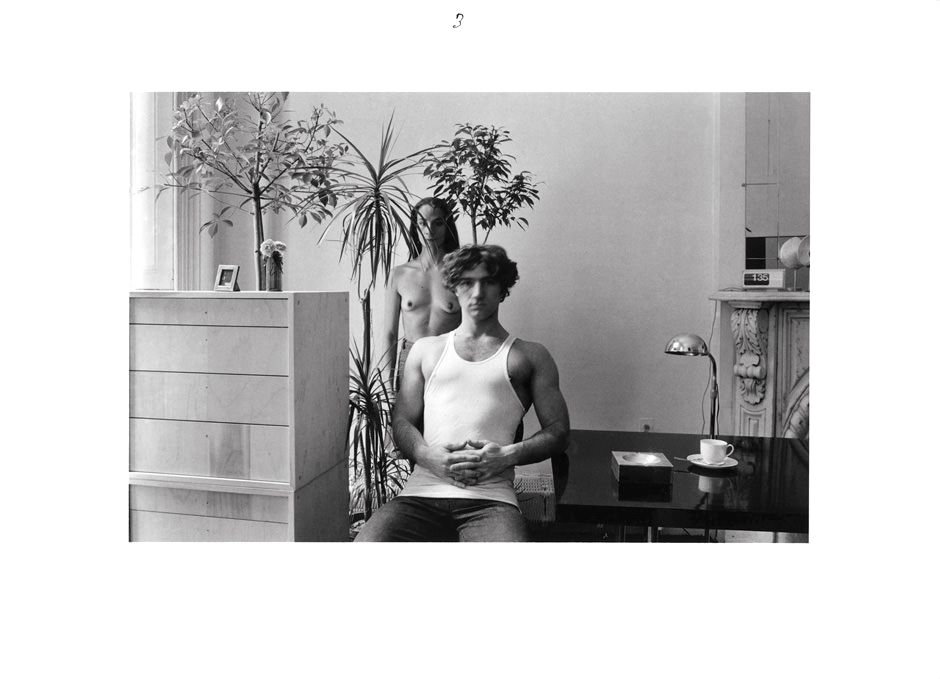
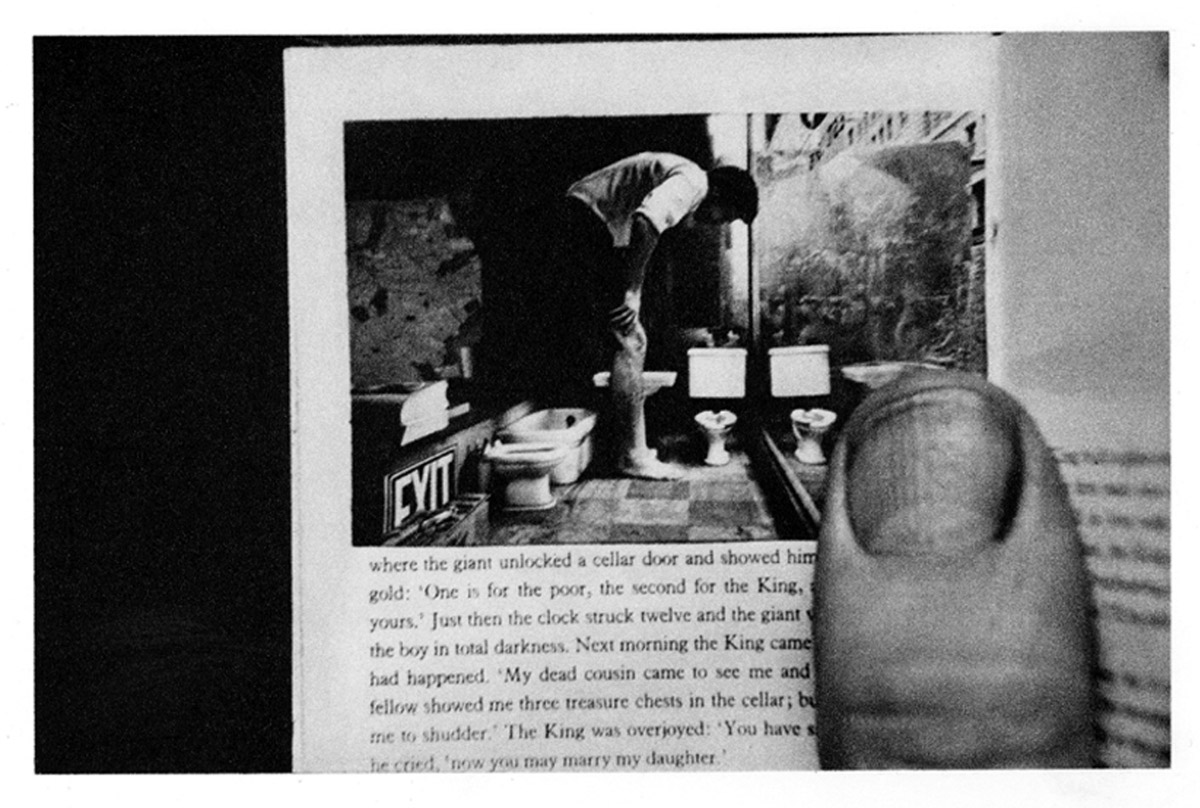
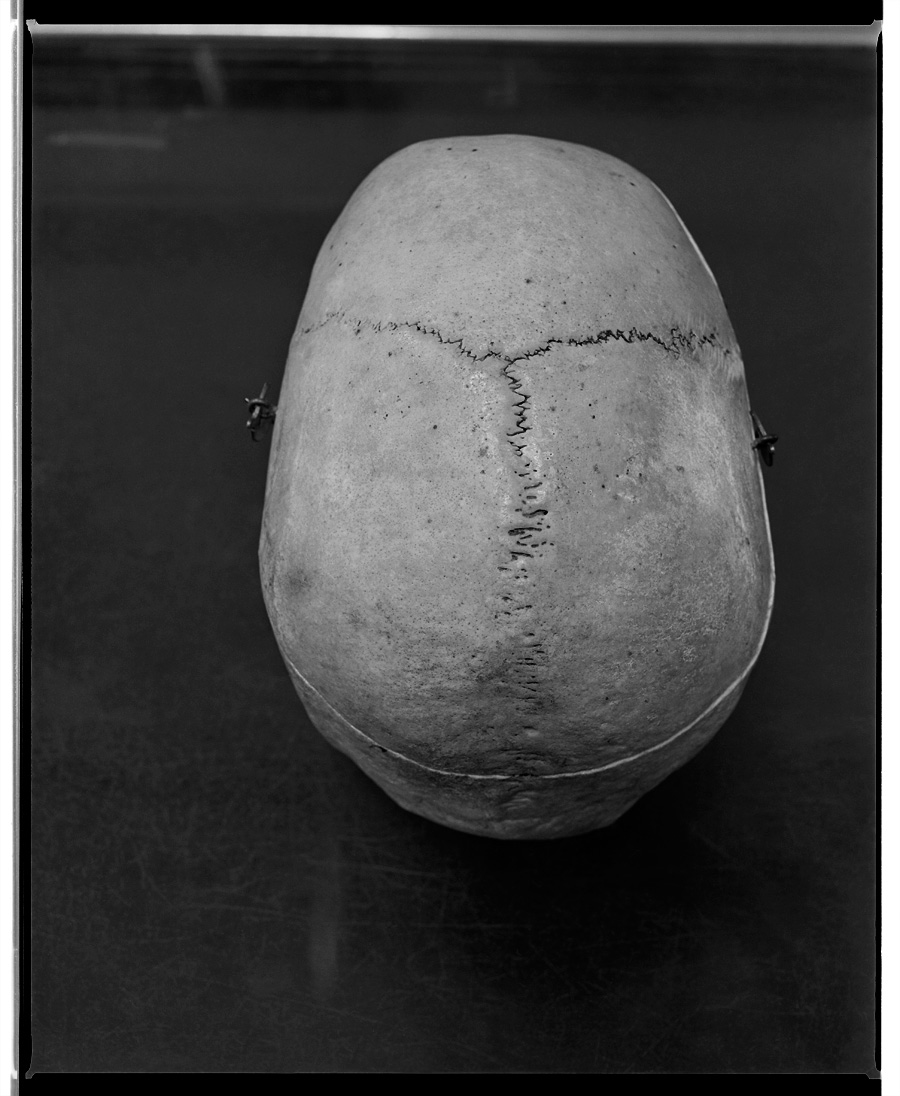
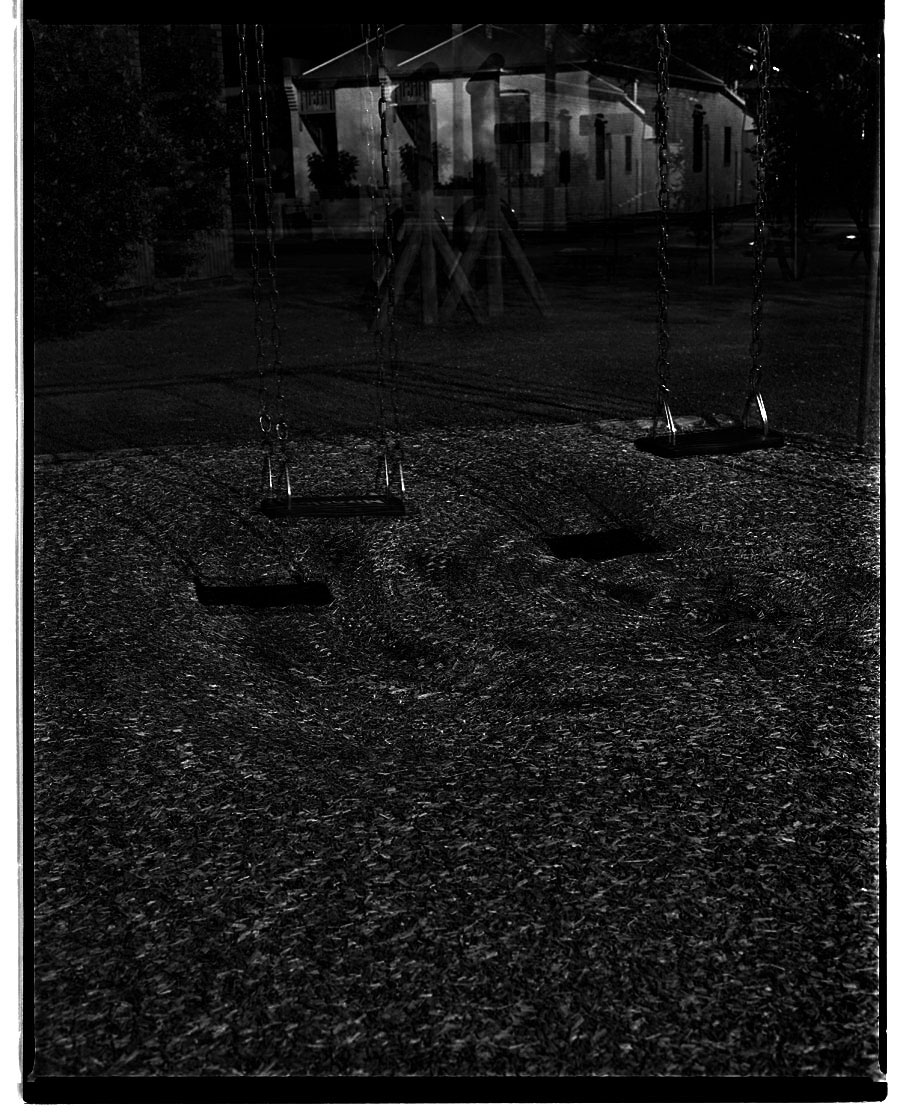
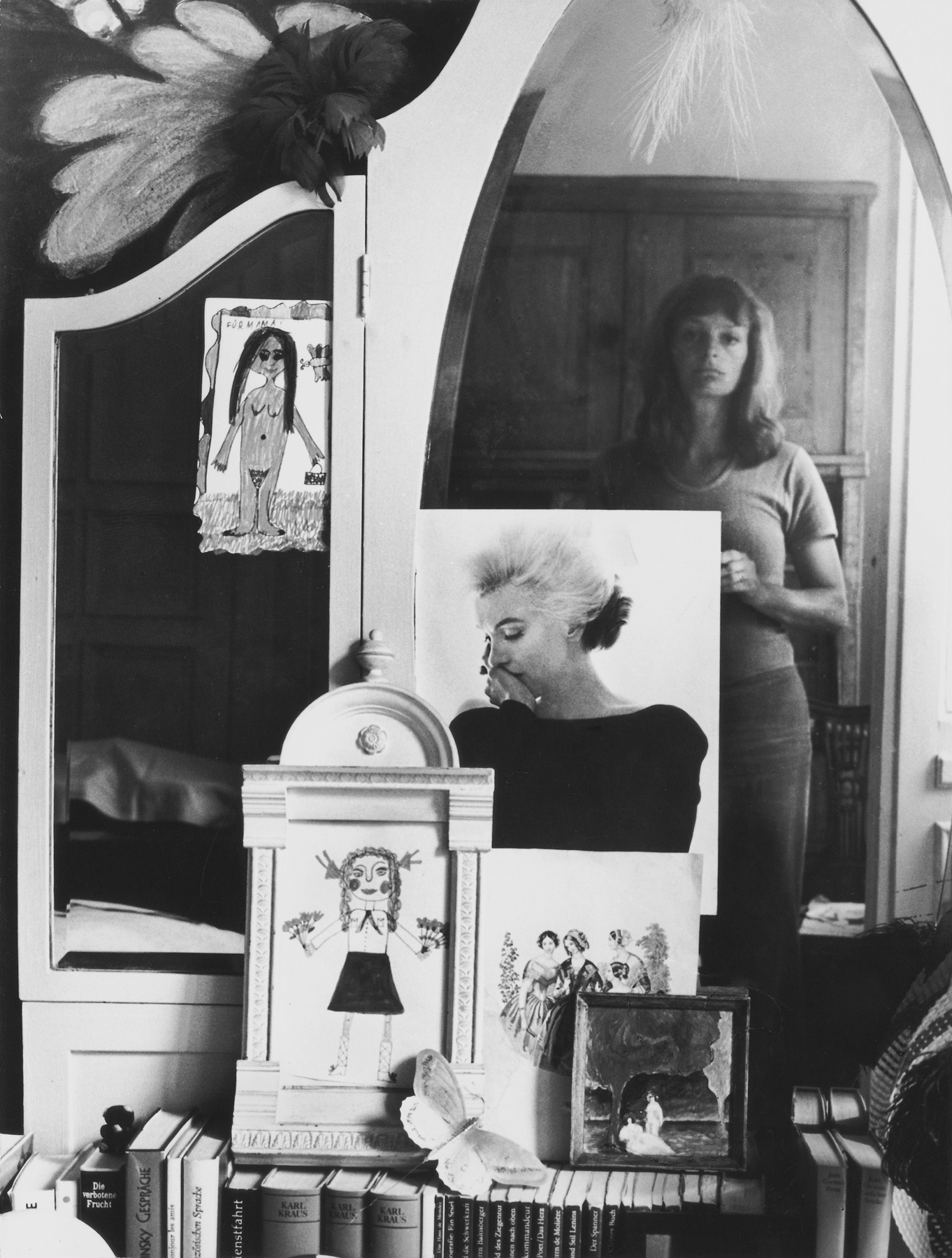
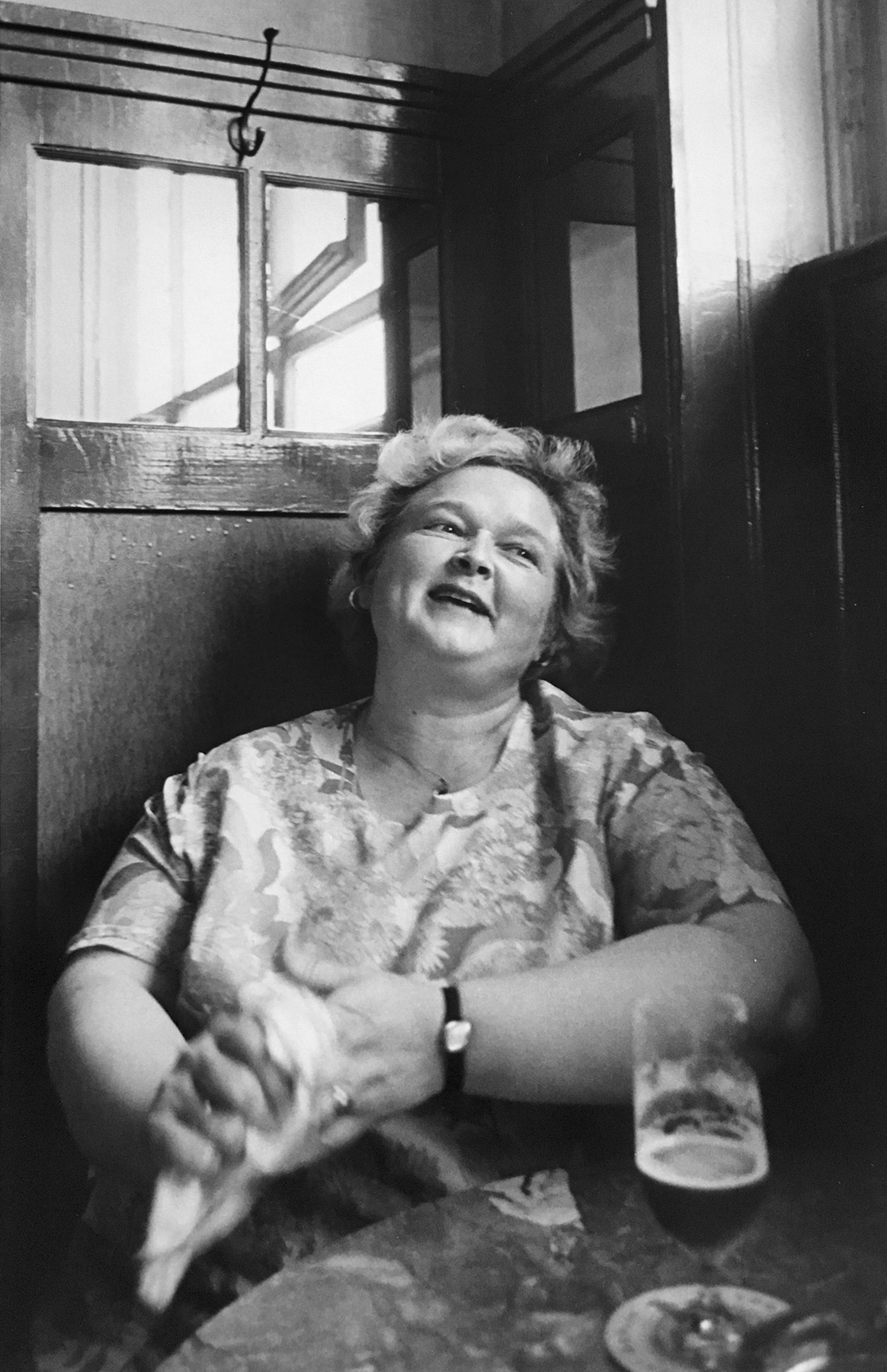
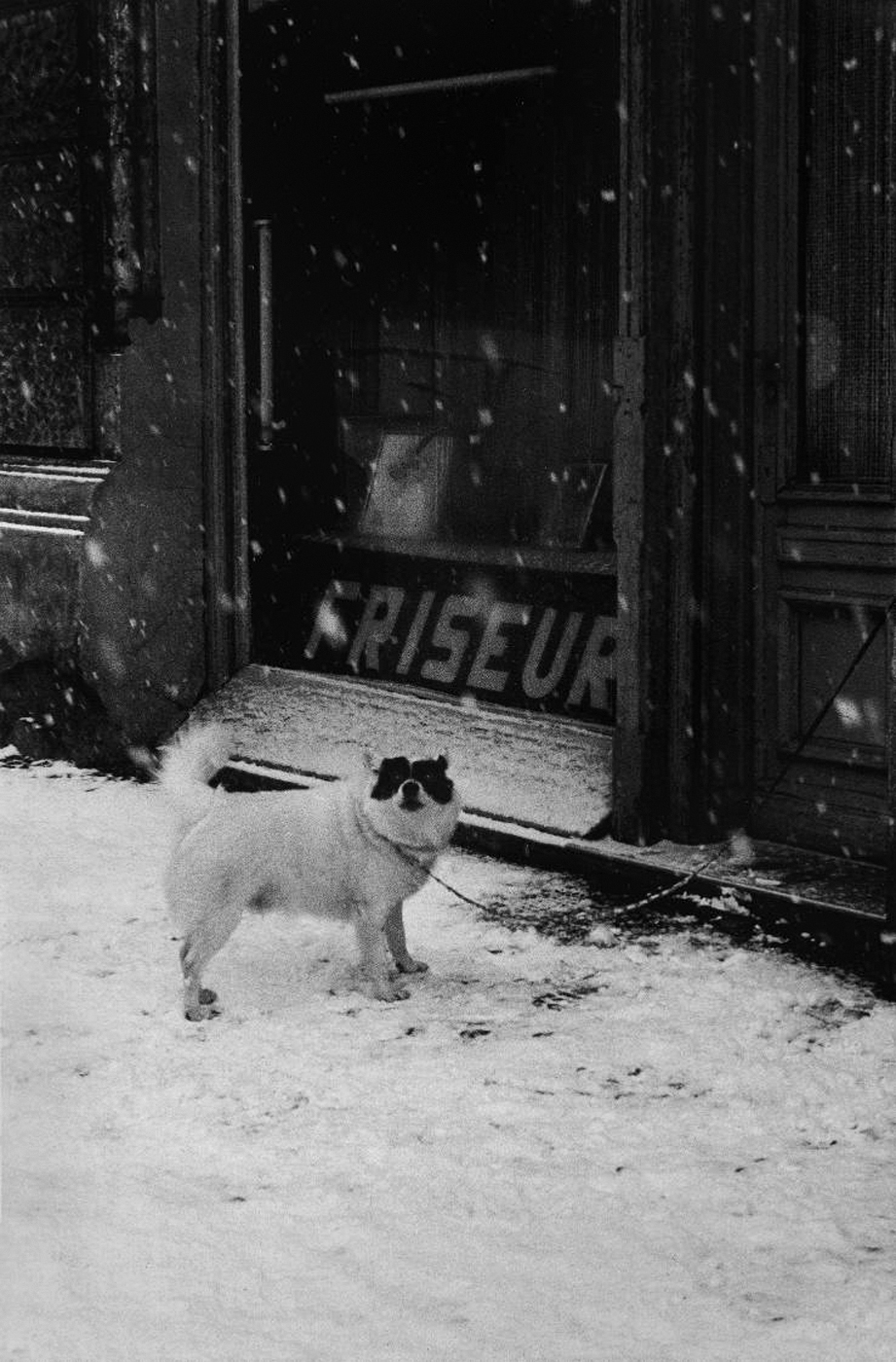
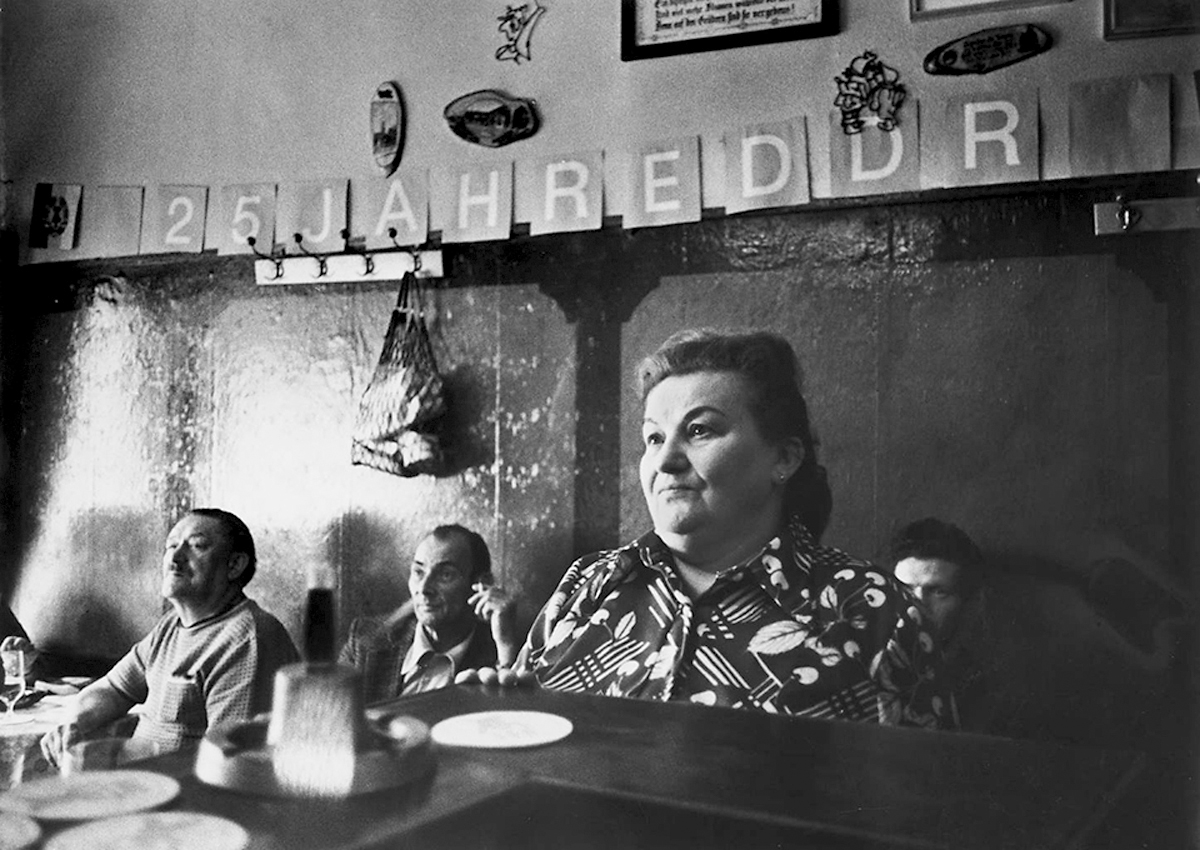
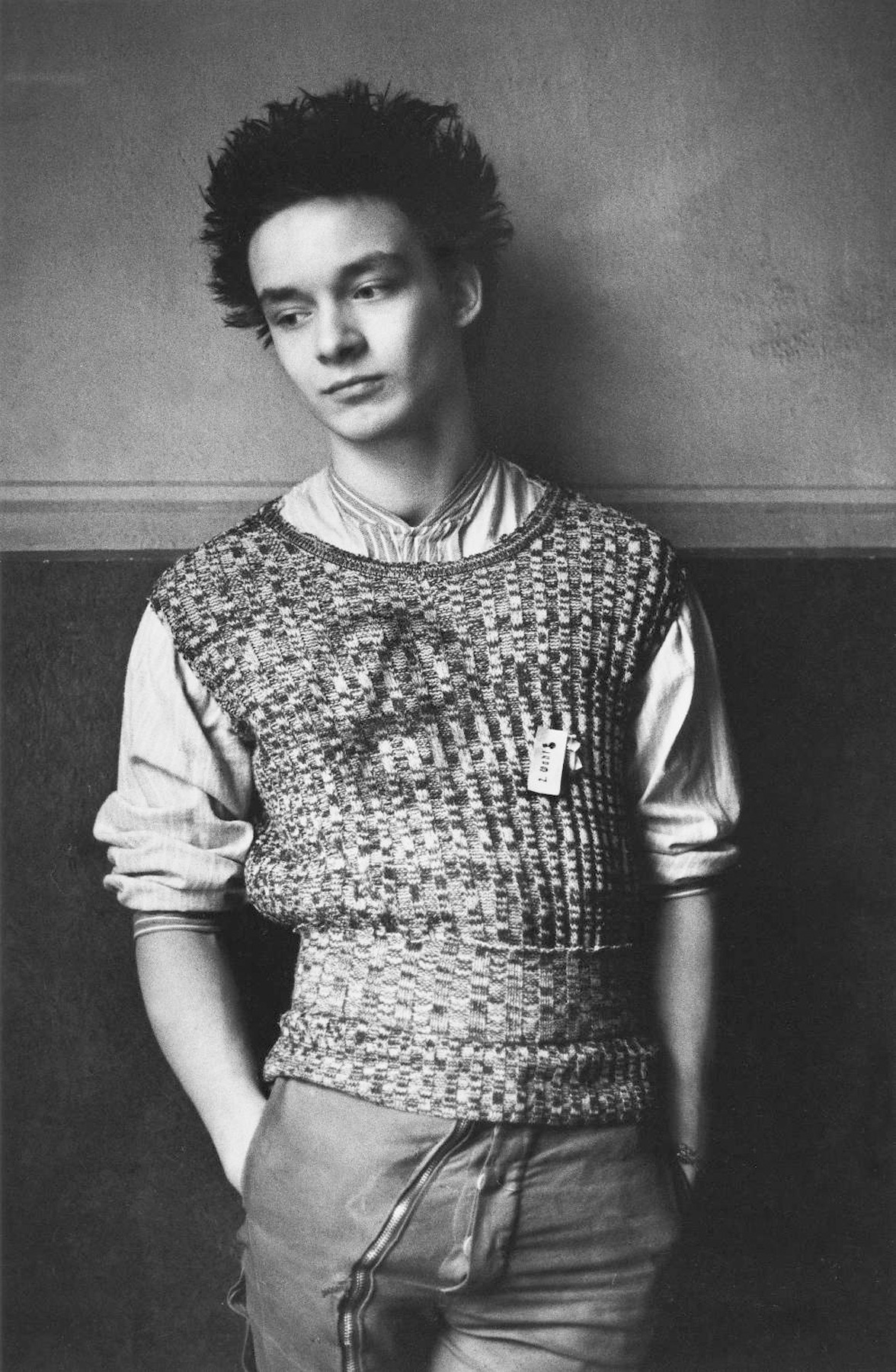
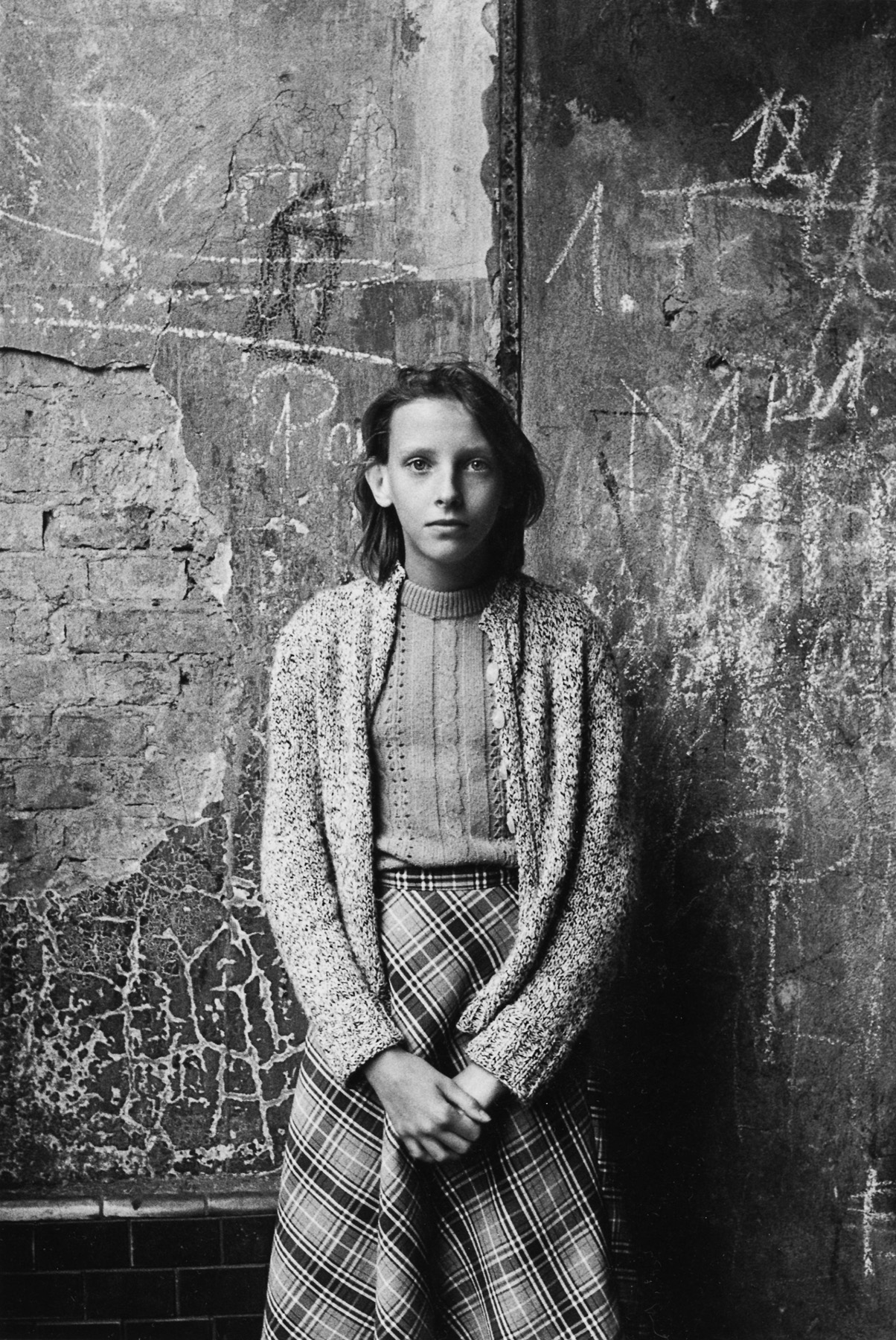
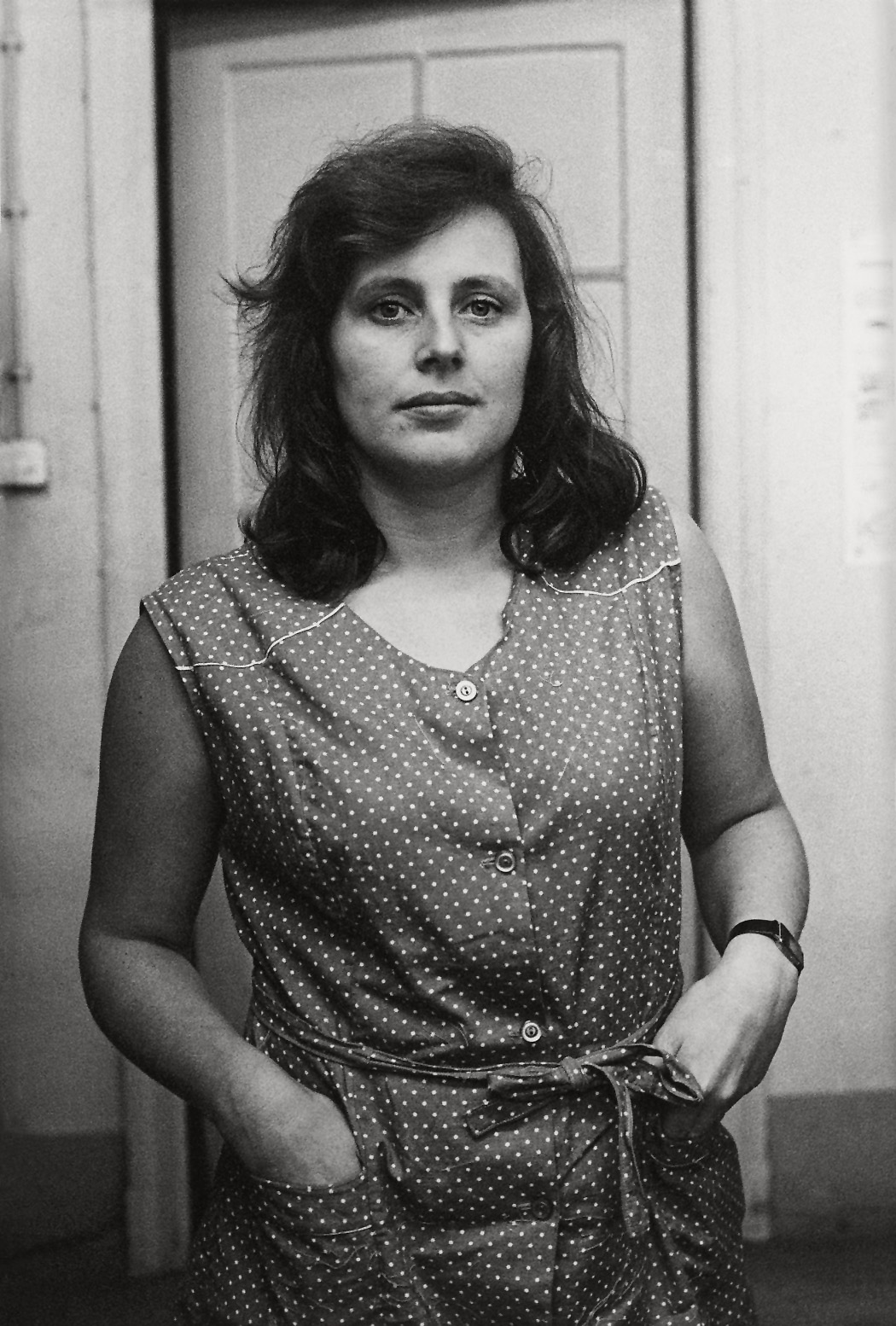
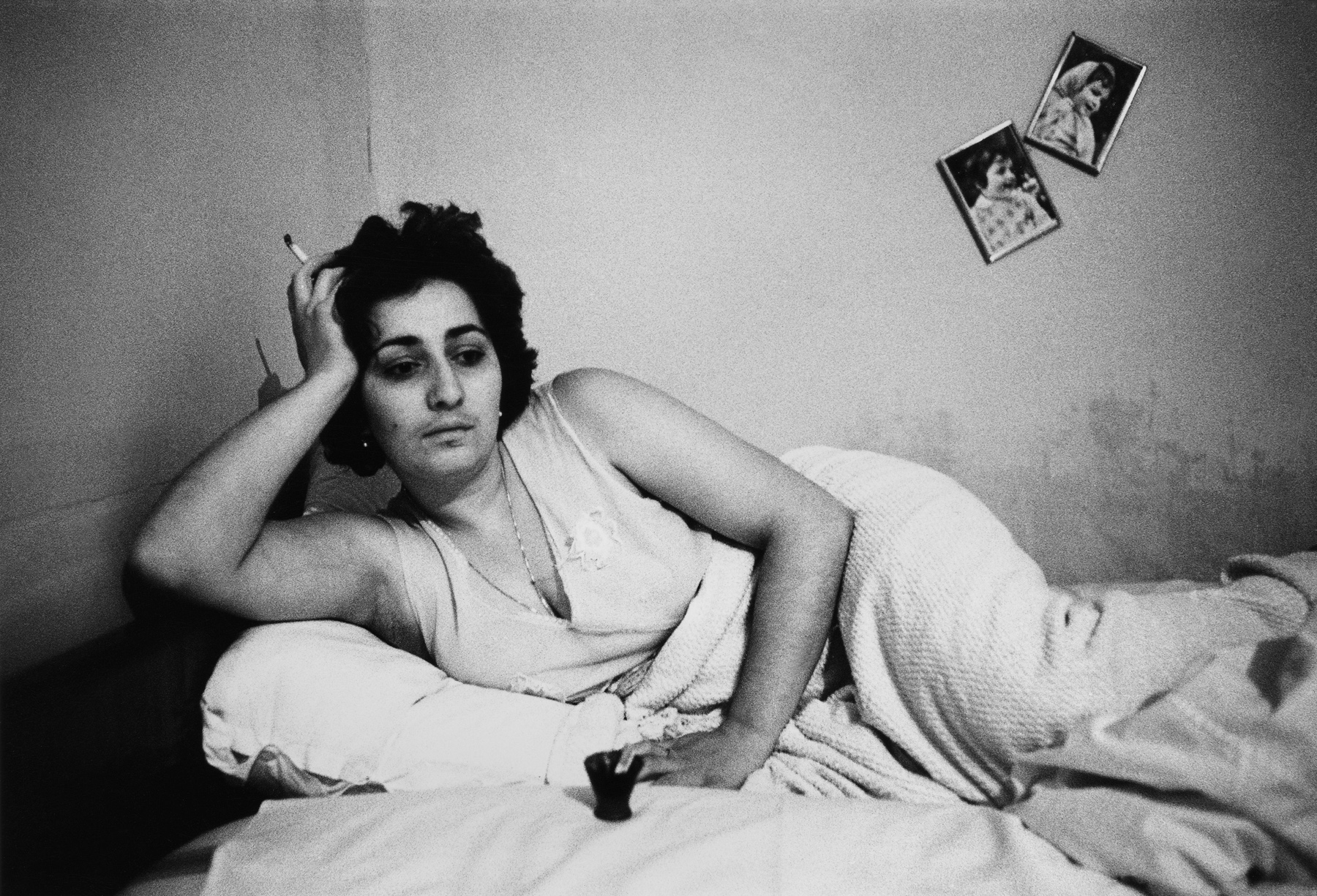
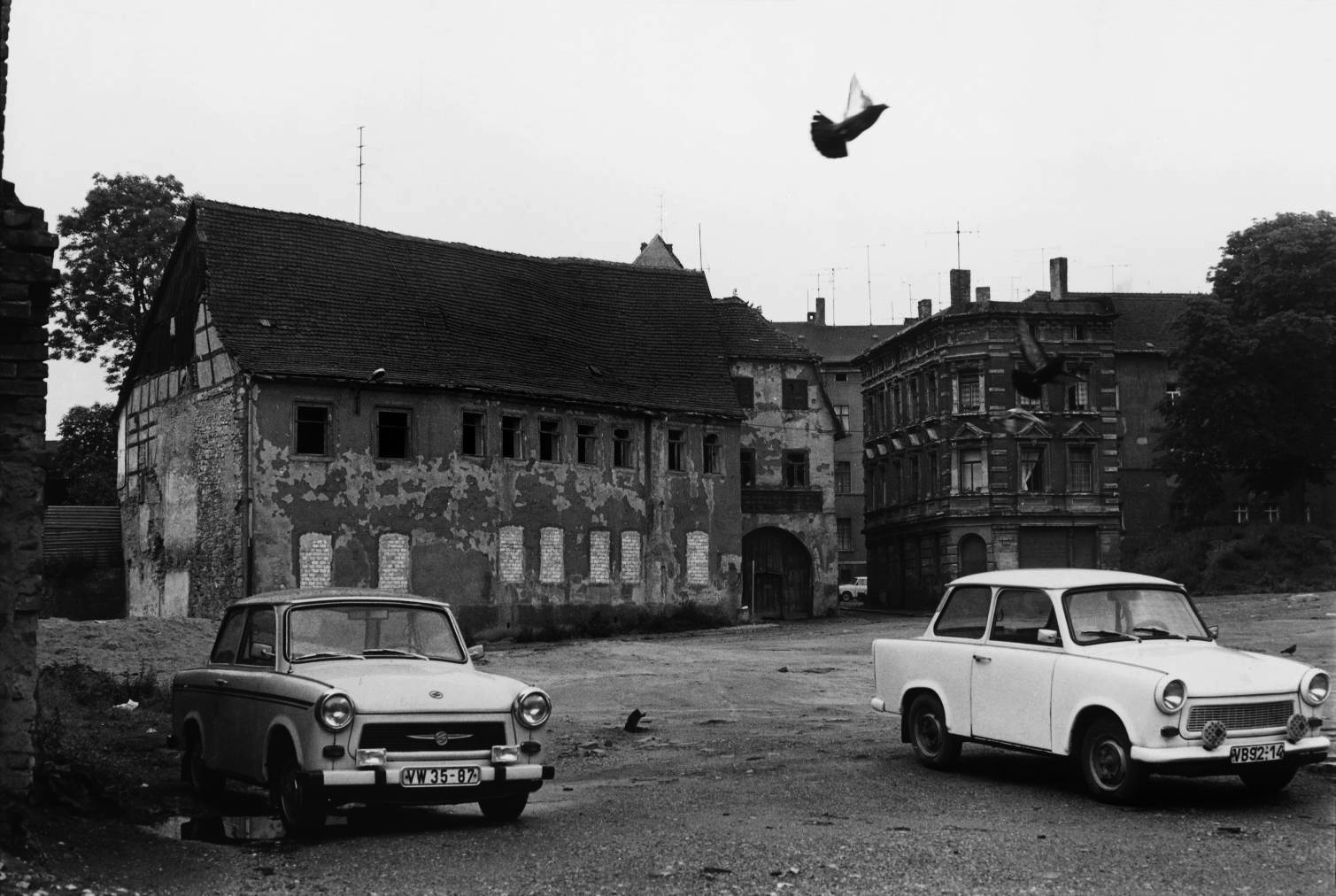
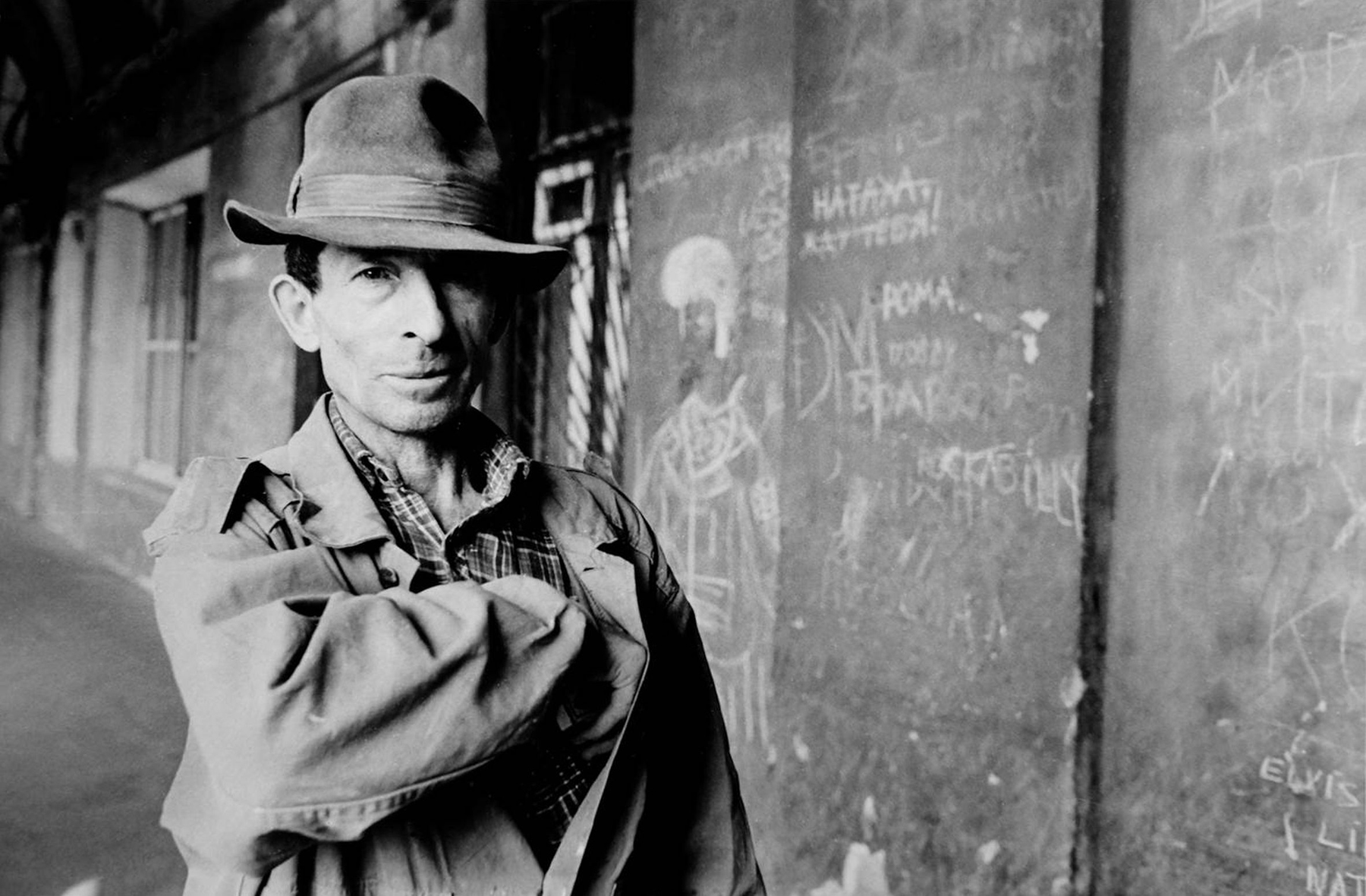
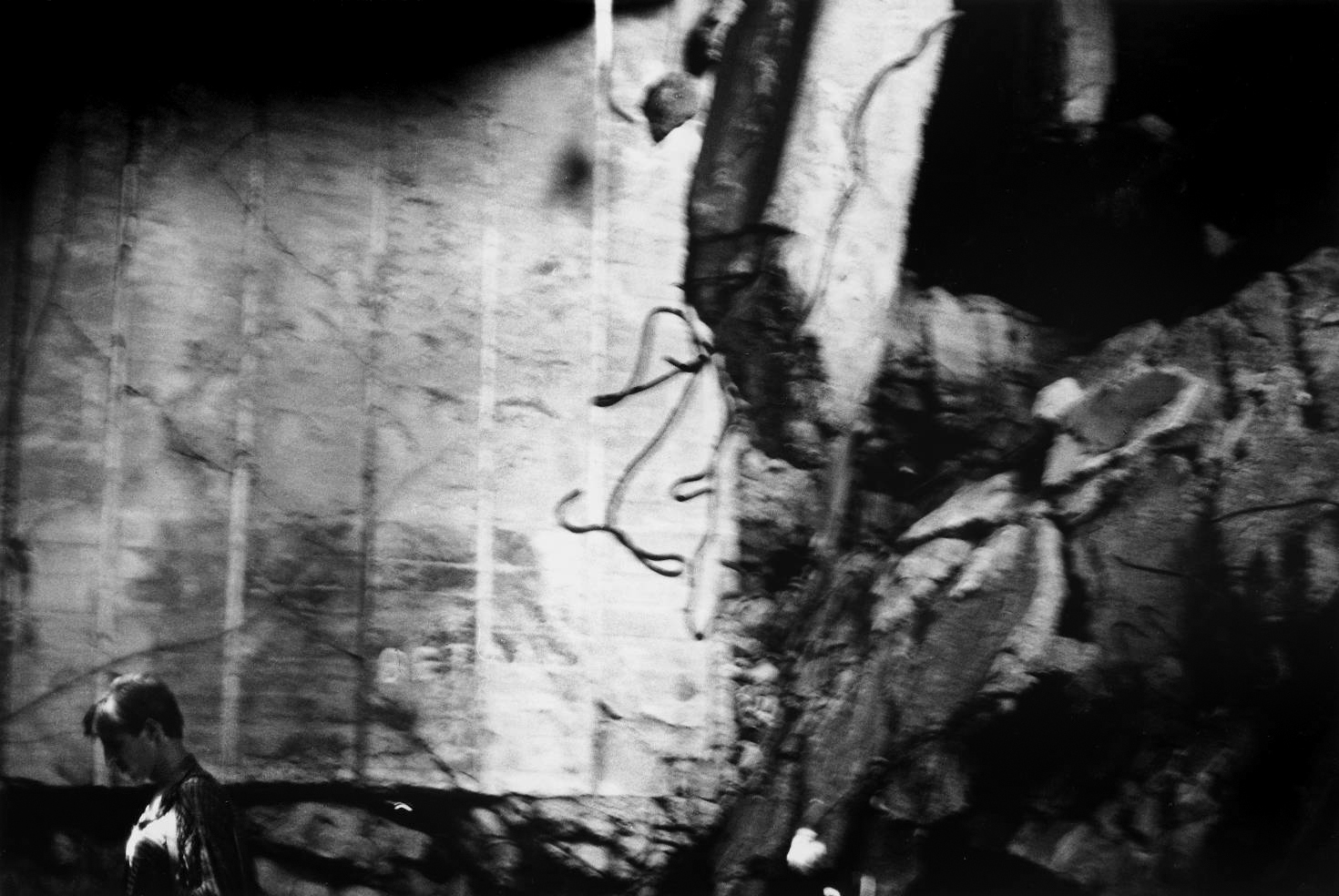
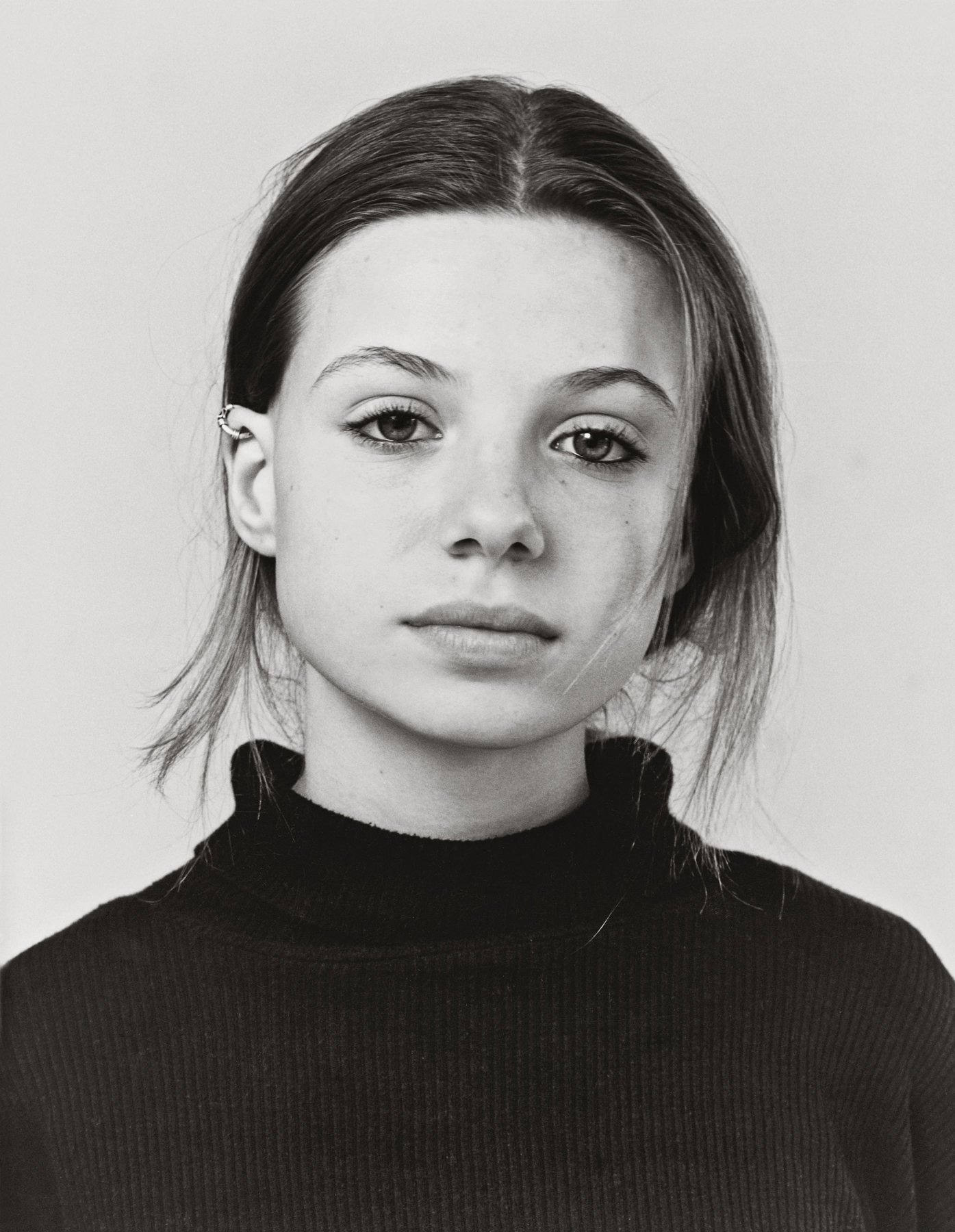
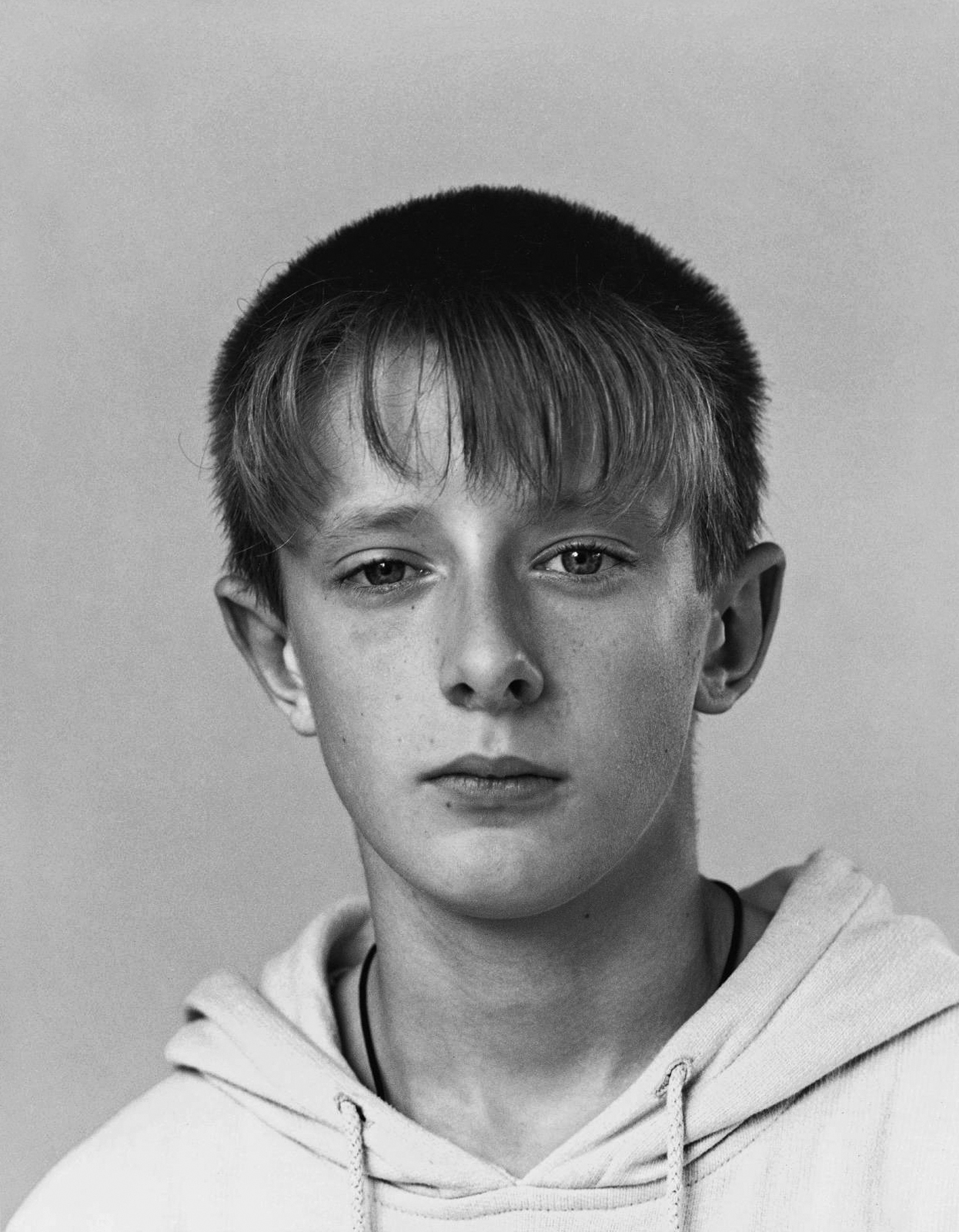
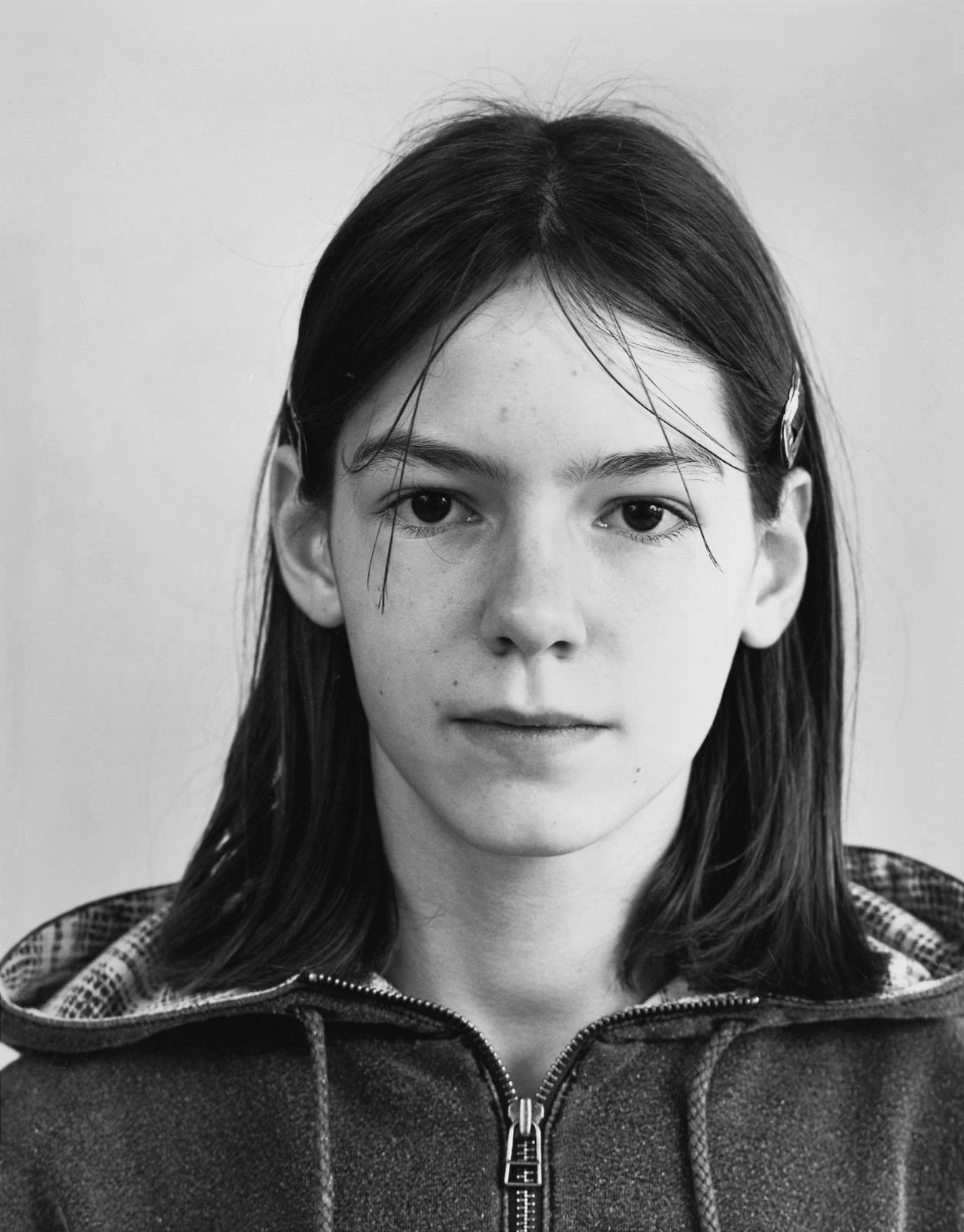
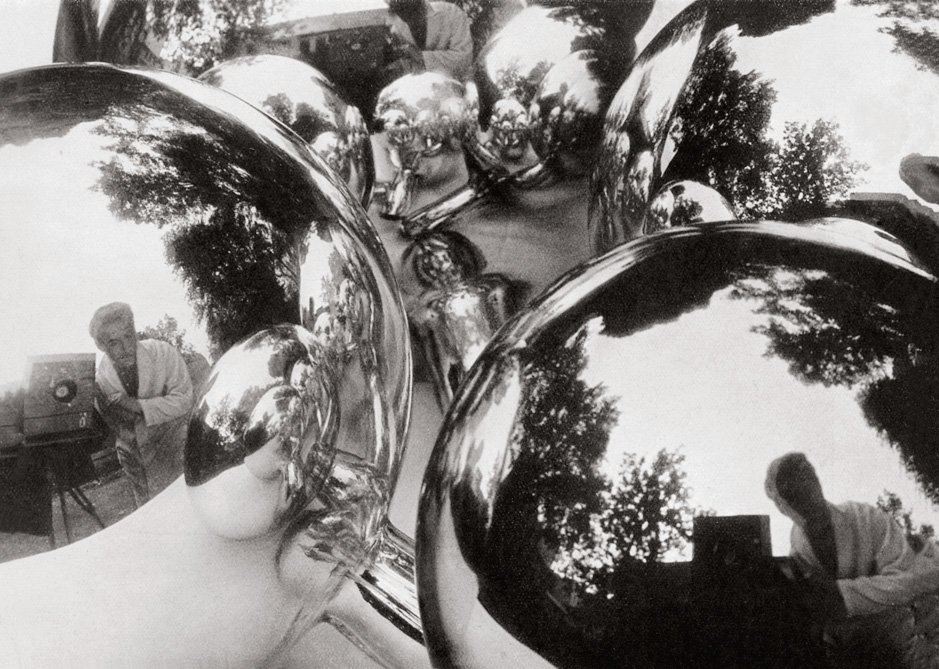
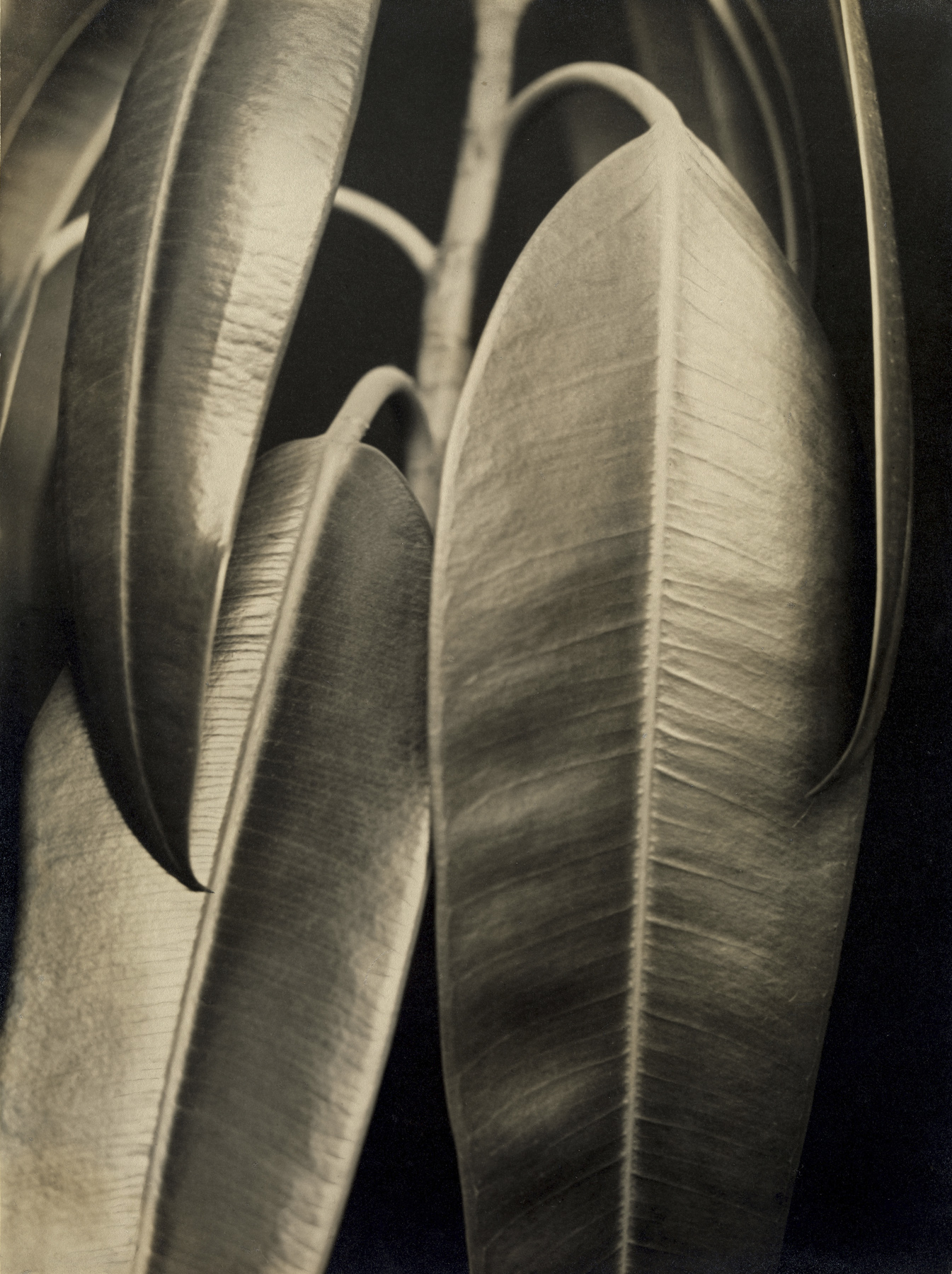
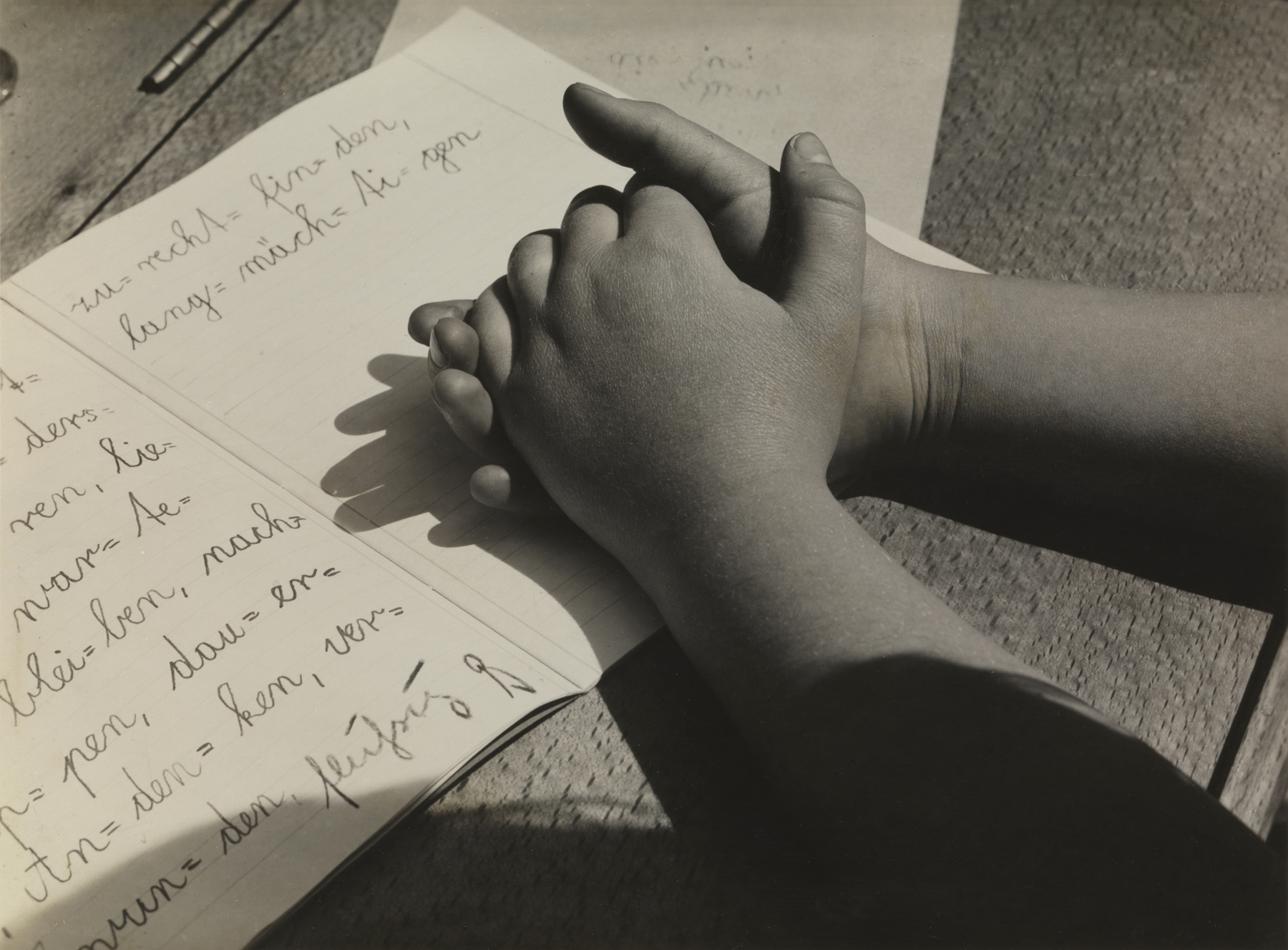
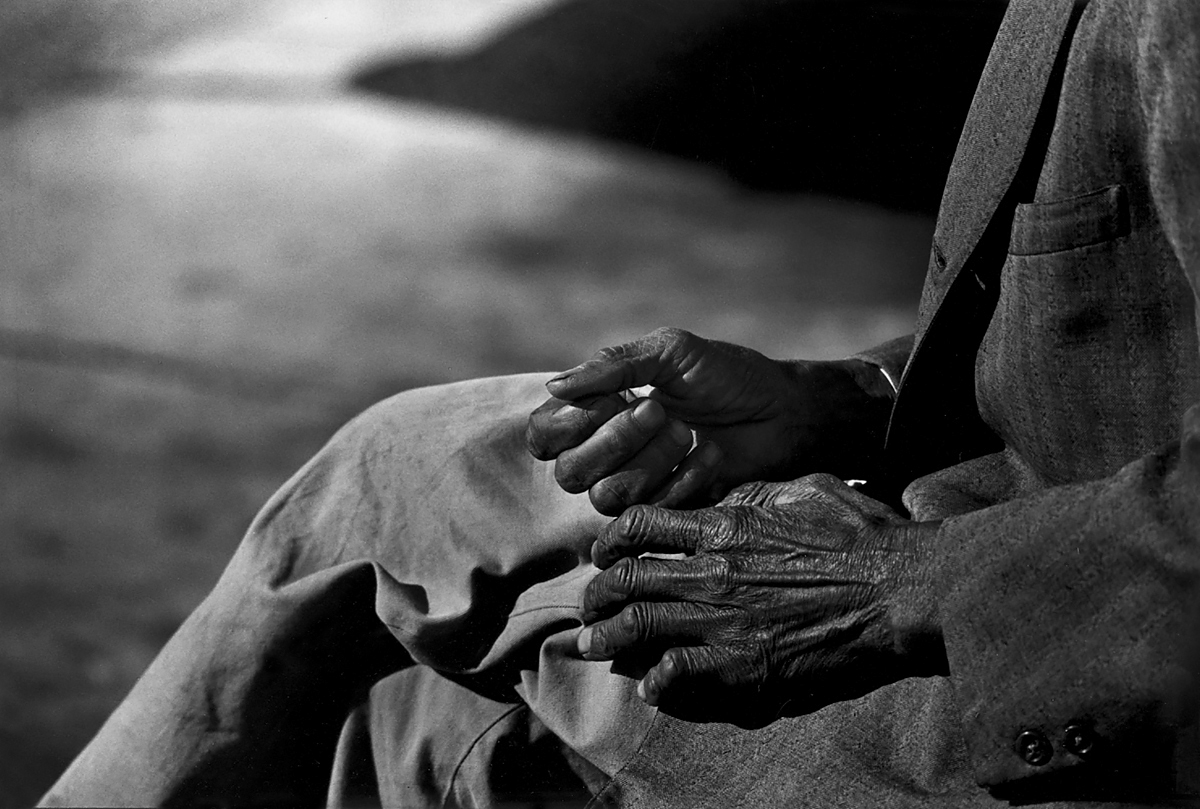
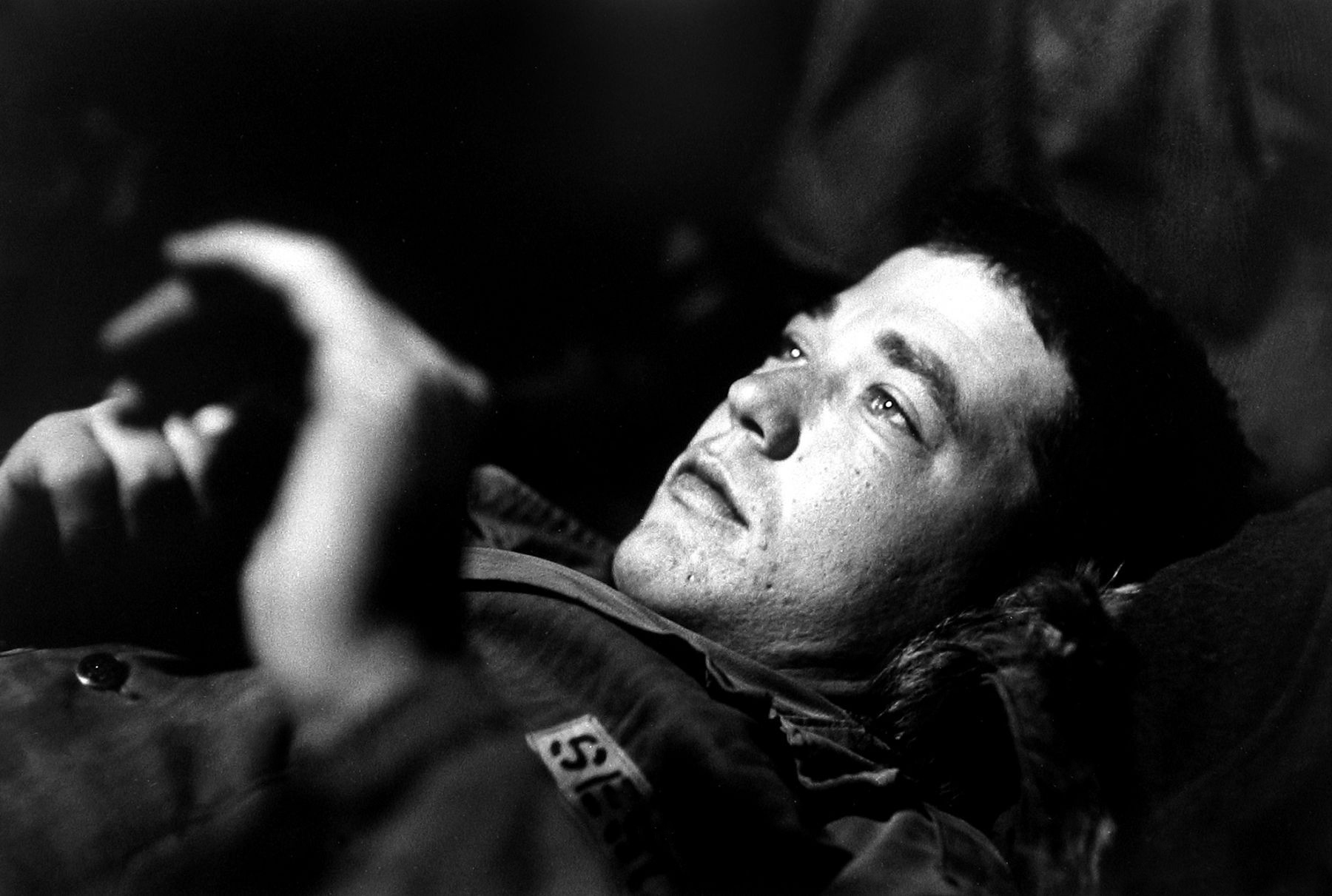
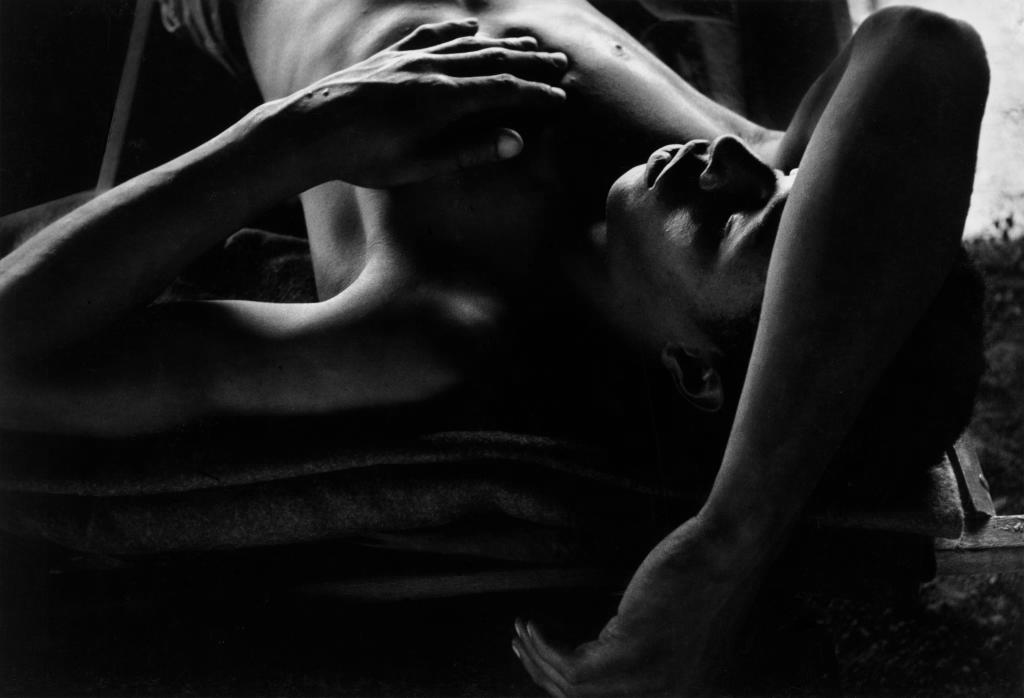
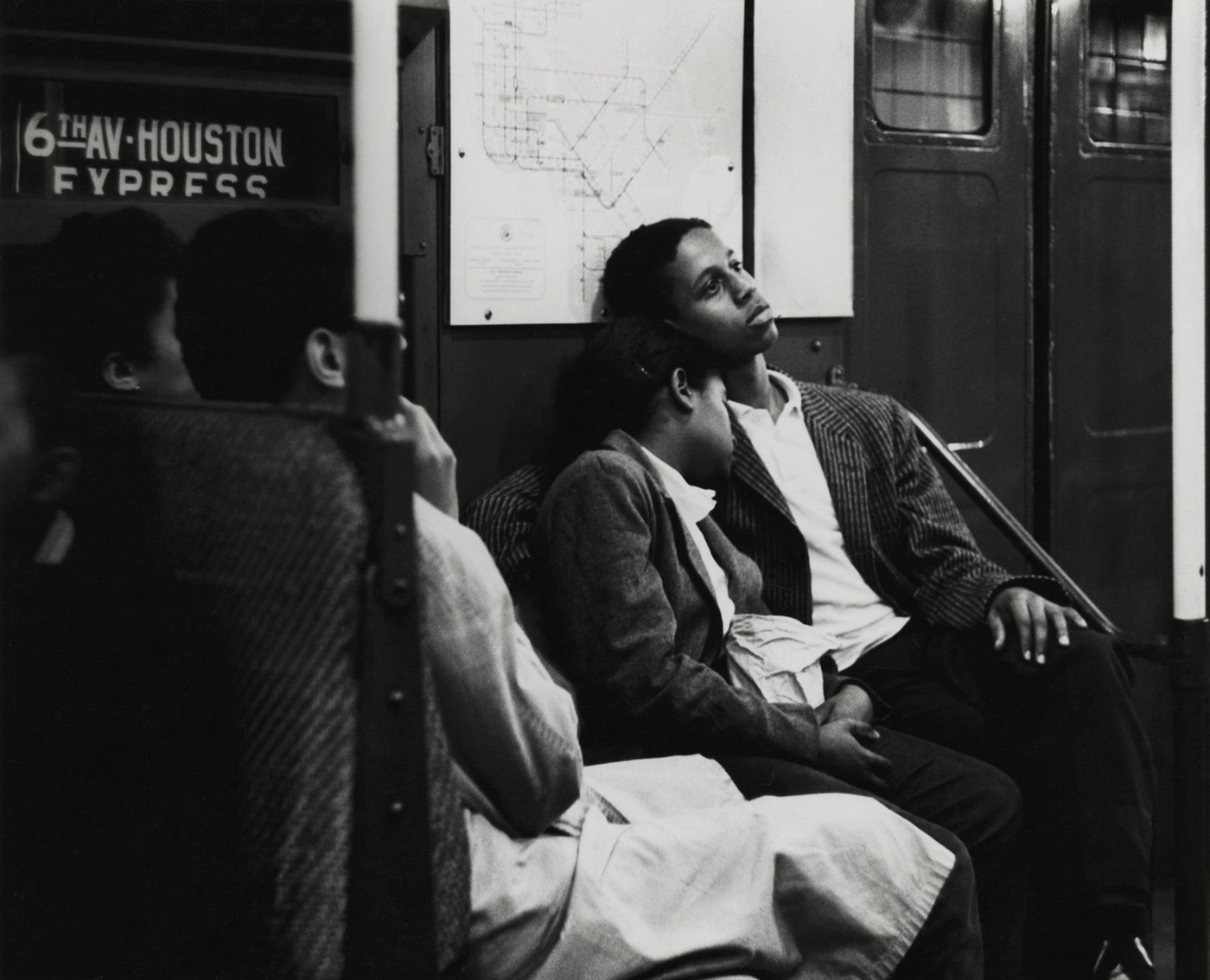
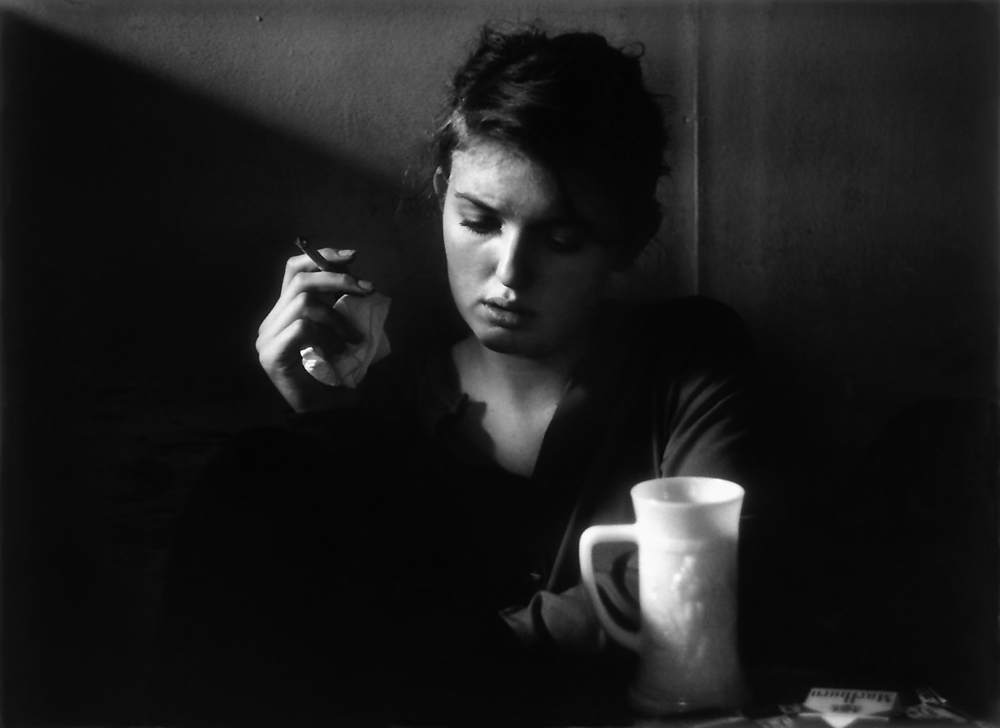
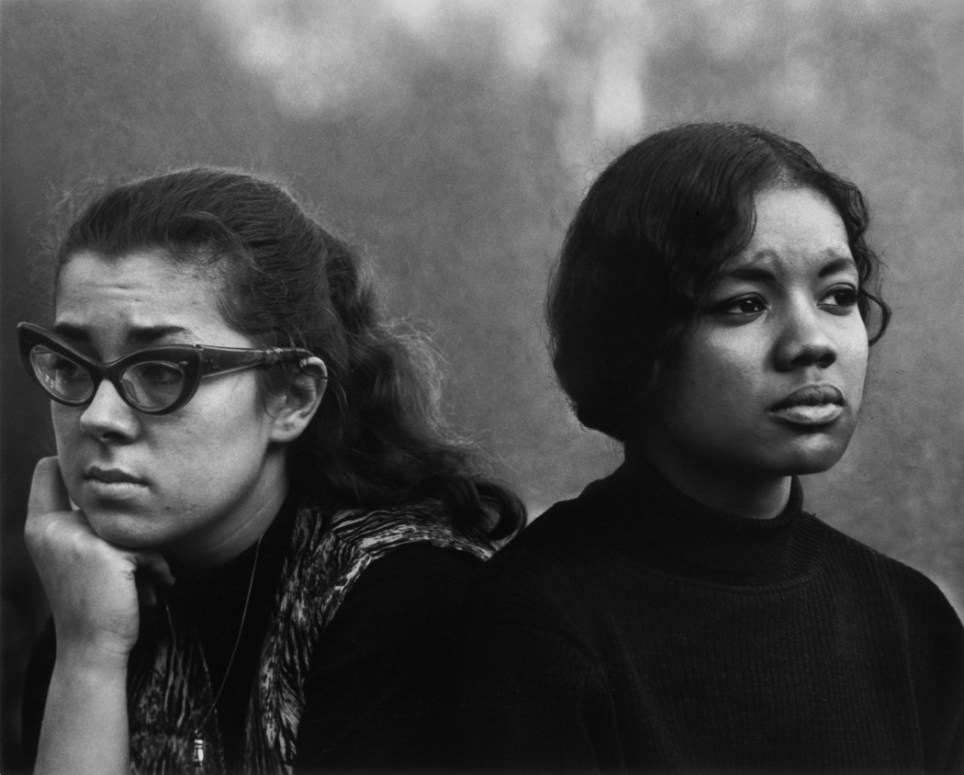
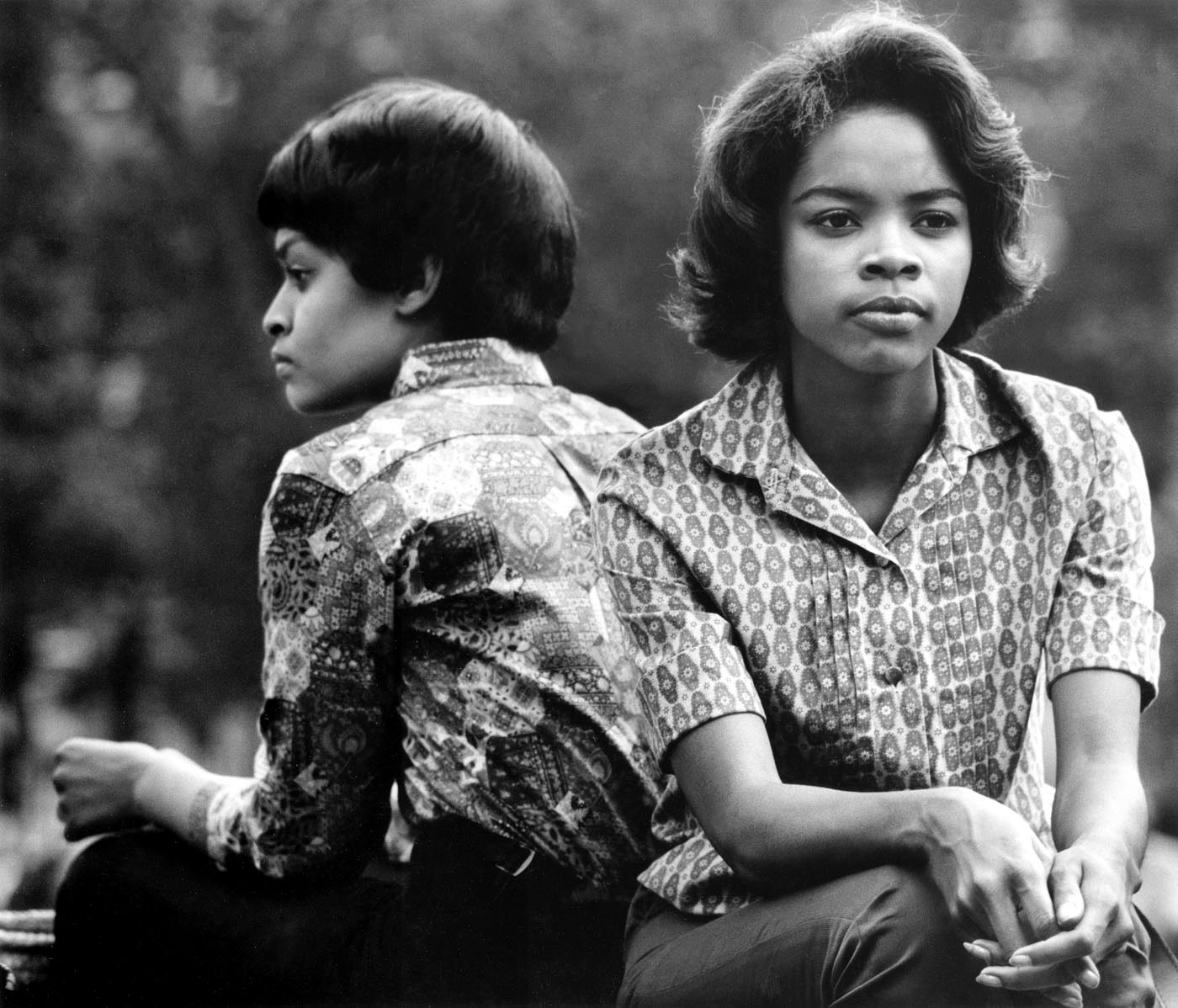
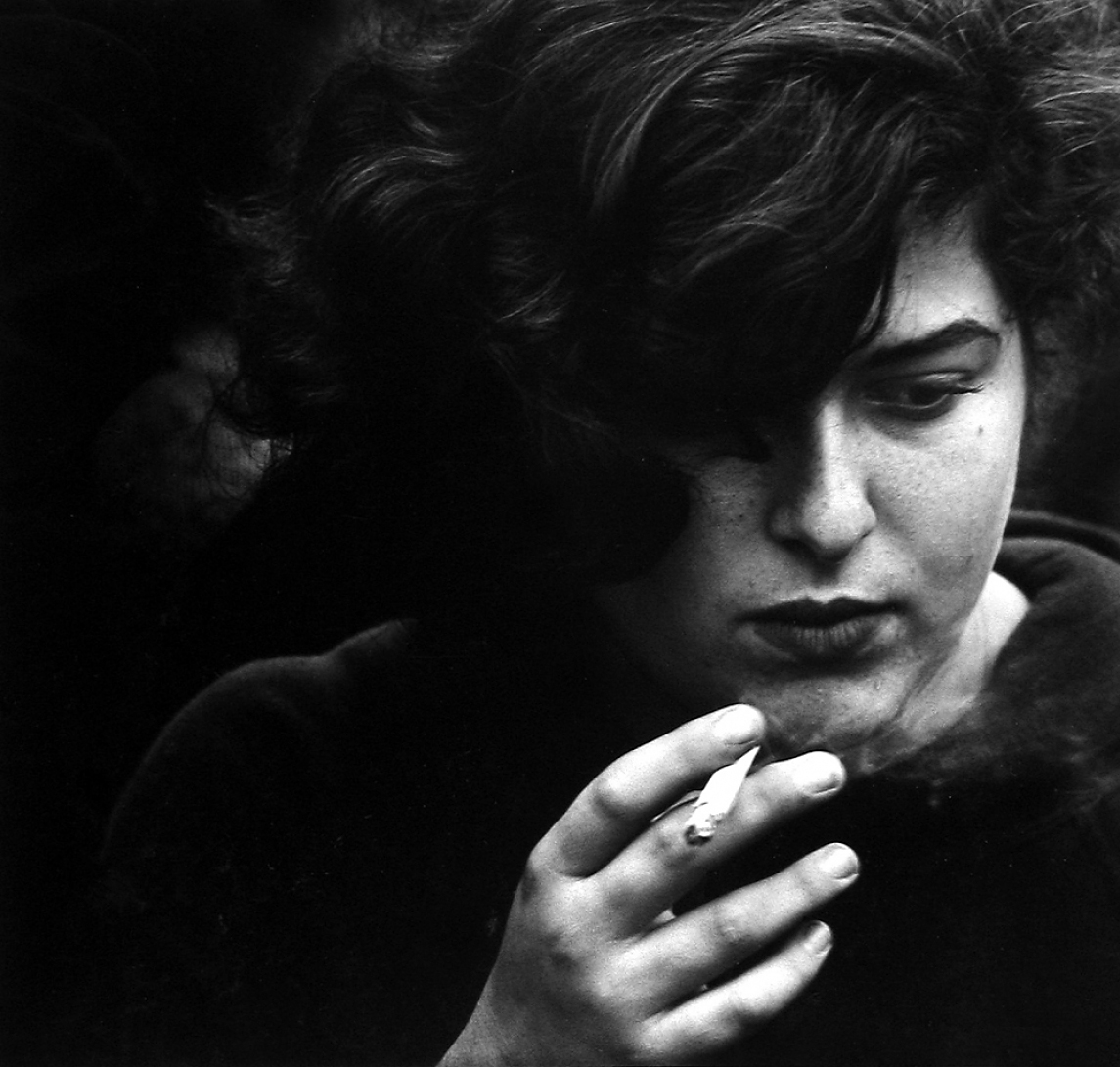
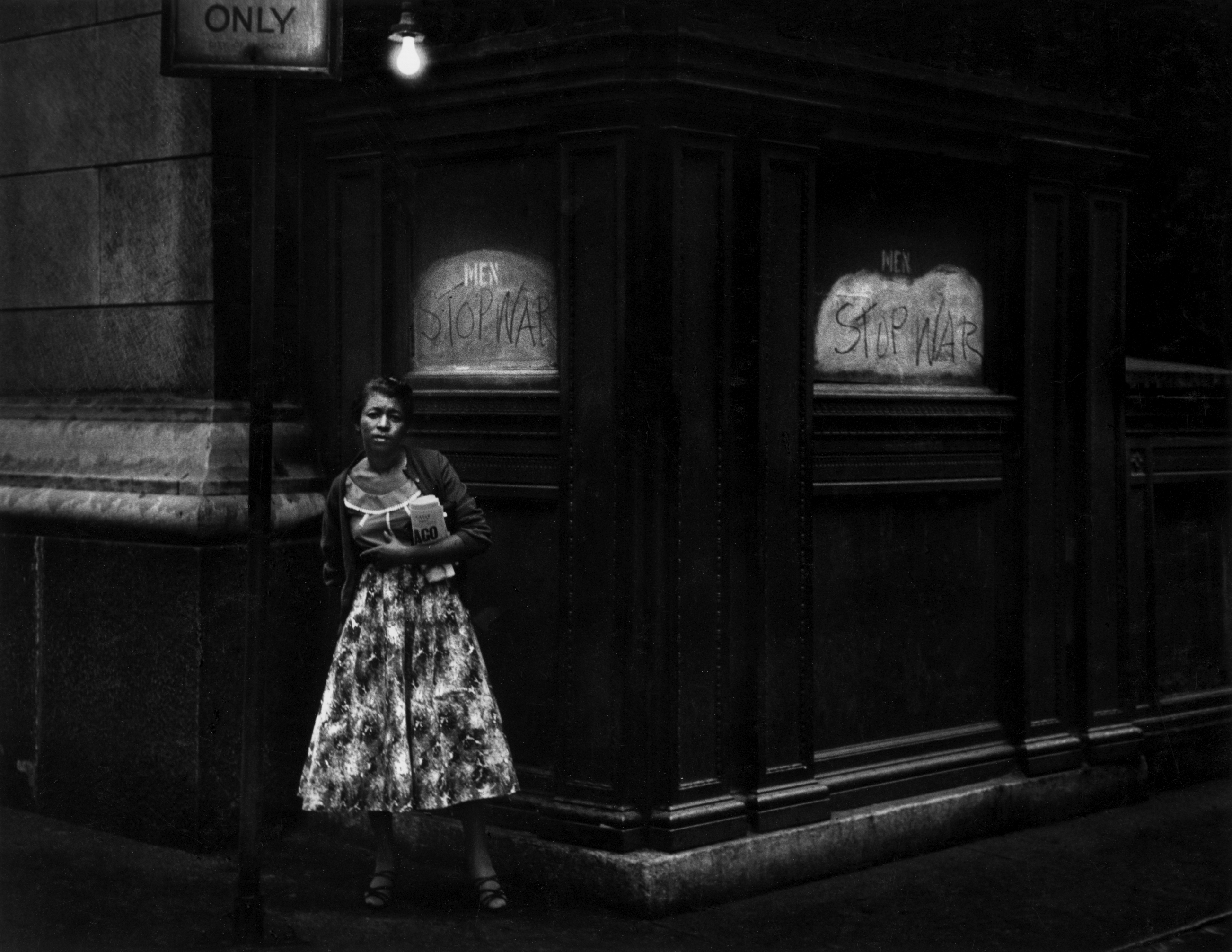
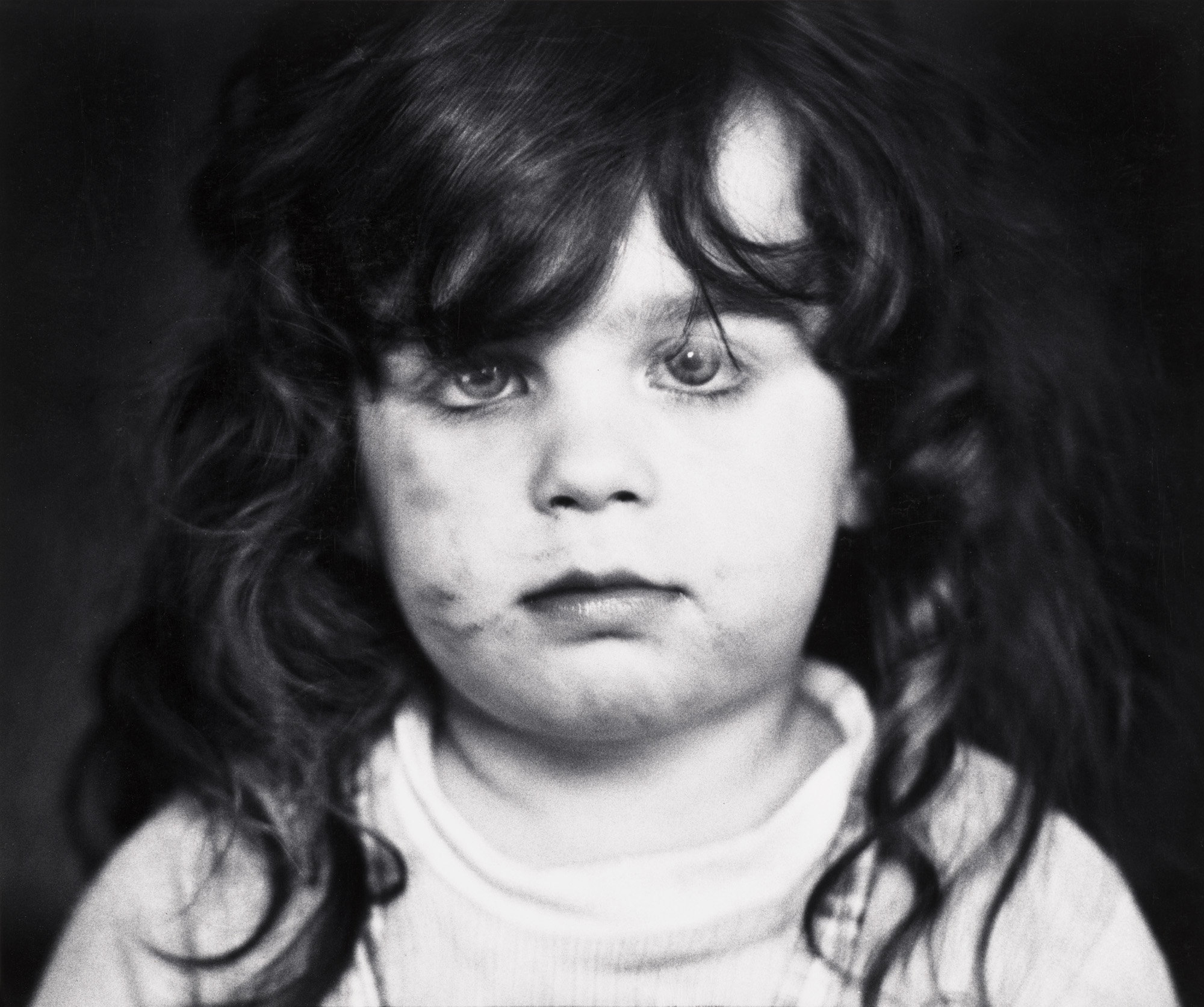
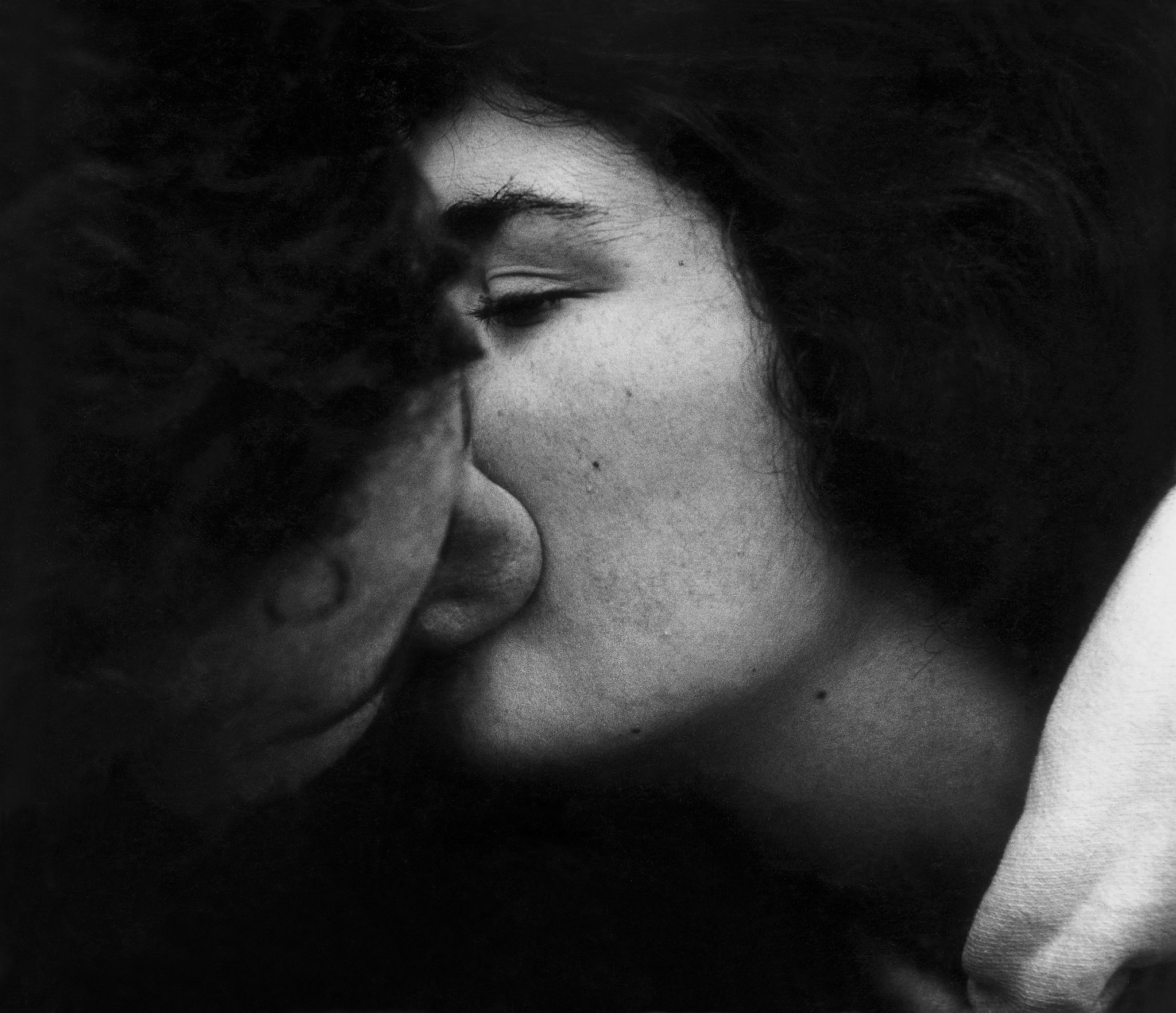
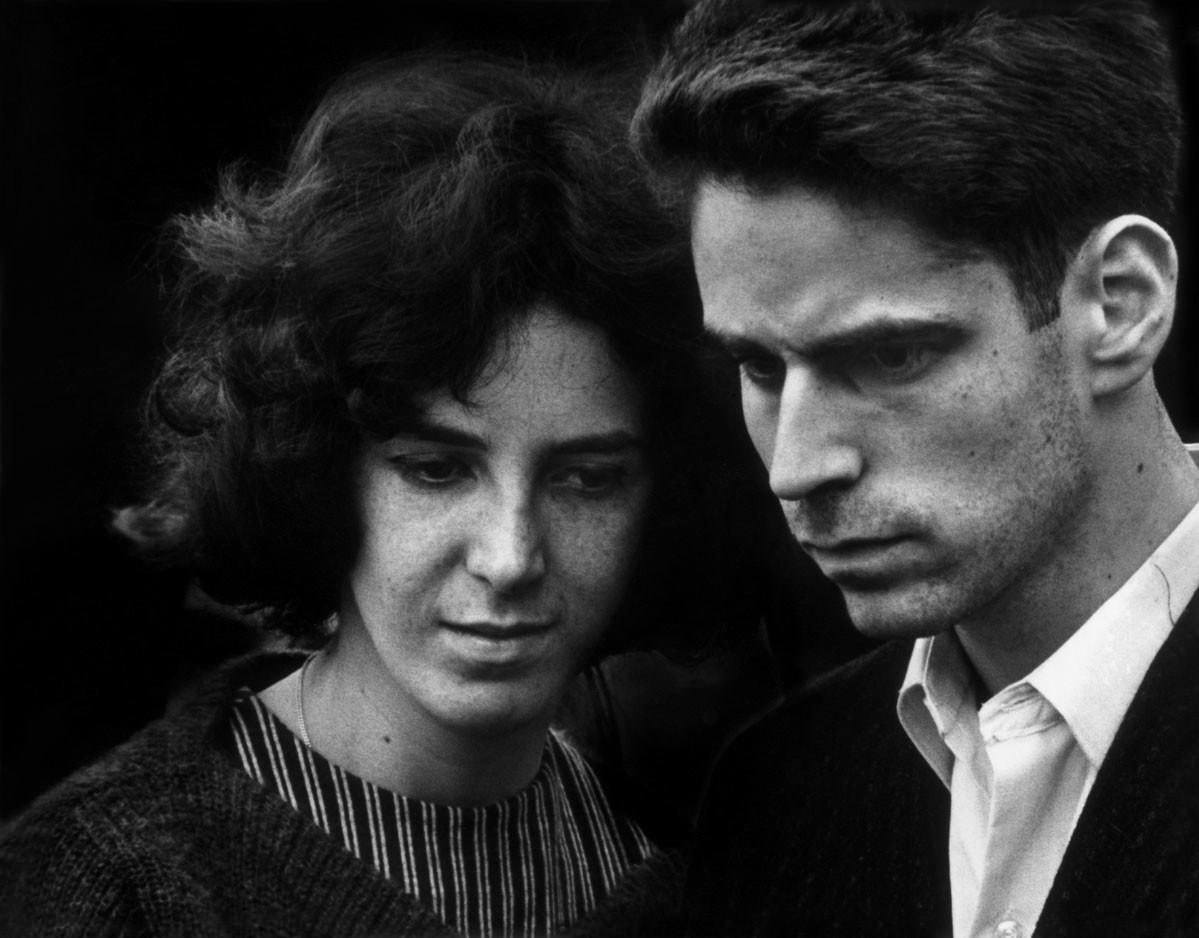
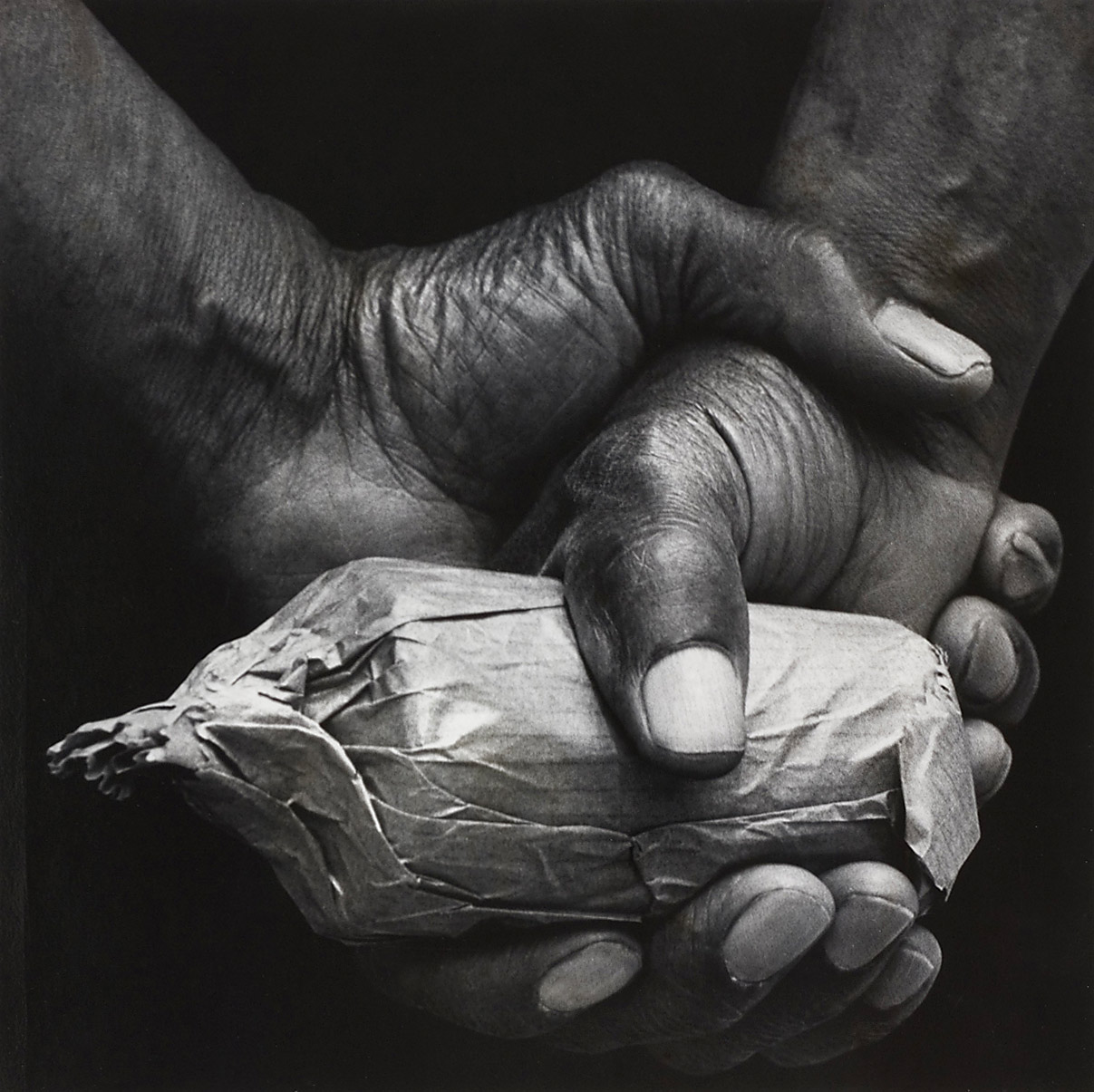
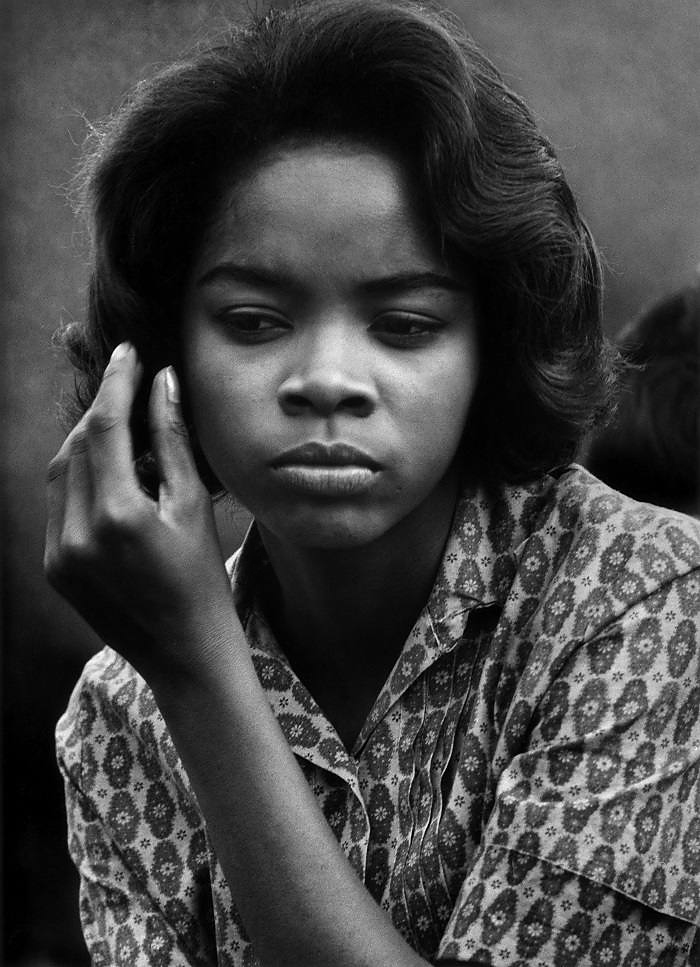
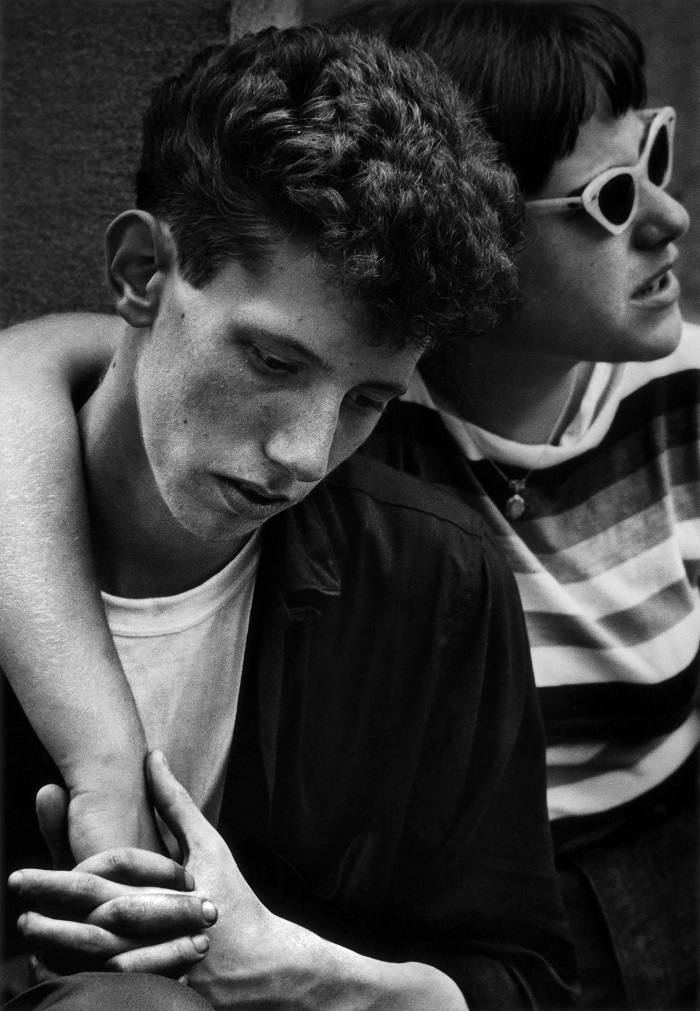
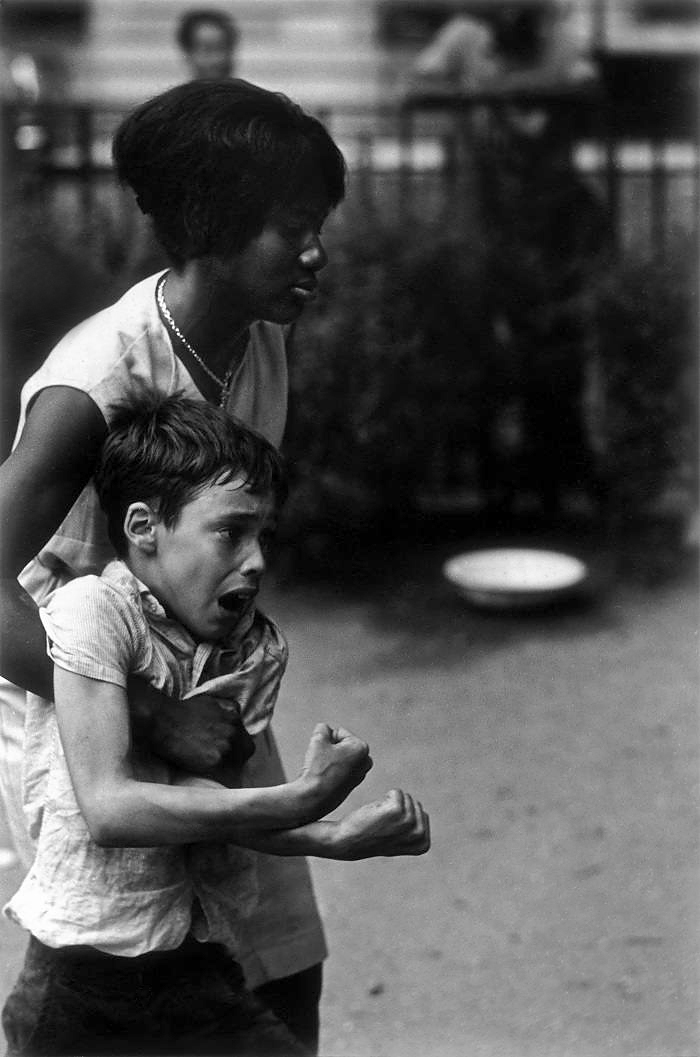
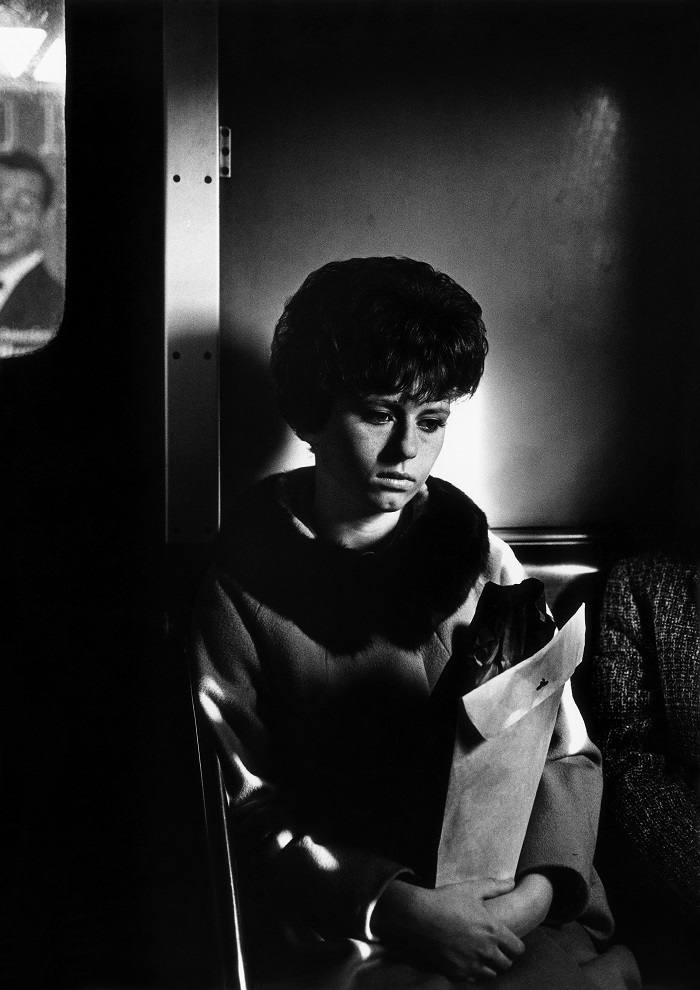
In which the visions (ghosts?) in these haunting photographs live, breathe, and barely exist in a strange closed world. Where the subjects seem so vulnerable.
In which there is little sentimentality. The portraits emit a deep sense of melancholy in their re/pose, in the subjects temporal existence separated out from time. Heath photographs people as they are. He projects himself, not his ego, into this vision of vulnerable humanity.
In which this vision of truth illuminates the complex relationship between human nature and reality through emotional energy.
Dr Marcus Bunyan
Many thankx to The Photographers’ Gallery for allowing me to publish the photographs in the posting. Please click on the photographs for a larger version of the image.
“… the conundrum of the title is a reference about how to navigate the terrain of solitude one wishes to experience (to be alone), but also how to make that extend into a conversation with the subjects in front of you that will eventually become a single body of work for many to view (to be of more than one). This is of course conditional to your position within the world at large and how you view your presence within the greater universal ether. You must carry your solipsism like a rusty bucket of dirty brown well water. In Heath’s case, the solitary monologue and the ramble of the flaneur become something of a mantra – an incessant need to repeat, to be part of the cacophony of the worship of modern life in which the self and the crowd / city are forced to adjust to one another, but at safe distance with impassioned and yearning eyes.”
Extract from Brad Feuerhelm. “David Heath: “Dialogues With Solitudes”,” on the ASX website November 23, 2018 [Online] Cited 26/05/2019
“”A Dialogue with Solitude” is a self-portrait in which the artist himself never really appears, but is revealed and interpreted by every detail. Its revolt is alive with sympathy and acceptance of man’s modern placement in the world, mated with contradictory realization and resistance which deny and combat the absurdities of existence. This is expressed with a sincere poetry which is never shocked out of countenance by reality.”
Edwards, exh. label for A Dialogue of Solitude, 1963, on file in the Photography Department, Art Institute of Chicago quoted in Hugh Edwards. “Dave Heath,” on the Art Institute of Chicago website [Online] Cited 26/05/2019
The first major UK exhibition dedicated to the work of this hugely influential American photographer.
Heath’s psychologically charged images both reflect and respond to the alienation particularly prevalent in post war North American society. He was one of the first of a new generation of artists seeking new ways to try and make sense of the increasing sense of isolation and vulnerability that typified the age.
Predominantly self-taught, Heath was nonetheless extremely informed and versed in the craft, theory and history of photography and taught extensively throughout his life. Although greatly influenced by W. Eugene Smith and the photographers of the Chicago School, including Aaron Siskind and Harry Callahan, Heath cannot be neatly pigeonholed as either a documentary or experimental photographer. His work feels more at home within a narrative or poetic tradition, where an interior reality takes precedence.
Taking his masterwork and first publication, A Dialogue With Solitude, as a point of departure, this exhibition highlights Heath’s preoccupations with solitude and contemplation and further makes explicit the importance of sequencing in his practice. Heath was clear that “the central issue of my work is sequence” and held the belief that the relativity and rhythm of images offered a truer way of conveying a universal psychological state than a single image. He perfected a form of montage, often blending text and image to create visual poems, which captured the mood of the decade in a manner akin to a photographic protest song.
Heath’s photographs are shown in dialogue with cult American films from the 1960s similarly focused on themes of solitude and alienation. These include: Portrait of Jason by Shirley Clarke (1966); Salesman by Albert and David Maysles and Charlotte Mitchell Zwerin (1968); and The Savage Eye by Ben Maddow, Sidney Meyers and Joseph Strick (1960).
“The fact that I never had a family, a place or a story that defined me, inspired a need in me to join the community of mankind. I did so by inventing a poetic form linking this community, at least symbolically, in my imagination, through this form.” ~ Dave Heath
Curated by Diane Dufour, Director of LE BAL. Exhibition conceived by LE BAL with the support of Stephen Bulger Gallery (Toronto), Howard Greenberg Gallery (New York), Archive of Modern Conflict (London) and Les Films du Camélia (Paris).
Text from the Photographers’ Gallery website [Online] Cited 25/05/2019
The Photographers’ Gallery, in collaboration with LE BAL Paris, presents Dave Heath: Dialogues with Solitudes; the first major UK exhibition dedicated to the work of this hugely influential American photographer (b. 1931 USA, d. 2016 Canada).
Heath’s psychologically charged images both reflect and respond to the alienation particularly prevalent in post war North American society. He was one of the first of a new generation of artists seeking new ways to try and make sense of the increasing sense of isolation and vulnerability that typified the age. Predominantly self-taught, Heath was nonetheless extremely informed and versed in the craft, theory and history of photography and taught extensively throughout his life. Although greatly influenced by W. Eugene Smith and the photographers of the Chicago School, including Aaron Siskind and Harry Callahan, Heath cannot be neatly pigeonholed as either a documentary or experimental photographer. His work feels more at home within a narrative or poetic tradition, where an interior reality takes precedence.
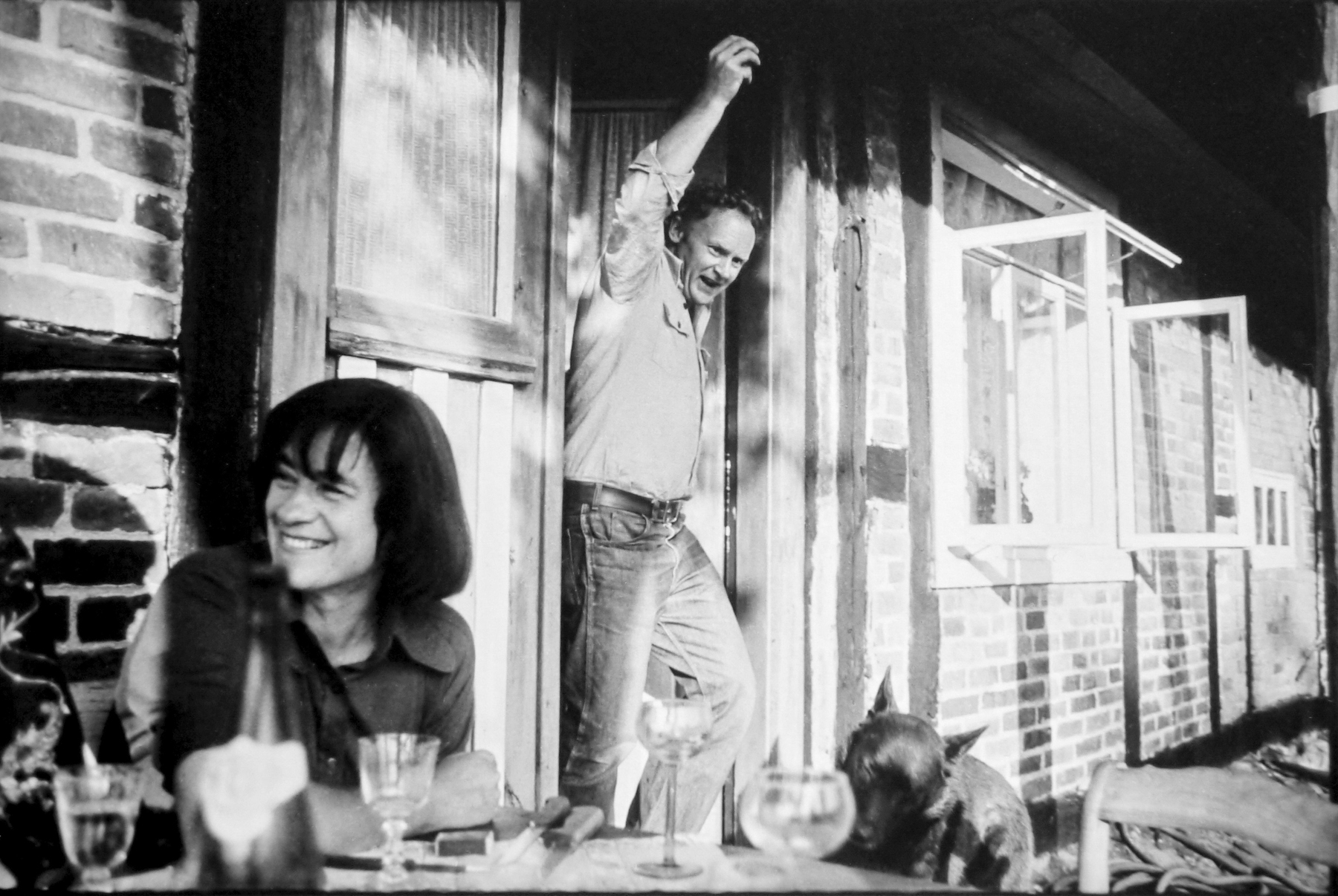
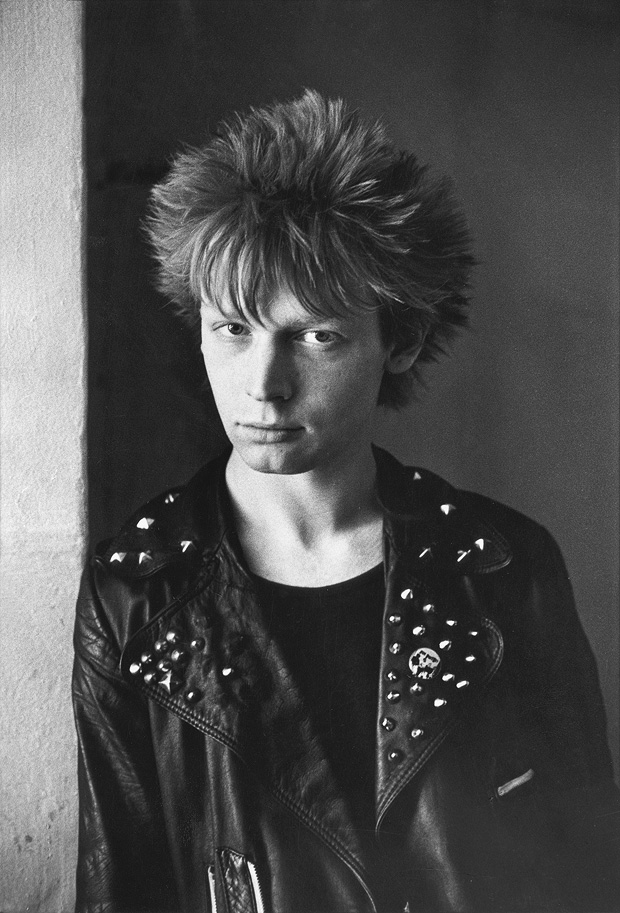
Heath was born in Philadelphia in 1931 and had a turbulent childhood, abandoned by his parents at the age of four and consigned to a series of foster homes before being placed in an orphanage. He first became interested in photography as a teenager, and joined an amateur camera club. He was fascinated by the photo essays in Life Magazine and cites one in particular as having a decisive impact on his future. Bad Boy’s Story by Ralph Crane, charted the emotional landscape of a young orphan. Not only did Heath identify with the protagonist, he immediately recognised the power of photography as a means of self expression and as a way of connecting to others. In the following years he trained himself in the craft, taking courses in commercial art, working in a photo processing lab, and studying paintings at the Philadelphia Museum of Art. While stationed in Korea with the US Army, he began to photograph his fellow soldiers, eschewing the drama of the battlefield for quiet and private moments of subdued reflection.
On his return, Heath dedicated himself to photography, continuing his interest with capturing an “inner landscape” and training his lens on anonymous strangers whom he identified as similarly lost or fragile. Although he photographed in mostly public spaces, on the streets of Chicago and New York (where he moved to in 1957), his subjects seem detached from their physical context, shot in close-up, articulated by their isolation. His frames possess an intensity of concentration, showing single figures or close-knit couples entirely wrapped up in their own world. An occasional sidelong glance conveys a momentary awareness of being photographed, but for the most part Heath is an unobserved, unobtrusive witness. By concentrating on the fragility of human connection, focusing on the personal over the political, Heath gave ‘voice’ to those largely unheard and joined a growing community of artists searching for alternative forms of expression. His work was pivotal in depicting the fractured feeling of societal unease just prior to the rise of the civil rights movement and opposition to the Vietnam War and his ground-breaking approaches to narrative and image sequence, his exquisite printing techniques, handmade book maquettes, multimedia slide presentations culminated in his poetic masterwork, A Dialogue with Solitude, 1965. This sensitive exploration of loss, pain, love and hope reveals Heath as one the most original photographers of those decades.
After 1970, Dave Heath devoted much of his time to teaching (in particular at Ryerson University, Toronto) in Canada, where he later became a citizen. He died in 2016.
Press release from The Photographers’ Gallery website [Online] Cited 25/05/2019
There’s something consistently awesome about Mexican photography that is so grounded, so essential, and yet at the same time so spiritual.
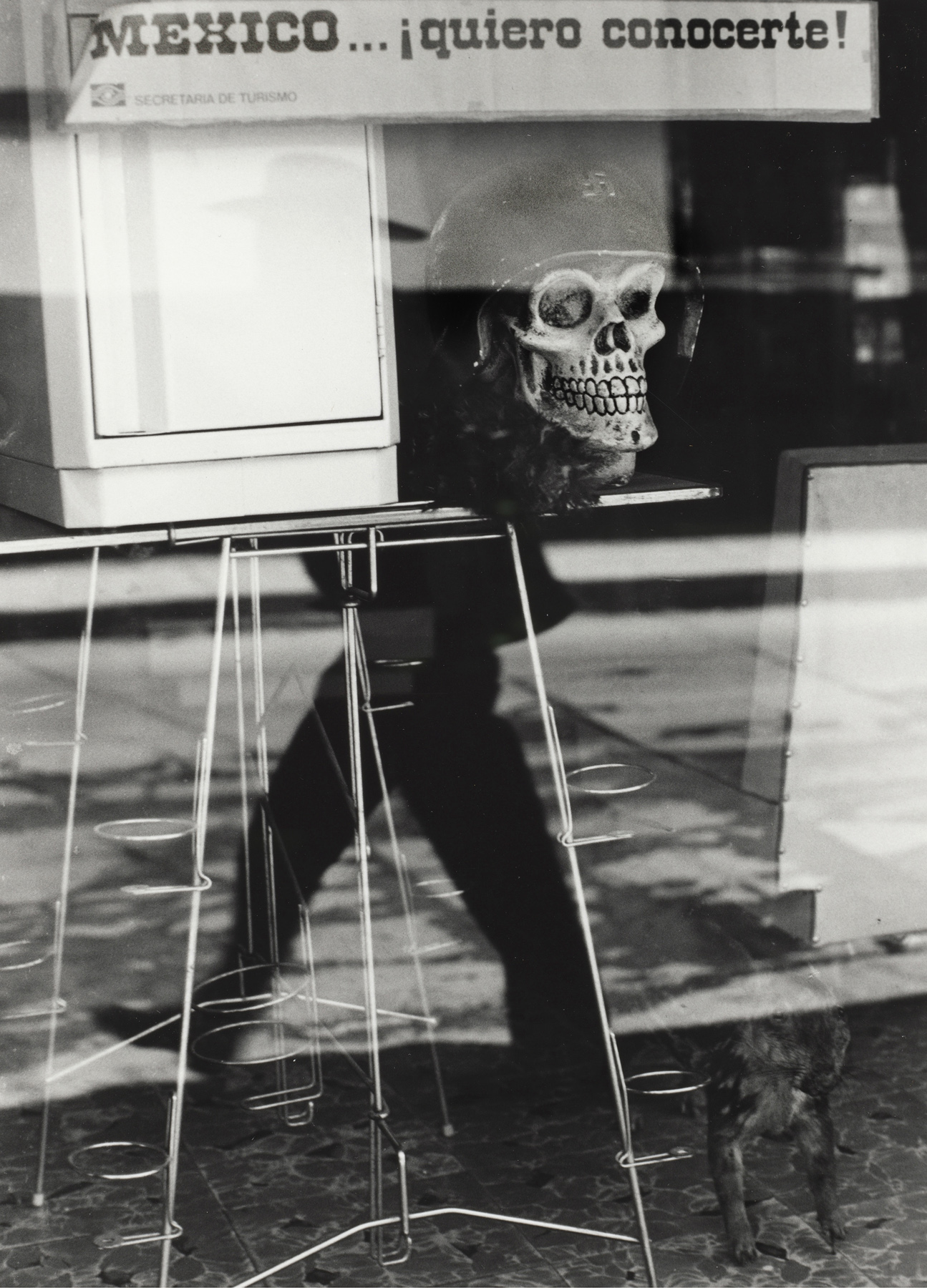
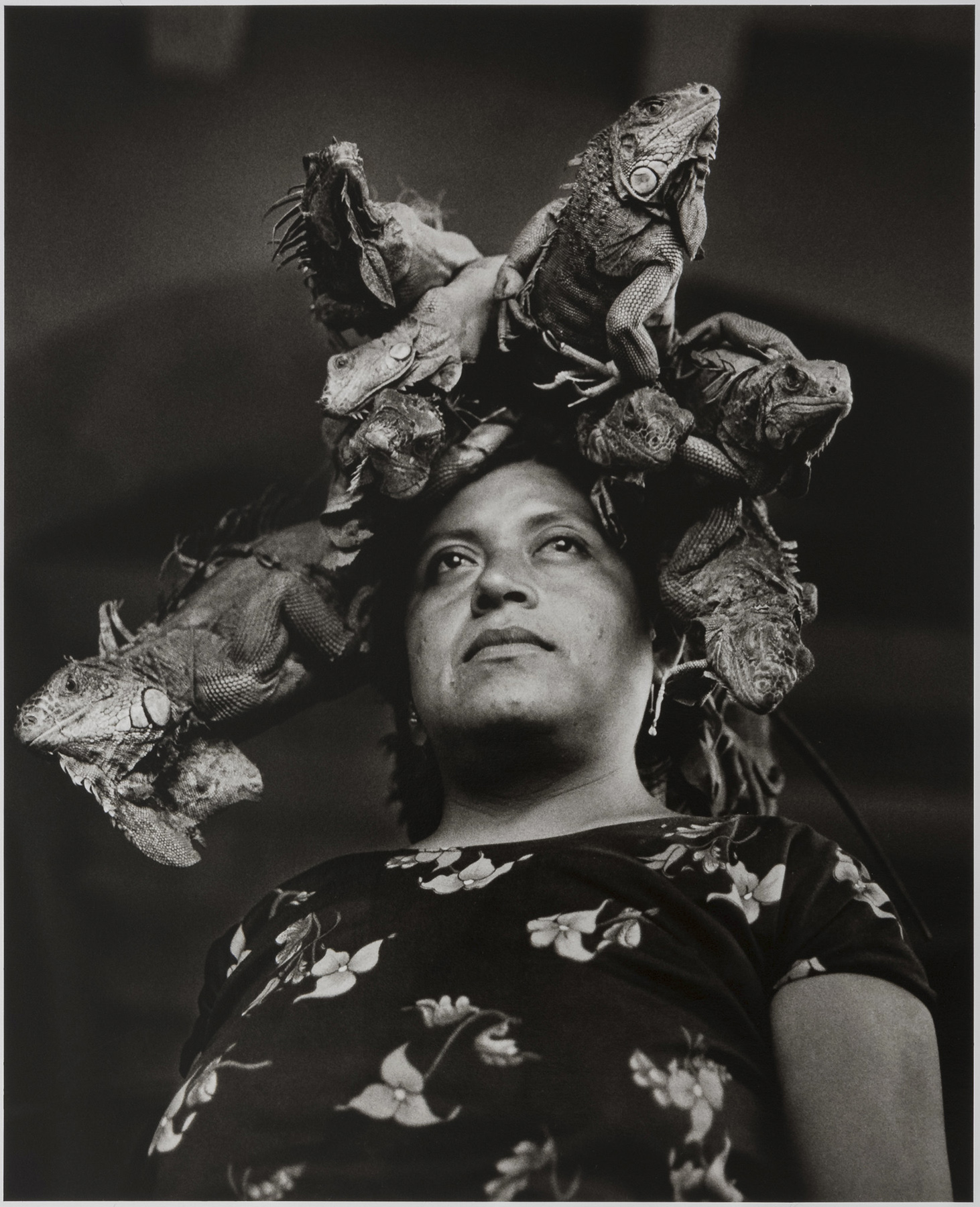
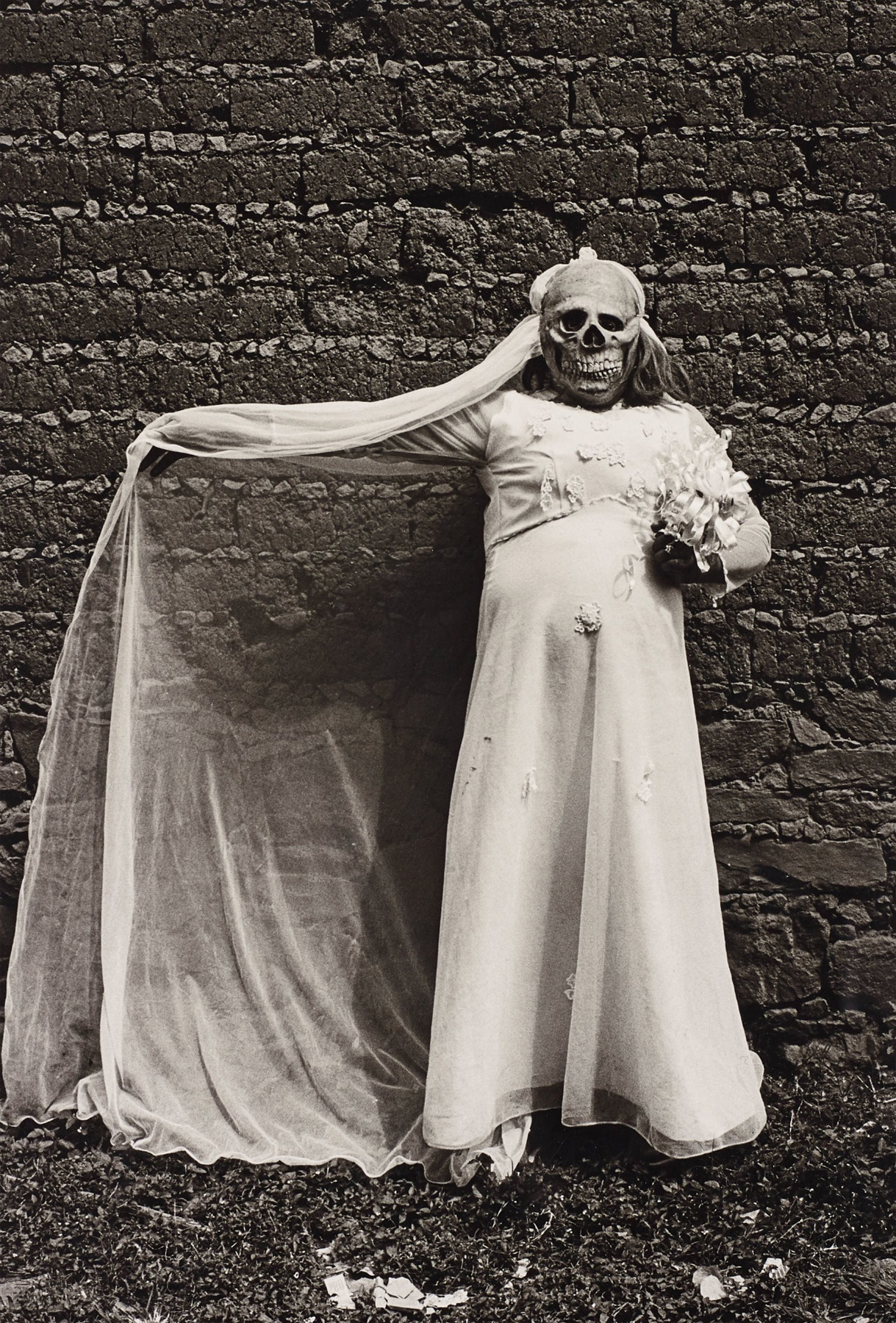
One of my favourite photographic artists of all time is Manuel Alvarez Bravo, he of the lyrical narrative, the sensual body, the assassinated worker. Iturbide seems to be cut from the same cloth – she was his assistant for two years; he her teacher about photography and life – and his influence is telling in Iturbide’s imaginative and sometimes incongruous images, such as the skull in Mexico… I want to get to know you! (1975, below) or Our Lady of the Iguanas, Juchitán, Mexico (1979, below).
Life, death, violence, sacrifice, beauty, identity and place, mixed with daubs of Surrealism, are constant themes of Mexican photography and this symbology can be seen in Iturbide’s unusual urban geometries and her eye for the unexpected. She is a visionary ethnographer who paints in black and white a story of magical literary realism… seeing through her camera something different than she sees with her eyes directly. She sees, and then feels, a different world.
Octavio Paz, the great Mexican poet, writing about the great Mexican photographer Manuel Alvarez Bravo, said that, “Reality exists, but it is more real in black and white.” And so here. Iturbide feels that black and white is more real than colour – and that reality is in black and white. It is in this tonal space that Graciela Iturbide’s Mexico pictures a place of beauty and contradiction, a place of transformations and interstitial spaces (intermediate, indeterminate spaces), an amalgamation of Indigenous and Spanish traditions. “I always shoot what surprises me,” she says. “My eyes see them, and my heart shoots them.”
Gracia Graciela, oh Graceful Beauty, for your gift to us.
Dr Marcus Bunyan
Many thankx to the Museum of Fine Arts Boston for allowing me to publish the photographs in the posting. Please click on the photographs for a larger version of the image.
“Photography is also like life, right? … I think in my case, taking photos as therapy has a lot to do with death with everything I do, with Frida Kahlo, because I like to photograph things in therapy, things that are healing, which is powerful, right?”
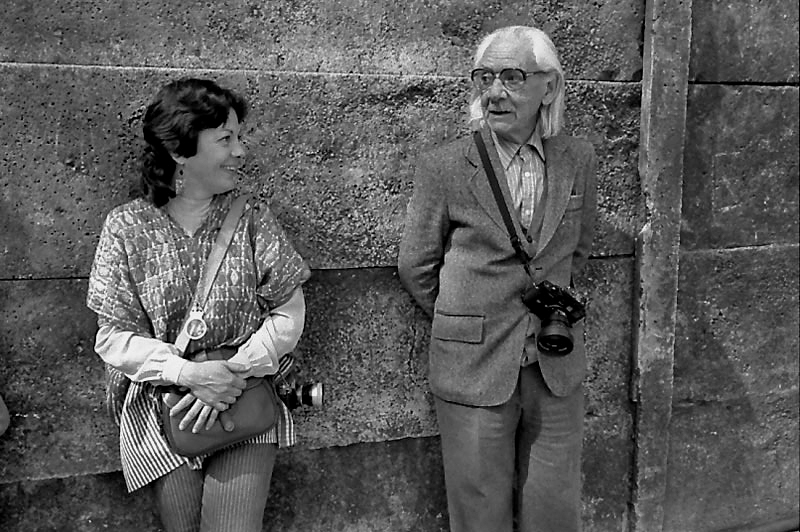
Pedro Meyer (Spanish, b. 1935) Manuel Álvarez Bravo and Graciela Iturbide, Coyoacán (Mexico) 1983 Gelatin silver print
When I went to study at the university he was teaching at the university as well and I attended one of his courses; that’s how I got to know him. Then, after a couple of weeks I became his assistant. At that time he was not that famous in Mexico, he was very famous in Europe and the United States. He was known in Mexico but he was not really a big star. So, what I really need to make clear is that he was not just a teacher of photography; he was a teacher about life for me. Because he taught me about everything, he talked about literature, cinematography… so he was more of a teacher of life… he never said this picture is good or this picture is bad, he would never say that flat out. Instead, he would always say something to guide you in the right direction. Yet he would never say, “This is good or this is bad”.
With Álvarez I went to certain little towns but I was only his assistant for two years. After that I made the decision to cut the umbilical cord and make my own way.
Extract from Munem Wasif. “An Interview with Graciela Iturbide,” on the Chobi Mela website, November 24, 2014 [Online] Cited 06/04/2019
The photographs of Graciela Iturbide not only bear witness to Mexican society but express an intense personal and poetic lyricism about her native country. One of the most influential photographers active in Latin America today, Iturbide captures everyday life and its cultures, rituals, and religions, while also raising questions about paradoxes and social injustice in Mexican society. Her photographs tell a visual story of Mexico since the late 1970s – a country in constant transition, defined by the coexistence of the historical and modern as a result of the culture’s rich amalgamation of cultures. For Iturbide, photography is a way of life and a way of seeing and understanding Mexico and its beauty, challenges, and contradictions.
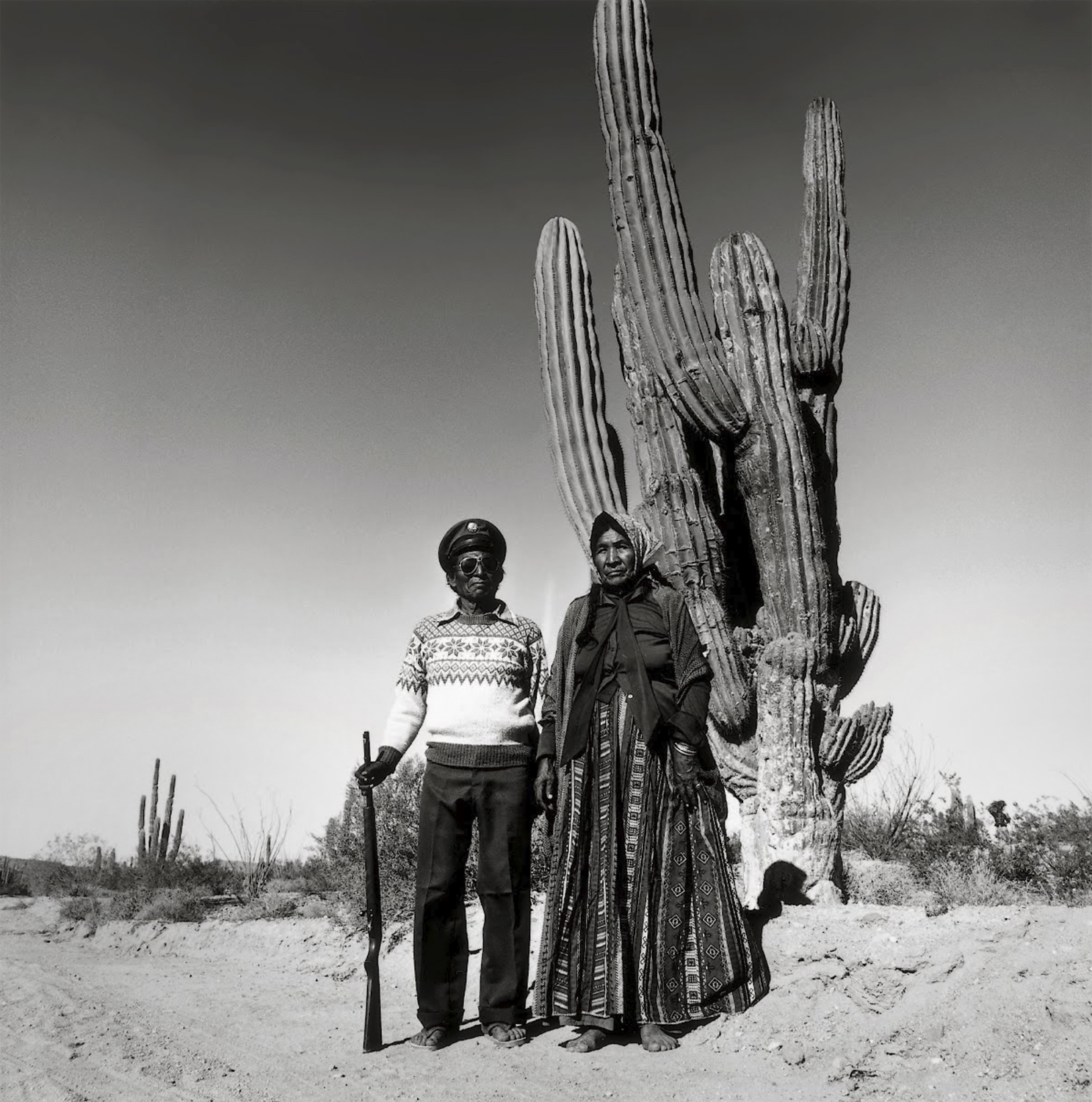
This is the first major East Coast presentation of Iturbide’s work, featuring approximately 125 photographs that span her five-decade-long career. Organised into nine sections, the exhibition opens with early photographs, followed by three series focused on three of Mexico’s many indigenous cultures: Juchitán captures the essential role of women in Zapotec culture; Los que viven en la arena (Those Who Live in the Sand) concentrates on the Seri people living in the Sonoran Desert; and La Mixteca documents elaborate goat-slaughtering rituals in Oaxaca, serving as critical commentary on the exploitation of workers. Thematic groupings highlight Iturbide’s explorations of various aspects of Mexican culture, including fiestas, death and mortality, and birds and their symbolism. Her more recent work is presented in two series related to Mexico’s cultural and artistic heritage, featuring plants – mainly cacti – in “intensive care” at the Oaxaca Ethnobotanical Gardens, as well as El baño de Frida (Frida’s Bathroom), depicting personal belongings in Frida Kahlo’s bathroom at the Casa Azul that had been locked away for 50 years after the artist’s death.
Iturbide’s powerful and provocative photographs are anti-picturesque, anti-folkloric. Her work embodies her empathetic approach to photography and her deep connection with her subjects, asking questions through its capacity for imaginary associations. Drawn primarily from Iturbide’s own collection, “Graciela Iturbide’s Mexico” also includes the Museum’s recent acquisition of 37 works by the artist, as well as loans from museums and private collections throughout the US and Mexico. The exhibition is accompanied by an illustrated catalogue produced by MFA Publications.
Text from the Museum of Fine Arts, Boston website [Online] Cited 05/04/2019
Nearly 140 Images in Graciela Iturbide’s Mexico Portray Photographer’s Native Country through Her Eyes
Throughout a five-decade-long career, photographer Graciela Iturbide (born 1942) has focused on capturing and understanding the beauty, rituals, challenges and contradictions of her native Mexico. Graciela Iturbide’s Mexico is the first major East Coast presentation of the artist’s work, featuring nearly 140 photographs that tell the visual story of her country since the late 1970s. Going beyond documentary photography, Iturbide’s work reveals Mexico’s complexities through her personal explorations. Focused on the tensions between urban and rural life, human presence and nature, and indigenous and Spanish cultures, her photographs have contributed to Mexico’s visual identity while calling attention to the rich syncretism, diversity and inequalities of Mexican society. The exhibition is drawn primarily from Iturbide’s own collection and also highlights a recent acquisition of her photographs, the first major group of works by the artist to enter the Museum’s collection – 35 purchased by the MFA and two donated by Iturbide. Loans from museums and private collections throughout the U.S., Mexico and France are also included. On view from January 19 through May 12, 2019 in the Henry and Lois Foster Gallery, the exhibition features interpretation in English and Spanish, as well as a documentary video of the artist, produced by the Museum and shot at Iturbide’s studio in Mexico City. Graciela Iturbide’s Mexico is accompanied by an illustrated catalogue produced by MFA Publications, which features more than 100 striking tritone reproductions of evocative photographs alongside essays that invite readers to share in Iturbide’s personal artistic journey. This beautiful volume with a three-piece cloth and printed binding with foil stamping teases out key ideas and visual relationships across different moments in the photographer’s storied career. The exhibition is supported by the Leigh and Stephen Braude Fund for Latin American Art, The Bruce and Laura Monrad Fund for Exhibitions, and the Diane Krane Family and Jonathan and Gina Krane Family Fund. Generous support for the publication was provided by the Andrew W. Mellon Publications Fund.
“I am thrilled to present Graciela’s groundbreaking images to our global audiences, and it has been a pleasure and honour to work closely with her in preparation for this exhibition,” said Kristen Gresh, Estrellita and Yousuf Karsh Curator of Photographs. “Her work has successfully and beautifully brought to the forefront the many untold stories of Mexican culture and history – from the eyes of an insider.”
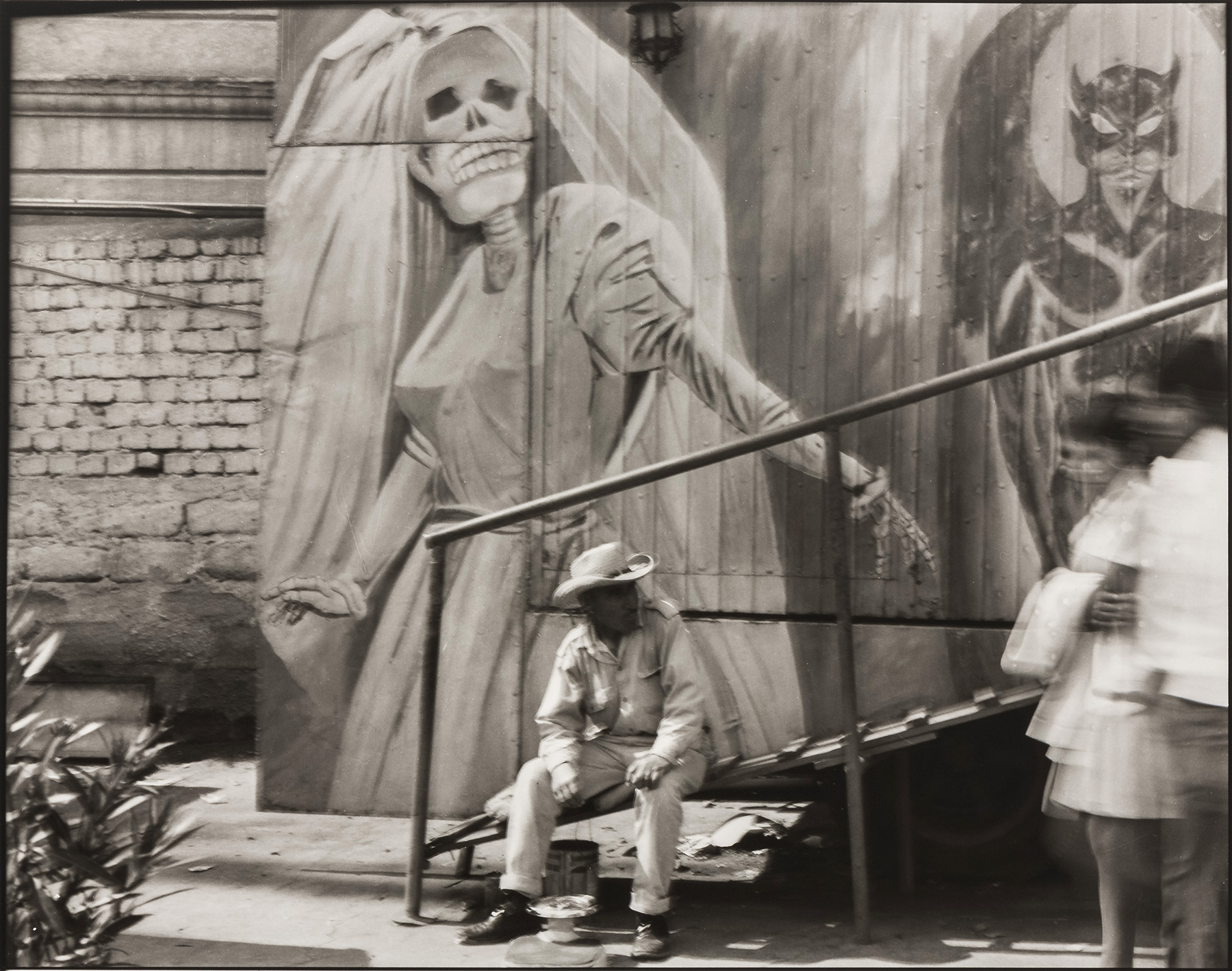
The exhibition is organised thematically into nine sections and opens with early photographs. One of her first works, Zihuatanejo, México (1969, Collection of Les and Sandy Nanberg), is a pensive portrait of a young girl that marks the beginning of Iturbide’s forays into photographing the diverse peoples of Mexico. Shot during the same year, Mexico City (1969, Collection of Daniel Greenberg and Susan Steinhauser) portrays a sex worker in what appears to be a cantina or pulquería. In fact, the subject is a figure in a wax museum. The photograph’s graphic background – a mural of a large skull painted on a wall – alludes to both Mexico’s long history of muralism and the country’s fascination with death. Works such as Little Bull / Torito (1982, Collection of Galeria Lopez Quiroga) and Juchitán (1975, MFA) reveal Iturbide’s attraction to unusual urban geometries and her eye for the unexpected. Together, these early images attest to the photographer’s keen observation of Mexican contemporary culture in the 1970s and early 1980s.
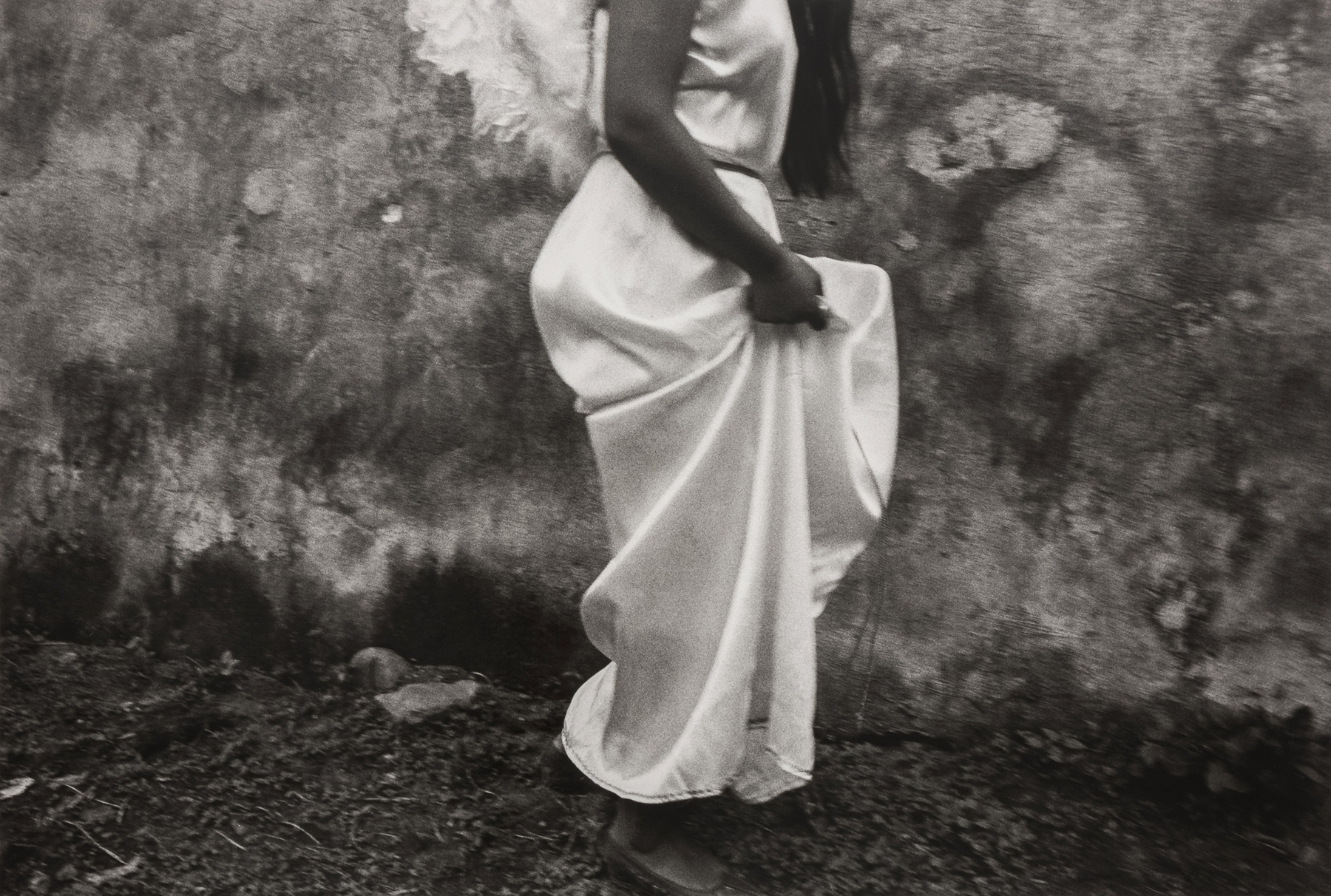
The next three sections of the exhibition focus on Iturbide’s deep commitment to photographing different populations throughout Mexico. One of her early projects was to document the way of life of the Seri Indians, a formerly nomadic group of fisherfolk living in the Sonoran Desert in northwestern Mexico. In 1978, Iturbide and anthropologist Luis Barjau immersed themselves within the community, staying for a month and a half on their first trip and another month on the second. The result of their collaboration was the 1981 book Los que viven en la arena ( Those Who Live in the Sand) and a selection of additional photographs that Iturbide printed and exhibited years later. The exhibition features two prints of one of Iturbide’s most well-known works, Angel Woman / Mujer ángel (1979, Collection of Elizabeth and Michael Marcus and Collection of Galeria Lopez Quiroga ), an ethereal image that captures a woman in traditional dress carrying a boom box as she heads down to the empty desert plain. The photograph exemplifies a theme running through the series: the impact of capitalism on the Seri people’s otherwise minimalist culture. This early project confirmed Iturbide’s interests in working thematically, raising her awareness of Mexico’s diversity and building close relationships with her subjects.
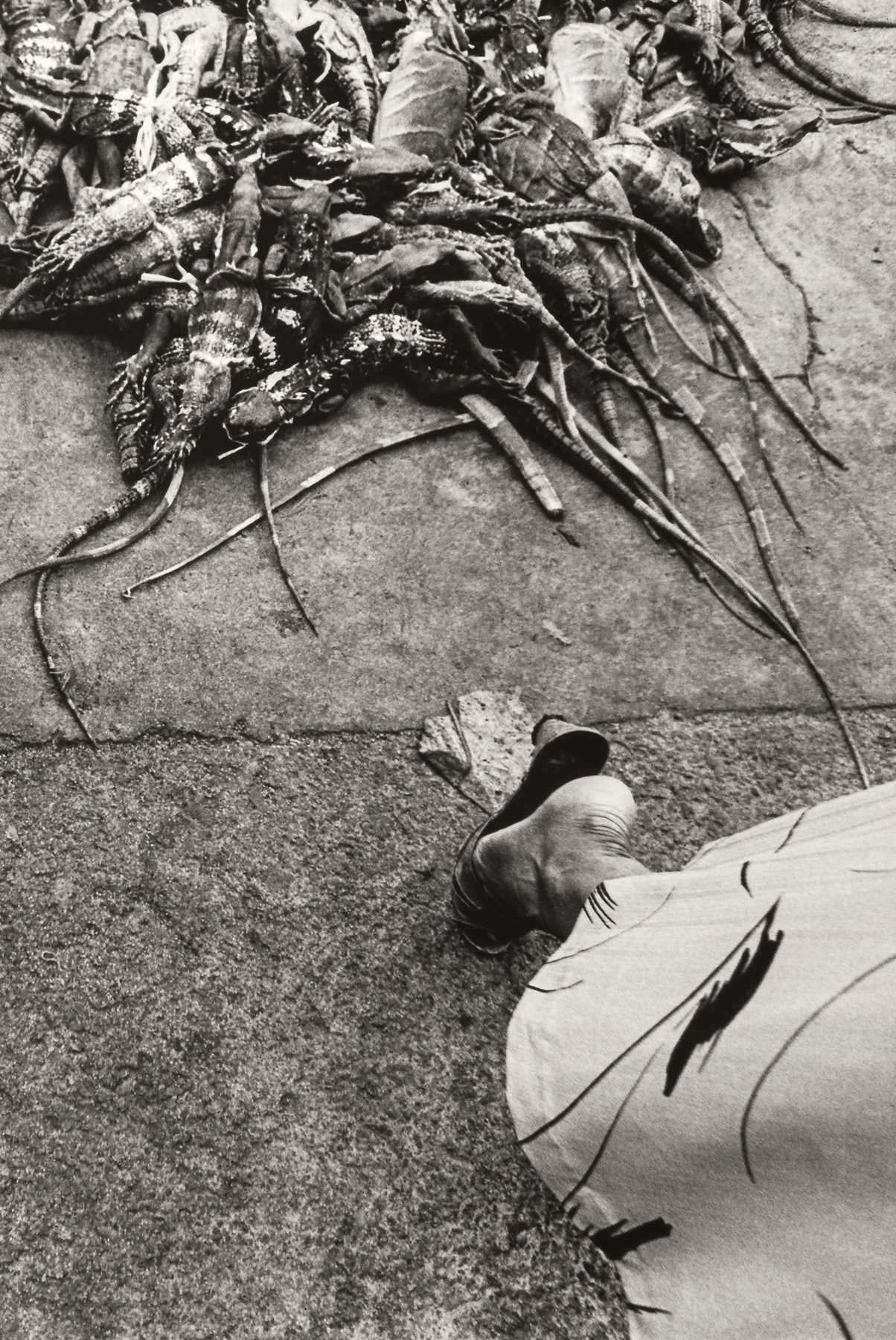
Over the course of a decade beginning in 1979, Iturbide traveled regularly to Juchitán, a city in southern Oaxaca. Juchitán is home to the Zapotec culture, in which women are known for their economic, political and sexual independence. Iturbide’s iconic photograph Our Lady of the Iguanas / Nuestra Señora de las Iguanas (1979, Brooklyn Museum) portrays a woman, Zobeida Diaz, wearing a wreath of iguanas on her head as she makes her way to sell them at the market. The iguana has historical importance in Zapotec society, both as a gastronomic delicacy and as an animal believed to have healing properties. Our Lady of the Iguanas, reproduced today on everything from municipal offices to highway signs and murals, has become a symbol for the community of Juchitán and for Zapotec womanhood. Original contact sheets displayed alongside the photograph show a cinematic sequence of Diaz interacting with Iturbide as she poses for the camera. She appears to be overtaken by laughter at certain points – an indication of the artist’s empathetic way of connecting with her subjects. Yellow grease-pencil marks also reveal Iturbide’s working method and creative process, highlighting the image she had chosen to print and how she envisioned cropping it. In her final selection, the iguanas themselves appear to be posing for the camera – an idea that corresponds to Iturbide’s search for the unexpected and the symbolic.
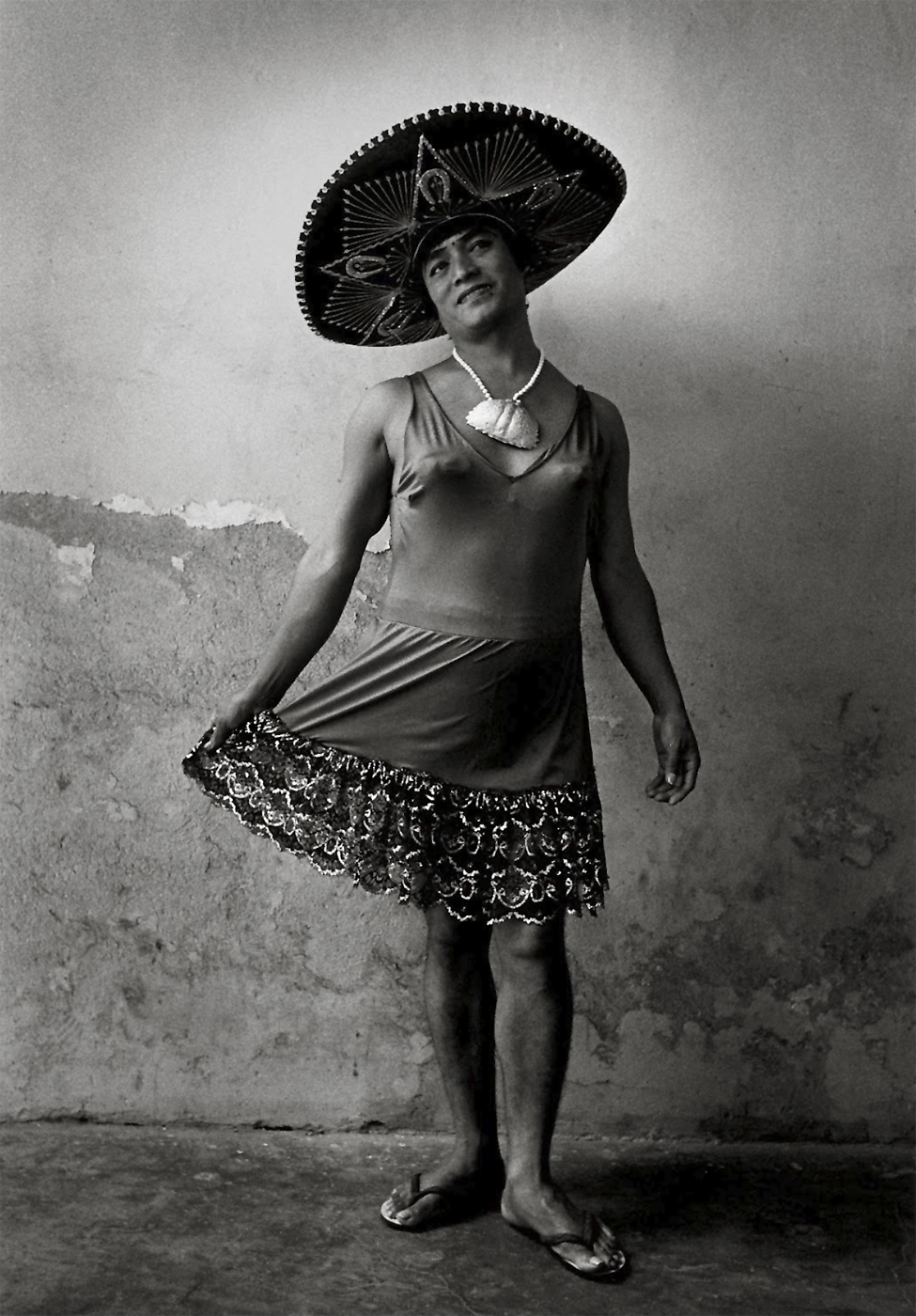
In addition to highlighting the importance of women in Juchitán, Iturbide also captured the society’s openness to muxes – men who dress as women, sometimes referred to as a Zapotec third gender. Her photographs of a muxe named Magnolia – Magnolia with Mirror / Magnolia con espejo (1986, J. Paul Getty Museum) and Magnolia with Sombrero / Magnolia con sombrero (1986, MFA) – demonstrate her ability to connect intimately with the community. Immersing herself in Zapotec culture, Iturbide also recorded the enduring legacy of native traditions – from an annual two-day festival and pilgrimage celebrating an alligator deity to el rapto, a premarital ritual practiced by those in lower and middle classes. Her strong and poetic images of Juchitán not only gained her international recognition, but also became a point of departure for a new vision of Juchitec society that has since been integrated into Mexico’s identity.
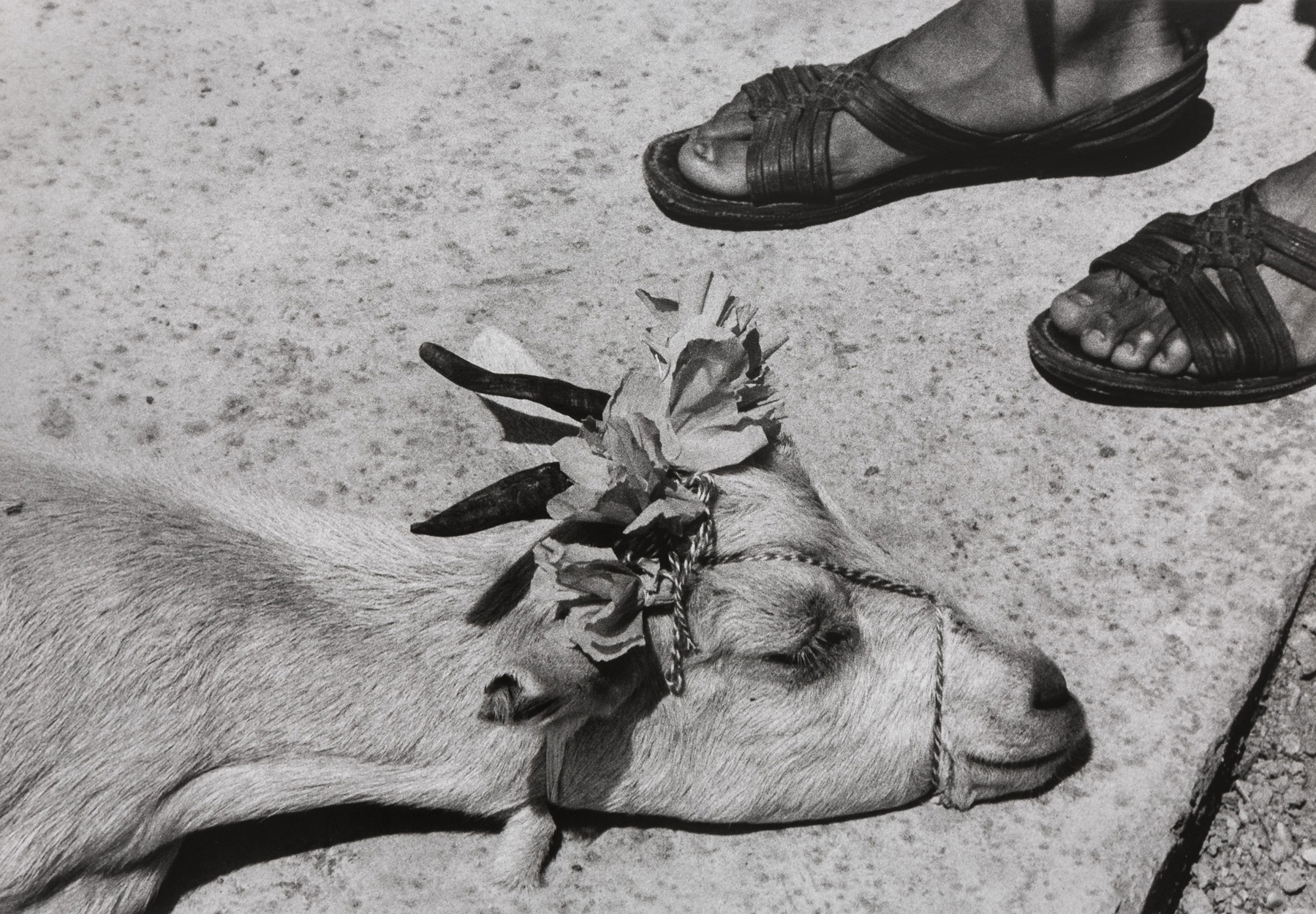
Following the Juchitán section are Iturbide’s photographs of the annual goat-slaughtering ritual in the Oaxacan region of La Mixteca, in south-central Mexico. The tradition dates back to colonial times, when Spanish landowners contracted Mixtec workers to butcher animals for sale, and carries on today. Tens of thousands of goats are killed during the month-long festival, which involves ritualistic aspects such as saving a lone animal every year as an act of repentance before the slaughter. Iturbide’s photographs from this series also highlight the exploitation of workers in one of Mexico’s poorest regions, who have created a ritual out of their harsh working conditions as a way of coping with the violence and pain. This experience had a tremendous impact on Iturbide, marking a personal turning point. Her wrenching experience in La Mixteca became the last time she spent extended amounts of time with an indigenous community.
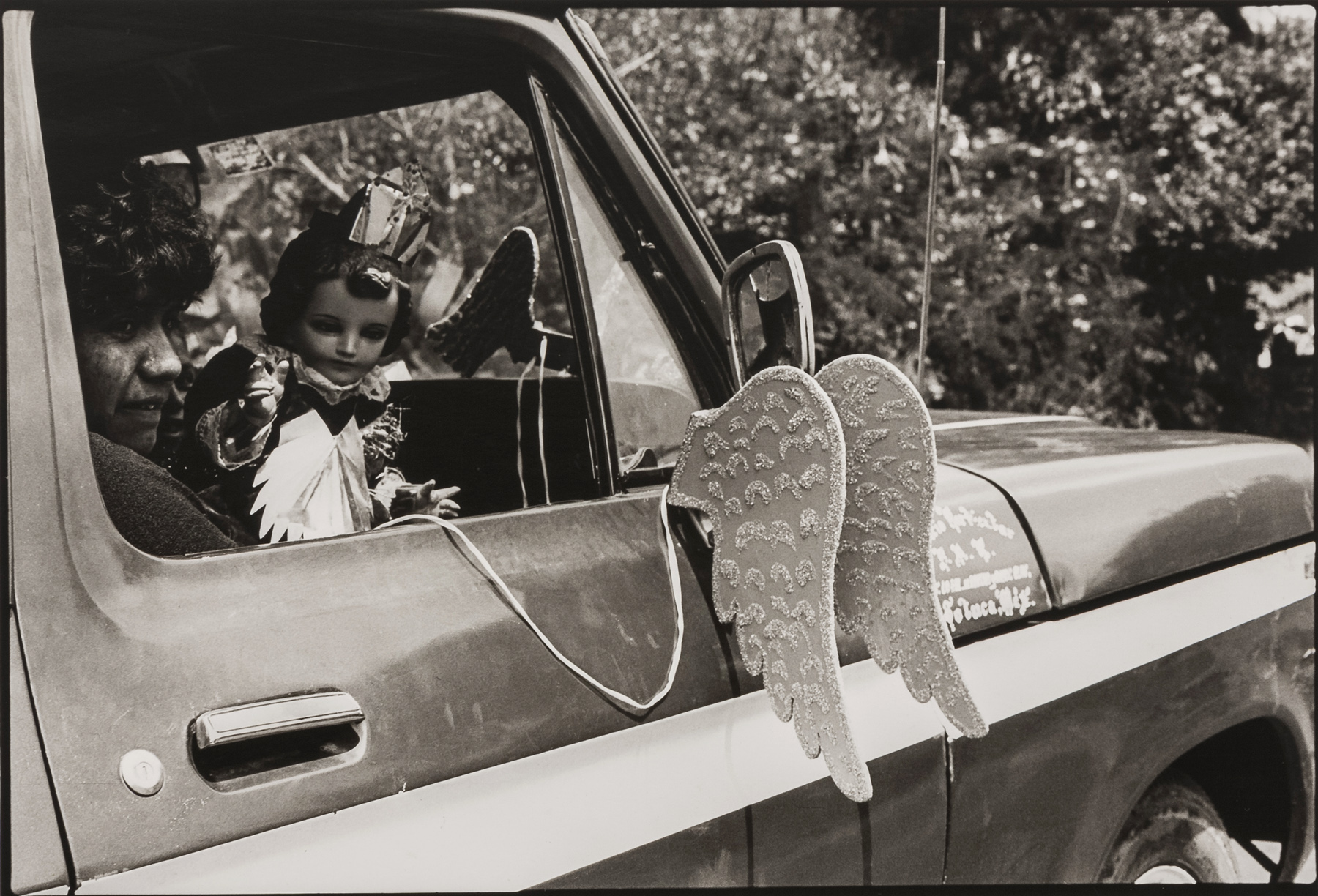
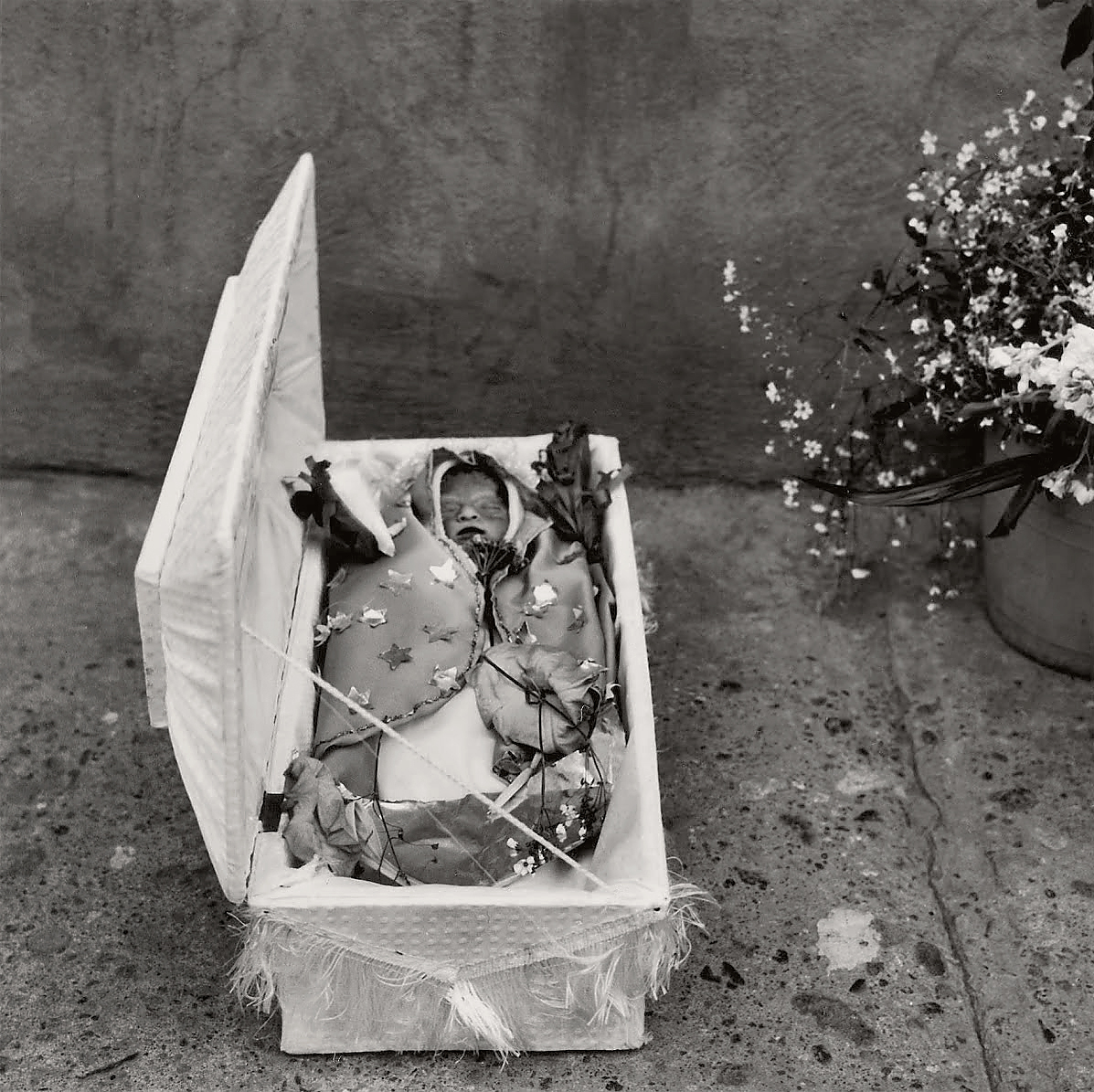
The next three sections focus on themes that recur throughout Iturbide’s oeuvre: fiestas, death and birds. Since the mid-1970s, Iturbide has traveled throughout the country, including Chalma, Oaxaca and Tlaxcala, to observe and record a variety of fiestas – lavish and visually stimulating celebrations, which often include elaborate costumes or disguises. Death is another dominant element of Mexican culture, and Iturbide’s photographs related to the subject reflect both a personal experience and larger cultural manifestations. Her works range from depictions of signs of mortality in everyday life, as seen in the early photograph Mexico… I want to get to know you! / México… Quiero Conocerte! (1975, MFA), to representations of surreal-like funerary rituals and celebrations like the annual Día de los Muertos (Day of the Dead). Iturbide’s fascination with birds is intimately linked to her own emotional journey toward overcoming a personal loss. Her photographs of the subject – ranging from spectacular and sublime skies full of birds to close-up portraits of birds in trees and even self-portraits with birds – show her interest in the rites and cycles of the natural world, while also evoking the spiritual world.
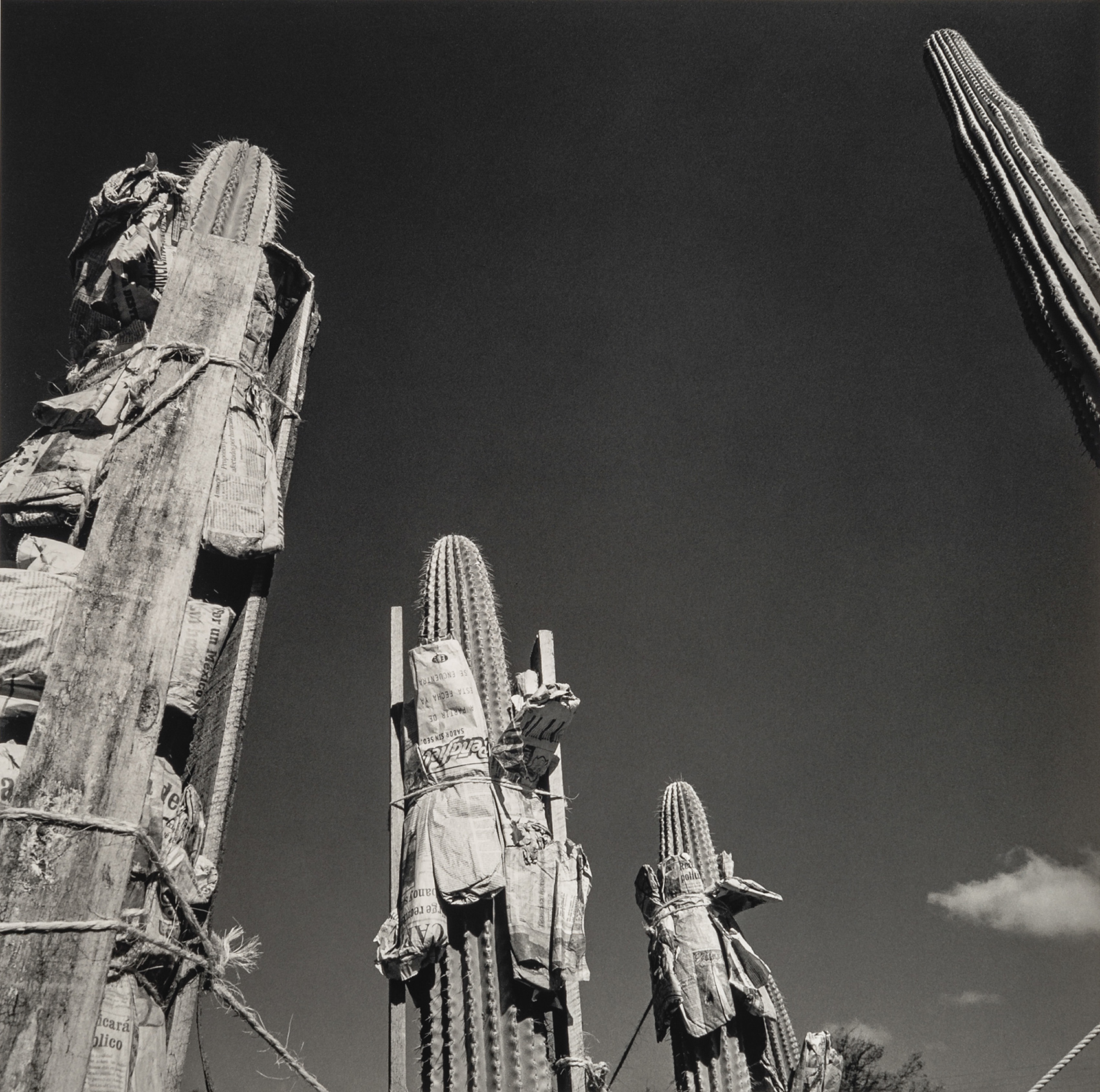
In 1998, Iturbide was invited by Francisco Toledo to photograph the newly opened Ethnobotanical Garden of Oaxaca. By design, the garden tells the story of the relationship between the people of Oaxaca and their native plants, which are arranged by ecological and cultural themes. The next section of the exhibition presents these photographs, particularly of cacti undergoing therapeutic treatment. The images, published in her 2004 book Naturata, reflect the caretaking aspect of the garden. A startling view of the tops of several columnar cacti in Botanical Garden / Jardín Botánico (1998-1999) shows them with bundles of newspaper padding and wooden boards as splints, all bound around the plants with rope. In another photograph, Botanical Garden / Jardín Botánico (2002) a thorny treelike plant receives an intravenous treatment as two bags of a cream-coloured liquid drip into lines connected to its limbs.
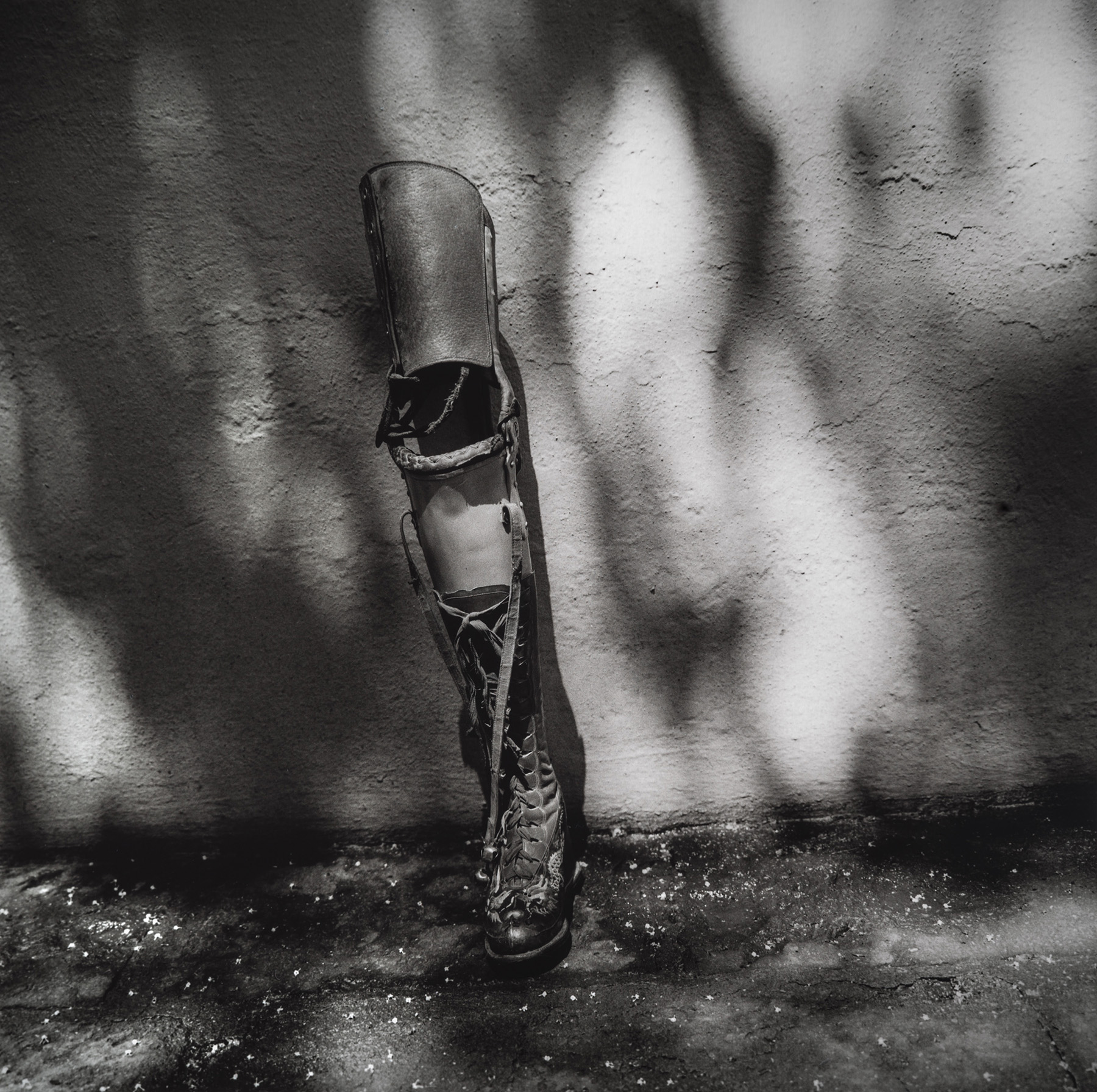
The final section features the most recent series in the exhibition, El baño de Frida (Frida’s Bathroom), which will be on view from February 27, 2019 through June 16, 2019 in the Museum’s Art of the Americas Wing, alongside another MFA exhibition, Frida Kahlo and Arte Popular. In 2005, Iturbide was commissioned to photograph personal belongings in Frida Kahlo’s bathroom at the Casa Azul, which had been locked away for 50 years following the artist’s death. Iturbide’s stark images provide an emotional narrative about the intimate space within the “Blue House,” where Kahlo was born and died, and the mystery of the objects. Iturbide’s photographs focus primarily on objects related to Kahlo’s pain – from a box of Demerol, an opioid pain medication, to a prosthetic leg. In one photograph, a hospital gown – stained by blood or paint – hangs ominously against the tiled wall, serving as a reminder of Kahlo’s many operations. In another, a self-portrait that depicts Iturbide’s bare feet in Kahlo’s bathtub, the photographer puts herself in the artist’s place and evokes one of Kahlo’s famous paintings, What the Water Gave Me (1938). Iturbide’s images reveal a side of Kahlo that is dramatically different from the colourful magical realist portrayed by her clothes and paintings. In photographing Kahlo’s private space, Iturbide grapples not only with the cultural and symbolic legacy of the painter, but with her own legacy as well. The series reveals a silent dialogue between the two women, two artists of Mexico, who have seen their art as a form of therapy and escape from everyday life.
About Graciela Iturbide
Iturbide was born in 1942 in Mexico City. In 1969, at the age of 27, she enrolled at the film school Centro de Estudios Cinematográficos at the Universidad Nacional Autónoma de México to become a film director. However, she was soon drawn to the art of still photography as practiced by the Mexican modernist master Manuel Álvarez Bravo, who was teaching at the University. From 1970 to 1971 she worked as Bravo’s assistant, accompanying him on various photographic journeys throughout Mexico. In the early half of the 1970s, Iturbide traveled widely across Latin America – in particular to Cuba and Panama. In 1978, she was commissioned by the Ethnographic Archive of the National Indigenous Institute of Mexico to photograph Mexico’s indigenous population. Iturbide decided to document and record the way of life of the Seri people along the country’s border with Arizona. In 1979, she was invited by the artist Francisco Toledo to photograph the Juchitán people who form part of the Zapotec culture native to Oaxaca in southern Mexico. This series resulted in the publication of her book Juchitán de las Mujeres in 1989. Between 1980 and 2000, Iturbide was invited to work in Cuba, Germany, India, Madagascar, Hungary, France and the U.S., producing a number of important projects. She has enjoyed solo exhibitions at the Centre Pompidou (1982), San Francisco Museum of Modern Art (1990), J. Paul Getty Museum (2007), MAPFRE Foudation, Madrid (2009), Photography Museum Winterthur (2009) and Barbican Art Gallery (2012), among others. Iturbide is the recipient of the W. Eugene Smith Memorial Foundation Award (1987); the Grand Prize Mois de la Photo, Paris (1988); a Guggenheim Fellowship for the project Fiesta y Muerte (1988); the Hugo Erfurth Award, Leverkusen, Germany (1989); the International Grand Prize, Hokkaido, Japan (1990); the Rencontres Internationales de la Photographie Award, Arles (1991); the Hasselblad Award (2008); the National Prize of Sciences and Arts in Mexico City (2008); an Honorary Degree in photography from Columbia College Chicago (2008); and an Honorary Doctorate of Arts from the San Francisco Art Institute (2009).
Press release from the Museum of Fine Arts, Boston website [Online] Cited 05/04/2019
“For her, the camera is an instrument of sharing, making visible what, to many, is invisible,” Ms. Gresh said. Ms. Iturbide’s photos, she added, provide “a poetic vision of contemporary culture informed by a sense of life’s surprises and mysteries.”
“The dark ballast of Iturbide’s photography is a deep knowledge of predation: how humans prey on animals; how multinational corporations subsume developing economies; how modern industry exploits a largely indigenous underclass; how artists wrangle life from their subjects in the name of creation. In one haunting early photograph, a young Cuna woman walks through an open field in Panama, Pepsi-Cola’s logo embroidered on her shirt. The pernicious creep of capitalism, yes, but also its corollary: a vivid reminder that indigenous people, often relegated to an imagined antiquity, are full participants in contemporary life. …
In 1979, the painter Francisco Toledo invited Iturbide to visit his native Juchitán, in southeastern Oaxaca, a town known for its fierce independence and long-standing leftist sympathies. She returned frequently over the next decade, chronicling the public and private life of its largely Zapotec population. As a perpetual guest, Iturbide became a master of the threshold, of doorways and frames, storefront windows and cemeteries, masks and carnival, of the moments preceding and following transformation. …
Contact sheets enclosed in glass vitrines accompany select images, often annotated with grease pencil. According to Iturbide, there are – pace Cartier-Bresson – two “decisive moments” in photography: “One, when you take the photo; and two, when you discover it in the contact sheet, because you often think you took one photo, and another comes out.” In the sheet for Magnolia with Mirror (1986, above), a livewire thread of intimacy is palpable in the sense of giddy experimentation between artist and subject. In the proofs for Our Lady of the Iguanas, Zobeida Díaz shakes the hand of a passerby, adjusts her crown of iguanas, suppresses laughter. The sheets underscore the contingency and providence of any image’s origins, how a slightly upturned lip or shifted frame catapults one into the pantheon while another slips into obscurity.”
Extract from Christopher Alessandrini. “Graciela Iturbide, Visionary Ethnographer,” on The New York Review of Books website [Online] Cited 06/04/2019
Iturbide studied photography at universities in Mexico, where she met her mentor, the teacher, cinematographer, and photographer Manuel Álvarez Bravo. Inspired by Bravo, she developed her particular interest in the daily life of Mexico’s indigenous cultures. Iturbide has photographed things and people found in Mexico City, in her native Juchitán, in Oaxaca, and on the Mexico-U.S. border. Her camera lens often traces Mexico’s rich life of religion and rituals. Torito represents an assemblage of a bicycle frame and a cow’s skull and horn, found in Mexico City, and shows the photographer’s exploration of the relationship between the individual and the broader culture.
Museum of Fine Arts, Boston Avenue of the Arts 465 Huntington Avenue Boston, Massachusetts
Where Do We Come From / What Are We / Where Are We Going
I went to see one of my best friends for the last time in hospital today.
Joyce Evans has been like a surrogate mother to me for the last eight years. She has been wise counsel, friend, support, teacher, reconciler, adventurer and philosopher to this sometimes lost man. We had many adventures to exhibitions and openings, to our favourite restaurant Caffe e Cucina to have dinner, or going to see “Our Julia”, an exhibition of her favourite photographer Julia Margaret Cameron at the Art Gallery of New South Wales in Sydney. It is so sad in this life that we have to loose the wisdom of age only for the mistakes of past generations to be repeated over and over again.
Both Joyce and I do not believe in traditional, dogmatic religion. Both of us cannot stand the hypocrisy, baloney and proselytising that religion undertakes in the name of an “imaginary friend.” Religion is a crutch for the dogmatic who then impose their beliefs, and discrimination, on others.
But we both believe in spirit, that ineffable quality of experience where you obtain communion with the energy of the cosmos. A feeling, an emotional energy of connection to body, spirit and soul. Something noumenal, something that we have knowledge of, but that we can’t completely describe.
Strip away the baggage of religion from these photographs and you are left with a man being tortured and his spirit suffering. I wonder what this man was like when he was a baby? Who did he talk to growing up, what did he say, who did he meet. What was his essential journey to get to this place? Imagine Pontius Pilate not washing his hands of him, but sitting down with him and having a philosophical discussion on the nature of existence and being.
I felt immense love and sadness, hope and sorrow when I saw Joyce for the last time on this earth. I wished her a good journey and told her that I would see her soon.
I will miss her strength, intelligence, and beautiful spirit. But above all I will miss her love.
Dr Marcus Bunyan
These photographs are used under fair use conditions for the purpose of education and research. Please click on the photographs for a larger version of the image.
If we can find out what we are… that is the artist.
And then, this goes to the core element of your being:
If the core part of your life is the search for the truth then that becomes a core part of your identity for the rest of your life,
and the core element of your enquiry remains the same.
It becomes embedded in your soul.
Joyce Evans
Father forgive them they know not what they do
Today thou shalt be with me in Paradise
Woman behold thy son: Son thy mother
My God my God why hast thou forsaken me
I thirst
Into thy hands I commend my spirit
It is finished
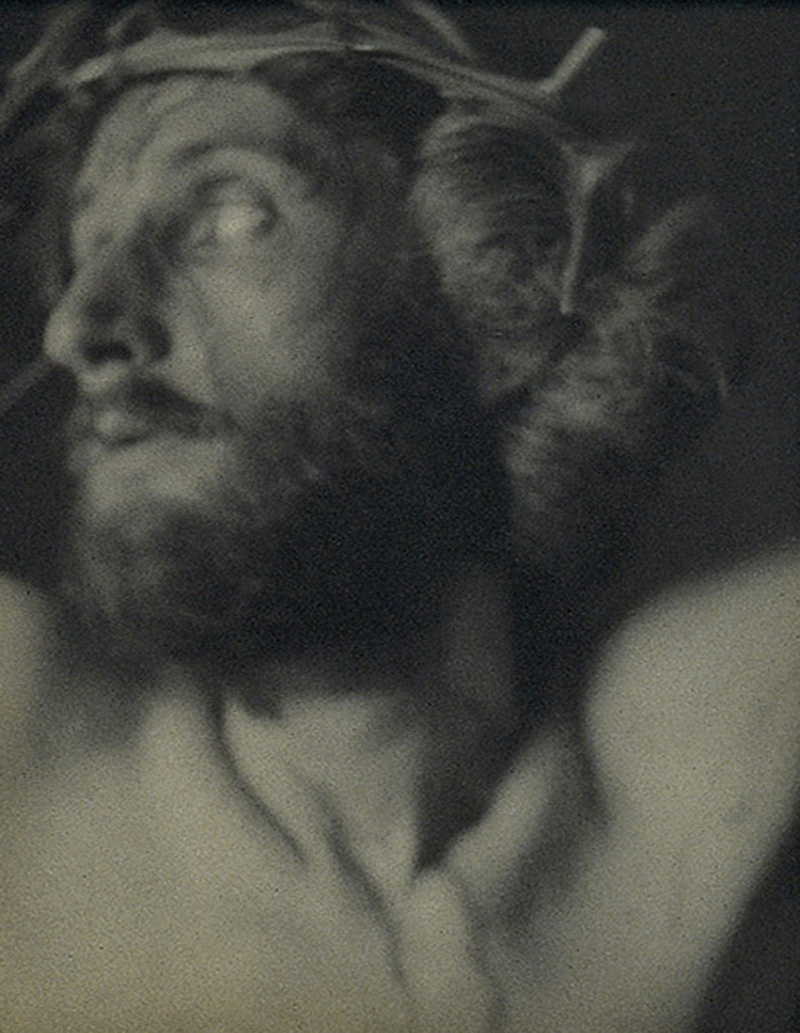
From 1895 to 1898 Day undertook a project that was without precedent: an extended series – some 250 negatives – showing scenes of the life of Christ, from the Annunciation to the Resurrection, in which he played the title role. In 1890 Day had traveled to Oberammergau to see the famous once-a-decade Passion Plays and may well have seen a similar multimedia presentation that toured the East Coast, including Boston, later in the 1890s. For his own production, Day starved himself, let his beard grow long, and imported cloth and a cross from Syria. Just prior to the reenacted Crucifixion, he made this series of close-up self-portraits – the most powerful images in his entire series – which represent Christ’s seven last words:
FATHER FORGIVE THEM; THEY KNOW NOT WHAT THEY DO.
TODAY THOU SHALT BE WITH ME IN PARADISE.
WOMAN, BEHOLD THY SON; SON, THY MOTHER
MY GOD, MY GOD, WHY HAST THOU FORSAKEN ME?
I THIRST.
INTO THY HANDS I COMMEND MY SPIRIT.
IT IS FINISHED.
For many people, Day’s self-portraits as Christ were – and remain – unsettling, as one tries to reconcile their fact and fiction. Day defended the use of photography for sacred subjects as a matter of artistic freedom, and Steichen wrote, “Few paintings contain as much that is spiritual and sacred in them as do the ‘Seven Words’ of Mr. Day. … If we knew not its origin or its medium how different would be the appreciation of some of us, and if we cannot place our range of vision above this prejudice the fault lies wholly with us. If there are limitations to any of the arts, they are technical; but of the motif to be chosen the limitations are dependent on the man – if he is a master he will give us great art and ever exalt himself.”
Widely considered one of the masterpieces of photographic history, the monumental self portrait depicts Day as Christ in a series of seven platinum prints set in a frame designed by the artist. The work is a high point of Pictorialism – the turn-of-the-century movement advocating the artistic merit of photography. With few prints ever made by the artist and a tragic fire destroying his studio, Day’s photographs are tremendously rare. The Museum also acquired the crown of thorns worn by Day in The Seven Last Words and three important portraits of Day taken by photographers Edward Steichen, James Craig Annan and Clarence H. White. They were kept by the artist as part of his personal archive.
“The Seven Last Words is one of the most significant images in the history of photography, a work that reverberates with iconic importance and one that influenced subsequent artists significantly,” said Anne E. Havinga, Estrellita and Yousuf Karsh Senior Curator of Photographs at the MFA.
Born into an affluent family in Norwood, F. Holland Day was a turn-of-the-century Bostonian with an ultra-refined aesthetic sensibility and a multitude of interests, particularly in art and literature. He was a member of the “Boston Bohemians,” a circle of friends with whom he shared a love for the Arts and Crafts movement, sophisticated wit and Symbolist literature and art. He was also an admirer of old master painting and classical sculpture, and collected Japanese decorative arts and drawings. His interests led him into a career as a fine book publisher and photographer.
Day became interested in photography in the mid 1880s, joining the Pictorialist crusade to prove that photography could be a fine art, and within a decade he had become one of the most important figures in the international movement. While Day championed the same goals promoted by fellow photographers, he also defended religious imagery and the male nude – subjects that had previously been the domain of painting and sculpture. The seriousness of Day’s approach to artistic photography and his heightened sense of symbolism, enhanced by the subtle, low-keyed tonalities of his prints, were an inspiration to other photographers of the time.
In 1898, Day began exploring religious themes in his photographs. His “Sacred Studies,” as he called them, were widely acclaimed for their high-art aspirations – as seen in their relation to old master religious painting – and their unquestionable daring. The Seven Last Words was one of Day’s most expressive and best-known pieces and continues to be admired by many contemporary artists, especially those who explore identity, role play and staged photography in their work. Each of the seven photographs in the work, set in a frame designed by the artist, represents one of the last phrases spoken by Christ:
Father forgive them they know not what they do. Today thou shalt be with me in Paradise. Woman behold thy son: Son thy mother. My God my God why hast thou forsaken me. I thirst. Into thy hands I commend my spirit. It is finished.
Only two other versions of the work exist today: one is in the Metropolitan Museum of Art (without the artist-designed frame) and a third is owned by a private collector (with an altered frame). The MFA’s version is in tremendous condition and is in its original, un-altered frame.
*PLEASE NOTE THIS POSTING CONTAINS ART PHOTOGRAPHS OF MALE NUDITY – IF YOU DO NOT LIKE PLEASE DO NOT LOOK, FAIR WARNING HAS BEEN GIVEN*
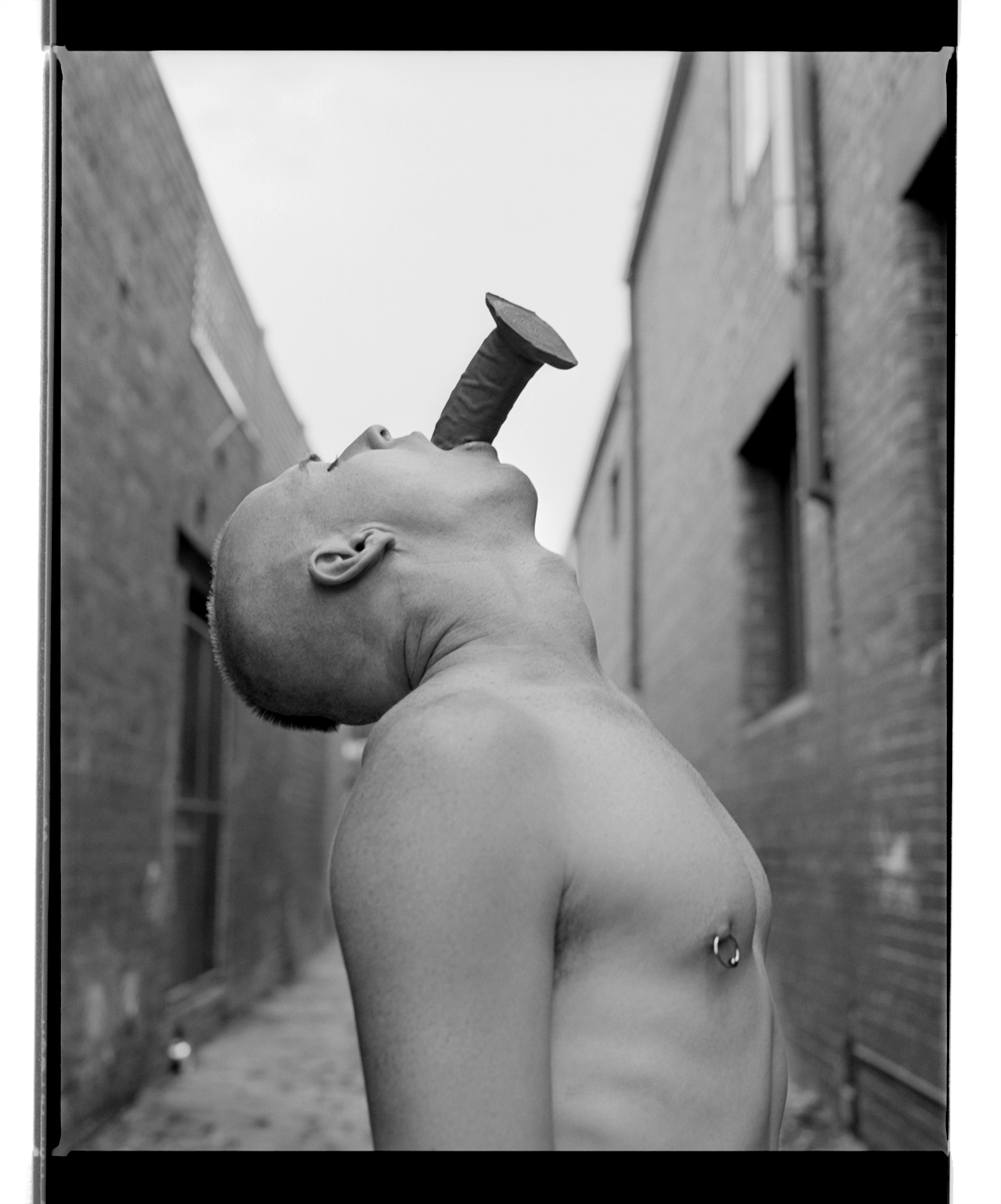
Marcus Bunyan (Australian born England, b. 1958) Paul (Dildo I) 1995-1996 From the series Mask Gelatin silver print
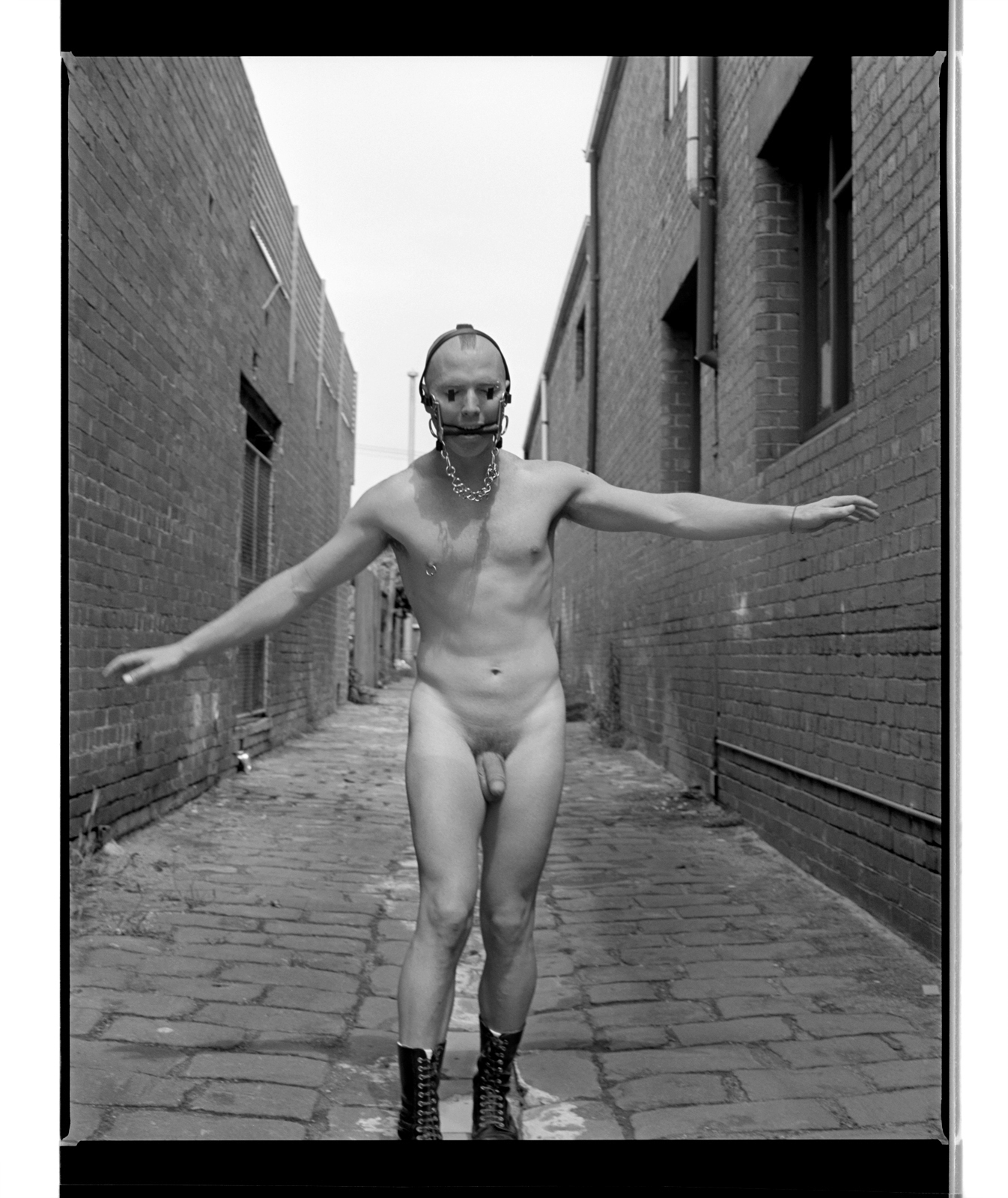
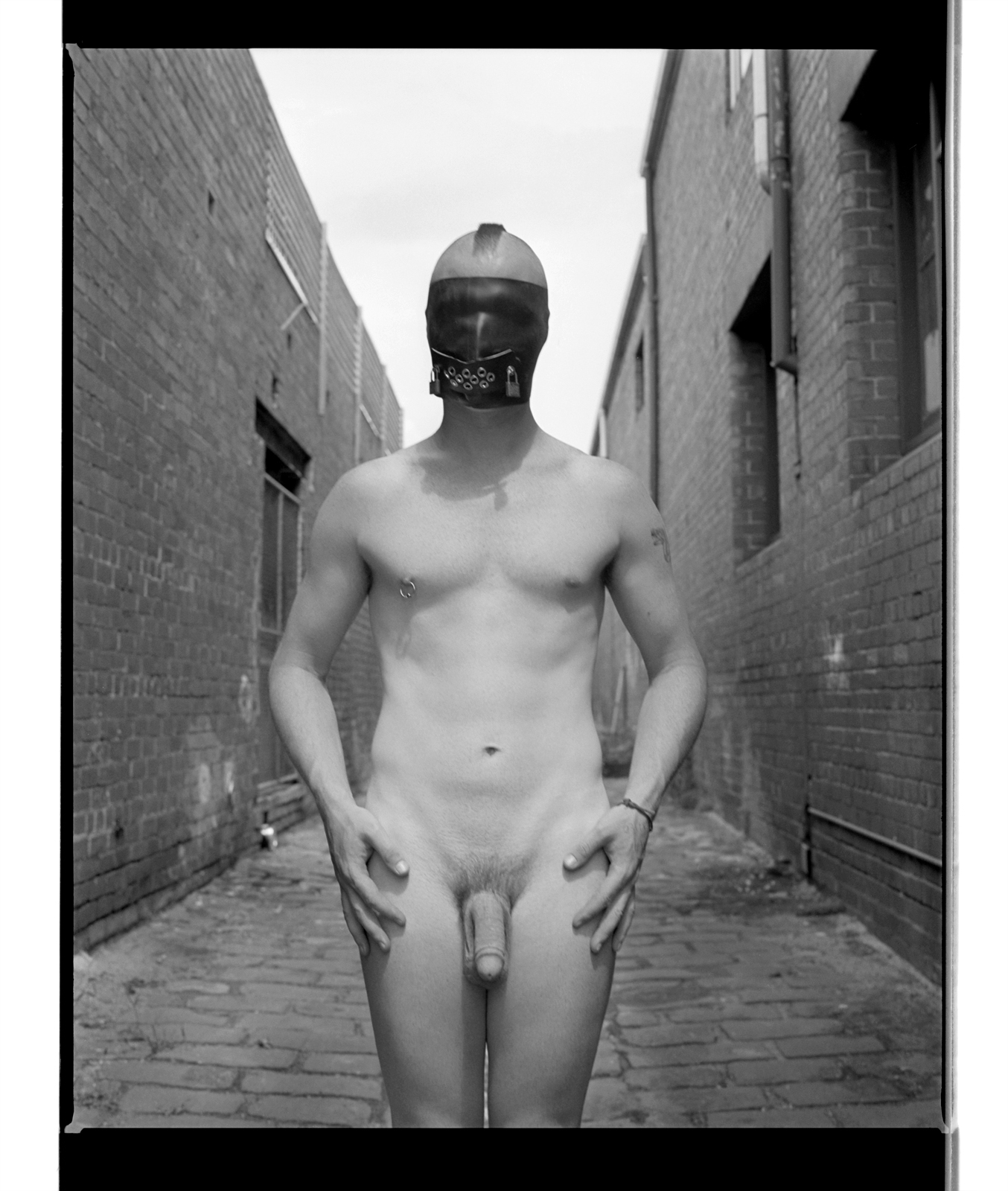
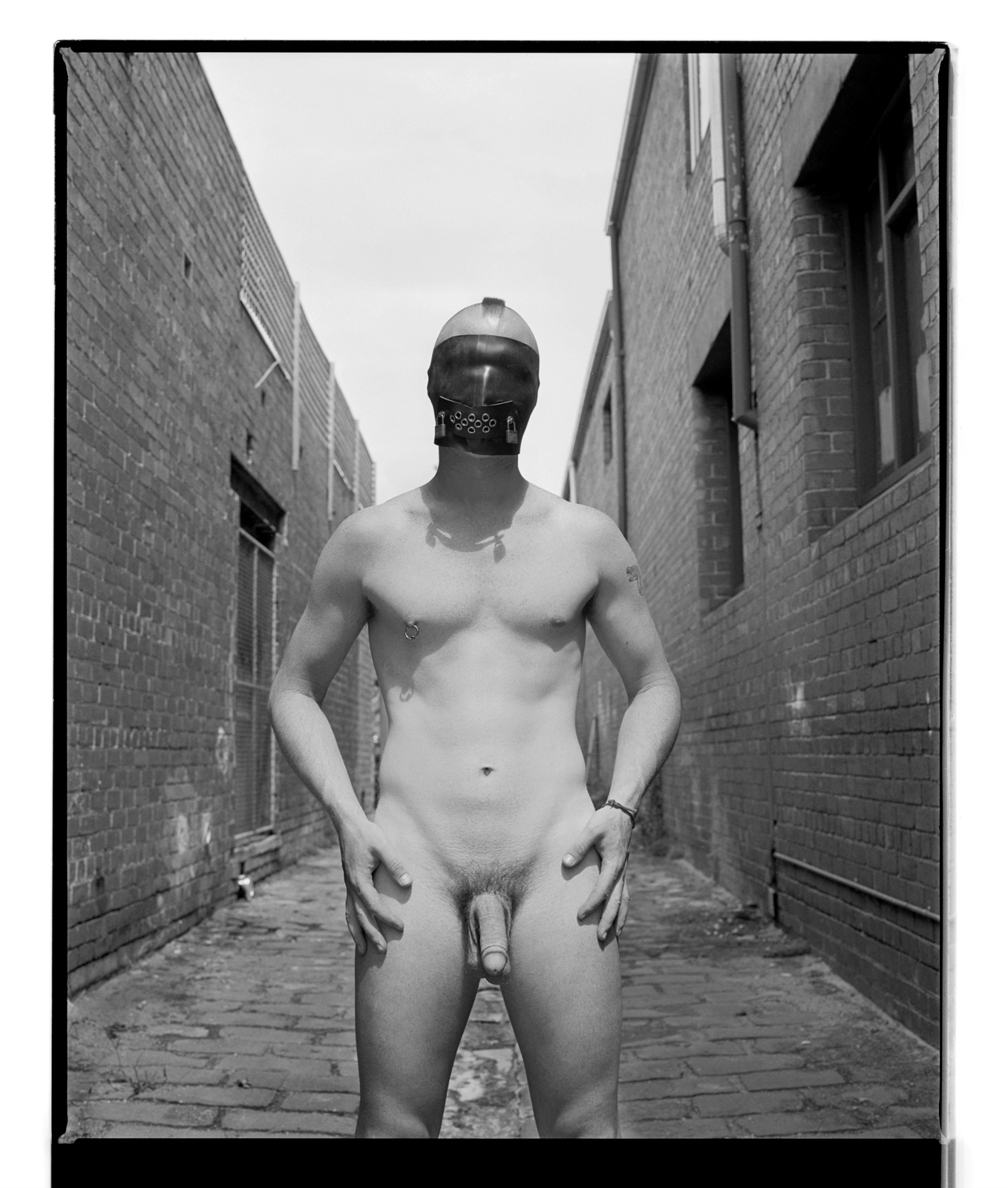
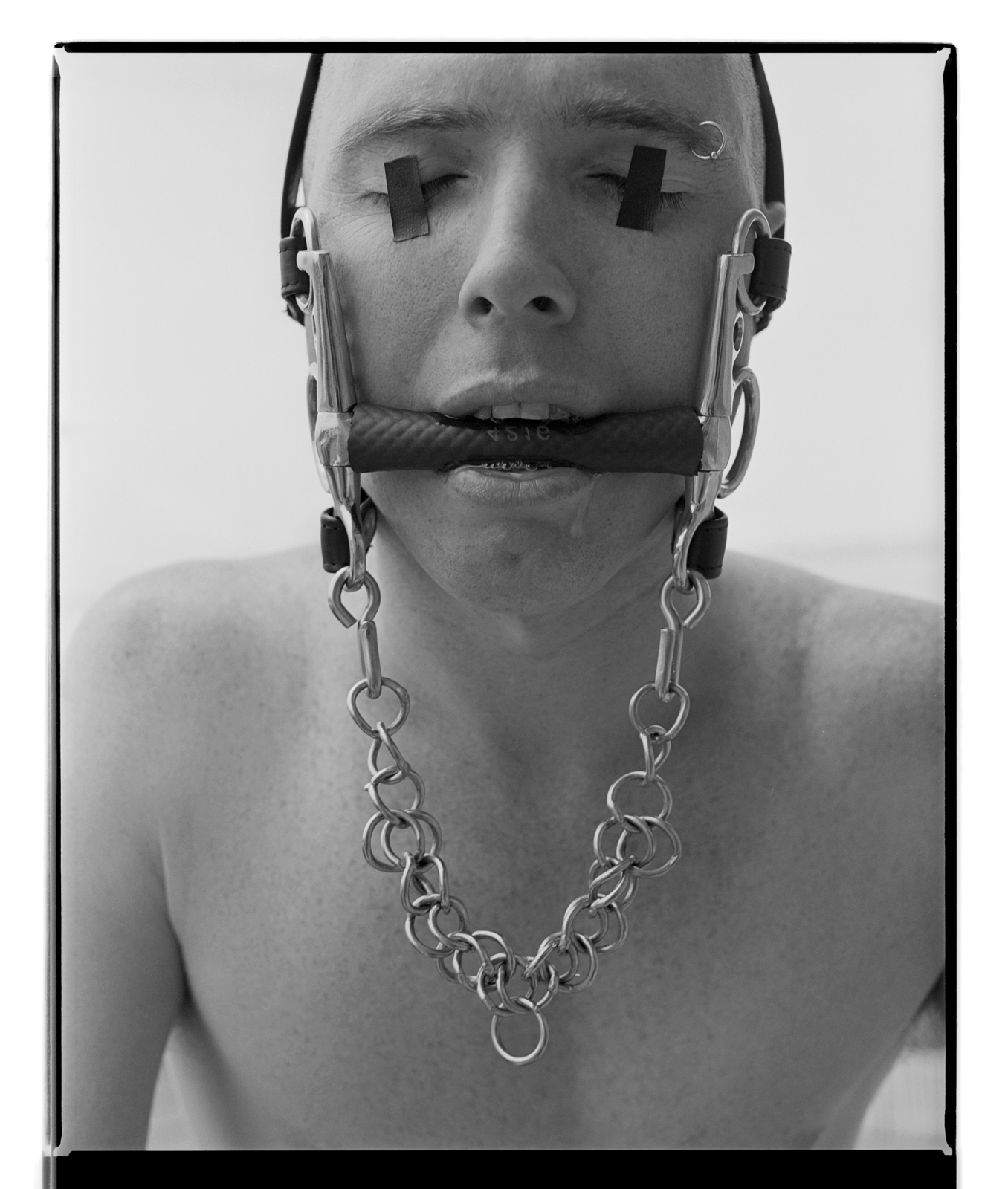
This series of photographs is of my partner, my lover, my best friend and my muse for twelve and a half years. We had such fun with life, pushing the boundaries at every opportunity. It was a privilege to be able to photograph him in every situation that we thought about, to capture the creativity of spirit and being, of existence.
There are many photographs of this handsome, intelligent man that I took – a deep collaboration that I will never have again in my lifetime. The photographs that emerged from our relationship remind me of those that Alfred Stieglitz took of Georgia O’Keeffe – strong images based on trust and intimacy.
To Paul, I am proud of the photographs we took together and I am eternally grateful for our love, relationship and exploration of body, mind and spirit. Thank you.
Marcus
I am scanning my negatives made during the years 1991-1997 to preserve them in the form of an online archive as a process of active memory, so that the images are not lost forever. These photographs were images of my life and imagination at the time of their making, the ideas I was thinking about and the people and things that surrounded me.
Photographs are available from this series for purchase. As a guide, a vintage 8″ x 10″ silver gelatin print costs $700 plus tracked and insured shipping. For more information please see my Store web page.
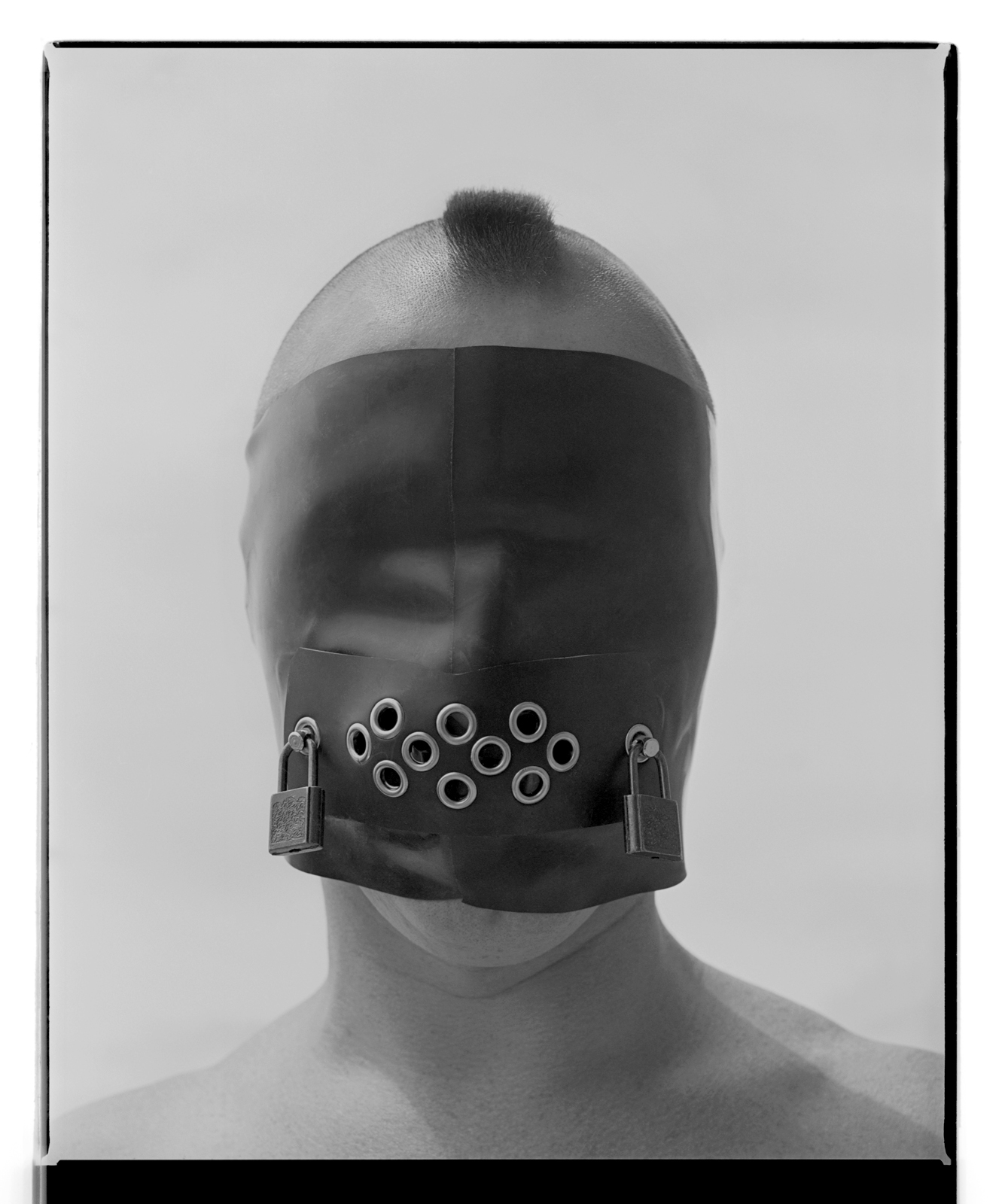
Marcus Bunyan (Australian born England, b. 1958) Mask I 1995-1996 From the series Mask Gelatin silver print
Marcus Bunyan (Australian born England, b. 1958) Mask II 1995-1996 From the series Mask Gelatin silver print
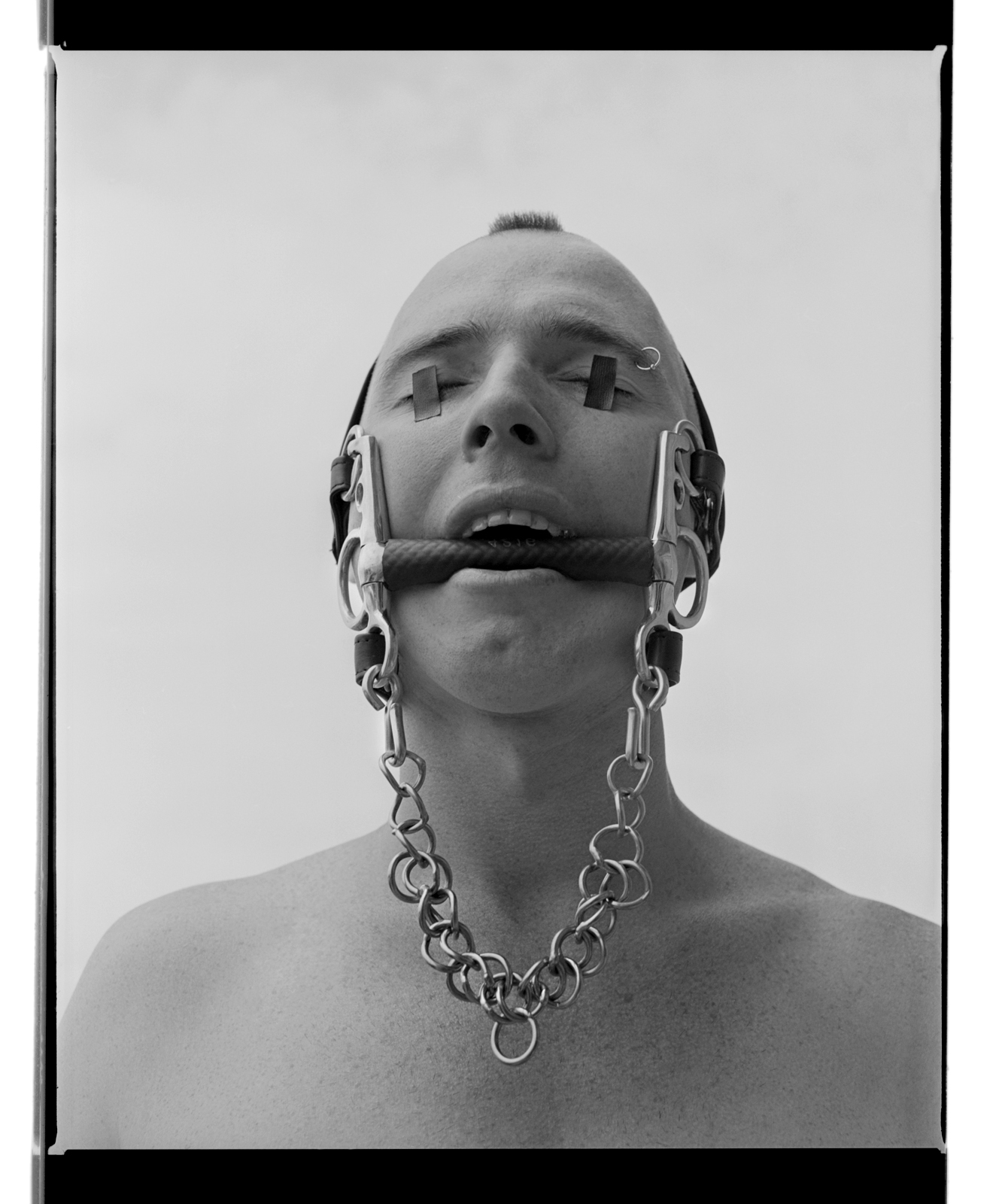
Marcus Bunyan (Australian born England, b. 1958) Paul (Horse bit) 1995-1996 From the series Mask Gelatin silver print
Marcus Bunyan (Australian born England, b. 1958) Paul (Boots) 1995-1996 From the series Mask Gelatin silver print
Marcus Bunyan (Australian born England, b. 1958) Balance I 1995-1996 From the series Mask Gelatin silver print
Marcus Bunyan (Australian born England, b. 1958) Mask III 1995-1996 From the series Mask Gelatin silver print
Marcus Bunyan (Australian born England, b. 1958) Paul (Dildo II) 1995-1996 From the series Mask Gelatin silver print
Marcus Bunyan (Australian born England, b. 1958) Paul (Blind) 1995-1996 From the series Mask Gelatin silver print
Marcus Bunyan (Australian born England, b. 1958) Balance II 1995-1996 From the series Mask Gelatin silver print
Marcus Bunyan (Australian born England, b. 1958) Balance III 1995-1996 From the series Mask Gelatin silver print
Marcus Bunyan (Australian born England, b. 1958) Balance IV 1995-1996 From the series Mask Gelatin silver print
Marcus Bunyan (Australian born England, b. 1958) Paul (Dildo III) 1995-1996 From the series Mask Gelatin silver print
Marcus Bunyan (Australian born England, b. 1958) Paul (Hands on hips) 1995-1996 From the series Mask Gelatin silver print
Marcus Bunyan (Australian born England, b. 1958) Paul (Blind) 1995-1996 From the series Mask Gelatin silver print
Marcus Bunyan (Australian born England, b. 1958) Paul (Hands on hips) 1995-1996 From the series Mask Gelatin silver print
Marcus Bunyan (Australian born England, b. 1958) Saliva I 1995-1996 From the series Mask Gelatin silver print
Marcus Bunyan (Australian born England, b. 1958) Saliva II 1995-1996 From the series Mask Gelatin silver print
Marcus Bunyan (Australian born England, b. 1958) Paul (Hands behind back) 1995-1996 From the series Mask Gelatin silver print
Marcus Bunyan (Australian born England, b. 1958) Mask IV 1995-1996 From the series Mask Gelatin silver print
Marcus Bunyan (Australian born England, b. 1958) Paul (Boots and mask) 1995-1996 From the series Mask Gelatin silver print
Exhibition dates: 15th February – 12th April, 2019
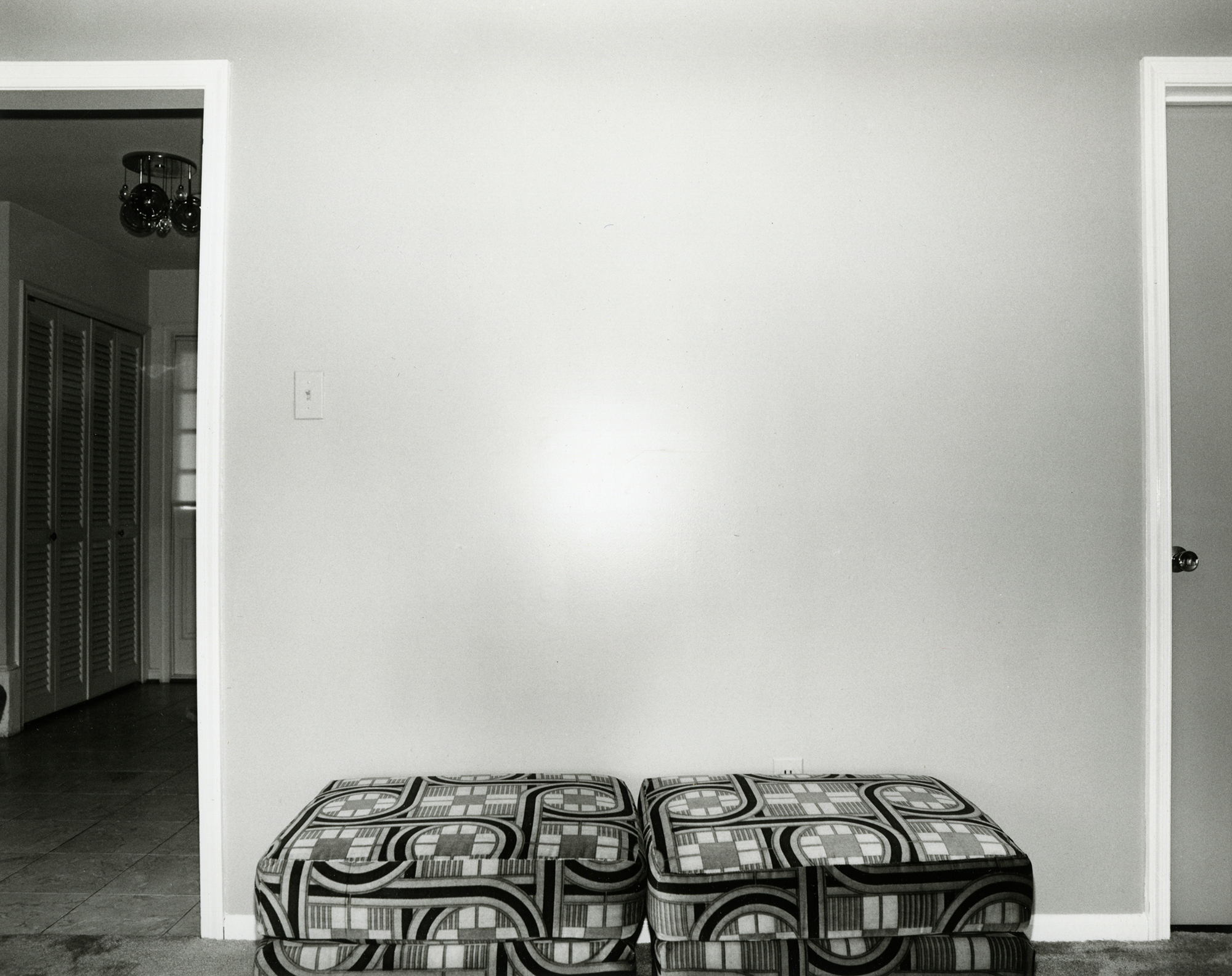
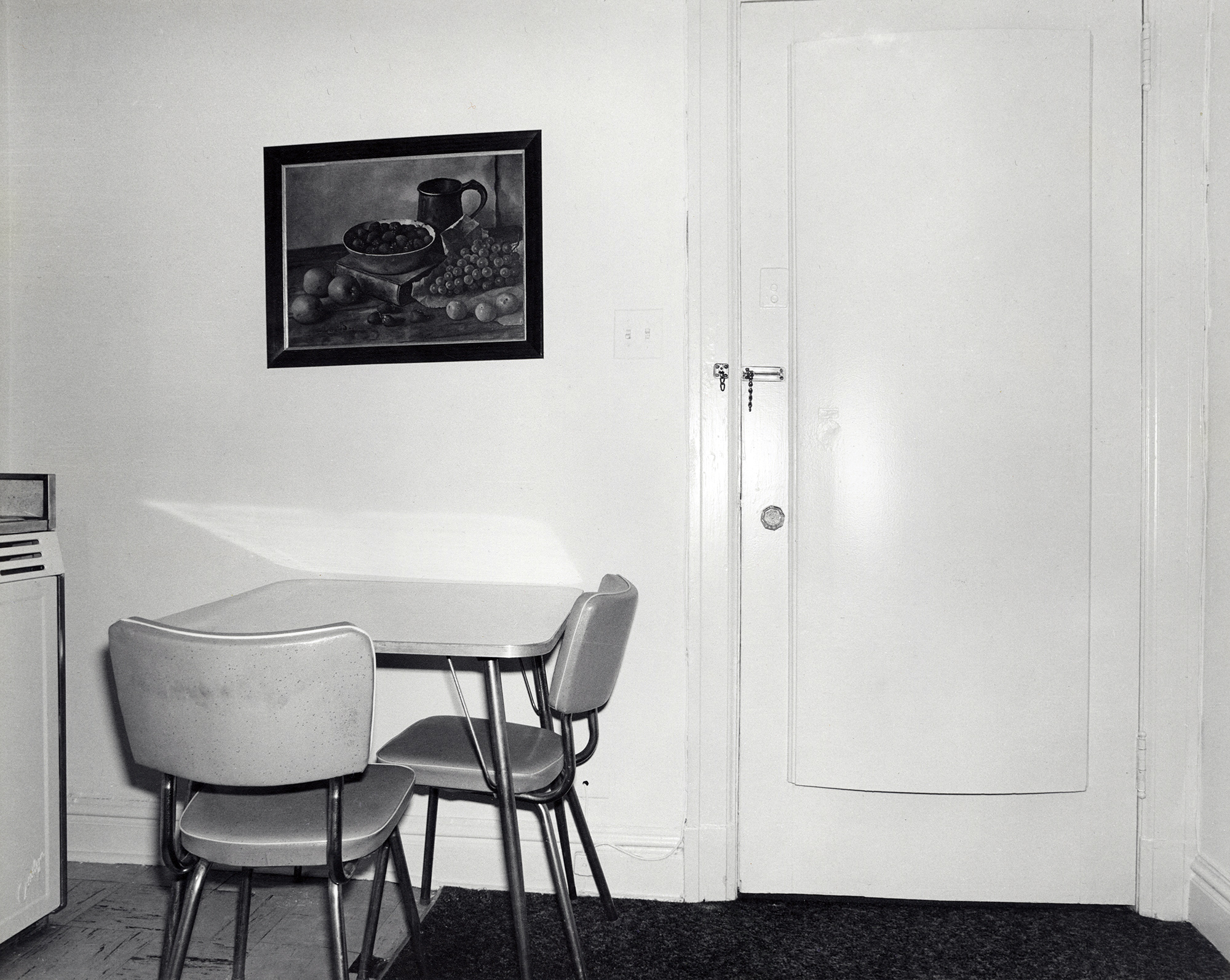
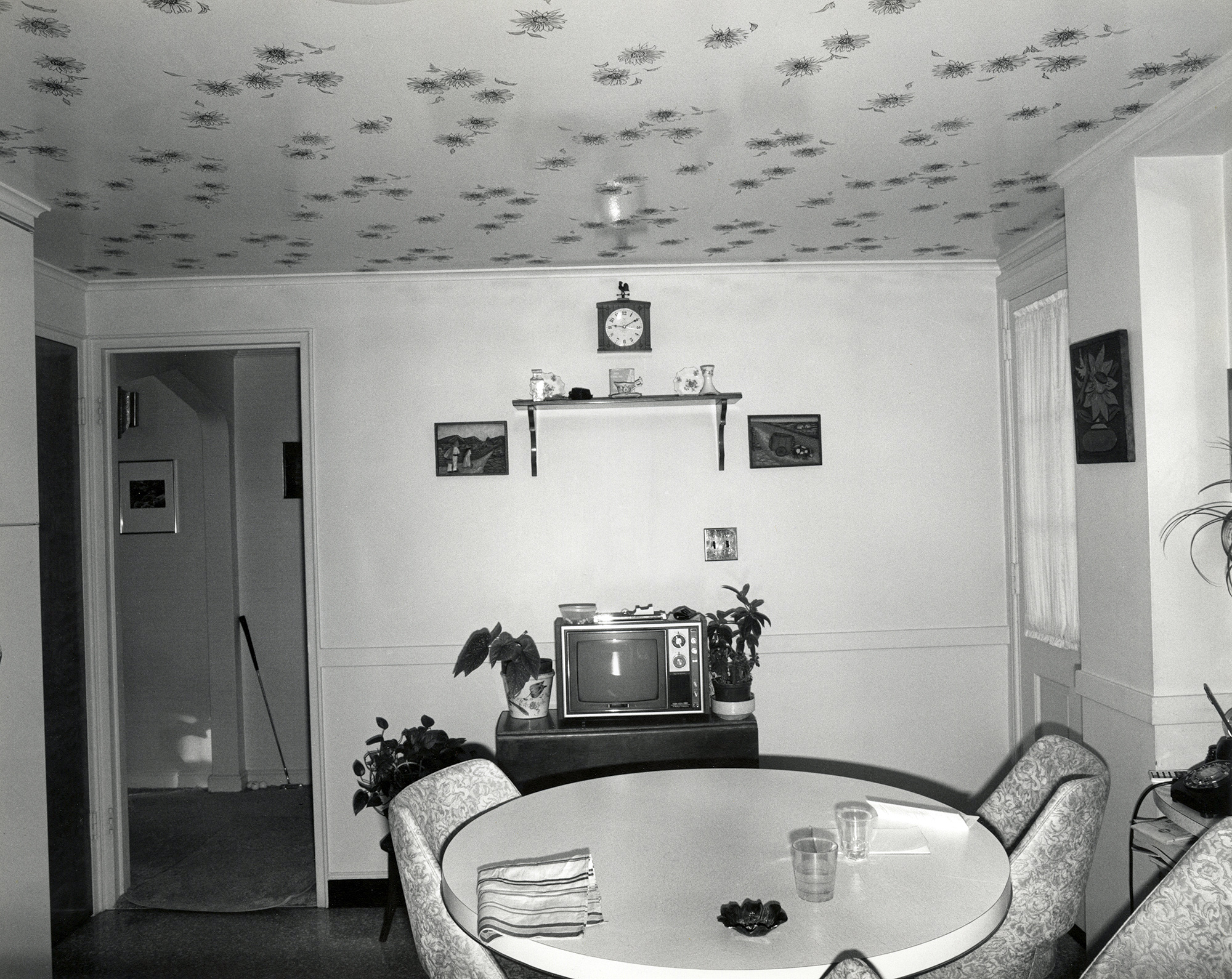
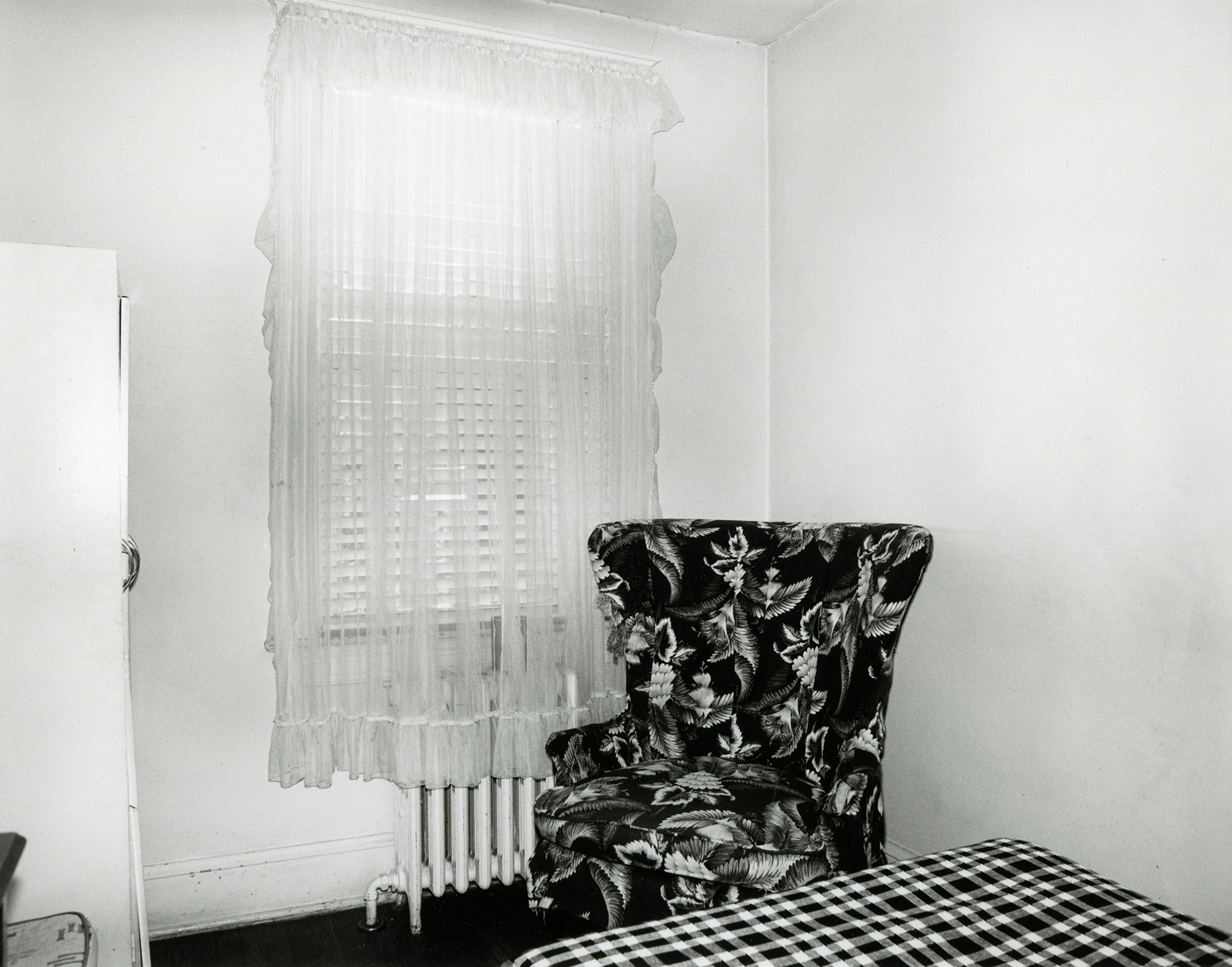
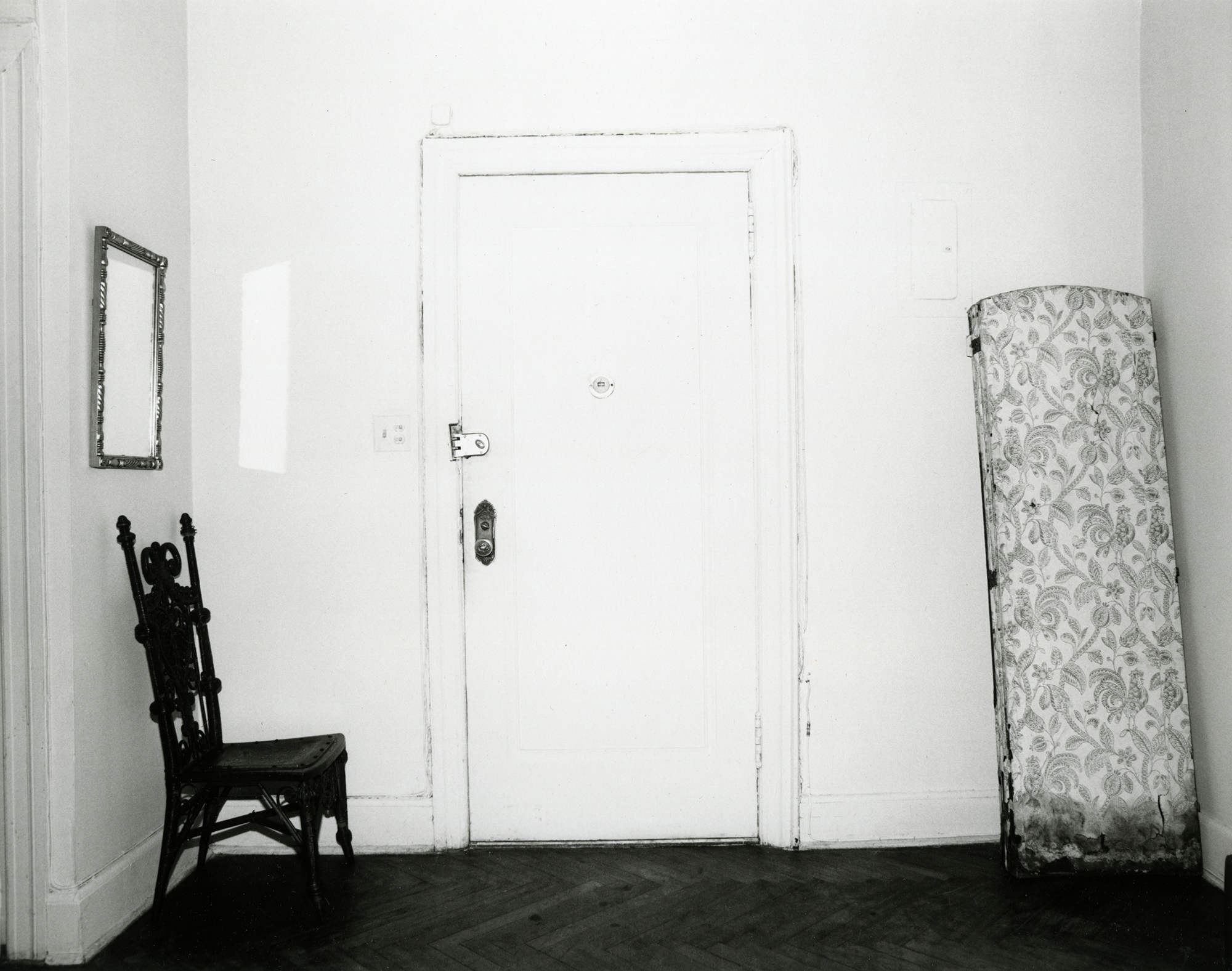
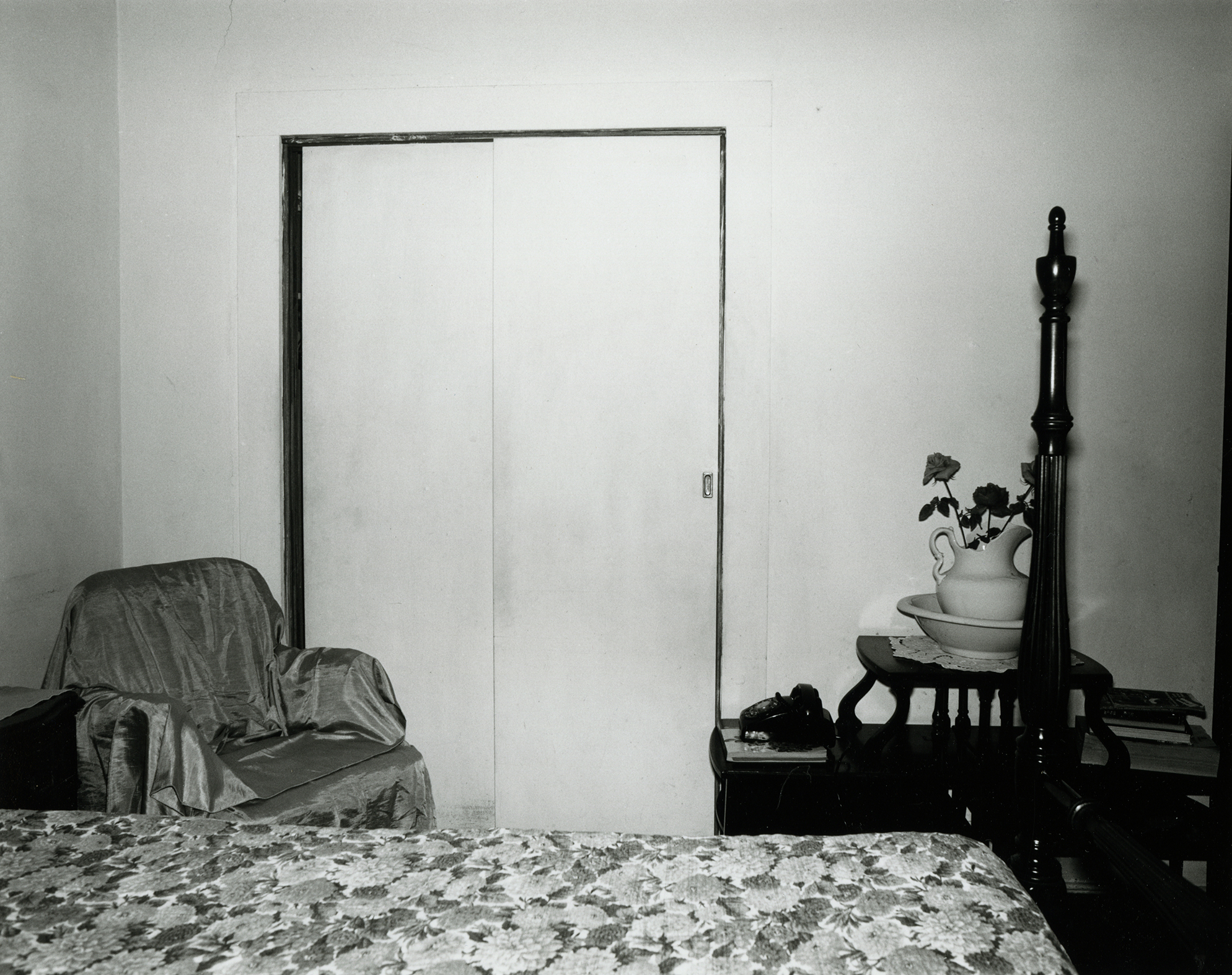
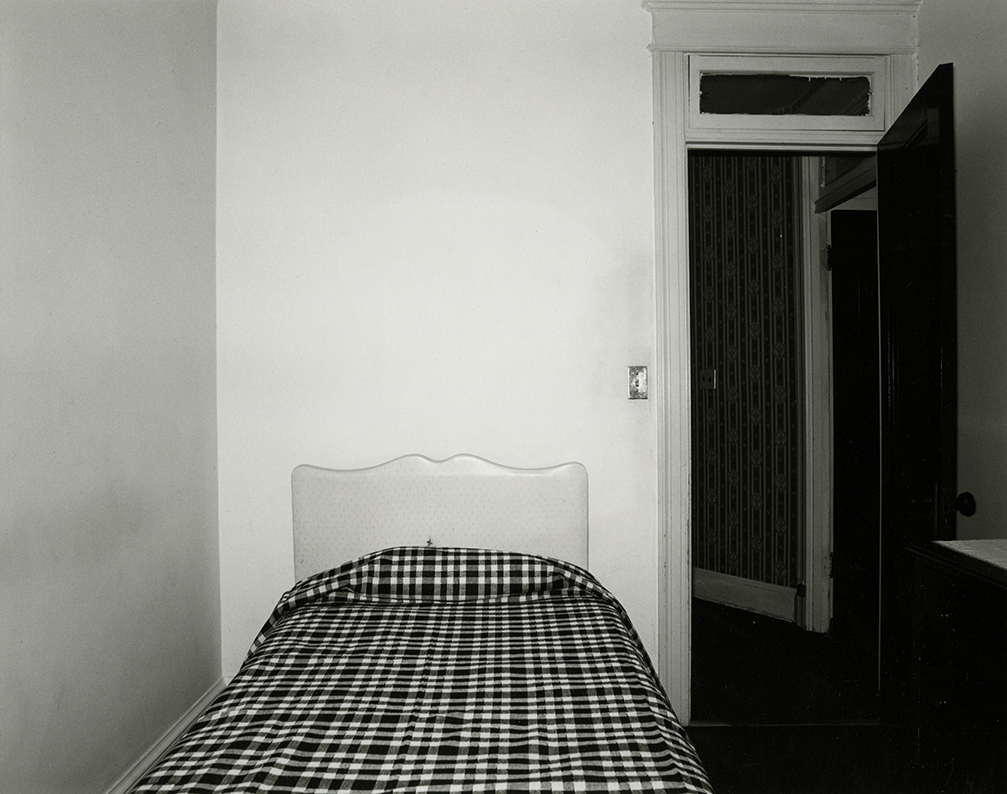
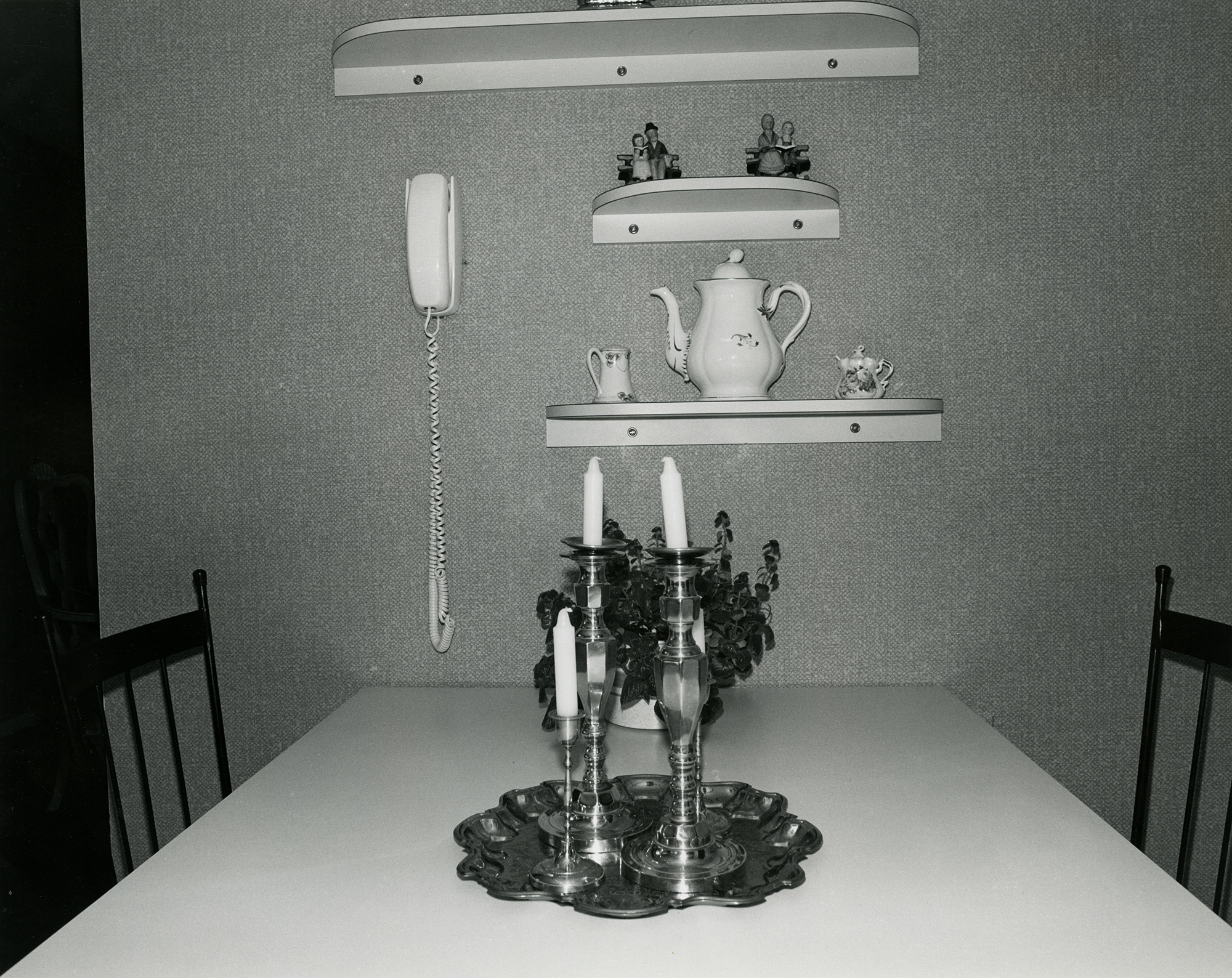
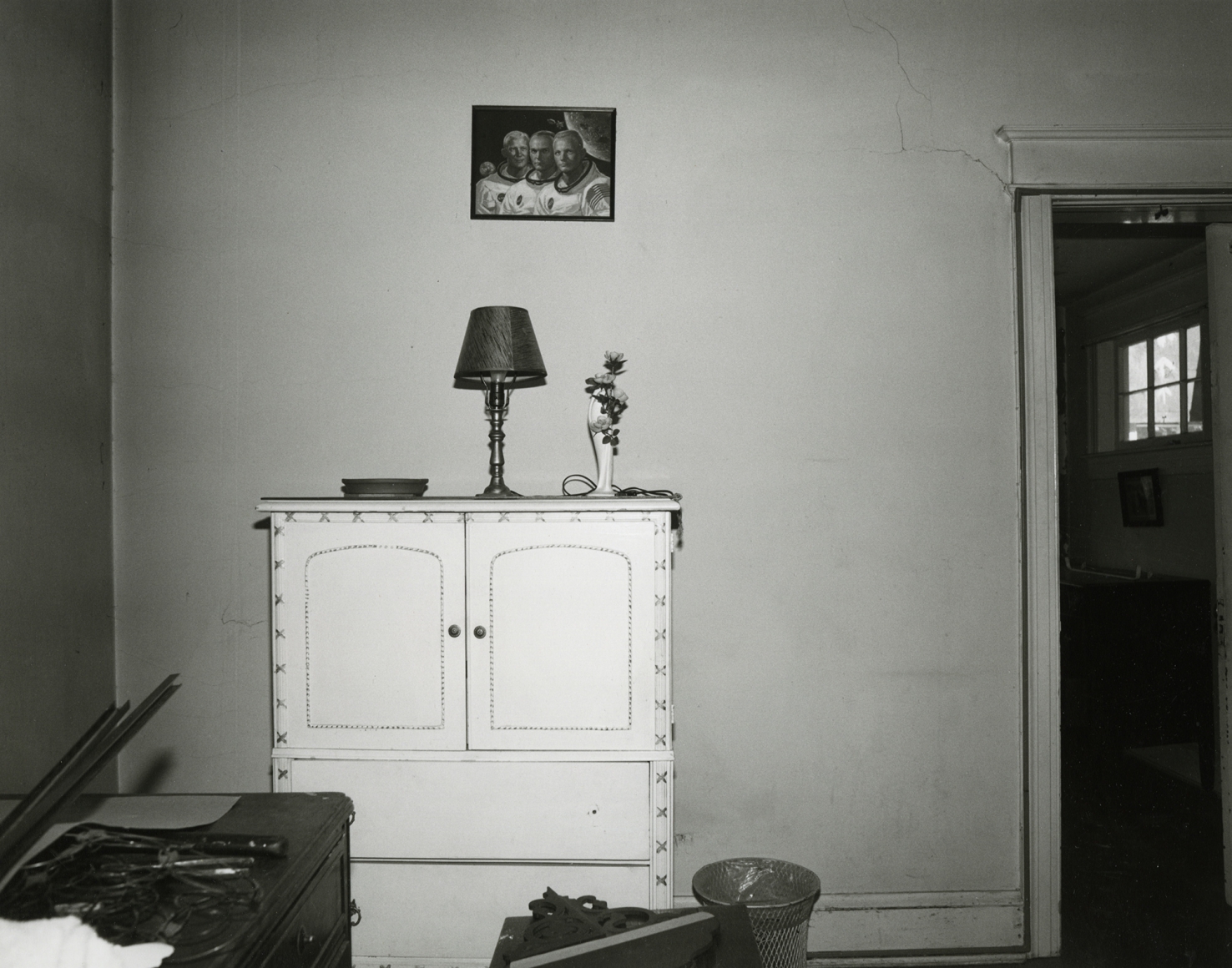
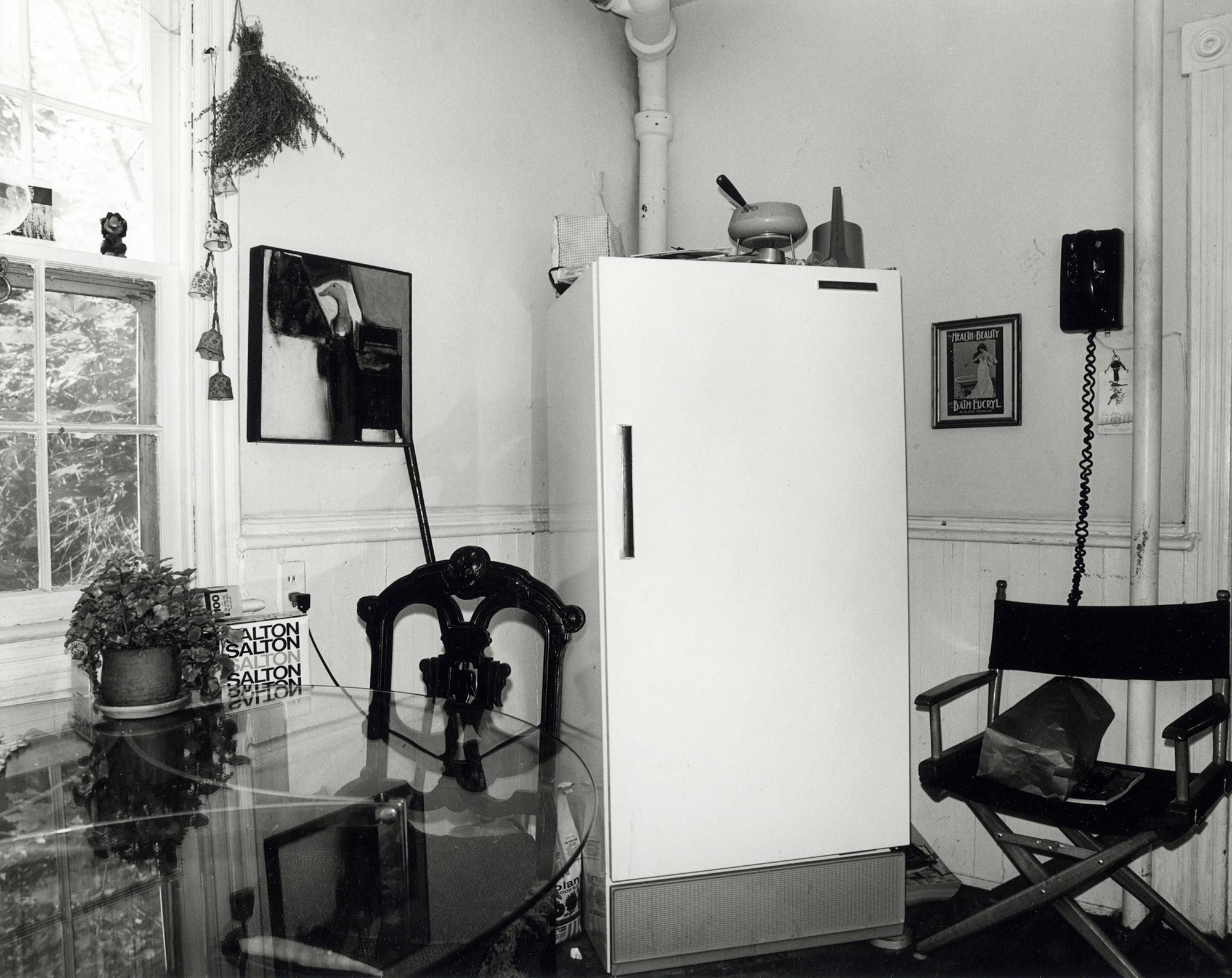
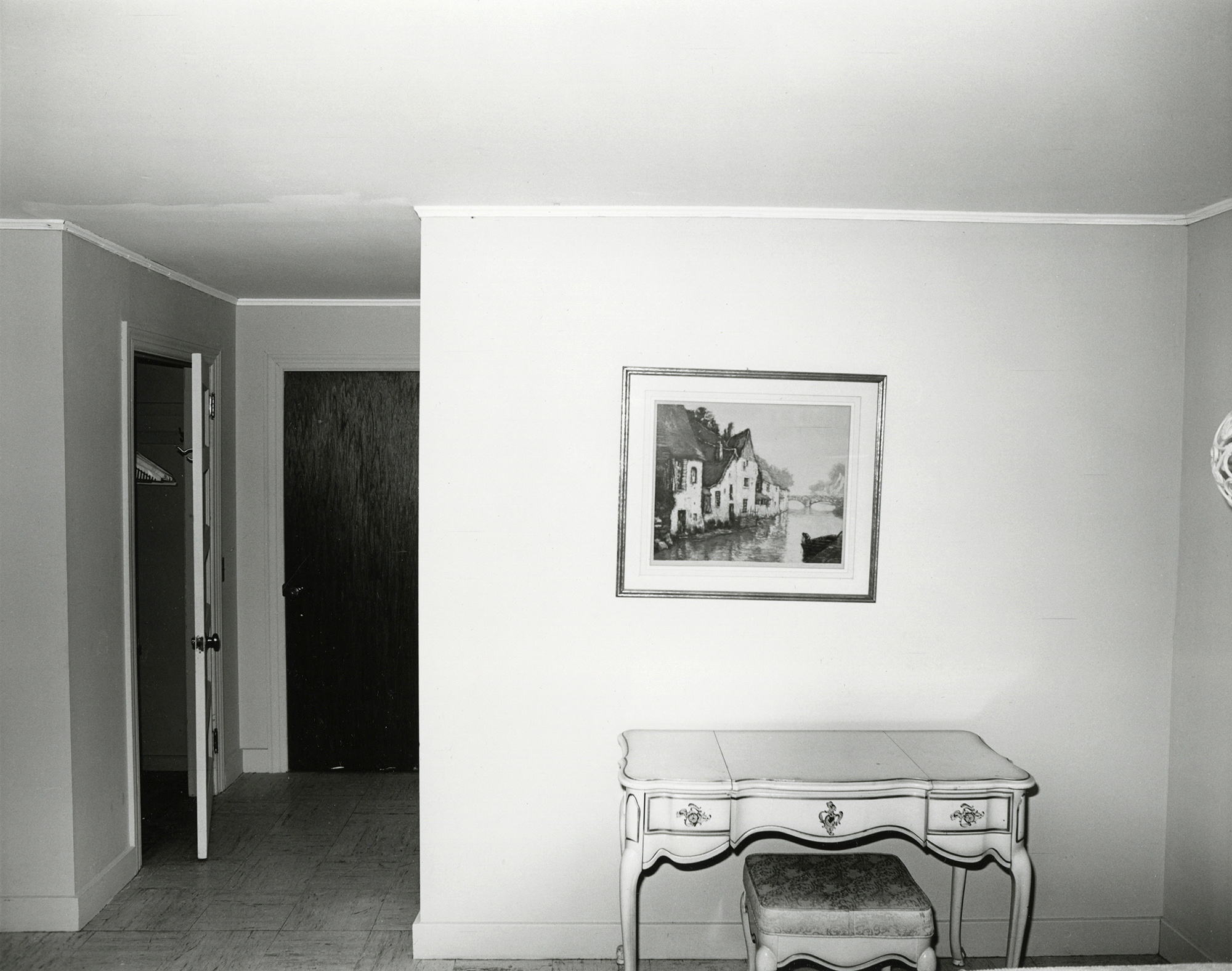
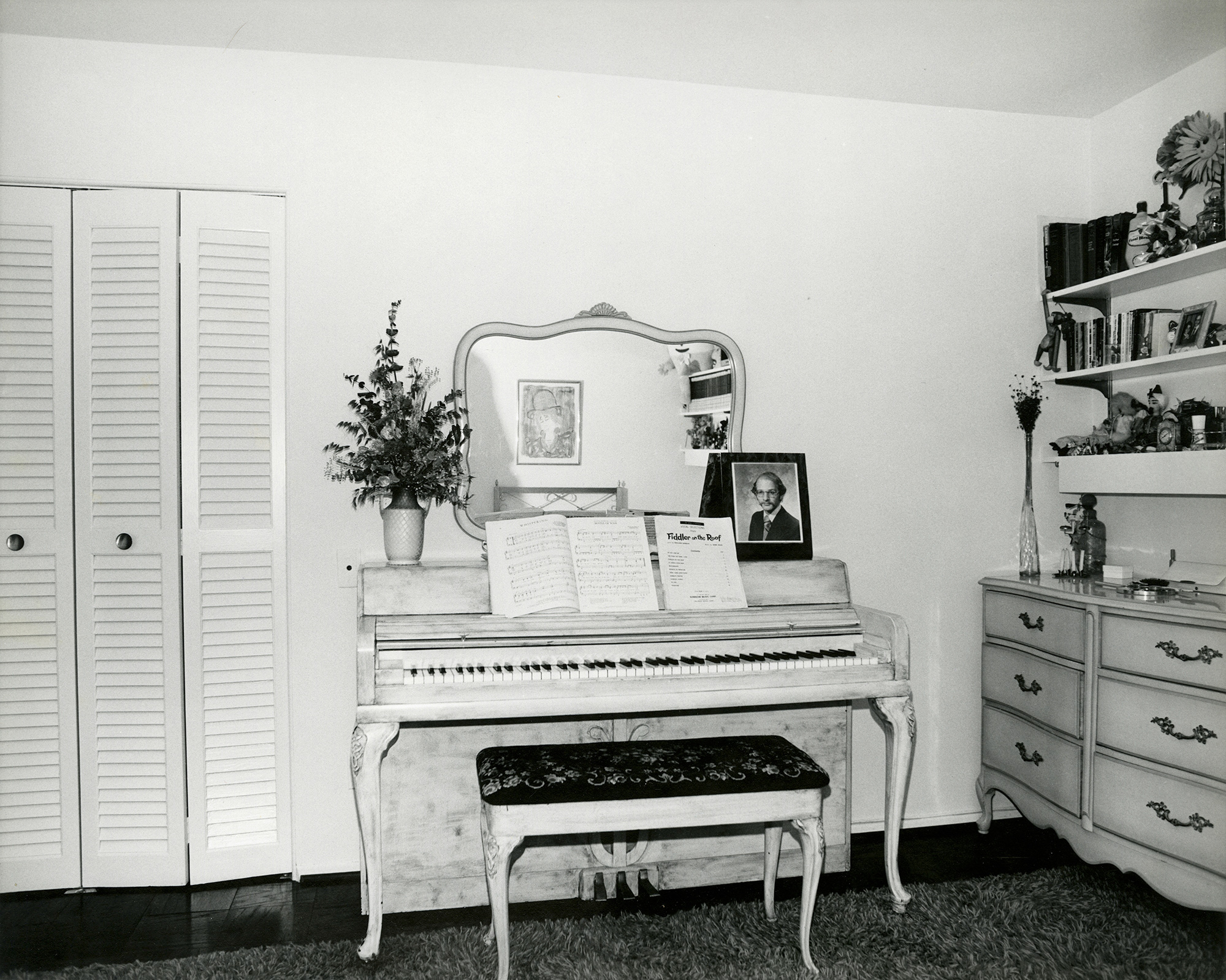
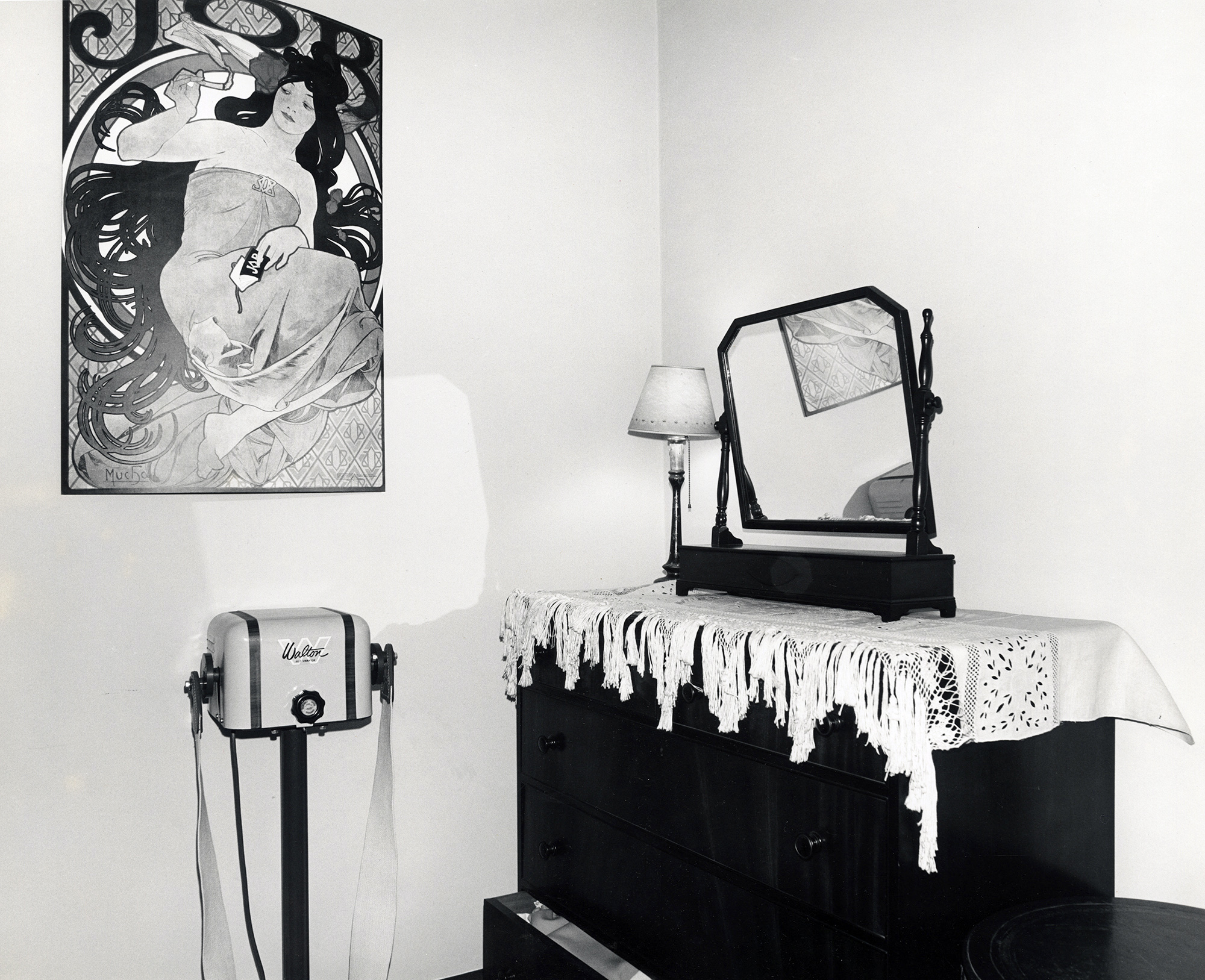
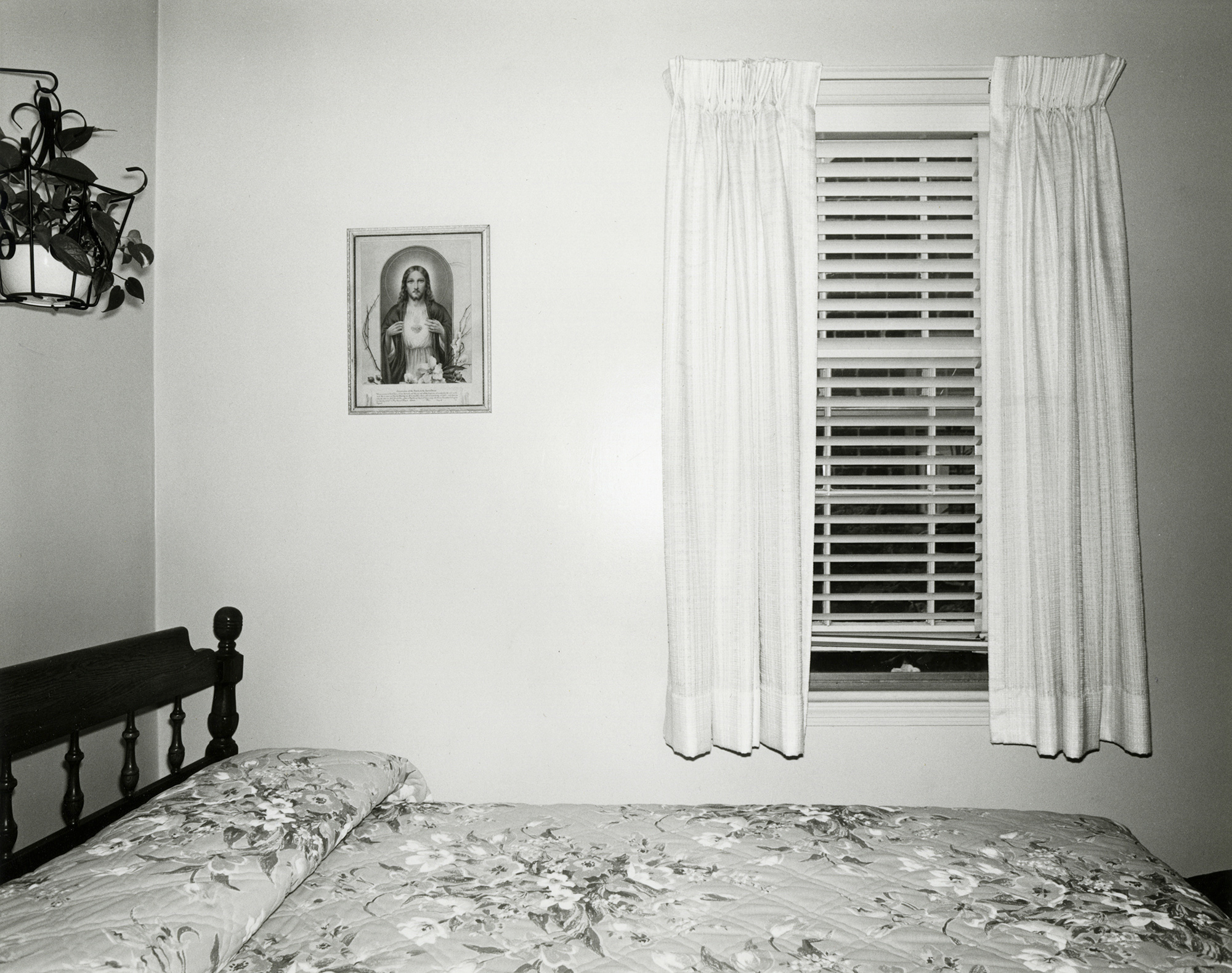
Arnold Kramer (American, 1944-2017) Interior view 1977 Gelatin silver print 11 x 14 inches
I really like these.
While I disagree with some of the statements in the press release – I don’t see much Minor White in these photographs except for the occasional door / window, some small whiteness in these photographs, and his negatives aren’t that good – these photographs evidence Arnold Kramer’s unique way of seeing the world.
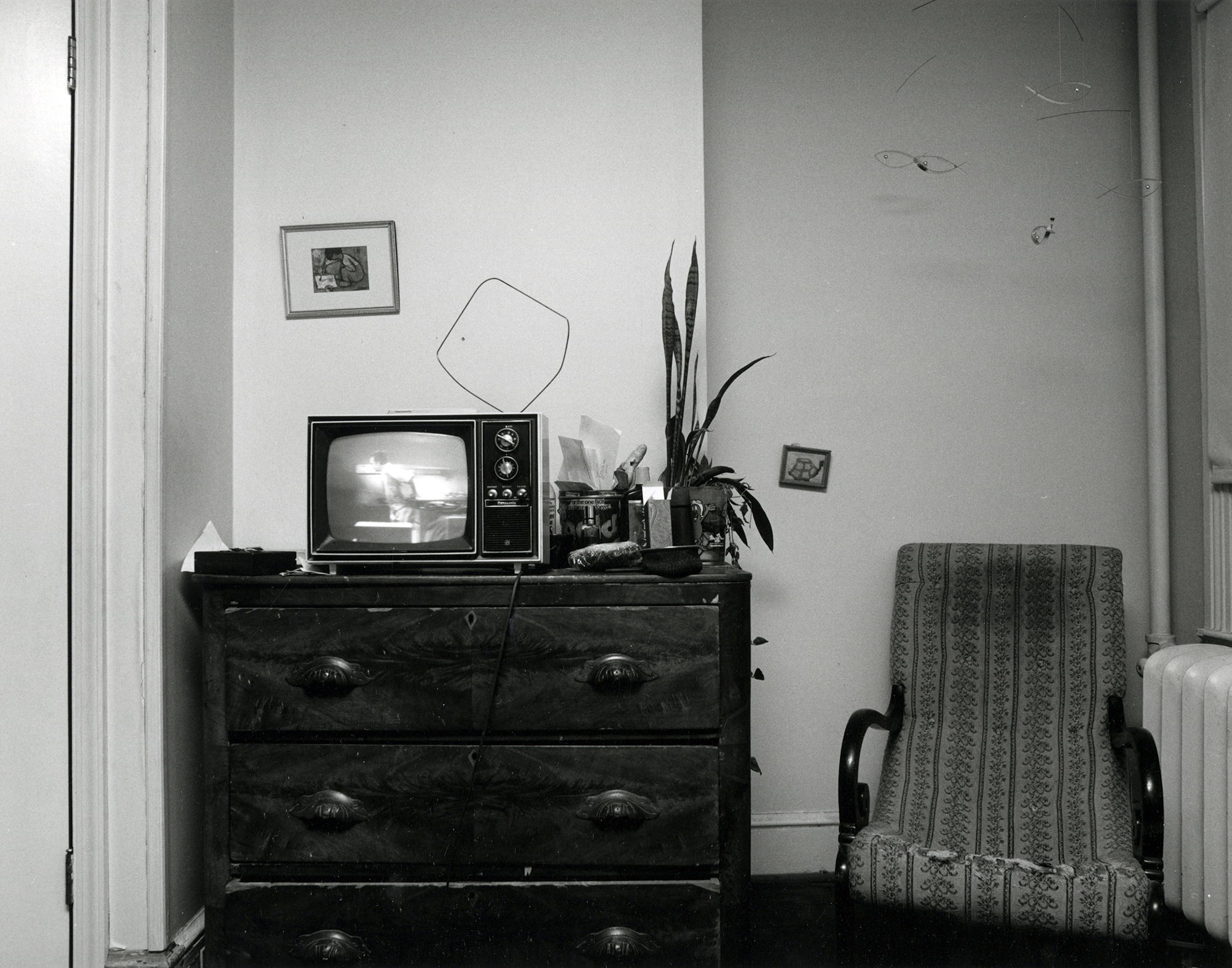
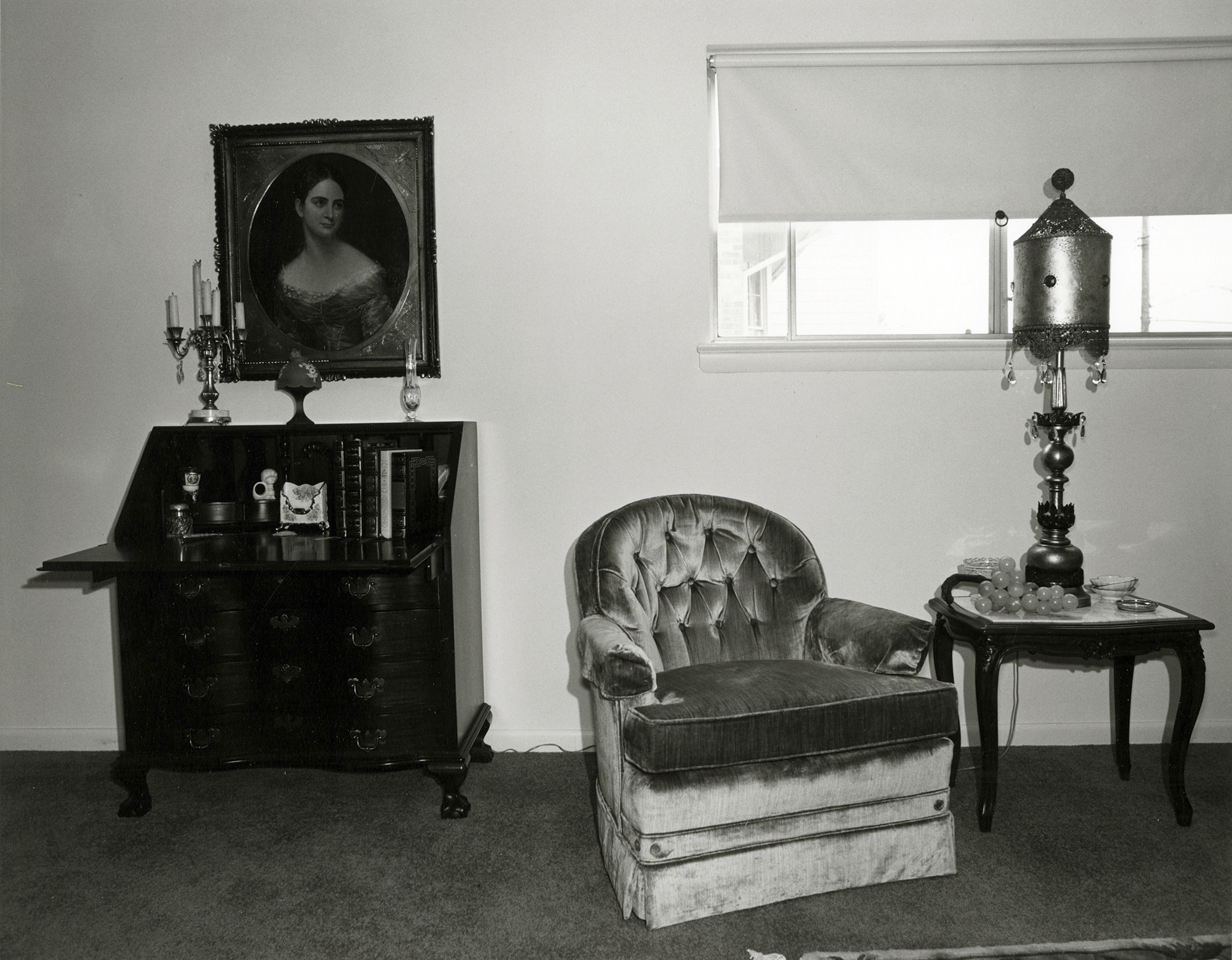
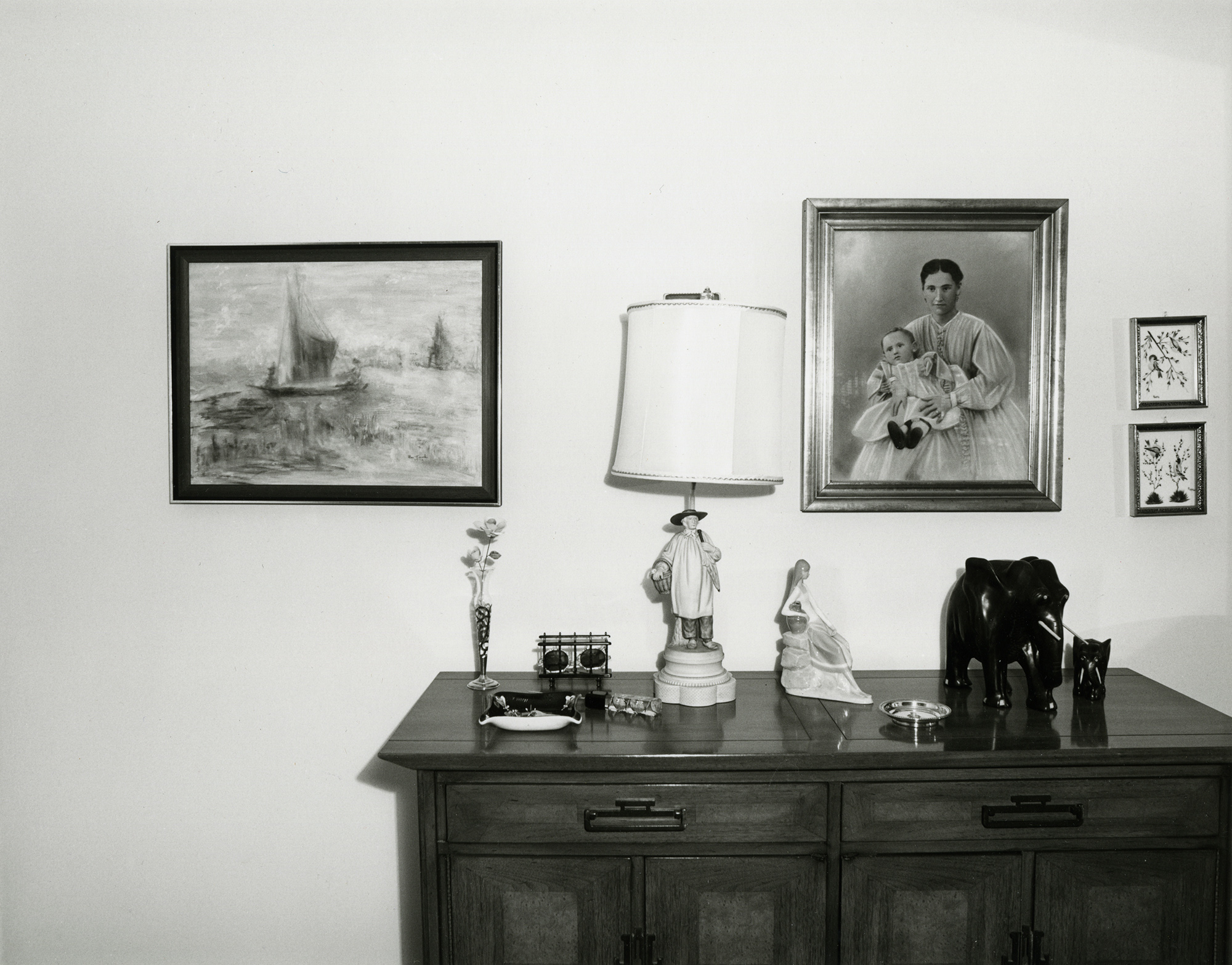
A dash of Walker Evans, a little Lewis Baltz (with the added smooth high values and distinct cool drama of a cold light head enlarger), a bit of Diane Arbus and her settings, and very much New Topographics for the interior space, they capture an original vision of these domestic scenes.
It’s the concept, high key, light, use of flash, wide angle lens and clinical presence that gets me in. As the press release correctly observes, “Kramer has a unique way of creating a three dimensional scene within the sheet of a two dimensional photographic paper: In his photographs of rooms, objects and patterns that can appear to look haphazard and random are flattened out and pieced together to create a marvellous kind of collage effect.”
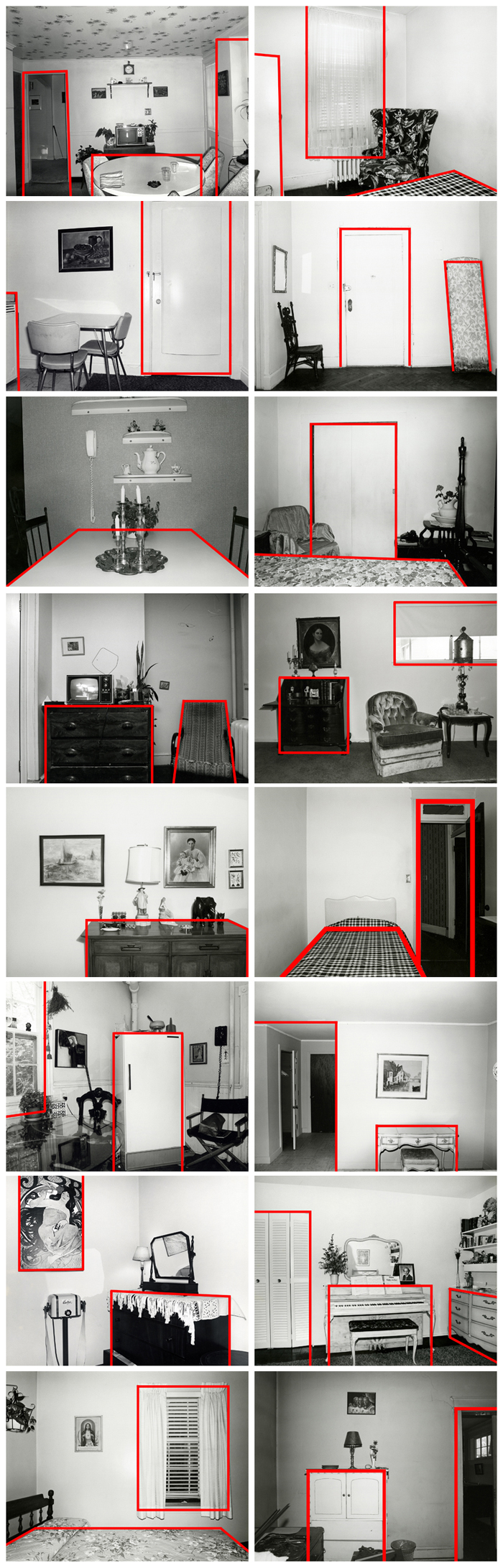
This piecing together can be seen in the last photograph in the posting, where I analyse Kramer’s construction of pictorial space. He loves shapes thrusting in from the bottom of the image, or falling from the top, creating this complex assemblage flattened on the page. Very frontal, formal, banal as beauty (or the other way round), structured.
Ralph Gibson says: “I’m lucky to have a subconscious really” – Weston, Evans, and White can join in on that. But not Kramer. He doesn’t need the subconscious… for these images, with their paired back aesthetic, are almost scientific in their analytical probing. It’s as though the subconscious has been banished to be replaced by the cerebral.
A gesture of denial and concern at one and the same time – denial of the actual human inhabitants, and concern for their in/habitation – their habits and habitats.
Dr Marcus Bunyan
Many thankx to Joseph Bellows Gallery for allowing me to publish the photographs in the posting. Please click on the photographs for a larger version of the image.
Arnold Kramer (American, 1944-2017) Interior view 1977 Gelatin silver print 11 x 14 inches
These black and white photographs, with their sharp eye for the pattern and details of domestic settings, established Kramer as a distinct talent whose avoidance of “romantic bombast” and “emphasis on formal clarity,” made his pictures particularly fresh, when they were exhibited by Jane Livingston at the Corcoran Gallery of Art in 1978. In their emphasis on emotionally restrained, frontal views of rooms they look back and reference the work of Walker Evans, especially Evans’ Message From the Interior. In their attention to pattern and line as visual motifs within everyday spaces, he reveals his bond with another 20th century photographic master, his mentor Minor White.
Kramer has a unique way of creating a three dimensional scene within the sheet of a two dimensional photographic paper: In his photographs of rooms, objects and patterns that can appear to look haphazard and random are flattened out and pieced together to create a marvellous kind of collage effect. “I try to strike a balance between commitment to craft and commitment to seeing,” Kramer once explained.
The impact of this thinking is evident in his seductive series of interiors, which began with pictures made in the Baltimore home of his wife’s parents. The range of interiors expanded to include settings in homes of friends, family and others that spanned Baltimore, Washington and his hometown of Boston/Cambridge.
“These places transcend their own banality to become rather fabulously beautiful,” Kramer aptly asserted. For Kramer, meeting Minor White was pivotal. He enrolled in one of White’s classes while earning a Master’s Degree in Electric Engineering at the Massachusetts Institute of Technology (completed in 1968). On the basis of some pictures he had made for his high school yearbook, White allowed him to enter his advanced class in photography at M.I.T. and ultimately became Kramer’s mentor. He studied with White for five years beginning in 1967 and it was White’s insistence that his students strive for original vision in their work as much as excellent technique that was crucial to Kramer’s development as an artist.
He was the recipient of fellowships from the National Endowment for the Arts in both 1975 and 1979. From 1970 until 1981, Kramer was on the faculty of the School of Architecture at the University of Maryland, teaching undergraduate and graduate courses in still photography. During the 1980s, he also had a flourishing practice as an architectural and commercial photographer in Washington, D.C. He has served on the staff of the United States Holocaust Memorial Museum since 1987, heading up its Information Office and overseeing its technological initiatives for exhibitions and national outreach, as well as creating photographs for its archives and exhibits. Among collections in which Arnold Kramer is represented include: Birmingham Museum of Art, Corcoran Gallery of Art, National Museum of American Art, Addison Gallery of American Art and The Baltimore Museum of Art.
Press release from the Joseph Bellows Gallery Cited 04/03/2019
Arnold Kramer (American, 1944-2017) Interior view 1977 Gelatin silver print 11 x 14 inches
Arnold Kramer picture construction graphic
Joseph Bellows Gallery 7661 Girrard Avenue La Jolla, California Phone: 858 456 5620
Opening hours: Tuesday – Saturday 11am – 5pm and by appointment
A wonderful posting of photographs by this master photographer, including numerous images (Young Mother, Middle-class; Middle-class Children; Peddler; Girl in Fairground Caravan; “Test your Strength” Showman; Workmen in the Ruhr Region) I have never seen before.
What can you say about the work of this legend of photography that has not been said before, by so many people, in so many words. Therefore I will not be verbose but just note a few impressions.
How did Sander get these people to pose for him in this direct, open way? There is no affectation, no histrionics, the sitters (whether outside en plein air or inside against a ubiquitous plain wall / blank canvas) gaze directly, steadfastly, into his camera lens – quite pre/posed, quietly proposed and confident of their own identity and image. The peddler with his box of wares, the café waitress with her tray of tea and milk, the pastry chef with his bowl, or the showman whose gnarled and dirty hand clasps a cigar.
The “presence” and aura of these people is incredible. You can ascribe this presence to modernism and New Objectivity (a sharply focused, documentary quality to the photographic art) that sought to portray the reality of a life but to do so holy to the exclusion of the poetic in Sander’s work would be a mistake. While not self-consciously poetic, Sander’s work still contains elements of the pictorial – for example the painterly quality in his use of depth of field in portrait’s such as that of Painter [Heinrich Hoerle] (where we notice the very small depth of field from the front of the shirt to the back), or the framing of Girl in Fairground Caravan with its notably impressionistic melancholy and longing.
What I am really looking forward to is the book that is being published from this exhibition. As the text on Amazon notes, “A novel feature of this book is that all the reproductions are based on vintage prints produced and authorised by August Sander himself. The croppings and the desired tonal values are authentically rendered here for the first time in the long publication history of Sander’s brilliant portrait work.”
This is as close as you will get in book form to the original printing and tonality of Sander’s work. I am sure the book will become a classic and sell out quickly so get your orders in now for a June 2019 release.
Dr Marcus Bunyan
Many thankx to the Die Photographische Sammlung/SK Stiftung Kultur for allowing me to publish the photographs in the posting. Please click on the photographs for a larger version of the image.
The portrait photographs by August Sander count among the masterworks of their kind. Ever since acquiring the photographer’s estate, Die Photographische Sammlung/SK Stiftung Kultur has been busy cataloguing the Sander archive and has already presented these photographs in several theme-based shows. With “People of the 20th Century,” his most famous photographic compendium, Sander aspired to nothing less than to document the society of his day, based on examples of people pursuing different occupations and from various walks of life. The conceptually planned body of work testifies to the photographer’s acuity of perception and consummate skill at the use of the photographic medium. Over the decades, pictures such as “Young Farmers” (1914) and “Pastry Cook” (1928) have become photographic icons. But August Sander’s portraiture in fact harbours a large number of motifs of remarkable quality. These images provide insights, for example, into the population of the rural Westerwald region, the artist communities in Cologne and Berlin, and city life in general during his era.
In the current exhibition, Die Photographische Sammlung/SK Stiftung Kultur is displaying a representative selection of more then 150 original prints from “People of the 20th Century.” The majority come from the collection’s own holdings, joined by works on loan from the Museum of Modern Art, New York; the J. Paul Getty Museum, Los Angeles; the Pinakothek der Moderne, Munich; the Museum Ludwig Cologne / Photography Collection, the Berlinische Galerie, Berlin and private collections. Based on many years of research, the accompanying catalogue traces the genesis of these works in great depth and detail.
Text from the Die Photographische Sammlung/SK Stiftung Kultur website
The current exhibition with over 150 original photographs and numerous showcase material shows a representative cross-section of the project “People of the 20th Century”.
Sanders’ extensive portraiture was aimed at showing a cross-section of the population in which the different occupational and social types, spread over different generations, are reflected – a mirror of the times. In the title Sanders first published book in 1929, Antlitz der Zeit (Face of Our Time), this intention finds its echo. Both the indirectly expressed face of time and the individual physiognomies were the subject of the photographer’s unbroken attention for decades.
In order to give shape and form to his growing compendium, Sander created a concept in the mid-1920s in which he extensively named the image groups and folders that he had focused on. The groups are called “The Farmer”, “The Craftsman”, “The Woman”, “The Estates”, “The Artists”, “The Big City” and “The Last Man”. The latter perhaps misleading name stands for a series of pictures that very respectfully shows people on the margins of society. Sander’s concept of that time, which proposes a sequence of groups and folders, is also followed by the current exhibition with the inclusion of individual or several representative portfolio prints from the corresponding picture folders.
For the most part, the photographs are taken from the inventory of the August Sander Archive, which was acquired in 1992, which forms the foundation for the further development of the Photographic Collection / SK Stiftung Kultur, Cologne. Exclusive loans from originals will be consulted, such as the Berlinische Galerie, Museum of Modern Art, Berlin, the J. Paul Getty Museum, Los Angeles, the Museum Ludwig Köln, the Museum of Modern Art, New York and the Pinakothek der Moderne. Munich as well as from important private collections.
At Schirmer / Mosel Verlag, the book “August Sander – Masterpieces” was created at the same time as the exhibition in German and English editions. For the first time in the publication history of the photographer, the original prints are reproduced in authentic tonality, as well as in original cut-out reproduction.
Text from the Die Photographische Sammlung/SK Stiftung Kultur website
The current exhibition, featuring over 150 original photographs and numerous documents shown in display cases, presents a representative cross-section of the “People of the 20th Century” project.
The portraits from August Sander’s epochal work are not only of fundamental importance for the history of photography; they are also highly exciting objects of study – masterpieces for anyone who has an unsentimental, unbiased love of people and life; who likes to ask questions about the past and gather experiences for the future; who has a passion for looking, discovering, fantasising, and analysing:
How do the people portrayed appear to us today? How did they spend their lives? What delighted or shocked them? What experiences left a mark on their faces, their hands, their physiognomy? What can they share with us from their own bygone world and times? How did Sander manage to meet and talk to so many different people, and to entice them into posing for a picture? What does the photographic material convey to us today – at a time when hardly any photographs are developed in the darkroom and a kind of magic has thus been lost? What does time and manual craft mean for artistic engagement?
Viewed together, the people August Sander (1876-1964) depicted in such an objective yet dignified and personal manner unfold a whole cosmos that brings history to life. Looking at Sander’s photographs challenges us to search for similarities, differences, and comparable qualities. They summon memories of accounts from the past, render tangible transformations in people’s living conditions and way of life; we see occupations that have changed, which no longer exist or have been replaced; developments or events in society are made more vivid to us, as are changing pictorial styles and artistic aesthetics.
And yet apart from the referential character of Sander’s photographs, their historical relevance and inspirational force, qualities that have been highlighted by renowned authors such as Walter Benjamin, Alfred Döblin, Golo Mann, and Kurt Tucholsky, the pictures depict very concrete moments and display individually a remarkable degree of aesthetic quality. They compellingly demonstrate Sander’s knack at capturing reality and his eye for composing specific details into lifelike documentary photographs. Being able to experience this quality up close based on August Sander’s original handmade prints is a real privilege and something that can only be made possible on this scale in rare cases due to the conservation requirements of these so-called vintage prints.
August Sander first presented his project “People of the 20th Century” in 1927 at the Kölnischer Kunstverein. He had selected more than 110 prints, a group that, as far as can be reconstructed, largely diverges from the current presentation, let alone the fact that several different prints of individual motifs were and are in circulation. Since Sander developed the project or – as he called it – his cultural work “People of the 20th Century” between circa 1925 and 1955, i.e., over the course of three decades, also incorporating motifs he had produced from 1892 onwards, his stock of original prints and portfolios had grown immensely by the end of his life. Within his archive, this group of works forms a kind of cache from which the photographer drew freely for exhibitions and publications. This was a uniquely innovative approach in his day. Sander’s awareness of the exponential effect of image series as opposed to individual images made him a pioneer of conceptual photography, as did his resolute use of an unmanipulated, factual reproduction of his chosen motifs. His portraits were meant to underline his documentary approach and to do without any artistic embellishments while nonetheless manifesting a fine-tuned and restrained design.
Text from the Die Photographische Sammlung/SK Stiftung Kultur website
Art Blart has a readership of 1,500 a day. It has become a research tool for artists and photographers around the world. It is also an important form of cultural memory, with over 1,300 posts in its archive. The site is itself being archived by Pandora from the National Library of Australia.
What I find most important about the archive is that it gives me the opportunity to promote artists, to promote ideas and thoughts about art and life and, most importantly, to shine a light on different aspects of art, from the under recognised concepts to the disenfranchised and forgotten artists.
Reproduced below is the first ever post on Art Blart with the key tags, life and death. Not a lot has changed in 10 years. My concerns in that first post are still present – what we are doing to the planet and to our culture, how we construct our histories and memories, and how we can embrace diversity and equality the world over. Text and images and powerful tools for promoting such egalitarian ideals.
I must thank all the amazing galleries around the world for suppling text and media images. Your efforts are truly appreciated, for without you the archive would be nothing. Your enthusiasm and willingness to help has been incredible.
And to you, the readers, I must thank you for your for your attention and continued patronage. While the website is a personal form of expression there is also a good dose of altruism amongst its postings. I hope my musings have enlightened your ideas on art and life for the better. I hope you have all enjoyed the ride as much as I have enjoyed making and writing the website.
I will continue to write into history and memory as much as I can in the following years.
Dr Marcus Bunyan
First ever post
13th November 2008
“We are such spendthrifts with our lives,” Newman once told a reporter. “The trick of living is to slip on and off the planet with the least fuss you can muster.”
Co-curators: Antoine de Galbert, Barbara Safarova, Aline Vidal and Bruno Decharme
Georges Méliès (French, 1861-1938) Le voyage dans la lune. Le clair de terre – (10e tableau) A Trip to the Moon 1902 Courtesy Collection La Cinémathèque française
Another fantastic, esoteric exhibition that will resonant with a lot of human beings. The curators of L’envol (Flight) “have imagined an exhibition that examines mankind’s dream of flying – though without any reference to those who have actually made this dream come true.”
Man has long wanted to fly even though even though men are not birds. But we can, each in our own way, imagine what it is like to fly; we can dream about flying; we can meditate on flying; we can partake in shamanic rituals where our spirit becomes a bird (Carlos Castaneda); we can fly during orgasmic sex as we are taken out of our own body (la petite mort); we can loose ourselves ecstatically during a dance party when we commune with the cosmic beyond; or we can make films such as Alan Parker’s outstanding film Birdy where the protagonist “imagines himself flying like a bird around his room, throughout the house and outside in the neighbourhood.”
Many and varied are the ways human beings examine the melancholy and fantastical desire to fly.
In my own contemporary work, I investigate the moral and ethical reasons why a human being would want to fly the very latest piece of technology, a fighter plane, only to kill, bomb and maim. The reason to fly such war machines, to be as one with the latest technology, the speed, the thrill of flying – to fight for freedom, democracy, to bomb, to kill; and the moral and ethical choices that human beings make, to undertake one action over another.
Again, the melancholy and the fantastical, perhaps flight as a means of escape from the realities of the everyday, much as a child I often imagined being a bird and flying away, never to come back. So this exhibition has special resonance with me. What an incredible collection of ideas, feelings, dreams and fantastical creations these magnificent inventors have released into the universe, in order to defy a literal and promote a metaphysical gravity (love).
Dr Marcus Bunyan
Many thankx to La maison rouge for allowing me to publish the photographs in the posting. Please click on the photographs for a larger version of the image.
Henry Darger (American, 1892-1973) Human headed Blengins of Calverine Island Catherine Isles 1920-30 Pencil and watercolour on paper
Henry Joseph Darger (American, 1892-1973)
Henry Joseph Darger Jr. (c. April 12, 1892-April 13, 1973) was a reclusive American writer and artist who worked as a hospital custodian in Chicago, Illinois. He has become famous for his posthumously discovered 15,145-page, single-spaced fantasy manuscript called The Story of the Vivian Girls, in What Is Known as the Realms of the Unreal, of the Glandeco-Angelinian War Storm, Caused by the Child Slave Rebellion, along with several hundred drawings and watercolour paintings illustrating the story.
The visual subject matter of his work ranges from idyllic scenes in Edwardian interiors and tranquil flowered landscapes populated by children and fantastic creatures, to scenes of horrific terror and carnage depicting young children being tortured and massacred. Much of his artwork is mixed media with collage elements. Darger’s artwork has become one of the most celebrated examples of outsider art. …
In the Realms of the Unreal is a 15,145-page work bound in fifteen immense, densely typed volumes (with three of them consisting of several hundred illustrations, scroll-like watercolour paintings on paper derived from magazines and colouring books) created over six decades. Darger illustrated his stories using a technique of traced images cut from magazines and catalogues, arranged in large panoramic landscapes and painted in watercolours, some as large as 30 feet wide and painted on both sides. He wrote himself into the narrative as the children’s protector.
The largest part of the book, The Story of the Vivian Girls, in What is Known as the Realms of the Unreal, of the Glandeco-Angelinian War Storm Caused by the Child Slave Rebellion, follows the adventures of the daughters of Robert Vivian, seven princesses of the Christian nation of Abbieannia who assist a daring rebellion against the child slavery imposed by John Manley and the Glandelinians. Children take up arms in their own defense and are often slain in battle or viciously tortured by the Glandelinian overlords. The elaborate mythology includes the setting of a large planet, around which Earth orbits as a moon (where most people are Christian and mostly Catholic), and a species called the “Blengigomeneans” (or Blengins for short), gigantic winged beings with curved horns who occasionally take human or part-human form, even disguising themselves as children. They are usually benevolent, but some Blengins are extremely suspicious of all humans, due to Glandelinian atrocities.
Charles August Albert Dellschau (American, 1830-1923) Untitled 1921 Book Courtesy Collection abcd / Bruno Decharme
Charles August Albert Dellschau (American born Prussia, 1830-1923)
Charles August Albert Dellschau (4 June 1830 Brandenburg, Prussia-20 April 1923 Houston, Texas) was one of America’s earliest known visionary artists, who created drawings, collages and watercolours of airplanes and airships and bound them in 12 known large scrapbooks that were discovered decades after his death. …
After his death, Dellschau’s home remained in the hands of his descendants. His notebooks of paintings and drawings, as well as his diaries were left virtually untouched for half a century until the late 1960s. Following a fire, the house was cleared and at least 12 of the notebooks were placed on the sidewalk to be discarded. Fred Washington, a local antiques and used furniture dealer, spotted the books, and for $100 bought them from the trash collector. The books sat undisturbed in Washington’s store under a pile of discarded carpet for over a year. In 1968, Mary Jane Victor, an art student at the University of St. Thomas in Houston stumbled upon the notebooks, and persuaded Washington to lend some of them to the university for a display on the story of flight. She also brought them to the attention of art patron and collector Dominique de Menil. Mrs. de Menil purchased four of the notebooks for $1,500. Of the remaining books, seven were purchased Peter (Pete) G. Navarro, a Houston commercial artist and UFO researcher. After studying them, Navarro sold four of the notebooks to the Witte Museum in San Antonio, and the San Antonio Museum of Art. One notebook ultimately ended in the private abcd (art brut connaissance & diffusion) collection in Paris belonging to Bruno Decharme, a French filmmaker and art collector. The rest of the notebooks ended up in private hands. Some were dismantled and single pages were sold. In 2016, a double sided page dated 1919, sold for $22,500 at Christie’s.
Dellschau’s earliest known work is a diary dated 1899, and the last is an 80-page book dated 1921-1922, giving his career as an artist a 21-year span. His work was in large part a record of the activities of the “Sonora Aero Club,” of which he was a purported member. Dellschau’s writings describe the club as a secret group of flight enthusiasts who met in Sonora, California in the mid-19th century. According to Dellschau, one of the club members discovered a formula for an anti-gravity fuel called “NB Gas.” The club mission was to design and build the first navigable aircraft using the NB Gas for lift and propulsion. Dellschau called these flying machines Aeros. Dellschau never claimed to be a pilot or a designer of any of the airships; he identifies himself only as a draftsman for the Sonora Aero Club. His collages incorporate newspaper clippings (called “press blooms”) of then-current news articles about aeronautical advances and disasters.
Despite exhaustive research, including searches of census records, voting rosters, and death records, nothing has been found to substantiate the existence of this group except for a few gravestones in the Columbia Cemetery where several of the surnames are found. It is speculated that, like the voluminous “Realms of the Unreal” notebooks by outsider artist Henry Darger (1882-1973), the Sonora Aero Club is a fiction by Dellschau.
L’envol is the final exhibition at La maison rouge, which will close its doors for the last time on October 28, 2018. Antoine de Galbert has invited Barbara Safarova, Aline Vidal and Bruno Decharme as co-curators. Together, these specialists in art brut and contemporary art have imagined an exhibition that examines mankind’s dream of flying – though without any reference to those who have actually made this dream come true. As always at La maison rouge, the curators have considered the subject matter independently of “categories” to bring together works of art brut, modern, contemporary, ethnographic and folk art. A walk through the various themes reveals a succession of some 200 works, including installations, films, documents, paintings, drawings and sculptures.
In the beginning there was Dedalus, that inspired inventor who dreamed of escaping into the skies, taking his son Icarus with him. Harnessed to wings made from feathers and wax, they rose into the heavens, intoxicated with their flight, borne aloft into the atmosphere. We all know what happened next. Icarus ventured too near the sun, his wings melted and he hurtled into the sea to die. From legend to reality, the sky has always been a dangerous playground for mankind. This is no small undertaking by the 130 artists in Lenvol, as they endeavour to challenge the laws of gravity, break free of Earth’s magnetic field, launch themselves into the unknown or experience the gaseous envelope of the atmosphere between two periods of turbulence. Some are hedonists, others are activists, intent on saving mankind as the world heads for destruction, whether by building flying shelters or constructing utopias. The sky offers ample territory for experiment, shared between the extravagant artists who are convinced of their ability to overcome gravity and the gods that live there, and the conceptualists designing utopias – more poet than scientist.
Defying gravity
The dream of flying may be as old as mankind – and the sky may have lost some of its mystery thanks to progress in aviation – but men are not birds, all the same. Clothing oneself in feathers is not enough. We are earthly creatures, and the body alone will always struggle to leave the ground. We can never achieve this freedom nor expand the scope of our action without the will to surpass ourselves.
Devoid of wings, dancers soar upwards, defying the laws of gravity with no fear of falling or exhaustion (Loie Fuller, Nijinsky, Cuningham, etc.) Rodchenko, a photographer for the Russian propaganda machine, uses daring, low-angle shots to make his athletes appear to take off in flight, idealising the body to further the needs of the revolution whose heroes were held aloft.
Lucien Pelen seeks anti-matter as he attempts to merge his body with the atmosphere. Arms outstretched, he launches himself into the air and, for a split second, achieves the ecstasy of flight before coming brutally back down to earth. Such is this fragile balance at the boundaries of possibility.
When Gustav Messmer attached springs to his shoes so he could bounce rather than walk, or fitted a bicycle with enormous bat-like wings, did he realise how precarious these inventions were? To hell with scepticism! Surely it takes some degree of madness to invent your own freedom?
Or engage in excesses like Rebecca Horn who, in search of new ways to experience the space around her, shrouds her ailing body in feather fans then seeks the limits of its extension, stretching these articulated wings as far as they will go before the mechanism gives way.
To infinity and beyond
The weight of the world gives artists cause to wander in the shadow of earthly paradises. Fréderic Pardo, a psychedelic star, uses tempera, an ancient technique, to produce spaced-out paintings while high on LSD. He floats alongside magic carpets (Urs Lüthi), ridden by souls from an Arabian Nights dream. We discover a limitless space filled with superheroes, Batman and witches straddling broomsticks; a world teeming with chimera and fairies.
The sky seethes with mystery. Shamans, accustomed to travelling between worlds, converse with spirits and collect information while improbable creatures, part angel, part human, bump and bowl along (Henry Darger’s Blengins side by side with Moebius’s Arzach, Friedrich Schröder-Sonnenstern’s hybrids and Kiki Smith’s bird-women).
Engineering the impossible
Tatlin’s sculpture, more fine art than flying machine, seeks to rediscover an age-old, mythical experience. Letatlin is a melding of art, technique and utopia; an attempt at a personal dream. The year is 1929 and the Great Depression has spared no-one. Heads are hot with the desire to escape, minds filled with fantasies of infinity. “We must learn to fly through the air just as we learned to swim in the water or ride a bicycle,” Tatlin declared.
Some forty years later, Belgian artist Panamarenko appears to have taken him at his word. Obsessed with the freedom of flight, he makes sophisticated yet poetic constructions, bristling with bellows and motors. However crazy or technically unfeasible they may be, the artist never tires of convincing us they will lift him off the ground.
These are beautiful machines, created by the engineers of the impossible and of no purpose whatsoever – except for the dreams they inspire. Snuggling into Fabio Mauri’s Luna inspires a feeling of weightlessness with the senses immersed in a light, fluffy environment. Stationed on the deck of his Spacecraft, inspired as much by the Mercury project as Henry David Thoreau’s cabin in the woods, Stéphane Thidet combines musical arrangements with conversations between astronauts in an electroacoustic performance.
They shut themselves away in their own worlds, all the better to escape to another place, experience the extraordinary and relive childhood fantasies, but with adult toys. Roman Signer, for example, plays with explosives and sets off conflagrations that are both fascinating and illusory. After all, what is the point of smashing everyday objects to smithereens? Of starting up a helicopter in an inflatable pool when it will probably destroy everything around? What is the point of risking danger, other than to try and become one with the inventor of the world and reproduce the forces of nature.
Indoor aviators
Some of these dream merchants are inspired by an intercelestial mission. They are the off-the-wall artists, incomprehensible to the rational world, imbued with a different logic and convinced that flight can be achieved with contraptions made from bits and bobs. Theirs is a world free from explosions or falls, bolstered by belief and the quest for the absolute. Hans-Jörg Georgi, for one, is driven by the need to save humanity from inevitable destruction. His studio is crammed with the aeroplanes he painstakingly builds, day after day, from cardboard boxes stuck together with glue.
Karl Hans Janke is another master of the art of spaceship building, having produced an astonishing 4,500 drawings describing hundreds of technical innovations. Charles Dellschau is further testament to this obsessive dream of flying. He was a member of the Sonora Aero Club, a secret group of mid-nineteenth-century flight enthusiasts whose self-appointed mission was to build the world’s first navigable aircraft.
These are crazy escapades, guided only by the imagination and ultimately less dangerous, and just as exhilarating, as those undertaken by reality’s utopians. Adolf Wölfli chose to rise above it all, deliriously determined to embrace Creation, Space and Eternity. His associations of opposite perspectives produce apparently real and contradictory visions that are dizzying to behold.
Aviation’s spectacular progress has in no way diminished the dreams of these magnificent inventors. Two irreconcilable worlds continue to share the skies. And why shouldn’t artists seek inspiration from other suns? Despite his fall, Icarus is a hero for all eternity.
Excerpt from the exhibition catalogue, introduction by Aline Vidal.
Fabio Mauri (Italian, 1926-2009) Luna 1968 Installation
Anonymous photographer Untitled c. 1940 Black and white photograph Courtesy Collection abcd / Bruno Decharme
Alexandre Rodchenko (Russian, 1891-1956) A leap 1934 Black and white photograph Courtesy Collection Multimedia Art Museum, Moscow / Moscow House of Photography Museum
Photographs made from above or below or at odd angles are all around us today – in magazine and television ads, for example – but for Rodchenko and his contemporaries they were a fresh discovery. To Rodchenko they represented freedom and modernity because they invited people to see and think about familiar things in new ways.
Text from the MoMA website
Photography was important to Rodchenko in the 1920s in his attempt to find new media more appropriate to his goal of serving the revolution. He first viewed it as a source of preexisting imagery, using it in montages of pictures and text, but later he began to take pictures himself and evolved an aesthetic of unconventional angles, abruptly cropped compositions, and stark contrasts of light and shadow. His work in both photomontage and photography ultimately made an important contribution to European photography in the 1920s.
Eikoh Hosoe’s groundbreaking Kamaitachi was originally released in 1969 as a limited-edition photobook of 1,000 copies. A collaboration with Tatsumi Hijikata, the founder of ankoku butoh dance, it documents their visit to a farming village in northern Japan and an improvisational performance made with local villagers, inspired by the legend of kamaitachi, a weasel-like demon who haunts rice fields and slashes people with a sickle. Hosoe photographed Hijikata’s spontaneous interactions with the landscape and the people they encountered. A seductive combination of performance and photography, the two artists enact an personal and symbolic investigation of Japanese society during a time of massive upheaval.
From the late 1950s until his death in 1986, Emery Blagdon created a constantly changing installation of paintings and sculptures in a small building on his Nebraska farm. He believed in the power of “earth energies” and in his own ability to channel such forces in a space that, through constant adjusting and aesthetic power, could alleviate pain and illness.
Blagdon used found materials like hay baling wire, magnets, and remnant paints from farm sales, but he also sought out special ingredients like salts and other “earth elements” through a nearby pharmacy. He called the individual pieces his “pretties,” but collectively they comprised The Healing Machine. Blagdon worked on his Healing Machine for more than three decades, tending, tinkering with, and reorganising its components every day and, in his own words, “according to the phases of the moon.” He believed it was a functional machine in which energies were drawn upward from the building’s earthen floor into the space, where they could bounce around and remain dynamic.
As in his carefully choreographed paintings in which he used nude female models dipped in blue paint as paintbrushes, Klein’s photomontage paradoxically creates the impression of freedom and abandon through a highly contrived process. In October 1960, Klein hired the photographers Harry Shunk and Jean Kender to make a series of pictures re-creating a jump from a second-floor window that the artist claimed to have executed earlier in the year. This second leap was made from a rooftop in the Paris suburb of Fontenay-aux-Roses. On the street below, a group of the artist’s friends from held a tarpaulin to catch him as he fell. Two negatives – one showing Klein leaping, the other the surrounding scene (without the tarp) – were then printed together to create a seamless “documentary” photograph. To complete the illusion that he was capable of flight, Klein distributed a fake broadsheet at Parisian newsstands commemorating the event. It was in this mass-produced form that the artist’s seminal gesture was communicated to the public and also notably to the Vienna Actionists.
Rebecca Horn (born 24 March 1944, Michelstadt, Hesse) is a German visual artist, who is best known for her installation art, film directing, and her body modifications such as Einhorn (Unicorn), a body-suit with a very large horn projecting vertically from the headpiece. She directed the films Der Eintänzer (1978), La ferdinanda: Sonate für eine Medici-Villa (1982) and Buster’s Bedroom (1990). Horn presently lives and works in Paris and Berlin.
Panamarenko (pseudonym of Henri Van Herwegen, born in Antwerp, 5 February 1940) was a prominent assemblagist in Belgian sculpture. Famous for his work with aeroplanes as theme; none of which are able nor constructed to actually leave the ground.
Panamarenko studied at the academy of Antwerp. Before 1968, his art was inspired by pop-art, but early on he became interested in aeroplanes and human powered flight. This interest is also reflected in his name, which supposedly is an acronym for “Pan American Airlines and Company”.
Starting in 1970, he developed his first models of imaginary vehicles, aeroplanes, balloons or helicopters, in original and surprising appearances. Many of his sculptures are modern variants of the myth of Icarus. The question of whether his creations can actually fly is part of their mystery and appeal.
The Kabakovs are amongst the most celebrated artists of their generation, widely known for their large-scale installations and use of fictional personas. Critiquing the conventions of art history and drawing upon the visual culture of the former Soviet Union – from dreary communal apartments to propaganda art and its highly optimistic depictions of Soviet life – their work addresses universal ideas of utopia and fantasy; hope and fear. …
The Kabakovs are best known for their ‘total’ installations, a type of immersive artwork that they pioneered. A ‘total installation’ completely immerses the viewer in a dramatic environment. They transform the gallery spaces they are displayed in, creating a new reality for the viewer to enter and experience. They often explore dark themes like power and control, oppression and destruction. Over their career, the Kabakovs have created almost two hundred total installations.
“Ilya’s world and work are based and built on fantasy and on the history of art. I, on the other hand, very early in life, somehow learned to combine both reality and fantasy and to live in both. My fantasy world is always close to and coexists with reality. Our life is very much based on this combination: I am trying to make reality seem like the realisation of fantasy, or, maybe, a continuation of fantasy, where there is no place for real, everyday situations and problems. Our life consists of our work, dreams and discussions.”
Moebius (Jean Henri Gaston Giraud) (French, 1938-2012) Arzach 1977 Heavy Metal Magazine, April 1977, Vol. I, No. 1
The first of Moebius’ Arzach comic series. Arzach made his debut in the first issue of Heavy Metal Magazine April – Vol. 1 No. 1. Arzach is seen flying atop his trusty pterodactyl in a strange world. Spotting a beautiful naked woman through a rounded window, Arzach is determined to win her heart, but what awaits him is utterly unexpected.
Jean Henri Gaston Giraud (French, 8 May 1938 – 10 March 2012) was a French artist, cartoonist, and writer who worked in the Franco-Belgian bandes dessinées (BD) tradition. Giraud garnered worldwide acclaim under the pseudonym Mœbius, as well as Gir outside the English-speaking world, used for the Blueberry series – his most successful creation in the non-English speaking parts of the world – and his Western-themed paintings. Esteemed by Federico Fellini, Stan Lee, and Hayao Miyazaki, among others, he has been described as the most influential bande dessinée artist after Hergé.
His most famous works include the series Blueberry, created with writer Jean-Michel Charlier, featuring one of the first antiheroes in Western comics. As Mœbius, he created a wide range of science-fiction and fantasy comics in a highly imaginative, surreal, almost abstract style. These works include Arzach and the Airtight Garage of Jerry Cornelius. He also collaborated with avant garde filmmaker Alejandro Jodorowsky for an unproduced adaptation of Dune and the comic book series The Incal.
Mœbius also contributed storyboards and concept designs to numerous science-fiction and fantasy films, such as Alien, Tron, The Fifth Element, and The Abyss. Blueberry was adapted for the screen in 2004 by French director Jan Kounen.
Sethembile Msezane was born in 1991 in KwaZulu Natal, South Africa. She lives and works in Cape Town, South Africa. Using interdisciplinary practice encompassing performance, photography, film, sculpture and drawing, Msezane creates commanding works heavy with spiritual and political symbolism. The artist explores issues around spirituality, commemoration and African knowledge systems. She processes her dreams as a medium through a lens of the plurality of existence across space and time, asking questions about the remembrance of ancestry. Part of her work has examined the processes of myth-making which are used to construct history, calling attention to the absence of the black female body in both the narratives and physical spaces of historical commemoration.
Text from the Tyburn Gallery website
“The Rhodes Must Fall protests had been going on for a month, kickstarted by an activist smearing his statue with excrement. During a lecture, students were asked whether they were for or against. Most said “for”, that it was a painful reminder of our colonial past, but one student – with a piece of paper that said “#procolonialism” on her chest – called protesters neanderthals, and said, “If you’re against the statue you’re against enlightenment and education, and you shouldn’t be at university.”
I knew it was only a matter of time before the statue fell, but at 11am on 9 April my supervisor said: “It’s coming down today.” I’d prepared my costume for the occasion and rushed to get ready. A friend helped me transport my plinth and wings. I arrived just before 2pm and was up on the plinth by quarter past. It was a little nerve-racking to be so high up because I was wearing high heels.
I looked at people’s phones and sunglasses, trying to see the reflection of the statue coming down. I saw the shadow move and thought, “This is the moment.” That’s when I lifted my wings.
I was up there for four hours. I would hold up my wings for about two minutes, take a 10-minute break and then put them up again. My legs hurt, but I didn’t realise how sore my arms were until I came down – they were shaking. My feet were blue, I was sunburnt; I had heat stroke and blurry vision from looking directly into the sun. I went home, had a shower and went straight to sleep. I felt like we were beginning to question this idealistic “rainbow nation”.”
I first saw the picture the next day on Facebook. When someone told me it was all over the global news, I was surprised.”
Largely inspired by The Defaming Portrait and by the hung man’s figure, the series Les Suspendus uses assemblage and montage to rephrase a new reality, which combines two images in a series of several diptychs. Agnès Geoffray interrogates the fictional power of imagery through her own staging and through assembled images. She accomplishes this by presenting multiple associations to the idea of suspension as a frozen moment between falling and ascension, collapsing and rising. Geoffray creates a gap and confusion between preexisting images and her own, which makes the resulting image appear as if it is part of an archive. Geoffray multiplies the references, axes of meaning of the text and genres of her work through still life, archive and stage settings to create a space, which plays with the unlimited possibilities of interpretation. The images convey the relic of the gestures and the violence connected to them, like a memory or a future memory of disorders and disasters.
Urs Lüthi (born 1947, Kriens) is a Swiss conceptual artist who attended the School of Applied Arts in Zurich. Noted for using his body and alter ego as the subject of his artworks, he has worked in photography, sculpture, performance, silk-screen, video and painting.
Several important themes can be found in Mauri’s work, all shaped into his works of art: the Screen, the Prototypes, the Projections, the Photography as Painting, the substantial Identity of Expressive Structures, the lasting relationship between Thought and World and between Thought as World. Mauri’s work, as complex as an history essay, becomes his autobiography, compact and uniform in its development and multifaceted in the attention to the contemporary world: an analysis where the fate of the individual and history co-exist.
Erich Salomon (German, 1886-1944) (Portrait of Madame Vacarescu, Romanian Author and Deputy to the League of Nations, Geneva) 1928 Gelatin silver print 29.7 × 39.7cm (11 11/16 × 15 5/8 in.) The J. Paul Getty Museum, Los Angeles
In 1928, pioneering photojournalist, Erich Salomon photographed global leaders and delegates to a conference at the League for the German picture magazine Berliner Illustrirte Zeitung. In a typically frank image, Salomon has shown Vacarescu with her head thrown back passionately pleading before the international assembly.
Elena Văcărescu or Hélène Vacaresco (September 21, 1864 in Bucharest – February 17, 1947 in Paris) was a Romanian-French aristocrat writer, twice a laureate of the Académie française. Văcărescu was the Substitute Delegate to the League of Nations from 1922 to 1924. She was a permanent delegate from 1925 to 1926. She was again a Substitute Delegate to the League of Nations from 1926 to 1938. She was the only woman to serve with the rank of ambassador (permanent delegate) in the history of the League of Nations.
For such an engaging subject, this presentation looks to be a bit of a lucky dip / ho hum / filler exhibition. You can’t make a definitive judgement from a few media images but looking at the exhibition checklist gives you a good idea of the overall organisation of the exhibition and its content. Even the press release seems unsure of itself, littered as it is with words like posits, probes, perhaps (3 times) and problematic.
Elements such as physiognomy are briefly mentioned (with no mention of its link to eugenics), as is the idea of the mask – but again no mention of how the pose is an affective mask, nor how the mask is linked to the carnivalesque. Or how photographs portray us as we would like to be seen (the ideal self) rather than the real self, and how this incongruence forms part of the formation of our identity as human beings.
The investigation could have been so deep in so many areas (for example the representation of women, children and others in a patriarchal social system through facial expression; the self-portrait as an expression of inner being; the photograph as evidence of the mirror stage of identity formation; and the photographs of “hysterical” women of the Pitié-Salpêtrière Hospital, Paris; and on and on…) but in 45 works, I think not. The subject deserved, even cried out for (as facial expressions go), a fuller, more in depth investigation.
For more reading please see my 2014 text Facile, Facies, Facticity which comments on the state of contemporary portrait photography and offers a possible way forward: a description of the states of the body and the air of the face through a subtle and constant art of the recovering of surfaces.
Dr Marcus Bunyan
Many thanks to the J. Paul Getty Museum for allowing me to publish the photographs in the posting. Please click on the photographs for a larger version of the image.
The human face has been the subject of fascination for photographers since the medium’s inception. This exhibition includes posed portraits, physiognomic studies, anonymous snapshots, and unsuspecting countenances caught by the camera’s eye, offering a close-up look at the range of human stories that facial expressions – and photographs – can tell.
Emmett Leo Kelly (December 9, 1898 – March 28, 1979) was an American circus performer, who created the memorable clown figure “Weary Willie”, based on the hobos of the Depression era.
Kelly began his career as a trapeze artist. By 1923, Emmett Kelly was working his trapeze act with John Robinson’s circus when he met and married Eva Moore, another circus trapeze artist. They later performed together as the “Aerial Kellys” with Emmett still performing occasionally as a whiteface clown.
He started working as a clown full-time in 1931, and it was only after years of attempting to persuade the management that he was able to switch from a white face clown to the hobo clown that he had sketched ten years earlier while working as a cartoonist.
“Weary Willie” was a tragic figure: a clown, who could usually be seen sweeping up the circus rings after the other performers. He tried but failed to sweep up the pool of light of a spotlight. His routine was revolutionary at the time: traditionally, clowns wore white face and performed slapstick stunts intended to make people laugh. Kelly did perform stunts too – one of his most famous acts was trying to crack a peanut with a sledgehammer – but as a tramp, he also appealed to the sympathy of his audience.
From 1942-1956 Kelly performed with the Ringling Brothers and Barnum & Bailey Circus, where he was a major attraction, though he took the 1956 season off to perform as the mascot for the Brooklyn Dodgers baseball team. He also landed a number of Broadway and film roles, including appearing as himself in his “Willie” persona in Cecil B. DeMille’s The Greatest Show on Earth (1952). He also appeared in the Bertram Mills Circus.
Hill & Adamson (David Octavius Hill, Scottish 1802-1870 and Robert Adamson, Scottish 1821-1848) (Scottish, active 1843-1848) Mrs Grace Ramsay and four unknown women 1843 Salter paper print from Calotype negative 15.2 x 20.3cm (6 x 8 in.) The J. Paul Getty Museum, Los Angeles
Lewis W. Hine (American, 1874-1940) Connecticut Newsgirls c. 1912-1913 Gelatin silver print 11.8 × 16.8cm (4 11/16 × 6 5/8 in.) The J. Paul Getty Museum, Los Angeles
Nadar (Gaspard Félix Tournachon) (French, 1820-1910) (Mme Ernestine Nadar) 1880-1883 Albumen silver print Image (irregular): 8.7 × 21cm (3 7/16 × 8 1/4 in.) The J. Paul Getty Museum, Los Angeles
Nadar (Gaspard Félix Tournachon) (French, 1820-1910) (Mme Ernestine Nadar) (detail) 1880-1883 Albumen silver print Image (irregular): 8.7 × 21cm (3 7/16 × 8 1/4 in.) The J. Paul Getty Museum, Los Angeles
Julia Margaret Cameron (British born India, 1815-1879) Ophelia Negative 1875; print, 1900 Carbon print 35.2 x 27.6cm (13 7/8 x 19 7/8 in.) The J. Paul Getty Museum, Los Angeles
Unknown maker (German) Close-up of Open Mouth of Male Student c. 1927 Gelatin silver print 5.7 x 8.4cm (2 1/4 x 3 5/16 in.) The J. Paul Getty Museum, Los Angeles
From Leonardo da Vinci’s Mona Lisa, to Edvard Munch’s The Scream, to Dorothea Lange’s Migrant Mother, the human face has been a crucial, if often enigmatic, element of portraiture. Featuring 45 works drawn from the Museum’s permanent collection, In Focus: Expressions, on view May 22 to October 7, 2018 at the J. Paul Getty Museum, addresses the enduring fascination with the human face and the range of countenances that photographers have captured from the birth of the medium to the present day.
The exhibition begins with the most universal and ubiquitous expression: the smile. Although today it is taken for granted that we should smile when posing for the camera, smiling was not the standard photographic expression until the 1880s with the availability of faster film and hand-held cameras. Smiling subjects began to appear more frequently as the advertising industry also reinforced the image of happy customers to an ever-widening audience who would purchase the products of a growing industrial economy. The smile became “the face of the brand,” gracing magazines, billboards, and today, digital and social platforms.
As is evident in the exhibition, the smile comes in all variations – the genuine, the smirk, the polite, the ironic – expressing a full spectrum of emotions that include benevolence, sarcasm, joy, malice, and sometimes even an intersection of two or more of these. In Milton Rogovin’s (American, 1909-2011) Storefront Churches, Buffalo (1958-1961), the expression of the preacher does not immediately register as a smile because the camera has captured a moment where his features – the opened mouth, exposed teeth, and raised face – could represent a number of activities: he could be in the middle of a song, preaching, or immersed in prayer. His corporeal gestures convey the message of his spirit, imbuing the black-and-white photograph with emotional colour. Like the other works included in this exhibition, this image posits the notion that facial expressions can elicit a myriad of sentiments and denote a range of inner emotions that transcend the capacity of words.
In Focus: Expressions also probes the role of the camera in capturing un-posed moments and expressions that would otherwise go unnoticed. In Alec Soth’s (American, born 1969) Mary, Milwaukee, WI (2014), a fleeting expression of laughter is materialised in such a way – head leaning back, mouth open – that could perhaps be misconstrued as a scream. The photograph provides a frank moment, one that confronts the viewer with its candidness and calls to mind today’s proliferation and brevity of memes, a contemporary, Internet-sustained visual phenomena in which images are deliberately parodied and altered at the same rate as they are spread.
Perhaps equally radical as the introduction of candid photography is the problematic association of photography with facial expression and its adoption of physiognomy, a concept that was introduced in the 19th century. Physiognomy, the study of the link between the face and human psyche, resulted in the belief that different types of people could be classified by their visage. The exhibition includes some of the earliest uses of photography to record facial expression, as in Duchenne de Boulogne’s (French, 1806-1875) Figure 44: The Muscle of Sadness (negative, 1850s). This also resonates in the 20th-century photographs by Walker Evans (American, 1903-1975) of Allie Mae Burroughs, Hale County Alabama (negative 1936) in that the subject’s expression could be deemed as suggestive of the current state of her mind. In this frame (in others she is viewed as smiling) she stares intently at the camera slightly biting her lip, perhaps alluding to uncertainty of what is to come for her and her family.
The subject of facial expression is also resonant with current developments in facial recognition technology. Nancy Burson (American, born 1948) created works such as Androgyny (6 Men + 6 Women) (1982), in which portraits of six men and six women were morphed together to convey the work’s title. Experimental and illustrative of the medium’s technological advancement, Burson’s photograph is pertinent to several features of today’s social media platforms, including the example in which a phone’s front camera scans a user’s face and facial filters are applied upon detection. Today, mobile phones and social media applications even support portrait mode options, offering an apprehension of the human face and highlighting its countenances with exceptional quality.
In addition to photography’s engagement with human expression, In Focus: Expressions examines the literal and figurative concept of the mask. Contrary to a candid photograph, the mask is the face we choose to present to the world. Weegee’s (Arthur Fellig’s) (American, born Austria, 1899-1968) Emmett Kelly, Ringling Brothers and Barnum & Bailey Circus (about 1950) demonstrates this concept, projecting the character of a sad clown in place of his real identity as Emmett Kelly.
The mask also suggests guises, obscurity, and the freedom to pick and create a separate identity. W. Canfield Ave., Detroit (1982) by Nicholas Nixon (American, born 1947) demonstrates this redirection. Aware that he is being photographed, the subject seizes the opportunity to create a hardened expression that conveys him as distant, challenging, and fortified, highlighted by the opposing sentiments of the men who flank him. In return, the audience could be led to believe that this devised pose is a façade behind which a concealed and genuine identity exists.
Press release from the J. Paul Getty Museum
Guillaume-Benjamin Duchenne (French, 1806-1875) Figure 44, The Muscle of Sadness Negative 1854-1856; print 1876 From the book Mecanisme de la Physionomie Humaine ou Analyse Electro-Physiologique de l’Expression des Passions Albumen silver print 11 x 9cm The J. Paul Getty Museum, Los Angeles
Duchenne de Boulogne (French, 1806-1875)
Guillaume-Benjamin-Amand Duchenne (de Boulogne) (September 17, 1806 in Boulogne-sur-Mer – September 15, 1875 in Paris) was a French neurologist who revived Galvani’s research and greatly advanced the science of electrophysiology. The era of modern neurology developed from Duchenne’s understanding of neural pathways and his diagnostic innovations including deep tissue biopsy, nerve conduction tests (NCS), and clinical photography. This extraordinary range of activities (mostly in the Salpêtrière) was achieved against the background of a troubled personal life and a generally indifferent medical and scientific establishment.
Neurology did not exist in France before Duchenne and although many medical historians regard Jean-Martin Charcot as the father of the discipline, Charcot owed much to Duchenne, often acknowledging him as “mon maître en neurologie” (my teacher in neurology). … Duchenne’s monograph, the Mécanisme de la physionomie humaine – also illustrated prominently by his photographs – was the first study on the physiology of emotion and was highly influential on Darwin’s work on human evolution and emotional expression.
In 1835, Duchenne began experimenting with therapeutic “électropuncture” (a technique recently invented by François Magendie and Jean-Baptiste Sarlandière by which electric shock was administered beneath the skin with sharp electrodes to stimulate the muscles). After a brief and unhappy second marriage, Duchenne returned to Paris in 1842 in order to continue his medical research. Here, he did not achieve a senior hospital appointment, but supported himself with a small private medical practice, while daily visiting a number of teaching hospitals, including the Salpêtrière psychiatric centre. He developed a non-invasive technique of muscle stimulation that used faradic shock on the surface of the skin, which he called “électrisation localisée” and he published these experiments in his work, On Localized Electrization and its Application to Pathology and Therapy, first published in 1855. A pictorial supplement to the second edition, Album of Pathological Photographs (Album de Photographies Pathologiques) was published in 1862. A few months later, the first edition of his now much-discussed work, The Mechanism of Human Physiognomy, was published. Were it not for this small, but remarkable, work, his next publication, the result of nearly 20 years of study, Duchenne’s Physiology of Movements, his most important contribution to medical science, might well have gone unnoticed.
The Mechanism of Human Facial Expression
Influenced by the fashionable beliefs of physiognomy of the 19th century, Duchenne wanted to determine how the muscles in the human face produce facial expressions which he believed to be directly linked to the soul of man. He is known, in particular, for the way he triggered muscular contractions with electrical probes, recording the resulting distorted and often grotesque expressions with the recently invented camera. He published his findings in 1862, together with extraordinary photographs of the induced expressions, in the book Mecanisme de la physionomie Humaine (The Mechanism of Human Facial Expression, also known as The Mechanism of Human Physiognomy).
Duchenne believed that the human face was a kind of map, the features of which could be codified into universal taxonomies of mental states; he was convinced that the expressions of the human face were a gateway to the soul of man. Unlike Lavater and other physiognomists of the era, Duchenne was skeptical of the face’s ability to express moral character; rather he was convinced that it was through a reading of the expressions alone (known as pathognomy) which could reveal an “accurate rendering of the soul’s emotions”. He believed that he could observe and capture an “idealized naturalism” in a similar (and even improved) way to that observed in Greek art. It is these notions that he sought conclusively and scientifically to chart by his experiments and photography and it led to the publishing of The Mechanism of Human Physiognomy in 1862 (also entitled, The Electro-Physiological Analysis of the Expression of the Passions, Applicable to the Practice of the Plastic Arts. in French: Mécanisme de la physionomie humaine, ou Analyse électro-physiologique de l’expression des passions applicable à la pratique des arts plastiques), now generally rendered as The Mechanism of Human Facial Expression. The work compromises a volume of text divided into three parts:
1/ General Considerations, 2/ A Scientific Section, and 3/ An Aesthetic Section.
These sections were accompanied by an atlas of photographic plates. …
Duchenne defines the fundamental expressive gestures of the human face and associates each with a specific facial muscle or muscle group. He identifies thirteen primary emotions the expression of which is controlled by one or two muscles. He also isolates the precise contractions that result in each expression and separates them into two categories: partial and combined. To stimulate the facial muscles and capture these “idealized” expressions of his patients, Duchenne applied faradic shock through electrified metal probes pressed upon the surface of the various muscles of the face.
Duchenne was convinced that the “truth” of his pathognomic experiments could only be effectively rendered by photography, the subject’s expressions being too fleeting to be drawn or painted. “Only photography,” he writes, “as truthful as a mirror, could attain such desirable perfection.” He worked with a talented, young photographer, Adrien Tournachon, (the brother of Felix Nadar), and also taught himself the art in order to document his experiments. From an art-historical point of view, the Mechanism of Human Physiognomy was the first publication on the expression of human emotions to be illustrated with actual photographs. Photography had only recently been invented, and there was a widespread belief that this was a medium that could capture the “truth” of any situation in a way that other mediums were unable to do.
Duchenne used six living models in the scientific section, all but one of whom were his patients. His primary model, however, was an “old toothless man, with a thin face, whose features, without being absolutely ugly, approached ordinary triviality.” Through his experiments, Duchenne sought to capture the very “conditions that aesthetically constitute beauty.” He reiterated this in the aesthetic section of the book where he spoke of his desire to portray the “conditions of beauty: beauty of form associated with the exactness of the facial expression, pose and gesture.” Duchenne referred to these facial expressions as the “gymnastics of the soul”. He replied to criticisms of his use of the old man by arguing that “every face could become spiritually beautiful through the accurate rendering of his or her emotions”, and furthermore said that because the patient was suffering from an anesthetic condition of the face, he could experiment upon the muscles of his face without causing him pain.
Guillaume-Benjamin Duchenne (French, 1806-1875) Figure 44, The Muscle of Sadness (detail) Negative 1854-1856; print 1876 From the book Mecanisme de la Physionomie Humaine ou Analyse Electro-Physiologique de l’Expression des Passions Albumen silver print 11 x 9cm The J. Paul Getty Museum, Los Angeles
Duchenne and his patient, an “old toothless man, with a thin face, whose features, without being absolutely ugly, approached ordinary triviality.” Duchenne faradize’s the mimetic muscles of “The Old Man.” The farad (symbol: F) is the SI derived unit of electrical capacitance, the ability of a body to store an electrical charge. It is named after the English physicist Michael Faraday
Guillaume-Benjamin Duchenne (French, 1806-1875) Figure 27, The Muscle of Pain Negative 1854-1856; print 1876 From the book Mecanisme de la Physionomie Humaine ou Analyse Electro-Physiologique de l’Expression des Passions Albumen silver print 11 x 9cm The J. Paul Getty Museum, Los Angeles
Guillaume-Benjamin Duchenne (French, 1806-1875) Figure 27, The Muscle of Pain (detail) Negative 1854-1856; print 1876 From the book Mecanisme de la Physionomie Humaine ou Analyse Electro-Physiologique de l’Expression des Passions Albumen silver print 11 x 9cm The J. Paul Getty Museum, Los Angeles
Walker Evans (American, 1903-1975) Allie Mae Burroughs, Hale County, Alabama Negative 1936; print 1950s Gelatin silver print 24.3 × 19.2cm (9 9/16 × 7 9/16 in.) The J. Paul Getty Museum, Los Angeles
Walker Evans (American, 1903-1975) Allie Mae Burroughs, Hale County, Alabama (detail) Negative 1936; print 1950s Gelatin silver print 24.3 × 19.2cm (9 9/16 × 7 9/16 in.) The J. Paul Getty Museum, Los Angeles
Depression-era photography
In 1935, Evans spent two months at first on a fixed-term photographic campaign for the Resettlement Administration (RA) in West Virginia and Pennsylvania. From October on, he continued to do photographic work for the RA and later the Farm Security Administration (FSA), primarily in the Southern United States.
In the summer of 1936, while on leave from the FSA, he and writer James Agee were sent by Fortune magazine on assignment to Hale County, Alabama, for a story the magazine subsequently opted not to run. In 1941, Evans’s photographs and Agee’s text detailing the duo’s stay with three white tenant families in southern Alabama during the Great Depression were published as the groundbreaking book Let Us Now Praise Famous Men. Its detailed account of three farming families paints a deeply moving portrait of rural poverty. The critic Janet Malcolm notes that as in the earlier Beals’ book there was a contradiction between a kind of anguished dissonance in Agee’s prose and the quiet, magisterial beauty of Evans’s photographs of sharecroppers.
The three families headed by Bud Fields, Floyd Burroughs and Frank Tingle, lived in the Hale County town of Akron, Alabama, and the owners of the land on which the families worked told them that Evans and Agee were “Soviet agents,” although Allie Mae Burroughs, Floyd’s wife, recalled during later interviews her discounting that information. Evans’s photographs of the families made them icons of Depression-Era misery and poverty. In September 2005, Fortune revisited Hale County and the descendants of the three families for its 75th anniversary issue. Charles Burroughs, who was four years old when Evans and Agee visited the family, was “still angry” at them for not even sending the family a copy of the book; the son of Floyd Burroughs was also reportedly angry because the family was “cast in a light that they couldn’t do any better, that they were doomed, ignorant.”
View of a group of woman with pained expressions on their faces with several holding handkerchiefs and one holding a card photograph of a young man.
Unknown maker (American) (Smiling Man) 1860 Ambrotype 8.9 x 6.5cm The J. Paul Getty Museum, Los Angeles
Baron Adolf de Meyer (American born France, 1868-1946) (Ruth St. Denis) c. 1918 Platinum print 23.3 × 18.7cm (9 3/16 × 7 3/8 in.) The J. Paul Getty Museum, Los Angeles
Woodbury & Page (British, active 1857-1908) (Javanese woman seated with legs crossed, basket at side) c. 1870 Albumen silver print 8.9 × 6cm (3 1/2 × 2 3/8 in.) The J. Paul Getty Museum, Los Angeles
Photography in Australia, the Far East, Java and London
In 1851 Woodbury, who had already become a professional photographer, went to Australia and soon found work in the engineering department of the Melbourne waterworks. He photographed the construction of ducts and other waterworks as well as various buildings in Melbourne. He received a medal for his photography in 1854.
At some point in the mid-1850s Woodbury met expatriate British photographer James Page. In 1857 the two left Melbourne and moved to Batavia (now Jakarta), Dutch East Indies, arriving 18 May 1857, and established the partnership of Woodbury & Page that same year.
During most of 1858 Woodbury & Page photographed in Central and East Java, producing large views of the ruined temples near Surakarta, amongst other subjects, before 1 September of that year. After their tour of Java, by 8 December 1858 Woodbury and Page had returned to Batavia.
In 1859 Woodbury returned to England to arrange a regular supplier of photographic materials for his photographic studio and he contracted the London firm Negretti and Zambra to market Woodbury & Page photographs in England.
Woodbury returned to Java in 1860 and during most of that year travelled with Page through Central and West Java along with Walter’s brother, Henry James Woodbury (born 1836 – died 1873), who had arrived in Batavia in April 1859.
On 18 March 1861 Woodbury & Page moved to new premises, also in Batavia, and the studio was renamed Photographisch Atelier van Walter Woodbury, also known as Atelier Woodbury. The firm sold portraits, views of Java, stereographs, cameras, lenses, photographic chemicals and other photographic supplies. These premises continued to be used until 1908, when the firm was dissolved.
In his career Woodbury produced topographic, ethnographic and especially portrait photographs. He photographed in Australia, Java, Sumatra, Borneo and London. Although individual photographers were rarely identified on Woodbury & Page photographs, between 1861 and 1862 Walter B. Woodbury occasionally stamped the mounts of his photographs: “Photographed by Walter Woodbury, Java.”
Weegee (Arthur Fellig) (American, 1899-1968) The Critic November 1943 Gelatin silver print 25.7 x 32.9cm (10 1/8 x 12 15/16 in.) The J. Paul Getty Museum, Los Angeles
“I go around wearing rose-colored glasses. In other words, we have beauty. We have ugliness. Everybody likes beauty. But there is an ugliness…” ~ Weegee, in a July 11, 1945 interview for WEAF radio, New York City
While Weegee’s work appeared in many American newspapers and magazines, his methods would sometimes be considered ethically questionable by today’s journalistic standards. In this image, a drunk woman confronts two High Society women who are attending the opera. Mrs. George Washington Kavanaugh and Lady Decies appear nonplussed to be in close proximity to the disheveled woman. Weegee’s flash illuminates their fur wraps and tiaras, drawing them into the foreground. The drunk woman emerges from the shadows on the right side, her mouth tense and open as if she were saying something, hair tousled, her face considerably less sharp than those of her rich counterparts.
The Critic is the second name Weegee gave this photograph. He originally called it, The Fashionable People. In an interview, Weegee’s assistant, Louie Liotta later revealed that the picture was entirely set up. Weegee had asked Liotta to bring a regular from a bar in the Bowery section of Manhattan to the season’s opening of the Metropolitan Opera. Liotta complied. After getting the woman drunk, they positioned her near the red carpet, where Weegee readied his camera to capture the moment seen here.
Anonymous text. “The Critic,” on the J. Paul Getty Museum website [Online] Cited 24/02/2022
Dorothea Lange made this portrait study not as a social document but rather as a Pictorialist experiment in light and shadow, transforming a character-filled face into an art-for-art’s-sake abstraction. This image bridges the two distinct phases of Lange’s work: her early, soft-focus portraiture and her better-known documentary work of the 1930s.
Paul Strand (American, 1890-1976) Photograph – New York Negative 1916; print June 1917 Photogravure 22.4 × 16.7cm (8 13/16 × 6 9/16 in.) The J. Paul Getty Museum, Los Angeles
“I remember coming across Paul Strand’s ‘Blind Woman’ when I was very young, and that really bowled me over … It’s a very powerful picture. I saw it in the New York Public Library file of Camera Work, and I remember going out of there over stimulated: That’s the stuff, that’s the thing to do. It charged me up.” ~ Walker Evans
The impact of seeing this striking image for the first time is evident in Walker Evans’s vivid recollection. At the time, most photographers were choosing “pretty” subjects and creating fanciful atmospheric effects in the style of the Impressionists. Paul Strand’s unconventional subject and direct approach challenged assumptions about the medium.
At once depicting misery and endurance, struggle and degradation, Strand’s portrait of a blind woman sets up a complex confrontation. “The whole concept of blindness,” as one historian has noted, “is aimed like a weapon at those whose privilege of sight permits them to experience the picture. …”
Anonymous text. “New York [Blind Woman],” on the J. Paul Getty Museum website [Online] Cited 24/02/2022
Camille Silvy (French, 1834-1910) (Madame Camille Silvy) c. 1863 Albumen silver print 8.9 × 6cm (3 1/2 × 2 3/8 in.) Gift in memory of Madame Camille Silvy born Alice Monnier from the Monnier Family The J. Paul Getty Museum, Los Angeles
Artists: Pamela Bain and Carolyn Lewens Curator:Stephanie Sacco
Installation view of gallery one at the exhibition Deeper Darker Brighter at Town Hall Gallery, Hawthorn Arts Centre, Melbourne Photo:Christian Capurro
It is a great pleasure to be able to post on my friend Carolyn Lewens’ joint exhibition with Pamela Bains, DEEPER DARKER BRIGHTER at Town Hall Gallery, Hawthorn Arts Centre, both Visiting Fellows at Swinburne University’s Centre for Astrophysics and Supercomputing.
I have known Carolyn since we were both studying photography at Brighton Tech under the tutelage of Peter Barker in 1989. Nearly 30 years later, we are both still making art and writing about art, which says a lot for our perseverance and perspicacity as both artists and human beings. There are not a lot of us left from those days, photographers who are still being creative, still following the path of enquiry with dedication and insight into the condition of (our) becoming.
In this latest iteration, an exhibition which investigates our place in the universe, Carolyn and Pamela offer a “creative response to an astrophysics program that is searching for the fastest explosions in the universe… an immersive and stimulating space wherein fresh awareness of the cosmos and science is mediated via aesthetic and conceptual means.” As the catalogue essay by Associate Professor Christopher Fluke observes, “Science and Art are both highly creative endeavours, that cannot succeed without research, experimentation, and an acceptance that some ideas will not work.” And so with this exhibition also. Some ideas work, some ideas do not.
The highlight for me in the first two galleries were the model telescopes, observatories and types of star made by research staff and postgraduate students in weekly workshops with the two artists. It was fascinating to see how modern astronomers see their own building blocks, fantastical human creations, architectural marvels made specifically to capture faint electromagnetic signals from the sky; and stars that can only be “captured” on photographic plates which record features invisible to the human eye. Akin to naive or “outsider” art (I hate that term but there is no better one at present to describe the work), these sculptures possess an essential presence in the “hands on” nature of their construction. Only in the darkened third gallery does the work of the two main artists coalesce, cosmogrify (I know that’s not a real word, but we are “out of this world”, as in cosmography, the branch of science which deals with the general features of the universe) into a satisfying whole. And what an out of this world gallery it is!
Pamela’s wondrous paintings, full of colour and paint splatters, transmogrify their earthly origins into music from the stars, while the paintings themselves are physically transformed and printed as digital photographs: in other words, there is a double transmogrification of concept and aesthetics going on here, moving from hand to universe and from analog to digital. As Fluke states, “The death event and the life giving properties shared between supernovae and our own physical outcome often reside in the subtext of Pam’s work, offering scope for the contemplation of ourselves as celestial entities.” These “creations” are illuminated by spotlights on one side of gallery three, and their multi-hued presence play off Carolyn’s blue cyanotype photogram images digitally printed on cotton rag on the other side of the long gallery – the exchange of constructed cosmos’ making for a truly immersive, quite moving experience.
Carolyn’s camera-less photograms use cyanotype photography, a process invented by astronomer Sir John Herschel in the early 1840s, so this process is entirely appropriate for her investigation into the “metaphors of light and the mysteries of shadows.” As Fluke notes, “The creations that emerge are a direct response to the presence or absence of light, generating a shadowy imprint of more complexity than we can perceive. Links to photosynthesis via the cyanotype process mean her work is more about life than death.” Carolyn uses objects and materials which are often dense – folded and layered – which she then over exposes in order to get detail in some areas of the image. The resultant cyanotypes are then digital remastered (but not manipulated) in Photoshop, so that the resultant prints do not loose that beautiful blue that is the signature of the cyanotype process. Here again, transmogrification becomes a happening concept – an idea, a concept uses photosynthesis, the light of the sun, to create images in an early photographic process which are then scientifically remastered into digital photographs.
In both artists work, there is evidence of the ineffable, the unknowable, which is what makes this exhibition so special. These works have been created out of the explosions of human imagination and creativity (like little big bangs) after observing light from stars millions of miles away, light that may no longer exist since it takes millions of years to reach us here on Earth. The light that these artists and astronomers observe may no longer exist, it is just an after image of a physical presence that may be long gone. To then create these universal emanations as intimations of the retina of the eye, being underwater, in the womb, or being a plant (think the tactile qualities of Karl Blossfeldt’s photographs); or cells of the brain and spermatozoa, is a special thing. The nexus between the works and the universe make these associations quite breathtaking.
Dr Marcus Bunyan
Many thankx to Pamela Bain, Carolyn Lewens and Town Hall Gallery for allowing me to publish the photographs in the posting. Please click on the photographs for a larger version of the image.
Conveying the wonder of science through art, Pamela Bain and Carolyn Lewens explore the universe with Swinburne University’s Centre for Astrophysics and Supercomputing, resulting in an odyssey of aesthetic and sensory experiences.
DEEPER DARKER BRIGHTER is a creative response to an astrophysics program that is searching for the fastest explosions in the universe. The artists, present for real-time space observations, were stimulated by bombardments of astronomical imagery, data and technology that inspired these new bodies of work. The exhibition offers an immersive and stimulating space wherein fresh awareness of the cosmos and science is mediated via aesthetic and conceptual means.
Carolyn Lewens in front of her work In the Photic Zone 2017 at the opening of the exhibition Photo:ImagePlay
Pamela Bain in front of her work Electric Cosmic 2018 at the opening of the exhibition Photo:ImagePlay
THG Artist Interview: Carolyn Lewens & Pamela Bain – DEEPER DARKER BRIGHTER, 12 May – 1 July 2018
Installation views of gallery one at the exhibition Deeper Darker Brighter at Town Hall Gallery, Hawthorn Arts Centre, Melbourne Photos:Christian Capurro
Installation view of Pamela Bain’s work Candidate Light Collective 2018 (watercolour on cotton rag) Photo:ImagePlay
Installation views of gallery two at the exhibition Deeper Darker Brighter at Town Hall Gallery, Hawthorn Arts Centre, Melbourne Photos:Christian Capurro
Augmented visions: the art of the dynamic universe
Associate Professor Christopher Fluke
The consistency of the night sky was important for the development of astronomy: a science of observation, record-keeping and prediction. Across human lifetimes, the stars maintained their positions with respect to an imagined celestial sphere. The planets – literally wandering stars – moved with respect to the fixed stars in their own regular cycles.
Much rarer, and sometimes a cause for alarm, were the unexpected events – an eclipse of the Sun or the sudden appearance of a new star in the immutable heavens. On 4 July 1054, Chinese astronomers recorded a bright light appearing in the constellation Taurus. So luminous that it was visible in the daylight for 20 days, it faded from view over the next two years. The cause of this transient celestial event was the explosion of a star 6500 light years away: a supernova event in our own Galaxy. Today, astronomers search the sky for other exploding stars – but in galaxies far beyond our own. Sophisticated telescopes capture the brief yet spectacular death throes of some of the biggest stars, revealing valuable information about the origin and evolution of all stars. The spark of inspiration for artists Pamela Bain and Carolyn Lewens was the Deeper Wider Faster project: a systematic search for short-lived, transient explosions. Led by Swinburne University of Technology’s Associate Professor Jeff Cooke and PhD student Igor Andreoni, Deeper Wider Faster requires the coordination of multiple observatories distributed around the Earth, all watching the same regions of the sky, waiting to catch a cosmic cataclysm.
While signalling the death of a star, a supernova is also a source of new life. At the heart of the explosion, nuclear processes create gold, silver, and other elements. Billions of years ago, supernovae created the elemental mixture that would collapse and coalesce into our Solar System: the raw materials for life. As Carl Sagan noted “we are made of star-stuff”.
The mutual composition shared by humans and the Universe has influenced Pamela’s work for some time. Her paintings capture the essence of the explosion and the aftermath. The interplay between light and dark and the shadowy in between also reveals a human presence via daubs of colour, paint splatters and brushstrokes amalgamating the artist with the Universe. While technical processes are later integrated, evidence of an organic origin remain. The death event and the life giving properties shared between supernovae and our own physical outcome often reside in the subtext of Pam’s work, offering scope for the contemplation of ourselves as celestial entities.
Many of the great astronomers of the Renaissance were also great artists, perhaps none more so than Galileo Galilei. Although not the first to draw the Moon through a telescope, Galileo’s sketches of the craters and shadows of the Moon were an essential step in overturning the conception that the Moon was a perfect object. Through drawing and illustration, astronomers could share, discuss and debate what was seen via the augmentation of lenses and mirrors. As telescopes grew in size, the increased level of detail they revealed challenged the skills of many astronomers. The quality of the interpretation was only as good as the talents of the astronomer-artist. During the 19th century, a move from subjectivity to objectivity in astronomical imaging took place. While not without their own challenges, photographic plates could record features invisible to the human eye, and the era of the astronomer-artist came to an end. The longer the exposure, the DEEPER and DARKER elements of the Universe could be seen.
The cyanotype photography used by Carolyn was invented by astronomer Sir John Herschel in the early 1840s. While Herschel created the process to make blueprint copies of his notes, Carolyn’s camera-less photograms allow her to “investigate the metaphors of light and the mysteries of shadows.”
Physical engagement with processes of light and materiality is central to Carolyn’s work. The creations that emerge are a direct response to the presence or absence of light, generating a shadowy imprint of more complexity than we can perceive. Links to photosynthesis via the cyanotype process mean her work is more about life than death. There has always been a close connection between art and astronomy. Depictions of the night sky, accompanied by stories of the origin of the Universe, appear throughout human history. Complex motions of the celestial objects were often encoded in architecture. In Peru, the Thirteen Towers of Chankillo encode the Sun’s motion on the horizon throughout the year.
Modern astronomers build architectural marvels to capture faint electromagnetic signals from the sky. Large white domes huddle together on the tops of mountains far from the light pollution of cities, holding mirrors with diameters measured in metres. Elsewhere, an enormous parabolic dish sits incongruously in the Australian countryside, surrounded by sheep and the occasional poisonous snake.
The orchestration of observatories at the heart of Deeper Wider Faster is depicted in an animation in the Gallery, conceived by Pamela and Carolyn, and animated by James Josephides. Connections are made between geographical locations of observatories and their place in the electromagnetic spectrum. Radio waves, X-rays, infrared, ultraviolet and visible light are all the same phenomena. Yet each holds its own secret about the transient, dynamic Universe.
In a return to astronomy’s artistic roots, Pamela and Carolyn led weekly workshops with research staff and postgraduate students from Swinburne’s Centre for Astrophysics & Supercomputing. The opportunity to make model telescopes with Carolyn or learn to paint supernova with Pamela was taken up enthusiastically. Science and Art are both highly creative endeavours, that cannot succeed without research, experimentation, and an acceptance that some ideas will not work. The creative outputs of Swinburne’s astronomers are shown alongside the primary works of the exhibition.
Science and Art are both iterative experiences – it can be hard to say when either has come to an end. DEEPER DARKER BRIGHTER is an aesthetic and sensory response by Pamela Bain and Carolyn Lewens to Deeper Wider Faster. It implores us to reconsider the nature of the Universe, the light and the dark, and the augmented visions that astronomers use to capture the art of the dynamic Universe. This is the era of transient astronomy: the heavens are immutable no more.
Installation views of gallery three at the exhibition Deeper Darker Brighter at Town Hall Gallery, Hawthorn Arts Centre, Melbourne Photos:Christian Capurro
You must be logged in to post a comment.