Review: ‘Christian Thompson: Ritual Intimacy’ at Monash University Museum of Art (MUMA), Melbourne

Exhibition dates: 27th April – 8th July, 2017

This project has been supported by the Victorian Government through Creative Victoria

PLEASE NOTE: I am still recovering from my hand operation which is going to take longer than expected. All of the text has been constructed using a dictation programme and corrected using only my right hand – a tedious process. I have to keep my mental faculties together, otherwise this hand will drive me to distraction… Marcus
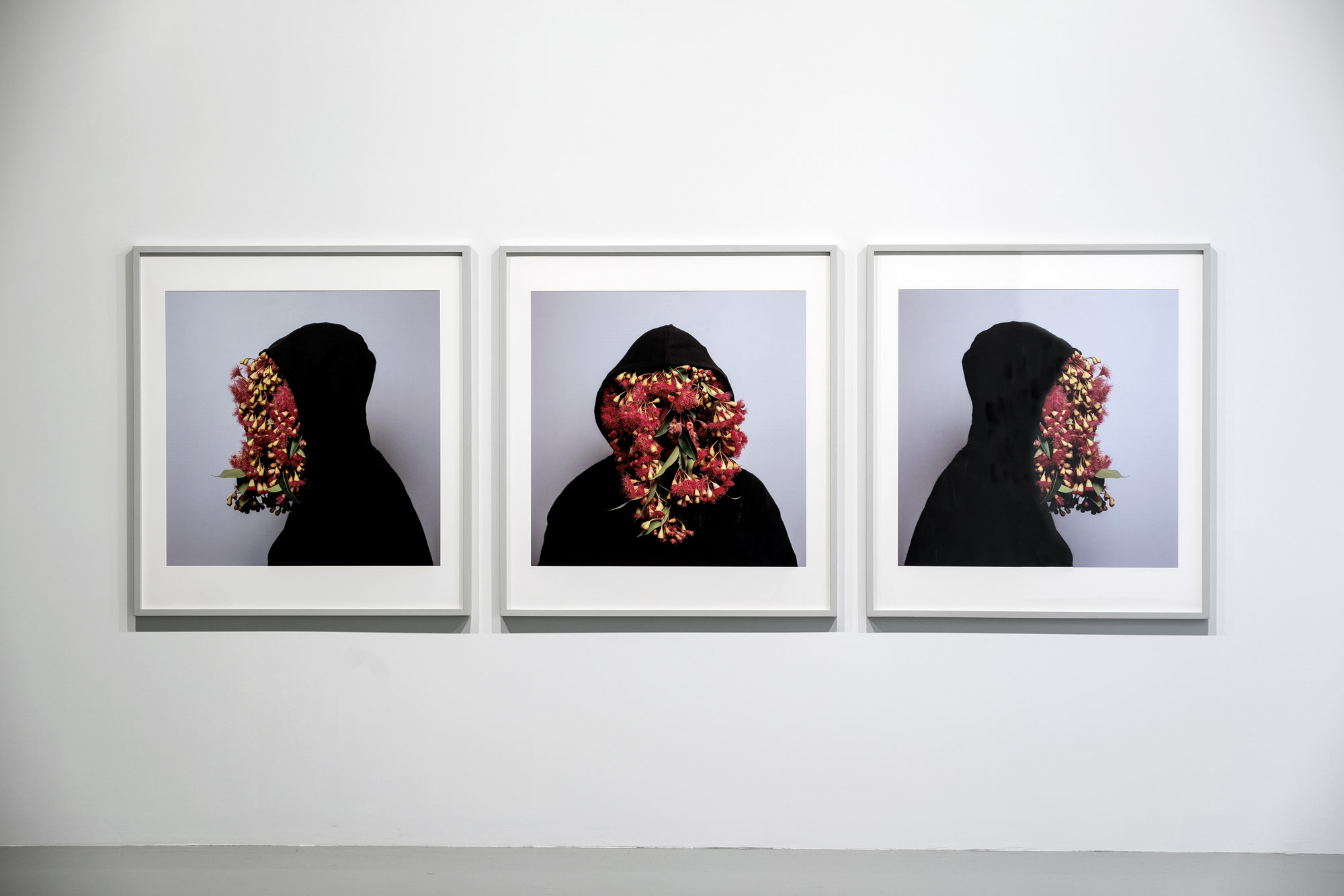
 

Christian Thompson (Australian, b. 1978) 'Black gum 1-3' 2007 from the exhibition 'Christian Thompson: Ritual Intimacy' at Monash University Museum of Art (MUMA), Melbourne, April - July, 2017


Christian Thompson (Australian, b. 1978)
Black gum 1-3
2007
From the series Australian graffiti
C-type prints
Collection of the National Gallery of Australia, Canberra
Photo: Andrew Curtis


Still singing, still Dreaming,
still loving… not dying.

This is a strong survey exhibition of the work of contemporary Australian Indigenous artist and Bidjara man exploring the world, Christian Thompson. As with any survey exhibition, it can only give us a glimpse into the long standing development of the artist’s work, inviting the viewer to then research more fully the themes, conceptual acts and bodies (of work) that have led the artist to this point in his artistic development. Having said that the exhibition, together with its insightful catalogue essays and additional images that do not appear in the exhibition, allow the viewer to be challenged intellectually, aesthetically and most importantly … spiritually. And to be somewhat conflicted by the art as well, it has to be said.

Thompson’s “multidisciplinary practice explores notions of cultural hybridity, along with identity and history, creating works that transcend cultural boundaries.” His self-reflexive and self-referential bodies of work, often with the artist using his body as an “armature for his characters, costumes and various props,” are intuitive and imaginative in how they relate Aboriginal and Australian/European history, taking past time into present time which influences future time. Time, memory, history, space, landscape are conflated into one point, enunciated through acts of ritual intimacy. These ritual intimacies, these performative acts, are enabled through an understanding of a regularised and constrained repetition of norms (in this case, the declarative power of colonialism), where the taking of a photograph of an Aboriginal person (for example), is “a ritual reiterated under and through constraint, under and through the force of prohibition and taboo, with the threat of ostracism and even death controlling and compelling the shape of the production…” (Judith Butler, Bodies That Matter. New York: Routledge, 1993, p. 95).

What is so heartening to see in this exhibition is a contemporary Indigenous artist not relying on re-animating colonial images of past injustices, but re-imagining these images to produce a spiritual connection to Country, to place, to people in the present moment. As Charlotte Day, Director, MUMA and Hetti Perkins, guest curator observe in the wall text at the beginning of the exhibition, “Rather than appropriating or restaging problematic ethnographic images of indigenous ancestors held in the Museum’s photographic collection, Thompson has chosen to spend significant periods of time with these images, absorbing their ‘aura’ and developing a personal artistic and deferential response that is decisively empowered.” As Marina Warner states in her excellent catalogue essay “Magical Aesthetics”, these ritual intimacies are a “magical re-animation and adopt time-honoured processes of making holy – of hallowing. Adornment is central to ritual and a prime way of glorifying and consecration.” What Thompson is doing is not quoting but translating the source-text into new material. As Mary Jacobus notes of the work of the painter Cy Twombly, “Quotation involves the repurposing of an existing text: translation requires a swerve from the source-text as it finds new directions and enters unknown terrain.” (Mary Jacobus. Reading Cy Twombly: Poetry in Paint.  Princeton & Oxford: Princeton University Press, 2016, p. 7).

This auto-ethnographic exploration and adornment leads to a deterritorialisation and reterritorialisation of time in a heterotopic space, juxtaposing in a single real place several spaces, several sites of contestation – Thompson’s travels and research from around the world, the embodiment in his own culture and that of contemporary Australia, pop culture, fashion, music and language – where, as Hetti Perkins says, “the unknowable is a lovely thing” and where Thompson can affect and influence “the Zeitgeist through more subversive means.” These spaces of ritualised production overlaid with memory, imagination, desire, and nostalgia, these fragmented images, become a process and a performance in which Thompson seeks to ameliorate the objects aura through a process of ‘spiritual repatriation’. Thompson’s performativity is where the ritual of production and meaning is never fully predetermined at any stage of production and reception.

Here, in terms of ‘aura’ and ‘spirit’, I am interested in the word “repatriation”. Repatriation means to send (someone) back to their own country – from the verb repatriare, from re- ‘back’ + Latin patria ‘native land’. It has an etymological link to the word “patriot” – from late Latin patriota ‘fellow countryman’, from Greek patriōtēs, from patrios ‘of one’s fathers’, from patris ‘fatherland’ – and all the imperial connotations that are associated with the word. So, to send someone back (against their own will? by force?) or to be patriotic, as belonging to or coming from, the fatherland. A land that is father, farther away. Therefore, it is with regard to a centralised, monolithic body and its materialities (for the body is usually centrally placed in Thompson’s work) in Thompson’s instinctive works, that relations of discourse and power will always produce hierarchies and overlappings which are going to be contested. As Judith Butler notes,

“That each of those categories [body and materiality] have a history and a historicity, that each of them is constituted through the boundary lines that distinguish them and, hence, by what they exclude, that relations of discourse and power produce hierarchies and overlappings among them and challenge those boundaries, implies that these are both persistent and contested regions.” (Judith Butler. Bodies That Matter. New York: Routledge, 1993, pp. 66-67)


Thus performativity is the power of discourse, the politicisation of abjection, and the ritual of being.

This is where I become conflicted by much of this work. Intellectually and conceptually I fully understand the instinctive, intuitive elements behind the work (crystals, flowers, maps, butterflies, dreams) but aesthetically I feel little ‘aura’ emanating from the photographs. Thompson’s “peripatetic life and your bowerbird, magpie-like fascination” (p. 107) lead to all sorts of influences emerging in the work – orange from The Netherlands, Morris dancers from England, Jewish heritage, Aboriginal and Australian heritage, fashion, pop culture, music, language – all evidenced through “acts of concealment in his self-portraits.” (p. 75). Now there’s the rub!

In Thompson’s ritual intimacies the intimacy is performed only once, for the camera. It is not didactic, but it is interior and hidden, leaving much to the feelings of the viewer, looking. The re-presentation of that intimacy is performed by the viewer every time they look at the art. I think of the work of one of my favourite performance artists, Claude Cahun, where the artist inhabits her personas, adorning her androgynous face with costume after costume to become something that she wants to become – a buddha, a double, a harpy, a lunatic or a doll with equal ease. Cahun is always and emphatically herself, undermining a certain authority… and she produces indelible images that sear the mind.

I don’t get that from Thompson. I don’t know who he really is. Does it matter? Yes it does. In supposedly his most autobiographic work (according to Hetti Perkins), the video Heat (2010, below) the work emerges out of Thompson’s memories of growing up in the desert surrounding Barcaldine in central west Queensland where “heat captures the sensation that he associates with being on his country: the dry wind blowing through his hair.” Perhaps for him or someone from the desert country like Hetti Perkins (as she states in the catalogue), but not for me. I feel no ‘heat’ from these three beautiful woman standing in a contextless background with a wind machine blowing their hair. The only ‘heat’ I felt was perhaps the metaphoric heat of colonisation, violence and abuse thrust on a vulnerable culture.

Talking of vulnerable cultures, in the work Polari (2014, below) Thompson invokes the history of languages in an intimate ritual “as he seeks to reanimate and repossess vanishing knowledge. Polari is a private language … a kind of code used by sailors, circus and fairground folk, and in gay circles. … Thompson’s Polari series warns us that the artist has a language of his own, which we can overhear but not fully understand: something is withheld, in contrast to the imposed and implacable exposure which the subjects of scientific collections were made to suffer in the past.” (Warner, p. 74) But why is he using Polari specifically, a language that is strongly associated with the libertine gay culture of the 1950s-70s? Does he have a right to use this word and its linguistic heritage because he is gay? It is never stated, again another thing left hidden, concealed and unresolved.

Although no culture can ever fully own its language (language is a construct after all) … if Thompson is not gay, then I would take exception to his invoking the Polari language, just as an Indigenous artist would take exception to me using Bidjara language in an art work of my own. I remember coming out in London in 1975 and speaking Polari myself when it was still being used in pubs and clubs such as the A + B club in Soho. It was not being used as a language of resistance, far from it, but as a language of desire. It was a language used to inculcate that desire. As a video on YouTube observes of speaking Polari, “you didn’t think, oh God I’m so oppressed I can never speak about myself, you just did it, you just slipped into it without thinking.” It was your own language, like a comfortable pair of slippers. Does Thompson understand how using that word to title a body of work could be as offensive to some people as he finds the denaturing of his own culture? For me this is where the work really becomes problematic, when an artist does not enunciate these connections, where things, like sexuality, remain hidden. Similarly, with historical photographs of Indigenous people taken for ethnographic study, Thompson fails to acknowledge the work of academics such as Jane Lydon and her important books Eye Contact: Photographing Indigenous Australians (2005) and Photography, Humanitarianism, Empire (2016) where she unpacks the historical baggage of the images and notes that the photographs were not solely a tool of colonial exploitation. Lydon articulates an understanding in Eye Contact that the residents of Coranderrk, an Aboriginal settlement near Healsville, Melbourne, “had a sophisticated understanding of how they were portrayed, and they became adept at manipulating their representations.” Again, there is more than meets the eye, more than just ‘spiritual repatriation’ of aura.

For me, the magic of this exhibition arrives when Thompson lets go all obfuscation, let’s go all actions that make something obscure, unclear, or unintelligible. Where his ritual intimacies become grounded in language, earth and spirit. This happens in the video works, Desert slippers (2006, below), Refuge (2014, below), Gamu Mambu (Blood Song) (2011) and Dhagunyilangu (Brother) (2011, below). In these videos, the Other’s gaze disintegrates and we are left with poignant, heart felt words and actions that engage history, emotion, family and Country.

The video Desert slippers “features a Bidjara ritual in which a father and son transfer sweat. The desert slipper is a native cactus that symbolises the transferal of the spirit back to earth as the plant grows.” It is simple, eloquent, powerful, present. The other videos feature two baroque singers from Europe and Thompson singing in his native tongue Bidjara (Bidyara, Pitjara), a language that Wikipedia states “is an extinct Australian Aboriginal language. In 1980 it was spoken by twenty elders in Queensland, between Tambo and Augathella, Warrego and Langlo rivers.” Spelt out in black and white. Extinct. To hear Thompson sing a berceuse (French, from bercer ‘to rock’), or lullaby in his native language, a language taught to him by his father, is the most emotional of experiences. The work “combines evocative chanting and electronic elements to invoke the cultural experiences and narratives of his Bidjara culture,” and “is premised on the notion that if one word of Bidjara is spoken, or sung in this case, it remains a living language.” Amen to that.

This is the real hallowing, not the dress ups or the concealments. It is in these videos that the raw material of his and his cultures experience is transmuted into living, breathing stories, in an alchemical transmutation, a magical re-animation of past time into present and future time. My transfiguration into a more spiritual state was complete when listening in quiet contemplation. For I was given, if only for a very brief moment, access to the pain of our First Peoples and a vision of hope for their future healing.

Still singing, still Dreaming,
still loving… and certainly not dying.

Dr Marcus Bunyan

Word count: 2,053


Many thankx to MUMA for allowing me to publish the photographs and videos in the posting. All installation photographs unless otherwise noted © Marcus Bunyan, the artist and MUMA. Please click on the photographs for a larger version of the image.


Christian Thompson (Australian, b. 1978) 'Black gum 1' 2007 (installation view)


Christian Thompson (Australian, b. 1978)
Black gum 1 (installation view)
2007
From the series Australian graffiti
C-type print
Collection of the National Gallery of Australia, Canberra
Photo: Marcus Bunyan
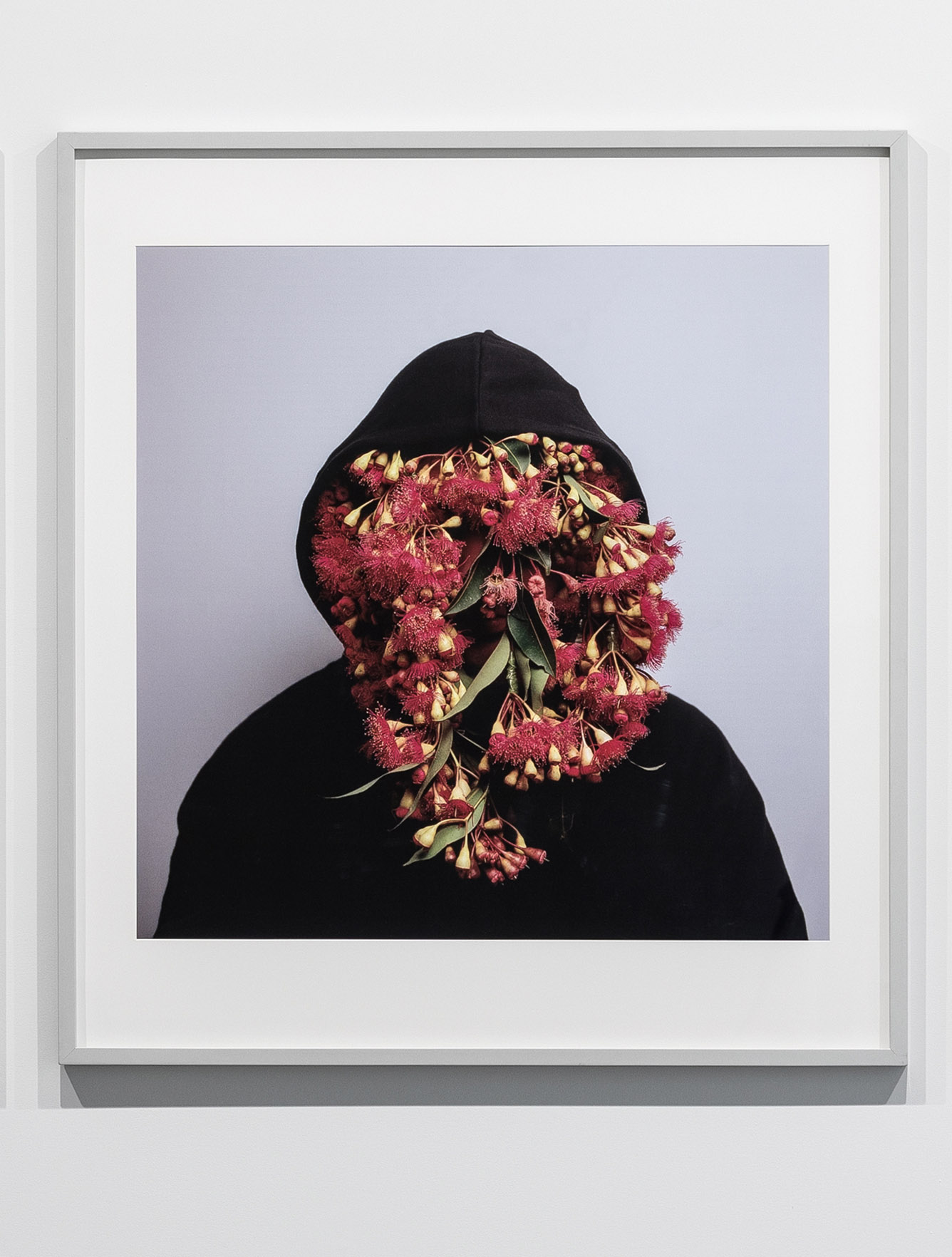
 

Christian Thompson (Australian, b. 1978) 'Black gum 2' 2007 (installation view)


Christian Thompson (Australian, b. 1978)
Black gum 2 (installation view)
C-type print
2007
From the series Australian graffiti
Collection of the National Gallery of Australia, Canberra
Photo: Marcus Bunyan


“While I’m interested in portraiture – I don’t consider my work as portraiture because that suggests that I’m trying to portray myself, my own visage, my own image. I employ images, icons, materials, metaphors to capture and idea and moment in time. There are many different things at play; taking a picture of myself is really the last thing that’s on my mind.”


Christian Thompson in conversation with Hetti Perkins, catalogue extract


“I’m interested in simple aesthetic gestures that can say something … something quite profound about the world that we live in. I tend to build images how I create a sculpture. I borrow from the world around me.”

On being away from home: “You’re able to remove yourself from the local discourse, and romanticise home. When you’re displaced you tend to gravitate towards certain memories … But this is who I am. It would be weird not to express that somehow. I combine memories of my past with my lived experience and an idea of where I’d like to be … it’s all montaged into one.”


Christian Thompson quoted in Will Cox. “Christian Thompson’s Ritual Intimacy,” on the Broadsheet website 15 June 2017 [Online] Cited 22/12/2021


“But Thompson makes things up. His ‘We bury our own’ does not let us see the early daguerreotype but improvises a series of fugues on its spiritual essence. This is the crucial step that Thompson has taken: if you repeat the spectacle you cannot escape the past. But if you, a spiritual descendant, transmogrify yourself in keeping with the aura of the image’s subject, during the prolonged period of encounter and immersion, you can ‘repatriate’ that forebear. Or so he desires.”

“Through these conjurings of the language his people spoke before colonisation set out to strip them of their culture as well as their land, Christian Thompson performs private ceremonies – to reach beyond visual statements of personal presence and reawaken the knowledge of his forebears, and allow us, his listeners and viewers, into their living story.”


Marina Warner. “Magical Aesthetics,” extracts from the catalogue essay


“At the heart of my practice is a concern with aura: what it is, how it can be photographed and how it can be repatriated.”


Christian Thompson
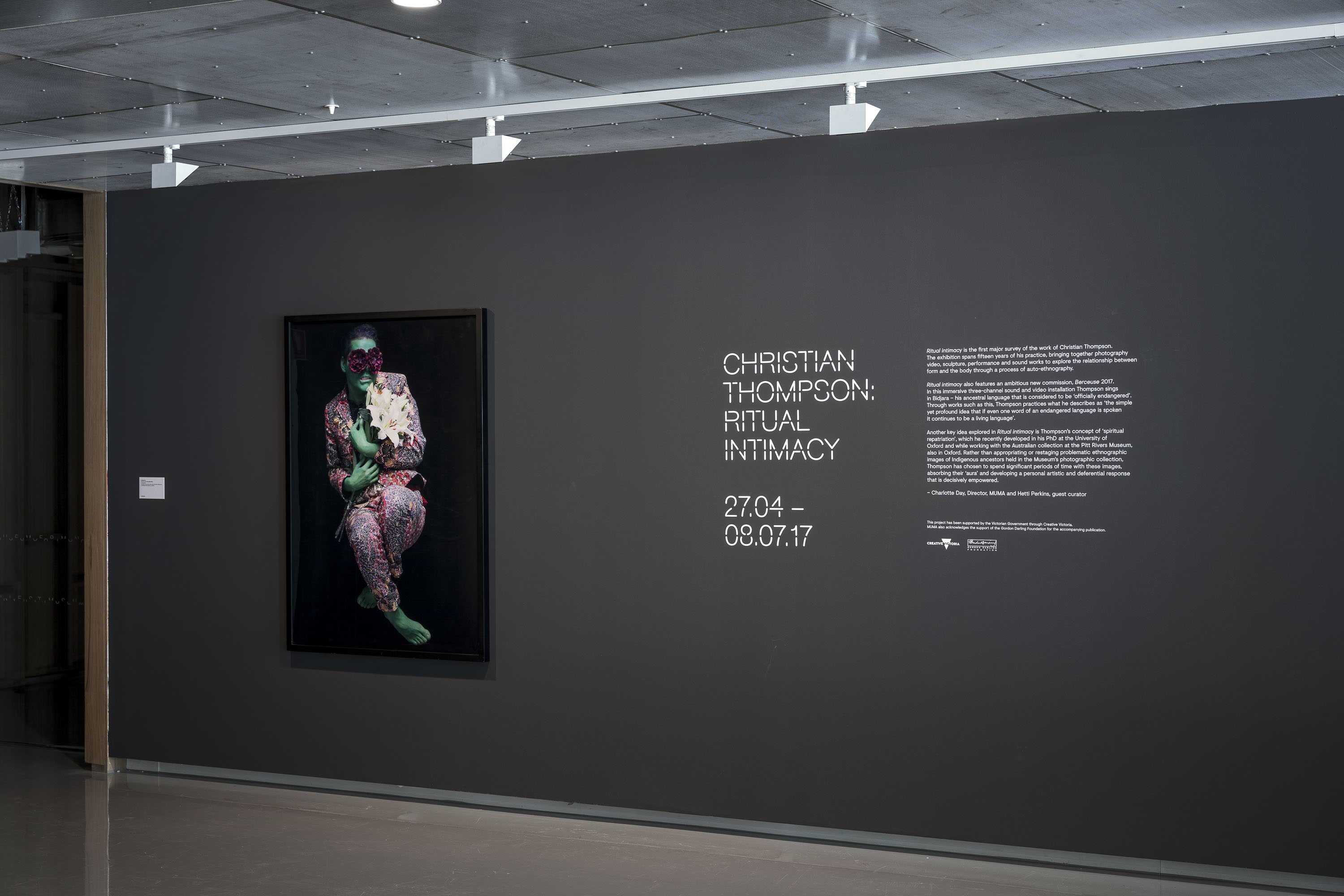


'Christian Thompson: Ritual intimacy', installation view: Monash University Museum of Art, Melbourne 2017


Christian Thompson: Ritual intimacy, installation view: Monash University Museum of Art, Melbourne 2017
Photo: Andrew Curtis


Christian Thompson (Australian, b. 1978) 'Untitled #6' 2010


Christian Thompson (Australian, b. 1978)
Untitled #6
2010
From the series King Billy
C-type print
Image courtesy of the artist, Sarah Scout Presents, Melbourne, and Michael Reid, Sydney and Berlin


'Christian Thompson: Ritual intimacy', installation view: Monash University Museum of Art, Melbourne 2017 featuring stills from the video 'Berceuse' (2017)

'Christian Thompson: Ritual intimacy', installation view: Monash University Museum of Art, Melbourne 2017 featuring stills from the video 'Berceuse' (2017)


Christian Thompson: Ritual intimacy, installation view: Monash University Museum of Art, Melbourne 2017 featuring stills from the video Berceuse (2017)
Photos: Marcus Bunyan


Christian Thompson (Australian, b. 1978)
Berceuse (extract installation view)
2017
Three-channel digital colour video, sound
5.47 minutes
Sound design: Duane Morrison


Christian Thompson (Australian, b. 1978)
Berceuse
2017
Three-channel digital colour video, sound
5.47 minutes
Sound design: Duane Morrison


In this newly commissioned work, Thompson sings a berceuse – a cradle song or lullaby – that combines evocative chanting and electronic elements to invoke the cultural experiences and narratives of his Bidjara culture. Intended as a gesture of re-imagining his traditional Bidjara language, which is been categorised as extinct, the work is premised on the notion that if one word of Bidjara is spoken, or sung in this case, it remains a living language.

Thompson makes subtle reference to his maternal Sephardic Jewish roots by ruminating in this work on the lullaby Nani Nani:


Lullaby, lullaby
The boy wants a lullaby,
The mother’s son,
Who although small will grow.

Oh, oh my lady open,
Open the door,
I come home tired,
From ploughing the fields.

Oh, I won’t open them,
You don’t come home tired,
You’ve just come back,
From seeing your new lover.

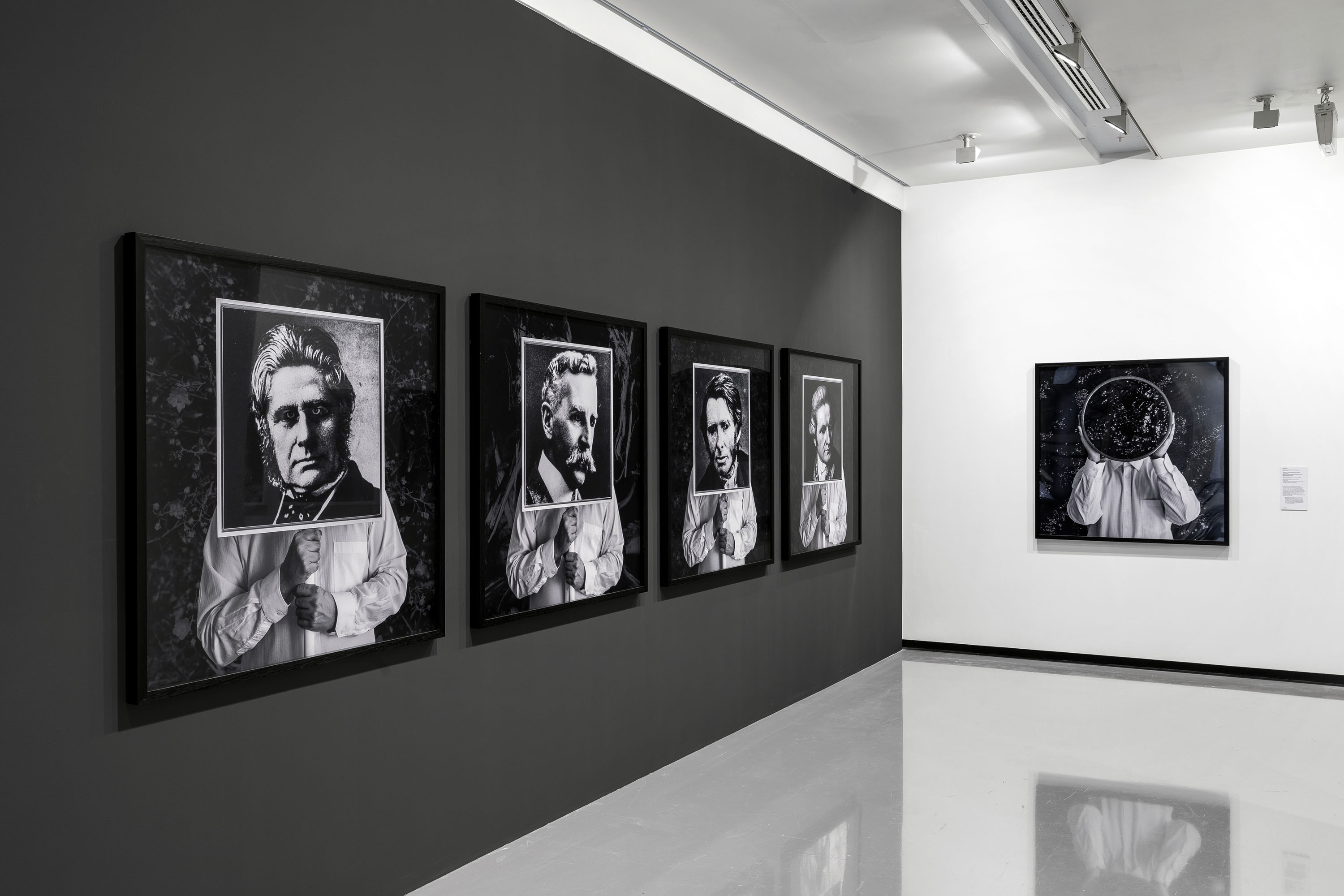
 

'Christian Thompson: Ritual intimacy', installation view: Monash University Museum of Art, Melbourne 2017 featuring the series 'Museum of Others' (2016)

'Christian Thompson: Ritual intimacy', installation view: Monash University Museum of Art, Melbourne 2017 featuring the series 'Museum of Others' (2016)


Christian Thompson: Ritual intimacy, installation view: Monash University Museum of Art, Melbourne 2017 featuring the series Museum of Others (2016)
Photos: Marcus Bunyan
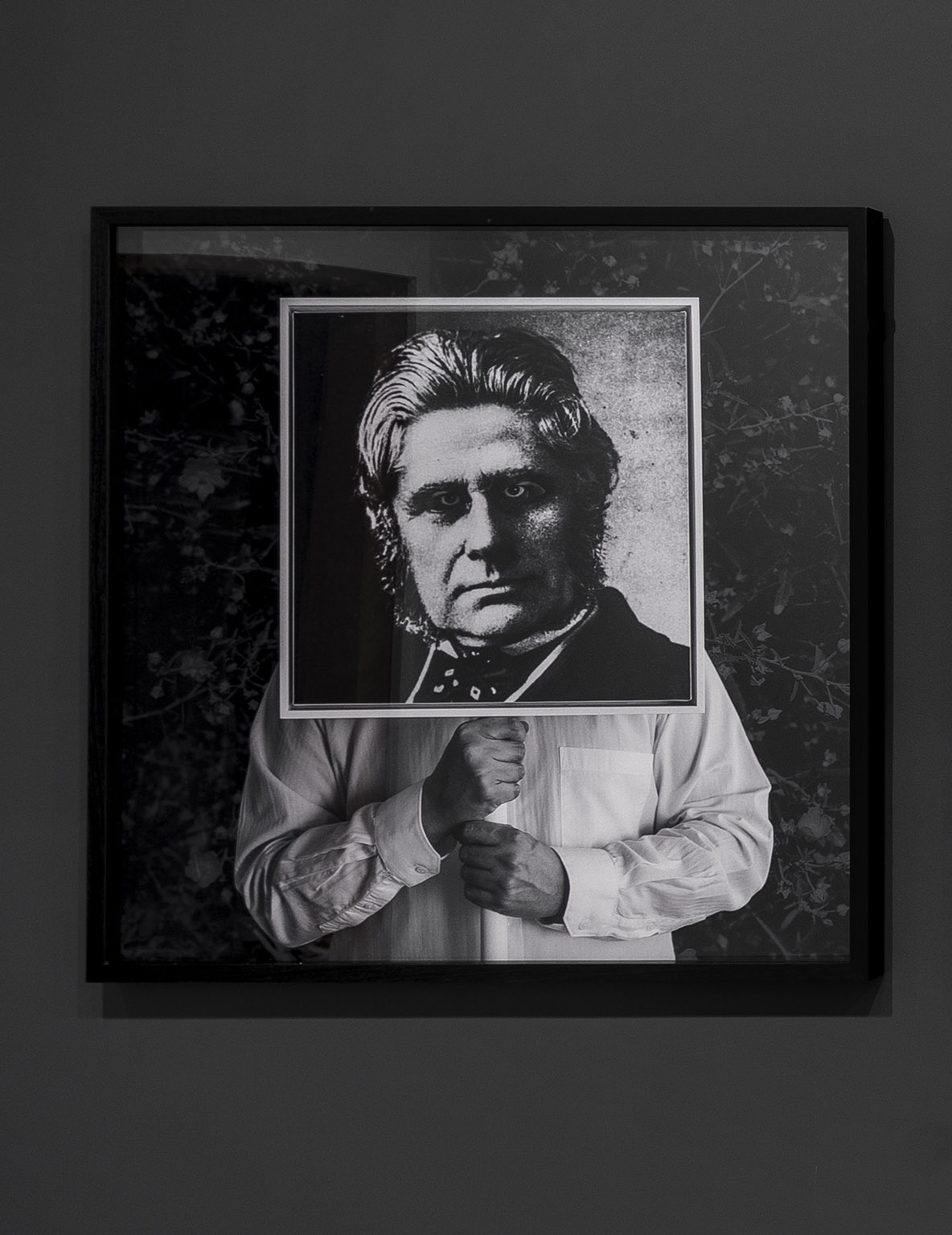
 

Installation view of Christian Thompson's 'Museum of Others (Othering the Ethnologist, Augustus Pitt Rivers)' 2016


Installation view of Museum of Others (Othering the Ethnologist, Augustus Pitt Rivers) 2016
Photo: Marcus Bunyan


Christian Thompson (Australian, b. 1978) 'Museum of Others (Othering the Anthropologist, Walter Baldwin Spencer)' 2016 (installation view)


Christian Thompson (Australian, b. 1978)
Museum of Others (Othering the Anthropologist, Walter Baldwin Spencer)
2016
From the series Museum of Others
C-type print


Installation view of Christian Thompson's 'Museum of Others (Othering the Explorer, James Cook)' 2016


Installation view of Museum of Others (Othering the Explorer, James Cook) 2016
Photo: Marcus Bunyan


Christian Thompson (Australian, b. 1978) 'Othering the Explorer, James Cook' 2016


Christian Thompson (Australian, b. 1978)
Museum of Others (Othering the Explorer, James Cook)
2016
From the series Museum of Others
C-type print
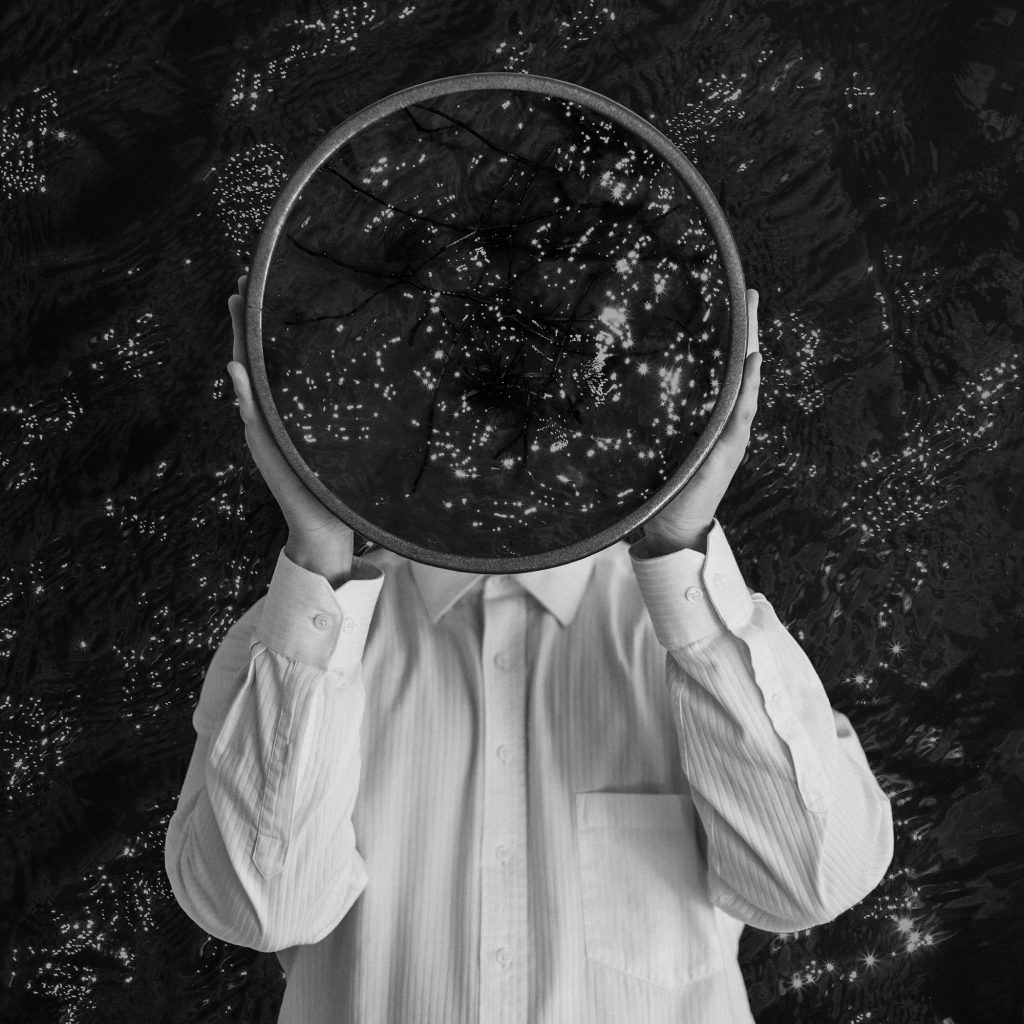
 

Christian Thompson (Australian, b. 1978) 'Equilibrium' 2016


Christian Thompson (Australian, b. 1978)
Equilibrium
2016
From the series Museum of Others
C-type print


Museum of others is Thompson’s most recent photographic series and continues to reflect on his time at the University of Oxford. It features several ‘dead white males’ from the pantheon of British and Australian culture. The explorer, the ethnologist and the anthropologist all had roles in the process of colonisation in Australia but the art critic is particular to Thompson; Ruskin was the first Slade Professor of Fine Art at University of Oxford, just as Thompson was one of its first Australian Aboriginal students. Thompson explains his motivation for the series:

“Historically, it was the western gaze that was projected onto the ethnic other and I thought I’ll create a ‘museum of others’ and I’ll be the one othering, so to speak. ‘Equilibrium’ is based around the idea that the vessel is the equaliser. The vessel is the cradle of all civilisations. We all have that in common.”


Wall text from the exhibition


'Christian Thompson: Ritual intimacy', installation view: Monash University Museum of Art, Melbourne 2017 featuring photographs from the series 'We bury our own' 2010 (C-type prints)

'Christian Thompson: Ritual intimacy', installation view: Monash University Museum of Art, Melbourne 2017 featuring photographs from the series 'We bury our own' 2010 (C-type prints)


Christian Thompson: Ritual intimacy, installation view: Monash University Museum of Art, Melbourne 2017 featuring photographs from the series We bury our own 2010 (C-type prints)
Photos: Andrew Curtis


We bury our own is a body of work that was developed in response to the historic collection of photography, featuring Aboriginal people from the late nineteenth century, at the Pitt Rivers Museum in Oxford. Thompson noted in 2012 that these early images “have permeated my work over the last year. They have remained at the forefront of every artistic experiment and they have pushed me into new territory, they have travelled with me… I was drawn to elements of opulence, ritual, homage, fragility, melancholy, strength and even a sense of play operating in the photographs…”

Each of Thompson’s lyrical photographic images from We bury our own and Pagan sun feature himself partially disguised with props and costumes. The works are virtually monochromatic with elements highlighted in full colour, and his eyes, or face, are partially concealed or painted. The use of votive objects is explained in his equally lyrical 2012 statement: “I lamented the passing of the flowers at the meadow, I lit candles and offered blood to the ancestral beings, looked into the black sparkling sea, donned the Oxford garb, visited the water by fire light and bowed at the knees of the old father ghost gum.”

Text from the Turner Galleries website [Online] Cited 22/12/2021


Christian Thompson (Australian, b. 1978) 'Energy Matter' 2010


Christian Thompson (Australian, b. 1978)
Energy Matter
2010
From the series We bury our own
C-type print


Christian Thompson (Australian, b. 1978) 'Lamenting the flowers' 2010


Christian Thompson (Australian, b. 1978)
Lamenting the flowers
2010
From the series We bury our own
C-type print


Christian Thompson (Australian, b. 1978) 'Forgiveness of Land' 2010 from the exhibition 'Christian Thompson: Ritual Intimacy' at Monash University Museum of Art (MUMA), Melbourne, April - July, 2017


Christian Thompson (Australian, b. 1978)
Forgiveness of Land
2010
From the series We bury our own
C-type print


Christian Thompson (Australian, b. 1978) 'Down Under World' 2010


Christian Thompson (Australian, b. 1978)
Down Under World
2010
From the series We bury our own
C-type print


I conceived the We Bury Our Own series in 2010 after curator Christopher Morton invited me to develop a body of work that would be inspired by and in dialogue with the Australian photographic collection at the Pitt Rivers Museum…

The archival images have permeated my work over the last year. They have remained at the forefront of every artistic experiment and pushed me into new territory; they have travelled with me to residencies at the Fonderie Darling in Montreal and Greene Street Studio, New York. I was drawn to elements of opulence, ritual, homage, fragility, melancholy, strength and even a sense of play operating in the photographs. The simplicity of a monochrome and sepia palette, the frayed delicate edges and the cracks on the surface like a dry desert floor that reminded me of the salt plains of my own traditional lands.

I wanted to generate an aura around this series, a meditative space that was focused on freeing oneself of hurt, employing crystals and other votive objects that emit frequencies that can heal, ward off negative energies, psychic attack, geopathic stress and electro magnetic fields, and, importantly, transmit ideas.

I lamented the passing of the flowers at the meadow, I lit candles and offered blood to the ancestral beings, looked into the black sparkling sea, donned the Oxford garb, visited the water by fire light and bowed at the knees of the old father ghost gum. I asked the photographs in the Pitt Rivers Museum to be catalysts and waited patiently to see what ideas and images would surface in the work, I think with surprising results. Perhaps this is what art is able to do, perform a ‘spiritual repatriation’ rather than a physical one, fragment the historical narrative and traverse time and place to establish a new realm in the cosmos, set something free, allow it to embody the past and be intrinsically connected to the present?

I heard a story many years ago from some old men, they told me about a ceremony where young warriors would make incisions through the flesh exposing the joints, they would insert gems between the bones to emulate the creator spirits, often enduring infection and agonising pain or resulting in death. The story has stuck with me for many years, one that suggests immense pain fused with intoxicating beauty. The idea of aspiring to embody the creators, to transgress the physical body by offering to our gods our spiritual heart, freeing ourselves of suffering by inducing a kind of excruciating decadent torture. This was something that played on my mind during the production of this series of photos and video work. The deliverance of the spirit back to land – the notion that art could be the vehicle for such a passage, the aspiration to occupy a space that belongs to something higher than one’s physical self.

Christian Thompson artist statement in “Christian Thompson: We Bury Our Own,” on the Pitt Rivers Museum website [Online] Cited 21/12/2021
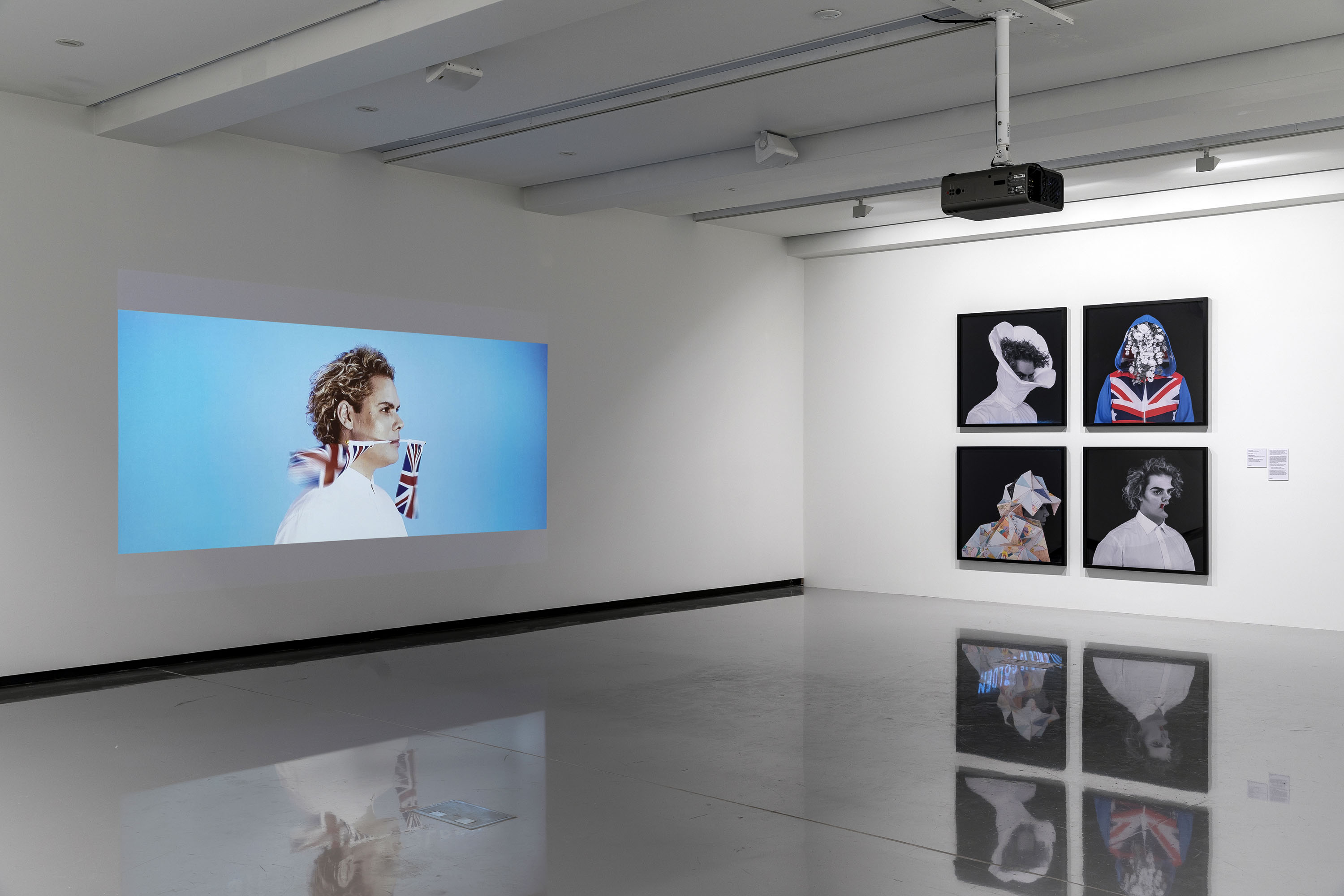
 

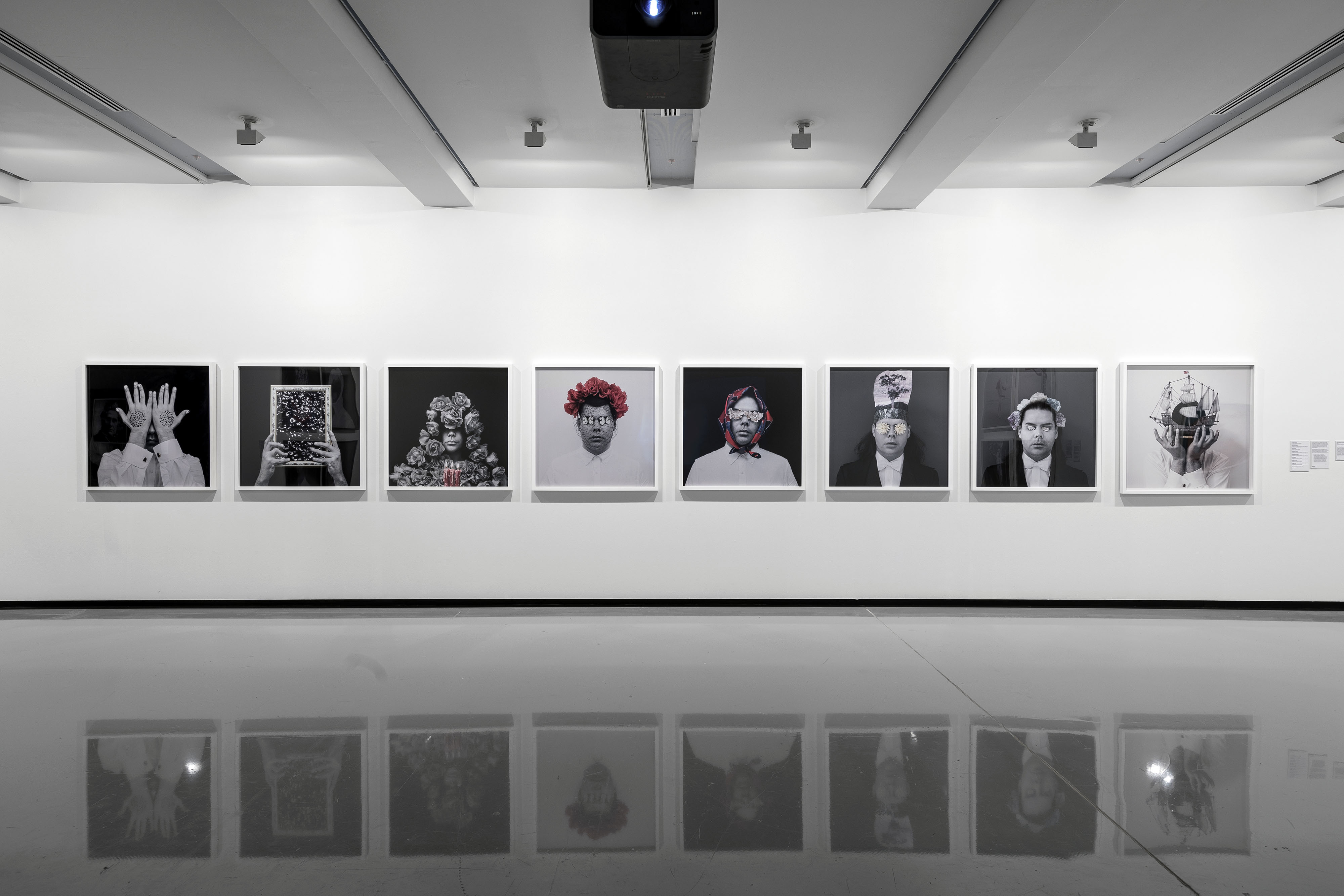
'Christian Thompson: Ritual intimacy', installation view: Monash University Museum of Art, Melbourne 2017 featuring 'Ship of dreams', 'Ancient bloom', 'Death's second self', and 'Gods and kings' from the series 'Imperial relic' 2015 (C-type prints) and a still from the video 'dead tongue' 2015


Christian Thompson: Ritual intimacy, installation view: Monash University Museum of Art, Melbourne 2017 featuring Ship of dreams, Ancient bloom, Death’s second self, and Gods and kings from the series Imperial relic 2015 (C-type prints) and a still from the video dead tongue 2015
Photo: Andrew Curtis


In Dead tongue Thompson continues to interrogate the implications of England’s empirical quest on the former colonies of the British Empire through the threat to or loss of Indigenous languages. In works such as this, Thompson actively challenges the perception that Aboriginal culture has become reduced to a captured trophy of Empire.

Wall text from the exhibition


'Christian Thompson: Ritual intimacy', installation view: Monash University Museum of Art, Melbourne 2017 featuring 'Ship of dreams', 'Ancient bloom', 'Death's second self', and 'Gods and kings' from the series 'Imperial relic' 2015 (C-type prints)


Christian Thompson: Ritual intimacy, installation view: Monash University Museum of Art, Melbourne 2017 featuring Ship of dreams, Ancient bloom, Death’s second self, and Gods and kings from the series Imperial relic 2015 (C-type prints)
Photo: Andrew Curtis


In … Imperial relic, he continues to use himself as the ‘armature for his characters, costumes and various props’. Drawing on his background in sculpture, he has created ‘wearable sculptures’ including a trumpet shaped shirt collar, an eruption of white flowers from a union jack hoodie, and an armature of maps. In each his face is partially or fully obscured again. “I’m interested in ideas of submission and domination,” he says. “So the trumpet headpiece is beautiful, but it also potentially muffles or silences the voice. The same thing with maps: they are purporting different kinds of historical narrative, depending who is telling the story. One is about the history of Indigenous people, one is about the history of white colonisers and then one is about the idea of charting the land and of discovery. I’m wearing it as an armature over my own body: that’s part of my own history but also of Australian history.”

Text from the Turner Galleries website [Online] Cited 22/12/2021


Christian Thompson (Australian, b. 1978) 'Ancient bloom' 2015


Christian Thompson (Australian, b. 1978)
Ancient bloom
2015
From the series Imperial relic
C-type print on fuji pearl metallic paper
100 x 100cm
Image courtesy of the artist, Sarah Scout Presents, Melbourne, and Michael Reid, Sydney and Berlin


Christian Thompson (Australian, b. 1978) 'Ship of dreams' 2015


Christian Thompson (Australian, b. 1978)
Ship of dreams
2015
From the series Imperial relic
C-type print on fuji pearl metallic paper
100 x 100 cm
Image courtesy of the artist, Sarah Scout Presents, Melbourne, and Michael Reid, Sydney and Berlin


The series title Imperial relic, summarises the fundamental philosophy underpinning the colonial occupation of Australia. Like the nearby series We bury our own, it is closely connected to Thompson’s studies in the collections of the Pitt Rivers Museum and shares with the Australian graffiti series Thomson’s physical presence is standing in for the Australian landscape.

The work Ancient bloom alludes to the phonograph horn out which might be heard the voice of Fanny Cochran Smith, who’s wax cylinder recordings of songs are the only historical audio recordings of any of the Tasmanian Aboriginal languages. Is also represents a Victorian-era shirt collar – a motif that has appeared in Thompson’s work since his Emotional striptease series of 2003 – but here is exaggerated into a soft-sculptural form that both projects and stifles the voice.

In Death’s second self the artist’s face is uncovered but distorted by make up and digital postproduction effects.The title quotes William Shakespeare’s Sonnet 73:

As after sunset fadeth in the west,
Which by and by black night doth take away,
Death’s second self, that seals up all in rest.


In God and Kings Thompson is cloaked with a map of Aboriginal language groups like a coat of armour. In the Ship of dreams he reprises the motif of Australian flora obscuring his face but here his hoodie is stitched together from several flags: the red ensign (flown by British registered ships), the RAAF flag and the Australian flag.


“I’m interested in ideas of submission and domination … So the trumpet headpiece is beautiful, but it also potentially muffles or silences the voice. The same thing with maps: they are purporting different kinds of historical narrative, depending who is telling the story. One is about the history of Indigenous people, one is about the history of white colonisers and then one is about the idea of charting the land and of discovery. I’m wearing it as an armature over my own body: that’s part of my own history but also of Australian history.”


Christian Thompson in text from the Turner Galleries website [Online] Cited 22/12/2021


'Christian Thompson: Ritual intimacy', installation view: Monash University Museum of Art, Melbourne 2017 featuring 'Isabella kept her dignity', 'I'm not going anywhere without you', 'Dead as a door nail' and 'Hannah's diary' from the series 'Lost together' 2009


Christian Thompson: Ritual intimacy, installation view: Monash University Museum of Art, Melbourne 2017 featuring Isabella kept her dignity, I’m not going anywhere without you, Dead as a door nail and Hannah’s diary from the series Lost together 2009 (C-type prints)
Photo: Andrew Curtis


On 13 February 2008 then Prime Minister Kevin Rudd made an official apology to Aboriginal Australians for the Stolen Generations – the children of Aboriginal and Torres Strait Islander descent who were removed from their families between 1910 and 1970 under the respective Federal and State government policies of assimilation. At the time, Thompson was preparing to leave Australia for further studies aboard and felt this historic gesture allowed him to proudly take his culture and history with him as he ventured into the world.

Thompson photographed the series Lost together in the Netherlands while studying at the DasArts Academy of Theatre and Dance at Amsterdam University. The theme of the orange throughout the series is a reference to the national colour of the Netherlands, while the tartan patterning refers to early clan societies in the United Kingdom. The combination of these different styles is based on counter-cultural aesthetics – particularly punk collage of 1970s London.


Christian Thompson (Australian, b. 1978) 'Hannah's Diary' 2009


Christian Thompson (Australian, b. 1978)
Hannah’s Diary
2009
From the series Lost Together
C-type print
Image courtesy of the artist, Sarah Scout Presents, Melbourne, and Michael Reid, Sydney and Berlin


MUMA | Monash University Museum of Art is proud to announce the first major survey exhibition of the work of Bidjara artist, Christian Thompson, one of Australia’s leading and most intriguing contemporary artists.

Thompson works across photography, video, sculpture, performance and sound, interweaving themes of identity, race and history with his lived experience. His work is held in the collections of major state and national art museums in Australia and internationally.

Thompson made history as one of the first two Aboriginal Australians to be accepted into the University of Oxford as a Charlie Perkins Scholar, where he completed his Doctorate of Philosophy (Fine Art) in 2016. Christian Thompson: Ritual Intimacy opens as the artist looks forward to the graduation ceremony in July, when he will be conferred his degree.

Featuring a major new commission created for this exhibition, Christian Thompson: Ritual Intimacy will survey Thompson’s diverse practice, spanning fifteen years, and will also be accompanied by the publication of the first monograph on the artist’s career and work, including essays by Brian Catling RA and Professor Dame Marina Warner DBE, CBE, FBA, FRSL.

The specially commissioned installation will be an ambitious multichannel composition, developing the sonic experimentation that is a signature of Thompson’s work. Incorporating Bidjara language, it will invite viewers into an immersive space of wall-to-wall imagery and sound:

“Bidjara is officially an endangered language but my work is motivated by the simple yet profound idea that if even one word of an endangered language is spoken it continues to be a living language,” Thompson says.

Christian Thompson: Ritual Intimacy explores the unique perspective and breadth of Thompson’s practice from the fashioning of identity through to his ongoing interest in Indigenous language as the expression of cultural survival. The new multichannel work will develop musical ideas Thompson has previously explored.

“It will be a much more ambitious iteration of a song in Bidjara. At one stage I’m singing on one screen and then other versions of me appear singing the melodies. I really see it as an opportunity to do something that’s more complex musically, more textured sonically – I also want it to be more intricate with my use of language,” the artist says.

Ritual Intimacy is curated by MUMA director Charlotte Day and guest curator Hetti Perkins. Day explains that the exhibition is part of MUMA’s Australian artist series, which affords the opportunity to look at each artist’s practice in depth. “Christian’s exhibition traces a particularly productive period of research and development, from early well-known works such as the Australian Graffiti series to more recent experiments with language in sound and song works,” Day says.

A long-time curatorial collaborator with Thompson, Perkins is the writer and presenter of art + soul, the ABC’s acclaimed television series about contemporary Aboriginal and Torres Strait Islander art. Thompson was accepted to Oxford University on an inaugural Charlie Perkins Scholarship, set up to honour Hetti Perkins’s famous father – a leader, activist and the first Aboriginal Australian to graduate from university. Perkins says the MUMA exhibition is well-earned recognition for Thompson’s work, which she featured in the second series of art + soul.

“Christian has spent periods of his adult life, as a practicing artist, away from home, but there is a common thread in his work, and it’s this connection to home or Country,” Perkins says. “In terms of the rituals or rites of the exhibition title, he is constantly reiterating that connection to home – through words, through performance, through his art, through ideas and writing,” she says.

Alongside performance and ritual, Thompson’s concept of “spiritual repatriation” is central to his work. Working with the Australian collection at famed ethnographic storehouse the Pitt Rivers Museum, Oxford, the artist was offered copies of colonial photographs of Aboriginal people but preferred not to work this way. Instead, he chose to spend significant periods of time with these ancestral images, absorbing their “aura” in order to then make his own artistic response that did not reproduce those original problematic images.

Dr Christian Thompson is a Bidjara contemporary artist whose work explores notions of identity, cultural hybridity, and history; often referring to the relationships between these concepts and the environment. Formally trained as a sculptor, Thompson’s multidisciplinary practice engages mediums such as photography, video, sculpture, performance, and sound. His work focuses on the exploration of identity, sexuality, gender, race, and memory. In his live performances and conceptual anti-portraits he inhabits a range of personas achieved through handcrafted sculptures and carefully orchestrated poses and backdrops.

Press release from MUMA


'Christian Thompson: Ritual intimacy', installation view: Monash University Museum of Art, Melbourne 2017 featuring the series 'Polari' (2014)

'Christian Thompson: Ritual intimacy', installation view: Monash University Museum of Art, Melbourne 2017 featuring the series 'Polari' (2014)


Christian Thompson: Ritual intimacy, installation view: Monash University Museum of Art, Melbourne 2017 featuring the series Polari (2014)
Photos: Marcus Bunyan


‘Polari’ is a form of cant or cryptic slang that evolved over several centuries from the various languages that converged in London’s theatres, circuses and fairgrounds, the merchant navy and criminal circles. It came to be associated with gay subculture, as many gay men worked in theatrical entertainment or joined ocean liners as waiters, stewards and entertainers at a time when homosexual activity was illegal. This slang rendered the speaker unintelligible to hostile outsiders, such as policeman, but fell out of use after the Sexual Offences Act (1967) effectively decriminalised homosexuality in the United Kingdom. Attracted to the theatricality and defiant nature of Polari (which he likens to the situation of Australian Indigenous languages under assimilationist policies), Thompson borrowed its name for the series which examines how subcultures express themselves.


Christian Thompson (Australian, b. 1978) 'Siren' 2014


Christian Thompson (Australian, b. 1978)
Siren
2014
From the series Polari
C-type print
Image courtesy of the artist, Sarah Scout Presents, Melbourne, and Michael Reid, Sydney and Berlin


Christian Thompson (Australian, b. 1978) 'Trinity II' 2014


Christian Thompson (Australian, b. 1978)
Trinity II
2014
From the series Polari
C-type print
Image courtesy of the artist, Sarah Scout Presents, Melbourne, and Michael Reid, Sydney and Berlin


Christian Thompson (Australian, b. 1978) 'Trinity III' 2014


Christian Thompson (Australian, b. 1978)
Trinity III
2014
From the series Polari
C-type print
Image courtesy of the artist, Sarah Scout Presents, Melbourne, and Michael Reid, Sydney and Berlin


Christian Thompson (Australian, b. 1978) 'Ariel' 2014


Christian Thompson (Australian, b. 1978)
Ariel
2014
From the series Polari
C-type print
Image courtesy of the artist, Sarah Scout Presents, Melbourne, and Michael Reid, Sydney and Berlin


'Christian Thompson: Ritual intimacy', installation view: Monash University Museum of Art, Melbourne 2017 showing at left, 'Ellipse' (2014)


Christian Thompson: Ritual intimacy, installation view: Monash University Museum of Art, Melbourne 2017 showing at left, Ellipse (2014, below)
Photo: Marcus Bunyan


Christian Thompson (Australian, b. 1978) 'Ellipse' 2014


Christian Thompson (Australian, b. 1978)
Ellipse
2014
From the series Polari
C-type print
Image courtesy of the artist, Sarah Scout Presents, Melbourne, and Michael Reid, Sydney and Berlin


Putting on the Dish – A short film in Polari

Polari was a form of slang used by gay men in Britain prior to the decriminalisation of homosexuality in 1967, used primarily as a coded way for them to discuss their experiences. It quickly fell out of use in the 70s, although several words entered mainstream English and are still used today. For more about Polari see Wikipedia.


Polari – The Story of Britain’s Gay Slang

Author and academic Paul Baker of Lancaster University discusses a form of gay slang known as Polari that was spoken in Britain. It was a secret type of language used mainly by gay men and some lesbians and members of the trans, drag and other communities in the United Kingdom in the 20th century until it largely died out by the early 1970s.


Christian Thompson (Australian, b. 1978)
Refuge
2014
Video and sound
4 mins 18 secs


Refuge is a video work by contemporary Australian artist Christian Thompson. Thompson sings in the endangered Bidjara language of his heritage. A collaboration with James Young formerly of ‘Nico’ and recorded the original track in Oxford, United Kingdom.

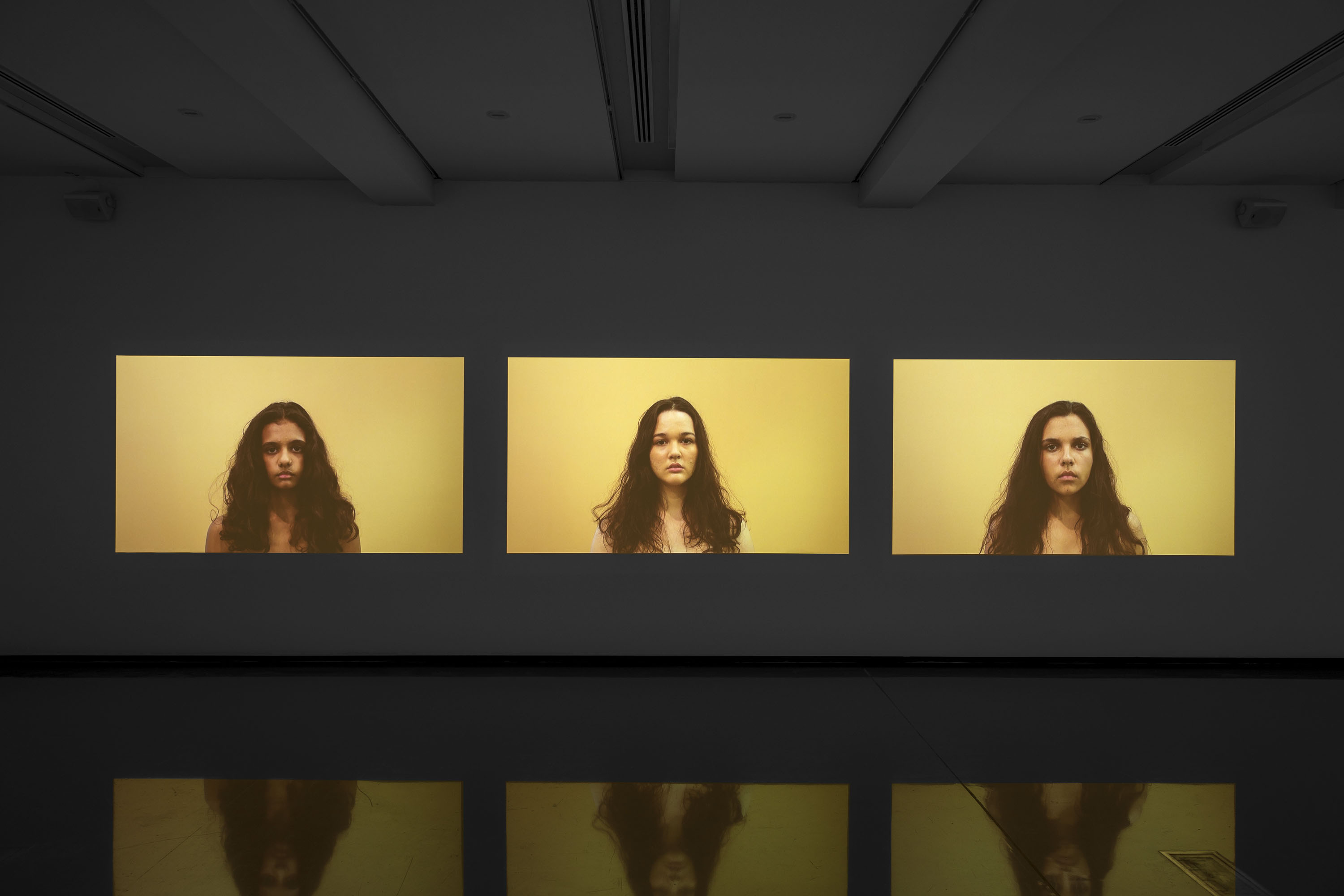
 

'Christian Thompson: Ritual intimacy', installation view: Monash University Museum of Art, Melbourne 2017 featuring stills from the video 'Heat' (2010)

'Christian Thompson: Ritual intimacy', installation view: Monash University Museum of Art, Melbourne 2017 featuring stills from the video 'Heat' (2010)

'Christian Thompson: Ritual intimacy', installation view: Monash University Museum of Art, Melbourne 2017 featuring stills from the video 'Heat' (2010)


Christian Thompson: Ritual intimacy, installation view: Monash University Museum of Art, Melbourne 2017 featuring stills from the video Heat (2010)
Photos: Marcus Bunyan


Christian Thompson (Australian, b. 1978)
Heat (extract)
2010
Three-channel digital colour video, sound
5.52 minutes


Like the Australian graffiti photographs [see photographs below], Heat come out of Thompson’s memories of growing up in the desert surrounding Barcaldine in central west Queensland. Barcaldine is famous for its role in the foundation organised labor in Queensland and ultimately the formation of the Australian Labor Party. It also holds historical significance for Thompson’s family as it is where his great-great-grandfather, Charlie Thompson, surreptitiously bought a block of land before Aboriginal people could legally buy land, creating a safe haven for his family and other Aboriginal families at the time when Aboriginal people had few legal rights. For Thompson, heat captures the sensation that he associates with being on his country: the dry wind blowing through his hair. It features the three granddaughters of Aboriginal rights pioneer Charlie Perkins, who are the daughters of Thompson’s Long time collaborator Hetti Perkins.
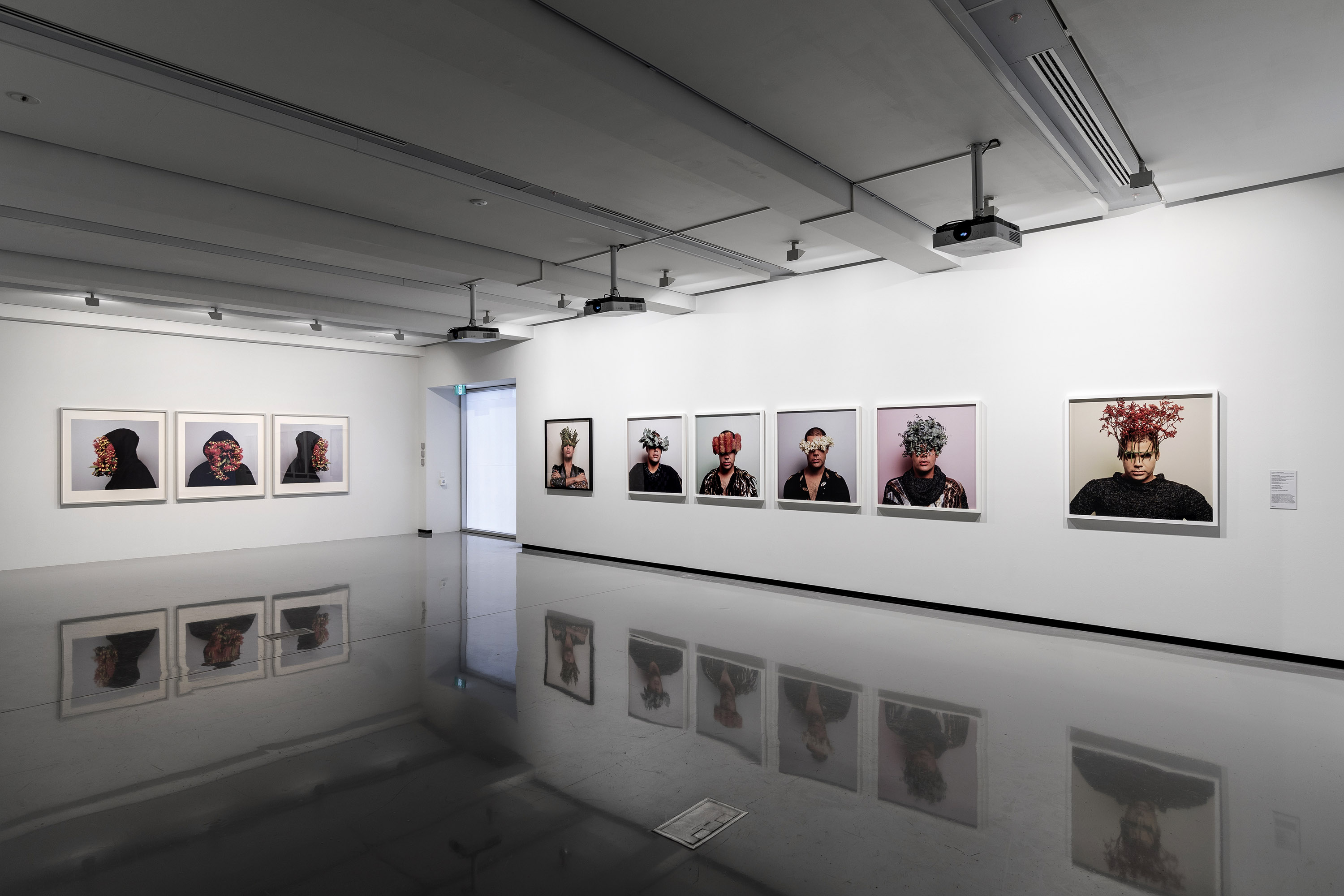
 

'Christian Thompson: Ritual intimacy', installation view: Monash University Museum of Art, Melbourne 2017 featuring photographs from the series 'Australian graffiti' (2007)


Christian Thompson: Ritual intimacy, installation view: Monash University Museum of Art, Melbourne 2017 featuring photographs from the series Australian graffiti (2007)
Photo: Marcus Bunyan
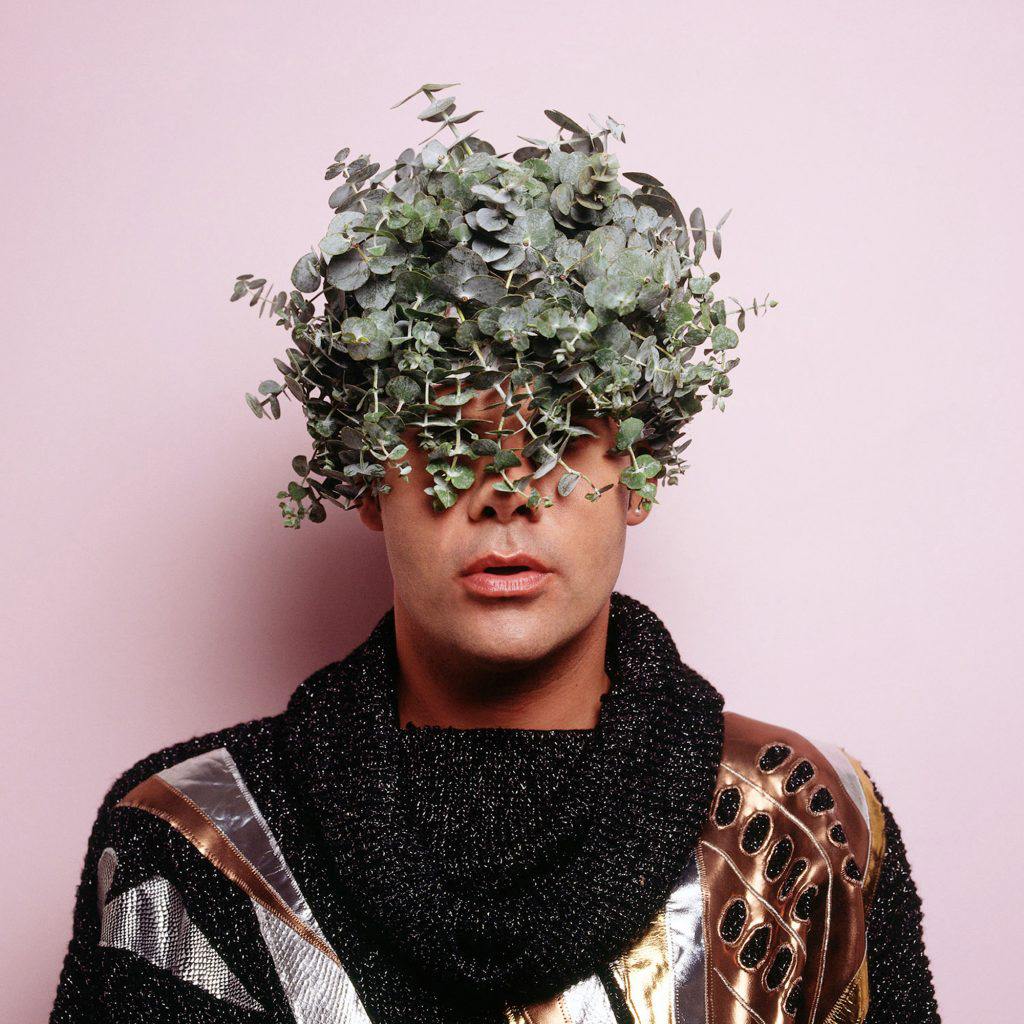
 

Christian Thompson (Australian, b. 1978) 'Untitled (Blue Gum)' 2007


Christian Thompson (Australian, b. 1978)
Untitled (blue gum)
2007
From the series Australian graffiti
C-type print
Image courtesy of the artist, Sarah Scout Presents, Melbourne, and Michael Reid, Sydney and Berlin


Christian Thompson (Australian, b. 1978) 'Untitled (banksia)' 2007


Christian Thompson (Australian, b. 1978)
Untitled (banksia)
2007
From the series Australian graffiti
C-type print
Monash University Collection


Australian graffiti was the last work that Thompson made before leaving Australia for Europe. It connects with his memories of growing up in the outback and its desert flowers, which he perceives to be both fragile and immensely powerful. I adorning himself with garlands of these flowers and flamboyant garments of the 1980s and 1990s – the period in which he grew up – Thompson juxtaposes these elements against his own Bidjara masculinity. By wearing native flora he also stands in for the landscape, invoking an Indigenous understanding of the landscape as a corporeal, living ancestral being.


Christian Thompson (Australian, b. 1978)
Desert slippers (extract)
2006
Single-channel digital colour video, sound
34 seconds


Desert slippers was made at the time the Northern Territory government commissioned research into allegations of the abuse of children in Aboriginal communities. When the ‘Little Children are Sacred’ report was tabled the following year, the federal government under John Howard staged the Northern Territory Emergency Response (NTER), which quickly became known as ‘the intervention’. This action was enacted without consultation with Indigenous people and ignored the substantive recommendations of the report to which it was allegedly responding.

Thompson made this video, involving his father, and the ceremonial aspects of their daily lives, during this period. Desert slippers features a Bidjara ritual in which a father and son transfer sweat. The desert slipper is a native cactus that symbolises the transferal of the spirit back to earth as the plant grows.


Christian Thompson (Australian, b. 1978)
Dhagunyilangu (Brother) 
(extract installation view)
2011
Single-channel digital colour video, sound, subtitled
2.19 minutes


Christian Thompson
Dhagunyilangu (Brother)

2011
Single-channel digital colour video, sound, subtitled
2.19 minutes


Gamu Mambu (Blood Song) and Dhagunyilangu (Brother) were made in England and in the Netherlands respectively. While studying at the DasArts Academy of Theatre and Dance in Amsterdam, a centre for the study of early musical styles such as the baroque, Thompson realised that his own Bidjara language could be interpreted through the matrix of another cultural context and sphere. He undertook operatic training with this in mind, choosing in the end to work with specialist singers Sonja Gruys and Jeremy Vinogradov to realise the two works.


Monash University Museum of Art (MUMA)
Ground Floor, Building F,
Monash University Caulfield campus,
900 Dandenong Road,
Caulfield East, VIC 3145
Phone: 61 3 9905 4217

Opening hours:
Tuesday – Friday 10am – 5pm
Saturday 12 – 5pm

Monash University Museum of Art (MUMA) website

LIKE ART BLART ON FACEBOOK

Back to top

Exhibition: ‘Acting for the Camera’ at the Albertina, Vienna

Exhibition dates: 10th March – 5th June, 2017

Featured artists (selection): Ottomar Anschütz | Bill Brandt | Brassaï | Günter Brus | John Coplans | Hugo Erfurth | Trude Fleischmann | Seiichi Furuya | Eikoh Hosoe | Martin Imboden | Dora Kallmus | Rudolf Koppitz | Johann Victor Krämer | Heinrich Kühn | Helmar Lerski | O. Winston Link | Will McBride | Arnulf Rainer | Henry Peach Robinson | Otto Schmidt | Rudolf Schwarzkogler | Franz Xaver Setzer | Anton Josef Trčka | Erwin Wurm


Anonymous photographer. 'The Sculptor Hans Gasser and Workshop Assistants at Work' 1855-1857 from the exhibition 'Acting for the Camera' at the Albertina, Vienna, March - June, 2017


Anonymous photographer
The Sculptor Hans Gasser and Workshop Assistants at Work
1855-1857
Daguerreotype
Albertina, permanent loan of the Höhere Graphische Bundes-Lehr-und Versuchsanstalt, Vienna


I made this posting way before my operation, but have been unable to post until now because of my ongoing recuperation.

While the exhibition may have finished, I am so enamoured of the theme of the exhibition, the people and artists, that I think it’s valuable to have the posting, images and the additional research I did online. I especially like the striking work of Helmar Lerski and the “Aktionen” of Rudolf Schwarzkogler which reflect on the hurtfulness of the world, but remind me of the yet to come political art of the first wave of HIV/AIDS. What a beautiful installation as well…

Dr Marcus Bunyan


Many thankx to the Albertina for allowing me to publish the photographs in the posting. Please click on the photographs for a larger version of the image.


Ottomar Anschütz (German, 1846-1907)
Elektrischer Schnellseher
1886


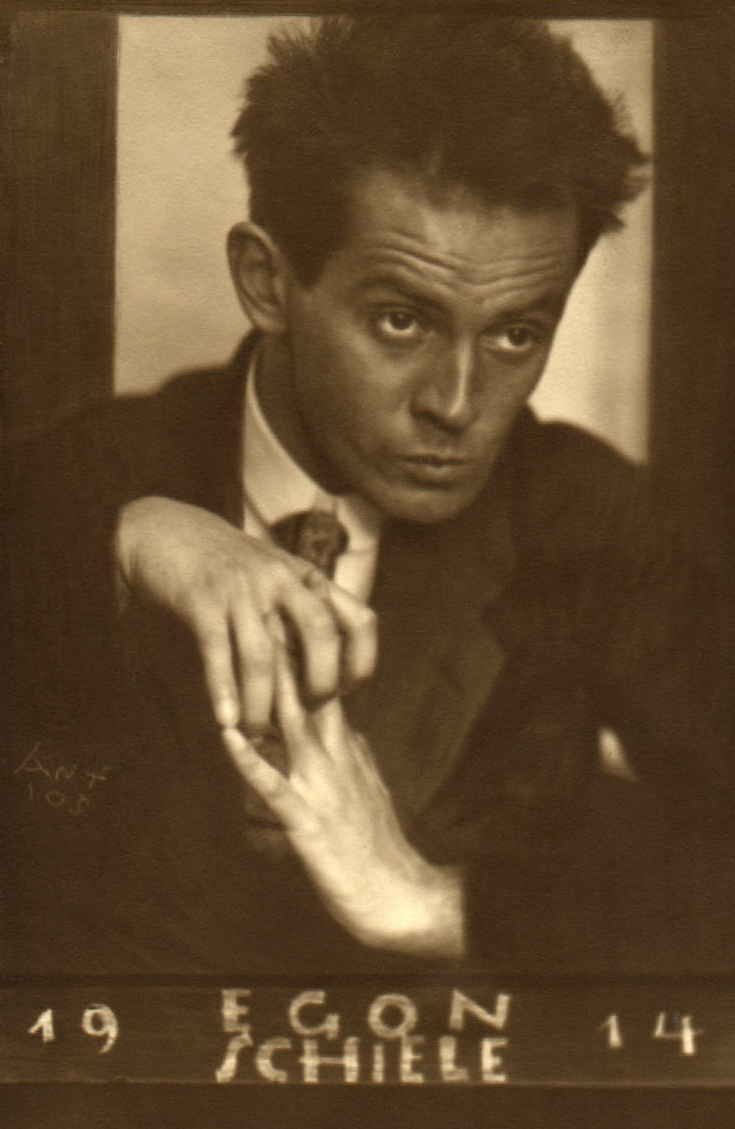
Anton Josef Trčka (Czech, 1893-1940) 'Egon Schiele' 1914 from the exhibition 'Acting for the Camera' at the Albertina, Vienna, March - June, 2017
 

Anton Josef Trčka (Czech, 1893-1940)
Egon Schiele
1914
Gelatin silver print
Albertina, Vienna


Josef Anton Trčka, Antios (7. September 1893 Vienna – 16. March 1940), was a Czech photographer , painter, sculptor, draftsman, designer of tapestries and silver jewellery, collector of folk art Moravian, occasional antiquarian, poet and philosopher. He was a representative of Viennese Modernism, Art Movement, which influenced European culture of the 20th century…

Around 1910 the Trčka decided to study at the professional school of photography Lehr- Graphische und Versuchsanstalt in Vienna, one of the best in Europe. Coincidentally, at the school was Professor Karel Novák, in his time one of the most important personalities of the beginnings of art photography. In 1914 he got the opportunity to portray several leading personalities of Viennese Modernism. Among them was Gustav Klimt, Peter Alternberg and the 50 year old Josef Svatopluk Machar. However, the highlight for Trčka prewar contracts were the photographic series of portraits of Egon Schiele, which focused on facial expressions and hand gestures.


Franz Xaver Setzer (Austrian, 1886-1939) 'Conrad Veidt' 1919


Franz Xaver Setzer (Austrian, 1886-1939)
Conrad Veidt
1919
Gelatin Silver Print
Albertina, Vienna


Franz Xaver Setzer, actually Franz Anton Adolf (6 August 1886 in Vienna – 10 January 1939) was an Austrian photographer.

Hans Walter Conrad Veidt (22 January 1893 – 3 April 1943) was a German actor best remembered for his roles in films such as The Cabinet of Dr. Caligari (1920), The Man Who Laughs (1928), and, after being forced to migrate to Britain by the rise of Nazism in Germany, his English-speaking roles in The Thief of Bagdad (1940), and, in Hollywood, Casablanca (1942). After a successful career in German silent film, where he was one of the best-paid stars of Ufa, he left Germany in 1933 with his new Jewish wife after the Nazis came to power. They settled in Britain, where he participated in a number of films before emigrating to the United States around 1941…

He starred in a few films, such as George Cukor’s A Woman’s Face (1941) where he received billing just under Joan Crawford’s and Nazi Agent (1942), in which he had a dual role as both an aristocratic German Nazi spy and as the man’s twin brother, an anti-Nazi American. His best-known Hollywood role was as the sinister Major Heinrich Strasser in Casablanca (1942), a film which was written and began pre-production before the United States entered the war.

In 1943, at the age of fifty, he died of a massive heart attack while playing golf at the Riviera Country Club in Los Angeles. In 1998, his ashes were placed in a niche of the columbarium at the Golders Green Crematorium in north London.

Text from the Wikipedia website


Dora Kallmus (Madame d'Ora) (Austrian, 1881-1963), Arthur Benda (German, 1885-1969) 'Anita Berber and Sebastian Droste in their dance Märtyrer [Martyrs]' 1922


Dora Kallmus (Madame d’Ora) (Austrian, 1881-1963), Arthur Benda (German, 1885-1969)
Anita Berber and Sebastian Droste in their dance Märtyrer [Martyrs]
1922
Gelatin silver print
Albertina, Vienna


Dora Philippine Kallmus (20 March 1881 – 28 October 1963), also known as Madame D’Ora or Madame d’Ora, was an Austrian fashion and portrait photographer.

In 1907, she established her own studio with Arthur Benda in Vienna called the Atelier d’Ora or Madame D’Ora-Benda. The name was based on the pseudonym “Madame d’Ora”, which she used professionally. D’ora and Benda operated a summer studio from 1921 to 1926 in Karlsbad, Germany, and opened another gallery in Paris in 1925. She was represented by Schostal Photo Agency (Agentur Schostal) and it was her intervention that saved the agency’s owner after his arrest by the Nazis, enabling him to flee to Paris from Vienna.

Her subjects included Josephine Baker, Coco Chanel, Tamara de Lempicka, Alban Berg, Maurice Chevalier, Colette, and other dancers, actors, painters, and writers.

Text from the Wikipedia website


Arthur Benda (23 March 1885, in Berlin – 7 September 1969, in Vienna) was a German photographer. From 1907 to 1938 he worked in the photo studio d’Ora in Vienna, from 1921 as a partner of Dora Kallmus and from 1927 under the name d’Ora-Benda as the sole owner. …

In 1906, Arthur Benda met photographer Dora Kallmus, who also trained with Perscheid. When she opened the Atelier d’Ora on Wipplingerstrasse in Vienna in 1907, Benda became her assistant. The Atelier d’Ora specialised in portrait and fashion photography. Kallmus and Benda quickly made a name for themselves and soon supplied the most important magazines. The peak of renown was reached when Madame d’Ora photographed the present nobility in 1916 on the occasion of the coronation of Emperor Charles I as King of Hungary.

In 1921, Arthur Benda became a partner in Atelier d’Ora, which also ran a branch in Karlovy Vary during the season. In 1927 Arthur Benda took over the studio of Dora Kallmus, who had run a second studio in Paris since 1925, and continued it under the name d’Ora-Benda together with his wife Hanny Mittler. In addition to portraits, he mainly photographed nudes that made the new company name known in men’s magazines worldwide. A major order from the King of Albania Zogu I, who had himself and his family photographed in 1937 for three weeks by Arthur Benda in Tirana secured Arthur Benda financially. In 1938 he opened a new studio at the Kärntnerring in Vienna, which he continued to operate under his own name after the Second World War.

Text from the Wikipedia website


Anita Berber (10 June 1899 – 10 November 1928) was a German dancer, actress, and writer who was the subject of an Otto Dix painting. She lived during the time of the Weimar Republic. …

Her hair was cut fashionably into a short bob and was frequently bright red, as in 1925 when the German painter Otto Dix painted a portrait of her, titled “The Dancer Anita Berber”. Her dancer friend and sometime lover Sebastian Droste, who performed in the film Algol (1920), was skinny and had black hair with gelled up curls much like sideburns. Neither of them wore much more than low slung loincloths and Anita occasionally a corsage worn well below her small breasts.

Her performances broke boundaries with their androgyny and total nudity, but it was her public appearances that really challenged taboos. Berber’s overt drug addiction and bisexuality were matters of public chatter. In addition to her addiction to cocaine, opium and morphine, one of Berber’s favourites was chloroform and ether mixed in a bowl. This would be stirred with a white rose, the petals of which she would then eat.

Aside from her addiction to narcotic drugs, she was also a heavy alcoholic. In 1928, at the age of 29, she suddenly gave up alcohol completely, but died later the same year. She was said to be surrounded by empty morphine syringes.

Text from the Wikipedia website


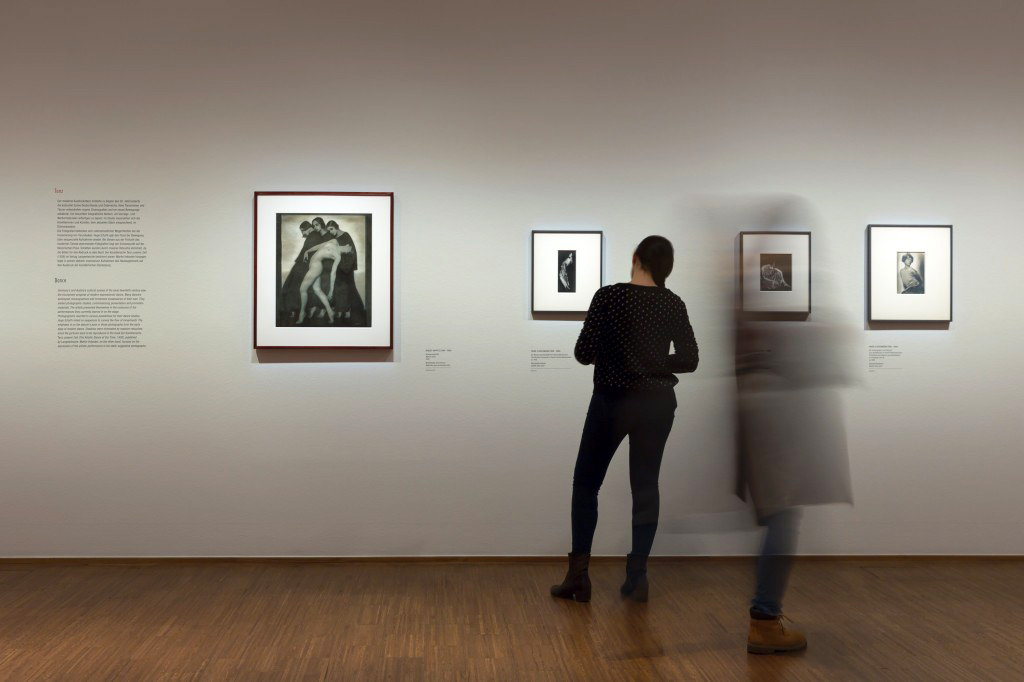
Rudolf Koppitz (Austrian, 1884-1936) 'In the Arms of Nature' 1923


Rudolf Koppitz (Austrian, 1884-1936)
In the Arms of Nature [self-portrait]
1923
Multicolour gum bichromate print
Albertina, permanent loan of the Höhere Graphische Bundes-Lehr-und Versuchsanstalt, Vienna


Rudolf Koppitz (4 January 1884 – 8 July 1936), often credited as Viennese or Austrian, was a Photo-Secessionist whose work includes straight photography and modernist images. He was one of the leading representatives of art photography in Vienna between the world wars. Koppitz is best known for his works of the human figure including his iconic Bewegungsstudie, “Motion Study” and his use of the nude in natural settings. …

After the [First World] war, Koppitz returned to the Institute to teach photography where in 1923 he took the nude self-portrait, In the Bosom of Nature [above], in which he framed himself by tree trunks, rocks, snowy mountains, and is posed to convey a dreamlike harmony reminiscent of a symbolist painting and graphic art. In c. 1925 Koppitz created his masterpiece, Bewegungsstudie, “Motion Study” in which he photographed dancers from the Vienna State Opera; the nude dancer, credited to be the Russian Claudia Issatschenko but is more likely, her daughter, ballet dancer and choreographer, Tatyana Issatschenko Gsovsky, with her head thrown dramatically back and flanked by three dark-robed women, lends Bewegungsstudie to the highly decorative and symbolist tradition of the Viennese Jugendstil.

Text from the Wikipedia website


Rudolf Koppitz (Austrian, 1884-1936) 'Movement Study' 1925


Rudolf Koppitz (Austrian, 1884-1936)
Bewegungsstudie (Motion Study)
1926
Multicolor gum bichromate print
Albertina, permanent loan of the Höhere Graphische Bundes-Lehr-und Versuchsanstalt, Vienna


Rudolf Koppitz (4 January 1884 – 8 July 1936), often credited as Viennese or Austrian, was a Photo-Secessionist whose work includes straight photography and modernist images. He was one of the leading representatives of art photography in Vienna between the world wars. Koppitz is best known for his works of the human figure including his iconic Bewegungsstudie, “Motion Study” and his use of the nude in natural settings….

Koppitz’s work is marked by a pronounced awareness of form, line, and the surface play of light and shadow. Early in his career, Koppitz was known for staging groups of subjects in the style of the Vienna Secession, the most well known example of this being his Bewegungsstudie, “Motion Study”.

Bewegungsstudie (Motion Study) is surely the most widely published and best known image in Austrian photography from the early decades of the last century. This is for good reason, as no photograph better captures the cultural strands that characterized the Austrian avant-garde at that time. Here one can see a graphic strength and compositional clarity that reflects the modernist ambitions initiated in the fine as in the applied arts by the Secession and by the Wiener Werkstätte. But what gives the image its power is the aura of mystery, of symbolist sensuality that resonates through this enigmatic grouping of the three uniformly coiffed and draped figures and the one single naked figure.” ~ Christies

Bewegungsstudie’s languid nude, elaborately robed women and undeniable sensuality, in the context of its rigorous and artistic composition, bring to mind the sexual morbidity of Viennese artists like Gustav Klimt and Alphonse Mucha, as well as the Swiss symbolist painter Ferdinand Hodler and has made it as unforgettable then as it is today. It has become the Koppitz’s signature image, and was also his best-seller. Prints of the image were purchased by, among others, the Toledo Museum of Art; the New York Camera Club notable Joseph Bing, head of that club’s print committee; and the Englishman Stephen Tyng, who published it in a small portfolio of works from his collection.

His earliest works show evidence of influence by Gustav Klimt, Japanese art, Art Nouveau and Constructivism. During the First World War, Koppitz’s photographs took on a documentary quality when his photographs became more simple and direct in their subject matter and composition. Koppitz’s work came of age during the inter-war period when most of Austria’s photographers were supporters of art photography. Photographs from that time are full of symbolic meanings often capturing nude and clothed dancers as well as liberal use of both male and female, many of which were of Koppitz himself and female nudes placed in elements of nature and posed to give the impression of a Greek or Roman statue…

Although he did not possess a consistent style, Koppitz was a virtuoso of the dark room, seemingly determined to make the photograph as much of an art object as possible. His beautifully grainy, subtly tinted images align him with American Pictorialists like Edward Steichen and Clarence Smith. Koppitz’s work, much of it using the gum bichromate process, reflected his links with modern artists such as Gustav Klimt and Egon Schiele, and their involvement with the ‘life reform’ movement including; nudism, sun culture, and expressive dance popular in Central Europe from the early 1900s as well as agrarian romanticism. Koppitz’s extraordinary mastery of pictorial processes – pigment, carbon, gum, and bromoil process of transfer printing – gained the respect of his colleagues throughout the world and garnered mention in the Encyclopædia Britannica of 1929.

Text from the Wikipedia website


Trude Fleischmann (American born Austria, 1895-1990) 'Actress and Dancer Lucy Kieselhausen' c. 1925


Trude Fleischmann (American born Austria, 1895-1990)
Actress and Dancer Lucy Kieselhausen
c. 1925
Gelatin silver print
Albertina, Vienna


Trude Fleischmann (22 December 1895 – 21 January 1990) was an Austrian-born American photographer. After becoming a notable society photographer in Vienna in the 1920s, she re-established her business in New York in 1940. …

In 1920, at the age of 25, Fleischmann opened her own studio close to Vienna’s city hall. Her glass plates benefitted from her careful use of diffuse artificial light. Photographing music and theatre celebrities, her work was published in journals such as Die Bühne, Moderne Welt, ‘Welt und Mode and Uhu. She was represented by Schostal Photo Agency (Agentur Schostal). In addition to portraits of Karl Kraus and Adolf Loos, in 1925 she took a nude series of the dancer Claire Bauroff which the police confiscated when the images were displayed at a Berlin theatre, bringing her international fame. Fleischmann also did much to encourage other women to become professional photographers.

With the Anschluss in 1938, Fleischmann was forced to leave the country. She moved first to Paris, then to London and finally, together with her former student and companion Helen Post, in April 1939 to New York. In 1940, she opened a studio on West 56th Street next to Carnegie Hall which she ran with Frank Elmer who had also emigrated from Vienna. In addition to scenes of New York City, she photographed celebrities and notable immigrants including Albert Einstein, Eleanor Roosevelt, Oskar Kokoschka, Lotte Lehmann, Otto von Habsburg, Count Richard von Coudenhove-Kalergi and Arturo Toscanini. She also worked as a fashion photographer, contributing to magazines such as Vogue. She established a close friendship with the photographer Lisette Model.

Text from the Wikipedia website


Lucy Kieselhausen was born in 1897 in Vienna, Austria. She was an actress, known for Tausend und eine Frau. Aus dem Tagebuch eines Junggesellen (1918), Erdgeist (1923) and Die siebente Großmacht (1919). She was a student of Grete Wiesenthal and was celebrated as a successful dancer at the beginning of the 20th century who had great successes on German stages. Besides her dancing activity she also wrote the dance drama “Salambo”, which was set to music by Heinz Tiessen. She died in December 1926 in Berlin, Germany.

“Around 1915 another Viennese, Lucy Kieselhausen (1897-1927), began specializing in performing waltzes. She, too, had evolved out of ballet culture, but her embodiment of the waltz was virtually opposite that of Wiesenthal. She favoured luxuriously decorative hothouse costumes and the utmost refinement of movement. For her the waltz was not a lyrical expansion of space into the freedom of nature but an almost perfumed distillation of the stirrings within an opulent boudoir, with its scenography of exquisite privileges and voluptuous secrets. An adroit sense of irony shaded her movements with a abruptly “bizarre and jerky” rhythms; “her joyfully flashing temperament did not hover on a smooth surface but over a shadowy abyss from which issued her fool’s dance with its slumbering, half-animal rapture.” Her curious appropriation of the waltz ended suddenly when she died in a benzine explosion.”

Karl Eric Toepfer. Empire of Ecstasy: Nudity and Movement in German Body Culture, 1910-1935. University of California Press, 1997, pp. 161-162.


Hugo Erfurth (German, 1874-1948) 'Clotilde von Derp-Sacharoff' c. 1928


Hugo Erfurth (German, 1874-1948)
Clotilde von Derp-Sacharoff
c. 1928
Gelatin silver print
Albertina, Vienna – permanent loan of the Austrian Ludwig Foundation for Art and Science


Hugo Erfurth (14 October 1874 – 14 February 1948) was a German photographer known for his portraits of celebrities and cultural figures of the early twentieth century. …

During the next ten years [after 1896] he ran the Schröder studio, then established his own studio, art gallery, and home in the Palais Lüttichau. He became a member of the German Werkbund and was appointed an honorary member of the London’s Royal Photographic Society and of Munich’s Süddeutsche Photographen-Verein. He married Helene Reuther in 1898 and fathered three children over the next 6 years. He photographed for the Royal Playhouse in Dresden from 1913-1919.

During this time, Dresden was home to a cultural elite that included Otto Dix, Erich Heckel, Paul Klee, and Oskar Kokoschka. These artists and writers, who considered Erfurth their creative equal, frequented his studio to have their portraits taken. He also photographed opera and dance performers, did work in industrial photography, and experimented with photograms and photomontage.

In 1922, Erfurth opened a gallery under the name “Graphisches Kabinett Hugo Erfurth” with an exhibition of works by Oskar Kokoschka. In 1925, works by Emil Nolde were shown and the exhibition “7 Bauhaus Masters” was organised, with works by Paul Klee and Wassily Kandinsky, among others. The gallery also supported young Dresden artists such as Hans Grundig, Wilhelm Lachnit, and Kurt Schütze.

By the late 1920s, Erfurth had established himself as one of Germany’s leading portraitists and was known for a broad range of work around photography…

Text from the Wikipedia website


Clotilde von Derp, stage name of Clotilde Margarete Anna Edle von der Planitz (5 November 1892 – 11 January 1974), was a German expressionist dancer, an early exponent of modern dance. Her career was spent essentially dancing together with her husband Alexander Sakharoff with whom she enjoyed a long-lasting relationship…

Among her admirers were artists such as Rainer Maria Rilke and Yvan Goll. For his Swiss dance presentations, Alexej von Jawlensky gave her make-up resembling his abstract portraits. From 1913, Clotilde appeared with the Russian dancer Alexander Sacharoff with whom she moved to Switzerland during the First World War. Both Sacharoff and Clotilde were known for their transvestite costumes. Clotilde’s femininity was said to be accentuated by the male attire. Her costumes took on an ancient Greek look which she used in Danseuse de Delphes in 1916. Her style was said to be elegant and more modern than that achieved by Isadora Duncan. Their outrageous costumes included wigs made from silver and gold coloured metal, with hats and outfits decorated with flowers and wax fruit.

They married in 1919 and. with the financial support of Edith Rockefeller, appeared at the Metropolitan Opera in New York but without any great success. They lived in Paris until the Second World War. Using the name “Les Sakharoff”. Their 1921 poster by George Barbier to advertise their work was seen as showing a “mutually complementary androgynous couple” “united in dance” joined together in an act of “artistic creation.”

They toured widely visiting China and Japan which was so successful that they returned again in 1934. They and their extravagant costumes visited both North and South America. They found themselves in Spain when France was invaded by Germany. They returned to South America making a new base in Buenos Aires until 1949. They toured Italy the following year and they took up an invitation to teach in Rome by Guido Chigi Saracini. They taught at the Accademia Musicale Chigiana in Siena for Saracini and they also opened their own dance school in Rome. She and Sakharoff stopped dancing together in 1956. They both continued to live in Rome until their deaths. Clotilde gave and sold many of their writings and costumes, that still remained, to museums and auctions. She eventually sold the iconic 1909 painting of her husband by Alexander Jawlensky. In 1997 the German Dance Archive Cologne purchased many remaining items and they have 65 costumes, hundreds of set and costume designs and 500 photographs.

Text from the Wikipedia website


Martin Imboden (Swiss, 1893-1935) 'The Dancer Gertrud Kraus' c. 1929


Martin Imboden (Swiss, 1893-1935)
The Dancer Gertrud Kraus
c. 1929
Gelatin silver print
Albertina, Vienna


Martin Imboden (born November 10, 1893 in Stans, Nidwalden; died August 19, 1935 in Zurich ) was a Swiss photographer. …

Born into a Swiss working-class family, Imboden first trained as a cabinetmaker 1909-1912 and worked as a carpenter in Switzerland and in France 1913-1917 then in Basel and Zurich 1918-1929. It was only in 1923 that he began to take photographs.

In 1929 Imboden moved to Vienna, where he began to work as a freelance architectural photographer, at the same time undertaking courses at the Urania (opened in 1910 by Franz Joseph I of Austria as an educational facility with a public observatory and named after the Muse Urania who represents Astronomy) and at the Photosezession which had inspired Steiglitz’s 1902 American version.

Imboden had arrived in the city during the peak of Red Vienna (1918 to 1934) when the Socialist Workers’ Party of German Austria repeatedly won absolute majorities in the elections to parliament and local council. The Socialists undertook extensive multi-storey social housing projects on the back of a fiscal policy that brought bold reforms in the social, health and education policies. He photographed many of these municipal buildings.

At this time he encountered Gertrud Kraus and her New School of Arts which she had opened in 1927 in Vienna. It was a private school for rhythmic gymnastics and artistic dance. In this rare group of images he documents Kraus’s own energetic and expressionist performances.

Interest in modern, or ‘free’, dance was not uncommon, especially in the German area, but also worldwide, in the first half of the 20th century given the popularity of physical culture Körperkultur, the hygiene and care of one’s own body.

Kraus devised training particularly to improve the physical health of women. Through her program many young women, including Jula Isenburger and Mia Slavenska, ventured into and found success in a career in dance and movement. Imboden’s photography pays tribute to their strength of personality and physical presence through this series of portraits.

His approach is clearly experimental, though it is Photo-Secessionist rather than Modernist in spirit. The lighting is appropriately theatrical, intensifying the performative nature of these portraits in which the self-contained concentration of each young woman is paramount. He used bromoil and carbon printing, favourite printing techniques of the Pictorialist photographers, which enable adjustment of lights and intensification of darks through the application of a brush during development, with a painterly quality and warmth, often on hand-laid papers. There is no sense that these women are posing for a male gaze (the gaze of only one meets the lens) and in fact it is hard to find full-length photographs of these individuals by Imboden…

James McArdle. “November 10: Dance,” on the On This Date In Photography website 10/11/2016 [Online] Cited 19/12/2021


Gertrud Kraus (Hebrew: גרטרוד קראוס‎; 5 May 1901 – 13 November 1977) was an Israeli pioneer of modern dance in Israel. …

In the 1920s, Gertrud Kraus’s style was known as expressionistic dance, or German dance. In 1929 Gertrud Kraus, together with Gisa Geert, was chief assistant to Rudolf von Laban, director of a trade union parade during the “Vienna Festival” in Vienna.

In 1930, an impresario invited her to perform in Mandate Palestine. Her tour was a great success and she was invited back the following season. In 1933, her company performed her work Die Stadt wartet (“The City Waits”), presenting the modern metropolis as a fascinating but dangerous place. It was based on a short story by Maxim Gorki. On the night that Adolf Hitler was elected chancellor of Germany, Kraus’s company performed this piece on the open-air stage in the Burg-garden next to the Hofburg.

In 1933, while she was in Prague performing for the Zionist Congress, leaders of a Czech communist cell contacted her and tried to recruit her for their purposes. The next day, she went to the Palestine Office in Prague, and applied for immigration. Kraus moved to Tel Aviv in 1935, first living with friends and then renting a basement that became her studio. She formed a modern dance company affiliated with the Tel Aviv Folk Opera, which was probably the only one of its kind in the world. In 1949, she won a scholarship to travel to the United States to learn the newest trends in modern dance.

In 1950-1951, she founded the Israel Ballet Theatre, and became its artistic director. The company folded after a year due to financial difficulties. Until her death in 1977, Kraus devoted herself to teaching dance, as well as painting and sculpture.

Text from the Wikipedia website


Installation view of the exhibition 'Acting for the Camera' at the Albertina, Vienna, March - June 2017

Installation view of the exhibition 'Acting for the Camera' at the Albertina, Vienna, March - June 2017 showing at left, Rudolph Koppitz's 'Bewegungsstudie (Motion Study)' 1926

In the above image at left, Rudolph Koppitz’s Bewegungsstudie (Motion Study) 1926
Installation view of the exhibition 'Acting for the Camera' at the Albertina, Vienna, March - June 2017 showing at centre, Rudolph Koppitz's 'In the Arms of Nature [self-portrait]' 1923

In the above image at centre, Rudolph Koppitz’s In the Arms of Nature [self-portrait] 1923
Installation view of the exhibition 'Acting for the Camera' at the Albertina, Vienna, March - June 2017 showing at left and centre, the work of Jan Coplans

In the above image at left and centre, the work of Jan Coplans
Installation view of the exhibition 'Acting for the Camera' at the Albertina, Vienna, March - June 2017 showing at right, Erwin Wurm's 'One Minute Sculptures'

In the above image, Erwin Wurm’s One Minute Sculptures at right
Installation view of the exhibition 'Acting for the Camera' at the Albertina, Vienna, March - June 2017


Installation views of the exhibition Acting for the Camera at the Albertina, Vienna, March – June 2017


With circa 120 works from the Albertina’s Photographic Collection, the exhibition Acting for the Camera examines the diverse ways in which models are staged or stage themselves before the camera. The featured photographic works, created between the 1850s and the present, represent a cross-section of photographic history as well as the diversity of the Albertina’s own holdings. The present selection is divided between six thematic emphases: motion studies, models for artists, dance, picture stories, portraits of actresses and actors, and Viennese Actionist stagings of the body.

All of these photographs arose from diverse and multi-layered forms of collaboration between the model before and the photographer behind the camera lens. Some of the models are staged according to their photographers’ instructions, while other shots originated via a creative process in which model and photographer collaborated on an equal footing. And in some cases, the pictures were even taken according to highly specific instructions given by the model.

Beginnings

It was photographic studies done in the interest of scientific research that made it possible for the first time to visually analyse the processes of human locomotion in high detail. Anonymous models, such as in the photographs taken by Ottomar Anschütz beginning around 1890, made themselves available in order to render understandable processes such as spear-throwing. The individuals seen in such works act according to the exact instructions of the photographer. Series of this type were used to compare the motion patterns of “healthy” and “unhealthy” bodies as well as undergird medical theories with visual evidence.

While such motion studies occasionally doubled as working studies for artworks by other artists, there was also a category of works created specifically for this purpose such as Johann Victor Krämer’s staged studio photographs as well as Otto Schmidt’s nudes, and some of these were also sold “under the table” as pornography.

Expressive Gestures

A strong and likewise mutually influential relationship arose between photography and dance. At the beginning of the 20th century, modern expressionist dance was an avant-garde art form, and dancers would work together closely with photographers in order to document and disseminate their performances. Such partnerships made possible expressive stagings that helped define the styles of that era. The expressive gestures often seen therein were also taken up by Anton Josef Trčka, who had Egon Schiele pose with a hand position reminiscent of something one might see in dance.

Portraits of well-known actors such as a laughing Romy Schneider, along with role-portraits for film productions, were created in Viennese studios by photographers such as Trude Fleischmann and Madame d’Ora, and these iconic pictures represent yet another emphasis in this presentation.

Bodies as Photographic Material

Much like the way in which classic portraits convey the personalities of those being portrayed, photography can also stage the body in the opposite way, as something purely material. Helmar Lerski, for example, treated the human face as a landscape that could be modelled by light and shadow. John Coplans, on the other hand, explored his own naked body centimetre by centimetre, portraying himself without his head and thus questioning stagings of masculinity and social norms.

In Viennese Actionism, the artists likewise placed themselves front and centre as pictorial subjects. Rudolf Schwarzkogler, who wrapped himself like a mummy in muslin bandages during the late 1960s, as well as his Actionist colleague Günter Brus, staged performances specifically for the photographic camera. And the newest works in Acting for the Camera are as recent as Erwin Wurm’s One Minute Sculptures, for which the artist had models assume ridiculous poses with everyday objects.

Following Black & White (2015) and Landscapes & People (2016), this is the third large-scale presentation of the Albertina’s Photographic Collection. The Albertina, as a treasure trove of visual knowledge, began collecting photographs all the way back in the mid-19th century – but it was only upon the establishment of the Photographic Collection in 1999 that these fascinating works were rediscovered.

Press release from the Albertina


Helmar Lerski (Swiss, 1871-1956) 'Metamorphosis 601' (Metamorphose 601) 1936


Helmar Lerski (Swiss, 1871-1956)
Metamorphosis through Light #601 (Metamorphose 601)
1936
Gelatin silver print


Helmar Lerski (Swiss, 1871-1956) 'Metamorphosis through Light #587' 1935-1936


Helmar Lerski (Swiss, 1871-1956)
Metamorphosis through Light #587
1935-36
Gelatin silver print


Helmar Lerski: Metamorphosis

… In 1915 Lerski returned to Europe and started a career in cinematography. For over ten years, he worked as a cameraman, lighting technician and expert on special effects for numerous expressionistic silent films in Berlin, among others Fritz Lang’s “Metropolis” (1925/26). At the end of the 1920s, he turned his attention once again to portrait photography and took part in the avant-garde movement that was trying to effect radical changes in the language of the photographic image. At the legendary Werkbund exhibition “Film und Foto” (1929), at which the New Photography made its greatest appearance at first in Stuttgart and subsequently in Zurich, Lerski – who had in the meantime become the best-known portrait photographer of his time – was well represented with 15 photographs.

But Lerski’s pictures were only partly in line with the maxims of the New Photography, and they questioned the validity of pure objectivity. The distinguishing characteristics of his portraits included a theatrical-expressionistic, sometimes dramatic use of lighting inspired by the silent film. Although his close-up photographs captured the essential features of a face – eyes, nose and mouth –, his primary concern was not individual appearance or superficial likeness but the deeper inner potential: he emphasised the changeability, the different faces of an individual. Lerski, who sympathised with the political left wing, thereby infiltrated the photography of types that was practised (and not infrequently misused for racist purposes) by many of Lerski’s contemporaries.

In his book “Köpfe des Alltags” (1931), a milestone in the history of photographic books, Lerski clearly expressed his convictions: he showed portraits of anonymous people from the underclass of the Berlin society, presenting them as theatrical figures so that professional titles such as “chamber maid”, “beggar” or “textile worker” appeared as arbitrarily applied roles. Thus his photographs may be interpreted as an important opposite standpoint to the work of August Sander, who was at the same time working on his project “Menschen des 20. Jahrhunderts” – that large-scale attempt at a social localisation of various representatives of the Weimar society.

But Helmar Lerski’s attitude was at its most radical in his work entitled “Metamorphosis”. This was completed within a few months at the beginning of 1936 in Palestine, to where Lerski and his second wife Anneliese had immigrated in 1932. In “Verwandlungen durch Licht” (this is the second title for this work), Lerski carried his theatrical talent to extremes. With the help of up to 16 mirrors and filters, he directed the natural light of the sun in constant new variations and refractions onto his model, the Bernese-born, at the time out-of-work structural draughtsman and light athlete Leo Uschatz. Thus he achieved, in a series of over 140 close-ups “hundreds of different faces, including that of a hero, a prophet, a peasant, a dying soldier, an old woman and a monk from one single original face” (Siegfried Kracauer). According to Lerski, these pictures were intended to provide proof “that the lens does not have to be objective, that the photographer can, with the help of light, work freely, characterise freely, according to his inner face.” Contrary to the conventional idea of the portrait as an expression of human identity, Lerski used the human face as a projection surface for the figures of his imagination. We are only just becoming aware of the modernity of this provocative series of photographs.

Peter Pfrunder. “Helmar Lerski: Metamorphosis,” on the Fotostiftung Schweiz 2005 [Online] Cited 17/12/2021. No longer available online


Wall texts

Motion Studies

Photographs taken in the context of scientific experimental arrangements visualise the different phases of human and animal locomotion sequences. Several cameras are mounted one after another, their shutters release at short intervals while the model is moving. Shortly after Eadweard Muybridge, who makes a name for himself with motion studies of racehorses in 1877, achieves his first successes, the physician Étienne-Jules Marey and the photographers Ottomar Anschütz and Albert Londe also dedicate themselves to capturing movement sequences photographically. Londe works with Jean-Martin Charcot, a neurologist at the Pitié-Salpêtrière psychiatric hospital in Paris. Anonymous models have to perform certain movements defined by the scientists. The photographs are used to compare the movement patterns of “healthy” and”unhealthy” people and to provide visual evidence for medical theories. Artists interested in the anatomically correct representation of movements use the photographs as models.

Models for Artists

Photographs are used as a workaround in the fine arts quite early on; special collections are compiled. Photographs of models in motion, for example, come to replace preparatory drawings after nature. The expanding demand for photographic material creates a new market for professional studios. The Viennese photographer and publisher Otto Schmidt produces body and facial expression studies as well as nudes (so-called academies). Since these photographs, thanks to their erotic pictorial repertoire, enjoy great popularity not only with artists, Schmidt’s circle of customers keeps growing.

The reduction in price and the easier handling of the photographic material increases the number of artists that take up a camera themselves. The painter Johann Victor Krämer has his models pose in front of half-finished paintings to check or complete their posture and gestures. Grids drawn on the photographs sometimes help to transfer subjects to the canvas.

Dance

Germany’s and Austria’s cultural scenes of the early twentieth century see the triumphant progress of modern expressionist dance. Many dancers develop choreographies and movement vocabularies of their own. They visit photographic studios, commissioning presentation and promotion materials. The artists present themselves in the costumes of the performances they currently star in on the stage.

Photographers resort to various possibilities for their dance studies. Hugo Erfurth relies on sequences to convey the flow of movements. The emphasis is on the dancer’s pose in these photographs from the early days of modern dance. Shadows are eliminated by massive retouches, since the pictures were to be reproduced in the book Der Künstlerische Tanz unserer Zeit (The Artistic Dance of Our Time, 1928), published by Langewiesche. Martin Imboden, on the other hand, focuses on the expression of the artistic performance in his static suggestive photographs.

Picture Stories

Restaging paintings and other works of art is a favourite pastime of the upper middle classes and the aristocracy in the nineteenth century. Costumed amateur actors adopting rigid poses for a few moments present the “living pictures” at certain events. The emergence of photography makes it possible to reenact these fleeting performances in the studio and to preserve them for the long term. The theatrical group photos are sold as editions on the art market or used as models to emulate.

Henry Peach Robinson is one of those who devote themselves to staging photographs in a way that lean on the tradition of tableaux vivants. Brassaï’s and Bill Brandt’s photo reportages, which seem to document nocturnal scenes the photographers chanced upon, are actually staged for the occasion. Brandt, for example, has members of his family embody precisely conceived parts in his mysteriously toned series A Night in London. The American O. Winston Link, who shows a penchant for steam engines, plans his pictures in every detail. Relying on an elaborate flash technique and the use of spotlights, his photographs, taken in the open and by night, exhibit a filmic aesthetic.

Portraits of Actresses and Actors

In Vienna, Madame d’Ora, Franz Xaver Setzer, and Trude Fleischmann specialise in portraits of performing artists from the 1910s to the 1930s. They not only catered to the public’s great demand; focusing on the cultural scene’s clientele also ties in with the personal interest of the studios’ owners. The models collaborate with the photographers to realise the desired notions regarding their appearance and the interpretation of their look. Stars from the theatre world choose the costume, make-up, and pose they prefer for their photographic portraits. Some of the character portraits and scenic representations show sweepingly theatrical gestures. Film actresses and actors are only rarely captured in traditional character portraits in the early days of the medium. Setzer’s portrait of Conrad Veidt, who stars in The Cabinet of Dr. Caligari in 1919, is an exception. The lighting and styling as well as his facial expression and the expressive gesture of his hand mirror the film’s Expressionism.

Actionist Stagings of the Body

The Actionist art gaining momentum from the 1960s on shows itself inseparably bound up with photography. Next to film, photography is the only way to provide live documentations of performances. Some actions are specifically staged for the photo camera. From about the mid-1960s on, the Viennese Actionist artists Günter Brus and Rudolf Schwarzkogler realise constellations of bodies and objects for photographs that are intended as visual works of art.

Arnulf Rainer, whose grimaces, like the Vienna Actionists’s works, are aimed at criticising the socially standardised body, also poses for a photographer. The photographer was not supposed to pursue an artistic approach of his own but to neutrally capture the given representations of the body. After the pictures were taken, Rainer defines the final image area and overpaints the photos by relying on gestural techniques that emphasise physical and emotional moments of expression.

John Coplans combines observations on the representation of the body with reflections on the nature of media. Using a straightforward and precise exposure technique and keen on obtaining sharp pictures, he confronts the viewer with defamiliarised views of his body transforming it into sculptural fragments. The humorous and absurd poses in which models present themselves for Erwin Wurm’s One Minute Sculptures with the help of everyday objects are often based on drawn studies and are captured in factual photographs lending the ephemeral performances durability.


Will McBride (American, 1931-2015) 'Romy Schneider in Paris' 1964, printed 2001


Will McBride (American, 1931-2015)
Romy Schneider in Paris
1964, printed 2001
Gelatin Silver Print
Albertina, Vienna
© Will McBride Estate/Berlin


Rudolf Schwarzkogler (Austrian, 1940-1969) '2nd Action' 1965


Rudolf Schwarzkogler (Austrian, 1940-1969)
2nd Action
1965
Gelatin Silver Print


Rudolf Schwarzkogler (Austrian, 1940-1969) '3rd Action' 1965


Rudolf Schwarzkogler (Austrian, 1940-1969)
3rd Action
1965
Gelatin Silver Print


Rudolf Schwarzkogler (Austrian, 1940-1969) '4th Action' 1965


Rudolf Schwarzkogler (Austrian, 1940-1969)
4th Action
1965
Gelatin Silver Print


Rudolf Schwarzkogler (13 November 1940, Vienna – 20 June 1969, Vienna) was an Austrian performance artist closely associated with the Viennese Actionism group that included artists Günter Brus, Otto Mühl, and Hermann Nitsch.

He is best known today for photographs depicting his series of closely controlled “Aktionen” featuring such iconography as a dead fish, a dead chicken, bare light bulbs, coloured liquids, bound objects, and a man wrapped in gauze. The enduring themes of Schwarzkogler’s works involved experience of pain and mutilation, often in an incongruous clinical context, such as 3rd Aktion (1965) in which a patient’s head swathed in bandages is being pierced by what appears to be a corkscrew, producing a bloodstain under the bandages. They reflect a message of despair at the disappointments and hurtfulness of the world.

Schwarzkogler devoted himself entirely to free art from 1965 and quit his job. He started out with horse betting and was interested in winning systems. In 1968 he took part in film projects. In 1969, he died after falling from the window of his apartment. He was buried at the Vienna Central Cemetery.

Text from the Wikipedia website


Seiichi Furuya (Japanese, b. 1950) 'Christine Furuya Gössler' 1983; printed 1988


Seiichi Furuya (Japanese, b. 1950)
Christine Furuya Gössler
1983; printed 1988
Gelatin silver print
Albertina, Vienna


Seiichi Furuya (古屋 誠一, Furuya Seiichi, born 1950) in Izu, Shizuoka is a Japanese photographer.

As a student Furuya studied architecture and then spent two years at Tokyo College of Photography. In 1973 he left his studies and his native Japan and traveled, ending up, according to Arthur Ollman in his book, The Model Wife, “a man in exile. He wears alienation like an obligation.” In Austria where he lived since 1982 he met and married Christine Gössler. From 1984 to 1987 he lived in East Berlin and worked as translator. Christine was to become the primary subject of his photography until her suicide in 1985. His last pictures of her are of her shoes, neatly placed by the window she had just jumped out of, and her body, shot from the same window, on the ground, nine stories below.

Text from the Wikipedia website


“The other person is absent as a point of reference but present as an addressee. This strangely warped situation causes an unbearable presence: You are gone (which I lament); you are here (because I am turning to you).”

~ Roland Barthes, A Lover’s Discourse

“If you consider the taking of photographs to be in a sense a matter of fixing time and space, then this work – the documenting of the life of one human being – is exceptionally thrilling… in facing her, in photographing her, and looking at her in photographs, I also see and discover “myself.””

~ Seiichi Furuya, 1979

Seiichi Furuya and Christine Gössler would soon marry, and they would later have a child, Komyo. Throughout their seven years together, Christine would plunge in and out of depressions and psychiatric institutions. And one Sunday in October of 1985, she would jump to her death from the 9th floor of their apartment building in East Berlin. Furuya photographed her throughout, to the very end. And this faithful and macabre portrait making would become his artistic and philosophical project.

Stacey Platt. “The Art of Losing Love, pt.2: Seiichi Furuya and Christine Gössler,” on the space in between website October 28, 2004 [Online] Cited 17/12/2021. No longer available online


Erwin Wurm (Austrian, b. 1954) 'One Minute Sculpture' 1997


Erwin Wurm (Austrian, b. 1954)
One Minute Sculpture
1997
Silver dye bleach print
Albertina, Vienna


Erwin Wurm (born 1954) is an Austrian artist born in Bruck an der Mur, Styria, Austria. He lives and works in Vienna and Limberg, Austria. …

Since the late 1980s, he has developed an ongoing series of One Minute Sculptures, in which he poses himself or his models in unexpected relationships with everyday objects close at hand, prompting the viewer to question the very definition of sculpture. He seeks to use the “shortest path” in creating a sculpture – a clear and fast, sometimes humorous, form of expression. As the sculptures are fleeting and meant to be spontaneous and temporary, the images are only captured in photos or on film.

To make a One Minute Sculpture, the viewer has to part with his habits. Wurm’s instructions for his audience are written by hand in a cartoon-like style. Either Wurm himself or a volunteer follow the instructions for the sculpture, which is meant to put the body in an absurd and ridiculous-looking relationship with everyday objects. Whoever chooses to do one of Wurm’s One Minute Sculptures holds the pose for a minute, or the time it takes to capture the scene photographically. These positions are often difficult to hold; although a minute is very short, a minute for a One Minute Sculpture can feel like an eternity.

Text from the Wikipedia website


Erwin Wurm (Austrian, b. 1954) 'One Minute Sculpture' 1997


Erwin Wurm (Austrian, b. 1954)
One Minute Sculpture
1997
Silver dye bleach print
Albertina, Vienna


Albertina
Albertinaplatz 1
1010 Vienna, Austria
Phone: +43 (0)1 534 83-0

Opening hours:
Daily 10am – 6pm
Wednesday 10am – 9pm

Albertina website

LIKE ART BLART ON FACEBOOK

Back to top

Exhibition: ‘Moholy-Nagy: Future Present’ at the Los Angeles County Museum of Art (LACMA)

Exhibition dates: 12th February – 18th June, 2017


László Moholy-Nagy (Hungarian, 1895-1946) 'F in Field' 1920 from the exhibition 'Moholy-Nagy: Future Present' at the Los Angeles County Museum of Art (LACMA), Feb - June, 2017


László Moholy-Nagy (Hungarian, 1895-1946)
F in Field
1920
Gouache and collage on paper
8 11/16 × 6 15/16 in.
Private collection, courtesy of Kunsthandel Wolfgang Werner, Bremen/Berlin
© 2017 Hattula Moholy-Nagy/Artists Rights Society (ARS), New York/VG Bild-Kunst, Bonn


“To meet the manifold requirements of this age with a definite program of human values, there must come a new mentality and a new type of personality. The common denominator is the fundamental acknowledgment of human needs; the task is to recognise the moral obligation in satisfying these needs, and the aim is to produce for human needs, not for profit.”


László Moholy-Nagy in Vision in Motion, published posthumously in 1947


New vision

One of the most creative human beings of the 20th century, and one of its most persuasive artists … “pioneering painter, photographer, sculptor, and filmmaker as well as graphic, exhibition, and stage designer, who was also an influential teacher at the Bauhaus, a prolific writer, and later the founder of Chicago’s Institute of Design.”

New visual creations, new combinations of technology and art: immersive installations featuring photographic reproductions, films, slides, posters, and examples of architecture, theatre, and industrial design that attempted to achieve a Gesamtwerk (total work) that would unify art and technology with life itself. Moholy’s “belief in the power of images and the various means by which to disseminate them” presages our current technological revolution.

It’s time another of his idioms – the moral obligation to satisfy human values by producing for human needs, not for profit – is acted upon.

The aim is to produce for human needs, not for profit.

Dr Marcus Bunyan


Many thankx to the Los Angeles County Museum of Art for allowing me to publish the photographs in the posting. Please click on the photographs for a larger version of the image.


The first comprehensive retrospective of the work of László Moholy-Nagy (1895-1946) in the United States in nearly 50 years, this long overdue presentation reveals a utopian artist who believed that art could work hand-in-hand with technology for the betterment of humanity. Moholy-Nagy: Future Present examines the career of this pioneering painter, photographer, sculptor, and filmmaker as well as graphic, exhibition, and stage designer, who was also an influential teacher at the Bauhaus, a prolific writer, and later the founder of Chicago’s Institute of Design. The exhibition includes more than 250 works in all media from public and private collections across Europe and the United States, some of which have never before been shown publicly in the U.S. Also on display is a large-scale installation, the Room of the Present, a contemporary construction of an exhibition space originally conceived by Moholy-Nagy in 1930. Though never realised during his lifetime, the Room of the Present illustrates Moholy’s belief in the power of images and the various means by which to disseminate them – a highly relevant paradigm in today’s constantly shifting and evolving technological world.


Moholy-Nagy: Future Present at LACMA

An exhibition walkthrough of Moholy-Nagy: Future Present at LACMA. Mark Lee, Principal of Johnston Marklee and Carol S. Eliel, Curator of Modern Art at LACMA discuss how Johnston Marklee’s design of the exhibition dialogues with the multiple mediums that constitute Moholy-Nagy’s vast body of work.


László Moholy-Nagy (Hungarian, 1895-1946) 'Title unknown' 1920/1921 from the exhibition 'Moholy-Nagy: Future Present' at the Los Angeles County Museum of Art (LACMA), Feb - June, 2017


László Moholy-Nagy (Hungarian, 1895-1946)
Title unknown
1920/1921
Gouache, collage, and graphite on paper
9 5/8 × 6 3/8 in.
Los Angeles County Museum of Art, Gift of Kate Steinitz
© 2017 Hattula Moholy-Nagy/Artists Rights Society (ARS), New York/VG Bild-Kunst, Bonn
Photo © Museum Associates/LACMA


László Moholy-Nagy (Hungarian, 1895-1946) 'Photogram' 1941


László Moholy-Nagy (Hungarian, 1895-1946)
Photogram
1941
Gelatin silver photogram
28 x 36cm
The Art Institute of Chicago, Gift of Sally Petrilli, 1985
© 2016 Hattula Moholy-Nagy/VG Bild-Kunst, Bonn/Artists Rights Society (ARS), New York


László Moholy-Nagy (Hungarian, 1895-1946) '19' 1921


László Moholy-Nagy (Hungarian, 1895-1946)
19
1921
Oil on canvas
44 × 36 1/2 in.
Harvard Art Museums/Busch-Reisinger Museum, Gift of Sibyl Moholy-Nagy
© 2017 Hattula Moholy-Nagy/Artists Rights Society (ARS), New York/VG Bild-Kunst, Bonn
Photo © President and Fellows of Harvard College


László Moholy-Nagy (Hungarian, 1895-1946) 'Red Cross and White Balls' 1921


László Moholy-Nagy (Hungarian, 1895-1946)
Red Cross and White Balls
1921
Collage, ink, graphite, and watercolour on paper
8 7/16 × 11 7⁄16 in.
Museum Kunstpalast Düsseldorf
© 2017 Hattula Moholy-Nagy/Artists Rights Society (ARS), New York/VG Bild-Kunst, Bonn, photo © Museum Kunstpalast – Horst Kolberg – ARTOTHEK


László Moholy-Nagy (Hungarian, 1895-1946) 'Construction' 1922


László Moholy-Nagy (Hungarian, 1895-1946)
Construction
1922
Oil and graphite on panel
21 3/8 × 17 15/16 in.
Harvard Art Museums/Busch-Reisinger Museum, Gift of Lydia Dorner in memory of Dr. Alexander Dorner
© 2017 Hattula Moholy-Nagy/Artists Rights Society (ARS), New York/VG Bild-Kunst, Bonn
Photo © President and Fellows of Harvard College


László Moholy-Nagy (Hungarian, 1895-1946) 'Q' 1922/23


László Moholy-Nagy (Hungarian, 1895-1946)
Q
1922/23
Collage, watercolour, ink, and graphite on paper attached to carbon paper
23 3⁄16 × 18 1⁄4 in.
National Gallery of Art, Washington, Ailsa Mellon Bruce Fund
© 2017 Hattula Moholy-Nagy/Artists Rights Society (ARS), New York/VG Bild-Kunst, Bonn


The Los Angeles County Museum of Art (LACMA) presents Moholy-Nagy: Future Present, the first comprehensive retrospective of the pioneering artist and educator László Moholy-Nagy (1895-1946) to be seen in the United States in nearly 50 years. Organised by LACMA, the Solomon R. Guggenheim Foundation, and the Art Institute of Chicago, this exhibition examines the rich and varied career of the Hungarian-born modernist. One of the most versatile figures of the twentieth century avant-garde, Moholy (as he is often called) believed in the potential of art as a vehicle for social transformation and in the value of new technologies in harnessing that potential. He was a pathbreaking painter, photographer, sculptor, designer, and filmmaker as well as a prolific writer and an influential teacher in both Germany and the United States. Among his innovations were experiments with cameraless photography; the use of industrial materials in painting and sculpture; research with light, transparency, and movement; work at the forefront of abstraction; fluidity in moving between the fine and applied arts; and the conception of creative production as a multimedia endeavour. Radical for the time, these are now all firmly part of contemporary art practice.

The exhibition includes approximately 300 works, including paintings, sculptures, drawings, collages, photographs, photograms, photomontages, films, and examples of graphic, exhibition, and theatre design. A highlight is the full-scale realisation of the Room of the Present, an immersive installation that is a hybrid of exhibition space and work of art, seen here for the first time in the United States. This work – which includes photographic reproductions, films, images of architectural and theatre design, and examples of industrial design – was conceived by Moholy around 1930 but realised only in 2009. The exhibition is installed chronologically with sections following Moholy’s career from his earliest days in Hungary through his time at the Bauhuas (1923-1928), his post-Bauhaus period in Europe, and ending with his final years in Chicago (1937-1946).

Moholy-Nagy: Future Present is co-organised by Carol S. Eliel, Curator of Modern Art, LACMA; Karole P. B. Vail, Curator, Solomon R. Guggenheim Museum; and Matthew S. Witkovsky, Richard and Ellen Sandor Chair and Curator, Department of Photography, Art Institute of Chicago. The exhibition’s tour began at the Solomon R. Guggenheim Museum in New York, continued at the Art Institute of Chicago, and concludes at LACMA.

“Moholy-Nagy is considered one of the earliest modern artists actively to engage with new materials and technologies. This spirit of experimentation connects to LACMA’s longstanding interest in and support of the relationship between art and technology, starting with its 1967-1971 Art and Technology Program and continuing with the museum’s current Art + Technology Lab,” according to Michael Govan, LACMA CEO and Wallis Annenberg Director. “This exhibition’s integrated view of Moholy’s work in numerous mediums reveals his relevance to contemporary art in our multi- and new media age.”

Moholy’s goal throughout his life was to integrate art, technology, and education for the betterment of humanity; he believed art should serve a public purpose. These goals defined the artist’s utopian vision, a vision that remained as constant as his fascination with light, throughout the many material changes in his oeuvre,” comments Carol S. Eliel, exhibition curator. “Light was Moholy’s ‘dream medium,’ and his experimentation employed both light itself and a range of industrial materials that take advantage of light.”


László Moholy-Nagy (Hungarian, 1895-1946) 'Photogram' 1925/28, printed 1929


László Moholy-Nagy (Hungarian, 1895-1946)
Photogram
1925/28, printed 1929
Gelatin silver print (enlargement from photogram) from the Giedion Portfolio
15 3/4 × 11 13/16 in.
The Museum of Fine Arts, Houston, museum purchase funded by the Mary Kathryn Lynch Kurtz Charitable Lead Trust, The Manfred Heiting Collection
© 2017 Hattula Moholy-Nagy/Artists Rights Society (ARS), New York/VG Bild-Kunst, Bonn


László Moholy-Nagy (Hungarian, 1895-1946) 'Photograph (Self-Portrait with Hand)' 1925/1929, printed 1940/1949


László Moholy-Nagy (Hungarian, 1895-1946)
Photograph (Self-Portrait with Hand)
1925/1929, printed 1940/1949
Gelatin silver print
9 5/16 × 7 in.
Galerie Berinson, Berlin
© 2017 Hattula Moholy-Nagy/Artists Rights Society (ARS), New York/VG Bild-Kunst, Bonn


László Moholy-Nagy (Hungarian, 1895-1946) 'Photogram' 1925/1926


László Moholy-Nagy (Hungarian, 1895-1946)
Photogram
1925/1926
Gelatin silver photogram
7 3/16 × 9 1/2 in.
Museum Folkwang, Essen
© 2017 Hattula Moholy-Nagy/Artists Rights Society (ARS), New York/VG Bild-Kunst, Bonn
Photo © Museum Folkwang Essen – ARTOTHEK


László Moholy-Nagy (Hungarian, 1895-1946) 'Photogram' 1926


László Moholy-Nagy (Hungarian, 1895-1946)
Photogram
1926
Gelatin silver print
9 3/8 x 7 in.
Los Angeles County Museum of Art, Ralph M. Parsons Fund
© 2017 Hattula Moholy-Nagy/Artists Rights Society (ARS), New York/VG Bild-Kunst, Bonn
Photo © Museum Associates/LACMA


Photogram (1926): In the 1920s Moholy was among the first artists to make photograms by placing objects – including coins, lightbulbs, flowers, even his own hand – directly onto the surface of light-sensitive paper. He described the resulting images, simultaneously identifiable and elusive, as “a bridge leading to a new visual creation for which canvas, paintbrush, and pigment cannot serve.”


László Moholy-Nagy (Hungarian, 1895-1946) 'Cover and design for Malerei Photographie Film (Painting Photography Film)' 1925


László Moholy-Nagy (Hungarian, 1895-1946)
Cover and design for Malerei Photographie Film (Painting Photography Film)
1st ed., Bauhausbücher (Bauhaus Books) 8 (Albert Langen Verlag, 1925), bound volume
9 1/16 × 7 1/16 in.
Collection of Richard S. Frary
© 2017 Hattula Moholy-Nagy/Artists Rights Society (ARS), New York/VG Bild-Kunst, Bonn


László Moholy-Nagy (Hungarian, 1895-1946) 'Once a Chicken, Always a Chicken' 1925


László Moholy-Nagy (Hungarian, 1895-1946)
Once a Chicken, Always a Chicken
1925
Photomontage (halftone reproductions, paper, watercolor, and grapite) on paper
15 × 19 in.
Alice Adam, Chicago
© 2017 Hattula Moholy-Nagy/Artists Rights Society (ARS), New York/VG Bild-Kunst, Bonn


About the artist

László Moholy-Nagy was born in Hungary in 1895. He enrolled as a law student at the University of Budapest in 1915, leaving two years later to serve as an artillery officer in the Austro-Hungarian army during World War I. He began drawing while on the war front; after his discharge in 1918 Moholy convalesced in Budapest, where he focused on painting. He was soon drawn to the cutting-edge art movements of the period, including Cubism and Futurism. Moholy moved to Vienna in 1919 before settling in Berlin in 1920, where he served as a correspondent for the progressive Hungarian magazine MA (Today).

The letters and glyphs of Dada informed Moholy’s visual art around 1920 while the hard edged geometries and utopian goals of Russian Constructivism influenced his initial forays into abstraction shortly thereafter, particularly works that explored the interaction among coloured planes, diagonals, circles, and other geometric forms. By the early 1920s Moholy had gained a reputation as an innovative artist and perceptive theorist through exhibitions at Berlin’s radical Galerie Der Sturm as well as his writings. His lifelong engagement with industrial materials and processes – including the use of metal plating, sandpaper, and various metals and plastics then newly-developed for commercial use – began at this time.

In 1923 Moholy began teaching at the Bauhaus, an avant-garde school that sought to integrate the fine and applied arts, where his colleagues included Wassily Kandinsky, Paul Klee, and other path breaking modernists. Architect Walter Gropius, founder of the Bauhaus, invited Moholy to expand its progressive curriculum, particularly by incorporating contemporary technology into more traditional methods and materials. He also had a part in Bauhaus graphic design achievements, collaborating with Herbert Bayer on stationery, announcements, and advertising materials.

Photography was of special significance for Moholy, who believed that “a knowledge of photography is just as important as that of the alphabet. The illiterates of the future will be ignorant of the use of the camera and pen alike.” In the 1920s he was among the earliest artists to make photograms by placing objects directly onto the surface of light-sensitive paper. He also made photographs using a traditional camera, often employing exaggerated angles and plunging perspectives to capture contemporary technological marvels as well as the post-Victorian freedom of the human body in the modern world. His photographs are documentary as well as observations of texture, captured in fine gradations of light and shadow. Moholy likewise made photomontages, combining assorted elements, typically newspaper and magazine clippings, resulting in what he called a “compressed interpenetration of visual and verbal wit; weird combinations of the most realistic, imitative means which pass into imaginary spheres.” Moholy-Nagy includes the largest grouping of the artist’s photomontages ever assembled.

After leaving the Bauhaus in 1928, Moholy turned to commercial, theatre, and exhibition design as his primary means of income. This work, which reached a broad audience, was frequently collaborative and interdisciplinary by its very nature and followed from the artist’s dictum “New creative experiments are an enduring necessity.”

Even as his commercial practice was expanding, Moholy’s artistic innovations and prominence in the avant-garde persisted unabated. He continued to bring new industrial materials into his painting practice, while his research into light, transparency, and movement led to his 35 mm films documenting life in the modern city, his early involvement with colour photography for advertising, and his remarkable kinetic Light Prop for an Electric Stage of 1930. An extension of his exhibition design work, Moholy’s Room of the Present was conceived to showcase art that embodied his “new vision” – endlessly reproducible photographs, films, posters, and examples of industrial design.

Forced by the rise of Nazism to leave Germany, in 1934 Moholy moved with his family to Amsterdam, where he continued to work on commercial design and to collaborate on art and architecture projects. Within a year of arriving the family was forced to move again, this time to London. Moholy’s employment there centred around graphic design, including prominent advertising campaigns for the London Underground, Imperial Airways, and Isokon furniture. He also received commissions for a number of short, documentary influenced films while in England. In 1937, the artist accepted the invitation (arranged through his former Bauhaus colleague Walter Gropius) of the Association of Arts and Industries to found a design school in Chicago, which he called the New Bauhaus – American School of Design. Financial difficulties led to its closure the following year, but Moholy reopened it in 1939 as the School of Design (subsequently the Institute of Design, today part of the Illinois Institute of Technology). Moholy transmitted his populist ethos to the students, asking that they “see themselves as designers and craftsmen who will make a living by furnishing the community with new ideas and useful products.”

Despite working full-time as an educator and administrator, Moholy continued his artistic practice in Chicago. His interest in light and shadow found a new outlet in Plexiglas hybrids of painting and sculpture, which he often called Space Modulators and intended as “vehicles for choreographed luminosity.” His paintings increasingly involved biomorphic forms and, while still abstract, were given explicitly autobiographical or narrative titles – the Nuclear paintings allude to the horror of the atomic bomb, while the Leuk paintings refer to the cancer that would take his life in 1946. Moholy’s goal throughout his life was to integrate art, technology, and education for the betterment of humanity. “To meet the manifold requirements of this age with a definite program of human values, there must come a new mentality,” he wrote in Vision in Motion, published posthumously in 1947. “The common denominator is the fundamental acknowledgment of human needs; the task is to recognise the moral obligation in satisfying these needs, and the aim is to produce for human needs, not for profit.”


László Moholy-Nagy (Hungarian, 1895-1946) 'AL 3' 1926


László Moholy-Nagy (Hungarian, 1895-1946)
AL 3
1926
Oil, industrial paint, and graphite on aluminium
15 3/4 × 15 3/4 in.
Norton Simon Museum, Pasadena, California, The Blue Four Galka Scheyer Collection
© 2017 Hattula Moholy-Nagy/Artists Rights Society (ARS), New York/VG Bild-Kunst, Bonn


László Moholy-Nagy (Hungarian, 1895-1946) 'Photograph (Berlin Radio Tower)' 1928/1929


László Moholy-Nagy (Hungarian, 1895-1946)
Photograph (Berlin Radio Tower)
1928/1929
Gelatin silver print
14 3/16 × 10 in.
The Art Institute of Chicago, Julien Levy Collection, Special Photography Acquisition Fund
© 2017 Hattula Moholy-Nagy/Artists Rights Society (ARS), New York/VG Bild-Kunst, Bonn
Digital image © The Art Institute of Chicago


Photograph (Berlin Radio Tower) (1928/29): Moholy used a traditional camera to take photos that often employ exaggerated angles and plunging perspectives to capture contemporary technological marvels such as the Berlin Radio Tower, which was completed in 1926. This photograph epitomises Moholy’s concept of art working hand-in-hand with technology to create new ways of seeing the world – his “new vision.”


László Moholy-Nagy (Hungarian, 1895-1946) 'Photograph (Light Prop)' 1930


László Moholy-Nagy (Hungarian, 1895-1946)
Photograph (Light Prop for an Electric Stage)
1930
Gelatin silver print
9 7/16 × 7 1/8 in.
The J. Paul Getty Museum, Los Angeles
© 2017 Hattula Moholy-Nagy/Artists Rights Society (ARS), New York/VG Bild-Kunst, Bonn


A short documentation from the replica of Moholy-Nagy’s Light Space Modulator in Van Abbe Museum in Eindhoven, Holland


Làslò Moholy Nagy film
1930


László Moholy-Nagy (Hungarian, 1895-1946) 'Photograph (Light Prop)' c. 1930


László Moholy-Nagy (Hungarian, 1895-1946)
Photograph (Light Prop for an Electric Stage)
c. 1930
Gelatin silver print
14 3/4 × 10 3/4 in.
The Museum of Modern Art, New York, Gift of the artist
© 2017 Hattula Moholy-Nagy/Artists Rights Society (ARS), New York/VG Bild-Kunst, Bonn
Digital image © The Museum of Modern Art / licensed by SCALA / Art Resource, NY


Installation view of Room 2, designed by László Moholy-Nagy, of the German section of the annual salon of the Society of Decorative Artists, Paris, May 14-July 13, 1930


Installation view of Room 2, designed by László Moholy-Nagy, of the German section of the annual salon of the Society of Decorative Artists, Paris, May 14-July 13, 1930
Bauhaus-Archiv Berlin
© 2017 Hattula Moholy-Nagy/Artists Rights Society (ARS), New York/VG Bild-Kunst, Bonn
Photo: Bauhaus-Archiv Berlin


László Moholy-Nagy (Hungarian, 1895-1946) 'Room of the Present' 1930, constructed 2009


László Moholy-Nagy (Hungarian, 1895-1946)
Room of the Present
Constructed 2009 from plans and other documentation, dated 1930
Mixed media
Inner dimensions: 137 3/4 x 218 7/8 x 318 3/4 in.
Van Abbemuseum, Eindhoven, 2953
© 2017 Hattula Moholy-Nagy/Artists Rights Society (ARS), New York/VG Bild-Kunst, Bonn
Photography by Peter Cox, Eindhoven, The Netherlands


The Room of the Present is an immersive installation featuring photographic reproductions, films, slides, posters, and examples of architecture, theatre, and industrial design, including an exhibition copy of Moholy’s kinetic Light Prop for an Electric Stage (1930). The Room exemplifies Moholy’s desire to achieve a Gesamtwerk (total work) that would unify art and technology with life itself. A hybrid between exhibition space and work of art, it was originally conceived around 1930 but realised only in 2009, based on the few existing plans, drawings, and related correspondence Moholy left behind.


László Moholy-Nagy (Hungarian, 1895-1946) 'Construction AL6 (Konstruktion AL6)' 1933-1934


László Moholy-Nagy (Hungarian, 1895-1946)
Construction AL6 (Konstruktion AL6)
1933-1934
Oil and incised lines on aluminum
60 × 50cm
IVAM, Institut Valencià d’Art Modern, Generalitat
© 2016 Hattula Moholy-Nagy/VG Bild-Kunst, Bonn/Artists Rights Society (ARS), New York


László Moholy-Nagy (Hungarian, 1895-1946) 'CH BEATA I' 1939


László Moholy-Nagy (Hungarian, 1895-1946)
CH BEATA I
1939
Oil and graphite on canvas
46 7/8 × 47 1/8 in.
Solomon R. Guggenheim Museum, New York, Solomon R. Guggenheim Founding Collection
© 2017 Hattula Moholy-Nagy/Artists Rights Society (ARS), New York/VG Bild-Kunst, Bonn
Photo © Solomon R. Guggenheim Foundation, New York, photography by Kristopher McKay


László Moholy-Nagy (Hungarian, 1895-1946) 'Photograph (Light Modulator in Motion)' 1943


László Moholy-Nagy (Hungarian, 1895-1946)
Photograph (Light Modulator in Motion)
1943
Gelatin silver print
6 9/16 x 4 7/16 in.
George Eastman Museum, Rochester, New York, purchase with funds provided by Eastman Kodak Company
© 2017 Hattula Moholy-Nagy/Artists Rights Society (ARS), New York/VG Bild-Kunst, Bonn


László Moholy-Nagy (Hungarian, 1895-1946) 'Photograph (Light Modulator in Repose)' 1943


László Moholy-Nagy (Hungarian, 1895-1946)
Photograph (Light Modulator in Repose)
1943
Gelatin silver print
6 7/16 x 4 1/2 in.
George Eastman Museum, Purchased with funds provided by Eastman Kodak Company
© 2017 Hattula Moholy-Nagy/Artists Rights Society (ARS), New York/VG Bild-Kunst, Bonn


László Moholy-Nagy (Hungarian, 1895-1946) 'Vertical Black, Red, Blue' 1945


László Moholy-Nagy (Hungarian, 1895-1946)
Vertical Black, Red, Blue
1945
Los Angeles County Museum of Art, purchased with funds provided by Alice and Nahum Lainer, the Ducommun and Gross Acquisition Fund, the Fannie and Alan Leslie Bequest, and the Modern and Contemporary Art Council, as installed in Moholy-Nagy: Future Present at the Los Angeles County Museum of Art
© 2017 Hattula Moholy-Nagy/Artists Rights Society (ARS), New York/VG Bild-Kunst, Bonn, photo
© 2017 Museum Associates/LACMA


László Moholy-Nagy (Hungarian, 1895-1946) 'Space Modulator CH for R1' 1942


László Moholy-Nagy (Hungarian, 1895-1946)
Space Modulator CH for R1
1942
Oil and incised lines on Formica
62 3/16 × 25 9/16 in.
Hattula Moholy-Nagy, Ann Arbor, Michigan
© 2017 Hattula Moholy-Nagy/Artists Rights Society (ARS), New York/VG Bild-Kunst, Bonn
Photography by Peter Schälchli


Los Angeles County Museum of Art (LACMA)
5905 Wilshire Boulevard (at Fairfax Avenue)
Los Angeles, CA, 90036
Phone: 323 857 6000

Opening hours:
Monday, Tuesday, Thursday: 11am – 5 pm
Friday: 11am – 8pm
Saturday, Sunday: 10am – 7pm
Closed Wednesday

LACMA website

LIKE ART BLART ON FACEBOOK

Back to top

Exhibition: ‘The Shape of Things: Photographs from Robert B. Menschel’ at The Museum of Modern Art (MoMA), New York

Exhibition dates: 29th October, 2016 – 7th May, 2017

Curators: Quentin Bajac, the Joel and Anne Ehrenkranz Chief Curator of Photography, with Katerina Stathopoulou, Curatorial Assistant, Department of Photography, MoMA


Roger Fenton (British, 1819-1869) 'Greek Hero' c. 1857 from the exhibition 'The Shape of Things: Photographs from Robert B. Menschel' at The Museum of Modern Art (MoMA), New York, Oct 2016 - May 2017


Roger Fenton (British, 1819-1869)
Greek Hero
c. 1857
Salted-paper print from a wet-collodion glass negative
13 7/16 × 10 3/16″ (34.2 × 25.8cm)
The Museum of Modern Art, New York
Robert and Joyce Menschel Fund


Photography is … a language for asking questions about the world. The Shape of Things imbues this aphorism with a linear taxonomy in its written material (while the installation “occasionally diverges from a strict chronological progression”), no matter that each “moment” in the history of photography – historical, modern, contemporary – is never self contained or self sufficient, that each overlaps and informs one another, in a nexus of interweaving threads.

Charles Harry Jones’ Peapods (c. 1900) are as modern as Bernd and Hilla Becher’s Cooling Towers (1973); Margaret Watkins’ Design Angles (1919) are as directorial as Jan Groover’s Untitled (1983) or Charles Harry Jones’ Onions (c. 1900). And so it goes…

The ideation “the shape of things” is rather a bald fundamental statement in relation to how we imagine and encounter the marvellous. No matter the era, the country or the person who makes them; no matter the meanings readable in photographs or their specific use value in a particular context – the photograph is still the footprint of an idea and, as John Berger asks, a trace naturally left by something that has past? That flicker of imagination in the mind’s eye which has no time.

As Sartre says in Being and Nothingness, “Temporality is only a tool of vision.”

Dr Marcus Bunyan


Many thankx to MoMA for allowing me to publish the photographs in posting. Please click on the photographs for a larger version of the image.


The Shape of Things presents a compact and non-comprehensive history of photography, from its inception to the early twenty-first century, in one hundred images. The exhibition is drawn entirely from the 504 photographs that have entered The Museum of Modern Art’s collection with the support of Robert B. Menschel over the past forty years, including a notable selection of works from his personal collection that were given in 2016 and are being shown here for the first time.

“Photography is less and less a cognitive process, in the traditional sense of the term, or an affirmative one, offering answers, but rather a language for asking questions about the world,” wrote the Italian photographer and critic Luigi Ghirri in 1989. Echoing these words, the exhibition presents the history of the medium in three parts, emphasising the strengths of Menschel’s collection and mirroring his equal interest in historical, modern, and contemporary photography. Each section focuses on a moment in photography’s history and the conceptions of the medium that were dominant then: informational and documentary in the nineteenth and early twentieth centuries, more formal and subjective in the immediate postwar era, and questioning and self-referential from the 1970s onward. The installation occasionally diverges from a strict chronological progression, fuelled by the conviction that works from different periods, rather than being antagonistic, correspond with and enrich each other.


Installation view of 'The Shape of Things: Photographs from Robert B. Menschel' at The Museum of Modern Art, New York, October 29, 2016 - May 7, 2017

Installation view of 'The Shape of Things: Photographs from Robert B. Menschel' at The Museum of Modern Art, New York, October 29, 2016 - May 7, 2017

Installation view of 'The Shape of Things: Photographs from Robert B. Menschel' at The Museum of Modern Art, New York, October 29, 2016 - May 7, 2017

Installation view of 'The Shape of Things: Photographs from Robert B. Menschel' at The Museum of Modern Art, New York, October 29, 2016 - May 7, 2017

Installation view of 'The Shape of Things: Photographs from Robert B. Menschel' at The Museum of Modern Art, New York, October 29, 2016 - May 7, 2017


Installation views of The Shape of Things: Photographs from Robert B. Menschel at The Museum of Modern Art, New York, October 29, 2016 – May 7, 2017
© 2016 The Museum of Modern Art
Photo: John Wronn


The exhibition The Shape of Things: Photographs from Robert B. Menschel presents a compact history of photography, from its inception to the early 21st century, in 100 images. On view from October 29, 2016, through May 7, 2017, the exhibition is drawn entirely from the 504 photographs that have entered The Museum of Modern Art’s collection over the past 40 years with the support of longtime Museum trustee Robert B. Menschel. It includes a notable selection of works from his personal collection that were given in 2016 and are being shown here for the first time. The Shape of Things is organised by Quentin Bajac, the Joel and Anne Ehrenkranz Chief Curator of Photography, with Katerina Stathopoulou, Curatorial Assistant, Department of Photography, MoMA.

Borrowing its title from the eponymous work by Carrie Mae Weems (American, b. 1953), the exhibition presents the history of the medium in three parts, emphasising the strengths of Menschel’s collection and mirroring his equal interest in historical, modern, and contemporary photography. Each section focuses on a moment in photography’s history and the conceptions of the medium that were dominant then: informational and documentary in the 19th and early 20th centuries, more formal and subjective in the immediate postwar era, and questioning and self-referential from the 1970s onward. The installation occasionally diverges from a strict chronological progression, fuelled by the conviction that works from different periods, rather than being antagonistic, correspond with and enrich each other.

Historical

From 1840 to 1900, in photography’s infancy as a medium, artists principally sought to depict truthful representations of their surrounding environments. This primal stage is distinguished by a debate on the artistic-versus-scientific nature of the invention. Photographers engaged with the aesthetic and technical qualities of the medium, experimenting with tone, texture, and printing processes. The exhibition begins with seminal photographs such as William Henry Talbot Fox’s (British, 1800-1877) 1843 picture Rue Basse des Remparts, Paris, taken from the windows of the Hôtel de Douvres. Also on view is the astronomer Jules Janssen’s (French, 1824-1907) masterpiece L’Atlas de photographies solaires (Atlas of solar photographs), published in 1903. Summing up a quarter-century of daily photography at Janssen’s observatory in Meudon, France, the volume on view contains 30 images of the photosphere, demonstrating photography’s instrumental role in advancing the study of science. Other artists included in this section are Louis-August and Auguste-Rosalie Bisson (Bisson brothers), Eugène Cuvelier, Roger Fenton, Hugh W. Diamond, Charles Marville, and Henri Le Secq.

Modern

As photographers grappled with war and its aftermath, they began to turn their focus away from documenting the world around them and toward capturing their own personal experiences in a more formal, subjective way. A selection of works from 1940 to 1960 explores this theme, including works by two artists whose images Menschel collected extensively: Harry Callahan (American, 1912-1999) and Aaron Siskind (American, 1903-1991). A selection from Callahan’s quintessential photographs of urban environments – from Chicago and New York to Aix-en Provence and Cuzco, Peru – double exposures of city views, and portraits of his wife Eleanor and daughter Barbara, underscore the breadth of his oeuvre. In the summer of 1951, while teaching alongside Callahan at Black Mountain College in North Carolina, Siskind began the series of pictures of the surfaces of walls for which he is best known. One of the early works in the series on view, North Carolina 30 (1951), shows the bare legs of a woman framed by the words “IN” and”AND” amid layers of peeling layers of posters. In their planarity and graphic quality, these pictures also have a kinship with paintings by the Abstract Expressionists, alongside whom Siskind began exhibiting in the late 1940s. Other artists in this section include Berenice Abbott, Robert Frank, Lee Friedlander, John Gossage, André Kertész, Clarence John Laughlin, and Dora Maar.

Contemporary

From the 1970s onward, photographers began working in what A. D. Coleman defined as “The Directorial Mode,” wherein the photographer consciously creates events for the sole purpose of making images. John Coplans (British, 1920-2003) took his own body, naked and with the head invisible, as the subject of his work – both carrying on and contradicting the tradition of the self-portrait centred on the face – as seen in Self-Portrait (Back with Arms Above) (1984). Joan Fontcuberta’s (Spanish, b. 1955) series Herbarium appears at first glance to be a collection of botanical studies, depicting plants with new and distinctive contours and rigorously scientific names. However, as revealed by his fictional character Dr Hortensio Verdeprado (“green pasture” in Spanish), the “plants” are actually carefully composed by the photographer using scrap picked up in industrial areas around Barcelona. Made of bits of paper and plastic, small animal bones, and other detritus, these forms are not only non-vegetal – there is almost nothing natural about them at all. Fontcuberta is interested in the way data assumes meaning through its presentation and in the acceptance of the photographic image as evidence of truth. Other artists in this section include Jan Groover, David Levinthal, An-My Lê, Michael Spano, JoAnn Verburg, and William Wegman.

Press release from the Museum of Modern Art


Hugh W. Diamond (British, 1809-1886) 'Untitled' c. 1852-1855 from the exhibition 'The Shape of Things: Photographs from Robert B. Menschel' at The Museum of Modern Art (MoMA), New York, Oct 2016 - May 2017


Hugh W. Diamond (British, 1809-1886)
Untitled
c. 1852-55
Albumen silver print from a glass negative
6 1/2 x 5 5/16″ (16.6 x 13.5cm)
Horace W. Goldsmith Fund through Robert B. Menschel


William Henry Fox Talbot (British, 1800-1877) 'Rue Basse des Remparts, Paris' May 1843


William Henry Fox Talbot (British, 1800-1877)
Rue Basse des Remparts, Paris
May 1843
Salted paper print
6 11/16 × 6 3/4″ (17 × 17.2cm)
Promised gift of Robert B. Menschel


Charles Marville (French, 1816-1879) 'Pont Neuf' 1870s


Charles Marville (French, 1816-1879)
Pont Neuf
1870s
Albumen silver print
14 1/8 x 8 1/4″ (36 x 23.5cm)
Horace W. Goldsmith Fund through Robert B. Menschel


Charles Marville (French, 1816-1879) 'Rue des Prêtres-Saint-Germain-l'Auxerrois' c. 1866


Charles Marville (French, 1816-1879)
Rue des Prêtres-Saint-Germain-l’Auxerrois
c. 1866
Albumen silver print
11 13/16 × 10 1/2″ (30 × 26.6cm)
Promised gift of Robert B. Menschel


Charles Marville (French, 1816-1879) 'Rue du Cygne' c. 1865


Charles Marville (French, 1816-1879)
Rue du Cygne
c. 1865
Albumen silver print from a glass negative
11 3/4 x 10 9/16″ (29.9 x 26.9cm)
Horace W. Goldsmith Fund through Robert B. Menschel


Alfred Stieglitz (American, 1864-1946) 'The Terminal' 1893


Alfred Stieglitz (American, 1864-1946)
The Terminal
1893
Photogravure mounted to board
10 × 13 3/16″ (25.4 × 33.5cm)
Promised gift of Robert B. Menschel


Truthful representations, 1840-1930

“One advantage of the discovery of the Photographic Art will be, that it will enable us to introduce into our pictures a multitude of minute details which add to the truth and reality of the representation, but which no artist would take the trouble to copy faithfully from nature.

Contenting himself with a general effect, he would probably deem it beneath his genius to copy every accident of light and shade; nor could he do so indeed, without a disproportionate expenditure of time and trouble, which might be otherwise much better employed.

Nevertheless, it is well to have the means at our disposal of introducing these minutiae without any additional trouble, for they will sometimes be found to give an air of variety beyond expectation to the scene represented.”

William Henry Fox Talbot, The Pencil of Nature, 1844-1846


“I was interested in a straightforward 19th-century way of photographing an object. To photograph things frontally creates the strongest presence and you can eliminate the possibilities of being too obviously subjective. If you photograph an octopus, you have to work out which approach will show the most typical character of the animal. But first you have to learn about the octopus. Does it have six legs or eight? You have to be able to understand the subject visually, through its visual appearance. You need clarity and not sentimentality.”

Hilla Becher, in “The Music of the Blast Furnaces: Bernhard and Hilla Becher in Conversation with James Lingwood,” Art Press, no. 209 (1996)


Charles Harry Jones (British, 1866-1959) 'Peapods' c. 1900


Charles Harry Jones (British, 1866-1959)
Peapods
c. 1900
Gelatin silver printing-out-paper print
6 5/16 x 8 1/4″ (16 x 20.9cm)
Promised gift of Robert B. Menschel


Bernd Becher (German, 1931-2007), Hilla Becher (German, 1934-2015) 'Cooling Towers' 1973


Bernd Becher (German, 1931-2007), Hilla Becher (German, 1934-2015)
Cooling Towers
1973
Gelatin silver prints
Each 15 3/4 × 11 13/16″ (40 × 30cm)
The Museum of Modern Art, New York
Promised gift of Robert B. Menschel
© 2016 Estate Bernd and Hilla Becher


Berenice Abbott (American, 1898-1991) 'George Washington Bridge, Riverside Drive and West 179th Street, Manhattan' January 17, 1936


Berenice Abbott (American, 1898-1991)
George Washington Bridge, Riverside Drive and West 179th Street, Manhattan
January 17, 1936
Gelatin silver print
9 9/16 x 7 5/8″ (24.3 x 19.3cm)
The Museum of Modern Art, New York
Promised gift of Robert B. Menschel
© 2016 Berenice Abbott/Commerce Graphics


Berenice Abbott (American, 1898-1991) 'Gunsmith, 6 Centre Market Place, Manhattan' February 4, 1937


Berenice Abbott (American, 1898-1991)
Gunsmith, 6 Centre Market Place, Manhattan
February 4, 1937
Gelatin silver print
9 5/8 x 7 9/16″ (24.4 x 19.1cm)
Gift of the Robert and Joyce Menschel Foundation


Bernd Becher (German, 1931-2007), Hilla Becher (German, 1934-2015) 'Hannover Mine 1/2/5, Bochum-Hordel, Ruhr Region, Germany' 1973


Bernd Becher (German, 1931-2007), Hilla Becher (German, 1934-2015)
Hannover Mine 1/2/5, Bochum-Hordel, Ruhr Region, Germany
1973
Gelatin silver print
18 7/16 x 22 11/16″ (46.9 x 57.6cm)
Horace W. Goldsmith Fund through Robert B. Menschel


Bernd Becher (German, 1931-2007), Hilla Becher (German, 1934-2015) 'Duisburg-Bruckhausen, Ruhr Region, Germany' 1999


Bernd Becher (German, 1931-2007), Hilla Becher (German, 1934-2015)
Duisburg-Bruckhausen, Ruhr Region, Germany
1999
Gelatin silver print
19 5/16 x 24″ (49.1 x 60.9cm)
Horace W. Goldsmith Fund through Robert B. Menschel


Louis-Auguste Bisson (French, 1814-1876) 'Cathedral of Notre Dame, Paris (detail of facade)' c. 1853


Louis-Auguste Bisson (French, 1814-1876)
Cathedral of Notre Dame, Paris (detail of facade)
c. 1853
Albumen silver print from a glass negative
14 7/16 x 17 13/16″ (36.6 x 45.3cm)
Acquired through the generosity of Robert B. Menschel


Germaine Krull (Dutch, born Germany. 1897-1985) 'Rails' c. 1927


Germaine Krull (Dutch born Germany, 1897-1985)
Rails
c. 1927
Gelatin silver print
15 7/16 x 10 3/8″ (39.2 x 26.3cm)
Horace W. Goldsmith Fund through Robert B. Menschel


Germaine Krull (Dutch born Germany. 1897-1985) 'Le Metal Inspirateur d'Art (Metal Inspiration of Art)' 1930


Germaine Krull (Dutch born Germany, 1897-1985)
Le Metal Inspirateur d’Art (Metal Inspiration of Art)
1930
Gelatin silver print
6 5/8 x 8 7/16″ (16.8 x 21.5cm)
Promised gift of Robert B. Menschel


Personal experiences, 1940-1960

“As photographers, we must learn to relax our beliefs. Move on objects with your eye straight on, to the left, around on the right. Watch them grow large as you approach, group and regroup themselves as you shift your position. Relationships gradually emerge, and sometimes assert themselves with finality. And that’s your picture.

What I have just described is an emotional experience. It is utterly personal: no one else can ever see quite what you have seen, and the picture that emerges is unique, never made and never to be repeated. The picture – and this is fundamental – has the unity of an organism. Its elements were not put together, with whatever skill or taste or ingenuity. It came into being as an instant act of sight.”

Aaron Siskind, “The Drama of Objects,” Minicam Photography 8, no. 9 (1945)


“The business of making a photograph may be said in simple terms to consist of three elements: the objective world (whose permanent condition is change and disorder), the sheet of paper on which the picture will be realised, and the experience which brings them together. First, and emphatically, I accept the flat plane of the picture surface as the primary frame of reference of the picture. The experience itself may be described as one of total absorption in the object. But the object serves only a personal need and the requirements of the picture. Thus rocks are sculptured forms; a section of common decorated ironwork, springing rhythmic shapes; fragments of paper sticking to a wall, a conversation piece. And these forms, totems, masks, figures, shapes, images must finally take their place in the tonal field of the picture and strictly conform to their space environment. The object has entered the picture in a sense; it has been photographed directly. But it is often unrecognisable; for it has been removed from its usual context, disassociated from its customary neighbours and forced into new relationships.”

Aaron Siskind, “Credo,” Spectrum 6, No. 2 (1956)


Weegee (Arthur Fellig) (American born Austria, 1899-1968) 'The Gay Deceiver' c. 1939


Weegee (Arthur Fellig) (American born Austria, 1899-1968)
The Gay Deceiver
c. 1939
Gelatin silver print
13 x 10 1/4″ (33 x 26cm)
Promised gift of Robert B. Menschel


Harry Callahan (American, 1912-1999) 'Chicago' 1951


Harry Callahan (American, 1912-1999)
Chicago
1951
Dye transfer print
10 5/16 x 15 11/16″ (26.2 x 39.9cm)
Promised gift of Robert B. Menschel


Clarence John Laughlin (American, 1905-1985) 'Spectre of Coca-Cola' 1962


Clarence John Laughlin (American, 1905-1985)
Spectre of Coca-Cola
1962
Gelatin silver print, printed 1981
13 1/4 x 10 3/8″ (33.6 x 26.4cm)
Robert B. Menschel Fund


Harry Callahan (American, 1912-1999) 'Siena' 1968


Harry Callahan (American, 1912-1999)
Siena
1968
Gelatin silver print
9 × 8 7/8″ (22.9 × 22.5cm)
Promised gift of Robert B. Menschel


Harry Callahan (American, 1912-1999) 'Chicago' c. 1952


Harry Callahan (American, 1912-1999)
Chicago
c. 1952
Dye transfer print
8 3/4 × 13 7/16″ (22.3 × 34.1cm)
Promised gift of Robert B. Menschel


Harry Callahan (American, 1912-1999) 'Chicago' c. 1949


Harry Callahan (American, 1912-1999)
Chicago
c. 1949
Gelatin silver print
7 11/16 x 9 9/16″ (19.5 x 24.3cm)
Gift of Robert and Joyce Menschel


Harry Callahan (American, 1912-1999) 'Eleanor and Barbara, Chicago' 1953


Harry Callahan (American, 1912-1999)
Eleanor and Barbara, Chicago
1953
Gelatin silver print
7 11/16 x 9 11/16″ (19.5 x 24.6cm)
Gift of Robert and Joyce Menschel


Harry Callahan (American, 1912-1999) 'Providence' 1974


Harry Callahan (American, 1912-1999)
Providence
1974
Gelatin silver print
6 9/16 × 6 7/16″ (16.6 × 16.3cm)
Promised gift of Robert B. Menschel


André Kertész (American born Hungary, 1894-1985) 'New York' August 10, 1969


André Kertész (American born Hungary, 1894-1985)
New York
August 10, 1969
Gelatin silver print
13 11/16 x 9 3/4″ (34.7 x 24.7cm)
Promised gift of Robert B. Menschel


Directorial modes, 1970s and beyond

“Here the photographer consciously and intentionally creates events for the express purpose of making images thereof. This may be achieved by intervening in ongoing ‘real’ events or by staging tableaux – in either case, by causing something to take place which would not have occurred had the photographer not made it happen.

Here the authenticity of the original event is not an issue, nor the photographer’s fidelity to it, and the viewer would be expected to raise those questions only ironically. Such images use photography’s overt veracity by evoking it for events and relationships generated by the photographer’s deliberate structuring of what takes place in front of the lens as well as of the resulting image. There is an inherent ambiguity at work in such images, for even though what they purport to describe as ‘slices of life’ would not have occurred except for the photographer’s instigation, nonetheless those events (or a reasonable facsimile thereof) did actually take place, as the photographs demonstrate.

… This mode I would define as the directorial.”

A. D. Coleman, “The Directorial Mode: Notes Towards a Definition,” Artforum 15, No. 1 (1976)


Aaron Siskind (American, 1903-1991) 'Chicago 30' 1949


Aaron Siskind (American, 1903-1991)
Chicago 30
1949
Gelatin silver print
14 x 17 13/16″ (35.6 x 45.3cm)
Gift of Robert and Joyce Menschel


Aaron Siskind (American, 1903-1991) 'North Carolina 30' 1951


Aaron Siskind (American, 1903-1991)
North Carolina 30
1951
Gelatin silver print
13 1/16 × 9 11/16″ (33.2 × 24.6cm)
Promised gift of Robert B. Menschel


Lee Friedlander (American, b. 1934) 'Glenwood Springs, Colorado' 1981


Lee Friedlander (American, born 1934)
Glenwood Springs, Colorado
1981
Gelatin silver print
8 5/8 x 12 15/16″ (21.9 x 32.8cm)
Horace W. Goldsmith Fund through Robert B. Menschel


Jan Groover (American, 1943-2012) 'Untitled' 1983


Jan Groover (American, 1943-2012)
Untitled
1983
Gelatin silver print
10 3/16 x 13 1/2″ (25.9 x 34.3cm)
Promised gift of Robert B. Menschel


Margaret Watkins (Canadian, 1884-1969) 'Design Angles' 1919


Margaret Watkins (Canadian, 1884-1969)
Design Angles
1919
Gelatin silver print
8 5/16 x 6 3/8″ (21.1 x 16.2cm)
Acquired through the generosity of Robert B. Menschel


Charles Harry Jones (British, 1866-1959) 'Onions' c. 1900


Charles Harry Jones (British, 1866-1959)
Onions
c. 1900
Gelatin silver printing-out-paper print
5 7/8 x 8 1/4″ (15 x 21cm)
Promised gift of Robert B. Menschel


Aaron Siskind (American, 1903-1991) 'Jalapa 30 (Homage to Franz Kline)' 1973


Aaron Siskind (American, 1903-1991)
Jalapa 30 (Homage to Franz Kline)
1973
Gelatin silver print
9 1/2 x 9 15/16″ (24.1 x 23.6cm)
Gift of Robert and Joyce Menschel


Aaron Siskind (American, 1903-1991) 'Jalapa 38 (Homage to Franz Kline)' 1973


Aaron Siskind (American, 1903-1991)
Jalapa 38 (Homage to Franz Kline)
1973
Gelatin silver print
9 1/2 x 8 15/16″ (24.1 x 22.8cm)
Gift of Robert and Joyce Menschel


Aaron Siskind (American, 1903-1991) 'Lima 89 (Homage to Franz Klein)' 1975


Aaron Siskind (American, 1903-1991)
Lima 89 (Homage to Franz Klein)
1975
Gelatin silver print
10 3/16 × 9 5/8″ (25.9 × 24.4cm)
Promised gift of Robert B. Menschel


John Gossage (American, b. 1946) 'Monumentenbricke' 1982


John Gossage (American, b. 1946)
Monumentenbricke
1982
Gelatin silver print
12 3/16 x 9 11/16″ (30.9 x 24.6cm)
Promised gift of Robert B. Menschel


Val Telberg (American born Russia, 1910-1995) 'Exhibition of the Witch' c. 1948


Val Telberg (American born Russia, 1910-1995)
Exhibition of the Witch
c. 1948
Gelatin silver print
10 15/16 × 13 3/4″ (27.8 × 35cm)
The Museum of Modern Art, New York
Promised gift of Robert B. Menschel
© 2016 Estate of Val Telberg


Frederick Sommer (American born Italy, 1905-1999) 'I Adore You' 1947


Frederick Sommer (American born Italy, 1905-1999)
I Adore You
1947
Gelatin silver print
7 9/16 × 9 1/2″ (19.2 × 24.1 cm)
The Museum of Modern Art, New York
Promised gift of Robert B. Menschel


John Coplans (British, 1920-2003) 'Self-Portrait (Back with Arms Above)' 1984


John Coplans (British, 1920-2003)
Self-Portrait (Back with Arms Above)
1984
Gelatin silver print
19 13/16 × 15″ (50.4 × 38.1cm)
Promised gift of Robert B. Menschel


Joan Fontcuberta (Spanish, b. 1955) 'Giliandria Escoliforcia' 1983


Joan Fontcuberta (Spanish, b. 1955)
Giliandria Escoliforcia
1983
Gelatin silver print
10 9/16 x 8 1/2″ (26.8 x 21.5cm)
Robert and Joyce Menschel Fund


Joan Fontcuberta (Spanish, b. 1955) 'Mullerpolis Plunfis' 1983


Joan Fontcuberta (Spanish, b. 1955)
Mullerpolis Plunfis
1983
Gelatin silver print
10 9/16 x 8 1/2″ (26.8 x 21.5cm)
Robert and Joyce Menschel Fund


An-My Lê (American born Vietnam, b. 1960) '29 Palms: Mortar Impact' 2003-2004


An-My Lê (American born Vietnam, b. 1960)
29 Palms: Mortar Impact
2003-2004
Gelatin silver print
26 1/2 × 38 1/16″ (67.3 × 96.7cm)
The Museum of Modern Art, New York
Robert B. Menschel Fund
© 2016 An-My Lê


An-My Lê (American born Vietnam, b. 1960) '29 Palms: Infantry Platoon (Machine Gunners)' 2003-2004


An-My Lê (American born Vietnam, b. 1960)
29 Palms: Infantry Platoon (Machine Gunners)
2003-2004
Gelatin silver print
26 1/2 × 38 1/16″ (67.3 × 96.7cm)
The Museum of Modern Art, New York
Robert B. Menschel Fund
© 2016 An-My Lê


David Levinthal (American, b. 1949) 'Hitler Moves East' 1977


David Levinthal (American, b. 1949)
Untitled from the series Hitler Moves East
1975
Gelatin silver print
10 9/16 x 13 7/16″ (26.8 x 34.1cm)
The Fellows of Photography Fund and Horace W. Goldsmith Fund through Robert B. Menschel


William Wegman (American, b. 1943) 'Contemplating the Bust of Man Ray from the portfolio Man Ray' 1976


William Wegman (American, b. 1943)
Contemplating the Bust of Man Ray from the portfolio Man Ray
1976
Gelatin silver print
7 5/16 × 6 7/8″ (18.5 × 17.5cm)
Promised gift of Robert B. Menschel


Michael Spano (American, b. 1949) 'Photogram-Michael Spano' 1983


Michael Spano (American, b. 1949)
Photogram-Michael Spano
1983
Gelatin silver print
57 7/8 x 23 15/16″ (145.2 x 60.8cm) (irregular)
Robert B. Menschel Fund


Carrie Mae Weems (American, b. 1953) 'The Shape of Things' 1993


Carrie Mae Weems (American, b. 1953)
The Shape of Things
1993
Gelatin silver prints
a) 26 7/8 x 26 15/16″ (68.2 x 68.4 cm) b) 26 15/16 x 26 7/8″ (68.5 x 68.3 cm)
Gift of Robert B. Menschel


The Museum of Modern Art
11 West 53 Street
New York, NY 10019
Phone: (212) 708-9400

Opening hours:
10.30am – 5.30pm
Open seven days a week

MoMA website

LIKE ART BLART ON FACEBOOK

Back to top

Exhibition: ‘Tattooed New York’ at the New-York Historical Society, New York

Exhibition dates: 3rd February – 30th April, 2017

Curator: Cristian Petru Panaite, Assistant Curator of Exhibitions at the New-York Historical Society


Thomas Edison (American, 1847-1931) 'Electric pen' 1876 from the exhibition 'Tattooed New York' at the New-York Historical Society, New York, Feb - April, 2017


Thomas Edison (American, 1847-1931)
Electric pen
1876
Nickel-plated flywheel, cast iron, steel stylus, and electric motor
Collection of Brad Fink, Daredevil Tattoo NYC


The first of two postings on the history of tattooing and tattoo artists of New York (the second posting being on the exhibition The Original Gus Wagner: The Maritime Roots of Modern Tattoo).

“The exhibition focuses special attention on women and tattoos, from the sideshow era through today. Photographs capture famous sideshow tattooed stars, including Nora Hildebrandt, “the first professional tattooed lady;” La Belle Irene, “the original tattooed lady;” and Lady Viola, “the most beautiful tattooed lady in the world.” A painting by tattoo artist Ace Harlyn depicting famed Bowery tattooer Charlie Wagner tattooing Mildred Hull – the “first and only tattooist woman on the Bowery” – shows some of the 300+ tattoos she created on herself. The exhibition also addresses tattooing as an art form that enabled women to challenge gender roles and turn tattoos into signs of empowerment.”

This posting includes extra information on the people featured and a wonderful song about Charlie Wagner’s tattoos – the Bowery neighbourhood, where his studio was located, being “a hotbed of tattoo culture in the 1920s-30s.”

Enjoy!

Dr Marcus Bunyan


Many thankx to the New-York Historical Society for allowing me to publish the art work in the posting. Please click on the photographs for a larger version of the image.


John Simon (English, c. 1675-1751) after John Verelst (Dutch, 1648-1734) 'Sa Ga Yeath Qua Pieth Tow, King of the Maquas' 1710 from the exhibition 'Tattooed New York' at the New-York Historical Society, New York, Feb - April, 2017


John Simon (English, c. 1675-1751) after John Verelst (Dutch, 1648-1734)
Sa Ga Yeath Qua Pieth Tow, King of the Maquas
1710
Mezzotint
New-York Historical Society Library


A new exhibition at the New-York Historical Society will examine three centuries of tattooing in New York, including the city’s central role in the development of modern tattooing and the successive waves of trend and taboo surrounding the practice. Tattooed New York, on view February 3 – April 30, 2017, will feature more than 250 works dating from the early 1700s to today – exploring Native American body art, tattoo craft practiced by visiting sailors, sideshow culture, the 1961 ban that drove tattooing underground for three decades, and the post-ban artistic renaissance.

“We are proud to present Tattooed New York and offer our visitors an immersive look into the little-known history of modern tattooing,” said Dr. Louise Mirrer, president and CEO of the New-York Historical Society. “At the convergence of history and pop culture, the exhibition will track the evolution of this fascinating form of self-expression and the city’s influence on the phenomenon.”

Tattooed New York will explore early communities of body art aficionados – such as Native Americans, sailors and soldiers, society women, and “tattooed ladies” – as well as examine how identity is expressed through tattoos today. It will follow the evolution of tattoo technology, from pricking and poking techniques to machines; track the rise of New York City’s Bowery neighbourhood as a hotbed of tattoo culture in the 1920s-30s; share the creative and secretive ways that tattooing continued during the ban; and feature artwork by some of the finest New York tattoo artists working today. Tattooed New York is curated by Cristian Petru Panaite, Assistant Curator of Exhibitions at the New-York Historical Society.

Text from the New-York Historical Society


Installation view of the exhibition 'Tattooed New York' at the New-York Historical Society, New York

Installation view of the exhibition 'Tattooed New York' at the New-York Historical Society, New York

Installation view of the exhibition 'Tattooed New York' at the New-York Historical Society, New York

Installation view of the exhibition 'Tattooed New York' at the New-York Historical Society, New York

Installation view of the exhibition 'Tattooed New York' at the New-York Historical Society, New York

Installation view of the exhibition 'Tattooed New York' at the New-York Historical Society, New York

Installation view of the exhibition 'Tattooed New York' at the New-York Historical Society, New York

Installation view of the exhibition 'Tattooed New York' at the New-York Historical Society, New York

Installation view of the exhibition 'Tattooed New York' at the New-York Historical Society, New York

Installation view of the exhibition 'Tattooed New York' at the New-York Historical Society, New York

Installation view of the exhibition 'Tattooed New York' at the New-York Historical Society, New York

Installation view of the exhibition 'Tattooed New York' at the New-York Historical Society, New York

Installation view of the exhibition 'Tattooed New York' at the New-York Historical Society, New York

Installation view of the exhibition 'Tattooed New York' at the New-York Historical Society, New York

Installation view of the exhibition 'Tattooed New York' at the New-York Historical Society, New York

Installation view of the exhibition 'Tattooed New York' at the New-York Historical Society, New York

Installation view of the exhibition 'Tattooed New York' at the New-York Historical Society, New York

Installation view of the exhibition 'Tattooed New York' at the New-York Historical Society, New York

Installation view of the exhibition 'Tattooed New York' at the New-York Historical Society, New York

Installation view of the exhibition 'Tattooed New York' at the New-York Historical Society, New York


Installation views of the exhibition Tattooed New York at the New-York Historical Society, New York
Photos: Glenn Castellano, New-York Historical Society


Exhibition highlights

Among the earliest items in the exhibition are the New-York Historical Society’s Four Indian Kings mezzotints from 1710, featuring portraits of Mohawk and Mohican tribal kings who traveled to London seeking military aid against the French and their Ojibwe allies. The King of the Maquas (or Mohawk tribe) is depicted with black linear patterns covering his chest and lower face. Also on view is a 1706 pictograph by a Seneca trader that represents his distinctive serpent and bird tattoos as his personal signature, one of the earliest recorded in Western accounts. Tattooed New York also features a Native American tattooing kit used for medicinal purposes and a mid-18th century Ojibwe ball club with carvings suggestive of tattoo patterns that likely adorned the warrior’s body.

As soldiers and sailors traveled the world in the early 19th century, tattoos served as mementos of faraway lands, good luck charms, and protection against induction into the British Royal Navy. Passing through New York, seamen also earned extra money by showing off their tattoos in pop-up sideshows. An early Protection Certificate and a manual tattooing kit belonging to a sailor are featured in the exhibit, along with examples of patriotic and religious art that inspired tattoo designs.

The exhibition charts the evolution of advances in the art of tattooing, many of them pioneered in New York. Martin Hildebrandt, often credited as the first professional tattoo artist in New York City, set up a permanent tattoo business in Lower Manhattan as early as 1859. The trade was revolutionised by Samuel O’Reilly’s invention of the electric tattoo machine on the Bowery in 1891. O’Reilly’s machine was based on Thomas Edison’s Electric Autographic Pen, an example of which is on view. The invention instantly made tattooing cheaper, faster, and more widely available. New York tattooers also changed the way designs were drawn, marketed, and sold. Flash – the sample tattoo drawings that still adorn many studios today – was developed and popularised by Lew Alberts, whose drawings are displayed along with work by Bob Wicks, Ed Smith, and the legendary Moskowitz Brothers.

The exhibition focuses special attention on women and tattoos, from the sideshow era through today. Photographs capture famous sideshow tattooed stars, including Nora Hildebrandt, “the first professional tattooed lady;” La Belle Irene, “the original tattooed lady;” and Lady Viola, “the most beautiful tattooed lady in the world.” A painting by tattoo artist Ace Harlyn depicting famed Bowery tattooer Charlie Wagner tattooing Mildred Hull – the “first and only tattooist woman on the Bowery” – shows some of the 300+ tattoos she created on herself. The exhibition also addresses tattooing as an art form that enabled women to challenge gender roles and turn tattoos into signs of empowerment.

In 1961, New York City’s Health Department declared it was “unlawful for any person to tattoo a human being,” citing Hepatitis B as a concern. The ban sent tattoo artists underground and many continued working quietly from their homes, often taking clients at odd hours of the night. The exhibition features photographs from the apartment studios of Thom deVita and Mike Bakaty and tattoo designs from the era, including some made to be quickly concealed in case of random police raids. The work of fine artists who began to explore tattooing during the ban years will also be on display, including Ruth Marten, Mike Bakaty, and Spider Webb.

The tattoo ban was lifted in February 1997. Today, more than 270 tattoo studios are flourishing across the five boroughs. Footage of tattooing, filmed for the exhibition in several New York studios, demystifies the process. An audio tour invites visitors to listen to the voices of legendary tattoo artists who worked in New York City during the late 20th century. The international reach of New York’s influence on the art world today is demonstrated in works by tattoo artists from Denmark, Japan, Mexico, China, Brazil, the UK, and Italy.

The exhibition closes by depicting some of the ways in which New Yorkers today use tattoos for self-expression and empowerment. Tattoos covering mastectomy scars, for instance, represent a new beginning for breast cancer survivors. Commemorative tattoos worn by survivors of 9/11 are a permanent reminder to “never forget.”

Press release from the New-York Historical Society


Charles Eisenmann (American born Germany, 1855-1927) 'Nora Hildebrandt' c. 1880


Charles Eisenmann (American born Germany, 1855-1927)
Nora Hildebrandt
c. 1880
Albumen photograph
Collection of Adam Woodward


“Then I begin talking about Nora Hildebrandt, the first “official” tattooed woman. She had a short-lived career at Barnum & Bailey’s circus, where she’d show off her tattoos on stage. But a woman named Irene Woodward quickly replaced Nora because she was considered more attractive. This ties into the present – how many of the most famous tattoo artists are heavily sexualised – and it relates to how men fetishise the female body. In the 19th century, people who visited the freak shows could buy cabinet cards – photographs – of these women and bring them home as souvenirs. People would collect them. It was like their version of Instagram followers. Both practices relate to the female body being “circulated” and “owned”.”

Anni Irish quoted in Zach Sokol. “The History of Tattooed Ladies from Freakshows to Reality TV,” on the Vice website 14th May 2015 [Online] Cited 09/12/2021


Unknown photographer. 'La Belle Irene' c. 1880s


Unknown photographer
La Belle Irene
c. 1880s

This photograph is not in the exhibition but is used under fair use conditions for the purposes of education and research.


'La Belle Irene French postcard' 1890


La Belle Irene French postcard
1890

This postcard is not in the exhibition but is used under fair use conditions for the purposes of education and research.


Unknown photographer. 'La Belle Irene' c. 1880s


Unknown photographer
La Belle Irene
c. 1880s

This photograph is not in the exhibition but is used under fair use conditions for the purposes of education and research.


Samuel O'Reilly (American, 1854-1909) 'Eagle and shield' c. 1875-1905


Samuel O’Reilly (American, 1854-1909)
Eagle and shield
c. 1875-1905
Watercolour, ink, and pencil on paper
Collection of Lift Trucks Project


O’Reilly was a New York tattoo artist, who patented the first electric tattoo machine on December 8, 1891. He began tattooing in New York around the mid-1880s. O’Reilly’s machine was based on the rotary technology of Thomas Edison’s autographic printing pen. Although O’Reilly held the first patent for an electric tattoo machine, tattoo artists had been experimenting with and modifying a variety of different machines prior to the issuance of the patent. O’Reilly’s first pre-patent tattoo machine was a modified dental plugger, which he used to tattoo several dime museum attractions for exhibition between the years 1889 and 1891. From the late 1880s on, tattoo machines continually evolved into what we now consider a modern tattoo machine. O’Reilly first owned a shop at #5 Chatham Square on the New York Bowery. In 1904, he moved to #11 Chatham Square when the previous tenant, tattoo artist Elmer Getchell, left the city. Charles Wagner was allegedly apprenticed to O’Reilly and later assumed ownership of his #11 Chatham Square shop. On April 29, 1909, Samuel O’Reilly fell while painting his house and died. He is buried in the Cemetery of the Holy Cross, Section: St. Michaels, Range: 22, Grave: 209 Brooklyn, Kings, NY.

Text from the Wikipedia website


The tattoo industry was “revolutionized overnight,” according to Steve Gilbert’s Tattoo History: A Source Book, which adds that, “O’Reilly was swamped with orders and made a small fortune within a few years.” His electric machine was capable of making many more punctures per minute, and its puncturing was more precise – resulting in more accurate tattoos and less bleeding for the recipient.

Not only was he an innovative craftsman, but Prof. O’Reilly also would become the leading tattoo artist of his era. Perhaps the ultimate confirmation of his talents was that even circus tattoo-freaks sought out his services so they could revivify their illustrated bodies. But as tattoos became more popular, these circus tattoo-freaks were losing business, as their ink-laden bodies were no longer that rare.

O’Reilly’s steadiest source of clientele was the U.S. Navy. In his view, an American sailor without a tattoo was “not seaworthy,” according to Albert Parry’s Tattoo: Secrets of a Strange Art. The inventor’s studio often was packed with young men looking to be “seaworthy.” A shrewd marketer, O’Reilly circulated a pamphlet about tattooed U.S. military members fighting in the Spanish-American War. Part of this pamphlet reads: “Brave fellows! Little fear had they of shot and shell amid the smoke of battle, and after the scrub down they gloried in their tattoos.”

Ray Cavanaugh. “O’Reilly’s Tattoo Machine: Fine Art for the Masses,” on the Irish America website April/May 2016 [Online] Cited 09/12/2021


'Lady Viola the most beautiful TATTOOED WOMAN in the world' c. 1920s


Lady Viola the most beautiful TATTOOED WOMAN in the world
c. 1920s

This photograph is not in the exhibition but is used under fair use conditions for the purposes of education and research.


Lady Viola was born March 27, 1898 in Covington, Kentucky, and her real name Ethel Martin Vangi. She was tattooed in 1920 by Frank Graf and soon became known as “the most beautiful tattooed woman in the world.” Lady Viola worked in museums and participated in the Thomas Joyland Show until 73 years old.

Read more on the Tattoo History A-Z website


Unknown photographer. 'Lady Viola (Ethel Vangi)' c. 1920s


Unknown photographer
Lady Viola (Ethel Vangi)
c. 1920s

This photograph is not in the exhibition but is used under fair use conditions for the purposes of education and research.


Ed Smith (American, 1868-1930, active c. 1900-1930) 'Self-portrait showing Rock of Ages back piece' c. 1920


Ed Smith (American, 1868-1930, active c. 1900-1930)
Self-portrait showing Rock of Ages back piece
c. 1920
Ink on paper
Collection of Adam Woodward


Charles Edward Smith aka Ed Smith was an early Boston tattooer, active from the early 1900s until his death in 1930. Not to be confused with New York Bowery tattoo artist, Denver Ed Smith.


Unidentified Maker and Charlie Wagner (American, 1873-1953) 'Statue from Charlie Wagner's tattoo shop at 11 Chatham Square' c. 1930


Unidentified Maker and Charlie Wagner (American, 1873-1953)
Statue from Charlie Wagner’s tattoo shop at 11 Chatham Square
c. 1930
Polychromed papier-mâché and linen on wood turned base
Collection of Adam Woodward


Bob Wicks (American, 1902-1990) 'Flash sheet #36' c. 1930


Bob Wicks (American, 1902-1990)
Flash sheet #36
c. 1930
Pen and watercolour on art board
Collection of Ohio Tattoo Museum


Eli Jacobi (American born Russia, 1898-1984) 'Tattoo Artist' c. 1935


Eli Jacobi (American born Russia, 1898-1984)
Tattoo Artist
c. 1935
Lithograph
New-York Historical Society Library


Ace Harlyn (American, active c. 1930-1940) 'Charlie Wagner tattooing Millie Hull' 1939


Ace Harlyn (American, active c. 1930-1940)
Charlie Wagner tattooing Millie Hull
1939
Oil on canvas
Collection of Brad Fink, Daredevil Tattoo NYC


Mildred Hull, the mother of modern tattooing during the height of the city’s tattoo boom in the early 20th century, was a woman of many talents. Born in 1897, Hull dropped out of school when she was just 13 years old according to The Tattoo Archive, later on joining the circus [before becoming an exotic dancer] …

According to Untapped Cities, by 1939 Hull had left the circus and had begun to put ink to skin with a little help from her long time tattoo artist, Charlie Wagner. In the following years, Hull elevated her tiny studio, aptly named The Tattoo Emporium, to one of the most renowned tattoo shops anywhere along that infamous stretch of seedy land…

In 1936 Hull graced the cover of Family Circle – tattoos and all – in what became an unprecedented, monumental moment in history, one that until now has gone widely overlooked. It’s important to note that at the time, the magazine’s main mission was to provide women with home economic tips.

Alex Wikoff. “Flash from the Past: Millie Hull,” on the Tattoodoo website Nd [Online] Cited 09/12/2021. No longer available online


Unknown photographer. 'Untitled [Millie Hull tattooing in her studio]' Nd


Unknown photographer
Untitled [Millie Hull tattooing in her studio]
Nd

This photograph is not in the exhibition but is used under fair use conditions for the purposes of education and research.


The intersection of Bowery, Chatham Square, and Division Street in what is now New York’s Chinatown has seen a lot of changes in the past century or so, but none were as influential to the history of the city than what happened on those streets at the turn of the century – the birth of modern tattooing. The Bowery was home to a whole host of influential artists whom would later come to be known as the founding fathers of the tattoo community, but among them was a diamond in the rough, “New York’s only lady tattooer,” Millie Hull. “Millie Hull learned how to tattoo from Charlie Wagner on the Bowery,” explains Michelle Myles, artist and co-owner of Daredevil Tattoo and Museum. “I mean, can you imagine what a tough broad she must have been?”

Alex Wikoff. “Flash from the Past: Millie Hull,” on the Tattoodoo website Nd [Online] Cited 09/12/2021. No longer available online


Capt. Don Leslie – Wagner’s Tattooed Lady

I first met her on the Bow’ry at a place called Chatham Square.
It was not her eyes that drew me near, her lips or pretty hair.
It was not her dress of velvet or her patent leather shoes,
But on her hide she wore with pride Charlie Wagner’s tattoos.

Chorus:

Well, red roses she wore on her breast; what a sight!
Oh the colour so vivid, so vivid and bright!
And the blues notes danced ’round about her pretty blouse.
Some say it was a waltz, like Johann Strauss.

I swear on my child and the gold in my teeth
That the memory of that tattooed queen still lingers sweet.
Oh, she came down to Charlie there at Chatham Square
To get tattooed by the master there.

Well, I left the Bowery in ’42,
Stopped my gamblin’ and runnin’ hooch,
But I always dreamed of that tattooed queen
And Charlie Wagner’s fascinating tattoo machines.

Chorus:

Well, red roses she wore on her breast; what a sight!
Oh the colour so vivid, so vivid and bright!
And the blues notes danced ’round about her pretty blouse.
Some say it was a waltz, like Johann Strauss.

I’ve seen beautiful designs like “Duel in the Sun,”
“Rock of Ages,” battleships and military guns.
Well, they all have their place, like a heart with “Mom,”
But Charlie Wagner’s tattooed lady’s still Number One.

They preachers all say, “There’s a land so fair.”
Some folks call it “heaven” or the “golden stair.”
Well, some call it “paradise,” and I really do not care,
For I’d rather be down in Chatham Square.
And, to the right of the throne, are a chosen few:
Picasso, Rembrandt and Michelangelo too.
Hey, let me name them all for you,
And don’t you forget Professor Wagner too.
Some painted on canvas and some on chapel walls.
Their art’s worth millions for fame and all.
But Charlie Wagner’s the king of this man’s dreams,
For he painted the beautiful tattooed queen.

Chorus:

Well, red roses she wore on her breast; what a sight!
Oh the colour so vivid, so vivid and bright!
And the blues notes danced ’round about her pretty blouse.
Some say it was a waltz, like Johann Strauss.

Charlie Wagner, you’re the greatest and there ain’t no doubt.


Unknown photographer. 'Untitled [Charlie Wagner tattooing in his studio]' Nd


Unknown photographer
Untitled [Charlie Wagner tattooing in his studio]
Nd

This photograph is not in the exhibition but is used under fair use conditions for the purposes of education and research.


Unknown photographer. '"Painless" Jack Tyron tattooed by Charlie Wagner and Lewis (Lew) Alberts' Nd


Unknown photographer
“Painless” Jack Tyron tattooed by Charlie Wagner and Lewis (Lew) Alberts
Nd

This photograph is not in the exhibition but is used under fair use conditions for the purposes of education and research.


Painless Jack Tryon, also sometimes known as “Three Star Jack”, was often billed as the “World’s Most Handsomely Tattooed Man.” Charlie Wagner and Lew Alberts tattooed him around the turn of the 20th century.

Tryon worked as an attraction. Little is known where Tryon learned the art of tattooing, but by early 1910 he was making a name for himself as a tattooist. He was a man of many talents. Bob Shaw remembered Tryon as a magician, wirewalker, a hand balancer and fire-eater. Jack’s wife was a snake handler and often worked with him. Tyron also worked as a boss canvas man on railroad shows like Sells-Floto in 1923.

While in the United States Air Force in the late 1940s Col. William Todd was stationed at San Antonio, Texas. He recalls that there were “lots of tattoo shops in San Antonio. On the weekends I would visit the tattoo shops and get a little piece of work from a gentleman by the name of Painless Jack Tyron. I got to talking with Jack and wanted to buy a machine. He fixed me up with a little machine, a bottle of colour and 4 or 5 stencils of Air Force wings and such. I took it back to the base, we only got off Sunday, so Saturday I was tattooing a bunch of my buddies. I did this for about three weeks. One day the Officer of the Watch came in and made me wrap my stuff up, and he took it to the Orderly Room and confiscated it from me. I wanted my machine and stuff back but I was afraid to say anything. I left there and never heard any more about it”.

Just a few years later, Tryon played a part in Bob Shaw’s tattoo career. At that time, Bob was working for Bert Grimm in St. Louis. “By the Fall of ’48 business was just so slow. Bert contacted an old circus friend who was in San Antonio, Painless Jack Tryon, and he gave me a job. I went to San Antonio in May of 1949.”

It is interesting that Jack Tryon had an affect on both Bob Shaw and Col. Todd early in their tattoo careers. Shaw and Todd went on to work together in Clarksville, Tennessee in the 1950s, at Long Beach, California in the 1960s, and owned a shop together in Portland, Oregon in the 1970s. Tex Rowe drifted through San Antonio in the 1940s and remembered Tryon as “a tattooed man covered by Wagner and Albert, and an old-time circus tattooer who worked out of an antique circus wagon. Staked me to my first square meal in days and let me sit-in for a while to make a little ‘walking around’ money.”

Originally published by the Tattoo Archive © 2003 Updated 2017

Anonymous text. “”Painless” Jack Tryon,” on the Tattoo Archive website [Online] Cited 09/12/2021


Irving Herzberg (American, 1915-1992) 'Tattoo shop of "Coney Island Freddie" just prior to New York City's ban on tattooing' 1961


Irving Herzberg (American, 1915-1992)
Tattoo shop of “Coney Island Freddie” just prior to New York City’s ban on tattooing
1961
Digital print
Brooklyn Public Library


“A Jewish tattoo artist, Fred Grossman (aka Coney Island Freddie) sued the city for illegitimately crushing his business. (Mike Bakaty, the founder of Fineline Tattoo and an East Village tattoo legend, who died last year, told a journalist that Grossman felt that the Health Department’s motive was to “clean up the city” before showing it off at the 1964 World’s Fair.) Grossman lost, then lost again on appeal. State appellate judge Aron Steuer (the son of Max Steuer, my husband’s cousin who defended the Triangle Factory owners – the New York Steuers were clearly charming people) ruled that the city had the right to decide what was healthy behaviour and what wasn’t. And furthermore, he noted, “the decoration, so-called, of the human body by tattoo designs is, in our culture, a barbaric survival, often associated with a morbid or abnormal personality.” (Another Jewish judge, Samuel Rabin, dissented, saying that “the testimony of the defendants’ medical experts indicates that the practice of tattooing can be safe, if properly conducted in accordance with appropriate principles of asepsis. That being so, I am of the opinion that the outright prohibition of the practice of tattooing is an unwarranted extension of the police power and therefore is invalid.” Medically correct, but societally unpopular.)”

Marjorie Ingall. “Jews and Tattoos: A New York Story,” on the Tablet website [Online] Cited 15/04/2017. No longer available online


Tony D'Annessa (b. 1935) 'Window shade with flash designs from Tony D'Annessa's tattoo shop on W. 48th Street' c. 1962


Tony D’Annessa (b. 1935)
Window shade with flash designs from Tony D’Annessa’s tattoo shop on W. 48th Street
c. 1962
Ink outline with markers coloring on vinyl
Collection of Tony D’Annessa and Dave Cummings, PSC Tattoo, Montreal


Tattoo Tony: 83-year-old artist keeps old-school style alive

Tony D’Annessa just might be Canada’s oldest tattoo artist. Although he is now located in Montreal’s Pointe-Sainte-Charles neighbourhood, Tony started tattooing in New York City way back in the 1950s.


John Wyatt (American, b. 1942) 'Thom de Vita and client in his studio at 326 E 4th Street' 1976


John Wyatt (American, b. 1942)
Thom de Vita and client in his studio at 326 E 4th Street
1976
Gelatin silver print
Courtesy of the artist


Ruth Marten (American, b. 1949) 'Marquesan Heads' 1977


Ruth Marten (American, b. 1949)
Marquesan Heads
1977
Enamel paint on masonite
Collection of the artist


Ruth Marten’s drawings occupy and enact upon the historical spaces of vintage prints by detourning them with the precision of the tattoo artist. Delicate, controlled and highly illusionistic, they utilise the trope of the visual malaprop to create an imaginary third space in which surreal and subversive narratives are entwined. Central to Marten’s work is the idea that the visual classificatory systems and conventions of natural history and encyclopaedic illustrations are inherently partial and unstable, and she exploits this knowledge to create a surreal and subversive world in which hip-hop Phoenicians can co-exist with hirsute Counts.

In Marten’s indelible vision, tables are tapped by snakes, picnic baskets and bizarre forms of horticulture, whilst a priapic primate supports a giant wig on the back of a marmoset. Her drawings map these fantastical spaces with a technical subtlety that makes them appear quasi-scientific: like rogue illustrations from a Raymond Roussel novel, or key evidence in a pataphysical court of enquiry. In fusing the historical aspects of her chosen prints with contemporary concerns, Marten’s work speak to us across time and, in doing so, it take the weights, measures and protocols of the taxonomic process to forge a magical world that is distinctly her own.

“Born and living in N.Y., Ruth Marten has worn several hats, in spite of the hair. From 1972 to 1980 she was an important figure in the tattoo underground and, as one of the few women practicing the craft, influenced people’s ideas about body decoration. Working during the disco and punk era, she also tattooed in the Musée D’Art Moderne de La Ville de Paris during the 10th Biennale de Paris in 1977.

Hired by Jean-Paul Goude for her first illustration (and for 30 years after) she illustrated books, albums and magazines and is most associated with the “Year in Provence” books of Peter Mayle, art-directed for A.A.Knopf by Carol Devine Carson. That love of the printed image informs her newest interest: changing, through over-drawing and collage, the configuration and content of 18th century engravings.”

Anonymous text from the LittleJohn Contemporary website [Online] Cited 13/12/2021


Maury Englander (b. 1943) 'Tattooed family at the first New York City Tattoo Convention' 1998


Maury Englander (b. 1943)
Tattooed family at the first New York City Tattoo Convention
1998
Digital print
© Maury Englander, All Rights Reserved


New-York Historical Society
170 Central Park West
at Richard Gilder Way (77th Street)
New York, NY 10024
Phone: (212) 873-3400

Opening hours:
Monday CLOSED
Tuesday – Thursday 11am – 5pm
Friday 11am – 8pm
Saturday – Sunday 11am – 5pm

New-York Historical Society website

LIKE ART BLART ON FACEBOOK

Back to top

Exhibition: ‘Cy Twombly’ at the Centre Pompidou, Paris

Exhibition dates: 30th November, 2016 – 24th April, 2017

Curator: Jonas Storsve


Cy Twombly (American, 1928-2011) 'Untitled (Lexington)' 1951 from the exhibition 'Cy Twombly' at the Centre Pompidou, Paris, Nov 2016 - April 2017


Cy Twombly (American, 1928-2011)
Untitled (Lexington)
1951
Oil-based house paint on canvas
101.6 x 121.9cm
Cy Twombly Foundation
© Cy Twombly Foundation, courtesy Archives Nicola Del Roscio


This posting is for my friend Ian Lobb who is a great Twombly fan.

Of the installation photograph of the series Nine Discourses on Commodus (1963, below) he observes:

“Quite an amazing installation… who would have thought #6 being placed there.
The text(?) which replaces the position of the “main” elements in #4, #5 sets the position of #6 – what a choice!
And it all had to be on one wall apparently – it looks tight, yet it is a success.”

The exhibition text states, “Roland Barthes famously wrote of Twombly: ‘His work is based not upon concept (the trace) but rather upon an activity (tracing)’. In Twombly’s graphic art, the trace is the record of a gesture. Barthes again: ‘line is action become visible’. Like Olson, Twombly connects heart to line via the body.”

It would take years to understand the intricacies of Twombly’s work, but the main archetypes that we can all interpret are there: themes such as love, war, death and night.

This is a visceral art of smudges, smears, and inscriptions. It is art that tells a story, an art that emotes? evokes deep inward feelings while challenging the intellect.

Dr Marcus Bunyan


Many thankx to the Centre Pompidou for allowing me to publish the artwork in the posting. Please click on the art work for a larger version of the image.


“To explore Twombly’s work with the eyes and the lips is therefore to continuously dash the expectations inspired by ‘what it looks like’.”


Roland Barthes in Yvon Lambert, ed., Cy Twombly: Catalogue raisonné des oeuvres sur papier (Multhipla Edizioni, Milan, 1979) Éditions du Seuil, 1995


“My line is childlike but not childish. It is very difficult to fake… to get that quality you need to project yourself into the child’s line. It has to be felt.”


Cy Twombly


“Each line now is the actual experience with its own innate history. It does not illustrate – it is the sensation of its own realisation. The imagery is one of the private or separate indulgences rather than an abstract totality of visual perception.”


Cy Twombly, L’Esperienza moderna, no. 2 (1957)


Cy Twombly (American, 1928-2011) 'Volublis' 1953 from the exhibition 'Cy Twombly' at the Centre Pompidou, Paris, Nov 2016 - April 2017


Cy Twombly (American, 1928-2011)
Volubilis
1953
White lead pencil, oil-based house paint, wax crayon on canvas
139.7 x 193cm
Cy Twombly Foundation, on deposit at the Menil Collection, Houston
© Cy Twombly Foundation, courtesy The Menil Collection


The Centre Pompidou is presenting a major retrospective of the work of American artist Cy Twombly. A key event of the fall 2016, this exceptionally vast exhibition will only be shown in Paris, and will feature remarkable loans from private and public collections from all over the world.

Organised around three major cycles – Nine Discourses on Commodus (1963), Fifty Days at Iliam (1978) and Coronation of Sesostris (2000) – this retrospective covers the artist’s entire career in a chronological circuit of some 140 paintings, sculptures, drawings and photographs, providing a clear picture of an extraordinarily rich body of work which is both intellectual and sensual. The selection includes many of Twombly’s iconic works, several of them never previously exhibited in France.

Born in 1928 in Lexington, Virginia, Cy Twombly died in 2011 at the age of 83 in Rome, where he spent a large part of his life. Unanimously acclaimed as one of the greatest painters of the second half of the 20th century, Twombly, who began dividing his life between Italy and America in the late Fifties, merged the legacy of American abstract expressionism with the origins of Mediterranean culture. From his first works in the early Fifties (marked by the so-called primitive arts, graffiti and writing) to his last paintings with their exuberant colour schemes, by way of the highly carnal compositions of the early Sixties and his response to minimalist and conceptual art during the Seventies, this retrospective emphasises the importance of cycles and series for Twombly, in which he reinvented great history painting. The exhibition is also the occasion to highlight the artist’s close relationship with Paris. The Centre Pompidou had devoted a first substantial retrospective to him as early as 1988.

Press release from the Centre Pompidou


“The exhibition is deployed around three Cycles: Nine Discourses on Commodus, 1963, Fifty Days at Iliam, 1978, and Coronation of Sesostris, 2000. Each of them reinterprets an antique tradition by addressing themes such as love, war, death and night. Next to these exceptional series are exhibited magnificent works in which the artist confronts abstraction and figuration while exploring psychoanalysis, primitivism, writing and painting. The works incorporate names of gods, lyric heroes of Homer and Virgil and confirms his fascination for Classical authors, cosmogony, Greece, Rome and Egypt. Mysterious, obscene, crude, this exhibition confirms that Twombly was one the most original and unexpected of artists of the twentieth century.”

Mercedes Lambarri
Cataloguer, Contemporary art


Cy Twombly (American, 1928-2011) 'Still Life, Black Mountain College I' 1951

Cy Twombly (American, 1928-2011) 'Still Life, Black Mountain College II' 1951

Cy Twombly (American, 1928-2011) 'Still Life, Black Mountain College III' 1951


Cy Twombly (American, 1928-2011)
Still Life, Black Mountain College I, II and III
1951
Dry print on cardboard
43,1 x 27.9cm
Fondazione Nicola Del Roscio collection
© Fondazione Nicola Del Roscio, courtesy Archives Nicola Del Roscio


Cy Twombly (American, 1928-2011) 'Untitled (Grottaferrata) III' 1957

Cy Twombly (American, 1928-2011) 'Untitled (Grottaferrata) IV' 1957

Cy Twombly (American, 1928-2011) 'Untitled (Grottaferrata) V' 1957

Cy Twombly (American, 1928-2011) 'Untitled (Grottaferrata) VI' 1957

Cy Twombly (American, 1928-2011) 'Untitled (Grottaferrata) VII' 1957 from the exhibition 'Cy Twombly' at the Centre Pompidou, Paris, Nov 2016 - April 2017


Cy Twombly (American, 1928-2011)
Untitled (Grottaferrata) (No’s 3-7)
1957
Wax crayon and lead pencil on squared paper
7 drawings: 21.6 x 29.9cm (each)
Private Collection
© Cy Twombly Foundation, courtesy Galerie Karsten Greve, St.


“Resisting the term ‘graffiti’ (‘naughty or aggressive’ protest) that is often applied to his work, Twombly says that, ‘it’s more lyrical … in the totality of the painting, feeling and content are more complicated, or more elaborate than say just graffiti.’ Barthes suggests that Twombly’s impossible calligraphy invokes ‘what one might call writing’s field of allusions’ – a cultural field as well as feeling and content; a long way from a fine hand. His writing is also epigraphic, in the double sense of alluding to the object or surface on which it is written, and requiring to be deciphered like an ancient inscription. Twombly’s illegible scrawls and polyglot, non-standardised capitals, his interweaving of phrases from high modernist European poets and names from the Graeco-Roman tradition, evoke the longue durée of a commemorative culture that reaches back to Egypt and beyond: cult as well as culture.”

Mary Jacobus. “Time-Lines: Rilke and Twombly on the Nile,” in Tate Papers no. 10 [Online] Cited 09/12/2021. No longer available online


Cy Twombly (American, 1928-2011) 'Sperlonga Collage' 1959


Cy Twombly (American, 1928-2011)
Sperlonga Collage
1959
Pieces of semi-transparent cristal paper, oil-based house paint on paper
85 x 62cm
Cy Twombly Foundation
© Cy Twombly Foundation, courtesy Archives Nicola Del Roscio


ROOM 1

The 1950s saw Twombly evidence a precocious maturity. After leaving Black Mountain College – the experimental liberal arts college in North Carolina where he encountered the crème de la crème of the US avant-garde – the 24-year-old painter from Lexington, Virginia, set off on a trip to Europe and North Africa in the company of Robert Rauschenberg. On returning to New York in late spring 1953, he produced his first major works, the sounds of their titles recalling villages and archaeological sites of Morocco. These were followed by white canvases covered in script – Twombly disliked the term “graffiti” employed by many of the critics – and its suggestion of triviality. The masterpiece of the decade is undoubtedly the series of white paintings done at Lexington in 1959, which Leo Castelli however refused to show. The austerity of their pictorial language makes outstanding works, economy of means being pushed to an extreme in the combination of white house paint and pencil.

ROOM 2

In the summer of 1957, Cy Twombly returned to Italy to visit his friend Betty Stokes, who was married to Venetian aristocrat Alvise Di Robilant and had just given birth to their first child. The Robilants were then living at Grottaferrata, where Twombly took several photographs of Betty. During his stay, he also made a series of eight wax crayons drawings, which he presented to her. One of these has since been separated from the group, leaving only seven, outstanding in their vigorous hand and lively colour.


Cy Twombly (American, 1928-2011) 'School of Athens' 1961


Cy Twombly (American, 1928-2011)
School of Athens
1961
Oil, oil-based house paint, coloured pencil and lead pencil on canvas
190.3 x 200.5cm
Private Collection
© Cy Twombly Foundation, courtesy Archives Nicola Del Roscio


Cy Twombly (American, 1928-2011) 'Achilles Mourning the Death of Patroclus' 1962


Cy Twombly (American, 1928-2011)
Achilles Mourning the Death of Patroclus
1962
259 x 302cm
Oil, lead pencil on canvas
Collection Centre Pompidou, Paris
© Cy Twombly Foundation


Describing space in Twombly’s work, Barthes uses the term ‘rare’ (Latin, rarus): ‘that which has gaps or interstices, sparse, porous, scattered’.


Cy Twombly (American, 1928-2011) 'The Vengeance of Achilles' 1962


Cy Twombly (American, 1928-2011)
The Vengeance of Achilles
1962
Oil, lead pencil on canvas
300 x 175cm
Kunsthaus Zürich, Zurich
© Cy Twombly Foundation, courtesy Kunsthaus Zürich, Zürich


Roland Barthes famously wrote of Twombly: ‘His work is based not upon concept (the trace) but rather upon an activity (tracing)’. In Twombly’s graphic art, the trace is the record of a gesture. Barthes again: ‘line is action become visible’. Like Olson, Twombly connects heart to line via the body.


Cy Twombly (American, 1928-2011) View of the series 'Nine Discourses on Commodus' 1963


Cy Twombly (American, 1928-2011)
View of the series Nine Discourses on Commodus
1963
Guggenheim Bilbao Museo, Bilbao
© Cy Twombly Foundation


ROOM 4

After Twombly’s marriage to Italian aristocrat Luisa Tatiana Franchetti, celebrated in New York on 20 April 1959, the couple settled in Rome, living in a palazzo on the Via di Monserrato, in a quarter known for its intellectual life. Twombly had just given up using his fluid and viscous house paint for oil paint in tubes with precisely the opposite properties. Between 1960 and 1962 he produced some of his most sexual paintings, Empire of Flora being an evocative example. Partial glimpses of body parts, male and female, are scattered over canvases that seem to preserve the sensual memory of hot Roman nights.

ROOM 5

In late 1963, when John F. Kennedy was assassinated in Dallas, Cy Twombly devoted a cycle of nine paintings to the Roman emperor Commodus (161-192), son of Marcus Aurelius and remembered as a cruel and bloodthirsty ruler. In these he conveys the climate of violence that prevailed during his reign, marked by executions and terror. Shown at Leo Castelli’s in New York in the spring of 1964, the paintings were roundly condemned by the critics. Won to the newly emergent Minimalism, the New York public was unable to grasp Twombly’s painterly gifts and his ability to render on canvas the complex psychological phases informing the life and death of the emperor. At the close of the exhibition, Twombly recovered the paintings, which would be sold to an Italian industrialist before being acquired in 2007 by the Guggenheim Museum, Bilbao.

ROOM6

Having painted a series under the sign of Eros in the very early part of the decade, in 1962 Twombly turned to Thanatos, death, a theme that finds paroxysmal expression in his first two meditations on the Trojan War, Achilles Mourning the Death of Patroclus and Vengeance of Achilles. In these two paintings, brought together for this exhibition, Twombly gives form to Achilles’ sorrow and fury on the death of his friend. The Ilium triptych, for its part, was broken up at an unknown date, the first panel joining the Eli and Edythe Broad collection in Los Angeles. In the early 2000s, Twombly painted a new version of that panel to recreate the triptych, then owned by collector François Pinault.


Cy Twombly (American, 1928-2011) 'Alessandro Twombly' 1965


Cy Twombly (American, 1928-2011)
Alessandro Twombly
1965
Dry print on cardboard
43.2 x 28cm
Cy Twombly Foundation
© Fondazione Nicola Del Roscio


Cy Twombly (American, 1928-2011) 'Night Watch' 1966


Cy Twombly (American, 1928-2011)
Night Watch
1966
Oil-based house paint, wax crayon on canvas
190 x 200cm
Private Collection
Courtesy Jeffrey Hoffeld Fine Arts, Inc.
© Cy Twombly Foundation, courtesy Cheim & Read


Cy Twombly (American, 1928-2011) 'Pan' 1975


Cy Twombly (American, 1928-2011)
Pan
1975
Oil pastel and collage on paper
148 x 100cm
Cy Twombly Foundation
© Cy Twombly Foundation, courtesy Archives
Nicola Del Roscio


Cy Twombly (American, 1928-2011) 'Apollo' 1975


Cy Twombly (American, 1928-2011)
Apollo
1975
Oil pastel and lead pencil on paper
150 x 134cm
Cy Twombly Foundation
© Cy Twombly Foundation, courtesy
Archives Nicola Del Roscio


Cy Twombly (American, 1928-2011) 'Venus' 1975


Cy Twombly (American, 1928-2011)
Venus
1975
Oil Pastel, lead pencil and collage on paper
150 x 137cm
Cy Twombly Foundation
© Cy Twombly Foundation, courtesy Archives Nicola
Del Roscio


Walter Benjamin’s 1917 essay, ‘Painting, or Signs and Marks’, argues that, ‘The graphic line is defined by its contrast to area’ as opposed to the mark (‘Mal’) and painting (‘Malerei’): ‘the realm of the mark is a medium.’ His distinction between line and mark, drawing and painting, is especially hard to maintain in relation to Cy Twombly: the scribbled pencilling, the smudges and smears, are the marks of an affective body used as a writing instrument. Where Benjamin speaks proleptically to Twombly is in the decisive role he gives to writing, inscription, and naming, along with the spatial marks on monuments and gravestones. ‘[T]he linguistic word’, he writes, ‘lodges in the medium of the language of painting.’ With its collage of quotations, inscriptions, and names, Twombly’s entire oeuvre could be read as a retrospective commentary on this early Benjamin essay.

Walter Benjamin: Selected Writings, Vol.1, 19131926, ed. Marcus Bullock and Michael W. Jennings, Cambridge, MA: Harvard University Press, 1996, pp. 84-85 quoted in Mary Jacobus. “Time-Lines: Rilke and Twombly on the Nile,” in Tate Papers no. 10 [Online] Cited 09/12/2021


Cy Twombly (American, 1928-2011) 'Fifty Days at Iliam Shield of Achilles (Part 1)' 1978


Cy Twombly (American, 1928-2011)
Fifty Days at Iliam Shield of Achilles (Part I)
1978
Oil, oil stick, lead pencil on canvas
191.8 x 170.2cm
Philadelphia Museum of Art, Philadelphia, gift (by exchange) of Samuel S.White 3rd and Vera White 1989-90-1
© Cy Twombly Foundation, courtesy of Philadelphia Museum of Art, Philadelphie


Cy Twombly (American, 1928-2011) 'Fifty Days at Iliam Shades of Achilles, Patroclus and Hector (Part VI)' 1978


Cy Twombly (American, 1928-2011)
Fifty Days at Iliam Shades of Achilles, Patroclus and Hector (Part VI)
1978
Oil, Oil Pencil, lead pencil on canvas
299.7 x 491.5cm
Philadelphia Museum of Art, Philadelphie, gift (by exchange) of Samuel S.White 3rd and Vera White, 1989-90-6
© Cy Twombly Foundation, courtesy of Philadelphia Museum of Art, Philadelphie


ROOM 9

Reacting to the Minimalism and Conceptualism that emerged in the United States in the 1960s, in 1966 Twombly, then living in Rome, embarked on a new series of remarkably austere paintings, with backgrounds of grey or black inscribed with simple forms or script-like loops in white wax crayon. He showed these at the Galleria Notizie, Turin, in early 1967. In the autumn, Leo Castelli in New York exhibited a second series, painted in January in a Canal Street loft made available to the painter by curator and collector David Whitney. Among the works shown was Untitled (New York City) (1967, cat. No. 75), which Twombly would later exchange with Andy Warhol for one of his Tuna Fish Disasters.

ROOM 11

Twombly’s sculptures might be described as “assemblages” or “hybridisations”, in that they consist of disparate elements. These combinations of found materials (pieces of wood, electrical plugs, cardboard boxes, scraps of metal, dried or artificial flowers) are unified by a thin coat of plaster. The white in which they are roughly painted catches the light, bringing out subtle nuances in the surface and giving them a spectral appearance. As Twombly explained in an interview with art critic David Sylvester, “White paint is my marble”. Sometimes later cast in bronze, these sculptures suggest myths, symbolic objects, archaeological finds, as in Winter’s Passage Luxor (Porto Ercole) (1985). “Cy Twombly’s sculpture,” wrote Edmund de Waal, “seems more archaic than archaizing, as if the impulse behind its creation were ancient itself.”

ROOM 12

In 1975, Cy Twombly bought a 16th-century house at Bassano in Teverina, north of Rome, and after basic renovations he established his summer studio there. Inspired by Homer’s Iliad, read in Alexander Pope’s 18th-century English translation, he embarked in 1977 on the major cycle “Fifty Days at Iliam,” whose ten paintings were completed over two successive summers. In the word “Ilium”, one of the ancient names for Troy, Twombly replaced the U with an A, preferring the sound. For him, the letter A evoked Achilles, the Greek hero to whom he had devoted two paintings in 1962. After being shown in 1978 at the Lone Star Foundation (now Dia Art Foundation) in New York, the work remained boxed up for 10 years, to be seen again only upon its purchase in 1989 by the Philadelphia Museum of Art, where it is on permanent exhibition in a room devoted to Cy Twombly. This exhibition marks the first time it has been shown in Europe.


Cy Twombly (American, 1928-2011) 'Untitled (Formia)' 1981


Cy Twombly (American, 1928-2011)
Untitled (Formia)
1981
Wood, iron wire, nails, string, white paint
152 x 88.5 x 33.5cm
Cy Twombly Foundation
© Cy Twombly Foundation, courtesy Foundazione
Nicola Del Roscio


Cy Twombly (American, 1928-2011) 'Untitled (Lexington)' 2004


Cy Twombly (American, 1928-2011)
Untitled (Lexington)
2004
Wood , screw, rope, scakcloth, plaster, synthetic resin paint
206.5 x 44.5 x 45cm
Cy Twombly Foundation
© Cy Twombly Foundation, courtesy Sammlung Udo and Anette Brandhorst


Cy Twombly (American, 1928-2011) 'Untitled (Bassano in Teverina)' 1985


Cy Twombly (American, 1928-2011)
Untitled (Bassano in Teverina)
1985
Oil, acrylic on wooden panel
181.7 x 181.7cm
Cy Twombly Foundation
© Cy Twombly Foundation, courtesy Archives Nicola Del Roscio


Cy Twombly (American, 1928-2011) 'Wilder Shores of Love' 1985


Cy Twombly (American, 1928-2011)
Wilder Shores of Love
1985
Oil-based house paint , oil (oil paint stick), coloured pencil, lead pencil on wooden panel
140 x 120cm
Private Collection
© Cy Twombly Foundation


Cy Twombly (American, 1928-2011) 'Summer Madness' 1990


Cy Twombly (American, 1928-2011)
Summer Madness
1990
Acrylic, oil, coloured pencil, lead
Pencil on paper mounted on wooden panels
150 x 126cm
Udo and Anette Brandhorst Collection
© Cy Twombly Foundation


Cy Twombly (American, 1928-2011) 'Quattro Stagioni: Primavera' 1993-1995


Cy Twombly (American, 1928-2011)
Quattro Stagioni: Primavera
1993-1995
Acrylic, oil, coloured pencil and et lead pencil on canvas
313.2 x 189.5cm
Tate, London
© Cy Twombly Foundation, courtesy Tate, London 2016


ROOM 15

“Coronation of Sesostris” is one of the major painting cycles that punctuate Cy Twombly’s career, differing from the purely abstract series in their incorporation of narrative elements. Inspired by the example of the god Râ, whose sun-boat traverses the heavens from dawn to dusk to the end of night, Twombly opens the series with luminous canvasses dominated by sunny yellow and red to close it in black and white with an evocation of Eros from a poem of Sappho’s: “Eros weaver of Myth / Eros, sweet and bitter / Eros, bringer of pain.” Twombly combines fragmentary references to Sesostris I, to ancient Greek poets Sappho and Alcman, and to the contemporary poet Patricia Waters. Begun at Twombly’s house in Bassano, this cycle was completed after the canvases were shipped to Lexington. Sally Mann’s photographs show canvases of different sizes tacked to the walls of the little studio, showing that they were stretched only when finished.

ROOM 17

For the Bacchus series, painted at Twombly’s Gaeta studio in early 2005, in the midst of the Iraq War, the artist remembered again Homer’s Iliad and returned to the very characteristic writing he had explored in the “Black Paintings” of the late 1960s. Here, however, he replaced the white wax crayon with red paint evocative of both blood and wine, allowed to run freely across the vast beige canvases. The first series consisted of eight monumental paintings that were shown in late 2005 at the Gagosian Gallery on Madison Avenue in New York. Between 2006 and 2008, Twombly produced another series on the theme of Bacchus, some of these paintings being even larger in format. The two works here are from the first series.

Twombly took up photography at Black Mountain College in North Carolina and never afterwards gave it up. Studying under American photographer Hazel-Frieda Larsen, in 1951 he produced a series of still lifes with bottles and other glass vessels that recall the memory of the work of the Italian painter Giorgio  Morandi. In Morocco in 1953, on his first trans-Atlantic travels, he attentively studied the chairs and draped tablecloths of a Tetouan restaurant. But it was only later, on discovering the square format of the Polaroid, that he discovered his own photographic identity. Reflecting his taste for the blurred, for colours sometimes pastel and sometimes stridently saturated, the dry-printed enlargements evoke a world of contemplation. The photographs evoke the places he lived and his interest in sculpture, flowers and plants. When a friend brought him citrons, Buddha’s hands and other citrus fruits, he captured their sculptural and sensual aspect in a series of Polaroids. Distant from the photographic conventions of the time, Twombly’s images are “succinct and discreet poems.”


Cy Twombly (American, 1928-2011) 'Lemons (VI)' (Gaète) (detail) 1998


Cy Twombly (American, 1928-2011)
Lemons (VI) (Gaète) (detail)
1998
Dry print on cardboard
43.1 x 27.9cm
Fondazione Nicola del Roscio collection
© Fondazione Nicola Del Roscio, courtesy Archives Nicola Del Roscio


Cy Twombly (American, 1928-2011) 'Coronation of Sesostris (Part III)' 2000


Cy Twombly (American, 1928-2011)
Coronation of Sesostris (Part III)
2000
Acrylic, wax crayon, lead pencil on canvas
206.1 x 136.5cm
Pinault Collection
© Cy Twombly Foundation, courtesy Pinault Collection


Cy Twombly’s remark that ‘lines have a great effect on painting’ resonates not only with his graphic practice but with his relation to poetry. The importance of the modern German poet Rainer Maria Rilke to Twombly includes the figure of the Orphic poet and their shared interest in the ancient River Nile. Twombly’s Egyptian series, Coronation of Sesostris, 2000, represents a late flowering of his remarkable graphic inventiveness…

Twombly’s ten-part Coronation of Sesostris, 2000, is the culminating synthesis of his ship ideographs and whirling expeditionary chariots: a blazing, triumphal departure that burns itself out on the far side of the Nile. Begun in Gaeta and completed in Virginia, it combines deceptive simplicity with painterly sophistication and poetic adaptation. Twombly calls this multi-media series (drawn, written, painted) one of his favourite sets and ‘very personal’. It incorporates a poem of 1996 by the Southern poet Patricia Waters, not a translation this time, although its title (‘Now is the Drinking’) translates Nunc est bibendum. With a few strokes and deletions, Twombly ‘interprets’ the poem to create his own reticent version:


When they leave,
Do you think they hesitate,
Turn and make a farewell sign,
Some gesture of regret?

When they leave,
the music is loudest,
the sun high,

and you, dizzy with wine
befuddled with well-being,
sink into your body
as though it were real,
as if yours to keep.

You neither see their going,
nor hear their silence.


Either side of this ambiguous celebration of bodily oblivion, Twombly’s sequence tracks the energetic course of the Pharaonic conquerer, Sesostris II.

Mary Jacobus. “Time-Lines: Rilke and Twombly on the Nile,” in Tate Papers no. 10 [Online] Cited 09/12/2021. No longer available online


Cy Twombly (American, 1928-2011) 'Coronation of Sesostris (Part V)' 2000


Cy Twombly (American, 1928-2011)
Coronation of Sesostris (Part V)
2000
Acrylic, wax crayon, lead pencil on canvas
206.1 x 156.5cm
Pinault Collection
© Cy Twombly Foundation, courtesy Pinault Collection


Cy Twombly (American, 1928-2011) 'Coronation of Sesostris (Part VI)' 2000


Cy Twombly (American, 1928-2011)
Coronation of Sesostris (Part VI)
2000
Acrylic, wax crayon, lead pencil on canvas
203.7 x 155.6cm
Pinault Collection
© Cy Twombly Foundation, courtesy Pinault Collection


Jonas Storsve: Curator’s point of view

Rich and complex, the work of Cy Twombly, who passed away in 2011, spans a period of some sixty years without ever losing any of its force, even in the very last years of the artist’s life. One of the most productive in recent history, Twombly’s career links the culture of post-war America, dominated artistically by Abstract Expressionism, and the Classical Mediterranean culture that he discovered as a young man and made his own. The artist would remain very close to the world of his birth, that of the Southern United States, better known in Europe for its literature, with William Faulkner, Carson McCullers, Flannery O’Connor, Truman Capote and more.

From his childhood and youth in Lexington, Virginia, where he grew up under the attentive eye of his African-American nanny, Lula Bell Watts, he retained the characteristic and sometimes difficult-to-understand accent of the South. The boy’s family environment seems to have stimulated his intellectual curiosity, cultivated his sensibility and encouraged an interest in painting. When in 1952, at the age of 24, he applied for a grant to travel to Europe, he said he wanted “to study the prehistoric cave drawings of Lascaux.” He also planned to view French, Italian and Dutch museums, Gothic and Baroque architecture, and Roman ruins. He also declared himself to be “drawn to the primitive, the ritual and fetishistic elements, to the symmetrical visual order.” Once he had his grant, he invited the artist Robert Rauschenberg, whom he met in New York two years earlier, to accompany him. They took a ship for Naples on 20 August 1952. The rich and original culture that he acquired would nourish his work. His readings were also voyages – Goethe, Homer, Horace, Herodotus, Keats, Mallarmé, Ovid, Rilke, Sappho, Virgil – on which he would draw for his creation. He found inspiration too in less well-known authors, among them Lesley Blanch, Robert Burton, George Gissing and 13th-century Persian poet and mystic Jalāl ad-Dīn Muhammad Rūmī. This uncommonly refined sensibility found an expressive outlet in his painting.

Yet while Twombly was indeed a highly cultivated and well-read painter, this was only one aspect of his complex personality. The sophistication of his work is accompanied by a constant attention to vernacular realities, visible to varying degrees but always present. Endowed with a rare wit and humour, Twombly could be deliciously irreverent and even dirty-minded when he wanted. In front of his painting Apollo (1963), he remarked laconically to Paul Winkler, who used to be director of the Menil Collection in Houston: “Rachel and I used to love to go dancing at the Apollo Theater in Harlem”. And in a whole series of drawings from 1981-1982, he wrote the phrase “Private Ejaculations”, in the knowledge that in the 17th century it referred to short, intense prayer at regular intervals.

We know today, too, that photography played an important role in Twombly’s work and life. A private, even secretive man, he nonetheless regularly allowed himself to be photographed. Some of the most famous pictures of the artist were taken by Horst P. Horst for Vogue magazine, illustrating an article by Valentine Lawford entitled “Roman Classic Surprise” published in the November 1966 issue. Taken in Twombly’s apartment in the Via Monserrato in Rome, the photographs reveal a dandy living in palatial accommodations. This appearance in Vogue did little to improve his relationship with the United States, at a low ebb since the controversy of the Nine Discourses on Commodus shown at Leo Castelli’s in New York. It was considered too smart and sophisticated: too distant, in brief, from the American idea of an American artist.

Twelve years later, in 1978, Heiner Bastian published the first monograph on Twombly’s painting, for which the artist took care to present himself differently. The cover picture shows him dressed in jeans and pull-over, boots on his feet, sitting on the ground beneath a tree, with sheep close by – an image intended to communicate an idea of an artist close to the earth, living a healthy and simple life. Twombly indeed was probably both, dandy and Roman shepherd.

Sally Mann, a friend from Lexington, often photographed Twombly and his studio toward the end of his life. Thanks to her we have photos that document the development of the Coronation of Sesostris series, which he finished in the city of his birth. Among the most beautiful of the images are those of the studio, empty of work, with just traces of paint on the walls. From some of these ghostly images of a whole phase of Twombly’s work, of his place of work and creation, Mann assembled an album, recently published as Remembered Light.

The Centre Pompidou is staging the first comprehensive retrospective of Cy Twombly’s work in Europe. Unprecedented in scope, bringing together works from public and private collections the whole world over, the exhibition will be shown only in Paris. Organised around three great series – Nine Discourses on Commodus (1963), Fifty Days at Iliam (1978) and Coronation of Sesostris (2000) – it offers a chronological survey of the whole of the artist’s career, the 140 paintings, drawings and photographs affording an insight into the complexity of his work as a whole, simultaneously scholarly and sensual. Among the works shown are some of his best-known ones, many never exhibited in France before. Polyphonic in conception, the accompanying catalogue proposes a multiplicity of approaches, with essays on different aspects and periods of Twombly’s career. It also includes reflections and personal impressions by other artists, and accounts of the formation of the two great collections of Twombly’s work – the Brandhorsts’ and Yvon Lambert’s – as well as recollections by his son Alessandro Twombly. The catalogue closes on a lively and joyful portrait of Twombly from the pen of Nicola Del Roscio. Through this varied testimony, readers will discover not only the artist, but also the man, seemingly returned to life before our eyes.”

Jonas Storsve in Code Couleur, no. 26, September – December 2016, pp. 18-23.


Cy Twombly (American, 1928-2011) 'Blooming' 2001-2008


Cy Twombly (American, 1928-2011)
Blooming
2001-2008
Acrylic, wax crayon on 10 wooden panels
250 x 500cm
Private collection
© Cy Twombly Foundation, courtesy Archives Fondazione Nicola Del Roscio


Cy Twombly (American, 1928-2011) 'Untitled, (A Gathering of Time)' 2003


Cy Twombly (American, 1928-2011)
Untitled, (A Gathering of Time)
2003
Acrylic on canvas
215.9 x 267.3cm
Udo and Anette Brandhorst Collection
© Cy Twombly Foundation


Cy Twombly (American, 1928-2011) 'Untitled (Bacchus)' 2005


Cy Twombly (American, 1928-2011)
Untitled (Bacchus)
2005
Acrylic on canvas
317.5 x 417.8cm
Udo and Anette Brandhorst Collection
© Cy Twombly Foundation


Cy Twombly (American, 1928-2011) 'Sans titre' (Gaète) 2007


Cy Twombly (American, 1928-2011)
Sans titre (Gaète)
2007
Acrylic, wax crayon on wooden panel
252 x 552cm
Museum Brandhorst, Munich
Udo and Anette Brandhorst Collection
© Cy Twombly Foundation


Cy Twombly (American, 1928-2011) 'Camino Real (V)' 2010


Cy Twombly (American, 1928-2011)
Camino Real (V),
2010
Acrylic on wood panel
252.4 x 185.1cm
Louis Vuitton Foundation
© Cy Twombly Foundation, courtesy Gagosian Gallery


Centre Pompidou 
75191 Paris cedex 04
Phone: 00 33 (0)1 44 78 12 33

Opening hours:
Exhibition open every day from 11am – 9pm except on Tuesday
Closed on May 1st

Centre Pompidou website

LIKE ART BLART ON FACEBOOK

Back to top

Exhibition: ‘Edward Steichen: Twentieth-Century Photographer’ at deCordova Sculpture Park and Museum, Lincoln, MA

Exhibition dates: 7th October, 2016 – 26th March, 2017


Edward Steichen (American, 1879-1973) 'Self-Portrait with Studio Camera' 1917; printed 1982 from the exhibition Exhibition: 'Edward Steichen: Twentieth-Century Photographer' at deCordova Sculpture Park and Museum, Lincoln, MA, Oct 2016 - March 2017


Edward Steichen (American, 1879-1973)
Self-Portrait with Studio Camera
1917; printed 1982
Silver gelatin print
13 1/8 x 10 5/8 inches (image and paper)
Gift of Stephen L. Singer and Linda G. Singer


Just for enjoyment.

Marcus


Many thankx to the deCordova Sculpture Park and Museum for allowing me to publish the photographs in the posting. Please click on the photographs for a larger version of the image.


Edward Steichen (American, 1879-1973) 'Self-Portrait with Studio Camera' c. 1917 from the exhibition Exhibition: 'Edward Steichen: Twentieth-Century Photographer' at deCordova Sculpture Park and Museum, Lincoln, MA, Oct 2016 - March 2017


Edward Steichen (American, 1879-1973)
Self-Portrait with Studio Camera
c. 1917
Gelatin silver print


Edward Steichen (American, 1879-1973) 'Self-Portrait with photographers paraphernalia' 1929


Edward Steichen (American, 1879-1973)
Self-Portrait with photographers paraphernalia
1929
Gelatin silver print


Installation view of 'Edward Steichen: Twentieth-Century Photographer' at the deCordova Sculpture Park and Museum


Installation view of Edward Steichen: Twentieth-Century Photographer at the deCordova Sculpture Park and Museum
Courtesy Photo/Clements Photography and Design, Boston
Creative Commons


DeCordova Sculpture Park and Museum is pleased to present the upcoming exhibition Edward Steichen: Twentieth-Century Photographer. Edward Steichen (1879-1973) is known for his role in expanding the breadth of twentieth-century photography through his memorable images and his work as a gallery director and museum curator. Steichen was a painter, horticulturalist, museum curator, graphic designer, publisher, and film director. He also served as a military photographer in both World Wars, and lived a life that embraced a century transformed by modernisation. On view in the James and Audrey Foster Galleries, the exhibition is drawn from deCordova’s permanent collection, and features important loans from private collectors and select institutions. The majority of photographs included in this show were made from Steichen’s original negatives and printed after his death in the 1980s by photographer George Tice. The exhibition also features a select number of vintage prints printed by Steichen in the 1910s and 1920s that reveal the lush interpretations he made with experimental printing techniques.

From his early Pictorialist images with their painterly quality, to his decades-long work as a commercial photographer for Condé Nast, Steichen explored the full range of the photographic medium. In his role as the Director of Photography at the Museum of Modern Art, New York, he often reproduced and integrated other photographers’ work into groundbreaking exhibitions that reflected his curatorial practice. The combined aspects of his career as a photographer and curator positioned Steichen to become a controversial yet prescient advocate for photography’s ability to record and amplify human observation, endeavour, and creativity.

The exhibition includes portraits of glamorous celebrities and socialites, still-life photographs of plants and flowers, dynamic cityscapes, and commercial advertisements. Also on view are Steichen’s portraits of fellow artists and writers that reveal his place among avant-garde cultural communities in New York and Europe. Edward Steichen also explores his work as the head of the Naval Aviation Photographic Unit in World War II, and traces his role at the Museum of Modern Art, NY where he curated over forty exhibitions. The aesthetic range of the images shows Steichen’s experimentation throughout his career with new techniques for lighting, composing, and printing photographs.

Edward Steichen continues deCordova’s longstanding commitment to the exhibition and collection of important photographic works. The exhibition opens to the public on October 7, 2016 and will be on view until March 26, 2017.

Press release from the deCordova Sculpture Park and Museum


Edward Steichen (American, 1879-1973) 'Auguste Rodin and the Monument to Victor Hugo' 1902


Edward Steichen (American, 1879-1973)
Auguste Rodin and the Monument to Victor Hugo
1902
Gum bichromate print


When Edward Steichen arrived in Paris in 1900, Auguste Rodin (1840-1917) was regarded not only as the finest living sculptor but also perhaps as the greatest artist of his time. Steichen visited him in his studio in Meudon in 1901 and Rodin, upon seeing the young photographer’s work, agreed to sit for his portrait. Steichen spent a year studying the sculptor among his works, finally choosing to show Rodin in front of the newly carved white marble of the “Monument to Victor Hugo,” facing the bronze of “The Thinker.” In his autobiography, Steichen describes the studio as being so crowded with marble blocks and works in clay, plaster, and bronze that he could not fit them together with the sculptor into a single negative. He therefore made two exposures, one of Rodin and the “Monument to Victor Hugo,” and another of “The Thinker.” Steichen first printed each image separately and, having mastered the difficulties of combining the two negatives, joined them later into a single picture, printing the negative showing Rodin in reverse.

Text from The Metropolitan Museum of Art website


Edward Steichen (American, 1879-1973) 'J. Pierpont Morgan, Esq.' 1903


Edward Steichen (American, 1879-1973)
J. Pierpont Morgan, Esq.
1903
Gum bichromate over platinum print


Edward Steichen (American, 1879-1973) 'The Flatiron' 1904


Edward Steichen (American, 1879-1973)
The Flatiron
1904
Gum bichromate over platinum print


While Steichen’s palette recalls Whistler’s Nocturne paintings and the foreground branch echoes those often found in the Japanese prints that were much in vogue in turn-of-the-century Paris, his subject is distinctly modern and American. The newly completed, twenty-two-story skyscraper soars so high above Madison Square in New York that it could not be contained within the photographer’s frame… Steichen’s three variant printings of The Flatiron, each in a different tonality, evoke successive moments of twilight and forcefully assert that photography can rival painting in scale, colour, individuality, and expressiveness.

Text from The Metropolitan Museum of Art website


Edward Steichen (American, 1879-1973) 'Lotus, Mount Kisco, New York' 1915; printed 1982


Edward Steichen (American, 1879-1973)
Lotus, Mount Kisco, New York
1915; printed 1982
Silver gelatin print
13 1/4 x 10 1/2 inches (image and paper)
Gift of Diane Singer in honour of the marriage of Diane Singer to Eric Pearlman


Edward Steichen (American, 1879-1973) Alfred 'Stieglitz' 1915; printed 1982


Edward Steichen (American, 1879-1973)
Alfred Stieglitz
1915; printed 1982
Silver gelatin print
9 5/8 x 7 3/4 inches (image and paper)
Gift of Stephen L. Singer and Linda G. Singer


The most recognisable of these images involve celebrity. Artists – Constantin Brancusi, Eugene O’Neill – and actors Charlie Chaplin, Lillian Gish, Marlene Dietrich, the unforgettable Greta Garbo – all sat for Steichen, who strove for a discovery of the individual.

In black-and-white photography, composition, cast and shadow take prominence. Looming stage equipment behind a smiling Chaplin quietly recalls his movie roles. Garbo, clutching her “terrible hair,” wordlessly speaks volumes about her self- and public images. Carl Sandburg (Steichen’s brother-in-law) gazes poetically away from the camera. German author Gerhart Hauptmann stares directly into the camera under the starry firmament. The British dramaturge E. Gordon Craig poses foppishly in front of Notre-Dame cathedral in Paris.

Keith Powers. “DeCordova focuses on the varied career photographer Edward Steichen,” on The Metro West Daily News website [Online] Cited 21/03/2017. No longer available online


Edward Steichen (American, 1879-1973) 'Brancusi, Voulangis, France' c. 1922; printed 1987


Edward Steichen (American, 1879-1973)
Brancusi, Voulangis, France
c. 1922; printed 1987
Silver gelatin print
13 x 10 1/2 inches (image and paper)
Gift of Stephen L. Singer and Linda G. Singer


Edward Steichen (American, 1879-1973) 'Carl Sandburg, Umpawaug, Connecticut' 1930


Edward Steichen (American, 1879-1973)
Carl Sandburg, Umpawaug, Connecticut
1930
Gelatin silver print


Carl Sandburg (January 6, 1878 – July 22, 1967) was an American poet, writer, and editor who won three Pulitzer Prizes: two for his poetry and one for his biography of Abraham Lincoln. During his lifetime, Sandburg was widely regarded as “a major figure in contemporary literature”, especially for volumes of his collected verse, including Chicago Poems (1916), Cornhuskers (1918), and Smoke and Steel (1920). He enjoyed “unrivalled appeal as a poet in his day, perhaps because the breadth of his experiences connected him with so many strands of American life”, and at his death in 1967, President Lyndon B. Johnson observed that “Carl Sandburg was more than the voice of America, more than the poet of its strength and genius. He was America.”

Text from the Wikipedia website


Edward Steichen (American, 1879-1973) 'Greta Garbo' 1929


Edward Steichen (American, 1879-1973)
Greta Garbo
1929
Silver gelatin print


Edward Steichen (American, 1879-1973) 'E. Gordon Craig, Paris' 1920, printed in 1987


Edward Steichen (American, 1879-1973)
E. Gordon Craig, Paris
1920, printed in 1987
Gelatin silver print


Edward Henry Gordon Craig (English, 1872-1966)

Edward Henry Gordon Craig CH OBE (16 January 1872 – 29 July 1966), sometimes known as Gordon Craig, was an English modernist theatre practitioner; he worked as an actor, director and scenic designer, as well as developing an influential body of theoretical writings…

Craig’s idea of using neutral, mobile, non-representational screens as a staging device is probably his most famous scenographic concept. In 1910 Craig filed a patent which described in considerable technical detail a system of hinged and fixed flats that could be quickly arranged to cater for both internal and external scenes. He presented a set to William Butler Yeats for use at the Abbey Theatre in Ireland, who shared his symbolist aesthetic.

Craig’s second innovation was in stage lighting. Doing away with traditional footlights, Craig lit the stage from above, placing lights in the ceiling of the theatre. Colour and light also became central to Craig’s stage conceptualisations…

The third remarkable aspect of Craig’s experiments in theatrical form were his attempts to integrate design elements with his work with actors. His mise en scène sought to articulate the relationships in space between movement, sound, line, and colour. Craig promoted a theatre focused on the craft of the director – a theatre where action, words, colour and rhythm combine in dynamic dramatic form.

All of his life, Craig sought to capture “pure emotion” or “arrested development” in the plays on which he worked. Even during the years when he was not producing plays, Craig continued to make models, to conceive stage designs and to work on directorial plans that were never to reach performance. He believed that a director should approach a play with no preconceptions and he embraced this in his fading up from the minimum or blank canvas approach.

Text from the Wikipedia website


Edward Steichen (American, 1879-1973) 'The Blue Sky, Long Island, New York' 1923; printed 1987


Edward Steichen (American, 1879-1973)
The Blue Sky, Long Island, New York
1923; printed 1987
Silver gelatin print
9 1/2 x 7 1/4 inches (image and paper)
Gift of Stephen L. Singer and Linda G. Singer


DeCordova Sculpture Park and Museum
51 Sandy Pond Road in Lincoln, Massachusetts

Opening hours (Winter hours):
Wednesday – Sunday, 10am – 4pm

deCordova Sculpture Park and Museum website

LIKE ART BLART ON FACEBOOK

Back to top

Exhibition: ‘A Revolutionary Impulse: The Rise of the Russian Avant-Garde’ at the Museum of Modern Art (MoMA), New York

Exhibition dates: 3rd December, 2016 – 12th March, 2017

Curators: Roxana Marcoci, Senior Curator, Department of Photography, and Sarah Suzuki, Curator, Department of Drawings and Prints; with Hillary Reder, Curatorial Assistant, Department of Drawings and Prints.


Various artists. 'Mirskontsa (Worldbackwards)' 1912 from the exhibition 'A Revolutionary Impulse: The Rise of the Russian Avant-Garde' at the Museum of Modern Art (MoMA), New York, Dec 2016 - March 2017


Various artists with Natalia Goncharova, Mikhail Larionov, Nikolai Rogovin, Vladimir Tatlin
Mirskontsa (Worldbackwards)
1912


My apologies to readers of Art Blart, but my postings will be short of comment in the next month or so as I try to take as much rest as possible. I have bad hands which is preventing me from using the keyboard. At the moment I am using dictation software to do the writing for me. I will keep the blog going as much as possible because it is my form of therapy for my mental health.

Which brings me to this posting, another slice of the brilliance of the European inter-war avant-garde, this time from Russia. Design, intense colouration (or lack of it), and complexity of form are hallmarks of this “new, militant art.” Photomontage, form and propaganda go hand in hand with this New Vision. The photograph and the cinema were social and essential elements of this new world order.

Perspective shifted. Pictorial planes fractured. Points of view pictured the unusual: from below, from above, with few vanishing points contained within the image or photomontage. Films had no sound and often no story and no actors. They were experimental intersections of man, machinery, and the world. Art was exciting and revolutionary. For me, Aleksandr Rodchenko is the star of the show. You only have to look at images such as Mother, Pioneer with Bugle, Pioneer girl, and the two photographs titled Dive (1934, below) – both with a sense of weightlessness and perspectival difference – to understand the genius of this artist.

It is indeed a telling indictment that such creativity, in both Russia and Germany (and by default, the rest of Europe), was snuffed out by two dictators who imposed on art a (usually masculine) utopian purity which stifled any hint of militant subversion and originality.

Dr Marcus Bunyan


Many thankx to the Museum of Modern Art for allowing me to publish the photographs in the posting. Please click on the photographs for a larger version of the image.


We are breaking with the past, because we cannot accept its hypotheses. We ourselves are creating our own hypotheses anew and only upon them … can we build our new life and new world view.


Lyubov Popova


Russian Avant-Garde | HOW TO SEE the art movement with MoMA curator Roxana Marcoci

For the hundredth anniversary of the 1917 Russian Revolution, MoMA curator Roxana Marcoci explains how artists such as Malevich, Rodchenko, and Vertov attempted to revolutionise Russian society through new means of artistic production – and how the styles developed by the Russian Avant-Garde still affect how we look at art today.


Natalia Goncharova (Russian, 1881-1962) 'Rayonism, Blue-Green Forest' 1913


Natalia Goncharova (Russian, 1881-1962)
Rayonism, Blue-Green Forest
1913
Oil on canvas
21 1/2 x 19 1/2″ (54.6 x 49.5cm)
The Museum of Modern Art, New York. The Riklis Collection of McCrory Corporation


Olga Rozanova (Russian, 1886-1918) 'The Factory and the Bridge' 1913


Olga Rozanova (Russian, 1886-1918)
The Factory and the Bridge
1913
Oil on canvas
32 3/4 x 24 1/4″ (83.2 x 61.6cm)
The Museum of Modern Art, New York. The Riklis Collection of McCrory Corporation


Kazimir Malevich (Russian, born Ukraine. 1878-1935) 'Suprematist Composition: Airplane Flying' 1915


Kazimir Malevich (Russian born Ukraine, 1878-1935)
Suprematist Composition: Airplane Flying
1915
Oil on canvas
22 7/8 x 19″ (58.1 x 48.3cm)
The Museum of Modern Art, New York. Acquisition confirmed in 1999 by agreement with the Estate of Kazimir Malevich and made possible with funds from the Mrs. John Hay Whitney Bequest (by exchange)


Lyubov Popova (Russian, 1889-1924) 'Untitled' c. 1916-1917


Lyubov Popova (Russian, 1889-1924)
Untitled
c. 1916-1917
Gouache on board
19 1/2 x 15 1/2″ (49.5 x 39.5cm)
The Museum of Modern Art, New York. The Riklis Collection of McCrory Corporation


Kazimir Malevich (Ukrainian, 1878-1935) 'Suprematist Composition: White on White' 1918


Kazimir Malevich (Ukrainian, 1878-1935)
Suprematist Composition: White on White
1918
Oil on canvas
31 1/4 x 31 1/4″ (79.4 x 79.4cm)
1935 Acquisition confirmed in 1999 by agreement with the Estate of Kazimir Malevich and made possible with funds from the Mrs. John Hay Whitney Bequest (by exchange)


Aleksandr Rodchenko (Russian, 1891-1956) ' Non-Objective Painting no. 80 (Black on Black)' 1918


Aleksandr Rodchenko (Russian, 1891-1956)
Non-Objective Painting no. 80 (Black on Black)
1918
Oil on canvas
32 1/4 x 31 1/4″ (81.9 x 79.4cm)
Gift of the artist, through Jay Leyda


This work belongs to a series of eight black paintings Rodchenko made in direct response to a group of white paintings of the same year by the older and more established artist Kazimir Malevich. Malevich relied on a severely reduced palette of whites to suggest a floating form in an infinite spatial expanse; Rodchenko moved toward eliminating colour completely in order to focus instead on the material quality of the paintings surface. “Where the black works are winning is in the fact that they have no colour, they are strong through painting …,” declared artist Varvara Stepanova, Rodchenko’s wife. “Nothing besides painting exists.” Both series were first shown in Moscow in April 1919, in the 10th State Exhibition: Non-Objective Art and Suprematism. The black works were received with enthusiasm and helped establish Rodchenko as a leader of the Russian avant-garde.

MoMA gallery label 2015


Jean Pougny (Ivan Puni) (Russian born Finland, 1892-1956) 'Flight of Forms' 1919


Jean Pougny (Ivan Puni) (Russian born Finland, 1892-1956)
Flight of Forms
1919
Gouache and pencil on paper
51 1/8 x 51 1/2″ (129.7 x 130.8cm)
The Museum of Modern Art, New York. Abby Aldrich Rockefeller Fund
© 2016 Artists Rights Society (ARS), New York / ADAGP, Paris


A new art was needed, armed by technology and chemistry, an art that stood side by side with socialist industry, a new, militant art, which could organise the will of the masses.


Gustav Klutsis


In the first decades after the 1917 Revolution, a central focus of the nascent Soviet Union was the modernisation of its vast territories. Through a series of comprehensive economic development plans, the socialist state attempted to institute rapid industrialisation, collectivise agriculture, achieve nationwide literacy, and update the infrastructure of towns and cities. Artists, often working in official capacities, captured these aspirations in a variety of projects, many of which were propagandistic.

Some turned to agitational photomontage, in which photographs and images culled from mass media were spliced together to create ideologically charged designs for posters, book covers, advertisements, and postcards. Artists also made illustrations for children’s books that feature didactic tales aimed at rallying the next generation of Soviet citizens. Architects were tasked with reconceiving domestic and civic spaces in order to advance a communal way of life, reflected in studies for buildings and triumphant photographs of construction. While much of this work celebrates Soviet might and ingenuity, Joseph Stalin’s repressive regime began to reign in the activities of artists and other cultural producers in the 1920s, terminating this period of utopian innovation in the early 1930s with the declaration of Socialist Realism as the official Soviet style.


El Lissitzky (Russian, 1890-1941) 'Proun 1 D' 1920


El Lissitzky (Russian, 1890-1941)
Proun 1 D
1920
One from a portfolio of eleven lithographs
Composition: 8 7/16 x 10 9/16″ (21.5 x 26.9cm)
Sheet: 13 1/2 x 17 5/8″ (34.3 x 44.7cm)
The Museum of Modern Art, New York. Vincent d’Aquila and Harry Soviak Bequest, by exchange, Committee on Prints and Illustrated Books Fund, Orentreich Family Foundation, Sue and Edgar Wachenheim III Endowment, Mrs. Sash A. Spencer, Sue and Edgar Wachenheim III, Peter H. Friedland, Maud I. Welles, Deborah Wye Endowment Fund, Riva Castlemen Endowment Fund, Lily Auchincloss Fund, Monroe Wheeler Fund, and John M. Shapiro
© 2016 Artists Rights Society (ARS), New York / VG Bild-Kunst, Bonn


El Lissitzky (Russian, 1890-1941) 'Proun 19D' 1920 or 1921


El Lissitzky (Russian, 1890-1941)
Proun 19D
1920 or 1921
Gesso, oil, varnish, crayon, coloured papers, sandpaper, graph paper, cardboard, metallic paint, and metal foil on plywood
38 3/8 x 38 1/4″ (97.5 x 97.2cm)
The Museum of Modern Art, New York. Katherine S. Dreier Bequest


Aleksandr Rodchenko (Russian, 1891-1956) 'Spatial Construction no. 12' c. 1920


Aleksandr Rodchenko (Russian, 1891-1956)
Spatial Construction no. 12
c. 1920
Plywood, open construction partially painted with aluminium paint, and wire
24 x 33 x 18 1/2″ (61 x 83.7 x 47cm)
Acquisition made possible through the extraordinary efforts of George and Zinaida Costakis, and through the Nate B. and Frances Spingold, Matthew H. and Erna Futter, and Enid A. Haupt Funds


The nesting ovals that compose this construction were measured out on a single sheet of aluminium-painted plywood, precisely cut, then rotated and suspended to make a three-dimensional object suggestive of planetary orbits. It was made at a time of both civic turmoil and great possibility in Russia, when Rodchenko and his fellow Constructivist artists sought to apply aesthetic ideals to everyday materials. They hoped their approach to art would help create a new language for the Communist state. Reflecting back on this time, Rodchenko said, “We created a new understanding of beauty, and enlarged the concept of art.”


Nikolai Suetin (Russian, 1897-1954) 'Teapot' c. 1923


Nikolai Suetin (Russian, 1897-1954)
Teapot
c. 1923
Porcelain with overglaze painted decoration
5 1/2 x 4 1/2″ (14 x 11.4cm)
The Museum of Modern Art, New York. Estée and Joseph Lauder Design Fund


Installation view of 'A Revolutionary Impulse: The Rise of the Russian Avant-Garde'. The Museum of Modern Art, New York, December 3, 2016-March 12, 2017

Installation view of 'A Revolutionary Impulse: The Rise of the Russian Avant-Garde'. The Museum of Modern Art, New York, December 3, 2016-March 12, 2017

Installation view of 'A Revolutionary Impulse: The Rise of the Russian Avant-Garde'. The Museum of Modern Art, New York, December 3, 2016-March 12, 2017

Installation view of 'A Revolutionary Impulse: The Rise of the Russian Avant-Garde'. The Museum of Modern Art, New York, December 3, 2016-March 12, 2017


Installation views of A Revolutionary Impulse: The Rise of the Russian Avant-Garde. The Museum of Modern Art, New York, December 3, 2016 – March 12, 2017
© 2016 The Museum of Modern Art
Photo: Robert Gerhardt


The Museum of Modern Art presents A Revolutionary Impulse: The Rise of the Russian Avant-Garde, an exhibition that brings together 260 works from MoMA’s collection, tracing the arc of a period of artistic innovation between 1912 and 1935. The exhibition will be on view December 3, 2016 – March 12, 2017. Planned in anticipation of the centennial year of the 1917 Russian Revolution, the exhibition highlights breakthrough developments in the conception of Suprematism and Constructivism, as well as in avant-garde poetry, theatre, photography, and film, by such figures as Alexandra Exter, Natalia Goncharova, El Lissitzky, Kazimir Malevich, Vladimir Mayakovsky, Lyubov Popova, Alexandr Rodchenko, Olga Rozanova, Vladimir and Georgii Stenberg, and Dziga Vertov, among others. The exhibition features a rich cross-section of works across several mediums – opening with displays of pioneering non-objective paintings, prints, and drawings from the years leading up to and immediately following the Revolution, followed by a suite of galleries featuring photography, film, graphic design, and utilitarian objects, a transition that reflects the shift of avant-garde production in the 1920s. Made in response to changing social and political conditions, these works probe and suggest the myriad ways that a revolution can manifest itself in an object. A Revolutionary Impulse: The Rise of the Russian Avant-Garde is organised by Roxana Marcoci, Senior Curator, Department of Photography, and Sarah Suzuki, Curator, Department of Drawings and Prints; with Hillary Reder, Curatorial Assistant, Department of Drawings and Prints.

A series of works by artists including Natalia Goncharova and her husband and artistic collaborator Mikhail Larionov open the exhibition. Goncharova and Larionov sought to combine Western European developments such as Cubism and Futurism with a distinctly Russian character, drawing on history, folklore, and religious motifs for inspiration. One outgrowth of their efforts was Rayonism, an abstract style that derived its name from the use of dynamic rays of contrasting colour, exemplified in Goncharova’s Rayonism, Blue-Green Forest (1913). A hallmark of this period was a fertile collaboration between painters and poets that resulted in illustrated books, also on view in the exhibition. These collaborations rejected fine-art book traditions in favour of small, distinctly handmade volumes, such as the rare book Worldbackwards (1912), shown in an astonishing four variations, each with a unique, collaged cover.

Radical new efforts in painting and poetry are also featured, such as an unpublished, uncut sheet from poets Aleksei Kruchenykh and Velimir Khlebnikov’s Te li le (1914), with images by Olga Rozanova. The sheet features a poetic language conceived in 1913 by the pair called Zaum (“transrational,” “beyonsense,” or “transreason”), which frees letters and words from specific meanings, instead emphasising their aural and visual qualities. Painters likewise sought to push their medium to its limits, dismissing the strictures of realism and rationality in favour of advancing new abstract forms. The Last Futurist Exhibition of Paintings 0.10 (zeroten), held in Petrograd (now St. Petersburg) in December 1915, highlighted two new models of abstraction. One, developed by Vladimir Tatlin, focused on a group of nonrepresentational Counter-Reliefs (“reliefs with a particular pronounced tension”). An example can be found in the exhibition in the exceedingly rare Brochure for Tatlin’s counter-reliefs exhibited at 0.10 (1915). The other, proposed by Kazimir Malevich, unveiled a radically new mode of abstract painting that abandoned reference to the outside world in favour of coloured geometric shapes floating against white backgrounds. Because this new style claimed supremacy over the forms of nature, Malevich called it Suprematism. The exhibition includes Malevich’s Suprematist Composition: Airplane Flying (1915), which was featured in 0.10, and Suprematist Composition: White on White (1918), which ranks among the most iconoclastic paintings of its day.

While Suprematism’s focus on pure form had a spiritual bent, the adherents of Constructivism privileged the creation of utilitarian objects with orderly, geometric designs. In 1918, Rodchenko made Non-Objective Painting no. 80 (Black on Black), one of a series of eight black paintings he conceived in direct response to the group of white paintings by Malevich. By eliminating colour almost completely, Rodchenko underscored the material quality of the painting’s surface. Around this time, he also produced a series of “spatial constructions” focused on kineticism, marking a significant leap from his exploration of the painted surface to three-dimensional objects. 5 x 5 = 25: An Exhibition of Painting (1921), a brochure for an exhibition of the same title, typed by Varvara Stepanova, features contributions from Rodchenko, Lyubov Popova, Alexandra Exter, and Aleksandr Vesnin. Held in Moscow at the All-Russian Union of Poets in September 1921, the exhibition featured five works by each of the five participants, and was the Constructivist group’s last presentation of painting.

Between 1919 and 1927 El Lissitzky produced a large body of paintings, prints, and drawings that he referred to as Proun, an acronym for “Project for the Affirmation of the New” in Russian. A particular highlight is the portfolio Proun (1920), made during Lissitzky’s short but prolific period working at the art school in Vitebsk, alongside Malevich. Lissitzky asserted Proun is “the station on the way to the construction of a new form,” and in these lithographs, he arranges geometric forms in dynamic, overlapping relationships to create imagined spaces. It will be the first time this rare portfolio, acquired in 2013, will be on view. New developments in theatre are surveyed through the example of Alexandra Exter, an artist deeply engaged with theatrical design and production, including several examples of her innovative set designs and costumes for the science-fiction film Aelita (1924). These are shown alongside prints from Lissitzky’s portfolio Victory Over the Sun, which he made after seeing a 1920 restaging of the seminal Cubo-Futurist opera of the same name, and features characters from the production transformed into “electromechanical” figurines.

As the 1920s progressed, photography and film surpassed painting and sculpture as the chosen medium for the avant-garde, moving works from the studio to the public sphere. The exhibition includes an in-depth look at Soviet avant-garde cinema, in a gallery that features clips from seminal films by Alexander Dovzhenko, Sergei Eisenstein, Vsevolod Pudovkin, and Dziga Vertov, highlighting a variety of strategies in montage, including disjunctive cutting, extreme close-ups, unusual angles, and image superimposition. At this time, Lissitzky began to describe his work as fotopis (painting with photographs), a neologism that first appeared in the title of a maquette for a mural version of Record (1926), a photomontage included in the show. After turning away from painting, Rodchenko also found new means to build networks of communication – in photographs and book design. He collaborated with the progressive writers Nikolai Aseev, Osip Brik, Vladimir Mayakovsky, and Sergei Tret’iakov on covers and layouts for the journal Novyi LEF (1927-1928), a complete run of which is on view. Eschewing the conventional belly-button view in his photographs, Rodchenko’s pictures of this era – such as Mother (1924), Assembling for a Demonstration (1928-1930), and Pioneer Girl (1930) – favour dynamic camera angles. Advocating for a cinematic, fractured representation of his subjects, Rodchenko also tried his hand at film, designing inter-titles for Dziga Vertov’s Kino-Pravda newsreel series.

The ideology of the Revolution touched all aspects of daily life, from economy to education. The most significant artists of the day, in accordance with state orders, were soon applying avant-garde tactics to create propagandistic work that would be easily comprehensible to the Soviet public at large. The final gallery of the exhibition contains this kind of material, including children’s books created by Vladimir Lebedev and Samuil Marshak, whose book designs balanced sophistication and accessibility, drawing on Cubism and Suprematism, with stories that nourished the intellectual and visual imagination. Also on view are film posters, by the brothers Vladimir and Georgii Stenberg, which feature radical uses of typography and colour, underscoring the relationship between graphic arts and the burgeoning Soviet cinema. The Constructivist architect Iakov Chernikov applied his ideas to imagine a future reflecting the avant-garde culture of the new Soviet Union. His Architectural Fantasies: 101 Compositions in Color, 101 Architectural Miniatures (1933) featured here, however, never had a chance to materialise. Joseph Stalin’s repressive regime effectively put an end to Constructivism and other avant-garde activities in the cultural sphere by the mid-1930s.


El Lissitzky (Russian, 1890-1941) 'Announcer (Ansager) from Figurines: The Three-Dimensional Design of the Electro-Mechanical Show "Victory over the Sun" (Figurinen, die plastische Gestaltung der elektro-mechanischen Schau "Sieg über die Sonne")' 1920-1921, published 1923


El Lissitzky (Russian, 1890-1941)
Announcer (Ansager) from Figurines: The Three-Dimensional Design of the Electro-Mechanical Show “Victory over the Sun” (Figurinen, die plastische Gestaltung der elektro-mechanischen Schau “Sieg über die Sonne”)
1920-1921, published 1923
One from a portfolio of ten lithographs
Composition (irreg.): 13 3/4 x 11 7/8″ (35 x 30.2cm)
Sheet: 21 x 18″ (53.3 x 45.7cm)
Purchase


El Lissitzky (Russian, 1890-1941) 'The Globetrotter from Figurines: Plastic Representations of the Electro-Mechanical Production Entitled "Victory over the Sun" (Figurinen, die plastische Gestaltung der elektro-mechanischen Schau "Sieg über die Sonne")' 1920-1921, published 1923


El Lissitzky (Russian, 1890-1941)
The Globetrotter from Figurines: Plastic Representations of the Electro-Mechanical Production Entitled “Victory over the Sun” (Figurinen, die plastische Gestaltung der elektro-mechanischen Schau “Sieg über die Sonne”)
1920-1921, published 1923
One from a portfolio of ten lithographs
Composition (irreg.): 14 3/16 x 10 1/4″ (36 x 26cm)
Sheet: 21 x 17 7/8″ (53.3 x 45.4cm)
Purchase


Alexandra Exter (Russian-French, 1882-1949) 'Construction' 1922-1923


Alexandra Exter (Russian-French, 1882-1949)
Construction
1922-1923
Oil on canvas
35 1/8 x 35 3/8″ (89.2 x 89.9cm)
The Riklis Collection of McCrory Corporation


Aleksandra Aleksandrovna Ekster (née Grigorovich) (Russian: Алекса́ндра Алекса́ндровна Эксте́р, Ukrainian: Олекса́ндра Олекса́ндрівна Е́кстер; 18 January 1882 – 17 March 1949), also known as Alexandra Exter, was a Russian and French painter and designer.

As a young woman, her studio in Kiev attracted all the city’s creative luminaries, and she became a figure of the Paris salons, mixing with Picasso, Braque and others. She is identified with the Russian/Ukrainian avant-garde, as a Cubo-futurist, Constructivist, and influencer of the Art Deco movement.

Read a fuller biography on the Wikipedia website


Aleksandr Rodchenko (Russian, 1891-1956) 'Pro eto. Ei i mne' (About This. To Her and to Me) "Pro eto" by Vladimir Mayakovsky 1923


Aleksandr Rodchenko (Russian, 1891-1956)
Pro eto. Ei i mne (About This. To Her and to Me)
“Pro eto” by Vladimir Mayakovsky
1923
Book with letterpress cover and illustrations
Overall (closed): 9 1/16 x 6 1/8 x 1/8″ (23 x 15.5 x 0.3cm)
The Museum of Modern Art, New York. Gift of The Judith Rothschild Foundation


Yakov Protozanov
Aelita Queen of Mars
NTSC
1924


A mysterious radio message is beamed around the world, and among the engineers who receive it are Los, the hero, and his colleague Spiridonov. Los is an individualist dreamer. Aelita is the daughter of Tuskub, the ruler of a totalitarian state on Mars in which the working class are put into cold storage when they are not needed.


Alexandra Exter (Russian-French, 1882-1949) "Guardian of Energy" 1924


Alexandra Exter (Russian-French, 1882-1949)
“Guardian of Energy” (costume design for the film “Aelita” by Yakov Protozanov)
1924
Ink, gouache, and pencil on paper
21 1/4 x 14 1/4″ (54 x 36.2cm)
The J. M. Kaplan Fund, Inc.


Aleksandr Rodchenko (Russian, 1891-1956) 'Mother' 1924


Aleksandr Rodchenko (Russian, 1891-1956)
Mother
1924
Gelatin silver print
8 7/8 x 6 1/2″ (22.5 x 16.5cm)
Gift of the Rodchenko family
© 2017 Aleksandr Rodchenko/Licensed by VAGA, New York, NY


El Lissitzky (Russian, 1890-1941) 'Record' 1926


El Lissitzky (Russian, 1890-1941)
Record
1926
Gelatin silver print
10 1/2 x 8 13/16″ (26.7 x 22.4cm)
The Museum of Modern Art, New York. Thomas Walther Collection. Gift of Thomas Walther
© 2016 Artists Rights Society (ARS), New York / VG Bild-Kunst, Bonn


El Lissitzky (Russian, 1890-1941) 'Self-Portrait' 1924


El Lissitzky (Russian, 1890-1941)
Self-Portrait
1924
Gelatin silver print
5 1/2 x 3 1/2″ (13.9 x 8.9cm)
Thomas Walther Collection. Gift of Shirley C. Burden, by exchange


The essence of New Vision photography is pointedly expressed in this picture, commonly known as The Constructor, which puts the act of seeing at centre stage. Lissitzky’s hand, holding a compass, is superimposed on a shot of his head that explicitly highlights his eye: insight, it expresses, is passed through the eye and transmitted to the hand, and through it to the tools of production. Devised from six different exposures, the picture merges Lissitzky’s personae as photographer (eye) and constructor of images (hand) into a single likeness. Contesting the idea that straight photography provides a single, unmediated truth, Lissitzky held instead that montage, with its layering of one meaning over another, impels the viewer to reconsider the world. It thus marks a conceptual shift in the understanding of what a picture can be.

Gallery label from The Shaping of New Visions: Photography, Film, Photobook, April 16, 2012 – April 29, 2013


The (painted) picture fell apart together with the old world which it had created for itself. The new world will not need little pictures. If it needs a mirror, it has the photograph and the cinema.


El Lissitzky


By the mid-1920s, leading figures of the Soviet vanguard extolled photography, theatre, and film as quintessential mediums of the future. Eager to answer Lenin’s call to build a new Soviet mass culture in the wake of the Revolution, artists embraced performative and lens-based mediums for their democratising potential. They also seized the opportunity presented by stage and costume design to realise Constructivist principles in real space.

Film, one of the most experimental mediums of these years, wielded a profound influence on Soviet visual culture, particularly graphic design and photography, as well as on international cinema. Dziga Vertov redefined still and motion-picture photography with the concept of kino-glaz (cine-eye), according to which the camera lens creates a novel perception of the world. Aleksandr Rodchenko was likewise inspired by photography’s ability to energise audiences with its thrilling images of a transformed reality, which he shaped with distinctive strategies: unconventional camera angles, radical foreshortening, and close-ups. Rodchenko’s commitment to mass communication is also manifest in his engagement with the illustrated press, exemplified by his cover and layout designs for the avant-garde journal Novyi Lef.


Aleksandr Rodchenko (Russian, 1891-1956) Cover design for 'Novyi LEF: Journal of the Left Front of the Arts', no. 1 1928


Aleksandr Rodchenko (Russian, 1891-1956)
Cover design for Novyi LEF: Journal of the Left Front of the Arts, no. 1
1928
Letterpress
Page: 9 1/16 x 6″ (23 x 15.2cm)
The Museum of Modern Art, New York. Gift of The Judith Rothschild Foundation


Aleksandr Rodchenko (Russian, 1891-1956) 'Novyi LEF. Zhurnal levogo fronta iskusstv' (New LEF: Journal of the Left Front of the Arts), no. 7 1927


Aleksandr Rodchenko (Russian, 1891-1956)
Novyi LEF. Zhurnal levogo fronta iskusstv (New LEF: Journal of the Left Front of the Arts), no. 7
1927
Journal with letterpress cover and illustrations
Page: 8 15/16 x 5 15/16″ (22.7 x 15.1cm)
Publisher: Gosudarstvennoe izdatel’stvo, Moscow
Gift of The Judith Rothschild Foundation


Sergei Eisenstein (Russian, 1898-1948)
Battleship Potemkin
1925
35mm film (black and white and hand-coloured, silent)
75 min.
Acquired from Reichsfilmarchiv


Vsevolod Pudovkin (Russian, 1893-1953)
Mat (Mother)
1926
35mm film (black and white, silent)
90 min.
Acquired from N.I.S., Soyuzintorkino, Moscow 1985


Mother (1926) (film based on Maxim Gorky’s famous novel)

In this film, the mother of Pavel Vlasov is drawn into the revolutionary conflict when her husband and son find themselves on opposite sides during a worker’s strike. After her husband dies during the failed strike, she betrays her son’s ideology in order to try, in vain, to save his life. He is arrested, tried in what amounts to a judicial farce, and sentenced to heavy labor in a prison camp. During his incarceration, his mother aligns herself with him and his ideology and joins the revolutionaries. In the climax of the movie, the mother and hundreds of others march to the prison in order to free the prisoners, who are aware of the plan and have planned their escape. Ultimately, the troops of the Tsar suppress the uprising, killing both mother and son in the final scenes.


Esther Shub (Ukrainian, 1894-1959)
The Fall of the Romanov Dynasty
1927
35mm film (black and white, silent)


Gustav Klutsis (Russian born Latvia, 1895-1938) 'Memorial to Fallen Leaders' 1927


Gustav Klutsis (Russian born Latvia, 1895-1938)
Memorial to Fallen Leaders
1927
Cover with lithographed photomontage illustrations on front and back
13 1/2 x 10 1/4″ (34.3 x 26cm)
The Museum of Modern Art, New York. Gift of The Judith Rothschild Foundation
© 2016 / Artists Rights Society (ARS), New York


Vladimir Stenberg (Russian, 1899-1982) and Georgii Stenberg (Russian, 1900-1933) 'Symphony of a Big City' 1928


Vladimir Stenberg (Russian, 1899-1982) and Georgii Stenberg (Russian, 1900-1933)
Symphony of a Big City
1928
Lithograph
41 x 27 1/4″ (104 x 69cm)
The Museum of Modern Art, New York. Marshall Cogan Purchase Fund


Aleksandr Rodchenko (Russian, 1891-1956) 'Untitled' 1927


Aleksandr Rodchenko (Russian, 1891-1956)
Untitled
1927
Gelatin silver print
8 11/16 x 5 13/16″ (22.1 x 14.8cm)
Gift of the Rodchenko family


Semyon Fridlyand (Russian, 1905-1964) 'In the Gallery' 1927


Semyon Fridlyand (Russian, 1905-1964)
In the Gallery
1927
Gelatin silver print
8 9/16 x 6 5/8″ (21.7 x 16.8cm)
Thomas Walther Collection. Gift of Harold Edgerton, by exchange


Semyon Fridlyand (Russian, 1905-1964)

Semyon Fridlyand (1905-1964) was a socially-grounded photographer with a remarkably gifted eye for colour. His career would begin at Ogonyok when at age 20, he was invited to work as a photo laboratory assistant; and would conclude with Ogonyok, where he would eventually serve as its director.

Fridlyand began taking photographs after his early darkroom training at the Ogonyok magazine’s photography lab. By the 1930s, Fridlyand had become embedded in Moscow’s milieu of photojournalists. In 1930 he joined Soyuzfoto, a state-sponsored photographer’s union that helped disseminate its members’ photographs throughout the world. Through Soyuzfoto, many of his photographs were published in the internationally-distributed periodical USSR in Construction, that featured innovative graphic design by El Lissitzky, Varvara Stepanova, among others. In 1933, Fridlyand also began working for the newspaper Pravda home to the period’s most prominent photojournalists such as Arkady Shaikhet and Boris Ignatovich.

Fridlyand was both an artists and a voice for Soviet photojournalism. He and his colleagues Arkady Shaikhet, Yakov Khalip, and Max Alpert founded the Revolutionary Society of Proletarian Photographers (ROPF), dedicated to producing accessible photographs of Soviet life and labor for a wide proletarian audience. In the 1931 article “About Creative Methods” for the magazine Proletarskoe Foto, Fridlyand acknowledges how the ruling class influences the appearance of people’s everyday surroundings through their control of artistic taste and commerce. His response was a fresh photographic style that truthfully reflected the realities of the proletarian subject. His photographs for ROPF for his reason are focused on proletarian workers, and their labor on farms and in factories. Fridlyand’s subject-focused approach differed from that of his colleagues in the October organisation, who radically experimented with form and composition, and have been historically associated with Constructivism. Nevertheless members from both organisations explored formalist techniques such as worms-eye view, and unusual lighting and perspective.

Fridlyand began his explorations of colour photography in the 1940s. Using German-made Agfa colour film, he created thousands of photographs of Soviet life and recreation on diverse subject matter. In some of these photographs he continued to explore themes of labor and industry that were popular in the 1930s. In others, he captured stunning landscapes of the Caucasus, and the intricately painted folk designs around ceramic figurines. In his larger series, he captured life in the 1950s on a Kalinin Soviet Cruiser, and an idyllic summer in the sea-side town of Vladivostok. Many of these photographs were published in the popular illustrated weekly Ogonyok, where he served as director. Ogonyok continues to publish today. Fridlyand passed away in 1964 at age 59.

Anonymous text. “Semyon Fridlyand,” on the Nailya Alexander Gallery website [Online] Cited 03/12/2021


Dziga Vertov (Russian, 1895-1954)
The Man with the Movie Camera
1929
35mm film (black and white, silent)
Acquired on exchange with Gosfilmofund


Man with a Movie Camera is an experimental 1929 silent documentary film, with no story and no actors by Soviet-Russian director Dziga Vertov, edited by his wife Elizaveta Svilova. Vertov’s feature film, produced by the film studio VUFKU, presents urban life in the Soviet cities of Kiev, Kharkov, Moscow and Odessa. From dawn to dusk Soviet citizens are shown at work and at play, and interacting with the machinery of modern life. To the extent that it can be said to have “characters,” they are the cameramen of the title, the film editor, and the modern Soviet Union they discover and present in the film.

This film is famous for the range of cinematic techniques Vertov invents, deploys or develops, such as double exposure, fast motion, slow motion, freeze frames, jump cuts, split screens, Dutch angles, extreme close-ups, tracking shots, footage played backwards, stop motion animations and self-reflexive visuals (at one point it features a split-screen tracking shot; the sides have opposite Dutch angles).

In the British Film Institute’s 2012 Sight & Sound poll, film critics voted Man with a Movie Camera the 8th best film ever made. In 2014 Sight & Sound also named it the best documentary of all time.


Dziga Vertov (Russian, 1895-1954) 'The Man with the Movie Camera' 1929


Dziga Vertov (Russian, 1895-1954)
The Man with the Movie Camera
1929
35mm film (black and white, silent)
Acquired on exchange with Gosfilmofund


Alexander Dovzhenko (Russian, born Russia (Chernigov province) 1894-1956)
Zemlya (Earth)
1930
35mm film (black and white, silent)
62 min.
Acquired from Gosfilmofond


Aleksandr Rodchenko (Russian, 1891-1956) 'Pioneer with a Bugle' 1930


Aleksandr Rodchenko (Russian, 1891-1956)
Pioneer with a Bugle
1930
Gelatin silver print
9 1/4 x 7 1/16″ (23.5 x 18cm)
The Museum of Modern Art, New York. Gift of the Rodchenko Family


Aleksandr Rodchenko (Russian, 1891-1956) 'Pioneer Girl' 1930


Aleksandr Rodchenko (Russian, 1891-1956)
Pioneer Girl
1930
Gelatin silver print
19 1/2 x 14 9/16″ (49.6 x 37cm)
Gift of Alex Lachmann and friends of the Rodchenko family


Aleksandr Rodchenko (Russian, 1891-1956) 'Assembling for a Demonstration' 1928-1930


Aleksandr Rodchenko (Russian, 1891-1956)
Assembling for a Demonstration
1928-30
Gelatin silver print
19 1/2 x 13 7/8″ (49.5 x 35.3cm)
Mr. and Mrs. John Spencer Fund


Iakov Chernikhov (Russian, 1889-1951) 'Arkhitekturnye Fantazii' before 1933 Letterpress


Iakov Chernikhov (Russian, 1889-1951)
Arkhitekturnye Fantazii
before 1933
Letterpress
12 x 8 7/8″ (30.5 x 22.5cm)
Arthur A. Cohen Purchase Fund


Yakov Georgievich Chernikhov (Яков Георгиевич Чернихов) (5 (17) December 1889 in Pavlograd, Yekaterinoslav Governorate, Russian Empire (now Pavlohrad, Ukraine) – 9 May 1951 in Moscow, Soviet Union) was a constructivist architect and graphic designer. His books on architectural design published in Leningrad between 1927 and 1933 are amongst the most innovative texts (and illustrations) of their time.


In his introduction to Architectural Fantasies: 101 Compositions, Iakov Chernikov’s sixth and final volume on design theory, he defended the significance of visionary paper architecture: “Not without reason, however, have great thinkers of all times accorded vast importance to fantasy, as being the forerunner of any kind of progress. To look one-sidedly at the idea of fantasy and not to consider its positive role in all fields of culture and art-this is to make a great mistake.” For Chernikov the fantasy drawing offered the architect an effective means of liberating himself from convention and imagining a future reflecting the avant-garde culture of the new Soviet Union.

As a Constructivist, and like contemporaries such as Kasimir Malevich and El Lissitzky, Chernikov was possessed by the powers of abstraction and geometry. This is reflected in the phrase Combination of curvilinear and rectilinear forms along principles of design, the rather perfunctory subtitle for Complex Architectural Invention (composition no. 49 from Architectural Fantasies): this is a formal composition based on line (curved or straight), plane, surface, body, and volume. The excitement and brilliance of Chernikov’s fantasy lie in his dynamic handling of diagonal lines, ellipses, and bright colours, presented in a dizzying axonometric view. The imagery, unabashedly industrial in character yet devoid of any context or program, is remarkably fresh and pregnant with possibility.

In producing his Architectural Fantasies Chernikov was interested not only in self-discovery but in inspiring his viewers. The seeds of his fantasies, however, never had a chance to germinate in the Soviet Union: Stalin’s repressive regime, which effectively put an end to Constructivism in the 1930s, favoured a banal architecture based on monumental classicism and Social Realism. The potential of Architectural Fantasies lay dormant until Chernikov and other Constructivist architects were “rediscovered” in the 1980s, inspiring a new generation of architects worldwide in a movement that was labeled “deconstructivist.”

Publication excerpt from Matilda McQuaid, ed., Envisioning Architecture: Drawings from The Museum of Modern Art, New York: The Museum of Modern Art, 2002, pp. 78-79


Aleksandr Rodchenko (Russian, 1891-1956) 'Dive' 1934


Aleksandr Rodchenko (Russian, 1891-1956)
Dive
1934
Gelatin silver print
11 3/4 x 9 5/16″ (29.9 x 23.6cm)
Thomas Walther Collection. Gift of Shirley C. Burden, by exchange


Aleksandr Rodchenko (Russian, 1891-1956) 'Dive' 1934


Aleksandr Rodchenko (Russian, 1891-1956)
Dive
1934
Gelatin silver print
11 11/16 x 9 3/8″ (29.7 x 23.8cm)
Thomas Walther Collection. Gift of Shirley C. Burden, by exchange


The Museum of Modern Art
11 West 53 Street
New York, NY 10019
Phone: (212) 708-9400

Opening hours:
10.30am – 5.30pm
Open seven days a week

MoMA website

LIKE ART BLART ON FACEBOOK

Back to top

Exhibition: ‘Gay Gotham: Art and Underground Culture in New York’ at the Museum of the City of New York, New York City, Part 2

Exhibition dates: 7th October, 2016 – 26th February, 2017

An exhibition showcasing Lesbian, Gay, Bisexual, Transgender, and Queer artistic life in New York City through the social networks of Leonard Bernstein, Mercedes de Acosta, Harmony Hammond,  Bill T. Jones, Lincoln Kirstein, Greer Lankton, George Platt Lynes,  Robert Mapplethorpe, Richard Bruce Nugent, and Andy Warhol.

Curators: Donald Albrecht, MCNY curator of architecture and design, and Stephen Vider, MCNY Mellon Postdoctoral Fellow.


'The Young Physique' October/November 1964 from the exhibition 'Gay Gotham: Art and Underground Culture in New York' at the Museum of the City of New York, New York City, Oct 2016 - Feb 2017


The Young Physique
October/November 1964
Collection of Kelly McKaig


Part two of this monster posting on the exhibition Gay Gotham: Art and Underground Culture in New York at the Museum of the City of New York.

Highlights include photographs by Carl Van Vechten; art work by and of Andy Warhol; a video of the “Panzy Craze” of the the 1920s and 1930s; a photograph of a very young and skinny Robert Mapplethorpe and some of his early art work; some wonderful subversiveness from Greer Lankton; two glorious photographs from one of my favourite artists, Peter Hujar; and a great selection of book covers and posters, including the ever so sensual, German Expressionist inspired Nocturnes for the King of Naples cover art by Mel Odom.

See Part 1 of the posting

Dr Marcus Bunyan


Many thank to the Museum of the City of New York for allowing me to publish the art work in the posting. Please click on the photographs for a larger version of the image.


Themes ~

Printing


Foujita (Japanese-French, 1886-1968) "Helen Morgan Jr. And Jean Malin at the Smart Club Abbey," 'Vanity Fair' February 1931 from the exhibition 'Gay Gotham: Art and Underground Culture in New York' at the Museum of the City of New York, New York City, Oct 2016 - Feb 2017


Foujita (Japanese-French, 1886-1968)
“Helen Morgan Jr. And Jean Malin at the Smart Club Abbey”
Vanity Fair
February 1931
Private collection


Léonard Tsuguharu Foujita (藤田 嗣治 Fujita Tsuguharu, November 27, 1886 – January 29, 1968) was a Japanese-French painter and printmaker born in Tokyo, Japan, who applied Japanese ink techniques to Western style paintings. He has been called “the most important Japanese artist working in the West during the 20th century”. His Book of Cats, published in New York by Covici Friede, 1930, with 20 etched plate drawings by Foujita, is one of the top 500 (in price) rare books ever sold, and is ranked by rare book dealers as “the most popular and desirable book on cats ever published”.


André Tellier (French, b. 1902) 'Twilight Men' (Greenberg, New York) 1931


André Tellier (French, b. 1902)
Twilight Men (Greenberg, New York)
1931
Fales Library and Special Collections, New York University


First published in 1931, this is an extremely uncommon early novel set in New York City of homosexuality and a young man whose gay tendencies infuriates his father, who attempts to set him upon the “path of normality” by hiring a mistress to seduce him.

“Like many early gay novels, the book does not have a happy ending: the main character becomes addicted to drugs, murders his father, and kills himself. This theme (the gay monster or the gay degenerate) occurs very frequently before the 1960’s. Originally, this was the only way that a book with any kind of gay themes could even be published; that is, it was only palatable – or even legal – to feature a gay protagonist if that person “gets what’s coming to him” in the end.

The February 1934 issue of Chanticleer, a gay literary “magazine,” includes reviews by Henry Gerber of several novels, including Twilight Men. He wrote: “TWILIGHT MEN, by Andre Tellier, deals with a young Frenchman, who comes to America, is introduced into homosexual society in New York, becomes a drug addict for no obvious reason, finally kills his father and commits suicide. It is again excellent anti-homosexual propaganda, although the plot is too silly to convince anyone who has known homosexual people at all.”

Little has been written about the author, Andre Tellier, himself. He wrote other books, including A Woman of Paris, The Magnificent Sin, Vagabond April, and Witchfire; but nothing else is really known about him.”

Anonymous text. “First Pages: Twilight Men by Andre Tellier,” on the Somewhere Books website December 28, 2012 [Online] Cited 22/11/2012.


Blair Niles (American, 1880-1959) 'Strange Brother' (Horace Liveright, New York) 1931


Blair Niles (American, 1880-1959)
Strange Brother (Horace Liveright, New York)
1931
Fales Library and Special Collections, New York University


Strange Brother is a gay novel written by Blair Niles published in 1931. The story is about a platonic relationship between a heterosexual woman and a gay man and takes place in New York City in the late 1920s and early 1930s. Strange Brother provides an early and objective documentation of homosexual issues during the Harlem Renaissance.

Mark Thornton, the story’s protagonist, moves to New York City in hopes of feeling like less of an outsider. At a nightclub in Harlem he meets and befriends June Westbrook. One night they witness a man named Nelly being arrested. June encourages Mark to investigate. This leads Mark to attend Nelly’s trial, where he is found guilty and sentenced to six months’ imprisonment on Welfare Island for his feminine affections and gestures. Next Mark researches the crimes against nature sections of the penal code. Shaken up by his findings and the events, Mark confesses his own homosexuality to June.

Mark and June’s friendship continues to grow, and June introduces Mark to a number of friends in her social circle. Various social interactions ensue including a dinner party for a departing professor, a trip to a nightspot featuring a singer called Glory who sings Creole Love Call and attending a drag ball. Despite reading Walt Whitman’s poetry collection Leaves of Grass, Edward Carpenter’s series of papers Love’s Coming of Age, and Countee Cullen’s poetry, Mark is afraid to come out. Subsequently, Mark is threatened with being outed at work. In response to this threat, Mark commits suicide by shooting himself.

Text from the Wikipedia website


Ann Bannon (American, b. 1932) 'I Am a Woman' (Gold Medal Books, New York) 1959


Ann Bannon (American, b. 1932)
I Am a Woman (Gold Medal Books, New York)
1959
Private collection


The classic 1950s novel from the Queen of Lesbian Pulp. “For contemporary readers the books offer a valuable record of gay and lesbian life in the 1950s. Most are set in Greenwich Village, and Ms. Bannon’s descriptions of bars, clubs and apartment parties vividly evoke a vanished community. Her characters also have historical value. Whereas most lesbians in pulp are stereotypes who get punished for their desires, Beebo and her friends are accessibly human. Their struggles with love and relationships are engrossing today, and half a century ago they were revolutionary.” ~ New York Times “Sex. Sleaze. Depravity. Oh, the twisted passions of the twilight world of lesbian pulp fiction.” ~ Chicago Free Press “Little did Bannon know that her stories would become legends, inspiring countless fledgling dykes to flock to the Village, dog-eared copies of her books in hand, to find their own Beebos and Lauras and others who shared the love they dared not name.” ~ San Francisco Bay Guardian “Ann Bannon is a pioneer of dyke drama.” ~ On Our Backs “When I was young, Bannon’s books let me imagine myself into her New York City neighbourhoods of short-haired, dark-eyed butch women and stubborn, tight-lipped secretaries with hearts ready to be broken. I would have dated Beebo, no question.” ~ Dorothy Allison “Bannon’s books grab you and don’t let go.” ~ Village Voice


'Muscleboy' March/April 1965


Muscleboy
March/April 1965
Collection of Kelly McKaig


Design by Gran Fury for Art Against AIDS/On The Road and Creative Time, Inc. 'Kissing Doesn't Kill: Greed and Indifference Do' 1989


Design by Gran Fury for Art Against AIDS/On The Road and Creative Time, Inc.
Kissing Doesn’t Kill: Greed and Indifference Do
1989
Bus poster
Gran Fury, Courtesy The New York Public Library Manuscripts and Archives Division


Placemaking: Cruising


Anonymous photographer. 'New York City street photograph' 1960s


Anonymous photographer
New York City street photograph
1960s
Collection of Philip Aarons and Shelley Fox Aarons, New York


Leonard Fink (American, 1930-1993) 'Charley Inside Ramrod' c. 1976


Leonard Fink (American, 1930-1993)
Charley Inside Ramrod
c. 1976
Courtesy LGBT Community Center National History Archive


THE RAMROD, 394 West Street, (between Charles and West 10th Streets). Constructed in the 1850’s this building (actually two, that were attached) housed S. J. Seely & Co., a lime dealer, and C. August, (on the corner) a porter house, and private residence. In the late 70’s it was one of the most popular leather bars in New York. Attracting a large motorcycle clientele, West Street always had a plethora of bikes parked out front. The doorman, Rico, had a long black bushy beard, and an ever present black cowboy hat, also he wore on his hand a glove with sharp stainless steel blades attached to it, (sort of a precursor to Freddie Kruger). The bar, and Rico could be very intimidating, if you were new, or “Brown” as the uninitiated were called… referring to the brown leather they wore.

Anonymous text. “Greenwich Village: A Gay History,” on the Huzzbears website [Online] Cited 15/02/2021. No longer available online


In June 1993, the Estate of Leonard Fink donated a photographic collection to The Center in New York City through its executor, Steven E. Bing. The materials in the Fink Estate was willed to four AIDS related organisations who gave all of the rights to the photos to the Center Archive. Some of these were signed “Len Elliot,” which might have ben a pseudonym of Fink’s. The collection consists of over 25,000 negatives and images capturing Greenwich Village and much of the spirit of the late 60s and 70s. Some of the most well known images in the collection are Fink’s work at “The Piers” along the Hudson River. Fink documented over 25 years of gay life in New York City but his photography was never exhibited or published in his lifetime. He was self taught and used an old 35mm camera while working out of a homemade darkroom in his West 92nd Street apartment.

Jeffrey James Keyes. “PHOTOS: An Exclusive Peek Inside The Estate of Leonard Fink,” on the Gay Cities website May 27, 2014 [Online] Cited 22/11/2021


Leonard Fink (American, 1930-1993)

Leonard Fink was an amateur photographer who documented over 25 years of gay life in New York including parades, bars, and especially the west side piers. He worked in complete obscurity and was apparently very reclusive. His photographs were seen by only a few close friends and were never exhibited or published in his lifetime. He seems to have taught himself photography using an old 35mm camera and a homemade darkroom in his small apartment on West 92nd street. He lived frugally, spending much of his income on photographic supplies which he bought in bulk and stored in his darkroom and his bedroom. He stored the prints and negatives in a file cabinet. By the time of his death, the photos in the file cabinet covered a period from 1954 to 1992. His photographs of gay life begin with groups of gay men photographed in Greenwich Village in 1967. His photographs of Gay Pride parades begin with the first parade in 1970. His earlier photographs are of friends, trips to Europe, and scenes in New York. Leonard Fink was a colourful and ubiquitous character in the Village and at Pride parades, usually appearing on roller skates in short cut-offs, and a tight t-shirt with cameras always around his neck. He sometimes arrived on a bicycle or a motorcycle. He was born in 1930. His father and older brother were both physicians. He worked for many years as an attorney for the New York Transit Authority. He died of AIDS in 1993.

Anonymous text. “Leonard Fink Photographs,” on The Center website [Online] Cited 22/11/2021


Posing


James VanDerZee (African-American, 1886-1983) 'Beau of the Ball' 1926


James VanDerZee (American, 1886-1983)
Beau of the Ball
1926
Gelatin silver print
Donna Mussenden VanDerZee


James VanDerZee (American, 1886-1983)

James Van Der Zee (June 29, 1886 – May 15, 1983) was an African-American photographer best known for his portraits of black New Yorkers. He was a leading figure in the Harlem Renaissance. Aside from the artistic merits of his work, Van Der Zee produced the most comprehensive documentation of the period. Among his most famous subjects during this time were Marcus Garvey, Bill “Bojangles” Robinson and Countee Cullen…

Van Der Zee worked predominantly in the studio and used a variety of props, including architectural elements, backdrops, and costumes, to achieve stylised tableaux vivant in keeping with late Victorian and Edwardian visual traditions. Sitters often copied celebrities of the 1920s and 1930s in their poses and expressions, and he retouched negatives and prints heavily to achieve an aura of glamour…

Works by Van Der Zee are artistic as well as technically proficient. His work was in high demand, in part due to his experimentation and skill in double exposures and in retouching negatives of children. One theme that recurs in his photographs was the emergent black middle class, which he captured using traditional techniques in often idealistic images. Negatives were retouched to show glamor and an aura of perfection. This affected the likeness of the person photographed, but he felt each photo should transcend the subject. His carefully posed family portraits reveal that the family unit was an important aspect of Van Der Zee’s life. “I tried to see that every picture was better-looking than the person.” “I had one woman come to me and say ‘Mr.Van Der Zee my friends tell thats a nice picture, But it doesn’t look like you.’ That was my style.” Said Van Der Zee.

Text from the Wikipedia website


Carl Van Vechten (American, 1880-1964) 'Anna May Wong' 1932


Carl Van Vechten (American, 1880-1964)
Anna May Wong
1932
Gelatin silver print
Museum of the City of New York, Gift of Carl Van Vechten


Carl Van Vechten (American, 1880-1964)

Little known today, Carl Van Vechten was a prolific novelist, critic, photographer, and promoter of all things modern, most actively engaged in the city’s cultural life during the 1920s and ’30s. The City Museum is rich in Van Vechten materials; its collections include about 2,200 photographs taken by him and 3,000 Christmas cards sent to him and his wife, film and theatre actress Fania Marinoff. Taken together, they chronicle Van Vechten’s influential circles of friends and colleagues – a hybrid mash-up that defines the modern America at the heart of White’s new book. Images and correspondence in the City Museum’s collection range from Harlem Renaissance poet Langston Hughes to writer Zelda Fitzgerald (wife of F. Scott), and playwright Eugene O’Neill.

Around 1920 Van Vechten gave up journalism for fiction and over the next decade wrote hotly debated novels about Jazz Age Manhattan. His 1923 book The Blind Bow-Boy, for example, is a classic of gay camp and a public expression of Van Vechten’s sexual orientation; while he and Marinoff were married from 1914 until Van Vechten’s death in 1964, he had numerous homosexual relationships… Van Vechten’s role in the Harlem Renaissance remains a controversial topic. To some he’s a valuable bridge between white and black New Yorkers, to others he’s an outsider who patronised and exploited his African-American subjects…

Carl Van Vechten abandoned writing altogether in the early 1930s and embraced photography, a field he would pursue until his death. All told, it is estimated that Van Vechten took some 15,000 photographs. Because his inherited wealth offered him financial independence, Van Vechten took pictures for his own pleasure, usually inviting local and visiting celebrities to a studio he set up in his own apartment. While Van Vechten was aware of the stylistic artifice of such contemporary commercial photographers as Edward Steichen and Cecil Beaton, he stood apart from them. He used a small-format camera, and his aesthetic, which included deep and dramatic shadows that sometimes obscured his subjects’ faces, resulted in picture-making that was far more immediate and spontaneous than that of his contemporaries. Using this technique, Van Vechten photographed musicians Billie Holiday and George Gershwin, Hollywood actors Laurence Olivier and Anna May Wong, and writers Sinclair Lewis and Clifford Odets, to name only a few. The sum of Van Vechten’s work, according to photography historian Keith F. Davis, “constitutes the single most integrated vision of American arts and letters produced in his era.”

Donald Albrecht. “Carl Van Vechten and Modern New York,” on the Museum of the City of New York website August 26, 2014 [Online] Cited 22/11/2021


Anna May Wong (American, 1905-1961)

Anna May Wong (January 3, 1905 – February 3, 1961) was an American actress. She is considered to be the first Chinese American movie star, and also the first Asian American actress to gain international recognition. Her long and varied career spanned silent film, sound film, television, stage and radio…

Wong’s image and career have left a legacy. Through her films, public appearances and prominent magazine features, she helped to humanise Asian Americans to white audiences during a period of overt racism and discrimination. Asian Americans, especially the Chinese, had been viewed as perpetually foreign in U.S. society but Wong’s films and public image established her as an Asian-American citizen at a time when laws discriminated against Asian immigration and citizenship. Wong’s hybrid image dispelled contemporary notions that the East and West were inherently different.

See an excellent short biography on the Wikipedia website


Carl Van Vechten (American, 1880-1964) 'Hugh Laing' 1941


Carl Van Vechten (American, 1880-1964)
Hugh Laing
1941
Gelatin silver print
Museum of the City of New York, Gift of Carl Van Vechten


Hugh Laing (American, 1911-1988)

Hugh Laing (6 June 1911 – 10 May 1988) was one of the most significant dramatic ballet dancers of the 20th-century. He was the partner of choreographer Antony Tudor. Known for his good looks and the intensity of his stage presence, Laing was never considered a great technician, yet his powers of characterisation and his sense of theatrical timing were considered remarkable. His profile as a significant dancer of his era was almost certainly enhanced by Tudor’s choreographing to his undoubted strengths and Laing is generally regarded as one of the finest dramatic dancers of 20th-century ballet. He remained Tudor’s artistic collaborator and companion until the choreographer’s death in 1987.


Carl Van Vechten (American, 1880-1964) 'Alvin Ailey' 1955


Carl Van Vechten (American, 1880-1964)
Alvin Ailey
1955
Gelatin silver print
Museum of the City of New York, Gift of Carl Van Vechten


Alvin Ailey (American, 1931-1989)

Alvin Ailey (January 5, 1931 – December 1, 1989) was an African-American choreographer and activist who founded the Alvin Ailey American Dance Theater in New York City. He is credited with popularising modern dance and revolutionising African-American participation in 20th-century concert dance. His company gained the nickname “Cultural Ambassador to the World” because of its extensive international touring. Ailey’s choreographic masterpiece Revelations is believed to be the best known and most often seen modern dance performance…

Ailey made use of any combination of dance techniques that best suited the theatrical moment. Valuing eclecticism, he created more a dance style than a technique. He said that what he wanted from a dancer was a long, unbroken leg line and deftly articulated legs and feet (“a ballet bottom”) combined with a dramatically expressive upper torso (“a modern top”). “What I like is the line and technical range that classical ballet gives to the body. But I still want to project to the audience the expressiveness that only modern dance offers, especially for the inner kinds of things.”

Ailey’s dancers came to his company with training from a variety of other schools, from ballet to modern and jazz and later hip-hop. He was unique in that he did not train his dancers in a specific technique before they performed his choreography. He approached his dancers more in the manner of a jazz conductor, requiring them to infuse his choreography with a personal style that best suited their individual talents. This openness to input from dancers heralded a paradigm shift that brought concert dance into harmony with other forms of African-American expression, including big band jazz.

Text from the Wikipedia website


Larry Rivers (American, 1923-2002) 'O'Hara Nude With Boots' 1954


Larry Rivers (American, 1923-2002)
O’Hara Nude With Boots
1954
Oil on canvas
Collection of the Larry Rivers Foundation


“Among Rivers’ portraits of the mid-1950s, the most notable and controversial work for a discussion of the relationship among autobiography, sexuality, and art is O’Hara, which he painted during January 1954 as he re-entered an emotional relationship with the sitter. According to [poet Frank] O’Hara’s biographer, Brad Gooch, Rivers and O’Hara had a relatively short, turbulent romance that began in 1952m but during 1953 the two men became involved in other romantic relationships… Beginning in 1954, however, Rivers and O’Hara resumed their intimate relationship, which then lasted less than a year…

A nude of a contemporary figure on such a huge scale as O’Hara appeared unusual and even controversial in the 1950s New York art world. Rivers recalled that when the painting was first shown at the Whitney Annual in 1955, a guard often stood in front of it to ensure that the painting would not be defaced or damaged: “There was something about the male nude that seemed to be more of a problem than the female nude.” Some contemporary viewers where shocked by O’Hara, given its depiction of a naked male body with meticulous attention to the genitals.”

Dong-Yeon Koh. Larry Rivers and Frank O’Hara: Reframing Male Sexualities. Phd dissertation 2006, pp. 196-198.


Beauford Delaney (American, 1901-1979) 'James Baldwin' c. 1957


Beauford Delaney (American, 1901-1979)
James Baldwin
c. 1957
Oil on canvas board
Halley K. Harrisburg and Michael Rosenfeld, New York


Beauford Delaney (American, 1901-1979)

Beauford Delaney (December 30, 1901 – March 26, 1979) was an American modernist painter. He is remembered for his work with the Harlem Renaissance in the 1930s and 1940s, as well as his later works in abstract expressionism following his move to Paris in the 1950s.

In his Introduction to the Exhibition of Beauford Delaney opening December 4, 1964 at the Gallery Lambert, James Baldwin wrote, “the darkness of Beauford’s beginnings, in Tennessee, many years ago, was a black-blue midnight indeed, opaque and full of sorrow. And I do not know, nor will any of us ever really know, what kind of strength it was that enabled him to make so dogged and splendid a journey.”

James Arthur Baldwin (American, 1924-1987)

James Arthur Baldwin (August 2, 1924 – December 1, 1987) was an American novelist, essayist, playwright, poet, and social critic. His essays, as collected in Notes of a Native Son (1955), explore palpable yet unspoken intricacies of racial, sexual, and class distinctions in Western societies, most notably in mid-20th-century America, and their inevitable if unnameable tensions. Some Baldwin essays are book-length, for instance The Fire Next Time (1963), No Name in the Street (1972), and The Devil Finds Work (1976).

Baldwin’s novels and plays fictionalise fundamental personal questions and dilemmas amid complex social and psychological pressures thwarting the equitable integration not only of black people, but also of gay and bisexual men, while depicting some internalised obstacles to such individuals’ quests for acceptance. Such dynamics are prominent in Baldwin’s second novel, Giovanni’s Room, written in 1956, well before the gay liberation movement.

Text from the Wikipedia website


Performing


The Pansy Craze on Stage and Screen

New York’s queer cultures gained remarkable visibility on the city’s stages in the 1920 and 1930s. Broadway producers and nightclub owners put on plays and acts exploring gay and lesbian themes. They launched a popular “Panzy Craze,” where minorities where accepted. This period lasted until the mid-1930s when morals and ethics changed because of right-wing pressure. The film code was then in full force to protect society’s “morals” and there was, once more, open hostility towards minorities that latest into the 1970s.

With permission of the Museum of the City of New York for Art Blart

The Museum of the City of New York
Film compiliation
Produced by Cramersound


Max Ewing (American, 1903-1934) 'Gallery of Extraordinary Portraits' 1928


Max Ewing (American, 1903-1934)
Gallery of Extraordinary Portraits
1928
Courtesy Yale University, Beinecke Rare Books and Manuscripts Library


Max Ewing’s Gallery of Extraordinary Portraits encapsulates the exhibition’s wider exploration of queer communities in 20th-century New York. Ewing was a novelist, composer, pianist, and sculptor who created this gallery in the walk-in closet of his Manhattan studio apartment on West 31st Street. His semi-public closet exhibition paid homage to interracial, gay, and artistic communities with images of friends and celebrities plastered floor to ceiling, corner to corner.


Sterling Paige. 'Gladys Bentley at the Ubangi Club in Harlem' early 1930s


Sterling Paige
Gladys Bentley at the Ubangi Club in Harlem
early 1930s
Gelatin silver print
Courtesy of the Visual Studies Workshop, Rochester, NY


1960-1995

Portraits
Andy Warhol


Andy Warhol (American, 1928-1987) 'Studies for a Boy Book' exhibition announcement for Bodley Gallery c. 1956


Andy Warhol (American, 1928-1987)
Studies for a Boy Book exhibition announcement for Bodley Gallery
c. 1956
Offset lithograph Susan Sheehan Gallery, New York


Andy Warhol (American, 1928-1987) 'Gee, Merrie Shoes' 1956


Andy Warhol (American, 1928-1987)
Gee, Merrie Shoes
1956
Hand coloured offset lithograph
Susan Sheehan Gallery, New York


Andy Warhol (American, 1928-1987) 'Cecil Beaton's Feet' 1961


Andy Warhol (American, 1928-1987)
Cecil Beaton’s Feet
1961
Black ink on buff wove paper
Philadephia Museum of Art
The Henry P. Mcllhenny Collection in memory of Frances P. Mcllhenny, 1986


Cecil Beaton (British, 1904-1980) 'Andy Warhol and Candy Darling, New York' 1969


Cecil Beaton (British, 1904-1980)
Andy Warhol and Candy Darling, New York
1969
Gelatin silver print
© The Cecil Beaton Studio Archive at Sotheby’s


Candy Darling (November 24, 1944 – March 21, 1974) was an American transgender actress, best known as a Warhol Superstar. She starred in Andy Warhol’s films Flesh (1968) and Women in Revolt (1971), and was a muse of the protopunk band The Velvet Underground.


Edie Sedgwick Screen Test

Andy Warhol’s silent screen test for his future “super star.”


Harmony Hammond


'Liberation News Service #624' July 3, 1974


Liberation News Service #624, featuring Harmony Hammond, right, with daughter, Tanya, at the Christopher Street Liberation Day Gay Pride March, photograph by Cidne Hart for Liberation News Service, July 3, 1974
Private collection


Harmony Hammond (American, b. 1944) 'An Oval Braid' 1972


Harmony Hammond (American, b. 1944)
An Oval Braid
1972
Charcoal on paper
Courtesy the artist and Alexander Gray Associates, New York


Harmony Hammond (American, b. 1944) 'Fan Lady meets Cactus Lady' 1981


Harmony Hammond (American, b. 1944)
Fan Lady meets Cactus Lady
1981
Lithograph
Courtesy the artist and Alexander Gray Associates, New York


Robert Mapplethorpe


Judy Linn (American, b. 1947) 'Robert Gets Dressed at the Chelsea, #3' 1970


Judy Linn (American, b. 1947)
Robert Gets Dressed at the Chelsea, #3
1970
Modern digital print
Courtesy the Artist and Susanne Hilberry Gallery


'Gay Power', Volume 1, No 16, April 15, 1970


Gay Power, Volume 1, No 16, April 15, 1970
Alternative Press Collection, Archives & Special Collections at the Thomas J. Dodd Research Center, University of Connecticut Libraries


Robert Mapplethorpe (American, 1946-1989) 'Light Gallery invitation' 1973


Robert Mapplethorpe (American, 1946-1989)
Light Gallery invitation
1973
Getty Research Institute, Los Angeles California


Ultra Violet modeling Mapplethorpe-designed jewelry, c. 1975


Ultra Violet modeling Mapplethorpe-designed jewelry
c. 1975
Gift of the Robert Mapplethorpe Foundation to The J. Paul Getty Trust and the Los Angeles County Museum of Art


Isabelle Collin Dufresne (French-American, 1935-2014)

Isabelle Collin Dufresne (stage name Ultra Violet; 6 September 1935 – 14 June 2014) was a French-American artist, author, and both a colleague of Andy Warhol and one of the pop artist’s so-called superstars. Earlier in her career, she worked for and studied with surrealist artist Salvador Dalí. Dufresne lived and worked in New York City, and also had a studio in Nice, France…

In 1954, after a meeting with Salvador Dalí, she became his “muse”, pupil, studio assistant, and lover in both Port Lligat, Spain, and in New York City. Later, she would recall, “I realised that I was ‘surreal’, which I never knew until I met Dalí”. In the 1960s, Dufresne began to follow the progressive American Pop Art scene including Jasper Johns, Robert Rauschenberg and James Rosenquist.

In 1963, Dalí introduced Dufresne to Andy Warhol, and soon she moved into the orbit of his unorthodox studio, “The Factory”. In 1964 she selected the stage name “Ultra Violet” at Warhol’s suggestion, because it was her preferred fashion – her hair colour at the time was often violet or lilac. She became one of many “superstars” in Warhol’s Factory, and played multiple roles in over a dozen films between 1965 and 1974…

In the 1980s, she gradually drifted away from the Factory scene, taking a lower profile and working independently on her own art. In her autobiography, published the year after Warhol’s unexpected demise in 1987, she chronicled the activities of many Warhol superstars, including several untimely deaths during and after the Factory years…

In 1990 she opened a studio in Nice and wrote another book detailing her own ideas about art, L’Ultratique. She lived and worked as an artist in New York City, and also maintained a studio in Nice for the rest of her life.

Text from the Wikipedia website


Valerie Santagto (American, b. 1947) 'Robert Mapplethorpe, front, and Jay Johnson in Mapplethorpe designed jewelry' c. 1970-1975


Valerie Santagto (American, b. 1947)
Robert Mapplethorpe, front, and Jay Johnson in Mapplethorpe designed jewellery
c. 1970-75
Gift of the Robert Mapplethorpe Foundation to The J. Paul Getty Trust and the Los Angeles County Museum of Art


Robert Mapplethorpe (American, 1946-1989) 'Jim, Sausalito' 1977


Robert Mapplethorpe (American, 1946-1989)
X Portfolio with Jim, Sausalito
1978
Black silk clamshell case with gelatin silver print photographs mounted on pure rag board
Designed by John Cheim
Courtesy Yoshi Gallery, New York and Cheim & Read, New York


Greer Lankton


'Einsteins' installation designed by Paul Monroe for 'Gay Gotham', 2016 featuring works by Greer Lankton and Andy Warhol


Einsteins installation designed by Paul Monroe for Gay Gotham, 2016
Courtesy of Greer Lankton Archives Museum

Greer Lankton (American, 1958-1996)
Mini-Einsteins
1987
Cardboard, glass, paint, styrofoam board

Andy Warhol
1990
Fabric, wire, glass, human hair

Teri Toye
1988
Fabric, wire, glass, human hair

Siamese Twins
1988
Paper, wire, fabric


Greer Lankton (American, 1958-1996) (dolls and photo) 'Einsteins "Circus" window display by Greer Lankton and Paul Monroe' 1986


Greer Lankton (American, 1958-1996) (dolls and photo)
Einsteins “Circus” window display by Greer Lankton and Paul Monroe
1986
Courtesy Paul Monroe for Greer Lankton Archives Museum


Greer Lankton (American, 1958-1996)

Greer Lankton (1958 – November 18, 1996) was an American artist known for creating lifelike, sewn dolls that were often modelled on friends and celebrities and posed in elaborate theatrical settings. She was a key figure in the East Village art scene of the 1980s in New York.

Gender and sexuality are recurring themes in Lankton’s art. Her dolls are created in the likeness of those society calls “freaks”, and have often been compared to the surrealist works of Hans Bellmer, who made surreal dolls with interchangeable limbs. She created figures that were simultaneously distressing and glamorous, as if they were both victim and perpetrator of their existence.

In 1981 Lankton was featured in the seminal “New York/New Wave” exhibition at P.S.1 in Long Island City, and began to show her work in the East Village at Civilian Warfare. She gained an almost cult following among East Village residents from her highly theatrical window displays she designed for Einstein’s, the boutique that was run by her husband, Paul Monroe, at 96 East Seventh Street. Besides her more emotionally charged dolls, Lankton also created commissioned portrait dolls. These include a 1989 doll of Diana Vreeland that was commissioned for a window display at Barney’s as well as shrines to her icons, such as Candy Darling.

Critic Roberta Smith described her works in the New York Times as: “Beautifully sewn, with extravagant clothes, make-up and hairstyles, they were at once glamorous and grotesque and exuded intense, Expressionistic personalities that reminded some observers of Egon Schiele. They presaged many of the concerns of 90’s art, including the emphasis on the body, sexuality, fashion and, in their resemblance to puppets, performance.” 

Photographer Nan Goldin said of her work, “Greer was one of the pioneers who blurred the line between folk art and fine art.” She had spots in the prestigious Whitney Biennial and the Venice Biennale, both in 1995, where her busts of Candy Darling, circus fat ladies, and dismembered heads gained her notoriety…

Greer was friends with photographer Nan Goldin, and lived in her apartment in the early 80’s, often posing for her. She also played muse to photographers like David Wojnarowicz and Peter Hujar.

Text from the Wikipedia website


“Writing about the wax dolls of German artist Lotte Pritzel (to whom Lankton’s own work bears a strong family resemblance), Rainer Maria Rilke noted: “With the doll we had to assert ourselves, because if we surrendered to it there was nobody there. It made no response, so we got into the habit of doing things for it, splitting our own slowly expanding nature into opposing parts and to some extent using the doll to establish distance between ourselves and the amorphous world pouring into us” [“Dolls: On the Wax Dolls of Lotte Pritzel,” tr. Idris Parry]. This relationship imbues the doll with its “soul,” Rilke writes, arguing that it is the extremity of this attachment that leads us to both desire and reject the doll. Unalterable strangeness: Lankton’s own work is plotted along the rejection-desire axis, granting the work a peculiar levity that hovers between fearsome and friendly…

Lankton’s art is both realistic and unrealistic, a difficult balance that is not unlike Candy Darling’s work as an actor, which often operated at the juncture between self-conscious play and unanticipated reality to evoke, again, unalterable strangeness. Following Douglas Crimp’s description of the superstar as someone whose “self … recognises otherness already there in itself [and] performs its own self-alienation” [Our Kind of Movie: The Films of Andy Warhol, Cambridge: MIT Press, 2012], Lankton likewise performs the double work of representing bodies (hers and others) while asserting their alienation. Darling rehearsed and played herself in order to be someone else. It might be said that Lankton rehearsed and played others in order to be herself.”

Extract from “Unalterable Strangeness: Andrew Durbin and Paul Monroe on Greer Lankton,” on the Flash Art website, March – April 2015. No longer available online


Paul Monroe. 'Chanel No. 5 earrings' 1985


Paul Monroe
Chanel No. 5 earrings
1985
Glass (actual miniature Chanel products filled with No. 5), 14k gold wire and glass pearls

Candelabra ring
1986
Metal, chain, glass jewels and wax

Paul Monroe and Greer Lankton (American, 1958-1996)
Teri Toye necklace
1985
Clay, acrylic paint, gold metal chain and rhinestones

Einsteins promotional cards 1986-1992
Einsteins business card, 1985


Nan Goldin (American, b. 1953) 'Greer Lankton and Paul Monroe wedding' 1987


Nan Goldin (American, b. 1953)
Greer Lankton and Paul Monroe wedding
1987
Greer Lankton Archives Museum


Bill T. Jones


Lois Greenfield (American, b. 1949) 'Bill T. Jones and Arnie Zane' 1982


Lois Greenfield (American, b. 1949)
Bill T. Jones and Arnie Zane
1982
Modern print Courtesy Lois Greenfield Studio


Robert Mapplethorpe (American, 1946-1989) 'Studio Portrait (Bill T. Jones and Arnie Zane)' 1986


Robert Mapplethorpe (American, 1946-1989)
Studio Portrait (Bill T. Jones and Arnie Zane)
1986
Private Collection of Bill T. Jones


Tseng Kwong Chi (American born Hong Kong, 1950-1990) 'Bill T. Jones Body Painting with Keith Haring' 1983


Tseng Kwong Chi (American born Hong Kong, 1950-1990)
Bill T. Jones Body Painting with Keith Haring
1983
Silver gelatin selenium-toned print
© Muna Tseng Dance Projects, Inc., New York. Body Drawing on Bill T. Jones by Keith Haring
© 1983 Keith Haring Foundation


Huck Snyder (American, b. 1993) Small mask from 'Last Supper at Uncle Tom's Cabin' 1990


Huck Snyder (American, b. 1993)
Small mask from Last Supper at Uncle Tom’s Cabin
1990
Painted cardboard and fabric
New York Live Arts


Huck Snyder (American, b. 1993)

Huck Snyder was a visual artist and a designer of vivid stage settings for dancers and performance artists. He created sets and stage furniture that were surrealistic yet extremely simple and almost childlike at times. Imaginative and free in their execution and unmistakably his work, his sets often seemed inseparable from the vision of the performers with whom he worked. Huck had designed stage sets for the performance artist John Kelly beginning with sets for Diary of a Somnambulist in 1985…

Mr. Snyder also created sets for dances by Bill T. Jones and Bart Cook, and for theater pieces by Ishmael Houston-Jones. He conceived, directed and designed his own work “Circus,” a performance-art piece presented in 1987 at La Mama E.T.C. Mr. Snyder’s work has been displayed at the Lincoln Center for the Performing Arts, the Brooklyn Academy of Music and the Dance Theater Workshop in New York. His paintings and installations have been exhibited at galleries throughout the United States and in solo and group shows in Europe and Japan.

Anonymous text. “Huck Snyder,” on the Visual AIDS website Nd [Online] Cited 22/11/2021


Themes ~

Downtown


'Shazork! invitation, Danceteria' late 1980s


Downtown invitations
Shazork! invitation, Danceteria
Late 1980s
Museum of the City of New York, Gift of Carrie Goteiner and Miriam Montaug Ashkenazy in memory of Haoui Montaug


Peter Hujar (American, 1934-1987) 'Quentin Crisp' 1982


Peter Hujar (American, 1934-1987)
Quentin Crisp
1982
Vintage gelatin silver print
© The Peter Hujar Archive; Courtesy Pace/MacGill Gallery, New York and Fraenkel Gallery, San Francisco


Quentin Crisp (English, 1908-1999)

Quentin Crisp was born Denis Charles Pratt in Surrey, England, on December 25, 1908. A self-described flamboyant homosexual, Crisp changed his name in his early 20s as part of his process of reinvention. Teased mercilessly at school as a boy, Crisp left school in 1926. He studied journalism at King’s College London, but failed to graduate. He then moved on to take art classes at Regent Street Polytechnic. Crisp began visiting the cafés of Soho, London, and even worked as a prostitute for six months. Crisp was always true to himself and expressed himself by dying his long hair lavender, polishing his fingernails and toenails, and dressing in an often androgynous style. Despite the ridicule and violence often directed toward him, Crisp carried on. He tried to join the army with the outbreak of World War II, but was rejected by the medical board, who determined that he was suffering from sexual perversion. Instead, Crisp remained in London during the Blitz, entertaining American GIs, whose friendliness inculcated a love for Americans.

Crisp held a number of jobs, including engineer’s tracer, life model, and author. His most famous work, The Naked Civil Servant, detailed his life in a homophobic British society. When the book was adapted for television, Crisp began a new career as a performer and lecturer. He moved to Manhattan in 1981, when he was 72 years old; settling in a studio apartment in the Bowery. Upon meeting and spending time with Crisp, Sting was inspired to pen his hit song, “An Englishman in New York.”

Crisp continued to tour, write, and lecture; including instructions on how to live life with style and the importance of manners. Crisp landed a few roles on American television and the 1990s became his busiest decade as an actor. In 1992, Crisp took on the role of Elizabeth I in the film Orlando.

Quentin Crisp died in November 1999, just shy of his 91st birthday, while touring his one-man show.

Anonymous text. “Quentin Crisp,” on the Biography website Nd [Online] Cited 15/02/2017. No longer available online


Peter Hujar (American, 1934-1987) 'Susan Sontag' 1975, printed 2014


Peter Hujar (American, 1934-1987)
Susan Sontag
1975, printed 2014
Pigmented ink print
© The Peter Hujar Archive; Courtesy Pace/MacGill Gallery, New York and Fraenkel Gallery, San Francisco


Peter Hujar (American, 1934-1987)

Peter Hujar (born 1934) died of AIDS in 1987, leaving behind a complex and profound body of photographs. Hujar was a leading figure in the group of artists, musicians, writers, and performers at the forefront of the cultural scene in downtown New York in the 1970s and early 80s, and he was enormously admired for his completely uncompromising attitude towards work and life. He was a consummate technician, and his portraits of people, animals, and landscapes, with their exquisite black-and-white tonalities, were extremely influential. Highly emotional yet stripped of excess, Hujar’s photographs are always beautiful, although rarely in a conventional way. His extraordinary first book, Portraits in Life and Death, with an introduction by Susan Sontag, was published in 1976, but his “difficult” personality and refusal to pander to the marketplace insured that it was his last publication during his lifetime.

Anonymous text. “About Peter Hujar” on the Peter Hujar Archive website [Online] Cited 22/11/2021

Susan Sontag (American, 1933-2004)

Susan Sontag (January 16, 1933 – December 28, 2004) was an American writer, filmmaker, teacher, and political activist. She published her first major work, the essay “Notes on ‘Camp'”, in 1964. Her best-known works include On Photography, Against Interpretation, Styles of Radical Will, The Way We Live Now, Illness as Metaphor, Regarding the Pain of Others, The Volcano Lover, and In America.

Sontag was active in writing and speaking about, or travelling to, areas of conflict, including during the Vietnam War and the Siege of Sarajevo. She wrote extensively about photography, culture and media, AIDS and illness, human rights, and communism and leftist ideology. Although her essays and speeches sometimes drew controversy, she has been described as “one of the most influential critics of her generation.” …

It was through her essays that Sontag gained early fame and notoriety. Sontag wrote frequently about the intersection of high and low art and expanded the dichotomy concept of form and art in every medium. She elevated camp to the status of recognition with her widely read 1964 essay “Notes on ‘Camp’,” which accepted art as including common, absurd and burlesque themes.

In 1977, Sontag published the series of essays On Photography. These essays are an exploration of photographs as a collection of the world, mainly by travellers or tourists, and the way we experience it… She became a role-model for many feminists and aspiring female writers during the 1960s and 1970s.

Text from the Wikipedia website


Printing


Liza Cowan (American) (designer) 'DYKE, A Quarterly' c. 1974


Liza Cowan (American) (designer)
DYKE, A Quarterly
c. 1974
Flyer
Courtesy Liza Cowan and Penny House


'DYKE, A Quarterly Call for poster design flyer' 1976


DYKE, A Quarterly Call for poster design flyer
1976
Illustration by Liza Cowan Penny House


'Christopher Street' September 1977


Christopher Street
September 1977
Private collection


'Christopher Street' June 1978


Christopher Street
June 1978
Private collection


Edmund White (American, b. 1940) 'Nocturnes for the King of Naples' Paperback edition with cover art by Mel Odom, 1980


Edmund White (American, 1940-2025)
Nocturnes for the King of Naples
Paperback edition with cover art by Mel Odom, 1980 (originally published 1978)
Private collection


Edmund White (American, 1940-2025)

Edmund Valentine White III (1940-2025) is an American novelist, memoirist, playwright, biographer and an essayist on literary and social topics. Since 1999 he has been a professor at Princeton University. France made him Chevalier (and later Officier) de l’Ordre des Arts et des Lettres in 1993.

White’s books include The Joy of Gay Sex, written with Charles Silverstein (1977); his trilogy of semi-autobiographic novels, A Boy’s Own Story (1982), The Beautiful Room Is Empty (1988) and The Farewell Symphony (1997); and his biography of Jean Genet. Much of his writing is on the theme of same-sex love.

White has also written biographies of three French writers: Jean Genet, Marcel Proust and Arthur Rimbaud. He is the namesake of the Edmund White Award for Debut Fiction, awarded annually by Publishing Triangle.

Text from the Wikipedia website


'New York Magazine' June 20, 1994


New York Magazine
June 20, 1994
1994
Courtesy New York Magazine


Posing


Eva Weiss (American born Hong Kong, b. 1950) 'From left, Lois Weaver, Peggy Shaw, and Deb Margolin performing as Split Britches in 'Upwardly Mobile Home'' 1984


Eva Weiss (American born Hong Kong, b. 1950)
From left, Lois Weaver, Peggy Shaw, and Deb Margolin performing as Split Britches in ‘Upwardly Mobile Home’
1984
Contemporary archival print
Courtesy Eva Weiss Photography


Alice O'Malley (American, b. 1962) 'Melanie Hope, Clit Club' c. 1992


Alice O’Malley (American, b. 1962)
Melanie Hope, Clit Club
c. 1992
Vintage gelatin silver print
Alice O’Malley Photography


Tseng Kwong Chi (American born Hong Kong, 1950-1990) 'New York, NY (Statue of Liberty)' 1979


Tseng Kwong Chi (American born Hong Kong, 1950-1990)
New York, NY (Statue of Liberty)
1979
Gelatin silver print
Muna Tseng Dance Projects Inc.


Tseng Kwong Chi (American born Hong Kong, 1950-1990)

Tseng Kwong Chi, known as Joseph Tseng prior to his professional career (Chinese: 曾廣智; c. 1950 – March 10, 1990), was a Hong Kong-born American photographer who was active in the East Village art scene in the 1980s.

Tseng was part of an circle of artists in the 1980s New York art scene including Keith Haring, Kenny Scharf, and Cindy Sherman. Tseng’s most famous body of work is his self-portrait series, East Meets West, also called the “Expeditionary Series”. In the series, Tseng dressed in what he called his “Mao suit” and sunglasses (dubbed a “wickedly surrealistic persona” by the New York Times), and photographed himself situated, often emotionlessly, in front of iconic tourist sites. These included the Statue of Liberty, Cape Canaveral, Disney Land, Notre Dame de Paris, and the World Trade Center. Tseng also took tens of thousands of photographs of New York graffiti artist Keith Haring throughout the 1980s working on murals, installations and the subway. In 1984, his photographs were shown with Haring’s work at the opening of the Semaphore Gallery’s East Village location in a show titled “Art in Transit”. Tseng photographed the first Concorde landing at Kennedy International Airport, from the tarmac. According to his sister, Tseng drew artistic influence from Brassai and Cartier-Bresson.

Text from the Wikipedia website


Chantal Regnault (French-Haitian) 'From left, Whitney Elite, Ira Ebony, Stewart and Chris LaBeija, Ian and Jamal Adonis, Ronald Revlon, House of Jourdan Ball, New Jersey' 1989


Chantal Regnault (French-Haitian)
From left, Whitney Elite, Ira Ebony, Stewart and Chris LaBeija, Ian and Jamal Adonis, Ronald Revlon, House of Jourdan Ball, New Jersey
1989
Gelatin silver print
© Chantal Regnault


Museum of the City of New York
1220 Fifth Ave at 103rd St.,

Opening hours:
Open Daily 10am – 6pm

Museum of the City of New York website

LIKE ART BLART ON FACEBOOK

Back to top

Review: ‘The sculpture of Bronwyn Oliver’ at TarraWarra Museum of Art, Healesville, Victoria

Exhibition dates: 19th November, 2016 – 5th February, 2017

Curator: Julie Ewington


Bronwyn Oliver (Australian, 1959-2006) 'Mantle' 1985 from the exhibition 'The sculpture of Bronwyn Oliver' at TarraWarra Museum of Art, Healesville, Victoria, Nov 2016 - Feb 2017


Bronwyn Oliver (Australian, 1959-2006)
Mantle
1985
Paper, fibreglass, dye
45.7 × 101.6 × 45.7cm
© Estate of Bronwyn Oliver. Courtesy Roslyn Oxley9 Gallery, Sydney
Photo: © TarraWarra Museum of Art and Dr Marcus Bunyan


Reading either side of the sign

Bronwyn Oliver and the invitation to imagine

John Berger once said, “The Renaissance artist imitated nature. The Mannerist and Classic artist reconstructed examples from nature in order to transcend nature. The Cubist realised that his awareness of nature was part of nature.”

And the postmodernist?

The postmodern artist regarded nature as a series of multiplicities that were impossibly complex to define, so were at once irrelevant but also beyond any new mythologizing. Nature was the green screen background used to mask (and transform) lives into any new series of narratives.


Thinking about the sculpture of Bronwyn Oliver in this magnificent retrospective of her work, I was struck by the classical beauty of form, attention to detail and delicacy of their construction. I noted their monochromatic palette and the self contained nature of all the works (with one word titles such as Wrap, Husk, Flare and Siren), as though they could not exist outside of themselves. And yet they do.

I thought long and hard about how Oliver’s biomorphic sculptures transcend time and space, how intractable metal becomes mutable object, metal into cosmos, nature. How they become a “form” (in energy terms) of transmitted, transmuted reality. And how you access that energy through their punctum, the shadows that they cast on the wall. And I had this feeling, of a lump in the throat, of a most visceral experience which made me have a tear in my eye for most of the time I was walking around the gallery.

For Oliver has created a new mythology through her imagination and in her nature through a series of multiplicities which is anything but irrelevant.

These objects from another time have an ancient feeling, slipping and slithering through the mud of evolution, nursing their young in enclosed spirals, or waiting for prey – open mouthed like pitcher plants – waiting for prey to drop into their interior. There is a darker side to these sculptures that is usually unacknowledged. Order and chaos, a formal, sculptural logic and poetic logic, always go hand in hand. In both dark light (ying yang), the complexity and simplicity of everything presented here vibrates and hums with energy. I imagine much like the artist herself.

When work is inspired like this, the sculptures seem to attain another temporal dimension. They take the viewer out of themselves and into another world. How does the artist make this happen?

Oliver makes this happen through reading either side of the sign. While there are obvious references to shell, heart, calligraphy, text, wrap, cloak, cell, flower, comet, spiral, sphere, ring and more in her work, she never didactically forces these signs on the viewer. She invites them to reimagine, to see the world and its land / marks in unfamiliar ways by shaping, twisting, and reinterpreting the sign. Individually and collectively, the nexus of the work (the series of connections linking two or more things) creates, “A presence, energy in my objects that a human being can respond to on the level of soul or spirit.”

This is the strength and beauty and energy of her work.

While the works look absolutely stunning in TarraWarra Museum of Art galleries, not everything is sunshine and light. Some of the shadows cast on the wall were unfocussed and lacked definition, inhibiting access to the appearance and disappearance of form and the multiplying physicality of the works. Stronger and more focused lighting was needed in these instances. Perhaps another curatorial opportunity was lost in not bringing together the numerous forms of sculpture such as Eddy 1993 and Swathe 1997 in one grouping within the gallery. On their own the forms became slightly repetitious; together, as Oliver notes of her circular works being in a series, “They each have the same format, but very different energies. Different lives.” I would have liked to have had the opportunity to compare and feel those different energies in a group, side by side. These are minor quibbles, however, as this is one of the most memorable exhibitions I have seen in years.

I cannot recommend this exhibition highly enough: not to be missed!

Dr Marcus Bunyan


Many thankx to the TarraWarra Museum of Art for allowing me to publish the photographs in the posting. Please click on the photograph for a larger version of the image. All images unless stated underneath © Dr Marcus Bunyan and TarraWarra Museum of Art.


“I am trying to create life. Not in the sense of beings, or animals, or plants, or machines, but ‘life’ in the sense of a kind of force. A presence, energy in my objects that a human being can respond to on the level of soul or spirit.”


Bronwyn Oliver, 1991


Bronwyn Oliver (Australian, 1959-2006) 'Siren' 1986 from the exhibition 'The sculpture of Bronwyn Oliver' at TarraWarra Museum of Art, Healesville, Victoria, Nov 2016 - Feb 2017


Bronwyn Oliver (Australian, 1959-2006)
Siren
1986
Paper, fibreglass, dye
71 × 91.5 × 76.2cm
© Estate of Bronwyn Oliver. Courtesy Roslyn Oxley9 Gallery, Sydney
Photo: © TarraWarra Museum of Art and Dr Marcus Bunyan


Bronwyn Oliver (Australian, 1959-2006) 'Home of a Curling Bird' 1988


Bronwyn Oliver (Australian, 1959-2006)
Home of a Curling Bird
1988
© Estate of Bronwyn Oliver. Courtesy Roslyn Oxley9 Gallery, Sydney
Photo: Andrew Curtis


Bronwyn Oliver (Australian, 1959-2006) 'Apostrophe' 1987


Bronwyn Oliver (Australian, 1959-2006)
Apostrophe
1987
Copper and lead
100 × 100 × 60cm
© Estate of Bronwyn Oliver. Courtesy Roslyn Oxley9 Gallery, Sydney
Photo: Andrew Curtis


Bronwyn Oliver (Australian, 1959-2006) 'Curlicue' 1991 (detail)


Bronwyn Oliver (Australian, 1959-2006)
Curlicue (detail)
1991
Copper wire
250 × 45 × 15cm
© Estate of Bronwyn Oliver. Courtesy Roslyn Oxley9 Gallery, Sydney
Photo: © TarraWarra Museum of Art and Dr Marcus Bunyan


Curlicue definition: A decorative curl or twist in calligraphy or in the design of an object.


Sonia Payes (Australian, b. 1956) 'Bronwyn Oliver' 2006


Sonia Payes (Australian, b. 1956)
Bronwyn Oliver
2006
C-type photograph, edition of 10
127 x 127cm
Courtesy of the artist


Bronwyn Oliver (Australian, 1959-2006) 'Ring II' 1994


Bronwyn Oliver (Australian, 1959-2006)
Ring II
1994
Copper
Private collection
© Estate of Bronwyn Oliver. Courtesy Roslyn Oxley9 Gallery, Sydney
Photo: © TarraWarra Museum of Art and Dr Marcus Bunyan


“I am quite please about the circular works being in a series. I have not worked through an idea like this before. I think they will look quite strong together. They each have the same format, but very different energies. Different lives.”

~ Bronwyn Oliver, 1994


Bronwyn Oliver (Australian, 1959-2006) 'Wrap' 1997


Bronwyn Oliver (Australian, 1959-2006)
Wrap
1997
Copper
45 × 35 × 12cm
© Estate of Bronwyn Oliver. Courtesy Roslyn Oxley9 Gallery, Sydney
Photo: © TarraWarra Museum of Art and Dr Marcus Bunyan


Bronwyn Oliver (Australian, 1959-2006) 'Husk' 1994


Bronwyn Oliver (Australian, 1959-2006)
Husk
1994
Copper
Collection of Vivienne Sharpe
© Estate of Bronwyn Oliver. Courtesy Roslyn Oxley9 Gallery, Sydney
Photo: © TarraWarra Museum of Art and Dr Marcus Bunyan


Bronwyn Oliver (Australian, 1959-2006) 'Flare' 1997


Bronwyn Oliver (Australian, 1959-2006)
Flare
1997
Copper
50 × 50 × 14cm
© Estate of Bronwyn Oliver. Courtesy Roslyn Oxley9 Gallery, Sydney
Photo: © TarraWarra Museum of Art and Dr Marcus Bunyan


Bronwyn Oliver (Australian, 1959-2006) 'Iris' 1989


Bronwyn Oliver (1959-2006)
Iris
1989
Copper
© Estate of Bronwyn Oliver. Courtesy Roslyn Oxley9 Gallery, Sydney
Photo: © TarraWarra Museum of Art and Dr Marcus Bunyan


Bronwyn Oliver (Australian, 1959-2006) 'Iris' 1989 (detail)


Bronwyn Oliver (Australian, 1959-2006)
Iris (detail)
1989
Copper
© Estate of Bronwyn Oliver. Courtesy Roslyn Oxley9 Gallery, Sydney
Photo: © TarraWarra Museum of Art and Dr Marcus Bunyan


Bronwyn Oliver (Australian, 1959-2006) 'Hatchery' 1991


Bronwyn Oliver (Australian, 1959-2006)
Hatchery
1991
Copper, lead and wood
50 × 70 × 60cm
Artbank collection, purchased 1991
© Estate of Bronwyn Oliver. Courtesy Roslyn Oxley9 Gallery, Sydney
Photo: © TarraWarra Museum of Art and Dr Marcus Bunyan


Bronwyn Oliver (Australian, 1959-2006) 'Hatchery' 1991


Bronwyn Oliver (Australian, 1959-2006)
Hatchery
1991
Copper, lead and wood
50 × 70 × 60cm
Artbank collection, purchased 1991
© Estate of Bronwyn Oliver. Courtesy Roslyn Oxley9 Gallery, Sydney
Photo: © TarraWarra Museum of Art and Dr Marcus Bunyan


Bronwyn Oliver (Australian, 1959-2006) 'Hatchery' (1991) with 'Heart' (1988) beyond


Bronwyn Oliver (Australian, 1959-2006)
Hatchery (1991) with Heart (1988) beyond
© Estate of Bronwyn Oliver. Courtesy Roslyn Oxley9 Gallery, Sydney
Photo: © TarraWarra Museum of Art and Dr Marcus Bunyan


Installation view, 'The Sculpture of Bronwyn Oliver', TarraWarra Museum of Art, 2016


Installation view (main gallery space), The Sculpture of Bronwyn Oliver, TarraWarra Museum of Art, 2016
L to R: Slip 1998, Anthozoa 2006, Unity 2001, Blossom 2004-05, Tress 1992
© Estate of Bronwyn Oliver. Courtesy Roslyn Oxley9 Gallery, Sydney
Photo: Andrew Curtis


Bronwyn Oliver (Australian, 1959-2006) 'Slip' 1998


Bronwyn Oliver (Australian, 1959-2006)
Slip
1998
Copper
Private collection
© Estate of Bronwyn Oliver. Courtesy Roslyn Oxley9 Gallery, Sydney
Photo: © TarraWarra Museum of Art and Dr Marcus Bunyan


Bronwyn Oliver (Australian, 1959-2006) 'Clef' 1993


Bronwyn Oliver (Australian, 1959-2006)
Clef
1993
Copper
110 × 45 × 40 cm
© Estate of Bronwyn Oliver. Courtesy Roslyn Oxley9 Gallery, Sydney
Photo: © TarraWarra Museum of Art and Dr Marcus Bunyan


“The ideas relate to the effect of the shadow as a drawing, and the appearance and disappearance of form.”

~ Bronwyn Oliver, 2006


Bronwyn Oliver (Australian, 1959-2006) 'Clef' 1993 (detail)


Bronwyn Oliver (Australian, 1959-2006)
Clef (detail)
1993
Copper
110 × 45 × 40cm
© Estate of Bronwyn Oliver. Courtesy Roslyn Oxley9 Gallery, Sydney
Photo: © TarraWarra Museum of Art and Dr Marcus Bunyan


Bronwyn Oliver (Australian, 1959-2006) 'Anthozoa' 2006 (detail)


Bronwyn Oliver (Australian, 1959-2006)
Anthozoa (detail)
2006
Private collection
© Estate of Bronwyn Oliver. Courtesy Roslyn Oxley9 Gallery, Sydney
Photo: © TarraWarra Museum of Art and Dr Marcus Bunyan


Bronwyn Oliver (1959-2006) was one of the most significant Australian sculptors of recent decades. This first comprehensive survey of 50 key works, from the mid-1980s to the final solo exhibition in 2006, includes early works made in paper, major sculptures from public collections, and maquettes for many of her much-loved public sculptures.

Emerging in the early 1980s when many artists were turning to installation, video and other ephemeral art forms, Oliver resolutely pursued making complex and substantial works in a variety of materials, eventually exclusively in metal. Studying in the UK and working in Europe, Oliver came to artistic maturity at the time of an international resurgence of sculpture; having attained a Masters degree at Chelsea School of Art in 1982-83, she witnessed the nascent years of the ‘New British Sculpture’.

This exhibition reveals Bronwyn Oliver’s lyrical sensibility and inventiveness. She developed an original, distinctive and enduring vocabulary that expressed her fascination with the inner life and language of form, and she tenaciously followed the beguiling demands of her chosen materials.

‘My work is about structure and order. It is a pursuit of a kind of logic: a formal, sculptural logic and poetic logic. It is a conceptual and physical process of building and taking away at the same time. I set out to strip the ideas and associations down to (physically and metaphorically) just the bones, exposing the life still held inside.’1


Oliver brought poetic brevity and decision to her sculpture. Many works suggest aspects of the natural world and its metaphorical potential, and a number of the public works are located in gardens. Yet works such as Home of a Curling Bird and Eddy evoke associations with shelter or natural movement or, as with Curlicue,conjure human mark-making with studied panache. Oliver’s work encompasses what appear to be archetypal forms, like shells, spirals, circles, and spheres; their delicate shapes trace shadows that become spectral drawings on the gallery wall, multiplying the physicality of the works.

Between 1986 and her death in 2006, Oliver presented 18 solo exhibitions and from 1983 participated in numerous group exhibitions in Australia and in Japan, the United Kingdom, France, Spain, Germany, New Zealand, Korea and China. At the same time, she undertook many commissions where she worked closely with clients and stakeholders, and for 19 years taught art to primary school students at Sydney’s Cranbrook School. Prodigiously hardworking, Oliver devised exquisite sculptures for the public domain, in locations as various as the Royal Botanic Gardens, Hilton Hotel and Quay Restaurant in inner-city Sydney, and at the University of New South Wales, as well as in Brisbane, Adelaide and Orange in regional NSW. Her work is held in most major Australian public collections, and in numerous collections in New Zealand, the United Kingdom, Europe and the USA.

As writer Hannah Fink memorably observed in 2006, ‘Bronwyn Oliver had that rarest of all skills: she knew how to create beauty.’ This exhibition is a tribute to that power.

Text from the TarraWarra Museum of Art website


1/ Bronwyn Oliver quoted in Hannah Fink, ‘Strange things: on Bronwyn Oliver’, in Burnt Ground, (ed. Ivor Indyk), Heat 4. New series, Newcastle: Giramondo Publishing Co, 2002, pp. 177-187.


Installation view, 'The Sculpture of Bronwyn Oliver', TarraWarra Museum of Art, 2016


Installation view (main gallery space), The Sculpture of Bronwyn Oliver, TarraWarra Museum of Art, 2016
L to R: Eddy 1993, Shield 1995, Wand 1991, Blossom 2004-05, Lily 1995
© Estate of Bronwyn Oliver. Courtesy Roslyn Oxley9 Gallery, Sydney
Photo: Andrew Curtis


Bronwyn Oliver (Australian, 1959-2006) 'Eddy' 1993 (detail)


Bronwyn Oliver (Australian, 1959-2006)
Eddy (detail)
1993
Copper
Art Gallery of South Australia
Gift of the Moët and Chandon Australian Art Foundation Fellow Collection 2000
© Estate of Bronwyn Oliver. Courtesy Roslyn Oxley9 Gallery, Sydney
Photo: © TarraWarra Museum of Art and Dr Marcus Bunyan


“‘… the act of fabrication’ [is essential] … A couple of pairs of pliers, a wire-cutter, hand-drill, rivet gun and a Stanley knife is my usual kit. That’s what I’ll be taking to France. I’m compulsive. I’ll start work within 24 hours.” ~ Bronwyn Oliver, 1994


Bronwyn Oliver (Australian, 1959-2006) 'Swathe' 1997


Bronwyn Oliver (Australian, 1959-2006)
Swathe
1997
Copper
180 × 300 × 300cm
© Estate of Bronwyn Oliver. Courtesy Roslyn Oxley9 Gallery, Sydney
Photo: © TarraWarra Museum of Art and Dr Marcus Bunyan


Bronwyn Oliver (Australian, 1959-2006) 'Swathe' 1997 (detail)


Bronwyn Oliver (Australian, 1959-2006)
Swathe (detail)
1997
Copper
180 × 300 × 300cm
© Estate of Bronwyn Oliver. Courtesy Roslyn Oxley9 Gallery, Sydney
Photo: © TarraWarra Museum of Art and Dr Marcus Bunyan


Bronwyn Oliver (Australian, 1959-2006) 'Swathe' 1997 (detail)


Bronwyn Oliver (Australian, 1959-2006)
Swathe (detail)
1997
Copper
180 × 300 × 300cm
© Estate of Bronwyn Oliver. Courtesy Roslyn Oxley9 Gallery, Sydney
Photo: © TarraWarra Museum of Art and Dr Marcus Bunyan


Sonia Payes (Australian, b. 1956) 'Bronwyn Oliver' 2006


Sonia Payes (Australian, b. 1956)
Bronwyn Oliver
2006
Courtesy of the artist


Bronwyn Oliver (Australian, 1959-2006) 'Shield' 1995


Bronwyn Oliver (Australian, 1959-2006)
Shield
1995
Copper
McClelland Gallery + Sculpture Park collection
Purchased with funds from the Elisabeth Murdoch Sculpture Foundation, 1995
© Estate of Bronwyn Oliver. Courtesy Roslyn Oxley9 Gallery, Sydney
Photo: © TarraWarra Museum of Art and Dr Marcus Bunyan


“All in this series have a ‘ruched’ copper surface in common, and the idea of a swelling / breathing form beneath the surface. (Idea began with a (dreadful) sculpture seen in the Musée d’Orsay in 1990-91. Sculpture of a gladiator, in bronze, wearing ‘ruched’ leggings, with musculature taut beneath the surface of the cloth). Final work completed in Hautvillers studio.”

~ Bronwyn Oliver, 2006


Bronwyn Oliver (Australian, 1959-2006) 'Lily' 1995 (detail)


Bronwyn Oliver (Australian, 1959-2006)
Lily (detail)
1995
Copper
Newcastle Art Gallery collection
Gift of Ann Lewis AO 2011
© Estate of Bronwyn Oliver. Courtesy Roslyn Oxley9 Gallery, Sydney
Photo: © TarraWarra Museum of Art and Dr Marcus Bunyan


Installation view, 'The Sculpture of Bronwyn Oliver', TarraWarra Museum of Art, 2016


Installation view (farther gallery space), The Sculpture of Bronwyn Oliver, TarraWarra Museum of Art, 2016
L to R: Striation 2004, Grandiflora (Bud) 2005, Rose 2006, Grandiflora (Bloom) 2005
© Estate of Bronwyn Oliver. Courtesy Roslyn Oxley9 Gallery, Sydney
Photo: Andrew Curtis


Bronwyn Oliver (Australian, 1959-2006) 'Rose' 2006


Bronwyn Oliver (Australian, 1959-2006)
Rose
2006
Copper
Collection © Estate of Bronwyn Oliver. Courtesy Roslyn Oxley9 Gallery, Sydney
Photo: © TarraWarra Museum of Art and Dr Marcus Bunyan


Bronwyn Oliver (Australian, 1959-2006) 'Rose' 2006 (detail)


Bronwyn Oliver (Australian, 1959-2006)
Rose (detail)
2006
Copper
Collection © Estate of Bronwyn Oliver. Courtesy Roslyn Oxley9 Gallery, Sydney
Photo: © TarraWarra Museum of Art and Dr Marcus Bunyan


Bronwyn Oliver (Australian, 1959-2006) 'Umbra' 2003


Bronwyn Oliver (Australian, 1959-2006)
Umbra
2003
Copper
Private collection
© Estate of Bronwyn Oliver. Courtesy Roslyn Oxley9 Gallery, Sydney
Photo: © TarraWarra Museum of Art and Dr Marcus Bunyan


Bronwyn Oliver (Australian, 1959-2006) 'Umbra' 2003 (detail)


Bronwyn Oliver (Australian, 1959-2006)
Umbra (detail)
2003
Copper
Private collection
© Estate of Bronwyn Oliver. Courtesy Roslyn Oxley9 Gallery, Sydney
Photo: © TarraWarra Museum of Art and Dr Marcus Bunyan


Bronwyn Oliver (Australian, 1959-2006) 'Umbra' 2003 (detail)


Bronwyn Oliver (Australian, 1959-2006)
Umbra (detail)
2003
Copper
Private collection
© Estate of Bronwyn Oliver. Courtesy Roslyn Oxley9 Gallery, Sydney
Photo: © TarraWarra Museum of Art and Dr Marcus Bunyan


Bronwyn Oliver (Australian, 1959-2006) 'Lock' 2002


Bronwyn Oliver (Australian, 1959-2006)
Lock
2002
Copper
125 x 125 x 14cm
© Estate of Bronwyn Oliver. Courtesy Roslyn Oxley9 Gallery, Sydney
Photo: © TarraWarra Museum of Art and Dr Marcus Bunyan


Bronwyn Oliver (Australian, 1959-2006 'Lock' 2002 (detail)


Bronwyn Oliver (Australian, 1959-2006)
Lock (detail)
2002
Copper
125 x 125 x 14cm
© Estate of Bronwyn Oliver. Courtesy Roslyn Oxley9 Gallery, Sydney
Photo: © TarraWarra Museum of Art and Dr Marcus Bunyan


Bronwyn Oliver (Australian, 1959-2006) 'Sakura' 2006


Bronwyn Oliver (Australian, 1959-2006)
Sakura
2006
Copper
48 × 48 × 20cm
© Estate of Bronwyn Oliver. Courtesy Roslyn Oxley9 Gallery, Sydney
Photo: © TarraWarra Museum of Art and Dr Marcus Bunyan


Bronwyn Oliver (Australian, 1959-2006) 'Ammonite' 2005


Bronwyn Oliver (Australian, 1959-2006)
Ammonite
2005
Copper
95 × 90 × 90cm
© Estate of Bronwyn Oliver. Courtesy Roslyn Oxley9 Gallery, Sydney
Photo: © TarraWarra Museum of Art and Dr Marcus Bunyan


Oliver developed an original, distinctive and enduring vocabulary that expressed her fascination with the inner life and language of form and the strict but beguiling demands of her chosen materials.

Above all, she brought an almost poetic brevity and decision to her sculpture. Many works suggest aspects of the natural world and its metaphorical potential, and some of the most successful public works are located in gardens. Yet Oliver always tenaciously followed the logic of her material, making works such as Eyrie or Eddy that evoke associations with shelter or natural movement or, as with Curlicue, conjure human mark-making with deliberate panache.

TarraWarra Director, Victoria Lynn, described the exhibition as a testament to the short but poignant contribution made by Oliver to Australian sculpture – a vision that remains exceptional in the history of Australian contemporary art.

“Oliver’s unique and labour-intensive approach involved joining threads of copper wire to create what appear to be woven forms that allow light to pass through their surface and cast shadows on the walls and floors. Her works resonate with the force of archetypes, and their green and brown patinas suggest an enduring presence that remains as relevant now as when they were first created. Some appear to be rescued from an archaeological past, while others resemble the quintessential forms found in nature: spirals, spheres, rings and loops,” Ms Lynn said.

Oliver was renowned for sensitive and inventive sculptures placed in the public domain, and she worked closely with clients, stakeholders and architects in their installation. This exhibition will include maquettes of some of Oliver’s much-loved public works, accompanied by working documents and images. Exhibition curator Julie Ewington said the exhibition, located within the museum building in TarraWarra’s magnificent grounds, will be the perfect setting for appreciating Oliver’s work.

Bronwyn Oliver (1959-2006)

Bronwyn Oliver was one of the outstanding Australian artists of her generation, and perhaps its leading sculptor. Originally working in cane and paper, by 1988 Oliver began working in metal, especially copper, and in the next two decades achieved a distinctive and enduring body of work. As writer Hannah Fink memorably observed in 2006, ‘Bronwyn Oliver had that rarest of all skills: she knew how to create beauty’.

Raised near Inverell in country New South Wales, in 1959, Bronwyn Oliver first studied sculpture in Sydney at Alexander Mackie College of Advanced Education from 1977-80. She said of her arrival at the College sculpture department, ‘I knew straight away I was in the right place’. After gaining the NSW Travelling Art Scholarship, Oliver completed a Masters’ degree in London at the Chelsea School of Arts in 1982-3. The recipient of numerous awards and fellowships, in 1988 Oliver was artist-in-residence in the French coastal city of Brest, where she studied Celtic metalworking; in 1994 she won the prestigious Moët & Chandon Award, which allowed her to spend a year living and working in France.

Oliver emerged in the 1980s at the same time as an international resurgence of contemporary sculpture. In response to the Conceptual and Minimal art of the prior decade, artists returned to the fabrication of sculptural form. Having attained a Masters of Sculpture at Chelsea School of Art in 1982-83, Oliver was witness to the nascent years of this celebration of form in British art, where it was known as ‘New British Sculpture’.

Between 1986, with her first solo show at Sydney’s Roslyn Oxley9 Gallery, and her death in 2006, Oliver presented 19 solo exhibitions, including a number at Christine Abrahams Gallery, Melbourne; in 2005-6, McClelland Gallery, at Langwarrin in Victoria, presented a selected survey of her work; and from 1983 onwards Oliver participated in numerous group exhibitions in Australia and internationally, including in Japan, the United Kingdom, France, Spain, Germany, New Zealand, Korea and China (her final solo exhibition was posthumous). At the same time, she undertook many commissions where she worked closely with clients and stakeholders, and for 19 years taught art to primary school students at Sydney’s Cranbrook School.

Prodigiously hardworking, Oliver was renowned for devising exquisite sculptures for the public domain, installed in locations as various as the Royal Botanic Gardens, the Hilton Hotel and Quay Restaurant in inner-city Sydney, and on the Kensington campus of the University of New South Wales. Other noted public works are in the Queen Street Mall, Brisbane, Hyatt Hotel, Adelaide and Orange Regional Gallery in regional NSW. Her work is also held in most major Australian public collections, and in numerous important public and private collections in New Zealand, the United Kingdom, Europe and the USA.

The Estate of Bronwyn Oliver is represented by Roslyn Oxley9 Gallery, Sydney.

Press release from the TarraWarra Museum of Art


Installation view, 'The Sculpture of Bronwyn Oliver', TarraWarra Museum of Art, 2016


Installation view (side gallery space), The Sculpture of Bronwyn Oliver, TarraWarra Museum of Art, 2016
Spiral IV 1993 and in case Women’s suffrage maquette 2002
© Estate of Bronwyn Oliver. Courtesy Roslyn Oxley9 Gallery, Sydney
Photo: © TarraWarra Museum of Art and Dr Marcus Bunyan


Bronwyn Oliver (Australian, 1959-2006) 'Spiral IV' 2003 (detail)


Bronwyn Oliver (Australian, 1959-2006)
Spiral IV (detail)
2003
Copper
Private collection
© Estate of Bronwyn Oliver. Courtesy Roslyn Oxley9 Gallery, Sydney
Photo: © TarraWarra Museum of Art and Dr Marcus Bunyan


Bronwyn Oliver (Australian, 1959-2006) 'Spiral IV' 2003 (detail)


Bronwyn Oliver (Australian, 1959-2006)
Spiral IV (detail)
2003
Copper
Private collection
© Estate of Bronwyn Oliver. Courtesy Roslyn Oxley9 Gallery, Sydney
Photo: © TarraWarra Museum of Art and Dr Marcus Bunyan


Bronwyn Oliver (Australian, 1959-2006) 'Women's Suffrage maquette' 2002 (detail)


Bronwyn Oliver (Australian, 1959-2006)
Women’s Suffrage maquette (detail)
2002
Copper, nickel
Collection © Estate of Bronwyn Oliver. Courtesy Roslyn Oxley9 Gallery, Sydney
Photo: © TarraWarra Museum of Art and Dr Marcus Bunyan


Bronwyn Oliver (Australian, 1959-2006) 'Women's Suffrage maquette' 2002 (detail)


Bronwyn Oliver (Australian, 1959-2006)
Women’s Suffrage maquette (detail)
2002
Copper, nickel
Collection © Estate of Bronwyn Oliver. Courtesy Roslyn Oxley9 Gallery, Sydney
Photo: © TarraWarra Museum of Art and Dr Marcus Bunyan


TarraWarra Museum of Art
311 Healesville-Yarra Glen Road,
Healesville, Victoria, Australia
Melway reference: 277 B2
Phone: +61 (0)3 5957 3100

Opening hours:
Open daily 11am to 5pm
Open all public holidays except Christmas day

Summer Season – open 7 days
Open 7 days per week from Boxing Day to the Australia Day public holiday

TarraWarra Museum of Art website

LIKE ART BLART ON FACEBOOK

Back to top