Exhibition dates: 5th November – 23rd November, 2008
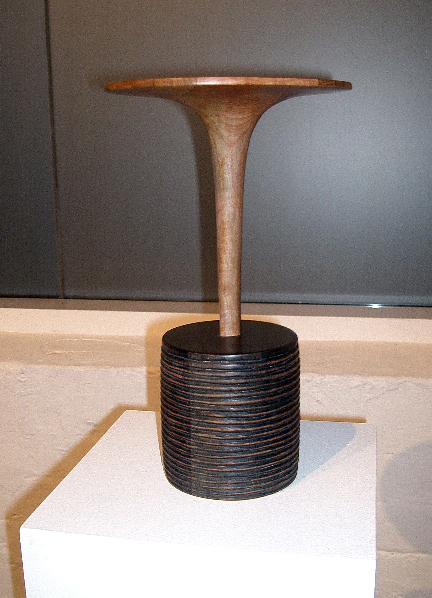
Jamieson Miller (Australian, b. 1965) The Last Drop 2008 Sheoak with ebonised stain 30 x 14 x 10cm
A small but lively crowd was in attendance for the opening of the exhibition territories featuring six small and six large floor standing wooden sculptures by the artist Jamieson Miller at the Dickerson Gallery in Oxford Street, Collingwood.
The work itself is of a fine craftsmanship showing exemplary design: different coloured woods and stains, wonderful joinery, the use of grain and different geometric and fluid shapes are all balanced harmoniously within the objects. A refined aesthetic sensibility is at work in their construction. This sensibility flows through to the conceptual themes of the work: the artist has created sometimes totemic but always lyrical poetic spaces within the corporeality of the work. The viewer enters enclosed intimate spaces (such as the funnels) or steps forward into steeped carved openings that open the way to visions of an inner world. Outer space becomes enclosed inner space as the viewer is at first intrigued, then drawn in and surrounded by the flickering shadows of Plato’s cave.
The new gallery is certainly an attractive modern warehouse space with vaulted roof. Unfortunately the large sculptures, although multi-dimensional and carved in the round, have been pushed to the edges of the space close to the walls. This makes it difficult to appreciate the totality of the form of the sculptures especially important with a work like Sight where the carved blackened wood shape on the ‘back’ of the sculpture is a vital counterpoint to the receding opening at the ‘front’ of the work. Make sure you also explore the reverse of the sculpture Lineage II to also comprehend the intimate space of the medieval window like opening to the front.
I really enjoyed the work of Jamieson Miller and recommend a visit to the gallery to see his refined worlds. The work is on show with the paintings of Jason Cordero.
Dr Marcus Bunyan
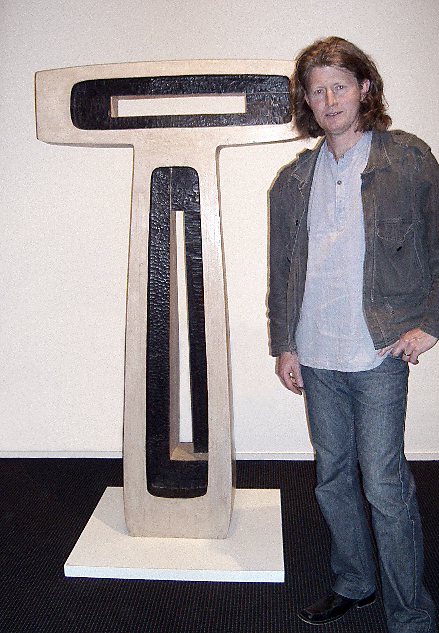
Jamieson Miller standing next to his sculpture Sight on the opening night of his exhibition territories at Dickerson Gallery in Collingwood.
Cyprus pine with ebonised stain 180 x 100 x 30cm
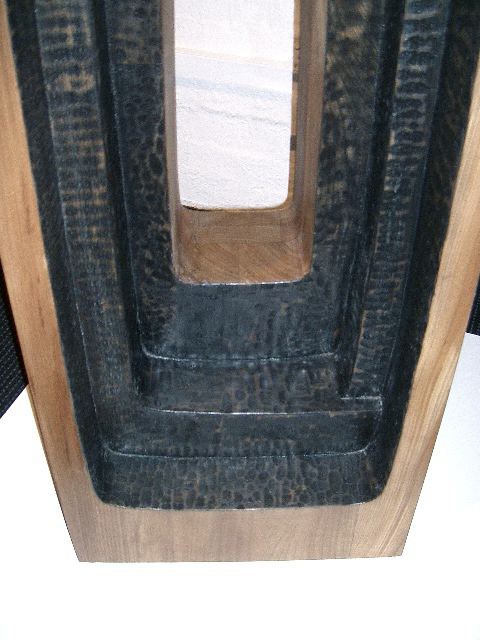
Jamieson Miller (Australian, b. 1965) Resting Place (detail) 2008 Elm with paint 203 x 42 x 30cm
“These sculptures are both poetic palimpsests and heterotopic objects of otherness that are neither here nor there.” Dr Marcus Bunyan
Exhibition dates: 22nd October – 15th November, 2008
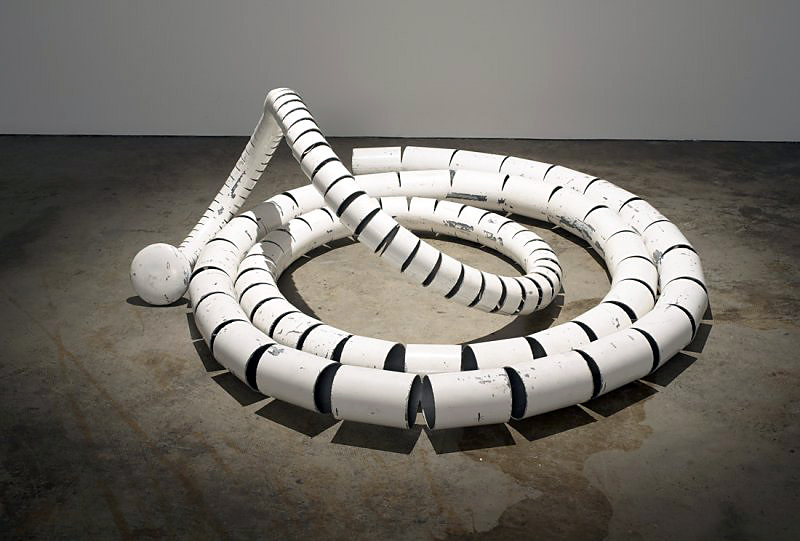
Robbie Rowlands (Australian, b. 1968) Scored 2008 Goal post, steel 160cm x 130cm x 50cm Photograph: Christian Capurro
“The philosopher Martin Heidegger argued that objects are often invisible to us gathered up as they are within a context of functionality and use. It is only when things break down that we become aware of them, seeing them with fresh eyes. In many ways Heidegger’s observation could form the basis of an approach to Robbie Rowlands’ work. Rowlands takes objects that are often forgotten, invisible or transparent to us, objects that exist on the verge of disappearance, and stages a kind of ‘breakdown’, inviting us to rediscover the object, poised somewhere between what it was and what it might become.”
Simon Cooper. Catalogue essay
Sitting in pools of light in the elegant modern space of Place Gallery in Richmond, six theatrically lit sculptures are presented by artist Robbie Rowlands.
Made of everyday objects (a boom gate, desk, chair, single bed, electricity pole, desk and footy goalpost) they have been de/constructed by the artist and reformed into curved objects. With ironic titles such as Down for the felled electricity pole and Collapse for the dismembered chair Rowland’s work hovers between one fixed state and an’other’ transformative state of being.
While the catalogue essay by Simon Cooper suggests that all of these objects are abandoned or nearly forgotten sharing a context of quasi-obsolescence, this is not the case. These were objects of purpose and form, the acts of ritualised production of a consumer society that contained signs that symbolised their status.
In his creativity Rowland has used these technologies of production, which permit us to produce, transform or manipulate things to create new sensual forms of life.
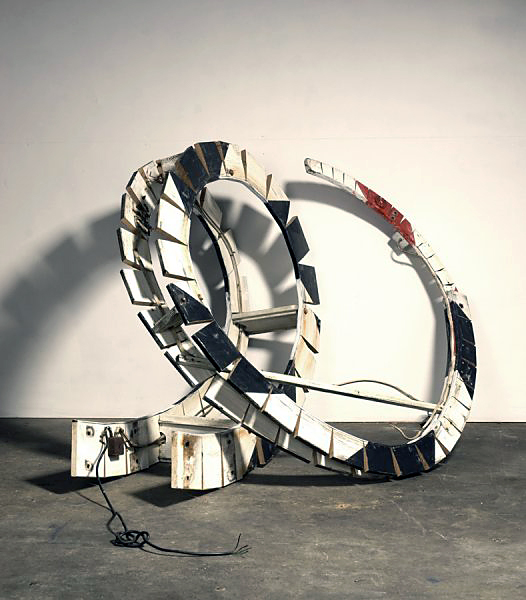
Some of the sculptures such as Boom (the boom gate; 2008, below) and Scored (the goal post; 2008, above) remind me of creatures emerging from the recesses of the unconscious, curling and rearing up like monsters from the deep. One of the most beautiful forms is the constructed white chair where the function of the object has collapsed into the essence of the form, like the surreal spatiality of a poetic Miro.
As Gaston Bachelard reminds use in The Poetics of Space, “The grace of a curve is an invitation to remain. We cannot break away from it without hoping to return. For the beloved curve has nest-like powers; it incites us to possession, it is a curved corner, inhabited geometry.”1
Cooper suggests that the curved forms that Rowland creates were “already there in the original object, even as it was sat on, written on, or passed by on the way to work.” He rightly notes that the process used contains a certain violence, but that we remember and reconstruct the old form even as we respond to the new construction. For these sculptures are a construction not, I believe, inherent in the original form.
This can be seen in the sculpture Boom (2008, below) for example, where Rowland has used additional pieces of metal to hold the curve of the boom gate in place. Without this skilfully added, hidden sub-structure the transformative shape would collapse onto the floor. Rowland inhabits and possesses his new geometry with as much technology as the original but not in such an obvious form.
The work would have been stronger if only four pieces were presented in the gallery space – the sculptures needed more room to breathe (understanding the dictum that less is more). The sculptures themselves also needed greater thematic cohesiveness perhaps using the colour white as the unifying theme.
At their best these sculptures are both poetic palimpsests and heterotopic objects of otherness that are neither here nor there. They are sensual and beautiful gestures that deserve your attention.
Dr Marcus Bunyan
1/ Bachelard, Gaston. The Poetics of Space. Boston: Beacon, 1969 [originally 1958] p. 146
Robbie Rowlands (Australian, b. 1968) Boom 2008 Rail boom gate, wooden 160cm x 160cm x 130cm Photograph: Wren
Place Gallery 120 Collins Street Melbourne VIC 3000 Phone: (03) 9527 6378
Exhibition dates: 29th October – 6th December, 2008
Curator: Victor Griss
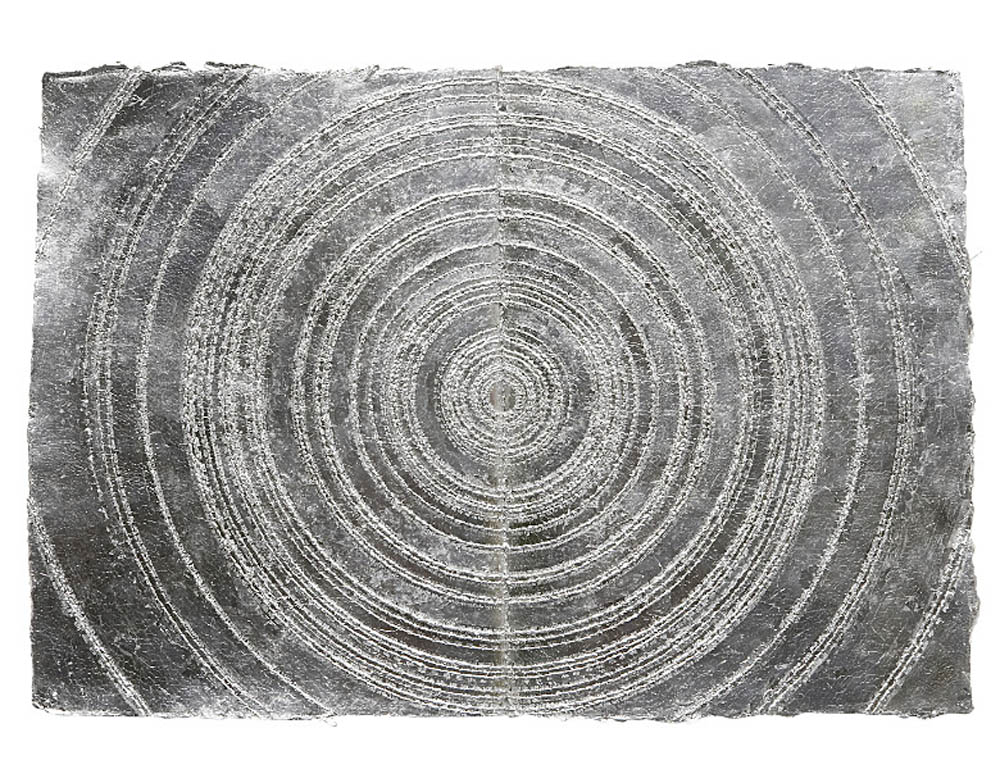
Louise Rippert (Australian) Recording (detail) 2008 Collage; thread, aluminium and silver gilt and pencil on khadi paper 38 x 37cm Collection of Deakin University
Deakin University Art Gallery present an exhibition by this Melbourne artist of new work.
“Favouring the use of archival, translucent, brittle and fine materials in her labour intensive and near devotional ‘manuscripts’ of stitching, pattern and perforation, Rippert creates mixed media works of the utmost delicacy … This is the first solo exhibition of Rippert’s work in a public institution and will present her past and recent work.”
Rippert’s work is extraordinary.
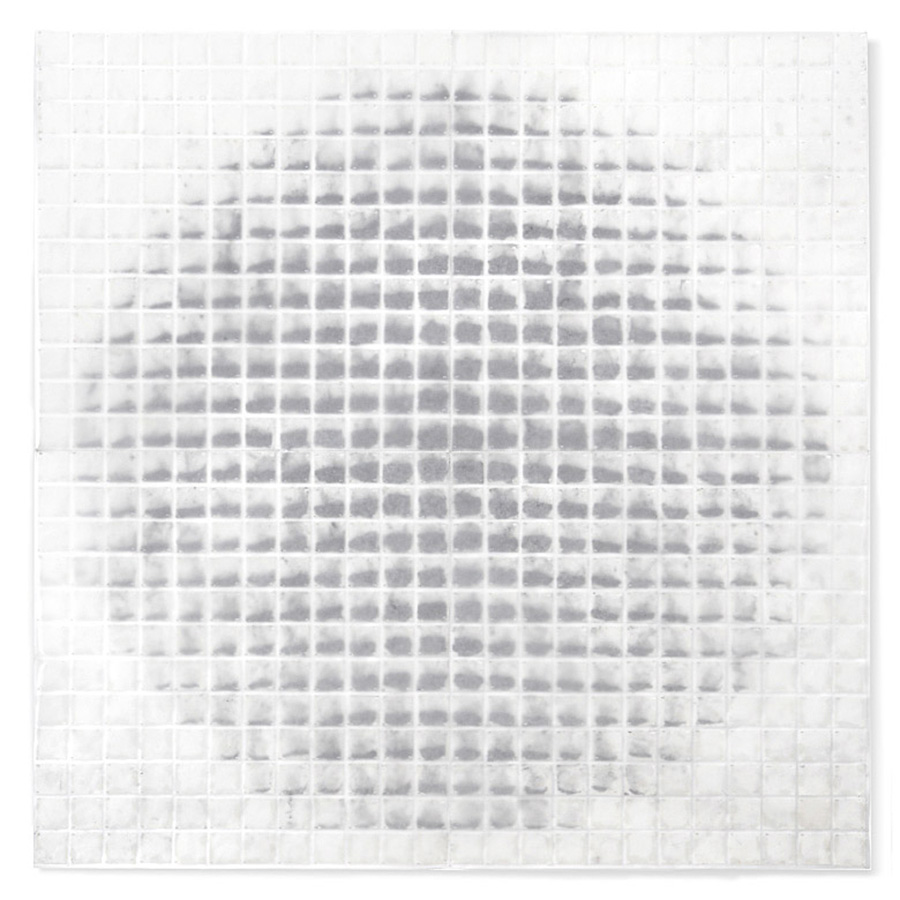
Taking paper of every sort Rippert inscribes the surface: stitches, weaves, colours and indents the paper, making annotations that develop personal narrative. Rippert uses repetition of form in grids and circles to achieve her archetypal works, touching the deepest patterns of our lives.
Delicate and insightful her work celebrates what it is to be human – to be lovers, to be a daughter, to dance, to record.
Dr Marcus Bunyan
Louise Rippert (Australian) Cochin Mandala 2005 Collage; glassine, pencil, thread and gouache on paper Private collection
For many artists the process of art making has a mysterious fascination that continues to draw them back to experimenting, searching and the experience of creating. At the very least, it is reasonable to suggest that art making in this respect is supramundane; an experience particular to itself, simultaneously autonomous but contingent on an “other”, challenging but ostensibly satisfying, baffling and revelatory as – in this sense – creating art involves the artist’s responses, reflections and what is sometimes referred to as an inner dialogue with the work.
The medium (in that very specific conjuring sense of the word) and the interaction with it then becomes a vehicle in which this dialogue has an opportunity to “arise”, or be “heard”. It may be in these cases that the exercising of inner consciousness marks an escape or a period of sanctuary from the regular rigours of life, or that it denotes the labour of a different kind, of higher purpose, intellectual inquiry or even some manner of transcendence.
The term meditative is often ascribed to this transformation of consciousness and the introspective process of art creation. So is it meditation? Certainly many artistic traditions have involved high levels of training and discipline. Certainly many forms of meditation have involved an “other” to provide musing, focus or distraction for the mind. Both have shared common traits of concentration, labour, devotion, repetition, patience and practice. In the artwork of Louise Rippert, certainly the preconditions for such a meditation are identifiable.
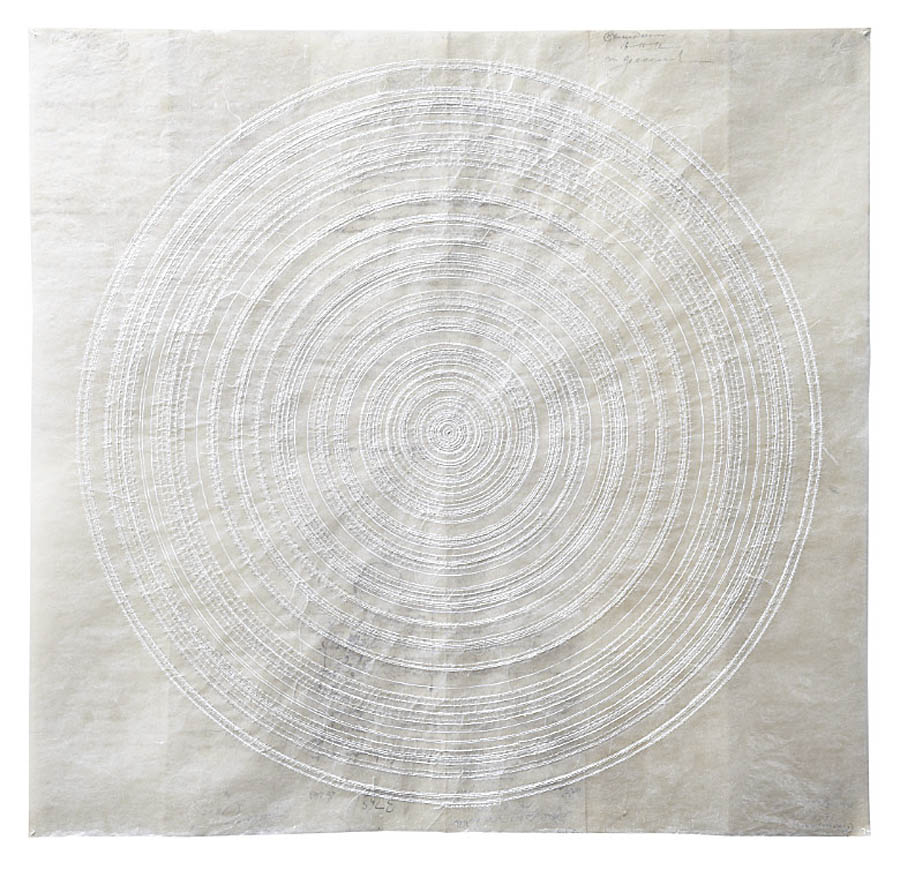
The inherent irony with formal artwork is that short of sitting over the artist’s shoulder the audience experiences the result of process, rather than the process itself. However, the beauty (in more sense than one) of Louise Rippert’s work is that in many cases she leaves paths that can be followed or re-imagined, whether it is in the delicacy of her stitching and folding or the sequential approach to numbering that characterises many of her works. We can sense the endeavour. We can see the labour. We can begin in the middle of a spiral or circle and follow the numbers to their logical conclusion. Our mind in many respects can literally “join the dots” and so make the abstractive leap back and forth in time to appreciate this process of becoming.
The extra dimension to the work exhibited in LOUISE RIPPERT: TRACE is that the result also speaks not just of the process, but the intent. There is equilibrium, harmony and quiet in and across these works, which compels revisiting that very painstaking process. While having exhibited artwork annually since 1994, Rippert’s modus operandi has meant limited opportunities to show substantive bodies of work. She has been represented periodically in the National Works on Paper Prize at the Mornington Peninsula Regional Gallery and in 2005 she was the co-winner of the Blake Prize for Religious Art.
Deakin University Art Gallery is therefore very proud to present LOUISE RIPPERT: TRACE, the first solo exhibition of Louise Rippert’s creations in a public gallery and would like to thank the artist for collaborating in this project. Thanks are also extended to the following people for their contributions to this project; Euan Heng, artist, for his opening remarks to launch this landmark event, Diane Soumilas, Gallery Co-ordinator, Glen Eira City Council Gallery for her insightful catalogue essay, to the private collectors who have loaned works and Jasmin Tulk for designing the catalogue to mark and accompany this important exhibition.
Victor Griss Exhibition Curator
Originally published in Louise Rippert: Trace, Deakin University 2008
Louise Rippert (Australian) Trace 2008 Collage; pigment baking paper, tracing paper, pencil, thread and adhesive contact on drafting film 94 x 94cm Collection on the artist
Deakin University Art Gallery 221, Burwood Highway Burwood 3125
Artist Tim Fleming on the ABC’s Sunday Arts program talks about his art practice, his Flatland work in plywood and laminex and how the work has taken on a life of its own. The work takes on a self-reflexive element with his use of mirrored surfaces forcing the viewer/maker to assess where they are going in life. Fleming notes that it is important to take time as an artist to gather the skills and lay the foundation for future work. Working slowly, laying the foundations, gathering the skills.
Personally I like the use of objects that are taken out of context to convey different metaphors for everyday life. As an artist Flemings semiotic language upsets accepted boundaries of how we look and interact with the world, forcing us to question what it is that makes us who we are.
Curator: Frances Lindsay, Deputy Director of the National Gallery of Victoria
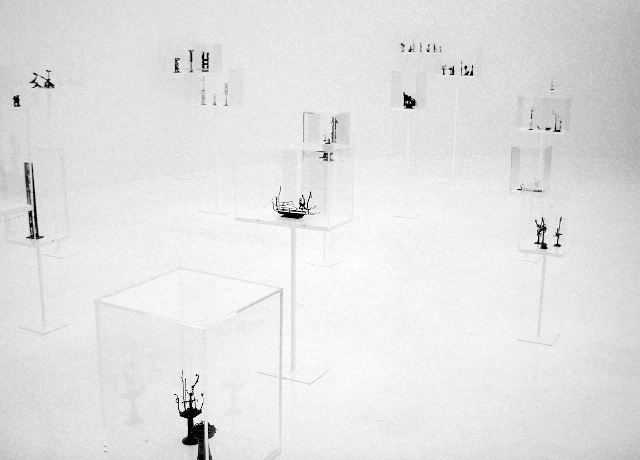
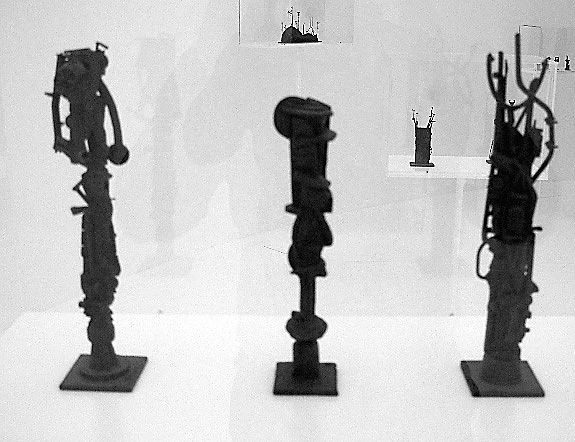
Klippel/Klippel: Opus 2008 exhibition sculpture and installation from the first space Photos: Marcus Bunyan
A magical exhibition of the work of the Australian sculptor Robert Klippel (1920-2001) is presented together with a soundscape to accompany the works by his son Andrew Klippel.
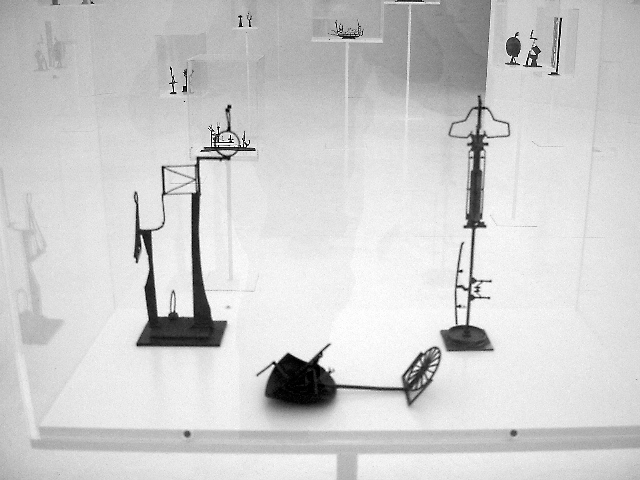
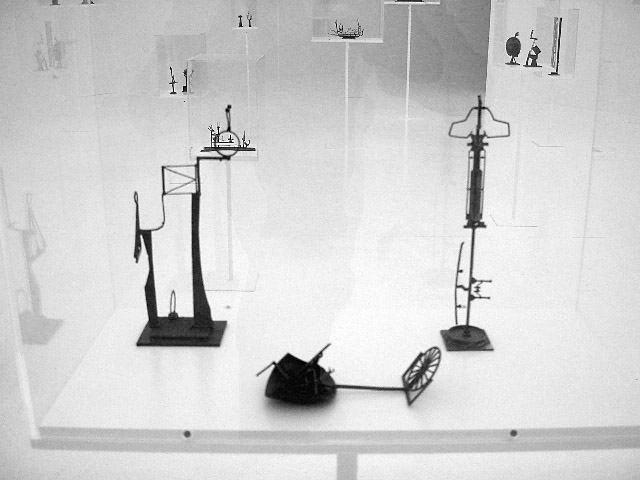
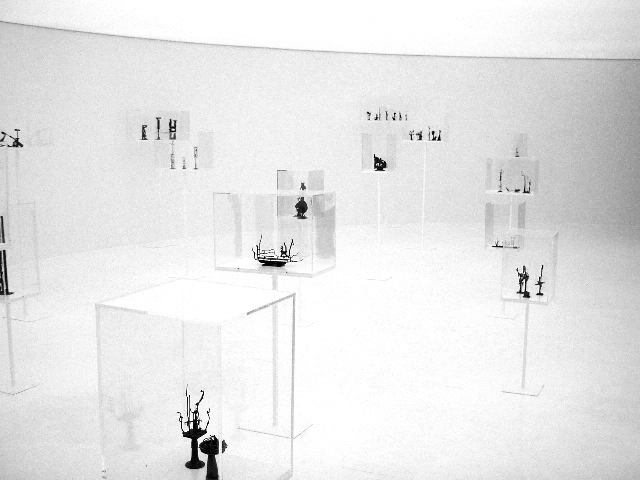
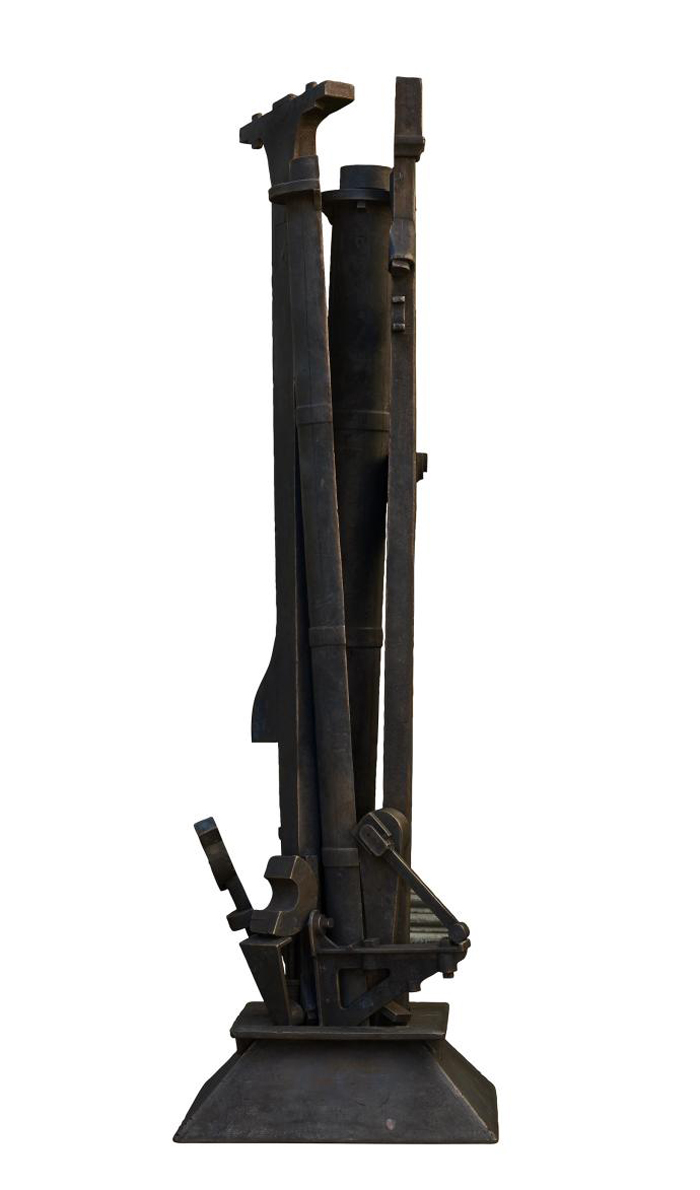
The exhibition offers two distinct rooms of light/white and shade/dark which both contain small assemblages and bronze sculpture made in the 1980s-1990s. The show finishes with the singular monumental bronze work No. 709.
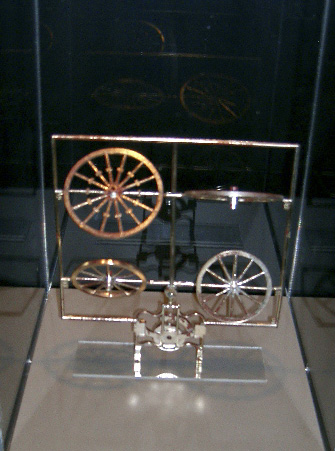
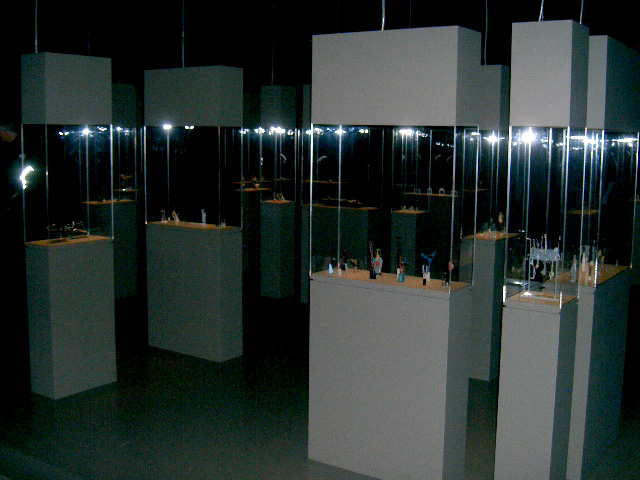
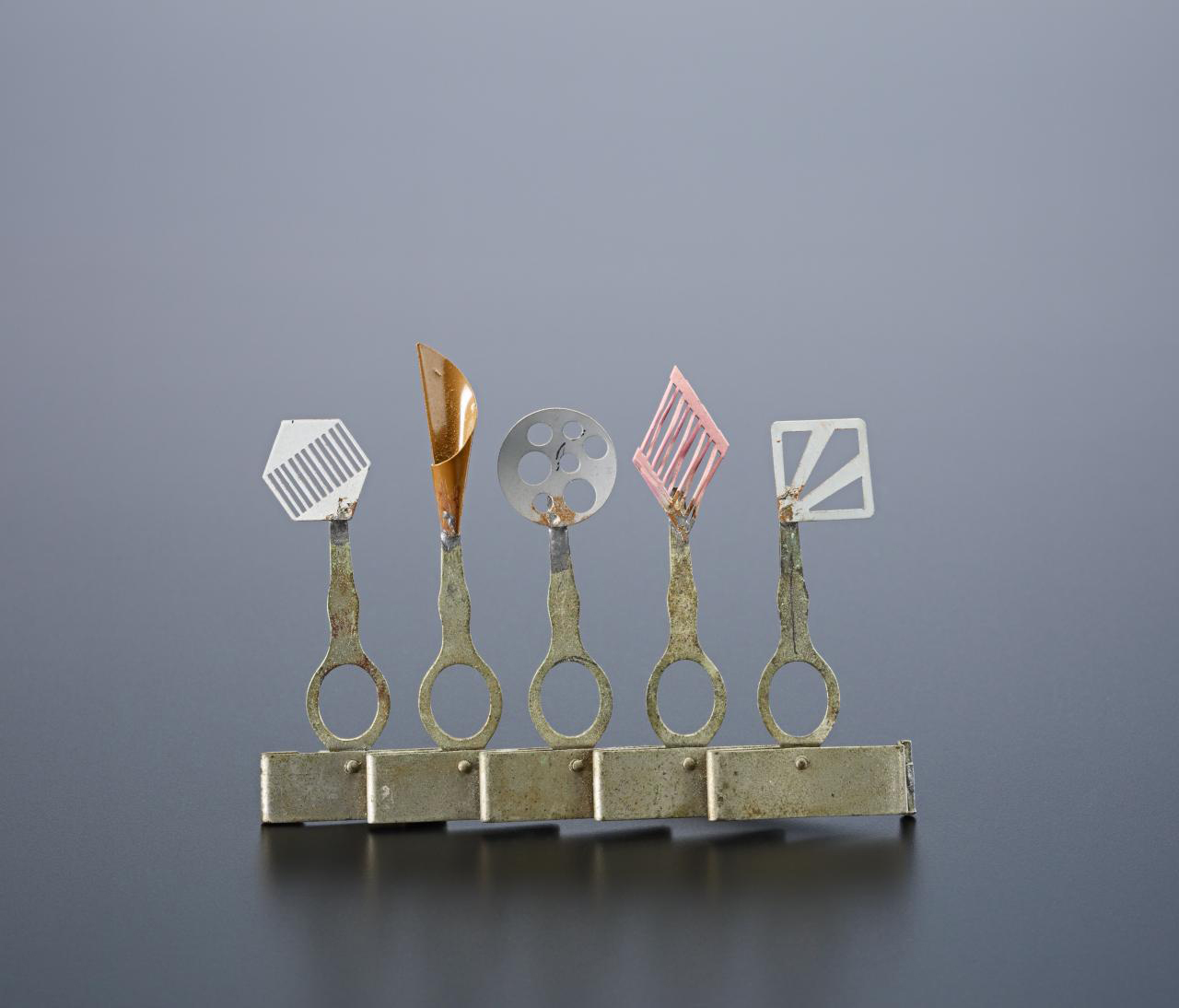
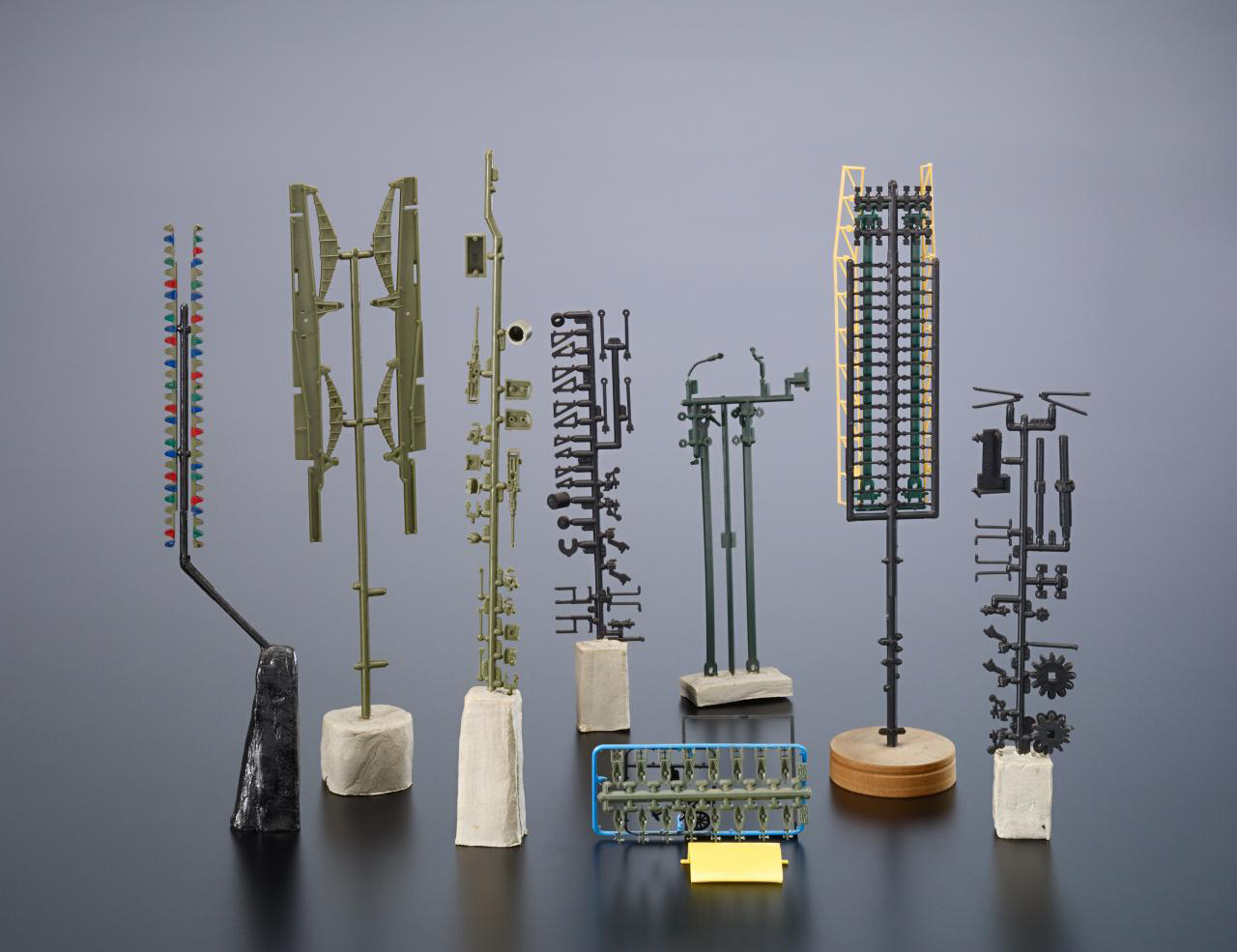
In the first space lit glass cases hover in darkness, containing delicate constructions of found objects, beautifully crafted. Made of plastic and metal, some parts taken from modelling kits, the sculptures morph and weave a delicate narrative, a powerful artistic vision. Mostly totemic in nature they transport the viewer with wonder and delight, the artists vision fully realised: no unnecessary flourishes, no wasted energy on forms that are redundant.
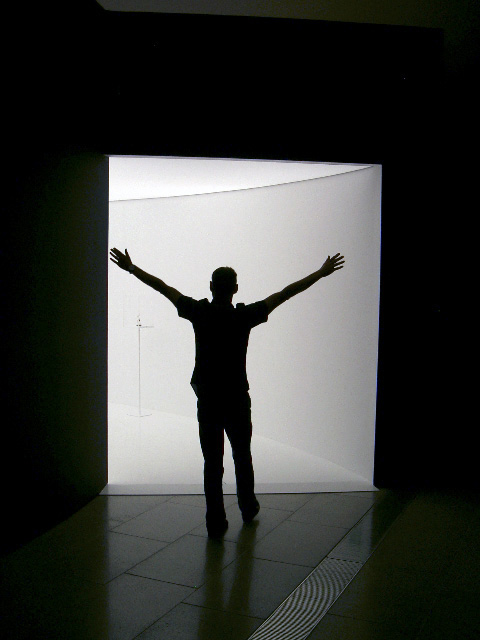
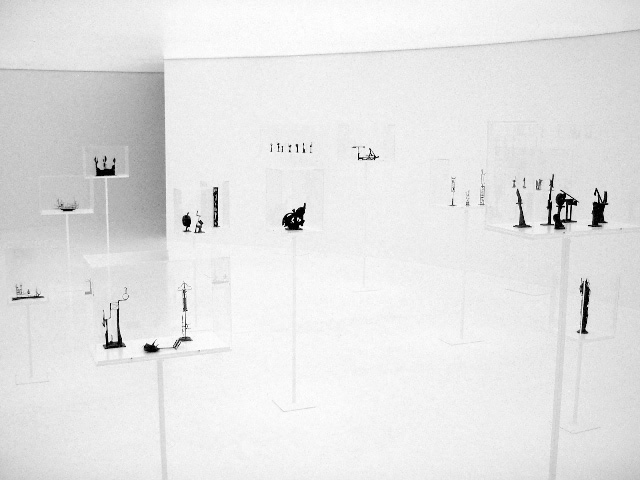
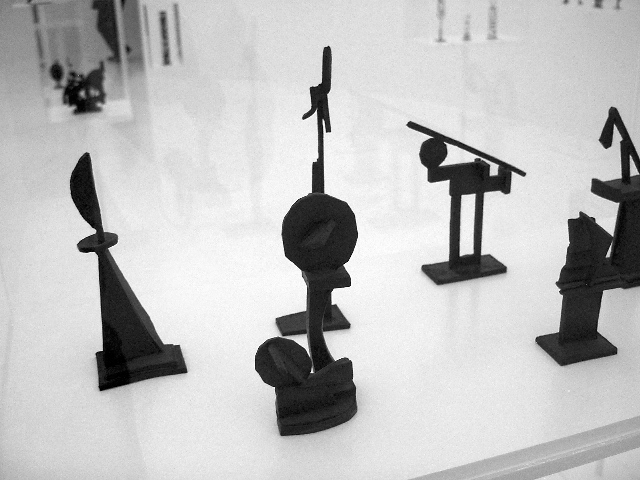
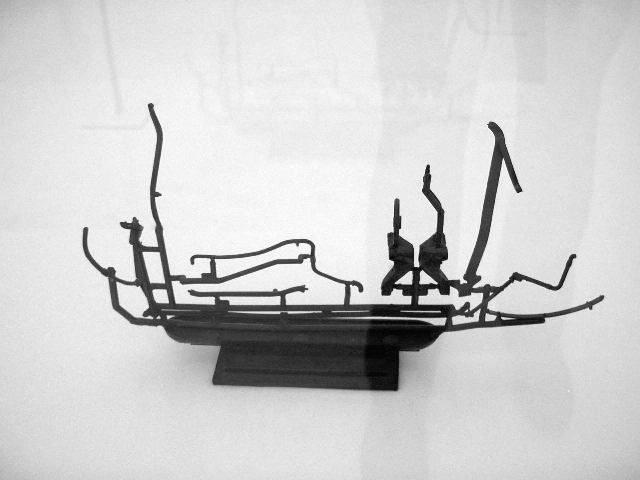
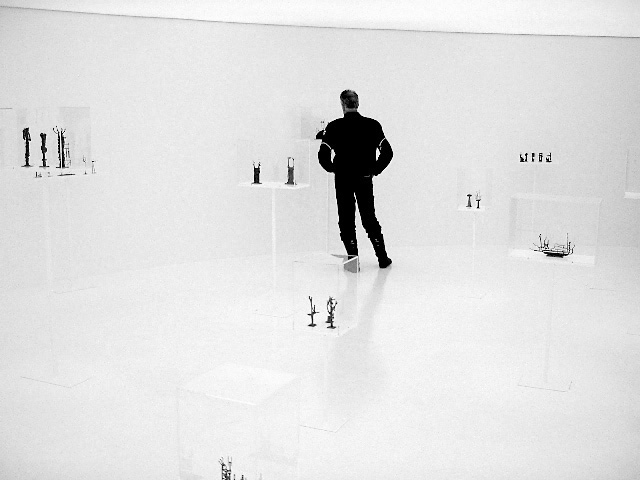
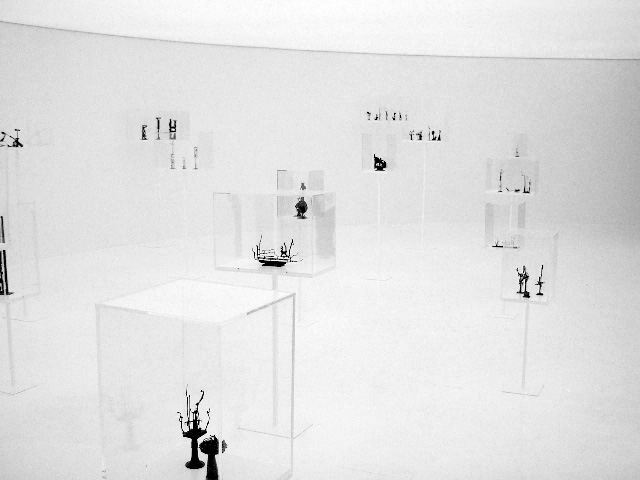
Wandering from the first darkened space we face a curved wall of black with a bright white opening, almost like the mouth of a Nautilus shell. Upon entering we are enveloped in white – walls, floor, stretched acrylic ceiling and stands upon which glass cases sit all being pure white. It is like stepping into the spacecraft from Stanley Kubrick’s 2001: A Space Odyssey – quite disorientating but transformational. In the cases sit small very dark bronze sculptures contrasting with the white. Again mostly totemic in nature the sculptures have great power and presence. Some portray small cities on top of hills. Others intricate machine and figure like constructions. All of the cases are mounted at different eye levels, unlike the first room.
When looking across the gallery space, the boxes and sculpture within create a diorama, almost a tableaux vivant, where you can move the focus of your gaze from foreground to mid to background, all suspended in white. If you can be in this space alone with the work and wander around soaking in the vision of this artist so much the better.
The contrast and parallels between the two rooms is striking. Here is an artist at the height of his powers commanding his materials and his vision in two distinct bodies of work: one delicate, found, plastic the other solid, dark and essential, both dealing with the essence of human creativity and being, leaving the viewer with a sensory experience long remembered.
Klippel/Klippel: Opus 2008 exhibition entrance to the second space
Robert Klippel is regarded as Australia’s most important sculptor of the post-war 20th century period. Known for his abstract assemblages created from found objects he is a distinguished figure in the history of Australian art. Andrew Klippel, Robert’s son, is a composer and musician who has achieved international recognition as a solo musician, songwriter and influential music producer.
Klippel/Klippel: Opus 2008 is a unique and compelling sensory experience which presents a group of Robert Klippel’s small-scale sculptures that were produced during the 1980s and 1990s – some of these have never been publicly displayed. It also includes the monumental bronze work No. 709. Andrew has arranged for this work, which Robert was preparing to cast at the time of his death, to be executed for the National Gallery of Victoria and included in the exhibition. And, in an important artistic response, Andrew Klippel has created a soundscape – a meditation on his father’s work.
Klippel/Klippel: Opus 2008 is an extraordinary and immersive exhibition that celebrates the creative process.


You must be logged in to post a comment.