Exhibition: ‘Imogen Cunningham’ at Fundación Mapfre, Madrid

Exhibition dates: 18th September 18 2012 – 20th January 2013


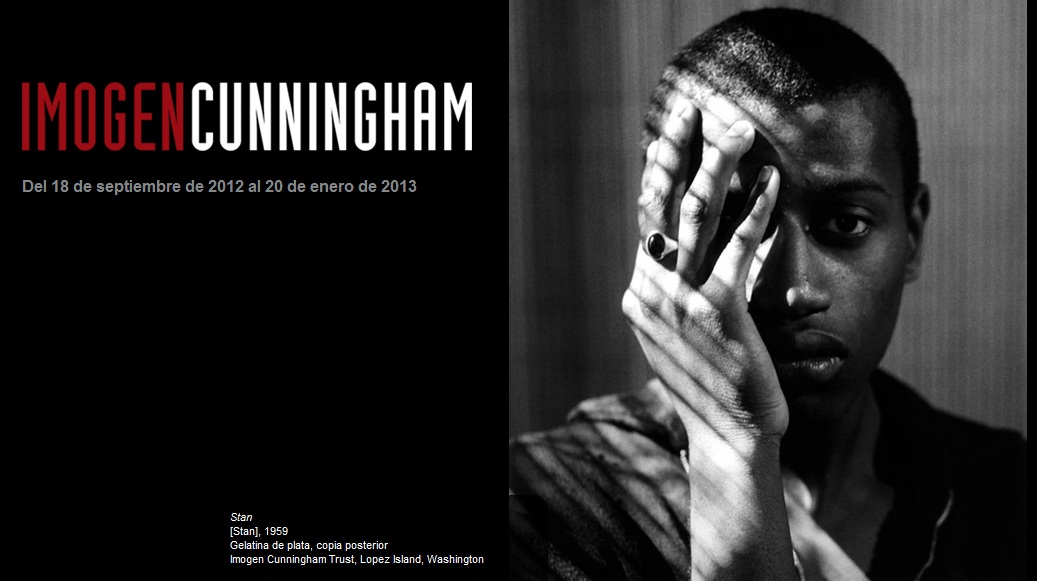
Imogen Cunningham exhibition poster


Imogen Cunningham exhibition poster


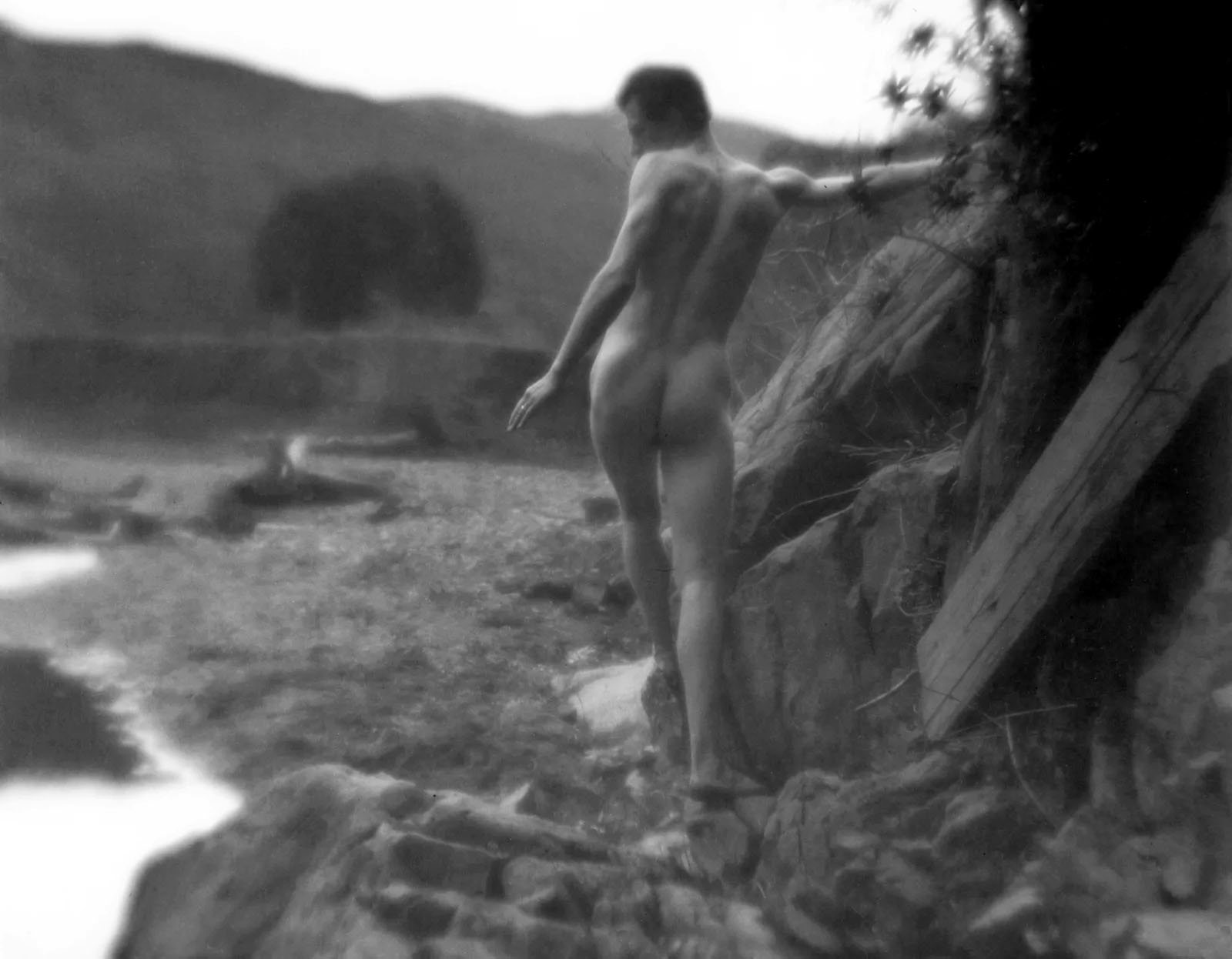
This is the first posting on one of my favourite photographers of all time: Imogen Cunningham. The sensuality of this artist, from the early Pictorialist studies (including her ground breaking depiction of the male nude, her husband artist Roi Partridge) to the later Modernist nudes, portraits, industrial landscapes and botanical photographs is of the highest order. Cunningham reminds me of a photographic version of Georgia O’Keeffe without the undoubted darkness that inhabits some of O’Keeffe’s work.

The portrait of Frida Kahlo Rivera (1931, below) is a magnificent study of a proud woman with delicate use of natural light framing the face and gently clasped hands. Note the textures within the photograph – the dress, the shawl, the wicker chair and the wall – and also notice the reflective light falling behind the sitter upper left to balance the frontal light coming from bottom right. Masterful. Cunningham’s famous Two Callas (1929, below) is an glorious study of form, light and texture, a sensual symphony for the eyes, the background a kind of mutable black that allows the viewer’s gaze to be immersed in the subject. The viewer’s voyeuristic gaze is further engaged by the voluptuous suggestiveness of the copious hair and out of focus breast of Phoenix Recumbent (1968, below) where, “the object of the gaze is not aware of the current viewer (though they may originally have been aware of being filmed, photographed, painted etc. and may sometimes have been aware that strangers could subsequently gaze at their image).” (Daniel Chandler “Notes on ‘The Gaze'” on the Aberystwyth University website [Online] Cited 12/01/2013 no longer available online)

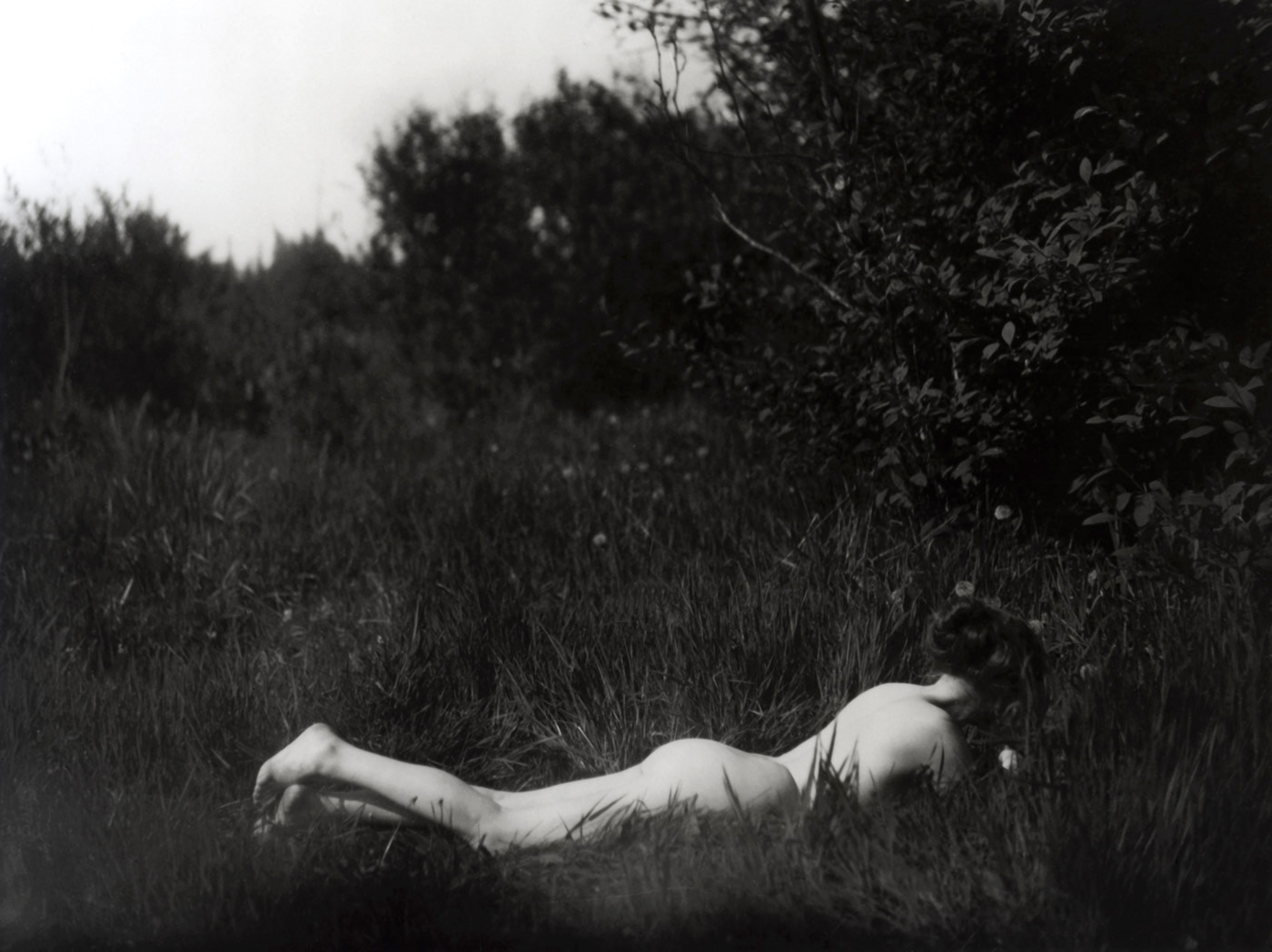
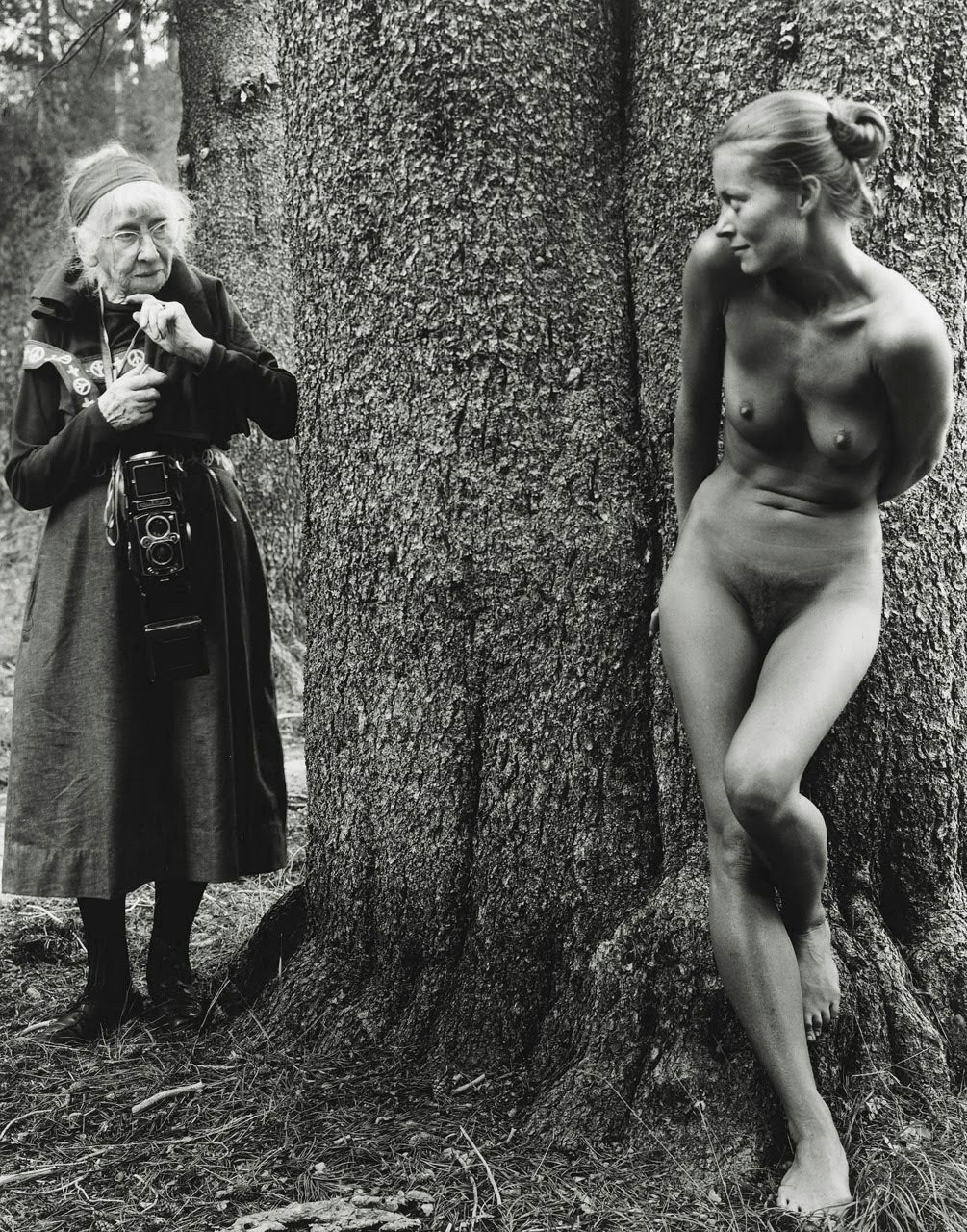
Finally, the photograph of Imogen Cunningham and Twinka Thiebaud by Judy Dater (1974, below) seems to me to capture the spirit of the human being Imogen Cunningham with indelible grace. Youth, beauty, age, wisdom. A constantly inquisitive mind, wanting to know, wanting to see things more clearly, taking photographs right up until her final years. There she is with her twin-lens Rollei dressed as if from another century, the quizzical nature of her left hand and the look that passes between Imogen and Twinka, the space between them seeming to shimmer with possibility. That space seems to wash away the years of Imogen’s life to when she was young, lying naked near some trees (Self-Portrait (1906, below). It is a truly memorable image. In the sensitivity of this image, Dater embodies everything that I admire in Cunningham’s work: light, texture, sensitivity to subject, an understanding of beauty and an irrepressible, joyous sensuality. A fitting tribute to one of the world’s great photographers.

Dr Marcus Bunyan


Many thankx to the Fundación Mapfre, Madrid for allowing me to publish the photographs in the posting. Please click on the photographs for a a larger version of the image.


Imogen Cunningham (American, 1883-1976) 'Self-Portrait' 1906


Imogen Cunningham (American, 1883-1976)
Self-Portrait
1906
Platinum print
©The Imogen Cunningham Trust, 2012


Imogen Cunningham (American, 1883-1976) 'Roi on the Dipsea trail 3' 1918


Imogen Cunningham (American, 1883-1976)
Roi on the Dipsea trail 3
1918
Gelatin sliver print
© The Imogen Cunningham Trust, 2012


Imogen Cunningham (American, 1883-1976) 'Magnolia Blossom' 1925


Imogen Cunningham (American, 1883-1976)
Magnolia Blossom
1925
Gelatin silver print
© The Imogen Cunningham Trust, 2012


Imogen Cunningham (American, 1883-1976) 'Three Dancers, Mills College' 1929


Imogen Cunningham (American, 1883-1976)
Three Dancers, Mills College
1929
Gelatin silver print
© The Imogen Cunningham Trust, 2012


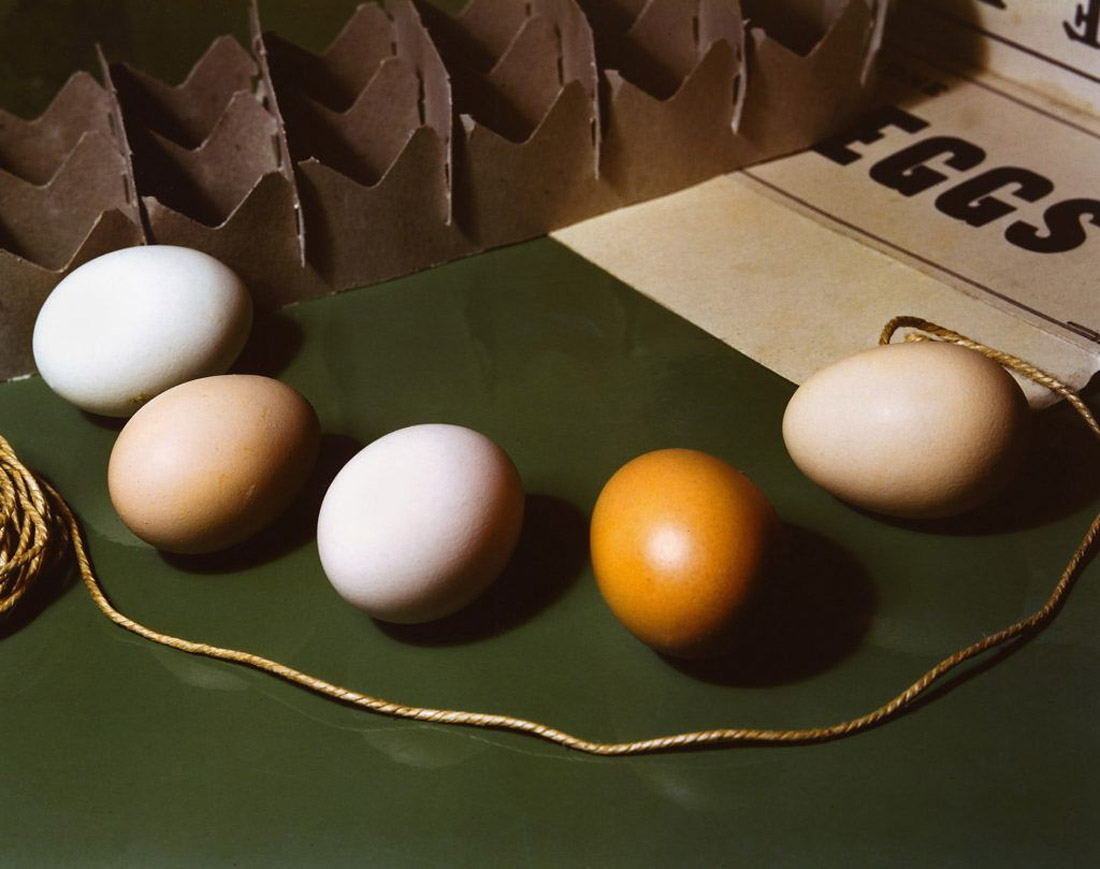
Imogen Cunningham (American, 1883-1976) 'Five Eggs' 1951


Imogen Cunningham (American, 1883-1976)
Five Eggs
1951
Cibachrome
© The Imogen Cunningham Trust


Imogen Cunningham (American, 1883-1976) 'The Unmade Bed' 1957


Imogen Cunningham (American, 1883-1976)
The Unmade bed
1957
Gelatin silver print
© The Imogen Cunningham Trust, 2012


Imogen Cunningham (American, 1883-1976) 'The dream' 1910


Imogen Cunningham (American, 1883-1976)
The dream
1910
Gelatin silver print
© The Imogen Cunningham Trust, 2011


Imogen Cunningham (American, 1883-1976) 'The Wood Beyond the World' c. 1912


Imogen Cunningham (American, 1883-1976)
The Wood Beyond the World
c. 1912
Gelatin silver print
© The Imogen Cunningham Trust


Imogen Cunningham (American, 1883-1976) 'Agave Design 2' 1920s


Imogen Cunningham (American, 1883-1976)
Agave Design 2
1920s
Gelatin silver print
© The Imogen Cunningham Trust


Imogen Cunningham (American, 1883-1976) 'Edward Weston and Margrethe Mather, Photographers I-II' 1922


Imogen Cunningham (American, 1883-1976)
Edward Weston and Margrethe Mather, Photographers I-II
1922
Gelatin silver print
© The Imogen Cunningham Trust, 2011


Imogen Cunningham (American, 1883-1976) 'Aloe' 1925


Imogen Cunningham (American, 1883-1976)
Aloe
1925
Gelatin silver print
© The Imogen Cunningham Trust, 2012


Imogen Cunningham (American, 1883-1976) 'Two Callas' 1929


Imogen Cunningham (American, 1883-1976)
Two Callas
1929
Gelatin silver print
© The Imogen Cunningham Trust, 2012


Imogen Cunningham (American, 1883-1976) 'Hen and Chickens' 1929


Imogen Cunningham (American, 1883-1976)
Hen and Chickens
1929
Gelatin silver print
© The Imogen Cunningham Trust, 2011


Imogen Cunningham (American, 1883-1976) 'Frida Kahlo Rivera, Painter and Wife of Diego Rivera' 1931


Imogen Cunningham (American, 1883-1976)
Frida Kahlo Rivera, Painter and Wife of Diego Rivera
1931
Gelatin silver print
© The Imogen Cunningham Trust, 2012


Imogen Cunningham (American, 1883-1976) 'Cary Grant, Actor' 1932


Imogen Cunningham (American, 1883-1976)
Cary Grant, Actor
1932
Gelatin silver print
© The Imogen Cunningham Trust, 2012


Imogen Cunningham (American, 1883-1976) 'Nude' 1939


Imogen Cunningham (American, 1883-1976)
Nude
1939
Gelatin silver print
© The Imogen Cunningham Trust, 2012


Imogen Cunningham (American, 1883-1976) 'Phoenix Recumbent' 1968


Imogen Cunningham (American, 1883-1976)
Phoenix Recumbent
1968
Gelatin silver print
Private Collection


Judy Dater (American, b. 1941) 'Imogen Cunningham and Twinka Thiebaud' 1974


Judy Dater (American, b. 1941)
Imogen Cunningham and Twinka Thiebaud
1974


FUNDACIÓN MAPFRE – Instituto de Cultura
Paseo de Recoletos, 23
28004 Madrid, Spain
Phone: +34 915 81 61 00

Opening hours:
Monday (except Holidays): 2pm – 8pm
Tuesday to Saturday: 11am to 8pm
Sundays and Holidays: 11am – 7pm

Fundación Mapfre website

LIKE ART BLART ON FACEBOOK

Back to top

Exhibition: ‘William Klein + Daido Moriyama’ at the Tate Modern, London

Exhibition dates: 10th October 2012 – 20th January 2013


William Klein (French born America, 1926-2022) 'Candy Store, New York' 1955


William Klein (French born America, 1926-2022)
Candy Store, New York
1955
Gelatin silver print
© William Klein


More Daido Moriyama photographs can be found on my 2012 posting Fracture: Daido Moriyama at the Los Angeles County Museum of Art (LACMA) and 2009 posting Daido Moriyama: Tokyo Photographs at Philadelphia Museum of Art.

Dr Marcus Bunyan


Many thankx to the Tate Modern for allowing me to publish the photographs in the posting. Please click on the photographs for a larger version of the image.


William Klein (French born America, 1926-2022) 'Pray + Sin, New York' 1954


William Klein (French born America, 1926-2022)
Pray + Sin, New York
1954
Gelatin silver print
© William Klein


Explore modern urban life in New York and Tokyo through the photographs of William Klein and Daido Moriyama. This is the first exhibition to look at the relationship between the work of influential photographer and filmmaker Klein, and that of Moriyama, the most celebrated photographer to emerge from the Japanese Provoke movement of the 1960s.

With work from the 1950s to the present day, the exhibition demonstrates the visual affinity between their urgent, blurred and grainy style of photography and also their shared desire to convey street life and political protest, from anti-war demonstrations and gay pride marches to the effects of globalisation and urban deprivation.

The exhibition also considers the medium and dissemination of photography itself, exploring the central role of the photo-book in avant-garde photography and the pioneering use of graphic design within these publications. As well the issues of Provoke magazine in which Moriyama and his contemporaries showcased their work, the exhibition will include fashion photography from Klein’s work with Vogue and installations relating to his satirical films Mister Freedom and Who Are You Polly Maggoo?

Text from the Tate Modern website


William Klein (French born America, 1926-2022) 'Bikini, Moscow' 1959


William Klein (French born America, 1926-2022)
Bikini, Moscow
1959
Gelatin silver print
© William Klein


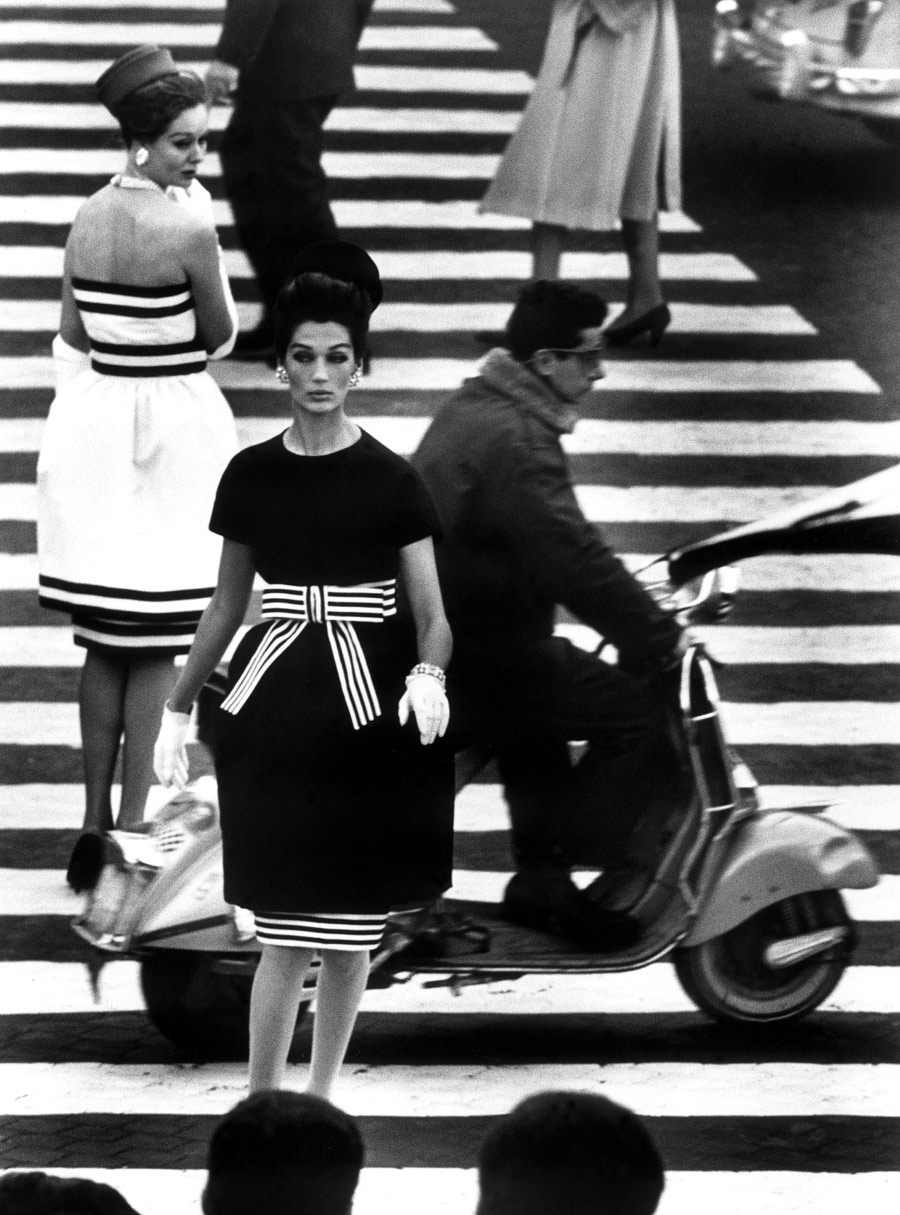
William Klein (French born America, 1926-2022) 'Piazza di Spagna, Rome' 1960


William Klein (French born America, 1926-2022)
Piazza di Spagna, Rome
1960
Gelatin silver print
© William Klein


William Klein (French born America, 1926-2022) 'Gun 1, New York' 1955


William Klein (French born America, 1926-2022)
Gun 1, New York
1955
Gelatin silver print
© William Klein


William Klein (French born America, 1926-2022) 'lsa Maxwell's Toy ball, Waldorf Hotel, New York' 1955


William Klein (French born America, 1926-2022)
lsa Maxwell’s Toy ball, Waldorf Hotel, New York
1955
Gelatin silver print
© William Klein


William Klein (French born America, 1926-2022) 'Kiev railway station, Moscow' 1959


William Klein (French born America, 1926-2022)
Kiev railway station, Moscow
1959
Gelatin silver print
© William Klein


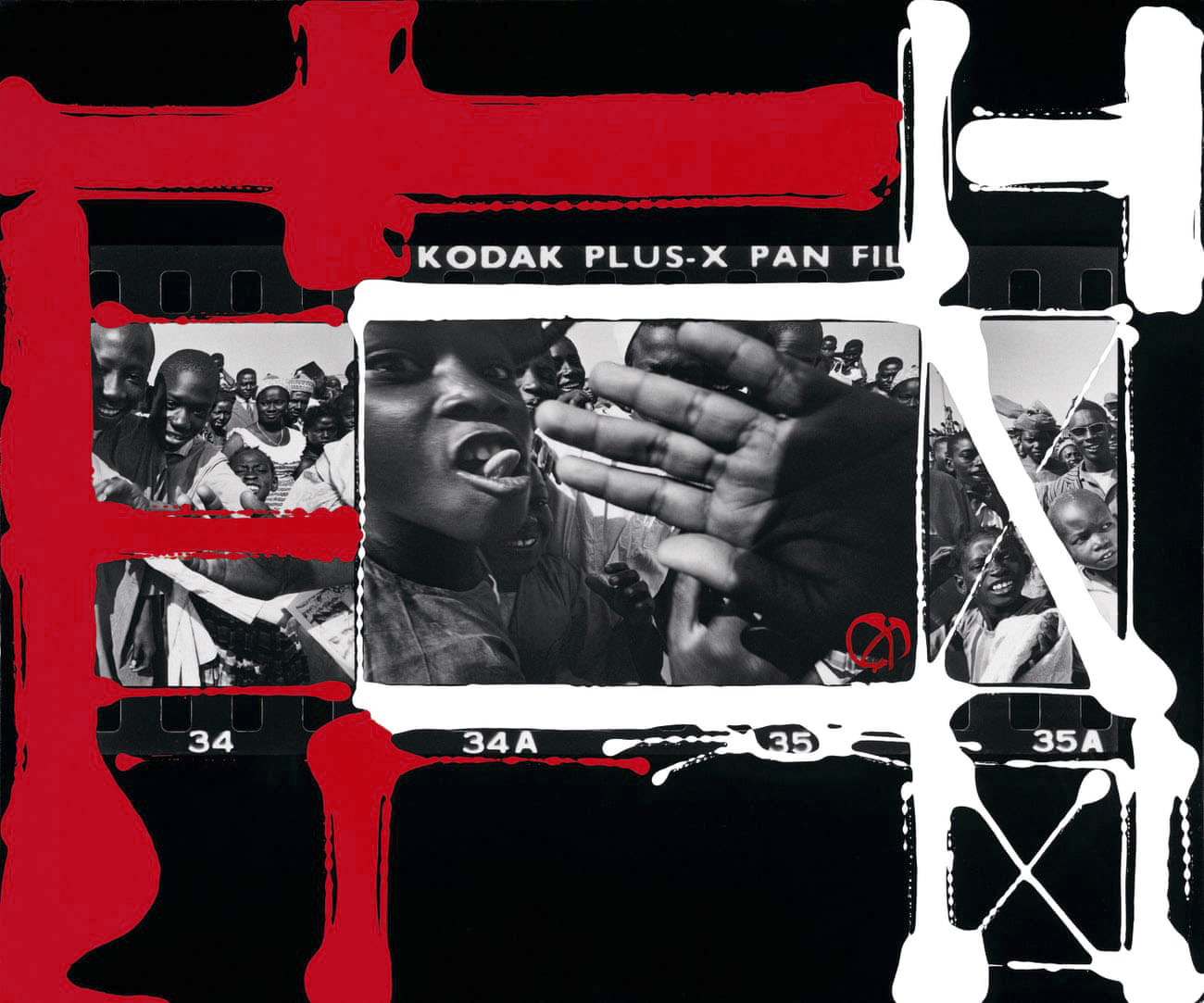
William Klein (French born America, 1926-2022) 'School out, Dakar' 1963


William Klein (French born America, 1926-2022)
School out, Dakar
1963
Gelatin silver print
© William Klein


William Klein (French born America, 1926-2022) 'Dance Happening in Ginza, Tokyo' 1961


William Klein (French born America, b. 1928)
Dance Happening in Ginza, Tokyo
1961
Gelatin silver print
© William Klein


William Klein + Daidō Moriyama Exhibition Tate Modern, London

Slideshow of images from the press view at the William Klein / Daido Moriyama Exhibition at Tate Modern, London


Explore modern urban life in New York and Tokyo through the photographs of William Klein and Daido Moriyama. This is the first exhibition to look at the relationship between the work of influential photographer and filmmaker Klein, and that of Moriyama, the most celebrated photographer to emerge from the Japanese Provoke movement of the 1960s. With work from the 1950s to the present day, the exhibition demonstrates the visual affinity between their urgent, blurred and grainy style of photography and also their shared desire to convey street life and political protest, from anti-war demonstrations and gay pride marches to the effects of globalisation and urban deprivation. Taking as its central theme the cities of New York and Tokyo, William Klein + Daido Moriyama explores both artists’ celebrated depictions of modern urban life.

The exhibition is formed of two retrospectives side by side, bringing together over 300 works, including vintage prints, contact sheets, film stills, photographic installations and archival material. The influence of Klein’s seminal 1956 publication Life is Good & Good for You in New York, Trance Witness Revels, as well as his later books Tokyo 1964 and Rome: The City and Its People 1959, is traced through Moriyama’s radical depictions of post-war Tokyo in Sayonara Photography and The Hunter 1972. The juxtaposition of these artists not only demonstrates the visual affinity between their urgent, blurred and grainy style of photography, but also their shared desire to convey street life and political protest, from anti-war demonstrations and student protests to the effects of globalisation and urban deprivation.

This exhibition also considers the medium and dissemination of photography itself, exploring the central role of the photo-book in avant-garde photography and the pioneering use of graphic design within these publications. As well the issues of Provoke magazine in which Moriyama and his contemporaries showcased their work, the exhibition includes fashion photography from Klein’s work with Vogue and installations relating to his satirical films Mister Freedom and Who Are You Polly Maggoo? New ways of presenting photography are also demonstrated by Moriyama’s installation Polaroid/Polaroid 1997, which recreates his studio interior through a meticulous arrangement of Polaroid images.

Press release from the Tate Modern website


'William Klein + Daido Moriyama' exhibition banner


William Klein + Daido Moriyama exhibition banner


Daidō Moriyama (Japanese, b. 1938) 'Misawa' 1971


Daidō Moriyama (Japanese, b. 1938)
Misawa
1971
Gelatin silver print
© Daido Moriyama


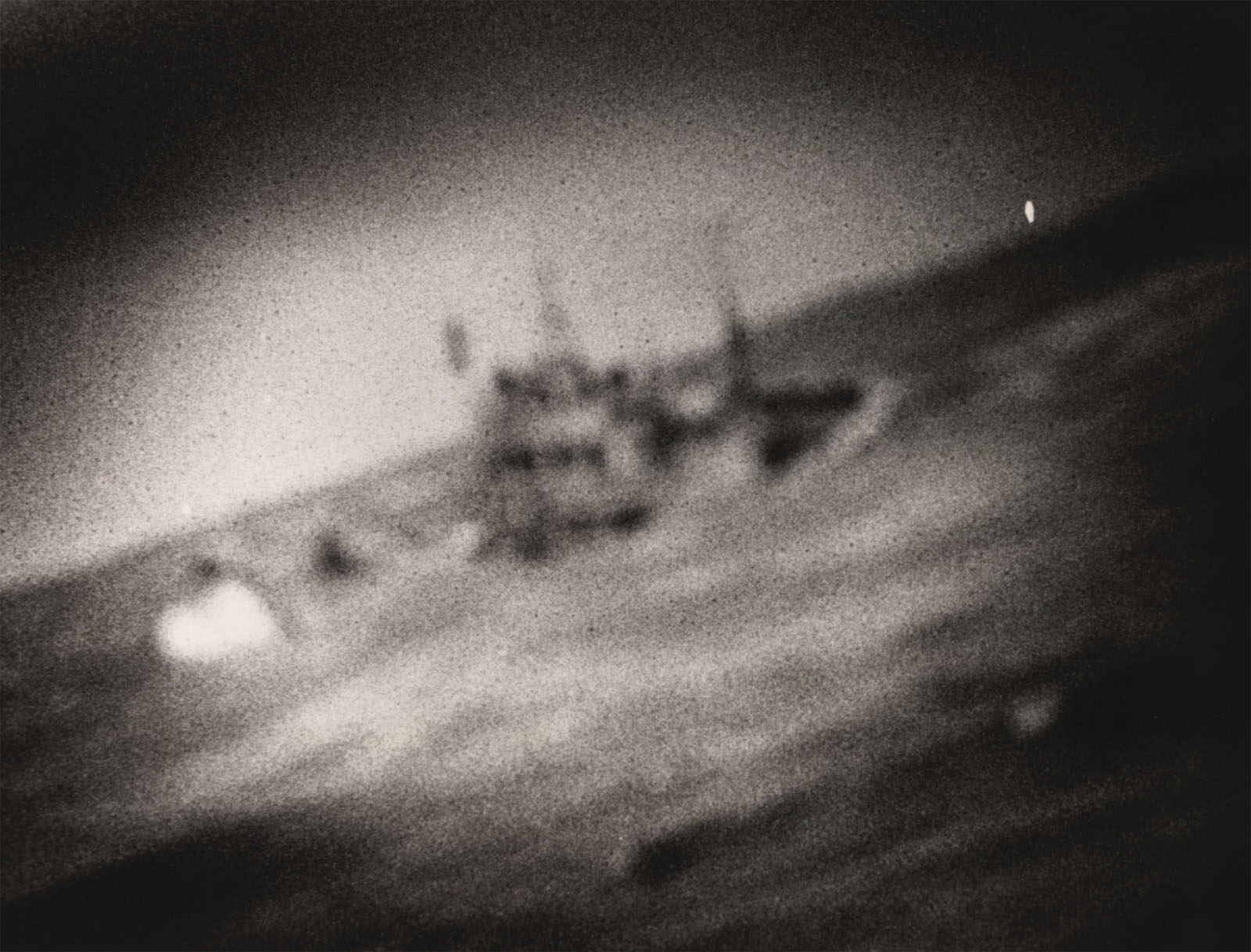
Daido Moriyama (Japanese, b. 1938) 'Marine Accident (Premeditated or not 5)' 1969


Daidō Moriyama (Japanese, b. 1938)
Marine Accident (Premeditated or not 5)
1969
Gelatin silver print
© Daido Moriyama


William Klein + Daido Moriyama is the first exhibition to examine the relationship between the work of William Klein (born 1928), one of the twentieth century’s most important photographers and film-makers, and that of Daido Moriyama (born 1938), the most celebrated photographer to emerge from the Japanese Provoke movement. Taking as its central theme the cities of New York and Tokyo, William Klein + Daido Moriyama explores both artists’ celebrated depictions of modern urban life.

The exhibition is formed of two retrospectives side by side, bringing together over 300 works, including vintage prints, contact sheets, film stills, photographic installations and archival material. The influence of Klein’s seminal 1956 publication Life is Good & Good for You in New York, Trance Witness Revels, as well as his later books Tokyo 1964 and Rome: The City and Its People 1959, is traced through Moriyama’s radical depictions of post-war Tokyo in Sayonara Photography and The Hunter 1972. The juxtaposition of these artists not only demonstrates the visual affinity between their urgent, blurred and grainy style of photography, but also their shared desire to convey street life and political protest, from anti-war demonstrations and student protests to the effects of globalisation and urban deprivation.

This exhibition also considers the medium and dissemination of photography itself, exploring the central role of the photo-book in avant-garde photography and the pioneering use of graphic design within these publications. As well the issues of Provoke magazine in which Moriyama and his contemporaries showcased their work, the exhibition includes fashion photography from Klein’s work with Vogue and installations relating to his satirical films Mister Freedom and Who Are You Polly Maggoo? New ways of presenting photography are also demonstrated by Moriyama’s installation Polaroid/Polaroid 1997, which recreates his studio interior through a meticulous arrangement of Polaroid images.

William Klein was born in New York, USA in 1928 and now lives and works in Paris, France. Solo exhibitions of his work have been held at the Centre Pompidou, Paris and the Scottish National Gallery, Edinburgh and he received the Outstanding Contribution to Photography Award at the 2012 Sony World Photography Awards.

Daido Moriyama was born in Osaka, Japan in 1938 and moved to Tokyo in 1961, where he continues to live and work. He was recently given a Lifetime Achievement Award by the International Centre of Photography and his work has been the subject of solo exhibitions at the San Francisco Museum of Modern Art; The Cartier Foundation, Paris; and The National Museum of Art, Osaka.

William Klein + Daido Moriyama is co-curated by Simon Baker, Curator of Photography and International Art, Tate, and Juliet Bingham, Curator, Tate Modern, with Kasia Redzisz, Assistant Curator, Tate Modern. The exhibition is accompanied by new books about both photographers from Tate Publishing. A season of film screenings at Tate Modern is also being held to coincide with the exhibition, showing Klein’s feature films and documentaries.

Press release from the Tate Modern website


Daidō Moriyama (Japanese, b. 1938) 'Memory of Dog 2' 1981


Daidō Moriyama (Japanese, born 1938)
Memory of Dog 2
1981
Gelatin silver print
© Daido Moriyama


Daidō Moriyama (Japanese, b. 1938) 'Tokyo color' 2008-2015


Daidō Moriyama (Japanese, born 1938)
Tokyo color
2008-2015
© Daido Moriyama


Daidō Moriyama (Japanese, b. 1938) 'Tokyo' 2011


Daidō Moriyama (Japanese, b. 1938)
Tokyo
2011
Gelatin silver print
Courtesy Daido Moriyama Photo Foundation
© Daido Moriyama


After reading Jack Kerouac’s classic beat novel On The Road, Moriyama began photographing the roads leading into and out of Japanese towns. Instead of places people live in and feel comfortable with, he portrays cities primarily as destinations to be visited and left behind. The resulting book, Hunter (1972), is described as a “road map of images from all over Japan through a moving car window. Routes and roads are the hunting field for me as a photographer.”

Occasionally he finds beauty – in snowflakes falling, a train speeding past, or the patterning of fishnet tights or perforated steel – but ramping up the contrast of his black and white prints, Moriyama more often portrays the world as a dangerous place engulfed in existential darkness.

In all this chaos, his studio appears like a beacon of calm and stability. Recorded in a grid of polaroid shots, the room is recreated as an installation that offers a rare glimpse of clarity and colour in what can otherwise feel like a miasma – the world as seen through a dark fog.

While Klein undoubtedly influenced Moriyama’s love of grainy, out-of-focus shots taken from odd angles, to pair him with the American tells only half the story. Warhol was equally important as the inspiration behind his Accident series, which includes car crashes, shipping disasters, executions and a health scare linked to overcrowded beaches. Moriyama’s use of found images (the car crashes come from posters), his fascination with serialisation (banks of tins on supermarket shelves) and with juxtaposing unrelated images on a page were also inspired by Warhol. So pairing him with Klein is interesting, but doesn’t do him justice. Moriyama deserves to be seen as a law unto himself, rather than an acolyte of a more familiar western photographer.

Sarah Kent. “William Klein + Daido Moriyama, Tate Modern,” on The Arts Desk website Thursday, 11 October 2012 [Online] Cited 05/09/2022


Daidō Moriyama (Japanese, b. 1938) 'Setagaya-ku, Tokyo, Midnight 1986'


Daidō Moriyama (Japanese, b. 1938)
Setagaya-ku, Tokyo, Midnight
1986
Gelatin silver print
Courtesy Daido Moriyama Photo Foundation
© Daido Moriyama


Daidō Moriyama (Japanese, b. 1938) 'Another Country in New York' 1971


Daidō Moriyama (Japanese, b. 1938)
Another Country in New York
1971
Gelatin silver print
Tokyo Polytechnic University
© Daido Moriyama


Tate Modern
Bankside
London SE1 9TG

Opening hours:
Monday to Sunday 10.00 – 18.00

Tate Modern website

LIKE ART BLART ON FACEBOOK

Back to top

Exhibition: ‘Ends of the Earth: Land Art to 1974’ at Haus der Kunst, Munich

Exhibition dates: 11th November 2012 – 20th January 2013


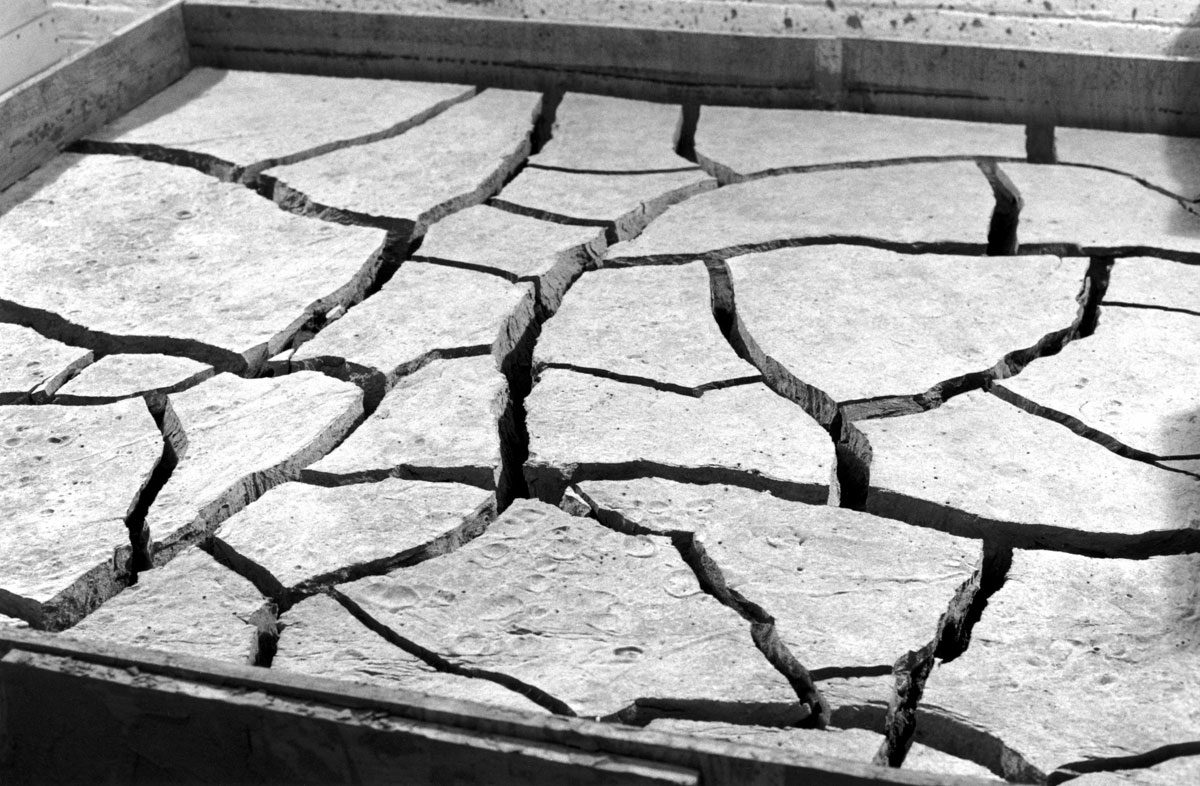
Alice Aycock (American, b. 1946) 'Clay #2' 1971/2012


Alice Aycock (American, b. 1946)
Clay #2
1971/2012
1,500 pounds of clay mixed with water in wood frame
Size: each 121.9 x 121.9 x 15.2cm
Courtesy of the artist


“Not taking Land art as a given the exhibition revisits various milieus and networks of heterogeneous practices around the world where the desire to engage the land or to work with the earth followed diverse artistic objectives and impulses. In researching this diversity, we found that the dominant art historical interpretation of Land art – as fundamentally an American sculptural phenomenon that developed out of Minimalism and Postminimalism, expanding into the “field” beyond art spaces to occupy or to become one with vast landscapes like the deserts of the Southwestern United States – accounts for only a limited number of artists’ works.”


Philipp Kaiser and Miwon Kwon. Ends of the Earth and Back catalogue essay, p. 18


This posting continues the theme of land/(e)scape, combining as it does performance, site, nonsite, language, film and earth. It is such a pity that the documentation of these early Land Art events in the form of photographs tends to be so poor. The paucity and quality of the visual evidence adds to the ephemeral, transient nature of the art while undermining the works cultural significance. As Robert Smithson notes in his commentary on the piece Spiral Jetty (1970), if the work occupies a “site” and the essay and the film are Nonsites where language (the essay), photographic images (the film), and earth (the jetty) are viewed as material equals – in other words, each is given equal weight within the project – then on the evidence of these images as a lasting artefacts of an action, the photographs seem to me to be just shorthand notes, cursory artefacts like a smudged fingerprint at a crime scene.

Is it necessary that they be great art? No, because the art was not about ego it was about being there at the actual event. But, other than an overt ability to show the outcomes of the performance, what is necessary from these documentary photographs is that they engage the viewer on a higher level than just ocular observation. While Land Art must be extremely difficult to photograph there is nothing memorable here that will stick in my consciousness, that will trigger a memory of the photograph as “vision” (hallucination, simulation, projection?) of these amazing events, which is a great shame. Rendering shapes of things does not make for memorable art, even as that very (Land) art aimed to investigate higher concepts relating to “this tortured earth.”

Dr Marcus Bunyan


Many thankx to the Haus der Kunst, Munich for allowing me to publish the text and photographs in the posting. Please click on the photographs for a larger version of the image.

Please also read the accompanying essay, Ends of the Earth and Back by Philipp Kaiser and Miwon Kwon (615kb pdf).


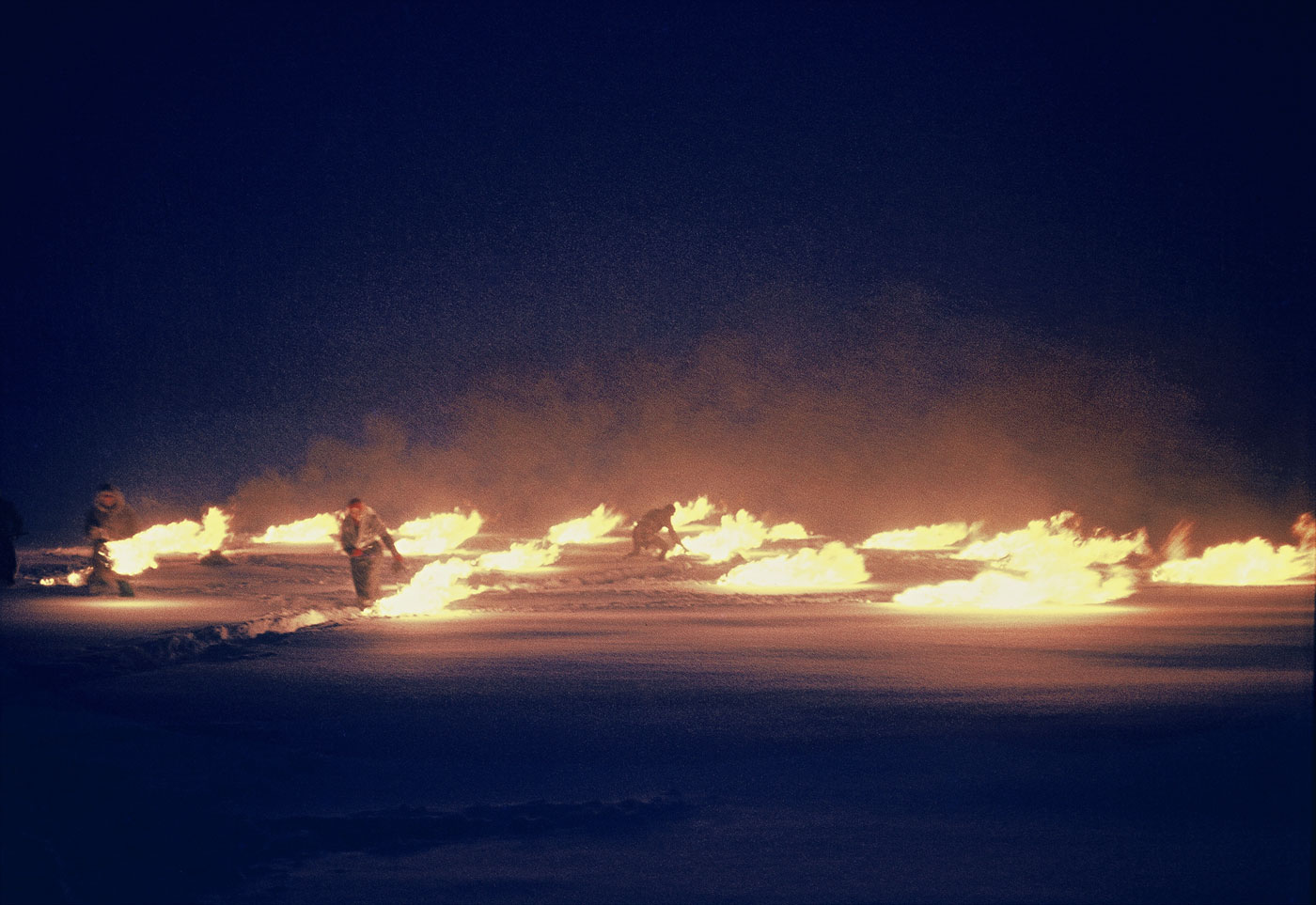
Zorka Ságlová (Czech, 1942-2003) 'Homage to Gustav Obermann' March 1970 (detail)


Zorka Ságlová (Czech, 1942-2003)
Homage to Gustav Obermann (detail)
March 1970
Six gelatin silver prints
15 3/4 × 23 5/8 in. (40 × 60cm) each
Collection of Jan Sagl; Courtesy Jan Sagl


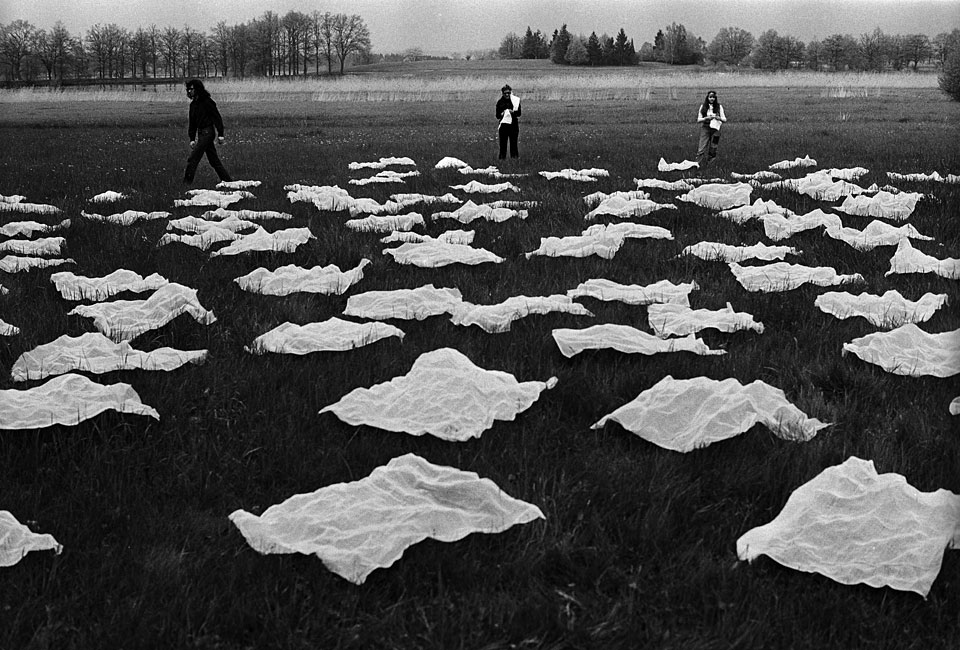
Beginning in the late 1960s, Ságlová was one of the first artists to work in the landscape outside Prague, carrying out actions with her friends, many of whom were part of the artistic underground in then-Communist Czechoslovakia. For Homage to Gustav Obermann, Ságlová arranged twenty-one plastic bags filled with jute and gasoline in Bransoudov (near Humpolec) in a circle during a snowstorm. The bags were set on fire at nightfall. This event was held in memory of a shoe-maker from the town who was said to have protested the German occupation during World War II by walking in the surrounding hills while spitting fire. Two months later, for Laying Napkins near Sudomer (below), the artist laid out approximately 700 napkins to form a triangle in a grass field near Sudomer, the site of a famous Hussite battle in 1420. The action referred to local folklore relating how Hussite women would spread pieces of cloth on a marshy field to snag the spurs of the Roman Catholic cavalrymen as they dismounted, making them easy targets for the Hussite warriors.


Zorka Ságlová (Czech, 1942-2003) 'Laying Napkins Near Sudomer' 1970


Zorka Ságlová (Czech, 1942-2003)
Laying Napkins Near Sudomer
1970
Six gelatin silver prints
15 3/4 × 23 5/8 in. (40 × 60cm) each
collection of Jan Sagl


For Laying Napkins near Sudomer, the artist laid out approximately 700 napkins to form a triangle in a grass field near Sudomer, the site of a famous Hussite battle in 1420. The action referred to local folklore relating how Hussite women would spread pieces of cloth on a marshy field to snag the spurs of the Roman Catholic cavalrymen as they dismounted, making them easy targets for the Hussite warriors.


Zorka Ságlová (1943-2003)

Zorka Ságlová was born in 1942 in the town of Humpolec. Her mother was a teacher and seamstress and her father was a financial clerk. Her brother, Ivan Martin “Magor” Jirous (1944-2011) went on to become a poet and artistic director of the dissident psychedelic rock band Plastic People of the Universe. Her cousin, the prominent Czech modern art historian Jifií Padrta, influenced her artistic interests from an early age.

After secondary school Ságlová took an apprenticeship as a weaver. From 1961 to 1966 she studied textile design at the Academy of Arts, Architecture and Design, Prague. In 1964 she married the photographer Jan Ságl. Their daughter Alenka was born in 1968 After graduating, she took up geometric painting and performance art. Her performances of the late 1960s and early 1970s combined happening and land art, and often occurred in open air settings. After the Prague Spring, she carried out more collective actions, often in rural areas. After “Hay-Straw” in 1969, she was persecuted by the media and sidelined by official art circles during the period of ‘Normalization’. After 1972, she retired from public life and returned to tapestry and painting, influenced by political pressure due to the persecution of her frequent collaborators in Plastic People of the Universe. She did not revisit performance until the late 1980s with small, more private happenings. Ságlová continued to work throughout the 1990s, and died in 2003.

Text from the Wikipedia website


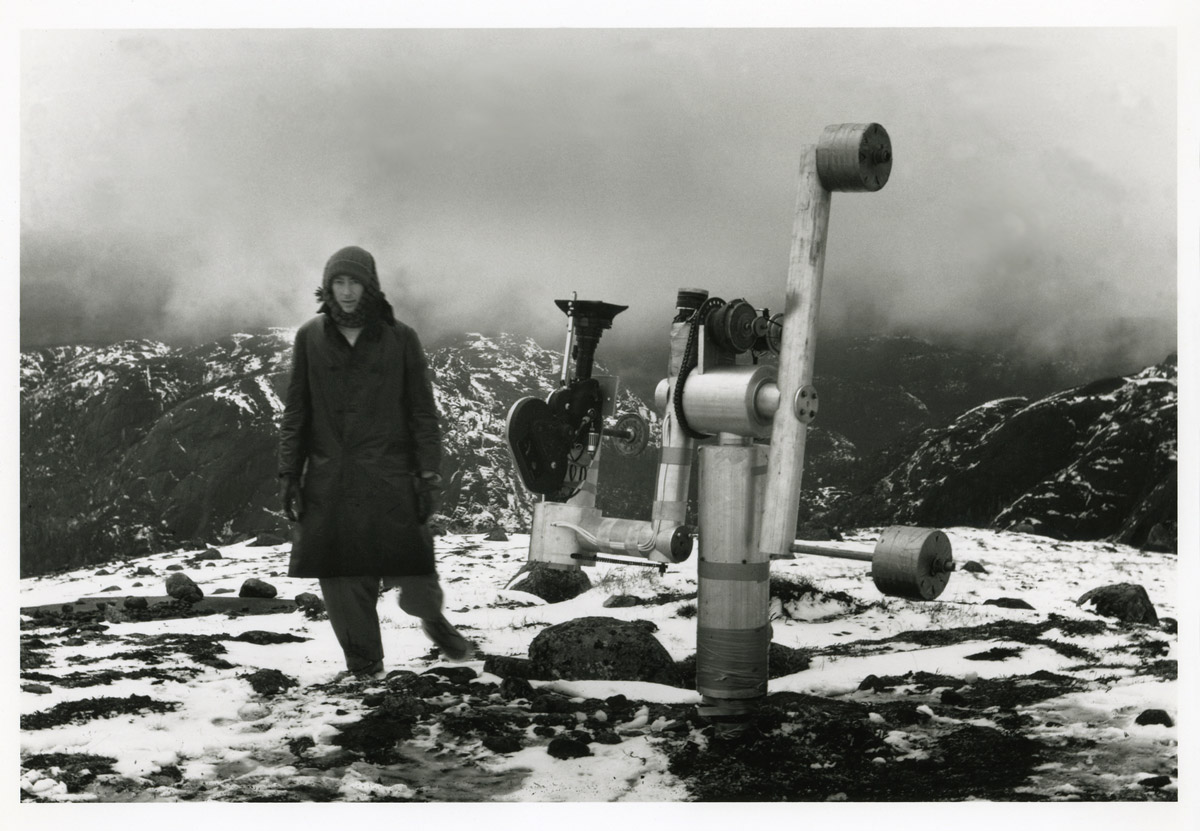
Michael Snow. 'La Région Centrale' 1971 (still)


Michael Snow (Canadian, 1928-2023)
La Région Centrale (still)
1971
16mm film transferred to DVD (blackbox projection), black-and-white, sound
191 min.
Courtesy of the artist


Michael Snow CC RCA (born December 10, 1928) was a Canadian artist working in a range of media including film, installation, sculpture, photography, and music. His best-known films are Wavelength (1967) and La Région Centrale (1971), with the former regarded as a milestone in avant-garde cinema.


Robert Kinmont (American, b. 1937) '8 Natural Handstands' 1969/2009


Robert Kinmont (American, b. 1937)
8 Natural Handstands
1969/2009
Nine gelatine silver prints
Size: each 21.5 x 21.5cm
Courtesy of Alexander and Bonin, New York


Utilising an amateur and handmade approach to both photography and sculpture, Kinmont illustrates the human scale and its relationship to one’s surroundings. Incorporating both irony and humor his work explores the systems and structures that continue to develop within this relationship.


Robert Kinmont (American, b. 1937) '8 Natural Handstands' 1969/2009 (detail)


Robert Kinmont (American, b. 1937)
8 Natural Handstands (detail)
1969/2009
Nine gelatine silver prints
Size: each 21.5 x 21.5cm
Courtesy of Alexander and Bonin, New York


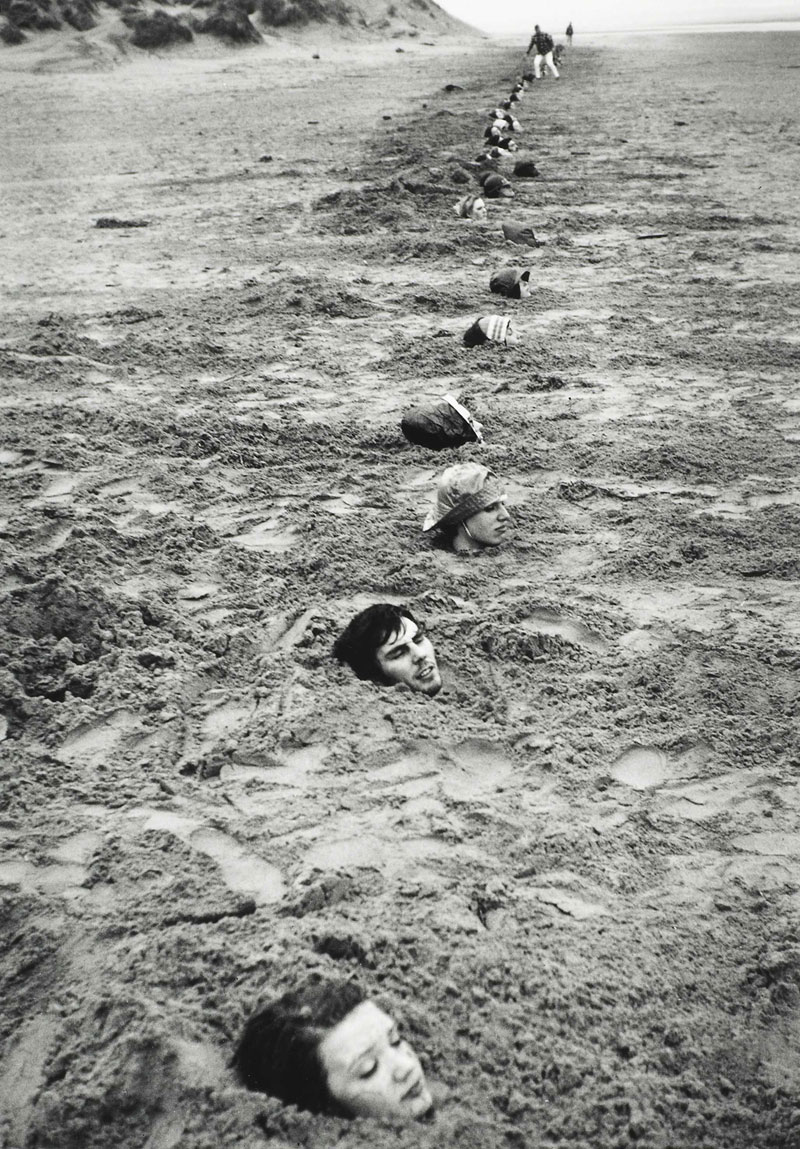
Keith Arnatt (British, 1930-2008) 'Liverpool Beach Burial' 1968


Keith Arnatt (British, 1930-2008)
Liverpool Beach Burial
1968
Gelatin silver print
Size: 40.6 x 50.8cm
Courtesy of the Keith Arnatt Estate and Maureen Paley, London


Liverpool Beach Burial, which the artist described as a “situational sculpture,” was realised by Arnatt with his students at the Manchester College of Art. It was first exhibited in Konzeption – Conception: Dokumentation einer heutigen Kunstrichtung / Documentation of Today’s Art Tendency at the Städtisches Museum, Leverkusen, Germany, in 1969. The artist recorded instructions for its making: “(1) Choosing a site and marking out a straight line. (2) Marking off 4-foot intervals. Each mark representing a digging position for each of the hundred-plus participants. (3) Each participant chose a site on the line and dug his / her own hole. (4) When the holes were deep enough the participants were ‘buried’ by nonparticipants.” (Lucy R. Lippard, Six Years: The Dematerialization of the Art Object from 1966 to 1972, Berkeley and Los Angeles: University of California Press, 1997, p. 50).


As the first major museum exhibition on Land Art, Ends of the Earth provides the most comprehensive historical overview of this art movement to date. Land Art used the earth as its material and the land as its medium, thereby creating works beyond the familiar spatial framework of the art system. The time period covered in Ends of the Earth spans the 1960s to 1974, when, in the context of Land Art, movements such as Conceptual Art, Minimal Art, Happenings, Performance Art, and Arte povera, became more distinct and began to diverge.

The nearly 200 works by more than 100 artists from Australia, Brazil, Canada, Germany, Great Britain, Iceland, Israel, Japan, the Netherlands, the Philippines and Switzerland demonstrate that Land Art was not a predominantly North American phenomenon. The exhibition presents works that are less well known than the canonical works Spiral Jetty, Lightning Field and Double Negative, thereby creating a shift in perspective. By including works of the then participating artists, the show refers to the earlier and pioneering exhibitions Earthworks and Earth Art (New York, 1968 and 1969). Michael Heizer and Walter De Maria are interested in realisations in outside and lend the mediated part within an exhibition only secondary importance. They are, therefore, not included in this presentation.

Even before the emergence of the movement in the 1960s, artists from the most varied locations around the globe were increasingly moved to claim the earth and use land as an artistic medium. In a basic sense, this also included the examination of the nature of the earth as a planet. Yves Klein, for instance, wondered what the earth looked like from space. In 1961, he transformed his vision that the dominant colour from this perspective would be blue, and that all man-made boundaries could be overcome with this colour, into his series Planetary Reliefs.

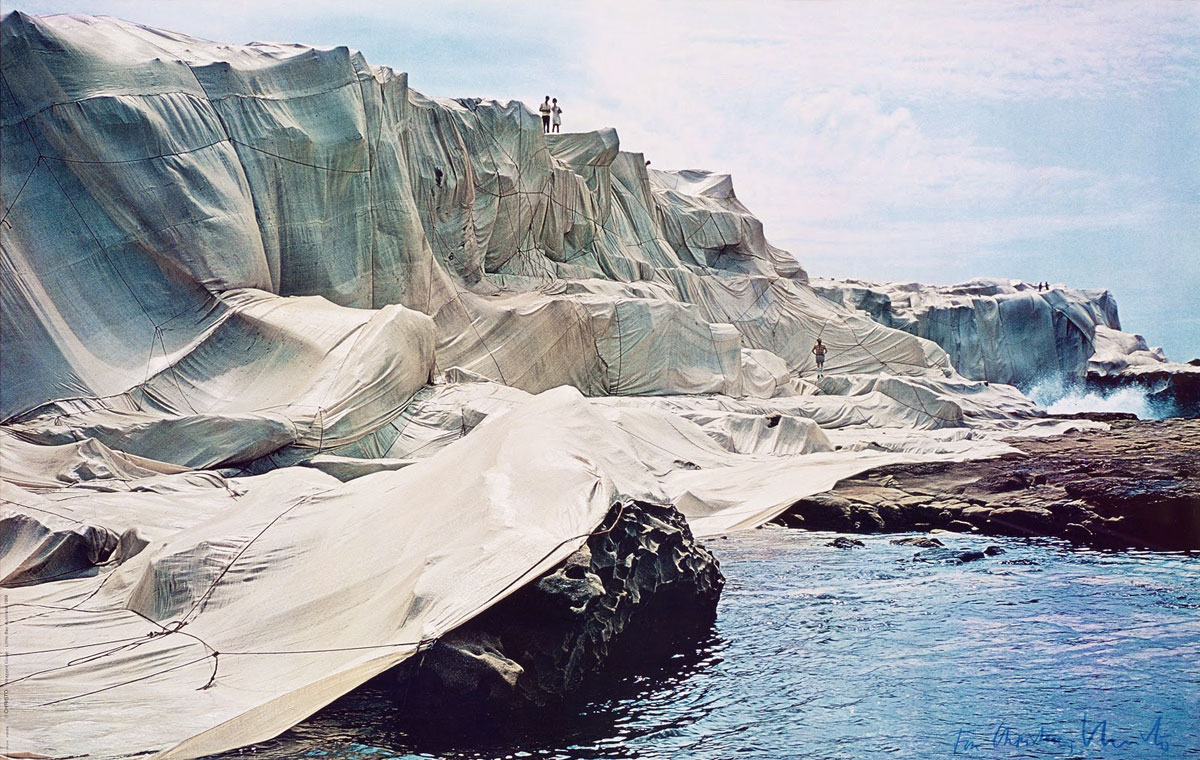
Land Art artists often worked under the open sky, making productive use of the fact that the great outdoors posed other conditions for a work’s lifespan than enclosed spaces did. Some works only existed for the short time of their creation, like Judy Chicago’s ephemeral works consisting of coloured flames and smoke, which served as references to religious ceremonies and the landscape as a deity. For ten weeks, the cliffs along Little Bay, Sydney, were packed in synthetic fabric and rope for Christo and Jeanne-Claude’s Wrapped Coast – One Million Square Feet, which, like many other works of Land Art, was enormous in scale. Another famous work of similar proportions was Spiral Jetty by Robert Smithson; on the Great Salt Lake in Utah, USA, the artist built a 1,500-foot long spiral-shaped jetty made of material found on site.

Land Art artists were fascinated by remote locations like deserts. Hreinn Fridfinnsson constructed a house on an uninhabited lava field near Reykjavik. The inside was made of corrugated sheet metal and the outside was covered in wall paper, because, as wall paper is intended to please the eye, “it is reasonable to have it on the outside, where more people can enjoy it.” Some artists transported the conditions of specific places into exhibition spaces: The Japanese artist group “i” moved four truckloads of gravel on a conveyor belt into an exhibition space and arranged it into a pile there. Alice Aycock fills a minimalistic grid with wet clay. This work will be recreated for the exhibition in Haus der Kunst; the clay will dry out during the run of the exhibition, will crack and gradually come to resemble the land in California’s Death Valley (Clay #2, 1971 / 2012). With Hog Pasture: Survival Piece #1 (1970-1971 / 2012), not only will new material – in this case a green pasture – make on selected occasions its way into the museum but a live domestic pig as well, which will pasture on the meadow from time to time.

From the earliest days of the movement, collectors, patrons, art dealers, and curators also explored sensitively which works of Land Art could be exhibited in museums and galleries, and how this should be done. In their own way, they helped establish Land Art as a legitimate artistic genre. In the case of Robert Smithson’s Spiral Jetty an art dealer helped funding the production of an accompanying film, and the work was executed in three equally valid versions: as the site-specific headland, as an eponymous essay and as a film.

In general, language, film, and photography played a central role in Land Art’s creation and development. Land Art artists and members of the media established close connections to one another. Magazines and television stations commissioned art works and were the first to publish these. Now legendary is Gerry Schum’s Fernsehgalerie, which was the first exhibition created for television and was broadcast by Sender Freies Berlin on 15 April 1969. For eight consecutive days in October of that same year, the WDR television network interrupted its regularly scheduled programs, at 8.15 pm and 9.15 pm, for a few seconds and presented the eight photographs of Keith Arnatt’s Self-Burial, which depicted the artist gradually sinking into the ground. The television station refrained from accompanying this with an introduction or commentary.

Following the presentation of Tinguely’s self-destructing sculpture Hommage à New York, the NBC television network commissioned the artist to create a work. In collaboration with Niki de Saint-Phalle, Tinguely made a large-scale kinetic sculpture out of waste material he had found in and around Las Vegas. The work was used in choreographed explosions that took place south-west of Las Vegas near a nuclear test site. Tinguely’s spectacle was presented in the same newscast as was a major report about the international nuclear talks, which took place that same week.

Many other works touched on the subject of “this tortured earth”, as Isamu Noguchi described it. Land Art artists examined the wounds and scars that humans inflict on the planet earth, whether by the war machinery (Robert Barry, Isamu Noguchi), dictatorships (Artur Barrio), nuclear testing (Heinz Mack, Jean Tinguely, Adrian Piper) or colonisation (Yitzhak Danziger). The media’s intensive coverage of Land Art activities led to unusual and complex contributions. Receptive to Land Art’s demand for a sensitive consciousness regarding the conditions of production, presentation and dissemination of art, they also gave expression to the technological, social and political conditions of the time.

Organised in collaboration with the Museum of Contemporary Art in Los Angeles.

Press release from the Haus der Kunst website


Charles Eames (American, 1907-1978)
Ray Eames 
(American, 1912-1988)
Powers of Ten
1977
© 1977 EAMES OFFICE LLC


Powers of Ten takes us on an adventure in magnitudes. Starting at a picnic by the lakeside in Chicago, this famous film transports us to the outer edges of the universe. Every ten seconds we view the starting point from ten times farther out until our own galaxy is visible only a s a speck of light among many others. Returning to Earth with breathtaking speed, we move inward – into the hand of the sleeping picnicker – with ten times more magnification every ten seconds. Our journey ends inside a proton of a carbon atom within a DNA molecule in a white blood cell.

This film was inspired by the 1957 book Cosmic View by Kees Boeke as well as by architect Eliel Saarinen’s statements about scale. It opens with an overhead shot of a man and a woman lying on a picnic blanket in a park in Chicago. In an effort to depict the scale of the couple, the planet Earth, and the galaxy relative to one another and to that of the universe, the camera zooms out at a distance of a factor of ten every two seconds, until the galaxy is seen as merely a speck of light among many others. The camera then zooms back in, with ten times the magnification every ten seconds, focusing in the end on the proton of an atom.


Charles Simonds (American, b. 1945) 'BodyEarth' 1974 (still)


Charles Simonds (American, b. 1945)
Body<—>Earth (still)
1974
16mm film transferred to DVD, colour
3 min.
Collection of the artist


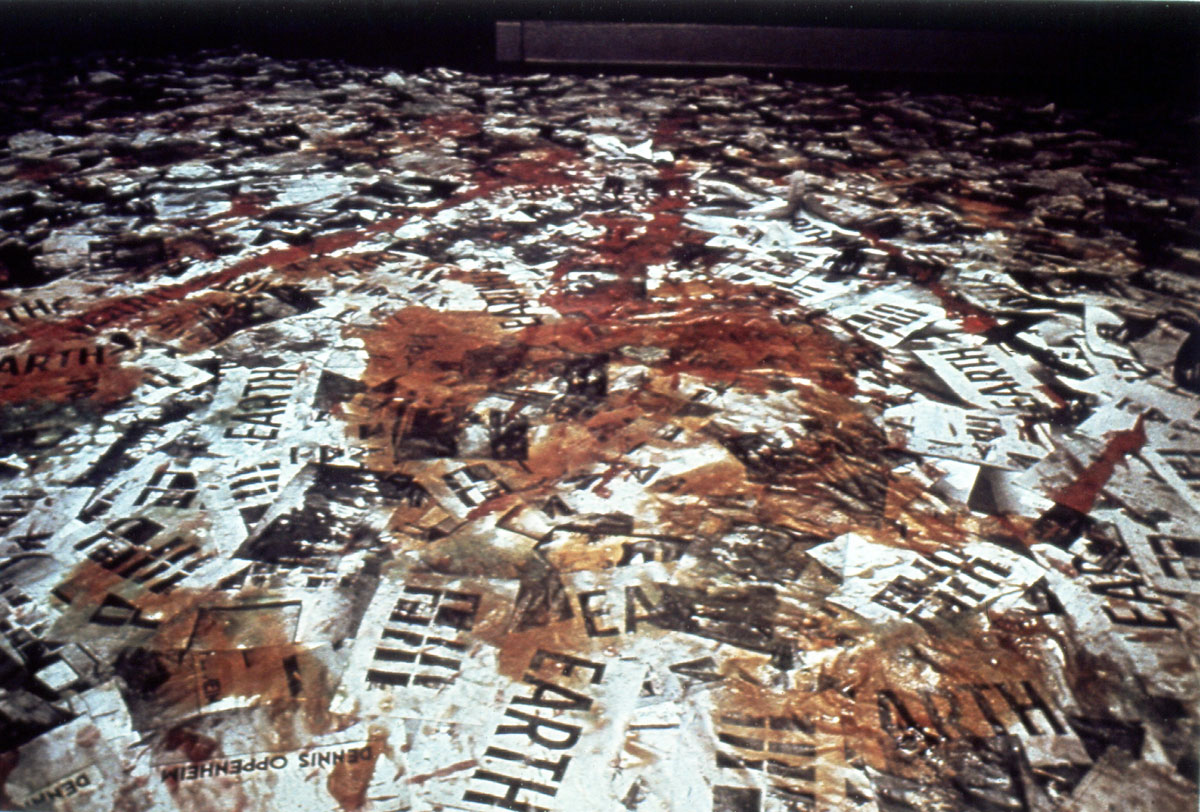
Les Levine (American, b. 1935) 'Systems Burnoff X Residual Software' 1969/2012


Les Levine (American, b. 1935)
Systems Burnoff X Residual Software
1969/2012
Installation recreation 1,000 copies of 31 photographs (31,000 photographs total) taken by Levine at the March 1969 opening of EARTH ART exhibition in Ithaca, New York
Jello and chewing gum
Courtesy of the artist


Christo (Bulgaria, 1935-2020) and Jeanne-Claude (Bulgaria, 1935-2009) 'Wrapped Coast - One Million Square Feet' 1968-69


Christo (Bulgaria, 1935-2020) and Jeanne-Claude (Bulgaria, 1935-2009)
Wrapped Coast – One Million Square Feet
1968-1969
Collages, photographs, model, film
Collection of the artist


The largest single artwork ever made, Wrapped Coast was mounted in Little Bay, Sydney, Australia, on October 28, 1969, and remained on view for ten weeks. Christo and Jeanne-Claude, with the assistance of 125 students, teachers, professional climbers, and workers and under the supervision of Major Ninian Melville, retired from the Army Corps of Engineers, wrapped approximately one and a half miles of coast, including cliffs up to 85 feet high, using synthetic fabric and rope. This was the first work in the series of Kaldor Public Art Projects initiated by Australian collector John Kaldor. The project was financed by the sale of Christo’s preparatory drawings, collages, models, and lithographs. In the end, all materials used were removed from the bay and recycled. ABC Australia filmed a documentary of the project.


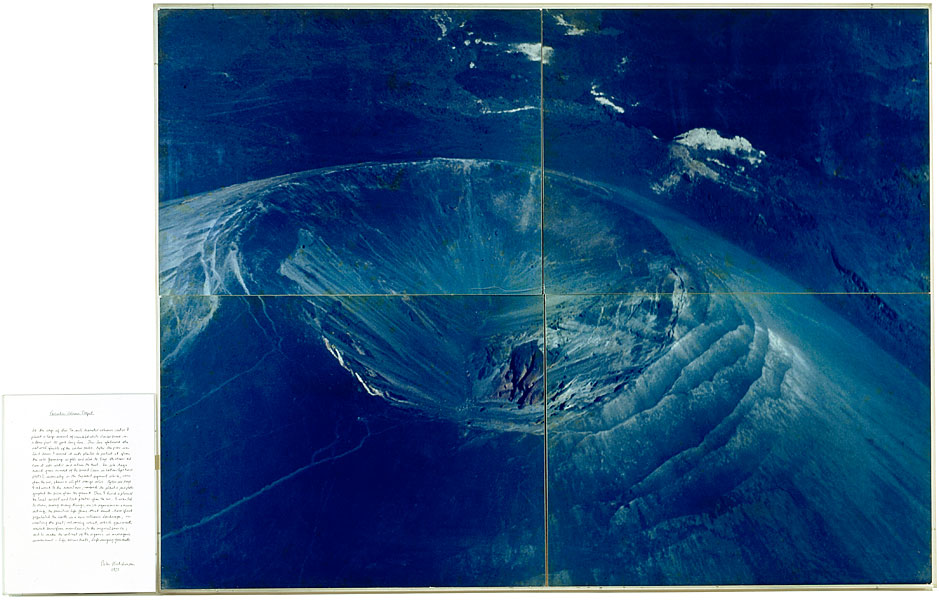
Peter Hutchinson (British, b. 1930) 'Paricutin Project' 1971


Peter Hutchinson (British, b. 1930)
Paricutin Project
1971
Photo and ink on cardboard and moulded bread in object-frame
40 x 55cm
Courtesy Galerie Bugdahn und Kaimer, Düsseldorf


Peter Arthur Hutchinson (born 1930) is a British-born artist living in the United States. Hutchinson is one of the pioneers of the Land Art movement.

The Paricutin Project was first shown in 1969 at John Gibson Gallery in New York as a model illustrating Hutchinson’s conception of an action to take place on Mt. Paricutin, a volcano in Michoacán, Mexico. A year later, Time magazine funded Hutchinson’s trip to the site to make the work in exchange for exclusive rights to publish the photographs. In an attempt to produce life in a place generally thought of as lifeless, the artist laid 450 pounds of bread crumbs in a line approximately 250 feet long around the rim of the volcano. Mould appeared after six days, in part because of the heat and steam rising from the earth. Two photographs of the project were published in the June 29, 1970, issue of Time. Later that same year, large-scale photographs of the work, along with text describing the trip, were shown at John Gibson Gallery.


Patricia Johanson (American, b. 1940) 'Stephen Long' 1968 (still)


Patricia Johanson (American, b. 1940)
Stephen Long (still)
1968
CBSTV 1968; edited by Joanna Alexander, WNET TV, New York, 1971
16mm film transferred to DVD, colour, sound
5 min.
Courtesy of the artist


Interested in the physical limitations of sight and in measuring how far the eye can see, Johanson created this 1,600-foot-long by 2-foot-wide sculpture made of plywood planks painted with yellow, red, and blue bands. Sited on a portion of the defunct Boston & Maine Railroad tracks from Buskirk, New York, to Bennington, Vermont, the work is named after Stephen Long, a military officer who became a railroad surveyor and engineer. Both the location of the work and its title emphasise the impact of rail transportation on modern perceptions and experience of the landscape. The work gained considerable local media attention, and John Lindsay, Mayor of New York, invited Johanson to permanently install the piece in the mall at Central Park. As the available space was only 1,300 feet long, the artist, unwilling to alter the work’s length, declined the invitation.


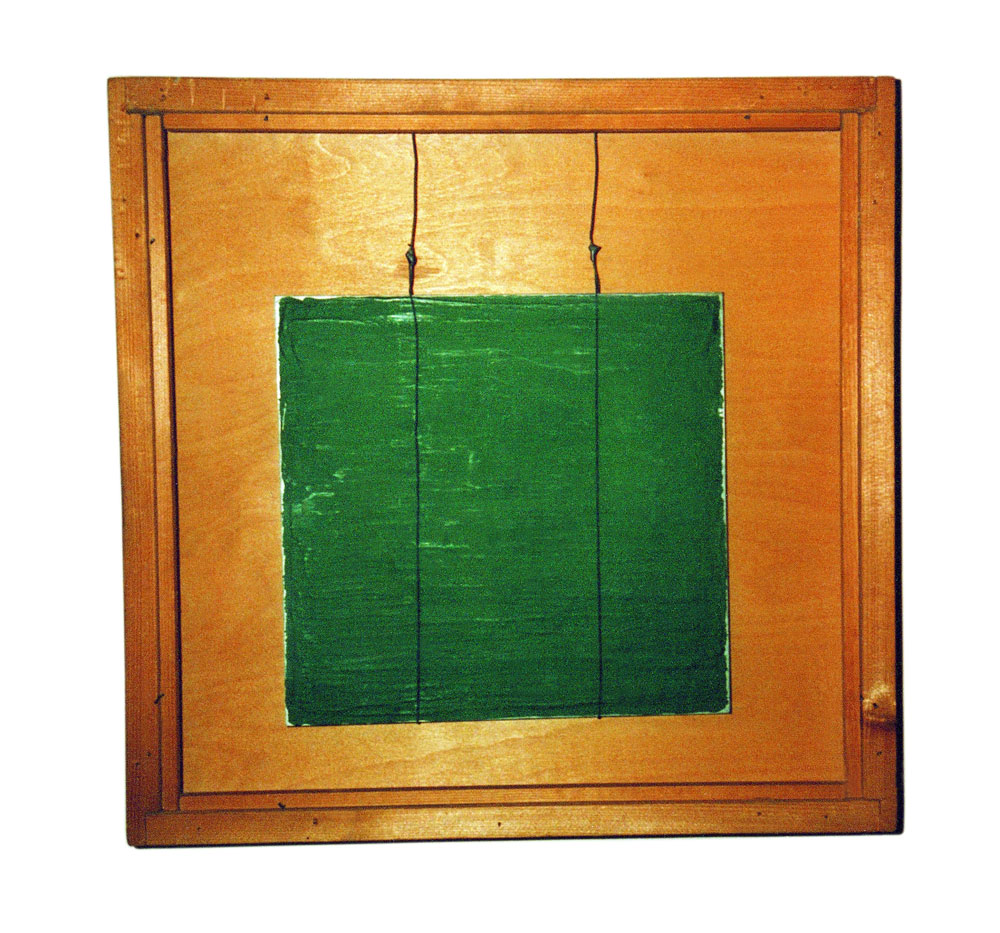
Kristjan Gudmundsson. 'Painting of the specific gravity of the planet Earth' 1972-73


Kristjan Gudmundsson (Icelandic, b. 1941)
Painting of the specific gravity of the planet Earth
1972-1973
Acrylic on metal
Size: 25.4 x 25.4cm
Sólveig Magnúsdóttir, Reykjavik


Kristján’s art reflects both prevailing traditions in late 20th century western art in general, and the dominance of abstract and conceptual art in the post-war art of Iceland in particular. He has said, “I am trying to work within the field of tension that exists between nothing and something”.


Judy Chicago (American, b. 1939) 'Atmospheres: Duration Performances' 1967-74


Judy Chicago (American, b. 1939)
Atmospheres: Duration Performances
1967-1974
16mm film transferred to DVD, colour, sound
14:12 min.
Courtesy of the artist


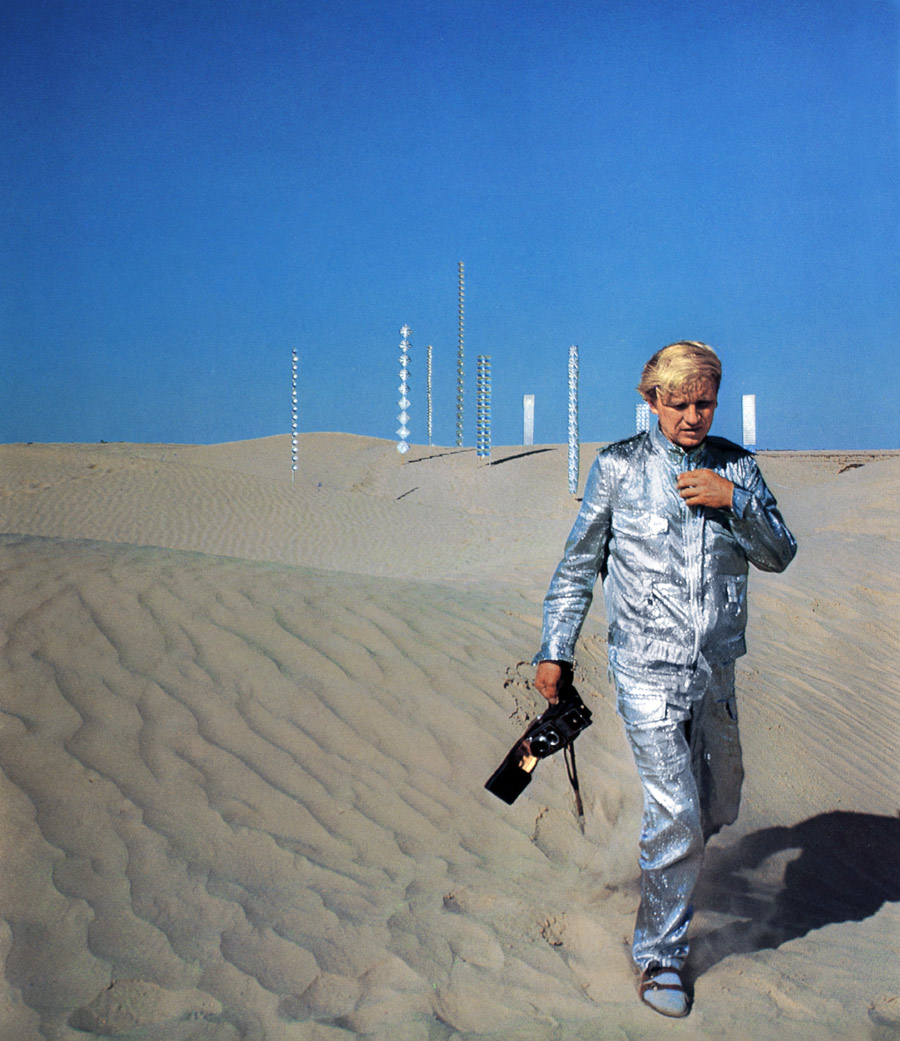
Heinz Mack (German, b. 1931) 'Tele-Mack' 1968


Heinz Mack (German, b. 1931)
Tele-Mack
1968
16mm film transferred on DVD, colour, sound
24:35 min.
Production of Saarländischer Rundfunk, author Professor Heinz Mack
Courtesy of Kunst und Ausstellungshalle der Bundesrepublik Deutschland GmbH


A founding member of Group Zero – an artist collective established in Düsseldorf in 1958 – Mack drafted the final version of his manifesto for Sahara Project in 1959. It was first published in Zero magazine in 1961, and subsequently republished and translated from German into French, Dutch, and English in 1967 for Mackazin, the artist’s journal-catalogue. Sahara Project, made in homage to Yves Klein, proposes placing large-scale sculptural works in remote areas of the world’s deserts, like mirages to be encountered by anyone coming upon them. One such location was the Sahara Desert, which was the main testing site for French nuclear weaponry after 1958. In 1967 Mack went on an expedition to the Sahara with the German public television station Westdeutscher Rundfunk (WDR), which led to two televised presentations of the project the following year – one for WDR and the other for Saarländischer Rundfunk. The popular weekly German magazine Stern presented the project in a feature spread in 1977.


Haus der Kunst
Prinzregentenstraße 1
80538 Munich
Germany
Phone: +49 89 21127 113

Opening hours:
Monday | Wednesday | Friday | Saturday | Sunday 10am – 8pm
Thursday 10am -10pm
Tuesday closed

Haus der Kunst website

LIKE ART BLART ON FACEBOOK

Back to top
Exhibition: ‘America in View: Landscape Photography 1865 to Now’ at the Museum of Art Rhode Island School of Design, Providence

Exhibition dates: 21st September 2012 – 13th January 2013


Unknown artist (American). 'Providence Panorama from Grosvenor or Bannigan Building' c. 1900


Unknown artist (American)
Providence Panorama from Grosvenor or Bannigan Building
c. 1900
Six cyanotype prints
RISD Museum: Mary B. Jackson Fund


I hope you enjoy this HUGE posting. There are some rare photographs and little known artists. I have kept the photographs in the sections of the exhibition as explained by the accompanying wall text. Three essays from the catalogue investigating history, landscape and photography can be found as pdfs below, essential reading for anyone interested in the subject (especially the first two essays):

Douglas Nickel. Photography, Perception, and the Landscape 2012 (645kb pdf)
Deborah Bright. Photographing Nature, Seeing Ourselves 2012 (2Mb pdf)
Jan Howard. Landscape as Stage 2012 (775kb pdf)

Dr Marcus Bunyan


Many thankx to  the Museum of Art Rhode Island School of Design for allowing me to publish the text and most of the photographs in the posting (the others I researched myself). Please click on the photographs for a larger version of the image.


“An understanding of landscape theory therefore suggests that not every photograph of land is a landscape, and not every landscape necessarily features the land. The standard definition points to places – places in the world, or places seen in pictures – which take on the quality of a thing. But “landscape” is probably better understood as that set of expectations and beliefs – about both the environment and the conventions of its representation – that we project upon the world. These conventions and expectations are subject to historical change and are culturally specific…”


Douglas Nickel. ‘Photography, Perception, and the Landscape’ 2012 in ‘America in View: Landscape Photography 1865 to Now’ catalogue, p. 26


“Once continental expansion had reached its limits, however, and no existential threats to white settlement remained, American landscape images began to reflect a new criticality – at turns romantic and realistic – that persists to this day. Indeed, for the last century, landscape photography has consistently mirrored Americans’ anxieties about nature, or rather its imminent loss, whether due to industrialisation, pollution, population growth, real estate profiteering, or bioengineering. Alternately portraying nature as a balm for the alienated modern soul or a dystopian fait accompli, modern and postmodern photographic landscapes mark a progressively disquieting understanding of humanity’s relationship to the natural universe.”


Deborah Bright. Photographing Nature, Seeing Ourselves 2012 in America in View: Landscape Photography 1865 to Now catalogue, p. 32


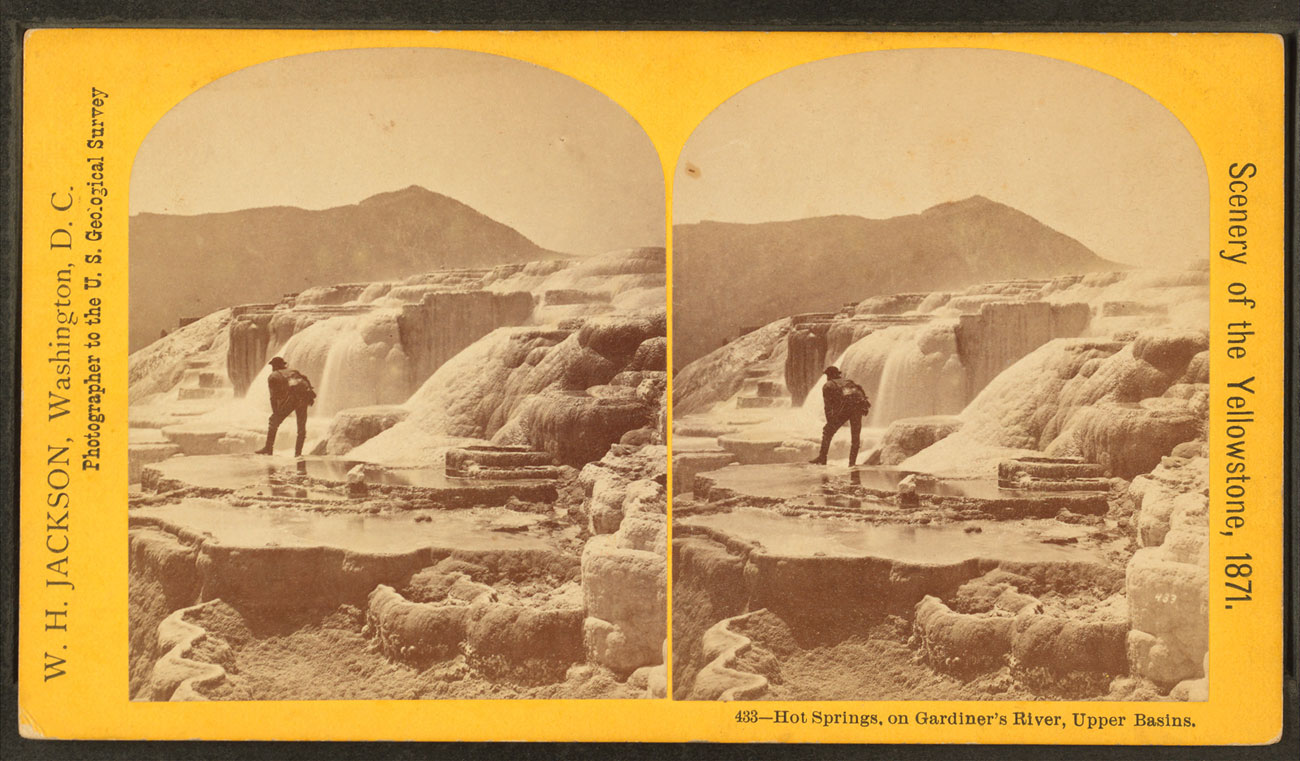
William Henry Jackson (American, 1843-1942) 'Gardiners River Hot Springs, Diana's Baths' 1871


William Henry Jackson (American, 1843-1942)
Gardiners River Hot Springs, Diana’s Baths
1871
From U.S. Geological Survey of the Territories
Albumen print
RISD Museum: Jesse Metcalf Fund


In this photograph William Henry Jackson captures the painter Thomas Moran, who was also part of the 1871 survey team. Shot from slightly below and at a distance, the photograph emphasises the textures of the mineral deposits in the foreground, while Moran’s figure seems dwarfed by the rock formations around him. Jackson often included figures in his photographs to impart a sense of scale. This inclusion of a single figure also heightens the impression that the photograph has captured a moment of discovery, the first contact between intrepid explorers and an uncharted land.


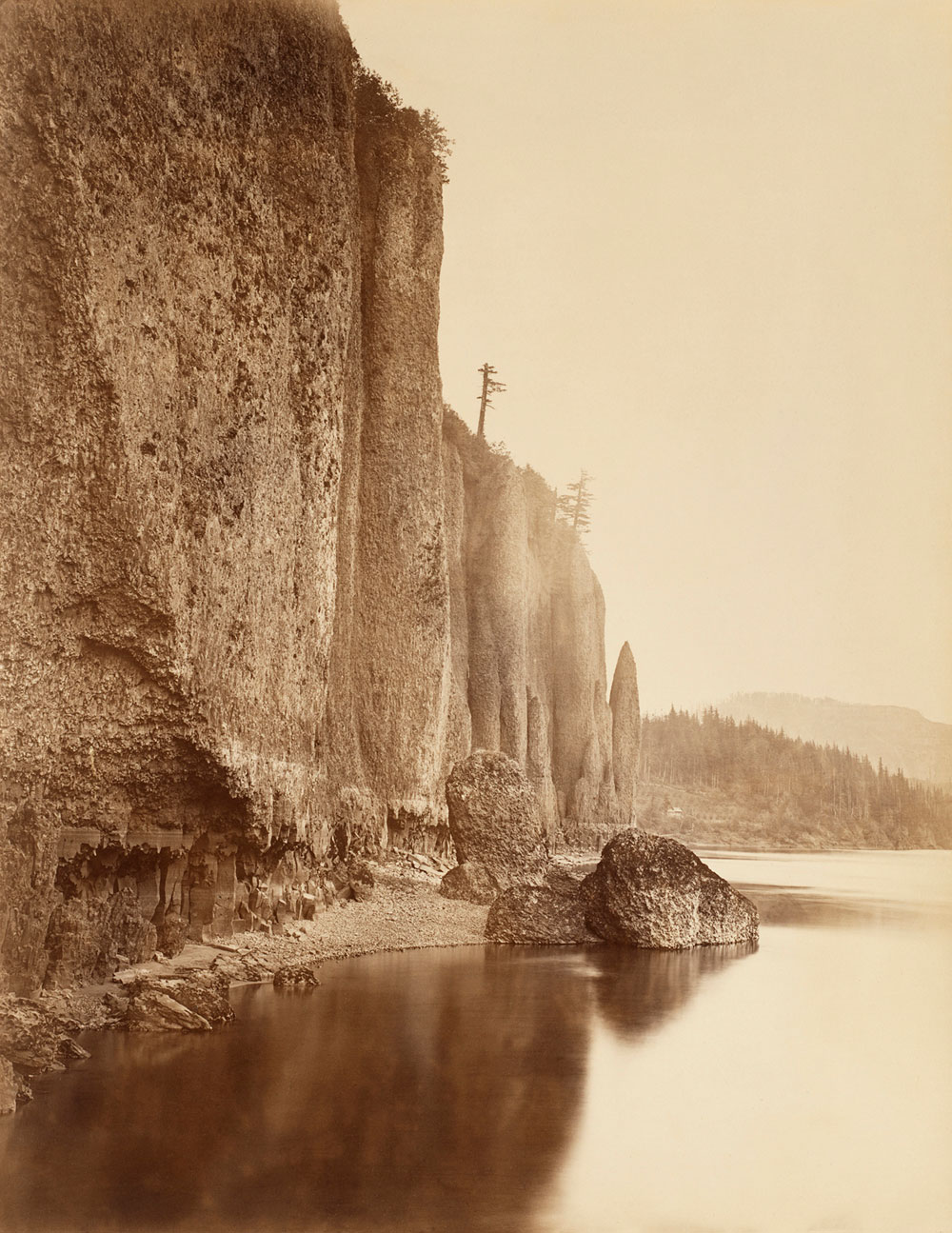
Carleton E. Watkins (American, 1829-1916) 'Cape Horn, Columbia River' 1867


Carleton E. Watkins (American, 1829-1916)
Cape Horn, Columbia River
1867
Helen M. Danforth Acquisition Fund.
Museum of Art Rhode Island School of Design, Providence


Cape Horn, Columbia River exemplifies not only the fine detail characteristic of Carleton Watkins’s images, but also his close attention to pictorial structure. Unlike many of the photographers represented in this gallery, Watkins worked independently of industrial concerns or government sponsorship. To make images that would appeal to an audience more familiar with traditional art forms, Watkins borrowed long-established conventions of landscape paintings, in particular carefully modulated lighting effects and harmonious compositions. Like the painters he emulated, Watkins depicts the West as a romantic wilderness and place of spiritual refuge.


William H. Bell (American, 1830-1910) 'Perched Rock, Rocker Creek, Arizona' 1872


William H. Bell (American, 1830-1910)
Perched Rock, Rocker Creek, Arizona
1872
From the album Explorations and Surveys West of the 100th Meridian
Albumen print
Jesse Metcalf Fund. Museum of Art Rhode Island School of Design, Providence


Surveying the Field

At the end of the American Civil War photographers turned their lenses toward both the wild territories of the West and scenic tourist destinations in the newly established national parks. Although these images are now commonly exhibited in art museums, they were not originally considered art objects, nor were the photographers who made them considered artists. Instead, many of the photographers represented here were hired to document the projects of governmental agencies and the progress of federal survey expeditions to the western territories. Others produced images for the growing tourist market or recorded the construction of tracks through the country’s interior for railroad companies. The majority of these images were published in governmental reports and presentation albums.

The albumen prints produced in America through the 1880s were made from glass-plate negatives created by the laborious process of coating glass plates the size of the prints with a thick photosensitive solution called collodion. These plates had to be prepared on-site, exposed, and developed before the collodion dried, so photographers traveled with portable darkrooms. The prints were made later in a studio by placing paper coated with albumen (solution suspended in egg whites) under a glass-plate negative and exposing the paper to sunlight. By contact printing on this glossy surface, the image was recorded in minute detail.


Timothy O'Sullivan (American born Ireland, 1840-1882) 'Water Rhyolites, Near Logan Springs, Nevada' 1871


Timothy O’Sullivan (American born Ireland, 1840-1882)
Water Rhyolites, Near Logan Springs, Nevada
1871
From the album Explorations and Surveys West of the 100th Meridian
Albumen print
RISD Museum: Jesse Metcalf Fund


Timothy O’Sullivan and William H. Bell, official photographers on survey expeditions through Nevada and Arizona from 1871 to 1873, disavowed the traditional conventions of landscape painting in favour of unadorned observation. Spare and anti-picturesque, O’Sullivan’s radical views – depicting the western territories as foreign-looking, even hostile – accorded perfectly with the interests of those invested in seeing these empty territories studied, secured, and settled. One scholar has postulated that O’Sullivan’s photographs were intentionally crafted to look like products of technology – optically precise, printed on glossy albumen papers – a look that stood for industrial progress within a milieu that valued the machine-made over the handmade. In Perched Rock, Rocker Creek, Arizona and Rock Carved by Drifting Sand, Below Fortification Rock, Arizona, the two photographers treat unusual rock formations like specimens, isolating them from the surrounding landscape to be examined and measured.


Luminous Realms

Kodak’s introduction of the handheld camera in 1888 made photography an affordable and popular leisure-time amusement, creating a generation of amateur photographers seemingly overnight. At the same time, photographers with artistic ambitions feared that the mechanical, point-and-shoot approach of the new “button pressers” would jeopardise the medium’s elevation to the status of high art. In response, this group of artists – who called themselves Pictorialists – emphasised the photographer’s expertise and embraced labor-intensive processes to create expressive and impressionistic images. Many favoured platinum prints because of their wide range of tones, soft contrast, and matte surface – qualities of more traditional artistic media such as drawings and etchings. The Pictorialists’ landscape photographs are especially evocative. Rather than capturing a particular place and time, they transformed the landscape into a backdrop for human emotions and actions through visual effects and the inclusion of figures.


Clarence H. White (American, 1871-1925) 'Morning' 1905


Clarence H. White (American, 1871-1925)
Morning
1905
From Camera Work, No. 23, July 1908
Photogravure
RISD Museum: Walter H. Kimball Fund


Laura Gilpin (American, 1891-1979) 'Footprints in the Sand' 1931


Laura Gilpin (American, 1891-1979)
Footprints in the Sand
1931
Platinum print
RISD Museum: Museum purchase with funds from the National Endowment for the Arts


Laura Gilpin portrays the Colorado sand dunes in the soft-focus style of the Pictorialists, but the reductive forms of her composition are strikingly modern. The sinuous lines of the wind-sculpted dunes are echoed in the subtle patterning of the figure’s footprints. His presence not only provides a sense of scale, but suggests that the human impact on the landscape can be small, fleeting, and beautiful.


Abstracting Nature

In the 1920s, photographers began to question whether Pictorialism was the style best suited to win acceptance for photography as a fine art. On the east coast, Alfred Stieglitz, who had formerly championed Pictorialism, became its most vocal critic. In northern California, a group of photographers who would come to call themselves Group f/64 developed a new style. Opposing the soft focus, painterly approach, the f/64 photographers embraced a hard-edged, sharp-focus machine aesthetic. Optical reality was transformed into surface pattern, rhythm, tone, and line in prints precisely detailed on glossy, gelatin silver papers. Indeed, f/64 refers to the smallest aperture on their large-format cameras, which resulted in sharp focus from foreground to background.

This period revitalised landscape photography, with many photographers looking to views of nature as a place to escape from the problems of urban life. These photographers captured instants of intensified vision that only the camera offered, creating the photograph mentally before it was realised physically. Whether majestic views of dramatic natural features or abstracted details of quiet settings, these images expressed metaphysical, ethical, or personal reflections on humankind’s relationship to nature.


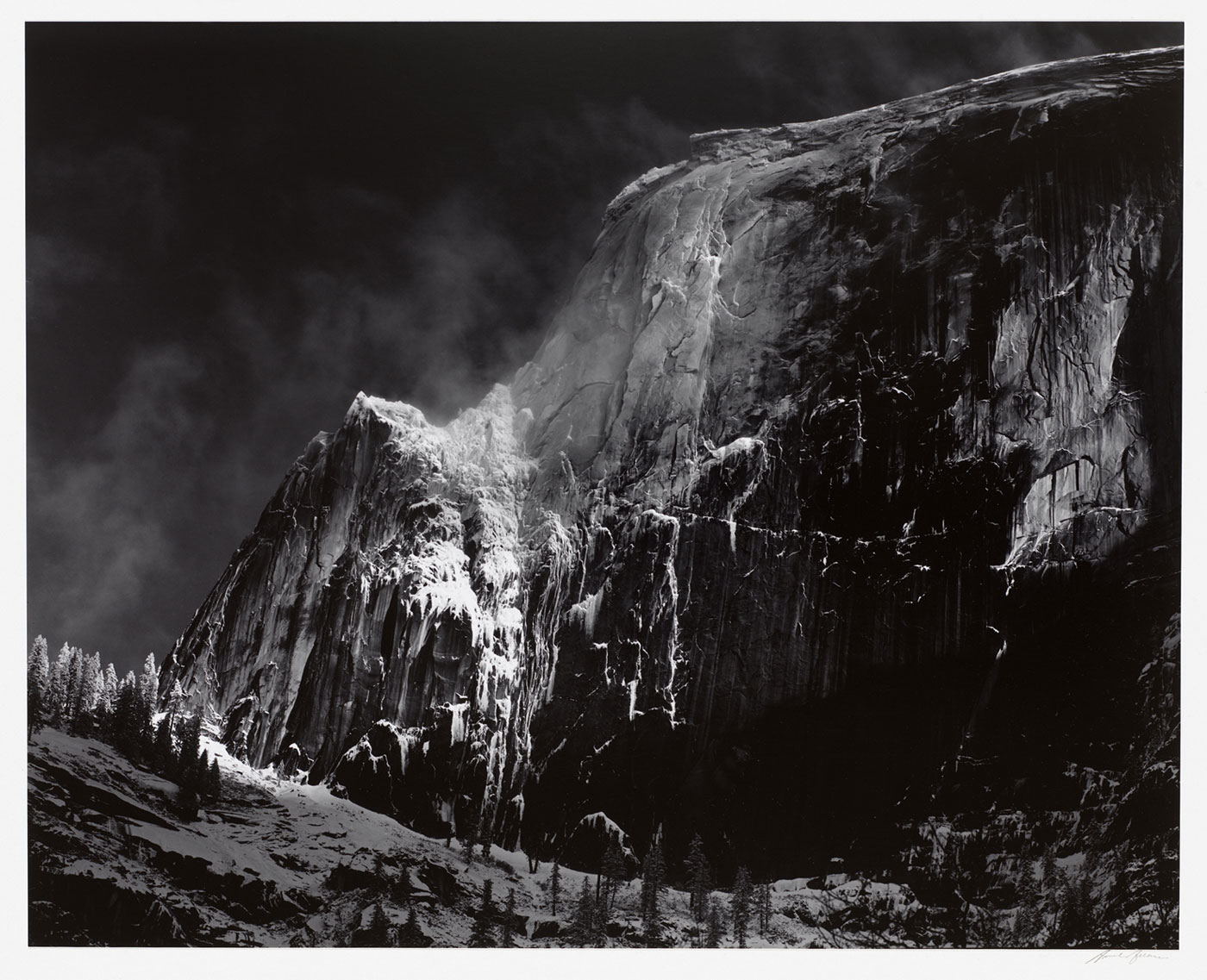
Ansel Adams (American, 1902-1984) 'Half Dome, Blowing Snow, Yosemite National Park, California' c. 1955


Ansel Adams (American, 1902-1984)
Half Dome, Blowing Snow, Yosemite National Park, California
ca. 1955 (printed 1970s)
Museum purchase with funds from the National Endowment for the Arts
© 2012 The Ansel Adams Publishing Rights Trust. Museum of Art Rhode Island School of Design, Providence


This photograph depicts the iconic tourist destination of Yosemite as sublime and untouched. By removing any evidence of human impact, Ansel Adams allows us to escape (at least temporarily) from the intrusions of culture. High contrast adds visual drama to an already majestic view, capturing the textures of the rock wall and the light filtering through the blowing snow. Throughout his life, Adams embraced the notion that nature could provide the harried, urbanised citizen of the modern age with a place of spiritual refuge. A long-time member of the Sierra Club, he was a devoted and vocal advocate for wilderness conservation and his photographs were crucial to the conservation effort.


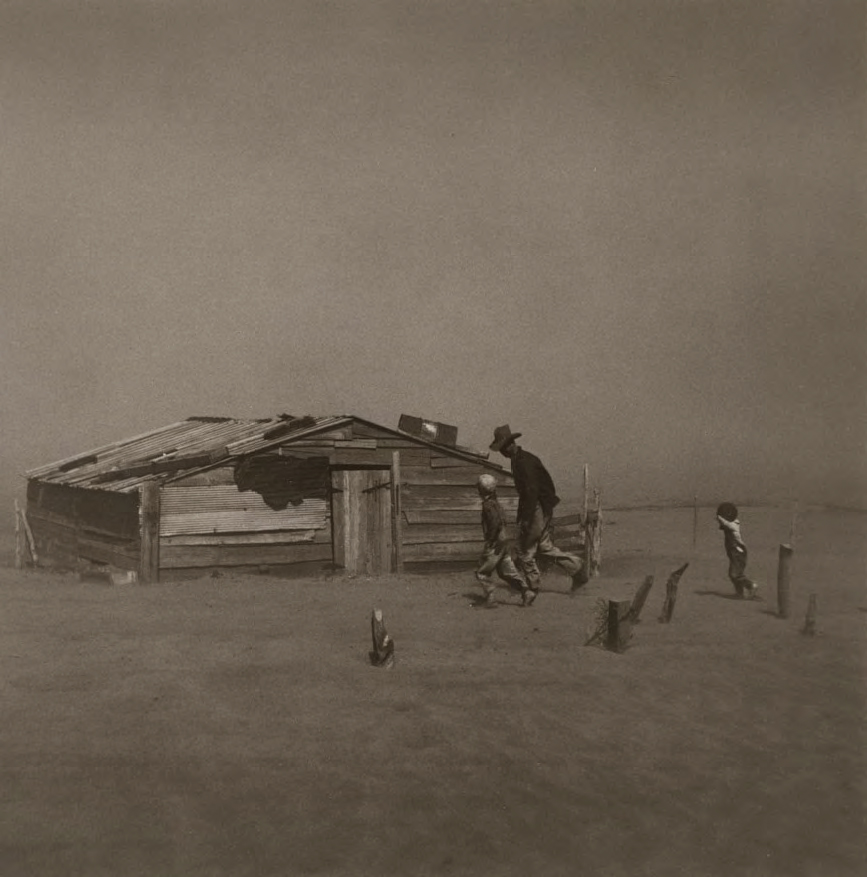
Arthur Rothstein (American, 1915-1985) 'Father and Sons Walking in the Face of a Dust Storm, Cimarron County, Oklahoma' 1936


Arthur Rothstein (American, 1915-1985)
Father and Sons Walking in the Face of a Dust Storm, Cimarron County, Oklahoma
1936
Gelatin silver print
RISD Museum: Gift of Mr. and Mrs. Gilman Angier


In 1936 Arthur Rothstein traveled to the Oklahoma panhandle, the area of the country most affected by drought, wind, and erosion. In his image (above) he captured one of the few families in the area that had not yet abandoned their farm. His portrayal of the farmer and his sons fighting to make their way home through the elements can be read as a larger statement about the struggle between man and nature. Rothstein’s dark, low contrast print further conveys the oppressive atmosphere of the dust storm.


Harry Callahan (American, 1912-1999) 'Eleanor, Chicago' c. 1952


Harry Callahan (American, 1912-1999)
Eleanor, Chicago
c. 1952
Gift from Harry Callahan ca. 1953 Wayne Miller
© The Estate of Harry Callahan, courtesy Pace/MacGill Gallery, New York. Museum of Art Rhode Island School of Design, Providence


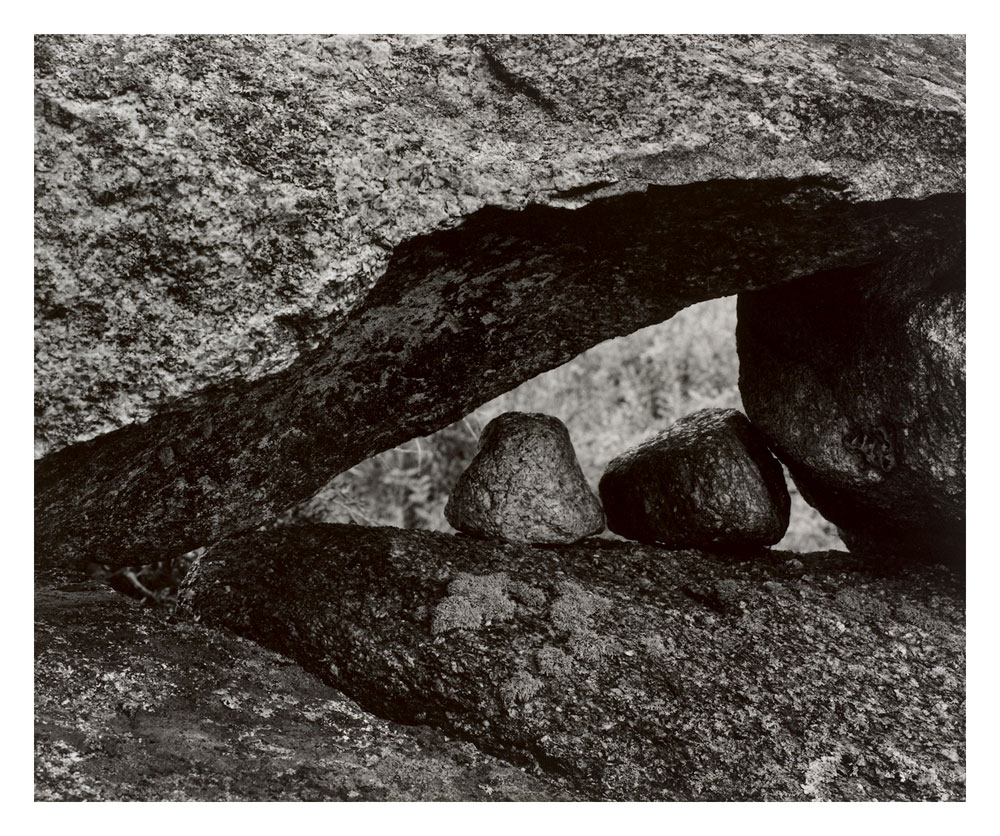
Aaron Siskind (American, 1903-1991) 'Martha’s Vineyard, 114B' 1954


Aaron Siskind (American, 1903-1991)
Martha’s Vineyard, 114B
1954
Gift of Mr. Robert B. Menschel. Courtesy Aaron Siskind Foundation
Museum of Art Rhode Island School of Design, Providence


In Martha’s Vineyard 114B, Aaron Siskind focuses on two small rocks nestled in a stone wall. As Siskind explained, he “began to feel the importance of how these rocks hovered over each other, touched each other, pushed against each other.” He likened this contiguity to family relationships, especially that between mother and child. He believed that the pair of rocks pictured in the photograph would – consciously or not – evoke emotions in the viewer, and that these emotions were both deep-seated and universal. In his depiction of the landscape, he found metaphors for what he called “human drama.”


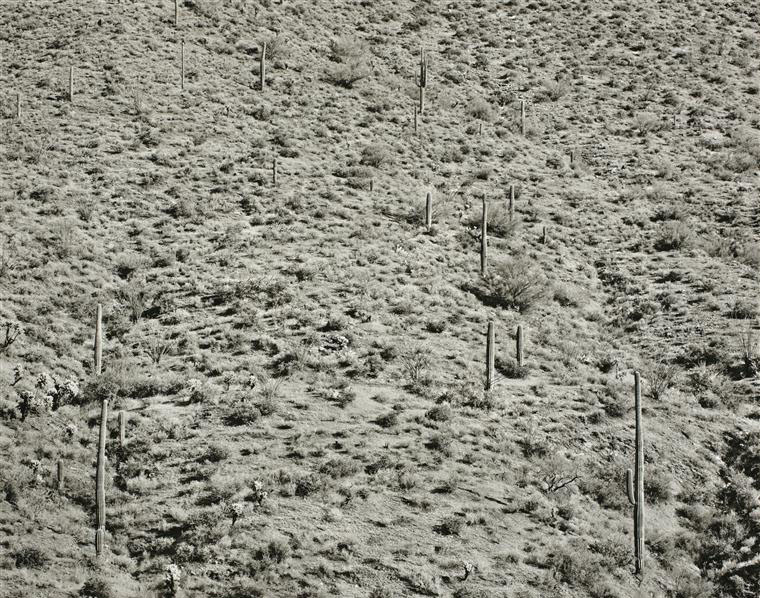
Frederick Sommer (American, 1905-1999) 'Arizona Landscape' 1943


Frederick Sommer (American, 1905-1999)
Arizona Landscape
1943
Gelatin silver print
Promised gift from the collection of Marc Harrison


Frederick Sommer’s photographs of the Arizona desert, made between about 1939 and 1945, omit the horizon line to create an overall field of pattern where scale and orientation are confounded. The vast space of the desert is pulled to the surface of the image, making the work less a landscape and more an independent construction. Sommer intently considered much of his work before executing it. He might study an area of the desert for days before deciding how to take the picture and then spend weeks in the darkroom perfecting the print.


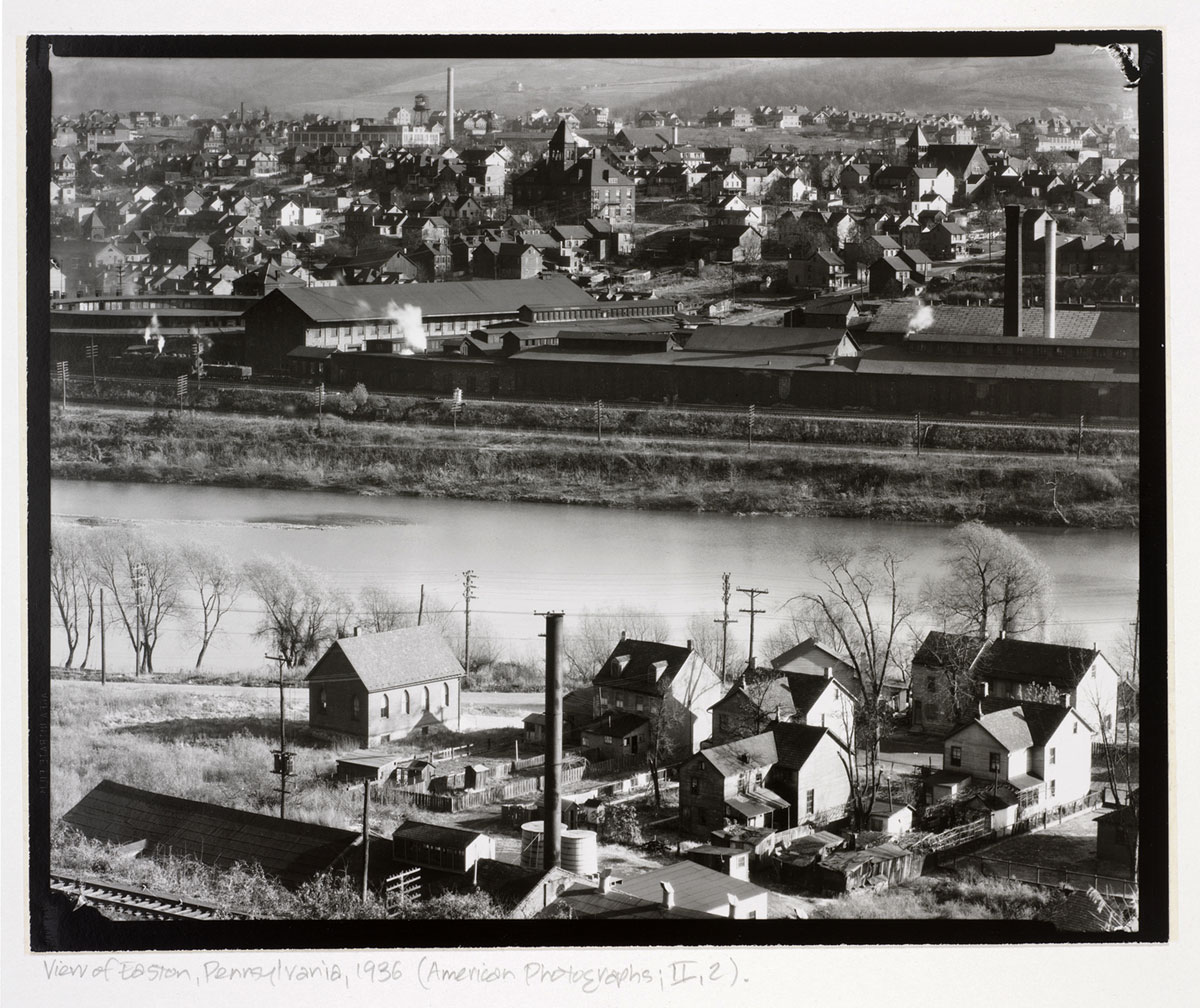
Walker Evans (American, 1903-1975) 'View of Easton, Pennsylvania' 1936


Walker Evans (American, 1903-1975)
View of Easton, Pennsylvania
1936
From the portfolio American Photographs II
Gelatin silver print
RISD Museum: Gift of James Dow


By compressing distance and flattening perspective, Walker Evans collapses the two cityscapes of Easton, Pennsylvania, and Phillipsburg, New Jersey, into one plane. Evans’s aesthetically neutral style seems to depict the world without the intervention of the photographer’s point of view. At the same time, he forces the details of every building and smokestack to the surface of the image, making the plight of the cities and their inhabitants – the Depression had crippled the shipping and manufacturing industries that were the lifeblood of both towns – impossible to ignore.


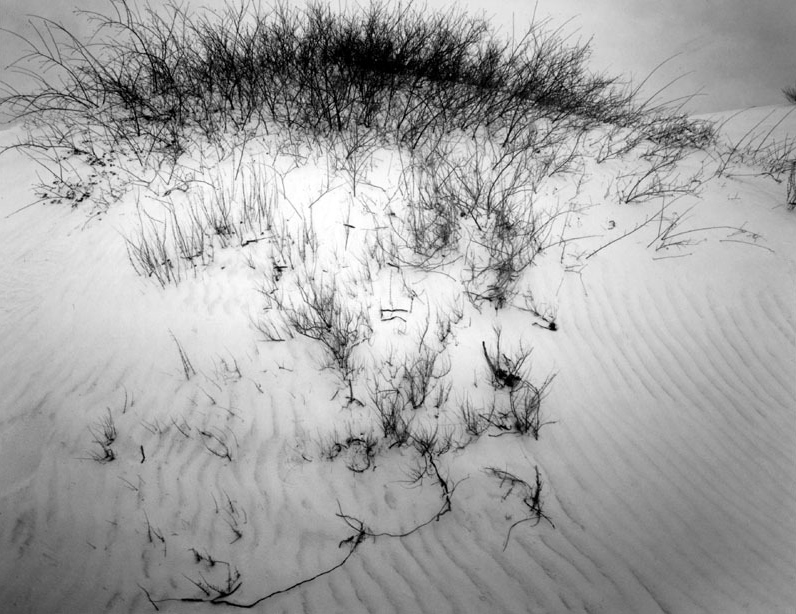
Jack Warren Welpott (American, 1923-2007) 'White Sands' 1977


Jack Warren Welpott (American, 1923-2007)
White Sands
1977
Gelatin silver print
RISD Museum: Gift of Aaron Siskind


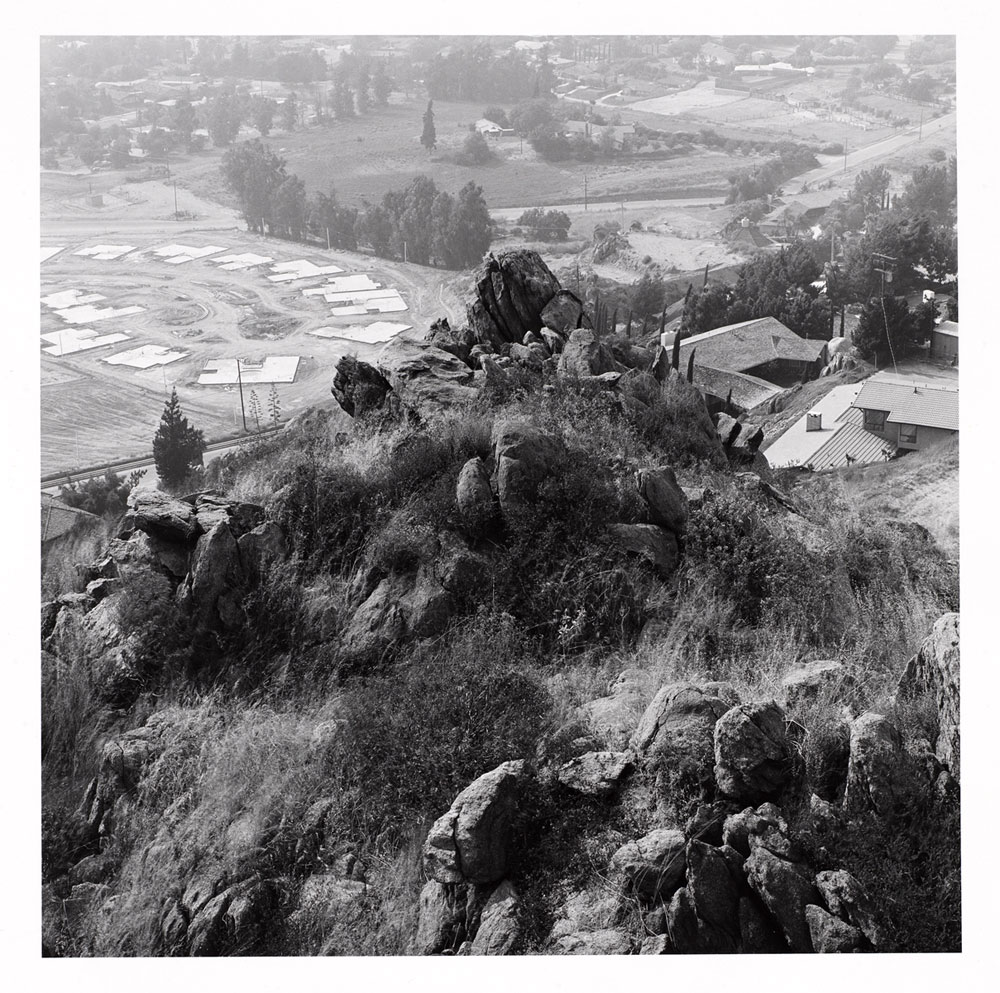
Joe Deal (American, 1947-2010) 'Colton, California' 1978


Joe Deal (American, 1947-2010) (RISD Provost 1999-2005, Faculty 2005-2009)
Colton, California
1978
From the portfolio The Fault Zone 1981
Portfolio of 19 gold-toned gelatin silver prints
Museum Purchase: Georgianna Sayles Aldrich Fund and Gift of James D. and Diane D. Burke
© The Estate of Joe Deal, courtesy Robert Mann Gallery. Museum of Art Rhode Island School of Design, Providence


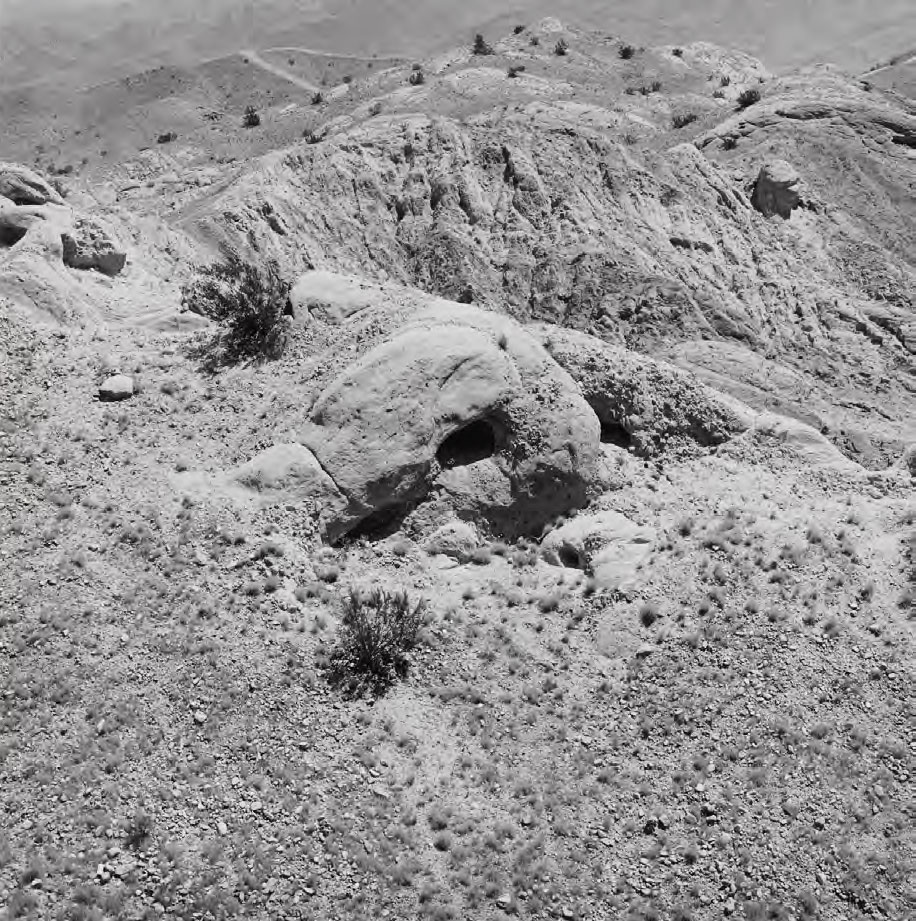
Joe Deal (American, 1947-2010) 'Chatsworth, California' 1980


Joe Deal (American, 1947-2010) (RISD Provost 1999-2005, Faculty 2005-2009)
Chatsworth, California
1980
From the portfolio The Fault Zone 1981
Portfolio of 19 gold-toned gelatin silver prints
Museum Purchase: Georgianna Sayles Aldrich Fund and Gift of James D. and Diane D. Burke
© The Estate of Joe Deal, courtesy Robert Mann Gallery. Museum of Art Rhode Island School of Design, Providence


Joe Deal (American, 1947-2010) 'Indio, California' 1978


Joe Deal (American, 1947-2010) (RISD Provost 1999–2005, Faculty 2005-2009)
Indio, California
1978
From The Fault Zone 1981
Portfolio of 19 gold-toned gelatin silver prints
RISD Museum: Museum Purchase: Georgianna Sayles Aldrich Fund and Gift of James D. and Diane D. Burke


Joe Deal (American, 1947-2010) 'Santa Barbara, California' 1978


Joe Deal (American, 1947-2010) (RISD Provost 1999–2005, Faculty 2005-2009)
Santa Barbara, California
1978
From The Fault Zone 1981
Portfolio of 19 gold-toned gelatin silver prints
RISD Museum: Museum Purchase: Georgianna Sayles Aldrich Fund and Gift of James D. and Diane D. Burke


Inspired by conceptual art, Joe Deal generally developed his work in series, choosing a particular location and adhering to a strict visual formula. As in The Fault Zone, his landscapes were typically square in format, viewed from above, lacking a horizon, and empty of people. Edges and divisions in nature and the landscape fascinated him, and the fault lines in California, though invisible on the surface, in many ways define that landscape. Using maps from the Los Angeles County engineering office that indicated where the fault lines were apt to be, Deal looked for sites that would metaphorically suggest volatility. The first image in the series is the only one that was actually taken on the San Andreas Fault; all others symbolically represent the fault lines with torn or disrupted terrain.


Topographic Developments

By the time the landmark exhibition New Topographics: Photographs of a Man-Altered Landscape opened in 1975, the accelerating degradation of the environment had become an inescapable reality. Inverting the Ansel Adams principle of exclusion, the exhibit voiced the belief that the landscape could no longer be portrayed as a refuge from the ills of industrial life: any consideration of the modern environment had to include both wilderness areas and the vacant lot next door.

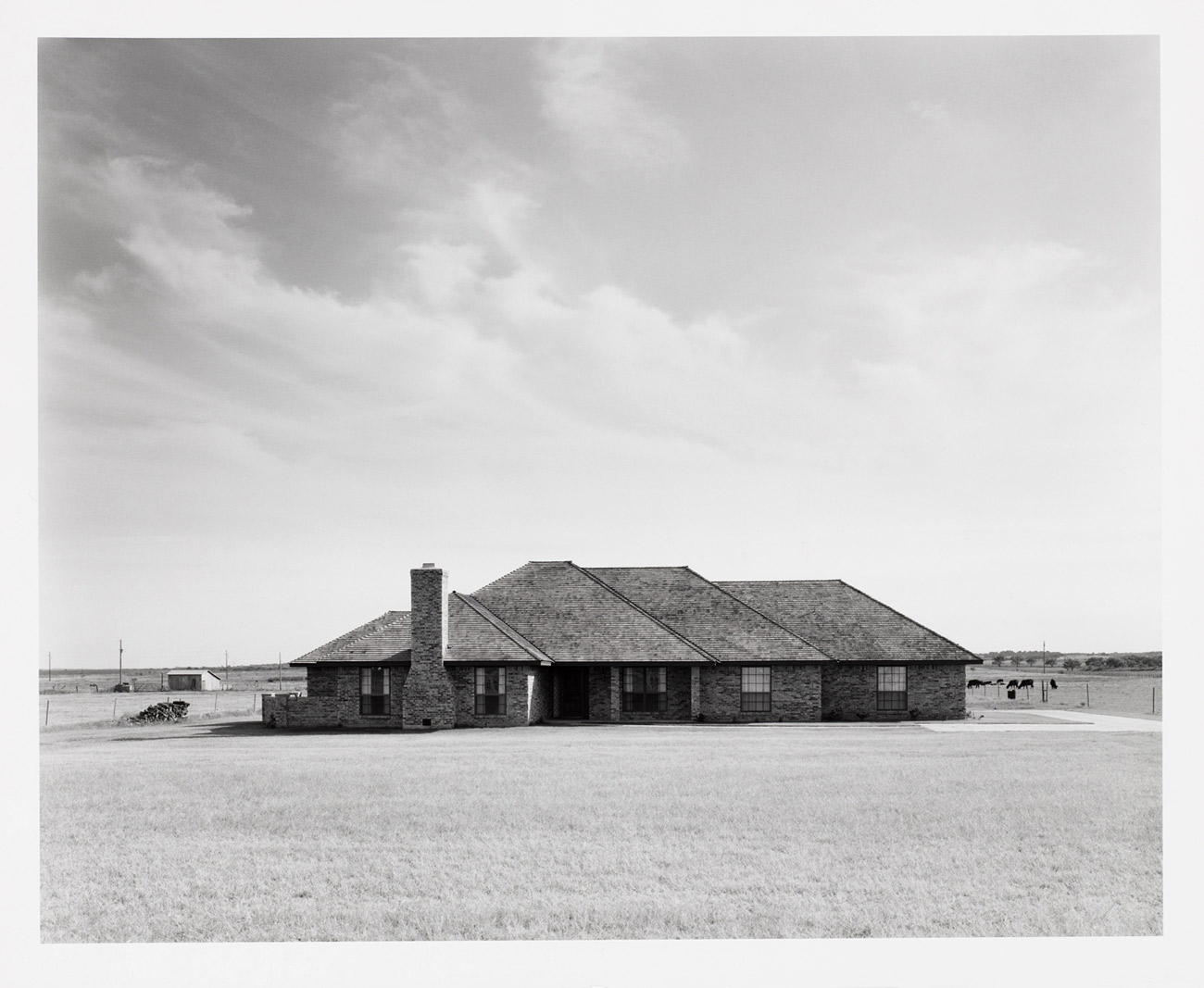
The New Topographics photographers captured recently constructed tract homes, industrial parks, and highway culture with medium and large format cameras. As aesthetically neutral as real estate snapshots, the photographs showed the facts without offering their opinions about the rapid development they recorded. Seemingly stripped of expressivity, their photographs have the appearance of objective or “topographic” renderings rather than subjective impressions. In emphasising the landscape of the American West and experimenting with anti-Romantic landscape imagery, these photographers looked back to the works of 19th-century survey photographers and to Walker Evans’s documentary style.


Lewis Baltz (American, 1945-2014) 'Model Home, Shadow Mountain' 1977


Lewis Baltz (American, 1945-2014)
Model Home, Shadow Mountain
1977
From the portfolio Nevada
Gift from the Collection of Joe Deal and Betsy Ruppa
© Lewis Baltz. Museum of Art Rhode Island School of Design, Providence


In Nevada, Lewis Baltz alternates unbuilt views with home construction, trailer parks, and roads in a documentation of a rapidly changing landscape in the desert valleys surrounding Reno, an area he once described as “landscape-as-real-estate.” Baltz, like Joe Deal and Harold Jones, whose works are on view in this gallery, developed projects as portfolios, believing that a single photograph cannot capture a complete portrait of a place. In Baltz’s series, a multifaceted, occasionally contradictory image of Nevada emerges through the accumulation of photographs.


Thomas Barrow (American, b. 1938) 'f/t/s Cancellations (Brown) - Field Star' 1975


Thomas Barrow (American, b. 1938)
f/t/s Cancellations (Brown) – Field Star
1975
Gelatin silver print
Gift from the Collection of Joel Deal and Betsy Ruppa
© Thomas Barrow. Museum of Art Rhode Island School of Design, Providence


Barrow scratched through his landscape negatives, calling attention to the materiality of the medium itself and the fact that regardless of how much information is given, reality remains an accumulation of belief, knowledge, and one’s own experience.


Harold Henry Jones (American, b. 1940) 'With Emmet' 1978


Harold Henry Jones (American, b. 1940)
With Emmet
1978
From the portfolio Tucson
Gelatin silver print
Gift of the artist in honour of Joe Deal
© 1986 Harold Jones. Museum of Art Rhode Island School of Design, Providence


Harold Jones moved to Tucson sight unseen in 1974. The Tucson Portfolio documents his first years living in, exploring, and adapting to this unfamiliar landscape. In an accompanying text he relates his initial impressions of the Southwest, a landscape he had only seen in Westerns and “in the background of Roadrunner cartoons.” It was, he writes, “white bright and oven hot. Driving through the spiney leafless plants of the desert gave me the impression of being on an ocean floor – except someone had removed the water. A primordial landscape in a sea of light. Shocking and enchanting, at the same time.”


Frank Gohlke (American, b. 1942) 'Near Crowley, Texas' 1978


Frank Gohlke (American, b. 1942)
Near Crowley, Texas
1978
Gelatin silver print
RISD Museum: Gift from the Collection of Joe Deal and Betsy Ruppa


Lee Friedlander (American, b. 1934) 'Atlantic City, New Jersey' 1971


Lee Friedlander (American, b. 1934)
Atlantic City, New Jersey
1971
Gelatin silver print
RISD Museum: Museum purchase with funds from the National Endowment for the Arts


Garry Winogrand (American, 1928-1984) 'Utah' 1964


Garry Winogrand (American, 1928-1984)
Utah
1964
From the portfolio Garry Winogrand, 1978
Gelatin silver print
Gelatin silver prints RISD Museum: Gift of Frederick J. Myerson


In the 1960s nature was apt to be viewed from a car window or in a rear-view mirror rather than from a hilltop. The large-format magisterial views of Ansel Adams and Edward Weston were replaced by a 35mm “grab-shot” style that captured the flux and contradictions of modern life with a fresh immediacy. Photographers were among the restless peripatetics crisscrossing the continent on new interstates and side roads, retrieving evidence of the “Americas” they found. The grainy, gritty aesthetic matched the sensations and energy of this environment.


America in View: Landscape Photography 1865 to Now accompanies a major exhibition of that title tracing a history of photographs of the American landscape primarily through the collection of the RISD Museum. The show takes a broad look at the ever-evolving definition of American landscape photography – from seemingly pristine views of nature captured with 19th-century view cameras to images of the decaying contemporary urban streets composed from Google Street View. The RISD Museum’s collection of American landscape photography begins at the end of the Civil War in 1865, when photographers traveled west with government survey teams and railroad companies to record the country’s extraordinary natural features and resources. Ever since, the landscape has remained a compelling subject for photographers who have revealed through their images our nation’s ambition and failings, beauty and degradation, politics and personal stories.

The Museum of Art Rhode Island School of Design announces its major fall exhibition, America in View: Landscape Photography 1865 to Now, a broad panorama of our country’s topographies and correlating narratives that reveals a nation’s ambitions and failings, beauty and loss, politics and personal stories through about 150 photographs spanning nearly 150 years. “The landscape has inspired and challenged artists since the earliest days of our nation,” says Museum Director John W. Smith. “The remarkable works in this exhibition not only capture photography’s evolving relationship with the landscape but also trace the larger narrative of America itself.”

From the earliest images in the show, it is clear how purpose guided style. Carlton Watkins’ 1860s painterly and atmospheric views of the sublime landscape portray the wilderness as a place of spiritual renewal and a refuge from urban problems. In contrast, Timothy O’Sullivan, employed for the government’s geological surveys in the 1870s, made purposefully spare and anti-picturesque images that seemingly provide proof of empty territories needing to be studied, secured, and settled.

In her essay for America in View’s accompanying catalogue, photographer Deborah Bright, chair of the Fine Art Department at Pratt Institute, suggests that some of the historical shifts in environmental consciousness seen in the photographs “illuminate how the works also reflect changing conceptions of landscapes as bearers of cultural meaning.” Ansel Adams, whose mid-20th-century views of nature’s majesty and vastness represent many people’s ideals of American landscape photography, omitted human impact on the land. Widely used by the Sierra Club, his stunning images of untouched wilderness encouraged conservation in the face of an increasingly industrial society.

By the 1970s, artists including the late RISD provost and photography professor Joe Deal saw that the environment entailed both wilderness and the vacant lot next door. Their “New Topographics” imagery depicts recently constructed tract homes, industrial parks, and highway culture – inverting Adams’ exclusion. “‘Landscape’ is probably better understood as that set of expectations and beliefs… we project upon the world,” explains Brown University art historian Douglas Nickel, in the catalogue. “Not every photograph of land is a landscape, and not every landscape necessarily features the land.”

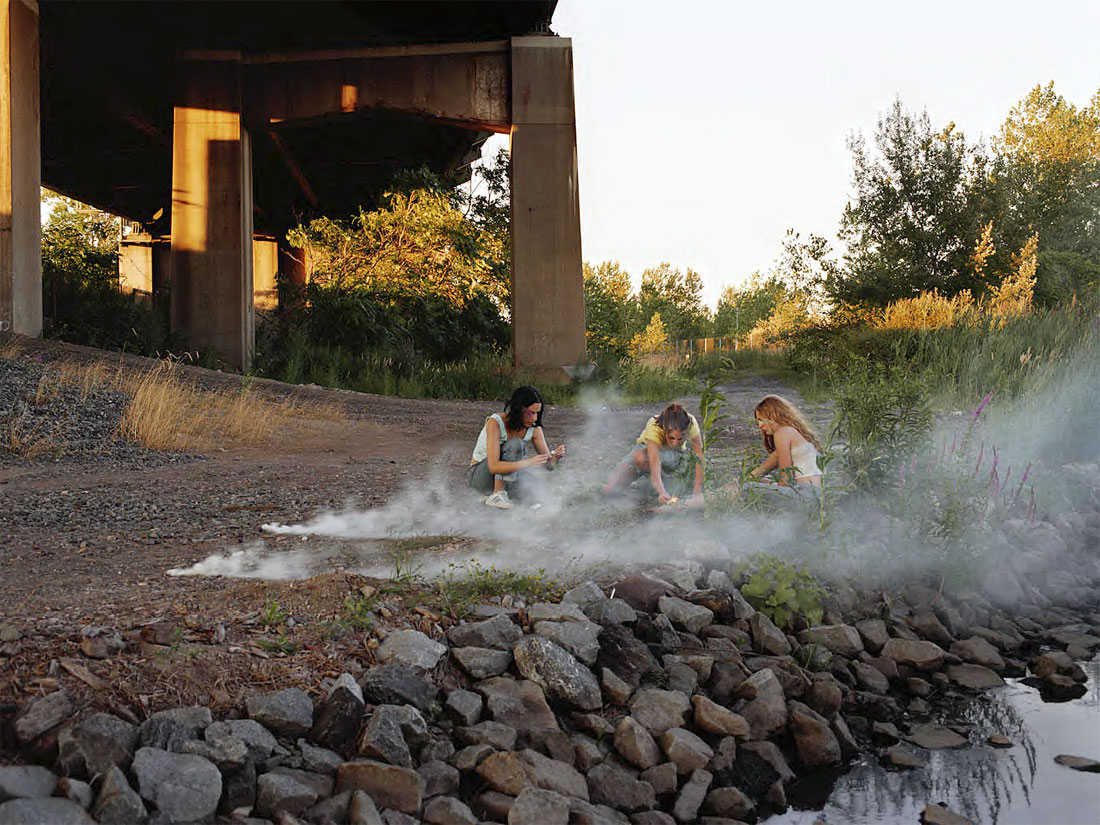
The past 20 years reveal a return to romantic views of the landscape, even in its degraded state, often including figures to create narratives. Justine Kurland’s landscape under an overpass shows a stunning place of fantasy and escape. RISD alumnus Justin Kimball explores fantasies of finding wilderness in public parks – where instead we find others seeking the same.

Press release from the RISD website


Barbara Bosworth (American, b. 1953) 'Niagara Falls' 1986


Barbara Bosworth (American, b. 1953)
Niagara Falls
1986
Gelatin silver print
Private collection


Emmet Gowin (American, b. 1941) (RISD MFA 1967) 'Old Hanford City Sites and the Columbia River, Hanford Nuclear Reservation near Richland, Washington' 1986


Emmet Gowin (American, b. 1941) (RISD MFA 1967)
Old Hanford City Sites and the Columbia River, Hanford Nuclear Reservation near Richland, Washington
1986
Toned gelatin silver prints
Promised gift of Dr. and Mrs. William G. Tsiaras


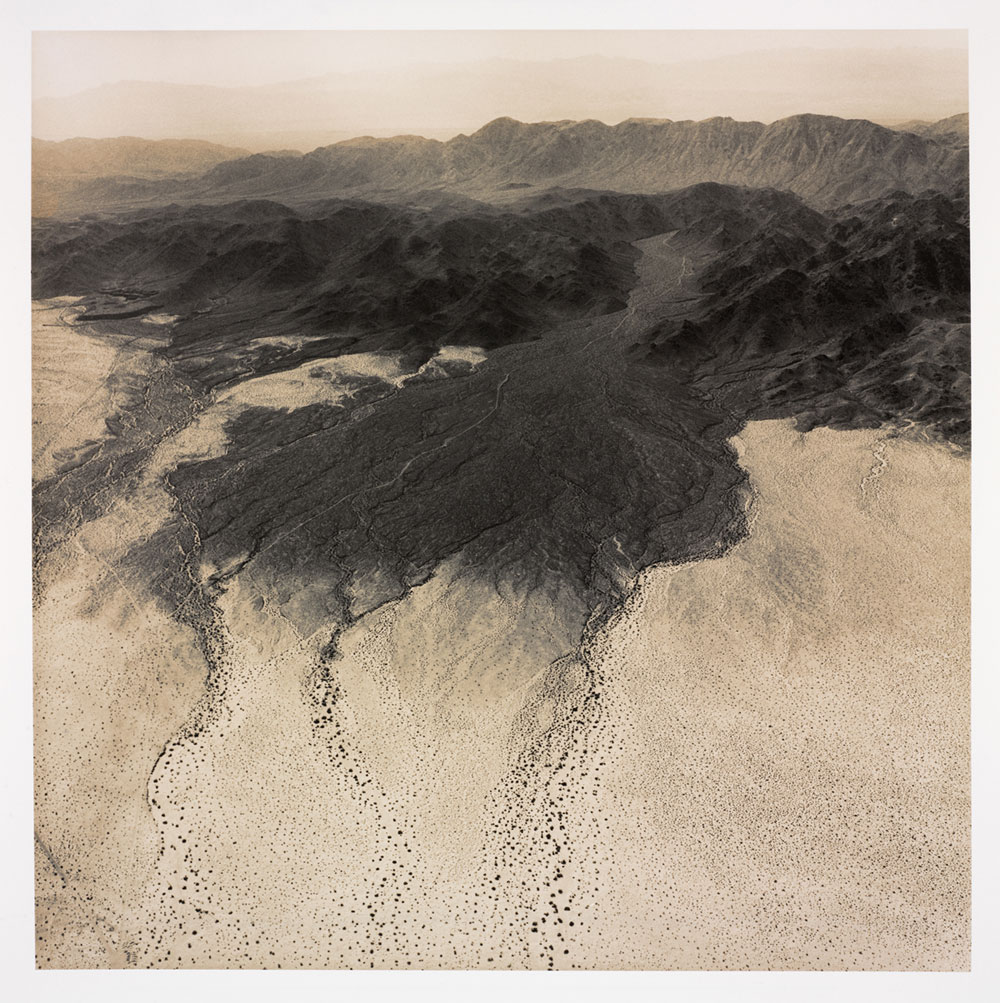
Emmet Gowin (American, b. 1941) 'Alluvial Fan, Natural Drainage near Yuma Proving Ground and the California Arizona Border' 1988


Emmet Gowin (American, b. 1941) (RISD MFA 1967)
Alluvial Fan, Natural Drainage near Yuma Proving Ground and the California Arizona Border
1988
Toned gelatin silver prints
Promised gift of Dr. and Mrs. William G. Tsiaras


Emmet Gowin (American, b. 1941) 'Aeration Pond, Toxic Water Treatment Facility, Pine Bluff, Arkansas' 1989


Emmet Gowin (American, b. 1941) (RISD MFA 1967)
Aeration Pond, Toxic Water Treatment Facility, Pine Bluff, Arkansas
1989
Toned gelatin silver print
RISD Museum: Mary B. Jackson Fund


Emmet Gowin’s carefully constructed prints of strip mining sites, nuclear testing fields, large-scale agriculture, and other scars in the natural landscape seductively draw us in to examine what these lushly patterned and toned images represent. Predating Google Earth, these photographs are shot from the air and provide information about the environment that questions our role as stewards of the planet. A master darkroom printer, Gowin makes images come alive through hand-toning. Each print is transformed from grayscale into hues ranging from warm highlights to cool shadows, emphasising the illusion of three-dimensionality.


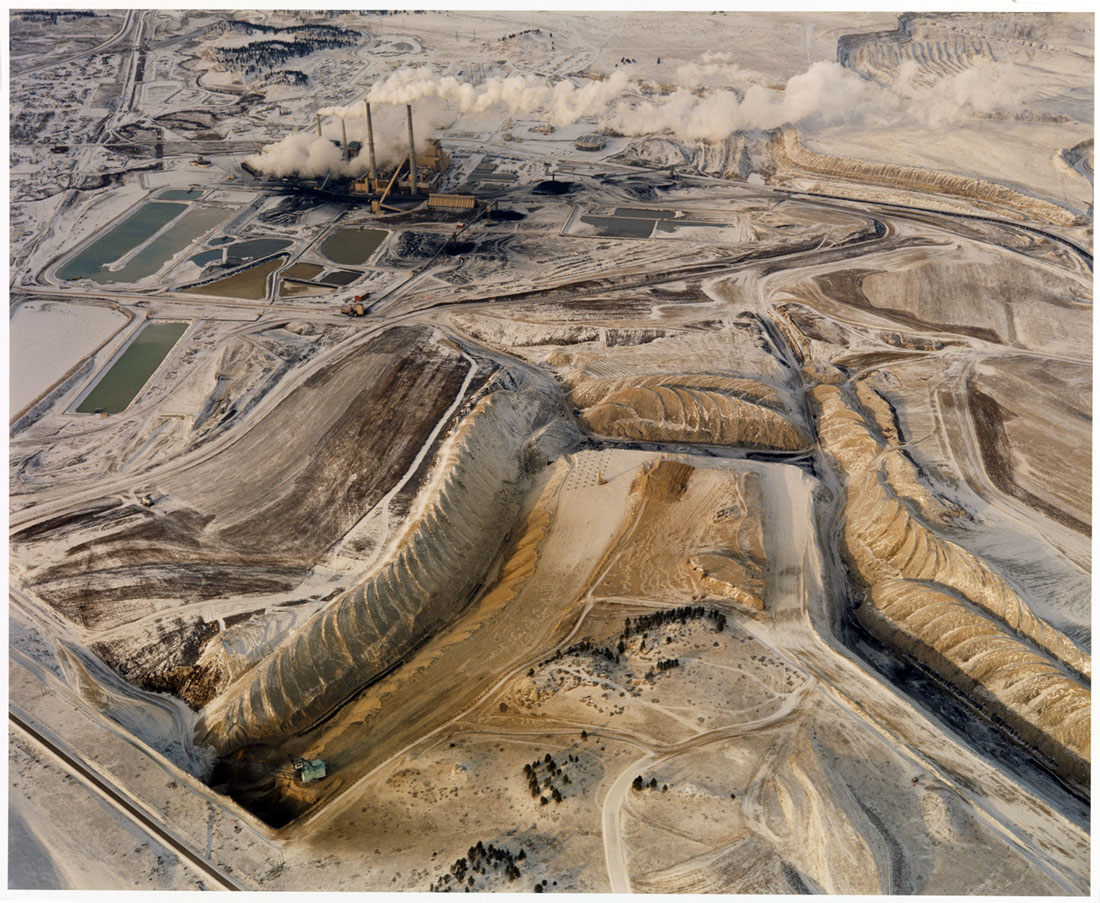
David T. Hanson (American, b. 1948) 'Coal Strip Mine, Power Plant and Waste Ponds' 1984


David T. Hanson (American, b. 1948)
Coal Strip Mine, Power Plant and Waste Ponds
1984
Museum Purchase: Gift of the Artist’s Development Fund of the Rhode Island Foundation
© 1984 David T. Hanson, from the book Colstrip, Montana by David T. Hanson (Taverner Press, 2010). Museum of Art Rhode Island School of Design, Providence


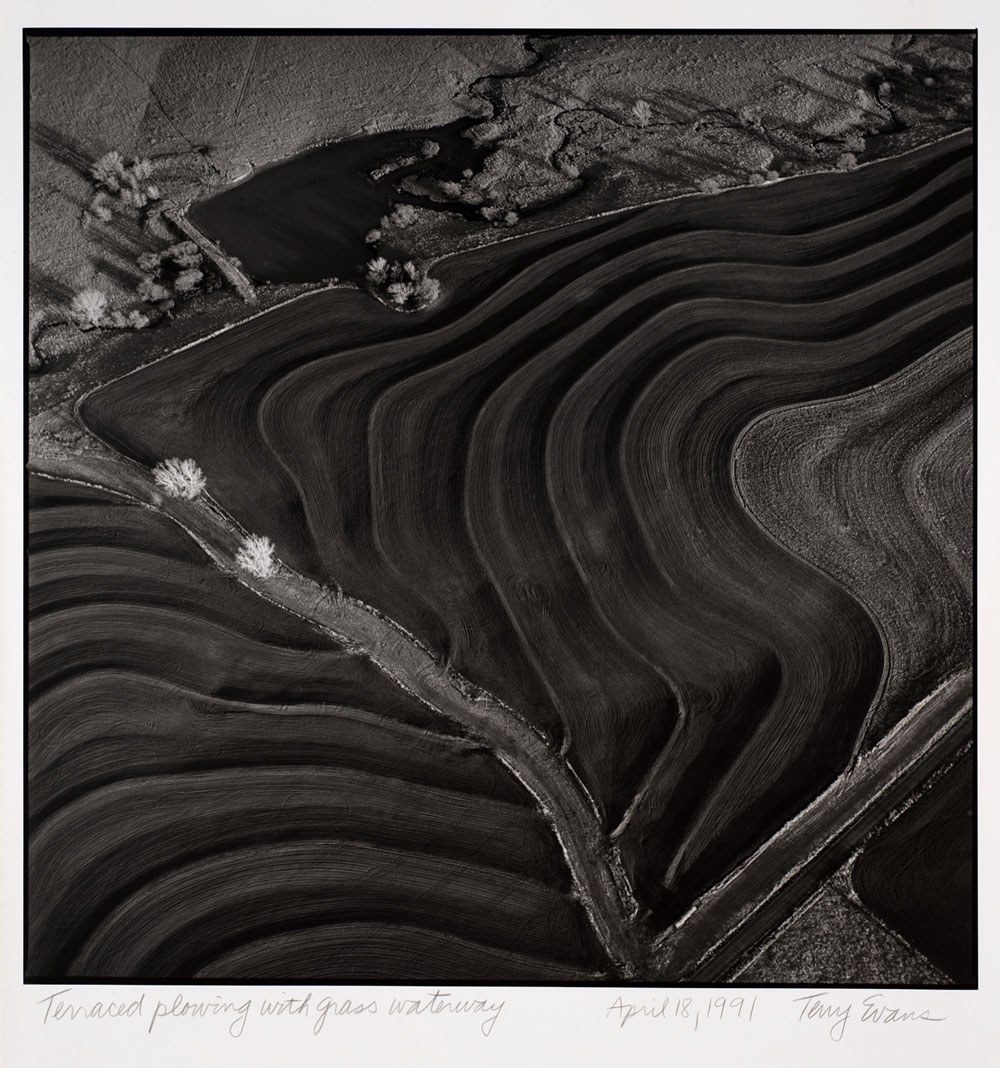
Terry Evans (American, b. 1944) 'Terraced Plowing with a Grass Waterway' 1991


Terry Evans (American, b. 1944)
Terraced Plowing with a Grass Waterway
1991
From the series Inhabited Prairie
Gelatin silver print
RISD Museum: Gift of Jan Howard and Dennis Teepe in honour of Joe Deal


Neither the striking abstract design of the terraced field nor the effectiveness of this type of farming are what interests Terry Evans. She is drawn to the specific place and how the marks on the land, as she has said, “contain contradictions and mysteries that raise questions about how we live on the prairie. All of these places are beautiful to me, perhaps because all land, like the human body, is beautiful.”


Justine Kurland (American, b. 1969) 'Smoke Bombs' 2000


Justine Kurland (American, b. 1969)
Smoke Bombs
2000
From the series Runaway Girls
Colour chromogenic print
RISD Museum: Mary B. Jackson Fund


The neglected space under a New Jersey highway overpass was an ideal spot for three girls to act out Justine Kurland’s fictive story about fugitive teenagers. The figurative grouping recalls pastoral scenes in historical paintings so that the danger of the girls’ pursuit in this dicey no-man’s land is temporarily suspended in the hazy romantic fantasy of escape. The strong light streaming across the scene and the overall beauty of the composition suggests a desire to pursue the sublime even in the most degraded landscapes.


Justin Kimball (American, b. 1961) 'Deep Hole, New Hampshire' 2002


Justin Kimball (American, b. 1961)
Deep Hole, New Hampshire
2002
From the series Where We Find Ourselves
Gift of the artist in honour of Joe Deal
Museum of Art Rhode Island School of Design, Providence


Deep Hole, New Hampshire captures light filtering through the trees as a dozen young men and women distribute themselves among rocky outcroppings, poised for adventure in the water below. The composition recalls the quiet drama of Thomas Eakins’s 19th-century painting of nude swimmers. This reference drew Kimball to the picture as it played out in front of him, along with the palpable sense of elation in the youths’ encounter with the landscape, no matter the deteriorating state of the site due to its heavy use. Kimball’s series Where We Find Ourselves explores the fantasy of finding wilderness in state and national parks, where we only find other people looking for it, too.


Alec Soth (American, b. 1969) '2008_08zl0031' 2008


Alec Soth (American, b. 1969)
2008_08zl0031
2008
Mary Ann Lippitt Acquisition Fund
© Alec Soth
Museum of Art Rhode Island School of Design, Providence


Where We Find Ourselves

Current representations of the American landscape reveal a continually fraught relationship with the environment. Recent landscape photography reflects its history while constructing new notions of what such an image can be. Some artists continue to see the landscape as a place of refuge or spirituality. Others focus on its more disturbing psychological impact, even haunted with battle scars. Some pick up from the 1970s New Topographics approach with a more pointed investigation of environmentalism, documenting and questioning the impact of industry and development on the natural world. Still others have found that with the introduction of the figure the landscape can act as a stage, albeit one charged with political and social resonance.

Notable shifts have also been driven by new processes and techniques. The photographs of the last several decades are predominantly in colour and are much larger than their precedents. While many artists working today use digital technology, their motive is rarely to alter or fabricate imagery but instead to have easier and better control over how these larger images are presented. Surprisingly, many of today’s photographers are using large format cameras very similar to those of the 19th century to create negatives or digital files capable of being enlarged to the scale of contemporary work.


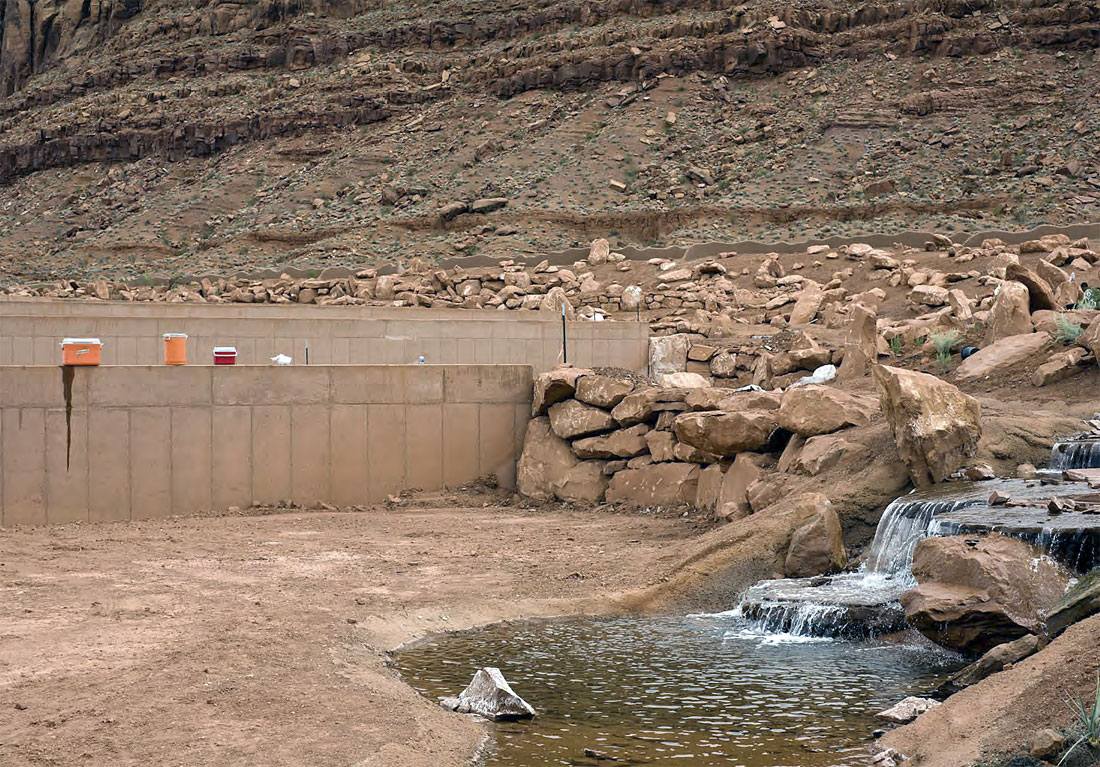
Steven B. Smith (American, b. 1963) 'Coolers, Ivins, Utah' 2007


Steven B. Smith (American, b. 1963) (RISD Faculty 1996-present)
Coolers, Ivins, Utah
2007
From the series Irrational Exuberance
Colour inkjet print
RISD Museum: Gift of Heather Smith in honour of Joe Deal


Steven Smith’s subject matter follows in the tradition of the 1970s New Topographic artists. What differentiates Smith’s view of a recently suburbanised desert from his predecessors is the humour with which he captures the extravagant building in this arid place. In this image, from the aptly titled series Irrational Exuberance, fluorescent-coloured coolers, like the red rocks, become part of the landscape, even creating their own waterfall.


Joe Deal (American, 1947-2010) 'Kite, Chino Hills, California' 1984


Joe Deal (American, 1947-2010) (RISD Provost 1999-2005, Faculty 2005-2009)
Kite, Chino Hills, California
1984
From the portfolio Subdividing the Inland Basin
Gift of the artist
© The Estate of Joe Deal, courtesy Robert Mann Gallery. Museum of Art Rhode Island School of Design, Providence


Joe Deal often found his picture at the border between the built and unbuilt landscape. The driveway makes for a convenient spot to fly a kite, surrounded as it is here with a bit of open space remaining in a new development. In the distance to the right the residential growth that will soon cover this piece of land is visible through the atmospheric smog. In the distance to the left are still untouched hills. The inclusion of people – evidence of a rapidly exploding community near the intersection of the Pomona and Orange freeways – marks a shift in Deal’s photography to embracing the landscape as a site for narrative.


Uta Barth (German, b. 1958) 'Field #14' 1996


Uta Barth (German, b. 1958)
Field #14
1996
Colour chromogenic print
RISD Museum: Gift of the Buddy Taub Foundation, Jill and Dennis Roach, Directors


Uta Barth radically softens the camera’s focus to remove all signs of historical specificity and to saturate a flat industrial-looking non-place with a dream-like atmosphere. As such she creates a generic landscape as viewed through a heavily fogged window, with an uncanny sense that is deeply familiar.


Henry Wessel (American, b. 1942) 'Night Walk, Los Angeles, No. 28' 1995


Henry Wessel (American, b. 1942)
Night Walk, Los Angeles, No. 28
1995
From the series Night Walk: LA
Gelatin silver print
RISD Museum: Gift of Mark Pollack


Millee Tibbs (American, b. 1976) 'Self-Portrait in the Fog' 2009


Millee Tibbs (American, b. 1976) (RISD MFA 2007)
Self-Portrait in the Fog
2009
From the portfolio Self Portraits
Colour inkjet print
RISD Museum: Gift of the artist in honour of Joe Deal


Robert Frank (Swiss, 1924-2019) 'U.S. 285, New Mexico' 1955


Robert Frank (Swiss, 1924-2019)
U.S. 285, New Mexico
1955
Silver gelatin photograph


This slideshow requires JavaScript.


Installation views of America in View: Landscape Photography 1865 to Now at the Museum of Art Rhode Island School of Design, Providence


Museum of Art Rhode Island School of Design (RISD)
224 Benefit Street, Providence, RI 02903
Phone: 401 454-6500

Opening hours:
Tuesdays Wednesdays, Saturdays, Sundays 10am – 5pm
Thursdays – Fridays 12 – 7pm
Closed Mondays

Museum of Art Rhode Island School of Design (RISD) website

LIKE ART BLART ON FACEBOOK

Back to top

Melbourne’s magnificent eleven 2012

January 2013


Here’s my pick of the eleven best artists/exhibitions which featured on the Art Blart blog in 2012. Enjoy!

Marcus


1/ Review: The work of Robyn Hosking, AT_SALON at Anita Traverso Gallery, Richmond

6th March – 24th March 2012


Robyn Hosking (Australian, b. 1948) 'The Wing Walker' 2011


Robyn Hosking (Australian, b. 1948)
The Wing Walker
2011
Mixed media


Robyn Hosking (Australian, b. 1948) 'The Wing Walker' 2011 (detail)


Robyn Hosking (Australian, b. 1948)
The Wing Walker (detail)
2011
Mixed media


… My favourite has to be The Wing Walker (2011) as an irate Julia Gillard tries to get rid of Kevin Rudd once and for all, even poking him with a stick to push him off the edge of the biplane. Balanced on a slowly revolving turntable with the world at its centre, this political merry-go round is panacea for the soul for people sick of politicians. This is brilliant political satire. The planes are all ends up and even when Julia thinks she has got rid of Kevin there he is, hanging on for dear life from the undercarriage of one of the planes…

Reminding me of the fantasy creatures of Tom Moore, these whimsical manifestations deal with serious, life changing and challenging issues with purpose, feeling and a wicked sense of humour. I really enjoyed this art (and joy is the correct word) because it takes real world issues, melds fantasy and pointed observation and reflects it back, as the artist observes, in a funfair’s distorted mirror. Magic!


2/ Review: Martin Parr: In Focus at Niagara Galleries, Richmond, Melbourne

Exhibition dates: 6th March – 31st March 2012

This is a fine exhibition of the work of celebrated English photographer Martin Parr at Niagara Galleries, Richmond, albeit with one proviso. The mainly large colour prints are handsomely displayed in plain white frames within the gallery space and are taken from his well known series: Last Resort, Luxury, New British and British Food. Parr’s work is at its best when he concentrates on the volume of space within the image plane and the details that emerge from such a concentrated visualisation – whether it be the tension points within the image, assemblage of colour, incongruity of dress, messiness of childhood or philistine nature of luxury.

And so it goes. The dirt under the fingernails of the child eating a doughnut, the lurid colours of the popsicle and jacket of the kid with dribble on his face, all fantastic… They are joyous paeans to the quirky, incongruous worlds in which we live and circulate. They evidence life itself in all its orthogonal absurdity.


Martin Parr (British, b. 1952) 'England. New Brighton' 1983-1985


Martin Parr (British, b. 1952)
England. New Brighton
1983-1985
From the series Last Resort
1983-1985
Pigment print
Edition of 5
102 x 127cm
Image courtesy of the artist and Niagara Galleries, Melbourne


Martin Parr (British, b. 1952) 'England. New Brighton' 1983-1985


Martin Parr (British, b. 1952)
England. New Brighton
1983-1985
From the series Last Resort
Pigment print
Edition of 5
102 x 127 cm
Image courtesy of the artist and Niagara Galleries, Melbourne


3/ Review: Tourist #5: Disappearing Project 1 – 41 by Nicola Loder at Helen Gory Galerie, Prahran, Melbourne

Exhibition dates: 14th March – 7th April 2012

I have always loved the work of Nicola Loder ever since I saw her solo exhibition Child 1-175: A Nostalgia for the Present at Stop 22 Gallery in St Kilda in 1996. This exhibition is no exception. Loder is the consummate professional, her work is as imaginative and intriguing as ever and there has been a consistent thematic development of ideas within her work over a long period of time. These ideas relate to the nature of seeing and being seen, the mapping of identity and the process of its (dis)appearance…

Loder’s exquisitely sensuous description of disappearance allows us to see the phenomenal word afresh. I look forward with a sense of anticipation to the next voyage of discovery the artist will take me on.


'Tourist #5: Disappearing Project 1-41' by Nicola Loder, installation photograph at Helen Gorie Galerie


Tourist #5: Disappearing Project 1-41 by Nicola Loder, installation photograph at Helen Gorie Galerie


Nicola Loder (Australian, b. 1964) 'Tourist #5: Disappearing Project 1-41 (no 11)' 2012


Nicola Loder (Australian, b. 1964)
Tourist #5: Disappearing Project 1-41 (no 11)
2012
Polyester thread, muslin
86 x 69cm


4/ Review: Jane Brown / Australian Gothic at Edmund Pearce Gallery, Melbourne

Exhibition dates: 25th April – 12th May 2012


Jane Brown (Kuwait, Australia, b. 1967) 'Big Trout, New South Wales' 2010

Jane Brown (Kuwait, Australia, b. 1967)
Big Trout, New South Wales
2010
Museo silver rag print
59 x 46cm


Jane Brown (Kuwait, Australia, b. 1967) 'Adelong, New South Wales' 2011


Jane Brown (Kuwait, Australia, b. 1967)
Adelong, New South Wales
2011
Fibre based, silver gelatin print
16.5 x 20.5cm


This is a good exhibition of small, darkly hewn, traditionally printed silver gelatin photographs, beautifully hung in the small gallery at Edmund Pearce and lit in the requisite, ambient manner. There are some outstanding photographs in the exhibition. The strongest works are the surrealist tinged, film noir-ish mise-en-scènes, the ones that emphasise the metaphorical darkness of the elements gathered upon the stage. Photographs such as Big TroutThe Female Factory, Adelong, New South Wales and Captain’s Flat Hotel, New South Wales really invoke a feeling of unhomely (or unheimlich), where nature is out of kilter. These images unsettle our idea of Oztraliana, our perceived sense of Self and our place in the world. They disrupt normal transmission; they transmutate the seen environment, transforming appearance, nature and form.


5/ Review: Jacqui Stockdale: The Quiet Wild at Helen Gory Galerie, Melbourne

Exhibition dates: 18th April – 19th May 2012


Jacqui Stockdale (Australian, b. 1968) 'Rama-Jaara the Royal Shepherdess' 2012


Jacqui Stockdale (Australian, b. 1968)
Rama-Jaara the Royal Shepherdess
2012
Type C Print
100 x 78cm


Jacqui Stockdale (Australian, b. 1968) 'Lagunta Man, Leeawuleena' 2012 Type C Print 100 x 78cm


Jacqui Stockdale (Australian, b. 1968)
Lagunta Man, Leeawuleena
2012
Type C Print
100 x 78cm


These are incredibly humorous, magical and symbolic photographs. A thought came into my mind when I was in the gallery surrounded by the work: for me they represented a vision of the Major Arcana of the Tarot (for example Jaguar Hombre could be seen as an inverted version of the Hanged Man with his foot in a figure four, the Hanged Man symbolising the need to just be in the world, yielding his mind and body to the Universal flow). The Major Arcana deal with the human condition, each card representing the joys and sorrows every man and woman can experience in a lifetime. In a way Stockdale offers us her own set of subversive Major Arcana, images that transgress the boundaries of the colonial vernacular, offering the viewer a chance to explore the heart of the quiet wild.


6/ Review: Littoral by Kristian Laemmle-Ruff at Colour Factory Gallery, Fitzroy

Exhibition dates: 4th May – 26th May 2012


It was such a joy then to walk around the corner from the CCP to the Colour Factory Gallery and view the exhibition Littoral by emerging artist Kristian Laemmle-Ruff. This is one of the best, if not the best, “photography” exhibition I have seen so far this year. As soon as you walk into the simple, elegant gallery you are surrounded by fourteen large scale horizontal photographs that are suffused with colour variations bouncing across the gallery – here a blue, there a green, now a lush orange palette. The effect is much like Monet’s waterlilies at the Musée de l’Orangerie in Paris; seated in the middle of the four curved paintings you are surrounded by large daubs of paint of various hues that have an elemental effect – resonances of earth, air, water, fire – on the viewer. The same affection of colour and space can be found in Laemmle-Ruff’s photographs.


Kristian Laemmle-Ruff (Australian) 'Olympic Stadium' 2012


Kristian Laemmle-Ruff (Australian)
Olympic Stadium
2012
Type C print
100cm x 67cm


Kristian Laemmle-Ruff (Australian) 'Truck in Safi' 2010


Kristian Laemmle-Ruff (Australian)
Truck in Safi
2010
Type C print
100cm x 67cm


7/ Review: Lost & Found: Family Photos Swept away by the 3.11 East Japan Tsunami at the Centre for Contemporary Photography (CCP), Fitzroy, Melbourne

Exhibition dates: 1st June – 15th July 2012

What we are left with in these images are vestiges of presence, remnants or traces of people that have passed on. In a kind of divine intervention, these photographs ask the viewer questions about the one fact that we cannot avoid in our lives, our own mortality, and what remains after we pass on. We can never know these people and places, just as we can never know the place and time of our death – when our “time” is up – but these photographs awaken in us a subconscious remembering: that we may be found (in life), then lost (through death), then found again in the gaze of the viewer looking at the photographs in the future present. We are (dis)continuous beings.

There is no one single reading of these photographs for “there are only competing narratives and interpretations of a world that cannot be wholly, accurately described.” These indescribable photographs impinge on our consciousness calling on us to remember even as the speed of contemporary life asks us to forget. This ethical act of looking, of mourning and remembering, of paying homage to presence acknowledges that we choose not to let pass into the dark night of the soul these traces of our forebears, for each emanation is deeply embedded within individual and cultural memory.

These photographs are a contemporary form of Western ‘dreaming’ in which we feel a link to the collective human experience. In this reification, we bear witness to the (re)assemblance of life, the abstract made (subconsciously) concrete, as material thing. These images of absent presence certainly reached out and touched my soul. Vividly, I choose to remember rather than to forget.


'Untitled' from 'Lost and Found' 2011

'Untitled' from 'Lost and Found' 2011


Anonymous photographer
Untitled
2011
From Lost and Found 2011


8/ Review: Berlinde De Bruyckere: We are all Flesh at the Australian Centre for Contemporary Art (ACCA), Melbourne

Exhibition dates: 2nd June – 29th July 2012

The main work We Are All Flesh (2012) reminded me of a version of the game The Hanged Man (you know, the one where you have to guess the letters of a word and if you don’t get the letter, the scaffold and the hanged man are drawn). The larger of the two hanging pieces featured two horse skins of different colours intertwined like a ying yang paux de deux. Psychologically the energy was very heavy. The use of straps to suspend the horses was inspired. Memories of Rembrandt’s The Anatomy Lesson of Dr. Nicolaes Tulp and The Godfather rose to the surface. My favourite piece was 019 (2007). Elegant in its simplicity this beautiful display case from a museum was dismantled and shipped over to Australia in parts and then reassembled here. The figurative pieces of wood, made of wax, seemed like bodies drained of blood displayed as specimens. The blankets underneath added an element of comfort. The whole piece was restrained and beautifully balanced. Joseph Beuys would have been very proud.

The “visceral gothic” contained in the exhibition was very evident. I liked the artist’s trembling and shuddering. Her narratives aroused a frisson, a moment of intense danger and excitement, the sudden terror of the risen animal


Berlinde De Bruyckere (Belgian, b. 1964) 'We Are All Flesh' 2012


Berlinde De Bruyckere (Belgian, b. 1964)
We Are All Flesh
2012
Treated horse skin, epoxy, iron armature
280 x 160 x 100cm
Courtesy the artist, Hauser & Wirth and Galleria Continua


Berlinde De Bruyckere (Belgian, b. 1964) '019' 2007


Berlinde De Bruyckere (Belgian, b. 1964)
019
2007
Wax, epoxy, metal, glass, wood, blankets
293.5 x 517 x 77.5cm
Private Collection, Paris


9/ Review: Light Works at NGV International, Melbourne

Exhibition dates: 23rd March – 16th September 2012

This is an intimate and stimulating photographic exhibition at the NGV International featuring the work of artists Mike and Doug Starn, David Stephenson, Hiroshi Sugimoto, Bill Henson, Adam Fuss, Simone Douglas, Park Hong-Chun, Eugenia Raskopoulos, Sam Shmith, Christoph Dahlhausen and Patrick Bailly-Maitre-Grand. It is fantastic to see an exhibition of solely contemporary photographs at the National Gallery of Victoria taken from their collection (with nary a vintage silver gelatin photograph in sight!), one which examines the orchestration of light from which all photography emanates – used by different photographers in the creation, and there is the key word, of their work. Collectively, the works seem to ooze a mysterious inner light, a facing towards the transcendent divine – both comforting, astonishing and terrifying in part measure.


Hiroshi Sugimoto (Japanese, b. 1948-, worked in United States 1972- ) 'Winnetka Drive-In, Paramount' 1993


Hiroshi Sugimoto (Japanese, b. 1948-, worked in United States 1972- )
Winnetka Drive-In, Paramount
1993
Gelatin silver photograph
42.3 x 54.1cm
National Gallery of Victoria, Melbourne
Purchased with funds donated by the Bowness Family Fund for Contemporary Photography, 2009
© Hiroshi Sugimoto, courtesy The Pace Gallery, New York


Mike Starn (American, b. 1961) and Doug Starn (American, b. 1961)
'Sol Invictus' 1992


Mike Starn (American, b. 1961) and Doug Starn (American, b. 1961)
Sol Invictus
1992
Orthographic film, silicon, pipe clamps, steel and adhesive tape
175 x 200 x 35cm
National Gallery of Victoria, Melbourne
Purchased with funds donated by the National Gallery Women’s Association, 1994
© Doug Starn, Mike Starn/ARS, New York. Licensed by VISCOPY, Sydney


10/ Review: Gregory Crewdson: In A Lonely Place at the Centre for Contemporary Photography (CCP), Fitzroy, Melbourne

Exhibition dates: 28th September – 11th November 2012

In his visual mosaics Crewdson engages our relationship with time and space to challenge the trace of experience. His tableaux act as a kind of threshold or hinge of experience – between interior and exterior, viewer and photograph. His photographs are a form of monism in which two forces (interior / exterior) try to absorb each other but ultimately lead to a state of equilibrium. It is through this “play” that the context of the photographs and their relationship to each other and the viewer are “framed.” This device emphasises the aesthetic as much as information and encourages the viewer to think about the relationship between the body, the world of which it is part and the dream-reason of time. This intertextual (n)framing (n meaning unspecified number in mathematics) encourages the viewer to explore the inbetween spaces in the non-narrative / meta-narrative, “and by leaps (intuitive leaps, poetic leaps, leaps of faith)” encourage escapism in the imagination of the viewer. It is up to us as viewers to seek the multiple, disparate significances of what is concealed in each photograph as “felt knowledge” (Walter Benjamin), recalling to mind the sensory data placed before our eyes, something that can be experienced but cannot be explained by man: “the single moment of the present amidst the transience of life and searching for some kind of eternal truth.”


Installation photograph of the series 'Beneath the Roses' from the exhibition 'Gregory Crewdson: In a Lonely Place' at the Centre for Contemporary Photography (CCP), Melbourne


Installation photograph of the series Beneath the Roses from the exhibition Gregory Crewdson: In a Lonely Place at the Centre for Contemporary Photography (CCP), Melbourne


Gregory Crewdson (American, b. 1962) 'Untitled (Maple Street)' 2003-2005


Gregory Crewdson (American, b. 1962)
Untitled (Maple Street)
2003-2005
© Gregory Crewdson. Courtesy Gagosian Gallery


11/ Exhibition: Janina Green: Ikea at Edmund Pearce Gallery, Melbourne

Exhibition dates: 28th November 28 – 15th December 2012


Installation photograph of 'Ikea' by Janina Green at Edmund Pearce Gallery, Melbourne


Installation photograph of Ikea by Janina Green at Edmund Pearce Gallery, Melbourne


Janina Green (Australian born Germany, b. 1944) 'Orange vase' 1990 reprinted 2012


Janina Green (Australian born Germany, b. 1944)
Orange vase
1990 reprinted 2012
Silver gelatin print on fibre based paper, hand-tinted with orange photo dye
85 x 70 cm


Fable = invent (an incident, person, or story)

Simulacrum = pretends to be a faithful copy, but it is a copy with no original

Performativity = power of discourse, politicization of abjection, ritual of being

Body / identity / desire = imperfection, fluidity, domesticity, transgression, transcendence


Intimate, conceptually robust and aesthetically sensitive.
The association of the images was emotionally overwhelming.
An absolute gem. One of the highlights of the year.


LIKE ART BLART ON FACEBOOK

Back to top
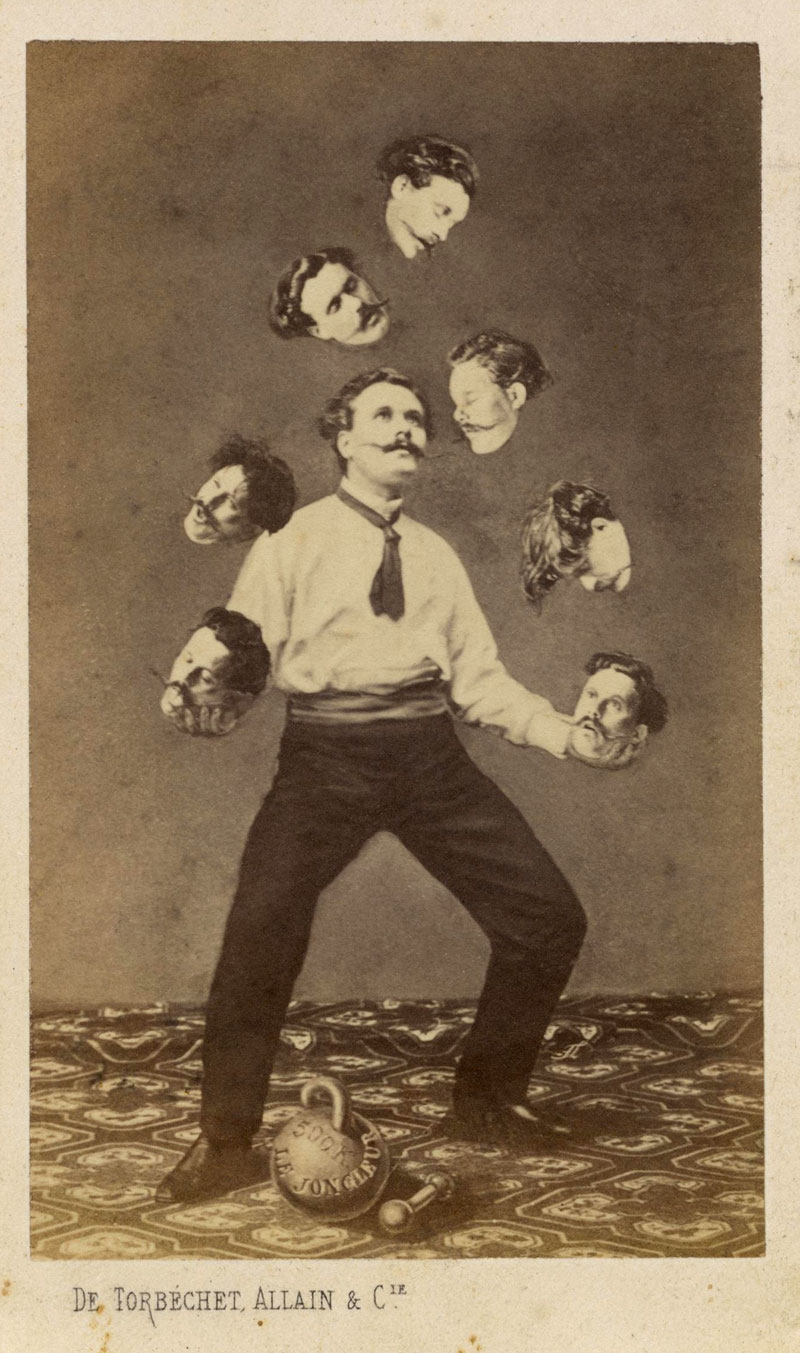
Exhibitions: ‘Howard Greenberg, Collection’ and ‘Freaks, The Monstrous Parade: Photographs from Enrico Praloran Collection’ at the Musée de l’Elysée, Lausanne

Exhibition dates: both 21st September 2012 – 6th January 2013


Dorothea Lange (American, 1895-1965) 'Migratory Cotton Picker' Eloy, Arizona 1940


Dorothea Lange (American, 1895-1965)
Migratory Cotton Picker
Eloy, Arizona, 1940
Gelatin silver print
© Library of Congress
Courtesy of Howard Greenberg Collection


This is a meta-post where I have brought together photographs from the second exhibition Freaks, The Monstrous Parade: Photographs from Enrico Praloran Collection and all the good quality images of Todd Browning’s cult film Freaks (1932) that were available online, since the museum only provided me with three media images (the first three) on a fascinating subject. By reflection, the photographs from Freaks have a strange correlation to the photographs that appear in the Howard Greenberg, Collection.

There is an interesting discussion by Amanda Ann Klein on her blog (see link below) about her students reaction to the film that she taught as part of her Trash Cinema class. She observes that, “Freaks preaches acceptance and… the belief that we are all “God’s children.” And yet, the film was intended to “out horror” Frankenstein through its fantastic display of disabled bodies…” but that her students did not see it as an exploitation film, in fact they approved of the revenge taken by the freaks on Cleopatra and Hercules at the end of the film, even though this seemed to replicate the very imagery Browning denounced earlier in the film. Klein insightfully notes that “it did prove to be an interesting example of how a film’s reception can change dramatically over time.”

The content of a work of art is never fixed by the author as the context and meaning of the work is never fixed by the viewer. As David Smail notes the truth changes according to, among other things, developments in our values and understandings. There can be many truths depending on our line-of-sight and point-of-view but a subjective non-final truth has to be actively struggled for:

“Where objective knowing is passive, subjective knowing is active – rather than giving allegiance to a set of methodological rules which are designed to deliver up truth through some kind of automatic process [in this case the image], the subjective knower takes a personal risk in entering into the meaning of the phenomena to be known … Those who have some time for the validity of subjective experience but intellectual qualms about any kind of ‘truth’ which is not ‘objective’, are apt to solve their problem by appealing to some kind of relativity. For example, it might be felt that we all have our own versions of the truth about which we must tolerantly agree to differ. While in some ways this kind of approach represents an advance on the brute domination of ‘objective truth’, it in fact undercuts and betrays the reality of the world given to our subjectivity. Subjective truth has to be actively struggled for: we need the courage to differ until we can agree. Though the truth is not just a matter of personal perspective, neither is it fixed and certain, objectively ‘out there’ and independent of human knowing. ‘The truth’ changes according to, among other things, developments and alterations in our values and understandings … the ‘non-finality’ of truth is not to be confused with a simple relativity of ‘truths’.”

Smail, David. Illusion and Reality: The Meaning of Anxiety. London: J.M. Dent & Sons, 1984, pp.152-153.

Dr Marcus Bunyan


Many thankx to the Musée de l’Elysée, Lausanne for allowing me to publish some of the photographs in the posting. Please click on the photographs for a larger version of the image.


Henri Cartier-Bresson (French, 1908-2004) 'Madrid' 1933


Henri Cartier-Bresson (French, 1908-2004)
Madrid
1933
Gelatin silver print
© Henri Cartier-Bresson/Magnum Photos
Courtesy of Fondation HCB and Howard Greenberg Collection


Henri Cartier-Bresson (French, 1908-2004) 'Children in Seville' 1933


Henri Cartier-Bresson (French, 1908-2004)
Seville
1933
Gelatin silver print
© Henri Cartier-Bresson/Magnum Photos
Courtesy of Fondation HCB and Howard Greenberg Collection


Berenice Abbott (American, 1898-1991) 'Greyhound Bus Terminal, 33rd and 34th Streets between Seventh and Eighth Avenues, Manhattan' 1936


Berenice Abbott (American, 1898-1991)
Greyhound Bus Terminal, 33rd and 34th Streets between Seventh and Eighth Avenues, Manhattan
1936
Gelatin silver print
Courtesy of Howard Greenberg Collection


Ruth Orkin (American, 1921-1985) 'American Girl in Italy' 1951


Ruth Orkin (American, 1921-1985)
American Girl in Italy
1951
Gelatin silver print
© Ruth Orkin
Courtesy of Howard Greenberg Collection


Edward Weston (American, 1886–1958) 'Nahui Olin' 1923


Edward Weston (American, 1886–1958)
Nahui Olin
1923
Platinum print
Courtesy of Howard Greenberg Collection


Edward Steichen (American born Luxembourg, 1879–1973) 'Gloria Swanson' 1924


Edward Steichen (American born Luxembourg, 1879–1973)
Gloria Swanson
1924
Gelatin silver print
Courtesy of Howard Greenberg Collection


Lewis W. Hine (American, 1874-1940) 'Powerhouse Mechanic' 1924


Lewis W. Hine (American, 1874–1940)
Powerhouse Mechanic
1924
Gelatin silver print
Courtesy of Howard Greenberg Collection


André Kertész (American born Hungary, 1894-1985) 'Chez Mondrian' 1926


André Kertész (American born in Hungary, 1894-1985)
Chez Mondrian
1926
Gelatin silver print on carte postale
The Howard Greenberg Collection


Manuel Álvarez Bravo (Mexican, 1902-2002) 'The Daughter of the Dancers' (La hija de los danzantes) 1933


Manuel Alvarez Bravo (Mexican, 1902–2002)
The Daughter of the Dancers
1933
Gelatin silver print
Courtesy of Howard Greenberg Collection


Walker Evans (American, 1903-1975) 'Negro Church, South Carolina' 1936


Walker Evans (American, 1903-1975)
Negro Church, South Carolina
1936
Gelatin silver print
© Library of Congress
Courtesy of Howard Greenberg Collection


Dorothea Lange (American, 1895-1965) 'Migrant Mother, Nipomo, California' 1936


Dorothea Lange (American, 1895-1965)
Migrant Mother, Nipomo, California
1936
Gelatin silver print
© Library of Congress
Courtesy of Howard Greenberg Collection


Consuelo Kanaga (American, 1894-1978) 'Young Girl in Profile' 1948


Consuelo Kanaga (American, 1894-1978)
Young Girl in Profile
1948
Gelatin silver print
Courtesy of Howard Greenberg Collection


Leon Levinstein (American, 1910-1988) 'Fifth Avenue' c. 1959


Leon Levinstein (American, 1910-1988)
Fifth Avenue
c. 1959
© Howard Greenberg Gallery
Courtesy of Howard Greenberg Collection


The Musée de l’Elysée presents different approaches to collecting photography by means of these original exhibitions.

Howard Greenberg, Collection

Howard Greenberg has been a gallery owner for over thirty years and is considered today one of the pillars of the New York photography scene. While his position as a dealer is well established, little was known of his passion for collecting, presently revealed to the public for the first time. The primary reason to explain why it took so long to discover this collection is because building such a collection demands time. Only in time can the maturity of a collection be measured; the time necessary to smooth trends, confirm the rarity of a print, and in the end, validate the pertinence of a vision. In an era of immediacy, when new collectors exhibit unachieved projects or create their own foundation, great original collections are rare. Howard Greenberg’s is certainly one of the few still to be discovered.

The quality of a collection does not rely on the sole accumulation of master pieces but can best be assessed through a dialectical movement: a collection is the collector’s oeuvre, a set of images operating a transformation in the perception not only of the photographs, but also of photography. This renewed perception is two-fold in the Greenberg collection; through the surprising combination of two approaches, the experimental practice of photography that questions the medium as such, bringing it to the limits of abstraction on one hand, and on the other, a documentary practice, carried out through its recording function of the real. This apparently irreconcilable duality takes on a particular signification in the Greenberg collection, an investigation of the possibilities offered by photography, a quest for photography itself, questioning what it is.

Howard Greenberg and his collection have largely contributed to the writing of a chapter of history. While contributing to the recognition of long neglected figures of the New York post-war photography scene, filling a gap, as gallery owner, Howard Greenberg, the collector, ensured the preservation of a coherent body by building over that period a unique collection of major photographs.

This collection of over 500 photographs was patiently built over the last thirty years and stands out for the high quality of its prints. A set of some 120 works are exhibited for the first time at the Musée de l’Elysée, revealing different aspects of Howard Greenberg’s interests, from the modernist aesthetics of the 20s and 30s, with works by Edward Steichen, Edward Weston or the Czech School, to contemporary photographers such as Minor White, Harry Callahan and Robert Frank. Humanist photography is particularly well represented, including among others, Lewis Hine and Henri Cartier-Bresson. An important section is dedicated to the Farm Security Administration’s photographers, such as Walker Evans or Dorothea Lange, witnesses to the Great Depression years of the 30s. Above all, the collection demonstrates the great influence of New York in the history of 20th century photography with the images of Berenice Abbott, Weegee, Leon Levinstein or Lee Friedlander conveying its architecture and urban lifestyle. Commending its work and prominent position, and wishing to make his private collection available to a large audience, Howard Greenberg selected the Musée de l’Elysée to host his collection.

The Musée de l’Elysée and the Fondation Henri Cartier-Bresson jointly produce this exhibition which, after Lausanne, will subsequently be presented in Paris.

Press release from the Musée de l’Elysée website


Freaks, The Monstrous Parade: Photographs from Enrico Praloran Collection

American director Tod Browning (1880-1962) has a particular attraction for the uncanny. Freaks, his cult movie shot in 1932, is inspired by a short story written by Clarence Aaron “Tod” Robbins. Set in a circus, the performers are disabled actors. The movie caused a scandal when it was released and Freaks was soon censored, reedited, shortened, sometimes removed from theatres, and in cases banned in some countries. Not until the 60s, when it was presented at the Cannes Festival, was the movie acclaimed to the point of becoming a reference for artists such as Diane Arbus or David Lynch.

The Musée de l’Elysée presents a selection of some fifty vintage black and white silver prints, gathered by Enrico Praloran, a collector based in Zurich. This unique set is the opportunity for an encounter with the movie’s strange protagonists, Johny Eck, the Half Boy, Daisy and Violet Hilton, the Siamese sisters, Martha Morris, the “Armless Marvel”, or the Bearded Lady and the Human Skeleton. They all are artists for real, coming from the Barnum Circus.

The plot is transcribed in images through stills from the movie’s major scenes, completed by set or shooting photographs, taking us behind the scenes, including on the footsteps of Tod Browning himself.

Press release from the Musée de l’Elysée website


Tod Browning (director) 'Freaks' 1932 Still photograph Courtesy of Praloran Collection, Zurich


Tod Browning (director)
Freaks (Cleopatra followed by the freaks)
1932
Still photograph
1932
Courtesy of Praloran Collection, Zurich


Tod Browning (director) 'Freaks' 1932 Still photograph Courtesy of Praloran Collection, Zurich


Tod Browning (director)
Freaks (Johnny Eck)
1932
Still photograph
Courtesy of Praloran Collection, Zurich


Tod Browning (director) 'Freaks' 1932 Still photograph Courtesy of Praloran Collection, Zurich


Tod Browning (director)
Freaks
1932
Still photograph
Courtesy of Praloran Collection, Zurich


Freaks centres on an enchanting performer, Cleopatra, who entices a “midget,” named Hans, into falling in love with her. They were called midgets then, now they are referred to as little people. The “midget” is in fact engaged to another woman who is incidentally, also a “midget,” named Freida. Cleopatra was at first only trying to fool around with Hans and get money from him occasionally. She soon realised that Hans had inherited quite a large amount of money. She devises a plan to marry Hans and later poison him to inherit the money. Arguably, the most famous scene in Freaks is Hans and Cleo’s wedding reception. The “freaks” reluctantly decide to accept her despite her “normality” and chant the notoriously disturbing yet hilarious quote, “We accept you, one of us! Gooble Gobble!” Afterwards, Hans then becomes very ill by Cleo’s hand. He soon figures out her plan and the freaks become offended. They knew she could not be one of them. The film ends with a horrific and disturbing chase in the rain where the “freaks” follow her slowly and Cleo screams for her life. Her and her lover, the “muscle man,” are caught and not killed, but worse. They become freaks themselves. They are mutilated, castrated, and deformed until they are the subject of a freak show. They became one of the “freaks” they hated so much…

One of the most gut-wrenching things about this films is the fact that every “freak” in the film was a real person with the same deformity their characters had. This gives the story a profound sense of reality, making the betrayal of Hans by Cleo all the more tragic. The film was extremely controversial when released and hated by audiences. The scenes where Cleo and the muscle man were mutilated had to be cut from the film in order to be shown in theatres. That footage has since been lost. In a viewing of the film, a sudden jump takes place after the freaks catch Cleo. The audience feels cheated. We have waited so long to see Cleo get her punishment. Part of that dissatisfaction adds to the mystique of this bizarre trip. The film was forgotten about until the mid 1970s where it was rediscovered as a counterculture cult film. A counterculture film runs counter to the the norm of society. Freaks is a great example of fame by taboos and controversy. It explores themes of humanity that are still relatively unexplored today.

Text from the Cult Films and Cultural Significance website December 6, 2011 [Online] Cited 14/09/2020


Freaks is a tale of love and vengeance in a traveling circus…

In her essay “Intolerable Ambiguity: Freaks as/at the Limit,” Elizabeth Grosz attempts to unpack our fascination with freak shows. She concludes that the individuals most frequently showcased in these spectacles, including Siamese twins, hermaphrodites, “pinheads” (microcephalics), midgets, and bearded ladies “imperil the very definitions we rely on to classify humans, identities and sexes – our most fundamental categories of self-definition and boundaries dividing self from otherness” (57). In other words, while we comfort ourselves by breaking down the world into neat binary oppositions, such as Male/Female, Self/Other, Human/Animal, Child/Adult, “freaks” blur the boundaries between these reassuring oppositions. She concludes, “The freak confirms the viewer as bounded, belonging to a ‘proper’ social category. The viewer’s horror lies in the recognition that this monstrous being is at the heart of his or her identity, for it is all that must be ejected or abjected from self-image to make the bounded, category-obeying self possible” (65). We need the freak to confirm our own static, bounded identities. And yet, I think there is a certain terror that we may not be as bounded as we think. If the hermaphrodite can transcend traditional gender categories, then perhaps our own genders are more fluid. For many that is a truly horrifying thought.

For example, in one of the film’s earliest scenes we witness the “pinheads” Schlitze, Elvira and Jenny Lee dancing and playing in the forest. From a distance they look like innocent, happy children. But as the camera approaches, it is clear that they are neither children, nor are they quite adults either. Thus it is the ambiguity here, rather than the disability itself, which is momentarily disturbing…

Grosz also mentions that “Any discussion of freaks brings back into focus a topic that has had a largely underground existence in contemporary cultural and intellectual life, partly because it is considered below the refined sensibilities of ‘good taste’ and ‘personal politeness’ in a civilised and politically correct milieu” (55).

Amanda Ann Klein. “Teaching Todd Browning’s FREAKS,” on the Judgemental Observer blog, September 13, 2009 update September 1, 2014 [Online] Cited 14/09/2020


~ Grosz, Elizabeth. “Intolerable Ambiguity: Freaks as/at the Limit,” in Rosemarie Garland Thomson (ed.). Freakery: Cultural Spectacles of the Extraordinary Body. New York: New York University Press, 1996, pp. 55-68

~ Hawkins, Joan. “‘One of Us’: Tod Browning’s Freaks,” in Rosemarie Garland Thomson (ed.). Freakery: Cultural Spectacles of the Extraordinary Body. New York: New York University Press, 1996, pp. 265-276

~ Norden, Martin F. The Cinema of Isolation: A History of Physical Disability in the Movies. New Brunswick: Rutgers University Press, 1994


Tod Browning (director) 'Freaks (Cleopatra and freaks)' 1932 (still photograph)


Tod Browning (director)
Freaks (Cleopatra and freaks)
1932
Still photograph


Tod Browning (director) 'Publicity photo for Freaks, featuring much of the cast with director, Tod Browning' 1932


Tod Browning (director)
Publicity photo for Freaks, featuring much of the cast with director, Tod Browning
1932
Still photograph


Tod Browning (director) 'Freaks (with Siamese Twins Daisy and Violet Hilton)' 1932 (still photograph)


Tod Browning (director)
Freaks (with Siamese Twins Daisy and Violet Hilton)
1932
Still photograph


Tod Browning (director) 'Freaks' 1932 (still photograph)


Tod Browning (director)
Freaks
1932
Still photograph


Tod Browning (director) 'Freaks (shooting the wedding banquet)' 1932 (still photograph)


Tod Browning (director)
Freaks (shooting the wedding banquet)
1932
Still photograph


Tod Browning (director) 'Freaks (with Cleopatra and Hans at the wedding banquet)' 1932 (still photograph)


Tod Browning (director)
Freaks (with Cleopatra and Hans at the wedding banquet)
1932
Still photograph


Tod Browning (director) 'Freaks (Olga Baclanova as Cleopatra after her transformation into chicken woman)' 1932 (still photograph)


Tod Browning (director)
Freaks (Olga Baclanova as Cleopatra after her transformation into chicken woman)
1932
Still photograph


Theatrical poster for 'Freaks' 1932


Theatrical poster for Freaks
1932


God’s Children

In this scene from Freaks (1932, Tod Browning), we meet several of the film’s characters.


The Freaks Revenge

In this scene from Freaks (1932, Tod Browning), the freaks take their revenge on Hercules and Cleopatra.


The Musée de l’Elysée 
18, avenue de l’Elysée
CH – 1014 Lausanne
Phone: + 41 21 316 99 11

Opening hours:
Wednesday – Monday 10am – 6pm
Closed Tuesdays

The Musée de l’Elysée website

LIKE ART BLART ON FACEBOOK

Back to top
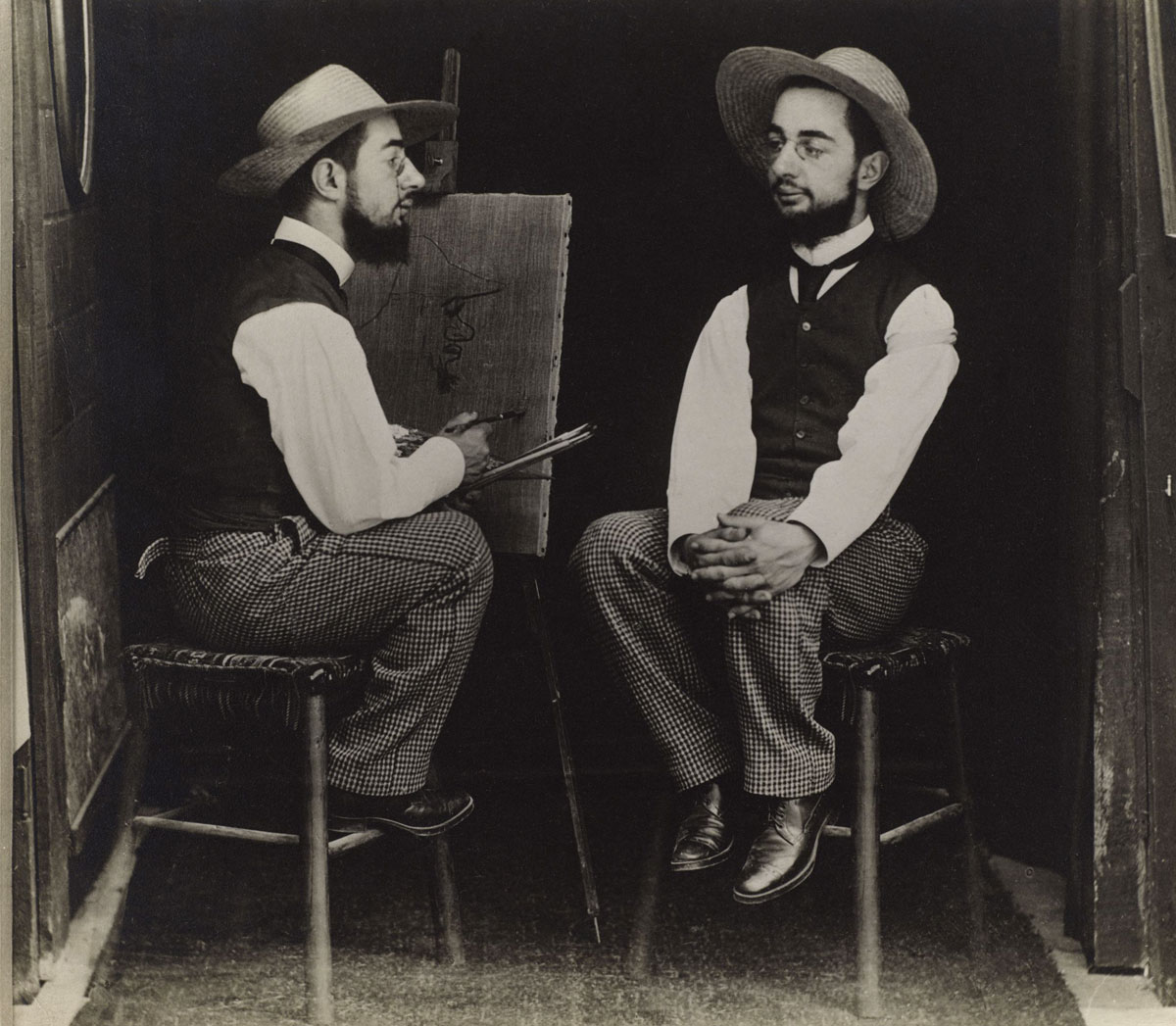
Exhibition: ‘Lewis Hine: Photography for a Change’ at the Netherlands Museum of Photography, Rotterdam

Exhibition dates: 15th September – 6th January 2013


Lewis Hine
 (American, 1874-1940) 'Lunch Time, New York' 1910


Lewis Hine
 (American, 1874-1940)
Lunch Time, New York
1910
Gelatin silver print
© George Eastman House


“In the last analysis, good photography is a question of art.”

“I wanted to show the thing that had to be corrected: I wanted to show the things that had to be appreciated.”


Lewis Wickes Hines


Something that you really don’t get in reproductions is the absolutely beautiful tonality of Hine’s social documentary photography. Even less so when the images provided by the institution are degraded by scratches, dust, spots and colour irregularities. Despite these media images being 300 dpi when I received them from the museum media department they were in very average condition. For example, the image of Christmas Fiddles (below) was in such poor condition when enlarged that I had to spend over half and hour cleaning up the image to make it pictorially legible to the viewer at a larger size.

This is not an unusual occurrence and, unbeknownst to the readers of the archive, I spend many hours quickly cleaning the digital files before they are presented to you. Some individual images and sets of images are of such poor quality that I simply cannot use them at all. I will do a posting on this issue soon, but suffice to say that museums that spend thousands of hours and dollars staging impressive photographic exhibitions really let themselves down in the promotion of the exhibition if they provide dodgy scans and unusable media images to people that promote the exhibition for free. In this world of media saturated images it should be the norm that the “quality” of the image outweighs the indifferent quantity. With faster and faster download speeds larger images can be viewed more readily online and therefore scans provided by institutions must live up to this enlarged capacity.

Hopefully you can get some idea of the work of this socially conscious photographer, an American photographer who saw the camera as both a research tool and an instrument of social reform, whose images helped change the world with regard to child labour. Unfortunately success and reputation counted for nought. He died totally impoverished in 1940, shortly before a resurgence of public interest in his work raised him to the highest level of American photographers. What an infinite sadness.

Dr Marcus Bunyan


Many thankx to the Netherlands Museum of Photography for allowing me to publish the photographs in the posting. Please click on the photographs for a larger version of the image.


Installation view of the exhibition 'Lewis Hine: Photography for a Change' at the Netherlands Museum of Photography, Rotterdam 


Installation view of the exhibition Lewis Hine: Photography for a Change at the Netherlands Museum of Photography, Rotterdam


Lewis Hine
 (American, 1874-1940) 'Belgrade. Christmas Fiddles' 1918


Lewis Hine
 (American, 1874-1940)
Belgrade. Christmas Fiddles
1918
Gelatin silver print
© George Eastman House


Lewis Hine
 (American, 1874-1940) 'Belgrade. Christmas Fiddles' 1918 (detail)


Lewis Hine
 (American, 1874-1940)
Belgrade. Christmas Fiddles (detail)
1918
Gelatin silver print
© George Eastman House


Lewis Hine
 (American, 1874-1940) 'Construction workers, Empire State Building, NYC' 1930-1931


Lewis Hine
 (American, 1874-1940)
Construction workers, Empire State Building, NYC
1930-1931
Gelatin silver print
© George Eastman House


From 15 September 2012 to 6 January 2013, the Netherlands Museum of Photography will present the first large retrospective in the Netherlands of the work of the renowned American photographer Lewis Hine. Hine was an enthusiastic photographer who wished to improve people’s lives through his photos. His pictures of immigrants on Ellis Island, of child labour, and of workers busy on the Empire State Building high above New York belong to the visual icons of the 20th century. The internationally touring exhibition contains more than 200 photos and documents, many in their original state and originating from the collection of the George Eastman House in Rochester, New York State. Lewis Hine is an initiative of three European institutions: Fondation Henri Cartier-Bresson (Paris), Fundación MAPFRE (Madrid) and the Netherlands Museum of Photography (Rotterdam). It is with great pride that the Netherlands Museum of Photography can now present this exhibition that harmonises perfectly with its aim to pay attention to the canon of international documentary photography.

Lewis W. Hine (Wisconsin, 1874 – New York, 1940), a sociologist and photographer, belongs to the group of famous photographers such as Joel Meyerowitz, Robert Frank, Robert Capa, Eugène Atget to whom the Netherlands Museum of Photography has previously devoted impressive exhibitions. Hine is known as a 20th-century pioneer of social documentary photography. It is characteristic of Hine that he strongly believed in the camera’s powers of conviction. Thus, armed only with a heavy camera he fought for social justice. For the National Child Labor Committee he travelled more than 75,000 kilometres through the United States to photograph children working in agriculture, the mines, factories, sewing attics, and on the streets. His photos were partly responsible for reforms in these fields. The themes in Hine’s work – child labour, situations of human indignity, and the vulnerability of immigrants and refugees – are still current. Despite his present reputation, his early successes and the fact that many governmental organisations made use of his photos, he died totally impoverished in 1940.

Empire State Building and Building the Rotterdam

In 1932 Lewis Hine published the famous photographic book entitled Men at Work, which covered the construction of the Empire State Building. From the most audacious vantage points he took photos of the 381-metre building, showing the strength and willpower of humankind, man’s contribution to industry. The tall buildings on the Wilhelminapier have determined the skyline of Rotterdam for many years, just as the Empire State Building did in New York around 1930. The Wilhelminapier is now under full development. De Rotterdam Building, designed by Rem Koolhaas of OMA (Office for Metropolitan Architectural) will be completed in 2013-2014. The photographer Ruud Sies has followed the genesis of the largest building in the Netherlands for four years now. The project entitled Building the Rotterdam – a work in progress by Ruud Sies was inspired by the work of Lewis Hine and establishes the connection with the Wilhelminapier as a historical location. To the Netherlands Museum of Photography, this is a reason to include this project in the exhibition of the work of Lewis Hine.

Exhibition

With 170 vintage photos from the period 1903-1937 as well as 42 documents, this exhibition of Hine’s work is the first extensive and well-documented overview in the Netherlands and even in Europe. Hine’s entire oeuvre is on show, ranging from his earliest portraits of immigrants on Ellis Island to his work in Europe after the First World War. The Lewis Hine touring exhibition was on display in Paris toward the end of 2011, and in Madrid at the beginning of this year. For this international journey, Hine’s work has undergone preventative preservation treatment and is exposed to a minimum amount of light. After the exhibition in the Netherlands, the work will return to the George Eastman House in America to relax in a dark depot.”

Press release from the Netherlands Museum of Photography website


Lewis Hine
 (American, 1874-1940) 'Coal mine worker in West Virginia. Eleven year old boy. Tipple boy at the Turkey Knob coal mine in Macdonald, West Virginia' 1908


Lewis Hine
 (American, 1874-1940)
Coal mine worker in West Virginia. Eleven year old boy
Tipple boy at the Turkey Knob coal mine in Macdonald, West Virginia
1908
Gelatin silver print
© George Eastman House


Lewis Hine
 (American, 1874-1940) 'Little Mother, Pittsburgh District' 1909


Lewis Hine
 (American, 1874-1940)
Little Mother, Pittsburgh District
1909
Gelatin silver print
© George Eastman House


Anonymous photographer (American) 'Lewis Hine photographing children in a slum' 1910


Anonymous photographer (American)
Lewis Hine photographing children in a slum
1910
© George Eastman House


Lewis Hine
 (American, 1874-1940) 'Waiting for the dispensary to open Hull House District, Chicago' 1910


Lewis Hine
 (American, 1874-1940)
Waiting for the dispensary to open Hull House District, Chicago
1910
Gelatin silver print
© George Eastman House


Lewis Hine was born in Oshkosh, Wisconsin, in 1874. He moved to New York City in 1901 to teach at the Ethical Culture School. There Hine used photographs as educational tools, and soon began to photograph immigrants at Ellis Island. He hoped his photographs would encourage people to “exert the force to right wrongs.” While continuing to teach at ECS, Hine began to do freelance work for the National Child Labor Committee, an association that transformed his professional life.

In 1908, the NCLC provided Hine a monthly salary to photographically document children in factories, mills, canneries, textile mills, street trades, and agricultural industries. Through his photographs he sought to alert the public to the extent of child labor in America, and the degree to which it denied these children their childhood, health, and education. In one year, Hine covered 12,000 miles in his quest to end abusive child labor. By 1913, Hine was considered the leading social welfare photographer in America.

Hine enjoyed a long and successful career following his work for the NCLC. He worked for the American Red Cross (1917-1920), photographing refugees and civilians in war-torn Europe, a new series of photographs of immigrants at Ellis Island (1926), a series of photographs documenting the construction of the Empire State Building (1930), photographs of drought-ridden communities in Arkansas and Kentucky (1931), as well as work for the Tennessee Valley Authority.

In 1936-1937 Hine was appointed head photographer for the National Research Project of the Works Progress Administration. The ageing Hine, however, was disappointed at the rebuff of his attempts to secure work with the Farm Services Administration, where director Roy Stryker considered Hine old fashioned and difficult. Lewis Hine died in 1940, shortly before a resurgence of public interest in his work raised him to the highest level of American photographers.

Text from Child Labour in Virginia: Photographs by Lewis Hine web page [Online] Cited 21/12/2012 no longer available online


Lewis Hine
 (American, 1874-1940) 'Paris Gamin' 1918


Lewis Hine
 (American, 1874-1940)
Paris Gamin
1918
Gelatin silver print
© George Eastman House


Lewis Hine
 (American, 1874-1940) 'Mechanic at steam pump in electric power house' 1920


Lewis Hine
 (American, 1874-1940)
Mechanic at steam pump in electric power house
1920
Gelatin silver print
© George Eastman House


Lewis Hine
 (American, 1874-1940) 'Candy Worker, New York' 1925


Lewis Hine
 (American, 1874-1940)
Candy Worker, New York
1925
Gelatin silver print
© George Eastman House


Lewis Hine
 (American, 1874-1940) 'Man on hoisting ball, Empire State building' 1931


Lewis Hine
 (American, 1874-1940)
Man on hoisting ball, Empire State building
1931
Gelatin silver print
© George Eastman House


Lewis Hine
 (American, 1874-1940) 'Steelworker standing on beam' 1931


Lewis Hine
 (American, 1874-1940)
Steelworker standing on beam
1931
Gelatin silver print
© George Eastman House


Lewis Hine
 (American, 1874-1940) 'The Sky Boy' 1931


Lewis Hine
 (American, 1874-1940)
The Sky Boy
1931
Gelatin silver print
© George Eastman House


Netherlands Museum of Photography
Wilhelminakade 332
3072 AR Rotterdam
The Netherlands

Opening hours
Tuesday – Sunday 11am – 5pm
Closed Mondays

Nederlands Museum of Photography website

LIKE ART BLART ON FACEBOOK

Back to top

Exhibition: ‘Edward Weston. Leaves of Grass’ at Museum of Fine Arts, Boston

Exhibition dates: 21st April 2012 – 31st December 2012


Edward Weston (American, 1886-1958) 'Grand Canyon, Arizona' 1941


Edward Weston (American, 1886-1958)
Grand Canyon, Arizona
1941
Gelatin silver print
The Lane Collection
Courtesy, Museum of Fine Arts, Boston


“Not I, nor anyone else can travel that road for you,
You must travel it for yourself.

It is not far, It is within reach,
Perhaps you have been on it since you were born, and did not know,
Perhaps it is every where on water and land.”


Walt Whitman. Part of Song of Myself from Leaves of Grass. 1855


Very little information about this exhibition on the website which is a pity because the photographs are exceptional, even if some do recall the style of other artists of the same era (Charles Sheeler, Berenice Abbott, Ansel Adams, Clarence John Laughlin, and Walker Evans for example).

In 1941, “Weston was commissioned to take photographs for a pricey two-volume edition of “Leaves of Grass.” So over the course of nearly 10 months, Weston and his wife, Charis, drove more than 24,000 miles, through 24 states. Of the nearly 700 photographs he developed, he sent 74 to the publisher. Forty-nine appeared in the book.” (Mark Feney) “Over the course of the project Weston managed to produce some of the most compelling images of his later career that took his photography in a new and important direction. Like Whitman’s epic poems, they draw us into the history of this nation, the beauty of its landscape and the forthrightness of its ordinary citizens.” (Encore)

“Leaves of Grass has its genesis in an essay called The Poet by Ralph Waldo Emerson, published in 1845, which expressed the need for the United States to have its own new and unique poet to write about the new country’s virtues and vices. Whitman, reading the essay, consciously set out to answer Emerson’s call as he began work on the first edition of Leaves of Grass. Whitman, however, downplayed Emerson’s influence, stating, “I was simmering, simmering, simmering; Emerson brought me to a boil.”

The first edition was published in Brooklyn at the Fulton Street printing shop of two Scottish immigrants, James and Andrew Rome, whom Whitman had known since the 1840s, on July 4, 1855. Whitman paid for and did much of the typesetting for the first edition himself. Sales on the book were few but Whitman was not discouraged. The first edition was very small, collecting only twelve unnamed poems in 95 pages. Whitman once said he intended the book to be small enough to be carried in a pocket. “That would tend to induce people to take me along with them and read me in the open air: I am nearly always successful with the reader in the open air.” About 800 were printed, though only 200 were bound in its trademark green cloth cover.

The title Leaves of Grass was a pun. “Grass” was a term given by publishers to works of minor value and “leaves” is another name for the pages on which they were printed. Whitman sent a copy of the first edition of Leaves of Grass to Emerson, the man who had inspired its creation. In a letter to Whitman, Emerson said “I find it the most extraordinary piece of wit and wisdom America has yet contributed.” He went on, “I am very happy in reading it, as great power makes us happy.”” (Amazon website)

Dr Marcus Bunyan


Many thankx to the Museum of Fine Arts, Boston for allowing me to publish the photographs in the posting. Please click on the photographs for a larger version of the image.


Edward Weston (American, 1886-1958) 'Boulder Dam' 1941


Edward Weston (American, 1886-1958)
Boulder Dam
1941
Gelatin silver print
The Lane Collection
Courtesy, Museum of Fine Arts, Boston


Edward Weston (American, 1886-1958) 'The Brooklyn Bridge' 1941


Edward Weston (American, 1886-1958)
The Brooklyn Bridge
1941
The Lane Collection
Courtesy, Museum of Fine Arts, Boston


Edward Weston (American, 1886-1958) 'From 515 Madison Avenue, New York' 1941


Edward Weston (American, 1886-1958)
From 515 Madison Avenue, New York
1941
Gelatin silver print
The Lane Collection
Courtesy, Museum of Fine Arts, Boston


Edward Weston (United States, 1886-1958) 'Schooner, Kennebunkport, Maine' 1941


Edward Weston (American, 1886-1958)
Schooner, Kennebunkport, Maine
1941
Gelatin silver print
Courtesy of the Museum of Fine Arts, Boston


Edward Weston (United States, 1886-1958) 'Wedding Cake House, Kennebunkport, Maine' 1941


Edward Weston (American, 1886-1958)
Wedding Cake House, Kennebunkport, Maine
1941
Gelatin silver print
Courtesy of the Museum of Fine Arts, Boston


Edward Weston (American, 1886-1958) 'Shenandoah Valley, Virginia' 1941


Edward Weston (American, 1886-1958)

Shenandoah Valley, Virginia
1941
Gelatin silver print
The Lane Collection
Courtesy, Museum of Fine Arts, Boston


Edward Weston (American, 1886-1958) 'Mammy’s Cupboard, Natchez, Mississippi' 1941


Edward Weston (American, 1886-1958)
Mammy’s Cupboard, Natchez, Mississippi
1941
Gelatin silver print
The Lane Collection
Courtesy, Museum of Fine Arts, Boston


Edward Weston (American, 1886-1958) 'Gulf Oil, Port Arthur, Texas' 1941


Edward Weston (American, 1886-1958)
Gulf Oil, Port Arthur, Texas
1941
Gelatin silver print
The Lane Collection
Courtesy, Museum of Fine Arts, Boston


Edward Weston (American, 1886-1958) 'White Sands, New Mexico' 1941


Edward Weston (American, 1886-1958)
White Sands, New Mexico
1941
Gelatin silver print
The Lane Collection
Courtesy, Museum of Fine Arts, Boston


Edward Weston (American, 1886-1958) 'Woodlawn Plantation House, Louisiana' 1941


Edward Weston (American, 1886-1958)
Woodlawn Plantation House, Louisiana
1941
Photograph, gelatin silver print
The Lane Collection
Courtesy, Museum of Fine Arts, Boston


In 1941, the Limited Editions Club of New York invited photographer Edward Weston to illustrate its deluxe edition of Walt Whitman’s epic poem Leaves of Grass. The commission inspired Weston and his wife, Charis, to take a cross-country trip, throughout the South, the Mid-Atlantic states, New England, and back to California, in their trusty Ford, which they nicknamed “Walt.” Weston’s photographs from this project – mostly made with large, 8 x 10 camera – are exceptionally wide-ranging, with a particular focus on urban and man-altered landscapes. Although he never wanted his images to literally reflect Whitman’s text, Weston did relate to the poet’s plainspoken style and his emphasis on the broad spectrum of human experience. Weston wrote of the Whitman book: “I do believe… I can and will do the best work of my life. Of course I will never please everyone with my America – wouldn’t try to.

Text from the MFA Boston website


Edward Weston (American, 1886-1958) 'Girod Cemetery, New Orleans, Louisiana' 1941


Edward Weston (American, 1886-1958)
Girod Cemetery, New Orleans, Louisiana
1941
Gelatin silver print
The Lane Collection
Courtesy, Museum of Fine Arts, Boston


Edward Weston (American, 1886-1958) 'Meraux Plantation House, Louisiana' 1941


Edward Weston (American, 1886-1958)
Meraux Plantation House, Louisiana
1941
Gelatin silver print
The Lane Collection
Courtesy, Museum of Fine Arts, Boston


Edward Weston (American, 1886-1958) 'Belle Grove Plantation House, Louisiana' 1941


Edward Weston (American, 1886-1958)
Belle Grove Plantation House, Louisiana
1941
Gelatin silver print
The Lane Collection
Courtesy, Museum of Fine Arts, Boston


Edward Weston (American, 1886-1958) 'Bessie Jones. St. Simons Island, Georgia' 1941


Edward Weston (American, 1886-1958)
Bessie Jones. St. Simons Island, Georgia
1941
Gelatin silver print
The Lane Collection
Courtesy, Museum of Fine Arts, Boston


Edward Weston (American, 1886-1958) 'Mr. and Mrs. W. P. Fry, Burnet, Texas' 1941


Edward Weston (American, 1886-1958)
Mr. and Mrs. W. P. Fry, Burnet, Texas
1941
Gelatin silver print
The Lane Collection
Courtesy, Museum of Fine Arts, Boston


Part of Walt Whitman 'Song of Myself' from 'Leaves of Grass' 1855


Walt Whitman (American, 1819-1892)
Part of Song of Myself
from Leaves of Grass
1855


Edward Weston (American, 1886-1958) 'Mr. Brown Jones, Athens, Georgia' 1941


Edward Weston (American, 1886-1958)
Mr. Brown Jones, Athens, Georgia
1941
Gelatin silver print
The Lane Collection
Courtesy, Museum of Fine Arts, Boston


Edward Weston (American, 1886-1958) 'Charis Wilson' 1941


Edward Weston (American, 1886-1958)
Charis Wilson
1941
Photograph, gelatin silver print
The Lane Collection
Courtesy, Museum of Fine Arts, Boston


Museum of Fine Arts, Boston
Avenue of the Arts
465 Huntington Avenue
Boston, Massachusetts

Opening hours:
Wednesday – Sunday 10am – 5pm
Closed Mondays and Tuesdays

Museum of Fine Arts, Boston website

LIKE ART BLART ON FACEBOOK

Back to top

Exhibition: ‘The Serial Portrait: Photography and Identity in the Last One Hundred Years’ at the National Gallery of Art, Washington

Exhibition dates: 30th September 2012 – 31st December 2012


Emmet Gowin (American, b. 1941) 'Edith, Danville, Virginia' 1971


Figure 5. Emmet Gowin (American, b. 1941)
Edith, Danville, Virginia
1971
Gelatin silver print
20.2 x 25.2cm (7 15/16 x 9 15/16 in.)
National Gallery of Art, Washington
Patrons’ Permanent Fund
© Emmet and Edith Gowin, Courtesy Pace/MacGill Gallery, New York


~ Alfred Stieglitz / Georgia O’Keeffe
~ Paul Strand / Rebecca Strand
~ Emmet Gowin / Edith Gowin
~ Harry Callahan / Eleanor and Barbara Callahan
~ Robert Mapplethorpe / Patti Smith
~ Nicholas Nixon / The Brown Sisters
~ Andy Warhol / Serial Photography / Photo Booth Portraits
~ Mario Testino / Kate Moss
~ Baron Adolf de Meyer / Baroness Olga de Meyer
~ Edward Weston / Charis Weston
~ Lee Friedlander / Maria Friedlander
~ Paul Caponigro / The woods of Connecticut
~ Bernd and Hilla Becher / grids
~ Gerhard Richter / Overpainted Photographs
~ Masahisa Fukase / wife and family
~ Seiichi Furuya / Christine Furuya-Gößler
~ Sally Mann / children and husband
~ William Wegman / dogs


Australia?
Nobody that I can think of except Sue Ford.

Notice how all the artists are men except two: Sally Mann and Hilla Becher.

Dr Marcus Bunyan


Many thankx to the National Gallery of Art for allowing me to publish the photographs in the posting. Please click on the photographs for a larger version of the image.


Introduction

Alfred Stieglitz, one of the most influential photographers of the twentieth century, argued that “to demand the [single] portrait… be a complete portrait of any person is as futile as to demand that a motion picture be condensed into a single still.” Stieglitz’s conviction that a person’s character could not be adequately conveyed in one image is consistent with a modern understanding of identity as constantly changing. For Stieglitz, who frequently made numerous portraits of the same sitters – including
striking photographs of his wife, the painter Georgia O’Keeffe – using the camera in a serial manner allowed him to transcend the limits of a single image.

Drawn primarily from the National Gallery of Art’s collection, the
Serial Portrait exhibition features twenty artists who photographed the same subjects – primarily friends, family, or themselves – multiple times over the course of days, months, or years. This brochure presents a selection of works by seven of these artists. Like Stieglitz’s extended portrait of O’Keeffe, Emmet Gowin’s ongoing photographic study of his wife, Edith, explores her character and reveals the bonds of love and affection between the couple. Milton Rogovin’s photographs of working-class residents of Buffalo, New York, record shifts in the appearance and situation of individuals in the context of their community over several decades.

A number of photographers in the exhibition have made serial self-portraits that investigate the malleability of personal identity. Photographing themselves as shadows, blurs, or partial reflections, Lee Friedlander and Francesca Woodman have made disorienting images that hint at the instability of self-representation. Ann Hamilton has employed unusual props and materials to transform herself into a series of hybrid objects. Finally, work by Nikki S. Lee takes the idea of mutable identity to its logical conclusion as the artist photographs herself masquerading as members of different social and ethnic groups.

Text from the NGA website


Emmet Gowin (American, b. 1941) 'Edith, Danville, Virginia' 1963


Figure 4. Emmet Gowin (American, b. 1941)
Edith, Danville, Virginia
1963
Gelatin silver print, printed 1980s
19.7 x 12.7cm (7 3/4 x 5 in.)
National Gallery of Art, Washington
Charina Endowment Fund
© Emmet and Edith Gowin, Courtesy Pace/MacGill Gallery, New York


Emmet Gowin

Emmet Gowin (born 1941) met Edith Morris in 1961 in their hometown of Danville, Virginia, just as he had decided to abandon business school to study art. Several years later at the Rhode Island School of Design, his teacher Harry Callahan, who made numerous photographs of his wife, Eleanor, encouraged Gowin to photograph the subject he knew most intimately – his family and in particular Edith, whom he married in 1964.

The Gowins’ artistic and marital collaboration has endured for half a century, yielding an extraordinary series of quiet, attentive portraits. In some photographs, such as Edith, Danville, Virginia, 1963 (fig. 4, above), Edith appears contemplative, even reserved. The somber beauty of this work stems in part from Gowin’s use of a tripod-mounted, large-format camera, which requires a lengthy exposure but produces photographs with exquisite details, such as the delicate shadow of a twig that falls across Edith’s face. To make the dramatic circular shadow that surrounds her in Edith, Danville, Virginia, 1971 (fig. 5, above), Gowin attached a lens meant for a 4 × 5 camera to a large 8 × 10 camera. This focus draws our attention to her figure, but the screen door simultaneously frames and obscures her form, resulting in a play between presence and elusiveness. While Gowin’s photographs are born of a deep intimacy, they refuse to lay bare his wife’s soul or expose the couple’s private passions.

The same delicate balance between revelation and reserve marks a group of portraits made during the couple’s travels in Central and South America. Edith and Moth Flight, 2002 (fig. 6, below), made at night using a ten-second exposure, combines Gowin’s enchantment with natural beauty and his interest in the nuances of his wife’s gestures and moods. Placing a pulsing ultraviolet light behind Edith’s head, Gowin recorded the luminous traces left by moths as they danced around her blurred face, transforming her into a ghostly and even otherworldly presence, visible yet just out of our reach.

Text from the NGA website


Emmet Gowin (American, b. 1941) 'Edith and Moth Flight' 2002


Figure 6. Emmet Gowin (American, b. 1941)
Edith and Moth Flight
2002
Digital ink jet print
19 x 19cm (7 1/2 x 7 1/2 in.)
National Gallery of Art, Washington
Charina Endowment Fund
© Emmet and Edith Gowin, Courtesy Pace/MacGill Gallery, New York


Francesca Woodman (American, 1958-1981) 'House #3, Providence, Rhode Island' 1976


Francesca Woodman (American, 1958-1981)
House #3, Providence, Rhode Island
1976
Gelatin silver print
16.1 x 16.3cm (6 5/16 x 6 7/16 in.)
National Gallery of Art, Washington
Gift of the Heather and Tony Podesta Collection


Francesca Woodman

Francesca Woodman (1958-1981) began making photographs at age thirteen, and by the time she entered the Rhode Island School of Design in 1975, she was already a skilled photographer. Using herself as the subject of nearly all her work, Woodman put her body in the service of exploring such themes as feminine identity, sexuality, mythology, and the relationship of the body to its surroundings. Conjuring visions of a complex inner world, Woodman’s photographs are powerful for their ability to suggest psychic turmoil within images of serene, ethereal beauty.

Woodman’s interest in the emotional affect of space can be seen in House #3, Providence, Rhode Island, 1976 (fig. 14, above). Using an abandoned house as a makeshift studio, Woodman often photographed herself merging with her surroundings, including doors, walls, and windows, dissolving physical or psychic boundaries. She also frequently moved during long exposures or allowed the camera to record only part of her body in order to obscure her figure. By invoking a ghostly presence, Woodman’s photographs often present her as someone who refuses to commit to a solid image of herself.

Woodman’s lush and intimate photographs thus offer a tantalising glimpse of a mysterious, private world. Yet they are more than romantic expressions of a young woman’s subjective experience. Notes in Woodman’s diary suggest, for instance, that Untitled, Providence, Rhode Island, 1975-1978 (fig. 15, below), alludes to the Greek mythological story of Leda, who was seduced by the god Zeus in the form of a swan.

Toward the end of her brief but prolific career (Woodman committed suicide when she was twenty-two) the artist began working on a much larger scale, using her body more as a structural element. Caryatid, New York, 1980 (fig. 16, below), made as part of a monumental photo-installation called Temple Project, draws both its title and inspiration from the columns carved in the shape of women that were used in ancient Greek and Roman architecture. Although Woodman displays her figure in a more expansive and direct manner than in her earlier work, the gesture that obscures her face and leaves her partial and unknowable is typical for the artist, who always preferred suggestion over declaration.

Text from the NGA website


Francesca Woodman (American, 1958-1981) 'Untitled, Providence, Rhode Island' 1975-1978


Francesca Woodman (American, 1958-1981)
Untitled, Providence, Rhode Island
1975-1978
Gelatin silver print
10.5 x 10.5cm (4 1/8 x 4 1/8 in.)
National Gallery of Art, Washington
Gift of the Collectors
Committee and R. K. Mellon Family Foundation


Francesca Woodman (American, 1958-1981) 'Caryatid, New York' 1980


Francesca Woodman (American, 1958-1981)
Caryatid, New York
1980
National Gallery of Art, Washington
William and Sarah Walton Fund and Gift of the Collectors Committee


Ann Hamilton (American, b. 1956) 'body object series #13, toothpick suit/chair' 1984


Figure 17. Ann Hamilton (American, b. 1956)
body object series #13, toothpick suit/chair
1984
Gelatin silver print, printed 1993
11 x 11cm (4 5/16 x 4 5/16 in.)
National Gallery of Art, Washington
Gift of Heather and Tony Podesta Collection


Ann Hamilton

An artist known for multimedia environments, performances, and videos, Ann Hamilton (born 1956) made the first photographs in the body object series in 1984 with objects left over from an installation she had presented as an MFA student at Yale. Later images from the series were based on subsequent performances and installations, documenting both the objects used and the actions performed with them. Hamilton appears in each photograph with objects attached to or touching her body, her face only rarely visible. The results are striking, unsettling, and often witty.

Despite emerging from Hamilton’s installation and performance practice, the photographs in the series stand on their own as works of art. Paying close attention to the material qualities of familiar objects, Hamilton models creative new uses for them, changing their function and meaning. In body object series #13, toothpick suit/chair, 1984 (fig. 17, above), for example, thousands of toothpicks transform Hamilton’s clothes into a porcupine-like hide while a chair becomes a burdensome instrument of torture. The image elicits visceral emotions – alienation, hostility, fear – though it does so with a dose of absurdist humour.

As self-representations, the photographs in the body object series depart radically from any traditional notion of portraiture. Instead of insisting on Hamilton’s uniqueness as an individual, these images present her body almost as an object on a par with other objects. Some of the photographs are linked directly to her biography: Hamilton had studied textile design before getting her MFA, and the toothpick suit refers to her love of fabrics. In other photographs she makes abstract concepts more graspable through the senses. Sound is given tactile and visual form as tissue paper in body object series #14, megaphone, 1986 (fig. 18, below), while in body object series #15, honey hat, 1989 (fig. 19, below), Hamilton wrings her hands in honey to suggest the idea of washing one’s hands of guilt. Based on an installation in which the artist embedded money – 750,000 pennies – in a layer of honey, this image also gives new meaning to the phrase “sticky fingers” and highlights the connections between language, images, and objects that Hamilton explores in both her photographs and installations.

Text from the NGA website


Ann Hamilton (American, b. 1956) 'body object series #14, megaphone' 1986


Figure 18. Ann Hamilton (American, b. 1956)
body object series #14, megaphone
1986
Gelatin silver print, printed 1993
11 x 11cm (4 5/16 x 4 5/16 in.)
National Gallery of Art, Washington
Gift of Heather and Tony Podesta Collection


Ann Hamilton (American, b. 1956) 'body object series #15, honey hat' 1989


Figure 19. Ann Hamilton (American, b. 1956)
body object series #15, honey hat
1989
Gelatin silver print, printed 1993
11 x 11cm (4 5/16 x 4 5/16 in.)
National Gallery of Art, Washington
Gift of Heather and Tony Podesta Collection


The National Gallery of Art explores how the practice of making multiple portraits of the same subjects produced some of the most revealing and provocative photographs of our time in The Serial Portrait: Photography and Identity in the Last One Hundred Years, on view in the West Building’s Ground Floor photography galleries from September 30 through December 31, 2012. Arranged both chronologically and thematically, the exhibition features 153 works by 20 artists who photographed the same subjects – friends, family, and themselves – numerous times over days, months, or years to create compelling portrait studies that investigate the many facets of personal and social identity.

“The Gallery’s photography collection essentially began with the donation of Alfred Stieglitz’s ‘key set,’ so it is fitting that this exhibition opens with portraits by Stieglitz, who understood that a person’s character was best captured through a series of photographs taken over time,” said Earl A. Powell III, director, National Gallery of Art. “Although the exhibition is drawn largely from the Gallery’s significant collection of photographs, we are grateful to the lenders who have allowed us to present more fully the serial form of portraiture that Stieglitz championed.”

Since the introduction of photography in 1839, portraiture has been one of the most widely practiced forms of the medium. Starting in the early 20th century, however, some photographers began to question whether one image alone could adequately capture the complexity of an individual. As Alfred Stieglitz, the era’s leading champion of American fine art photography, argued: “to demand the [single] portrait that will be a complete portrait of any person is as futile as to demand that a motion picture will be condensed into a single still.”

Along with Stieglitz, some of the 20th century’s most prominent photographers – Paul Strand, Harry Callahan, and Emmet Gowin – used the camera serially to transcend the limits of a single image. Each of these photographers made numerous studies of their lovers that sought to redefine the expressive possibilities of portraiture while probing the affective bonds of love and desire. By employing the camera’s capacity to record fluctuating states of being and mark the passage of time, other photographers such as Nicholas Nixon and Milton Rogovin have documented individuals – in families or communities – over four decades. Capturing subtle and dramatic shifts in appearance, demeanour, and situation, these series are poignant and elegiac memorials that remind us of our own mortality.

Other photographers have made serial self-portraits that explore the malleability of personal identity and the possibility of reinvention afforded by the camera. By photographing themselves as shadows, blurs, or partial reflections, Ilse Bing, Lee Friedlander, and Francesca Woodman have created inventive but elusive images that hint at the instability of self-representation. Conceptual artists of the 1970s and 1980s such as Vito Acconci, Blythe Bohnen, and Ann Hamilton have explicitly combined performance and self-portraiture to stage continual self-transformations. The exhibition concludes with work from the last 15 years by artists such as Nikki S. Lee and Gillian Wearing, who take the performance of self to its limits by adopting masquerades to delve into the ways identity is inferred from external appearance.

Press release from the National Gallery of Art website


Lee Friedlander (American, b. 1934) 'Westport, Connecticut' 1968


Figure 11. Lee Friedlander (American, b. 1934)
Westport, Connecticut
1968
Gelatin silver print
19.8 x 12.3cm (7 13/16 x 4 13/16 in.)
National Gallery of Art, Washington, Trellis Fund
© Lee Friedlander, courtesy Fraenkel Gallery


Lee Friedlander

In the 1960s Lee Friedlander (born 1934) sought, by his own account, to create images of “the American social landscape and its conditions.” Other photographers in his New York circle, including Diane Arbus and Garry Winogrand, also explored the chaotic beauty and contradictions of modern life. Friedlander, however, was the only member of this group to turn repeatedly to self-portraiture in order to understand the world around him. He stalked city streets with camera in hand, recording not only the haphazard incidents of daily life but also his own presence, often as a shadow or a reflection.

In the shop window of Westport, Connecticut, 1968 (fig. 11, above), for example, a reflection of Friedlander’s legs appears to merge with the shapely limbs of a woman in a bathing suit who points a camera at the viewer. The woman is an illusion, a cutout advertisement – but she is also a stand-in for the camera-wielding Friedlander, whose torso and head also appear faintly, as a shadow cast against her legs.

By letting the reflection in a window obscure what is inside, or allowing his shadow to intrude into the frame, Friedlander violates many of the rules of “good” photography. Works such as New York City, 1966 (fig. 12, below) testify to Friedlander’s ability to transform such “mistakes” into witty, ironic juxtapositions. In this case, the startling intrusion of Friedlander’s shadow onto the back of a fellow pedestrian is visually confusing, simultaneously threatening and humorous, as Friedlander’s spiky hair merges with the woman’s fur collar. A sly commentary on the predatory nature of such street photography, the looming shadow that engulfs the subject is also an effect of Friedlander’s equipment, a 35mm Leica with a wide-angle lens. In order to fill the picture frame with his chosen subject, Friedlander had to make the picture at close range, resulting in the inclusion of his own shadow.

Even in self-portraits in which Friedlander makes himself fully visible to the camera, the artist often makes humorously self-deprecating deadpan images, appearing, for example, as a disheveled driver on a manic mission in Haverstraw, New York, 1966 (fig. 13, below). Edgy but unpretentious, brimming with pictorial detail, Friedlander’s self-portraits are visual puzzles that explore the place of the self in the chaos of contemporary urban life.

Text from the NGA website


Lee Friedlander (American, b. 1934) 'New York City' 1966


Figure 12. Lee Friedlander (American, b. 1934)
New York City
1966
Gelatin silver print
21.7 x 32.7cm (8 9/16 x 12 7/8 in.)
National Gallery of Art, Washington
Trellis Fund
© Lee Friedlander, courtesy Fraenkel Gallery


Lee Friedlander (American, b. 1934) 'Haverstraw, New York' 1966


Figure 13. Lee Friedlander (American, b. 1934)
Haverstraw, New York
1966
Gelatin silver print
21.7 x 32.7cm (8 9/16 x 12 7/8 in.)
National Gallery of Art, Washington
Trellis Fund
© Lee Friedlander, courtesy Fraenkel Gallery


Ilse Bing (German, 1899-1998) 'Self-Portrait with Leica' 1931


Ilse Bing (German, 1899-1998)
Self-Portrait with Leica
1931
Gelatin silver print, printed c. 1988
26.7 x 29.7cm (10 1/2 x 11 11/16 in.)
National Gallery of Art, Washington
Gift of Ilse Bing Wolff


Gillian Wearing (English, b. 1963) 'Me as Mapplethorpe' 2009


Gillian Wearing (English, b. 1963)
Me as Mapplethorpe
2009
Gelatin silver print (based upon Robert Mapplethorpe work: Self Portrait, 1988. © Robert Mapplethorpe Foundation)
149.86 x 121.92cm (59 x 48 in.)
Private Collection
Courtesy the artist; Tanya Bonakdar Gallery, New York; Maureen Paley, London, Regen Projects, Los Angeles


Paul Strand (American, 1890-1976) 'Rebecca' 1922


Paul Strand (American, 1890-1976)
Rebecca
1922
Platinum print
24.4 x 19.4cm (9 5/8 x 7 5/8 in.)
National Gallery of Art, Washington
Southwestern Bell Corporation Paul Strand Collection
© Aperture Foundation Inc., Paul Strand Archive


Paul Strand (American, 1890-1976) 'Rebecca, New Mexico' 1932


Paul Strand (American, 1890-1976)
Rebecca, New Mexico
1932
Platinum print
14.9 x 11.8cm (5 7/8 x 4 5/8 in.)
National Gallery of Art, Washington
Southwestern Bell Corporation Paul Strand Collection
© Aperture Foundation Inc., Paul Strand Archive


Alfred Stieglitz (American, 1864-1946) 'Georgia O'Keeffe' probably 1918


Figure 1. Alfred Stieglitz (American, 1864-1946)
Georgia O’Keeffe
probably 1918
Platinum print
18.4 x 23.1cm (7 1/4 x 9 1/8 in.)
National Gallery of Art, Washington
Alfred Stieglitz Collection


Alfred Stieglitz

Alfred Stieglitz (1864-1946) was already an accomplished photographer, publisher, and champion of modern art when he the first encountered the work of Georgia O’Keeffe in 1916. He made his first photographs of her in 1917 and sent them to her with the note, “I think I could do thousands
of things of you – a life work to express you.” Over the next two decades Stieglitz made more than three hundred photographs of O’Keeffe, whom he married in 1924, creating what he called a “composite portrait.” This extraordinary body of work charts the couple’s relationship and
expresses Stieglitz’s conviction that portraiture should function as a kind of “photographic diary.”

Many of the photographs Stieglitz made of O’Keeffe in the early years of their relationship, including Georgia O’Keeffe, c. 1918 (fig. 1, above), are palpably erotic, reflecting the intense passion they shared. Revealing herself to the lens with a bewitching vulnerability, O’Keeffe exudes a tenderness and seductiveness that belie the strain of holding the pose during the long exposures required by Stieglitz’s large-format camera. Often, his photographs express both his desire and admiration for O’Keeffe, at times verging on idealisation of the person he called “Nature’s child – a Woman.” Yet his portraits also look beyond her face to find eloquence in all
parts of her body, as in the print Georgia O’Keeffe – Hands and Thimble (fig. 2, below), where her hands display an almost tactile physicality. Here, Stieglitz used a printing technique that resulted in tonal reversal, causing deep shadows to print as bronze tones and creating the dark outlines that dramatise O’Keeffe’s graceful fingers and emphasise the metallic gleam of the thimble.

After Stieglitz exhibited more than forty portraits of O’Keeffe, including some provocative nudes, in 1921, the painter was dismayed to find that her own art began to be interpreted in a sexualised way, and she rarely posed unclothed after 1923. O’Keeffe’s desire to control her image, along with the increasingly attenuated nature of their relationship after 1929, when
she began spending several months a year working in New Mexico while he stayed in New York, further strained their partnership. In Georgia O’Keeffe, 1930 (fig. 3, below), the artist stands before one of the paintings she had made in New Mexico. Gazing steadily at the camera, she appears as a monumental force at one with her art, confident yet untouchable.

Text from the NGA website


Alfred Stieglitz (American, 1864-1946) 'Georgia O'Keeffe - Hands and Thimble' 1919


Figure 2. Alfred Stieglitz (American, 1864-1946)
Georgia O’Keeffe – Hands and Thimble
1919
Palladium print
24 x 19.4cm (9 7/16 x 7 5/8 in.)
National Gallery of Art, Washington
Alfred Stieglitz Collection


Alfred Stieglitz (American, 1864-1946) 'Georgia O'Keeffe' 1930


Figure 3. Alfred Stieglitz (American, 1864-1946)
Georgia O’Keeffe
1930
Gelatin silver print
23.9 x 19.1cm (9 7/16 x 7 1/2 in.)
National Gallery of Art, Washington
Alfred Stieglitz Collection


Nicholas Nixon (American, b. 1947) 'The Brown Sisters' 1975


Nicholas Nixon (American, b. 1947)
The Brown Sisters
1975
Gelatin silver print
20.2 x 25.2cm (7 15/16 x 9 15/16 in.)
National Gallery of Art, Washington
Patrons’ Permanent Fund
© Nicholas Nixon, courtesy Fraenkel Gallery, San Francisco and Pace/MacGill Gallery, New York


Nicholas Nixon (American, b. 1947) 'The Brown Sisters' 1978


Nicholas Nixon (American, b. 1947)
The Brown Sisters
1978
Gelatin silver print
Promised gift of James and Margie Krebs
© Nicholas Nixon, courtesy Museum of Fine Arts, Boston


For more images from this series please see my posting Nicholas Nixon: Family Album


Milton Rogovin (American, 1909-2011) 'Samuel P. "Pee Wee" West (Lower West Side series)' 1974


Figure 7. Milton Rogovin (American, 1909-2011)
Samuel P. “Pee Wee” West (Lower West Side series)
1974
Gelatin silver print
National Gallery of Art, Washington
Gift of Dr. J. Patrick and Patricia A. Kennedy


Milton Rogovin

Milton Rogovin (1909-2011) belongs to a rich photographic tradition of documenting the social and personal histories of people who would otherwise be forgotten. He did so serially, returning over many years to encapsulate not just single moments but entire lifetimes. Rogovin started his career as an optometrist in Buffalo, New York. In 1957, after he refused to testify before the House Committee on Un-American Activities about his association with the Communist Party, the local paper labeled him the “Top Red in Buffalo.” His optometry practice folded as a result, leaving his family of five to survive on the salary of his wife, Anne. With free time suddenly available, Rogovin turned to photography with a strong sense of purpose. “My voice was essentially silenced,” he recalled, “so I decided to speak out through photographs.”

Rogovin’s candid, powerfully direct pictures gave voice to those who traditionally had none: immigrants, minorities, and working-class people. Even though he traveled around the world making photographs of workers, his best-known work was made closer to home. In 1972 he began photographing residents of Buffalo’s Lower West Side, the city’s poorest
and most ethnically diverse neighbourhood. With his bulky twin-lens Rolleiflex camera, the photographer was sometimes suspected of working for the police or the FBI. Over time, however, Rogovin gained the trust of his sitters by visiting regularly and by giving them prints of their portraits. Dignified and occasionally tender, these photographs depict the circumstances of each subject with sober honesty.

Several times over the next three decades, Rogovin sought out and re-photographed many of his original subjects, capturing the changes wrought by time and circumstance. The series Samuel P. “Pee Wee” West (figs. 7-10) registers changes in the sitter’s situation over the course of twenty-eight years, from 1974 to 2002. In 2003 the oral historian Dave Isay, working
alongside Rogovin, interviewed West, who related the story of his decades of heavy drinking. Reflecting on a photograph Rogovin had made of him in 1985 (fig. 8), West said, “That… picture actually changed my life”; it prompted him to stop drinking for six months before relapsing. A later brush with death led to permanent recovery and the founding of a program to help local youth reject drugs and alcohol. In this and other serial portraits, Rogovin honoured the everyday lives of his subjects, offering a powerful visual legacy of a community he respected and loved.

Text from the NGA website


Milton Rogovin (American, 1909-2011) 'Samuel P. "Pee Wee" West (Lower West Side series)' 1985


Figure 8. Milton Rogovin (American, 1909-2011)
Samuel P. “Pee Wee” West (Lower West Side series)
1985
Gelatin silver print
National Gallery of Art, Washington
Gft of Dr. J. Patrick and Patricia A. Kennedy


Milton Rogovin (American, 1909-2011) 'Samuel P. "Pee Wee" West (Lower West Side series)' 1992


Figure 9. Milton Rogovin (American, 1909-2011)
Samuel P. “Pee Wee” West (Lower West Side series)
1992
Gelatin silver print
National Gallery of Art, Washington
Gft of Dr. J. Patrick and Patricia A. Kennedy


Milton Rogovin (American, 1909-2011) 'Samuel P. "Pee Wee" West (Lower West Side series)' 2002


Figure 10. Milton Rogovin (American, 1909-2011)
Samuel P. “Pee Wee” West (Lower West Side series)
2002
Gelatin silver print
National Gallery of Art, Washington
Gift of Dr. J. Patrick and Patricia A. Kennedy


National Gallery of Art
National Mall between 3rd and 7th Streets
Constitution Avenue NW, Washington

Opening hours:
Daily 11.00am – 4.00pm

National Gallery of Art website

LIKE ART BLART ON FACEBOOK

Back to top
Exhibition: ‘WAR/PHOTOGRAPHY: Images of Armed Conflict and Its Aftermath’ at the Museum of Fine Arts, Houston Part 2

Exhibition dates: 11th November 2012 – 3rd February 2013


This is the biggest posting on one exhibition that I have ever undertaken on Art Blart!

As befits the gravity of the subject matter this posting is so humongous that I have had to split it into 4 separate postings. This is how to research and stage a contemporary photography exhibition that fully explores its theme. The curators reviewed more than one million photographs in 17 countries, locating pictures in archives, military libraries, museums, private collections, historical societies and news agencies; in the personal files of photographers and service personnel; and at two annual photojournalism festivals producing an exhibition that features 26 sections (an inspired and thoughtful selection) that includes nearly 500 objects that illuminate all aspects of WAR/PHOTOGRAPHY.

I have spent hours researching and finding photographs on the Internet to support the posting. It has been a great learning experience and my admiration for photographers of all types has increased. I have discovered the photographs and stories of new image makers that I did not know and some hidden treasures along the way. I hope you enjoy this monster posting on a subject matter that should be consigned to the history books of human evolution.

**Please be aware that there are graphic photographs in all of these postings.** Part 1Part 3Part 4

Dr Marcus Bunyan


Many thankx to the Museum of Fine Arts, Houston for allowing me to publish some of the photographs in the posting. Please click on the photographs for a larger version of the image.


Photographic Essays

14. Photographic Essays showcases selections from two distinct storylines: Larry Burrows’ Yankee Papa 13, published in Life magazine; and Pulitzer Prize winner Todd Heisler’s series Final Salute, for Denver’s Rocky Mountain News. Burrows follows a man through a rescue attempt in Vietnam; Heisler documents a Marine major assigned to casualty notifications. (12 images, 6 from each photographer, as well as the magazine and newspaper in which the series were published)


Larry Burrows (American, 1926-1971) 'The view from inside Marine helicopter Yankee Papa 13, Vietnam, March 1965' 1965


The view from inside Marine helicopter Yankee Papa 13, Vietnam, March 1965


Larry Burrows (English, 1926-1971) 'The caption that accompanied this photograph in the April 16, 1965, issue of LIFE: "From the downed YP3 in the background, the wounded gunner, Sergeant Owens, races to Yankee Papa 13, where Farley waits in the doorway."' 1965


The caption that accompanied this photograph in the April 16, 1965, issue of LIFE: “From the downed YP3 in the background, the wounded gunner, Sergeant Owens, races to Yankee Papa 13, where Farley waits in the doorway.”


Larry Burrows (English, 1926-1971) 'One Ride with Yankee Papa 13' 1965 The caption that accompanied this photograph in LIFE: "Farley, unable to leave his gun position until YP13 is out of enemy range, stares in shock at YP3's co-pilot, Lieutenant Magel, on the floor."


The caption that accompanied this photograph in LIFE: “Farley, unable to leave his gun position until YP13 is out of enemy range, stares in shock at YP3’s co-pilot, Lieutenant Magel, on the floor.”


Larry Burrows (English, 1926-1971) 'Farley and Hoilien, dead tired, linger beside their helicopter and continue to talk over the mission' 1965


Farley and Hoilien, dead tired, linger beside their helicopter and continue to talk over the mission


Larry Burrows (English, 1926-1971) 'One Ride with Yankee Papa 13' 1965 'In a supply shack, hands covering his face, an exhausted, worn James Farley gives way to grief'


In a supply shack, hands covering his face, an exhausted, worn James Farley gives way to grief


Larry Burrows (English, 1926-1971)
One Ride with Yankee Papa 13
1965
Photo Essay
© Time & Life Pictures/Getty Images


Todd Heisler (American, b. 1972) 'Untitled' 2005 From the series 'Final Salute'


Todd Heisler (American, b. 1972)
Untitled
2005
From the series Final Salute
© Todd Heisler/Rocky Mountain News


The night before the burial of her husband’s body, Katherine Cathey refused to leave the casket, asking to sleep next to his body for the last time. The Marines made a bed for her, tucking in the sheets below the flag. Before she fell asleep, she opened her laptop computer and played songs that reminded her of “Cat,” and one of the Marines asked if she wanted them to continue standing watch as she slept. “I think it would be kind of nice if you kept doing it,” she said. “I think that’s what he would have wanted.”


Executions

15. Executions are among the frequent photographs in wartime: Officials and the public seek confirmation that the enemy is dead; the executioners often forcefully request images to signify their power. An 1867 photograph by François Aubert shows the bloodied shirt of Maximilian I after the Austro-Hungarian archduke was shot by a nationalist firing squad in Mexico. Eddie Adams’ Pulitzer Prize-winning photograph of the Vietnamese police chief shooting a Viet Cong prisoner came to symbolise the brutality of the Vietnam War. Jahangir Razmi’s Firing Squad in Iran (1979) also won a Pulitzer; Razmi’s newspaper, Ettela’at, ran the photograph without credit, in order to protect him. He was not recognised until a 2006 Wall Street Journal article. (20 images)


Francois Aubert (French, 1829-1906) 'The Shirt of the Emperor, Worn during His Execution, Mexico' 1867


Francois Aubert (French, 1829-1906)
The Shirt of the Emperor, Worn during His Execution, Mexico
1867
Albumen print
The Metropolitan Museum of Art, Gilman Collection, gift of the Howard Gilman Foundation, 2005
© The Metropolitan Museum of Art / Art Resource, NY


Eddie Adams (American, 1933-2004) 'Saigon Execution (General Nguyen Ngoc Loan executing a Viet Cong prisoner in Saigon)' February 1, 1968


Eddie Adams (American, 1933-2004)
Saigon Execution (General Nguyen Ngoc Loan executing a Viet Cong prisoner in Saigon)
February 1, 1968
Silver gelatin photograph


Although the image brought Adams the Pulitzer Prize, he would express discomfort with it later in life.

“The general killed the Viet Cong; I killed the general with my camera. Still photographs are the most powerful weapon in the world. People believe them; but photographs do lie, even without manipulation. They are only half-truths. … What the photograph didn’t say was, ‘What would you do if you were the general at that time and place on that hot day, and you caught the so-called bad guy after he blew away one, two or three American people?” (Wikipedia)

For Adams, the lie was the omission of context – that the plainclothes Lem had allegedly just been caught having murdered not only South Vietnamese police but their civilian family members; that Loan was a good officer and not a cold-blooded killer… Like any great work of art, Adams’ serendipitous photograph took on a life of its own… and a tapestry of meanings richer than its creator could ever have intended.

Headsman. “1968: Nguyen Van Lem,” on the ExecutedToday website February 1st, 2009 [Online] Cited 03/09/2022


Eddie Adams Talk About The Saigon Execution Photo


Leisure Time

16. Leisure Time is another popular subject. This section features images that range from a 1958 photograph (by Loomis Dean) of an Elvis Presley serenade in the barracks to Stephen Colbert’s 2009 Iraq appearance in a camouflage suit (by Moises Saman). More-intimate moments show an off-duty serviceman sleeping on a cot next to a wall of pinups (by Edouard Gluck) as well as another serviceman listening to music on headphones (by Alvaro Zavala). Army Staff Sergeant Mark Grimshaw captures an American soldier stationed in Iraq, tending grass that the soldier has grown. (The soldier’s wife sent him seeds from the United States, but he couldn’t get the grass to grow until he purchased sod from a local Iraqi farmer.) (21 images) 


Álvaro Ybarra Zavala (Spanish, b. 1979) 'Untitled' 2003 From the series 'Apocalypse'


Álvaro Ybarra Zavala (Spanish, b. 1979)
Untitled
2003
From the series Apocalypse


More images and text from the sequence can be seen at Álvaro Ybarra Zavala’s Projects web page


Mark A. Grimshaw (American, b. 1968) 'First Cut, Iraq' July 2004


Mark A. Grimshaw (American, b. 1968)
First Cut, Iraq
July 2004
Inkjet print, printed 2012
Courtesy of the photographer
© Mark Grimshaw


Support

17. Support features photographs of people planning operations and supplying troops behind the front, from flying troops and supplies to the battlefront, to making bread in factories and building temporary bridges. One iconic 1942 photo by Alfred Palmer shows women aircraft workers polishing the noses of bomber planes. A 1915-18 picture by an unknown photographer depicts two men working early battery-operated phones. In 2001, James Nachtwey captured a firefighter walking over burning rubble at the World Trade Center in New York. (13 images)


Alfred Palmer (American, 1906-1993) 'Women aircraft workers finishing transparent bomber noses for fighter and reconnaissance planes at Douglas Aircraft Co. Plant in Long Beach, California' 1942


Alfred Palmer (American, 1906-1993)
Women aircraft workers finishing transparent bomber noses for fighter and reconnaissance planes at Douglas Aircraft Co. Plant in Long Beach, California
1942
Gelatin silver print
The Museum of Fine Arts, Houston, gift of Will Michels in honor of his sister, Genevieve Namerow


James Nachtwey (American, b. 1948) 'Firefighters search for survivors at Ground Zero' 2001


James Nachtwey (American, b. 1948)
Firefighters search for survivors at Ground Zero
2001
© James Nachtwey


Medicine

18. Medicine, divided into two subsections, presents doctors and nurses at work at the front, and individuals who are surviving with injuries. “Wartime Medicine presents the conditions of medical operations on the battlefield, from Vo Anh Khanh’s photograph of North Vietnam surgeons working in a swamp to Larry Burrows’ emergency dressing station in Vietnam. Subsequent to War showcases survivors. A 2007 photograph by Peter van Agtmael shows a soldier with a prosthetic leg playing with his two sons and light sabres in a field. A 1985 photograph by Michael Coyne pictures a rehabilitation centre stacked with braces and artificial limbs for the victims of war in Iran and Iraq. Nina Berman’s 2004 portrait of PTSD patient Randall Clunen, from the series Purple Hearts, relates the psychic scars of war. (22 images)


Vo Anh Khanh (Vietnamese, 1936-2023) 'A Cambodian guerrilla is carried to an improvised operating room in a mangrove swamp in this Viet Cong haven on the Ca Mau Peninsula' 1970


Vo Anh Khanh (Vietnamese, 1936-2023)
A Cambodian guerrilla is carried to an improvised operating room in a mangrove swamp in this Viet Cong haven on the Ca Mau Peninsula
1970
© National Geographic Society


This scene was an actual medical situation, not a publicity setup.


Peter van Agtmael (American, b. 1981) 'Darien, Wisconsin, October 22, 2007' 2007, printed 2009


Peter van Agtmael (American, b. 1981)
Darien, Wisconsin, October 22, 2007
2007, printed 2009
Chromogenic print, ed. # 1/10
The Museum of Fine Arts, Houston, gift of David and Cindy Bishop Donnelly, John Gaston, Mary and George Hawkins and Mary and Jim Henderson in memory of Beth Block
© Peter van Agtmael / Magnum Photos


Michael Coyne (Australian, b. 1945) 'Rehabilitation Centre – Iran' 1985


Michael Coyne (Australian, b. 1945)
Rehabilitation Centre – Iran
1985
Type C print
55cm x 36.6cm


Nina Berman (American, b. 1960) 'Randall Clunen' 2004 from the series 'Purple Hearts'


Nina Berman (American, b. 1960)
Randall Clunen
2004
From the series Purple Hearts
Pigment print
28 x 28 in.


Faith

19. Faith presents devotion during wartime. The Oath of War (1942), by Mark Markov-Grinberg, taken minutes before a regiment attacked an entrenched German defensive position, shows a soldier kissing his gun. A 1918 image by an unknown photographer depicts a soldier’s grave in France, marked by a wooden cross and the soldier’s helmet, under which his Bible was found. Naval photographer R. Woodward’s 1945 photograph depicts a shipboard service performed after a Japanese plane dropped two bombs on the ship; the officiating chaplain is possibly Father O’Callahan, who subsequently received the Medal of Honor. Three days before the start of the Iraq War in 2003, Hayne Palmour IV captured the baptism of a Marine by a Navy chaplain in Kuwait, in a pool of water constructed from sandbags. (12 images)


Markov-Grinberg Mark Borisovich (Russian, 1907-2003) 'The Oath of War (Soviet soldier kissing his rifle)' 1939


Mark Borisovich Markov-Grinberg (Russian, 1907-2003)
The Oath of War (Soviet soldier kissing his rifle)
1939, printed later
Ferrotyped gelatin silver print


R. Woodward, USNR, American (birth date unknown) 'Religious services under the blasted flight deck of the USS Franklin' March 1945


R. Woodward, USNR, American (birth date unknown)
Religious services under the blasted flight deck of the USS Franklin
March 1945
Gelatin silver print, the Museum of Fine Arts, Houston, gift of St. Paul’s United Methodist Church


Religious services under the blasted flight deck of the USS Franklin (CV-13), for the 807 men killed from two bomb blasts while off the coast of Japan. The only American warship to suffer greater losses was the battleship Arizona at Pearl Harbor. March 1945 by R. Woodward, USNR.

PLEASE NOTE: This information is incorrect. 883 servicemen perished when the heavy cruiser USS Indianapolis was torpedoed and sunk by a Japanese submarine on 30 July 1945 and the survivors were not spotted until three and a half days later. Many succumbed to exposure to the elements, dehydration and shark attacks.


Refugee

20. The focus of Refugee moves away from the combatants’ standpoint and into the perspectives of others, including individuals who have been displaced as well as left behind. This section presents people either fleeing battle or living as expatriates in a new place. The Pulitzer Prize-winning image shot in 1965 by Sawada Kyoichi shows a Vietnamese mother and her children wading across a river to escape from a U.S. napalm strike on their village. An image by Hilmar Pabel depicts a family fleeing across the border in the Bavarian Forest to the West, escaping in the night carrying suitcases. A famous 1993 picture by Gilles Peress, of hands pressing against both sides of a windowpane, documents the evacuation of Jews from Sarajevo. A 1994-1995 portrait by Fazal Sheikh depicts a mother and her two children sitting on the ground somewhere in Tanzania; her newborn’s name, Makantamba, means “one who was born at the time of war.” Jonathan C. Torgovnik’s Valentine with her daughters Amelie and Inez, Rwanda (2006) is taken from the series Intended Consequences. An image by Alexandria Avakian depicts a Lebanese refugee in traditional dress mowing a lawn in suburban Michigan. (8 images)


Sawada Kyoichi (Japanese, 1936-1970) 'Mother and children wade across river to escape U.S. bombing. Qui Nhon, South Vietnam' September 1965


Sawada Kyoichi (Japanese, 1936-1970)
Mother and children wade across river to escape U.S. bombing. Qui Nhon, South Vietnam
September 1965


Hilmar Pabel (German, 1910-2000) 'A family flees across the border in the Bavarian Forest to the West' 1948-1949


Hilmar Pabel (German, 1910-2000)
A family flees across the border in the Bavarian Forest to the West
1948-1949
Gelatin silver print, printed 1995
Collection of Alan Lloyd Paris
© bpk, Berlin / Art Resource, NY


Gilles Peress (French, b. 1946) 'Evacuation of the Jews, Skanderia, Sarajevo, Bosnia' 1993


Gilles Peress (French, b. 1946)
Evacuation of the Jews, Skanderia, Sarajevo, Bosnia
1993
From the book Farewell to Bosnia, 1994
Gelatin silver print
16 x 20 inches


Alexandria Avakian (American, b. 1960) 'Dearborn, Michigan, June 2002: Tufaha Baydayn, a Lebanese American, fled Lebanon's civil war in the 1970s' 2002


Alexandria Avakian (American, b. 1960)
Dearborn, Michigan, June 2002: Tufaha Baydayn, a Lebanese American, fled Lebanon’s civil war in the 1970s
2002


Jonathan C. Torgovnik (American, b. 1969) 'Valentine with her daughters Amelie and Inez, Rwanda' 2006


Jonathan C. Torgovnik (American, b. 1969)
Valentine with her daughters Amelie and Inez, Rwanda
2006
from the series Intended Consequences
Chromogenic print, ed. #11/25
The Museum of Fine Arts, Houston, gift of the artist
© Jonathan Torgovnik


Exhibition posting continued in Part 3…
Exhibition posting Part 1…


Museum of Fine Arts, Houston
1001 Bissonnet Street
Houston, TX 77005

Opening hours:
Wednesday 11.00 am – 5.00 pm
Thursday 11.00 am – 9.00pm
Friday, Saturday 11.00am – 6.00pm
Sunday 12.30 – 6.00pm
Closed Monday and Tuesday

Museum of Fine Arts, Boston website

LIKE ART BLART ON FACEBOOK

Back to top