Exhibition: ‘Edith Tudor Hart – In the Shadow of Tyranny’ at the Wien Museum, Vienna

Exhibition dates: 26th September, 2013 – 12th January, 2014

Curators: Duncan Forbes (then of the National Galleries of Scotland / Fotomuseum Winterthur) and Frauke Kreutler of the Wien Museum


Edith Tudor-Hart (Austrian-British, 1908-1973) From the series 'Moving and Growing' 1951


Edith Tudor-Hart (Austrian-British, 1908-1973)
From the series Moving and Growing
1951
© Wien Museum


More images from this wonderful photographer who was a low-level Soviet agent while exiled in Britain after the Second World War and who destroyed most of her photos as well as many negatives out of fear of prosecution in 1951. Thanks to contemporary research we can begin to see the vision of this artist. In her photo essays, an impassioned record, she imaged social injustice and showed it to the world… creating her own inimitable style and a “comprehensive and freestanding body of work.”

“Her photos are impressive for the quality of the dialogue with those portrayed and the social context is always visible and tangible. “The women, children and workers photographed by her seem less objectified and, to some extent at least, are placed in a better position to represent themselves,” writes Duncan Forbes, curator of the exhibition.” (press release)

The quality of the dialogue with those portrayed.

You can feel that in these images, that the photographer has a care and respect for the people that she is photographing, probably more so than the photographs of Bill Brandt from the same period. She seems to have a greater connection and concern for her subject matter.

I also love their grittiness, poignancy and above all their humanity. Look at the arrangement of figures in Family, Stepney, London (about 1932, below) as the viewers eye is led by the two staggered boys on the bed up to the eldest daughter, looking away off camera, while the mother steadfastly gazes directly into the camera clutching her youngest daughter tightly. The smile on the little girls face is a joy.

“No Home, No Dole” was the reality of life in London back then, with the Great Depression taking hold. I remember growing up in the 1960s and things weren’t much better in my grandmothers house, even the old farmhouse I grew up in. No hot running water, my mother bathing us kids in a tin tub on the kitchen floor with water heated up in the kettle on the stove. It was subsistence living for we were the poorest of the poor.

That Edith Tudor Hart had the courage of her convictions and recorded these environments shows a human being of great moral character.

We are grateful that the images survive.

Dr Marcus Bunyan


Many thankx to the Wien Museum for allowing me to publish the photographs in the posting. Please click on the photographs for a larger version of the image. View the exhibition online catalogue.


Edith Tudor-Hart (Austrian-British, 1908-1973) 'Unemployed Workers' Demonstration, Trealaw, South Wales' 1935


Edith Tudor-Hart (Austrian-British, 1908-1973)
Unemployed Workers’ Demonstration, Trealaw, South Wales
1935
© Scottish National Portrait Gallery / Archive presented by Wolfgang Suschitzky 2004


“If curator Duncan Forbes and photographers Owen Logan and Joanna Kane have resurrected an amazing archive, Tudor-Hart’s own life is curiously out of focus. Her struggles and sorrows are mute beneath the weight of her images. Her late life feels only half-lived: she struggled under the scrutiny of the security services until her death in 1973; she destroyed much documentation, including her list of negatives. As a woman photographer with left-wing associations, work became scarce. As a communist and a suspected traitor she was blacklisted and in the 1950s she gave up photography altogether.

What’s left, or rather what has been patiently reconstructed, is an impassioned record of the terrible long shadow of ­tyranny in Europe, and of a ­divided Britain that makes you both deeply ashamed and ­occasionally proud.”

Moria Jeffrey review of the exhibition 04/07/2013 on the Art Global website [Online] Cited 06/01/2014. No longer available online. Used under fair use conditions for the purposes of education and research


Edith Tudor-Hart (Austrian-British, 1908-1973) 'Prater Ferris Wheel, Vienna' 1931


Edith Tudor-Hart (Austrian-British, 1908-1973)
Prater Ferris Wheel, Vienna
1931
© Scottish National Portrait Gallery / Archive presented by Wolfgang Suschitzky 2004


The rediscovery of a great Austrian-British photographer Edith Tudor-Hart (1908-1973), who is known in Austrian history of photography as Edith Suschitzky, belonged to the group of those politically engaged photographers who faced political developments in the inter-war years with socially critical force.

Edith Suschitzky studied at the Bauhaus in Dessau and worked as a photographer in Vienna around 1930 – while simultaneously a Soviet agent. In 1933 she married an Englishman who likewise had close connections to the Communist Party, and fled with him to Great Britain. There she created brilliant social reportage in the slums of London or in the coal mining areas of Wales, today some of the key examples of British workers’ photography. The exhibition is the first monographic presentation of Edith Tudor-Hart’s work. As well as the period in England, a selection from the early Viennese works are on show. Her unpretentious, documentary-influenced photographs on social themes come mainly from the collections of the National Galleries of Scotland

Following Barbara Pflaum, Elfriede Mejchar and Trude Fleischmann, the Wien Museum is once again putting on a solo exhibition dedicated to a great Austrian photographer: Edith Tudor-Hart (1908-1973), also known in the annals of photographic history by her maiden name Edith Suschitzky. She belonged to the group of politically engaged male and female photographers who, from the 1920s onwards, responded to political developments from a socially critical standpoint – both in Austria and in exile in England, where she became an important figure in the Worker Photography Movement. The exhibition, which was previously on show in Edinburgh, is the first ever overview of the work of this in equal measure fascinating and significant artist. It arose out of a cooperation between the National Galleries of Scotland and the Wien Museum and has been curated by Duncan Forbes, the long-standing Senior Curator of Photography at the National Galleries of Scotland and the new Director of the Fotomuseum Winterthur.

Edith Tudor-Hart was born in Vienna in 1908 as Edith Suschitzky and grew up in a social-democratic household; her father ran a workers’ bookshop in the Favoriten district of Vienna and a revolutionary publishing house. She had contact with the Communist Party of Austria (KPÖ) and the Communist International already from a young age and both charged her with tasks – with legal party work as well as with intelligence activities. Early on, Tudor-Hart become interested in pedagogy; she completed training in the Montessori method and moved in circles that promoted radical, anti-authoritarian school and education reforms. It was likely the period of study at the Bauhaus in Dessau (1928-1930) that first brought her to photography, even though Tudor-Hart is listed in the archives only as a participant on the famous preparatory course and not as a student in the photography department. Her first pictures were taken in about 1930 and “show a technically accomplished photographer, who explored subjects such as the deprivation of the working class and the reform-oriented culture of Austrian Social Democracy as well as the threat posed by military and fascist forces” (as the historian of photography Anton Holzer has written). At the same time she embarked on a career as a photo journalist for illustrated publications.

It was the period in which, thanks to technological advances, photography in the mass media had gained immensely in importance. From the beginning, Tudor-Hart viewed the camera as a political weapon that could be used to document social injustices; she had little time for the formal experiments of the avant-garde. Photography had ceased to be “an instrument for recording events and became instead the means to bring events about and to influence them. It became a living art form that involved the people” (Edith Tudor-Hart). Her first photo series, published in the magazines Der Kuckuck, Arbeiter-Illustrierte-Zeitung and Die Bühne, include a reportage on the deprived East End of London and a series on everyday life in the Vienna Prater. That she was a Communist and yet was working for a social-democratic publication such as Der Kuckuck was down to the fact that the KPÖ played a minimal role in the media (and political) landscape of Austria – in this respect the young photographer had to adapt to the commercial realities of her profession. However, she was also active for the Soviet news agency TASS and, in addition, she continued with her intelligence activities. She was described by a fellow agent as “modest, competent and brave”, ready “to give her all for the Soviet cause”. This eventually became Edith Tudor-Hart’s undoing: when the Austrian government moved against Nazis and Communists, she was arrested without further ado. In the same year she married the English doctor Alexander Tudor-Hart, which allowed her to escape to Great Britain in 1934. “When one views Suschitzky’s photographic work from her Vienna years, it becomes clear that already in her early period, she created a comprehensive and freestanding body of work,” writes Anton Holzer.

Among the miners in Wales

In exile, Edith Tudor-Hart’s photographs took on a sharper socially critical edge. She went with her husband to South Wales, where he practised as a doctor in the coal mining region. The economic crisis had hit heavy industry and mining in northern England particularly hard and in many small towns and villages, nine out of ten men were unemployed. The photos from the mining and shipbuilding region of Tyneside also tell of crippling economic hardship and social decline. With her pictures, Tudor-Hart clearly stood out from the mainstream of British photography, characterised at that time by a bourgeois, somewhat sweet and sentimental aesthetic. Her photos are impressive for the quality of the dialogue with those portrayed and the social context is always visible and tangible. “The women, children and workers photographed by her seem less objectified and, to some extent at least, are placed in a better position to represent themselves,” writes Duncan Forbes, curator of the exhibition. During the slight economic recovery of the mid-1930s, Tudor-Hart was able to build up a photo studio in London: “Edith Tudor-Hart – Modern Photography” it said on her headed paper. She specialised in portraiture and was also able to obtain some advertising work, for example for the toy manufacturer Abbatt Toys. In addition, she supplied photos to new British illustrated publications, including the magazine Lilliput and the popular paper Picture Post, as well as to government departments such as the British Ministry of Education. For her, working for the traditional papers of Fleet Street was, however, not an option. Alongside the equally consistent and nuanced workers’ photography, Tudor-Hart concentrated on work with children, especially after the Second World War, and in this she could call on a wide network of contacts. These included the Austrian paediatrician and curative educator Karl König as well as Anna Freud and Donald Winnicott, two of the leading protagonists of child psychoanalysis. She was concerned with issues of child welfare, heath and education and received commissions from agencies such as the British Medical Association, Mencap and the National Baby Welfare Council. In contrast to the static, studio-based portrait photography customary at the time, Tudor-Hart showed families and especially children as natural and lively.

After the Second World War and with the onset of the Cold War, Tudor-Hart’s personal situation worsened as she was still active as a low-level Soviet agent. In 1951, shortly after the Soviet spy Kim Philby was interrogated for the first time, she destroyed most of her photos as well as many negatives out of fear of prosecution. “Her life as a partisan for the Soviet cause ended with her a defeated and demoralised woman,” writes Duncan Forbes. She stopped publishing photos at the end of the 1950s, presumably at the request of the British secret services. Despite being questioned numerous times she was never arrested. Edith Tudor-Hart lived out her final years until her death in 1973 as an antiques dealer in Brighton.

That her photographic work was rediscovered is thanks to her brother, the photographer and cameraman Wolfgang Suschitzky. He saved a number of negatives from destruction and, in 2004, presented his sister’s photographic archive to the Scottish National Galleries. This exhibition and catalogue make Edith Tudor-Hart’s exceptional work accessible to a wider public for the first time. The exhibition was on show at the National Galleries of Scotland in Edinburgh in spring 2013 and, after its run at the Wien Museum, will also be on display in Berlin. For the first time, it offers an overview of Tudor-Hart’s work from her years in both Vienna and England; many of the photos have never been seen before. Furthermore, the first comprehensive work on this great Austrian artist is being published on the occasion of this exhibition.

Press release from the Wien Museum website


Edith Tudor-Hart (Austrian-British, 1908-1973) 'Family, Stepney, London' about 1932


Edith Tudor-Hart (Austrian-British, 1908-1973)
Family, Stepney, London
About 1932
© Scottish National Portrait Gallery / Archive presented by Wolfgang Suschitzky 2004
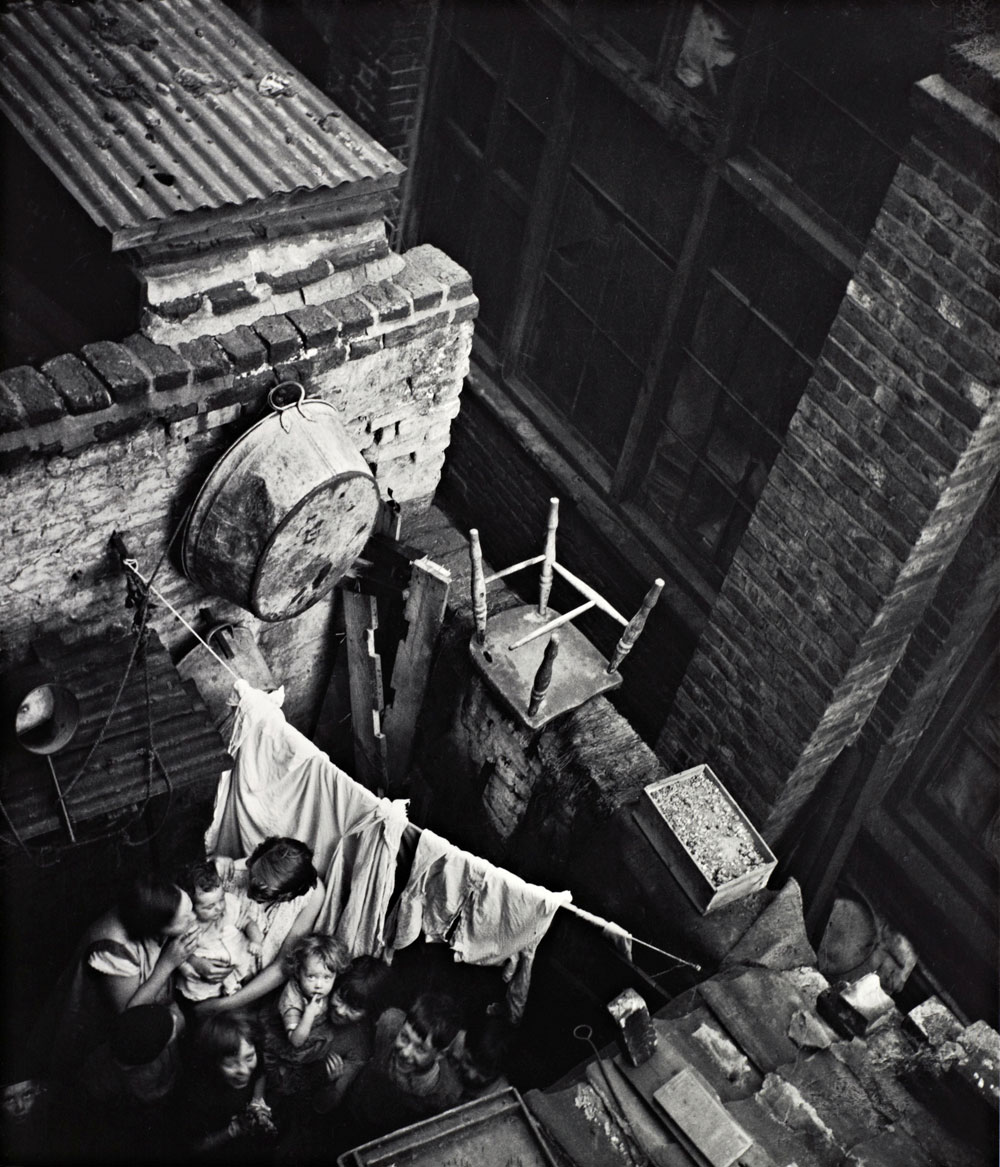
 

Edith Tudor-Hart (Austrian-British, 1908-1973) 'Gee Street, Finsbury, London' about 1936


Edith Tudor-Hart (Austrian-British, 1908-1973)
Gee Street, Finsbury, London
About 1936
© Scottish National Portrait Gallery / Archive presented by Wolfgang Suschitzky 2004


Edith Tudor-Hart (Austrian-British, 1908-1973) 'Unemployed Family, Vienna' 1930


Edith Tudor-Hart (Austrian-British, 1908-1973)
Unemployed Family, Vienna
1930
© Wien Museum


Edith Tudor-Hart (Austrian-British, 1908-1973) '"No Home, No Dole" London' about 1931


Edith Tudor-Hart (Austrian-British, 1908-1973)
“No Home, No Dole” London
About 1931
© Scottish National Portrait Gallery / Archive presented by Wolfgang Suschitzky 2004


Edith Tudor-Hart (Austrian-British, 1908-1973) 'Self-portrait, London' about 1936


Edith Tudor-Hart (Austrian-British, 1908-1973)
Self-portrait, London
About 1936
© Scottish National Portrait Gallery / Archive presented by WolfgangSuschitzky 2004


Wien Museum
1040 Vienna, Karlsplatz 8
Phone: +43 (0)1 505 87 47 0

Opening hours:
Tuesday – Sunday and public holidays 10am – 6pm
Wien Museum website

LIKE ART BLART ON FACEBOOK

Back to top

Exhibition: ‘Another Country: Vintage Photographs of British Life by Tony Ray-Jones’ at James Hyman, London

Exhibition dates: 11th September – 11th October 2013

Curator: Unknown


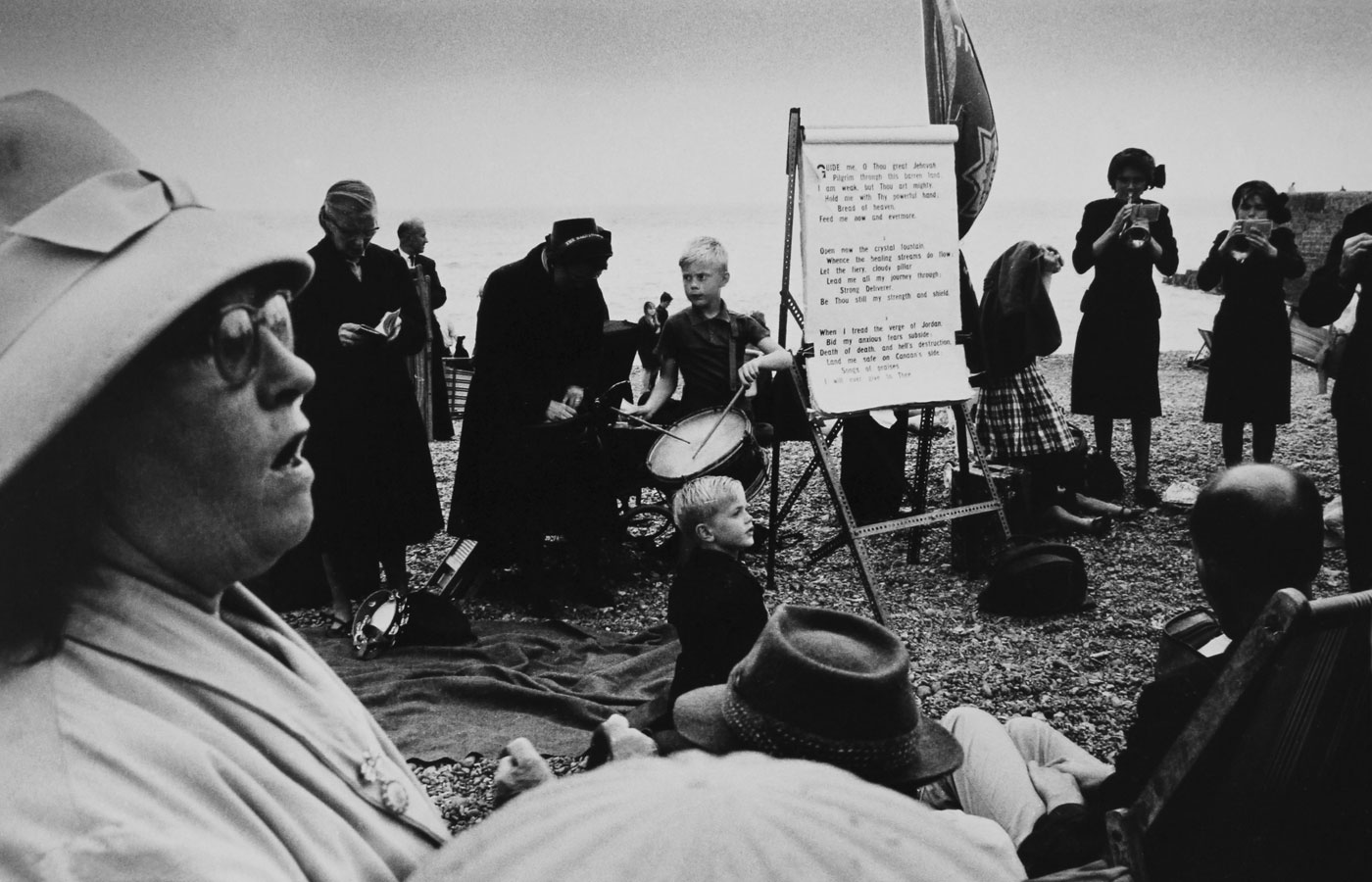
Tony Ray-Jones (British, 1941-1972) 'Lady's Day' c. 1967


Tony Ray-Jones (British, 1941-1972)
Lady’s Day
c. 1967
Vintage Gelatin Silver Print
12 x 20cm (5 x 8 inches)


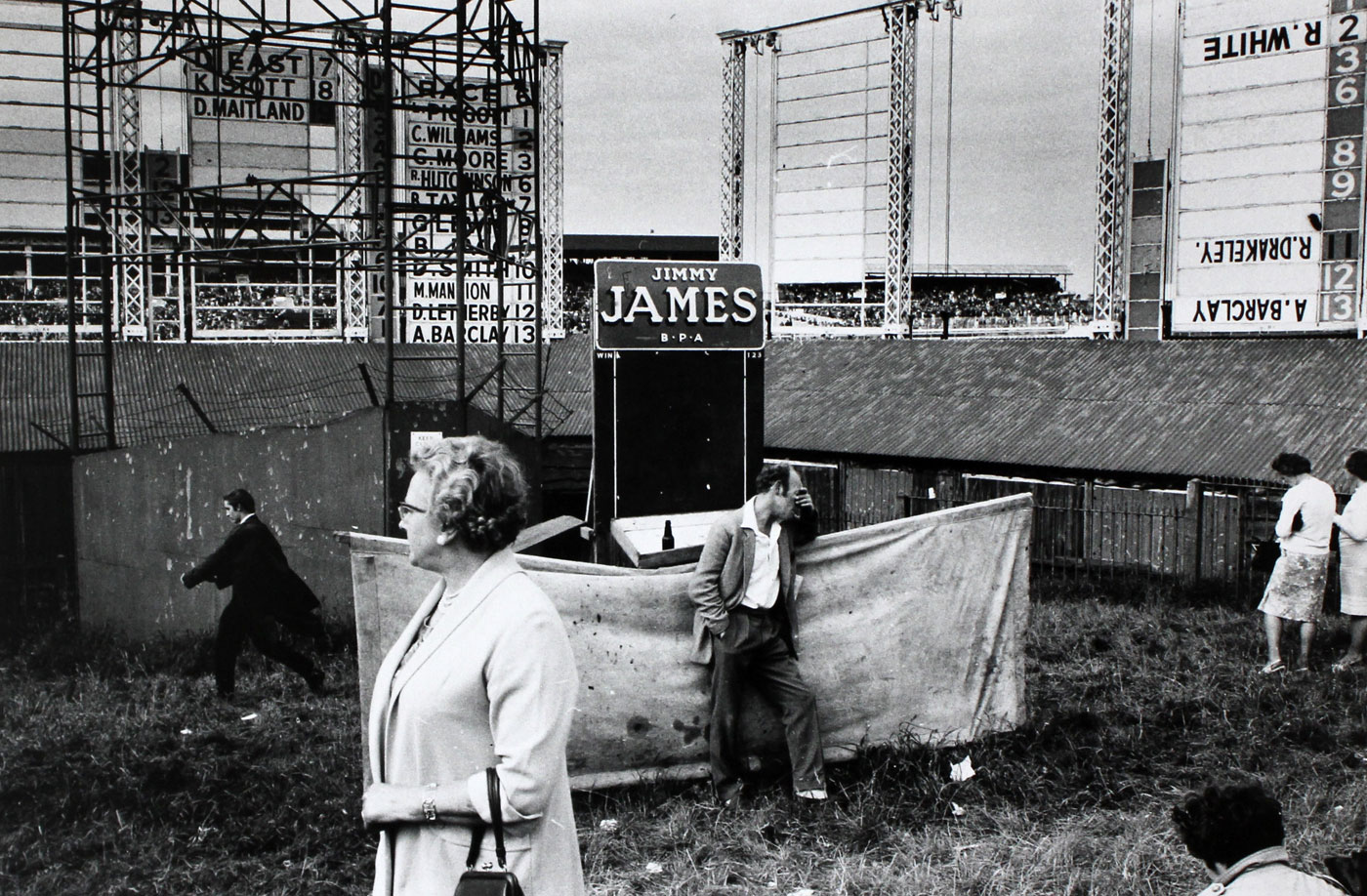
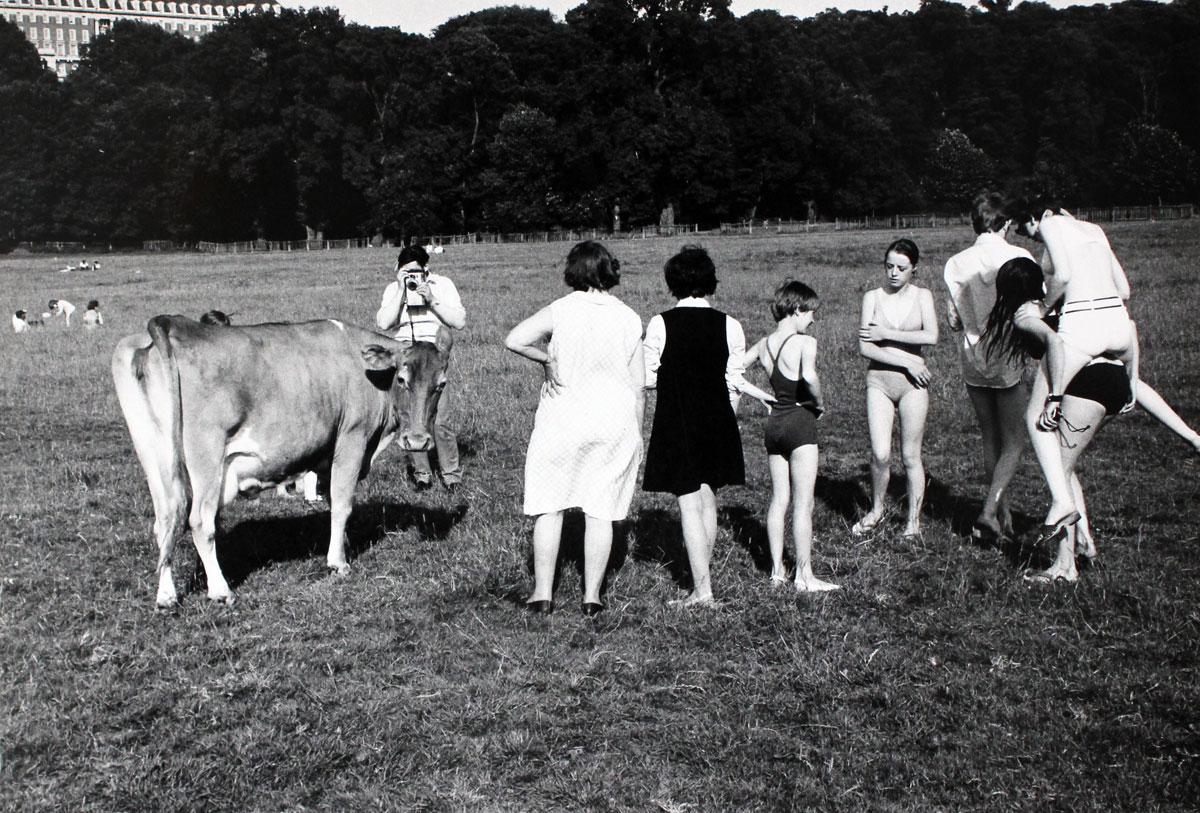
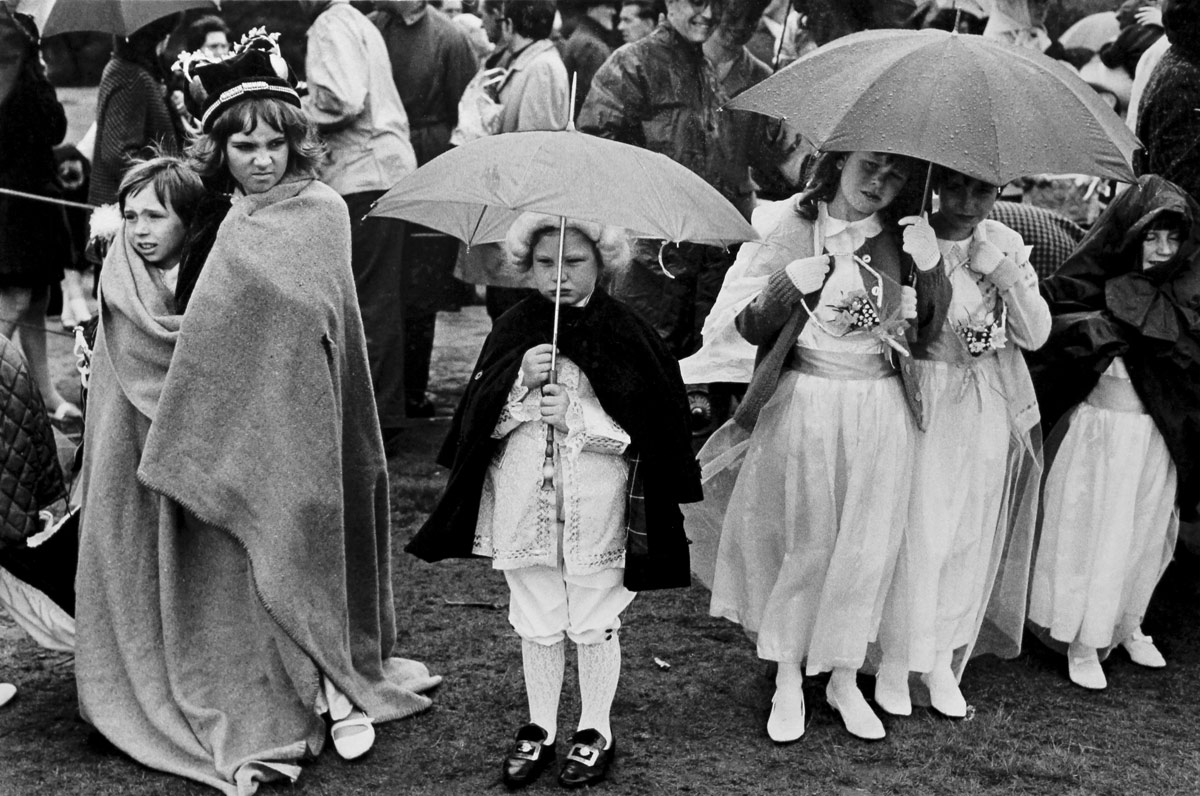
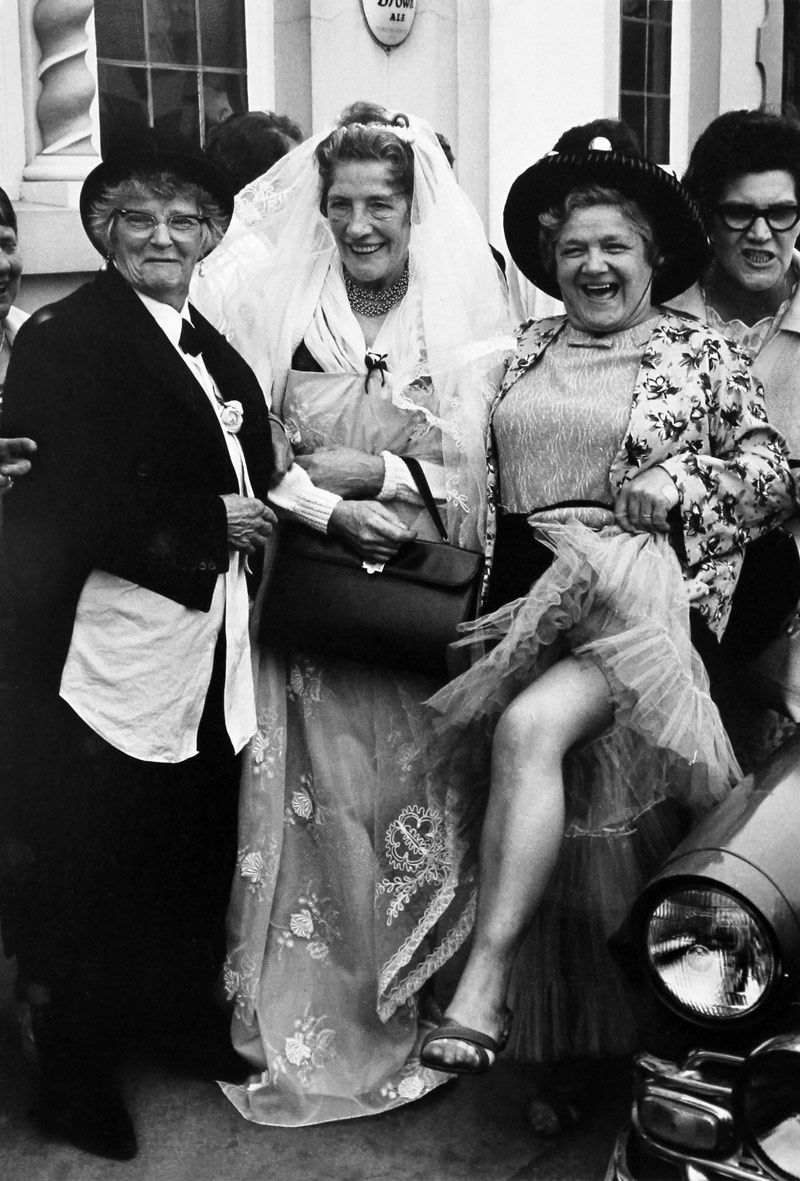
What a loss to the world when this photographer died aged just thirty. His eye was magnificent. He seems to have instinctively known how to capture the quintessential British at work, rest and play in all that societies class-ridden glory – the fag hanging out of the mouth in Lady’s Day (c. 1967) combining beautifully with the aura of the patterned dresses; the isolation of the figures and their stop-frame movement in Day at the Races (c. 1967), a wonderfully balanced composition caught in the moment; and the orchestral ensemble that is the cast of Bacup, Lancashire, 1968 (1968), each figure playing its part in the overall tension of the picture plane: the brothers at right in matching duffle coats, the boy walking forward down the incline with head thrown sideways balanced at rear by another boy with hands in pockets tossing his head into the wind. Magical.

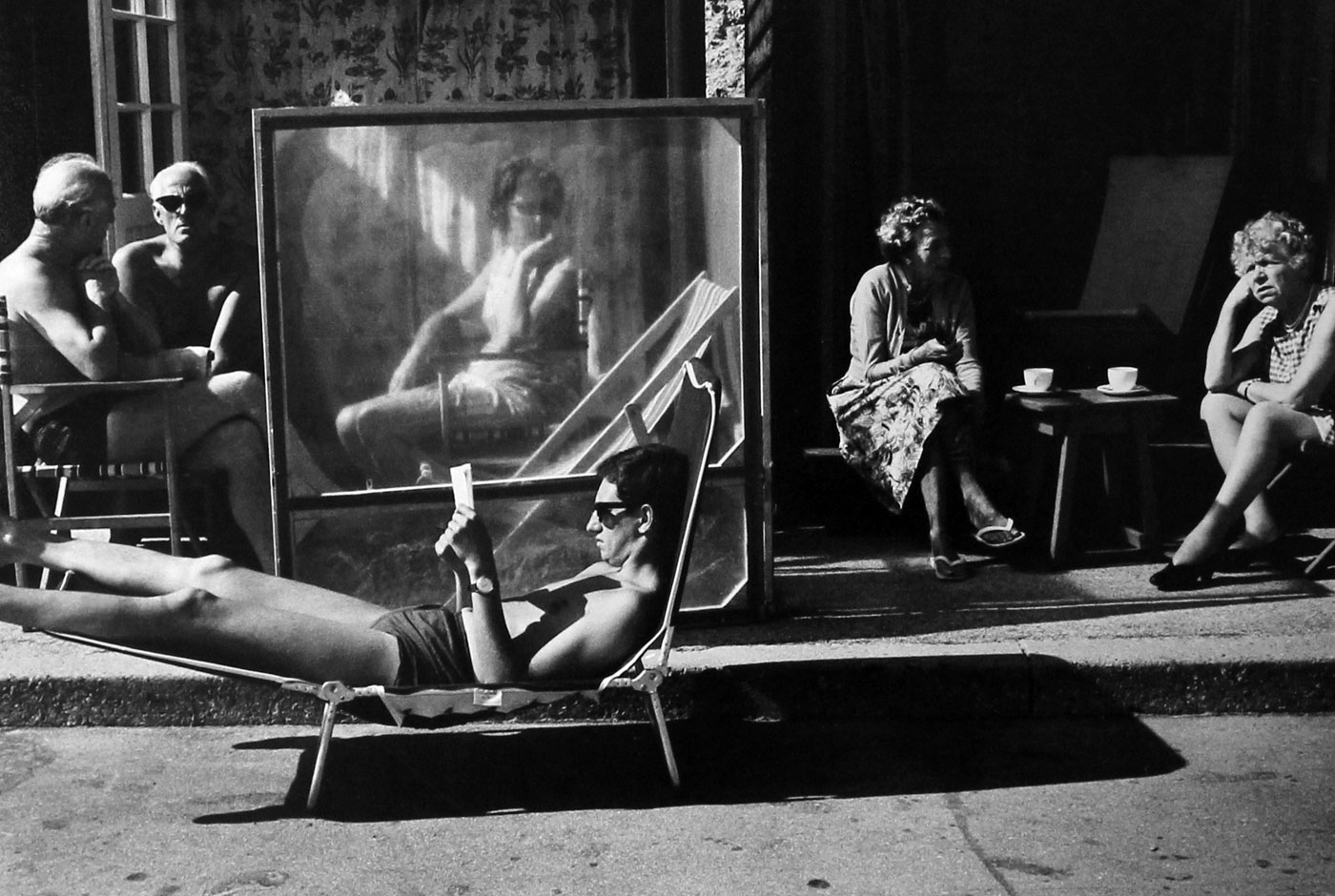
Just to see this image, to visualise it and have the camera ready to capture its “nature”, its undeniable presence for that one split second, then to develop and find this image on a proof sheet, what joy this would have been for the artist. Equally illustrious is the feeling of Bournemouth, 1969 (1969) with the nuanced use of shadow and light, the occlusion of the figure behind the screen with the turn of the head, and the placement of the two white tea cups at right. Ray-Jones wasn’t afraid to place figures in the foreground of his compositions either as can be seen in Brighton Beach, 1967 (1967) to great effect, framing the mise en scène behind.

These photographs take me way back to my childhood in the 1960s in England, going to Butlin’s Clacton-on-Sea and Bournemouth for our family holidays. Even the name says it all: Clacton “on sea” as though they have to remind people visiting that they are actually at the sea. The photographs perfectly capture the mood of the country in this utilitarian era where holidays at a seaside resort were often dour affairs, punctuated by stony beaches, bad weather and regulated activities. The freedom of the 1970s had yet to arrive and us kids went whether we liked it or not: Mablethorpe, 1967 (1967) perfectly epitomises such an environment, with the long days of pleasure / torture stretching off into the distance much as the sea wall in Ray-Jones’ photo.

Dr Marcus Bunyan


Many thankx to James Hyman for allowing me to publish these magnificent photographs. Please click on the photographs for a larger version of the image.


Tony Ray-Jones (British, 1941-1972) 'Day at the Races' c. 1967


Tony Ray-Jones (British, 1941-1972)
Day at the Races
c. 1967
Vintage Gelatin Silver Print
13 x 20cm (5 x 8 inches)


Tony Ray-Jones (British, 1941-1972) 'A Day at Richmond Park' c. 1967


Tony Ray-Jones (British, 1941-1972)
A Day at Richmond Park
c. 1967
Vintage Gelatin Silver Print
17.5 x 25.6cm (7 x 10 inches)


Tony Ray-Jones (British, 1941-1972) 'Chatham May Queen, 1968' 1968


Tony Ray-Jones (British, 1941-1972)
Chatham May Queen, 1968
1968
Vintage Gelatin Silver Print
17.5 x 26.2cm (7 x 10 inches)


Tony Ray-Jones (British, 1941-1972) 'Bacup, Lancashire, 1968' 1968


Tony Ray-Jones (British, 1941-1972)
Bacup, Lancashire, 1968
1968
Vintage Gelatin Silver Print
17.5 x 26.5cm (7 x 10 inches)


James Hyman is delighted to stage an exhibition of rare, vintage photographs by Tony Ray-Jones to coincide with the opening exhibition of the Science Museum Media Space, Only in England, Photographs by Tony Ray-Jones and Martin Parr, in September 2013.

Tony Ray-Jones had a short life. He died in 1972 aged just thirty. But the pictures that he left behind are some of the most powerful British photographs of the twentieth century. His work of the late 1960s and early 1970s documents English culture and identity and brilliantly captures this period in English public life. Inspired by what he learnt in America in the mid-1960s, from photographers such as Lee Friedlander and Joel Meyerowitz, Ray-Jones was keen to make ‘new’ photographs of English life, which did not read simply as documentary, but also as art objects. As he explained in Creative Camera in 1968: “the spirit and the mentality of the English, their habits, and the way they do things, partly through tradition and the nature of their environment and mentality.”

The acclaim that Ray-Jones received after his death, especially from other photographers, testifies to the respect of his elders and his contemporaries. Bill Brandt praised the “very pronounced style all of his own” and lamented that “his death, at such a young age, is a terrible loss to British photography.” Jacques Henri-Lartigue praised Tony Ray-Jones as a “fantaisiste”: “young, free and whimsical with, in addition, a very sound technique and a vision of fire that was full of humour, truth and a sense of poetry” and Paul Strand praised his “remarkable formal organisation” and declared: “I found the photographs of Tony Ray-Jones very outstanding. In them I find that rather rare concurrence when an artist clearly attaining mastery of his medium, also develops a remarkable way of looking at the life around him, with warmth and understanding.”

These tributes are to be found in the most important book of Tony Ray-Jones work, A Day Off. An English Journal, published in 1974. They are included in a beautiful essay in which Ainslie Ellis, one of the photographer’s earliest champions, addresses not only the photographs but also Ray-Jones’s photographic process. Ellis stresses that what mattered to Ray-Jones was not just taking the picture, but also the creative process of deciding which pictures on a contact strip to print, and then making a master-print, from which all subsequent prints would be matched. We are, therefore, delighted that this exhibition should include many of the pictures reproduced in this celebrated book and that it present exclusively vintage prints, which, in a number of identifiable cases, are the actual photographs that Tony Ray-Jones exhibited in his lifetime.

Often playful and sometimes despondent, what Ray-Jones produced was unlike anything which came before, and was the catalyst for a generation of New British Photographers.

Press release from the James Hyman website


Tony Ray-Jones (British, 1941-1972) 'Bournemouth, 1969' 1969


Tony Ray-Jones (British, 1941-1972)
Bournemouth, 1969
1969
Vintage Gelatin Silver Print
16 x 25cm (6 x 10 inches)


Tony Ray-Jones (British, 1941-1972) 'Brighton Beach, 1967' 1967


Tony Ray-Jones (British, 1941-1972)
Brighton Beach, 1967
1967
Vintage Gelatin Silver Print
17.5 x 26.5cm (7 x 10 inches)


Tony Ray-Jones (British, 1941-1972) 'Mablethorpe, 1967' 1967


Tony Ray-Jones (British, 1941-1972)
Mablethorpe, 1967
1967
Vintage Gelatin Silver Print
14 x 21cm (6 x 8 inches)


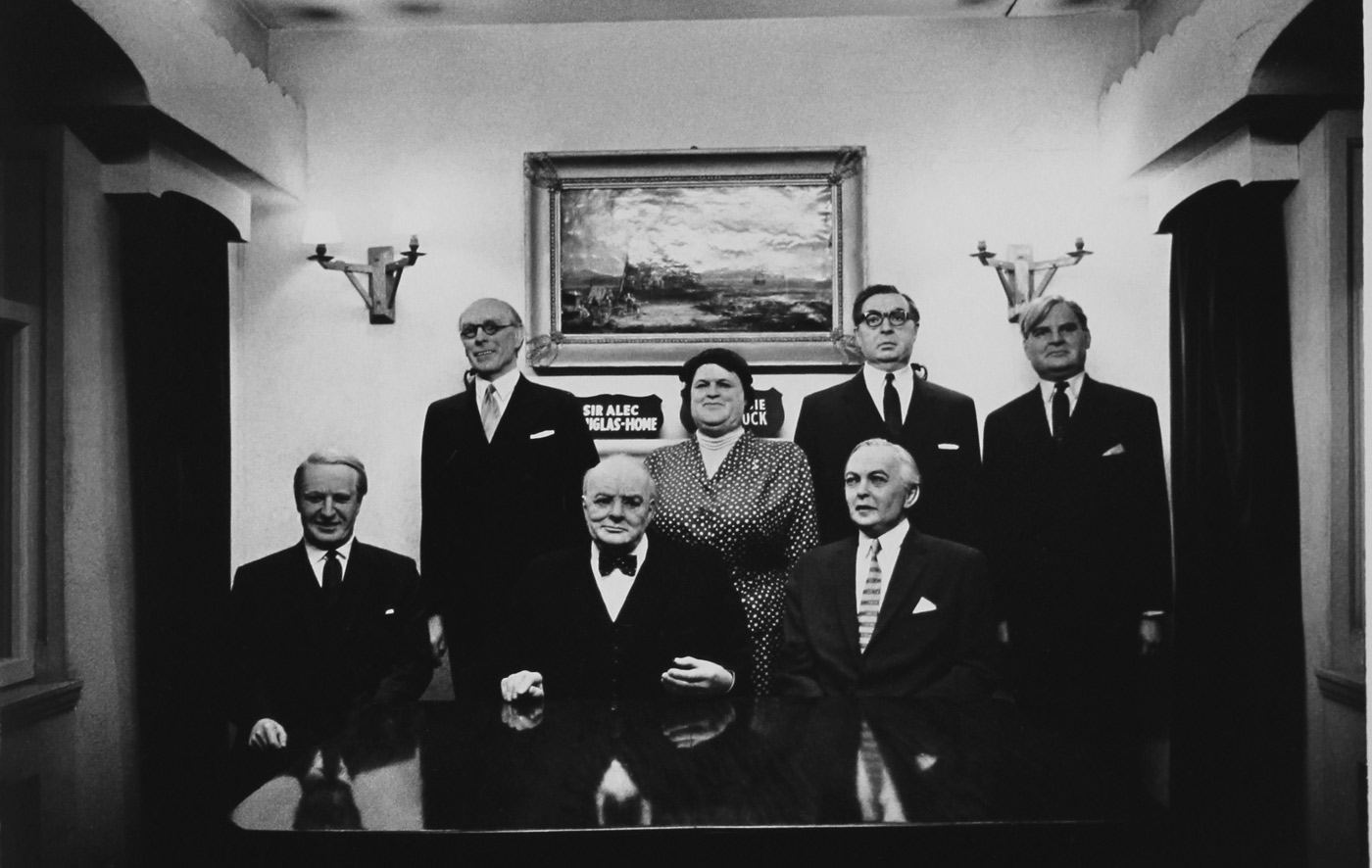
Tony Ray-Jones (British, 1941-1972) 'Waxworks, Eastbourne, 1968' 1968


Tony Ray-Jones (British, 1941-1972)
Waxworks, Eastbourne, 1968
1968
Vintage Gelatin Silver Print
14 x 21cm (6 x 8 inches)


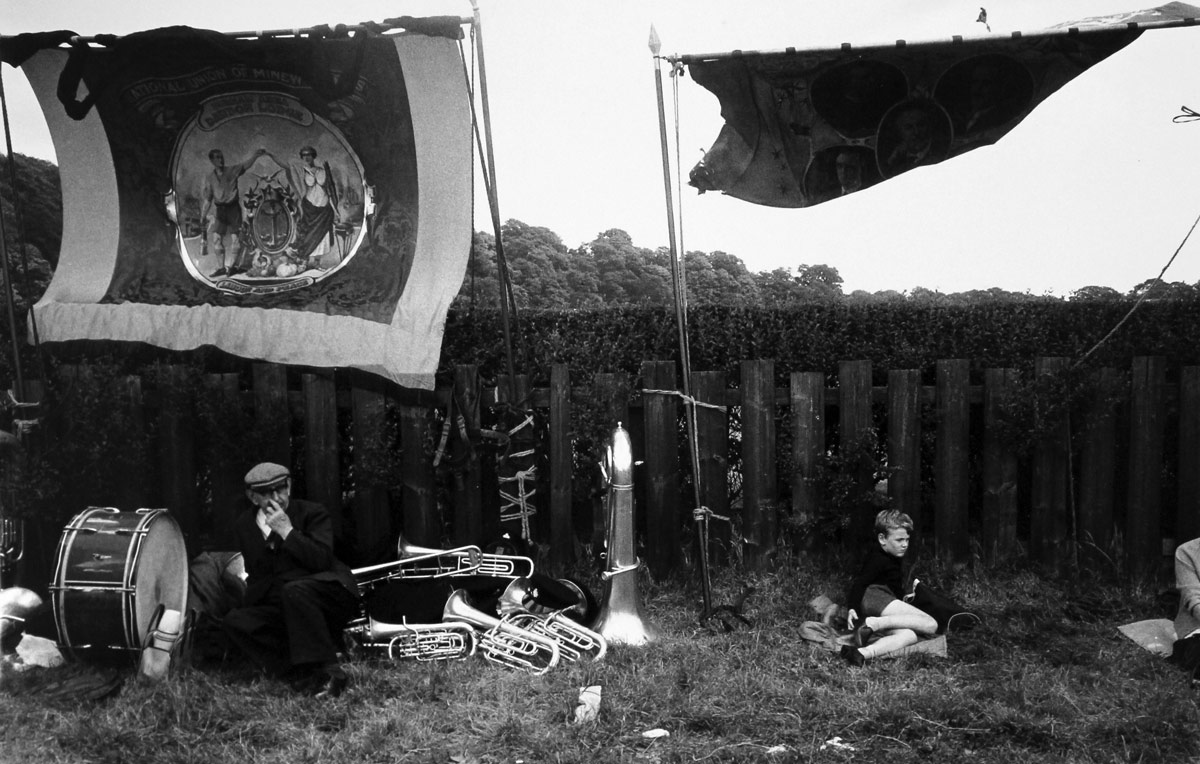
Tony Ray-Jones (British, 1941-1972) 'Durham Miners' Gala' 1969


Tony Ray-Jones (British, 1941-1972)
Durham Miners’ Gala
1969
Vintage Gelatin Silver Print
14 x 22.5cm (6 x 9 inches)


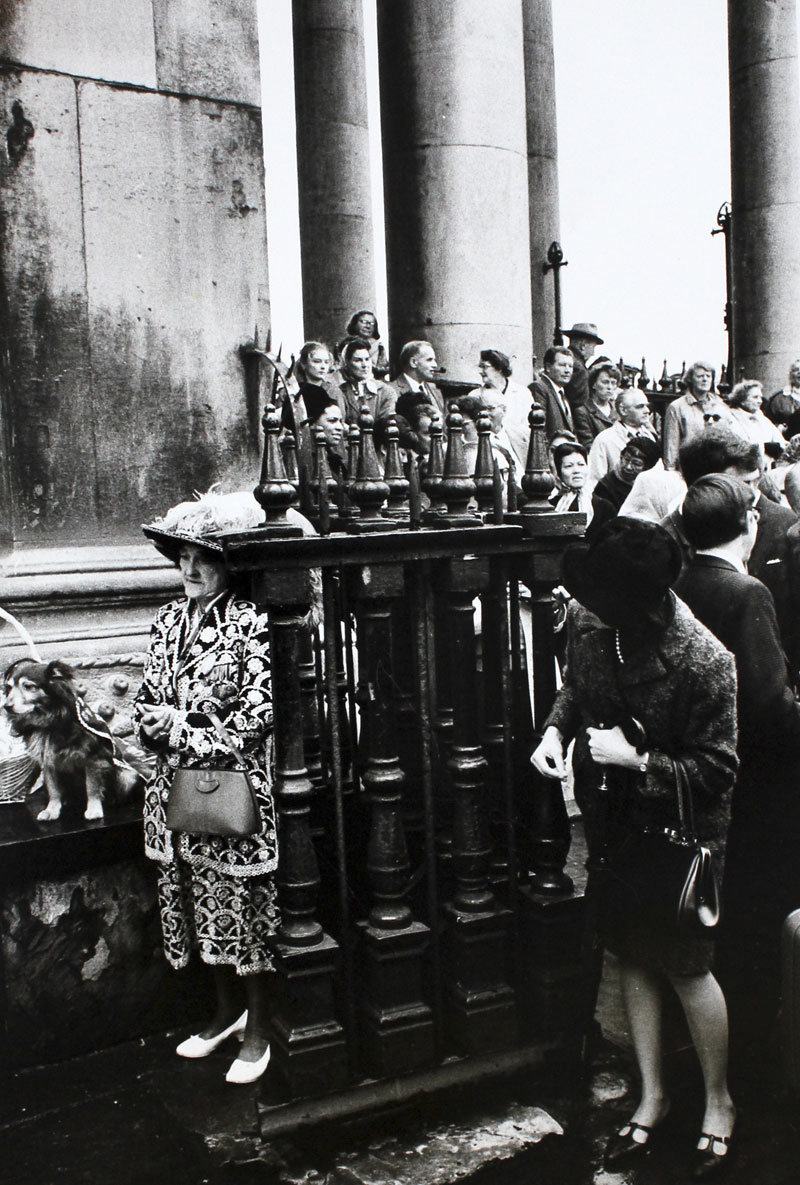
Tony Ray-Jones (British, 1941-1972) 'Sunday Best' c. 1967


Tony Ray-Jones (British, 1941-1972)
Sunday Best
c. 1967
Vintage Gelatin Silver Print
30.5 x 20cm (12 x 8 inches)


Tony Ray-Jones (British, 1941-1972) 'Blackpool, 1968' 1968


Tony Ray-Jones (British, 1941-1972)
Blackpool, 1968
1968
Vintage Gelatin Silver Print
21 x 14.5cm (8.25 x 5.70 ins)


James Hyman Gallery
16 Savile Row
London W1S 3PL
Phone: 020 7494 3857

Opening hours:
By appointment

James Hyman Gallery website

LIKE ART BLART ON FACEBOOK

Back to top

Exhibition: ‘Gilbert & George – London Pictures’ at MKM Museum Küppersmühle für Moderne Kunst, Duisburg

“Gilbert & George seem to have become a pastiche of themselves, cartoon cut-outs hovering in contextless backgrounds with staring eyes and gormless faces.” Dr Marcus Bunyan

Exhibition dates: 20th March – 30th June, 2013

Curator: Walter Smerling, museum director


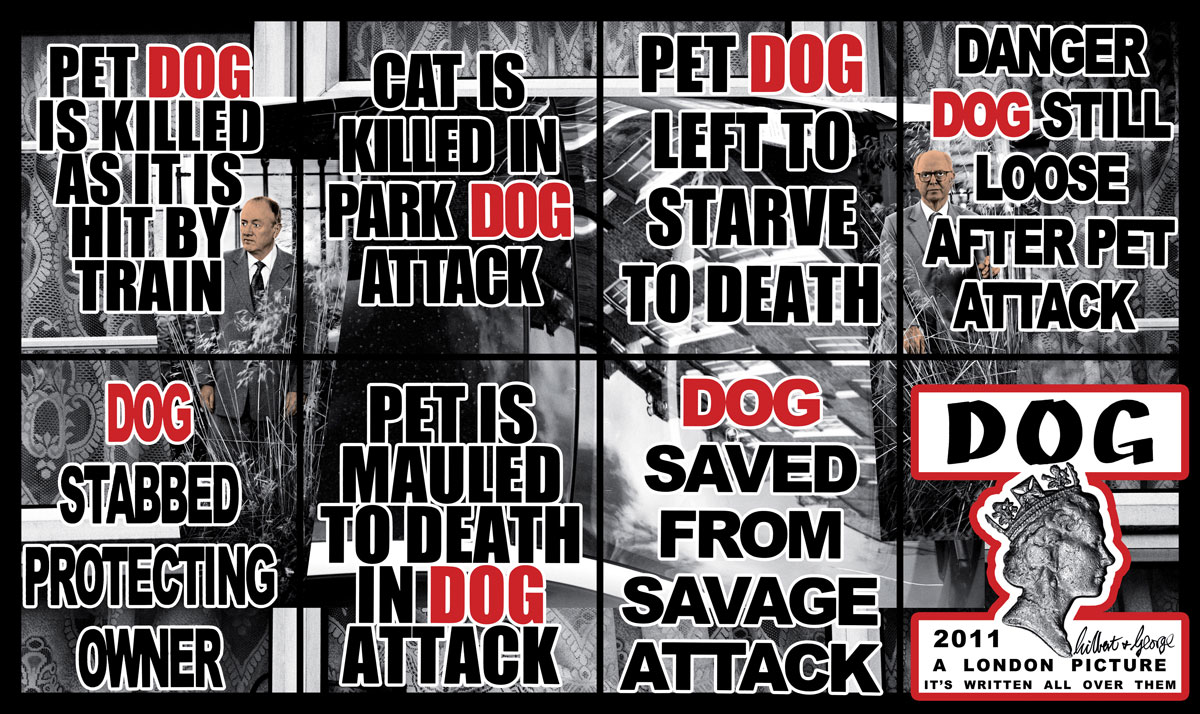
Gilbert & George (Gilbert Prousch) (English born Italy, b. 1943) and (George Passmore) (English, b. 1943) 'Dog' 2011 from the exhibition 'Gilbert & George – London Pictures' at MKM Museum Küppersmühle für Moderne Kunst, Duisburg, March - June, 2013


Gilbert & George (Gilbert Prousch) (English born Italy, b. 1943) and (George Passmore) (English, b. 1943)
Dog
2011
© Gilbert & George / Courtesy of the Artist and White Cube Gallery


I used to think that Gilbert & George’s work was inventive and relevant, that it had something important to say about contemporary culture. These days I am not so sure. It seems all to easy to rip headlines from the tabloid newspapers. Who cares about dog, death, money, school, cute kids, etc… as commented on by these pulp editions.

Gilbert & George seem to have become a pastiche of themselves, cartoon cut-outs hovering in contextless backgrounds with staring eyes and gormless faces. “I am contextless, unhappily spinning in the vacuum of my own indolence,” the work seems to be saying. We already know that we are becoming a society of shortened, fractured words and sentences on mobile phones and in newspaper headlines, of absence/presence where people absent themselves from their surroundings while on mobile devices, we know that already. I don’t think it takes average art to point that out.

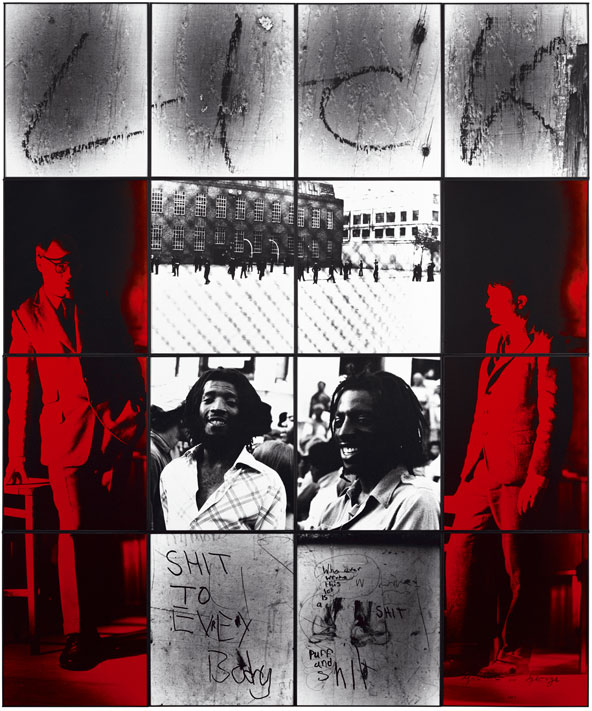
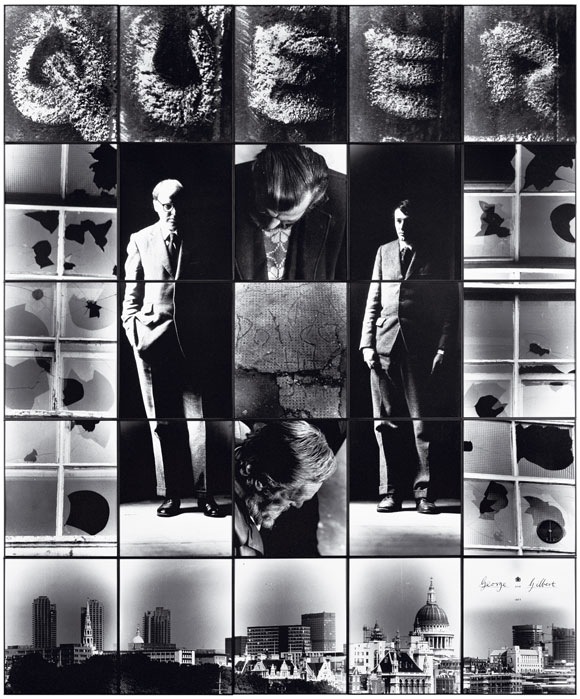
I think Gilbert & George need a good boot up the bum to get them back to making work that takes the viewer somewhere, that actually challenges people’s belief systems, not some pulp driven comment on contemporary culture. Take a look at their early work (below) if you don’t believe what I am saying: look at how alive the pictures were, how much vitality and energy they had, and how challenging the work was!

Dr Marcus Bunyan


Many thankx to the Museum Küppersmühle für Moderne Kunst for allowing me to publish the photographs in the posting. Please click on the photographs for a larger version of the image.


Gilbert & George (Gilbert Prousch) (English born Italy, b. 1943) and (George Passmore) (English, b. 1943) 'Lick' 1977 from the exhibition 'Gilbert & George – London Pictures' at MKM Museum Küppersmühle für Moderne Kunst, Duisburg, March - June, 2013


Gilbert & George (Gilbert Prousch) (English born Italy, b. 1943) and (George Passmore) (English, b. 1943)
Lick
1977


Gilbert & George (Gilbert Prousch) (English born Italy, b. 1943) and (George Passmore) (English, b. 1943) 'Queer' 1977


Gilbert & George (Gilbert Prousch) (English born Italy, b. 1943) and (George Passmore) (English, b. 1943)
Queer
1977


Gilbert & George (Gilbert Prousch) (English born Italy, b. 1943) and (George Passmore) (English, b. 1943) 'Money' 2011


Gilbert & George (Gilbert Prousch) (English born Italy, b. 1943) and (George Passmore) (English, b. 1943)
Money
2011
© Gilbert & George


Gilbert & George (Gilbert Prousch) (English born Italy, b. 1943) and (George Passmore) (English, b. 1943) 'School Straight' 2011


Gilbert & George (Gilbert Prousch) (English born Italy, b. 1943) and (George Passmore) (English, b. 1943)
School Straight
2011
© Gilbert & George / Courtesy of the Artist and White Cube Gallery


Gilbert & George (Gilbert Prousch) (English born Italy, b. 1943) and (George Passmore) (English, b. 1943) 'Death' 2011


Gilbert & George (Gilbert Prousch) (English born Italy, b. 1943) and (George Passmore) (English, b. 1943)
Death
2011
© Gilbert & George


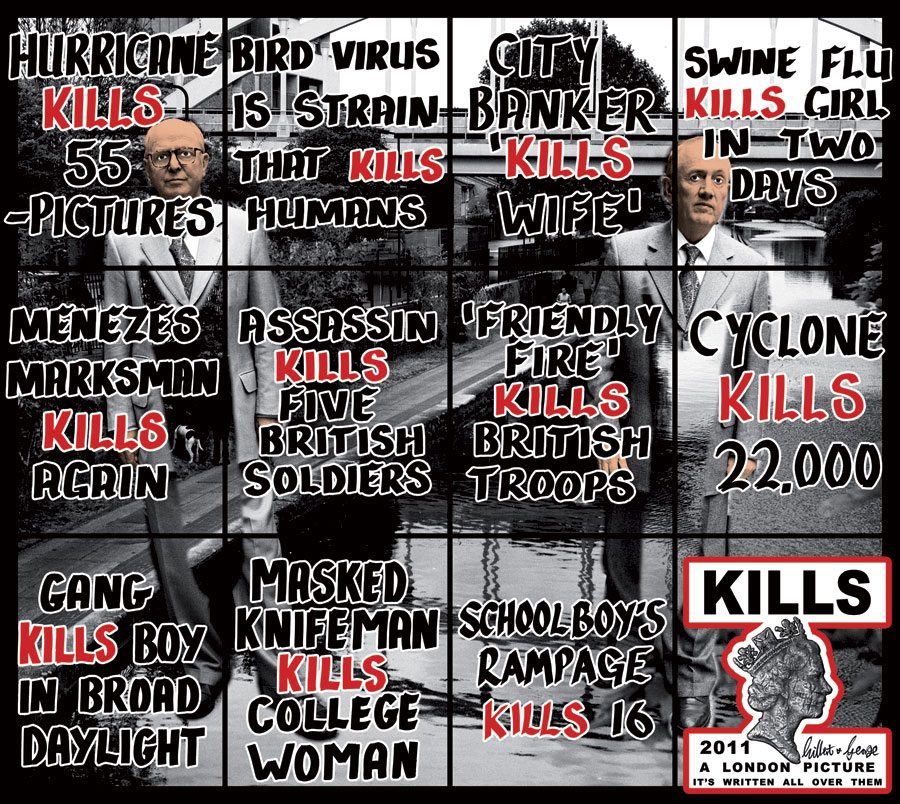
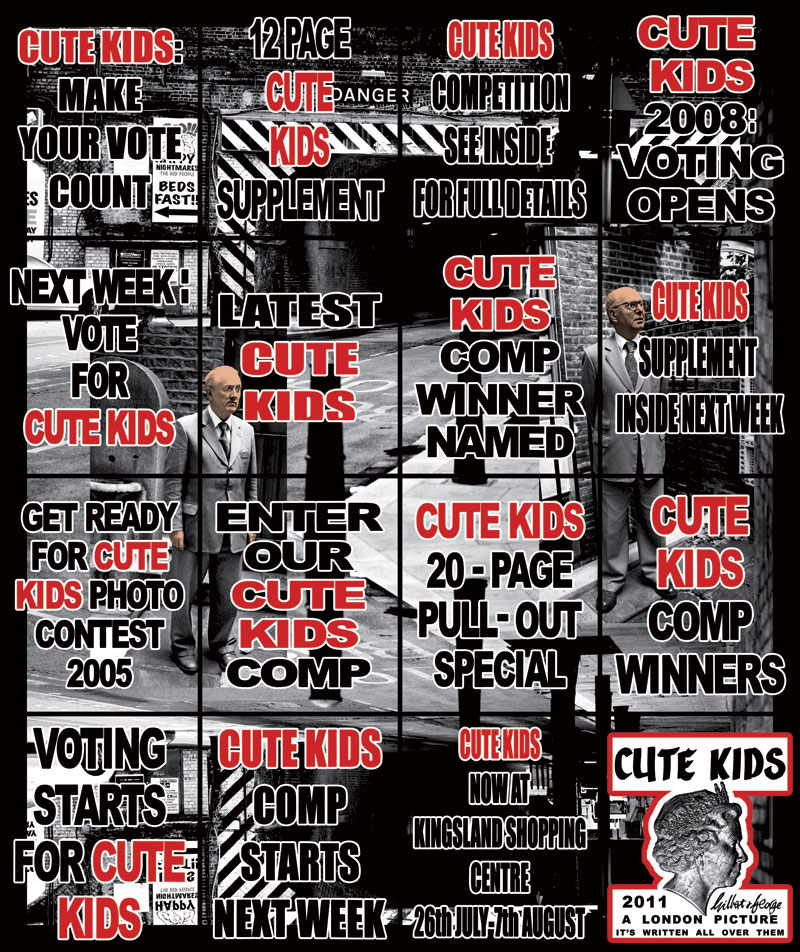
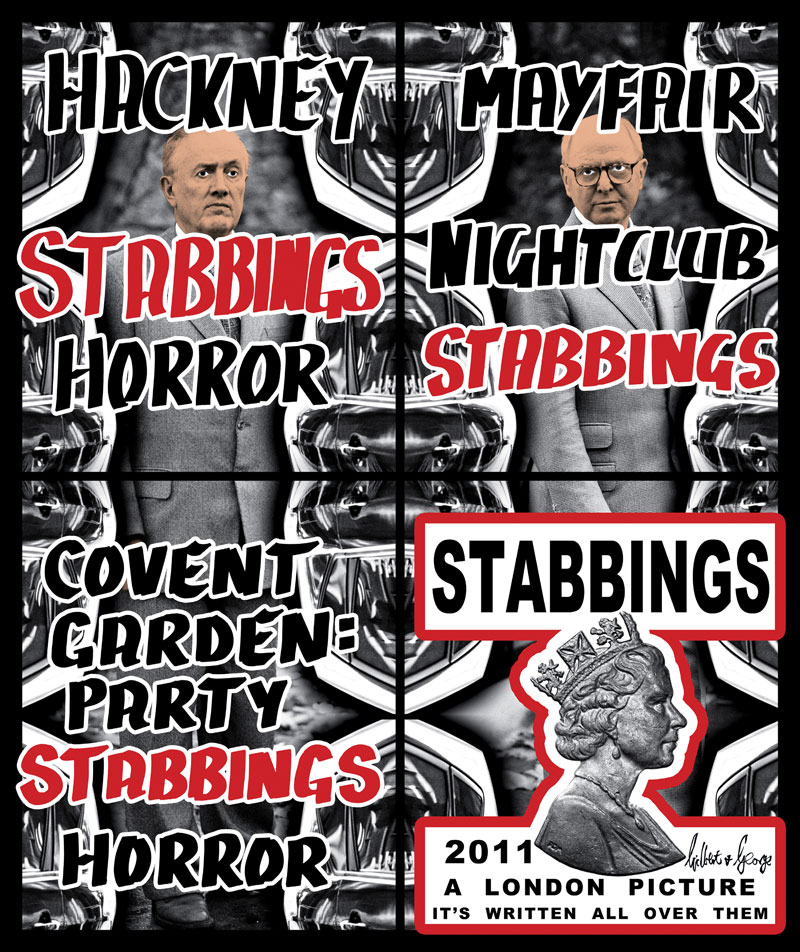
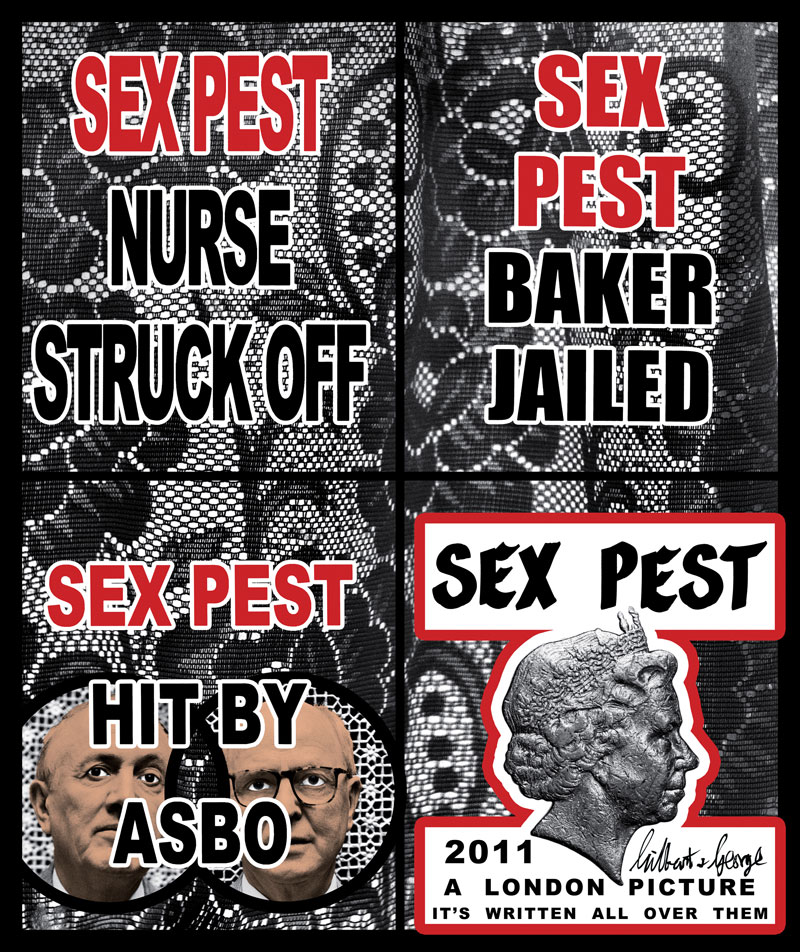
Completed in 2011, “London Pictures” is the title of the cycle created by the London-based artists Gilbert & George, to which the eponymous exhibition in the MKM from March 20, 2013, is dedicated. Taking as their theme the countless newsagent posters collected by the artists themselves over a period of six years, the artists compile a detailed inventory of quotidian human behaviour, which they then submit to their hallmark humanistic gaze, and in so doing, furnish their own perspective on the psycho-social condition of our Western societies. What emerges is an extensive series of images from which the MKM is, for the first time, showcasing 70 individual pictures and affording visitors the opportunity to intensively explore this new phase from the oeuvre of Gilbert & George.

In their “London Pictures” Gilbert & George have collated the newspaper posters, which, not only in London, but across England, garnish the sales stands of the newspaper dealers. Their explicit allusions to the most titillating, violent and bizarre stories of the day are designed to entice potential customers to buy the newspapers. These simple statements of facts promise tales of love and sex, violence and death, wealth and power -themes, which have fascinated humanity since time immemorial, and which expose our endless appetite for sensation, disaster and excess. Gilbert & George have taken 3712 images of these advertising posters, processed the material, arranged it according to themes and fashioned it into 292 carefully-created pictures. Not only are the artists documenting a commonly-used device within the marketing strategies of the Western press, they are also exploring its impact on both the individual and society as a whole, and applying artistic means to articulate their own response to, and perception of, this social phenomenon. “The “London Pictures” should not in the first instance be read as a critique of the media, but perhaps as a critique of ourselves”, explains MKM Director Walter Smerling, adding that: “Gilbert & George borrow the language of the media, place it in a different context and in so doing transform these newspapers posters into a new entity vested with an entirely new content. The careful collation and arrangement of hundreds of headlines (…) forges a platform for reflection which casts the spotlight on to our own complicity, intrigues and problems of existence.”

“The artists of course feature in their pictures: in the background as a pair of quizzical, piercing eyes or as a ubiquitous, immaculately besuited presence, appearing” (…) “as though the artists were psychic manifestations of the city itself, its sense of place and history. The “London Pictures” comprise both a directory of quotidian urban human behaviour – revealing and shocking and violent, in all its sluggish or volatile momentum – and as such the city’s moral portrait: an unflinching audit of modern western society’s relationship to itself, stripped of rhetoric or intellectual disguise.” (Michael Bracewell, author of the catalogue). Yet beyond focussing on the city of London itself, Gilbert & George also cast themselves directly as integral constituents of our society’s media landscape and its psychic condition. Their unrelenting gaze interrogates not only the message of the posters, but is trained at the observer who also becomes an essential part of each and every picture.

Gilbert & George are seeking to portray the “grandeur, mystery and drama” of our Western world. From competitions to find the cutest child to gruesome tales of murder and mayhem – the whole gamut of human experience is represented here and exercises an equally ineluctable fascination on readers in Germany: For as the artists themselves remark, the “London Pictures” and “London Problems” could just as easily be “Duisburg Pictures” and “Duisburg Problems”.

Biography

Gilbert (born in 1943 in St. Martin in Thurn, Italy) studied at the Wolkenstein School of Art in South Tyrol, the Hallein School of Art in Austria, and the Munich Academy of Fine Arts, before attending St. Martin’s School of Art in London. There, in 1967, he met George (born in 1942 in Plymouth, UK), who had previously been a student at Dartington Hall College of Art and Oxford Art School. During the 1960s, Gilbert & George expanded the concept of sculpture by making themselves the materials for their art, as Living Sculptures. They declared everyday activities to be art, and provoked opposition by using faeces, urine and sperm as principal motifs in their picture series. They were awarded the 1986 Turner Prize, exhibited in the British Pavilion at the 2005 Venice Biennale, and has held exhibitions in venues ranging from the Stedelijk Museum in Amsterdam (1971 and 1996) to Guggenheim Museum, New York (1985), Musee d’Art Moderne de la Ville, Paris (1997) and London’s Tate Modern (2007). Other major public exhibitions have been mounted in Russia (1990) and China (1993).

Press release from the MKM Museum Küppersmühle für Moderne Kunst website


Gilbert & George (Gilbert Prousch) (English born Italy, b. 1943) and (George Passmore) (English, b. 1943) 'Kills' 2011


Gilbert & George (Gilbert Prousch) (English born Italy, b. 1943) and (George Passmore) (English, b. 1943)
Kills
2011
© Gilbert & George


Gilbert & George (Gilbert Prousch) (English born Italy, b. 1943) and (George Passmore) (English, b. 1943) 'Woman' 2011


Gilbert & George (Gilbert Prousch) (English born Italy, b. 1943) and (George Passmore) (English, b. 1943)
Woman
2011
© Gilbert & George


Gilbert & George (Gilbert Prousch) (English born Italy, b. 1943) and (George Passmore) (English, b. 1943) 'Cute Kids' 2011


Gilbert & George (Gilbert Prousch) (English born Italy, b. 1943) and (George Passmore) (English, b. 1943)
Cute Kids
2011
© Gilbert & George


Gilbert & George (Gilbert Prousch) (English born Italy, b. 1943) and (George Passmore) (English, b. 1943) 'Stabbings' 2011


Gilbert & George (Gilbert Prousch) (English born Italy, b. 1943) and (George Passmore) (English, b. 1943)
Stabbings
2011
© Gilbert & George


Gilbert & George (Gilbert Prousch) (English born Italy, b. 1943) and (George Passmore) (English, b. 1943) 'Sex Pest' 2011


Gilbert & George (Gilbert Prousch) (English born Italy, b. 1943) and (George Passmore) (English, b. 1943)
Sex Pest
2011
151 x 127 cm
© Gilbert & George / Courtesy Galerie Thaddaeus Ropac Salzburg, Paris


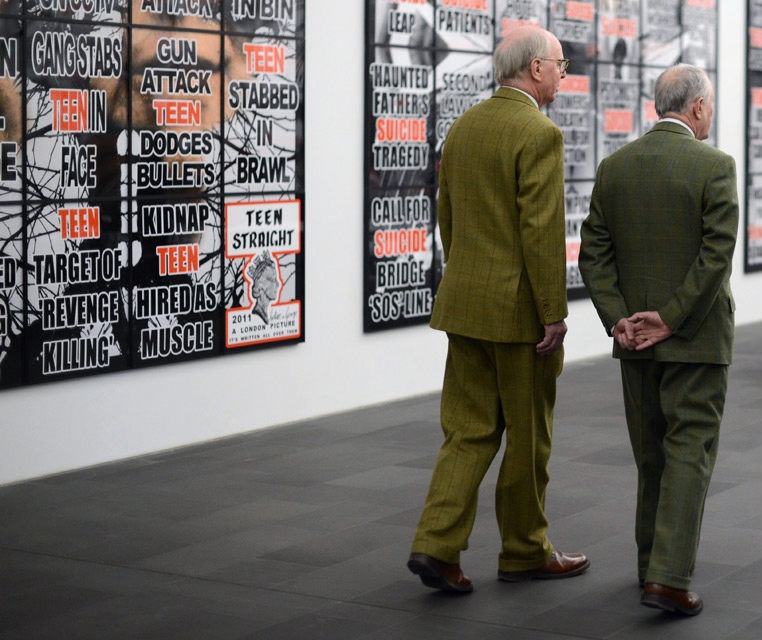
The British artists George Passmore (L) and Gilbert Prousch (R) pass in front of one of their art work 'London Pictures'


The British artists George Passmore (L) and Gilbert Prousch (R) pass in front of one of their art work ‘London Pictures’ as they arrive for a press conference at the museum Kueppersmuehle in Duisburg, western Germany, on March 14, 2013. AFP PHOTO / CAROLINE SEIDEL


MKM Museum Küppersmühle für Moderne Kunst
Philosophenweg 55, 47051 Duisburg
Germany
Phone: +49 (0)203 30 19 48 -10/-11

Opening hours:
Wed 2.00pm – 6.00pm
Thurs – Sun 11.00am – 6.00pm
Bank Holidays 11.00am – 6.00pm
Closed Mondays and Tuesdays

MKM Museum Küppersmühle für Moderne Kunst website

LIKE ART BLART ON FACEBOOK

Back to top

Exhibition: ‘Edith Tudor-Hart: In the Shadow of Tyranny’ at the Scottish National Portrait Gallery, Edinburgh

Exhibition dates: 2nd March – 26th May, 2013

Curator: Duncan Forbes


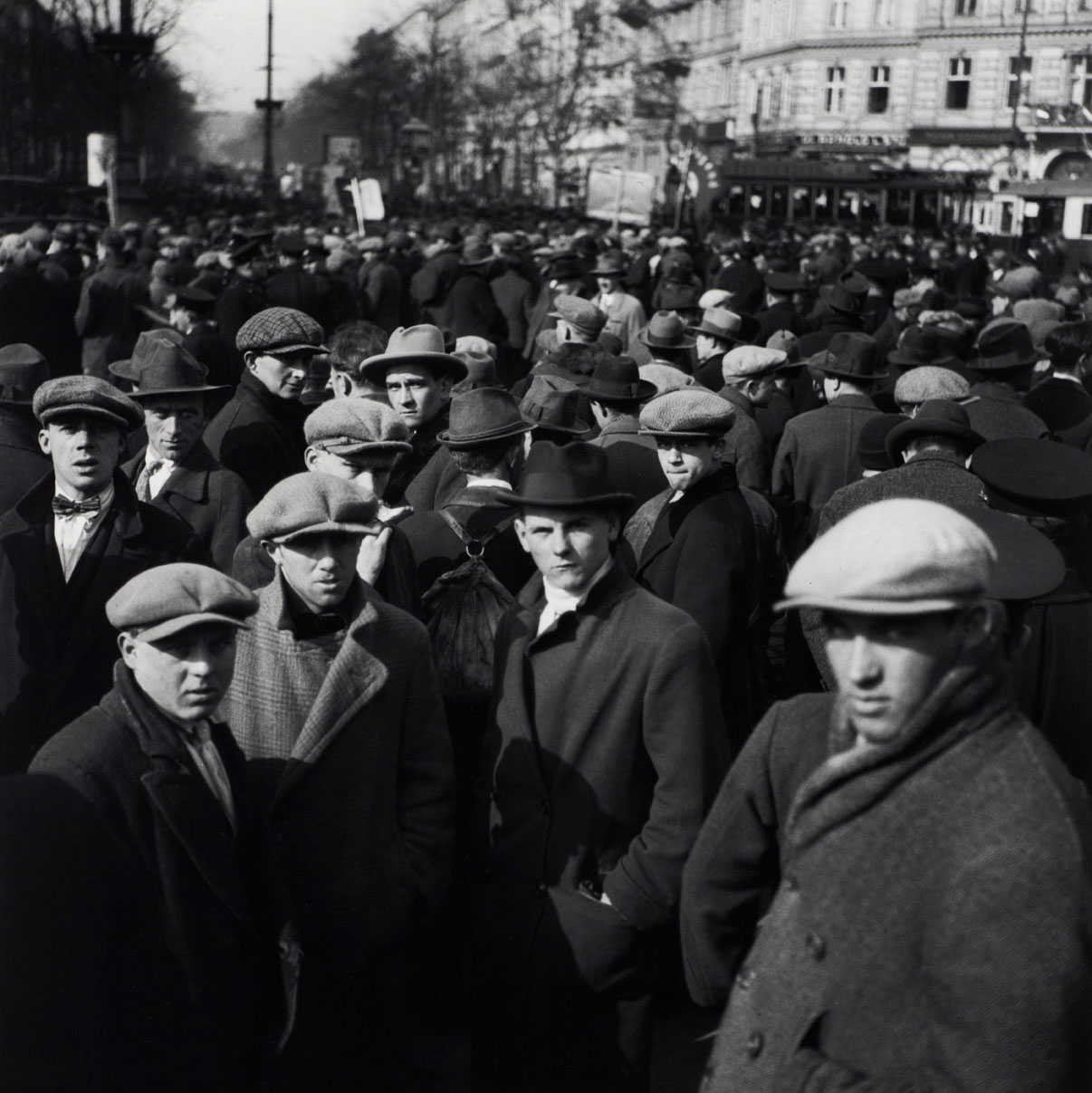
Edith Tudor-Hart (Austrian-British, 1908-1973) 'Untitled (Unemployed Workers' Demonstration, Vienna)' 1932 from the exhibition 'Edith Tudor-Hart: In the Shadow of Tyranny' at the Scottish National Portrait Gallery, Edinburgh, March - May, 2013


Edith Tudor-Hart (Austrian-British, 1908-1973)
Untitled (Unemployed Workers’ Demonstration, Vienna)
1932
Modern silver gelatine print from archival negative
30.3 x 30cm
Scottish National Portrait Gallery: Archive presented by Wolfgang Suschitzky 2004
© The Estate of Edith Tudor-Hart


Another photographer unknown to me, who “attempted to use the camera as a political weapon, aligning her practice with the wider worker photography movement” and produced “images that show a sophisticated realism, marked by their directness and capacity to communicate issues of inequality and deprivation.” In other words she was using photography to fight the good fight, producing photographs that interrogate issues of poverty, unemployment and slum housing.

But there is more to Tudor-Hart’s photographs than just social realism otherwise they would not hold us.

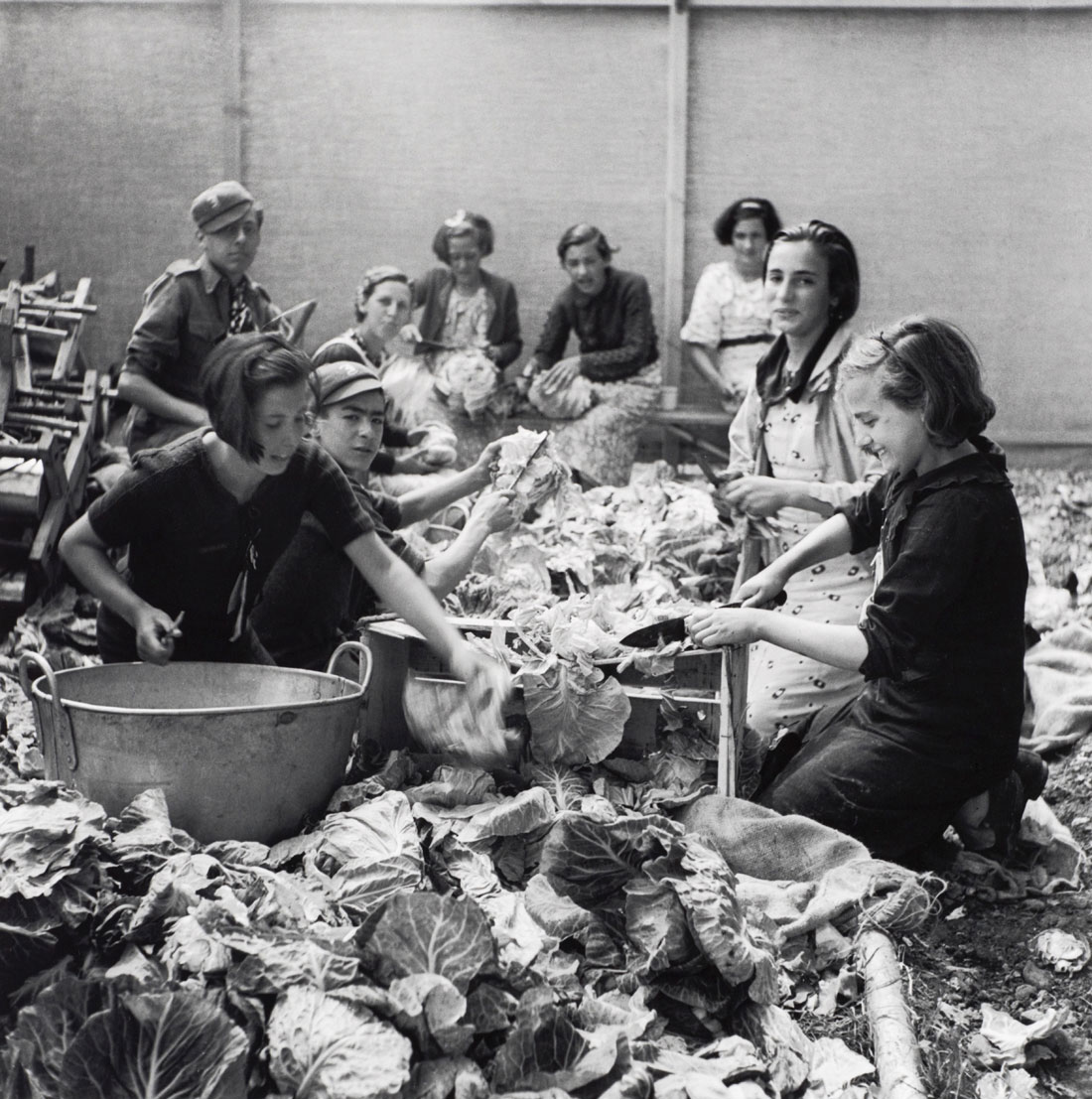
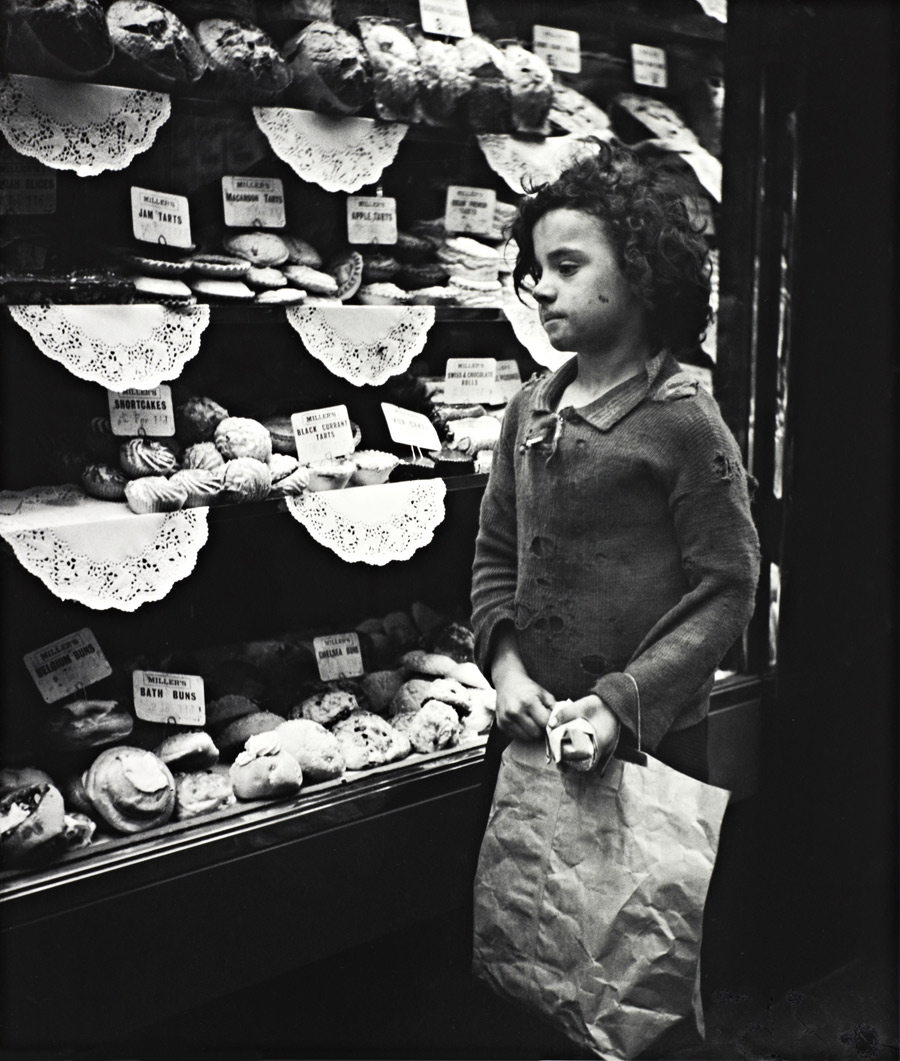
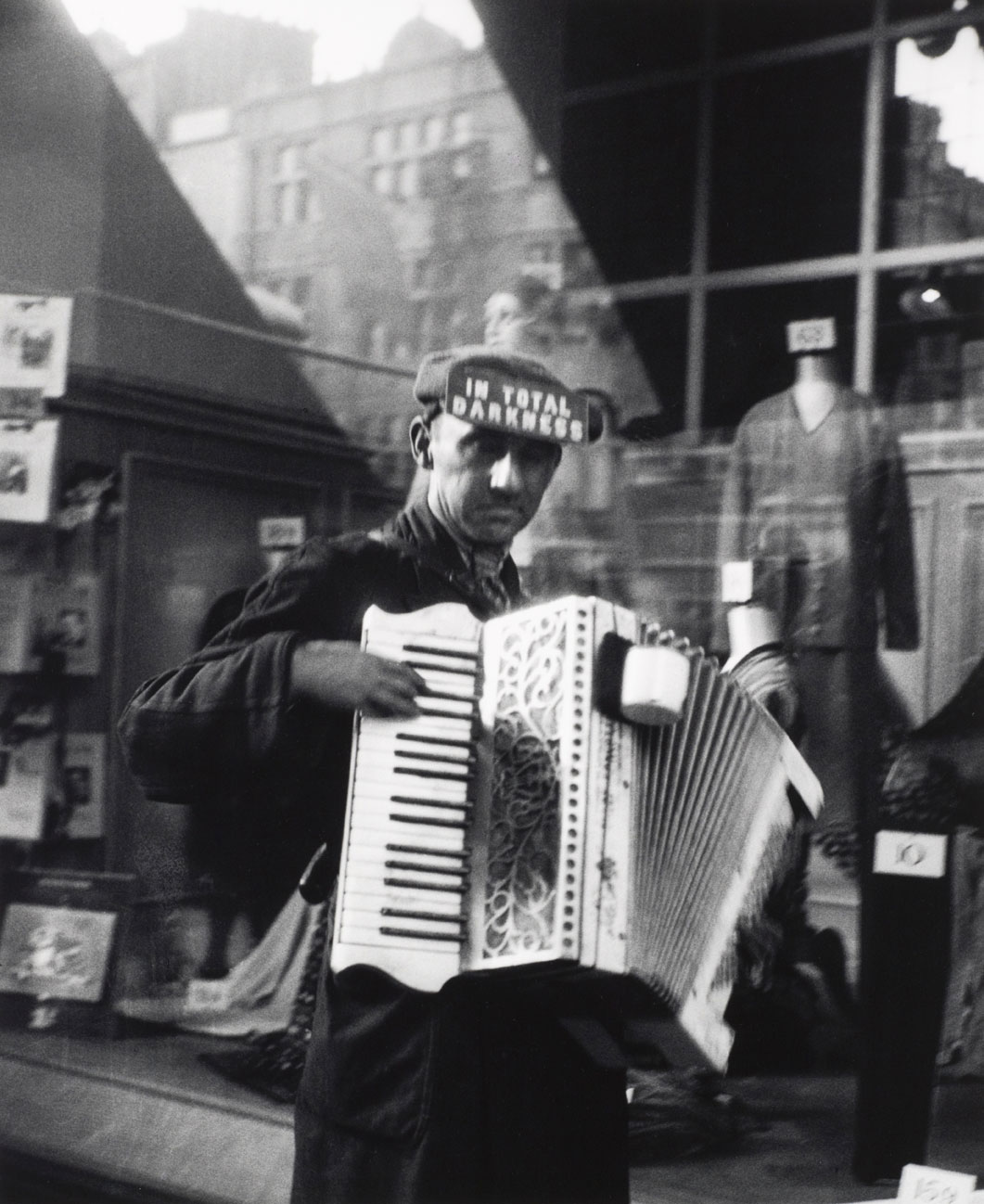
Beyond a perceptive understanding of light and the formal elements of the picture plane there is that ineffable something that a good photographer always has – the ability to transcend the scene, to capture the chance encounter – be it the look on a woman’s face, the ensemble of children preparing vegetables or the untitled man ‘In Total Darkness’ (with traces of Eugene Atget).

The aesthetic of engagement, the ability of her photographs to speak directly to the viewer in a vital, dynamic way, also speaks to the life of the photographer: studied at the Bauhaus, a secret agent for the Communist party in England, and an antique dealer in Brighton.

I would have liked to have met this artist.

Dr Marcus Bunyan


Many thankx to the Scottish National Portrait Gallery for allowing me to publish the photographs in the posting. Please click on the photographs for a larger version of the image.


Edith Tudor-Hart (Austrian-British, 1908-1973) 'Demonstration, South Wales' 1935


Edith Tudor-Hart (Austrian-British, 1908-1973)
Demonstration, South Wales
1935
Printed 2004 from original negatives held in the Edith Tudor Hart Archive
Gelatin silver print
Framed: 50.80 x 40.64cm
© The Estate of Edith Tudor-Hart


Edith Tudor Hart was in South Wales in the 1930s following her husband’s appointment as a GP there. As communists they would have sympathised with the economic hardship of the miners in the Rhondda valley. During the industrial depression following the First World War, unemployment figures in the area soared. With the help of other unions, the National Unemployed Workers’ Movement (NUWM) organised Hunger Marches, which demanded more fair unemployment legislation. This photograph was taken during one such demonstration, with the photographer perched on a post opposite the crowd of men.

Text from the National Galleries of Scotland website


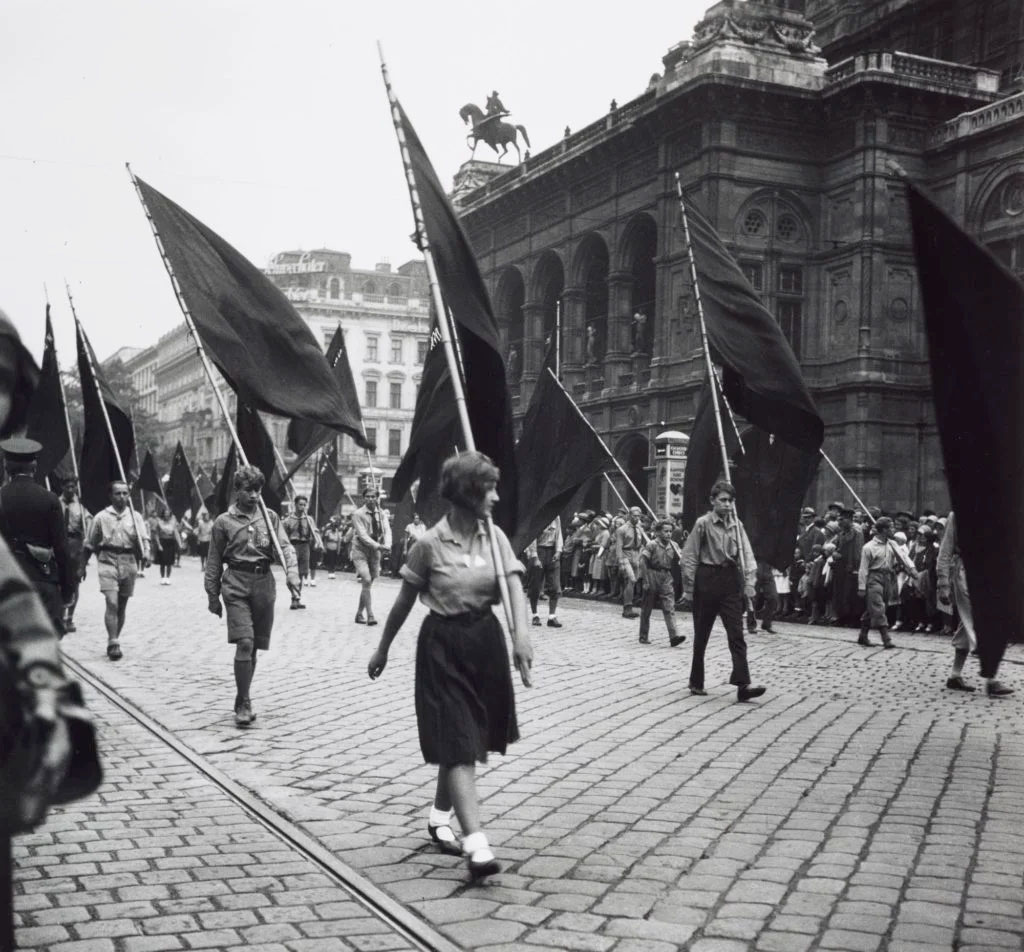
Edith Tudor-Hart (Austrian-British, 1908-1973) 'Members of the Social-Democratic Youth Movement Marching Past the Opera House, Opernring, Vienna' c. 1928


Edith Tudor-Hart (Austrian-British, 1908-1973)
Members of the Social-Democratic Youth Movement Marching Past the Opera House, Opernring, Vienna
c. 1928
Printed 2004 from original negatives held in the Edith Tudor Hart Archive
Gelatin silver print
28 x 30cm
Scottish National Portrait Gallery
© Copyright held jointly by Peter Suschitzky, Julia Donat & Misha Donat


This is a very dynamic image showing members of the Social-Democratic Youth Movement marching in Vienna. In the wake of the First World War, the Austrian political parties had a youthful membership – it is estimated that up to sixty per cent of the Viennese Social Democrats were under forty years of age. The limits of teenagers’ political engagement was a particular source of controversy, with many arguing that the youth movement should be more educational than political. Memoirs of the period reveal that political identification was often fluid. A common joke amongst young activists was that you went to bed a Social Democrat and woke up a Communist!

Text from the National Galleries of Scotland website


Edith Tudor-Hart (Austrian-British, 1908-1973) 'Untitled (Man Selling Fruit, Vienna)' c. 1930


Edith Tudor-Hart (Austrian-British, 1908-1973)
Untitled (Man Selling Fruit, Vienna)
c. 1930
Modern silver gelatine print from archival negative
30.3 x 30.1cm
Scottish National Portrait Gallery: Archive presented by Wolfgang Suschitzky 2004
© The Estate of Edith Tudor-Hart


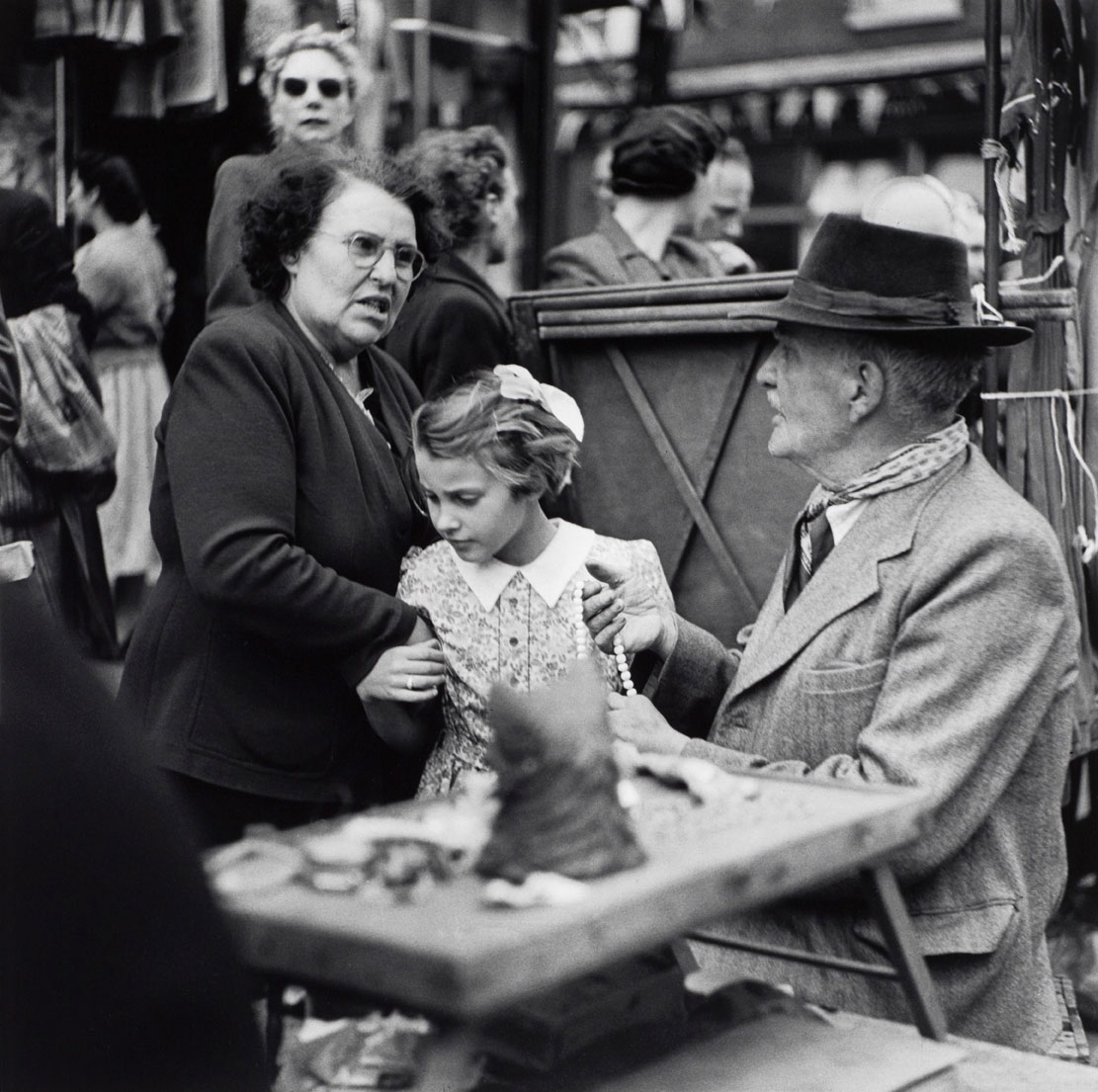
Edith Tudor-Hart (Austrian-British, 1908-1973) 'Untitled (Caledonian Market, London)' c. 1931


Edith Tudor-Hart (Austrian-British, 1908-1973)
Untitled (Caledonian Market, London)
c. 1931
Modern silver gelatine print from archival negative
27.7 x 27.5cm
Scottish National Portrait Gallery: Archive presented by Wolfgang Suschitzky 2004
© The Estate of Edith Tudor-Hart


Edith Tudor-Hart (Austrian-British, 1908-1973) 'Ferris Wheel, Vienna' c. 1931


Edith Tudor-Hart (Austrian-British, 1908-1973)
Ferris Wheel, Vienna
c. 1931
Printed 2004 from original negatives held in the Edith Tudor Hart Archive
Gelatin silver print
29.3 x 29.2cm
Scottish National Portrait Gallery: Archive presented by Wolfgang Suschitzky 2004
© The Estate of Edith Tudor-Hart


Before marrying Edith Tudor Hart had studied photography at the Bauhaus in Dessau. The concerns of this school are obvious in the geometries and startling perspective of this image. Note the exaggerated size of the steel supports of the wheel and the minute figures of the people standing on the ground. The photographer’s eagerness to document the dynamism of urban life suggests she was aware of developments in Soviet avant-garde photography.

Text from the National Galleries of Scotland website


Edith Tudor-Hart (Austrian-British, 1908-1973) 'Karl-Marx-Hof, Vienna' c. 1932


Edith Tudor-Hart (Austrian-British, 1908-1973)
Karl-Marx-Hof, Vienna
c. 1932
Printed 2004 from original negatives held in the Edith Tudor Hart Archive
Gelatin silver print
30.2 x 30cm
Scottish National Portrait Gallery
© Copyright held jointly by Peter Suschitzky, Julia Donat & Misha Donat


The Karl-Marx-Hof was a fortress-like housing estate built by the Social Democrats between 1927 and 1930. A kilometre in length, its huge walls contained nearly 1400 apartments for Viennese workers. In her photograph of the building Tudor-Hart summons both its strength and sense of modernity. However, the permanence evoked by the architecture soon proved to be more apparent than real. In February 1934, during the short-lived Austrian civil war, the building was shelled by Austro-fascist forces. Out-gunned, and concerned about women and children still in their homes, the Karl-Marx-Hof’s defenders surrendered. The first mass movement against European fascism was easily defeated and the Austrian Social Democrats were driven into illegality and exile.

Text from the National Galleries of Scotland website


Edith Tudor-Hart (Austrian-British, 1908-1973) 'Family Group, Stepney, London' c. 1932


Edith Tudor-Hart (Austrian-British, 1908-1973)
Family Group, Stepney, London
c. 1932
Printed 2004 from original negatives held in the Edith Tudor Hart Archive
Gelatin silver print
Scottish National Portrait Gallery
© Copyright held jointly by Peter Suschitzky, Julia Donat & Misha Donat


Tudor-Hart worked extensively amongst working-class communities in East and North London, photographing children on the streets and families in their homes. She was part of a larger movement on the left concerned about the effect of widespread slum housing. However, Tudor-Hart’s imagery is rarely merely propaganda and her ability to connect with those she photographs – often women and children – is evident. This complex photograph explores the photographer’s relationship to her subjects. Shot deliberately through the window it emphasises her voyeurism, thus limiting the sentimental impact of the image.

Text from the National Galleries of Scotland website


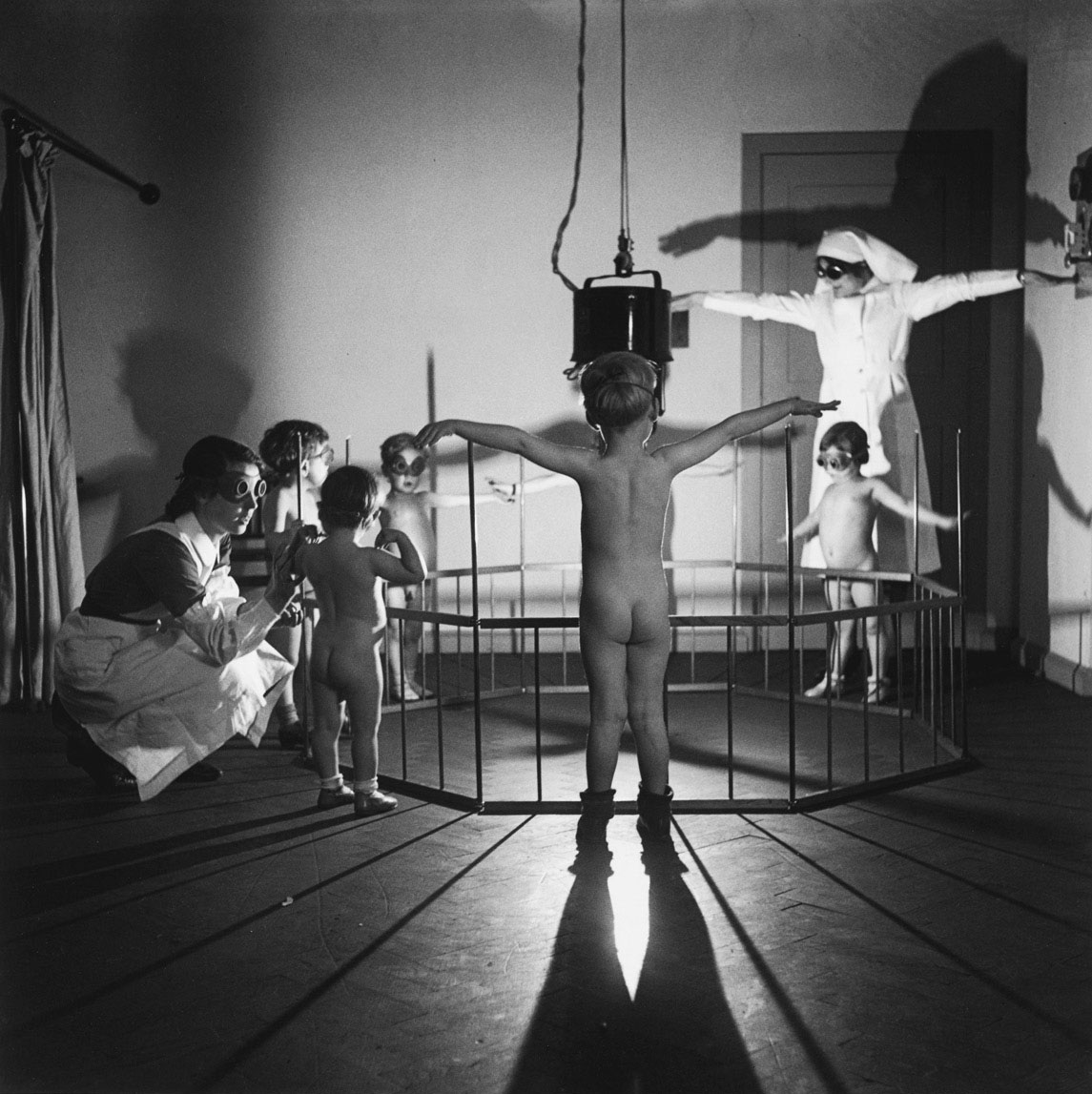
Edith Tudor-Hart (Austrian-British, 1908-1973) 'Untitled (Ultraviolet Light Treatment, South London Hospital for Women and Children)' c. 1935


Edith Tudor-Hart (Austrian-British, 1908-1973)
Untitled (Ultraviolet Light Treatment, South London Hospital for Women and Children)
c. 1935
Modern silver gelatine print from archival negative
30.3 x 30cm
Scottish National Portrait Gallery: Archive presented by Wolfgang Suschitzky 2004


This photograph was taken for a booklet promoting the work of the South London Hospital for Women and Children, produced in collaboration with the German exile photographer, Grete Stern. It shows light treatment for children suffering from vitamin deficiencies, a standard cure at the time. The South London Hospital was founded in 1912 “to meet the growing demand of women for medical treatment by members of their own sex.” Tudor-Hart campaigned throughout her life for health reforms for women and children, part of a wider movement of women whose activity was vital to the formation of the National Health Service in 1948.

Text from the National Galleries of Scotland website


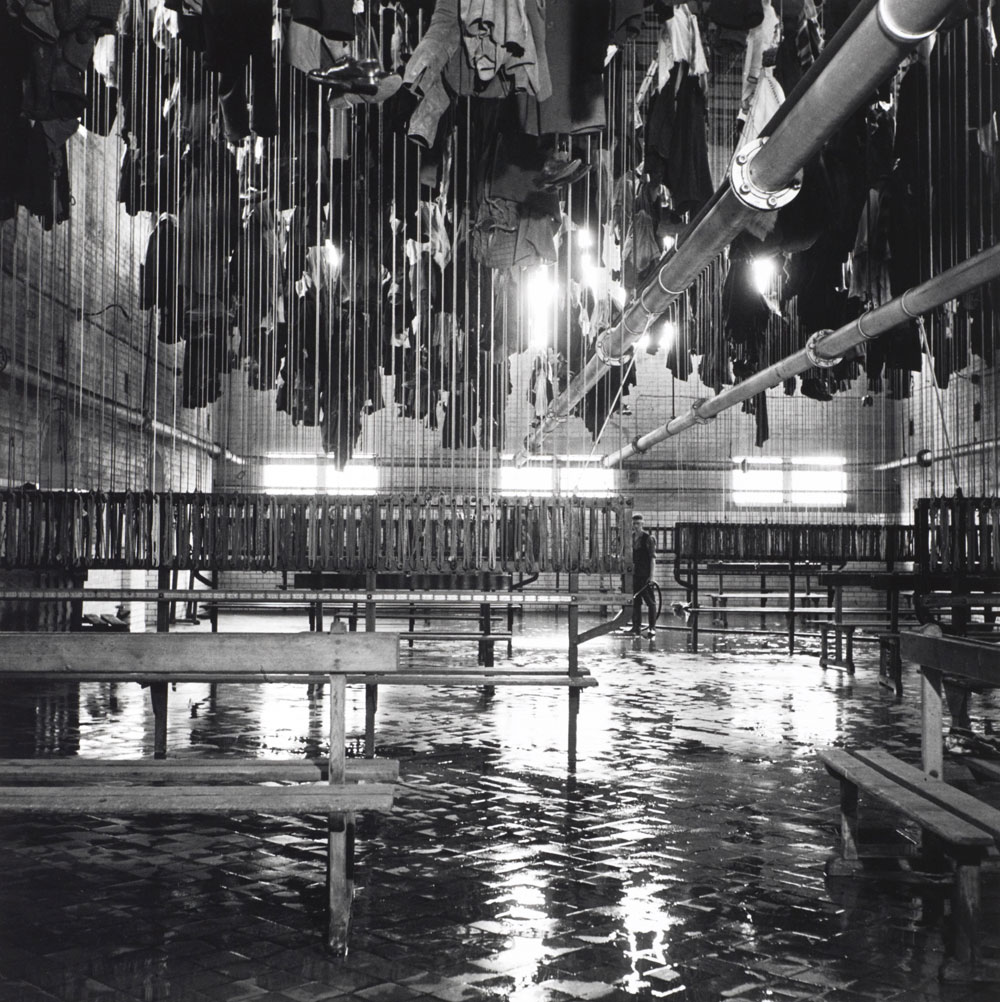
Edith Tudor-Hart (Austrian-British, 1908-1973) 'Untitled (Drying Room, Pit-head Baths, Ashington Colliery, Northumberland)' c. 1937


Edith Tudor-Hart (Austrian-British, 1908-1973)
Untitled (Drying Room, Pit-head Baths, Ashington Colliery, Northumberland)
c. 1937
Modern silver gelatine print from archival negative
30.3 x 30.1cm
Scottish National Portrait Gallery: Archive presented by Wolfgang Suschitzky 2004
© The Estate of Edith Tudor-Hart


The life and work of one of the most extraordinary photographers in Britain during the 1930s and 1940s is the subject of a major new exhibition at the Scottish National Portrait Gallery. Based on extensive new research, Edith Tudor-Hart: In the Shadow of Tyranny, is the first full presentation of the Austrian-born photographer’s work. The exhibition presents over 80 photographs, many of which have never been shown before, and includes film footage, Tudor-Hart’s scrapbook and a selection of her published stories in books and magazines.

During the 1930s, photography became implicated in the vital political and social questions of the era as never before. The enhanced technological capacities of the camera and faster printing processes offered left-wing political activists new techniques for popular mobilisation. The medium took on a sharper social purpose, breaking down the traditional divisions of culture through its quality of immediacy and capacity for self-representation.

Edith Tudor-Hart was a key exponent of this aesthetic of engagement, with images that show a sophisticated realism, marked by their directness and capacity to communicate issues of inequality and deprivation. In a turbulent decade, she attempted to use the camera as a political weapon, aligning her practice with the wider worker photography movement. Tudor-Hart’s photography dealt with many of the major social issues of the day, including poverty, unemployment and slum housing. Her imagery is a vital record of the politically-charged atmosphere of inter-war Vienna and Britain during the Great Slump of the 1930s. After 1945, Tudor-Hart concentrated on questions of child welfare, producing some of the most psychologically penetrating imagery of children of her era.

Tudor-Hart’s life story as a photographer is inextricably tied to the great political upheavals of the twentieth century. Born Edith Suschitzky in Vienna in 1908, she grew up in radical Jewish circles in a city ravaged by the impact of the First World War. Her childhood was dominated by social issues in a culture acutely aware of the impact of the Russian Revolution. After training as a Montessori teacher, she studied photography at the Bauhaus in Dessau and pursued a career as a photojournalist. However, her life was turned upside down in May 1933 when she was arrested whilst working as an agent for the Communist Party of Austria. She escaped long-term imprisonment by marrying an English doctor, Alexander Tudor-Hart, and was exiled to London shortly afterwards. Notoriously, Tudor-Hart continued to combine her practice as a photographer with low-level espionage for the Soviet Union and was pursued by the security services until her death in 1973.

Tudor-Hart’s photography introduced into Britain formal and narrative features that derived from her training on the Continent. Her method initiates a dialogue with those she photographs, very different from the more distancing imagery of the photojournalists. Along with thirty or so German-speaking exile photographers, many of Jewish origin, Tudor-Hart helped transform British photography. After the Second World War, rejected by Fleet Street and the British establishment, Tudor-Hart turned to documenting issues of child welfare. Her photographs were published in Picture Post and a range of other British magazines. By the late 1950s she had abandoned photography altogether.

Commenting on the exhibition, Director of the Scottish National Portrait Gallery, Christopher Baker, said, ‘We are really pleased to be staging this thrilling retrospective of Tudor-Hart’s photography. It combines stunning images with an intriguing life-story and illuminates a turbulent period in European history. Tudor-Hart was one of the great photographers of her era.’ Edith Tudor-Hart: In the Shadow of Tyranny is drawn largely from the photographer’s negative archive, which was donated to the National Galleries of Scotland by her family in 2004. The exhibition travels to the Wien Museum in September and will form the first complete presentation of her work in Austria.

Press release from the Scottish National Portrait Gallery


Edith Tudor-Hart (Austrian-British, 1908-1973) 'Untitled (Children Preparing Vegetables, North Stoneham Camp, Hampshire)' 1937


Edith Tudor-Hart (Austrian-British, 1908-1973)
Untitled (Children Preparing Vegetables, North Stoneham Camp, Hampshire)
1937
Modern silver gelatine print from archival negative
30.2 x 29.8cm
Scottish National Portrait Gallery: Archive presented by Wolfgang Suschitzky 2004
© The Estate of Edith Tudor-Hart


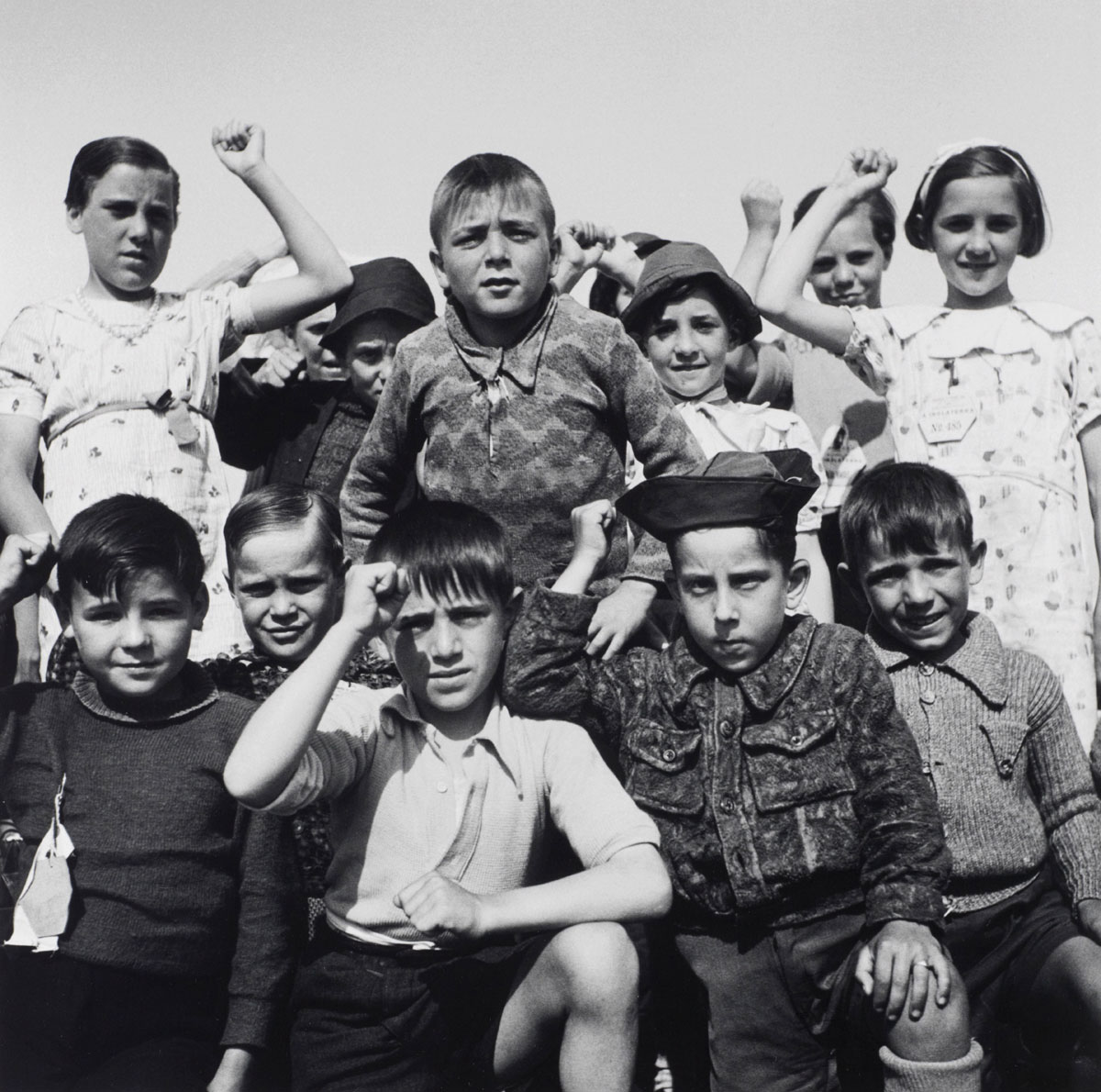
Edith Tudor-Hart (Austrian-British, 1908-1973) 'Untitled (Basque Refugee Children, North Stoneham Camp, Hampshire)' 1937


Edith Tudor-Hart (Austrian-British, 1908-1973)
Untitled (Basque Refugee Children, North Stoneham Camp, Hampshire)
1937
Modern silver gelatine print from archival negative
30.2 x 30cm
Scottish National Portrait Gallery: Archive presented by Wolfgang Suschitzky 2004
© The Estate of Edith Tudor-Hart


The children are giving the Spanish anti-fascist Republican salute.


Edith Tudor-Hart (Austrian-British, 1908-1973) 'Untitled (Child Staring into Bakery Window)' c. 1935


Edith Tudor-Hart (Austrian-British, 1908-1973)
Untitled (Child Staring into Bakery Window)
c. 1935
Modern silver gelatine print from archival negative
35.30 x 30.00cm
Scottish National Portrait Gallery: Archive presented by Wolfgang Suschitzky 2004
© The Estate of Edith Tudor-Hart


Edith Tudor-Hart (Austrian-British, 1908-1973) 'Untitled (In Total Darkness, London)' c. 1935


Edith Tudor-Hart (Austrian-British, 1908-1973)
Untitled (In Total Darkness, London)
c. 1935
Modern silver gelatine print from archival negative
27.70 x 27.50cm
Scottish National Portrait Gallery: Archive presented by Wolfgang Suschitzky 2004
© The Estate of Edith Tudor-Hart


Scottish National Portrait Gallery
1 Queen Street, Edinburgh EH2 1JD
Phone: +44 131 624 6200

Opening hours:
Daily 10am – 5pm

Scottish National Portrait Gallery website

LIKE ART BLART ON FACEBOOK

Back to top

Exhibition: ‘Don McCullin: A Retrospective’ at the National Gallery of Canada, Ottawa

Exhibition dates: 1st February – 14th April, 2013

Curator: Ann Thomas


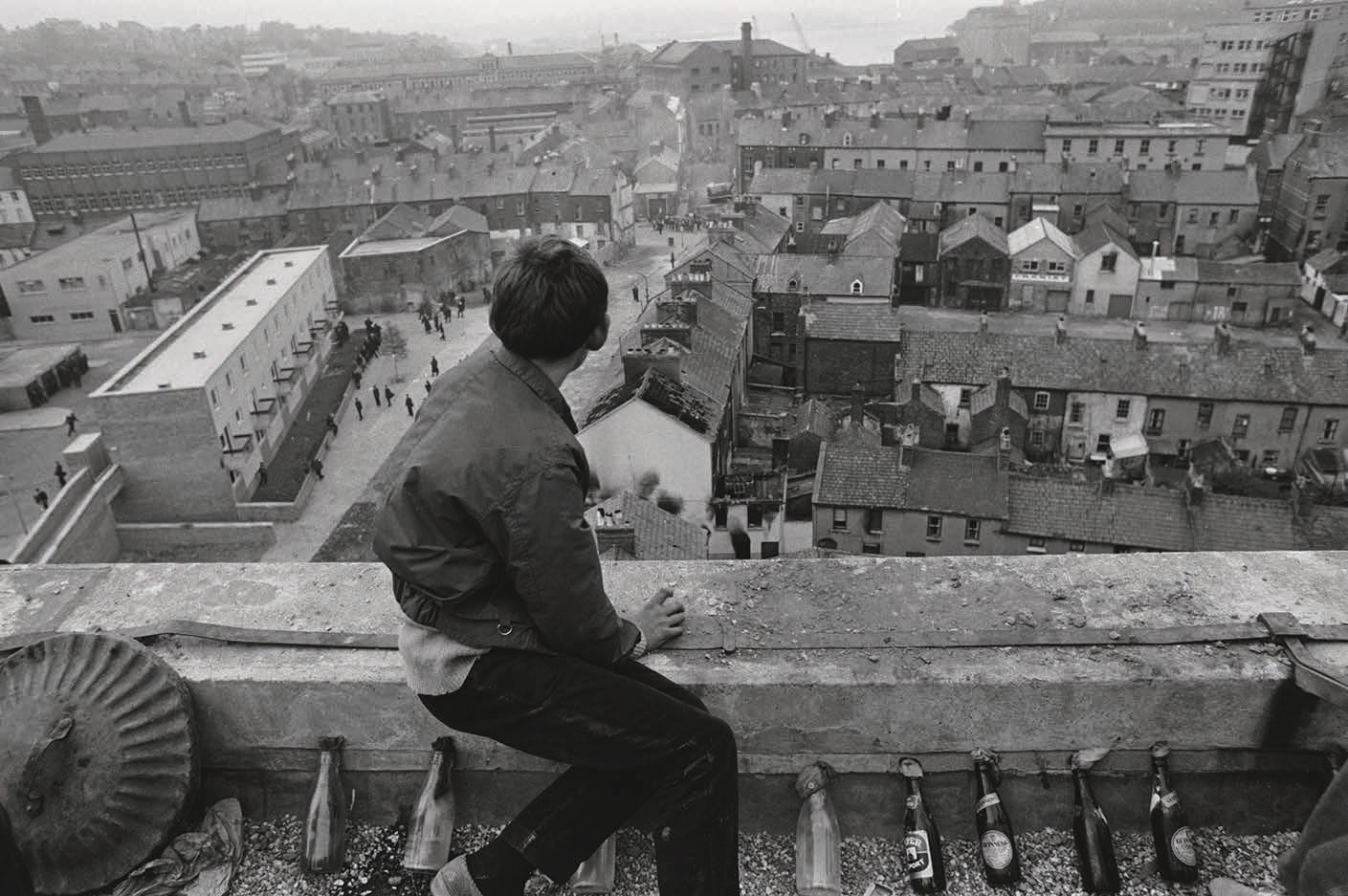
Don McCullin (British, b. 1935) 'Catholic youth escaping a CS gas assault in the Bogside, Londonderry, Northern Ireland' 1971 from the exhibition 'Don McCullin: A Retrospective' at the National Gallery of Canada, Ottawa, February - April, 2013


Don McCullin (British, b. 1935)
Catholic youth escaping a CS gas assault in the Bogside, Londonderry, Northern Ireland
1971
Gelatin silver print
© Don McCullin / Contact Press Images


“Photography for me is not looking, it’s feeling. If you can’t feel what you’re looking at, then you’re never going to get others to feel anything when they look at your pictures”

“You do not go away from here without carrying a huge burden, if you are a decent human being and you have a conscience.”

“I photograph the humble, the anonymous, who are spontaneous and mirror all of us.”


Don McCullin, Sleeping With Ghosts: A Life’s Work in Photography


Many thankx to the National Gallery of Canada for allowing me to publish the photographs in the posting. Please click on the photographs for a larger version of the image.


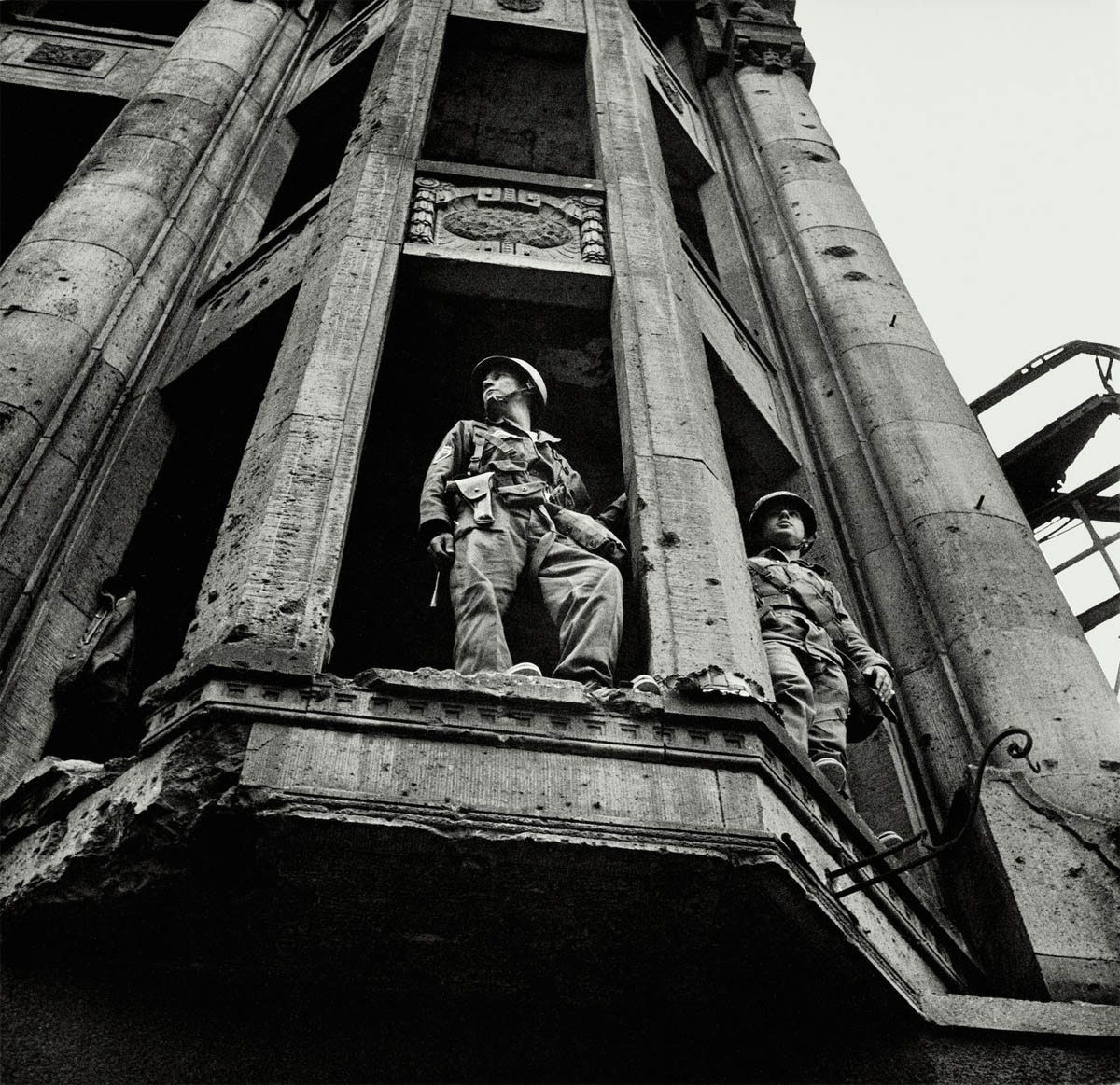
Don McCullin (British, b. 1935) 'American soldiers, Checkpoint Charlie, West Berlin' August 1961 from the exhibition 'Don McCullin: A Retrospective' at the National Gallery of Canada, Ottawa, February - April, 2013


Don McCullin (British, b. 1935)
American soldiers, Checkpoint Charlie, West Berlin
August 1961
Gelatin silver print
© Don McCullin / Contact Press Images


Don McCullin (British, b. 1935) 'American Troops Looking across the Wall, Berlin' 1961


Don McCullin (British, b. 1935)
American Troops Looking across the Wall, Berlin
1961
Gelatin silver print
© Don McCullin / Contact Press Images


Don McCullin (British, b. 1935) 'Protester, Cuban missile crisis, Whitehall, London' 1962


Don McCullin (British, b. 1935)
Protester, Cuban missile crisis, Whitehall, London
1962
Gelatin silver print
© Don McCullin / Contact Press Images


Don McCullin (British, b. 1935) 'Turkish defender leaving the side-entrance of a cinema, Limassol, Cyprus' 1964


Don McCullin (British, b. 1935)
Turkish defender leaving the side-entrance of a cinema, Limassol, Cyprus
1964
Gelatin silver print
© Don McCullin / Contact Press Images


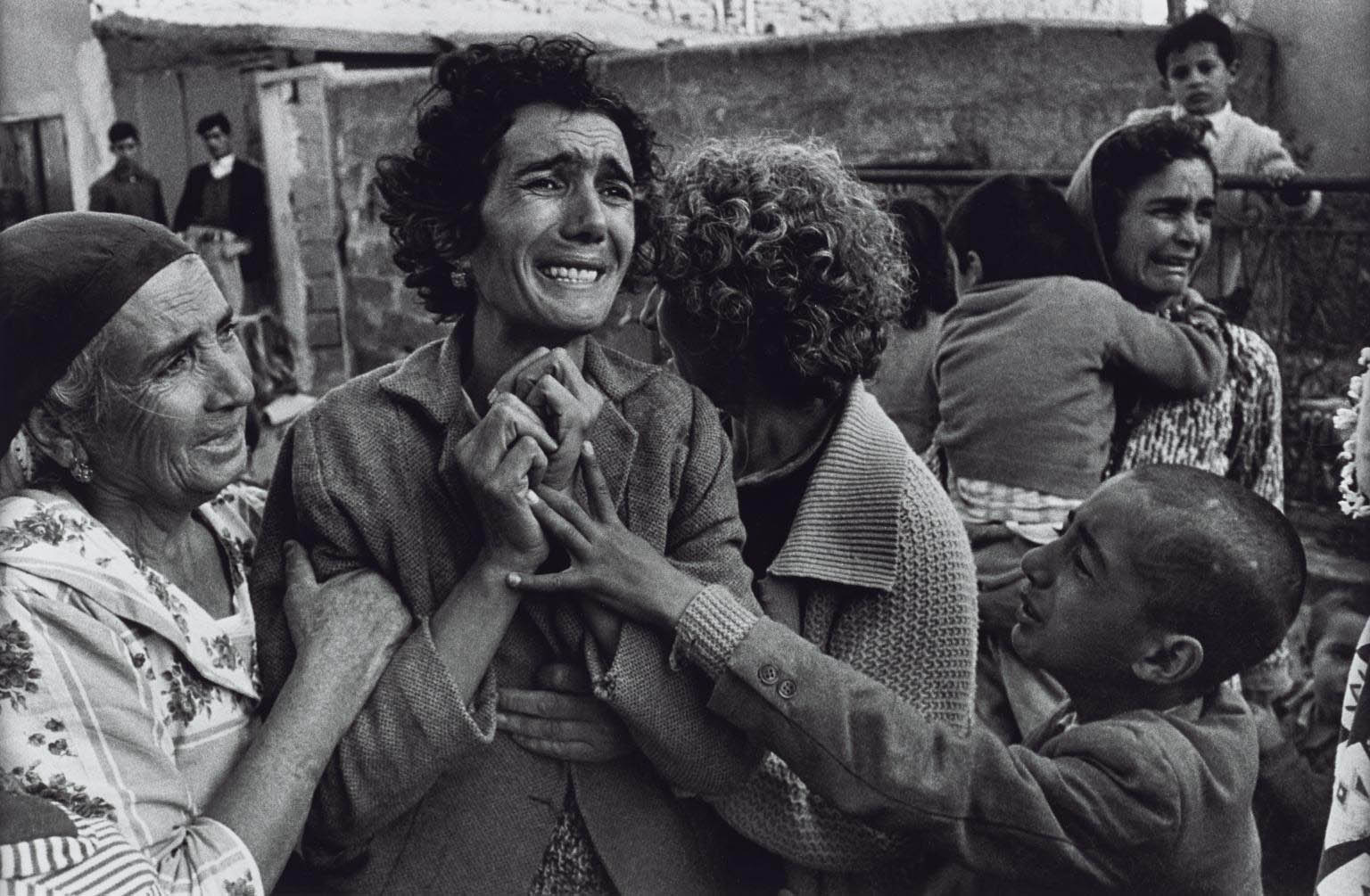
Don McCullin (British, b. 1935) 'Cyprus' 1964


Don McCullin (British, b. 1935)
Turkish woman mourning the death of her husband killed by Greek forces during the Civil War, Limassol, Cyprus
1964
Gelatin silver print
© Don McCullin / Contact Press Images


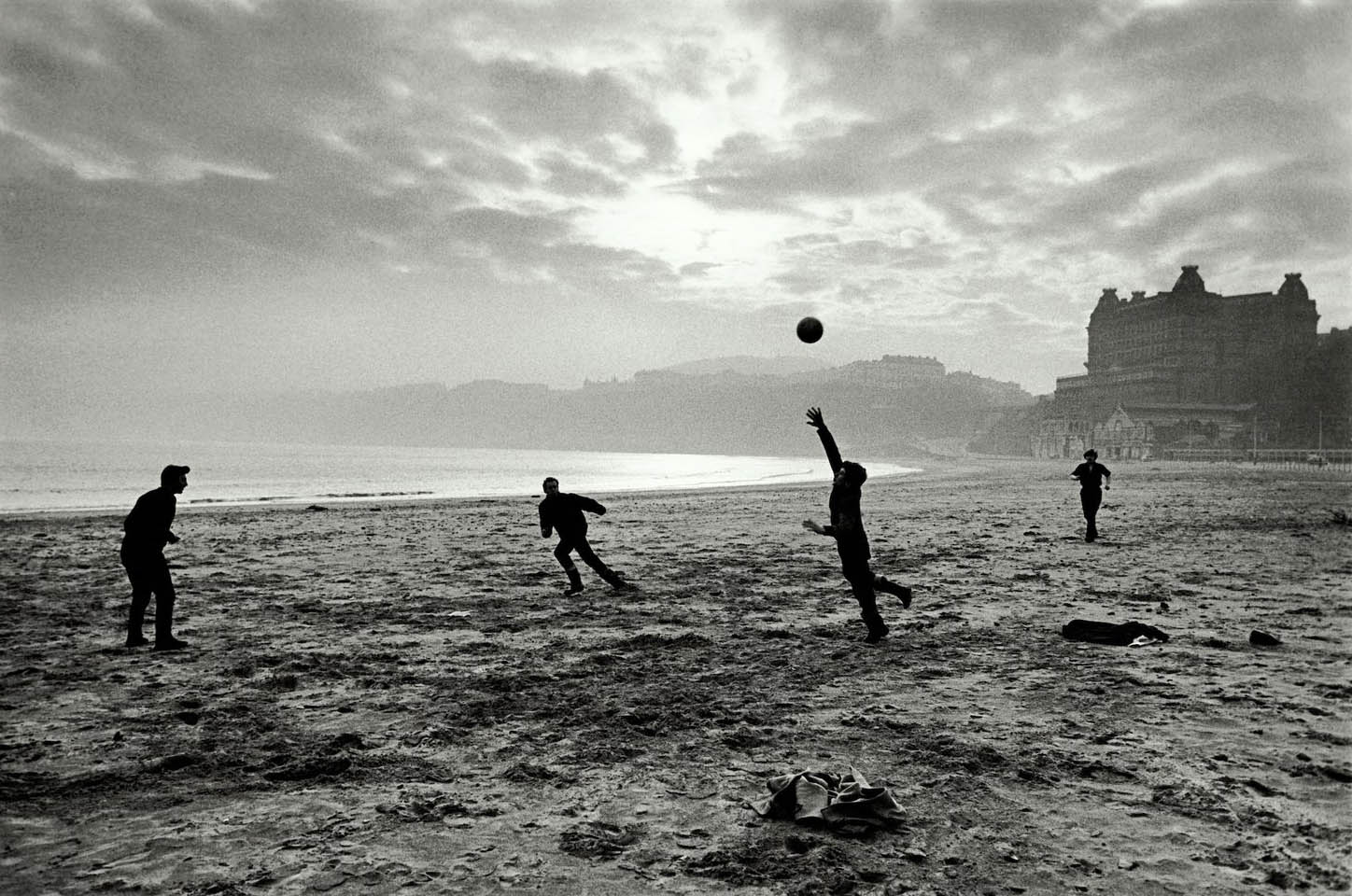
Don McCullin (British, b. 1935) 'Fishermen playing during their lunch break, Scarborough, Yorkshire' 1967


Don McCullin (British, b. 1935)
Fishermen playing during their lunch break, Scarborough, Yorkshire
1967
Gelatin silver print
© Don McCullin / Contact Press Images


Don McCullin (British, b. 1935) 'US marine throwing grenade, Tet Offensive, Hué, South Vietnam' February 1968


Don McCullin (British, b. 1935)
US marine throwing grenade, Tet Offensive, Hué, South Vietnam
February 1968
Gelatin silver print
© Don McCullin / Contact Press Images


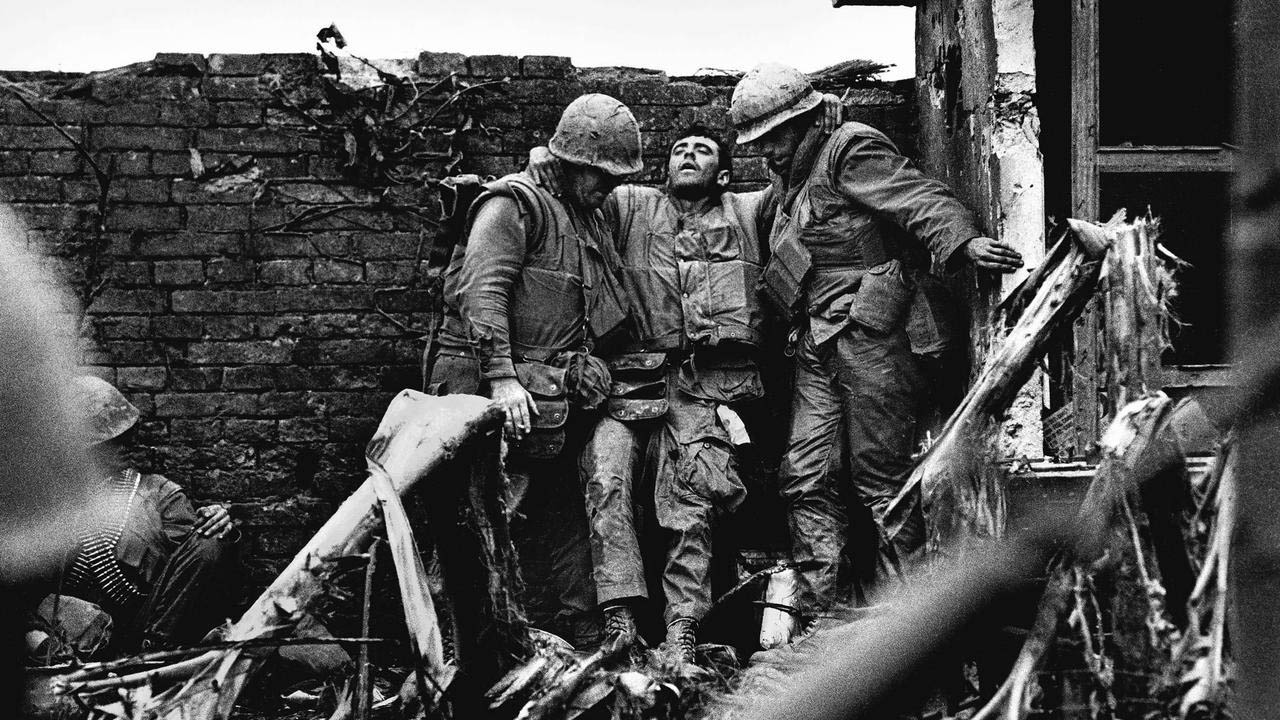
Don McCullin (British, b. 1935) 'U.S. Marines with wounded soldier, the Citadel, Hue' 1968


Don McCullin (British, b. 1935)
U.S. Marines with wounded soldier, the Citadel, Hue
1968
Gelatin silver print
35.7 x 54.7cm
© Don McCullin / Contact Press Images


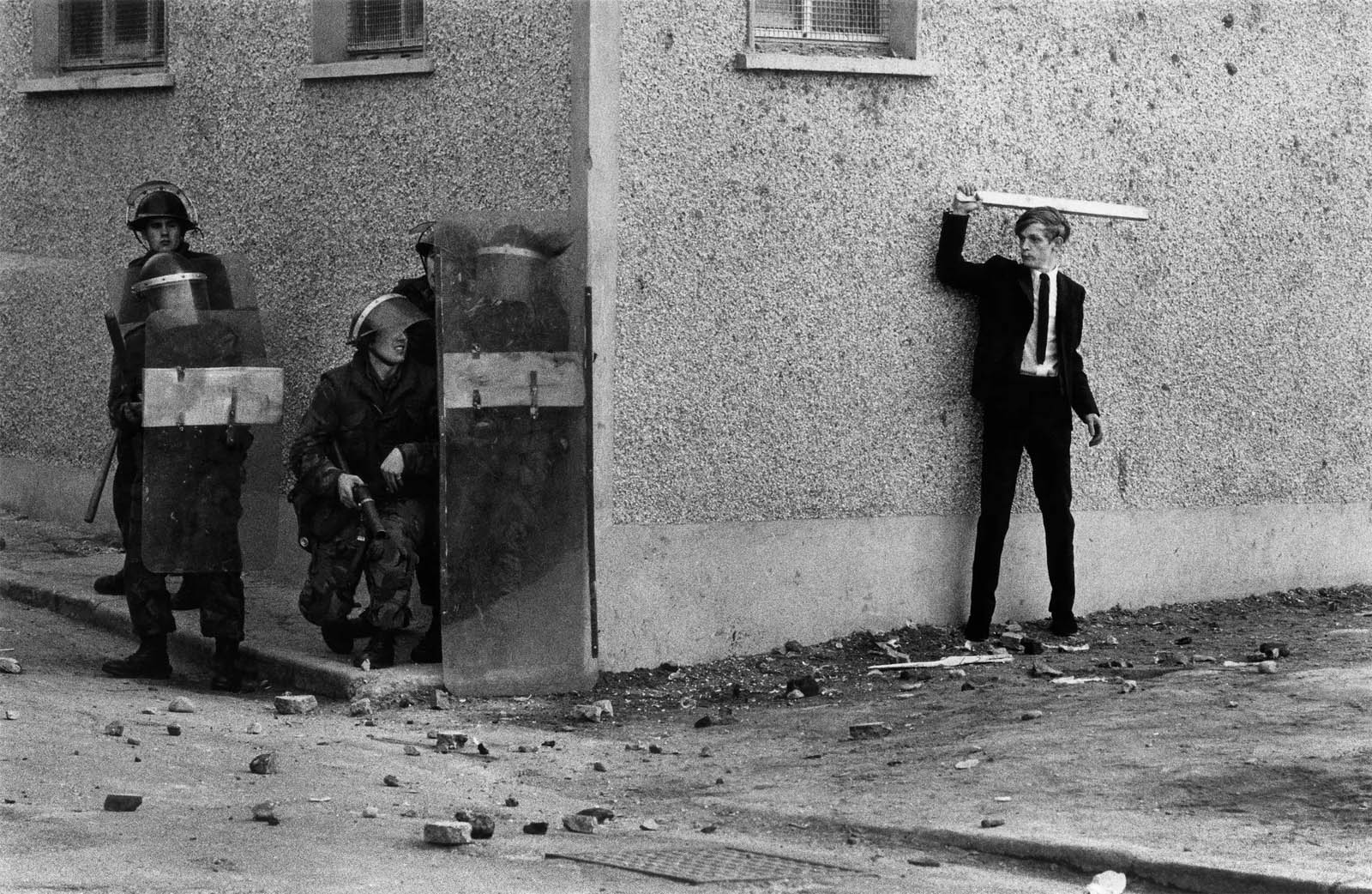
Don McCullin (British, b. 1935) 'The Bogside, Northern Ireland, Londonderry' 1971


Don McCullin (British, b. 1935)
The Bogside, Northern Ireland, Londonderry
1971
Gelatin silver print
© Don McCullin / Contact Press Images


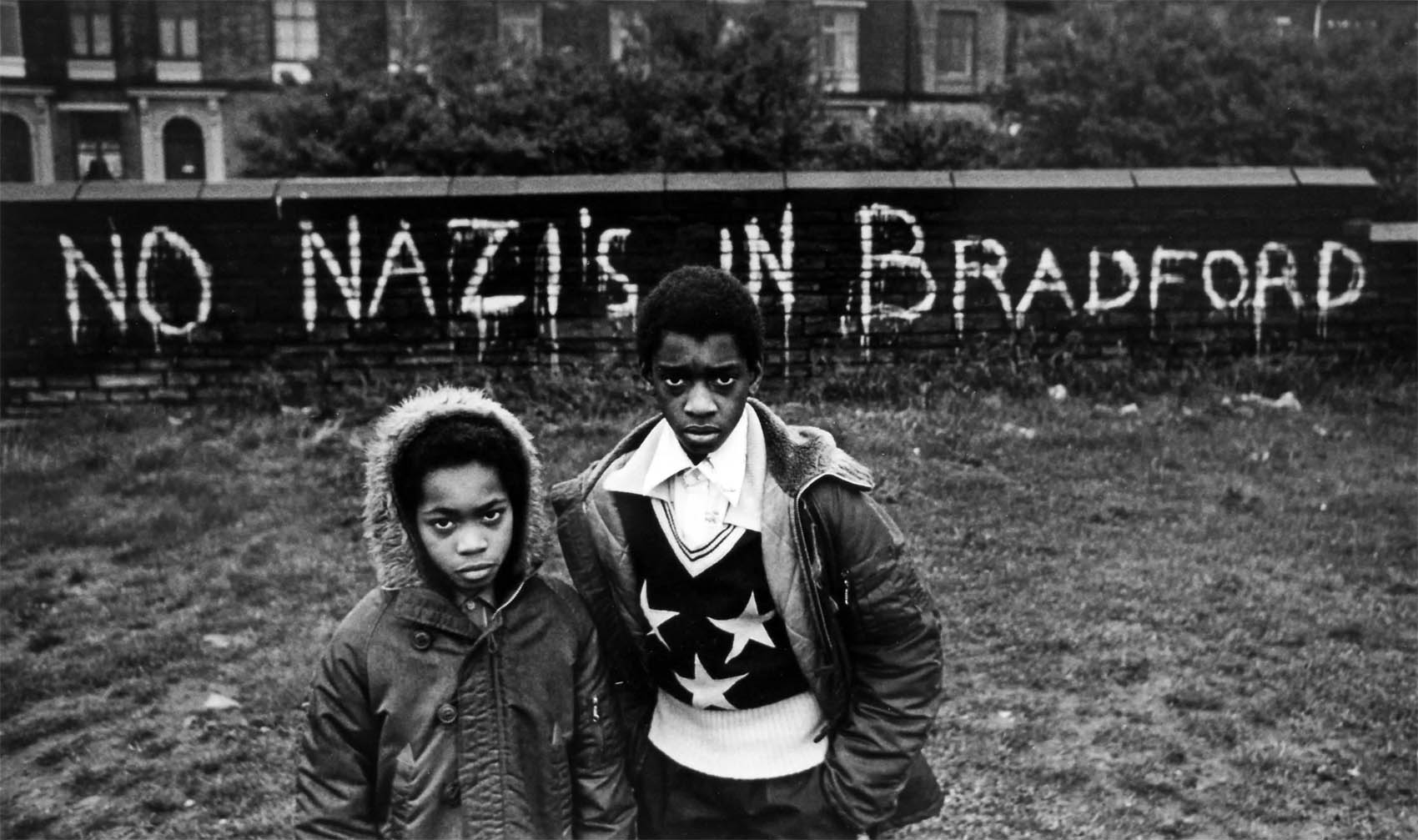
Don McCullin (British, b. 1935) 'Two local boys in Bradford / No Nazis in Bradford, England' 1972


Don McCullin (British, b. 1935)
Two local boys in Bradford / No Nazis in Bradford, England
1972
Gelatin silver print
© Don McCullin / Contact Press Images


For the first time ever, the National Gallery of Canada is organising an monographic exhibition dedicated to the work of a contemporary British photographer. Don McCullin: A Retrospective features a collection of 134 exceptional black-and-white photographs taken by McCullin, an unflinching photojournalist best known for his coverage of the world’s most dangerous conflict zones. His photographs have been published in major newspapers and magazines, including The Observer, The Sunday Times and The Daily Telegraph. McCullin has also created an important body of social documentary work and a series of lyrical landscapes in his native Britain. Several of these photographs are included in the exhibition, which will be on display until April 14, 2013 in the NGC’s Prints, Drawings and Photographs Galleries. “McCullin’s photographs belong in an art gallery because they consistently bring clarity and compositional grace to their compelling subject matter. These pictures are both hard to look at and hard not to,” said NGC director and CEO Marc Mayer.

Don McCullin: A Retrospective highlights works from all of McCullin’s major series: portraits of the poor and the homeless in London and northern England (1950s to 1980s); the construction of the Berlin Wall (1961); war and famine in Cyprus, the Congo, Biafra, Vietnam, Bangladesh, Cambodia, Lebanon and Northern Ireland (1964-1982); peoples of Southeast Asia and Africa (1988-2004); and landscapes in Somerset, England, and northern France (1970-2011). In this exhibition, the artist’s journey from working class England to the killing fields and to the landscape of Arthurian myth reveals his searing outrage and profound compassion. Also included are magazines and newspapers relating to past assignments.

McCullin covered war zones on four continents, primarily from the 1960s to the 1980s. His photographs from the battlefields belong to a tradition of war art practiced by Francisco de Goya, Otto Dix and photographer Robert Capa, artists who, like himself, sought to communicate in images the horrors of human conflict. Particularly compelling for their narrative depth, sombre lighting and powerful composition, McCullin’s photographs convey the intensity and intimacy of his human encounters. His landscapes, although also dark and brooding, speak to his desire to distance himself from the subject of human suffering.

Although, McCullin did travel to Syria recently for The Times on one final war assignment (these photographs are not included in the exhibition), his exposure to the worst human atrocities took such a toll on him that he more or less retreated from conflict zones beginning in the 1980s. McCullin does not like being called a war photographer. Nor does he think of himself as an artist, but rather as a photojournalist, or simply, a photographer. In her insightful essay in the exhibition catalogue, Sobey Curatorial Assistant Katherine Stauble writes of the war photographs: “Likely (these images) were not meant to hang on a gallery wall, but rather, to communicate information, to reveal truths and to mobilise action. Now that McCullin has escaped the battlefield and for the past twenty years has been focusing his lens on landscape and still life, one might expect the artist moniker to sit more comfortably with him.”

Press release from the National Gallery of Canada website


Don McCullin (British, b. 1935) 'The Guv'nors, Finsbury Park, London' 1958


Don McCullin (British, b. 1935)
The Guvnors, Finsbury Park, London
1958
Gelatin silver print
© Don McCullin / Contact Press Images


Don McCullin (British, b. 1935) 'At a café in Finsbury Park, London' 1958


Don McCullin (British, b. 1935)
At a café in Finsbury Park, London
1958
Gelatin silver print
© Don McCullin / Contact Press Images
Photo © NGC


Don McCullin (British, b. 1935) 'Old Vietnamese man, Tet Offensive, Hué, South Vietnam' February 1968


Don McCullin (British, b. 1935)
Old Vietnamese man, Tet Offensive, Hué, South Vietnam
February 1968
Gelatin silver print
© Don McCullin / Contact Press Images


Don McCullin (British, b. 1935) 'Homeless Irishman, Aldgate, East End, London' 1970


Don McCullin (British, b. 1935)
Homeless Irishman, Aldgate, East End, London
1970
Gelatin silver print
© Don McCullin / Contact Press Images


Don McCullin (British, b. 1935) 'Jean, a homeless woman, Aldgate, East End, London' 1984, printed c. 1985


Don McCullin (British, b. 1935)
Jean, a homeless woman, Aldgate, East End, London
1984, printed c. 1985
Gelatin silver print
© Don McCullin / Contact Press Images


Don McCullin (British, b. 1935) 'Along the Ganges during the Sonepur Mela festival, Bihar, India' 1993


Don McCullin (British, b. 1935)
Along the Ganges during the Sonepur Mela festival, Bihar, India
1993
Platinum print
Gelatin silver print
© Don McCullin / Contact Press Images


National Gallery of Canada
380 Sussex Dr  Ottawa
ON K1N 9N4, Canada
Phone: +1 613-990-1985

Opening hours:
Tuesday – Sunday 10am – 5pm
Closed Mondays

National Gallery of Canada website

LIKE ART BLART ON FACEBOOK

Back to top

Exhibition: ‘WAR/PHOTOGRAPHY: Images of Armed Conflict and Its Aftermath’ at the Museum of Fine Arts, Houston – Posting Part 4

Exhibition dates: 11th November, 2012 – 3rd February, 2013

Curators: Anne Wilkes Tucker, the Gus and Lyndall Wortham Curator of Photography; Will Michels, collections photographer and exhibition co-curator; Natalie Zelt, curatorial assistant

**Please be aware that there are graphic photographs in this posting.**


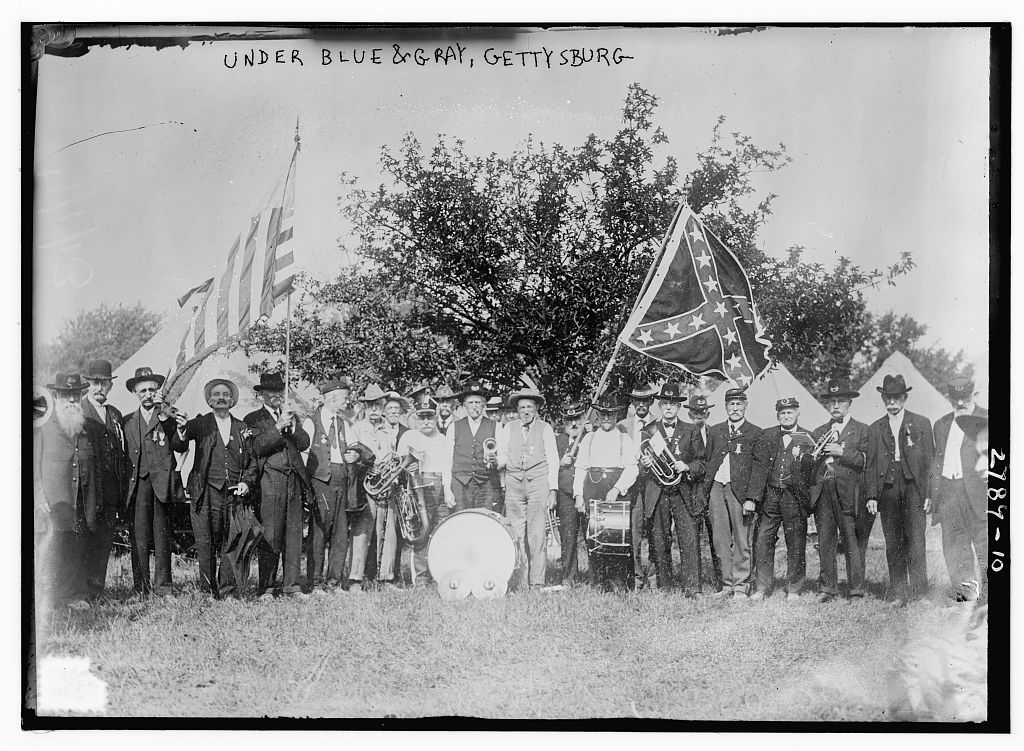
Anonymous photographer. 'Under blue & gray – Gettysburg' July 1913 from the exhibition 'WAR/PHOTOGRAPHY: Images of Armed Conflict and Its Aftermath' at the Museum of Fine Arts, Houston - Posting Part 4, November 2012 - February 2013


Anonymous photographer
Under blue & gray – Gettysburg
July 1913
Photo shows the Gettysburg Reunion (the Great Reunion) of July 1913, which commemorated the 50th anniversary of the Battle of Gettysburg
Library of Congress Prints and Photographs Division Washington, D.C.


Part 4 of the biggest posting on one exhibition that I have ever undertaken on Art Blart!

As befits the gravity of the subject matter this posting is so humongous that I have had to split it into 4 separate postings. This is how to research and stage a contemporary photography exhibition that fully explores its theme. The curators reviewed more than one million photographs in 17 countries, locating pictures in archives, military libraries, museums, private collections, historical societies and news agencies; in the personal files of photographers and service personnel; and at two annual photojournalism festivals producing an exhibition that features 26 sections (an inspired and thoughtful selection) that includes nearly 500 objects that illuminate all aspects of WAR/PHOTOGRAPHY.

I have spent hours researching and finding photographs on the Internet to support the posting. It has been a great learning experience and my admiration for photographers of all types has increased. I have discovered the photographs and stories of new image makers that I did not know and some enlightenment along the way. I despise war, I detest the state and the military that propagate it and I surely hate the power, the money and the ethics of big business that support such a disciplinarian structure for their own ends. I hope you meditate on the images in this monster posting, an exhibition on a subject matter that should be consigned to the history books of human evolution.

**Please be aware that there are graphic photographs in all of these postings.**Part 1, Part 2, Part 3

Dr Marcus Bunyan


Many thankx to the Museum of Fine Arts, Houston for allowing me to publish some of the photographs in the posting. Please click on the photographs for a larger version of the image.


Memorials

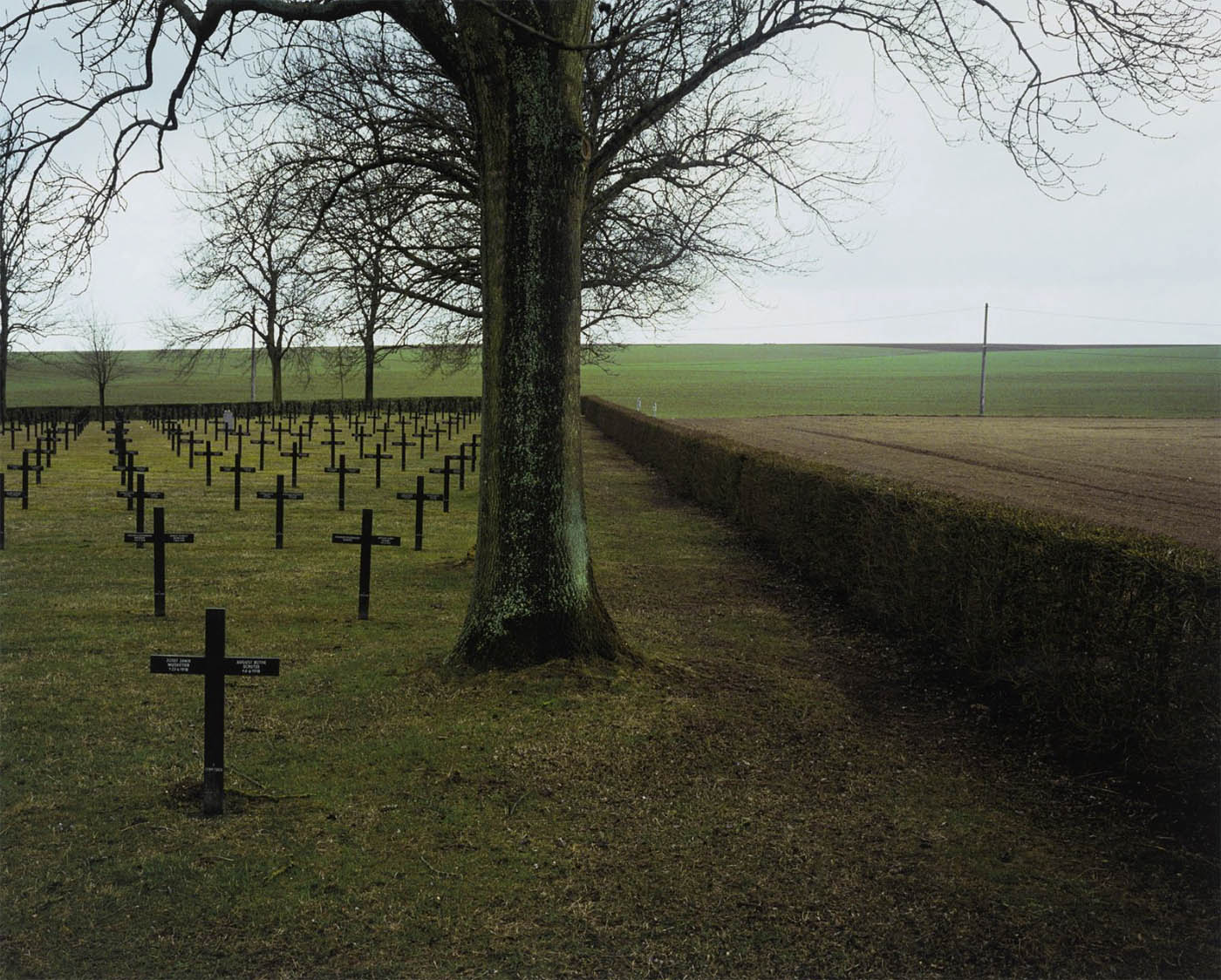
25. Photographs in the “Memorials” section range from the tomb of an unknown World War I soldier in England, by Horace Nicholls; and a landscape of black German crosses throughout a World War II burial site, by Bertrand Carrière; to an anonymous photograph of a reunion scene in Gettysburg of the opposing sides in the Civil War; and Joel Sternfeld’s picture of a woman and her daughter at the Vietnam Veterans Memorial in Washington, DC, in 1986. (8 images)


Horace Nicholls (English, 1867-1941) 'The Unknown Warrior at Westminster Abbey, London, November 1920' 1920 from the exhibition 'WAR/PHOTOGRAPHY: Images of Armed Conflict and Its Aftermath' at the Museum of Fine Arts, Houston - Posting Part 4, November 2012 - February 2013


Horace Nicholls (English, 1867-1941)
The Unknown Warrior at Westminster Abbey, London, November 1920
1920
Silver gelatin print
© IWM (Q 31514)


In order to commemorate the many soldiers with no known grave, it was decided to bury an ‘Unknown Warrior’ with all due ceremony in Westminster Abbey on Armistice Day in 1920. The photograph shows the coffin resting on a cloth in the nave of Westminster Abbey before the ceremony at the Cenotaph and its final burial.


Bertrand Carrière (Canadian, b. 1957)
'Untitled' 2005-2009


Bertrand Carrière (Canadian, b. 1957)
Untitled
2005-2009
From the series Lieux Mêmes [Same Places]


In 2005, Carrière and historian Guth Desprez started to investigate the deeper history surrounding the found photo album. They travelled to Europe, with the photo album as their guide, in order to retrace the path of the Canadian Expeditionary Force. By photographing the locations in the soldier’s images, Carrière explores the themes of memory and history through the changing landscape. They visited the long list of places marked by the horrendous battles of The Great War: the Somme in Picardy, Artois in the North Pas-de-Calais and up to the vast fields of Flanders in Belgium. Carrière’s photographs document the sites which appear in the soldier’s album along with others on the Western Front, offering a contemporary view approximately 90 years after the infamous events, which continue to stigmatise these locations to this very day. The incredible light of the regions of northern France and the flatness of the land helps Carrière build a sense of mystery. The photographs initiate dialogue about how the landscape was affected and the ways in which it has recovered. It is not only what is there or the evidence that remains, but also what is not there and the evidence of what no longer exists.

Text from the Stephen Bulger Gallery website


Joel Sternfeld (American, b. 1944) 'Vietnam Veterans Memorial, Washington, D.C.,' May 1986


Joel Sternfeld (American, b. 1944)
Vietnam Veterans Memorial, Washington, D.C.,
May 1986
Chromogenic print, ed. #1/25 (printed October 1986)
The Museum of Fine Arts, Houston, the Target Collection of American Photography, gift of the artist
© 1986 Joel Sternfeld


Remembrance

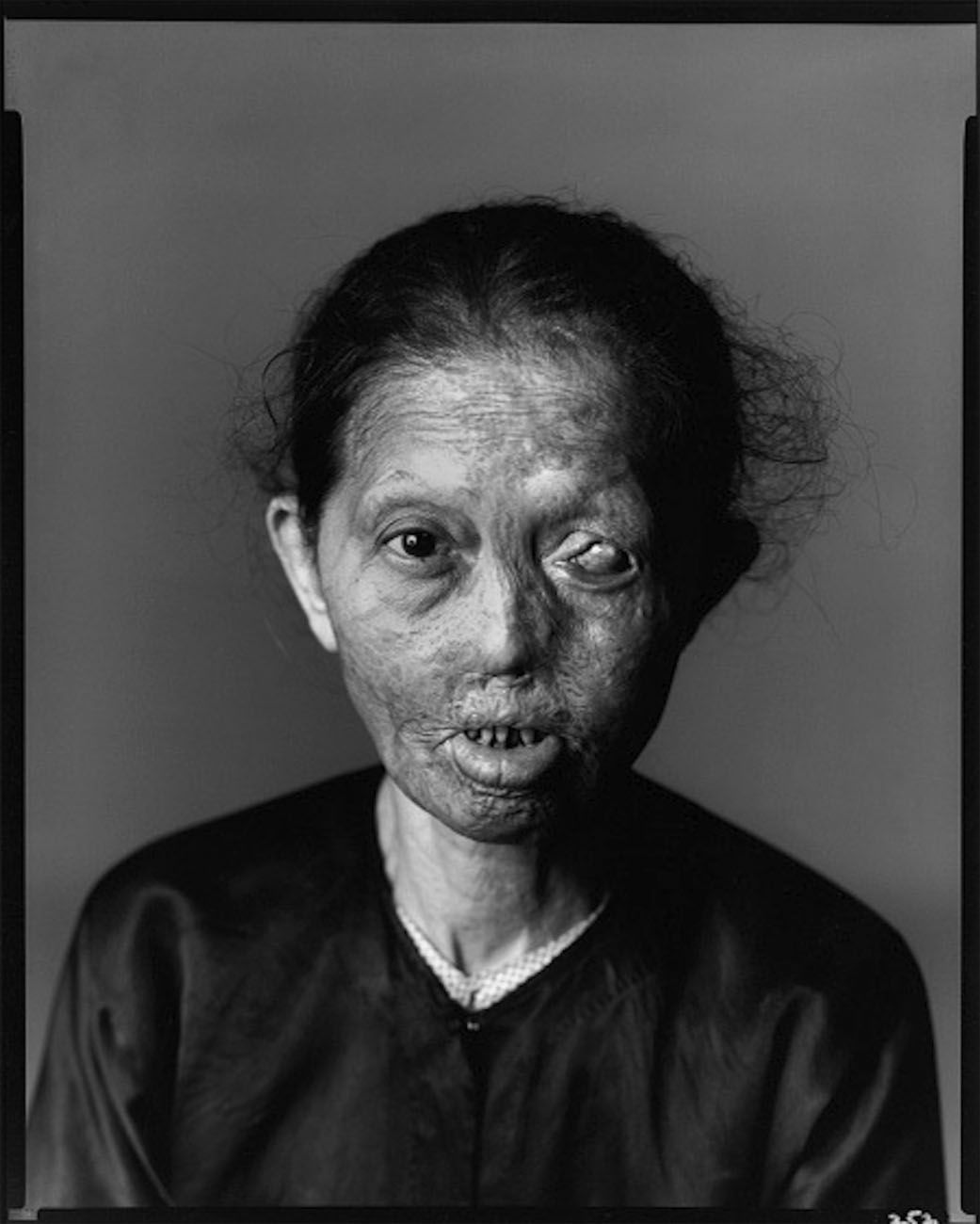
26. The last gallery in the exhibition is “Remembrance.” Most of these images were taken by artists seeking to come to terms with a conflict after fighting had ceased. Included are Richard Avedon’s picture of a Vietnamese napalm victim; a survivor of a machete attack in a Rwandan death camp, by James Nachtwey; a 1986 portrait of a hero who rescued Jews during the Holocaust, by Houston native Gay Block; and Suzanne Opton’s 2004 portrait of a soldier who survived the Iraq War and returned to the United States to work as a police officer, only to be murdered on duty by a fellow veteran. The final wall features photographs by Simon Norfolk of sunrises at the five D-Day beaches in 2004. The only reference to war is the title of the series: The Normandy Beaches: We Are Making a New World (33 images)


Richard Avedon (American, 1923-2004) 'Napalm Victim #1, Saigon, South Vietnam, April 29, 1971' 1971


Richard Avedon (American, 1923-2004)
Napalm Victim #1, Saigon, South Vietnam, April 29, 1971
1971
Silver gelatin print
© Richard Avedon


Gay Block (American, b.1942) 'Zofia Baniecka, Poland' 1986


Gay Block (American, b. 1942)
Zofia Baniecka, Poland
1986
From the series Rescuers: Portraits of Moral Courage in the Holocaust, a record of non-Jewish citizens from European countries who risked their lives helping to hide Jews from the Nazis
Chromogenic print, printed 1994
Courtesy of Museum of Fine Arts, Houston, gift of Clinton T. Wilour in honour of Eve France


Zofia Baniecka (born 1917 in Warsaw – 1993) was a Polish member of the Resistance during World War II. In addition to relaying guns and other materials to resistance fighters, Baniecka and her mother rescued over 50 Jews in their home between 1941 and 1944.


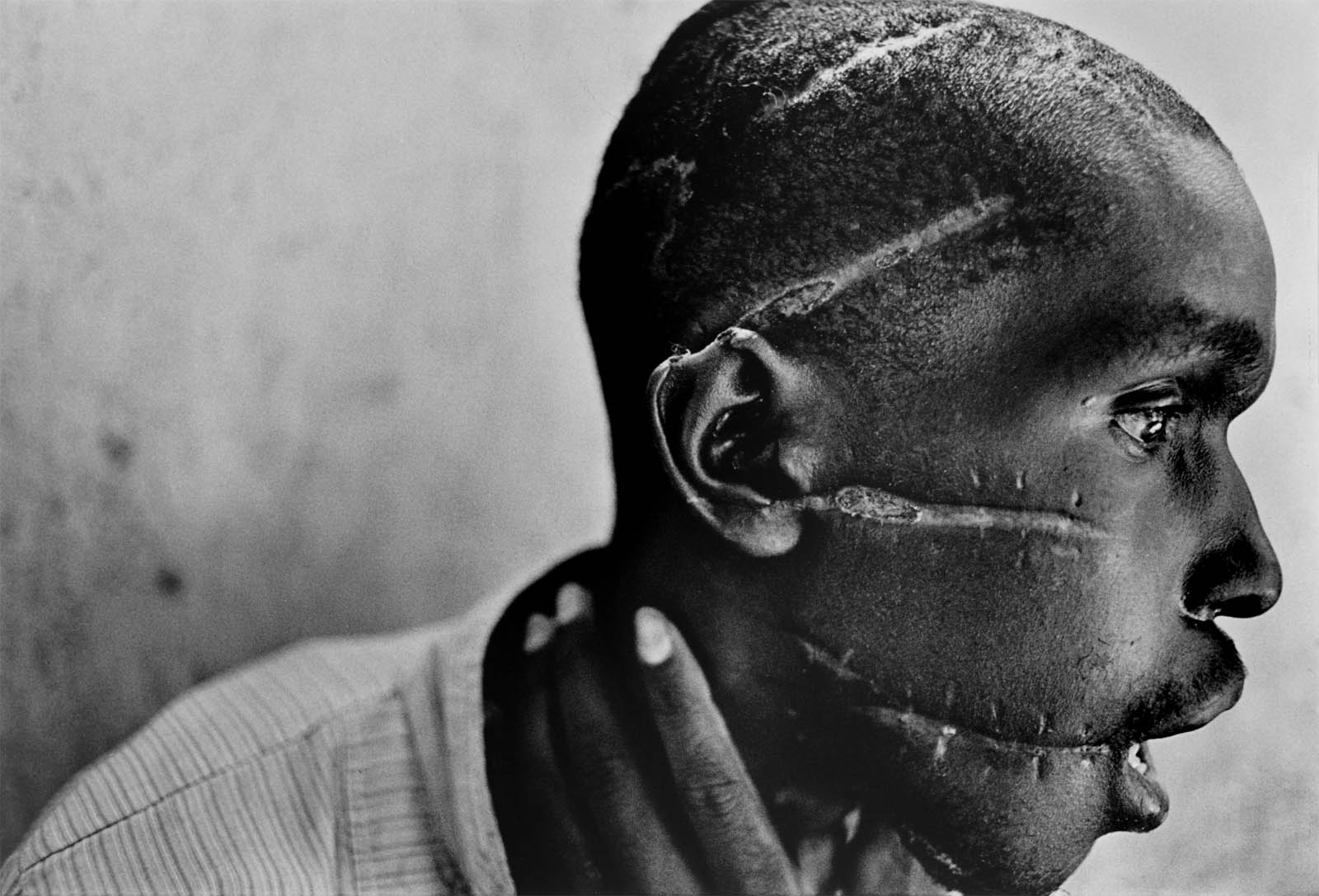
James Nachtwey (American, b. 1948) 'A Hutu man who did not support the genocide had been imprisoned in the concentration camp, was starved and attacked with machetes. He managed to survive after he was freed and was placed in the care of the Red Cross, Rwanda, 1994' 1994


James Nachtwey (American, b. 1948)
A Hutu man who did not support the genocide had been imprisoned in the concentration camp, was starved and attacked with machetes. He managed to survive after he was freed and was placed in the care of the Red Cross, Rwanda, 1994
1994
Silver gelatin print
© James Nachtwey / TIME

World Press Photo of the Year, prize singles


A Hutu man at a Red Cross hospital in Nyanza, Rwanda. His face was mutilated by the Hutu ‘Interahamwe’ militia, who suspected him of sympathising with the Tutsi rebels.

Liberated from a nearby Hutu camp, where mainly Tutsis were incarcerated, starved, beaten, and killed, this man did not support the genocide and was thus subjected to the same treatment. Starved and attacked with machetes, he had managed to survive, though he was unable to speak and could barely walk or swallow when this photo was made.

Jibran Abbasi. “Mutilated By The Hutu ‘Interahamwe’ by James Nachtwey,” on the Business Recorder website April 5, 2017 [Online] Cited 27/07/2024


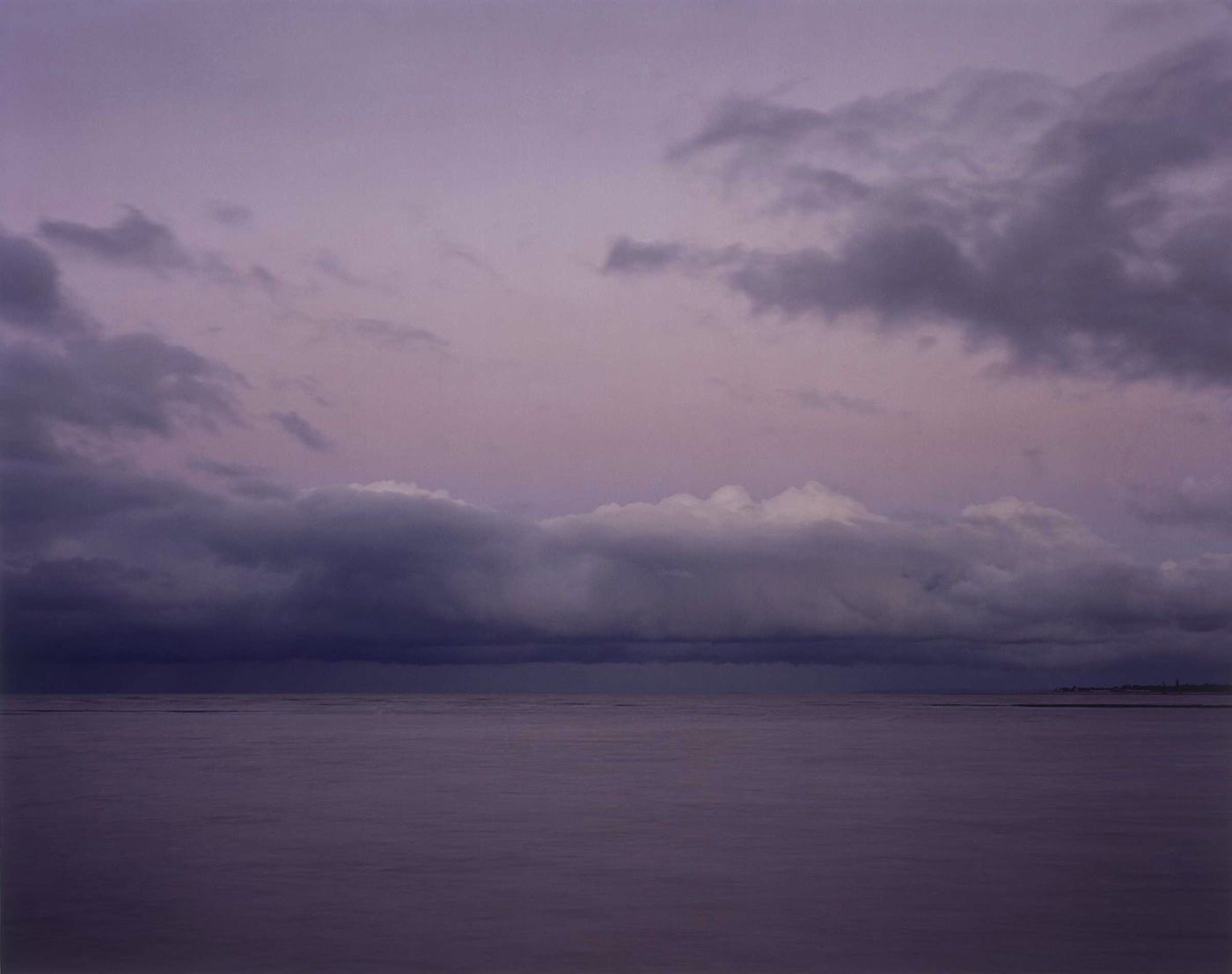
Simon Norfolk (British, b. Nigeria, 1963) 'Sword Beach' 2004


Simon Norfolk (British born Nigeria, b. 1963)
Sword Beach
2004
From the series The Normandy Beaches: We Are Making a New World
Chromogenic print, ed. #1/10 (printed 2006)
The Museum of Fine Arts, Houston
Gift of Bari and David Fishel, Brooke and Dan Feather and Hayley Herzstein in honor of Max Herzstein and a partial gift of the artist and Gallery Luisotti, Santa Monica
© Simon Norfolk / Gallery Luisotti


WAR/PHOTOGRAPHY Extended Info


Other photographs from the exhibition


Alexander Gardner (1821-1882) 'Scouts and Guides to the Army of the Potomac, Berlin, MD, October, 1862' October 1862 (detail)


Alexander Gardner (American, 1821-1882)
Scouts and Guides to the Army of the Potomac, Berlin, MD, October, 1862
October 1862
Albumen silver print
Photograph by Alexander Gardner, from “Incidents of the War. Guide to the Army of the Potomac,” from Gardner’s Photographic Sketch Book of the War, Washington
Records of the War Department General and Special Staffs, Record Group 165, National Archives Still Picture Branch, College Park, Maryland


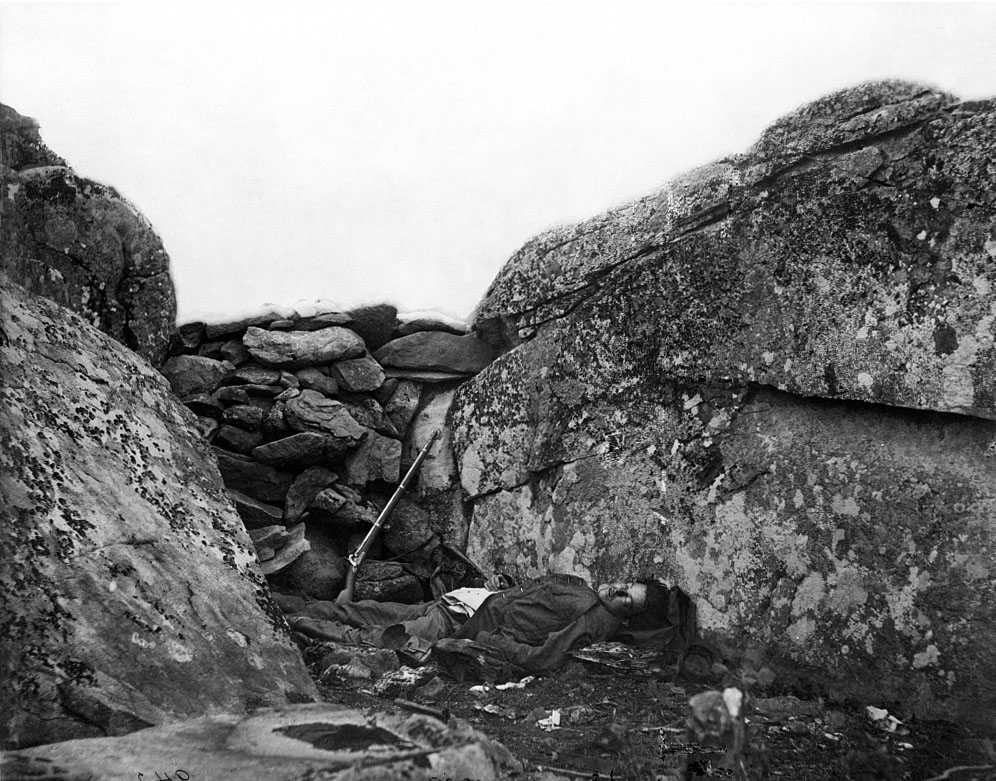
Alexander Gardner (American, 1821-1882) ‘The Home of a Rebel Sharpshooter, Gettysburg, Pennsylvania’. Albumen paper print


Alexander Gardner (American, 1821-1882)
The Home of a Rebel Sharpshooter / Dead Confederate soldier in the devil’s den, Gettysburg, Pennsylvania
July 1863
Albumen paper print copied from glass, wet collodion negative
Library of Congress, Prints and Photographs Division


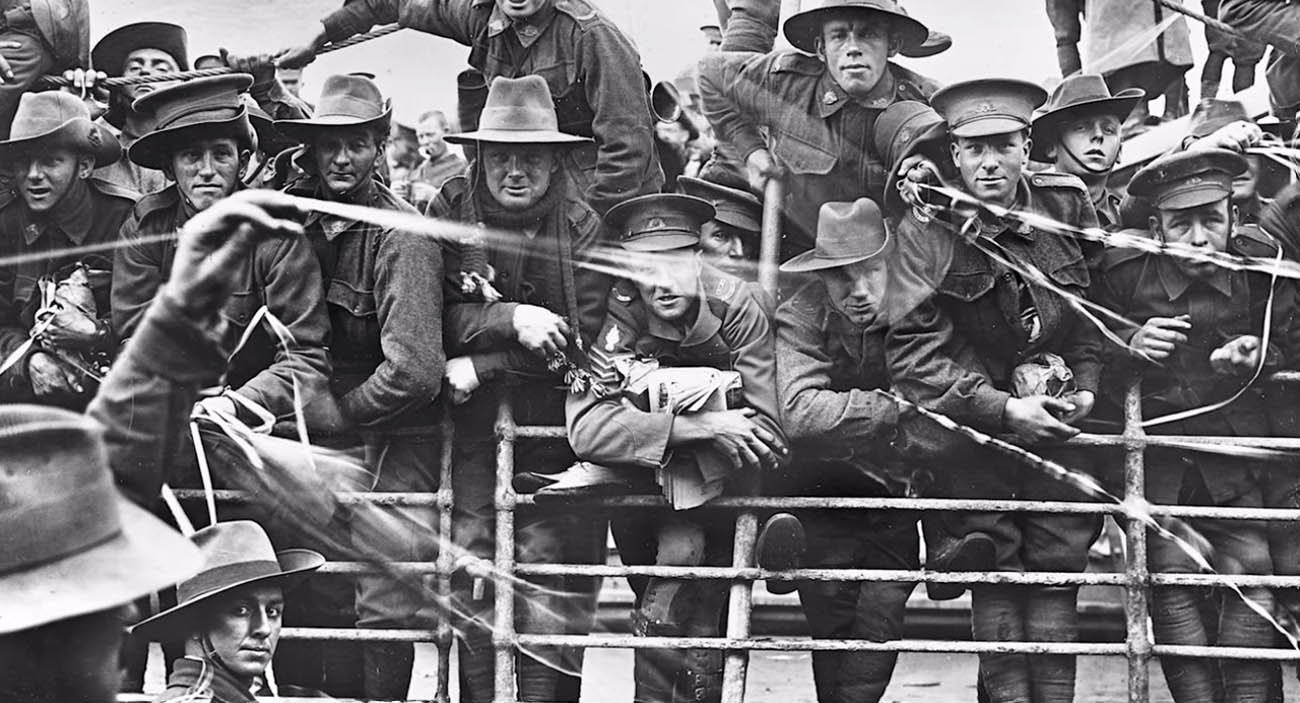
Josiah Barnes (Australian, 1858-1921) 'Embarkation of HMAT Ajana, Melbourne, July 8, 1916' 1916


Josiah Barnes (Australian, 1858-1921)
Embarkation of HMAT Ajana, Melbourne, July 8, 1916
1916
Gelatin silver print from original glass half-plate negative (printed 2012)
On loan from the Australian War Memorial


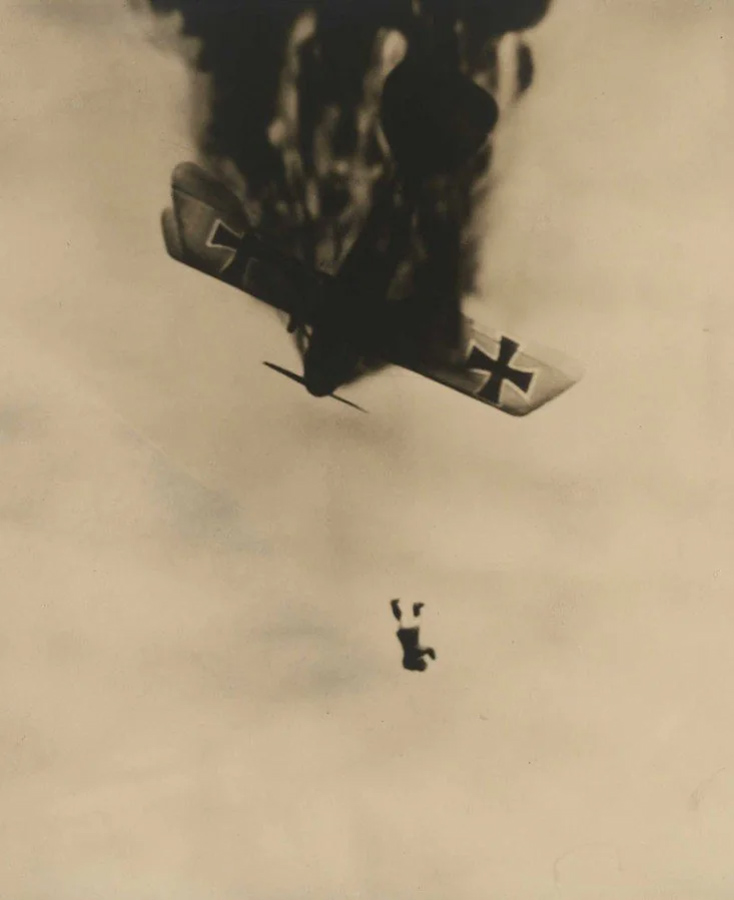
Wesley D. Archer (American, d. 1952) 'Just as he left the burning plane' 1933


Wesley D. Archer (American, d. 1952)
Just as he left the burning plane
1933
From the publication Death in the Air: The War Diary and Photographs of a Flying Corps Pilot


The typewritten script of a First World War pilot’s diary with a large number of photographs was submitted to the publishers William Heinemann and published by them in 1933. Heinemann stated on the book’s jacket that the diary contained no names, dates, or anything that could reveal the identity of the writer or the squadron in which he served. The publishers understood that the diarist was killed in action in 1918 and that it was in deference to the wishes of those who were close to him that his diary should be published.

So remarkable were the photographs that their veracity was immediately questioned, but no proof of their authenticity or otherwise could be ascertained. It was not until 1983 that a collection of documents, photographs and artifacts was presented to the Smithsonian’s National Air and Space Museum. Some of the photographs were recognized as being those of the mystery diarist and the truth was soon revealed.

The author was Wesley Archer, an American with Canadian parents who served with the RFC in the First World War, and the photographs and diary had been faked.

Text from the Google Books website

For more information on the faked photographs see the article “How dramatic images of WWI dogfights in the skies of Europe were FAKED by a conman who was just looking to make some money”.


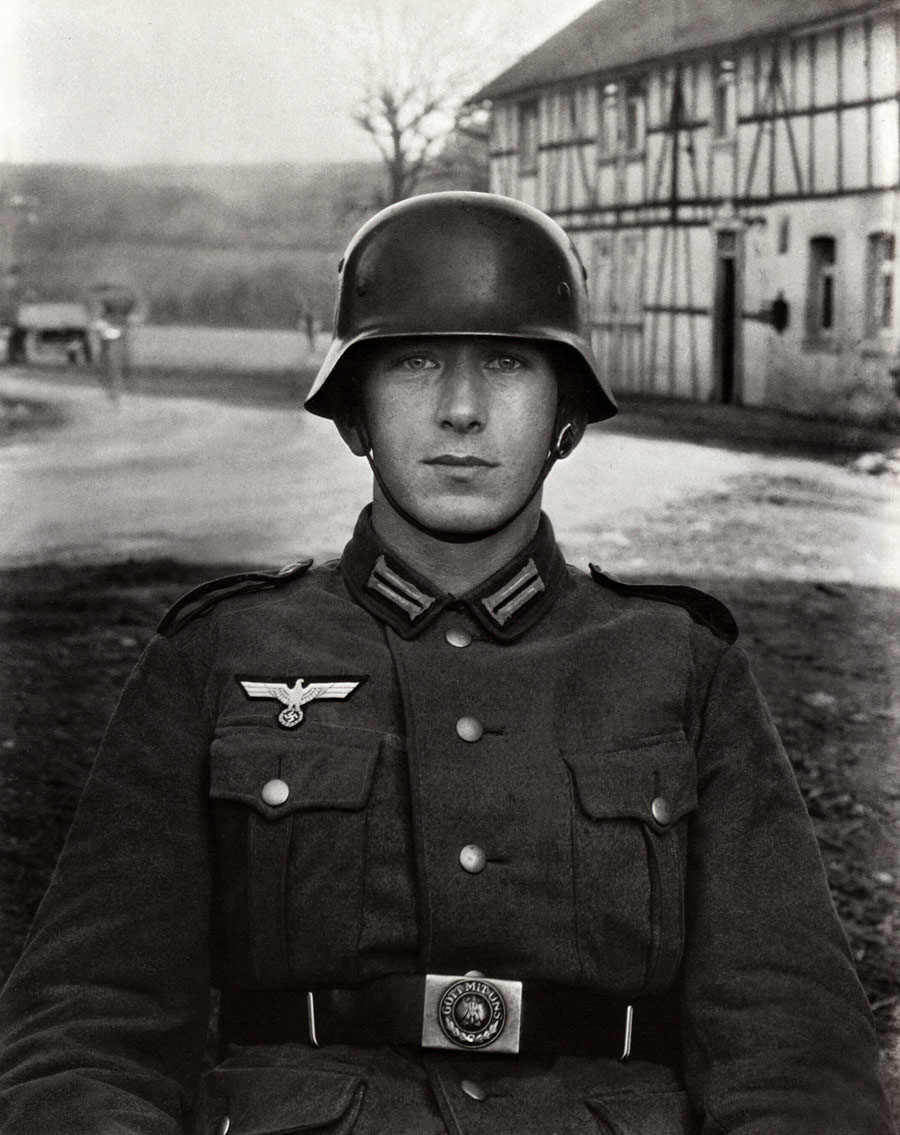
August Sander (German, 1876-1964) 'Soldier' c. 1940


August Sander (German, 1876-1964)
Soldier
c. 1940
Gelatin silver print, printed by Gunther Sander, 1960s
The Museum of Fine Arts, Houston
Gift of John S. and Nancy Nolan Parsley in honour of the 65th birthday of Anne Wilkes Tucker
© Die Photographische Sammlung/SK StiftungKultur – August Sander Archiv, Cologne; DACS, London 2012


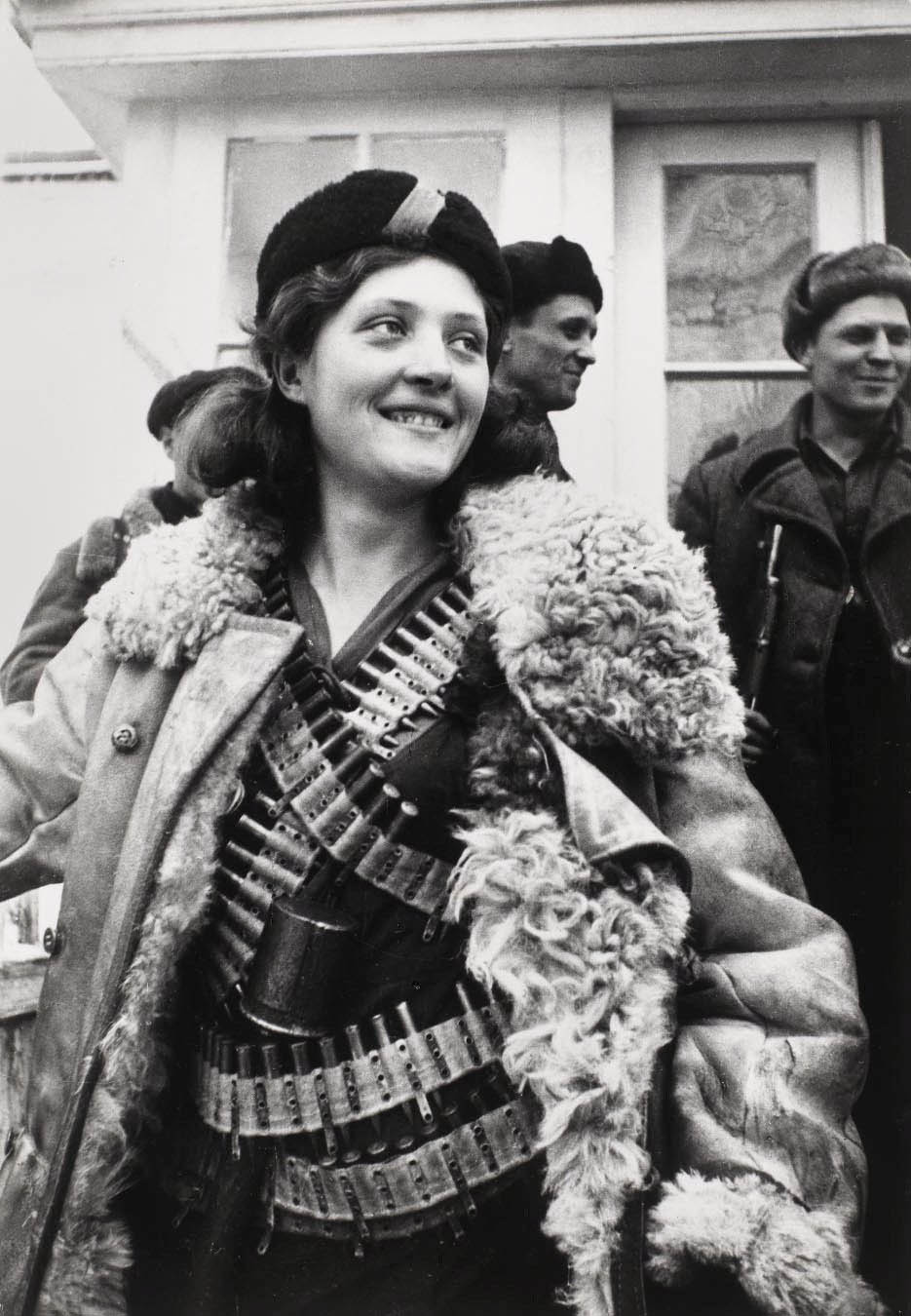
Arkady Shaikhet (Soviet, 1898-1959) 'Partisan Girl' 1942


Arkady Shaikhet (Soviet, 1898-1959)
Partisan Girl
1942
Gelatin silver print
Gift of Marion Mundy
© Arkady Shaikhet Estate, Moscow


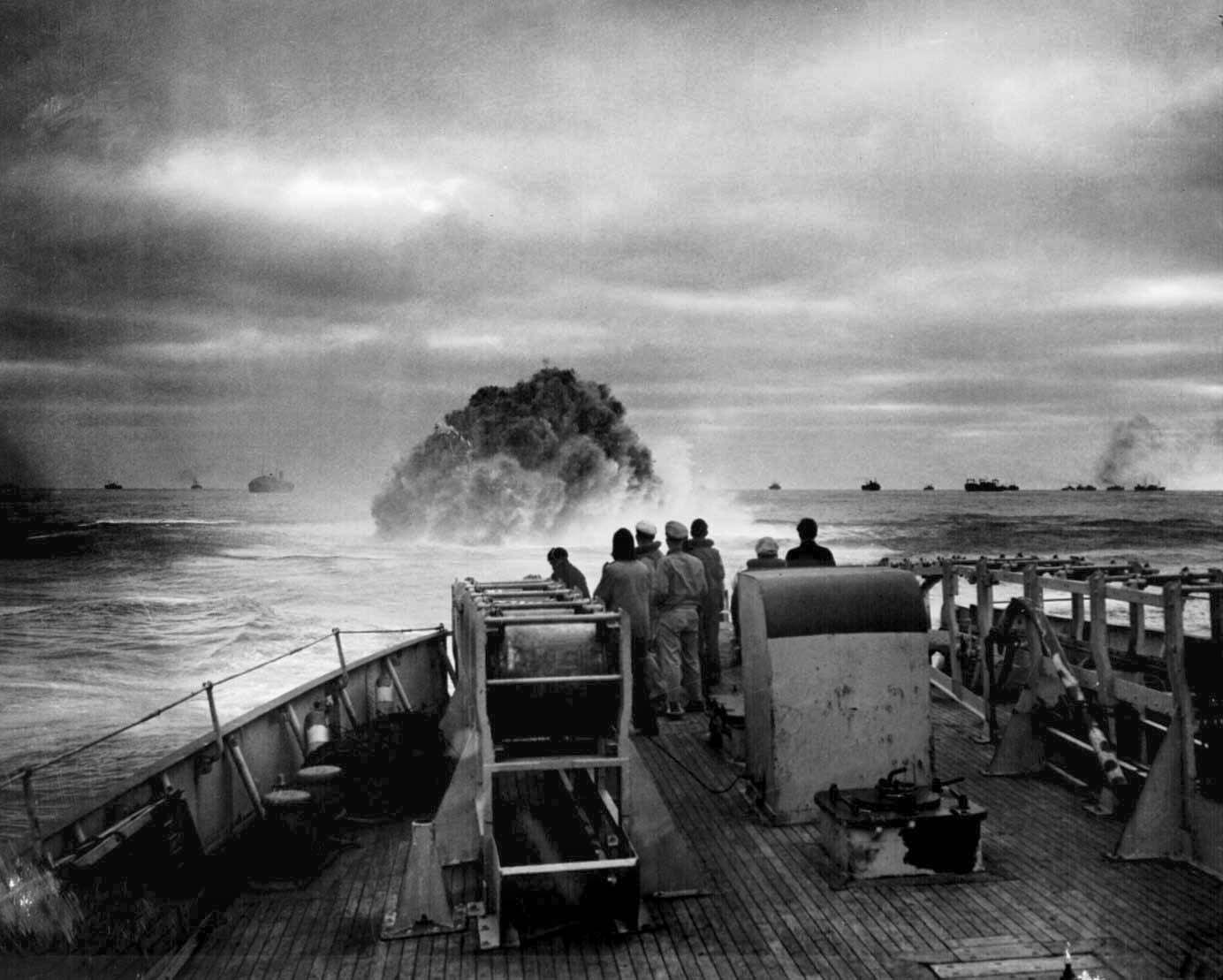
Anonymous photographer / U.S. Department of Defense. 'US Coast Guard crew of cutter Spencer watched as a depth charge exploded near U-175, North Atlantic, 500nm WSW of Ireland, 17 Apr 1943'


Anonymous photographer
U.S. Department of Defense
US Coast Guard crew of cutter Spencer watched as a depth charge exploded near U-175, North Atlantic, 500nm WSW of Ireland, 17 Apr 1943
17 April 1943
Public domain


W. Eugene Smith (American, 1918-1978) 'Wounded, dying infant found by American soldier in Saipan Mountains' June 1944


W. Eugene Smith (American, 1918-1978)
Wounded, dying infant found by American soldier in Saipan Mountains
June 1944
Gelatin silver print
© W. Eugene Smith


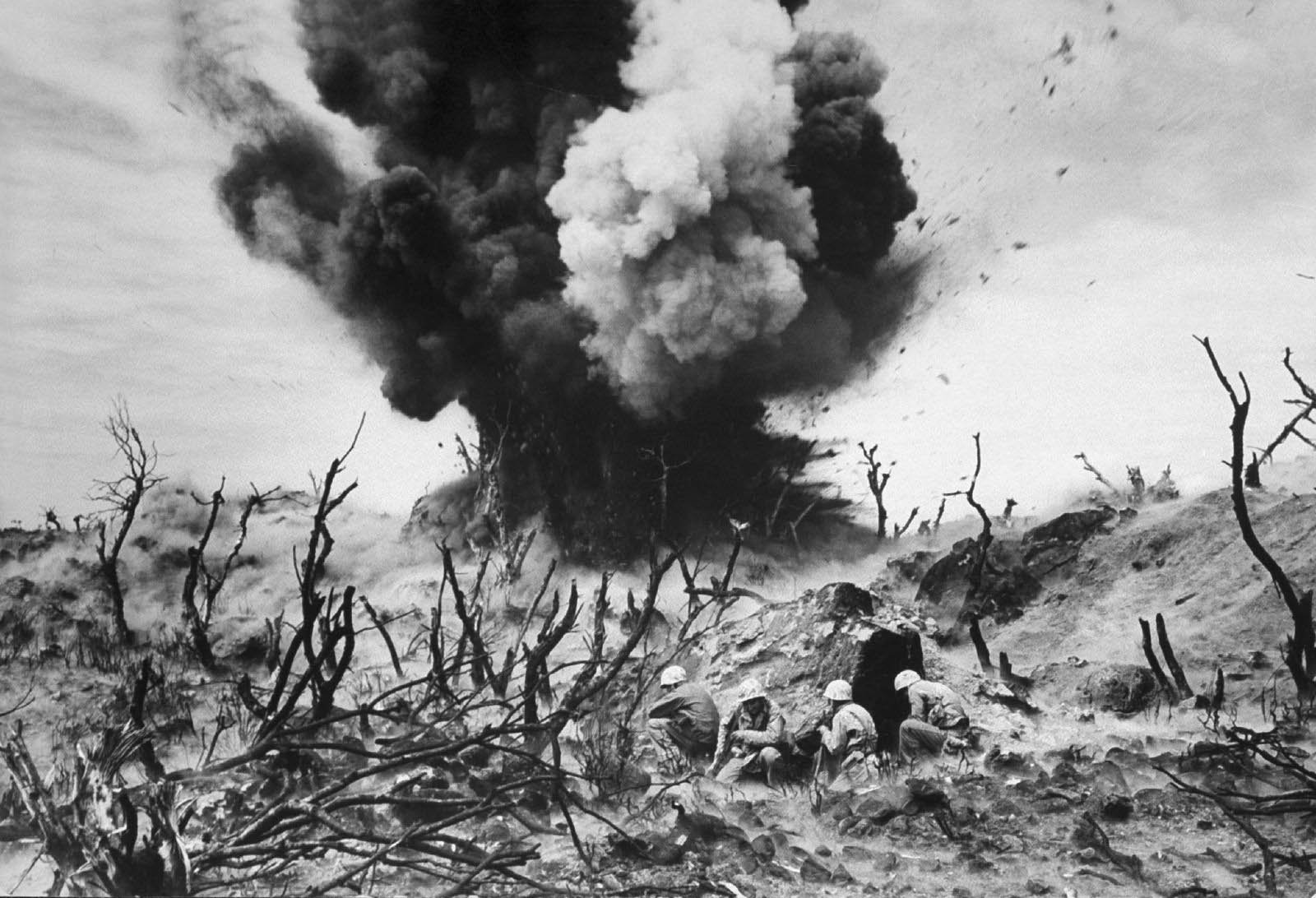
W. Eugene Smith (American, 1918-1978) 'World War II. The Pacific Campaign. The Battle of Iwo Jima (Japanese island). US Marine demolition team blasting out a cave on Hill 382. Iwo Jima. February, 1945' 1945


W. Eugene Smith (American, 1918-1978)
World War II. The Pacific Campaign. The Battle of Iwo Jima (Japanese island). US Marine demolition team blasting out a cave on Hill 382. Iwo Jima. February, 1945
1945
Gelatin silver print
© W. Eugene Smith


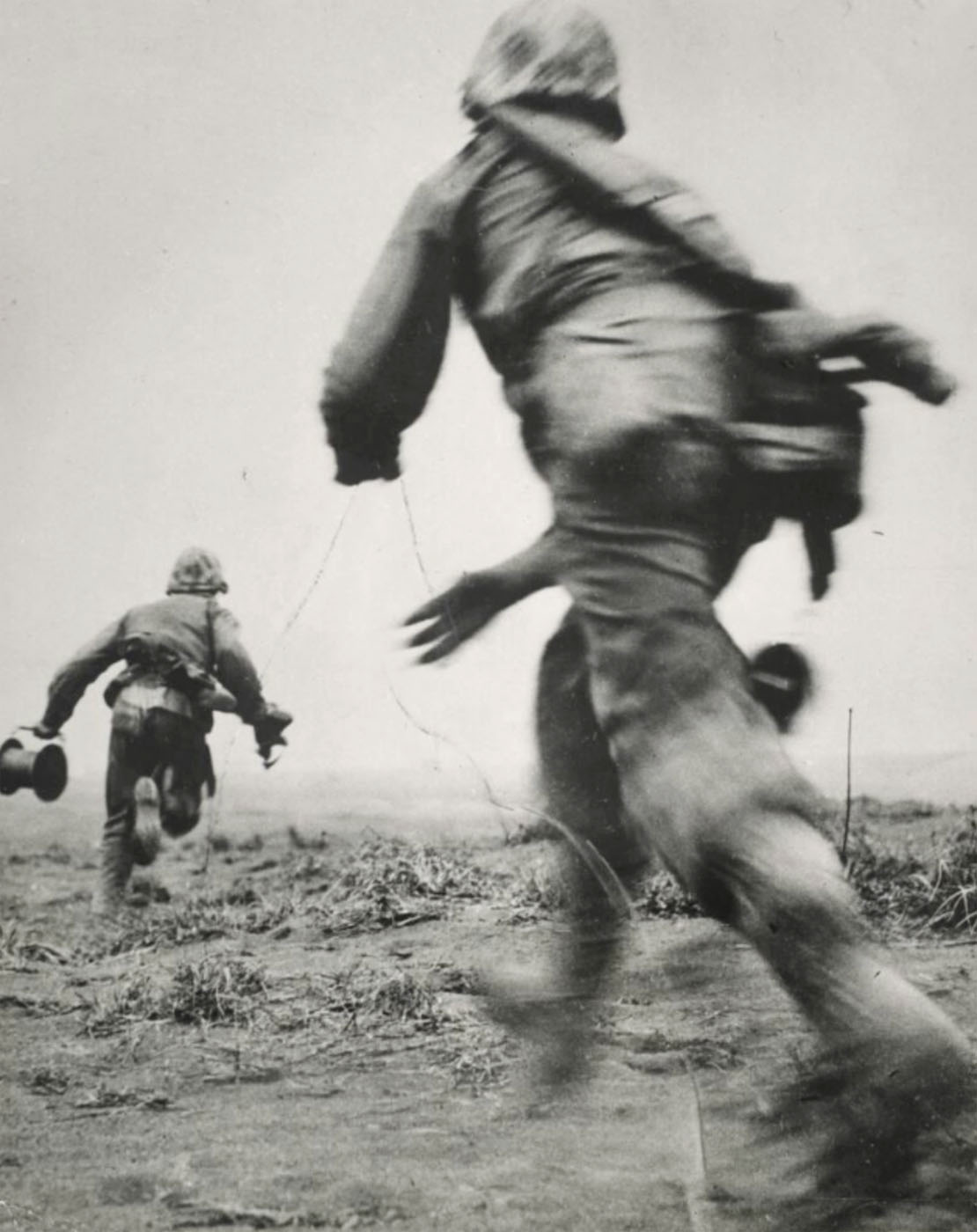
Joseph Schwartz (American, 1913–2013) 'Hold the Phone - Two Marine wiremen on Iwo Jima race across an open field, under heavy enemy fire to establish field telephone contact with the front lines' February 19, 1945, printed early 1950s


Joseph Schwartz (American, 1913–2013)
Hold the Phone – Two Marine wiremen on Iwo Jima race across an open field, under heavy enemy fire to establish field telephone contact with the front lines
February 19, 1945, printed early 1950s
Gelatin silver print mounted on board
18 13/16 x 14 15/16 in. (47.8 x 37.9cm)
The Museum of Fine Arts, Houston
Museum purchase funded by Knox Nunnally at “One Great Night in November, 2009,” in honor of Houston trial lawyer Joe Reynolds, a U.S. Marine who fought on Iwo Jima


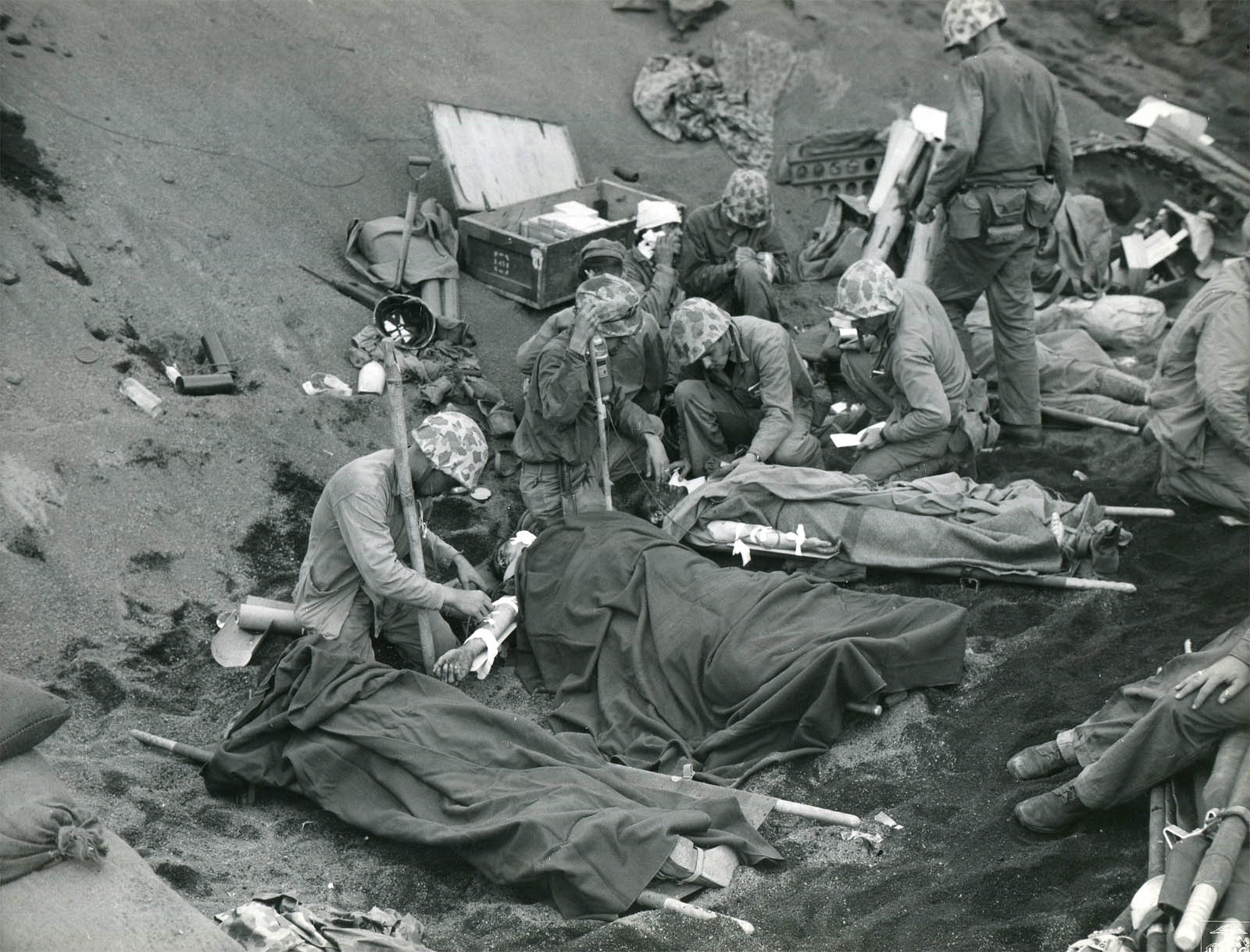
Anonymous photographer. U.S. Department of Defense / USMC Official Photograph 'PLASMA WARD – Navy doctors and corpsmen administer to wounded Marines at an aid station established in a gully on Iwo Jima. The high casualty rate in this operation required the use of gallons of plasma and whole blood sent by air from the West Coast' 1945


Anonymous photographer
U.S. Department of Defense / USMC Official Photograph
PLASMA WARD – Navy doctors and corpsmen administer to wounded Marines at an aid station established in a gully on Iwo Jima. The high casualty rate in this operation required the use of gallons of plasma and whole blood sent by air from the West Coast
1945
Gelatin silver print
Creative Commons Attribution 2.0 Generic


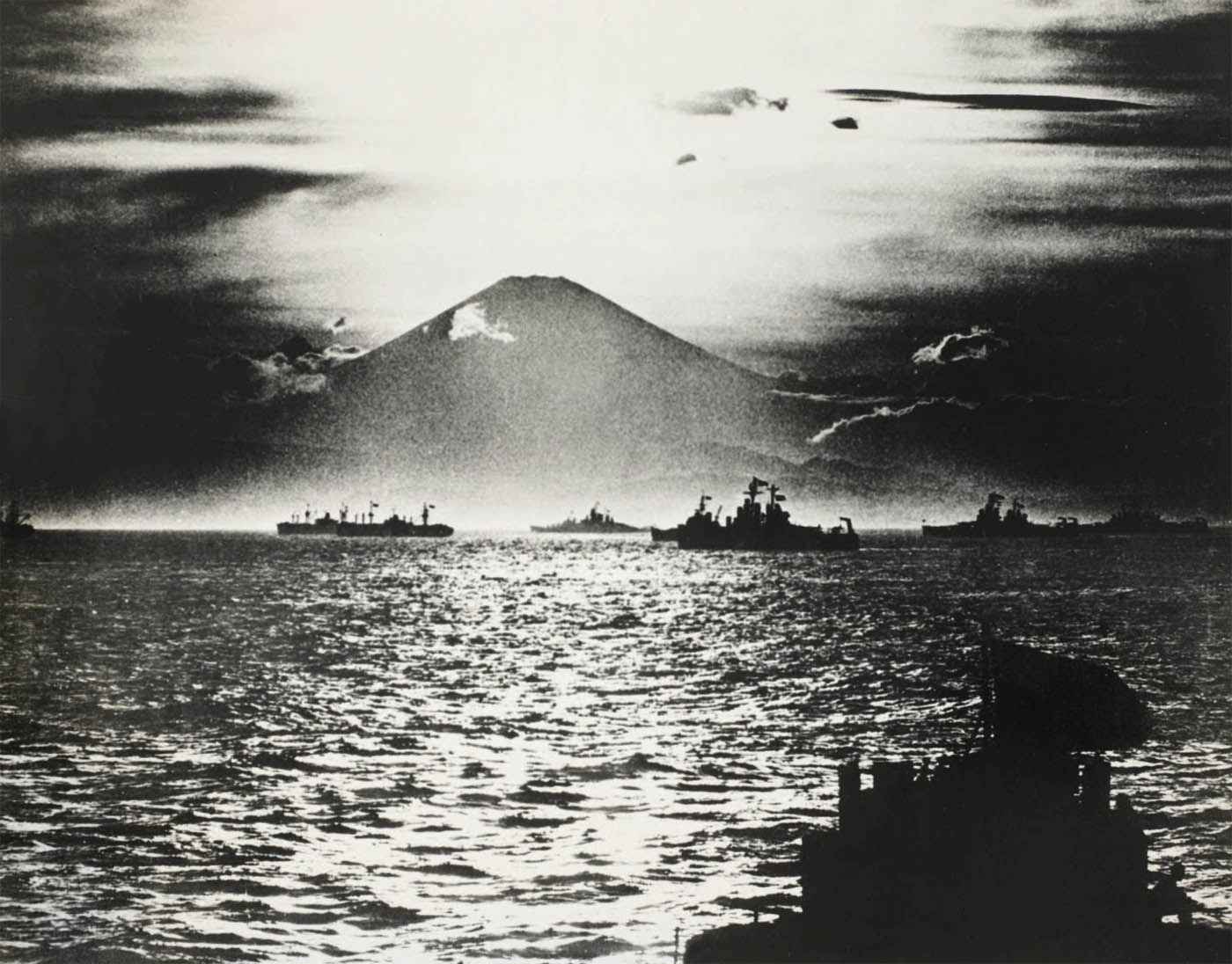
U.S. Navy Photographic Team. 'U.S. and British Warships Anchored in Sagami Wan, Outside of Tokyo Bay, Japan, on the Day the Allied Ships Entered Japanese Waters' 27th August 1945


U.S. Navy Photographic Team
U.S. and British Warships Anchored in Sagami Wan, Outside of Tokyo Bay, Japan, on the Day the Allied Ships Entered Japanese Waters
27th August 1945
Gelatin silver print
The Museum of Fine Arts, Houston, museum purchase funded by Laura and Tony Visage in honor and memory of William A. Visage and his fellow soldiers in Battery “E” of the 2nd Battalion, 131st Field Artillery, U.S. Army Air Corps


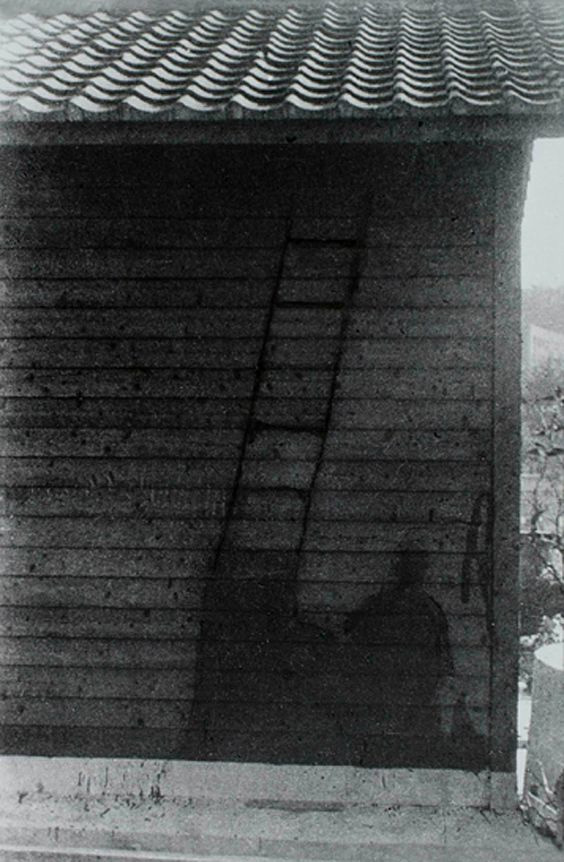
Matsumoto Eiichi (Japanese, 1915-2004) 'Shadow of a soldier remaining on the wooden wall of the Nagasaki military headquarters (Minami-Yamate machi, 4.5km from Ground Zero)' 1945


Matsumoto Eiichi (Japanese, 1915-2004)
Shadow of a soldier remaining on the wooden wall of the Nagasaki military headquarters (Minami-Yamate machi, 4.5km from Ground Zero)
1945
Gelatin silver print
Collection of the Tokyo Metropolitan Museum of Photography
© Matsumoto Eiichi


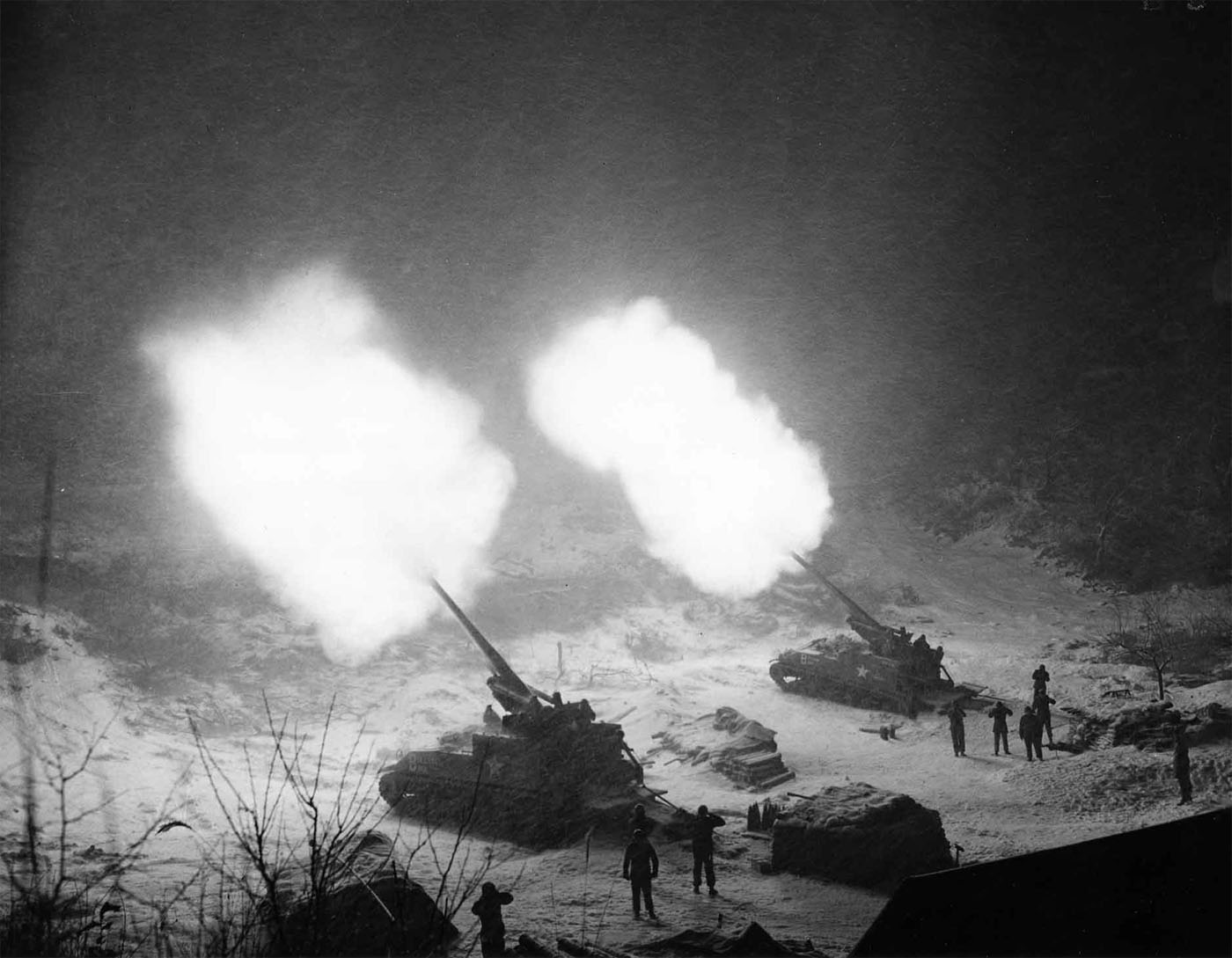
Unknown photographer. 'A pair of M-40 155mm Gun Motor Carriages of Battery B, 937th Field Artillery Battalion, providing fire support to U.S. Army 25th Infantry Division, Munema, Korea' 26 November 1951


Unknown photographer
A pair of M-40 155mm Gun Motor Carriages of Battery B, 937th Field Artillery Battalion, providing fire support to U.S. Army 25th Infantry Division, Munema, Korea
26 November 1951
Gelatin silver print
U.S. Department of Defense


Cathy LeRoy (French, 1944-2006) 'Corpsman In Anguish' 1967


Cathy LeRoy (French, 1944-2006)
Corpsman In Anguish
1967
Gelatin silver print


Her pictures from Vietnam were stunning. Her photos from Battle of Hill 881 evoked “ghosts of Iwo Jima and Pork Chop Hill,” Time magazine wrote in May 1967. Her photos of corpsman Vernon Wike during the battle was a triptych of an all-too-familiar scene: in the first, Wike has two hands on his friend’s chest, trying to staunch the wound; in the second, he tries to find a heartbeat; in the third frame, “Corpsman In Anguish”, he realised the man is dead.

LeRoy herself came very close to death two weeks later. Her Nikon barely stopped a piece of mortar shrapnel that ripped open her chest. She said that she thought the last words she would ever hear were, “I think she’s dead, sarge.” During the Tet offensive in 1968, LeRoy was briefly captured by the North Vietnamese during the battle for Hue. LeRoy’s photos of her captivity later made the cover of Life, ‘A Remarkable Day in Hue: the Enemy Lets Me Take His Picture’. She was the first person to take photos of North Vietnamese Army Regulars behind their lines.

Anonymous. “Corpsman In Anguish | Cathy LeRoy,” on the Iconic Photos website January 13, 2014 [Online] Cited 27/07/2024. Used under fair use conditions for the purposes of education and research


A licensed parachutist, Leroy jumped with the U.S. 173rd Airborne Brigade into combat during Operation Junction City in February of 1967. It was in this action, the battle for Hill 881, that Leroy photographed U.S. Navy Corpsman Vernon Wike as he rushed to the aid of a fallen comrade. “Corpsman in anguish” is the third frame of a series that Leroy shot, capturing the unimaginable grief of war. Later, in an interview for the documentary “The Hill Fights”, Wike recounted the moment that Leroy photographed.

“I know there was chaos going on around me, but there was no sound,” she says. “… I knew he didn’t have a chance, but I still got p—–d off when he died.” Leroy describes the aftermath as the corpsman “lost in this nightmare landscape” grabbed the fallen marine’s M16 and charged a Viet bunker alone in a hail of obscenities. The fallen marine was a man called “Rock”, a New Yorker from Puerto Rico. Earlier that day he had told Wike that he only had 60 days left “in country” – his deployment in Vietnam.

Anonymous. “Giving War a Face: Catherine Leroy,” on the Dismal Nitch website September 04, 2020 [Online] Cited 27/07/2024. Used under fair use conditions for the purposes of education and research


Arkady Shaikhet (Soviet, 1898-1959) 'Partisan Girl' 1942


Philip Jones Griffiths (Welsh, 1936-2008)
Called “Little Tiger” for killing two “Viet Cong women cadre” – his mother and teacher, it was rumored, Vietnam​
1968
Gelatin silver print
The Philip Jones Griffiths Foundation, courtesy of Howard Greenberg Gallery
© Philip Jones Griffiths / Magnum Photos


Gilles Caron (French, 1939-1970) 'Young Catholic demonstrator on Londonderry Wall, Northern Ireland' 1969


Gilles Caron (French, 1939-1970)
Young Catholic demonstrator on Londonderry Wall, Northern Ireland
1969
Gelatin silver print
Courtesy of Foundation Gilles Caron and Contact Press Images
© Gilles Caron


Rafael Wollmann (Argentinian, b. 1958) 'British Marines surrender to Argentinean troops in Malvinas/Falklands' April 2, 1982, printed 2012


Rafael Wollmann (Argentinian, b. 1958)
British Marines surrender to Argentinean troops in Malvinas/Falklands
April 2, 1982, printed 2012
Inkjet print
15 7/8 × 20 in. (40.4 × 50.8cm)
The Museum of Fine Arts, Houston
Gift of Rafael Wollmann


David Leeson (American, b. 1957) 'Death of a Soldier, Iraq' March 24, 2003


David Leeson (American, b. 1957)
Death of a Soldier, Iraq
March 24, 2003
Inkjet print, printed 2012
Courtesy of the artist


Ziv Koren (Israeli, b. 1970) 'A sniper’s-eye view of Rafah, in the Southern Gaza strip, during an Israeli military sweep' 2006


Ziv Koren (Israeli, b. 1970)
A sniper’s-eye view of Rafah, in the Southern Gaza strip, during an Israeli military sweep
2006
Inkjet print, printed 2012
© Ziv Koren/Polaris Images


Goran Tomasevic (Serbian, b. 1959) /Reuters. 'SHOOTING. Sgt. William Olas Bee, a US Marine from the 24th Marine Expeditionary Unit, has a close call after Taliban fighters opened fire near Garmser in Helmand Province of Afghanistan May 18, 2008. The Marine was not injured.' 2008


Goran Tomasevic (Serbian, b. 1959) /Reuters
SHOOTING. Sgt. William Olas Bee, a US Marine from the 24th Marine Expeditionary Unit, has a close call after Taliban fighters opened fire near Garmser in Helmand Province of Afghanistan May 18, 2008. The Marine was not injured.
2008


Tomašević began photographing the war that followed the breakup of Yugoslavia from 1991 for daily newspaper Politika. In 1996 he joined the world’s largest news agency, Reuters, covering the simmering political tensions in Kosovo and the anti-Milošević demonstrations in his hometown of Belgrade since mid-1990s. During three-month NATO bombing of Yugoslavia in 1999, Tomašević was the only photographer working for foreign press to spend the duration of the conflict in Kosovo.

Tomašević moved to Jerusalem in 2002, covering the second Palestinian intifada. During the U.S. led invasions of Iraq in 2003, his picture of a U.S. Marine watching the toppling of a Saddam Hussein statue became one of the most memorable images of the war. He often returned to Iraq as sectarian violence escalated and regularly photographed America’s other war in Afghanistan. His sequence of photographs of U.S. Marine Sergeant Bee narrowly escaping Taliban bullets became an iconic image in U.S. war history.

Tomašević moved to Cairo in 2006 and was at the heart of Reuters’ coverage of the Arab Springs. In Libya, his image of a fireball that spewed up after an air strike on pro-Gaddafi fighters became an iconic image of the Libyan war, gracing the front pages of more than 100 newspapers around the globe. He stayed in Cairo until 2012. His raw pictures of rebel fighters battling pro-Assad forces among the ruins of Aleppo and Damascus during the Syrian Civil War have won international acclaim, as did his coverage of the bloody siege on a Nairobi shopping mall in Kenya. Tomašević worked for Reuters until 2022.

Text from the Wikipedia website


Museum of Fine Arts, Houston
1001 Bissonnet Street
Houston, TX 77005

Opening hours:
Wednesday 11am – 5pm
Thursday 11am – 9pm
Friday 11am – 6pm
Saturday 11am – 6pm
Sunday 12.30pm – 6pm
Closed Monday and Tuesday, except Monday holidays
Closed Thanksgiving Day and Christmas Day

Museum of Fine Arts, Boston website

LIKE ART BLART ON FACEBOOK

Back to top

Exhibition: ‘Cartier-Bresson: A Question of Colour’ at Somerset House, London

Exhibition dates: 8th November 2012 – 27th January 2013

Curator: William E. Ewing


Henri Cartier-Bresson (French, 1908-2004) 'Harlem, New York' 1947


Henri Cartier-Bresson (French, 1908-2004)
Harlem, New York, 1947
1947
Gelatin silver print / printed 1970s
Image: 29.1 x 19.6cm
Paper: 30.4 x 25.4cm
© Henri Cartier-Bresson/Magnum Photos, Courtesy Fondation Henri Cartier-Bresson


They may be channelling the master, but none does it like Cartier-Bresson. There is a spareness and spatial intensity to Cartier-Bresson’s work that is absolutely his own. Look at the photograph directly above (Harlem, New York, 1947). A railing leads the eye in bottom right, echoed by the bottom jamb of the window. The opening is set for the old man to perform complete with curtains, talking stage right. The jamb zig zags above a trilby-wearing, cigarette-smoking man’s head leading to a wire mesh fence that takes the eye out of the frame on the left. The two men, lower than the old man in the framed window, look in a completely different direction to him.

Counterpoise. The image pulls in two directions. Above their head a series of cantilevered staircases ascends to the heavens, thought ascending. A masterpiece.

So many of the other photographers in this posting crowd the plane with people looking in all directions, closed off foregrounds or tensionless images. Images that are too complex or too simple. There is an opposition to Cartier-Bresson’s images that is difficult for the viewer to resolve neatly, yet they appear as if in perfect balance. Look at Brooklyn, New York, 1947 towards the bottom of the posting. Nothing in this still life is out of place (from the light to the multiple, overlapping shadows and the out of focus elements of the composition) yet there is humbling agony about the whole thing. It is almost is if he is saying, “cop a load of this, this is what I can see.” And what a fabulous eye it is.

Dr Marcus Bunyan


Many thankx to Somerset House for allowing me to publish the photographs in the posting. Please click on the photographs for a larger version of the image.


Ernst Haas (Austrian-American, 1921-1986) 'New Orleans, USA' 1960


Ernst Haas (Austrian-American, 1921-1986)
New Orleans, USA
1960
Chromogenic archival print
50 x 35cm
© Ernst Haas Estate, New York


Saul Leiter (American, 1923-2013) 'Snow' 1960


Saul Leiter (American, 1923-2013)
Snow
1960
© Saul Leiter
Courtesy: Saul Leiter, Howard Greenberg Gallery, New York


Helen Levitt (American, 1913-2009) 'Cat next to red car, New York' 1973


Helen Levitt (American, 1913-2009)
Cat next to red car, New York
1973
Type C prints
18 x 12 inches
© Estate of Helen Levitt


Alex Webb (American, b. 1952) 'Tehuantepec, Mexico' 1985


Alex Webb (American, b. 1952)
Tehuantepec, Mexico
1985
71 x 47cm
Digital Type C print
© Alex Webb


“I only know how to approach a place by walking. For what does a street photographer do but walk and watch and wait and talk, and then watch and wait some more, trying to remain confident that the unexpected, the unknown, or the secret heart of the known awaits just around the corner.”

~ Alex Webb


Jeff Mermelstein (American, b. 1957) 'Untitled (Package Pile Up, New York City)' 1995


Jeff Mermelstein (American, b. 1957)
Untitled (Package Pile Up, New York City)
1995
Chromogenic print
© Jeff Mermelstein
Courtesy Rick Wester Fine Art, New York


Carolyn Drake (American, b. 1971) 'Birthday party at Olympia, a gated community, Wellington, Florida' 2005


Carolyn Drake (American, b. 1971)
Birthday party at Olympia, a gated community, Wellington, Florida
2005
Digital Pigment Print
© Carolyn Drake / Magnum Photos


Carolyn Drake (American, b. 1971) 'Hotel room. Zhetisay, Kazakhstan. Carolyn Drake' 2009


Carolyn Drake (American, b. 1971)
Hotel room. Zhetisay, Kazakhstan. Carolyn Drake
2009
Digital Pigment Print
© Carolyn Drake/Magnum Photos


Andy Freeberg (American, b. 1958) 'Sean Kelly, Art Basel Miami' 2010


Andy Freeberg (American, b. 1958)
Sean Kelly, Art Basel Miami
2010
From the series Art Fare
Artist: Kehinde Wiley
63 x 43cm
Pigment ink print
© Andy Freeberg
Courtesy Kopeikin Gallery


Carolyn Drake (American, b. 1971) 'New Kashgar. Kashgar, China'  2011


Carolyn Drake (American, b. 1971)
New Kashgar. Kashgar, China  
2011
30.48 x 20.32cm
Digital Light Jet print
© Carolyn Drake 2012


Positive View Foundation announces its inaugural exhibition Cartier-Bresson: A Question of Colour, to be held at Somerset House, 8 November 2012 – 27 January 2013. Curated by William A. Ewing, the exhibition will feature 10 Henri Cartier-Bresson photographs never before exhibited in the UK alongside over 75 works by 15 international contemporary photographers, including: Karl Baden (US), Carolyn Drake (US), Melanie Einzig (US), Andy Freeberg (US), Harry Gruyaert (Belgium), Ernst Haas (Austrian), Fred Herzog (Canadian), Saul Leiter (US), Helen Levitt (US), Jeff Mermelstein (US), Joel Meyerowitz (US), Trent Parke (Australian), Boris Savelev (Ukranian), Robert Walker (Canadian), and Alex Webb (US).

The extensive showcase will illustrate how photographers working in Europe and North America adopted and adapted the master’s ethos famously known as  ‘the decisive moment’ to their work in colour. Though they often departed from the concept in significant ways, something of that challenge remained: how to seize something that happens and capture it in the very moment that it takes place.

It is well-known that Cartier-Bresson was disparaging towards colour photography, which in the 1950s was in its early years of development, and his reasoning was based both on the technical and aesthetic limitations of the medium at the time. Curator William E. Ewing has conceived the exhibition in terms of, as he puts it, ‘challenge and response’. “This exhibition will show how Henri Cartier-Bresson, in spite of his skeptical attitude regarding the artistic value of colour photography, nevertheless exerted a powerful influence over photographers who took up the new medium and who were determined to put a personal stamp on it. In effect, his criticisms of colour spurred on a new generation, determined to overcome the obstacles and prove him wrong. A Question of Colour simultaneously pays homage to a master who felt that black and white photography was the ideal medium, and could not be bettered, and to a group of photographers of the 20th and 21st centuries who chose the path of colour and made, and continue to make, great strides.”

Cartier-Bresson: A Question of Colour will feature a selection of photographers whose commitment to expression in colour was – or is – wholehearted and highly sophisticated, and which measured up to Cartier-Bresson’s essential requirement that content and form were in perfect balance. Some of these artists were Cartier-Bresson’s contemporaries, like Helen Levitt, or even, as with Ernst Haas, his friends; others, such as Fred Herzog in Vancouver, knew the artist’s seminal work across vast distances; others were junior colleagues, such as Harry Gruyaert, who found himself debating colour ferociously with the master; and others still, like Andy Freeberg or Carolyn Drake, never knew the man first-hand, but were deeply influenced by his example.

Press release from Somerset House website


Fred Herzog (Canadian born Germany, 1930-2019)
'Man with Bandage, Vancouver, Canada'
1968


Fred Herzog (Canadian born Germany, 1930-2019)
Man with Bandage, Vancouver, Canada
1968


Joel Meyerowitz (American, b. 1938) 'Madison Avenue, New York City 1975


Joel Meyerowitz (American, b. 1938)
Madison Avenue, New York City
1975
Archival Pigment Print
© Joel Meyerowitz 2012
Courtesy Howard Greenberg Gallery, NYC


Joel Meyerowitz (American, b. 1938) Camel Coats, Fifth Avenue, New York 1975


Joel Meyerowitz (American, b. 1938)
Camel Coats, Fifth Avenue, New York
1975
Archival Pigment Print
© Joel Meyerowitz 2012
Courtesy Howard Greenberg Gallery, NYC


Ernst Haas (American, 1921-1986) 'New York City, US' 1981


Ernst Haas (American, 1921-1986)
New York City, US
1981


Fred Herzog (Canadian born Germany, 1930-2019) 'Crossing Powell 2' 1984


Fred Herzog (Canadian born Germany, 1930-2019)
Crossing Powell 2
1984
Ink jet print


Harry Gruyaert (Belgian, b. 1941) 'Morocco, town of Duarzazte' 1986


Harry Gruyaert (Belgian, b. 1941)
Morocco, town of Duarzazte
1986
© 2015 Harry Gruyaert / Magnum Photos


Harry Gruyaert (Belgian, b. 1941) 'Province of Brabant, Flanders region, Belgium' 1988


Harry Gruyaert (Belgian, b. 1941)
Province of Brabant, Flanders region, Belgium
1988
© 2015 Harry Gruyaert / Magnum Photos


Harry Gruyaert is known for his extraordinary photographic work with color. Born in Antwerp in 1941, he originally dreamed of becoming a film director. In the late 1970s, Pop art and a trip to Morocco inspired him to become one of the first photographers in Europe to devote his work entirely to color photography. Gruyaert’s cinematographic background instilled in him an aesthetic conception of photography. Rather than telling stories or documenting the world through his lens, he searches for beauty in everyday elements. His images are simply snapshots of magical moments in which different visual aspects, primarily color, form, light and movement, spontaneously come together in front of his lens.

Text from the Magnum website


Jeff Mermelstein (American, b. 1957) 'Unitled ($10 bill in mouth) New York City' 1992


Jeff Mermelstein (American, b. 1957)
Unitled ($10 bill in mouth) New York City, 1992
1992
Chromogenic print
20 x 16 in.
© Jeff Mermelstein
Courtesy Rick Wester Fine Art, New York


“My process is linked to everyday life. Only on rare occasions do I go out specifically to ‘shoot’. My best photographs were taken going to or from work, or some other destination. Sometimes a picture appears that helps me sum up a strange mood or thought that I’ve struggled with for weeks. Other times my work is more documentary in nature.

Photographing in public keeps me awake and aware, always looking around, in awe at what we humans are up to. In a time when staged narratives and rendered images are popular, I am excited by the fact that life itself offers situations far more strange and beautiful than anything I could set up.”

~ Jeff Mermelstein


Jeff Mermelstein (American, b. 1957) 'Run #9, New York' 1999-2000


Jeff Mermelstein (American, b. 1957)
Run #9, New York
1999-2000
© Jeff Mermelstein


Trent Parke (Australian, b. 1971) 'Man Vomiting, Gerald #1' 2006


Trent Parke (Australian, b. 1971)
Man Vomiting, Gerald #1
2006
Type C print
© Trent Parke
Courtesy Magnum Photos


Karl Baden (American, b. 1952) 'Chestnut Hill, Massachusetts' 2009


Karl Baden (American, b. 1952)
Chestnut Hill, Massachusetts
2009
Archival Inkjet
40.64 x 54.19cm
© Karl Baden


Boris Savelev (Russian, b. 1947) 'Cafe Ion, Moscow' 2009


Boris Savelev (Russian, b. 1947)
Cafe Ion, Moscow
2009
© Boris Savelev


Andy Freeberg (American, b. 1958) 'Nina Menocal, Armory Show' 2011


Andy Freeberg (American, b. 1958)
Nina Menocal, Armory Show
2011
From the series Art Fare
Pigment ink print
© Andy Freeberg
Courtesy Kopeikin Gallery


Henri Cartier-Bresson (French, 1908-2004) 'Brooklyn, New York' 1947


Henri Cartier-Bresson (French, 1908-2004)
Brooklyn, New York, 1947
1947
Gelatin silver print / printed in 2007
Image: 19.8 x 29.8cm
Paper: 22.9 x 30.4cm
© Henri Cartier-Bresson/Magnum Photos, Courtesy Fondation Henri Cartier-Bresson


Melanie Einzig (American, b. 1967) 'September 11th, New York' 2001


Melanie Einzig (American, b. 1967)
September 11th, New York 2001
2001
21 x 33cm
Inkjet print
© Melanie Einzig 2012


Terrace Rooms & Courtyard Rooms, Somerset House
Strand, London, WC2R 1LA

Opening hours:
10am – 6pm daily
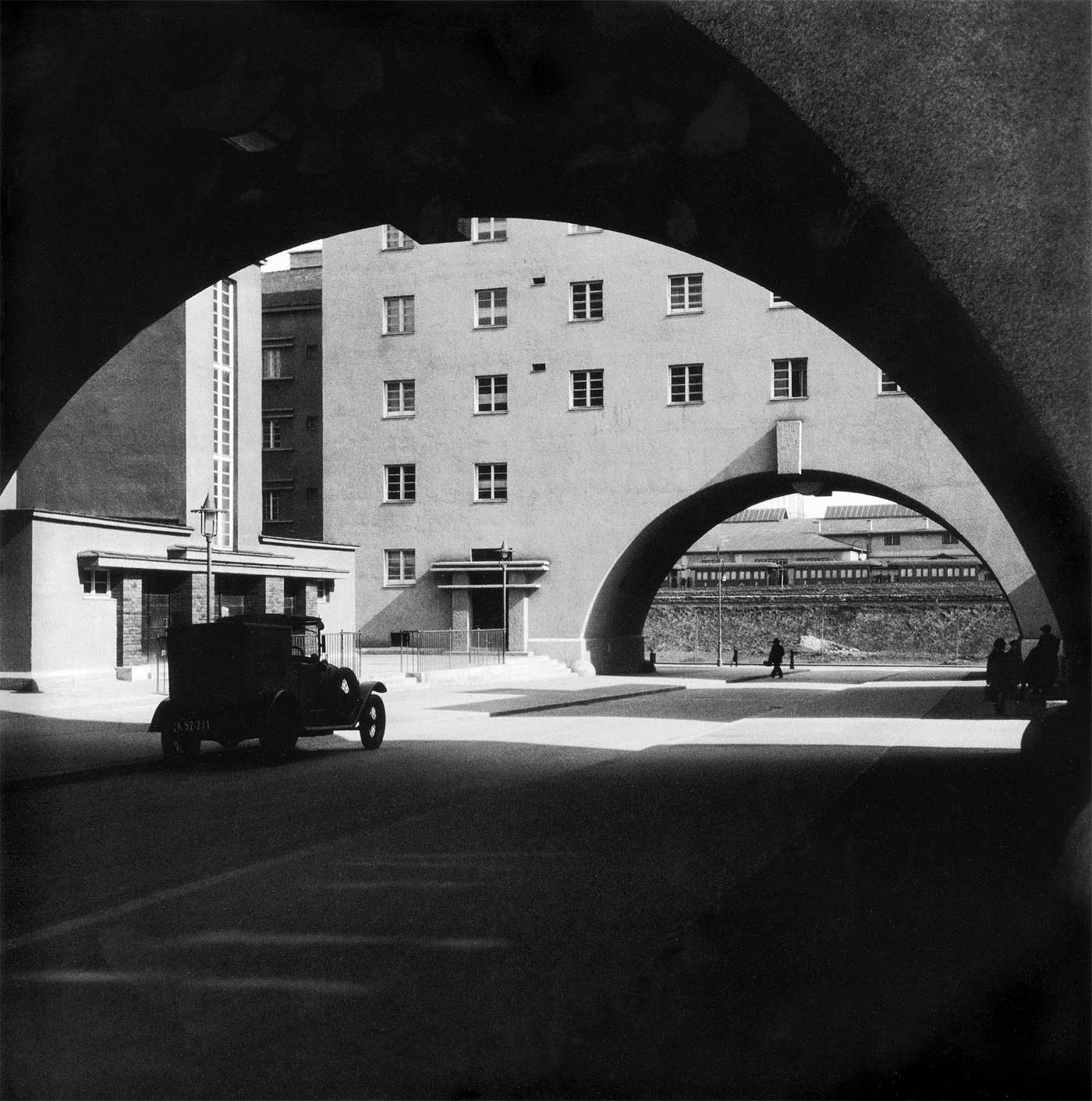
Somerset House website

LIKE ART BLART ON FACEBOOK

Back to top

Exhibition: ‘William Klein + Daido Moriyama’ at the Tate Modern, London

Exhibition dates: 10th October, 2012 – 20th January, 2013

Co-curators: Simon Baker (Curator of Photography and International Art) and Juliet Bingham (Curator, Tate Modern), with assistance from Kasia Redzisz (Assistant Curator, Tate Modern)


William Klein (French born America, 1926-2022) 'Candy Store, New York' 1955 from the exhibition 'William Klein + Daido Moriyama' at the Tate Modern, London, October 2012 - January 2013


William Klein (French born America, 1926-2022)
Candy Store, New York
1955
Gelatin silver print
© William Klein


More Daido Moriyama photographs can be found on my 2012 posting Fracture: Daido Moriyama at the Los Angeles County Museum of Art (LACMA) and 2009 posting Daido Moriyama: Tokyo Photographs at Philadelphia Museum of Art.

Dr Marcus Bunyan


Many thankx to the Tate Modern for allowing me to publish the photographs in the posting. Please click on the photographs for a larger version of the image.


William Klein (French born America, 1926-2022) 'Pray + Sin, New York' 1954 from the exhibition 'William Klein + Daido Moriyama' at the Tate Modern, London, October 2012 - January 2013


William Klein (French born America, 1926-2022)
Pray + Sin, New York
1954
Gelatin silver print
© William Klein


Explore modern urban life in New York and Tokyo through the photographs of William Klein and Daido Moriyama. This is the first exhibition to look at the relationship between the work of influential photographer and filmmaker Klein, and that of Moriyama, the most celebrated photographer to emerge from the Japanese Provoke movement of the 1960s.

With work from the 1950s to the present day, the exhibition demonstrates the visual affinity between their urgent, blurred and grainy style of photography and also their shared desire to convey street life and political protest, from anti-war demonstrations and gay pride marches to the effects of globalisation and urban deprivation.

The exhibition also considers the medium and dissemination of photography itself, exploring the central role of the photo-book in avant-garde photography and the pioneering use of graphic design within these publications. As well the issues of Provoke magazine in which Moriyama and his contemporaries showcased their work, the exhibition will include fashion photography from Klein’s work with Vogue and installations relating to his satirical films Mister Freedom and Who Are You Polly Maggoo?

Text from the Tate Modern website


William Klein (French born America, 1926-2022) 'Bikini, Moscow' 1959


William Klein (French born America, 1926-2022)
Bikini, Moscow
1959
Gelatin silver print
© William Klein


William Klein (French born America, 1926-2022) 'Piazza di Spagna, Rome' 1960


William Klein (French born America, 1926-2022)
Piazza di Spagna, Rome
1960
Gelatin silver print
© William Klein


William Klein (French born America, 1926-2022) 'Gun 1, New York' 1955


William Klein (French born America, 1926-2022)
Gun 1, New York
1955
Gelatin silver print
© William Klein


William Klein (French born America, 1926-2022) 'lsa Maxwell's Toy ball, Waldorf Hotel, New York' 1955


William Klein (French born America, 1926-2022)
lsa Maxwell’s Toy ball, Waldorf Hotel, New York
1955
Gelatin silver print
© William Klein


William Klein (French born America, 1926-2022) 'Kiev railway station, Moscow' 1959


William Klein (French born America, 1926-2022)
Kiev railway station, Moscow
1959
Gelatin silver print
© William Klein


William Klein (French born America, 1926-2022) 'School out, Dakar' 1963


William Klein (French born America, 1926-2022)
School out, Dakar
1963
Gelatin silver print
© William Klein


William Klein (French born America, 1926-2022) 'Dance Happening in Ginza, Tokyo' 1961


William Klein (French born America, b. 1928)
Dance Happening in Ginza, Tokyo
1961
Gelatin silver print
© William Klein


William Klein + Daidō Moriyama Exhibition Tate Modern, London

Slideshow of images from the press view at the William Klein / Daido Moriyama Exhibition at Tate Modern, London


Explore modern urban life in New York and Tokyo through the photographs of William Klein and Daido Moriyama. This is the first exhibition to look at the relationship between the work of influential photographer and filmmaker Klein, and that of Moriyama, the most celebrated photographer to emerge from the Japanese Provoke movement of the 1960s. With work from the 1950s to the present day, the exhibition demonstrates the visual affinity between their urgent, blurred and grainy style of photography and also their shared desire to convey street life and political protest, from anti-war demonstrations and gay pride marches to the effects of globalisation and urban deprivation. Taking as its central theme the cities of New York and Tokyo, William Klein + Daido Moriyama explores both artists’ celebrated depictions of modern urban life.

The exhibition is formed of two retrospectives side by side, bringing together over 300 works, including vintage prints, contact sheets, film stills, photographic installations and archival material. The influence of Klein’s seminal 1956 publication Life is Good & Good for You in New York, Trance Witness Revels, as well as his later books Tokyo 1964 and Rome: The City and Its People 1959, is traced through Moriyama’s radical depictions of post-war Tokyo in Sayonara Photography and The Hunter 1972. The juxtaposition of these artists not only demonstrates the visual affinity between their urgent, blurred and grainy style of photography, but also their shared desire to convey street life and political protest, from anti-war demonstrations and student protests to the effects of globalisation and urban deprivation.

This exhibition also considers the medium and dissemination of photography itself, exploring the central role of the photo-book in avant-garde photography and the pioneering use of graphic design within these publications. As well the issues of Provoke magazine in which Moriyama and his contemporaries showcased their work, the exhibition includes fashion photography from Klein’s work with Vogue and installations relating to his satirical films Mister Freedom and Who Are You Polly Maggoo? New ways of presenting photography are also demonstrated by Moriyama’s installation Polaroid/Polaroid 1997, which recreates his studio interior through a meticulous arrangement of Polaroid images.

Press release from the Tate Modern website


'William Klein + Daido Moriyama' exhibition banner


William Klein + Daido Moriyama exhibition banner


Daidō Moriyama (Japanese, b. 1938) 'Misawa' 1971


Daidō Moriyama (Japanese, b. 1938)
Misawa
1971
Gelatin silver print
© Daido Moriyama


Daido Moriyama (Japanese, b. 1938) 'Marine Accident (Premeditated or not 5)' 1969


Daidō Moriyama (Japanese, b. 1938)
Marine Accident (Premeditated or not 5)
1969
Gelatin silver print
© Daido Moriyama


William Klein + Daido Moriyama is the first exhibition to examine the relationship between the work of William Klein (born 1928), one of the twentieth century’s most important photographers and film-makers, and that of Daido Moriyama (born 1938), the most celebrated photographer to emerge from the Japanese Provoke movement. Taking as its central theme the cities of New York and Tokyo, William Klein + Daido Moriyama explores both artists’ celebrated depictions of modern urban life.

The exhibition is formed of two retrospectives side by side, bringing together over 300 works, including vintage prints, contact sheets, film stills, photographic installations and archival material. The influence of Klein’s seminal 1956 publication Life is Good & Good for You in New York, Trance Witness Revels, as well as his later books Tokyo 1964 and Rome: The City and Its People 1959, is traced through Moriyama’s radical depictions of post-war Tokyo in Sayonara Photography and The Hunter 1972. The juxtaposition of these artists not only demonstrates the visual affinity between their urgent, blurred and grainy style of photography, but also their shared desire to convey street life and political protest, from anti-war demonstrations and student protests to the effects of globalisation and urban deprivation.

This exhibition also considers the medium and dissemination of photography itself, exploring the central role of the photo-book in avant-garde photography and the pioneering use of graphic design within these publications. As well the issues of Provoke magazine in which Moriyama and his contemporaries showcased their work, the exhibition includes fashion photography from Klein’s work with Vogue and installations relating to his satirical films Mister Freedom and Who Are You Polly Maggoo? New ways of presenting photography are also demonstrated by Moriyama’s installation Polaroid/Polaroid 1997, which recreates his studio interior through a meticulous arrangement of Polaroid images.

William Klein was born in New York, USA in 1928 and now lives and works in Paris, France. Solo exhibitions of his work have been held at the Centre Pompidou, Paris and the Scottish National Gallery, Edinburgh and he received the Outstanding Contribution to Photography Award at the 2012 Sony World Photography Awards.

Daido Moriyama was born in Osaka, Japan in 1938 and moved to Tokyo in 1961, where he continues to live and work. He was recently given a Lifetime Achievement Award by the International Centre of Photography and his work has been the subject of solo exhibitions at the San Francisco Museum of Modern Art; The Cartier Foundation, Paris; and The National Museum of Art, Osaka.

William Klein + Daido Moriyama is co-curated by Simon Baker, Curator of Photography and International Art, Tate, and Juliet Bingham, Curator, Tate Modern, with Kasia Redzisz, Assistant Curator, Tate Modern. The exhibition is accompanied by new books about both photographers from Tate Publishing. A season of film screenings at Tate Modern is also being held to coincide with the exhibition, showing Klein’s feature films and documentaries.

Press release from the Tate Modern website


Daidō Moriyama (Japanese, b. 1938) 'Memory of Dog 2' 1981


Daidō Moriyama (Japanese, born 1938)
Memory of Dog 2
1981
Gelatin silver print
© Daido Moriyama


Daidō Moriyama (Japanese, b. 1938) 'Tokyo color' 2008-2015


Daidō Moriyama (Japanese, born 1938)
Tokyo color
2008-2015
© Daido Moriyama


Daidō Moriyama (Japanese, b. 1938) 'Tokyo' 2011


Daidō Moriyama (Japanese, b. 1938)
Tokyo
2011
Gelatin silver print
Courtesy Daido Moriyama Photo Foundation
© Daido Moriyama


After reading Jack Kerouac’s classic beat novel On The Road, Moriyama began photographing the roads leading into and out of Japanese towns. Instead of places people live in and feel comfortable with, he portrays cities primarily as destinations to be visited and left behind. The resulting book, Hunter (1972), is described as a “road map of images from all over Japan through a moving car window. Routes and roads are the hunting field for me as a photographer.”

Occasionally he finds beauty – in snowflakes falling, a train speeding past, or the patterning of fishnet tights or perforated steel – but ramping up the contrast of his black and white prints, Moriyama more often portrays the world as a dangerous place engulfed in existential darkness.

In all this chaos, his studio appears like a beacon of calm and stability. Recorded in a grid of polaroid shots, the room is recreated as an installation that offers a rare glimpse of clarity and colour in what can otherwise feel like a miasma – the world as seen through a dark fog.

While Klein undoubtedly influenced Moriyama’s love of grainy, out-of-focus shots taken from odd angles, to pair him with the American tells only half the story. Warhol was equally important as the inspiration behind his Accident series, which includes car crashes, shipping disasters, executions and a health scare linked to overcrowded beaches. Moriyama’s use of found images (the car crashes come from posters), his fascination with serialisation (banks of tins on supermarket shelves) and with juxtaposing unrelated images on a page were also inspired by Warhol. So pairing him with Klein is interesting, but doesn’t do him justice. Moriyama deserves to be seen as a law unto himself, rather than an acolyte of a more familiar western photographer.

Sarah Kent. “William Klein + Daido Moriyama, Tate Modern,” on The Arts Desk website Thursday, 11 October 2012 [Online] Cited 05/09/2022/ Used under fair use conditions for the purposes of education and research


Daidō Moriyama (Japanese, b. 1938) 'Setagaya-ku, Tokyo, Midnight 1986'


Daidō Moriyama (Japanese, b. 1938)
Setagaya-ku, Tokyo, Midnight
1986
Gelatin silver print
Courtesy Daido Moriyama Photo Foundation
© Daido Moriyama


Daidō Moriyama (Japanese, b. 1938) 'Another Country in New York' 1971


Daidō Moriyama (Japanese, b. 1938)
Another Country in New York
1971
Gelatin silver print
Tokyo Polytechnic University
© Daido Moriyama


Tate Modern
Bankside
London SE1 9TG

Opening hours:
Monday to Sunday 10.00 – 18.00

Tate Modern website

LIKE ART BLART ON FACEBOOK

Back to top

Artwork: Hamzeh Carr. ‘Lord Buddha’ 1926

November 2012


Hamzeh Carr. 'Lord Buddha' 1926 From Sir Edwin Arnold. The Light of Asia. London: John Lane The Bodley Head Ltd


Hamzeh Carr
Lord Buddha
1926
Frontispiece
From Sir Edwin Arnold. The Light of Asia. London: John Lane The Bodley Head Ltd
Limited edition of 3,000 copies


Absolutely divine. In the flesh, the colouring and radiance of these plates has to be seen to be believed.

God they knew how to print back then!

I shall be posting more of these stunning works over the coming weeks. They deserve to be seen and meditated upon. Please click on the artwork for a larger version of the image.

Dr Marcus Bunyan


Please click on the image for a larger version of the art work.


LIKE ART BLART ON FACEBOOK

Back to top

Exhibition: ‘Edouard Baldus and the Modern Landscape. Important Salt Prints of Paris from the 1850s’ at James Hyman Gallery, London

Exhibition dates: 12th October – 9th November, 2012

Curator: James Hyman


Edouard Baldus (French, 1813-1889) 'Vue generale de Paris pont neuf' c. 1855 from the exhibition 'Edouard Baldus and the Modern Landscape. Important Salt Prints of Paris from the 1850s' at James Hyman Gallery, London, October - November, 2012


Edouard Baldus (French, 1813-1889)
Vue generale de Paris pont neuf
c. 1855
Salt print mounted on card
33.6 x 43.9cm (13.20 x 17.25 ins)
Negative: Lower left inscribed in negative: no 82 Mount: Lower right beneath negative: stamped E. Baldus Lower left bottom: Vue generales des Paris pont neuf


A beautiful, complimentary post to the last one on the exhibition Eugène Atget: Old ParisIt is interesting to compare the styles of the two photographers and the change in photography that takes place between the 1850s and the 1890s. Baldus’ photographs are eloquent in their grandeur and frontality, tonality and texture. Atget’s photographs on the other hand are slightly claustrophobic in their intensity, the camera obliquely placed to capture old buildings, narrow cobbled streets and distant vanishing points. Both, in their own way, are very modern photographers. Baldus’ legacy, as Dr James Hyman correctly notes, was his influence on his German compatriots such as the Bechers, Thomas Struth and, to a lesser extent, Andreas Gursky. His rigorous frontality (the photographing of the thing itself) gives his photographs the simplicity of diagrams and emphasises their topographical state, while their density of detail offers encyclopaedic richness. This straightforward “objective” point of view was most notably used by Bernd and Hilla Becher in contemporary photography. Atget’s photographs, on the other hand, aroused an immediate interest “among the Surrealists because of the composition, ghosting, reflections, and its very mundanity.”

Conversely, it is the subjective signature of both artists that make their work truly great – not the mundanity, not the topographic objectivity but their intimate vision of this city, Paris. As I noted in an earlier posting on the Bechers,

“These are subjective images for all their objective desire. The paradox is the more a photographer strives for objectivity, the more ego drops away, the more the work becomes their own: subjective, beautiful, emotive… What makes great photographers, such as Eugène Atget, Walker Evans, August Sander and the Bechers, is the idiosyncratic “nature” of their vision: how Atget places his large view camera – at that particular height and angle to the subject – leaves an indelible feeling that only he could have made that image, to reveal the magic of that space in a photograph. It is their personal, unique thumbprint, recognisable in an instant.”

The same can be said of Baldus and these magnificent, ethereal photographs.

Dr Marcus Bunyan


Many thankx to James Hyman Gallery for allowing me to publish the photographs in the posting. Please click on the photographs for a larger version of the image.


Edouard Baldus (French, 1813-1889) 'Le Nouveau Louvre' c. 1857 from the exhibition 'Edouard Baldus and the Modern Landscape. Important Salt Prints of Paris from the 1850s' at James Hyman Gallery, London, October - November, 2012


Edouard Baldus (French, 1813-1889)
Le Nouveau Louvre
c. 1857
Salt print mounted on card
31.6 x 44.3cm (12.42 x 17.41 ins)
Le Nouveau Louvre series: 1855-1857
Negative: Lower left inscribed in negative: no 107 Mount: Lower right beneath negative: stamped E. Baldus Lower left bottom: Le Nouveau Louvre


Mid-nineteenth century Paris was a city in the midst of modernisation, and as such, was ripe for documentation of its changing landscape. Counted as one of the premier photographers of his day, Edouard Baldus captured the aesthetic of the Second Empire’s ideology in his monumental views of both old and new Parisian landmarks. In 1855, Baldus received his largest commission, to document the construction of the Musee du Louvre. This rich salt print is a survey of the project as it nears almost full completion. Baldus produced over two thousand images of each part of the new Louvre, from large pavilions to small decorative statue. This photograph, however, takes a step back from the individual pieces of the lengthy project, and allows the viewer to appreciate the endeavour as a whole.


Edouard Baldus (French, 1813-1889) 'Le Pantheon' 1853


Edouard Baldus (French, 1813-1889)
Le Pantheon
1853
Salt print mounted on card
33.8 x 43.5cm (13.28 x 17.10 ins)
Negative: Lower left inscribed in negative: Le Pantheon Lower right inscribed in negative: Baldus Mount: Lower right beneath negative: stamped E. Baldus Lower left bottom: Le Pantheon


Due to the strength of his architectural imagery and work with the Mission Heliographique, Baldus would go on to gain the support of a government commission, Les Villes de France Photographies, which focused on the landmarks of Paris in particular, such as the Pantheon. Similar in style to the frontal views of the Louvre pavilions, this image is a precursor to that project, and also includes Saint Etienne du Mont in its background. The Pantheon is one of Paris’ best-known landmarks, and was originally built as a church dedicated to Saint Genevieve. Looking out over the whole of the city, it is now a mausoleum that houses the remains of distinguished French citizens.


Edouard Baldus (French, 1813-1889) 'Arc de Caroussel' c. 1853 from the exhibition 'Edouard Baldus and the Modern Landscape. Important Salt Prints of Paris from the 1850s' at James Hyman Gallery, London, October - November, 2012


Edouard Baldus (French, 1813-1889)
Arc de Caroussel
c. 1853
Salt print mounted on card
34.1 x 44.3 cms (13.40 x 17.41 ins)
Negative: Lower left inscribed in negative: signature of E.Baldus Lower right inscribed in negative: no.81 Mount: Lower right beneath negative: stamped E.Baldus Lower left bottom: Arc de Caroussel
Mount: 43.9 x 61 cms
Image: 34.1 x 44.3 cms


One of Baldus’ greatest projects was to provide a photographic inventory of the New Louvre and adjoing Tuilleries. A number of these works are of particular interest, expecially those of the Tuilleries Palace, which would be burnt down in 1870-1871. All that remains today is the central triumphal arch, the Caroussel, which is depicted here, still with the palace visible in the background. Built between 1806 and 1808, the Arc de Caroussel is a monument commemorating Napolean’s military victories, with Peace riding a triumphal chariot atop the central archway. Two guards flank the sides of the arch, each atop their own horse, which not only provide for a sense of scale, but, being slightly blurred, also hint at the length of Baldus’ exposure. This enhances the effects of the delicately carved sculptures that adorn the archway, presented here with a clarity that defined the standard Baldus set with his architectural images.


James Hyman is proud to present a loan exhibition of one of the greatest photographers of the nineteenth century, Edouard Baldus. Remarkably, this is the first major exhibition of Edouard Baldus ever to be staged in London. Baldus was famed for his monumental photographs of the buildings of Paris at a time of massive transition under Napoleon III, Baron Haussman and Viollet Le Duc, as well as the depiction of the contemporary landscape of France. Acclaimed as the greatest architectural photographer of the nineteenth century, Baldus’s prints were some of the largest photographs in existence and pioneered an aesthetic of presenting modernity and the modern city that would have a profound influence on later photographers from the Bechers to John Davies.

Baldus was one of the great calotypists of the 1850s, producing works of an unprecedented range and scale. He moved to Paris in 1838 to study painting alongside other future photographers such as Le Gray, Le Secq, and Negre. He frequently retouched his paper negatives, adding pencil and ink, to add clouds or clarify details, then printing his own large-scale negatives. He was also adept at stitching several negatives together to re-create architectural views, most famously in his views of the cloisters of Saint Trophime.

Famed especially for his depiction of architecture, Baldus not only documented the modernisation of Paris but also travelled widely through France recording modernity and new construction – including new railways and aqueducts, as well as the building of the new Louvre. In 1851 the Commission des Monuments Historiques cited Baldus as one of the five best architectural photographers and he was commissioned to record the monuments of France for what became known as the Mission heliographic. His beginnings in photography are not well documented before his participation in the Mission heliographique, although it is known that he took photographs of Montmajour in 1849.

In 1852 he began Villes de France photographies to which the minister of Beaux-Arts subscribed until 1860. In 1854 he travelled with his student Petiot-Groffier in Auvergne and in 1855 the Baron James de Rothschild commissioned him to photograph the new Northern train line from Paris to Boulogne as a gift, in the form of a commemorative album, for Queen Victoria before her visit to the Exposition Universelle. Later, in his commission to document the reconstruction of the Louvre, Baldus took more than two thousand views in a period of three years. His last big commission was from 1861-1863 documenting the Paris-Lyon-Mediterranean train line illustrating seventy views of the train’s track. After this, Baldus tried to provide more commercial alternatives to his large-format works, creating smaller prints and heliogravures of his earlier work. Unfortunately, the effort was unsuccessful and Baldus passed away in bankruptcy and relative obscurity.

Press release from the James Hyman website


Edouard Baldus (French, 1813-1889) 'Pavillon Colbert, Nouveau Louvre, Paris' c.1855


Edouard Baldus (French, 1813-1889)
Pavillon Colbert, Nouveau Louvre, Paris
c. 1855
Salt print mounted on card
43.2 x 34.1cm (16.98 x 13.40 ins)
Stamped ‘E. Baldus’ on the lower right of the mount and titled lower left ‘Pavillon Colbert Nouveau Louvre’


Of the many photographs Baldus took of the Louvre during the period 1855-1857, it is his large-format photographs of the main pavilions that best demonstrate the stretch of his artistic achievements. Commissioned by the French government once again, Baldus was charged with documenting every aspect of the new Palace’s construction, which was to be the Second Empire’s largest building project. Consequently, over the course of two years, it also evolved into the largest photographic commission to date, and Baldus took over two thousand photographs ranging in subject matter from individual statuary to the grand frontal views of each completed pavilion, such as this example of the Pavillon Colbert.

This particular photograph is an astounding example of the precision and clarity wet plate negatives afforded Baldus in capturing the texture of New Louvre’s stonework. Each part of the façade, from the temple relief statuary to the columns flanking the entryway, is bathed in a bright light that emphasises the three-dimensionality of the new pavilion. The sense of crisp stonework evident in this image is only heightened by the blurred tree in the bottom left corner, as well as the trace of a ghostly figure in the foreground – a horse and cart that paused long enough to be captured, just barely, in Baldus’ long exposure.

The subject of this picture brings to bear the importance of the symbolism of the architecture of the Nouveau Louvre for the reign of Napoleon III. The relief and figures on the façade of the Pavillon Colbert highlight France’s greatest realms of achievement, from the conquering of nature through to industry. The upmost relief represents Earth and Water, while the figures to either side personify Science and Industry. Baldus has also ensured that a human figure on the right-hand side of the central entrance has stood still long enough to provide the viewer with a sense of the imposing scale of the statuary, as well as the entire façade. The result is a striking image that is sharper than any contemporary enlargement, exemplary of Baldus’ ability to isolate and capture architecture while giving a slight hint to the life that continued to move around it.


Edouard Baldus (French, 1813-1889) 'Pavillon de la Bibliotheque, Rue de Rivoli, Paris' c. 1855


Edouard Baldus (French, 1813-1889)
Pavillon de la Bibliotheque, Rue de Rivoli, Paris
c. 1855
Salt print mounted on card
43.2 x 34.3cm (16.98 x 13.48 ins)
Inscribed ‘no 103’ in the negative, lower left. Stamped E. Baldus on the lower right of the mount and titled lower left ‘Nouveau Louvre Rue Rivoli’


Edouard Baldus (French, 1813-1889) 'Pavillon Richelieu, Nouveau Louvre, Paris' c. 1855


Edouard Baldus (French, 1813-1889)
Pavillon Richelieu, Nouveau Louvre, Paris
c. 1855
Salt print mounted on card
45 x 34.5cm (17.69 x 13.56 ins)
Inscribed ‘no 79’ in the negative, lower left and signed in the negative lower right ‘E. Baldus’ Stamped E. Baldus on the lower right of the mount and titled lower left ‘Pavillon Richelieu Nouveau Louvre’


An image that the Metropolitan Museum of Art describes as “among the most spectacular of all Baldus photographs,” it is clear that Baldus took full advantage of the opportunity to use larger equipment, which was necessary to capture his tremendous subject. The technical advantages afforded by glass plate negatives allowed him to create equally large contact prints without joining separate negatives, as was his practice with many of his earlier images. Here, the resulting photograph depicts the Pavillon Richelieu in a striking range of tonality, from the crisp texture of the street to the glowing reflection of the pavilion’s new tiled roof.


Edouard Baldus (French, 1813-1889) 'Pavillon Sully, Nouveau Louvre, Paris' c. 1857


Edouard Baldus (French, 1813-1889)
Pavillon Sully, Nouveau Louvre, Paris
c. 1857
Salt print mounted on card
44.5 x 34.5cm (17.49 x 13.56 ins)
Inscribed ‘no 92’ in the negative, lower left. Stamped E. Baldus on the lower right of the mount and titled lower left ‘Pavillon Sully Nouveau Louvre’


Baldus returned to this particular pavilion numerous times, his earliest images of the structure produced while he was photographing for the Mission Heliographique. The Pavillon Sully was originally built during the Classical Period of Louis XIV in 1625, and served as a model for the Second Empire additions. One of the grandest of all the completed facades, the Pavillon Sully acquired many sculptural additions during the reconstruction, but the central clock from which the pavilion derived its original name (Pavillon de l’Horloge) remained central.

Taking an elevated view, Baldus depicted the Pavillon Sully with exemplary precision that is sharper than any contemporary enlargement. The result is one of the most imposing images of the Nouveau Louvre pavilions, giving the entire façade a commanding sense of presence as it rises above trees in the foreground, which are just blurred enough to reveal Baldus’ long exposure.


Dr James Hyman text


Edouard Baldus (French, 1813-1889) 'Saint Etienne du Mont, Paris' c. 1858


Edouard Baldus (French, 1813-1889)
Saint Etienne du Mont, Paris
c. 1858
Salt print mounted on card
44.1 x 34.2cm (17.33 x 13.44 ins)
Stamped E Baldus on the lower right of the mount and titled lower left ‘St Etienne du Mont’
Mount: 61 x 43.9 cms
Image: 44.1 x 34.2 cms


Edouard Baldus (French, 1813-1889) 'Notre Dame, Facade Principale, Paris' 1857


Edouard Baldus (French, 1813-1889)
Notre Dame, Facade Principale, Paris
1857
Salt print mounted on card
44.5 x 34.2cm (17.49 x 13.44 ins)
Inscribed ‘no 34’ in the negative, lower right. Stamped E. Baldus on the lower right of the mount and titled lower left ‘Notre Dame Facade Principal’
Dimensions Mount: 61 x 44 cms Image: 44.5 x 34.2 cms


This iconic image of Notre Dame embodies the direct and frontal style that came to define Baldus’ architectural images. Here, he has captured the majesty of one of Paris’ most notable landmarks by elevating his vantage point and placing the viewer at eye level with its magnificent rose window. This print is a carefully executed example of the type of balance and symmetry Baldus aimed to capture while working on this commission.


James Hyman Gallery
16 Savile Row
London W1S 3PL
Phone: 020 7494 3857

Opening hours:
By appointment

James Hyman Gallery website

LIKE ART BLART ON FACEBOOK

Back to top