Exhibition dates: 16th June 2012 – 9th September 2012
Many thankx to the Moderna Museet Malmö for allowing me to publish the photographs in the posting. Please click on the photographs for a larger version of the image.
“A good photograph is one that communicates a fact, touches the heart, and leaves the viewer a changed person for having seen it; it is in one word, effective.”
Irving Penn
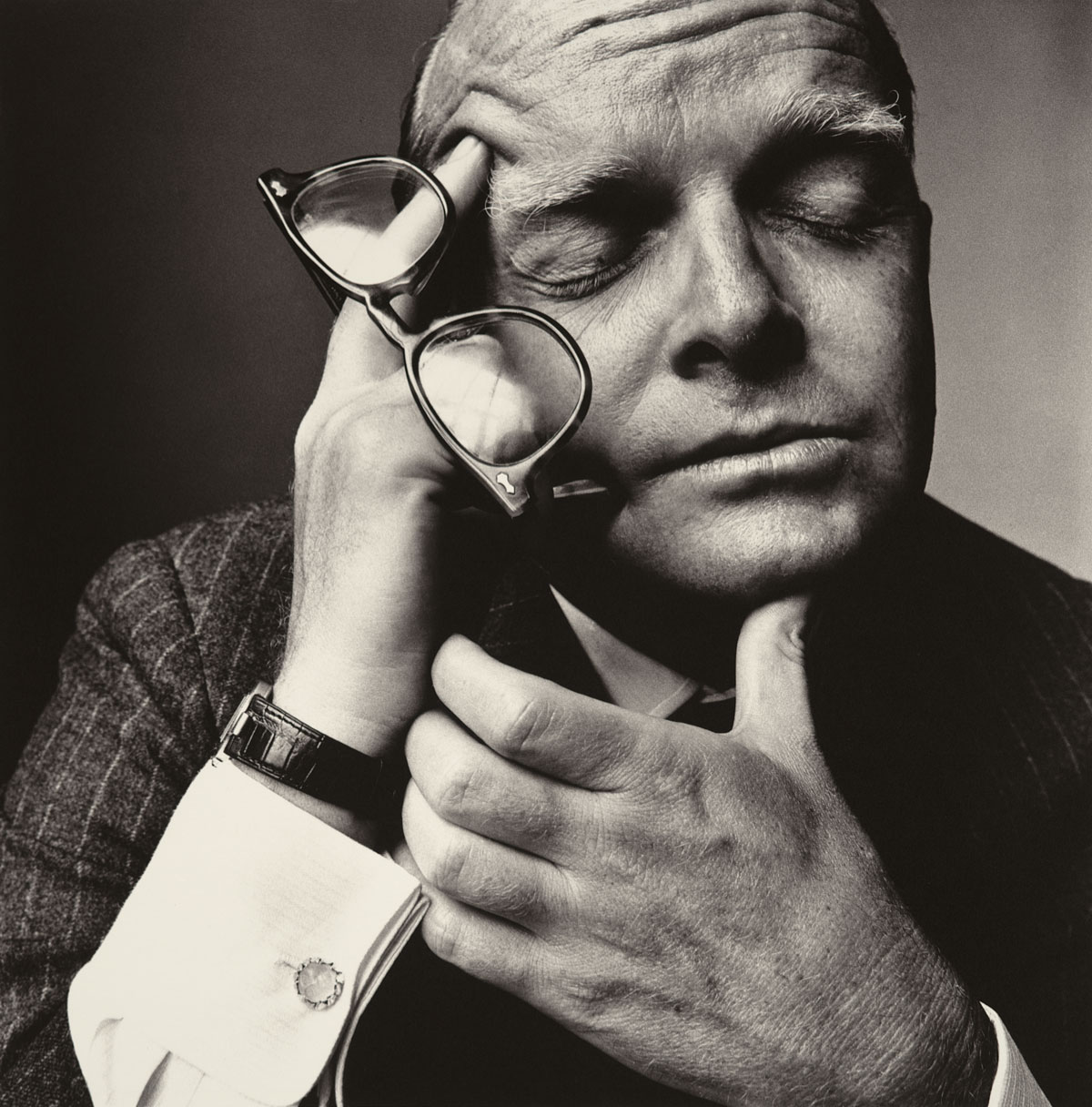
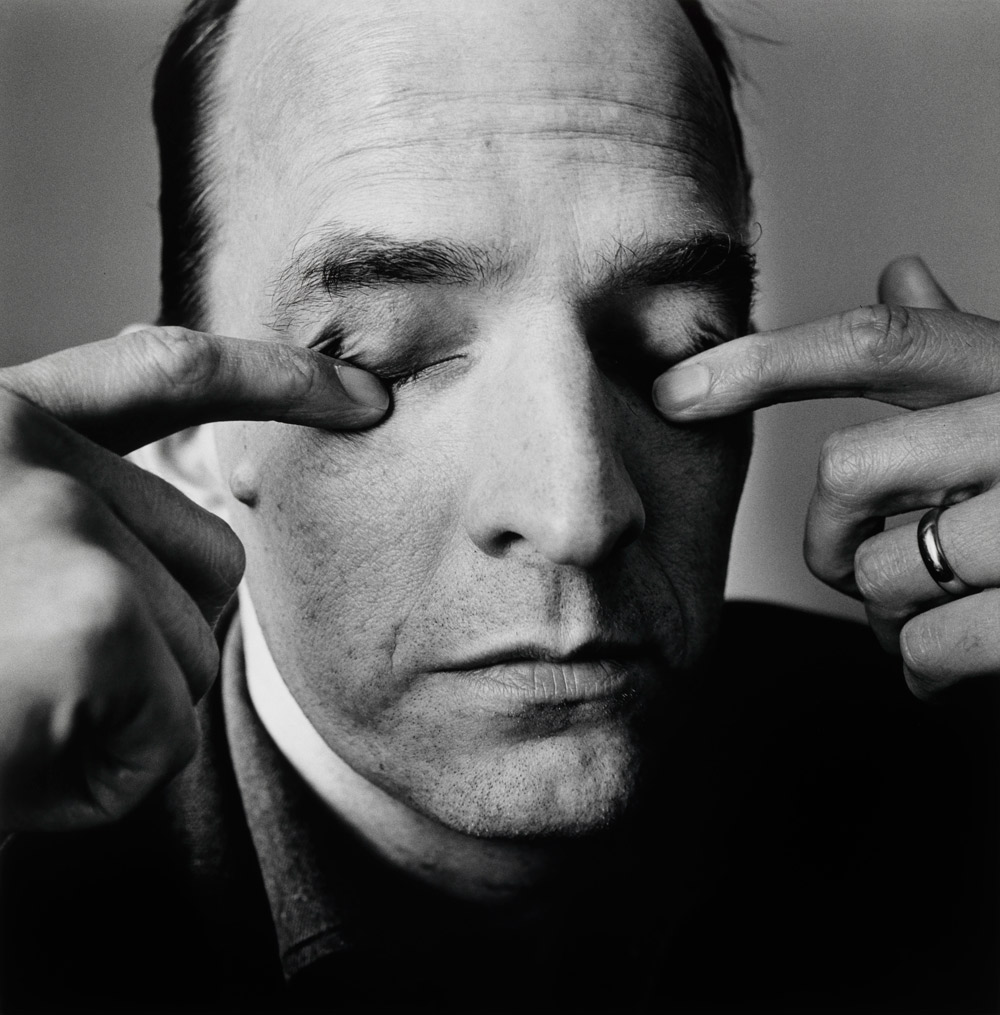
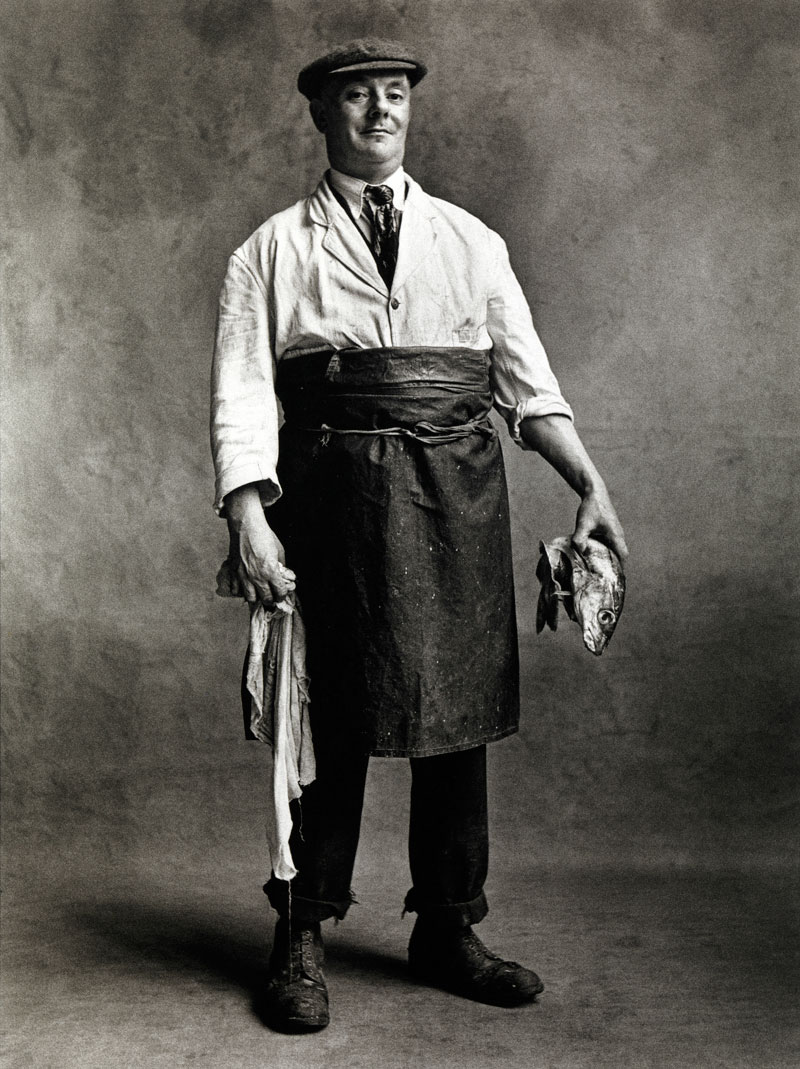
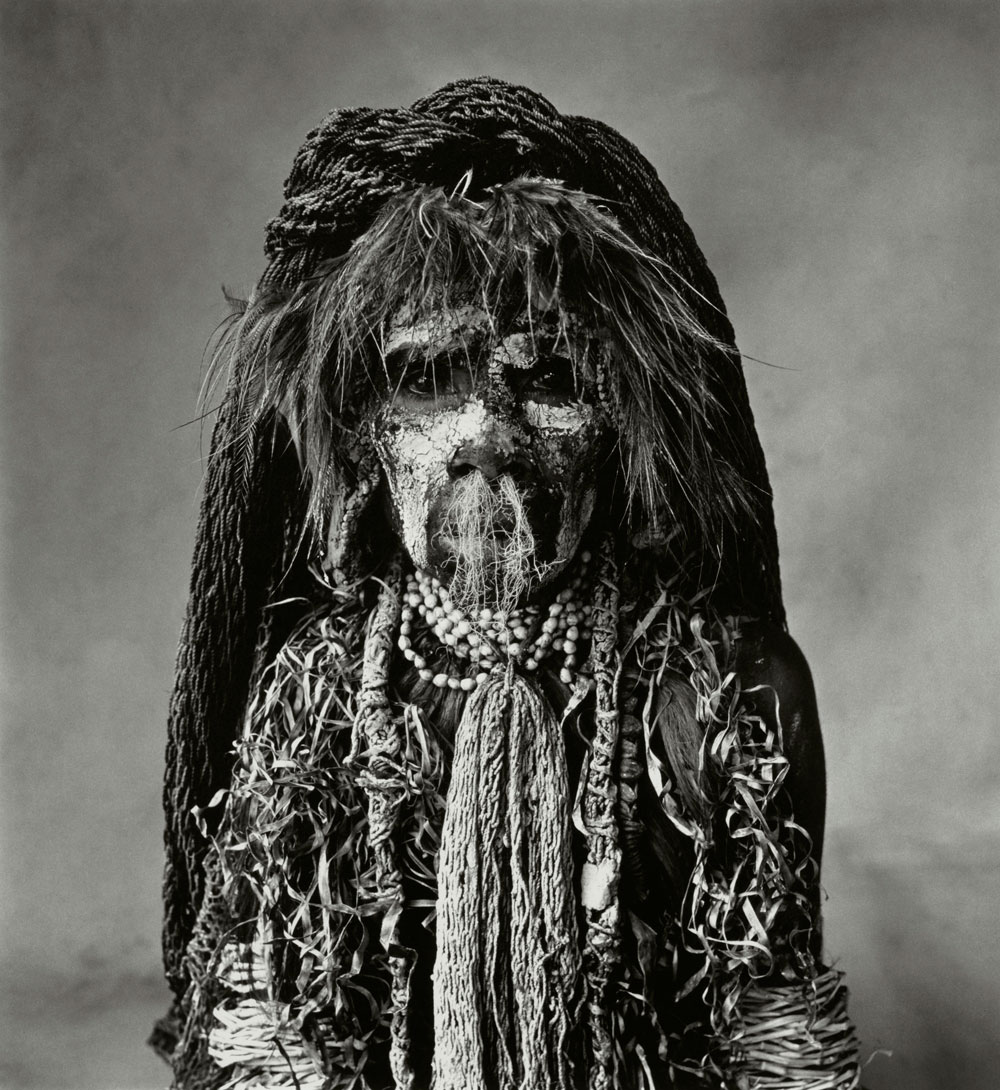
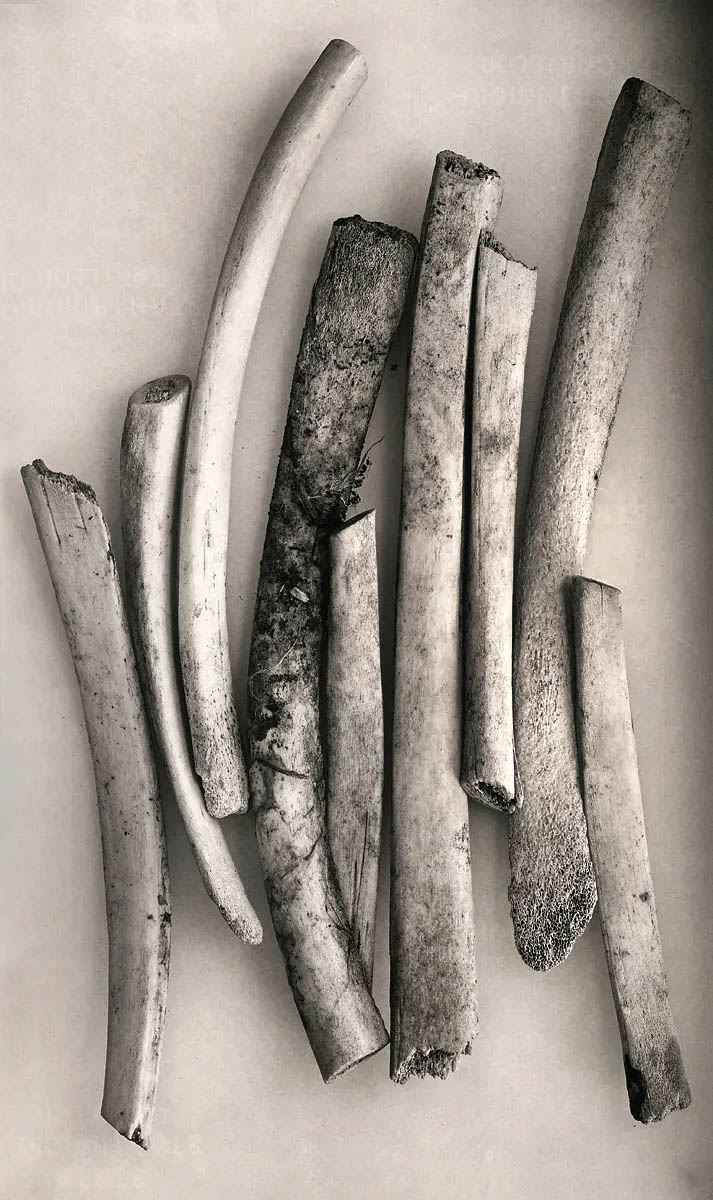
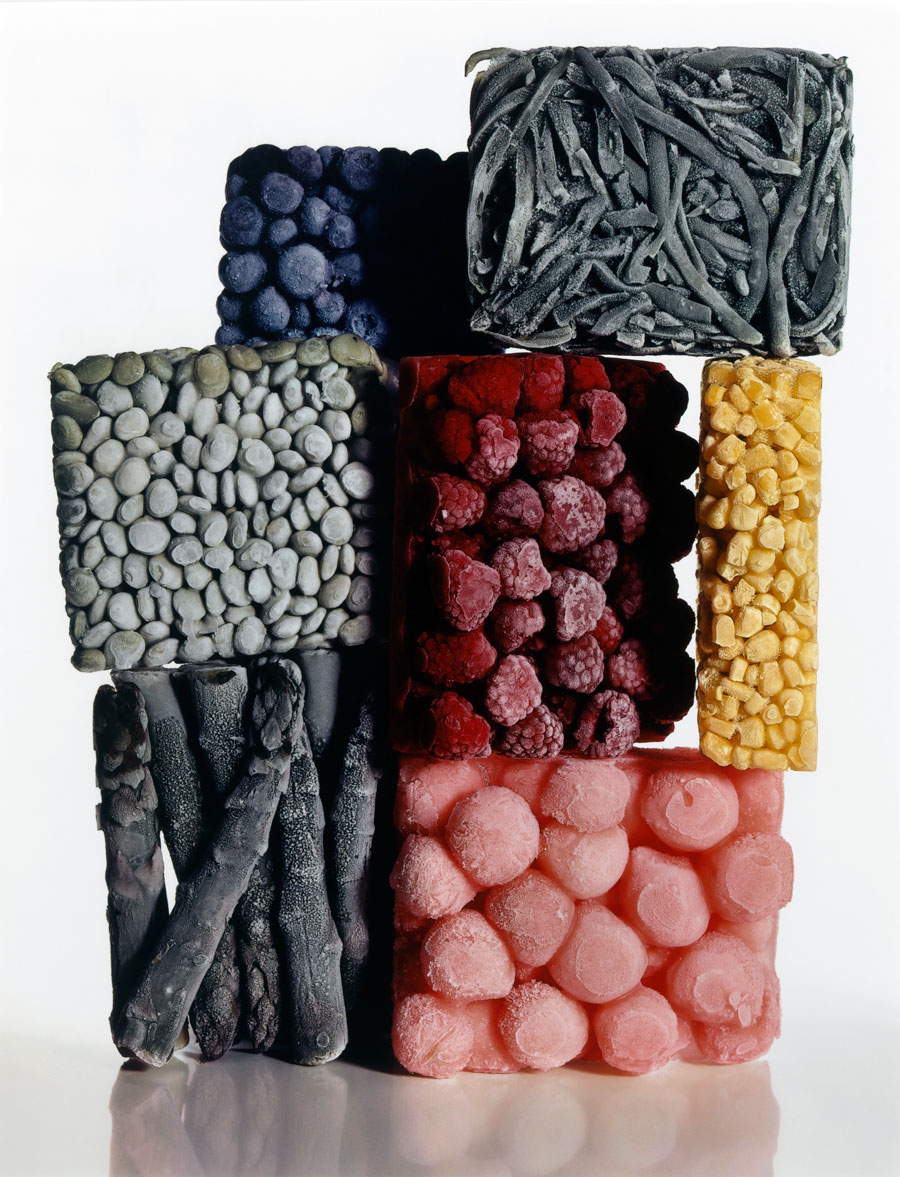
For the first time in the Öresund region, a rich selection of Irving Penn’s photographs from some of his most famous serial photography are being presented. His innovative fashion features, portraits and still-lifes made Irving Penn one of the leading photographers of our time. Spanning more than 60 years, his career is characterised by a cool, minimalist approach to the medium. With a selection of nearly 90 works and samples from his assignments for numerous publications, the exhibition at Moderna Museet Malmö covers a broad spectrum of Irving Penn’s oeuvre.
Irving Penn (1917-2009) is regarded as one of the leading photographers of our time. He was active in both the commercial and artistic fields. In 1985, he won the prestigious Hasselblad Award. In his terse serial works, Irving Penn developed a style that is distinguished by its sharpness, detail, meticulousness and minimalist imagery. The exhibition Diverse Worlds presents photographs from his most famous series and spans more than half a century. Most of these works were donated to Moderna Museet in 1995 by Penn himself, in memory of his wife, Swedish-born Lisa Fonssagrives-Penn.
Diverse Worlds is a broad resumé of Irving Penn’s oeuvre, revealing clearly the consistent style that is characteristic of his photographs. His output is typically imbued with an inquisitive eye and attention to detail, whatever the subject matter. A discussion of the commercial-artistic dichotomy seems rather pointless in the case of Irving Penn, who balanced constantly between the two, allowing one to benefit the other. His experience and background as a painter, for instance, came in handy when he was commissioned by established fashion houses to create their advertisements for publications such as Vogue – a magazine Penn worked for throughout most of his career.
In post-war New York, many cultural celebrities visited Irving Penn’s studio. The turmoil that prevailed after the Second World War was illustrated by portraying these ostensibly immortal icons trapped in a narrow corner. Penn has also related how this corner was created in his studio to counteract his own feelings of inferiority in relation to the celebs he portrayed. The less famed were also captured by Irving Penn’s camera, including small tradesmen in London and Paris, and members of Hell’s Angels in San Francisco. Life’s transience is distinctly visualised in many of the still-lifes Penn made in his career – often commissioned by fashion houses but also as part of his own projects.
Despite the variation in these pictorial series, Irving Penn’s oeuvre, and the presentation in Diverse Worlds, reveals a consistent curiosity and desire, and a wish to depict the divergent subjects in the same sensitive and detailed way. He achieved this by placing them all in the same setting. Different image worlds meet and are literally constructed in the same neutral space – Irving Penn’s studio.
Press release from the Moderna Museet Malmö website
Moderna Museet Malmö is located in the city centre of Malmö. Ten minutes walk from the Central station, five minutes walk from Gustav Adolfs torg and Stortorget.
Many thankx to the Whitechapel Gallery for allowing me to publish the photographs in the posting. Please click on the photographs for a larger version of the image.
The films and photographs of British artist Gillian Wearing (b. Birmingham, 1963) explore our public personas and private lives. This Turner Prize winner’s remarkable works draw on fly-on-the-wall documentaries, reality TV and the techniques of theatre, to explore how we present ourselves to the world.
Wearing’s portraits and mini-dramas reveal a paradox, given the chance to dress up, put on a mask or act out a role, the liberation of anonymity allows us to be more truly ourselves.
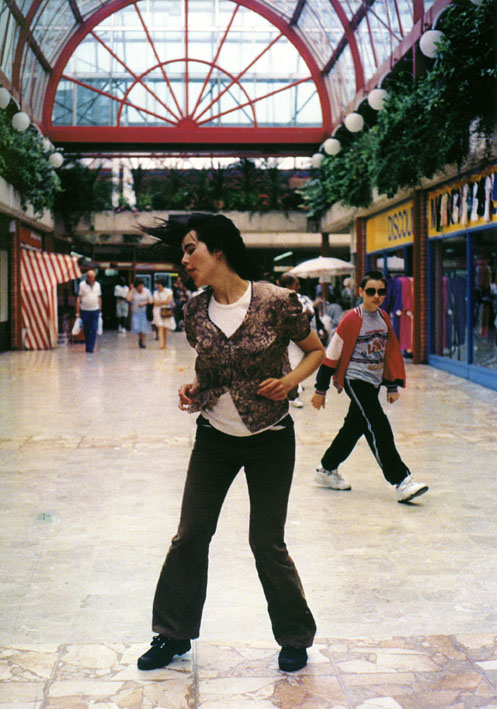
The exhibition begins with the artist herself, dancing in a shopping mall, blissfully unaware of her bemused audience. The idea of performance continues with works including Wearing’s 1997 masterpiece, 10–16. Adults lip synch the voices and act out the physical tics of seven children in a captivating film which moves from the breathless excitement of a ten year old to the existential angst of an adolescent.
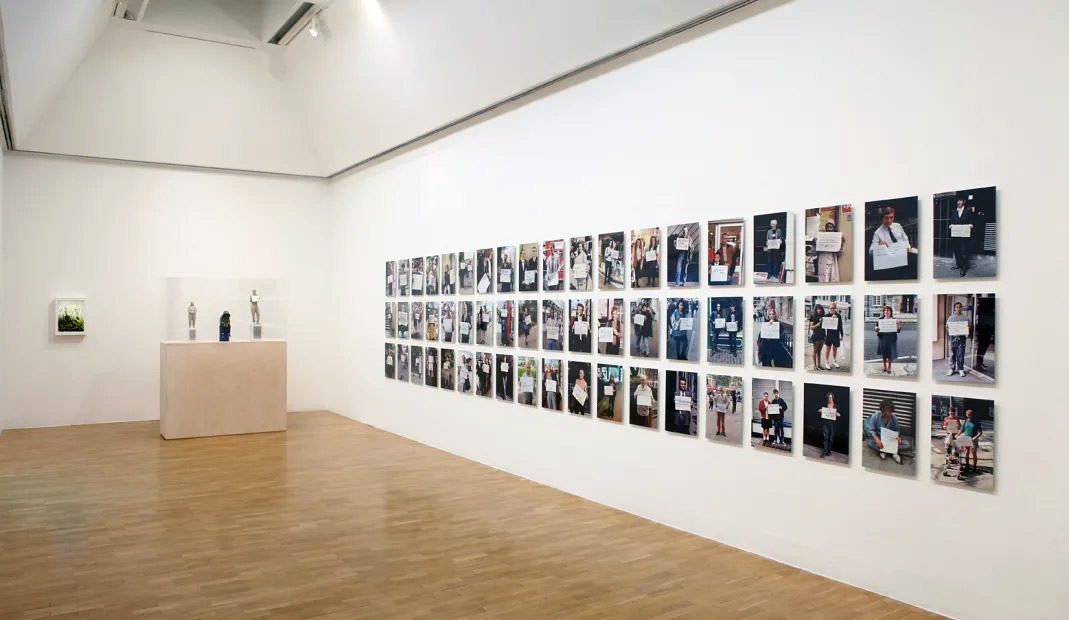
Other highlights include Wearing’s iconic 1992 series, Signs that say what you want them to say, and not Signs that say what someone else wants you to say where strangers are offered paper and pen to communicate their message. In the upper galleries we enter the inner world of subjectivity. An advert – Confess All On Video. Don’t Worry, You Will Be In Disguise. Intrigued? Call Gillian… (1994) attracted a series of disturbing disclosures. Wearing jettisons her own identity to adopt the guise of family members or artists such as Diane Arbus or Andy Warhol, so revealing her own background and influence.
This comprehensive survey, which also premieres new films and sculptures, shows how Wearing is both political – often focusing on the dispossessed or the traumatised – and poetic, finding the extraordinary in us all.
Curator Daniel Hermann introduces the Gillian Wearing exhibition at the Whitechapel Gallery from 28 March – 17 June 2012.
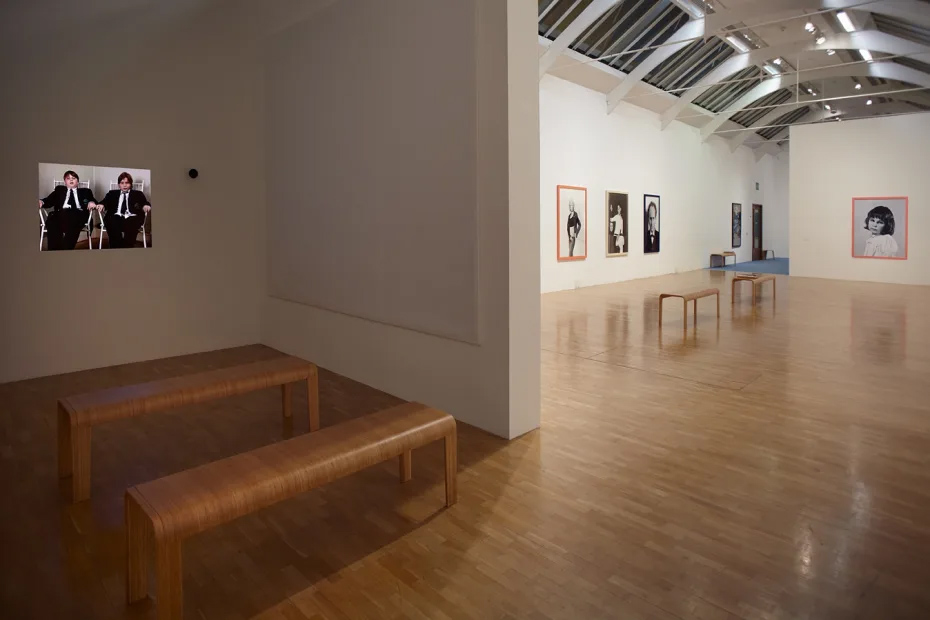
Installation view of the exhibition Gillian Wearing at Whitechapel Gallery, London showing work from her series Signs that say what you want them to say and not Signs that say what someone else wants you to say
The Whitechapel Gallery presents the first major international survey of Turner Prize-winning British artist Gillian Wearing’s photographs and films which explore the public and private lives of ordinary people. Fascinated by how people present themselves in front of the camera in fly-on-the-wall documentaries and reality TV, Gillian Wearing explores ideas of personal identity through often masking her subjects and using theatre’s staging techniques.
This major exhibition surveys Wearing’s work from the early photographs Signs that Say What You Want Them to Say and Not Signs that Say What Someone Else Wants You to Say (1992-3) to her latest video Bully (2010) and also includes several new photographs made specially for the Whitechapel Gallery exhibition.
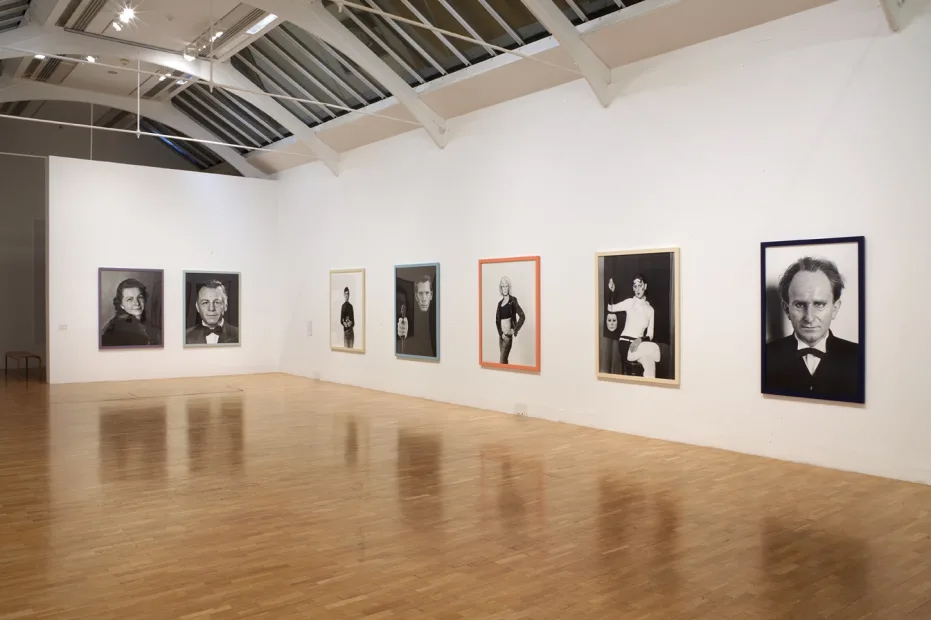
Visitors to the exhibition enter a film set-style installation showcasing photographs and films in ‘front and back stage’ areas. Highlights include a striking photograph of the artist posing as her younger self, Self-Portrait at 17 Years Old (2003), Dancing in Peckham (1994), a film which blurs the boundaries between public space and private expression as Wearing dances in the middle of a shopping mall, and the UK premiere of recent film Bully (2010). New photographic works shown for the first time include two portraits of Wearing as artists August Sander and Claude Cahun as part of her ongoing series of iconic photographers, as well as still lives of flowers, looking back to the rich symbolism of the great age of 17th century Dutch painting.
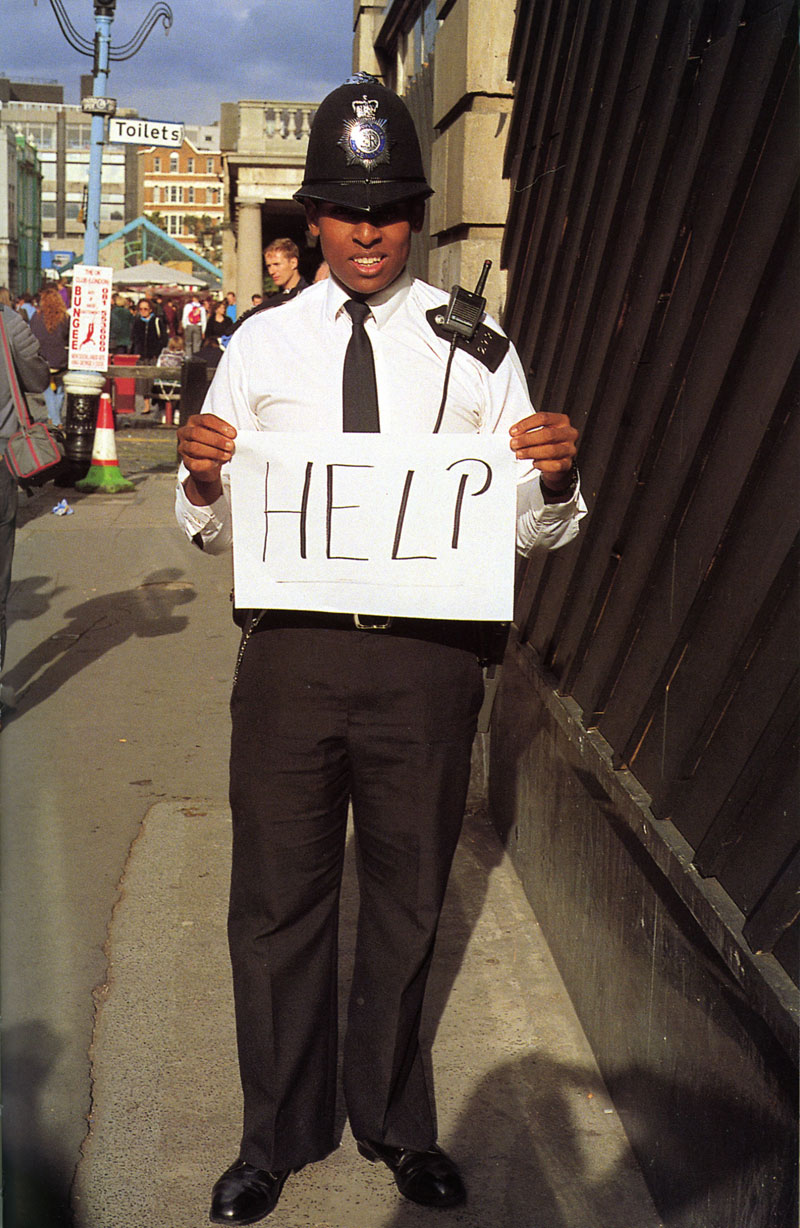
A gallery is dedicated to Wearing’s well-known photographs giving people the chance to write what they were thinking at that moment, titled Signs that Say What You Want Them to Say and Not Signs that Say What Someone Else Wants You to Say (1992-3). The series includes a city worker holding a sign saying, ‘I’m Desperate’, a policeman holding ‘Help!’ and another person’s sign ‘Will Britain ever get through this recession’.
The exhibition also includes a series of private viewing booths for three confessional videos shown together for the first time and in which Gillian Wearing asked people to describe intensely personal experiences. These include Trauma (2000) where sitters describe childhood traumas while wearing a mask. As well as the powerful videos Secrets and Lies (2000) and Confess All On Video. Don’t Worry, You Will Be In Disguise. Intrigued? Call Gillian… (1994). Alongside these works the video 2 into 1 (1997) sees a mother lip synching the voices of her twin sons and vice versa as they describe their relationship.
Press release from Whitechapel Gallery website
Gillian Wearing: Self Made, 2010 Trailer
Gillian Wearing’s debut feature film introduces a cast of untrained actors to a Method acting teacher. Drawing upon their own experiences, each participant creates and stars in their own mini-film.
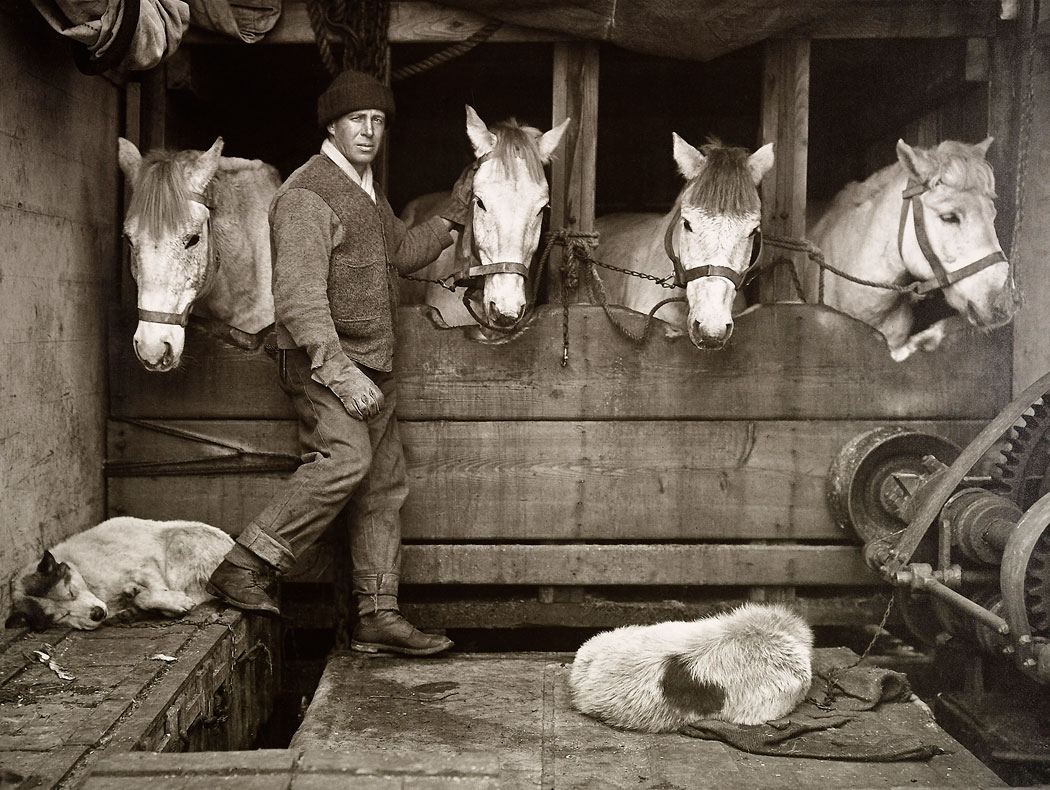
Continuing my fascination with all things Antarctic, here are more photographs from the Scott and Shackleton expeditions. The photograph Captain Lawrence Oates and Siberian ponies on board ‘Terra Nova’ by Herbert Ponting (1910, above) is simply breathtaking.
Dr Marcus Bunyan
Many thankx to The Royal Collection for allowing me to publish the photographs in the posting. Please click on the photographs for a larger version of the image.
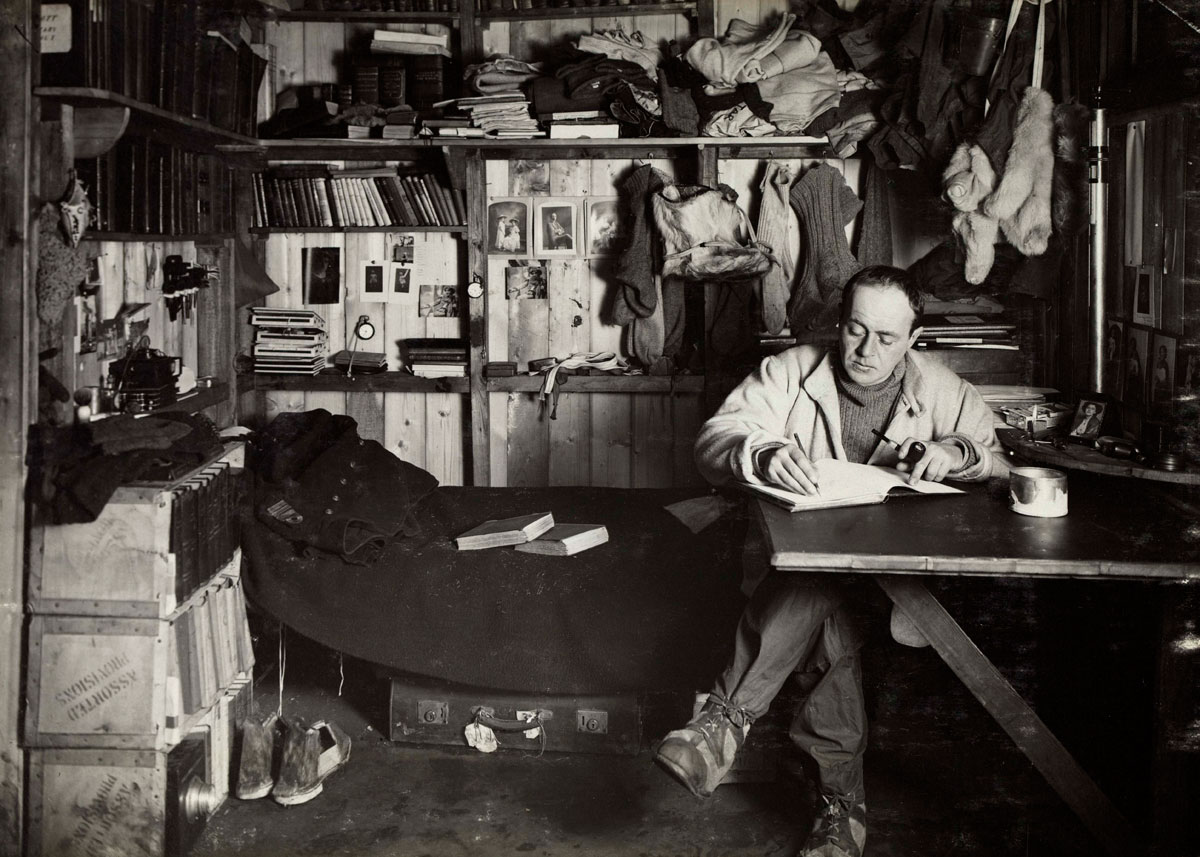
This exhibition of remarkable Antarctic photography by George Herbert Ponting and Frank Hurley marks the 100th anniversary of Captain Scott’s ill-fated journey to the South Pole. Ponting’s dramatic images record Scott’s Terra Nova expedition of 1910-1912, which led to the tragic death of five of the team on their return from the South Pole. Hurley’s extraordinary icescapes were taken during Ernest Shackleton’s polar expedition on Endurance in 1914-1917, which ended with the heroic sea journey from Elephant Island to South Georgia. Both collections of photographs were presented to King George V and are today part of the Royal Photograph Collection.
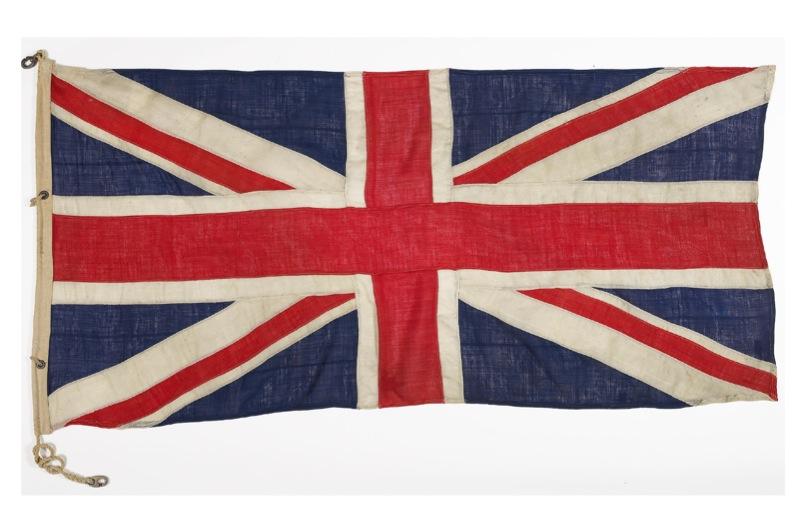
This Union Jack was given to Scott by the recently widowed Queen Alexandra on 25 June 1910 for him to plant at the South Pole. The flag was recovered with Scott’s body and returned to the queen by his wife, Kathleen, on 12 July 1913.
The photographs of Herbert Ponting and Frank Hurley may be stencilled into the collective memory after nearly a century of over-exposure. But it’s not often you get to see them away from the printed page, and they certainly bring out fresh depths and new perspectives…
It turns out to be highly instructive seeing Hurley and Ponting hung in neighbouring rooms. I’ve always taken Ponting to be somehow the lesser snapper. Hurley had the greatest photostory ever captured land in his lap when Shackleton’s ship the Endurance was trapped in ice floes and held fast for months before pressure ridges eventually crushed it like a dry autumn leaf. Like a good journalist Hurley recorded these traumas and more while also taking the chance to experiment with the strange light and baroque shapes supplied by his surroundings.
Ponting’s story was different. Four or so years earlier, and on the other side of the Antarctic land mass, he didn’t stray far from the expedition base, and indeed was left on the Terra Nova while Scott’s polar party were still out on the ice, trudging balefully towards immortality. There’s something about Ponting’s floridly unmodern moustache which sets him apart from the clean-shaven younger men in either expedition, as if he never quite left the studio behind.
But the photographs are astonishing… The story here is the unequal battle between man and ice, the castellations and ramparts of bergs dwarfing explorers with dogs and sledges placed at their foot to give a sense of scale. Ponting also has a beautiful eye for filigree detail, never more than in one picture of long spindly icicles echoing the adjacent rigging of the Terra Nova.
One of the revelations is that the originals play up the drama of Ponting’s work much more than Hurley’s, which are printed at half the size. For all the astonishing pictures – a field of ice flowers, the masts of the Endurance all but shrouded by Brobdingnagian ice clumps – the final impact of Hurley’s collection lies in the fact that they exist at all… That is partly why Ponting trumps Hurley in this show. His pictures of Scott’s men have never felt more immediate.
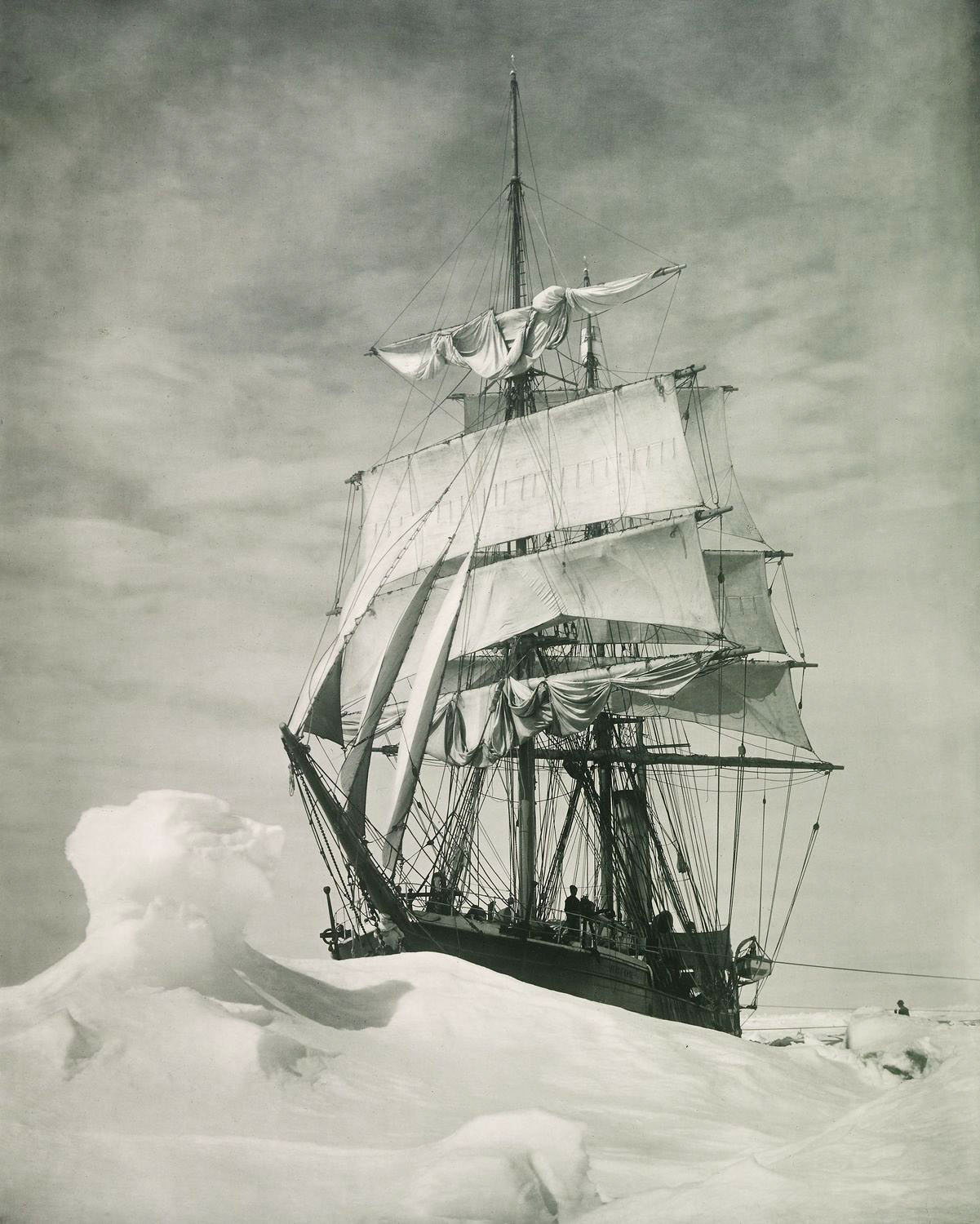
Photograph of the Terra Nova in sail, passing through ice and snow. Scott’s ship is seen here held up by the ice pack, with a curiously shaped ‘ice bollard’ in the foreground. The Terra Nova was launched in 1884 as a whaling ship. She had sailed to both the Arctic and Antarctic before serving as Scott’s ship in 1910. She survived until 1943 when she was damaged by ice and sank off the coast of Greenland.
British Antarctic Expedition
Scott and his men reached Antarctica on board the Terra Nova on 31 December 1910. The expedition had several aims that were scientific in nature, but the principal goal for Scott was to lead the first team to the South Pole.
Following his earlier polar experience on the Discovery expedition of 1901-1904, Scott realised the importance of good photographic images for fund-raising and publicising the achievements of the expedition. Scott employed the photographer Herbert Ponting to accompany him. This was the first time a professional photographer had been included in an Antarctic expedition.
Ponting had previously worked in the United States and Asia. He had a great deal of experience, and during his time in Antarctica, he produced around 2,000 glass plate negatives as well as making films. Ponting also taught photography to Scott and other members of the team so that they could record their assault on the Pole.
In March 1912 Ponting left the Antarctic, according to previously-laid plans. After his return to Britain, Ponting exhibited his work and lectured widely about Scott, thus ensuring that his photographs became inextricably linked with Scott and the heroic age of Antarctic exploration.
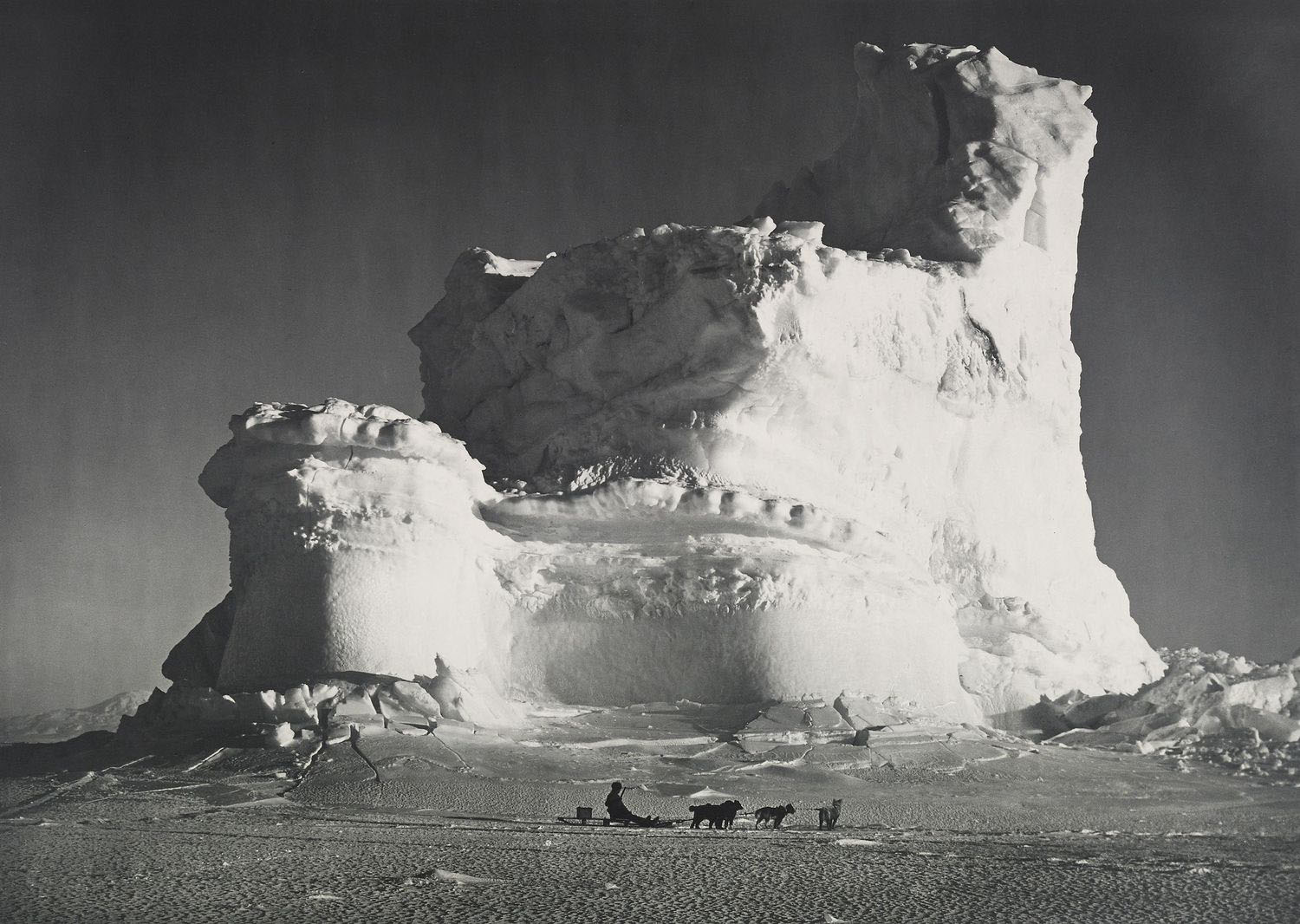
This iceberg, which resembles a medieval castle, was greatly admired by members of the expedition. Ponting returned several times during 1911 to photograph it, including once in June, the middle of the Antarctic winter, when he set up flashlights to make an image. At its highest point the berg is around 100 feet high (30.5 m).
Mount Erebus, an active volcano on Ross Island which last erupted in 2008, was first climbed in 1908 by members of Shackleton’s Nimrod expedition. Ponting has contrasted the overwhelming size of the natural world against the tiny human figure pulling a sledge, in the lower left corner of the photograph.
It is a story of heroism and bravery, and ultimately of tragedy, that has mesmerised generations. One hundred years on from their epic voyages to the very limits of the Earth, and of man’s endurance, the legends of Scott and Shackleton live on.
To mark the centenary of Captain Robert Falcon Scott’s expedition to the South Pole, the Royal Collection brings together, for the first time, a collection of the photographs presented to King George V by the official photographers from Scott’s Terra Nova expedition of 1910-1913 and Shackleton’s expedition on Endurance in 1914-1916, and unique artefacts, such as the flag given to Scott by Queen Alexandra (widow of King Edward VII) and taken to the Pole.
The exhibition documents the dramatic landscapes and harsh conditions the men experienced, through the work of expedition photographers Herbert Ponting and Frank Hurley. These sets of photographs are among the finest examples of the artists’ work in existence – and the men who took them play a vital part in the explorers’ stories. Highlights from Scott’s voyage include Ponting’s The ramparts of Mount Erebus, which presents the vast scale of the icescape, and the ethereal The freezing of the sea. Among the most arresting images from Hurley’s work on Shackleton’s expedition are those of the ship Endurance listing in the frozen depths and then crushed between floes.
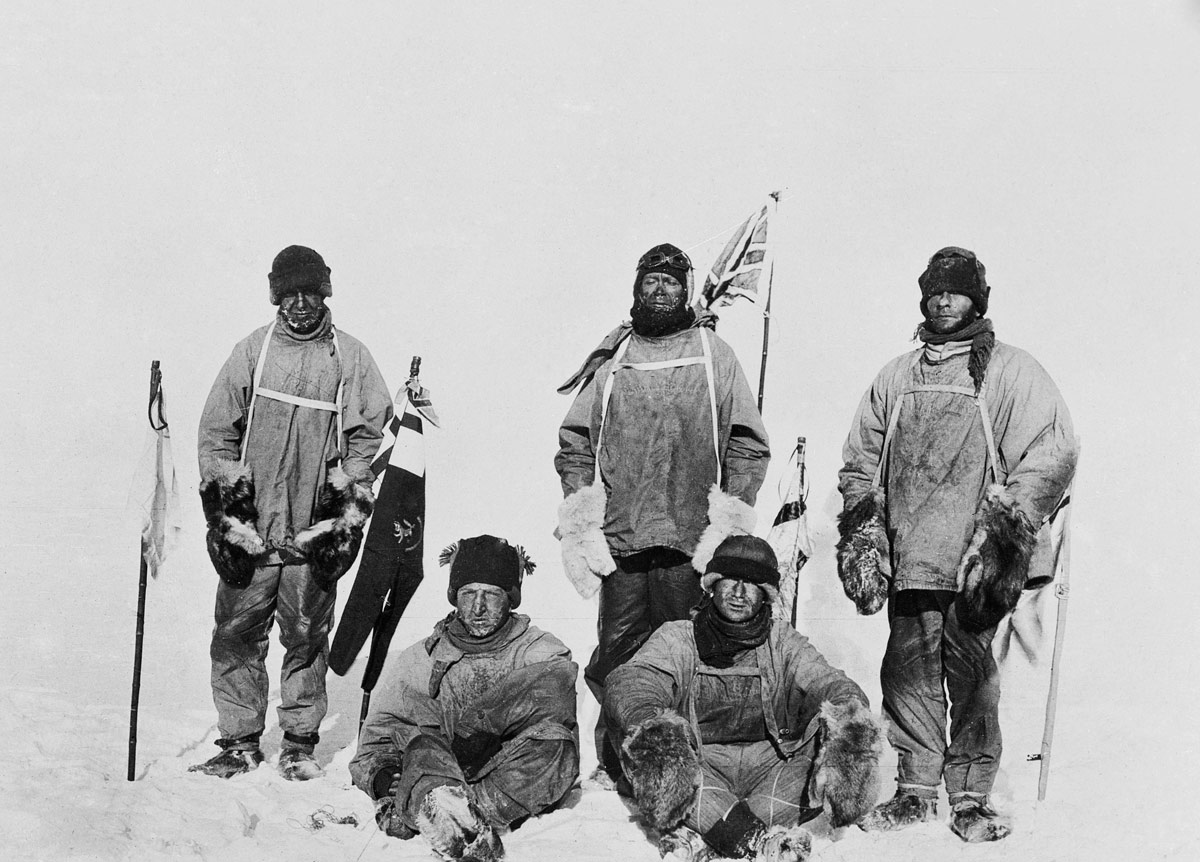
The photographs also give insights into the men themselves. For instance, at the start of the journey Scott appears confident and relaxed, with his goggles off for the camera. In contrast, a photograph taken at the Pole shows him and his team devastated and unsmiling, knowing they had been beaten. The exhibition also records the lighter moments of expedition life, essential for teams cut off from the outside world for years at a time. On Shackleton’s expedition, a derby for the dogs was organised – with bets laid in cigarettes and chocolate. A menu for Midwinter’s Day, on 22 June 1911, shown in the accompanying exhibition publication, includes roast beef and Yorkshire pudding, ‘caviare Antarctic’ and crystallised fruits.
Antarctic adventurer David Hempleman Adams has been closely involved in the exhibition and has written an introduction to the catalogue. First given the taste for adventure by The Duke of Edinburgh’s Award scheme, he was inspired, like generations of school children, by the tales of discovery. As a South Pole veteran, the first Briton to reach the Pole solo and unsupported, he is still in awe of Scott and Shackleton’s achievements – and will return with his daughter this year to mark the centenary. David Hempleman Adams said: “We have a big psychological advantage today: We know it is possible to reach the South Pole. Nowadays you can go on Google Earth and see what’s there. Back then, it was just a big white piece of paper. Scott and Shackleton had no TVs, radios or satellite phones – they were cut off from the outside world – and in terms of equipment, the tents, skis and sledges, today, we carry about one tenth of what they carried, over the same mileage. What they achieved, with what they had, is really magnificent. This is the 100th anniversary and the legend has stood the test of time. Even in this modern world, there’s still just as much interest.”
As the photographs show, animals played an important part in the expeditions. There are portraits of the ponies and of individual sledge dogs. In his diaries, Scott describes the relationship he struck up with the bad tempered husky Vida: “He became a bad wreck with his poor coat… and… I used to massage him; at first the operation was mistrusted and only continued to the accompaniment of much growling, but later he evidently grew to like the warming effect and sidled up to me whenever I came out of the hut… He is a strange beast – I imagine so unused to kindness that it took him time to appreciate it.”
Ponting also photographed wildlife, including seals, gulls and penguins. Scott writes of the moment Ponting tried to photograph killer whales and how the creatures crashed through the ice to catch him. Scott, watching but unable to help, observes, “It was possible to see their tawny head markings, their small glistening eyes, and their terrible array of teeth – by far the largest and most terrifying in the world.”
The inspirational qualities of the explorers were recognised by King George V. In his book, The Great White South, Ponting records what the Monarch said to him when he went to Buckingham Palace to show his Antarctic film: “His Majesty King George expressed to me the hope that it might be possible for every British boy to see the pictures – as the story of the Scott Expedition could not be known too widely among the youth of the nation, for it would help to promote the spirit of adventure that had made the Empire.”
Royal interest in polar exploration began with Queen Victoria and Prince Albert, who followed the fortunes of the early adventurers, such as Sir John Franklin and William Bradford, and it continues to this day. The Duke of Edinburgh, who has written a foreword to the exhibition catalogue, has been the patron of many of David Hempleman Adams’s expeditions and has himself crossed the Antarctic Circle. HRH The Princess Royal is Patron of the UK Antarctic Heritage Trust.
Photograph of the Terra Nova seen from inside a grotto that was formed by an iceberg as it turned over, carrying a large floe which froze onto it. Both Ponting and Scott were struck by the colours of the ice inside this ice grotto; they were a rich mix of blues, purples and greens. Ponting thought that this photograph, framing the Terra Nova, was one of his best.
Both Captain Scott and Herbert Ponting – the photographer accompanying him on the Terra Nova expedition – wrote about the intense colours that they encountered in the landscape of Antarctica. In this series of three short talks by Royal Collection curator Sophie Gordon, we examine how Ponting attempted to capture these magical blues, greens and oranges in his photographs beginning here with the blues of this grotto within an iceberg, taken in January, 1911.
Royal Collection: ‘A Lovely Symphony of Blue and Green’ – Grotto in an Iceberg
Both Captain Scott and Herbert Ponting – the photographer accompanying him on the Terra Nova expedition – wrote about the intense colours that they encountered in the landscape of Antarctica. In this series of three short talks by Royal Collection curator Sophie Gordon, we examine how Ponting attempted to capture these magical blues, greens and oranges in his photographs beginning here with the blues of this grotto within an iceberg, taken in January, 1911.
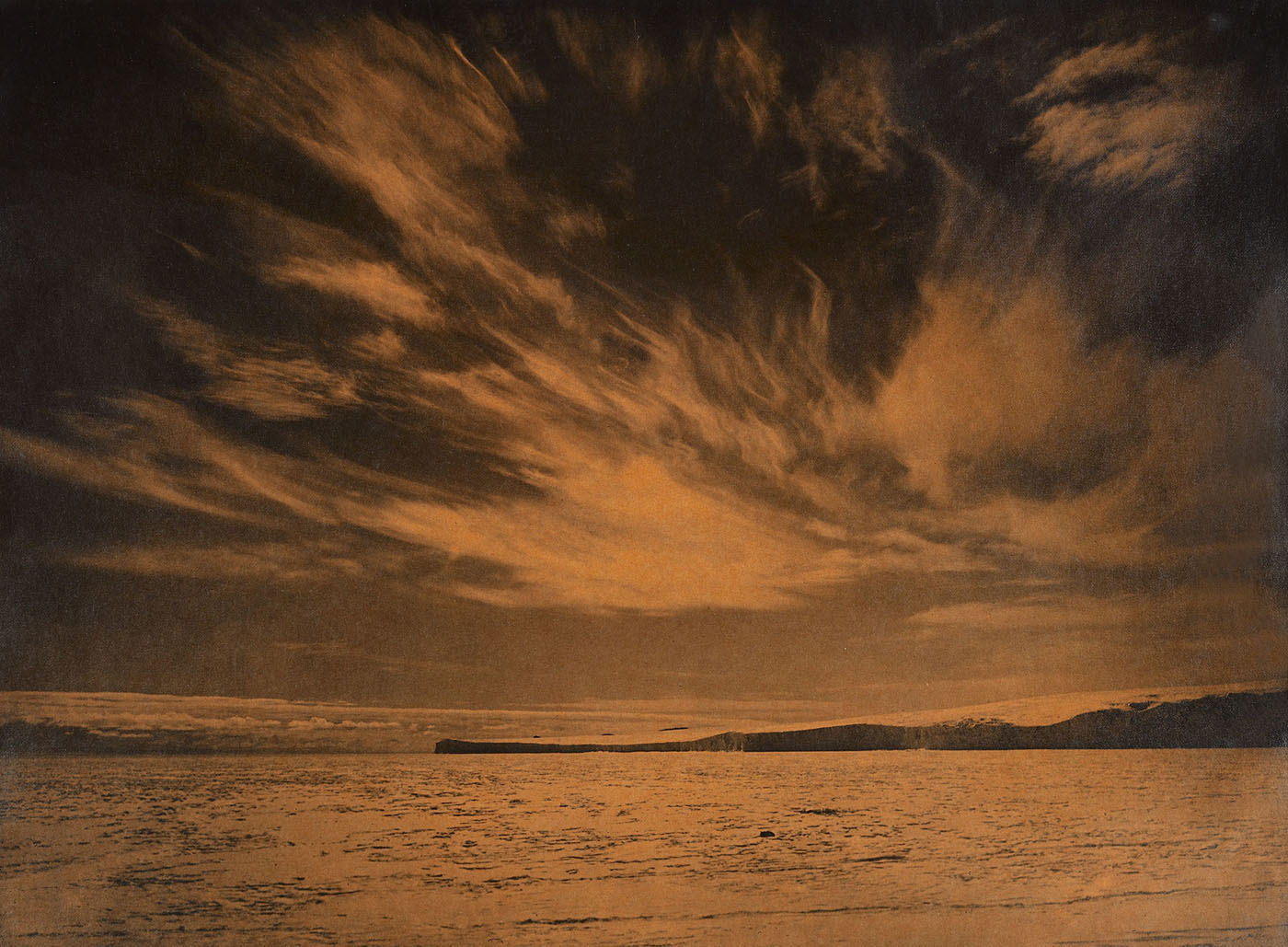
Photograph of a thin film of new ice covering the sea with ice blocks in the foreground. The Barne Glacier can be seen in the distance. This view, looking from Cape Evans towards Cape Barne on Ross Island, shows the moment when the sea began to freeze. The men would have realised that they could no longer leave Antarctica. Once winter began, no ships would be able to reach them to bring in supplies or to take anyone out.
Royal Collection: ‘A Lovely Symphony of Blue and Green’ – The Freezing of the Sea
In the second of these three short talks, Royal Collection curator Sophie Gordon, briefly considers this atmospheric photograph which captured the moment the sea began to freeze, cutting the men off in Antarctica for the winter.
Royal Collection: ‘A Lovely Symphony of Blue and Green’ – Cirrus Clouds over the Barne Glacier
In this, the third in her series of talks, Royal Collection curator Sophie Gordon examines how Ponting captured the dramatic reds and oranges and the beauty of the natural landscape that he experienced during his time in the Antarctic.
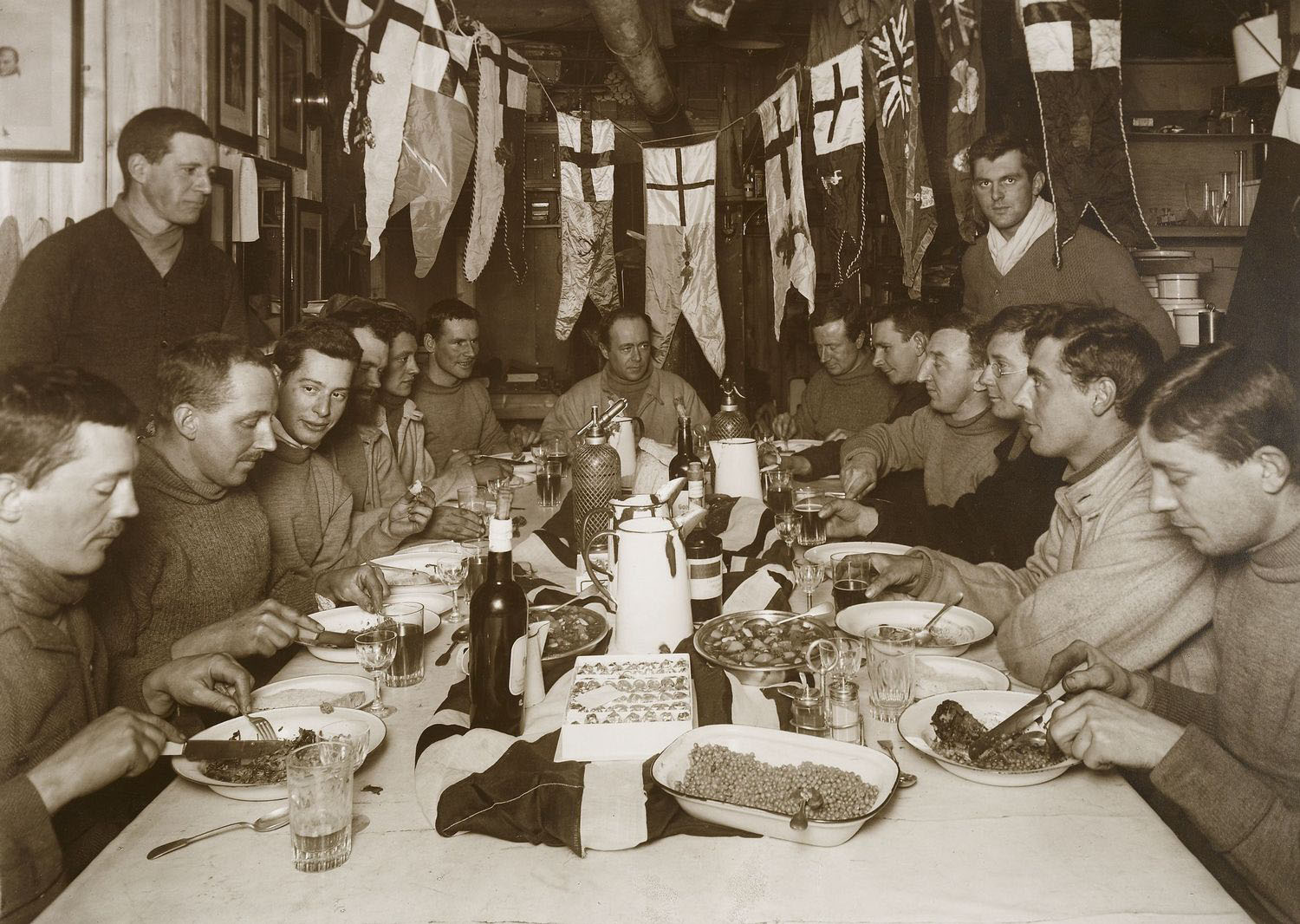
Photograph of the Officer’s table for Captain Scott’s birthday dinner with a variety of food and drink laid out on the table. The men are celebrating Scott’s 43rd birthday – his last – on 6 June 1911. He sits at the head of the table, and is surrounded by the officers and senior members of the team. The only man looking at the camera is the Norwegian naval officer Tryggve Gran (1889-1980). The atmosphere is both festive and patriotic.
Photograph of Vida. One of Scott’s favourite dogs, Vida suffered from a bad coat and would creep up to Scott for attention. Scott noted in his diary that initially the dog would growl at him but eventually his suspicion grew less: ‘He is a strange beast – I imagine so unused to kindness that it took him time to appreciate it’.
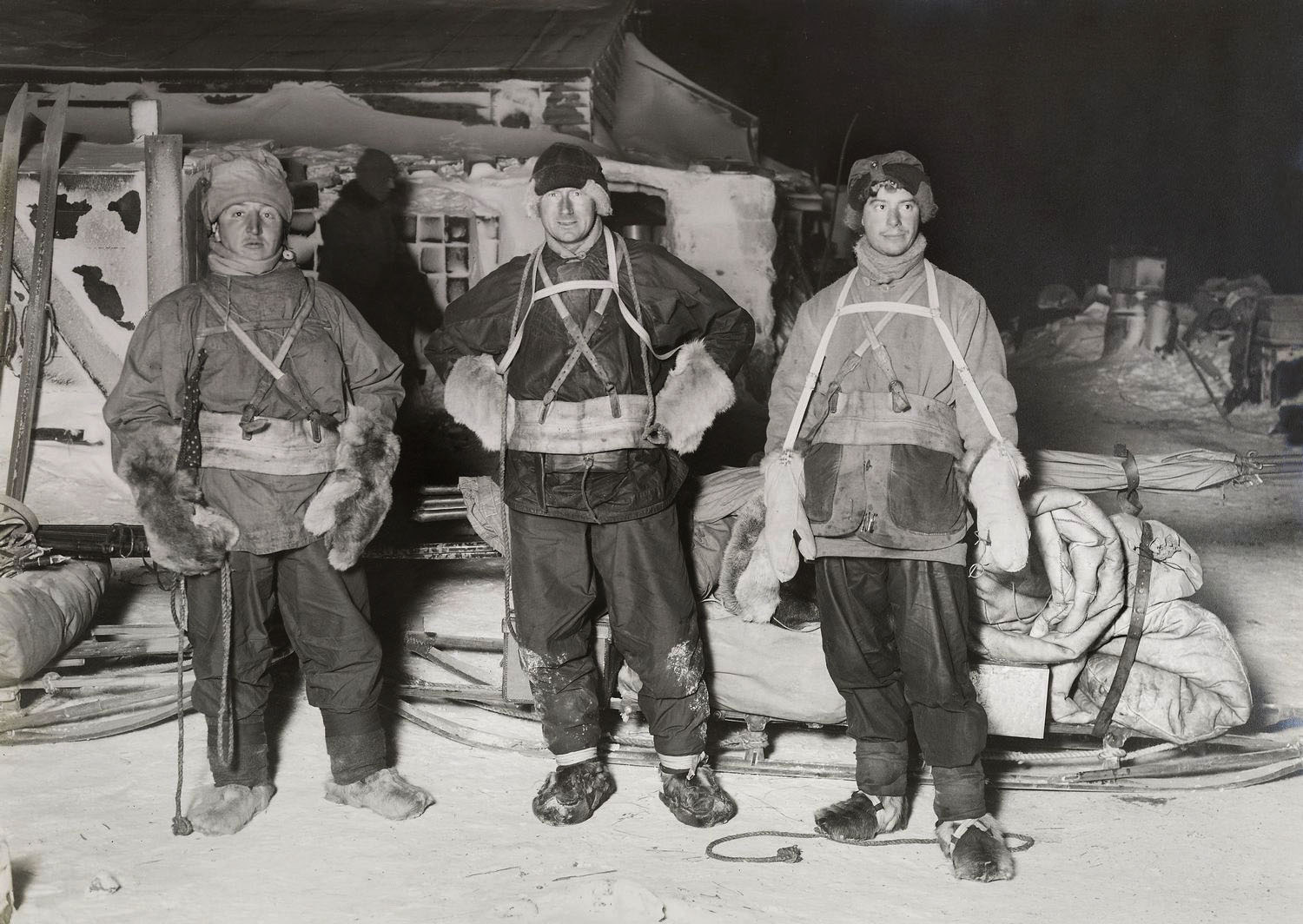
Henry Bowers (1883-1912), Edward Wilson (1872-1912) and Apsley Cherry-Garrard (1886-1959) are shown shortly before departing for Cape Crozier in search of Emperor penguin eggs. Between 27 June and 1 August, the trio endured extreme weather conditions and winter darkness as they crossed Ross Island and then returned, having collected three eggs. Cherry-Garrard famously described it as ‘the worst journey in the world’.
Royal Collection: ‘The weirdest bird’s-nesting expedition that has ever been’ – Part Two
In the second in this series of talks, Royal Collection curator Emma Stuart takes us on a journey with three intrepid explorers as they faced the hostile conditions of the Antarctic to recover an Emperor Penguin’s egg.
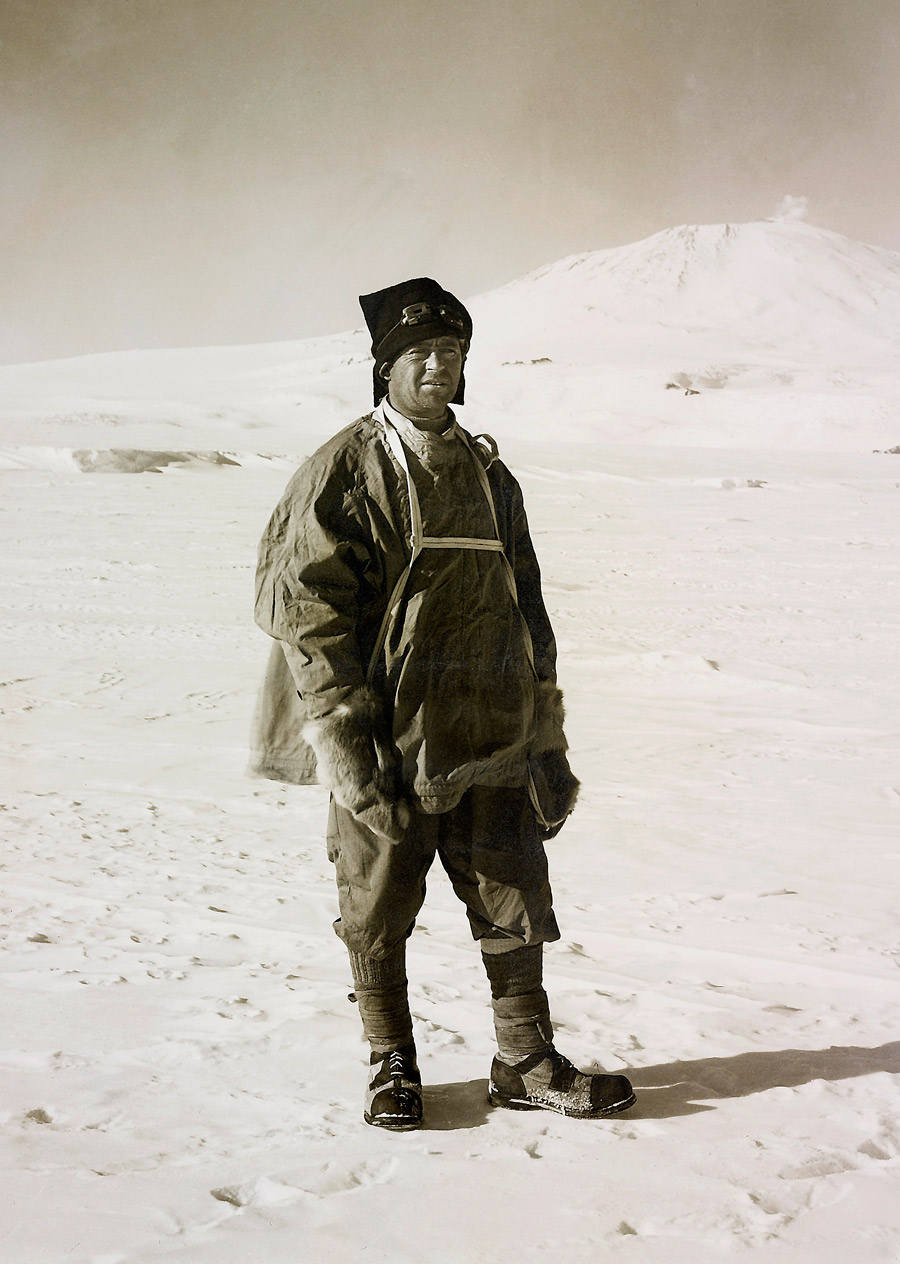
This photograph of Scott, with Mount Erebus in the background, was taken at the start of the expedition. He is wearing fur gloves with an attached cord, leather boots, gaiters and thick socks.
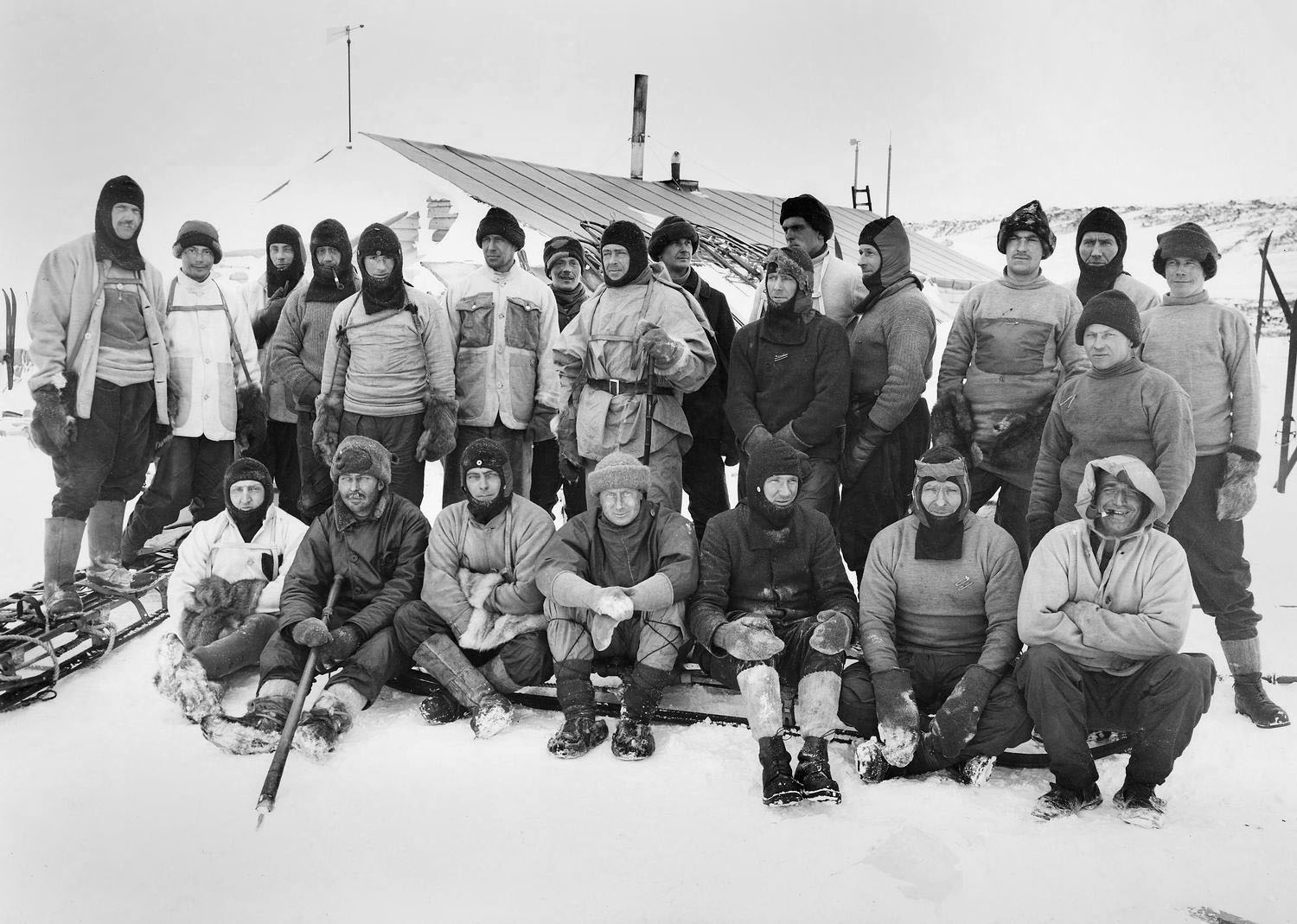
Photograph of the Shore party. On the back row are (from left to right): T. Griffith Taylor; Apsley Cherry-Garrard; Bernard Day; Edward Nelson; Edward Evans; Lawrence Oates; Edward Atkinson; Robert Falcon Scott; Charles Wright; Patrick Keohane; Tryggve Gran; William Lashly; Frederick Hooper; Robert Forde; Anton Omelchenko; Dimitri Gerov. On the front row are (from left to right): Henry Bowers; Cecil Meares; Frank Debenham; Edward Wilson; George Simpson; Edgar Evans and Tom Crean. This group is the Shore Party – the men who remained in Antarctica throughout the winter of 1911, preparing for Scott’s final departure for the Pole. They pose in front of the expedition hut at Cape Evans. The only people not visible are Clissold, the cook, and Ponting, the photographer. Scott is at the centre of the group and all the men look relaxed. This was taken at the very beginning of the expedition, when they would have been optimistic and excited about the future.
Photograph of Scott’s party at Amundsen’s tent at the South Pole. (from left to right are): Robert Falcon Scott (1868-1912); Lawrence Oates (1880-1912); Edward Wilson (1872-1912) and Edgar Evans (1876-1912). This photograph shows the dejection of the team as they explore the tent left by Roald Amundsen, who reached the South Pole on 14 December 1911, thirty-five days before Scott. There is a Norwegian flag at the top of the tent; inside, Scott found a letter recording their achievement, left by Amundsen in case he did not return safely.
Shackleton set out in October 1914 on the Endurance with the intention of making the first crossing of the Antarctic continent via the South Pole. While he and his men planned to reach Antarctica through the Weddell Sea, another party aboard the Aurora sailed to the other side of the continent to lay food depots for the expected party.
The intention was that only six men would complete the crossing; the photographer Frank Hurley was to be one of the team. Hurley had been to the Antarctic before, as part of the Australasian Expedition of 1911-1914. He was intrepid in his search for dramatic images. The role of photographer was important not just to document the achievements of the expedition, but also to create a source of income. The rights to publish the images would be sold for a great deal of money after the return to Britain.
The expedition ran into difficulties almost immediately. By mid-January 1915, Endurance became trapped in ice and had to become a floating scientific station. The men waited out the harsh Antarctic winter in the hope that their situation would improve.
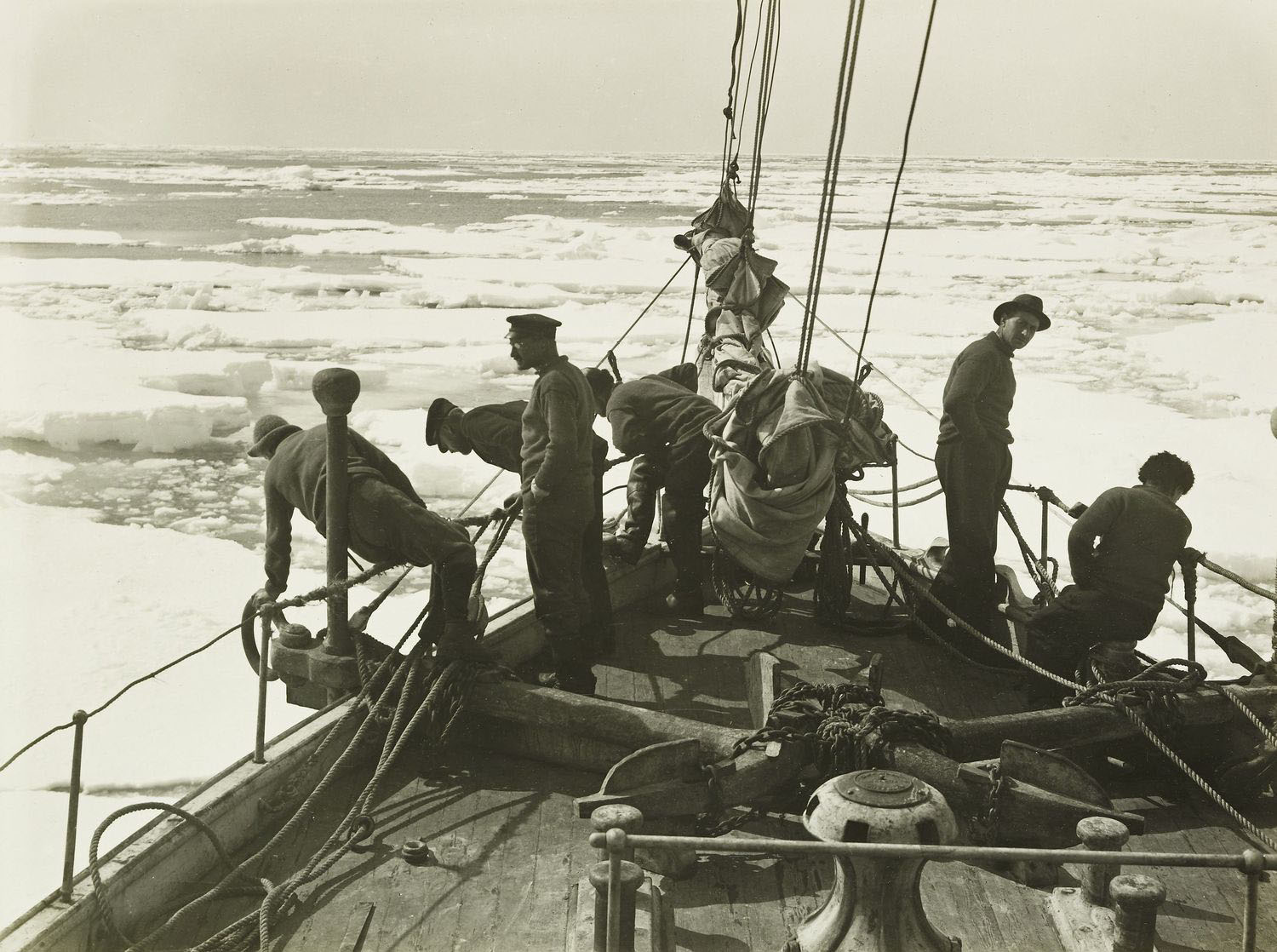
Photograph of six members of Shackleton’s crew standing on the deck of Endurance. This was the men’s first view of the pack ice through which they had to navigate in order to reach the coast of Antarctica. The Endurance met the ice far further north than they had hoped. The whalers on South Georgia had warned them of the poor ice conditions before they set out. This was a warning of things to come.
Hurley poses with his cinematograph, which was used to shoot moving film footage. The footage was later turned into a film released after his return under the name of In the Grip of the Polar Pack Ice.
Endurance sits benignly at rest in the midst of the ice field. A recent blizzard has coated the hummocks in a layer of snow, softening the contours. All looks peaceful, but within a few months these same hummocks will have crushed the ship.
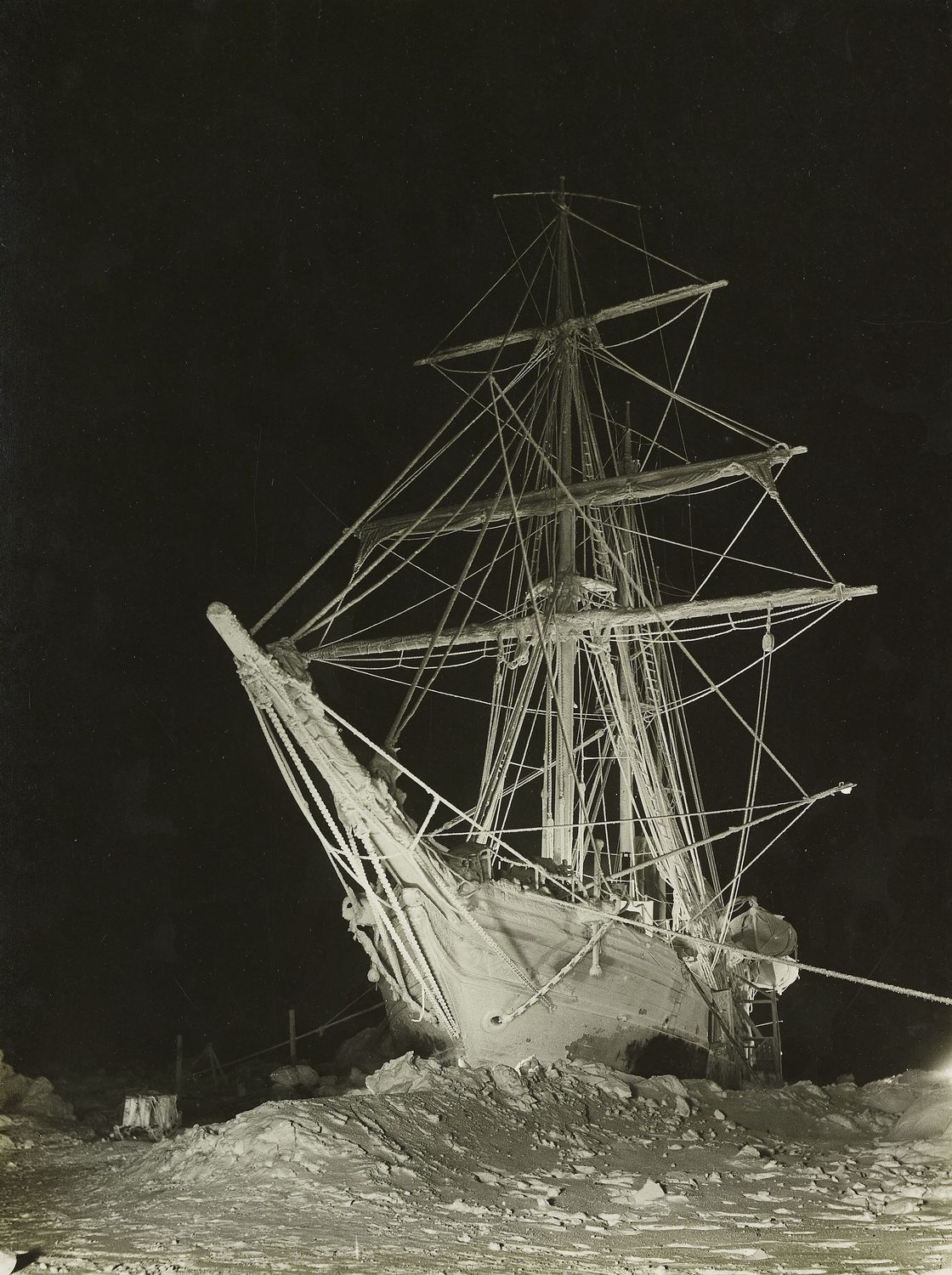
Photograph of the bow and part of the left side of Endurance, lit by flashlight in the darkness of the night. This is probably Hurley’s best-known photograph, which he took with flashlights at -38 °F/-39 °C. It was later used on the front cover of Shackleton’s account of the expedition, South. Hurley described the scene in his autobiography: Never did the ship look quite so beautiful as when the bright moonlight etched her in inky silhouette, or transformed her into a vessel from fairy-land.
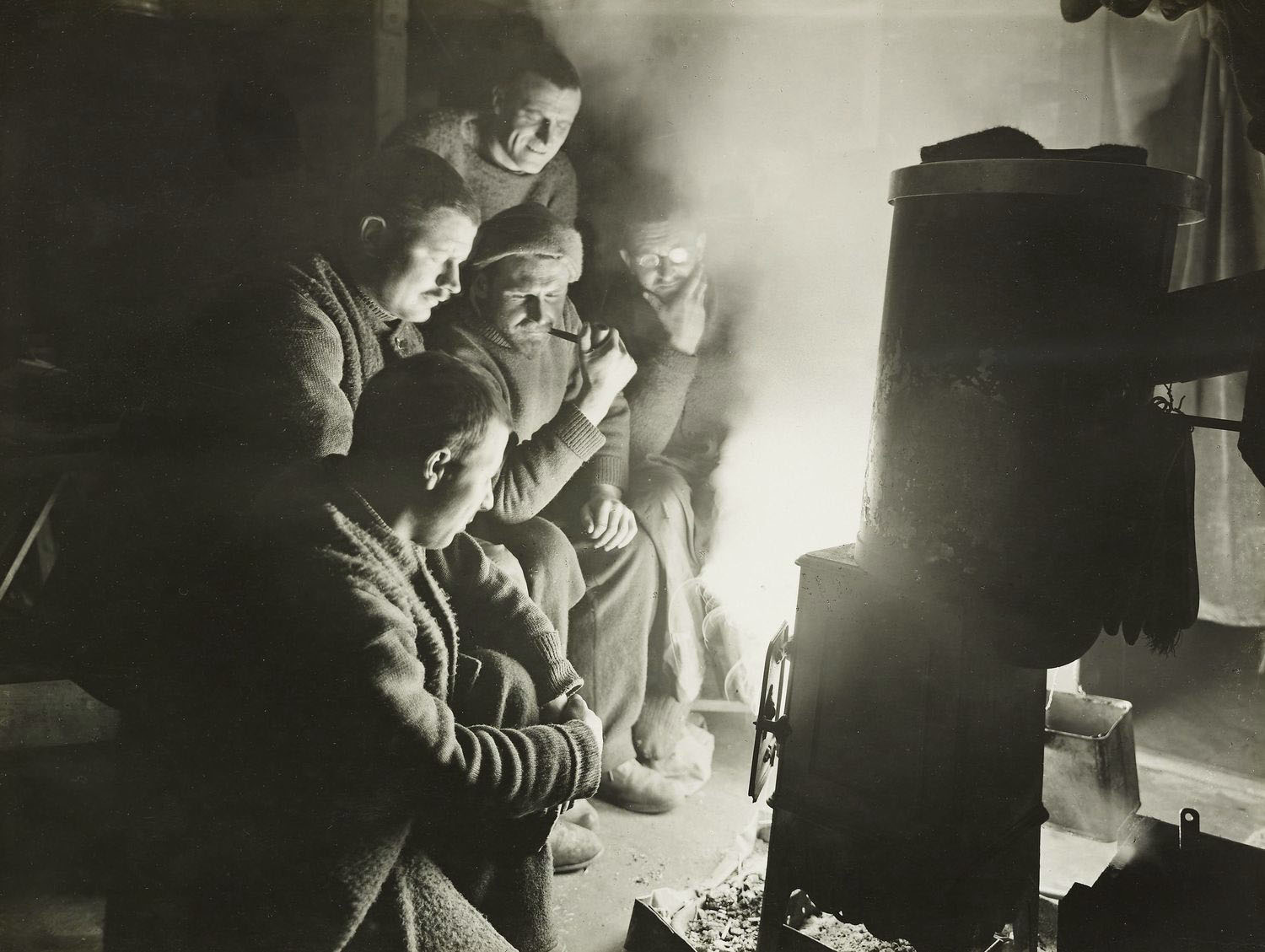
After Endurance became a winter station in February 1915, Shackleton abandoned the usual system of watches. The single nightwatchman had little to do, apart from tending the dogs and observing ice movements. It was private leisure time, to read, or do some washing, but often became a social occasion as shown here, as the men gather companionably round the fire.
Following the onset of winter and the transformation of Endurance into a scientific station, the main cargo hold was emptied and turned into a communal living space for the men, nicknamed the ‘Ritz’. The traditional Antarctic Christmas on Midwinter’s Day (22 June) saw the ‘Ritz’ transformed for a cabaret, featuring satirical speeches, songs, poems and even a drag act. From left to right are Wordie (1889-1962), Cheetham (1867-1918) and Macklin (1889-1967).
This photograph was actually taken at the time of the ‘James Caird’s’ departure on 24 April. Hurley has altered it to represent the moment of rescue, with the arrival of Shackleton on the ‘Yelcho’. The actual rescue was not photographed.
The Royal Collection
The Queen’s Gallery, Buckingham Palace
London SW1A 1AA
Exhibition dates: 26th August 2011 – 26th February 2012
Many thankx to the Imperial War Museum, London for allowing me to publish the photographs in the posting. Please click on the photographs for a larger version of the image.
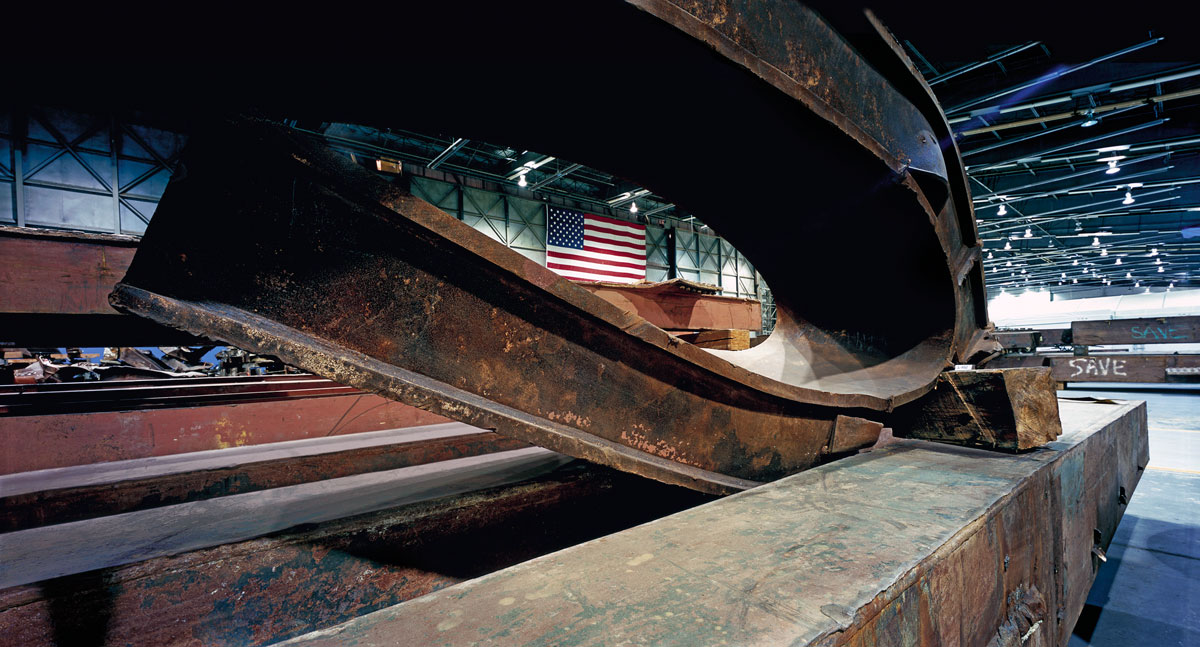
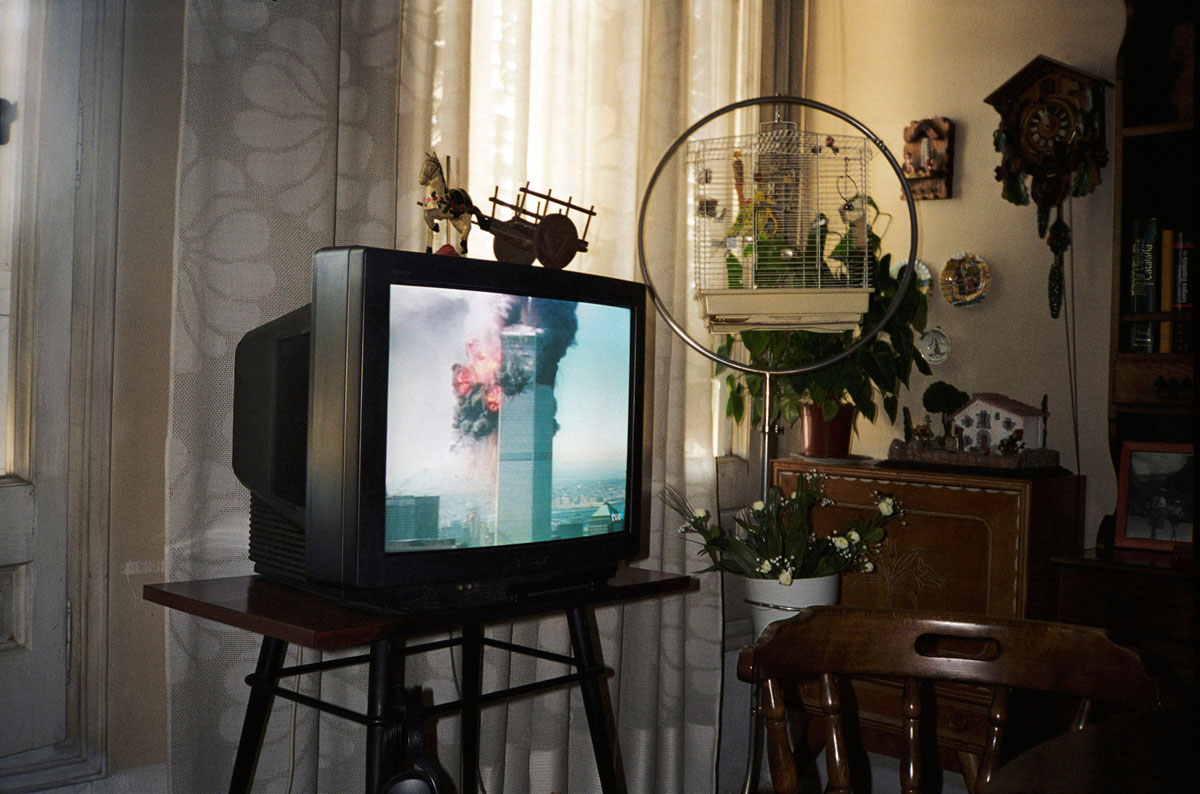
“Having watched the graphic destruction from my apartment, only two blocks from the Twin Towers, when I entered Hangar 17 at JFK International Airport for the first time in 2006, I was immediately hit by the deep sense that the objects I was confronted with, from large shards of rusted and burnt steel to bikes left forever by their owners, were the symbolic substitutes of the victims. Their overwhelming presence stood for all the people that lost their lives that late summer day a decade ago.”
The empty shell of Hangar 17 at JFK Airport became a storehouse of memories when it was filled with the material cleared from the World Trade Center site following the September 11 attacks on New York City.
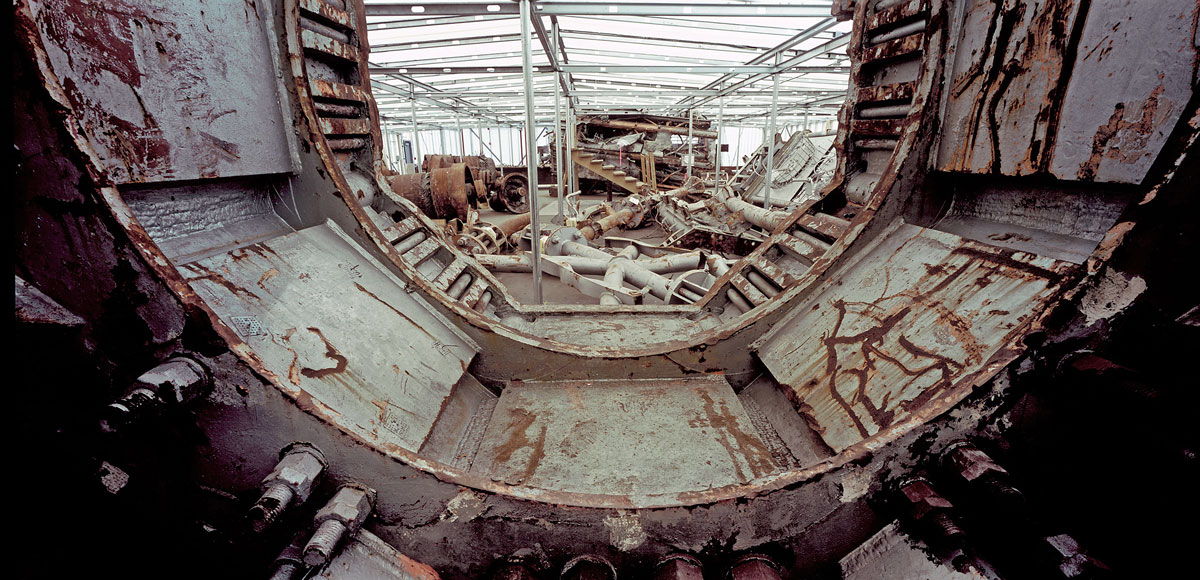
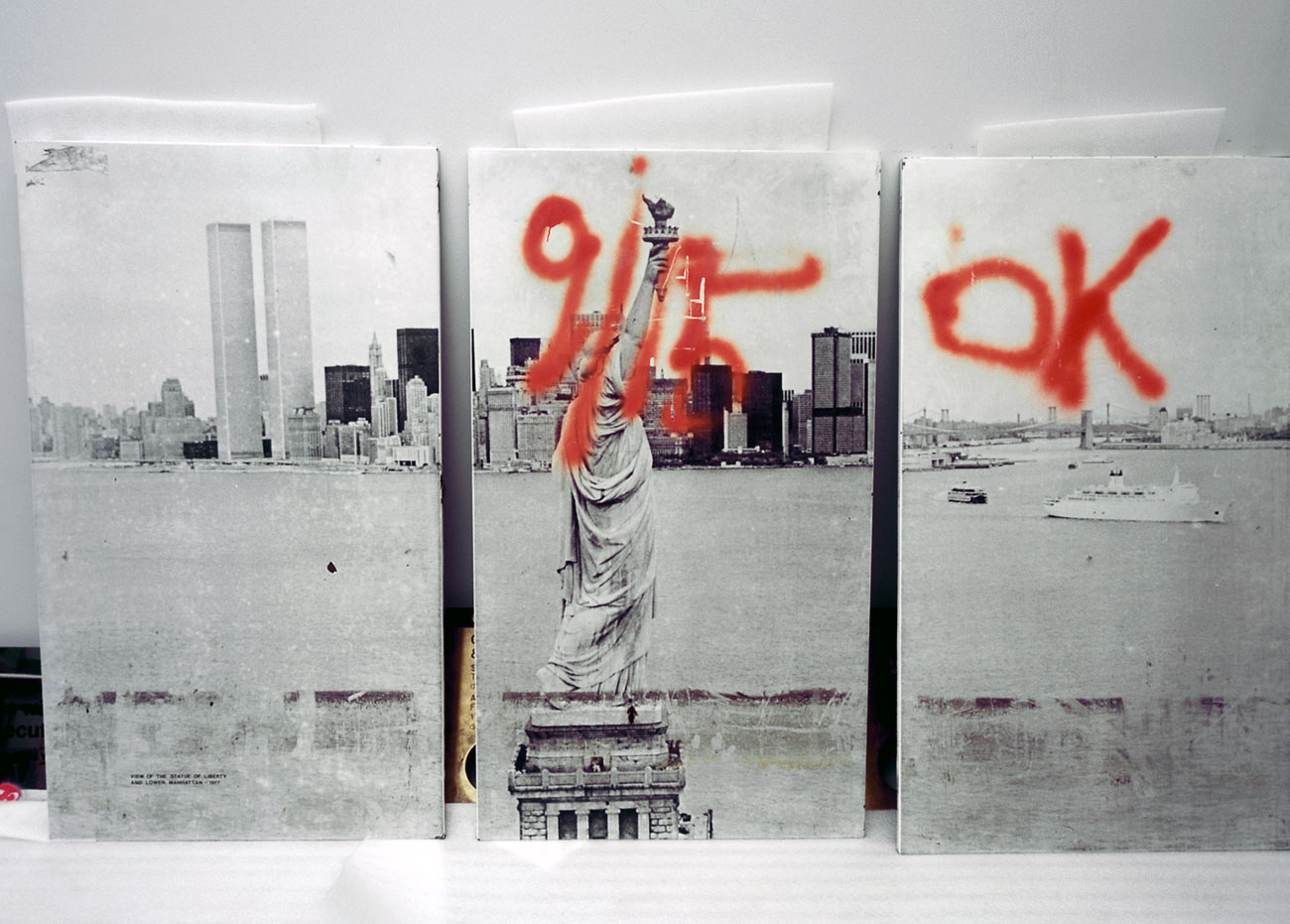
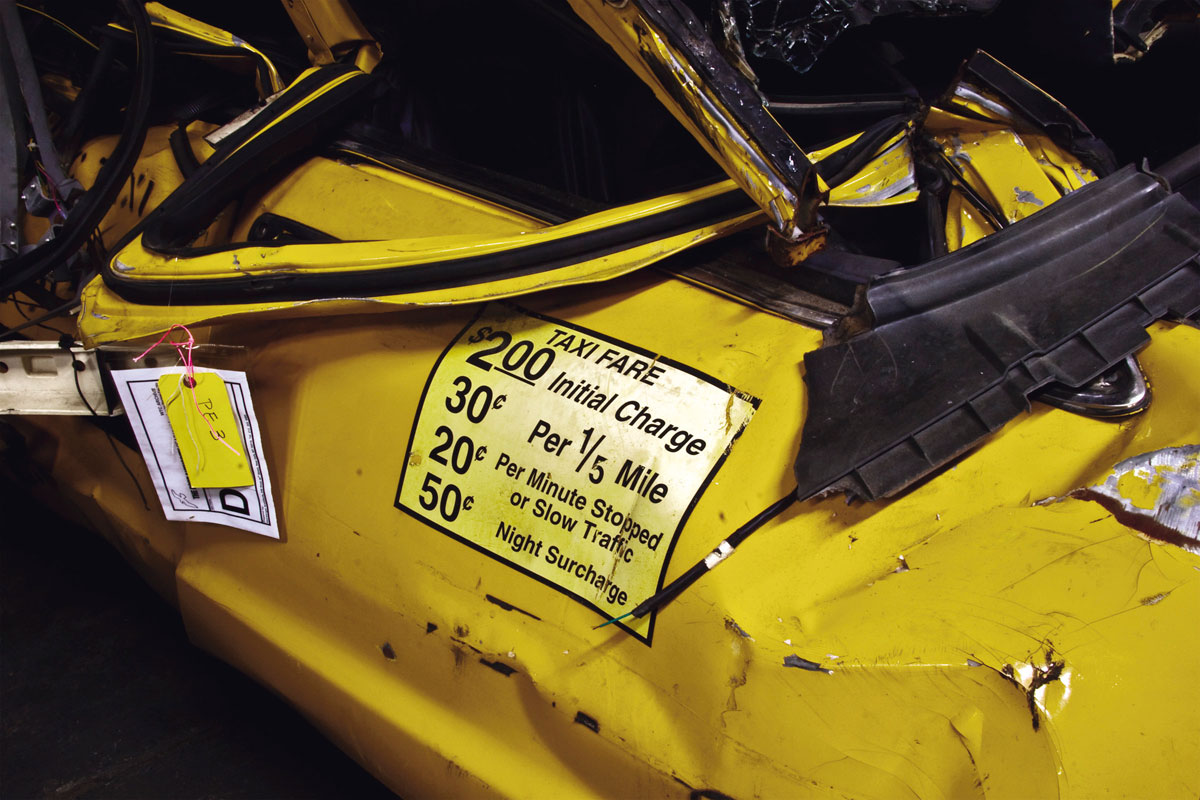
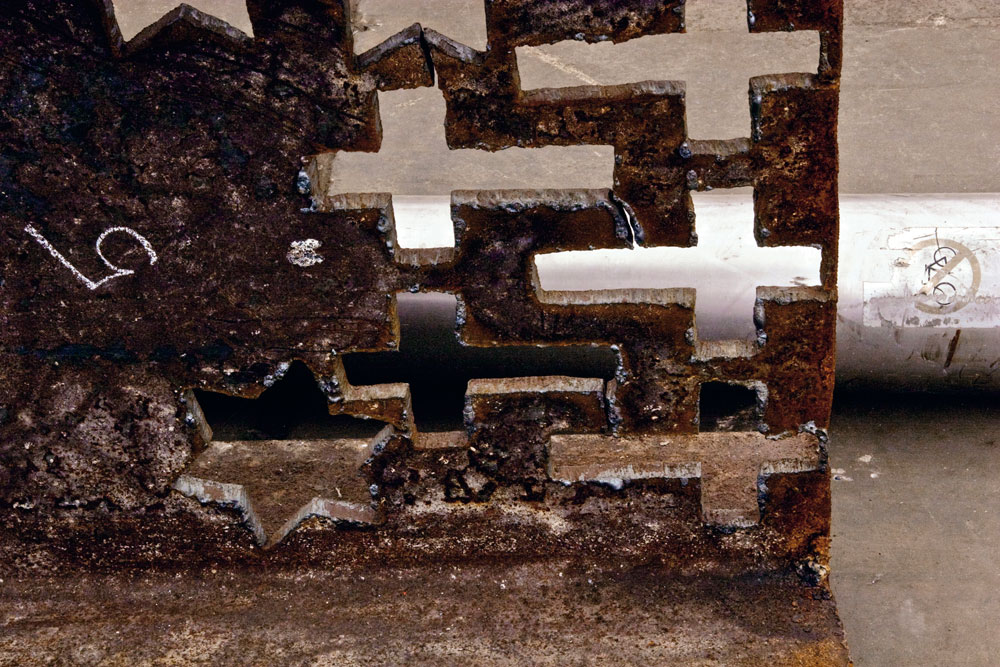
Marking the tenth anniversary of 9/11, Francesc Torres’s work features over 150 projected images which explore inside the hangar and reflect on the emotional power of what remained, from personal belongings to steel girders distorted by the force of the attacks. Alongside the photographs is a section of raw rusted steel over two metres in length from the ruins of the World Trade Center. As well as larger piece (over 1 tonne) that is due to go on display at IWM North in October, these objects are the first pieces of steel from Ground Zero to go on display in the UK. The exhibition will also be on display at the International Centre for Photography in New York and at the Centre de Cultura Contemporània de Barcelona.
Throughout his career, Spanish-American artist Francesc Torres has reflected on the diverse manifestations of culture, politics, memory and power. His latest exhibition at the Imperial War Museum, Memory Remains, is a bold and haunting amalgam of all four.
In 2009, Torres was granted rare access to Hangar 17 at John F Kennedy International Airport, a gaping space of over 80,000-square-feet. Within the hangar lie the remnants deemed worth preserving from the September 11 attacks, taken from the 1.8 million tonnes of debris from Ground Zero. For five weeks Torres daily confronted the legacy of terror and the ghosts of that fateful late-summer day, capturing images of objects that stand as symbolic substitutes to the victims.
“Look at it this way”, says Torres, relaying his experience, “it’s a hanger constructed to house a plane, which was transformed into a weapon used for the attack on the towers and now the sediment of that attack is here. With the sound of planes constantly flying overhead it was absolutely surreal.”
According to the photographer, the experience of walking around the hanger after the first day was so emotionally draining that he slept from four o’clock in the afternoon through to ten o’clock the next morning.
“I was absolutely exhausted; physically and emotionally… every single iota of energy I had was gone.”
His efforts have produced some exceptional results, however, displayed on a rolling slideshow in a small room near the entrance of the museum. Among the objects photographed are large shards of rusted, burnt steel, crumpled filing cabinets and a plethora of flattened Port Authority vehicles. Some unexpected pieces of detritus were also found, including a nine-foot, three-dimensional Bugs Bunny, made completely bizarre when juxtaposed by a sign whose letters read chillingly: “That’s All Folks!”
Prior to the Hangar 17 project, Torres documented the excavation of a mass Spanish Civil War grave that he said drew certain comparisons with the material at JFK.
“The clothing is something that just grabs you,” he says, “it’s very uncanny that nothing changes with the victims as historical subjects. The clothing [in Hangar 17] was exactly the same as the clothing I’ve seen in Spain or in the former Yugoslavia; it all has the same patina. The victim becomes universal… the remains have that quality.”
Along with the photographs, the museum has also acquired a section of steel from the structure of the World Trade Center, displayed outside the projection room. It is the first section of raw rusted steel from the ruins at Ground Zero – thought to be the box section from one of windows – to be displayed in the UK.
For the past year, pieces from the hangar have made their way to be placed in memorials in each of the 50 American states, as well as seven other countries across the globe. Some, but not all, of the remaining pieces will be housed in the 9/11 Memorial Museum near the site of the attack, which is something that concerns Torres.
“We have to preserve the hanger as a container. It’s an unbelievable narrative apparatus that had been created almost on the run,” he says.
With a lifelong interest in questions of human memory and meaning, Torres’ work is based on the concept that it is through the remains of history that memory remains. His latest show is an unforgettable testament to those horrendous attacks that capped the 20th century almost a decade ago.”
Many thankx to the Tate Modern for allowing me to publish the artwork in the posting. Please click on the photographs for a larger version of the image.
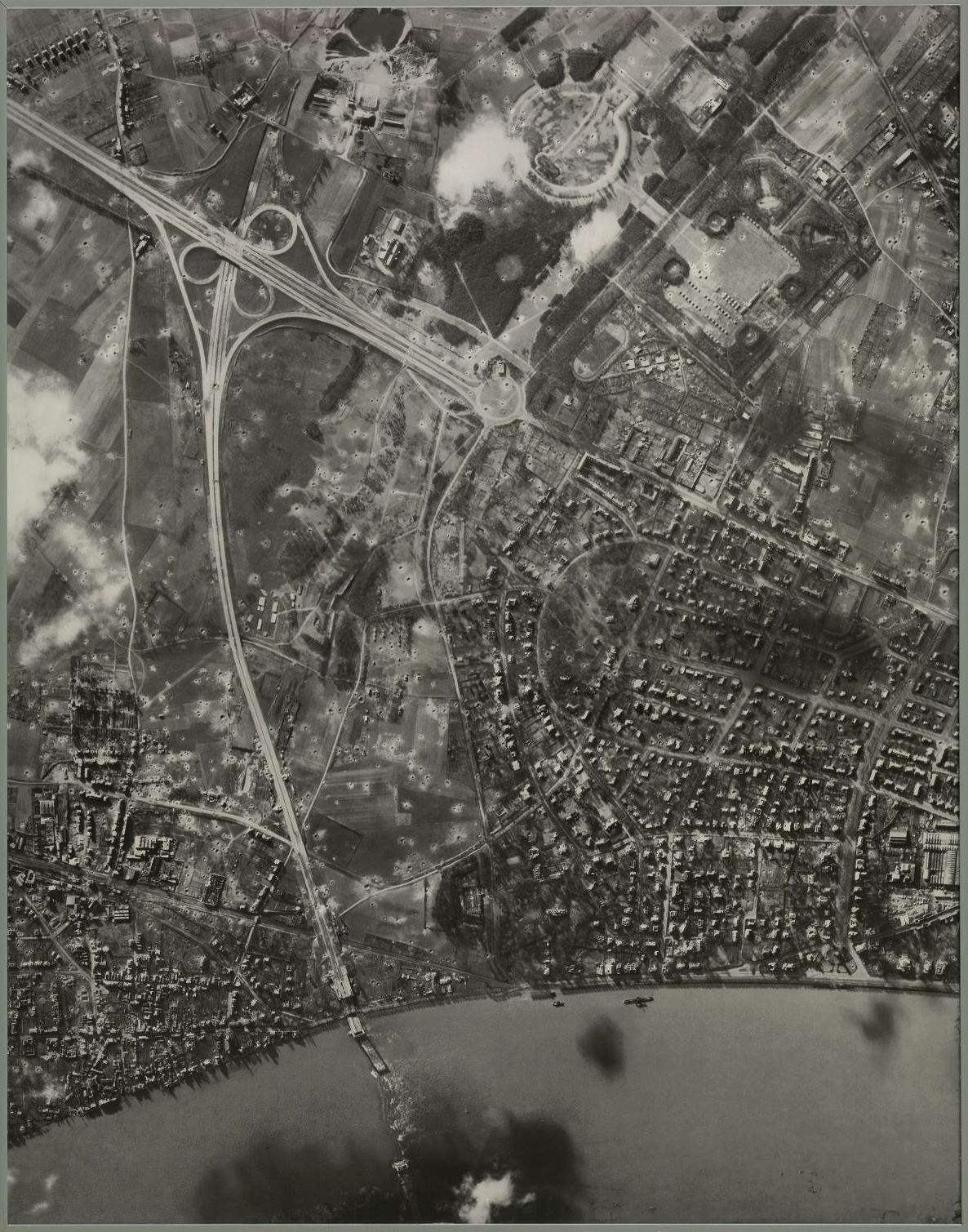
“Curated by Nicholas Serota and Mark Godfrey, this show sets up all sorts of telling juxtapositions, while following the thread not just of Richter’s thinking, but of history – and in particular German history – since the second world war. We go from the saturation bombing of Dresden and Cologne to 1960s West German consumerism, from 1970s domestic terrorism to 9/11. There are paintings devoted to Richter’s parents, his aunts and uncles, and what happened to them in wartime. There are paintings devoted to his children, and to becoming a father again in his 60s. He confronts the personal with the public, one kind of history with another. …
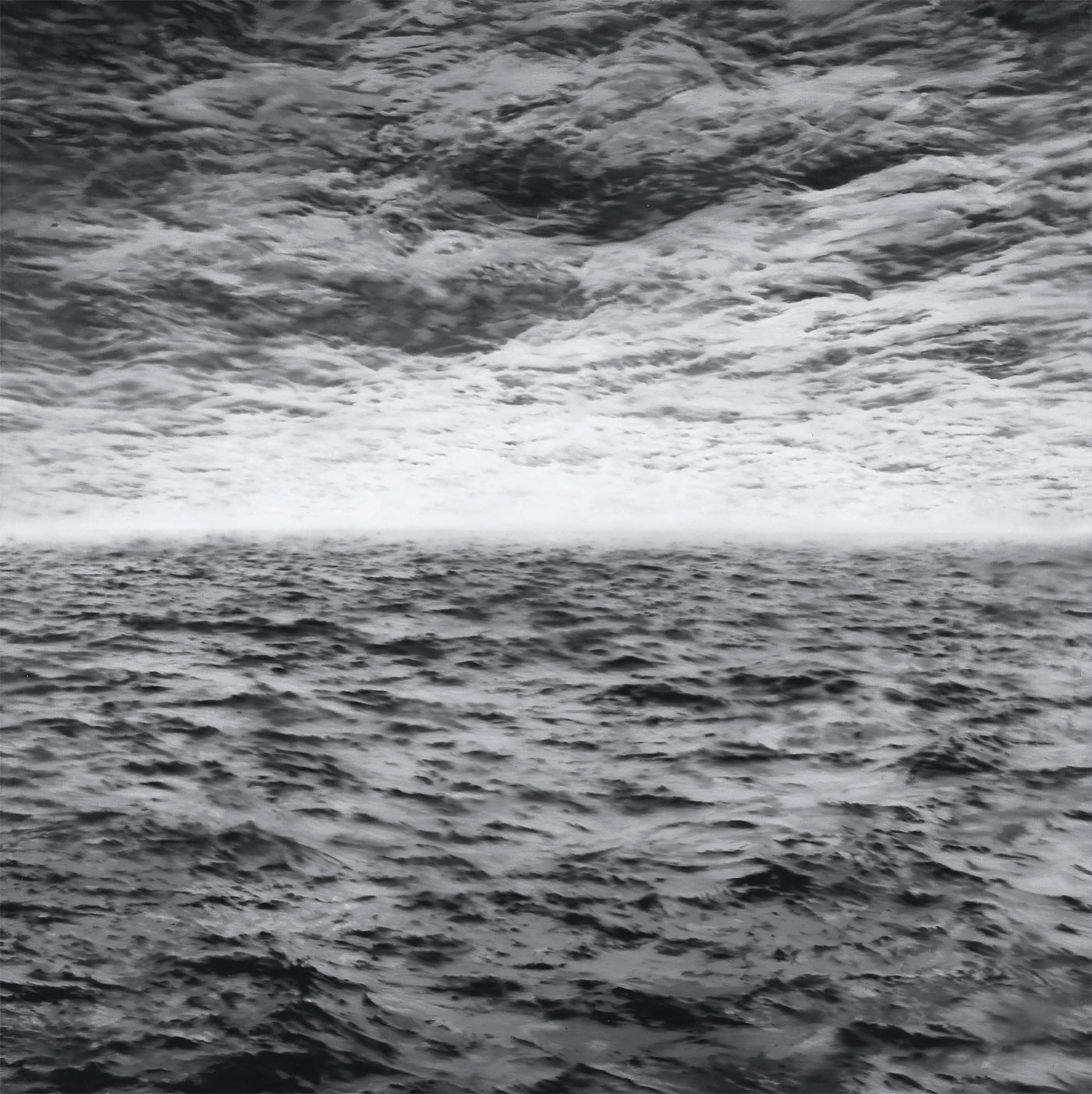
Caspar David Friedrich’s German Romanticism, Titian’s Venetian colour, constructivism and postwar gestural painting, minimalism and process art are all grist to Richter’s mill. His 1973 Annunciation After Titian is a reworking from a postcard of the original, while the impossibility of Friedrich’s Romanticism returns time and again in Richter’s seascapes and his Greenland photographs. “I was always looking,” he once said, “for a third way, in which eastern realism and western modernism would be resolved into one redeeming construct.” If this remains Richter’s programme, it is one riven with the irreconcilable, a friction on which his art depends.”
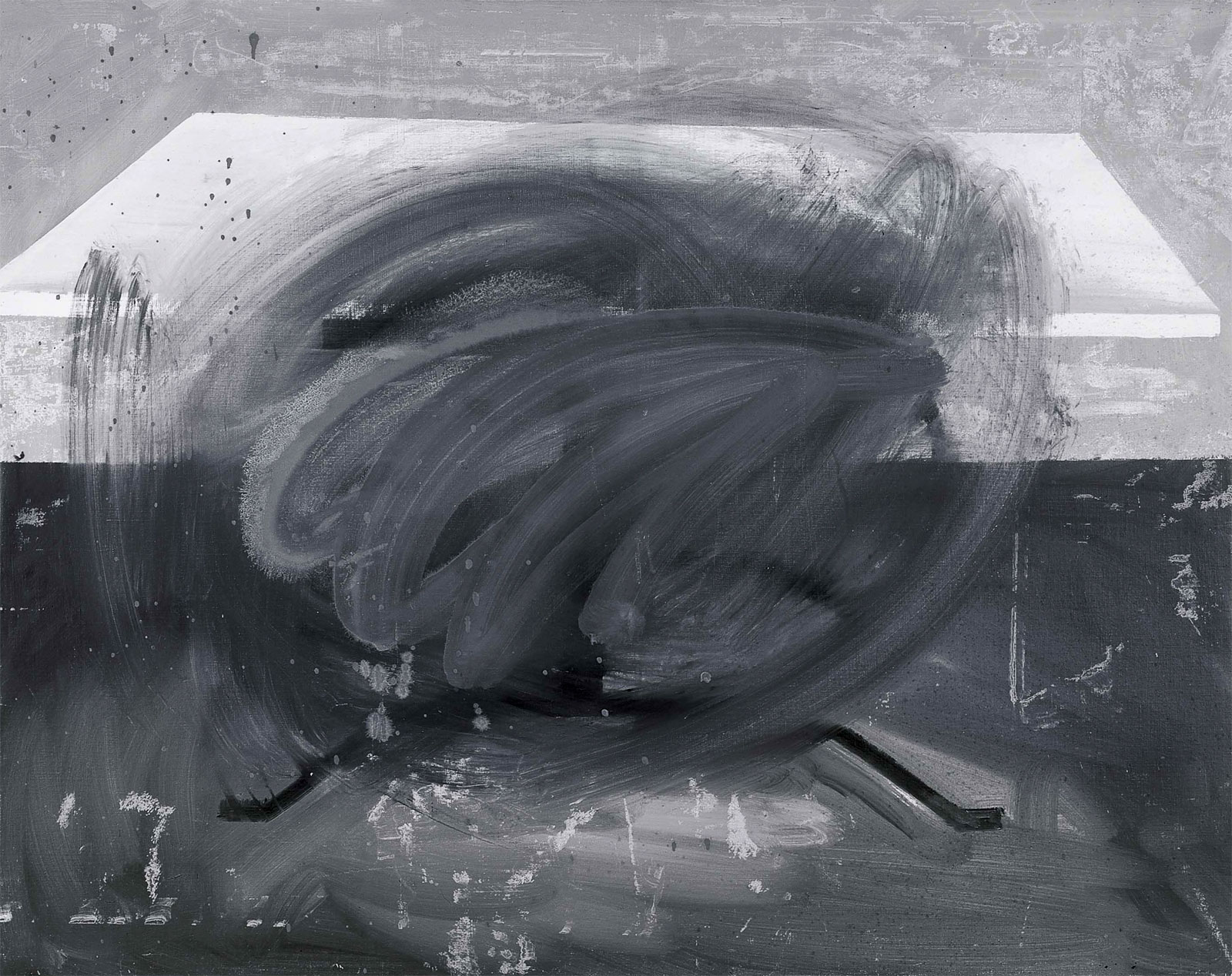
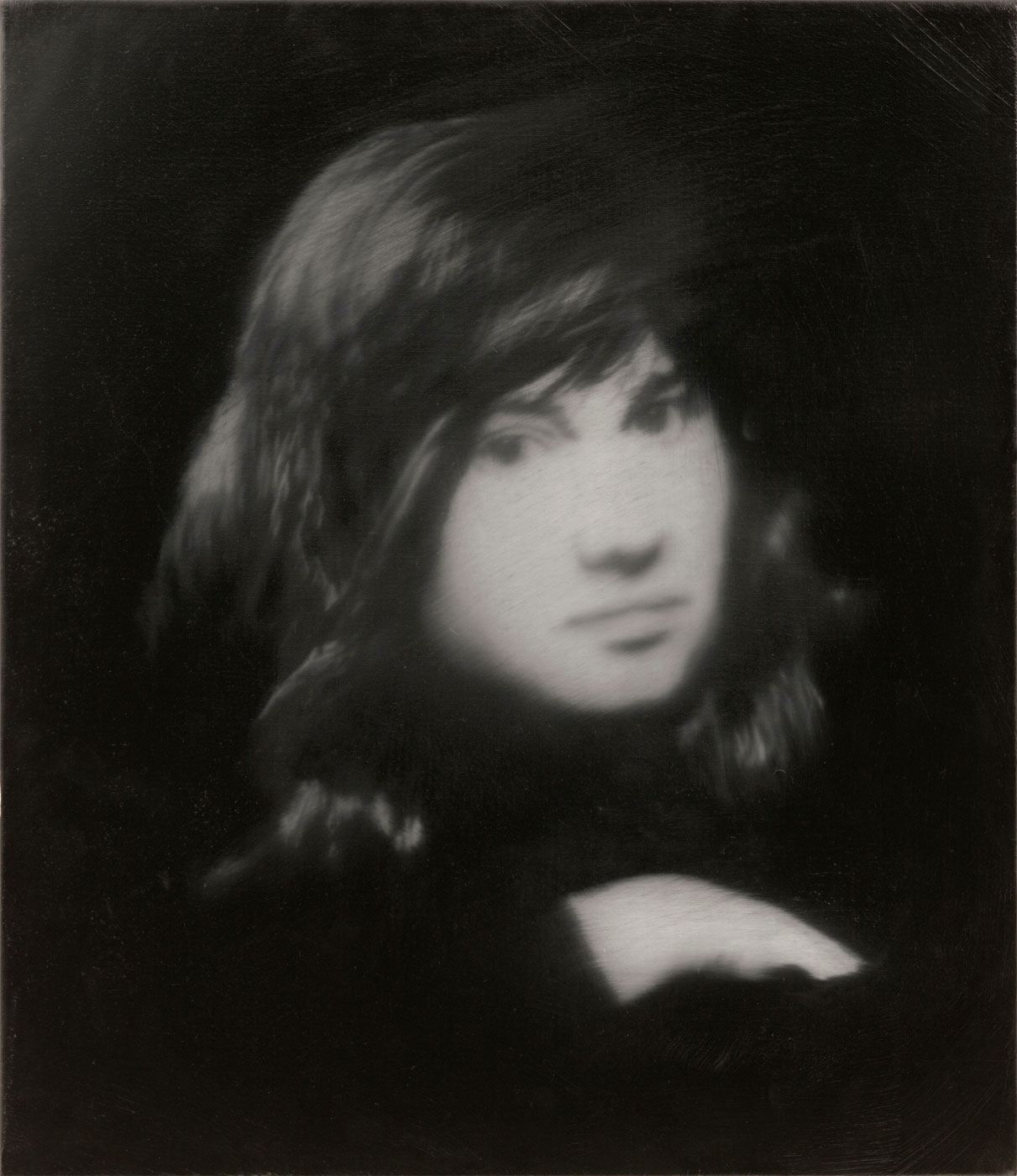
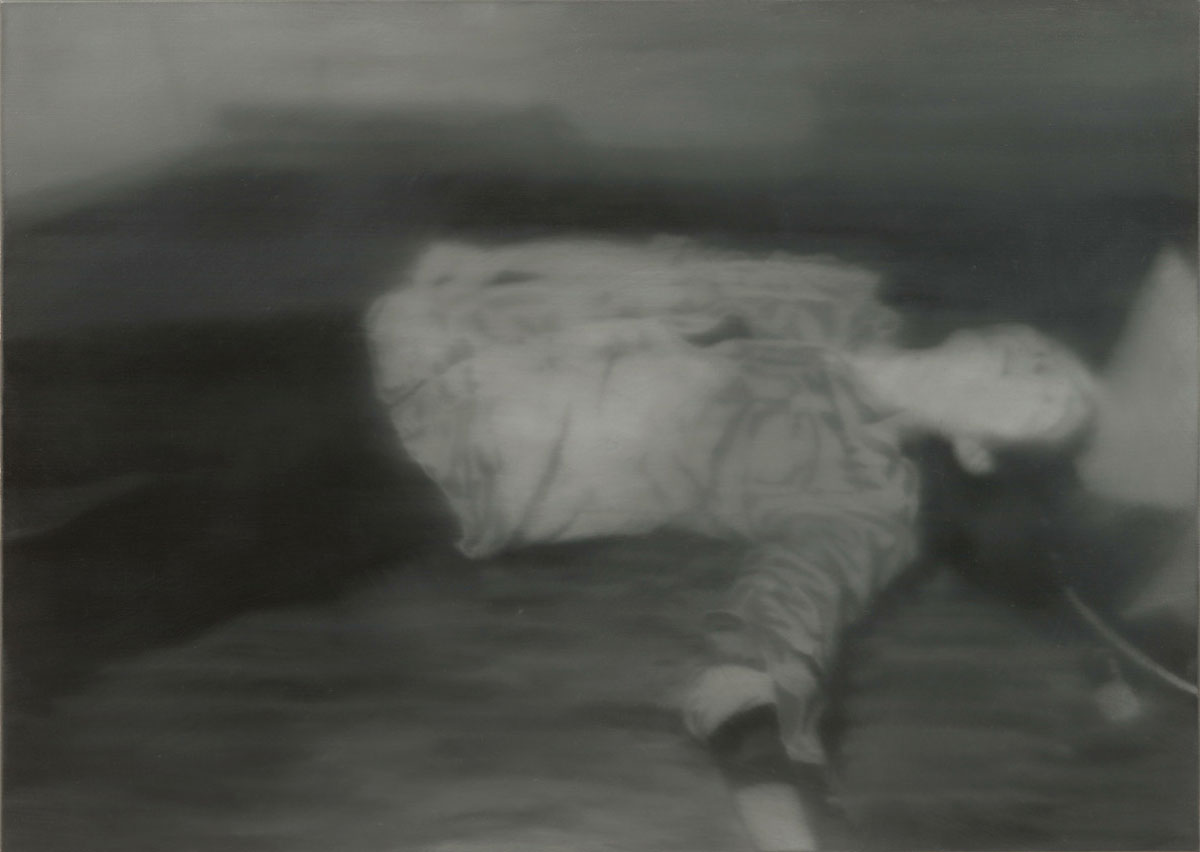
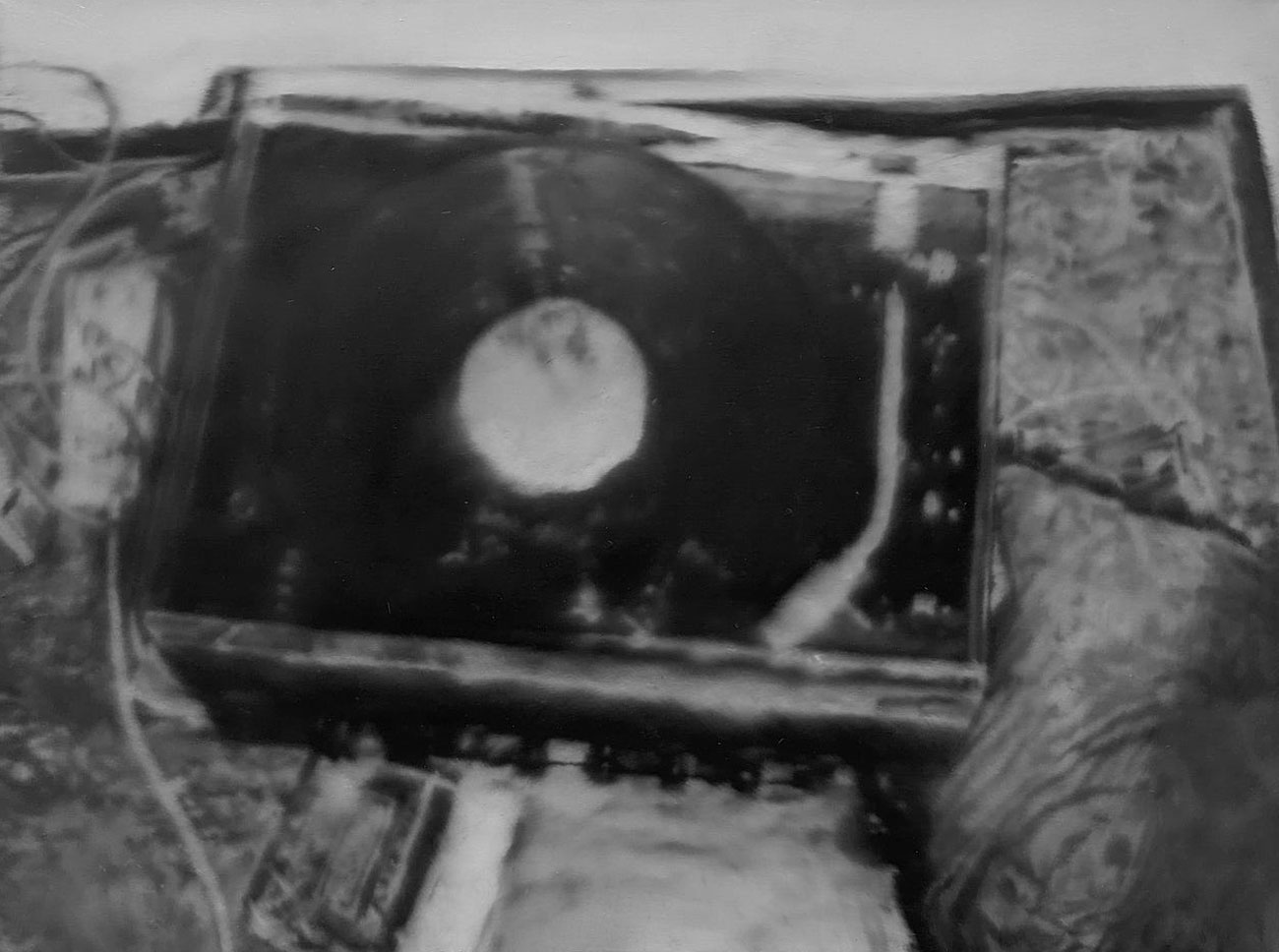
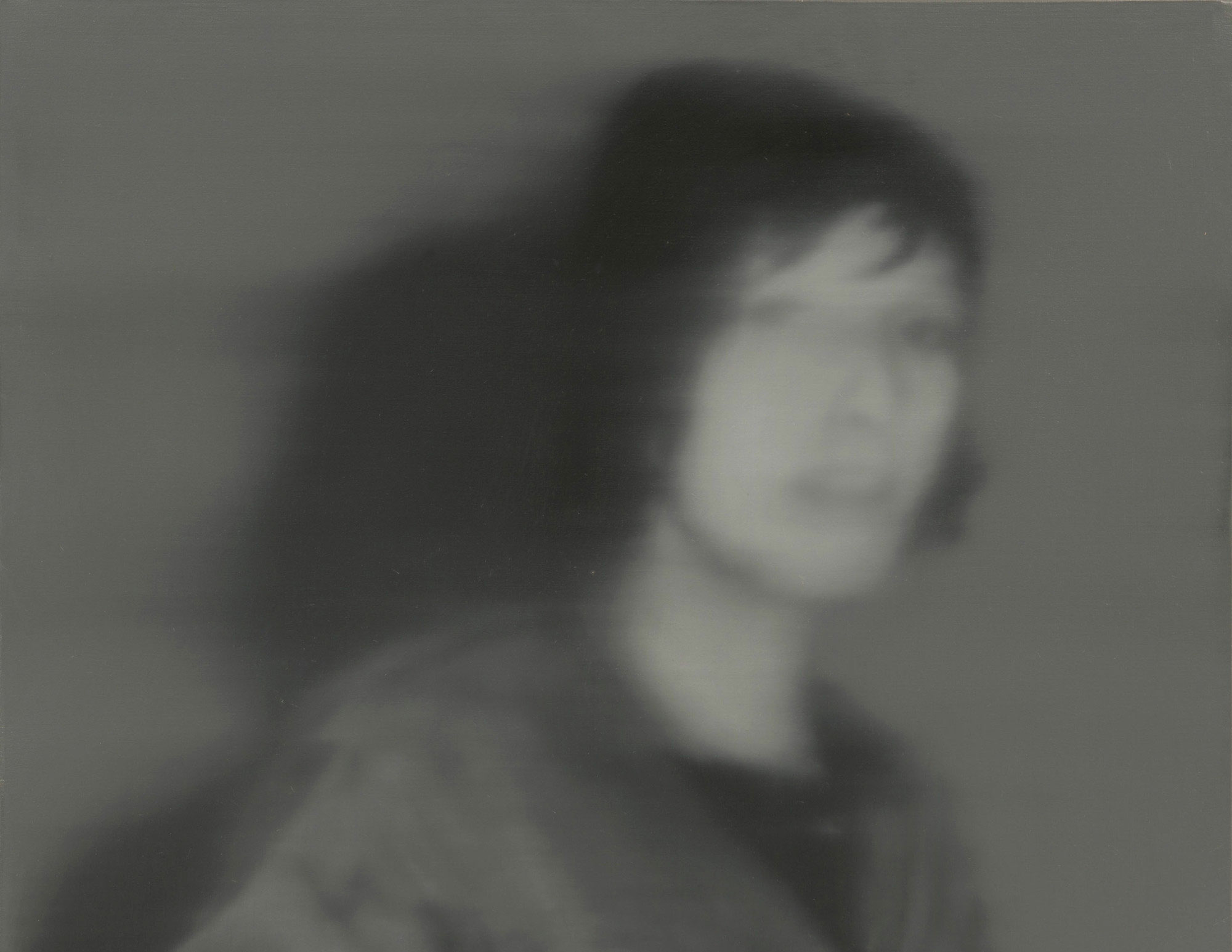
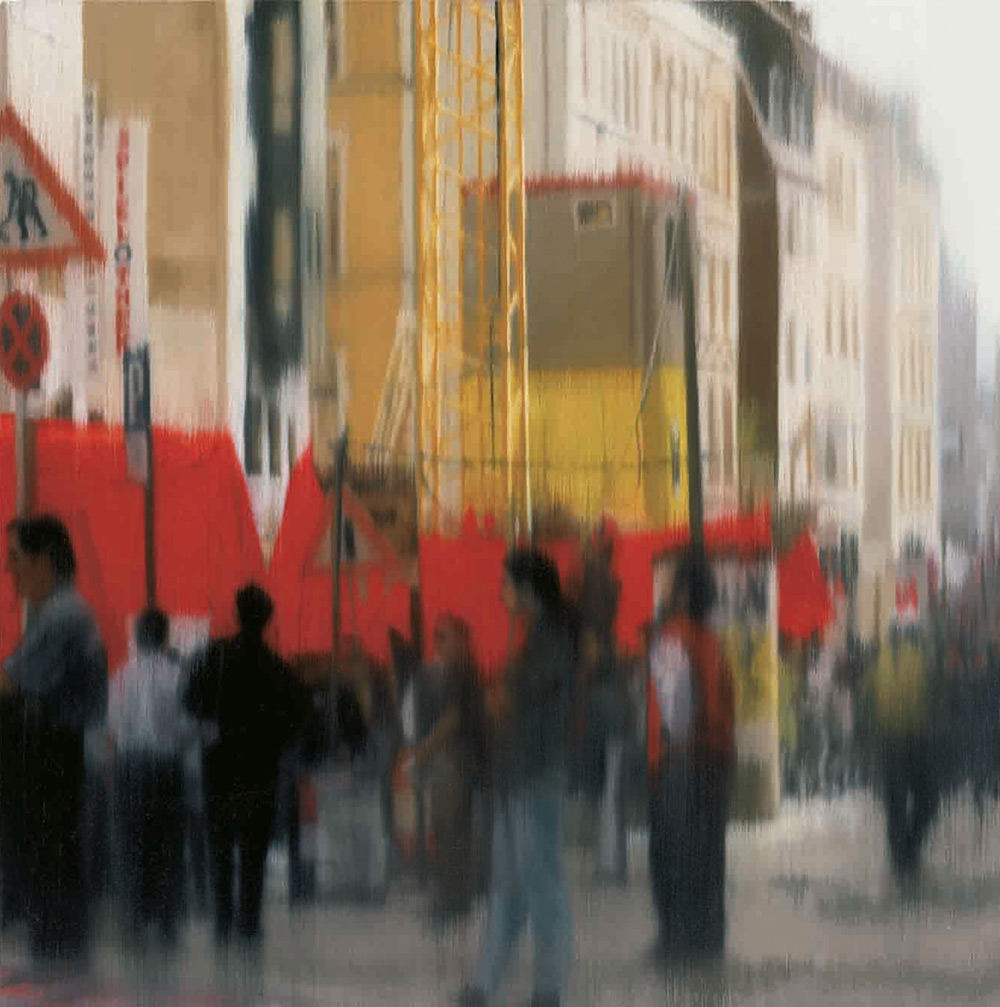
Wedded to this aesthetic of indifference, it seems more than coincidental that he introduced into his practice subject matter directly related to Germany’s recent Nazi past, images from his family album (one of the few possessions he brought over from the East) that most artists would have chosen to keep concealed. Uncle Rudi for instance is a full sizes portrait of his uncle in the uniform of the Wehrmacht – a going away photo, it turns out, as he was to die some months later. What distinguishes this portrait and many others is the addition of Richter’s signature blur. Paint has been dragged across the wet surface with a dry brush, signalling a whole variety of responses. Often interpreted as replicating an out of focus snapshot, evoking speed, or signalling a temporal distancing by underlining the difference between the ‘now’ of the viewer and the ‘then’ of whatever was captured in the photograph, this flurry of soft or hard brush strokes also signals a degree of moral and emotional ambiguity – despite the painter’s insistence on a lack of intentionality on his part. Take his portrait of Aunt Marianne that depicts his maternal aunt cradling Richter as a none-too-happy baby. A schizophrenic, she was sterilized and eventually starved to death by the Nazis. The blur of the brushstrokes bring her and the baby together suggesting the very emotional attachment that Richter was initially keen to disavow. During an interview in 1986 Richter confessed that this dispassionate stance of indifference was mere subterfuge and pretence on his part: “Content definitely – though I may have denied this at one time, by saying that it had nothing to do with content, because it was supposed to be about copying a photograph and giving a demonstration of indifference.”
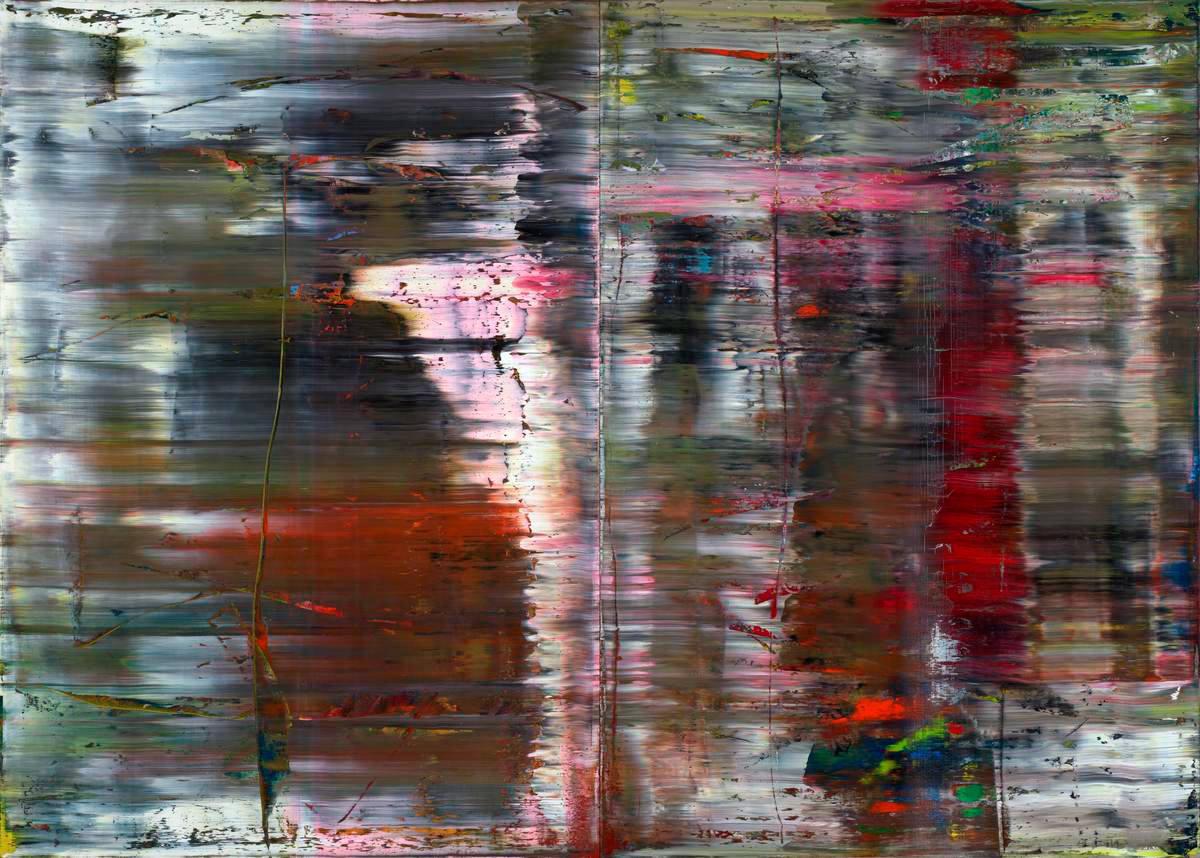
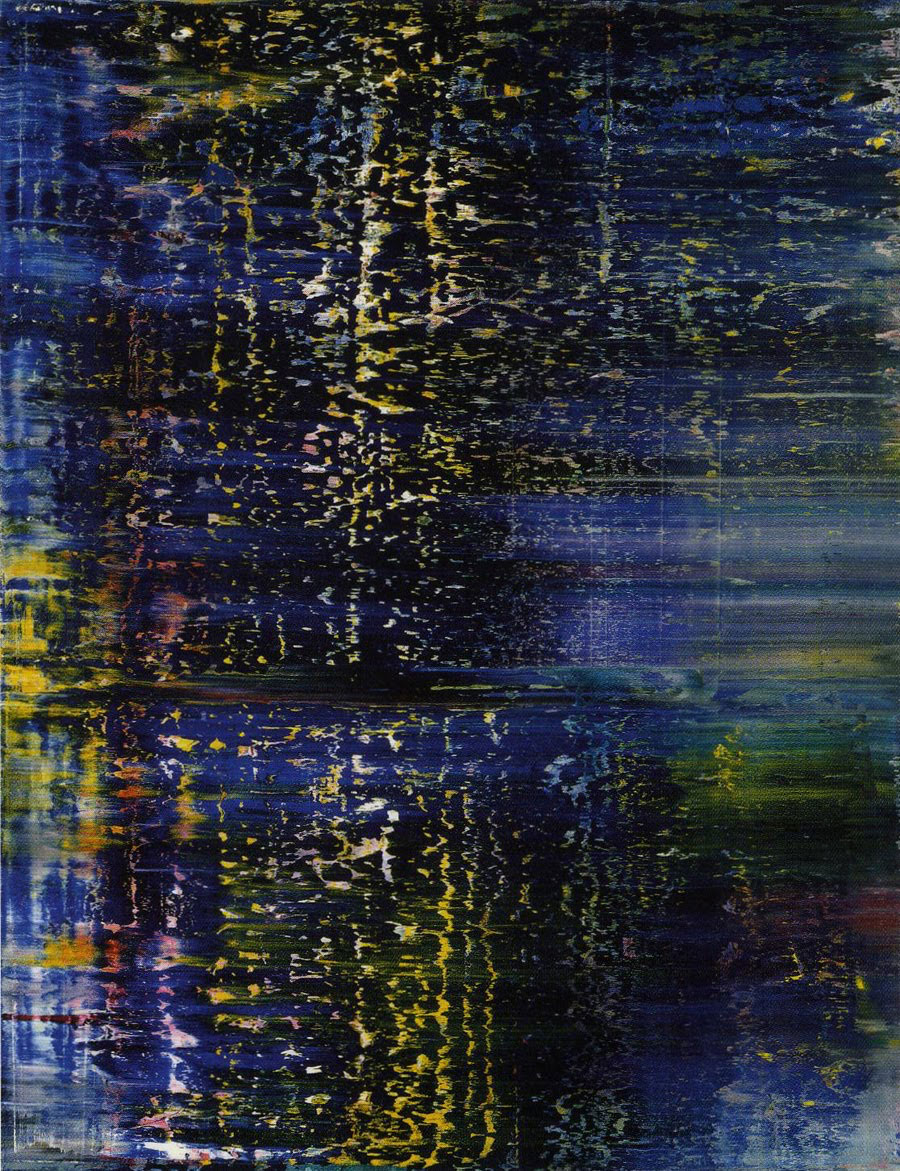
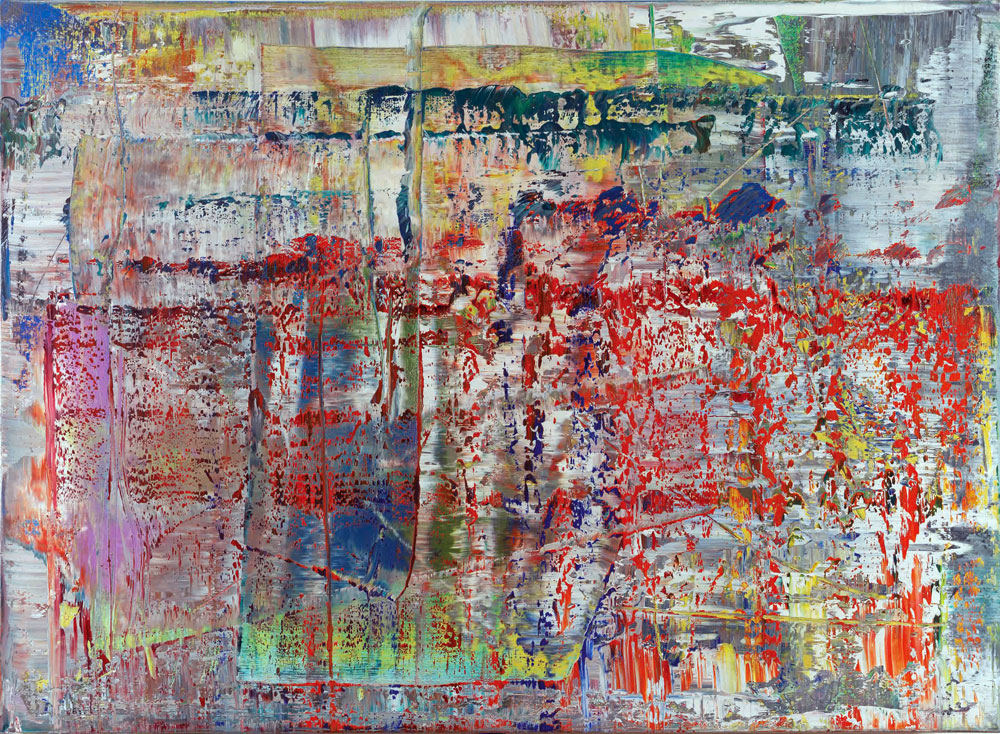
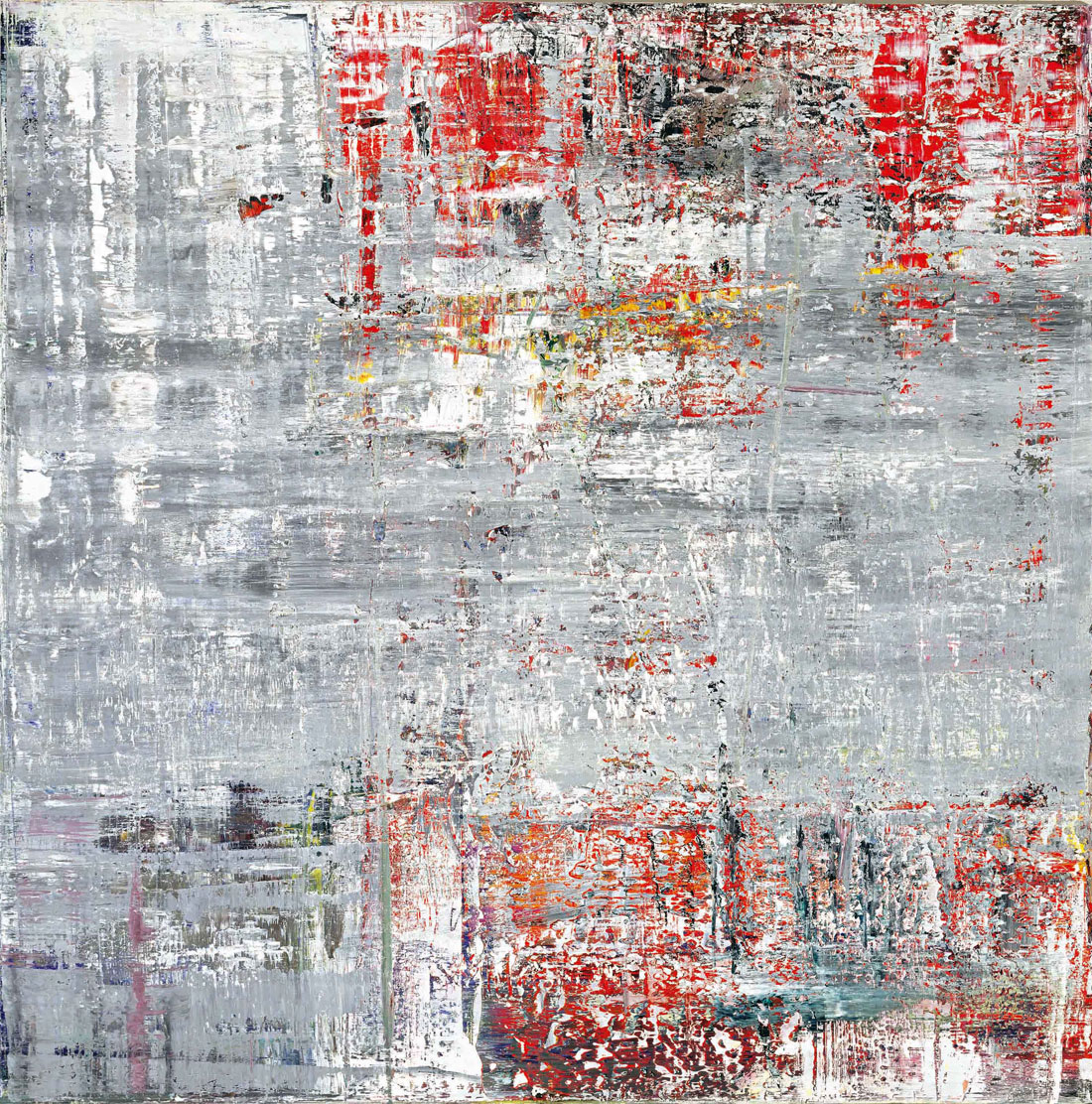
Gerhard Richter’s extremely productive career needs to be seen against this shift in attitudes and expectations when pictorial references were no longer drawn directly from the natural world but from an ever-growing nexus of information. Empirical data was being rapidly replaced by conceptual data. From 1961 when he settled in West Germany Richter alternated between figuration and non-figuration treating a wide range of subjects and employing a wide variety of means while not valuing one practice over another. As we shall see Richter is equally adept at dealing with historical genres such as the nude, landscape, portraits and history painting as he is in investigating colour and its absence in his monochromes and colour charts and in his densely layered, explosively coloured abstract canvases. For Richter, Abstraction is as real as Realism is abstract, for what fascinates him is not the image per se or its absence but appearance or semblance as our apprehension of appearance. Richter readily admits that it is inevitable that figurative elements be seen in abstraction and denies any difference between what for him is a false polarity. That this panoply of styles remains Richter’s consistent trademark throughout his long career can be seen as we wander through the rooms of this vast exhibition. Each room displays figurative paintings, mostly from photographic imagery, side by side with abstract paintings. There are two exceptions; the first is the room devoted to 18 October 1977, a cycle of fifteen photo-paintings based on the deaths of the Baader-Meinhof terrorists in Stammheim high security prison, the second the Cage room of abstract paintings that brings the exhibition to an close. Throughout the exhibition we see Richter appropriating mutually contradictory trends associated with Hyperrealism, Minimalism and Conceptual Art while at the same time honing his craft as a painter to produce some extraordinarily beautiful images. Impossible to categorise he demonstrates his determination to confront the crisis of representation on one hand and that of Germany’s recent history on the other.
Gerhard Richter is widely regarded as one of the most important artists working today. Spanning nearly five decades, and coinciding with the artist’s eightieth birthday, Gerhard Richter: Panorama is a major retrospective that groups together significant moments of his remarkable career.
As evoked by the title Panorama this exhibition presents a broad look at the wide range of Richter’s practice, discovering contradictions and connections, continuities and breaks. Each room is devoted to a particular moment of his career showing how he explored a set of ideas. While the focus is on painting, the exhibition includes glass constructions, mirrors, drawings, and photographs, and explores how Richter uses these media to ask questions about painting.
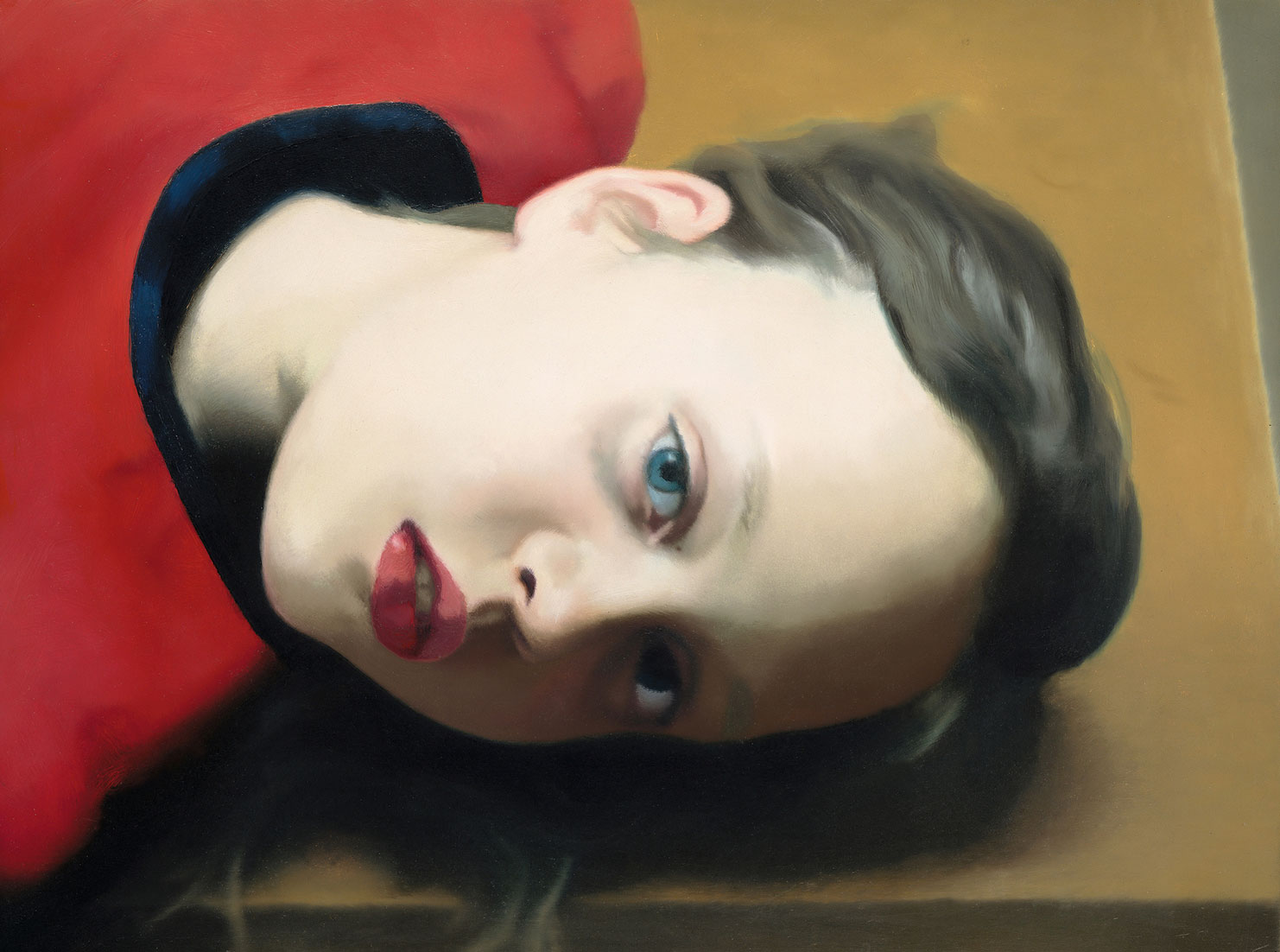
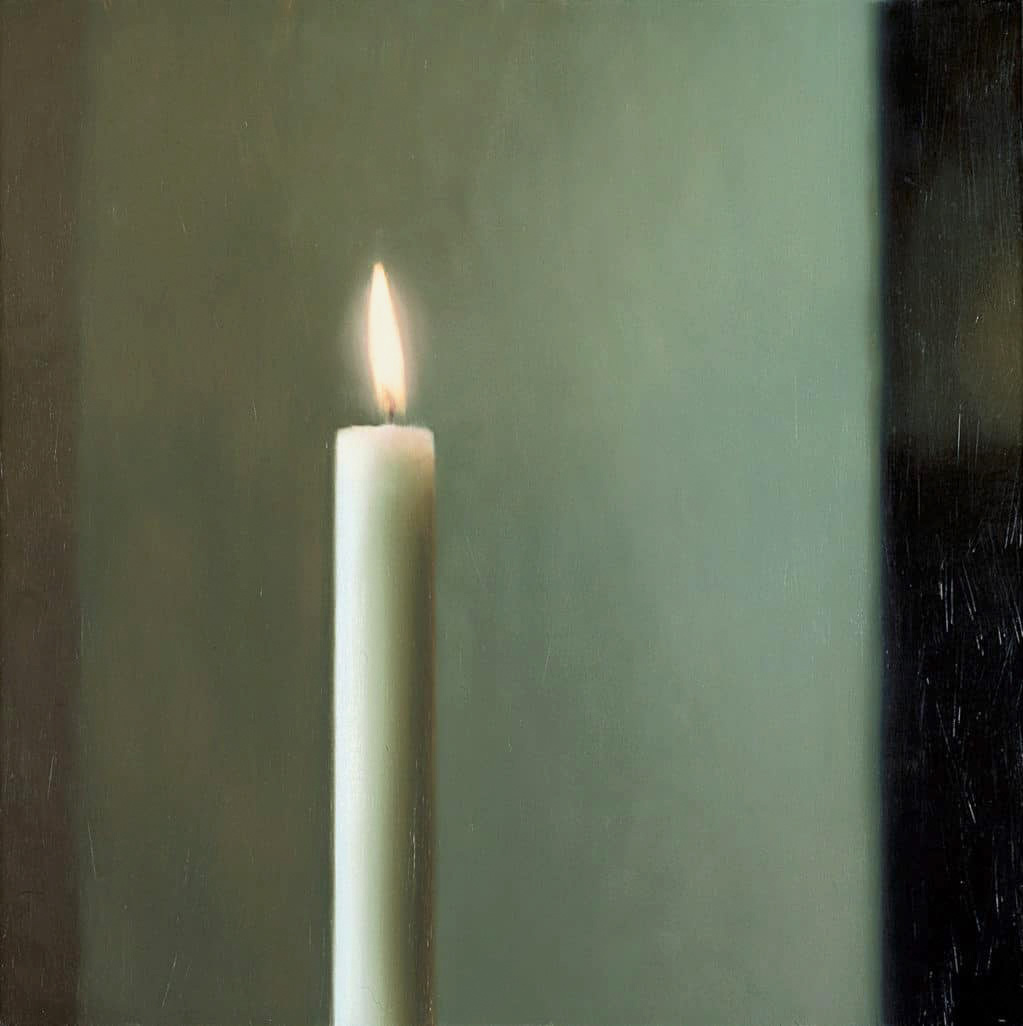
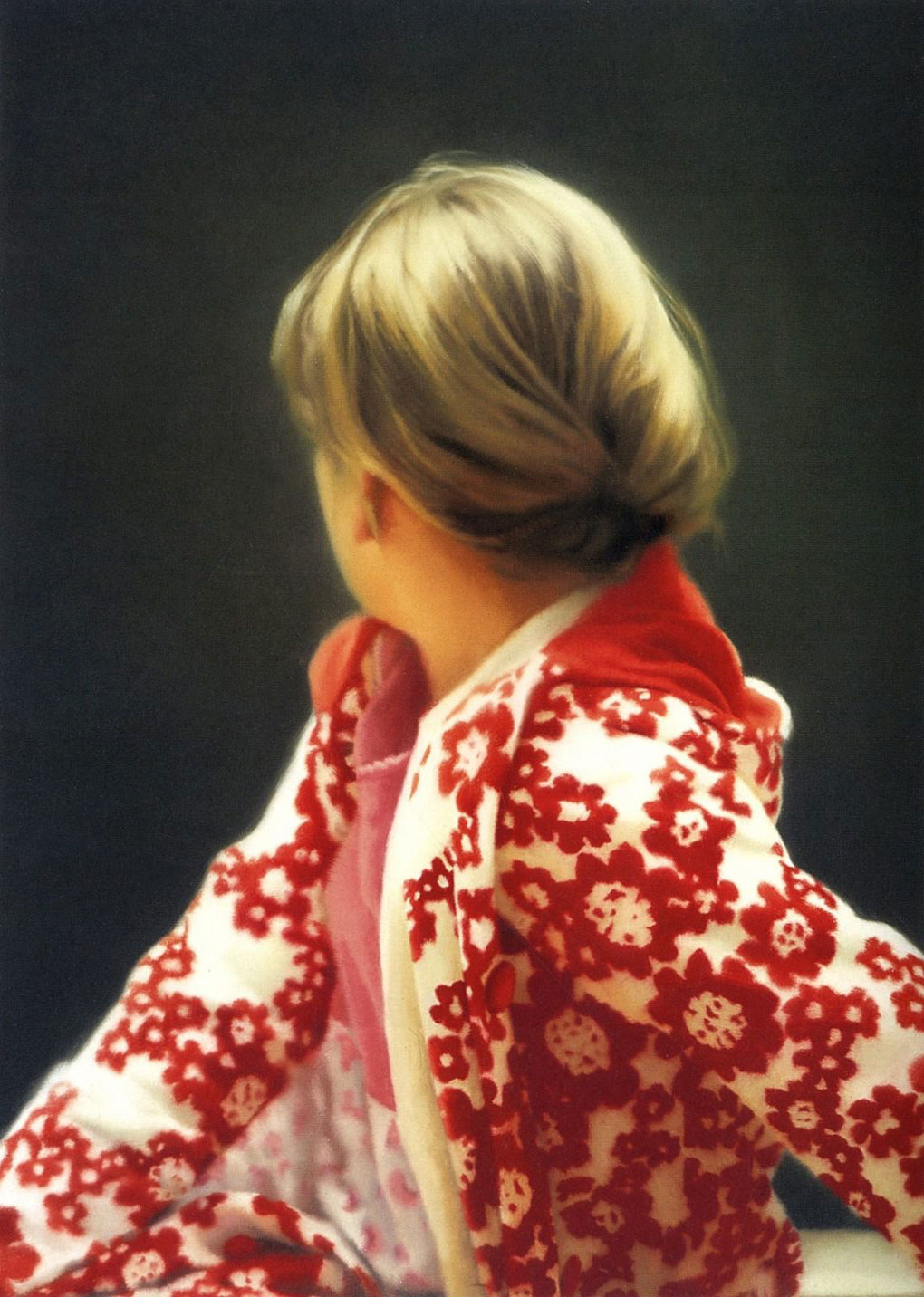
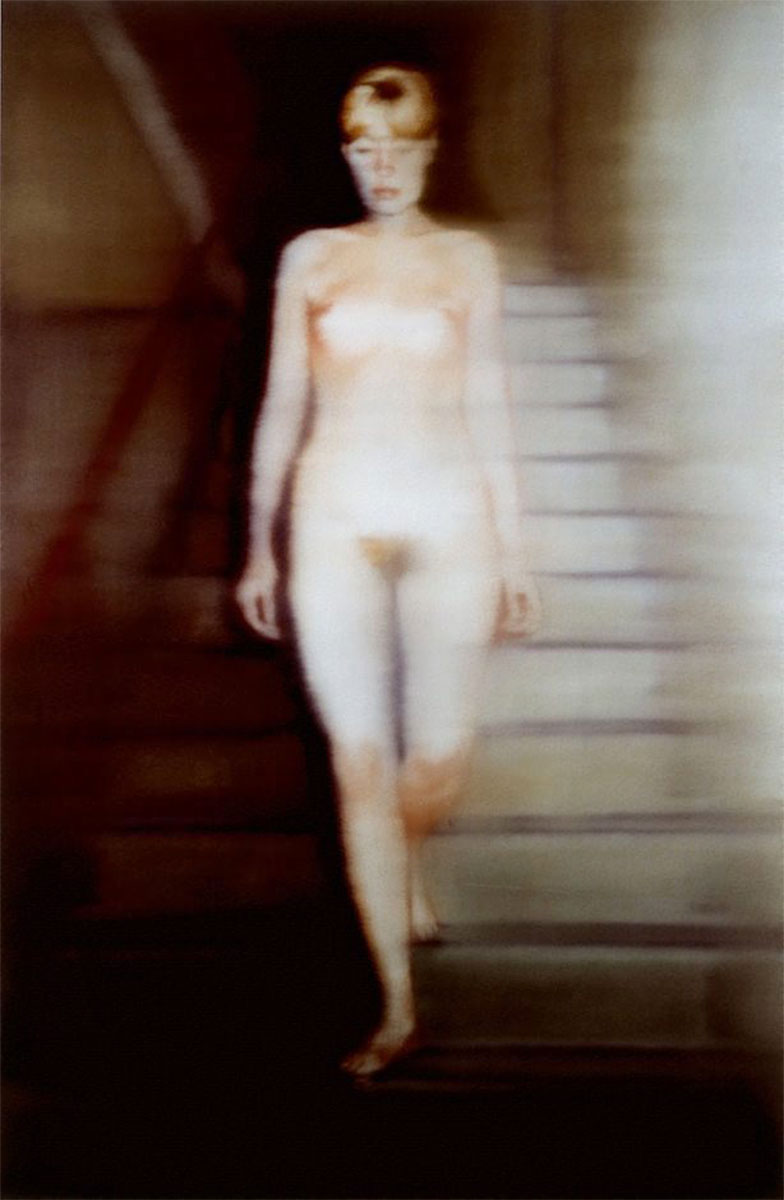
The exhibition includes many of Richter’s most well-known works such as Ema (Nude descending a staircase) 1966, Candle 1982, Betty 1988 and Reader 1994. There are also important works that are rarely shown: the first Colour Chart from 1966, 4 Panes of Glass 1967, a triptych of Cloud paintings from 1970, and, for the first time outside Germany, Richter’s monumental twenty metre long painting Stroke (on Red) 1980, based on a photograph of a brush stroke. There are several groups of important abstract paintings including a room of brightly coloured works from the early 1980s, a room of monumental squeegee paintings from the 1990s, and the Cage series 2006.
Richter was one of the first German artists to reflect on the history of National Socialism, creating paintings of family members who had been members, as well as victims of, the Nazi party. In the late 1980s, looking back to the history of radical political activity in West Germany in the 1970s, he produced the fifteen-part work 18 October 1977 1988, a sequence of black and white paintings based on images of the Baader Meinhof group. At the same time as developing a complex body of abstract work, often using squeegees to drag paint across the surface of his canvases, Richter has continued to respond to significant moments in history. In 2005 he painted September, an image of the terrorist attacks on the World Trade Center in New York in 2001, which is shown for the first time in the UK in this exhibition.
Richter is often celebrated for the diversity of his approaches to painting. His practice can seem to be structured by various oppositions, with paintings after photographs as well as abstract pictures; traditional still-lifes alongside highly charged subjects; monochrome grey works and multicoloured grids. Some paintings are planned out and ordered; others are the result of unpredictable accumulations of marks and erasures. Richter sometimes maintains these oppositions, but at other times he undoes them. This exhibition shows how he often brings abstraction and figuration together, and explores related ideas in very different looking works. The exhibition reveals breaks and new beginnings in his career, but it also reveals questions that he has asked throughout his life.
Short Biography
Richter was born in Dresden in 1932 and after training in the East, moved to West Germany in 1961. He was part of a group of painters working in Düsseldorf, that included Sigmar Polke and Konrad Lueg, who turned to image-based painting during the emergence of American Pop art. Major solo exhibitions include the 36th Venice Biennale in 1972, his first large-scale retrospective at Städtische Kunsthalle und Kunstverein für die Rheinlande und Westfalen, Düsseldorf in 1986 and Forty Years of Painting, a large-scale retrospective at the Museum of Modern Art, New York, 2002. He installed Black Red Gold in the foyer of the Reichstag building in Berlin in 1999 and the window that he designed for Cologne Cathedral was completed in 2007. Richter lives and works in Cologne.”
Gerhard Richter debuted his 15-painting suite 18 October 1977, concerning the radical left-wing Baader-Meinhof Group that had shaken Germany with a two-year campaign of terror, with more public ceremony than usual. At a press conference at the Museum Haus Esters in Krefeld, introducing the pictures before they were first shown in early 1989, he offered a curious speech, reflecting that, “I hope…there is purpose in looking at those deaths, because there is something about them that should be understood.” If Richter’s words recognized the particularly ambitious nature of these paintings among his growing body of work, it also gave listeners little guidance as to what it was that should be understood. …
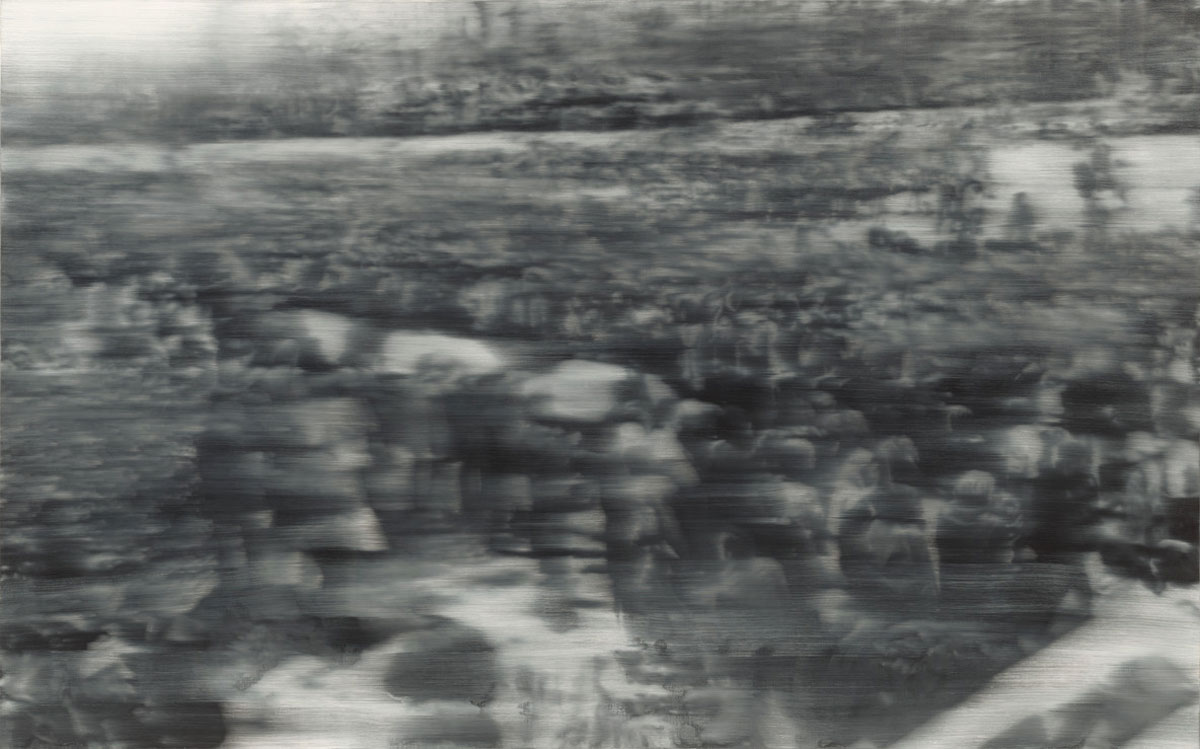
Soon after, Richter began wiping across the still-wet surface of his photo-paintings with a squeegee to soften the edges and blur the image. This signature blur can evoke a range of things – the motion of the viewer or the camera, the passage of time, but also something more metaphoric, of the type suggested in the artist’s 1971 musing: “My relationship to reality has a great deal to do with imprecision, uncertainty, transience, incompleteness.” At times, Richter also suggested that this fuzzy gaze might serve a role in helping to focus the mind: “You do not see less,” he wrote, “by looking at a field out of focus through a magnifying glass.” In the October cycle, Richter seems to amp his blurring technique up a notch, so that the images are more obscured, more diffuse than usual, in some cases approaching the edge of recognisability.
The date of the title – October 18, 1977 – marks the bloody denouement of a story that had played out over several years in front of a shaken German nation. From 1968 to 1977, the Baader-Meinhof Group led a campaign of shootings and kidnappings aimed at undermining the German state, leaving more than 30 people dead. The group’s founders – Holger Meins, Ulrike Meinhof, Gudrun Ensslin, and Andreas Baader – and several other members of the group were arrested and held in Stammheim prison. On October 17, a plane was diverted to Mogadishu by hijackers who demanded the release of the members of the group from prison. Early the next morning, following the successful liberation of the plane by the German military, three of the Baader-Meinhof Group were found dead in their cells from apparent suicide – though the proximity of these events prompted speculation about their cause of death. …
Richter acknowledged how profoundly unsettling he found the events around the Baader-Meinhof Group: “The deaths of the terrorists, and the related events both before and after,” he reflected, “stand for a horror that distressed me and has haunted me as unfinished business ever since, despite all my effort to repress it.” Perhaps as a way of processing things, Richter began to collect materials related to the group, holding onto “a number” for years before he began painting the October cycle, filed “under the heading of unfinished business.” In fact, over 100 images related to the Baader-Meinhof Group appear in Atlas, Richter’s ongoing scrapbook-like compendium of photographic source material.
When he began working in earnest on what would become 18 October 1977, Richter drew some of his source images from newspapers and magazines or snapshots of television coverage – markers of the pervasiveness of media coverage of the Baader-Meinhof Group during their violent reign and in its aftermath. But others, taken from police evidentiary photographs, were far less readily available, and serve as tokens of Richter’s preoccupation with the topic and his determined research efforts in preparation for painting. …
The narrative arc Richter creates begins in a banally sweet portrait image of a young woman and ends in a collective ritual of public mourning. Yet both, Richter seems to suggest, are inadequate to our understanding of what has taken place. What truth, he seems to ask, do photographs offer? Can violence or righteousness be discerned in the blur of grays?
But he declined to offer answers: “It is impossible for me to interpret the pictures,” he concluded in notes made for the work’s unveiling. “In the first place they are too emotional; they are, if possible, an expression of speechless emotion. They are the almost forlorn attempt to give shape to feelings of compassion, grief, horror (as if the pictorial repetition of events were a way of understanding these events, being able to live with them).”
What a wonderful posting to end 2011. I had no idea how magnificent Tom Thomson and the Group of Seven was. The paintings are sublime, full of light, colour and texture: they perfectly capture the atmosphere of outback Canada. As the curator observes, ‘These artists produced some of the most vibrant and beautiful landscapes of the twentieth century’. I couldn’t agree more. A joy to see, these impressions leave one spellbound. Finally, something delicious in landscape painting!
Dr Marcus Bunyan
Many thankx to the Dulwich Picture Gallery for allowing me to publish the artwork in the posting. Please click on the photographs for a larger version of the image.
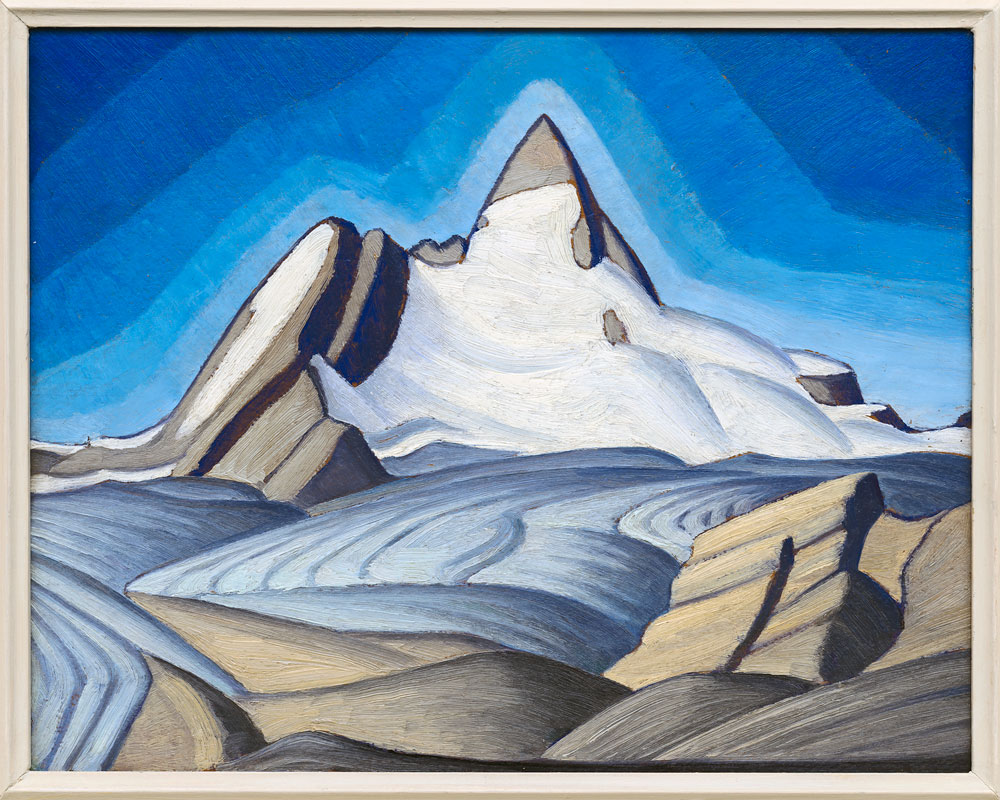
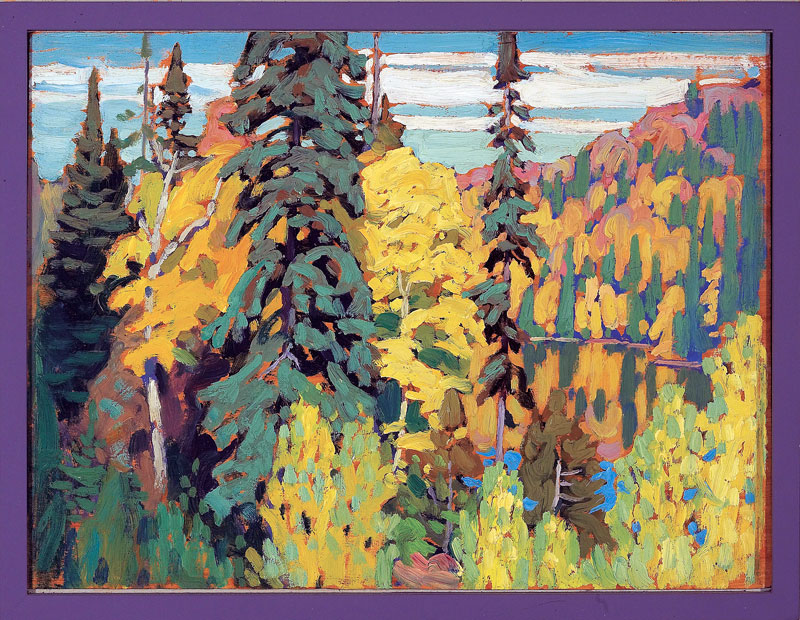
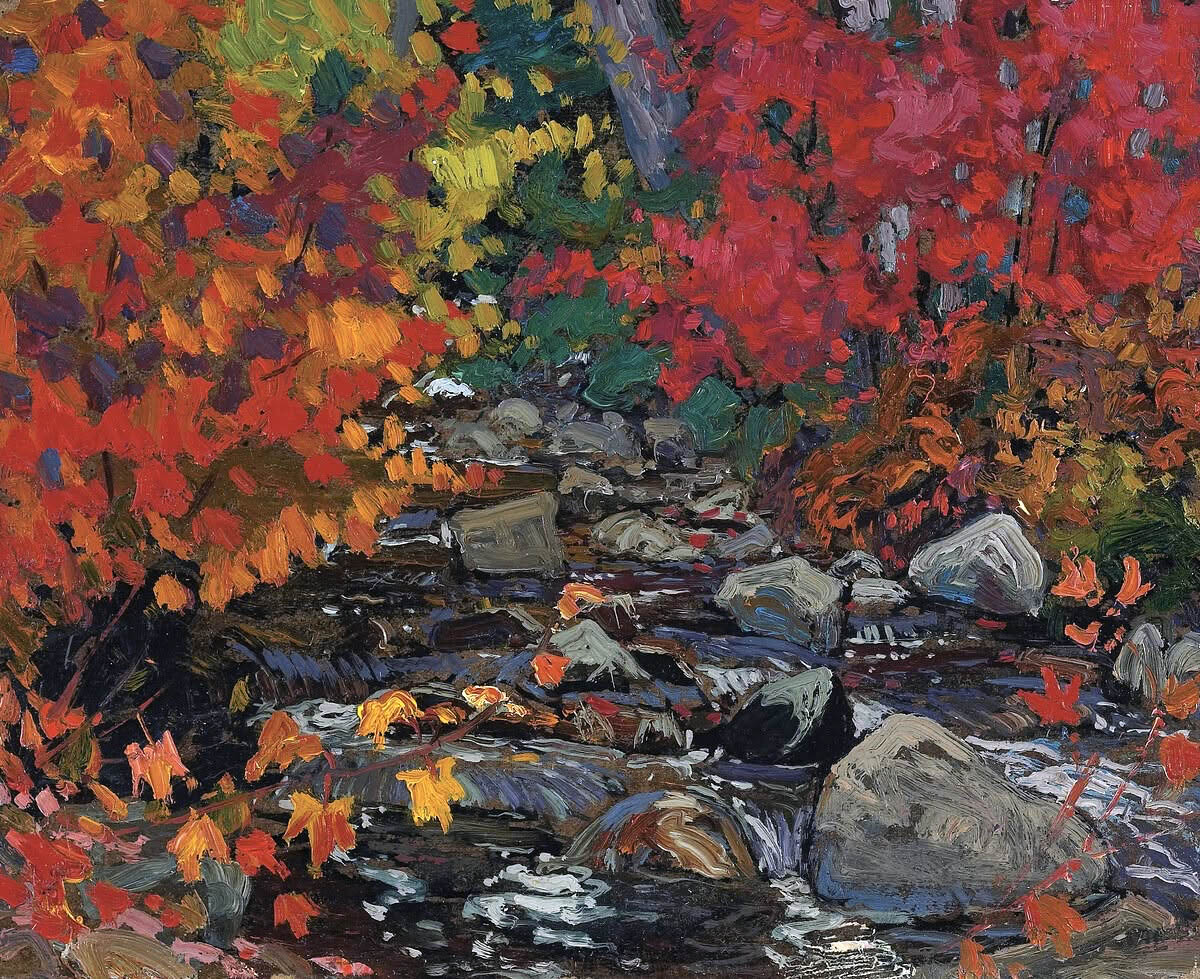
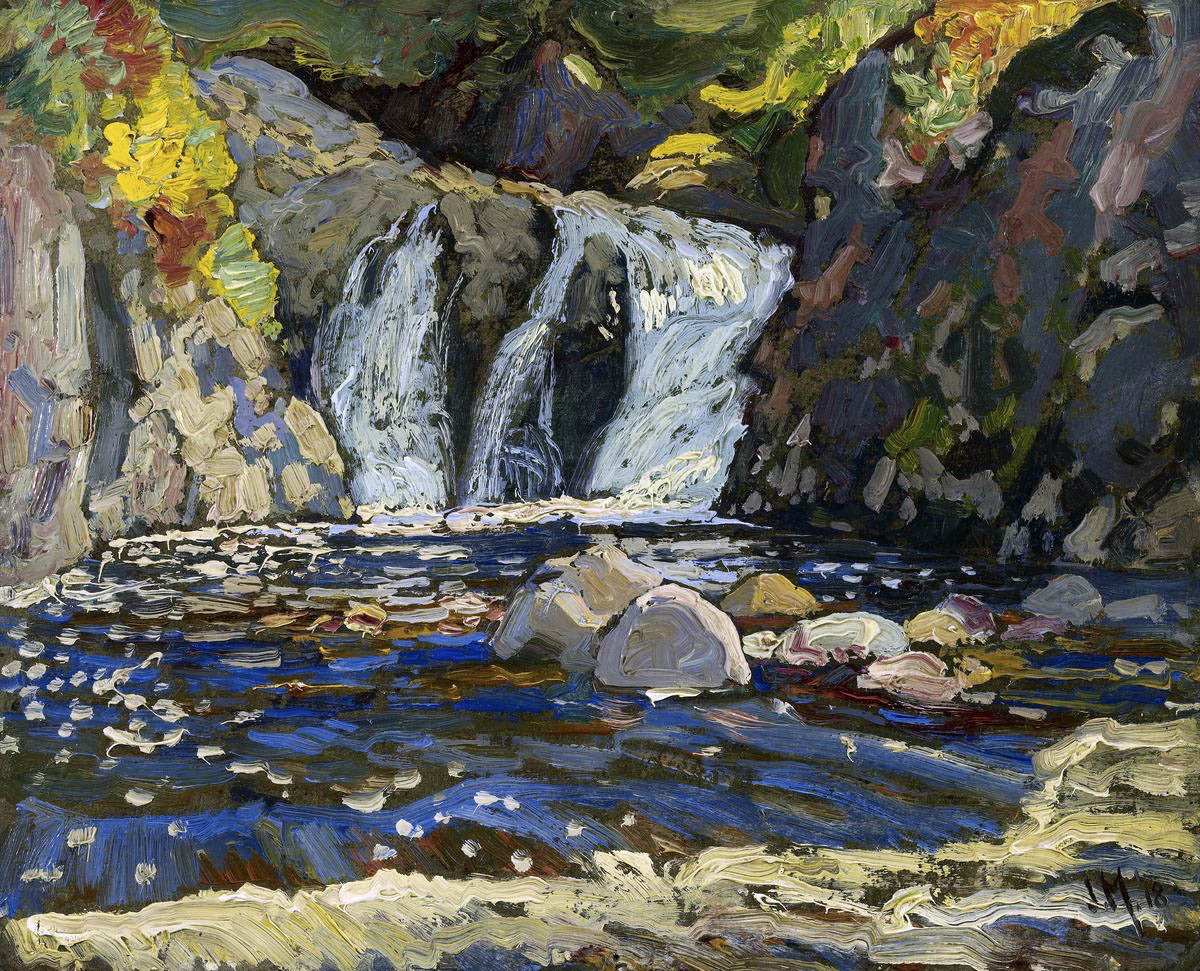
Dulwich Picture Gallery’s Bicentenary year of momentous exhibition firsts is to continue in October with Painting Canada: Tom Thomson and the Group of Seven. The exhibition forms part of Dulwich Picture Gallery’s North American series showcasing the work of artists rarely seen in the UK.
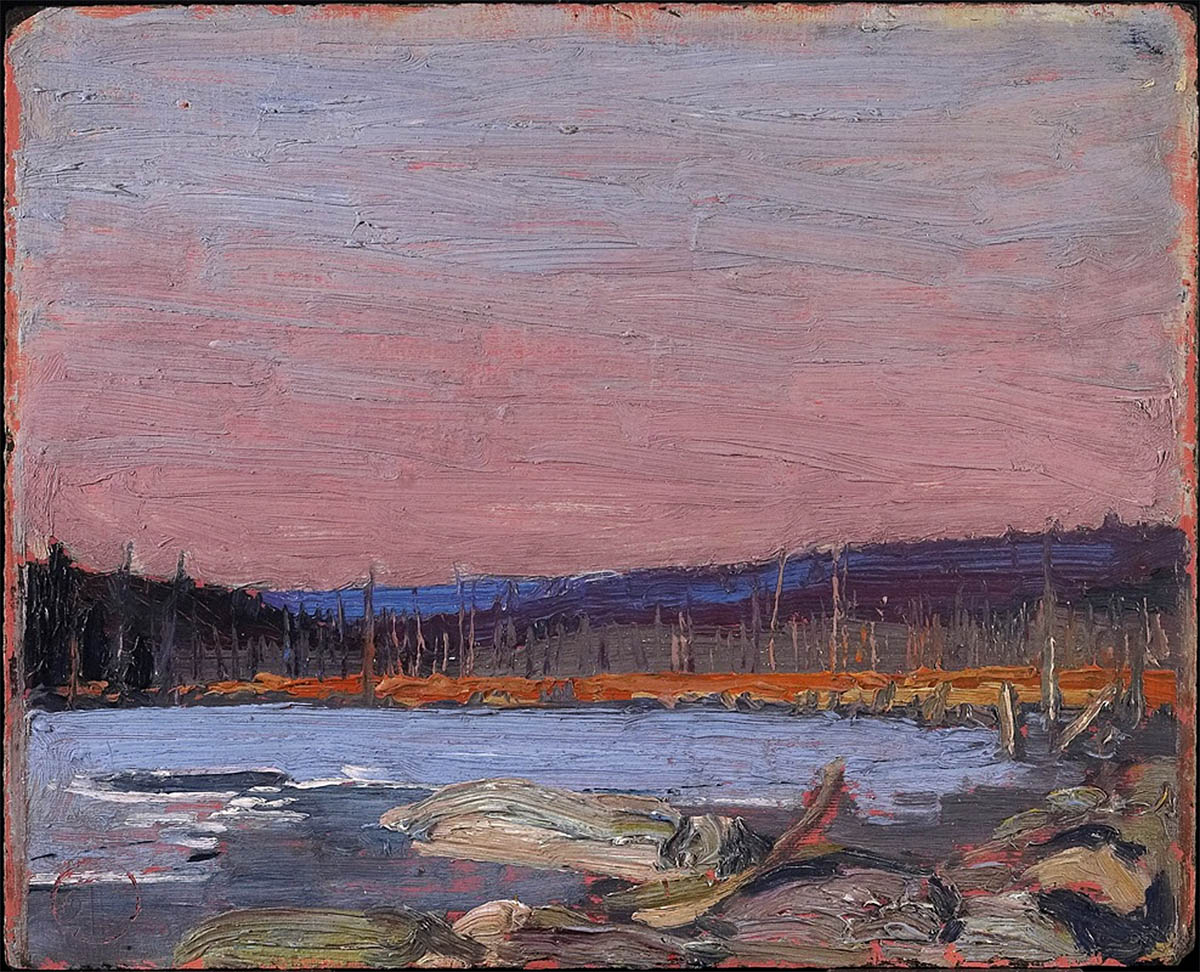
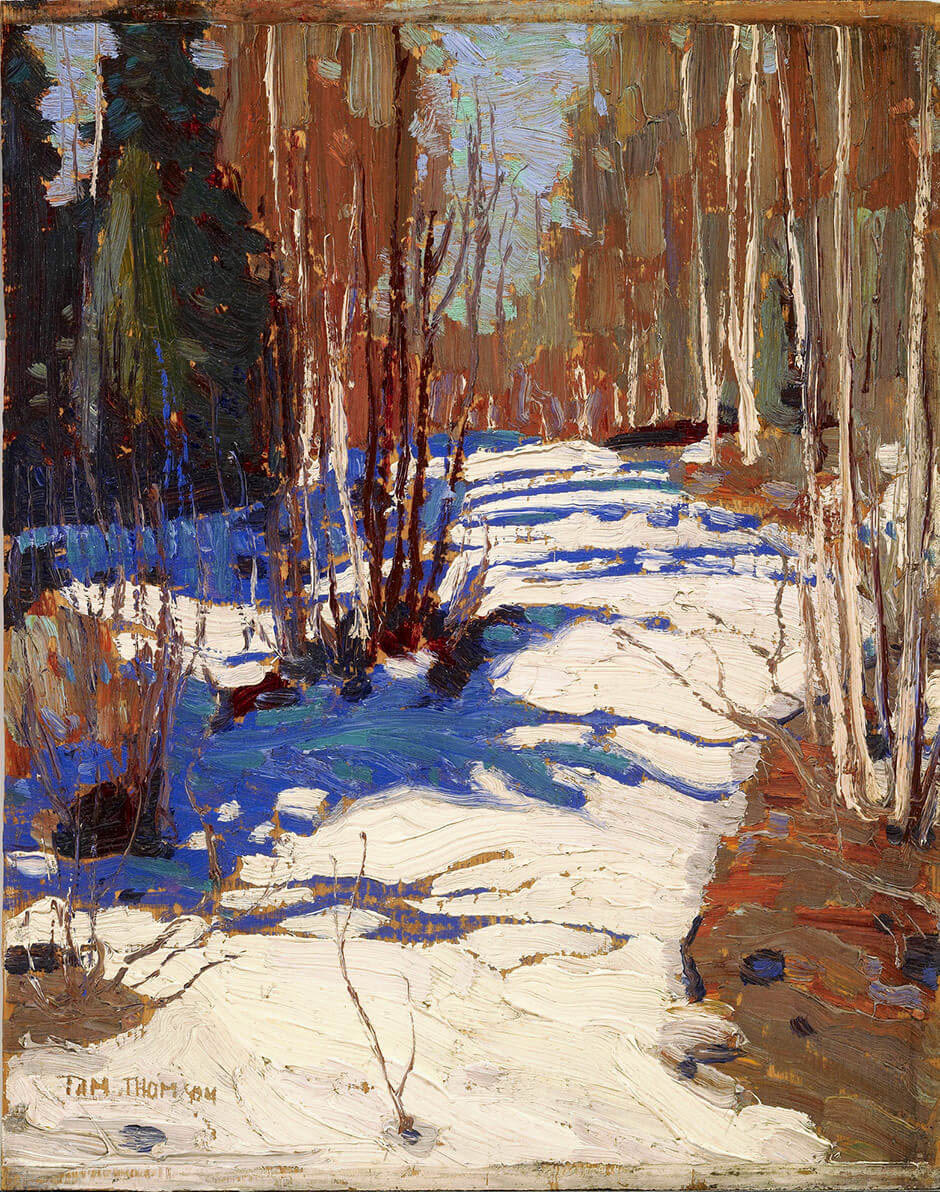
Painting Canada will feature some of Canada’s most iconic landscape paintings. These bold and exciting works were first celebrated not in Canada, but in London, at the British Empire exhibitions at Wembley in 1924 and 1925. Since then, despite becoming greatly revered in Canada, the work of Thomson and the Group of Seven has been virtually unknown on the international stage. This major exhibition will reintroduce them to the British public, with an astonishing 122 paintings on display as well as Tom Thomson’s sketchbox.
Tom Thomson and J. E. H. MacDonald, Arthur Lismer, Frederick Varley, Frank Johnston and Franklin Carmichael met as employees of the design firm Grip Ltd. in Toronto. The other two members of the Group were A. Y. (Alexander Young) Jackson from Montreal and Lawren Harris, effectively the Group’s leader, and a man of considerable personal wealth. They often met at the Arts and Letters Club of Toronto to discuss their opinions and share their art.
The artists, sometimes known as the ‘Algonquin Park School’ at this stage, received indirect monetary support from Harris (heir to the Massey-Harris farm machinery fortune) and direct support from Dr. James MacCallum a wealthy Toronto ophthalmologist and collector. Harris and MacCallum collaborated to build a studio building that opened in 1914 to serve as a meeting and working place for the proposed new Canadian art movement.
The progress of this informal group of artists was interrupted by the outbreak of World War I and a further severe blow came in 1917 when Thomson died while canoeing in Algonquin Park. The circumstances of his death and subsequent burial have remained mysterious, the source to this day of myriad conspiracy theories.
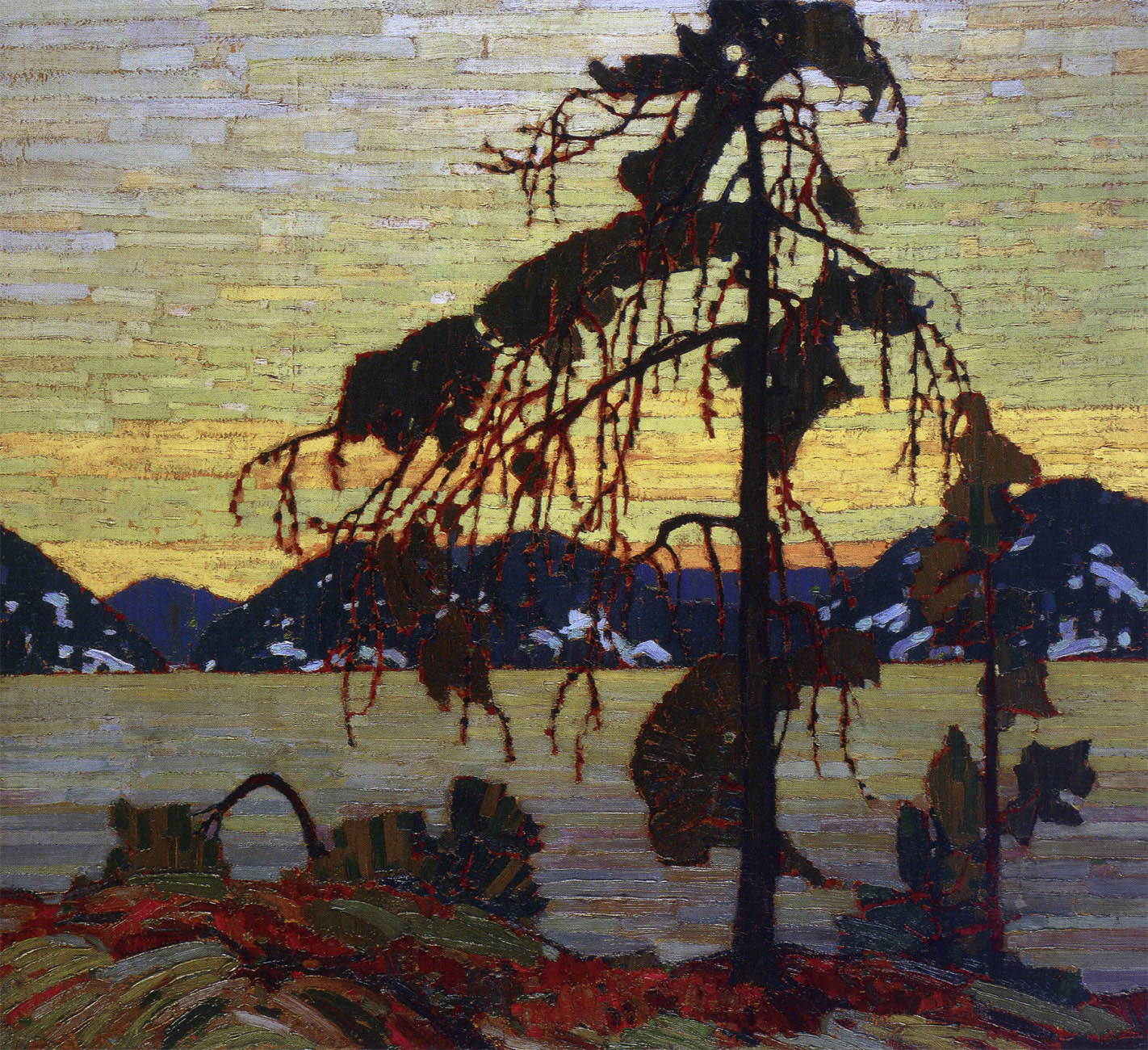
Thomson’s seven artist friends reunited after the war. They continued to travel throughout Canada, sketching the landscape and developing techniques to represent such wild and diverse terrain in their art. In 1920 they finally came together as the Group of Seven and held their first exhibition under that name. Prior to this, the art establishment’s view of the Canadian landscape was that it was either unpaintable or too wild and uncouth to be worthy of being painted. Reviews for the 1920 exhibition were mixed, but as the decade progressed the Group came to be recognised as pioneers of a new, Canadian, school of art. Nowadays, the Group and Tom Thomson are iconic in their native country; every schoolchild is familiar with masterpieces such as Thomson’s The Jack Pine, arguably the most famous and beloved painting in Canada.
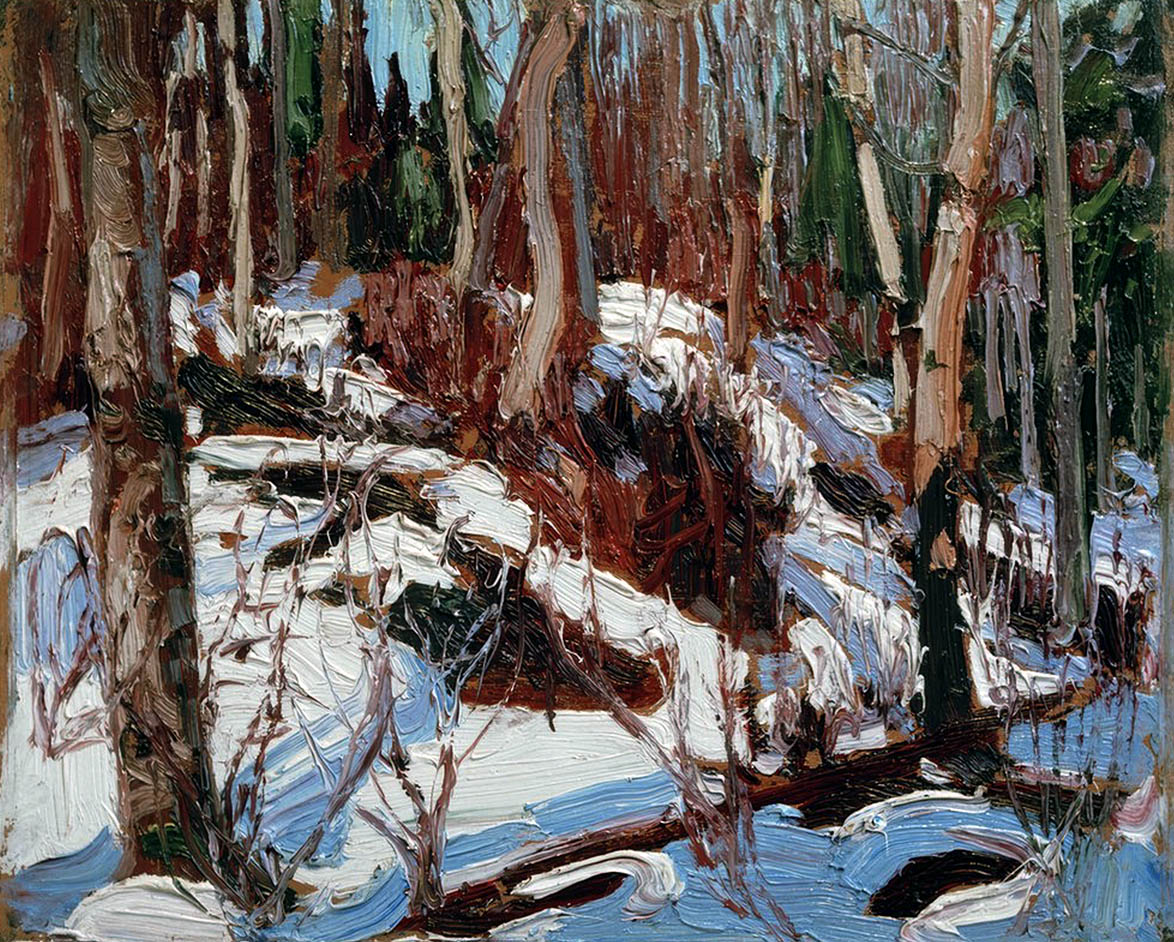
Dulwich Picture Gallery is proud to partner with the National Gallery of Canada on this exhibition, with generous support of loans also coming from the McMichael Canadian Art Collection, the Art Gallery of Ontario and other lenders. These institutions are lending some of the most famous paintings in Canada. Additionally, a special revelation of the show is provided by the rich group of works to be found in private collections.
Painting Canada has been planned as a journey through Canada, framed by two grand rooms dedicated individually to Tom Thomson’s electrifying sketches and paintings of Algonquin Park and Lawren Harris’s other-worldly paintings of the Arctic and the Rocky Mountains. Between these two ‘poles’, a selection of the very best work of Thomson and the Group of Seven will be on display. A special feature of the show will be the juxtaposition, wherever possible, of the initial sketch with the finished canvas. One room will in fact be devoted entirely to a display of these vibrant sketches, which represent one of the most impressive contributions of Canada to twentieth-century art.
Ian Dejardin said: “These artists produced some of the most vibrant and beautiful landscapes of the twentieth century. The Canadians have kept this particular light under a bushel for far too long – I am proud, and frankly amazed, that this is to be the very first major exhibition of their work to be held in this country since the sensation of their first showing here in 1924. As for Tom Thomson – what he achieved in his tragically short career (just 4 or 5 years) is extraordinary. He is Canada’s very own Van Gogh – prepare to be dazzled.”
Tom Thomson was born near Claremont, Ontario on 5 August, 1877. A turning point in his life came in 1909 when he joined the staff of Grip Ltd., a prominent Toronto photo-engraving house. The firm’s head designer, artist-poet J.E.H. MacDonald, contributed much to Thomson’s artistic development, sharpening his sense of design. However, Thomson’s career as a fine artist lasted barely four or five years; it was cut short in July 1917, when his canoe was found floating on Canoe Lake, empty. His body surfaced days later, triggering decades of speculation as to his fate. More sensational than these stories, however, was the burst of creativity that had preceded his death. In his last two years, Thomson had developed an artistic language that seemed to capture the unique qualities of the Canadian landscape – painterly, vibrant in colour, in tune with the subtle change of the seasons. The Canadian wilderness had been previously considered too wild and untamed to inspire ‘true’ art.
His fellow employees at Grip Ltd. included Arthur Lismer, F.H. Varley, Franklin Carmichael and Frank Johnston – all adventurous young painters who often organised weekend painting trips to the countryside around Toronto. After Tom’s death, a memorial exhibition was arranged and these men, together with Lawren Harris and A. Y. Jackson, would go on to form in 1920 the Group of Seven, probably the most famous artistic force in Canadian art history. Along with Thomson they created a landscape style that to this day infl uences the way Canadians visualise their own country and their best paintings have become national icons.
Lawren Harris (1885-1970)
Lawren Harris was born on 23 October 1885, in Brantford, Ontario. He attended St. Andrew’s College in Toronto before studying art in Berlin, Germany, from 1904 to 1908. He then returned to Toronto, where he began painting post-impressionist street scenes of its older and poorer areas. By 1919 Harris’s landscapes had become increasingly sombre and his brush stroke more expressive. His affection for Scandinavian landscape painting was one of the key factors in the formulation of the Group of Seven’s approach to the Ontario woods, which Harris himself painted with gusto and attention. His later style was grandly beautiful and austere, finding its most characteristic subject matter in the awesome landscapes of Lake Superior, the Rockies and the Canadian Arctic.
A. Y. Jackson (1882-1974)
Alexander Young Jackson, or “A. Y.” as he was fondly known, was born in Montreal on 3 October, 1882. Like other members of the Group of Seven he was trained as a commercial artist and for many years made his living by that means. He apprenticed to a Montreal lithographer at the age of 12, and though he later spent two and a half years in France studying painting, he was soon back in Canada paying his rent by designing cigar labels. In the following years after the formation of the Group of Seven he painted the Arctic, the West Coast, the Prairies, and Ontario’s north woods, as well as his beloved St. Lawrence, where his countless sketching expeditions earned him the nickname Père Raquette-Pappa Snowshoe.
Arthur Lismer (1885-1969)
Arthur Lismer celebrated the powerful beauty of the Canadian landscape in his own expressionist style. His paintings are characterised by vivid colour, deliberately coarse brushwork and a simplified form. Lismer was born in Sheffield, England. At the age of 26, he immigrated to Canada seeking work as a commercial illustrator. It was at Grip Ltd. in Toronto that he met a group of other talented young artists who were to become the Group of Seven. Together, they organised trips to explore and sketch the wilderness – capturing the spirit of Canada in their work, and setting Canadian art on a bold and original new course. Although Lismer painted throughout his life, he devoted the majority of his time to art education. A gifted teacher, Lismer pioneered the field of child art education across Canada and around the world.
Frederick Horsman Varley (1881-1969)
Varley was born in 1881 in Sheffield, England. He studied painting at Sheffield and Antwerp and went to work in London as a commercial illustrator. In 1912 he came to Canada, where he found himself working in the same commercial studio as Tom Thomson. With Thomson and the others he took to painting Northern Ontario landscapes, and also began to do considerable work as a portrait painter. In 1926 Varley moved to Vancouver to become Head of Drawing, Painting & Composition at the newly formed Vancouver School of Decorative & Applied Arts. In 1933 he founded his own school, the British Columbia College of Arts, but this venture led to his bankruptcy in 1935 and by then his marriage had also collapsed. The next years were difficult for Varley, most of them spent suffering from alcoholism in Montreal. In 1945, however, he returned to Toronto and slowly began to work again. He died in Toronto in 1969.
Franklin Carmichael (1890-1945)
Carmichael, the son of a carriage maker, was born in Orillia, Ontario on 4 May, 1890. He arrived in Toronto in 1911 with some training in commercial art, and soon found himself the associate of Tom Thomson and a number of other commercial artists who were teaching themselves to be serious painters. In 1913 he went to Antwerp to study painting but was soon back in Ontario to participate in the founding of the Group of Seven, of which he was the youngest member. In 1932 he was appointed Head of Graphic and Commercial Art at the Ontario College of Art. He died in Toronto in 1945.
Frank (Franz) Johnston (1888-1949)
Johnston was an original member but only showed in the Group’s first exhibition. Johnston’s style and technique – he very often painted in tempera – differed from that of the other Group of Seven members. His work was extremely decorative, and sold well – a fact that led to his early departure from the Group, since he felt he could earn more disassociated from the initial critical outrage that greeted the first Group exhibitions.
J. E. H. MacDonald (1873-1932)
John Edward Hervey MacDonald challenged and vastly broadened the scope of Canadian Art. MacDonald believed that art should express the “mood and character and spirit of the country”, and he portrayed his vision in vast panoramas using dark, rich colours and a turbulent patterned style. MacDonald was born in Durham, England, and moved to Canada at the age of fourteen. He trained as an artist in Hamilton and Toronto, pursuing a career in commercial art. In 1895 he joined Grip Ltd. in Toronto where he met and encouraged other staff members, including Tom Thomson, Frank Carmichael, Arthur Lismer and Fred Varley, to paint with him on weekends – laying the groundwork for what would later become Canada’s famous Group of Seven. He was the oldest member of the Group. His early death led directly to the disbanding of the Group in 1933.
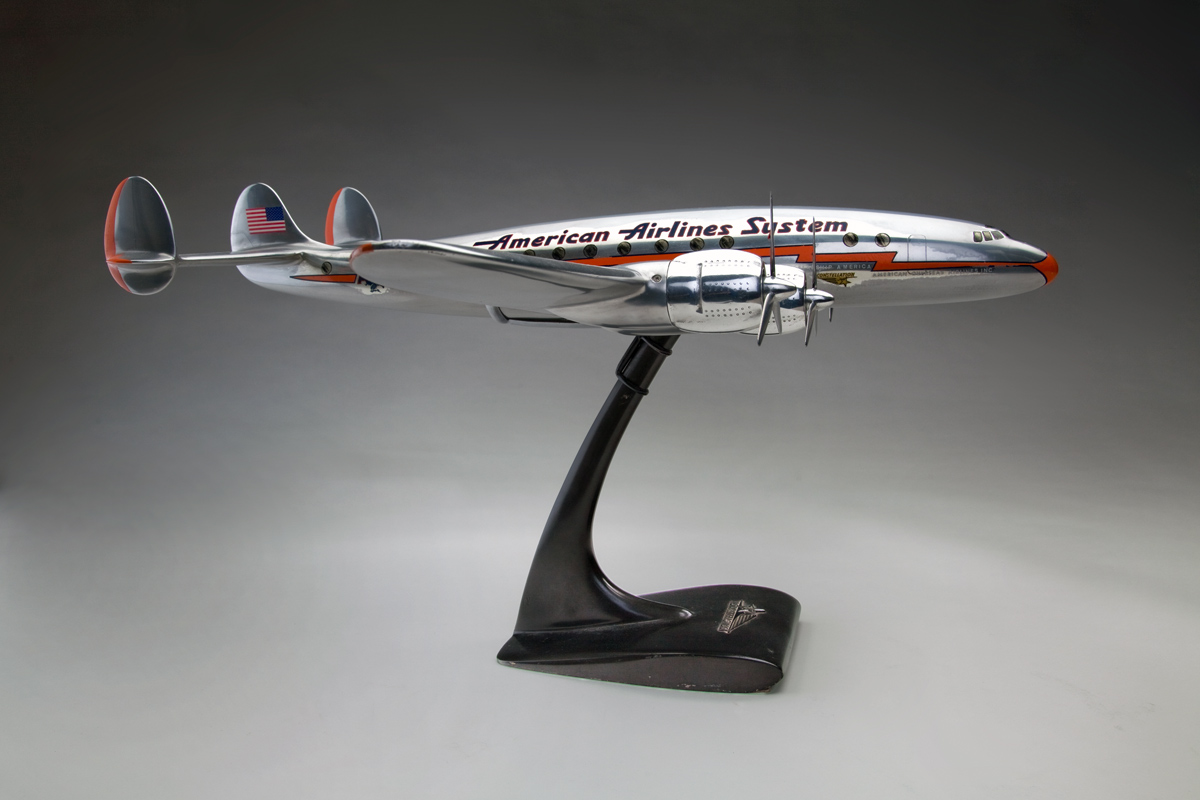
Location: Aviation Museum and Library 1 – Front Wall Cases
Lockheed Aircraft Co., Burbank, California American Overseas Airlines Lockheed L-049 Constellation c. 1946
Scale 1:44
Metal, paint
Collection of Anthony J. Lawler
One of my favourite postings in a long while. As an inveterate collector how I would love to have these in my collection. What beautiful aircraft; what graceful models; what simple, gorgeous photographs by photographer Chad Michael Anderson. The Lockheed Constellation has to be one of the most delicious aircraft ever made. But the model I would take is the gorgeous Air France Breguet 763 Provence, because of it’s aerodynamic beauty and angle of flight.
Dr Marcus Bunyan
Many thankx to John Hill, Assistant Director, Aviation for his help and to SFO Museum for allowing me to publish the text and the photographs. Attribution for the photographs is to the SFO Museum (actual photographer unknown). Please click on the photographs for a larger version of the image.
Lockheed Aircraft Co., Burbank, California American Overseas Airlines Lockheed L-049 Constellation
c. 1946
Scale 1:44
Metal, paint
Collection of Anthony J. Lawler
In 1945, in an effort to gain transatlantic routes to Europe, American Airlines purchased American Export Airlines (founded in 1937 as a subsidiary of the shipping company American Export Lines) and renamed it American Overseas Airlines (AOA). The airline then began purchasing suitable aircraft for its new subsidiary. The best choice for the lengthy route to Europe was the Lockheed Model 047 Constellation, one the longest-range and fastest airliners produced at the time. Like other airliner manufacturers, Lockheed had its own in-house model factory that constructed highly-accurately scaled models for its customers. It produced this 1:44 scale model for AOA in polished sheet aluminium and painted in the airline’s earliest livery scheme.
Text from the SFO Museum website
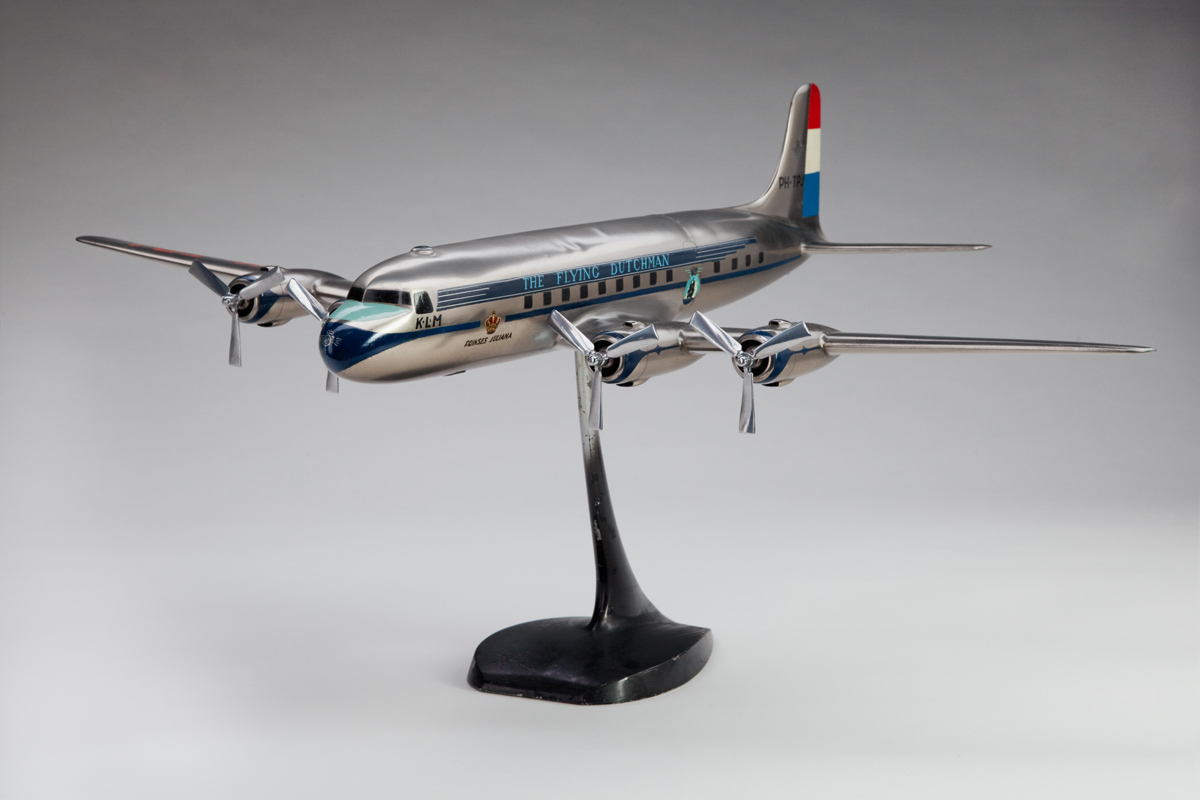
Maarten Matthys Verkuyl (Dutch) KLM (Koninklijke Luchtvaart Maatschappij) Royal Dutch Airlines Douglas DC-6 c. 1950
Scale 1:48
Metal, paint
Collection of Anthony J. Lawler
KLM (Koninklijke Luchtvaart Maatschappij) Royal Dutch Airlines commenced service in 1920. After ceasing operations during World War II, the airline rapidly emerged to become a leading European and international carrier during the postwar era. KLM received its first deliveries of the Douglas DC-6, both freighter and passenger versions, in 1948. The DC-6 was the first American-produced airliner to be introduced after the war. The model represents the DC-6 Princess Juliana (Koningin Juliana), which was the second aircraft Douglas delivered of the passenger version. The Dutch model maker Maarten Matthys Verkuyl fabricated the model from sheet zinc for a KLM pilot around 1950. It is one of only two produced by Verkuyl of the type using this material during this period.
Text from the SFO Museum website
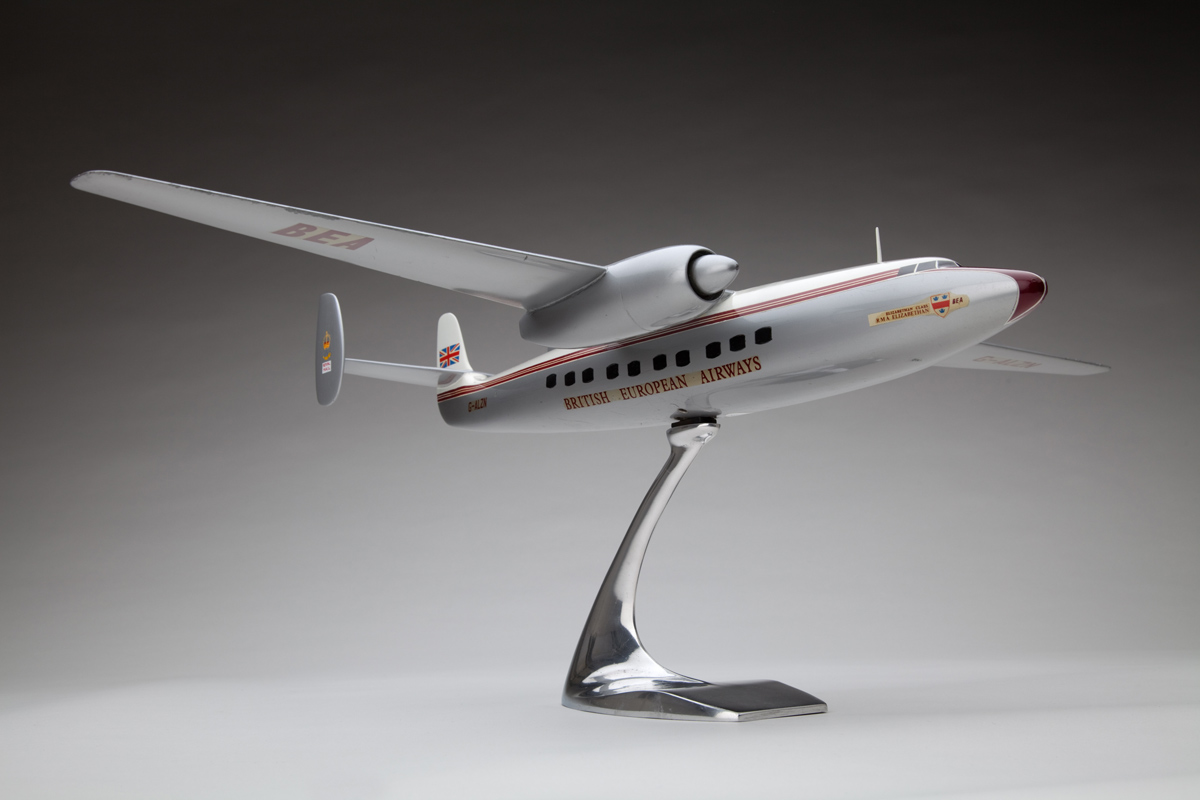
Shawcraft Models, Uxbridge, England BEA Airspeed AS.57 Ambassador 1950s
Scale 1:48
Wood, metal, paint
Collection of Anthony J. Lawler
In 1946, BEA (British European Airways) was formed as the British flag carrier for domestic and Continental Europe flights. By 1947, a number of independent airlines, including Scottish Airways, had merged with the company. In 1948, BEA placed an order for twenty of the Ambassador, a Douglas DC-3 replacement that had been under development by Airspeed of Great Britain since the latter years of World War II. This high-wing, tripletail, two-engine, mid-range aircraft was introduced in 1952 and operated by the airline until 1958. Shawcraft of Great Britain crafted the model of wood during the same decade, which accurately represents the Ambassador RMA Elizabethan, the flagship of the fleet. BEA’s comfortable Ambassador service, which was named “Elizabethan Class,” became highly popular among commuters between Britain and the Continent.
Text from the SFO Museum website
Peter V. Nelson, Reading, England Ethiopian Air Lines Convair 240 model aircraft
Early 1950s
Scale 1:48
Metal, paint
Collection of Anthony J. Lawler
Ethiopian Air Lines was founded in 1946 and began operating out of Addis Ababa Airport in 1947, with administrative, managerial, and flight crew support from TWA (Transcontinental & Western Airlines). In 1950, the airline acquired three Convair 240s in order to expand its routes and offer international service to Europe and Asia. These aircraft were produced by Convair of San Diego, California and developed to replace the Douglas DC-3. The sand-casted metal model represents the first aircraft to be delivered, ET-T-20, and was crafted by Peter V. Nelson in Great Britain during the same period. It was accurately painted in Ethiopian Air Lines’ vibrant early livery with the national colours of red, yellow, and green, and the Lion of Judah, the symbol of Ethiopia’s former ruler Haile Selassie – whose family traces their origins to King Solomon. Selassie played a major role in establishing the national airline, which was considered vital to the modernisation of Ethiopia after World War II.
Text from the SFO Museum website
Walkers Westway Models, London, England Capital Airlines Vickers Viscount model aircraft
1950s
Scale 1:48
Metal, paint
Collection of Anthony J. Lawler
Capital Airlines originated out of a merger between Pennsylvania and Central Airlines to form Pennsylvania Central Airlines or PCA in 1936. In 1941, the airline moved its headquarters to the newly built Washington National Airport, and in 1948, changed its name to Capital Airlines. In 1955, in an effort to attract more passengers by offering technologically advanced aircraft, it became the first U.S. carrier to inaugurate turboprop-powered airliner service with the introduction of the British produced Vickers Viscount. The aircraft was originally introduced by BEA (British European Airways) in 1950, which made it the first of its kind to go into service, and moreover, it was years ahead of the introduction of other turboprop airliners. Capital purchased sixty of the aircraft and realised an increased market share nearly everywhere the Viscount flew. This sand-cast metal model was produced in the 1950s by Walkers Westway in London, England, and accurately painted in Capital’s iconic 1950s red, white, and blue livery with eagle logo.
Text from the SFO Museum website
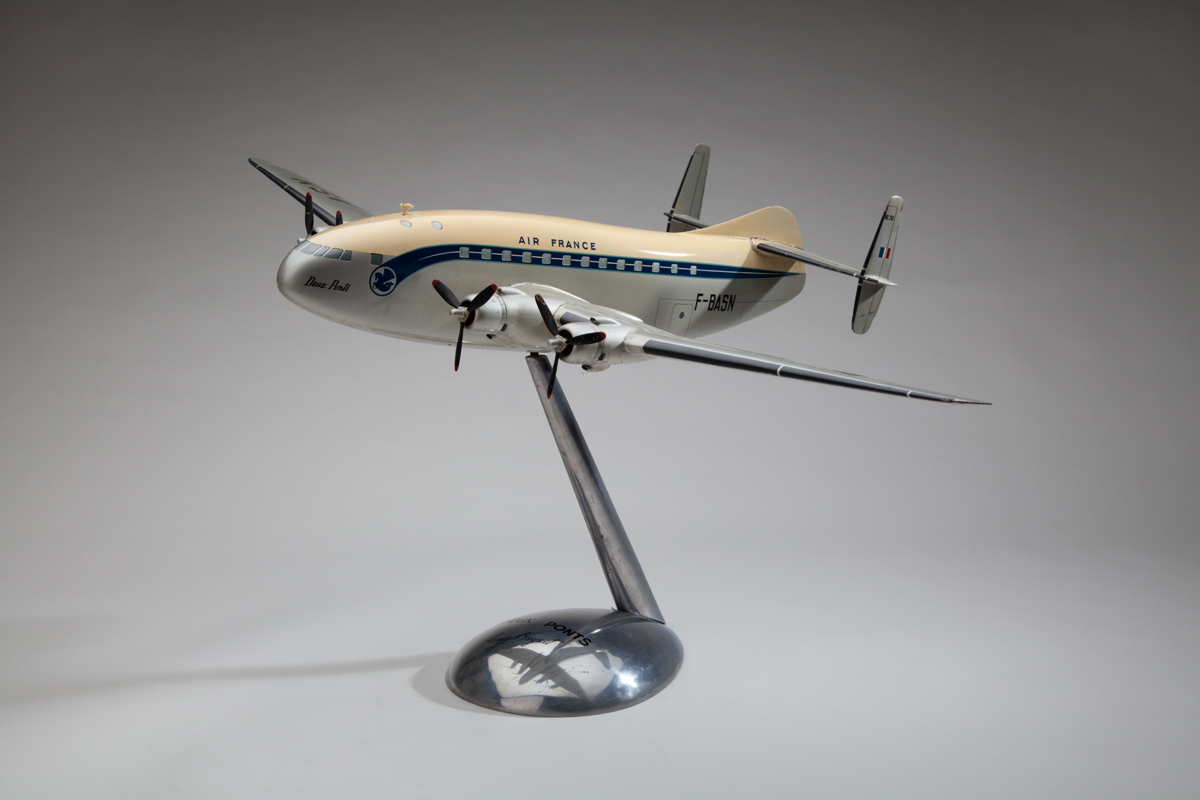
La Maquette d’Etude et d’Exposition à Aubervilliers, France Air France Breguet 763 Provence 1950s
Scale 1:50
Wood, plastic, metal, paint
Collection of Anthony J. Lawler
Created in 1933 through a merger of several French aviation concerns, Air France became one of the largest airlines in Europe by the late 1930s, with routes throughout Europe and to French colonies in North Africa and Asia. During World War II, the carrier moved its base of operation to Morocco, and by 1946, became nationalized by the French government and opened its first terminal in central Paris. During the latter years of the war, the French aircraft manufacturer Breguet began designing a large capacity, mid-range airliner that would ultimately become the double deck (Deux Ponts in French), twin-tail, four-engine 763 Provence. Air France ordered twelve of the aircraft, which entered service in 1953 and were operated on routes to Algiers and Southern Europe for carrying both passengers and freight. Crafted from wood by the French model maker La Maquette d’Etude et d’Exposition à Aubervilliers, the model represents the first aircraft delivered to Air France, F-BASN.
Text from the SFO Museum website
Immediately following the end of World War II in 1945, airlines and passengers benefited from a surplus of inexpensive, advanced propeller-driven transport aircraft, or “propliners.” Over the next fifteen years, commercial aviation expanded rapidly as airlines persistently requested improved propliner designs to lower costs, attract new customers, and gain advantages over competitors. In meeting these demands the manufacturers of North America and Europe developed increasingly superior aircraft. These included the jet-powered turboprop airliners that flew successively faster, higher, and farther.
Making scale models of these airliners was an important part of the design, manufacturing, and marketing process during this period. Crafted by in-house model shops or independent model makers, they represented the new designs in miniature for convenient three-dimensional analysis. Accurately painted livery schemes on the models helped the airlines to imagine the new airliner operating within their fleet. Carriers also commissioned the making of models to promote their improved services in airline offices and travel agencies. During the late 1940s and early 1950s, they were usually made of sheet or cast metal and complemented with metal bases often formed into unique streamline shapes. By the late 1950s, models began to be produced from plastic, which was easier to mold into intricate shapes and reflected the proliferation of new synthetic resins.
These models represent the age of postwar propliners, which lasted until the 1960s when faster, more fuel-efficient and propeller-less turbojet airliners began to supersede them. They are from the collection of Anthony J. Lawler, an aviation industry professional and avid airplane model collector since first seeing the De Havilland Comet – the world’s first jetliner – fly over his boyhood home in Rhodesia. Mr. Lawler has spent decades assembling one of the finest collections of scale airliner display models, most of which were acquired while working as a senior sales representative for Airbus North America during the 1980s and 1990s. His collection spans a century of commercial aviation design innovation.
Text from the SFO Museum website
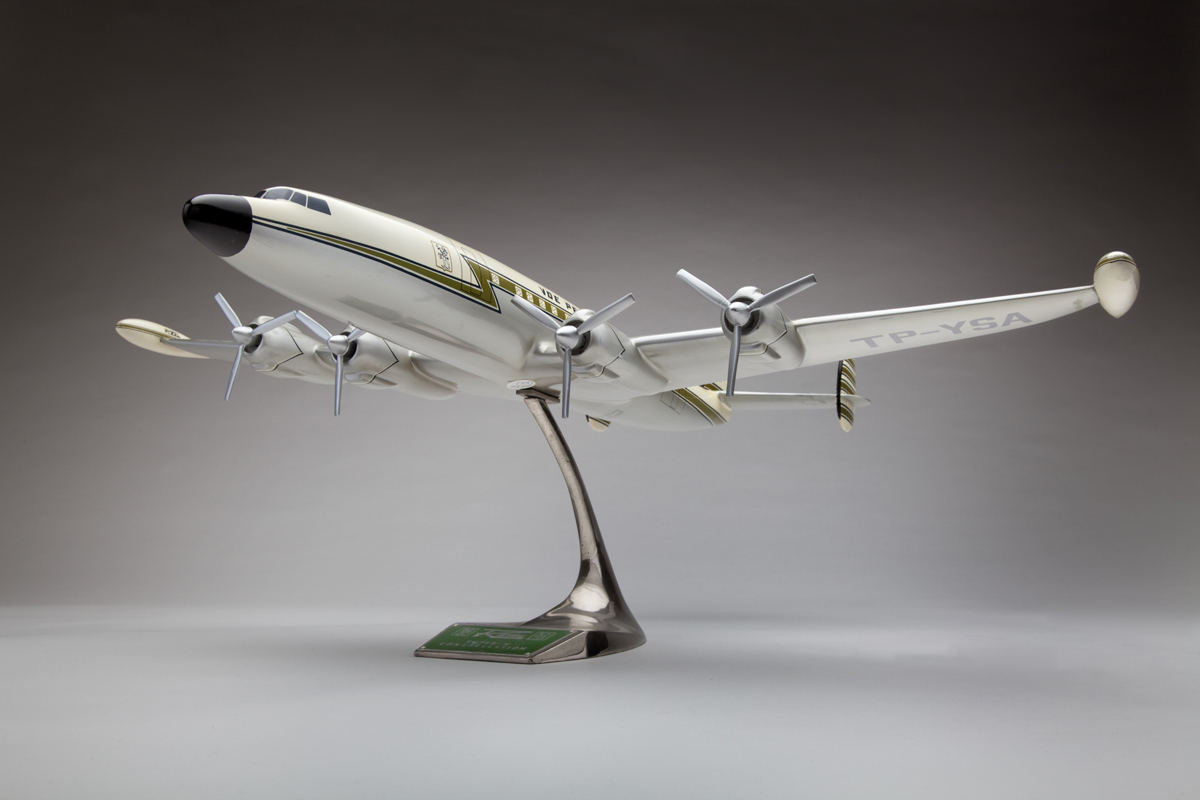
Raise-Up Models, Rotterdam, Netherlands REAL (Redes Estaduais Aéreas Limitadas) Transportes Aéreos Lockheed 1049H Super Constellation 1950s
Metal, paint
Collection of Anthony J. Lawler
In 1945, Vicente Mammana Netto and Linneu Gomes formed REAL (Redes Estaduais Aéreas Limitadas) Transportes Aéreos, as a small regional Brazilian airline. By the mid-1950s, the airline had grown substantially by acquiring numerous other Brazilian airlines and expanding its routes through South America. In 1958, in order to compete with its rival Varig, REAL acquired three long-range Lockheed 1049H Super Constellations. The next year, the airline inaugurated international service between Rio de Janeiro and Los Angeles with stops in Manaus-Ponta Pelada, Bogotá, and Mexico City. By 1960, REAL had expanded its Constellation service to include trans-pacific flights to Tokyo. Ultimately, however, the international service proved too costly for the airline, and in 1961, amid financial difficulties, it was acquired by Varig. Raise-Up Models of the Netherlands produced the cast-metal model of the REAL Super Constellation. It was painted in the airline’s eye-catching green livery of the late 1950s, with the slogan “Voe Pela REAL,” meaning, “Fly on REAL” in Portuguese.
Text from the SFO Museum website
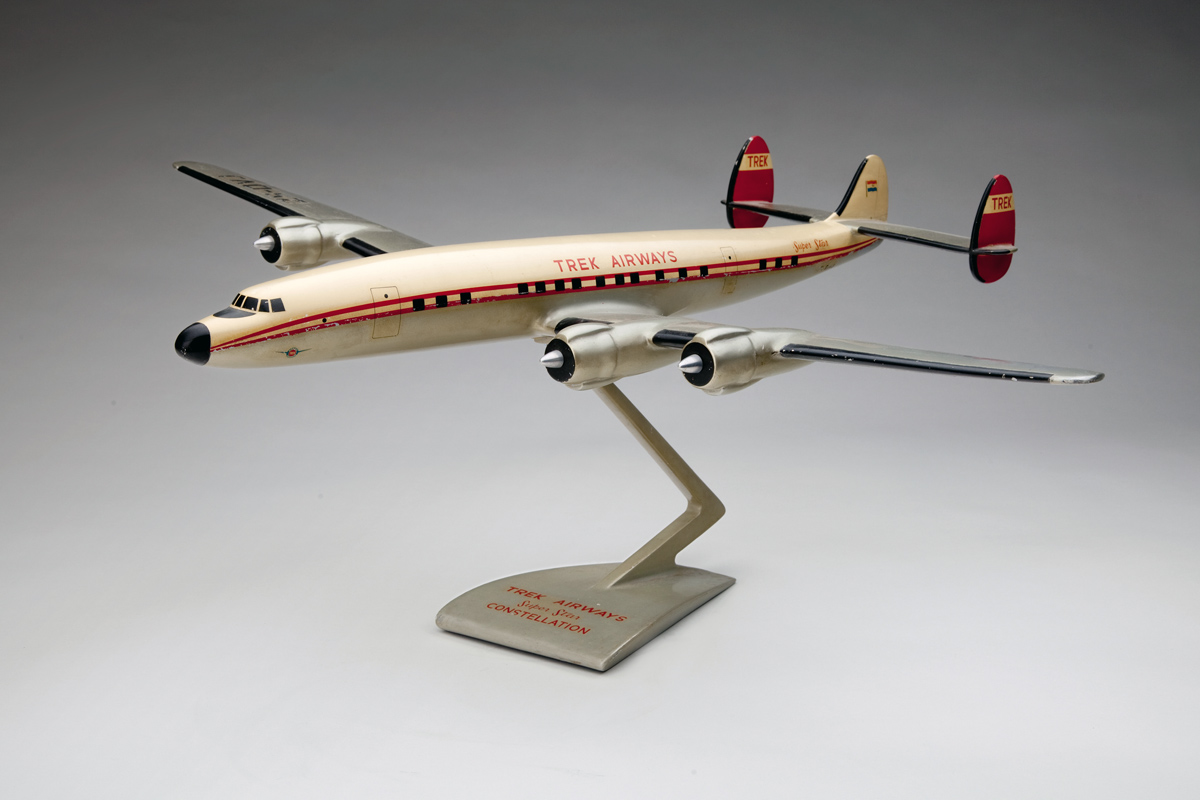
Peter V. Nelson, Reading, England Trek Airways Lockheed 1649 Starliner Early 1960s
Scale 1:62
Metal, paint
Collection of Anthony J. Lawler
Founded in 1953, Trek Airways was a South African airline based out of Johannesburg with service to Northern Europe. Initially, Trek was equipped with Vickers Vikings, which required overnight stops on routes to Europe. By the early 1960s, the airline began acquiring long-range Lockheed 1649 Starliners from carriers like TWA (Trans World Airlines) and Lufthansa, which had begun to replace these models with jetliners such as the Boeing 707 and Douglas DC-8. The Starliner provided fast, smooth, and comfortable service, along with the range and speed necessary for limited stops on routes to Düsseldorf, Vienna, and Luxembourg. British model maker Peter V. Nielson crafted the Starliner model for the airline in the early 1960s. At the time of acquisition, the heavy, all-metal model was used as a doorstop for the airline’s storeroom.
Text from the SFO Museum website
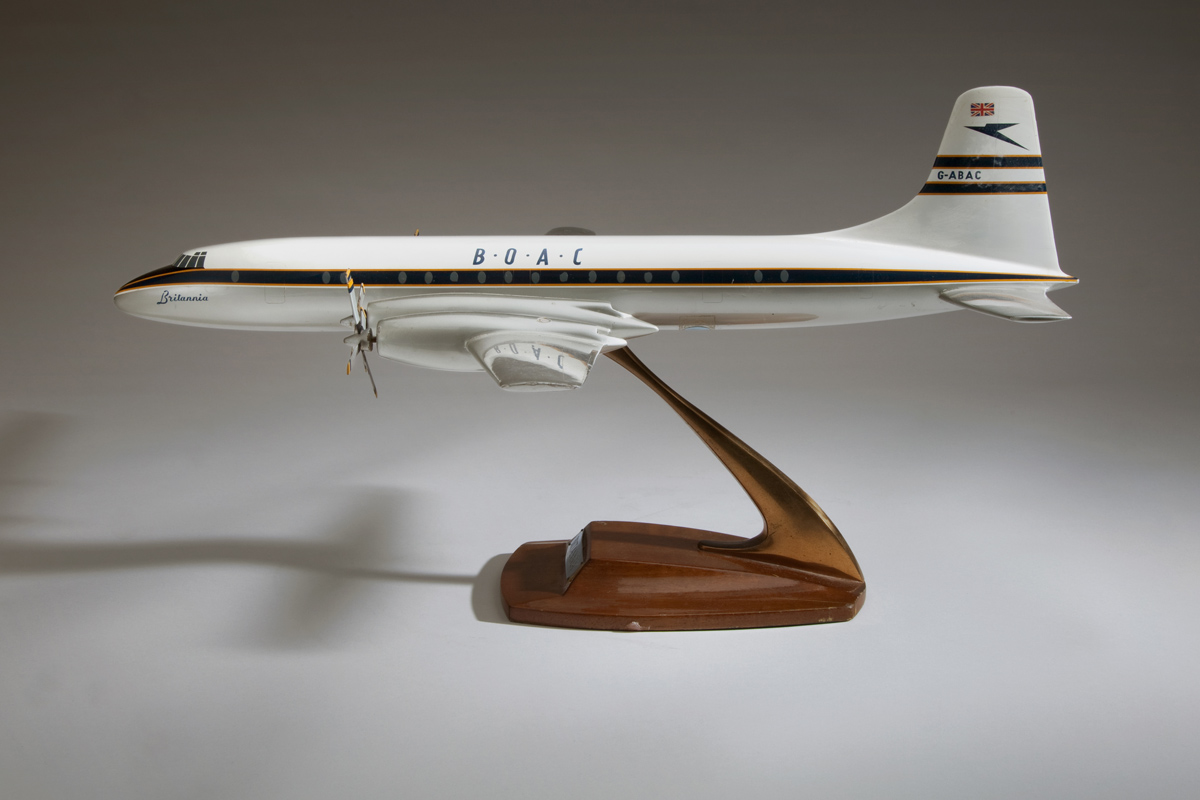
Westway Models, London, England BOAC Bristol Britannia 300 Late 1950s
Scale 1:72
Metal, plastic, wood, paint
Collection of Anthony J. Lawler
In 1957, Britain’s long-haul international flag carrier BOAC (British Overseas Airways Corporation) introduced the Bristol Aircraft Company’s turboprop Britannia on its routes to South Africa and New York. Two years later, the airline inaugurated the first regular round-the-world Britannia service via San Francisco, Hong Kong, and Tokyo. The large capacity, long-range, jet-prop-powered airliner, nicknamed the “Whispering Giant,” was significantly quieter than piston-engine airliners of the period and provided smooth, fast service with comfortable accommodations. Due to many delays in its development, the airliner was introduced later than anticipated and only operated into the early 1960s, before it was replaced by faster jetliners with similar range and capacity, such as the Boeing 707. The all-metal model was crafted in England by Westway, a prominent builder of airliner models for the British aerospace industry during the 1950s.
Text from the SFO Museum website
Raise-Up Models, Rotterdam, the Netherlands Western Airlines Lockheed L-188 Electra model aircraft
Late 1950s
Scale 1:40
Metal, paint
Collection of Anthony J. Lawler
Western Air Express was founded in 1925, and after several mergers and name changes, became Western Air Lines in 1941. During the postwar era, Western quickly grew as a regional airline serving routes from Minneapolis, Minnesota, to the West Coast. In 1959, the airline began receiving delivery of the Lockheed L-188 Electra, a new, revolutionary turboprop airliner developed and produced by Lockheed Aircraft of Burbank, California. With medium range, a cruise speed of nearly four hundred miles per hour, and a capacity for approximately one hundred passengers, the Electra was ideal for Western’s regional needs and, initially, was instrumental in attracting a larger customer base. This large-scale model was fabricated of metal by Raise-Up Models of Rotterdam, Holland, and was painted to represent one of the first aircraft received from Lockheed in Western’s late 1950s red-and-white livery with the Native American logo.
Text from the SFO Museum website
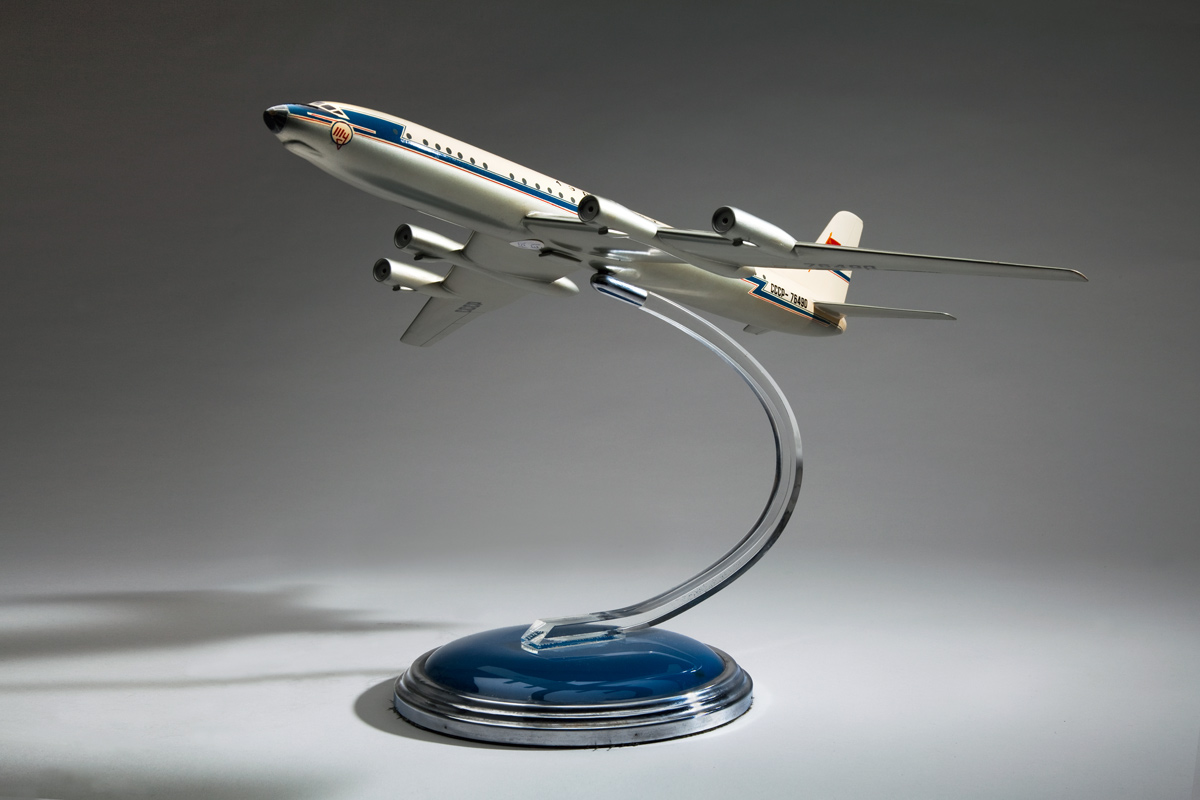
U.S.S.R. Aeroflot Tupolev Tu-114 Rossiya Early 1960s
Scale 1:100
Metal, paint, plastic
Collection of Anthony J. Lawler
SFO Museum
San Francisco International Airport
P.O. Box 8097
San Francisco, CA 94128 USA Phone: 650.821.6700
Curator: Dr Nicholas Cullinan, Curator of International Modern Art at Tate Modern.
Many thankx to the Dulwich Picture Gallery for allowing me to publish the images in the posting. Please click on them for a larger version of the image.
“I would’ve liked to have been Poussin, if I’d had a choice, in another time.”
Cy Twombly
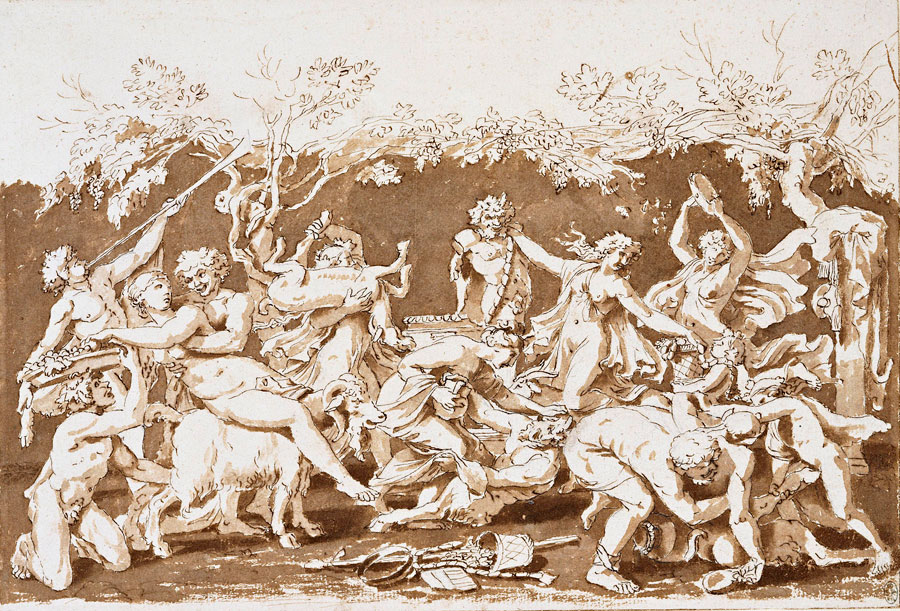
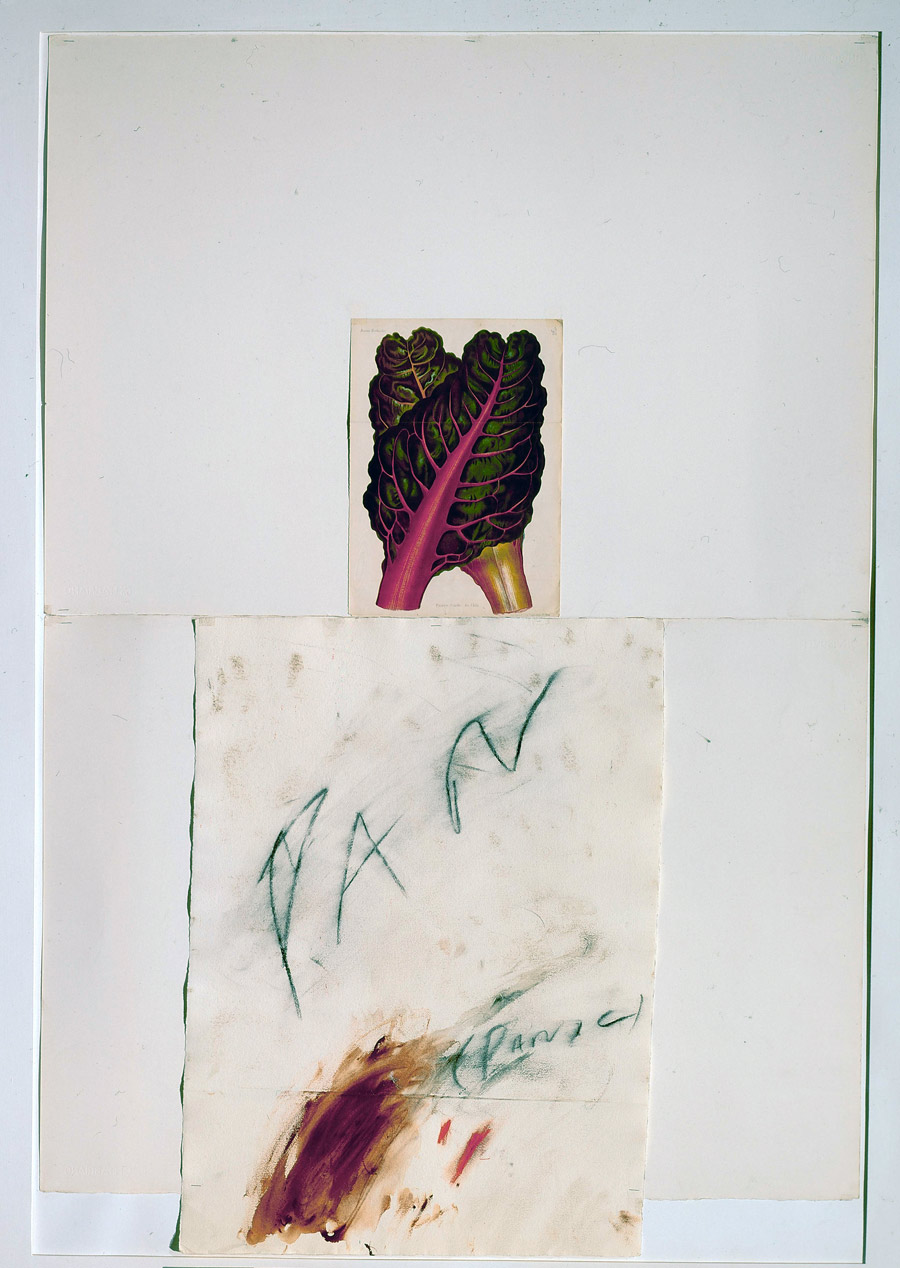
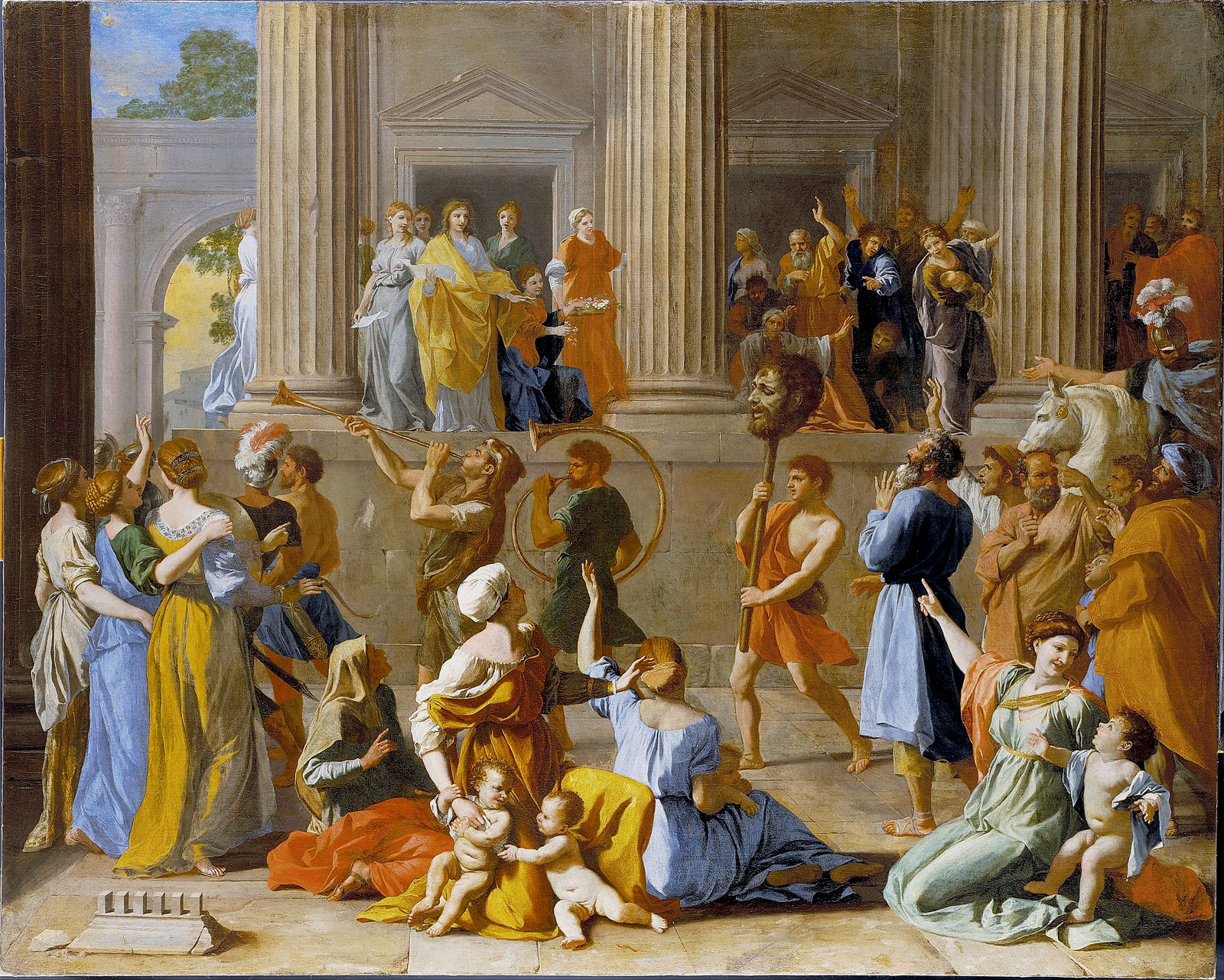
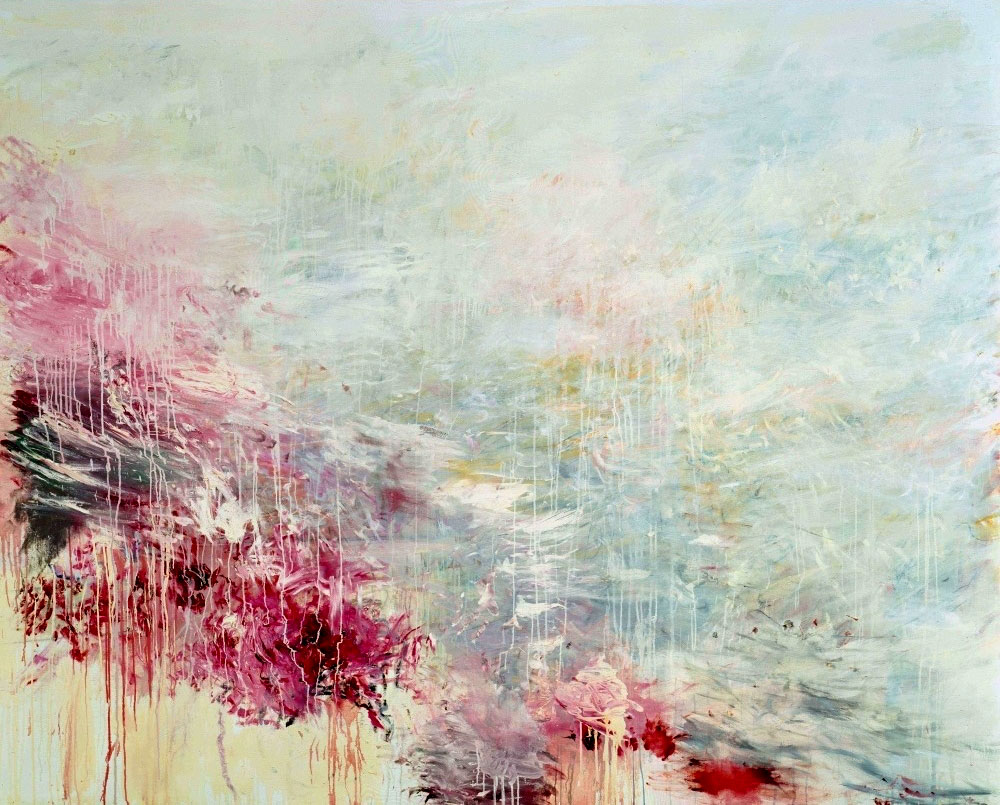
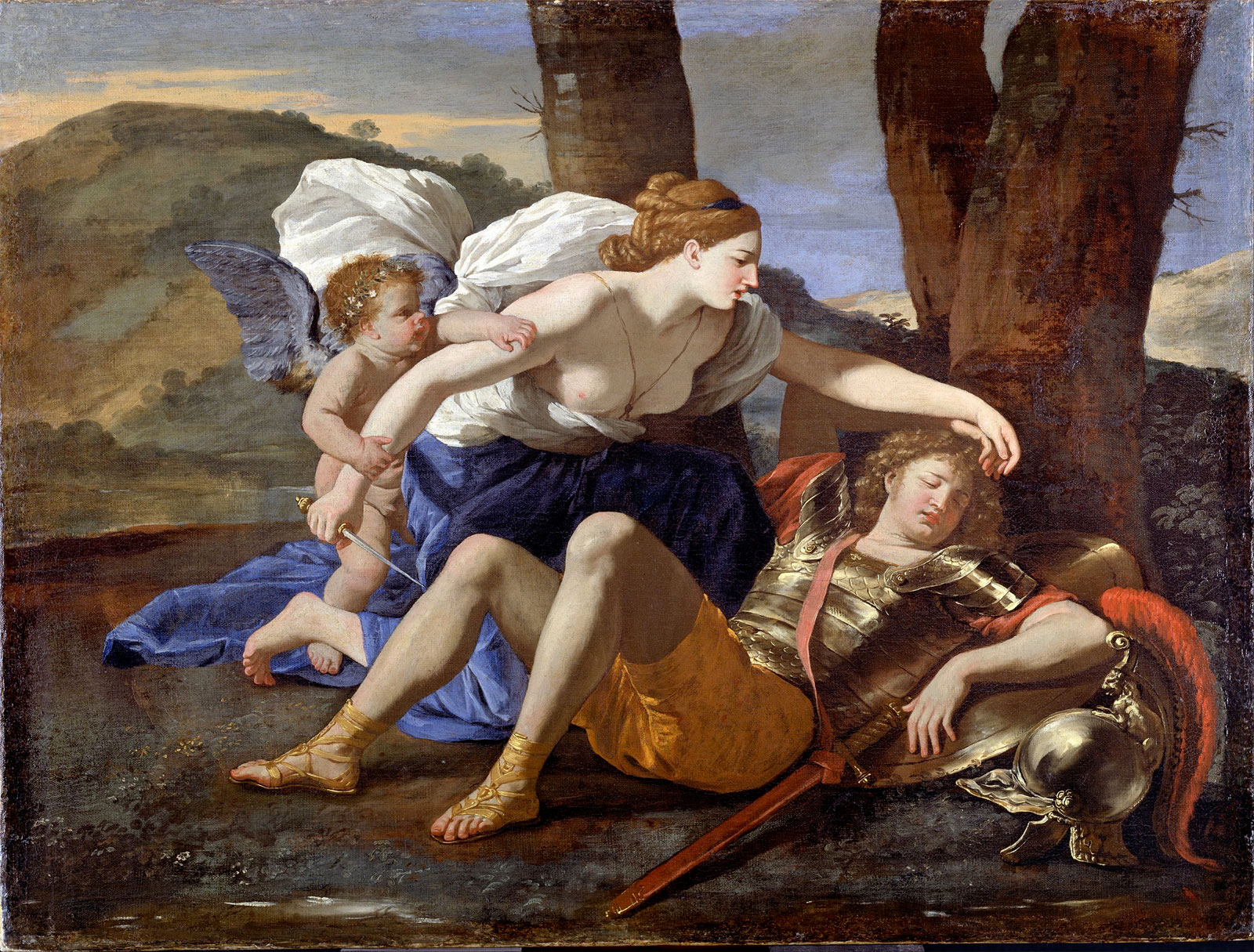
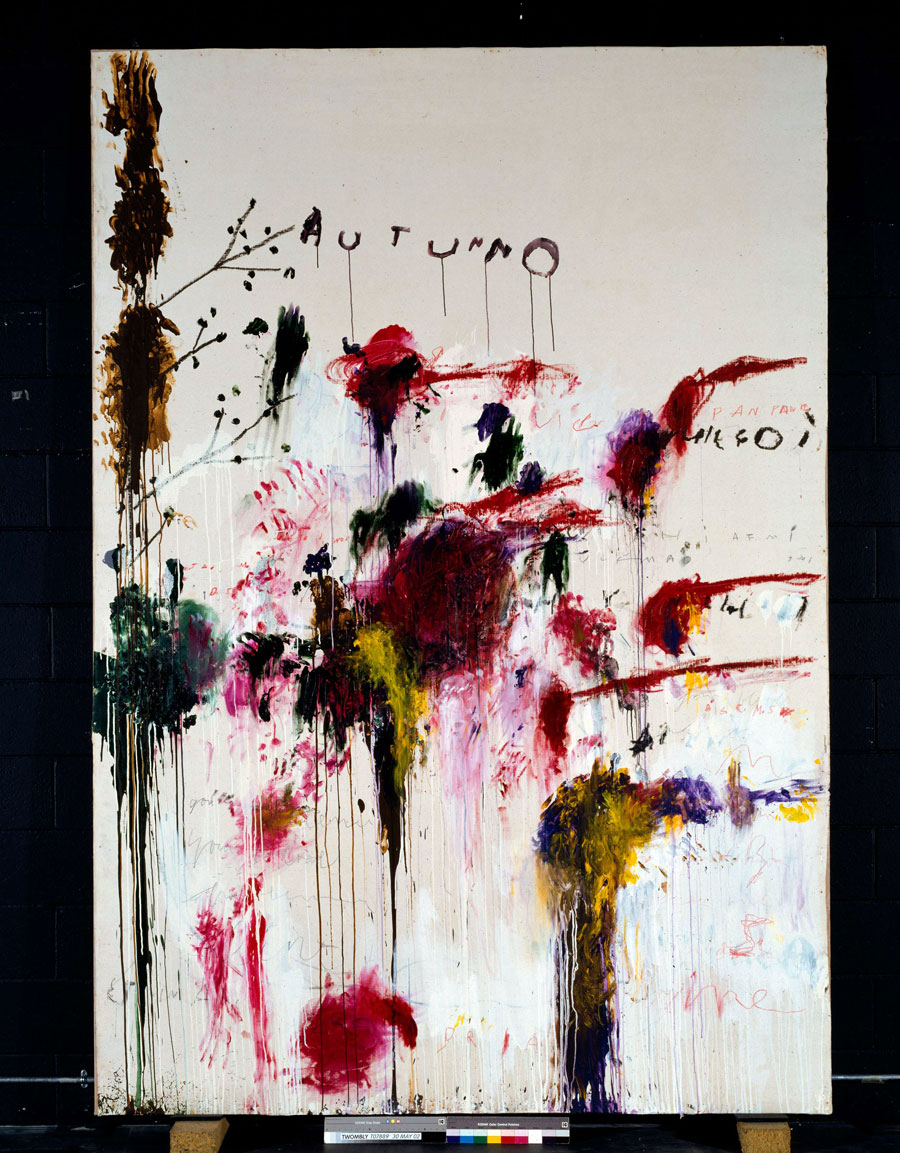
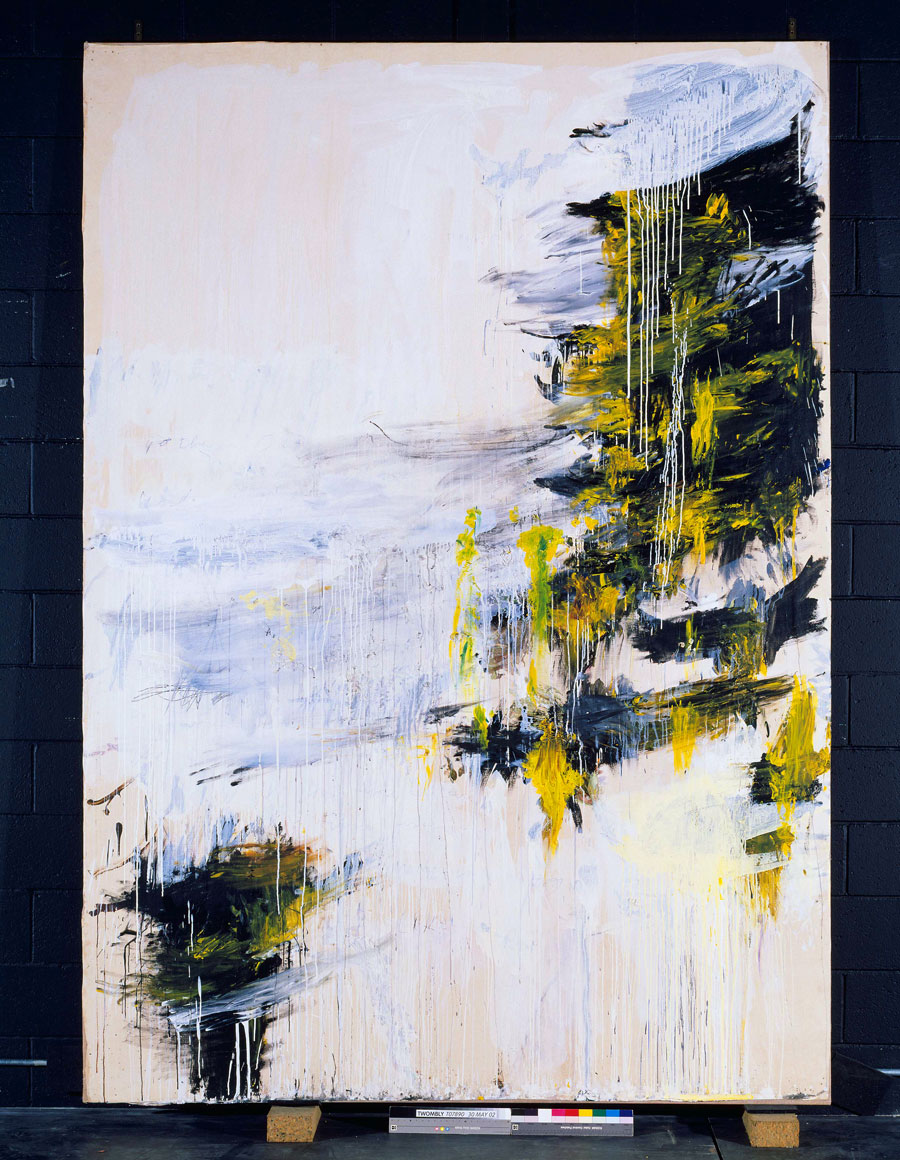
Dulwich Picture Gallery is proud to announce a revelatory exhibition of the work of Cy Twombly and Nicolas Poussin. Organised to celebrate the Bicentenary of the Gallery, this major show will explore, for the first time, the unexpected yet numerous parallels and affinities between the two artists. The exhibition will draw upon the world-class permanent collection of works at Dulwich Picture Gallery by Nicolas Poussin, alongside other works from major collections around the world by both Poussin and Twombly.
In 1624 and 1957, the two artists, aged around thirty, moved to Rome. Nicolas Poussin and Cy Twombly subsequently spent the majority of their lives in the Eternal City, and went on to become the pre-eminent painters of their day. Rather than recent exhibitions that have sought to compare and contrast old masters with contemporary artists through superficial visual appearances, this groundbreaking show will instead juxtapose works which may seem radically disparate in terms of style, yet ones that share deep and timeless interests. Both Poussin and Twombly were artists of prodigious talent who found in the classical heritage of Rome a life-long subject. Both spent their lives studying, revivifying and making newly relevant for their own eras antiquity, ancient history, classical mythology, Renaissance painting, poetry and the imaginary, idealised realm of Arcadia.
Curated by Dr. Nicholas Cullinan, Curator of International Modern Art at Tate Modern, the exhibition examines how Twombly and Poussin, although separated by three centuries, nonetheless engaged with the same sources and will explore the overlapping subjects that the two artists have shared. It will consist of around thirty carefully-chosen paintings, drawings and sculptures, structured thematically around six sections devoted to key shared themes, from both artists’ early fascinations with Arcadia and the pastoral when they first moved to Rome, Venus and Eros, Anxiety and Theatricality, Apollo, Parnassus and Poetry, Pan and the Bacchanalia, through to the theme of The Four Seasons.
The exhibition will be accompanied by the British premiere of Tacita Dean’s new 16mm film portrait of Cy Twombly, Edwin Parker (2011). The film documents Twombly in his studio in Lexington, Virginia, and follows on from Dean’s series of filmed depictions of subjects such as the choreographer Merce Cunningham, the poet Michael Hamburger and the artist Mario Merz, where the inner life of the sitter is implied through their physical demeanour and surroundings. A series of talks will also accompany the exhibition, including Sir Nicholas Serota, Director of Tate, in conversation with Dr. Nicholas Cullinan on the topic of curating Twombly, and Malcolm Bull (Ruskin School of Drawing, University of Oxford) and T. J. Clark (Professor Emeritus of Modern Art at the University of California, Berkeley; and Visiting Professor, University of York) who will discuss the work of Poussin and Twombly and the themes raised by the exhibition.
Ian Dejardin, Director of Dulwich Picture Gallery explains that the exhibition “fits in with a philosophy I have pursued here – that exhibitions can conduct a dialogue with the permanent collection. In the past Howard Hodgkin, Lucian Freud and Paula Rego have all hung their paintings within the collection, so Poussin and Twombly seemed like a natural extension of those experiments.”
The exhibition has received enthusiastic support and loans from major private and public collections around the world, including The National Gallery and Tate in London; The Royal Collection; The Duke of Devonshire; The Fitzwilliam Museum, Cambridge; Museo del Prado, Madrid; The Brandhorst Museum, Munich and The Art Institute of Chicago. The exhibition has been developed in close collaboration with Cy Twombly himself, and will include works that have never been exhibited before.
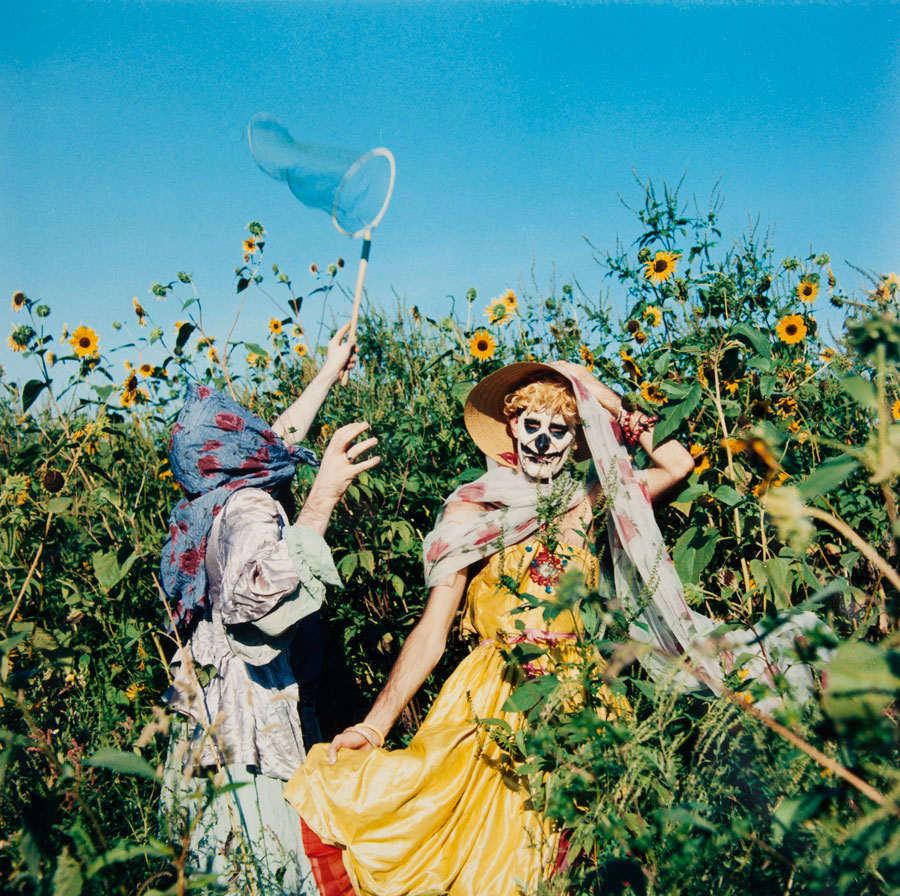
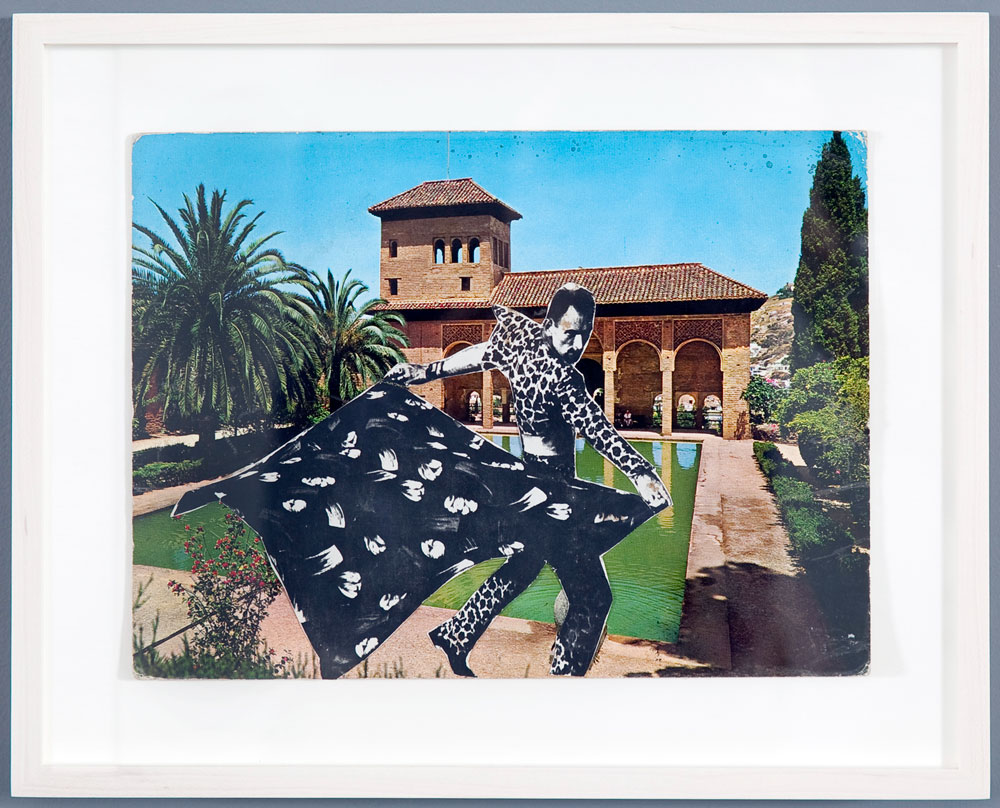
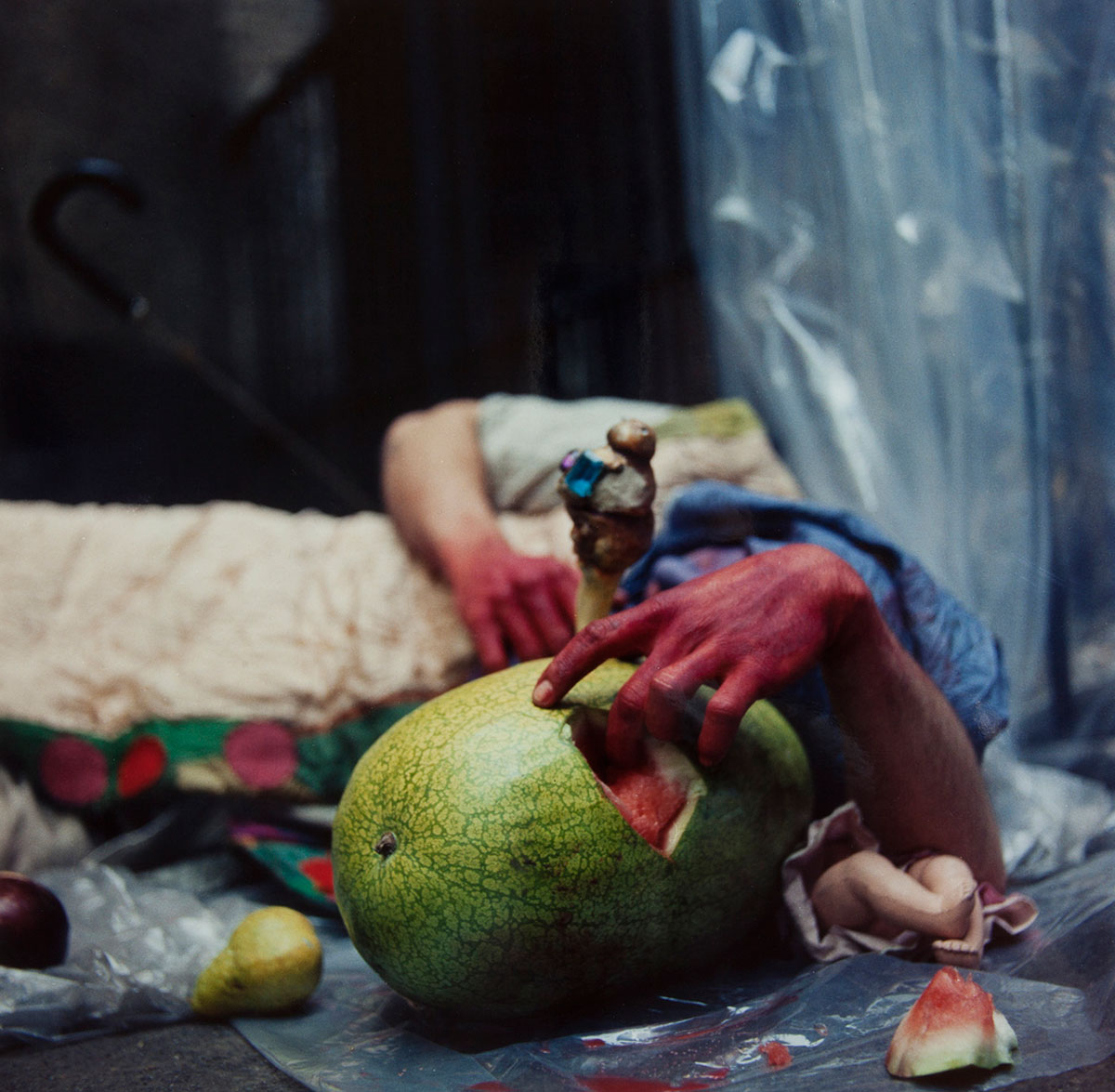
Jack Smith (American, 1932-1989) Untitled
c. 1958-1962/2011
Analog C-print hand printed from original colour negative on Fuji Crystal Archive paper
14 x 11 inches (35.6 x 27.9cm)
Copyright Estate of Jack Smith
Courtesy Gladstone Gallery, New York and Brussels
His photographic works are rare and remain largely unknown according to Wikipedia. They shouldn’t be.
Dr Marcus Bunyan
Many thankx to the ICA for allowing me to publish the photographs in the posting. Please click on the photographs for a larger version of the image.
Jack Smith: A Feast for Open Eyes
‘The only true underground filmmaker’ – John Waters
ICA director Gregor Muir introduces the work of Jack Smith in this two week season. Jack Smith: A Feast for Open Eyes is on from 7 – 18 September 2011
Jack Smith (American, 1932-1989) Untitled
1982
Mixed media on paper
6 1/8 x 8 7/8 inches (15.6 x 22.5cm)
Copyright Estate of Jack Smith
Courtesy Gladstone Gallery, New York and Brussels
Jack Smith (American, 1932-1989) Untitled
c. 1958-1962/2011
Black and white gelatin silver print
10 x 8 inches (25.4 x 20.3cm)
Copyright Estate of Jack Smith
Courtesy Gladstone Gallery, New York and Brussels
“Jack Smith (November 14, 1932 in Columbus, Ohio – September 25, 1989 in New York City) was an American filmmaker, actor, and pioneer of underground cinema. He is generally acclaimed as a founding father of American performance art, and has been critically recognised as a master photographer, though his photographic works are rare and remain largely unknown.
Smith was one of the first proponents of the aesthetics which came to be known as ‘camp’ and ‘trash’, using no-budget means of production (e.g. using discarded colour reversal film stock) to create a visual cosmos heavily influenced by Hollywood kitsch, orientalism and with Flaming Creatures created drag culture as it is currently known. Smith was heavily involved with John Vaccaro, founder of The Playhouse of The Ridiculous, whose disregard for conventional theater practice deeply influenced Smith’s ideas about performance art. In turn, Vaccaro was deeply influenced by Smith’s aesthetics. It was Vaccaro who introduced Smith to glitter and in 1966 and 1967, Smith created costumes for Vaccaro’s Playhouse of The Ridiculous. Smith’s style influenced the film work of Andy Warhol as well as the early work of John Waters. While all three were part of the 1960s gay arts movement, Vaccaro and Smith refuted the idea that their sexual orientation was responsible for their art.
After his last film, No President (1967), Smith created performance and experimental theatre work until his death on September 25, 1989 from AIDS-related pneumonia.”
Jack Smith (American, 1932-1989) Untitled
c. 1958-1962/2011
Analog C-print hand printed from original colour negative on Fuji Crystal Archive paper
14 x 11 inches (35.6 x 27.9cm)
Copyright Estate of Jack Smith
Courtesy Gladstone Gallery, New York and Brussels
Legendary American artist, filmmaker and actor Jack Smith (1932-1989), described by Andy Warhol as the only person he would ever copy and by John Waters as “the only true underground filmmaker”, is celebrated at the Institute of Contemporary Arts (ICA) in film, performance and debate with a retrospective of Smith’s work from 7 to 18 September 2011.
Working in New York from the 1950s until his death in 1989, Smith unequivocally resisted and upturned accepted conventions, whether artistic, moral or legal. Irreverent in tone and delirious in effect, Smith’s films, such as the notorious Flaming Creatures (1963), are both wildly camp and subtly polemical. Smith is best known for his contributions to underground cinema but his influence extends across performance art, photography and experimental theatre.
A Feast for Open Eyes: Jack Smith maps out the breadth of Smith’s practice, from his collaborative film productions to his individual writings, and looks at his legacy in the UK drawing upon a generation of New York artists with whom Smith was closely involved, including Jonas Mekas and Penny Arcade, and younger artists and filmmakers whom he influenced. John Zorn, a long-term Smith collaborator selects records to accompany an installation of slides documenting Smith’s work, as he used to in collaboration with Smith in the 1970s and 80s.
The retrospective opens with a screening of Flaming Creatures introduced by Chris Dercon, Director of Tate Modern, who was a close friend of Smith’s. The film is followed by the screening of an interview, recorded exclusively for the ICA this summer, with Jonas Mekas, a founder member of Anthology Film Archives who faced obscenity charges for defending Flaming Creatures in the 1960s. The presentation is introduced by Dominic Johnson, author of the forthcoming monograph Glorious Catastrophe: Jack Smith, Performance and Visual Culture (Manchester University Press) and co-curator of A Feast for Open Eyes.
Press release from the ICA website
Jack Smith (American, 1932-1989) Untitled
c. 1978
Mixed media on paper
13 x 20 3/4 inches (33 x 52.7cm)
Copyright Estate of Jack Smith
Courtesy Gladstone Gallery, New York and Brussels
Jack Smith (American, 1932-1989) Untitled
c. 1958-1962/2011
Analog C-print hand printed from original colour negative on Fuji Crystal Archive paper
14 x 11 inches (35.6 x 27.9cm)
Copyright Estate of Jack Smith
Courtesy Gladstone Gallery, New York and Brussels
Jack Smith (American, 1932-1989) Untitled
c. 1958-1962/2011
Black and white gelatin silver print
10 x 8 inches (25.4 x 20.3cm)
Copyright Estate of Jack Smith
Courtesy Gladstone Gallery, New York and Brussels
Jack Smith (American, 1932-1989) Untitled
c. 1958-1962/2011
Black and white gelatin silver print
10 x 8 inches (25.4 x 20.3cm)
Copyright Estate of Jack Smith
Courtesy Gladstone Gallery, New York and Brussels
Jack Smith (American, 1932-1989) Untitled
c. 1958-1962
Color negative
2 1/4 x 2 1/4 inches (5.7 x 5.7cm)
Copyright Estate of Jack Smith
Courtesy Gladstone Gallery, New York and Brussels
Institute of Contemporary Arts
The Mall,
London,
SW1Y 5AH
Julia Margaret Cameron – you are one of my heroes!
Many thankx to the Musée d’Orsay for allowing me to publish the photographs in the posting. Please click on the photographs for a larger version of the image.
Consumed by the passion of unrequited love, a young woman lies suspended in the dark space of her unrealised dreams in Henry Peach Robinson’s illustration of the Shakespearean verse “She never told her love,/ But let concealment, like a worm i’ the bud,/ Feed on her damask cheek” (Twelfth Night II,iv,111-13). Although this picture was exhibited by Robinson as a discrete work, it also served as a study for the central figure in his most famous photograph, Fading Away, of 1858.
Purportedly showing a young consumptive surrounded by family in her final moments, Fading Away was hotly debated for years. On the one hand, Robinson was criticised for the presumed indelicacy of having invaded the death chamber at the most private of moments. On the other, those who recognised the scene as having been staged and who understood that Robinson had created the picture through combination printing (a technique that utilised several negatives to create a single printed image) accused him of dishonestly using a medium whose chief virtue was its truthfulness.
While addressing the moral and literary themes that Robinson believed crucial if photography were to aspire to high art, this picture makes only restrained use of the cloying sentimentality and showy technical artifice that often characterise this artist’s major exhibition pictures. Perhaps intended to facilitate the process of combination printing, the unnaturally black background serves also to envelop the figure in palpable melancholia.
Text from the Metropolitan Museum of Art website [Online] Cited 27/01/2020
The historian and art critic, John Ruskin, had a great influence in Great Britain not only on the Pre-Raphaelite movement created in 1848, but on the development of early photography in the 1850s. The leading Pre-Raphaelite painters, John Everett Millais, Dante Gabriel Rossetti, Holman Hunt and Ford Madox Brown and their followers, wished to change the pictorial conventions laid down by the Royal Academy, and in order to demonstrate the transformations in modern life, invented a radically new idiom marked by bright colours and clarity of detail.
Pre-Raphaelite painters and photographers frequently made similar choices of subjects, and the photographers, particularly Julia Margaret Cameron, David Wilkie Wynfield and Lewis Carroll, were often had close links with the painters.
When painting landscapes, the Pre-Raphaelite artists answered Ruskin’s call, meticulously observing nature in order to capture every nuance of detail. For their part, photographers, such as Roger Fenton, Henry White, William J. Stillman and Colonel Henry Stuart Wortley, experimented with the new process of wet plate collodion negatives that allowed much greater image detail, and achieved similar effects. Although highly impressed at first by the daguerreotype, which enabled the eye to see tiny, overlooked details, Ruskin was nonetheless still very critical of landscape photography, which could not reproduce the colours of nature and in particular of the sky. This failing also gave rise to a major debate amongst photography critics.
In portraiture, there were clear links between the painted portraits of Watts and Cameron’s photographic portraits. By using special lenses and photographing her models in close-up, Cameron, achieved, with a glass negative, exactly the opposite effect to the clear image advocated by Ruskin, and her work was distinctive for the breadth of relief and contour, as well as the compositions evoking Raphael’s paintings, also a source of inspiration for Watts.
The painter Dante Gabriel Rossetti repeatedly drew and painted Jane Morris, a model with whom he was infatuated, and he asked Robert Parsons to produce a series of photographs, under his personal direction, which captured the fascinating presence of the young woman as effectively as his own paintings.
Just like the Pre-Raphaelite painters, Victorian photographers would turn to religious or historical subjects, finding a shared inspiration in the poems of Dante, Shakespeare and possibly Byron, and above all in the Arthurian legend made popular once more by Lord Tennyson, the poet laureate. From a formal point of view, Millais’ Ophelia, one of his most successful paintings, was a source for Henry Peach Robinson’s photograph, The Lady of Shalott, even though it had a different theme.
Finally, Pre-Raphaelite painters and Victorian photographers both liked to present scenes from modern life with a moralising undertone: hence She Never Told Her Love, a photograph by Robinson that was very successful when exhibited at the Crystal Palace in 1858, William Holman Hunt’s painting, Awakening of Conscience, and Rossetti’s Found, a painting depicting a countryman who comes across his former sweetheart, now a prostitute in the city.
In the 1880s, Pre-Raphaelite painting would be transformed, with artists and writers like William Morris, Burne-Jones, Whistler and Oscar Wilde, into a very different movement concerned only with the cult of beauty and rejecting Ruskin’s concept of art as something moral or useful. British photographers, however, inspired by the Pre-Raphaelites would inspire the Pictorialist movement that flourished in the 1890s, encouraged by the writings of Henry Peach Robinson and Peter Henry Emerson, extolling artistic photography.
You must be logged in to post a comment.