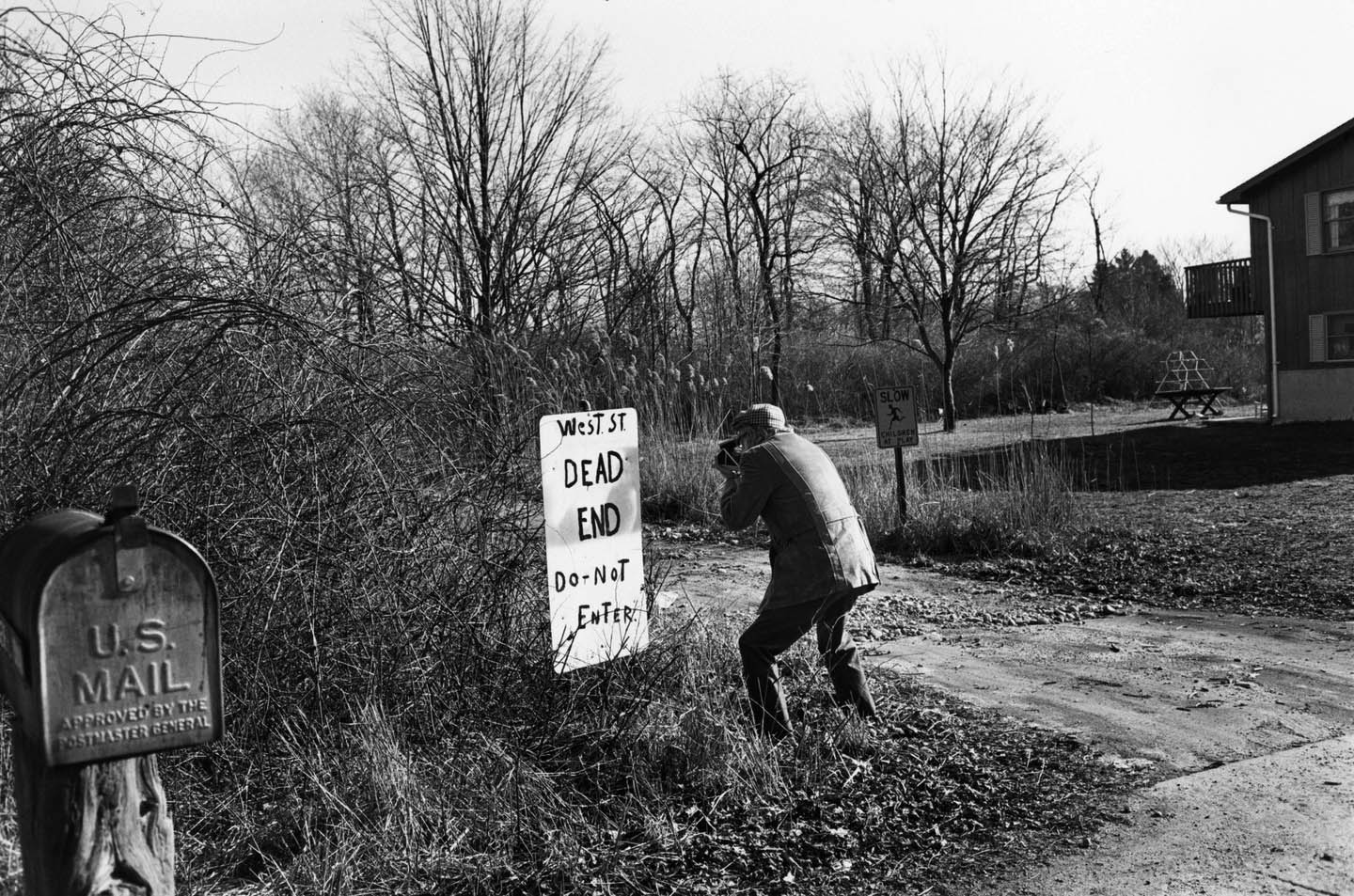
Exhibition: ‘Martin Parr: Global Warning’ at Jeu de Paume, Paris

“Through his surreal, dream sequences captured in pop colour, punctum laden reality, Parr observed the absurdities of life on this planet…” Dr Marcus Bunyan

Exhibition dates: 30th January – 24th May, 2026

Curators: Quentin Bajac, in collaboration with Martin Parr and Clémentine de la Féronnière


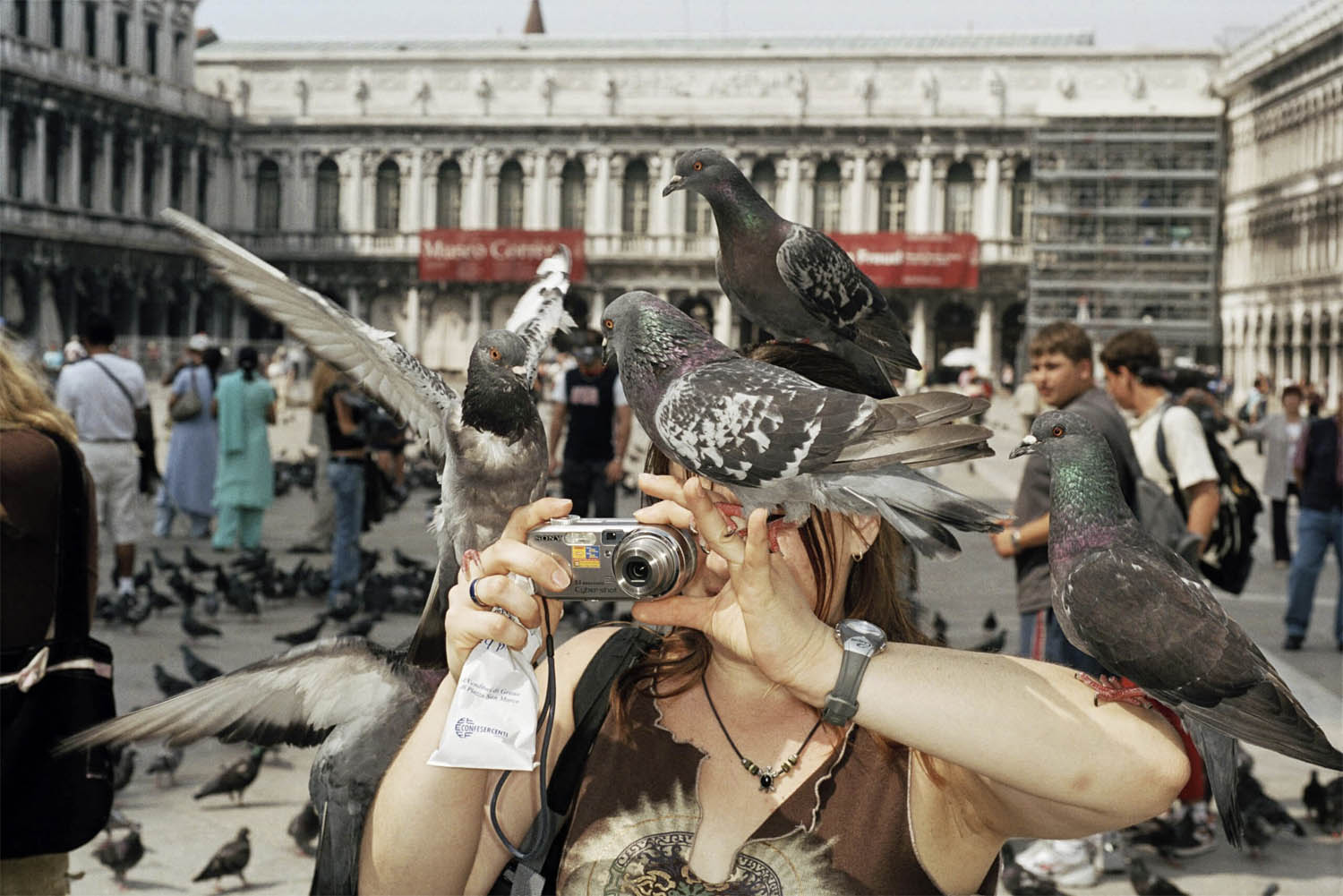
Martin Parr (English, 1952-2025) 'United Arab Emirates, Dubai' 2007


Martin Parr (English, 1952-2025)
United Arab Emirates, Dubai
2007
© Martin Parr / Magnum Photos


“Life is an act of consumption.

To consume is to live.”


From the film Jupiter Ascending 2015


“We are living in a time when, to borrow a phrase and book title of Sigmund Freud’s, civilization and its discontents are becoming painfully evident to us all. Our machine age technology with its private greed, ecologically disastrous policies, crass materialism, human alienation, incessant strife and conflict, and the portent of man’s destroying himself by his own recklessness, is taking its toll in terms of our confidence and optimism about life. …


John Anson Warner. “Introduction” to The Life & Art of the North American Indian. London: Hamlyn, 1975, p. 6.


A bewitching eye / the unfolding moment

A bewitching eye refers to eyes that are so powerfully, seductively attractive or charming that they appear to cast a spell, mesmerising or enchanting an onlooker. They possess an irresistible, magnetic allure that captivates the viewer, having an almost magical ability to draw someone in. This description could metaphorically be applied to the photographs of the legendary (and I don’t use that word lightly) contemporary British photographer Martin Parr (1952-2025).

Parr was an observer of life with a socially critical eye. Through his surreal, dream sequences captured in pop colour, punctum laden reality, Parr observed the absurdities of life on this planet – human, animal, inanimate – with curiosity and a sense of wonder even while questioning our path to destruction. While this exhibition is split into various sections – Leisure & waste lands; Last Chance To Buy; Small World; The Animal Kingdom; and Technological Addictions – in reality most of his images from each of the sections could fit into any other, for the whole world is interconnected in the excesses and grotesqueness of modern life, of civilization and its discontents.

Parr’s exploration of the pyschogeography of the urbanscape, the exploration of urban environments that emphasises interpersonal connections to places, is damming in its technicolor coat of glory. Mass tourism takes us to leisure spaces like the beach where technology is used to take selfies and mountains of waste pile up near the water’s edge. Mass human, mass cultivation (of palm oil or eucalyptus trees for example) is causing mass extinction of species across the planet. Mass consumption means that we are using the Earth’s resources indiscriminately to fuel (ha!) our desire for the latest, larger four-wheel drive we can get our hands on, the latest fashions that end up in landfill every 6 month cycle when they are not bought, or the brightest, pinkest, must luscious cup cakes you have ever seen in your life.

Parr’s colour saturated photos draw us into this consumptive world where the body is racked by disease, where the patient will soon be on life support. Through his mesmerising, enchanting, multilicious photographs he pokes a great big subversive stick at our follies, excesses, self-destructive desires. Unfortunately, while Parr’s photos seep into our subconscious, most images have little power to change public and personal opinion – all they can do is proffer alternate visions and interpretations of the world and hope that some glimmer of recognition of the environmental damage we are doing will permeate the mind of the viewer.

Of course, Parr’s famous photographs did not appear out of thin air. He was a dedicated photographer whose art practice required years of hard work, talent and skill to obtain his images. He emphasises that, “you have to look at the history of photography and learn what they have done and achieved and apply that, think about it and have it in the back of your head and then you can apply that to your own work.” By doing that, “you may have the rare opportunity actually to develop your own voice, and you can become a photographer with a particular voice.”

“What you are going to do, of course, is to find a good connection to the world out there. It is the quality of that connection that is really important. So, you find a subject you feel strongly about. Then work out how to articulate that and that hopefully will give you momentum for you to get good work.”

Nothing comes without hard work and perseverance.

In the video below where he is giving advice to young photographers he states that he might get only ten great photographs a year, sometimes only one, but he shoots heap of photographs and then discards the dross. What he also says that is really important is that he is attentive to the unfolding moment, he is aware and ready for what the energy of the world puts in front of his eye and his camera. If only the human race was so aware.

Parr was a human being that I would have really liked to have met. To have a conversation about the energy of the world, the passion and commitment of human beings to do good things, to see things differently, to make a difference.

We have his images for as long as the human race exists. But I miss him already.

Dr Marcus Bunyan


More postings on Martin Parr on Art Blart

~ Vale Martin Parr (English, 1952-2025), December 2025
~ Text/Exhibition: “Out in the midday sun” on the exhibition Martin Parr. Early Works at Fotografie Forum Frankfurt (FFF), September 2024 – February 2025
~ Exhibition: Glamour stakes: Martin Parr at Monash Gallery of Art, Melbourne, October – December 2016
~ Exhibition: Only in England: Photographs by Tony Ray-Jones and Martin Parr at Media Space at Science Museum, London, September 2013 – March 2014
~ Review: Martin Parr: In Focus at Niagara Galleries, Richmond, Melbourne, March 2012


Many thankx to Jeu de Paume for allowing me to publish the photographs in the posting. Please click on the photographs for a larger version of the image.


“l’m creating entertainment, which has a serious message if you want to read into it, but I’m not trying to convince anyone – l’m just showing them what they think they may know already.”


Martin Parr, 2021


“We are heading towards catastrophe but we are all going there together. Who would dare ban cars or air travel?”

“When I take a photograph, I try to say something. Beyond the garish colours, there is a political message…”


Martin Parr


I now realise that almost all the images I have taken and produced are indirectly linked to climate change.”


Martin Parr 2009


Global Warning gives us Parr in all his gluttonous, giddy glory, an attentive, unabashed and unpretentious observer of everyday absurdities. But through clever curatorial nudges, this show also gives us other unexpected sides to Parr, a creeping sense of a doom we are hurtling towards at breakneck speed.”


Charlotte Jansen. Martin Parr: Global Warning review – the great photographer in all his gluttonous, giddy glory,” on The Guardian website Mon 20 April 2026 [Online] Cited 21/04/2026


Martin Parr’s Advice to Young Photographers | Louisiana Channel

“You are probably going to fail, so unless you are obsessed, almost like a disease, you are not going to make it.” Legendary Martin Parr, regarded as the most crucial figure in contemporary British photography, offers advice to young photographers.

“What you are going to do, of course, is to find a good connection to the world out there. It is the quality of that connection that is really important. So, you find a subject you feel strongly about. Then work out how to articulate that and that hopefully will give you momentum for you to get good work.”

Another thing which is very important for Martin Parr to emphasise is that “you have to look at the history of photography and learn what they have done and achieved and apply that, think about it and have it in the back of your head and then you can apply that to your own work.” By doing that, “you may have the rare opportunity actually to develop your own voice, and you can become a photographer with a particular voice.”

Copyright: Louisiana Channel, Louisiana Museum of Modern Art, 2022

Text from the YouTube website


Martin Parr (English, 1952-2025) 'Galway Races, Ireland' 1997


Martin Parr (English, 1952-2025)
Galway Races, Ireland
1997
From the series Luxury
© Martin Parr / Magnum Photos


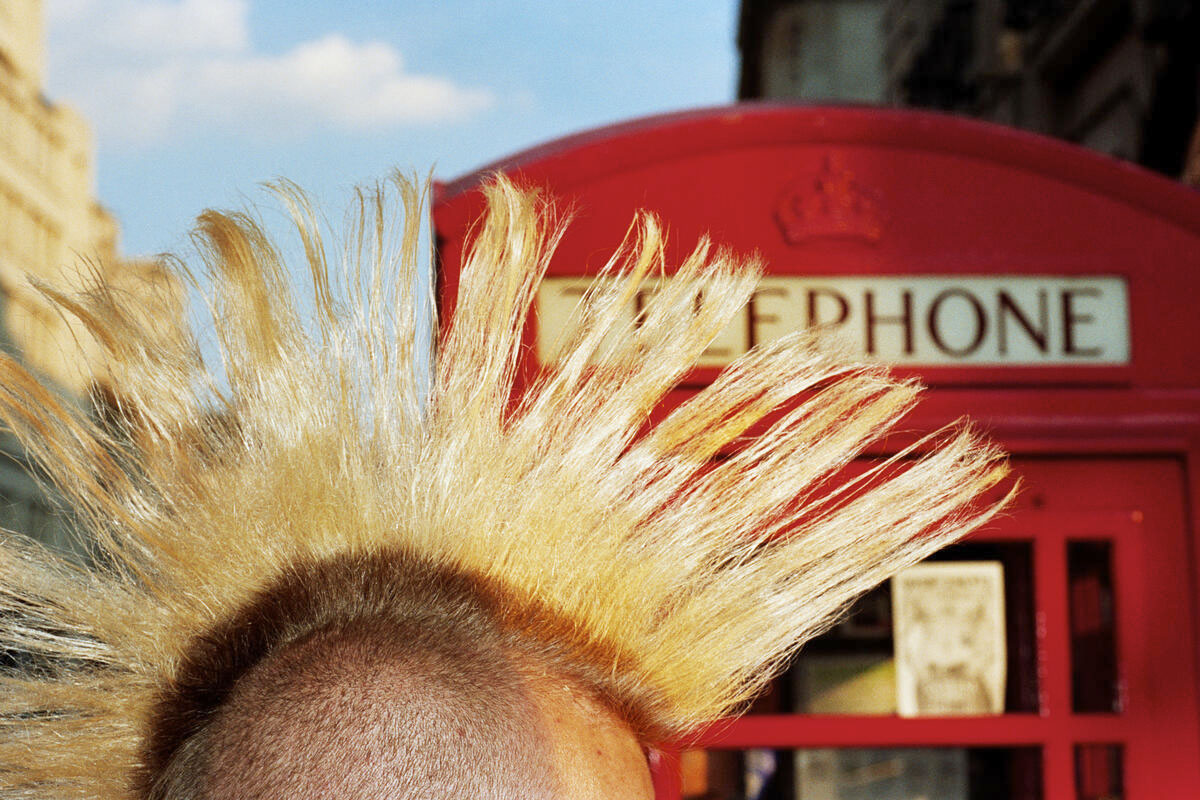
Martin Parr (English, 1952-2025) 'London, England' 1997


Martin Parr (English, 1952-2025)
London, England
1997
© Martin Parr / Magnum Photos


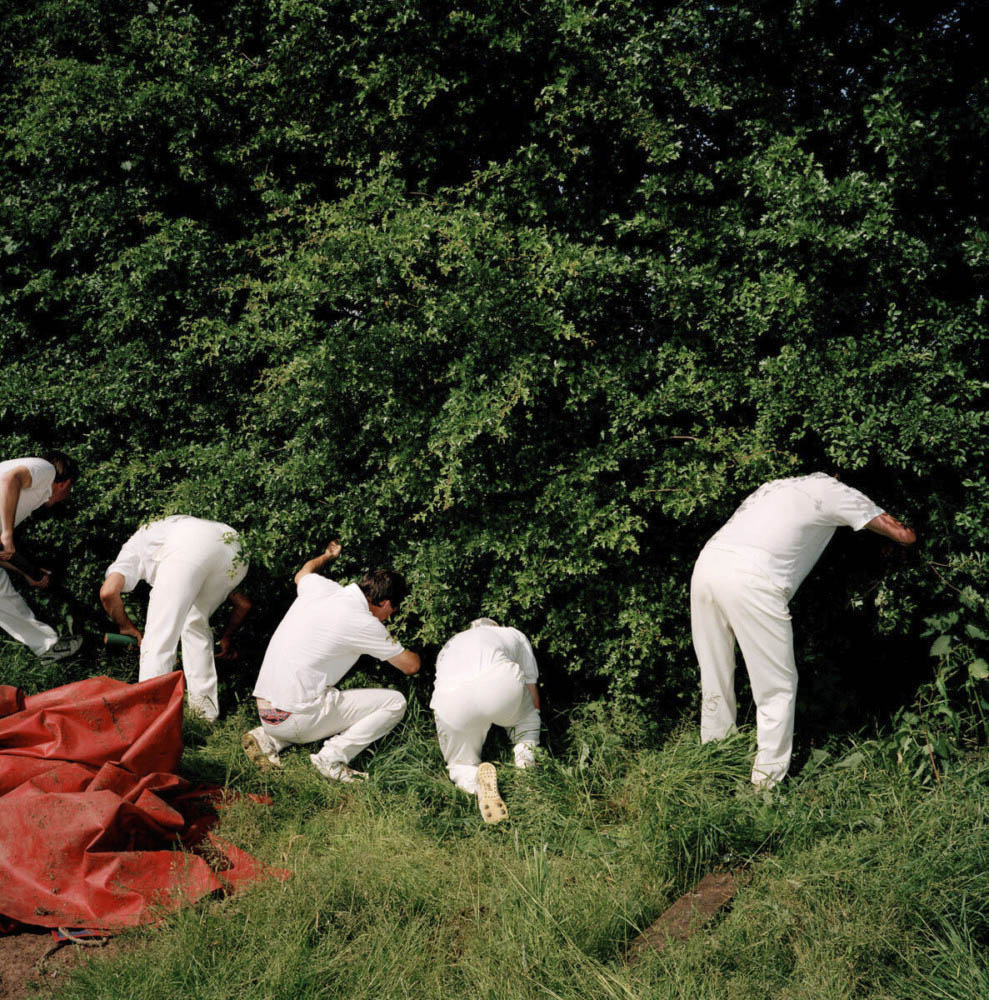
Martin Parr (English, 1952-2025) 'Cricket players looking for a cricket ball, Chew Stoke, England' 1992


Martin Parr (English, 1952-2025)
Cricket players looking for a cricket ball, Chew Stoke, England
1992
© Martin Parr / Magnum Photos


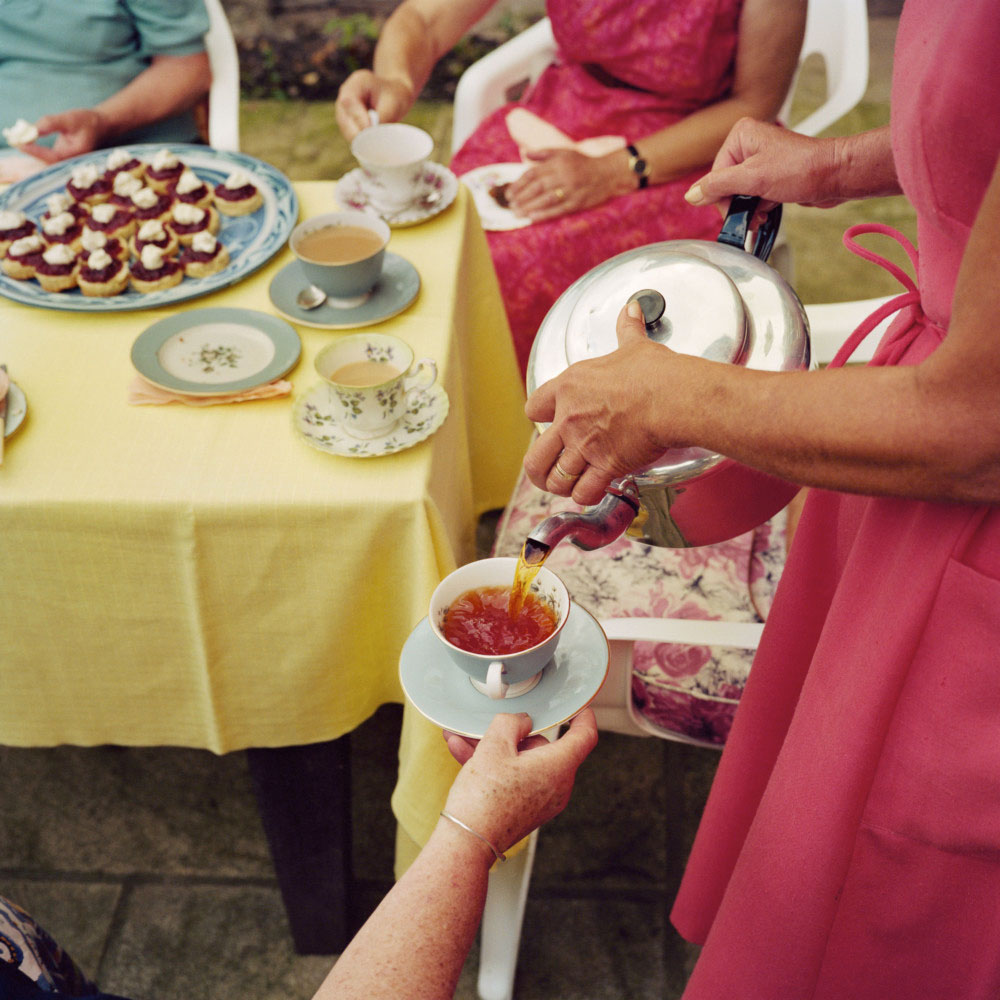
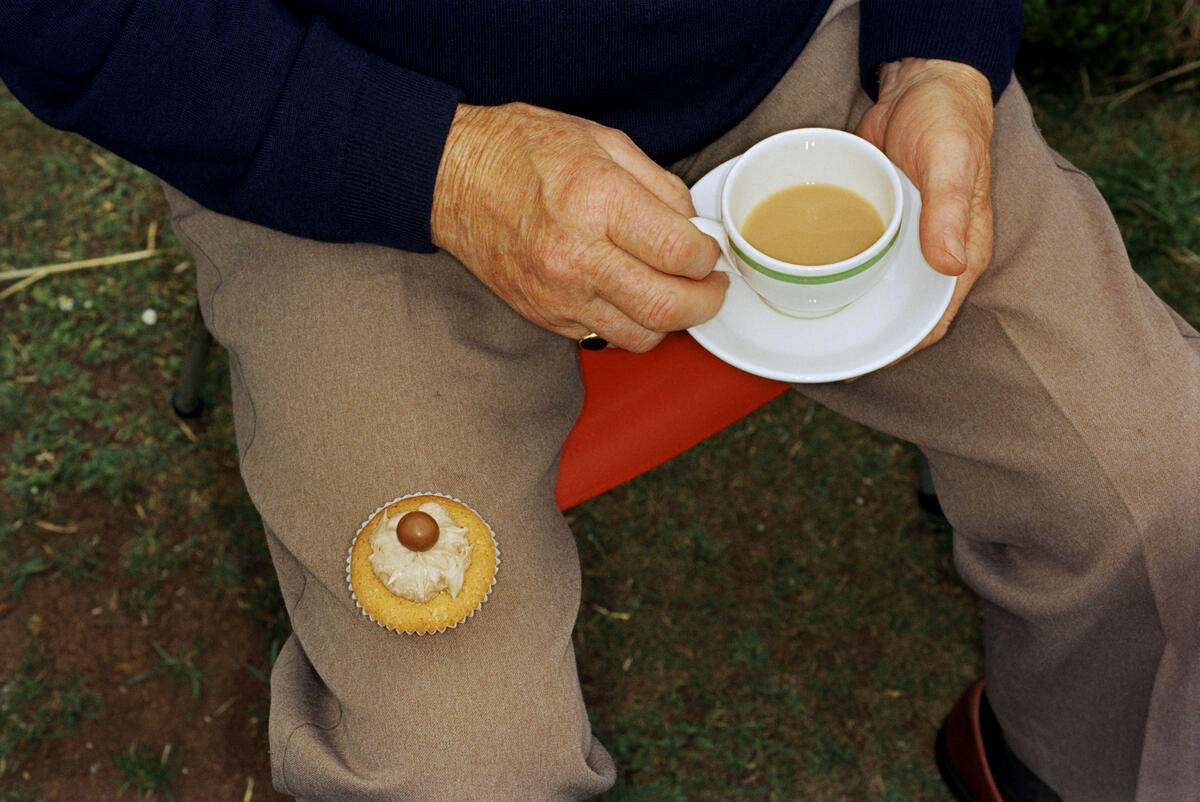
Martin Parr (English, 1952-2025) 'Garden tea party, Chew Stoke, Somerset, England' 1992


Martin Parr (English, 1952-2025)
Garden tea party, Chew Stoke, Somerset, England
1992
© Martin Parr / Magnum Photos


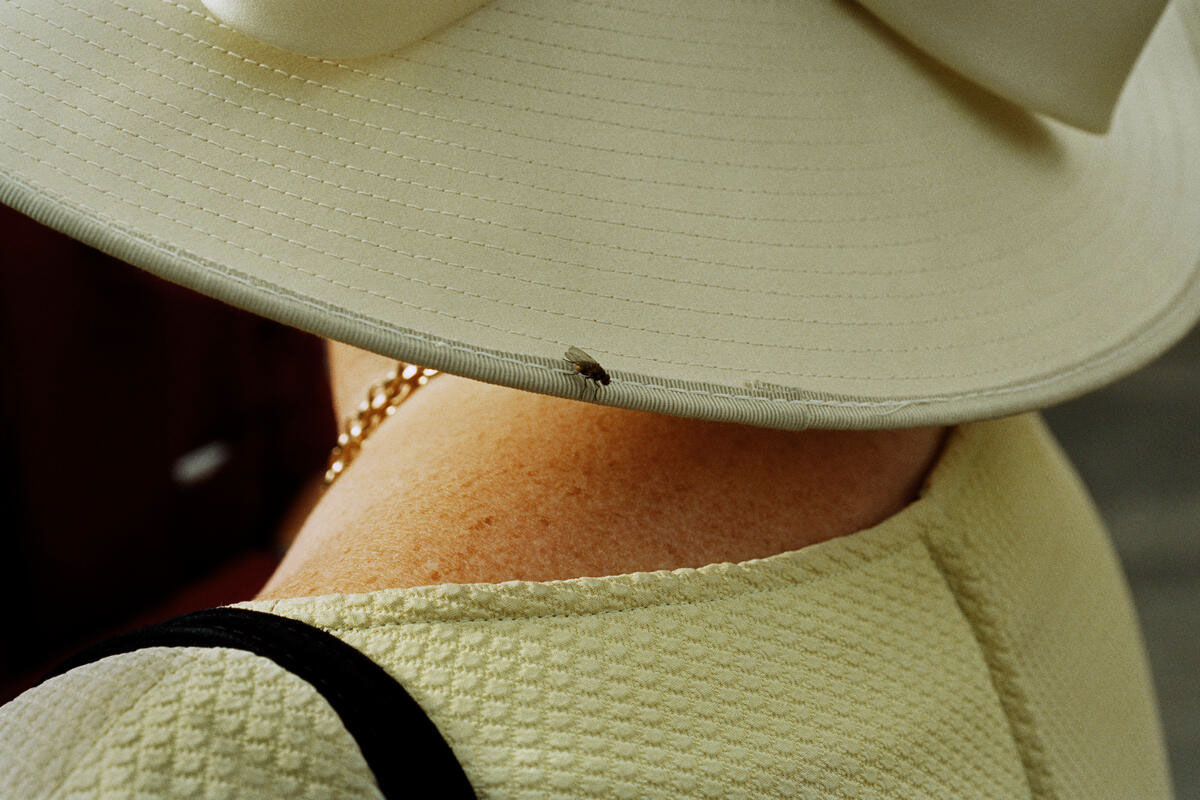
Martin Parr (English, 1952-2025) 'Wells, Somerset, England' 2000


Martin Parr (English, 1952-2025)
Wells, Somerset, England
2000
© Martin Parr / Magnum Photos


This exhibition revisits the work of the late British photographer Martin Parr, bringing together a selection of series produced since the 1970s that find new resonance in light of the growing disarray of the contemporary world. For over fifty years, Parr travelled the globe not as an activist but as a relentless and amused observer, offering a lucid and unsparing portrait of global imbalances and the excesses of contemporary life: the grotesque face and damaging effects of mass tourism, the rise of car culture, our dependence on technology, unbridled consumerism, and our ambivalent relationship with other living beings.

Through his characteristically offbeat vision, Parr also indirectly engaged with the human behaviours driving contemporary climate change: the unrestrained use of transport, reliance on fossil fuels, global overconsumption, and environ mental degradation. Over time, and as social attitudes have shifted, what once appeared merely entertaining has revealed itself to be increasingly serious. ln retrospect, Parr’s corrosive irony places him within a long tradition of British satire: his sharp wit and deadpan humour deliver a critical, and at times merciless, view of the world we inhabit.

Text from the Jeu de Paume website


The Martin Parr: Global Warning exhibition at the Jeu de Paume (on display through May 2026) is organised into five thematic sections. These sections explore the excesses of modern life through about 180 photographs.

Leisure & waste lands: Focuses on recreational spaces like crowded beaches where pleasure often leads to environmental degradation.

Last Chance To Buy: Examines unbridled consumerism in supermarkets, malls, and luxury shops using Parr’s signature saturated colours.

Small World: Documents the rituals and “ravages” of mass tourism across five continents.

The Animal Kingdom: Explores our ambivalent relationship with animals – as pets, entertainment, or consumer products.

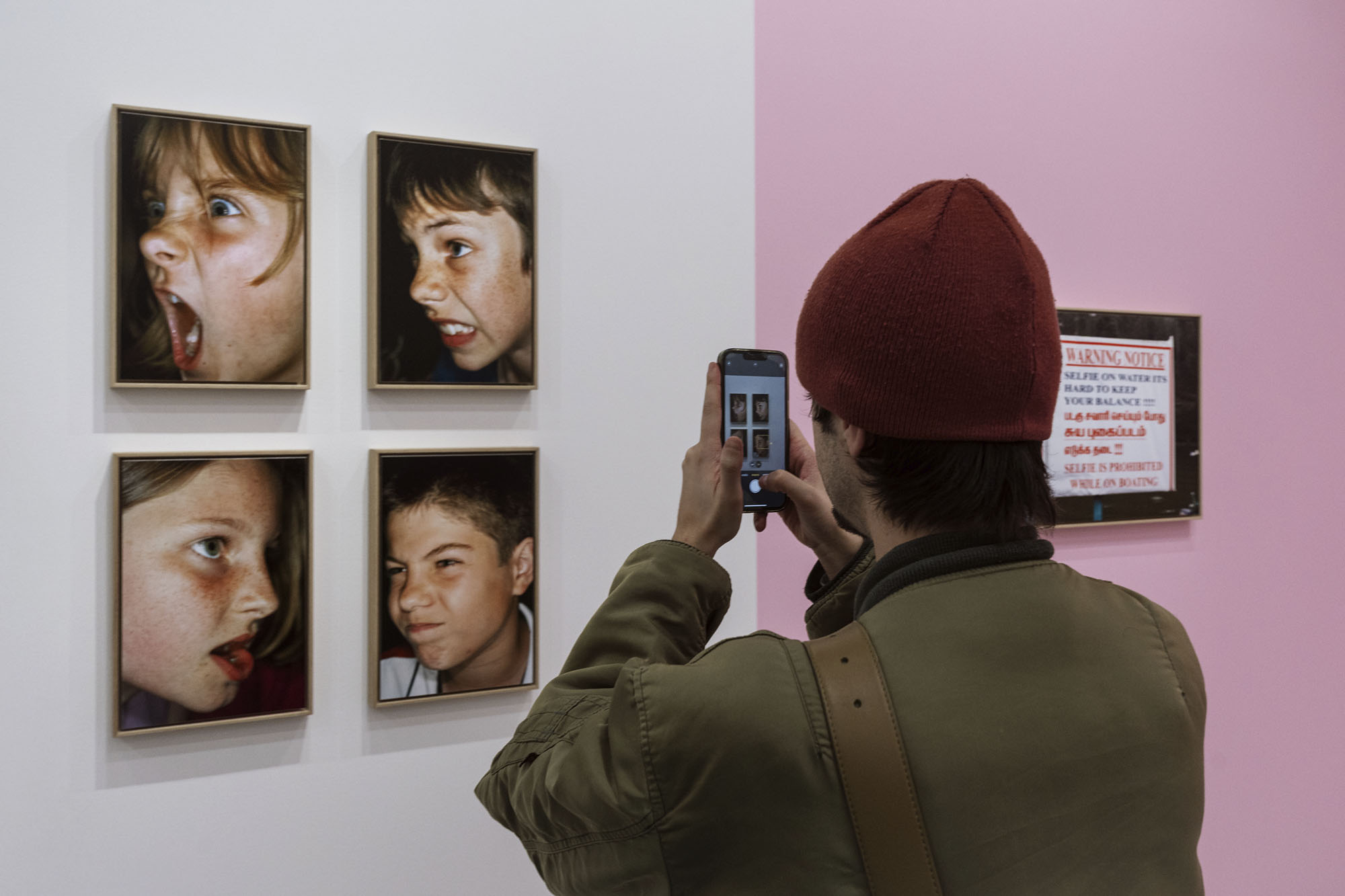
Technological Addictions: Highlights our growing dependence on machines, from slot machines to compulsive selfie-taking


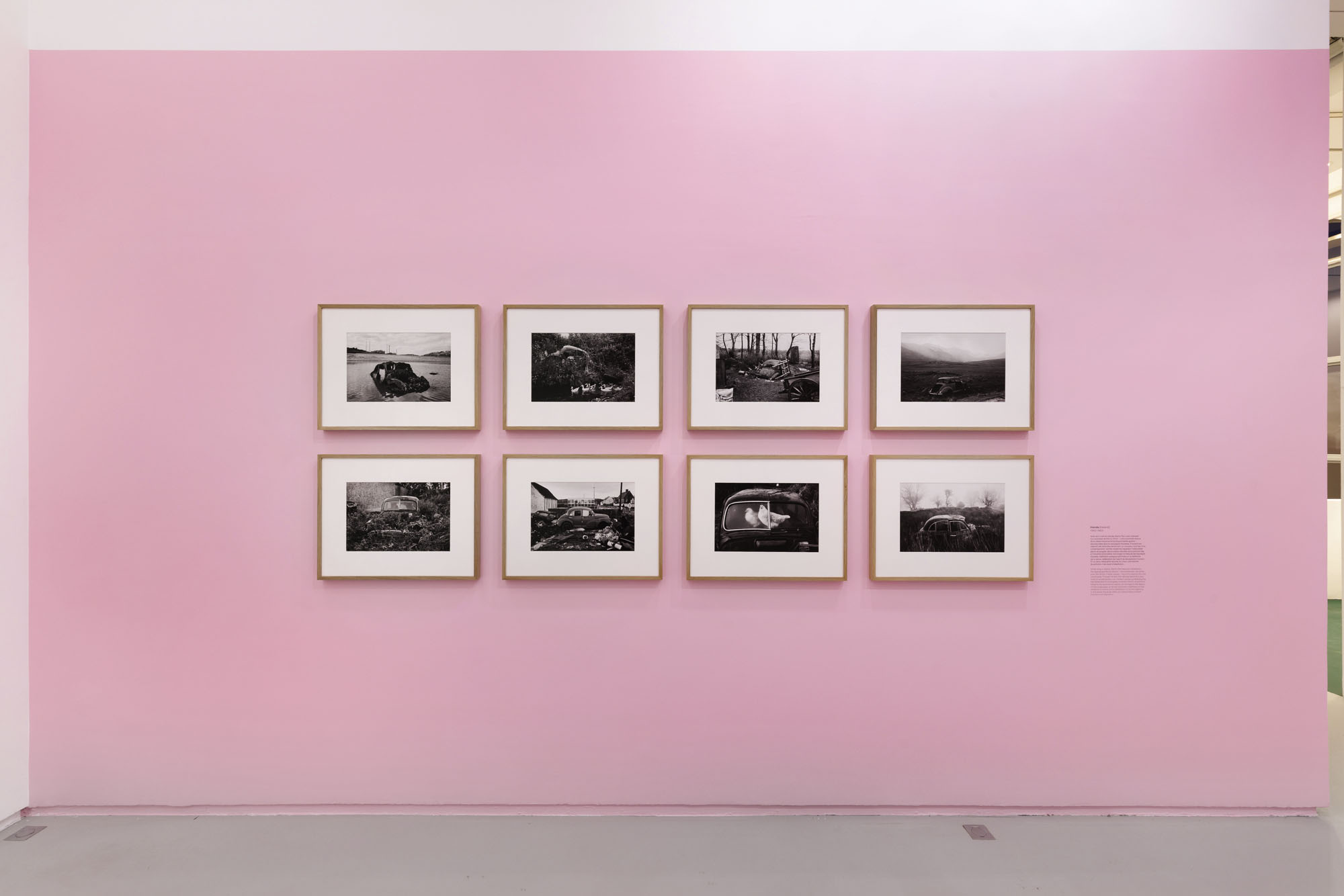
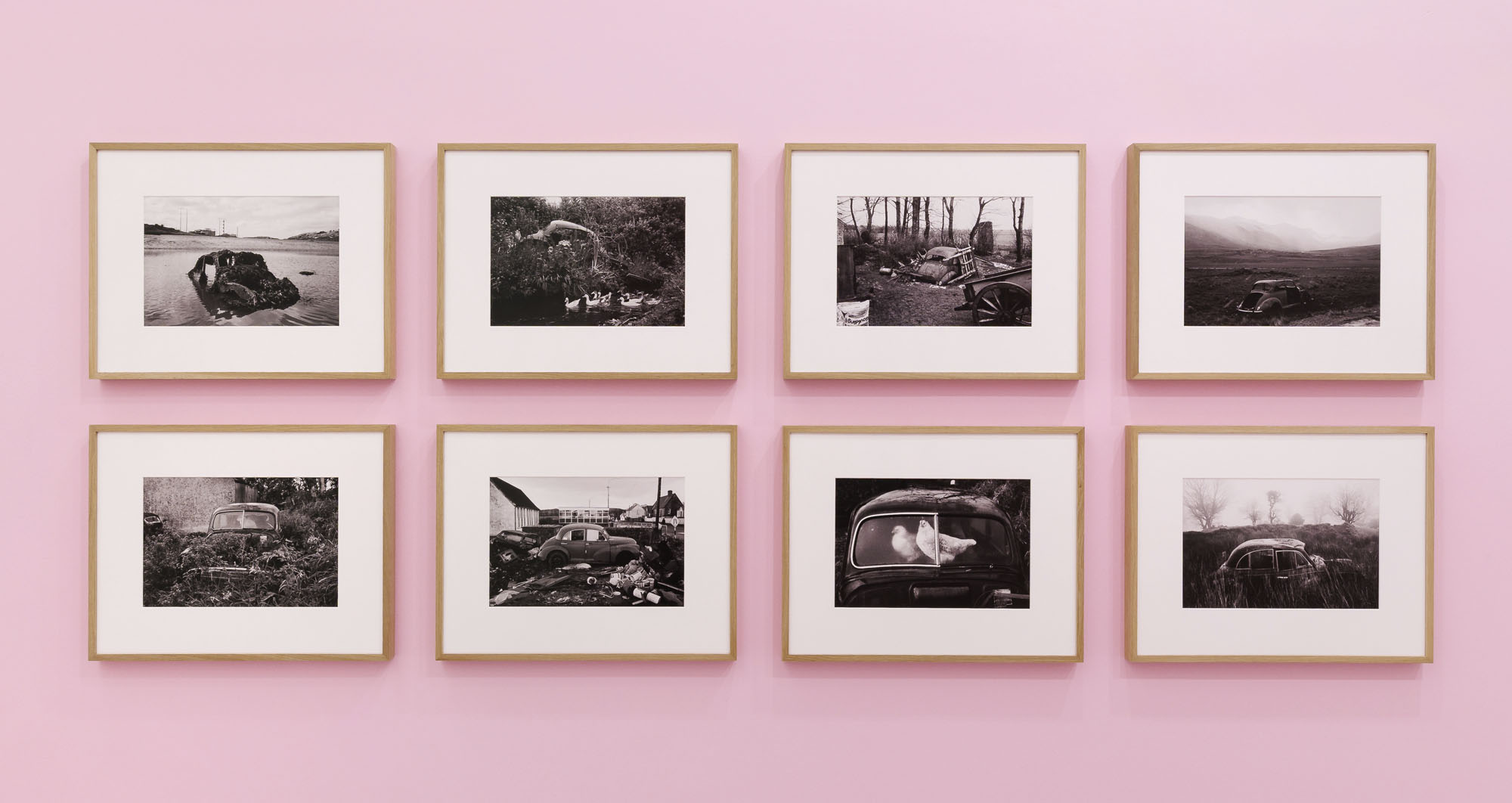
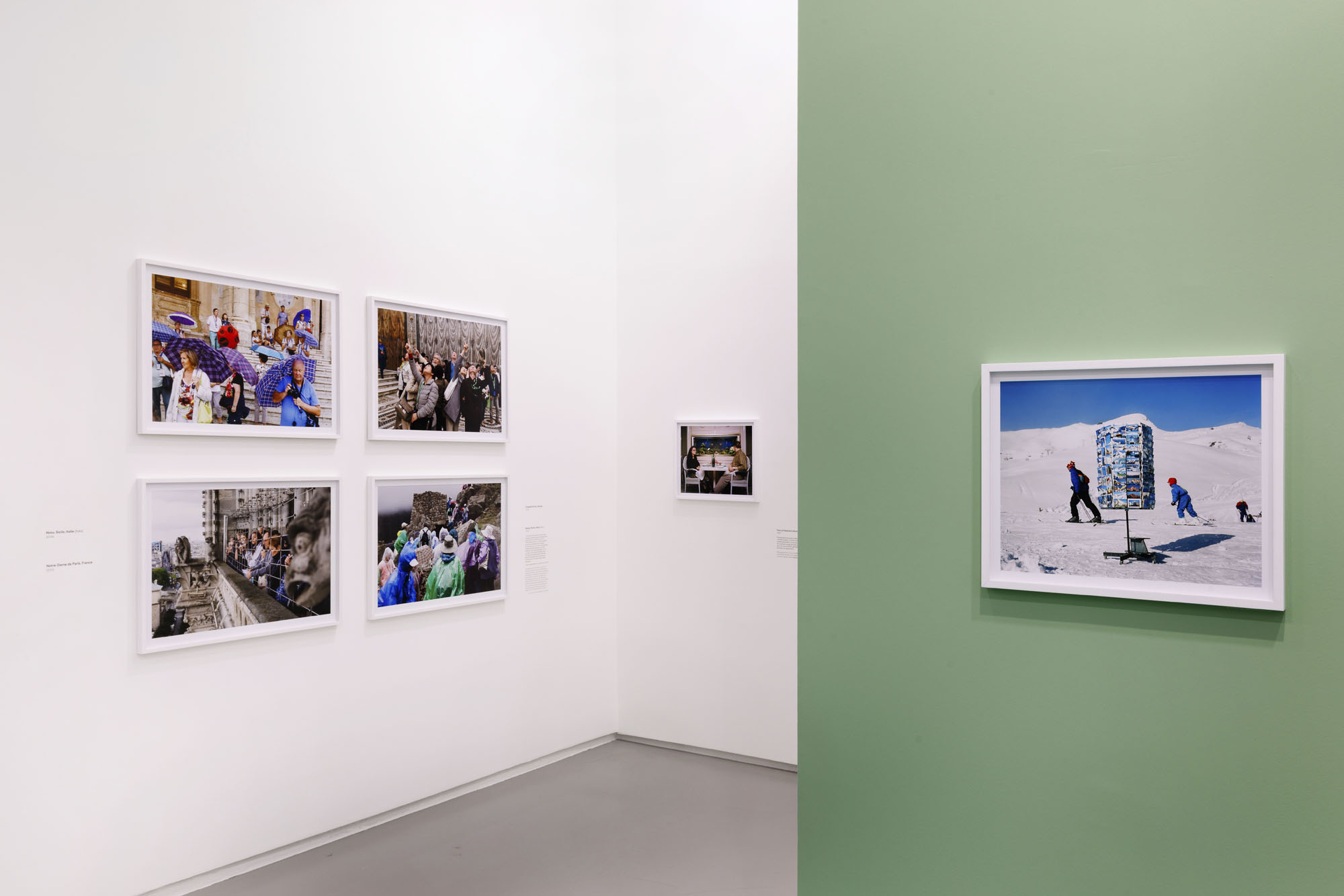
Installation view of the exhibition 'Martin Parr: Global Warning' at Jeu de Paume, Paris, January - May, 2026 showing Martin Parr's black and white photographs of Ireland 1980-83


Installation view of the exhibition Martin Parr: Global Warning at Jeu de Paume, Paris, January – May, 2026 showing Martin Parr’s black and white photographs of Ireland 1980-83
Photos: Salim Santa Lucia


Ireland 1980-1983

While living in Ireland, Martin Parr became interested in the abandoned morris Minors – the emblematic car of the post-war British middle classes – found throughout the Irish countryside. Through his lens, the vehicles become a new motif of contemporary ruin: modern vanities symbolising the inevitable decline of progress, a subtle criticism of pollution linked to the automotive industry, an homage to the beauty of Irish landscapes, an almost optimistic meditation on the resilience of nature, and a celebration of human ingenuity. In this sense, the series offers an implicit history of both pollution and adaptation.

Wall text from the exhibition


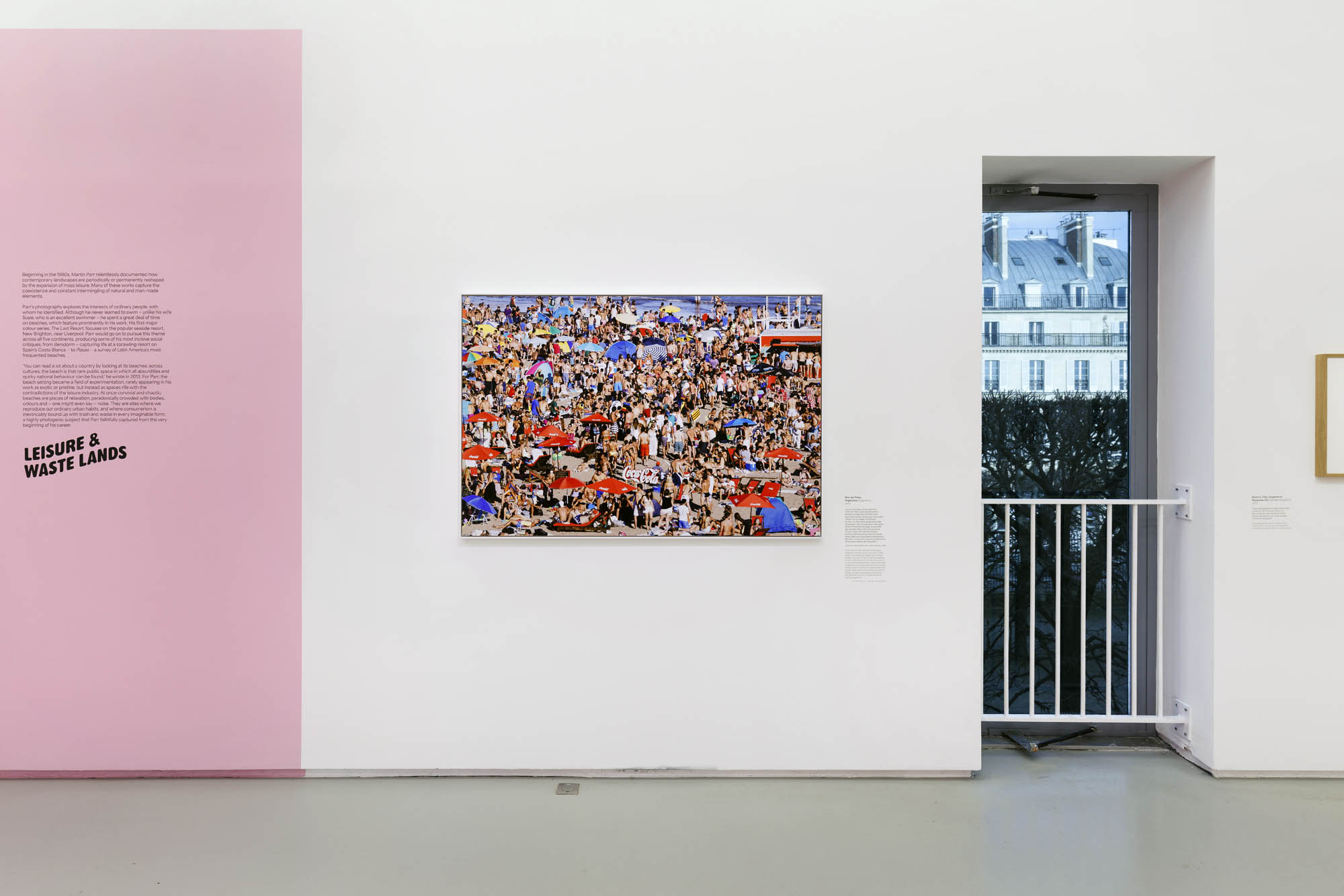
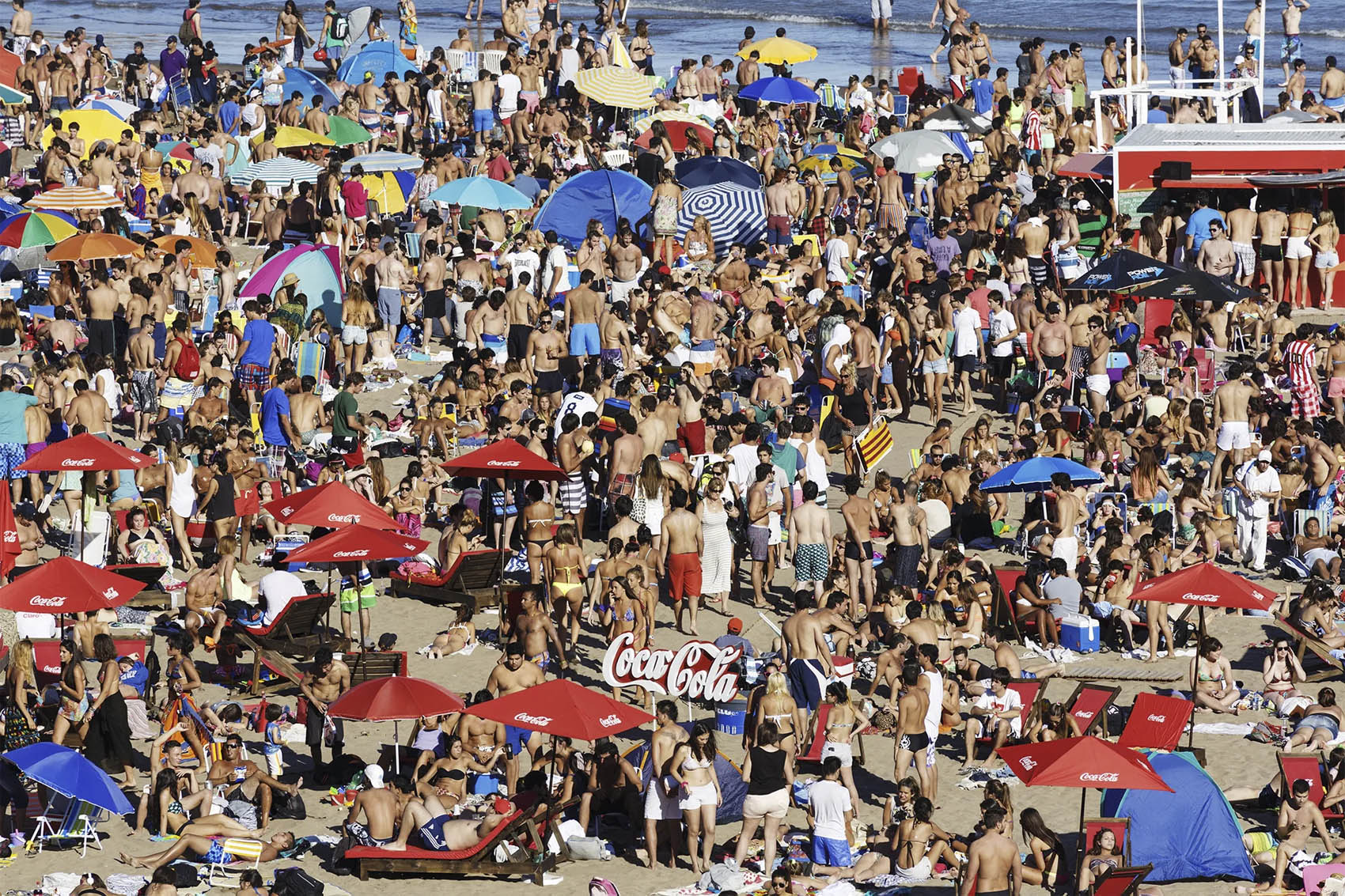
Installation view of the exhibition 'Martin Parr: Global Warning' at Jeu de Paume, Paris, January - May, 2026 showing at left the wall text "Leisure & Waste Lands" and at centre, Martin Parr's 'Mar del Plata, Argentina' (2014)


Installation view of the exhibition Martin Parr: Global Warning at Jeu de Paume, Paris, January – May, 2026 showing at left the wall text “Leisure & Waste Lands” and at centre, Martin Parr’s Mar del Plata, Argentina (2014, below)


Leisure & Waste Lands

Beginning in the 1980s, Martin Parr relentlessly documented how contemporary landscapes are periodically or permanently reshaped by the expansion of mass leisure. Many of these works capture the coexistence and constant intermingling of natural and man-made elements.

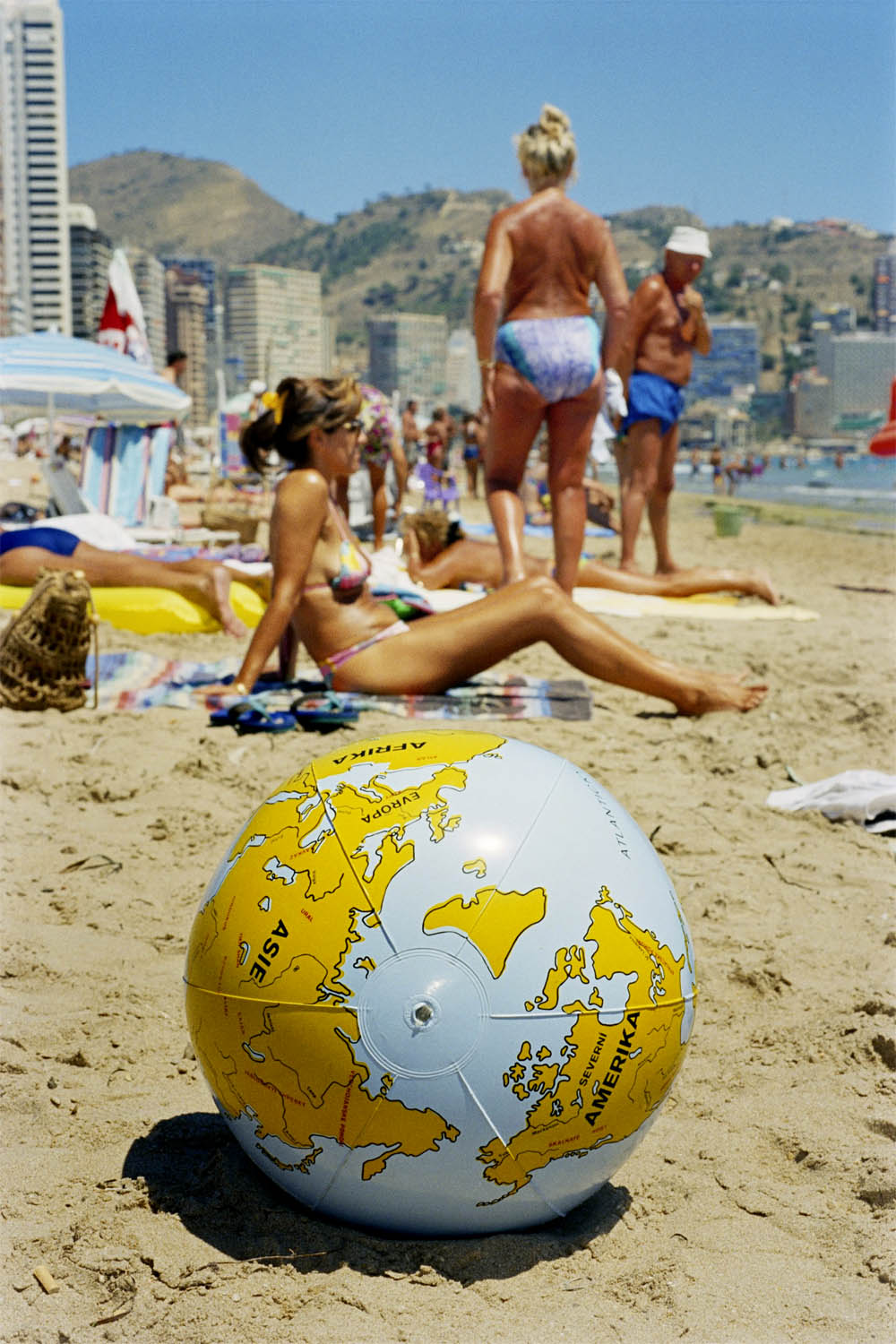
Parr’s photography explores the interests of ordinary people, with whom he identified. Although he never learned to swim – unlike his wife Susie, who is an excellent swimmer – he spent a great deal of time on beaches, which feature prominently in his work. His first major colour series, ‘The Last Resort’, focuses on the popular seaside resort, New Brighton, near Liverpool. Parr would go on to pursue this theme across all five continents, producing some of his most incisive social critiques, from ‘Benidorm’ – capturing life at a sprawling resort on Spain’s Costa Blanca – to ‘Playas’ – a survey of Latin America’s most frequented beaches.

‘You can read a lot about a country by looking at its beaches: across cultures, the beach is that rare public space in which all absurdities and quirky national behaviour can be found,’ he wrote in 2013. For Parr, the beach setting became a field of experimentation, rarely appearing in his work as exotic or pristine, but instead as spaces rife with the contradictions of the leisure industry. At once convivial and chaotic, beaches are places of relaxation, paradoxically crowded with bodies, colours and – on might even say – noise. They are sites where we reproduce our ordinary urban habits, and where consumerism is inextricably bound up with trash and waste in every imaginable form: a highly photogenic subject that Parr faithfully captured from the very beginning of his career.

Wall text from the exhibition


Martin Parr (English, 1952-2025) 'Mar del Plata, Argentina' 2014


Martin Parr (English, 1952-2025)
Mar del Plata, Argentina
2014
© Martin Parr / Magnum Photos


‘I first came to Mar del Plata, the largest Argentine seaside resort, way back in 2007 when I was shooting images for my ‘Playas’ project, a survey of Latin American beaches. I was amazed then at the scale of the resort. It has two thousand hotels, sixteen kilometres of beaches, and welcomes over seven million visitors a year. In terms of scale, Mar del Plata dwarfs other well-known resorts across the globe, including Copacabana, Blackpool and benidorm, yet it is virtually unknown beyond Argentina.’

From Martin parr’s blog, Mar del Pata, 2004
Wall text from the exhibition


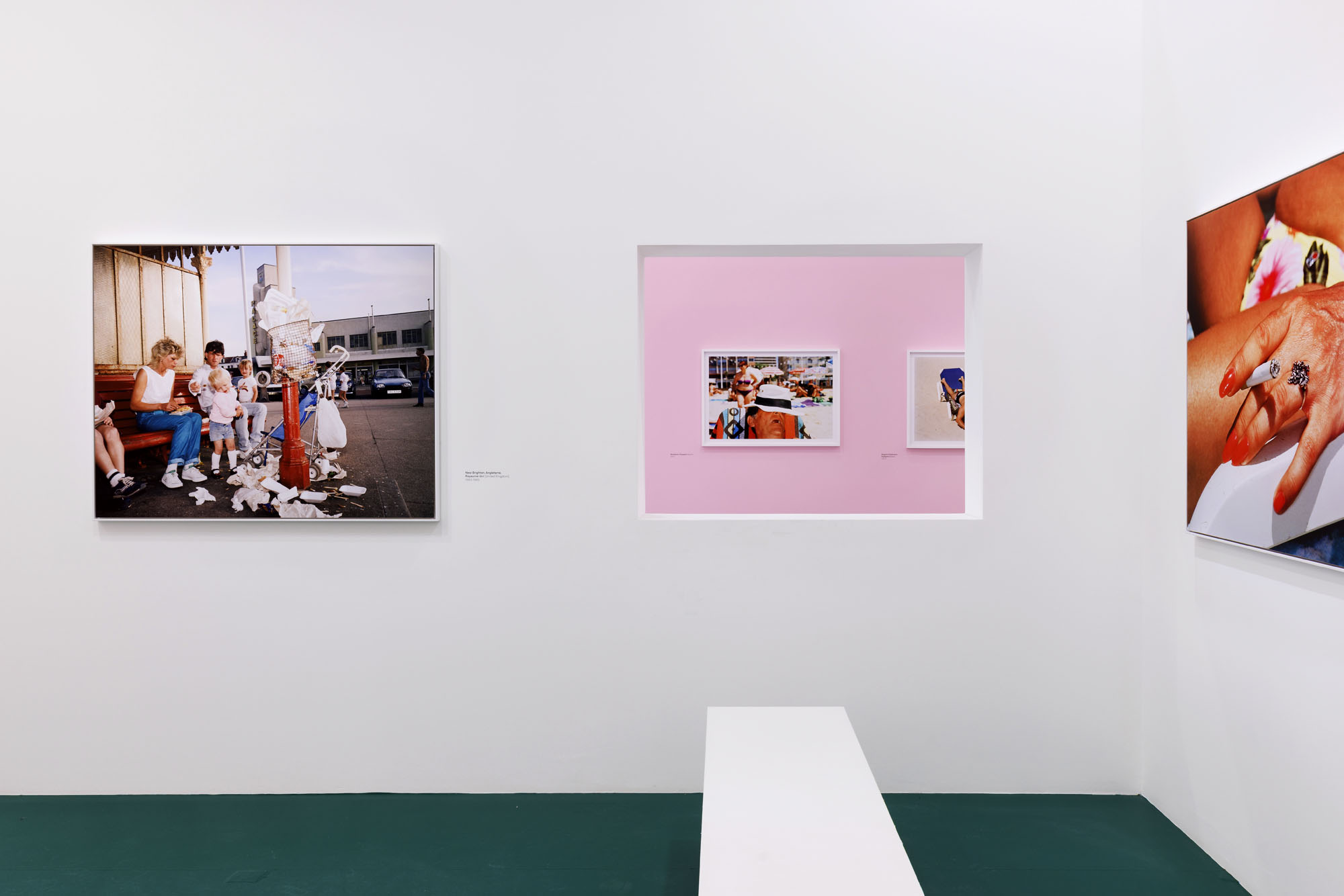
Installation view of the exhibition 'Martin Parr: Global Warning' at Jeu de Paume, Paris, January - May, 2026 showing at left, Martin Parr's 'New Brighton, United Kingdom' (1983-85); and at second left, Benidorm, Spain (1997)


Installation view of the exhibition Martin Parr: Global Warning at Jeu de Paume, Paris, January – May, 2026 showing at left, Martin Parr’s New Brighton, United Kingdom (1983-85, below); and at second left, Benidorm, Spain (1997)


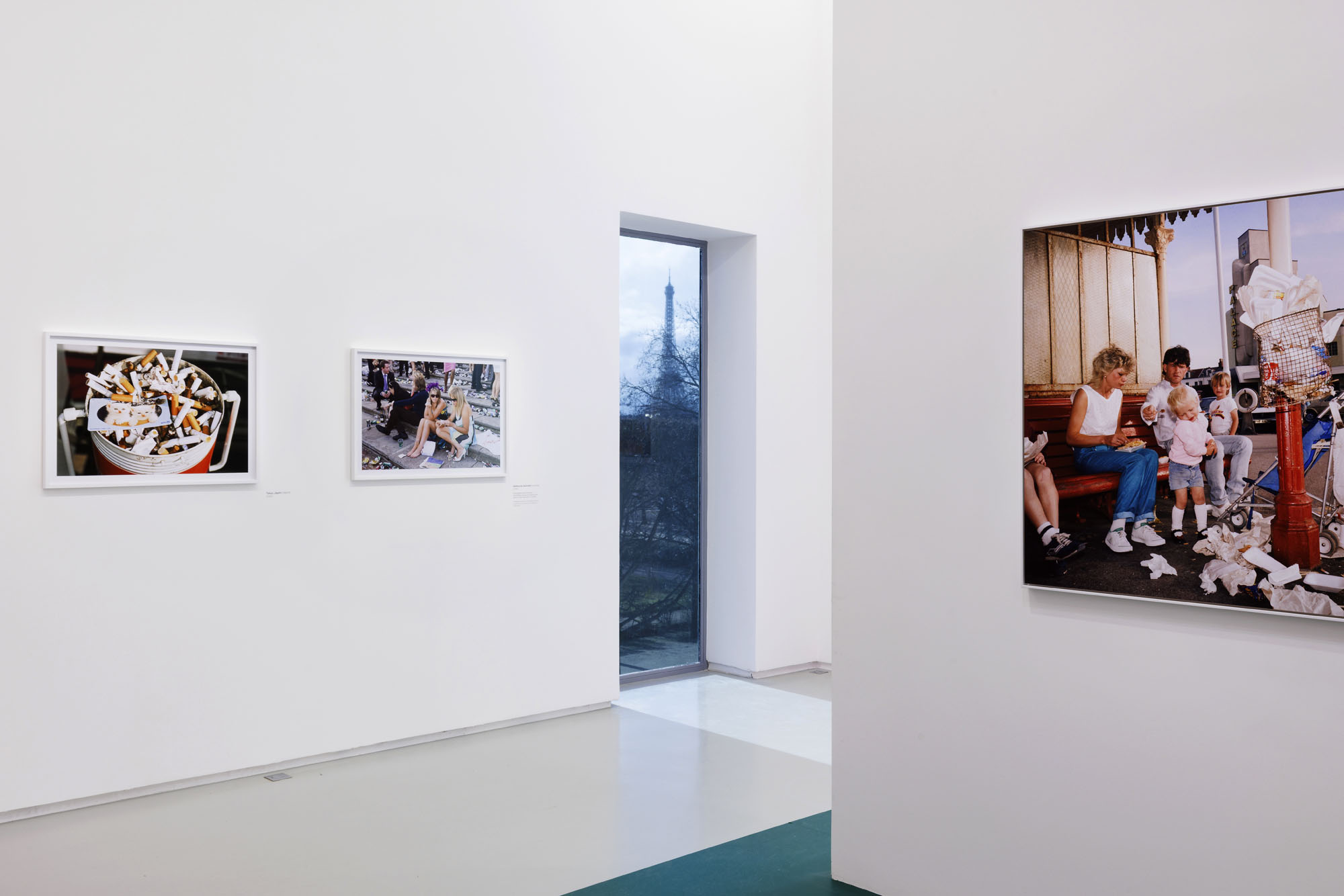
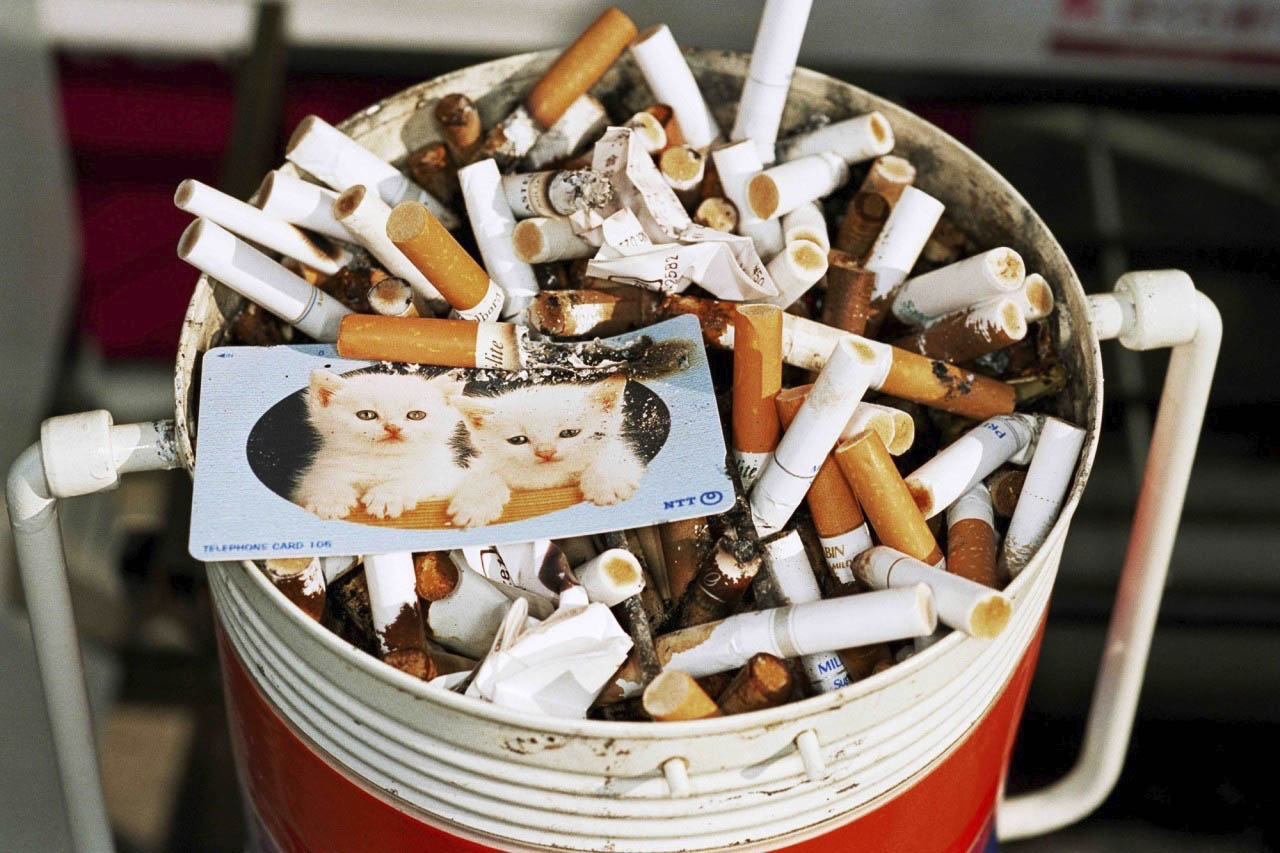
Installation view of the exhibition 'Martin Parr: Global Warning' at Jeu de Paume, Paris, January - May, 2026 showing at left, Martin Parr's 'Tokyo, Japan' (2000); at second left, 'Melbourne, Australia' (2008); and at right, 'New Brighton, United Kingdom' (1983-85)


Installation view of the exhibition Martin Parr: Global Warning at Jeu de Paume, Paris, January – May, 2026 showing at left, Martin Parr’s Tokyo, Japan (2000, below); at second left, Melbourne, Australia (2008); and at right, New Brighton, United Kingdom (1983-85, below)


Martin Parr (English, 1952-2025) 'Tokyo, Japan' 2000


Martin Parr (English, 1952-2025)
Tokyo, Japan
2000
© Martin Parr / Magnum Photos


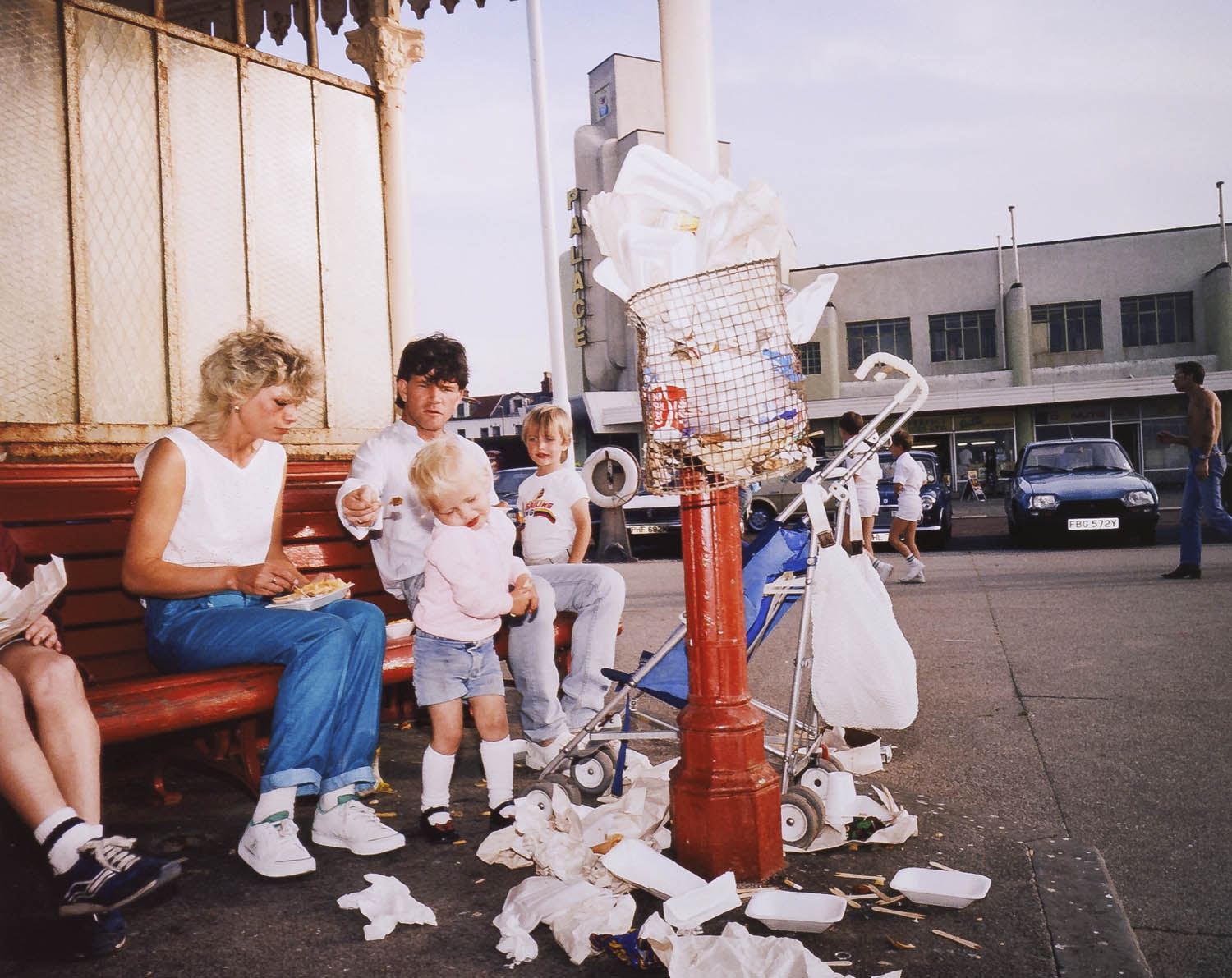
Martin Parr (English, 1952-2025) 'New Brighton, United Kingdom' 1983-85


Martin Parr (English, 1952-2025)
New Brighton, United Kingdom
1983-85
From Last Resort
© Martin Parr / Magnum Photos


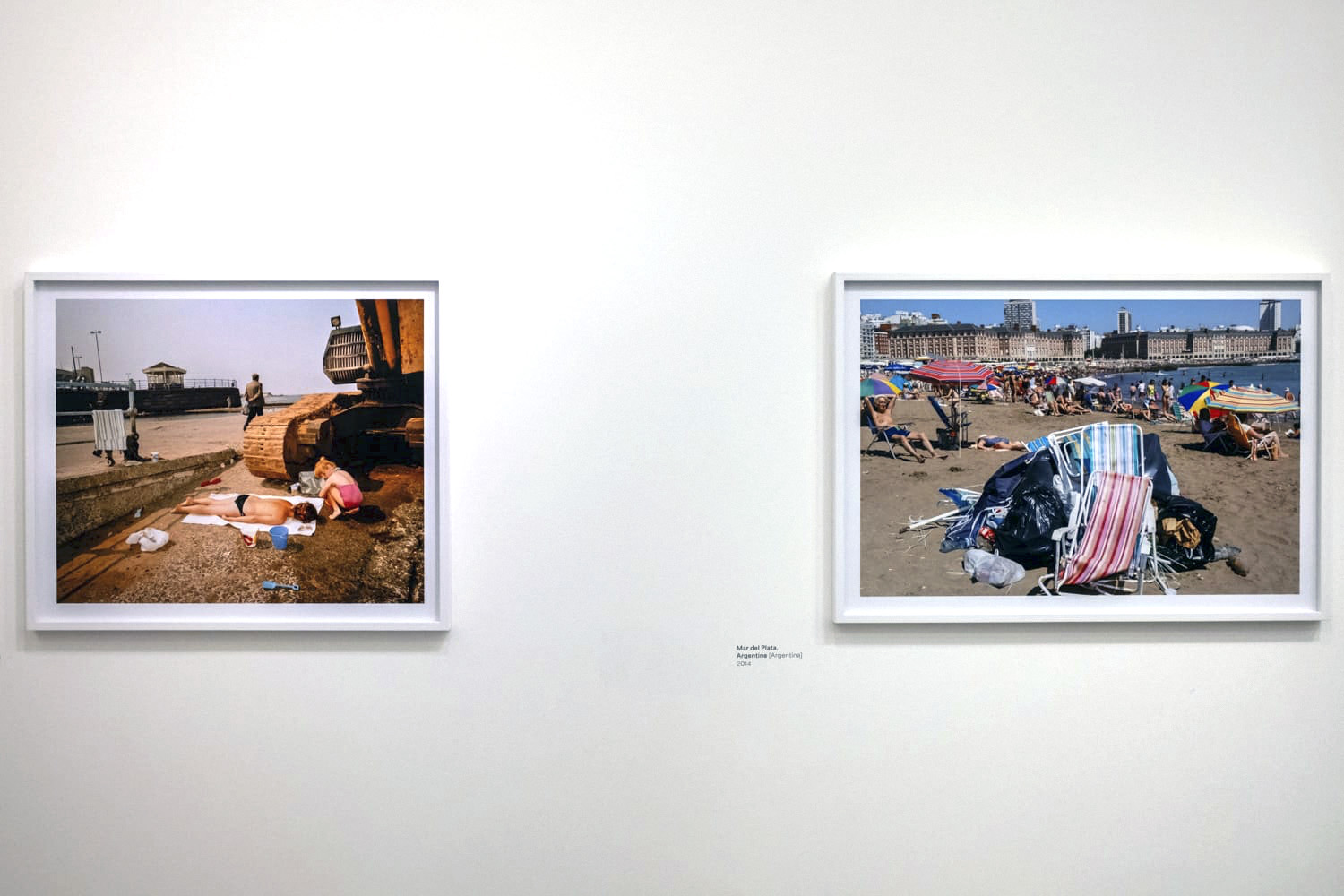
Installation view of the exhibition 'Martin Parr: Global Warning' at Jeu de Paume, Paris, January - May, 2026 showing at left, Martin Parr's photograph 'New Brighton, United Kingdom' (1983-85); at at right, 'Mar del Plata, Argentina' (2014)


Installation view of the exhibition Martin Parr: Global Warning at Jeu de Paume, Paris, January – May, 2026 showing at left, Martin Parr’s photograph New Brighton, United Kingdom (1983-85, below); at at right, Mar del Plata, Argentina (2014)


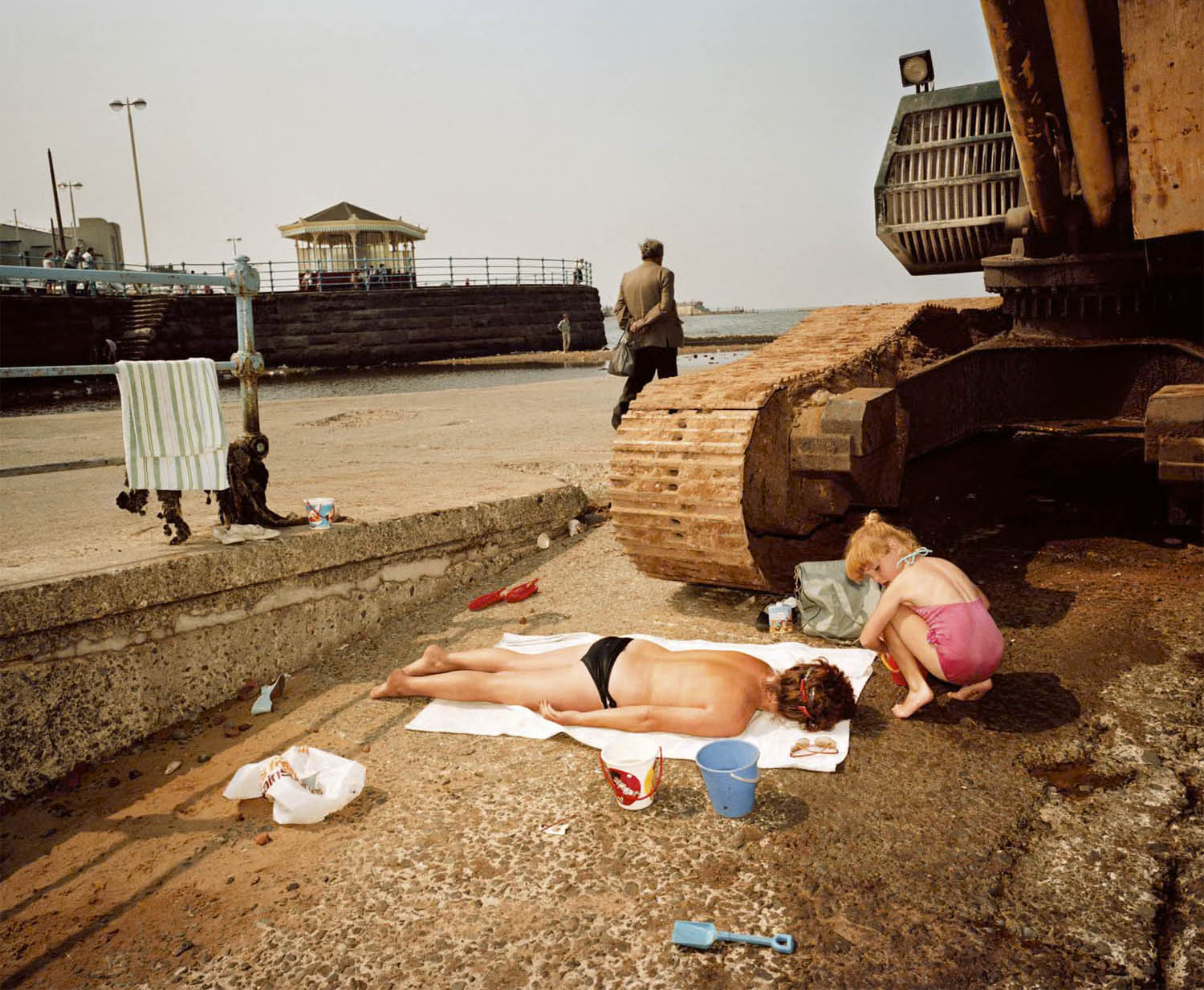
Martin Parr (British, 1952-2025) 'New Brighton, England' 1983-1985 from the series 'The Last Resort'


Martin Parr (English, 1952-2025)
New Brighton, United Kingdom
1983-85
From Last Resort
© Martin Parr / Magnum Photos


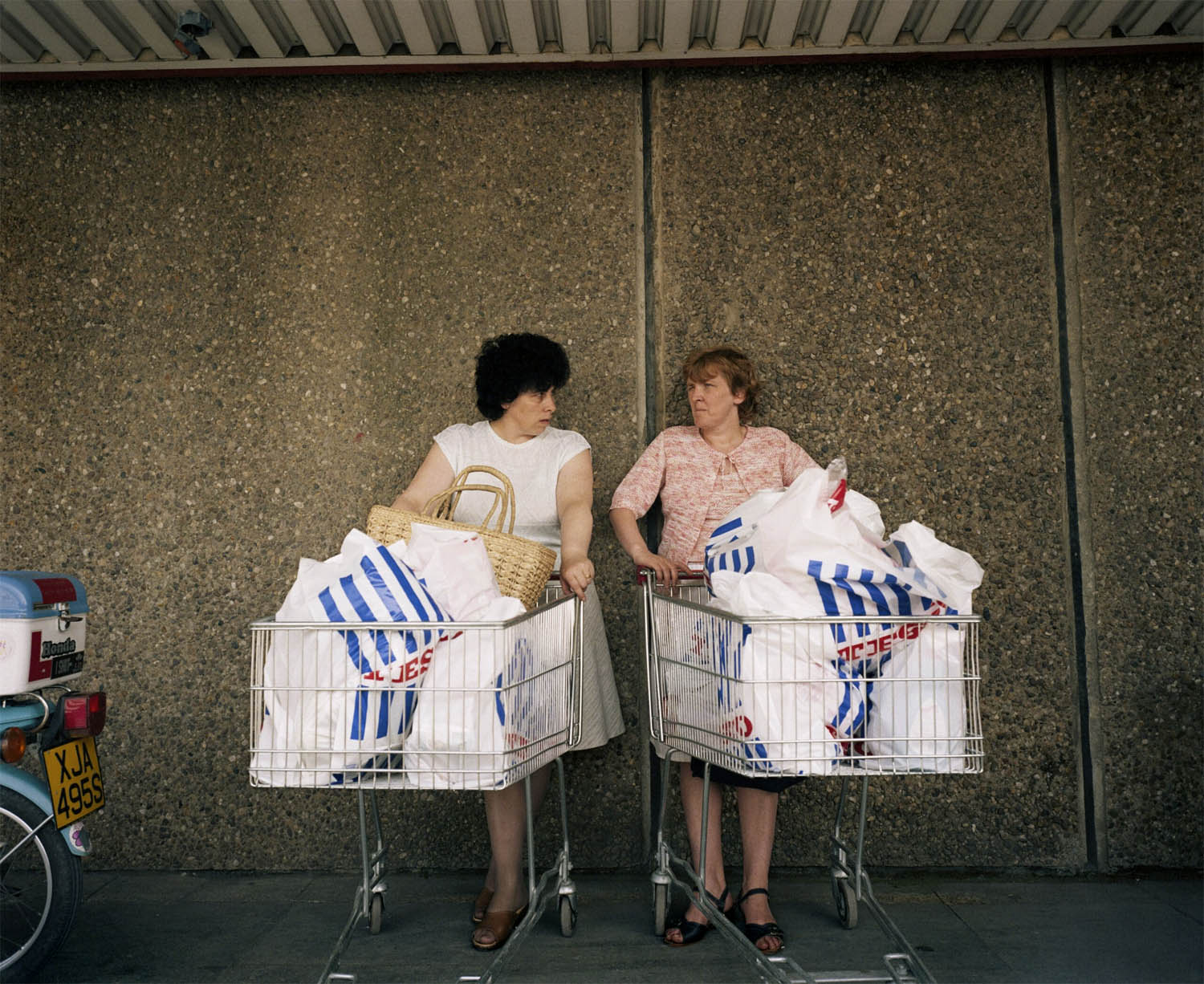
Martin Parr (English, 1952-2025) 'Spending Time, Salford, England' 1986


Martin Parr (English, 1952-2025)
Spending Time, Salford, England
1986
© Martin Parr / Magnum Photos


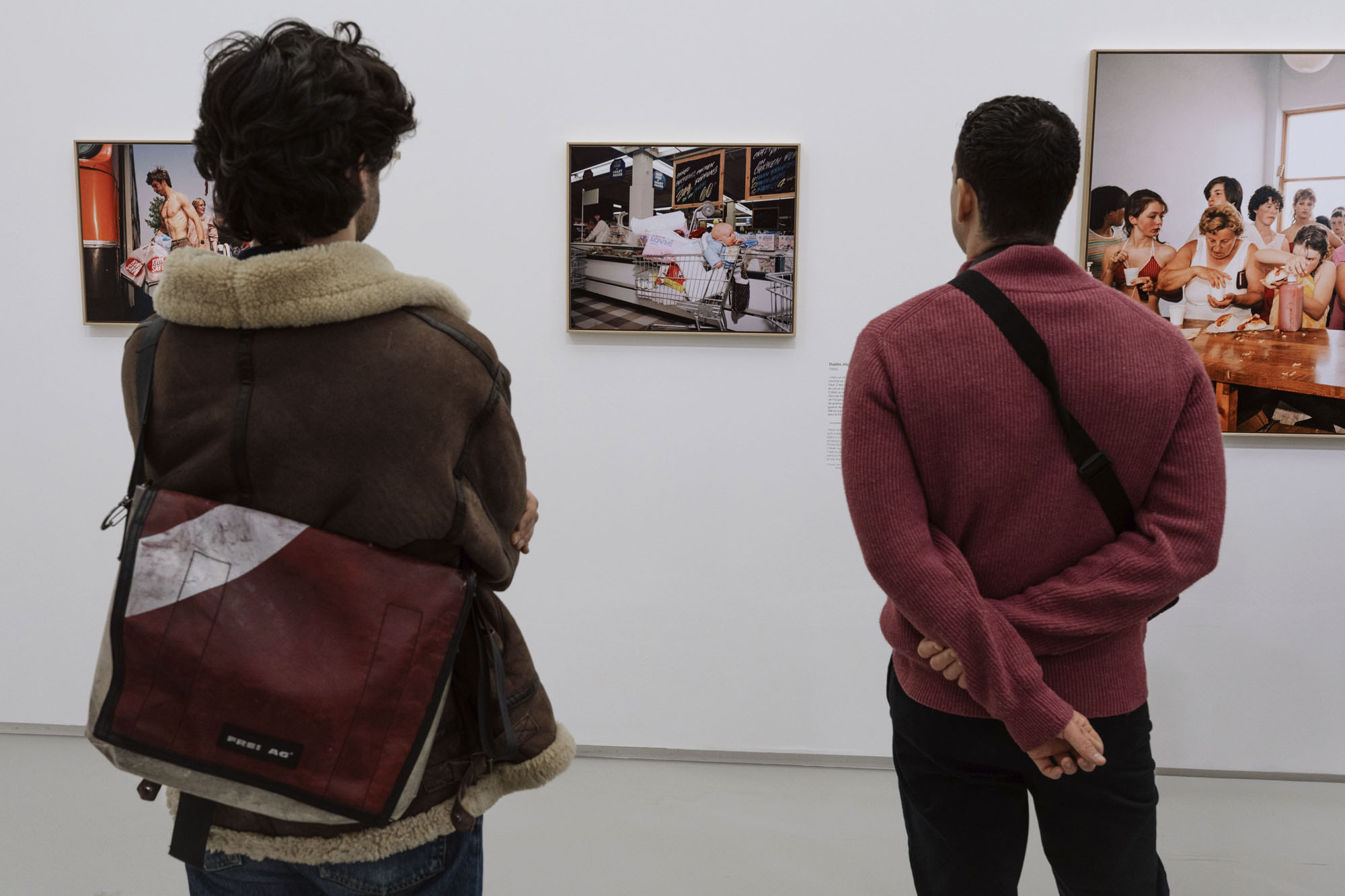
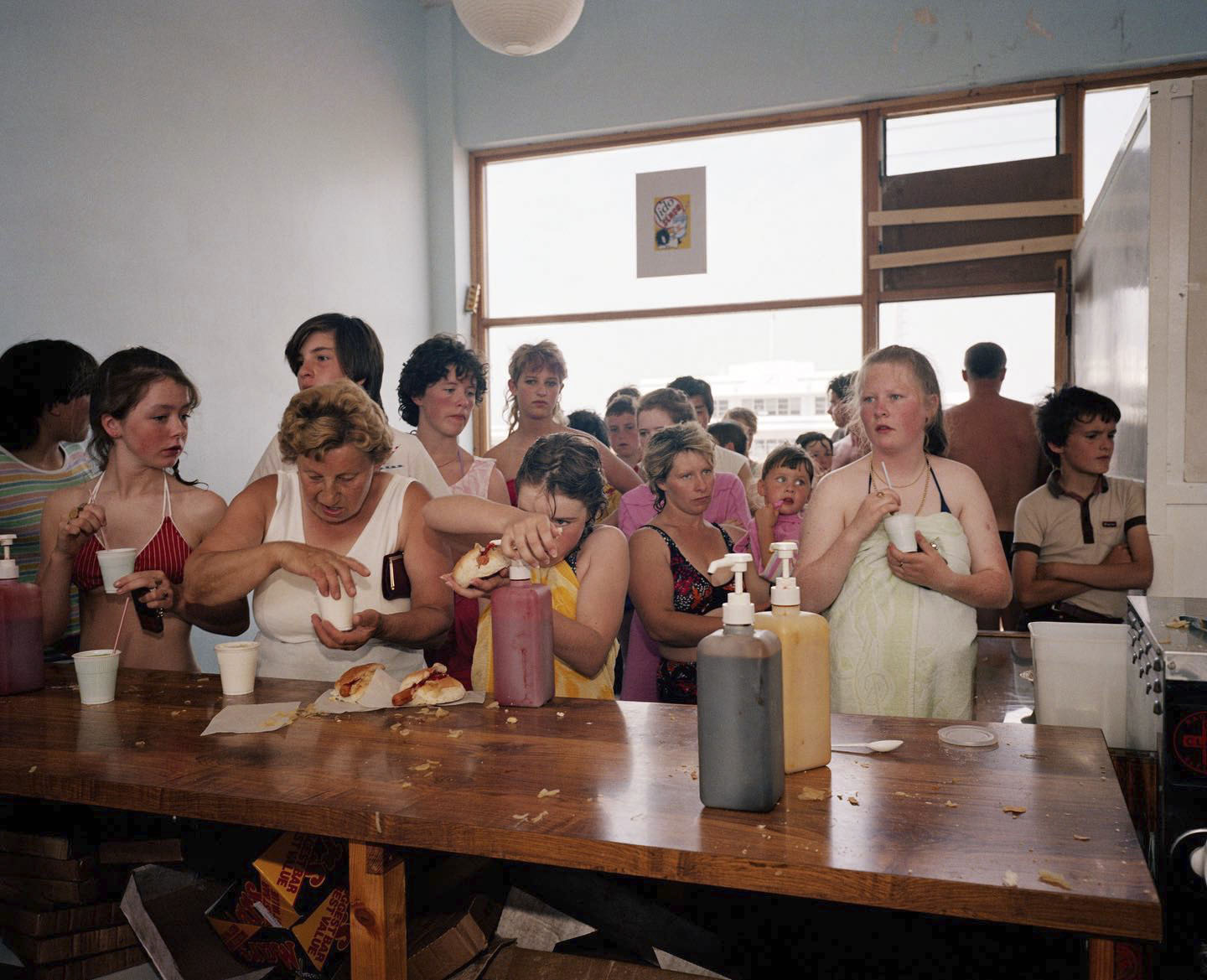
Installation view of the exhibition 'Martin Parr: Global Warning' at Jeu de Paume, Paris, January - May, 2026 showing at right, Martin Parr's photograph 'Untitled (Hot Dog Stand)' (1983-85) from 'Last Resort'


Installation view of the exhibition Martin Parr: Global Warning at Jeu de Paume, Paris, January – May, 2026 showing at right, Martin Parr’s photograph Untitled (Hot Dog Stand), United Kingdom (1983-85, below) from Last Resort


Martin Parr (English, 1952-2025) 'Untitled (Hot Dog Stand), United Kingdom' 1983-85


Martin Parr (English, 1952-2025)
Untitled (Hot Dog Stand), United Kingdom
1983-85
From Last Resort
© Martin Parr / Magnum Photos


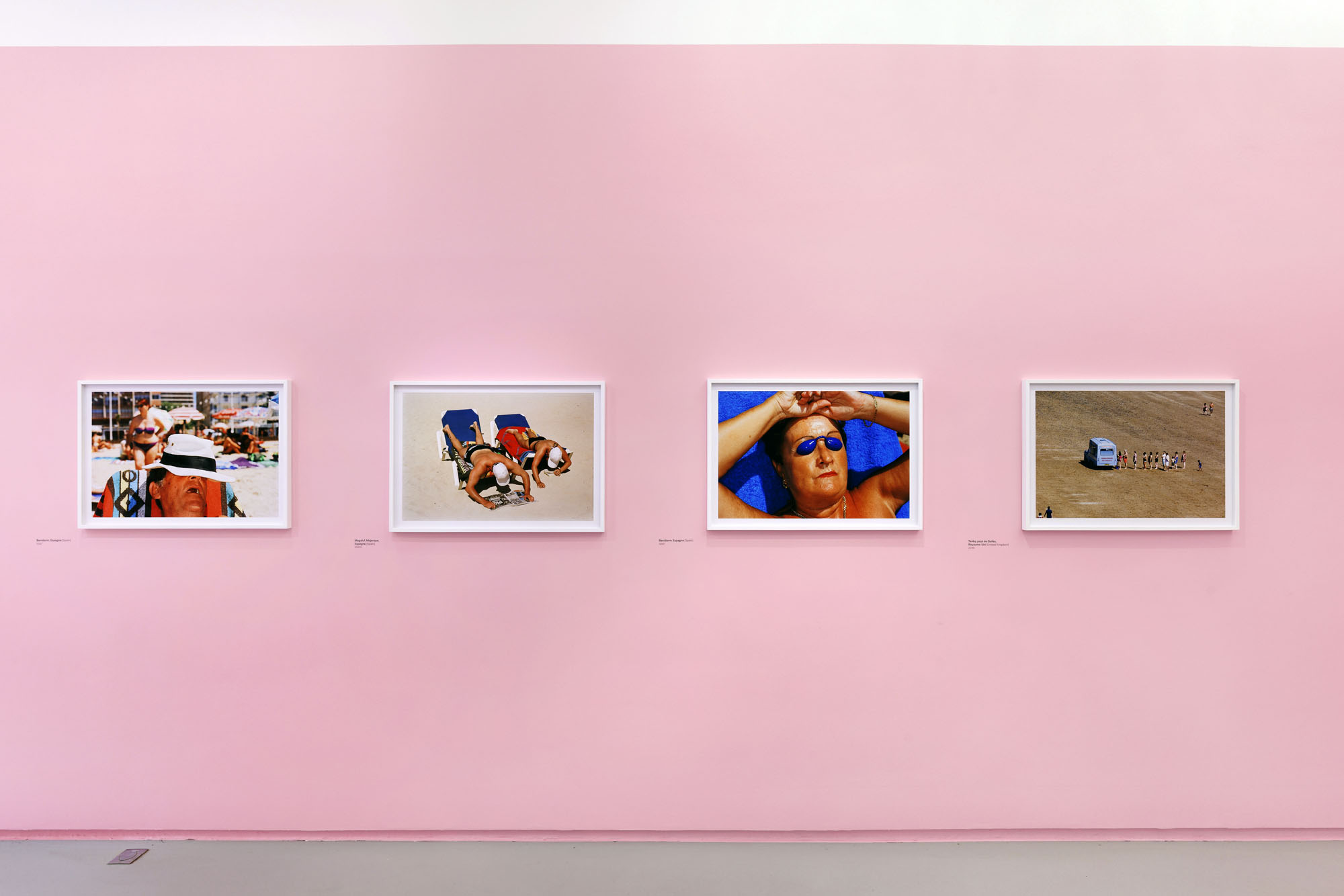
Installation view of the exhibition 'Martin Parr: Global Warning' at Jeu de Paume, Paris, January - May, 2026 showing from left to right, 'Benidorm, Spain' (1997); 'Magaluf, Majorca, Spain' (2003); 'Benidorm, Spain' (1997); and at right, 'Tenby, United Kingdom' (2018)


Installation view of the exhibition Martin Parr: Global Warming at Jeu de Paume, Paris, January – May, 2026 showing from left to right, Benidorm, Spain (1997); Magaluf, Majorca, Spain (2003); Benidorm, Spain (1997); and at right, Tenby, United Kingdom (2018)


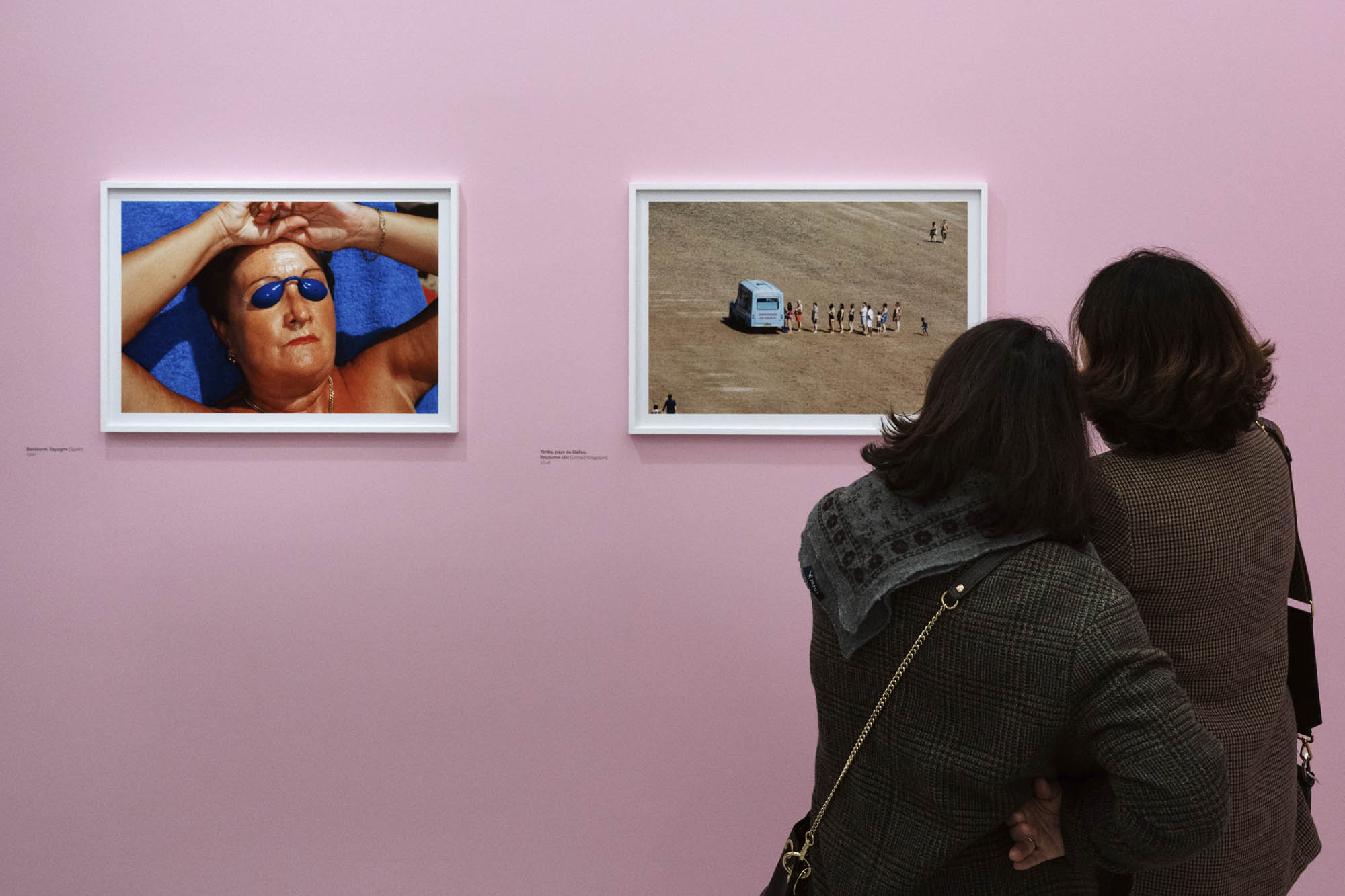
Installation view of the exhibition 'Martin Parr: Global Warning' at Jeu de Paume, Paris, January - May, 2026 showing at left, Martin Parr's 'Benidorm, Spain' (1997) and at right, 'Tenby, United Kingdom' (2018)


Installation view of the exhibition Martin Parr: Global Warming at Jeu de Paume, Paris, January – May, 2026 showing at left, Martin Parr’s Benidorm, Spain (1997, below) and at right, Tenby, United Kingdom (2018)


Martin Parr (English, 1952-2025) Benidorm, Spain' 1997


Martin Parr (English, 1952-2025)
Benidorm, Spain
1997
© Martin Parr / Magnum Photos


Martin Parr (English, 1952-2025) 'Benidorm, Spain' 1997


Martin Parr (English, 1952-2025)
Benidorm, Spain
1997
© Martin Parr / Magnum Photos


This exhibition invites the public to revisit the work of Martin Parr. Through different bodies of work created from the late 1970s to the present day, Parr’s photographs capture the absurdities and malfunctions of our contemporary world. Over 50 years, in locations all round the globe, the photographer has built up a corpus of work that portrays the inequalities and excesses of our modern lifestyle. A number of themes recur throughout. These include: the ravages of tourism, the prevalence of car culture, our dependence on technology, consumer excess, and even our ambivalent relationship with the living world. Martin Parr brings his unique, off-beat perspective to several major causes of climate change and environmental damage: unchecked global travel, reliance on fossil fuels, and world-wide overconsumption. Seemingly light-hearted and humorous, Parr’s work is in fact deeply serious. The ironical nature of his work places Parr firmly within the traditions of British satire and offers an indirect yet profound critique of contemporary life.

Through some 180 images spanning fifty years of work – from his early black
and white images to more recent output – this exhibition addresses the chaos of modern society. Five main sections, organised according to recurring themes, motifs and obsessions, convey the range and depth of Parr’s work. These sections explore the way in which our leisure pursuits impact the environment. Despite being a non-swimmer, Parr is repeatedly drawn to the beach as a site where the natural and artificial worlds coexist and pleasure leads to waste. In the section ‘Everything Must Go!’ our obsessive consumerism is explored. Parr draws up a crude inventory of sought-after objects and modes of consumption. Supermarkets, shopping malls, fairs and exhibitions provide the setting for a frantic materialistic race that is common to all classes of society. Sometimes even human beings become a form of merchandise.

In the ‘Small World’ section, named after one of his most celebrated series, Parr explores the joys, contradictions and dead ends of the tourism industry. In some of the world’s most iconic destinations, he focuses on the habits, behaviours, expectations and disappointments of the global tourist, against the backdrop of North/South, West/East imbalances. In ‘The Animal Kingdom’ he looks at the ambiguous relationship between humans and animals, from fascination and indulgence to neglect and exploitation. The final section – ‘Technological Addictions’ addresses our relationship with machines of all kinds: phones, cars, planes and computers as through them we navigate space, time and reality on a daily basis.

I create entertainment that contains a serious message if you are willing to look for it, but I’m not trying to convince anyone, I’m simply showing people what they think they know’ declared Martin Parr in 2021. Tireless photographer, frequent flyer, beach-lover, Martin Parr never tries to be a moral authority. He has often acknowledged that he himself is fully part of the world he documents and is clear-sighted about the environmental impact of his own lifestyle, particularly his significant carbon footprint: ‘We are heading towards catastrophe but we are all going there together. Who would dare ban cars or air travel?’

Aware that images alone are not enough to change the world, he advocates a form of discreet activism, a subtle visual guerilla warfare. If Parr uses humour it is always in the service of a commentary, often critical and satirical, that seeks to de-stabilise the idealised visions conveyed in the media by the cultural and tourism industries. Many of his images play with cliches, highlighting their inherent absurdity in order to subvert and deconstruct them. Tourist postcards, wildlife photography, foodie habits, selfies, all these and more provide the material that enables him to question, critique and occasionally mock the lifestyles and imagination of large sections of the world population. This exhibition is indeed a global warning.

Press release from Jeu de Paume


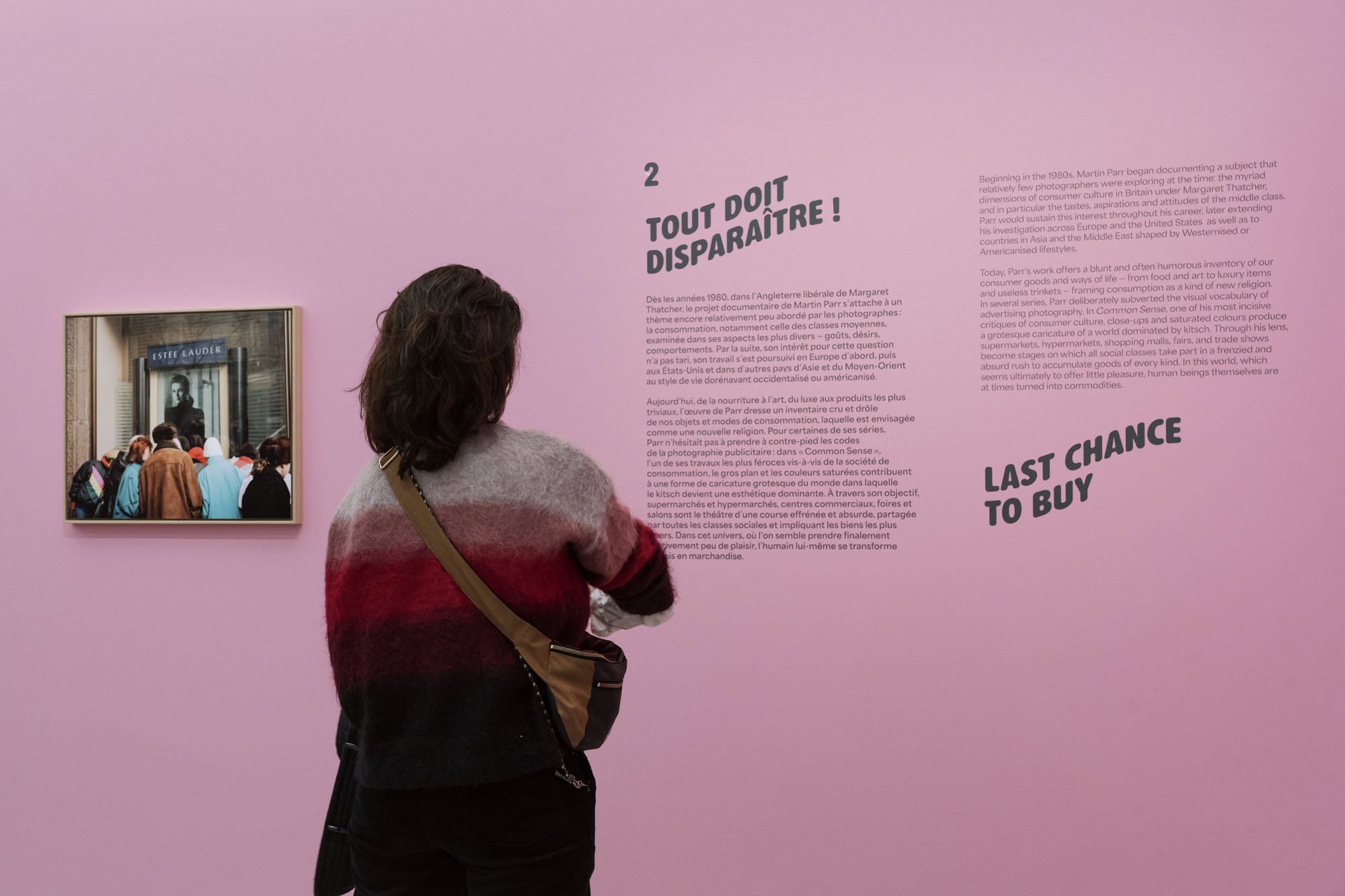
Installation view of the exhibition 'Martin Parr: Global Warning' at Jeu de Paume, Paris, January - May, 2026 showing at left, Martin Parr's 'Moscow' (1992) ; and at right, the wall text to "Last chance to buy"


Installation view of the exhibition Martin Parr: Global Warning at Jeu de Paume, Paris, January – May, 2026 showing at left, Martin Parr’s Moscow (1992) ; and at right, the wall text to “Last chance to buy”


Last chance to buy

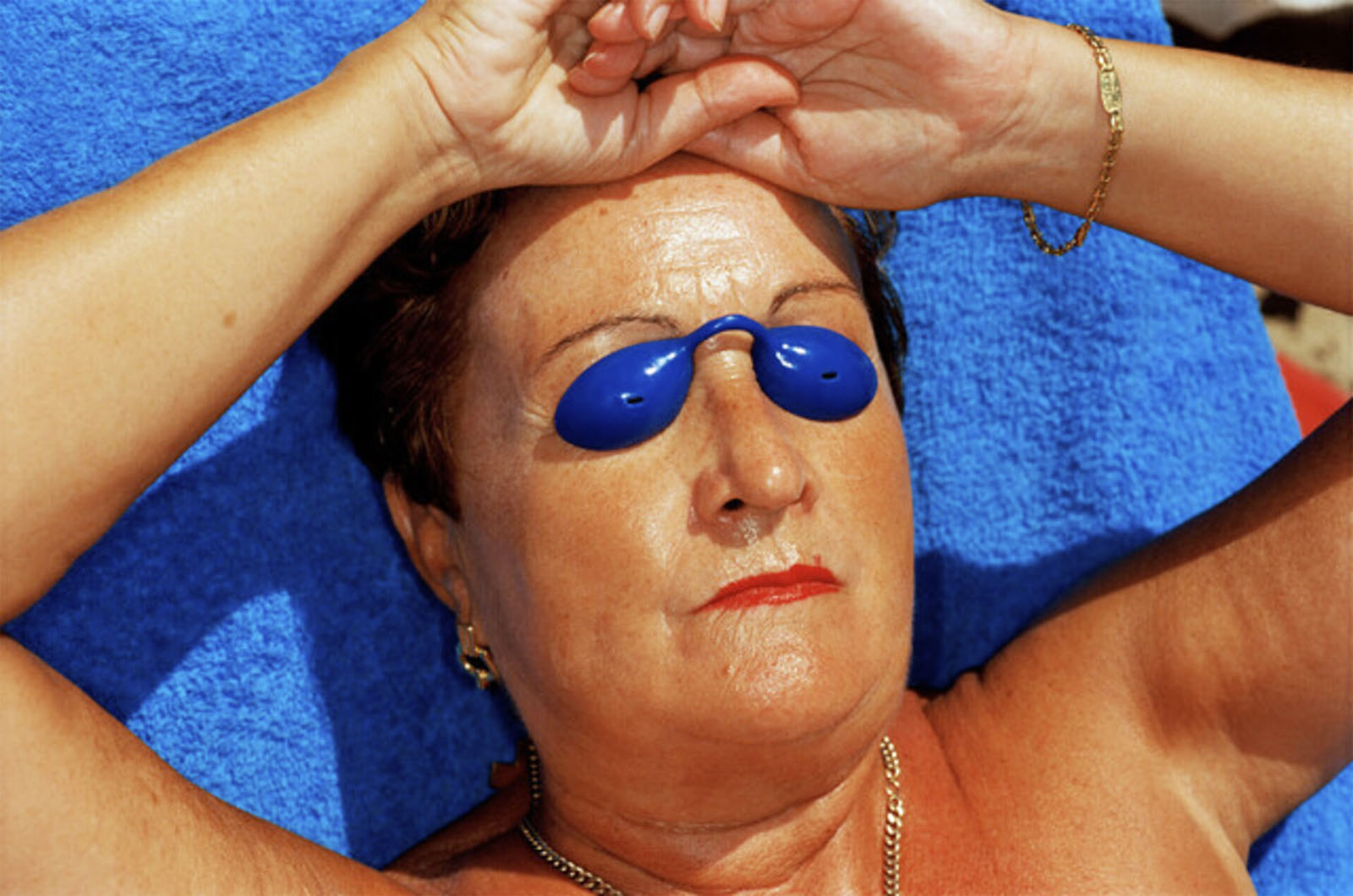
Beginning in the 1980s, Martin Parr began documenting a subject that relatively few photographers were exploring at the time: the myriad dimensions of consumer culture in Britain under Margaret Thatcher, and in particular the tastes, aspirations and attitudes of the middle class. Parr would sustain this interest throughout his career, later extending his investigation across Europe and the United Sates as well as to countries in Asia and the Middle East shaped by Westernised or Americanised lifestyles.

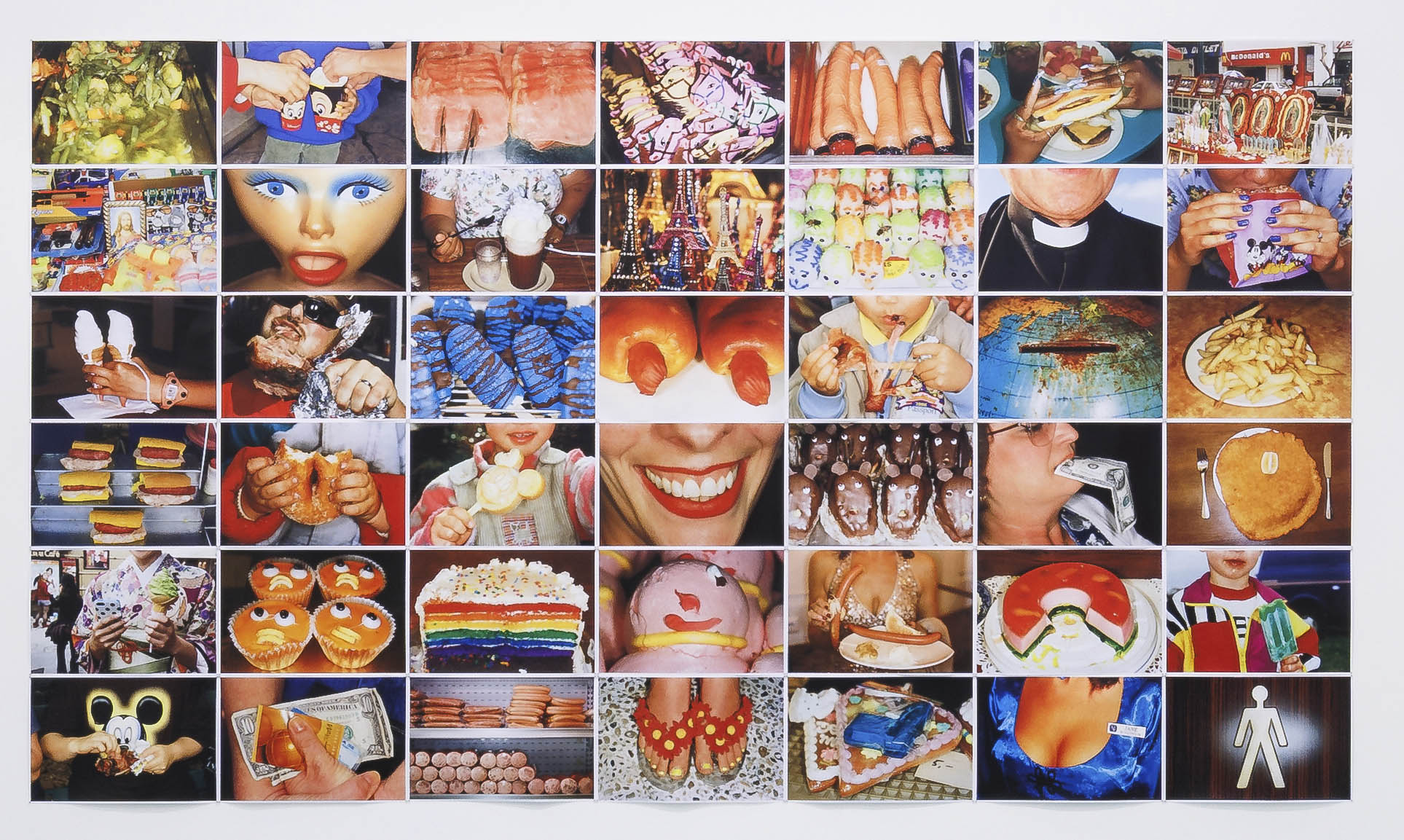
Today, Parr’s work offers a blunt and often humorous inventory of our consumer goods and ways of life – from food and art to luxury items and useless trinkets – framing consumption as a kind of new religion. In several series, parr deliberately subverted the visual vocabulary of advertising photography. In ‘Common Sense’, one of his most incisive critiques of consumer culture, close-ups and saturated colours produce a grotesque caricature of a world dominated by kitsch. Through his lens, supermarkets, hypermarkets, shopping malls, fairs, and trade shows become stages on which all social classes take part in a frenzied and absurd rush to accumulate goods of every kind. In this world, which seems ultimately to offer little pleasure, human beings themselves are at times turned into commodities.

Wall text from the exhibition


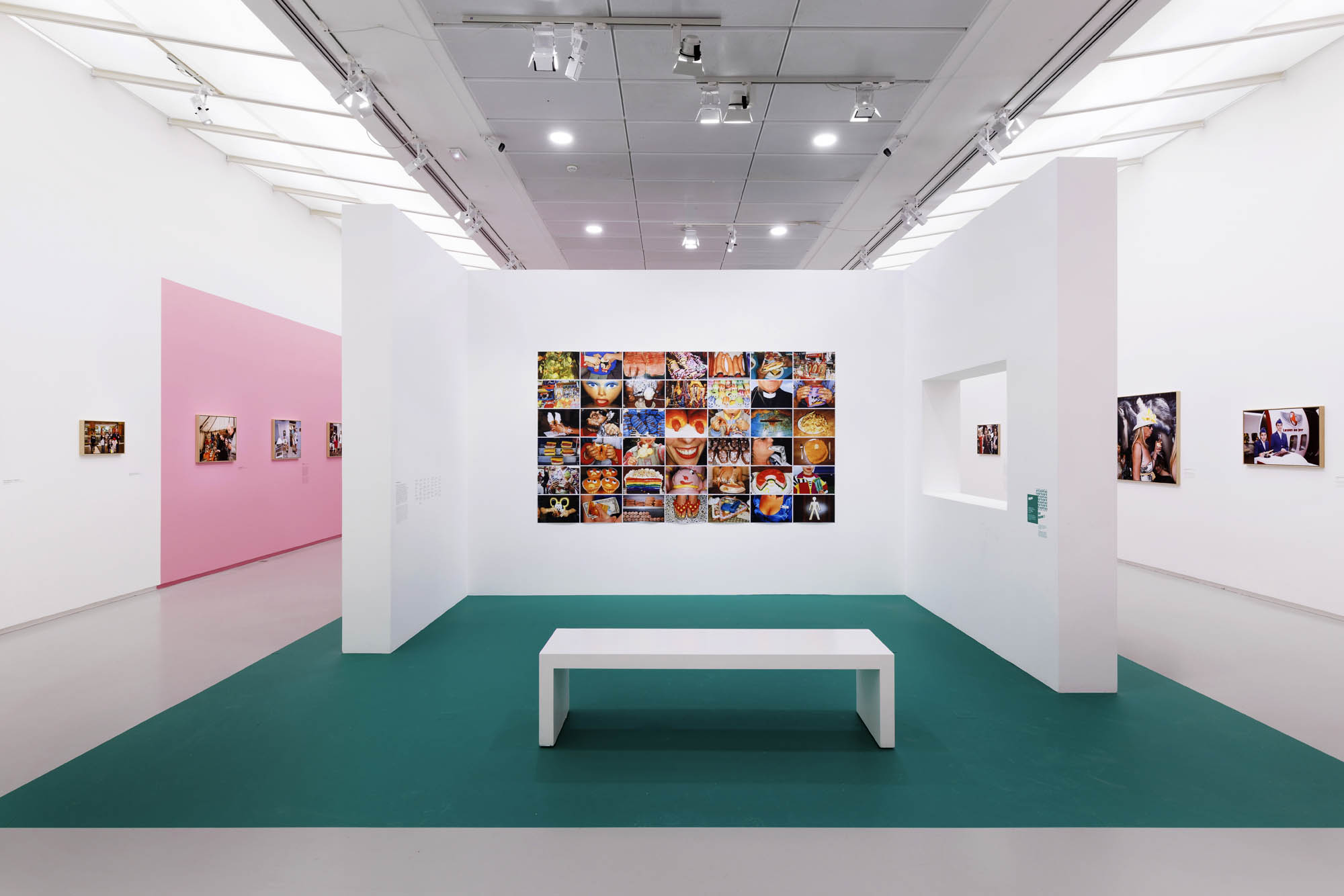
Installation view of the exhibition 'Martin Parr: Global Warning' at Jeu de Paume, Paris, January - May, 2026


Installation view of the exhibition Martin Parr: Global Warning at Jeu de Paume, Paris, January – May, 2026 showing at centre, photographs from Martin Parr’s series Common Sense (1999)


Installation view of the exhibition 'Martin Parr: Global Warning' at Jeu de Paume, Paris, January - May, 2026 showing photographs from Martin Parr's series 'Common Sense' (1999)
Martin Parr (English, 1952-2025) From 'Common Sense ' 1999


Installation views of the exhibition Martin Parr: Global Warning at Jeu de Paume, Paris, January – May, 2026 showing photographs from Martin Parr’s series Common Sense (1999, below)


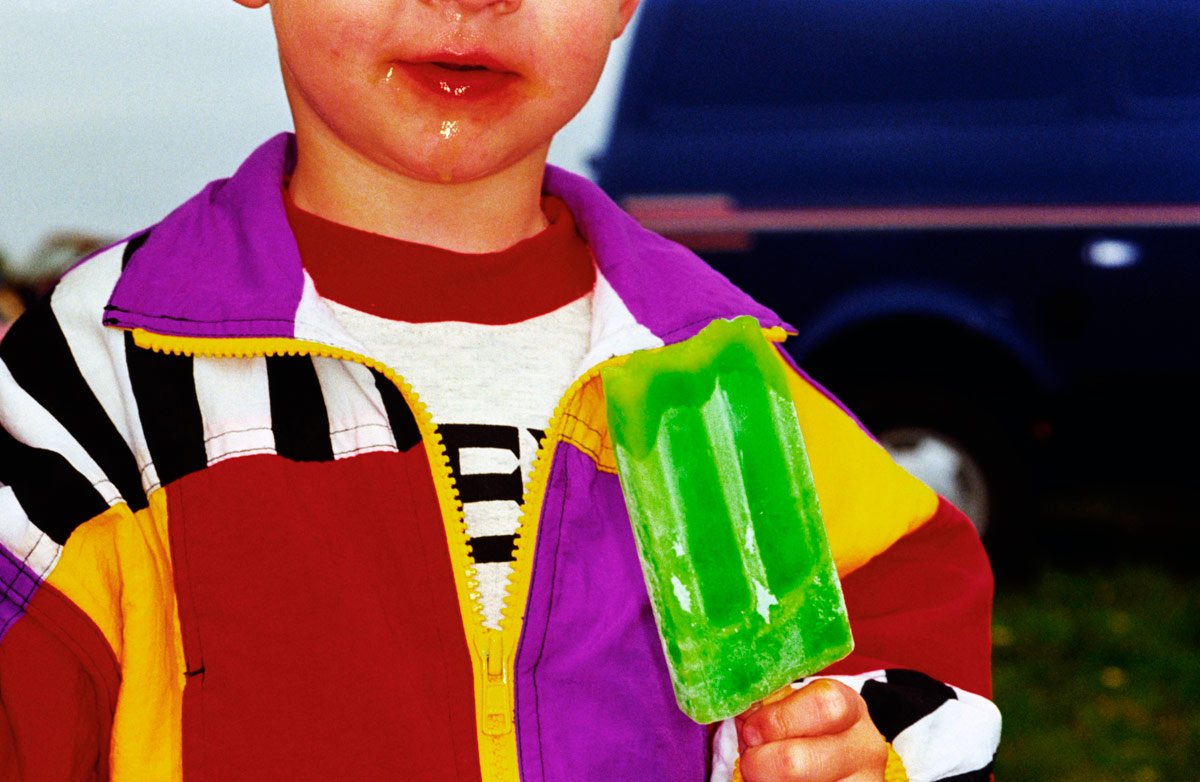
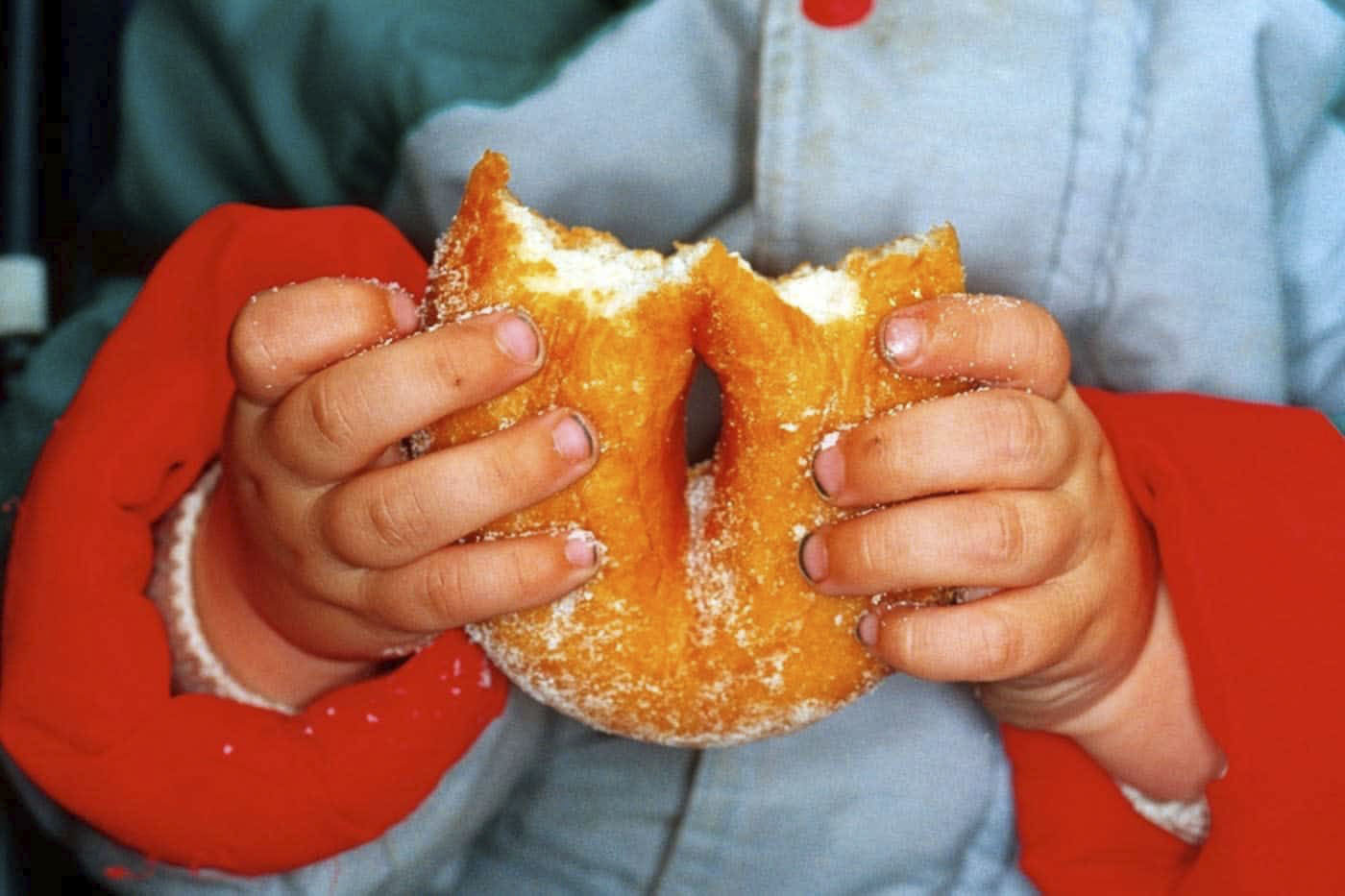
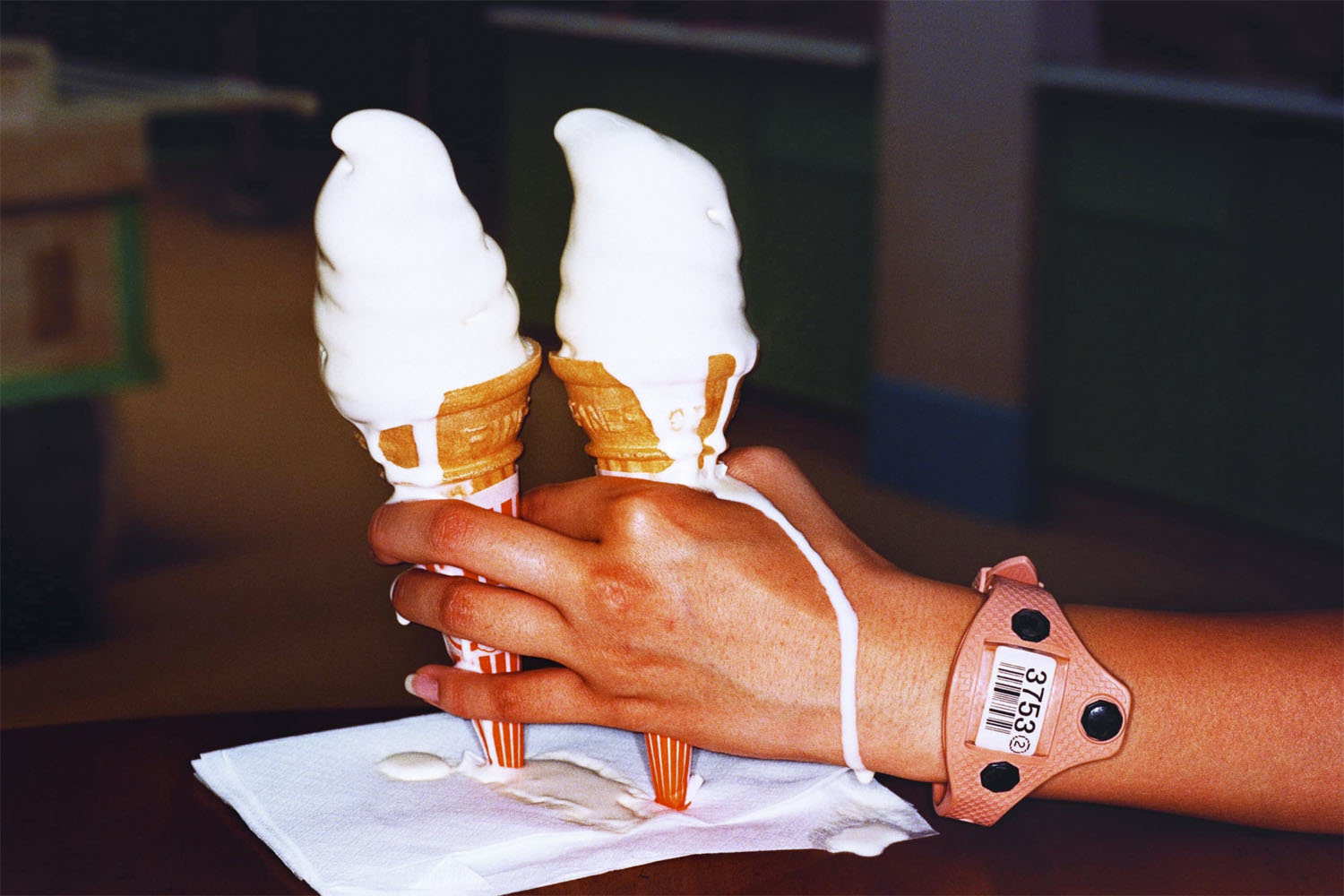
In his playfully titled Common sense series, British photographer Martin Parr confronts and amuses us in a similar way. Each image in the series is an isolated detail revealing one ghastly aspect of excessive consumerism and consumption after another. The images jostle for our attention like billboards on the side of a freeway, employing many of the tactics of advertising, using large-scale, saturated colour and shock value to attract our gaze.

In his photographs of food, Martin Parr pointedly examines the gross indulgence that is encouraged by manufacturers and their advertisers. Shown here as just another commodity, generic and mass-produced food becomes obscene in its abundance…. When seen in such lurid detail, the overblown details on the person’s hands, such as the ring with blue stone, a Band-Aid, and the imperfect application of the gaudy nail polish, become repulsive images of the ordinary. …

The Common sense series is a major body of work within Parr’s ongoing exploration of globalisation, mass tourism, class culture and consumerism. In common with much of his work, this series presents images critical of the contemporary culture with a distinctive sense of irony and British humour. There is something uncomfortable in all these photographs. We laugh at them while being slightly embarrassed by their familiarity and are acutely aware of the gulf between a dream of glamour and the sad synthetic reality.

Susan van Wyk, Curator, Photography, National Gallery of Victoria

Susan van Wyk. “Martin Parr’s Common Sense,” in Art Journal 46, 29 Jan 14 on the National Gallery of Victoria website [Online] Cited 16/04/2026. Used under fair use conditions for the purposes of education and research
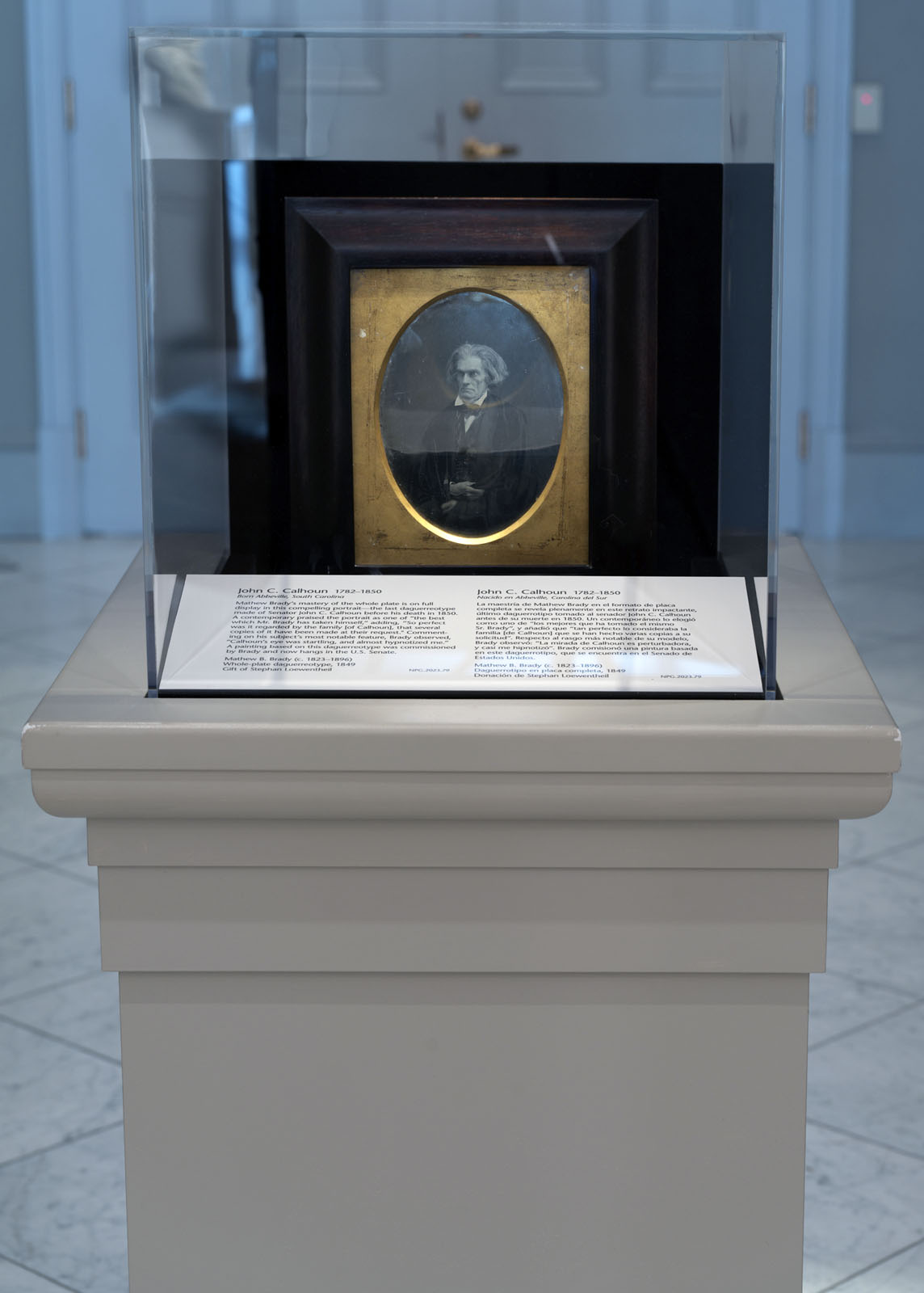
 

Martin Parr (British, 1952-2025) 'England. Bristol. Car boot sale. 1995' 1994-1995 from the series 'British Food'


Martin Parr (British, 1952-2025)
England. Bristol. Car boot sale. 1995
1994-1995
From Common Sense
© Martin Parr / Magnum Photos


Martin Parr (British, 1952-2025) 'Ramsgate, England' 1996


Martin Parr (British, 1952-2025)
Ramsgate, England
1996
From Common Sense
© Martin Parr / Magnum Photos


Martin Parr (English, 1952-2025) 'Tokyo, Japan' 1998


Martin Parr (English, 1952-2025)
Tokyo, Japan
1998
From Common Sense
© Martin Parr / Magnum Photos


Martin Parr (English, 1952-2025) 'Zurich, Switzerland' 1997


Martin Parr (English, 1952-2025)
Zurich, Switzerland
1997
From Common Sense
© Martin Parr / Magnum Photos


Martin Parr (English, 1952-2025) 'Fairy Cakes, Glasgow, Scotland' 1999


Martin Parr (English, 1952-2025)
Fairy Cakes, Glasgow, Scotland
1999
From Common Sense
© Martin Parr / Magnum Photos


Martin Parr (English, 1952-2025) 'Zurich, Switzerland' 1997


Martin Parr (English, 1952-2025)
Zurich, Switzerland
1997
From Common Sense
© Martin Parr / Magnum Photos


Martin Parr (English, 1952-2025) 'Florida, USA' 1998


Martin Parr (English, 1952-2025)
Florida, USA
1998
© Martin Parr / Magnum Photos


Installation view of the exhibition 'Martin Parr: Global Warning' at Jeu de Paume, Paris, January - May, 2026 showing at left, Martin Parr's 'Cozumel, Mexico' (2002); and at right, the wall text for "Small World"


Installation view of the exhibition Martin Parr: Global Warning at Jeu de Paume, Paris, January – May, 2026 showing at left, Martin Parr’s Cozumel, Mexico (2002, below); and at right, the wall text for “Small World”


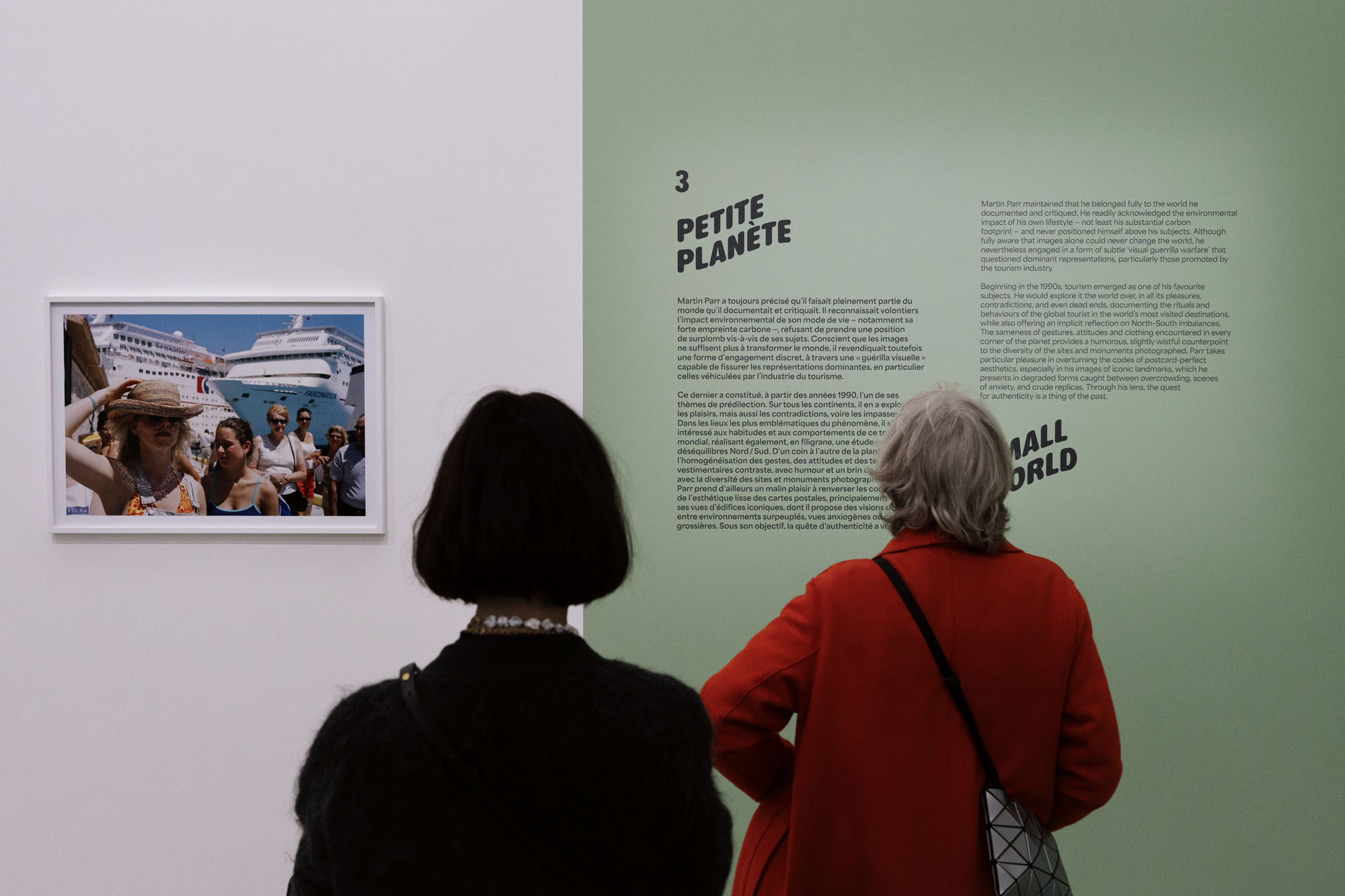
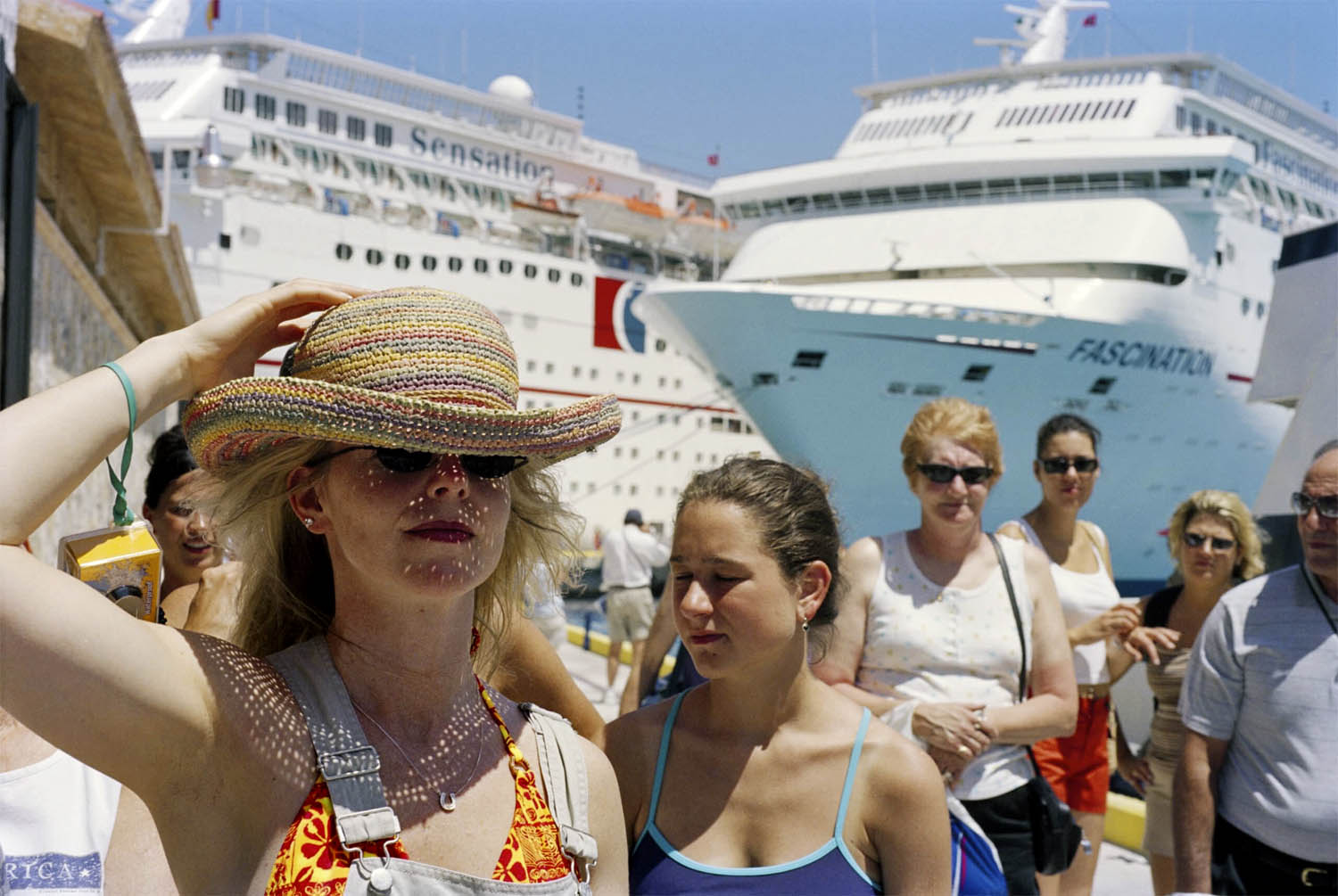
Small World

Martin Parr maintained that he belonged fully to the world he documented and critiqued. He readily acknowledged the environmental impact of his own lifestyle – not least his substantial carbon footprint – and near positioned himself above his subjects. Although fully aware that images alone could never change the world, he nevertheless engaged in a form of subtle, visual guerrilla warfare that questioned dominant representations, particularly those promoted by the tourism industry.

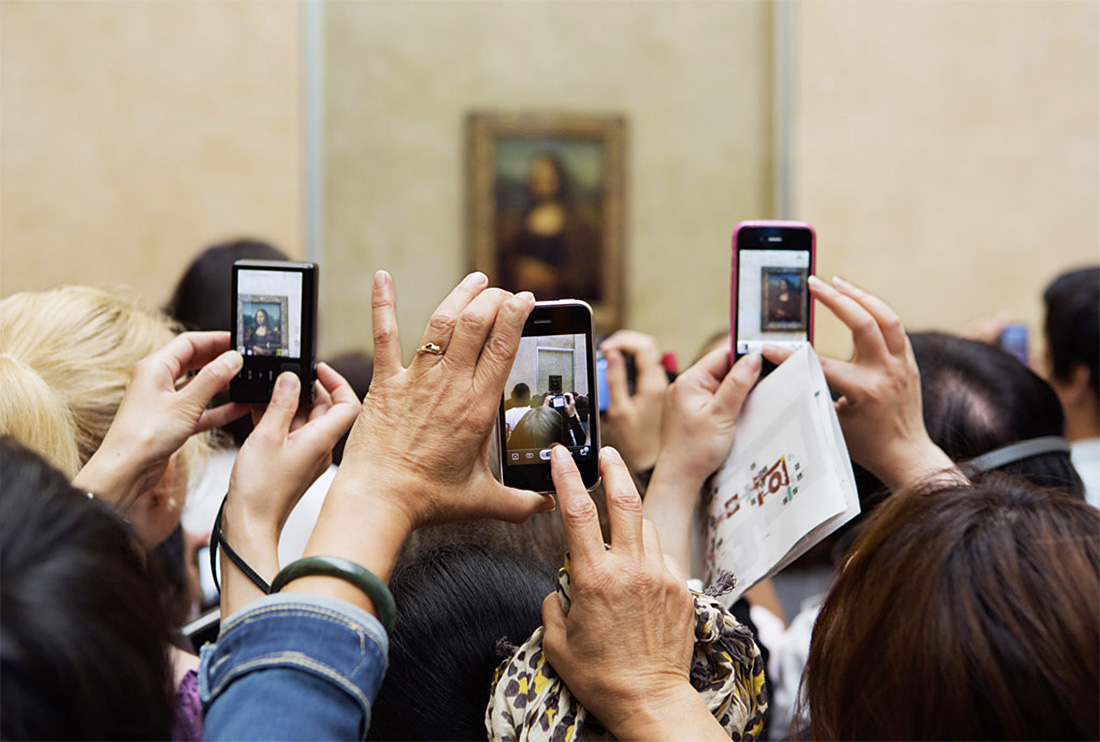
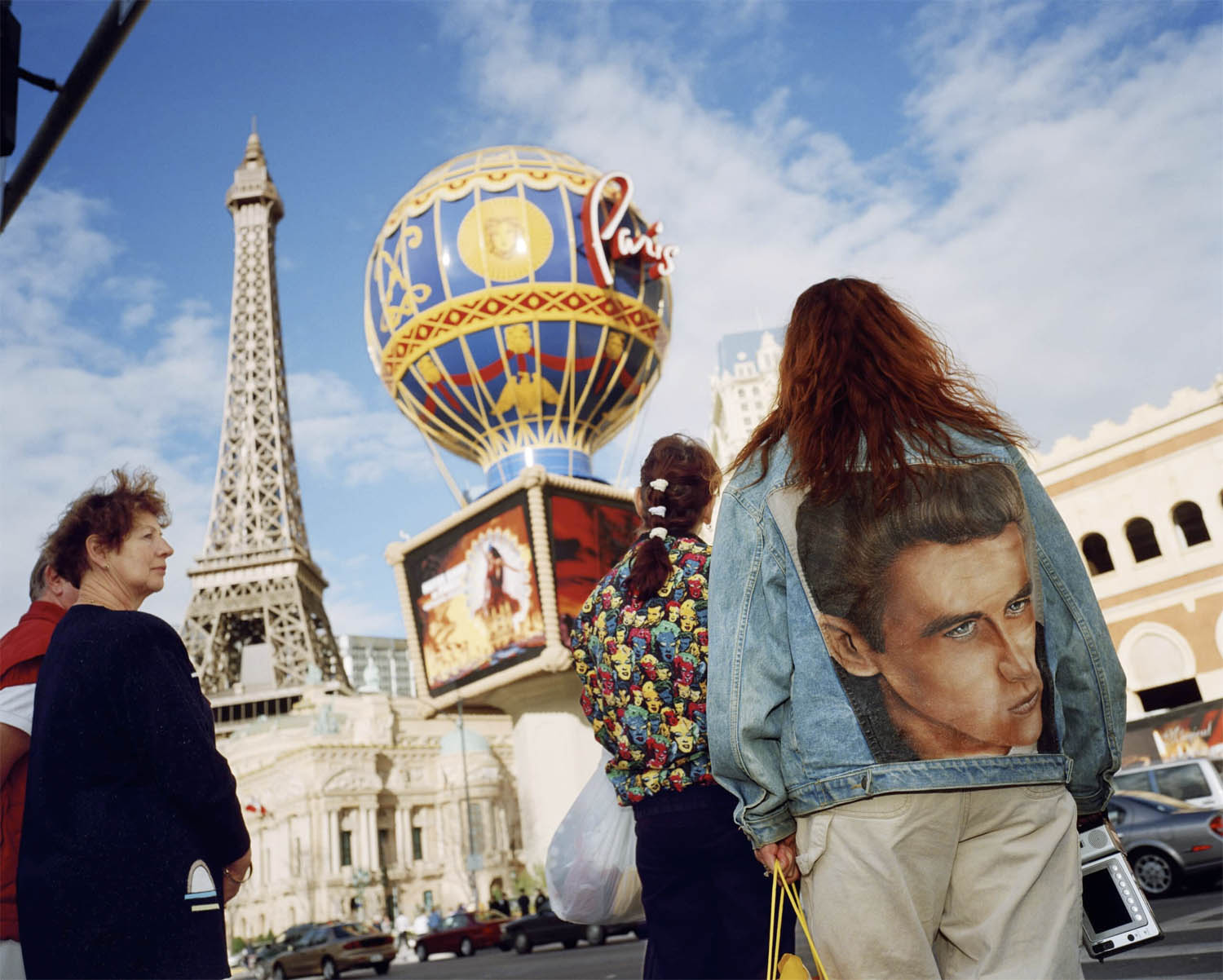
Beginning in the 1990s, tourism emerged as one of his favourite subjects. He would explore it the world over, in all its pleasures, contradictions, and even dead ends, documenting the rituals and behaviours of the global tourist in the world’s most visited destinations. The sameness of gestures, attitudes and clothing encountered in every corner of the planet provides a humorous, slightly wistful counterpoint to the diversity of the sites and monuments photographed. Parr takes particular pleasure in overturning the codes of postcard perfect aesthetics, especially in his images of iconic landmarks, which he presents in degraded forms caught between over crowding, scenes of anxiety, and crude replicas. Through his lens, the quest for authenticity is a thing of the past.

Wall text from the exhibition


Martin Parr (English, 1952-2025) 'Cozumel, Mexico' 2002


Martin Parr (English, 1952-2025)
Cozumel, Mexico
2002
© Martin Parr / Magnum Photos


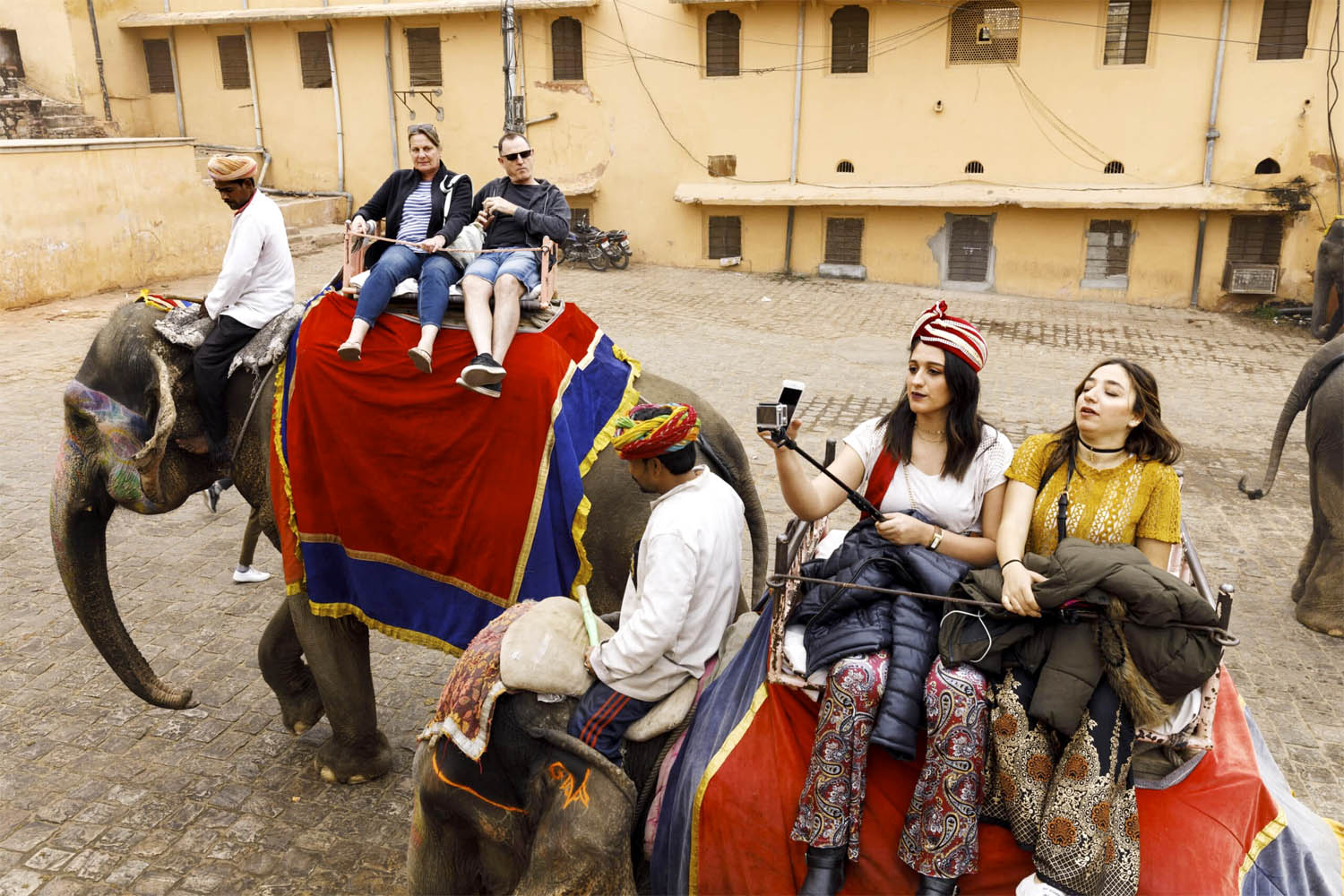
Martin Parr (English, 1952-2025) 'Amer Fort, Jaipur, India' 2019


Martin Parr (English, 1952-2025)
Amer Fort, Jaipur, India
2019
© Martin Parr / Magnum Photos


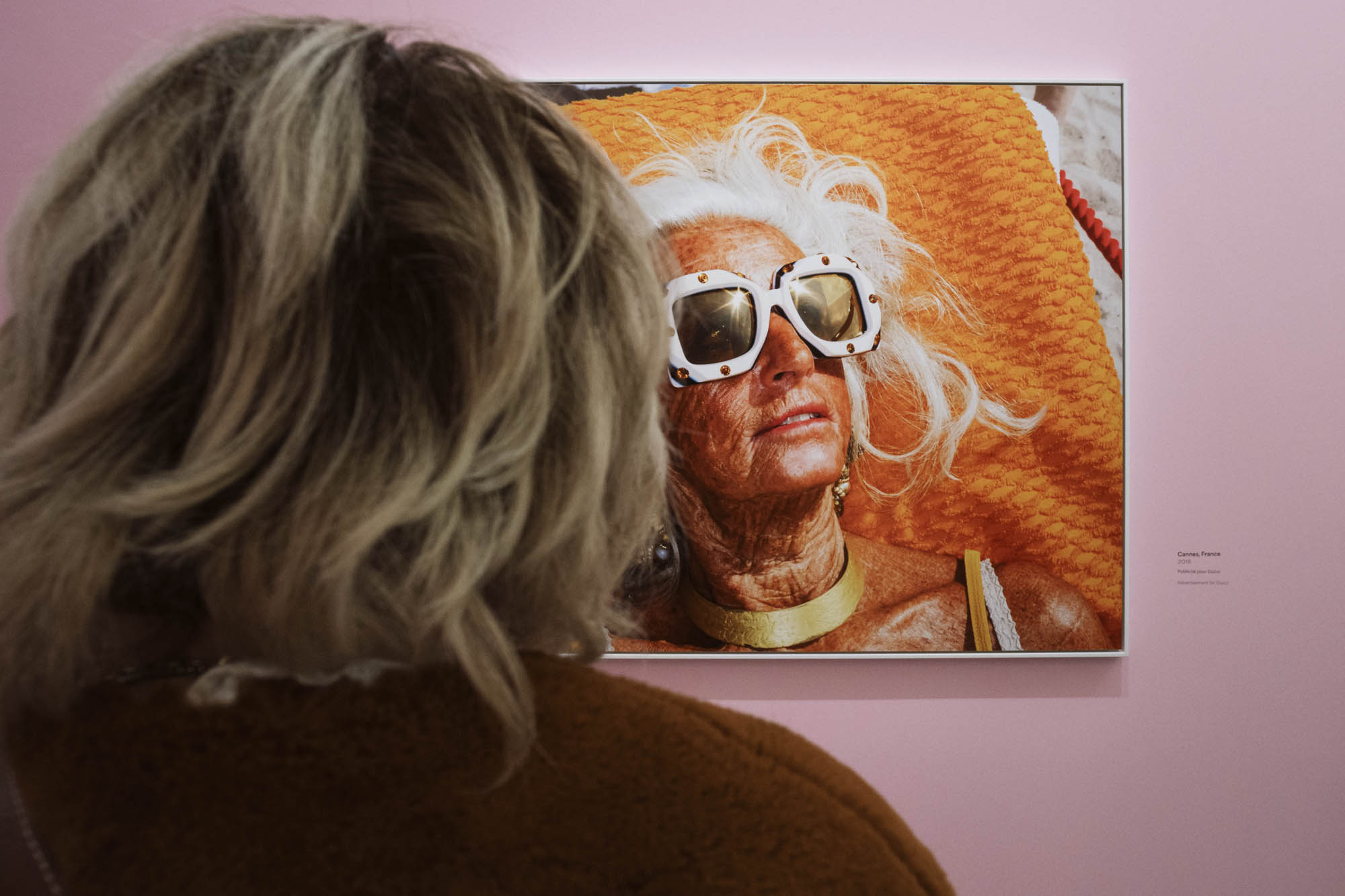
Installation view of the exhibition 'Martin Parr: Global Warning' at Jeu de Paume, Paris, January - May, 2026 showing Parr's photograph 'Cannes, France' (2018)


Installation view of the exhibition Martin Parr: Global Warning at Jeu de Paume, Paris, January – May, 2026 showing Parr’s photograph Cannes, France (2018, below)


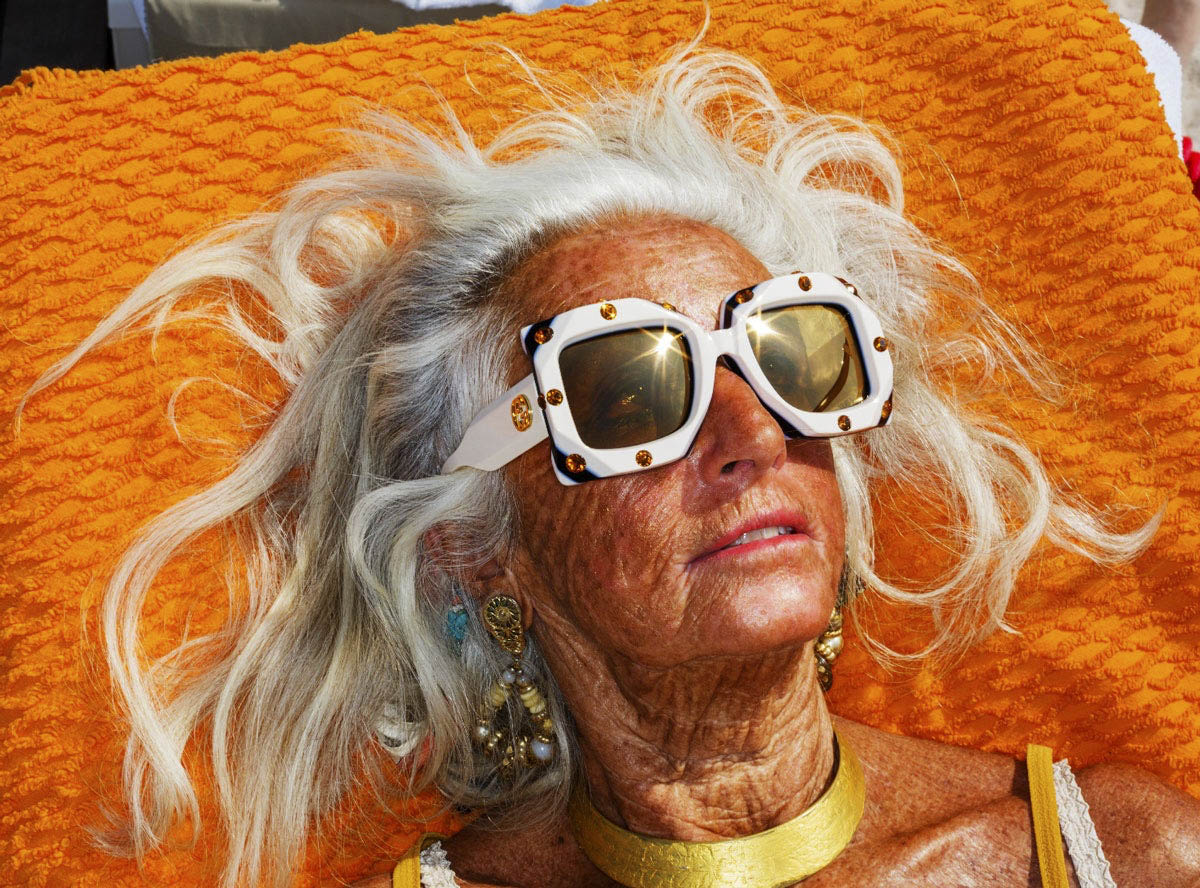
Martin Parr (English, 1952-2025) 'Cannes, France' 2018


Martin Parr (English, 1952-2025)
Cannes, France
2018
© Martin Parr / Magnum Photos

Advertisement for Gucci


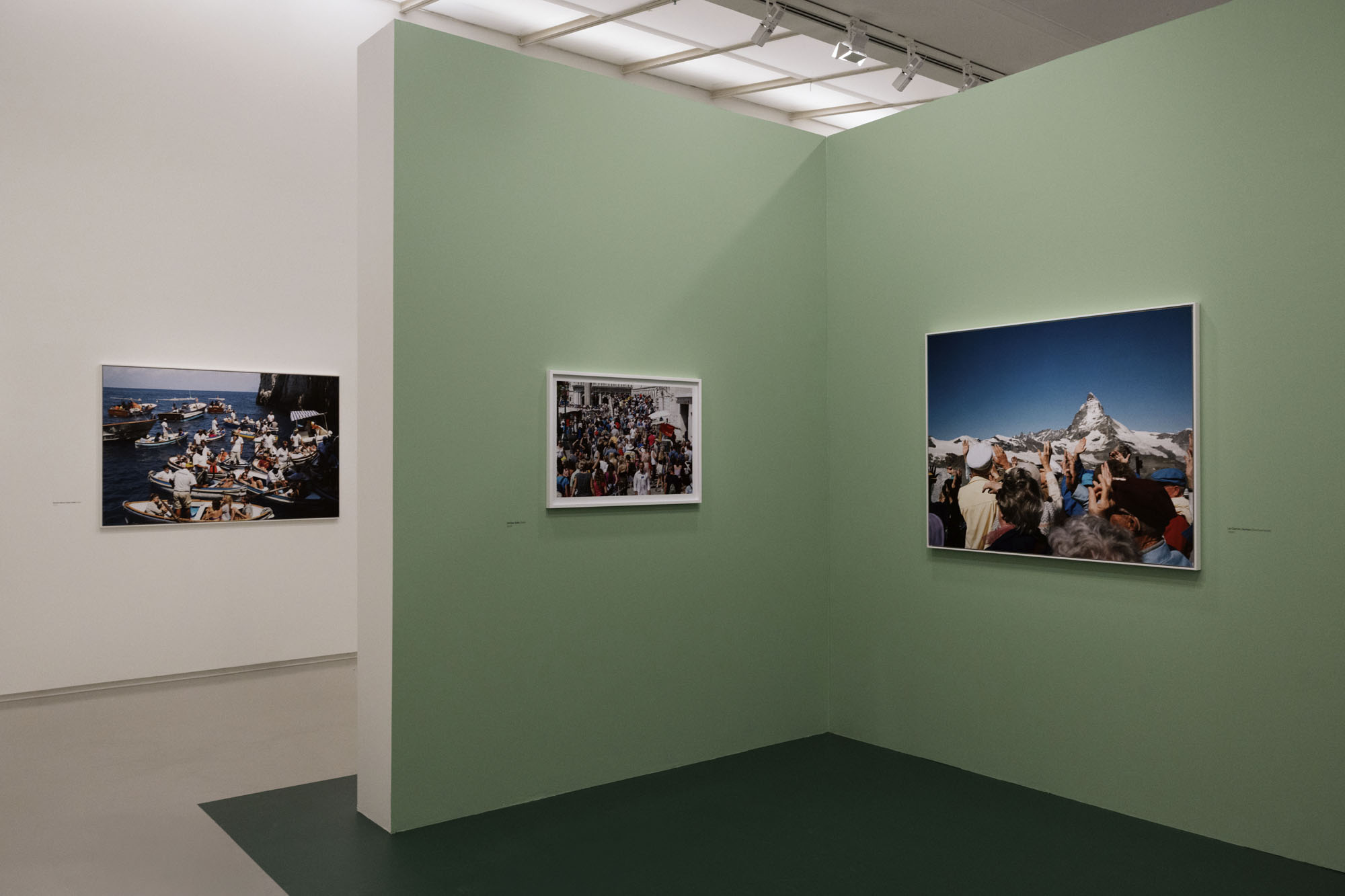
Installation view of the exhibition 'Martin Parr: Global Warning' at Jeu de Paume, Paris, January - May, 2026 showing at left, Martin Parr's photograph 'Sorrento, Italy' (2014); and at right, 'The Matterhorn, Alps, Switzerland' (1990)


Installation view of the exhibition Martin Parr: Global Warning at Jeu de Paume, Paris, January – May, 2026 showing at left, Martin Parr’s photograph Sorrento, Italy (2014, below); and at right, The Matterhorn, Alps, Switzerland (1990)


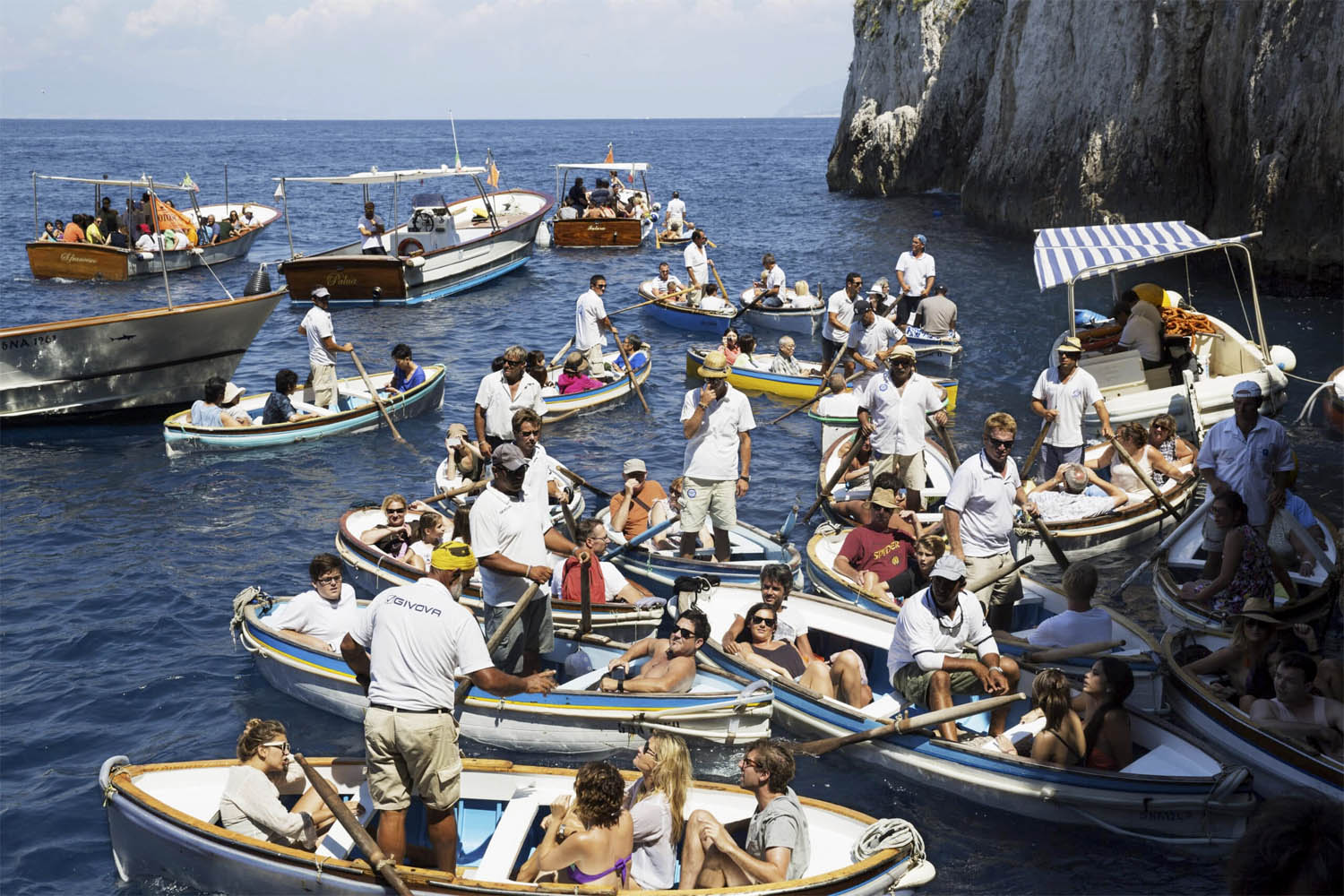
Martin Parr (English, 1952-2025) 'Sorrento, Italy' 2014


Martin Parr (English, 1952-2025)
Sorrento, Italy
2014
© Martin Parr / Magnum Photos


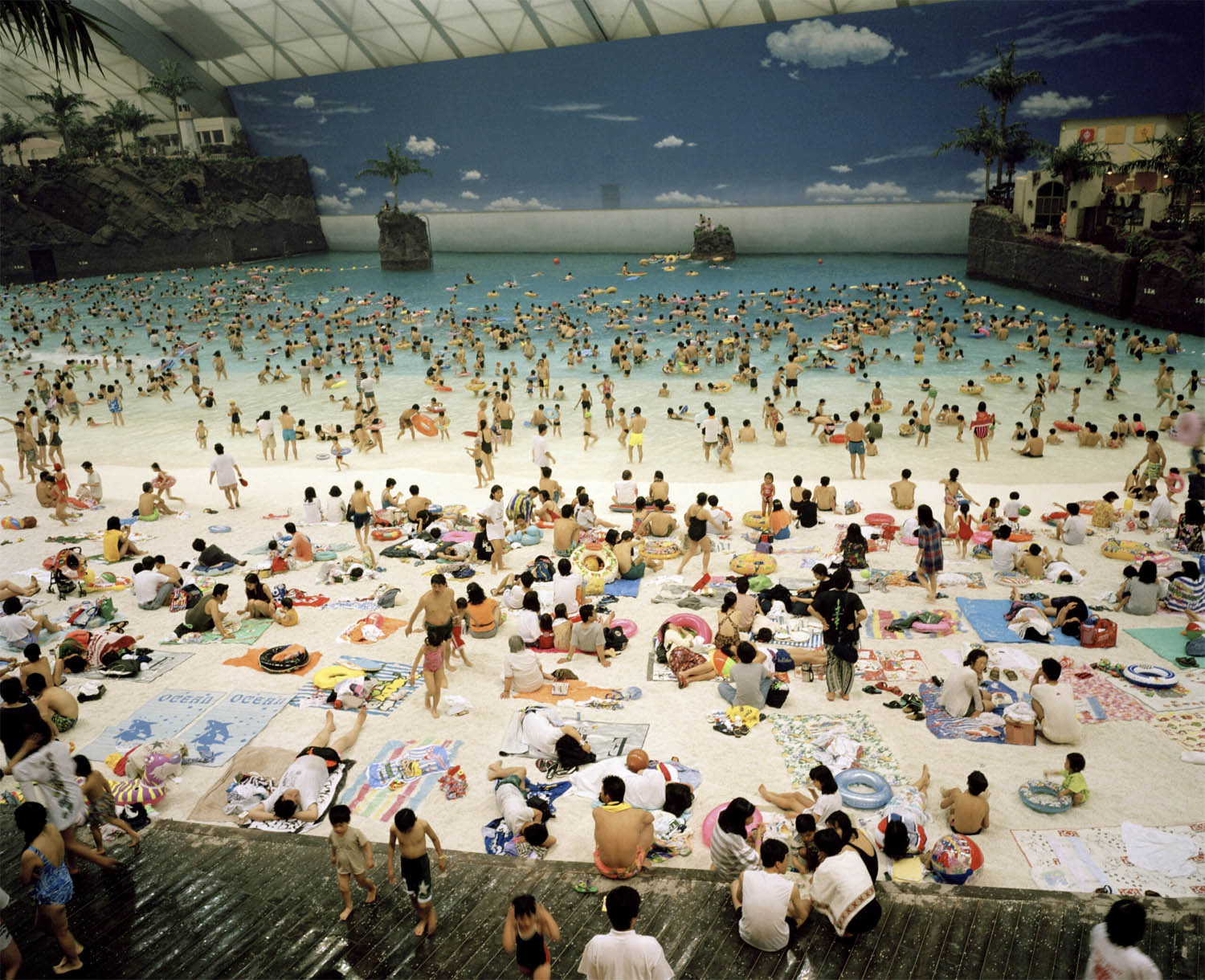
Martin Parr (English, 1952-2025) 'The Artificial beach inside the Ocean Dome' 1996


Martin Parr (English, 1952-2025)
The Artificial beach inside the Ocean Dome, Seagaia Ocean Dome, Miyazaki, Japan
1996
© Martin Parr / Magnum Photos


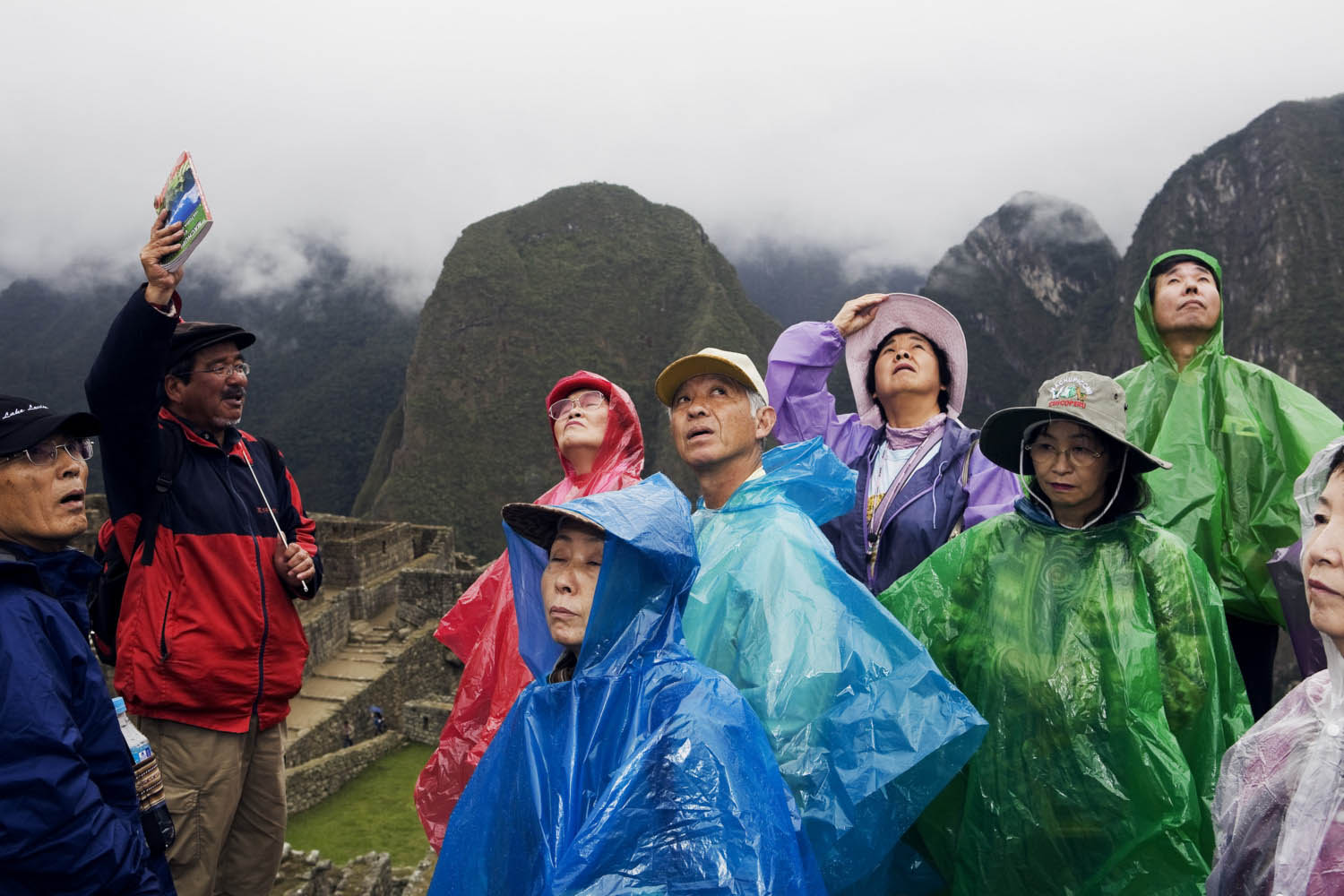
Martin Parr (English, 1952-2025) 'Machu Picchu, Peru' 2008


Martin Parr (English, 1952-2025)
Machu Picchu, Peru
2008
© Martin Parr / Magnum Photos


‘Between the hours of 10am and 2pm the site is at its busiest with up to 4,000 visitors arriving each day. Knowing how inaccessible the place is, it is staggering where and how they emerge. It is also not a cheap visit as each foreign tourist has to pay 122 soies (roughly $40) to enter the site. I am convinced that this entrance payment, together with the cost of the journey and the trekking are probably keeping the Peruvian economy afloat, as 70% of all visitors are foreigners.’

From Martin Parr’s blog, Machu Picchu, 2008
Wall text from the exhibition


Installation view of the exhibition 'Martin Parr: Global Warning' at Jeu de Paume, Paris, January - May, 2026 showing at bottom left, Martin Parr's photograph 'Notre Dame, Paris, France' (2012); and at right, 'Kleine Scheidegg, Switzerland' (1994)


Installation view of the exhibition Martin Parr: Global Warning at Jeu de Paume, Paris, January – May, 2026 showing at bottom left, Martin Parr’s photograph Notre Dame, Paris, France (2012, below); and at right, Kleine Scheidegg, Switzerland (1994, below)


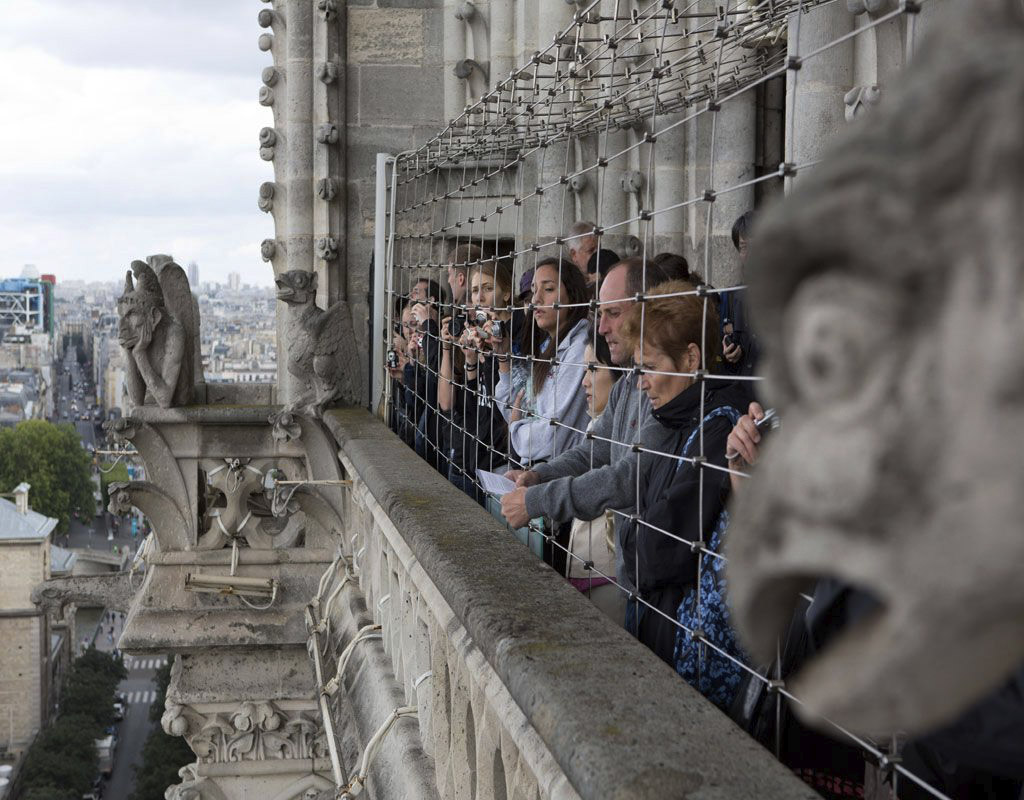
Martin Parr (English, 1952-2025) 'Notre Dame, Paris, France' 2012


Martin Parr (English, 1952-2025)
Notre Dame, Paris, France
2012
© Martin Parr / Magnum Photos


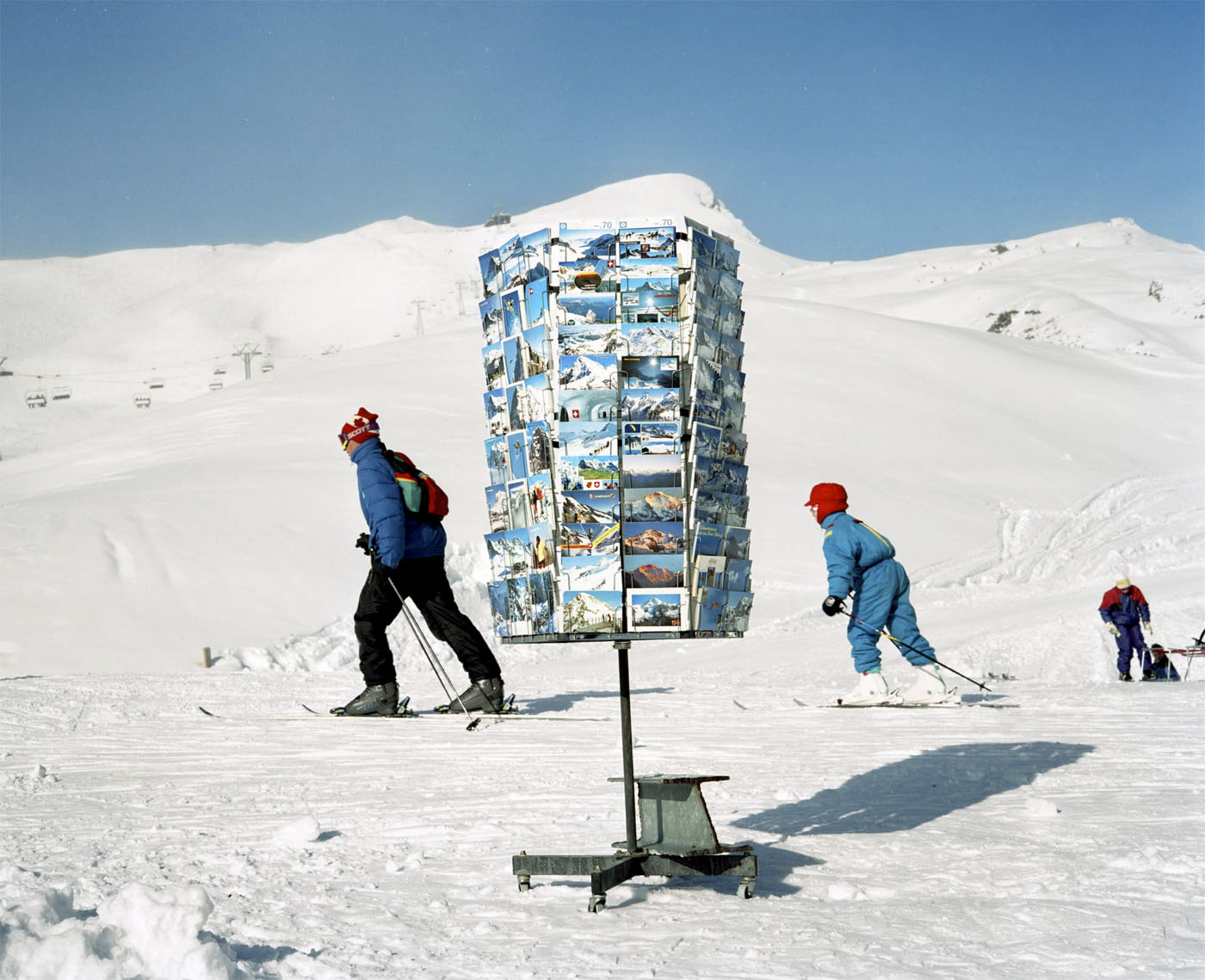
Martin Parr (English, 1952-2025) 'Kleine Scheidegg, Switzerland' 1994


Martin Parr (English, 1952-2025)
Kleine Scheidegg, Switzerland
1994
© Martin Parr / Magnum Photos


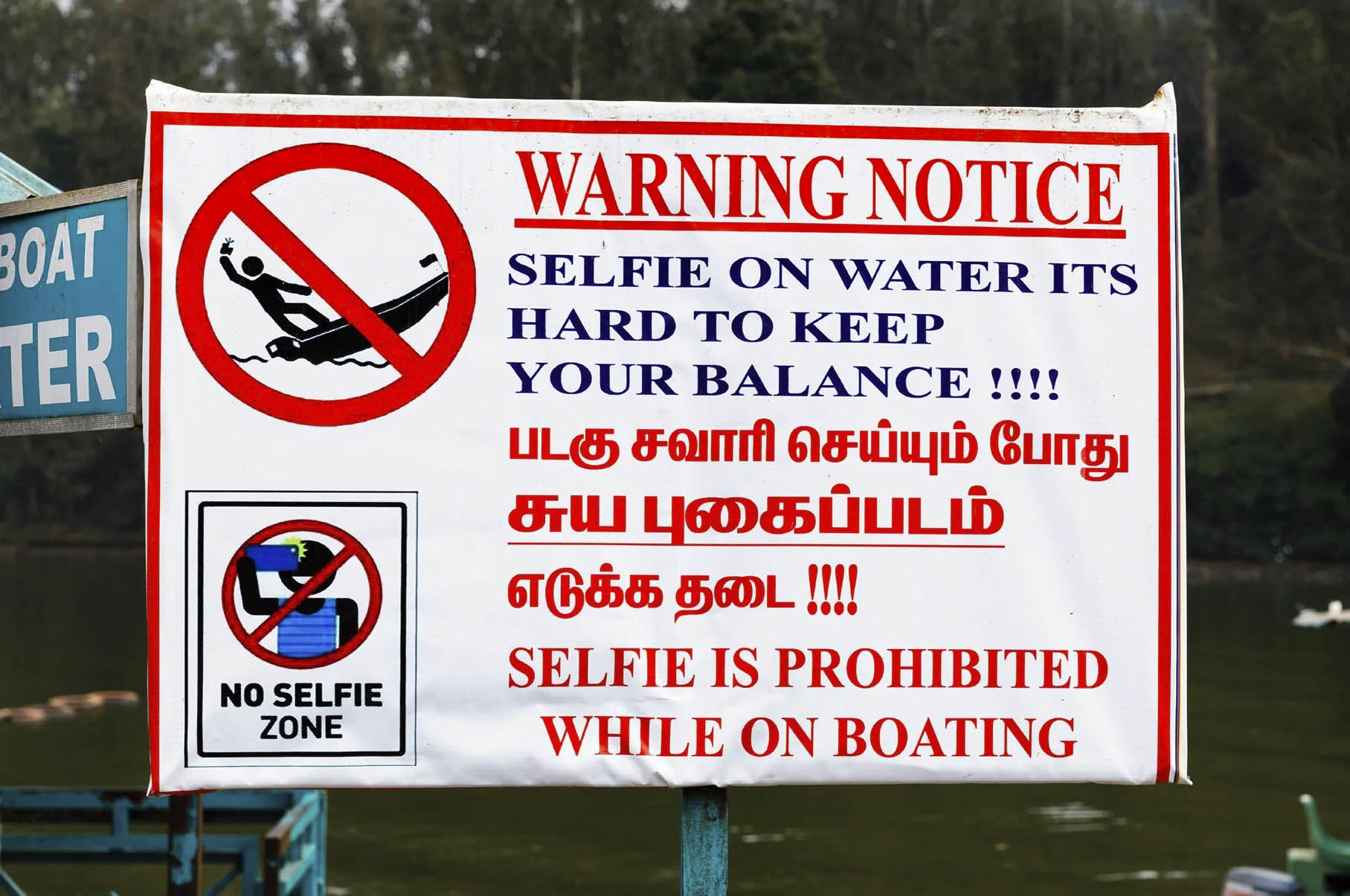
Martin Parr (English, 1952-2025) 'Ooty, India' 2018


Martin Parr (English, 1952-2025)
Ooty, India
2018
© Martin Parr / Magnum Photos


Martin Parr (English, 1952-2025) 'Musée du Louvre, Paris, France' 2012


Martin Parr (English, 1952-2025)
Musée du Louvre, Paris, France
2012
© Martin Parr / Magnum Photos


Martin Parr (English, 1952-2025) 'Las Vegas, USA' 2000


Martin Parr (English, 1952-2025)
Las Vegas, USA
2000
© Martin Parr / Magnum Photos


The Animal Kingdom

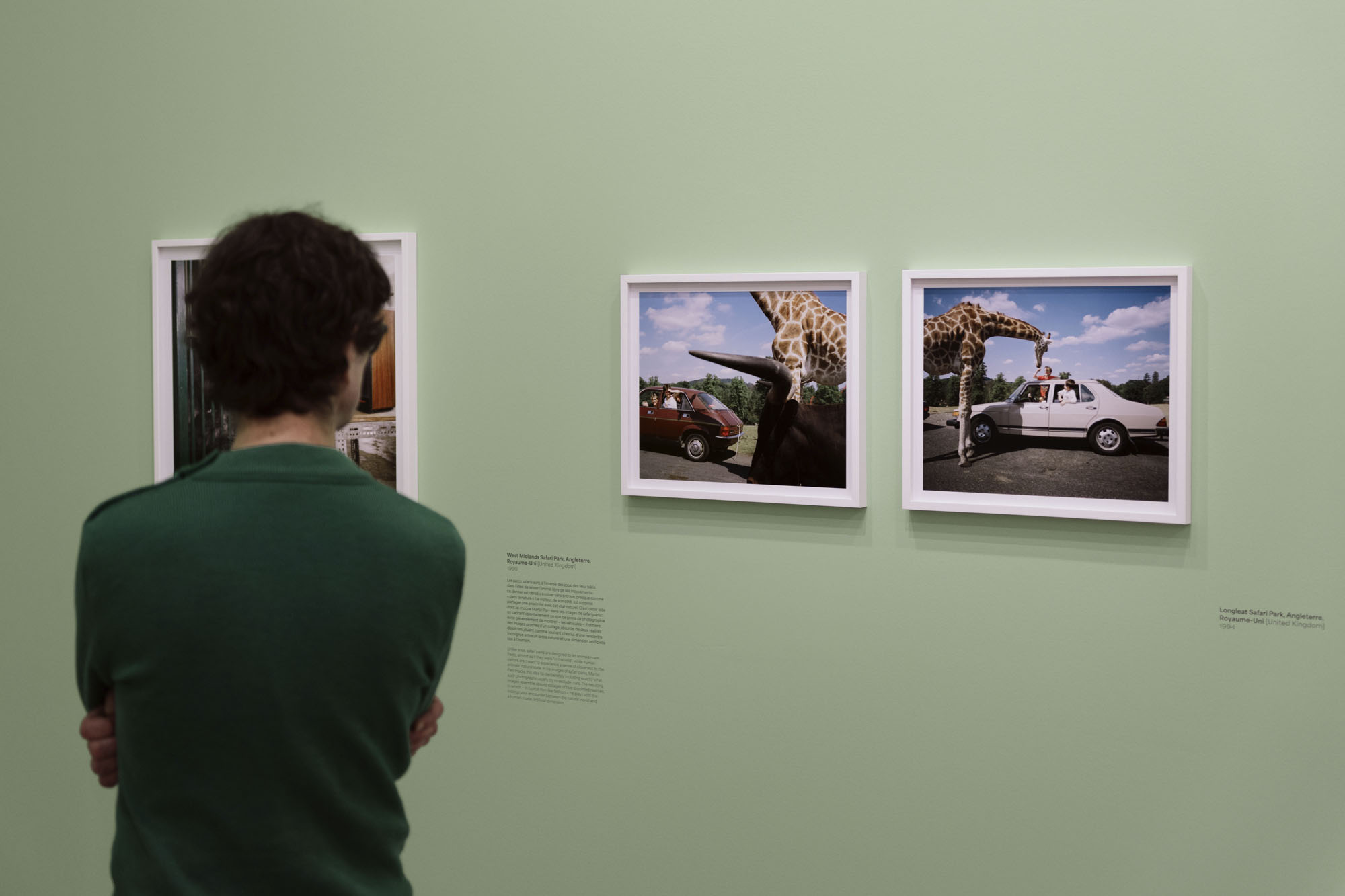
Installation view of the exhibition 'Martin Parr: Global Warning' at Jeu de Paume, Paris, January - May, 2026 showing at left, Martin Parr's 'West Midlands Safari Park, United Kingdom' (1990); and at right, 'Longleat Safari Park, United Kingdom' (1994)


Installation view of the exhibition Martin Parr: Global Warming at Jeu de Paume, Paris, January – May, 2026 showing at left, Martin Parr’s West Midlands Safari Park, United Kingdom (1990); and at right, Longleat Safari Park, United Kingdom (1994)


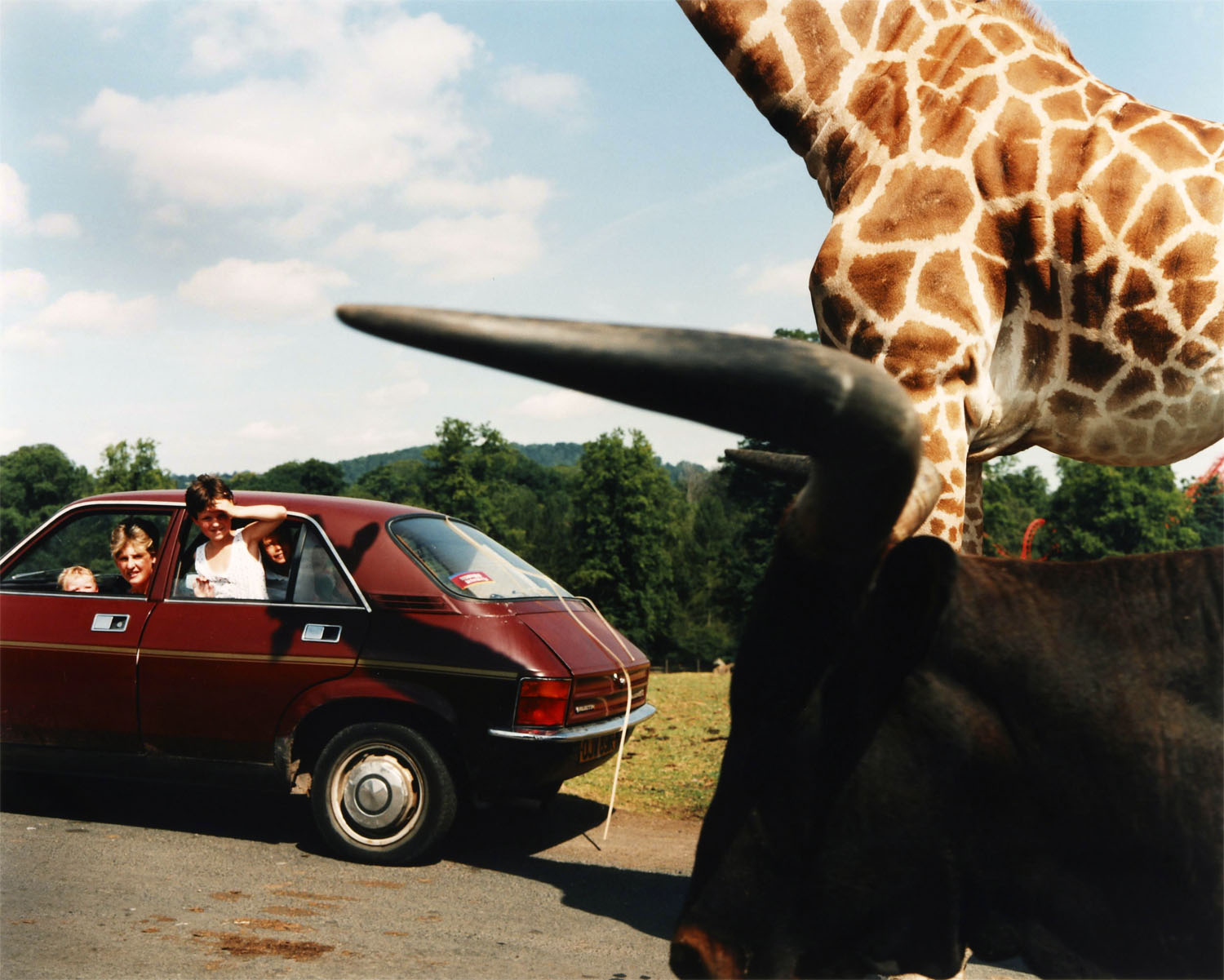
Martin Parr (English, 1952-2025) 'West Midlands Safari Park, United Kingdom' 1990


Martin Parr (English, 1952-2025)
West Midlands Safari Park, United Kingdom
1990
© Martin Parr / Magnum Photos


Unlike zoos, safari parks are designed to let animals roam freely, almost as if they were “in the wild”, while human visitors are meant to experience a sense of closeness to the animals natural state. In his images of safari parks, Martin Parr mocks this idea by deliberately including exactly what such photographs usually try to exclude: cars. The resulting images resemble absurd collages of two disjointed realities, in which – in typical Par-like fashion – he plays with the incongruous encounter between the natural world and a human-made, artificial dimension

Wall text from the exhibition


Installation view of the exhibition 'Martin Parr: Global Warning' at Jeu de Paume, Paris, January - May, 2026


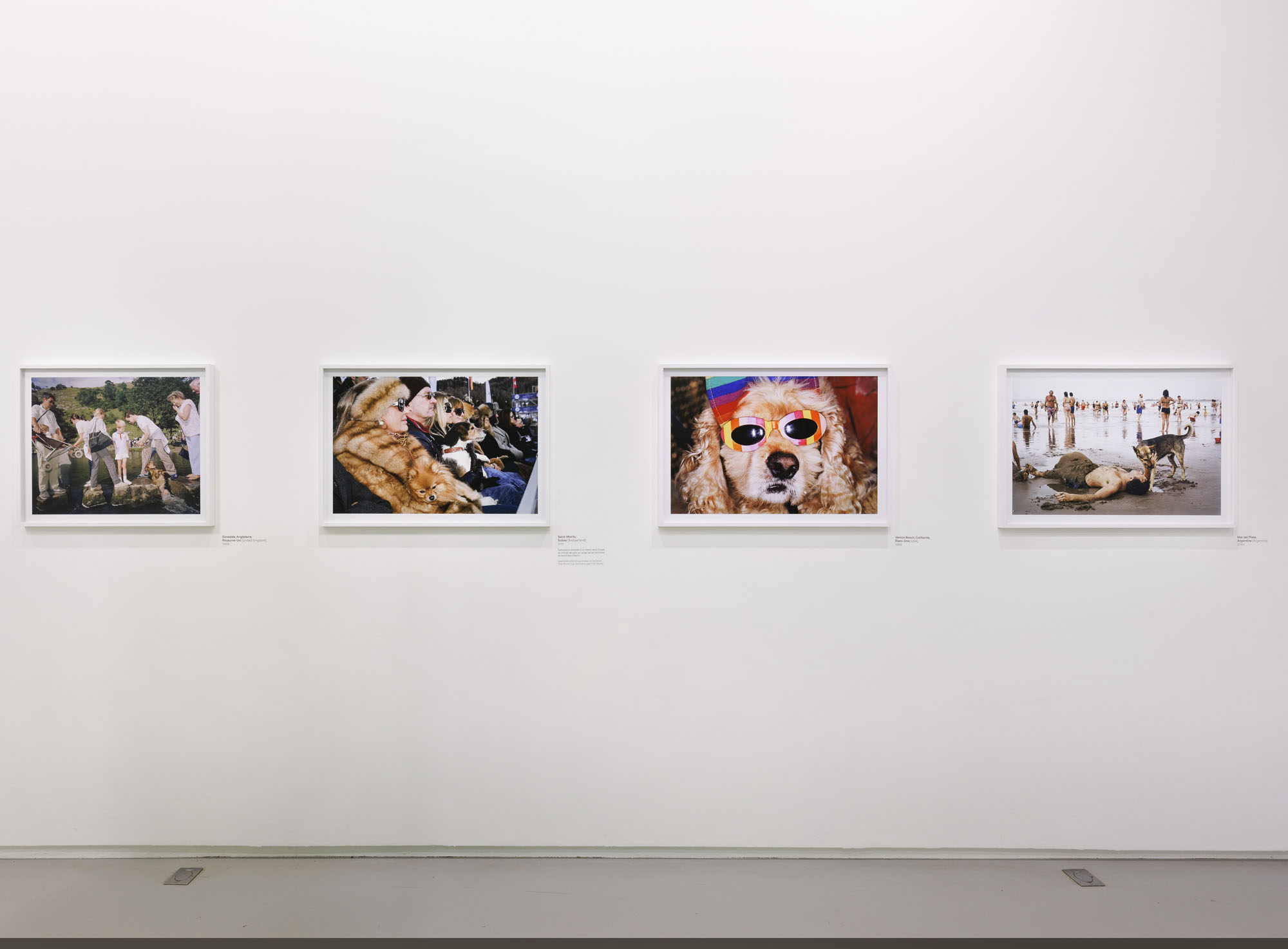
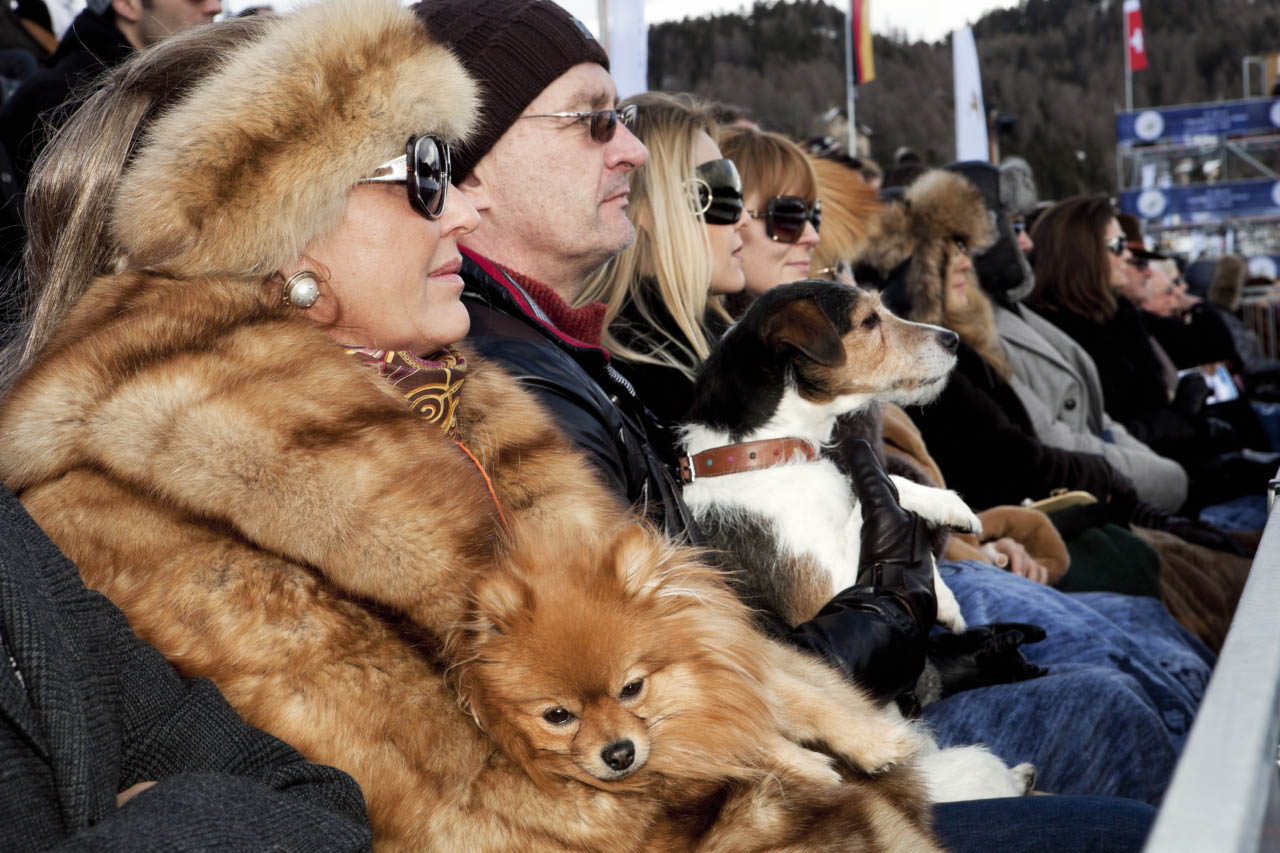
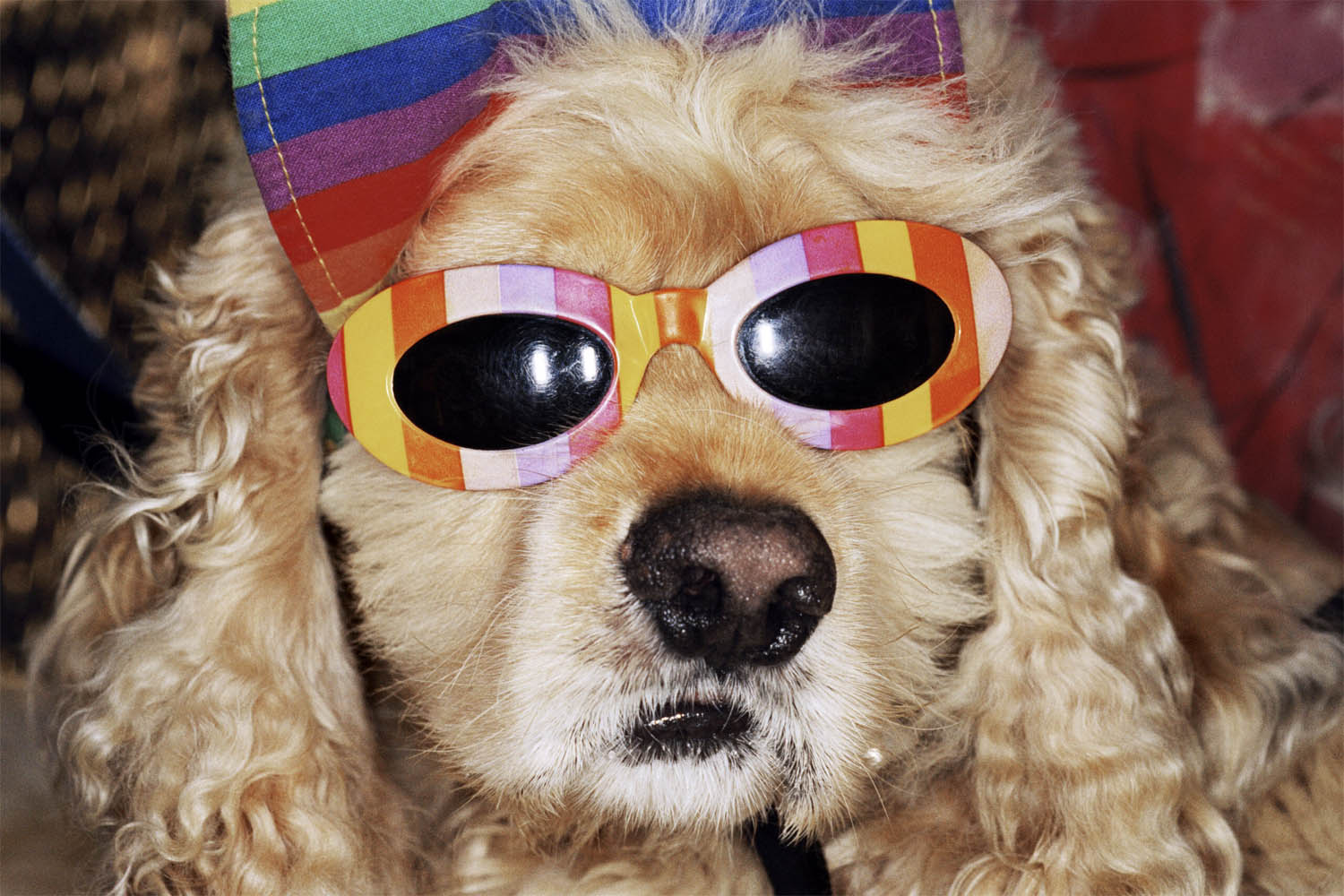
Installation view of the exhibition Martin Parr: Global Warming at Jeu de Paume, Paris, January – May, 2026 showing at second left, Martin Parr’s photograph Snow Polo World Cup, St Moritz, Switzerland (2011, below) from the series Luxury; and at second right, Venice Beach, California, USA (1998, below)


Martin Parr (English, 1952-2025) 'Snow Polo World Cup, St Moritz, Switzerland' 1998


Martin Parr (English, 1952-2025)
Snow Polo World Cup, St Moritz, Switzerland
1998
© Martin Parr / Magnum Photos


Martin Parr (English, 1952-2025) 'Venice Beach, California, USA' 1998


Martin Parr (English, 1952-2025)
Venice Beach, California, USA
1998
© Martin Parr / Magnum Photos


“I am not saying that tourism is bad – far from it as it brings a livelihood for many people. Organisations like Tourism Concern in the UK make a very important contribution to a better understanding of the yin and yang of tourism. This charity highlights the problems caused by tourism – from water shortages in newly developed sites to the pure rape of our ever decreasing natural habitats – and tries to ensure that local people benefit from the fruits of tourism. We need to adopt a better understanding of the issues surrounding this huge business. These photographs, I hope, will offer a good starting point. For remember we, in the wealthy West, are the ones that seek out the pleasures of tourism, so we’re all in this together.”


Martin Parr


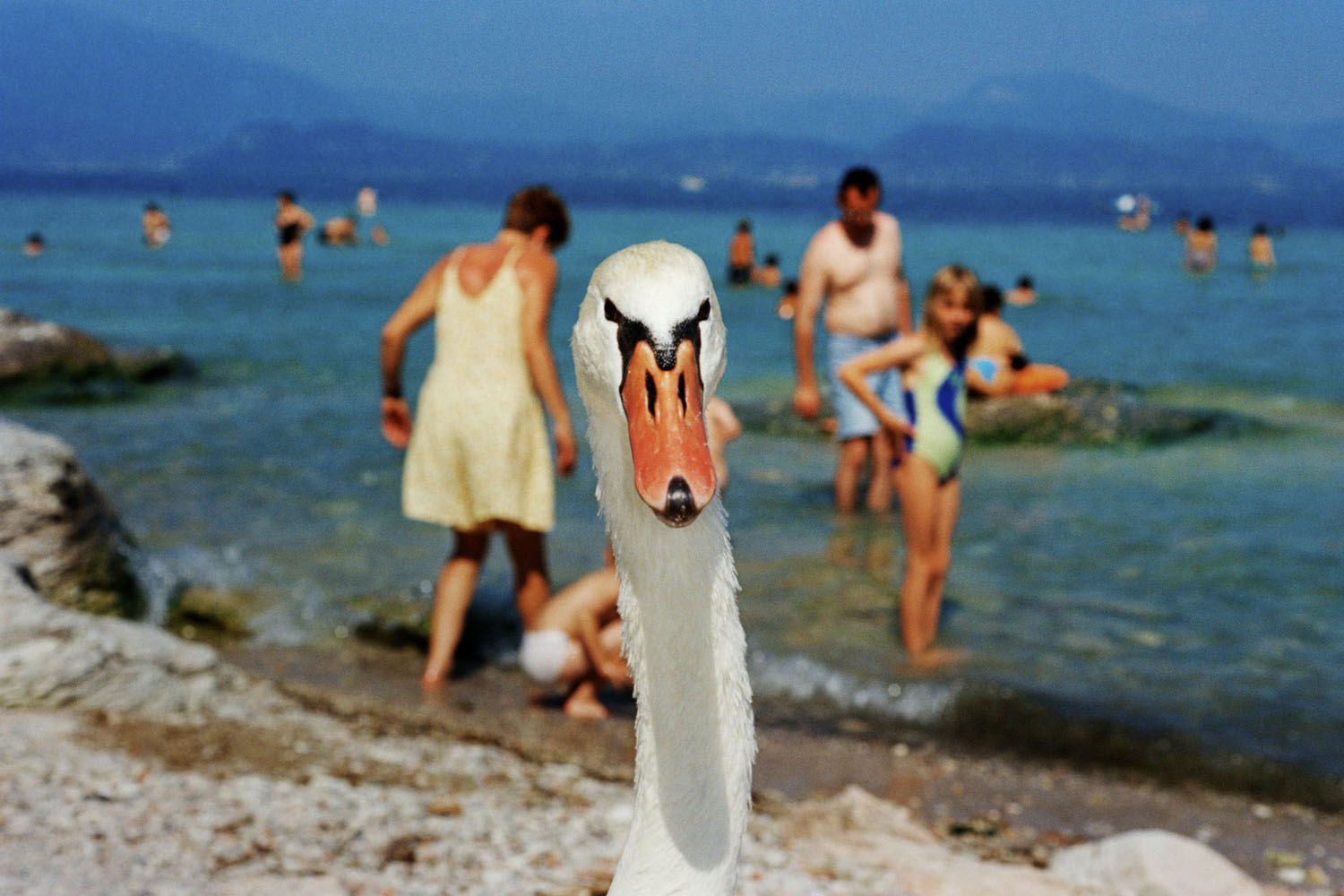
Martin Parr (English, 1952-2025) 'Lake Garda, Italy' 1999


Martin Parr (English, 1952-2025)
Lake Garda, Italy
1999
© Martin Parr / Magnum Photos


Martin Parr (English, 1952-2025) 'Venice, Italy' 2005


Martin Parr (English, 1952-2025)
Venice, Italy
2005
© Martin Parr / Magnum Photos


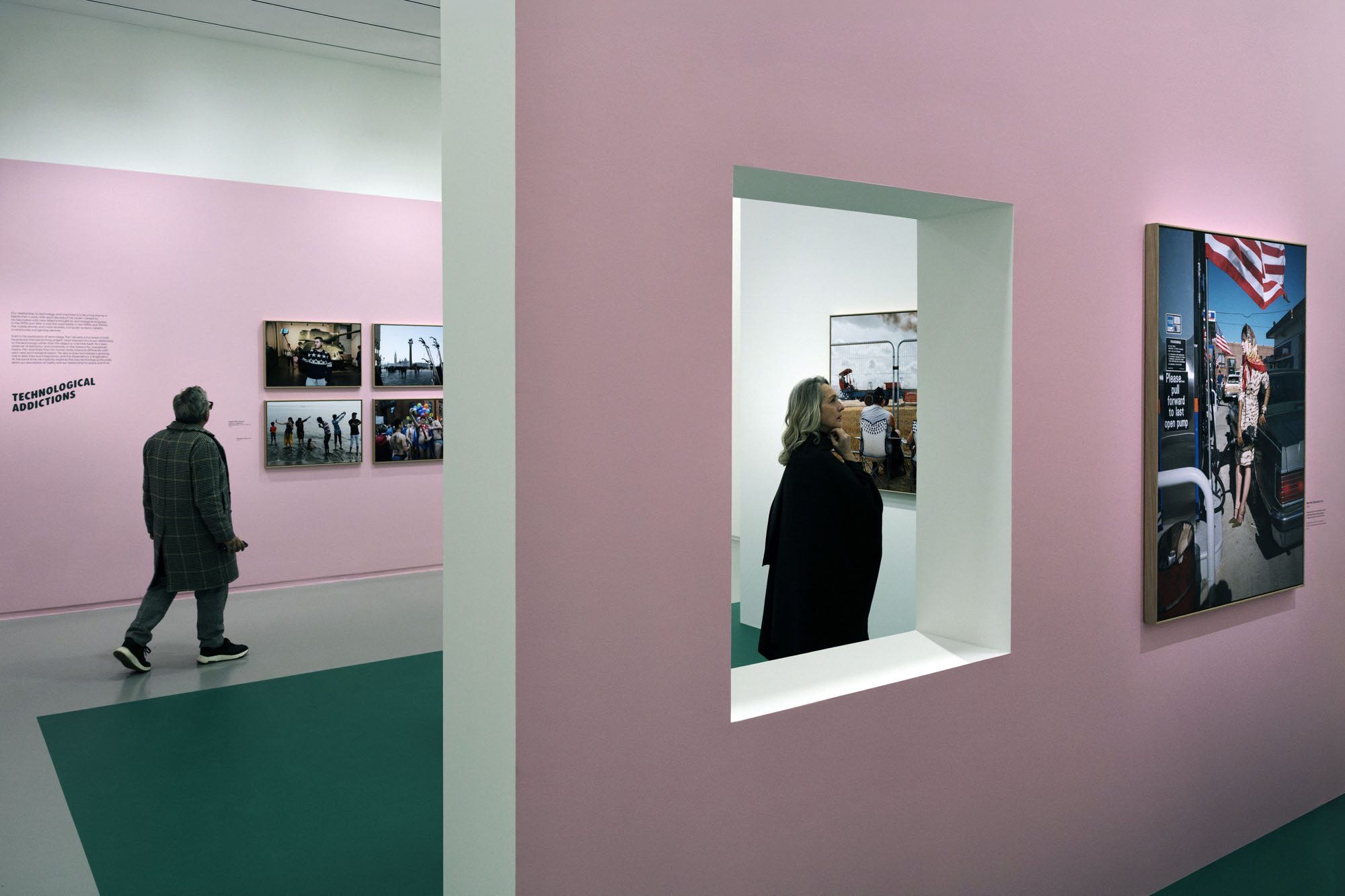
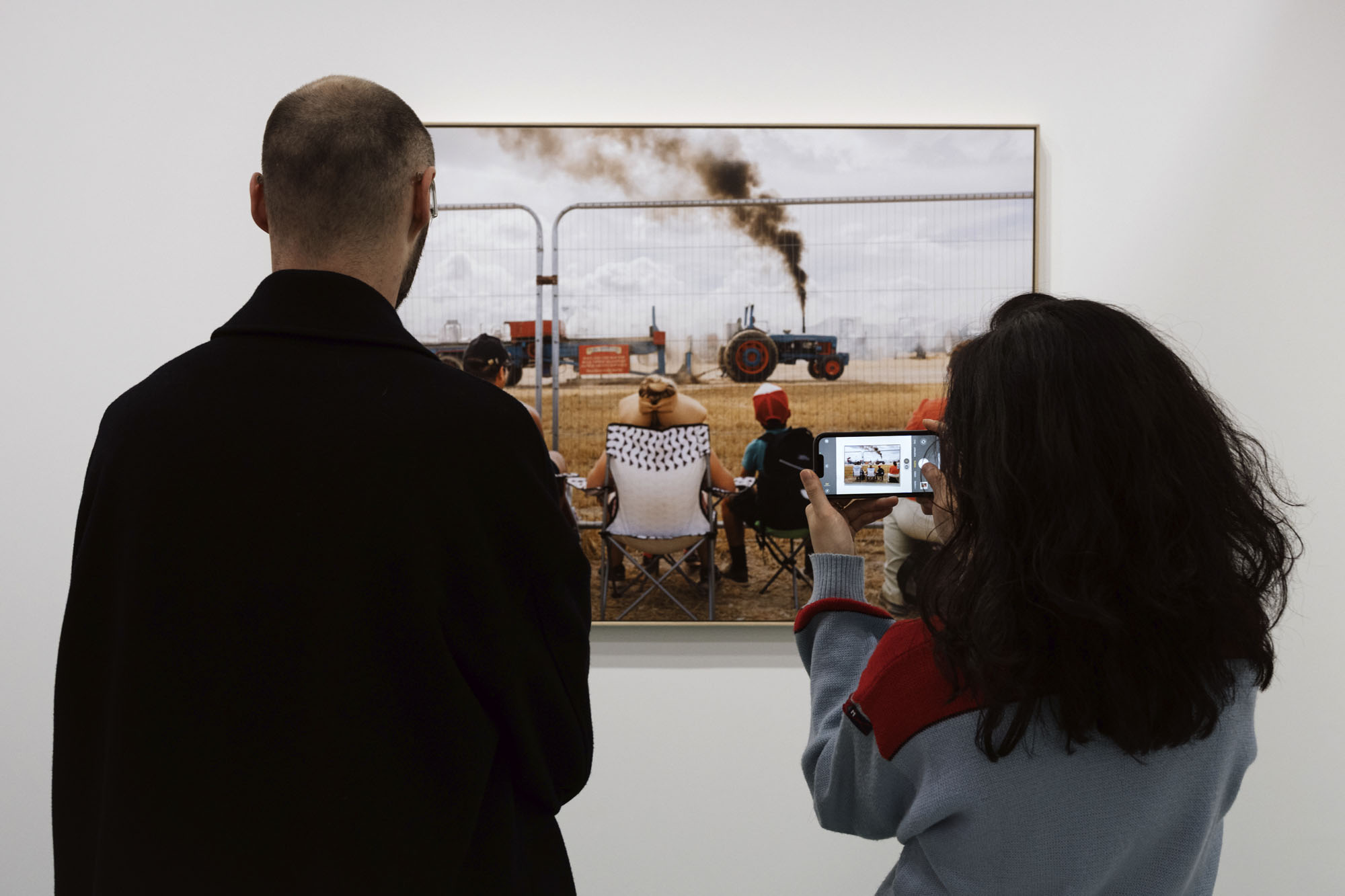
Installation view of the exhibition 'Martin Parr: Global Warning' at Jeu de Paume, Paris, January - May, 2026 showing the wall text "Technological Addictions" with at bottom left, Martin Parr's 'Chowpatty Beach, Mumbai, India' (2018); at second right, 'Great Dorset Steam Fair, Dorset, England' (2022) and at right, 'New York, USA' (1999)


Installation view of the exhibition Martin Parr: Global Warning at Jeu de Paume, Paris, January – May, 2026 showing the wall text “Technological Addictions” with at bottom left, Martin Parr’s Chowpatty Beach, Mumbai, India (2018, below); at second right, Great Dorset Steam Fair, Dorset, England (2022, below) and at right, New York, USA (1999, below)


Technological Addictions

Even in his exploration of technology, Parr remains a humanist in both his practice and overarching project: what interests him is our relationship to the technology rather than the object or machine itself. As a keen observer of behaviour and constantly on the lookout for unexplored for unexplored topics, Parr examined how the human body interacts differently with each new technological object. He also probes technology’s growing role in daily lives and imagination, and the dependency it engenders. At the same time, he implicitly explores the way technology profoundly alters our perception of reality and our relationship to space and time.

Wall text from the exhibition


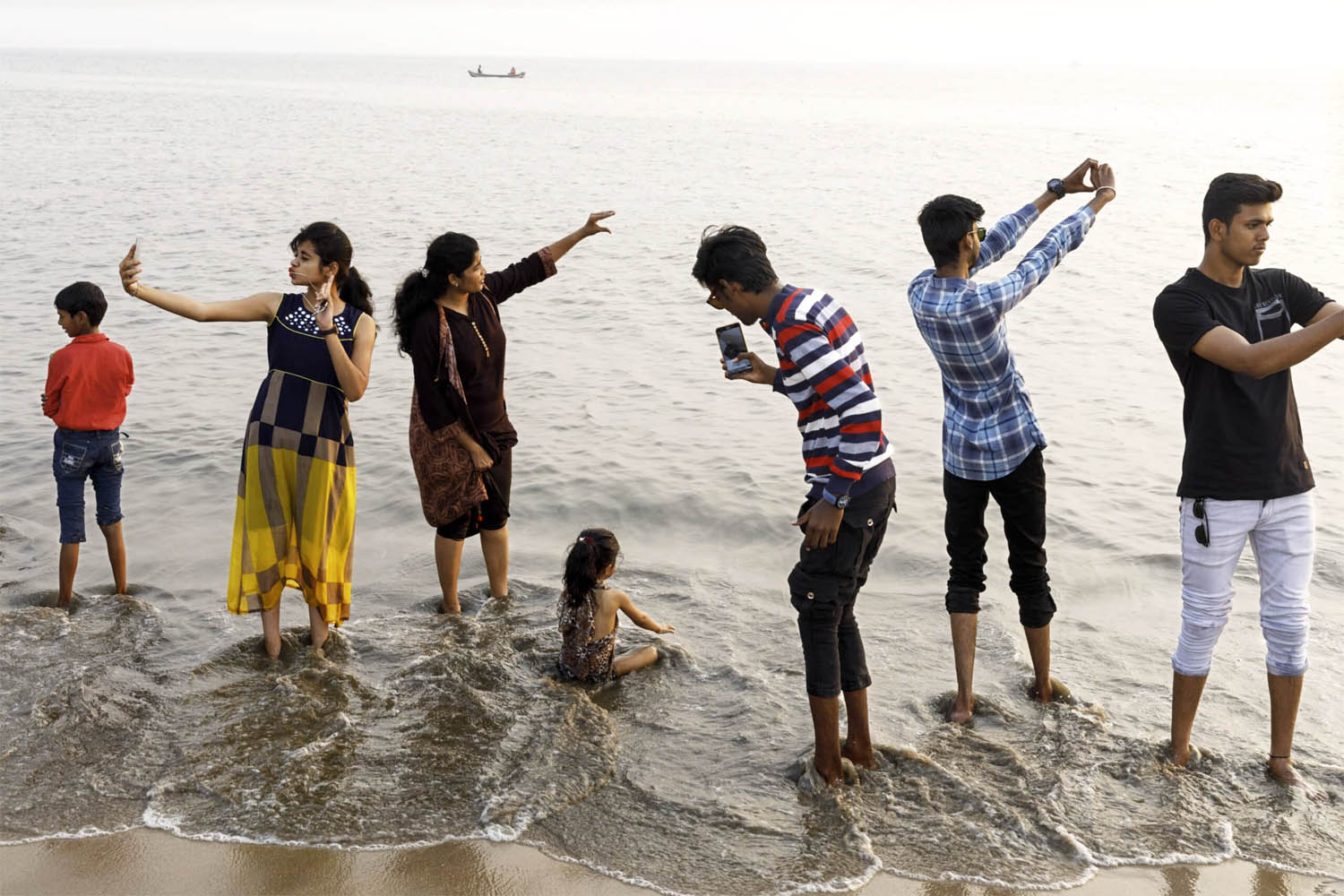
Martin Parr (English, 1952-2025) 'Chowpatty Beach, Mumbai, India' 2018


Martin Parr (English, 1952-2025)
Chowpatty Beach, Mumbai, India
2018
© Martin Parr / Magnum Photos


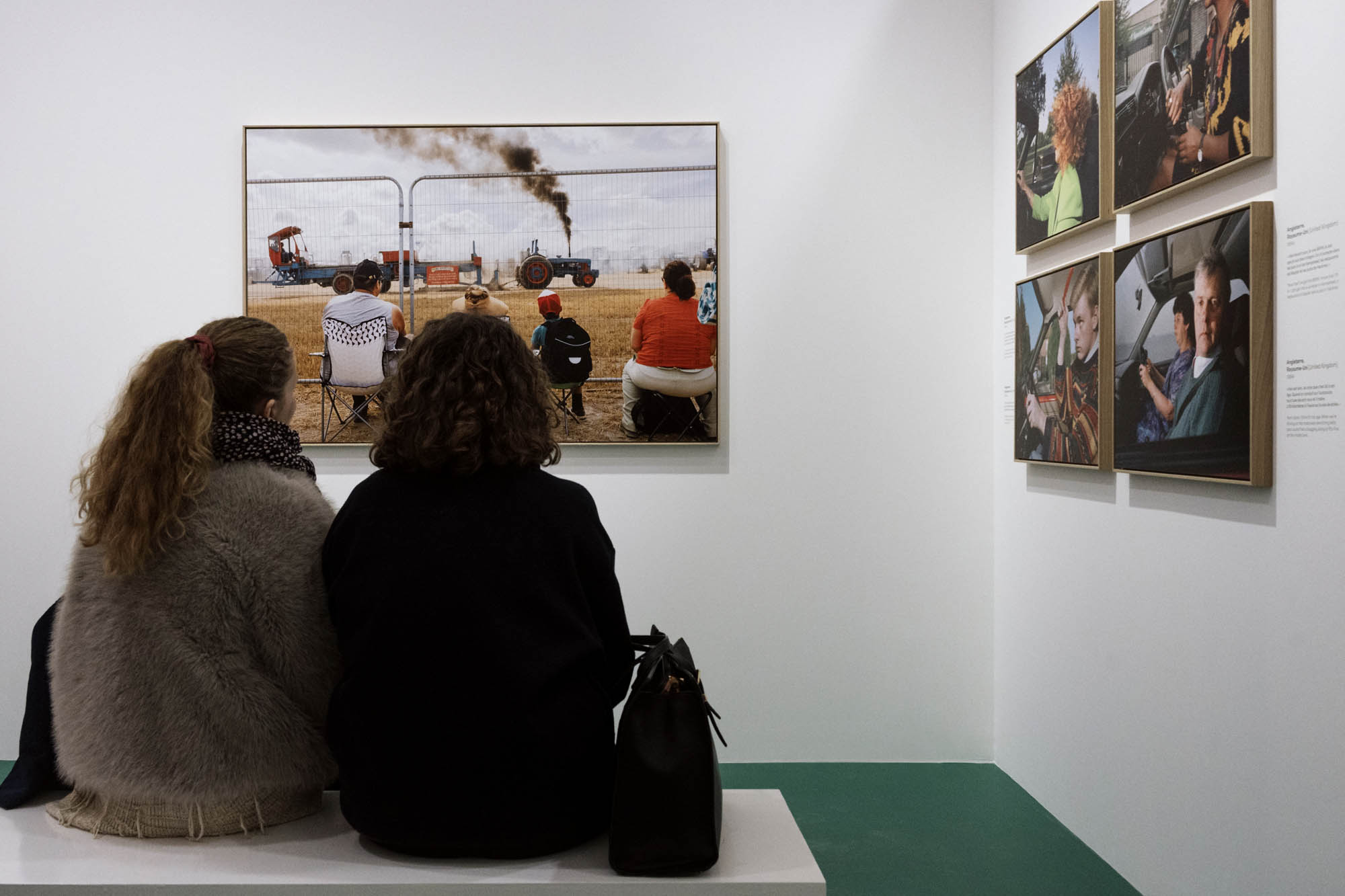
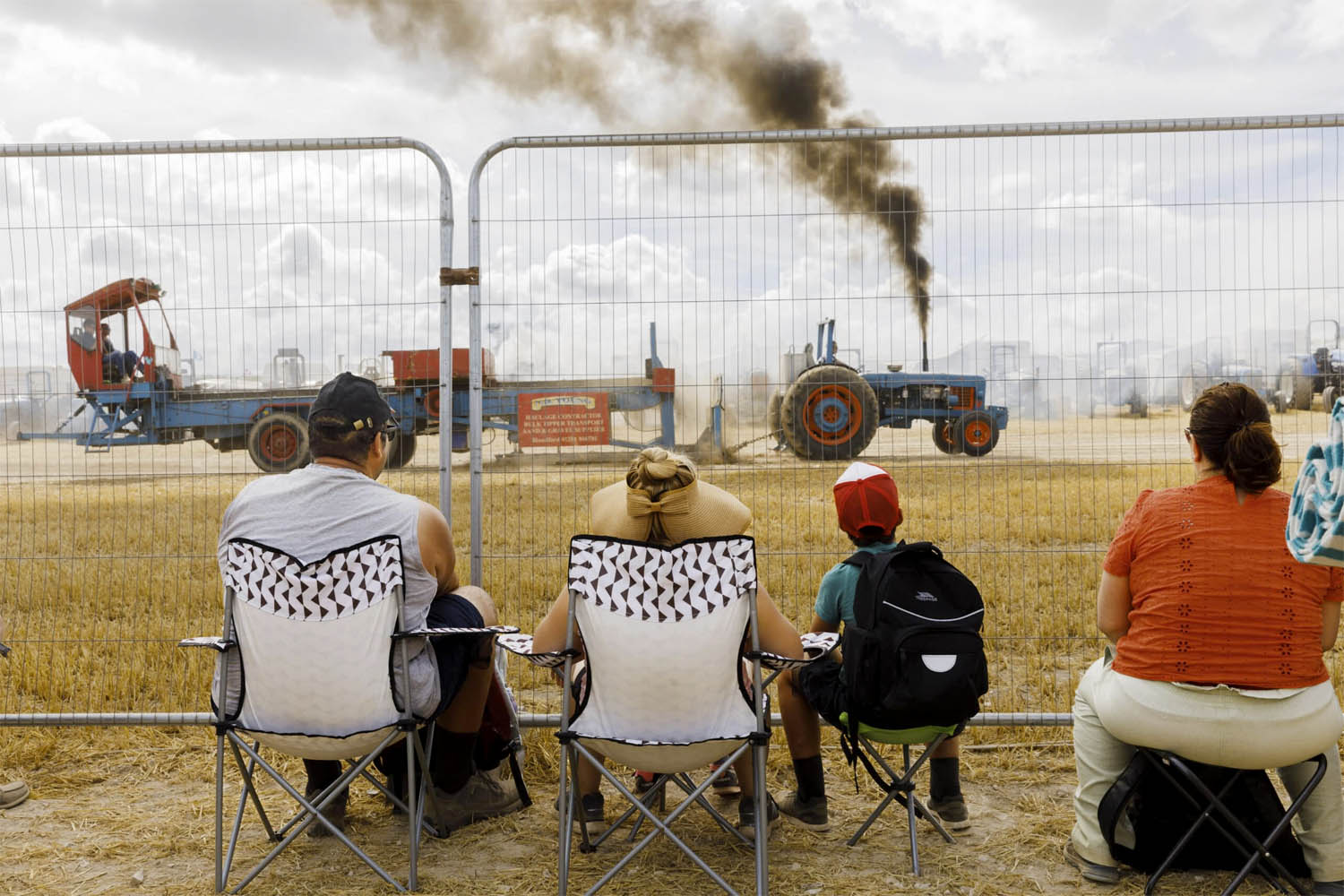
Installation view of the exhibition 'Martin Parr: Global Warning' at Jeu de Paume, Paris, January - May, 2026 showing at left, Martin Parr's 'Great Dorset Steam Fair, Dorset, England' (2022); and at top right, 'England, United Kingdom' (1994) and at bottom right, 'England, United Kingdom' (1994)


Installation view of the exhibition Martin Parr: Global Warning at Jeu de Paume, Paris, January – May, 2026 showing at left, Martin Parr’s Great Dorset Steam Fair, Dorset, England (2022, below); and at top right, England, United Kingdom (1994) and at bottom right, England, United Kingdom (1994)


Installation view of the exhibition 'Martin Parr: Global Warning' at Jeu de Paume, Paris, January - May, 2026 showing Martin Parr's 'Great Dorset Steam Fair, Dorset, England' (2022)


Installation view of the exhibition Martin Parr: Global Warning at Jeu de Paume, Paris, January – May, 2026 showing Martin Parr’s Great Dorset Steam Fair, Dorset, England (2022, below)


Martin Parr (English, 1952-2025) 'Great Dorset Steam Fair, Dorset, England' 2022


Martin Parr (English, 1952-2025)
Great Dorset Steam Fair, Dorset, England

2022
© Martin Parr / Magnum Photos


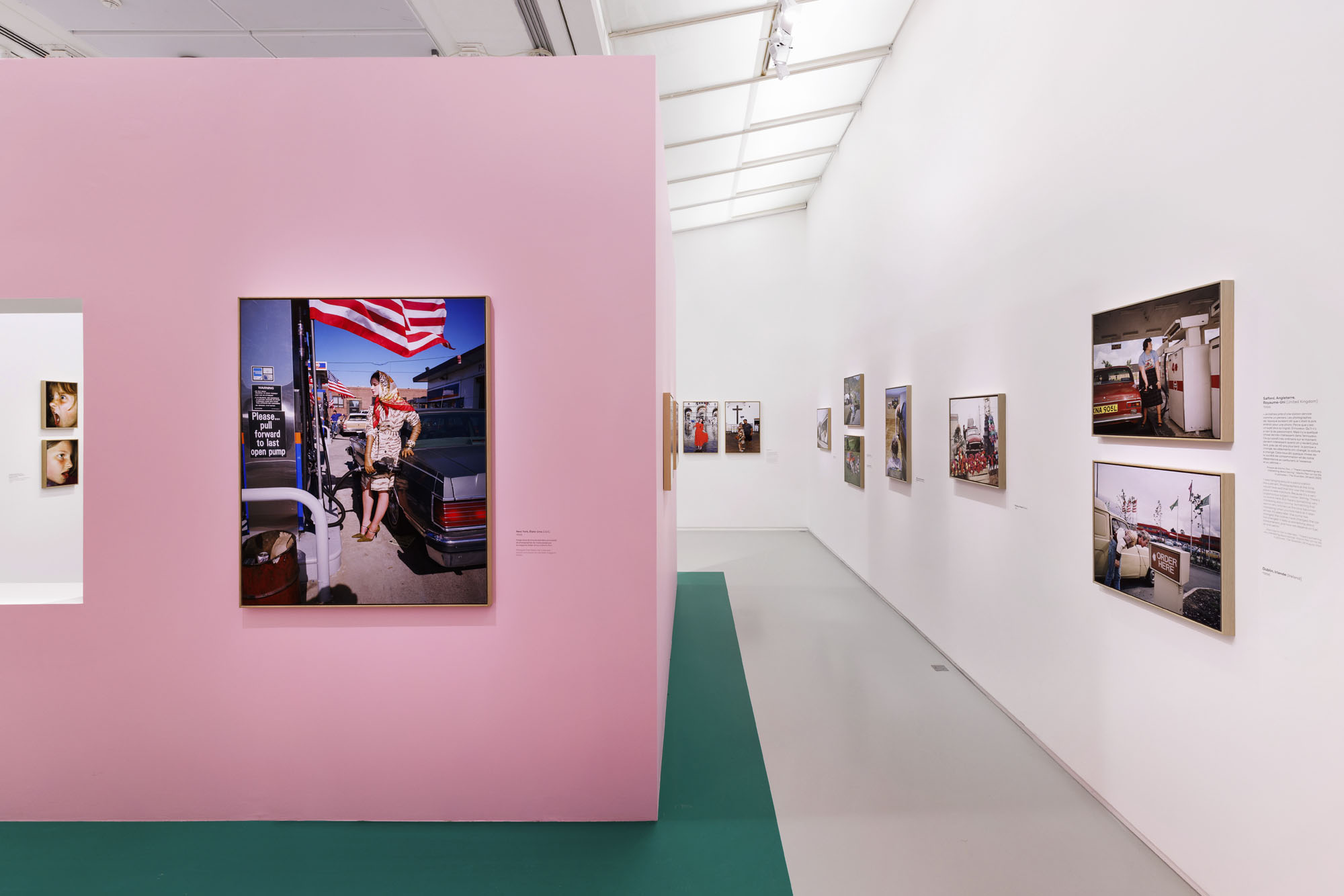
Installation view of the exhibition 'Martin Parr: Global Warning' at Jeu de Paume, Paris, January - May, 2026 showing at left, Martin Parr's 'New York, USA' (1999); and at right top, 'Salford, United Kingdom' (1986) and right bottom, 'Dublin, Ireland' (1986)


Installation view of the exhibition Martin Parr: Global Warning at Jeu de Paume, Paris, January – May, 2026 showing at left, Martin Parr’s New York, USA (1999, below); and at right top, Salford, United Kingdom (1986) and right bottom, Dublin, Ireland (1986)


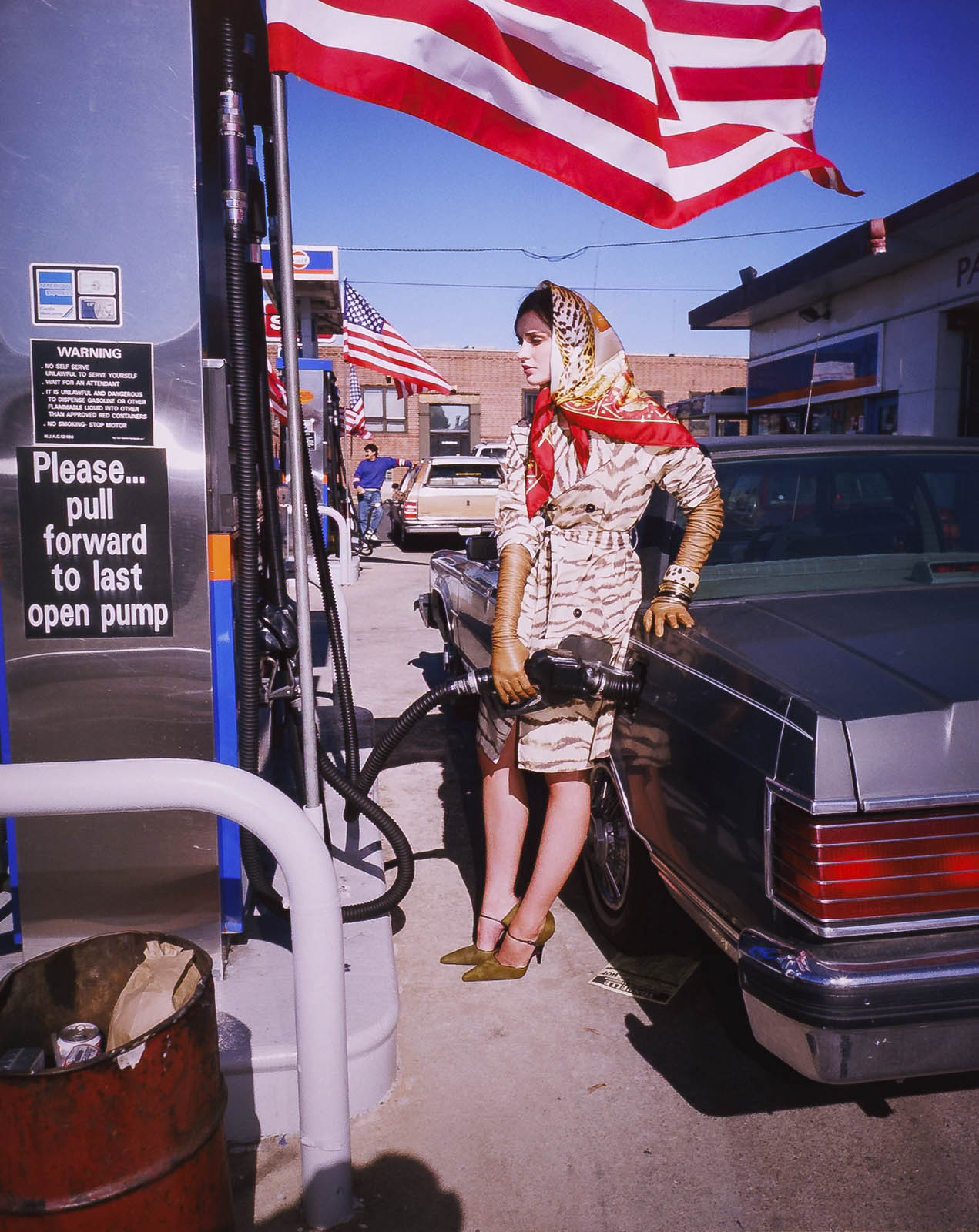
 ‘I was hanging around a petrol station like a pervert. Photographers at the time would have said that this was the craziest place to take a picture. Because it’s a very unglamorous subject matter. Boring. There’s no drama here. But there’s something really interesting about boring. Something that seems very ordinary at the time becomes interesting when you look back at it later, almost 40 years later: the pump has changed, the clothes have changed, the car has changed. It tells us something about consumerism, and how we depend on fuel, oil and petrol.

From Martin Parr’s interview, ‘”There’s something very interesting about boring” Martin Parr on his life in pictures.’ The Guardian, 24 August 2025
Wall text from the exhibition


Martin Parr (English, 1952-2025) 'New York, USA' 1999


Martin Parr (English, 1952-2025)
New York, USA
1999
© Martin Parr / Magnum Photos

Photograph from Martin Parr’s first-ever fashion commission for the Italian magazine Amiga


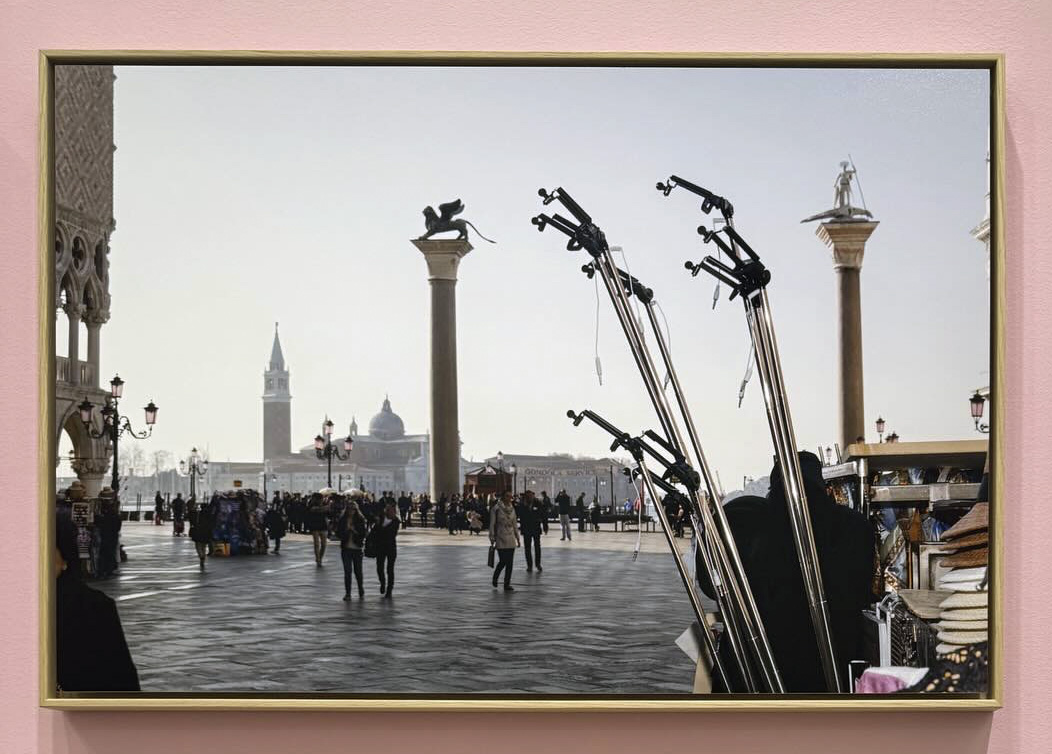
Martin Parr (English, 1952-2025) 'Venice, Italy' 2015 (installation view)


Martin Parr (English, 1952-2025)
Venice, Italy (installation view)
2015
© Martin Parr / Magnum Photos


‘Although many museums have now banned the selfie stick, outside in the street, especially in front of that iconic monument or landmark the stick comes into its own. Getting the photo of you and your loved one(s) with the landmark in the background is de rigueur. The tourism industry, which is the biggest in the world, now dictates that the first requirement of any trip is to prove you were there with the necessary photo. It connects you to the world that we know and understand, and it is a vital part of any successful holiday experience. We used to have to ask a passing tourist to take the photo, but thanks to the selfie stick those days are over and we are now self sufficient.’

From Martin Parr’s blog, The Selfie Stick, 2015
Wall text from the exhibition


Installation view of the exhibition 'Martin Parr: Global Warning' at Jeu de Paume, Paris, January - May, 2026 showing at left, Martin Parr's photographs 'Advertisement for Sony PlayStation, England, United Kingdom' (2003); and at right, Ooty, India (2018)


Installation view of the exhibition Martin Parr: Global Warning at Jeu de Paume, Paris, January – May, 2026 showing at left, Martin Parr’s photographs Advertisement for Sony PlayStation, England, United Kingdom (2003); and at right, Ooty, India (2018, above)


Installation view of the exhibition 'Martin Parr: Global Warning' at Jeu de Paume, Paris, January - May, 2026


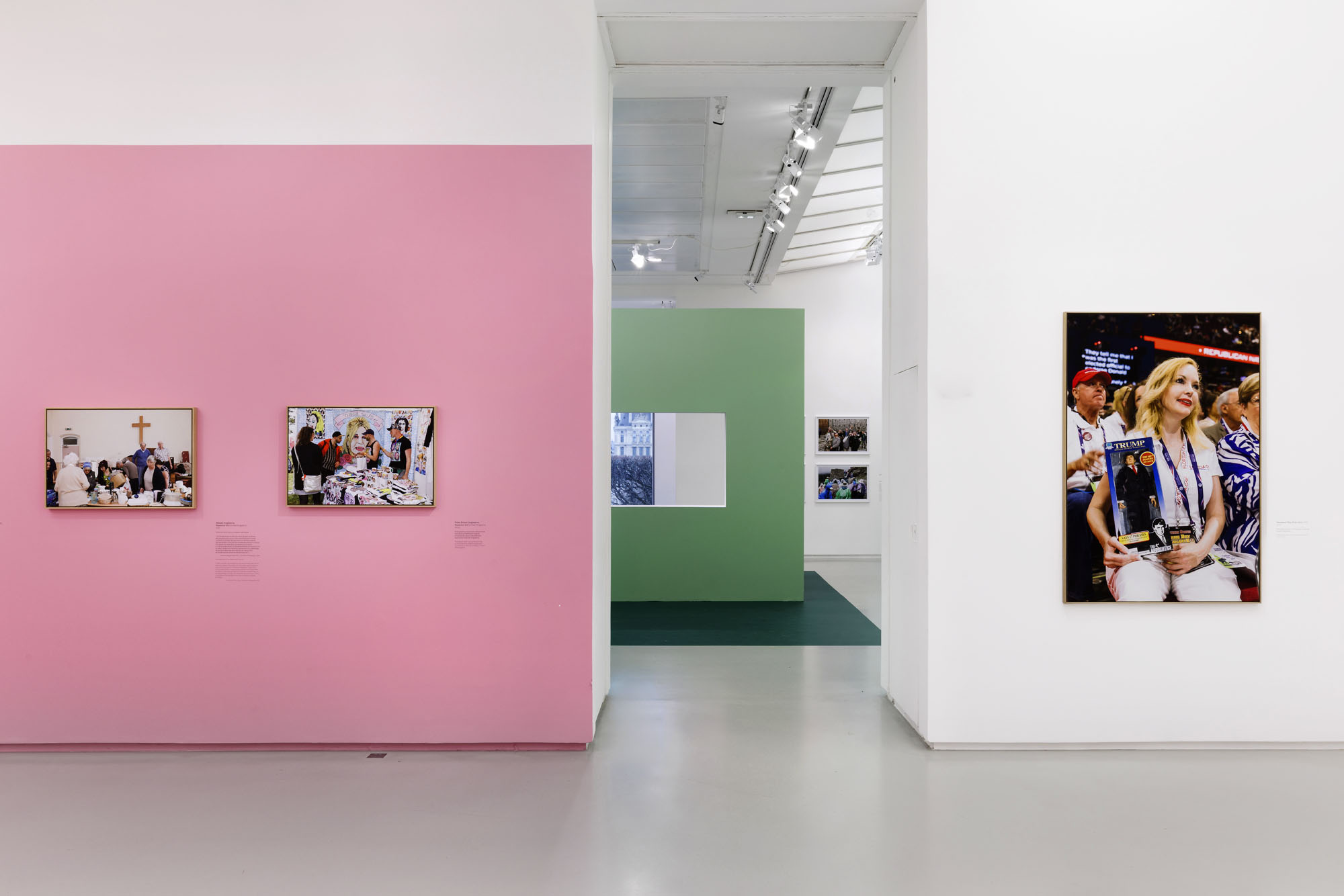
Installation view of the exhibition Martin Parr: Global Warning at Jeu de Paume, Paris, January – May, 2026 showing at right, Martin Parr’s photograph from The Republican National Convention, Cleveland, Ohio, USA (2016, below)


Martin Parr (English, 1952-2025) 'The Republican National Convention, Cleveland, Ohio, USA' 2016


Martin Parr (English, 1952-2025)
The Republican National Convention, Cleveland, Ohio, USA
2016
© Martin Parr / Magnum Photos


Jeu de Paume
1, Place de la Concorde
75008 Paris
métro Concorde
Phone: 01 47 03 12 50

Opening hours:
Tuesday – Sunday 11am – 7pm
Closed Mondays

Jeu de Paume website

LIKE ART BLART ON FACEBOOK

Back to top

Exhibition: ‘FAKE! Early Photo Collages and Photomontages’ at Rijksmuseum, Amsterdam

Exhibition dates: 6th February – 25th May, 2026

Curator:  Hans Rooseboom, Curator of Photography at the Rijksmuseum


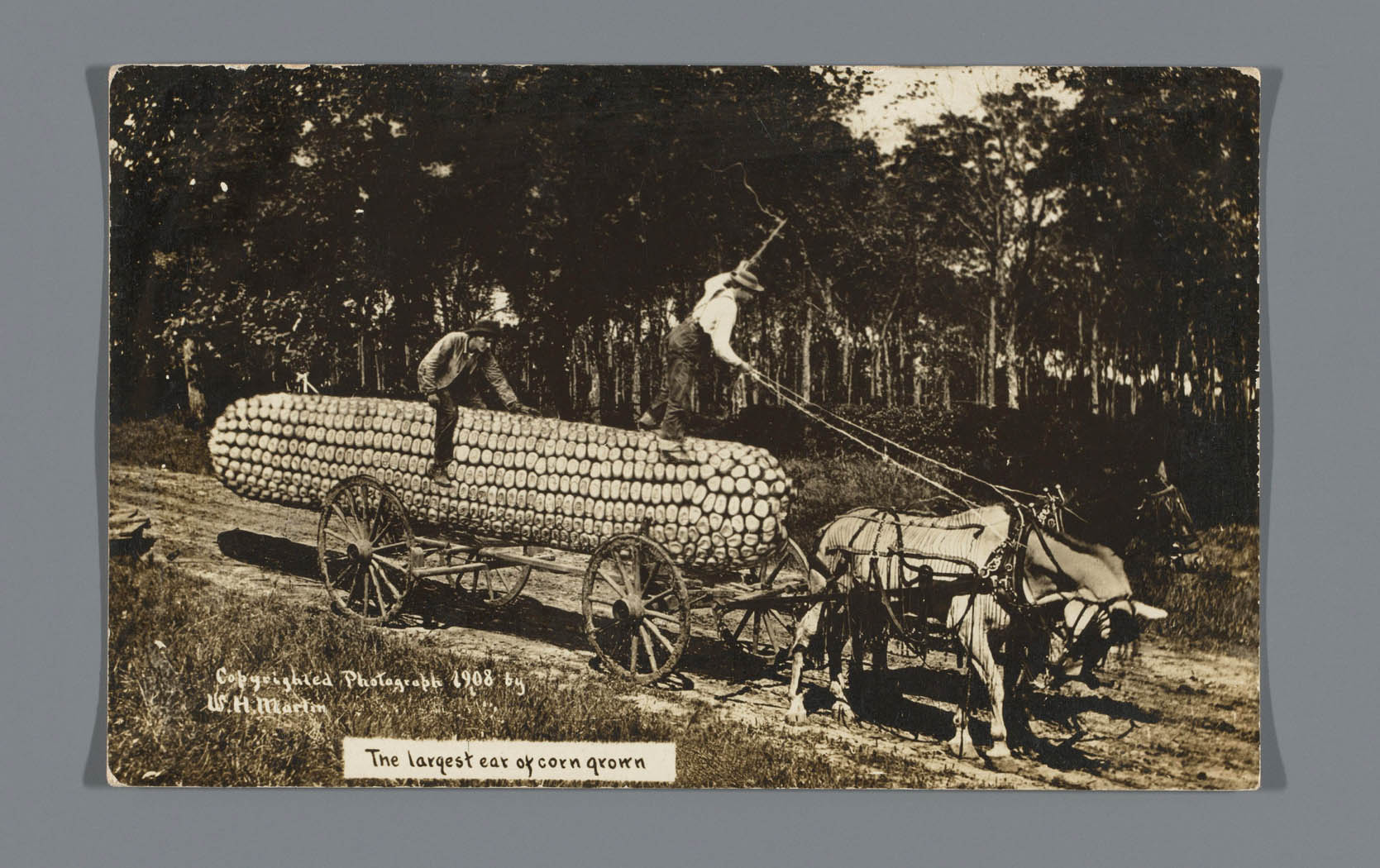
W.H. Martin (American, 1865-1940) (photographer) The North American Post Card Co. (publisher) 'The largest ear of corn grown' 1908 from the exhibition 'FAKE!' At the Rijksmuseum, Amsterdam, February - May, 2026


W.H. Martin (American, 1865-1940)(photographer)
The North American Post Card Co. (publisher)
The largest ear of corn grown
1908
Postcard
Rijksmuseum
Purchase 2018


William H. “Dad” Martin of Ottawa, Kan., is considered to be the father of the exaggerated postcard. Some of his better work featured huge ears of corn, giant apples and peaches, stalks of wheat taller than any man and massive pumpkins uprooting a farmstead. Such cards were hugely successful throughout the Great Plains states where agriculture was the life’s blood of rural America.

W.H. Martin moved to Ottawa in 1899 to serve as an apprentice under photographer E.H. Corwin. Eight years later, Martin purchased Corwin’s studio and began crafting the tall tale postcards that would eventually make him a millionaire.


To fake or not to fake, that is the question…

Since the very inception of photography people have been making “fake” photographs. Indeed, one of the very first self-portraits ever taken, Hippolyte Bayard’s Le Noyé [The Drowned Man], made on October 18, 1840, is of the artist experimenting, using himself as a subject, posing himself in a fake suicide, expressing frustration “about his position in the photography world and about how little respect he felt he had been given in comparison to fellow photographer Louis Daguerre.”

There are many photographs pre digital manipulation that can be seen as “fake”1 but to me this is a disingenuous word, a sensationalist word, to describe photographs that basically undermine the photograph and its link to truth, the link of the photograph to the indexicality of its referent. But what is “truth” in a photograph?

Photographs have always deceived,2 depending on where you place the camera, which point of view you decide to capture and which to exclude, and when you decide to press the shutter … or what collage of photographs you put together and in what order. Thus, from one point of view, there is no such thing as a fake photograph, just different versions of (de)constructed realities.

Conversely you could argue that ALL photographs are “fake” as the photograph is only, can only ever be, a symbolic representation of a reality that never existed in the first place (“Ceci n’est pas une pipe”).

Photographs are tricky little things.

In the case of this exhibition, early photo collages and photomontages are seen as “fake” only in terms of their relation to a certain version of a photographic reality. They are not fake in terms of the reality of their construction, produced in the IMAGINATION of the artist, expressed in the final image. In those terms they are as real as the surrealist interpretation of dreams, or cubist dissection of the image plane. And we don’t call those photographs or paintings “fake”.

Today, photography is delimited in terms of what a photograph can be. And it has been so since the very beginning of the medium if only we look hard enough. Dreams or nightmares, impossible, absurd or humorous scenes, believable and unbelievable: there is no such thing as genuine or fake – only the space between – expressed in pictorial compositions governed by the creativity and breadth of your imagination.

Dr Marcus Bunyan


1/ This exhibition adds to a previous exhibition on the subject titled Faking It: Manipulated Photography Before Photoshop staged at The Metropolitan Museum of Art, New York, October 2012 – January 2013 and The National Gallery of Art, Washington, February – May, 2013

2/ “Fake” describes something not genuine, real, or authentic, intended to look like something else to deceive, cheat, or pretend.

.
Many thankx to the Rijksmuseum for allowing me to publish the photographs in the posting. Please click on the photographs for a larger version of the image.


“… photomontage is the fabrication of a composite but single image made up of a number of distinct photographic parts. It “results from the association of photographic elements, which have diverse origins, natures and proportions, combined in such a way as to express with force a particular idea.””


José Pierre, “Hannah Höch et le photomontage des Dadaists berhnois,” in Techniques Graphiques, no. 66 (November – December 1966), p. 352 quoted in Robert A. Sobieszek. “Composite Imagery and the Origins of Photomontage, Part 1: The Naturalistic Strain,” in Artforum, Vol. 17, No. 1, September 1978 on the Artforum website [Online] Cited 18/02/2026


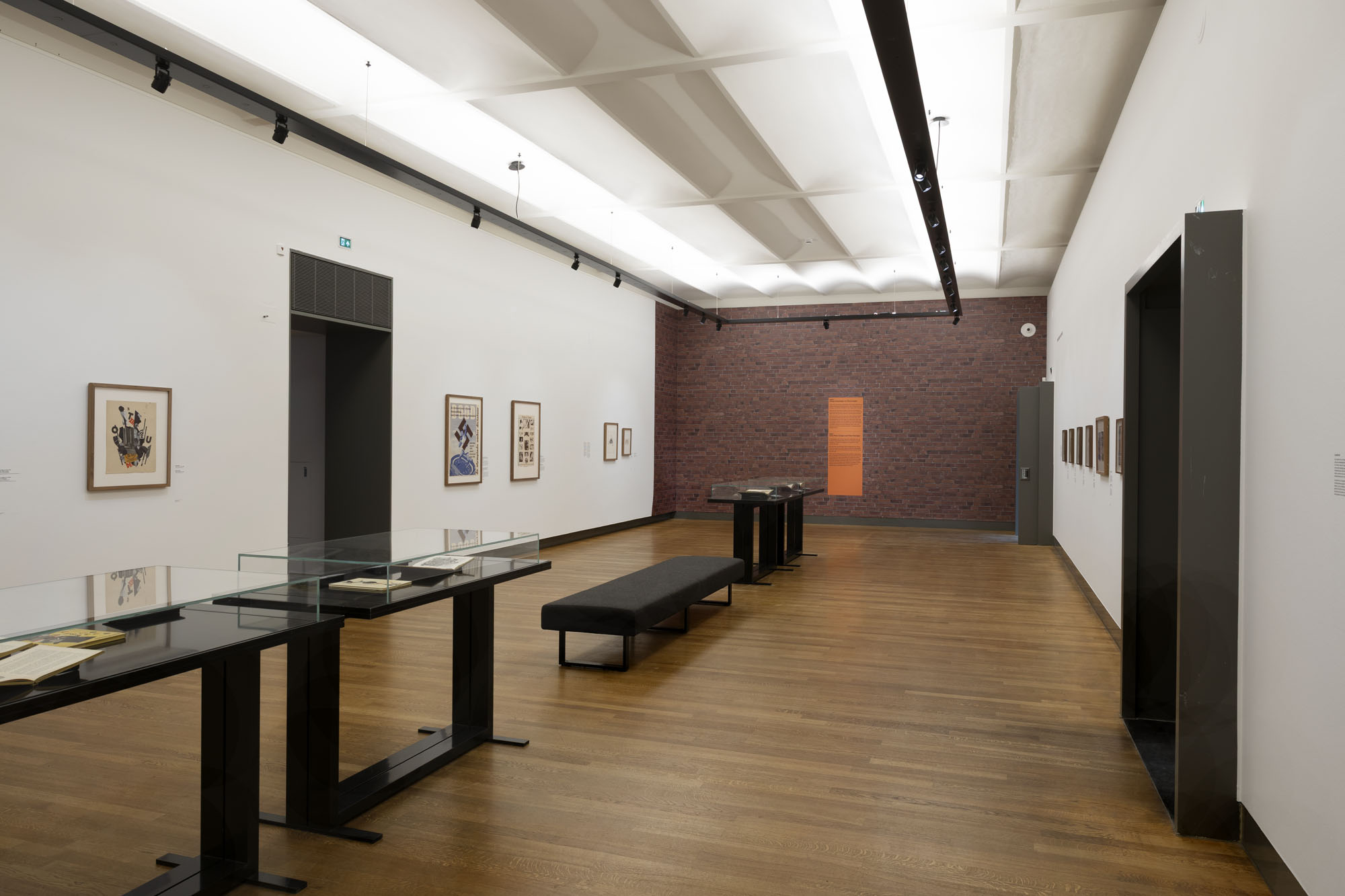
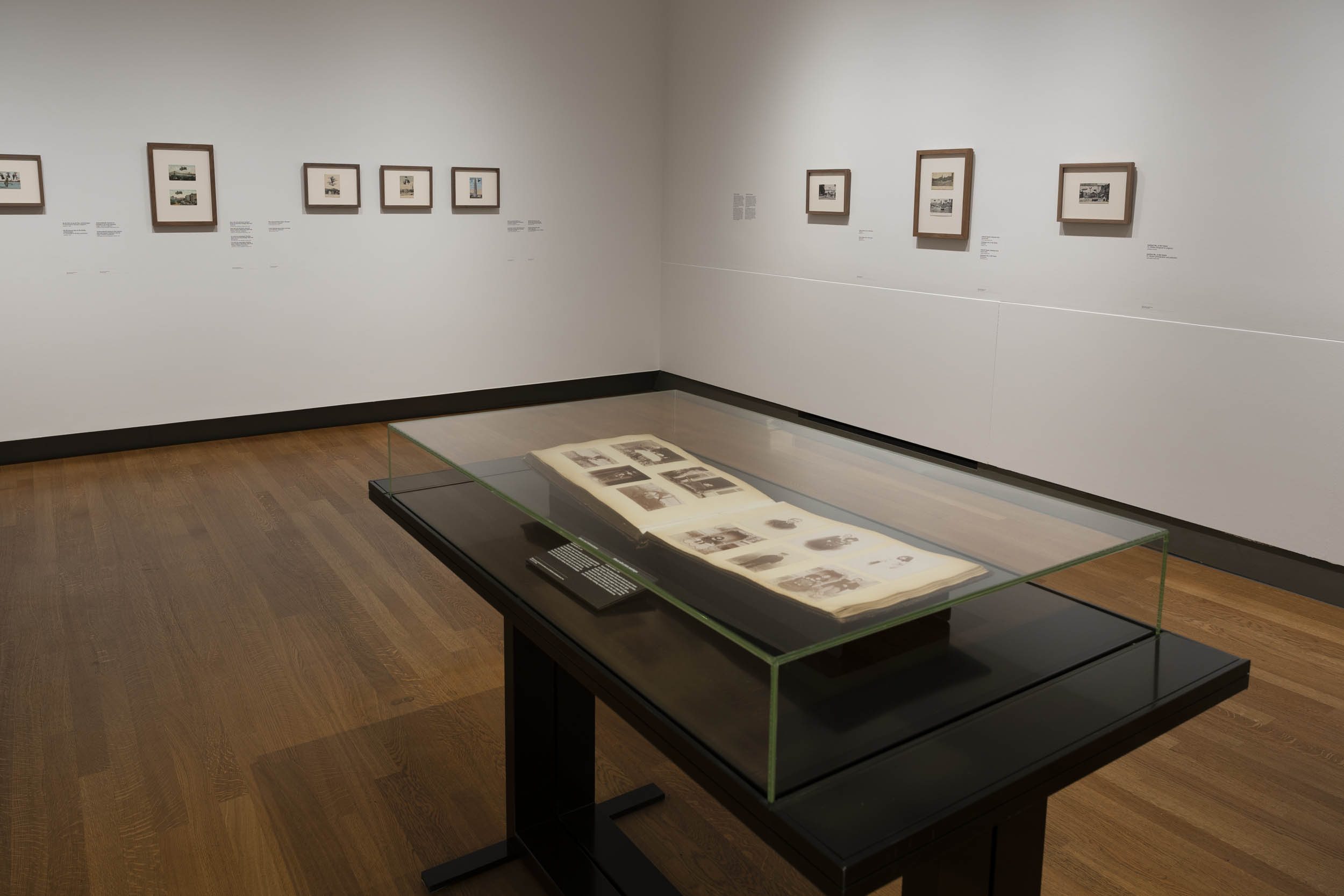
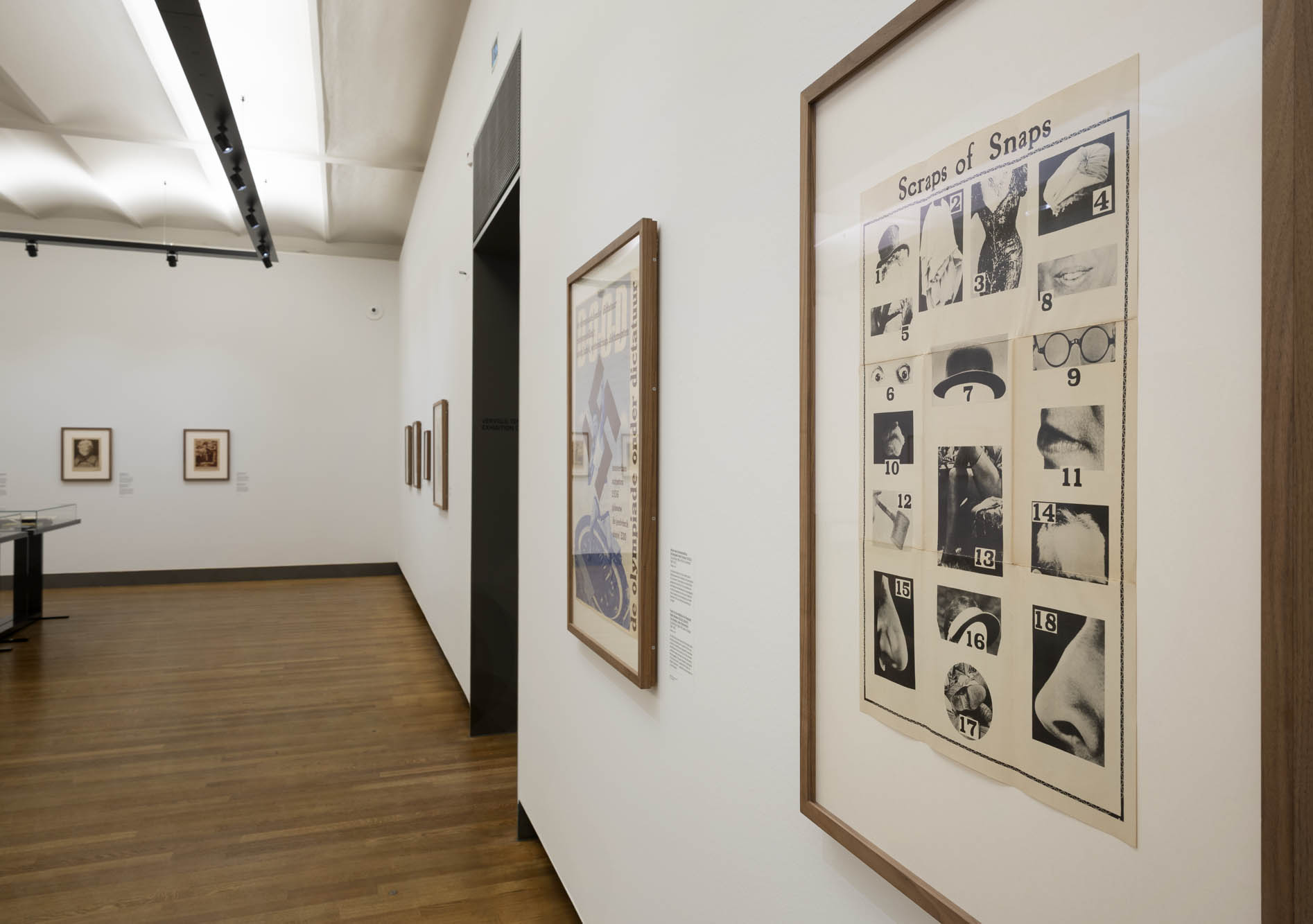
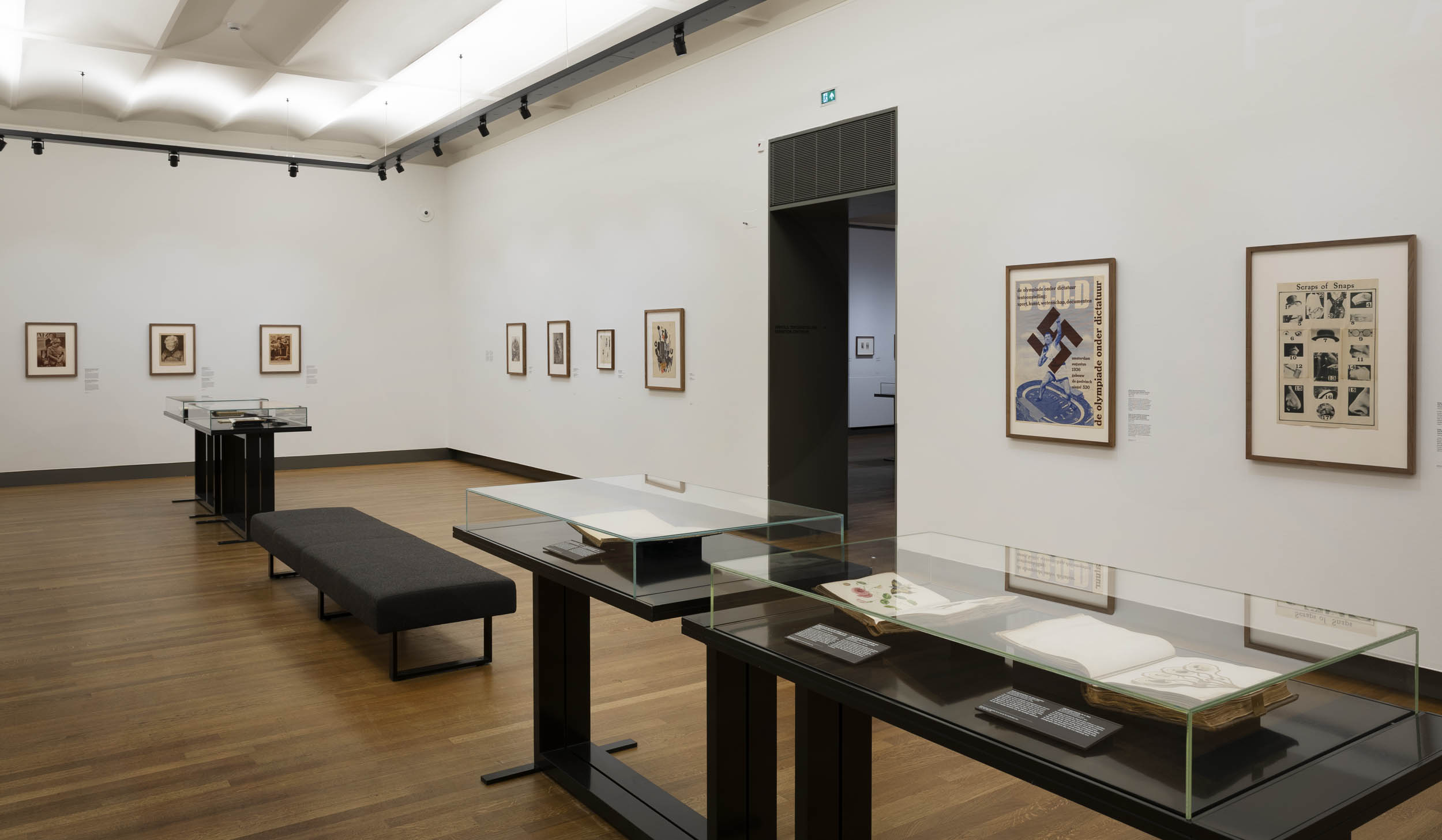
Installation view of the exhibition 'FAKE!' At the Rijksmuseum, Amsterdam


Installation views of the exhibition FAKE! At the Rijksmuseum, Amsterdam, February – May, 2026
Photos: Albertine Dijkema/Rijksmuseum


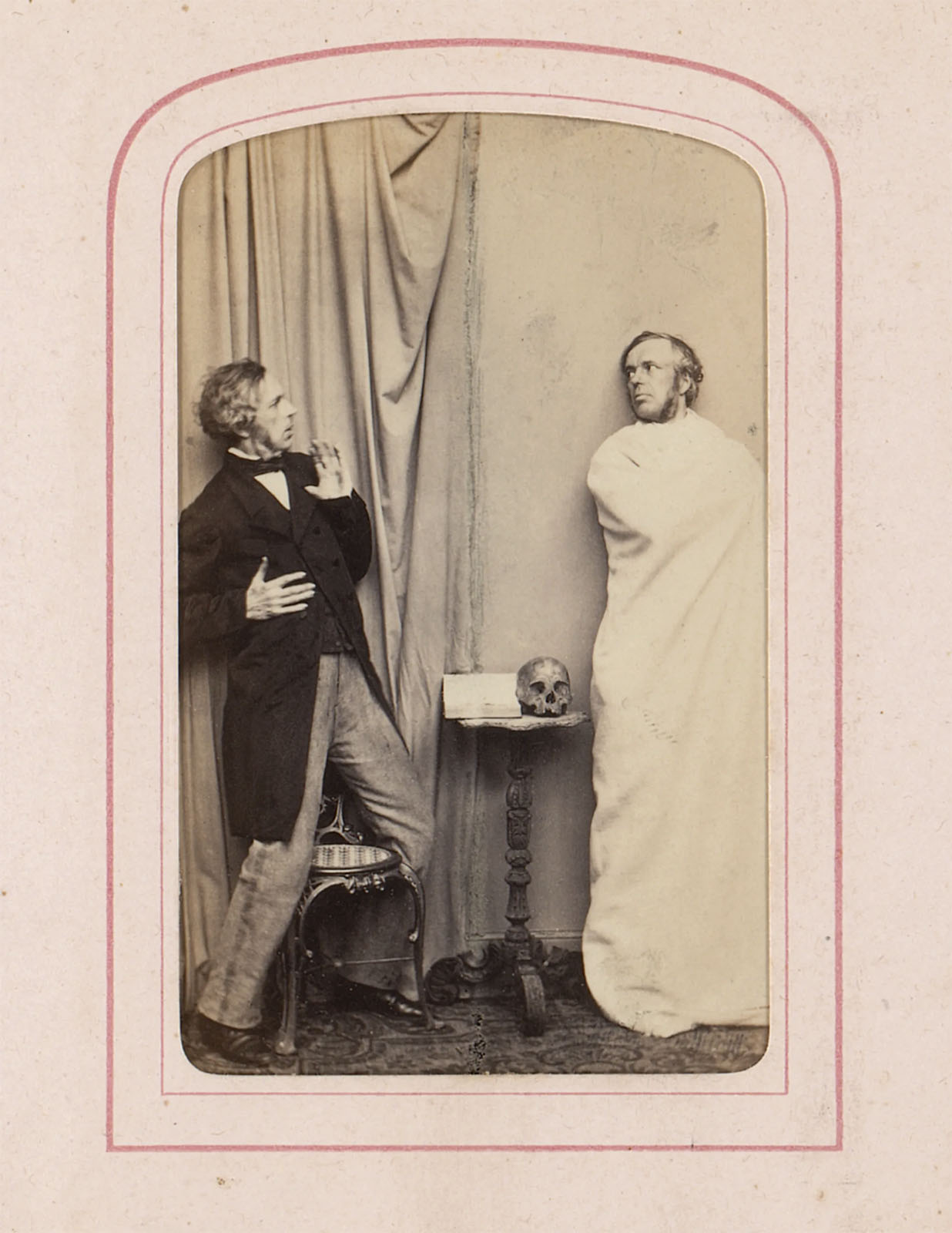
Leonard de Koningh (Dutch, 1810-1887) 'Man startled by his own reflection' c. 1870–1880


Leonard de Koningh (Dutch, 1810-1887)
Man startled by his own reflection
c. 1870-1880
Cartes de visite


In this comical memento mori, where a man comes face to face with his ghost, the painter and photographer Leonard de Koningh exposed just half of the photographic plate, then had the subject adopt a different pose before exposing the other half. Photography might have been a relatively new art, but the transition between the two images is imperceptible. “It’s like a magician,” marvels Rooseboom. “You know you are being tricked, but you don’t know how the photographer does it.” Quoting Oscar Gustave Rejlander, a trailblazer for this type of composite printing, the photographer Robert Sobieszek (1943-2005) stated: “This manner of working led not to falsehood but to truth. An image made by a single negative [claimed Rejlander] ‘is not true, nor will it ever be so – the focus cannot be everywhere’.”

Deborah Nicholls-Lee. “‘Image manipulation has always been around’: 10 early photographic ‘fakes’ that trick the eye,” on the BBC website 18th February 2026 [Online] Cited 18/02/2026. Used under fair use conditions for the purposes of education and research


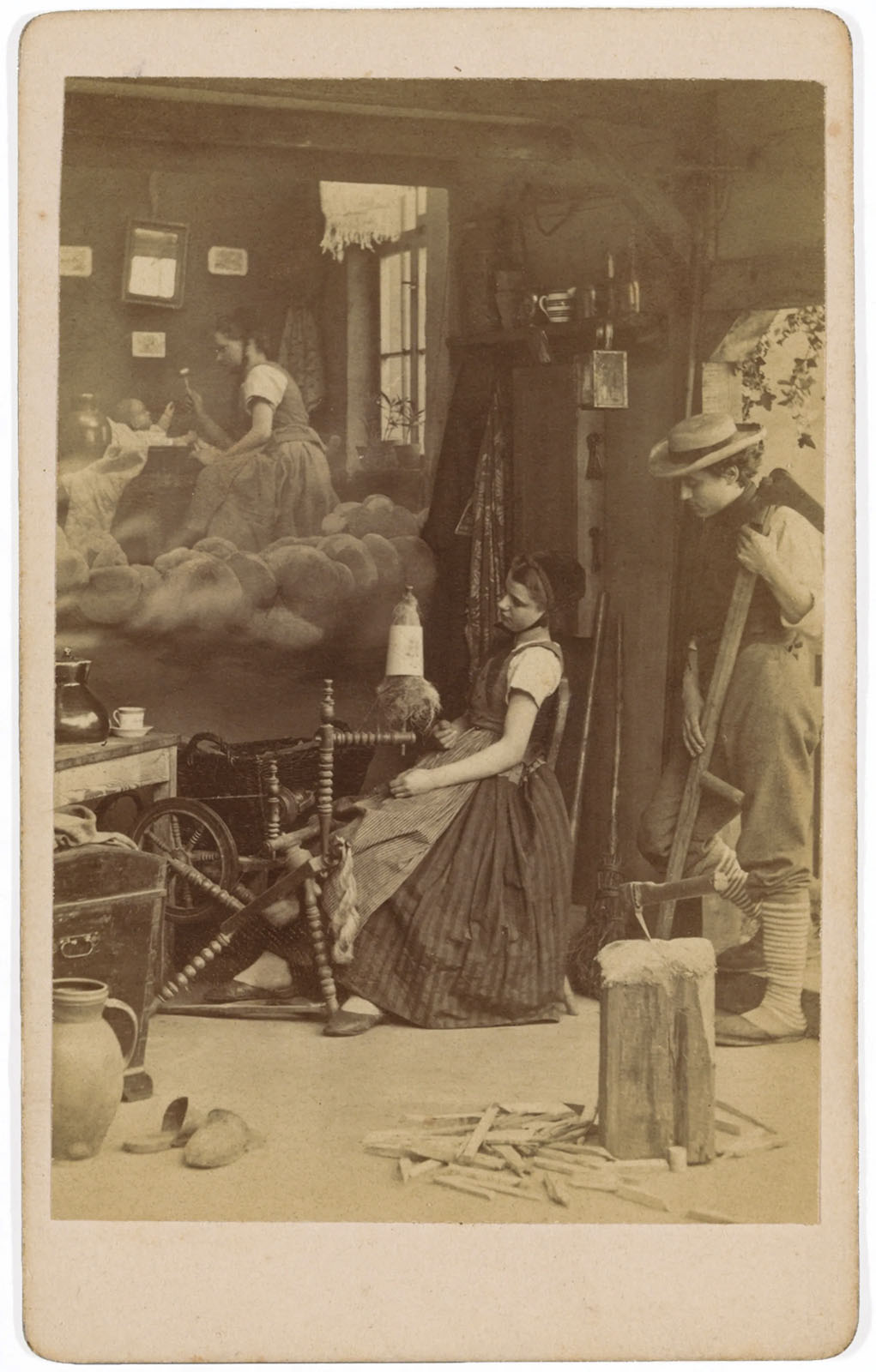
Anonymous photographer. 'Daydream' c. 1870–1890


Anonymous photographer
Daydream
c. 1870-1890
Cartes de visite


In this one we see the present: a woman and her partner both with the tools of their trades; and an imagined future: her daydream of becoming a mother. The image, explains Rooseboom, was “a darkroom trick”, achieved by shielding part of the photographic paper from the light and then adding a second negative to it later. Such images took photography into a new dimension, suggesting the innermost thoughts of their subjects, and paving the way for the comic strips of the future with their speech bubbles and thought clouds.

Deborah Nicholls-Lee. “‘Image manipulation has always been around’: 10 early photographic ‘fakes’ that trick the eye,” on the BBC website 18th February 2026 [Online] Cited 18/02/2026. Used under fair use conditions for the purposes of education and research


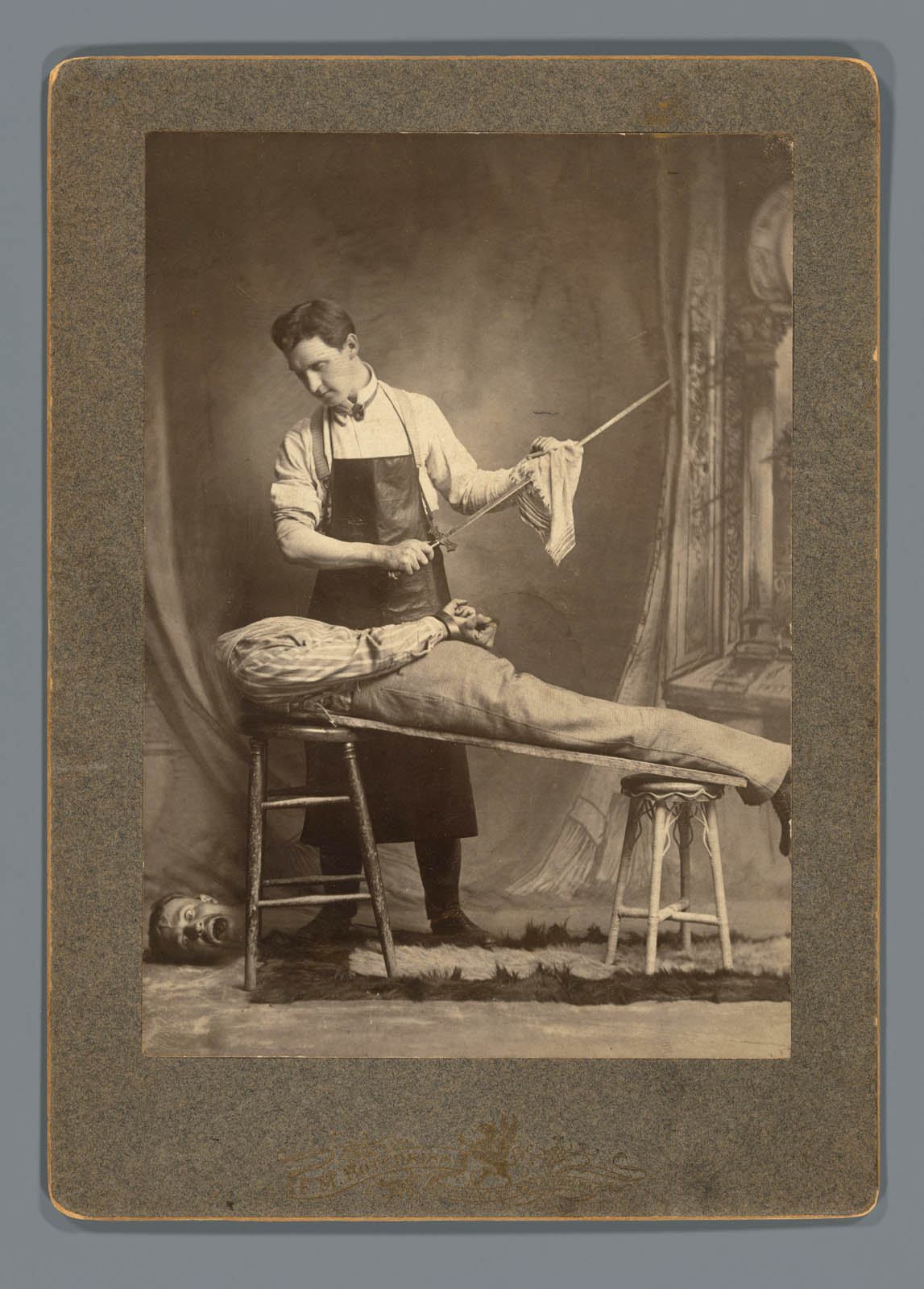
F.M. Hotchkiss (active 1870-1900) 'Beheading' c. 1880-1900


F.M. Hotchkiss (active 1870-1900)
Beheading
c. 1880-1900
Cabinet card
Purchase 2025


“We still expect photography to bring the truth, but this idea only really emerged from the illustrated magazines of the 1930s in order to inform readers how things worked elsewhere in the world,” says Rooseboom. Until then, the creative freedom to alter the image was unchallenged. “Anything possible would be tried out and produced,” he says. “There was no ethical restraint on producing non-realistic images. No-one would forbid you from doing this.” Removing and moving someone’s head, for example, presented the photographer with a pleasing puzzle. In the case of this cabinet card – a style of print mounted on card had taken over from the smaller carte de visite by the 1880s – with its black humour, the creative mission was highly successful. Only the positioning of the curtain, that would have concealed the original head, and some light retouching visible under a microscope, offer clues to how the photographer created the deception.

Deborah Nicholls-Lee. “‘Image manipulation has always been around’: 10 early photographic ‘fakes’ that trick the eye,” on the BBC website 18th February 2026 [Online] Cited 18/02/2026. Used under fair use conditions for the purposes of education and research


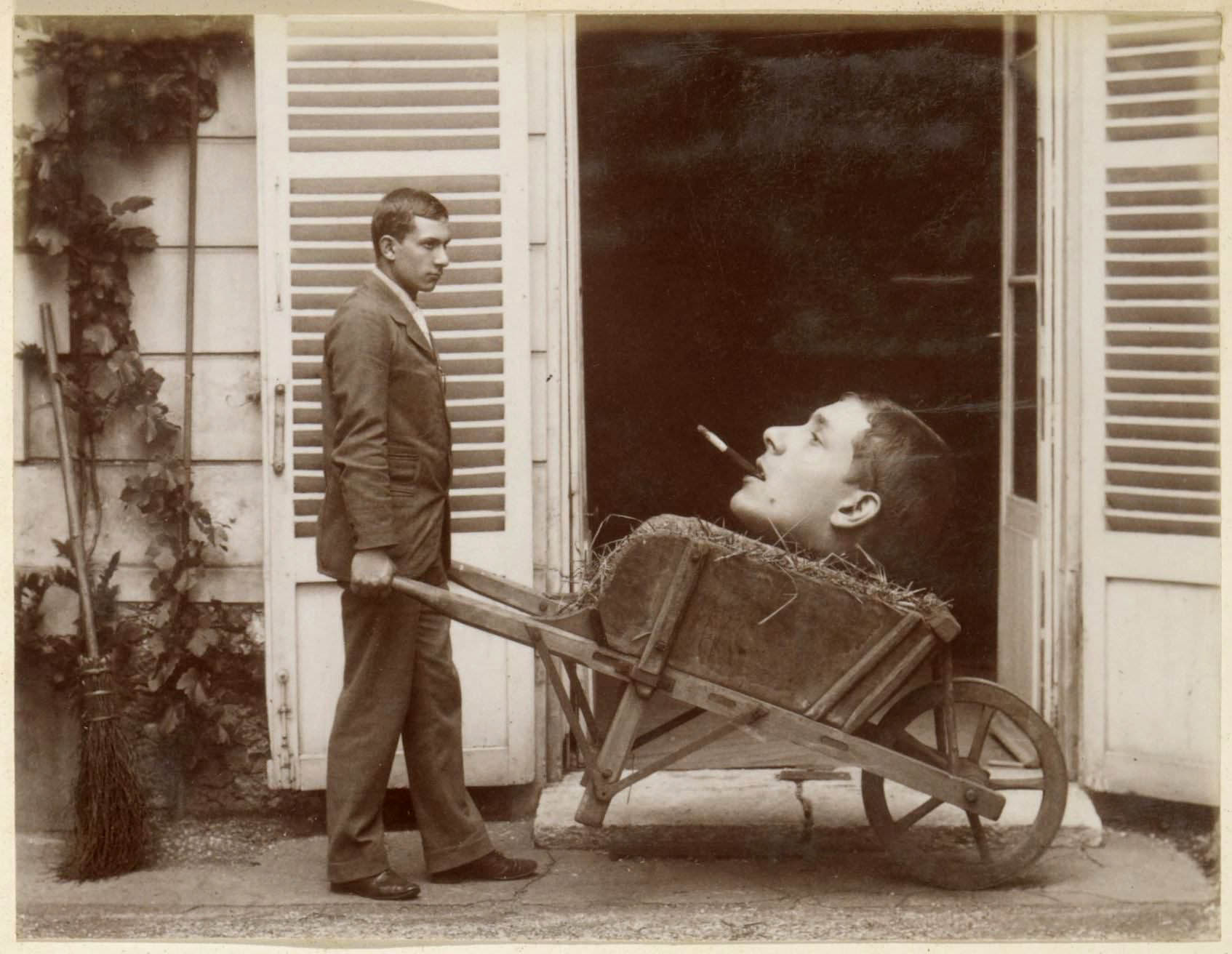
Anonymous photographer. 'Photomontage of a man pushing a wheelbarrow containing a head' c. 1900 – c. 1910 from the exhibition 'FAKE!' At the Rijksmuseum, Amsterdam, February - May, 2026


Anonymous photographer
Photomontage of a man pushing a wheelbarrow containing a head
c. 1900 – c. 1910
Gelatin silver print


This photomontage, created from two negatives, was found in a French photo album, and featured in the science magazine La Nature. Here, the displaced head illusion goes a step further as the photographer plays with scale, prefiguring the Surrealist movement which gathered pace as the century unrolled, disrupting conventional shapes and sizes to create confusing, dreamlike scenes. The open doorway provides a conveniently plain, dark background in which to smuggle in the cut-and-pasted portion before re-photographing the image as a whole. Some of these images were most likely purchased as portraits to show others, to see their look of surprise. “It’s hard to see where the trick starts and ends,” says Rooseboom. “This is showing off. Something is unbelievable, impossible, it’s improbable, but still it’s there in a photographic image which suggests we see a real scene that really unfolded in front of the camera.”

Deborah Nicholls-Lee. “‘Image manipulation has always been around’: 10 early photographic ‘fakes’ that trick the eye,” on the BBC website 18th February 2026 [Online] Cited 18/02/2026. Used under fair use conditions for the purposes of education and research


Almost immediately after the invention of the medium people began manipulating photographs – some with scissors and glue, others through ingenious photographic techniques. Drawing on more than 50 historical images from the museum’s own collection, the exhibition FAKE! Early Photo Collages and Photomontages, shows how image manipulation developed – from the birth of photography to the Second World War – and explores the motives behind it. The exhibition runs from 6 February to 25 May 2026 in the Photo Gallery of the Rijksmuseum.

“Many photo collages and composites depict impossible, absurd or humorous scenes that no one would have mistaken for reality. Yet even then, the boundary between genuine and fake, believable and unbelievable, was often hard to see.” ~ Hans Rooseboom, Curator of Photography

Cut and paste

The exhibition covers 1860-1940, a period when the possibilities of cutting and pasting photographs were widely explored. People also started experimenting with other methods of image manipulation. One trick that became popular shortly after the invention of photography was to show the same person twice in a single image: first, one half of the plate was exposed; then the subject would move, strike a different pose, and the other half of the plate was exposed. This technique was mostly used for harmless visual jokes, purely for entertainment, but the exhibition also shows how it was sometimes employed with very serious intent.

Political protest

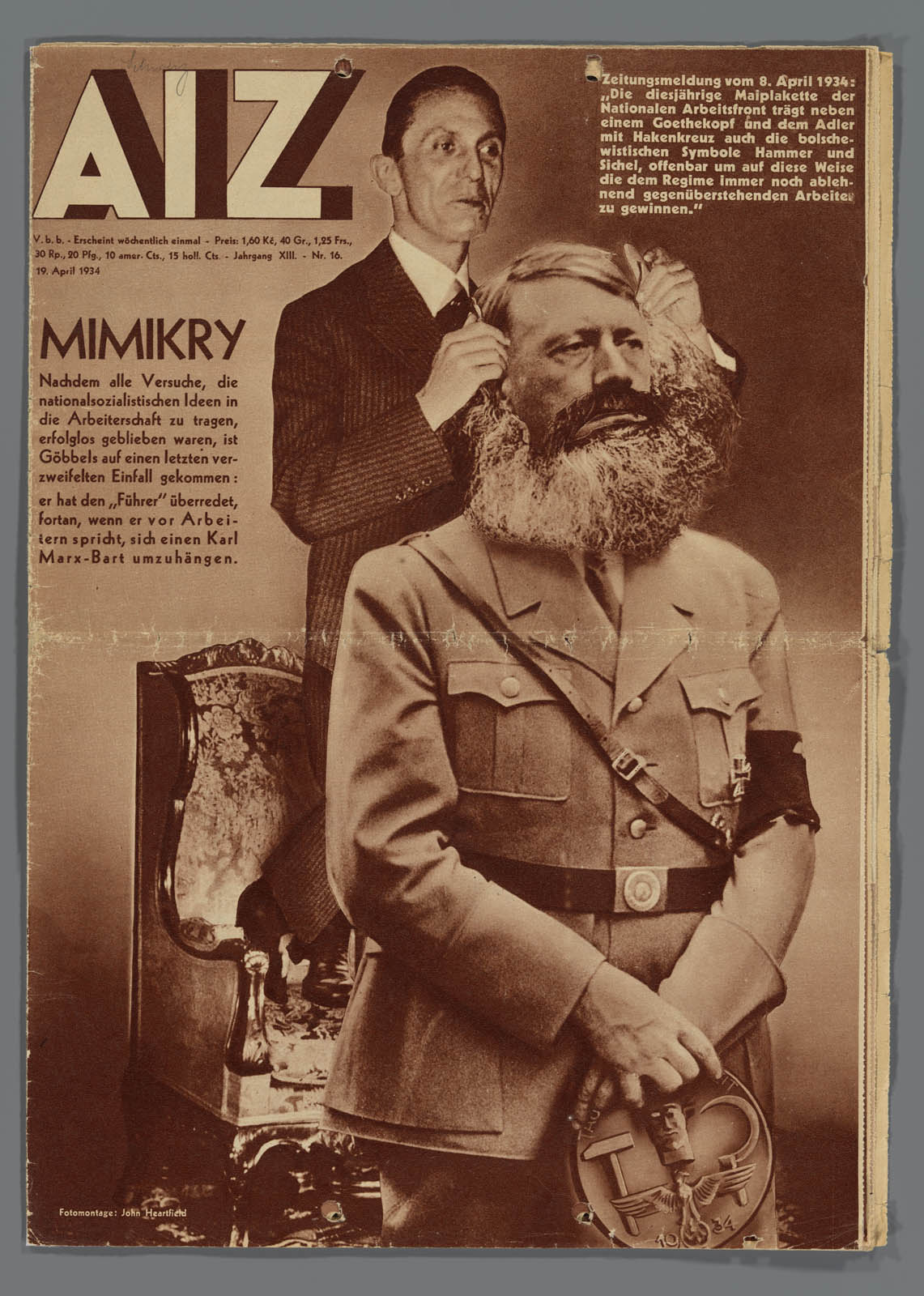
Exaggeration, humour and incongruous visual combinations also played a major role in political protest. The best-known creator of political photo composites is John Heartfield (pseudonym of Helmut Herzfeld, 1891-1968), who opposed Hitler’s Nazi movement. Several examples of his work appear in the exhibition.

Press release from the Rijksmuseum


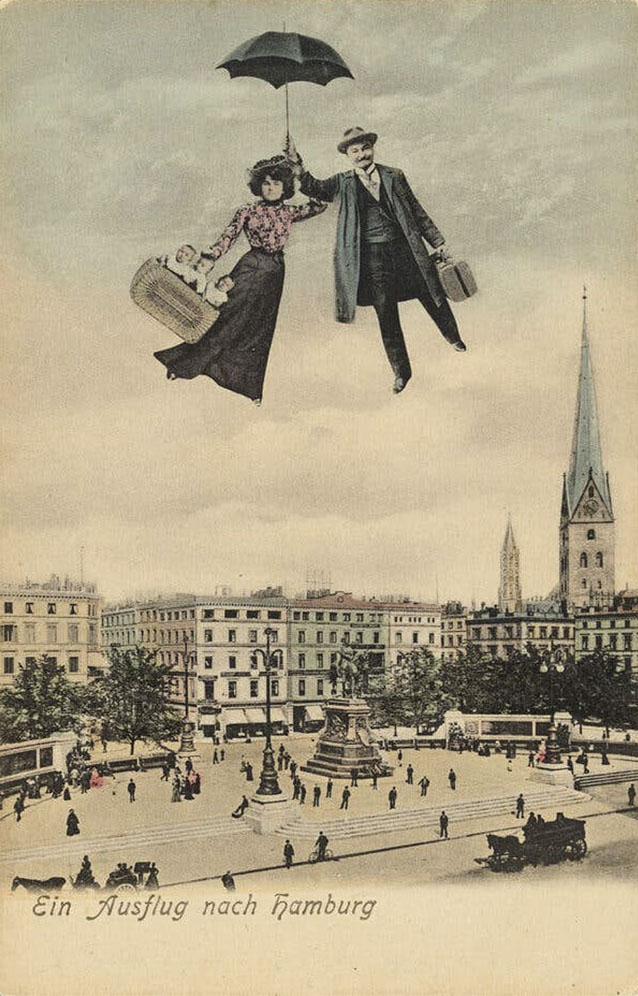
P. Michaelis (Berlin, publisher) 'Man and woman with briefcase and three babies above Hamburg' c. 1900-1910


P. Michaelis (Berlin, publisher)
Man and woman with briefcase and three babies above Hamburg
c. 1900-1910
Postcard


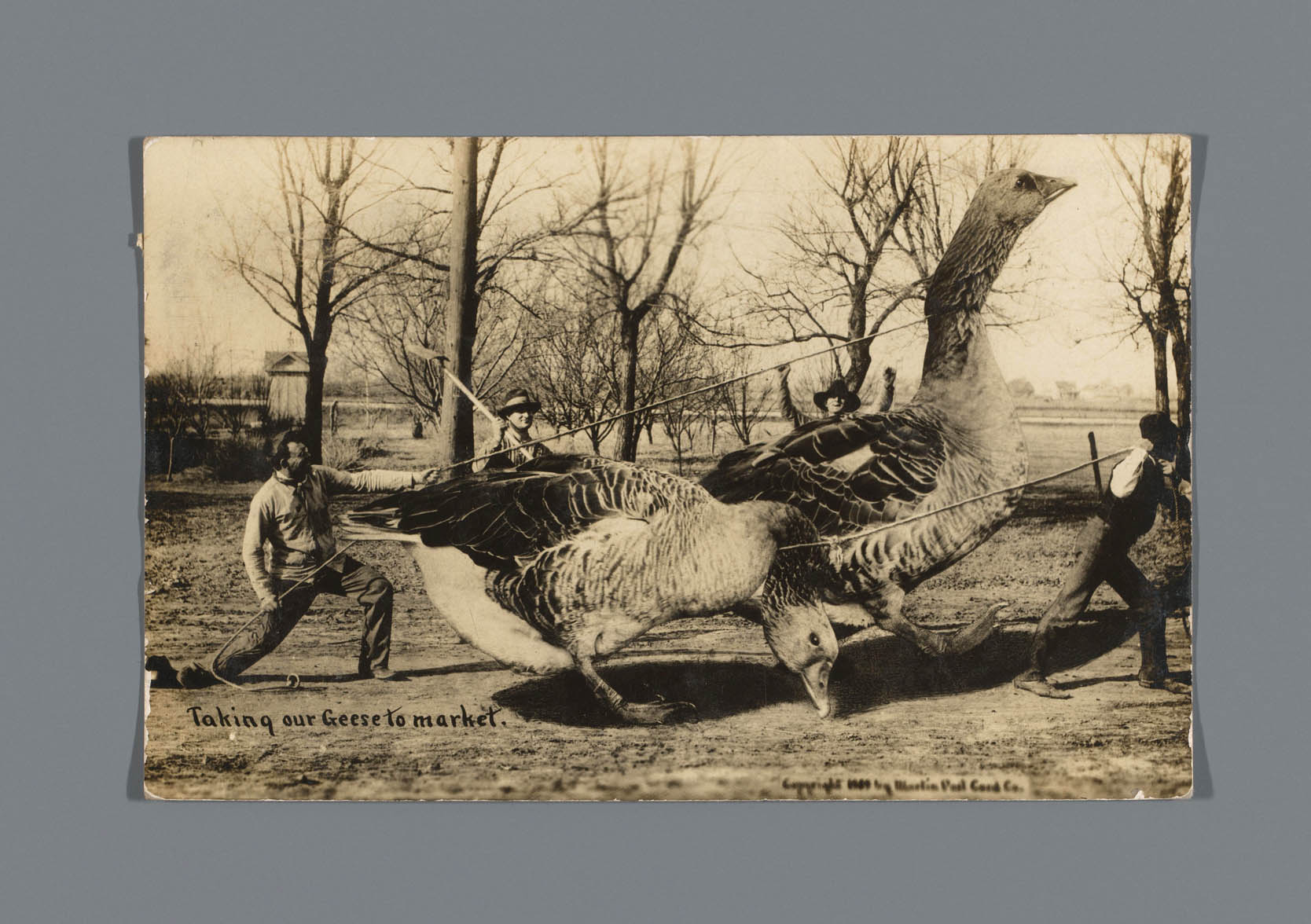
Martin Post Card Company (American) 'Taking our Geese to market' 1908


Martin Post Card Company (American)
Taking our Geese to market
1908
Postcard
Rijksmuseum
Purchase 2019


The trend for playing with images of impossible proportions spawned a genre known as “Exaggerations” or “Tall Tales”. This US photograph was printed during the “Golden Age” of picture postcards, shortly after the US decreed that messages could be written on the address side of the card. We see again the pioneering role photo manipulation plays in artistic developments such as Surrealism, but the use of scale here is also a marketing ploy to create myths about the agricultural superiority of a region. In this case, it’s the celebrated stuffed geese of Watertown, Wisconsin. Elsewhere in the show, Nebraska boasts about its bountiful produce with an ear of corn the length of a horse-drawn carriage. As US author and folklorist Roger Welsch noted in Tall Tale Postcards (1976): “Photography brought into being visual effects that tall-tale tellers through the centuries had seen only in their fertile imaginations.”

Deborah Nicholls-Lee. “‘Image manipulation has always been around’: 10 early photographic ‘fakes’ that trick the eye,” on the BBC website 18th February 2026 [Online] Cited 18/02/2026. Used under fair use conditions for the purposes of education and research


William H. Martin, (1865 – c. 1940) also known by the nickname “Dad“, was an American photographer and postcard designer known for using photomontage to depict exaggerated scenes with out-of-scale plants and animals. His works featured fanciful depictions of the American frontier inspired by tall tales. His depictions of abundant crops and large livestock served to humorously parody the struggles of farmers in the Midwestern United States who faced drought. They also mocked the exaggerated promises of fertile land and abundant livestock that companies used to lure settlers to the West. Martin was a pioneer of the art form of collage in the United States, and is considered to be the “father” of the exaggeration postcard genre.

Martin was originally from Maple City, Kansas. and was born in 1865. When he was 21 years old, he moved to Ottawa, Kansas to study under the photographer E.H. Corwin. He had no prior experience in photography. He proved successful, and bought Corwin’s photography studio in 1894.

He used photomontage and trick photography and, in 1908, began producing wildly exaggerated postcards for commercial sale. His cards typically featured out-of-scale scenes with people alongside giant plants and animals, created by cutting and pasting together different photographs. His postcards were popular with Western settlers, who sent them back to their families in the Eastern United States. His business was successful, and by 1909 he had built a two-story business building behind his home and employed around 20 people, who produced around 10,000 postcards every day. His photographs proved so popular that they were often plagiarised by other postcard companies and sold under different names.

Text from the Wikipedia website


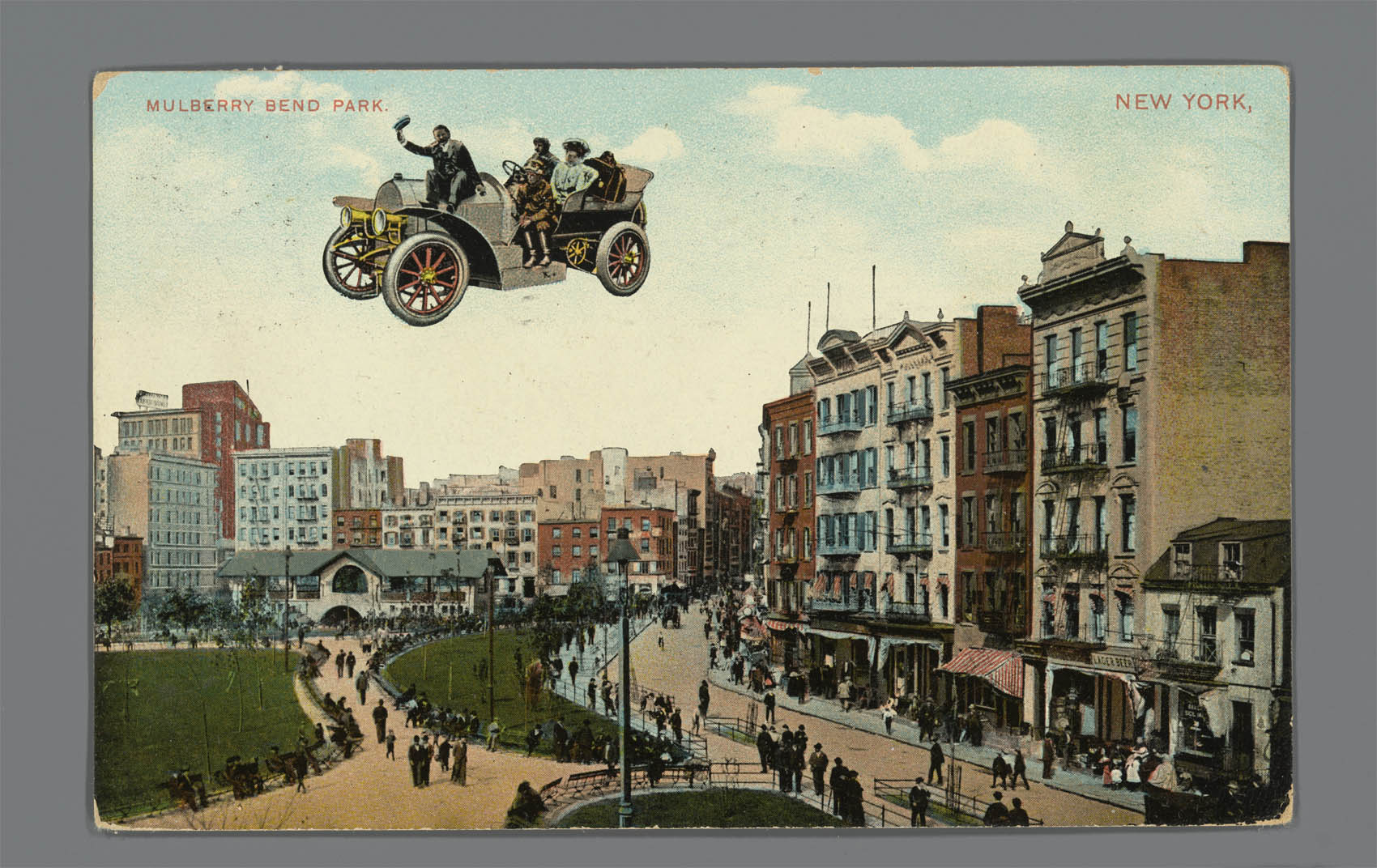
Theodor Eismann (publisher) (Leipzig, Germany) 'Car flying over Mulberry Bend Park, New York' before 1908


Theodor Eismann (publisher) (Leipzig, Germany)
Car flying over Mulberry Bend Park, New York
before 1908
Postcard
Rijksmuseum
Purchase 2025


Eismann established the company in Leipzig around 1884 and was instrumental in the pre-World War I postcard boom in Germany for the U.S. market. Theochrom was name given to the printing process used.


Fake photographs activated the imagination, presenting imagined possibilities yet to come. This example of a toekomstbeeld (vision of the future) envisages a world where cars could fly. Elsewhere in the exhibition we see futuristic cityscapes: town centres transformed by sky rails and zeppelins thanks to some deft copy and pasting, and skyborne visitors floating over Boston, Hamburg and The Hague in scenes reminiscent of Mary Poppins. Eismann’s New York photomontage [above] now features colour but is no more truthful, its limited range of inks added during the printing process at the whim of the designer.

Deborah Nicholls-Lee. “‘Image manipulation has always been around’: 10 early photographic ‘fakes’ that trick the eye,” on the BBC website 18th February 2026 [Online] Cited 18/02/2026. Used under fair use conditions for the purposes of education and research


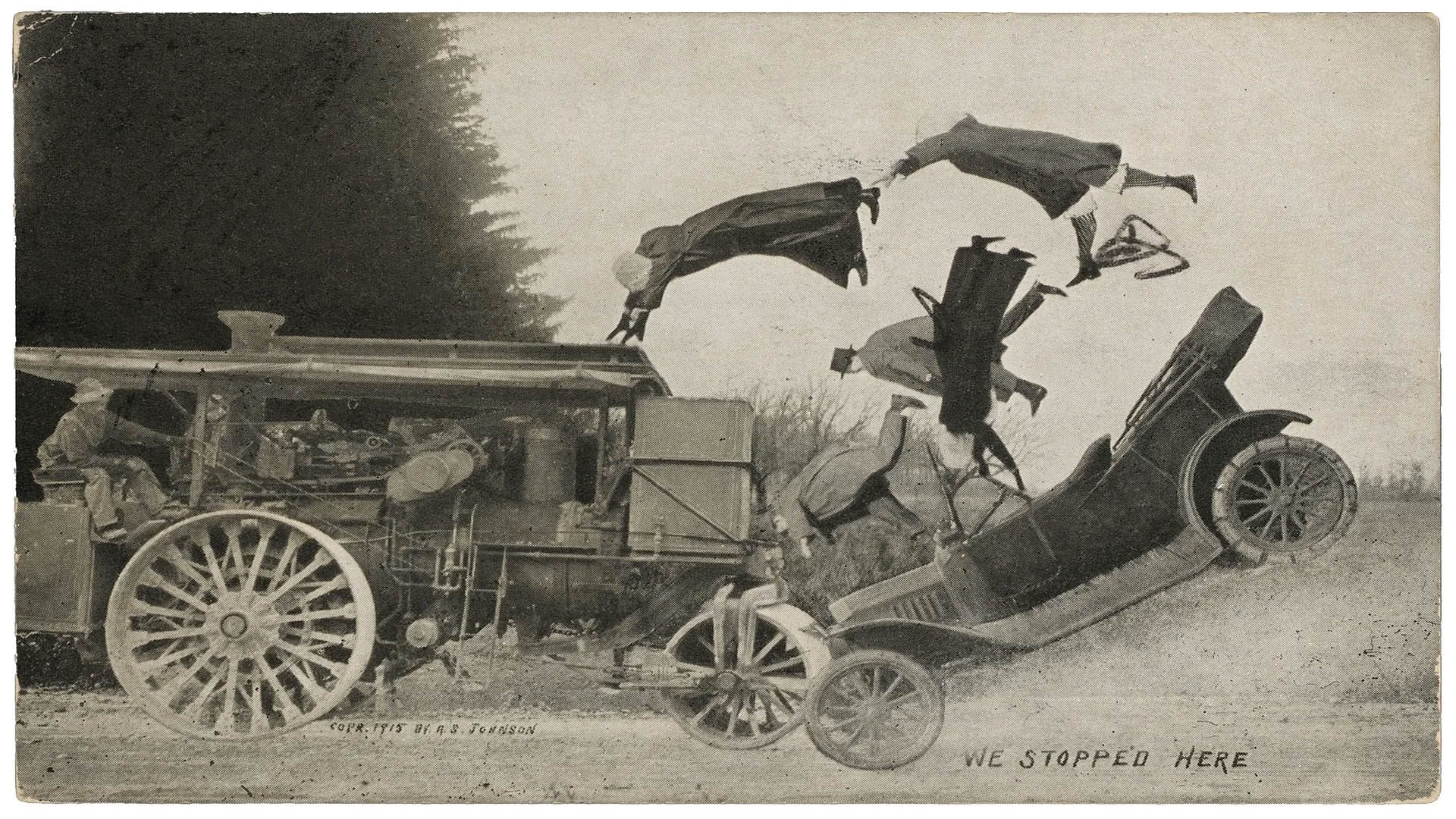
Alfred Stanley Johnson Jr. (American, 1863-1932) 'Collision between a car and a steamroller' 1915


Alfred Stanley Johnson Jr. (American, 1863-1932)
Collision between a car and a steamroller
1915
Tall-tales postcard (exaggerated postcard)
Waupun catalog no. P126


We’ve come to think of photo trickery as something sinister, but in his research on its use in early photography, Rooseboom says he was surprised to find that “three-quarters of all the images were made for fun”. In this photomontage by Alfred Stanley Johnson Jr, the clever placement of a series of individual − sometimes overlapping − images provides a humorous snapshot in time. The unusually dynamic, action-filled scene features flying coattails and frilly bloomers as the passengers of a car are catapulted through the air, inviting a before-and-after narrative in the mind of the viewer. “Many photomontages obviously depict impossible situations,” states a text at the exhibition. “The intention was not to mislead, but rather to entertain the viewer.”

Deborah Nicholls-Lee. “‘Image manipulation has always been around’: 10 early photographic ‘fakes’ that trick the eye,” on the BBC website 18th February 2026 [Online] Cited 18/02/2026. Used under fair use conditions for the purposes of education and research


Alfred and Elizabeth were living at 315 South Madison Street (in Dodge County) and their son Stanley – who was now going by his middle name – and wife Myrtie were living at 315 North Madison Street (in Fond du Lac County), with their son Alfred S. (the III), who was less than a year old. The Johnson photo studio/gallery was then located at 11-17 North Madison, just off Main Street. This was only a few years after Stanley began producing his tall-tale postcards, probably assisted by his wife, Myrtie, who was listed in the 1905 State Census as being a “photographer” and the 1910 Census as a “photo retoucher.” Although he apparently was known locally by the name of Stanley, he used the name “Alfred Stanley Johnson, Jr.” on most of his postcards.

Stanley Johnson, Sr. died December 3, 1914, and his wife Elizabeth died December 9, 1919; both are buried in the family plot in Forest Mound Cemetery in Waupun. Stanley continued in the photo business at 11 North Madison Street – while living at 17 N. Madison – until a few years before his death on March 1, 1932. His obituary in the Waupun Leader News stated that he had “been in poor health for about 30 years,” which would have been since about the time he started creating his exaggerated postcards. Perhaps the cards provided the extra income needed to pay ongoing medical bills.

Anonymous. “Johnson, Alfred Stanley,” on the Wisconsin Historical Society website Nd [Online] 18/02/2026. Used under fair use conditions for the purposes of education and research
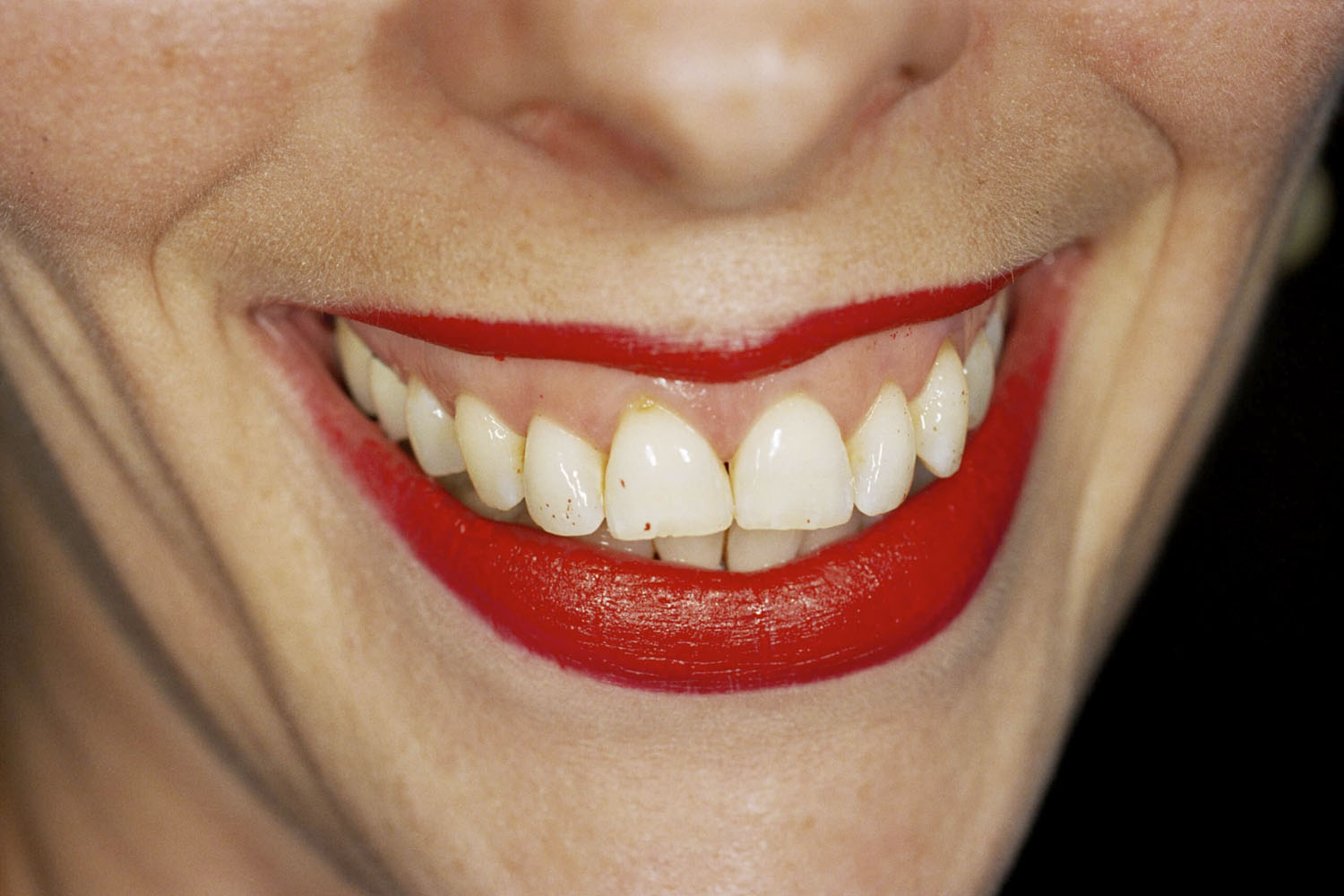
 

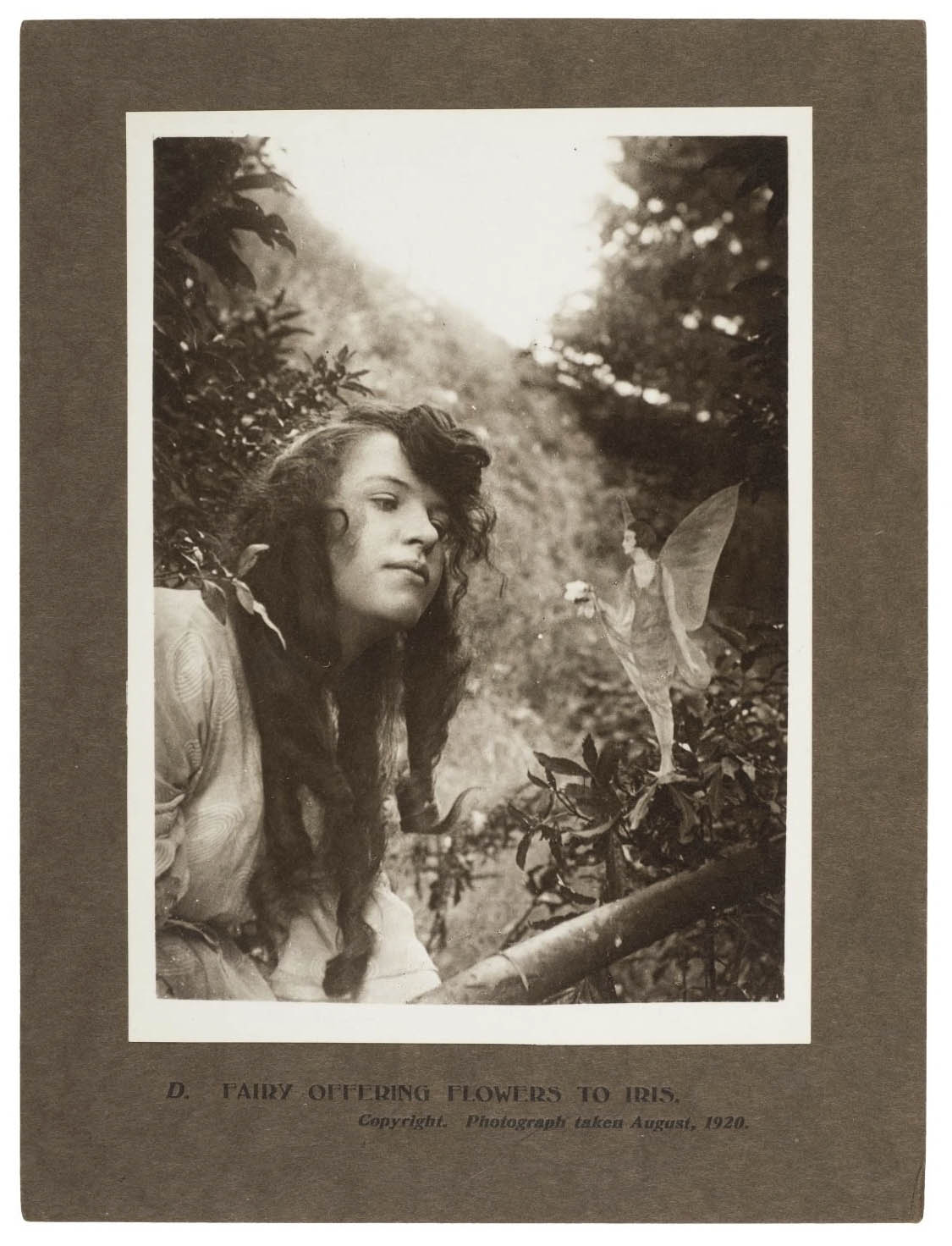
Elsie Wright (British, 1901-1988) and Frances Griffiths (British, 1907-1986) 'Fairy Offering Flowers to Iris' 1920


Elsie Wright (British, 1901-1988) and Frances Griffiths (British, 1907-1986)
Fairy Offering Flowers to Iris
1920
From the Cottingley Fairies series
Gelatin silver print


The Cottingley Fairies are the subject of a hoax which purports to provide evidence of the existence of fairies. They appear in a series of five photographs taken by Elsie Wright and Frances Griffiths, two young cousins who lived in Cottingley, near Bradford in England. In 1917, when the first two photographs were taken, Elsie was 16 years old and Frances was 9. The pictures came to the attention of writer Sir Arthur Conan Doyle, who used them to illustrate an article on fairies he had been commissioned to write for the Christmas 1920 edition of The Strand Magazine. Doyle was enthusiastic about the photographs, and interpreted them as clear and visible evidence of supernatural phenomena. Public reaction was mixed; some accepted the images as genuine, others believed that they had been faked.

Interest in the Cottingley Fairies gradually declined after 1921. Both girls married and lived abroad for a time after they grew up, and yet the photographs continued to hold the public imagination. In 1966 a reporter from the Daily Express newspaper traced Elsie, who had by then returned to the United Kingdom. Elsie left open the possibility that she believed she had photographed her thoughts, and the media once again became interested in the story.

Text from the Wikipedia website
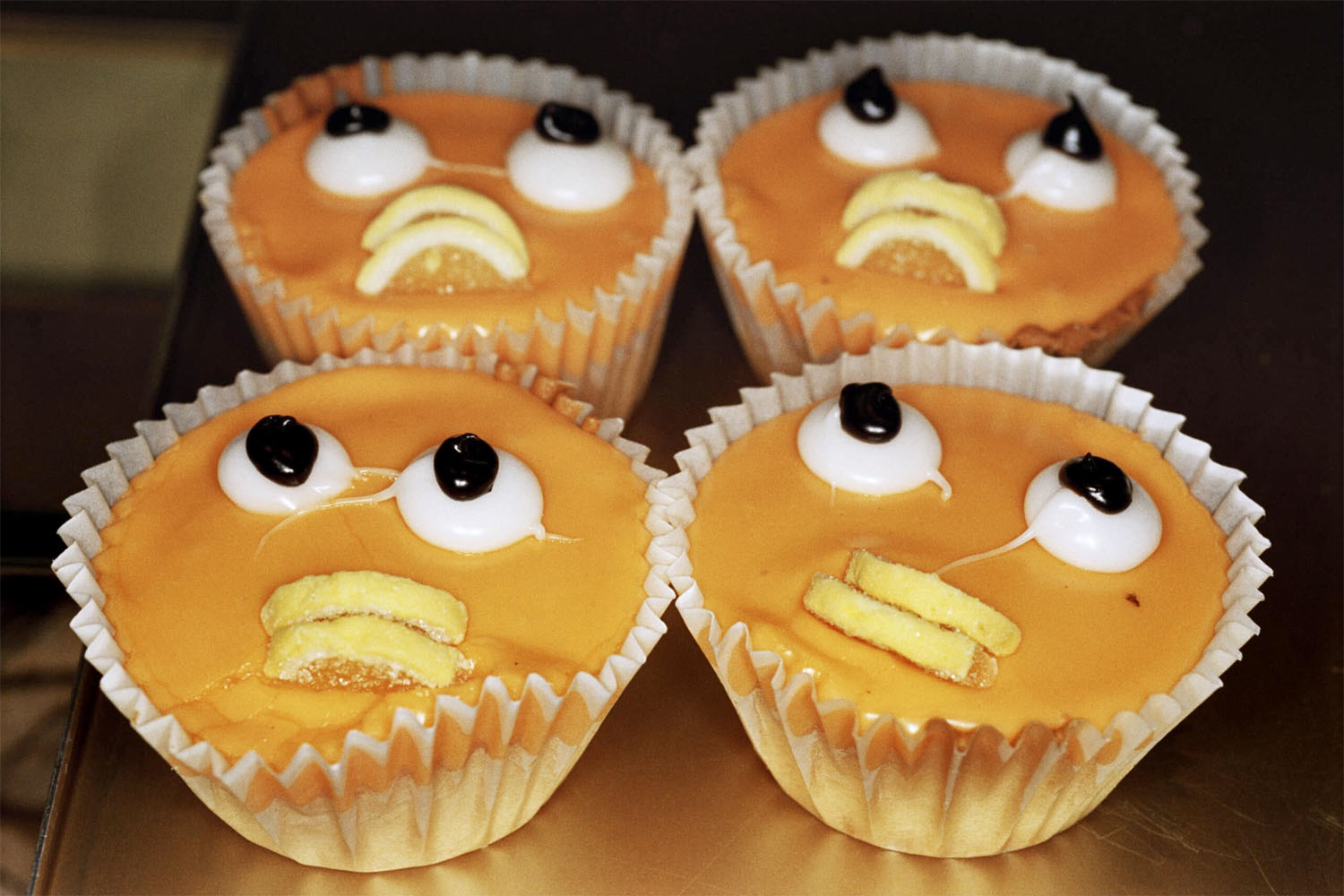
 

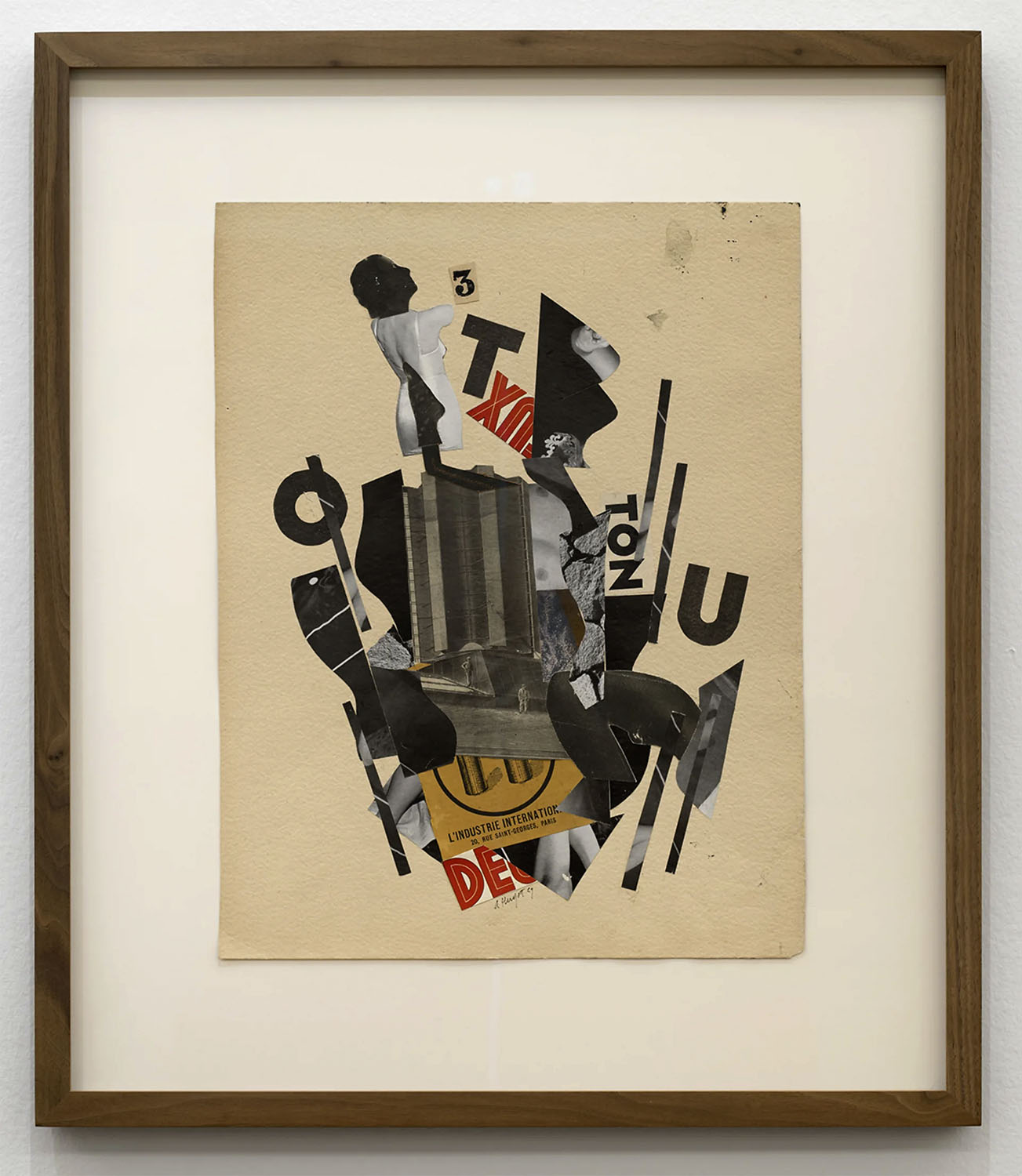
Albert Huyot (French, 1872-1968) 'Photo collage' 1929


Albert Huyot (French, 1872-1968)
Photo collage
1929


The cutting up of images and rearranging them on paper with glue was once a popular pastime. People made celebrity photo quizzes, sometimes featuring just a nose or a pair of eyes; and the photographed faces of friends and family were superimposed onto drawings for comic effect. Photo collages were also undertaken by established artists. In this piece, which is influenced by Dadaism and Cubism, French artist Albert Huyot manipulates fragments of photographic images into surprising new artistic forms. More intricate photographic artworks can be seen in the show on the pages of the Hungarian artist László Moholy-Nagy’s seminal book Painting, Photography, Film (1925). In it he argues that photography is not just about recording reality. Instead, it should explore the visual language unique to its medium.

Deborah Nicholls-Lee. “‘Image manipulation has always been around’: 10 early photographic ‘fakes’ that trick the eye,” on the BBC website 18th February 2026 [Online] Cited 18/02/2026. Used under fair use conditions for the purposes of education and research
 

The son and grandson of artists, Albert Huyot was a pupil of Diogène Maillart and Gustave Moreau. His first paintings were done in a generic Post-Impressionist manner indebted to the example of the Nabis, but he soon became influenced by Cubism. He exhibited regularly at the Salon des Indépendants, the Salon d’Automne and the Salon des Tuileries, and also participated in the Grande Exposition in Brussels in 1910; in the same year he also spent some time in Russia. Huyot was a friend of Henri Matisse, and around 1912 his work reveals the influence of Fauvism; André Derain was another particular influence. After 1920, however, Huyot seems to have abandoned the rigour of his earlier work in favour of landscape painting. An exhibition of his work was held at the Galerie Berthe Weill in Paris in 1926.

Text from the Stephen Ongpin Fine Art website
 

John Heartfield, pseudonym of Helmut Herzfeld (German, 1891-1968) 'Mimikry, Arbeiter-Illustrierte-Zeitung (A-I-Z), 19 April 1934' 1934


John Heartfield, pseudonym of Helmut Herzfeld (German, 1891-1968) Mimikry, Arbeiter-Illustrierte-Zeitung (A-I-Z), 19 April 1934
1934


Sometimes, in a surprising twist, photographic trickery was a tool for conveying a perceived truth. Anti-Nazi campaigner Helmut Herzfeld, who changed his name to the anglicised John Heartfield in protest against Hitler’s regime, created over 200 handcrafted political photomontages for the leftist AIZ publication, many seeking to expose the hidden dangers of the Nazi dictatorship and the lies it disseminated. Mimicry depicts Joseph Goebbels, the Nazi Minister of Propaganda, disguising Hitler as the 19th-Century revolutionary communist Karl Marx. The artist is warning the working classes not to be fooled by Hitler’s promises that he genuinely supports workers’ rights. Such work is comparable with political memes today that aim to speak truth to power. Image manipulation can both mislead us and help us find our way.

Deborah Nicholls-Lee. “‘Image manipulation has always been around’: 10 early photographic ‘fakes’ that trick the eye,” on the BBC website 18th February 2026 [Online] Cited 18/02/2026. Used under fair use conditions for the purposes of education and research


Rijksmuseum
Museumstraat 1
1071 XX Amsterdam

Opening hours:
Open daily 9 – 17h

Rijksmuseum website
LIKE ART BLART ON FACEBOOK

Back to top


Exhibition: ‘The Worlds of Ilse Bing’ at the Davis Museum at Wellesley College, Wellesley MA

Exhibition dates: 19th February – 24th May, 2026

Curator: Dr. Carrie Cushman, Director of the Bates College Museum of Art and former Linda Wyatt Gruber ’66 Curatorial Fellow in Photography at the Davis Museum


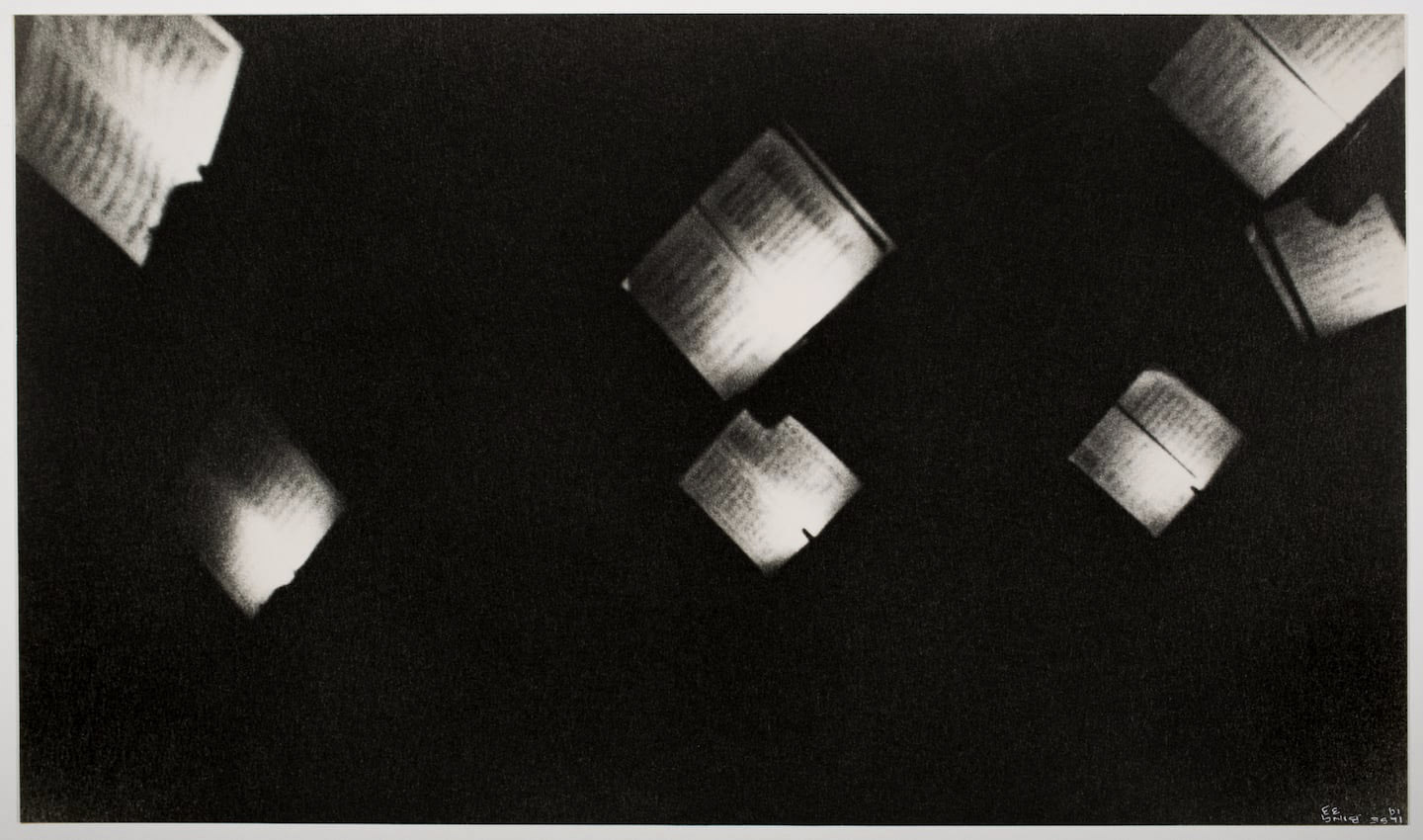
Ilse Bing (German, 1899-1998) 'Music Stands' 1933 from the exhibition 'The Worlds of Ilse Bing' at the Davis Museum at Wellesley College, Wellesley MA, February - May, 2026


Ilse Bing (German, 1899-1998)
Music Stands
1933
Gelatin silver print
Sheet: 7 in. x 11 15/16 in. (17.8 cm x 30.3cm)
Mount: 11 in. x 14 in. (27.9 cm x 35.6cm)
Davis Museum at Wellesley College, Wellesley, MA
Gift of Suzanne Ciani (Class of 1968)


A bonus mid-week posting on this compact exhibition on the work of German photographer Isle Bing (1899-1998)

It’s wonderful to see the expressive musicality and movement in Bing’s black and white photographs, most of the images new to me. I would have loved to have seen more photographs from this “New Woman” but this is all I have from the exhibition. The museum is very lucky to have had a recent gift of vintage photographs donated by Bing’s mentee and friend Suzanne Ciani (class of ’68).
But if you want to be taken seriously as a collecting institute please make sure that you title the artist and subject correctly on your collections website pages. It’s not The Honorable Daisy Fellowers it is The Honorable Daisy Fellowes (corrected below) and it’s not Florence Henry it is Florence Henri!
Little things make all the difference.

Dr Marcus Bunyan


Many thankx to the Davis Museum for allowing me to publish the photographs in the posting. Please click on the photographs for a larger version of the image.


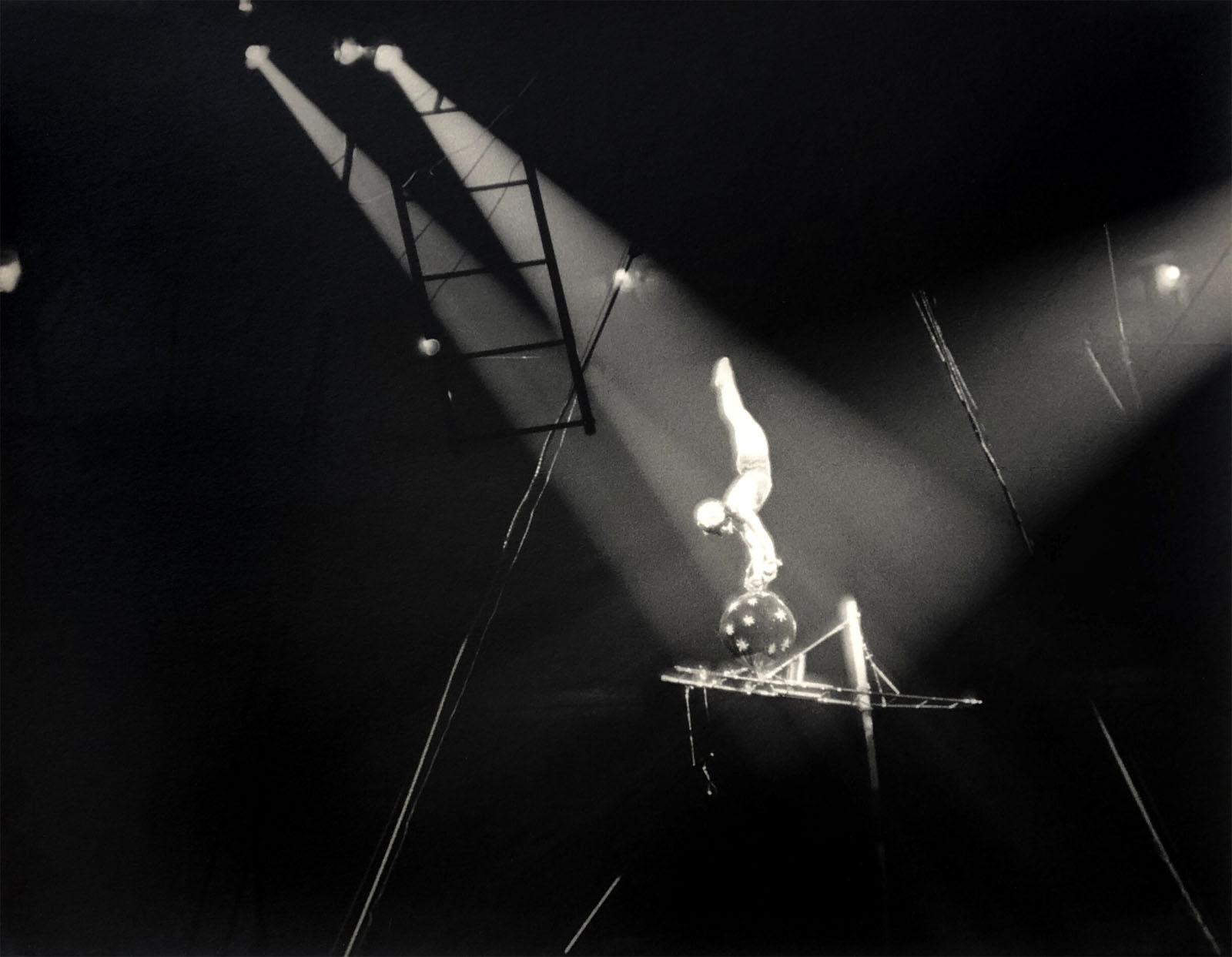
Ilse Bing (German, 1899-1998) 'Acrobat with Black Ball' 1936 from the exhibition 'The Worlds of Ilse Bing' at the Davis Museum at Wellesley College, Wellesley MA, February - May, 2026


Ilse Bing (German, 1899-1998)
Acrobat with Black Ball
1936
Gelatin silver print
Sheet: 8 3/4 in. x 11 1/8 in. (22.2cm x 28.3cm)
Davis Museum at Wellesley College, Wellesley, MA
Gift of Suzanne Ciani (Class of 1968)


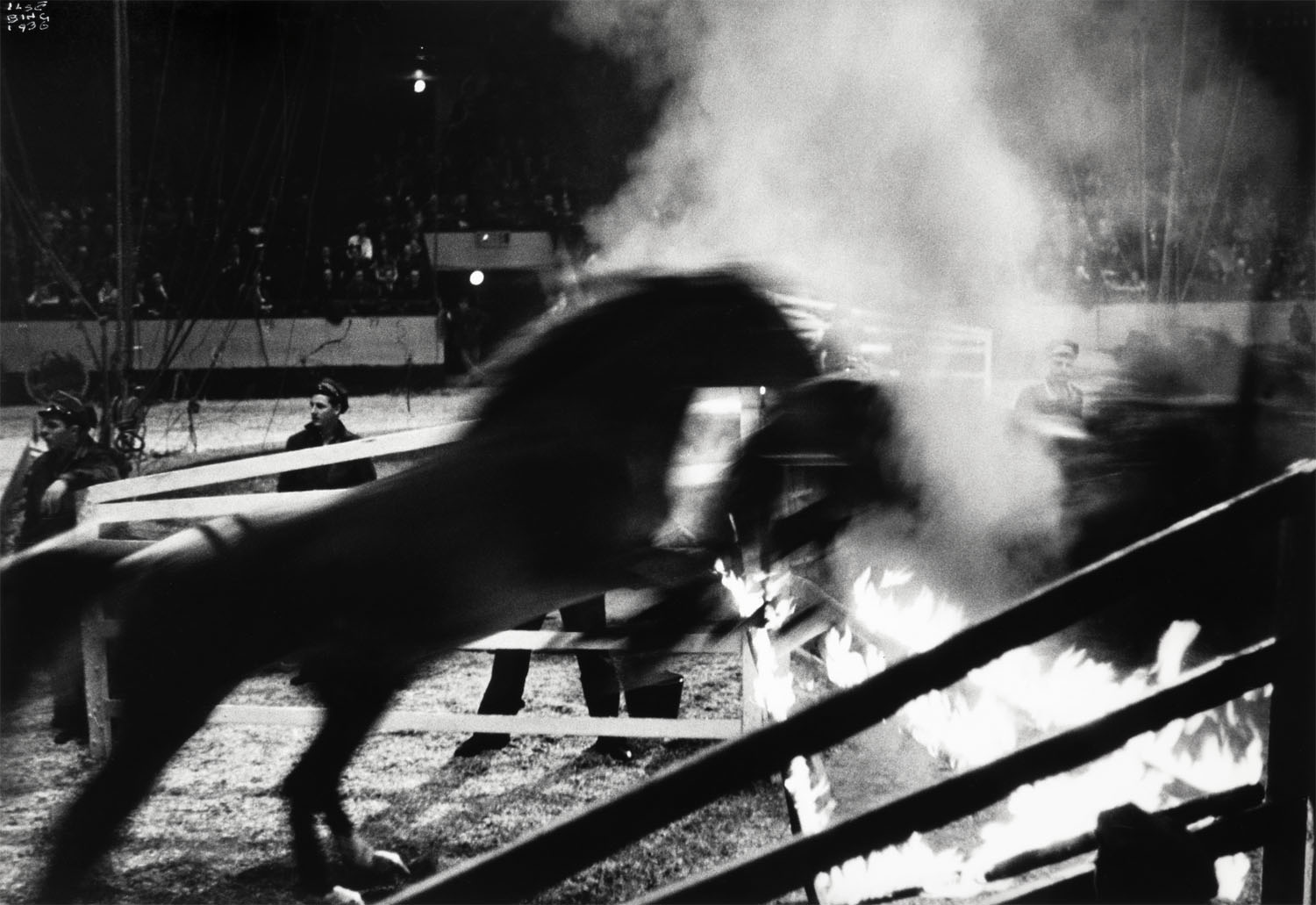
Ilse Bing (German, 1899-1998) 'Circus Horse in NYC' 1936


Ilse Bing (German, 1899-1998)
Circus Horse in NYC
1936
Gelatin silver print
Sheet: 13 1/2 in. x 19 3/8 in. (34.3 cm x 49.2cm)
Mount: 19 5/8 in. x 25 1/2 in. (49.8 cm x 64.8cm)
Davis Museum at Wellesley College, Wellesley, MA
Gift of Suzanne Ciani (Class of 1968)


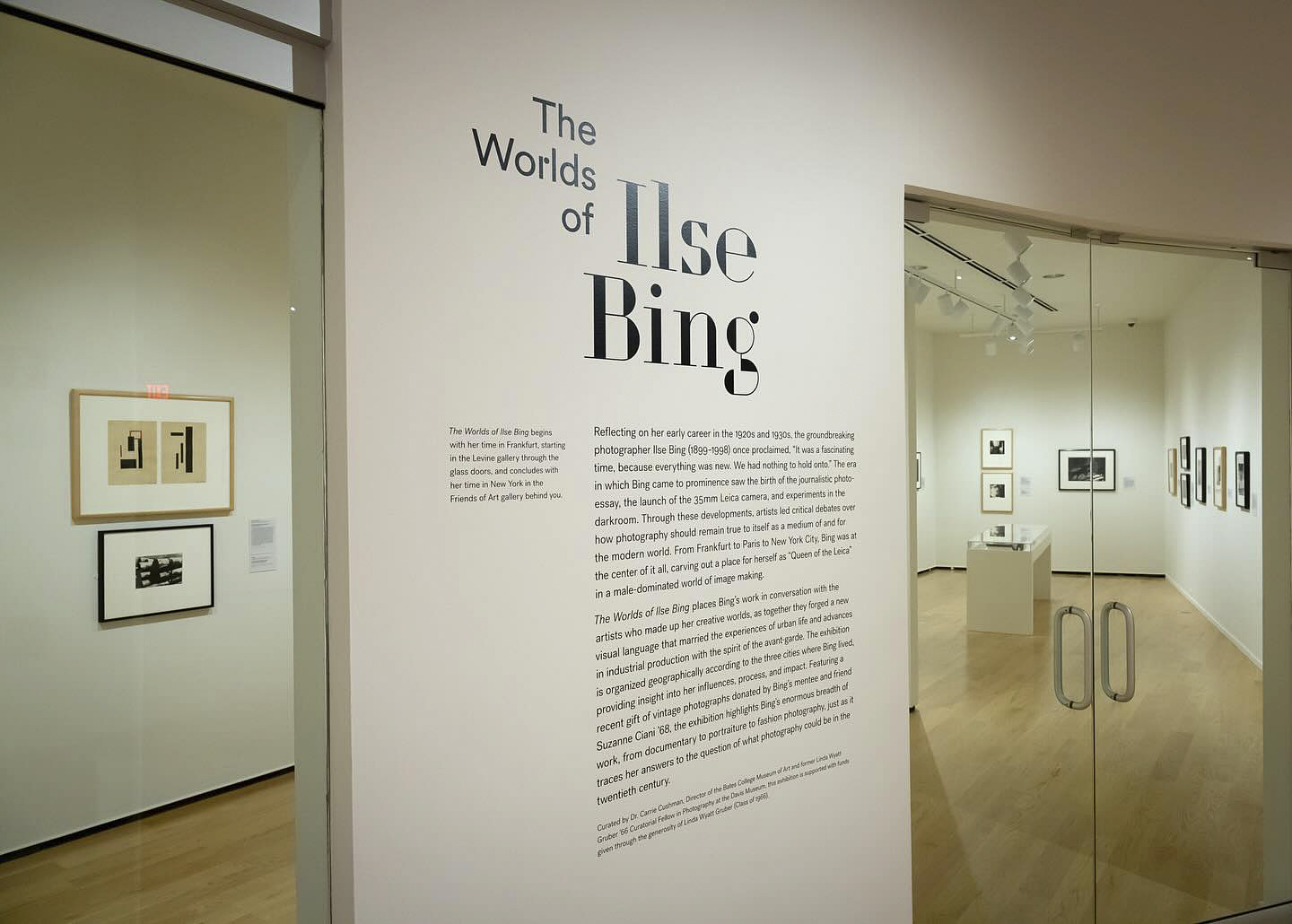
Featuring a recent gift of vintage photographs by the groundbreaking photographer Ilse Bing (1899-1998), this exhibition explores the development of the photographic medium in the mid-twentieth century. The era in which Bing came to prominence saw the birth of the journalistic photo-essay, the launch of the 35-mm Leica camera, and experiments with abstract photograms and solarization. Artists led critical debates over how photography should remain true to itself as a medium of and for the modern world. From Frankfurt to Paris to New York City, Bing was at the centre of it all, carving out a place for herself as “Queen of the Leica” in a male-dominated world of image making. The Worlds of Ilse Bing is organised geographically according to the three cities where Bing lived, placing her work in conversation with the artists who made up her creative worlds and providing insight into her influences, process, and undeniable impact on others as they pushed the boundaries of modern art. 

Text from the Wellesley College website
 

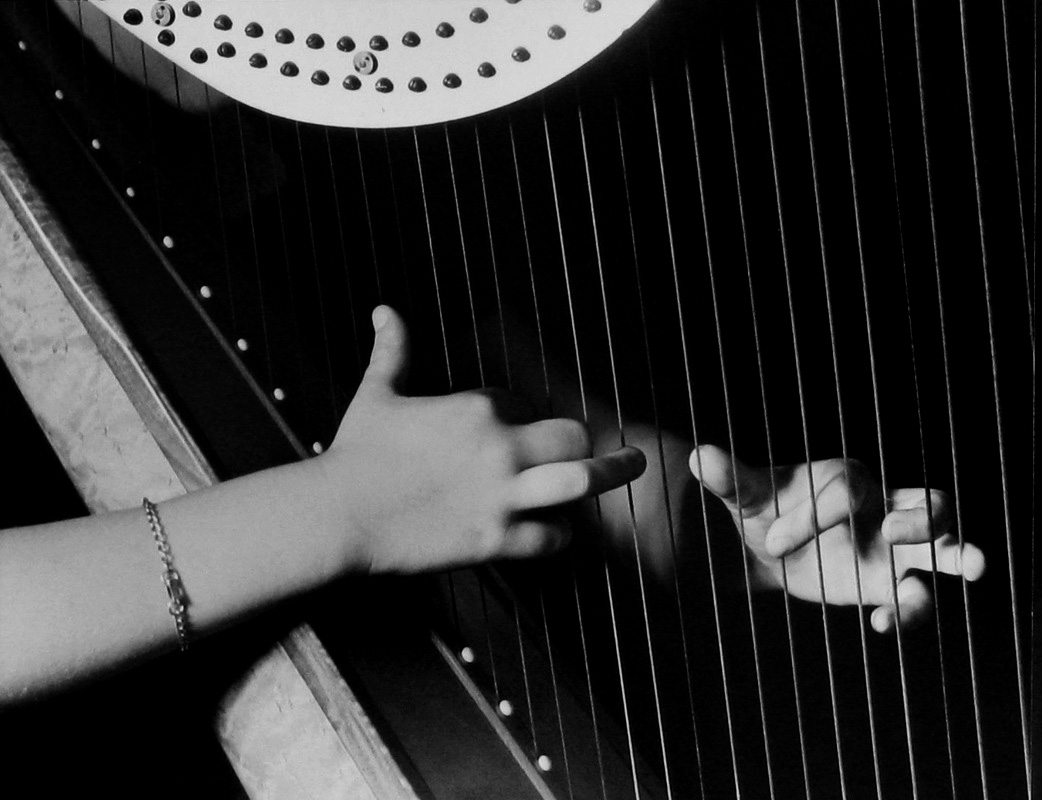
Ilse Bing (German, 1899-1998) 'Jane Neidensaul, Hands on Harp' 1943


Ilse Bing (German, 1899-1998)
Jane Neidensaul, Hands on Harp
1943
Gelatin silver print
Sheet: 10 1/4 in. x 13 7/8 in. (26 cm x 35.2cm)
Davis Museum at Wellesley College, Wellesley, MA
Gift of Suzanne Ciani (Class of 1968)


Jane B. Weidensaul (1935-2003) was a prominent American harpist, educator, musicologist, and editor known for her contributions to harp literature and pedagogy. A Juilliard graduate and assistant to Marcel Grandjany, she taught at Juilliard and the Manhattan School of Music, served as editor of the American Harp Journal (1978-1996), and authored numerous scholarly works.


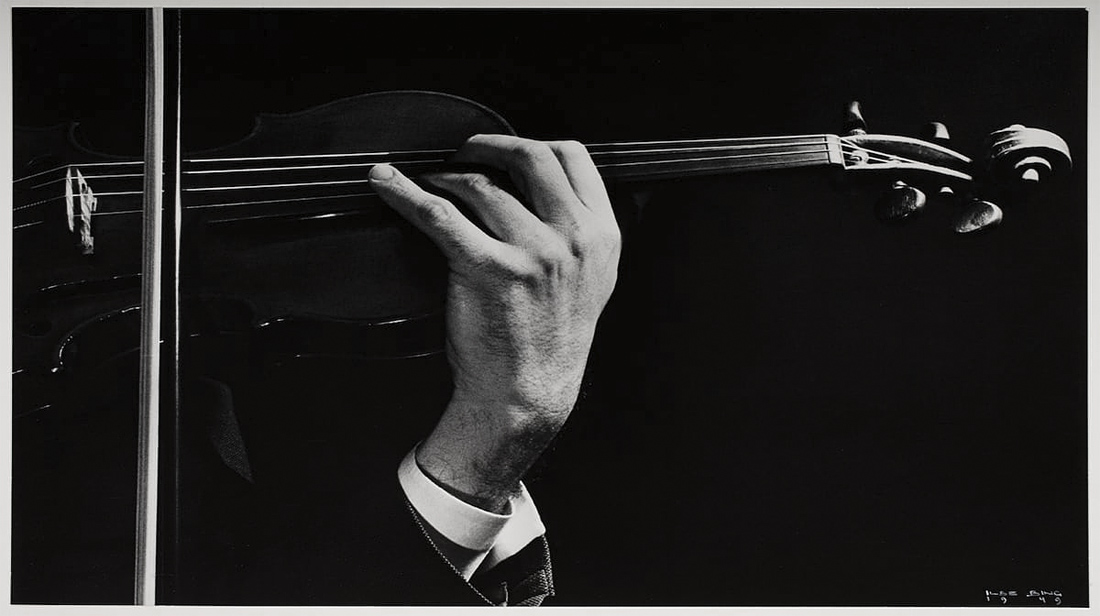
Ilse Bing (German, 1899-1998) 'La Main de Szymon Goldberg' 1949


Ilse Bing (German, 1899-1998)
La Main de Szymon Goldberg
1949
Gelatin silver print
Image: 13 1/4 in. x 9 1/2 in. (33.7 cm x 24.1cm)
Mount: 21 3/16 in. x 17 5/16 in. (53.8 cm x 44cm)
Davis Museum at Wellesley College, Wellesley, MA
Gift of Suzanne Ciani (Class of 1968)


Szymon Goldberg (American born Poland, 1909-1993)

Szymon Goldberg (1 June 1909 – 19 July 1993) was a Polish-born Jewish classical violinist and conductor, latterly an American.

Born in Włocławek, Congress Poland, Goldberg played the violin as a child growing up in Warsaw. His first teacher was Henryk Czaplinski, a student of the great Czech violinist Otakar Ševčík; his second was Mieczysław Michałowicz, a student of Leopold Auer. In 1917, at age eight, Goldberg moved to Berlin to study the violin with the legendary pedagogue Carl Flesch. He was also a student of Josef Wolfsthal.

After a recital in Warsaw in 1921, and a debut with the Berlin Philharmonic in 1924 in which he played three concertos, he was engaged as concert-master of the Dresden Philharmonic from 1925 to 1929. In 1929 he was offered the position of concertmaster of the Berlin Philharmonic by its principal conductor, Wilhelm Furtwängler. He accepted the position, serving from 1930 to 1934. During these years, he also performed in a string trio with Paul Hindemith on viola and Emanuel Feuermann on cello, and also led a string quartet of Berlin Philharmonic members.

The rise of the Third Reich forced Goldberg to leave the orchestra in 1934, despite Furtwängler’s attempts to safeguard the Jewish members of the orchestra. Thereafter, he toured Europe with the pianist Lili Kraus. He made his American debut in New York in 1938 at Carnegie Hall. While in the former Netherlands East Indies he formed the Goldberg Quartet, together with Robert Pikler on viola, Louis Mojzer on cello and Eugenie Emerson, piano. Pikler and Mojzer were Hungarians and Emerson was American. This Piano Quartet toured the major cities in Java, before the Japanese invasion and occupation. Goldberg’s first wife was a skilled artist and sculptor. She was interned by the Japanese in the Tjihapit Women’s Camp in Bandung, together with Mojzer’s family, while Goldberg and Kraus were on a tour of Asia.

He toured Australia for three months in 1946. Eventually he went to the United States and became a naturalised American citizen in 1953. From 1951 to 1965 he taught at the Aspen Music School. Concurrently he was active as a conductor. In 1955 he founded the Netherlands Chamber Orchestra in Amsterdam, which he led until 1979. He also took the ensemble on many tours. From the years 1977 to 1979 he was the conductor of the Manchester Camerata.

He taught at Yale University from 1978 to 1982, the Juilliard School in New York City from 1978 to 1989, the Curtis Institute of Music in Philadelphia from 1980 to 1981, and the Manhattan School of Music in New York starting in 1981. From 1990 until his death, he conducted the New Japan Philharmonic in Tokyo. …

He made a number of recordings, most notably a celebrated series of Mozart and Beethoven sonatas with Lili Kraus before World War II, the three Brahms Sonatas with Artur Balsam (Brunswick AXTL 1082), and Mozart and Schubert pieces with Radu Lupu (with whom he performed as a duo in concert) in the 1970s. The Berlin Philharmonic, in a 2014 tribute to their former concertmaster, wrote that in the music of Bach and Mozart, Goldberg “brought a poise and a beauty of tone that seemed like perfection. Indeed he was the finest Mozart violinist of his time, with the feline grace essential for the violin sonatas, the concertos and the Sinfonia concertante.”

Text from the Wikipedia website
 

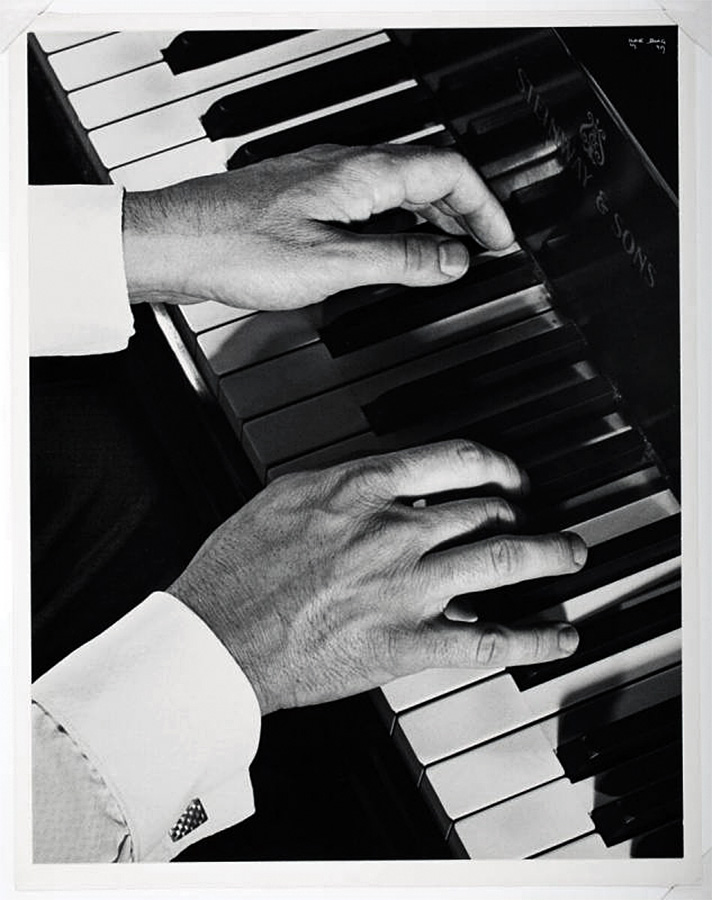
Ilse Bing (German, 1899-1998) 'Konrad Wolff, Hands' 1949


Ilse Bing (German, 1899-1998)
Konrad Wolff, Hands
1949
Gelatin silver print
Sheet: 13 3/8 in. x 10 1/2 in. (34 cm x 26.7cm)
Mount: 14 in. x 11 in. (35.6 cm x 27.9cm)
Davis Museum at Wellesley College, Wellesley, MA
Gift of Suzanne Ciani (Class of 1968)


Her photograph Konrad Wolff, Hands illustrates her formalist technique, as the camera closes in on two hands playing a piano – the black and white of the piano keys contrast with the grey tones of the hands to create a dynamic composition of linear, oblique shapes. She often manipulated her prints, flipping them upside-down or turning them sideways to view their compositional narratives in new ways.

Text from the Davis Museum website
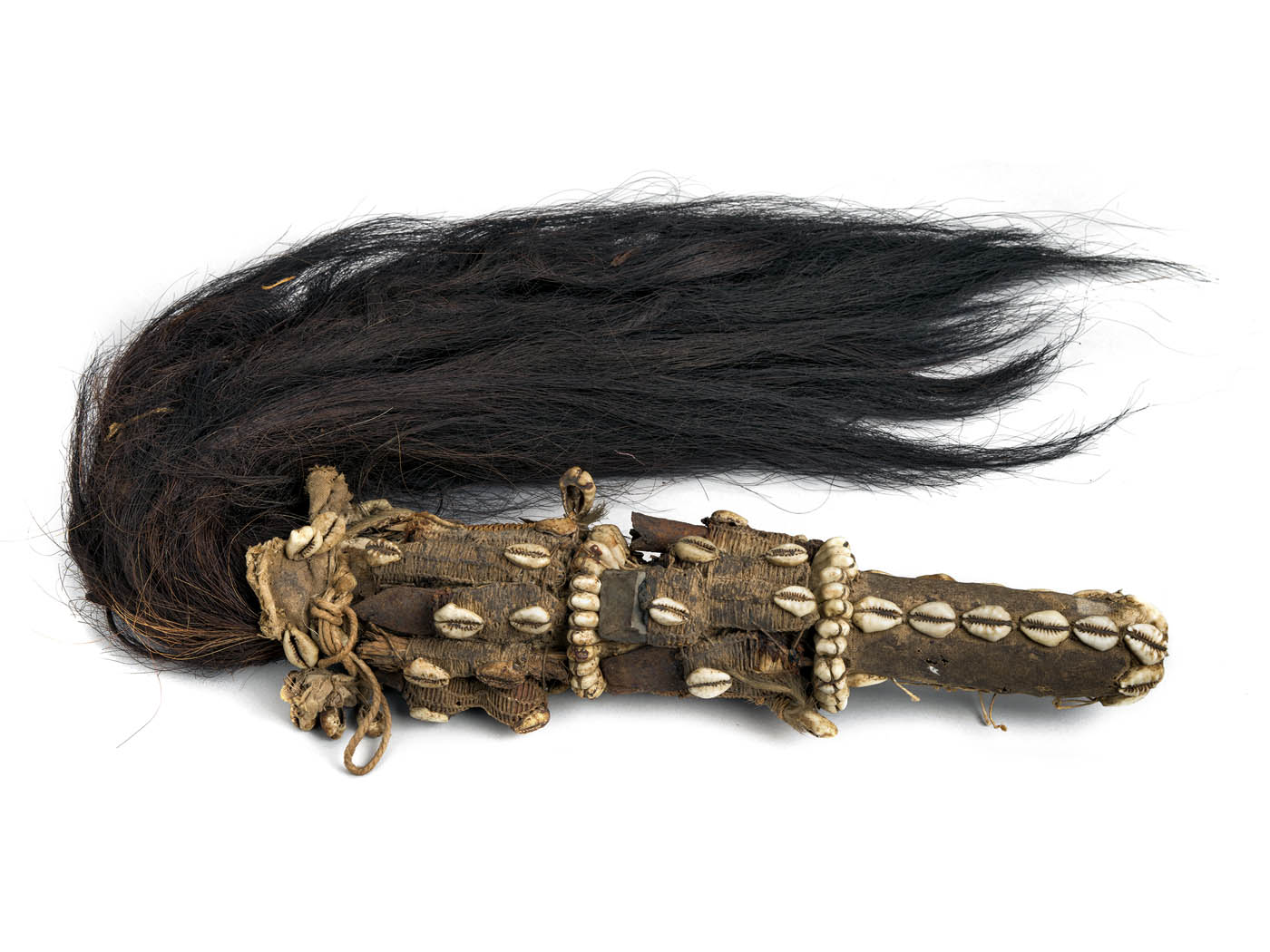
 

Konrad Wolff (March 11, 1907 – October 23, 1989) was a German-born American pianist, composer, musicologist, and educator renowned for his interpretive performances of classical piano repertoire, his scholarly writings on musical pedagogy, and his role in preserving the legacy of his teacher Artur Schnabel.


Installation view of the exhibition 'The Worlds of Ilse Bing' at the Davis Museum at Wellesley College, Wellesley MA, February - May, 2026


Installation view of the exhibition The Worlds of Ilse Bing at the Davis Museum at Wellesley College, Wellesley MA, February – May, 2026 (wall text below)


Reflecting on her early career in the 1920s and 1930s, the groundbreaking photographer Ilse Bing (1899-1998) once proclaimed, “It was a fascinating time, because everything was new. We had nothing to hold onto.” The era in which Bing came to prominence saw the birth of the journalistic photo-essay, the launch of the 35mm Leica camera, and experiments in the darkroom. Through these developments, artists led critical debates over how photography could remain true to itself as a medium of and for the modern world. From Frankfurt to Paris to New York City, Bing was at the centre of it all, carving out a place for herself as “Queen of the Leica” in a male-dominated world of image making.

The Worlds of Ilse Bing places Bing’s work in conversation with the artists who made up her creative worlds, as tougher they forged a new visual language that married the experiences of urban life and advances in industrial production with the spirit of the avant-garde. The exhibition is organised geographically according to the three cities where Bing lived, providing insight into her influences, process, and impact. Featuring a recent gift of vintage photographs donated by Bing’s mentee and friend Suzanne Ciani ’68, the exhibition highlights Bing’s enormous breadth of work, from documentary to portraiture to fashion photography, just as it traces her answers to the question of what photography could be in the twentieth century.

Wall text from the exhibition


Ilse Bing (German, 1899-1998) 'Sun in Clouds Over Swiss Mountains' 1929/1984


Ilse Bing (German, 1899-1998)
Sun in Clouds Over Swiss Mountains
1929/1984
Sheet: 6 1/4 in. x 9 1/2 in. (15.9 cm x 24.1cm)
Mount: 11 in. x 14 in. (27.9 cm x 35.6cm)
Gelatin silver print
Davis Museum at Wellesley College, Wellesley, MA
Gift of Suzanne Ciani (Class of 1968)


Ilse Bing (German, 1899-1998) 'Merry Go Round, Paris' 1932


Ilse Bing (German, 1899-1998)
Merry Go Round, Paris
1932
Gelatin silver print
Sheet: 11 in. x 8 3/4 in. (27.9 cm x 22.2cm)
Mount: 16 1/2 in. x 13 3/4 in. (41.9 cm x 34.9cm)
Davis Museum at Wellesley College, Wellesley, MA
Gift of Suzanne Ciani (Class of 1968)


Ilse Bing (German, 1899-1998) 'Dancers Balanchine Tchelitchew' 1933


Ilse Bing (German, 1899-1998)
Dancers Balanchine Tchelitchew
1933
Gelatin silver print
Sheet: 11 3/16 in. x 8 1/2 in. (28.4 cm x 21.6cm)
Mount: 14 in. x 11 in. (35.6 cm x 27.9cm)
Davis Museum at Wellesley College, Wellesley, MA
Gift of Suzanne Ciani (Class of 1968)


George Balanchine (Georgian-American, 1904-1983) and Pavel Tchelitchew (Russian, 1898-1957) were both artists who collaborated significantly in the realm of ballet during the 1930s and 1940s. Tchelitchew, a surrealist painter and designer, created innovative, often translucent sets and costumes for several of Balanchine’s ballets, helping to define the visual aesthetic of that period.


Ilse Bing (German, 1899-1998) 'The Honorable Daisy Fellowes' 1933


Ilse Bing (German, 1899-1998)
The Honorable Daisy Fellowes
1933
Gelatin silver print
Sheet: 8 13/16 in. x 11 1/8 in. (22.4 cm x 28.3cm)
Mount: 13 3/16 in. x 16 7/16 in. (33.5 cm x 41.8cm)
Davis Museum at Wellesley College, Wellesley, MA
Gift of Suzanne Ciani (Class of 1968)


The Hon. Daisy Fellowes (née Marguerite Séverine Philippine Decazes de Glücksberg) (29 April 1890 in Paris – 13 December 1962 in Paris) was a celebrated 20th-century society figure, acclaimed beauty, minor novelist and poet, Paris Editor of American Harper’s Bazaar, fashion icon, and an heiress to the Singer sewing machine fortune.


Ilse Bing (German, 1899-1998) 'Spider Web in Stables' 1951


Ilse Bing (German, 1899-1998)
Spider Web in Stables
1951
Gelatin silver print
Sheet: 13 9/16 in. x 10 1/2 in. (34.4 cm x 26.7cm)
Mount: 14 in. x 10 3/4 in. (35.6 cm x 27.3cm)
Davis Museum at Wellesley College, Wellesley, MA
Gift of Suzanne Ciani (Class of 1968)


Davis Museum at Wellesley College
106 Central Street
Wellesley, MA 02481
781-283-1000

Opening hours:
Tuesday – Sunday 11am – 5pm

Wellesley College website
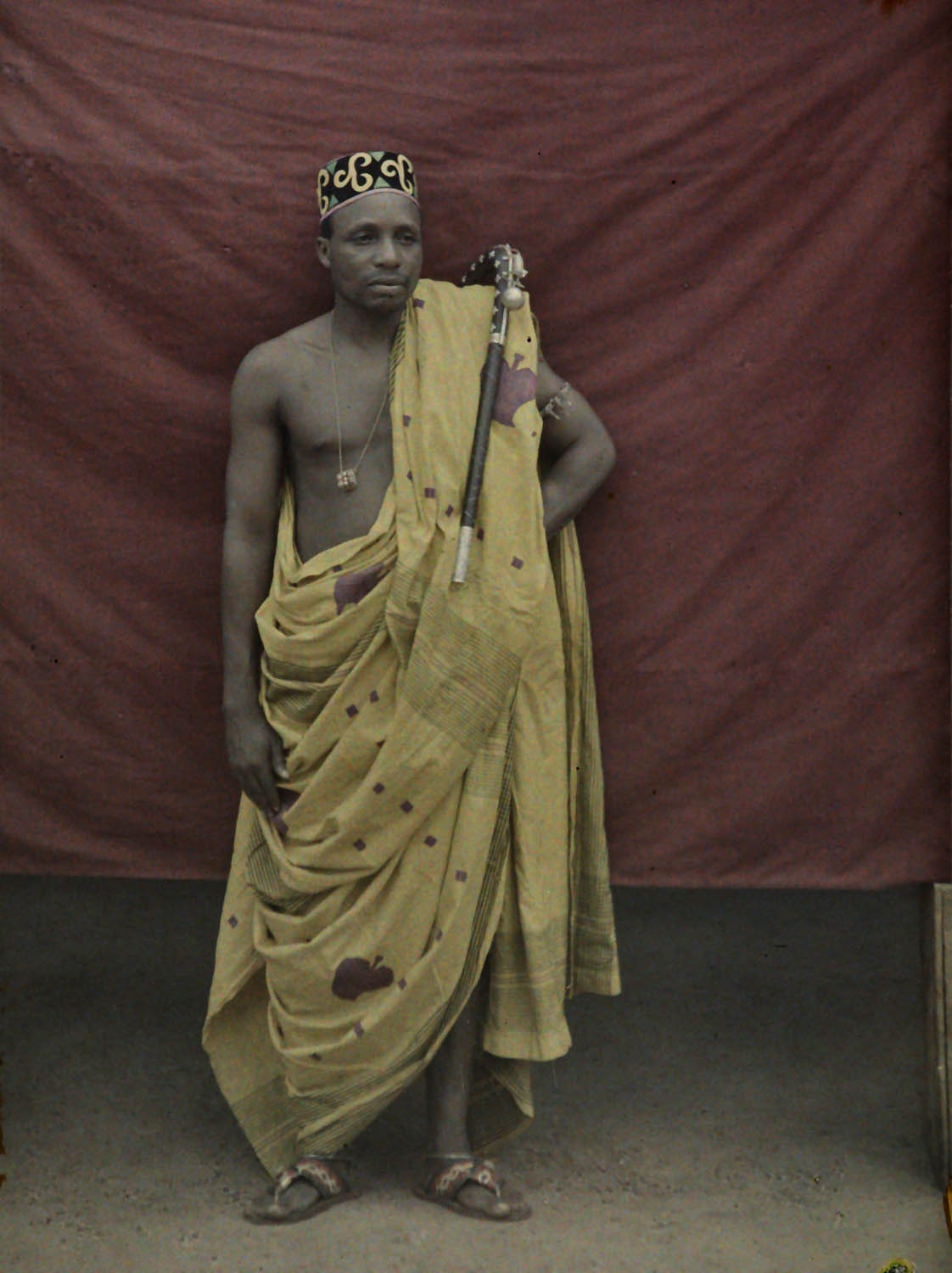
LIKE ART BLART ON FACEBOOK

Back to top

Exhibition: ‘Walker Evans. Now and Then’ at Fundación Mapfre, Barcelona

“Evans took photographs worth taking – unadorned, clearly seen, focused, descriptive photographs (of ordinary things) of the utmost beauty and honesty.” Dr Marcus Bunyan

Exhibition dates: 26th February – 24th May, 2026

Curator: David Campany


Walker Evans (American, 1903-1975) 'West Virginia Living Room' 1935 from the exhibition 'Walker Evans. Now and Then' at Fundación Mapfre, Barcelona, February - May, 2026


Walker Evans (American, 1903-1975)
West Virginia Living Room
1935
Private Collection, San Francisco
© Walker Evans Archive, The Metropolitan Museum of Art


Take photos worth taking

In the medium of photography the work of the American photographer Walker Evans (1903-1975) is rightly exalted, subject to the highest praise. “His work directly inspired photographers like Robert Frank, Helen Levitt, Diane Arbus, Lee Friedlander, and Bernd and Hilla Becher.” Some of the most important photographers of the 20th century.

In the near 18 year history of Art Blart his importance can be gauged by the number of exhibition postings he has accumulated over the journey, this being the 8th posting on the artist, joining a select few at the top of the tree: Julia Margaret Cameron, August Sander, Robert Frank, William Eggleston, Robert Mapplethorpe and Andy Warhol.

I have written extensively on Evans’s work in previous postings links to which can be found below. Suffice to say that, through awareness, his personal journey of conscious choice and deliberate self-creation has led to his photographs entering the American vernacular – through a direct pointing to a photographic reality that reflects the time in which they were taken. Which transcend the time in which they were taken.

Evans took photographs worth taking – unadorned, clearly seen, focused, descriptive photographs (of ordinary things) of the utmost beauty and honesty. He was a passionate photographer. You can feel that passion in his images. Today with a world full of AI images, fragmentation, and conceptual hoo-hah, it might do us all well to ponder the stare of this great artist so that we, in our own way, can die knowing something.

To transform your own destiny into awareness!

“When I first looked at Walker Evans’ photographs, I thought of something Malraux wrote: ‘To transform destiny into awareness.’ One is embarrassed to want so much for oneself. But, how else are you going to justify your failure and your effort?” ~ Robert Frank

Dr Marcus Bunyan


~ Photographs: ‘Walker Evans – Subway portraits’ 1938-41, January 2021
~ Exhibition: ‘Walker Evans’ at the San Francisco Museum of Modern Art (SFMOMA), September 2017 – February 2018
~ Exhibition: ‘Walker Evans’ at the Centre Pompidou, Paris, April – August 2017
~ Exhibition: ‘Walker Evans. A Life’s Work’ at Martin-Gropius-Bau Berlin, July – November 2014
~ Exhibition: ‘Walker Evans American Photographs’ at The Museum of Modern Art (MoMA), New York, July 2013 – March 2014
~ Exhibition: ‘Walker Evans’ retrospective at Fotomuseum Winterthur, Zurich, May – August 2009
~ Exhibition: ‘Walker Evans and the Picture Postcard’ at The Metropolitan Museum of Art, New York, February – May 2009


Many thankx to Fundación Mapfre for allowing me to publish the photographs in the posting. Please click on the photographs for a larger version of the image.


“I was a passionate photographer and, for a time, I carried a certain feeling of guilt. I thought photography was replacing something else: writing. I wanted to write. But I felt deeply committed to everything that could come out of a camera, and I became a compulsive photographer. I was responding to a genuine impulse.”


“Stare. It is the way to educate the eye, and something more. Stare, pry, listen, eavesdrop. Die knowing something. You are not here long.”


Walker Evans


“Walker Evans is serious and smart and purposeful. He is trying to show you very clearly what he is seeing. It is very unadorned, as if nobody had taken the photograph. He conveys what is in front of him as clearly as possible.”


Interview with Chris Killip about his exhibition Work at Museo Nacional Centro de Arte Renia Sofia, October 2013 [Online] Cited 11/02/2021


”Good clothes and good conversation, wit and erudition, originality and inventiveness, the charms of smart and pretty women – Walker took pleasure in being alive… He photographed objects as if they were people and people as if they were souls. All the while, he never forgot Blind Joe Death. The annihilations of the First War, the extinctions of the epidemic that followed it, the pyres and the pits – these he never forgot. The still silence of his images was, to the very last, transcendental, and always he remembered the skull beneath the skin.”


Michael Levy. Walker Evans: Last Photographs & Life Stories. New York: Blast Books, 2022


Walker Evans (American, 1903-1975) '[Shadow Self-portrait, Juan-les-Pins, France]' 1927 from the exhibition 'Walker Evans. Now and Then' at Fundación Mapfre, Barcelona, February - May, 2026


Walker Evans (American, 1903-1975)
[Shadow Self-portrait, Juan-les-Pins, France]
1927
Vintage gelatin silver print
Private Collection, San Francisco
© Walker Evans Archive, The Metropolitan Museum of Art


Walker Evans. Now and Then offers a renewed look at the career of one of the most influential photographers of the twentieth century. In a broad anthology bringing together images made over more than fifty years, the exhibition invites viewers to rediscover the direct, restrained, and analytical gaze with which Evans documented everyday life in the United States. Far from the theatrical, the artist championed precise and honest photography, always attentive to the cultural and social context.

The exhibition is structured around several essential threads of his work: his interest in the signs of the city (shop signs, storefronts, billboards, etc.), through which Evans captured a compelling reflection of the collective identity of his era; anonymous individuals (pedestrians, subway riders, workers), whom he portrayed with a spontaneity that blends formal precision and deep respect for his subjects; and his fascination with modest environments and small towns, where he found an authenticity that large cities tended to obscure. Alongside these major axes of his oeuvre, the exhibition also presents his late experiments with the Polaroid camera, which reveal a more intimate shift without losing the clarity of his vision.

Text from the Fundación Mapfre website
 

Walker Evans (1903-1975) 'Truck and Sign' 1928-1930


Walker Evans (American, 1903-1975)
Truck and Sign
1928-1930
Vintage gelatin silver print
Private Collection, San Francisco
© Walker Evans Archive, The Metropolitan Museum of Art
 

Walker Evans (American, 1903-1975) '42nd Street' 1929


Walker Evans (American, 1903-1975)
42nd Street
1929
Vintage gelatin silver print
Private Collection, San Francisco
© Walker Evans Archive, The Metropolitan Museum of Art


Walker Evans (American, 1903-1975) 'New York City' 1928-1929


Walker Evans (American, 1903-1975)
New York City
1928-1929
Gelatin silver print
Private Collection, San Francisco
© Walker Evans Archive, The Metropolitan Museum of Art


Walker Evans (American, 1903-1975) 'Broadway' 1930


Walker Evans (American, 1903-1975)
Broadway
1930
Vintage gelatin silver print
Private Collection, San Francisco
© Walker Evans Archive, The Metropolitan Museum of Art


Walker Evans (American, 1903-1975) 'Washday, New York City' 1930


Walker Evans (American, 1903-1975)
Washday, New York City
1930
Vintage gelatin silver print
Private Collection, San Francisco
© Walker Evans Archive, The Metropolitan Museum of Art


Walker Evans (American, 1903-1975) 'Torn Movie Poster (Truro, Massachusetts)' 1931


Walker Evans (American, 1903-1975)
Torn Movie Poster (Truro, Massachusetts)
1931
Vintage gelatin silver print
Private Collection, San Francisco
© Walker Evans Archive, The Metropolitan Museum of Art


The photographer Walker Evans (St. Louis, Missouri, 1903 – New Haven, Connecticut, 1975) is an essential figure of modern photography and one of the great visual chroniclers of the United States during the twentieth‑century. His images, seemingly simple yet profoundly complex, lucidly portray everyday life, urban landscapes, and the anonymous faces of a country in transformation. Rooted in the documentary style, Evans combined a direct, austere gaze with an inexhaustible curiosity for the signs of popular culture, which led him to define an era even as he questioned it.

Walker Evans began his work in photography in the 1920s, after a stay in Paris; and over the course of his extensive career, which spanned more than fifty years, he produced some of the most recognized photographs in the medium. He explored a wide range of subjects, from street snapshots taken surreptitiously to meticulous and precise architectural studies, although his best‑known photographs remain those he made in the American South beginning in the 1930s. Evans also embraced new artistic and technical developments, and toward the end of his life he explored the possibilities offered by the Polaroid camera. What unified his entire body of work was a deep interest in and affection for the appearance and essence of everyday life in a society increasingly obsessed with the new and the immediate.

Evans remains, even today, one of the most important and influential photographers of the twentieth century. With a style that is both simple and analytical, his deeply careful way of photographing, resulting in elegant compositions that are free of rigidity, has attracted countless followers. In addition to being an extraordinary photographer, Evans was also an editor, writer, and designer, and he took great care in how his work reached the public through magazines, books, and exhibitions, personally involving himself in the process.

In 2009 Fundación Mapfre launched its photography program with a retrospective dedicated to Walker Evans. Seventeen years later, the institution is pleased to present a new exhibition curated by David Campany, creative director of the International Center of Photography in New York. The show offers an extensive review of his work and of his lasting influence on generations of artists. It brings together key photographs and projects spanning his entire career – from his self‑portraits of the 1920s to his Polaroid experiments in the 1970s – alongside books and publications that reflect his inexhaustible capacity for observation. Through these works, the exhibition reveals a creator who not only documented the world around him, but also invited viewers to question the role of photography.

Key Themes

Signs of the city

Walker Evans stood out for deliberately and systematically incorporating all kinds of urban signage into his photographs – from sophisticated commercial signs to handmade notices, billboards, and shop windows – unlike other photographers of his generation, who often excluded them in pursuit of a supposed aesthetic purity. Evans believed these signs were reflections of society and its values; in this sense, his work resonates with artistic movements such as Pop Art and Postmodernism. His images of signs not only explore the relationship between word and image, but also question the role of photography as art, document, and commercial tool, underscoring the need for dialogue between photography and popular culture.

Anonymous people, anonymous places

Walker Evans showed no interest in portraying celebrities; on the contrary, he was always drawn to the anonymous individuals he encountered on the street or in the subway. He created portraits with a lightweight camera, privileging the spontaneity of isolated figures, crowds, beach scenes, or laborers at work. In this way, the simplicity of what he believed photography should be was reflected in the subjects he chose: a detached, direct, and unadorned kind of photography with carefully composed images that were nonetheless profoundly lyrical.

Tradition and the urban

One of Walker Evans’s core convictions was that the true character of any society was revealed more clearly in small towns than in large cities, which tended to blur individual particularities and traits. This emphasis on the popular and the vernacular set against the standardisation produced by major industries in big cities and metropolitan centers lies at the heart of American culture. Some of Evans’s finest and most celebrated photographs emerged from this belief, resulting in images of small‑town train stations and railcars, wooden buildings, traditional grocery stores and gas stations, as well as quintessential objects such as old pliers, rocking chairs, and fire hydrants.

Walker Evans information and keys from Fundación Mapfre


Walker Evans (1903-1975) 'Main Street, Saratoga Springs, New York' 1931


Walker Evans (American, 1903-1975)
Main Street, Saratoga Springs, New York
1931
Private Collection, San Francisco
© Walker Evans Archive, The Metropolitan Museum of Art


Sometimes a great photograph is a gift of time and space. Main Street, Saratoga Springs, New York, was taken from the United States Hotel in Saratoga Springs, New York, in 1931. Had Evans asked for a room with a picture perfect view? Or did the view only look perfect in Evans’s picture taken on that day, at the moment? The scene has something of the proportioned urban vistas he would have seen on his European trip in 1926. There is something Parisian here.

Recent rain has presented a dreamy shimmer. The light is coming from the clearing weather in the distance. The slick road looks almost like a canal and blends into the sky. In neat rows the shiny automobiles are all black. The filigree of tree branches doodles across the frame.

Although this is one of Evans’s best known and cherished images, the vision of pictorial and social harmony is unusual. No screeching billboards or shop signs. No tension on the street. Sometimes the modern world does offer a rare moment of equanimity.

David Campany from the exhibition catalogue


Walker Evans (American, 1903-1975) 'Parked Car, Small Town Main Street' 1932


Walker Evans (American, 1903-1975)
Parked Car, Small Town Main Street
1932
Gelatin silver print
Private Collection, San Francisco
© Walker Evans Archive, The Metropolitan Museum of Art


The town of Ossining, where Walker Evans lived for a short time, lies up the Hudson River from Manhattan. He made many photographs there. His views of its hillside communities and single building were shot with a large format camera, but he also made a number of snapshots on the street with a 35 mm Leica. He was experimenting, figuring out what could be done with such lightweight and versatile equipment. It was around this time that Henri Cartier-Bresson began to work with a Leica in Europe. Evans took two photographs of this couple in their parked car. In the other exposure the woman is smelling, but Evans preferred the more wary expression he caught here (the stern gaze of women recurs in his work). This photograph was included in his book American Photographs and because a source of inspiration for younger photographers such as Robert Frank and Garry Winogrand.

David Campany from the exhibition catalogue


Map showing Ossining in relation to New York


Map showing Ossining in relation to New York


Walker Evans (American, 1903-1975) 'Balcony Spectators' 1933


Walker Evans (American, 1903-1975)
Balcony Spectators
1933
Gelatin silver print
Private Collection, San Francisco
© Walker Evans Archive, The Metropolitan Museum of Art


Walker Evans (American, 1903-1975) 'Citizen in Downtown Havana' 1933


Walker Evans (American, 1903-1975)
Citizen in Downtown Havana
1933
Gelatin silver print
Private Collection, San Francisco
© Walker Evans Archive, The Metropolitan Museum of Art


Walker Evans (American, 1903-1975) 'Breakfast Room at Belle Grove Plantation, White Chapel, Louisiana' 1935, printed 1974


Walker Evans (American, 1903-1975)
Breakfast Room, Belle Grove Plantation, White Chapel, Lousiana
1935
Copy on baryta paper with gelatin and silver emulsion
Collection Fundación MAPFRE
© Walker Evans Archive, The Metropolitan Museum of Art


Walker Evans (American, 1903-1975) 'Floyde Burroughs, a cotton sharecropper, Hale County, Alabama' 1936


Walker Evans (American, 1903-1975)
Floyde Burroughs, a cotton sharecropper, Hale County, Alabama
1936
Gelatin silver print
Private Collection, San Francisco
© Walker Evans Archive, The Metropolitan Museum of Art


Walker Evans (American, 1903-1975) 'Alabama Tenant Farmer wife (Allie Mae Burroughs, Hale County, Alabama)' 1936


Walker Evans (American, 1903-1975)
Alabama Tenant Farmer wife (Allie Mae Burroughs, Hale County, Alabama)
1936
Vintage gelatin silver print
Private Collection, San Francisco
© Walker Evans Archive, The Metropolitan Museum of Art


Of all the celebrated photographers of the last century, the one who remains the most relevant today, and the one with the widest influence, is Walker Evans (St. Louis, Missouri 1903 – New Haven, Connecticut, 1975). His images, made in what he called the “documentary style”, are among the best known in the history of the medium. Direct and generous, analytical yet lyrical, carefully composed but unforced, his ways of photographing left the door open for countless others.

For a while, Evans’ reputation rested on the photographs he had made in the southern parts of the USA in the 1930s, but his achievement was wider than that. He worked with every camera format and photographed many subjects in different ways, from surreptitious street shots, to meticulous and exacting studies of architecture. He embraced new artistic and technical developments, and at the end of his life he explored what could be done with a Polaroid camera. What united it all was a deep interest in, and affection for, the look and feel of everyday life. In a culture increasingly obsessed with the new, Evans cherished things that were standing the test of time, be it a face or the facade of a warehouse.

Evans was also concerned with the ways photographic meaning is related to context, text, and relations between images, whether on the gallery wall, or on the pages of books and magazines. To be in control of one’s photographs means being in control how they are presented and circulated in the world. So, as well as being a remarkable image-maker, Evans was also an editor, writer and designer, shaping the way his work met its public. In this exhibition we see the range of Evans’ themes and approaches, and his understated resistance to the excesses and shallowness of so much American culture becomes clear.

A Young Modernist

Walker Evans spent most of 1926 in Paris, studying at the Sorbonne but struggling to become a writer. Charles Baudelaire and Gustave Flaubert were his models, while he paid attention to contemporaries such as James Joyce and Blaise Cendrars. He made a handful photographs with a pocket camera, notably a series of self-portraits.

Returning to New York, Evans began to take photography seriously. He knew the city photographs of Ralph Steiner, Charles Sheeler, and especially Paul Strand. Their bold compositions presented Manhattan as a quintessentially modern metropolis. Evans was also aware of the ‘New Vision’ in European photography, with its enthusiastic embrace of modernist form, especially in architecture. He published a portfolio in the journal Architectural Record, and supplied three photographs from around the Brooklyn Bridge for a deluxe publication of Hart Crane’s epic poem The Bridge (1930).

The economic crash of October 1929 and the ensuing cultural turmoil sharpened the creative and political minds of all the ambitious artists of Evans’ generation. He soon stepped back from the celebration of the city to look hard at the lives of those who inhabited it.

A Past Without Nostalgia: Nineteenth Century Architecture

In 1931 Evans was commissioned by Lincoln Kirstein, a wealthy friend and supporter of the arts, to photograph Victorian houses in and around Boston. Two years later, the pictures were presented in the architecture room of the recently established Museum of Modern Art, New York. While Evans was credited, the context and display clearly put the emphasis on the architecture rather than Evans’ authorship. Nevertheless, in the press release for the exhibition, Kirstein noted:

Walker Evans’ photographs are perfect. They have been taken during the last four years and form the beginning of a photographic history of American domestic building during its most fantastic, imaginative, and impermanent period. Many of the houses, neglected and despised, have disappeared in the short period since these photographs were made. Evans worked in bright sunlight, forcing the details into utmost clarity. The focus was so sharpened that some of the houses seem to exist in an airless atmosphere such as Edward Hopper suggests in his painting of similar subjects. These houses were photographed in New England and New York.

Cultural artefacts endangered by contemporary tastes were already a key subject matter for Evans, one he would return to at various points.

Signs of Images, Images of Signs

Slick commercial signs, hand-made vernacular signs, street wayfinding signs, billboards, posters and shop fronts: if anything defines the time and place of an urban situation it is signage. While most photographers of Evans’ generation avoided or limited its presence in their images (searching for some kind of ‘purity’), he embraced it whole-heartedly. His fascination with signage, and his conviction that it has much to say about a society and its values, chimed with everything from the Pop Art that emerged at the end of the 1950s to the postmodern arts of quotation and appropriation that were emerging just as Evans was reaching the end of his life in 1975.

Evans’ photographs of signs seem highly reflexive, bringing photography itself into question as a medium of representation, while blurring the distinction between word and image. Photography may be a fine art, but it is also a means to make functional documents, and a vital tool of commerce. Whatever its aesthetic ambitions, Evans understood that serious photography would have to contend with its place in common culture.

Cuba

In 1933 Evans was on commission to photograph Havana and its environs for Carleton Beals’ book The Crime of Cuba. Beals was a journalist committed to exposing the corruption of Gerardo Machado’s brutal rule and America’s complicity with it. Cuba had gained independence back in 1902 but America reserved the right to interfere in its affairs, overseeing its finances and foreign relations.

Evans was not politically naïve. His street shots are a counterpoint to Beals’ high rhetoric of abstract political force and faceless conspiracy. And yet, his wary self-consciousness makes his pictures of people difficult to assess. His Cuba work continues to challenge critics and historians. Should we read it as the snaps of a curious tourist with a great eye for composition and social detail? Or might they register the slight tremors, the “mood on the street” of a tense society watching its back? Evans rarely presented his Cuban pictures after their moment had passed.

Anonymous & Incognito

Evans came into photography just as anonymity was becoming a touchstone of the modern era. Laborers on production lines. Isolated figures in the street. The crowd through which a wanderer might move unnoticed, or subject to the suspicious gaze of others. His early street portraits had much in common with those made by Eugène Atget in France and August Sander in Germany in the 1920s. Lightweight cameras soon made more candid portraits possible and Evans began to experiment, making serial photographs of New York subway passengers, and people on streets in various cities.

Evans worked through a period marked by increasing surveillance, and increasing presence of photography and photographers in daily life. It made him wary of the idea that people could be judged quickly by their appearance. His texts for ‘Labor Anonymous’ (Fortune, October 1946), and ‘The Unposed Portrait’ (Harper’s Bazaar, March 1962) push the reader to think again about the limits of photography.

Car Culture

In 1903 (the year Walker Evans was born) there were 4,000 cars in America. By 1930 there were 26.7 million: one for every 4.5 people. The transformation was breathless. Roadsides were redefined by billboards, gas stations, and motels. Towns and cities were designed or adapted for car use.

Evans enjoyed driving, and much of his photography beyond New York required a car. However, the rapid changes that cars were bringing to the appearance and the functioning of society left him feeling ambivalent. In the mass media at least, cars were the embodiment of optimism and mobility. Waste and despoilment were kept out of site, on the stage wings of progress. Evans’ view of rusting cars in a field (Joe’s Auto Graveyard, 1936) is a glimpse behind the scenes. This theme stayed with him for life. In 1962 he published a photo-essay in Fortune titled ‘The Auto Junkyard’, and in the 1970s, he also made many Polaroid photographs of cars and trucks rusting in fields.

Three Tenant Farmer Families

In the summer of 1936, the writer James Agee was commissioned to make a report on cotton farm tenancy in the American south. He chose Evans as his photographer. They committed to the project with great energy but while at work they barely overlapped. Evans recalled: “We lived with [the three families] for three weeks, as I remember it. We told them exactly what we were doing, and we worked intensely and separately. I didn’t see Agee. He was working all day interviewing and taking notes, and I was photographing.”

When Agee’s text was ten times longer than planned, Fortune dropped the project leaving him and Evans to pursue it as a book. Evans assembled a discrete sequence of thirty-one photos that would be set apart from the text, with no captions. Such radical separation of word and image stood against the tide of more conventional documentary practices. The resulting book, Let us now Praise Famous Men, finally appeared in 1941. Evans’ sequence shows him perfecting a way of seeing that was stoic and inscrutable, associative yet anti narrative, with images that eventually became some of the most famous of the era, and of his career.

Chicago

In late 1946, Evans opened a major solo exhibition at the Art Institute of Chicago. In February 1947, Fortune published his ambitious photo-essay ‘Chicago: a camera exploration’. Across ten pages he avoided the city’s “prized and remarkable postcard colossi” to show “sights that meet a leisured and untethered eye,” as he put it in his text for the piece. The layout looked celebratory but its tone was not: “Chicago decays as it does everything else
– spectacularly and speedily.” The fourth spread is the most remarkable, showing citizens at the corner of State and Randolph Streets. These are post-war consumers, Caucasian, Asian and African-American. Evans places himself directly in their path. Trapped anxiously in bright sunlight the faces hint at the unrest beneath middle-class decorum.

Beyond street portraits, Evans made a comprehensive study of Chicago’s remarkably mixed architecture, allowing him to resume his ongoing interest in buildings as a kind of indirect portrait of a society. The Chicago photo-essay for Fortune was by far his most significant magazine work to date, giving him the confidence to develop and refine what he wanted to do with the printed page in the coming years.

Small Towns & Neighbourhoods

Although Evans’ photography began in New York and he made a substantial photographic portrait of Chicago, he remained convinced that it was the smaller towns that offered a more accurate sense of the nation. The major cities of the USA are always exceptional, and tend to think of themselves as such. Evans concerned himself with the typical, and with the pragmatic ways small towns work and grow. Away from intense modern progress, artefacts of the past persist until they no longer function, rather than being replaced for the sake of it. Some of Evans’ most loved and complex photographs came out of this commitment to typical places.

Message from the Interior

Evans’ deep interest in rooms was long-lasting, and it suited his slow and careful pace of observation. With no people present, an interior scene can become a portrait of an individual, a family, or a community. Moreover, the way a camera records will allow everything that is present to become significant, as in a still life composition. Details of décor. Treasured objects. Casual objects. Furniture. Fabrics. Even the atmosphere of a room can be communicated.

African Sculpture: an Art of Documentation

In 1935 the Museum of Modern Art, New York, commissioned Evans to document nearly five hundred sculptures gathered for an exhibition of African art. In the museum itself each object was shot separately (with a few objects documented in pairs) in long exposure, during which lights were sometimes moved around to produce an all-over, hyper-factual clarity. Prints were made for extensive teaching folios, and a travelling exhibition. The catalogue for MoMA’s exhibition African Negro Art (in which Evans is not credited) was a serious attempt to look at the origin and complexity of these objects beyond the crude reductions and exoticism of the attitudes of European surrealists and modernist artists of the time. Although it was a free-standing commission, we can view this work in the context of Evans’ earlier commission from the Museum of Modern Art to photograph Victorian architecture, as well commissions to document folk art at New York’s Downtown Gallery, and Diego Rivera’s political murals for the Workers’ School of New York.

Vernacular Designs, Common Objects

Evans took the forces of modernity and modernisation – economic, political, social, aesthetic – as a subject matter to be considered carefully. These forces could be sensed most acutely through objects that had somehow survived the onslaught of modernisation or were about to succumb to it. Even the titles of Evans’ Fortune magazine photo-essays signalled his suspicion of the new: ‘The Wreckers’, ‘These Dark Satanic Mills’, ‘Downtown: A Last Look Backward’, ‘Before they Disappear’, ‘The Last of Railroad Steam’, ‘The Auto-Junkyard’.

Nevertheless, it would be hasty to dismiss this as nostalgia, or a sentimental looking back in the knowledge that the juggernaut of progress could not be stopped. In 1956 Evans observed: “[N]ostalgia has become debased to mean a kind of syrup savoured by self-pitying people conjuring better days, funny hats and an innocence nobody ever had.” In a caption for a series of photographs of antique store window displays he declared: “Nostalgia I disdain: pray keep me forever separated from an atmosphere of moist elderly eyes just about to spill over at the sight of grandmother’s tea set. Design just a little dated will interest any artist. Design current is always terrible. Anyone who has tried to find a good contemporary lamp or clock will know what I mean.”

Exhibition texts from Fundación Mapfre


Walker Evans (American, 1903-1975) 'Sidewalk and Shopfront, New Orleans' 1935


Walker Evans (American, 1903-1975)
Sidewalk and Shopfront, New Orleans
1935
Gelatin silver print
Private Collection, San Francisco
© Walker Evans Archive, The Metropolitan Museum of Art


Walker Evans (American, 1903-1975) 'Penny Picture Display, Savannah' 1936


Walker Evans (American, 1903-1975)
Penny Picture Display, Savannah
1936
Vintage gelatin silver print
Private Collection, San Francisco
© Walker Evans Archive, The Metropolitan Museum of Art


Walker Evans (American, 1903-1975) 'Faces, Pennsilvanya Town' 1936


Walker Evans (American, 1903-1975)
Faces, Pennsilvanya Town
1936
Vintage gelatin silver print
Private Collection, San Francisco
© Walker Evans Archive, The Metropolitan Museum of Art


Walker Evans (1903-1975) 'Shoeshine Stand Detail in Southern Town' 1936


Walker Evans (American, 1903-1975)
Shoeshine Stand Detail in Southern Town
1936
Vintage gelatin silver print
Private Collection, San Francisco
© Walker Evans Archive, The Metropolitan Museum of Art


Walker Evans (American, 1903-1975)
'[Subway Passengers, New York]' 1938


Walker Evans (American, 1903-1975)
[Subway Passengers, New York]
1938
Vintage gelatin silver print
Private Collection, San Francisco
© Walker Evans Archive, The Metropolitan Museum of Art


Walker Evans (American, 1903-1975) 'Subway portrait' 1938-1941


Walker Evans (American, 1903-1975)
Subway portrait
1938-1941
Vintage gelatin silver print
Private Collection, San Francisco
© Walker Evans Archive, The Metropolitan Museum of Art


Walker Evans magazine articles

Walker Evans, ‘Before They Disappear’, Fortune, March 1957

The familiar insignia of the freight cars are like old ditties beating in the back of our heads. Once we knew them all by heart, they were with us like the weather, like the backs of books we collected, and like the streets we walked in.

Brought into focus by selection, you almost expect these brave and naïve emblems to emit the very sound of railroading – the iron whines, the Steely screechers, and the attenuated nocturnal moans of steam transportation.

They don’t quite do that. But they are worth examining, not only for the commemorative thoughts they carry, but because they are going to disappear from the US landscape one day you have only to notice the new, exceedingly distinguished lettering of the New Haven’s car sides, or the redesigned Boston & Maine signature, to see that the fell hand of the contemporary commercial designer is lurking near, T-square poised.

When we can no longer catch sight of the great Chinese red and black double tadpole of the Northern Pacific, or the simple old cross of the Santa Fe, then will a whole world of cherished association have been destroyed. Impiety could go no further.

Walker Evans, ‘The Auto Junkyard’, Fortune, April 1962

The nadir of landscape scenery is the great American auto-junk scrap pile. With the effect of some evil prank, these obscene perversities leer out of the countryside almost anywhere, often in the middle of idyllic rural spots … Pictorially speaking, the result is chaos abstracted, and this has considerable curious interest in itself. There is a secret imp in almost every civilized man that bids him delight in the surprises and in the mockery in the forms of destruction. At times, nothing could be gayer than the complete collapse of our fanciest contrivances. Scenes like these are rich in tragicomic suggestions of the fall of man from his high ride.

Walker Evans, ‘The U.S. Depot’‚ Fortune, February 1953

He who travels by rail over the lesser lines of the USA clangs and shunts straight into his own childhood. Most of the smalltown railroad stations up and down the country are now about fifty years old. Looked at collectively they seem more and more toylike – as model railroad toys grow more and more like the real thing. With only a slight effort of the imagination, these encrusted little buildings turn into miniature stage sets, and the people in them correctly costumed dolls. You feel an old affection for the way a station agent throws the block-signal lever there in his coal-heated office. And what in that green-paper note handed up on its looped stick to the engineer as the 3:52 breaks to a stop? Does it say “Train five Engine eight four nine six delayed at Millerton hot journal box,” or does it say “Tell Jeanie I’ll get pork chops?”

Walker Evans, ‘Beauties of the Common Tool’, Fortune, July 1955

Among the low-priced, factory-produced goods, none is so appealing to the senses as the ordinary hand tool. Hence, a hardware store is a kind of offbeat museum show for the man who responds to good, clear “undesigned” forms. The Swedish steel pliers pictured above, with their somehow swanlike flow, and the objects on the following pages, in all their tough simplicity, illustrate this. Aside from their functions – though they are exclusively wedded to function – each of these tools lures the eye to follow its curves and angles, and invites the hand to test its balance.

Who would sully the lines of the tin-cutting shears on page 105 with a single added bend or whorl? Or clothe in any way the fine naked impression of heft and bite in the crescent wrench on page 107? To be sure, some design-happy manufacturers have tampered with certain tool classics; the beautiful plumb bob, which used to come naively and solemnly shaped like a child’s top, now looks suspiciously like a toy space ship, and is no longer brassy. But not much can be done to spoil a crate opener, that nobly ferocious statement in black steel as may be seen on page 104. In fact, almost all the basic small tools stand, aesthetically speaking, for elegance, candour and purity.


Walker Evans (1903-1975) '"Labor Anonymous,” Fortune 34, no. 5, November 1946' 1946


Walker Evans (American, 1903-1975)
“Labor Anonymous,” ‘Fortune’ 34, no. 5, November 1946
1946
Offset lithography
Private Collection, San Francisco
© Walker Evans Archive, The Metropolitan Museum of Art, New York


Labor Anonymous is a 1946 photo series by Walker Evans, commissioned by Fortune magazine, documenting 50+ candid, close-up street portraits of Detroit workers. Capturing diverse, unposed facial expressions and postures, the project created a “physiognomy of a nation,” exploring modern anonymity and the dignity of laborers.

Shot on assignment for Fortune magazine in 1946, this Walker Evans photograph of an unknown Detroit office worker is reproduced from Labor Anonymous, just out from D.A.P. Publishing and Walther König. “When I knew him, Evans was beset by troubles of all kinds,” Jerry L Thompson writes, “money troubles, tax troubles, marriage troubles (he divorced a second time in 1972), health troubles, advancing age, declining strength: the full catastrophe that flesh is heir to. As he approached 70, most onlookers would have taken him (even by the standards of that time) to be at least a decade older. Yet every time he walked out to start his day he was ready to be an artist. Every day had some work in it – for Evans, work meant being an artist – and the work got done even if every practical concern – what ordinary people call work – fell by the wayside.”

Text from the Artbook website


Walker Evans (American, 1903-1975) 'Corner of State and Randolph Streets, Chicago' 1946


Walker Evans (American, 1903-1975)
Corner of State and Randolph Streets, Chicago
1946
Gelatin silver print
Private Collection, San Francisco
© Walker Evans Archive, The Metropolitan Museum of Art, New York


Opening page from Walker Evans' 1955 Fortune magazine photo essay 'Beauties of the Common Tool', July 1, 1955


Opening page from Walker Evans’ 1955 Fortune magazine photo essay ‘Beauties of the Common Tool’, July 1, 1955


Pages from Walker Evans' 1955 Fortune magazine photo essay 'Beauties of the Common Tool', July 1, 1955


Pages from Walker Evans’ 1955 Fortune magazine photo essay ‘Beauties of the Common Tool’, July 1, 1955


Walker Evans (1903-1975) 'Chain-nose Pliers' 1955


Walker Evans (American, 1903-1975)
Chain-nose Pliers
1955
gelatin silver print
Private Collection, San Francisco
© Walker Evans Archive, The Metropolitan Museum of Art


Opening spread of Walker Evans' 1953 Fortune magazine photo essay 'The US Depot'


Opening spread of Walker Evans’ 1953 Fortune magazine photo essay ‘The US Depot’, on small railroad stations. Photos, text and layout by Evans


Walker Evans (American, 1903-1975) 'Gypsy Shopfront, 1562 Third Avenue' 1962


Walker Evans (American, 1903-1975)
Gypsy Shopfront, 1562 Third Avenue
1962
Vintage gelatin silver print
Private Collection, San Francisco
© Walker Evans Archive, The Metropolitan Museum of Art


Walker Evans (American, 1903-1975) 'Street Debris, New York City' 1968


Walker Evans (American, 1903-1975)
Street Debris, New York City
1968
Gelatin silver print
© Walker Evans Archive, The Metropolitan Museum of Art, New York


Lee Friedlander (American, b. 1934) 'Old Saybrook, Connecticut' 1974⁠


Lee Friedlander (American, b. 1934)
Old Saybrook, Connecticut
1974⁠
Gelatin silver print


Lee Friedlander photographing Walker Evans using his Polaroid SX-70 camera


Walker Evans (American, 1903-1975) '[Boarded-up House, Stonington, Connecticut]' 1974


Walker Evans (American, 1903-1975)
[Boarded-up House, Stonington, Connecticut]
1974
Polaroid SX-70
Private Collection, San Francisco
© Walker Evans Archive, The Metropolitan Museum of Art


Evans was in poor health when he began to work with the Polaroid SX-70 in 1973; he was attracted to the camera’s small, elegant design and the instant color prints it generated that required no tedious lab or darkroom work. Like the developing Polaroid print itself, with its miraculous and immediate image, Evans came to life and worked feverishly with the new camera. At the age of seventy, he returned to many of his lifelong themes, including vernacular architecture, domestic interiors, portraiture, and roadside signage.

Text from The Metropolitan Museum of Art website


KBr Fundación MAPFRE
Av. del Litoral, 30 08005 Barcelona
Phone: +34 932 723 180

Opening hours:
Tuesdays – Sundays (and public holidays) 11am – 8pm

Fundación MAPFRE website

LIKE ART BLART ON FACEBOOK

Back to top