Exhibition: ‘Masculinities: Liberation through Photography’ at the Barbican Art Gallery, London

Exhibition dates: 20th February – 17th May 2020? Coronavirus

Participating artists: Bas Jan Ader, Laurie Anderson, Kenneth Anger, Knut Åsdam, Richard Avedon, Aneta Bartos, Richard Billingham, Cassils, Sam Contis, John Coplans, Jeremy Deller, Rienke Dijkstra, George Dureau, Thomas Dworzak, Hans Eijkelboom, Fouad Elkoury, Rotimi Fani-Kayode, Hal Fischer, Samuel Fosso, Anna Fox, Masahisa Fukase, Sunil Gupta, Peter Hujar, Liz Johnson Artur, Isaac Julien, Kiluanji Kia Henda, Karen Knorr, Deana Lawson, Hilary Lloyd, Robert Mapplethrope, Peter Marlow, Ana Mendieta, Anenette Messager, Duane Michals, Tracey Moffat, Andrew Moisey, Richard Mosse, Adi Nes, Catherine Opie, Elle Pérez, Herb Ritts, Kalen Na’il Roach, Collier Schorr, Paul Mpagi Sepuya, Clarie Strand, Michael Subotzky, Larry Sultan, Hank Willis Thomas, Wolfgang Tillmans, Piotr Uklański, Andy Warhol, Karlheinz Weinberger, Marianne Wex, David Wojnarowicz, Akram Zaatari.


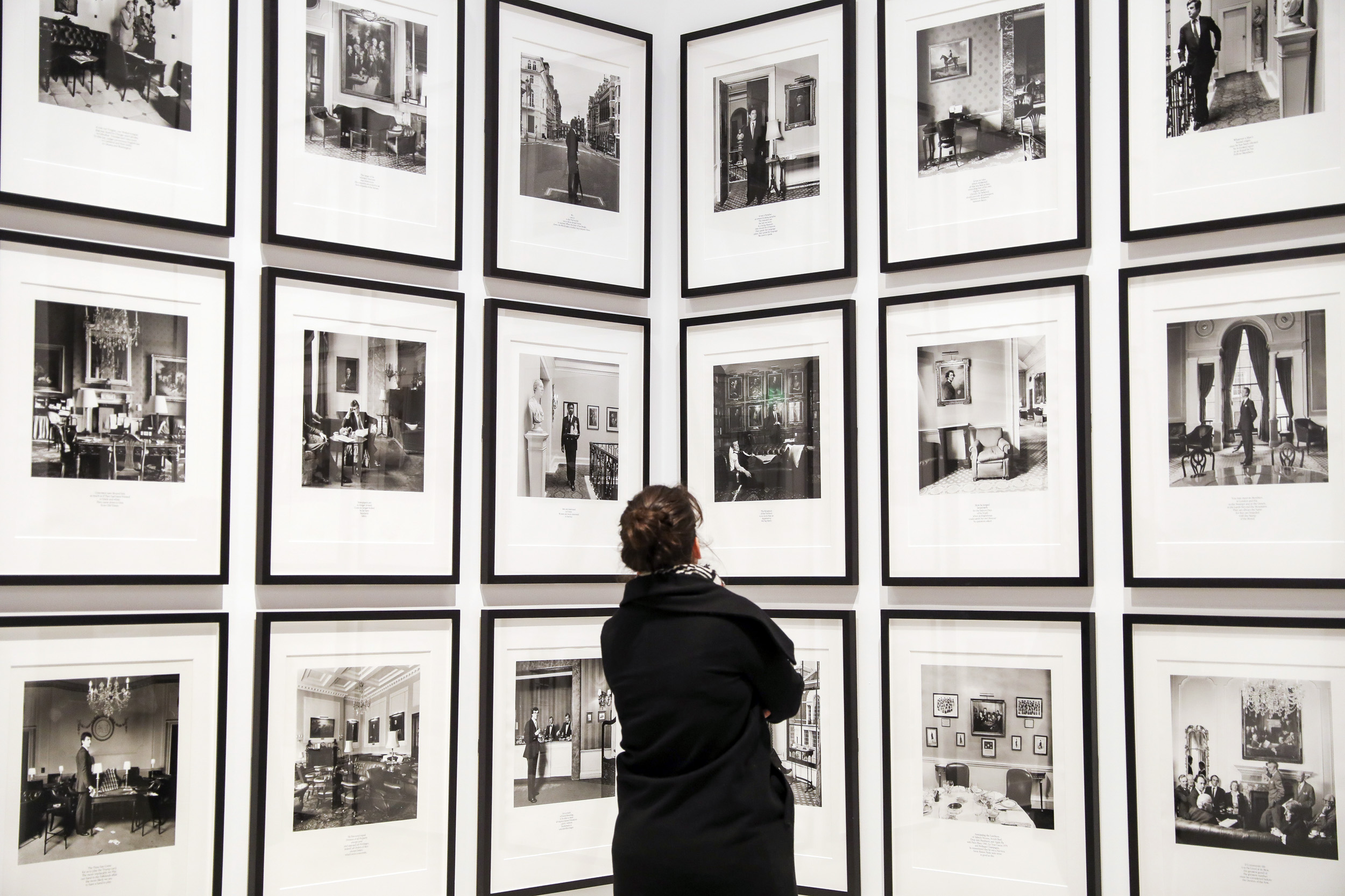
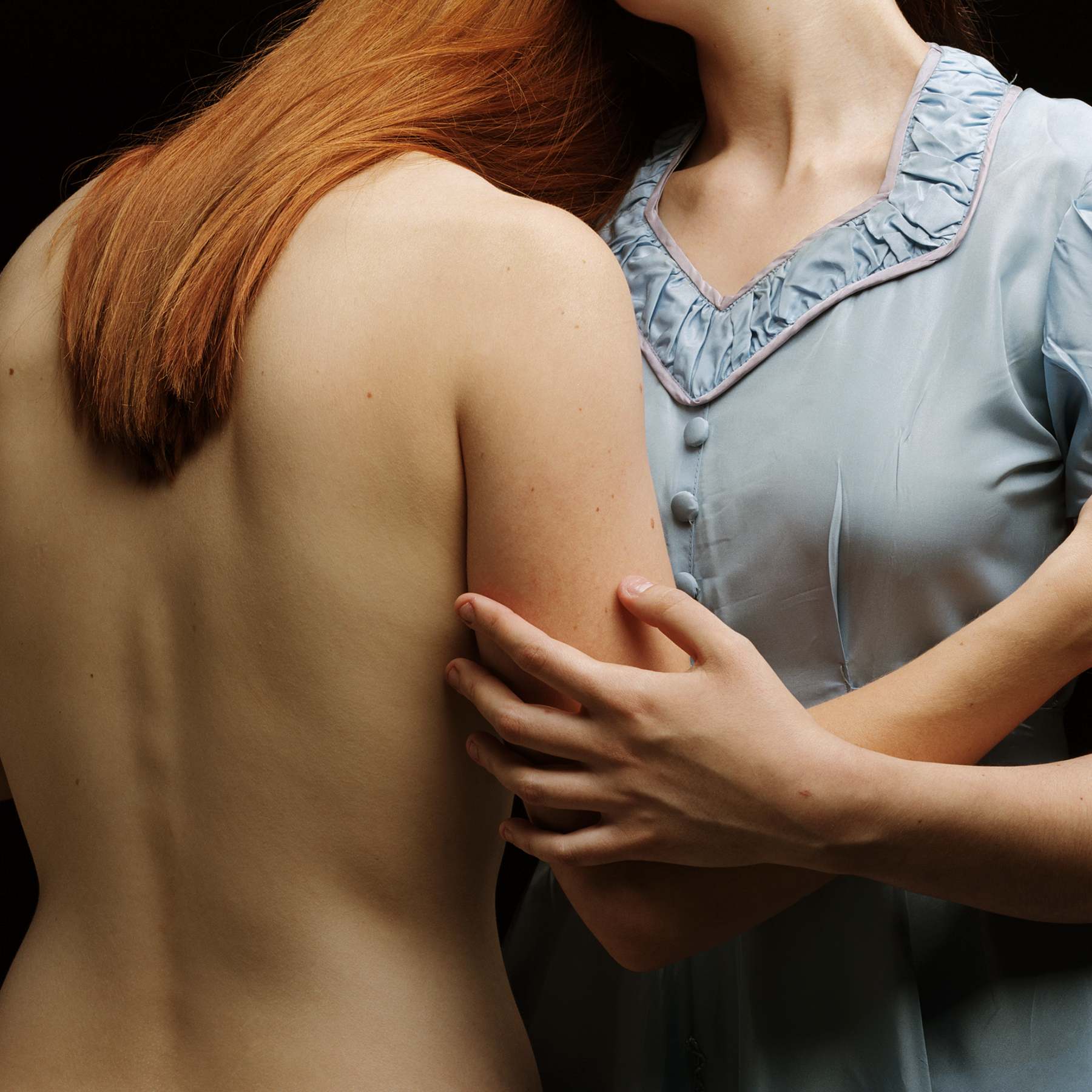
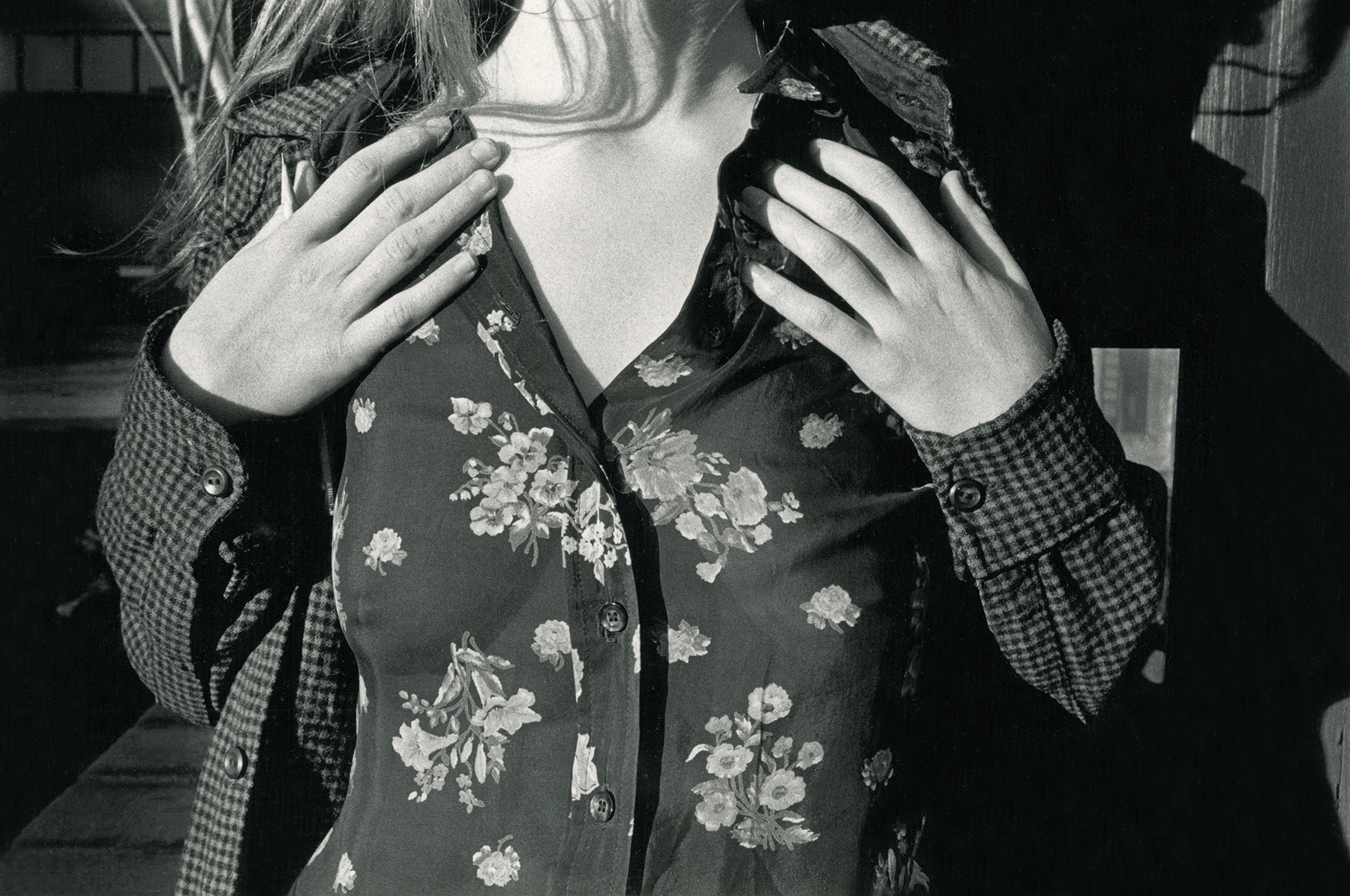
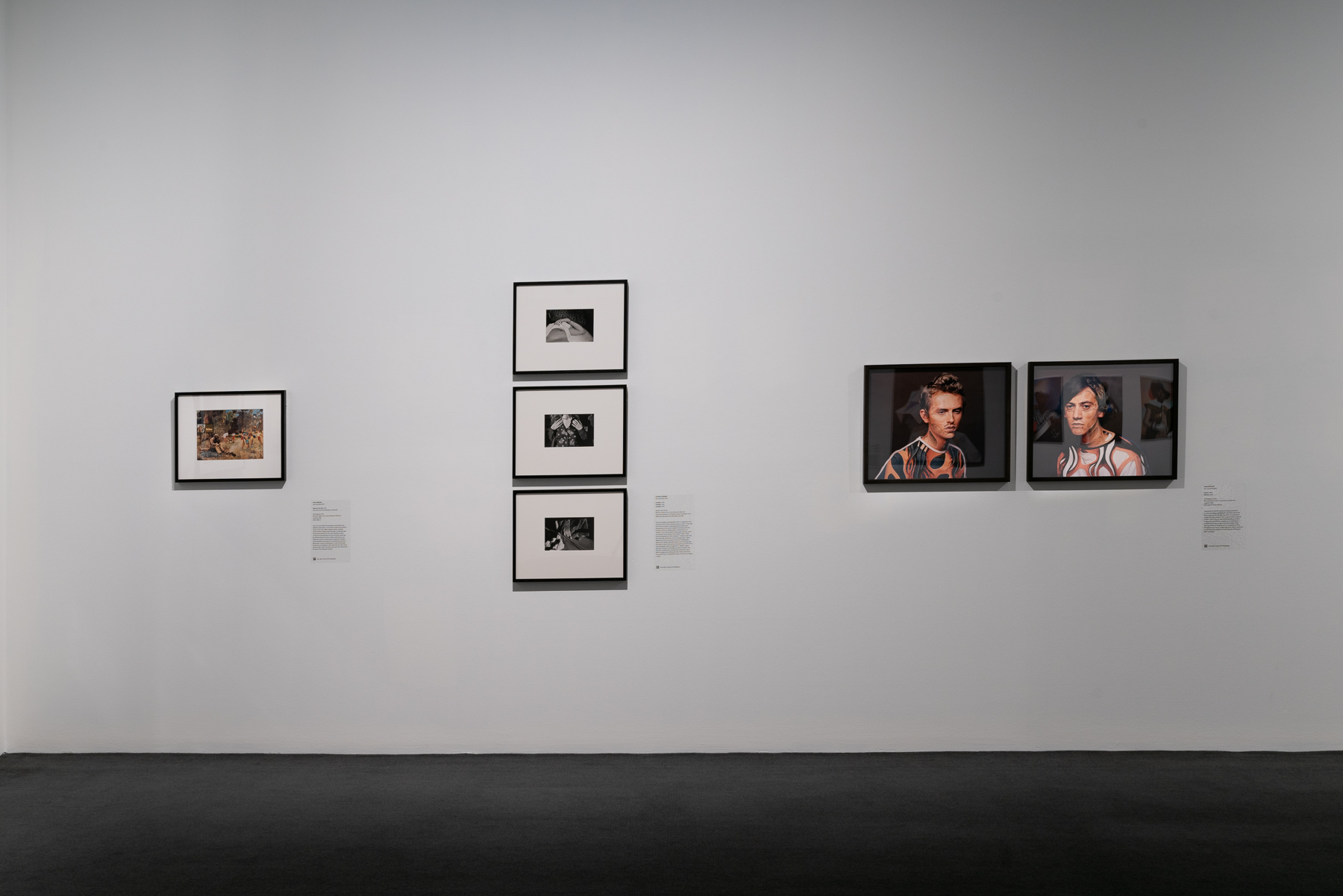
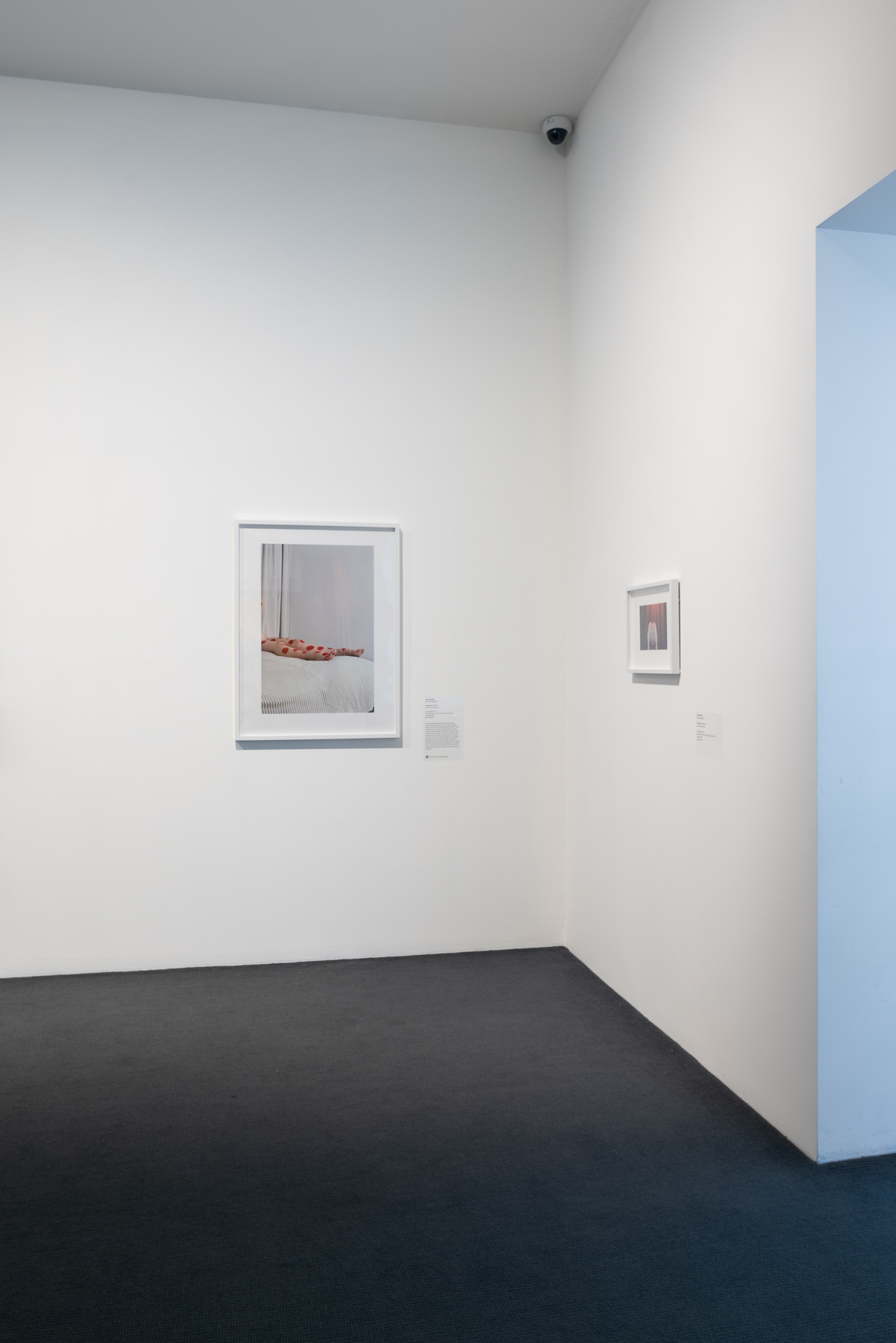
Sunil Gupta (Indian, b. 1953) 'Untitled #22' 1976 from the exhibition 'Masculinities: Liberation through Photography' at the Barbican Art Gallery, London, Feb - May, 2020


Sunil Gupta (Indian, b. 1953)
Untitled #22
1976
From the series Christopher Street
Courtesy the artist and Hales Gallery
© Sunil Gupta. All Rights Reserved, DACS 2019


“As a writer Berger recognised that experience – whether it be personal, historical or aesthetic – will never conform to theories and systems. To read him today is to accept his failures and detours as a unique willingness to take risks.”


John MacDonald. “John Berger,” in the Sydney Morning Herald, 6 June, 2020


D-Construction: deliberate masculinities in a discontinuous world

Reviewers of this exhibition (see quotations below) have noted the preponderance of images of “traditional masculinity” – defined as “idealised, dominant (and) heterosexual” – and the paucity of images that show men as working, intelligent, sensitive human beings, “that men ever earned a living, cooked a meal or read a book… scarcely anything about the heart or intellect. Men are represented here almost entirely in terms of their bodies, sexuality or supposed type.” I need make no further comment. What I will say is that I believe the title of the exhibition to be a misnomer: a person cannot be “liberated” through photography, for photography is only a tool of a personal liberation. Liberation comes through an internal struggle of acceptance (thence liberation), one that is foremost FELT (for example, the double life one leads before you acknowledge that you are gay; or experiencing discrimination aimed at others and by proxy, yourself) and SEEN (the bashing of a mother as seen by a small child). Photographs picture the outcomes of this struggle for liberation, are a tool of that process not, I would argue, liberation itself.

What I can say is that I believe in masculinities, plural. Fluid, shifting, challenging, loving, working, intimate, spiritual masculinities that challenge normalcy and hegemonic masculinity, which is defined as “a practice that legitimises men’s dominant position in society and justifies the subordination of the common male population and women, and other marginalised ways of being a man.”

What I don’t believe in is masculinities, plural, that seek to fit into this [dis]continuous world (for we are born and then die) through the stability of their outward appearance, conforming to theories and systems – personal, historical or aesthetic – without reference to subversion, small intimacies, the toil of work, love and the passion of sexual bodies. In other words, masculinities that are not afraid to push the boundaries of being and becoming. To take risks, to experience, to feel.

While I was overjoyed at the “YES” vote on gay marriage that took place in December 2017 in Australia because I felt it was a victory for love, and equality… another part of me rejected as anathema the concept of a gay person buying into a historically patriarchal, heterosexual and monogamous institution such as marriage – too honour and obey. This is an untenable concept for a person who wants to be liberated. Coming out as I did in 1975, only 6 short years after the Stonewall Riots, the last thing I EVER wanted to be, was to be the same as a “straight” person. I was different. I fought for my difference and still believe in it.

Of course, in 2020 it’s another world. Today we all mix in together. But there is still something about “masculinities”, which in some varieties, have a sense of privilege and entitlement. Of power and control over others; of violence towards women, trans, other men and anyone who threatens their little ego, who leaves them, or jilts them. Their jealousy, their ego, bruised – they are so insecure, so insular, that they can only see their own world, their own minuscule problems (but massive in their eyes), and enforce their will on others.

My advice to “masculinities’, in fact any human being, is to go out, get yourself informed, experience, accept, and be the person that nobody thinks you can be. Be a human being. Examine your inner self, look at your dark side, your other side, your empathetic side, and try and understand the journey that you are on. Then, and only then, you might begin on that great path of personal enlightenment, that golden path on which there is no turning back.

Below I discuss some of these ideas with my good friend Nicholas Henderson, curator and archivist at the Australian Lesbian and Gay Archives.


Dr Marcus Bunyan


Many thankx to the Barbican Art Gallery for allowing me to publish the photographs in the posting. Please click on the photographs for a larger version of the image.


Masculinities: Liberation through Photography is a major group exhibition that explores how masculinity is experienced, performed, coded and socially constructed as expressed and documented through photography and film from the 1960s to the present day.

Through the medium of film and photography, this major exhibition considers how masculinity has been coded, performed, and socially constructed from the 1960s to the present day. Examining depictions of masculinity from behind the lens, the Barbican brings together the work of over 50 international artists, photographers and filmmakers including Laurie Anderson, Sunil Gupta, Rotimi Fani-Kayode, Isaac Julien and Catherine Opie.

In the wake of #MeToo the image of masculinity has come into sharper focus, with ideas of toxic and fragile masculinity permeating today’s society. This exhibition charts the often complex and sometimes contradictory representations of masculinities, and how they have developed and evolved over time. Touching on themes including power, patriarchy, queer identity, female perceptions of men, hypermasculine stereotypes, tenderness and the family, the exhibition shows how central photography and film have been to the way masculinities are imagined and understood in contemporary culture.


In fact, while there are a few gender-fluid figures here, they’re vastly outnumbered by manifestations of “traditional masculinity” – defined as “idealised, dominant (and) heterosexual”. Lebanese militiamen (in Fouad Elkoury’s perky full-length portraits from 1980), US marines (in Wolfgang Tillmans’ epic montage Soldiers – The Nineties), Taliban fighters, SS generals, Israel Defence Force grunts, footballers, cowboys and bullfighters fairly spring out of the walls from every direction. And what’s evident from the outset isn’t so much their diversity, as a unifying demeanour: a threatening intentness that comes wherever men are asked to perform their masculinity, but also a childlike vulnerability.  …

Masculinity, the viewer is made to feel, criminalises men (Mikhael Subotzky’s images of South African gangsters on morgue slabs); isolates them (Larry Sultan’s poignant image of his elderly father practising his golf swing in his sitting room); renders them stupid (Richard Billingham’s excruciating, but now classic photo essay on his alcoholic father, ‘Ray’s a Laugh’). To be a man, it seems, is to be condemned to endlessly act out archetypal “masculine” behaviour, whether you’re an elderly drunk in a Birmingham high-rise or the elite American students taking part in the shouting competition staged by Irish photographer Richard Mosse.


Mark Hudson. “Does the Barbican’s Masculinities exhibition have important things to say about men?” on the Independent website Friday 21 February 2020 [Online] Cited 03/03/2020


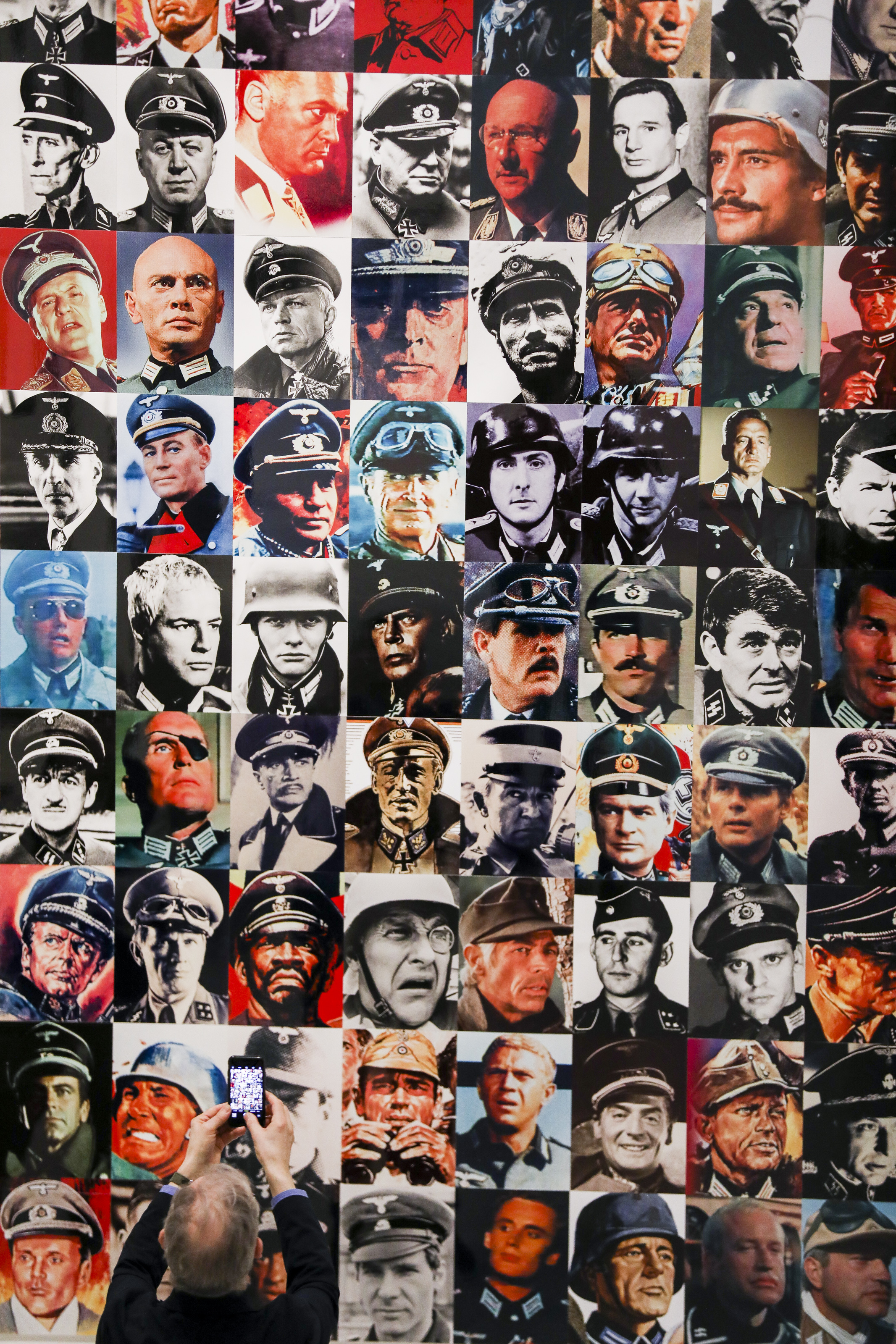
There is not much here about work – unless you count the wall of Hollywood actors playing Nazis. You would never think, from this show, that men ever earned a living, cooked a meal or read a book (though there is a sententious vitrine of ‘Men Only’ magazines). Beyond the exceptions given, there is scarcely anything about the heart or intellect. Men are represented here almost entirely in terms of their bodies, sexuality or supposed type.


Laura Cumming. “Masculinities: Liberation Through Photography review – men as types,” on the Guardian website Sun 23 Feb 2020 [Online] Cited 03/03/2020


“The body can be taken as a reflection of the self because it can and should be treated as something to be worked upon … in order to produce it as a commodity. Overweight, slovenliness and even unfashionability, for example, are now moral disorders,” notes Don Slater

“The state of the body is seen as a reflection of the state of its owner, who is responsible for it and could refashion it. The body can be taken as a reflection of the self because it can and should be treated as something to be worked upon, and generally worked upon using commodities, for example intensively regulated, self-disciplined, scrutinized through diets, fitness regimes, fashion, self-help books and advice, in order to produce it as a commodity. Overweight, slovenliness, and even unfashionability, for example, are now moral disorders; even acute illnesses such as cancer reflect the inadequacy of the self and indeed of its consumption. One gets ill because one has consumed the wrong (unnatural) things and failed to consume the correct (‘natural’) ones: self, body, goods and environment constitute a system of moral choice.”


Slater, Don. Consumer Culture and Modernity. London: Polity Press, 1997, p. 92.


Installation view of 'Masculinities: Liberation through Photography' at Barbican Art Gallery on February 19, 2020 in London, England showing John Coplans' work 'Self-portrait, Frieze No 2, Four Panels' 1994

Installation view of 'Masculinities: Liberation through Photography' at Barbican Art Gallery on February 19, 2020 in London, England showing John Coplans' work 'Self-portrait, Frieze No 2, Four Panels' 1994


Installation view of Masculinities: Liberation through Photography at Barbican Art Gallery on February 19, 2020 in London, England showing John Coplans’ work Self-portrait, Frieze No 2, Four Panels 1994
Photo: Tristan Fewings/Getty Images for Barbican Art Gallery


John Coplans (British, emigrated America 1960, 1920-2003) 'Self-portrait, Frieze No 2, Four Panels' 1994 from the exhibition 'Masculinities: Liberation through Photography' at the Barbican Art Gallery, London, Feb - May, 2020


John Coplans (British, emigrated America 1960, 1920-2003)
Self-portrait, Frieze No 2, Four Panels
1994
Tate
Presented by the American Fund for the Tate Gallery 2001
Photograph: © John Coplans Trust


Masculinities: Liberation through Photography


Plan of the 'Masculinities: Liberation through Photography' exhibition spaces


Plan of the Masculinities: Liberation through Photography exhibition spaces


Introduction

Masculinities: Liberation through Photography explores the diverse ways masculinity has been experienced, performed, coded and socially constructed in photography and film from the 1960s to the present day.

Simone de Beauvoir’s famous declaration that ‘one is not born a woman, but rather becomes one’ provides a helpful springboard for considering what it means to be a male in today’s world, as well as the place of photography and film in shaping masculinity. What we have thought of as ‘masculine’ has changed considerably throughout history and within different cultures. The traditional social dominance of the male has determined a gender hierarchy which continues to underpin societies around the world.

In Europe and North America, the characteristics and power dynamics of the dominant masculine figure – historically defined by physical size and strength, assertiveness and aggression – though still pervasive today, began to be challenged and transformed in the 1960s. Amid a climate of sexual revolution, struggle for civil rights and raised class consciousness, the growth of the gay rights movement, the period’s counterculture and opposition to the Vietnam War, large sections of society argued for a loosening of the straitjacket of narrow gender definitions.

Set against the backdrop of the #MeToo movement, when manhood is under increasing scrutiny and terms such as ‘toxic’ and ‘fragile’ masculinity fill endless column inches, an investigation of this expansive subject is particularly timely, especially given current global politics characterised by male world leaders shaping their image as ‘strong’ men.

Touching on queer identity, race, power and patriarchy, men as seen by women, stereotypes of dominant masculinity as well as the family, the exhibition presents masculinity in all its myriad forms, rife with contradictions and complexities. Embracing the idea of multiple ‘masculinities’ and rejecting the notion of a singular ‘ideal man’, the exhibition argues for an understanding of masculinity liberated from societal expectations and gender norms.

Room 1-4

Disrupting the Archetype

Over the last six decades, artists have consistently sought to destabilise the narrow definitions of gender that determine our social structures in order to encourage new ways of thinking about identity, gender and sexuality. ‘Disrupting the Archetype’ explores the representation of conventional and at times clichéd masculine subjects such as soldiers, cowboys, athletes, bullfighters, body builders and wrestlers. By reconfiguring the representation of traditional masculinity – loosely defined as an idealised, dominant heterosexual masculinity – the artists presented here challenge our ideas of these hypermasculine stereotypes.

Across different cultures and spaces, the military has been central to the construction of masculine identities – which has been explored through the work of Wolfgang Tillmans (below) and Adi Nes (below) among others, while Collier Schorr (below) and Sam Contis’s powerful works (below) address the dominant and enduring representation of the lone cowboy. Athleticism, often perceived as a proxy for strength which is associated with masculinity, is called into question by Catherine Opie’s and Rineke Dijkstra’s tender portraits (below). The male body, a cornerstone for artists such as John Coplans (above), Robert Mapplethorpe and Cassils (below), is meanwhile exposed as a fleshy canvas, constantly in flux.

Historically, the non-western male body has undergone a complex process of subjectification through the Western gaze – invariably presented as either warlike or sexually charged. Viewed against this context, the work of Fouad Elkoury and Akram Zaatari, as well as the found photographs of Taliban fighters that Thomas Dworzak discovered in Afghanistan (below), can be read as deconstructing the Orientalist gaze.


Installation view of 'Masculinities: Liberation through Photography' at Barbican Art Gallery on February 19, 2020 in London, England showing a detail from Wolfgang Tillmans' epic montage 'Soldiers – The Nineties'


Installation view of Masculinities: Liberation through Photography at Barbican Art Gallery on February 19, 2020 in London, England showing a detail from Wolfgang Tillmans’ epic montage Soldiers – The Nineties
Photo: Tristan Fewings/Getty Images for Barbican Art Gallery


Installation view of 'Masculinities: Liberation through Photography' at Barbican Art Gallery on February 19, 2020 in London, England showing a detail from trans masculine artist Cassils' series 'Time Lapse' 2011


Installation view of Masculinities: Liberation through Photography at Barbican Art Gallery on February 19, 2020 in London, England showing a detail from trans masculine artist Cassils’ series Time Lapse, 2011
Photo: Tristan Fewings/Getty Images for Barbican Art Gallery


Installation view of 'Masculinities: Liberation through Photography' at Barbican Art Gallery on February 19, 2020 in London, England showing at left a detail from trans masculine artist Cassils' series 'Time Lapse' 2011, and at right the work of Rineke Dijkstra


Installation view of Masculinities: Liberation through Photography at Barbican Art Gallery on February 19, 2020 in London, England showing at left a detail from trans masculine artist Cassils’ series Time Lapse, 2011, and at right the work of Rineke Dijkstra
Photo: Tristan Fewings/Getty Images for Barbican Art Gallery


Rineke Dijkstra (Dutch, b. 1959) 'Montemor, Portugal, May 1, 1994' 1994


Rineke Dijkstra (Dutch, b. 1959)
Montemor, Portugal, May 1, 1994
1994
Chromogenic print
90 x 72cm
© Rineke Dijkstra
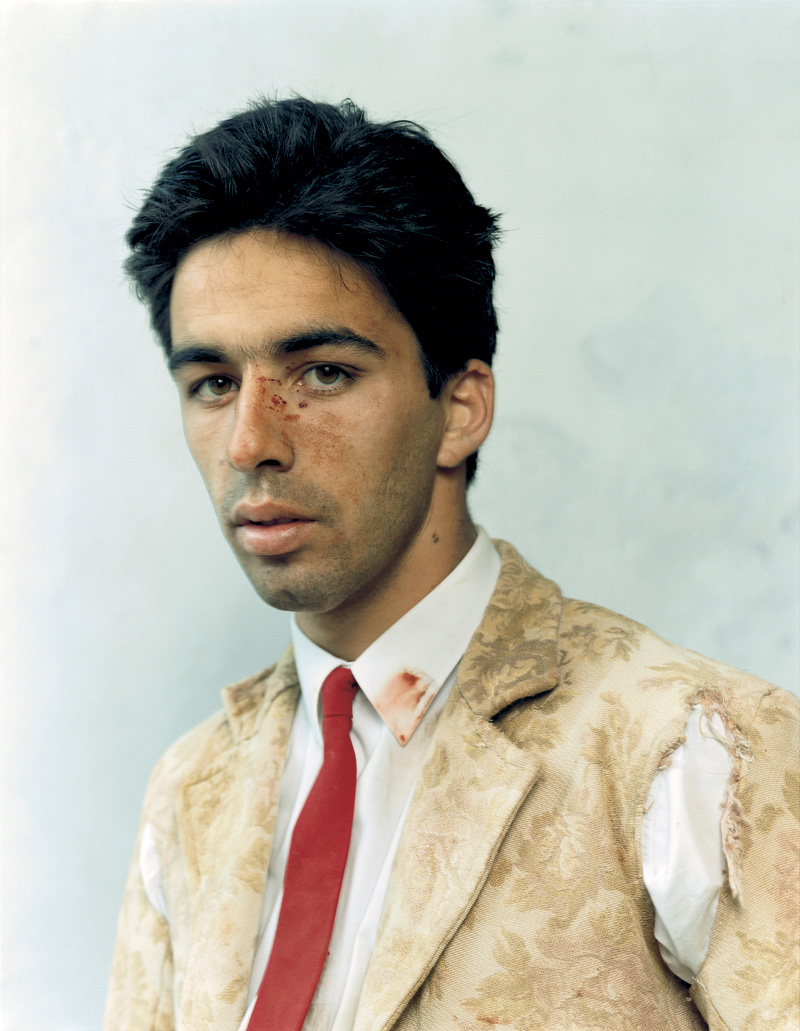
 

Rineke Dijkstra (Dutch, b. 1959) 'Vila Franca de Xira, Portugal, May 8, 1994' 1994


Rineke Dijkstra (Dutch, b. 1959)
Vila Franca de Xira, Portugal, May 8, 1994
1994
Chromogenic print
90 x 72cm
© Rineke Dijkstra


Installation view of 'Masculinities: Liberation through Photography' at Barbican Art Gallery on February 19, 2020 in London, England showing photographs from Adi Nes' series 'Soldiers' 1999


Installation views of Masculinities: Liberation through Photography at Barbican Art Gallery on February 19, 2020 in London, England showing photographs from Adi Nes’ series Soldiers, 1999
Photo: Tristan Fewings/Getty Images for Barbican Art Gallery


Adi Nes (Israeli, b. 1966) 'Untitled' 2000


Adi Nes (Israeli, b. 1966)
Untitled
2000
From the series Soldiers
Courtesy Adi Nes & Praz-Delavallade Paris, Los Angeles


Adi Nes (Israeli, b. 1966) 'Untitled' 1999


Adi Nes (Israeli, b. 1966)
Untitled
1999
From the series Soldiers
Courtesy Adi Nes & Praz-Delavallade Paris, Los Angeles


Adi Nes was born in Kiryat Gat. His parents are Jewish immigrants from Iran. He is openly gay. Nes is notable for series “Soldiers”, in which he mixes masculinity and homoerotic sexuality, depicting Israeli soldiers in a fragile way.

Nes creates cinematic images that reference war, sexuality, life, and death with the kind of stylised polish you might expect from a photographer whose images have appeared in the pages of Vogue Hommes. His partially autobiographical work is deliberate and staged in an attempt to raise questions about sexuality, masculinity and identity in Israeli culture. “The beginning point of my art is who I am,” he says. “Since I’m a man and I’m an Israeli, I deal with issues of identity with ‘Israeli-ness’ and masculinity, but my photographs are multi-layered.”

“The challenge of the photographer is to catch the viewer for more than one second in front of the picture,” says Nes, explaining his provocative images. “If you catch the viewer in front of the picture, it can touch the viewer.”

Anonymous text “Adi Nes on masculinity, sexuality and war,” from the Phaidon website 2012 [Online] Cited 07/03/2020


Thomas Dworzak (Germany, b. 1972) 'Taliban portraits' 2002

Thomas Dworzak (Germany, b. 1972) 'Taliban portraits' 2002


Thomas Dworzak (Germany, b. 1972)
Taliban portraits
2002
Kandahar, Afghanistan


While covering the US invasion of Afghanistan in 2001, Magnum photographer Thomas Dworzak came across a handful of photo studios in Kandahar which despite the Taliban’s ban on photography had been authorised to remain open, for the sole purpose of taking identity photos. Complicating the conventional image of the hypermasculine soldier, the colour portraits Dworzak found in the back rooms of these studios depict Taliban fighters variously posing in front of scenic backdrops, holding hands, using guns or flowers as props or enveloped in a halo of vibrant colours, their eyes heavily made up with black kohl. These stylised photographs directly contradict the public image of the soldier in this overwhelmingly male-dominated patriarchal society.


Sam Contis (American, b. 1982) 'Untitled (Neck)' 2015


Sam Contis (American, b. 1982)
Untitled (Neck)
2015
© Sam Contis


'Masculinities: Liberation through Photography' catalogue cover


Masculinities: Liberation through Photography catalogue cover


Installation view of 'Masculinities: Liberation through Photography' at Barbican Art Gallery on February 19, 2020 in London, England showing photographs from Catherine Opie's series 'High School Football' 2007-2009


Installation view of Masculinities: Liberation through Photography at Barbican Art Gallery on February 19, 2020 in London, England showing photographs from Catherine Opie’s series High School Football, 2007-2009
Photo: Tristan Fewings/Getty Images for Barbican Art Gallery


Catherine Opie (American, b. 1961) 'Stephen' 2009


Catherine Opie (American, b. 1961)
Stephen
2009
From the series High School Football, 2007-2009
Courtesy Regen Projects, Los Angeles, and Thomas Dane Gallery, London
© Catherine Opie


Catherine Opie (American, b. 1961) 'Rusty' 2008


Catherine Opie (American, b. 1961)
Rusty
2008
From the series High School Football, 2007-2009
Courtesy Regen Projects, Los Angeles and Thomas Dane Gallery, London
© Catherine Opie


Catherine Opie (American, b. 1961) 'Football Landscape #17 (Waianae vs. Leilehua, Waianae, HI)' 2009


Catherine Opie (American, b. 1961)
Football Landscape #17 (Waianae vs. Leilehua, Waianae, HI)
2009
From the series High School Football, 2007-2009
Courtesy Regen Projects, Los Angeles, and Thomas Dane Gallery, London
© Catherine Opie


Kenneth Anger (American, b. 1927)
Kustom Kar Kommandos
1965
3 mins 22 secs


Collier Schorr (American, b. 1963) 'Americans #3' 2012


Collier Schorr (American, b. 1963)
Americans #3
2012
© Collier Schorr, courtesy 303 Gallery, New York


Room 5-6

Male Order: Power, Patriarchy and Space

‘Male Order’ invites the viewer to reflect on the construction of male power, gender and class. The artists gathered here have all variously attempted to expose and subvert how certain types of masculine behaviour have created inequalities both between and within gender identities. Two ambitious, multi-part works, Richard Avedon’s The Family, 1976, and Karen Knorr’s Gentlemen, 1981-1983, focus on typically besuited white men who occupy the corridors of power, while foregrounding the historic exclusion not only of women but also of other marginalised masculinities.

Male-only organisations, such as the military, private members’ clubs and college fraternities, have often served as an arena for the performance of ‘toxic’ masculinity, as chronicled in Andrew Moisey’s The American Fraternity: An Illustrated Ritual Manual, 2018. This startling book charts the misdemeanours of fraternity members alongside an indexical image bank of US Presidents, alongside leaders of government and industry who have belonged at one time or another to these fraternities. Richard Mosse’s film, Fraternity, 2007, takes a different tack by painting a portrait of male rage that is both playful and alarming.


Installation view of 'Masculinities: Liberation through Photography' at Barbican Art Gallery on February 19, 2020 in London, England showing photographs from Richard Avedon's series 'The Family' (1976)

Installation view of 'Masculinities: Liberation through Photography' at Barbican Art Gallery on February 19, 2020 in London, England showing photographs from Richard Avedon's series 'The Family' (1976)


Installation view of Masculinities: Liberation through Photography at Barbican Art Gallery on February 19, 2020 in London, England showing photographs from Richard Avedon’s series The Family (1976)
Photo: Tristan Fewings/Getty Images for Barbican Art Gallery


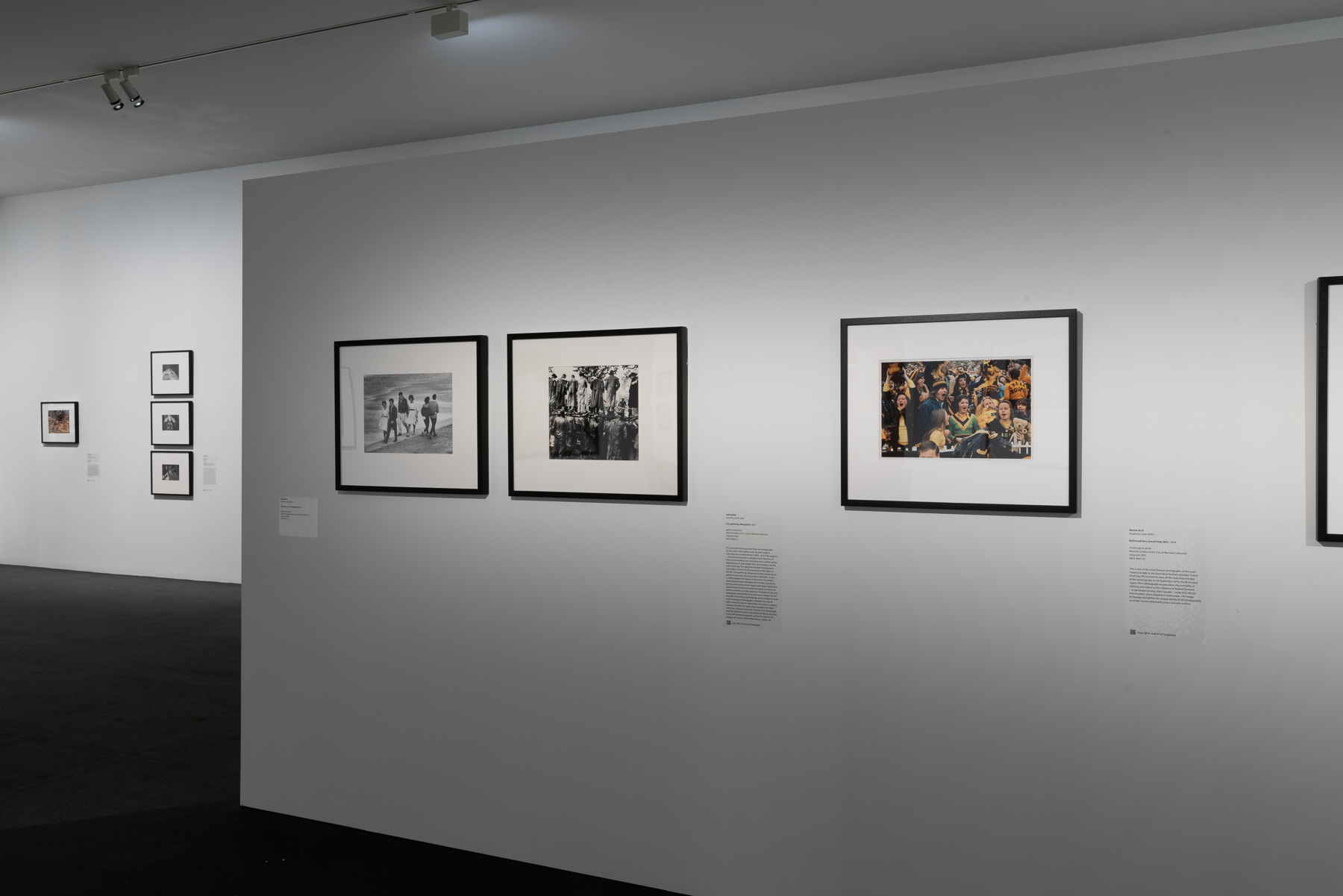
Early  in 1976, with both the post-Watergate political atmosphere and the approaching bicentennial celebration in mind, Rolling Stone asked Richard Avedon to cover the presidential primaries and the campaign trail. Avedon counter-proposed a grander idea – he had always wanted to photograph the men and women he believed to have constituted political, media and corporate elite of the United States.

For the next several months, Avedon traversed the country from migrant grape fields of California to NFL headquarters in Park Avenue and returned with an amazing portfolio of soldiers, spooks, potentates, and ambassadors that was too late for the bicentennial but published in Rolling Stone’s Oct. 21, 1976, just in time for the November elections.

Sixty-nine black-and-white portraits … were in Avedon’s signature style – formal, intimate, bold, and minimalistic. Appearing in them are President Ford and his three immediate successors – Carter, Reagan, and Bush. Other familiars of the American polity such as Kennedys and Rockefellers are here, and as are giants who held up the nation’s Fourth Pillar during that challenging decade: A. M. Rosenthal of the New York Times who decided to publish the Pentagon Papers, and Katharine Graham who led Woodward and Bernstein at Washington Post.

Alex Selwyn-Holmes. “The Family, 1976; Richard Avedon” on the Iconphotos website May 18, 2012 [Online] Cited 03/03/2020


Installation view of 'Masculinities: Liberation through Photography' at Barbican Art Gallery on February 19, 2020 in London, England showing at left photographs from Karen Knorr's series 'Gentlemen' 1981-1983; and at right, Piotr Uklanski's 'Untitled (The Nazis)' 1998, a collage of actors dressed as Nazis

Installation view of 'Masculinities: Liberation through Photography' at Barbican Art Gallery on February 19, 2020 in London, England showing photographs from Karen Knorr's series 'Gentlemen' 1981-1983

Installation view of 'Masculinities: Liberation through Photography' at Barbican Art Gallery on February 19, 2020 in London, England showing photographs from Karen Knorr's series 'Gentlemen' 1981-1983


Installation views of Masculinities: Liberation through Photography at Barbican Art Gallery on February 19, 2020 in London, England showing photographs from Karen Knorr’s series Gentlemen, 1981-1983
Photo: Tristan Fewings/Getty Images for Barbican Art Gallery


Karen Knorr (American, born Germany 1954) 'Newspapers are no longer ironed, Coins no longer boiled So far have Standards fallen' 1981-1983


Karen Knorr (American born Germany, b. 1954)
Newspapers are no longer ironed, Coins no longer boiled So far have Standards fallen
1981-1983
From the series Gentlemen
Tate: Gift Eric and Louise Franck London Collection 2013
© Karen Knorr


Installation view of 'Masculinities: Liberation through Photography' at Barbican Art Gallery on February 19, 2020 in London, England showing Piotr Uklanski's 'Untitled (The Nazis)' 1998, a collage of actors dressed as Nazis, courtesy of Massimo De Carlo

Installation view of 'Masculinities: Liberation through Photography' at Barbican Art Gallery on February 19, 2020 in London, England showing Piotr Uklanski's 'Untitled (The Nazis)' 1998, a collage of actors dressed as Nazis, courtesy of Massimo De Carlo

Installation view of 'Masculinities: Liberation through Photography' at Barbican Art Gallery on February 19, 2020 in London, England showing Piotr Uklanski's 'Untitled (The Nazis)' 1998, a collage of actors dressed as Nazis, courtesy of Massimo De Carlo


Installation view of Masculinities: Liberation through Photography at Barbican Art Gallery on February 19, 2020 in London, England showing Piotr Uklanski’s Untitled (The Nazis), 1998, a collage of actors dressed as Nazis, courtesy of Massimo De Carlo
Photo: Tristan Fewings/Getty Images for Barbican Art Gallery


Room 7-8

Too Close to Home: Family and Fatherhood

Since its invention photography has been a powerful vehicle for the construction and documentation of family narratives. In contrast to the conventions of the traditional family portrait, the artists gathered here deliberately set out to record the ‘messiness’ of life, reflecting on misogyny, violence, sexuality, mortality, intimacy and unfolding family dramas, presenting a more complex and not always comfortable vision of fatherhood and masculinity.

Loss and the ageing male figure are central to the work of both Masahisa Fukase and Larry Sultan (both below). Their respective projects marked a new departure in the way men photographed each other, serving as a commentary on how old age engenders a loss of masculinity. An examination of everyday life, Richard Billingham’s tender yet bleak portraits of his father, as chronicled in Ray’s a Laugh, cast a brutally honest eye on his alcoholic father Ray against a backdrop of social decline (below).

Anna Fox’s disturbing autobiographical work undermines expectations of the traditional family album while revealing the mechanics of paternalistic power. Meanwhile, the father-daughter relationship is brought into sharp focus in Aneta Bartos’s sexually charged series Family Portrait which unsettles traditional family boundaries (below).


Masahisa Fukase (Japan, 1934-2012) 'Masahisa and Sukezo' 1972


Masahisa Fukase (Japan, 1934-2012)
Masahisa and Sukezo
1972
From the series Family, 1971-1990
© Masahisa Fukase Archives


Masahisa Fukase (Japan, 1934-2012) 'Upper row, from left to right: A, a model; Toshiteru, Sukezo, Masahisa. Middle row, from left to right: Akiko, Mitsue, Hisashi Daikoji. Bottom row, from left to right: Gaku, Kyoko, Kanako, and a memorial portrait of Miyako' 1985


Masahisa Fukase (Japan, 1934-2012)
Upper row, from left to right: A, a model; Toshiteru, Sukezo, Masahisa. Middle row, from left to right: Akiko, Mitsue, Hisashi Daikoji. Bottom row, from left to right: Gaku, Kyoko, Kanako, and a memorial portrait of Miyako
1985
From the series Family, 1971-1990
© Masahisa Fukase Archives


Masahisa Fukase (Japan, 1934-2012) 'Masahisa and Sukezo' 1985


Masahisa Fukase (Japan, 1934-2012)
Masahisa and Sukezo
1985
From the series Family, 1971-1990
© Masahisa Fukase Archives


‘A magnificent memorial to paternal love’.


Installation view of 'Masculinities: Liberation through Photography' at Barbican Art Gallery on February 19, 2020 in London, England showing the photographs of Larry Sultan from the series 'Pictures from Home'

Installation view of 'Masculinities: Liberation through Photography' at Barbican Art Gallery on February 19, 2020 in London, England showing the photographs of Larry Sultan from the series 'Pictures from Home'


Installation view of Masculinities: Liberation through Photography at Barbican Art Gallery on February 19, 2020 in London, England showing the photographs of Larry Sultan from the series Pictures from Home
Photo: Tristan Fewings/Getty Images for Barbican Art Gallery


Larry Sultan (American, 1946-2009) 'Dad on Bed' 1984


Larry Sultan (American, 1946-2009)
Dad on Bed
1984
From the series Pictures from Home
Chromogenic print
Courtesy the Estate of Larry Sultan, Yancey Richardson, Casemore Kirkeby, and Galerie Thomas Zander
© Estate of Larry Sultan


Larry Sultan (American, 1946-2009) 'Practicing Golf Swing' 1986


Larry Sultan (American, 1946-2009)
Practicing Golf Swing
1986
From the series Pictures from Home
Chromogenic print
Courtesy the Estate of Larry Sultan, Yancey Richardson, Casemore Kirkeby, and Galerie Thomas Zander
© Estate of Larry Sultan


Installation view of 'Masculinities: Liberation through Photography' at Barbican Art Gallery on February 19, 2020 in London, England showing Richard Billingham's photographs from the series 'Ray's a Laugh'


Installation view of Masculinities: Liberation through Photography at Barbican Art Gallery on February 19, 2020 in London, England showing Richard Billingham’s photographs from the series Ray’s a Laugh
Photo: Tristan Fewings/Getty Images for Barbican Art Gallery

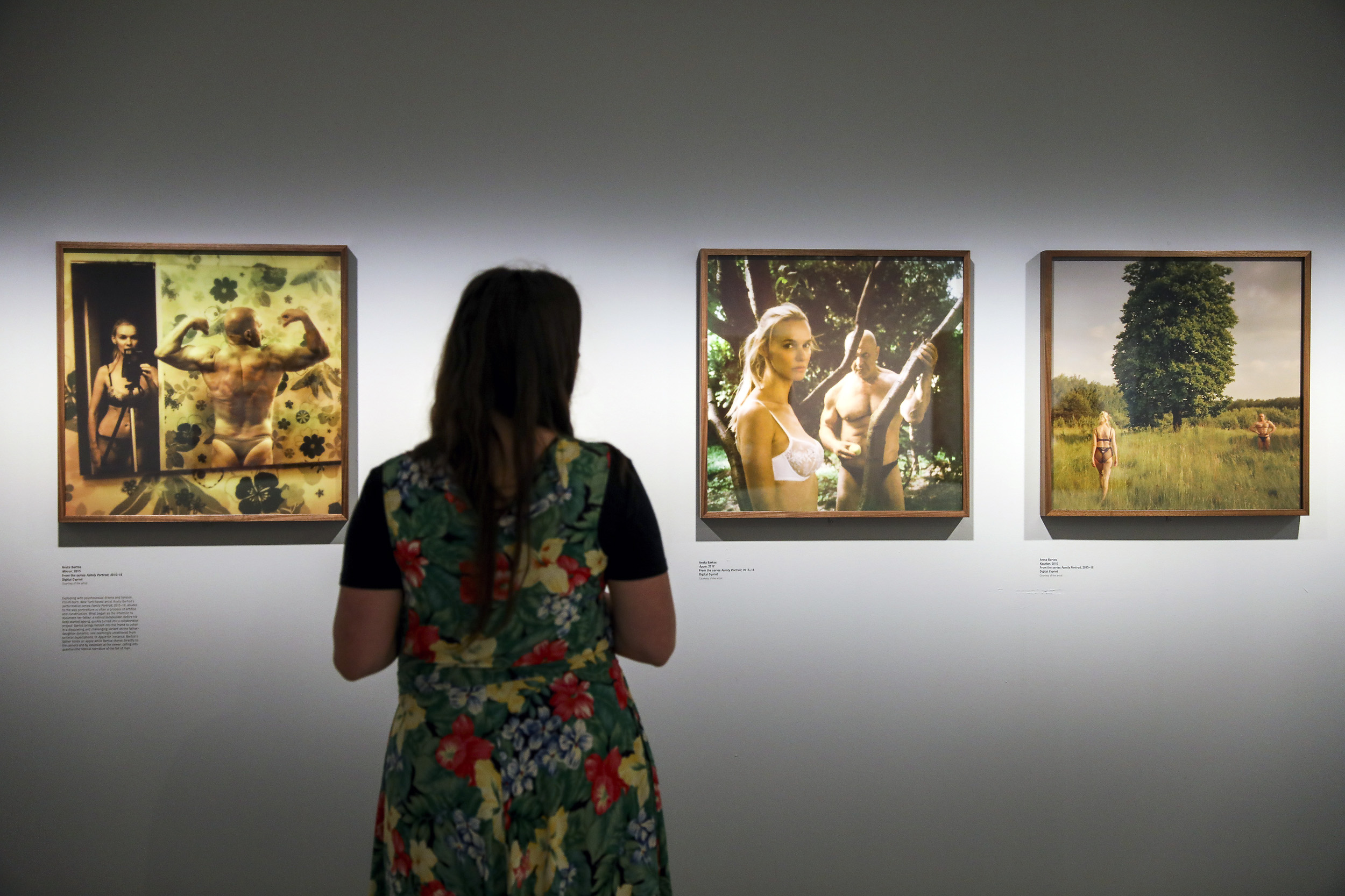
 

Installation view of 'Masculinities: Liberation through Photography' at Barbican Art Gallery on February 19, 2020 in London, England showing the photographs of Aneta Bartos's sexually charged series 'Family Portrait'

Installation view of 'Masculinities: Liberation through Photography' at Barbican Art Gallery on February 19, 2020 in London, England showing the photographs of Aneta Bartos's sexually charged series 'Family Portrait'


Installation view of Masculinities: Liberation through Photography at Barbican Art Gallery on February 19, 2020 in London, England showing the photographs of Aneta Bartos’s sexually charged series Family Portrait
Photo: Tristan Fewings/Getty Images for Barbican Art Gallery


Aneta Bartos (Born Poland, lives New York) 'Mirror' 2015


Aneta Bartos (Born Poland, lives New York)
Mirror
2015
From the series Family Portrait
Archival inkjet print
30 x 30.65 inches


Aneta Bartos (Born Poland, lives New York) 'Apple' 2015


Aneta Bartos (Born Poland, lives New York)
Apple
2015
From the series Family Portrait
Archival inkjet print
30 x 30.65 inches


Since 2013 New York based artist Aneta Bartos has been traveling back to her hometown Tomaszów Mazowiecki, where she was raised by her father as a single parent from the age of eight until fourteen. Then 68 years old, and having spent a lifetime as a competitive body builder, Bartos’ father asked her to take a few shots documenting his physique before it degenerated and inevitably ran its course. The original request of her father inspired Bartos to transform his idea into a long-term project called Dad. A few summers later Dad developed into a new series of portraits, titled Family Portrait, exploring the complex dynamics between father and daughter.

Text from the Antwerp Art website [Online] Cited 01/03/2020


“The pastoral setting is a romanticised portal to Bartos’s past. Her father’s poses are often heroic; at times the pictures are playful and flirty, almost seductive. Seen together, they display the sadness of a man who knows he is ageing, with the subtext of his waning sexuality. They are bittersweet, images of time passing and memories being preserved.”

Elisabeth Biondi quoted on the Postmasters website 2017 [Online] Cited 01/03/2020


Installation view of 'Masculinities: Liberation through Photography' at Barbican Art Gallery on February 19, 2020 in London, England showing photographs from Peter Hujar's series 'Orgasmic Man' 1969

Installation view of 'Masculinities: Liberation through Photography' at Barbican Art Gallery on February 19, 2020 in London, England showing photographs from Peter Hujar's series 'Orgasmic Man' 1969


Installation views of Masculinities: Liberation through Photography at Barbican Art Gallery on February 19, 2020 in London, England showing photographs from Peter Hujar’s series Orgasmic Man 1969 (see below)
Photo: Tristan Fewings/Getty Images for Barbican Art Gallery


Room 9-12

Queer Masculinity

In defiance of the prejudice and legal constraints against homosexuality in Europe, the United States and beyond over the last century, the works presented in ‘Queering Masculinity’ highlight how artists from the 1960s onwards have forged a new politically charged queer aesthetic.

In the 1970s, artists such as Peter Hujar (below), David Wojnarowicz, Sunil Gupta (below) and Hal Fischer (below) photographed gay lifestyles in New York and San Francisco in a bid to claim public visibility and therefore legitimacy at a time when homosexuality was still a criminal offence. Reflecting on their own queer experience and creating sensual bodies of work, artists such as Rotimi Fani-Kayode (below) and Isaac Julien (below) portrayed black gay desire while Catherine Opie’s seminal work Being and Having, 1991 (below), documented members of the dyke, butch and BDSM communities in San Francisco playing with the physical attributes associated with hypermasculinity in order to overturn traditional binary understandings of gender.


Installation view of 'Masculinities: Liberation through Photography' at Barbican Art Gallery on February 19, 2020 in London, England showing photographs by Karlheinz Weinberger


Installation views of Masculinities: Liberation through Photography at Barbican Art Gallery on February 19, 2020 in London, England showing photographs by Karlheinz Weinberger
Photo: Tristan Fewings/Getty Images for Barbican Art Gallery


Karlheinz Weinberger (Swiss, 1921-2006) 'Horseshoe buckle' 1962


Karlheinz Weinberger (Swiss, 1921-2006)
Horseshoe buckle
1962
Courtesy Galerie Esther Woerdehoff
© Karlheinz Weinberger
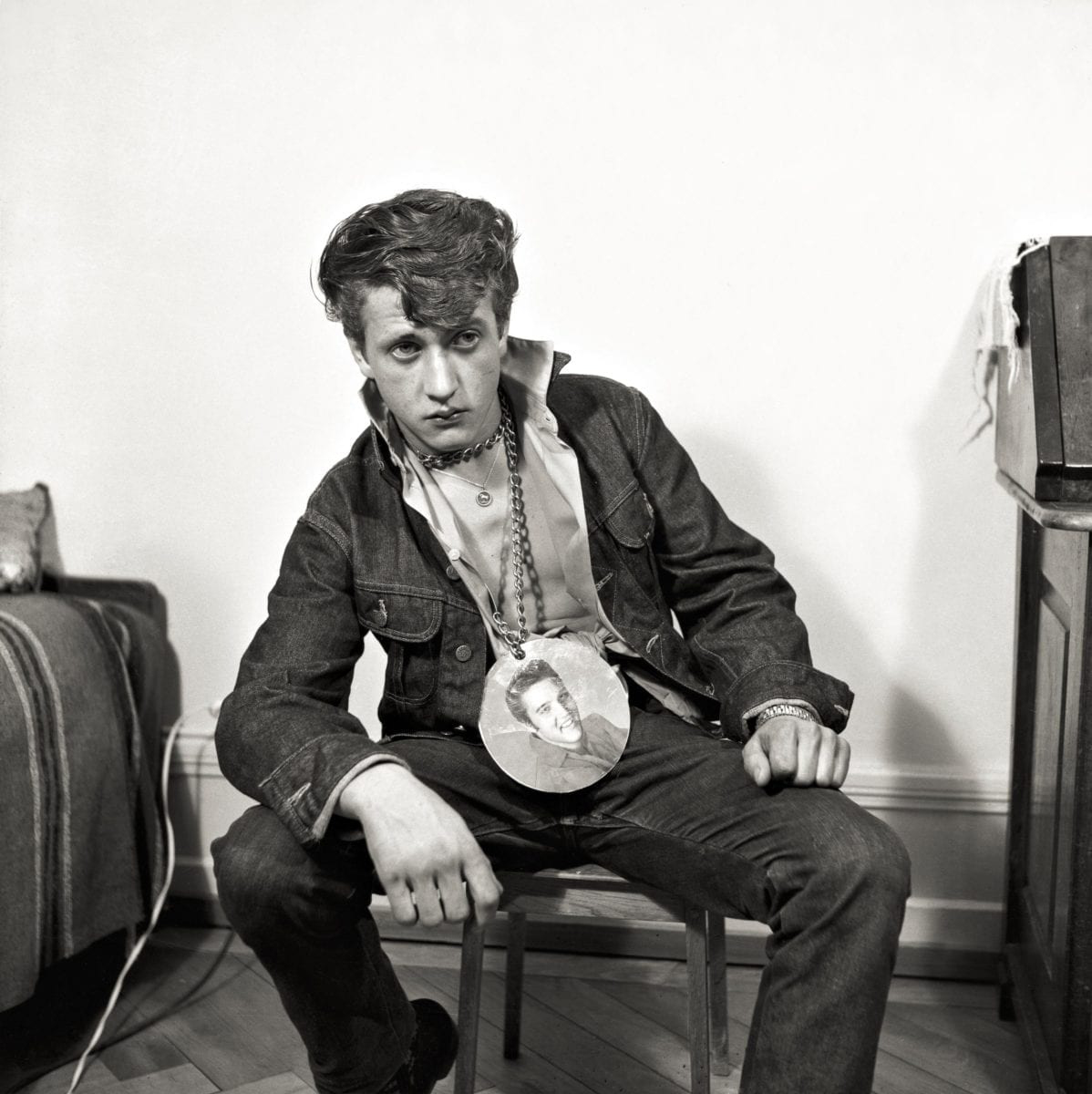
 

Karlheinz Weinberger (Swiss, 1921-2006) 'Sitting boy with elvis necklace in KHW studio, Zurich' 1961


Karlheinz Weinberger (Swiss, 1921-2006)
Sitting Boy with Elvis Necklace in KHW studio, Zurich
1961
Courtesy Galerie Esther Woerdehoff
© Karlheinz Weinberger


Peter Hujar. 'Orgasmic Man' 1969


Peter Hujar (American, 1934-1987)
Orgasmic Man
1969
Gelatin silver print
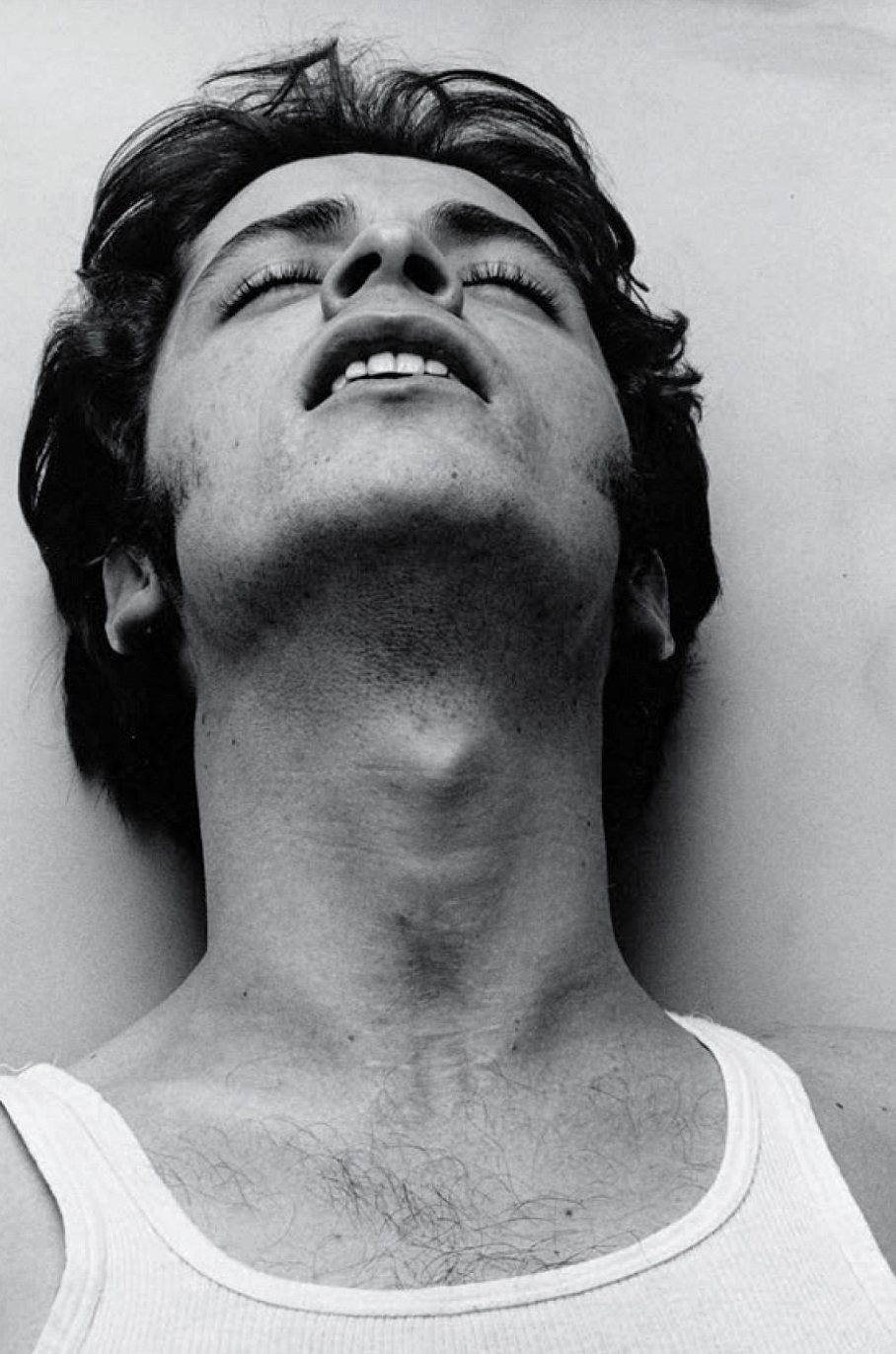
 

Peter Hujar (American, 1934-1987) 'Orgasmic Man (I)' 1969


Peter Hujar (American, 1934-1987)
Orgasmic Man (I)
1969
Gelatin silver print
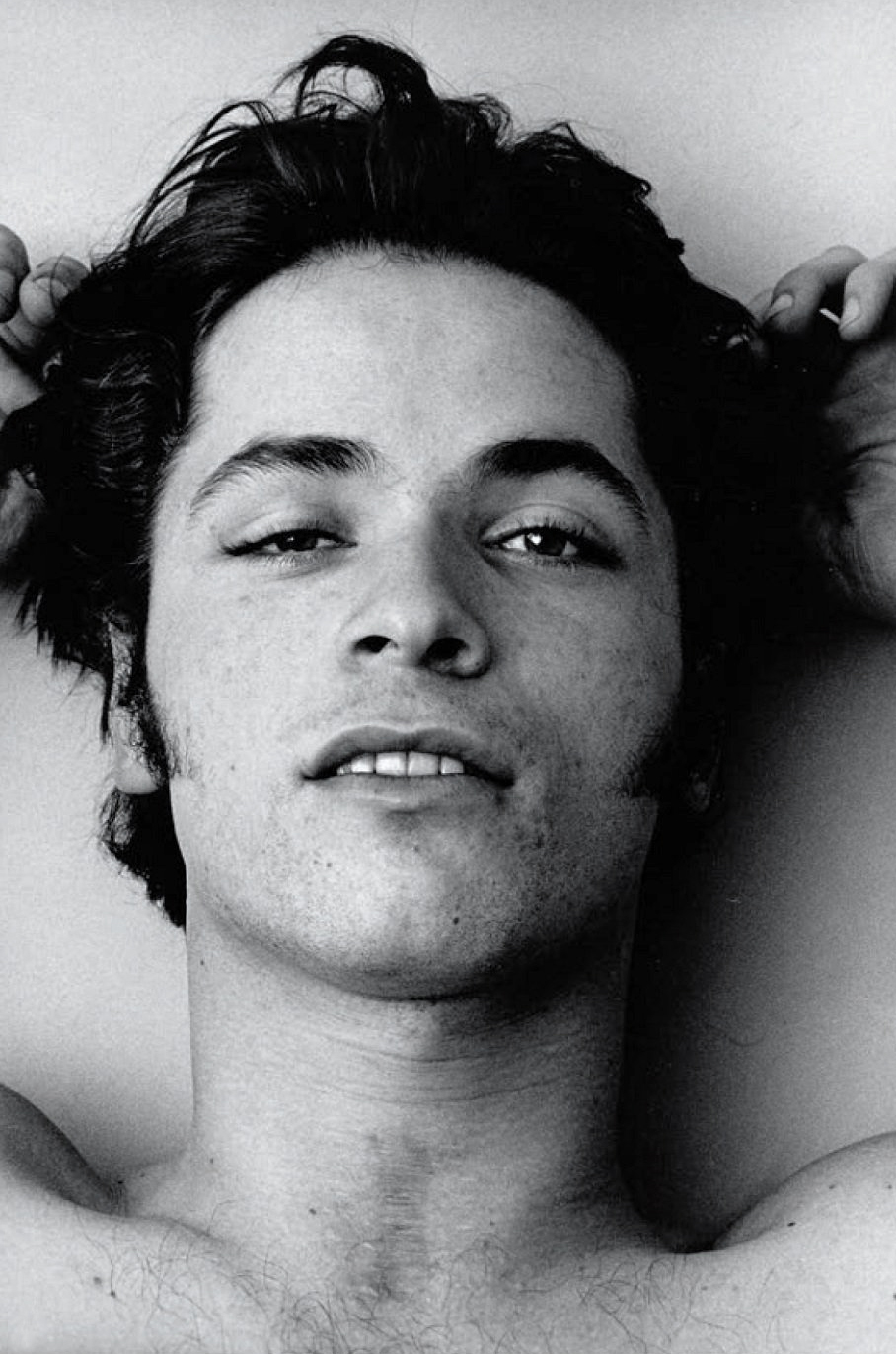
 

Peter Hujar. 'Orgasmic Man (II)' 1969


Peter Hujar (American, 1934-1987)
Orgasmic Man (II)
1969
Gelatin silver print
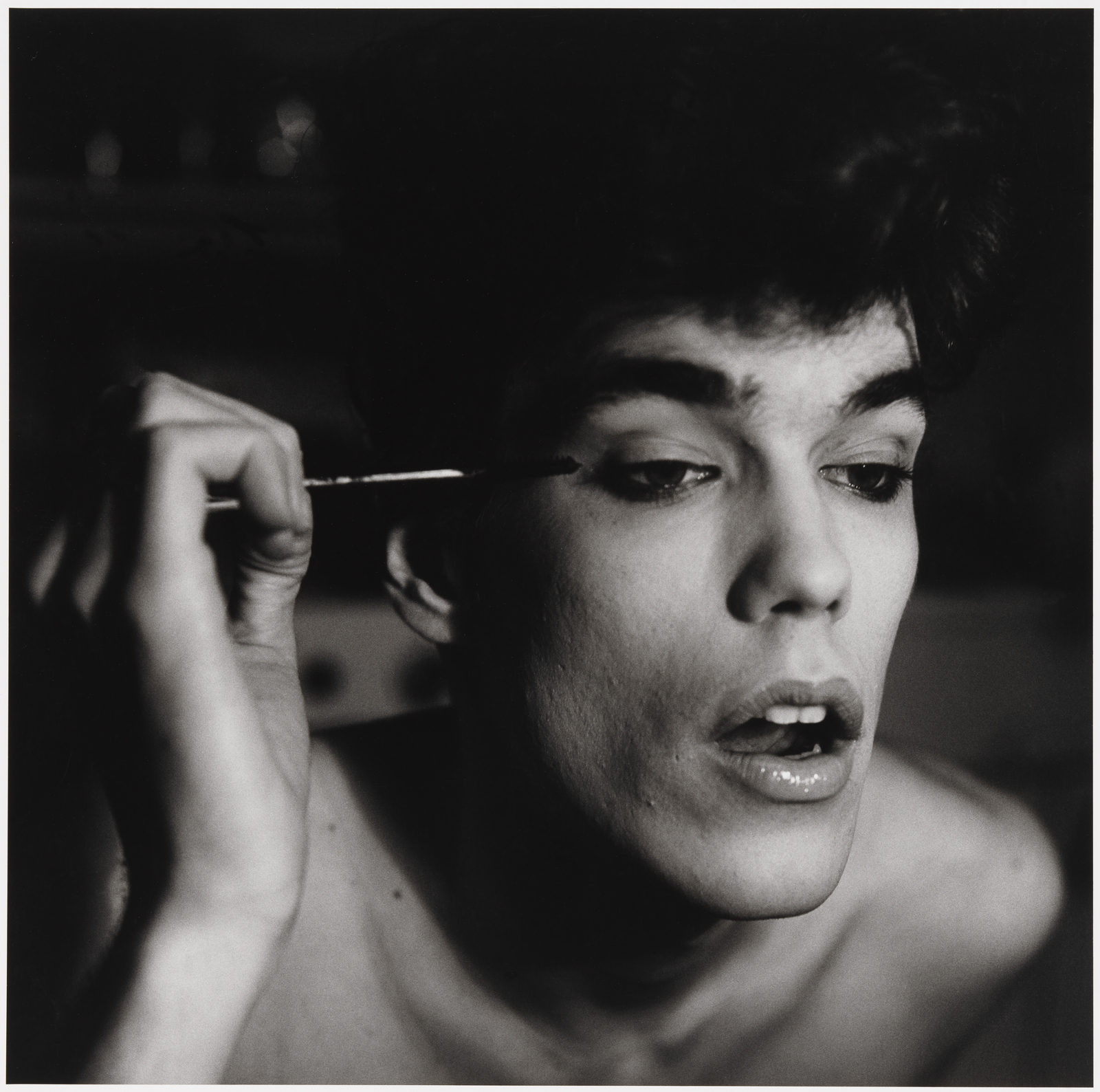
 

Peter Hujar (American, 1934-1987) 'David Brintzenhofe Applying Makeup (II)' 1982


Peter Hujar (American, 1934-1987)
David Brintzenhofe Applying Makeup (II)
1982
Courtesy Pace/MacGill Gallery, New York, and Fraenkel Gallery, San Francisco
© 1987 The Peter Hujar Archive LLC


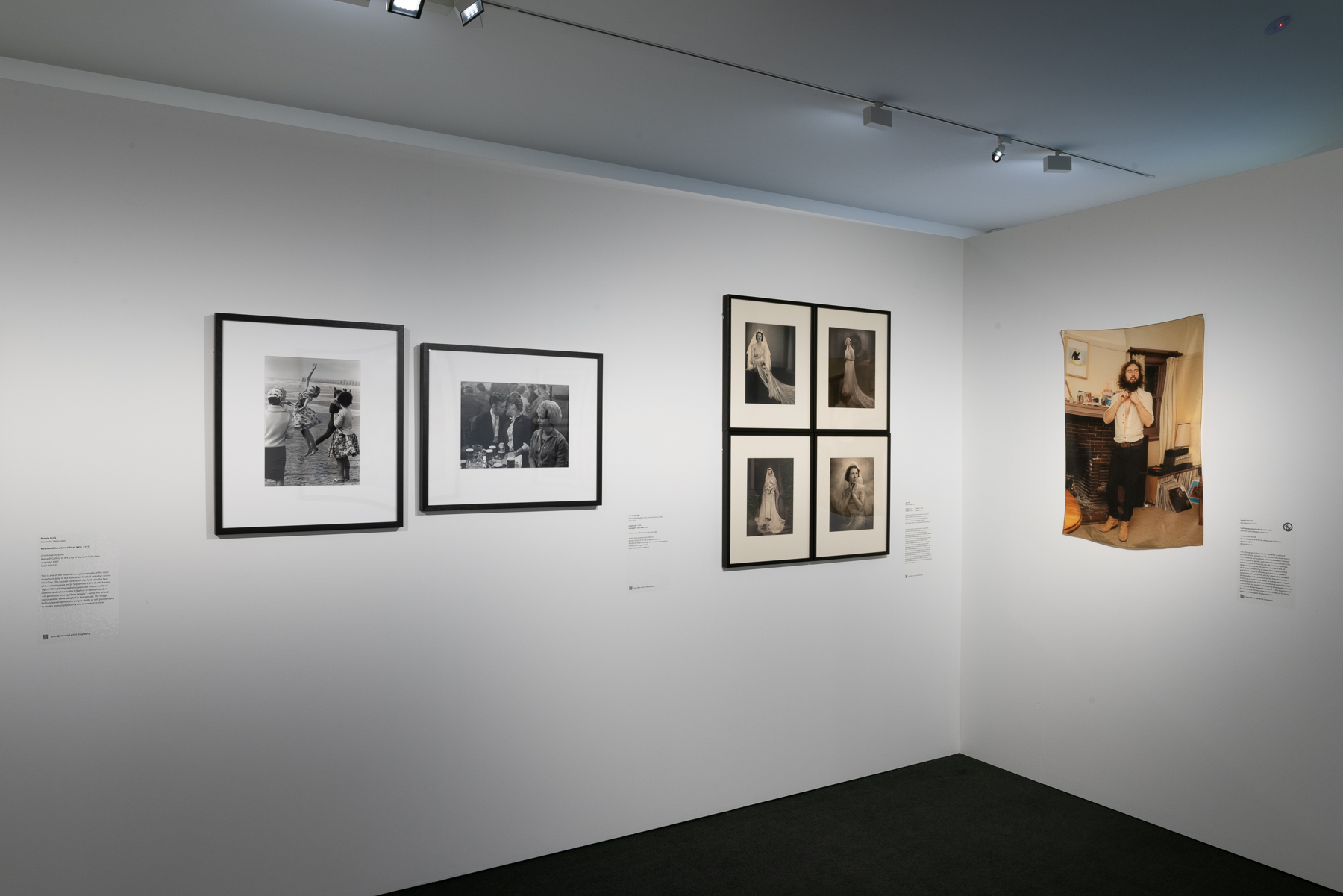
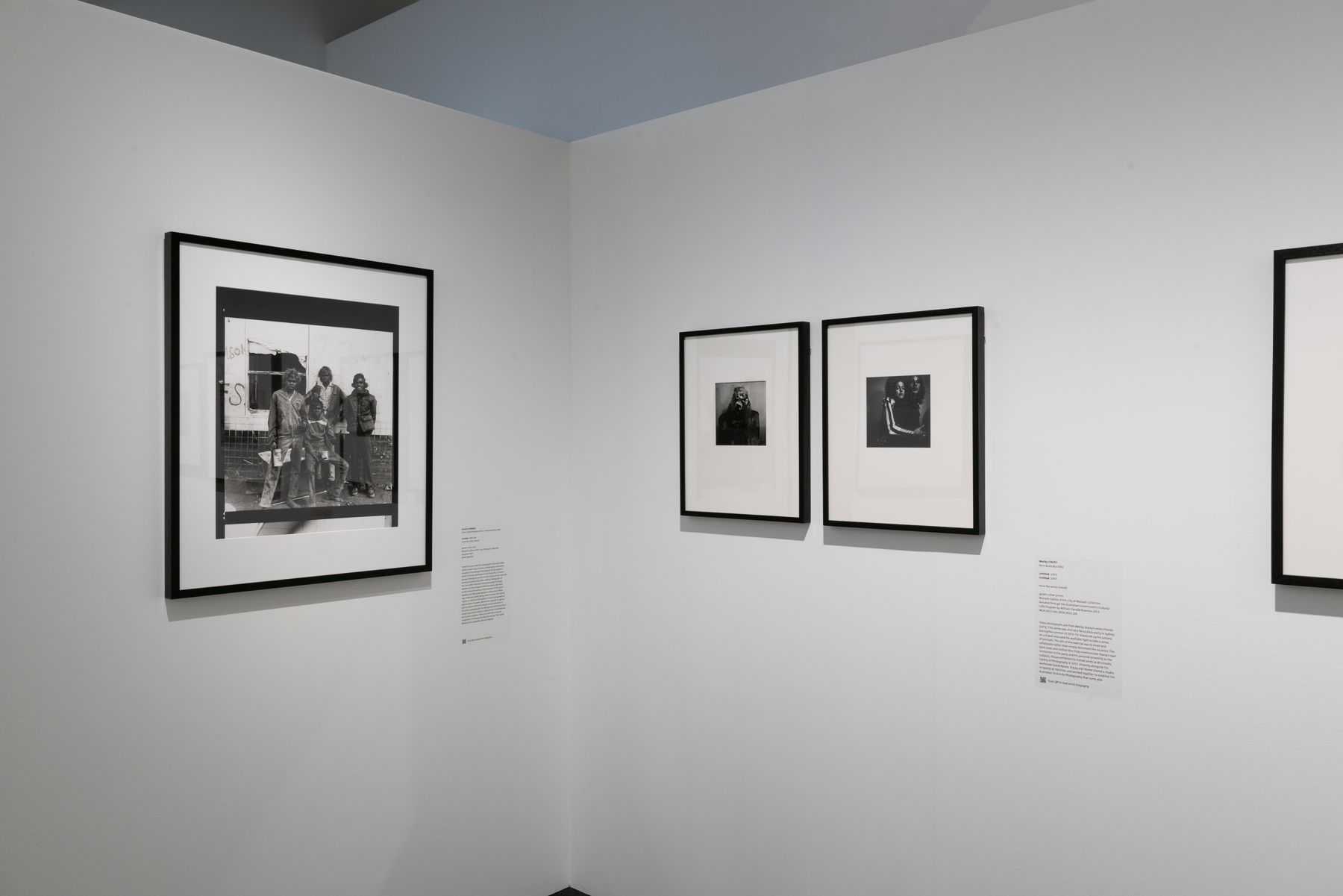
Installation view of 'Masculinities: Liberation through Photography' at Barbican Art Gallery on February 19, 2020 in London, England showing photographs from Sunil Gupta's series 'Christopher Street' 1976


Installation view of Masculinities: Liberation through Photography at Barbican Art Gallery on February 19, 2020 in London, England showing photographs from Sunil Gupta’s series Christopher Street 1976
Photo: Tristan Fewings/Getty Images for Barbican Art Gallery


Sunil Gupta (Indian, b. 1953) 'Untitled #21' 1976


Sunil Gupta (Indian, b. 1953)
Untitled #21
1976
From the series Christopher Street
Courtesy the artist and Hales Gallery
© Sunil Gupta. All Rights Reserved, DACS 2019


Gupta went on to study under Lisette Model at the New School and take his place among the most accomplished photographers, editors, and curators of his generation, exploring the way identities flower under various sexual, geographical, and historical conditions. But Christopher Street is where it all began. His subjects are engaged in an unprecedented moment in which it seemed possible to build a world of their own. He shows inner lives, barely concealed within the downturned face of a mustachioed man with his hands in his pockets, and outer ones as well, as other men cruise the lens right back, or laugh with each other, unbothered by the stranger with the camera. They were often just engaged in the everyday and extraordinary act of simply existing as gay. In each photograph, Gupta somehow projects a protective and versatile desire: to remember and be remembered at once.

Extract from Jesse Dorris. “Christopher Street Revisited,” on the Aperture website May 30th, 2019 [Online] Cited 29/02/2020


Sunil Gupta (Indian, b. 1953) 'Untitled #56' 1976


Sunil Gupta (Indian, b. 1953)
Untitled #56
1976
From the series Christopher Street
Courtesy the artist and Hales Gallery
© Sunil Gupta. All Rights Reserved, DACS 2019


The 1976 Christopher Street series marks the first set of photographs Gupta made as a practicing artist, using the camera as a tool for open expression. His decision to use black and white film was partly aesthetic, yet also practical, as he was developing the prints in his bathroom. Although he uses a documentarian style, Gupta was by no means an impartial observer behind the camera, he was a participant, enthralled by his subjects.

The series … captures a specific moment in history – a cross section of a thriving community in one of New York’s most dynamic areas – Manhattan’s Christopher Street. Dressed in the latest fashions, moving confidently and relaxing on street corners, their visible presence is a signifier of a specific period of public consciousness. Un-staged and spontaneous, most of the artist’s subjects are unaware of the camera and are simply going about their day. Now, with hindsight, Gupta is struck by the routineness of the images, stating:

‘There is a poignancy they never had at the time… A few years later, the AIDS crisis took hold. The public nature of gay life was forced back into the shadows. Thousands of men died. New York shut down its bathhouses, gay parties became private, and this whole world became hidden again.’

Fusing the public with the personal, the Christopher Street series reflects the openness of the gay liberation movement, as well as Gupta’s own “coming out” as an artist. More than a nostalgic time capsule, the photographs reveal a community that shaped Gupta as a person and cemented his lifelong dedication to portraying people who have been denied a space to be themselves.

Extract from Anonymous. “Sunil Gupta: Christopher Street,” on the Monovisions website 24 May 2019 [Online] Cited 29/02/2020


Hal Fischer (American, b. 1950) 'Handkerchiefs' 1977


Hal Fischer (American, b. 1950)
Handkerchiefs
1977
From the series Gay Semiotics
Gelatin silver print


Hal Fischer (American, b. 1950) 'Street Fashion Jock' 1977


Hal Fischer (American, b. 1950)
Street Fashion Jock
1977
From the series Gay Semiotics
Gelatin silver print


Rotimi Fani-Kayode (Nigerian, 1955-1989) 'Untitled' c. 1985


Rotimi Fani-Kayode (Nigerian, 1955-1989)
Untitled
c. 1985
Courtesy of Autograph, London
© Rotimi Fani-Kayode


Installation view of 'Masculinities: Liberation through Photography' at Barbican Art Gallery on February 19, 2020 in London, England showing at left, photographs from Isaac Julien's series 'After Mazatlàn' 1999/2000


Installation view of Masculinities: Liberation through Photography at Barbican Art Gallery on February 19, 2020 in London, England showing at left, photographs from Isaac Julien’s series After Mazatlàn, 1999/2000
Photo: Tristan Fewings/Getty Images for Barbican Art Gallery


Isaac Julien (British, b. 1960) From 'After Mazatlàn III - VI' 1999/2000


Isaac Julien (British, b. 1960)
From After Mazatlàn III – VI
1999/2000
Colour photogravures
33 x 43.2cm; 13 x 17 in
Courtesy the artist and Victoria Miro, London/Venice
© Isaac Julien


Installation view of 'Masculinities: Liberation through Photography' at Barbican Art Gallery on February 19, 2020 in London, England showing Catherine Opie's series 'Being and Having' 1991


Installation view of Masculinities: Liberation through Photography at Barbican Art Gallery on February 19, 2020 in London, England showing Catherine Opie’s series Being and Having 1991
Photo: Tristan Fewings/Getty Images for Barbican Art Gallery


Catherine Opie (American, b. 1961) 'Bo from "Being and Having"' 1991


Catherine Opie (American, b. 1961)
Bo from “Being and Having”
1991
Collection of Gregory R. Miller and Michael Wiener
© Catherine Opie, Courtesy Regen Projects, Los Angeles; Thomas Dane Gallery, London; and Solomon R. Guggenheim Museum, New York


The exhibition brings together over 300 works by over 50 pioneering international artists, photographers and filmmakers such as Richard Avedon, Peter Hujar, Isaac Julien, Rotimi Fani-Kayode, Robert Mapplethorpe, Annette Messager and Catherine Opie to show how photography and film have been central to the way masculinities are imagined and understood in contemporary culture. The show also highlights lesser-known and younger artists – some of whom have never exhibited in the UK – including Cassils, Sam Contis, George Dureau, Elle Pérez, Paul Mpagi Sepuya, Hank Willis Thomas, Karlheinz Weinberger and Marianne Wex amongst many others. Masculinities: Liberation through Photography is part of the Barbican’s 2020 season, Inside Out, which explores the relationship between our inner lives and creativity.

Jane Alison, Head of Visual Arts, Barbican, said: ‘Masculinities: Liberation through Photography continues our commitment to presenting leading twentieth century figures in the field of photography while also supporting younger contemporary artists working in the medium today. In the wake of the #MeToo movement and the resurgence of feminist and men’s rights activism, traditional notions of masculinity has become a subject of fierce debate. This exhibition could not be more relevant and will certainly spark conversations surrounding our understanding of masculinity.’

With ideas around masculinity undergoing a global crisis and terms such as ‘toxic’ and ‘fragile’ masculinity filling endless column inches, the exhibition surveys the representation of masculinity in all its myriad forms, rife with contradiction and complexity. Presented across six sections by over 50 international artists to explore the expansive nature of the subject, the exhibition touches on themes of queer identity, the black body, power and patriarchy, female perceptions of men, heteronormative hypermasculine stereotypes, fatherhood and family. The works in the show present masculinity as an unfixed performative identity shaped by cultural and social forces.

Seeking to disrupt and destabilise the myths surrounding modern masculinity, highlights include the work of artists who have consistently challenged stereotypical representations of hegemonic masculinity, including Collier Schorr, Adi Nes, Akram Zaatari and Sam Contis, whose series Deep Springs, 2018 draws on the mythology of the American West and the rugged cowboy. Contis spent four years immersed in an all-male liberal arts college north of Death Valley meditating on the intimacy and violence that coexists in male-only spaces. Complicating the conventional image of the fighter, Thomas Dworzak‘s acclaimed series Taliban consists of portraits found in photographic studios in Kandahar following the US invasion of Afghanistan in 2001, these vibrant portraits depict Taliban fighters posing hand in hand in front of painted backdrops, using guns and flowers as props with kohl carefully applied to their eyes. Trans masculine artist Cassils‘ series Time Lapse, 2011, documents the radical transformation of their body through the use of steroids and a rigorous training programme reflecting on ideas of masculinity without men. Elsewhere, artists Jeremy Deller, Robert Mapplethorpe and Rineke Dijkstra dismantle preconceptions of subjects such as the wrestler, the bodybuilder and the athlete and offer an alternative view of these hyper-masculinised stereotypes.

The exhibition examines patriarchy and the unequal power relations between gender, class and race. Karen Knorr‘s series Gentlemen, 1981-83, comprised of 26 black and white photographs taken inside men-only private members’ clubs in central London and accompanied by texts drawn from snatched conversations, parliamentary records and contemporary news reports, invites viewers to reflect on notions of class, race and the exclusion of women from spaces of power during Margaret Thatcher’s premiership. Toxic masculinity is further explored in Andrew Moisey‘s 2018 photobook The American Fraternity: An Illustrated Ritual Manual which weaves together archival photographs of former US Presidents and Supreme Court Justices who all belonged to the fraternity system, alongside images depicting the initiation ceremonies and parties that characterise these male-only organisations.

With the rise of the Gay Liberation Movement through the 1960s followed by the AIDS epidemic in the early 1980s, the exhibition showcases artists such as Peter Hujar and David Wojnarowiz, who increasingly began to disrupt traditional representations of gender and sexuality. Hal Fischer‘s critical photo-text series Gay Semiotics, 1977, classified styles and types of gay men in San Francisco and Sunil Gupta’s street photographs captured the performance of gay public life as played out on New York’s Christopher Street, the site of the 1969 Stonewall Uprising. Other artists exploring the performative aspects of queer identity include Catherine Opie‘s seminal series Being and Having, 1991, showing her close friends in the West Coast’s LGBTQ+ community sporting false moustaches, tattoos and other stereotypical masculine accessories. Elle Pérez‘s luminous and tender photographs explore the representation of gender non-conformity and vulnerability, whilst Paul Mpagi Sepuya‘s fragmented portraits explore the studio as a site of homoerotic desire.

During the 1970s women artists from the second wave feminist movement objectified male sexuality in a bid to subvert and expose the invasive and uncomfortable nature of the male gaze. In the exhibition, Laurie Anderson‘s seminal work Fully Automated Nikon (Object/Objection/Objectivity), 1973, documents the men who cat-called her as she walked through New York’s Lower East Side while Annette Messager‘s series The Approaches, 1972, covertly captures men’s trousered crotches with a long-lens camera. German artist Marianne Wex‘s encyclopaedic project Let’s Take Back Our Space: ‘Female’ and ‘Male’ Body Language as a Result of Patriarchal Structures, 1977, presents a detailed analysis of male and female body language and Australian indigenous artist Tracey Moffatt‘s awkwardly humorous film Heaven, 1997, portrays male surfers changing in and out of their wet suits.

Further highlights include New York based artist Hank Willis Thomas, whose photographic practice examines the complexities of the black male experience; celebrated Japanese photographer Masahisa Fukase‘s The Family, 1971-1989, chronicles the life and death of his family with a particular emphasis on his father; and Kenneth Anger‘s technicolour experimental underground film Kustom Kar Kommandos, 1965, explores the fetishist role of hot rod cars amongst young American men.

Press release from the Barbican Art Gallery
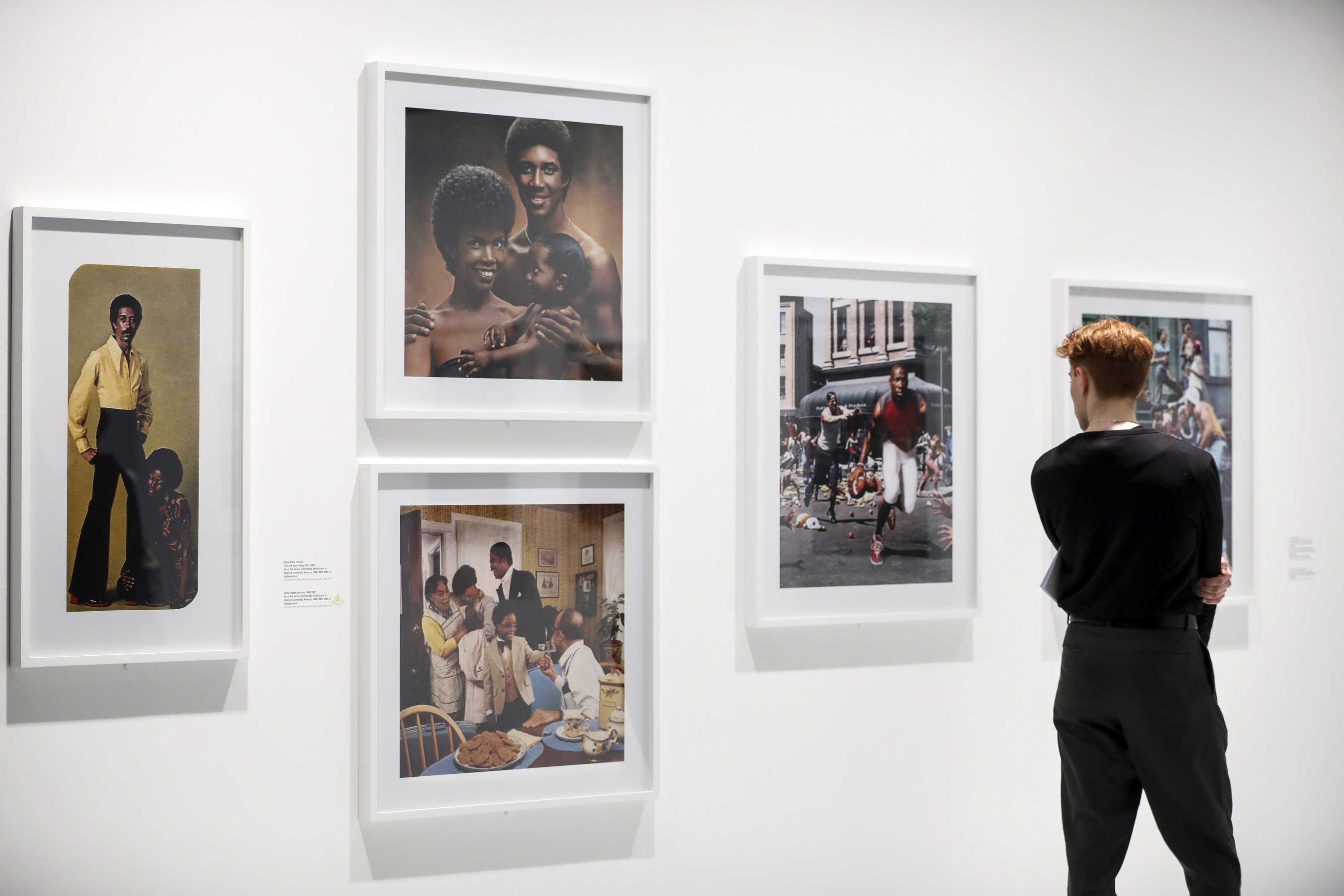
 

Installation view of 'Masculinities: Liberation through Photography' at Barbican Art Gallery on February 19, 2020 in London, England showing Hank Willis Thomas' series 'Unbranded: Reflections in Black by Corporate America 1968-2008' 2005-2008


Installation view of Masculinities: Liberation through Photography at Barbican Art Gallery on February 19, 2020 in London, England showing Hank Willis Thomas’ series Unbranded: Reflections in Black by Corporate America 1968-2008 2005-2008 (below)
Photo: Tristan Fewings/Getty Images for Barbican Art Gallery


Room 13-14

Reclaiming the Black Body

Giving visual form to the complexity of the black male experience, this section foregrounds artists who over the last five decades have consciously subverted expectations of race, gender and the white gaze by reclaiming the power to fashion their own identities.

From Samuel Fosso’s playfully staged self-portraits, taken in his studio, in which he performs to the camera sporting flares and platforms boots or flirtatiously revealing his youthful male physique (below) to Kiluanji Kia Henda’s fictional scenarios in which he adopts the troubled personas of African men of power, the works presented here reflect on how black masculinity challenges the status quo (below).

The representation of black masculinity in the US is born out of a violent history of slavery and prejudice. Unbranded: Reflections in Black by Corporate America 1968-2008 by Hank Willis Thomas (below) draws attention to the ways in which corporate America has commodified the African American male experience while simultaneously perpetuating and reinforcing cultural stereotypes. Similarly, Deana Lawson’s powerful work Sons of Cush, 2016, highlights how the black male figure is often ‘idealised (in their physical beauty) and pathologised by the culture (as symbols of violence or fear)’.


Hank Willis Thomas (American, b. 1976) 'The Johnson Family' 1981/2006


Hank Willis Thomas (American, b. 1976)
The Johnson Family
1981/2006
From the series Unbranded: Reflections in Black by Corporate America 1968-2008
2005-08


Concerned with the literal and figural objectifications of the African American male body, in his complex series Unbranded Hank Willis Thomas redeploys magazine adverts featuring African Americans made between 1968 – a pivotal moment in the struggle for civil rights – and 2008, which witnessed the accession of Barack Obama to the US presidency. By digitally stripping the ads of all text, branding and logos, Thomas draws attention to the ways in which corporate America has commodified the African American experience while simultaneously perpetuating and reinforcing cultural stereotypes.


Hank Willis Thomas (American, b. 1976) 'It's the Real Thing!' 1978/2008


Hank Willis Thomas (American, b. 1976)
It’s the Real Thing!
1978/2008
From the series Unbranded: Reflections in Black by Corporate America 1968-2008
2005-2008


Samuel Fosso (Cameroonian, b. 1962) 'Self-portrait' 1975-1977


Samuel Fosso (Cameroonian, b. 1962)
Self-portrait
1975-1977
From the series 70s lifestyle
Courtesy Jean Marc Patras, Paris
© Samuel Fosso


Installation view of 'Masculinities: Liberation through Photography' at Barbican Art Gallery on February 19, 2020 in London, England showing a photograph from Kiluanji Kia Henda's series 'The Last Journey of the Dictator Mussunda Nzombo Before the Great Extinction Act I'


Installation view of Masculinities: Liberation through Photography at Barbican Art Gallery on February 19, 2020 in London, England showing a photograph from Kiluanji Kia Henda’s series The Last Journey of the Dictator Mussunda Nzombo Before the Great Extinction Act I
Photo: Tristan Fewings/Getty Images for Barbican Art Gallery


Hilary Lloyd (British, b. 1964) 'Colin #2' 1999


Hilary Lloyd (British, b. 1964)
Colin #2
1999
Courtesy Galerie Neu, Berlin; Sadie Coles HQ, London; Greene Naftali, New York
© Hilary Lloyd
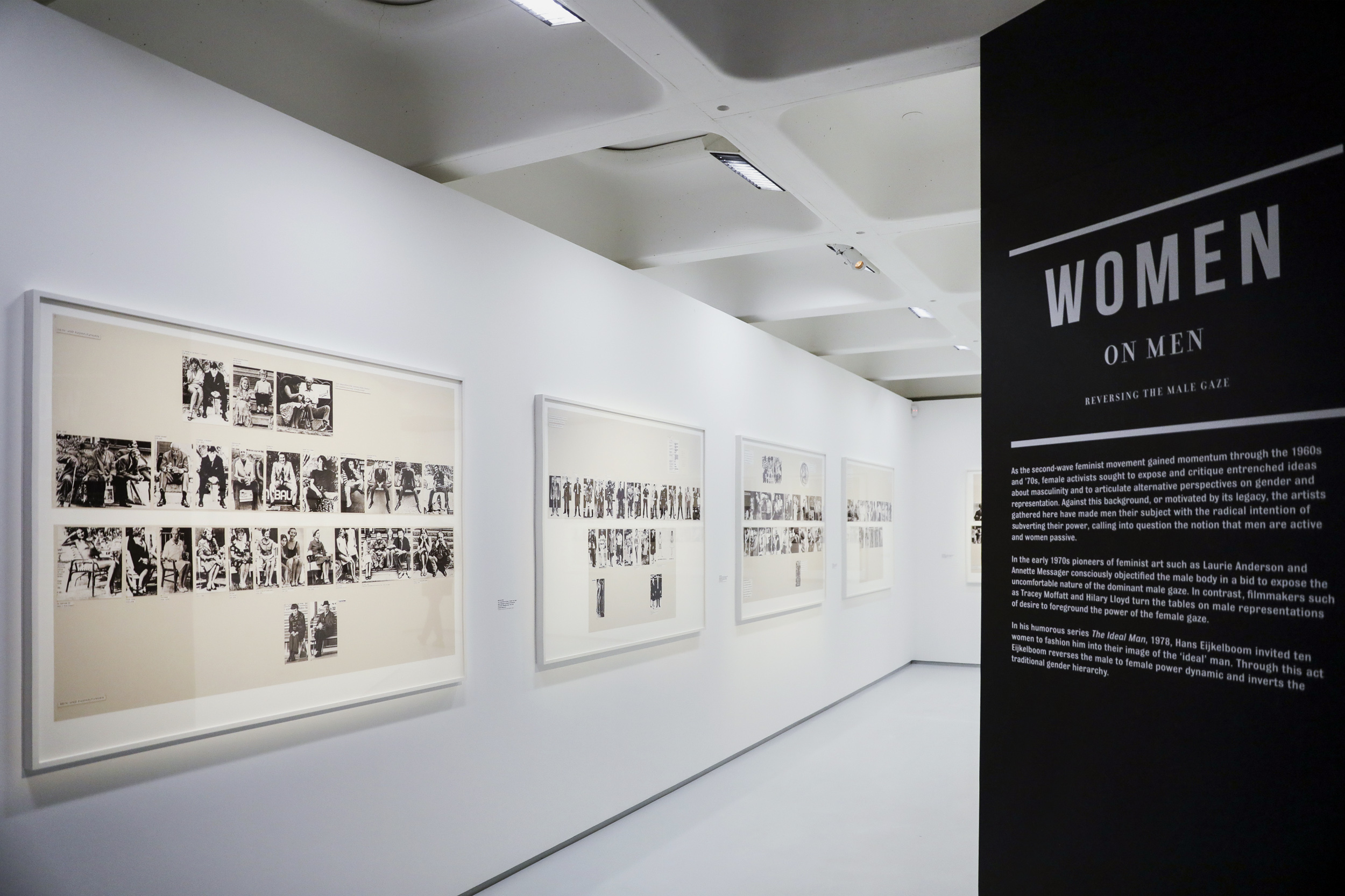
 

Installation view of 'Masculinities: Liberation through Photography' at Barbican Art Gallery on February 19, 2020 in London, England showing part of Marianne Wex's encyclopaedic project 'Let's Take Back Our Space: 'Female' and 'Male' Body Language as a Result of Patriarchal Structures' 1977


Installation view of Masculinities: Liberation through Photography at Barbican Art Gallery on February 19, 2020 in London, England showing part of Marianne Wex’s encyclopaedic project Let’s Take Back Our Space: ‘Female’ and ‘Male’ Body Language as a Result of Patriarchal Structures, 1977
Photo: Tristan Fewings/Getty Images for Barbican Art Gallery


Room 15-16

Women on Men: Reversing the Male Gaze

As the second-wave feminist movement gained momentum through the 1960s and ’70s, female activists sought to expose and critique entrenched ideas about masculinity and to articulate alternative perspectives on gender and representation. Against this background, or motivated by its legacy, the artists gathered here have made men their subject with the radical intention of subverting their power, calling into question the notion that men are active and women passive.

In the early 1970s pioneers of feminist art such as Laurie Anderson (below) and Annette Messager consciously objectified the male body in a bid to expose the uncomfortable nature of the dominant male gaze. In contrast, filmmakers such as Tracey Moffatt (below) and Hilary Lloyd (above) turn the tables on male representations of desire to foreground the power of the female gaze.

In his humorous series The Ideal Man, 1978 (below), Hans Eijkelboom invited ten women to fashion him into their image of the ‘ideal’ man. Through this act Eijkelboom reverses the male to female power dynamic and inverts the traditional gender hierarchy.


Laurie Anderson (American, b. 1947) 'Man with a Cigarette' 1973


Laurie Anderson (American, b. 1947)
Man with a Cigarette
1973
From the series Fully Automated Nikon (Object/Objection/Objectivity)


Laurie Anderson (American, b. 1947) 'Two men in a car' 1973


Laurie Anderson (American, b. 1947)
Two men in a car
1973
From the series Fully Automated Nikon (Object/Objection/Objectivity)


Anderson photographed men who called to her or whistled her on the street.  In her artist statement she writes about one experience,

“As I walked along Houston Street with my fully automated Nikon. I felt armed, ready. I passed a man who muttered ‘Wanna fuck?’ This was standard technique: the female passes and the male strikes at the last possible moment forcing the woman to backtrack if she should dare to object. I wheeled around, furious. ‘Did you say that?’ He looked around surprised, then defiant ‘Yeah, so what the fuck if I did?’ I raised my Nikon, took aim began to focus. His eyes darted back and forth, an undercover cop? CLICK.

As it turned out, most of the men I shot that day had the opposite reaction. When i confronted them, the acted innocent, then offended, like some nasty invisible ventriloquist had ticked them into saying dirty words against their will. By the time I took their pictures they were posing, like taking their picture was the least I could do.”

“I decided to shoot pictures of men who made comments to me on the street. I had always hated this invasion of my privacy and now I had the means of my revenge. As I walked along Houston Street with my fully automated Nikon, I felt armed, ready. I passed a man who muttered ‘Wanna fuck?’ This was standard technique: the female passes and the male strikes at the last possible moment forcing the woman to backtrack if she should dare to object. I wheeled around, furious. ‘Did you say that?’ He looked around surprised, then defiant. ‘Yeah, so what the fuck if I did?’ I raised my Nikon, took aim, began to focus. His eyes darted back and forth, an undercover cop? CLICK.”

Anderson takes the power from her male pursuers, allowing them nothing more than the momentary fear that their depravity has just been captured in a picture.
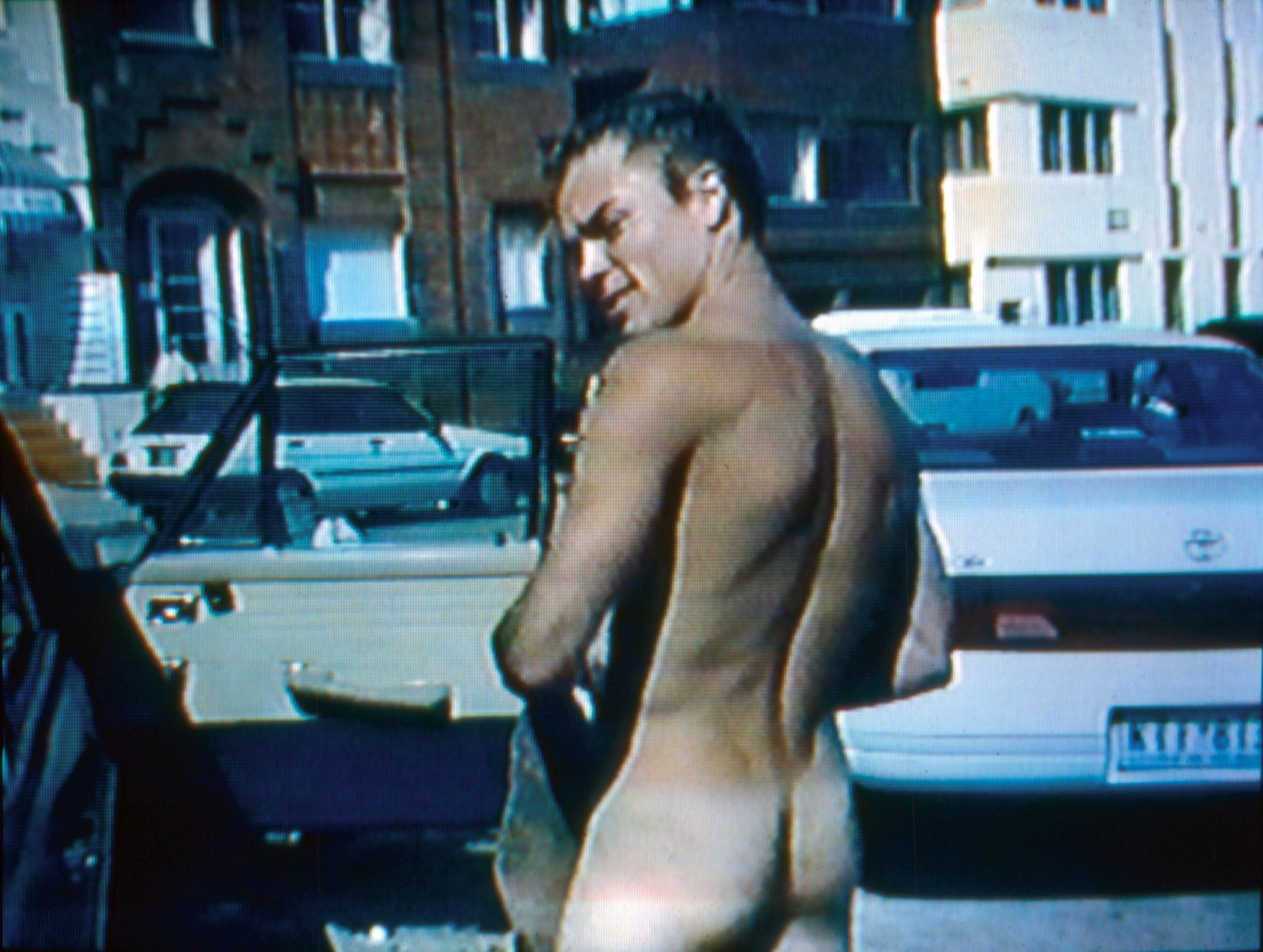
 

Tracey Moffatt (Australian, b. 1960) 'Heaven' (still) 1997


Tracey Moffatt (Australian, b. 1960)
Heaven (still)
1997
Video tape (28 minutes)
© Tracey Moffatt / DACS Courtesy of the artist and Roslyn Oxley9 Gallery, Sydney, Australia


“A playful video that glories in the female gaze and objectification of men. It zeros in on the Australian national sport, surfing, and in particular on several dozen good-looking muscular men changing into or out of their swimming trunks. This ritual is usually conducted in parking lots or on sidewalks, always near cars and sometimes inside them; it usually but not always involves a beach towel wound carefully around the torso. Ms Moffatt begins by shooting her subject unseen from inside a house and gradually moves closer and closer, engaging some in conversations that are never heard. The soundtrack alternates between the ocean surf and the sounds of drumming and chanting, male rituals of another, more authentic Australian culture. By the tape’s end, the artist’s voyeurism has shifted to participation; the camera shows her free hand, the one not holding the camera, darting into view, trying to undo the towel of the last surfer.”

New York Times


Installation view of 'Masculinities: Liberation through Photography' at Barbican Art Gallery on February 19, 2020 in London, England showing part of Hans Eijkelboom's series 'The Ideal Man' 1978


Installation view of Masculinities: Liberation through Photography at Barbican Art Gallery on February 19, 2020 in London, England showing part of Hans Eijkelboom’s series The Ideal Man, 1978


Glossary of Terms by CN Lester

Homosociality: Typically non-romantic and/or non-sexual same-sex relationships and social groupings – may sometimes include elements of homoeroticism, as they are frequently interdependent phenomena.

Normativity: The process by which some groups of people, forms of expression and types of behaviour are classified according to a perceived standard of what is ‘normal’, ‘natural’, desirable and permissible in society. Inevitably, this process designates people, expressions and behaviours that do not fit these norms as abnormal, unnatural, undesirable and impermissible.

Hegemonic Masculinity: ‘Hegemonic’ means ‘ruling’ or ‘commanding’ – hegemonic masculinity, therefore, indicates male dominance and the forms of masculinity occupying and perpetuating this dominant position. The term was coined in the 1980s by the scholar R. W. Connell, drawing on the Marxist philosopher Antonio Gramsci’s notion of cultural hegemony.

Hierarchy: Across many cultures throughout history, and continuing into the present moment throughout large parts of the world, gender functions as a hierarchy: some gender categories and gender expressions are granted higher value and more power than others. Men are often higher up the gender hierarchy than women, but the gender hierarchy is affected by racism, disablism, ageism, transphobia and other factors; in the West, men in their thirties are likely to be considered higher up the gender hierarchy than men in their eighties, for example.

Gender roles: Specific cultural roles defined by the weight of gendered ideas, restrictions and traditions. Men and women are often expected, sometimes forced, to occupy oppositional gender roles: aggressor versus victim, protector versus nurturer and so on. Many gender roles are specific to intersections of race, class, sexuality, religion and disabled status – examples of these types of gender roles can be seen in the stereotypes of the Jezebel or the Dragon Lady.

Patriarchy: Literally ‘the rule of the father’, a patriarchy is a society or structure centred around male dominance and in which women (and those of other genders) are not treated as or considered equal.

Queer: A slur, a term of reclamation and a specific and radical site of community and activism in solidarity with many kinds of difference, and specifically opposed to heteronormativity and cisnormativity. Queer studies and queer theory are important emerging fields of study.

Gender identity: Identity refers to what, who, and how someone or something is, both in the way this is understood as selfhood by an individual, and also the self as it is shaped and positioned by the world. Gender identity can be a surprisingly difficult term to pin down and is perhaps best understood as the stated truth of a person’s gender (or lack of gender), which is in itself the sum of many different factors.

Fetishisation: To turn the subject into a fetish, sexually or otherwise. Fetishisation in terms of gender and desire frequently occurs in conjunction with objectification and power. Men and women of colour are frequently fetishised by white people, in society and in artistic practice, through different stereotypes and limitations. Trans and disabled people are also subject to fetishisation, particularly in bodily terms. Kobena Mercer’s critical essay on Robert Mapplethorpe, ‘Reading Radical Fetishism’,1 and David Henry Hwang’s play and afterword to M. Butterfly (1988) both explore the notion of fetishisation.

1/ Kobena Mercer, ‘Reading Racial Fetishism: The Photographs of Robert Mapplethorpe’, in Emily Apter and William Pietz, eds, Fetishism as Cultural Discourse (Ithaca, NY: Cornell University Press, 1993), pp. 307-29.

Critical race theory: A branch of scholarship emerging from the application of critical theory to the study of law in the 1980s, critical race theory (CRT) is now taken as an approach and theoretical foundation across both academic and popular discourse. CRT names, examines and challenges the social constructions and functions of race and racism. Rejecting the idea of race as a ‘natural’ category, CRT looks instead to the cultural, structural and legal creation and maintenance of difference and oppression. Scholars working in this field include Kimberlé Williams Crenshaw, Eduardo Bonilla-Silva and Patricia Williams.

Me Too movement: ‘#MeToo is a movement that was founded in 2006 to support survivors of sexual violence, in particular black and brown girls, who were in the program that we were running. It has grown since then to include supporting grown people, women, and men, and other survivors, as well as helping people to understand what community action looks like in the fight to end sexual violence’ – Tarana Burke, founder of the Me Too movement.

Male gaze: A term coined by film critic Laura Mulvey, the notion of the male gaze develops Jean-Paul Sartre’s concept of le regard (the gaze) to take into account the power differentials and gender stereotyping inherent in ways of looking within patriarchal, sexist culture. The male gaze refers to how the world – and women in particular – are looked at and presented from a cisgender, straight, frequently white male perspective. In visual art the male gaze can be understood in multiple ways, from the male creator of the work, to men within the work viewing women or the world around them, to the (assumed) male viewer of the work itself. Many women artists have countered the male gaze through deconstruction and through the creation and promotion of works that centre the ‘female gaze’.


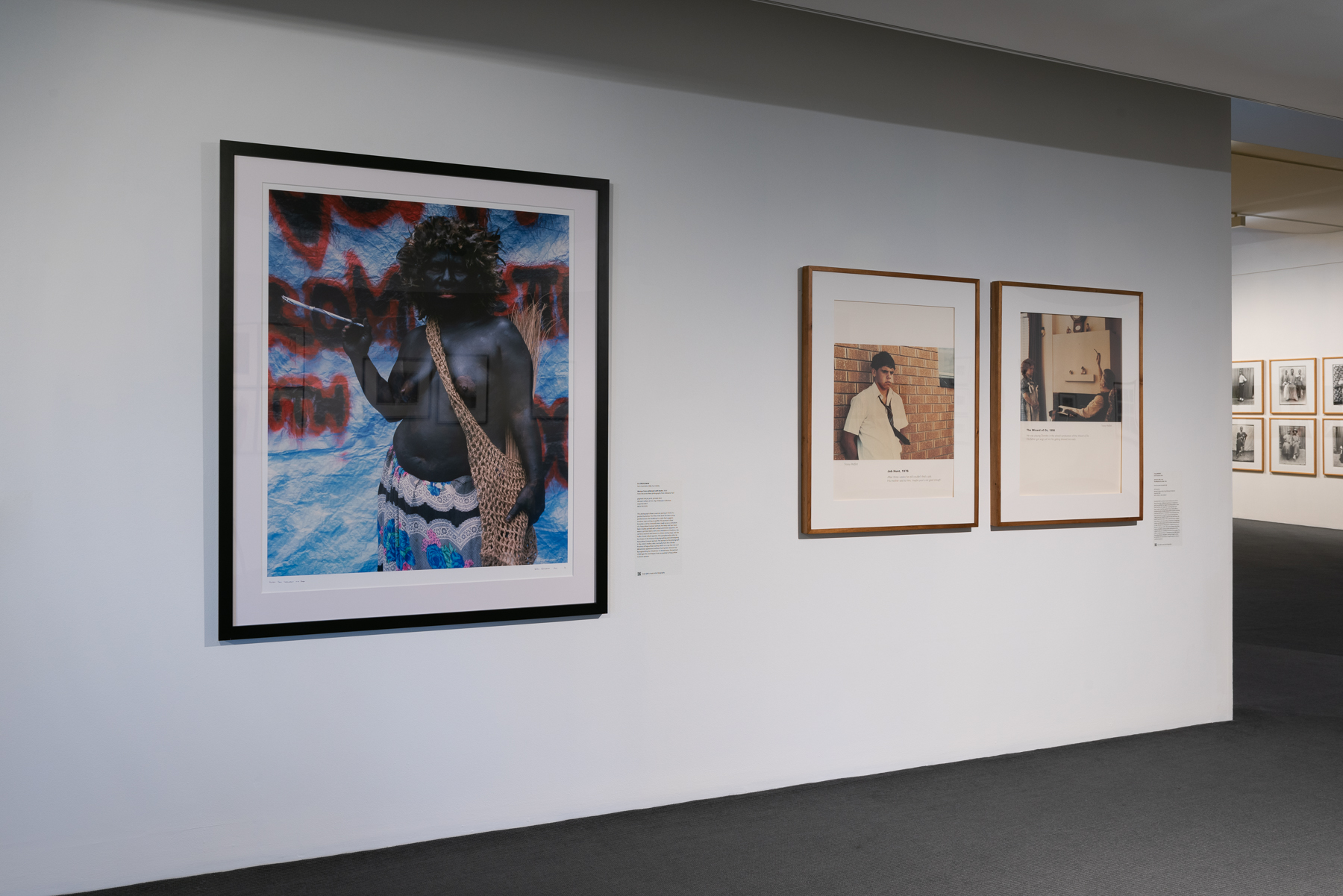
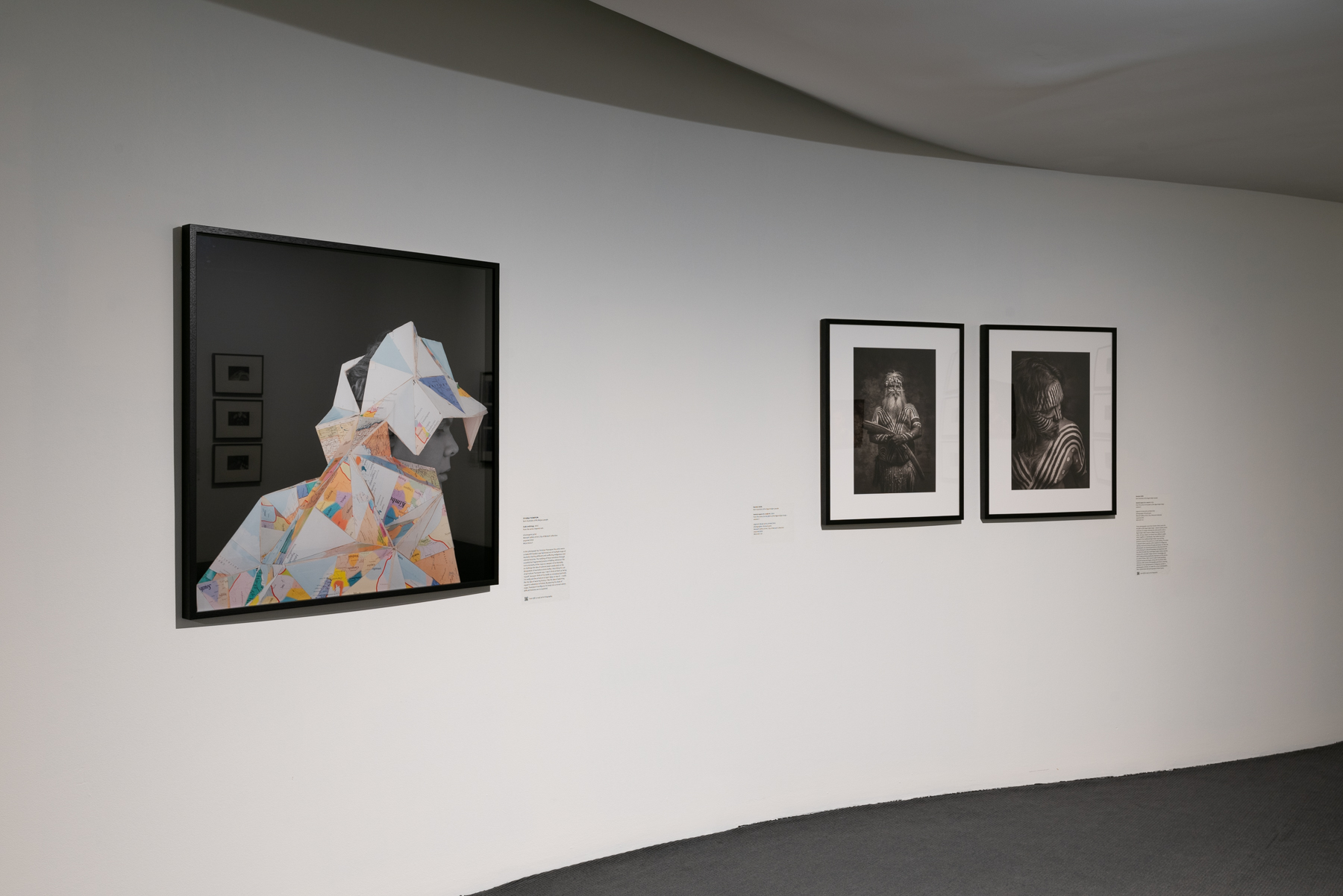
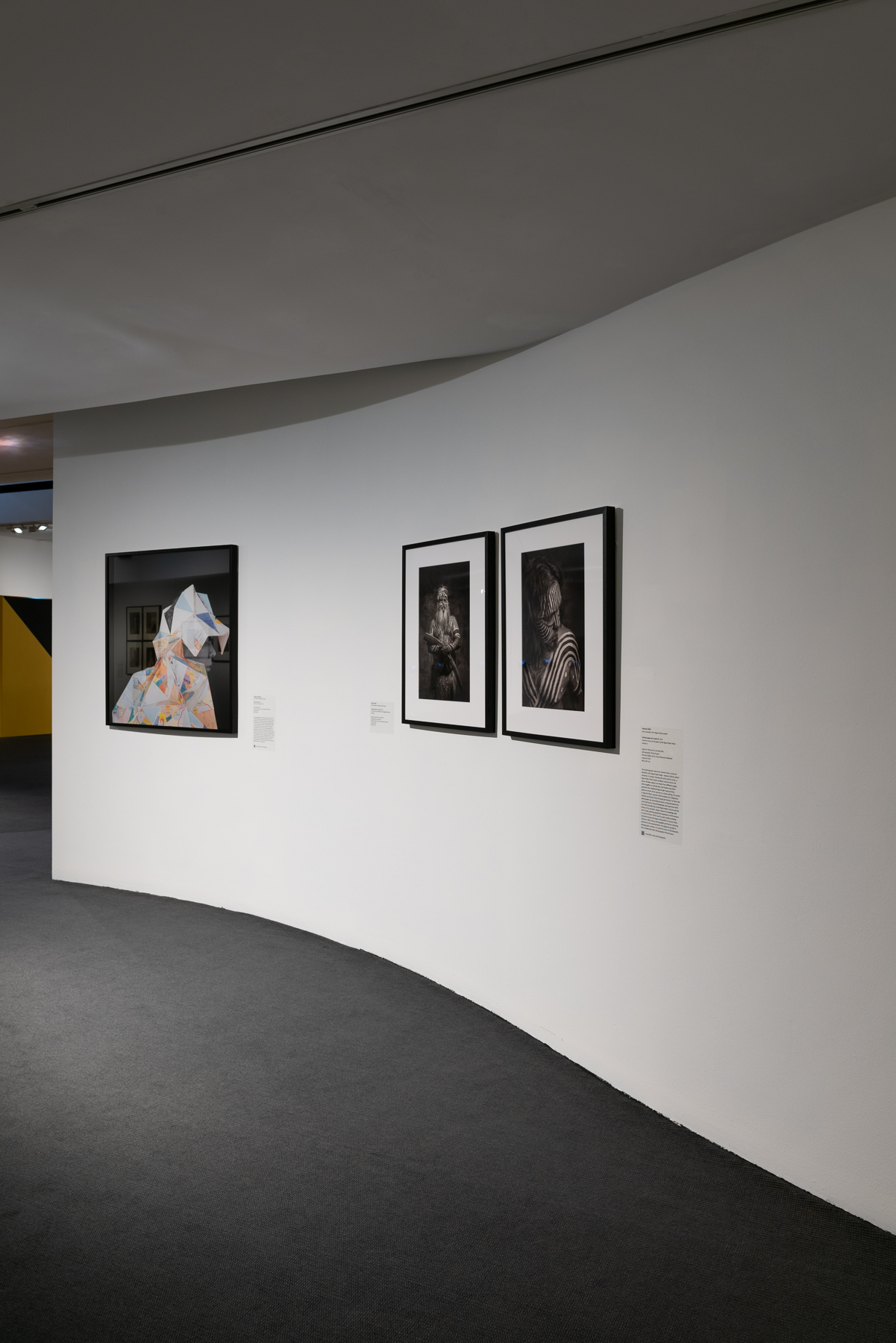
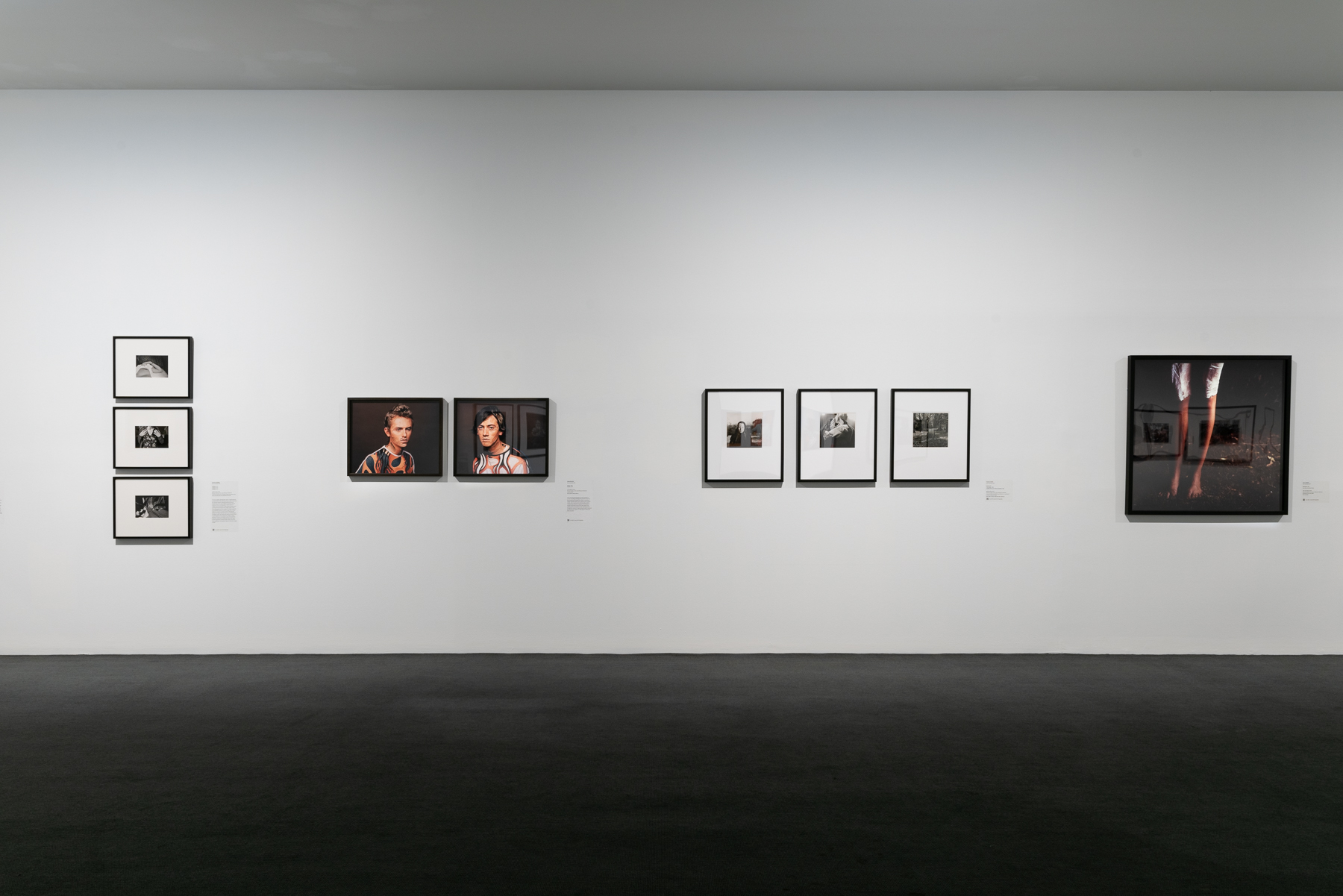
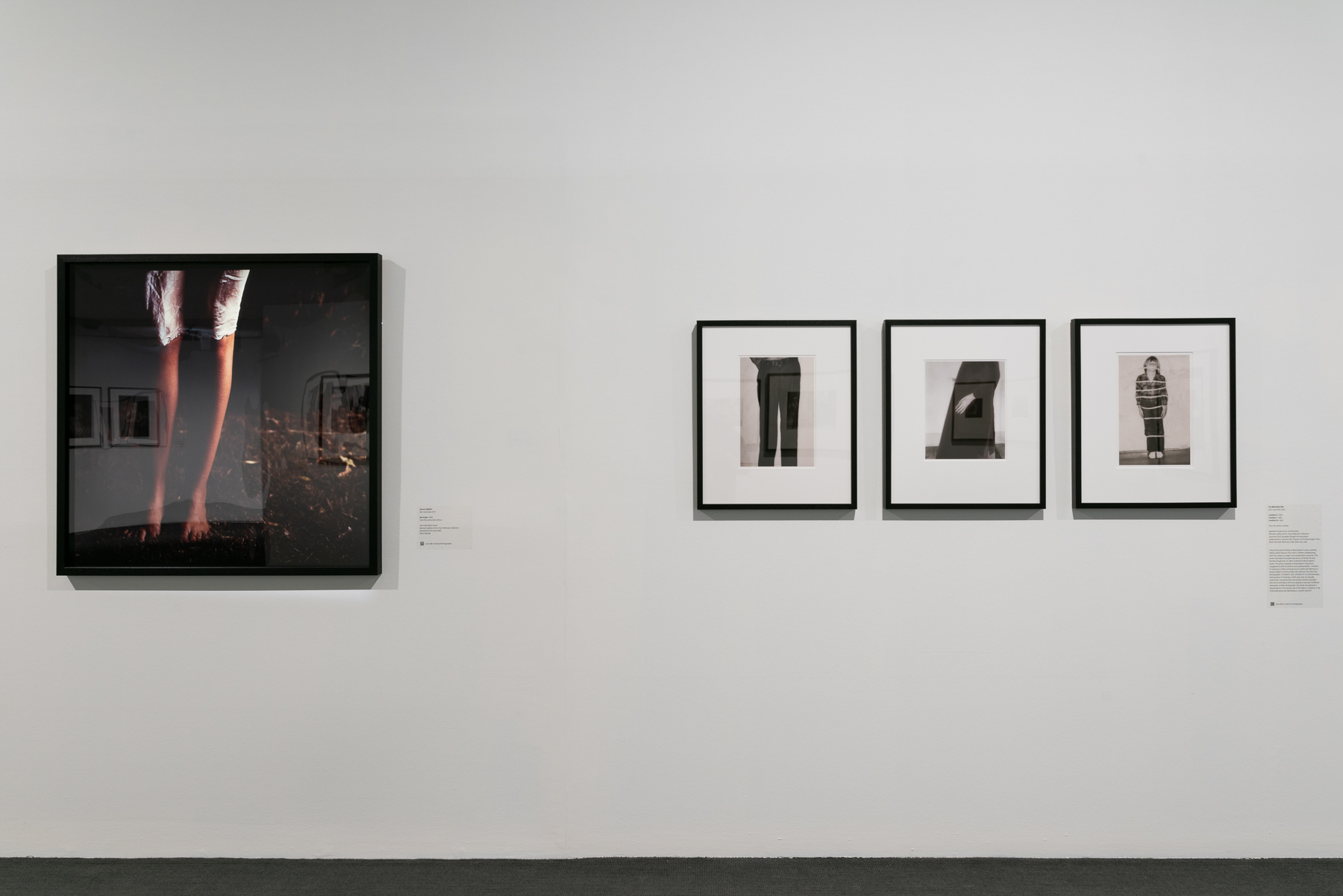
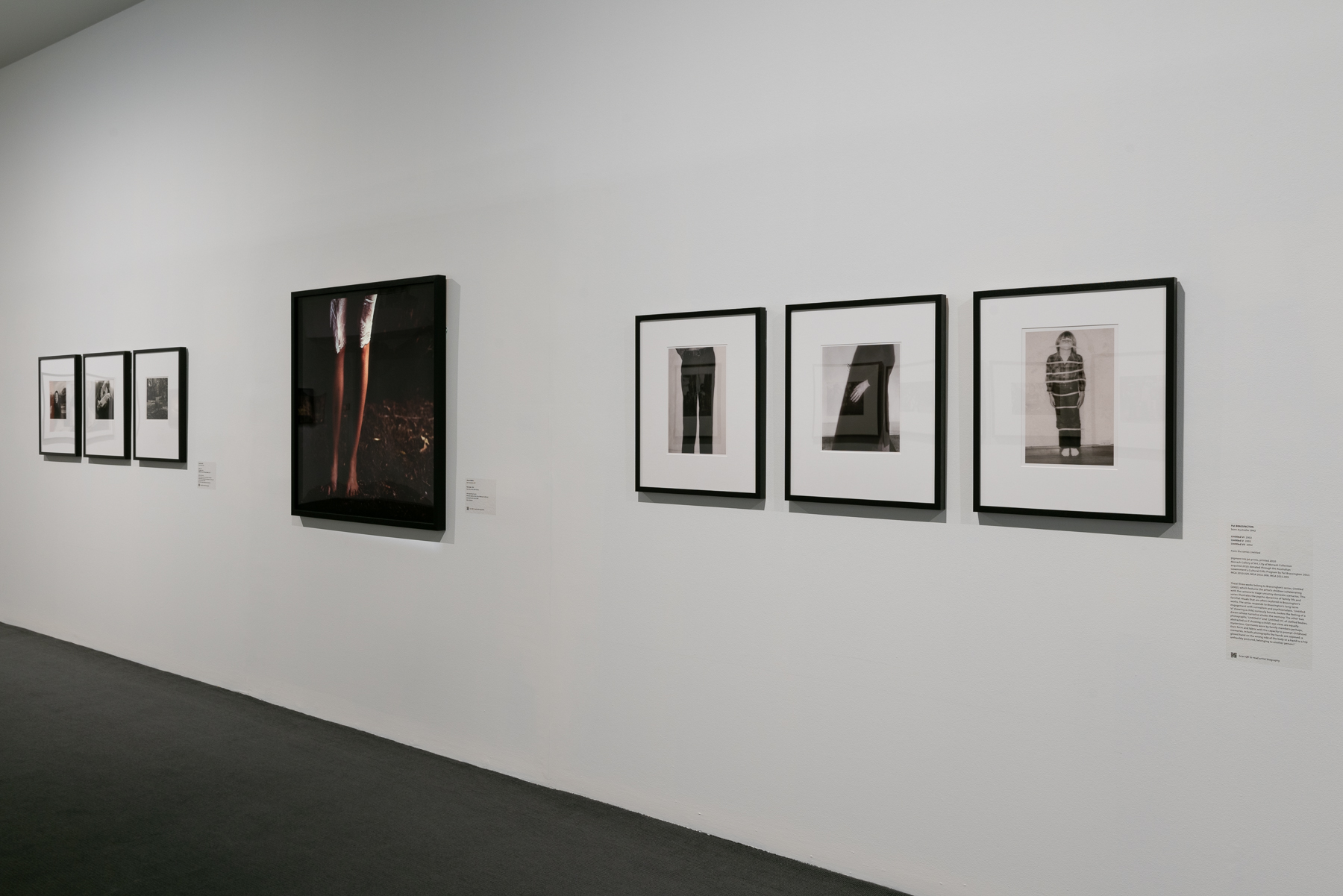
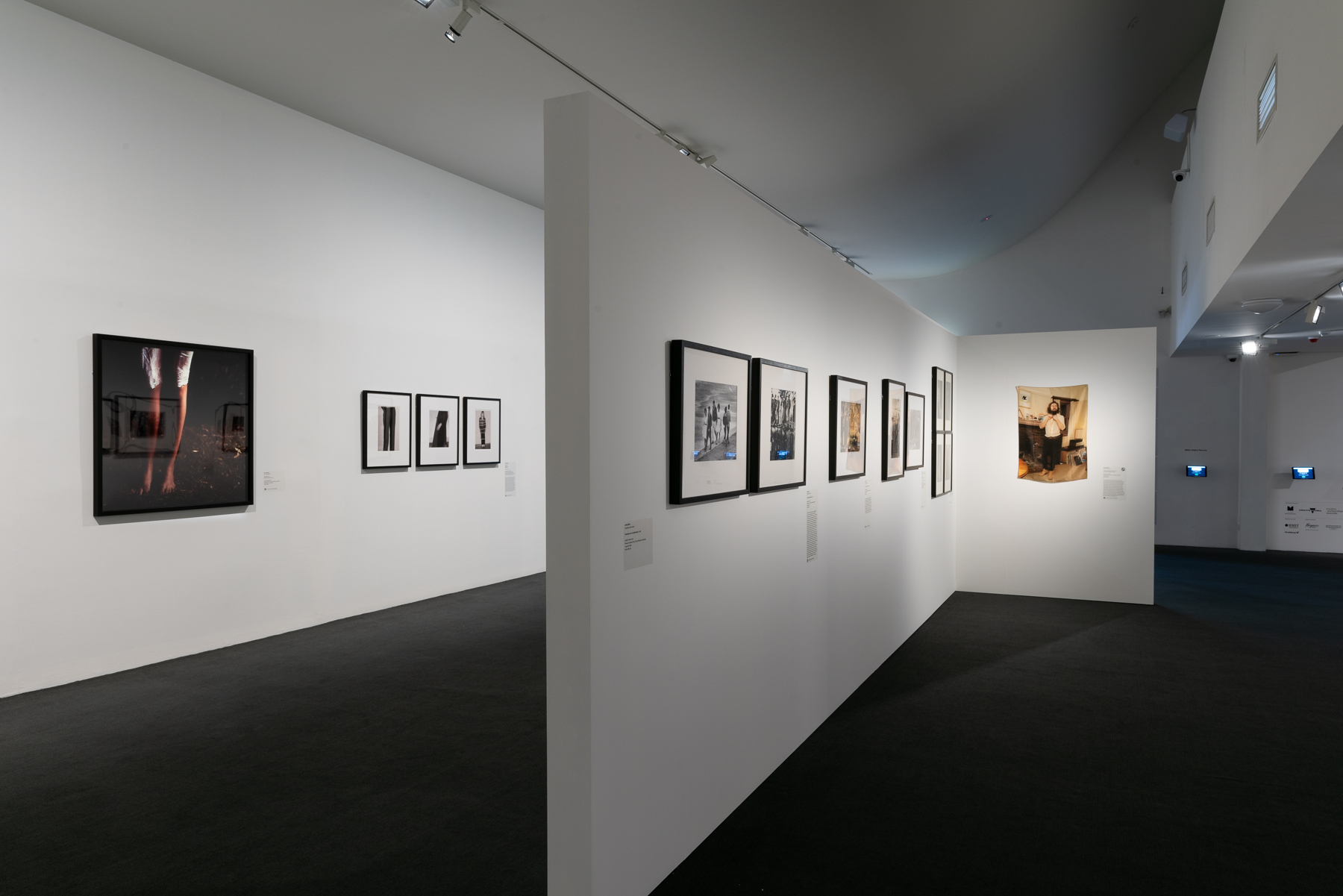
Installation view of 'Masculinities: Liberation through Photography' at Barbican Art Gallery on February 19, 2020 in London, England

Installation view of 'Masculinities: Liberation through Photography' at Barbican Art Gallery on February 19, 2020 in London, England


Installation views of Masculinities: Liberation through Photography at Barbican Art Gallery on February 19, 2020 in London, England
Photo: Tristan Fewings/Getty Images for Barbican Art Gallery


Barbican Art Gallery
Silk Street, London
EC2Y 8DS

Opening hours:
Mon – Tue 12 noon – 6pm
Wed – Fri 12 noon – 9pm
Sat 10am – 9pm
Sun 10am – 6pm

Barbican Art Gallery website

LIKE ART BLART ON FACEBOOK

Back to top

European photographic research tour: V&A Photography Centre, London

Visited October 2019 posted May 2020


Unknown photographer. 'Photograph of Allied War exhibition, Serbian Section, V&A' 1917 (installation view)
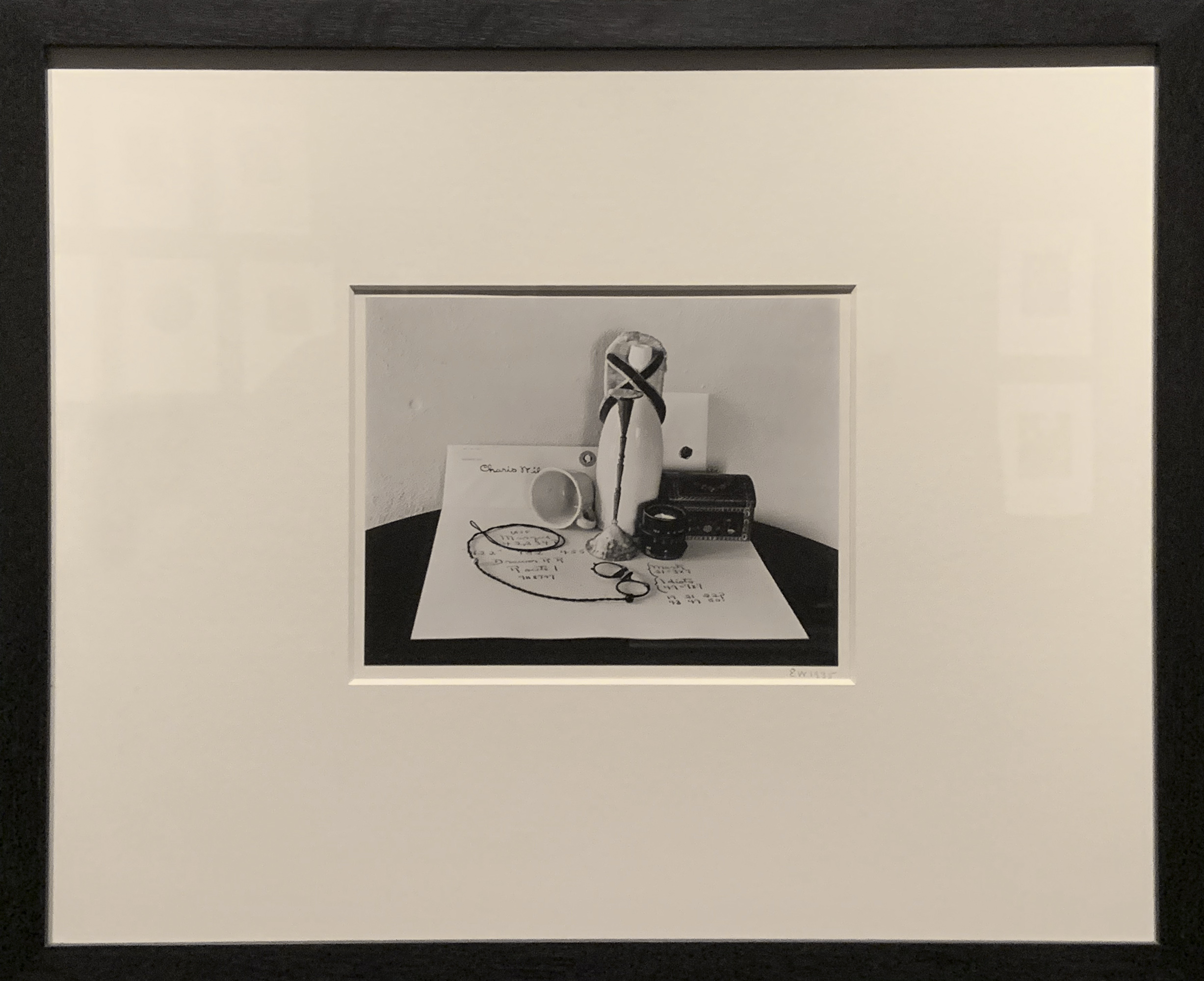
 

Unknown photographer
Photograph of Allied War exhibition, Serbian Section, V&A (installation view)
1917
Gelatin silver print
The Royal Photographic Society Collection at the V&A Museum
Photo: Marcus Bunyan


The older I grow, the more exponentially I appreciate and love these early photographs. Imagine having a collection like this!

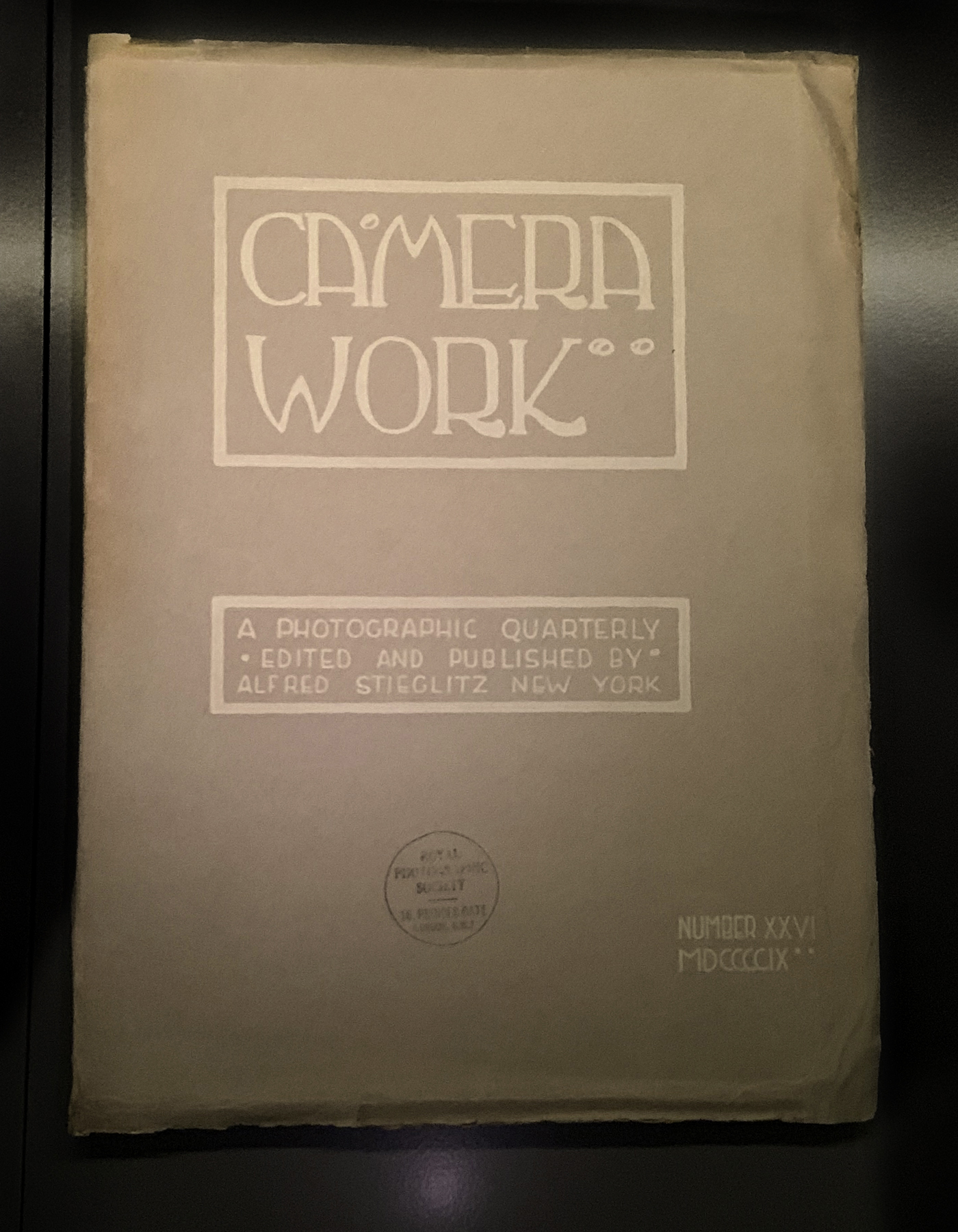
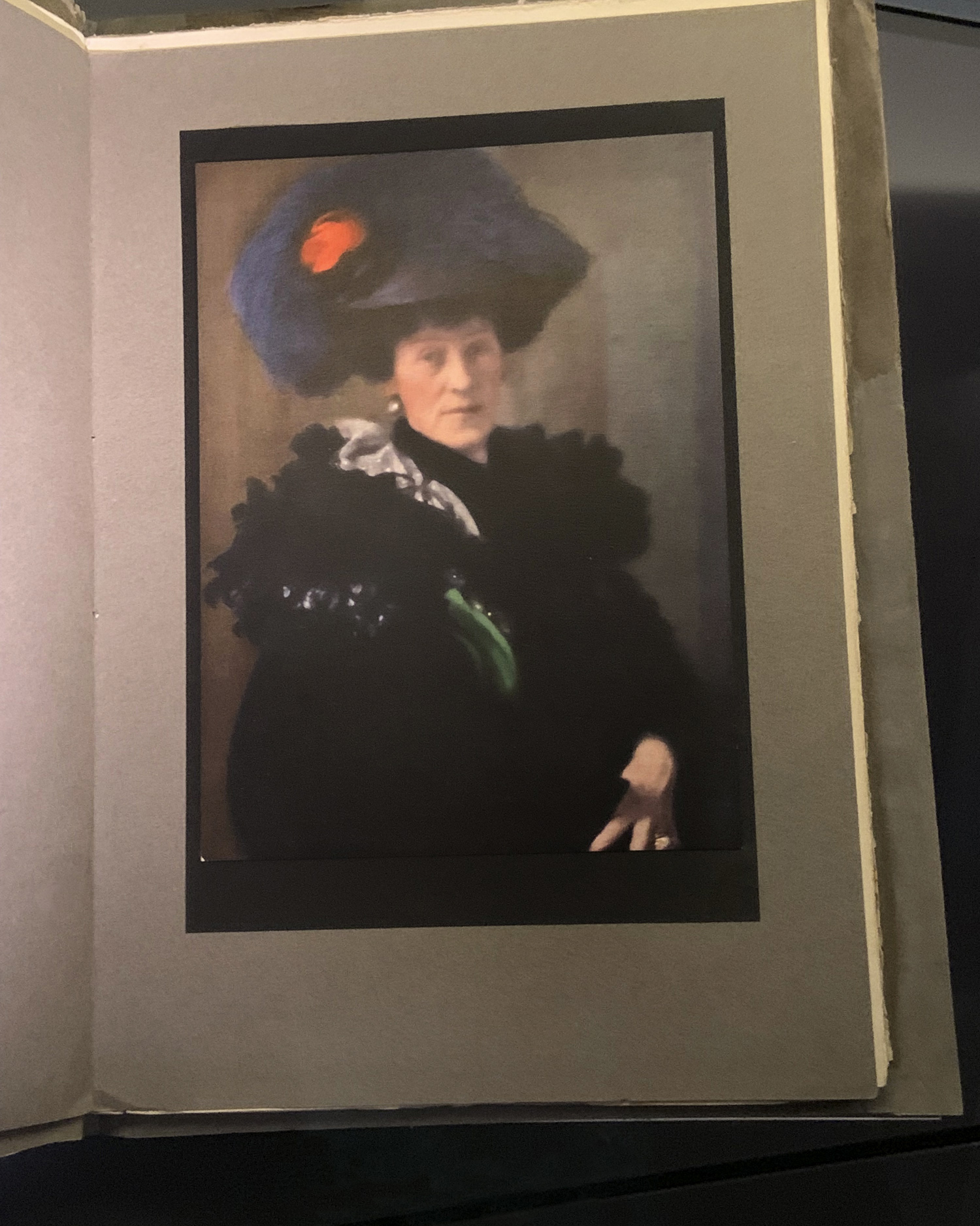
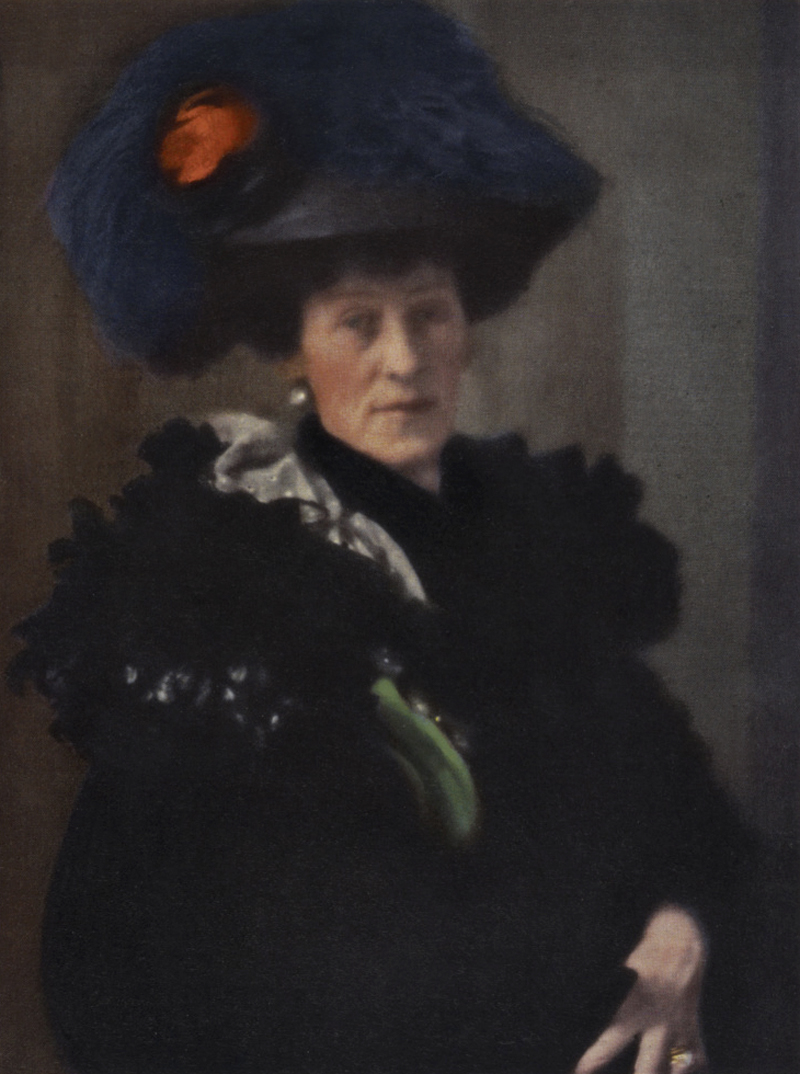
Wonderful to see Edward Steichen’s Portrait – Lady H (1908, below) as I have a copy of Camera Work 22 in my collection.

Dr Marcus Bunyan


All iPhone images © Dr Marcus Bunyan. Please click on the photographs for a larger version of the image.


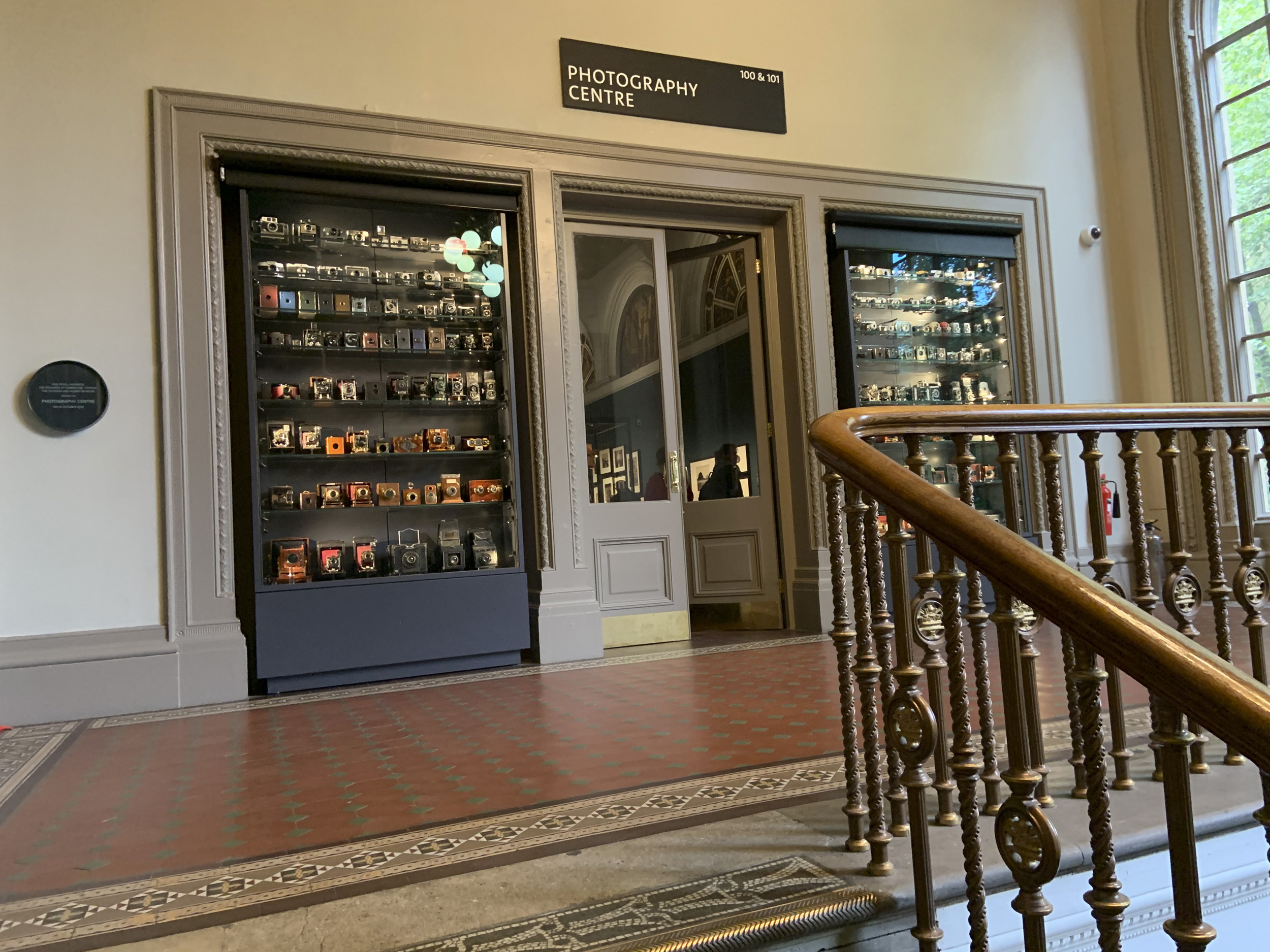
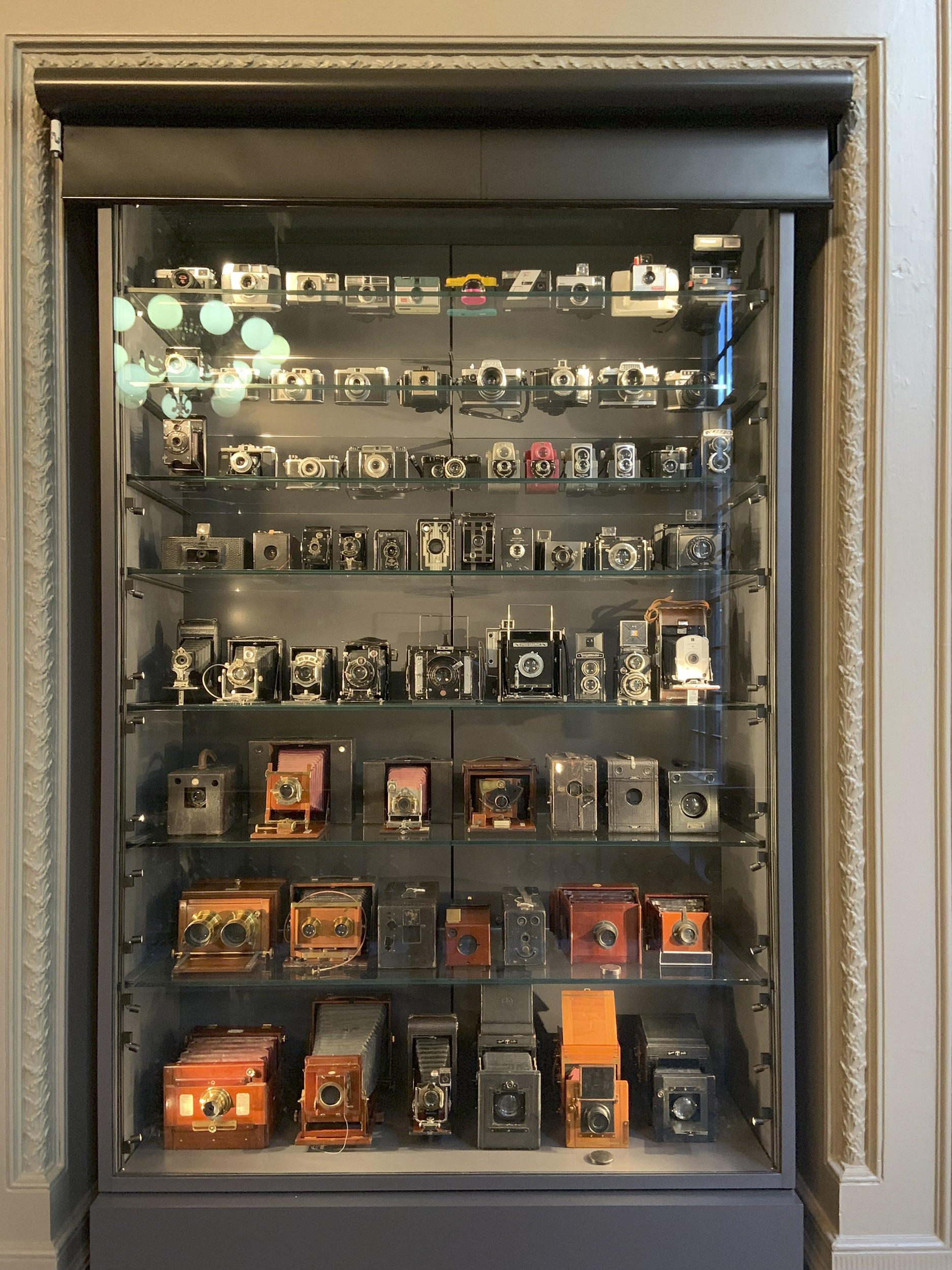
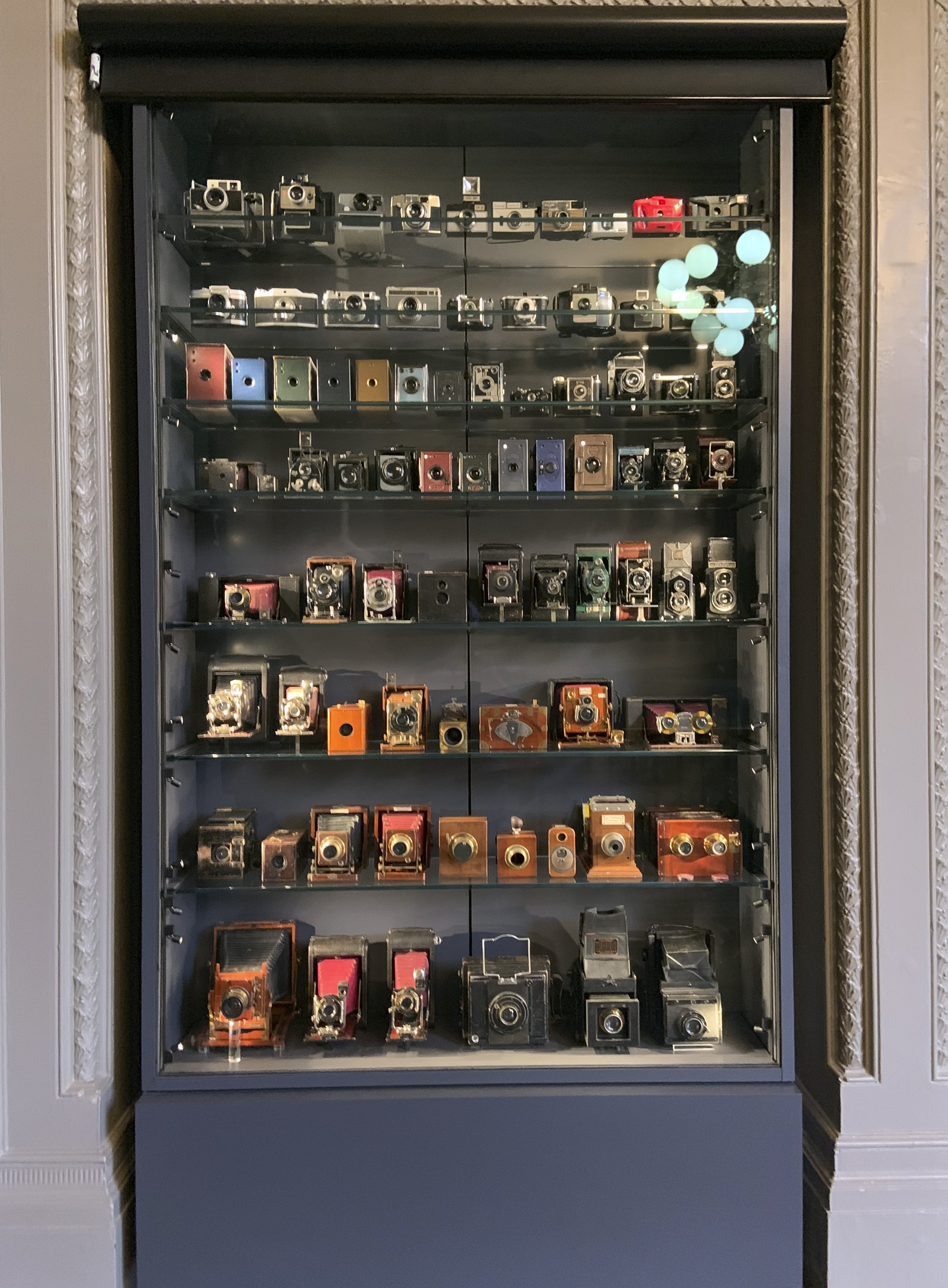
The V&A has been collecting photographs since 1856, the year the Museum was founded, and it was one of the first museums to present photography exhibitions. Since then the collection has grown to be one of the largest and most important in the world, comprising around 500,000 images. The V&A is now honoured to have added the Royal Photographic Society (RPS) collection to its holdings, which contains around 270,000 photographs, an extensive library, and 6,000 cameras and pieces of equipment associated with leading artists and photographic pioneers.
Take a behind-the-scenes look at our world class photography collection following the transfer of the Royal Photographic Society (RPS) Collection, which has enabled a dramatic reimagining of the way photography is presented at the V&A. The photographs curators introduce a series of five highlights that are on display in the new Photography Centre, which opened on 12th October 2018. The first phase of the centre will more than double the space dedicated to photography at the Museum.

Text from the V&A and YouTube websites


Unknown photographer. 'Photograph of Allied War exhibition, Serbian Section, V&A' 1917


Unknown photographer
Photograph of Allied War exhibition, Serbian Section, V&A (installation view)
1917
Gelatin silver print
The Royal Photographic Society Collection at the V&A Museum
Photo: Marcus Bunyan


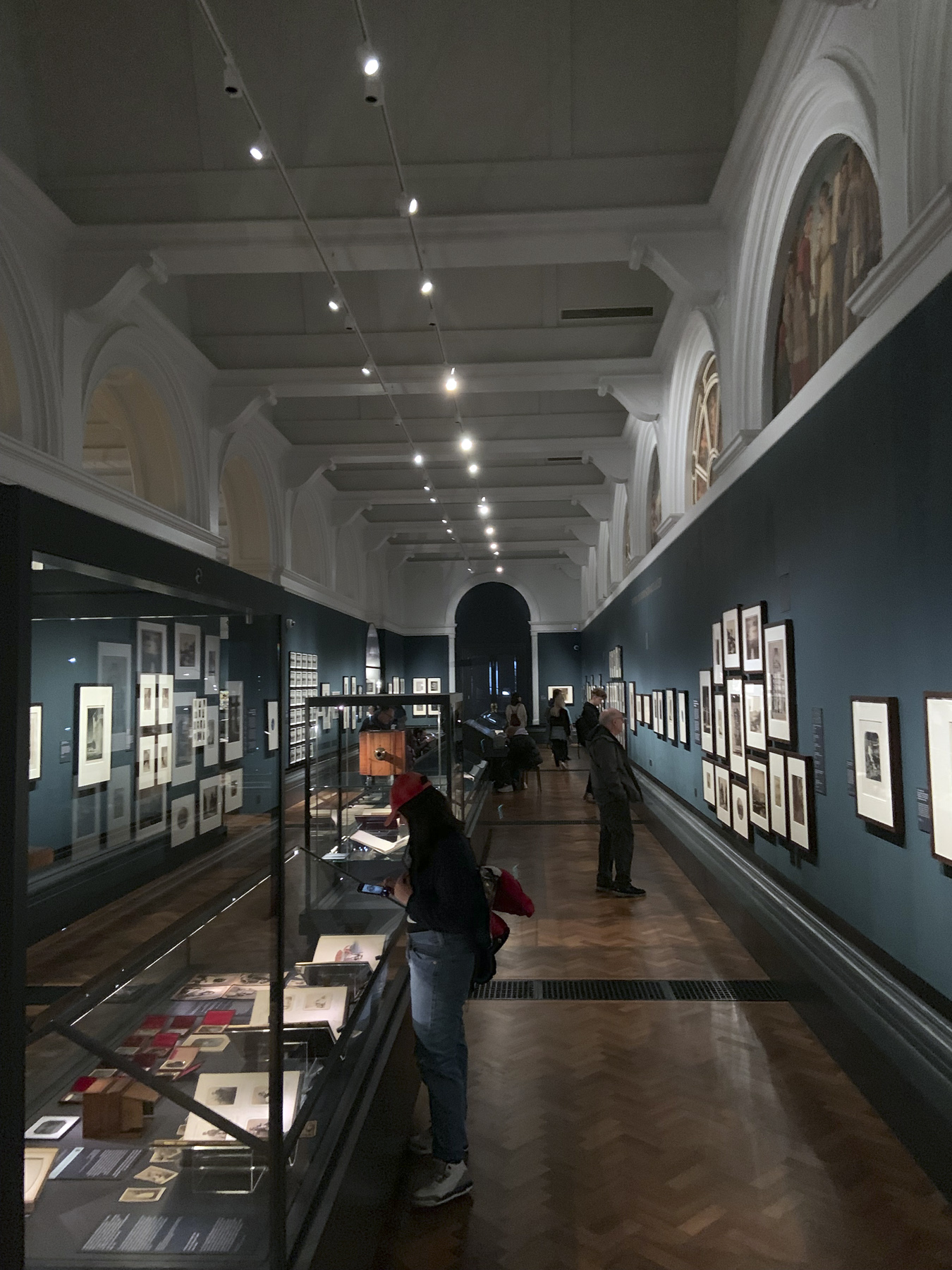
The V&A has been collecting and exhibiting photographs since the 1850s. This image shows part o a photographic exhibition held over 100 years ago in the same galleries you are standing in today. The exhibition presented a densely packed display of images depicting the Allied Powers during the First World War.


Installation view of the V&A Photography Centre, London

Installation view of the V&A Photography Centre, London

Installation view of the V&A Photography Centre, London

Installation view of the V&A Photography Centre, London

Wall text from the V&A Photography Centre, London

Installation view of the V&A Photography Centre, London


Installation views of the V&A Photography Centre, London
Photos: Marcus Bunyan


Joseph Nicéphore Niépce (French, 1765-1833) 'Christ Carrying his Cross' 1827 (installation view)

Joseph Nicéphore Niépce (French, 1765-1833) 'Christ Carrying his Cross' 1827 (installation view)


Joseph Nicéphore Niépce (French, 1765-1833)
Christ Carrying his Cross (installation views)
1827
Heliograph on pewter plate
The Royal Photographic Society Collection at the V&A Museum
Photos: Marcus Bunyan


The French inventor Niépce made the earliest surviving photographic images, which he called ‘heliographs’ or ‘sun-writing’. Only 16 are thought to still exist. Although Niépce experimented with light-sensitive plates inside a camera, he made most of his images, including this one, by placing engravings of works by other artists directly onto a metal plate. He would probably have had the resulting heliographs coated in ink and printed.


Joseph Nicéphore Niépce (French, 1765-1833) 'Christ Carrying his Cross' 1827 (installation view)


Joseph Nicéphore Niépce (French, 1765-1833)
Christ Carrying his Cross (installation view)
1827
Heliograph on pewter plate
The Royal Photographic Society Collection at the V&A Museum
Photo: Marcus Bunyan


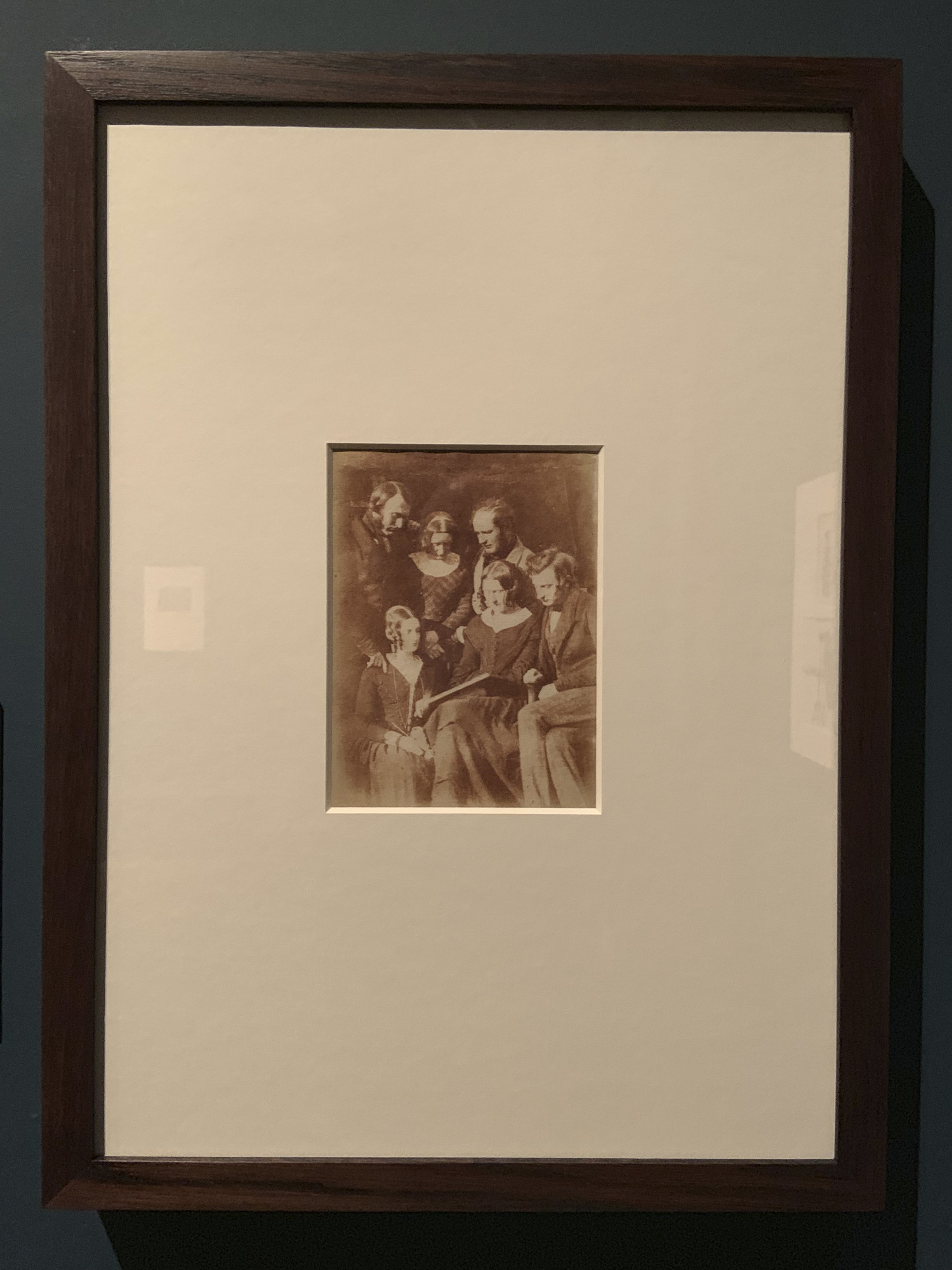
David Octavius Hill (Scottish, 1802-70) and Robert Adamson (Scottish, 1821-48) 'The Adamson Family' 1843-1845 (installation view)


David Octavius Hill (Scottish, 1802-1870) and Robert Adamson (Scottish, 1821-1848)
The Adamson Family (installation view)
1843-1845
Salted paper print
The Royal Photographic Society Collection at the V&A Museum
Photo: Marcus Bunyan


The partnership between Scottish painter Hill and chemist Adamson merged the art and science of photography. The pair initially intended to create preliminary studies for Hill’s paintings, but soon recognised photography’s artistic potential. With Hill’s knowledge of composition and lighting, and Adamson’s considerable sensitivity and dexterity in handling the camera, together they produced some of the most accomplished photographic portraits of their time.


William Henry Fox Talbot (British, 1800-77) 'The Haystack' 1844 from  the V&A Photography Centre, London 2019


William Henry Fox Talbot (British, 1800-1877)
The Haystack
1844
From The Pencil of Nature
Salted paper print
The Royal Photographic Society Collection at the V&A Museum


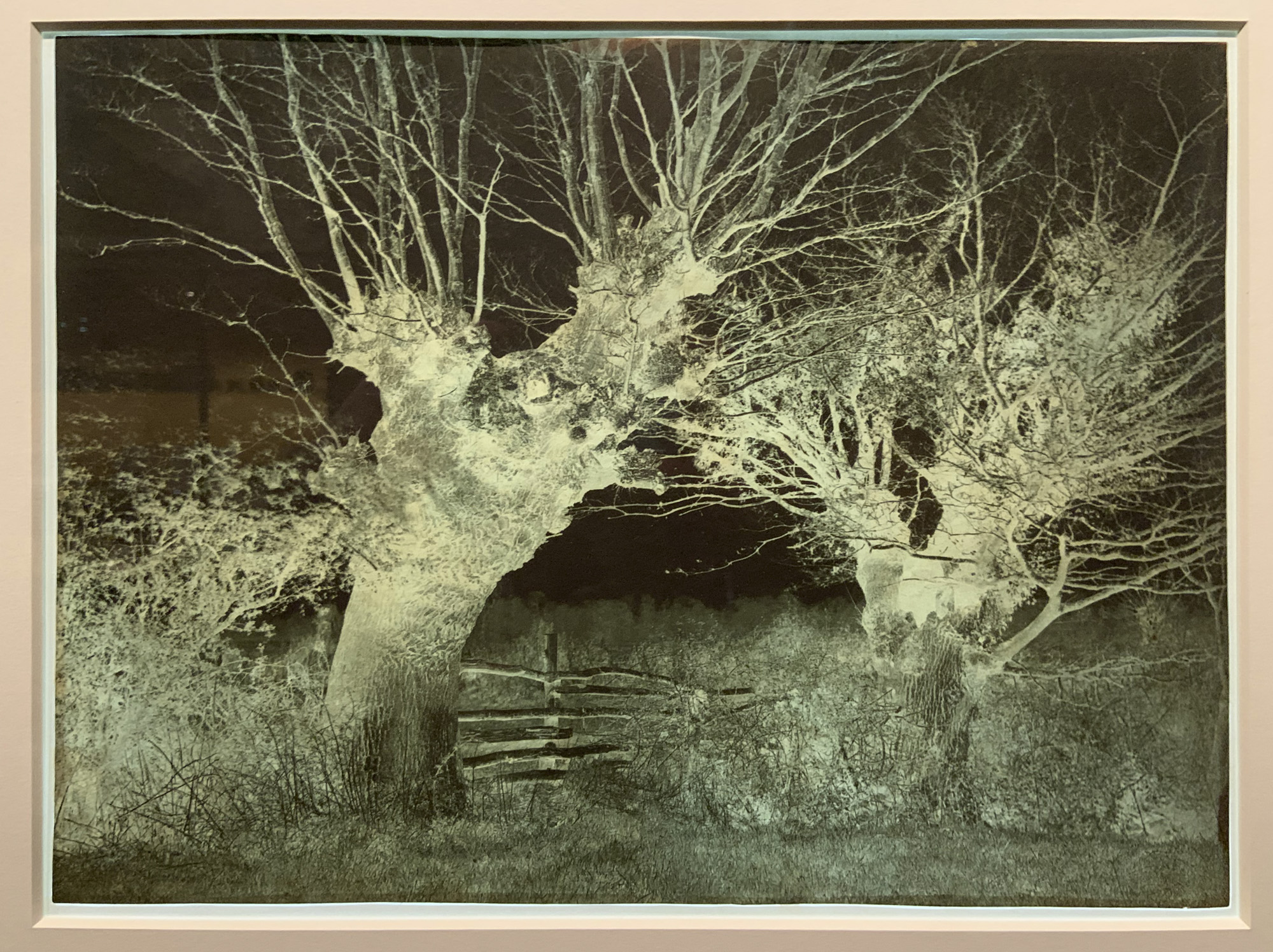
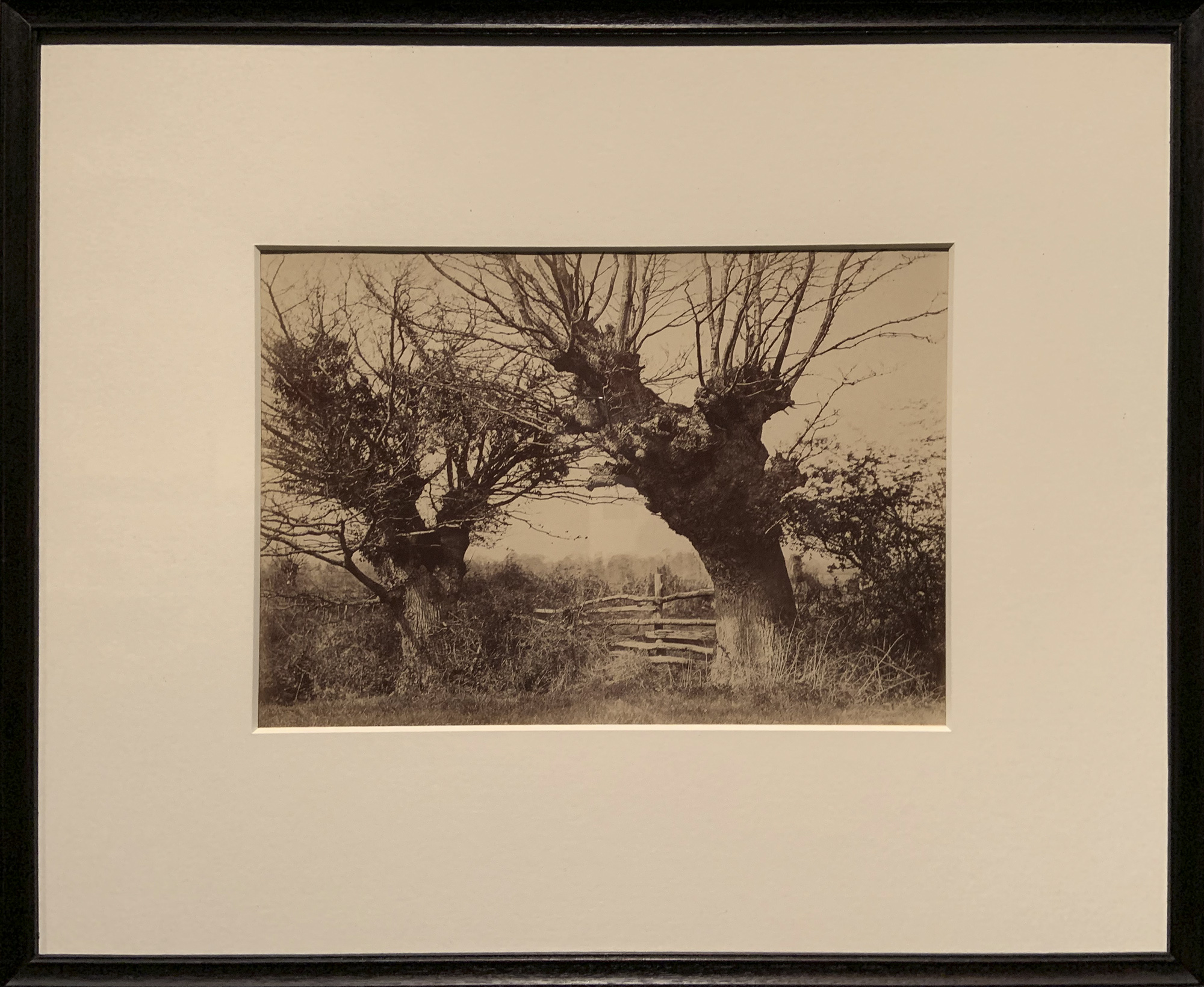
Benjamin Brecknell Turner (British, 1815-94) 'Hedgerow Trees, Clerkenleap' 1852-1854 (installation view)

Benjamin Brecknell Turner (British, 1815-94) 'Hedgerow Trees, Clerkenleap' 1852-1854 (installation view)


Benjamin Brecknell Turner (British, 1815-1894)
Hedgerow Trees, Clerkenleap (installation views)
1852-1854
Albumen print; Calotype negative
The Royal Photographic Society Collection at the V&A Museum
Photos: Marcus Bunyan


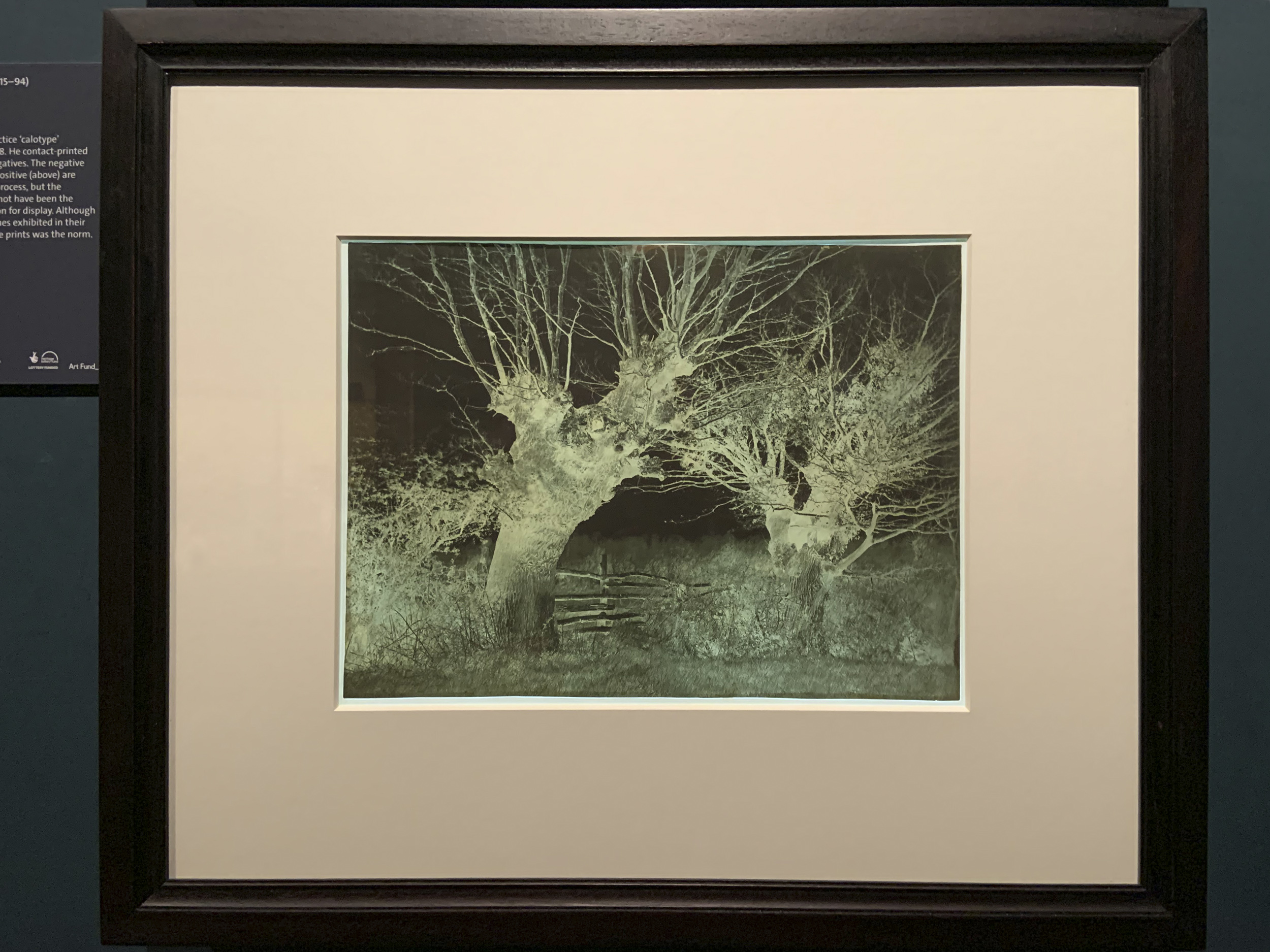
Turner took out a licence to practice ‘calotype’ photography from Talbot in 1848. He contact-printed positive images from paper negatives. The negative (below) and its corresponding positive (above) are reunited here to illustrate this process, but the pairing as you see them would not have been the photographer’s original intention for display. Although unique negatives were sometimes exhibited in their own right, only showing positive prints was the norm.


Benjamin Brecknell Turner (British, 1815-94) 'Hedgerow Trees, Clerkenleap' 1852-1854 (installation view)


Benjamin Brecknell Turner (British, 1815-1894)
Hedgerow Trees, Clerkenleap (installation view)
1852-1854
Albumen print; Calotype negative
The Royal Photographic Society Collection at the V&A Museum
Photo: Marcus Bunyan


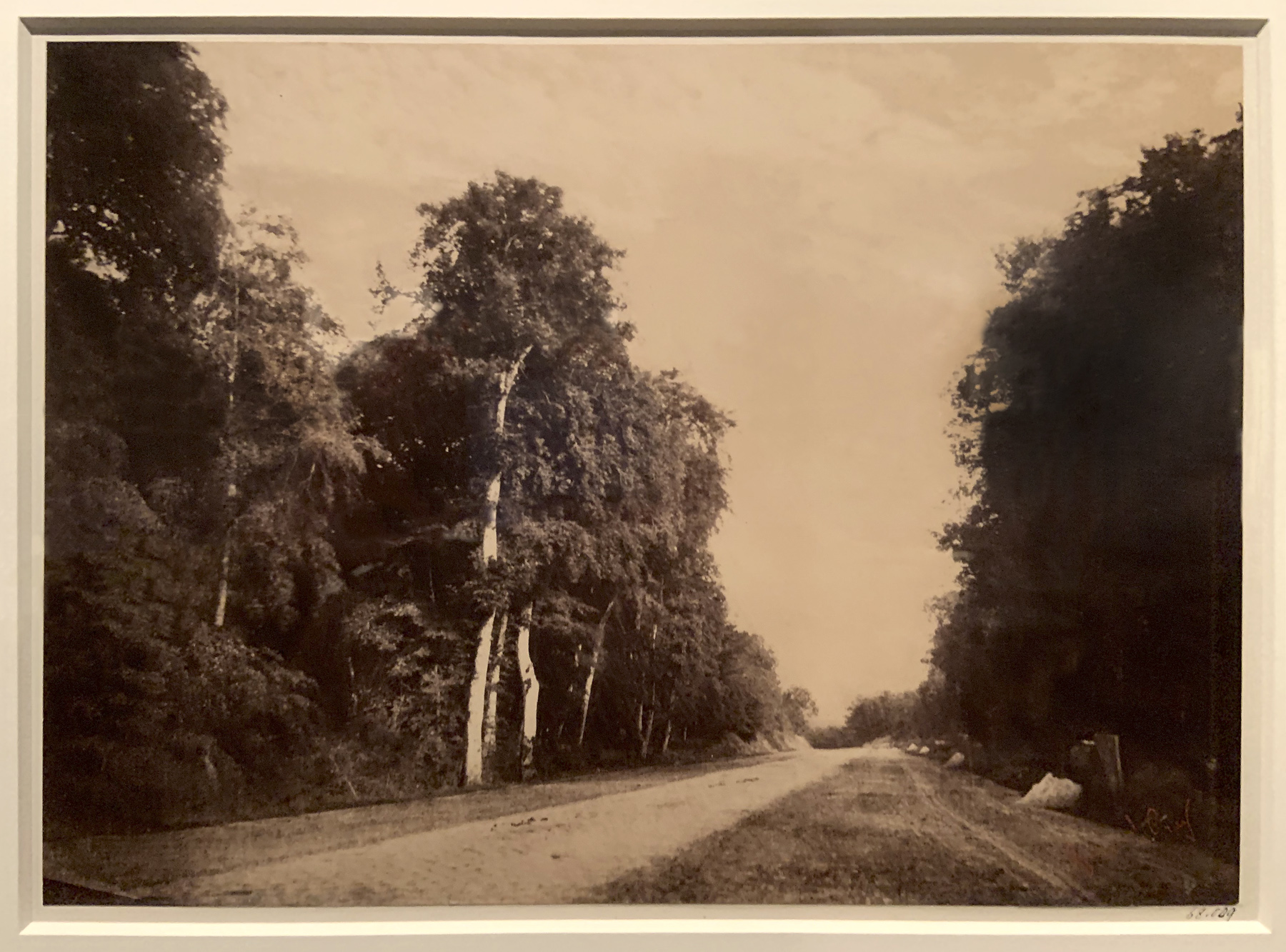
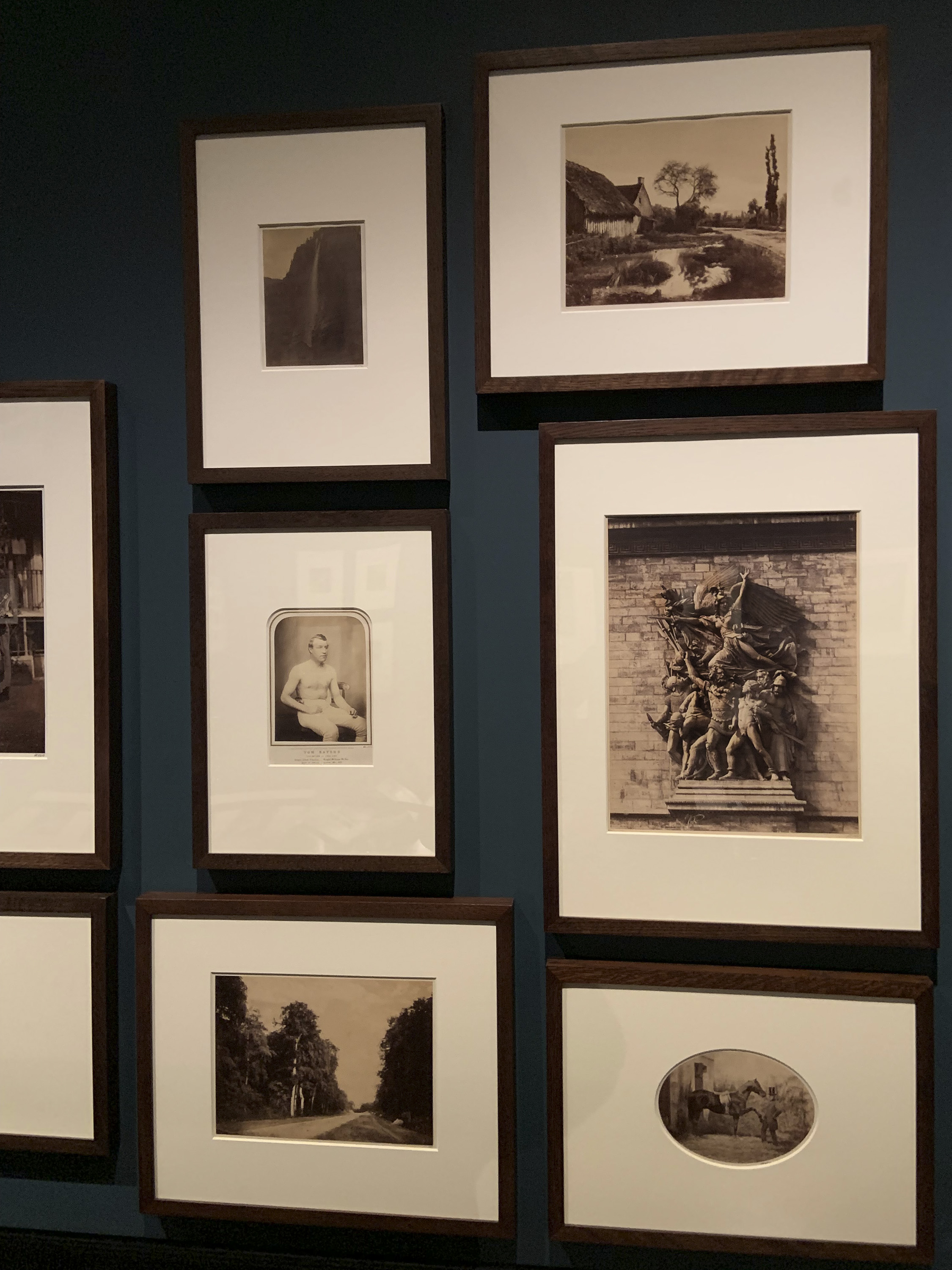
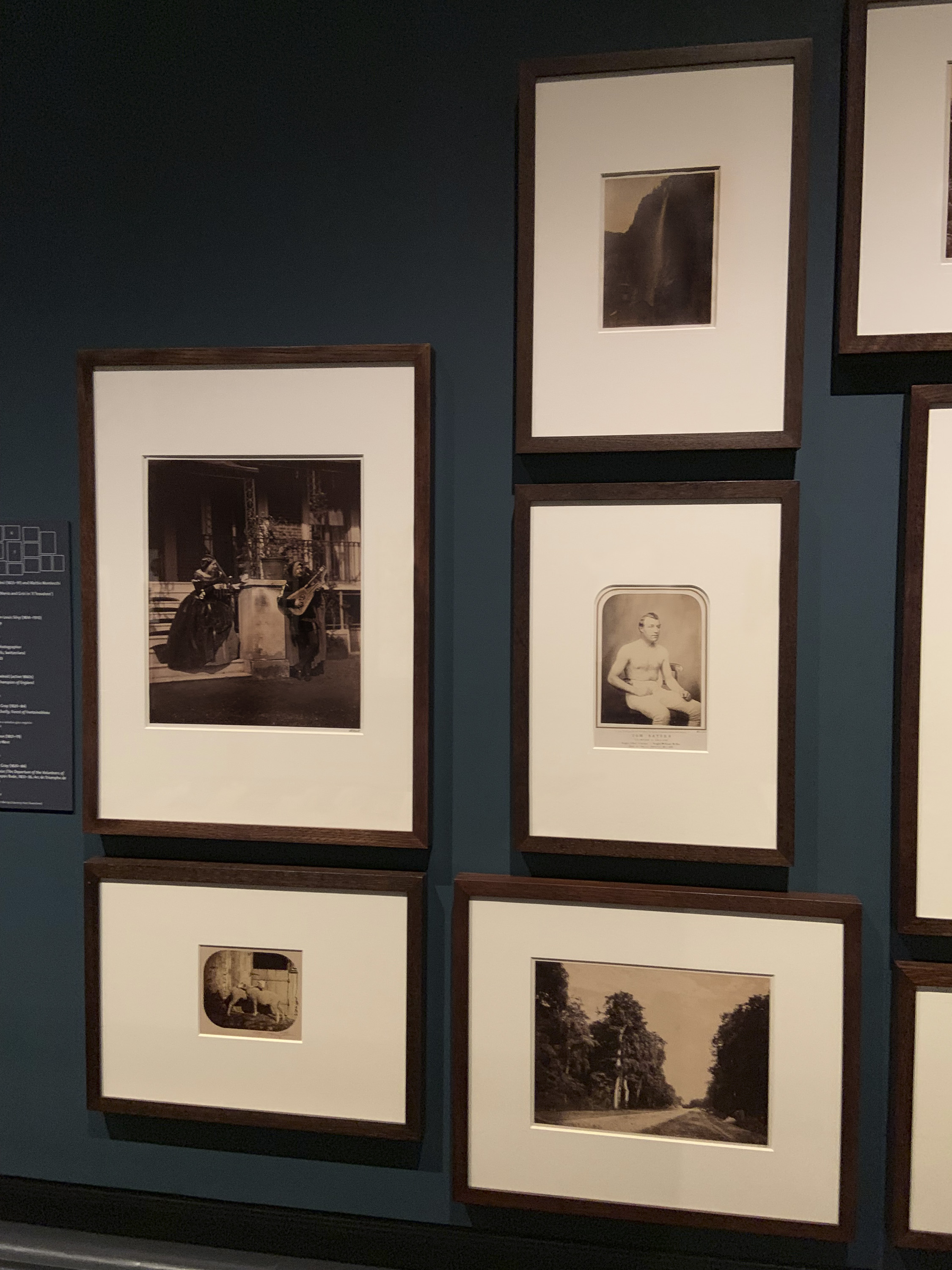
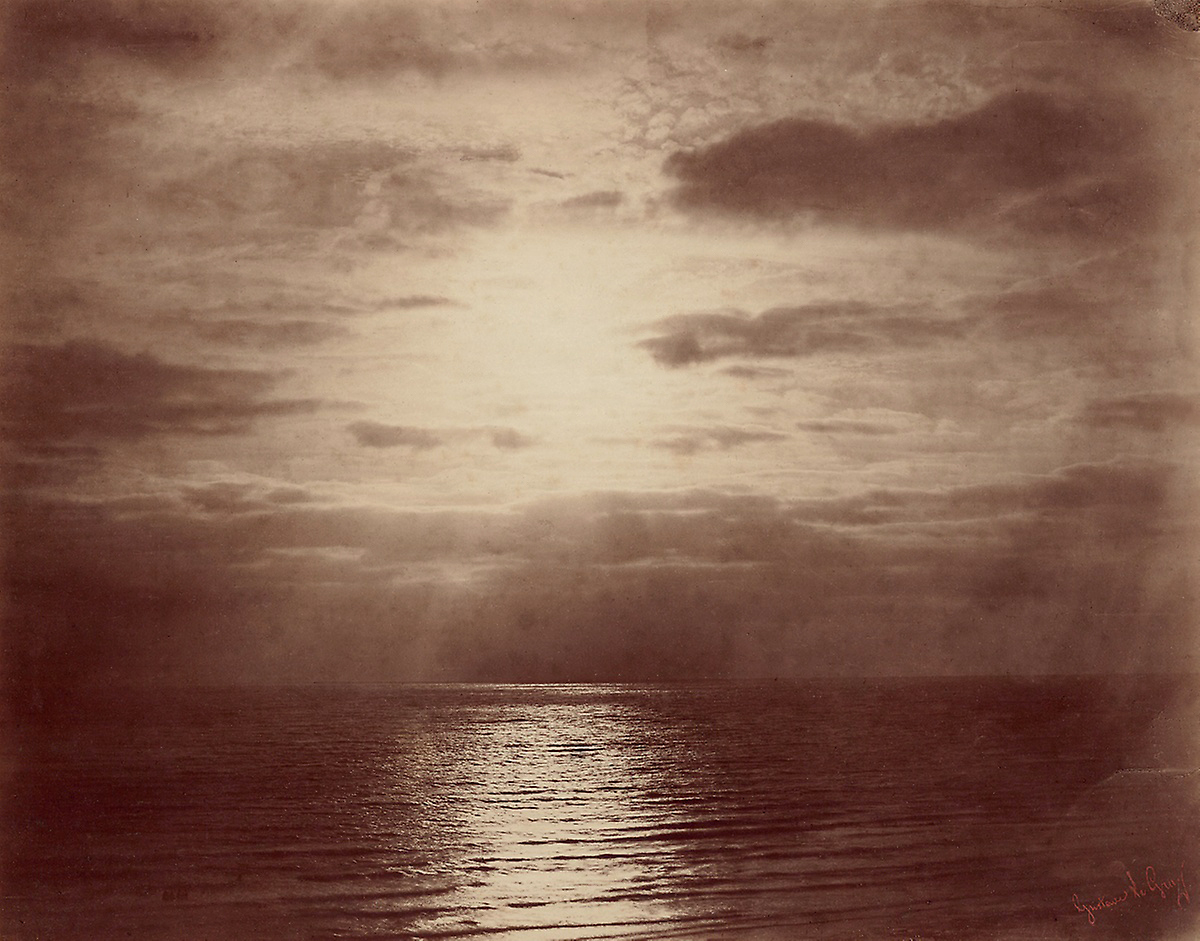
Gustave Le Gray (French, 1820-84) 'The Road to Chailly, Forest of Fontainebleau' 1852 (installation view)


Gustave Le Gray (French, 1820-1884)
The Road to Chailly, Forest of Fontainebleau (installation view)
1852
Albumen print from a collodion glass negative
Bequeathed to the V&A by Chauncey Hare Townshend
Photo: Marcus Bunyan


Installation view of the V&A Photography Centre, London

Installation view of the V&A Photography Centre, London

Wall text from the V&A Photography Centre, London


Installation views of the V&A Photography Centre, London
Photos: Marcus Bunyan


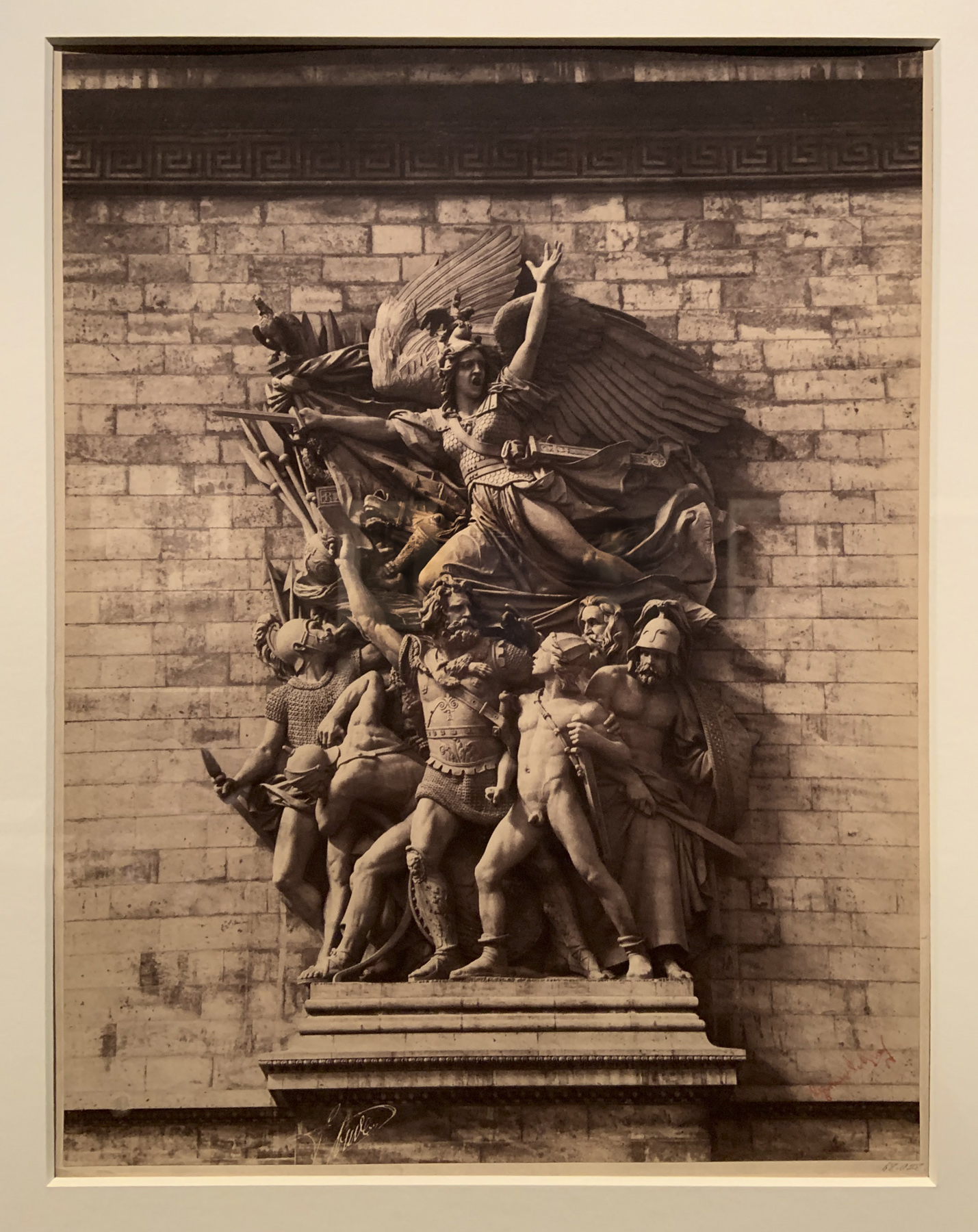
Gustave Le Gray (French, 1820-84) 'The Marseillaise (The Departure of the Volunteers of 1792), by Francois Rude, 1833-35, Arc de Triomphe de l’Etoile, Paris' 1852 (installation view)


Gustave Le Gray (French, 1820-1884)
The Marseillaise (The Departure of the Volunteers of 1792), by Francois Rude, 1833-35, Arc de Triomphe de l’Etoile, Paris (installation view)
1852
Albumen print
Bequeathed to the V&A by Chauncey Hare Townshend
Photo: Marcus Bunyan


Gustave Le Gray (French, 1820-1884) 'The Marseillaise (The Departure of the Volunteers of 1792), by Francois Rude, 1833-1835, Arc de Triomphe de l’Etoile, Paris' 1852 (installation view)


Gustave Le Gray (French, 1820-1884)
The Marseillaise (The Departure of the Volunteers of 1792), by Francois Rude, 1833-35, Arc de Triomphe de l’Etoile, Paris (installation view)
1852
Albumen print
Bequeathed to the V&A by Chauncey Hare Townshend
Photo: Marcus Bunyan


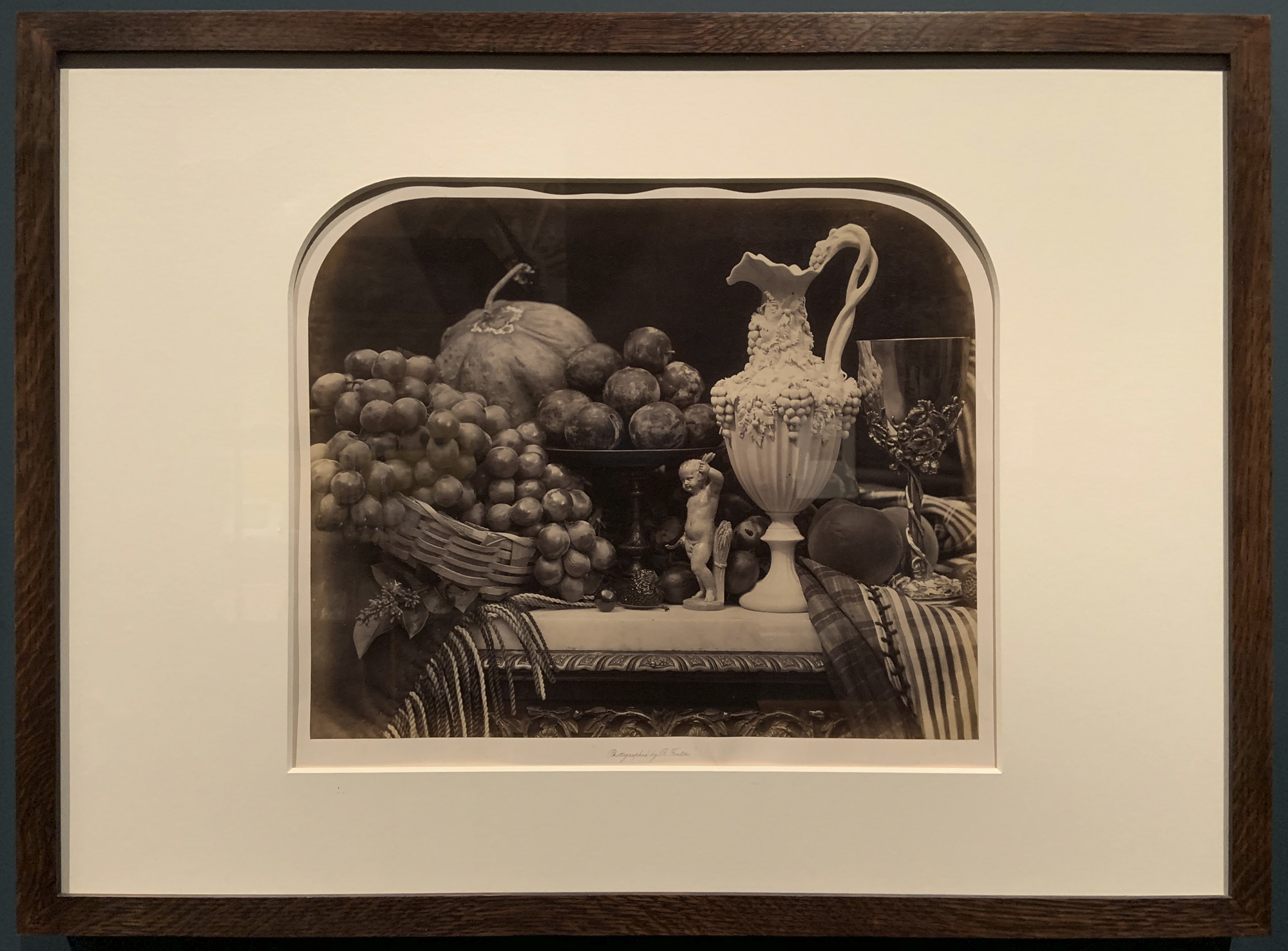
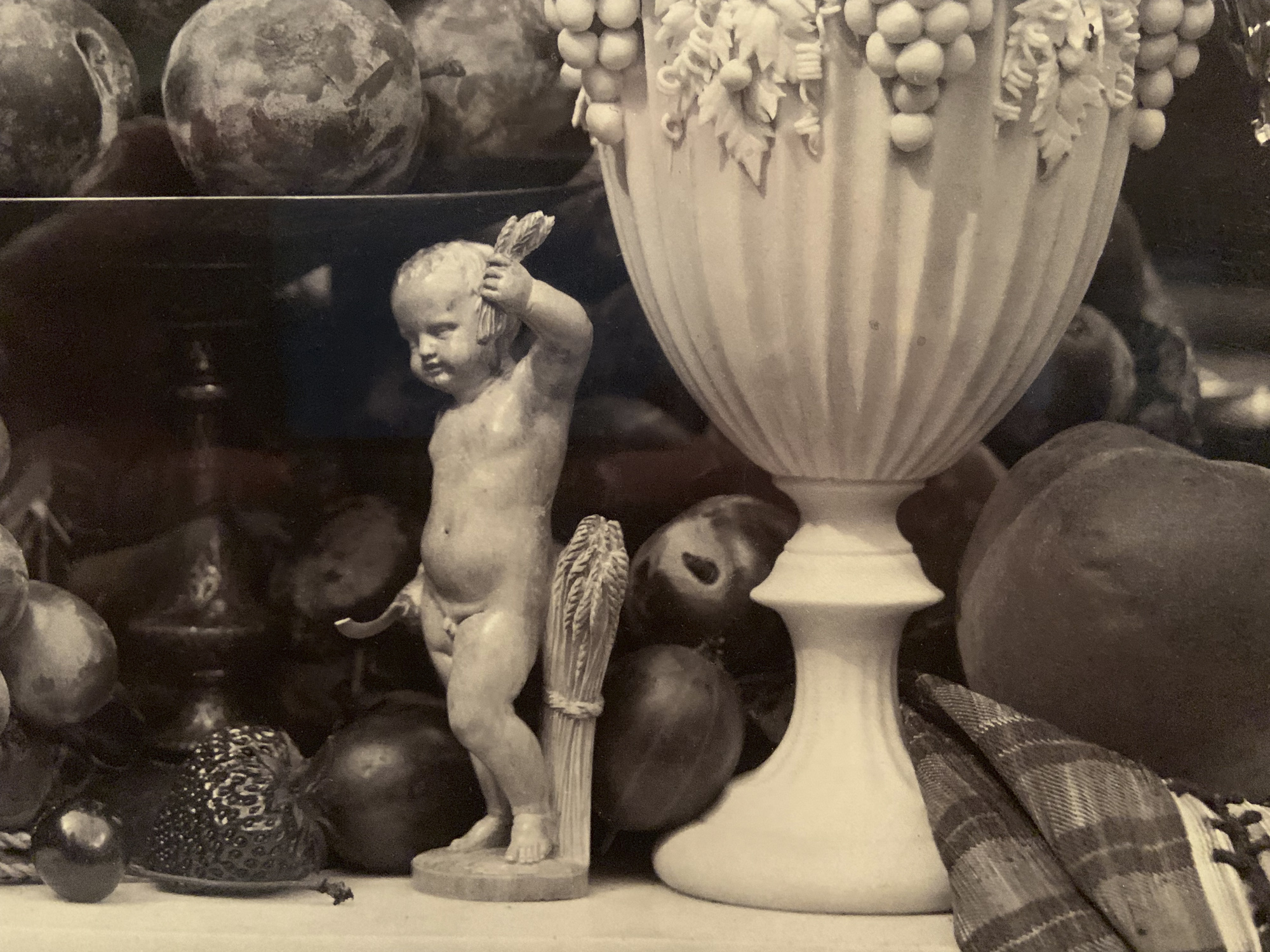
Roger Fenton (British, 1819-1869) 'Parian Vase, Grapes and Silver Cup' 1860 (installation view)


Roger Fenton (British, 1819-1869)
Parian Vase, Grapes and Silver Cup (installation view)
1860
Albumen print
The Royal Photographic Society Collection at the V&A Museum
Photo: Marcus Bunyan


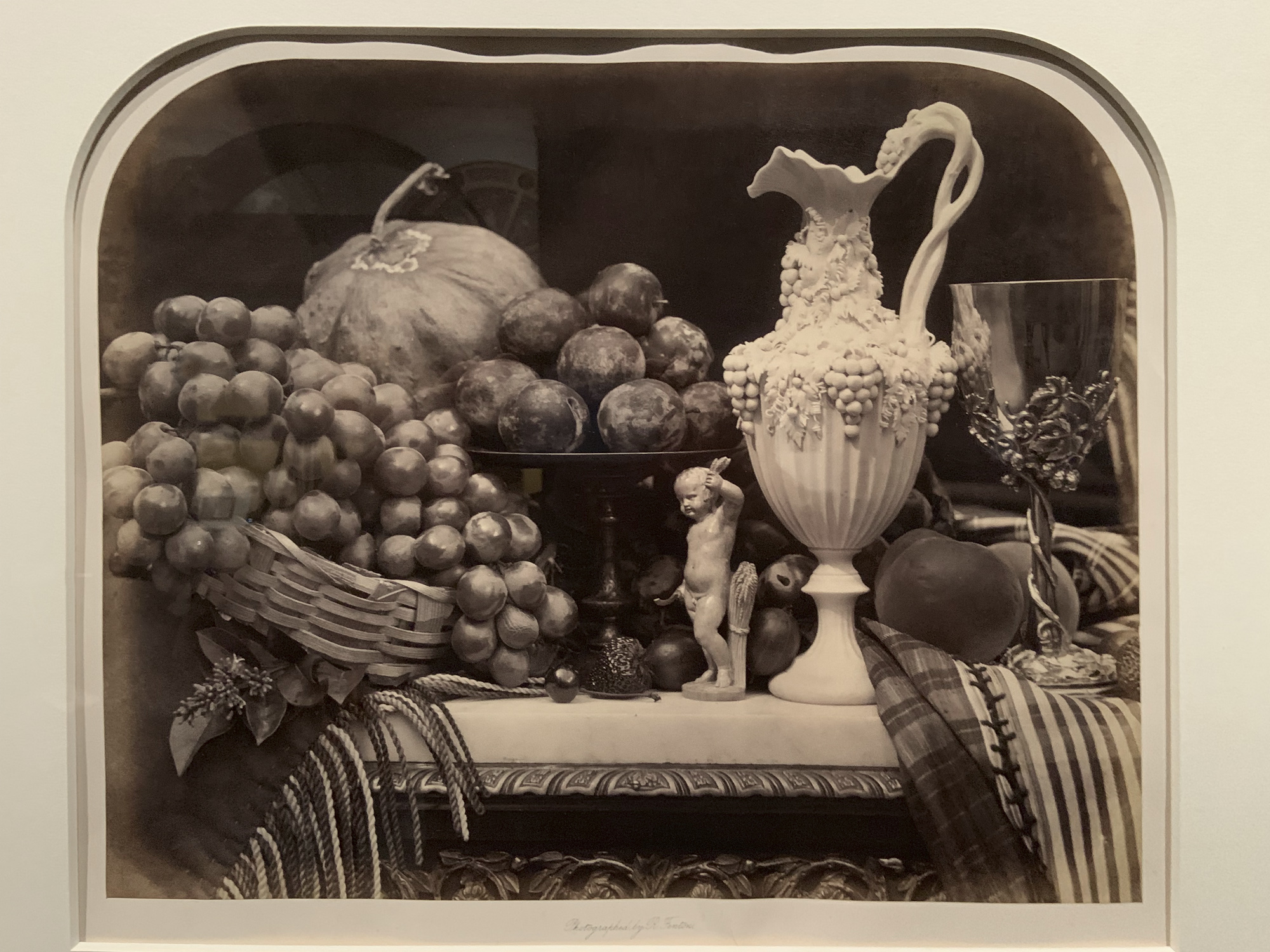
Fenton was one of the most versatile and technically brilliant photographers of the 19th century. He excelled at many subjects, including war photography, portraiture, architecture and landscape. He also made a series of lush still lives. Here, grapes, plums and peaches are rendered in exquisite detail, and the silver cup on the right reflects a camera tripod.


Roger Fenton (British, 1819-1869) 'Parian Vase, Grapes and Silver Cup' 1860 (installation view)


Roger Fenton (British, 1819-1869)
Parian Vase, Grapes and Silver Cup (installation view)
1860
Albumen print
The Royal Photographic Society Collection at the V&A Museum
Photo: Marcus Bunyan


Roger Fenton (British, 1819-1869) 'Parian Vase, Grapes and Silver Cup' 1860 (installation view)


Roger Fenton (British, 1819-1869)
Parian Vase, Grapes and Silver Cup (installation view)
1860
Albumen print
The Royal Photographic Society Collection at the V&A Museum
Photo: Marcus Bunyan


Roger Fenton (British, 1819-1869) 'Parian Vase, Grapes and Silver Cup' 1860 (installation view detail)


Roger Fenton (British, 1819-1869)
Parian Vase, Grapes and Silver Cup (installation view detail)
1860
Albumen print
The Royal Photographic Society Collection at the V&A Museum
Photo: Marcus Bunyan


Roger Fenton (British, 1819-1869) 'Still Life with Fruit and Decanter' 1860 from the V&A Photography Centre, London 2019


Roger Fenton (British, 1819-1869)
Still Life with Fruit and Decanter
1860
Albumen print
The Royal Photographic Society Collection at the V&A Museum


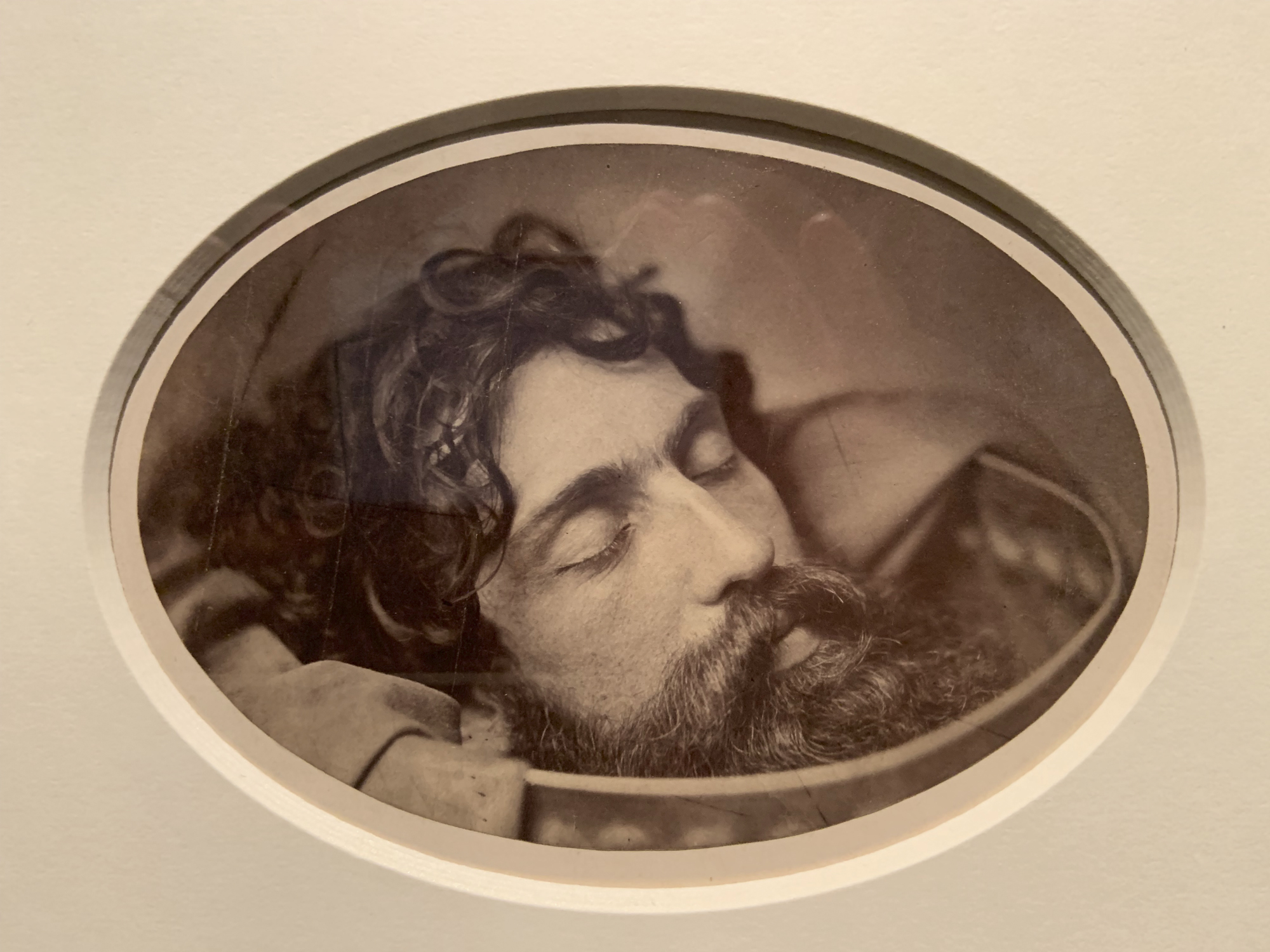
Oscar Gustaf Rejlander (British born Sweden, 1813-1875) 'Head of St John the Baptist on a Charger' c. 1856 (installation view)


Oscar Gustaf Rejlander (British born Sweden, 1813-1875)
Head of St John the Baptist on a Charger (installation view)
c. 1856
Albumen print
The Royal Photographic Society Collection at the V&A Museum
Photo: Marcus Bunyan


Rejlander probably intended this photograph to be part of a larger composition telling the biblical story of Salome, in which the severed head of John the Baptist was presented to her on a plate. Rejlander never made the full picture, however, and instead produced multiple prints of the head alone.


Oscar Gustaf Rejlander (British born Sweden, 1813-75) 'Head of St John the Baptist on a Charger' c. 1856 (installation view)


Oscar Gustaf Rejlander (British born Sweden, 1813-1875)
Head of St John the Baptist on a Charger (installation view)
c. 1856
Albumen print
The Royal Photographic Society Collection at the V&A Museum


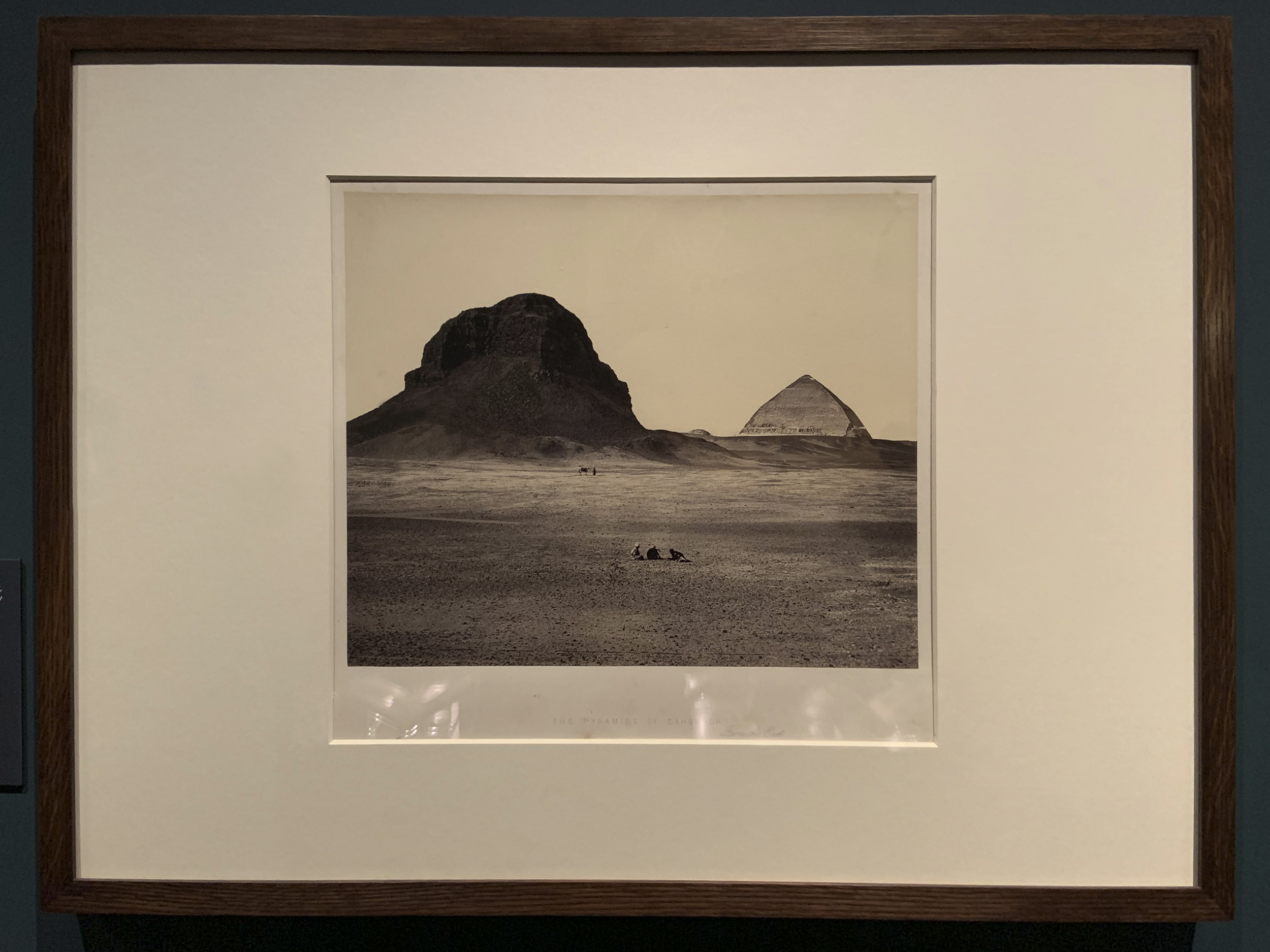
Francis Frith (British, 1822-1898) 'Th', from Egypt, Sinai, and Jerusalem: A Series of Twenty Photographic Views by Francis Frith 1858 (published 1860 or 1862) (installation view)


Francis Frith (British, 1822-1898)
The Pyramids of Dahshoor [Dahshur], from the East, from Egypt, Sinai, and Jerusalem: A Series of Twenty Photographic Views by Francis Frith (installation view)
1858 (published 1860 or 1862)
Albumen print
The Royal Photographic Society Collection at the V&A Museum
Photo: Marcus Bunyan


Frith’s photographs were popular and circulated widely, both because of their architectural interest and because they often featured sites mentioned in the Bible. Photographs of places described in biblical stories brought a new level of realism to a Christian Victorian audience, previously only available through the interpretations of a painter or illustrator.


Francis Frith (British, 1822-1898) 'Th', from Egypt, Sinai, and Jerusalem: A Series of Twenty Photographic Views by Francis Frith 1858 (published 1860 or 1862) (installation view)


Francis Frith (British, 1822-1898)
The Pyramids of Dahshoor [Dahshur], from the East, from Egypt, Sinai, and Jerusalem: A Series of Twenty Photographic Views by Francis Frith (installation view)
1858 (published 1860 or 1862)
Albumen print
The Royal Photographic Society Collection at the V&A Museum
Photo: Marcus Bunyan


Francis Frith (British, 1822-98) 'The Pyramids of Dahshoor [Dahshur], from the East, from Egypt, Sinai, and Jerusalem: A Series of Twenty Photographic Views by Francis Frith' 1858 (published 1860 or 1862) from the V&A Photography Centre, London 2019


Francis Frith (British, 1822-1898)
The Pyramids of Dahshoor [Dahshur], from the East, from Egypt, Sinai, and Jerusalem: A Series of Twenty Photographic Views by Francis Frith
1858 (published 1860 or 1862)
Albumen print
The Royal Photographic Society Collection at the V&A Museum
Photo: Marcus Bunyan


Installation view of the V&A Photography Centre, London


Installation view of the V&A Photography Centre, London
Photo: Marcus Bunyan


Gustave Le Gray (French, 1820-1884) 'Solar Effect in the Clouds – Ocean' 1856-1859 (installation view)


Gustave Le Gray (French, 1820-1884)
Solar Effect in the Clouds – Ocean (installation view)
1856-1859
Albumen Print
Bequeathed to the V&A by Chauncey Hare Townshend
Photo: Marcus Bunyan


Gustave Le Gray (French, 1820-1884) 'Solar Effect in the Clouds – Ocean' 1856-1859


Gustave Le Gray (French, 1820-1884)
Solar Effect in the Clouds – Ocean
1856-1859
Albumen Print
Art Institute of Chicago
Creative Commons Zero (CC0)


Gustave Le Gray (French, 1820-1884) 'The Imperial Yacht, La Reine Hortense, Le Havre' 1856-1857 (installation view)


Gustave Le Gray (French, 1820-1884)
The Imperial Yacht, La Reine Hortense, Le Havre (installation view)
1856-1857
Albumen print
Bequeathed to the V&A by Chauncey Hare Townshend
Photo: Marcus Bunyan


Gustave Le Gray (French, 1820-1884) 'The Imperial Yacht, La Reine Hortense, Le Havre' 1856-1857 (installation view)


Gustave Le Gray (French, 1820-1884)
The Imperial Yacht, La Reine Hortense, Le Havre (installation view)
1856-1857
Albumen print
Bequeathed to the V&A by Chauncey Hare Townshend
Photo: Marcus Bunyan


Gustave Le Gray (French, 1820-1884) 'The Imperial Yacht, La Reine Hortense, Le Havre' 1856-1857


Gustave Le Gray (French, 1820-1884)
The Imperial Yacht, La Reine Hortense, Le Havre
1856-1857
Albumen print
The Metropolitan Museum of Art
Public domain


Gustave Le Gray (French, 1820-1884) 'Pavilion Richelieu, Louvre, Paris' 1857-1859 (installation view)


Gustave Le Gray (French, 1820-1884)
Pavilion Richelieu, Louvre, Paris (installation view)
1857-1859
Albumen print
Bequeathed to the V&A by Chauncey Hare Townshend
Photo: Marcus Bunyan


Gustave Le Gray (French, 1820-1884) 'Pavilion Richelieu, Louvre, Paris' 1857-1859 (installation view)


Gustave Le Gray (French, 1820-1884)
Pavilion Richelieu, Louvre, Paris (installation view)
1857-1859
Albumen print
Bequeathed to the V&A by Chauncey Hare Townshend
Photo: Marcus Bunyan


Roger Fenton (British, 1819-1869) 'Balaclava from Guard’s Hill, the Crimea' 1855 (installation view)


Roger Fenton (British, 1819-1869)
Balaclava from Guard’s Hill, the Crimea (installation view)
1855
Albumen print
Bequeathed to the V&A by Chauncey Hare Townshend
Photo: Marcus Bunyan


Roger Fenton (British, 1819-1869) 'Balaclava from Guard’s Hill, the Crimea' 1855 (installation view)


Roger Fenton (British, 1819-69)
Balaclava from Guard’s Hill, the Crimea (installation view)
1855
Albumen print
Bequeathed to the V&A by Chauncey Hare Townshend
Photo: Marcus Bunyan


Julia Margaret Cameron (British born India, 1815-1879) 'Lucia' 1864-1865 (installation view)


Julia Margaret Cameron (British, born India, 1815-1879)
Lucia (installation view)
1864-1865
Albumen print
The Royal Photographic Society Collection at the V&A Museum
Photo: Marcus Bunyan


Charles Lutwide Dodgson (also known as Lewis Carroll)(British, 1832-1898) 'Tea Merchant (On Duty)' and 'Tea Merchant (Off Duty)' 1873 (installation view)


Charles Lutwide Dodgson (also known as Lewis Carroll)(British, 1832-1898)
Tea Merchant (On Duty) and Tea Merchant (Off Duty) (installation view)
1873
Albumen prints
The Royal Photographic Society Collection at the V&A Museum
Photo: Marcus Bunyan


Lewis Carroll is best known as the author of Alice’s Adventures in Wonderland, but he was also an accomplished amateur photographer. Approximately half of his photographs are portraits of children, sometimes wearing foreign costumes or acting out scenes. Here, Alexandra ‘Xie’ Kitchen, his most frequent child sitter, poses in Chinese dress on a stack of tea chests.


Charles Lutwide Dodgson (also known as Lewis Carroll)(British, 1832-1898) 'Tea Merchant (On Duty)' 1873 (installation view)


Charles Lutwide Dodgson (also known as Lewis Carroll)(British, 1832-1898)
Tea Merchant (On Duty) (installation view)
1873
Albumen prints
The Royal Photographic Society Collection at the V&A Museum
Photo: Marcus Bunyan


Charles Lutwide Dodgson (also known as Lewis Carroll)(British, 1832-1898) 'Tea Merchant (Off Duty)' 1873 (installation view)


Charles Lutwide Dodgson (also known as Lewis Carroll)(British, 1832-1898)
Tea Merchant (Off Duty) (installation view)
1873
Albumen prints
The Royal Photographic Society Collection at the V&A Museum
Photo: Marcus Bunyan


Julia Margaret Cameron (British, born India, 1815-1879) 'Pomona' 1887 (installation view)


Julia Margaret Cameron (British, born India, 1815-1879)
Pomona (installation view)
1887
Albumen print
The Royal Photographic Society Collection at the V&A Museum
Photo: Marcus Bunyan


The South Kensington museum (now the V&A) was the only museum to collect and exhibit Julia Margaret Cameron’s during her lifetime. This is one of several studies she made of Alice Liddell, who as a child had modelled for the author and photographer Lewis Carroll and inspired his novel Alice’s Adventures in Wonderland. Cameron, Carroll and Liddell moved in overlapping artistic and intellectual circles. Here, surrounded by foliage, a grown-up Alice poses as the Roman goddess of orchards and gardens.


Julia Margaret Cameron (British, born India, 1815-1879) 'Pomona' 1887 (installation view)


Julia Margaret Cameron (British, born India, 1815-1879)
Pomona (installation view)
1887
Albumen print
The Royal Photographic Society Collection at the V&A Museum
Photo: Marcus Bunyan


Installation view of the V&A Photography Centre, London


Installation view of the V&A Photography Centre, London
Photo: Marcus Bunyan


Alvin Langdon Coburn (American 1882-1966) 'Frederick Holland Day' 1900 (installation view)


Alvin Langdon Coburn (American 1882-1966)
Frederick Holland Day (installation view)
1900
Gum platinum print
The Royal Photographic Society Collection at the V&A Museum
Photo: Marcus Bunyan


The British-American photographer Alvin Langdon Coburn enjoyed success on both sides of the Atlantic. Active in the early 20th century, he gained recognition from a young age as a talented photographer. His style ranged from the painterly softness of Pictorialism to the unusual vantage points and abstraction of Modernism. As well as being a practising photographer, Coburn was an avid collector. In 1930 he donated over 600 photographs to the Royal Photographic Society. The gift included examples of Coburn’s own work alongside that of his contemporaries, many of whom are now considered to be the most influential of their generation. Coburn also collected historic photographs, and was among the first in his time to rediscover and appreciate the work of 19th-century masters like Julia Margaret Cameron and Hill and Adamson.


Fredrick Holland Day (American, 1864-1933) 'Head of a Girl, Hampton, Virginia' 1905 (installation view)


Fredrick Holland Day (American, 1864-1933)
Head of a Girl, Hampton, Virginia (installation view)
1905
Gum platinum print
The Royal Photographic Society Collection at the V&A Museum
Photo: Marcus Bunyan


Day made this portrait when he visited the Hampton Institute in Virginia, which was founded after the American Civil War as a teacher-training school for freed slaves. The institute’s camera club invited Day to visit the school and critique the work of its students. Day’s friend and fellow photographer, Frederick Evans, donated this strikingly modern composition to the Royal Photographic Society in 1937.


Fredrick Holland Day (American, 1864-1933) 'Head of a Girl, Hampton, Virginia' 1905 (installation view)


Fredrick Holland Day (American, 1864-1933)
Head of a Girl, Hampton, Virginia (installation view)
1905
Gum platinum print
The Royal Photographic Society Collection at the V&A Museum
Photo: Marcus Bunyan


Fredrick Holland Day (American, 1864-1933) 'Head of a Girl, Hampton, Virginia' 1905 (installation view)


Fredrick Holland Day (American, 1864-1933)
Head of a Girl, Hampton, Virginia (installation view)
1905
Gum platinum print
The Royal Photographic Society Collection at the V&A Museum
Photo: Marcus Bunyan


Fredrick Holland Day (American, 1864-1933) 'Head of a Girl, Hampton, Virginia' 1905


Fredrick Holland Day (American, 1864-1933)
Head of a Girl, Hampton, Virginia
1905
Gum platinum print
The Royal Photographic Society Collection at the V&A Museum


Gertrude Käsebier (American, 1852-1934) 'The Letter' 1906


Gertrude Käsebier (American, 1852-1934)
The Letter
1906
Platinum print
The Royal Photographic Society Collection at the V&A Museum


Käsebier studied painting before opening a photography studio in New York. Her Pictorialist photographs often combine soft focus with experimental printing techniques. These sisters were dressed in historic costume for a ball, but their pose transforms a society portrait into a narrative picture. In a variant image, they turn to look at the framed silhouette on the wall.


Installation view of the V&A Photography Centre, London

Wall text from the V&A Photography Centre, London


Installation views of the V&A Photography Centre, London
Photo: Marcus Bunyan


Francis James Mortimer (British, 1874-1944) 'Alvin Langdon Coburn at the Opening of His One-Man Exhibition the Royal Photographic Society, London' 1906 (installation view)


Francis James Mortimer (British, 1874-1944)
Alvin Langdon Coburn at the Opening of His One-Man Exhibition the Royal Photographic Society, London (installation view)
1906
Carbon print
The Royal Photographic Society Collection at the V&A Museum
Photo: Marcus Bunyan


Annie Wardrope Brigman (American, 1869-1950) 'The Spirit of Photography' c. 1908


Annie Wardrope Brigman (American, 1869-1950)
The Spirit of Photography
c. 1908
Platinum print
The Royal Photographic Society Collection at the V&A Museum


Alvin Langdon Coburn (American 1882-1966) 'Kensington Gardens' 1910 (installation view)


Alvin Langdon Coburn (American 1882-1966)
Kensington Gardens (installation view)
1910
Platinum print
The Royal Photographic Society Collection at the V&A Museum
Photo: Marcus Bunyan


Cover of 'Camera Work'


Cover of Camera Work Number XXVI (installation view)
Photo: Marcus Bunyan


Edward Steichen (American, 1879-1973) 'Portrait – Lady H' 1908 from 'Camerwork 22'


Edward Steichen (American, 1879-1973)
Portrait – Lady H (installation view)
1908
Camera Work 22
1908
Photogravure
The Royal Photographic Society Collection at the V&A Museum
Photo: Marcus Bunyan


Edward Steichen (American, 1879-1973) 'Portrait – Lady H' 1908 from 'Camerwork 22'


Edward Steichen (American, 1879-1973)
Portrait – Lady H
1908
Camera Work 22
1908
Photogravure
The Royal Photographic Society Collection at the V&A Museum


Paul Strand (American, 1890-1976) 'New York' 1916 from 'Camerwork 48' (installation view)


Paul Strand (American, 1890-1976)
New York (installation view)
1916
Camera Work 48
1916
Photogravure
The Royal Photographic Society Collection at the V&A Museum
Photo: Marcus Bunyan


Alfred Stieglitz (American, 1864-1946) was an American photographer, publisher, writer and gallery owner. From 1903-1917, he published the quarterly journal Camera Work, which featured portfolios of exquisitely printed photogravures (a type of photograph printed in ink), alongside essays and reviews. Camera Work promoted photography as an art form, publishing the work of Pictorialist photographers who drew inspiration from painting, and reproducing 19th-century photographs. It also helped to introduce modern art to American audiences, including works by radical European painters such as Matisse and Picasso.


Alvin Langdon Coburn (American 1882-1966) 'Vortograph' 1917 (installation view)


Alvin Langdon Coburn (American 1882-1966)
Vortograph (installation view)
1917
Bromide print
The Royal Photographic Society Collection at the V&A Museum
Photo: Marcus Bunyan


Rudolph Koppitz. 'Movement Study' 1925


Rudolph Koppitz (American, 1884-1936)
Bewegungsstudie (Movement Study)
1926
Carbon print
The Royal Photographic Society Collection at the V&A Museum


Koppitz was a leading art photographer in Vienna between the two World Wars, as well as a master of complex printing processes, including the pigment, gum and broccoli process of transfer printing. Tis dynamic and sensual composition captures dancers from the Vienna State Opera Ballet frozen mid-movement.


Herbert Bayer (Austrian American, 1900-1985) 'Shortly Before Dawn' 1932-1939 (installation view)


Herbert Bayer (Austrian American, 1900-85)
Shortly Before Dawn (installation view)
1932-39
Gelatin silver print
The Royal Photographic Society Collection at the V&A Museum
Photo: Marcus Bunyan


Bayer had a varied and influential career as a designer, painter, photographer, sculptor, art director and architect. He taught at the Bauhaus school in Dessau, Germany, and later began to use photomontage, both in his artistic and advertising work. Using this process, he combined his photographs with found imagery, producing surreal or dreamlike pictures.


Herbert Bayer (Austrian American, 1900-1985) 'Shortly Before Dawn' 1932-1939 (installation view)


Herbert Bayer (Austrian American, 1900-85)
Shortly Before Dawn (installation view)
1932-39
Gelatin silver print
The Royal Photographic Society Collection at the V&A Museum
Photo: Marcus Bunyan


Bernard Eilers (Dutch, 1878-1951) 'Reguliersbreestraat, Amsterdam' 1934 (installation view)


Bernard Eilers (Dutch, 1878-1951)
Reguliersbreestraat, Amsterdam (installation view)
1934
Foto-choma Eilers
Given by Joan Luckhurst Eilers
Photo: Marcus Bunyan


In the 1930s, the Dutch photographer Bernard Eilers developed an experimental new photographic colour separation process known as ‘Foto-chroma Eilers’. Although the process was short-lived, Eilers successfully used this technique to produce prints like this of great intensity and depth of colour. Here, the misty reflections and neon lights create an atmospheric but modern view of a rain-soaked Amsterdam at night.


Bernard Eilers (Dutch, 1878-1951) 'Reguliersbreestraat, Amsterdam' 1934 (installation view)


Bernard Eilers (Dutch, 1878-1951)
Reguliersbreestraat, Amsterdam (installation view)
1934
Foto-choma Eilers
Given by Joan Luckhurst Eilers
Photo: Marcus Bunyan


Edward Weston (American, 1886-1958) 'Valentine to Charis' 1935 (installation view)


Edward Weston (American, 1886-1958)
Valentine to Charis (installation view)
1935
Gelatin silver print
The Royal Photographic Society Collection at the V&A Museum
Photo: Marcus Bunyan


When Weston met the model and writer Charis Wilson in 1934, he was immediately besotted. This valentine to her contains a cluster of objects arranged as a still life, including the photographer’s camera lens and spectacles. Some of the objects seem to hold a special significance that only the lovers could understand. The numbers on the right possibly refer to their ages – there were almost thirty years between them.


Horst P. Horst (German-American, 1906-1999) 'Portrait of Gabrielle ('Coco') Chanel' 1937 (installation view)


Horst P. Horst (German-American, 1906-1999)
Portrait of Gabrielle (‘Coco’) Chanel
1937
Gelatin silver print
The Royal Photographic Society Collection at the V&A Museum

Variant, American Vogue, 1 December 1937, p. 86: ‘Fashion: Mid-Season Prophecies’

Caption reads: Chanel in her fitted, three-quarters coat / Mademoiselle Chanel, in one of her new coats that are making the news – a three quarters coat buttoned tightly and trimmed with astrakham like her cap. 01/12/1937


Nickolas Muray (American, 1892-1965) 'Women with headscarf, 'McCall’s' Cover, July 1938' 1938 (installation view)


Nickolas Muray (American, 1892-1965)
Women with headscarf, McCall’s Cover, July 1938 (installation view)
1938
Tricolour carbro print
The Royal Photographic Society Collection at the V&A Museum


Berenice Abbott (American, 1898-1991) 'Hardware Store' 1938 (installation view)


Berenice Abbott (American, 1898-1991)
Hardware Store (installation view)
1938
Gelatin silver print
The Royal Photographic Society Collection at the V&A Museum
Photo: Marcus Bunyan


Between 1935 and 1939, the Federal Art Project emptied Abbott to make a series of photographs entitled Changing New York, documenting the rapid development and urban transformation of the city. This picture shows the facade of a downtown hardware store, its wares arranged in a densely-packed window display with extend onto the pavement.


Berenice Abbott (American, 1898-1991) 'Hardware Store' 1938 (installation view)


Berenice Abbott (American, 1898-1991)
Hardware Store (installation view)
1938
Gelatin silver print
The Royal Photographic Society Collection at the V&A Museum
Photo: Marcus Bunyan


Berenice Abbott (American, 1898-1991) 'Hardware Store' 1938


Berenice Abbott (American, 1898-1991)
Hardware Store
1938
Gelatin silver print
The Royal Photographic Society Collection at the V&A Museum


Walker Evans (American, 1903-1975) 'Photographs of African masks, from an exhibition entitled African Negro Art at the Museum of Modern Art, New York' 1935 (installation view)


Walker Evans (American, 1903-75)
Photographs of African masks, from an exhibition entitled African Negro Art at the Museum of Modern Art, New York (installation view)
1935
Gelatin silver prints
The Royal Photographic Society Collection at the V&A Museum
Photo: Marcus Bunyan


In 1935, the Museum of Modern Art commissioned Evans to photograph objects in its major exhibition of African art. Using his 8 x 10 inch view camera, he highlighted the artistry and detail of the objects, alternating between front, side and rear views. In total, Evans produced 477 images, and 17 complete sets of them were printed. Several of these sets were donated to colleges and libraries in America, and the V&A bought one set in 1936 to better represent African art in its collection.

The term ‘negro’ is given here in its original historical context.


Walker Evans (American, 1903-1975) 'Photograph of African mask, from an exhibition entitled African Negro Art at the Museum of Modern Art, New York' 1935 (installation view)


Walker Evans (American, 1903-75)
Photograph of African mask, from an exhibition entitled African Negro Art at the Museum of Modern Art, New York (installation view)
1935
Gelatin silver prints
The Royal Photographic Society Collection at the V&A Museum
Photo: Marcus Bunyan


Walker Evans (American, 1903-1975) 'Photograph of African mask, from an exhibition entitled African Negro Art at the Museum of Modern Art, New York' 1935 (installation view)


Walker Evans (American, 1903-75)
Photograph of African mask, from an exhibition entitled African Negro Art at the Museum of Modern Art, New York (installation view)
1935
Gelatin silver prints
The Royal Photographic Society Collection at the V&A Museum
Photo: Marcus Bunyan


Walker Evans (American, 1903-1975) 'Photograph of African mask, from an exhibition entitled African Negro Art at the Museum of Modern Art, New York' 1935 (installation view)


Walker Evans (American, 1903-75)
Photograph of African mask, from an exhibition entitled African Negro Art at the Museum of Modern Art, New York (installation view)
1935
Gelatin silver prints
The Royal Photographic Society Collection at the V&A Museum
Photo: Marcus Bunyan


Bill Brandt (British, 1904-1983) 'Dubuffet’s Right Eye, Alberto Giacometti’s Left Eye, Louise Nevelson’s Eye, Max Ernst’s Left Eye' 1960-1963 (installation view)


Bill Brandt (British, 1904-1983)
Dubuffet’s Right Eye
Alberto Giacometti’s Left Eye
Louise Nevelson’s Eye
Max Ernst’s Left Eye (installation view)
1960-1963
Gelatin silver print
The Royal Photographic Society Collection at the V&A Museum
Photo: Marcus Bunyan


Bill Brandt (British, 1904-1983) 'Dubuffet’s Right Eye' 1960-1963 (installation view)


Bill Brandt (British, 1904-83)
Dubuffet’s Right Eye (installation view)
1960-1963
Gelatin silver print
The Royal Photographic Society Collection at the V&A Museum
Photo: Marcus Bunyan


German-born Brandt moved to London in the 1930s. In his long and varied career, he made many compelling portraits of people including Ezra Pound, Dylan Thomas, the Sitwell family, Robert Graves and E.M. Forster. For this series he photographed the eyes of well-known artists over several years, creating a substantial collection of intense and unique portraits. The pictures play upon ideas of artistic vision and the camera lens, which acts as a photographer’s ‘mechanical eye’.


Josef Sudek (Czech, 1896-1976) 'Simple Still Life, Egg' 1950 (installation view)


Josef Sudek (Czech, 1896-1976)
Simple Still Life, Egg (installation view)
1950
Gelatin silver print
The Royal Photographic Society Collection at the V&A Museum
Photo: Marcus Bunyan


Throughout his career, Sudek used various photographic styles but always conveyed an intensely lyrical vision of the world. Here, his formal approach to a simple still life presents a poetic statement, and evokes an atmosphere of contemplation. Sudek’s motto and advice to his students – ‘hurry slowly’ – encapsulates his legendary patience and the sense of meditative stillness in his photographs.


Otto Steiner (German, 1915-1978) 'Luminogram' 1952 (installation view)


Otto Steiner (German, 1915-1978)
Luminogram (installation view)
1952
Gelatin silver print
The Royal Photographic Society Collection at the V&A Museum
Photo: Marcus Bunyan


Otto Steiner (German, 1915-1978) 'Luminogram' 1952 (installation view)


Otto Steiner (German, 1915-1978)
Luminogram (installation view)
1952
Gelatin silver print
The Royal Photographic Society Collection at the V&A Museum
Photo: Marcus Bunyan


Mark Cohen (American, b. 1943) 'True Color' 1974-1987 (installation view)

Mark Cohen (American, b. 1943) 'True Color' 1974-1987 (installation view)


Mark Cohen (American, b. 1943)
True Color (installation views)
1974-1987
Portfolio of thirty dye transfer prints, printed in 2007
American Friends of the V&A through the generosity of The Michael G. and C. Jane Wilson 2007 Trust
Photos: Marcus Bunyan


Known for his dynamic street photography, Cohen’s work presents a fragmented, sensory image of his hometown of Wiles-Barre, Pennsylvania. This set of pictures was taken at a time when colour photography was just beginning to be recognised as a fine art. Until the 1970s, colour had largely been associated with other advertising or family snapshots, and was not thought of as a legitimate medium for artists. Cohen and other photographers like William Eggleston transferred this perception using the dye-transfer printing process. Although complicated and time-consuming, the technique results in vibrant and high quality colour prints.


Mark Cohen (American, b. 1943) 'True Color' 1974-1987 (installation view detail)


Mark Cohen (American, b. 1943)
True Color (installation view detail)
1974-1987
Portfolio of thirty dye transfer prints, printed in 2007
American Friends of the V&A through the generosity of The Michael G. and C. Jane Wilson 2007 Trust
Photo: Marcus Bunyan


Mark Cohen (American, b. 1943) 'True Color' 1974-1987 (installation view detail)


Mark Cohen (American, b. 1943)
True Color (installation view detail)
1974-1987
Portfolio of thirty dye transfer prints, printed in 2007
American Friends of the V&A through the generosity of The Michael G. and C. Jane Wilson 2007 Trust
Photo: Marcus Bunyan


Graham Smith (British, b. 1947) 'What she wanted & who she got' 1982  (installation view)


Graham Smith (British, b. 1947)
What she wanted & who she got (installation view)
1982
Gelatin silver print
The Royal Photographic Society Collection at the V&A Museum
Photo: Marcus Bunyan


Since the 1980s, Graham Smith has been photographing his hometown of South Bank near Middlesbrough. His images convey his deep sensitivity towards the effects of changing working conditions on the former industrial north-east. In this photograph, despite the suggested humour of the title, we are left wondering who the couple are and what the nature of their relationship might be.


Jan Kempenaers (b. 1968) 'Spomenik #3' 2006


Jan Kempenaers (Belgian, b. 1968)
Spomenik #3
2006
C-type print


The Kosmaj monument in Serbia is dedicated to soldiers of the Kosmaj Partisan detachment from World War II.


Jan Kempenaers (b. 1968) 'Spomenik #4' 2007


Jan Kempenaers (Belgian, b. 1968)
Spomenik #4
2007
C-type print


This monument, authored by sculptor Miodrag Živković, commemorates the Battle of Sutjeska, one of the bloodiest battles of World War II in the former Yugoslavia.


Kempenaers toured the balkans photographing ‘Spomeniks’ – monuments built in former Yugoslavia in the 1960s and ’70s on the sites of Second World War battles and concentration camps. Some have been vandalised in outpourings of anger against the former regime, while others are well maintained. In Kempenaers’ photographs, the monuments appear otherworldly, as if dropped from outer space into a pristine landscape.


Installation view of the V&A Photography Centre, London


Installation view of the V&A Photography Centre, London
Photo: Marcus Bunyan


Victoria and Albert Museum
Cromwell Road
London
SW7 2RL
Phone: +44 (0)20 7942 2000

Opening hours:
Daily 10.00 – 17.45
Friday 10.00 – 22.00

V&A website

V&A Photography Centre website

LIKE ART BLART ON FACEBOOK

Back to top

Exhibition: ‘Women War Photographers – From Lee Miller to Anja Niedringhaus’ at the Fotomuseum Winterthur, Zurich

Exhibition dates: 29th February – 24th May, 2020

Curators: Anne-Marie Beckmann and Felicity Korn and adapted by Nadine Wietlisbach for Fotomuseum Winterthur.


Gerda Taro (German, 1910-1937) 'Republican militiawoman training on the beach outside Barcelona, Spain' August 1936 from the exhibition 'Women War Photographers – From Lee Miller to Anja Niedringhaus' at the Fotomuseum Winterthur, Zurich, Feb - May, 2020


Gerda Taro (German, 1910-1937)
Republican militiawoman training on the beach outside Barcelona, Spain
August 1936
Gelatin silver print
© International Center of Photography, New York


“Moments even of beauty. “Well I speak of ‘the lust of the eye’ – a biblical phrase – because much of the appeal of battle is simply this attraction of the outlandish, the strange… but, there is of course an element of beauty in this. And I must say that this, is, surely from ancient times one of the most enduring appeals of battle.””


Anonymous. From Episode 26 of ‘The World At War’, 1973-1974


The lust of the eye

While “there has been a long tradition of female photographers working in crisis zones”, and this exhibition “explodes the commonly held notion that war photography is a professional world entirely populated by men,” how do war photographs taken by women differ from their male counterparts? What does being a woman bring to the table of war photography that is different, in terms of engagement with people, feeling, context, and time and place? Do they have to differ?

The press release states that, “Even though the staging and narrative strategies of female photographers do not differ in any fundamental way from those of their male colleagues, women have had to repeatedly carve out their position on the front line and operate outside the structures envisaged for them.” In other words they defy the patriarchal structures that define contemporary society, because they operate outside what is expected of them. But does that make their photographs any different to that of men? Or, while defying hegemonic structures, do they still buy into a systematic photographic representation of war that has existed for decades?

While the press release offers a sop to difference – positing that, “in some regions and cultural milieus, their gender has also given them privileges denied to their male colleagues granting them access to families and to people affected by the conflict. This has enabled them to paint a nuanced picture of the effects of war on the civilian population” – this nuancing is not greatly evident in the photographs in this posting.

Personally what I am looking for is a more empathetic way photography can portray the effects of war through storytelling, not just the physical evidence – I was there, I captured this – but the feelings that war evokes. I, for one, never get this from the war photography of the photojournalists. The images they make are made for the fast-moving world of news reportage, and they are always working to find the one image, the one instance, that bears “witness to unimaginable realities, to move viewers.” Rarely does this strategy work.

Much of the display of the appeal of battle in the history of war photography “is simply this attraction of the outlandish, the strange…” With much war photography, “there is of course an element of beauty in this.” Consider Carolyn Cole’s ethereally beautiful photograph Dozens of bodies are laid in a mass grave on the outskirts of Monrovia, Liberia (2003, below). Who could not agree with the artist that there is not an element of beauty in this – held in opposition to its being “other” than reportage.

But if you read the poem Vergissmeinnicht (Forget Me Not) by the British war poet Keith Douglas (below), dead at 24 on the battlefield of Normandy, this poem has more engagement, more heartfelt feeling about war, death, love and loss in its prophetic lines than a thousand images I will never remember.

Dr Marcus Bunyan


Many thankx to Fotomuseum Winterthur for allowing me to publish the photographs in the posting. Please click on the photographs for a larger version of the image.


Vergissmeinnicht (Forget Me Not) (1943)

Keith Douglas 

Three weeks gone and the combatants gone,
returning over the nightmare ground
we found the place again, and found
the soldier sprawling in the sun.

The frowning barrel of his gun
overshadowing. As we came on
that day, he hit my tank with one
like the entry of a demon.

Look. Here in the gunpit spoil
the dishonoured picture of his girl
who has put: Steffi. Vergissmeinnicht.
in a copybook gothic script.

We see him almost with content,
abased, and seeming to have paid
and mocked at by his own equipment
that’s hard and good when he’s decayed.

But she would weep to see today
how on his skin the swart flies move;
the dust upon the paper eye
and the burst stomach like a cave.

For here the lover and killer are mingled
who had one body and one heart.
And death who had the soldier singled
has done the lover mortal hurt.


Remember the war poet Keith Douglas (English, 1920-1944) killed in the Invasion of Normandy on June 9, 1944 at the age of 24.


Gerda Taro (German, 1910-1937) 'Man with child in militia dress, Barcelona, Spain' August 1936 from the exhibition 'Women War Photographers – From Lee Miller to Anja Niedringhaus' at the Fotomuseum Winterthur, Zurich, Feb - May, 2020


Gerda Taro (German, 1910-1937)
Man with child in militia dress, Barcelona, Spain
August 1936
Gelatin silver print
© International Center of Photography, New York


Gerda Taro (German, 1910-1937) 'Republican soldiers with artillery, Monte Aragon, east of Huesca, Spain' August 1936


Gerda Taro (German, 1910-1937)
Republican soldiers with artillery, Monte Aragon, east of Huesca, Spain
August 1936
Gelatin silver print
© International Center of Photography, New York


Gerda Taro (German, 1910-1937) 'War orphan eating soup, Madrid, Spain' 1937


Gerda Taro (German, 1910-1937)
War orphan eating soup, Madrid, Spain
1937
Gelatin silver print
© International Center of Photography, New York


Lee Miller (American, 1907-1977) 'View of the landing craft, Normandy Beach, France' 1944


Lee Miller (American, 1907-1977)
View of the landing craft, Normandy Beach, France
1944
Gelatin silver print
© Lee Miller Archives, England 2019. All rights reserved


Lee Miller (American, 1907-1977) 'Fall of the citadel' 1944


Lee Miller (American, 1907-1977)
Fall of the citadel. The black cloud of smoke mounts high after first bombs have been dropped by P38s, Saint-Malo, France
1944
Gelatin silver print
© Lee Miller Archives, England 2019. All rights reserved


Lee Miller (American, 1907-1977) 'Freed prisoners scavenging in the rubbish dump, Dachau' Germany, 1945


Lee Miller (American, 1907-1977)
Freed prisoners scavenging in the rubbish dump, Dachau
Germany, 1945
Gelatin silver print
© Lee Miller Archives, England 2019. All rights reserved


Lee Miller wrote: ‘Prisoners were prowling these heaps, some of which were burning, in the hope of finding something more presentable than what they were wearing already’


Lee Miller (American, 1907-1977) 'Homeless children, Budapest, Hungary' 1946


Lee Miller (American, 1907-1977)
Homeless children, Budapest, Hungary
1946
Gelatin silver print
© Lee Miller Archives, England 2019. All rights reserved


Catherine Leroy (French, 1944-2006) 'Vietnam' April 1967


Catherine Leroy (French, 1944-2006)
Vietnam. US Navy officer Vernon Wike with a dying US Marine at the Battle of Hill 881, near Khe Sanh
April 1967
Gelatin silver print


Catherine Leroy (French, 1944-2006) 'Vietnam' September 1966


Catherine Leroy (French, 1944-2006)
Vietnam. US bombs pummel Binh Dinh province
September 1966
Gelatin silver print


Françoise Demulder (French, 1947-2008) 'Massacre at Quarantaine in Beirut, Lebanon' 1976


Françoise Demulder (French, 1947-2008)
Massacre at Quarantaine in Beirut, Lebanon
1976
Gelatin silver print
© Succession Françoise Demulder/Roger-Viollet


Françoise Demulder (French, 1947-2008) 'The capture of Addis Ababa: a partisan of the Revolutionary Democratic Front of the Ethiopian Peoples, Ethiopia' 30 May 1991


Françoise Demulder (French, 1947-2008)
The capture of Addis Ababa: a partisan of the Revolutionary Democratic Front of the Ethiopian Peoples, Ethiopia
30 May 1991
Pigment print on baryta paper
42 x 29.7cm
© Succession Françoise Demulder/Roger-Viollet


Fall of Addis Ababa. F.D.R.P.E. (Revolutionary Democratic Front of the Ethiopian People). Ethiopia, May 30, 1991


Christine Spengler (French, b. 1945) 'Nouenna, Western Sahara' December 1976


Christine Spengler (French, b. 1945)
Nouenna, Western Sahara. A woman holds her child and a rifle during training of Polisario soldiers in Western Sahara. The Polisario was an army dedicated to fighting Moroccan and Mauritanian occupation
December 1976
Gelatin silver print
© Christine Spengler


The exhibition Women War Photographers – From Lee Miller to Anja Niedringhaus is devoted to photojournalistic coverage of international wars and conflicts. On display are some 140 images shot between 1936 and 2011 by a number of women photojournalists and documentary photographers: Carolyn Cole (b. 1961), Françoise Demulder (1947-2008), Catherine Leroy (1944-2006), Susan Meiselas (b. 1948), Lee Miller (1907-1977), Anja Niedringhaus (1965-2014), Christine Spengler (b. 1945) and Gerda Taro (1910-1937). Their pictures provide a fragmentary insight into the complex reality of war, taking in a range of military theatres from the Spanish Civil War, World War II and the Vietnam War to more recent international conflicts in the Balkans, Afghanistan, Iraq and Libya.

The positions of the eight photographers present different ways of engaging with war and its effects – from traditional war reporting and embedded photojournalism to innovative approaches to social documentary photography. The particular perspectives chosen for the exhibition shift between objective distance and personal emotional involvement.

Curated by Anne-Marie Beckmann and Felicity Korn and adapted by Nadine Wietlisbach for Fotomuseum Winterthur, the exhibition focuses on women’s positions, making clear the long tradition of female photographers working in crisis zones. In the process, it explodes the commonly held notion that war photography is a professional world entirely populated by men. Even though the staging and narrative strategies of female photographers do not differ in any fundamental way from those of their male colleagues, women have had to repeatedly carve out their position on the front line and operate outside the structures envisaged for them. On the other hand, in some regions and cultural milieus, their gender has also given them privileges denied to their male colleagues granting them access to families and to people affected by the conflict. This has enabled them to paint a nuanced picture of the effects of war on the civilian population.

The pictures shown in the exhibition were primarily intended for the fast-moving world of news reportage. Their distribution via mass media has made them a significant force, influencing the discourses being conducted around war and discussions about the controversial impact of images of war. Shot over a period of almost a century, these pictures also bear witness to the evolution of photojournalism as a professional field – especially when seen in the context of a constantly changing media landscape that is once again undergoing radical upheaval as the digital revolution takes its course.

The photographers’ choice of visual and narrative strategies is the product of an ongoing quest, as they seek to bear witness to unimaginable realities, to move viewers, to sensitise them to the complex geo- and sociopolitical circumstances in the combat zones, and ultimately to have an effect on people’s attitudes and actions by making these situations visible. In an age when global conflict is a constant, these strategies continue to express the belief that engaging with images of violence can help us to take responsibility and bring about change.

The Women behind the Camera

In her pictures of the Spanish Civil War, German Jewish photographer Gerda Taro (1910-1937) sided with the political agenda of the Republicans. With the genre of photo essays still in its infancy, her pictures found their way into magazines like Vu and Regards. Taro was the first woman war photographer to be killed in the field: her tragic death in 1937 at the age of only twenty-six garnered international attention. However, she faded into oblivion soon afterwards, as picture agencies increasingly accredited her photographs to her partner Robert Capa.

In 1944, as a correspondent for the fashion magazine Vogue, American photographer Lee Miller (1907-1977) began documenting the Allied push against the German Reich. Initially commissioned to take pictures in a military hospital, Miller found herself on the front line owing to an internal error in military communications. She accompanied the Allied troops as they advanced from Normandy into southern Germany. Miller was one of the group of photojournalists who witnessed the Dachau and Buchenwald concentration camps at firsthand directly after their liberation.

One of the best-known photojournalists of the Vietnam War is French photographer Catherine Leroy (1944-2006). Her pictures give a clear indication of the freedom of movement she enjoyed on the front lines, where she took photographs of the conflict both from the air and on the ground, often creating short sequences of images showing a particular chain of events. Magazines like Paris Match and Life made use of the narrative potential of these pictures and printed full-page spreads of her work.

Françoise Demulder (1947-2008) likewise began her career in Vietnam, where in 1975, after most foreign journalists had already left the country, she took exclusive pictures of North Vietnamese troops invading Saigon. While working for the Gamma and Sipa Press photo agencies, Demulder also turned her attention to military actions and their impact on the civilian population.

Christine Spengler (b. 1945), who was born in Alsace, took her first photographs of an armed conflict in Chad. Later, in the 1970s, she began documenting a range of conflicts and crises in different parts of the world, including Vietnam as well as Cambodia, Iran, Western Sahara and Lebanon. A particular focus of her photographs are the local women and children and the lives they lead behind the front lines.

As an independent photographer, American Susan Meiselas (b. 1948) documented the Sandinista uprising against the Somoza regime in Nicaragua in the late 1970s. Her photo of the “Molotov Man” went on to become a cult image and is still in circulation today as a symbol of protest used in a wide range of contexts. Meiselas, who would become a Magnum photographer, chose colour as a medium for her documentary work at a time when its use was mainly limited to commercial projects. Her book Nicaragua is one of the earliest colour publications documenting war.

American Carolyn Cole (b. 1961), who has worked for the Los Angeles Times since 1994, also takes pictures in colour. She has worked as a photojournalist in the Kosovo War, Afghanistan, Liberia and Iraq. Her photographs, which are still used today in both print and online media, reveal a contemporary approach to war photography that is a reflection as much as anything of technical changes within the profession.

In the 1990s German photographer Anja Niedringhaus (1965-2014) began working in war and crisis zones ranging from the Balkans to Iraq, Afghanistan and Libya. Niedringhaus felt a special sense of connection to the civilian population, whose living conditions she documented. As an “embedded journalist”, she would accompany soldiers on operations, reporting up-close on their deployment in the different combat zones. On 4 April 2014, Niedringhaus was shot and killed inside a base used by security forces in Khost Province during her coverage of the elections in Afghanistan.

Press release from the Fotomuseum Winterthur website [Online] Cited 11/03/2020


Susan Meiselas (American, b. 1948) 'Traditional Indian dance mask from the town of Monimbó, adopted by the rebels during the fight against Somoza to conceal identity, Nicaragua' 1978


Susan Meiselas (American, b. 1948)
Traditional Indian dance mask from the town of Monimbó, adopted by the rebels during the fight against Somoza to conceal identity, Nicaragua
1978
© Susan Meiselas / Magnum Photos


Susan Meiselas (American, b. 1948) 'Wall graffiti on Somoza supporter's burned house in Monimbó, asking "Where is Norman Gonzales? The dictatorship must answer", Nicaragua' 1978


Susan Meiselas (American, b. 1948)
Wall graffiti on Somoza supporter’s burned house in Monimbó, asking “Where is Norman Gonzales? The dictatorship must answer”, Nicaragua
1978
© Susan Meiselas / Magnum Photos


Susan Meiselas (American, b. 1948) 'Sandinistas at the walls of the Estelí National Guard headquarters, Nicaragua' July 1979


Susan Meiselas (American, b. 1948)
Sandinistas at the walls of the Estelí National Guard headquarters, Nicaragua
July 1979
© Susan Meiselas / Magnum Photos


Susan Meiselas (American, b. 1948) 'Wall, Managua, Nicaragua' 1979


Susan Meiselas (American, b. 1948)
Wall, Managua, Nicaragua
1979
© Susan Meiselas / Magnum Photos


Susan Meiselas (American, b. 1948) 'Soldiers search bus passengers along the Northern Highway, El Salvador' 1980


Susan Meiselas (American, b. 1948)
Soldiers search bus passengers along the Northern Highway, El Salvador
1980
© Susan Meiselas / Magnum Photos


Carolyn Cole (American, b. 1961) 'An image of Saddam Hussein, riddled with bullet holes' April 2003


Carolyn Cole (American, b. 1961)
An image of Saddam Hussein, riddled with bullet holes, is painted over by Salem Yuel. Symbols of the leader disappeared quickly throughout Baghdad soon after US troops arrived in the city and took control, Baghdad, Iraq
April 2003
© Carolyn Cole / Los Angeles Times


Carolyn Cole (American, b. 1961) 'Iraqi police officers line up in combat gear to take part in one of several war preparation exercises, Baghdad, Iraq' 2003


Carolyn Cole (American, b. 1961)
Iraqi police officers line up in combat gear to take part in one of several war preparation exercises, Baghdad, Iraq
2003
© Carolyn Cole / Los Angeles Times


Carolyn Cole (American, b. 1961) Refugee children line up for a meagre handout of rice, the only food they receive at the refugee camp where they are staying on the outskirts of Monroiva, Liberia August 2003


Carolyn Cole (American, b. 1961)
Refugee children line up for a meagre handout of rice, the only food they receive at the refugee camp where they are staying on the outskirts of Monroiva, Liberia
August 2003
Gelatin silver print
© Carolyn Cole / Los Angeles Times


Carolyn Cole (American, b. 1961) 'Dozens of bodies are laid in a mass grave on the outskirts of Monrovia, Liberia' August 2003


Carolyn Cole (American, b. 1961)
Dozens of bodies are laid in a mass grave on the outskirts of Monrovia, Liberia
August 2003
© Carolyn Cole / Los Angeles Times


Carolyn Cole (American, b. 1961) 'A US marine is covered in camouflage face paint during the battle for Najaf, Iraq' August 2004


Carolyn Cole (American, b. 1961)
A US marine is covered in camouflage face paint during the battle for Najaf, Iraq, where American forces spent weeks bombing and fighting their way to the city’s holy Imam Ali Shrine, before negotiating an end to the fighting, Najaf, Iraq
August 2004
© Carolyn Cole / Los Angeles Times


Anja Niedringhaus (German, 1965-2014) 'Afghan men on a motorcycle overtake Canadian soldiers' September 2010


Anja Niedringhaus (German, 1965-2014)
Afghan men on a motorcycle overtake Canadian soldiers with the Royal Canadian Regiment during a patrol in the Panjwaii district, southwest of Kandahar, Salavat, Afghanistan
September 2010
© picture alliance / AP Images


Anja Niedringhaus (German, 1965-2014) 'An Afghan boy holds a toy gun' September 2009


Anja Niedringhaus (German, 1965-2014)
An Afghan boy holds a toy gun as he enjoys a ride with others on a merry-go-round to celebrate the end of Ramadan, Kabul, Afghanistan
September 2009
© picture alliance / AP Images


Anja Niedringhaus (German, 1965-2014) 'A US Marine of the 1st Division carries a GI Joe mascot as a good luck charm' November 2004


Anja Niedringhaus (German, 1965-2014)
A US Marine of the 1st Division carries a GI Joe mascot as a good luck charm in his backpack while his unit pushes further into the western part of the city, Fallujah, Iraq
November 2004
© picture alliance / AP Images


Anja Niedringhaus (German, 1965-2014) 'Baghdad, Iraq. US Marines raid the house of an Iraqi delegate in the Abu Ghraib district' November 2004


Anja Niedringhaus (German, 1965-2014)
Baghdad, Iraq. US Marines raid the house of an Iraqi delegate in the Abu Ghraib district
November 2004
© picture alliance / AP Images


Anja Niedringhaus (German, 1965-2014) 'A Canadian soldier with the Royal Canadian Regiment chases a chicken during a patrol in Salavat' September 2010


Anja Niedringhaus (German, 1965-2014)
A Canadian soldier with the Royal Canadian Regiment chases a chicken during a patrol in Salavat. Seconds later, the Canadian patrol comes under attack by militants who toss grenades over the wall, Salavat, Afghanistan
September 2010
© picture alliance / AP Images


Anja Niedringhaus (German, 1965-2014) 'Palestinians enjoy a ride at an amusement park outside Gaza City, Gaza City, Gaza Strip' March 2006


Anja Niedringhaus (German, 1965-2014)
Palestinians enjoy a ride at an amusement park outside Gaza City, Gaza City, Gaza Strip
March 2006
© picture alliance / AP Images


'Women War Photographers - From Lee Miller to Anja Niedringhaus' book cover


Women War Photographers – From Lee Miller to Anja Niedringhaus book cover


Discover eight remarkable women war photographers who have documented harrowing and unforgettable crises and combat around the world for the past eighty years.

Women have been on the front lines of war photography for more than a century. With access to places men cannot go and with startling empathy in the face of danger, the women who photograph war lend a unique perspective to the consequences of conflict. From intimate glimpses of daily life to the atrocities of conflict, this powerful book reveals the range and depth of eight women photographers’ contributions to wartime photojournalism.

Each photographer is introduced by a brief, informative essay followed by reproductions of a selection of their works. Included here are images by Lee Miller, who documented the liberation of Dachau and Buchenwald. The first woman to parachute into Vietnam, Catherine Leroy was on the ground during the Tet Offensive and was captured by the North Vietnamese Army at the age of 22. Susan Meiselas raised international awareness around the Somoza regime’s catastrophic effects in Nicaragua.

German reporter Anja Niedringhaus worked on assignment in nearly every major conflict of the 1990s, from the Balkans to Libya, Iraq to Afghanistan. The work of Carolyn Cole, Francoise Demulder, Christine Spengler, and Gerda Taro round out this collective profile of courage under pressure and of humanity in the face of war.

163 colour photographs

About the Authors

Anne-Marie Beckmann is an art historian and curator. She is Director of the Deutsche Borse Photography Foundation in Frankfurt, Germany. She has published several books on photography. Felicity Korn is an art historian, curator, and an advisor to the Director General at the Museum Kunstpalast in Dusseldorf, Germany. She was previously a curator at the Stadel Museum in Frankfurt.


'Women War Photographers - From Lee Miller to Anja Niedringhaus' book pages

'Women War Photographers - From Lee Miller to Anja Niedringhaus' book pages

'Women War Photographers - From Lee Miller to Anja Niedringhaus' book pages

'Women War Photographers - From Lee Miller to Anja Niedringhaus' book pages

'Women War Photographers - From Lee Miller to Anja Niedringhaus' book pages

'Women War Photographers - From Lee Miller to Anja Niedringhaus' book pages


Women War Photographers – From Lee Miller to Anja Niedringhaus book pages


Fotomuseum Winterthur
Grüzenstrasse 44 + 45
CH-8400
Winterthur (Zürich)

Opening hours:
Tuesday to Sunday 11am – 6pm
Wednesday 11am – 8pm
Closed on Mondays

Fotomuseum Winterthur website

LIKE ART BLART ON FACEBOOK

Back to top

Exhibition: ‘Unseen: 35 Years of Collecting Photographs’ at the J. Paul Getty Museum, Los Angeles

Exhibition dates: 17th December, 2019 – 8th March, 2020

Curators: Jim Ganz, senior curator of photographs at the Getty Museum in collaboration with Getty curators Mazie Harris, Virginia Heckert, Karen Hellman, Arpad Kovacs, Amanda Maddox, and Paul Martineau.


Weegee (Arthur Fellig) (American born Austria, 1899-1968) '[Calypso]' about 1944; before 1946 from the exhibition Exhibition: 'Unseen: 35 Years of Collecting Photographs' at the J. Paul Getty Museum, Los Angeles, Dec 2019 - March 2020


Weegee (Arthur Fellig) (American born Austria, 1899-1968)
[Calypso]
about 1944; before 1946
Gelatin silver print
26.2 x 33.3cm (10 5/16 x 13 1/8 in.)
The J. Paul Getty Museum, Los Angeles
© International Center of Photography


Imagine having these photographs in your collection!

My particular favourite is Hiromu Kira’s The Thinker (about 1930). For me it sums up our singular 1 thoughtful 2 imaginative 3 ephemeral 4 ether/real 5 existence.

“Aether is the fifth element in the series of classical elements thought to make up our experience of the universe… Although the Aether goes by as many names as there are cultures that have referenced it, the general meaning always transcends and includes the same four “material” elements [earth, air, water, fire]. It is sometimes more generally translated simply as “Spirit” when referring to an incorporeal living force behind all things. In Japanese, it is considered to be the void through which all other elements come into existence.” (Adam Amorastreya. “The End of the Aether,” on the Resonance website Feb 16, 2015 [Online] Cited 23/02/2020)

Dr Marcus Bunyan


Many thankx to the J. Paul Getty Museum for allowing me to publish the photographs in the posting. Please click on the photographs for a larger version of the image.


Carleton Watkins (American, 1829-1916) '[Guadalupe Mill]' 1860 from the exhibition Exhibition: 'Unseen: 35 Years of Collecting Photographs' at the J. Paul Getty Museum, Los Angeles, Dec 2019 - March 2020


Carleton Watkins (American, 1829-1916)
[Guadalupe Mill]
1860
Salted paper print
Image (dome-topped): 33.8 × 41.6cm (13 5/16 × 16 3/8 in.)
The J. Paul Getty Museum, Los Angeles


Martin Munkácsi (American born Hungary, 1896-1963) 'The Goalie Gets There a Split Second Too Late' about 1923 from the exhibition Exhibition: 'Unseen: 35 Years of Collecting Photographs' at the J. Paul Getty Museum, Los Angeles, Dec 2019 - March 2020


Martin Munkácsi (American born Hungary, 1896-1963)
The Goalie Gets There a Split Second Too Late
about 1923
Gelatin silver print
29.8 × 36.7cm (11 3/4 × 14 7/16 in.)
The J. Paul Getty Museum, Los Angeles
© Estate of Martin Munkácsi, Courtesy Howard Greenberg Gallery, New York


Hiromu Kira (American, 1898-1991) 'The Thinker' about 1930


Hiromu Kira (American, 1898-1991)
The Thinker
about 1930
Gelatin silver print
27.9 × 35.1cm (11 × 13 13/16 in.)
The J. Paul Getty Museum, Los Angeles
© Sadamura Family Trust


Hiromu Kira (1898-1991) was one of the most successful and well-known Japanese American photographers in prewar Los Angeles. He was born in Waipahu, O’ahu, Hawai’i on April 5, 1898, but was sent to Kumamoto, Japan, for his early education. When he was eighteen years old, he returned to the United States and settled in Seattle, Washington, where he first became interested in photography. In 1923, he submitted prints to the Seattle Photography Salon which accepted two of the photographs. In 1923, his work was accepted in the Pittsburg Salon and the Annual Competition of American Photography. He found work at the camera department of a local Seattle pharmacy and began meeting other Issei, Nisei and Kibei photographers such as Kyo Koike and joined the Seattle Camera Club.

In 1926, Kira moved to Los Angeles with his wife and two young children. Although he was never a member of the Japanese Camera Pictorialists of California, a group that was active in Los Angeles at that time, he developed strong friendships with club members associated with the pictorialist movement of the 1920s and ’30s such as K. Asaishi and T. K. Shindo. In 1928, Kira was named an associate of the Royal Photography Society, and the following year he was made a full fellow and began exhibiting both nationally and internationally. In 1929 alone, Kira exhibited ninety-six works in twenty-five different shows. In the late twenties, he worked at T. Iwata’s art store. In 1931, his photograph The Thinker, made while showing a customer how to use his newly purchased camera properly, appeared on the March 1931 issue of Vanity Fair magazine.

On December 5, two days before the attack on Pearl Harbor, Kira was selected to be included in the 25th Annual International Salon of the Camera Pictorialists of Los Angeles. Within a few months, he was forced to store his camera, photography books and prints in the basement of the Nishi Hongwanji Buddhist Temple in Little Tokyo, Los Angeles for the duration of World War II. He and his family were incarcerated at Santa Anita Assembly Center and the Gila River, Arizona concentration camp from 1942-1944, leaving the latter in April 1944.

Following his release, he lived briefly in Chicago before returning to Los Angeles in 1946, where he remained for the rest of his life. In Los Angeles, he worked as a photo retoucher and printer for the Disney, RKO and Columbia Picture studios but never exhibited again as he had before the war.

Text from the Hiromu Kira page on the Densho Encyclopedia website [Online] Cited 23/02/2020


Marinus Jacob Kjeldgaard (Danish, 1884-1964, active Paris, France late 1930s - late 1940s) '[Collage: Balance of Powers]' about 1939


Marinus Jacob Kjeldgaard (Danish, 1884-1964, active Paris, France late 1930s – late 1940s)
[Collage: Balance of Powers]
about 1939
Gelatin silver print
28.5 × 32cm (11 1/4 × 12 5/8 in.)
The J. Paul Getty Museum, Los Angeles
© Estate of Marinus Jacob Kjeldgaard


Paul Outerbridge (American, 1896-1958) '[Egg in Spotlight]' 1943


Paul Outerbridge (American, 1896-1958)
[Egg in Spotlight]
1943
Gelatin silver print
26.4x 34.4cm (10 3/8 x 13 9/16 in.)
The J. Paul Getty Museum, Los Angeles
© 2019 G. Ray Hawkins Gallery, Beverly Hills, CA


Emil Cadoo (American, 1926-2002) 'Children of Harlem' 1965


Emil Cadoo (American, 1926-2002)
Children of Harlem
1965
Gelatin silver print
20.3 × 25.2cm (8 × 9 15/16 in.)
The J. Paul Getty Museum, Los Angeles, Gift of Joyce Cadoo / Janos Gat Gallery
© Estate of Emil Cadoo, courtesy of Janos Gat Gallery


Anthony Hernandez (American, b. 1947) 'Los Angeles #1' 1969


Anthony Hernandez (American, b. 1947)
Los Angeles #1
1969
Gelatin silver print
18.9 × 28.4cm (7 7/16 × 11 3/16 in.)
The J. Paul Getty Museum, Los Angeles, Purchased in part with funds provided by the Photographs Council
© Anthony Hernandez


William Eggleston (American, b. 1939) 'Dolls on Cadillac, Memphis' 1972


William Eggleston (American, b. 1939)
Dolls on Cadillac, Memphis
1972
Chromogenic print
25.4 × 38.1cm (10 × 15 in.)
The J. Paul Getty Museum, Los Angeles
© Eggleston Artistic Trust


William Wegman (American, b, 1943) 'Dog and Ball' 1973


William Wegman (American, b, 1943)
Dog and Ball
1973
Gelatin silver print
The J. Paul Getty Museum, Los Angeles
© William Wegman


Marketa Luskacova (Czech, b. 1944) 'Sclater St, Woman with Baby and Girl' 1975


Markéta Luskačová (Czech, b. 1944)
Sclater St, Woman with Baby and Girl
1975
Gelatin silver print
21 x 31.8cm (8 1/4 x 12 1/2 in.)
The J. Paul Getty Museum, Los Angeles
© Markéta Luskačová


Markéta Luskačová (Czech, b. 1944)

Markéta Luskačová (born 1944) is a Czech photographer known for her series of photographs taken in Slovakia, Britain and elsewhere. Considered one of the best Czech social photographers to date, since the 1990s she has photographed children in the Czech Republic, Slovakia, and also Poland…

In the 1970s and 1980s, the communist censorship attempted to conceal her international reputation. Her works were banned in Czechoslovakia, and the catalogues for the exhibition Pilgrims in the Victoria and Albert Museum were lost on their way to Czechoslovakia.

Luskačová started photographing London’s markets in 1974. In the markets of Portobello Road, Brixton and Spitalfields, she “[found] a vivid Dickensian staging”.

In 2016 she self-published a collection of photographs of street musicians, mostly taken in the markets of east London, under the title To Remember – London Street Musicians 1975-1990, and with an introduction by John Berger.

Text from the Wikipedia website [Online] Cited 23/02/2020


Marketa Luskacova (Czech, b. 1944) 'Men around Fire, Spitalfields Market' Negative 1976, print 1991


Markéta Luskačová (Czech, b. 1944)
Men around Fire, Spitalfields Market
Negative 1976, print 1991
Gelatin silver print
22.8 x 32.9cm (9 x 12 15/16 in.)
The J. Paul Getty Museum, Los Angeles
© Markéta Luskačová


Shigeichi Nagano (Japanese, 1925-2019, active Tokyo, Japan) '[Tokyo, Aobadai (Nishi Saigoyama Park), Meguro Ward]' 1988


Shigeichi Nagano (Japanese, 1925-2019)
[Tokyo, Aobadai (Nishi Saigoyama Park), Meguro Ward]
1988
Gelatin silver print
26 × 39.4cm (10 1/4 × 15 1/2 in.)
The J. Paul Getty Museum, Los Angeles, Purchased with funds provided by the Photographs Council
© Shigeichi Nagano


Shigeichi Nagano (Japanese, 1925-2019)

During the 1960s Nagano observed the period of intense economic growth in Japan, depicting the lives of Tokyo’s sarariman with some humour. The photographs of this period were only published in book form much later, as Dorīmu eiji and 1960 (1978 and 1990 respectively).

Nagano exhibited recent examples of his street photography in 1986, winning the Ina Nobuo Award. He published several books of his works since then, and won a number of awards. Nagano had a major retrospective at the Tokyo Metropolitan Museum of Photography in 2000.

Nagano died two months short of his 94th birthday, on January 30, 2019.

Text from the Wikipedia website


Catherine Opie (American, b. 1961) 'Untitled #15' 1997


Catherine Opie (American, b. 1961)
Untitled #15
1997
Inkjet print
40.6 × 104.1cm (16 × 41 in.)
The J. Paul Getty Museum, Los Angeles
© Catherine Opie


Nan Goldin (American, b. 1953) 'Self Portrait, Red, Zurich' 2002


Nan Goldin (American, b. 1953)
Self Portrait, Red, Zurich
2002
Silver-dye bleach print
Framed (outer dim): 72.4 x 104.1cm (28 1/2 x 41 in.)
The J. Paul Getty Museum, Los Angeles
© Nan Goldin, courtesy of Matthew Marks Gallery and the artist


Hong Hao (Chinese, b. 1965) 'My Things No. 5 - 5,000 Pieces of Rubbish' 2002


Hong Hao (Chinese, b. 1965)
My Things No. 5 – 5,000 Pieces of Rubbish
2002
Chromogenic print
120 × 210.8cm (47 1/4 × 83 in.)
The J. Paul Getty Museum, Los Angeles, Anonymous Gift
© Hong Hao, Courtesy of Chambers Fine Art


Veronika Kellndorfer (German, b. 1962) 'Succulent Screen' 2007


Veronika Kellndorfer (German, b. 1962)
Succulent Screen
2007
Silkscreen print on glass
288 × 351.5cm (113 3/8 × 138 3/8 in.)
Gift of Christopher Grimes in honour of Virginia Heckert
The J. Paul Getty Museum, Los Angeles
© Veronika Kellndorfer


A three-panel silkscreen print on glass, Succulent Screen depicts a detail view of one of the signature miter-cut windows of Frank Lloyd Wright’s Freeman House. The house was built in the Hollywood Hills in 1923, was listed on the National Register of Historic Places in 1971 as a California Historical Landmark and as Los Angeles Historic-Cultural Monument #247 in 1981; it was bequeathed to the USC School of Architecture in 1986.

Text from the Getty Museum website


Sharon Core (American, b. 1965) 'Early American, Strawberries and Ostrich Egg' 2007


Sharon Core (American, b. 1965)
Early American, Strawberries and Ostrich Egg
2007
Chromogenic print
42.8 x 56.8cm (16 7/8 x 22 3/8 in.)
The J. Paul Getty Museum, Los Angeles
© Sharon Core


The Getty Museum holds one of the largest collections of photographs in the United States, with more than 148,000 prints. However, only a small percentage of these have ever been exhibited at the Museum. To celebrate the 35th anniversary of the founding of the Department of Photographs, the Getty Museum is exhibiting 200 of these never-before-seen photographs and pull back the curtain on the work of the many professionals who care for this important collection in Unseen: 35 Years of Collecting Photographs, on view December 17, 2019 – March 8, 2020.

“Rather than showcasing again the best-known highlights of the collection, the time is right to dig deeper into our extraordinary holdings and present a selection of never-before-seen treasures. I have no doubt that visitors will be intrigued and delighted by the diversity and quality of the collection, whose riches will support exhibition and research well into the decades ahead,” says Timothy Potts, director of the J. Paul Getty Museum.

The exhibition includes photographs by dozens of artists from the birth of the medium in the mid-19th century to the present day. The selection also encompasses a variety of photographic processes, including the delicate cyanotypes of Anna Atkins (British, 1799-1871), Polaroids by Carrie Mae Weems (American, born 1953) and Mary Ellen Mark (American, 1940-2015) and an architectural photographic silkscreen on glass by Veronika Kellndorfer (German, born 1962).

Visual associations among photographs from different places and times illuminate the breadth of the Getty’s holdings and underscore a sense of continuity and change within the history of the medium. The curators have also personalised some of the labels in the central galleries to give voice to their individual insights and perspectives.

Growth of the collection

In 1984, as the J. Paul Getty Trust was in the early stages of conceiving what would eventually become the Getty Center, the Getty Museum created its Department of Photographs. It did so with the acquisition of several world-famous private collections, including those of Sam Wagstaff, André Jammes, Arnold Crane, and Volker Kahmen and Georg Heusch. These dramatic acquisitions immediately established the Museum as a leading center for photography.

While the founding collections are particularly strong in 19th and early 20th century European and American work, the department now embraces contemporary photography and, increasingly, work produced around the world. The collection continues to evolve, has been shaped by several generations of curators and benefits from the generosity of patrons and collectors.

Behind the scenes

In addition to the photographs on view, the exhibition spotlights members of Getty staff who care for, handle, and monitor these works of art.

“What the general public may not realise is that before a single photograph is hung on a wall, the object and its related data is managed by teams of professional conservators, registrars, curators, mount-makers, and many others,” says Jim Ganz, senior curator of photographs at the Getty Museum. “In addition to exposing works of art in the collection that are not well known, we wanted to shed light on the largely hidden activity that goes into caring for such a collection.”

Collecting Contemporary Photography

The department’s collecting of contemporary photography has been given strong encouragement by the Getty Museum Photographs Council, and a section of the exhibition will be dedicated to objects purchased with the Council’s funding. Established in 2005, this group supports the department’s curatorial program, especially with the acquisition of works made after 1945 by artists not yet represented or underrepresented in the collection. Since its founding, the Council has contributed over $3 million toward the purchase of nearly five hundred photographs by artists from Argentina, Australia, Canada, Japan, Korea, Malaysia, South Africa, and Taiwan, as well as Europe and the United States.

Looking ahead

The exhibition also looks towards the future of the collection, and includes a gallery of very newly-acquired works by Laura Aguilar (American, 1959-2018), Osamu Shiihara (Japanese, 1905-1974), as well as highlights of the Dennis Reed collection of photographs by Japanese American photographers. The selection represents the department’s strengthening of diversity in front of and behind the camera, the collection of works relevant to Southern California communities, and the acquisition of photographs that expand the understanding of the history of the medium.

“With this exhibition we celebrate the past 35 years of collecting, and look forward to the collection’s continued expansion, encompassing important work by artists all over the world and across three centuries,” adds Potts.

Unseen: 35 Years of Collecting Photographs is on view December 17, 2019 – March 8, 2020 at the Getty Center. The exhibition is organised by Jim Ganz, senior curator of photographs at the Getty Museum in collaboration with Getty curators Mazie Harris, Virginia Heckert, Karen Hellman, Arpad Kovacs, Amanda Maddox, and Paul Martineau.

Press release from the J. Paul Getty Museum [Online] Cited 09/20/2020


Hiroshi Sugimoto (Japanese, b. 1948) 'Botanical Specimen (Erica mutabolis), March 1839' 2009


Hiroshi Sugimoto (Japanese, born 1948)
Botanical Specimen (Erica mutabolis), March 1839
2009
Toned gelatin silver print
93.7 x 74.9cm (36 7/8 x 29 1/2 in.)
© Hiroshi Sugimoto


Julia Margaret Cameron (British born India, 1815-1879) '[Spring]' 1873


Julia Margaret Cameron (British born India, 1815-1879)
[Spring]
1873
Albumen silver print
35.4 × 25.7cm (13 15/16 × 10 1/8 in.)
The J. Paul Getty Museum, Los Angeles


Reverend William Ellis (British, 1794-1872) and Samuel Smith. '[Portrait of a Black Couple]' about 1873


Reverend William Ellis (British, 1794-1872) and Samuel Smith
[Portrait of a Black Couple]
about 1873
Albumen silver print
24.1 × 18.6cm (9 1/2 × 7 5/16 in.)
The J. Paul Getty Museum, Los Angeles


Prince Roland Napoleon Bonaparte (French, 1858-1924) 'Jacobus Huch, 26 ans' about 1888


Prince Roland Napoleon Bonaparte (French, 1858-1924)
Jacobus Huch, 26 ans
about 1888
Albumen silver print
15.9 × 10.9cm (6 1/4 × 4 5/16 in.)
The J. Paul Getty Museum, Los Angeles


Underwood & Underwood (American, founded 1881, dissolved 1940s) 'Les Chiens du Front, eux-mems, portent des masques contre les gaz' May 27, 1917


Underwood & Underwood (American, founded 1881, dissolved 1940s)
Les Chiens du Front, eux-mems, portent des masques contre les gaz
May 27, 1917
Rotogravure
22 × 20.4cm (8 11/16 × 8 1/16 in.)
The J. Paul Getty Museum, Los Angeles


László Moholy-Nagy (American born Hungary, 1895-1946) '[The Law of the Series]' 1925


László Moholy-Nagy (American born Hungary, 1895-1946)
[The Law of the Series]
1925
Gelatin silver print
21.6 × 16.2cm (8 1/2 × 6 3/8 in.)
The J. Paul Getty Museum, Los Angeles
© 2019 Estate of László Moholy-Nagy / Artists Rights Society (ARS), New York


Martin Munkácsi (American born Hungary, 1896-1963) 'Big Dummies' 1927-1933


Martin Munkácsi (American born Hungary, 1896-1963)
Big Dummies
1927-1933
Gelatin silver print
33.5 × 26.7cm (13 3/16 × 10 1/2 in.)
The J. Paul Getty Museum, Los Angeles
© Estate of Martin Munkácsi, Courtesy Howard Greenberg Gallery, New York


Munkácsi was a newspaper writer and photographer in Hungary, specialising in sports. At the time, sports action photography could only be done in bright light outdoors. Munkácsi’s innovation was to make sport photographs as meticulously composed action photographs, which required both artistic and technical skill.

Munkácsi’s break was to happen upon a fatal brawl, which he photographed. Those photos affected the outcome of the trial of the accused killer, and gave Munkácsi considerable notoriety. That notoriety helped him get a job in Berlin in 1928, for Berliner Illustrirte Zeitung, where his first published photo was a motorcycle splashing its way through a puddle. He also worked for the fashion magazine Die Dame.

More than just sports and fashion, he photographed Berliners, rich and poor, in all their activities. He traveled to Turkey, Sicily, Egypt, London, New York, and Liberia, for photo spreads in Berliner Illustrirte Zeitung.

The speed of the modern age and the excitement of new photographic viewpoints enthralled him, especially flying. There are aerial photographs; there are air-to-air photographs of a flying school for women; there are photographs from a Zeppelin, including the ones on his trip to Brazil, where he crossed over a boat whose passengers wave to the airship above.

On 21 March 1933, he photographed the fateful Day of Potsdam, when the aged President Paul von Hindenburg handed Germany over to Adolf Hitler. On assignment for Berliner Illustrirte Zeitung, he photographed Hitler’s inner circle, although he was a Jewish foreigner.

Munkácsi left for New York City… Munkácsi died in poverty and controversy. Several universities and museums declined to accept his archives, and they were scattered around the world.

Text from the Wikipedia website [Online] Cited 23/02/2020


Erwin Blumenfeld (American born Germany, 1897-1969) 'Hitlerfresse (Hitler's Mug)' January 30, 1933


Erwin Blumenfeld (American born Germany, 1897-1969)
Hitlerfresse (Hitler’s Mug)
January 30, 1933
Gelatin silver print collage with ink
29.2 × 21.3cm (11 1/2 × 8 3/8 in.)
The J. Paul Getty Museum, Los Angeles
© The Estate of Erwin Blumenfeld


Erwin Blumenfeld (American born Germany, 1897-1969)

Blumenfeld was born in Berlin on 26 January 1897. As a young man he worked in the clothes trade and wrote poetry. In 1918 he went to Amsterdam, where he came into contact with Paul Citroen and Georg Grosz. In 1933 he made a photomontage showing Hitler as a skull with a swastika on its forehead; this image was later used in Allied propaganda material in 1943.

He married Lena Citroen, with whom he had three children, in 1921. In 1922 he started a leather goods shop, which failed in 1935. He moved to Paris, where in 1936 he set up as a photographer and did free-lance work for French Vogue. After the outbreak of the Second World War he was placed in an internment camp; in 1941 he was able to emigrate to the United States. There he soon became a successful and well-paid fashion photographer, and worked as a free-lancer for Harper’s Bazaar, Life and American Vogue. Blumenfeld died in Rome on 4 July 1969.

Text from the Wikipedia website [Online] Cited 23/02/3030


Paul Wolff (German, 1887-1951) and Dr Wolff & Tritschler OHG (German, founded 1927, dissolved 1963) '[Dog at the beach]' 1936


Paul Wolff (German, 1887-1951) and Dr Wolff & Tritschler OHG (German, founded 1927, dissolved 1963)
[Dog at the beach]
1936
Gelatin silver print
23.4 x 17.8cm (9 3/16 x 7 in.)
The J. Paul Getty Museum, Los Angeles
© Dr Paul Wolff & Tritschler, Historisches Bildarchiv, D-77654 Offenburg, Germany


Barbara Morgan (American, 1900 - 1992) 'City Shell' 1938


Barbara Morgan (American, 1900-1992)
City Shell
1938
Gelatin silver print
49.2 × 39.4cm (19 3/8 × 15 1/2 in.)
Reproduced courtesy of the Barbara and Willard Morgan Photographs and Papers, Library Special Collections, Charles E. Young Research Library, UCLA
The J. Paul Getty Museum, Los Angeles


Walker Evans (American, 1903 - 1975) '[Two Giraffes, Circus Winter Quarters, Sarasota]' 1941


Walker Evans (American, 1903-1975)
[Two Giraffes, Circus Winter Quarters, Sarasota]
1941
Gelatin silver print
15.1 × 18.3cm (5 15/16 × 7 3/16 in.)
The J. Paul Getty Museum, Los Angeles
© Walker Evans Archive, The Metropolitan Museum of Art


Horst P. Horst (American born Germany, 1906-1999) 'Hands, Hands' 1941


Horst P. Horst (American born Germany, 1906-1999)
Hands, Hands
1941
Platinum and palladium print
23.7 × 17cm (9 5/16 × 6 11/16 in.)
The J. Paul Getty Museum, Los Angeles, Gift of Manfred Heiting
© The Estate of Horst P. Horst and Condé Nast


Erwin Blumenfeld (American born Germany, 1897-1969) 'Maroua Motherwell, New York' 1941-1943


Erwin Blumenfeld (American born Germany, 1897-1969)
Maroua Motherwell, New York
1941-1943
Gelatin silver print
48.5 x 38.7cm (19 1/8 x 15 1/4 in.)
The J. Paul Getty Museum, Los Angeles
© The Estate of Erwin Blumenfeld


Henry Holmes Smith (American, 1909-1986) 'Photography Student' 1947


Henry Holmes Smith (American, 1909-1986)
Photography Student
1947
Gelatin silver print
11.4 × 9.6cm (4 1/2 × 3 3/4 in.)
The J. Paul Getty Museum, Los Angeles, Gift of the Smith Family Trust
© J. Paul Getty Trust


Henry Holmes Smith (American, 1909-1986)

Henry Holmes Smith (1909-1986) was an American photographer and one of the most influential fine art photography teachers of the mid 20th century. He was inspired by the work that had been done at the German Bauhaus and in 1937 was invited to teach photography at the New Bauhaus being founded by Moholy-Nagy in Chicago. After World War II, he spent many years teaching at Indiana University. His students included Jerry Uelsmann, Jack Welpott, Robert W. Fichter, Betty Hahn and Jaromir Stephany.

Smith was often involved in the cutting edge of photographic techniques: in 1931 he started experimenting with high-speed flash photography of action subjects, and started doing colour work in 1936 when few people considered it a serious artistic medium. His later images were nearly all abstract, often made directly (without a camera, i.e. like photograms), for instance images created by refracting light through splashes of water and corn syrup on a glass plate. However, although acclaimed as a photographic teacher, Holmes’ own photographs and other images did not achieve any real recognition from his peers.

Text from the Wikipedia website [Online] Cited 23/02/2020


Andreas Feininger (American born France, 1906-1999) 'Elegant Disk Clam, dosinia elegans, Conrad' 1948


Andreas Feininger (American born France, 1906-1999)
Elegant Disk Clam, dosinia elegans, Conrad
1948
Gelatin silver print
30.4 x 23.8cm (11 15/16 x 9 3/8 in.)
The J. Paul Getty Museum, Los Angeles
© Estate of Gertrud E. Feininger


Alexander Rodchenko (Russian, 1891-1956) 'Roll (of Film)' 1950


Alexander Rodchenko (Russian, 1891-1956)
Roll (of Film)
1950
Gelatin silver print
30.5 × 24cm (12 × 9 7/16 in.)
The J. Paul Getty Museum, Los Angeles
© 2019 Estate of Alexander Rodchenko / UPRAVIS, Moscow / Artists Rights Society, NY


Otto Steinert (German, 1915-1978) 'Schlammweiher 2' Negative 1953, print about 1960s


Otto Steinert (German, 1915-1978)
Schlammweiher 2
Negative 1953, print about 1960s
Gelatin silver print
39.6 x 29.1cm (15 9/16 x 11 7/16 in.)
The J. Paul Getty Museum, Los Angeles
Courtesy Galerie Johannes Faber


André Kertész (American born Hungary, 1894-1985) 'Still Life with Snake' Negative 1960; print later


André Kertész (American born Hungary, 1894-1985)
Still Life with Snake
Negative 1960; print later
Gelatin silver print
Image: 24.8 × 19.7cm (9 3/4 × 7 3/4 in.)
The J. Paul Getty Museum, Los Angeles
© Estate of André Kertész


Malick Sidibé (Malian, 1936-2016) 'Vues de dos' Nd, print 2003


Malick Sidibé (Malian, 1936-2016)
Vues de dos
Nd, print 2003
Gelatin silver print, glass, paint, cardboard, tape, and string
36.5 x 27cm (14 3/8 x 10 5/8 in.)
The J. Paul Getty Museum, Los Angeles
© Estate of Malick Sidibé


Irving Penn (American, 1917-2009) 'Red Apples' July 15, 1985


Irving Penn (American, 1917-2009)
Red Apples
July 15, 1985
Silver-dye bleach print
25.4 × 20.3cm (10 × 8 in.)
The J. Paul Getty Museum, Los Angeles, Gift of Nancy and Bruce Berman
© 1985 Irving Penn


Lyle Ashton Harris (American, b. 1965) 'Man and Woman #1' 1987-1988


Lyle Ashton Harris (American, b. 1965)
Man and Woman #1
1987-1988
Gelatin silver print
74.3 x 48.9cm (29 1/4 x 19 1/4 in.)
The J. Paul Getty Museum, Los Angeles
© Lyle Ashton Harris


Jim Dow (American, b. 1942) 'Doll Repair Shop Window, Buenos Aires, Argentina' 1990


Jim Dow (American, b. 1942)
Doll Repair Shop Window, Buenos Aires, Argentina
1990
Chromogenic print
51.2 × 40.6cm (20 3/16 × 16 in.)
The J. Paul Getty Museum, Los Angeles, Gift of Nancy and Bruce Berman
© Jim Dow


Carrie Mae Weems (American, b. 1953) 'See No Evil' 1991


Carrie Mae Weems (American, b. 1953)
See No Evil
1991
Dye diffusion print (Polaroid Polacolor)
61 × 50.5cm (24 × 19 7/8 in.)
The J. Paul Getty Museum, Los Angeles, Gift of Daniel Greenberg and Susan Steinhauser
© Carrie Mae Weems


Myoung Ho Lee (South Korean, b. 1975) '[Tree #2]' 2006


Myoung Ho Lee (South Korean, b. 1975)
[Tree #2]
2006
Inkjet print
39.8 × 32.1cm (15 11/16 × 12 5/8 in.)
The J. Paul Getty Museum, Los Angeles, Purchased with funds provided by the Photographs Council
© Myoung Ho Lee, Courtesy Yossi Milo Gallery, New York


Daniel Naudé (South African, b. 1984) 'Africanis 18. Murraysburg, Western Cape, 10 May 2010' 2010


Daniel Naudé (South African, b. 1984)
Africanis 18. Murraysburg, Western Cape, 10 May 2010
2010
60 x 60cm (23 5/8 x 23 5/8 in.)
The J. Paul Getty Museum, Los Angeles
© Daniel Naudé


Pieter Hugo (South African, b. 1976) 'Aissah Salifu, Agbogbloshie Market, Accra, Ghana' 2010


Pieter Hugo (South African, b. 1976)
Aissah Salifu, Agbogbloshie Market, Accra, Ghana
2010
From the Permanent Error series
Digital chromogenic print
81.3 x 81.3cm (32 x 32 in.)
The J. Paul Getty Museum, Los Angeles
© Pieter Hugo


Mona Kuhn (German born Brazil, 1969) 'Portrait 37' 2011


Mona Kuhn (German born Brazil, 1969)
Portrait 37
2011
Chromogenic print
38.3 x 38.1cm (15 1/16 x 15 in.)
The J. Paul Getty Museum, Los Angeles
© Mona Kuhn


Alison Rossiter (American, b. 1953) 'Eastman Kodak Azo E, expired May 1927, processed 2014' 2014


Alison Rossiter (American, b. 1953)
Eastman Kodak Azo E, expired May 1927, processed 2014
2014
Gelatin silver print
25 x 20cm (9 13/16 x 7 7/8 in.)
The J. Paul Getty Museum, Los Angeles
© Alison Rossiter


The J. Paul Getty Museum
1200 Getty Center Drive
Los Angeles, California 90049

Opening hours:
Daily 10am – 5.30pm

The J. Paul Getty Museum website

LIKE ART BLACK ON FACEBOOK

Back to top

Exhibition: ‘Dressing up: clothing and camera’ at the Monash Gallery of Art, Wheelers Hill, Melbourne

Exhibition dates: 23rd November, 2019 – 9th February, 2020

Curator: Gareth Syvret

Artists: Gordon Bennett, Polly Borland, Pat Brassington, Eric Bridgeman, Jeff Carter, Nanette Carter, Jack Cato, Zoë Croggon, Sharon Danzig, Rennie Ellis, Elizabeth Gertsakis, Christine Godden, Alfred Gregory, Craig Holmes, Tracey Moffatt, Derek O’Connor, Jill Orr, Deborah Paauwe, David Rosetzky, Damien Shen, Wesley Stacey, Christian Thompson, Lyndal Walker, Justene Williams, Anne Zahalka.


Installation view of the exhibition 'Dressing Up' at the Monash Gallery of Art, Melbourne showing at centre right, Deborah Paauwe's 'Foreign body' (2004)


Installation view of the exhibition Dressing Up at the Monash Gallery of Art, Melbourne showing at centre right, Deborah Paauwe’s Foreign body (2004)
Photo: Marcus Bunyan


Making an appearance

There are some stimulating and challenging works in this first exhibition curated by new MGA Associate Curator Gareth Syvret, who was parachuted into the project at the last moment. The curator has pulled together work that examines the complex interweaving of “cultural scenarios,” “interpersonal scripts,” and “intrapsychic scripts” that ground how the camera, and the photographer, picture our relationship to dressing up… and how we see ourselves pictured by the camera.

In various ways, the works interrogate how clothes (or the lack of them) reinforce the postmodern fragmentation of the individual or group, the self being decentred and multiple, as when we change from work clothes, to drag, to leather, to wearing our footy beanie and scarf… and how these e/facements, these everyday performances (for that is what they are), camouflage or reveal our “true” nature. Do we dress up to fit in (to a tribe or group, or representation), or do we rebel against the status quo, as did that enfant terrible who refused all categorisation throughout his life, the Australian fashion pioneer Leigh Bowery. How do we turn our face towards, or away from, the camera? (turning away is a re/action to the power of representation, even if a negative one)

Firstly we must recognise that “cultural forms do not have single determinate meanings – people make sense of them in different ways, according to the cultural (including sub-cultural) codes available to them.” And secondly, we must acknowledge that, “the analysis of images always needs to see how any given instance is embedded in a network of other instances”1 through intertexuality – where we, reality, our representation, and the image, are just nodes within a network whose unity is variable and relative.

“Critical to understanding the construction of these constantly shifting networks in contemporary society are the concepts of weaving and intertexuality. Intertextuality is the concept that texts do not live in isolation, ‘caught up as they are in a system of references to other books, other texts, other sentences: it is a node within a network… Its unity is variable and relative’ (Foucault, 1973). In other words the network is decentred and multiple allowing the possibility of transgressive texts or the construction of a work of art through the techniques of assemblage [Deleuze and Guattari] – a form of fluid, associative networking that is now the general condition of art production.”2

This weaving of surfaces disrupts histories and memories that are already narrativised, already textualised. It disrupts this marking, the continual reiteration of norms, by weaving a lack of fixity into objects, namely how we see ourselves, how we pictures ourselves. Through dress, and the camera, through a constant process of reconceptualisation of space and matter, we can redefine the significations of the body of the animal in the fold of inscription, through a process of materialisation. The production of this materialisation (the matériel, or arms, of sartorial elegance) – of this signified – is open to struggle, the simulation “by virtue of its being referent-free invites a reading of a different order: it is a perpetual examination of the code.”3 A code which, Julia Kristeva notes, is not simply the product of a single author, but of its relationship to other texts and to the structures of language itself. “[A]ny text,” she argues, “is constructed of a mosaic of quotations; any text is the absorption and transformation of another.”4 And this is what is happening in this exhibition – work, and images, which are a mosaic of quotations fighting over unity and fragmentation, reality and representation… and the construction of identity.

What this exhibition, and this materialisation, does not, and cannot answer, is the critical question: why do we dress up in the first place? What is the overriding reason for this ritualistic, performative enactment, this action, which happens time after time, day after day. And what is that face that we present to the camera during this performance? As Roland Barthes lucidly observes in Camera Lucida, “The PORTRAIT-PHOTOGRAPH is a closed field of forces. Four image-repertoires intersect here, oppose and distort each other. In front of the lens, I am at the same time: the one I think I am, the one I want others to think I am, the one the photographer thinks I am, and the one he makes use of to exhibit his art.”5

So, who I am?

Dr Marcus Bunyan


1/ Dyer, Richard. The Matter of Images: Essays on Representations. London: Routledge, 1993, pp. 2-3

2/ Foucault, Michel cited in Thumlert, Kurt. Intervisuality, Visual Culture, and Education. Nd [Online] Cited 01/04/2011 no longer available online

3/ Tseëlon, E. The Masque of Femininity: The Representation of Women in Everyday Life. London: Sage, 1995, pp. 128-130

4/ Kristeva, Julia. “Word, Dialog and Novel”, in Moi, Toril (ed.,). The Kristeva Reader, New York: Columbia University Press, 1986, p, 37 quoted in Keep, Christopher; McLaughlin, Tim and Parmar, Robin. “Intertextuality,” on The Electronic Labyrinth website [Online] Cited 07/02/2020

5/ Barthes, Roland. Camera Lucida, London, 1984, p. 13


Many thankx to Monash Gallery of Art for allowing me to publish the photographs in the posting. All installation photographs © Marcus Bunyan proceed in a clockwise order around the exhibition. Please click on the photographs for a larger version of the image.


Dress and clothing are so much a part of the way people present themselves to the camera and this subject provides a strong theme through which to explore MGA’s extraordinary collection. Some photographs in the exhibition are well known, others have not previously been shown. All are equally compelling in showing the way photographers record and manipulate dress to tell their stories.


Gareth Syvret, MGA Associate Curator


As cultural hybrids, images are used as if they simultaneously block and unveil truth, reality, ways of seeing and understanding.


Ron Burnett. Cultures of Vision: Images, Media, & the Imaginary. Bloomington: Indiana University Press, 1995, p. 237


The meanings of clothes may usefully be divided into two types, ‘denotation’ and ‘connotation’, each working in its own way on its own level. … Denotation is sometimes called a first order of signification or meaning. It is the literal meaning of a word or image… Connotation is sometimes called a second order of signification or meaning. It may be described as the things that the word to the image makes a person think or feel, or as the associations that a word or an image has for someone…


Barnard, Malcolm. Fashion as Communication. London: Routledge, 1996


Installation view of the exhibition 'Dressing Up' at the Monash Gallery of Art, Melbourne

Installation view of the exhibition 'Dressing Up' at the Monash Gallery of Art, Melbourne showing Deborah Paauwe's 'Foreign body' (2004)

Installation view of the exhibition 'Dressing Up' at the Monash Gallery of Art, Melbourne showing Gordon Bennett's 'Self-portrait (Nuance II)' (1994)

Installation view of the exhibition 'Dressing Up' at the Monash Gallery of Art, Melbourne

Installation view of the exhibition 'Dressing Up' at the Monash Gallery of Art, Melbourne with at left, Gordon Bennett's 'Self-portrait (Nuance II)' (1994) and at right, Deborah Paauwe's 'Foreign body' (2004)


Installation views of the exhibition Dressing Up at the Monash Gallery of Art, Melbourne with at left in the bottom image, Gordon Bennett’s Self-portrait (Nuance II) (1994) and at right, Deborah Paauwe’s Foreign body (2004)
Photos: Marcus Bunyan


Gordon Bennett (Australian, 1955-2014) 'Self-portrait (Nuance II)' 1994 from the exhibition 'Dressing up: clothing and camera' at the Monash Gallery of Art, Wheelers Hill, Melbourne, November 2019 - February 2020


Gordon Bennett (Australian, 1955-2014)
Self-portrait (Nuance II)
1994
Gelatin silver prints
50.8 x 40.6cm (each)
Photographer: Leanne Bennett
Monash Gallery of Art, City of Monash Collection acquired 1995
Courtesy of the Estate of Gordon Bennett and Sutton Gallery (Melbourne)


Gordon Bennett’s Self -portrait (nuance II) performance was staged for the camera rather than a live audience. The artist prepared for the performance by painting his face with polyvinyl acetate glue. The process of peeling away the pale skin, created by the dry glue, was then documented in a series of photographs. This work is a subtle critique of simplistic oppositions between people who have light skin and people who have dark skin. Bennett discovered that he was of Aboriginal descent when he was 11 years old, but he resisted identifying as an Indigenous Australian for another 20 years. Conceived as a self-portrait, this work alludes to Bennett’s own process of ‘coming out’ as an Aboriginal man; removing his white mask. But, rather than representing this process in terms of a simple opposition, the photographs emphasise the nuanced ambiguities and transitory nature of identity.


Deborah Paauwe (Australian, b. 1972) 'Foreign body' 2004 from the exhibition 'Dressing up: clothing and camera' at the Monash Gallery of Art, Wheelers Hill, Melbourne, November 2019 - February 2020


Deborah Paauwe (Australian, b. 1972)
Foreign body
2004
From the series Chinese whispers
Chromogenic print
120 x 120cm
Monash Gallery of Art, City of Monash Collection acquired 2004
Courtesy of the artist, GAGPROJECTS Greenaway Art Gallery (Adelaide) and Michael Reid (Sydney)


Deborah Paauwe’s photographs are loaded and coded psychosexual puzzles. In this photograph Foreign body, who are the subjects and what is their relation? What is the nature of the embrace Paauwe concocts: eroticism or comfort? In their opposition as clothed and naked Paauwe’s models perform a drama, on desire, for the camera in which dress is figured as a method for revealing or concealing the body as the border between eye and flesh.


Installation view of the exhibition 'Dressing Up' at the Monash Gallery of Art, Melbourne showing at left, Eric Bridgeman's 'Woman from settlement with boobs' (2010) and at right, two photographs from Tracey Moffatt's series 'Scarred for life'


Installation view of the exhibition Dressing Up at the Monash Gallery of Art, Melbourne showing at left, Eric Bridgeman’s Woman from settlement with boobs (2010) and at right, two photographs from Tracey Moffatt’s series Scarred for life
Photo: Marcus Bunyan


Installation view of the exhibition 'Dressing Up' at the Monash Gallery of Art, Melbourne showing two photographs from Tracey Moffatt's series 'Scarred for life'


Installation view of the exhibition Dressing Up at the Monash Gallery of Art, Melbourne showing two photographs from Tracey Moffatt’s series Scarred for life
Photo: Marcus Bunyan


Tracey Moffatt (Australian, b. 1960) 'Job hunt' 1976 1994


Tracey Moffatt (Australian, b. 1960)
Job hunt
1976 1994
From the series Scarred for life
Off-set print
80 x 60cm
Monash Gallery of Art, City of Monash Collection acquired 1998
Courtesy of the artist and Roslyn Oxley9 Gallery (Sydney)


Scarred for life is a series of works based on true stories about traumatic childhood experiences. In response to each story, Moffatt has staged and photographed a scene that illustrates the tragic tale. The photographs have been made to look like snapshots from a family album, emphasising the everyday nature of the incidents and their ongoing significance as memories. The photographs have been presented in a way that mimics the format of the 1960s American magazine, Life, which was well known for publishing photo-essays in this captioned format. Moffatt often draws on the story-telling conventions of magazines, cinema and other popular forms of visual communication in ways that give her photographs a heightened sense of drama. In Job hunt the tension between the fictive nature of Moffatt’s artistry and the ordinariness of the subject’s dress as a schoolboy dramatises the everyday. This effect is explored further in The Wizard of Oz where the awkwardness of Moffatt’s casting of a boy in a dress as Dorothy in her own fiction is heightened by his father’s overblown gesture.


Installation view of the exhibition 'Dressing Up' at the Monash Gallery of Art, Melbourne showing at left, Christian Thompson's 'Gods and kings' (2015) and at right, Damien Shen's 'Ventral aspect of a male #1 and #2' (2014)

Installation view of the exhibition 'Dressing Up' at the Monash Gallery of Art, Melbourne showing at left, Christian Thompson's 'Gods and kings' (2015) and at right, Damien Shen's 'Ventral aspect of a male #1 and #2' (2014)

Installation view of the exhibition 'Dressing Up' at the Monash Gallery of Art, Melbourne showing at left, Christian Thompson's 'Gods and kings' (2015) and at right, Damien Shen's 'Ventral aspect of a male #1 and #2' (2014)


Installation views of the exhibition Dressing Up at the Monash Gallery of Art, Melbourne showing at left, Christian Thompson’s Gods and kings (2015) and at right, Damien Shen’s Ventral aspect of a male #1 and #2 (2014)
Photos: Marcus Bunyan


Christian Thompson (Australian / Bidjara, b. 1978) 'Gods and kings' 2015


Christian Thompson (Australian / Bidjara, b. 1978)
Gods and kings
2015
From the series Imperial relic
Chromogenic print
100.0 x 100.0cm
Monash Gallery of Art, City of Monash Collection acquired 2018
Courtesy of the artist and Michael Reid (Sydney + Berlin)


In this photograph by Christian Thompson the artist wears a makeshift hooded cape fashioned out of multiple maps of Australia charting different and conflicting Indigenous and colonial histories. The melding of these narratives through a careful but fragmented process of folding references the instrumentality of the map as a weapon of territoriality to challenge the idea of colonial power predicated on the designation of Australia as terra nullius. Describing his use of portraiture Thompson says, ‘I don’t think of them as being ‘myself’, because I think of my works as conceptual portraits. I’m really just the armature to layer ideas on top of … I really like the idea of wearing history, I like the idea of adorning myself in references to history.’ By wearing his cloak of maps, Thompson transfigures his body into a terrain where difficult histories are re-explored.


Damien Shen (Australian / Ngarrindjeri, b. 1976) 'Ventral aspect of a male #1' 2014


Damien Shen (Australian / Ngarrindjeri, b. 1976)
Ventral aspect of a male #1
2014
From the series On the fabric of the Ngarrindjeri body – volume II
Pigment ink-jet print
59.4 x 42.0cm
Photographer: Richard Lyons
Monash Gallery of Art, City of Monash Collection acquired 2016
Courtesy of the artists and MARS Gallery (Melbourne)


This work is from Shen’s series On the fabric of the Ngarrindjeri body – volume II (2014), which comprises 12 black-and-white photographs showing the artist and his uncle, a Ngarrindjeri elder known as Major Sumner. Across the series, the two subjects are shown from different angles, either together or individually. Their bodies have been painted in the traditional Ngarrindjeri way and they perform in front of the camera in a studio setting. While the majority of the images were taken in front of the studio backdrop, four of the images document Major Sumner ‘behind the scenes’.

This series is typical of Shen’s practice in that it explores his Indigenous identity and family history through portraiture. For Shen this series is extremely personal, as it documents his uncle sharing his cultural knowledge and experience with him. However, the series was also created to more broadly document Ngarrindjeri culture and the history of his ancestors. Furthermore, Shen’s use of a plain studio backdrop and sepia toning, along with his prosaic titles, directly reference 19th-century ethnographic portraiture, drawing attention to the history of the representation of Indigenous people. The candid backstage images are not sepia toned and have been juxtaposed with the staged portraits in a way that further highlights the artificiality of the studio setting.


Damien Shen (Australian / Ngarrindjeri, b. 1976) 'Ventral aspect of a male #2' 2014


Damien Shen (Australian / Ngarrindjeri, b. 1976)
Ventral aspect of a male #2
2014
From the series On the fabric of the Ngarrindjeri body – volume II
Pigment ink-jet print
59.4 x 42.0cm
Photographer: Richard Lyons
Monash Gallery of Art, City of Monash Collection acquired 2016
Courtesy of the artists and MARS Gallery (Melbourne)


Installation view of the exhibition 'Dressing Up' at the Monash Gallery of Art, Melbourne showing at left, Jill Orr's 'Lunch with the birds' (1979) and at centre, Zoë Croggon's 'Lucia' (2018) and at centre right, Justene Williams 'Blue foto' (2005)

Installation view of the exhibition 'Dressing Up' at the Monash Gallery of Art, Melbourne showing at left, Jill Orr's 'Lunch with the birds' (1979) and at centre, Zoë Croggon's 'Lucia' (2018) and at centre right, Justene Williams 'Blue foto' (2005)


Installation views of the exhibition Dressing Up at the Monash Gallery of Art, Melbourne showing at left, Jill Orr’s Lunch with the birds (1979) and at centre, Zoë Croggon’s Lucia (2018) and at centre right, Justene Williams Blue foto (2005)
Photos: Marcus Bunyan


Jill Orr (Australian, b. 1952) 'Lunch with the birds #3' 1979


Jill Orr (Australian, b. 1952)
Lunch with the birds #3
1979
Ink-jet print, printed 2007
Photographer: Elizabeth Campbell
30 x 44cm
Monash Gallery of Art, City of Monash Collection acquired 2008
Courtesy of the artist


Jill Orr’s Lunch with the birds performance took place on St Kilda beach on a wintery day in 1979. It was conceived as a shamanistic ritual that would provide an antidote to the junk food that is often thrown to scavenging seagulls. Dressed in her mother’s wedding gown, Orr lay on the beach surrounded by a meal of whole bread, fresh fish and pure grain, and waited for the birds to come and commune with her on the foreshore. Apart from the photographer Elizabeth Campbell, who had been commissioned to document the event, there was no human audience on the beach. Like other performances that Orr has enacted in the landscape, nature itself is the primary audience for this ritual. All the same, Orr is quite conscious of using photography to share the performance with gallery audiences. Working with the photographic documentation after the event, Orr composed the images as a narrative sequence (from which these works are taken) and presented them on black mount boards to suggest a filmstrip.


Zoë Croggon (Australian, b. 1989) 'Lucia' 2018


Zoë Croggon (Australian, b. 1989)
Lucia
2018
From the series Luce Rossa
Pigment ink-jet print
65 x 79cm
Monash Gallery of Art, City of Monash Collection acquired 2019
Courtesy of the artist and Daine Singer Gallery (Melbourne)


Zoë Croggon uses collage techniques to explore spatial relationships between the human form, architecture and the physical world. Her practice is informed by her experience of studying ballet and dance. In many of Croggon’s works, found photographs of the human body are cut out and re-placed, in tension, against surface and structure to explore the politics and poetics of space. For the series Lucia Rossa, the source materials are derived from Italian pornography, eroctica and fashion magazines. Although it is not overtly depicted, this work responds to the ways that the female body is ‘arranged, fragmented and presented for consumption…’ As such, ‘Lucia’ considers the condition of fabric, clothing and dress as a space for the body, laden with the politics of sexuality.


Installation view of the exhibition 'Dressing Up' at the Monash Gallery of Art, Melbourne showing at left, Justene Williams 'Blue foto' (2005) and at right, Christine Godden's photographs


Installation views of the exhibition Dressing Up at the Monash Gallery of Art, Melbourne showing at left, Justene Williams Blue foto (2005) and at right, Christine Godden’s photographs
Photo: Marcus Bunyan


Christine Godden (Australian, b. 1947) 'Untitled' 1976


Christine Godden (Australian, b. 1947)
Untitled
1976
Gelatin silver print
15.3 x 22.8cm
Monash Gallery of Art, City of Monash Collection acquired with the assistance of The Robert Salzer Foundation 2015
Courtesy of the artist


Christine Godden’s photographic work is a highly personal and poetic form of documentary practice, which is informed by a feminist interest in developing distinctly female perspectives on the world. Godden’s familiarity with the tradition of fine art photography in North America is evident in her commitment to high quality printing, which accentuates the sensuality of her subject matter. This photograph is from a body of Untitled works that was originally exhibited in 1976 at George Paton Gallery, Melbourne and the Australian Centre for Photography, Sydney. This tightly organised sequence of 44 photographs intended to show ‘how women see [and] how women think.’ The photographs present fragments or tightly cropped glimpses of textures and bodies (usually of women) that, with their combination of tenderness and formal rigour, take the appearance of being ‘female,’ while at the same time unpicking or unhinging the logic of a feminine imagery or style.


Christine Godden (Australian, b. 1947) 'Untitled' 1976


Christine Godden (Australian, b. 1947)
Untitled
1976
Gelatin silver print
15.3 x 22.8cm
Monash Gallery of Art, City of Monash Collection acquired with the assistance of The Robert Salzer Foundation 2015
Courtesy of the artist


Christine Godden (Australian, b. 1947) 'Untitled' 1976


Christine Godden (Australian, b. 1947)
Untitled
1976
Gelatin silver print
15.3 x 22.8cm
Monash Gallery of Art, City of Monash Collection acquired with the assistance of The Robert Salzer Foundation 2015
Courtesy of the artist


Installation view of the exhibition 'Dressing Up' at the Monash Gallery of Art, Melbourne showing at centre, Christine Godden's photographs; at right, David Rosetzky's photographs

Installation view of the exhibition 'Dressing Up' at the Monash Gallery of Art, Melbourne showing at left, Christine Godden's photographs; at middle left David Rosetzky's photographs; and at far right Sharon Danzig's 'No escape' (2004)


Installation views of the exhibition Dressing Up at the Monash Gallery of Art, Melbourne showing at left in the bottom image, Christine Godden’s photographs; at middle left David Rosetzky’s photographs; and at far right Sharon Danzig’s No escape (2004)
Photos: Marcus Bunyan


David Rosetzky (Australian, b. 1970) 'Hamish' 2004


David Rosetzky (Australian, b. 1970)
Hamish
2004
Chromogenic prints
50 x 61cm
Monash Gallery of Art, City of Monash Collection acquired 2005
Reproduction courtesy of the artist and Sutton Gallery (Melbourne)


This work by David Rosetzky is an early examples of cut-out and collaged photographic portraits that he has been producing periodically since 2004. To create these images, Rosetzky produces slick studio portraits of young models, referencing the style of photography prevalent in advertising and fashion magazines. He then layers a number of portraits on top of each other before hand-cutting sections to reveal parts of the underlying prints. Through this method of image making he seeks to represent the identity of his subjects as multi-layered, shifting and often concealed.


Installation view of the exhibition 'Dressing Up' at the Monash Gallery of Art, Melbourne

Installation view of the exhibition 'Dressing Up' at the Monash Gallery of Art, Melbourne

Installation view of the exhibition 'Dressing Up' at the Monash Gallery of Art, Melbourne showing at left, Sharon Danzig's 'No escape' (2004) and at right, the work of Pat Brassington

Installation view of the exhibition 'Dressing Up' at the Monash Gallery of Art, Melbourne showing at second left, Sharon Danzig's No escape (2004) and at right, the work of Pat Brassington


Installation views of the exhibition Dressing Up at the Monash Gallery of Art, Melbourne showing at second left in the bottom image, Sharon Danzig’s No escape (2004) and at right, the work of Pat Brassington
Photos: Marcus Bunyan


Installation view of the exhibition 'Dressing Up' at the Monash Gallery of Art, Melbourne showing work from Elizabeth Gertsakis' series 'Innocent reading for origin' (1987)

Installation view of the exhibition 'Dressing Up' at the Monash Gallery of Art, Melbourne showing work from Elizabeth Gertsakis' series 'Innocent reading for origin' (1987)

Installation view of the exhibition 'Dressing Up' at the Monash Gallery of Art, Melbourne showing work from Elizabeth Gertsakis' series 'Innocent reading for origin' (1987)


Installation views of the exhibition Dressing Up at the Monash Gallery of Art, Melbourne showing work from Elizabeth Gertsakis’ series Innocent reading for origin (1987)
Photos: Marcus Bunyan


Elizabeth Gertsakis. 'Innocent reading for origin' 1987


Elizabeth Gertsakis (Australian, b. 1954)
Innocent reading for origin
1987
Gelatin silver prints
74.0 x 48.5cm (each)
Monash Gallery of Art, City of Monash Collection acquired 1994
Courtesy of the artist


For the series Innocent reading for origin, Elizabeth Gertsakis uses photographs of her family taken at the time of their migration to Australia from Florina, Greece, her birthplace, when she was an infant. These photographs are presented with typescripts of her readings and observations about the photographs. As viewers we are witness to how the images form the artist’s words and, placed alongside them, how her words form the images. The dress of the people in the photographs is particularly significant for their interpretation and description and the ways that these images operate on the artist and the viewer. Gertsakis is concerned here with how photographs transmit memory and meaning in private and public. By shifting the format and scale of family photographs from shoebox to gallery wall, Gertsakis calls into question the status of the medium as vernacular and/or fine art.


Elizabeth Gertsakis. 'Innocent reading for origin' 1987


Elizabeth Gertsakis (Australian, b. 1954)
Innocent reading for origin
1987
Gelatin silver prints
74.0 x 48.5cm (each)
Monash Gallery of Art, City of Monash Collection acquired 1994
Courtesy of the artist


As necessity or luxury, to integrate or rebel, in freedom or oppression, dress is the nexus of selfhood. Photography and dress are forever entwined; from its inception in the 1840s one of photography’s main objectives has been the making of portraits. Clothing has been imaged by photographers ever since. In documentary mode, photography provides a record of the ways we dress and how clothing has changed over time. As an instrument of empire photography was used for the purpose of recording the dress and appearance of Indigenous people. Since the early twentieth century the practice of fashion photographers has posed body and garment to create brands and promote lifestyle choices to sell us the clothes we wear.

This exhibition draws together photographs from the MGA collection that feature dress or clothing as a significant element in their making. Some of the photographers included have produced works with documentary intent. For many, a classification of their practice is not so clear cut. These artists photograph dress, clothing and the body to actively question appearances. They use photography as a tactic for testing the nature of consumer culture, challenging social norms or protesting histories of colonisation and discrimination. Shaping and shaped by the individual, our clothes can conceal, reveal and transform who we are. Like the photographs in this exhibition they are the bearers of memory, emotion and time.

Text from the Monash Gallery of Art website [Online] Cited 22/12/2019


Installation view of the exhibition 'Dressing Up' at the Monash Gallery of Art, Melbourne showing the work of Polly Borland from her 'Bunny' series (2004-2005)


Installation view of the exhibition Dressing Up at the Monash Gallery of Art, Melbourne showing the work of Polly Borland from her Bunny series (2004-2005)
Photo: Marcus Bunyan


Polly Borland. 'Untitled XXIII' 2004-2005


Polly Borland (Australian, b. 1959)
Untitled XXIII
2004-2005
From the series Bunny
Chromogenic print, printed 2008
25.3 x 17.1cm
Monash Gallery of Art, City of Monash Collection acquired 2008
Courtesy of the artist and Murray White Room (Melbourne)


This photograph is from Polly Borland’s Bunny series, which consists of more than 50 images. Borland worked over an extended period of time in close collaboration with actress Gwendoline Christie as the subject of the photographs. The Bunny series plays upon the physicality of its model – who is extraordinarily tall – rendering tense, awkward and absurd poses. The surreal character of Bunny created through gestures of masking and dressing up acts as a darkly playful riposte to the objectification of the Playboy centrefold. Through a process of costuming explored between photographer and subject these images lampoon the fetishism of the glamour shot, supplanting it with their own fantasies both revealed and concealed.


Installation view of the exhibition 'Dressing Up' at the Monash Gallery of Art, Melbourne

Installation view of the exhibition 'Dressing Up' at the Monash Gallery of Art, Melbourne showing at left the work of Alfred Gregory, at centre the work of Jack Cato (1930s-1940s), and at right Lyndal Walker's Lachlan 'sprucing by the hearth' (2013) from the series 'Modern romance'


Installation views of the exhibition Dressing Up at the Monash Gallery of Art, Melbourne showing at left in the bottom image, the work of Alfred Gregory, at centre the work of Jack Cato (1930s-1940s), and at right Lyndal Walker’s Lachlan sprucing by the hearth (2013) from the series Modern romance.
Photo: Marcus Bunyan


Installation view of the exhibition 'Dressing Up' at the Monash Gallery of Art, Melbourne showing the work of Jeff Carter and Rennie Ellis

Installation view of the exhibition 'Dressing Up' at the Monash Gallery of Art, Melbourne showing the work of Jeff Carter and Rennie Ellis

Installation view of the exhibition 'Dressing Up' at the Monash Gallery of Art, Melbourne showing the work of Jeff Carter with at left 'Saturday arvo, Cronulla Beach' (1960) and 'Clan gathering, Wangaratta' (1955); and at right, Rennie Ellis' 'Richmond fans, Grand Final, MCG' (1974)


Installation views of the exhibition Dressing Up at the Monash Gallery of Art, Melbourne showing the work of Jeff Carter with at left in the bottom image: Saturday arvo, Cronulla Beach (1960) and Clan gathering, Wangaratta (1955); and at right, Rennie Ellis’ Richmond fans, Grand Final, MCG (1974)
Photos: Marcus Bunyan


Jeff Carter (Australian, 1928-2010) 'Saturday arvo, Cronulla Beach' 1960


Jeff Carter (Australian, 1928-2010)
Saturday arvo, Cronulla Beach
1960
Gelatin silver print
26.8 x 38.0cm
Monash Gallery of Art, City of Monash Collection acquired 1992
Courtesy of the artist


Jeff Carter (Australian, 1928-2010) 'Clan gathering, Wangaratta' 1955


Jeff Carter (Australian, 1928-2010)
Clan gathering, Wangaratta
1955
Gelatin silver print
29.1 x 31.9cm
Monash Gallery of Art, City of Monash Collection acquired 1992
Courtesy of the artist


Rennie Ellis (Australian, 1940-2003) 'Richmond fans, Grand Final, MCG' 1974


Rennie Ellis (Australian, 1940-2003)
Richmond fans, Grand Final, MCG
1974
Chromogenic print
26.7 x 40.7cm
Monash Gallery of Art, City of Monash Collection acquired 2007
Courtesy of the Rennie Ellis Photographic Archive (Melbourne)


This is one of the most famous photographs of the most important date in the Australian football calendar: Grand Final Day. Ellis turned his lens off the field onto the fans of the winning side on 28 September 1974, the Richmond Tigers. Ellis’s photograph encapsulates the centrality of clothing and colour to the tribalism of football fandom – in particular among ‘cheer squads’ – some of it official merchandise, some adapted or homemade. The image brilliantly exemplifies the unique ability of still photography to render human physicality and a moment in time.


Installation view of the exhibition 'Dressing Up' at the Monash Gallery of Art, Melbourne

Installation view of the exhibition 'Dressing Up' at the Monash Gallery of Art, Melbourne showing at left, Derek O'Connor's 'Untitled' (1981-1984) and at right, four Rennie Ellis photographs


Installation views of the exhibition Dressing Up at the Monash Gallery of Art, Melbourne showing at left in the bottom image, Derek O’Connor’s Untitled (1981-1984) and at right, four Rennie Ellis photographs (see below).
Photos: Marcus Bunyan


Rennie Ellis (Australian, 1940-2003) 'Confrontation, Gay Pride Week Picnic, Botanical Gardens' 1973


Rennie Ellis (Australian, 1940-2003)
Confrontation, Gay Pride Picnic, Botanic Gardens
1973
Selenium-toned gelatin silver print
22.8 x 34.3cm
Monash Gallery of Art, City of Monash Collection acquired 2016
Courtesy of the Rennie Ellis Photographic Archive (Melbourne)


Rennie Ellis (Australian, 1940-2003) 'Drag queens and security guard' 1973


Rennie Ellis (Australian, 1940-2003)
Drag queens and security guard
1973
Selenium-toned gelatin silver print
30 x 44cm
Monash Gallery of Art, City of Monash Collection acquired 2016
Courtesy of the Rennie Ellis Photographic Archive (Melbourne)


In 1973 the Australian Gay Liberation movement instigated a series of Gay Pride festivals in Adelaide, Brisbane, Melbourne and Sydney. This was a time when homosexual sex was classified as a criminal act across Australia, and the Gay Pride events sought to challenge these repressive laws and openly celebrate gay and lesbian culture in public spaces.

Rennie Ellis, one of the most prolific photojournalists of Australian society during the 1970s and 1980s, documented Melbourne’s Gay Pride Week with his characteristic warmth and candour. Commissioned to photograph the event for the National Review, Ellis captured everything from transgressive cross-dressers and camped up political banners to same-sex couples enjoying romantic interludes on the lawns of the Botanic Gardens.

Ellis made the only substantial visual record of Melbourne’s first gay and lesbian festival. These photographs show the importance of dress as a method for open expression of gay and queer identities. Since the making of these photographs, significant progress has been made on this issue, most notably with the Marriage Amendment (Definition and Religious Freedoms) Bill, 2017 providing equal rights to same sex couples. Continued work and education towards the eradication of discrimination on the basis of sexual orientation, however, remains imperative.


Installation view of the exhibition 'Dressing Up' at the Monash Gallery of Art, Melbourne showing at left, Derek O'Connor's 'Untitled' (1981-1984) and at right, two photographs by Wesley Stacey, both 'Untitled' (1973) from the series 'Friends'


Installation views of the exhibition Dressing Up at the Monash Gallery of Art, Melbourne showing at left, Derek O’Connor’s Untitled (1981-1984) and at right, two photographs by Wesley Stacey, both Untitled (1973) from the series Friends
Photo: Marcus Bunyan


Derek O'Connor (Australian born England, b. 1959) 'Untitled' 1981-1984 (installation view)


Derek O’Connor (Australian born England, b. 1959)
Untitled (installation view)
1981-1984
From the series Amata
Image 2 of a series of 4
Gelatin silver print
50.8 x 61.2cm
Monash Gallery of Art, City of Monash Collection acquired 2007
Courtesy of the artist
Photo: Marcus Bunyan


Derek O’Connor took this series of photographs in the early 1980s while he was living at Amata, an Aboriginal community situated in the Anangu Pitjantjatjara / Yankunyjatjara Lands in the far northwest of South Australia. They show a group of Aboriginal youths congregating around a campfire on the outskirts of the township, casually incorporating various elements of capitalist culture into their own communal space: second-hand ’70s clothing, a portable cassette player, a tin can with a Hans Heysen label, and petrol.

Photographs of this sort, which represent Aboriginal people as fringe-dwellers on the margins of White Australia, date back to the nineteenth century. Early examples of this genre typically cast Aboriginal people as a dying race, whose way of life was rapidly being undermined by the colonial regime. In O’Connor’s photographs, however, the Aboriginal youths personify a sense of persistent vitality, in spite of their circumstances. As O’Connor explains, ‘there is no self-pity or passive resignation in the way they face the camera. Their quiet defiance has a palpable sense of integrity.’


Monash Gallery of Art
860 Ferntree Gully Road, Wheelers Hill
Victoria 3150 Australia
Phone: + 61 3 8544 0500

Opening hours:
Tue – Fri: 10am – 5pm
Sat – Sun: 10pm – 4pm
Mon/public holidays: closed

Monash Gallery of Art website

LIKE ART BLART ON FACEBOOK

Back to top

Review: ‘Turning Points: Contemporary Photography from China’ at the National Gallery of Victoria, Melbourne

Exhibition dates: 22nd June, 2019 – 27th January, 2020


Installation view of the exhibition 'Turning Points: Contemporary Photography from China' at the National Gallery of Victoria, Melbourne


Installation view of the exhibition Turning Points: Contemporary Photography from China at the National Gallery of Victoria, Melbourne
Photo: Marcus Bunyan


Writing the body politic / broken

Ho hum, ho hum.

The exhibition Turning Points: Contemporary Photography from China at the National Gallery of Victoria is an extension of the 2008 exhibition Body Language: Contemporary Chinese Photography with many of the same photographs being shown again, with new additions to the collection.

Nothing much seems to have changed in the last 12 years. Contemporary Chinese photography still concentrates on limited narratives based around the performing body, the body positioned in time and space in relation to history, memory, tradition, culture and consumerism. What the “turning points” are in the title of this exhibition remains unclear. Turning points for who? The art, the artists, the stories they tell, or the restrictive nature of contemporary Chinese culture.

Certain things remain constant: an emphasis on the performing body, (its) theatrical style, (in) elaborate tableaux, contemporary consumer society, urban reconstruction, and tradition and change. The body is usually isolated against contextless backgrounds, free floating, paired with a rather stilted iconography derived from Chinese culture – coins, calligraphy, statues, spirits, tattoos as traditional historical painting, calligraphy, buildings, revolution – focusing on “the dismantling of tradition during a period of rampant consumerism and modernisation.”

Even while these artists apparently possess, “an urgent desire to explore individual and social identity in a time of unprecedented change … that reflect the tensions in Chinese society as the processes of social change meet traditional culture and expectations head-on”, no/body mentions the elephant in the room – the repressive and aggressive nature of the Chinese government, it’s suppression of dissent both internally and externally, its appalling human rights record and its expansionist policy in the South China Sea. The paradox is that while, “Hai Bo’s paired portraits illustrate the cultural shifts that have occurred over forty years as people in China have become increasingly able to show their individuality”, that individuality is closely controlled by the State. Step out of line, as many artists have found to their peril, and you are soon done for.

No mention here of the 1989 Tiananmen Square protests, the current democracy protests in Hong Kong, or the recently released report by Human Rights Watch (HRW) which contains a damning essay on China’s “global threat” to human rights. No other government “flexes its political muscles with such vigour and determination to undermine the international human rights standards and institutions that could hold it to account.” The HRW report cites a slew of violations ranging from the mass detention of Uyghur Muslims in the far-western autonomous region of Xinjiang, to increased censorship, to the use of technologies for mass surveillance and social control. Nothing to see here!

The work of most of the artists in this exhibition seems insular, inward looking – chained to the country’s past and present, memory and history, culture and its re/constitution. Addressing its constitution through supplication. Addressing the representation of institutional power in socialist regimes through images with heroic overtones. It’s almost as if these artists are painting symbols, painting a monosyllabic mythology of how their country was and is now with no turning point in sight. Parsing on ancient and modern to no great effect.

The only two artists who really lay it on the line, who confront the dragon, are Rong Rong’s photographs of a performance by artist Zhang Huan titled 12 square metres (1994, below) in which the artist sat naked, smeared in honey and fish oil in a local public toilet for an hour before cleansing himself in a polluted pond; and Sheng Qi’s Memories (Mother), Memories (Me) and Memories (Mao) (2000, below) in which the artist was deeply affected by the changed political climate following the Tiananmen Square protests of 1989 and uses his disfigurement “as the backdrop for a series of self-portraits that juxtapose his past and present.”

These are the photographs that I will remember. The others, stolid, prosaic, are lost.

Dr Marcus Bunyan


Many thankx to the National Gallery of Victoria for allowing me to publish the images in the posting. All installation images are © Dr Marcus Bunyan and the National Gallery of Victoria and proceed in a clockwise direction around the exhibition. Please click on the photographs for a larger version of the image.


Installation view of the exhibition 'Turning Points: Contemporary Photography from China' at the National Gallery of Victoria, Melbourne showing Cang Xin (Chinese, b. 1967) 'Six photographs from the Communication' series (1996-2006)


Installation view of the exhibition Turning Points: Contemporary Photography from China at the National Gallery of Victoria, Melbourne showing Cang Xin (Chinese, b. 1967) Six photographs from the Communication series (1996-2006)
Photo: Marcus Bunyan


Cang Xin (Chinese, b. 1967) 'Communication' 1996-2006 from the exhibition 'Turning Points: Contemporary Photography from China' at the National Gallery of Victoria, Melbourne, June 2019 - January 2020


Cang Xin (Chinese, b. 1967)
Communication
1996-2006
Type C photograph ed. 10/10
Gift of Larry Warsh, 2016
National Gallery of Victoria, Melbourne
© Courtesy of the artist


Cang Xin (Chinese, b. 1967) 'Communication' 1996-2006 from the exhibition 'Turning Points: Contemporary Photography from China' at the National Gallery of Victoria, Melbourne, June 2019 - January 2020


Cang Xin (Chinese, b. 1967)
Communication
1996-2006
Type C photograph ed. 10/10
Gift of Larry Warsh, 2016
National Gallery of Victoria, Melbourne
© Courtesy of the artist


Cang Xin is a celebrated performance artist who uses photography as an adjunct to his practice. In these photographs he is documenting a ritualistic performance in which he licks various objects that have a symbolic resonance for him. Each object has a link to China and its history, although those meanings remain intentionally obscured and subjective. The artist literally experiences the objects through a sense of taste and a physical action; the intimate act of licking becomes a gesture of communication or communion with the past.


Installation view of the exhibition 'Turning Points: Contemporary Photography from China' at the National Gallery of Victoria, Melbourne showing at left, Qiu Zhijie (Chinese, b. 1969) 'Tattoo no. 7' (1994); at second left, Rong Rong (Chinese, b. 1968) 'East Village Beijing no. 15' (1994); and at middle right, Zhang Huan (Chinese, b. 1965) 'Shanghai family tree' (2001)


Installation view of the exhibition Turning Points: Contemporary Photography from China at the National Gallery of Victoria, Melbourne showing at left, Qiu Zhijie (Chinese, b. 1969) Tattoo no. 7 (1994); at second left, Rong Rong (Chinese, b. 1968) East Village Beijing no. 15 (1994); and at middle right, Zhang Huan (Chinese, b. 1965) Shanghai family tree (2001)
Photo: Marcus Bunyan


Qiu Zhijie (Chinese, b. 1969) 'Tattoo no. 7' 1994


Qiu Zhijie (Chinese, b. 1969)
Tattoo no. 7
1994
From the Tattoo series 1994
Type C photograph, ed. 8/10
101.6 x 76.2cm
National Gallery of Victoria, Melbourne
Gift of Larry Warsh, 2016
© Courtesy of the artist


In his Tattoo series, Qui Zhijie overlays self-portraits with drawings, images and objects, such as the coins shown here. Discussing this series, he writes, ‘The Tattoo series focuses on the problematic relationship between an image and its background … In this series the two find common ground. The substance of the subject, the weight of the person, and the physicality of the figure all dissolve … This series is a response to the futility and drowning of the individual brought about by the onslaught of the Chinese media culture which began to develop during the 1990s’.


Rong Rong (Chinese, b. 1968) 'East Village Beijing no. 15' 1994


Rong Rong (Chinese, b. 1968)
East Village Beijing no. 15
1994
Gelatin silver photograph, coloured dyes
National Gallery of Victoria, Melbourne
Gift of Larry Warsh, 2016


Rong Rong is well known for his images that show the lives and activities of the avant-garde Beijing East Village artistic community during the 1990s. This photograph is one of a series created to document a famous performance by fellow artist Zhang Huan, during which Zhang covered his naked body with honey and fish oil and sat on a stool in a public toilet, allowing flies to swarm over his body. Rong Rong’s photographs, made throughout the performance, form a crucial record of this performative action that was intended to comment on the squalid conditions in which the artists were living.


Installation view of the exhibition 'Turning Points: Contemporary Photography from China' at the National Gallery of Victoria, Melbourne showing Zhang Huan (Chinese, b. 1965) 'Shanghai family tree' (2001)

Installation view of the exhibition 'Turning Points: Contemporary Photography from China' at the National Gallery of Victoria, Melbourne showing Zhang Huan (Chinese, b. 1965) 'Shanghai family tree' (2001)


Installation views of the exhibition Turning Points: Contemporary Photography from China at the National Gallery of Victoria, Melbourne showing Zhang Huan (Chinese, b. 1965) Shanghai family tree (2001)
Photos: Marcus Bunyan


Zhang Huan (Chinese, b. 1965) 'Shanghai family tree' 2001


Zhang Huan (Chinese, b. 1965)
Shanghai family tree
2001
Type C photographs ed. 25/25
National Gallery of Victoria, Melbourne
Purchased with funds donated by Jason Yeap and Min Lee Wong, 2008
© Zhang Huan Studio


The faces of the two young men and the young woman in Zhang Huan’s suite of nine photographs are used like the blank pages in a book carrying an increasingly oppressive weight of words. The Chinese characters inscribed on their faces gradually obliterate their features and identities. In the final photograph, the trio are shown in front of a new housing development in Shanghai. Their features are totally obscured, suggesting a parallel between the loss of personal identity and the rapid pace of development that is rendering the city unrecognisable.

In 1999 the internationally renowned Chinese performance and video artist, sculptor and photographer Zhang Huan wrote of his distinctive approach to his practice: ‘The body is the only direct way through which I come to know society and society comes to know me. The body is proof of identity. The body is language’. The complex tangle of history and tradition that can override the individual appears as a theme in much of Zhang Huan’s avant-garde performances and photographs and, as seen in this work, is frequently expressed through the use of language. In Shanghai family tree Zhang Huan (to the left) poses with a man and woman, their faces becoming increasingly obscured by Chinese characters. This work seems to suggest the importance of language which, while it can overwhelm the individual, undoubtedly also helps define a person’s relationship to society.


Installation view of the exhibition 'Turning Points: Contemporary Photography from China' at the National Gallery of Victoria, Melbourne showing two photographs from Zhuang Hui's 'One and Thirty' series (1996)

Installation view of the exhibition 'Turning Points: Contemporary Photography from China' at the National Gallery of Victoria, Melbourne Installation view of the exhibition 'Turning Points: Contemporary Photography from China' at the National Gallery of Victoria, Melbourne showing a photograph from Zhuang Hui's 'One and Thirty' series (1996)


Installation views of the exhibition Turning Points: Contemporary Photography from China at the National Gallery of Victoria, Melbourne showing two photographs from Zhuang Hui’s One and Thirty series (1996)
Photos: Marcus Bunyan


Zhuang Hui (Chinese, b. 1963) 'Untitled' 1996


Zhuang Hui (Chinese, b. 1963)
Untitled
1996
From the One and Thirty
Type C photograph, ed. 3/3
61.0 x 51.0cm
National Gallery of Victoria, Melbourne
Gift of Larry Warsh in honour of Tony Ellwood, Director NGV, 2018
© Courtesy of the artist


The series title of these photographs, One and Thirty, is didactic. There are ‘thirty’ portraits in the sequence and ‘one’ figure who appears in each image, the ever-smiling figure of the artist. Each photograph shows Zhuang Hui posed with an individual he has selected as the representative of a particular vocational or social group. In one of the works shown here Zhuang is photographed seated beside an older man holding a baby on his knee, a classic doting grandfather; in the other image he is photographed with a smartly dressed, young professional woman.


Wang Qingsong (Chinese, b. 1966) 'Standard family' 1996


Wang Qingsong (Chinese, b. 1966)
Standard family
1996
Type C photograph, ed. 8/30
48.2 x 124.4cm
National Gallery of Victoria, Melbourne
Gift of Larry Warsh, 2017
© Courtesy of the artist


Wang Jinsong’s Standard family project investigates contemporary Chinese culture and the effects of the one-child policy, which was introduced in China in the 1970s as a means of curbing population growth. Without any clear agenda or critical stance, Wang invited families to participate in photo shoots where the parents invariably elected to pose flanking their lone child. When the images are repeated and presented in a grid, the ‘standard’ nature of the family unit becomes evident, allowing for a reading of generic poses and expressions across the various families, and inviting speculation and commentary on the effects of collectivism when imposed on social structures.


Wang Qingsong (Chinese, b. 1966) 'Standard family' 1996 (detail)


Wang Qingsong (Chinese, b. 1966)
Standard family (detail)
1996
Type C photograph, ed. 8/30
48.2 x 124.4cm
National Gallery of Victoria, Melbourne
Gift of Larry Warsh, 2017
© Courtesy of the artist


Installation view of the exhibition 'Turning Points: Contemporary Photography from China' at the National Gallery of Victoria, Melbourne showing Qiu Zhijie's 'Standard Pose' series (1996-1998)

Installation view of the exhibition 'Turning Points: Contemporary Photography from China' at the National Gallery of Victoria, Melbourne showing Qiu Zhijie's 'Standard Pose' series (1996-1998)

Installation view of the exhibition 'Turning Points: Contemporary Photography from China' at the National Gallery of Victoria, Melbourne showing Qiu Zhijie's 'Standard Pose' series (1996-1998)


Installation views of the exhibition Turning Points: Contemporary Photography from China at the National Gallery of Victoria, Melbourne showing Qiu Zhijie’s Standard Pose series (1996-1998)
Photos: Marcus Bunyan


Qiu Zhijie (Chinese b. 1969) 'Fine series A' 1996-1998


Qiu Zhijie (Chinese b. 1969)
Fine series A
1996-1998
From the Standard Pose series 1996-1998
Type C photograph, ed. 9/10
58 x 61cm
National Gallery of Victoria, Melbourne Gift of Larry Warsh, 2016
© Courtesy of the artist


In common with many photographers working in China in the 1990s, Qiu Zhijie uses the performing body in his images. Throughout his career he has combined performance, video and photography to create works that explore ideas of history, individuality and identity in contemporary China. The four photographs from the Standard Pose series reference propaganda images produced during the Cultural Revolution and consider the failure of the future that they promised. Photographed in a simple studio setting and wearing contemporary clothes, the models, with their overly dramatic poses and facial expressions, appear comical rather than heroic.


Qiu Zhijie (Chinese b. 1969) 'Fine series C' 1996-1998


Qiu Zhijie (Chinese b. 1969)
Fine series C
1996-1998
From the Standard Pose series 1996-1998
Type C photograph, ed. 9/10
58 x 61cm
National Gallery of Victoria, Melbourne Gift of Larry Warsh, 2016
© Courtesy of the artist


Qiu Zhijie (Chinese b. 1969) 'Fine series C' 1996-1998


Qiu Zhijie (Chinese b. 1969)
Fine series D
1996-1998
From the Standard Pose series 1996-1998
Type C photograph, ed. 9/10
58 x 61cm
National Gallery of Victoria, Melbourne Gift of Larry Warsh, 2016
© Courtesy of the artist


Turning Points: Contemporary Photography from China explores the work of established and emerging photo-artists working in a time of rapid social and economic change.

In the 1990s, Chinese photography became one of the most dynamic and exciting areas in contemporary international art. Artists in China increasingly began to use photography to not only to document their lives but to question and challenge the status quo. The ‘first generation’ of contemporary Chinese artists included here – those born in the 1960s – examined the societal impact of the Cultural Revolution, and reflected on their own and their families’ personal experiences. The next generation of photographers, born in the 1980s and later, bring not only different life experience, having come of age in the twenty-first century, but are actively engaged with the global community in ways that were not possible in previous decades.

The works included in this exhibition offer commentaries on individuality and identity, cultural change, the transformation of Chinese cities, and the impact of consumerism and globalisation on contemporary society.

The National Gallery of Victoria began to collect contemporary Chinese photography in 2004, and in 2008 presented the exhibition Body Language: Contemporary Chinese Photography. Since that time the Gallery has continued to build this aspect of the collection.

More recently, in 2016 and 2017, the NGV photography collection was transformed through the generosity of Larry Warsh. An American collector, publisher and founder of AW Asia, a private organisation and exhibition space in New York, Warsh presented a suite of twenty-nine contemporary Chinese photographs as a gift to the Gallery. His donation comprises works by some of the most important Chinese photographic artists working in the 1990s and early 2000s, including Hong Lei, Rong Rong and Wang Qingsong. Warsh’s presentation effectively doubled the NGV’s holdings of contemporary Chinese photography, and this exhibition, which includes a number of works from this important gift, was made possible because of his generosity.

Text from the National Gallery of Victoria website [Online] Cited 23/12/2019


Installation view of the exhibition 'Turning Points: Contemporary Photography from China' at the National Gallery of Victoria, Melbourne showing at left, Wang Qingsong's 'City walls' (2002); at second left bottom Zhang Dali's '2001 42A' (2001) from the 'Demolition and Dialogue' series; at centre, Chi Peng's 'Apollo in transit' (2005); at centre right, Yang Yongliang's 'Eclipse' (2008); and at right Huang Yan's 'Chinese landscape – Tattoo' (1999)


Installation view of the exhibition Turning Points: Contemporary Photography from China at the National Gallery of Victoria, Melbourne showing at left, Wang Qingsong’s City walls (2002); at second left bottom Zhang Dali’s 2001 42A (2001) from the Demolition and Dialogue series; at centre, Chi Peng’s Apollo in transit (2005); at centre right, Yang Yongliang’s Eclipse (2008); and at right Huang Yan’s Chinese landscape – Tattoo (1999)
Photo: Marcus Bunyan


Installation view of the exhibition 'Turning Points: Contemporary Photography from China' at the National Gallery of Victoria, Melbourne showing Wang Qingsong's 'City walls' (2002)

Installation view of the exhibition 'Turning Points: Contemporary Photography from China' at the National Gallery of Victoria, Melbourne showing Wang Qingsong's 'City walls' (2002)


Installation views of the exhibition Turning Points: Contemporary Photography from China at the National Gallery of Victoria, Melbourne showing Wang Qingsong’s City walls (2002)
Photos: Marcus Bunyan


Wang Jinsong’s photograph shows aspects of the architecture and history of Beijing, drawing attention to the abandonment of time-honoured buildings, homes and ways of living. City walls comprises a grid of 360 images of buildings in Beijing. The great majority of the photographs are of generic concrete constructions, printed in a grey monotone. Interspersed among these are richly coloured images showing traditional architecture. The placement of the photographs in a grid creates an immediate visual link to the idiosyncratic brick construction of the older buildings, which are rapidly being replaced by new, uniform reinforced concrete structures.


Installation view of the exhibition 'Turning Points: Contemporary Photography from China' at the National Gallery of Victoria, Melbourne showing at top, Weng Fen's 'On the wall: Guangzhou (4)' (2002) and at bottom, Zhang Dali's '2001 42A' (2001)

Installation view of the exhibition 'Turning Points: Contemporary Photography from China' at the National Gallery of Victoria, Melbourne showing Weng Fen's 'On the wall: Guangzhou (4)' (2002)

Installation view of the exhibition 'Turning Points: Contemporary Photography from China' at the National Gallery of Victoria, Melbourne showing Zhang Dali's '2001 42A' (2001)


Installation views of the exhibition Turning Points: Contemporary Photography from China at the National Gallery of Victoria, Melbourne showing at top, Weng Fen’s On the wall: Guangzhou (4) (2002) and at bottom, Zhang Dali’s 2001 42A (2001)
Photos: Marcus Bunyan


Zhang Dali (Chinese, b. 1963) '2001 42A' 2001


Zhang Dali (Chinese, b. 1963)
2001 42A
2001
from the Demolition and dialogue series
type C photograph
63.5 × 114.0cm
National Gallery of Victoria, Melbourne
Gift of Larry Warsh, 2016
© Courtesy of the artist


This photograph, showing a partially demolished wall emblazoned with a large-scale painted outline of the artist’s head and his pseudonym, AK-47, brings together several aspects of the practice of multidisciplinary artist Zhang Dali. Zhang went into self-imposed exile from China in 1989 and when he returned to Beijing six years later, he found his home was in the midst of rapid change. Zhang wanted to protest the loss of traditional buildings, document the ruined remnants before they were swept away, and convey his sense of the loss of history and identity that was a consequence of those changes.


Installation view of the exhibition 'Turning Points: Contemporary Photography from China' at the National Gallery of Victoria, Melbourne showing Chi Peng's 'Apollo in transit' (2005)

Installation view of the exhibition 'Turning Points: Contemporary Photography from China' at the National Gallery of Victoria, Melbourne showing Chi Peng's 'Apollo in transit' (2005) (detail)


Installation views of the exhibition Turning Points: Contemporary Photography from China at the National Gallery of Victoria, Melbourne showing Chi Peng’s Apollo in transit (2005)
Photos: Marcus Bunyan


Chi Peng’s works often contain naked figures spiriting or running through ‘history’, while refusing any start or ending of their visual narrative. Unravelling like a traditional Chinese scroll, the red brick wall surrounding the Forbidden City extends the length of this digitally altered panoramic image. The artist has inserted repeat images of himself running left to right alongside the wall, in front of a variety of onlookers. A metaphor for East / West relations, this theatrical image brings together potent symbols of traditional and contemporary life in China.


Yongliang Yang (Chinese, b. 1980) 'Eclipse' 2008


Yongliang Yang (Chinese, b. 1980)
Eclipse
2008
From the On the quiet water, heavenly city series 2008
Inkjet print 73.0 x 200.0cm (image) 81.6 x 208.2cm (sheet)
National Gallery of Victoria, Melbourne
Presented by the Mering Corporation Pty Ltd through the Australian Government’s Cultural Gifts Program, 2012
© Yang Yongliang


Yongliang Yang (Chinese, b. 1980) 'Eclipse' 2008 (detail)


Yongliang Yang (Chinese, b. 1980)
Eclipse (detail)
2008
From the On the quiet water, heavenly city series 2008
Inkjet print 73.0 x 200.0cm (image) 81.6 x 208.2cm (sheet)
National Gallery of Victoria, Melbourne
Presented by the Mering Corporation Pty Ltd through the Australian Government’s Cultural Gifts Program, 2012
© Yang Yongliang


Yang Yongliang creates an optical illusion by combining elements of a traditional Chinese shānshuǐ (mountain-water) landscape painting with imagery from modern Shanghai life. From afar, the work appears to be a watercolour on paper, representing misty mountains and an ethereal sea stretching to the horizon. Upon closer inspection, the ghostly formations are revealed as digitally constructed collages of apartment blocks, buildings, construction sites and giant cranes. The built metropolis becomes indistinguishable from the natural landscape, highlighting the insidious modernisation, construction and environmental degradation characteristic of contemporary existence.


Installation view of the exhibition 'Turning Points: Contemporary Photography from China' at the National Gallery of Victoria, Melbourne showing Huang Yan's 'Chinese landscape – Tattoo No. 4' and 'Chinese landscape – Tattoo No. 1' (1999)

Installation view of the exhibition 'Turning Points: Contemporary Photography from China' at the National Gallery of Victoria, Melbourne showing Huang Yan's 'Chinese landscape – Tattoo No. 1' (1999)


Installation views of the exhibition Turning Points: Contemporary Photography from China at the National Gallery of Victoria, Melbourne showing Huang Yan’s Chinese landscape – Tattoo No. 4 and Chinese landscape – Tattoo No. 1 (1999)
Photos: Marcus Bunyan


Huang Yan (Chinese, b. 1966) 'Chinese landscape - Tattoo (Number 1)' 1999, printed 2004


Huang Yan (Chinese, b. 1966)
Chinese landscape – Tattoo (Number 1)
1999, printed 2004
Type C photograph, ed. 2/12
80.1 x 108.0cm irreg. (image and sheet)
National Gallery of Victoria, Melbourne
Purchased, 2004
© Huang Yan, courtesy of Red Gate Gallery, Beijing


Prior to commencing his photography practice in the 1990s, Huang Yan trained as a painter. His recent work combines the centuries-old, traditional style of landscape painting with new technology; the images are contemporary while also affirming traditional Chinese culture and values. The artist alludes to complex traditions in this ‘self-portrait’ in which his bare chest is painted with a traditional shānshuǐ (mountain-water) landscape painting. The title of the work implies permanence, yet the scenes painted on the body are ephemeral, suggesting the fragility of the natural environment and the transience of the body.


Hong Lei (Chinese, b. 1960) 'After Zhao Ji's loquat and birds (Song dynasty)' 1999


Hong Lei (Chinese, b. 1960)
After Zhao Ji’s loquat and birds (Song dynasty)
1999
Type C photograph, ed. 9/10
60.9 x 76.2cm
National Gallery of Victoria, Melbourne
Gift of Larry Warsh, 2016
© Courtesy of the artist


Hong Lei (Chinese, b. 1960) 'Autumn in the Forbidden City' 1998


Hong Lei (Chinese, b. 1960)
Autumn in the Forbidden City
1998
Type C photograph, ed. 7/10
60.9 x 76.2cm
National Gallery of Victoria, Melbourne
Gift of Larry Warsh, 2016
© Courtesy of the artist


Wang Qingsong (Chinese, b. 1966) 'Last supper' 1997


Wang Qingsong (Chinese, b. 1966)
Last supper
1997
Type C photograph, ed. 3/20
30.5 x 100.0cm
National Gallery of Victoria, Melbourne
Gift of Larry Warsh, 2016
© Courtesy of the artist


Last supper was one of a number of photographs commissioned for the exhibition Christian Dior and Chinese Artists that opened at the Ullens Center for Contemporary Art (UCCA), Beijing, in 2008. The work references the iconography of Western paintings of Christian subjects, in particular depictions of the Last Supper; however, in place of the twelve disciples Wang presents fashion models, and the simple meal traditionally depicted in Western art has been replaced with a feast of digitally enhanced, oversized, unnaturally perfect fruit and vegetables. The result is an image of affluence and excess.


Installation view of the exhibition 'Turning Points: Contemporary Photography from China' at the National Gallery of Victoria, Melbourne showing at centre, Wang Qingsong's 'Preincarnation' (2002) and at right, Shi Guowei's 'Cactus garden' (2016)


Installation view of the exhibition Turning Points: Contemporary Photography from China at the National Gallery of Victoria, Melbourne showing at centre, Wang Qingsong’s Preincarnation (2002) and at right, Shi Guowei’s Cactus garden (2016)
Photo: Marcus Bunyan


Installation view of the exhibition 'Turning Points: Contemporary Photography from China' at the National Gallery of Victoria, Melbourne showing one image from Wang Qingsong's 'Preincarnation' (2002)


Installation view of the exhibition Turning Points: Contemporary Photography from China at the National Gallery of Victoria, Melbourne showing one image from Wang Qingsong’s Preincarnation (2002)
Photo: Marcus Bunyan


Wang Qingsong works in a theatrical style, constructing and photographing elaborate tableaux in which his models play the roles of characters from traditional Chinese stories and paintings, popular culture and Western historical painting. In the foreground of this work, men carry tools to vandalise or disassemble giant sacred ‘sculptures’ standing atop lotus thrones. The title suggests that the man has been reborn into the past, and upon arriving in Chinese pre-history, is set to destroy it in his relentless pursuit of materialism. This work alludes to China’s relationship with its early history, and the dismantling of tradition during a period of rampant consumerism and modernisation.


Installation view of the exhibition 'Turning Points: Contemporary Photography from China' at the National Gallery of Victoria, Melbourne showing Shi Guowei's 'Cactus garden' (2016)


Installation view of the exhibition Turning Points: Contemporary Photography from China at the National Gallery of Victoria, Melbourne showing Shi Guowei’s Cactus garden (2016)
Photo: Marcus Bunyan


Shi Guowei (Chinese, b. 1977) 'Cactus garden' 2016


Shi Guowei (Chinese, b. 1977)
Cactus garden
2016
Gelatin silver photograph, colour dyes
Purchased NGV Foundation, 2017


Shi Guowei’s subtly coloured image is created through the application of layered pigment to the surface of the photograph. In some areas of the work, the colour is applied with lifelike precision, in others it registers as being ‘not quite right’. His palette recalls that of early colour photographs in which the colour fades or shifts over time, creating a nostalgic quality; however, it also creates an awareness of the artificiality inherent in the scene. Although the planting in this cactus garden is ‘naturalistic’, it is clearly a constructed landscape, and not the wild arid landscape it would seem at first glance.


Installation view of the exhibition 'Turning Points: Contemporary Photography from China' at the National Gallery of Victoria, Melbourne showing Sheng Qi's 'Memories (Mother)', 'Memories (Me)' and 'Memories (Mao)' (2000)

Installation view of the exhibition 'Turning Points: Contemporary Photography from China' at the National Gallery of Victoria, Melbourne showing Sheng Qi's 'Memories (Mother)', 'Memories (Me)' and 'Memories (Mao)' (2000)

Installation view of the exhibition 'Turning Points: Contemporary Photography from China' at the National Gallery of Victoria, Melbourne

Installation view of the exhibition 'Turning Points: Contemporary Photography from China' at the National Gallery of Victoria, Melbourne


Installation view of the exhibition Turning Points: Contemporary Photography from China at the National Gallery of Victoria, Melbourne showing at top, Sheng Qi’s Memories (Mother), Memories (Me) and Memories (Mao) (2000)
Photos: Marcus Bunyan


Sheng Qi was a key member of the ’85 New Wave art movement in China that championed freedom of expression in the arts over state-approved Social Realism. He was deeply affected by the changed political climate following the Tiananmen Square protests of 1989, and responded in a physically direct and shocking way. He cut off the little finger of his left hand, buried it in a flowerpot, and went into self-imposed exile in Rome. When he returned to Beijing a decade later, he used his disfigured hand as the backdrop for a series of self-portraits that juxtapose his past and present.


Sheng Qi (Chinese, b. 1965) 'Memories (Me)' 2000, printed 2004


Sheng Qi (Chinese, b. 1965)
Memories (Me)
2000, printed 2004
Type C photograph, ed. 2/5
119.1 x 80.5cm irreg. (image) 126.9 x 86.9cm irreg. (sheet)
National Gallery of Victoria, Melbourne
Purchased, 2004
© Sheng Qi, courtesy of Red Gate Gallery, Beijing


Installation view of the exhibition 'Turning Points: Contemporary Photography from China' at the National Gallery of Victoria, Melbourne showing at left Wang Qingsong's 'Another battle no. 3' (2001) and at right, Hong Hao's 'My things no. 2' (2001-2002)

Installation view of the exhibition 'Turning Points: Contemporary Photography from China' at the National Gallery of Victoria, Melbourne showing Wang Qingsong's 'Another battle no. 3' (2001)


Installation view of the exhibition Turning Points: Contemporary Photography from China at the National Gallery of Victoria, Melbourne showing at left in the top image, Wang Qingsong’s Another battle no. 3 (2001) and at right, Hong Hao’s My things no. 2 (2001-2002)
Photos: Marcus Bunyan


Zhuang Hui (Chinese, b. 1963) 'Untitled' 1996


Wang Qingsong (Chinese, b. 1966)
Another battle no. 3
2001
Type C photograph, ed. 1/20
100 x 66cm
National Gallery of Victoria, Melbourne Gift of Larry Warsh, 2016
© Wang Qingsong


Wang Qingsong works in a theatrical style, constructing and photographing elaborate tableaux in which his models play the roles of characters from traditional Chinese stories and paintings, contemporary life, popular culture, and Western historical painting. In this work he shows a wounded soldier, trapped behind the battlelines, caught between gunfire and razor wire that is littered with soft-drink cans, one of the most common forms of litter found globally. In this highly theatrical image Wang has taken imagery from popular cinema and used it to highlight the challenges presented by Western-style consumerism.


Hong Hao (Chinese, b. 1965) 'My things no. 2' 2001-2002


Hong Hao (Chinese, b. 1965)
My things no. 2
2001-02
Type C photograph, ed. 6/15
59.6 x 101.6cm
National Gallery of Victoria, Melbourne
Gift of Larry Warsh, 2016
© Courtesy of the artist


Completely filled from edge to edge with ordinary, domestic objects, this image is a visual archive of things used by the artist in everyday life. Describing his creative process, Hong Hao writes, ‘Day by day, I put my daily consumed objects into a scanner piece by piece, like keeping a visual diary. After scanning the original objects, I’ll save them in digital forms and categorise these digital files into different folders [on] my PC, in order to make a collage of them later on. This task, like a yogi’s daily practice, has become a habit in my day-to-day life as well as a tool to observe the human condition in contemporary consumer society’.


Installation view of the exhibition 'Turning Points: Contemporary Photography from China' at the National Gallery of Victoria, Melbourne showing Wang Jinsong's 'One hundred signs of demolition #1980' (1998)


Installation view of the exhibition Turning Points: Contemporary Photography from China at the National Gallery of Victoria, Melbourne showing Wang Jinsong’s One hundred signs of demolition #1980 (1998)
Photo: Marcus Bunyan


Wang Jinsong (Chinese, 1963) 'One hundred signs of demolition #1980' 1998


Wang Jinsong (Chinese, 1963)
One hundred signs of demolition #1980
1998
Type C photograph ed. 22/30
National Gallery of Victoria, Melbourne
Gift of Larry Warsh, 2016
© Courtesy of the artist


Wang Jinsong (Chinese, 1963) 'One hundred signs of demolition #1995' 1998


Wang Jinsong (Chinese, 1963)
One hundred signs of demolition #1995
1998
Type C photograph ed. 22/30
National Gallery of Victoria, Melbourne
Gift of Larry Warsh, 2016
© Courtesy of the artist


The two photographs from the series One Hundred Signs of Demolition show the Chinese character ‘chai’, meaning ‘demolition’, that is commonly painted on the walls of buildings earmarked for destruction. For Wang Jinsong it has become a symbol of the inexorable push for urban reconstruction. In his photographs ‘chai’ came to stand for the loss of the ancient city, where buildings were once on a domestic scale and constructed to facilitate interaction in communal space, and their replacement with more socially isolating multistorey tower blocks.


Hai Bo (Chinese, b. 1962) 'I am Chairman Mao's Red Guard' 2000


Hai Bo (Chinese, b. 1962)
I am Chairman Mao’s Red Guard
2000
Type C photograph, ed. 9/18
40.6 x 60.9cm
National Gallery of Victoria, Melbourne
Gift of Larry Warsh, 2016
© Courtesy of the artist


Hai Bo’s paired portraits illustrate the cultural shifts that have occurred over forty years as people in China have become increasingly able to show their individuality. In this image, a photograph of a young woman proudly wearing the uniform of the student paramilitary movement, known as the Red Guard, and holding Mao’s Quotations from Chairman Mao Zedong (commonly known as the Little Red Book) is shown counterpointed by a contemporary picture of the same person, now a smiling middle-aged woman wearing a floral dress. Such a garment would have been unthinkable – and unattainable – forty years earlier.


Installation view of the exhibition 'Turning Points: Contemporary Photography from China' at the National Gallery of Victoria, Melbourne showing Hai Bo's 'Wood horse' (1999)

Installation view of the exhibition 'Turning Points: Contemporary Photography from China' at the National Gallery of Victoria, Melbourne showing Hai Bo's 'Wood horse' (1999)


Installation view of the exhibition Turning Points: Contemporary Photography from China at the National Gallery of Victoria, Melbourne showing Hai Bo’s Wood horse (1999)
Photos: Marcus Bunyan


Hai Bo (Chinese, 1962) 'Wood horse' 1999


Hai Bo (Chinese, 1962)
Wood horse
1999
Gelatin silver photograph ed. 16/20
National Gallery of Victoria, Melbourne
Gift of Larry Warsh, 2016
© Courtesy of the artist


NGV International
180 St Kilda Road

Opening hours:
Daily 10am – 5pm

National Gallery of Victoria website

LIKE ART BLART ON FACEBOOK

Back to top

Exhibition: ‘In Focus: The Camera’ at the J. Paul Getty Museum, Getty Center, Los Angeles

Exhibition dates: 30th July, 2019 – 5th January, 2020

Curator: Paul Martineau


Lisette Model (American born Austria, 1901-1983) 'Weegee, New York' 1945 from the exhibition 'In Focus: The Camera' at the J. Paul Getty Museum, Getty Center, Los Angeles, July 2019 - Jan 2020


Lisette Model (American born Austria, 1901-1983)
Weegee, New York
1945
Gelatin silver print
34.1 × 27cm (13 7/16 × 10 5/8 in.)
The J. Paul Getty Museum, Los Angeles
© Estate of Lisette Model, courtesy Baudoin Lebon/Keitelman


Apologies. A filler posting from me as I am sick at the moment. Although I love the design of the old cameras – when viewed from the outside, through the media images, the exhibition seems to also be a bit of a filler from the Getty.

Where are the interesting questions?

How can a box of metal and glass, a machine, capture onto film and pixels, something that so transcends time and space that, at its best, it preserves the spirit of our existence, the condition of our becoming?

How does the camera impart its own reality, and how, through looking, do photographers understand how different cameras impart different realities? How do we intimately see what the camera sees, without looking through the machine?

How have digital cameras altered how we use the camera and how we see the world, moving us from a viewfinder and vanishing point, to looking at a flat screen on the back of the camera?

How does the physicality of the camera, from large format to iPhone, affect how we hold the machine, how we interact with it’s ontology and enact its rationale – in particular perspectives of abstraction, becoming, existence, reality, as well as the basic categories of being and their relations: Substance, Relation, Quantity and Quality; Place, Time, Situation, Condition, Action, Passion?

Dr Marcus Bunyan


Many thankx to the J. Paul Getty Museum for allowing me to publish the photographs in the posting. Please click on the photographs for a larger version of the image.


Once a simple wooden box with a primitive lens and cap for controlling light, the modern camera has undergone enormous change since its invention in the early nineteenth-century. Flexible film stocks, built-in light meters, motor drives, and megapixels are a few of the advancements that have transformed the way this ingenious device captures and preserves a moment in time. This display explores the evolution of the camera through the Museum’s collection of historic cameras and photographs.


Unknown maker (European) 'Camera Obscura' c. 1750-1800 from the exhibition 'In Focus: The Camera' at the J. Paul Getty Museum, Getty Center, Los Angeles, July 2019 - Jan 2020


Unknown maker (European)
Camera Obscura
c. 1750-1800
Wood, brass, and glass
Object: H: 7.9 × W: 10.8 × D: 23.5cm (3 1/8 × 4 1/4 × 9 1/4 in.)
Object (Extended): H: 31.1cm (12 1/4 in.)
Lid extended: H: 15.9cm (6 1/4 in.)
The J. Paul Getty Museum, Los Angeles, Gift of Gloria and Stanley Fishfader


Unknown maker (French) 'Daguerreotype/Wet-plate Camera' c. 1851 from the exhibition 'In Focus: The Camera' at the J. Paul Getty Museum, Getty Center, Los Angeles, July 2019 - Jan 2020


Unknown maker (French)
Daguerreotype/Wet-plate Camera
c. 1851
Wood, brass, and glass
Object: H: 18.1 × W: 21.6 × D: 31.1cm (7 1/8 × 8 1/2 × 12 1/4 in.)
Lens: H: 9.2 × Diam: 7.3cm (3 5/8 × 2 7/8 in.)
The J. Paul Getty Museum, Los Angeles, Gift of Gloria and Stanley Fishfader


Unknown maker (British) 'Camera box' 1860


Unknown maker (British)
Camera box
1860
Wood, glass, metal
The J. Paul Getty Museum, Los Angeles, Gift of Gloria and Stanley Fishfader


August Semmendinger (American, 1820-1885) 'Mammoth Plate Wet-Collodion Camera' 1874-1885


August Semmendinger (American, 1820-1885)
Mammoth Plate Wet-Collodion Camera
1874-1885
wood, metal, fabric, and glass
The J. Paul Getty Museum, gift in memory of Beaumont Newhall


August Semmendinger (1820 – August 6, 1885) was a manufacturer of photographic apparatuses and the inventor of the Excelsior Wet Plate Camera. Semmendinger first made his cameras in New York City. The second factory where he built his cameras was located in Fort Lee, New Jersey.


Kodak (American) 'The Kodak' 1888


Kodak (American, founded 1888)
The Kodak
1888
Wood, leather, brass, and glass
Object: H: 9.5 × W: 8.3 × D: 17.1cm (3 3/4 × 3 1/4 × 6 3/4 in.)
The J. Paul Getty Museum, Los Angeles, Gift of Gloria and Stanley Fishfader


The very first Kodak camera.


John F. Collins (American, 1888-1990, active 1904-1974) '[Kodak Ektra Camera]' c. 1930


John F. Collins (American, 1888-1990, active 1904-1974)
[Kodak Ektra Camera]
c. 1930
Gelatin silver print
38.4 × 48.1cm (15 1/8 × 18 15/16 in.)
Gift of Nina and Leo Pircher


Eastman Kodak Company (American, founded 1888) 'Kodak Bantam Special' 1936


Eastman Kodak Company (American, founded 1888)
Kodak Bantam Special
1936
Metal, enamel, and glass
The J. Paul Getty Museum, gift of Gloria and Stanley Fishfader


Eastman Kodak Company (American, founded 1888) 'World War II "Matchbox" Spy Camera' 1944


Eastman Kodak Company (American, founded 1888)
World War II “Matchbox” Spy Camera
1944
Metal and glass
The J. Paul Getty Museum, gift of Gloria and Stanley Fishfader


Polaroid Corporation (American, founded 1937) 'Polaroid Land Camera Model 95' c. 1948-1949


Polaroid Corporation (American, founded 1937)
Polaroid Land Camera Model 95
c. 1948-1949
Leather and steel Object (Closed): L: 24.1 × W: 11.4 × D: 5.7cm (9 1/2 × 4 1/2 × 2 1/4 in.)
Case: H: 19.1 × W: 26.7 × D: 7cm (7 1/2 × 10 1/2 × 2 3/4 in.)
The J. Paul Getty Museum, Los Angeles, Gift of Gloria and Stanley Fishfader


Steineck Kamerawerk (Tutzing, West Germany) 'Steineck ABC Wristwatch Camera' 1949


Steineck Kamerawerk (Tutzing, West Germany)
Steineck ABC Wristwatch Camera
1949
Metal, enamel, leather, and glass


Made in Germany by Steineck Kamerawerk. Subminiature camera for discs of film 25mm diameter, 8 exposures 7mm diameter. Steinhetl VI lens F:12.5mm f/2.8 fixed aperture, coated cobir enamel. Two-speed rotary shutter. Refelcting finder – concave mirror and ball and pin sight. Wristwatch shaped. Designed in Germany by Dr R Steineck.

Looks like a large wristwatch. Came with a 12.5mm (f2.5) fixed-focus lens. Single shutter speed. Eight round exposures with a 5.5 mm diameter are produced on a round disk of film 24mm in diameter. Disks can be cut from standard 35mm film. A cassette, with its own exposure counter, is used to hold the film. To load the camera, the cassette is pressed lightly into place in the opening in the back of the camera, and the knurled rim of the cassette is turned firmly to the right until it stops and the red dots on the camera body and cassette are aligned. Film advance is automatic – the film is readied for the next frame immediately after an exposure is made. The lens is a 12.5m f/2.5, made by Steinheil. It is fixed-focus so that everything from 4.25 ft. to infinity is sharp. The lens has a two-point aperture setting: one for bright light (red dot), the other for dim light (blue dot), set by a control knob on the face of the camera. The metal focal-plane shutter has only one speed, 1/125 sec. In making an exposure, the camera is held between the index finger and thumb, the shutter release being depressed by the thumb while the index finger serves to steady the camera by exerting a counter pressure. No separate action is required to advance the film or cock the shutter; as soon as the exposure has been made, the camera is ready to take the next picture. The A-B-C has two parallax-corrected finders: an optical hollow mirror viewfinder, which permits sighting from above when the camera, worn on the wrist, is held in picture-taking position. The other, a direct-vision viewfinder, is used at eye level, requiring that the camera be removed from the wrist. When the direct-vision finder is used, you sight through the hole in the back (cassette) with the camera close to the eye; the camera is held by the straps, both thumbs steadying the body, and the shutter release is operated by the index finger. The original accessories included filters, close-up lenses, and even a special enlarger. Steineck planned an M-sync flash for a future A-B-C, as well as a built-in filter carousel (to be put in front of the aperture control), and even a tripod-mount accessory that fits through the eye-level finder!

Text from Ebay website


Hasselblad AB (Swedish, founded 1841) 'Hasselblad wide angle camera' 1954-1959


Hasselblad AB (Swedish, founded 1841)
Hasselblad wide angle camera
1954-1959
Metal, artificial leather, glass
Object: 13 × 11 × 15cm (5 1/8 × 4 5/16 × 5 7/8 in.)
The J. Paul Getty Museum, Los Angeles, Gift of Gloria and Stanley Fishfader


Nippon Kogaku K.K. (Japanese, founded 1917) 'Nikon "Reporter" large load 35mm camera' after 1959


Nippon Kogaku K.K. (Japanese, founded 1917)
Nikon “Reporter” large load 35mm camera
after 1959
Plastic, metal, and imitation leather-covered body
The J. Paul Getty Museum, Los Angeles, Gift of Gloria and Stanley Fishfader


Canon Inc. (Japanese, founded 1937) 'Canon S 35mm camera with rare F2 lens' 1946


Canon Inc. (Japanese, founded 1937)
Canon S 35mm camera with rare F2 lens
1946
Metal, glass
Object: 8 × 14.5 × 10cm (3 1/8 × 5 11/16 × 3 15/16 in.)
The J. Paul Getty Museum, Los Angeles, Gift of Gloria and Stanley Fishfader


Introduced in 1938, the Canon S is the younger sibling of the Hansa Canon. It was developed to compete in quality with the German Leica II, but at a price more accessible to the Japanese public.


Polaroid Corporation (American, founded 1937) 'Polaroid SX-70' 1972


Polaroid Corporation (American, founded 1937)
Polaroid SX-70
1972
Metal, plastic, leather, and glass
Private collection


Exhibition includes a selection of rare cameras from the 19th century to present

The camera, once a simple wooden box with a primitive lens and cap for controlling light, has undergone enormous changes since its invention, eventually becoming a tool that is in most people’s back pockets. In Focus: The Camera, on view July 30, 2019 – January 5, 2020 at the J. Paul Getty Museum, Getty Center, explores the evolution of this ingenious device through a selection of historic cameras and photographs.

During the early 19th, the three essential components of photography – a dark chamber, a light-sensitive substrate, and a method of fixing the image – were used in different ways in the experiments of Nicéphore Niépce (French, 1765-1833), Louis-Jacques-Mandé Daguerre (French, 1787-1851), and William Henry Fox Talbot (British, 1800-1877). In subsequent decades, advancements such as flexible film stocks, built-in light meters, motor drives, and megapixels transformed the way the camera captures and preserves a moment in time.

On view in the exhibition will be a number of cameras manufactured in the 19th century to present day, including the simple camera obscura, a daguerreotype camera, a stereo camera, an early roll-film camera, a large portable camera, a miniature spy camera, an early colour camera, and the first digital camera marketed to the general public. The exhibition will include text that explains how photographs are created using each of these cameras and techniques. Cameras produced by well-known brands such as Kodak, Leica, Nikon, Hasselblad, and Canon will be displayed.

The gallery will also include a number of portraits, self-portraits, and images of artists at work by famed photographers such as Imogen Cunningham (American, 1883-1976), Dorothea Lange (American, 1895-1965), Lisette Model (American, born Austria, 1901-1983), Helmut Newton (German-Australian, 1920-2004), Edward Steichen (American, born Luxembourg, 1879-1973), Andy Warhol (American, 1928-1987), and Edward Weston (American, 1886-1958). These images remind the viewer of the inextricable relationship between the camera and the artist.

In Focus: The Camera is curated by Paul Martineau, associate curator of photographs for the J. Paul Getty Museum.

Text from the J. Paul Getty Museum website [Online] Cited 21/12/2019


Capt. Horatio Ross (British, 1801-1886) '[Self-portrait preparing a Collodion plate]' 1856-1859


Capt. Horatio Ross (British, 1801-1886)
[Self-portrait preparing a Collodion plate]
1856-1859
Albumen silver print
Image: 20 × 16.2cm (7 7/8 × 6 3/8 in.)
The J. Paul Getty Museum, Los Angeles


Underwood & Underwood (American, 1881-1940s) 'Photographing New York City - on a slender support 18 stories above pavement of Fifth Avenue' 1905


Underwood & Underwood (American, 1881-1940s)
Photographing New York City – on a slender support 18 stories above pavement of Fifth Avenue
1905
Gelatin silver print
Image (left): 8 × 7.6cm (3 1/8 × 3 in.)
Image (right): 8 × 7.6cm (3 1/8 × 3 in.)
Mount: 8.9 × 17.8cm (3 1/2 × 7 in.)
The J. Paul Getty Museum, Los Angeles


Edward Weston (American, 1886-1958) 'Self Portrait with Camera' 1908


Edward Weston (American, 1886-1958)
Self Portrait with Camera
1908
Platinum print
Image: 14.6 × 8.6cm (5 3/4 × 3 3/8 in.)
The J. Paul Getty Museum, Los Angeles
© 1981 Arizona Board of Regents, Center for Creative Photography


George Watson (American, 1892-1977) '[Camera on 12-foot Tripod]' 1920s


George Watson (American, 1892-1977)
[Camera on 12-foot Tripod]
1920s
Gelatin silver print
Image: 11.7 × 9.1cm (4 5/8 × 3 9/16 in.)
Sheet: 12.2 × 9.8cm (4 13/16 × 3 7/8 in.)
The J. Paul Getty Museum, Los Angeles
© The Watson Family Photo Collection


Man Ray (American, 1890-1976) '[Self-Portrait with Camera]' 1932


Man Ray (American, 1890-1976)
[Self-Portrait with Camera]
1932
Gelatin silver print
Image: 29.2 × 22.9cm (11 1/2 × 9 in.)
The J. Paul Getty Museum, Los Angeles
© Man Ray Trust ARS-ADAGP


Man Ray showed himself in profile in this self-portrait, intently adjusting the focal range on his view camera as if for a portrait session. He directs the camera in the photograph at the audience, while the camera taking his picture remains invisible. The touch of Man Ray’s hand on the focusing ring serves as a reminder of the human artistry required to make photographs, a departure from his more accidental approach to creating works in other media. Man Ray solarised the print, using a process indelibly associated with him.

Text from the J. Paul Getty Museum website


Alma Lavenson (American, 1897-1989) '[Self-Portrait]' 1932


Alma Lavenson (American, 1897-1989)
[Self-Portrait]
1932
Gelatin silver print
20.3 × 25.2cm (8 × 9 15/16 in.)
The J. Paul Getty Museum, Los Angeles
© Alma Lavenson Associates


Employing the sharp focus and close vantage point that were the hallmarks of Group f/64, with which she was associated, Alma R. Lavenson presented her camera as a vital extension of herself as a photographic artist. Her hands delicately and reverently frame the lens, positioning it as her centre and source of inspiration.

Text from the J. Paul Getty Museum website


Unknown photographer (American) '[Portrait of Dorothea Lange]' 1937


Unknown photographer (American)
[Portrait of Dorothea Lange]
1937
Gelatin silver print
13.7 × 16.7cm (5 3/8 × 6 9/16 in.)
The J. Paul Getty Museum, Los Angeles
Gift of the Dixon Family


Walker Evans (1903-1975) 'Resort Photographer at Work' 1941


Walker Evans (1903-1975)
Resort Photographer at Work
Negative 1941; print later
Gelatin silver print
15.9 × 22.4cm (6 1/4 × 8 13/16 in.)
The J. Paul Getty Museum, Los Angeles


Weegee (Arthur Fellig) (American, born Austria, 1899-1968) 'Photographer at a Fire' 1940-1945


Weegee (Arthur Fellig) (American born Austria, 1899-1968)
Photographer at a Fire
1940-1945
Gelatin silver print
Image: 34.1 × 27.1cm (13 7/16 × 10 11/16 in.)
The J. Paul Getty Museum, Los Angeles
© International Center of Photography


Andreas Feininger (American, born France, 1906 - 1999) 'The Photojournalist' Negative 1951; print later


Andreas Feininger (American born France, 1906-1999)
The Photojournalist
Negative 1951; print later
Gelatin silver print
Image: 32.3 × 26.3cm (12 11/16 × 10 3/8 in.)
The J. Paul Getty Museum, Los Angeles, Gift of Daniel Greenberg and Susan Steinhauser
© Estate of Gertrud E. Feininger


Imogen Cunningham (American, 1883-1976) 'Self-Portrait with Grandchildren in a Funhouse' 1955


Imogen Cunningham (American, 1883-1976)
Self-Portrait with Grandchildren in a Funhouse
1955
Gelatin silver print
The J. Paul Getty Museum. © Imogen Cunningham Trust


Anthony Friedkin (American, b. 1949) 'Extras with Film Cameras' 1996


Anthony Friedkin (American, b. 1949)
Extras with Film Cameras
1996
Gelatin silver print
Image: 16.3 × 24.3cm (6 7/16 × 9 9/16 in.)
Sheet: 20.1 × 25.2cm (7 15/16 × 9 15/16 in.)
The J. Paul Getty Museum, Los Angeles, Gift of Sue and Albert Dorskind
© Anthony Friedkin


The J. Paul Getty Museum
1200 Getty Center Drive
Los Angeles, California 90049

Opening hours:
Daily 10am – 5.30pm

The J. Paul Getty Museum website

LIKE ART BLACK ON FACEBOOK

Back to top

Vale Andrew Follows: A life in focus. ‘Elements Of Focus’ exhibition at Magnet Gallery, Docklands, Melbourne

Exhibition dates: 7th – 21st December, 2019


Andrew Follows (Australian, d. 2019) 'Elements of Focus' 2019


Andrew Follows (Australian, d. 2019)
Elements of Focus
2019
Photos used: 12


Vale Andrew Follows: A life in focus

It is with great sadness that I found out today that artist Andrew Follows passed away yesterday, December 11th, 2019.

If anybody could say that he lived and breathed photography it was Andrew. It was his passion, his reason for being. And he was good at it, very good at it.

With his Retinitis Pigmentosa (RP) – a condition which rendered one eye completely blind with ever diminishing tunnel vision in the other – he saw the world like nobody else could. Not because of this, but because he was Andrew, he was just born to be the great enabler. There was no dis/abled with Andrew. He got on with life. He got on with being an artist, being the best he could possibly be with a passion and enthusiasm which I was totally in awe of.

I still remember our trips together to photograph for his solo exhibition Density at Anita Traverso Gallery in 2013 with his beloved guide dog Eamon sitting in the footwell of my car. I mentored Andrew for a year before the exhibition and believe me, he knew what he wanted and how to get the shot. I drove him to the locations we had chosen and helped him set up the camera and tripod. He opened the lens and looked at the screen on the back of the digital camera… and saw the world! He saw things that were only blurs to him before on the screen of that digital camera. That line of light that hovers above the judges chair in the courtroom at Beechworth, where Ned Kelly was sentenced to death, lingers long in the memory. Only Andrew could get permission to photograph, at night, in the old Beechworth Courthouse.

As I have written in an earlier piece, “His is not the vision of im(pair)ment as the rest of us see the world, through two eyes, but the holistic vision of a monocular eye that becomes the root of his photography. The lens of the camera becomes an extension of Self, the shutter his very existence and the digital screen on the back of the camera his tabula rasa, a “blank slate” upon which he writes his experience and perception, his knowledge of the world. His experience of vision and the evidence of his photographs become both the beginning and the end of the work, a place in which his fundamental nature resides.”

Andrew speaks truth to photography, for that was his nature. In so doing he speaks truth to life itself.

He had such a passion for photography. Two postings I did for him earlier, Andrew Follows: Carmania (February 2016) and Andrew Follows: Carmania 2 (June 2016) express what I most loved about Andrew as a person and as a photographer… how he just got so much out of life, and how he saw the world with crystal clear focus and clarity – in these two postings combining his two great passions, cars and photography. I still think these are some of the best art car photographs I have ever seen. There is an immediacy and directness to them, a time and space of great perception. Again, in his new exhibition we feel his love in seeing the world through the camera, offering his unique and fragmented perspective to the viewer, which comes together in the final, holistic image.

Above all Andrew brought people together to enable his projects through his charisma, cheekiness and charm, his get up and go for what he was doing and what he wanted to achieve. He brought everyone along for the ride. Andrew Andrew Andrew what a spirit young man… what energy, love, passion, commitment and talent. We had some fabulous times together. I loved how you taught me as much as I taught you. About life, about photography, and looking and seeing the world. I’m so glad I got to see you at the opening on Saturday and give you a kiss and a hug.

Andrew speaks truth to photography, for that was his nature. In so doing he speaks truth to life itself.

With thanks to Dishan Marikar, Magnet Galleries Melbourne, Fiona Cook and everyone who helped with the exhibition and book. Condolences to all family and friends.

Dr Marcus Bunyan xx


Many thankx to Andrew Follows, Magnet Galleries Melbourne and Dishan Marikar for allowing me to publish the photographs in the posting. Please click on the photographs for a larger version of the image. The book from the exhibition is available to buy from the gallery as are prints, and funds raised from this show will benefit artists with disability in the future with a biennial prize to be awarded from the Andrew Follows Trust. For more information about the book please see the Magnet Galleries Melbourne website.


Andrew Follows (Australian, d. 2019) 'Mercedes-Benz 230SL' 2019


Andrew Follows (Australian, d. 2019)
Mercedes-Benz 230SL
2019
Photos used: 11
Year of manufacture: 1964


Andrew Follows 'Elements of Focus' exhibition book cover


Elements of Focus exhibition book cover


Andrew Follows 'Elements of Focus' exhibition book cover and postcards


Elements of Focus exhibition book cover and postcards


Andrew Follows 'Elements of Focus' exhibition postcards


Elements of Focus exhibition postcards


Crowd at the opening of Andrew Follows' 'Elements of Focus' exhibition at Magnet Galleries Melbourne


Crowd at the opening of Andrew Follows’ Elements of Focus exhibition at Magnet Galleries Melbourne
Photo: Michael Silver


Andrew Follows (Australian, d. 2019) 'Ferrari F12tdf' 2019


Andrew Follows (Australian, d. 2019)
Ferrari F12tdf
2019
Photos used: 12
Year of manufacture: 2017


Andrew Follows (Australian, d. 2019) 'Ferrari F12tdf' 2019 (detail)

Andrew Follows (Australian, d. 2019) 'Ferrari F12tdf' 2019 (detail)


Andrew Follows (Australian, d. 2019)
Ferrari F12tdf (details)
2019
Photos used: 12
Year of manufacture: 2017


Andrew Follows (Australian, d. 2019) 'Lamborghini Murcielago R-GT (unrestored)' 2019


Andrew Follows (Australian, d. 2019)
Lamborghini Murcielago R-GT (unrestored)
2019
Photos used: 5
Year of manufacture: 2004


Andrew Follows (Australian, d. 2019) 'Lamborghini Murcielago R-GT (restored)' 2019


Andrew Follows (Australian, d. 2019)
Lamborghini Murcielago R-GT (restored)
2019
Photos used: 13
Year of manufacture: 2004


Andrew Follows (Australian, d. 2019) 'Ferrari Enzo' 2019


Andrew Follows (Australian, d. 2019)
Ferrari Enzo
2019
Photos used: 10
Year of manufacture: 2003


Andrew Follows with his guide dog Leo and his mentor Dishan Marikar


Andrew Follows with his guide dog Leo and his mentor Dishan Marikar at the opening of the exhibition Elements of Focus at Magnet Galleries Melbourne


Elements of Focus is a very important project that brings together my two passions – motor cars and photography. The cars in this project range from some of the rarest to even a few more common examples, but they are being photographed and presented in a way that has never been seen before.

Being a legally blind photographer, who has tunnel vision, my images offer the viewer a different perspective through my lens and take them on a visual journey. I have an eye condition called Retinitis Pigmentosa (RP), a condition which has rendered one eye completely blind with ever diminishing tunnel vision in the other. I can see three metres to most people’s seventy metres, and that through a foggy haze.

My tunnel vision means that I can’t see the object as a whole when I’m photographing a car, I take shots of each individual element of the car, and then piece the final image together like a jigsaw puzzle.

For this very exciting photographic project, I have been mentored by Dishan Marikar, one of the best car photographers in Melbourne. I am very honoured and proud to have Dishan teach me new skills in the area of photography he is so well known for.

For those of you may not know, I have been diagnosed with cancer of the oesophagus and Elements of Focus may be the last exhibition that I will be able to celebrate with you as I am not well. I’d love to share this important exhibition with my friends, peers and colleagues. Thank you for being part of my journey in photography and life.

Andrew Follows

Text from the Andrew Follows website November 7, 2019 [Online] Cited Saturday 07/12/2019


Andrew Follows (Australian, d. 2019) 'Porsche 991 911 GT2 RS' 2019


Andrew Follows (Australian, d. 2019)
Porsche 991 911
GT2 RS

2019
Photos used: 16
Year of manufacture: 2018


Andrew Follows (Australian, d. 2019) 'Lamborghini Diablo Roadster' 2019


Andrew Follows (Australian, d. 2019)
Lamborghini Diablo Roadster
2019
Photos used: 21
Year of manufacture: 1999


Andrew Follows (Australian, d. 2019) 'Frazer Nash TT' 2019


Andrew Follows (Australian, d. 2019)
Frazer Nash TT
2019
Photos used: 11
Year of manufacture: 1932


Elements Of Focus is a very important project that brings together the two passions of Andrew Follows: motor cars and photography. The cars in this project range from some of the rarest in Australia to even a few common examples, but they are being photographed and presented in a way that has never been seen before. Being a legally blind photographer with tunnel vision, Andrew’s images offer viewers a different perspective through his lens as he takes them on a visual journey.

“My tunnel vision means that I can’t see the object as a whole. When I’m photographing a car, I take shots of each individual element of the car, and then piece the final image together like a jigsaw puzzle.”

For this very exciting photographic project, Andrew has been mentored by Dishan Marikar, one of the best car photographers in Melbourne.

The exhibition is being held in December at Magnet Gallery in Docklands, a highly respected photography gallery in Melbourne.

“I am very honoured and proud to have Dishan teach me new skills in the area of photography he is so well known for. The team at Magnet has been great to work with and I am very excited to showcase my Elements Of Focus project there.”

Text from the Magnet Galleries Melbourne website [Online] Cited Saturday 07/12/2019


Andrew Follows (Australian, d. 2019) 'Citroën DS21 Safari' 2019


Andrew Follows (Australian, d. 2019)
Citroën DS21 Safari
2019
Photos used: 10
Year of manufacture: 1971


Andrew Follows (Australian, d. 2019) 'Citroën DS21 Safari' 2019 (detail)

Andrew Follows (Australian, d. 2019) 'Citroën DS21 Safari' 2019 (detail)


Andrew Follows (Australian, d. 2019)
Citroën DS21 Safari (details)
2019
Photos used: 10
Year of manufacture: 1971


Installation view of Andrew Follows 'Citroën DS21 Safari' 2019 at the exhibition 'Elements of Focus' at Magnet Galleries Melbourne

Installation view of Andrew Follows 'Citroën DS21 Safari' 2019 at the exhibition 'Elements of Focus' at Magnet Galleries Melbourne


Installation views of Andrew Follows Citroën DS21 Safari 2019 at the exhibition Elements of Focus at Magnet Galleries Melbourne


Pages from the 'Elements of Focus' book showing photographic fragmentation and stitching process

Pages from the 'Elements of Focus' book showing photographic fragmentation and stitching process

Pages from the 'Elements of Focus' book showing photographic fragmentation and stitching process


Pages from the Elements of Focus book showing photographic fragmentation and stitching process


Andrew Follows (Australian, d. 2019) 'Porsche 964 991 Turbo 3.6' 2019


Andrew Follows (Australian, d. 2019)
Porsche 964 991 Turbo 3.6
2019
Photos used: 9
Year of manufacture: 1994


Andrew Follows (Australian, d. 2019) 'Maserati Merak SS' 2019


Andrew Follows (Australian, d. 2019)
Maserati Merak SS
2019
Photos used: 9
Year of manufacture: 1978


Marcus Bunyan with his friend Andrew Follows at the opening of his exhibition 'Elements of Focus'


Marcus Bunyan with his friend Andrew Follows at the opening of his exhibition Elements of Focus at Magnet Galleries Melbourne


Magnet Galleries Melbourne
SC G19 Wharf St, The District,
Docklands, Victoria, 3008
Australia
Phone: +61 (0) 3 8589 0371

Opening hours:
Tuesday – Friday 11am – 5pm
Saturday and Sunday 11am – 4pm

Andrew Follows Photographer website

Magnet Galleries Melbourne website

LIKE ART BLACK ON FACEBOOK

Back to top

Putting it out there!

November 2019


Marcus Bunyan (Australian, b. 1958) 'Untitled' from the series '(How I) Wish You Were Here' 2020


Marcus Bunyan (Australian, b. 1958)
Untitled from the series (How I) Wish You Were Here
2020
Colour photograph
© Marcus Bunyan


Dear friends of Art Blart. A call for help!

Just putting this out there in the ether of the cosmos because you never know, its spirit might hear you.

I am looking for a research fellowship or postdoc work in photography anywhere in the world.

I have been working at Faculty of Arts at the University of Melbourne for years, 4 days a week making websites. This is because of my bipolar and anxiety disorder. It has been a job to get me through the tough times. But after my recent photographic research trip to Europe, I realise that I need more stimulus – to fully concentrate on photography at an elite level. To research and write a book on photography.

In 2021 I will have been an artist for 30 years and my first writings date from 1998. I have been writing Art Blart now for 10 years… a lot of research and writing for this cultural memory archive, perhaps used as the basis for a book on the spirit of photography in the 21st century. But I am open to any research project. I have to do something to be able to immerse myself fully in photography.

If you have any ideas or knowledge of friends with connections please let me know at bunyanth@netspace.net.au.

Thank you!

Marcus


New work

All photographs are from a new body of art work I am working on for 2020, provisionally titled ‘(How I) Wish You Were Here’, taken during my recent European research trip. These are difficult photographs to understand but please take the time (critical in looking at photographs) to feel them.

My mentor and friend Ian Lobb said: “This is the most difficult work to organise yet. There is something to see in every picture – but it is so subtle – not everyone will see it, but it is for people who look at pictures a lot. MG0028 (the yellow entrance with stone pillars) is lovely – the entrance painted a warm sickish colour, a sort of terrible colour aesthetically – and the cropping is just a little brutal: what is it really showing at this camera to subject distance?

But it all works brilliantly, and they are all like that – there are subtle things that can’t be traced: i.e. are they the photographer: or are they the camera or are they just inevitable in this world? It is a type of anti-spirituality meets spirituality… and any number of other meeting points.”

And my friend Elizabeth Gertsakis said: “Spatial as well as surface tactile. Fascinated randomness. The human figure appears as a singular frozen device. Post-apocalyptic as well.”

I said: the spirit has left the earth, the body; something NQR. Eventually, the whole purpose of the series is not to tell the viewer where they are in the world, just give little clues as the viewer moves through time and space… something that photography is very good at: disrupting time and space.

Marcus


Please click on the photographs for a larger version of the image.


Marcus Bunyan (Australian, b. 1958) 'Untitled' from the series '(How I) Wish You Were Here' 2020


Marcus Bunyan (Australian, b. 1958)
Untitled from the series (How I) Wish You Were Here
2020
Colour photograph
© Marcus Bunyan


Marcus Bunyan (Australian, b. 1958) 'Untitled' from the series '(How I) Wish You Were Here' 2020


Marcus Bunyan (Australian, b. 1958)
Untitled from the series (How I) Wish You Were Here
2020
Colour photograph
© Marcus Bunyan


Marcus Bunyan (Australian, b. 1958) 'Untitled' from the series '(How I) Wish You Were Here' 2020


Marcus Bunyan (Australian, b. 1958)
Untitled from the series (How I) Wish You Were Here
2020
Colour photograph
© Marcus Bunyan


Marcus Bunyan (Australian, b. 1958) 'Untitled' from the series '(How I) Wish You Were Here' 2020


Marcus Bunyan (Australian, b. 1958)
Untitled from the series (How I) Wish You Were Here
2020
Colour photograph
© Marcus Bunyan


Marcus Bunyan (Australian, b. 1958) 'Untitled' from the series '(How I) Wish You Were Here' 2020


Marcus Bunyan (Australian, b. 1958)
Untitled from the series (How I) Wish You Were Here
2020
Colour photograph
© Marcus Bunyan


Marcus Bunyan (Australian, b. 1958) 'Untitled' from the series '(How I) Wish You Were Here' 2020


Marcus Bunyan (Australian, b. 1958)
Untitled from the series (How I) Wish You Were Here
2020
Colour photograph
© Marcus Bunyan


Marcus Bunyan writings

Marcus Bunyan website

LIKE ART BLART ON FACEBOOK

Back to top

Review: ‘Why Take Pictures?’ at the Centre for Contemporary Photography, Fitzroy, Melbourne

Exhibition dates: 15th June – 11th August, 2019

Artists: Alan Constable, Lyndal Irons, Glenn Sloggett, Michelle Tran, David Wadelton

Curator: Madé Spencer-Castle


Lyndal Irons (Australian) 'Backstage before Parade of Champions' 2015 from the exhibition 'Why Take Pictures?' at the Centre for Contemporary Photography, Fitzroy, Melbourne, June - August, 2019


Lyndal Irons (Australian)
Backstage before Parade of Champions
2015
From the series Physie
Courtesy of the artist


Picturing themselves

This is another strong exhibition at the Centre for Contemporary Photography, Melbourne, principally due to the integrity of the work and not the investigation of the theme for the exhibition, why take pictures?

I have always loved Alan Constable’s tactile cameras every since I first saw them. Constable is legally blind. He holds photographs of old cameras up to his eyes, a couple of inches away, and scans the images, committing them to memory. He then creates these most wonderful evocations of a seeing machine, almost as though he is transferring his in/sight into these in/operable, beautifully glazed structures. He twists two dimensional, photographic reality into these lumpy, misshapen sculptures, evocations of his memory and imagination. I have three of these cameras in my own collection. I treasure them.

Glen Sloggett’s works is, well… Glen Slogett’s work. What I mean by the statement is that you can always recognise his photographs through his signature as an artist. There is a delicious irony and dark humour present in his work… the cat / dead. The rose / a brothel. The scree of concrete / solidified. Slogett’s insightfulness into our existential condition is evidenced through his unique view of the world, pictured in thought provoking photographs. Nothing is quite as it seems. He has a fantastic eye and aesthetic. I remember the image Cheaper and Deeper (1996) from a book I saw many years ago and it so resonated with me. Just the sensibility of looking at these spaces and contexts. He pokes around in the strangeness of the world and reflects what he sees back to us: life hidden in plain sight, revealed in all its intricacies, in all its mundanity and glory. I really like his work.

Another artist I have a great affection for is David Wadelton. Again, the signature of his work is striking. You know it’s a Wadelton image. What I admire about his work is the persistence of his vision. His intellectual vision, his photographic vision. He sets out on a project and he puts his whole mind and soul into the work, documenting the shifting and changing spaces and places of Melbourne’s suburbs since 1975. What a great eye! The black and white objective newsagents, all Becher frontality, with this seeming emotional detachment when in fact each image is so emotionally charged – through the signage, and through the knowledge that these newsagents are disappearing from our city landscape. And then the colour, some might say kitsch, Suburban Baroque living rooms which picture “mid-century suburban interiors of the formerly working-class northern areas that were the destination of choice for many post-war immigrants from Europe.” Here a different technique, photographed at an angle, off to one side, from above, sometimes central, letting the spaces and colours speak for themselves. Now vanishing, these habitats redolent with pathos and longing for the motherland.

And then Lyndal Irons, an artist whose work I have never seen before. Again, beautifully composed images, the use of a limited colour palette and rouge highlights in Grooming Routine being particularly effective. There is something unnerving about the entire scenario – the fake tans, the too bright lipstick, the fervent admiration, the ecstatic posing… the winners having their photograph taken with their trophies while off to the side others watch (enviously?); the lines of young competitors and a photograph with the instructions: ‘Ideas For Photo Poses’ and ‘Make Sure The Photographer Can See your Number’. The whole charade reminds me of the hideous child beauty pageants in the good ol’ US of A. I would have liked to have seen more photographs from this body of work.

Where the exhibition fails is in its investigation into the theme, why take pictures? The exhibition does not interrogate with any rigour, in fact does not really scratch the surface of why we humans are so obsessed with taking photographs. Through the few lines of text that accompanies the exhibition (below), it offers a few titbits as way of remediation, a few possible ideas to cling to so as to answer the question: perhaps desire, perhaps obsession, curiosity, nostalgia and information. It then throws the photographic work of these artists at us as an answer, but what we are actually looking at is just representation, the outcome of the desire to picture, not an examination of the act itself. What the exhibition really needed was a thoroughly insightful text that examined our impulse to take pictures.

Here is a controversial statement. Every photograph is a self-portrait. What do I mean by this?

When we think back to the cave paintings of the Neolithic period, human beings picture the world around them by painting in colour on the rock that is earth. They picture themselves in that scene by painting what they know of the world around them. Through their imagination and creativity they place themselves in the scene – physically as hunters in the scene, and metaphorically through their relationship to the animals that they know and the objects that they carve, pictured on the cave walls. Theirs is a conscious decision to picture themselves as an infinite presence.

The same with photographs. Every time we press the shutter of a camera, it is a conscious decision to picture our relationship with the world. Through our will (to power), though our imagination and our desire, we place ourselves metaphorically (and physically when actually appear in the photograph) in every photograph. We stand behind the camera but imagine ourselves in that environment, have placed ourselves there to take the photograph. Every photograph is a self-portrait, one that establishes our relationship to the world, our identity, our values, who we are and how we react in each and every context.

These photographs are not memories at the time of their taking, although they make be taken under an impulse to memorialise. They will become memories, as when looking at old photo albums. They are not simply documents either, a recording of this time and place, because there is always the personal, the subjective relationship to the objective. Look at David Wadelton’s photographs of living rooms. Why was he present in all of these spaces? Just to observe, to document, to capture? No… he was their, to imagine, to create, to place himself at the scene, in the scene. Human beings make conscious choices to take photographs for all different kinds of reasons. But the one reason that is never mentioned is that, in reality, they are always picturing themselves.

Dr Marcus Bunyan


Many thankx to the Centre for Contemporary Photography for allowing me to publish the photographs in the posting. Please click on the photographs to view a larger version of the image.


Installation view of the exhibition 'Why Make Pictures?' at the Centre for Contemporary Photography, Melbourne

Installation view of the exhibition 'Why Make Pictures?' at the Centre for Contemporary Photography, Melbourne

Installation view of the exhibition 'Why Make Pictures?' at the Centre for Contemporary Photography, Melbourne

Installation view of the exhibition 'Why Make Pictures?' at the Centre for Contemporary Photography, Melbourne

Installation view of the exhibition 'Why Make Pictures?' at the Centre for Contemporary Photography, Melbourne


Installation views of the exhibition Why Make Pictures? at the Centre for Contemporary Photography, Melbourne
Photographs: J. Forsyth


Why Take Pictures? returns to one of the fundamental questions in photography, to consider our desire-drive and obsession with taking photographs, the apparatus of the camera and diverse approaches of looking through, or at, the lens. Featuring work by Alan Constable (VIC), Michelle Tran (VIC), Lyndal Irons (NSW), Glenn Sloggett (VIC) and David Wadelton (VIC), Why Take Pictures? considers the divergent motivations and compulsions as to why we take images in the first place.

We all take pictures, leaving every one of us with an extensive collection of images, historically as physical artefacts, but now stored within our digital devices. These collections become vessels of information and nostalgia, desire and curiosity. Why Takes Pictures? interrogates how and why we build up these storehouses of images, as considered through the lens of five exceptional artists.

Traversing documentary, commercial, political and highly personal modes, Why Take Pictures? presents a broad cross-section of different approaches to making photographs. Whether documenting social environments in states of change, examining the discarded or overlooked, prying at the strange behaviour of humans; or through examining the obsession with the camera itself, the artists in Why Take Pictures? are driven to continue to take photographs, like an itch that can’t be scratched.

Press release from the Centre for Contemporary Photography 21/09/2019


Biographies

Alan Constable is a multi-disciplinary artist whose practice spans drawing, painting and ceramics. His ceramic sculptures, which he began developing in 2007, reflects his life-long fascination with old cameras, which started at the age of eight when he would make replicas from cardboard cereal boxes. Constable’s finger impressions can be seen clearly on the clay surface, leaving the mark of the maker as a lasting imprint. Constable has been a regular studio artist at Arts Project Australia since 1991. Alongside selection in group exhibitions throughout Australia (including the Museum of Old and New Art in 2017), Constable has presented in a number of solo exhibitions including Andrew Baker Art Dealer, Brisbane; Darren Knight Gallery, Sydney; South Willard (curated by Ricky Swallow), Los Angeles; Stills Gallery, Sydney; and Helen Gory Galerie, Melbourne. Alan Constable is represented by Arts Projects Australia, Melbourne; Darren Knight Gallery, Sydney; and DUTTON, New York.

Hand-built from slabs of clay, Alan Constable’s charing sculptural cameras and optical devices … evoke and absolute obsession with the photographic apparatus. Legally blind, Constable creates his work through appropriating photographs from old books and magazines, holding the images close to his face and committing them to memory. Through recall, Constable reinterprets these images, transforming them from high-precision consumer objects, to tactile sculptures imbued with vitality, personality and warmth. Elegantly clunky, anthropomorphic and on the edge of the surreal, Constable’s compelling works all have ‘fictional’ apertures or viewfinders that can be physically seen through. Asking us to consider the functionality of vision, Constable’s ceramics have a human touch and sensibility that connects us directly to the devices we often consider merely utilitarian.


Alan Constable (Australian, b. 1956) 'Not titled' 2018 from the exhibition 'Why Take Pictures?' at the Centre for Contemporary Photography, Fitzroy, Melbourne, June - August, 2019


Alan Constable (Australian, b. 1956)
Not titled
2018
Earthenware and glaze
9 x 19 x 8cm
Courtesy of the artist
Alan Constable is represented by Arts Project Australia, Melbourne; Darren Knight, Sydney; Dutton, New York
Image copyright the artist, courtesy Arts Projects Australia
Photo: Andrew Barcham


Alan Constable (Australian, b. 1956) 'Not titled' 2019


Alan Constable (Australian, b. 1956)
Not titled
2019
Earthenware and glaze
Courtesy of the artist
Alan Constable is represented by Arts Project Australia, Melbourne; Darren Knight, Sydney; Dutton, New York
Image copyright the artist, courtesy Arts Projects Australia
Photo: Andrew Barcham


Alan Constable (Australian, b. 1956) 'Not titled' 2019


Alan Constable (Australian, b. 1956)
Not titled
2018
Earthenware and glaze
Courtesy of the artist
Alan Constable is represented by Arts Project Australia, Melbourne; Darren Knight, Sydney; Dutton, New York
Image copyright the artist, courtesy Arts Projects Australia
Photo: Andrew Barcham


Lyndal Irons (Australian) 'Mermaid Beach' 2015


Lyndal Irons (Australian)
Mermaid Beach
2015
From the series Physie
Archival inkjet print
37 x 55cm
Courtesy the artist


Lyndal Irons is a Sydney-based photographer and writer focused on local reportage, who is interested in seeking out parts of Australian society that are familiar and accessible, yet not often closely encountered. By recording social histories and building legacies using photographs and words, her work encourages curiosity and a deeper connection to daily life. Irons has presented solo exhibitions at the State Library of New South Wales (2015), the Australian Centre for Photography (2014), and Elizabeth Street Gallery (2014). Lyndal has been a finalist in the National Photographic Portrait Prize (2017), the Bowness Prize (2015) and the Olive Cotton Award for Portraiture (2015). Lyndal Irons’ Physie series documents one of Australia’s oldest sporting institutions: physical culture (physie) and calisthenics.


Lyndal Irons (Australian) 'Fans' 2015


Lyndal Irons (Australian)
Fans
2015
From the series Physie
Archival inkjet print
37 x 55cm
Courtesy the artist


Lyndal Irons (Australian) 'Grooming Routine' 2015


Lyndal Irons (Australian)
Grooming Routine
2015
From the series Physie
Archival inkjet print
37 x 55cm
Courtesy the artist


Lyndal Irons (Australian) 'Junior National Repecharge' 2015


Lyndal Irons (Australian)
Junior National Repecharge
2015
From the series Physie
Archival inkjet print
37 x 55cm
Courtesy the artist


Lyndal Irons (Australian) 'Ideas for Photo Poses' 2015


Lyndal Irons (Australian)
Ideas for Photo Poses
2015
From the series Physie
Archival inkjet print
37 x 55cm
Courtesy the artist


Glenn Sloggett (Australian, b. 1964) 'Pawn shop' 2018


Glenn Sloggett (Australian, b. 1964)
Pawn shop
2018
C-type print
120 x 100cm
Courtesy the artist


Glenn Sloggett has been exhibiting since the mid-90s. He won the prestigious Josephine Ulrick & Win Schubert Photography Award in 2008, and the inaugural John and Margaret Baker Memorial Fellowship for an Emerging Artist in 2001. He has held numerous solo exhibitions, including Cheaper and Deeper, a national touring show organised by the Australian Centre for Photography (2007). Sloggett’s work was featured on the ABC program The Art Life, and has been included in significant survey exhibitions of Australian art, including Australian Vernacular Photography, Art Gallery of New South Wales (2014); Melbourne Now, National Gallery of Victoria (2013-2014); internationally touring Photographica Australis (2002–2004); and nationally touring New Australiana, Australian Centre for Photography (2001). His work is held in numerous private and public collections including the Art Gallery of New South Wales, the National Gallery of Victoria and Monash Gallery of Art.

Interested in failure as a mechanism, Glenn Sloggett’s series of medium format photograph made with his twin-lens Rolleiflex could almost have been taken on a single walk around the neighbourhood on a strange, sunlit day. Wryly infused with dark humour and intermittent text punctuations such as “ICE IS A BAD THING” and “DO NOT LEAVE CHILDREN IN CARS”, Sloggett ask us to look beneath the surface of his documentary-style images. Why are people leaving their children in their cars? What precarious situation has driven someone to graffiti “is a bad thing” on this sign?

Sloggett’s work is at times bleak, and at others sublime. Looking closely, a cat that appears to be peacefully sunbaking has sunken eyes, an innocuous rose bush was taken in a brothel carpark. dumped concrete on the sidewalk looks like it has been churned up from a Friday night on the town.


Glenn Sloggett (Australian, b. 1964) 'Industrial dumping' 2019


Glenn Sloggett (Australian, b. 1964)
Industrial dumping
2019
C-type print
120 x 100cm
Courtesy the artist


Glenn Sloggett (Australian, b. 1964) 'Dead cat' 2019


Glenn Sloggett (Australian, b. 1964)
Dead cat
2019
C-type print
120 x 100cm
Courtesy the artist


Glenn Sloggett (Australian, b. 1964) 'Brothel car park' 2019


Glenn Sloggett (Australian, b. 1964)
Brothel car park
2019
C-type print
120 x 100 cm
Courtesy the artist


Michelle Tran (Australian, b. 1985) 'Sachi' 2019


Michelle Tran (Australian, b. 1985)
Sachi
2019
Archival inkjet print
79 x 54cm
Courtesy the artist and Hart & Co., Melbourne


Michelle Tran is a fashion and portrait photographer, born and raised in Melbourne by Vietnamese refugee parents. She began her photographic studies at the Victorian College of the Arts with an exploration into cultural identity through portraiture. Commercially, she has applied her interest in people to fashion, creating an approach that is both delicate and candid. Making a connection with her subjects, Michelle puts people at ease in front of the camera. Her portfolio includes portraits of celebrities such as Kendrick Lamar and Christian Louboutin, while her fashion and advertising work spans across brands including Adidas, MECCA, Amazon, Moroccan Oil, L’Oréal and Myer. Michelle lives in Melbourne with her partner, daughter and two rabbits. Michelle Tran is represented by Hart & Co., Melbourne.


Michelle Tran (Australian, b. 1985) 'Madison Shauna' 2019


Michelle Tran (Australian, b. 1985)
Madison Shauna
2019
Archival inkjet print
79 x 54cm
Courtesy the artist and Hart & Co., Melbourne


Michelle Tran (Australian, b. 1985) 'Sachi In Shadow' 2019


Michelle Tran (Australian, b. 1985)
Sachi In Shadow
2019
Archival inkjet print
79 x 54cm
Courtesy the artist and Hart & Co., Melbourne


Installation view of the exhibition 'Why Make Pictures?' at the Centre for Contemporary Photography, Melbourne

Installation view of the exhibition 'Why Make Pictures?' at the Centre for Contemporary Photography, Melbourne

Installation view of the exhibition 'Why Make Pictures?' at the Centre for Contemporary Photography, Melbourne

Installation view of the exhibition 'Why Make Pictures?' at the Centre for Contemporary Photography, Melbourne

Installation view of the exhibition 'Why Make Pictures?' at the Centre for Contemporary Photography, Melbourne


Installation views of the exhibition Why Make Pictures? at the Centre for Contemporary Photography, Melbourne showing the work of David Wadelton and his series Living Rooms (top), Milk Bars (middle) and Small business (bottom)


David Wadelton is a Melbourne-based painter and photographer who has documented the changing face of Melbourne’s Northern suburbs since 1975. Wadelton has held over 20 solo exhibitions, including three career surveys: Pictorial Knowledge, Geelong Art Gallery (1998); Icons Of Suburbia, McClelland Gallery, Langwarrin (2011) and The Northcote Hysterical Society, Bundoora Homestead Gallery (2015). Wadelton’s work has been included in Vision In Disbelief, 4th Biennale of Sydney (1982); Australian Culture Now, National Gallery of Victoria (2004); Far-Famed City of Melbourne, Ian Potter Museum of Art (2013); Melbourne Now, National Gallery of Victoria (2014); Crossing paths with Vivian Maier, Centre for Contemporary Photography (2014); The Documentary Take, Centre for Contemporary Photography (2016); Romancing the Skull, Ballarat Art Gallery (2017) and Beyond boundaries – Discoveries in contemporary photography, Aperture Gallery, New York (2019).


David Wadelton (Australian, b. 1955) 'Coburg' 2018


David Wadelton (Australian, b. 1955)
Coburg
2018
From the series Living Rooms
Courtesy the artist


David Wadelton (Australian, b. 1955) 'Reservoir' 2017-2019


David Wadelton (Australian, b. 1955)
Reservoir
2017-2019
From the series Living Rooms
Courtesy the artist


David Wadelton (Australian, b. 1955) 'Pascoe Vale South' 2018


David Wadelton (Australian, b. 1955)
Pascoe Vale South
2018
From the series Living Rooms
Courtesy the artist


David Wadelton (Australian, b. 1955) 'Reservoir' 2017


David Wadelton (Australian, b. 1955)
Reservoir
2017
From the series Living Rooms
Courtesy the artist


David Wadelton (Australian, b. 1955) 'Reservoir' 2017


David Wadelton (Australian, b. 1955)
Reservoir
2017
From the series Living Rooms
Courtesy the artist


David Wadelton (Australian, b. 1955) 'Glenferrie Road, Hawthorn' 2018


David Wadelton (Australian, b. 1955)
Glenferrie Road, Hawthorn
2018
From the series Newsagents
Courtesy the artist


David Wadelton (Australian, b. 1955) 'Broadway, Reservoir' 2019


David Wadelton (Australian, b. 1955)
Broadway, Reservoir
2019
From the series Newsagents
Courtesy the artist


David Wadelton (Australian, b. 1955) 'Watsonia Road Watsonia' 2016


David Wadelton (Australian, b. 1955)
Watsonia Road, Watsonia
2016
From the series Newsagents
Courtesy the artist


Centre for Contemporary Photography

No permanent exhibition space at the moment

Centre for Contemporary Photography website

LIKE ART BLART ON FACEBOOK

Back to top