Artists: James Nachtwey; Jeffrey Stockbridge; Mark Trent
*PLEASE NOTE: THIS POSTING CONTAINS PHOTOGRAPHS OF DRUG USE – IF YOU DO NOT LIKE PLEASE DO NOT LOOK, FAIR WARNING HAS BEEN GIVEN*
James Nachtwey (American, b. 1943) A woman, who goes by Jen, struggling to inject herself in the freezing cold in Boston on Jan. 14. 2018 2018 James Nachtwey for TIME
Nature ∞ nurture
Last year, over 81,000 men, women and children were lost to drug overdoses in America. Visualise that number of people if you can… nearly 4/5ths capacity of the Melbourne Cricket Ground (MCG) in Australia.
According to medical doctors (see quotation below), the causes of addiction “may involve an interaction of environmental effects – for example, stress, the social context of initial opiate use, and psychological conditioning – and a genetic predisposition in the form of brain pathways that were abnormal even before the first dose of opioid was taken.” So both nature and nurture.
Through experience, I understand both strands that lead to possible addiction: a genetic, psychological illness within family members coupled with the need for escape, the need for pleasure, peer group activity and the desire to loose oneself from the world. Luckily, I do not have a personality that easily becomes addicted, but the possibility within people is always there, no matter their background or social position in the world. While the photo stories in this posting concentrate on human beings from lower socio-economic backgrounds, addiction can affect anyone at anytime. Again through experience, I know that lots of high performing professional people suffer from chronic addiction but keep the fact well hidden from the community.
Addiction occurs when dependence interferes with daily life… when independence, that much searched for freedom from outside control or support (you don’t need or accept help, resources, or care from others), morphs into ‘in dependence’ – where the independence of the self, in addiction, opposes the autonomy of the self (meaning that you have free will and that you can stand behind your actions and their values while still exchanging support and care with others). In autonomy, no one is forcing you to do something you disagree with; in addiction, ‘in dependence’, those actions can no longer be justified. These are just my thoughts… but they can be seen to be linked to Self-Determination Theory (STD). “The interplay between the extrinsic forces acting on persons and the intrinsic motives and needs inherent in human nature is the territory of Self-Determination Theory.” Nature and nurture.
The word addicted (adjective) arises in the “mid 16th century: from the obsolete adjective addict ‘bound or devoted (to someone’), from Latin addict- ‘assigned’, from the verb addicere, from ad- ‘to’ + dicere ‘say’.” Its use has diminished from the 18th century until now. Conversely, the word addiction (noun) comes from the same root, but was unknown until 1900 with the use of the word skyrocketing since the 1950s onwards (with a particular spike in the use of the word in the 1960-70s, the era of free love). Perhaps this says a lot about the pressure of living in a high intensity, 24 hour world, a world where the gods of capitalism can write off 81,000 people in a year, in one country, without the blink of an eye.
What all three photo stories in this posting have ad- ‘to’ + dicere ‘say’ is this: every human being has a story worth listening to.
By embedding themselves in the communities they were photographing (instead of being “snatch and grab” photojournalists), all three photographers give their participants an opportunity to have their voice heard. To tell their stories in their own words and have those stories told with dignity and respect, through images and text. (I have linked all three segments to the full stories online).
As Jeffrey Stockbridge comments, “Everyone’s wading through problems that are unique to them, and I think it’s important to tell these stories… Hearing people discuss their past in their own words is something that you can’t ignore. It’s very powerful. I want the general public to forget what they thought they knew about prostitution, drug addiction, homelessness and poverty, and just listen to an actual person explain what they’ve been through. It’s important to remember that life is unpredictable!” James Natchwey observes, “Photography can cut through abstractions and rhetoric to help us understand complex issues on a human level.”
This is the crux of the matter: photography helps us understand these complex issues on a human level.
Every human being is a life, has a life, and is valuable as such. Every story, every breath, every death is connected to Mother Earth. In their indifference, what capitalism and society do to others, we do to ourselves.
Dr Marcus Bunyan
Many thankx to the Bronx Documentary Center for allowing me to publish the photographs in the posting. Please click on the photographs for a larger version of the image.
“Brain abnormalities resulting from chronic use of heroin, oxycodone, and other morphine-derived drugs are underlying causes of opioid dependence (the need to keep taking drugs to avoid a withdrawal syndrome) and addiction (intense drug craving and compulsive use). The abnormalities that produce dependence, well understood by science, appear to resolve after detoxification, within days or weeks after opioid use stops. The abnormalities that produce addiction, however, are more wide-ranging, complex, and long-lasting. They may involve an interaction of environmental effects – for example, stress, the social context of initial opiate use, and psychological conditioning – and a genetic predisposition in the form of brain pathways that were abnormal even before the first dose of opioid was taken. Such abnormalities can produce craving that leads to relapse months or years after the individual is no longer opioid dependent.”
Thomas R. Kosten, M.D. and Tony P. George, M.D. “The Neurobiology of Opioid Dependence: Implications for Treatment,” in Science & Practice Perspectives. 2002 Jul; 1(1), pp. 13-20.
“Photography can cut through abstractions and rhetoric to help us understand complex issues on a human level. Never is photography more essential than in moments of crisis. To witness people suffering is difficult. To make a photograph of that suffering is even harder. The challenge is to remain open to very powerful emotions and, rather than shutting down, channel them into the images. It is crucial to see with a sense of compassion and to comprehend that just because people are suffering does not mean they lack dignity.”
Last year, America lost 81,000 men, women and children to drug overdoses. Driven primarily by the opioid crisis – and abetted by the pill-pushing of pharmaceutical companies – millions of individuals and countless families were devastated by addiction.
The war on drugs has failed: from sea to shining sea, fentanyl, heroin, K2, crystal meth, cocaine and other drugs are available in nearly every town and city. Drug-related violence has endangered many of our streets, including Courtlandt Avenue, home to the Bronx Documentary Center.
After decades of ever changing anti-drug strategies, we are still left with familiar and yet unanswered questions: how to stop the overdoses; how to keep our youth from addiction; how to stop drug-related violence; how to offer humanitarian treatment.
The Bronx Documentary Center’s upcoming photo exhibition, The Human Cost: America’s Drug Plague, explores these issues and portrays the human toll of America’s drug scourge. The deeply personal stories told here – of losing children, families and freedom – provide a stark but compassionate look at a very complex dynamic.
James Nachtwey, the dean of American conflict photographers, reports with visual journalist and editor, Paul Moakley, from New Hampshire, Ohio, Boston, San Francisco and beyond. Jeffrey Stockbridge documents Philadelphia’s Kensington neighbourhood over the course of 6 years. And Mark Trent follows a tight-knit group of friends in West Virginia through cycles of substance abuse and tragic death. The BDC hopes this exhibition will lead to productive discussions about an intractable American problem.
Exhibition curated by Michael Kamber and Cynthia Rivera.
‘This sort of thing happens so often, it’s sad to say it’s on to the next once they are out of our care.’
~ Dorothy Onikute
The Opioid Diaries – James Nachtwey and Paul Moakley
The opioid crisis is the worst addiction epidemic in American history. Drug overdoses kill more than 64,000 people per year, and the nation’s life expectancy has fallen for two years in a row. But there is a key part of the story that statistics can’t tell. In 2017, for over the course of a year, photographer James Nachtwey set out to document the opioid crisis in America through the people on its front lines. Alongside TIME‘s deputy director of photography, Paul Moakley, the pair traveled the country gathering stories from users, families, first responders and others at the heart of the epidemic. Here, Nachtwey’s images are paired with quotes from Moakley’s interviews, which have been edited. The voices are a mix of people in the photos and others who are connected to them. The Opioid Diaries is a visual record of a national emergency – and it demands our urgent attention.
Text from the Bronx Documentary Center website
The full text and more images from the series can be found on the TIME website
‘After Michaela died, I saw it clear as day. They’re not only destroying themselves, they’re destroying us.’
~ Cheryl Schmidtchen
What I Saw
James Natchwey
Like most people, I’d heard about the opioid epidemic. It was especially hard to get my mind around a statistic from 2016: almost as many deaths from drug overdoses as in all of America’s recent wars combined. But numbers are an abstraction. I had no idea what it looked like on the ground. The only way to make real sense of it, I told my editors, was to see what happens to individual human beings, one by one.
Photography can cut through abstractions and rhetoric to help us understand complex issues on a human level. Never is photography more essential than in moments of crisis. To witness people suffering is difficult. To make a photograph of that suffering is even harder. The challenge is to remain open to very powerful emotions and, rather than shutting down, channel them into the images. It is crucial to see with a sense of compassion and to comprehend that just because people are suffering does not mean they lack dignity.
Over the past 35 years, my work as a photojournalist has taken me to other countries to document wars, uprisings, natural disasters and global health crises. In revisiting my own country I discovered a national nightmare. But the people living through it aren’t deviants. They are ordinary citizens, our neighbours, our family members. I don’t think I met one user whom I would consider to be a bad person. No one wants to be an addict.
I also saw signs of hope, particularly from the people who are dealing with the crisis at the street level. Some of them are former users who have lifted themselves up and are using their experience to help others. They are refusing to allow our country to be defined by this problem. Instead, they are helping us define ourselves by finding solutions. We must join them.
Kensington Blues by Jeffrey Stockbridge is a decade-long documentary project about the opioid crisis in Philadelphia, Pennsylvania. Featuring large-format photography, audio interviews, journal entries and video Stockbridge utilises a combination of styles and formats to humanise those suffering from addiction.
“During the 19th century the neighbourhood of Kensington in North Philadelphia was a strong working-class district, a national leader of the textile industry and home to a diverse population of immigrants. Like many rust belt cities, industrial restructuring of the mid twentieth century led to a sharp economic decline including high unemployment and a significant population loss.
Today, half of Kensington residents live at or below the poverty line. The neighbourhood has become an epicentre of the opioid crisis and is infamous for open air drug use, prostitution and violent crime. With the roaring El train overhead, Kensington Avenue (the major business corridor in the neighbourhood) is in a state of perpetual hustle. Heroin, Fentanyl, K-2, Crystal, Crack, Xanax, Subs – just about any drug that exists in the modern world is bought and sold in Kensington. Women, some as young as twenty years old, and others who’ve been working the Avenue for decades, populate the neighbourhood in great numbers. Prostitution has become a social norm. Drug users sell clean packaged needles for a dollar a piece – five needles equals a bag of dope.
Working with a large-format film camera, I chose a slow photographic process in order to literally slow down the rapid speed of life as it happens along the Ave. The focus of my photographic work is portraiture. I want to tap into the state of mind of those who are struggling to survive their addiction. Together my subjects and I have entered into a collaboration of sorts. Through audio recordings, journal entries and video, we are working to highlight the voices of those with lived experience. This work would not be possible without their trust and guidance. By sharing the intimate details of their plight, those I photograph are taking a stand to effectively humanise addiction and challenge the stigma that all drug addicts are morally corrupt. As the opioid crisis has taught us, addiction can happen to anyone.”
LC: Drug addicts, prostitutes and the homeless are often seen as “the other” in our society. Your photos show a different side of this – a side that people can relate to and empathise with. Can you say more?
JS: There are a million different reasons why people become homeless to begin with. You dehumanise people by lumping them into the lowest common denominator. By looking down on them and saying, “You’re all homeless because you couldn’t get your lives together” – that doesn’t help anybody. Everyone’s wading through problems that are unique to them, and I think it’s important to tell these stories. Alongside the photographs I feature a short bio or quotes; sometimes I’ll also incorporate diary entries written by my subjects, and I’ve recorded audio interviews that I post on my Kensington Blues blog.
Hearing people discuss their past in their own words is something that you can’t ignore. It’s very powerful. I want the general public to forget what they thought they knew about prostitution, drug addiction, homelessness and poverty, and just listen to an actual person explain what they’ve been through. It’s important to remember that life is unpredictable! I could end up on Kensington Avenue if certain circumstances occurred – anybody could.
…
LC: The images are “still” and considered. They communicate a feeling of respect and consent. You don’t seem to shoot from the hip or take the “fearless flashgun” approach like many street photographers. Can you talk about your process?
JS: I shoot with a 4 x 5 view camera. For these photographs to work, there has to be consent! My subjects have to hold still – if they move an inch forward or an inch back, they’ll be out of focus. It’s a slow-moving, old-looking camera, so it’s automatically a topic of conversation. People look at it and think, “Woah, what is that?” But it has certain limitations – you can’t photograph quickly. It takes time. I have to set it up, I have to focus, use the dark cloth, take a meter reading … It’s at least five minutes until I’m ready to go. Meanwhile, my subject has to stand around waiting. So consent is fairly important!
I’m not looking at the back of an LCP screen when I shoot; I’m in the moment. I’m connecting entirely with my subject, not just communicating with a computer. The camera is a trusted friend that’s standing there by my side. In the Kensington project it really grounded me in the neighbourhood. I think it put people at ease, because they knew I wasn’t going to take a photo and run off – I was stuck with a tripod and a big heavy camera!
Jeffrey Stockbridge, interviewed by Francesca Cronan. “Kensington Blues,” on the LensCulture website 2016 [Online] Cited 03/06/2021.
The full text and more images from the series can be found on the LensCulture website.
Surviving Kensington: behind the photos of ‘Kensington Blues’
What used to be a proud blue-collar neighbourhood in Philadelphia is now a deteriorating haven for drugs, crime, and prostitution. Kensington is famous for the place to get your fix; and for the place you end up stuck when you’ve let your vices get the best of you.
For the last five years, Philly-based photographer Jeffrey Stockbridge has been taking intimate portraits of current residents (‘survivors’) in Kensington. But the stories he finds here aren’t just about Philly: Jeffrey’s photographs and raw interviews show a side of the desperation, hopelessness, and broken dreams that plague America’s addicts across the country.
Through a walk with Jeffrey on the Avenue, we get a glimpse of what it’s like to survive on Kensington.
None of us knew what was happening or how destructive this would be. We began seeing more and more overdoses and suicides in our community. The details were scarce and the stigma that came with drug abuse masked the early deaths until it was so common it didn’t phase us anymore; the word pillhead began being used to describe those people on drugs. This was long before it touched nearly everyone in West Virginia and across the country.
With the help of friends I travelled to interview small time dealers, addicts and local law enforcement in an attempt to understand the scope of it all. I never did. This body of work started taking shape when I was at a softball game with a long time friend. Her name is Allie. I told her what I was trying to do and she said “Stick with me and I will show you what’s going on.”
From there it was a matter of seeing what was right in front of me. I documented Allie and her friends and lovers as they struggled in active addiction and slowly lost themselves and each other. This group of women let me into their lives behind closed doors and gave me access to make this work possible. They didn’t have to. They are the reason this work exists. They were star basketball players, young mothers, and individuals that held jobs and had real dreams. One day a knee injury supplied the prescription opiate that led to the addiction that spread through their group of friends and community.
My goal with this project was longevity. I wanted to follow it through until the end. My hope is that these photographs will tell a story about a small group of individuals that suffered through a crisis few saw coming. Today Allie is six years sober. Peakay is working toward sobriety with medical assisted treatments. Barbie died of an overdose in her bed alongside her lover Kim. Jessie tells me she is “going good,” but to be honest I never know the truth with her.
There were times whenever I was really strung out and I didn’t realise how bad I was. What you always say is, ‘Well at least I’m not doing it to anyone else. At least I’m not hurting anyone. I’m just hurting myself. I’m not sticking needles in anyone else. It’s just me.’ But I didn’t realise how much I’d hurt my family, and my mom.
I don’t know how many people died in the house I was living in, I can’t even – three off the top of my head, because of drugs, overdoses.
But it just didn’t, it just didn’t hit me that way, I didn’t think – I wasn’t ready to see it that way I think. I feel like I had to go through everything I went through to be where I am.
She told me a year before she died she had to go to the doctor for something. They couldn’t find a vein and she had to make them put it in her neck. And they asked about the scarring on her neck.
They asked her, ‘Do you shoot in your neck? Jesus.’ And she was like, ‘Yeah.’ And they were like, ‘You’re going to be dead in a year anyway.’ But I sort of didn’t believe it. Barbie really was invincible.
Sometimes I thought it was fine; other times I thought, ‘How did I get here? What did I do?’ I was supposed to be somebody. I was supposed to do something great with my life. I was supposed to go places. I wanted to travel. I wanted to play basketball. I wanted to be all these things.
And instead I was living in a house with no electricity, crying in the bathroom because I can’t find a vein, miserable. Absolutely miserable.
It took me getting sober and being sober for a while to look back and be like, ‘That was all really low, man. That was all really low.’
“Allie Rambo tells her story below in her own words” in ‘Despair, Love and Loss: A Journey Inside West Virginia’s Opioid Crisis’ on the NY Times website Dec. 13, 2018 [Online] Cited 03/06/2021
The full text and more images from the series can be found on the NY Times website
Exhibition dates: 11th November 2020 – 31st May 2021
Curators: Yasufumi Nakamori, Senior Curator and Sarah Allen, Assistant Curator with Kerryn Greenberg, Head of International Collection Exhibitions, Tate and formerly Curator, Tate Modern.
There are so many words that you can say about an artist and their work. So many unnecessary words. All you have to do is look at the work. Does it speak to you? does it make you feel, does it empower you?
For me, artists either have it or they don’t… and in this case, visual activist Zanele Muholi possesses it by the bucketful. Panache, flair, downright unclassified fabulousness, call it what you want. They just have it.
They are powerful, they are strong, they are courageous, they tell great stories, they make you question history, they make you analyse what you think you know, they challenge your memories, they make you feel something about their participants, they make you want to fight for LGBTQIA+ social rights. They make you want to stand up and fight for equality and freedom for everyone. No person is an island, alone by themselves; we should all be equal under this cosmic sky.
The older I get the less tolerant I get of the stupidity of the human race and its non-evolution, in terms of spirit of self. When is the human race going to just grow up! Ditch the patriarchy, misogyny, colonialism, racial and socio-economic oppression. Appreciate difference, value the quality of every human being, debunk the dogma of religion, curtail the power of corporations and live in harmony with the earth. Not f…ing much to ask is it, after all these thousands of years.
I won’t live to see it, but with artists like Muholi, there is hope for humanity yet. Unclassifiable. Beautiful. Hail the Dark Lioness – all power to them.
Dr Marcus Bunyan
Many thankx to the Tate Britain for allowing me to publish the photographs in the posting. Please click on the photographs for a larger version of the image.
Tate Modern presents the first major mid-career survey of visual activist Zanele Muholi in the UK. Born in South Africa, Muholi came to prominence in the early 2000s with photographs that sought to envision black lesbian, gay, bisexual, trans, queer and intersex lives beyond deviance or victimhood.
“My mission is to re-write a Black queer and trans visual history of South Africa for the world to know of our resistance and existence at the height of hate crimes in South Africa and beyond.”
“In my world, every human is beautiful.”
Zanele Muholi
“Muholi prefers to be called an activist rather than an artist. Art, for them, is a means to an end, a tool to convey messages about social empowerment and visibility. “Zanele Muholi’s visual activism is not an occupation. It’s a lifestyle,” Kerryn Greenberg explains. “It’s something that occupies them day and night – whether they receive a call from someone in the community needing money to pay for a hospital appointment, or consoling those who’ve lost someone close to them in an act of violence, or giving some kind of public address at a wedding or a funeral. It’s about being a very active member of the community, and a public voice within that community.”
Maisie Skidmore. “Yes, but why? Zane Muholi,” on the We Present website [Online] Cited 11 April 2021
“The connection that Muholi has with their participants (which they are eager to distinguish from the word “subject,” which implies a distanced gaze) translates to the viewer, who, in looking at these images, is immediately welcomed into a space of understanding and empathy. Muholi also often highlights the voices of the participants in their shows, books and events. …
The political agenda of the 260 photographs on display – which critique centuries of anti-Black sentiment, oppression and erasure – echoes the rallying cry of the Black Lives Matter movement and the racial justice reckoning it has inspired worldwide. “Muholi’s work takes on an enormous importance within the context of Black Lives Matter because of its potential to educate audiences and promote mutual understanding,” said Sarah Allen. Each piece makes a clear visual statement: not only that Black queer lives matterbut also that Black queer lives are nuanced, cherished and deserve to be celebrated.”
Cassidy George. “Zanele Muholi’s Photographs Celebrate Radical, Queer, Black Beauty,” on the W Magazine website 11/03/2020 [Online] Cited 11/05/2021
Zanele Muholi – ‘In My World, Every Human is Beautiful’ / Tate
Visual activist, Zanele Muholi, uses photography and film to document and explore issues of race and representation and to celebrate the LGBTQIA+ community in South Africa and beyond. Here they talk about how the power of images can show LGBTQIA+ people of South Africa, and QTIPOC people worldwide, that they are not alone. Watch as they introduce us to four key bodies of work and the ideas behind them.
Zanele Muholi: In Conversation with Lady Phyll / Artist’s Talk / Tate Exchange
Watch an in conversation between Muholi and Lady Phyll of UK Black Pride. Together, they discuss what difficult love looks like for QTIPOC communities in South Africa and Britain and the importance of chosen families.
This talk forms a part of From a Place of Love, a collaboration between Tate Exchange’s Love programme and UK Black Pride, whose theme for 2020 is home.
Born in 1972 and raised in Umlazi, a township on South Africa’s eastern coast, Muholi had a childhood shaped by the racial brutality of Apartheid – a white supremacist regime that systematically oppressed and displaced South Africa’s non white population for half a century. Muholi was an adolescent when Apartheid absolved and South Africa’s constitution was rewritten in 1996, with the intention of ushering a new era of equality. Even though South Africa’s constitution was the first in the world to outlaw discrimination based on sexual orientation, as a young queer person, Muholi was constantly reminded that the violent realities of gay life in South Africa did not align with this utopic vision of the future. Homophobia, queerphobia and transphobia remained rampant, and in South Africa, Black lesbians and transgender men are among the most at risk, and are often victims of heinous hate crimes, like “corrective” rape, abduction and murder. Drawing inspiration from the work of the American photographer Nan Goldin, whose early photographs documented queer culture and the HIV epidemic through intimate portraits of her family and friends, Muholi embarked on a mission to commemorate the battles and triumphs of her community with pictures.
Cassidy George. “Zanele Muholi’s Photographs Celebrate Radical, Queer, Black Beauty,” on the W Magazine website 11/03/2020 [Online] Cited 11/05/2021
Zanele Muholi is a South African visual activist whose pronouns are they/them/theirs. Their work tells the stories of Black LGBTQIA+ (Lesbian, Gay, Bisexual, Transgender, Queer, Intersex, Agender, Asexual) lives in South Africa and beyond. Their photography raises awareness of injustices and aims to educate, while creating positive visual histories for under and mis-represented communities. Muholi also turns the camera on themself, making self-portraits that address race, history and representation. This exhibition charts Muholi’s emergence as an activist in the early 2000s to the present day.
During the 1990s, South Africa underwent major social and political change. Apartheid was officially abolished in 1994. This was a political and social system of racial segregation underpinned by white minority rule. Anyone who was not classified as white was actively oppressed by the regime. Apartheid continued the segregation that had begun under the Dutch and British colonial regimes in the late 19th century. The apartheid regime also upheld injustice and discrimination based on gender and sexuality. While the 1996 Constitution of the Republic of South Africa was the first in the world to outlaw discrimination based on sexual orientation, the LGBTQIA+ community remains a target for prejudice, hate crimes and violence.
This room incudes work from Muholi’s first series Only Half the Picture (2002-2006). It documents survivors of hate crimes living across South Africa and its townships. Under apartheid, townships were established as residential areas for those who had been evicted from places designated as ‘white only’. The people Muholi photographs – their participants – are presented with compassion, dignity and courage in the face of ongoing discrimination. The series also includes images of intimacy, expanding the narrative beyond victimhood. Muholi reveals the pain, love and defiance that exist within the Black LGBTQIA+ community in South Africa.
The exhibition opens with a group of deceptively gentle images. In the first, Aftermath (2004), a torso is cropped from waist to knees, hands modestly clasped in front of Jockey shorts, a huge scar running down the person’s right leg almost like a piece of body art. In another, Ordeal (2003), hands wring out a cloth in an enamel basin of water placed on a floor. A third image shows a cropped, seated figure, again waist to thighs, hands folded in their lap, plastic hospital ties around their wrists. These pictures have a softness and beauty which completely belies the fact that their subjects are all survivors of sexual violence and “corrective rape”.
As the caption to the last picture, Hate crime survivor I, Case number (2004) explains, “Corrective rape is a term used to describe a hate crime in which a person is raped because of their perceived sexual orientation or gender identity. The intended consequence of such acts is to enforce heterosexuality and gender conformity.” This horrific practice is by no means unique to South Africa, but the term seems to have originated there – feminist activist Bernedette Muthien used it during an interview with Human Rights Watch in 2001 – and its effects on the community resonate throughout this exhibition.
Anonymous. “Zanele Muholi, Tate Modern,” on the Something I’m Working On website Wednesday 30th December 2020 [Online] Cited 11/05/2021
This room features work from Muholi’s series Being (2006 – ongoing). The portraits capture moments of intimacy between couples, as well as their daily life and routines. Muholi addresses the misconception that queer life is ‘unAfrican’, a falsehood emerging in part out of the belief that same-sex orientation was a colonial import to Africa. Each couple is shown in the private spaces they share. Muholi explains how ‘lovers and friends consented to participate in the project, willing to bare and express their love for each other.’
Commenting on this series they say, ‘my photography is never about lesbian nudity. It is about portraits of lesbians who happen to be in the nude.’ This series dismantles the white patriarchal gaze and rejects negative or heteronormative images, common in political and social systems that uphold heterosexuality as the norm or default sexual orientation.
Since slavery and colonialism, images of us African women have been used to reproduce heterosexuality and white patriarchy, and these systems of power have so organised our everyday lives that it is difficult to visualise ourselves as we actually are in our respective communities. Moreover, the images we see rely on binaries that were long prescribed for us (heterosexual / homosexual, male/female, African / unAfrican). From birth on, we are taught to internalise their existences, sometimes forgetting that if bodies are connected, connecting, the sensuousness goes beyond simplistic understandings of gender and sexuality.
In “TommyBoys,” a colour photograph, two muscular figures in tracksuit pants sit on a tarmac. One, in a red T-shirt, sits with her hands folded against her chest, while next to her, the second uses her white vest to wipe something from her eyes. (“Tommy Boy” is a word used in South Africa, like “butch,” to refer to a masculine-presenting lesbian.)
Photographing Black LGBTQIA+ participants in public spaces is an important part of Muholi’s visual activism. This room contains portraits of transgender women, gay men and gender non-conforming people photographed in public places.
Several of the locations are important in the history of South Africa. Some images are taken at Constitutional Hill, the seat of the Constitutional Court of South Africa. It is a key place in relation to the country’s progression towards democracy. Other participants are photographed on beaches. These were segregated during apartheid. They are therefore potent symbols of how racial segregation affected every aspect of life. Participants are often shown on Durban Beach, close to Muholi’s birthplace of Umlazi.
Muholi states that ‘we’re ‘queering’ the space in order for us to access the space. We transition within the space in order to make sure that the Black trans bodies are part of this as well. We owe it to ourselves.’ Muholi often chooses to photograph participants in colour, bringing the work closer to reality and rooting them in the present day.
Tate Modern presents the first major UK survey of visual activist Zanele Muholi.
Zanele Muholi is one of the most acclaimed photographers working today, and their work has been exhibited all over the world. With over 260 photographs, this exhibition presents the full breadth of their career to date.
Muholi describes themself as a visual activist. From the early 2000s, they have documented and celebrated the lives of South Africa’s Black lesbian, gay, trans, queer and intersex communities.
In the early series Only Half the Picture, Muholi captures moments of love and intimacy as well as intense images alluding to traumatic events – despite the equality promised by South Africa’s 1996 constitution, its LGBTQIA+ community remains a target for violence and prejudice.
In Faces and Phases each participant looks directly at the camera, challenging the viewer to hold their gaze. These images and the accompanying testimonies form a growing archive of a community of people who are risking their lives by living authentically in the face of oppression and discrimination.
Other key series of works, include Brave Beauties, which celebrates empowered non-binary people and trans women, many of whom have won Miss Gay Beauty pageants, and Being, a series of tender images of couples which challenge stereotypes and taboos.
Muholi turns the camera on themself in the ongoing series Somnyama Ngonyama – translated as ‘Hail the Dark Lioness’. These powerful and reflective images explore themes including labour, racism, Eurocentrism and sexual politics.
Exhibition organised by Tate Modern in collaboration with the Maison Européenne de la Photographie, Paris, Gropius Bau, Berlin and Bildmuseet at Umeå University.
Text from the Tate Modern website
Tate Modern presents the first major UK survey of South African visual activist Zanele Muholi. Muholi (b. 1972) came to prominence in the early 2000s with photographs that told the stories of black lesbian, gay, bisexual, trans, queer and intersex lives in South Africa. Over 300 photographs are brought together to present the full breadth of Muholi’s career to date, from their very first body of work Only Half the Picture, to their on-going series Somnyama Ngonyama. These works challenge dominant ideologies and representations, presenting the participants in their photographs as fellow human beings bravely existing in the face of prejudice, intolerance and often violence.
During the 1990s, South Africa underwent major social and political changes. While the country’s 1996 post-apartheid constitution was the first in the world to outlaw discrimination based on sexual orientation, the LGBTQIA+ community remains a target for violence and prejudice to this day. In the early series Only Half the Picture Muholi aimed to depict the complexities of gender and sexuality for the individuals of the queer community. The collection includes moments of love and intimacy as well intense images alluding to traumatic events in the lives of the participants. Muholi also began an ongoing visual archive of portraits, Faces and Phases, which commemorates and celebrates black lesbians, transgender people and gender non-conforming individuals. Each participant looks directly at the camera, challenging the viewer to hold their gaze, while individual testimonies capture their stories. The images and testimonies form a living and growing archive of this community in South Africa and beyond.
The exhibition includes several other key series of works, including Brave Beauties, which celebrates empowered non-binary people and trans women, many of whom have won Miss Gay Beauty pageants, and Being, a series of tender images of couples which challenge stereotypes and taboos. Images like Melissa Mbambo, Durban also attempt to reclaim public spaces for black and queer communities, such as a beach in Durban which was racially segregated during apartheid. Within these series, Muholi tells collective as well as individual stories. They challenge preconceived notions of deviance and victimhood, encourage viewers to address their own misconceptions, and create a shared sense of understanding and solidarity.
More recently, Muholi has begun an acclaimed series of dramatic self-portraits entitled Somnyama Ngonyama (‘Hail the Dark Lioness’ in Zulu). Turning the camera on themself, the artist adopts different poses, characters and archetypes to address issues of race and representation. From scouring pads and latex gloves to rubber tires and cable ties, everyday materials are transformed into politically loaded props and costumes. The resulting images explore themes of labour, racism, Eurocentrism and sexual politics, often commenting on events in South Africa’s history and Muholi’s experiences as a South African black queer person traveling abroad. By enhancing the contrast in the photographs, Muholi also emphasises the darkness of their skin tone, reclaiming their blackness with pride and re-asserting its beauty. Muholi has created some new self-portraits for this series which are being shown at Tate Modern for the first time.
Zanele Muholi is co-curated by Yasufumi Nakamori, Senior Curator and Sarah Allen, Assistant Curator with Kerryn Greenberg, Head of International Collection Exhibitions, Tate and formerly Curator, Tate Modern. The exhibition is organised by Tate Modern in collaboration with the Maison Européenne de la Photographie in Paris, Gropius Bau in Berlin and Bildmuseet at Umeå University. Supported by the Zanele Muholi Exhibition Supporters Circle, Tate Americas Foundation, Tate International Council, Tate Patrons and Tate Members . Research supported by Hyundai Tate Research Centre: Transnational in partnership with Hyundai Motor.
About Zanele Muholi
Zanele Muholi was born in Umlazi, Durban and lives in Johannesburg. They studied at the Market Photo Workshop in Johannesburg, and Ryerson University, Toronto. Co-founder of the Forum for the Empowerment of Women, and founder of Inkanyiso, a forum for queer and visual media, Muholi is also an honorary professor at the University of the Arts Bremen, Germany. Solo exhibitions of Muholi’s work have been hosted around the world, including at the Goethe-Institut, Johannesburg (2012); Brooklyn Museum, New York (2015); Stedelijk Museum Amsterdam (2017); Autograph ABP, London (2017-) and Museo de Arte moderno de Buenos Aires (2018). Muholi has won numerous awards, including the Lucie Humanitarian Award (2019), the 2019 ‘Best Photography Book Award’ by the Kraszna-Krausz Foundation for their book Somnyama Ngonyama: Hail, The Dark Lioness (Aperture), the Rees Visionary Award by Amref Health Africa (2019); a fellowship from the Royal Photographic Society, UK (2018); France’s Chevalier de l’Ordre des Arts et des Lettres (2017); the Mbokodo Award in the category of Visual Arts (2017);the ICP Infinity Award for Documentary and Photojournalism (2016); the Fine Prize for an emerging artist at the Carnegie International (2013); a Prince Claus Award (2013); and both the Casa África award for best female photographer and a Fondation Blachère award at Les Rencontres de Bamako biennial of African photography (2009). Somnyama Ngonyama was shown at the 58th Venice Biennale (2019); Faces and Phases was shown at dOCUMENTA 13 (2012) and the 55th Venice Biennale (2013).
Brave Beauties (2014 – ongoing) is a series of portraits of trans women, gender non-conforming and non-binary people. Many of them are also beauty pageant contestants. Queer beauty pageants offer a space of resistance within the Black LGBTQIA+ community in South Africa. They are a place where individuals can realise and express their beauty outside heteronormative and white supremacist cultures. Muholi has commented that these participants ‘enter beauty pageants to change mind-sets in the communities they live in, the same communities where they are most likely to be harassed, or worse.’
This series is also inspired by fashion magazine covers. Muholi has questioned whether ‘South Africa as a democratic country would have an image of a trans woman on the cover of a magazine.’ These images aim to challenge queerphobic and transphobic stereotypes and stigmas.
As with all of Muholi’s images, the portraits are created through a collaborative process. Muholi and the participant determine the location, clothing and pose together, focusing on producing images that are empowering for both the participant and the audience.
The series Brave Beauties, started in 2014, is “a series of portraits of trans women, gender non-conforming and non-binary people. Many of them are also beauty pageant contestants.” The queer beauty pageant is many things: a celebration – and redefinition – of beauty, a declaration of independence by contestants, a challenge to “heteronormative and white supremacist cultures,” and an attempt, as Muholi puts it, “to change mind-sets in the communities [the contestants] live in, the same communities where they are most likely to be harassed or worse.”
Anonymous. “Zanele Muholi, Tate Modern,” on the Something I’m Working On website Wednesday 30th December 2020 [Online] Cited 11/05/2021
What I really want to talk about is beauty. Because I think for Muholi, that’s kind of where it all stems from, is recognising beauty in things that you might not expect. Muholi has said “All I want to see is beauty. And that doesn’t mean you have to smile, or try harder. Just be.”
I think that’s very much linked to the history of Apartheid, of course […] As a Black person being told constantly ‘your hair isn’t straight enough’, ‘you should look like this’, ‘you should look like that’ and that being legislated under Apartheid. But it’s also what is in the magazines, this idea of the perfect beauty. Muholi’s counteracting them, saying actually, none of that is relevant. It’s about being the beauty that you want to be.
There’s a really great series called Brave Beauties, which […] pictures trans women and gender non-binary individuals, many of whom have been in beauty pageants, occupying space. Demanding attention. And being absolutely stunningly beautiful. And you kind think, ‘yeah, what are our notions of beauty, what are these kind of constructions that are absolutely false?’
Collectivity lies at the heart of Muholi’s work. Many of Muholi’s large network of collaborators are members of their collective, Inkanyiso. This means ‘light’ in isiZulu, Muholi’s first language and one of 11 official languages in South Africa. Inkanyiso’s mission is to ‘Produce, educate and disseminate information to many audiences, especially those who are often marginalised or sensationalised by the mainstream media.’ Queer Activism = Queer Media, is the collective’s motto.
Self-organisation, mentorship and skill sharing are central to Muholi’s collaborative activity. This room features images that are collaboratively made. Whether documenting public events such as Pride marches and protests, or private events such as marriages and funerals, these images form an ever-expanding visual archive. By recording the existence of the Black LGBTQIA+ community, they resist erasure.
Muholi began their ongoing series Faces and Phases in 2006. The project currently totals 500+ works. As a collective portrait, it celebrates, commemorates and archives the lives of Black lesbians, transgender and gender non-conforming individuals.
It is important to mark, map and preserve our mo(ve)ments through visual histories for reference and posterity so that future generations will note that we were here.
Many of these portraits are the result of a long and sustained relationship and collaboration. Muholi often returns to photograph the same person over time. Faces refers to the person being photographed. Phases signifies a transition from one stage of sexuality or gender expression and identity to another. It also marks the changes in the participants’ daily lives, including ageing, education, work experience and marriage. The gaps in the grid indicate individuals that are no longer present in the project, or a portrait yet to be taken. One wall in the exhibition is dedicated to the participants who have passed away.
Faces and Phases forms a living archive that visualises Muholi’s belief that ‘we express our gendered, radicalised, and classed selves in rich and diverse ways.’
Faces and Phases is an ongoing series whereby the artist was seeking to document and photograph Black lesbians, trans men and gender non-conforming individuals. There’s now a mass of these incredibly beautiful portraits, which generally are presented in a grid, to show that, actually […] giving visibility to these people is a life’s work. There are many portraits of the same individuals over the course of a number of years. So you can see how people age, how they transition, sometimes, and how the way they present themselves, alters.
It is about acknowledging pain and trauma, and trying to heal people, and heal oneself through those images. Images that Muholi wants their community, to be proud of, and feel well represented by.
Kerryn Greenberg
Death is a constant presence in Muholi’s community and work. The largest space in this exhibition is given to Faces and Phases (2006 – ongoing), a collection of portraits – 500, and counting. The images “celebrate, commemorate and archive the lives of Black lesbians, transgender and gender non-conforming individuals.” People appear more than once. Some spots on the walls are empty, marking a portrait yet to be taken or a participant no longer there. One wall is dedicated to those who have passed away.
Anonymous. “Zanele Muholi, Tate Modern,” on the Something I’m Working On website Wednesday 30th December 2020 [Online] Cited 11/05/2021
From their earliest days as an activist, Muholi sought to record first-hand testimonies and experiences of Black LGBTQIA+ people. Giving participants a platform to tell their own story, in their own words, has been an enduring goal. They have said:
Each and every person in the photos has a story to tell but many of us come from spaces in which most Black people never had that opportunity. If they had it at all, their voices were told by other people. Nobody can tell our story better than ourselves.
In this room, eight participants share stories of their lives and experiences as members of the LGBTQIA+ community in South Africa. Some of them feature in the Faces and Phases project in the previous room. The interviews have been conducted and produced by Muholi’s collaborators, some of whom are members of Inkanyiso. Some testimonies do not use Muholi’s preferred gender pronouns they, them, theirs.
Somnyama Ngonyama (2012 – ongoing) is a series in which Muholi turns the camera on themself to explore the politics of race and representation. The portraits are photographed in different locations around the world. They are made using materials and objects that Muholi sources from their surroundings.The images refer to personal reflections, colonial and apartheid histories of exclusion and displacement, as well as ongoing racism. They question acts of violence and harmful representations of Black people. Muholi’s aim is to draw out these histories in order to educate people about them and to facilitate the processing of these traumas both personally and collectively.
Muholi considers how the gaze is constructed in their photographs. In some images they look away. In others they stare the camera down, asking what it means for ‘a Black person to look back’. When exhibited together the viewer is surrounded by a network of gazes. Muholi increases the contrast of the images in this series, which has the effect of darkening their skin tone.
I’m reclaiming my Blackness, which I feel is continuously performed by the privileged other.
The titles of the works in the series remain in isiZulu, Muholi’s first language. This is part of their activism, taking ownership of and pride in their language and identity. It encourages a Western audience to understand and pronounce the names. This critiques what happened during colonialism and apartheid. Then, Black people were often given English names by their employers or teachers who refused to remember or pronounce their real names.
As Muholi’s career started to take off internationally, they were traveling a huge amount in hotel rooms. They were exposed to the usual hassles of border immigration and airports, where racial profiling is still a reality, and entering spaces that are historically white. [They were] very conscious of the feeling that perhaps they were not quite wanted there, despite having been invited.
In 2012, they began to make a series of self-portraits, which actually I think are more accurately presented as self-projections, rather than self-portraits. In them, there is this sense of unapologetic selfhood. The sense that actually, you can be Black, you can encompass many histories, and projecting that in a really powerful way.
These photographs are often taken in situations, as I said, away from home, where Muholi might not have access to the same camera each time. And the light conditions are very variable. So, you’ll see that when they’re printed, they’re at very different scales, and that is representative of the fact that they’ve been made on the hop.
The itineracy of the lifestyle is very much evident in the pictures themselves, but also in the titles. They’re often titled in isiZulu, the artist’s home language. But then there will be the place in which they’ve been made, and that could be New York, that could be Norway, you know, a whole range of different locations.
The unforgettable works in Somnyama Ngonyama: Hail the Dark Lioness are a divine ode to Black women past and present, in Africa and beyond. In this series of black and white self portraits, Muholi becomes the participant, encouraging viewers to question what they were taught to find beautiful, and why. Often adorning themselves with different domestic materials as a tribute to their mother, who was a domestic worker for a white family (and resultantly absent from Muholi’s childhood), Muholi alludes to the broader history of colonisation and enslavement. Muholi also uses symbolically loaded poses and props which both summon and challenge visual stereotypes of African women and oppressive white beauty standards. By drawing on familiar aesthetic tropes, like fashion magazine covers and advertisements, Muholi dismantles the Western narrative by replacing the typically white bodies and faces that fill these frames with depictions of radical, queer, Black beauty.
Cassidy George. “Zanele Muholi’s Photographs Celebrate Radical, Queer, Black Beauty,” on the W Magazine website 11/03/2020 [Online] Cited 11/05/2021
“This self-portrait is a special tribute to my late mother who passed on in 2009. She worked as a domestic worker for 42 years and was forced to retire due to ill health. After retirement she never lived long enough to enjoy her life at home with her family and grandchildren.
This photo is also a dedication to all the domestic workers around the globe who are able to fend for their families despite meagre salaries and make ends meet.
With this image I looked at how different people can use the materials of daily life for multiple purposes. The pegs lend an unexpected aesthetic to this photo and allow it to be read differently in the fashion world; the same goes for the striped mat. The pegs themselves can be seen as functional art in this regard. The striped doormat can also be used as shawl, but in this case it was meant for something else.
What people call a prop, I call material. The viewer is forced to rethink how they think about the materials – and their history.
I looked directly at the camera in order to create a sense of questioning or confrontation which could be read by viewers in different ways.”
In this work, Muholi has darkened their skin and whitened their eyes, and composed the picture in the manner of a classical, perfectly-lit studio portrait, posing with found objects as “costume” – a footstool as a helmet, say. There is so much to unpick in these images – references to colonialism, Apartheid, to the politics of race and representation, to femininity and “women’s work”. Muholi presents us with a kaleidoscope of views of injustice, equal parts beautiful and brutal.
The intellectual focus of every picture is slightly different. Zamile, KwaThema (2016) shows Muholi draped in a striped blanket, as used in South African prisons during Apartheid. In Quinso, The Sails, Durban (2019) Muholi’s hair is adorned with silvery Afro combs, a symbol of African and African diaspora cultural pride. In Nolwazi II, Nuoro, Italy (2015) their hair is stuffed with pens – a reference to the “pencil test” whereby, under Apartheid, if a pencil pushed into a person’s hair fell out they were “classified as white”.
Anonymous. “Zanele Muholi, Tate Modern,” on the Something I’m Working On website Wednesday 30th December 2020 [Online] Cited 11/05/2021
Muholi defines themself as a visual activist. They were born in 1972 during the height of apartheid in South Africa. Today their work celebrates LGBTQIA+ identity in the new era of democracy after apartheid was brought to an end in 1994, while also addressing the ongoing risks that the community face. Muholi has spoken about this being the very means through which they ‘claim their full citizenship’. The artist’s place within South African histories of activism, both as they relate to apartheid and the emergence of queer activism, are explored in this timeline. The timeline helps to highlight particular contexts from which Muholi’s work emerges and remains deeply rooted.
Zanele Muholi: Glossary
The terms included in this glossary are culturally complex and nuanced. Whilst the co-authors and editors of this text have attempted to reflect this, it is worth noting that the interpretations offered here are not definitive, as the meanings of many of the terms herein are deeply subjective and are consistently contested, debated and re-evaluated.
Ally
An individual who actively supports the social movements and rights of LGBTQIA+ and other marginalised identities, but who does not identify as LGBTQIA+ or as a member of said marginalised groups.
Apartheid
A former policy / oppressive system that was officially implemented in South Africa from 1948 until 1994, to enforce racial segregation and political, economic and social discrimination against people of colour or anyone who was not classified as white. The word ‘apartheid’ is an Afrikaans word meaning ‘apartness’. The term has also been used to refer to global forms of institutionalised / systemic racial and socio-economic oppression that is still prevalent in societies across the world.
Asexual
An umbrella term used to describe those with a variation of romantic and/or sexual attraction, including a lack of attraction. The term can also describe people who are emotionally, psychologically and intellectually attracted to people, or where their attraction is not limited to physical sexual expression.
Assignment
Within the dominant culture informed by Western scientific models that classify gender and sex as binary, gender and sex are commonly assigned at birth based on external biological sex characteristics (genitalia) and reproductive functions. A vulva-bearing child is typically assigned female at birth (commonly shortened to ‘AFAB’), while a penis bearing child is typically assigned male at birth (commonly shortened to ‘AMAB’). AFAB and AMAB are terms commonly used by transgender, gender-non-conforming and non-binary people to demonstrate that the sex and / or gender one was assigned at birth may not necessarily match one’s true gender identity.
Bisexual
An umbrella term used to describe a romantic and / or sexual orientation towards more than one gender. Bisexual people may describe themselves using one or more of a variety of terms, including (but not limited to) pansexual and queer.
Black
Capitalise when used to describe someone’s race, ethnicity or culture, unless the individual or group self-identifies otherwise.
Black Lesbian Feminism
A political identity, movement and school of thought that incorporates perspectives, experiences and politics around race, gender, class and sexual orientation, and surfaces the inextricable links between them.
Butch
A term used in queer culture to describe someone who often (but not always) expresses themselves in a typically masculine way. This term should not be used to describe someone unless they expressly identify as such.
Cis / Cisgender
A term used to describe someone whose gender identity matches the sex and gender they were assigned at birth.
Civil Union
Also known as a civil partnership, a civil union is a legally recognised arrangement which grants most or all of the rights, responsibilities and legal consequences of a marriage except the title itself. Civil unions were created primarily to provide recognition in law for same-sex couples and partnerships.
‘Corrective Rape’
A term used to describe a hate crime in which a person is raped because of their perceived sexual orientation or gender identity. The intended consequence of such acts is to enforce heterosexuality and gender conformity.
Family
A term widely used by queer and trans people to identify other queer and trans people. Also known as ‘chosen family’.
Femme
A term used in LGBTQIA+ culture to describe someone who often (but not always) expresses themselves in a typically feminine way. This term should not be used to describe someone unless they expressly identify as such.
Gay
A term used to refer to a man, trans person or non-binary person who tends to have a romantic and / or sexual orientation towards men. The term can also be used more broadly and colloquially to describe a same-sex or queer orientation.
Gender
Often expressed in terms of masculinity and femininity, gender is culturally determined and is assumed from the sex assigned at birth. One’s gender is made up of one’s gender identity (a person’s innate sense of their own gender) and gender expression (how a person outwardly expresses their gender).
Gender Binary
The system of dividing gender into two distinct categories – man and woman – thus excluding non-binary and gender-nonconforming individuals.
Gender Dysphoria
Used to describe a person’s discomfort or distress because there is a mismatch between their sex assigned at birth and their gender identity.
Gender Non-conforming / Non-conformity
A person who does not conform to the binary gender categories that society prescribes (man and woman) through their gender identity/expression.
Hate Crime
Any incident that may or may not constitute a criminal offence, perceived as being motivated by prejudice or hate. The perpetrators seek to demean and dehumanise their victims, whom they consider different from them based on actual or perceived race, ethnicity, gender, age, sexual orientation, disability, health status, nationality, social origin, religious convictions, culture, language or other characteristics.
Heteronormativity
A socio-political system that, predicated on the gender binary, upholds heterosexuality as the norm or default sexual orientation.
Heteronormativity encompasses a belief that people fall into distinct and ‘complementary’ genders (men and women) with natural roles in life. It assumes that sexual, romantic and marital relations are most fitting between a cisgender man and a cisgender woman, positioning all other sexual orientations as ‘deviations’.
Homonationalism
A form of LGBTQIA+ advocacy that frames LGBTQIA+ rights in nationalistic terms that privilege North American and European expressions over those of the Middle East and the Global South, particularly Africa.
Homonationalism sees the conceptual realignment of LGBTQIA+ activism to fit the goals and ideologies of both neoliberalism and the far right in order to justify racist, classist, Islamophobic and xenophobic perspectives. This framing is based on prejudices that migrant people are supposedly homophobic, and that western society is egalitarian.
Homophobia
The fear or dislike of someone based on prejudice or negative attitudes, beliefs or views about LGBTQIA+ people.
Homosexual
A person who has a romantic and / or sexual orientation towards someone of the same gender. ‘Homosexual’ is often considered a more medical term. The terms ‘lesbian’ and ‘gay’ are now more generally used.
Intersectionality
Emerging from the traditions of critical race theory, womanism and Black feminist thought, intersectionality encompasses the study of overlapping or intersecting social identities and related systems of oppression, domination or discrimination. The term was formalised by legal scholar Kimberlé Crenshaw in 1989 in a discussion around Black women’s employment in the US. Intersectionality rejects the notion of universal experiences of womanhood in favour of a more holistic assessment of how one’s race, class, ethnicity, age, ability, sexuality, nationality and religion can impact one’s experience of womanhood or gender, but also how these social inequalities intertwine with and shape one another.
Intersex
A term used to describe a person who may have biological attributes that do not fit with societal assumptions about what constitutes ‘male’ or ‘female’. These biological variations may manifest in different ways and at different stages throughout an individual’s life. Being intersex relates to biological sex characteristics and is distinct from a person’s sexual orientation or gender identity.
isiNgqumo
A type of language used amongst the LGBTQIA+ community in South Africa, mostly among the Nguni people.
isiStabane / Stabane
A slur or derogatory isiZulu term used in vernacular language to refer to a person who is from the LGBTQIA+ community in the Southern African context. Translated into English, the term means a person who is born with both male and female ‘parts’.
Lesbian
A term used to refer to a woman, trans person or non-binary person who tends to have a romantic and / or sexual orientation towards women or non-binary femmes.
LGBTQIA+
An acronym standing for lesbian, gay, bisexual, transgender, queer, intersex and asexual. This is not an exhaustive list, as denoted by the inclusion of the plus symbol, which nods to the varying sexual orientations and gender identities that exist around the world.
Lobola
Also known as lobolo, lobola is a customary practice of marriage whereby the bridegroom’s family and kin transfer certain goods to the bride’s family in order to validate a customary marriage. Historically this was in the form of cattle, but today monetary payment is preferred, depending on the bride’s family.
MSM
An acronym standing for men who have sex with men. MSM may or may not identify as gay, queer or bisexual.
Necklacing
A practice of extrajudicial torture and execution whereby a burning rubber tyre is forced around a person’s neck. Under apartheid, necklacing was sometimes used within the Black community to punish those who were perceived to have collaborated with the apartheid government.
Non-binary
An umbrella term for people whose gender identity does not sit comfortably with ‘man’ or ‘woman’ (also often referred to as genderqueer). Non-binary identities are varied and can include people who identify with some aspects of binary identities, while others reject them entirely.
Outed
When an LGBTQIA+ person’s sexual orientation or gender identity is disclosed without their consent.
Pansexual
A term that refers to a person whose romantic and/or sexual attraction towards others is not limited by sex or gender.
Passbook (dompas) / Reference book
An identification book or document that every person of colour or anyone who was not classified as white had to carry under the pass laws of apartheid. The book was made up of two parts. One part had a laminated identity card that featured the name of the bearer, their ethnic affiliation, the date the card was issued, the signature of an official and a black and white portrait photograph. The other part included five sections which listed information on permissions to enter urban areas, record of required medical examinations, names and addresses of employers, work status and receipts for tax payments. Colloquially, among the Black South African population, these passes were often referred to derogatorily as the dompas, an Afrikaans term literally meaning ‘dumb’ / ‘stupid pass’.
Patriarchy
A social hierarchy that privileges and prioritises men over women and other gender identities.
Pencil Test
A racist, dehumanising test that was devised to assist authorities in racial classification under apartheid. When officials were unsure if a person should be classified as white or of colour, a pencil would be pushed into their hair. If the pencil fell out, signalling that their hair was straight rather than curly, kinky or coily, the person ‘passed’ and was ‘classified’ as white.
People / Person of Colour (POC)
A term used to denote someone who is not considered white. The term is used to emphasise the common experiences of systemic racism amongst people of colour.
Pinkwashing
A term with multiple meanings, but that commonly refers to the appropriation of the LGBTQIA+ movement in order to promote some corporate or political agenda. The term is used to describe the practices of entities who market themselves as ‘gay-friendly’ to gain favour with progressives, while simultaneously masking aspects of their practices that are violent and undemocratic.
Pronouns
Words we use to refer to people’s gender in conversation – for example, ‘he’ or ‘she’, or gender-neutral pronouns such as ‘they’.
QTIPOC
An acronym standing for queer, trans and intersex people of colour.
Queer
An umbrella term used by those who reject heteronormativity. Although some people view the word as a slur, it was reclaimed by the queer community, who have embraced it as an empowering and subversive identity.
Safe space
An environment that enables all persons, including sexual and gender minorities, to be free to express themselves without fear of discrimination or violation of their rights and dignity. Individual actions and reactions are key in upholding or violating a safe space.
Sangoma
A traditional African healer who specialises in treating people’s spiritual and physical diseases by looking into their past and future and connecting them with the ancestors. Healers believe that they are called by their ancestors to take on this important and respected position in society.
Sex
Sex is distinct from gender. Sex is assigned to a person at birth on the basis of biological sex characteristics (genitalia) and reproductive functions.
Transgender
An umbrella term used to describe people whose gender is not the same as, or does not sit comfortably with, the sex they were assigned at birth. Some transgender people are binary-identified and others are not.
Transition
The steps a trans person may take to live in the gender with which they identify. Each person’s transition involves different processes. For some this involves medical intervention or gender affirming healthcare such as hormone therapy and surgeries (medical transition), but not all trans people want or are able to have this. Transitioning might also involve things such as telling friends and family, dressing differently, changing one’s pronouns (social transition) and changing official documents (legal transition).
Transmisogynoir
A term that characterises the marginalisation of Black trans women and transfeminine people and captures the intersection of transphobia, racism and misogyny. It is used to denote the fact that Black trans women experience a different, racialised form of misogyny that is compounded with transphobia.
Transmisogyny
A term capturing the interlocking discrimination of transphobia and misogyny. Transmisogyny includes negative attitudes, hate and discrimination toward transgender individuals who fall on the feminine side of the gender spectrum, particularly trans women and transfeminine people.
Transphobia
The fear or dislike of someone based on the fact that they are transgender, including the denial / refusal to accept their gender identity.
White Supremacy
A racist ideology in which people defined and perceived as white are positioned as superior to and should dominate people of other races, and the practices based on this ideology.
WSW
An acronym standing for women who have sex with women. WSW may or may not identify as lesbian, queer or bisexual.
Zulu
A Bantu ethnic group and language of Southern Africa situated within the Nguni people. They are a branch of the southern Bantu and have close ethnic, linguistic and cultural ties with the Swazi and Xhosa. The Zulu are South Africa’s largest ethnic group, with an estimated population of 10 million, residing mainly in the province of KwaZulu-Natal.
Tate Modern Bankside London SE1 9TG United Kingdom
This is a harrowing exhibition. In reality, in the 21st century, it shouldn’t be, for the problems that it investigates – the psychological, physical, and emotional realities people encounter in the years leading up to, during, and after fertility; the lack of open acknowledgement of pleasure, the lack of access to abortion, and trauma – should no longer exist. Women’s bodies are not vehicles for reproduction as seen through a patriarchal, capitalist lens.
Basically it comes down to two things: men and religion.
Men dominate religious doctrine and government. Religion and governments decide whether abortion is legal or illegal (Poland, United States of America), whether women are sentenced to years in jail for abortion (El Salvador) or whether a women is handcuffed to a hospital bed after trying to give herself an abortion (Brazil). In religious countries untold harm is being done to women in the name of Christ the saviour. What a joker our imaginary friend is. Never will women be seen as equal in the eyes of God for the dogma of teaching denies their humanity. No compassion, no equality, no freedom.
The standout works in this exhibition are the devastating photo-stories of Laia Abril from On Abortion, the first part of her new long-term project, A History of Misogyny; and the surrealist collages of Joanne Leonard taken from Journal of a Miscarriage (1973). I have transcribed the text under Abril’s photographs so you can read the horror which is propagated and reproduced in the name of religion. Dark ages indeed.
Dr Marcus Bunyan
Many thankx to the Museum of Contemporary Photography, Columbia College Chicago for allowing me to publish the photographs in the posting. Please click on the photographs for a larger version of the image.
Installation views of the exhibition Reproductive: Health, Fertility, Agency at the Museum of Contemporary Photography
Installation view of the exhibition Reproductive: Health, Fertility, Agency at the Museum of Contemporary Photography showing Laia Abril’s photographs. Top left: The Oral Solution; top right: Deadly Grapevine; bottom left: A Night Outside; bottom second left: Poison, Pesticide & Desperation; bottom third left: Coat Hanger
“I’m trying to visualise a history of misogyny so we don’t forget what’s in the past and don’t get too comfortable in the present; so we take a look at things that sometimes we don’t want to – in a visual way that doesn’t make you just turn the page but makes you engage somehow and think a little bit.”
Under ‘natural’ circumstances, the average woman would get pregnant about 15 times in her life, resulting in ten births. Seven of those babies would survive childhood. For centuries, people have searched for ways to delay or terminate pregnancy. Today, safe and efficient means of abortion finally exist, yet women around the world continue to use ancient, illegal or risky home methods: Every year, 47,000 women die from botched abortions.
Across many countries and religions, millions of women are still denied access to abortion by the law or by social coercion. They are forced to carry pregnancies to term against their will, even minors and rape victims, and for many the pregnancy is not viable or poses a health risk. But all can be criminalised for trying to abort.
On Abortion is the first part of Laia Abril’s new long-term project, A History of Misogyny. The work was first exhibited at Les Rencontres in Arles in 2016 and awarded the Prix de la Photo Madame Figaro and the Fotopress Grant. Abril documents and conceptualises the dangers and damage caused by women’s lack of legal, safe and free access to abortion. She draws on the past to highlight the long, continuing erosion of women’s reproductive rights through to the present-day, weaving together questions of ethics and morality, to reveal a staggering series of social triggers, stigmas, and taboos around abortion that have been largely invisible until now.
Laia Abril is a visual artist, photographer and bookmaker from Barcelona. After graduating in Journalism, she enrolled at FABRICA – the Benetton artist residency; where she worked at COLORS Magazine as a creative editor and staff photographer for 5 years. Her projects have been shown throughout Europe, in the United States, and in China and have been published in media worldwide. Her work is held in many private and public collections. Her first book with Dewi Lewis Publishing, the critically acclaimed The Epilogue (2014), was shortlisted for the Paris Photo-Aperture First Book Award, Kassel PhotoBook Festival and the Photo España Best Book Award.
Text from the Dewi Lewis Publishing website [Online] Cited 14/04/2021
Installation view of the exhibition Reproductive: Health, Fertility, Agency at the Museum of Contemporary Photography showing Laia Abril’s photographs. Top left: Sentenced to Decades; bottom left: The latrine where Manuela had her miscarriage; right: Manuela in El Salvador
“Last month in El Salvador, a young woman walked free after nearly a decade behind bars. Carmen Guadalupe Vásquez Aldana was just 18 when, in 2008, she was sentenced to 30 years in jail. Her crime? Having a miscarriage.
El Salvador has one of the world’s most draconian abortion statutes. It criminalises abortion on all grounds, including when the mother’s life or health is in danger, and in cases of rape. Women and girls cannot access an abortion even if continuing their pregnancy will kill them, or if their fetuses are not viable.
Those who defy the law and seek unsafe, clandestine abortions face horrifying consequences: The World Health Organization in 2008 reported that 9 percent of maternal deaths in Central America are due to such procedures.”
Erika Guevara-Rosas. “El Salvador and ‘Las 17’,” on the Amnesty International website 3rd March 2015 [Online] Cited 12/05/2021
In February 2008, Manuela – an eight-months-pregnant, 33-year-old mother of two – suffered a miscarriage in the outdoor toilet of her home in a rural area of El Salvador. After losing, and then regaining, consciousness, Manuela (not her real name) managed to make it back to her house and ask her parents for help. When she got to the hospital, she was handcuffed to the bed for a week. Authorities suspected that Manuela’s miscarriage was actually “an abortion to hide her infidelity”; her husband had left her seven years prior, and she did not have the financial means to divorce him. During a trial that took place later that year, Manuela’s mother was accused of being an accomplice. Law-enforcement officials also took statements from Manuela’s illiterate father, who ended up signing documents that implicated his daughter. Manuela was condemned to 30 years in prison. Following her death behind bars two years later, in 2010, her family learned that her miscarriage had been the result of undiagnosed lymphatic cancer.
I was raped when I was 17, and became pregnant. I was sentenced to 30 years in prison for homicide, after losing my baby during an obstetric emergency while working at my employer’s house. My employer would not allow me to go home, and I passed out. I was in my third trimester. I wanted my baby – I don’t know what happened to her. They never returned her body to my family. I served seven years and seven months before I was pardoned. The day I was released was very joyful. It had been a long fight, but my lawyers and family never stopped visiting me. I have a newborn baby daughter and I’m thrilled to be a mum.
Text under the photograph
Abortion has been illegal in El Salvador since 1998. This is the case in any and all circumstances, including when the pregnancy poses a risk to the life of the mother. The extremely conservative politics of the country are due in part to the Roman Catholic Church, which exerts an outsized influence on Salvadoran politics and spearheaded a campaign in the 1990s that led to some of the most draconian laws against reproductive rights in the world.
Installation view of the exhibition Reproductive: Health, Fertility, Agency at the Museum of Contemporary Photography showing Laia Abril’s photographs
In 2010, my wife Michelle and I found out we were pregnant. She was over the moon, although I was worries and realistic – she had been fighting cancer since 2001 and was terminal. Unfortunately, her chemotherapy treatment had probably damaged the foetus, before we even knew there was one. Michelle was also unlikely to survive a pregnancy. Her oncologist prescribed an abortion. Michelle did not want to, but we had no other option. To our surprise, Cork University Hospital refused to do it.
(Right top)
The hospital told us that Michelle’s life was not at immediate risk [the only circumstance in which abortion is legal in Ireland]. Her doctor helped us to coordinate a trip to England, where the law is more flexible. Michelle was English, but she had no passport – she had not planned to travel! Waiting for the paperwork took two months, during which she was also denied treatment for her cancer [due to the pregnancy]. The trip itself was a nightmare, she was so sick and heartbroken. We had planned a medical abortion, but the pills didn’t work. In the end, she underwent a surgical procedure, which took a big toll on her health.
(Right bottom)
Michelle became quite active in the media, speaking out against the state. The [Irish government] ended up paying her compensation for the injustice. Before her pregnancy, Michelle had been responding very well to her treatment, and doctors said she could end up living for five more years. She was a very spiritual and optimistic person. But after we cam back from England, she took another scan. Her cancer had become more aggressive and spread to her brain. She died in November 2011.
Installation views of the exhibition Reproductive: Health, Fertility, Agency at the Museum of Contemporary Photography showing Laia Abril’s photographs Magdalena, 32, Poland (2018)
(Main photograph)
It was December 17, 2014. I took a pregnancy test and it came out positive. I am gay – I don’t want to talk about how I got pregnant. I don’t know for sure if my grief for the abortion is over, if I left it all behind. I think about it once in a while, and sometimes I cry. Not much, though, and not because I regret it. I don’t. I know I made the right choice, and the only possible one. It was the hardest experience in my life. I am a different person now. And I’m proud of myself.
(Top left)
On a Thursday, I went to see my gynaecologist. She’s a feminist, known for openly pre-choice views. She directed me to a trusted male gynaecologist, who performs ultrasound examinations. She he confirmed the pregnancy, I knew exactly what I needed to do. I am a feminist activist, and I was familiar with the obstacles to abortion in Poland: abortion is illegal except in cases of sexual assault, serious metal deformation, or threat to the mother’s life. I talked to the ultrasound doctor openly. He hesitated at first.
(Top middle)
There is a medicine called Arthrotec: it’s a combination of the drugs Diclofenac and Minoprostol, which are used to treat cateoarthritis and rheumatoid arthritis. You can buy it in the pharmacy with a prescription, and use it to induce miscarriage. Another alternative is to buy abortion pills on the black market, but I don’t trust them – many vendors fake abortion pills that cost a lot and do nothing. So I contacted a colleague who’s a stomatologist and lied that mom need Arthrotec due to back problems. I was lucky. On Sunday, I had the prescription.
(Top right)
On the evening of December 22, 2014, I stayed at my friend Tomo’s. I took my first pull around 10 pm in her kitchen. You take Arthritic in three phases – four pills every three hours, three times. It’s extremely unpleasant. You can’t simply swallow the ill. You have to hold it under your tongue until it melts, then spit out the small part of analgesic Diclofenac. The pills are bitter and your moth gets numb. It rook almost one hour for the first four pills. The bleeding really started two and half hours after the first set.
(Middle left)
I felt cold and freezing. Timo cooked some potatoes and beetroots for me. Also sauerkraut – I remember I had a great craving for that. I needed someone to take care of me, and anyway it’s recommended as a presentation in case of extended bleeding or other problems. It was hard for me to pick a person, but Timo asked no questions, and gave me her full support from the beginning to the very end of this experience.
(Middle centre)
After the pills, I took several showers, and changed my sanitary napkins ofter. We watched Stardust with Claire Dens and Robert De Niro. They always sooth me. i mostly slept thorough the next day and night. But the bleeding didn’t stop. I became a bit worried, so I phone my doctor. It seems I hadn’t fully purged, he said, and advised that I take another set to pills. He also prescribed antibiotics. The second time was a horror. I was literally giving birth. I was exhausted, but even after that, clots of blood remained in my uterus. A procedure called “curettage” would be need to get rid of them.
(Middle right)
I checked into my doctor’s hospital on December 31. He told me exactly what to say: “I’m pregnant. Recently some bleeding has begun. I hope everything is fine, please just check on me.” My doctor and I pretended we didn’t know each other, so other hospital staff wouldn’t get suspicious. The plan was to state that the foetus was dead, which would me the curettage legally. My doctor winked when I was supposed to say “yes” or “no” to the procedure. It was absurd and humiliating at the same time. The curettage was scheduled for the first day of the New Year. Honestly, I didn’t care.
(Bottom left)
The next morning I had the curettage, First anaesthesia in my life. I was numb enough not to feel much fear. I stayed in the hospital until late evening. Another chat with my doctor. I thanked him a lot. I don’t know what would have happened to me if he hadn’t guided, me, advised me. answered my phone calls, then worked out a safe and legal hospital scenario. A lot of things might have happened, but I was lucky. I physically recovered quickly.
(Bottom middle)
But I was traumatised. I remember lying in bed two days before I took pills, with my hand on my belly, thinking that it would nice to able to keep that pregnancy. I cried so much the day I took the pills and told Timo how much I did and did not want to do it at the same time. How much irrational sadness I felt, even though I didn’t want to have a kid, not then, and probably not ever. It was hormones. But it was also something more than that; you can’t really talk about it unless you’ve had the experience yourself. I grieved some time after.
(Bottom right)
Later, I created a private group on Facebook so that women could help each other. exchange addresses and phone number of trusted doctors, and give each other advice. Sometimes a woman contacts me and I give her all the info and contact I have. I feel like that’s the least I can do. I still have a few mementos related to my abortion, including an ultrasound photo of the foetus. Sometime I want to throw it away. But I never do.
Text under the photographs
Magdalena, 32, Poland 2018 from the book On Abortion by Laia Abril
Installation views of the exhibition Reproductive: Health, Fertility, Agency at the Museum of Contemporary Photography showing Laia Abril’s photographs Marta, 29, Poland (Nd)
Installation views of the exhibition Reproductive: Health, Fertility, Agency at the Museum of Contemporary Photography showing Laia Abril’s photographs. At centre bottom, An FBI warrant for James Kopp (Nd); at right top, Prisoner #14681: Dr. Fenner (Nd); right middle, Midwife’s Mugshot (Nd); right bottom, Prisoner #5603 Dr. William H. Johnson
Prisoner #14681: Dr. Fenner
In 1941, Dr. Fenner was charged with feticide and sentenced to 16 months of hard labor in Nebraska. The doctor denied that he had performed the alleged abortion but admitted that he had performed ‘curettage” on a female patient. He claimed that his patient would have died due to inflammation otherwise.
Midwife’s Mugshot
Brazilian midwife Maria Berlimont practiced medicine without a licence and was accused of providing abortions illegally. “Dessie [current] public condemnation of both women and providers, law enforcement more often goes after the abortion provider. Police action and the media reports focus on illegal clinics while remaining silent on the women who seek out illegal abortion services.”
Prisoner #5603: Dr. William H. Johnson
In May 1910, doctor William H. Johnson of Nebraska was found guilt of having performed an illegal abortion resulting in the death of sixteen-year-old Amanda Mueller. He was sentenced to two years of hard labor. Johnson was paroled on April 14, 1911, pardoned by the governor, and discharged on April 25.
Installation view of the exhibition Reproductive: Health, Fertility, Agency at the Museum of Contemporary Photography showing at right, Laia Abril’s Telephone – Voice mail, Florida Abortion Clinic (Nd)
Installation view of the exhibition Reproductive: Health, Fertility, Agency at the Museum of Contemporary Photography showing at right, Laia Abril’s Hippocratic Betrayal and Obstetric Violence
Hippocratic Betrayal and Obstetric Violence, by Laia Abril, referring to the case of a woman in Brazil who was handcuffed to her hospital bed after trying to give herself an abortion
This time, the found material and loaded objects – from an operating chair to a tangled heap of coathangers – make the testimonies all the more stark. One of the most resonant images is a staged photograph of a pair of handcuffs hanging from the rail of a hospital bed. It is titled Hippocratic Betrayal and refers to the case of a 19-year-old woman from São Paulo, who was taken to hospital with severe abdominal pains after ingesting abortion pills. After treating her, the doctor called the police, saying he would autopsy the foetus if she did not confess to trying to abort. She was handcuffed to her hospital bed and freed only after agreeing to pay £200 bail. Denunciation by doctors is common in Brazil, Peru and El Salvador.
“There are so many stories,” says Abril, “and it was important to find ways of telling them visually. The image of the handcuffs is a reconstruction because, of course, I was not present. No one was. The stories are true, the research is journalistic, the imagery is sometimes imaginative and sometimes documentary.”
Sean O’Hagan. “‘I’ve seen horrible things’: photographer Laia Abril on her history of misogyny,” on the Guardian website Wed 20 July 2016 [Online] Cited 14/04/2021
Installation view of the exhibition Reproductive: Health, Fertility, Agency at the Museum of Contemporary Photography showing photographs from Laia Abril’s On Abortion (2018) with at second left, Soap and Enema Syringes
In the picture a set of household abortion tools. In places where abortion is illegal, certain medical instruments can be a giveaway. For this reason, specific supplies have rarely been developed or sold for this procedure. Instead, doctors, back-street abortionists and pregnant women turn to common household tools: knitting needles, wire clothes hangers, urinary catheters and a wide variety of other objects long enough to reach into the uterus.
In the history of coercive reproduction, before the legalisation of abortion – and currently in the countries which remains illegal; was dominated for centuries by restrictive laws, based on demographic and religious agendas. Due the lack of alternatives, women was forced to apply dangerous methods for termination of her pregnancy, facing serious physical damage or even death. Both safe and very effective methods were only developed as of the middle of the last century. The lives and the survival rate of women have thereby greatly improved.
Museum of contraception and Abortion, Vienna, Austria, 2015. Laia Abril.
Reproductive: Health, Fertility, Agency explores the psychological, physical, and emotional realities people encounter in the years leading up to, during, and after fertility. The exhibition features eight artists who consider a range of topics including birth, miscarriage, pleasure, the lack of access to abortion, trauma, and the loss of fertility. The term “reproductive” is twofold. It implies the characteristics of a photograph, bringing attention to a notable lack of visual representation of the experiences of the female body. Additionally, the term is a reference to a common patriarchal, capitalist view of women’s bodies as vehicles for reproduction. This exhibition aims to add visual presence and a deeper understanding of the precarious nature of female rights and freedoms in a time where the future of these rights is uncertain.
The Museum of Contemporary Photography at Columbia College Chicago (MoCP) presents Reproductive: Health, Fertility, Agency from January 19 – May 23, 2021. The exhibition explores the psychological, physical, and emotional realities women encounter in the years leading up to, during, and after fertility. The exhibition features eight artists who consider a range of topics including birth, miscarriage, pleasure, the lack of access to abortion, trauma, and the loss of fertility. The exhibition is organised by MoCP chief curator and deputy director Karen Irvine and curator of academic programs and collections Kristin Taylor.
With works ranging from photography to video installations, the exhibition includes work by artists Laia Abril, Candice Breitz, Elinor Carucci, Krista Franklin, Doreen Garner, Candy Guinea, Joanne Leonard, and Carmen Winant. This exhibition seeks to provide a deeper understanding of the precarious nature of reproductive rights in a time where the future of these rights is uncertain.
Works on view cover a range of issues all linking back to the theme of reproductive justice. Highlights include Candice Breitz’s installation Labour (2017-ongoing), which probes the many meanings of the word “labour” in terms of capitalism, from the act of giving birth to the labour that is inherent in mothering and nurturing a child, as well as the domestic labor that has historically been assigned to women.
Artists Carmen Winant and Elinor Carucci both explore female sexuality, implicitly and explicitly critiquing the patriarchal gaze at different stages of female life and fertility. Winant’s photographic assemblage of female sexuality in History of My Pleasure (2019-2020) highlights the agency of the libidinous female body, while Carucci explores sensuality and pleasure after menopause, emphasising imagery that is seldom made visible within art history and popular culture.
Other works on view highlight the often-invisible struggles of the reproductive body, including Under the Knife (2018), a project created by Chicago-based artist Krista Franklin, which intimately details the artist’s long struggle with uterine fibroids, a condition that can cause infertility and disproportionately affects Black women. Joanne Leonard explores a different kind of trauma in her Journal of a Miscarriage series (1973), a series of collages that grapple with the loss of her first pregnancy to miscarriage.
Taking a historical approach to understanding the contemporary state of reproductive healthcare, Laia Abril investigates the history of birth control and the subsequent consequences of restricting women’s access to safe and legal abortion, while Doreen Garner hauntingly pays tribute to Black women who were subject to torture in the name of medical research. Looking closely at the contemporary moment from an LGBTQ+ perspective, Candy Guinea depicts the artist’s journey with her partner as they attempt to conceive their first child through insemination, revealing pervasive gender binaries surrounding maternal health care.
The exhibition’s title, Reproductive, refers to both the act of copying something, like a photograph, and the biological creation of offspring. Additionally, the active tense of the verb “to reproduce” points to the capacity that these artists are at once demonstrating and demanding agency.
“The artists featured in this exhibition create space for themselves – and for others – to claim their power,” said exhibition curators Karen Irvine and Kristin Taylor, “revolutionising the prevailing sense of what it means for a woman to be (re)productive.”
Press release from the Museum of Contemporary Photography
Candy Guinea (American, b. 1984) Still from Mariposa 2017 Single-channel video, looped 17 minutes Courtesy of the artist
This short film convos the family story of Candy Guinea and her partner Castro as they move through the heteronormative childbirth industry. Guinea documents their journey as a queer, Latinx couple as they attempt to conceive their first child through insemination, navigating numerous trials and errors with the process, and considering the larger emotional and social realities of those who undergo this often-arduous form of conception. As the film progresses, we follow the couple as they attempt to find gender-neutral maternity clothing, as well as LGBTQ+ friendly prenatal care, revealing pervasive gender binaries surrounding maternal health care.
Installation view of the exhibition Reproductive: Health, Fertility, Agency at the Museum of Contemporary Photography showing work by Joanne Leonard
Installation view of the exhibition Reproductive: Health, Fertility, Agency at the Museum of Contemporary Photography showing three works by Joanne Leonard: at left, Censored journal page (Romanticism is Ultimately Fatal and 1964 police photograph of Gerri Santoro, left to die after botched abortion), from Journal of miscarriage 1973; at centre, Tears, November 28, 1973 from Journal of a Miscarriage, 1973; and at right, Untitled (cowry shells), November 30, 1973 from Journal of a Miscarriage, 1973
Joanne Leonard (American, b. 1940) Censored journal page (Romanticism is Ultimately Fatal and 1964 police photograph of Gerri Santoro, left to die after botched abortion) (installation view) 1973 From Journal of a miscarriage, 1973 Collage Courtesy of Jeremy Stone, San Francisco
Gerri Santoro
Geraldine “Gerri” Santoro (née Twerdy; August 16, 1935 – June 8, 1964) was an American woman who died because of an illegal abortion in 1964. A police photograph of her dead body, published in 1973, became a symbol of the abortion-rights movement.
Biography
Santoro was raised, along with 14 siblings, on the farm of a Ukrainian-American family in Coventry, Connecticut. She was described by those who knew her as “fun-loving” and “free-spirited”. At age 18 she married Sam Santoro; the couple had two daughters together.
Circumstances of death
In 1963, her husband’s domestic abuse prompted Santoro to leave, and she and her daughters returned to her childhood home. She took a job at Mansfield State Training School, where she met another employee, Clyde Dixon. The two began an extramarital affair and Santoro became pregnant.
When Sam Santoro announced he was coming from California to visit his daughters, Gerri Santoro feared for her life. On June 8, 1964, twenty-eight weeks into her pregnancy, she and Dixon checked into the Norwich Motel in Norwich, Connecticut, under aliases. They intended to perform a self-induced abortion, using surgical instruments and information from a textbook which Dixon had obtained from Milton Ray Morgan, a teacher at the Mansfield school. Dixon fled the motel after Santoro began to bleed. She died, and her body was found the following morning by a maid.
Dixon and Morgan were arrested three days later. Dixon was charged with manslaughter and Morgan was charged with conspiring to commit an illegal abortion. Dixon was sentenced to a year and day in prison.
Famous photograph
Police took a photograph of Santoro’s body as she was found: naked, kneeling, collapsed upon the floor, with a bloody towel between her legs. The picture was used in placards and famously published in Ms. magazine in April 1973, all without identifying Santoro. The photo has since become an abortion-rights symbol, used to illustrate that access to legal and professionally performed abortion reduces deaths from unsafe abortion.
Leona Gordon, Santoro’s sister, saw the photo in Ms. magazine and recognised the subject. Santoro’s daughters had been told their mother died in a car accident, which they believed until the photo became widely distributed. Of the photo’s publication, Santoro’s daughter, Joannie Santoro-Griffin, was quoted in 1995 as saying, “How dare they flaunt this? How dare they take my beautiful mom and put this in front of the public eye?” In more recent years, Joannie has become an abortion rights activist, attending the March for Women’s Lives in 2004 along with Leona and Joannie’s teenage daughter Tara, and blogging about the memory of her mother.
Joanne Leonard (American, b. 1940) Untitled (cowry shells), November 30, 1973 (installation view) 1973 From Journal of a Miscarriage, 1973 Collage Courtesy of Jeremy Stone, San Francisco
Joanne Leonard (American, b. 1940) Par/NoPair/OhPere October 9, 1973 (installation view) From Journal of a Miscarriage, 1973 Collage Courtesy of Jeremy Stone, San Francisco
Joanne Leonard (American, b. 1940) Par/NoPair/OhPere October 9, 1973 From Journal of a Miscarriage, 1973 Collage Courtesy of Jeremy Stone, San Francisco
Installation view of the exhibition Reproductive: Health, Fertility, Agency at the Museum of Contemporary Photography showing two works by Joanne Leonard: at left, Untitled (woman/flower/snail) from Journal of a Miscarriage, 1973; and at right, Love Letter, November 16, 1973 from Journal of a Miscarriage, 1973
Joanne Leonard (American, b. 1940) Untitled (woman/flower/snail) (installation view) From Journal of a Miscarriage, 1973 Collage Courtesy of Jeremy Stone, San Francisco
Installation view of the exhibition Reproductive: Health, Fertility, Agency at the Museum of Contemporary Photography showing works by Joanne Leonard: at right, Untitled (clam/shell/birth), November 30, 1973 from Journal of a Miscarriage, 1973; and at second right, Untitled (Joanne, frog and sperm) from Journal of a Miscarriage, 1973
Installation view of the exhibition Reproductive: Health, Fertility, Agency at the Museum of Contemporary Photography showing works by Joanne Leonard: at left Magic Act (with painting my M. Ner) from Journal of a Miscarriage, 1973
Installation view of the exhibition Reproductive: Health, Fertility, Agency at the Museum of Contemporary Photography showing works by Elinor Carucci from her series Midlife (2012-2019) with at left, Winter 2016
Installation views of the exhibition Reproductive: Health, Fertility, Agency at the Museum of Contemporary Photography showing works by Elinor Carucci from her series Midlife (2012-2019)
Elinor Carucci (Israeli-American, b. 1971) My Uterus 2015 From Midlife 2012-2019 Courtesy of the artist and Edwynn Houk Gallery, New York
The intimate images show Elinor Carucci as she approaches the age of fifty and enters menopause – the last cycle of female fertility. Photographs of attempts to remain psychologically balanced and youthful in appearance are coupled with close-up images of blood – a longtime symbol of fertility and the female body. In one poignant image, the artist’s uterus lies starkly on a medical cart just after a hysterectomy – a powerful metaphor for ageing and the grieving that often accompanies a long life. Also included in the series are images of Carucci’s sexual intimacy with her husband Eran, augmenting her bold look at the physical and mental struggles of losing fertility with a hopeful meditation on the longevity of sensuality, physical pride, and pleasure.
Doreen Garner (American, b. 1986) Betsey’s Flag (installation view) 2019 Courtesy of the artist and JTT, New York
Doreen Garner (American, b. 1986) Betsey’s Flag (installation view) 2019 Courtesy of the artist and JTT, New York
Doreen Garner (American, b. 1986) Betsey’s Flag (installation view) 2019 Courtesy of the artist and JTT, New York
Krista Franklin (American, b. 1970) Self-Portrait in the Aftermath (installation view) 2020 Courtesy of the artist
(left to right)
Doreen Garner (American, b. 1986) The Success of the Silver Suture: As Told by Sadist 2018 Plexiglass, rubber, inkjet print, menstrual blood, urine, epoxy resin Courtesy of JTT Gallery, New York
Doreen Garner (American, b. 1986) The First Operation: As Told by Sadist 2018 Plexiglass, rubber, inkjet print, menstrual blood, urine, epoxy resin Courtesy of JTT Gallery, New York
Doreen Garner (American, b. 1986) Death Would Have Been Preferable: As Told by Sadist 2018 Plexiglass, rubber, inkjet print, menstrual blood, urine, epoxy resin Courtesy of JTT Gallery, New York
Carmen Winant (American, b. 1983) A History of My Pleasure (installation views) 2019-20 Courtesy of the artist
Museum of Contemporary Photography Columbia College Chicago 600 S Michigan Avenue Chicago, IL 60605
Opening hours: Tuesday – Sunday 10am – 5pm
The MoCP is CLOSED when Columbia College Chicago is closed, including all major holidays.
Exhibition dates: 5th February – 27th February, 2021
Photography & Curation/Art Direction – Tom Goldner Moving Image – Angus Scott Sound – Sean Kenihan Poetry – Dr Judith Crispin (publication) Colourist – CJ Dobson (moving image) Audio Visual – Toto Creative Cover Art – Katherina Rodrigues (publication)
Tom Goldner (Australian, b. 1984) Untitled from the series Do Brumbies Dream In Red? 2020
Strange Beauty
Bloated prostrate tentacles
wither into our idea of dying
overlapping human, shit
feeding foulest vegetables,
regenerating sourly
Kingdoms of foulest water
regorging sourly
Bloated brumbies, winged coal
rejigs
Strange Beauty
Floating in our mind
In grey greasy horror water
Full of surprises –
like a holocaust holding pond
At your peril
Skull twisted,
Served on corrugated soot
Land, once precious
disguised, drained
black, gold – split
burnt to reburn
charred brumbies, flying coal
rem/embers,
Millions of worst worst
Strange Beauty
lost as sources
Boiling, bubbling – like a holocaust
At your peril
Belching wishes to reassemble
Hexing new forms
Bottom of our nightmare
Bottom of our innings
Animals worst worst
Plants unredeemable
Satan not lucifer
Sky a trap
Wings a trap
Escape a trap
Strange Beauty
beside the dead and ugly
like a holocaust
Do you want to …
(At your peril)
… Remember ?
Marcus Bunyan and Ian Lobb, May 2021
Contested Ground
I saw this darkly mysterious, immersive exhibition by the artist Tom Goldner just after Melbourne suffered its mini-five day COVID lock down in February 2021, but I have been awaiting the installation photographs and video of the event to publish this posting.
This stimulating exhibition, with its wonderfully atmospheric sound track, was an overlapping animation of conceptual, documentary photographs that appear in Goldner’s book Do Brumbies Dream in Red? – and placed “the audience within the Snowy Mountains and Victorian Alpine regions during the period of 2019-2020 referred to as the Black Summer“, the project (both multimedia exhibition and book) considering “the systems which position the Snowy Mountain brumby and the catastrophic 2019-2020 Australian bushfires within a time of ecological uncertainty.” The starting point into Goldner’s investigation was that of the Snowy Mountain brumby, an Australian feral wild-roaming horse, an invasive, non-native species introduced during colonisation. The brumbies cannot see in red, and the artist wondered how the world must have appeared to them illuminated by the strange light of the raging bushfires. He uses this idea as a metonym throughout the project which acts as an entry point into both the human and nonhuman world, to begin to understand the human perception of this catastrophic event and the anthropogenic changes that are happening in the Australian landscape.
The research which underpins Goldner’s project is guided “by the work of English professor Timothy Morton and his theories on ‘ecological awareness’ in Dark Ecology (2016), which examine the intersection of places, scales and nonhuman interrelations. Running parallel to these ideas are those of American professor Donna Haraway’s most recent book, Staying with the Trouble (2016). Particularly her concept of the ‘Chthulucene’ that strives to capture a future in which all things in the world are connected, coexist and, in many cases, ‘collaborate’, and through this, we learn to ‘live and die well together’ and achieve a kind of ‘ongoingness’.” The artist seeks to flatten the hierarchy between human and nonhuman life by allowing us to recognise ourselves within the violence we inflict on the natural world during this human-assisted ecological disaster.
While the project professes to challenge the notion of clear and tidy boundaries in a time of ecological uncertainty, in reality it offers a particularly one-eyed perspective on the subject of anthropogenic changes to the landscape. I don’t mind this perspective at all, in fact I applaud it, for the ultimate goal of the photographs is to open our eyes to the destruction that human actions are inflicting on our environment. Through beautifully modulated photographs of great sensitivity Goldner pictures these spaces of destruction and re/generation. But is there ever an “original” landscape to which we must return?
In humans, a reduced sensitivity to red light due to missing or defective L-cones (or long wave cones) is known as protanopia or protanomaly. The derivation of the word protanopia is from the early 20th century: from proto- ‘original’ (red being regarded as the first component of colour vision) + an- ‘lacking’ + ‘opia’- (denoting a visual disorder). Protanomaly makes red look more green and less bright while protanopia makes you unable to tell the difference between red and green at all. People with protanopia are more likely to confuse black with many shades of red; dark brown with dark green, dark orange and dark red; some blues with some reds, purples and dark pinks; and mid-greens with some oranges (see image below).
When the first component of colour vision (red) is lacking we have a visual disorder. How, then, can we see the intersection of the human and non-human world clearly if we have a visual disorder? To what are we to return, to an untouched paradisiacal landscape pre-colonisation, pre-human inhabitation – to an “original” we can no longer see – or do we acknowledge the paradoxical “nature” of our contemporary existence on this earth in a more balanced way. Nothing is ever black and white, or in this case colour(–).1
For many generations humans have lived in the Snowy Mountains and Victorian Alpine regions, singing pastorals to the gods, seeking guidance to live on the land: the mountain ranges are thought to have had Aboriginal occupation for 20,000 years and after the areas were first explored by Europeans from the 1830s-1850s, high country stockmen followed using the mountains for grazing during the summer months (Wikipedia). Over the last few years, people of Victoria’s high country and animal lovers have rallied against the proposed culling of feral brumbies in the state’s national parks. They cite that brumbies hold “heritage value, they are part of our cultural and social history. Brumbies have lived in our Heritage National Parks for two centuries; are descendants of remounts that were sent to War with our soldiers… Brumbies were immortalised by Banjo Patterson, feature in paintings by Sydney Nolan and written about in the Silvery Brumby novels by Ellyne Mitchell. Brumbies are part of the fabric of our Australian society. It is undeniable that extremist elements must not be allowed to dictate on cultural and social values.”2 Goldner states that, “Brumbies are a symbol of national consciousness. While they may be labelled as a ‘feral species’ and a threat to native ecosystems by environmentalists, they are also valued as an important part of Australia’s history as a symbol of national spirit.”
Contested ground indeed, and perhaps one that needed to be more fully investigated in Goldner’s project.
While the second sentence in the above paragraph is true I would argue that the opposite of the first sentence is at least possible – that brumbies are an anti-symbol of national consciousness, for the animals hardly ever impinge on the collective consciousness of most Australians when they think about the Australian landscape. How often would the vast bulk of the city-dwelling Australian population think about the brumby as a symbol of national consciousness? Hardly ever would be my answer. It is not an original thought about the landscape that they would have.
Walking through the darkened spaces of the exhibition, I let the phenomena of superb images and sounds wash over me. The experience was particularly moving given the strange beauty of the limited colour palette images and the atmospheric vibrations of the music. For me, the key image of the exhibition was not that of the bloated brumby lying prostrate on the blackened earth, but that of an isolated grave standing erect in the scorched landscape. With no context to allow the viewer to anchor this grave to a historical past, all we are left with are questions and metaphors. What is this grave doing seemingly in the middle of nowhere? Who is the person buried there? The metaphors are rich indeed: the erect whiteness of the white man’s grave stone isolated against the black ness of the landscape, a landscape not their own, and perhaps not of their own making. The anonymous writing on the grave stone standing as a metaphor for any human who has ever lived. The iron fence that segregates the human from the land even as they buried in it… as though they are a part of this earth but apart from it. A masterful image if ever I saw one.
In the overlapping, interstitial, spatio-temporal dimensions of the gallery I placed myself into the existence of these works, into their networks of existence. As the artist wanted, I recognised “the violence we inflict on the natural world during this human-assisted ecological disaster” but not, I insist, through the flattening of the hierarchy between human and nonhuman life but through it’s very opposite – through an acknowledgement of the multiple, fragmented, lexias of existence,2 networks that live in multiple levels of intersectionality, like a spiders web created in the dimensions of extended space. Into this geometry of space, into the spatio-temporal ‘nature’ of photography – death, power, transcendence, timelines, delay, exposure, territorialisations, assemblage, bricolage, rhizomic structures and the author – “seeing is no longer framed or presupposed through relations of distance or perspective. Rather, the eye and the visible are embodied as they struggle with positionality, in the physical, mental, and emotional conflicts that result when you have to take responsibility for what you see, instead of conferring that responsibility on an-other.”4
Goldner’s vision embodies this ongoing thickness, this ongoing responsibility.
Dr Marcus Bunyan
Footnotes
1/ “Conceptually, wholes are divided up or taken apart, dis-integrated into component pieces. They may be reintegrated, but in a way that reflects the understanding of those pieces at the time of their disassembly; the way the functions of individual parts of a whole are seen depends on the way the whole is divided into parts. Different visions result in different views of the whole.” Wolf, Mark. Abstracting Reality: Art, Communication, and Cognition in the Digital Age. Lanham: University Press of America, 2000, p. 196.
2/ Anonymous author. “Melbourne rally “Stop the bullets”,” media release on the Australian Brumby Alliance website May 1, 2021 [Online] Cited 09/05/2021.
3/ Lexia is perhaps the most widely applicable term for describing the linked pieces of information within a hypertext, referred to in various contexts as nodes, pages, frames and workspaces.
4/ Burnett, Ron. Cultures of Vision: Images, Media, & the Imaginary. Bloomington: Indiana University Press, 1995, pp. 137-138.
Many thankx to Tom Goldner for allowing me to publish the photographs and video in the posting. Please click on the photographs for a larger version of the image. The Do Brumbies Dream in Red? – Photo Book is available from Tom Goldner’s website.
Protanopia vision
Photography & Curation/Art Direction – Tom Goldner Moving Image – Angus Scott
Photography & Curation/Art Direction – Tom Goldner Moving Image – Angus Scott
“A large portion of the project was made in the Snowy Mountain region of New South Wales.
During the first tip to the fire grounds in early January 2020 we came across a wild horse… It had died of a lung bleed while trying to escape the bushfires. I used the brumby as an entry point into Australia’s colonial history, proposing that the brumby is a manifestation of our collective actions.
I later learn that horses only see in blues and greens, and I wondered how the world must have appeared to them illuminated by that strange red light.
The project asks, can we too see the world differently?”
Tom Goldner on the Blackriver website [Online] Cited 05/04/2021
Do Brumbies Dream in Red? is a research-driven project which explores anthropogenic changes in the Australian landscape through the use of conceptual documentary photography. Presented as an immersive experience this collaborative project utilises large-scale projection to place the audience within the Snowy Mountains and Victorian Alpine regions during the period of 2019-2020 referred to as the Black Summer.
Do Brumbies Dream in Red? negotiates the human perception of this catastrophic event. This exhibition and publication reveals the bushfires and resulting damage through the eyes of another human-assisted ecological disaster, one of an invasive species: the Snowy Mountain Brumby.
The project considers the systems which position the Snowy Mountain brumby and the catastrophic 2019-2020 Australian bushfires within a time of ecological uncertainty. The Snowy Mountain brumby, an Australian feral wild-roaming horse, appears as a metonym throughout the project and acts as an entry point into both the human and nonhuman world.
Installation views of the exhibition Do Brumbies Dream In Red? – Tom Goldner 2021 at the Meat Market Stables, Melbourne
“Mixed-up times are overflowing with both pain and joy – with vastly unjust patterns of pain and joy, with unnecessary killing of ongoingness but also with necessary resurgence. The task is to make kin in lines of inventive connection as a practice of learning to live and die well with each other in a thick present. Our task is to make trouble, to stir up potent response to devastating events, as well as to settle troubled waters and rebuild quiet places.”
Donna Haraway, 2016
Do Brumbies Dream in Red? is a project driven by research which explores anthropogenic changes in the Australian landscape through the use of conceptual documentary photography, video and audio recordings.
The project considers the systems which position the Snowy Mountain brumby and the catastrophic 2019-2020 Australian bushfires within a time of ecological uncertainty. The Snowy Mountain brumby, an Australian feral wild-roaming horse, appears as a metonym throughout the project and acts as an entry point into both the human and nonhuman world.
Brumbies are a symbol of national consciousness. While they may be labelled as a ‘feral species’ and a threat to native ecosystems by environmentalists, they are also valued as an important part of Australia’s history as a symbol of national spirit. Brumbies represent wildness and the way we relate to, and attempt to control, nature.
The project challenges the notion of clear and tidy boundaries in a time of ecological uncertainty. The research is underpinned by the work of English professor Timothy Morton and his theories on ‘ecological awareness’ in Dark Ecology (2016), which examine the intersection of places, scales and nonhuman interrelations. Running parallel to these ideas are those of American professor Donna Haraway’s most recent book, Staying with the Trouble (2016). Particularly her concept of the ‘Chthulucene’ that strives to capture a future in which all things in the world are connected, coexist and, in many cases, ‘collaborate’, and through this, we learn to ‘live and die well together’ and achieve a kind of ‘ongoingness’.
Do Brumbies Dream in Red? seeks to flatten the hierarchy between human and nonhuman life by allowing us to recognise ourselves within the violence we inflict on the natural world. The visual outcomes that navigate these ideas are intertwined and are driven by a series of photographs, moving images and audio recordings. The project culminates in a photobook with an accompanying poem by Australian artist and academic Dr Judith Nangala Crispin. The publication was produced to be presented alongside a mixed-media exhibition, comprising of large-format projected still and moving imagery and a soundscape.
Text from the Tom Goldner website [Online] Cited 05/04/2021
Tom Goldner (Australian, b. 1984) Untitled from the series Do Brumbies Dream In Red? 2020
Tom Goldner (Australian, b. 1984) Untitled from the series Do Brumbies Dream In Red? 2020
Tom Goldner (Australian, b. 1984) Untitled from the series Do Brumbies Dream In Red? 2020
Tom Goldner (Australian, b. 1984) Untitled from the series Do Brumbies Dream In Red? 2020
Tom Goldner (Australian, b. 1984) Untitled from the series Do Brumbies Dream In Red? 2020
Tom Goldner (Australian, b. 1984) Untitled from the series Do Brumbies Dream In Red? 2020
Tom Goldner (Australian, b. 1984) Untitled from the series Do Brumbies Dream In Red? 2020
Tom Goldner (Australian, b. 1984) Untitled from the series Do Brumbies Dream In Red? 2020
Tom Goldner (Australian, b. 1984) Untitled from the series Do Brumbies Dream In Red? 2020
Tom Goldner (Australian, b. 1984) Untitled from the series Do Brumbies Dream In Red? 2020
Tom Goldner (Australian, b. 1984) Untitled from the series Do Brumbies Dream In Red? 2020
Tom Goldner (Australian, b. 1984) Untitled from the series Do Brumbies Dream In Red? 2020
Tom Goldner (Australian, b. 1984) Untitled from the series Do Brumbies Dream In Red? 2020
Tom Goldner (Australian, b. 1984) Untitled from the series Do Brumbies Dream In Red? 2020
Tom Goldner (Australian, b. 1984) Untitled from the series Do Brumbies Dream In Red? 2020
Tom Goldner (Australian, b. 1984) Untitled from the series Do Brumbies Dream In Red? 2020
Tom Goldner (Australian, b. 1984) Untitled from the series Do Brumbies Dream In Red? 2020
Unfortunately with a limited number of media images available one cannot cover in any depth the many bodies of work of this fine artist. I would have liked to have seen more photographs from Rautert’s series The Amish and The Hutterites, and some photographs from his series on Thalidomide victims (none are available anywhere online). Very few of his portraits (only two are included here) or homeless series are available as well.
Particularly intriguing is work from the series Image-Analytical Photography in which Rautert explores “the fundamental conditions of photographic work – from the photographic act and the development of photographic images under an enlarger in the lab to the various possibilities of presentation”, using “black-and-white photographs, passport photos, lab experiments, combinations of selected photo prints with their negatives … but also non-photographic material such as a grey card (used for measuring light mainly in photo studios), postcards and graphic manuals” in order to understand “what photography means as a medium, what is expected from it, and how it has shaped the perception of the world.” Very few of these investigative images can be found online and only two are included in this posting. The second is a cracker.
Through the simple expedient of turning the camera upside down and photographing himself doing it coupled with the photographic outcome of the resulting picture we – the viewer, the looker, the seeker (of “truth”) – are so eloquently made aware that the camera is a machine, that it has a monocular perspective, and that every photo the camera takes is a construct. As Rautert asks in the quote below, “what is photography? what is light? what is time? what is space? how does one tell great stories? what means what?”
An excellent example of this enquiry is the series Gehäuse des Unsichtbaren (Houses of the Invisible) which depicts “working environments in the automobile and computer industries, creating a long-term chronicle of the transformation of the workplace in the wake of industrial automation.” In these conceptual but documentary, applied but artistic photographs, the human is masked, occluded and / or dwarfed by the humungous complexity and size of the machine – becoming an invisible attendant (a small cog in the wheel) of the mighty mechanism (think Metropolis, 1927). A solid story with a social and conceptual form.
There seems to be a strong eye and a whip sharp mind at work here: inquiring and questioning, ethical and creative, telling great stories through the lives of photography. An admirable artist indeed.
Dr Marcus Bunyan
Many thankx to Museum Folkwang Essen for allowing me to publish the photographs in the posting. Please click on the photographs for a larger version of the image.
“I thought to myself: what is photography actually? What is it really? I decided to develop a kind of grammar for photography: What is light? What is time? What is space? How does one tell great stories? What means what?”
Timm Rautert
“Timm Rautert’s work forges links between applied and artistic photography. It reflects man in his time as much as the worlds created by man: the factories and machines, cultural highlights and the social fringe, heaven and hell of modern society. For many years Rautert has worked as a socially critical photographer and engaged himself in different long term projects.”
Till May 16, 2021, Museum Folkwang presents a comprehensive retrospective of photographer Timm Rautert’s oeuvre. The exhibition Timm Rautert and the Lives of Photography spans five decades of his artistic production: beginning with Rautert’s experimental early work as a student of Otto Steinert, it shows his famous portrait series such as “Deutsche in Uniform (Germans in Uniform)” or “Eigenes Leben (Own Life),” as well as his artwork collages and his 2015 photographic installation work L’Ultimo Programma. The nearly 400 works illustrate not only the thematic and methodological versatility of Rautert’s oeuvre, but can also be read as documents of photography’s long journey into the museum and the art canon.
Installation views of the exhibition Timm Rautert and the Lives of Photography at Museum Folkwang, Essen showing at bottom left, photographs from The Final Program, Campo S. Angelo, Venezia (2014) Fotos: Jens Nober
Timm Rautert (German, b. 1941) The Final Program, Campo S. Angelo, Venezia 2014 Black and white photograph, bromide silver gelatine Sheet size 50.8 x 40.5cm
Timm Rautert (German, b. 1941) The Final Program, Campo S. Angelo, Venezia 2014 Black and white photograph, bromide silver gelatine Sheet size 50.8 x 40.5cm
To mark the 80th birthday of the photographer Timm Rautert, Museum Folkwang is organising a comprehensive retrospective covering half a century of his artistic work.
Timm Rautert (born in 1941 in Tuchola, then West Prussia) is considered one of Germany’s preeminent contemporary photographers. Over the decades he has succeeded not only in anticipating the most important trends in photography, but has also played a major role in shaping them: as a studio photographer for galleries, as a photojournalist, as a chronicler of changing work environments and, finally, as a university lecturer, he has influenced ensuing generations.
As a student under Otto Steinert at what was then the Folkwangschule in Essen-Werden, Rautert quickly developed solid foundations for a committed, social-documentary photography. Alongside this, he explored the fundamentals of photography and developed his “image-analysis photography”, which has methodically permeated his artistic work to this day. For Rautert, alternating between applied and artistic elements is not a contradiction, but an expression of resolute photographic authorship.
In 1970, Rautert travelled to the USA and photographed figures such as Franz Erhard Walther, Andy Warhol and Walter de Maria. In Osaka, he documented the World’s Fair and the deeply traditional Japanese society of the time. From the mid-1970s, Rautert worked together with the journalist Michael Holzach on joint reportages for ZEITMagazin. For over a decade he produced social documentary reportages on migrant workers, the homeless, or previously inaccessible communities like The Hutterites (1978) and The Amish (1974).
In the 1980s, Rautert turned to documenting working environments in the automobile and computer industries, creating a long-term chronicle of the transformation of the workplace in the wake of industrial automation. Around 70 photographs from the series Gehäuse des Unsichtbaren (Houses of the Invisible) with photographs of research and manufacturing sites such as the Max Planck Institute (1988) or Siemens AG (1989) are being presented for the first time in a digital double projection, which Rautert developed specially for the exhibition at Museum Folkwang.
Artist portraits have been a recurring theme in Rautert’s work; his first was that of the Czech photographer Josef Sudek made for an exhibition of work by Otto Steinert and his students. It was followed by portraits of Otl Aicher, Pina Bausch, André Heller, Jasper Morrison and Éric Rohmer. Rautert focused not only on the subject, but also on their surroundings and actions; capturing their sphere of influence as part of their identity.
After being appointed professor of photography at the Hochschule für Grafik und Buchkunst Leipzig (1993-2008), Rautert dedicated himself to his own work. His focus is on re-examining, restructuring and reshooting past projects. His students include Viktoria Binschtok, Falk Haberkorn, Harry (Grit) Hachmeister, Margret Hoppe, Sven Johne, Ricarda Roggan, Adrian Sauer, Sebastian Stumpf and Tobias Zielony.
In 2008, Timm Rautert was the first photographer to receive the Lovis Corinth Prize for his life’s work.
Text from the Museum Folkwang website [Online] Cited 18/04/2021
Installation view of the exhibition Timm Rautert and the Lives of Photography at Museum Folkwang, Essen showing photographs from Deutsche in Uniform (1974) Fotos: Jens Nober
Timm Rautert’s 1974 series “Germans in Uniform”, presenting a range of Germans in their professional attire in both a sociological and ironic manner, was first published in German by Steidl in 2006, and is now available in English in this expanded version.
For his project Rautert invited a range of public servants and officials to his Düsseldorf studio, where he photographed them in their work clothes – from a pastor, monk, Red Cross helper and hotel valet, to a more flamboyant drum major, forest warden and even a Santa Claus. Rautert depicts his subjects before the same neutral backdrop with similar framing and perspective, thus emphasising how they reveal their characters beyond their uniforms. Below each photo are the subject’s name, age and profession; at times personal quotes from conversations with Rautert during the shoot are also included. The result today is at once a complex portrait of post-war Germany, a nostalgic historical document, and an expression of the interplay between uniformity and personality that continues to shape society. In contrast to today’s professional clothing … the uniforms photographed by Rautert reflect a time of social upheaval. This documentary project was followed by the 1976 series entitled Die Letzten ihrer Zunft (The Last of this Profession) about the extinction of certain trades and professions.
Anonymous text from the Steidl website [Online] Cited 18/04/2021
In shooting these landmark 1974 portraits of Deutsche in Uniform, Timm Rautert met his subjects in their own territories, but then set them against a neutral background, separating them from their work aesthetics. This portable studio setting gives special significance to the moment of representation, when the subject is captured as a symbol of the state or an occupational group. By using not only names and job titles but also quotes from interviews, Rautert also prompts observers to focus on the subject or the connection between the individual’s gestures and his official work clothes. In contrast to today’s professional clothing, which is transformed into outfits by logos, the uniforms he photographed reflect a time of social upheaval.
Anonymous text from the Amazon website [Online] Cited 18/04/2021
In 1974 the young Timm Rautert travelled to Pennsylvania to photograph those who normally don’t allow themselves to be photographed: the Amish, a group of Anabaptist Protestant communities. Four years later Rautert returned to America, this time to the Hutterites who live so stringently by the Ten Commandments and the bible’s restrictions on images that they have their identity cards issued without photographs. Both these two series were influential on Rautert’s later work…
Timm Rautert (German, b. 1941) photographs from the book No Photographing (Steidl, Hardcover, 2011)
When television moved into people’s living rooms in the 1950s, many predicted the moving picture would spell the end of still photography. Yet it is not films but photographs with their capacity to eternalise individual moments, freeze them in time and, by bringing things to a halt, compel viewers to look at them and think, that continue to define our collective memory today. Buzz Aldrin on the moon, children fleeing a napalm attack in Vietnam, the student in front of the army tanks in Tiananmen Square, victims of torture at Abu Ghraib – these are the images that are said to have changed the world.
Timm Rautert began his career as a photojournalist. Inspired by the belief that photography could change the world, he addressed social issues on behalf of major magazines and newspapers. His work took him to Japan, Russia and the USA, and led him to the homeless, the jobless and to Thalidomide victims. He wanted to use his camera to get to the heart of things, and draw the viewer’s attention to injustice in the long term through his haunting series of images. But it turned out that the power of these images and their influence on society was limited: “My images haven’t change a thing,” was Timm Rautert’s sobering realisation some years later.
His interest in social and moral issues continued unabated. But his photographic style changed, becoming more conscious and more reflective. Increasingly, Timm Rautert straddled the boundary between applied and artistic photography. But he still put the message of his images above their aesthetic quality: “Photography is an important medium to understanding the world; it is such a waste to use it only as art.” Nevertheless, he combined form and content in the knowledge that his work could only ever show his personal perspective on things.
His teacher, Otto Steinert, had a profound influence on this approach. The founder of subjective photography claimed it was impossible to depict reality objectively. The mere presence of the camera distorted the situation for everyone involved and therefore the image – including the photographer himself. Timm Rautert, too, sees the camera as standing between himself and reality – biasing his view of life.
Text from the Deutsche Börse Photography Foundation website [Online] Cited 18/04/2021
‘I Started as a Scientist and Finished as an Artist’ | Interview with Timm Rautert
“I thought to myself: what is photography actually? What is it really? I decided to develop a kind of grammar for photography: What is light? What is time? What is space? How does one tell great stories? What means what?”
Timm Rautert’s Bildanalytische Photographie (Image-Analytical Photography), from 1968 to 1974, highlights the fundamental conditions of photographic work – from the photographic act and the development of photographic images under an enlarger in the lab to the various possibilities of presentation. A systematically elaborated ensemble of analogue black-and-white and colour photographs, of image-text compilations, and of manuals and photographic material provokes elementary questions about what photography means as a medium, what is expected from it, and how it has shaped the perception of the world. Scenic black-and-white photographs, passport photos, lab experiments, combinations of selected photo prints with their negatives are found here among Rautert’s 56 works, but also non-photographic material such as a grey card (used for measuring light mainly in photo studios), postcards and graphic manuals. Each work becomes an element of “analysis” showing the numerous potential scenarios of photography.
Installation view of the exhibition Timm Rautert and the Lives of Photography at Museum Folkwang, Essen showing work from the series Houses of the Invisible Foto: Jens Nober
Timothy H. O’Sullivan (American, 1840-1882) Entrance to Black Cañon, Colorado River, from Above 1871 Albumen silver print Amon Carter Museum of American Art, Fort Worth, Texas
A quick posting as I am not feeling that well.
This exhibition drags up that perennial favourite, is photography art? by addressing it in the affirmative ‘Photography Is Art’.
While historically the statement has had to be fought for, even having to make that statement today in the title of exhibition implies – through its very existence – that there still exists an opposite, that photography is not art. Surely a more apposite title could have been found, especially as over half the media images are from a period when photography was collected by major galleries and museums around the world.
Highlights for me are the O’Sullivan, Stieglitz, Clarence H. White and the Gordon Parks.
Let the photographs speak for themselves (now there’s a good title: ‘Speaking for themselves’). They need no justification.
Dr Marcus Bunyan
Many thankx to the Amon Carter Museum of American Art for allowing me to publish the art work in the posting. Please click on the photographs for a larger version of the image.
Has photography always been considered art? Though widely accepted today as a medium in its own right, art museums have not always embraced photography. In fact, it wasn’t until the late 1970s and early 1980s that many museums began actively collecting and displaying photographs. Photography Is Art tells the story of American photographers’ efforts, from the late 19th century on, to explore and proclaim photography’s artfulness. Drawn from the Carter’s expansive and renowned photography collection, this exhibition reveals how artists shaped their medium’s artistic language.
Text from the Amon Carter Museum of American Art website
Alfred Stieglitz (American, 1864-1946) A Wet Day on the Boulevard, Paris 1894 Photogravure Amon Carter Museum of American Art, Fort Worth, Texas Gift of Doris Bry
Clarence H. White (American, 1871-1925) Nude c. 1900 Platinum print Amon Carter Museum of American Art; Fort Worth, Texas Bequest of the Artist
Carlotta Corpron was born in Blue Earth, Minnesota, but spent fifteen years of her youth in India. She returned to the United States in 1920 to earn degrees in art education at Michigan State Normal College and Columbia University, and was first introduced to photography in 1933. Her interest grew out of her desire to create close-up images of natural forms for use in art and design courses, and her vision was influenced by László Moholy-Nagy, and further shaped by her friendship with Gyorgy Kepes, who included her in his book The Language of Vision (1944). Of particular note are Corpron’s early light drawings, made by tracking moving light at amusement parks – radiant images of wild edges and rhythmic lines – and her “space compositions,” which employed eggs and shells, although their real subject is the constructed space in which they exist. This space, achieved by the use of light-reflecting surfaces, often seems to reproduce the perceptual distortions of underwater realms. Corpron also made “fluid light designs” examining reflections on plastic materials; “light follows form” studies of sculpture; abstractions of light flowing through glass; and solarisations of flowers and portraits. She retired from teaching in 1968 but continued printing her earlier work. Corpron’s photographs were shown at the Museum of Modern Art and the Art Institute of Chicago, and were included in the 1979 ICP exhibition Recollections: Ten Women in Photography.
Corpron’s experiments with light are among the most intriguing abstract photographic works from her day, sharing as they do the concerns of her predecessors Moholy-Nagy, Man Ray, and Alvin Langdon Coburn. Her work is significant for its inventive and resolutely independent exploration of the aesthetic possibilities of light and space. Wrought from simple materials and the free play of imagination, Corpron’s light abstractions are increasingly admired. Cynthia Fredette
Handy et al. Reflections in a Glass Eye: Works from the International Center of Photography Collection, New York: Bulfinch Press in association with the International Center of Photography, 1999, p. 212 on the International Centre of Photography website [Online] Cited 18/04/2021.
Gordon Parks (American, 1912-2006) Leonard “Red” Jackson (standing, right) supervises painting of bicycles belonging to members of his Harlem gang. In foreground is “Brother” Price, Red’s cousin and assistant gang leader 1948 Oct. 8, 1948 Gelatin silver print Amon Carter Museum of American Art, Fort Worth, Texas
Barbara Crane (American, 1928-2019) NS-015-1969 1969 Gelatin silver print Amon Carter Museum of American Art, Fort Worth, Texas Gift of Elizabeth, Jennifer, and Bruce Crane
Richard Avedon (American, 1923-2004) Clyde Corley, Rancher, Belgrade, Montana, 8/26/79 1979 Gelatin silver print Amon Carter Museum of American Art, Fort Worth, Texas
Sharon Core (American, b. 1965) Peaches and Blackberries 2008 Dye coupler print Amon Carter Museum of American Art, Fort Worth, Texas Purchase with funds provided by Nenetta C. Tatum and Stephen L. Tatum
Alex Prager (American, b. 1979) Crowd #1 (Stan Douglas) 2010 Dye coupler print Amon Carter Museum of American Art, Fort Worth, Texas
Amon Carter Museum of American Art 3501 Camp Bowie Boulevard Fort Worth, TX 76107-2695
Exhibition dates: 26th February – 18th April, 2021
Curators: a collaboration of Adam Harding CCP Director, Jack Willet CCP Curator, Ruth Maddison and independent Curator Olivia Poloni, with inceptive curatorial work from Linsey Gosper and Madé Spencer-Castle.
Ruth Maddison (Australian, b. 1945) Equal pay demo, Bourke Street Melbourne 1985 Pigment print from scanned negative 39 x 58cm (image size) Courtesy of the artist and the Centre for Contemporary Photography
“One can also pursue politics with art. Everything that intervenes in the processes of life, and transforms them, is politics.”
Hans Richter
“I always wanted to document people’s lives – their work, their family, their relationships, their leisure – their pain and pleasure.
“To me, every individual’s life is more wondrous than any fantasy could ever be.”
** Thinking. Australia. For such a small (in population) and isolated (geographically) country, rarely in the history of photography can there have been such an accumulated wealth of talent within the space of 60 years or so. I have suggested to a major public gallery in Melbourne a group exhibition of these artists but it went nowhere. Why? This is world class talent! **
Which brings me to the exhibition Ruth Maddison: It was the best of times, it was the worst of times which occupies all galleries at the Centre for Contemporary Photography, Melbourne.
What a delight it is to see this artist in full flight in this exceptionally strong exhibition. As pictured in the flow of images, Maddison has carved her name as a social documentary and feminist photographer, her holistic body of work providing a “significant contribution to the documentation of Australian life and society from the 1970s to the present – from her earliest iconic hand-coloured works, the working life of women, Melbourne’s social and cultural life of the 1980s, and Maddison’s documentation of the people and industries of her adopted home of Eden.”
Through direct, frontal mainly black and white / hand coloured photographs, Maddison builds compelling stories in her work, stories which explore the cultures and sub-cultures of Australia: the political upheavals, alternative lifestyles and counter culture, the women’s movement, gay liberation, Vietnam, union, nuclear, anti-fascist and other protests; the fight for equality and equal pay, the fight against discrimination and other actions that fight for fairness, acceptance and respect for all, within Australian society. With compassion and understanding Maddison pictures youth and exuberance, old age and protest, life on the land and sea, and life leaving it for the cities. Her photographs serve a testificatory function – related to BOTH a person who has witnessed these events (the artist) AND an object used as evidence (the photograph).
Maddison’s testimony to such events creates a polyperspectivity – not so much in terms of what the camera sees in individual images, but in what it sees directed by the artist over an entire career, comprising more than 40 years. Of looking, of being present, of being ethical. In her work, “the shadows already become immortal while still alive.”1
This is the crux of the matter. Since the very day that Maddison picked up a camera being ethical when representing the world around her has been a gut reaction. “Ethics is concerned with what is good for individuals and society and is also described as moral philosophy. The term is derived from the Greek word ethos which can mean custom, habit, character or disposition.” Her presentation of the world reflects her character and disposition. Her ethos is embedded in her being and psyche – the human soul, mind AND spirit. You can’t make this stuff up, you either have it or you don’t.
Maddison has this generosity of spirit in spades. The belief in balance, fairness, and equality for all. Yes, her photographs document people’s pleasure and pain, their lives, their existence but only through her own presence and vision. Her photographs are a reflection of her inner being, her spirit. What she believes the world can be, should be. It is this force of nature, her own being, that propels the investigation forwards. Never more so than now, in the midst of a pandemic, the world needs such ethical artists. To remind us for what we fight for.
For example, Netflix have recently announced a new “docu-soap” series “Byron Baes” (babes) to be filmed in the northern NSW beachside town of Byron Bay, which will reveal “hot Instagrammers, living their best lives, being their best selves,” with a cast of “celebrity-adjacent-adjacent influencers.” Who cares about these egotistical non-entities, when in the town drug use is rampant, housing is unaffordable and people cannot get a job! That is the real story, one which an artist such as Maddison would recognise and document with empathy and insight.
Maddison is a fellow traveller2 and I travel with her. She doesn’t follow “the running dog of capitalism” – or as people used to call them, “running dogs”3 – nipping at your heels, constantly harassing you, but these days not even that… just lackadaisical multinational corporations who don’t even care to hide their disdain for the working class, or their ecological disdain for the health of the world. All that matters is money and keeping the shareholders happy. She follows her own path and long may that continue. Looking and documenting is always both personal and political and this is Maddison’s story: “Everything that intervenes in the processes of life, and transforms them, is politics.” Blessings to her.
Dr Marcus Bunyan
1/ Joseph Roth, quoted, in translation, from Ulrich Raulff. “Umbrische Figuren,” in Floris M. Neusüss. Fotogramme – die lichtreichen Schatten. Kassel 1983, p. 16.
2/ A person who travels with another; a person who is not a member of a particular group or political party … but who sympathises with the group’s aims and policies.
3/ A servile follower, especially of a political system.
Ruth Maddison (Australian, b. 1945) From First roll of film (installation view) 1976 Photo: Marcus Bunyan
Ruth Maddison (Australian, b. 1945) From First roll of film (installation view) 1976 Photo: Marcus Bunyan
Ruth Maddison (Australian, b. 1945) From First roll of film (installation view) 1976 Photo: Marcus Bunyan
Installation view of the exhibition Ruth Maddison It was the best of times, it was the worst of times at the Centre for Contemporary Photography, Melbourne showing at left the series Christmas Holidays with Bob’s Family, Mermaid Beach, Queensland (1979) Photo: Marcus Bunyan
Installation views of the exhibition Ruth Maddison It was the best of times, it was the worst of times at the Centre for Contemporary Photography, Melbourne showing the series Christmas Holidays with Bob’s Family, Mermaid Beach, Queensland (1979) Photos: Marcus Bunyan
Ruth Maddison (Australia, b. 1945) No title (Woman collecting a Christmas present from the car) 1977-1978 From the series Christmas Holidays with Bob’s Family, Mermaid Beach, Queensland 1979
Ruth Maddison (Australia, b. 1945) From Christmas Holidays with Bob’s family, Mermaid Beach, Queensland 1979
Ruth Maddison (Australia, b. 1945) From Christmas Holidays with Bob’s family, Mermaid Beach, Queensland 1979
Installation views of the series Christmas Holidays with Bob’s family, Mermaid Beach, Queensland (1979) from the exhibition Ruth Maddison It was the best of times, it was the worst of times at the Centre for Contemporary Photography, Melbourne Photos: Marcus Bunyan
Ruth Maddison (Australian, b. 1945) Untitled #18 1979 From the series Christmas holidays with Bob’s family. Mermaid Beach, Queensland 1979 Pigment print from scan, edition 1/1 10.5 x 16.2cm Courtesy of the artist and the Centre for Contemporary Photography
Installation view of the exhibition Ruth Maddison It was the best of times, it was the worst of times at the Centre for Contemporary Photography, Melbourne showing photographs of women workers and single mothers (various dates and series, see above) Photo: Marcus Bunyan
Installation views of the exhibition Ruth Maddison It was the best of times, it was the worst of times at the Centre for Contemporary Photography, Melbourne showing images from the series And so we joined the Union (1985) Photos: Marcus Bunyan
Ruth Maddison (Australian, b. 1945) Prison Officers, Pentridge 1985 Pigment print from scanned negative (Print by Les Walkling) 50 x 50cm (image size) Courtesy of the artist and the Centre for Contemporary Photography
Ruth Maddison (Australian, b. 1945) From the series Let’s Dance (installation views) 1979 Photos: Marcus Bunyan
Ruth Maddison photographed the social spaces that had been important to activist communities but which were in the process of passing away. These were mainly commissioned projects for labour and social movements, otherwise these histories would have been lost.
Dancing and entertainment were features of Ruth Maddison’s work throughout the 1980s. These photographs reflected Maddison’s own social life, which often revolved around Melbourne’s pubs and nightclubs. But there was also a classical documentary function to her photographs of trade union dances and the annual women’s dance at St Kilda Town Hall. These pictures reflected social spaces that had been important to activist communities, but which by the mid-1980s were in the process of passing away; as women’s groups began to fragment, and as the membership of labour organisations changed. The photograph shown here of the Vehicle Builders’ Union Ball at Collingwood Town Hall were part of a commission. Like many photographers in this exhibition (including Helen Grace, Sandy Edwards and Ponch Hawkes), political affiliation and professional practice often came together in commissioned projects for labour and social movements.
Text from the Monash Gallery of Art website
Ruth Maddison (Australian, b. 1945) Vehicle Builders’ Union Ball, Collingwood Town Hall, Melbourne 1979 Gelatin silver print
Installation view of a work from Ruth Maddison’s series Single Mothers and their Children 1994 Photo: Marcus Bunyan
Ruth Maddison (Australian, b. 1945) Mmaskepe Sejoe and her daughter Nthabelong. Botswana – Melbourne (installation view) 1997 From the series Australian Women Photo: Marcus Bunyan
Ruth Maddison (Australian, b. 1945) Mary Marcoftsis. Macedonia – Melbourne (installation view) 1997 From the series Australian Women Photo: Marcus Bunyan
Ruth Maddison (Australian, b. 1945) Nada Jankovic. Serbia – Buli, NSW (installation view) 1997 From the series Australian Women Photo: Marcus Bunyan
Ruth Maddison (Australian, b. 1945) Lia Tata Ruga, Devi Hamid, Anna Dartania and Ita Sulis. Indonesia – Sydney (installation view) 1997 From the series Australian Women Photo: Marcus Bunyan
Ruth Maddison (Australian, b. 1945) Trade workshop for girls, Preston TAFE (installation view) 1984, printed 2020 Pigment print from scanned negative 18.6 x 28cm Photo: Marcus Bunyan
Ruth Maddison (Australian, b. 1945) Trade workshop for girls, Preston TAFE (installation view) 1984, printed 2020 Pigment print from scanned negative 18.6 x 28cm Photo: Marcus Bunyan
Ruth Maddison (Australian, b. 1945) Women’s Dance, St Kilda Hall (installation view) 1985, printed 2014 Gelatin silver prints
Installation views of the exhibition Ruth Maddison It was the best of times, it was the worst of times at the Centre for Contemporary Photography, Melbourne Photos: Marcus Bunyan
Ruth Maddison (Australian, b. 1945) Ponch Hawkes, Helen and Alice Garner 1978-2018 Pigment print from scanned negative Image: 22.6 x 15cm Courtesy of the artist and the Centre for Contemporary Photography
Ruth Maddison (Australian, b. 1945) Jane Clifton and Helen Garner (installation views) 1976-2013 Photos: Marcus Bunyan
Installation view in gallery one of the exhibition Ruth Maddison It was the best of times, it was the worst of times at the Centre for Contemporary Photography, Melbourne Photo: Marcus Bunyan
Installation view of the exhibition Ruth Maddison It was the best of times, it was the worst of times at the Centre for Contemporary Photography, Melbourne showing at second top left, Keith Haring (1985-2014) Photo: Marcus Bunyan
Ruth Maddison (Australian, b. 1945) Keith Haring 1985-2014 Pigment print from scanned negative, hand-coloured and digitally enhanced 40 x 40cm Courtesy of the artist and the Centre for Contemporary Photography
Ruth Maddison (Australian, b. 1945) Monika Behrem, Rochelle Haley and their baby Indigo (installation view) 2017 Photo: Marcus Bunyan
Installation views of the exhibition Ruth Maddison It was the best of times, it was the worst of times at the Centre for Contemporary Photography, Melbourne Photos: Marcus Bunyan
Ruth Maddison (Australian, b. 1945) Equal pay demo, Bourke Street Melbourne (installation view) 1985 Photo: Marcus Bunyan
Installation view of the exhibition Ruth Maddison It was the best of times, it was the worst of times at the Centre for Contemporary Photography, Melbourne Photos: Marcus Bunyan
Gallery two
Installation views in gallery two of the exhibition Ruth Maddison It was the best of times, it was the worst of times at the Centre for Contemporary Photography, Melbourne Photos: Marcus Bunyan
Installation views of the exhibition Ruth Maddison It was the best of times, it was the worst of times at the Centre for Contemporary Photography, Melbourne Photos: Marcus Bunyan
Ruth Maddison (Australian, b. 1945) Highway 23 (installation view) 2009 Type C print from digital file Photo: Marcus Bunyan
Installation views showing work from the series Crossing the Monaro (2009) in the exhibition Ruth Maddison It was the best of times, it was the worst of times at the Centre for Contemporary Photography, Melbourne Photos: Marcus Bunyan
In Ruth Maddison’s regular trips across the Monaro she stopped frequently to take photographs. She is drawn to the expansiveness of this unencumbered landscape, the way it opens up and seems to encourage something similar in ourselves.
“I drive across the Monaro and look at the sweep of the land and think about what was there and what has gone – time and time again. Stopping at small cemeteries scattered across the Monaro, passing through the dying towns, collecting bird and animal bones scattered all along the way, watching grass seeds blowing across the road. I am conscious of layers of history held beneath the surface of the land. …
History is writ large on this route. Small towns attest to times of brief plenty: the promise of gold, the economy of fleece. They are established at distances determined in an era when horses paced the daily work. Where rail provided a short-lived reprise. They are now towns that compete for use to “Stop Revive Survive” or to which some retire…
This new body of work is a departure from the people-focused documentary / portrait based work that has informed my public practice for 30 years. This departure is the outcome of my social and professional isolation [in Eden], which I sought and have embraced. Yet I consider this work a documentary piece – I am documenting the passage of my life through a place and a time via photography and the problem solving processes it presents to me. I am documenting what it is that makes me want to go on and on with the work.”
Ruth Maddison artist statements 2008-09 quoted in Merryn Gates. “There is a time,” (catalogue essay) from the exhibition There is a time at the Huw Davies Gallery, September 2009 [Online] Cited 05/04/2021
Installation view in gallery two of the exhibition Ruth Maddison It was the best of times, it was the worst of times at the Centre for Contemporary Photography, Melbourne Photo: Marcus Bunyan
Ruth Maddison (Australian, b. 1945) Millsy (Jason Mills) (installation view) 2000-2002 From the series Now a river went out of Eden Photo: Marcus Bunyan
Ruth Maddison (Australian, b. 1945) Bounge (Gregory Curtis) and Apple (John McCrory) (installation view) 2000-2002 From the series Now a river went out of Eden Photo: Marcus Bunyan
Ruth Maddison (Australian, b. 1945) Norm Joiner (installation view) 2000-2002 From the series Now a river went out of Eden Photo: Marcus Bunyan
Ruth Maddison (Australian, b. 1945) Imlay Street, Eden 1.44 pm 31 December 2019 (installation view) Walking towards Aslings Beach 7.14 am 31 December 2019 2019 From the series When No Birds Sing 2020 Photo: Marcus Bunyan
Ruth Maddison (Australian, b. 1945) Volunteers sorting. At the Fishermen’s Co-op, Eden. 3.06 pm 18 January 2020 (installation view) 2020 From the series When No Birds Sing 2020 Photo: Marcus Bunyan
Ruth Maddison (Australian, b. 1945) Julie Ristanovic, canteen supervisor. Chip mill(installation view) Nd Photo: Marcus Bunyan
Gallery three
Fifty-one selected posters, from the Samuel Goldbloom Collection, Melbourne University Archives, pigment prints Photos: Marcus Bunyan
Installation views in gallery three of the exhibition Ruth Maddison It was the best of times, it was the worst of times at the Centre for Contemporary Photography, Melbourne showing on the television The Dustbins of History (1950s / 2020), edited from ASIO footage sourced from the National Archives of Australia Photos: Marcus Bunyan
Still from The Dustbins of History (1950s / 2020), edited from ASIO footage sourced from the National Archives of Australia
She [Maddison] also discovered reels of surveillance film documenting suspected members of the Communist party as they arrived at a secret meeting in one of Melbourne’s laneways in the 50s. This footage appears in the exhibition as The Dustbins of History, a short film that is comedic in its ambiguity and monotony. All that’s missing is the Keystone Cops.
Alison Stieven-Taylor. “The communist who raised me: photographer Ruth Maddison interrogates her father’s Asio file,” on the Guardian website Thurs 25 February 2021 [Online] Cited 05/04/2021
Installation views in gallery three of the exhibition Ruth Maddison It was the best of times, it was the worst of times at the Centre for Contemporary Photography, Melbourne Photos: Marcus Bunyan
Installation views in gallery three of the exhibition Ruth Maddison It was the best of times, it was the worst of times at the Centre for Contemporary Photography, Melbourne showing works from the series My father’s footsteps (1942-2020) Photos: Marcus Bunyan
Ruth Maddison (Australian, b. 1945) To everything there is a turn, turn, turn 2020 From the series My father’s footsteps (1942-2020) Diptych Pigment print from ASIO files
After decades of being denigrated in the press and parliament, in 1990 Goldbloom was awarded an OAM for his service as an activist for peace. Later, a street was named after him in Canberra. Maddison has paired an ASIO image of her father at a peace rally in 1965 with the Goldbloom street sign, evidence she says of “history doing the wheel again”.
Alison Stieven-Taylor. “The communist who raised me: photographer Ruth Maddison interrogates her father’s Asio file,” on the Guardian website Thurs 25 February 2021 [Online] Cited 05/04/2021
Installation view in gallery three of the exhibition Ruth Maddison It was the best of times, it was the worst of times at the Centre for Contemporary Photography, Melbourne Photo: Marcus Bunyan
Ruth Maddison (Australian, b. 1945) Hiroshima Day, Melbourne (installation views) 1981/2020 Pigment print from scanned black and white negative. Hand coloured and digitally enhanced Photos: Marcus Bunyan
I just met the most wonderful lady at the Ruth Maddison exhibition at the Centre for Contemporary Photography, Melbourne.
100 year old Herta Koppel (pictured with her daughter Jill) was as bright as a button. She escaped the Nazis from Vienna with her two sisters in 1939, a few weeks before the war, leaving behind her parents who did not make it.
In the gallery the family were reminiscing on the people they knew in Ruth’s photographs while ‘The Internationale’ played in the background. How fitting.
Marcus
Photo: Marcus Bunyan
Samuel Goldbloom. Four photographs by ASIO 1957/1965/1968/1970 archival pigments prints 2020 (installation view) Photos: Marcus Bunyan
Ruth Maddison (Australian, b. 1945) Sam self-portrait, self-redacted (installation view) Nd Pigment print from scanned negative Photo: Marcus Bunyan
Ruth Maddison (Australian, b. 1945) Sam self-portrait, self-redacted (installation view detail) Nd Pigment print from scanned negative Photo: Marcus Bunyan
Installation views in gallery three of the exhibition Ruth Maddison It was the best of times, it was the worst of times at the Centre for Contemporary Photography, Melbourne Photos: Marcus Bunyan
Ruth Maddison (Australian, b. 1945) Maddison’s parents (installation view) Nd Pigment print from scanned black and white negative Photo: Marcus Bunyan
Ruth Maddison (Australian, b. 1945) Last night I had the strangest dream (#1) (installation view) 2020 Pigment print, hand coloured and digitally enhanced 64 x 70cm Photo: Marcus Bunyan
From an early age, Ruth Maddison knew her father, Sam Goldbloom, was being watched. “He used to tell us not to worry about the men sitting in the car in front of the house … we were aware the clicks on the phone meant ‘they’ were listening too,” the award-winning Melbourne-born photographer says.
“They” were the Australian Security Intelligence Organisation. In the 1940s, Goldbloom’s anti-fascist ideals drew ASIO’s attention. He later joined the Communist party before becoming a major player in the World Peace Council. These associations made him a person of interest for more than 30 years. …
While the spy agency’s prolonged surveillance of her father was not news, Maddison says that when her mother, Rosa, died in 2008, she discovered a much more layered history. As she and her two sisters packed up the family home, Maddison was tasked with clearing out her father’s shed. He had died in 1999 but until then no one had gone through “Sam’s stuff”.
There she found packs of slides, video footage from Goldbloom’s numerous peace missions to communist regimes including the USSR, East Germany and Cuba, as well as home movies, correspondence and other paraphernalia related to his activist work. This discovery became the entry point to The Fellow Traveller, the centrepiece for the first major survey of Maddison’s work, “It was the best of times, it was the worst of times”.
…
She [Maddison] uses her camera to explore the influence of politics on everyday life, often focusing on the personal. In The Fellow Traveller she exposes the social and political climate of the postwar years through a very intimate and at times painful lens.
“For my father, politics was number one,” she says. “To see it all laid out in the ASIO files, you know, night after night after night Sam was at meetings, and then this year he’s overseas for one month, and then another year for two months, then three. While I was looking at all of that I realised family wasn’t number one for him.”
While Maddison was not witness to her father’s interactions with world leaders, she imagined him meeting men like Mao and Khrushchev. In a series, “Last night I had the strangest dream” Maddison has inserted Goldbloom into pictures with his political heroes [see Last night I had the strangest dream (#1) below].
“It’s not about reinterpreting history, I am playing with him and his life, and wondering if he ever daydreamed these images like I am now.” These hand-coloured photographs are also visual evidence of the fiction ASIO pursued.
Maddison describes her treatment of the archival materials as “part real, part desire and part imaginary”, which parallels the narrative in the ASIO files. In the endless reams of observational notes, innocuous photographs and informers’ statements lies the hope that Goldbloom was up to something.
After decades of being denigrated in the press and parliament, in 1990 Goldbloom was awarded an OAM for his service as an activist for peace. Later, a street was named after him in Canberra. Maddison has paired an ASIO image of her father at a peace rally in 1965 with the Goldbloom street sign, evidence she says of “history doing the wheel again”. [See the diptych To everything there is a turn, turn, turn 2020 above]
Alison Stieven-Taylor. “The communist who raised me: photographer Ruth Maddison interrogates her father’s Asio file,” on the Guardian website Thurs 25 February 2021 [Online] Cited 05/04/2021
Ruth Maddison (Australian, b. 1945) Last night I had the strangest dream (#1) 2020 Pigment print, hand coloured and digitally enhanced 64 x 70cm Courtesy of the artist and the Centre for Contemporary Photography
Gallery four
Installation views in gallery four of the exhibition Ruth Maddison It was the best of times, it was the worst of times at the Centre for Contemporary Photography, Melbourne Photos: Marcus Bunyan
Ruth Maddison: It was the best of times, it was the worst of times is a significant survey exhibition focusing on Maddison’s social documentary practice from 1976 to the current day. Bringing together key historical works with a major new commission, this exhibition is a timely and focused look at one of Australia’s leading feminist photographers.
The exhibition features several key series, from Maddison’s earliest hand-coloured works Miss Universe (1979); her iconic Christmas Holidays with Bob’s Family, Mermaid Beach, Queensland (1979); a selection of series focusing on women in the workforce (from 1979); The Beginning of Absence (1996) documenting her father’s mortality; photojournalistic works documenting political rallies and activism in Australia (1975-2015); to Maddison’s more recent projects documenting the people and industries of Eden, NSW (2002-2014).
These works are presented alongside Maddison’s documentation of the cultural milieu of Melbourne with a focus on the late 1970s and 1980s. Her portraits of Melbourne’s leading writers, artists, theatre makers and musicians include Helen Garner, Tracey Moffatt, Steven Cummings, Jenny Watson, Mickey Allen, Ponch Hawkes and the founders of Melbourne’s Circus Oz amongst others.
Maddison’s more recent projects documenting Eden’s people and industries illustrate the changing face of regional Australia and the societal pressures that have come to bear. The Eden teens captured in Maddison’s 2002 series have now splintered, with half leaving town for new opportunities and the other remaining. The two industries – fishing and timber – that have underpinned Eden’s economy for decades have been dramatically reduced. While the 2019 bushfires, followed by the COVID-19 pandemic have further economically ravaged a community trying to rebuild itself.
The newly commissioned work The Fellow Traveller (2020) is an immersive photographic installation exploring Maddison’s father’s radical political activities in Australia and overseas from the 1950s-1980s, which were under ASIO scrutiny. Combining archival material, footage and hand-coloured photographs among a sea of revealing and curious images, The Fellow Traveller presents the shifting nature of long held personal and historical truths at a time of increasing social and political urgency.
Delivered through the collaboration of Adam Harding CCP Director, Jack Willet CCP Curator, Ruth Maddison and independent Curator Olivia Poloni, with inceptive curatorial work from Linsey Gosper and Madé Spencer-Castle.
Biography
Ruth Maddison (b. Melbourne, 1945, lives and works in Eden) is one of Australia’s foremost senior feminist photographers. Best known for her hand-coloured series, Christmas Holidays with Bob’s Family, Mermaid Beach, Queensland (1977-78), for over 40 years Maddison has been exploring ideas surrounding relationships, working lives, and communities through portraiture and social documentary photography.
An entirely self-taught practitioner, Maddison shot her first roll of film in 1976 under the encouragement of longtime friend Ponch Hawkes, and has hardly put down a camera since. Maddison’s work is represented in major public collections, including the National Gallery of Australia, National Gallery of Victoria, the Museum of Contemporary Art, the National Library and the State Libraries of Victoria and New South Wales.
Text from the CCP website [Online] Cited 28/03/2021
Gallery one
Documentation photography J Forsyth
Gallery two
Gallery three
Gallery four
Ruth Maddison: It was the best of times, it was the worst of times, installation views Centre for Contemporary Photography, 2021. Documentation photography J Forsyth
Artists: Bernd and Hilla Becher, Boris Becker, Anna and Bernhard Blume, Chargesheimer, Jim Dine, Frank Dömer, Gina Lee Felber, Candida Höfer, Benjamin Katz, Jürgen Klauke, Astrid Klein, Werner Mantz, Augustina von Nagel, Floris Neusüss, Sigmar Polke, Arnulf Rainer, Albert Renger-Patzsch, Tata Ronkholz, Thomas Ruff, Hugo Schmölz, Wilhelm Schürmann, and Thomas Struth.
A Kodak Brownie camera launched Werner Mantz‘s photographic career. As an adolescent, he photographed Cologne and the surrounding landscape and later studied photography at the Bavarian State Academy in Munich. He returned to Cologne, set up a studio and began a freelance career. Mantz soon distinguished himself as an architectural photographer, receiving numerous commissions. In 1932 he moved to Maastricht, in the Netherlands near the German border. He opened a second studio there and closed the Cologne studio in 1938. Mantz received public and private commissions throughout his career and retired in 1971.
Text from the Getty website [Online] Cited 19/03/2021
Werner Mantz‘s (German, 1901-1983) youthful passion for taking pictures inspired him to study photography at the Bayerische Lehr-und Versuchsanstalt in Munich in 1920-1921. After that he opened a portrait photography studio in Cologne and joined the artists group Kölner Progressive. Around 1926, encouraged by architect Wilhelm Ripahn, Mantz became one of the leading contemporary photographers of modern architecture in the Rhineland. He worked for architects such as Bruno Paul and Hans Schumacher and was under exclusive contract with the architects Ripahn & Grod. In 1932 he relocated to Maastricht in the Netherlands close to the German border. He opened a second studio there and closed the Cologne studio in 1938. In addition to his architectural work he devoted himself to photographing children.
Text from the Kicken Berlin website [Online] Cited 19/03/2021
The Renger-Patzsch is a cracker.
Further information about the Dusseldorf School artists and their successors can be found at ‘Photographs Become Pictures. The Becher Class’ at the Städel Museum, Frankfurt, April – August 2017.
Marcus
Many thankx to the Die Photographische Sammlung / SK Stiftung Kultur for allowing me to publish the photographs in the posting. Please click on the photographs for a larger version of the image.
Along with Thomas Ruff, Candida Höfer, and Thomas Struth, Tata Ronkholz (German, 1940-1997) was among the first students of Bernd Becher at the Kunstakademie Düsseldorf. Ronkholz is perhaps best known for her most extensive series Trinkhallen: kiosks and small shops around the corner that are witnesses of social neighbourhoods and vernacular cultures. In her work, Tata Ronkholz shows elements of urban architecture, which due to their transient nature turn the photographs into valuable historical documents. Ronkholz found her characteristic subjects in Cologne, Düsseldorf, Bochum, and parts of the Rhineland. Together with Thomas Struth, Tata Ronkholz documented a part of the port of Düsseldorf between 1978 and 1980, shortly before it was torn down. Struth and Ronkholz created a unique historical document, which also received great recognition from the city of Düsseldorf. In 1979 Ronkholz took part in the seminal exhibition In Deutschland (In Germany) at the Rheinisches Landesmuseum in Bonn.
Text from the Kicken Berlin website [Online] Cited 19/03/2021
Cigarette and gumball machines are fixed to exterior walls. Advertising posters overlap. Beverages, magazines and sweets are visibly lined up behind glass. It is Tata Ronkholz’ serial presentation that enables the comparison of the kiosks and their study as a social phenomenon in urban contexts.
Kiosks are everyday meeting points and the setting for social life. At the same time their role fundamentally changed in the past decades. Ronkholz photographs kiosks as socially grown places. She positions them centrally in their architectural environment – people are absent. This is what the photos have in common with Becher-photographs. Like her teachers, Ronkholz is committed to the conservation and archiving of a changing urban culture.
Tata Ronkholz was born in 1940 in Krefeld under the female name Roswitha Tolle. She studied architecture and interior design at the School of Applied Arts in Krefeld. Thereafter, she completed a one-year apprenticeship at the Schroer Furniture Store in Krefeld. She subsequently began work as a freelance product designer. Tata Ronkholz first encountered photography through her husband, Coco Ronkholz, who managed the production of a catalogue for Bernd Becher. In 1977, she enrolled in the State Art Academy in Düsseldorf and studied photography shortly thereafter with Prof. Becher. Along with Volker Döhne, Andreas Gursky, Candida Höfer, Axel Hütte, Thomas Ruff, and Thomas Struth, Ronkholz counts among Becher’s earliest (and later legendary) students at the Academy. In 1985, she gave up photography and worked for photography agency in Cologne from 1985-95 to support herself. In 1997, Ronkholz died at Burg Kendenich near Cologne. Her photographs of refreshment stands, of which few remain, were arguably her most substantial works. In 1978, she also began to collaborate with Thomas Struth on documenting the Rhine harbor. Ronkholz called her final group of photographs Schaufenster (Display Windows).
Text from the Van Ham Art Estate website [Online] Cited 19/03/2021
“The great charm of Boris Becker’s photographs is due to the fact that through the consequent isolation of his objects they appear mysterious and alienated which makes us curious to look closer with greater attention and to see things in a different way.”
Rupert Pfab, Exhibition catalogue: “Boris Becker”, published by Städtisches Museum Zwickau, 1995, p. 15.
Anna and Bernhard Blume were a collaborative duo of German artists, best known for their large-scale, monochromatic photographs. Throughout their practice, they captured themselves dynamically engaging with Minimalist sculpture, resulting in humorous investigations into space, art history, and contemporary life. Anna was born Anna Helming in Bork, Germany and Bernhard was born in Dortmond, Germany, both in 1937. They went on to study at the Staatliche Kunstakademie in Düsseldorf from 1960 to 1965, where they met and were married in 1966. Notably, their work is entirely self-produced, from conceptualisation to finished product, with total mastery of technical components. “We paint with our camera,” Anna Blume explained, “and this painterly work continues in the lab, too.”
Anna and Bernhard Blume’s work has been widely acclaimed, resulting in such exhibitions as at the Museum Ludwig in Cologne in 2005, The Museum of Modern Art in New York in 1989, and documenta 6 in Kassel in 1977. Bernhard Blume died in Cologne, Germany on September 1, 2011. Anna Blume passed away on June 18, 2020 at the age of 84 after a long illness.
Text from the Artnet website [Online] Cited 19/03/2021
The exhibition From Becher to Blume provides in-depth insights in particular into the influential photography of the 1980s and 90s, a period that produced a number of innovative bodies of work and concepts. A central role is played by the Rhineland, home to numerous artists, museums, and galleries. The collector couple Ute and Eberhard Garnatz were part of this extremely lively scene, and began as early as the 1970s to pursue their collecting activities with great dedication. In addition to amassing a large number of paintings, sculptures, and prints, they also built a distinctive and remarkably diverse collection of photographs, some of them dating back to the 1950s but for the most part produced during the 1980s to the 2000s. During that decade, photography was more and more becoming part of the fine arts cosmos. The medium resolutely carved out a place for itself with and alongside the traditional genres. And the collectors followed this development with an alert eye. Keeping pace with the times, they began to focus on artists who used the photographic image as basis for their work and for whom the camera was hence a matter-of-fact technical tool in their artistic practice. Some of these artists chose the documentary image as their springboard, while others were far less interested in the medium’s ability to faithfully reproduce reality and instead ventured into experimental realms. There were also those who attempted to confound the world of objects in their photos, or who staged or made use of the chemical nature of the photographic process to arrive at pictorial works in a more painterly idiom.
Showcasing the Garnatz Collection offers Die Photographische Sammlung / SK Stiftung Kultur the opportunity to arrange photographs from both collections in a productive dialogue. A common denominator can be found in particular in the works of Bernd and Hilla Becher, while photographers including Boris Becker, Candida Höfer, Thomas Ruff, and Thomas Struth are likewise represented in both collections. The exhibition furthermore places rare staged and experimental works in context. These are juxtaposed with other works that straddle the genres of photography and painting. As much as the medium of photography claims to reproduce reality, the range of possibilities it offers equally inspires artists to create works verging on the abstract or lyrical.
From Becher to Blume thus unfurls a broad and extremely varied spectrum of photographic approaches, which come together here in a refreshingly informal way to reveal their many contrasts and contradictions. On display are over 150 exhibits, including extensive serial works, by a total of 22 artists who have been instrumental in shaping recent German photography through their innovative contributions and continue to exert a major influence on the artistic medium.
A catalogue has been published by Snoeck Verlag to accompany the exhibition.
Press release from Die Photographische Sammlung/SK Stiftung Kultur
Chargesheimer (Karl Heinz Hargesheimer) belongs among the most outstanding artists of his generation – as photographer, sculptor, stage designer and director. The press called Chargesheimer a “restlessly proliferative creative spirit” and an artist “who loves to provoke.”
He was during his entire life an individual who never compromised. “Chargesheimer was insatiable, a person for whom nothing was ever enough, who consumed himself, a malcontent with an entirely crazy life (…). He made life for himself and his peers as difficult as possible.” (Georg Ramseger)
Chargesheimer began his career in 1947 as an independent photographer for various theaters in Germany. Towards the end of the 1940s he was in contact with the photographic group “fotoform.” In 1950 he participated in the “photo-kino” exhibition in Cologne and also in the legendary exhibitions of “Subjective Photography” in 1952 and 1954. At the core of Chargesheimer’s photographic oeuvre, alongside portraiture and experimental photography, stands his Street Photography, depictions of street life in Cologne and other cities of post-war Germany. These works were as a rule put by Chargesheimer into different series, and from 1957 to 1970 published in book form.
In 1958 he published concurrently two photography books, Unter Krahnenbäumen (the name of a tiny and notorious street behind the train station in Cologne) and Im Ruhrgebiet (In the Ruhr Valley), with texts from the Nobel Prizewinner for Literature Heinrich Böll. In these works Chargesheimer portrays the everyday life of ordinary people from a radical subjective perspective without a trace of sentimentality. In close succession are found all the basic human emotions and behaviours: love and sadness, cares and conflicts, reflectiveness and high spirits, the dignity of age and the exuberance of youth…
Text from the Priska Pasquer website [Online] Cited 19/03/2021
Floris Neusüss was born in Lennep, Germany, on 3 March 1937. He began as a painter the took up photography which he studied at the Wuppertal School of Arts and Crafts in North Rhine-Westphalia, before continuing at the Bavarian State Institute of Photography in Munich. He trained alongside photographer Heinz Hajek-Halke at the Berlin University of the Arts. In 1957, he began making photograms and photomontages.
His series Körperbilder (whole-body photograms) set him in the 1960s on a lifelong exploration of conceptual, technical and artistic possibilities of camera-less photography. From 1964 he has also experimented with chemical painting on photograms. Neusüss brought the photogram out of the darkroom and out of the studio to the objects recording motifs not with a camera but rather a folder with photo paper, on which he exposed subjects such as plants or windows, as in the photo series Dream Images. Continuing into the 1970s are his nudograms; silhouettes of nude figures; and also life-size portraits, including several using his friend and frequent collaborator, Robert Heinecken as the subject; and shadowy reproductions of museum sculptures, such as those of Greek statues from the Glypothek in Munich For Neusüss, the photographic medium was not an impression, but a contact image. According to this interpretation, the original object touched the image;
“It is true that the subject resting on the photo-sensitive paper presents its reverse side to be recorded, the side that is in shadow, the shadow cast by the object itself. This intimate physical connection inscribes into the paper, and this, if you are open to it, is the real fascination of photograms: the tension between the hidden and the revealed.”
Floris Neusüss is a contemporary experimental German photographer known for his use of camera-less photography (photograms). His most famous works are the Nudogramms from the late 1960s, in which he exposed a nude figure directly onto photographic paper “Photograms don’t show us what’s beyond the visible, but they give us a hint of it,” Neusüss has said. “It is true that the subject resting on the photo-sensitive paper presents its reverse side to be recorded, the side that is in shadow, the shadow cast by the object itself. This intimate physical connection inscribes into the paper, and this, if you are open to it, is the real fascination of photograms: the tension between the hidden and the revealed.” Born on March 3, 1937 in Remscheid Lennep, Germany, he studied at a number of schools throughout Germany before completing his education at the School of Art in Berlin, where he studied under the revered photographer Heinz Hajek-Halke. Graduating in 1960, Neusüss went on to teach at the Academy of Fine Arts in Kassel while beginning to experiment with photograms. The artist continues to live and work in Kassel, Germany. Today, his works are held in the collections of the Victoria and Albert Museum in London, the San Francisco Museum of Modern Art, and the Art Institute of Chicago, among others.
Text from the Artnet website [Online] Cited 19/03/2021
Arnulf Rainer (born 8 December 1929) is an Austrian painter noted for his abstract informal art.
Rainer was born in Baden, Austria. During his early years, Rainer was influenced by Surrealism. In 1950, he founded the Hundsgruppe (dog group) together with Ernst Fuchs, Arik Brauer, and Josef Mikl. After 1954, Rainer’s style evolved towards Destruction of Forms, with blackenings, overpaintings, and maskings of illustrations and photographs dominating his later work. He was close to the Vienna Actionism, featuring body art and painting under the influence of drugs. He painted extensively on the subject of Hiroshima such as it relates to the nuclear bombing of the Japanese city and the inherent political and physical fallout.
In 1978, he received the Grand Austrian State Prize. In the same year, and in 1980, he became the Austrian representative at the Venice Biennale. From 1981 to 1995, Rainer held a professorship at the Academy of Fine Arts in Vienna – the same place where he aborted his own studies after three days, unsatisfied.
Sigmar Polke (13 February 1941 – 10 June 2010) was a German painter and photographer.
Polke experimented with a wide range of styles, subject matters and materials. In the 1970s, he concentrated on photography, returning to paint in the 1980s, when he produced abstract works created by chance through chemical reactions between paint and other products. In the last 20 years of his life, he produced paintings focused on historical events and perceptions of them…
Work
In 1963, Polke founded the painting movement “Kapitalistischer Realismus” (“Capitalist realism”) with Gerhard Richter and Konrad Fischer (alias Konrad Lueg as artist). It is an anti-style of art, appropriating the pictorial shorthand of advertising. This title also referred to the realist style of art known as “Socialist Realism”, then the official art doctrine of the Soviet Union and its satellites (from one which he had fled with his family), but it also commented upon the consumer-driven art “doctrine” of western capitalism. He also participated in “Demonstrative Ausstellung”, a store-front exhibition in Düsseldorf with Manfred Kuttner, Lueg, and Richter. Essentially a self-taught photographer, Polke spent the next three years painting, experimenting with filmmaking and performance art.
Photography
In 1966-1968, during his most conceptual period, Polke used a Rollei camera to capture ephemeral arrangements of objects in his home and studio.[6] In 1968, the year after he left the art academy, Polke published these images as a portfolio of 14 photographs of small sculptures he had made from odds and ends – buttons, balloons, a glove. From 1968 to 1971, he completed several films and took thousands of photographs, most of which he could not afford to print.
During the 1970s, Polke slowed his art production in favour of travel to Afghanistan, Brazil, France, Pakistan, and the U.S., where he shot photographs (using a handheld 35mm Leica camera) and film footage that he would incorporate in his subsequent works during the 1980s. In 1973 he visited the U.S. with artist James Lee Byars in search of the “other” America; the fruit of that journey was a series of manipulated images of homeless alcoholics living on New York’s Bowery. He produced an additional series of photographic suites based on his journeys to Paris (1971), Afghanistan and Pakistan (1974) and São Paulo (1975), often treating the original image as raw material to be manipulated in the dark room, or in the artist’s studio. Beginning with his 1971 Paris photographs printed using chemical staining to create works full of strange presences while under the influence of LSD, Polke exploited the photographic process as a means to alter “reality.” He combined both negatives and positives with images that had both vertical and horizontal orientations. The resulting collage-like compositions take advantage of under- and overexposure and negative and positive printing to create enigmatic narratives. With the negative in his enlarger, the artist developed large sheets selectively, pouring on photographic solutions and repeatedly creasing and folding the wet paper.
Completed in 1995 in collaboration with his later wife Augustina von Nagel, a suite of 35 prints entitled “Aachener Strasse” combine street photography with images from Polke’s paintings, developed using techniques of multiple exposures and multiple negatives.
Astrid Klein (b. 1951) is one of Germany’s most distinguished conceptual artists. Collage constitutes the main formal and artistic principal of her work. Her large-scale wall pieces often combine found images with her own text or quotes from philosophy, theory or science to illuminate suppressed aspects of the collective unconscious and to question conventional power structures and modes of representation. Her oeuvre – comprising photographic work but also neon and mirror sculptures, installations, painting and drawing – oscillates between poetry and criticism, skepticism and longing.
Photoworks
Klein began working with photography in 1978. Her early works were based on themes of human tragedy and often combined texts with images.
Klein produces photographic images on a large scale to make what she refers to as ‘photoworks’, distinguishing them from straightforward photographs. Starting with images drawn from newspapers and magazines, Klein transforms them with a variety of processing and printing techniques in the darkroom, often verging on abstraction. The resulting works question assumptions about photography as an accurate documentary medium.
Jürgen Klauke (born 6 September 1943) is a German artist. Beginning in the 1960s, he used his own body as a subject of his photographs. He also experimented with minimalism and surrealism. The ZKM in Karlsruhe exhibits his work. Since 1968 he lives and works in Cologne.
Marcus Bunyan (Australian, b. 1958) Untitled 2017-2020 From the series Stones, Vaults, Flowers: Père Lachaise Digital photograph
les jeunes ñ’oublient pas souvenir et jeunesse
young people don’t forget memory and youth
Stones, Vaults, Flowers: Père Lachaise
A body of work from Père Lachaise cemetery, Paris. Unfortunately, I can’t display the series how I would like them laid out on Art Blart due to the limited page width… please see the layout on desktop (not mobile, again problems) at https://marcusbunyan.com/stones-vaults-flowers-pere-lachaise/
There are some beautiful individual images here – closing in on details, low depth of field, over saturated colours, out of focus, blurred – but in bringing them together I compose with the camera … a feeling, an homage to this place.
Conceptual: Instead of the axis ‘xyz’ being ‘space time context’ I roll the matrix through 90 degrees so the axis is now context (x), space (y) and time (z) – time being the floating variable (not just the variable time of the camera’s shutter): a photograph of the memorial to the victims of the Paris Commune; photographs of the tomb of Victor Noir who became a symbol of opposition to the imperial regime after he was assassinated; photographs of stones laid in respect to the victims of the Nazi death camps; the life of flowers (mostly artificial); the light streaming through stained glass windows at the back of vaults. Light, bending, light bending – illuminating the Stygian darkness, revealing hidden relations, small revelations.
I am the unmoved mover contemplating the perfectly beautiful, indivisible connection between life and death.
Photographs are available from this series for purchase. As a guide, a digital colour 16″ x 20″ print costs $1,000 plus tracked and insured shipping. For more information please see the Store web page.
Installation view of DESTINY at The Ian Potter Centre: NGV Australia, Melbourne, 2020 Photo: Tom Ross
“There is no excuse for ignorance, and you should make an effort to understand what happens in our world. How else can you be contemporary?”
Destiny Deacon
Embodied Ab/origin
This is a strong, powerful if rather repetitive exhibition by Destiny Deacon at NGV Australia, Melbourne. It’s like being hit over the head with a blakly ironic blunt object many times over, just like Aboriginal people have had both physical and cultural violence enacted upon them many times over since the arrival of the white man in terra nullius, a misnomer if ever there was one.
“Drawing from her vast collection of Aboriginalia, Deacon interrogates the way in which Aboriginal people have been, and continue to be, misrepresented within popular culture.” Aboriginalia is repurposed “historicised, interpreted and recast through Aboriginal eyes”, especially through the use of white-appropriated and conceptualised Blak dolly models that allegedly “possess a liveliness and personality, making the violence enacted on to them all the more confronting.” Deacon photographs her reclaimed dollies using Polaroids from which colour prints are enlarged. Technically and aesthetically this means the photographs loose the uniqueness, size and aura of a Polaroid, perhaps not the best outcome for the use of the instant photography process in the making of memorable images.
The exhibition never strays far from its theme: that whities will never understand the symbols of racism perpetrated against Blaks embedded in white culture, unless they are pointed out to them. This concept is expressed through the silent voice of the archetypal Blak doll – dis/embodied, headless, amputated, tied up, trapped in a blizzard, over the fence, adopted – inserted placelessly into whatever scenario bigotry and racism rears its head, a snatched headline of dispossession and grief. While the Blak dolls are a paradigm that Deacon uses to represent the “collective lives” of Aborigines under the heal of a repressive regime, no idea is ever investigated fully for the viewer is only given a snippet of information. Holistically, these snippets add up to a terrible indictment of a dominant race lording it over a vanquished one.
“Marcia Langton once described Destiny Deacon’s work as a ‘barometer of postcolonial anxiety’.” Personally, I don’t feel any sense of postcolonial anxiety when I look at Deacon’s work. I just feel sad, very sad and guilty. Sad for the invasion, sad and guilty for the lives lost, dispossession, poor health, shorter life spans, racism and inequality, the ongoing discrimination and neglect. It’s like sticking the knife in over and over again. I so wish it was different. We KNOW, if we are informed sentient beings, the injustices that Aboriginal people suffered and continue to suffer. As Deacon says, there is no excuse for ignorance. But this is preaching to the converted. How many Joe Public will come and see this exhibition to be informed and to change their mind? As a friend of mine succinctly said, “Don’t come to this exhibition if you don’t want your racism challenged.” Many will not bother. For others this will be a confronting exhibition. And in all this reclaiming of Aboriginalia, all this confrontation, all this looking back, the dredging up of every little inequality – it leaves me thinking: what is the future, where is the positiveness, where is the forward looking cultural creativity of a great people?
I believe that this contemporary reconceptualisation of history from a singular standpoint – that of a unified Ab/original people represented by Blak dolly – is pure hokum. Aboriginal culture is made up of many mobs, many voices, reflecting the difference in backgrounds and experiences of different communities which come together in diversity to present “a statement about the unity of Aboriginal people, the defiant continuity of their cultural traditions and the personal search of many individual artists for their own Aboriginal identity.”1 In this exhibition, where are the homosexual Aboriginals, the lesbian Aboriginals, the transgender Sista Girls, or an investigation into interracial marriages that are loving and kind, instead of just more and more works that reinforce injustices (of history) in the here and now, through the dis/embodied plastic body of a silent doll. Where is the positivity for the future, for example an acknowledgement of the thousands of people that attended Invasion Day rallies this year?
Collectively, the exhibition powerfully questions the processes of a problematic cultural assimilation using repurposed Aboriginalia but today Aboriginal identities, like all identities, are in a state of transformation and flux. I look at the work of contemporary African artists and I see joy, hope, colour, movement, new identities, new sites of conceptualisation in the evolving struggle to engage new definitions of nationhood in relation to the autonomous, self-governing body. They acknowledge history, discrimination, the struggle for freedom, but are more forward looking, more engaged with the possibilities of the future rather than the deficits of the past expressed in the inequalities of the present. When is a positive voice of embodied (not disembodied, decapitated) Ab/origin going to emerge in contemporary art?
Dr Marcus Bunyan
1/ Jennifer Isaacs. “Introduction,” in Jennifer Isaacs (ed.,). Aboriginality: Contemporary Aboriginal Paintings and Prints. University of Queensland Press, 1996, p. 8.
Many thankx to the NGV for allowing me to publish some of the photographs in the posting. All the other images, as noted, are iPhone images of the exhibition by Marcus Bunyan. Please click on the photographs for a larger version of the image.
Destiny Deacon is one of Australia’s boldest and most acclaimed contemporary artists. In the largest retrospective of her work to date, DESTINY marks the artist’s first solo show in over 15 years. Featuring more than 100 multi-disciplinary works made over a 30-year period, the exhibition includes the premiere of newly-commissioned works. Numerous early video works created with the late Wiradjuri / Kamilaroi photographer Michael Riley and West Australian performance artist Erin Hefferon are also on display.
A descendant of the Kuku and Erub / Mer people from Far North Queensland and Torres Strait, Deacon is internationally known for a body of work depicting her darkly comic, idiosyncratic worldview. Offering a nuanced, thoughtful and, at times, intensely funny snapshot of contemporary Australian life, Deacon reminds us that ‘serious’ art can also have a sense of humour.
Melbourne-based, Deacon works across photography, video, sculpture and installation to explore dichotomies such as childhood and adulthood, comedy and tragedy, and theft and reclamation. Her chaotic worlds, where disgraced dolls play out sinister scenes for audience amusement, subvert cultural phenomena to reflect and parody the environments around us.
Installation view of Destiny Deacon and Virginia Fraser’s Abi see da classroom 2006 on display in DESTINY at The Ian Potter Centre: NGV Australia, Melbourne, 2020 Photo: Tom Ross
Destiny Deacon (Kuku/Erub/Mer b. Australia 1957-2024) Virginia Fraser (Australian, d. 2021) Abi see da classroom (stills) 2006 10 min. sound National Gallery of Victoria Photos: Marcus Bunyan
Abi see da classroom
For the fiftieth anniversary of the Australian Broadcasting Commission (ABC), Destiny Deacon and her long-time collaborator Virginia Fraser were given unrestricted access to the ABC’s archive, possibly the most significant collection of film and television held in Australia. By searching for any keywords that started with ‘Aborigin’ they were able to uncover a large assortment of videos.
In this installation, two CRT television screens play alongside each other, creating a mashup of noise and black-and-white moving images. The television on the right shows archival footage of Aboriginal children attending school, reading and playing musical instruments, while the television on the left presents a series of short clips of people in varying degrees of blackface. Switching from uncomfortable to distasteful, to overtly racist, the two channels juxtapose extreme versions of how Aboriginal people have historically been depicted on television. The footage is problematic and offensive; though, some might say ‘it was a different time’. The flashback to the 1950s prompts audiences to consider Australia’s legacy of televised racism and poses the question: how far have we actually come?
Installation view of Destiny Deacon’s Blak lik mi 1991 on display in DESTINY at The Ian Potter Centre: NGV Australia, Melbourne, 2020 Photo: Tom Ross
Historically photography has been used as a tool to categorise and document Aboriginal people and their lives. In this work Destiny Deacon reclaims three images taken from a 1960s reproduction of a 1957 Axel Poignant photograph, from his photo essay, originally titled Picaninny Walkabout, later renamed Bush Walkabout. Deacon turns the colonial gaze back on the coloniser, photographing the photograph, and subverting her position as both subject and photographer.
The title Blak lik mi is a reference to John Howard Griffin’s autobiographical novel, Black Like Me, in which Griffin took large doses of an anti-vitiligo drug and spent hour daily under an ultraviolet lamp in order to change the appearance of his skin so that he ‘passed’ as Black. Deacon’s work offers a window into her own interrogation about what constitutes her Aboriginal identity. On this, Deacon often jokes that she ‘took the c, out of black little c**t’. Rude words beginning with ‘c’, of which there are many, are often used as offensive slights, and Deacon recalls being taunted with these words as a child.
‘Blak’, unlike ‘Black’, was Deacon’s way of self-determining her identity, and originating a version of the self that comes entirely from within. The legacy of this work has been massive. Countless Aboriginal people now self-determine their identity as Blak, so much so that a Google search of ‘Blak’ returns a nearly all Australian Indigenous search result.
Installation view of DESTINY at The Ian Potter Centre: NGV Australia, Melbourne, 2020 Photo: Tom Ross
Installation view of Destiny Deacon’s Me and Virginia’s doll (Me and Carol) 1997 at left, Last laughs 1995 at centre, and Where’s Mickey 2002 at right, on display in DESTINY at The Ian Potter Centre: NGV Australia, Melbourne, 2020
Destiny Deacon (Kuku/Erub/Mer b. Australia 1957-2024) Me and Virginia’s doll (Me and Carol) 1997, printed 2020 Lightjet print from Polaroid original
Destiny Deacon began her professional career in photography in her late thirties as a way to express herself and her political beliefs. A self-taught artist, Deacon is primarily known for her photographs and videos where she subverts familiar icons with humour and wit. Often when Deacon photographs people she poses them like paintings. In this image, Deacon presents herself as Frida, staging the image as an homage to Kahlo’s 1937 painting Me and my doll.
In this image Deacon both reclaims and ridicules a genre of colonial photography, which historically depicted Aboriginal women as a highly sexualised or exotic ‘other’. In the nineteenth century it was commonplace for Aboriginal women to appear naked in ethnographic photographs that were mass reproduced and distributed as souvenirs around the world. In Last laughs three Blak women pose for the camera, limbs intertwined, performing their sexuality. Unlike in the colonial photography it references, the subjects in this work are the ones in control.
Destiny Deacon (Kuku/Erub/Mer b. Australia 1957-2024) Where’s Mickey? 2002, printed 2016 Exhibition version printed 2020 Lightjet print from Polaroid original National Gallery of Victoria, Melbourne
Where’s Mickey? plays on the Australian slang phrase ‘Mickey Mouse’, used to refer to something that is substandard, poorly executed or amateurish. Mickey Mouse is also the archetypal figure of an (often white) American consumerist culture. In this portrait of Luke Captain, Deacon pokes fun at the cartoon icon, suggesting his animated spirit has possessed the body of an Aboriginal Australian man, who is dressed as a woman.
Installation view of DESTINY at The Ian Potter Centre: NGV Australia, Melbourne, 2020 showing at left, Where’s Mickey? 2002, and at right Meloncholy 2000 Photo: Tom Ross
In 1970 African-American film director, Melvin Van Peebles released Watermelon Man, a movie in which a fictional, white insurance salesman wakes up one morning only to discover he has turned Black overnight. The film is inspired by John Howard Griffin’s autobiographical novel, Black Like Me. In this image Deacon gives the watermelon a double meaning. The emptied peel of the melon cradles the doll’s body, kind of like the coolamon [Coolamon is an anglicised NSW Aboriginal word used to describe an Australian Aboriginal carrying vessel], but it is also a fruit that has been severed from its skin. She challenges the relationship between identity, skin colour, and how the world perceives and responds to both Blackness and Blakness.
Destiny Deacon (Kuku/Erub/Mer b. Australia 1957-2024) Adoption (installation view) 2000; printed 2020 Lightjet print from Polaroid original Purchased, Victorian Foundation for Living Australian Artists, 2016; copy printed 2020 Photo: Marcus Bunyan
In this image Destiny Deacon has placed a collection of plastic, black toy babies into paper cupcake shells. Titled Adoption, this work directly references Australia’s shameful history of government-sanctioned Aboriginal child removal. In addition, Adoption also pokes fun at the deeply offensive misnomer of the nineteenth century that Aboriginal mothers were both infanticidal, as well as cannibals of their newborns. Deacon describes how she came to collect dolls, saying ‘in the beginning I wanted to rescue them, because otherwise they’d end up in a white home or something, somewhere no one would appreciate them’.
Destiny Deacon, one of Australia’s boldest and most acclaimed contemporary artists, will be celebrated in her largest retrospective to date opening at the National Gallery of Victoria on 23 November 2020.
DESTINY will mark Deacon’s first solo show in over 15 years, featuring more than 100 multi-disciplinary works made over a 30-year period, and including the premiere of newly-commissioned works created with the artist and her long-term collaborator Virginia Fraser. The exhibition will also feature a number of early video works created with the late Wiradjuri / Kamilaroi photographer Michael Riley and West Australian performance artist Erin Hefferon.
A descendant of the Kuku and Erub / Mer people from Far North Queensland and Torres Strait, Deacon is internationally known for a body of work depicting her darkly comic, idiosyncratic world view. Offering a nuanced, thoughtful and, at times, intensely funny snapshot of contemporary Australian life, Deacon reminds us that art can have both pathos and humour.
Melbourne-based, Deacon works across photography, video, sculpture, and installation to explore dichotomies such as childhood and adulthood, comedy and tragedy, and theft and reclamation. Her chaotic worlds, where disgraced dolls play out sinister scenes for audience amusement, subvert cultural phenomena to reflect and parody the environments around us.
Featuring early videos which mock negative stereotypes of Aboriginal Australians – Home video 1987, Welcome to my Koori world 1992, I don’t wanna be a bludger 1999 – the exhibition will also feature an installation of a lounge room housing Deacon’s own collection of ‘Koori kitsch’. Deacon and Fraser’s highly acclaimed installation Colourblinded 2005 will also be on display. A powerful combination of photographs, sculptures, and video projections, this interactive work leaves the viewer both literally and metaphorically ‘colourblinded’.
“Featuring new NGV commissions and some of the highlights of Deacon’s 30-year career, the retrospective DESTINY pays tribute to an artist who has been challenging audiences for more than 30 years,” said Tony Ellwood AM, Director, National Gallery of Victoria. “Destiny Deacon has never shied away from confronting our country’s difficult history and her work continues to make a vital contribution to Australian cultural discourse,” said Ellwood.
Press release from the National Gallery of Victoria
Installation view of DESTINY at The Ian Potter Centre: NGV Australia, Melbourne, 2020 showing at second right, Meloncholy 2000 and at right, Over the fence 2000 Photo: Tom Ross
Destiny Deacon (Kuku/Erub/Mer b. Australia 1957-2024) Over the fence (installation view) 2000, printed 2000 Exhibition version printed 2020 From the Sad & Bad series Lightjet print from Polaroid original Purchased, Victorian Foundation for Living Australian Artists, 2016 Photo: Marcus Bunyan
The nostalgic qualities in Deacon’s poignant photograph Over the fence reinforce a narrative familiar to many Aboriginal people. Two segregated dollies peer at each other across a suburban, wooden fence, leaving the audience wondering who is fenced in, and who is fenced out? The image illustrates an ‘us’ and ‘them’ mentality towards race, which many Aboriginal people would recognise beneath this seemingly ‘friendly’ neighbourhood encounter.
Destiny Deacon (Kuku/Erub/Mer b. Australia 1957-2024) Portrait of Peter Blazey, writer (installation view) 2004, printed 2020 Lightjet print from Polaroid original Photo: Marcus Bunyan
Peter Blazey, journalist, author and gay activist.
Blazey was born in Melbourne in 1939 and worked for The Australian, the National Times and as a regular columnist for OutRage, a gay magazine. He published a number of books, including a political biography of Henry Bolte, and was co-editor of the short fiction anthology, Love Cries. His personal memoir, Screw Loose, appeared after his death from AIDS in 1997.
“Peter was someone with a lion’s head of loose ends that could never fit into some ideologically sound and tidy space. Storyteller, mythomane, and one of the last great conversationalists in a country wary of the free flow of uncensored language, he was a comet who flashed his tail at everyone.” ~ Tim Herbert, OutRage, 1997.
Text from the University of Melbourne Scholarship website [Online] Cited 29/01/2021
Destiny Deacon (Kuku/Erub/Mer b. Australia 1957-2024) Portrait of Gary Foley, activist (installation view) 1995, printed 2020 Lightjet print from Polaroid original Photo: Marcus Bunyan
Often in Deacon’s portrait photography, sitters are posed like those in paintings. In these three images, Deacon presents Gary Foley, an Aboriginal Gumbainggir activist, academic, writer and actor; Peter Blazey, the late journalist, author and gay activist; and Richard Bell, and activist and artist of the Kamilaroi, Kooma, Jiman and Gurang Gurang communities. All three men are posed in a near identical way to the 1932 painting The boy at the basin by Australian landscape and portrait artist William Dobell.
This image is a reference to Charlie Drake’s 1961 song ‘My Boomerang Won’t Come Back’. Drake sings in a halting and staccato manner, wildly grunting ‘ho’ and ‘ugh’ as he narrates the story of an effeminate young Aboriginal boy named Mac, who has been banished from his tribe because he is ‘a big disgrace to the Aborigine [sic] race’ because his ‘boomerang won’t come back’. A single hand (Lisa Bellear’s) reachers upward, grasping a bloody boomerang in front of a black background. Deacon suggests that Drake, whose song is at best a kind of vaudevillian blackface, has assassinated himself.
Destiny Deacon (Kuku/Erub/Mer b. Australia 1957-2024) Hear come the judge (installation view) 2006 Exhibition version printed 2020 Lightjet print from Polaroid original Photo: Marcus Bunyan
Deacon references the 1968 comedic funk song ‘Here Comes the Judge’ by American entertained Dewey ‘Pigmeat’ Markham, which is regarded by many to be the first recorded hip-hop song. Markham’s lyrics ridicule the formalities of courtroom etiquette by painting a picture of a make-believe world where justice is in the hands of Black people. Deacon’s photograph uses humour to disarm and interrogate something that is inherently unfunny. The Blak / Black judge is only comical because it is supposedly unbelievable, a notion Deacon challenges audiences to reconsider.
Destiny Deacon (Kuku/Erub/Mer b. Australia 1957-2024) Border patrol (installation view) 2006, printed 2020 Lightjet print from Polaroid original Photo: Marcus Bunyan
“And they figured a dispossessed people as racial types, suggesting that authentic Aboriginal identity was purely tribal and something to be trivialised as curios and knick-knacks…
But the figurines of a racialised people, of warriors, beautiful girls and adorable children, took this interest into a different realm of curiosity, namely objectification.
Elder women, who were often savagely vilified in popular newspapers as “unsightly frights”, never appear among these figurines. Lithe young women, deep-chested warrior tribesmen, dignified elder “noble savages” and sweetly smiling “piccaninnies” were particularly prized. In the early prints of artists Peg Maltby and Brownie Downing, endearing Aboriginal children are orphaned by the bush rather than being at home in the country of their birthright. They find playmates with baby native animals but are divested of family and community. They seem to be crying out for the care that only the state, it was thought, could properly provide. …
The figures found in Aboriginalia evoke a troubling presence, in which visual appeal, sometimes libidinal, stands in for the profound ambivalence at the heart of settler-colonialism, which has benefited from the violent dispossession of a people.
While townships were campaigning to exclude Aboriginal kids from schools, families from housing and adults from pubs, these nostalgic, perplexing images were being taken into white homes in the form of bric-a-brac.
Sociologist Adrian Franklin has described the “semiotic drenching” of souvenirs with Aboriginal motifs and argues “these objects became ‘repositories of recognition’ of what was often entirely absent, denied or undermined in the everyday political and policy spheres”.
These objects, he suggests, gave some expression to the sadness surrounding dispossession and removal. In more recent years, Indigenous artists such as Destiny Deacon and Tony Albert have repurposed Aboriginalia.
Thus it is finally being historicised, interpreted and recast through Aboriginal eyes.
Deacon uses dolls and kitsch ephemera from her own extensive collection to turn the tables on the uncritical consumption of racist imagery. In one of her best backhanders, she puts plastic, black babies in cupcake shells and titles the photograph Adoption.”
Extract from Dr Liz Conor. “Friday essay: the politics of Aboriginal kitsch,” on The Conversation website March 3, 2017 [Online] Cited 29/01/2021 CC
Installation views of DESTINY at The Ian Potter Centre: NGV Australia, Melbourne, 2020 showing at right Border patrol 2006 Photos: Tom Ross
Installation view of DESTINY at The Ian Potter Centre: NGV Australia, Melbourne, 2020 showing at second left, Heart broken 2006 Photo: Marcus Bunyan
This image takes its name from a cheeky nursery rhyme Deacon recalls learning when living in Port Melbourne as a child. The playful limerick teases audiences with the threat of a rude word: ‘Ask your mum for sixpence, to see the big giraffe, pimples on his whiskers, and pimples on his – ask your mum for sixpence’. The work was originally displayed in juxtaposition with a photograph of a half-built Crown Casino in Melbourne, challenging audiences to consider the dynamic between the main character, a Blak woman working in service sweeping up coins, and the multinational gambling corporation.
Installation views of Destiny Deacon and Michael Riley’s I don’t wanna be a bludger 1999 on display in DESTINY at The Ian Potter Centre: NGV Australia, Melbourne, 2020 Photos: Tom Ross
Wall text from the exhibition
Installation view of DESTINY at The Ian Potter Centre: NGV Australia, Melbourne, 2020 with at left, Whitey’s watching 1994; and at right, Moomba princess and Moomba princeling (both 2004) Photo: Tom Ross
Installation view of DESTINY at The Ian Potter Centre: NGV Australia, Melbourne, 2020 showing at centre, Moomba princess and Moomba princeling (both 2004), and at right Thought cone (A-F) 1997 Photo: Marcus Bunyan
Destiny Deacon (Kuku/Erub/Mer b. Australia 1957-2024) Moomba princess (installation view) 2004, printed 2020 Lightjet print from Polaroid original Photo: Marcus Bunyan
Moomba princess and Moomba princeling show Deacon’s young niece and nephew dressed in the robes and regalia of Moomba sovereigns. Moomba is an annual parade and community festival held in Melbourne, which each year crowns a ‘Moomba monarch’. The portraits reference Elizabethan Armada portraiture, a style of painting which first depicted the Tudor queen seated in royal garb and surrounded by symbols against a backdrop depicting the defeat of the Spanish Armada in 1588. At first glance, the Moomba portraits can be read as innocent children playing dress ups, but by presenting two Aboriginal models in this type of colonial ceremonial dress, Deacon challenges audiences to consider the legacy and impact of British invasion.
Destiny Deacon (Kuku/Erub/Mer b. Australia 1957-2024) Moomba princeling (installation view) 2004, printed 2020 Lightjet print from Polaroid original Photo: Marcus Bunyan
Destiny Deacon (Kuku/Erub/Mer b. Australia 1957-2024) Thought cone (A-F) (installation view details) 1997, printed 2020 Lightjet print from Polaroid original Photos: Marcus Bunyan
Installation view of Destiny Deacon’s Whitey’s watching 1994 on display in DESTINY at The Ian Potter Centre: NGV Australia, Melbourne, 2020 Photo: Tom Ross
Installation view of Destiny Deacon’s Whitey’s watching 1994 on display in DESTINY at The Ian Potter Centre: NGV Australia, Melbourne, 2020 Photo: Marcus Bunyan
For more than thirty years Destiny Deacon has forged a path as an international artist with a distinct brand of artistic humour unlike any other. Descended from the Kuku and Erub / Mer peoples of Far North Queensland and the Torres Strait, Deacon has been living and working in Melbourne since she arrived here as a small child.
Deacon’s work sits in the uncomfortable but compelling space between comedy and tragedy, and contrasts seemingly innocuous childhood imagery with scenes from the dark side of adulthood. She actively resists interpretation and so called ‘art speak’, instead choosing to let her work speak for itself. The more we look, the greater we understand that the world Deacon conjures is a complex one. Drawing from her vast collection of Aboriginalia, Deacon interrogates the way in which Aboriginal people have been, and continue to be, misrepresented within popular culture. Decapitated, amputated, pants down, tied up, trapped in a blizzard or flying through the air, the characters in Deacon’s world both reflect and parody the one in which we live.
Installation view of DESTINY at The Ian Potter Centre: NGV Australia, Melbourne, 2020 showing at right, Regal eagles (A-B) 1994 Photo: Tom Ross
Destiny Deacon (Kuku/Erub/Mer b. Australia 1957-2024) Regal eagles (A-B) (installation views) 1994, printed 2020 Lightjet print from Polaroid original Photos: Marcus Bunyan
Academic, historian and Indigenous rights activist Marcia Langton once described Destiny Deacon’s work as a ‘barometer of postcolonial anxiety’. This diptych combines two congruent images: the photo on the left shows a pair of young, white boys holding plastic Union Jacks and eating in front of a disregarded, spread-eagled Black doll. The image on the right shows another Black dolly in a Koori flag T-shirt pinned onto a board surrounded by appropriated Aboriginalia. As always in Deacon’s work, the dolls possess a liveliness and personality, making the violence enacted on to them all the more confronting.
Installation views of DESTINY at The Ian Potter Centre: NGV Australia, Melbourne, 2020 Photos: Tom Ross
Installation views of DESTINY at The Ian Potter Centre: NGV Australia, Melbourne, 2020 showing Destiny Deacon and Virginia Fraser’s Melbourne Noir 2013 Photos: Tom Ross
Adapting the quotidian formats of snapshot photography, home videos, community TV and performance modes drawn from vaudeville and minstrel shows, Deacon’s artistic practice is marked by a wicked yet melancholy comedic and satirical disposition. In decidedly lo-fi vignettes, friends, family and members of Melbourne’s Indigenous community appear in mischievous narratives that amplify and deconstruct stereotypes of Indigenous identity and national history. For Melbourne Now, Deacon and Fraser present a trailer for a film noir that does not exist, a suite of photographs and a carnivalesque diorama. The pair’s playful political critiques underscore a prevailing sense of postcolonial unease, while connecting their work to wider global discourses concerned with racial struggle and cultural identity.
Installation views of DESTINY at The Ian Potter Centre: NGV Australia, Melbourne, 2020 showing Destiny Deacon and Virginia Fraser’s Melbourne Noir 2013 Photos: Marcus Bunyan
Digital prints, Digital prints on plywood, wood, gelatin silver photographs, high-definition video, sound National Gallery of Victoria, Melbourne
Wall text from the exhibition
Installation views of DESTINY at The Ian Potter Centre: NGV Australia, Melbourne, 2020 showing in the foreground Snow storm 2005 Photos: Tom Ross
Colour Blinded
Man & doll (a) Man & doll (b) Man & doll (c) Baby boomer Back up Pacified 2005, printed 2020 Lightfoot print from orthochromatic film negative
Wall text from the exhibition
Destiny Deacon (Kuku/Erub/Mer b. Australia 1957-2024) Virginia Fraser (Australian) Snow storm (installation views) 2005 Golliwogs, polystyrene and perspex cube National Gallery of Victoria, Melbourne Photos: Marcus Bunyan
Destiny Deacon (Kuku/Erub/Mer b. Australia 1957-2024) Man & doll (installation view details) 2005, printed 2020 Lightfoot print from orthochromatic film negative Photos: Marcus Bunyan
Installation views of DESTINY at The Ian Potter Centre: NGV Australia, Melbourne, 2020 showing Destiny Deacon and Virginia Fraser’s Koori lounge room 2021 Photos: Tom Ross
Wall text from the exhibition
Installation views of DESTINY at The Ian Potter Centre: NGV Australia, Melbourne, 2020 showing Destiny Deacon and Virginia Fraser’s Koori lounge room 2021 Photos: Marcus Bunyan
Destiny Deacon (Kuku/Erub/Mer b. Australia 1957-2024) Ebony and Ivy face race (installation view) 2016, printed 2020 Lightjet print Photo: Marcus Bunyan
Destiny Deacon (Kuku/Erub/Mer b. Australia 1957-2024) Sand minding / Sand grabs (installation views) 2017, printed 2020 Inkjet print from digital image on archival paper Photos: Marcus Bunyan
More than half of all mining projects in Australia are in close proximity to Indigenous communities. This relationship has long been, and continues to be, the source of much debate. In this work Deacon condemns the violence committed by the sand mining industry on the ecosystem, the land and its people. A latex-gloved hand makes an incision in a bag of soil, destructively releasing the sand inside. The white hand grasps the contents and takes a handful. Two disturbing characters look on with a seemingly perplexed expression, perhaps inviting us to consider the consequences of mining.
Installation views of DESTINY at The Ian Potter Centre: NGV Australia, Melbourne, 2020 showing at left, Arrears windows 2009; at centre, Sand minding / Sand grabs 2017; and in the background Koori lounge room 2021
Gossip walks Look out! Action men Arrears windows Come on in my kitchen
In 2009 Deacon produced the series Gazette. These now eerily familiar scenes appear like vignettes, offering windows into the lives of those living inside Melbourne’s public housing towers. Recent scenes from the news are echoed in Arrears windows, which shows Deacon’s collection of black and brown dolls crammed into yellow plastic tubs. The series draws attention to the individual lives and struggles of residents within these buildings, while also reminding viewers of the often-overcrowded conditions these residents live in. Each image brings to light Deacon’s idiosyncratic take on current global and national events with her semi-autobiographical edge.
Destiny Deacon (Kuku/Erub/Mer b. Australia 1957-2024) Dolly eyes (A-H) 2020 Lightjet print Photos: Marcus Bunyan
A doll with piercing blue eyes and dark brown skin is among the unblinking, manic faces that make up Destiny Deacon’s most recent series, Dolly Eyes, 2020. While people of colour can and do have an array of different-coloured eyes, blue eyes are often seen as a signifier of whiteness. Deacon’s tightly cropped images reduce these dollies to just eyes and skin tone, highlighting the problematic nature of using physical features to signify of racial identity.
Destiny Deacon (Kuku/Erub/Mer b. Australia 1957-2024) Dolly lips (A-E) 2017, printed 2020 Lightjet print Photo: Tom Ross
Dolly lips extracts surprising expressions from some of Deacon’s regular models. Some of these dolls have been posing for Deacon for decades, but these sensitive and suggestive images show them in a new light.
Installation view of Destiny Deacon’s Smile 2017 on display in DESTINY at The Ian Potter Centre: NGV Australia, Melbourne, 2020 Photo: Tom Ross
Deacon undercuts our trust in the innocuous smiley face emoji and prompts the viewer to look more closely at the everyday symbols that proliferate in our lives. The dolls appear decapitated, but perhaps even more ominously the disembodied heads are actually poking through a yellow sheet. Deacon uses an op-shop boomerang to complete the smile. When broken down, the individual features that make up the happy face are all racially charged. However, when viewed at a glance, all people see is the familiar smiley face emoji.
In the lead-up to the Sydney 2000 Olympics, Deacon produced Oz, a series of works parodying the 1939 film The Wizard of Oz. In the original film, Dorothy Gale is swept away from a farmhouse in Kansas to the magical land of Oz. In this series, Deacon transforms the journey undertaken by the original characters into a contemporary recognition of Aboriginality. Dorothy, now known as the ‘traveller’, appears alongside a ‘sad’ tin man, a ‘slow’ scarecrow in blackface and a ‘scared’ cowardly lion. The character’s quest for self-realisation resembles the personal journeys many Aboriginal people go through every day.
Installation views of DESTINY at The Ian Potter Centre: NGV Australia, Melbourne, 2020 showing at right, On reflection 2019 (below)
Escape – from the whacking spoon Whacked to sleep (B) Fence sitters (A) The goodie hoodie family Waiting for the bust Whacked & coming home
2007, printed 2020 Lightjet print
This series of photographs references familiar imagery from news media and contemporary culture, making a link between themes of terrorism, surveillance, suppression and Australian nationalism. Playing with stereotypes, Deacon and her friends have masked themselves in long johns with disturbing painted faces. The images use sinister humour to highlight shared similarities between fanatics around the world.
Installation view of Destiny Deacon’s Postcards from Mummy 1998 on display in DESTINY at The Ian Potter Centre: NGV Australia, Melbourne, 2020 Photo: Tom Ross
Installation view of DESTINY at The Ian Potter Centre: NGV Australia, Melbourne, 2020 showing at left Dolly eyes (A-H) 2020; and at right, Blak 2020 Photo: Tom Ross
Throughout her career, this cast of characters has become central to Deacon’s practice, as has her subversive use of language. For Deacon, language, and in particular spelling, has provided an opportunity to reframe and assert her identity on her own terms. In its deceptive simplicity the recasting of ‘Black’ to ‘Blak’ resonated with Aboriginal communities everywhere. What started as Deacon asserting her personal identity as a Kuku / Erub / Mer woman, has since morphed into a Community-owned declaration of Aboriginal pride. It is fitting to conclude this exhibition with a singular photographic work: the letters b-l-a-k emblazoned across the surface with seventeen of Deacon’s regular dolly models.
Destiny Deacon (Kuku/Erub/Mer b. Australia 1957-2024) Blak (installation view) 2020 Light jet print Photo: Marcus Bunyan
The Ian Potter Centre: NGV Australia
Federation Square Corner of Russell and Flinders Streets, Melbourne


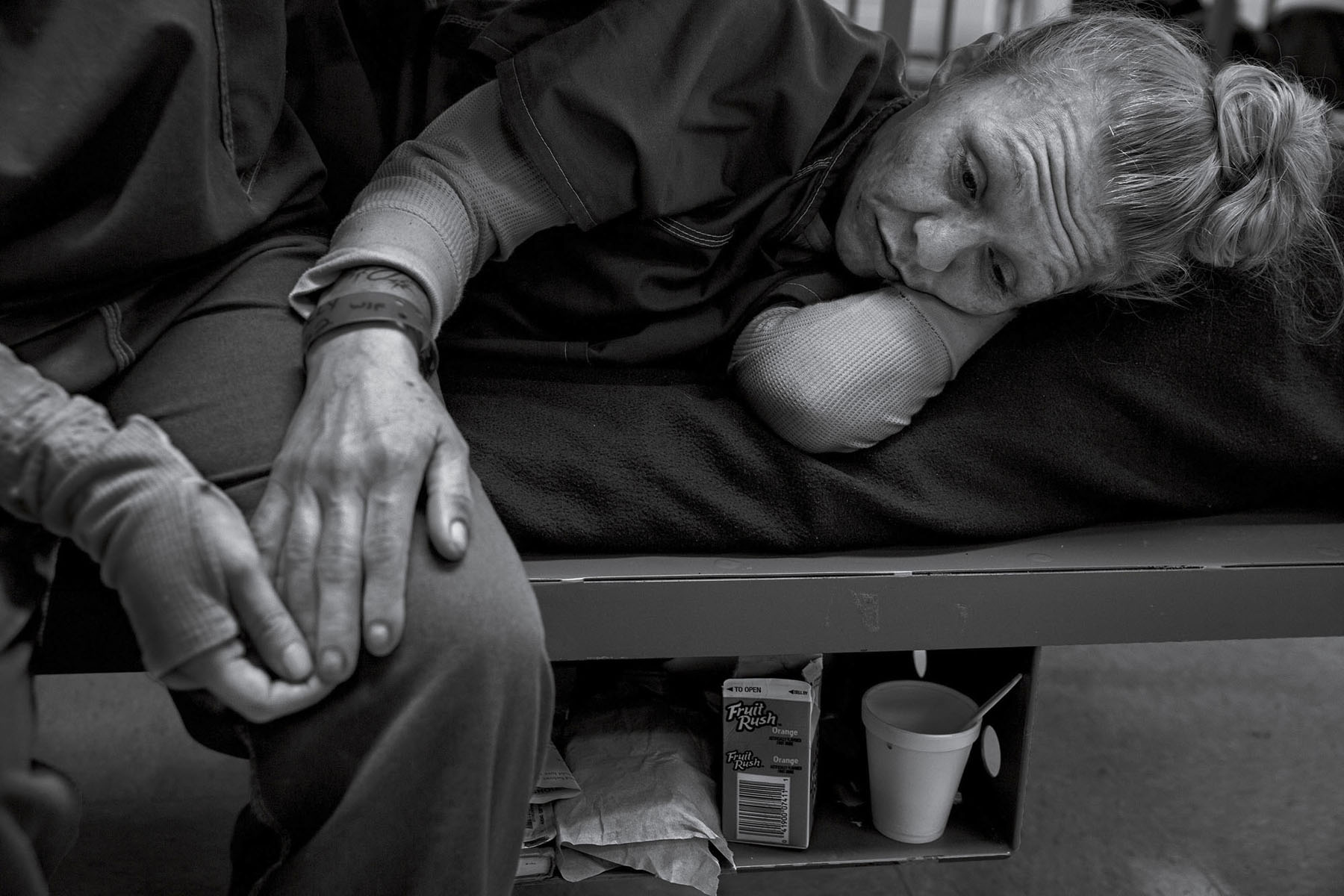
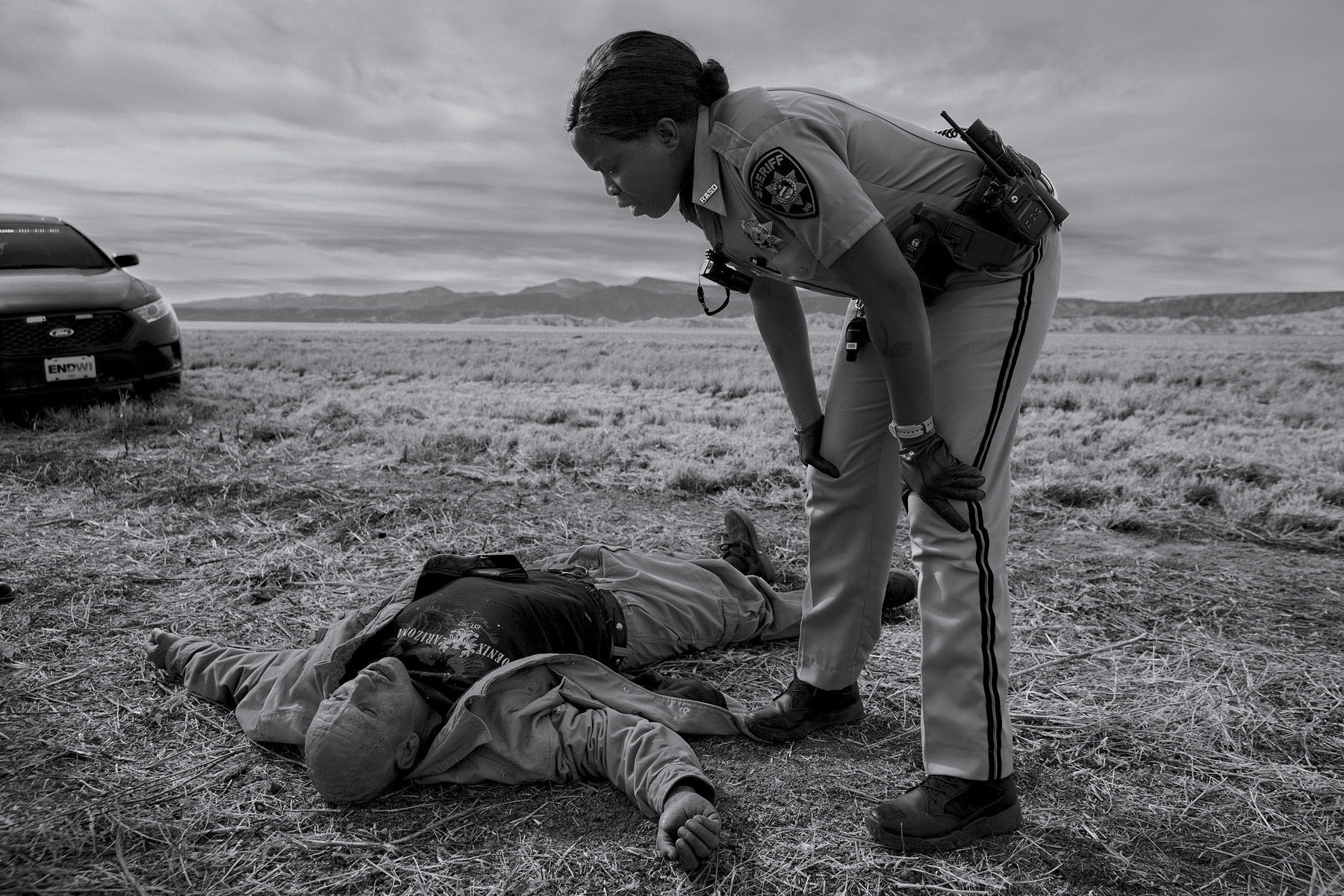


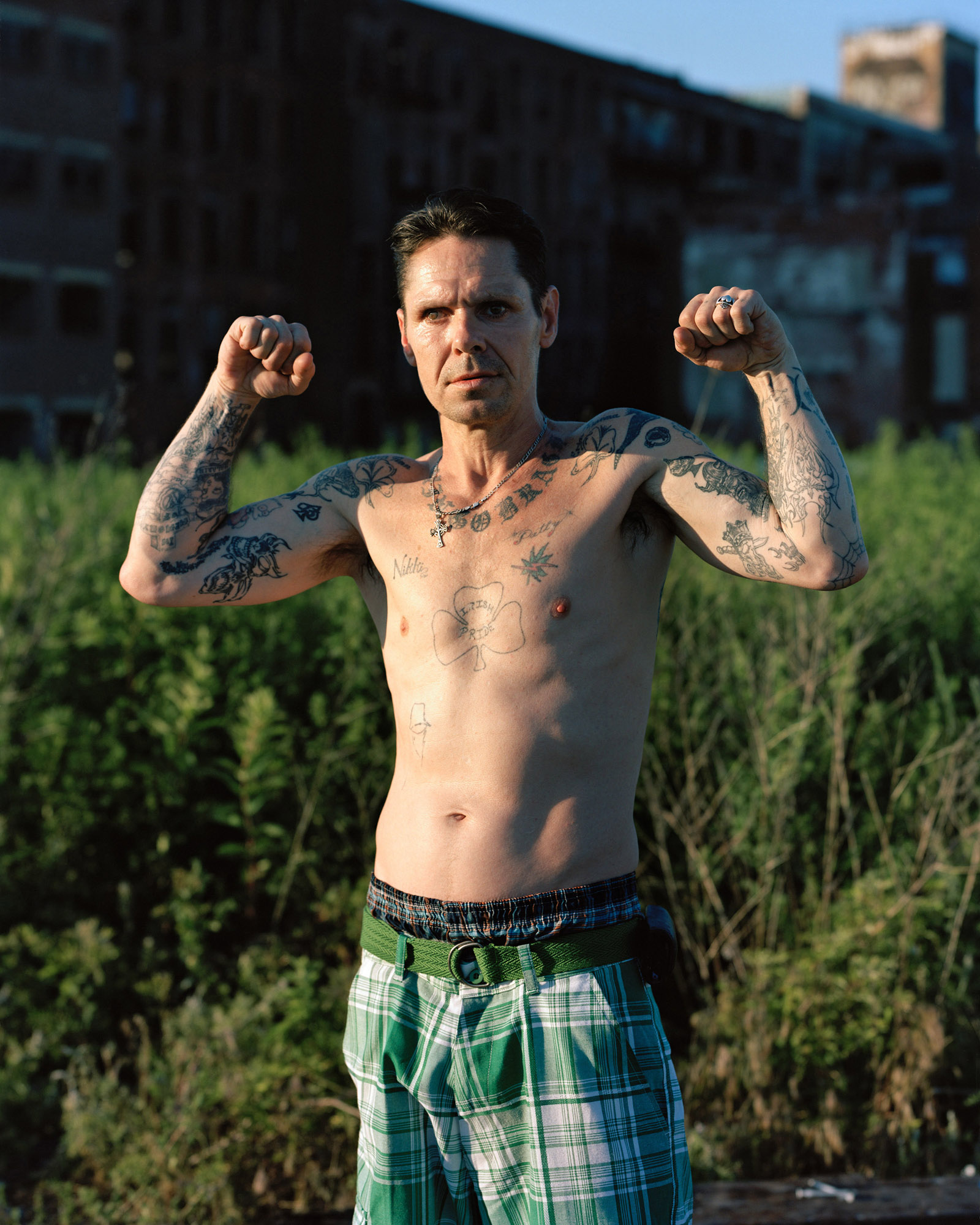

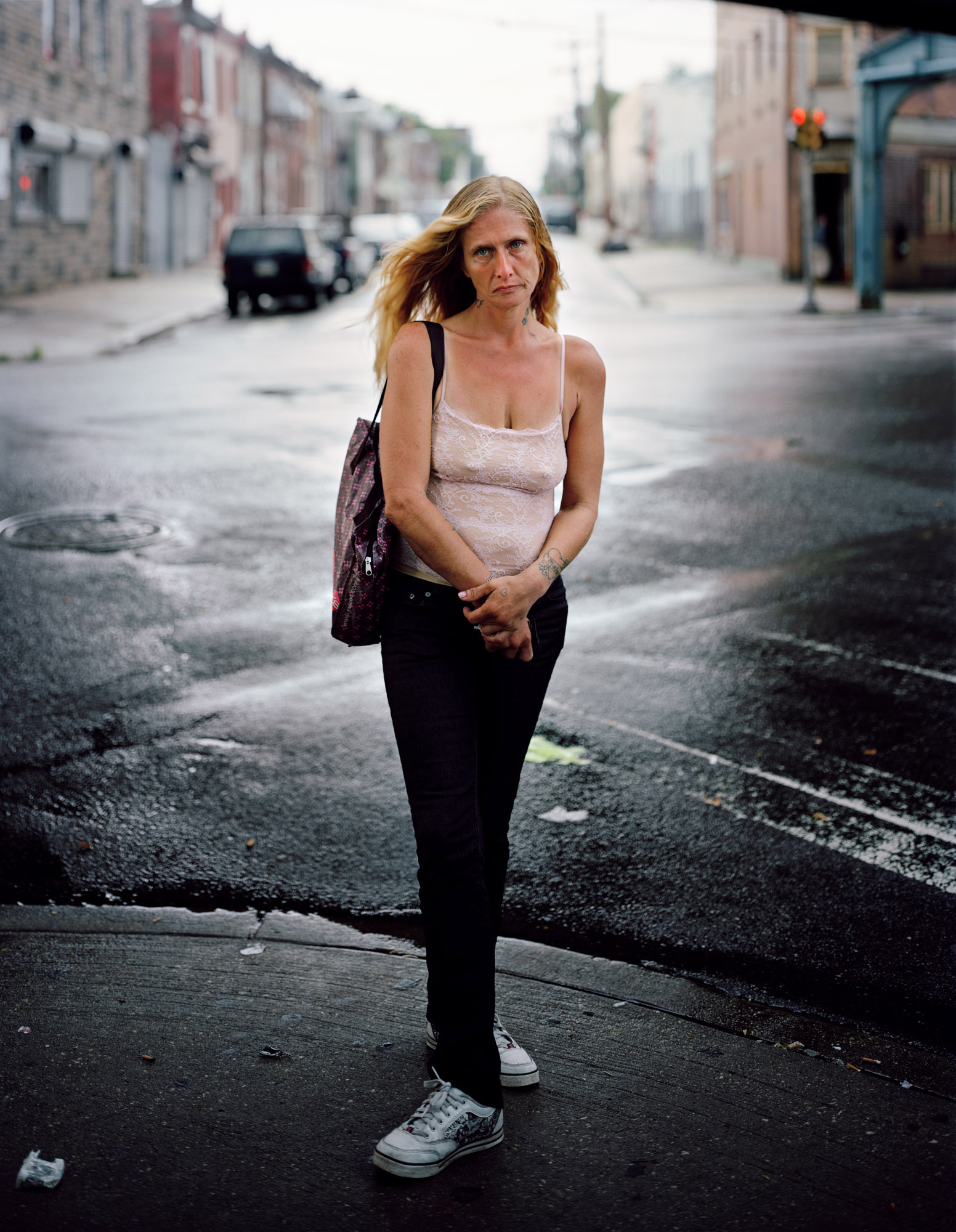

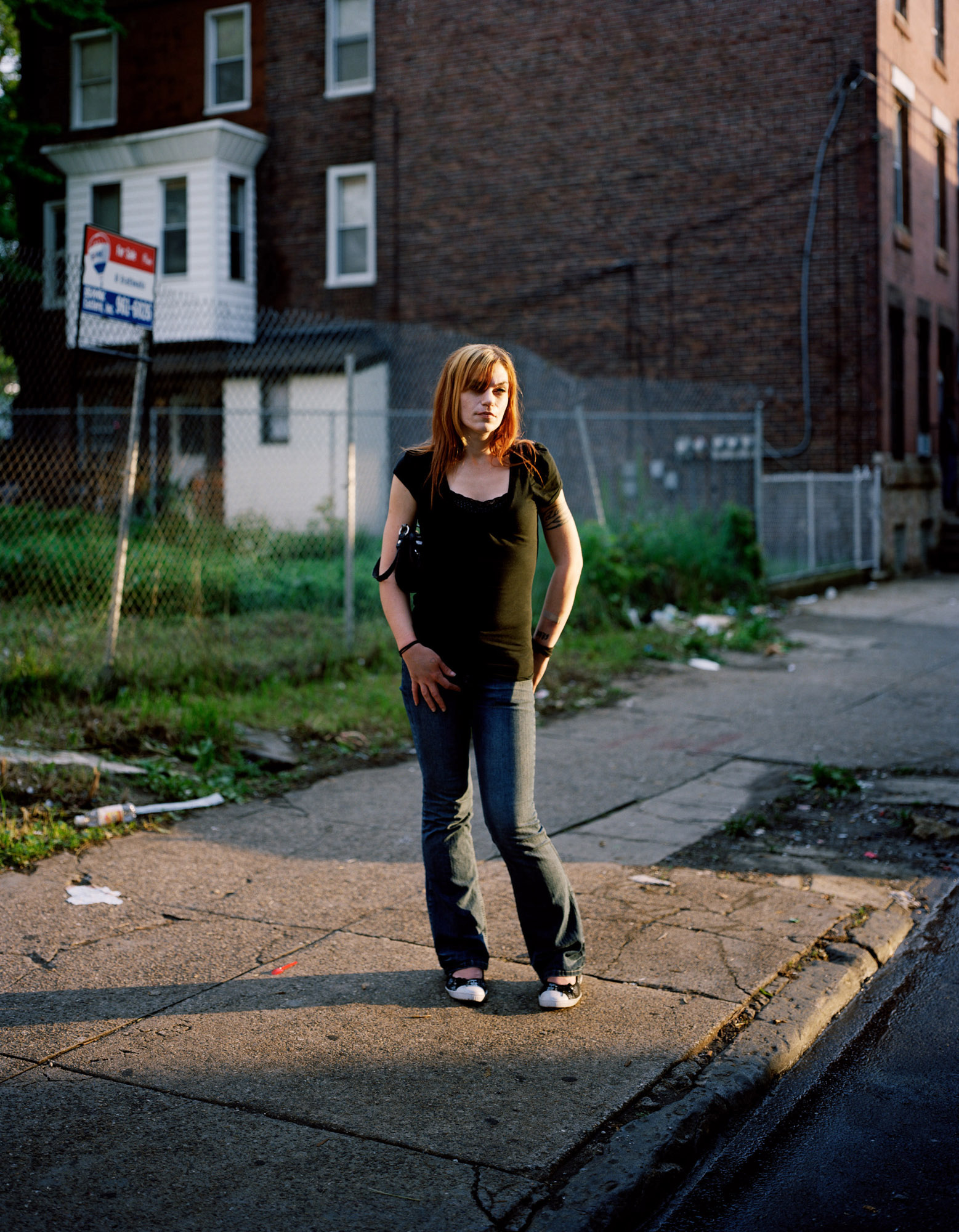
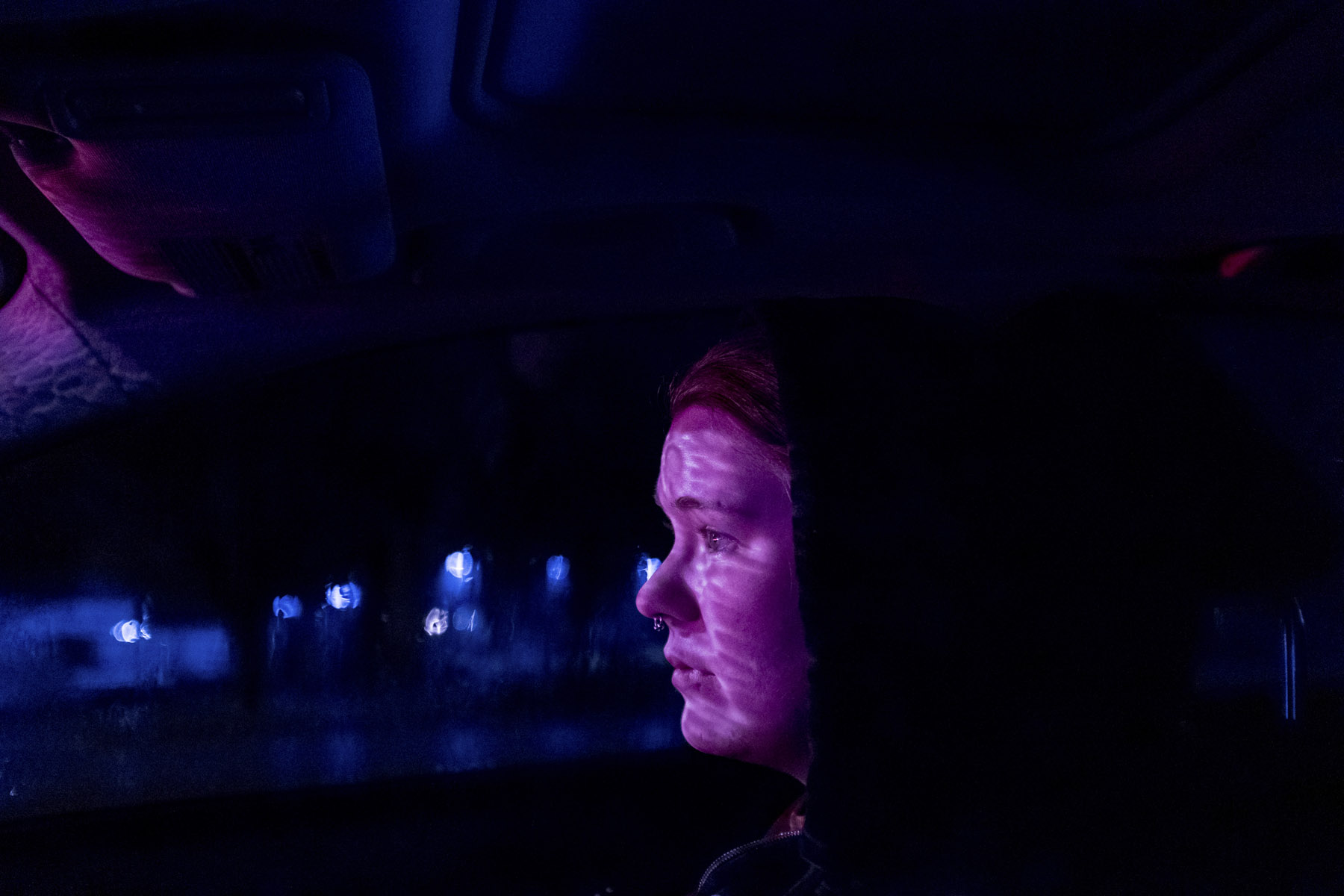


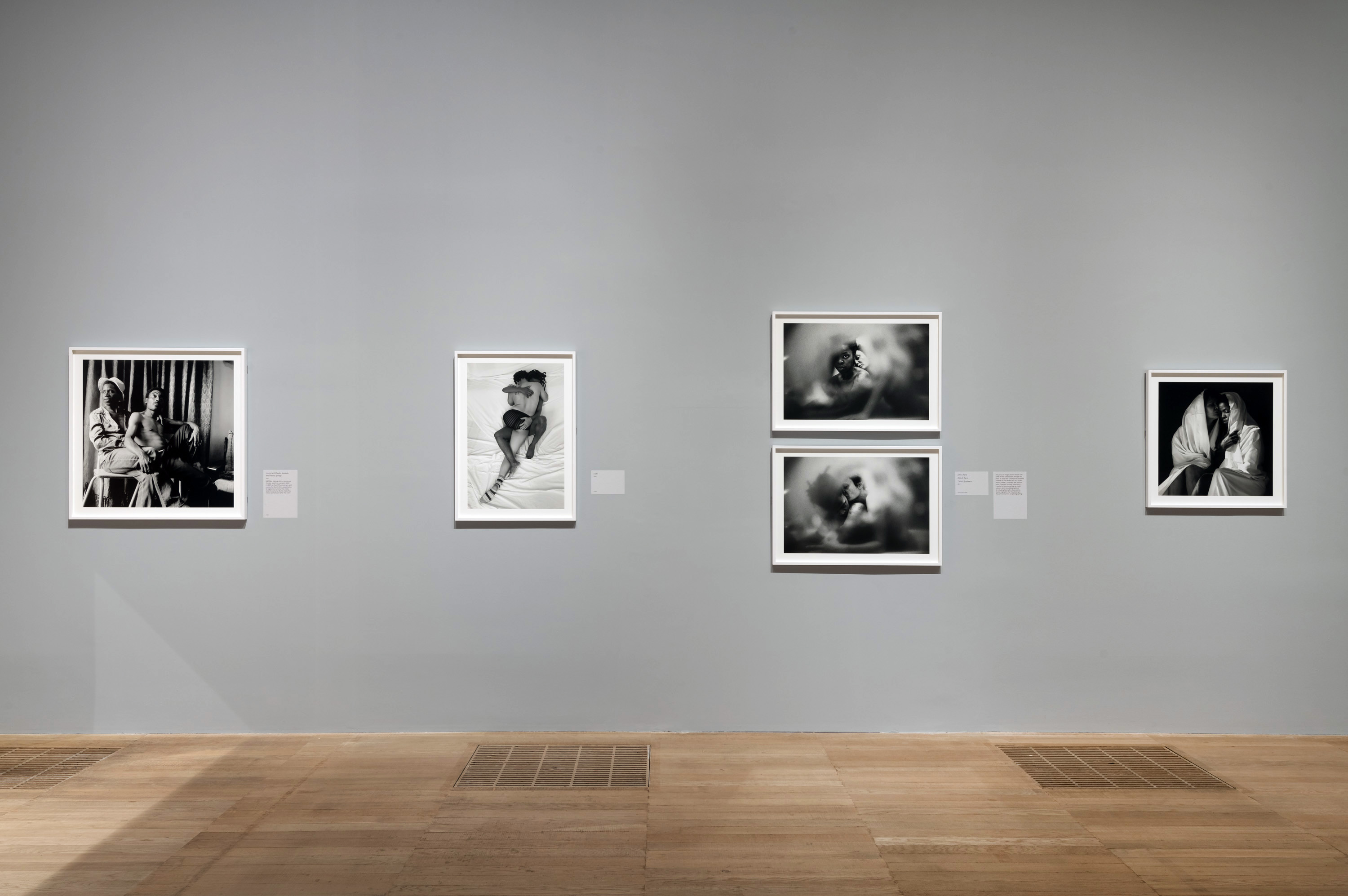


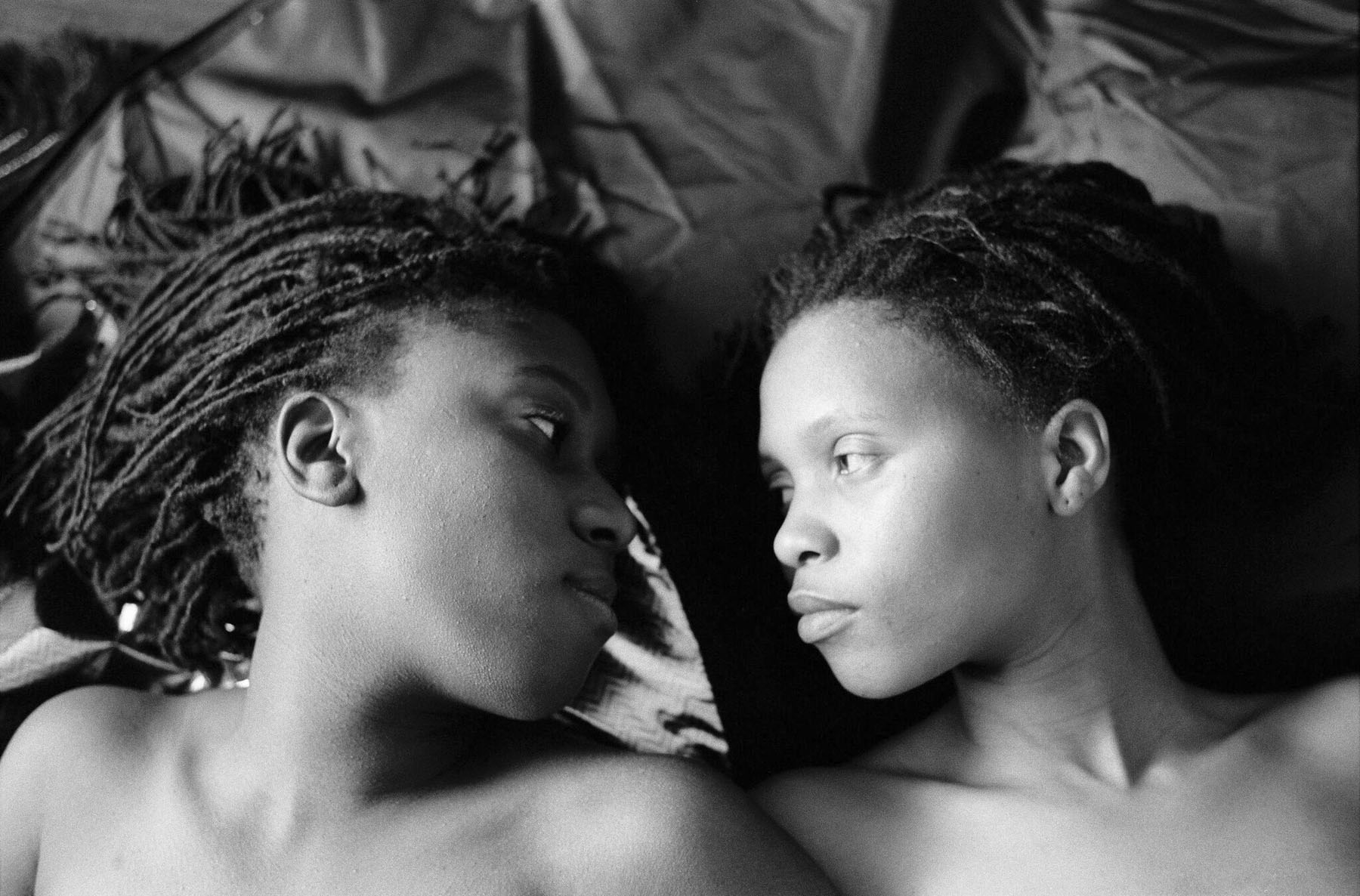


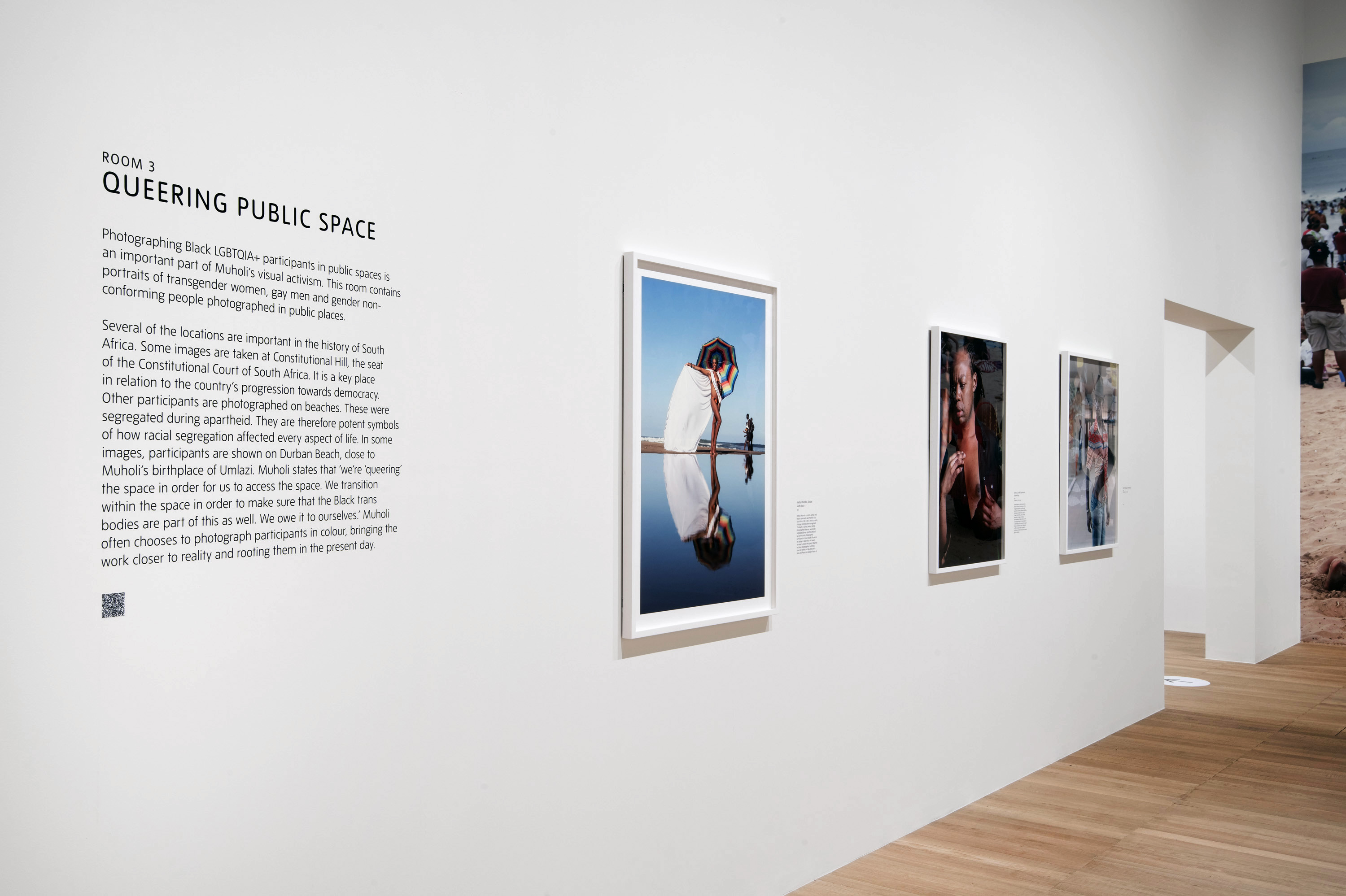
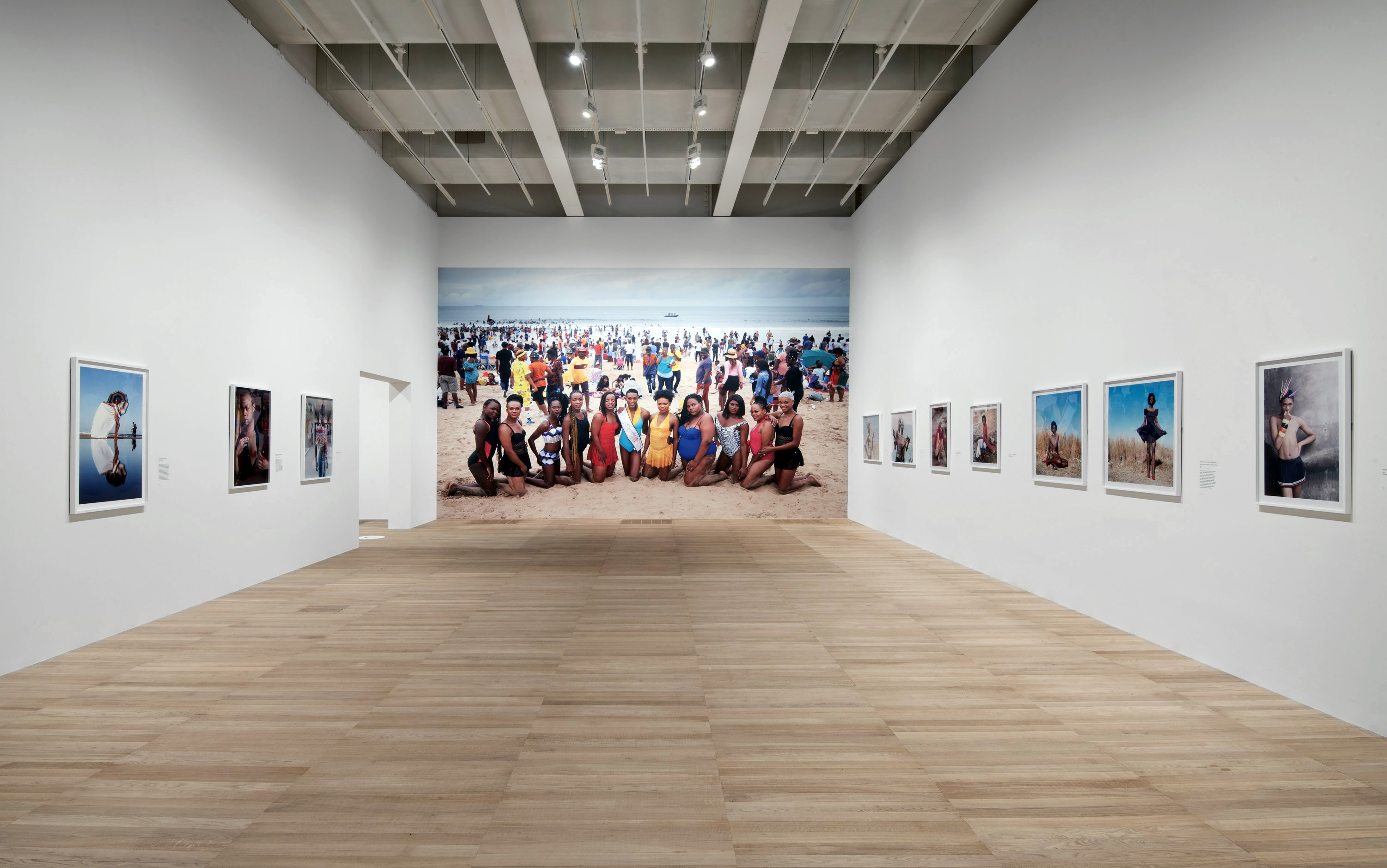


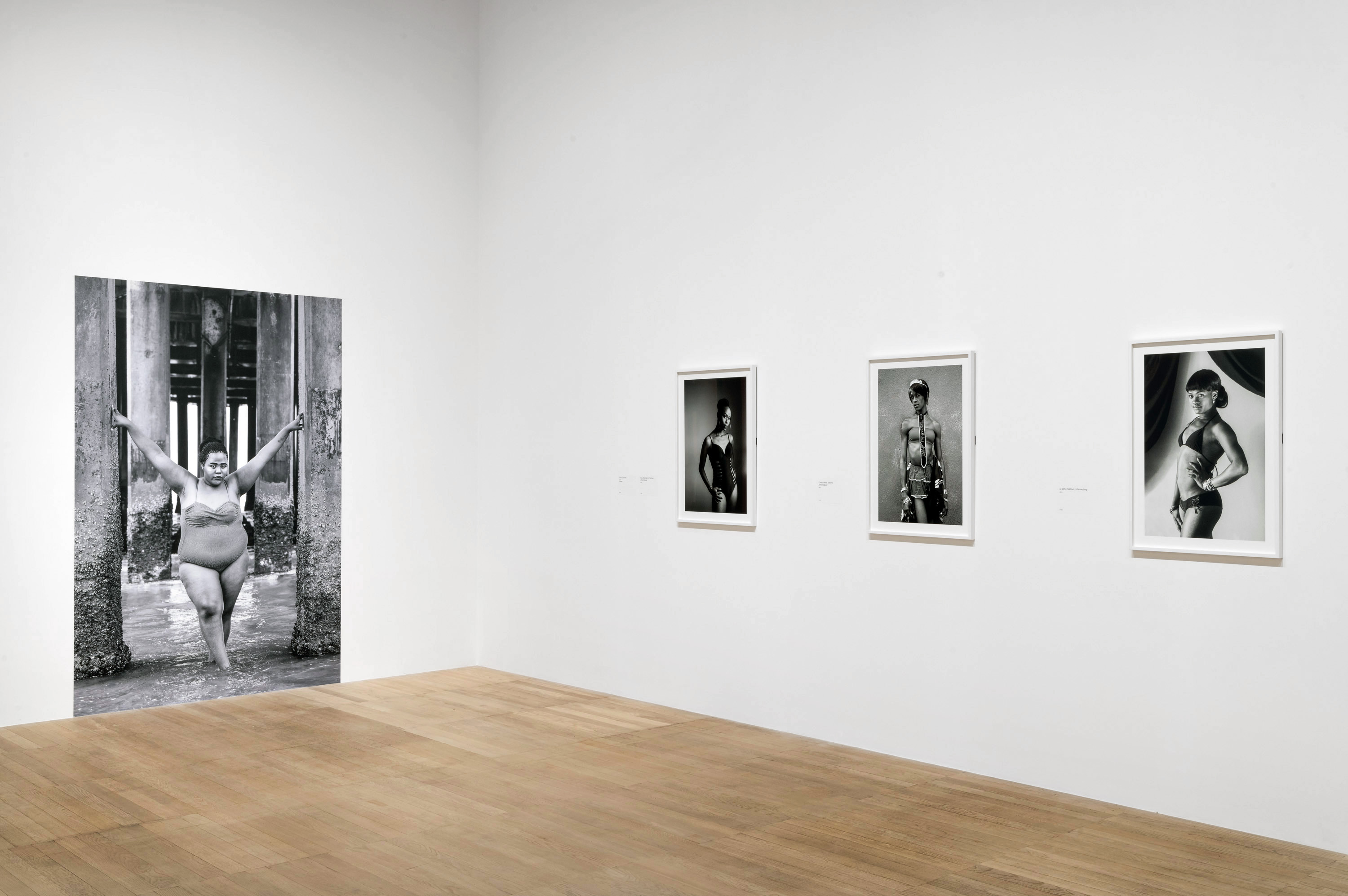

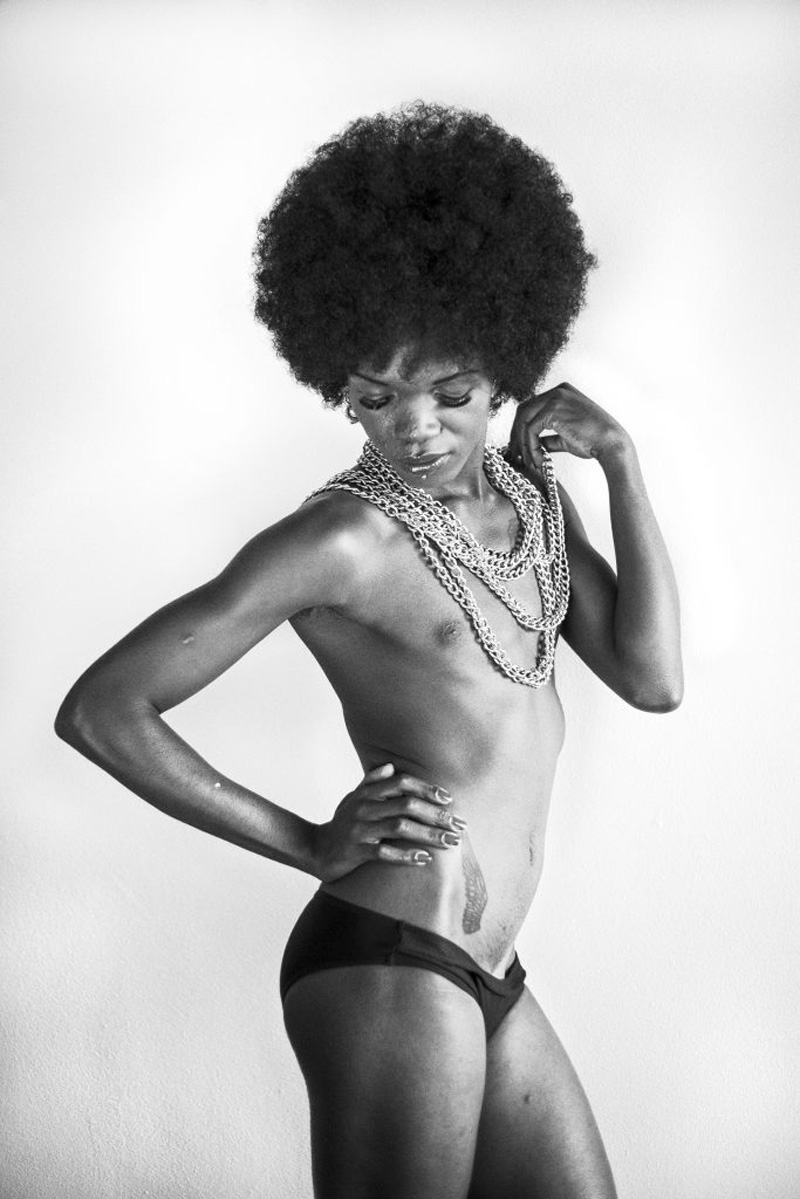


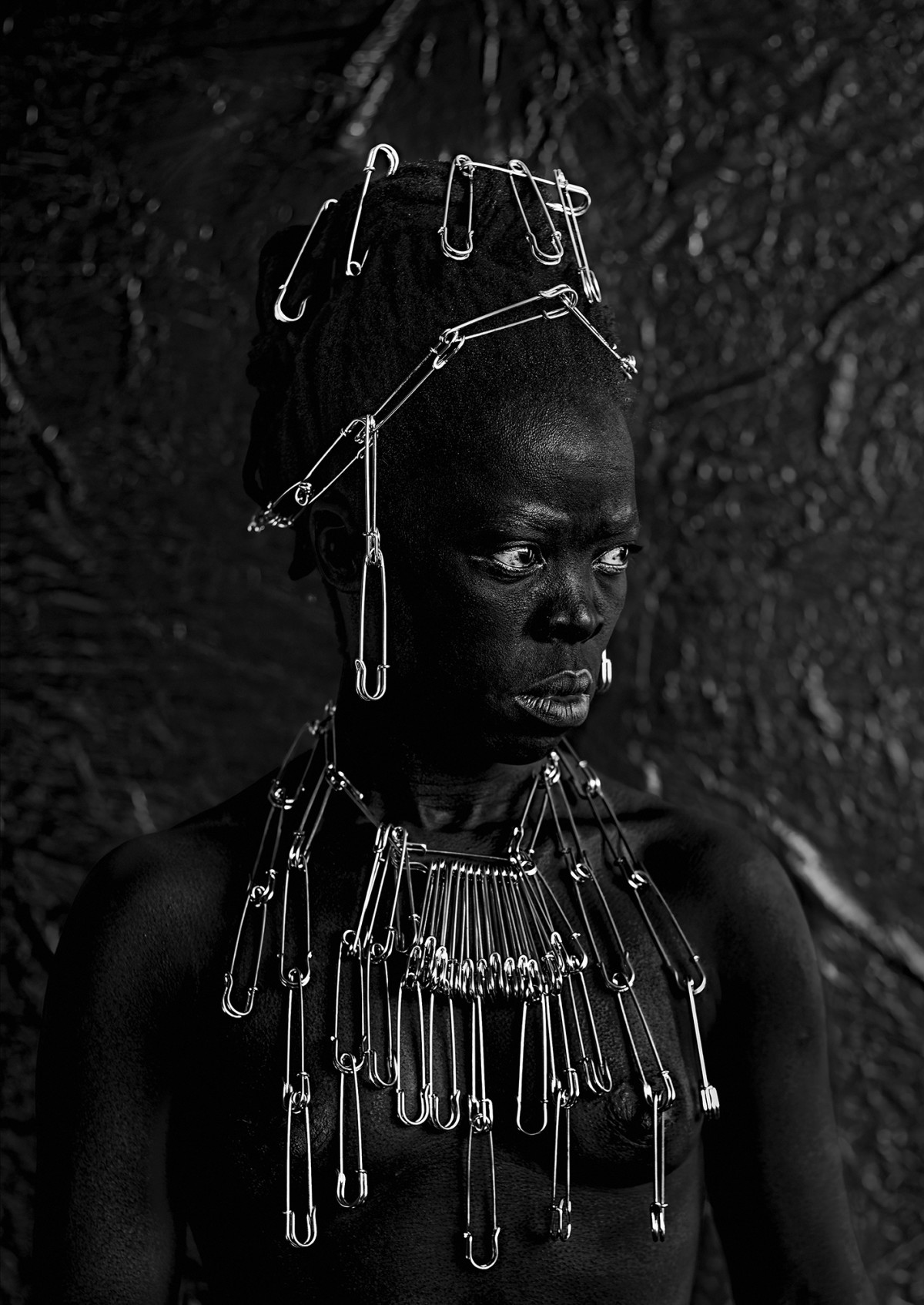
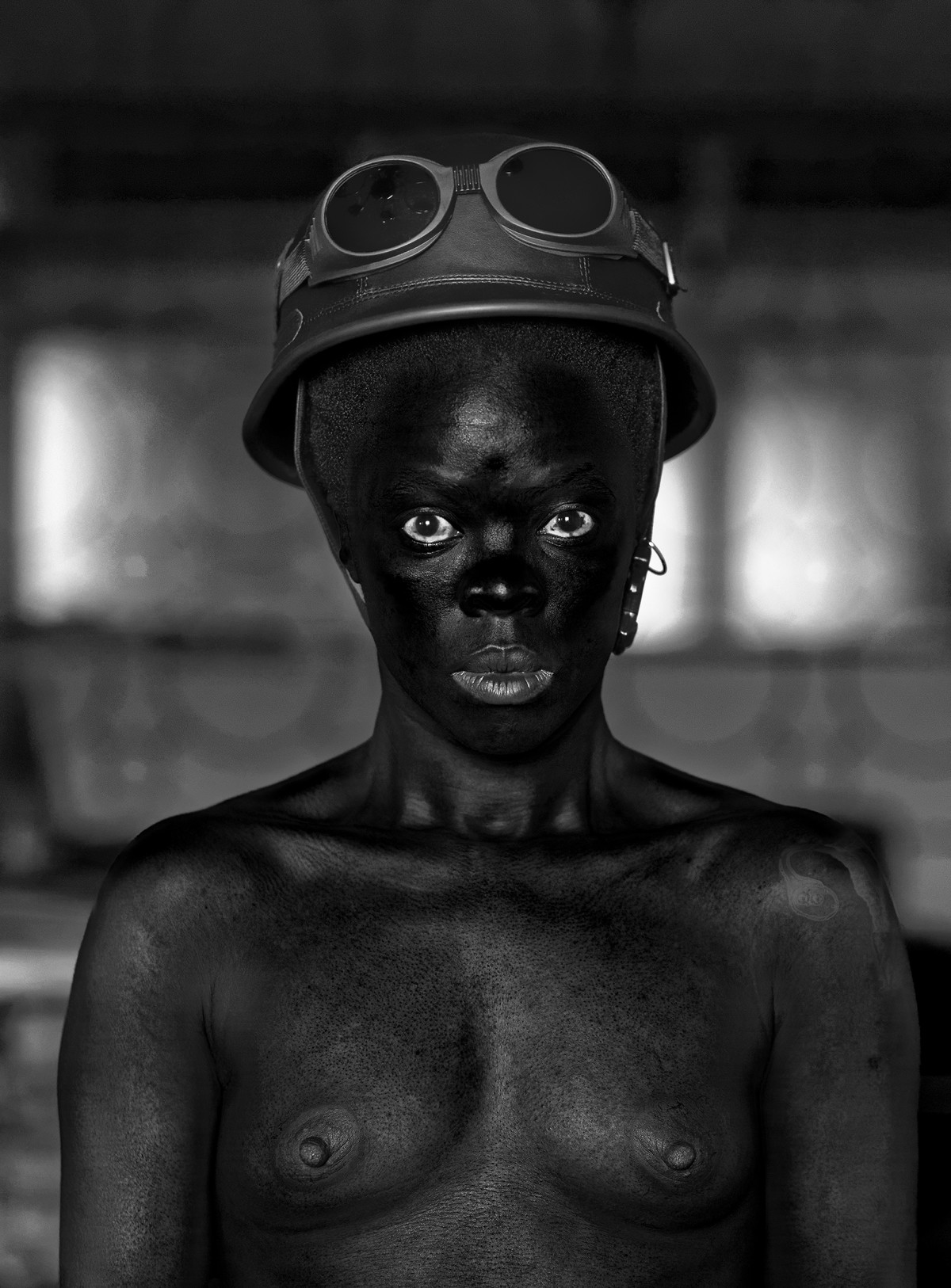
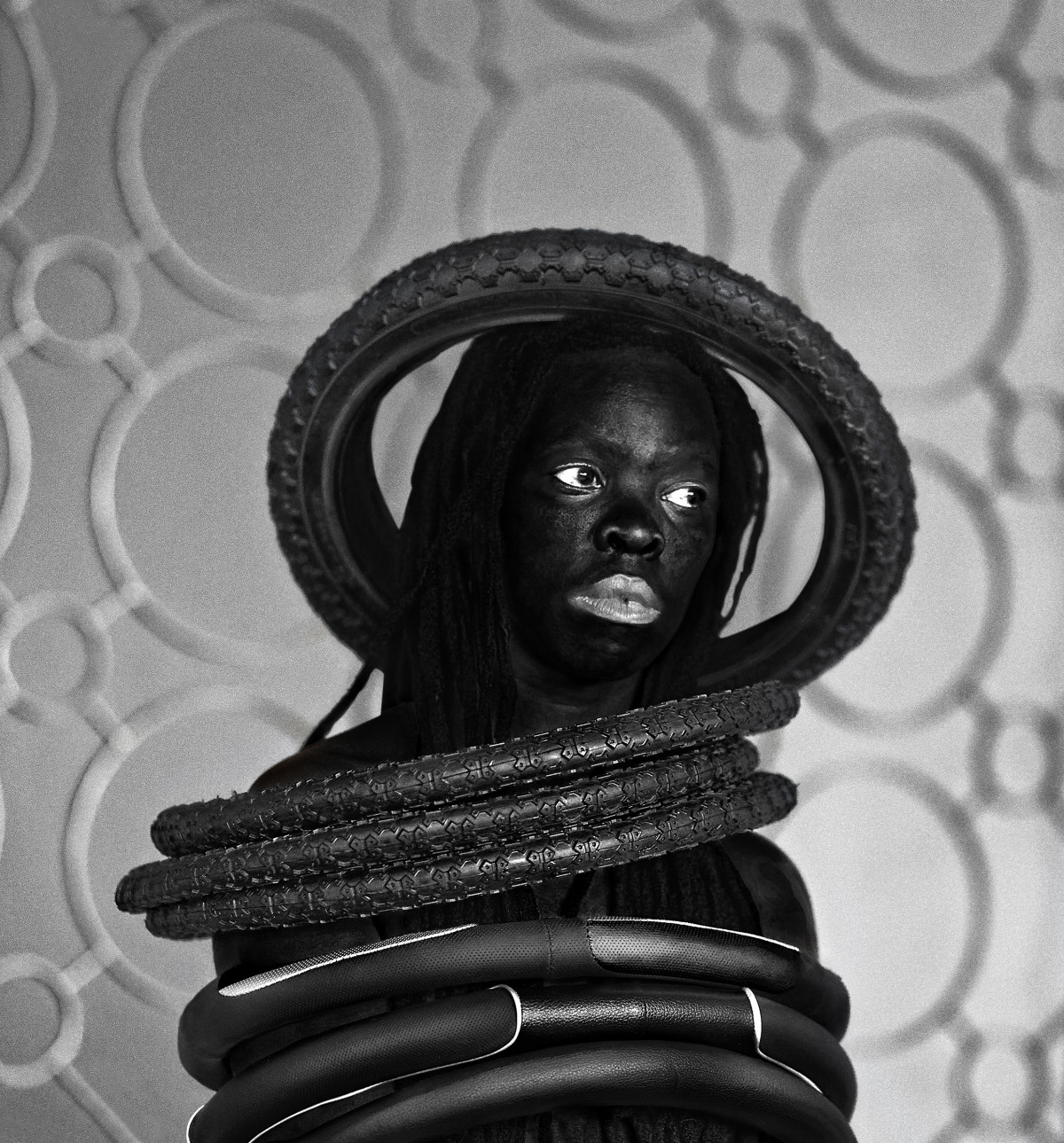
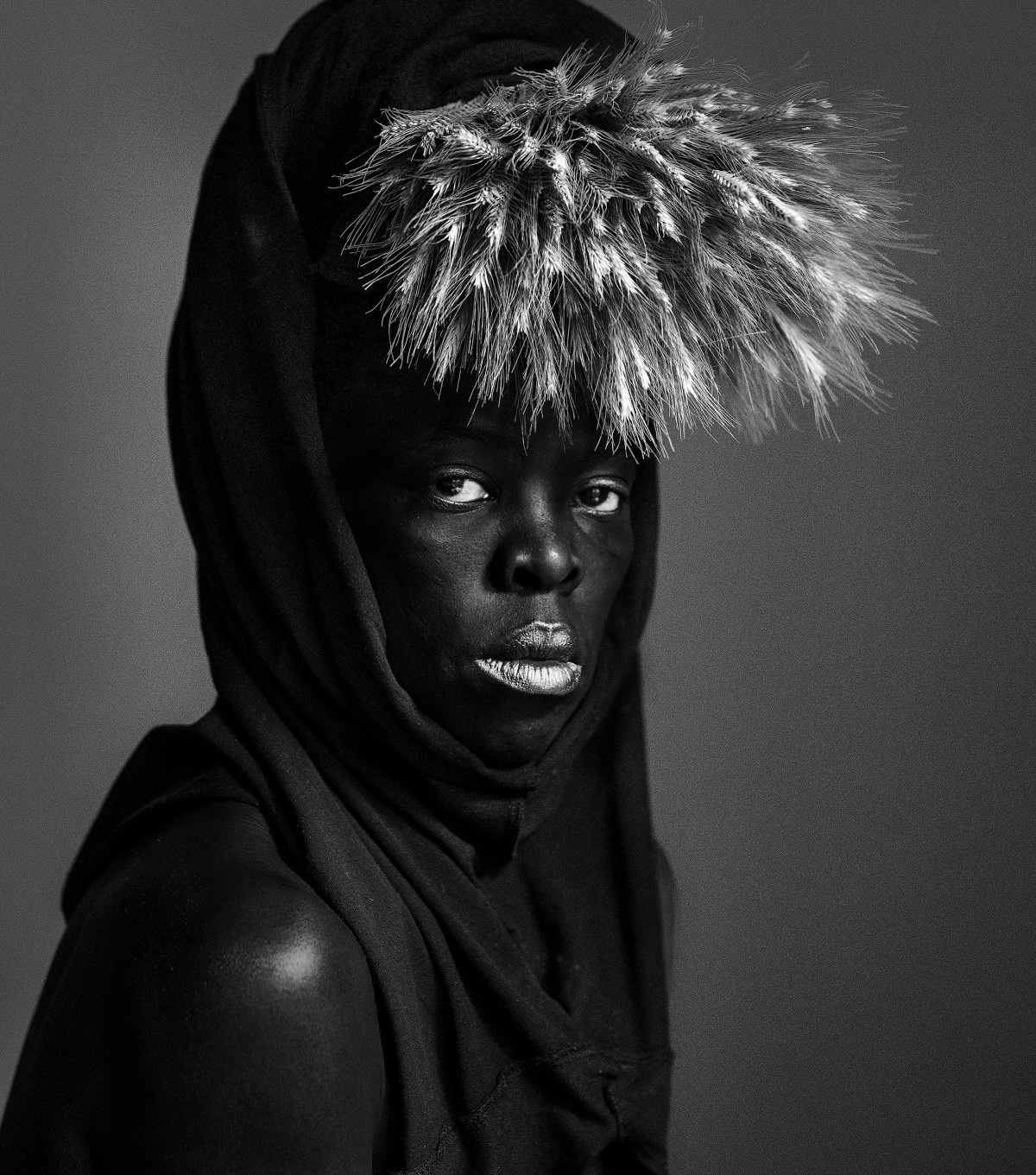
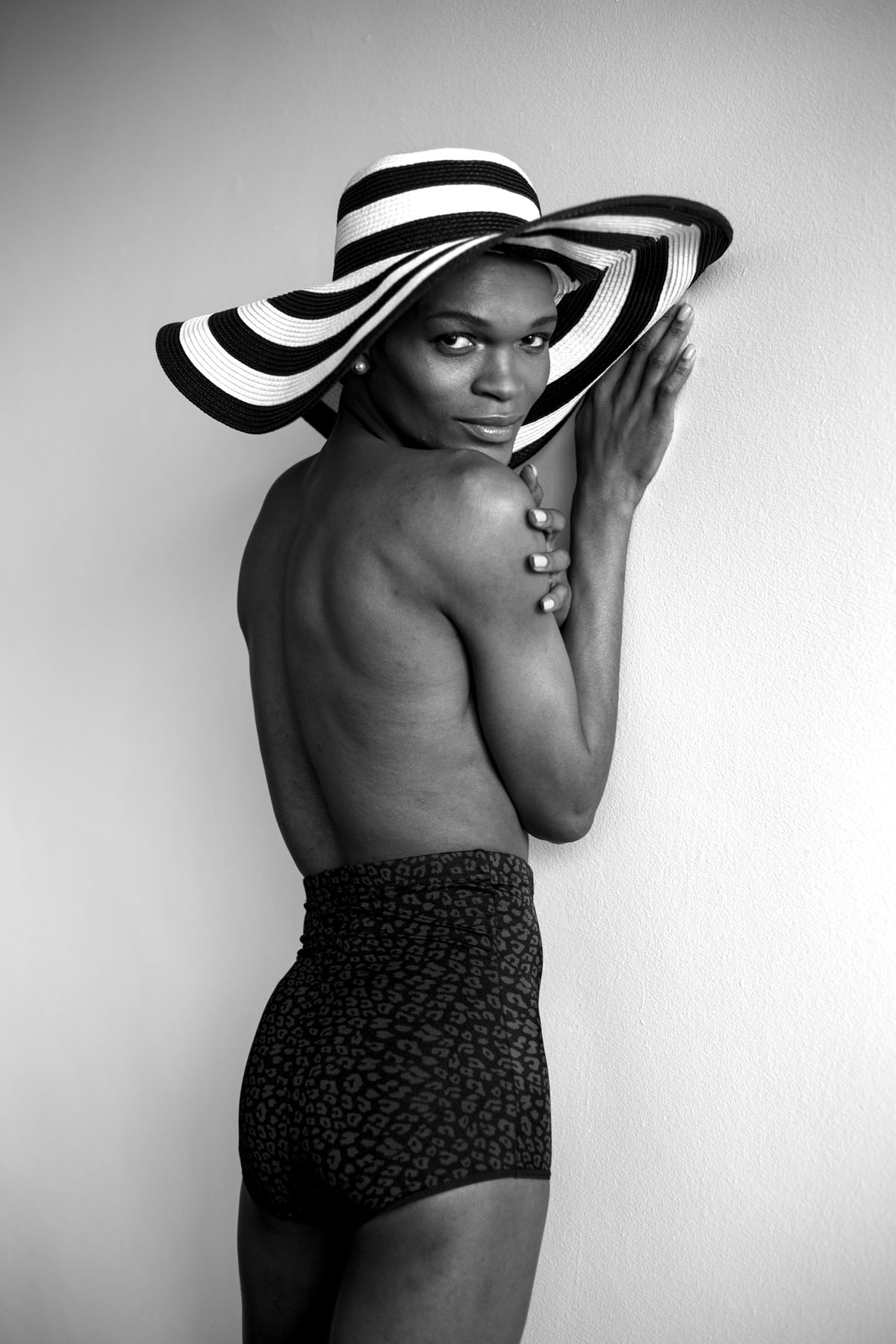


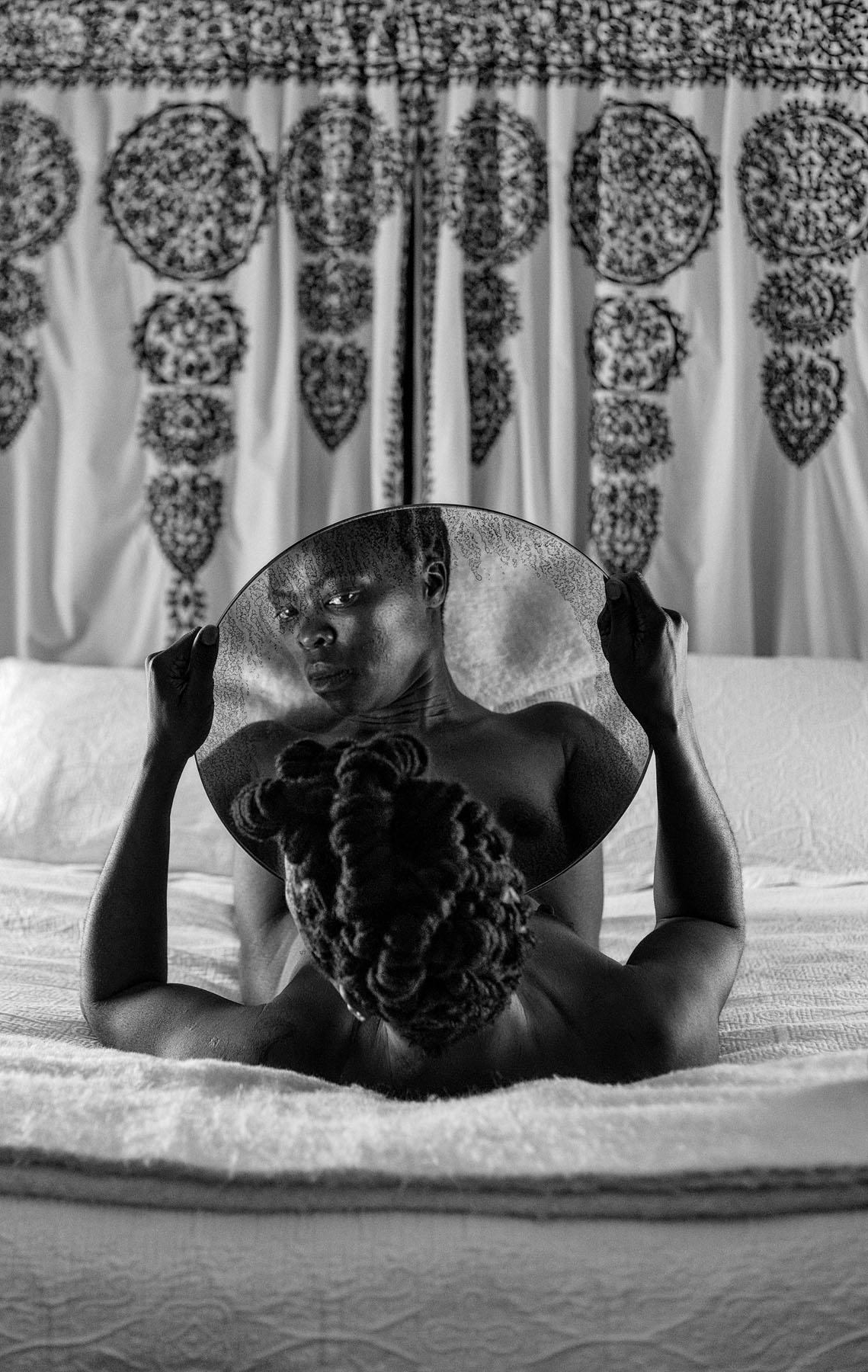

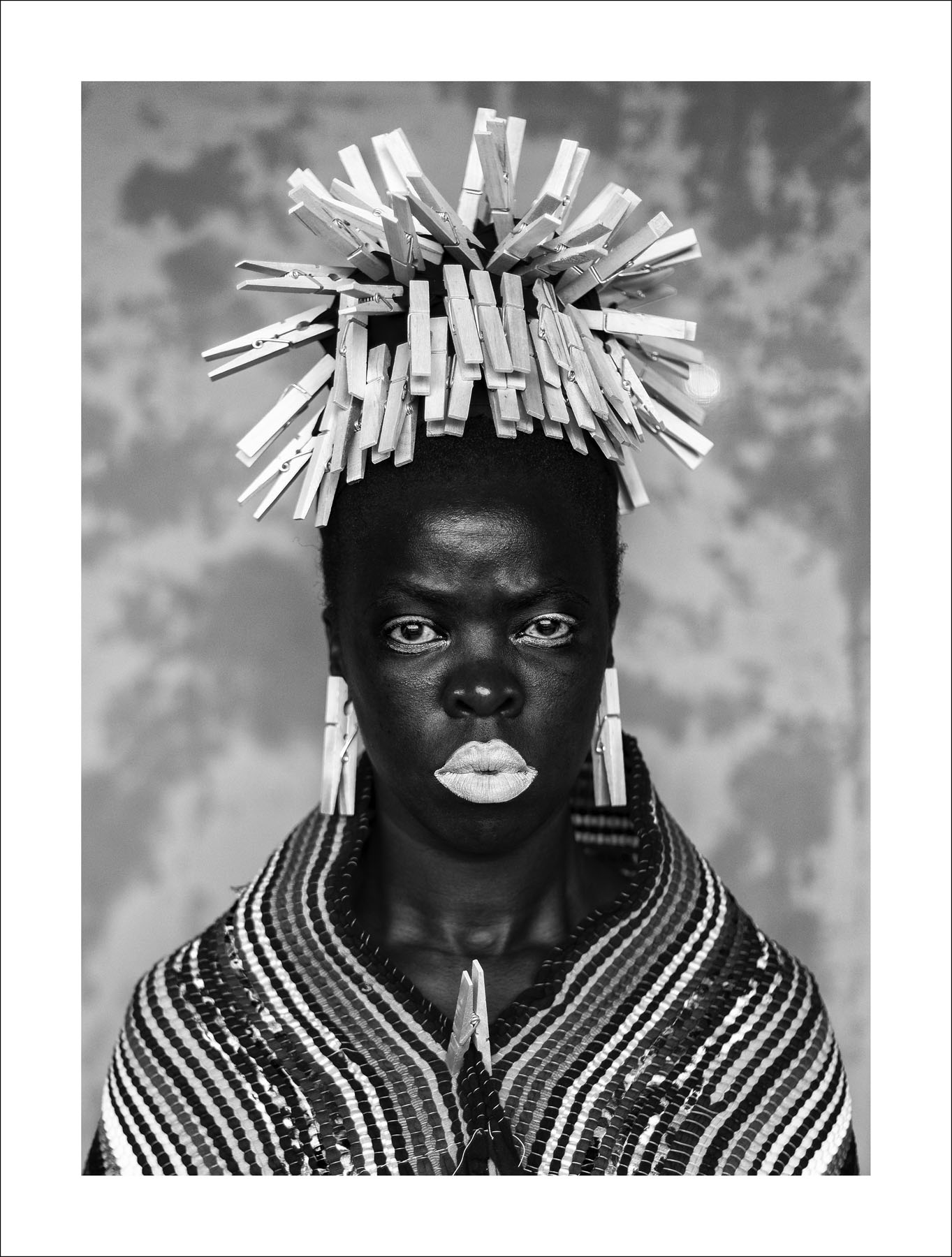


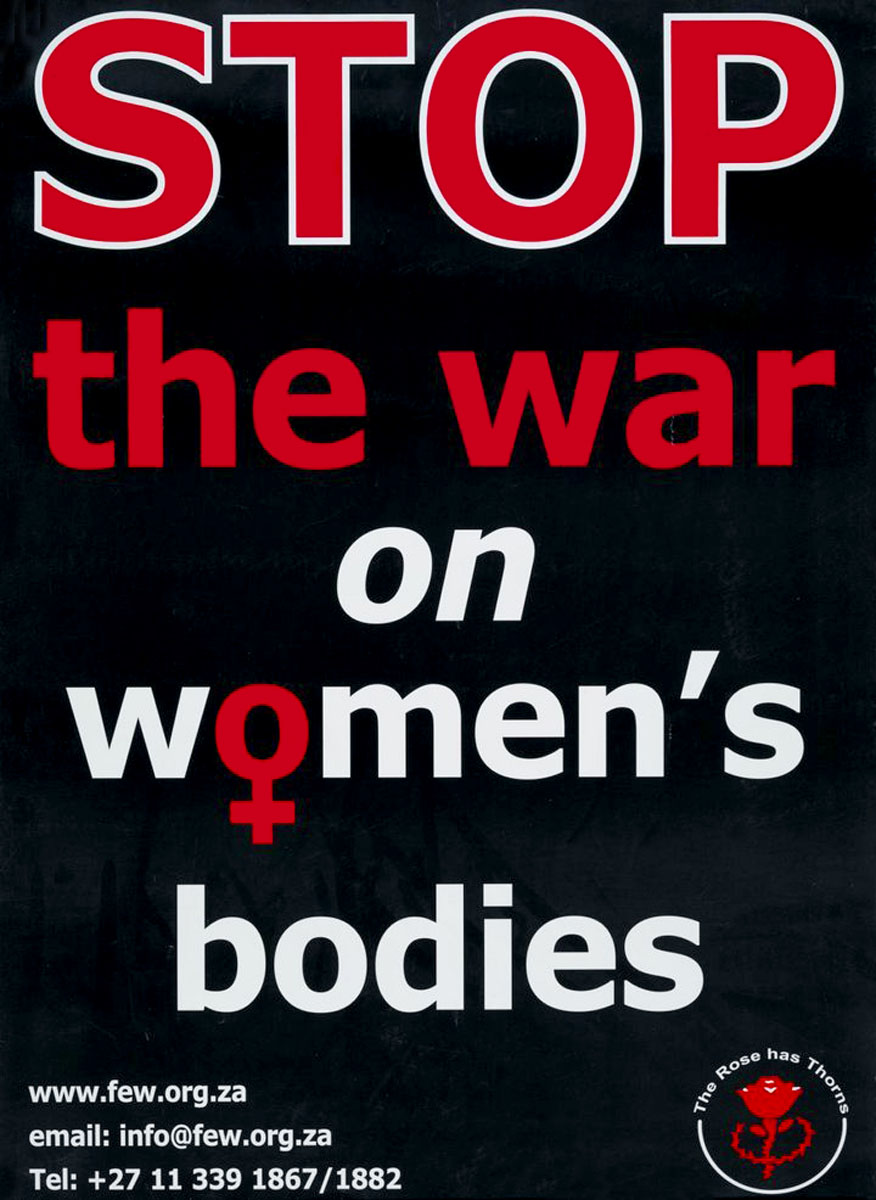


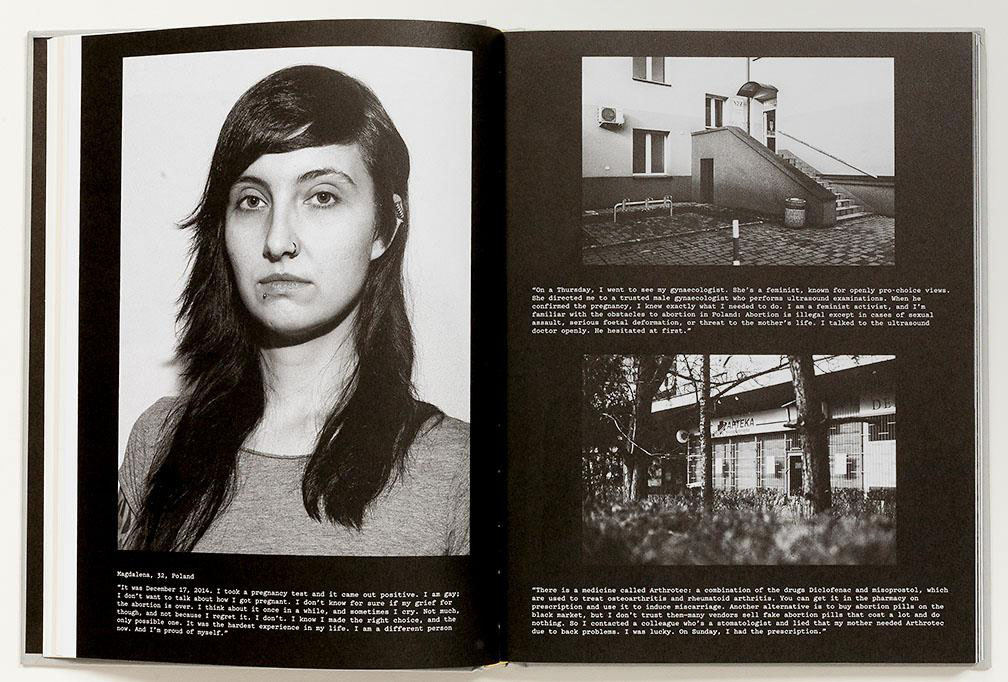


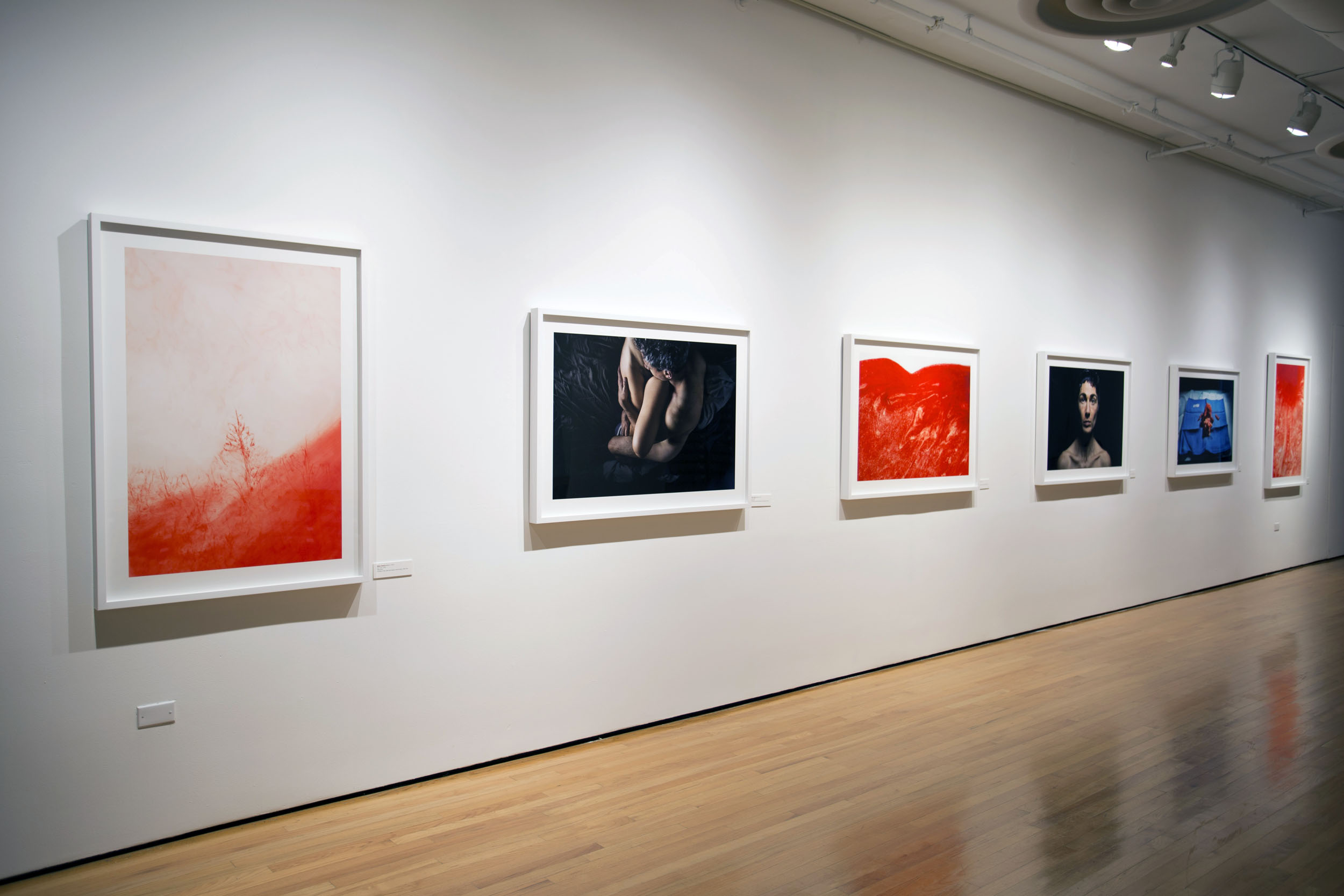


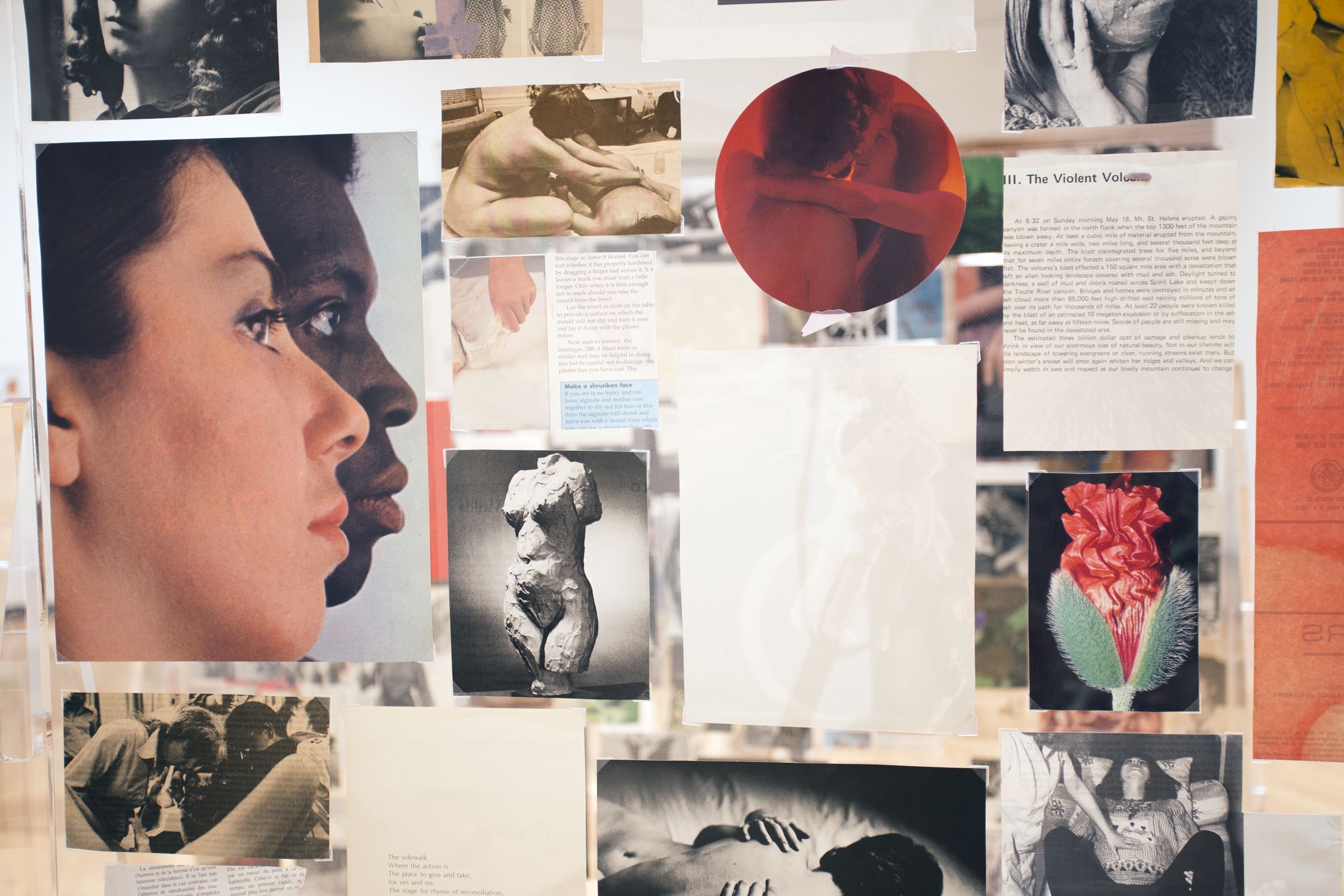


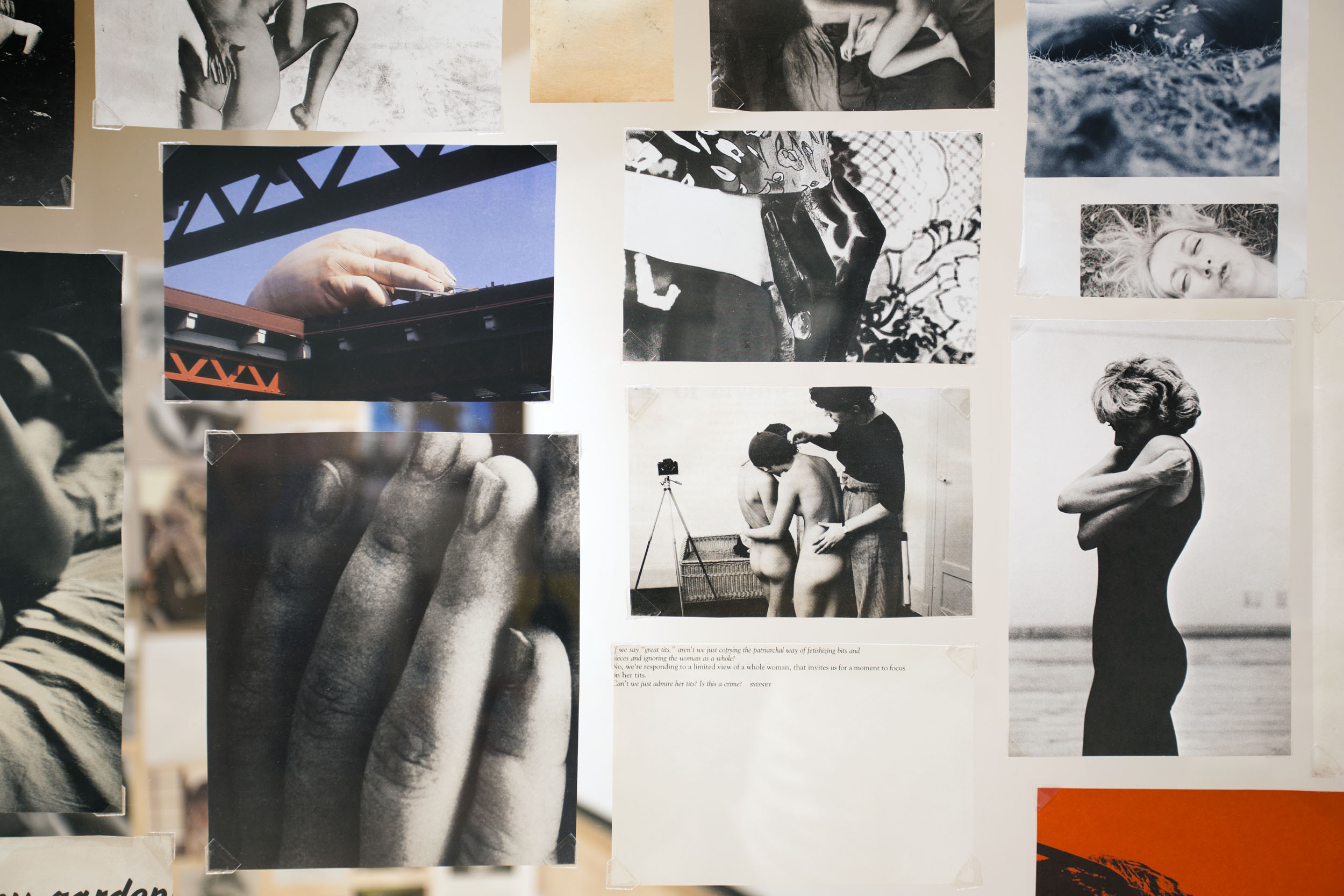
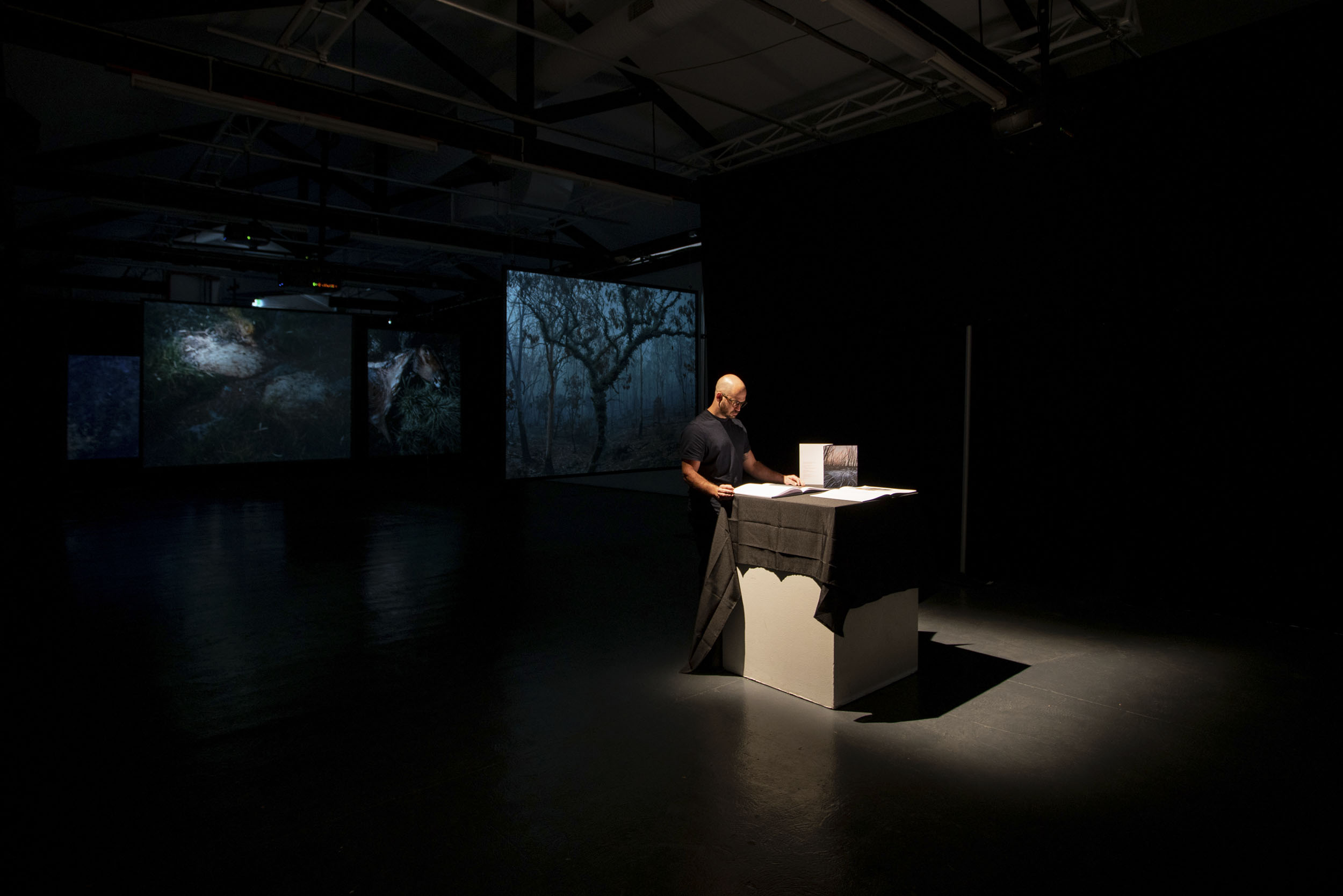
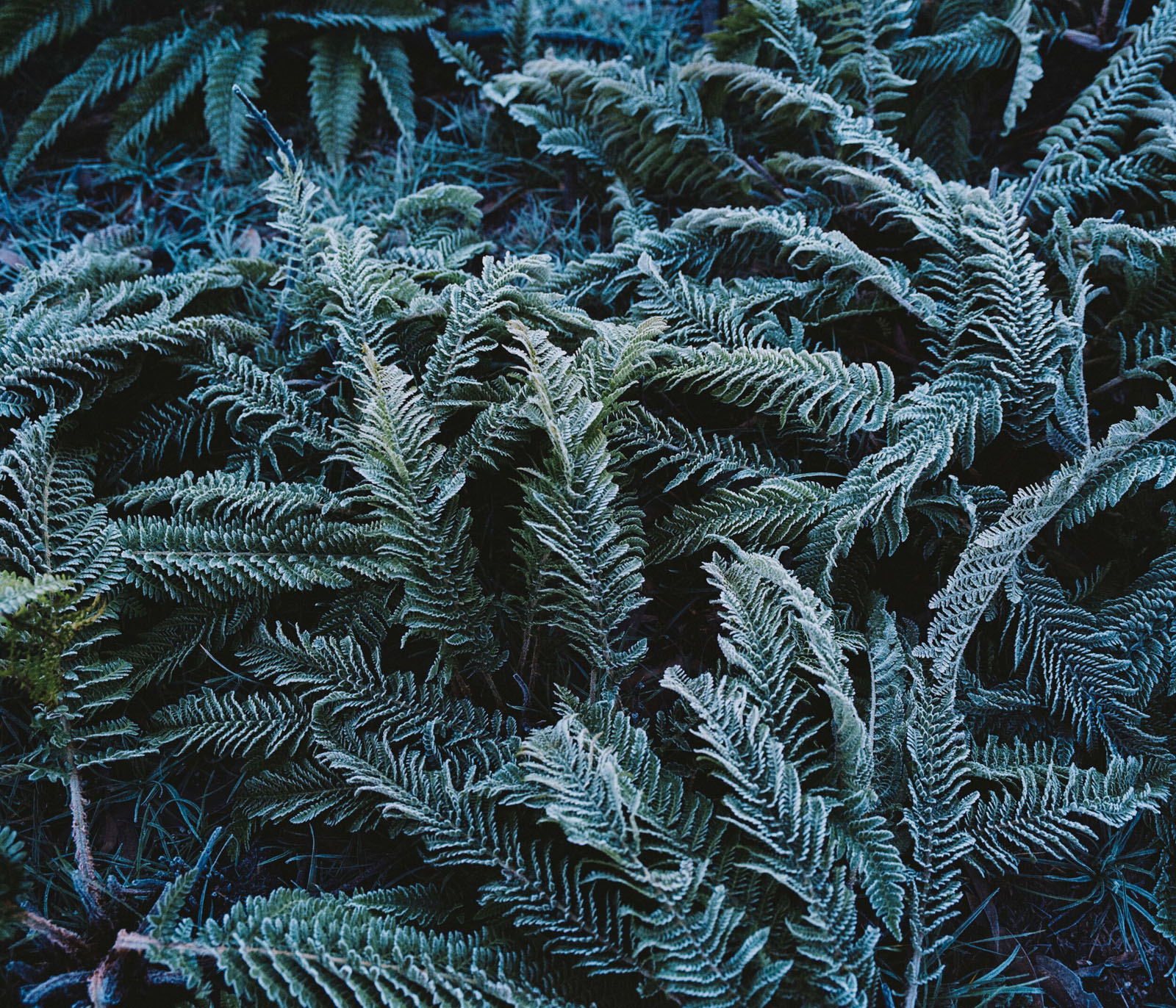
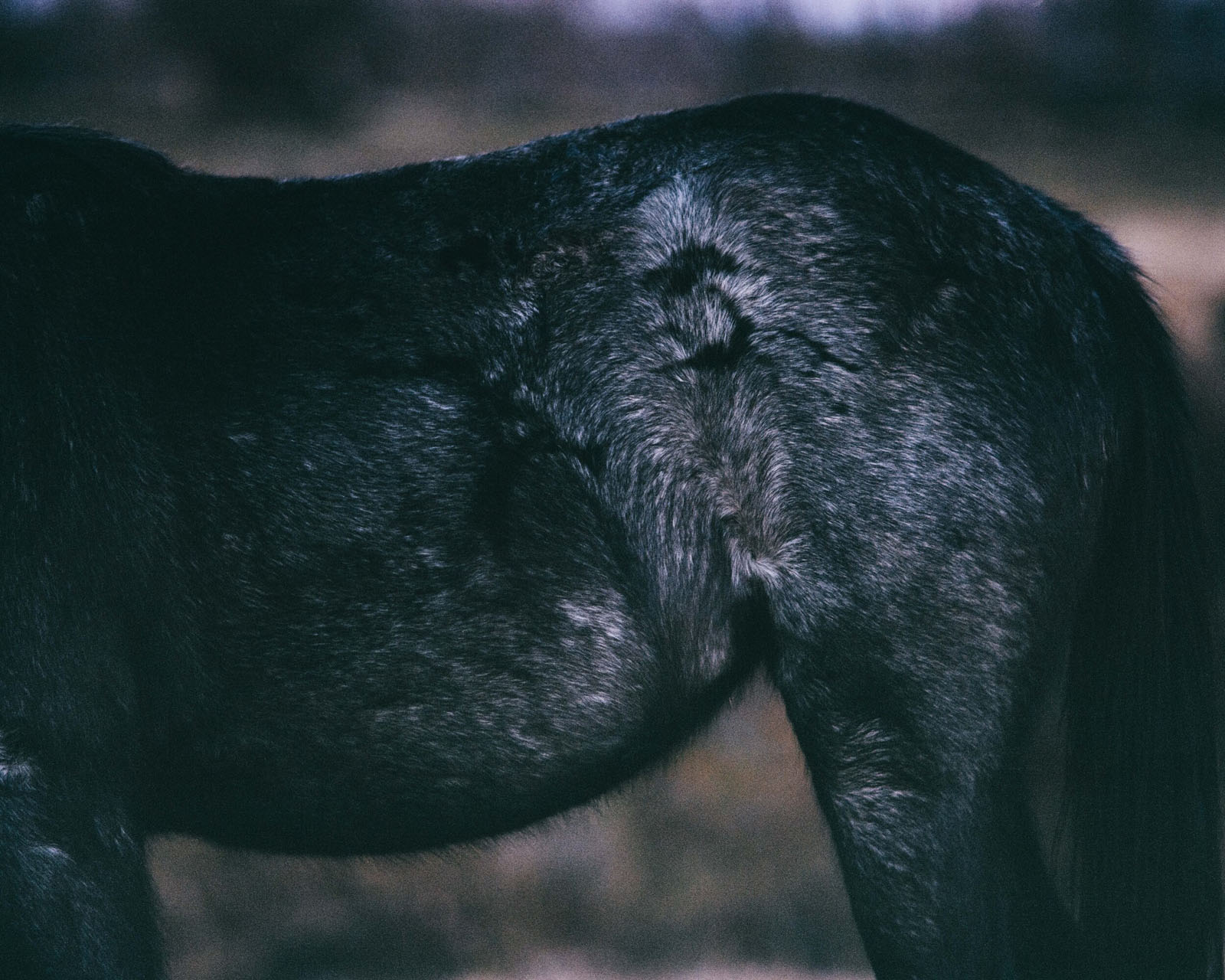
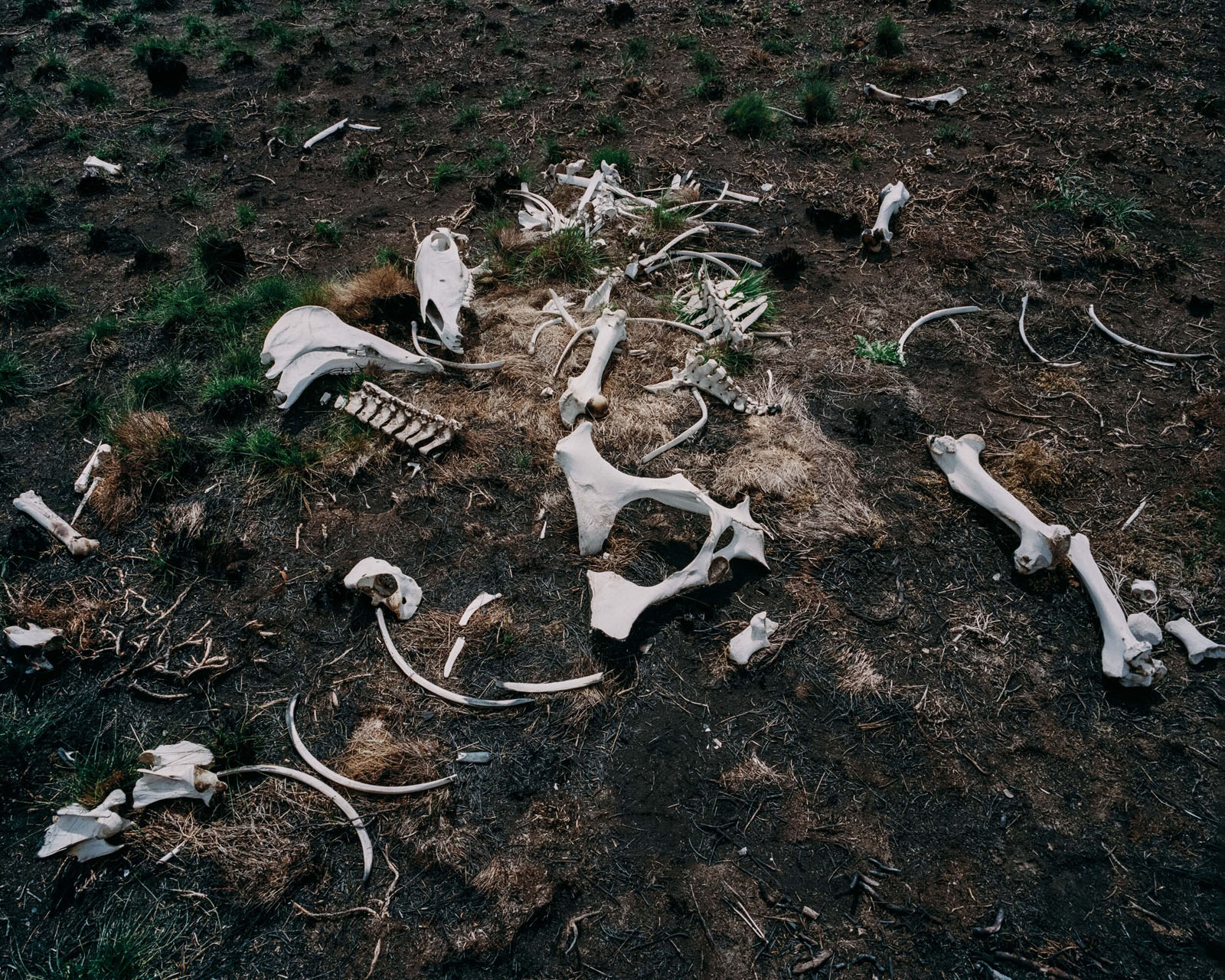



















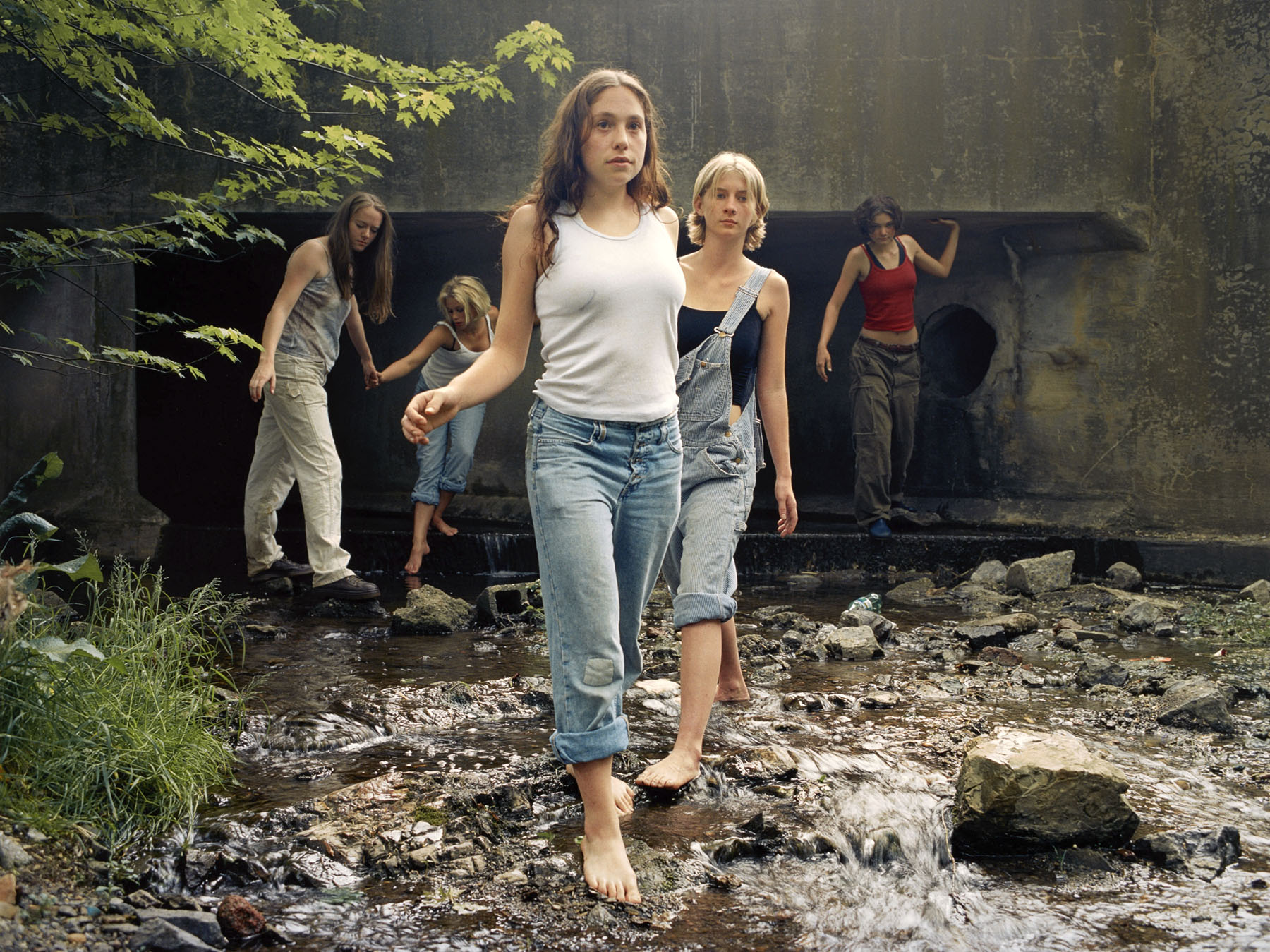


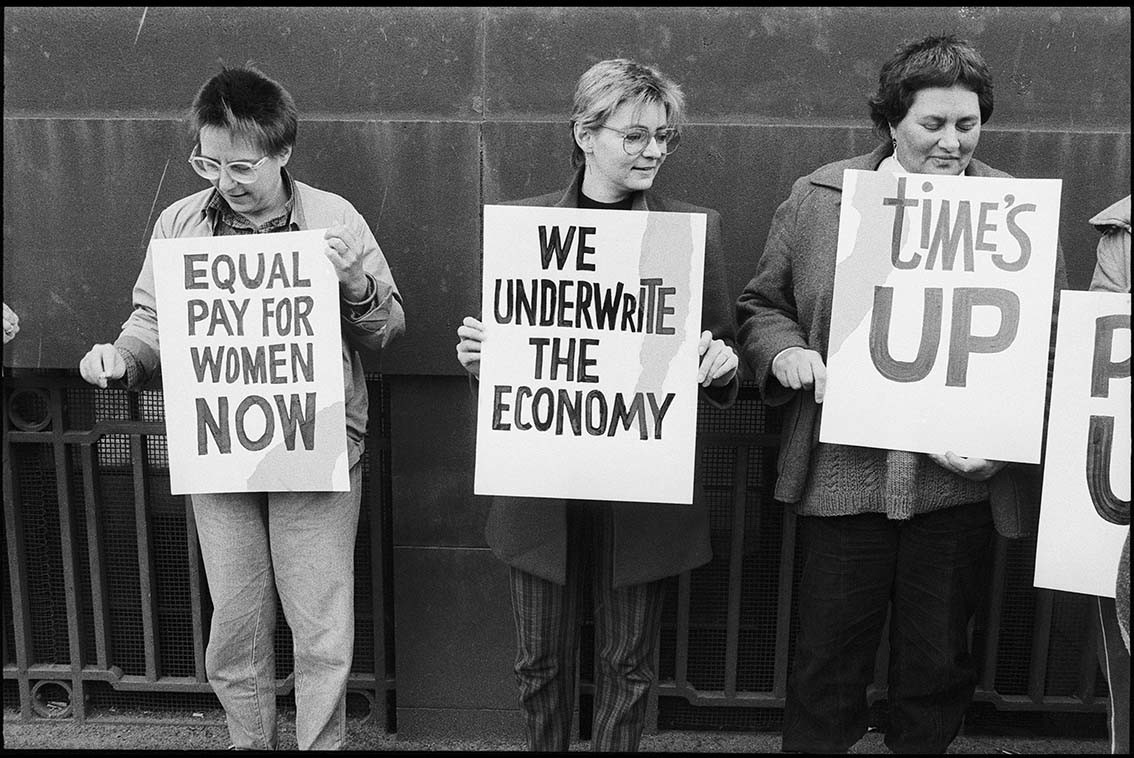
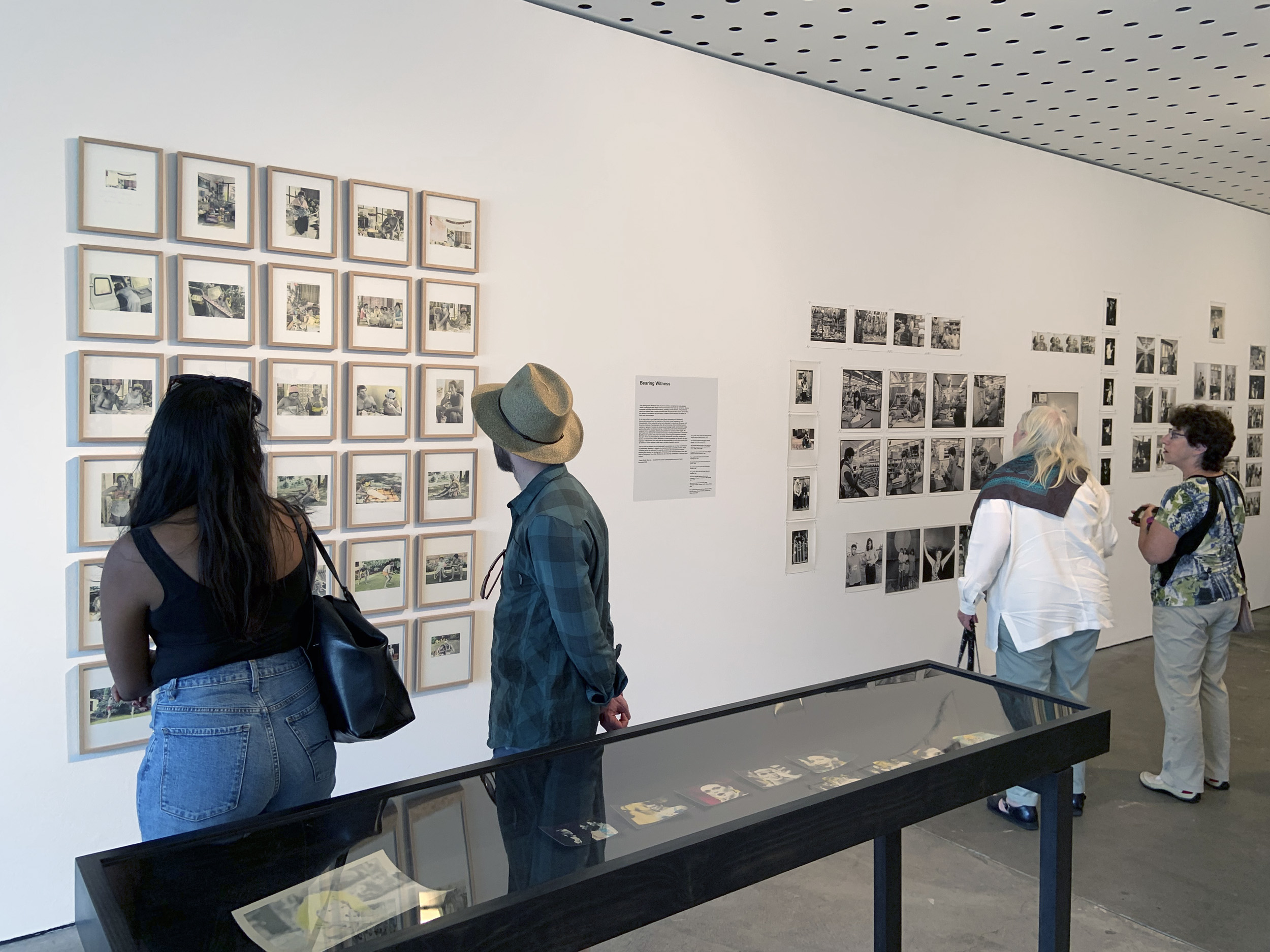
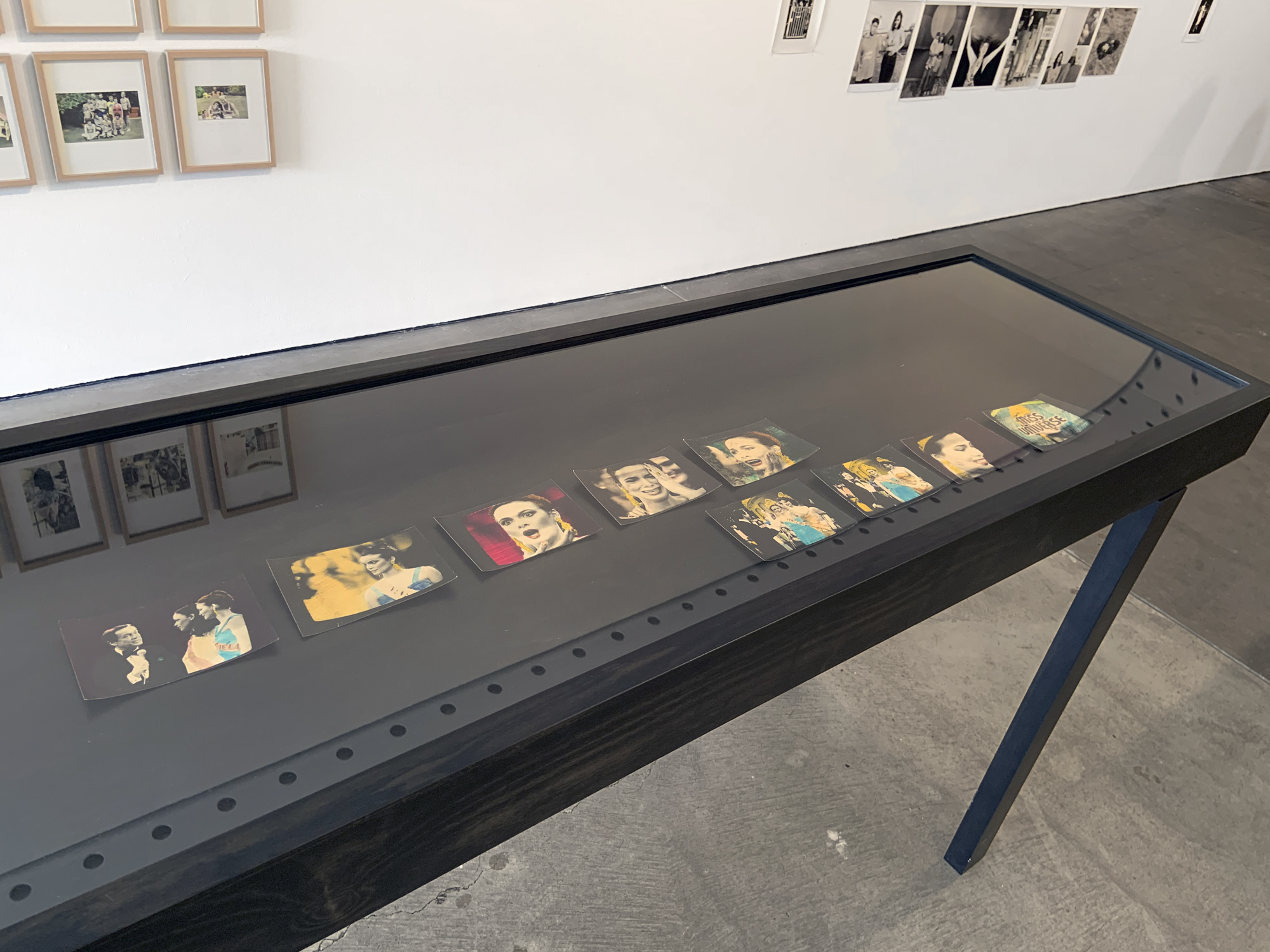
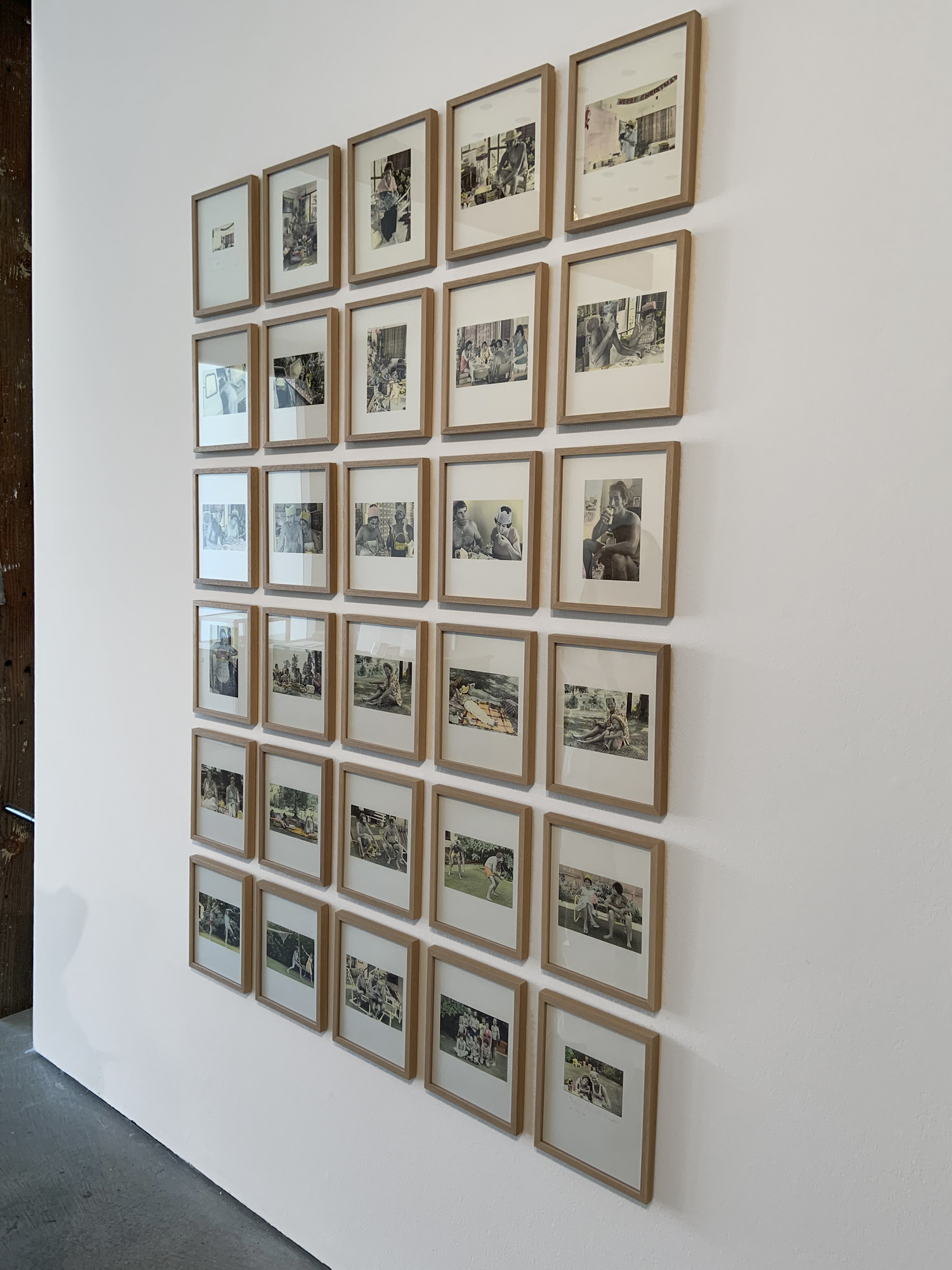
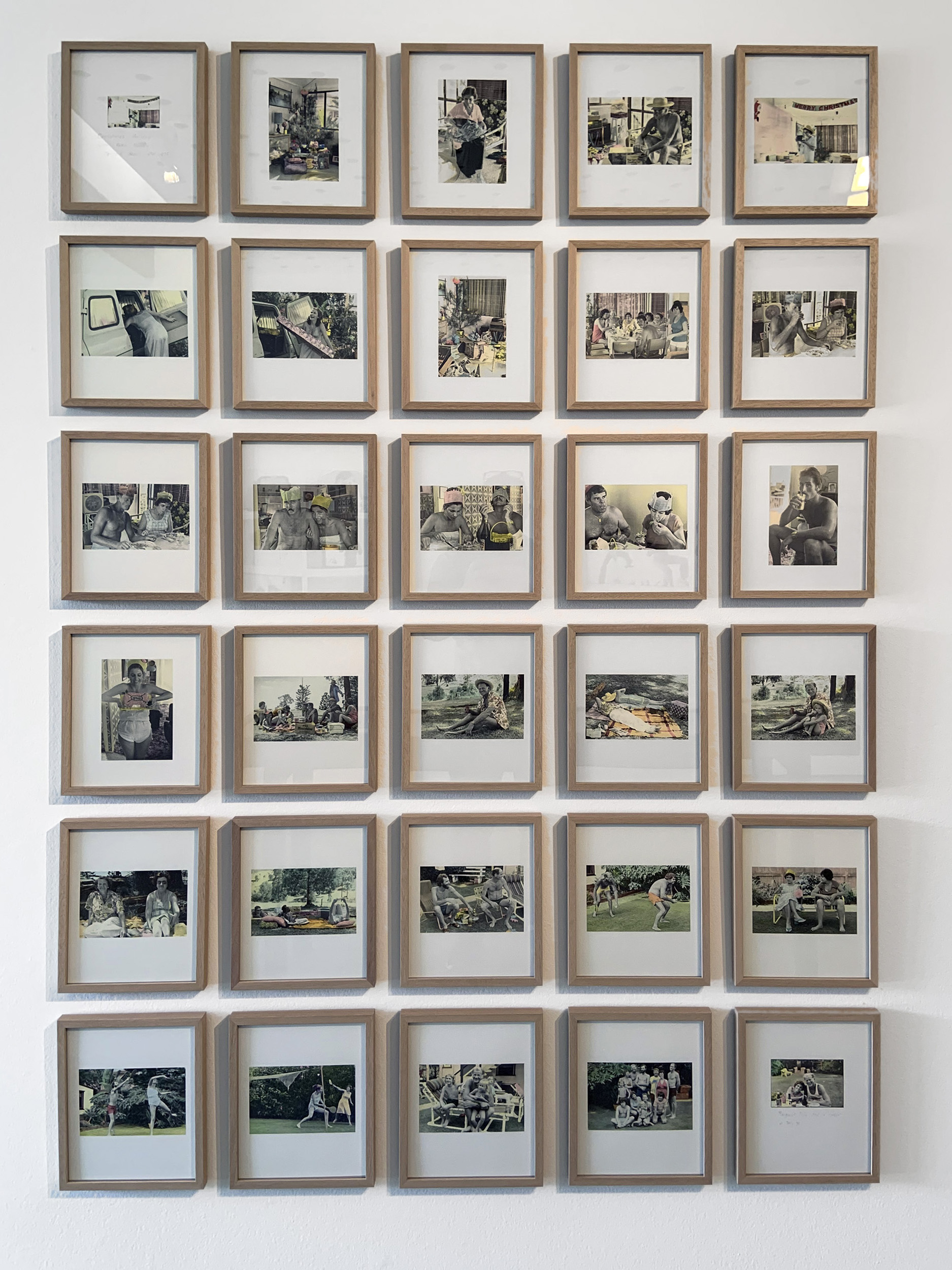


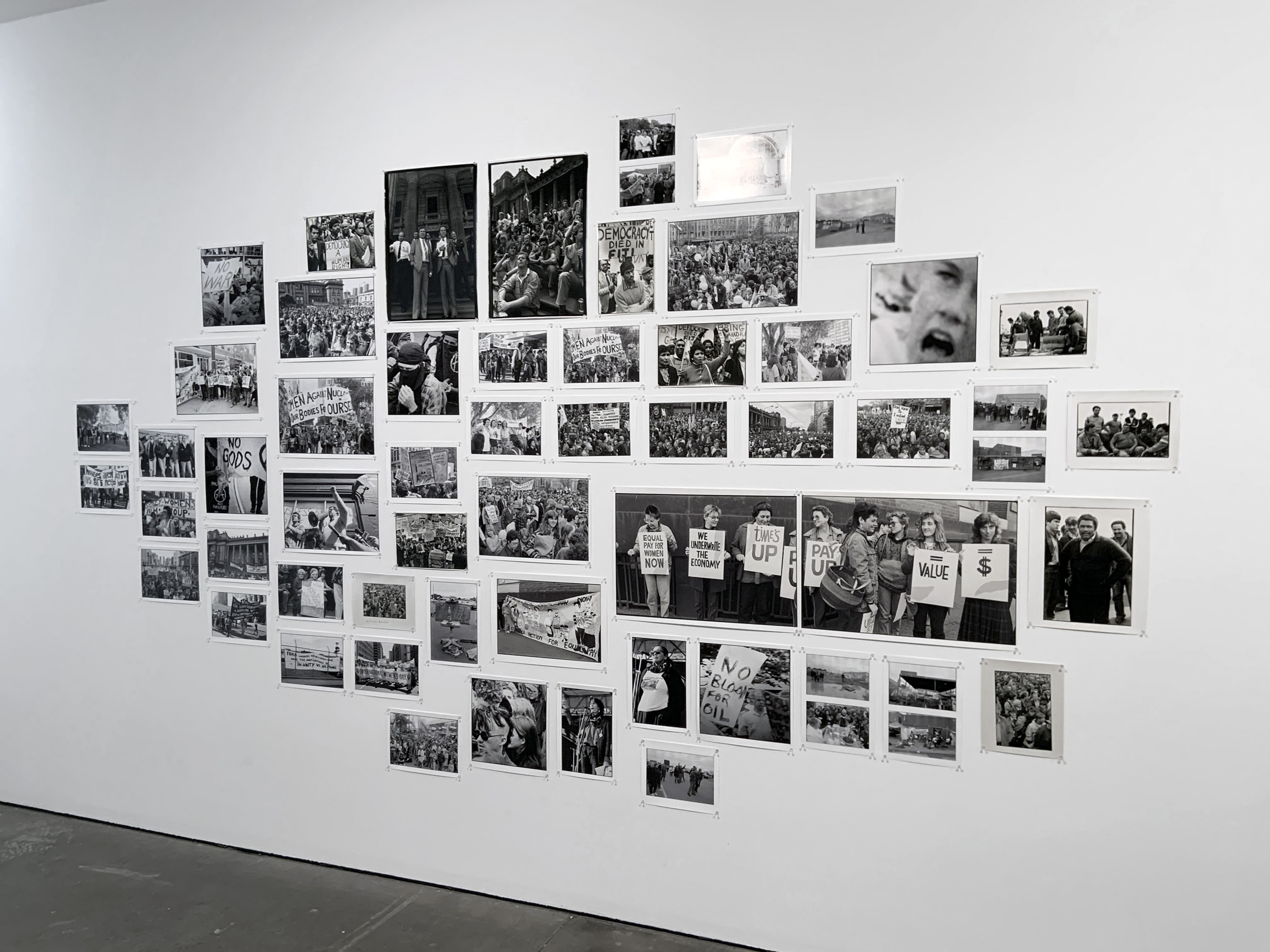
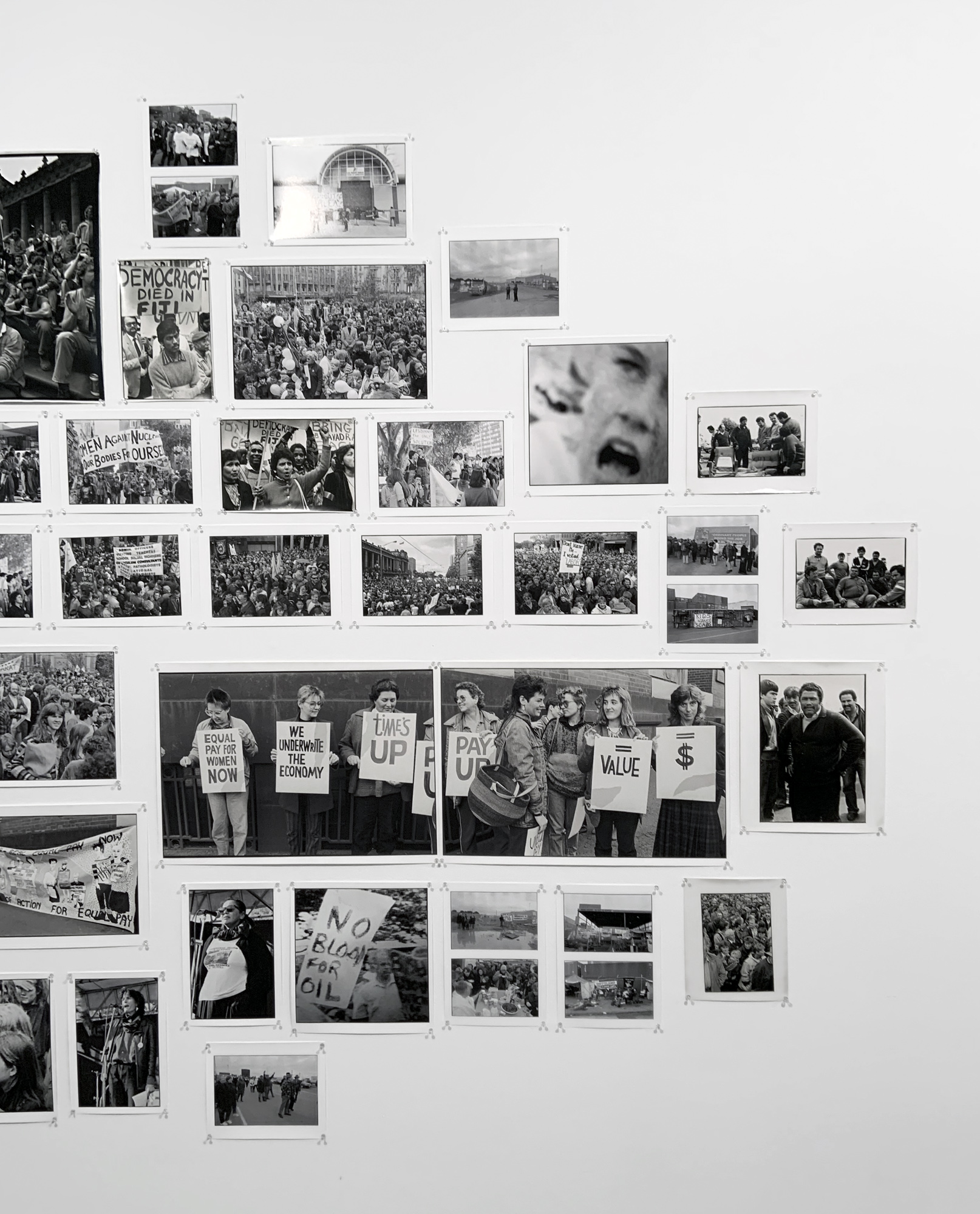
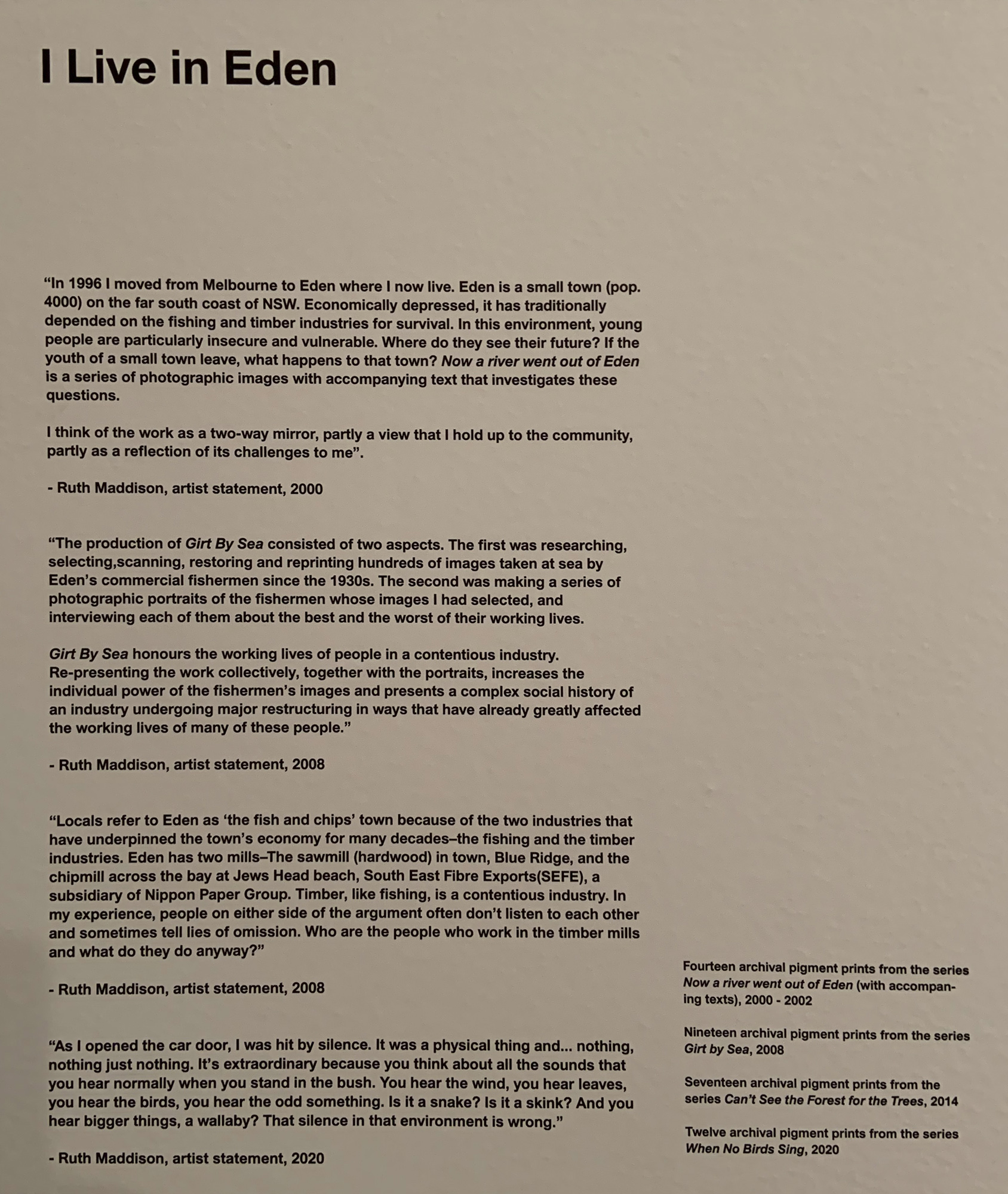
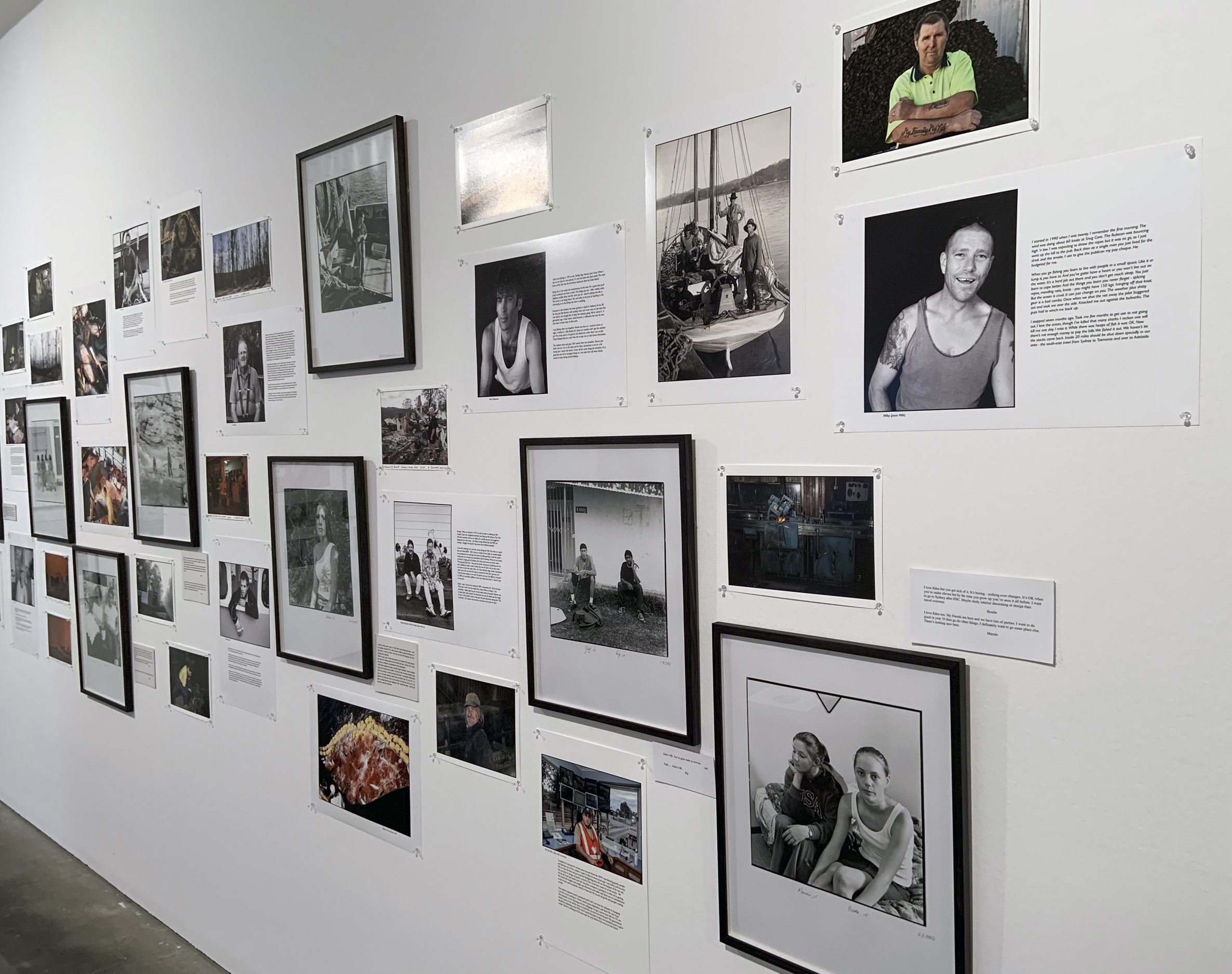
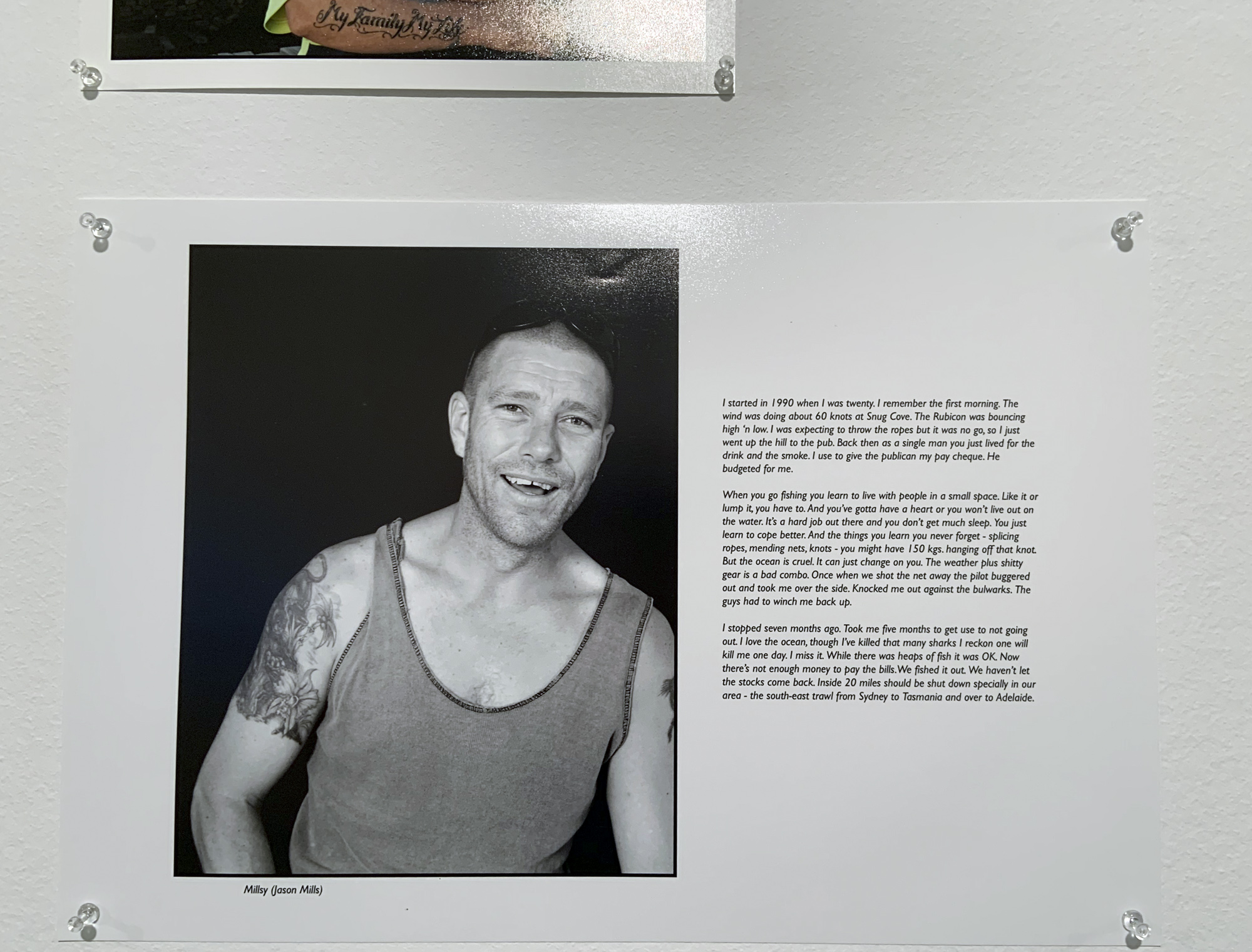
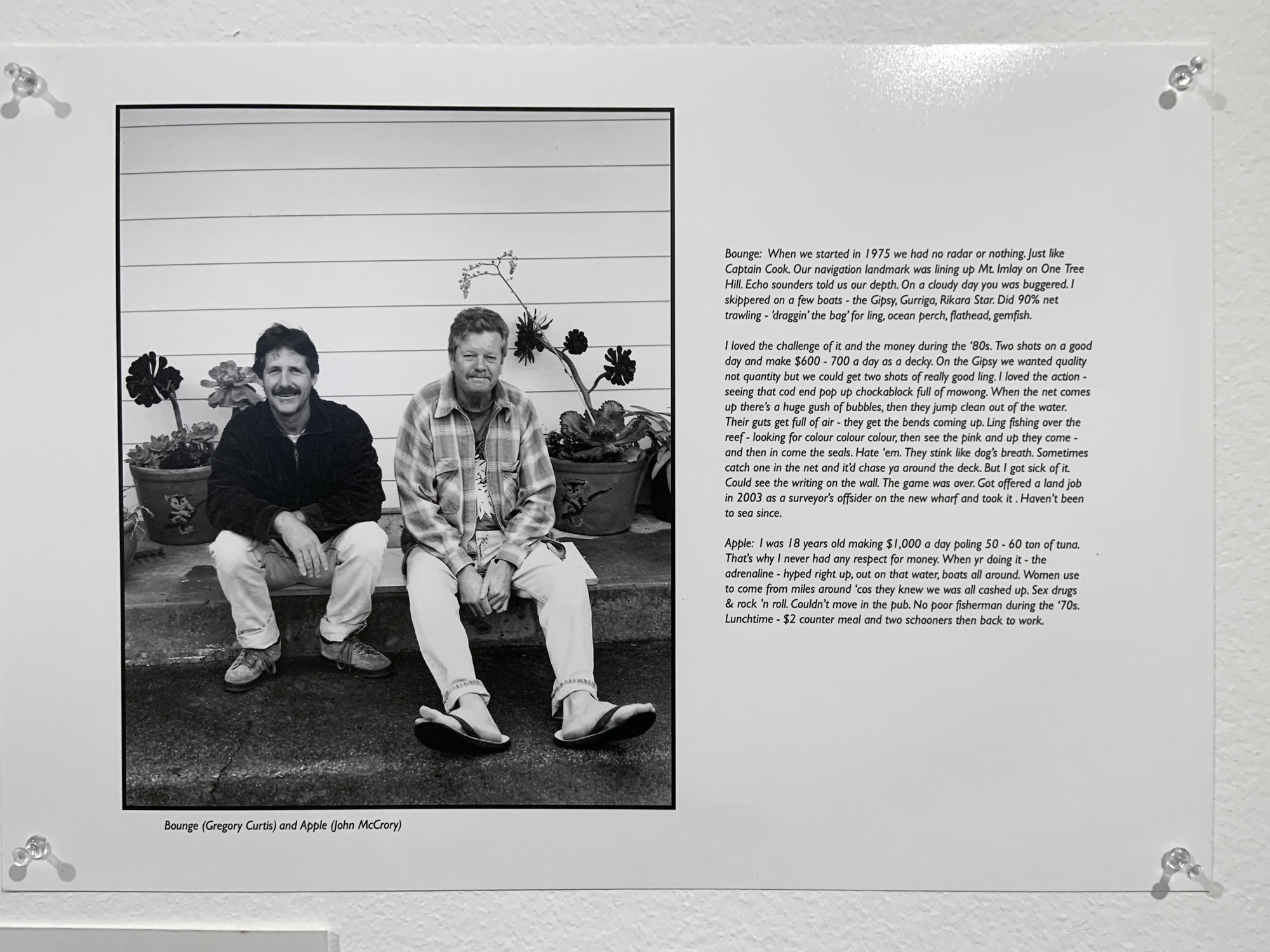
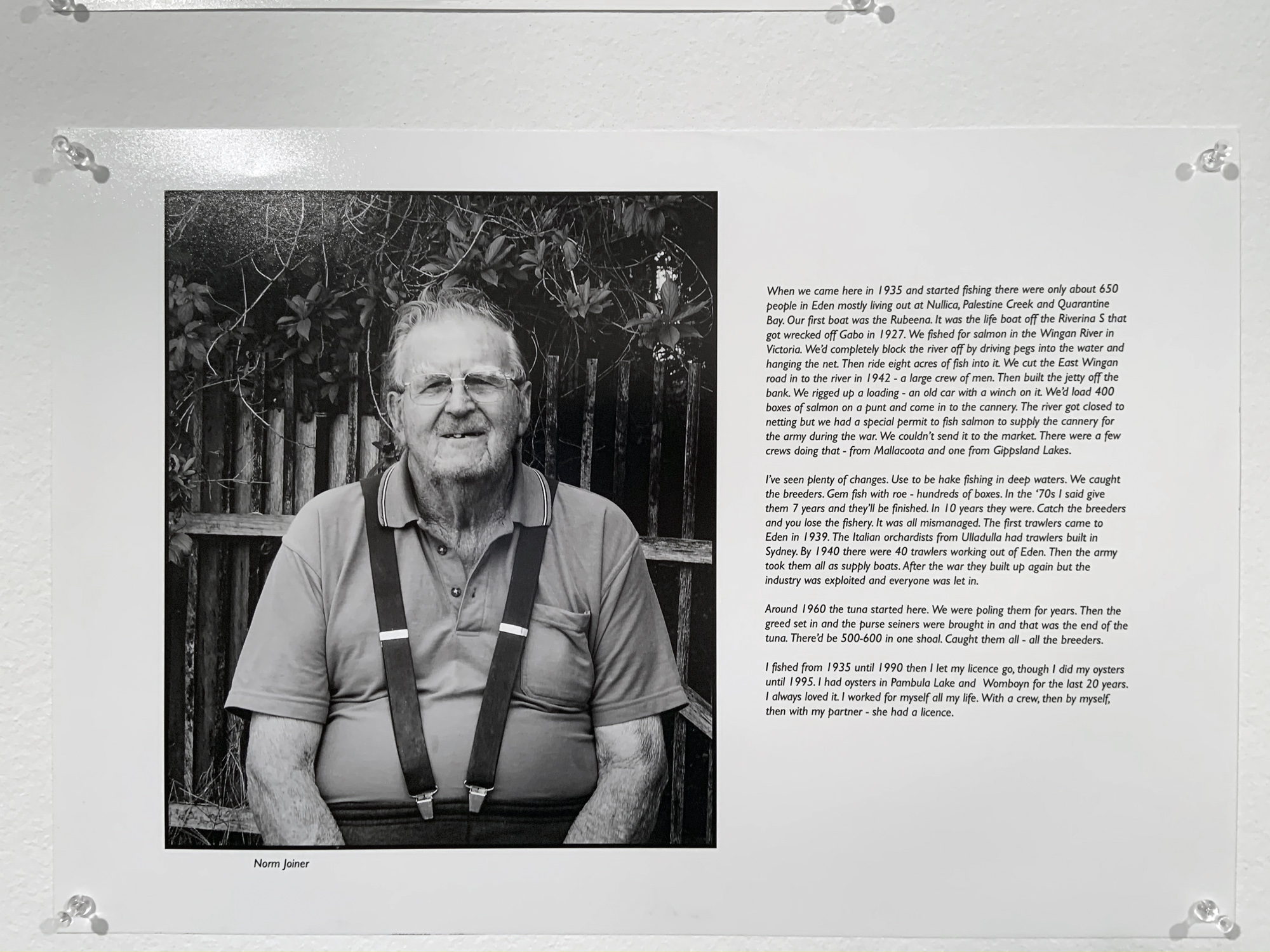
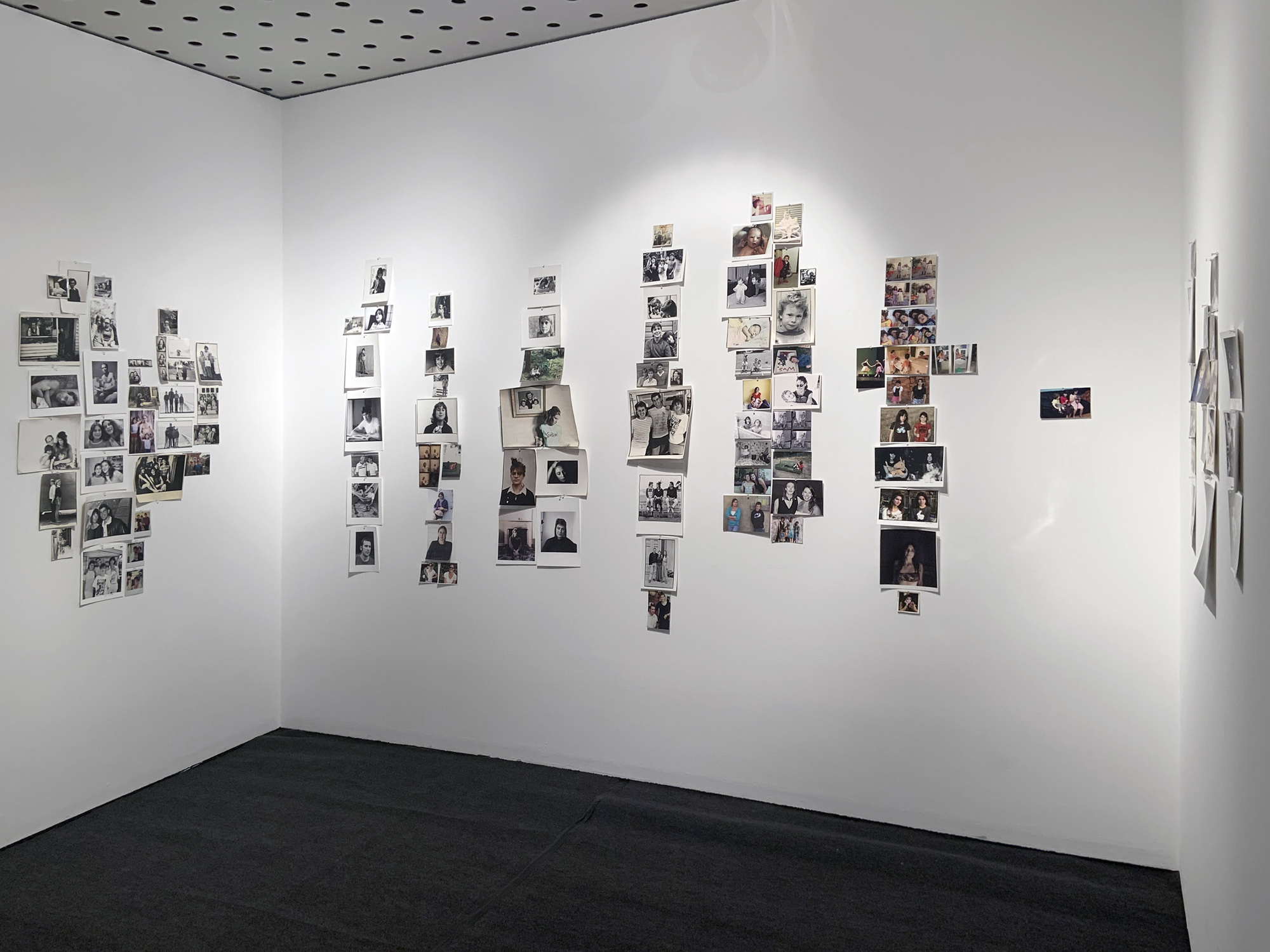
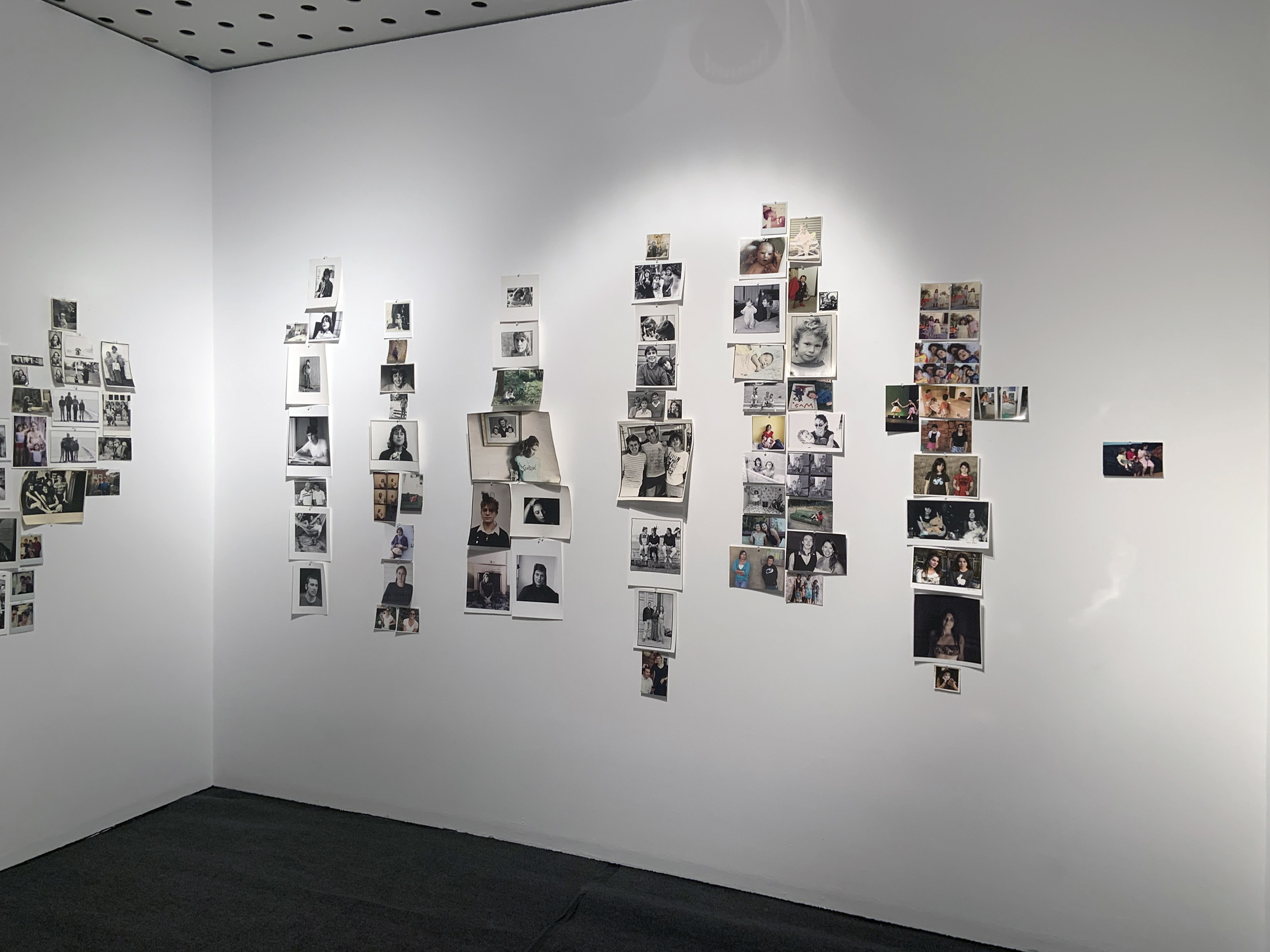
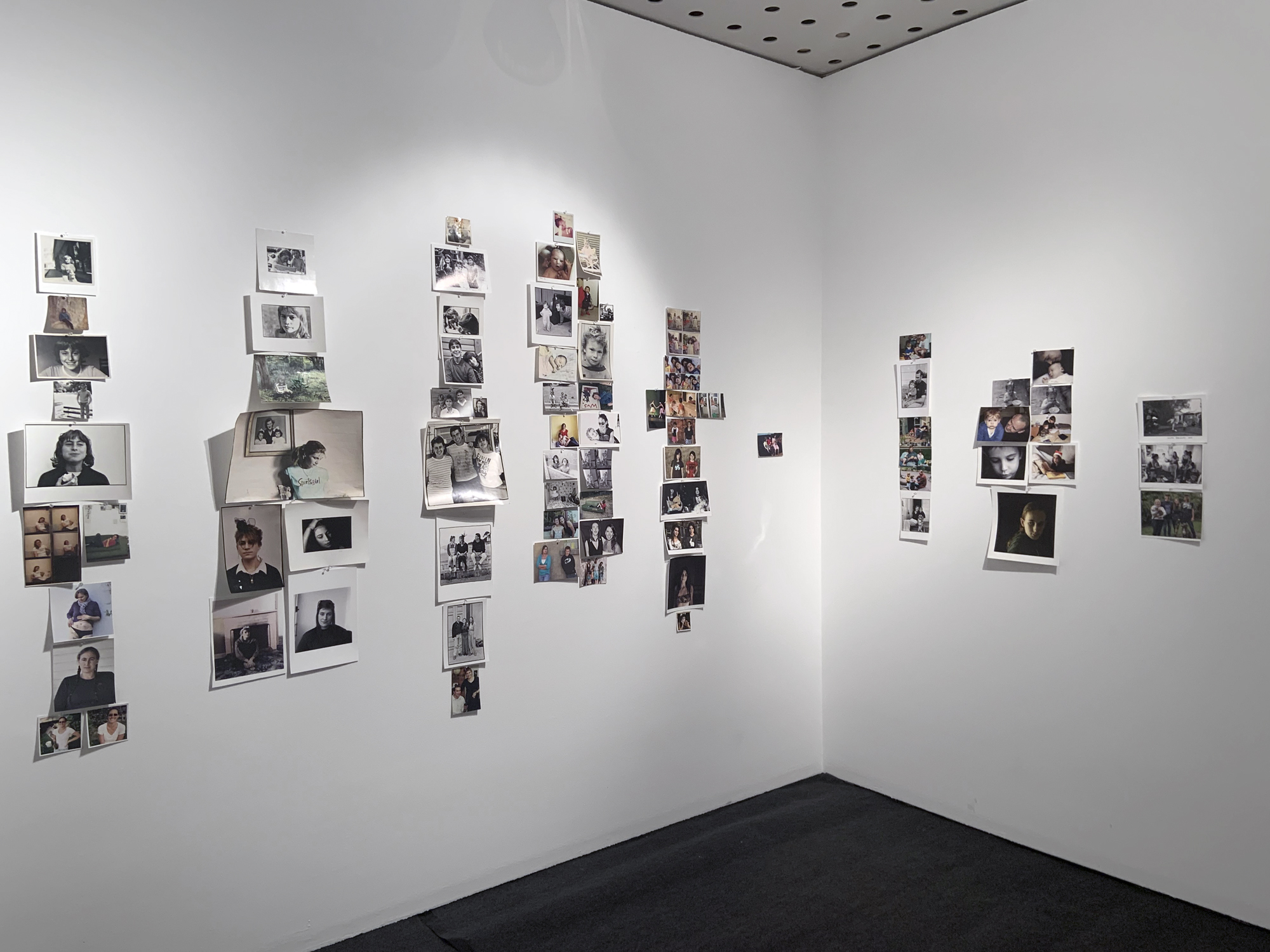
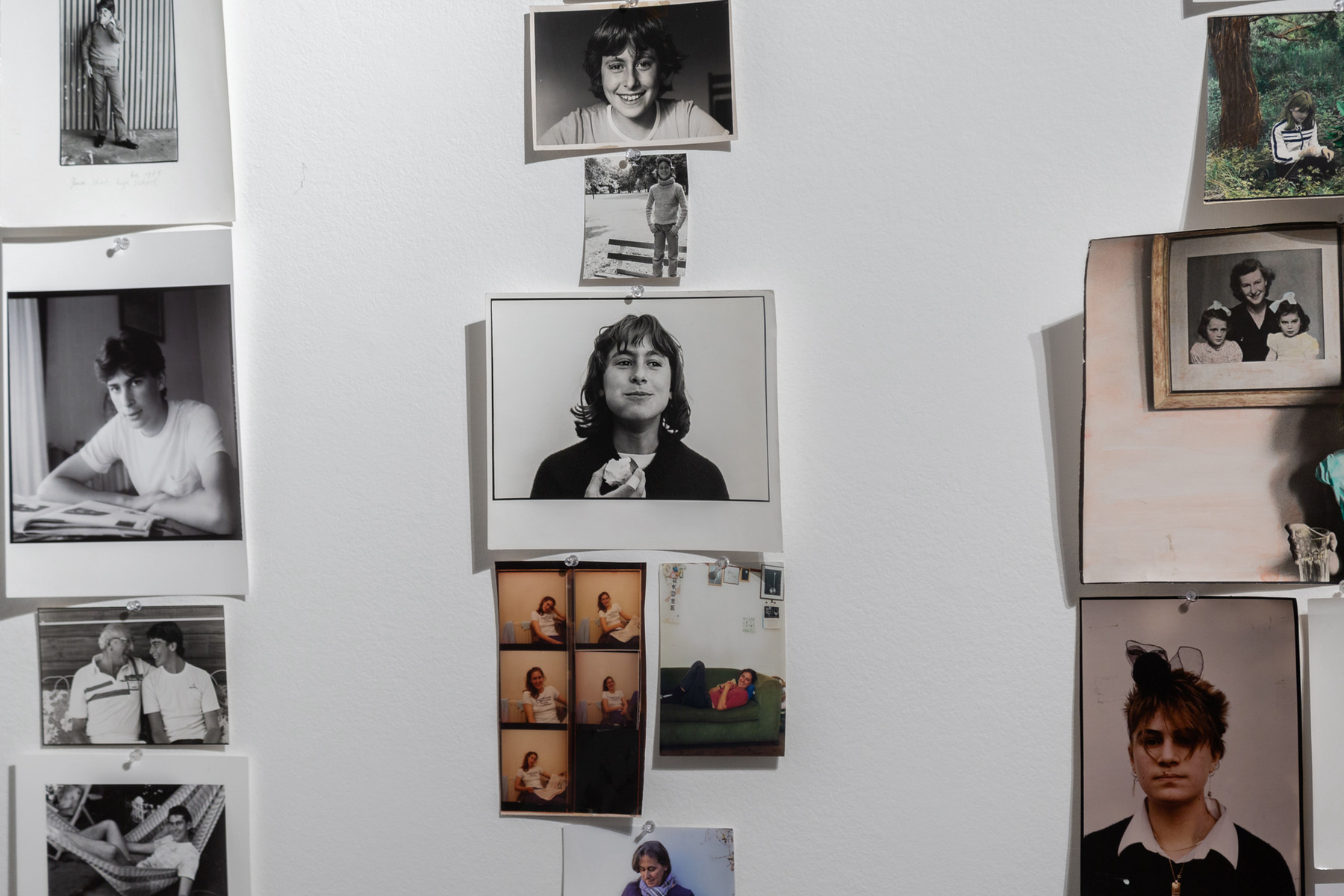










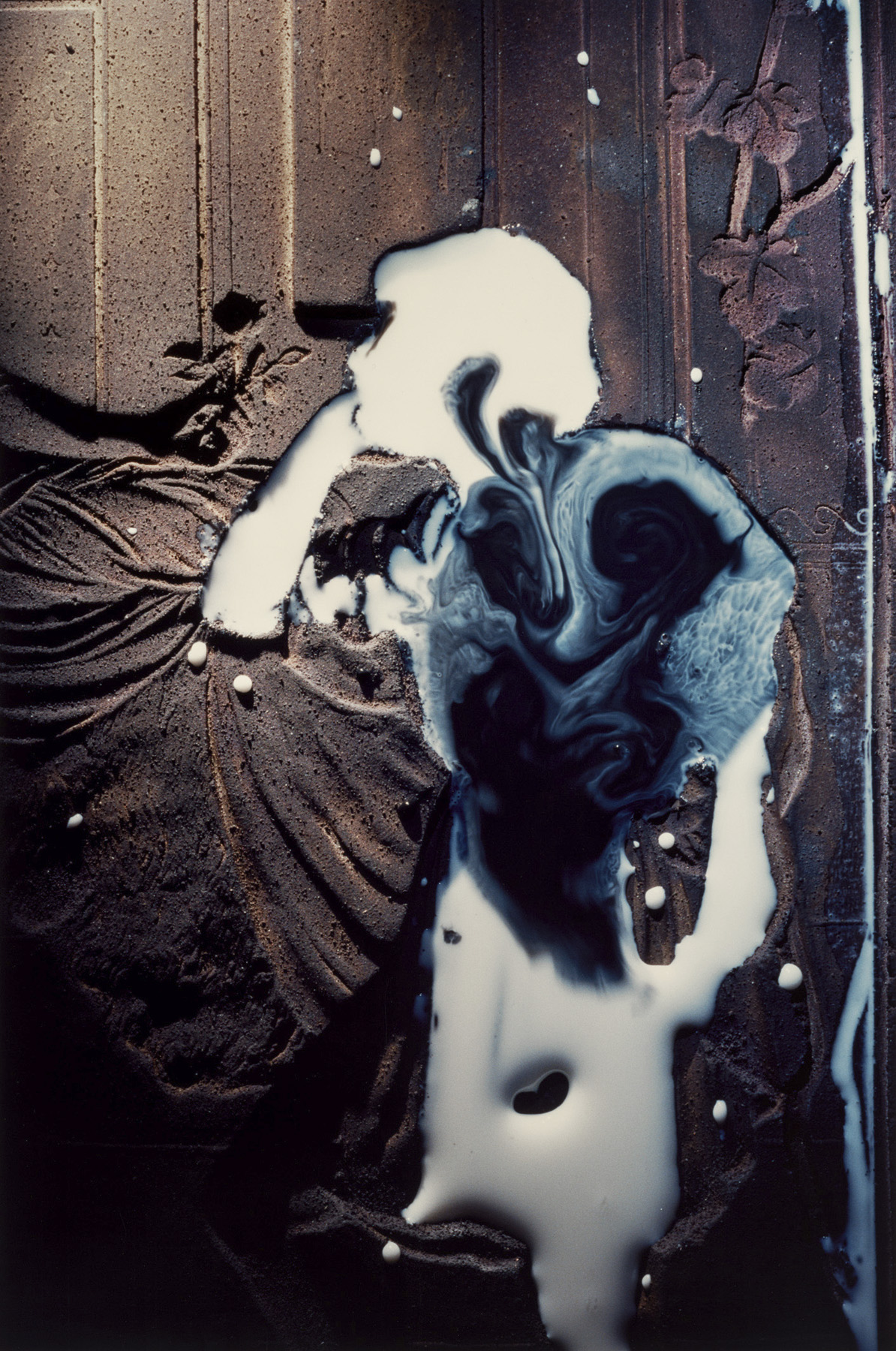

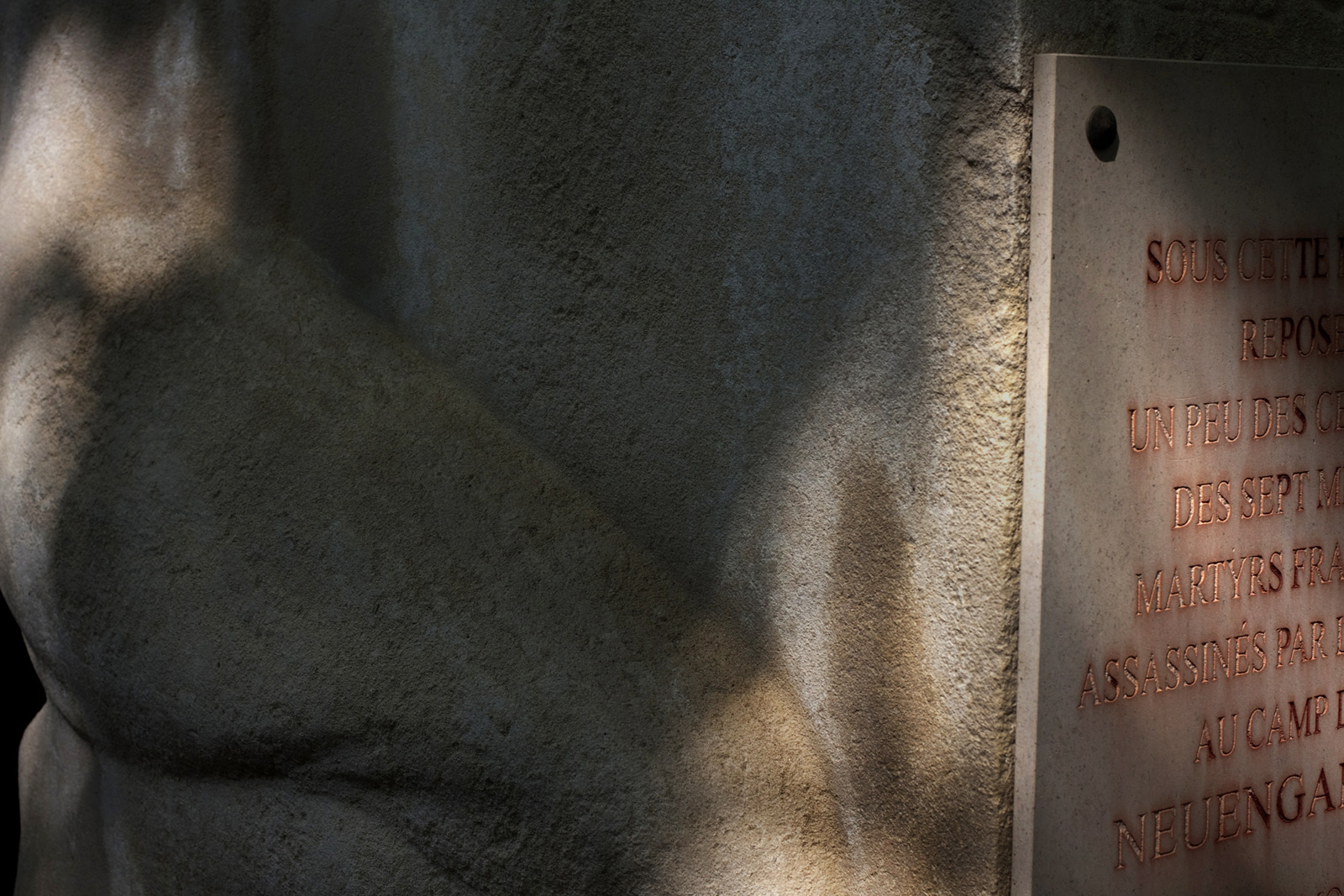










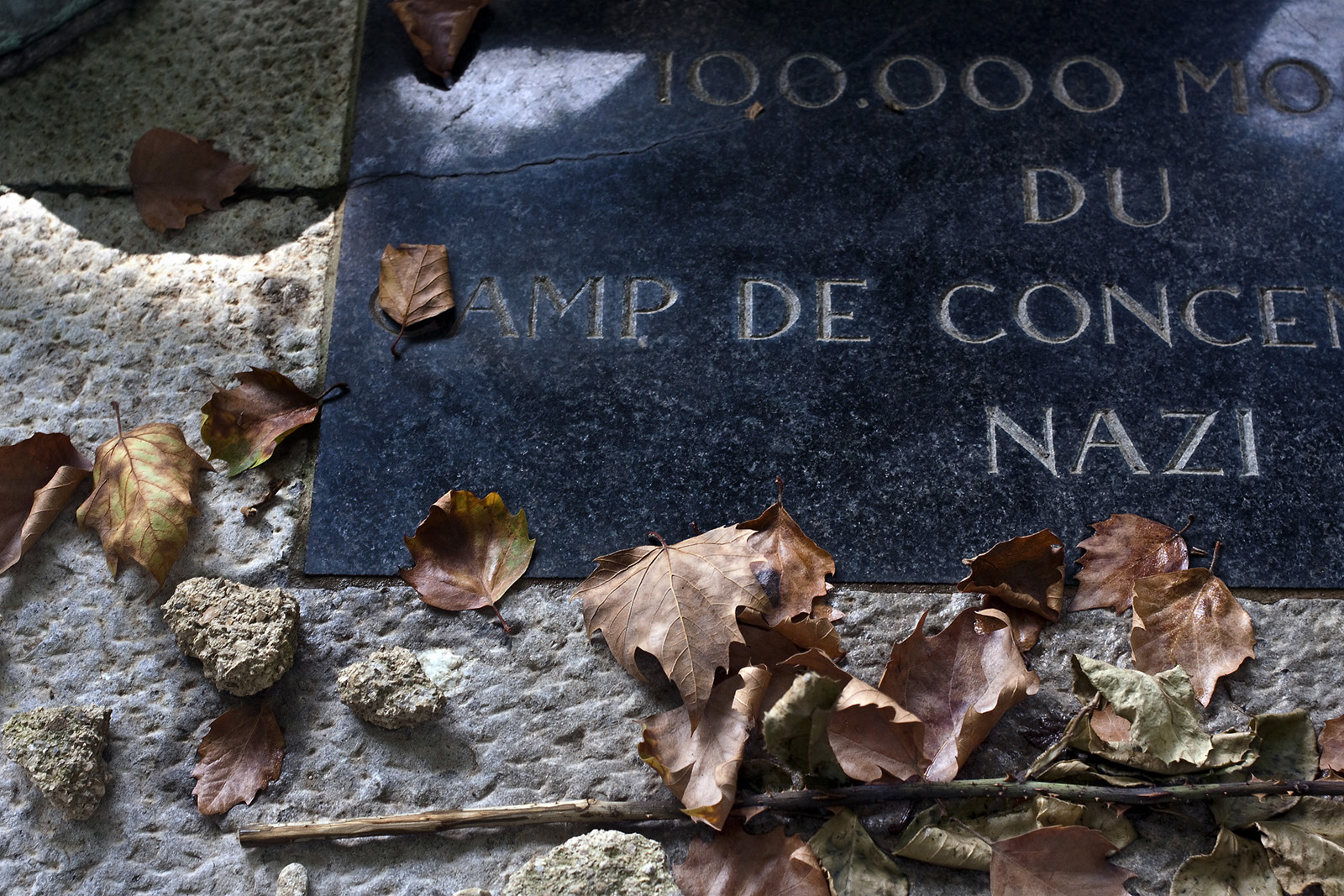











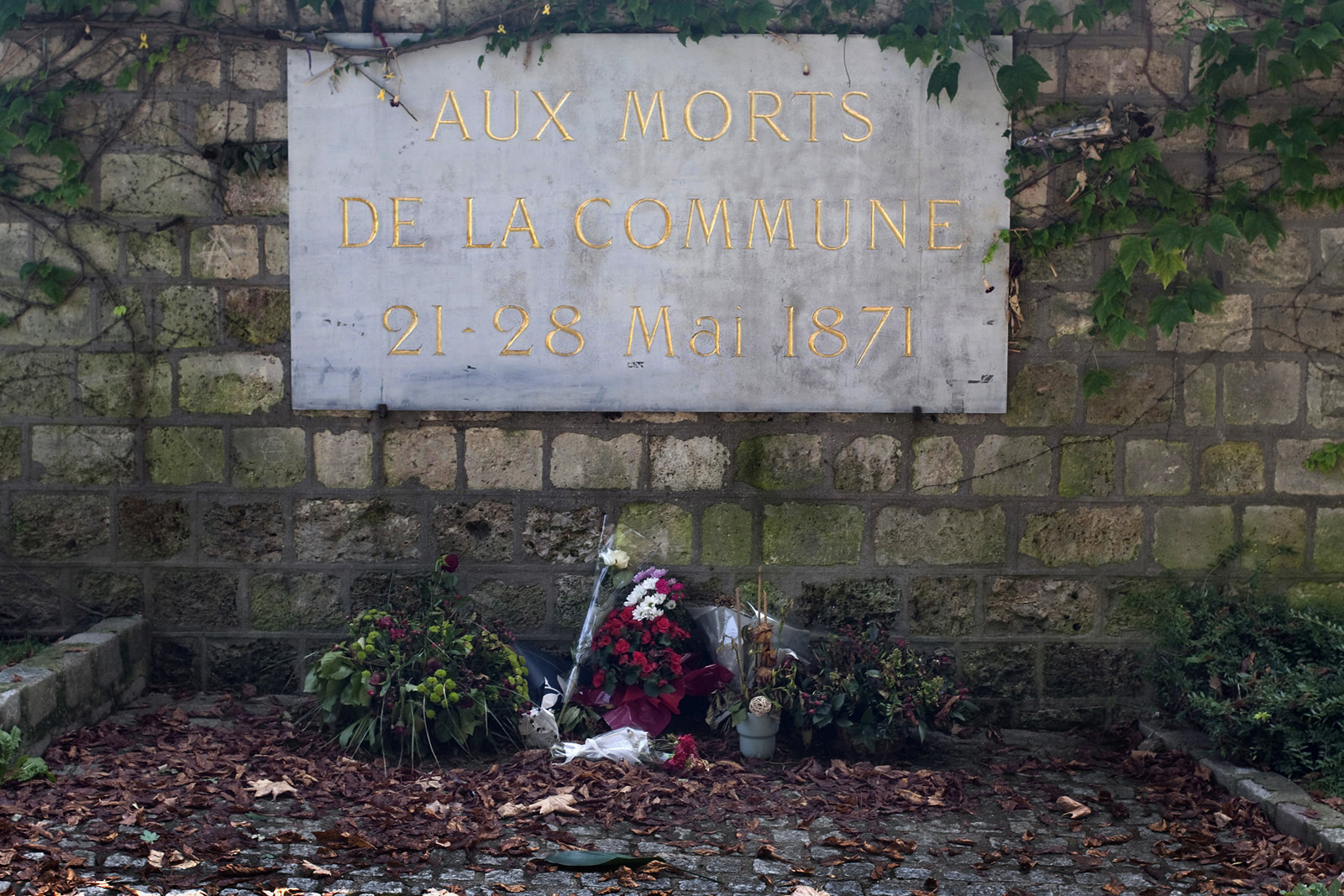

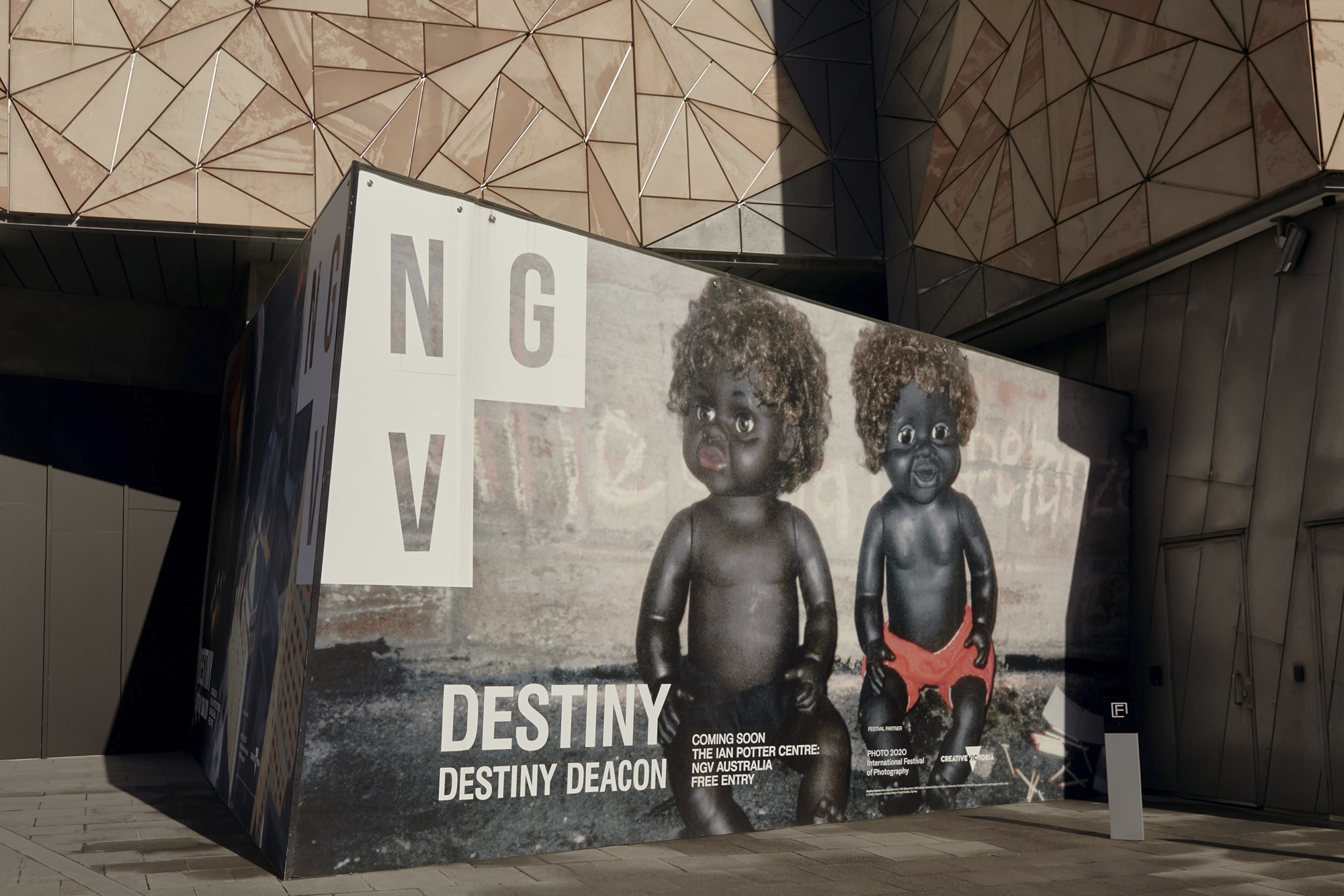
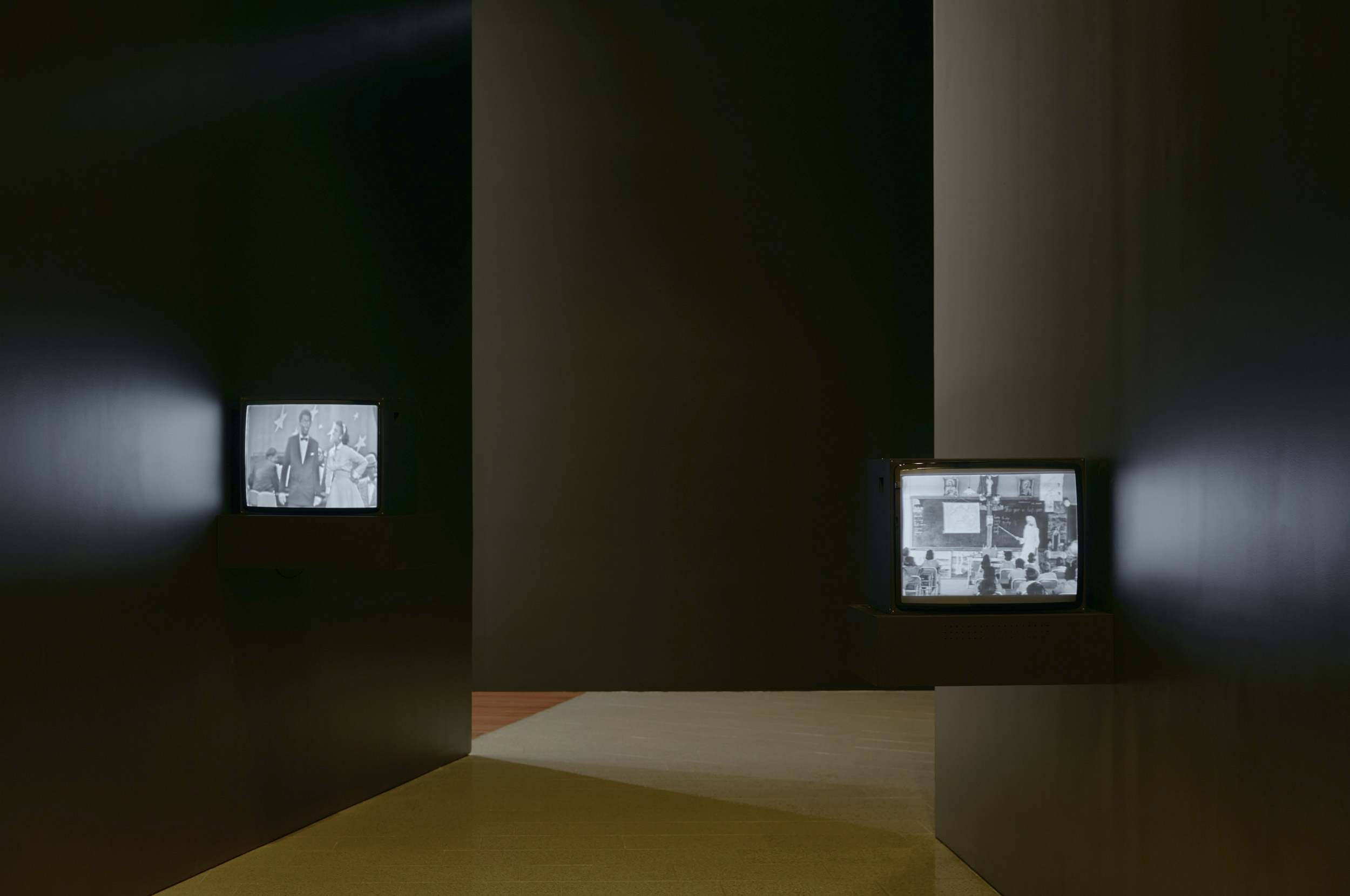


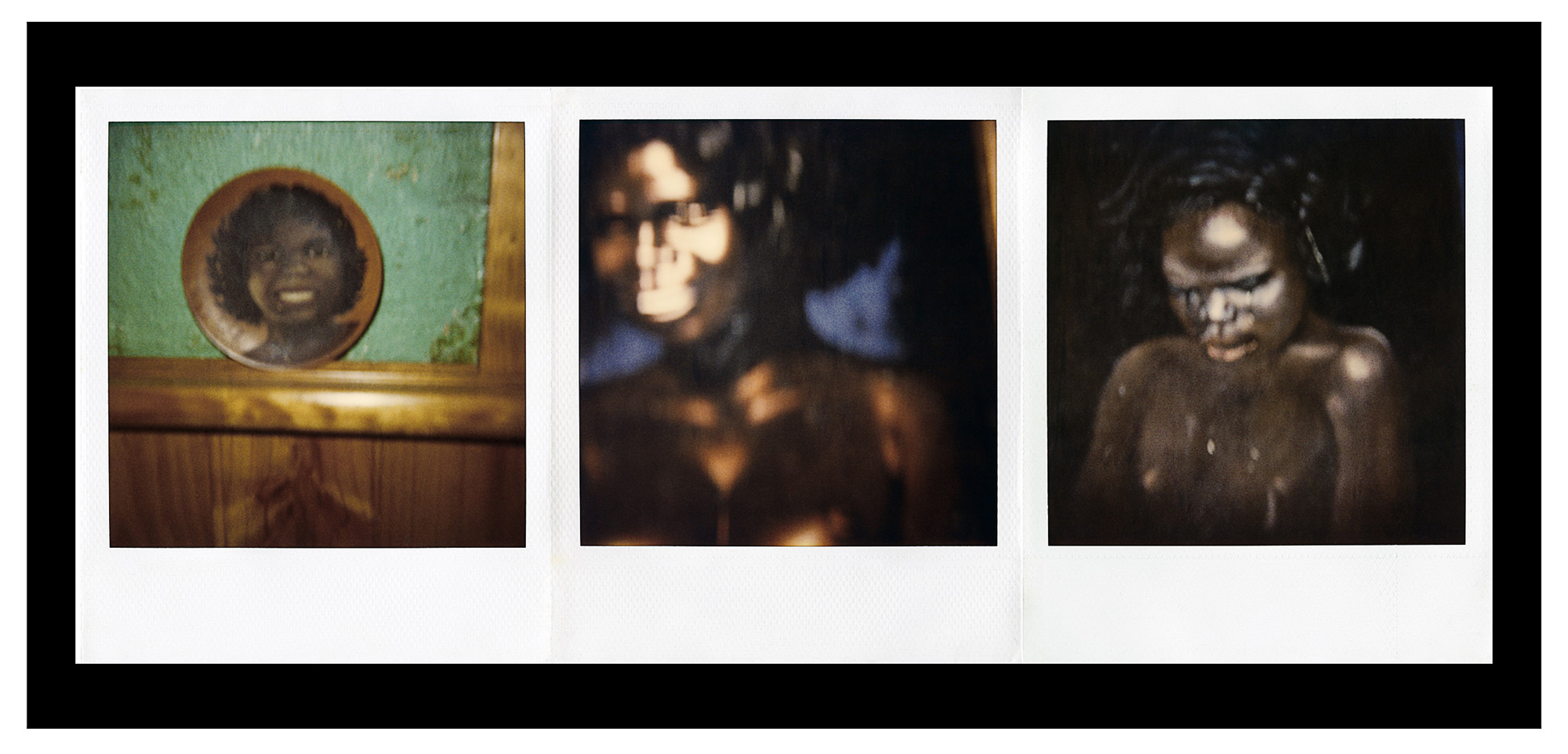

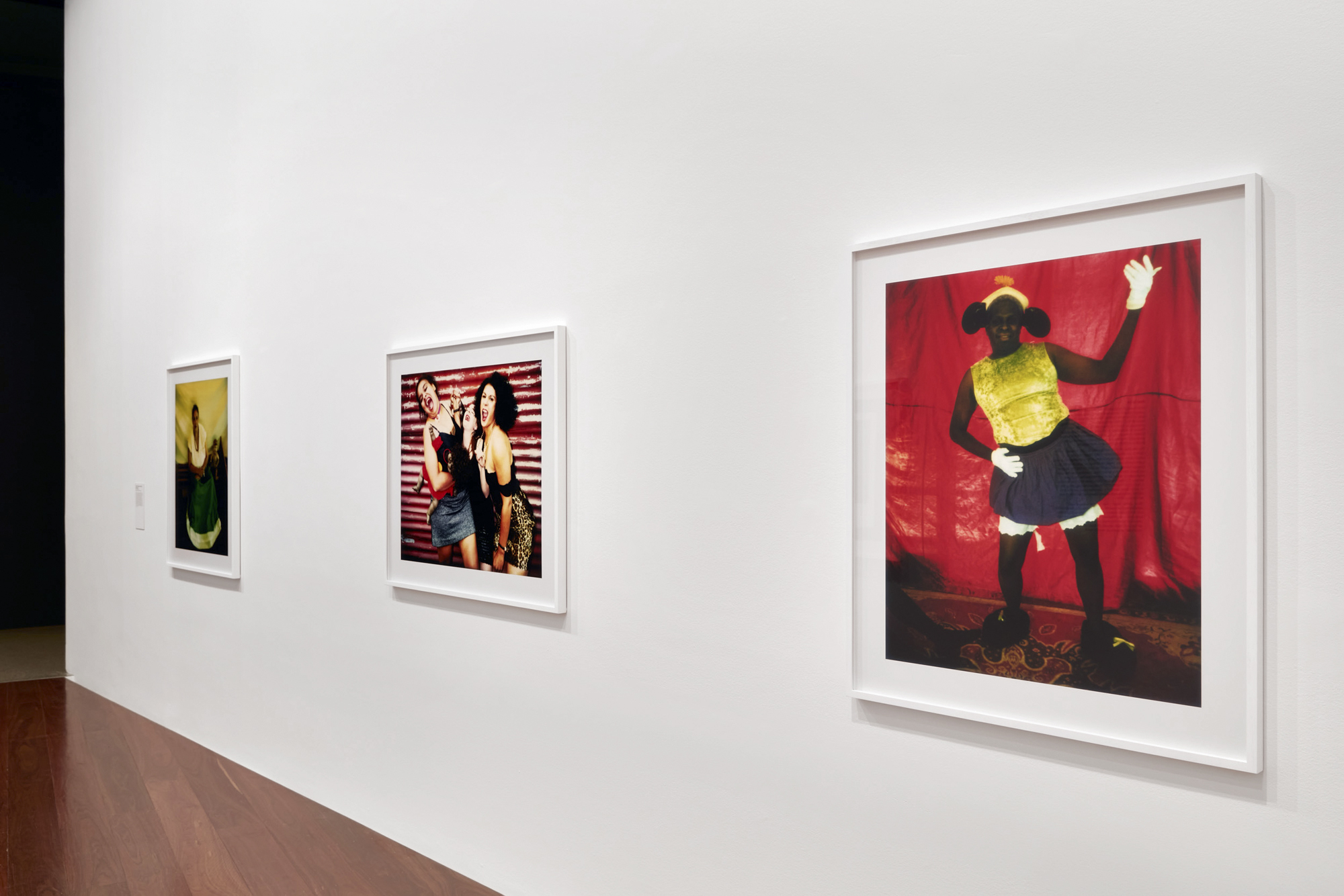
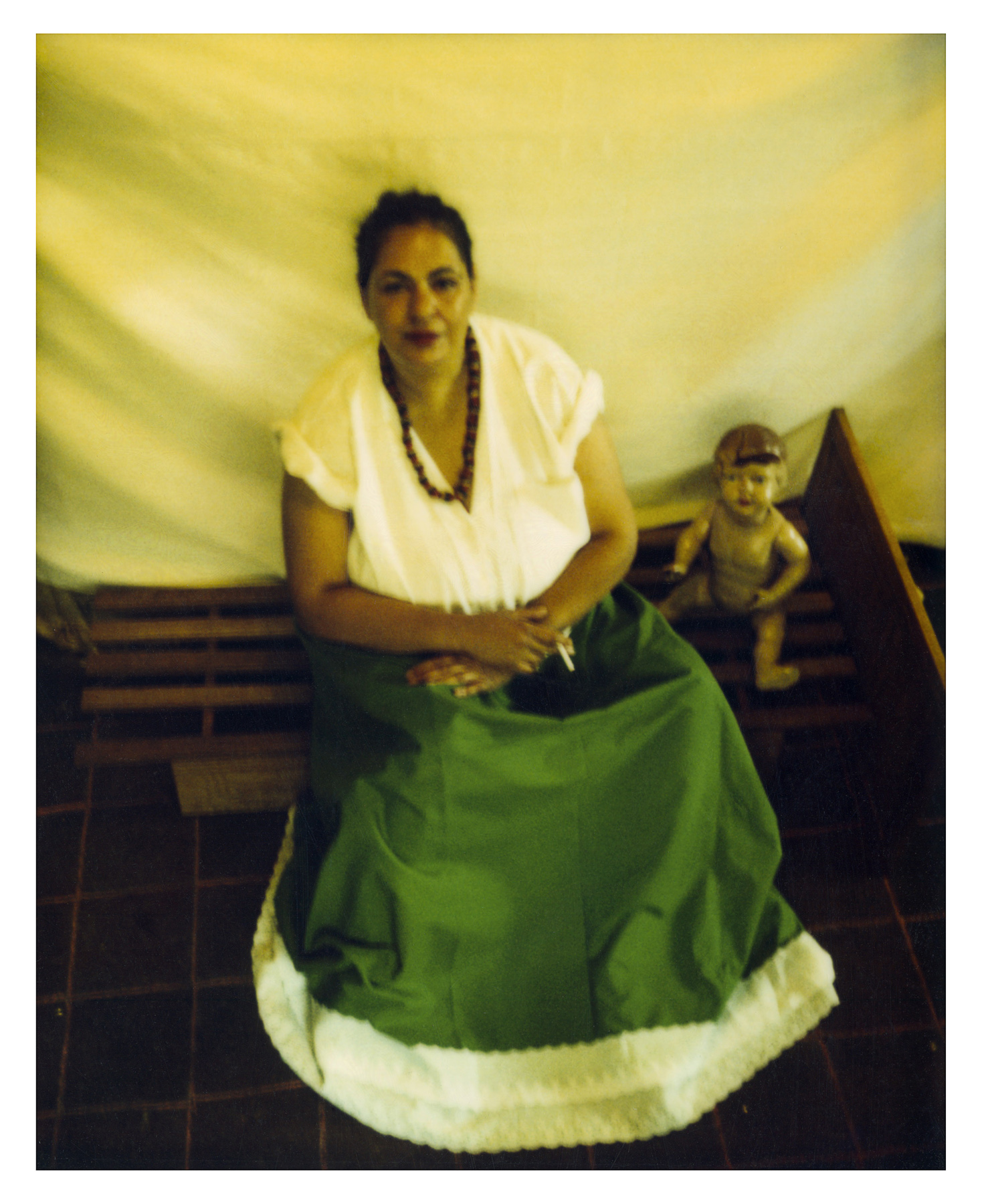
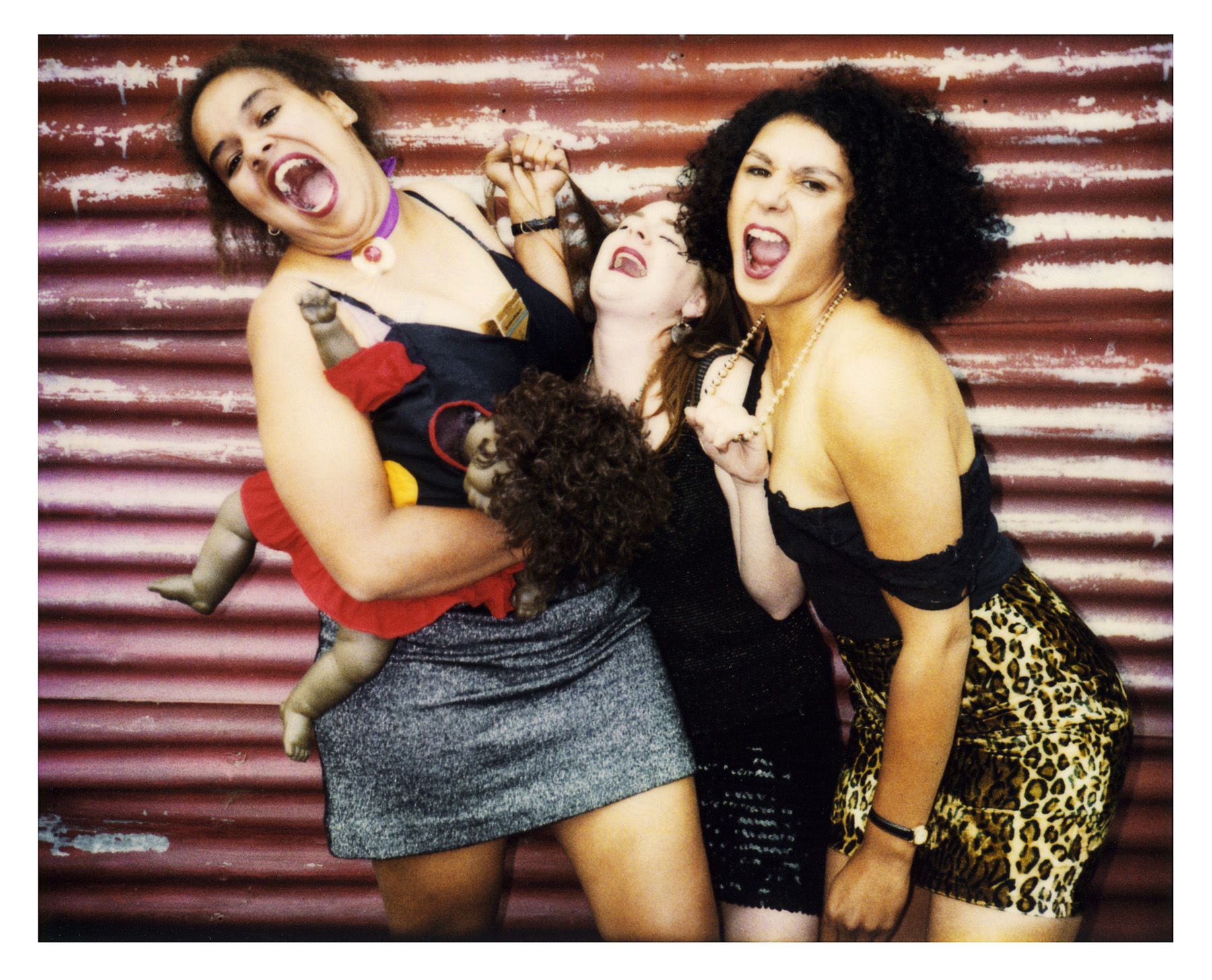


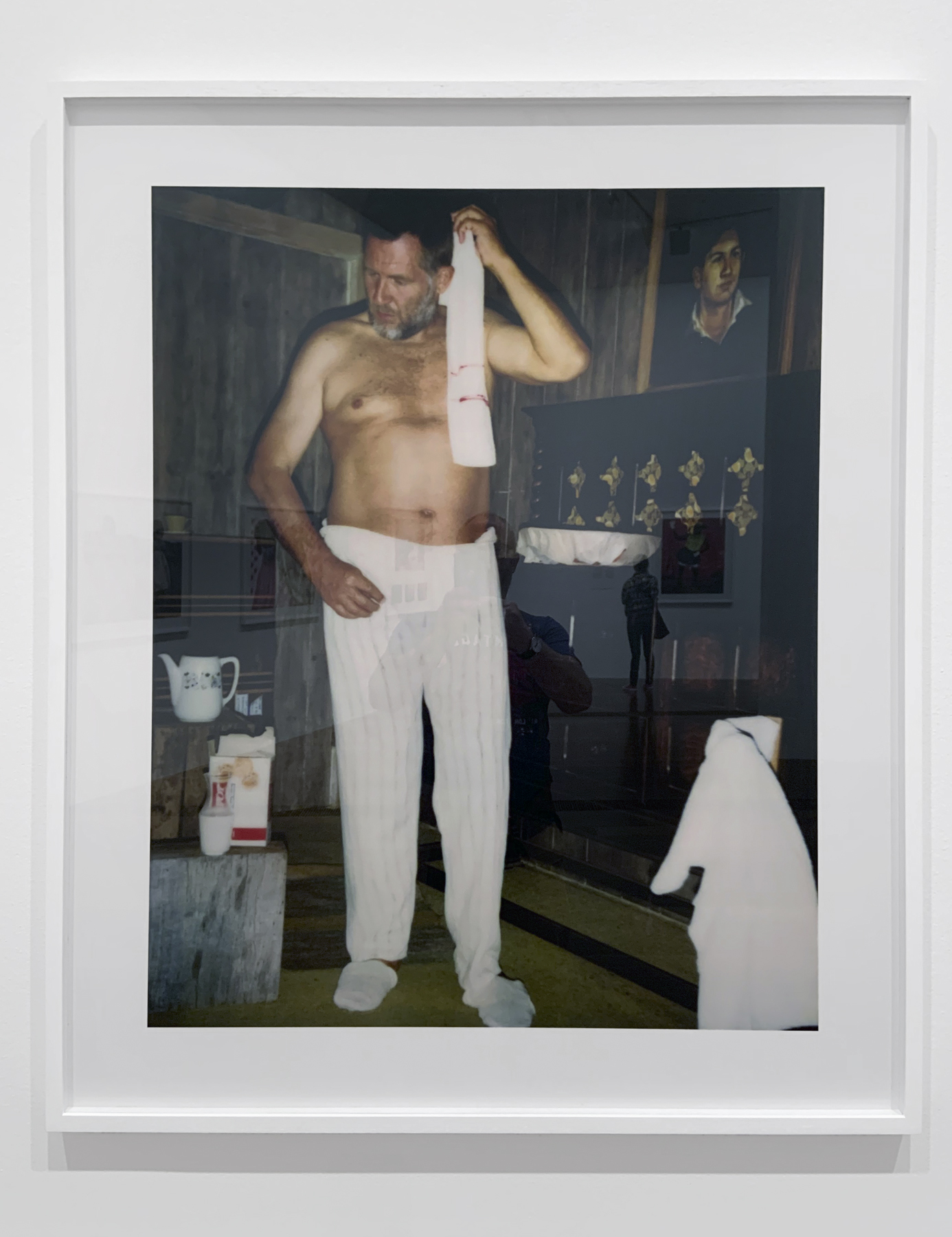

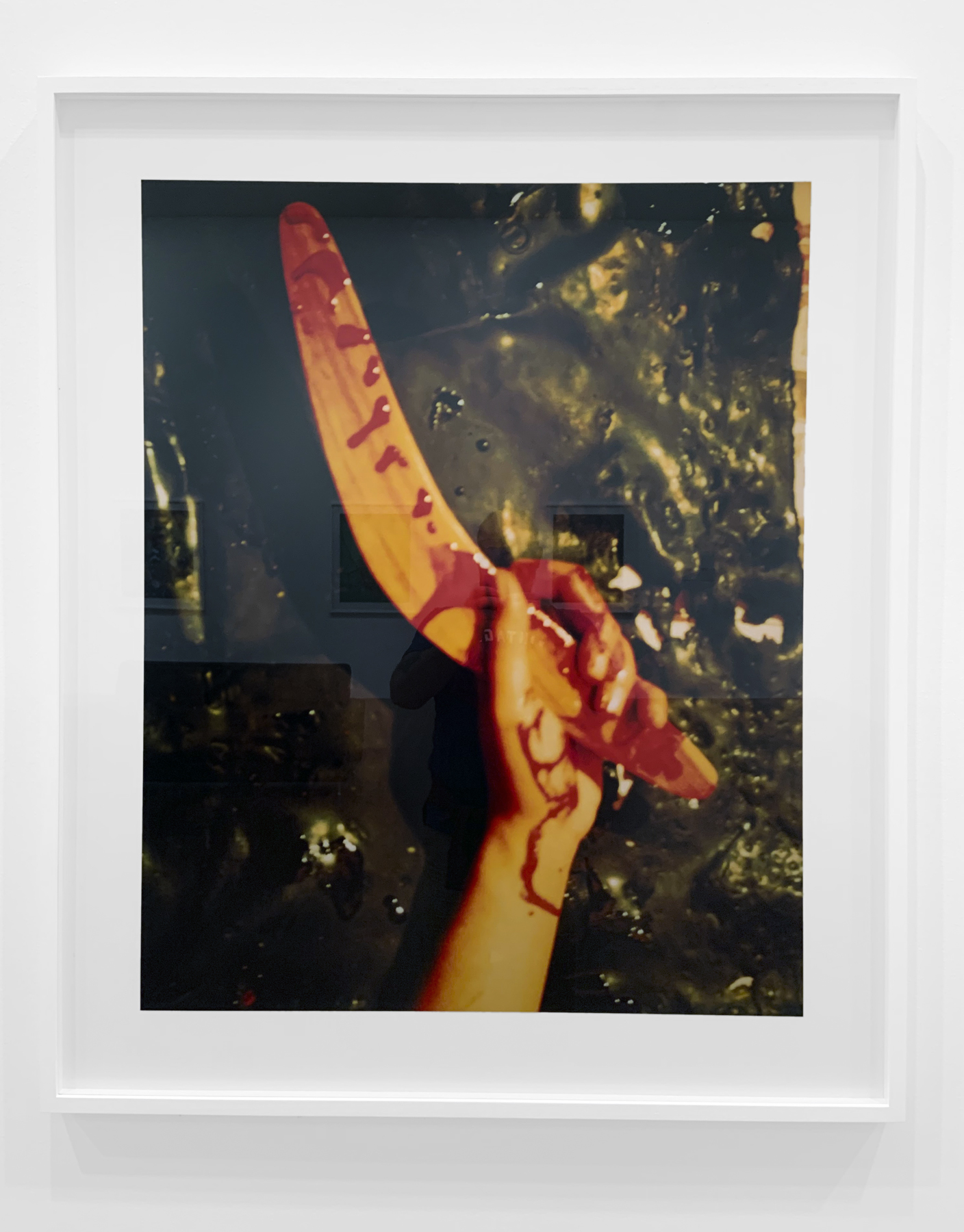

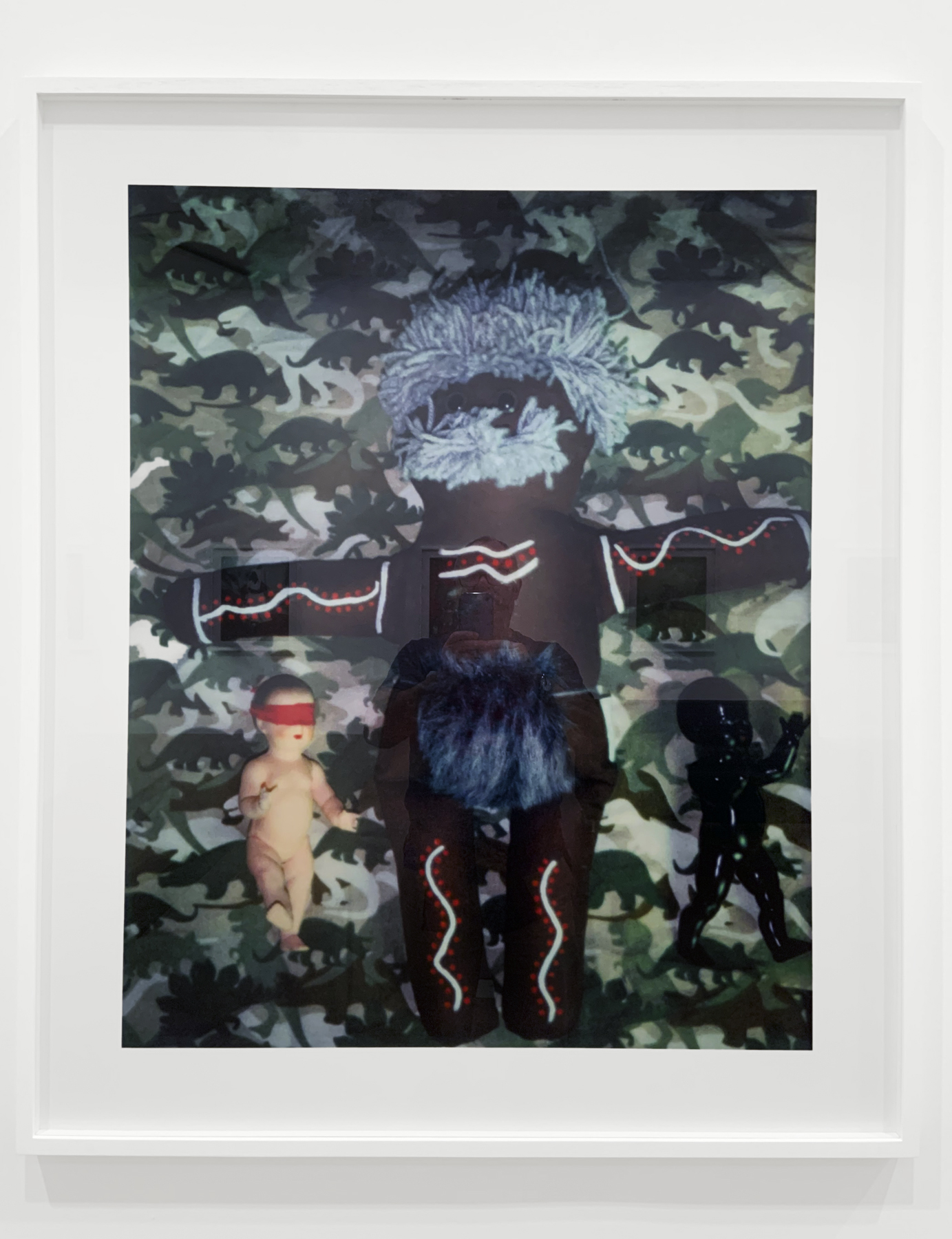
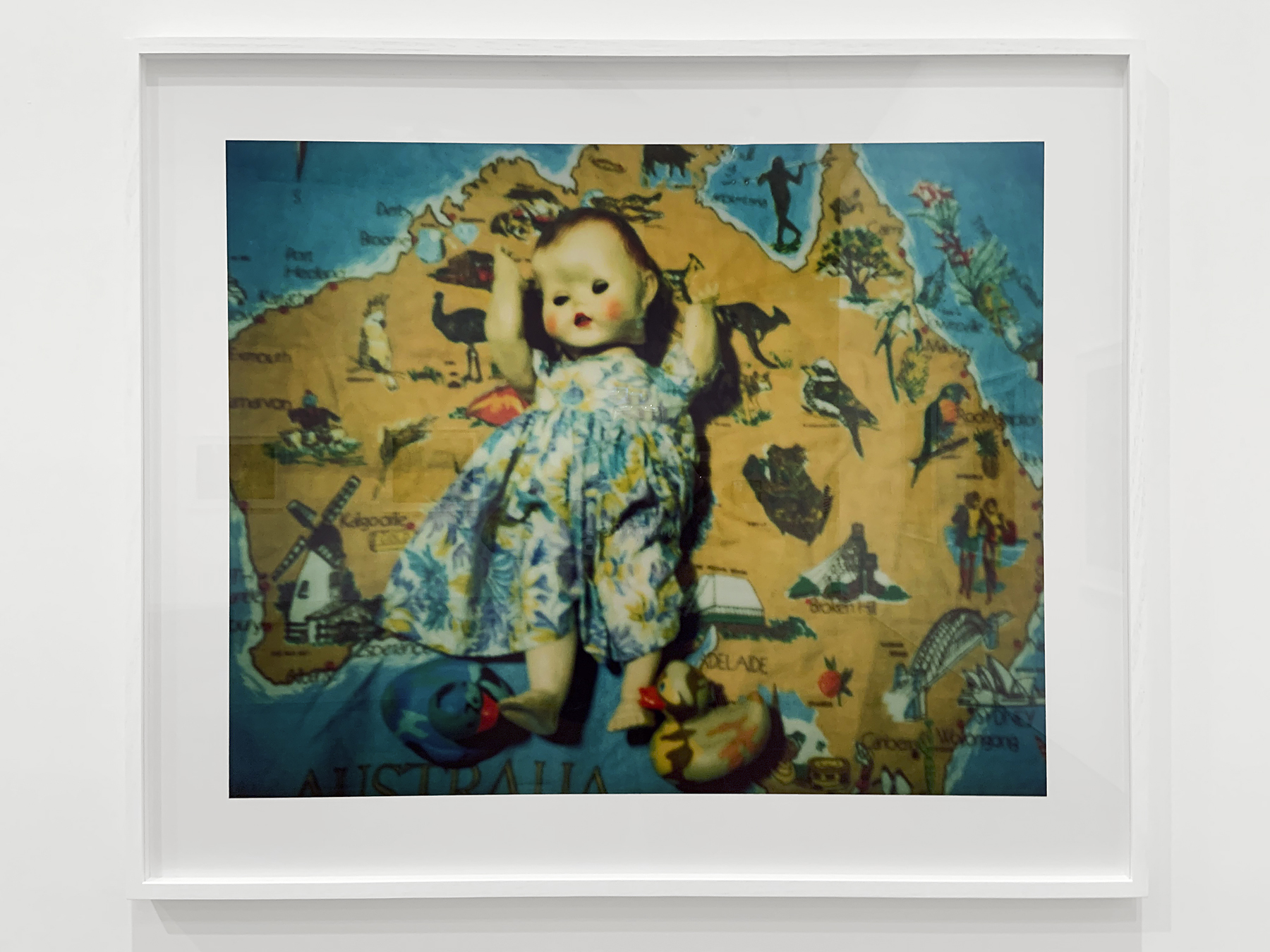
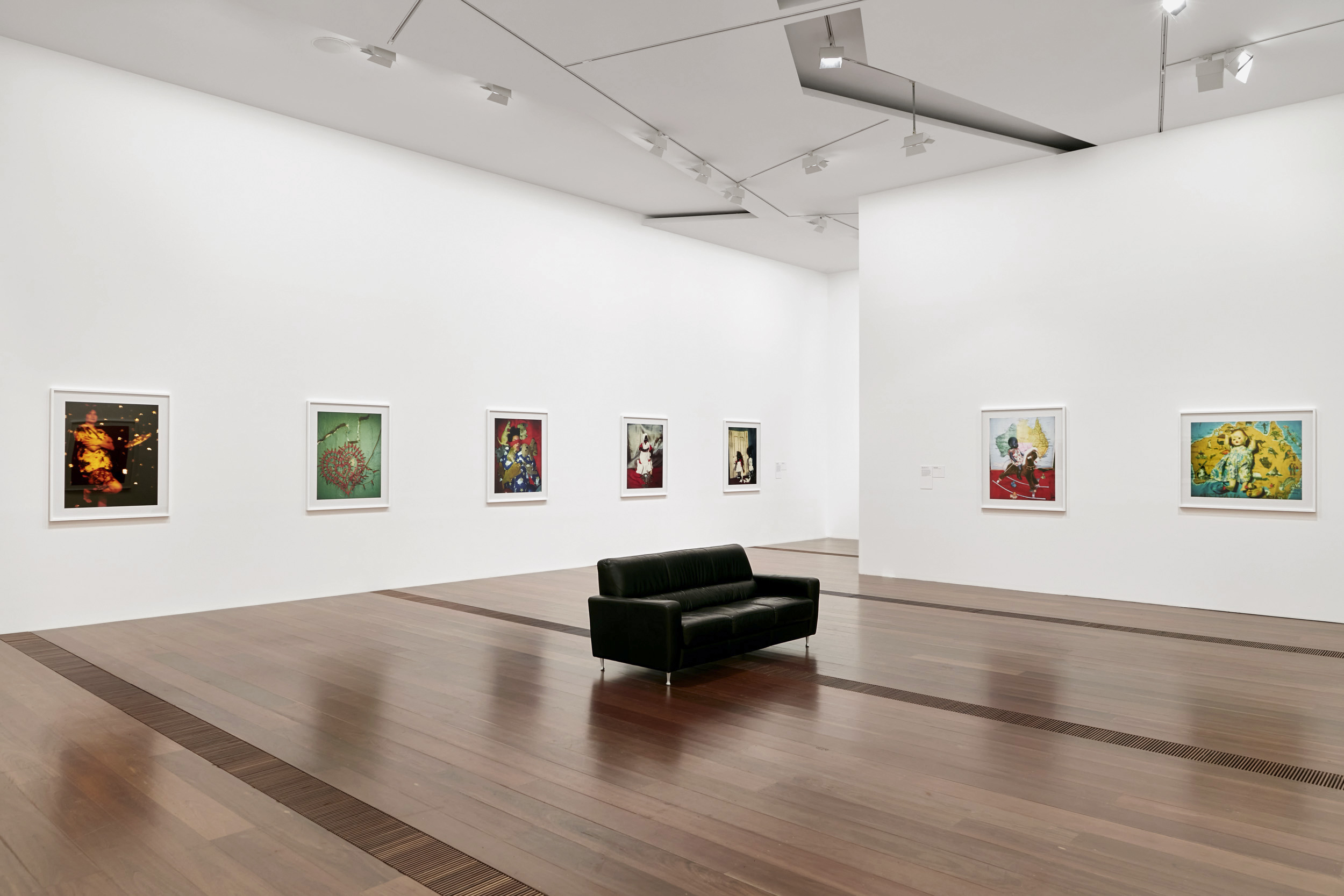

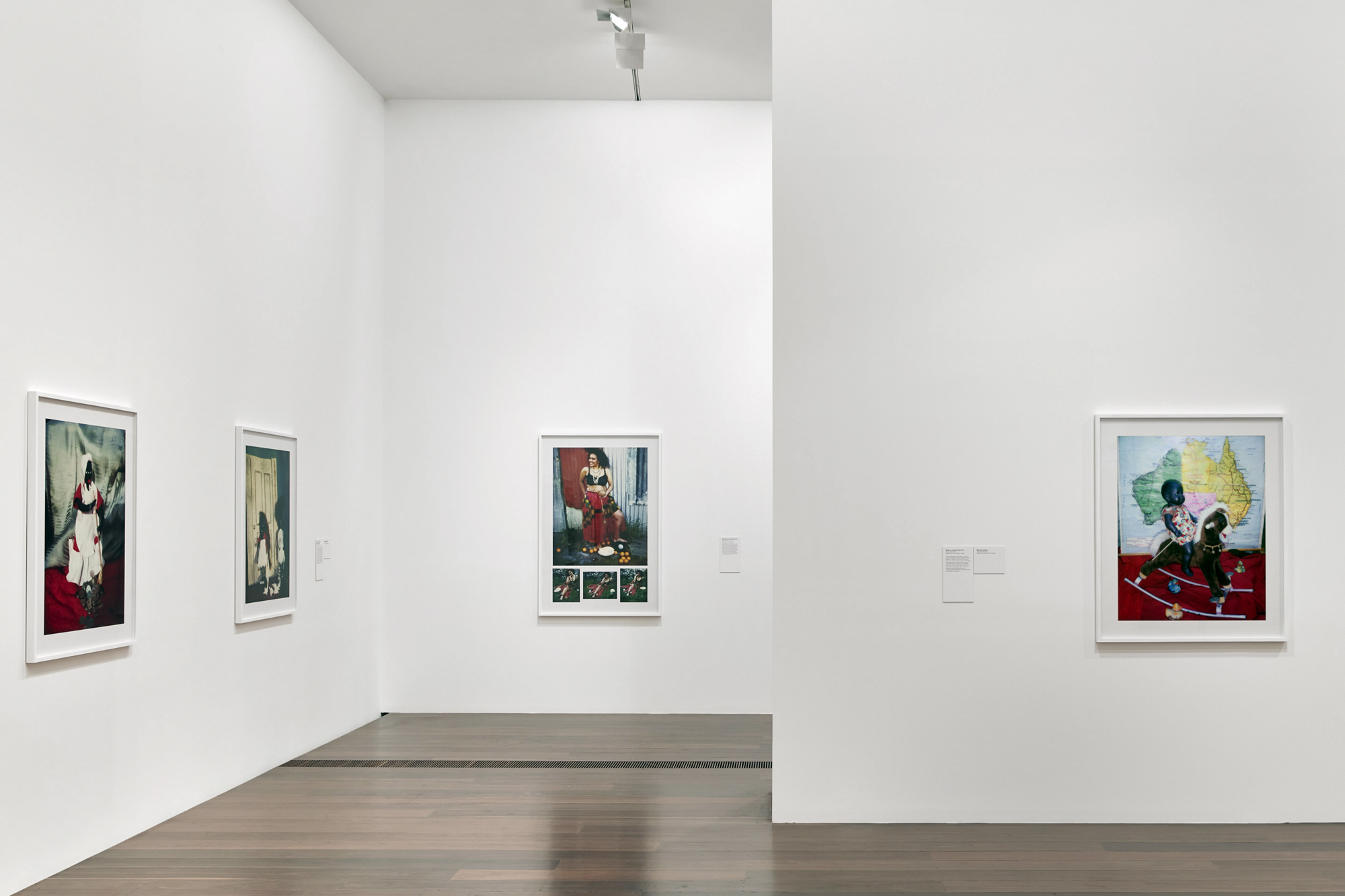
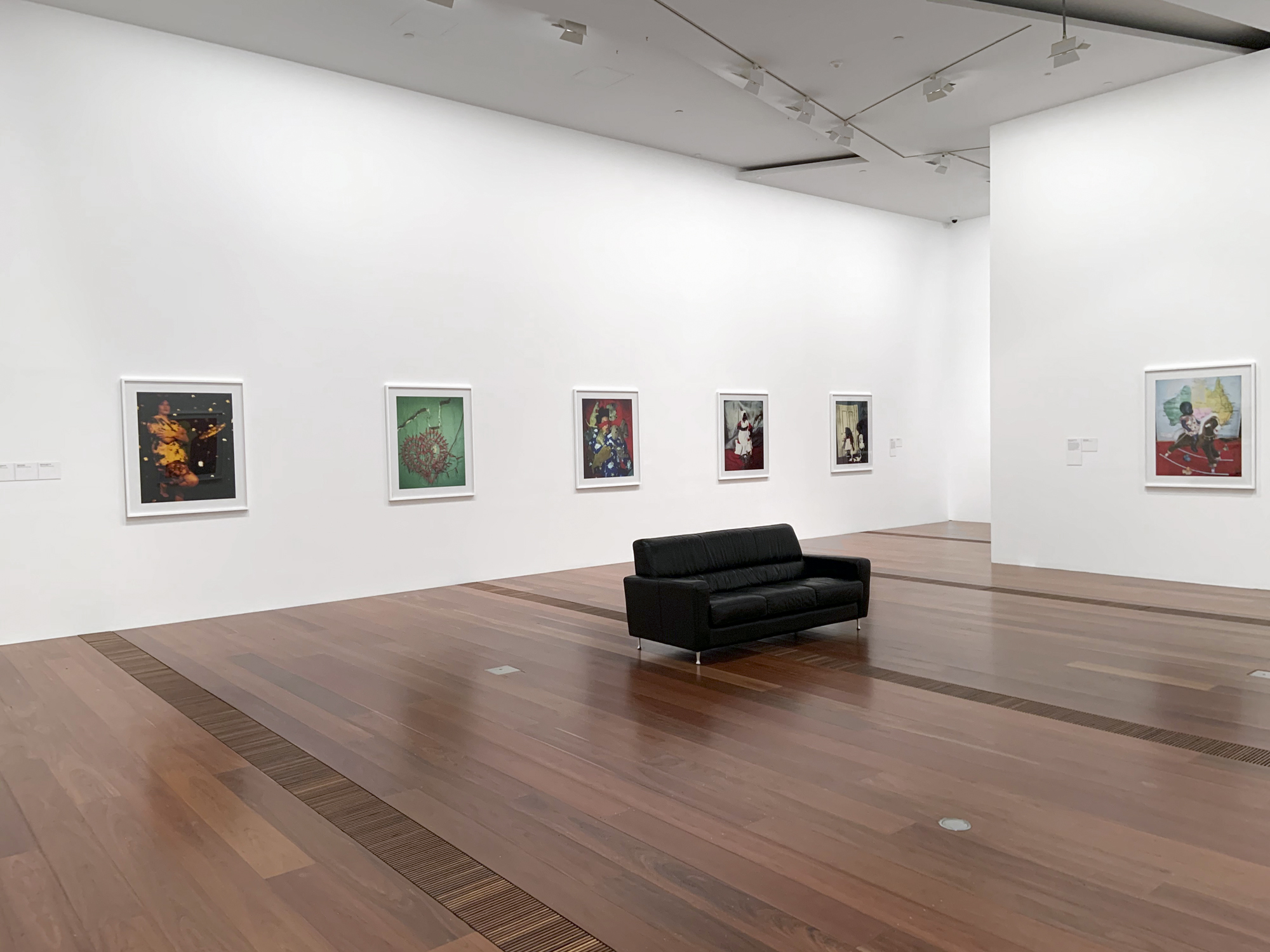








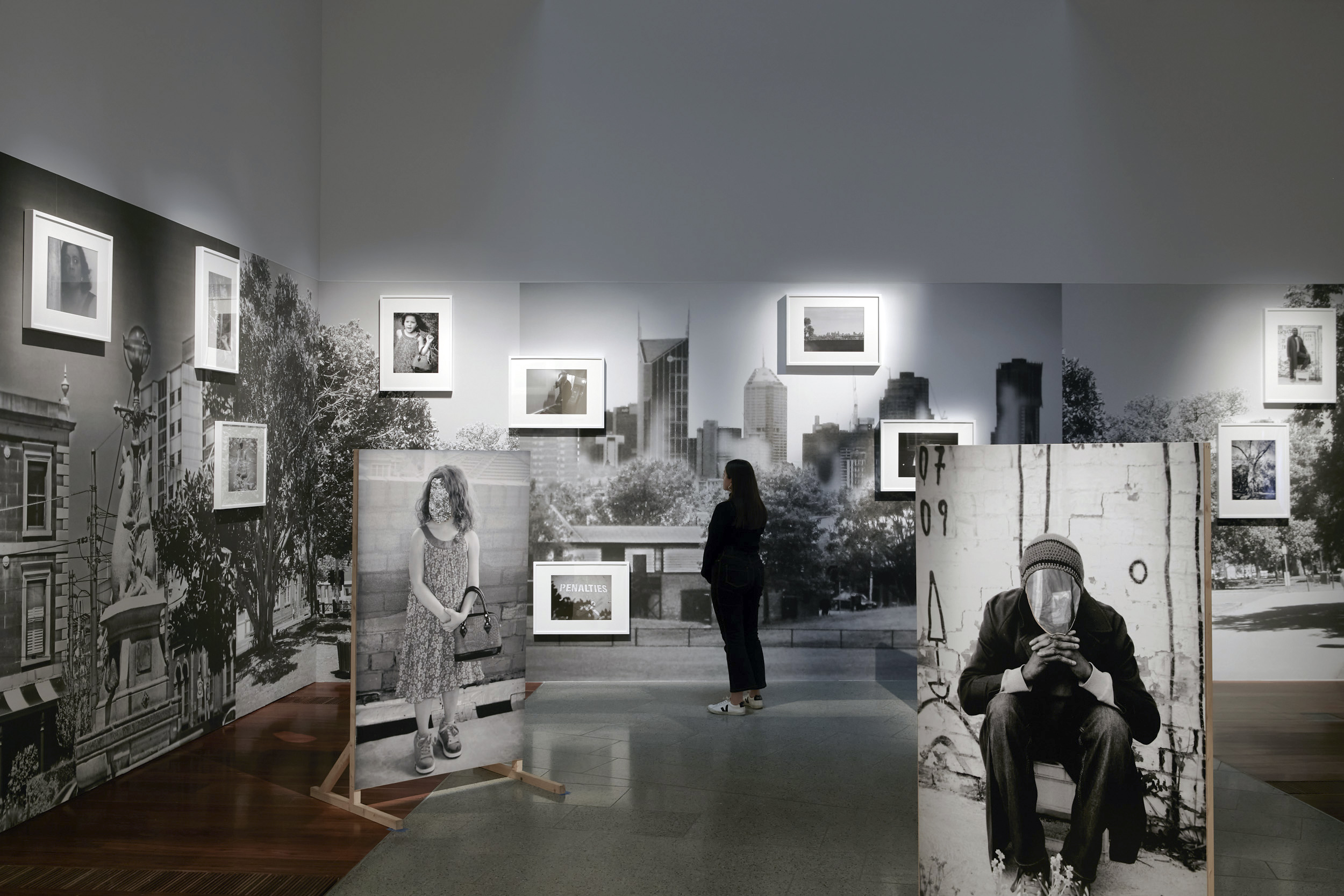


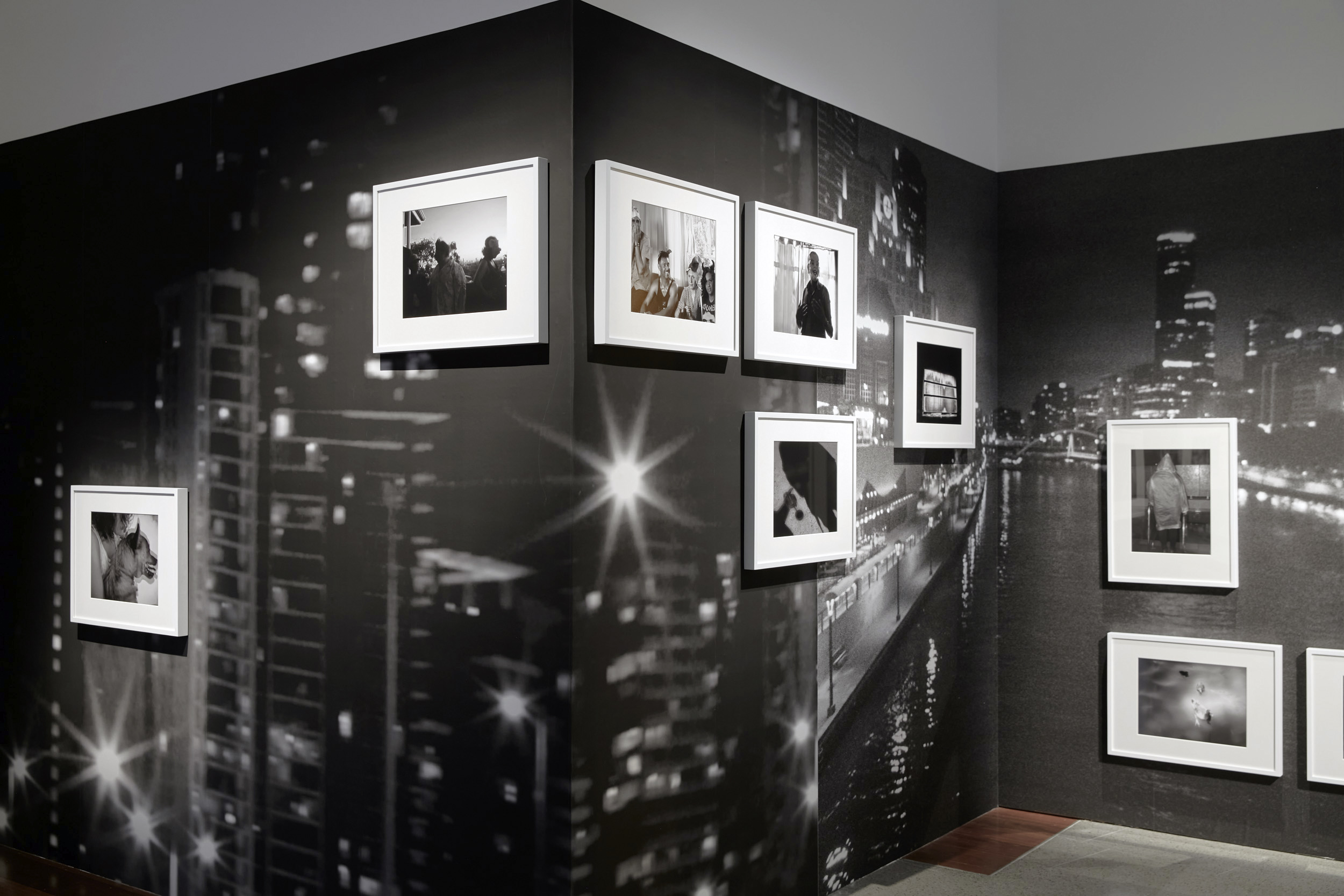
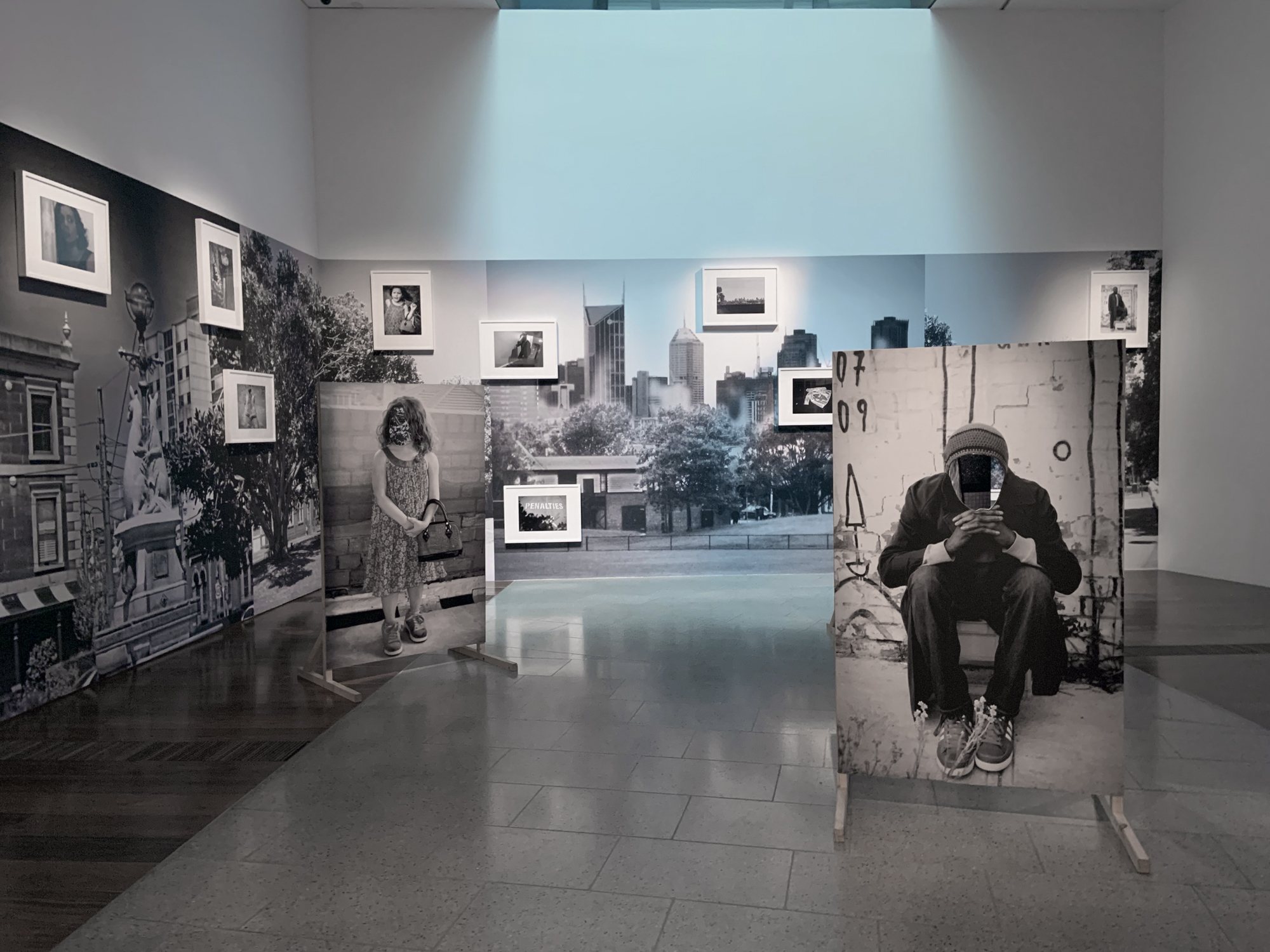
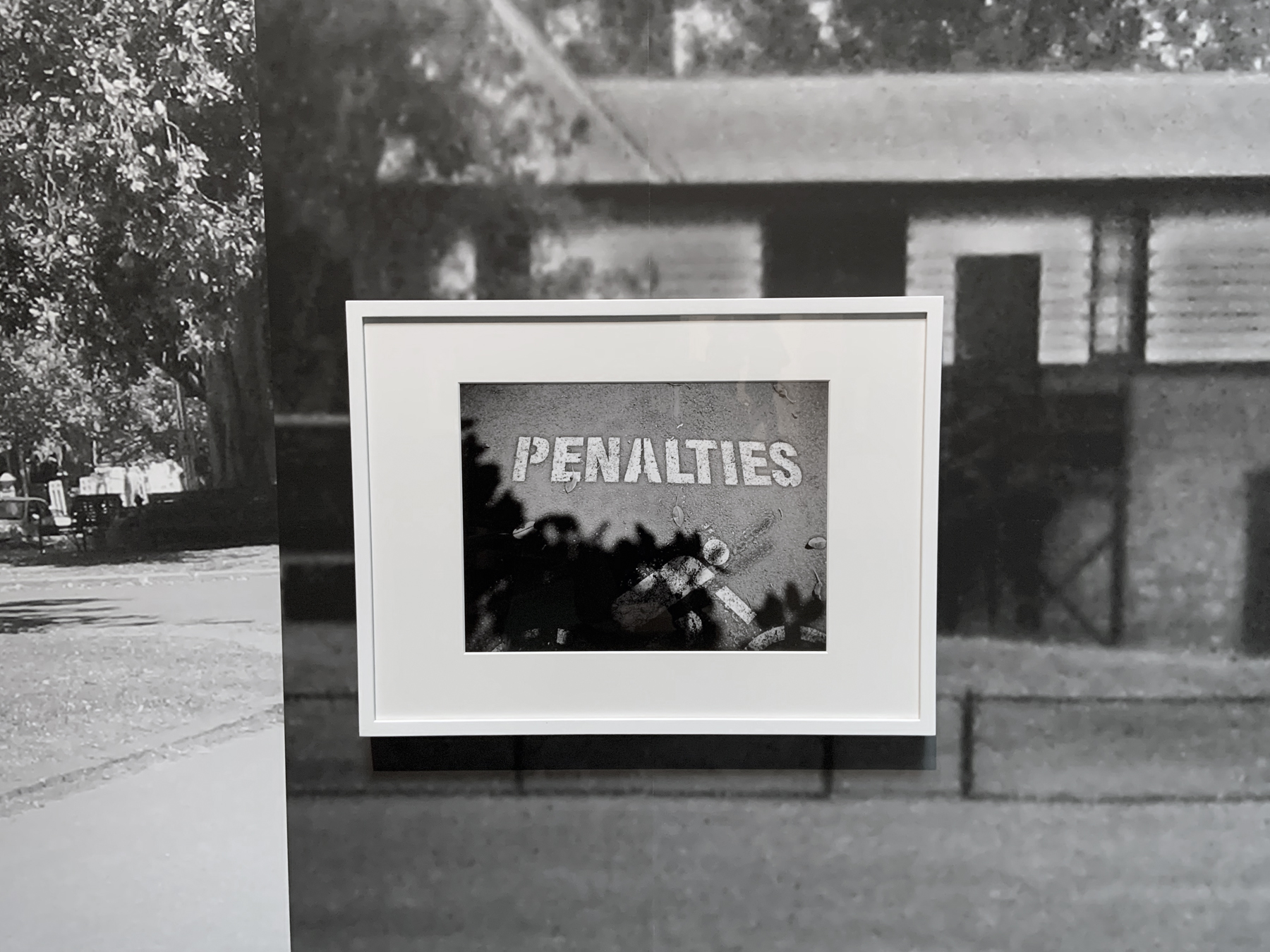


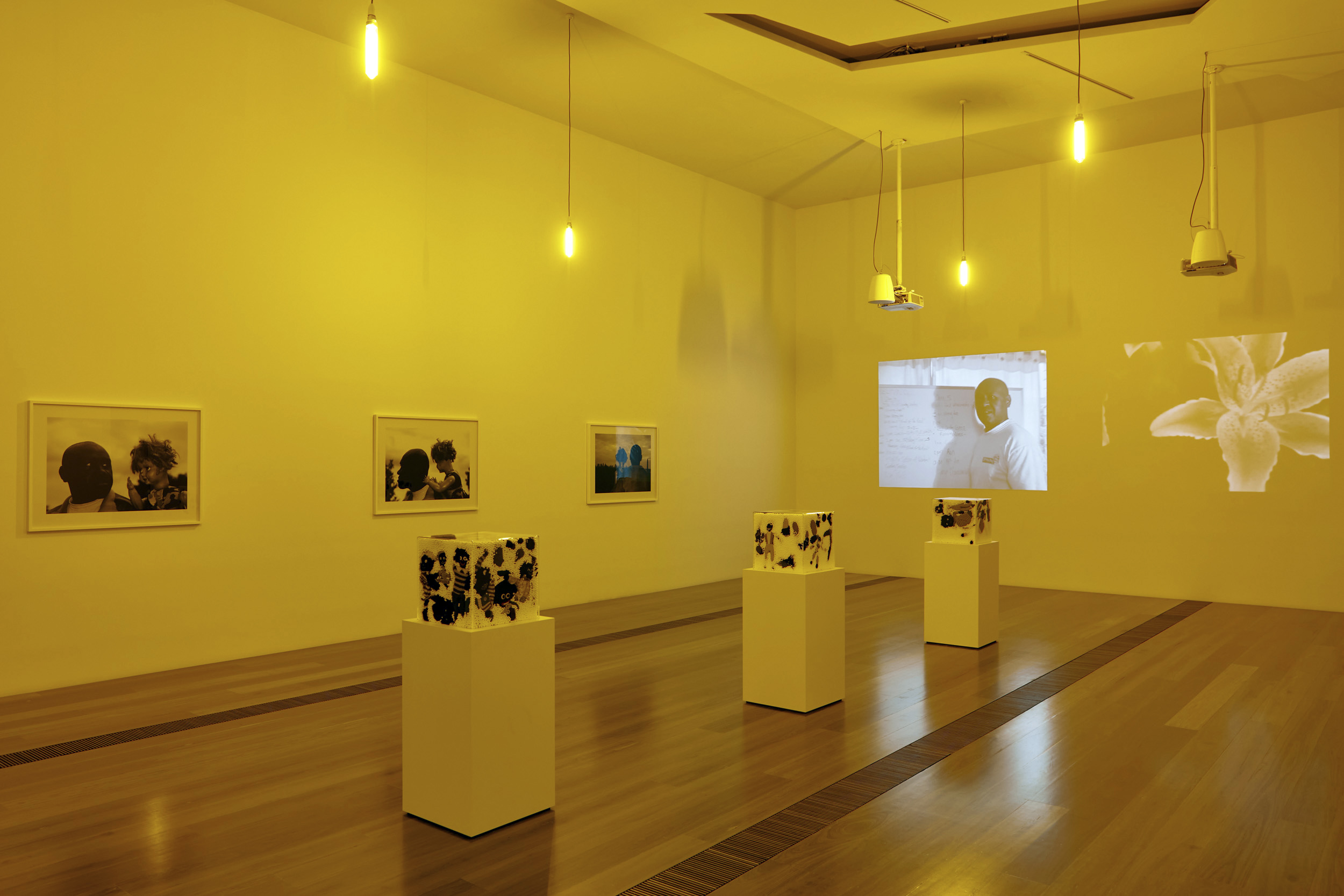
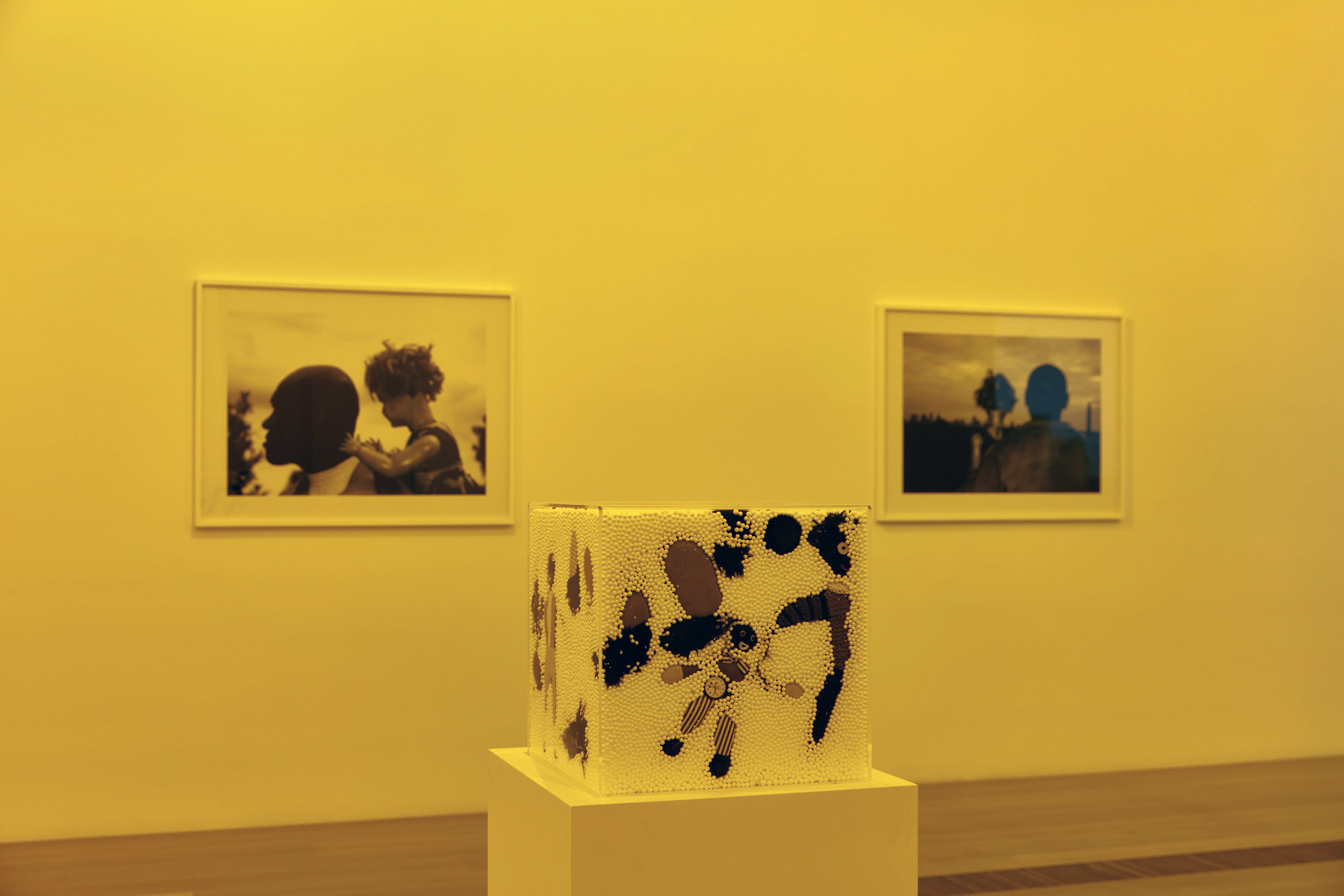
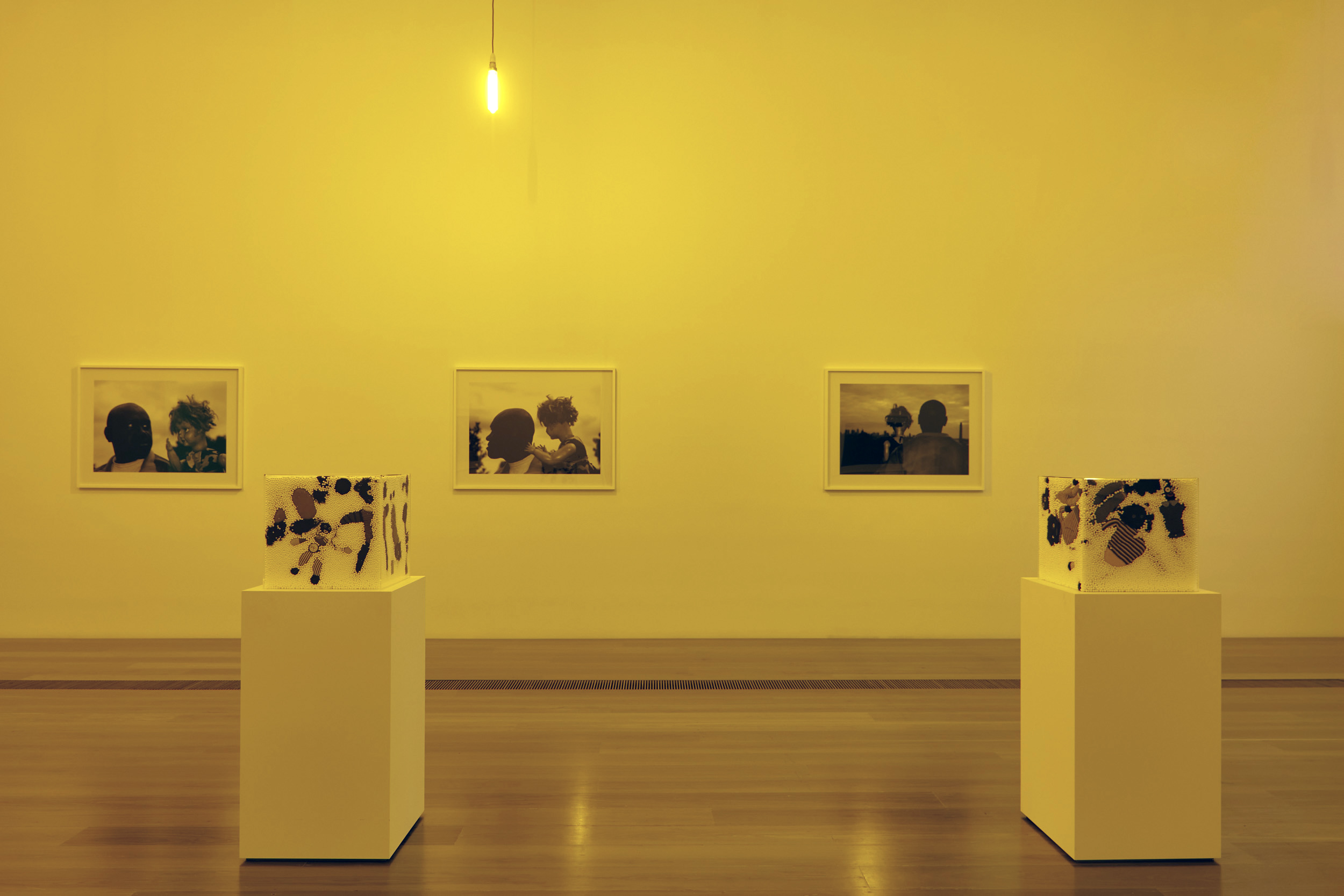
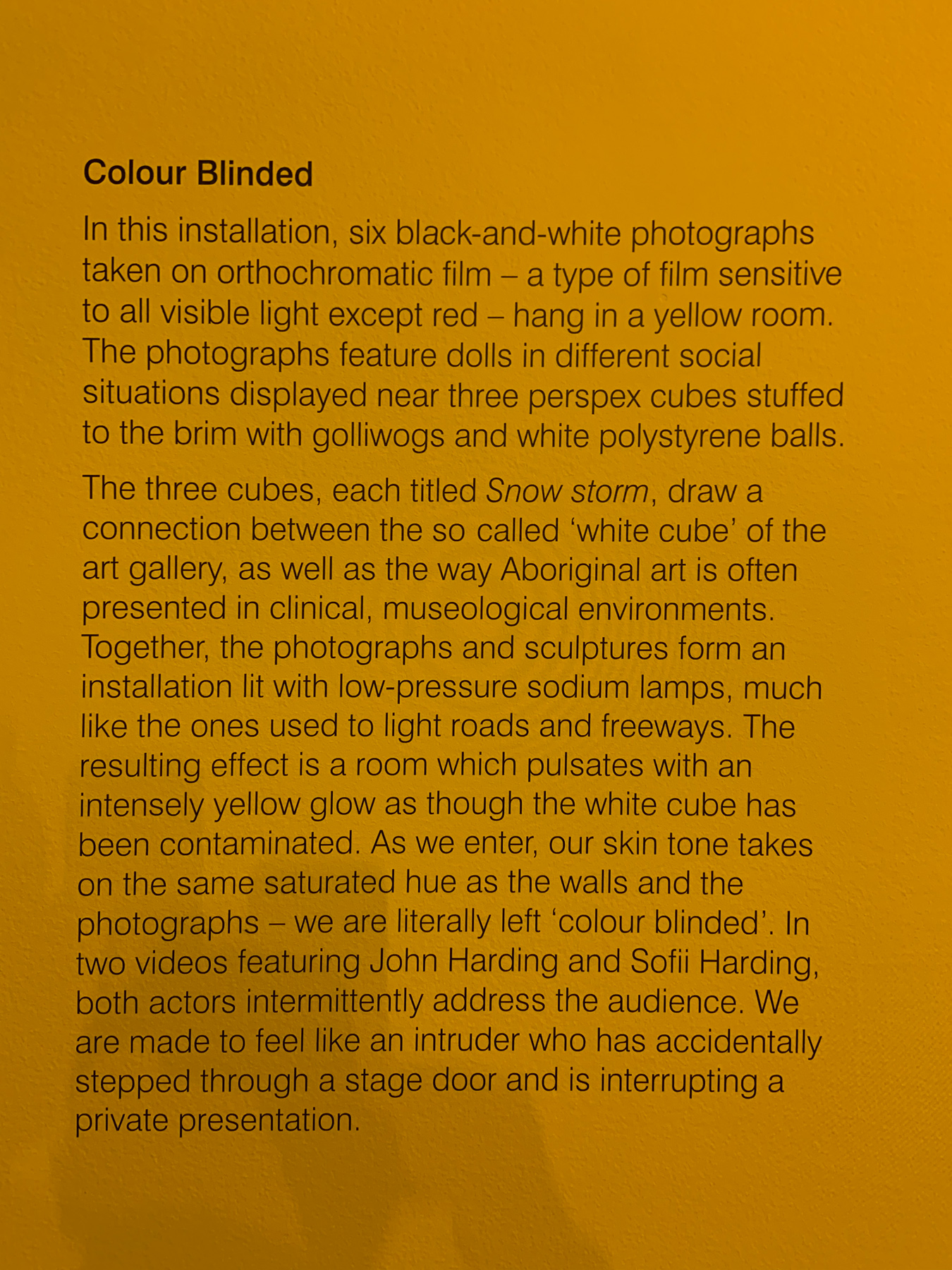










 Art Blart _ art and cultural memory archive
You must be logged in to post a comment.