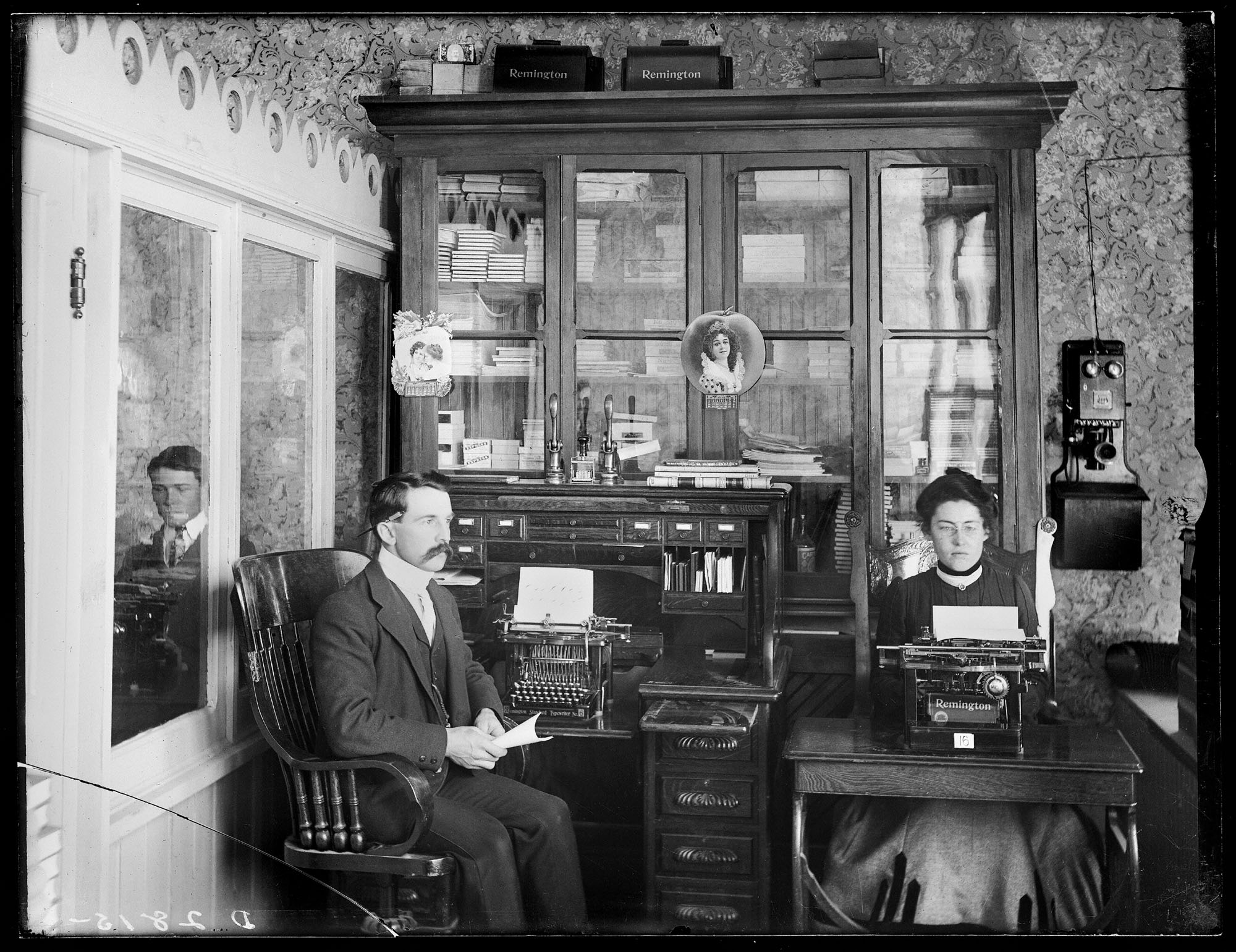
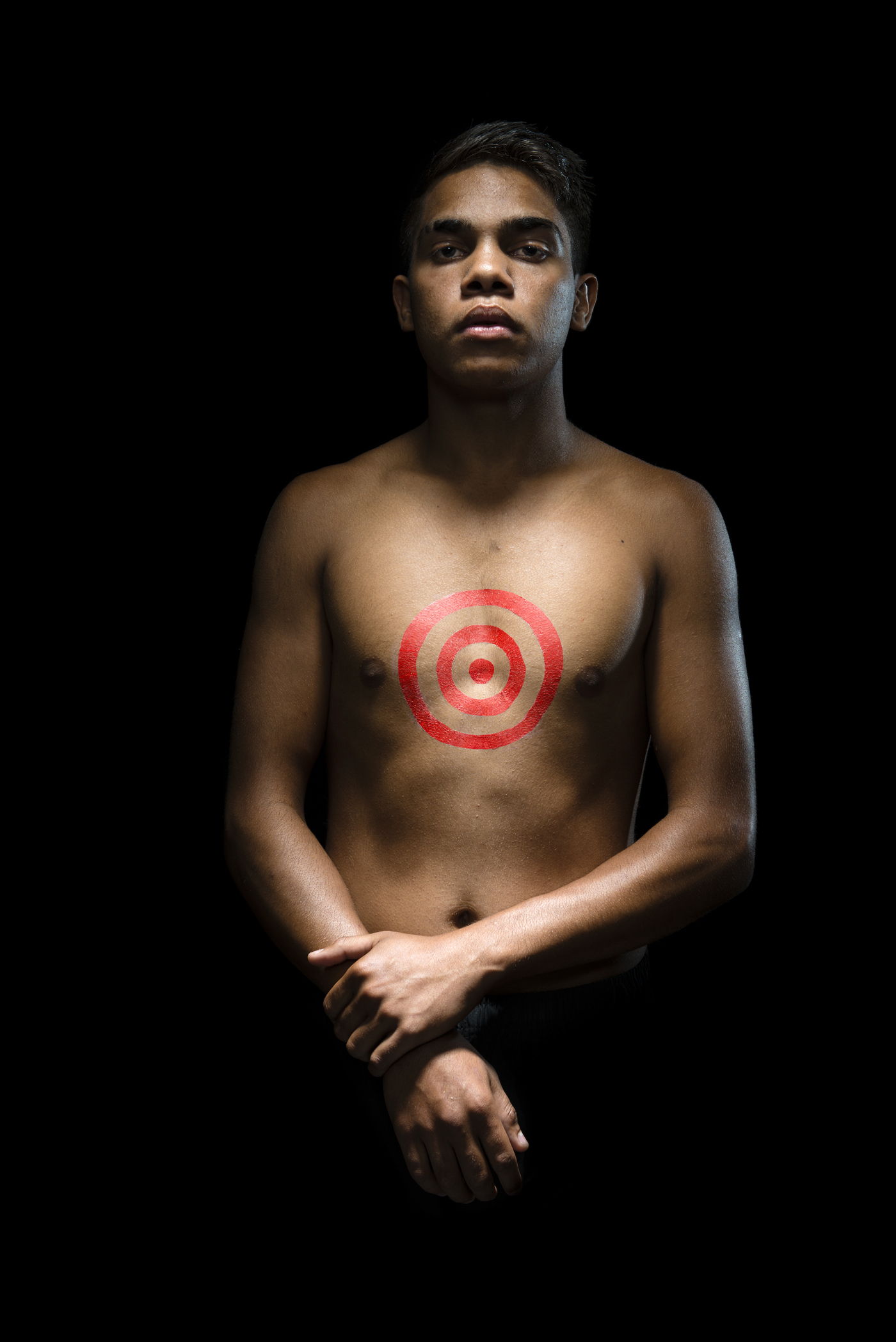
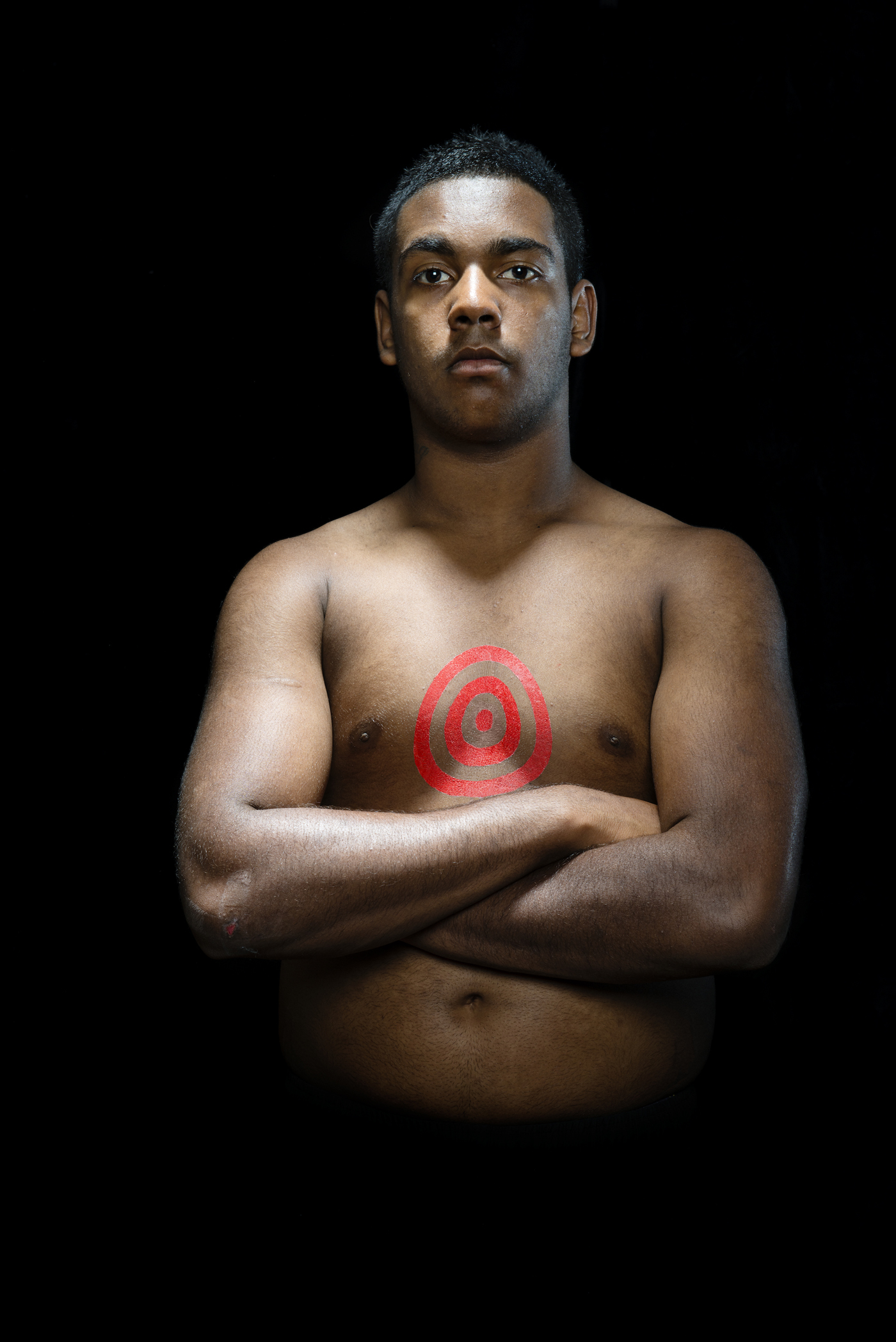
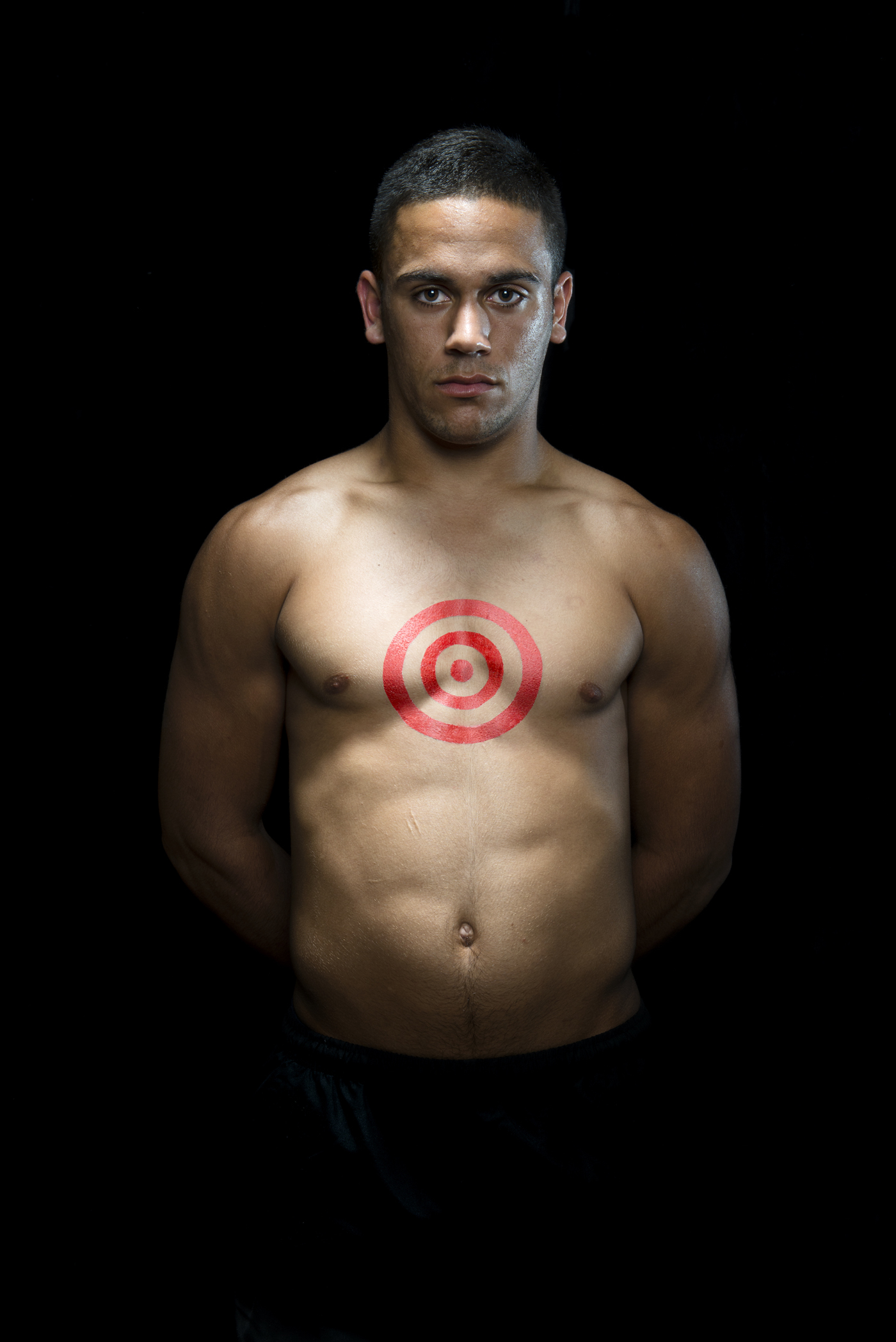
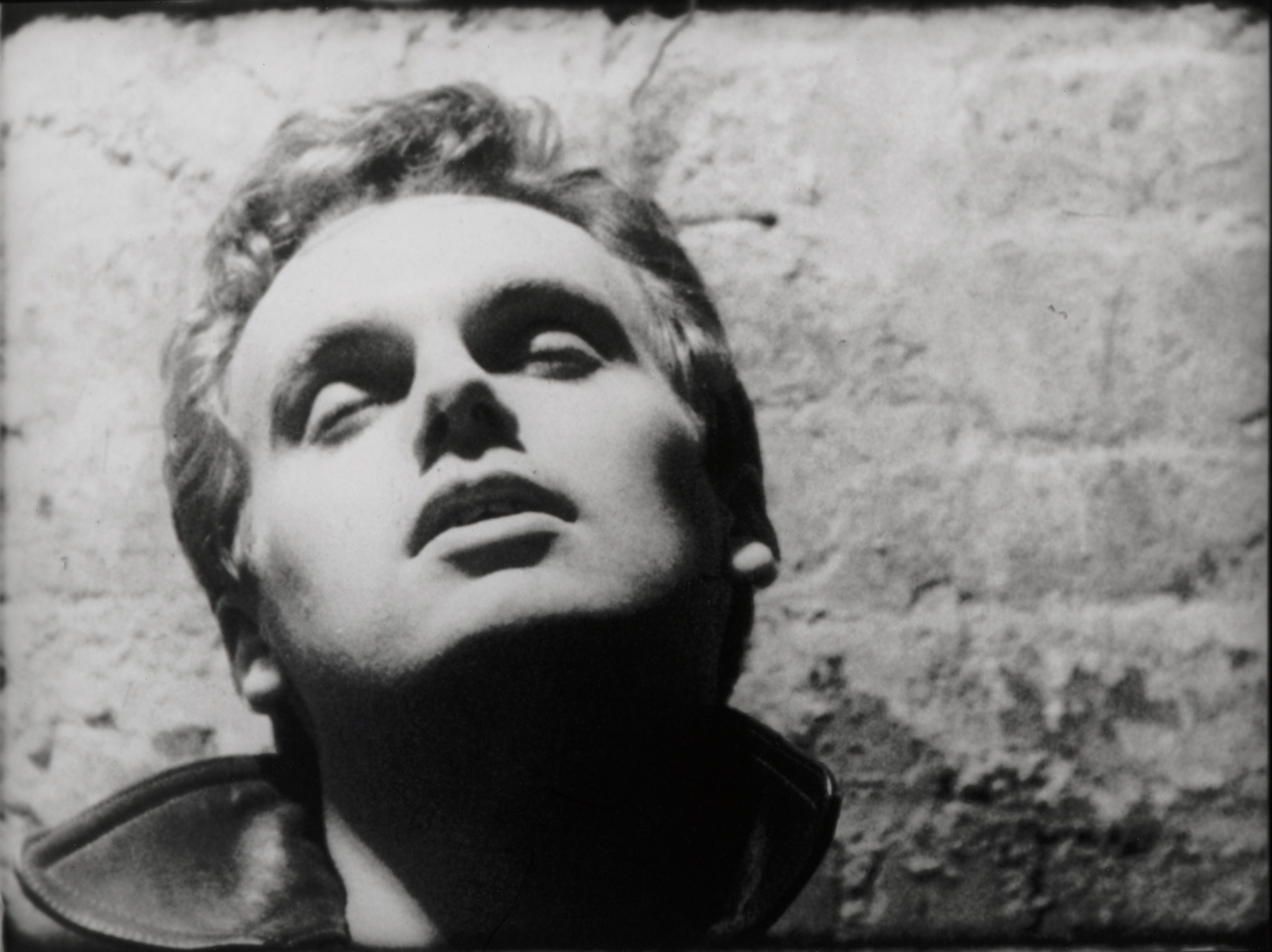
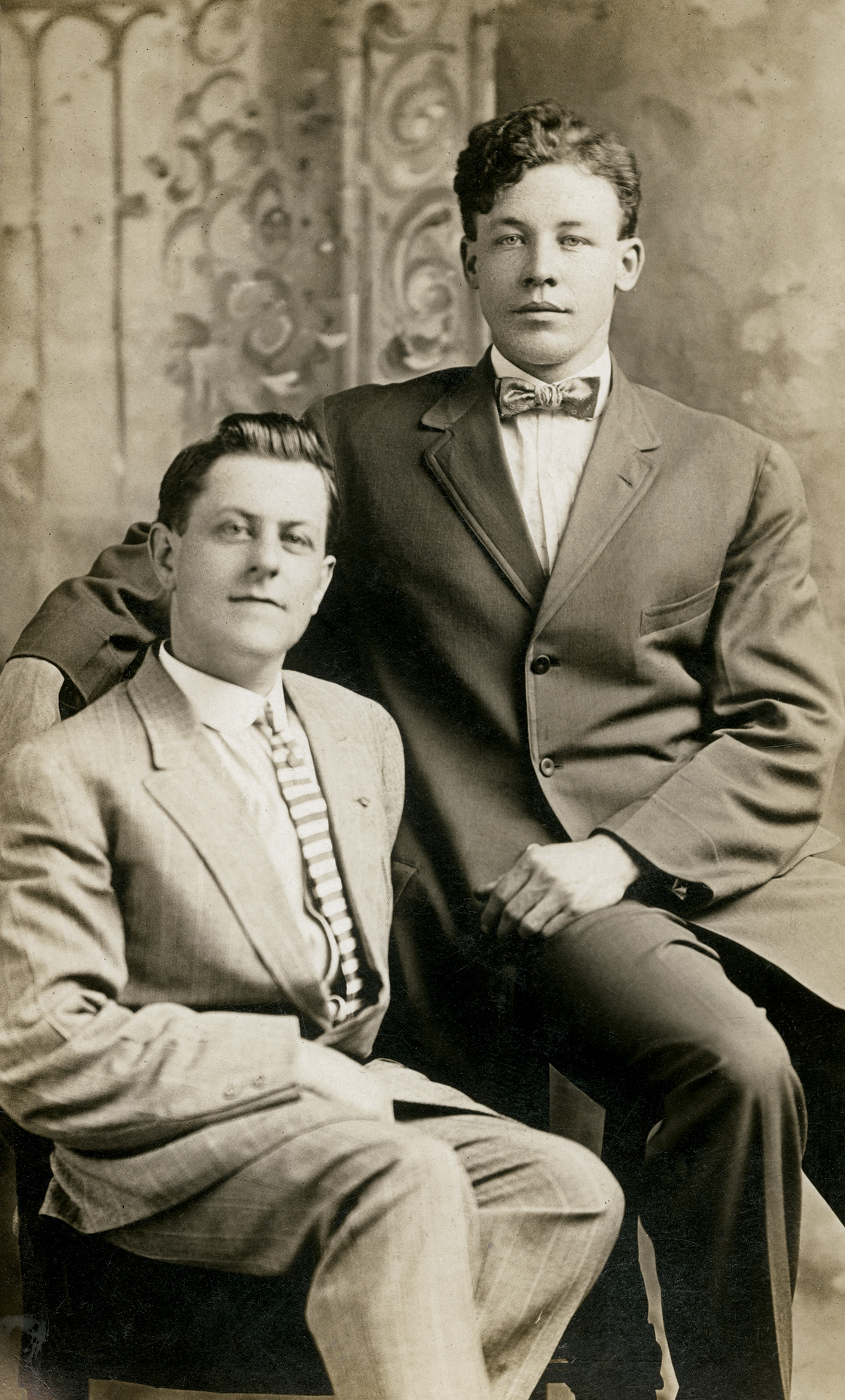
Solomon D. Butcher (American, 1856-1927) Portrait of Professor C.W. Roush, principal of the Broken Bow Business College, and his stenographer, Miss Mable Holcomb 1903 Collection of Nebraska State Historical Society
NB. Note the use of Remington Standard Typewriter No. 6
Solomon D. Butcher (January 24, 1856 – March 18, 1927) was an itinerant photographer who spent most of his life in central Nebraska, in the Great Plains region of the United States. A settler under the Homestead Act, he began in 1886 to produce a photographic record of the history of white settlement in the region. Over 3,000 of his negatives survive; more than 1,000 of these depict sod houses. Butcher wrote two books incorporating his photographs: Pioneer History of Custer County and Short Sketches of Early Days in Nebraska (1901), and Sod Houses, or the Development of the Great American Plains (1904).
Butcher was unable to achieve financial success as a farmer, as a photographer, or in a number of other schemes later in his life, and at the time of his death felt that he had been a failure. However, the number and scope of his photographs of Nebraska pioneer life have made them a valuable resource to students of that period of history, and they have become a staple of historical texts and popular works alike. His oeuvre has been described as “the most important chronicle of the saga of homesteading in America”.
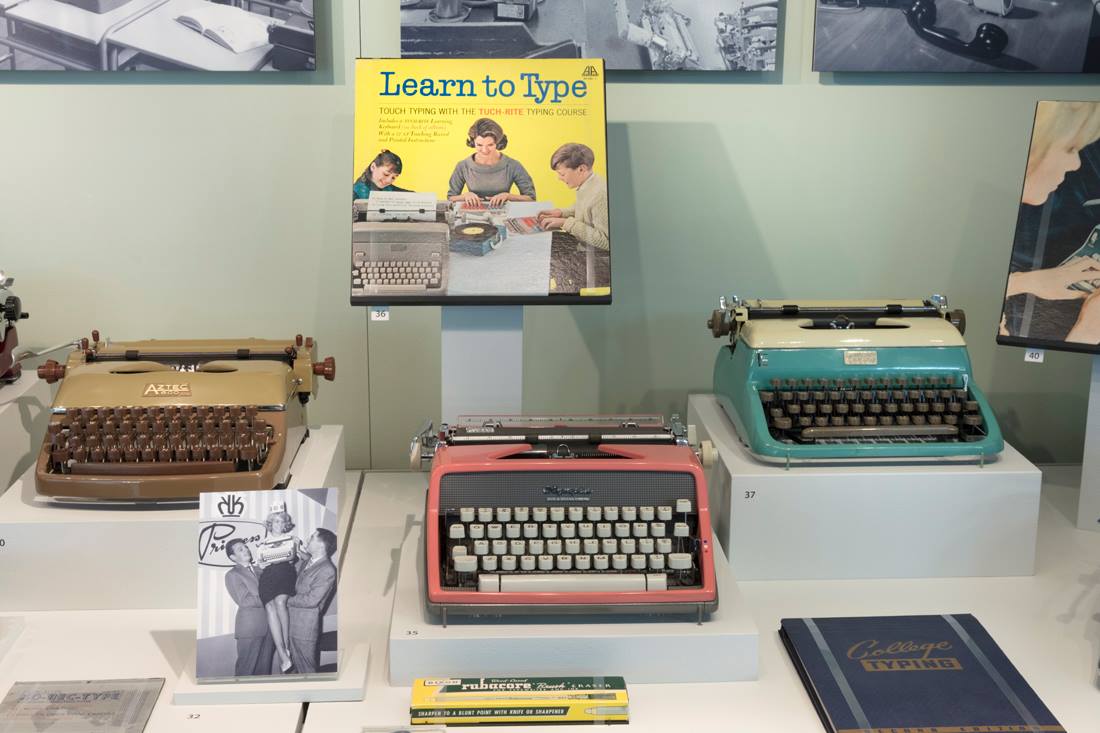
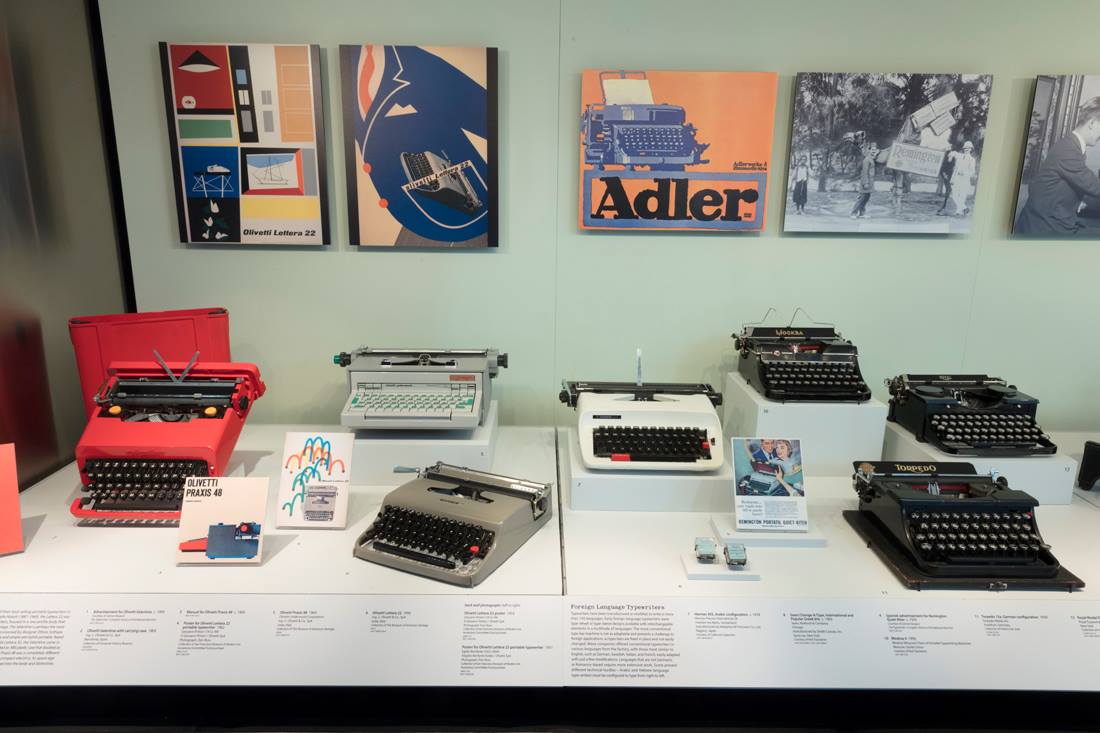
They may be obsolete technology, but boy do they have great design and so much style.
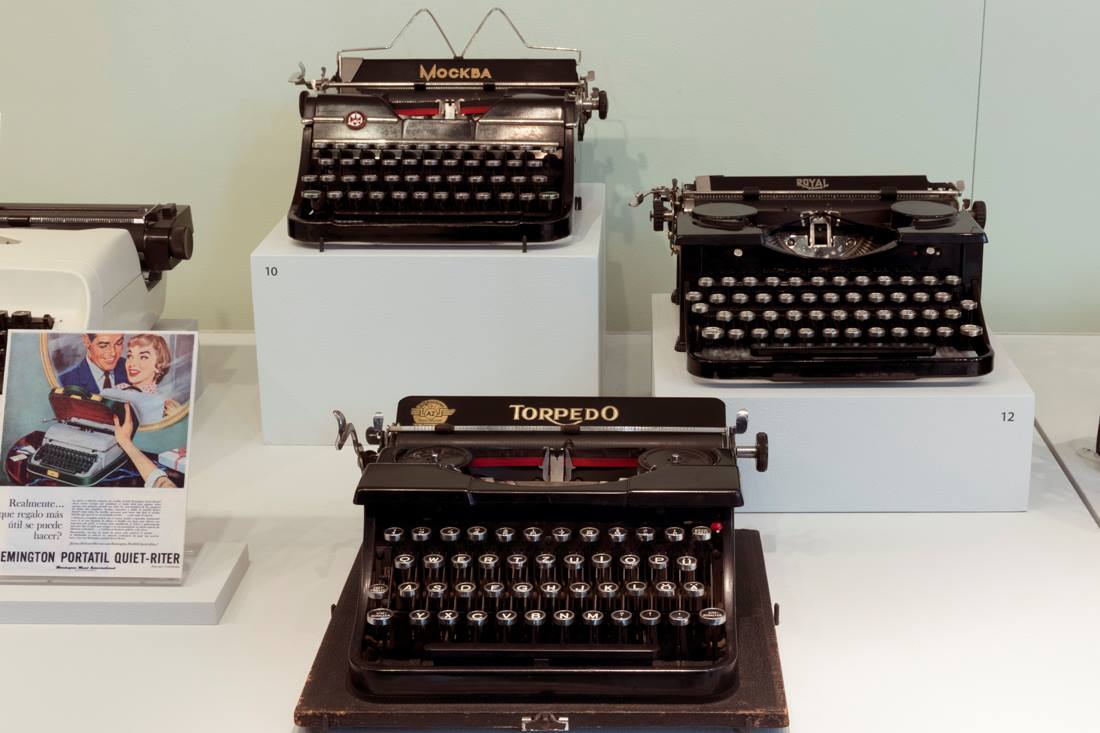
What a collection of machines… so many rare models in this exhibition.
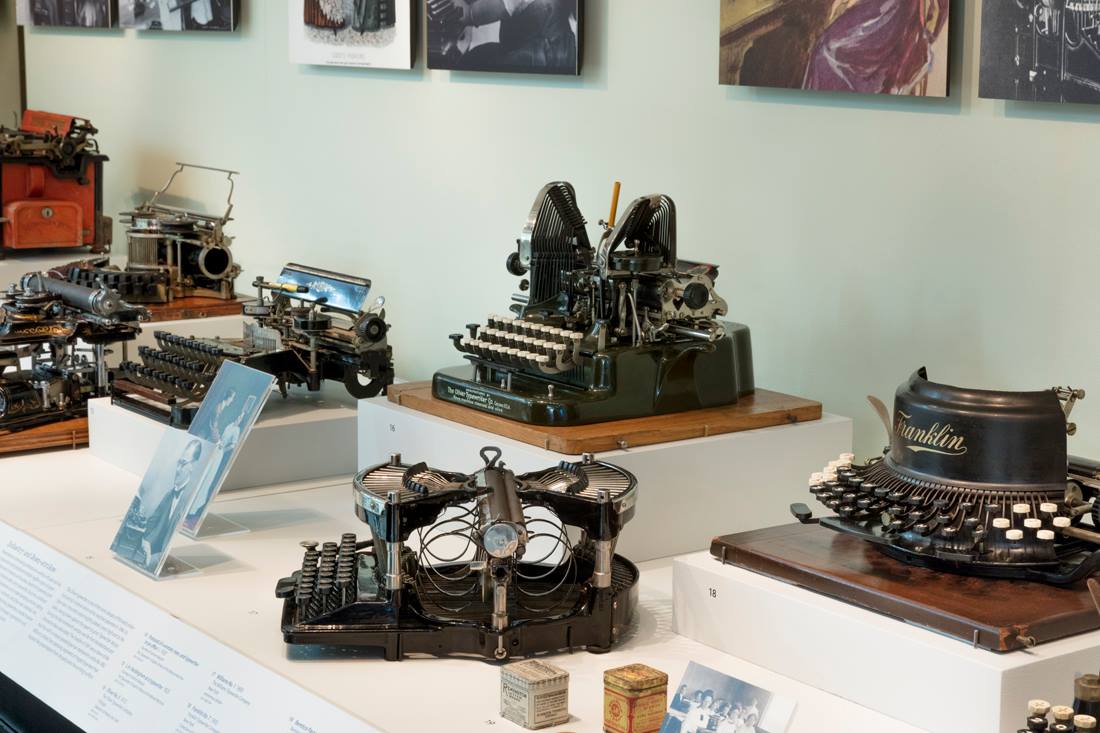
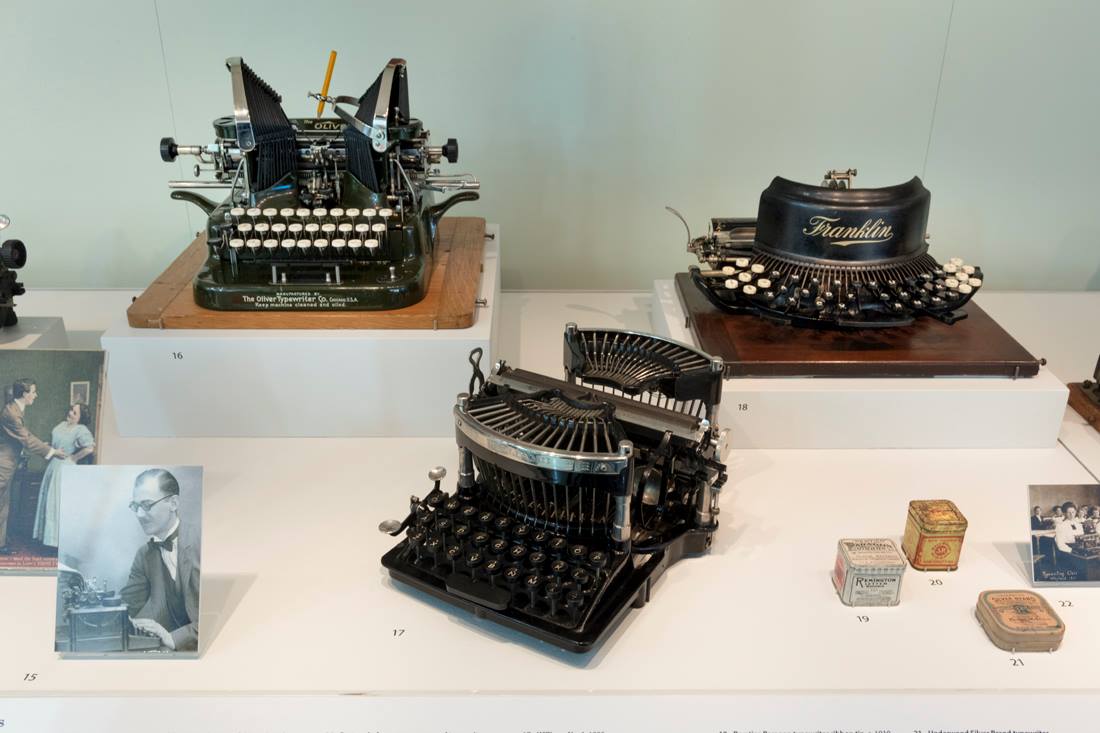
Portable typewriters, folding typewriters, QWERTY keyboards (still with us), and the names: Royal Deluxe, Torpedo, and the Corona No. 3 Special. It sounds like a cigar, but that’s the one I would take home. Plus the Oliver Typewriter Company “Oliver 3” … the one with “wings” in the installation photographs of the first case.
A marvellous collection so well brought together in this exhibition. Congratulations to all involved.
Dr Marcus Bunyan
Many thankx to Daniel Calderon, Chad Anderson and the SFO Museum for allowing me to publish the photographs and text in the posting. Please click on the photographs for a larger version of the image.
@SFOMuseum #TheTypewriter
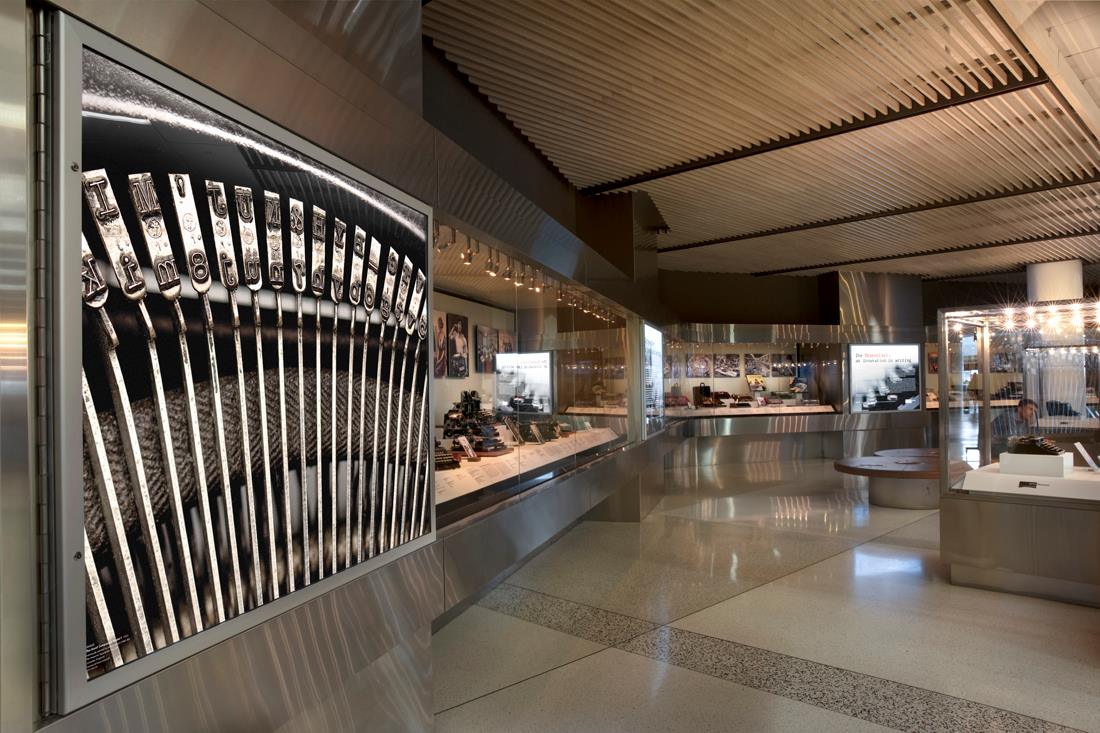
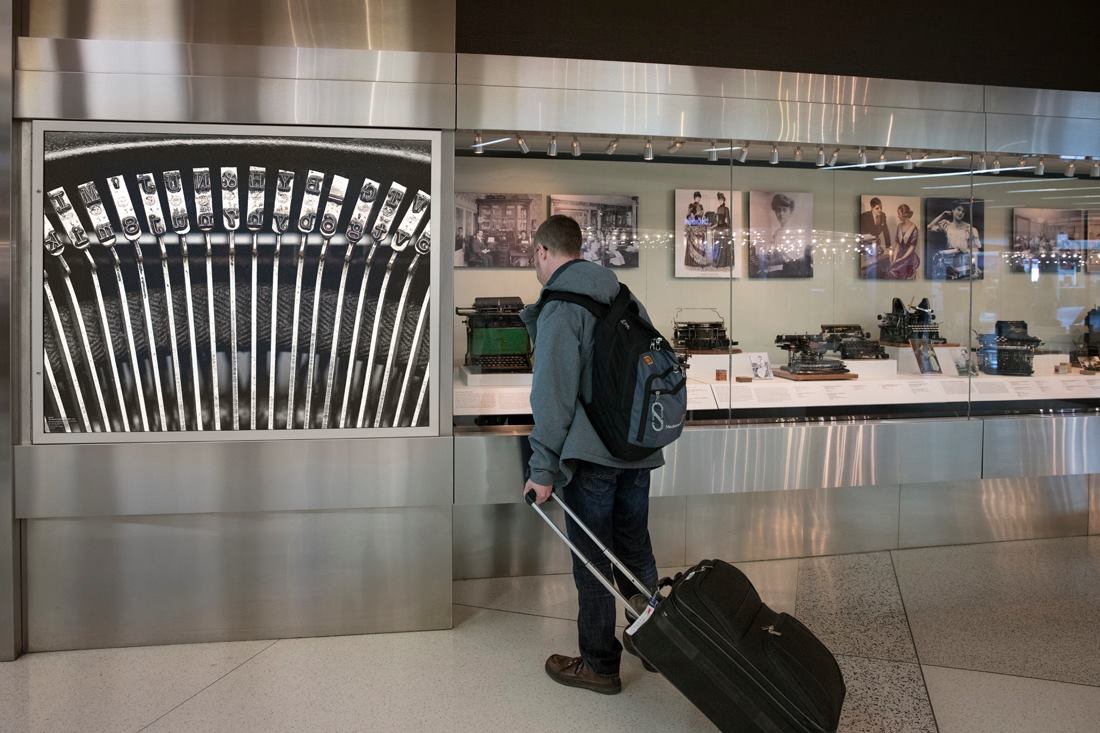
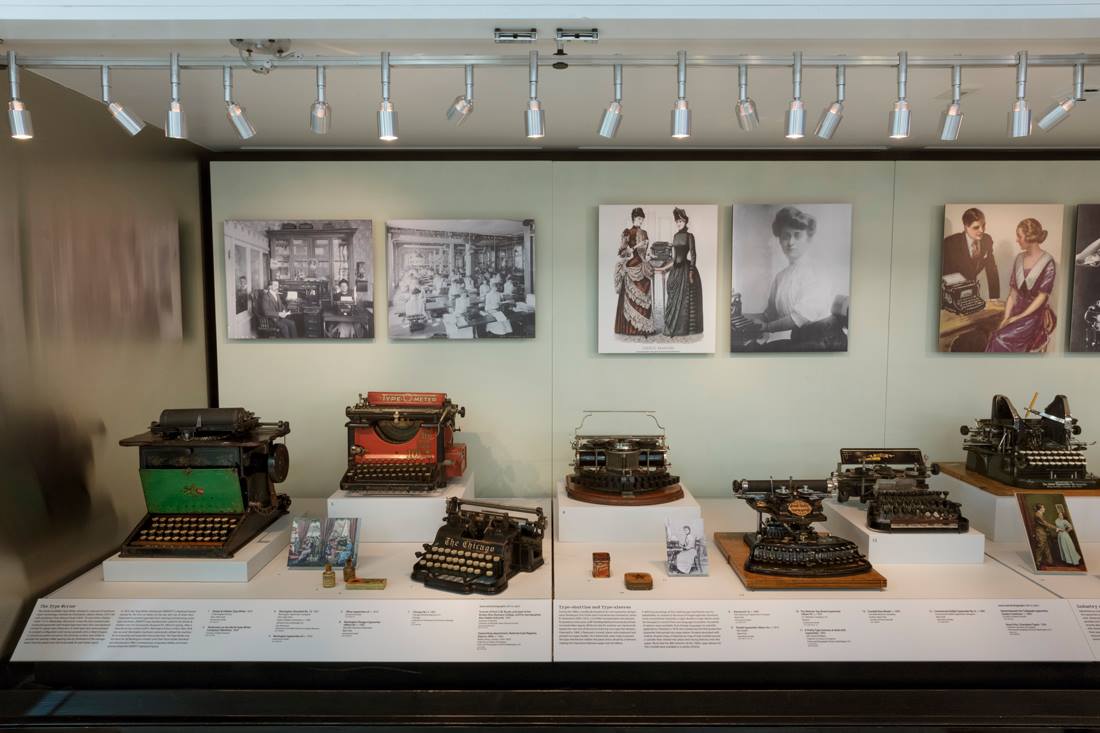
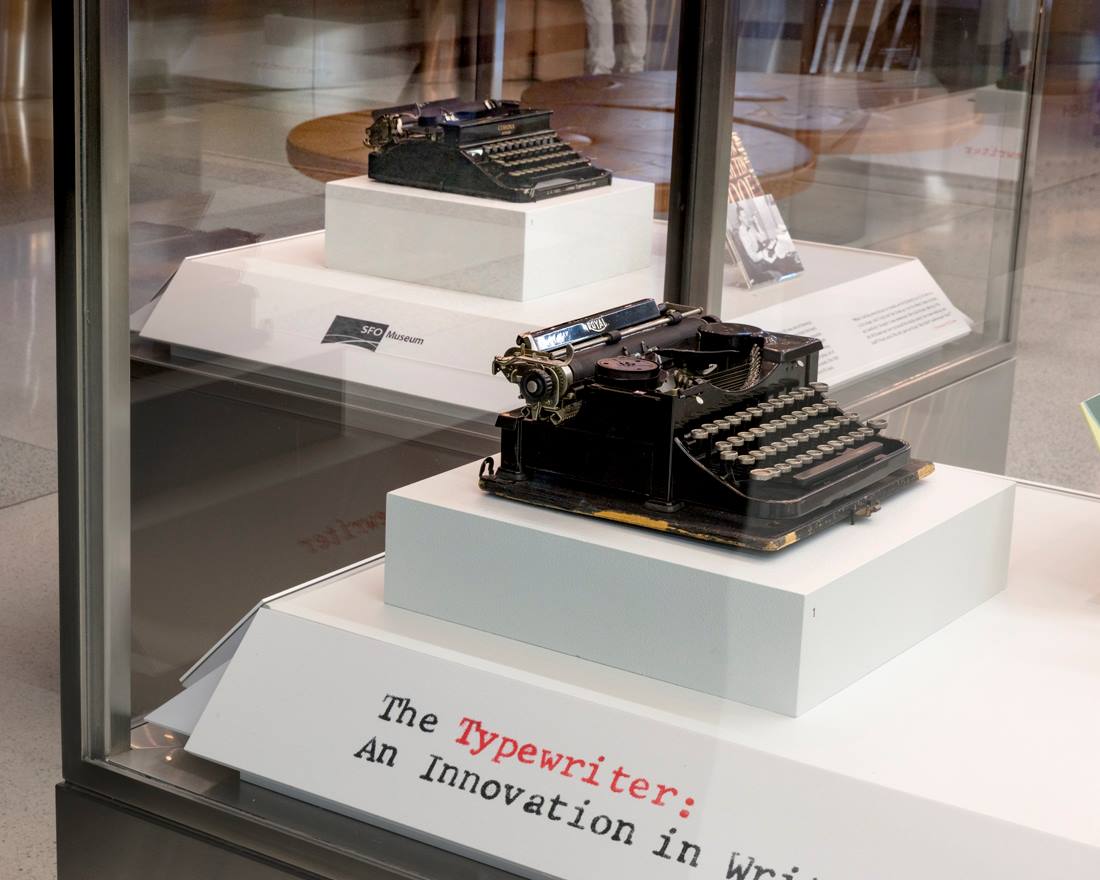
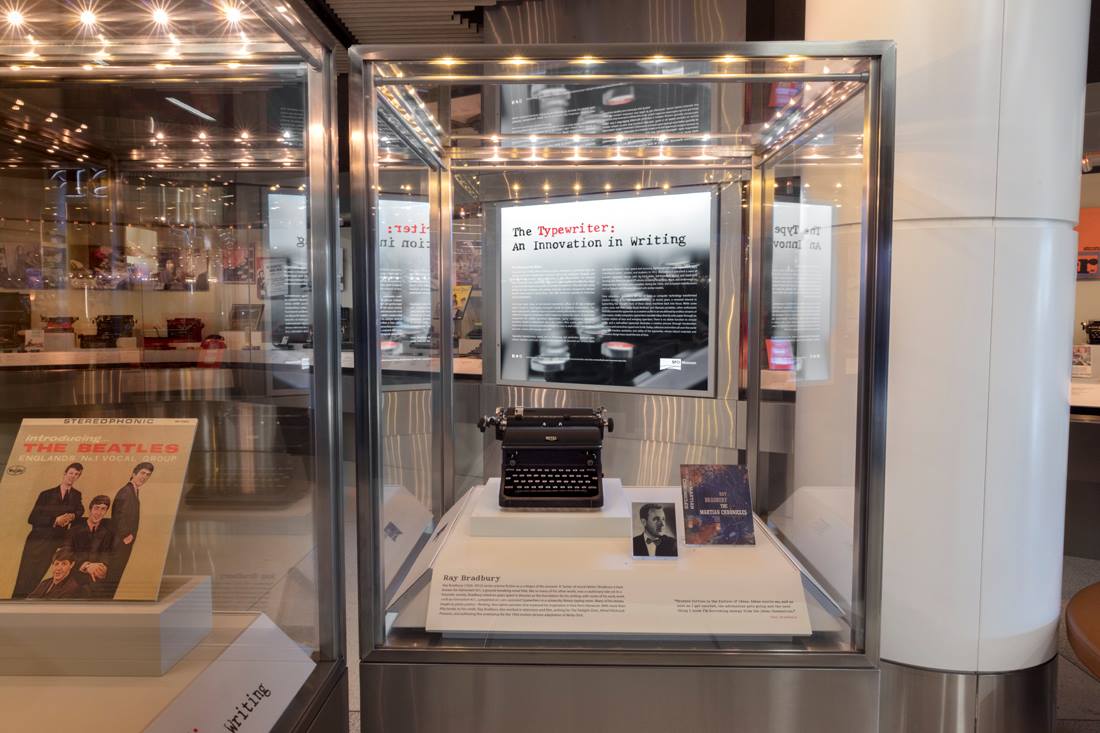
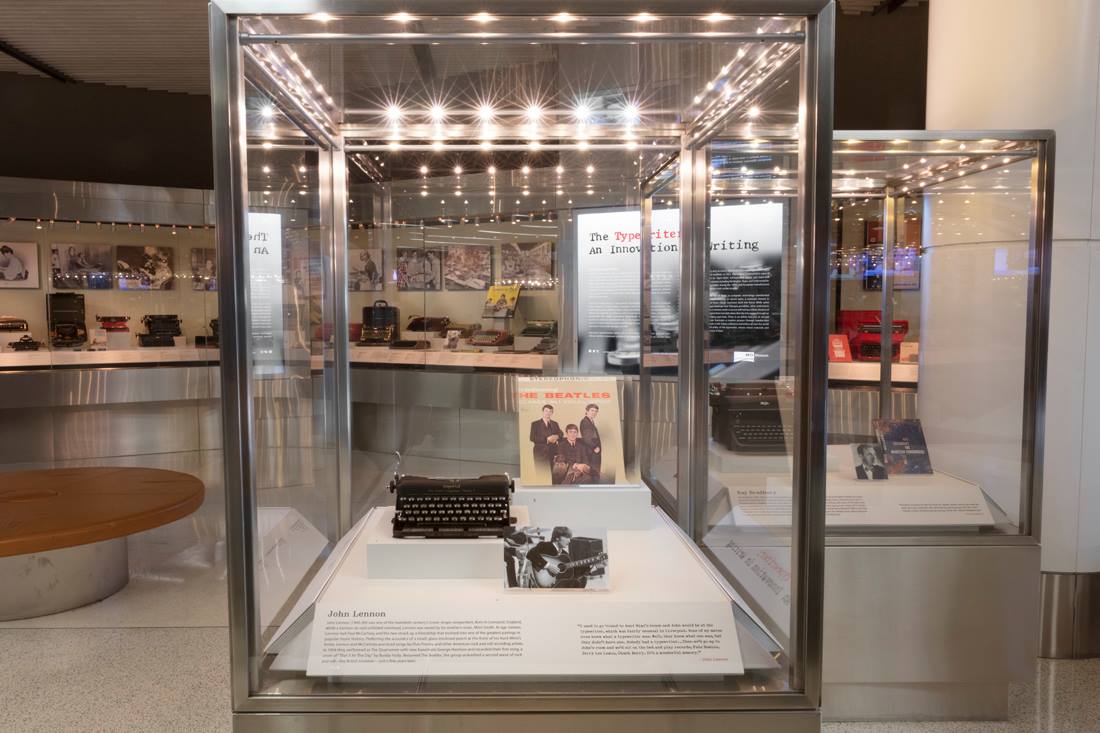
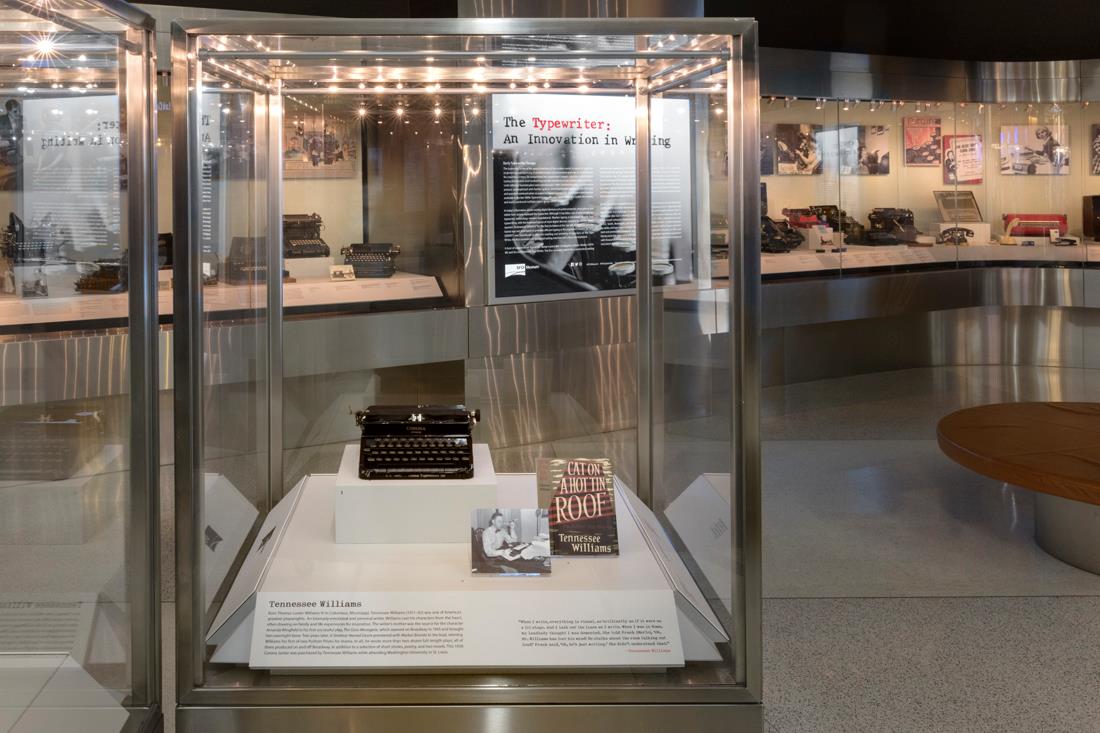
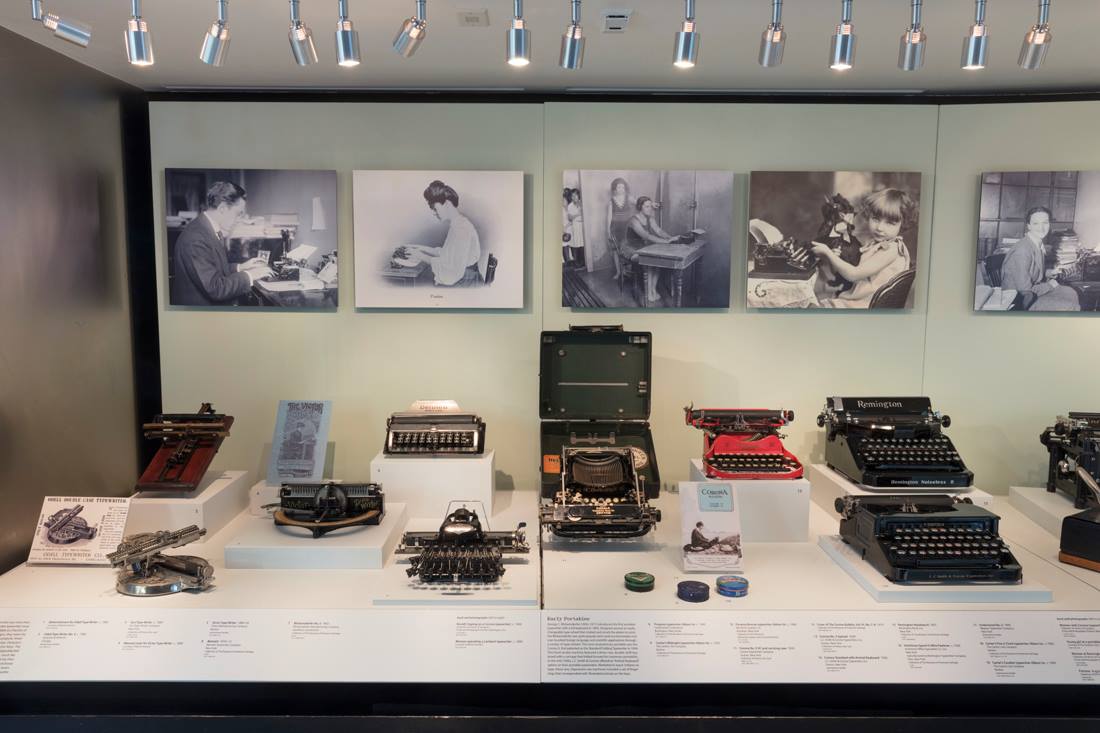
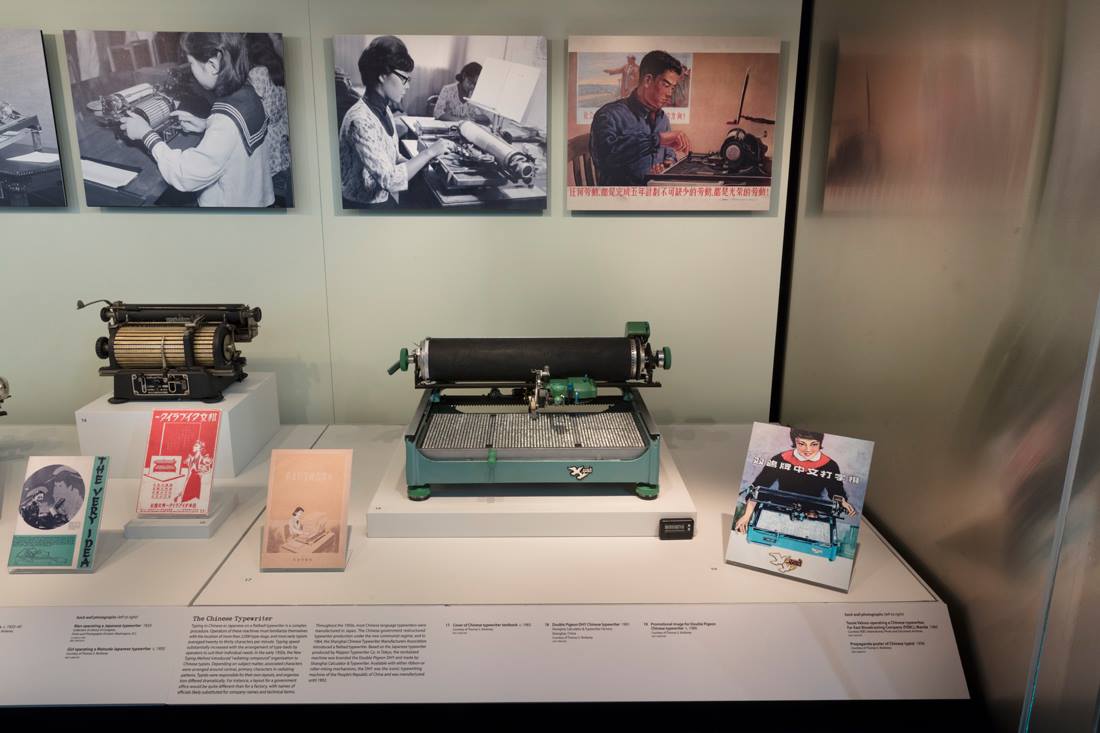
Installation views of the exhibition The Typewriter: An Innovation in Writing at the SFO Museum, San Francisco International Airport
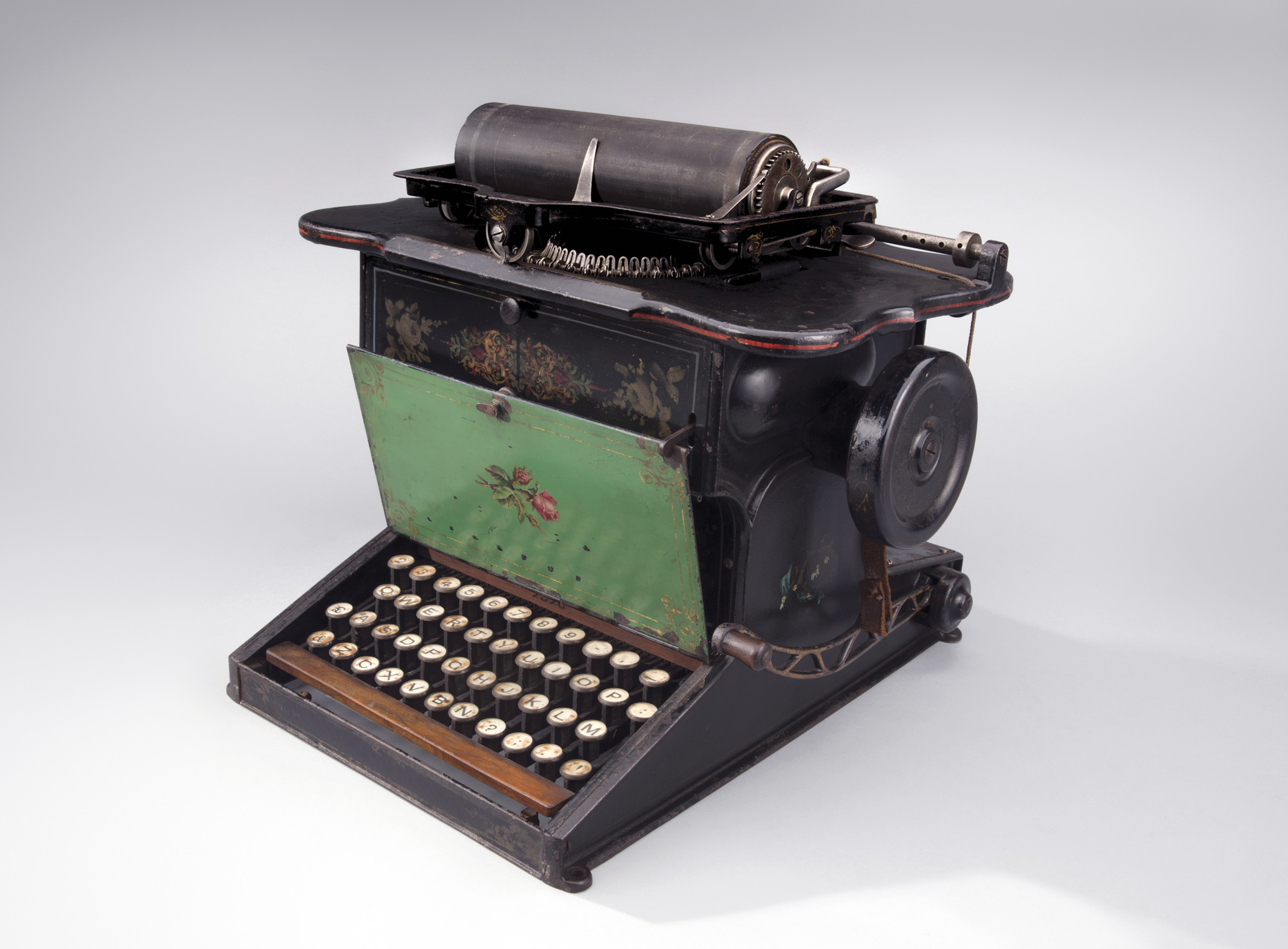
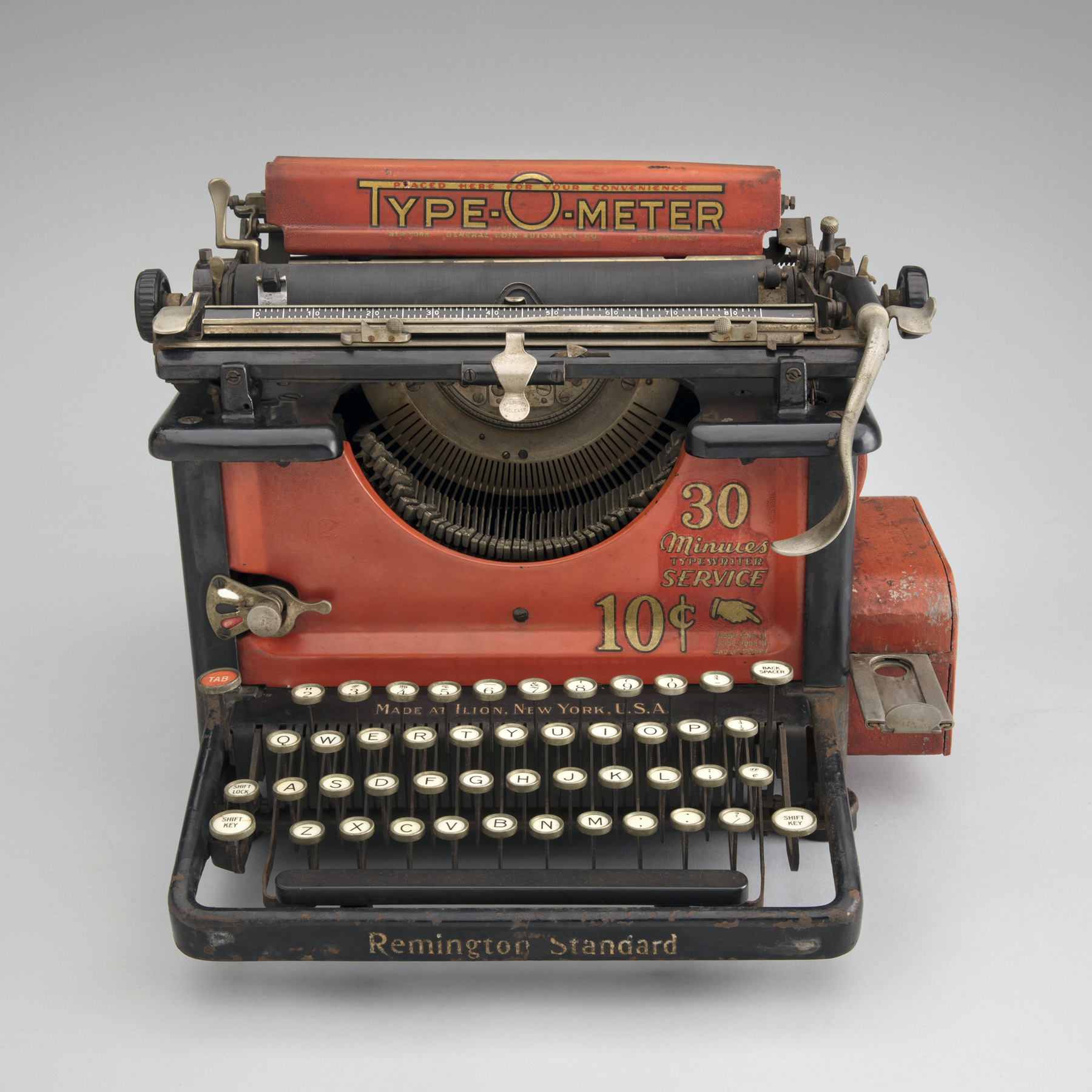
Installation view of the exhibition The Typewriter: An Innovation in Writing at the SFO Museum, San Francisco International Airport with the Sholes & Glidden Type Writer (left) and Remington Standard No. 12 (second left)
Sholes & Glidden Type Writer 1875 E. Remington & Sons Ilion, New York Anonymous lender
Sholes & Glidden Type Writer
The Sholes & Glidden Type Writer ushered in a new era of communication technology. Invented by Christopher Latham Sholes (1819-1890) with assistance from Samuel Soulé (1830-1875) and Carlos Glidden (1834-1877) in Milwaukee, Wisconsin, it was the first commercially produced typewriter with hinged type-bars and a four-row keyboard. In 1873, the Type Writer introduced “QWERTY,” a keyboard layout named for the first six letters at the top-left row of letter keys. Organised to prevent type-bars from clashing and jamming prototype machines, QWERTY was mechanically suited to the Sholes & Glidden and not necessarily designed for efficient typing. Contemporary computers, tablets, and smart phones share the QWERTY keyboard layout.
Remington Standard No. 12 1927 Remington Typewriter Company Ilion, New York Type-O-Meter conversion c. 1938 General Coin Automatic Co. San Francisco Collection of Joe Welch American Antique Museum
Industry
Advances in industry and business made the typewriter both possible and indispensable. Early typewriter factories combined recently developed processes such as steel stamping and zinc plating with aluminum, cast iron, vulcanite, and other new materials into their assembly lines. At the same time, typewriters created massive amounts of paperwork to support increased organisation and communication in manufacturing and business. By the 1930s, the typewriter was such a commercial success that even coin-operated conversions were offered.
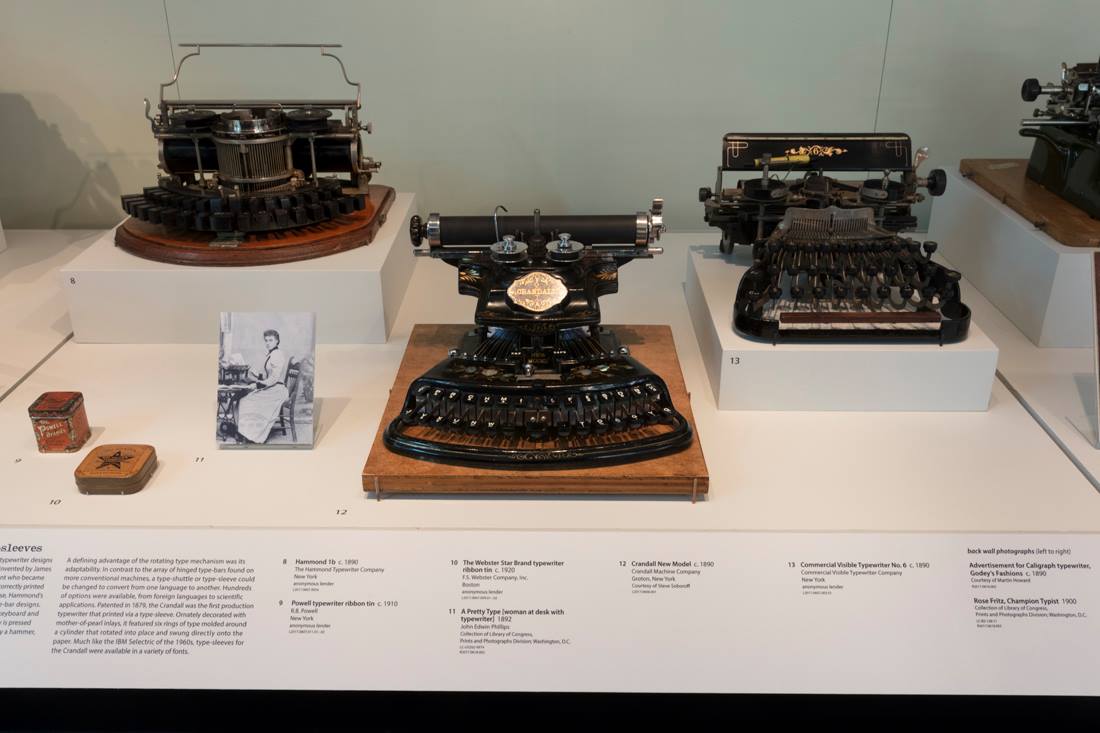
Installation view of the exhibition The Typewriter: An Innovation in Writing at the SFO Museum, San Francisco International Airport with the Hammond 1b (left) and Crandall New Model (centre)
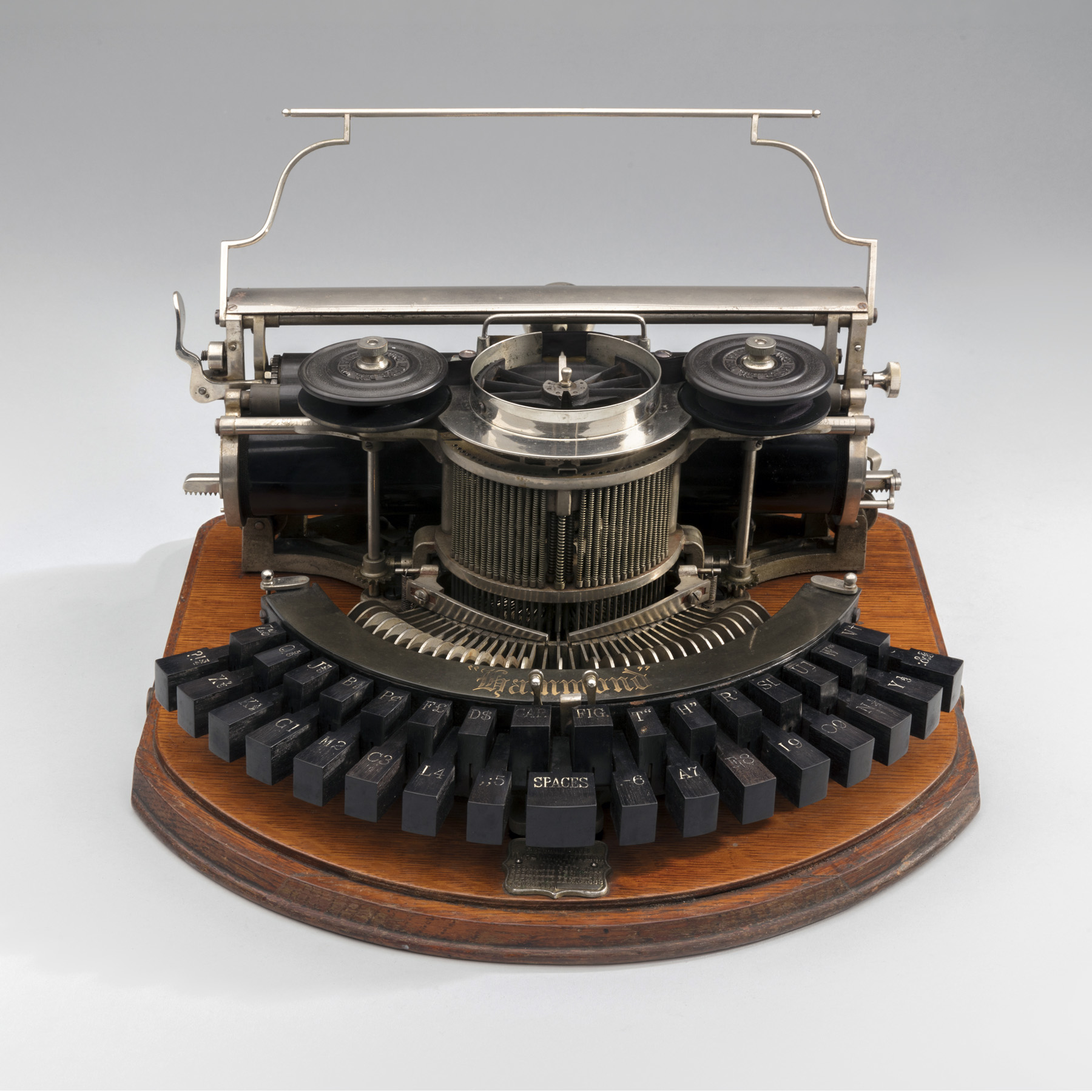
Hammond 1b c. 1890 The Hammond Typewriter Company New York Anonymous lender
Type-shuttles
During the 1880s, a multitude of patents for new typewriter designs were introduced. One of the most innovative was invented by James B. Hammond (1839-1913), a Civil War correspondent who became frustrated as news press staff misinterpreted and incorrectly printed his handwritten reports. While too late for wartime use, Hammond’s typewriter was one of the most enduring non-type-bar designs. Patented in 1880, it featured a curved, piano-style keyboard and printed via a type-shuttle. On a Hammond, when a key is pressed the type mechanism rotates into place and is struck by a hammer, making the impression between paper and ink ribbon.
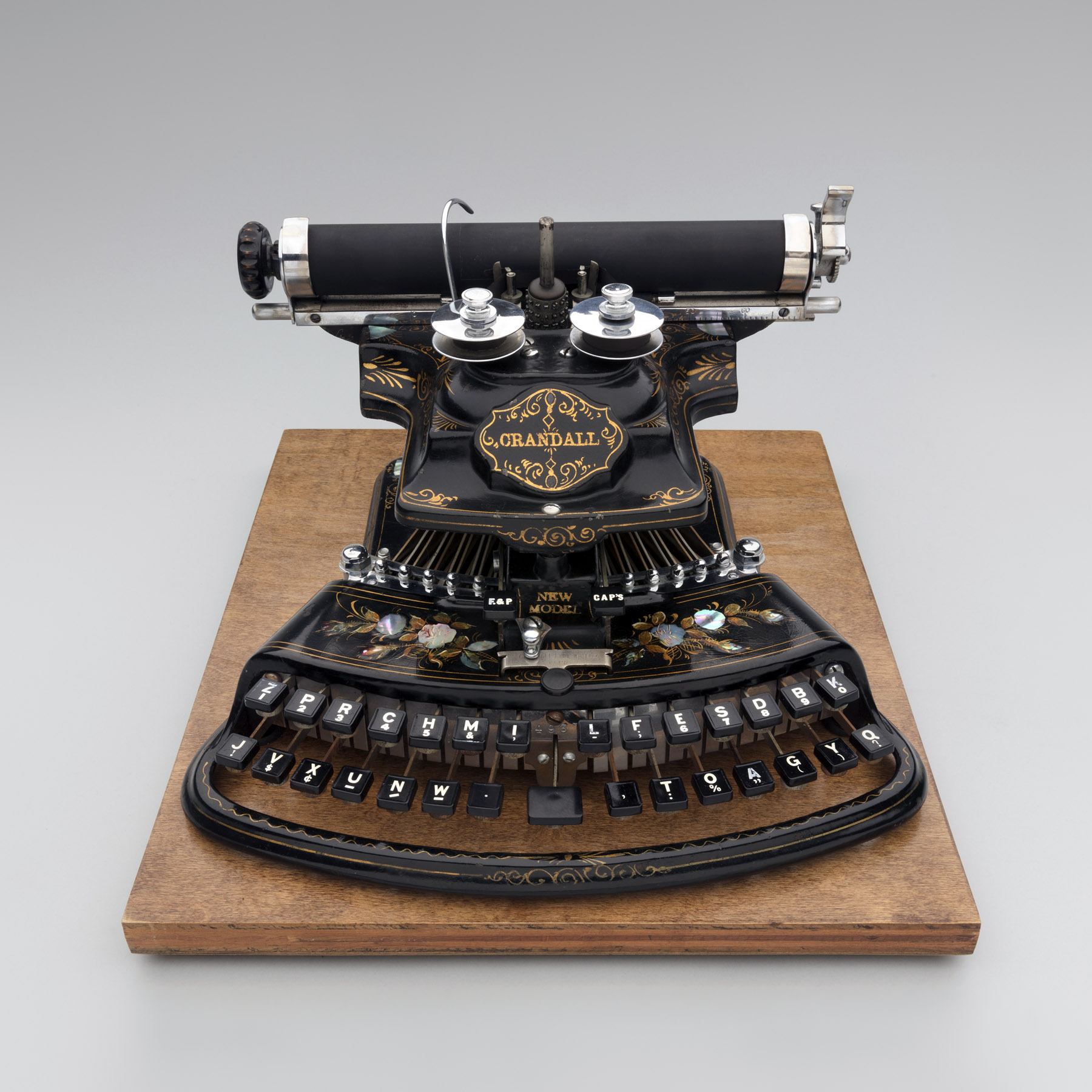
Crandall New Model c. 1890 Crandall Machine Company Groton, New York Courtesy of Steve Soboroff
Type-sleeves
A defining advantage of the rotating type mechanism was its adaptability. In contrast to the array of hinged type-bars found on more conventional machines, a type-shuttle or type-sleeve could be changed to convert from one language to another. Hundreds of options were available, from foreign languages to scientific applications. Patented in 1879, the Crandall was the first production typewriter that printed via a type-sleeve. Ornately decorated with mother-of-pearl inlays, it featured six rings of type moulded around a cylinder that rotated into place and swung directly onto the paper. Much like the IBM Selectric of the 1960s, type-sleeves for the Crandall were available in a variety of fonts.
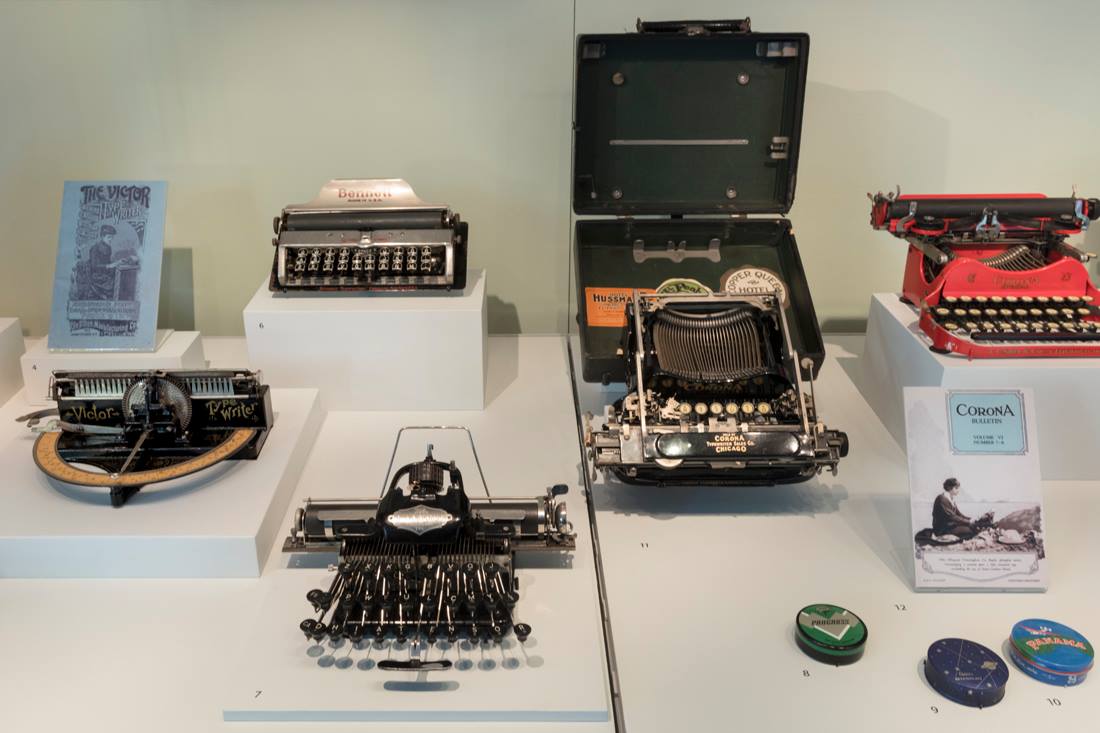
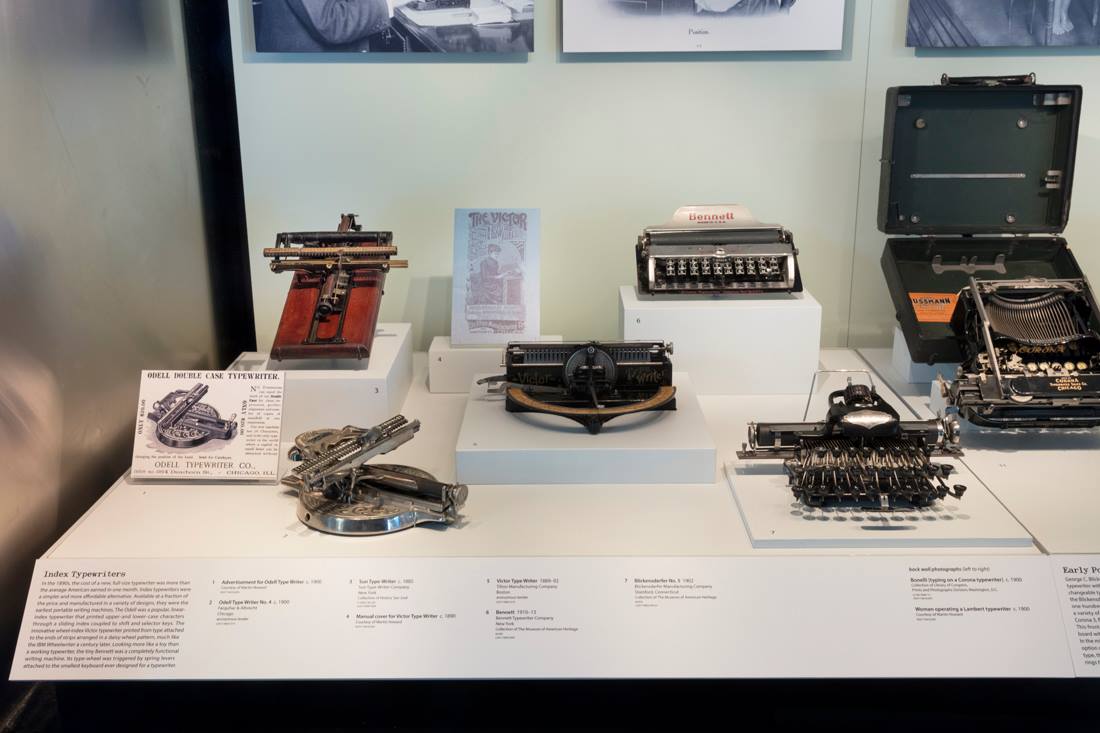
Installation view of the exhibition The Typewriter: An Innovation in Writing at the SFO Museum, San Francisco International Airport with the Victor Type Writer (left), Blickensderfer No. 5 (centre left) and Corona No. 3 Special (right)
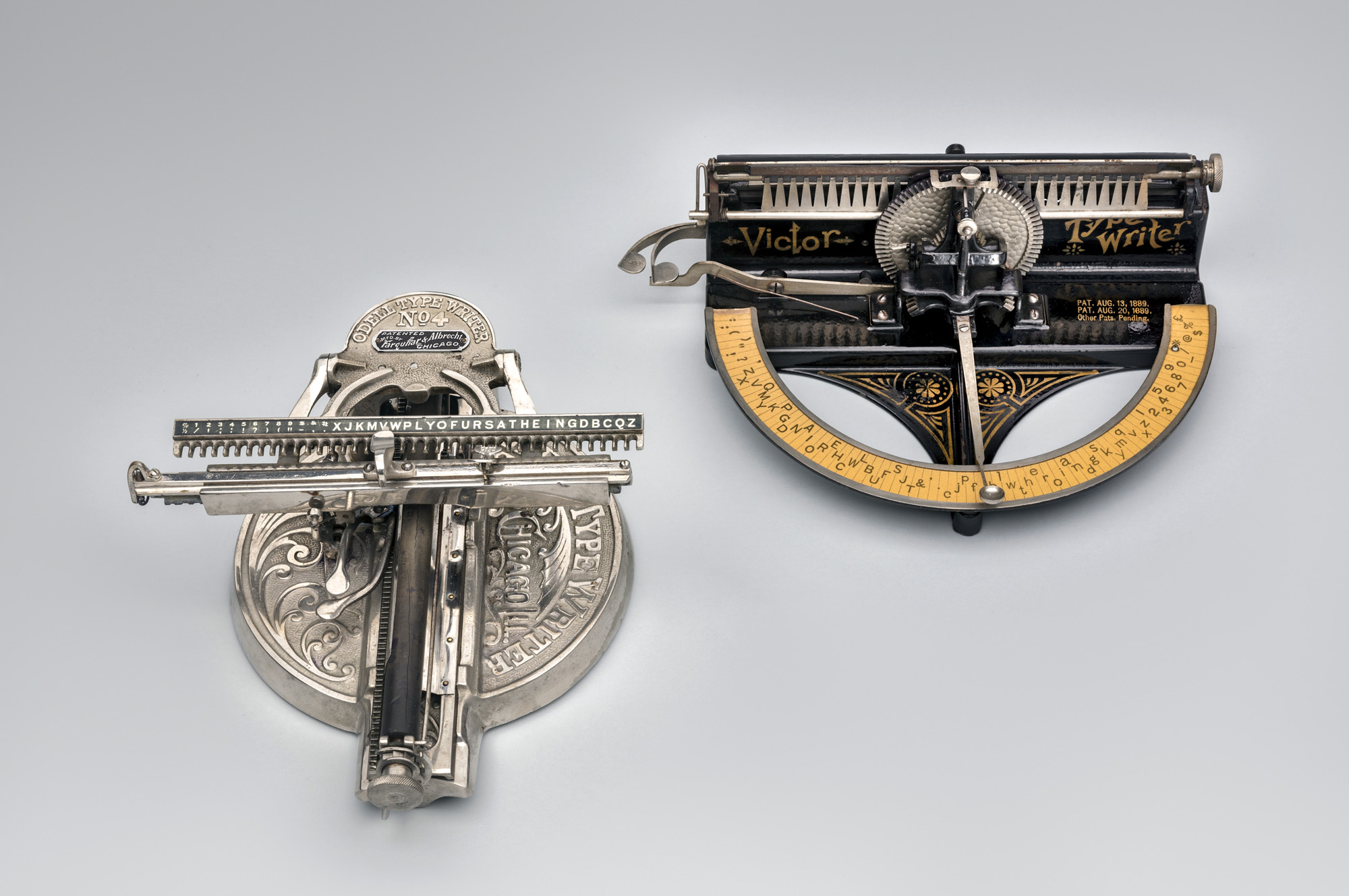
Odell Type Writer No. 4 c. 1900 Farquhar & Albrecht Chicago Anonymous lender
Victor Type Writer 1889-1892 Tilton Manufacturing Company Boston Anonymous lender
Index Typewriters
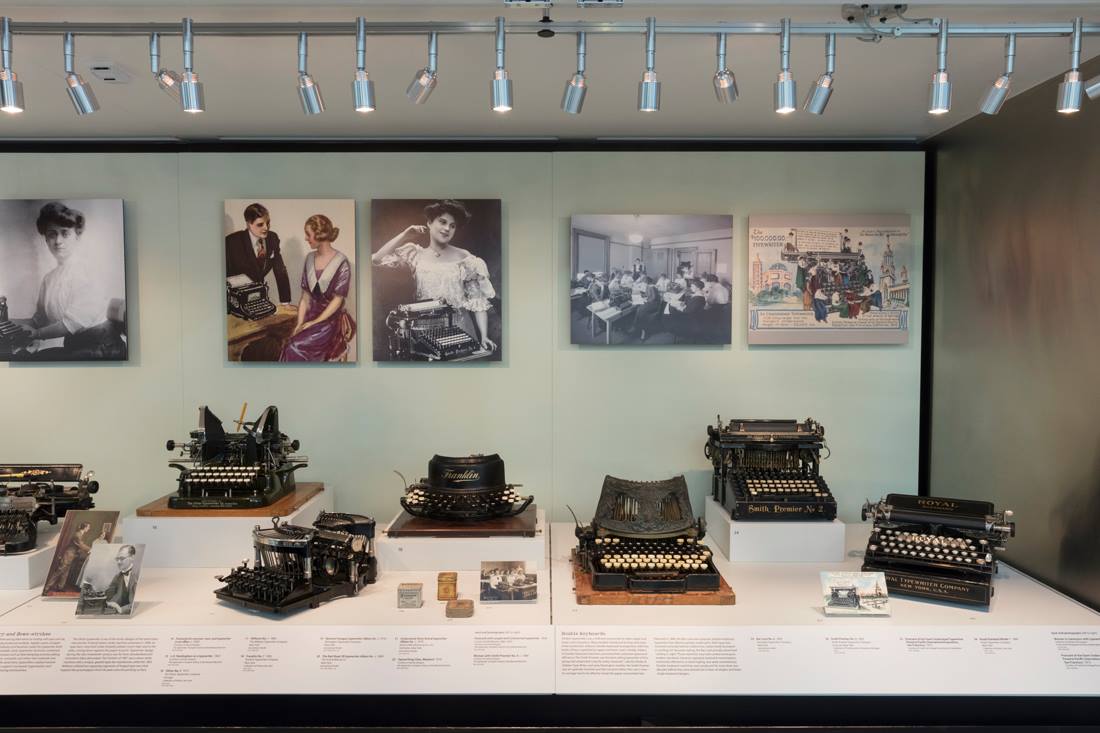
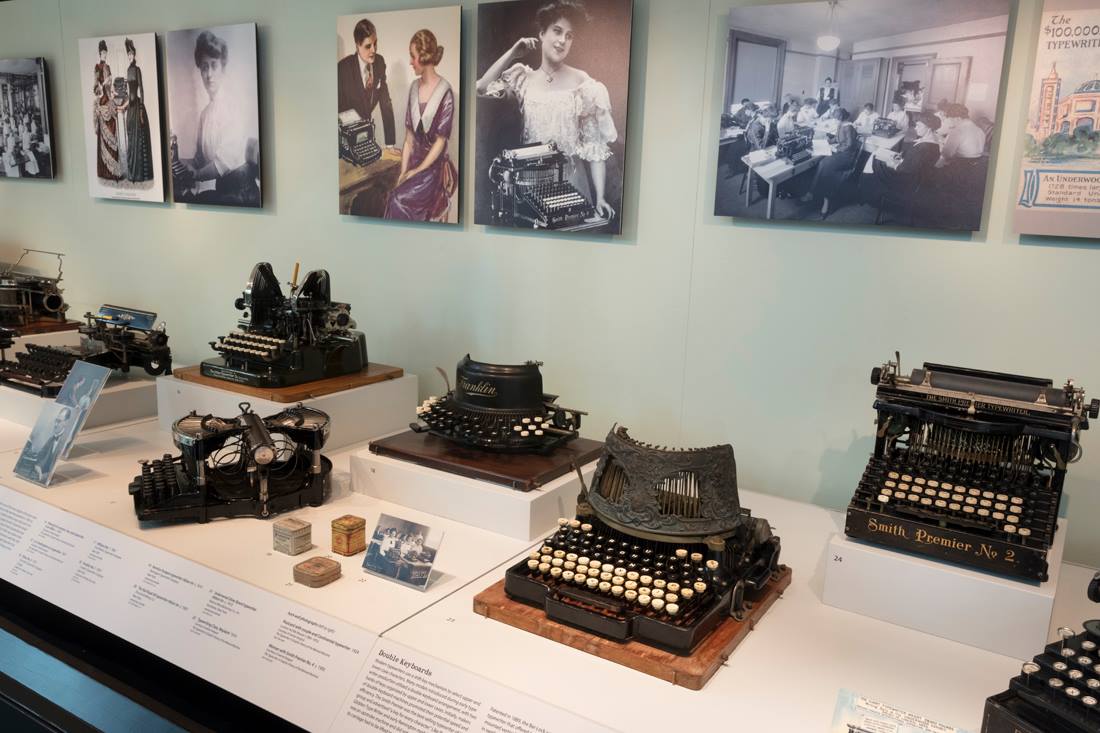
In the 1890s, the cost of a new, full-size typewriter was more than the average American earned in one month. Index typewriters were a simpler and more affordable alternative. Available at a fraction of the price and manufactured in a variety of designs, they were the earliest portable writing machines. The Odell was a popular, linear-index typewriter that printed upper-and lower-case characters through a sliding index coupled to shift and selector keys. The innovative wheel-index Victor typewriter printed from type attached to the ends of strips arranged in a daisy-wheel pattern, much like the IBM Wheelwriter a century later.
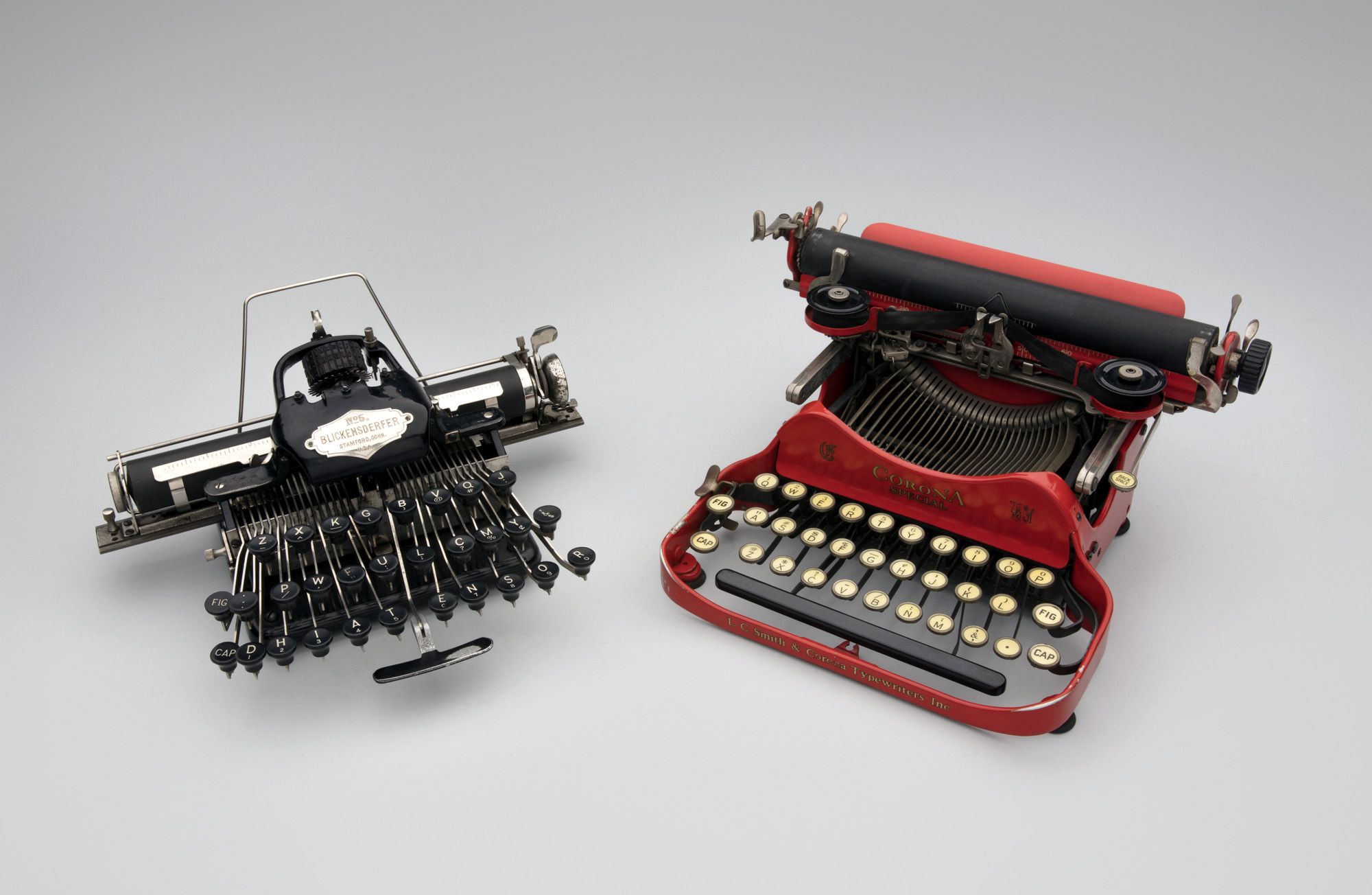
Blickensderfer No. 5 1902 Blickensderfer Manufacturing Company Stamford, Connecticut Collection of The Museum of American Heritage
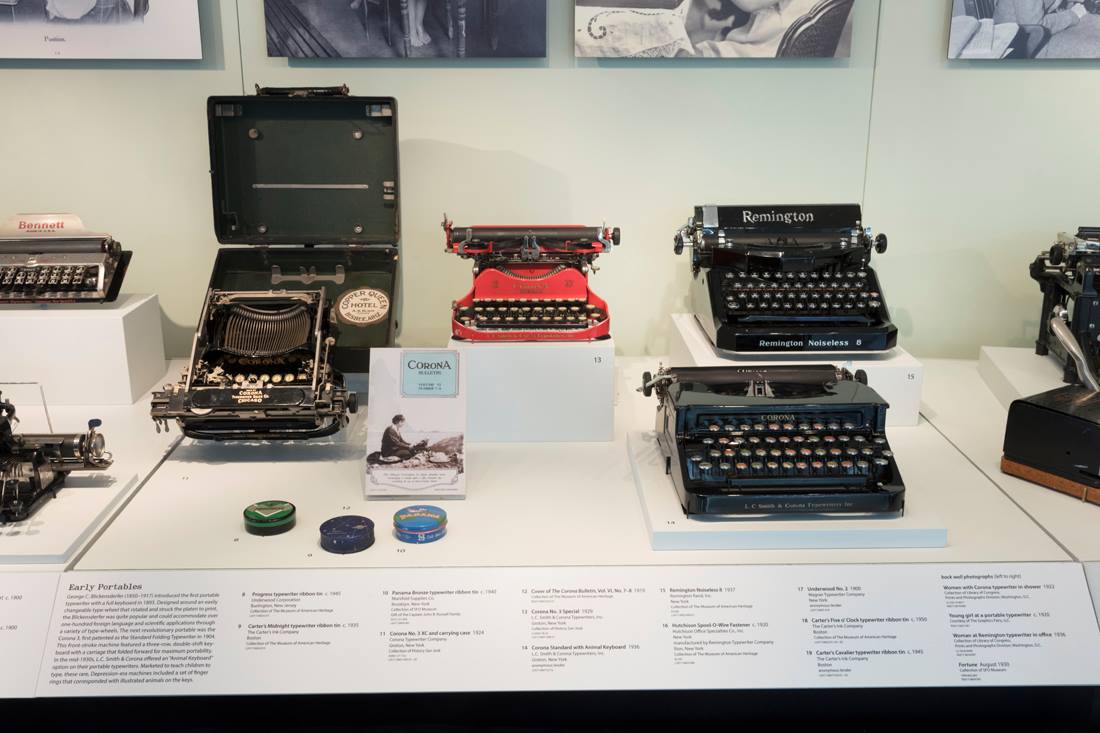
Corona No. 3 Special 1929 L.C. Smith & Corona Typewriters, Inc. Groton, New York Collection of History San José
Early Portables
George C. Blickensderfer (1850-1917) introduced the first portable typewriter with a full keyboard in 1893. Designed around an easily changeable type-wheel that rotated and struck the platen to print, the Blickensderfer was quite popular and could accommodate over one-hundred foreign language and scientific applications through a variety of type-wheels. The next revolutionary portable was the Corona 3, first patented as the Standard Folding Typewriter in 1904. This front-stroke machine featured a three-row, double-shift keyboard with a carriage that folded forward for maximum portability.
The typewriter is one of the great inventions of the modern world. A marvel of industrial engineering and ingenuity, it revolutionised communication and was an essential tool for countless writers. To comprehend the typewriter’s impact, consider a world where typing did not exist and handwriting was the main form of non-verbal communication. Until refillable fountain pens were introduced in 1884, handwriting was a cumbersome process accomplished with pens dipped in ink. The ease and speed of communication on paper increased dramatically when typewriters became available in the late 1800s. Typewriting was efficient, created clear and legible documents, and easily produced multiple copies using carbon paper.
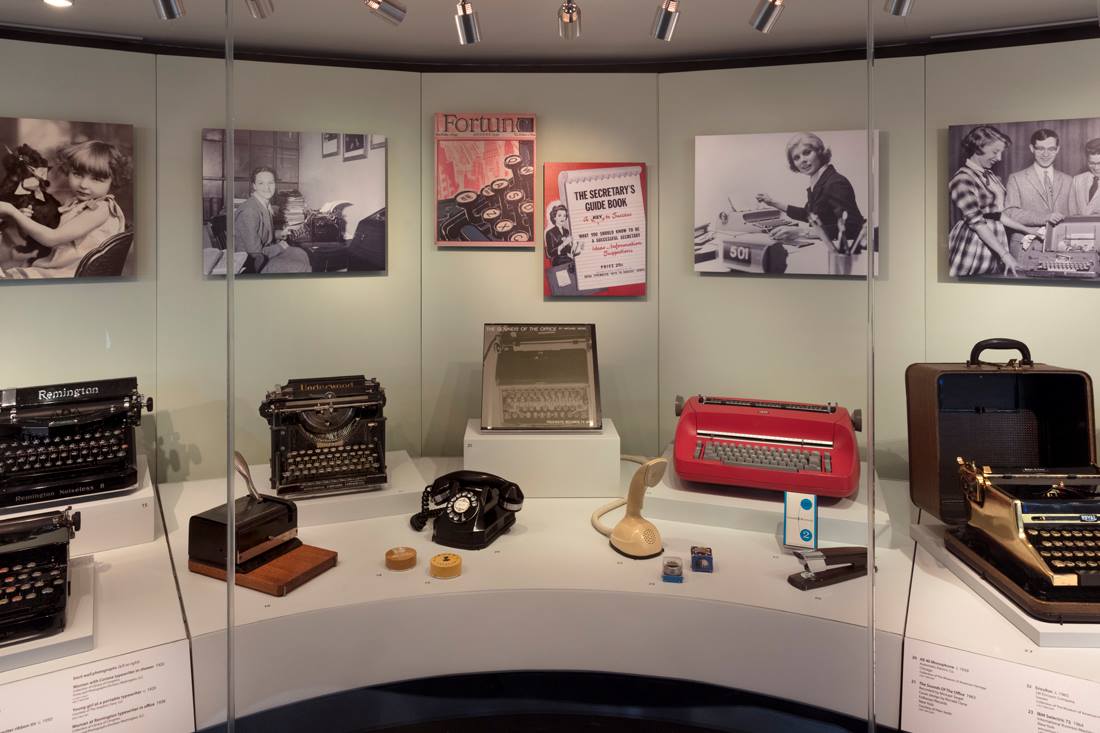
During the early 1900s, offices staffed by typists, bookkeepers, and clerks made the desktop typewriter indispensable. Inventions such as the telephone, telegraph, and railroad allowed business and manufacturing to grow exponentially, and extensive office organisation was required to keep pace. Countless agencies worldwide created professional offices based on principles of scientific management. Daily tasks were clearly defined for each employee, and working structures mirrored arrangements between foremen and workers on factory floors, with office personnel organised by hierarchies and job specialisation.
From local repair shops to international corporations, offices of all sizes employed typists trained in touch-typing techniques based on keyboard memorisation. The largest typing pools, staffed by legions of women entering the workforce for the first time, offered low wages for monotonous work in expansive, factory-like rooms. As businesses reorganised into smaller, specialised departments, typing environments improved. Secretaries played an instrumental role in this modern office system. Often trained as entry-level typists, they were promoted through the ranks to draft letters, take dictation, and work in liaison with managers and staff.
Although it has fallen out of widespread use, typewriter technology remains foundational in digital devices such as the computer, smart phone, and tablet. Modern typing is translated directly from typewriting, with the keyboard layout of most digital devices rooted in typewriter development. Nicknamed “QWERTY” for the first six letters at the top-left of the keyboard, this layout was not developed to promote efficient typing or for ergonomic reasons. In 1873, QWERTY was introduced to alleviate clashing and jamming of type-bars on the Type Writer, the first commercially produced writing machine with a four-row keyboard.
In recent years, a renewed interest in typewriting has brought many of these classic machines back into focus. While some writers never left their trusty Royal desktops and Olympia portables, other enthusiasts have discovered the typewriter as a creative outlet in an era defined by endless streams of information. Unlike computers, typewriters translate ideas directly onto paper through an audible rhythm of keys and swinging type-bars. There is no delete function to shroud errors, and a well-edited typescript illustrates a creative process through handwritten notations and corrections typed over in ink. Today, collectors and writers all over the world value the timeless aesthetics and utility of the typewriter. This exhibition traces a history of typewriter technology and innovation through more than a century of design, from early writing machines to modern portables and Asian typewriters with thousands of characters.
Thank you to the following lenders for making this exhibition possible: California Typewriter, Computer History Museum, History San José, Joe Welch American Antique Museum, Mickey McGowan, Thomas S. Mullaney, Timothy S. Mundorff, Museum of American Heritage, Peter Smith, Steve Soboroff, Nick Tauriainen, and Janine Vangool.
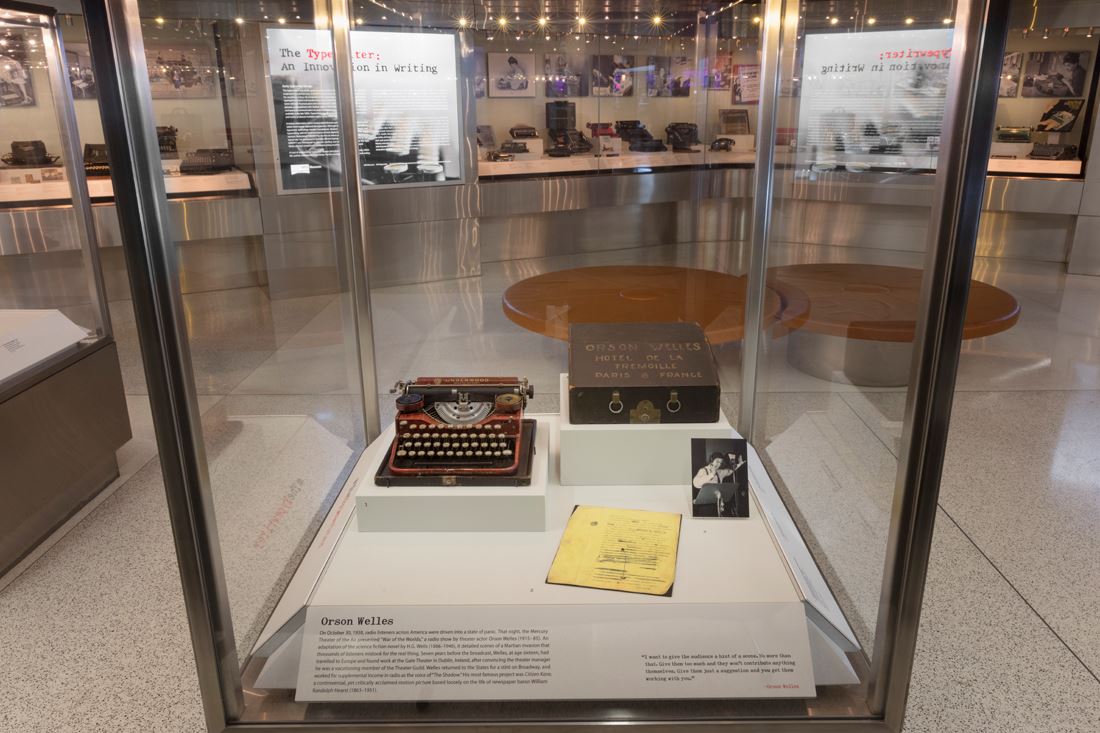
Installation view of the exhibition The Typewriter: An Innovation in Writing at the SFO Museum, San Francisco International Airport with Orson Welles’ Underwood Standard Portable Typewriter
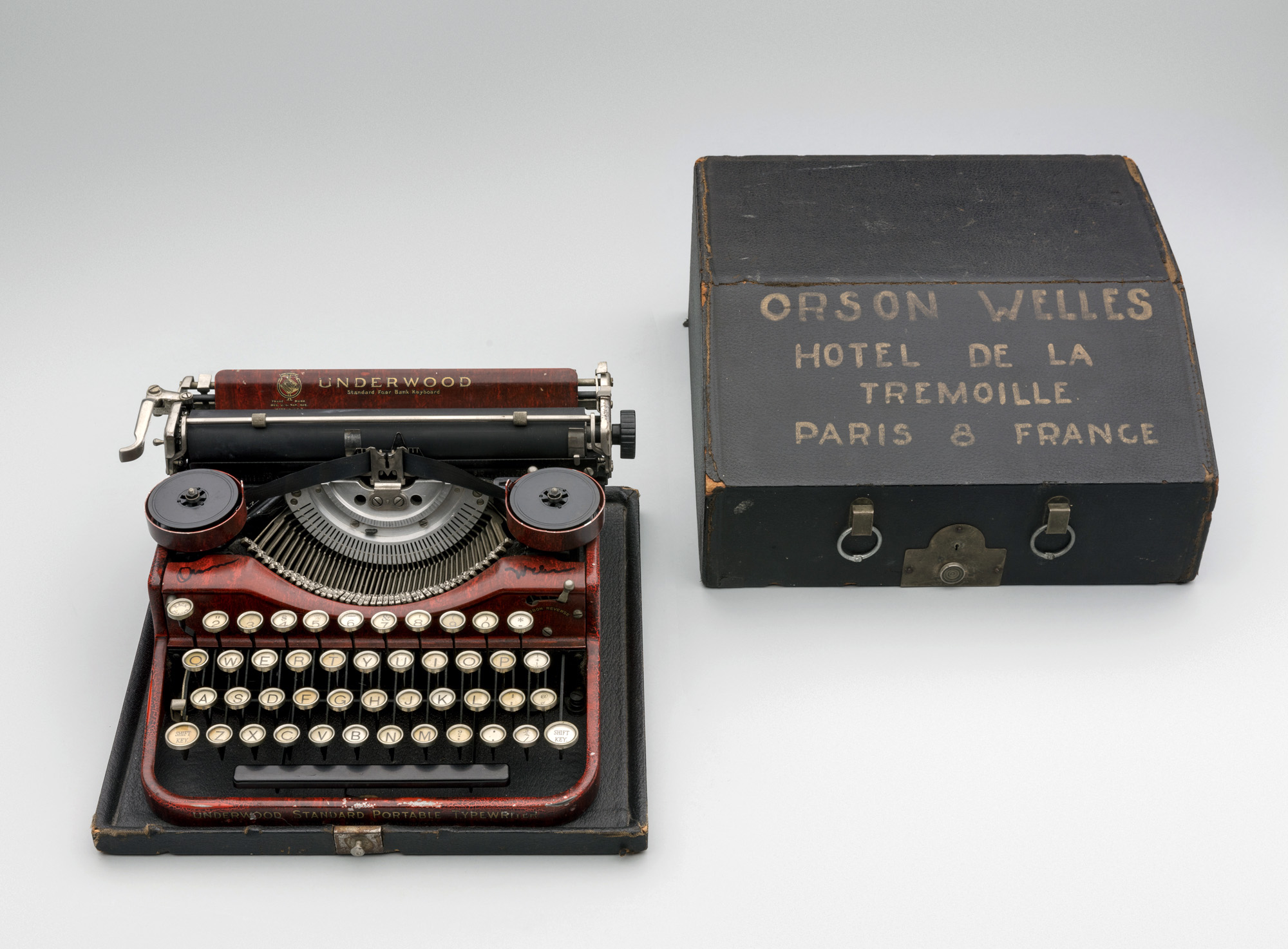
Underwood Standard Portable Typewriter with hand-lettered case 1926 previously owned by Orson Welles (1915-1985) Underwood Typewriter Company New York Courtesy of Steve Soboroff
Orson Welles
On October 30, 1938, radio listeners across America were driven into a state of panic. That night, the Mercury Theater of the Air presented “War of the Worlds,” a radio show by theatre actor Orson Welles (1915-1985). An adaptation of the science fiction novel by H.G. Wells (1866-1946), it detailed scenes of a Martian invasion that thousands of listeners mistook for the real thing. Seven years before the broadcast, Welles, at age sixteen, had travelled to Europe and found work at the Gate Theatre in Dublin, Ireland, after convincing the theatre manager he was a vacationing member of the Theatre Guild. Welles returned to the States for a stint on Broadway, and worked for supplemental income in radio as the voice of “The Shadow.” His most famous project was Citizen Kane, a controversial, yet critically acclaimed motion picture based loosely on the life of newspaper baron William Randolph Hearst (1863-1951).
Installation view of the exhibition The Typewriter: An Innovation in Writing at the SFO Museum, San Francisco International Airport with the Corona Standard with Animal Keyboard bottom right
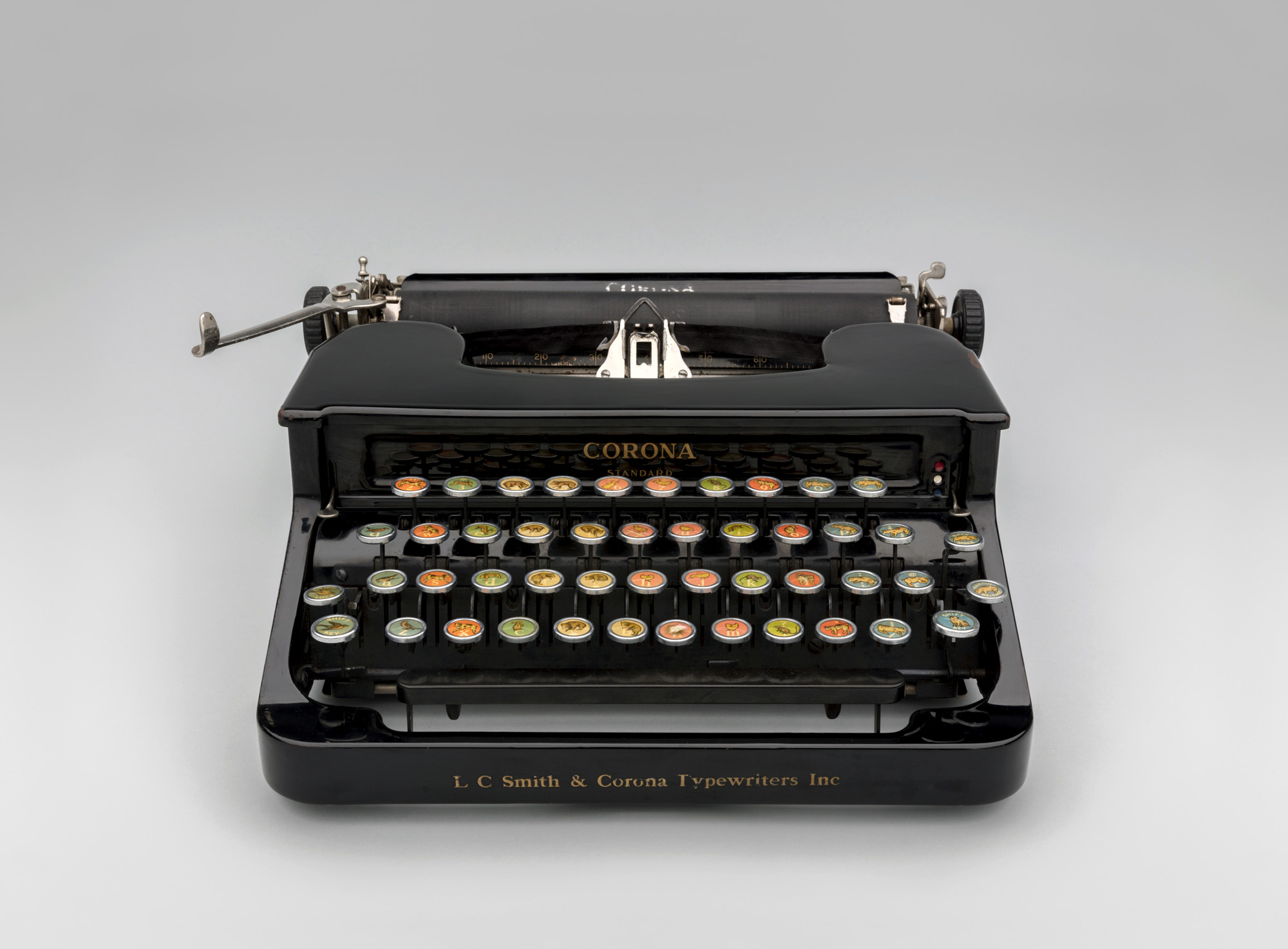
Corona Standard with Animal Keyboard 1936 L.C. Smith & Corona Typewriters, Inc. Groton, New York Anonymous lender
Corona Standard with Animal Keyboard
In the mid-1930s, L.C. Smith & Corona offered an “Animal Keyboard” option on their popular Silent, Sterling, and Standard portable typewriters. Marketed to teach children to type, these rare, Depression-era machines included a set of finger rings that corresponded with illustrated animals on the keys. Keyboard columns were colour-coordinated to the finger rings and featured animals such as bluebirds, bear cubs, kittens, and bunny rabbits. An illustrated play book was included, and colour-coordinated keyboards were also offered without animal keys as instructional devices for older children.
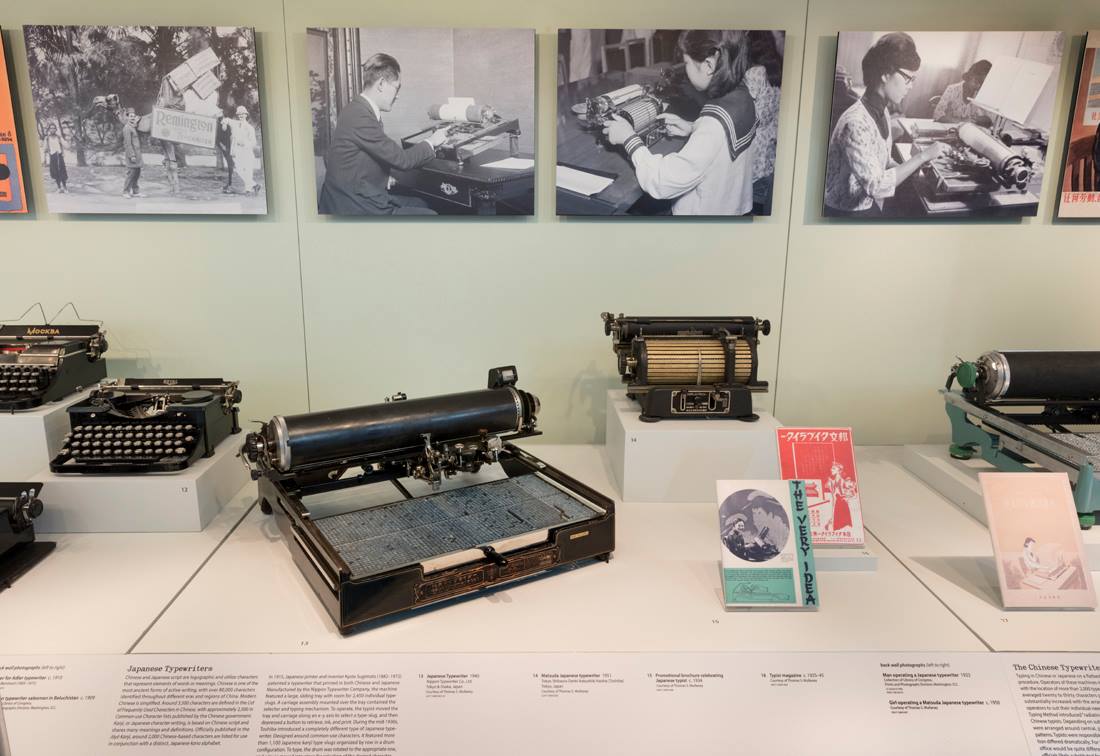
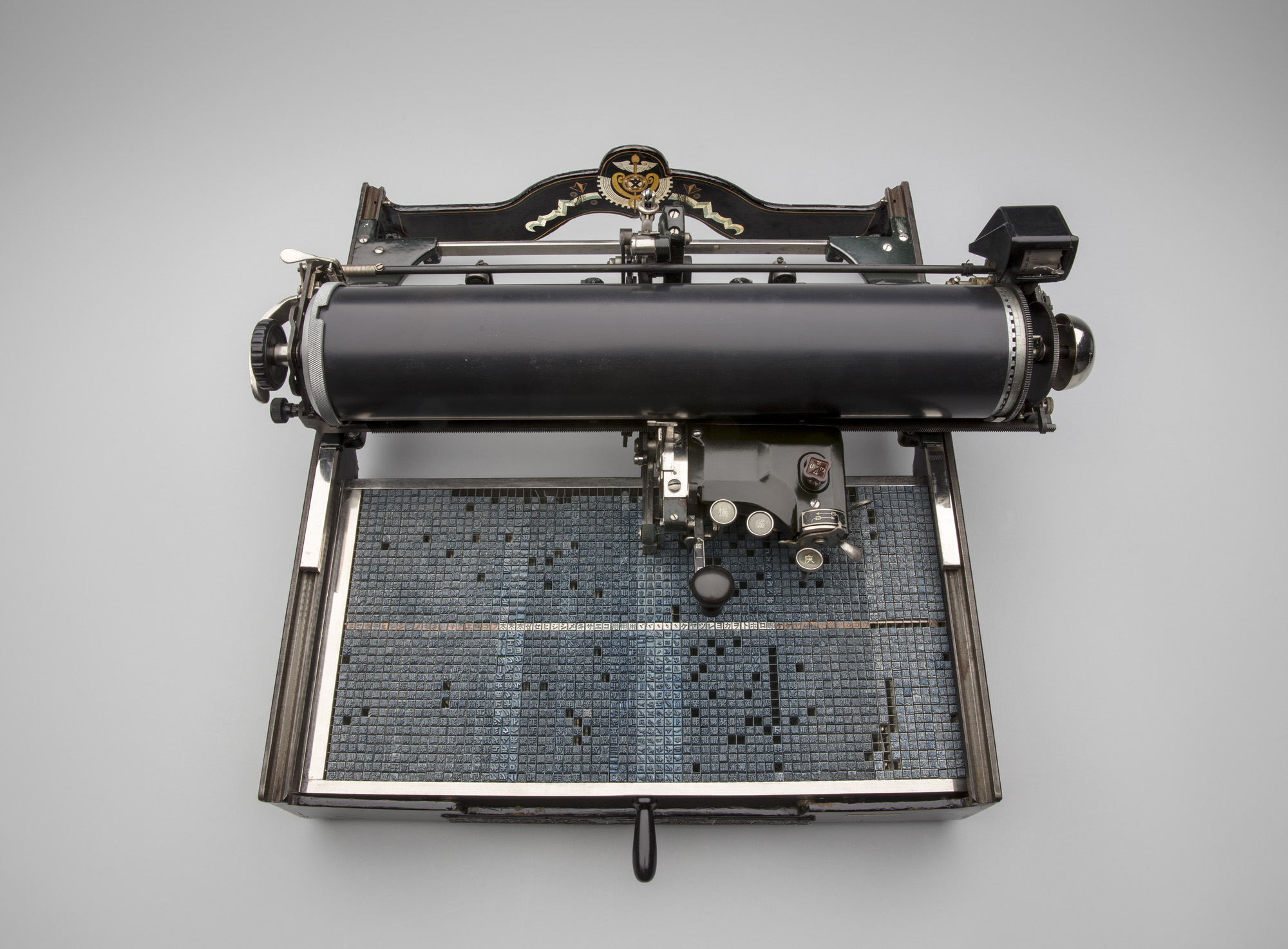
Installation view of the exhibition The Typewriter: An Innovation in Writing at the SFO Museum, San Francisco International Airport with the Japanese Typewriter at centre left
Japanese Typewriter 1940 Nippon Typewriter Co., Ltd. Tokyo & Osaka, Japan Courtesy of Thomas S. Mullaney
The Japanese Typewriter
Kanji, or Japanese character writing, is based on Chinese script and shares many meanings and definitions. Officially published in the Jōyō Kanji, around 2,000 Chinese-based characters are listed for use in conjunction with a distinct, Japanese kana alphabet. In 1915, Japanese printer and inventor Kyota Sugimoto (1882-1972) patented a typewriter that printed in both Chinese and Japanese. Manufactured by the Nippon Typewriter Company, the machine featured a large, sliding tray with room for 2,450 individual type-slugs. A moving carriage assembly mounted over the tray contained the typing mechanism. To operate, the typist positioned the tray and carriage along an x-y axis to select a type-slug, and depressed a button to retrieve, ink, and print.
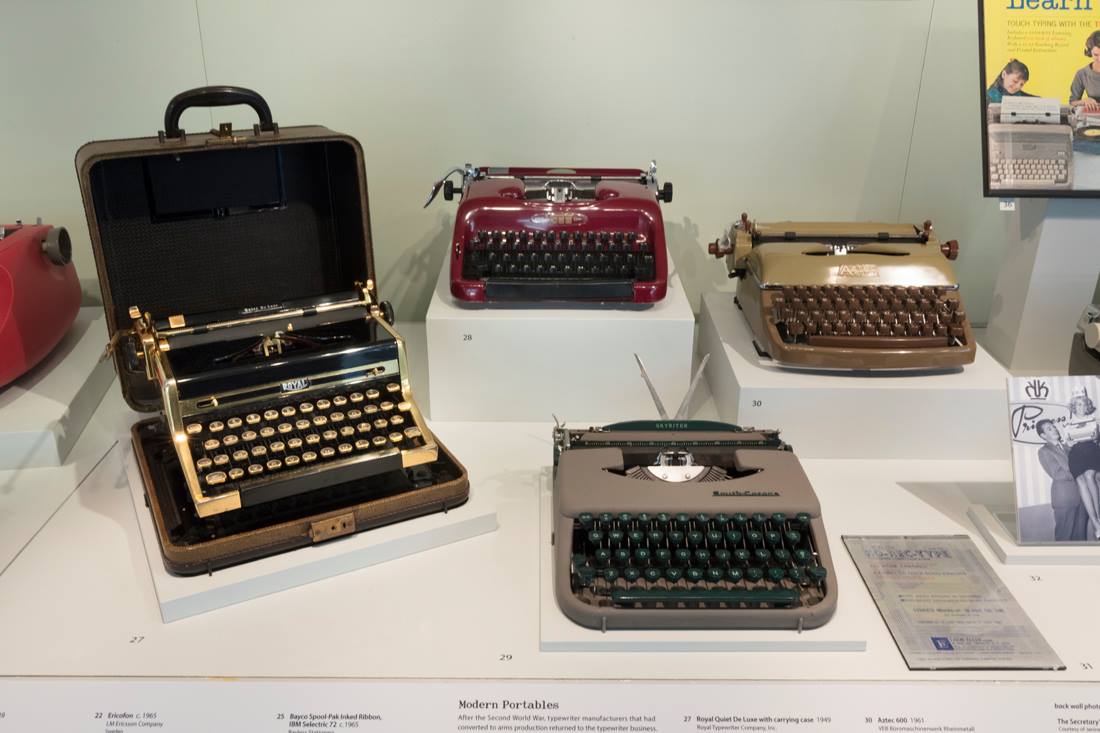
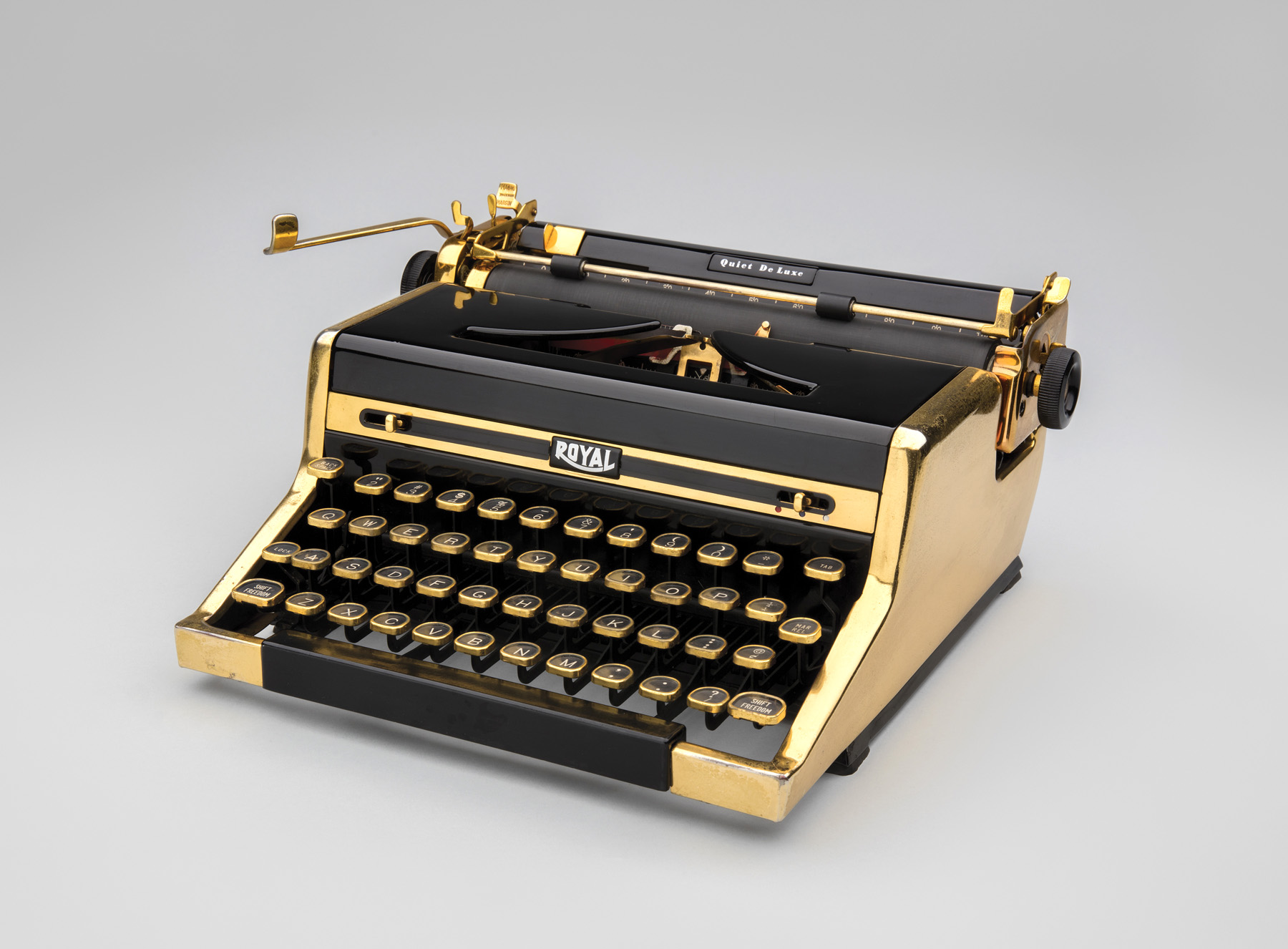
Installation view of the exhibition The Typewriter: An Innovation in Writing at the SFO Museum, San Francisco International Airport with the Royal Quiet De Luxe at left
Royal Quiet De Luxe 1949 Royal Typewriter Company, Inc. Hartford, Connecticut Courtesy of California Typewriter
Modern Portables
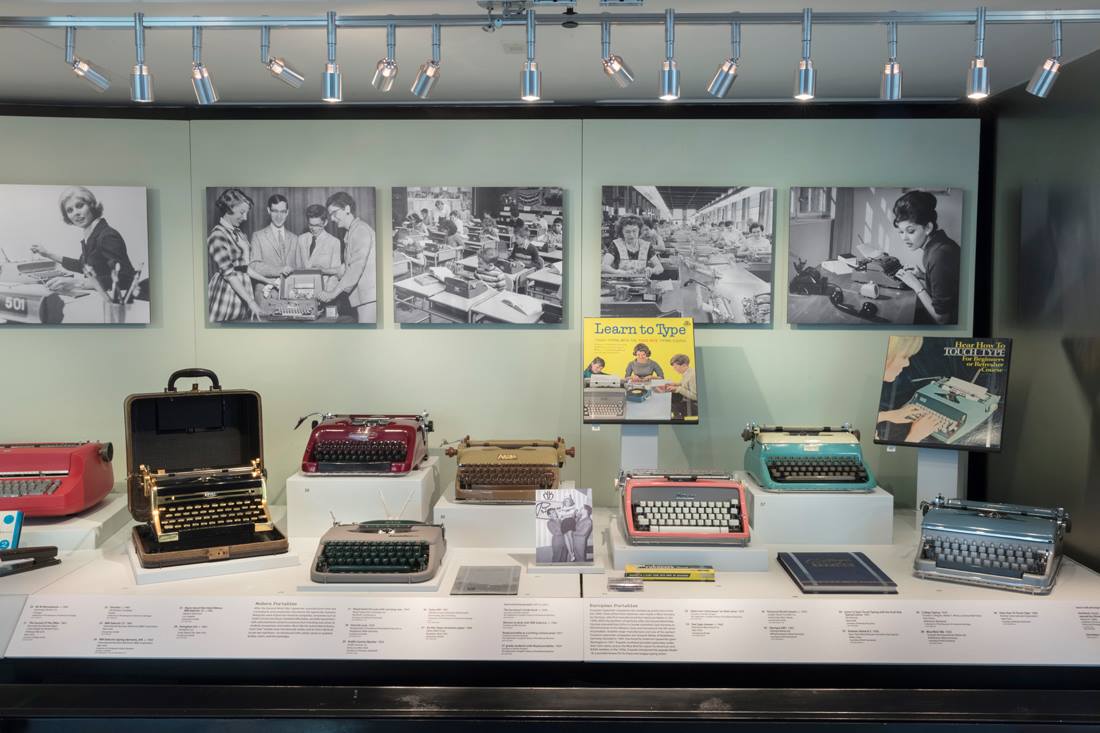
After the Second World War, typewriter manufacturers that had converted to arms production returned to the typewriter business. Much like the automobile industry, most “new” models were mechanically similar, and at times identical, to pre-war machines – re-introduced with catchy names in updated bodies, colours, and trim packages. Based on their first portable of 1926, post-war Royals added trademark features from standard Royal desktop machines such as “Touch Control” to adjust key sensitivity, and “Magic Margin” to automatically control page margins. With a restyled case by industrial designer Henry Dreyfuss (1904-1972), the Quiet De Luxe was offered in an array of bright, mid-century colours, including a custom-order, gold-plated option also given as a prize for student writing contests.
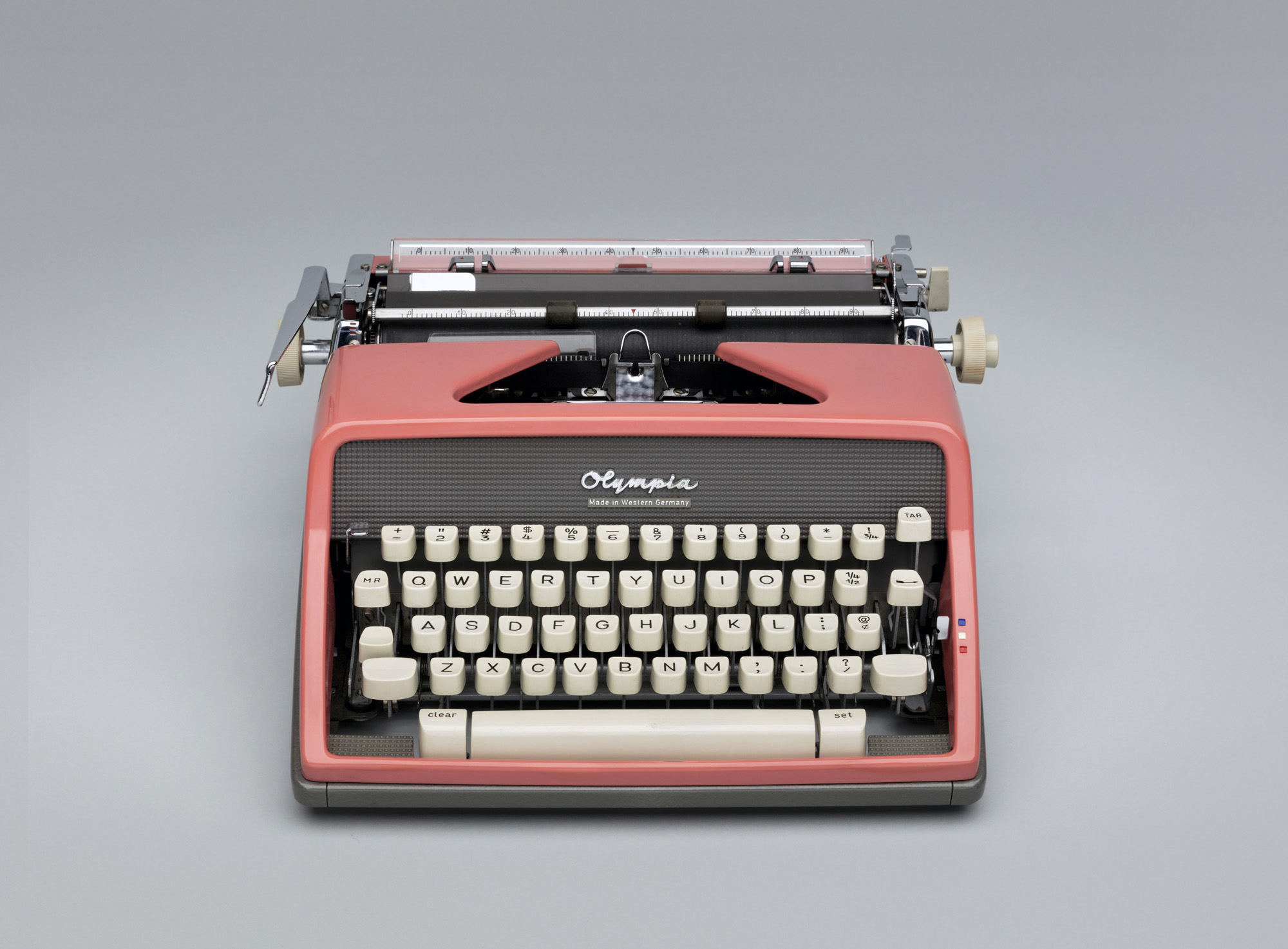
Installation view of the exhibition The Typewriter: An Innovation in Writing at the SFO Museum, San Francisco International Airport with the Olympia SM7 at centre
Olympia SM7 1962 Olympia Werke AG Wilhelmshaven, West Germany Courtesy of Nick Tauriainen
European Portables
European typewriter companies also ramped up production in the late 1940s. Some of the finest machines were made in West Germany by Olympia, who first manufactured four-bank portables in the 1930s. With the partition of Germany after the Second World War, Olympia relocated from Erfurt in Soviet-controlled, East Germany to Wilhelmshaven in the Western Zone and introduced the SM series of portables. Known for their sharp and snappy typing action, Olympia’s SM series were popular with students and literary writers worldwide.
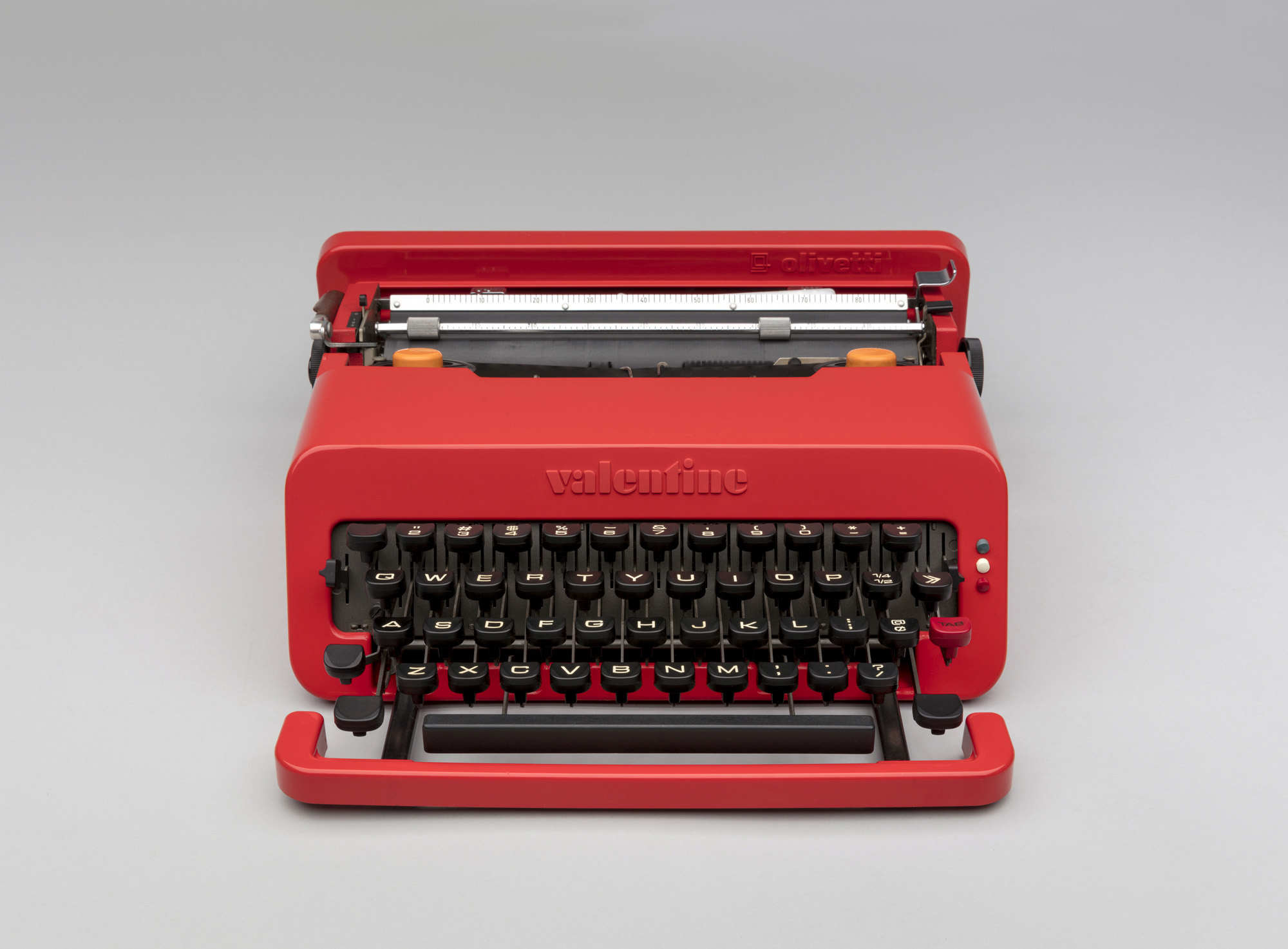
Installation view of the exhibition The Typewriter: An Innovation in Writing at the SFO Museum, San Francisco International Airport with the Olivetti Valentine at left
Olivetti Valentine 1969 Ing. C. Olivetti & Co., SpA Barcelona, Spain Collection of Computer History Museum
Olivetti Design
Founded in 1908 by Camillo Olivetti (1868-1943) and succeeded by his son Adriano Olivetti (1901-1960) thirty years later, Ing. C. Olivetti & Co. is associated with design more than any other typewriter company. Within a framework termed the “Olivetti style,” good design was central to all levels of production and advertising, and even extended to the factory floor and lifestyle of its workers. The Valentine is perhaps the most iconic Olivetti typewriter, envisioned by designer Ettore Sottsass (1917-2007) as an inexpensive and simple-yet-stylish portable. Based mechanically on the mid-1960s Lettera 32, the Valentine came in bright, pop-art colours and included an ABS plastic case that doubled as a waste-paper bin.
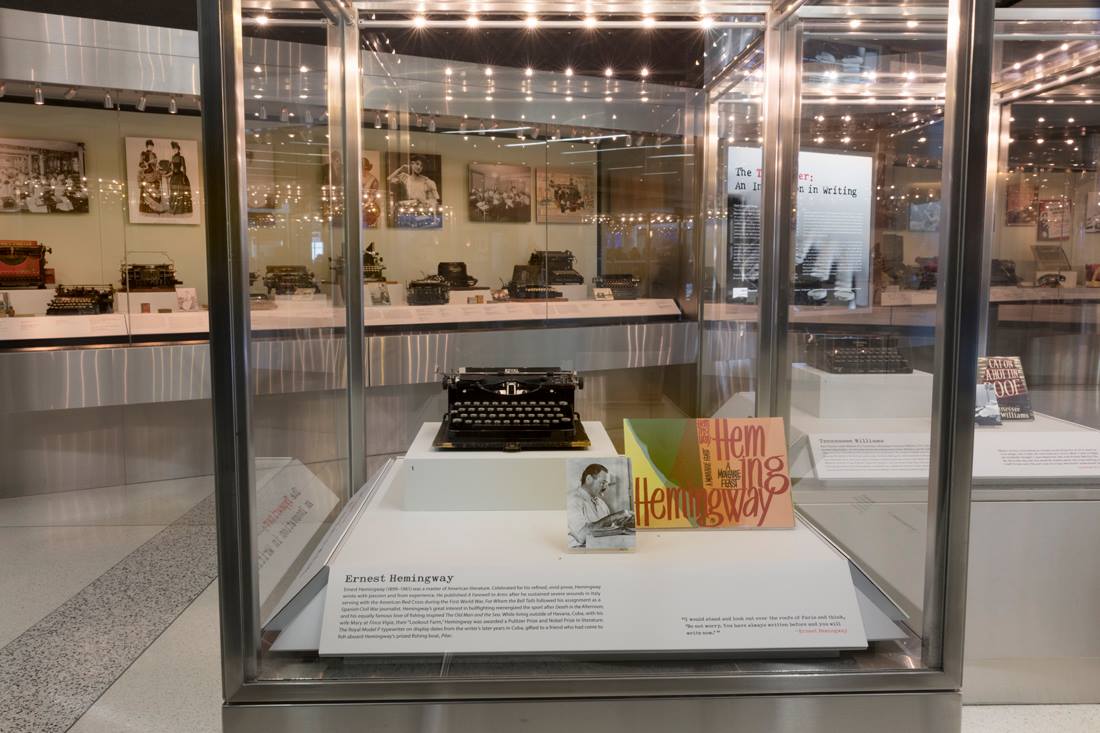
Installation photographs
Ray Bradbury
John Lennon
Tennessee Williams
Ernest Hemingway
Installation views of the first display case
Installation views of a second display case
Installation views of a third display case
Installation views of a fourth display case
SFO Museum San Francisco International Airport P.O. Box 8097 San Francisco, CA 94128 USA Phone: 650.821.6700
Exhibition dates: 14th October – 3rd December, 2017
Curator: Richard Perram OAM
Warning: this posting contains male nudity. If you don’t want to see please do not look.
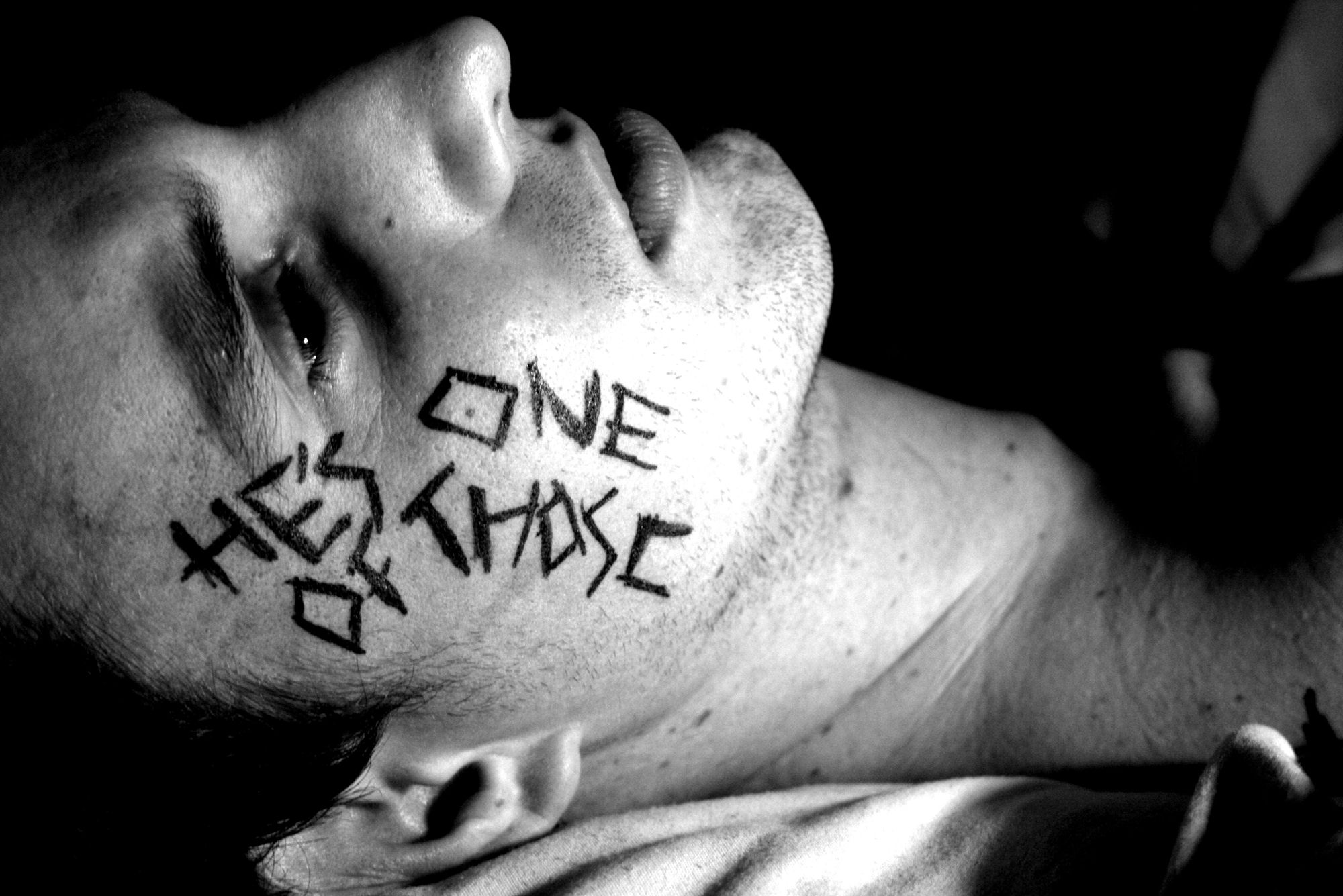
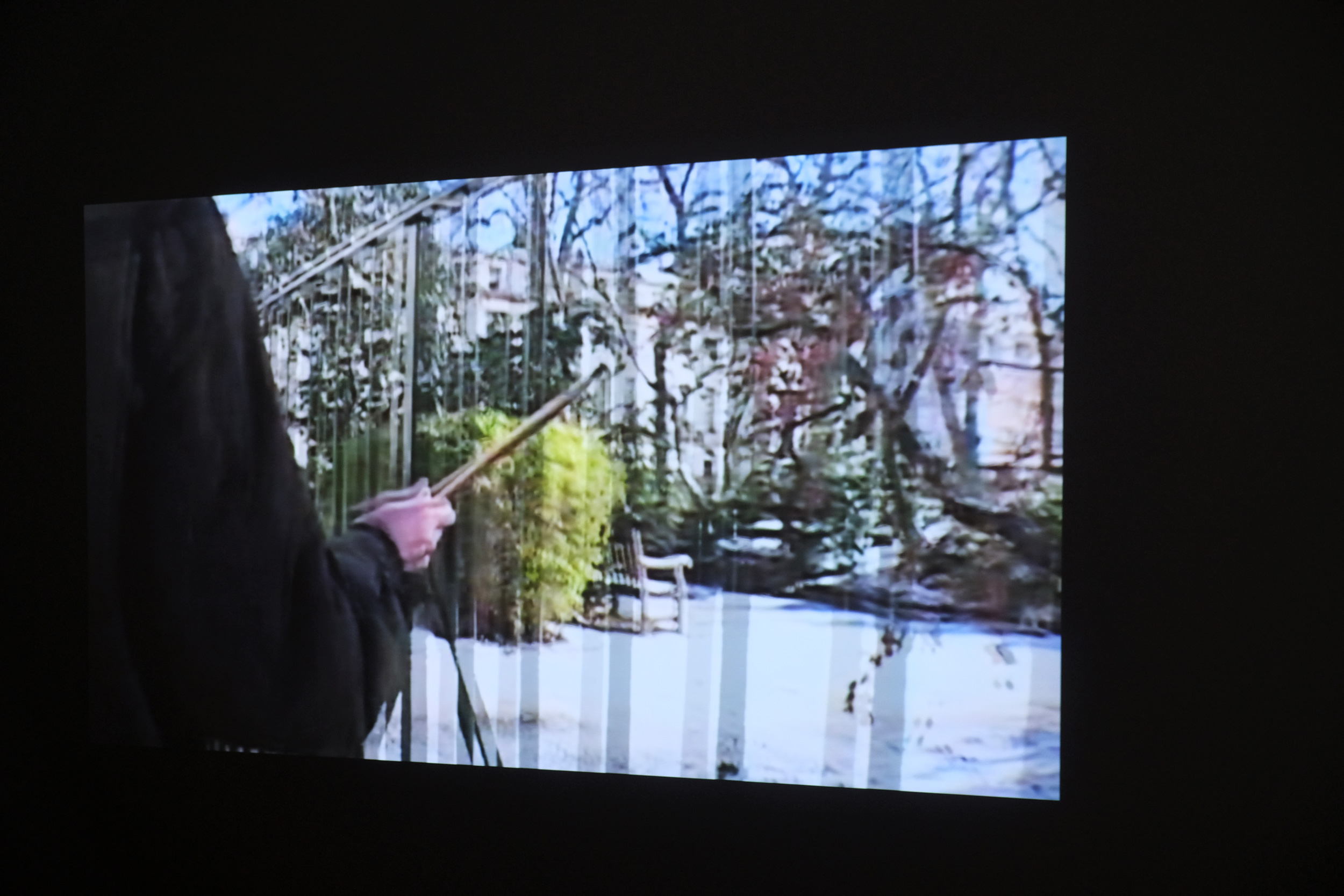
Todd Fuller (Australian, b. 1988) and Amy Hill (Australian, b. 1988) They’re Only Words (video still) 2009 Film, sound duration: 2:42 mins Courtesy the artists and May Space, Sydney
I must congratulate curator and gallery Director, Richard Perram OAM and the Bathurst Regional Art Gallery for putting on such a fine exhibition, worthy of many a large gallery in a capital city. An incredible achievement, coming at the same time as Latrobe Regional Art Gallery put on the recent René Magritte exhibition. All power to these regional galleries. Now on with the show…
Show and tell
The male body. The female body. The trans body. The gay body. Etc. etc. etc. … The male gaze. The female gaze. The trans gaze. The gay gaze. Etc. etc. etc. …
I did my Doctor of Philosophy, all four and a half years of it, on the history of photography and its depiction of the male body so I know this subject intimately. It is such a complicated subject that after all of time, nothing is ever certain, everything is changeable and fluid.
To start, the definition of masculinity that I used as a determination for the term in my PhD is included as the first quotation below. The quotation is followed by others – on the optic experience and the creation of body image; on body image and our relation to other people; on the anxiety caused by the crisis of looking as it intersects with the crisis of the body; and how we can overcome the passivity of objective truth (accepting dominant images in this case, as they are presented to us) through an active struggle for subjective truth, or an acceptance of difference. A further, longer quote in the posting by Chris Schilling examines Ernst Goffman’s theories of body, image and society in which Goffman states that the body is characterised by three main features: firstly, that the body as material property of individuals; secondly, that meanings attributed to the body are determined by ‘shared vocabularies of body idiom’ such as dress, bearing, movements and position, sound level, physical gestures such as waving and saluting, facial decorations, and broad emotional expressions; and thirdly; that the body plays an important role in mediating the relationship between people’s self-identity and their social identity. These quotations just start to scratch the surface of this very complicated, negotiated social area.
What we can say is this: that masculinity is always and forever a construct; that male body image is always and forever a further construct built on the first construct; and that photo media images of the male body are a construct, in fact a double or triple construct as they seek to capture the surface representation of the previous two conditions.
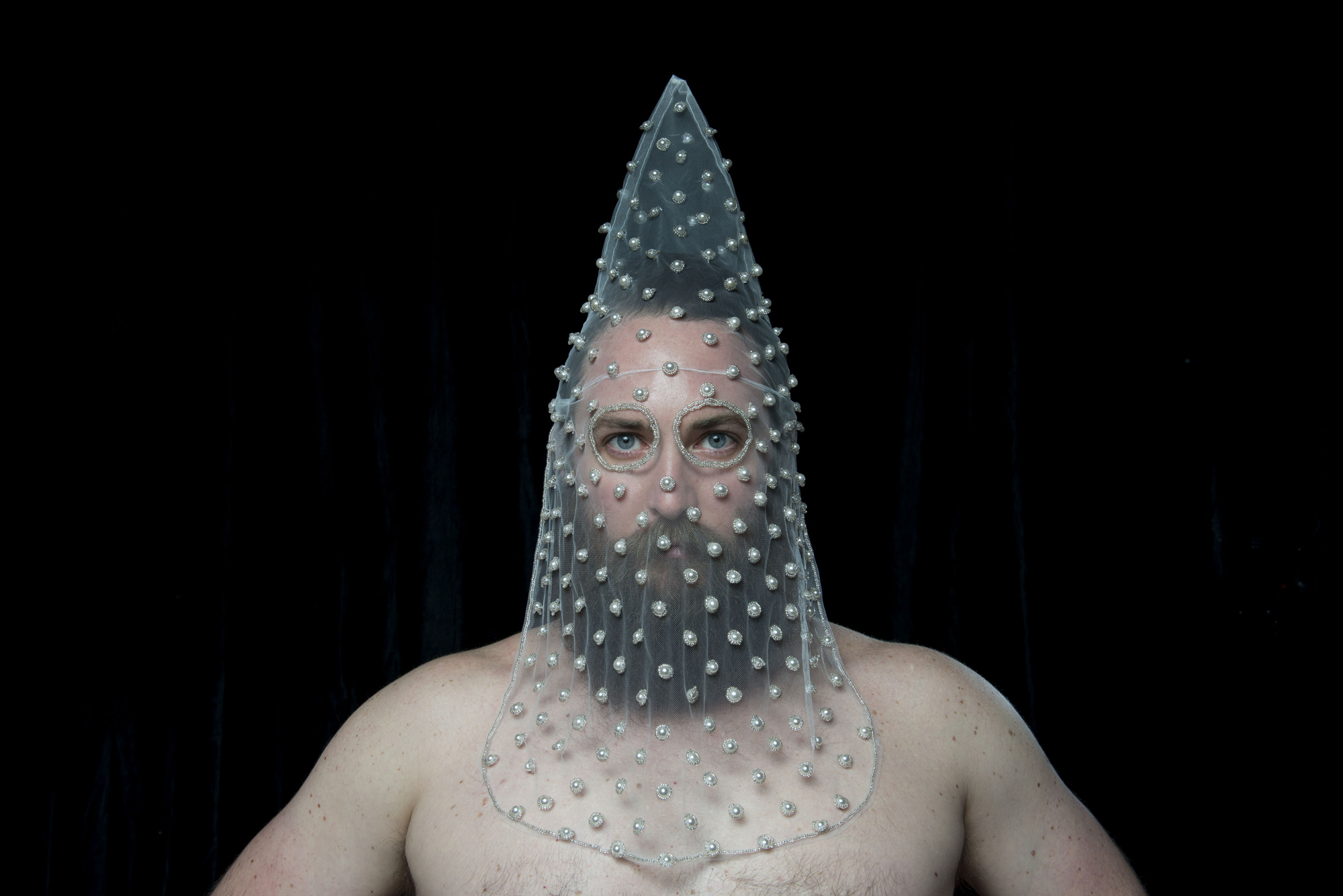
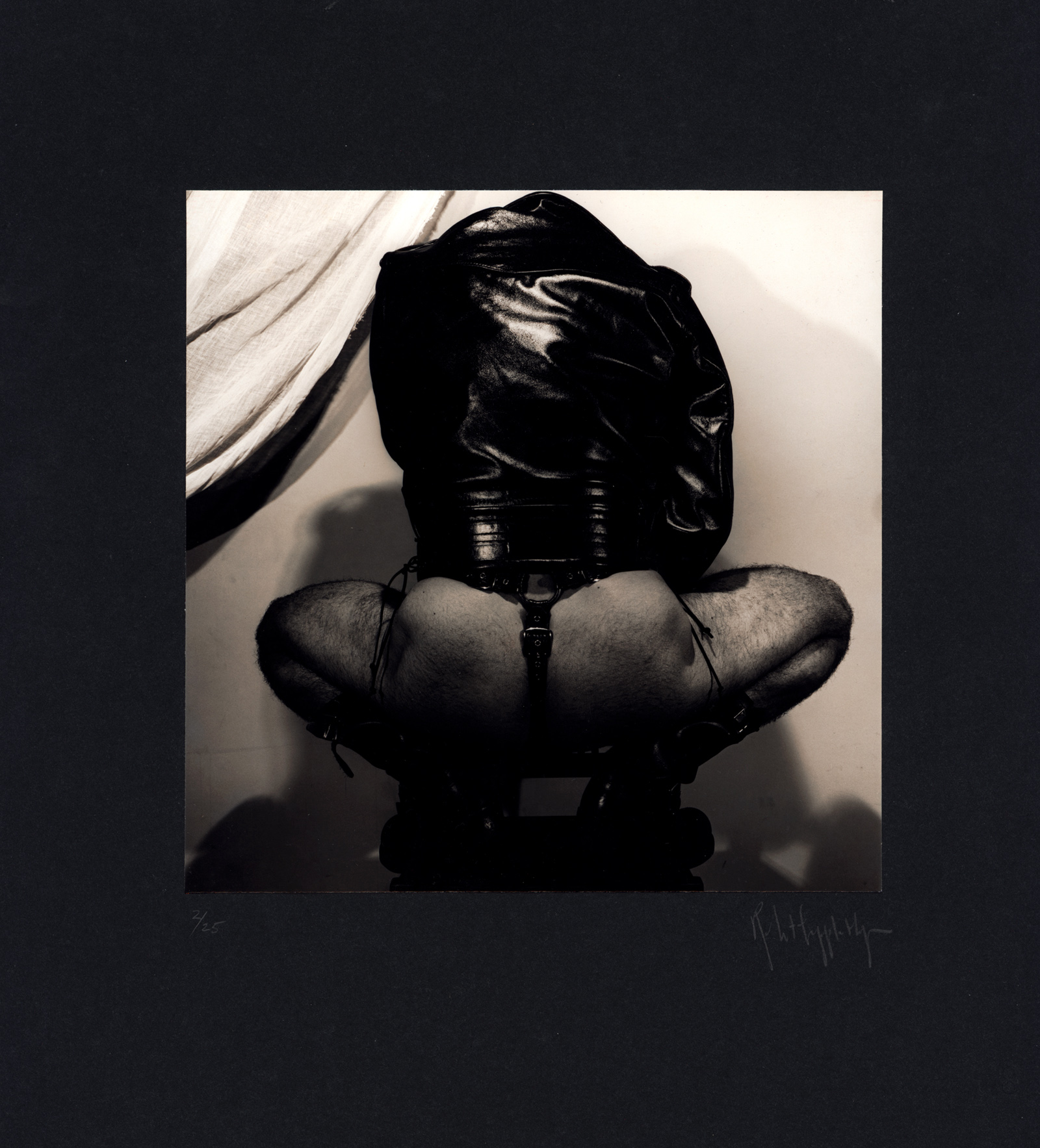
What strikes me with most of the photographs in this posting is that they are about a constructed “performance” of masculinity, performances that challenge cultural signifiers of mainstream and marginalised aspects of Western patriarchal culture. In most the masculine subject position is challenged through complex projections of masculinity, doubled through the construction of images. In fact, spectatorship is no longer male and controlling but polymorphous and not organised along normative gender lines.
Thus, these artists respond to four defined action problems in terms of representation of body usage: “… control (involving the predicability of performance); desire (whether the body is lacking or producing desire); the body’s relation to others (whether the body is monadic and closed in on itself or dyadic and constituted through either communicative or dominating relations with others); and the self-relatedness of the body (whether the body associates and ‘feels at home’ in itself, or dissociates itself from its corporeality).”1 Further, four ideal types of body usage can be defined in terms of these action problems: the disciplined body where the medium is regimentation, the model of which is the rationalisation of the monastic order; the mirroring body where the medium is consumption, the model of which is the department store; the dominating body where the medium is force, the model of which is war; and the communicative body where the medium is recognition, the model of which could be shared narratives, communal rituals (such as sex) and caring relationships.2
As Chris Schilling observes, “The boundaries of the body have shifted away from the natural and on to the social, and the body now has ‘a thoroughly permeable “outer layer” through which the reflexive project of the self and externally formed abstract systems enter.” In other words, masculinity and male figure can be anything to any body and any time in any context. The male body can be prefigured by social conditions. But the paradox is, the more we know masculinity and the male body, the more knowledge we have, the more we can alter and shape these terms, the less certain we are as to what masculinity and the male body is, and how or if it should be controlled. Taking this a step further, Schilling notes that the photographic image of the body itself has become an abstract system/symbolic token which is traded without question, much as money is, without the author or participants being present.3 You only have to look into some of the gay chats rooms to know this to be true!
The most difficult question I had to ask myself in relation to this exhibition was, what is it to be male? Such a question is almost impossible to answer…
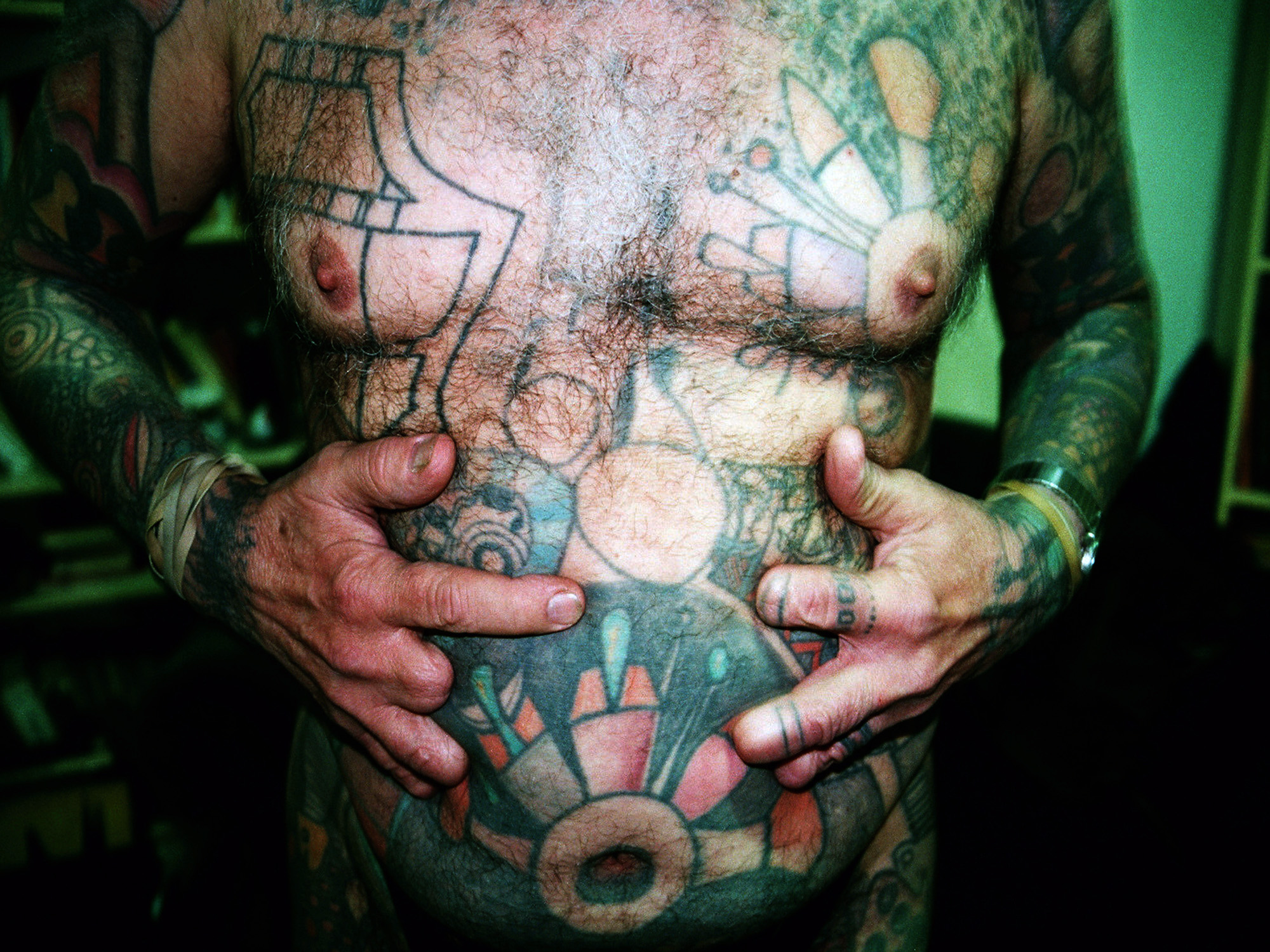
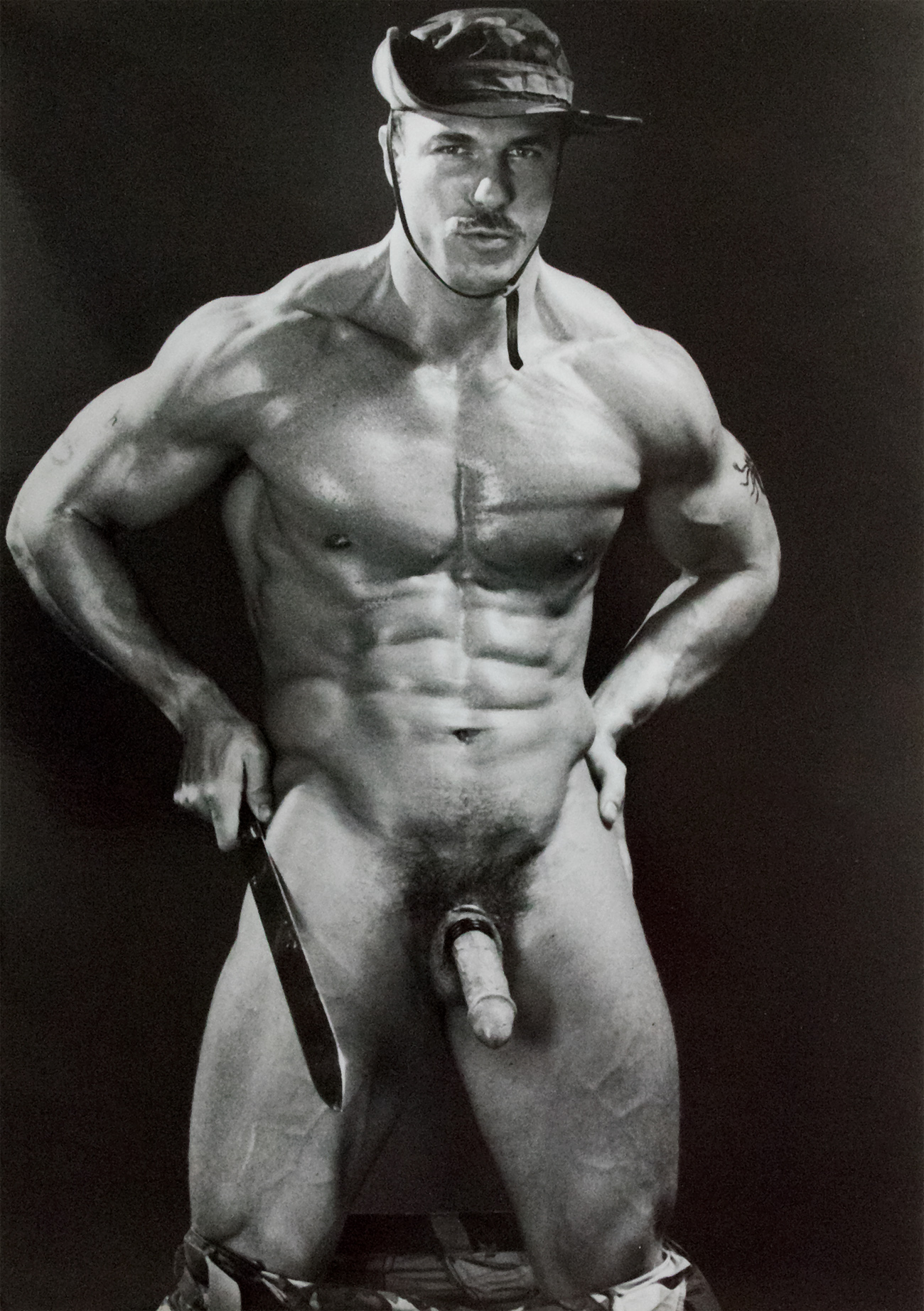
Is being male about sex, a penis, homosociality, homosexuality, heterosexuality, friendship, braveness, dominance, perversity, fantasy, love, attraction, desire, pleasure, Ockerism, respect, loyality, spirituality, joy, happiness etc. etc. It is all of these and more besides. And this is where I find some most of these images to be just surface representations of deeper feelings: I just like dressing in drag; I like pulling a gun on someone; I like holding a knife next to my penis to make my phallus and my armoured body look “butch”. It’s as though the “other”, our difference from ourselves (and others), has been normalised and found wanting. I want to strip them away from this performative, normalising aspect. Most of these photographs are male figures dressed up to the nines, projecting an image, a surface, to the outside world (even though the performative tells us a great deal about the peculiarities of the human imagination). I want them to be more essential, not just a large penis dressed up for show. Only in the image Untitled (Auschwitz victim) (Nd, below), where the performance for the camera and the clothing the man is wearing is controlled by others – does some sense of an inner strength of a male come through. In times of unknown horror and dire circumstances, this man stares you straight in the eye with a calm presence and inner composure.
For me personally, being male is about a spiritual connection – to myself, to the earth and to the cosmos. I hope it is about respect for myself and others. Of course I use the systems above as a projection of myself into the world, as to who I am and who I want people to see through my image. But there is so much more to being male than these defined, representational personas. This is not some appeal to, as David Smail puts it, “a simple relativity of ‘truths'” (anything to anybody at anytime in any context), nor a essentialist reductionism to a “single truth” about our sense of being, but an appeal for a ‘non-finality’ of truth, neither fixed nor certain, that changes according to our values and what we understand of ourselves, what it is to be male. This understanding requires intense, ongoing inner work, something many males have no desire to undertake…
Dr Marcus Bunyan
Word count: 1,230
Footnotes
1/ Chris Schilling, The Body and Social Theory, Sage Publications, London, 1993, p.95.
2/ Ibid., p. 95.
3/ Ibid., p. 183.
Many thankx to Director Richard Perram, Assistant Curator Julian Woods and the Bathurst Regional Art Gallery for allowing me to publish the photographs in the posting. Please click on the photographs for a larger version of the image.
“The category of “masculinity” should be seen as always ambivalent, always complicated, always dependent on the exigencies (necessary conditions and requirements) of personal and institutional power … [masculinity is] an interplay of emotional and intellectual factors – an interplay that directly implicates women as well as men, and is mediated by other social factors, including race, sexuality, nationality, and class … Far from being just about men, the idea of masculinity engages, inflects, and shapes everyone.”
Berger, Maurice; Wallis, Brian and Watson, Simon. Constructing Masculinity. Introduction. New York: Routledge, 1995, pp. 3-7.
“We choose and reject by action … Nietzsche calls the body ‘Herrschaftsgebilde’ (creation of the dominating will). We may say the same about body-image. Since optic experience plays such an enormous part in our relation to the world, it will also play a dominating role in the creation of the body-image. But optic experience is also experience by action. By actions and determinations we give the final shape to our bodily self. It is a process of continual active development.” (My underline)
Schilder, Paul. The Image and Appearance of The Human Body. New York: International Universities Press, 1950, pp. 104-105.
“Body images should not exist in isolation. We desire the relation of our body-images to the body-images of all other persons, and we want it especially concerning all sexual activities and their expression in the body-image. Masturbation is specifically social. It is an act by which we attempt to draw the body-images of others, especially in their genital region, nearer to us.”
Schilder, Paul. The Image and Appearance of The Human Body. New York: International Universities Press, 1950, p. 237.
“As the French critic Maurice Blanchot wrote, “The image has nothing to do with signification, meaning, as implied by the existence of the world, the effort of truth, the law and the brightness of the day. Not only is the image of an object not the meaning of that object and of no help in comprehending it, but it tends to withdraw it from its meaning by maintaining it in the immobility of a resemblance that it has nothing to resemble” … It is this severance of meaning and its object, this resemblance of nothing, that the crisis of looking intersects with the crisis of the body. In contemporary culture we promote the body as infinitely extendable and manageable. Indeed, we mediate this concept through the permeation of the photographic image in popular culture – through advertising and dominant discourse that place the young, beautiful, erotic body as the desirable object of social attention. This is a body apparently conditioned by personal control (moral concern). But the splitting apart of image and meaning pointed to by Blanchot suggests that such control is illusory. There is no single truth; there are only competing narratives and interpretations of a world that cannot be wholly, accurately described.” (My underline)
Blanchot, Maurice. The Gaze of Orpheus. New York: Barrytown, 1981, p. 85, quoted in Townsend, Chris. Vile Bodies: Photography and the Crisis of Looking. Munich: Prestel, 1998, p. 10.
“Where objective knowing is passive, subjective knowing is active – rather than giving allegiance to a set of methodological rules which are designed to deliver up truth through some kind of automatic process [in this case the construction of the male figure through the image], the subjective knower takes a personal risk in entering into the meaning of the phenomena to be known … Those who have some time for the validity of subjective experience but intellectual qualms about any kind of ‘truth’ which is not ‘objective’, are apt to solve their problem by appealing to some kind of relativity. For example, it might be felt that we all have our own versions of the truth about which we must tolerantly agree to differ. While in some ways this kind of approach represents an advance on the brute domination of ‘objective truth’, it in fact undercuts and betrays the reality of the world given to our subjectivity. Subjective truth has to be actively struggled for: we need the courage to differ until we can agree. Though the truth is not just a matter of personal perspective, neither is it fixed and certain, objectively ‘out there’ and independent of human knowing. ‘The truth’ changes according to, among other things, developments and alterations in our values and understandings … the ‘non-finality’ of truth is not to be confused with a simple relativity of ‘truths’.” (My underline).
Smail, David. Illusion and Reality: The Meaning of Anxiety. London: J.M. Dent & Sons, 1984, pp. 152-153.
The Unflinching Gaze: photo media & the male figure
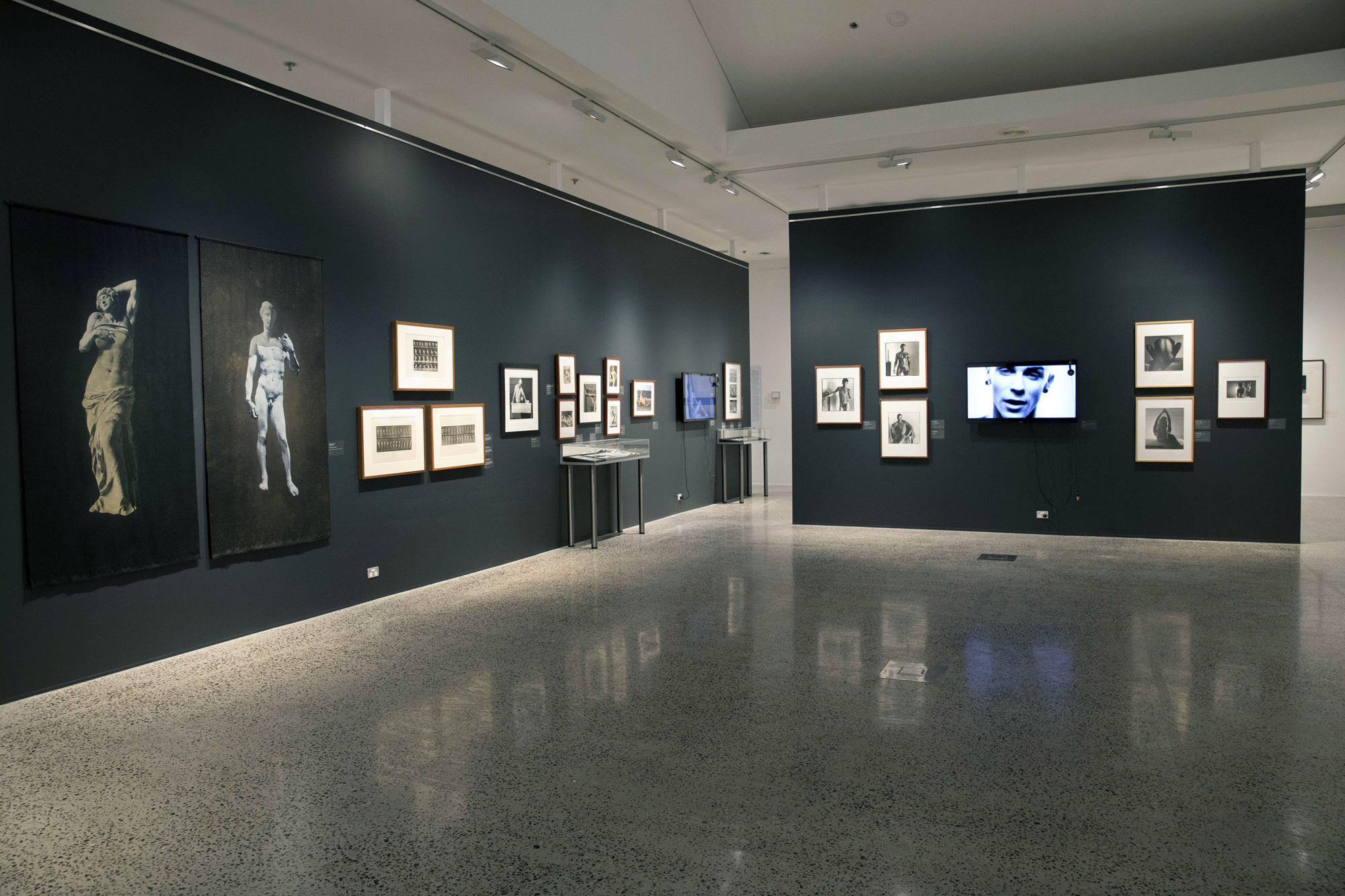
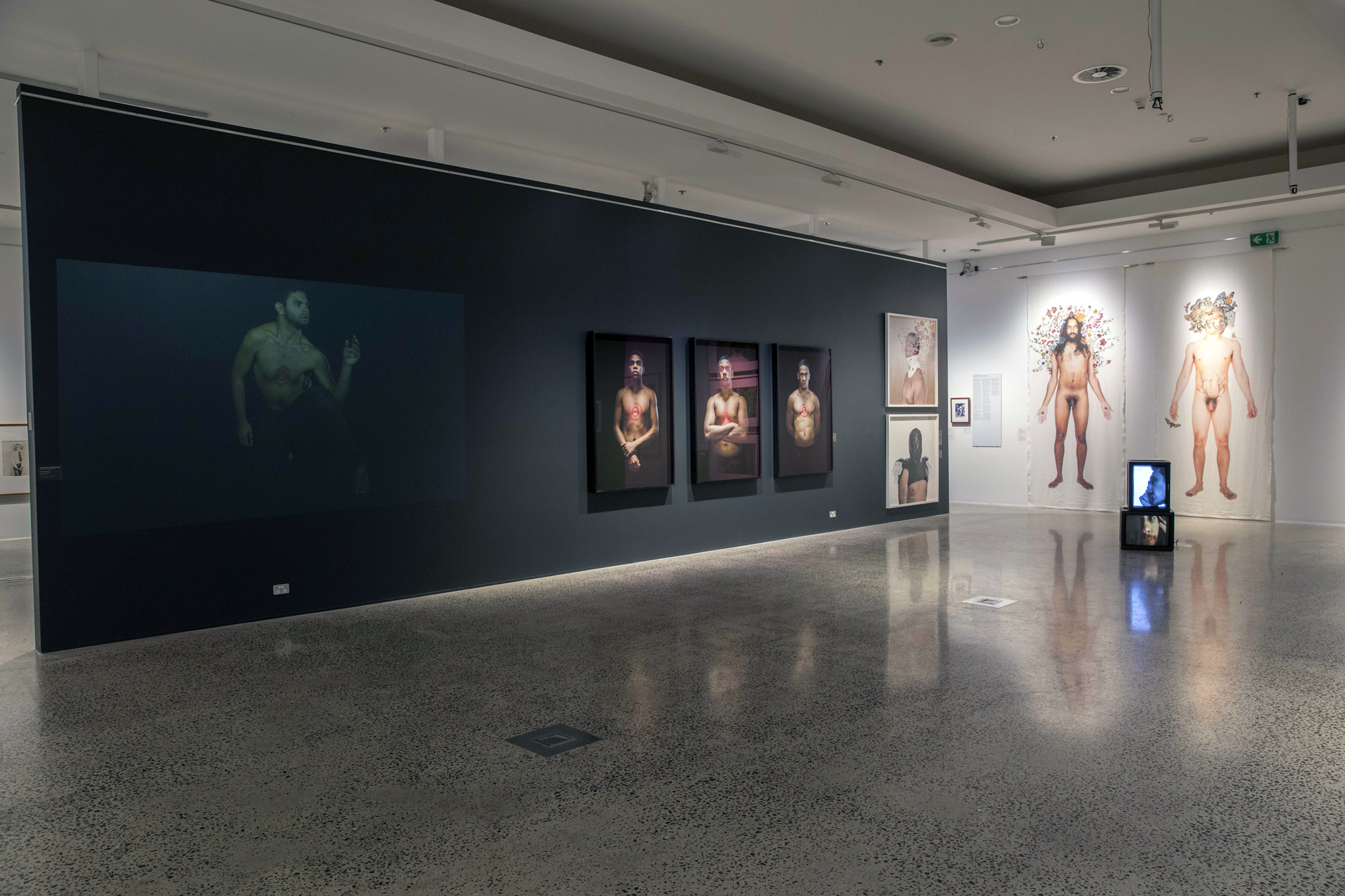
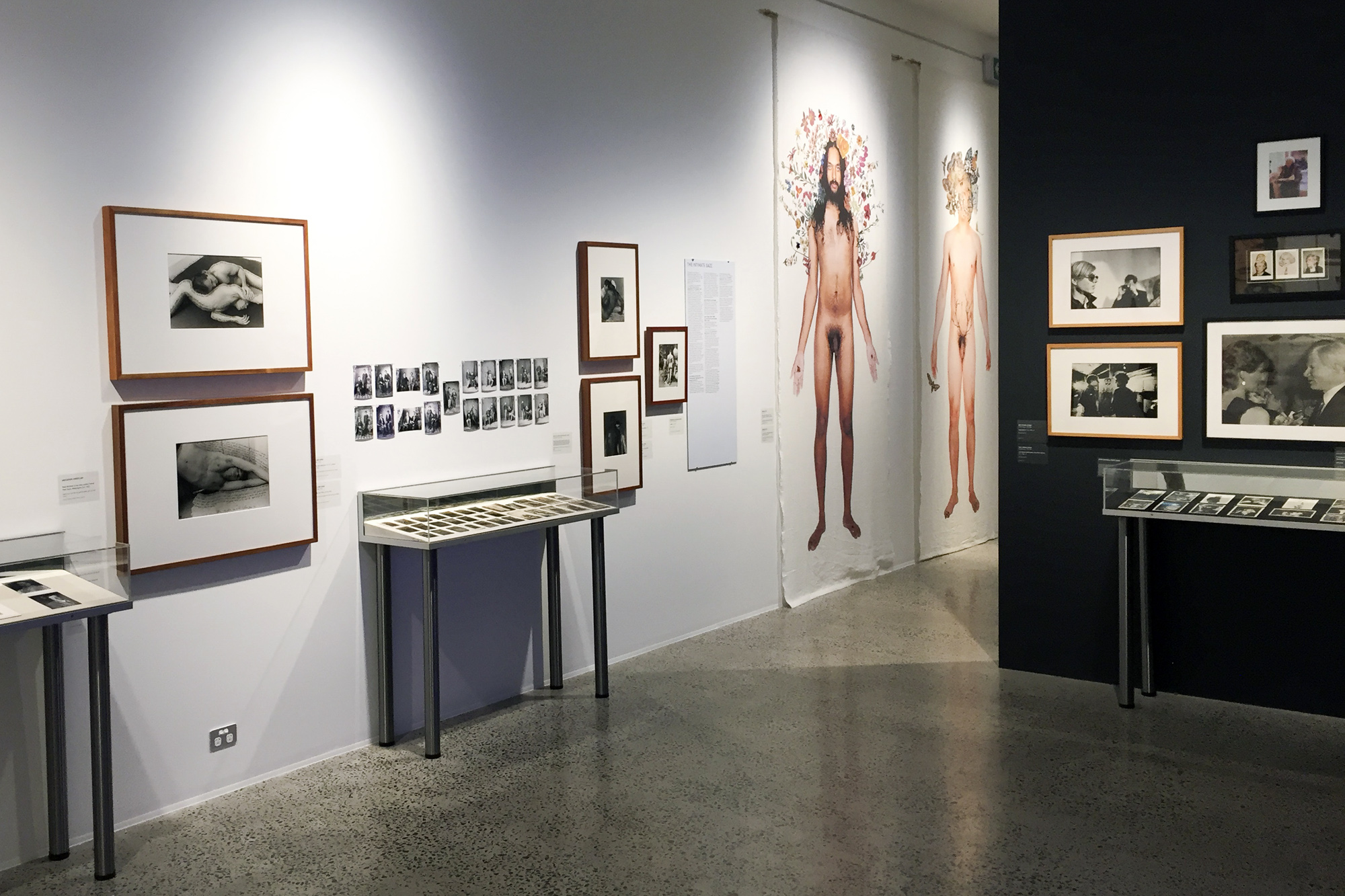
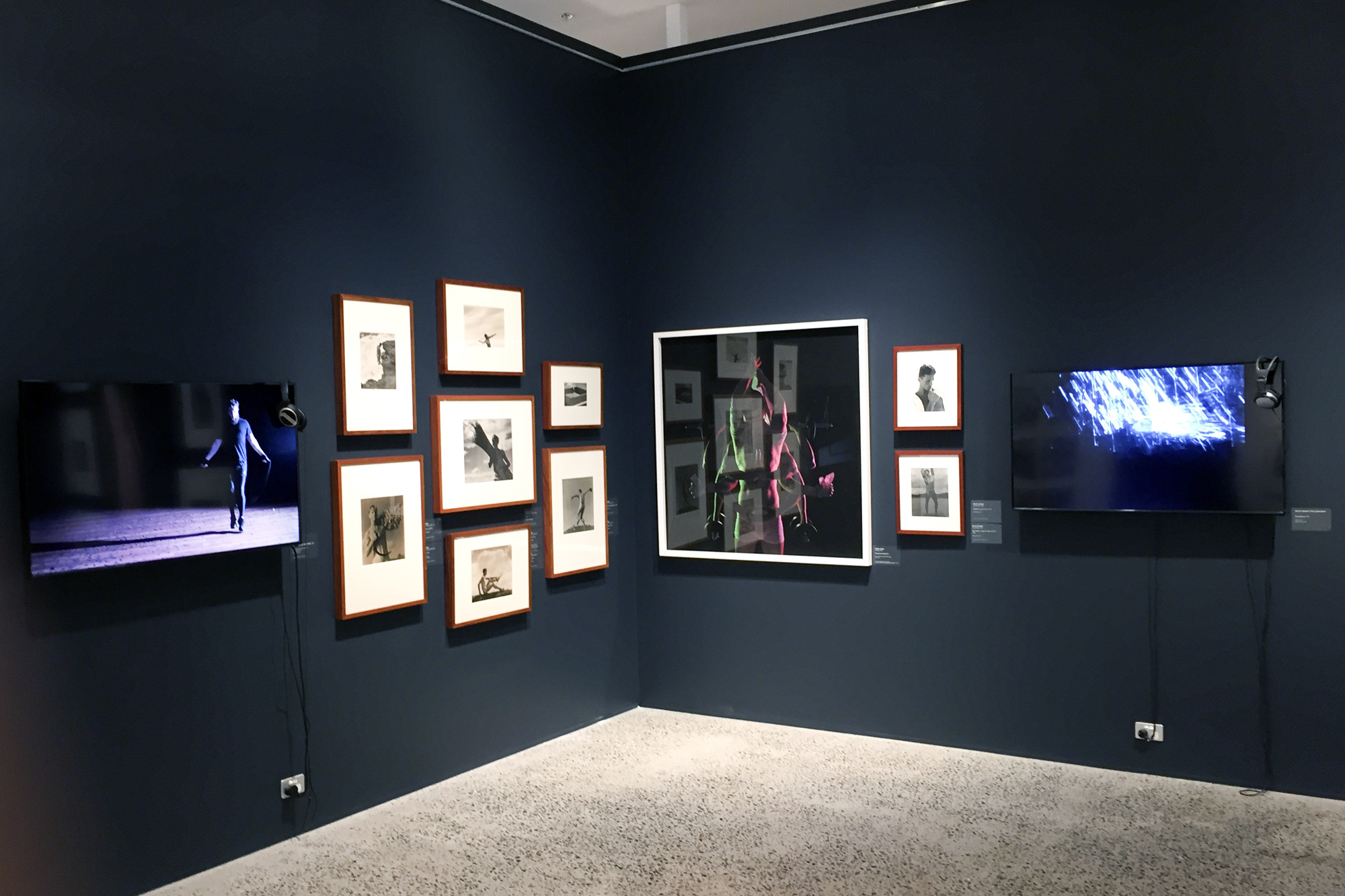
The Unflinching Gaze: photo media & the male figure surveys how the male figure has been depicted by Australian and international artists in photo media over the last 140 years. It includes historic and contemporary fine art photography and film, fashion photography, pop videos and homoerotic art. Images range from the beautiful to the banal to the confounding.
The Unflinching Gaze: photo media & the male figure is a Bathurst Regional Art Gallery exhibition in partnership with Leslie-Lohman Museum of Gay and Lesbian Art, New York. Curated by Richard Perram OAM. This exhibition is supported by the Dobell Exhibition Grant, funded by the Sir William Dobell Art Foundation and managed by Museums & Galleries of NSW.
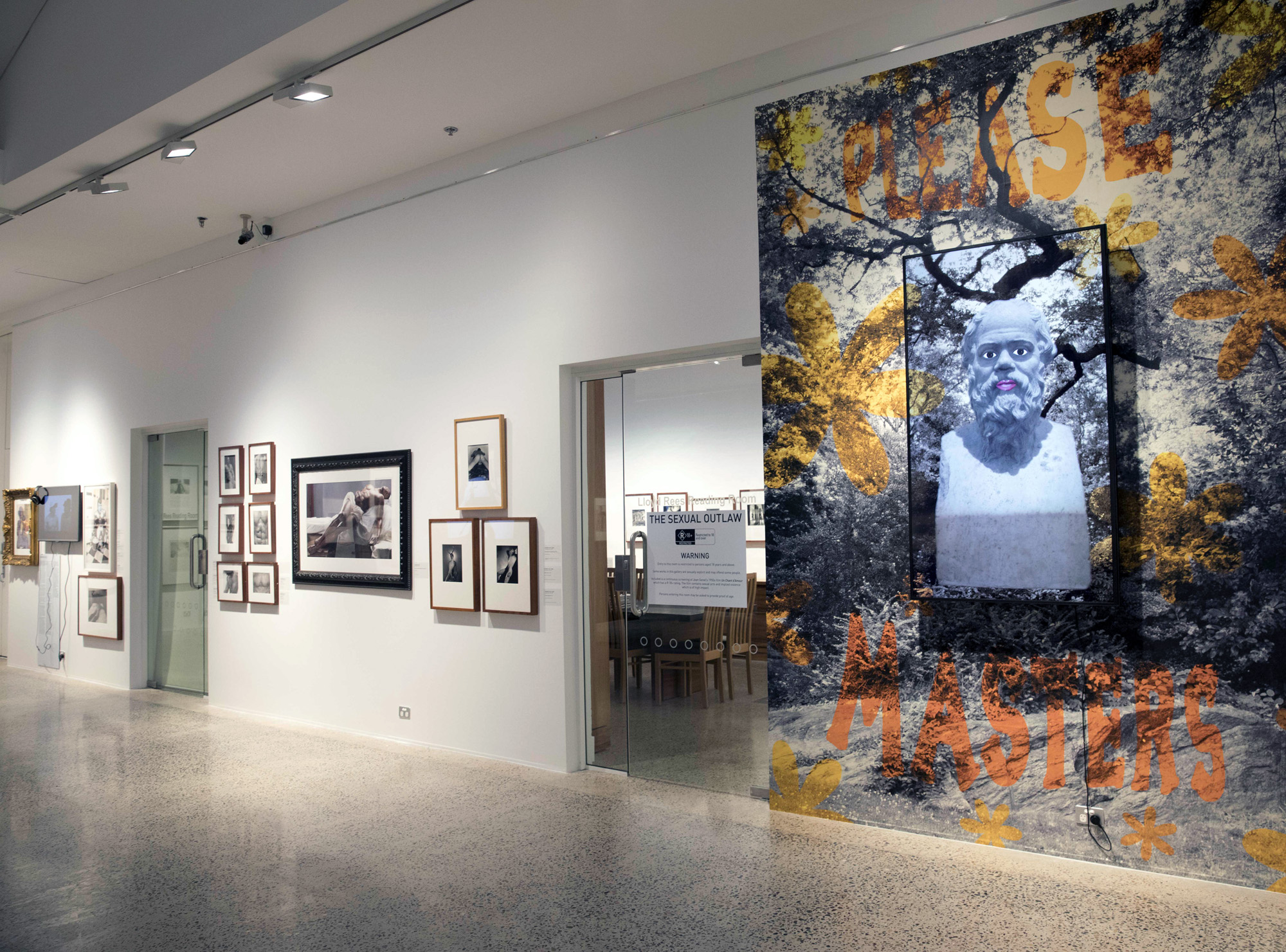
Installation views of the exhibition The Unflinching Gaze: photo media and the male figure at the Bathurst Regional Art Gallery, New South Wales Photos: Sharon Hickey Photography
In line with current thinking the exhibition posits masculinity, and gender itself, as a kind of performance – a social construct that is acquired rather than biologically determined.
This idea has its limits, with most people happy to accept anatomy as destiny. Nevertheless, there is much we view as ‘natural’ that might be more accurately described as ‘cultural’. In an exceptional catalogue essay, Peter McNeil refers to Jonathan Ned Katz’s book, The Invention of Heterosexuality, which notes that the term “heterosexual” was first published in the United States in 1892. This is a remarkably late entry for a concept often viewed as a cornerstone of social orthodoxy.
A condition doesn’t require a word to make it a reality but it sure helps. Wittgenstein’s famous dictum: “The limits of my language are the limits of my world,” reminds us of the power of naming and categorisation.
To establish anything as an unquestionable norm is to stigmatise other views as abnormal. From the perception of abnormality comes the fear and hatred that surfaced during a same-sex marriage postal survey that revealed more about political cowardice than it did about Australian social attitudes. Although Perram has no qualms about celebrating gay sexuality his chief concern is to encourage a broader, more inclusive understanding of masculinity. …
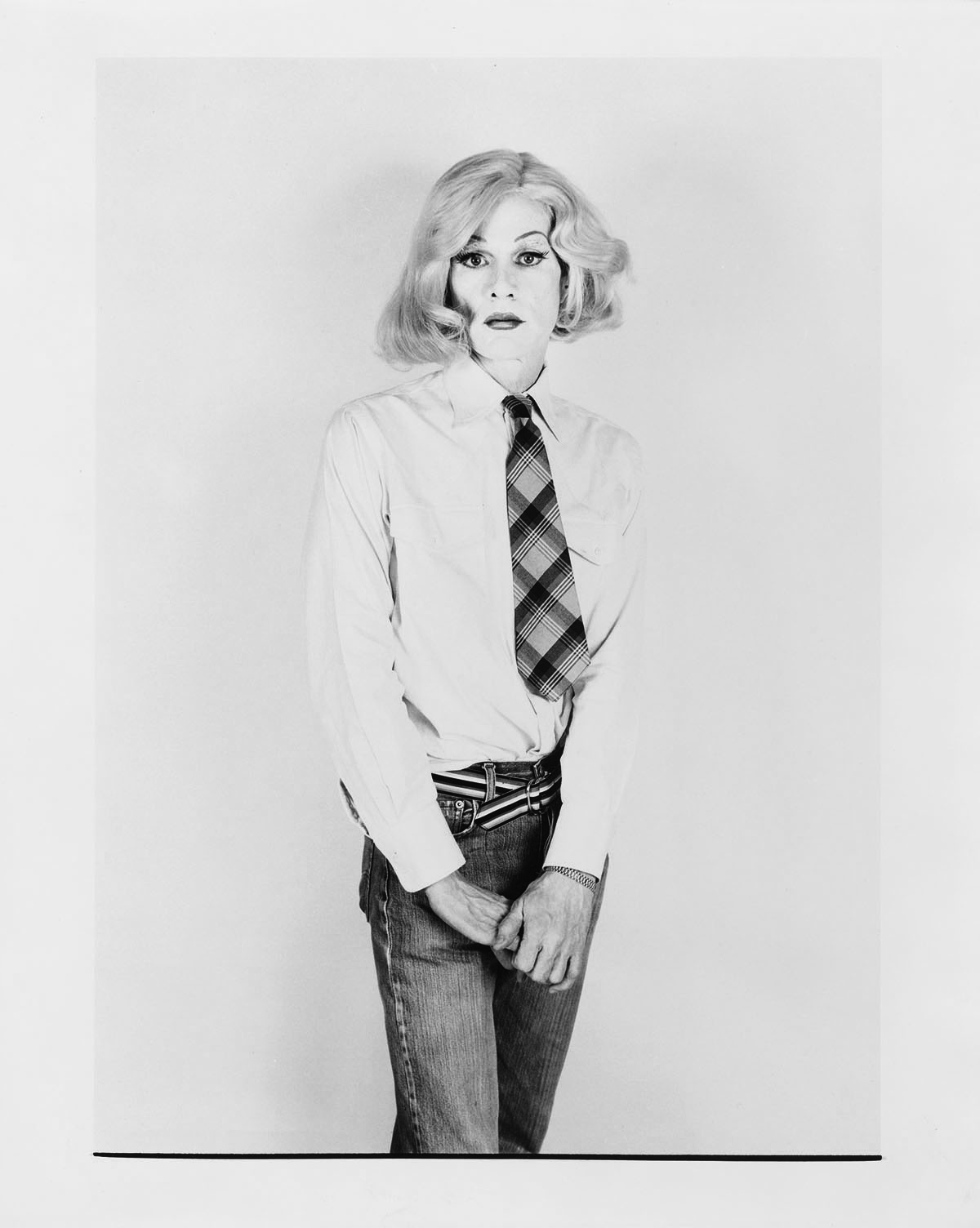
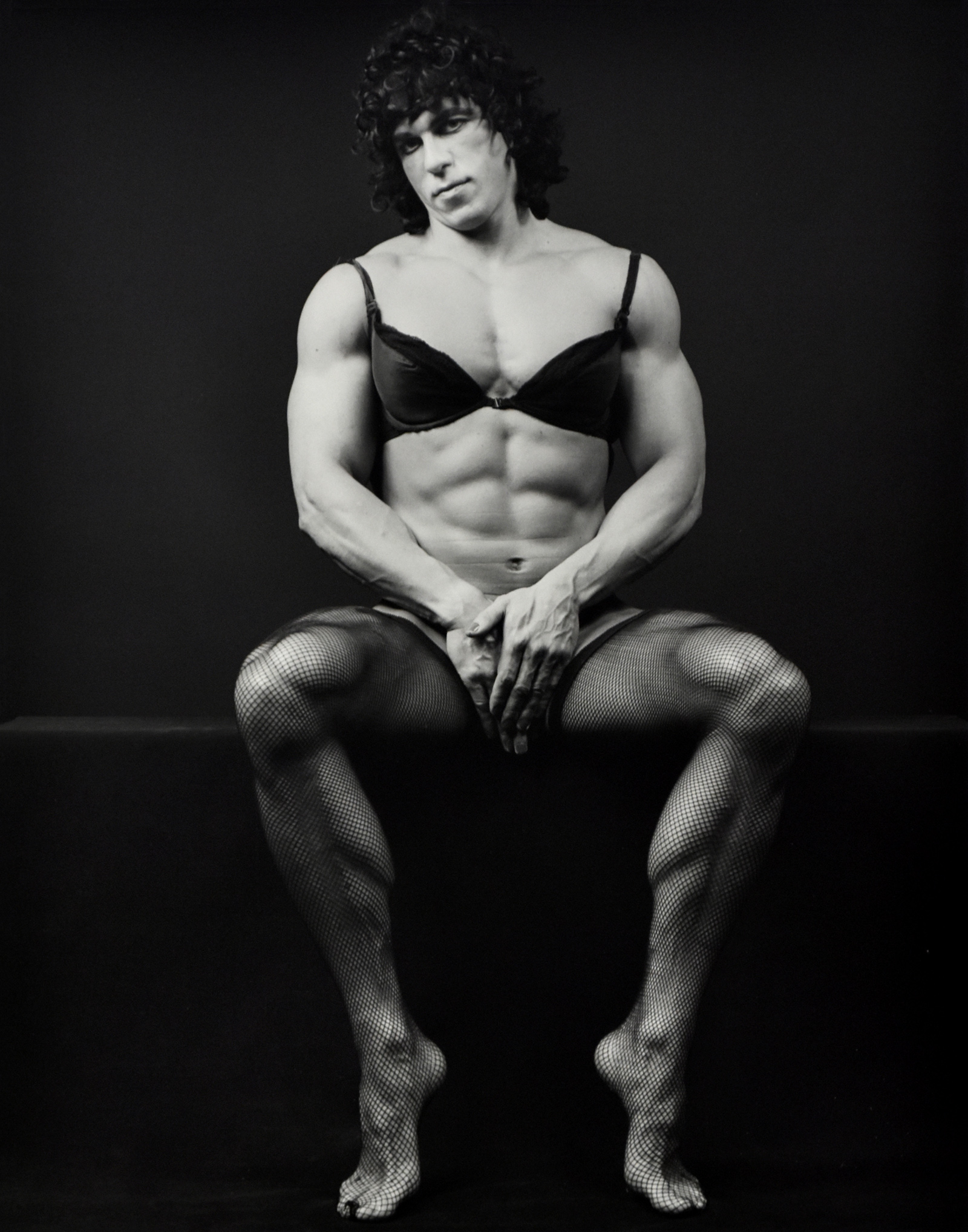
One of the most striking moments in Perram’s show is a juxtaposition of Mapplethorpe’s 1983 portrait of gay porn star, Roger Koch, aka Frank Vickers, wearing a wig, bra and fishnets, his hands clasped demurely over his groin. The feminine coyness is at odds with Vickers’s musclebound torso and biceps which are fully on display in his self-portrait of the same year, along with his semi-erect penis.
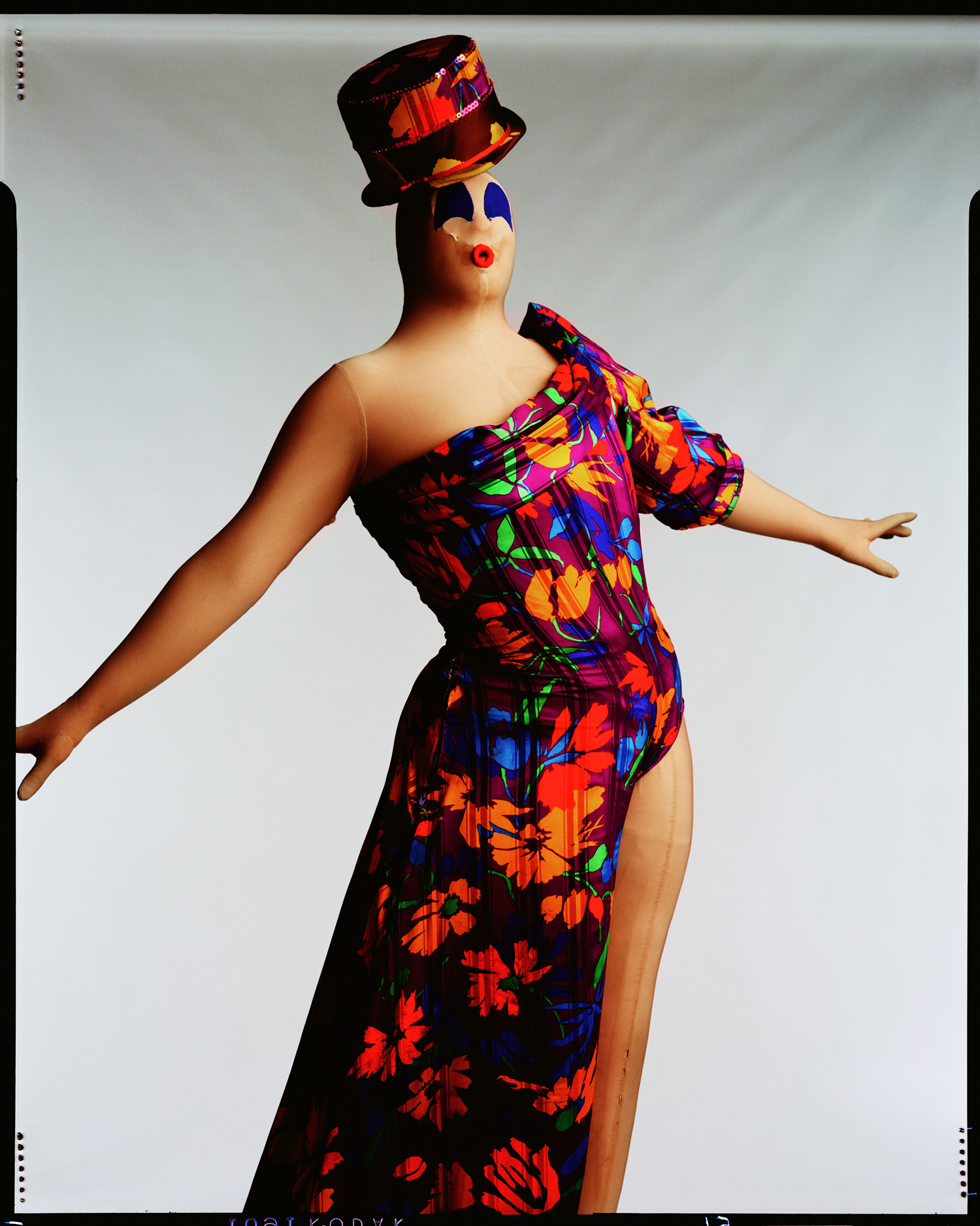
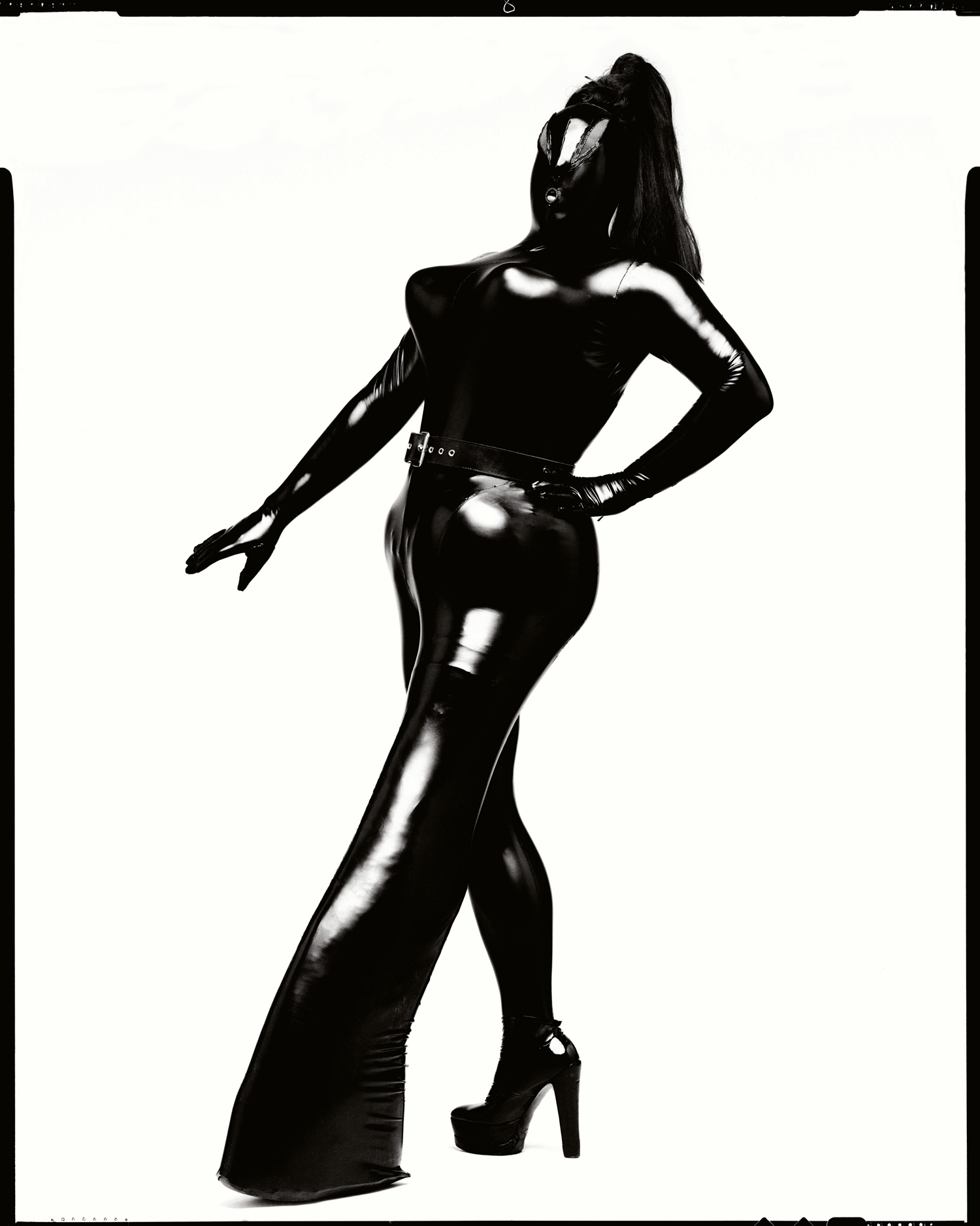
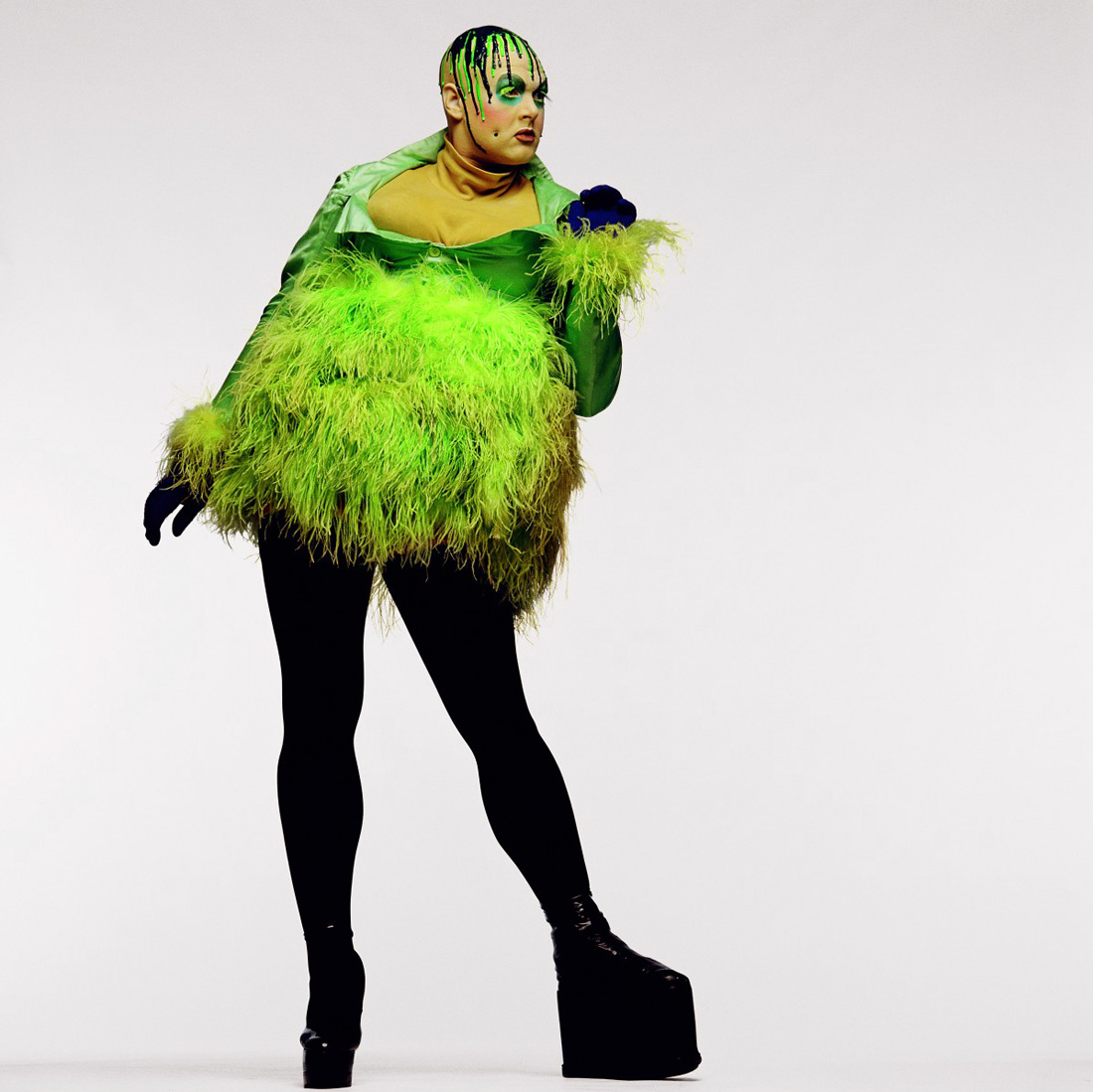
The photos may be two versions of camp but the comparison shows how an individual’s sexual identity can be reconfigured with the appropriate props and body language. In the case of performance artist, Leigh Bowery, captured in a series of photos by Fergus Greer, the play of fantasy transcended the simple binary opposition of male and female, to create monstrous hybrids that question the limits of what it is to be human.”
Tony Albert (Australian, b. 1981) Brother (Our Past) 2013 Brother (Our Present) 2013 Brother (Our Future) 2013 Pigment on paper, edition of 3 150 x 100cm each Courtesy UTS Art, Corrigan Collection
Blow Job is a silent film directed by Andy Warhol. It depicts the face of an uncredited DeVeren Bookwalter as he apparently receives fellatio from an unseen partner. While shot at 24 frames per second, Warhol specified that it should be projected at 16 frames per second, slowing it down by a third.
Whether it is a male or a female performing the act is not stated, and the viewer must assume that fellatio is occurring. The salaciousness has also been speculated to be entirely in the title with no fellatio actually being performed. The identity of the person performing the act is disputed. Warhol states in his book Popism: The Warhol Sixties (1980) that five different boys performed the fellatio. In this book, Warhol writes that he originally asked Charles Rydell, the boyfriend of filmmaker Jerome Hill, to star in the film, promising that there would be “five beautiful boys” to perform the act.
However, when Warhol set up the film shoot at The Factory on a Sunday, Rydell failed to show up. Warhol phoned Rydell at Hill’s suite at the Algonquin Hotel and asked where Rydell was. Rydell replied that he thought Warhol was kidding and had no intention of appearing in such a film. When he declined Andy used “a good-looking kid that happened to be hanging around the Factory that day”, who was later identified as Bookwalter. According to Peter Gidal, the film distances the viewer from the experience it purportedly depicts, “Sometimes the young actor looks bored, sometimes as if he is thinking, sometimes as if he is aware of the camera, sometimes as if he is not.” Douglas Crimp states that after a few minutes, “it becomes clear that we will see nothing more than the repetition, with slight variations, of what we’ve already seen”. This frees the mind to look in a different way. Likewise, the sexual act has the effect of distracting the actor from the presence of the camera, creating a unique kind of unselfconsciousness.
Critic Roy Grundmann argues that “Blow Job‘s self-reflexive devices create a new kind of spectatorial address that dislodges audiences from their contemplative positions in a number of ways. Blow Job‘s reflexivity makes spectators intensely aware that seeing a film makes projecting onto and investing into an image a part of oneself which is also a socialized acculturated act”. Grundmann further claims that “viewers oscillate between an awareness of their contingency on the larger scheme and the promise of ocular centric mastery of the image”.
Text from the YouTube website
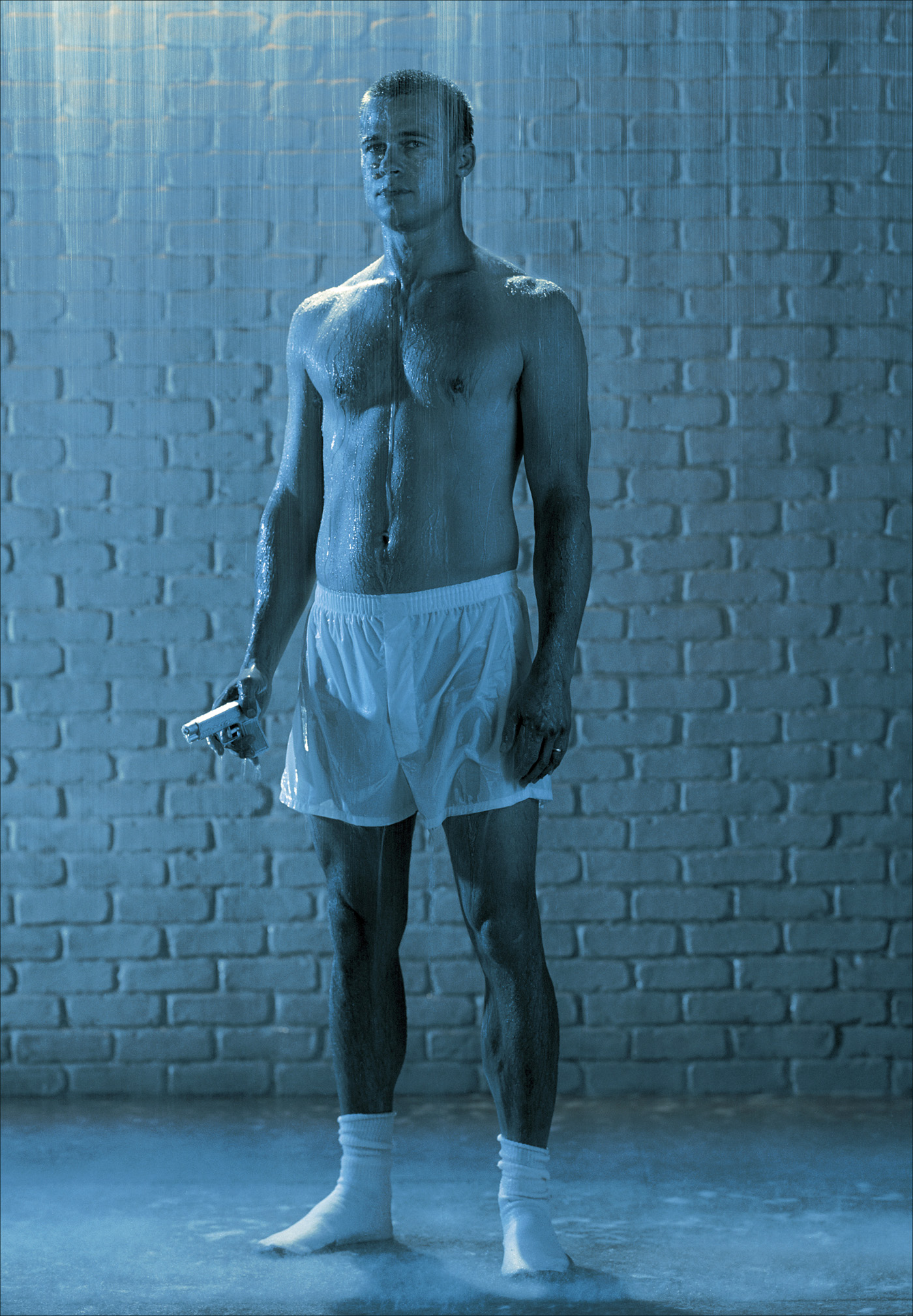
Robert Wilson (American, b. 1941) Brad Pitt 2004 Video portrait, looped Dimensions variable Courtesy the artist and the Byrd Hoffman Water Mill Foundation, New York
Robert Wilson (American, b. 1941) Brad Pitt video portrait 2004
Nikki Johnson (American, b. 1972) David Amputation Fetishist 2007 Digital print (from a set of images) Courtesy the artist
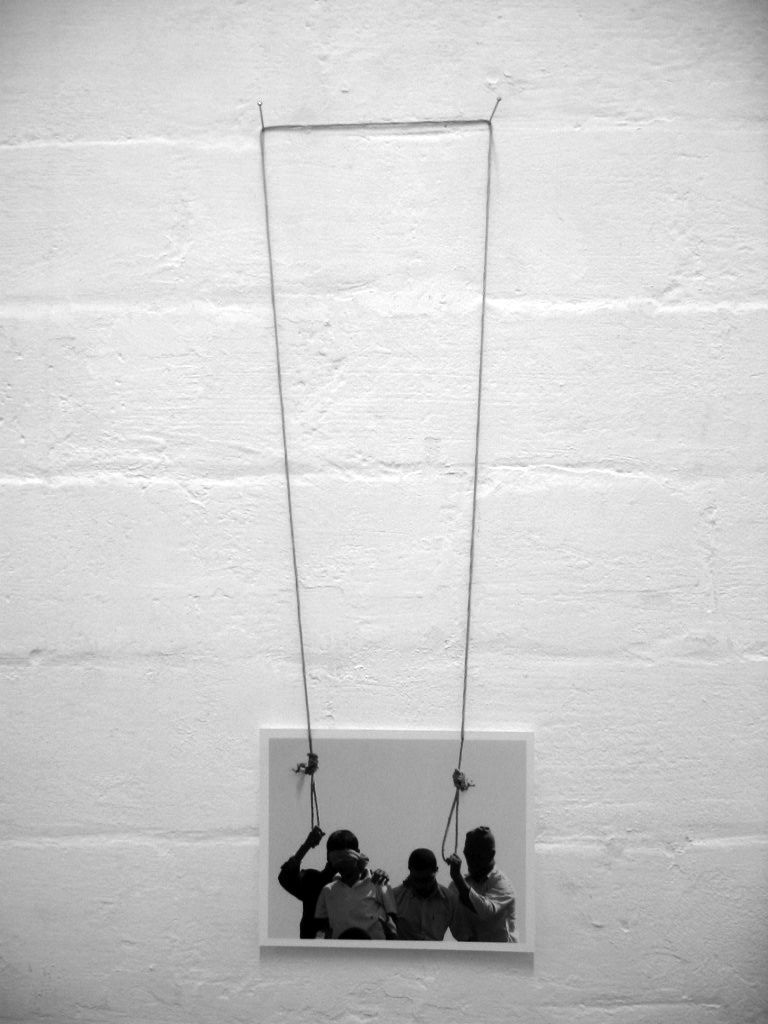
Luke Parker (Australian, b. 1975) Double hanging 2005 Photograph, cotton thread, pins 15 x 40cm Courtesy the artist and 55 Sydenham Rd
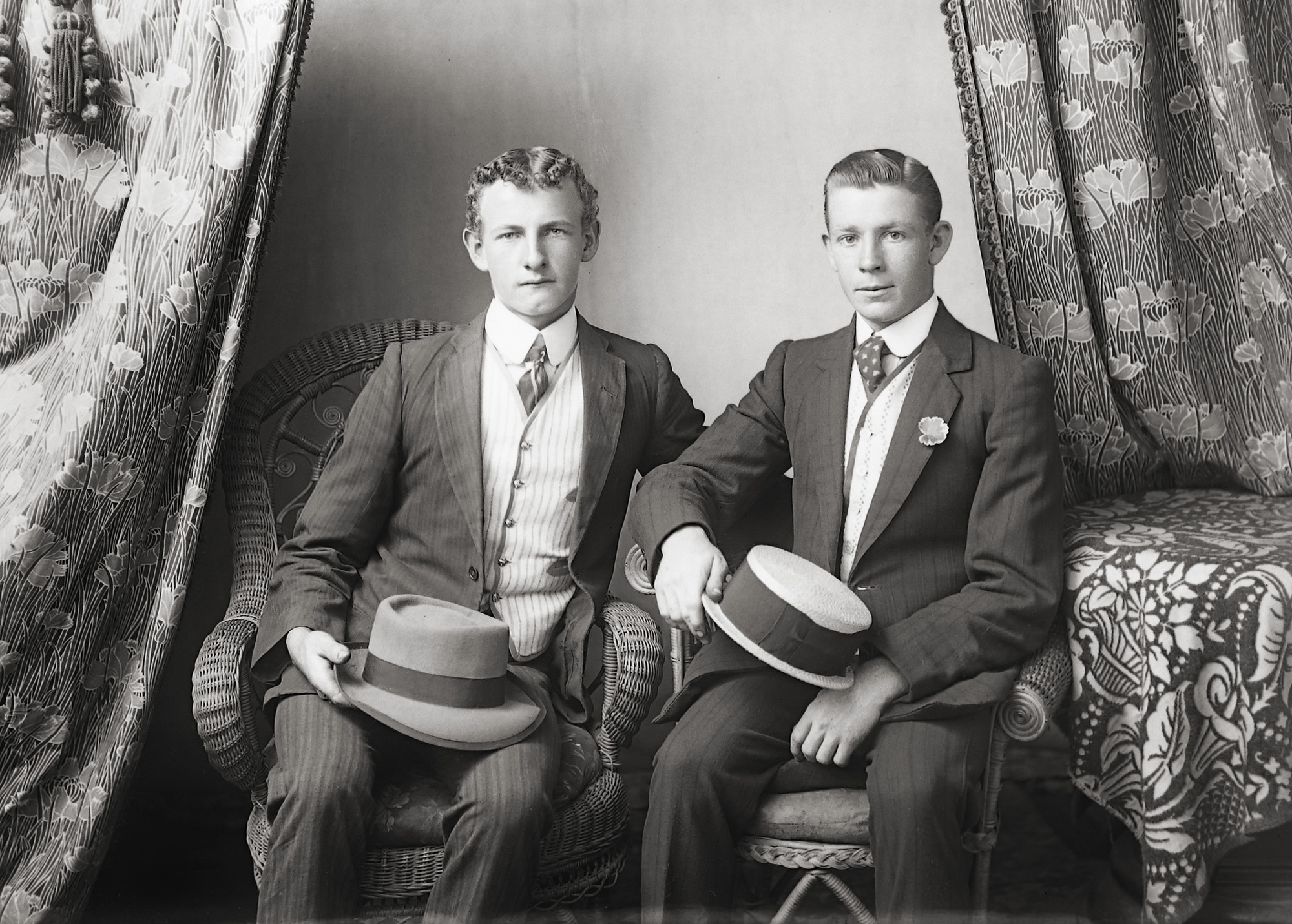
Gregory Collection Mr Cullen & Mr Gornall Date unknown Digital copy from scanned negative Courtesy the Bathurst Historical Society
Two hundred photos and videos by sixty two leading artists (twenty four Australian and thirty eight international) will be exhibited at Bathurst Regional Art Gallery (BRAG) from Saturday 14 October until Sunday 3 December 2017.
Curated by BRAG Director Richard Perram OAM, an openly gay man, The Unflinching Gaze: photo media and the male figure surveys how the male figure has been depicted by Australian and international artists in photo media over the last 140 years. It includes historic and contemporary fine art photography and film, fashion photography, pop videos and homoerotic art. Images range from the beautiful to the banal to the confounding.
Key artists in the exhibition include iconic American artists Robert Mapplethorpe, Andy Warhol, and avant-garde theatre director Robert Wilson with a video portrait of Brad Pitt; European artists such as Eadweard Muybridge, and Baron Wilhelm Von Gloeden; and historic and contemporary Australian artists including Beaufoy Merlin and Charles Bayliss, Max Dupain, Deborah Kelly, William Yang, Gary Carsley, Owen Leong and Liam Benson. Works have been sourced from Australian and international collections, including a major loan of 60 works from the Leslie-Lohman Museum of Gay and Lesbian Art, New York.
The exhibition brings an unflinching gaze to how concepts of humanity and the male figure are intertwined and challenged. Themes include the Pink Triangle, which deals with the persecution, torture and genocide of homosexuals in concentration camps during World War II to those in Chechyna today; and the AIDS crisis in the 1980s.
The Unflinching Gaze exhibition is a unique opportunity for audiences in the Bathurst Region to access a world class photo-media exhibition, says Richard Perram OAM. The Unflinching Gaze not only deals with aesthetic concerns but also engages the community in a discussion around social issues. BRAG is working with local Bathurst LGBTI community groups to ensure that one of the most important outcomes of the exhibition will be to inform and educate the general Bathurst community and support and affirm the Bathurst LGBTI community.
The Unflinching Gaze: photo media and the male figure is a Bathurst Regional Art Gallery exhibition in partnership with Leslie Lohman Museum of Gay and Lesbian Art, New York. Curated by Richard Perram OAM. This exhibition is supported by the Dobell Exhibition Grant, funded by the Sir William Dobell Art Foundation and managed by Museums & Galleries of NSW.
Press release from the Bathurst Regional Art Gallery (BRAG)
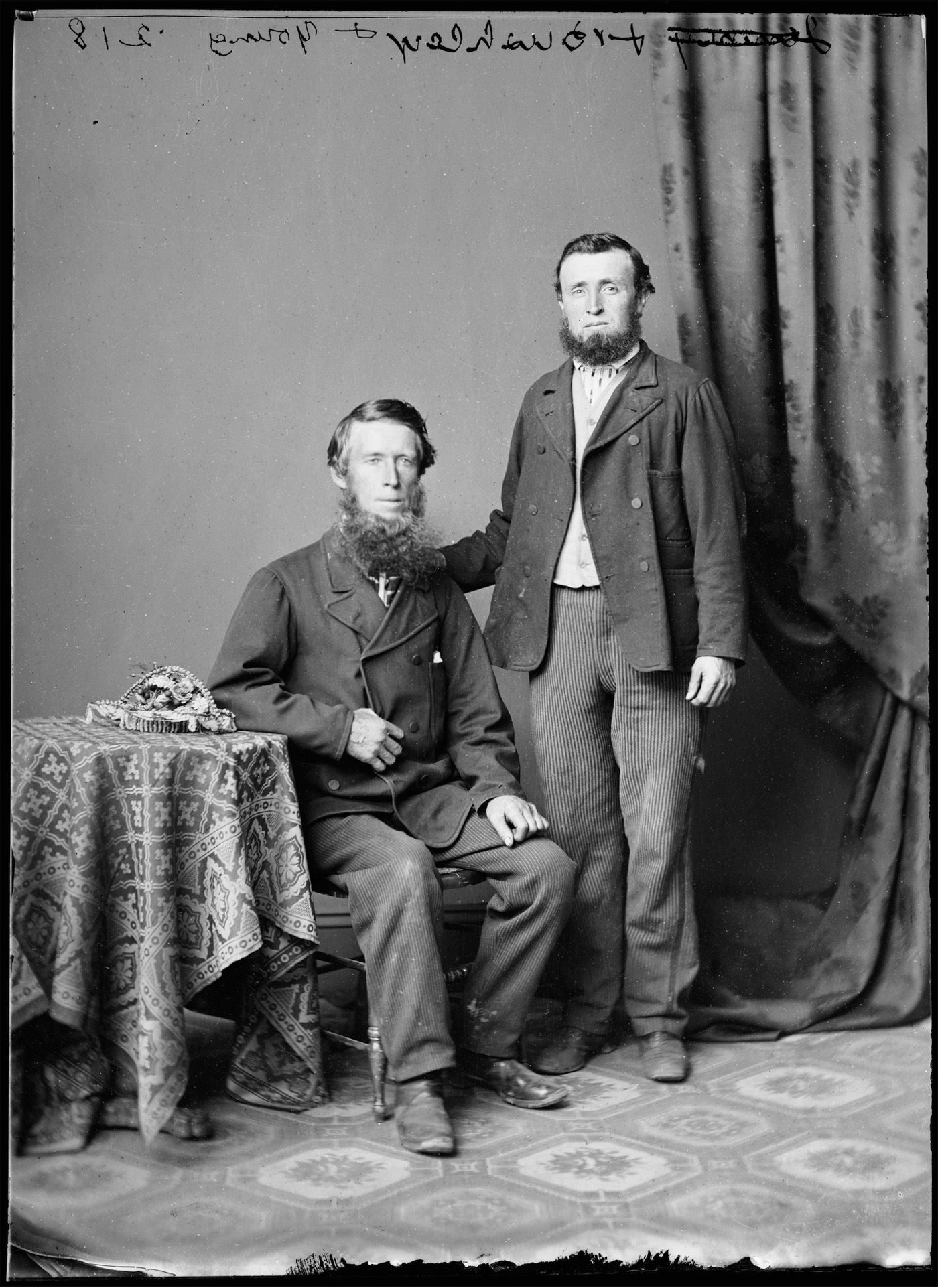
American & Australian Photographic Company (Beaufoy Merlin and Charles Bayliss) Mssrs. Bushley & Young Nd Digital reproductions from glass photo negatives, quarter plate From the Collections of the State Library of NSW
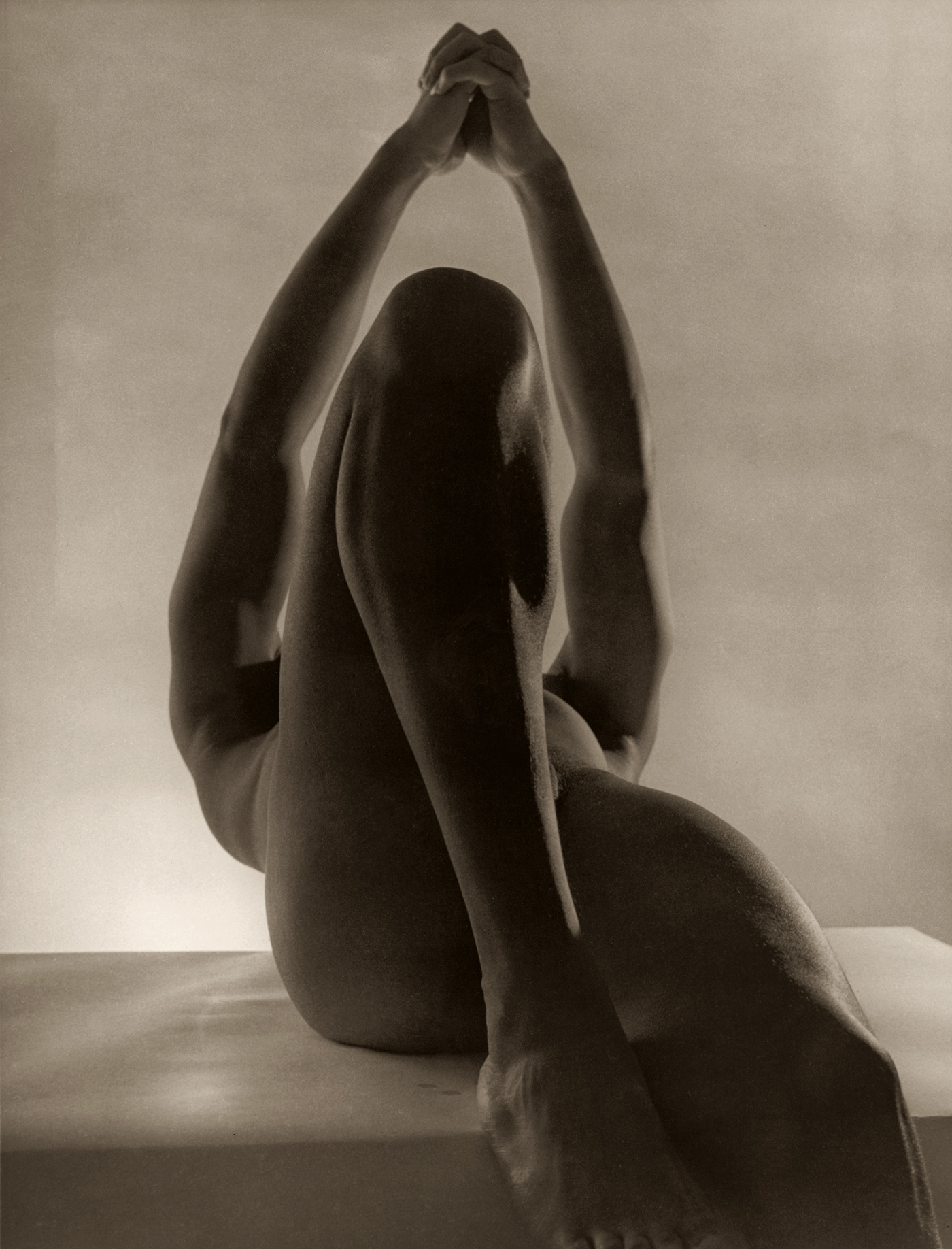
Horst P. Horst (Germany; United States, 1906-1996) Male Nude I NY 1952 Silver gelatin print 25.4 x 20.3cm Leslie-Lohman Museum of Gay & Lesbian Art, gift of Ricky Horst
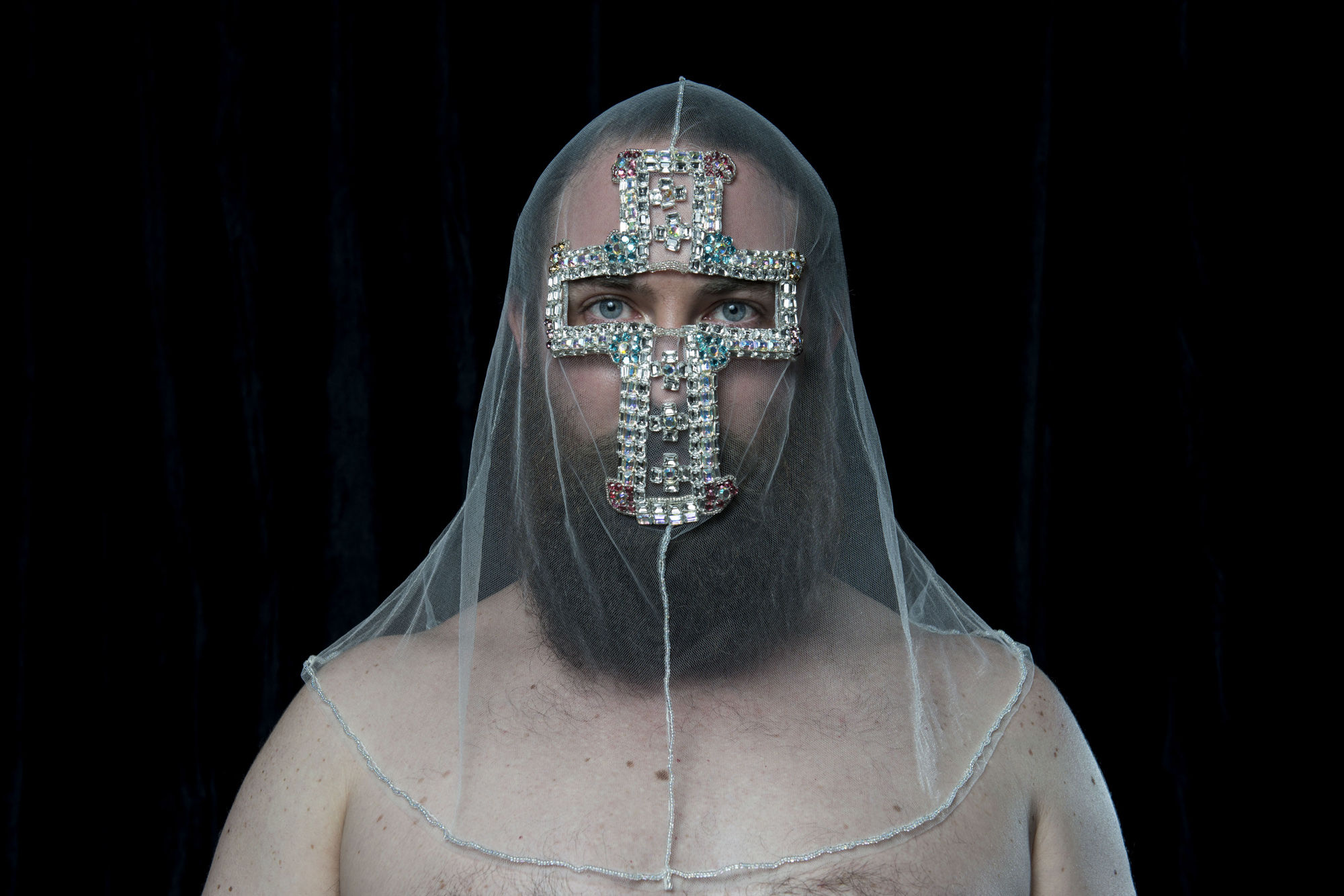
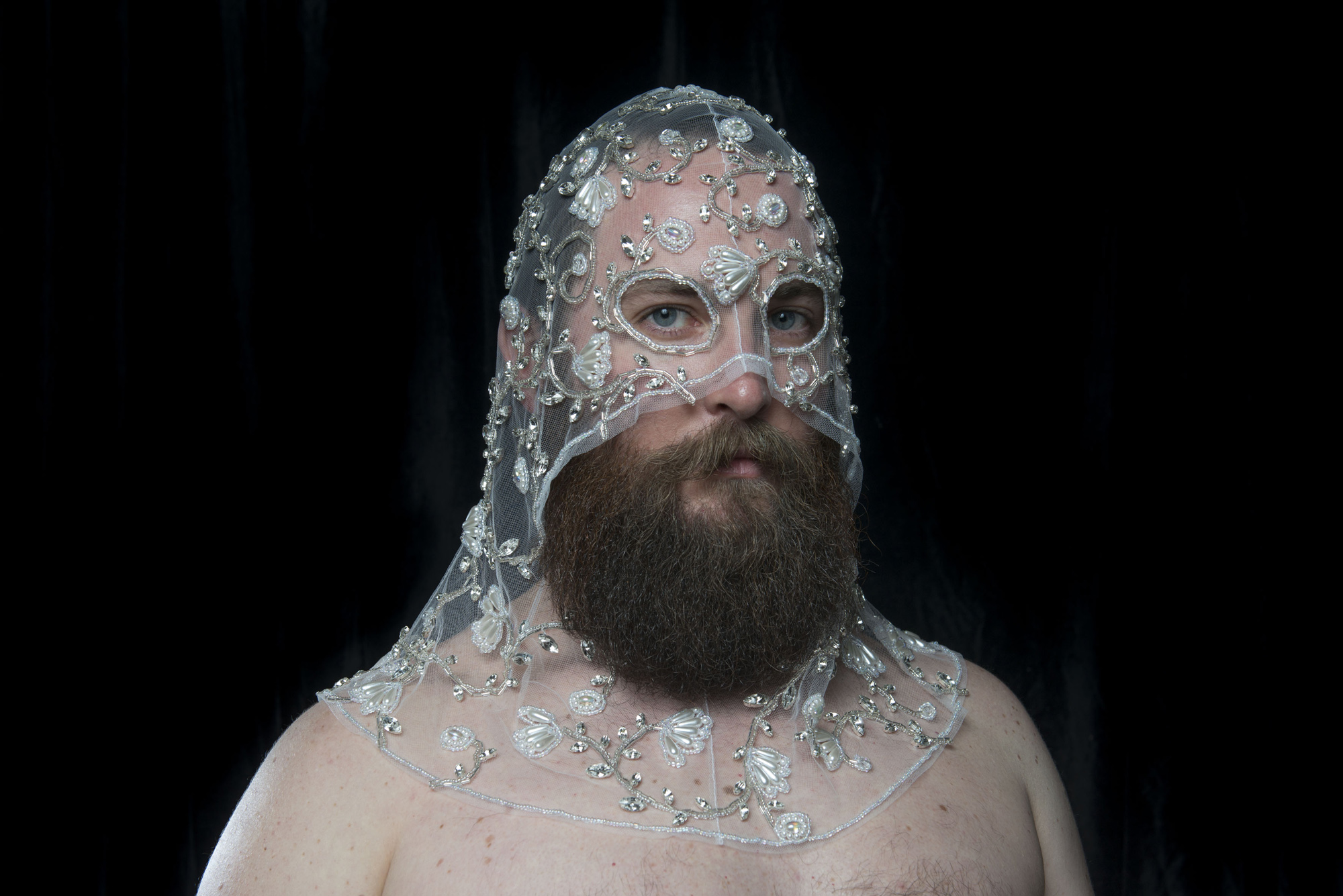
Liam Benson (Australian, b. 1980) The Crusader 2015 The Executioner 2015 The Terrorist 2015 Inkjet print on cotton rag paper, edition of 5 90 x 134cm Photograph by Alex Wisser Courtesy of the artist and Artereal Gallery
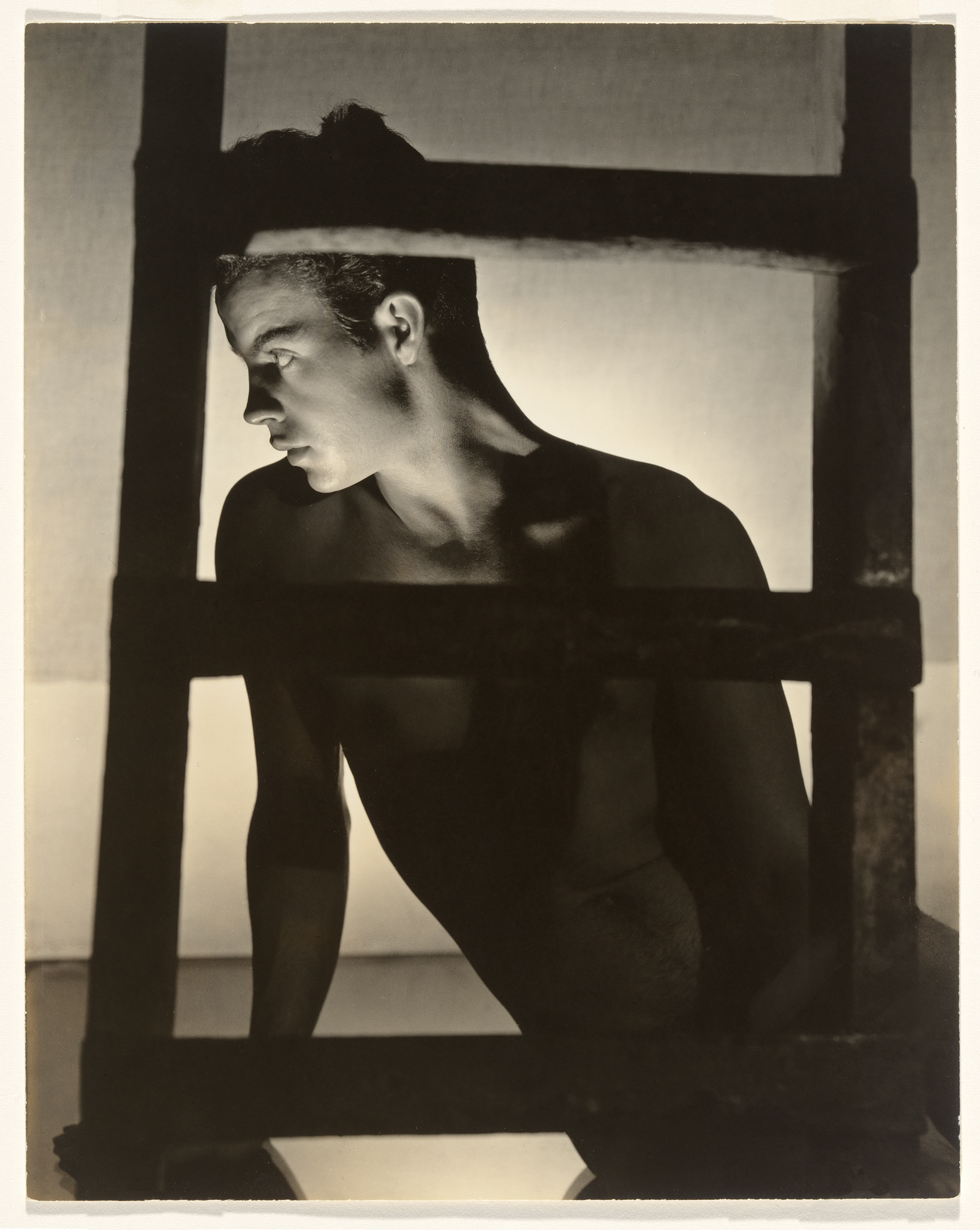
George Platt Lynes (American, 1907-1955) Blanchard Kennedy 1936 Gelatin silver photograph 23 x 18.2cm National Gallery of Australia, Canberra. Purchased 1981
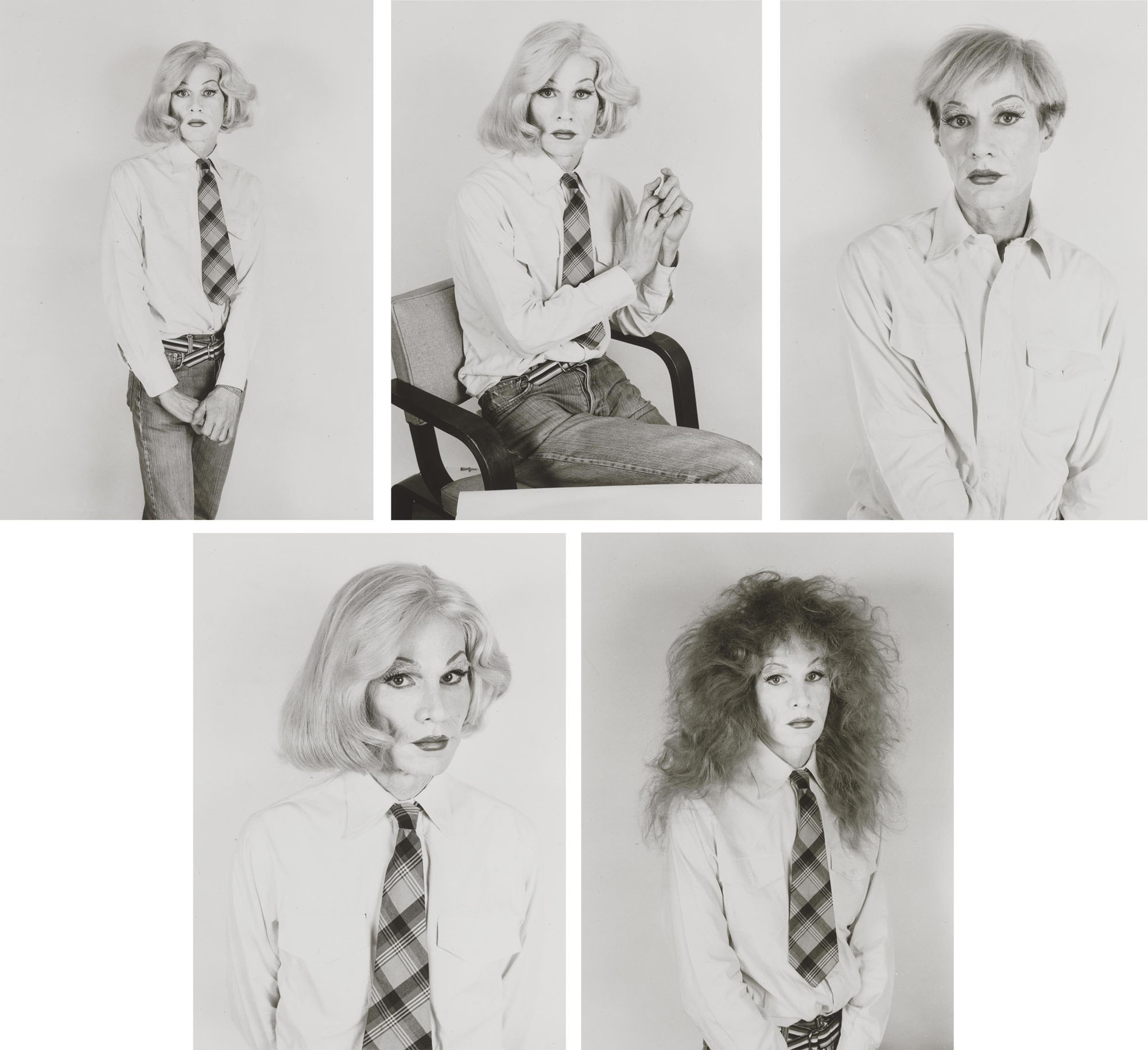
Christopher Makos (American, b. 1948) Altered Image: One Photograph of Andy Warhol 1982 Gelatin silver photograph 50.6 x 40.8cm each National Gallery of Australia, Canberra. Purchased 1982
Goffman’s approach to the body is characterised by three main features. First, there is a view of the body as material property of individuals. In contrast to naturalistic views … Goffman argues that individuals usually have the ability to control and monitor their bodily performances in order to facilitate social interaction. Here, the body is associated with the exercise of human agency, and it appears in Goffman’s work as a resource which both requires and enables people to manage their movements and appearances.
Second, while the body is not actually produced by social forces, as in Foucault’s work, the meanings attributed to it are determined by ‘shared vocabularies of body idiom’ which are not under the immediate control of individuals (E. Goffman, Behaviour In Public Places: Notes on the Social Organisation of Gatherings, The Free Press, New York, 1963, p.35). Body idiom is a conventionalized form of non-verbal communication which is by far the most important component of behaviour in public. It is used by Goffman in a general sense to refer to ‘dress, bearing, movements and position, sound level, physical gestures such as waving and saluting, facial decorations, and broad emotional expressions’ (Goffman, 1963:33). As well as allowing us to classify information given off by bodies, shared vocabularies of body idiom provide categories which label and grade hierarchically people according to this information. Consequently, these classifications exert a profound influence over ways in which individuals seek to manage and present their bodies.
The first two features of Goffman’s approach suggest that human bodies have a dual location. Bodies are the property of individuals, yet are defined as significant and meaningful by society. This formulation lies at the core of the third main feature of Goffman’s approach to the body. In Goffman’s work, the body plays an important role in mediating the relationship between people’s self-identity and their social identity. The social meanings which are attached to particular bodily forms and performances tend to become internalized and exert a powerful influence on an individuals sense of self and feelings of inner worth.
Goffman’s general approach to the body is revealed through his more specific analyses of the procedures involved in what he terms the ‘interaction order’. Goffman conceptualises the interaction order as somehow autonomous sphere of social life (others include the economic sphere) which should not be seen as ‘somehow prior, fundamental, or constitutive of the shape of macroscopic phenomena’ (Goffman, 1983:4). His analysis of this sphere of life demonstrates that intervening successfully in daily life, and maintaining a single definition in the face of possible disruptions, requires a high degree of competence in controlling the expressions, movements and communications of the body.” (Goffman, 1969).
Schilling, Chris. The Body and Social Theory. London: Sage Publications, 1993, pp. 82-83.
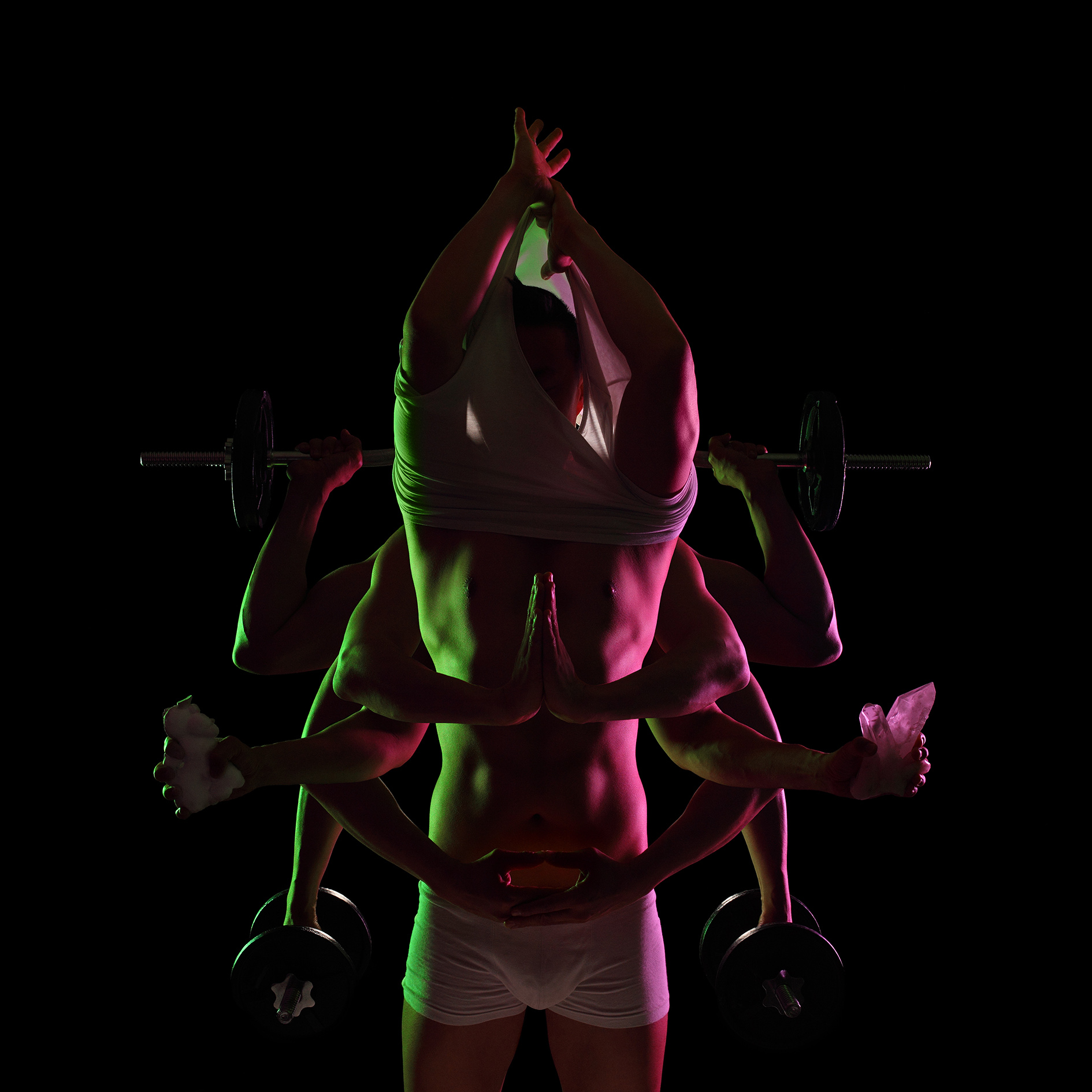
Owen Leong (Australian, b. 1979) Resistance Training 2017 Archival pigment print on cotton paper, edition of 5 + 2 AP 120 x 120cm Courtesy the artist and Artereal Gallery, Sydney Commissioned by BRAG for The Unflinching Gaze: photo media & the male figure with funds from BRAGS Inc. (Bathurst Regional Art Gallery Society Inc.)
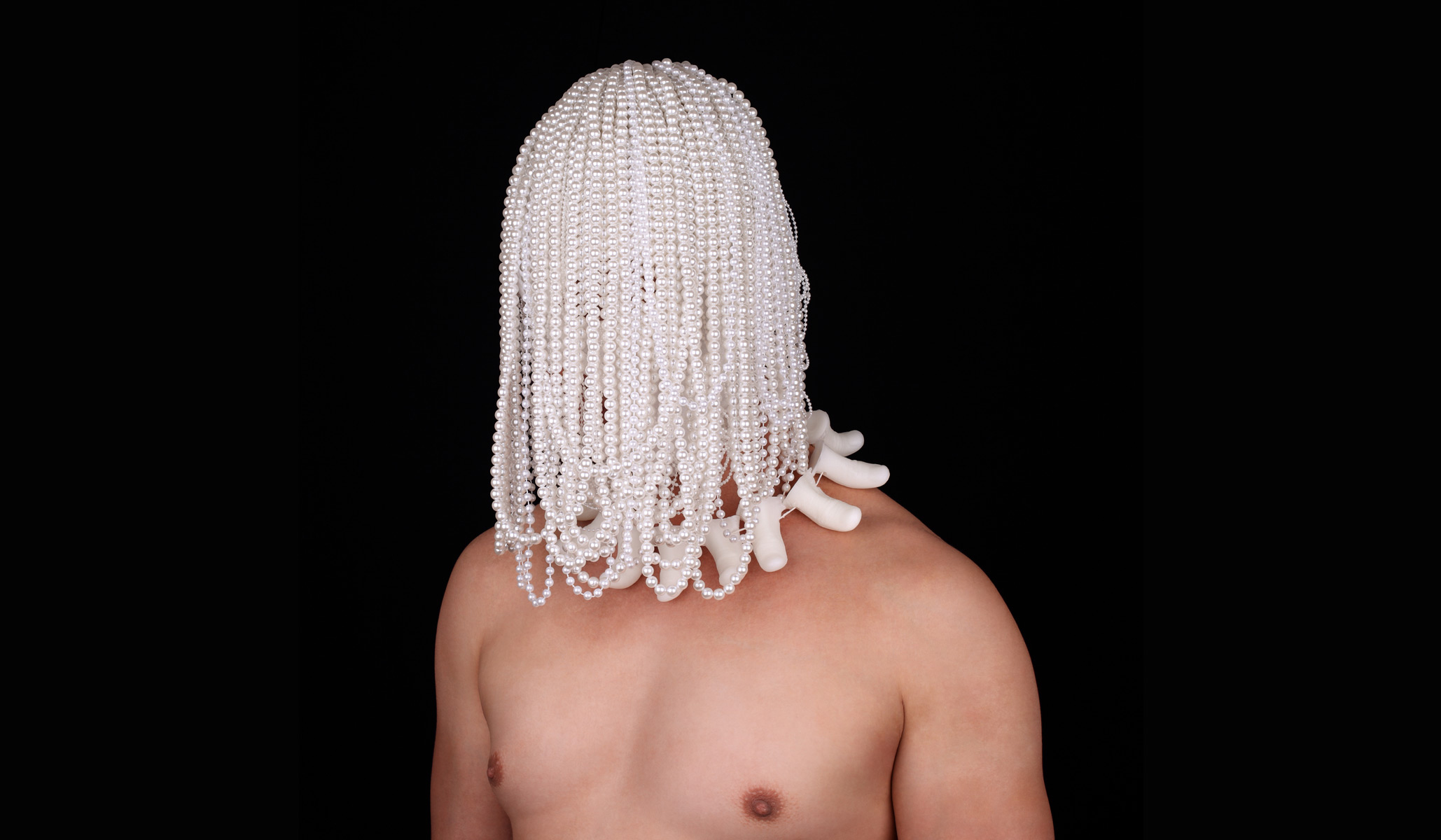
Owen Leong (Australian, b. 1979) Milk Teeth 2014 Archival pigment print on cotton paper, edition of 5 + 2Ap 120 x 120cm Courtesy of the artists and Artereal Gallery Sydney
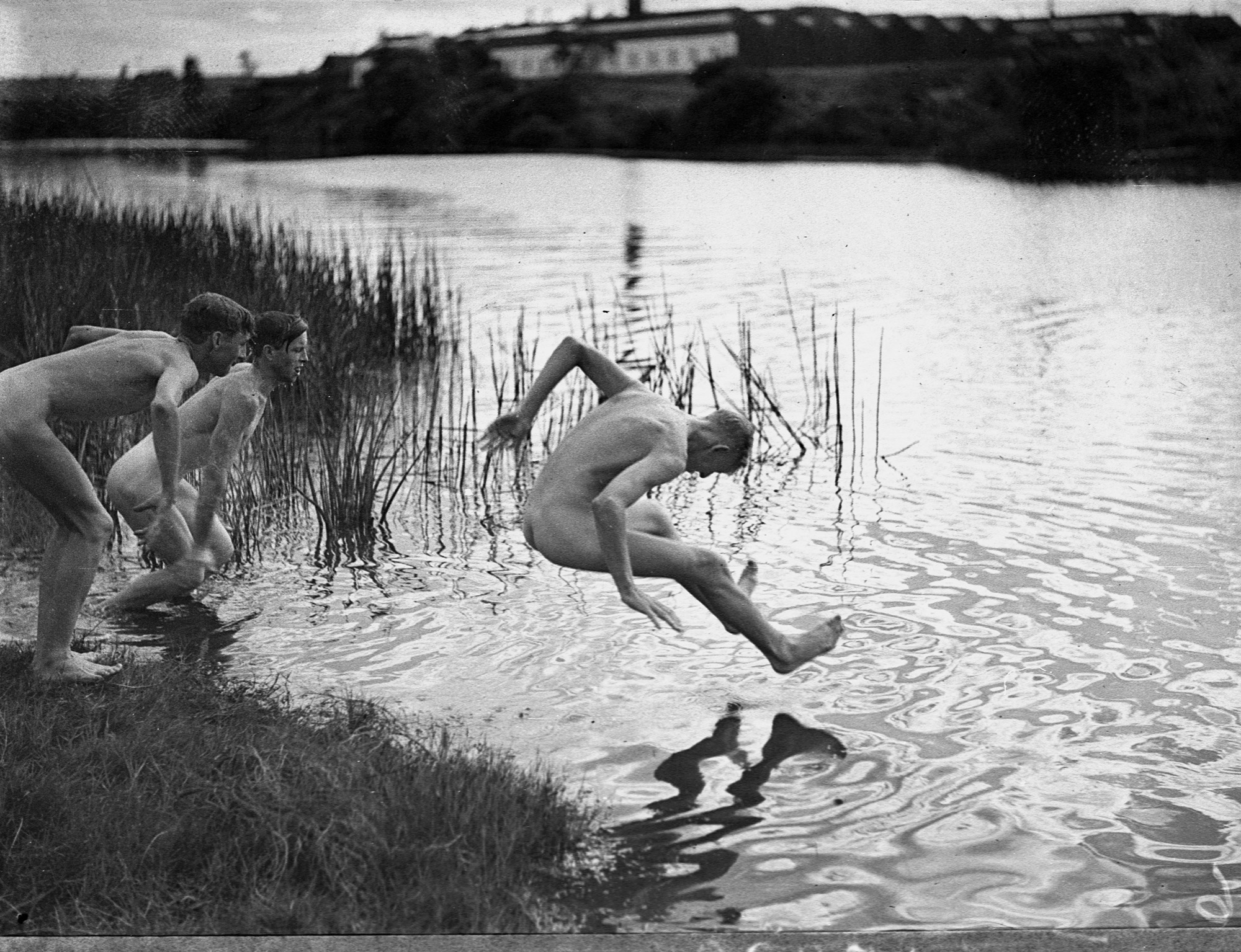
Samuel J Hood (Australian, 1872-1953) The 9th Field Brigade (four images) 24/2/1938 (Liverpool, NSW) Photo negative (copied from original nitrate photograph) 35mm From the Collections of the State Library of NSW
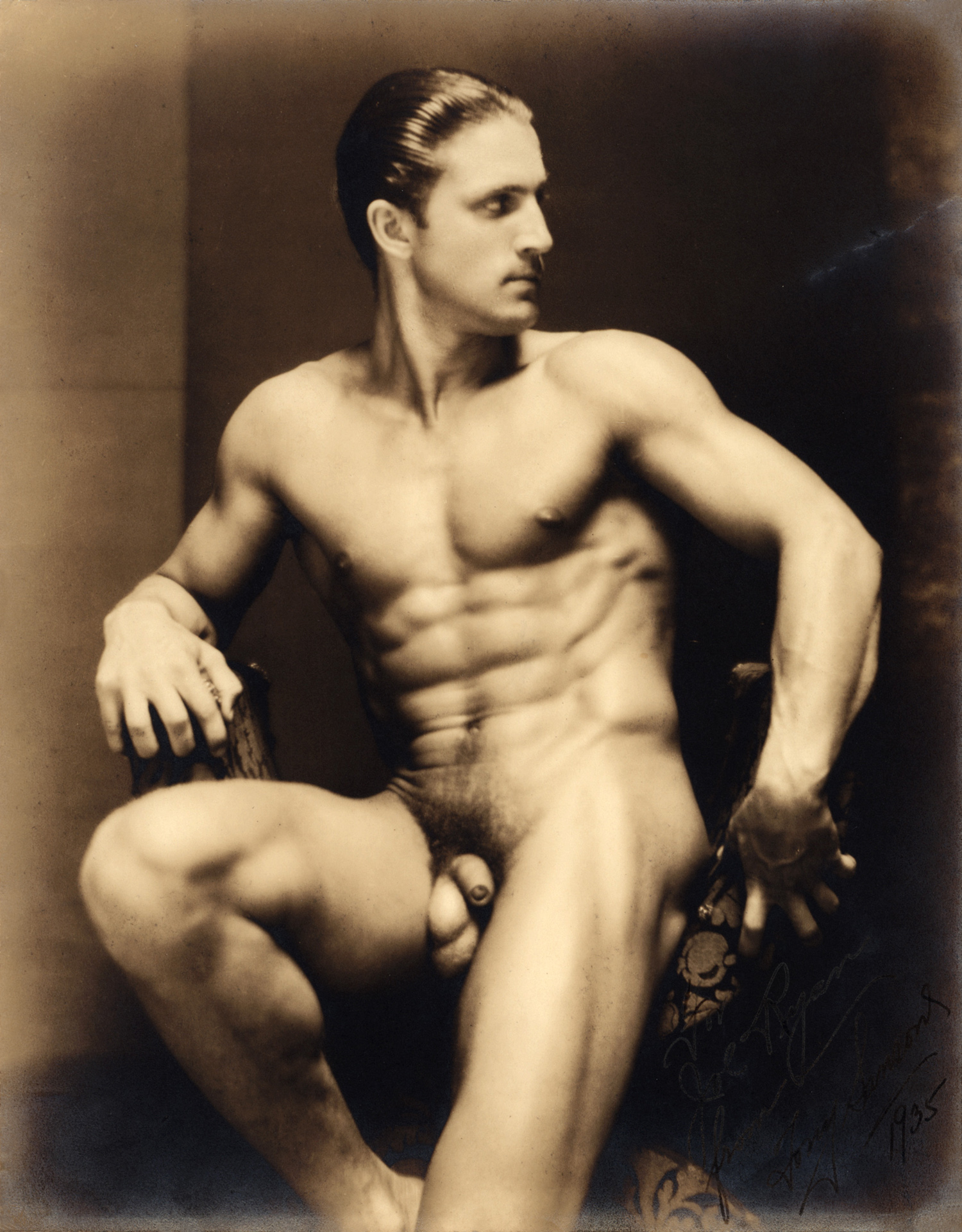
Anthony Sansone (Italy; United States, 1905-1987) Untitled 1935 Bromide print 24.1 x 18.9cm Leslie-Lohman Museum of Gay & Lesbian Art, gift of David Aden Gallery
Fergus Greer (United Kingdom, 1961-1994) Leigh Bowery, Session V Look 27 February 1992 Digital reproduction Courtesy Fergus Greer
Fergus Greer (United Kingdom, 1961-1994) Leigh Bowery, Session VII Look 34, June 1994 Digital reproduction Courtesy Fergus Greer
Unknown American photographer Vintage photograph from the Closeted History/Wunderkamera Nd Tintypes, paper photographs Collection of Luke Roberts
Frank Vickers (American, 1948-1991) Untitled (self-portrait) 1983 Silver gelatin print 17.8 x 12.4cm Leslie-Lohman Museum of Gay & Lesbian Art, Founders’ gift
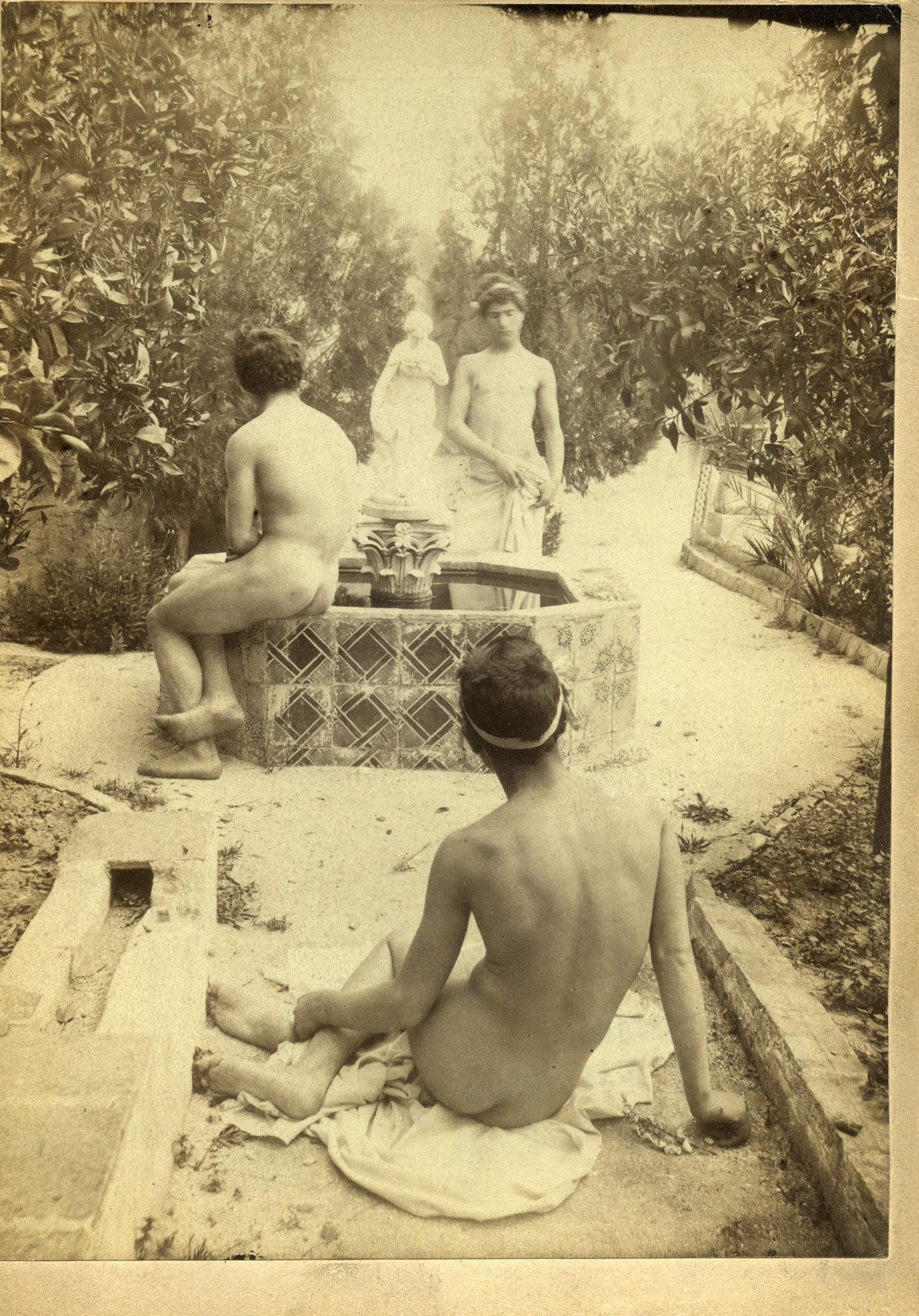
Baron Wilhelm von Gloeden (Germany; Italy, 1856-1931) Untitled c. 1910 Albumen silver print 20.3 x 15.2cm Leslie-Lohman Museum of Gay and Lesbian Art, Founders’ gift
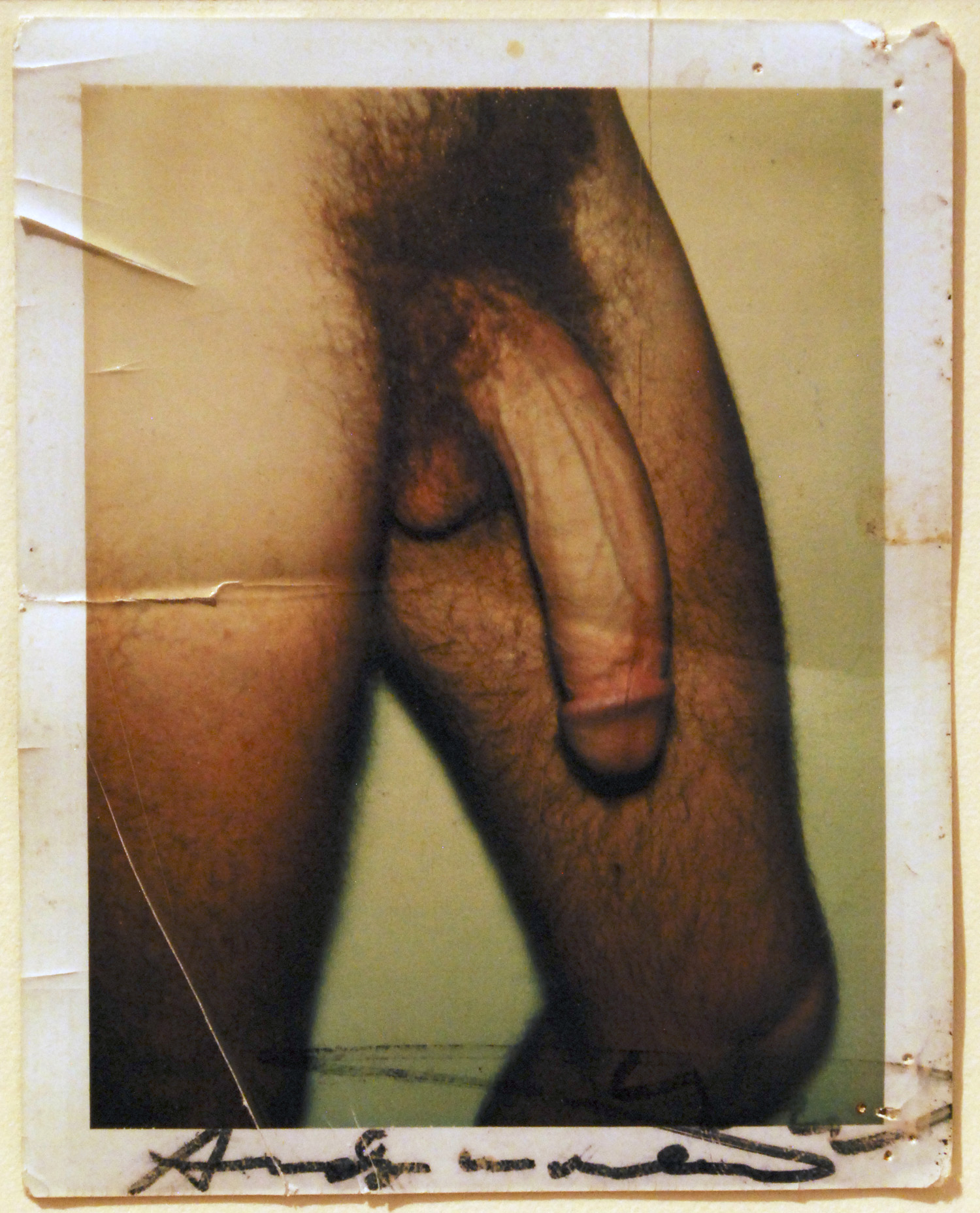
Andy Warhol (American, 1928-1987) Untitled (Victor Hugo’s Penis) Date unknown Polaroid 8.5 x 10.5cm Collection of Byrd Hoffman Water Mill Foundation
Gary Carsley (Australian, b. 1957) YOWL [still] 2017 Single Channel HD Video on Layered A3 Photocopy substrate 360 x 247cm Duration 4.32 min Videography Ysia Song, Soundscape Tarun Suresh, Art Direction Shahmen Suku
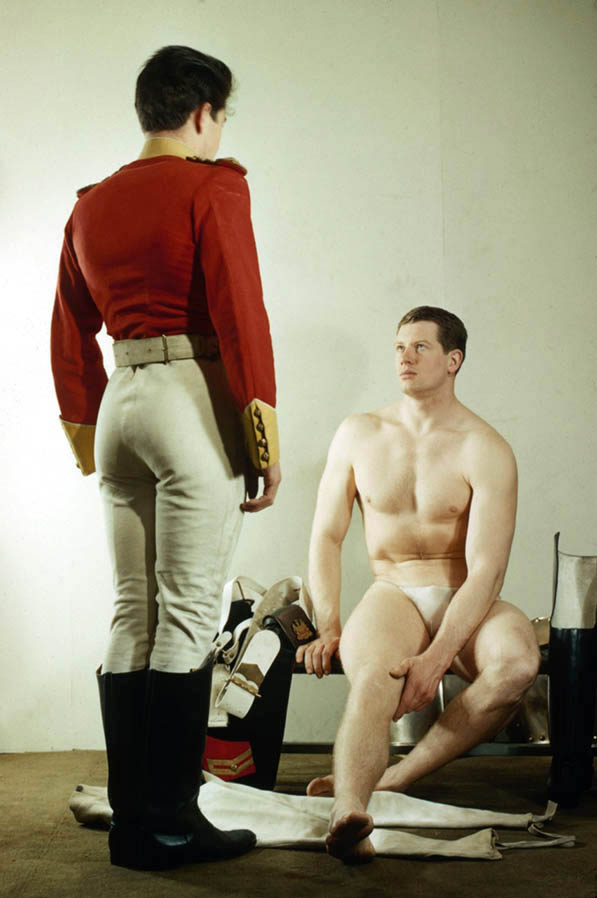
Royale Hussar (Basil Clavering and John Parkhurst) Queens Guard 3 1959-1960 Digital print from original negative
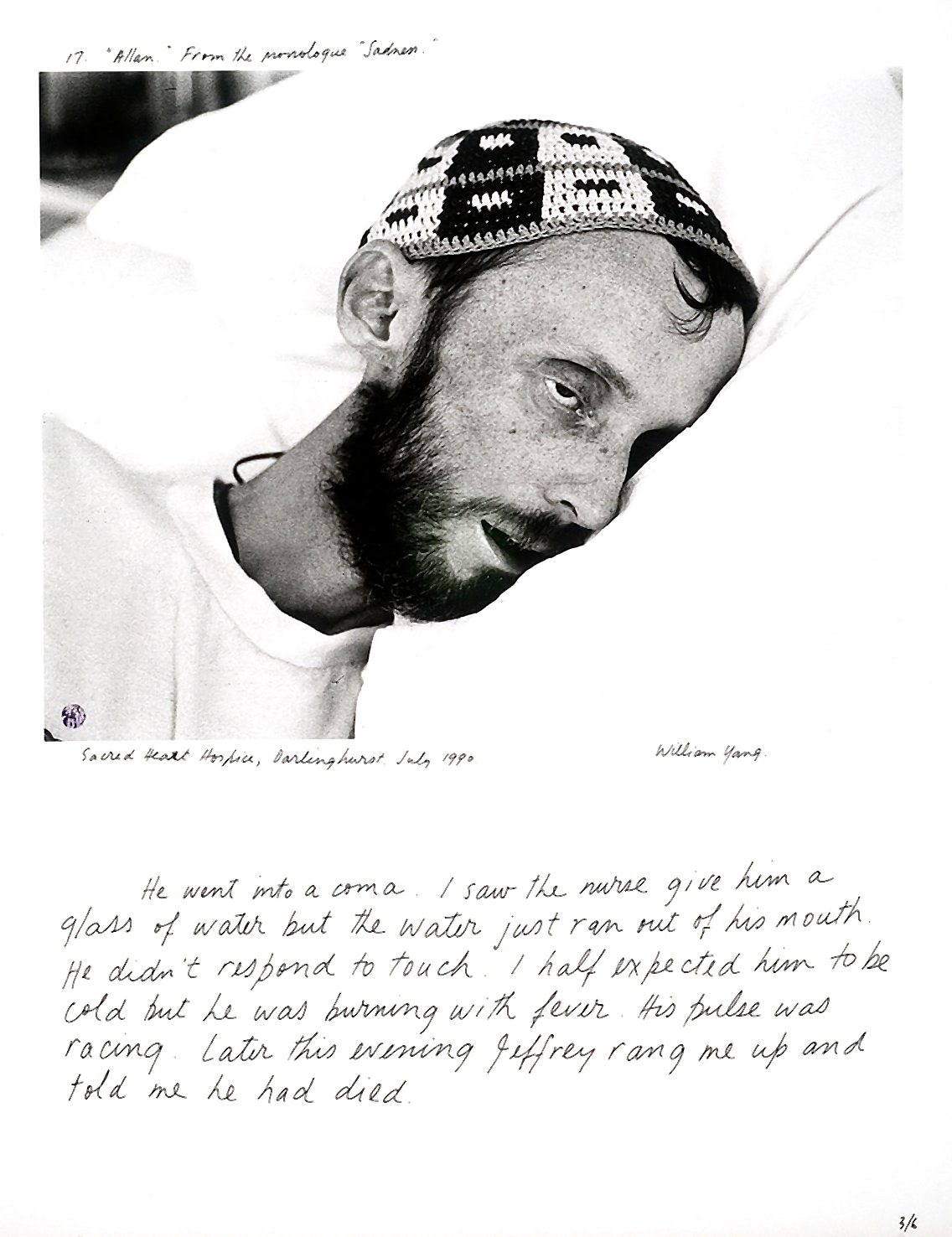
William Yang (Australian-Chinese, b. 1943) ‘Allan’ from the monologue ‘Sadness’ 1992 19 gelatin silver photographs in the monologue 51.0 x 41.0cm each sheet Photograph: William Yang/Bathurst Regional Art Gallery
A photograph from the Sadness series, which depicts the slow death of his sometime lover, Allan Booth, from AIDS.
This prisoner was sent to Auschwitz under Section 175 of the German Criminal Code, which criminalised homosexuality.
The picture may have been taken by Wilhelm Brasse who was born on this date, 3 December in 1917, who became known as the “photographer of Auschwitz concentration camp”, though he was one of several, including Alfred Woycicki , Tadeusz Myszkowski, Józef Pysz, Józef Światłoch, Eugeniusz Dembek, Bronisław Jureczek, Tadeusz Krzysica, Stanisław Trałka, and Zdzisław Pazio whom the Camp Gestapo kept alive for the job of recording thousands of photographs of their fellow prisoners, supervised by Bernhard Walter, the head of Erkenundienst.
The photographs themselves present a transgression of the subject’s own self-image. The carte-de-visite format forces a confrontation of the victim (which in this situation, they are) with themselves in a visual interrogation, by placing a profile and a three-quarter view either side of a frontal mug shot. The final image seems to depict the subject beholden to a higher authority.
Brasse had been arrested in 1940, at age 23, for trying to leave German-occupied Poland and sent to KL Auschwitz-Birkenau where because he had been a Polish professional photographer in his aunt’s studio his skills were useful. Brasse has estimated that he took 40,000 to 50,000 “identity pictures” from 1940 until 1945.
Brasse and another prisoner Bronisław Jureczek preserved the photographs when in January 1945, during the evacuation of the camp, they were ordered to burn all of the photographs. They put wet photo paper in the furnace first and followed by such a great number of photos and negatives that the fire was suffocated. When the SS-Hauptscharfürer Walter left the laboratory, Brasse and Jureczek swept undestroyed photographs from the furnace, scattering them in the rooms of the laboratory and boarding up the door to the laboratory. 38,916 photographs were saved.
James McCardle. “Ghosts,” on the On This Day in Photography website 03/12/2017
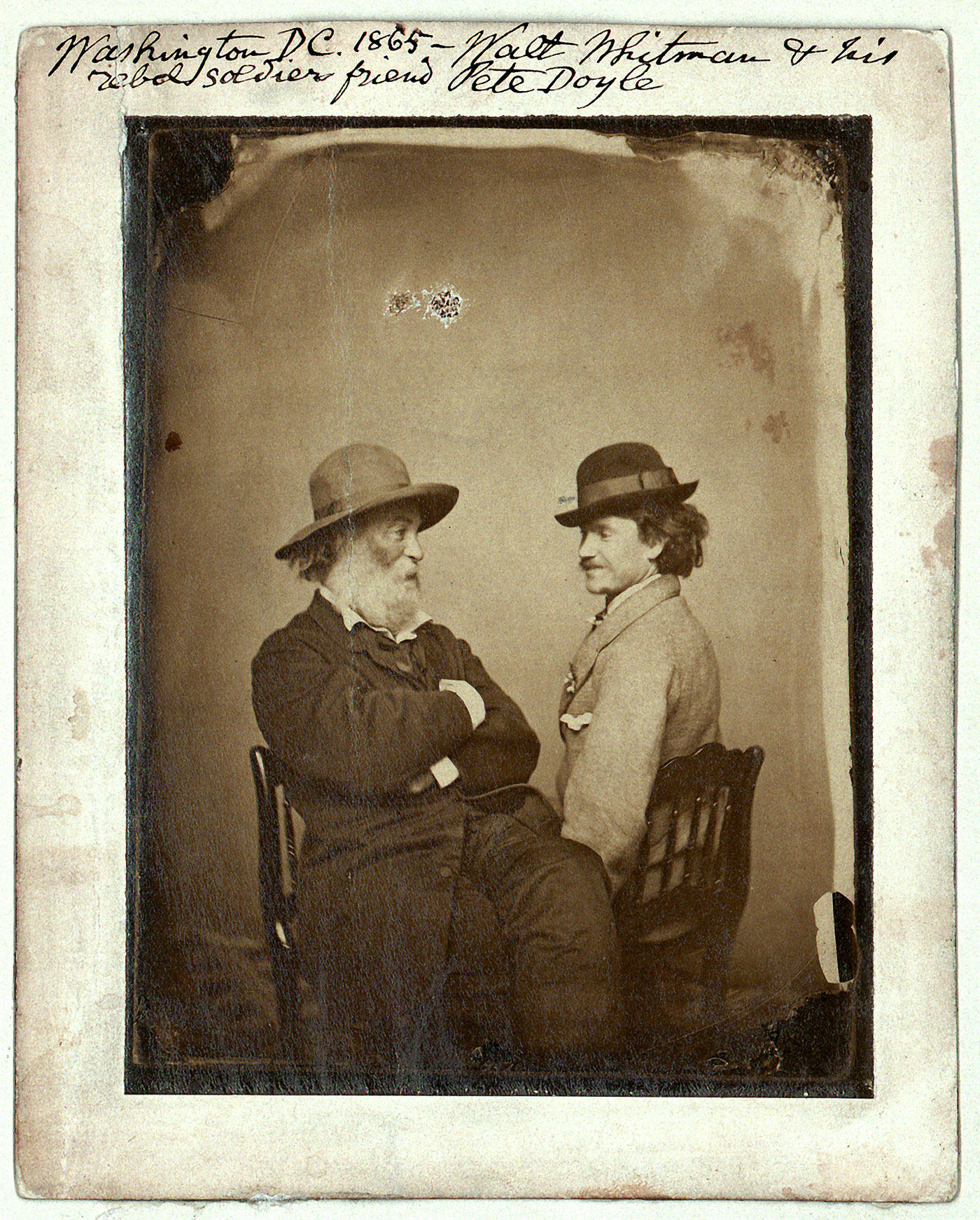
M. P. Rice (American) American poet Walt Whitman and his ‘rebel soldier friend’, Pete Doyle Walt Whitman and Peter Doyle, Washington DC. c. 1865 Charles E. Feinberg Collection, Library of Congress Photograph: Library of Congress/Library of Congress/Bathurst Regional Art Gallery
The first extant photo of Whitman with anyone else, here Peter Doyle, Whitman’s close friend and companion in Washington. Doyle was a horsecar driver and met Whitman one stormy night in 1865 when Whitman, looking (as Doyle said) “like an old sea-captain,” remained the only passenger on Doyle’s car. They were inseparable for the next eight years.
Christopher Makos (American, b. 1982) Altered Image: Five Photographs of Andy Warhol 1982 Portfolio of five gelatin silver prints Each sheet: 20 x 16 in. (50.8 x 40.6cm) Each image: 18 x 12 3/4 in. (45.7 x 32.3cm)
Bathurst Regional Art Gallery (BRAG) 70 -78 Keppel St Bathurst NSW 2795
Opening hours: Tues to Sat 10am – 5pm Sundays 11am – 2pm
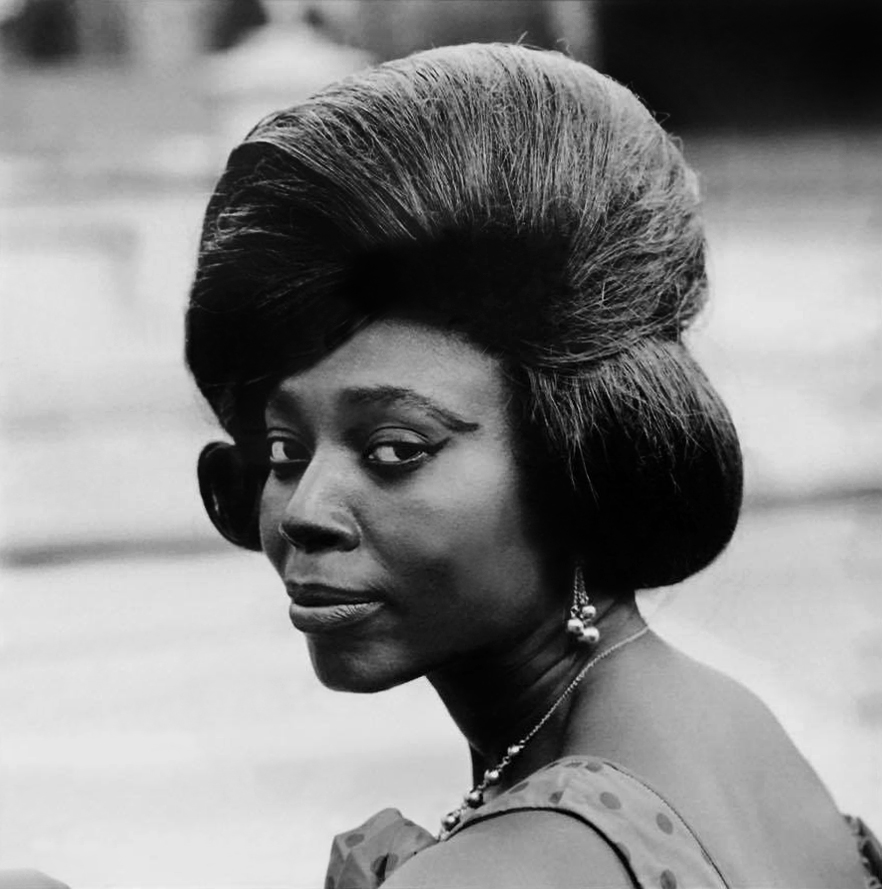
James Barnor (Ghanaian based in London, b. 1929) Mike Eghan at the BBC Studios, London (installation view) 1967, printed 2010 Gelatin silver on paper Gift of Eric and Louise Franck London Collection 2013 Photo: Marcus Bunyan
This was the best photography exhibition which wasn’t an exhibition – because it was a “display” – that I saw on my recent trip to Europe.
Why was it the best? Because this is what strong, insightful photography can do: it can capture life; it can document different cultures; and it can be a powerful agent for social change.
I remember London in the 1970s. I lived in Clapham (Claiff-ham Heights) and Stockwell (we called it St. Ockwell) near Brixton at the time. I remember the Brixton riot of 1981, as I was living in my little room down the road, as the cars burnt and the buildings were smashed. “Brixton in South London was an area with serious social and economic problems. The whole United Kingdom was affected by a recession by 1981, but the local African-Caribbean community was suffering particularly high unemployment, poor housing, and a higher than average crime rate.” (Wikipedia) People felt oppressed by recession, racism, the police, and by the establishment, for this was the era of Margaret Thatcher and her bullies. But as these photographs show, there was such a vibrant sense of community in these areas as they sought to ‘stand firm in England’ because it was their home.
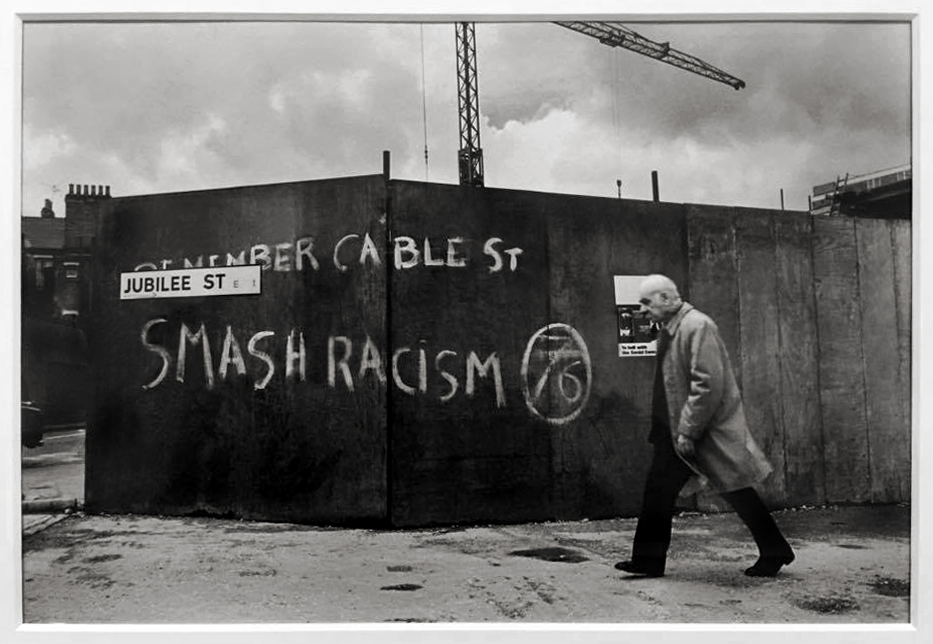
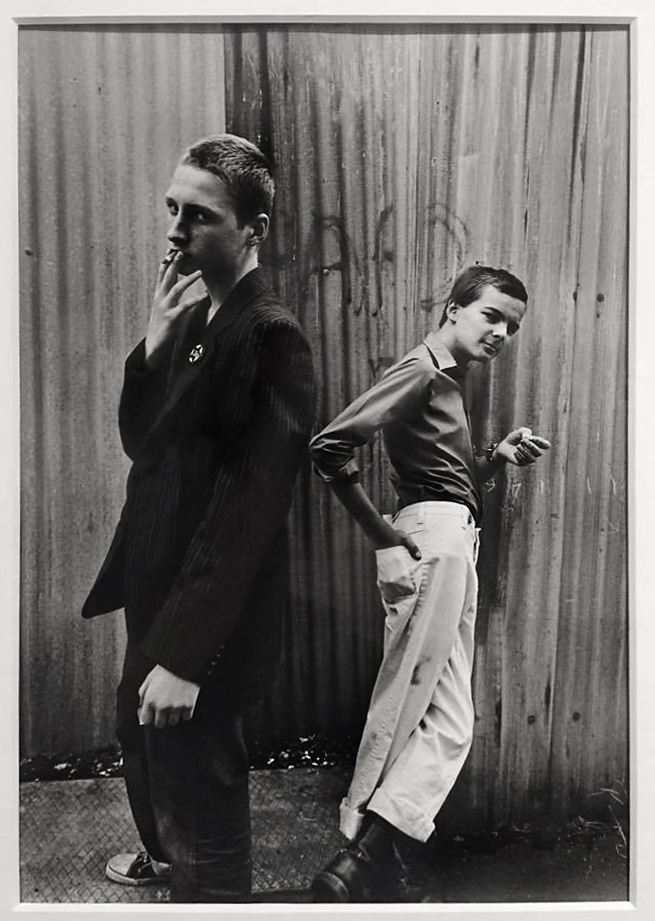
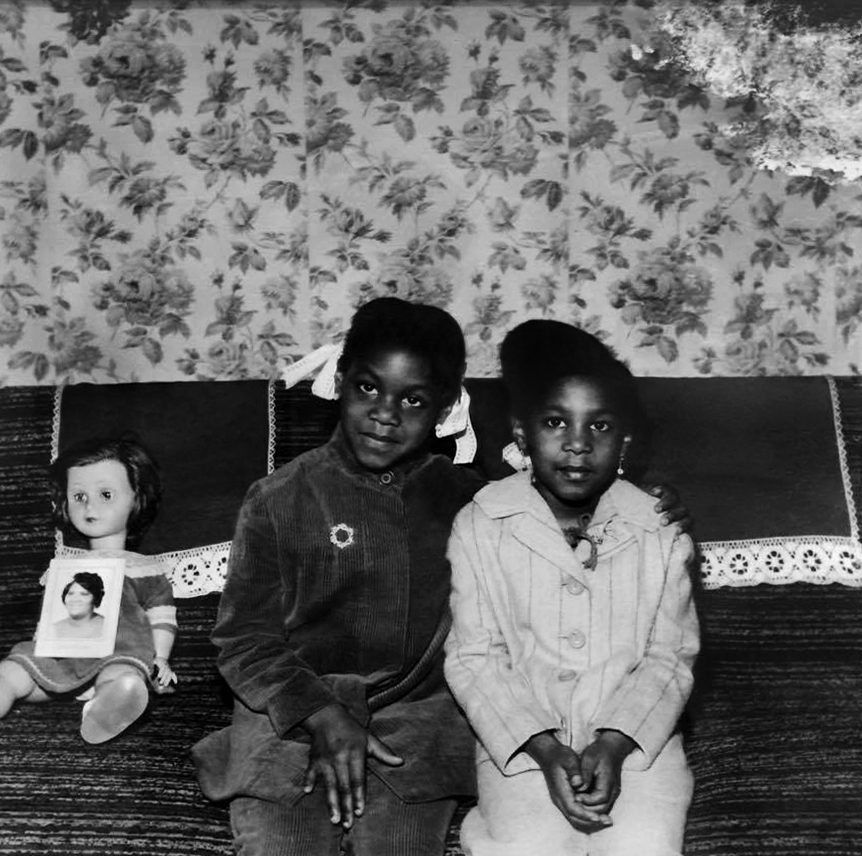
It is our great privilege that we have the images of this very talented group of photographers who documented Black communities in London during this time: Raphael Albert, Bandele ‘Tex’ Ajetunmobi, James Barnor, Colin Jones, Neil Kenlock, Dennis Morris, Syd Shelton and Al Vandenberg. And I find it heartening that all of these photographers were documenting their community at the same time. The African-Caribbean diaspora is part of the genetic makeup of the UK and multiculturalism, from where ever it emanates, should be valued in societies around the world. It enriches contemporary culture through an understanding and acceptance of difference.
Against racism; against fascism; against discrimination. For freedom from oppression and the right to be heard.
Dr Marcus Bunyan
PS. There were no media images so I took iPhone installation photographs of the display, so please excuse any reflection of the gallery in the images. I have cleaned and balanced them as much as possible.
James Barnor (Ghanaian based in London, b. 1929) Drum Cover Girl Erlin Ibreck, London (installation view) 1966, printed 2010 C-print on paper Gift of Eric and Louise Franck London Collection 2013 Photo: Marcus Bunyan
“The picture of a young woman leaning against a shiny grey Jaguar was taken in Kilburn, north London, in 1966. The pastel minidress, heavy fringe and costume jewellery feel instantly familiar as belonging to the era, but while we’re used to seeing a pallid Twiggy or Penelope Tree striding about London in fashion shoots from the same time, we rarely see images in which the model is black.
The pictures shown here of young women with 1960s-style beehives and miniskirts were shot as fashion stories for Drum , an influential anti-apartheid magazine based in Johannesburg, and Africa’s first black lifestyle magazine. …
Erlin Ibreck, the model in the main photograph who was 19 at the time, remembers Barnor asking her to pose in Trafalgar Square while flocks of excited pigeons landed on her. ‘I was more nervous about the pigeons than people around us who were staring.’
Some of the models were professional, but Ibreck was someone Barnor spotted in a bus queue at Victoria station. Ibreck was living in Cheshire but visiting her sister, who lived in London. Barnor asked if she would like to be photographed for Drum magazine and eventually she agreed.
Encouraged by Barnor, Ibreck enrolled at the Lucie Clayton modelling school in Manchester, but finding work as a black model in the 1960s was not easy.
‘It was very tough as there were very few black models,’ she says. ‘I was selected by Lucie Clayton to model De Beers diamonds – a South African company, and this was during apartheid. When they discovered that I was black De Beers cancelled the booking and chose a white model.
‘That booking would have enhanced my career, so it was a very painful experience to have been rejected on the basis of my colour. This experience made me realise what I was up against.’ After two years Ibreck gave up modelling and moved to New York.”
Although Barnor says he wasn’t consciously attempting to chronicle ‘black culture’ in England, and was simply taking photographs of things that interested him and the readers of Drum, the effect was, none the less, an optimistic suggestion that these cosmopolitan young African women were part of the exciting new, multicultural society in London that people were talking about.
Barnor’s memories of the time seem to be largely positive, and he says he doesn’t remember experiencing any overt racism. ‘I moved in enlightened circles so I did not have to put up with most of what other black people had to go through, though I did notice when I sat on a bus many people didn’t want to sit next to me’.”
Kate Salter. “Colour me beautiful: James Barnor’s photographs for Drum magazine,” on the Telegraph website 07 December 2010 [Online] Cited 08/10/2017. No longer available online
James Barnor (Ghanaian based in London, b. 1929) Wedding Guests, London (installation view) 1960s, printed 2010 Gelatin silver on paper Gift of Eric and Louise Franck London Collection 2013 Photo: Marcus Bunyan
James Barnor (Ghanaian based in London, b. 1929) Eva, London 1960s, printed 2010 Gelatin silver on paper Gift of Eric and Louise Franck London Collection 2013
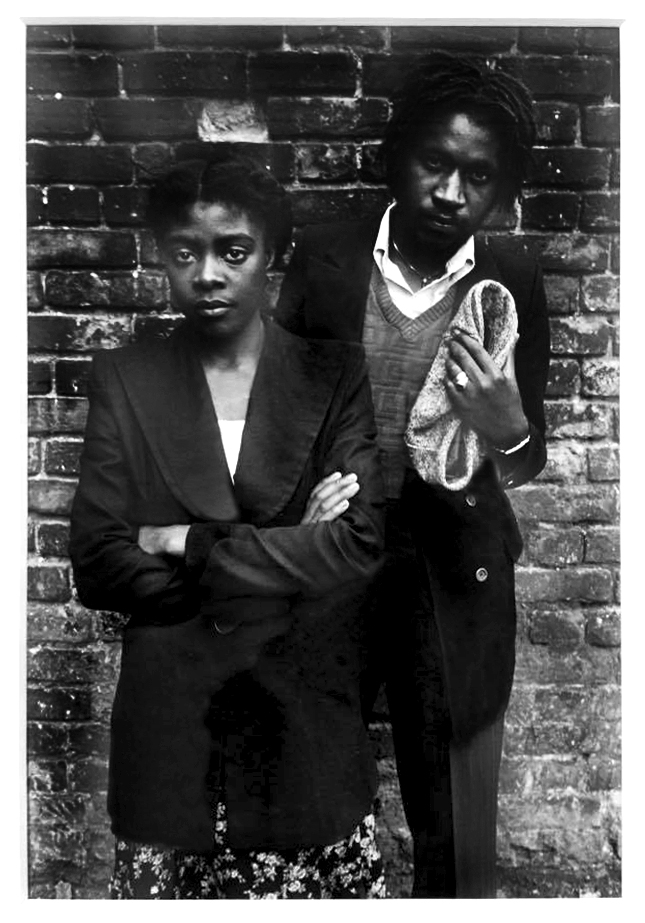
This display brings together works from the 1960s and 1970s by eight photographers who documented Black communities in London: Raphael Albert, Bandele ‘Tex’ Ajetunmobi, James Barnor, Colin Jones, Neil Kenlock, Dennis Morris, Syd Shelton and Al Vandenberg.
The photographs reveal the many and varied experiences of individuals who travelled from the Caribbean region and West Africa to live in London, from everyday family life to political engagement. They show people as they respond to, react against and move beyond the racial tension and exclusion that were part of life for Black communities in the British capital. The title of the display, ‘Stan Firm inna Inglan’, is taken from the poem It Dread inna Inglan by Linton Kwesi Johnson, who in the 1970s gave a voice and poetic form to the Afro-Caribbean diaspora and its resistance in the face of racism. The poem expresses in Jamaican patois (creole) the resolve of African, Asian and Caribbean immigrants to ‘stand firm in England’, asserting the determination of Black British communities to remain in Britain and declare it as their rightful home.
The work of most of the photographers has gained prominence in recent years through the research and curatorial work of Autograph ABP, which was established in London in 1988 to advocate the inclusion of historically marginalised photographic practices. All works in the display have been gifted to the Tate collection and form part of the Eric and Louise Franck London Collection, an important collection of photography which was assembled over more than 20 years.
This display has been curated by Elena Crippa, Allison Thompson and Susana Vargas Cervantes. Alison and Susana worked at Tate as part of the Brooks International Fellowship programme for three months in 2016, fully funded by the Rory and Elizabeth Brooks Foundation and in partnership with the Delfina Foundation.
Text from the Tate Britain website
Dennis Morris (British, b. 1960) ‘Mother’s Pride’, Hackney (installation view) 1976, printed 2012 Gelatin silver print on paper Gift of Eric and Louise Franck London Collection 2016 Photo: Marcus Bunyan
Dennis Morris (British, b. 1960) Young Gun, Hackney (installation view) 1969, printed 2012 Gelatin silver print on paper Gift of Eric and Louise Franck London Collection 2016 Photo: Marcus Bunyan
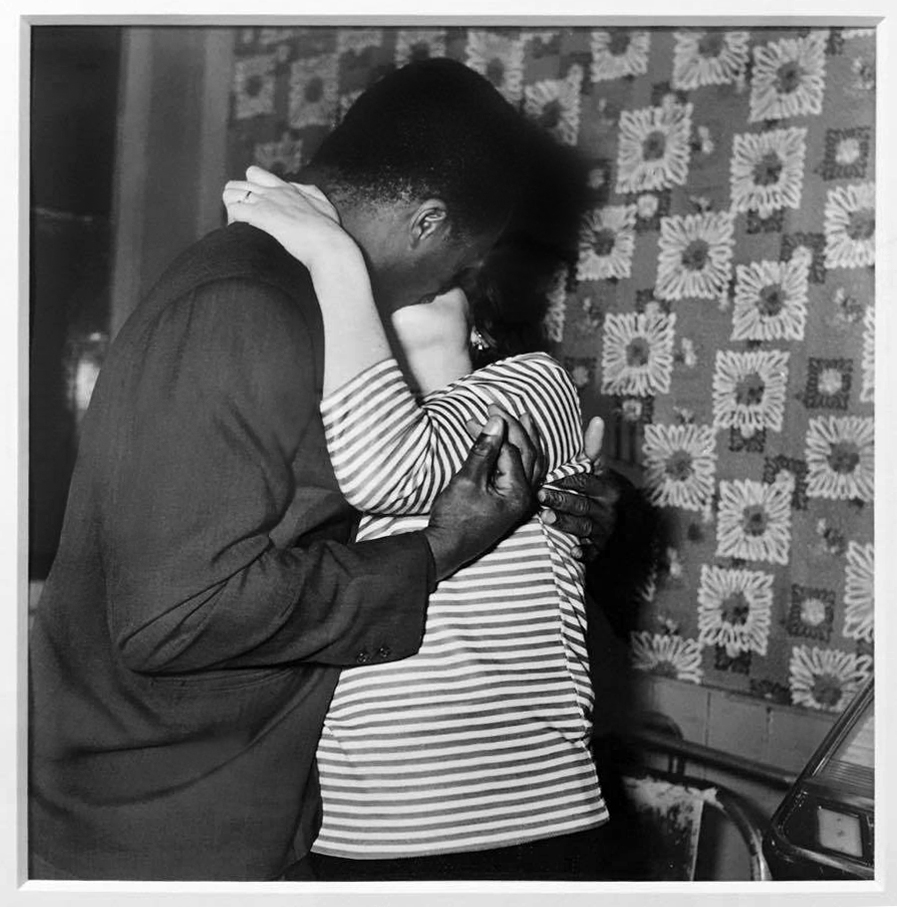
Bandele Ajetunmobi (British, 1921-1994) Couple Kissing, Whitechapel, London (installation view) 1960s, printed 2012 Gelatin silver print on paper Gift of Eric and Louise Franck London Collection 2016 Photo: Marcus Bunyan
“Bandele Ajetunmobi – widely known as Tex – took photographs in the East End for almost half a century, starting in the late forties. He recorded a tender vision of interracial camaraderie, notably as manifest in a glamorous underground nightlife culture yet sometimes underscored with melancholy too – creating poignant portraits that witness an almost-forgotten era of recent history.
In 1947, at twenty-six years old, he stowed away on a boat from Nigeria – where he found himself an outcast on account of the disability he acquired from polio as a child – and in East London he discovered the freedom to pursue his life’s passion for photography, not for money or reputation but for the love of it.
He was one of Britain’s first black photographers and he lived here in Commercial St, Spitalfields, yet most of his work was destroyed when he died in 1994 and, if his niece had not rescued a couple of hundred negatives from a skip, we should have no evidence of his breathtaking talent. …
“He did all this photography yet he didn’t do it to make money, he did it for pleasure and for artistic purposes. He was doing it for art’s sake.He had lots of books of photography and he studied it. He was doing it because those things needed to be recorded. You fall in love with a medium and that’s what happened to him. He spent all his money on photography. He had expensive cameras, Hasselblads and Leicas. My mother said, ‘If you sold one, you could make a visit to Nigeria.’ But he never went back, he was probably a bit of an outcast because of his polio as a child and it suited him to be somewhere people didn’t judge him for that. …
He used to do buying and selling from a stall in Brick Lane. When he died, they found so much stuff in his flat, art equipment, pens, old records and fountain pens. He had a very good eye for things. Everybody knew him, he was always with his camera and they stopped him in the street and asked him to take their picture. He was able to take photographs in clubs, so he must have been a trusted and respected figure. Even if the subjects are poor, they are strutting their stuff for the camera. He gave them their pride and I like that.” (Victoria Loughran)
Bandele Ajetunmobi (British, 1921-1994) East End, London (installation view) c. 1975, printed 2012 C-print on paper Gift of Eric and Louise Franck London Collection 2016 Photo: Marcus Bunyan
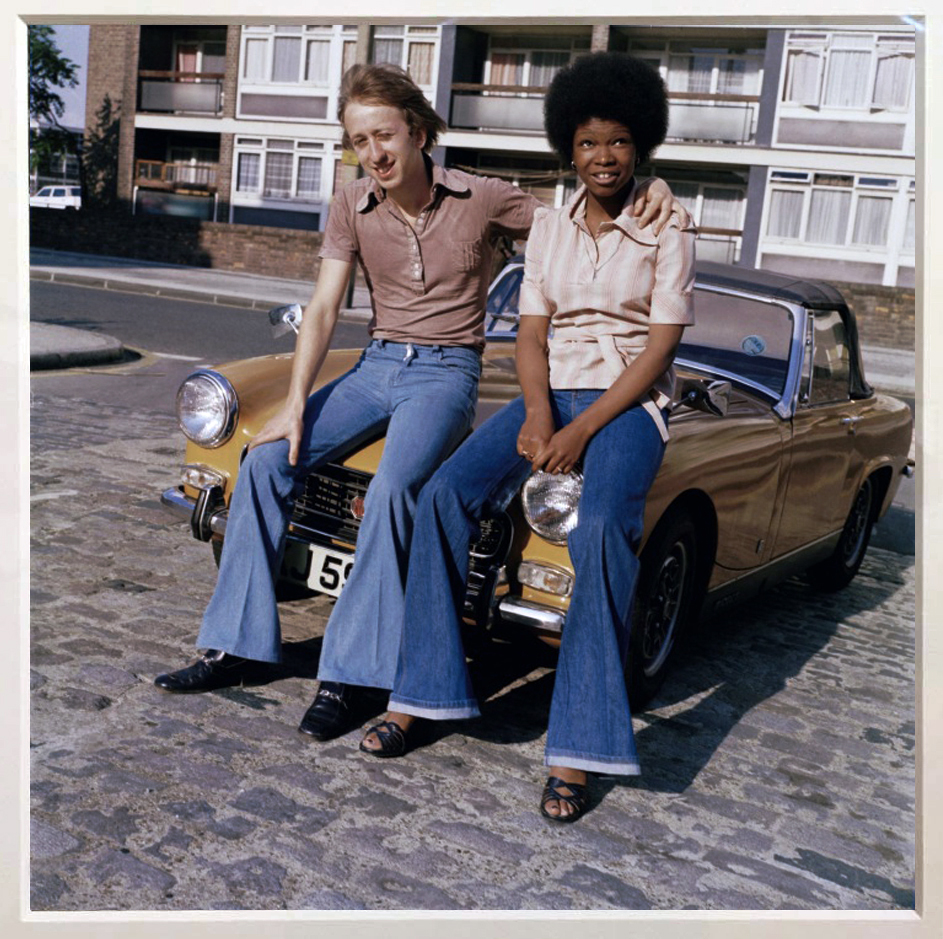
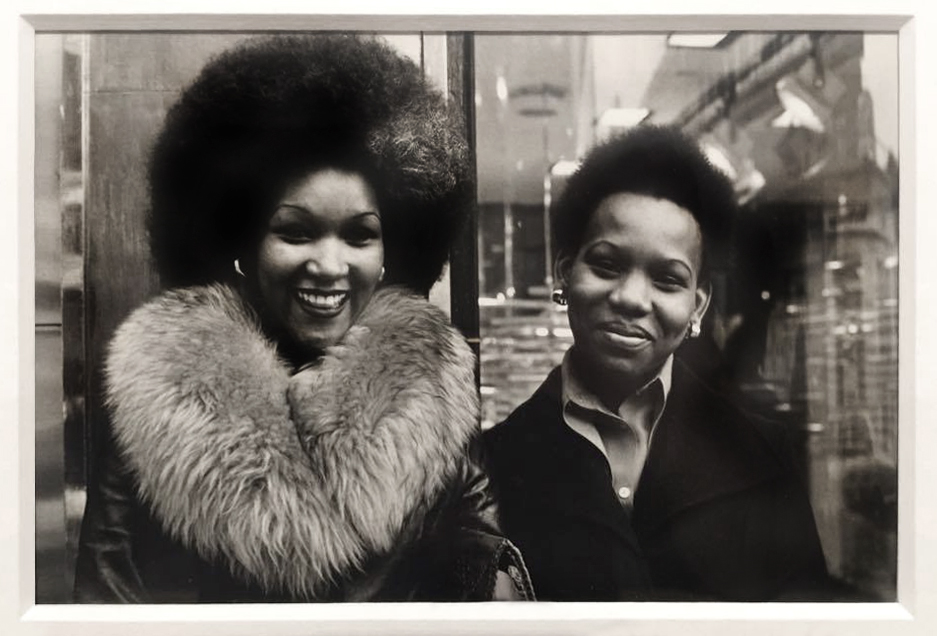
Al Vanbenberg (American, 1932-2012) Untitled (installation view) c. 1975-1980 From the series On a Good Day Gelatin silver print on paper Gift of Eric and Louise Franck London Collection 2013 Photo: Marcus Bunyan
Al Vanbenberg (American, 1932-2012) Untitled c. 1975-1980 From the series On a Good Day Gelatin silver print on paper Gift of Eric and Louise Franck London Collection 2013 Photo: Marcus Bunyan
Al Vanbenberg (American, 1932-2012) Untitled (installation view) c. 1975-1980 From the series On a Good Day Gelatin silver print on paper Gift of Eric and Louise Franck London Collection 2013 Photo: Marcus Bunyan
Colin Jones (English, 1936-2021) From the series The Black House, 571 Holloway Road, London (installation views) 1976, printed 2012 Gelatin silver print on paper Gift Eric and Louise Franck London Collection 2016 Photo: Marcus Bunyan
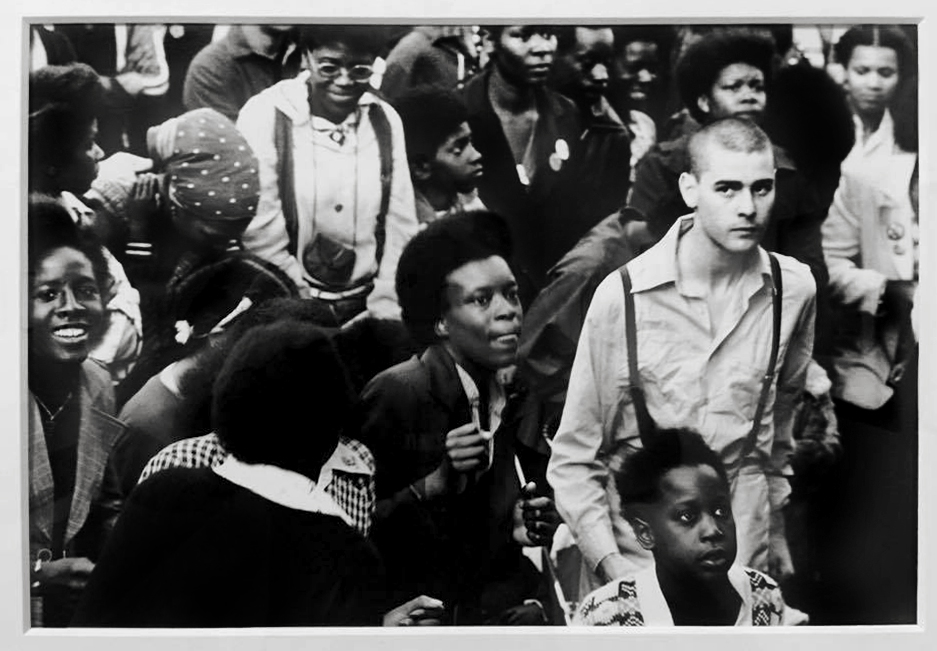
Syd Shelton (British, b. 1947) Southhall Carnival against the Nazis (installation view) 1979, printed 2012 Gelatin silver print on paper Gift Eric and Louise Franck London Collection 2016 Photo: Marcus Bunyan
Syd Shelton (British, b. 1947) Jubilee Street, Stepney, London (installation view) 1977, printed 2012 Gelatin silver print on paper Gift Eric and Louise Franck London Collection 2016 Photo: Marcus Bunyan
Syd Shelton (British, b. 1947) Bagga (Bevin Fagan), Hackney, East London (installation view) 1979, printed 2012 Gelatin silver print on paper Gift Eric and Louise Franck London Collection 2016 Photo: Marcus Bunyan
Syd Shelton (British, b. 1947) Skinheads, Petticoat Lane, East London (installation view) 1979, printed 2012 Gelatin silver print on paper Gift Eric and Louise Franck London Collection 2016 Photo: Marcus Bunyan
Syd Shelton (British, b. 1947) Anti racist Skinheads, Hackney, London (installation view) 1979, printed 2012 Gelatin silver print on paper Gift Eric and Louise Franck London Collection 2016
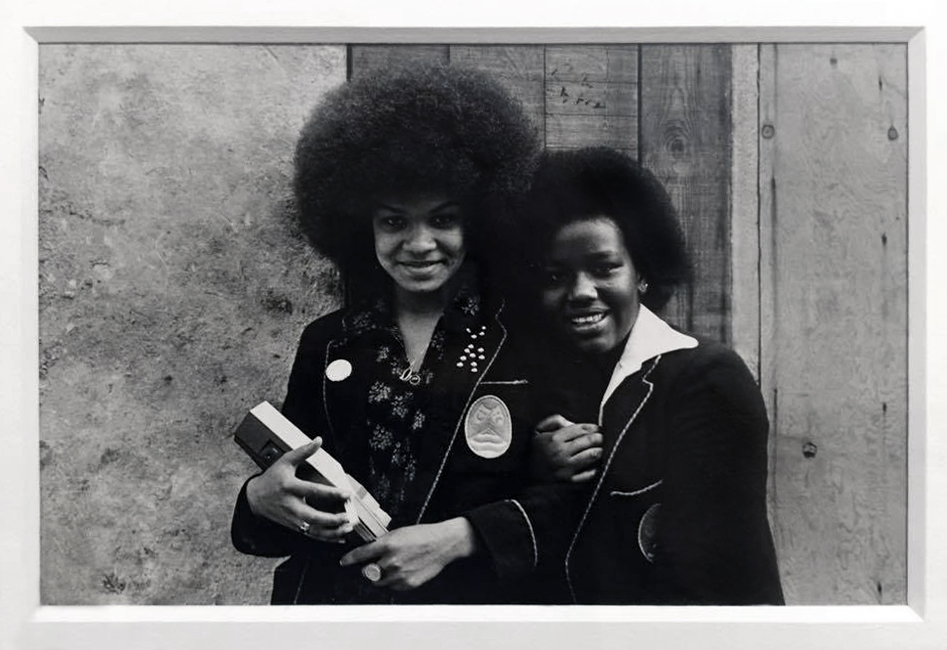
Neil Kenlock (British born Jamaica, b. 1950) The Bailey Sisters in Clapham (installation view) c. 1970, printed 2010 Gelatin silver print on paper Presented by Tate Members 2013 and forming part of the Eric and Louise Franck London Collection Photo: Marcus Bunyan
Neil Kenlock (British born Jamaica, b. 1950) Demonstration outside Brixton Library (installation view) 1972, printed 2010 Gelatin silver print on paper Presented by Tate Members 2013 and forming part of the Eric and Louise Franck London Collection Photo: Marcus Bunyan
Neil Kenlock (British born Jamaica, b. 1950) ‘Keep Britain White’ graffiti, Balham (installation view) 1972, printed 2010 Gelatin silver print on paper Presented by Tate Members 2013 and forming part of the Eric and Louise Franck London Collection Photo: Marcus Bunyan
Raphael Albert (British born Grenada, 1935-2009) The Golden Chip, Hammersmith, London (installation view) c. 1970, printed 2012 Gelatin silver print on paper Gift Eric and Louise Franck London Collection 2016 Photo: Marcus Bunyan
Raphael Albert (British born Grenada, 1935-2009) Hammersmith, London (installation view) 1960s, printed 2012 Gelatin silver print on paper Gift Eric and Louise Franck London Collection 2016
Raphael Albert (British born Grenada, 1935-2009) The Harder They Come, Hammersmith Apollo (installation view) c. 1972, printed 2012 Gelatin silver print on paper Gift Eric and Louise Franck London Collection 2016
Raphael Albert (British born Grenada, 1935-2009) Holley posing at Blythe Road, London (installation view) c. 1974, printed 2012 Gelatin silver print on paper Gift Eric and Louise Franck London Collection 2016 Photo: Marcus Bunyan
Tate Britain Millbank, London SW1P 4RG United Kingdom Phone: +44 20 7887 8888
Exhibition dates: 21st October – 30th November, 2017
Wayne Sorce (American, b. 1946) Vinegar Hill, New York 1985 Digital chromogenic print 20 x 24 inches
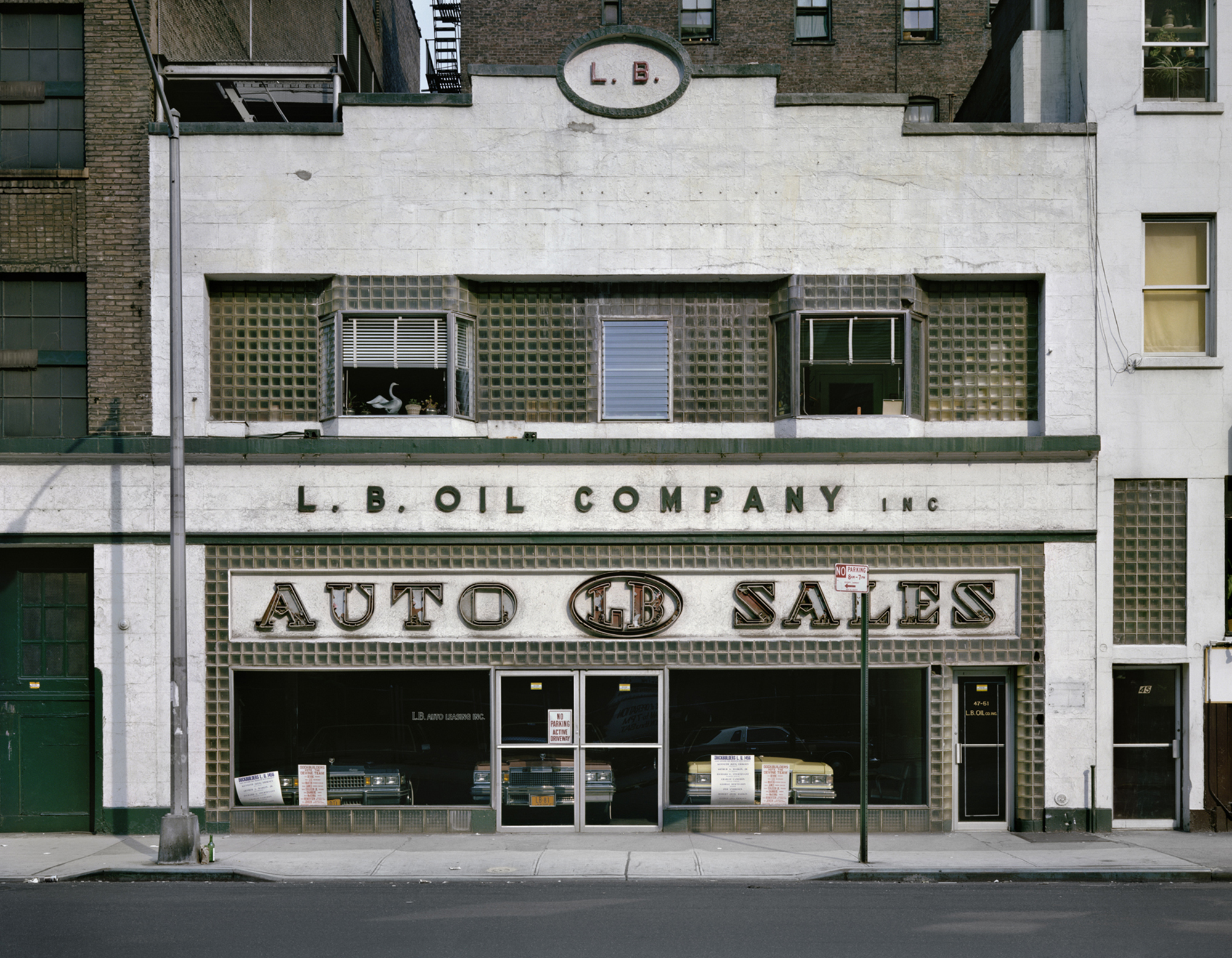
These remind me very strongly of the 1970s urban Americana colour work of Stephen Shore. Most of them are successful, well seen, well photographed colour images that evince a certain period in the American cultural landscape.
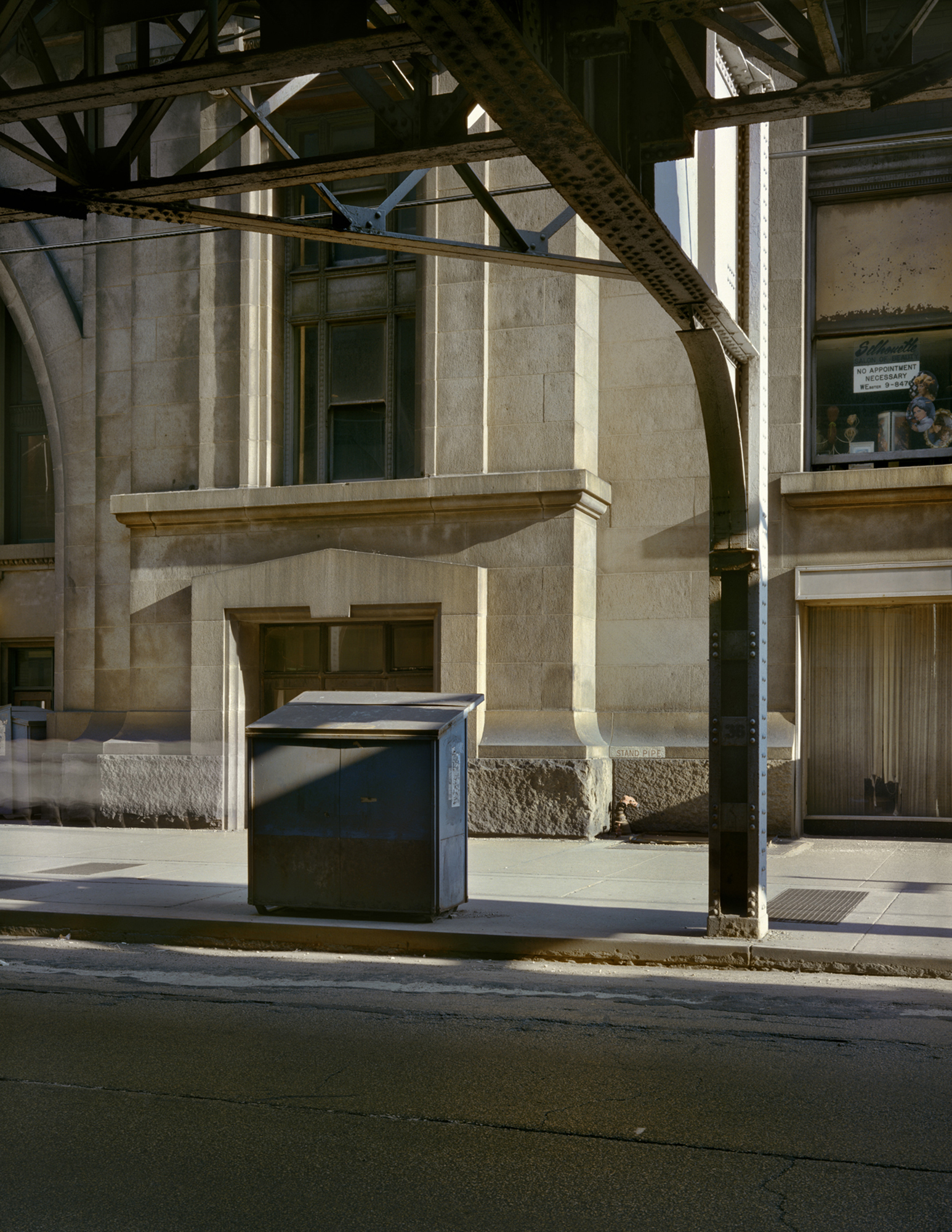
When they work – as in the formal Vinegar Hill, New York (1985, above) or the more abstract Vinegar Hill, New York (1985, below); the colourful, planar Varick Street, New York (1984); the duo-chromatic L.B. Oil, New York (1984); the magnificently shadowed, geometric Halsted Street, Chicago (1978); and my particular favourite (because of the light), Under the EL, Chicago (1978) – they work superbly. When they don’t work – as in Blankets, New York (1986) or Barbers, New York (1985) – they feel a bit flat.
It’s so hard to put a body of photographs together where each image is as strong (but not necessarily the same) as the next and they form a holistic group. Most photographers can put together four images well enough, but the skill is to be able to narrativise a larger body of work, and then do that over a longer period of time.
I believe that over the lifetime of a photographic artist, you can count on the fingers of two hands the truly memorable images they will make, if they are lucky. Other images are valuable in their own right… while others should be quietly singed.
Dr Marcus Bunyan
Many thankx to the Mike and Joseph Bellows Gallery for allowing me to publish the photographs in the posting. Please click on the photographs for a larger version of the image.
Wayne Sorce (American, b. 1946) Vinegar Hill, New York 1985 Digital chromogenic print 20 x 24 inches
Wayne Sorce (American, b. 1946) Varick Street, New York 1984 Digital chromogenic print 20 x 24 inches
Wayne Sorce (American, b. 1946) Halsted Street, Chicago 1978 Digital chromogenic print 20 x 24 inches
Wayne Sorce (American, b. 1946) L.B. Oil, New York 1984 Digital chromogenic print 20 x 24 inches
Wayne Sorce (American, b. 1946) Spiral Fire Escape, Chicago 1975 Digital chromogenic print 20 x 24 inches
Wayne Sorce (American, b. 1946) No Left, Vinegar Hill 1988 Digital chromogenic print 20 x 24 inches
Wayne Sorce (American, b. 1946) Dave’s Restaurant, New York 1984 Digital chromogenic print 20 x 24 inches
Wayne Sorce (American, b. 1946) EL Platform, Chicago 1978 Digital chromogenic print 20 x 24 inches
Wayne Sorce (American, b. 1946) Bee Gee’s, New York 1984 Digital chromogenic print 20 x 24 inches
Wayne Sorce (American, b. 1946) Fort Dearborn Coffee, Chicago 1977 Digital chromogenic print 20 x 24 inches
Wayne Sorce (American, b. 1946) East Chicago 1977 Digital chromogenic print 20 x 24 inches
Wayne Sorce (American, b. 1946) Chock Full of Nuts, New York 1984 Digital chromogenic print 20 x 24 inches
Joseph Bellows Gallery is pleased to announce its upcoming solo exhibition,Wayne Sorce: Urban Color. The exhibition will open on October 21st and continue through November 30th, 2017. In conjunction with Sorce’s exhibition will be a group show relating to the city as subject.
Urban Color will present a remarkable selection Sorce’s large-scale colour photographs of urban environments taken in the late 1970’s and early 1980’s in both Chicago and New York City. His urban landscapes describe with a formal exactitude, the light, structures, and palette of these cities within a certain era. For Sorce, the urban landscape is both still and transitory; people appear in the photographs as both inhabitants of the city, as well as sculptural forms relating to a larger composed scene.
Sorce’s photographs are held within the collections of the Art Institute of Chicago, the George Eastman Museum, the Armand Hammer Museum of Art, National Museum of American Art, at the Smithsonian Institution, and the Museum of Modern Art. Complementing Sorce’s exhibition will be a collection of photographs by his contemporaries that describe the city as subject. Work by Bob Thall, George Tice, Bevan Davies, Grant Mudford, and others will be included.
Press release from the Joseph Bellows Gallery
Wayne Sorce (American, b. 1946) Under the EL, Chicago 1978 Digital chromogenic print 24 x 20 inches
Wayne Sorce (American, b. 1946) Blankets, New York 1986 Digital chromogenic print 24 x 20 inches
Wayne Sorce (American, b. 1946) Barbers, New York 1985 Digital chromogenic print 24 x 20 inches
Wayne Sorce (American, b. 1946) Greyhound Station c. 1970’s Digital chromogenic print 24 x 20 inches
Joseph Bellows Gallery 7661 Girrard Avenue La Jolla, California Phone: 858 456 5620
Opening hours: Tuesday – Saturday 11am – 5pm and by appointment
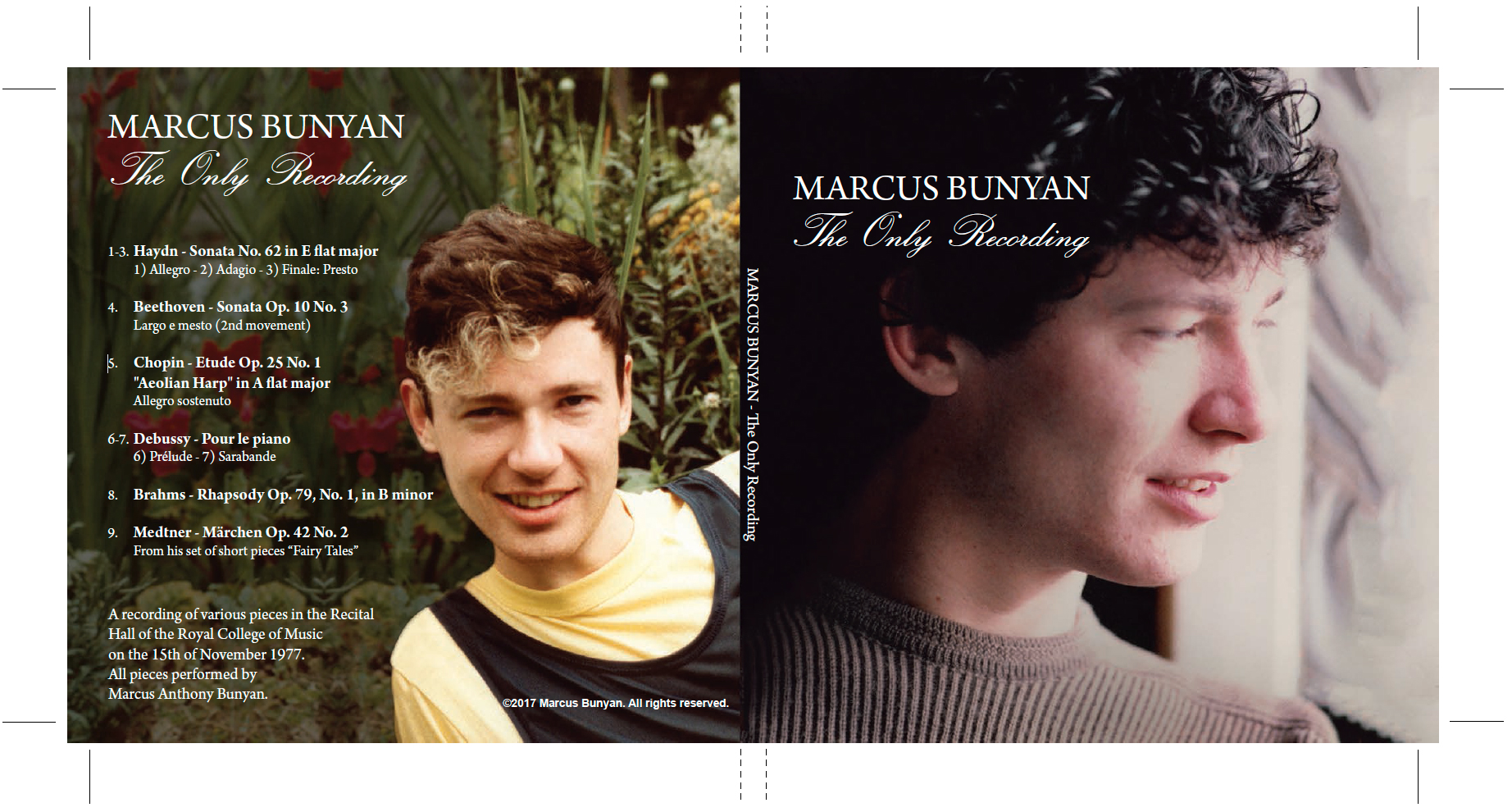
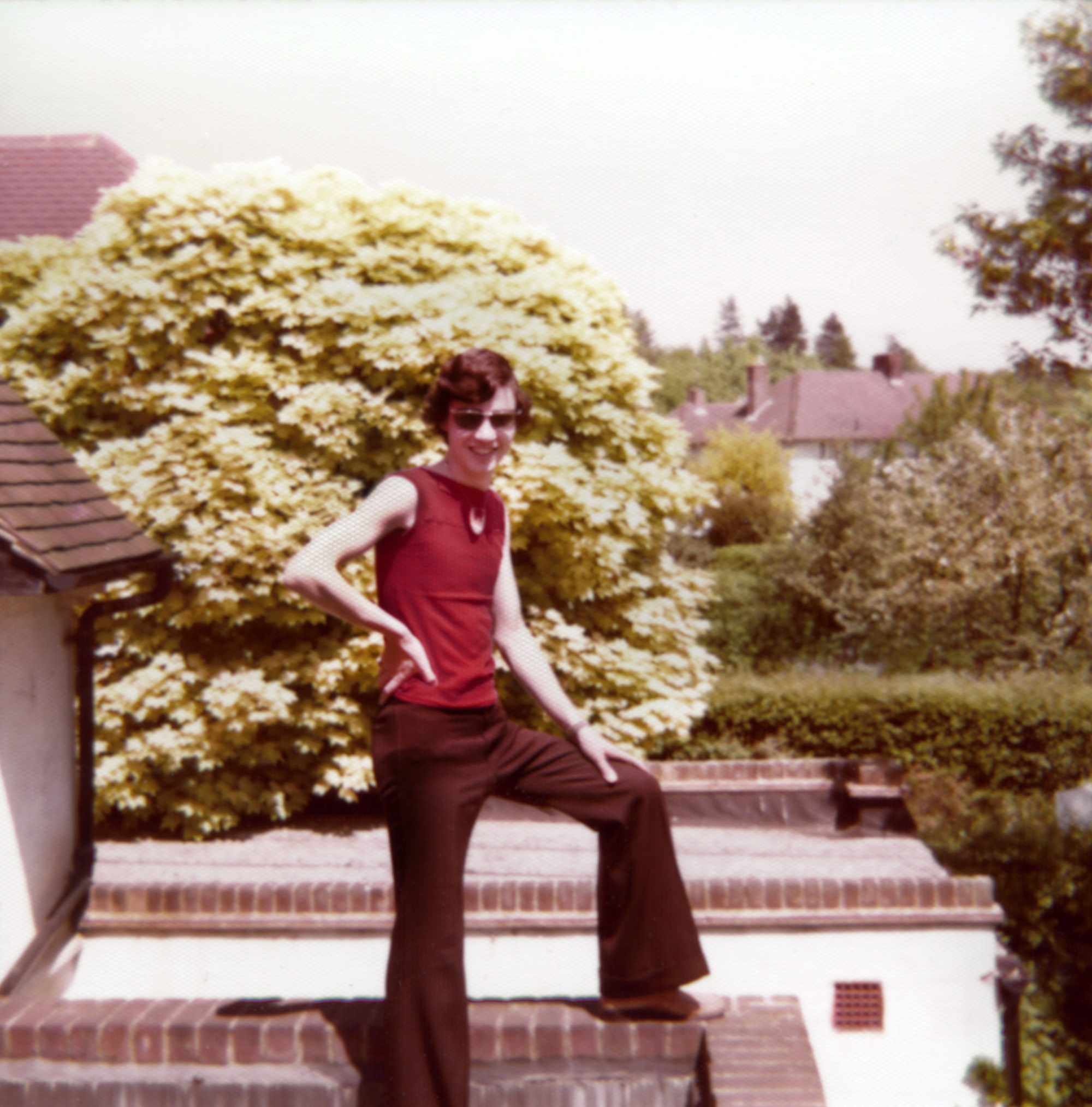
A recording of various pianoforte pieces in the Recital Hall of the Royal College of Music, London on the 15th November 1977. All pieces performed by Marcus Bunyan. I was 19 years old (as in the photographs below). Nobody ever believes me that I was a concert pianist. Well here is the proof!
1/ Haydn – Sonata No. 62 in E flat major I. Allegro 2/ Haydn – Sonata No. 62 in E flat major II. Adagio 3/ Haydn – Sonata No. 62 in E flat major III. Finale: Presto 4/ Beethoven – Sonata Op. 10 No. 3 II. Largo e mesto 5/ Chopin – Etude Op. 25 No. 1 “Aeolian Harp” in A flat major – Allegro sostenuto 6/ Debussy – Pour le Piano I. Prelude 7/ Debussy – Pour le Piano II. Sarabande 8/ Brahms – Rhapsody Op. 79 No. 1 in B minor 9/ Medtner – Marchen Op. 42 No. 2
Marcus Bunyan (Australian born England, b. 1958) The Only Recording 1977 (2017) CD cover
The only recording of myself as a concert pianist. Yes, really!
Recorded in the Recital Hall of the Royal College of Music, London on the 15th November 1977 when I was 19 years old, on a reel to reel tape deck. 40 years ago this year.
I heard it recently for the very first time. My friend Daniel Desiere from Dex Audio, Jeff Whitehead and myself were surprised at the sound quality, and it was an emotional experience to listen to me playing all those years ago. It almost seems like another life. Daniel and the team at Dex Audio in Melbourne have done a fabulous job producing a master and they have burnt it to disc in 20 copies.
I attained my degree (A.R.C.M. Associate of the Royal College of Music) as a concert pianist at 20 and did a postgraduate year before giving up the piano after 16 years. I had been a child prodigy since the age of 6 but enough was enough.
Looking back now I wonder how I made such glorious music given the upheaval in my life at the time. I loved the romantics especially Chopin, Debussy, etc…
Love to my early self.
Marcus xxxx
Unknown photographer Marcus Bunyan, 19 years old, Welwyn Garden City, Hertfordshire 1977 Colour photograph
Exhibition dates: 30th September – 12th November, 2017
Curators: Naomi Cass and Pippa Milne
Living artists include: Laurence Aberhart, Brook Andrew, Rushdi Anwar, Warwick Baker, Paul Batt, Robert Billington, Christian Boltanski, Pat Brassington, Jane Brown, Daniel Bushaway, Sophie Calle, Murray Cammick, Christian Capurro, Steve Carr, Mohini Chandra, Miriam Charlie, Maree Clarke, Michael Cook, Bill Culbert, Christopher Day, Luc Delahaye, Ian Dodd, William Eggleston, Joyce Evans, Cherine Fahd, Fiona Foley, Juno Gemes, Simryn Gill, John Gollings, Helen Grace, Janina Green, Andy Guérif, Siri Hayes, Andrew Hazewinkel, Lisa Hilli, Eliza Hutchison, Therese Keogh, Leah King-Smith, Katrin Koenning, O Philip Korczynski, Mac Lawrence, Kirsten Lyttle, Jack Mannix, Jesse Marlow, Georgie Mattingley, Tracey Moffatt, Daido Moriyama, Harry Nankin, Jan Nelson, Phuong Ngo.
Historic photographers: Hippolyte Bayard (French, 1801-1887), Charles Bayliss (Australian born England, 1850-1897), Bernd and Hilla Becher (German; Bernd Becher 1931-2007, Hilla Becher 1934-2015), Lisa Bellear (Australian / Goernpil, 1962-2006), James E. Bray (Australian, 1832-1891), Jeff Carter (Australian, 1928-2010), Harold Cazneaux (Australian, 1878-1953), Olive Cotton (Australian, 1911-2003), Peter Dombrovskis (Australian, 1995-1996), Max Dupain (Australian, 1911-1992), Joyce Evans (Australian, 1929-2019), Walker Evans (American, 1903-1975), Sue Ford (Australian, 1943-2009), Marti Friedlander (New Zealand born Britain, 1928-2016), Kate Gollings (Australian, 1943-2017), André Kertész (Hungarian, 1894-1985), J. W. Lindt (Australian born Germany, 1845-1926), W. H. Moffitt (Australian, 1888-1948), David Moore (Australian, 1927-2003), Michael Riley (Australian / Wiradjuri/Kamilaroi, 1960-2004), Robert Rooney (Australian, 1937-2017), Joe Rosenthal (American, 1911-2006), Mark Strizic (Australian, 1928 -2012), Ingeborg Tyssen (Australian, 1945-2002), Aby Warburg (German, 1866-1929), Charles Woolley (Australian, 1834-1922).
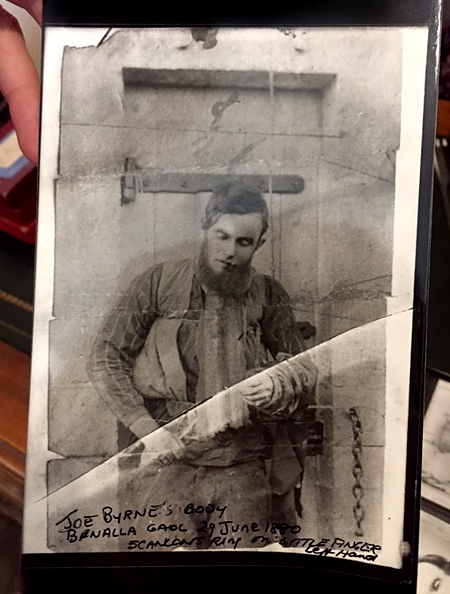
(1) J W Lindt (Australian, 1845-1926) Body of Joe Byrne, member of the Kelly Gang, hung up for photography, Benalla 1880 Courtesy State Library Victoria, Pictures Collection
Thought to be the first press photograph in Australia, this shows Joe Byrne, a member of the Kelly Gang, strung up for documentation days after his death, which followed the siege at Glenrowan. Byrne is displayed for an unknown photographer and the painter Julian Ashton who is standing to the left with possibly a sketchbook under his arm. Lindt’s photograph captures not only the spectacle of Byrne’s body but the contingent of documentarians who arrived from Melbourne to record and widely disseminate the event for public edification.
Double take
I was a curatorial interlocutor for this exhibition so it was very interesting to see this exhibition in the flesh.
An unorthodox flow of images is a strong exhibition, splendidly brought to fruition by curators Naomi Cass and Pippa Milne at the Centre for Contemporary Photography (CCP), Melbourne. To be able to bring so many themes, images, ideas and people together through a network of enabling, and a network of images, is an impressive achievement.
The exhibition explores the notion of connectivity between images in our media saturated world – across context, time and space. “With a nod to networked image viewing behaviour and image sharing – in one long line – the flow also impersonates the form of a sentence.” While the viewer makes their own flows through the works on view, they must interpret the interpolation of images (much like a remark interjected in a conversation) in order to understand their underlying patterns of connection. Like Deleuze and Guattari’s horizontal rhizome theory1 – where the viewer is offered a new way of seeing: that of infinite plateaus, nomadic thought and multiple choices – here the relationship between the photograph and its beholder as a confrontation between self and other, and the dynamic relation between time, subjectivity, memory and loss is investigated … with the viewer becoming an intermediary in an endless flow of non-hierarchical images/consciousness.
In this throng of dialects, the exhibition meanders through different “sections” which are undefined in terms of their beginning and end. The starting point for this flow is the public demonstration of trauma for the edification of society (the photographs of the aftermath of the siege of Ned Kelly and his gang at Glenrowan), notably what is thought to be the first press photograph in Australia, J W Lindt’s Body of Joe Byrne, member of the Kelly Gang, hung up for photography, Benalla (1880, above), and the flow then gathers its associations through concepts such as studio work, the gaze, disruption, truth, performance and traces, to name just a few. The exhibition ceaselessly establishes connections between semiotic chains, organisations of power and contextual circumstances, moving forward and backwards in time and space, jumping across the gallery walls, linking any point to any point if the beholder so desires. In this sense (that of an expanded way of thinking laterally to create a democracy of sight and understanding), the exhibition succeeds in fostering connections, offering multiple entryways into the flow of images that proposes a new cultural norm.
For Deleuze and Guattari these assemblages (of images in this case), “… are the processes by which various configurations of linked components function in an intersection with each other, a process that can be both productive and disruptive. Any such process involves a territorialization; there is a double movement where something accumulates meanings (re-territorialization), but does so co-extensively with a de-territorialization where the same thing is disinvested of meanings.”2 Now here’s the rub (or the trade-off if you like) of this exhibition, for everything in life is a trade-off: the accumulation of new meaning that such a flow of images creates is balanced by what has been lost. Both an accumulation and disinvestment of meaning.
I have a feeling that in such a flow of images the emotion and presence of the subject has been lost, subsumed into a networked, hypermedia flow where, “images become more and more layered until they are architectural in design, until their relationship to the context from which they have grown cannot be talked about through the simple models offered by referentiality, or by attributions of cause and effect.”3 The linear perspective developed during the Renaissance and its attendant evidence of truth / objective reality (the logic of immediacy) is disrupted. It is no longer about being there, about the desire for presence, but about a logic of hypermediacy that privileges fragmentation, process, and performance. Of course, immediacy / hypermediacy are part of a whole and are not exclusionary to each other. But here contemporary art, and in particular contemporary photography, keeps coming back to the surface, redefining conceptual and aesthetic spaces.
This is where I was plainly unmoved by the whole exhibition. Conceptually and intellectually the exhibition is very strong but sequentially and, more importantly, emotionally – the flow of images failed to engage me. The dissociative association proposed – like a dissociative identity disorder – ultimately becomes a form of ill/literation, in which the images seem drained of their passion, a degenerative illness in which all images loose their presence and power. In a media saturated world what does it mean to pluck these images from a variable spatio-temporal dimensionality and sequence them together and hope they give meaning to each other? Ultimately, it’s a mental exercise of identity organisation that is pure construct.
Further, this (re)iteration is a repetition that is supposed to bring you successively closer to the solution of a problem: what is the relevance of the stream of image consciousness in contemporary society? What happens to the referentiality and presence of the individual image?
With this in mind, let us return to the first image in the flow of images, J W Lindt’s Body of Joe Byrne, member of the Kelly Gang, hung up for photography, Benalla (1880, above). Here Byrne is displayed for an unknown photographer and the painter Julian Ashton who is standing to the left with possibly a sketchbook under his arm. Amongst other things, the image is by a photographer taking a photograph of another photographer taking a photograph of the body of Joe Byrne. Immediately, the triangular relationship of camera / subject / viewer (cause and effect) is disrupted with the addition of the second photographer. There is a doubling of space and time within this one image, as we imagine the image the photographer in the photograph would have taken. And then we can see two variations of that internal photograph: Photographer unknown Joe Byrne’s Body, Benalla Gaol, 29 June 1880 (below) and William J. Burman’s Joe Byrne’s Body, Benalla Gaol, 29 June 1880 (1880, below) which 1/ appears to solve who the “photographer unknown” is (unless Burman purchase the rights to use another’s photographers’ negatives); and 2/ is a more tightly framed image than the first iteration. If you look at the top of the head in the second image the hair goes over the metal hinge of the door behind… so the photographer (the same one) has moved closer and dropped the height of the camera, so that the camera looks up more, at the body.
Other details fascinate. The ring on the left finger of Joe Byrne; his stripped shirt; the rope under his arms used to help support his weight; the rope disappearing out of picture to help string him up; and questions such as, how did they get his left hand to stay in that position? This is also, “an image of an audience as much as a portrait of the deceased … Members of the public are also documented; children, men – trackers perhaps, bearing witness to the public display of retribution that was intended to restore social order.” To the left we have what is presumably the photographers’ coat hung on a tree; a man wiping his nose with his thumb; and Aboriginal man; and a boy looking at the camera. Through his silhouette the Aboriginal man can probably be identified as Tracker Johnny, one of five trackers who helped track Ned Kelly, and we can see a portrait of him in an albumen photograph held by the Queensland Police Museum (1880, below). A picture of the ‘Other’, both outsiders, the outlaw and the Aboriginal, detailing the social order. The blurred image of the boy looking at the camera shows the length of the time exposure for the glass plate, but it is his “Janus-faced” visage that I am fascinated with… as he both looks forwards and backwards in time. Whilst most images within An unorthodox flow of images are conceptually grounded, they also evidence only one direct meaning in relationship to themselves within that network, “each one connected to those on either side,” – from point to point to point. Conversely, in this image the interpretation is open-ended, WITHIN THE ONE IMAGE. It is a network all of its own. I also remember, emotionally, the other images of the burnt out Glenrowan Inn, the place where the rails were taken up (I was there!), the bodies in the coffins, the preparation for the photograph of the Kelly Gang Armour laid out in a muddy field for documentation, and the burnt to a cinder, charred remains rescued from the ashes of the Glenrowan Inn laid out on a piece of wood. There is a physicality to these photographs, and an emotional charge, that no other photograph in this exhibition matches. I think, then, not of Joe Bryne’s lifeless body and its/the photographs morbidity, but of him as a younger man – standing legs crossed, one hand on hip, the other resting on the surface of a table, imagining his touch on that table in reality – a son, an outlaw, a living being.
I wish the curators had been braver. I wish that they had given these images more chance to breathe. I wish they had cut the number of images and sequenced them so that the space between them (what Minor White calls ice/fire, that frisson of space between two images that adds to their juxtaposed meaning) provided opportunity for a more emotional engagement with what was being presented. Yes, this is a strong exhibition but it could have been so much more powerful if the flow had not just meandered through the sentence, but cried out, and declaimed, and was quiet. Where was the punctum? Where was the life blood of the party, if only disappearing in a contiguous flow of images.
Dr Marcus Bunyan
Word count: 1,642
Footnotes
1/ Deleuze, Gilles and Guattari, Felix. A Thousand Plateaus: Capitalism and Schizophrenia. Minneapolis and London: University of Minneapolis Press, 1987
2/ Wood, Aylish. “Fresh Kill: Information technologies as sites of resistance,” in Munt, Sally (ed.,). Technospaces: Inside the New Media. London: Continuum, 2001, p. 166
3/ Burnett, Ron. Cultures of Vision: Images, Media, & the Imaginary. Bloomington: Indiana University Press, 1995, pp. 137-138.
Many thankx to the CCP for allowing me to publish the photographs in the posting. Please click on the photographs for a larger version of the image. The numbers in brackets refer to the number of the image in the field guide. The text is taken from the field guide to the exhibition [Online] Cited 01/11/2017. No longer available online.
J W Lindt (Australian, 1845-1926) Body of Joe Byrne, member of the Kelly Gang, hung up for photography, Benalla (details) 1880 Courtesy State Library Victoria, Pictures Collection
An unorthodox flow of images commences with what is known as the first press photograph in Australia and unfurls through historic, press, portraiture, popular and art photography, some in their intended material form and others as reproductions. An unbroken thread connects this line of still and moving images, each tied to those on either side through visual, conceptual, temporal, material or circumstantial links.
This is a proposition about photography now. Relationships between images are sometimes real, and sometimes promiscuous. Unorthodox brings new contexts to existing artworks whilst celebrating the materiality of real photographs, in real time and critically, honouring the shared democratic experience of the public gallery space.
This image appears to the one of the images taken by the photographer in J. W. Lindt’s Body of Joe Byrne, member of the Kelly Gang, hung up for photography, Benalla 1880(above)
William J. Burman (Australian born England, 1814-1890) Joe Byrne’s Body, Benalla Gaol, 29 June 1880 1880 At 209 Bourke Street, East Melbourne 1878-1888 Albumen carte de visite 6.5 × 10.5cm
This image appears to the one of the images taken by the photographer in J. W. Lindt’s Body of Joe Byrne, member of the Kelly Gang, hung up for photography, Benalla 1880.
Unknown photographer Untitled [Portrait of Tracker Johnny from Maryborough District one of five trackers who helped track Ned Kelly] (detail, not in exhibition) c. 1880 Albumen photograph Queensland Police Museum Non-commercial – Share Alike (cc)
“As objects of contemplation, images of the atrocious can answer to several different needs. To steel oneself against weakness. To make oneself more numb. To acknowledge the existence of the incorrigible.”
~ Susan Sontag, Regarding the Pain of Others (2003)
In her comments on a related photograph by Bray, Helen Ennis writes, “What you see pictured, presumably as part of the official documentation are the thoroughly blackened remains of either Dan Kelly or Steve Hart… Relatives raked what remained of the bodies… from the ashes of the Glenrowan Inn. These were then photographed before family members took them home on horseback and buried them. … [These photographs] also underscore the brutality and barbarism of the post-mortem photographs – the violence physically enacted on the body in the first instance and then visually in terms of the photographic representation.”
Helen Ennis. “Portraiture in extremis” in Photogenic Essays / Photography / CCP 2000-2004, Daniel Palmer (ed.), 2005, CCP, pp. 23-39, p. 34
W. E. (William Edward) Barnes (Australian, 1841-1916) Steve Hart (1859-1880) (not in exhibition) c. 1878 Albumen carte de visite State Library of Victoria
(9) Piero della Francesca (Italian, 1415-1492) Flagellation of Christ 1455-1460 Oil and tempera on wood, reproduced as digital print on wallpaper 58.4 × 81.5 cm, reproduced at 20 × 30 cm
The meaning of della Francesca’s Flagellation and exact identity of the three foreground figures in fifteenth century dress, is widely contested. In the context of this flow of images, the painting represents the pubic display of suffering as punishment, for the edification of society. In both J.W. Lindt’s documentary photograph and the possibly allegorical Flagellation, the broken body of Joe Byrne and that of Christ are isolated from other figures and subject of conversation and debate by gathered figures. Other formal similarities include framing of the tableau into shallow and deep space the organising role of architecture in signifying the key subject.
(10) Joosep Martinson Police Hostage Situation Developing at the Lindt Café in Sydney 2014 Digital print on wallpaper 20 × 30cm
The scene outside the Lindt Cafe siege, caught by the photojournalist in a moment of public trauma. This bears formal resemblance to J.W. Lindt’s photograph of Joe Byrne, and even further back to Piero della Francesca.
(13) Tracey Moffatt (Australian, b. 1960) I made a camera 2003 photolithograph 38 × 43cm, edition 201 of 750 Private collection
Returning to J.W. Lindt’s photograph in particular the hooded central figure photographing Joe Byrne – Tracey Moffatt’s picturing of children role-playing calls to mind the colonial photographer’s anthropological gesture.
(14) Siri Hayes (Australian, b. 1977) In the far reaches of the familiar 2011 C-type print 88 × 70 cm, exhibition print Courtesy the artist
The photographer’s hood is the photographer.
(15) Janina Green (Australian born Germany, b. 1944) Self Portrait 1996 Digital version of a hand-coloured work in early Photoshop 44 × 60cm Courtesy the artist and M.33, Melbourne
(16) Georgie Mattingly Portrait IV (After Arthroplasty) 2016 Hand-tinted silver gelatin print 36 × 26cm Unique hand print Courtesy the artist
The photographer’s hood has become a meat-worker’s protective gear, tenderly hand-coloured. [And spattered with blood ~ Marcus]
(17) Lisa Hilli (Makurategete Vunatarai (clan) Gunantuna / Tolai People, Papua New Guinea) In a Bind 2015 Pigment print on cotton rag 76 × 51.5cm Courtesy the artist
‘The woven material that hoods the artist’s identity is a reference to collected Pacific artefacts, which are usually of a practical nature. Magimagi is a plaited coconut fibre used for reinforcing architectural structures and body adornment within the Pacific. Here it emphasises the artist’s feeling of being bound by derogatory Western and anthropological labels used by museums and the erasure of Pacific bodies and narratives within public displays of Pacific materiality.’ ~ Lisa Hilli 2017, in an email to the curator
In an era of ‘tumbling’ images, An unorthodox flow of images presents visual culture in a novel way: commencing with Australia’s first press photograph, 150 images unfurl in flowing, a-historical sequences throughout the gallery. Each work is connected to the one before through formal, conceptual or material links.
An unorthodox flow of images draws upon the photographic image in its many forms, from significant historical photographs by major Australian artists, such as J.W. Lindt, Olive Cotton and Max Dupain, through to contemporary international and Australian artists, such as Tracey Moffatt, Michael Parekowhai, Christian Boltanski and Daido Moriyama. This exhibition brings early career artists into the flow, including Georgie Mattingley, Jack Mannix and James Tylor.
Celebrating the breadth of photographic technologies from analogue through to digital, including hand made prints, a hand-held stereoscope, early use of Photoshop, iPhone videos and holography, An unorthodox flow of images propels the viewer through a novel encounter with technology, art, and the act of looking. Rather than a definitive narrative, this exhibition is a proposition about relationships between images: sometimes real and sometimes promiscuous, and is inevitably open to alternative readings. Contemporary culture necessitates quick, networked visual literacy. So viewers are invited to make their own readings of this unorthodox flow.
Akin to how images are experienced in our personal lives and perhaps to how artists are influenced by the multiverse of photography, this extraordinary gathering also includes spirited incursions from other kinds of images – rare prints of grizzly 19th century photojournalism abuts contemporary video first shared on Instagram, and surrealist French cinema nestles in with Australian image-makers.
This exhibition aims to bring new contexts to existing artworks to highlight networked image-viewing behaviour, whilst honouring the materiality of real photographs, in real time and critically, honouring the shared democratic experience of the public gallery space. An unorthodox flow of images is presented as part of the 2017 Melbourne Festival.
Press release from the CCP
(30)Siri Hayes (Australian, b. 1977) Plein air explorers 2008 C-type print 108 × 135cm, edition 4 of 6 Collection of Jason Smith
An artist’s studio in the landscape.
(31) Robyn Stacey (Australian, b. 1952) Wendy and Brett Whiteley’s Library 2016 From the series Dark Wonder C-type print 110 × 159cm, edition of 5 + 3 artist proofs Courtesy the artist and Jan Manton Gallery, Brisbane
The landscape brought into the studio by a camera obscura. Robyn Stacey captures the perfect moment of light and clarity, in this instance, also turning the egg-object into an orb of light.
(37) Pat Brassington (Australian, b. 1942) Vedette 2015 Pigment print 75 × 60cm, edition of 8, Courtesy the artist and ARC ONE Gallery, Melbourne and Bett Gallery, Hobart
Two orbs, a positive and a negative space.
(38) Anne Noble (New Zealand, b. 1954) Ruby’s Room 10 1998-2004 Courtesy the artist and Two Rooms Gallery Auckland
(43) Leah King-Smith (Australian / Bigambul, b. 1957) Untitled #3 1991 From the series Patterns of connection C-type print 102 × 102cm, edition 6 of 25 Private collection
‘I was seeing the old photographs as both sacred family documents on one hand, and testaments of the early brutal days of white settlement on the other. I was thus wrestling with anger, resentment, powerlessness and guilt while at the same time encountering a sense of deep connectedness, of belonging and power in working with images of my fellow Indigenous human beings.’ ~ L King-Smith, White apron, black hands, Brisbane City Hall Gallery, 1994, p. 7. In this series, the artist superimposes the colonial portrait onto images of the subject’s own landscape, returning the dispossessed to country.
Unorthodox: a field guide
We could have started anywhere. Perhaps every image ever made connects with another image in some way. But, we have begun with what is known as the first press photograph in Australia – a grisly depiction of Kelly Gang member Joe Byrne, strung up some days after his execution, for a group of onlookers, including a group of documentarians who came in by train to record the event: a painter and several photographers. This is an image of an audience as much as a portrait of the deceased. A hooded photographer bends to his tripod, and a painter waits in line. Perhaps a seminal moment between competing technologies of record, magnificently captured by colonial photographer, J. W. Lindt (1845-1926): this is as decisive a moment as current technology permitted. Members of the public are also documented; children, men – trackers perhaps, bearing witness to the public display of retribution that was intended to restore social order.
From here, Unorthodox draws a thread of images together, each one connected to those on either side, whether through visual, conceptual, temporal, material or circumstantial ties, or by something even more diffuse and smoky – some images just conjure others, without a concrete reason for their bond. Spanning the entire gallery space, nearly 150 images unfurl with links that move through historic, press, portraiture, popular and art photography.
You are invited to wander through CCPs nautilus galleries, and make what you will of this flow because unlike a chain of custody, there is no singular narrative or forensic link: you are invited to explore not just connections between works but to see individual works in a new light.
At the core of this exhibition is an attempt to lay bare the way that images inform and seep into everyday life, underpinning the way that we see, interpret and understand the world. With a nod to networked image viewing behaviour and image sharing – in one long line – the flow also impersonates the form of a sentence.
The act of looking. Looking is a process, informed by context – where and when we see something, and what surrounds it. Here, images are unbuckled from their original context, indeed there are no museum labels on the wall. But this is often the way when viewing images on the internet, or reproduced in books, referenced in ads, reenacted in fashion shoots, or reinterpreted by artists. The notion of reproductions within photography is slippery, made more so by the rapid circulation of images whereby we sometimes only know certain originals through their reproductions. In this exhibition, sometimes we have the original images, at others we proffer ‘reproductions’, setting out a swathe of contemporary and historical approaches to the craft of photography and video, unhampered by traditional constraints of what we can or cannot show within a non-collecting contemporary art space.
This exhibition moves through a number of notional chapters, for example visual connections can be made between orbs made by soap bubbles (no. 32, 34) and moons (no. 33); eyes (no. 40, 41, 42), gaping mouths (no. 37), the balletic body in space (no. 45); and light from orbs (no. 44, 46) and then moonlight on the ocean (no. 47), which tumbles into salty connections, with photographs exposed by the light of the moon through seawater (no. 48) connecting to an image of salt mines (no. 50), and on to salt prints (no. 51).
We have been influenced by observing how audiences view exhibitions, traversing the space, seemingly drawing connections, making their own flows through works on view. In spite of its indexicality to the world, photography is particularly open to multiple readings due to its reproducibility and its vulnerability to manipulation. A key to this permeability is the intention of the photographer, which can become opaque over time. For example, installation artist Christian Boltanski’s found photograph (no. 137) has been taken out of its time and context so as to mean something quite different from what the photographer intended.
Importantly, due to their multiple readings, many works could be equally effective if placed in other sections of the exhibition. For example, of the many places to position Leah King-Smith’s Untitled #3 (no. 43), we have elected to locate it amongst compositions that include orbs. However, it is also a staged work; a constructed or collaged photograph; it embodies an Indigenous artist returning the colonial gaze and, due to the age of her source photograph, it represents a deceased person. And, in her own words King-Smith is responding to the trauma of settlement. ‘I was thus wrestling with anger, resentment, powerlessness… while at the same time encountering a sense of deep connectedness, of belonging and power in working with images of my fellow Indigenous human beings.’
A curious process indeed, we have been open to many repositories of images while gathering this flow – from our work with artists at CCP; to childhood memories of images and personal encounters with photography and video; to our trawling of the Internet and books; as well as conversations with writers, artists and collectors. From these stores, we have also considered which works were available in their material form, as opposed to reproductions on wallpaper, postcards and record covers. While we exhibit a broad timespan and multiple technologies, our primary desire as a contemporary art space is to create new contexts for the exhibition of contemporary photography and video.
Unorthodox is a proposition about relationships between images: sometimes real and sometimes promiscuous, and is inevitably open to alternative readings. It brings new contexts to existing artworks whilst celebrating the materiality of real photographs, in real time and critically, honouring the shared democratic experience of the public gallery space.
Naomi Cass and Pippa Milne
(62) Brook Andrew (Australian, b. 1970) I Split Your Gaze 1997, printed 2005 Silver gelatin print 160 × 127cm Private collection Courtesy the artist and Tolarno Galleries, Melbourne; Roslyn Oxley9 Gallery, Sydney; and Galerie Nathalie Obadia, Paris and Brussels
(63) Brassaï (French, 1899-1984) Young couple wearing a two-in-one suit at Bal De La Montagne Saint-Genevieve c. 1931 Gelatin silver print Reproduced as digital print on wallpaper 23.2 × 15.9cm, reproduced at 24.5 × 19cm
(64) William Yang (Australian, b. 1943) Alter Ego 2000 from the series Self Portraits Inkjet print, edition 2 of 30 68 × 88cm Courtesy the artist
(65) Sue Ford (Australian, 1943-2009) Lyn and Carol 1961 Silver gelatin print, edition 3 of 5 44 × 38cm Courtesy Sue Ford Archive
(76) Harold Cazneaux (Australian, 1878-1953) Spirit of Endurance 1937 Silver gelatin print 16.8 × 20.4cm Private collection
In the following two works, a critical change of title by the artist reveals what, alone, the eye cannot see. This photograph had already achieved iconic status as a symbol of the noble Australian landscape when, following the loss of his son who died aged 21 at Tobruk in 1941, Cazneaux flipped the negative and presented the image under the new title Spirit of Endurance. The tree is now classified on the National Trust of South Australia’s Register of Significant Trees.
(77) Jeff Carter (Australian, 1928-2010) The Eunuch, Marree, South Australia 1964 Silver gelatin print 37.5 × 27.2cm Private collection
Changing a title can dramatically alter the meaning of an image. This work has had several titles:
Morning Break 1964; Dreaming in the sun at Marree, outside the towns single store 1966; At times there is not too much to do except just sit in the sun… 1968; ‘Pompey’ a well known resident of Marree; and finally The Eunuch, Marree, South Australia 2000
Under early titles, the photograph appeared to be a simple portrait of “Pompey”, a local Aboriginal man in Marree who worked at the town’s bakery. The final title draws viewers’ attention away from what might have seemed to be the man’s relaxed approach to life, and towards the violence enacted on Aboriginal communities in castrating young boys.
(82) Photographer undisclosed Persons Of Interest – ASIO surveillance images 1949 -1980 ‘Frank Hardy under awning Caption: Author Frank Hardy shelters under an awning, in the doorway of the Building Workers Industrial Union, 535 George St, Sydney, August 1955’ C-type prints 22 × 29cm each Private collection
The Australian Security and Intelligence Organisation (ASIO) employed photographers to spy on Australian citizens. The photographs which were annotated to indicate persons of interest, were retained by ASIO along with other forms of material gathered through espionage.
(85) Luc Delahaye (French, b. 1962) L’Autre (detail) 1999 Book published by Phaidon Press, London 17 × 22cm Private collection
In the footsteps of Walker Evans’ classic candid series, Rapid Transit 1956
(94) David Moore (Australian, 1927-2003) Migrants arriving in Sydney 1966 Silver gelatin print 35.7 × 47cm Private collection
In 2015, Judy Annear said of this famous photograph: “It’s great to consider that it’s not actually what it seems.” Years after the photo was published, it emerged that four of the passengers in it were not migrants but Sydneysiders returning home from holiday.
(95) Joe Rosenthal (American, 1911-2006) Raising the Flag on Iwo Jima 1945 Digital print on wallpaper, reproduced at 20 × 25cm
While not present at the the raising of the first flag over Iwo Jima, Rosenthal witnessed the raising of the replacement flag. Some maintain that this Pulitzer Prize winning photograph was staged, while others hold that it depicts the replacement of the first flag with a larger one.
(103) Charles Kerry (Australian, 1857-1928) Aboriginal Chief c. 1901-1907 Carte de visite 13.7 × 8.5 cm Private collection
No name or details are recorded of this sitter from Barron River, QLD. He was a member of the touring Wild West Aboriginal troupe, which staged corroborees, weapon skills and tableaux of notorious encounters between armed Native Police and unarmed local communities.
(104) Brook Andrew (Australian, b. 1970) Sexy and Dangerous 1996 Computer-generated colour transparency on transparent synthetic polymer resin, included here as postcard of artwork original 146.0 × 95.6cm, included here at 15.3 × 10.5cm The artist is represented by Tolarno Galleries, Melbourne; Roslyn Oxley9 Gallery, Sydney; and Galerie Nathalie Obadia, Paris and Brussels
(116) William Eggleston (American, b. 1939) Untitled (glass on plane) 1965-1974 C-type print 41 × 56cm Private collection
(117) Bill Culbert (New Zealand, b. 1935) Small glass pouring Light, France 1997 Silver gelatin print, edition of 25 40.5 × 40.5cm Courtesy the artist and Roslyn Oxley9 Gallery, Sydney and Hopkinson Mossman Gallery, Auckland
(118) Olive Cotton (Australian, 1911-2003) Teacup Ballet 1935 Silver gelatin print 35.5 × 28cm Courtesy Tony Lee
(119) David Moore (Australian, 1927-2003) Sisters of Charity 1956 Silver gelatin print 40.5 × 27.1cm Private collection
(123) Max Dupain (Australian, 1911-1992) Backyard, Forster, New South Wales 1940 Silver gelatin print 44 × 39cm Private collection
(138) Joyce Evans (Australian, 1929-2019) Budapest Festival 1949 Inkjet print 7.6 × 7.6cm Courtesy the artist
(145) Jeff Wall (Canadian, b. 1946) A sudden gust of wind (after Hokusai) 1993 Transparency on lightbox, included here as postcard of artwork 250 × 397 × 34cm, included here at 15.3 × 10.5cm Artist is represented by Marian Goodman Gallery; Gagosian; and White Cube Gallery
(147) Masayoshi Sukita (Japanese, b. 1938) David Bowie – Heroes 1977 Record cover 31 × 31cm
Sukita: In gesture and gaze, Sukita’s photograph for David Bowie’s 1977 cover harks back 60 years to Weimar Republic artist, Erich Heckel’s 1917 painting, Roquairol, which is in Bowie’s art collection.
(148) Francis Alÿs (Belgian based Mexico, b. 1959) Railings (Fitzroy square) London, 2004 4.03 min. Francis Alÿs website
We posit Fitzroy Square at this point; in honour of your journey through this unorthodox flow of images.
Exhibition dates: 30th September – 12th November, 2017
Curators: Naomi Cass and Pippa Milne
Living artists include: Laurence Aberhart, Brook Andrew, Rushdi Anwar, Warwick Baker, Paul Batt, Robert Billington, Christian Boltanski, Pat Brassington, Jane Brown, Daniel Bushaway, Sophie Calle, Murray Cammick, Christian Capurro, Steve Carr, Mohini Chandra, Miriam Charlie, Maree Clarke, Michael Cook, Bill Culbert, Christopher Day, Luc Delahaye, Ian Dodd, William Eggleston, Cherine Fahd, Fiona Foley, Juno Gemes, Simryn Gill, John Gollings, Helen Grace, Janina Green, Andy Guérif, Siri Hayes, Andrew Hazewinkel, Lisa Hilli, Eliza Hutchison, Therese Keogh, Leah King-Smith, Katrin Koenning, O Philip Korczynski, Mac Lawrence, Kirsten Lyttle, Jack Mannix, Jesse Marlow, Georgie Mattingley, Tracey Moffatt, Daido Moriyama, Harry Nankin, Jan Nelson, Phuong Ngo.
Historic photographers: Hippolyte Bayard (French, 1801-1887), Charles Bayliss (Australian born England, 1850-1897), Bernd and Hilla Becher (German; Bernd Becher 1931-2007, Hilla Becher 1934-2015), Lisa Bellear (Australian / Goernpil, 1962-2006), James E. Bray (Australian, 1832-1891), Jeff Carter (Australian, 1928-2010), Harold Cazneaux (Australian, 1878-1953), Olive Cotton (Australian, 1911-2003), Peter Dombrovskis (Australian, 1995-1996), Max Dupain (Australian, 1911-1992), Joyce Evans (Australian, 1929-2019), Walker Evans (American, 1903-1975), Sue Ford (Australian, 1943-2009), Marti Friedlander (New Zealand born Britain, 1928-2016), Kate Gollings (Australian, 1943-2017), André Kertész (Hungarian, 1894-1985), J. W. Lindt (Australian born Germany, 1845-1926), W. H. Moffitt (Australian, 1888-1948), David Moore (Australian, 1927-2003), Michael Riley (Australian / Wiradjuri/Kamilaroi, 1960-2004), Robert Rooney (Australian, 1937-2017), Joe Rosenthal (American, 1911-2006), Mark Strizic (Australian, 1928 -2012), Ingeborg Tyssen (Australian, 1945-2002), Aby Warburg (German, 1866-1929), Charles Woolley (Australian, 1834-1922).
Installation photographs of the exhibition
The installation photographs (some of the 148 images in the exhibition) proceed in spatial order, in the flow that they appear in the gallery spaces. The numbers in brackets refer to the number of the image in the field guide. The text is taken from the field guide to the exhibition (Online cited 01/11/2017. No longer available online).
An unorthodox flow of images commences with what is known as the first press photograph in Australia and unfurls through historic, press, portraiture, popular and art photography, some in their intended material form and others as reproductions. An unbroken thread connects this line of still and moving images, each tied to those on either side through visual, conceptual, temporal, material or circumstantial links.
This is a proposition about photography now. Relationships between images are sometimes real, and sometimes promiscuous. Unorthodox brings new contexts to existing artworks whilst celebrating the materiality of real photographs, in real time and critically, honouring the shared democratic experience of the public gallery space.
Text from the CCP website
Installation view of the exhibition An Unorthodox Flow of Images at the CCP, Melbourne with at right, wallpaper of J. W. Lindt’s Body of Joe Byrne, member of the Kelly Gang, hung up for photography, Benalla 1880, to open the exhibition Photo: Marcus Bunyan
(1) J W Lindt (Australian, 1845-1926) Body of Joe Byrne, member of the Kelly Gang, hung up for photography, Benalla 1880 Courtesy State Library Victoria, Pictures Collection
J W Lindt: Thought to be the first press photograph in Australia, this shows Joe Byrne, a member of the Kelly Gang, strung up for documentation days after his death, which followed the siege at Glenrowan. Byrne is displayed for an unknown photographer and the painter Julian Ashton who is standing to the left with possibly a sketchbook under his arm. Lindt’s photograph captures not only the spectacle of Byrne’s body but the contingent of documentarians who arrived from Melbourne to record and widely disseminate the event for public edification.
J. E. Bray: “As objects of contemplation, images of the atrocious can answer to several different needs. To steel oneself against weakness. To make oneself more numb. To acknowledge the existence of the incorrigible.”
~ Susan Sontag, Regarding the Pain of Others (2003)
Installation view of the exhibition An Unorthodox Flow of Images at the CCP, Melbourne showing (7) J. E. Bray’s Untitled [“McDonnell’s Tavern opposite Railway Station, remains of Dan Kelly and Hart in coffins”] 1880 cabinet card (right) and (8) a photograph by an unknown photographer Hunters of Ned Kelly 1880 (left) Photo: Marcus Bunyan
Installation views of the exhibition An Unorthodox Flow of Images at the CCP, Melbourne showing (13) Tracey Moffatt’s I Made a Camera 2003 Photos: Marcus Bunyan
Moffatt: Returning to J.W. Lindt’s photograph – in particular the hooded central figure photographing Joe Byrne – Tracey Moffatt’s picturing of children role-playing calls to mind the colonial photographer’s anthropological gesture.
Installation view of the exhibition An Unorthodox Flow of Images at the CCP, Melbourne showing (14) Siri Hayes’ In the far reaches of the familiar 2011 (right) and (15) Janina Green’s Self Portrait 1996 (left) Photo: Marcus Bunyan
Installation view of the exhibition An Unorthodox Flow of Images at the CCP, Melbourne showing (15) Janina Green’s Self Portrait 1996 Photo: Marcus Bunyan
Green: Although celebrated for her hand coloured prints, this is in fact made with the second version of Photoshop.
Installation view of the exhibition An Unorthodox Flow of Images at the CCP, Melbourne showing (16) Georgie Mattingley’s Portrait IV (After Arthroplasty) 2016 (right) and (17) Lisa Hilli’s In a Bind 2015 (middle) Photo: Marcus Bunyan
Mattingley: The photographer’s hood has become a meat-worker’s protective gear, tenderly hand-coloured.
Hilli: ‘The woven material that hoods the artist’s identity is a reference to collected Pacific artefacts, which are usually of a practical nature. Magimagi is a plaited coconut fibre used for reinforcing architectural structures and body adornment within the Pacific. Here it emphasises the artist’s feeling of being bound by derogatory Western and anthropological labels used by museums and the erasure of Pacific bodies and narratives within public displays of Pacific materiality.’ ~ Lisa Hilli 2017, in an email to the curator
Installation view of the exhibition An Unorthodox Flow of Images at the CCP, Melbourne showing (18) Fiona Pardington’s Saul 1986 (right), (19) Fiona MacDonald’s 12 Artists 1987 (postcard, middle), and (20) Jack Mannix’s Still Life, Footscray 2013 (left) Photo: Marcus Bunyan
Pardington: A portrait of Joe Makea in his beekeeper’s helmet.
MacDonald: A vintage Victorian Centre for Photography (VCP) postcard, prior to its change of name to CCP.
Mannix: A vanitas is a still life artwork which includes various symbolic objects designed to remind the viewer of their mortality and of the worthlessness of worldly goods and pleasures.
Installation view of the exhibition An Unorthodox Flow of Images at the CCP, Melbourne showing (27) Wolfgang Sievers’ The writer Jean Campbell, in her flat in East Melbourne 1950 (right); (26) André Kertész’s Chez Mondrian, Paris 1926 (middle top); (28) Gisèle Freund’s Vita Sackville-West 1938 (middle bottom); and (29) Anne Zahalka’s Home #3 (mirror) 1998 (left) Photo: Marcus Bunyan
Sievers: Wolfgang’s inscription on the back of this particular print reads: The writer Jean Campbell in her near-eastern flat with her portrait by Lina Bryans.
Kertész: A studio is site for the artist’s gathering of images.
Freund: Vita Sackville-West’s writing studio was in an Elizabethan tower at Sissinghurst in Kent, overlooking her famous white garden. It remains, exactly as she left it.
Zahalka: The boundary between home and studio is often blurred when an artist has a small child.
Installation views of the exhibition An Unorthodox Flow of Images at the CCP, Melbourne showing in the bottom image (30) Siri Hayes’ Plein air explorers 2008 Photos: Marcus Bunyan
Hayes: An artist’s studio in the landscape.
Installation view of the exhibition An Unorthodox Flow of Images at the CCP, Melbourne showing (31) Robyn Stacey’s Wendy and Brett Whiteley’s Library from the series Dark Wonder 2016 Photo: Marcus Bunyan
Stacey: The landscape brought into the studio by a camera obscura. Robyn Stacey captures the perfect moment of light and clarity, in this instance, also turning the egg-object into an orb of light.
Installation view of the exhibition An Unorthodox Flow of Images at the CCP, Melbourne showing (33) NASA Images’ A lunar disc as seen from the Apollo 15 spacecraft 1971 (top); (34) Steve Carr’s Smoke Bubble No. 30 2010 (right); and (35) National Geographic Vol. 174, No. 6, December 1988 (left) Photo: Marcus Bunyan
Carr: Smoke filled soap orb, reminiscent of a planet.
National Geographic: The subtitle to this special 1988 issue of National Geographic, which has a holographic front and back cover is: “As We Begin Our Second Century, the Geographic Asks: Can Man Save this Fragile Earth?”
Installation view of the exhibition An Unorthodox Flow of Images at the CCP, Melbourne showing (39) Jesse Marlow’s Santa 2002 Photo: Marcus Bunyan
Installation view of the exhibition An Unorthodox Flow of Images at the CCP, Melbourne showing (44) Susan Fereday’s Köln 2016 Photo: Marcus Bunyan
Installation view of the exhibition An Unorthodox Flow of Images at the CCP, Melbourne showing (49) W. H. Moffitt’s Beach Scene, Collard #3 c. 1944 Photo: Marcus Bunyan
W. H. Moffitt: The bromoil process was invented in 1907 by Englishman C. Wellbourne Piper. A bromoil print is simply a black and white photograph printed on a suitable photographic paper from which the silver image is removed and lithography inks applied.
Installation view of the exhibition An Unorthodox Flow of Images at the CCP, Melbourne showing (51) Sarah Brown’s Quietly 2017 (right); (52) Robert Billington’s Narrabeen Baths 1994 (middle bottom); and (53) Trent Parke’s Untitled #92 1999-2000 (middle top) Photo: Marcus Bunyan
Brown: The salted paper technique was created in the mid-1830s by Henry Fox Talbot. He made what he called “sensitive paper for “photogenic drawing” by wetting a sheet of writing paper with a weak solution of ordinary table salt, blotting and drying it, then brushing one side with a strong solution of silver nitrate.
Installation view of the exhibition An Unorthodox Flow of Images at the CCP, Melbourne showing (55) Charles Bayliss’ Ngarrindjeri people, Chowilla Station, Lower Murray River, South Australia 1886 (right) and (56) Anne Noble’s Antarctic diorama, Polaria Centre, Tromso, Norway 2005 (left) Photos: Marcus Bunyan
Bayliss: Water looks like glass in this colonial photograph where the subjects perform for Bayliss. “Bayliss here re-creates a ‘native fishing scene’ tableau, reminiscent of a museum diorama.”
Noble: Water is glass in this diorama; photographed as if it were from nature.
Installation view of the exhibition An Unorthodox Flow of Images at the CCP, Melbourne showing (55) Charles Bayliss’ Ngarrindjeri people, Chowilla Station, Lower Murray River, South Australia 1886 Photo: Marcus Bunyan
Installation view of the exhibition An Unorthodox Flow of Images at the CCP, Melbourne showing (58) Andrew Hazewinkel’s Staring together at the stars, #1 2013 (right); (59) Ian Dodd’s Wet Hair 1974 (second right); (60) Juno Gemes’ One with the Land 1978 (middle); (61) David Rosetzky’s Milo 2017 (upper left); and (62) Brook Andrew’s I Split Your Gaze 1997 (left) Photo: Marcus Bunyan
Gemes: The subtitle to this photograph in some collections reads: ‘waiting for the sacred fish the Dunya and Wanra to come in, Mornington Island, Queensland’.
Installation views of the exhibition An Unorthodox Flow of Images at the CCP, Melbourne showing at centre right in the bottom image (64) William Yang’s Alter Ego 2000 and at right, Brook Andrew’s I Split Your Gaze 1997 Photos: Marcus Bunyan
Brook Andrew (Australian, b. 1970) I Split Your Gaze 1997 Gelatin silver print
Installation view of the exhibition An Unorthodox Flow of Images at the CCP, Melbourne showing (65) Sue Ford’s Lyn and Carol 1961 (right) Photo: Marcus Bunyan
Sue Ford (Australian, 1943-2009) Lyn and Carol 1961 Gelatin silver print
Installation view of the exhibition An Unorthodox Flow of Images at the CCP, Melbourne showing (67) a stereoscope by an unknown photographer titled Affection c. 1882 Photo: Marcus Bunyan
Kilburn Brothers, Littleton, N. H. (publisher): In the stereoscope, the double image combines to create the illusion of three-dimensional space. Compelled to make meaning from disrupted information, the brain merges two slightly different images into a seemingly single three-dimensional image.
Installation view of the exhibition An Unorthodox Flow of Images at the CCP, Melbourne showing (68) a photograph by an unknown photographer (Courret Hermanos Fotografía – Eugenio Courret 1841 – c. 1900) titled Lima Tapadas c. 1887 Photo: Marcus Bunyan
Installation view of the exhibition An Unorthodox Flow of Images at the CCP, Melbourne showing (76) Harold Cazneaux’s Spirit of Endurance 1937 Photo: Marcus Bunyan
Cazneaux: In the following two works, a critical change of title by the artist reveals what, alone, the eye cannot see. This photograph had already achieved iconic status as a symbol of the noble Australian landscape when, following the loss of his son who died aged 21 at Tobruk in 1941, Cazneaux flipped the negative and presented the image under the new title Spirit of Endurance. The tree is now classified on the National Trust of South Australia’s Register of Significant Trees.
Harold Cazneaux (Australian born New Zealand, 1878-1953) Spirit of endurance 1937 Gelatin silver print
Installation view of the exhibition An Unorthodox Flow of Images at the CCP, Melbourne showing (77) Jeff Carter’s The Eunuch, Marree, South Australia 1964 (NB. note reflections in the image from the gallery) Photo: Marcus Bunyan
Carter: Changing a title can dramatically alter the meaning of an image. This work has had several titles:
Morning Break 1964; Dreaming in the sun at Marree, outside the towns single store 1966; At times there is not too much to do except just sit in the sun… 1968; ‘Pompey’ a well known resident of Marree; and finally The Eunuch, Marree, South Australia 2000
Under early titles, the photograph appeared to be a simple portrait of “Pompey”, a local Aboriginal man in Marree who worked at the town’s bakery. The final title draws viewers’ attention away from what might have seemed to be the man’s relaxed approach to life, and towards the violence enacted on Aboriginal communities in castrating young boys.
Jeff Carter (Australian 1928-2010) Morning Break, Marnee SA 1964 Silver gelatin print
Installation view of the exhibition An Unorthodox Flow of Images at the CCP, Melbourne showing (78) Lisa Bellear’s The Black GST Protest at Camp Sovereignty 2006 Photo: Marcus Bunyan
Bellear (Minjungbul/Goernpil/Noonuccal/Kanak): Is the demonstrator leading the policeman? Is the policeman arresting this demonstrator? Or is this tenderness between two men? This is a photograph of a photograph. As was her practice, Lisa Bellear always gave the original to her subject.
Installation views of the exhibition An Unorthodox Flow of Images at the CCP, Melbourne showing (82) photographer undisclosed ASIO surveillance images 1949-1980 Photos: Marcus Bunyan
ASIO: The Australian Security and Intelligence Organisation (ASIO) employed photographers to spy on Australian citizens. The photographs which were annotated to indicate persons of interest, were retained by ASIO along with other forms of material gathered through espionage.
Installation view of the exhibition An Unorthodox Flow of Images at the CCP, Melbourne showing (83) O. Philip Korczynski’s Unwanted Witness and Run 1980s Photo: Marcus Bunyan
Installation views of the exhibition An Unorthodox Flow of Images at the CCP, Melbourne showing (85) pages from Luc Delahaye’s book L’Autre 1999 Photos: Marcus Bunyan
Delahaye: In the footsteps of Walker Evans’ classic candid series, Rapid Transit 1956.
Installation view of the exhibition An Unorthodox Flow of Images at the CCP, Melbourne showing (88) Tracey Lamb’s Surveillance Image #3 2015 Photo: Marcus Bunyan
Installation view of the exhibition An Unorthodox Flow of Images at the CCP, Melbourne showing (89) Walker Evans’ Family Snapshots on Farmhouse Wall 1936 (right) with (91) Photographer unknown Lee family portrait before the funeral c. 1920 (top left); and (92) Photographer unknown Lee family portrait with portrait of dead father added c. 1920 (bottom left) Photo: Marcus Bunyan
Evans: During his celebrated work for the Farm Security Administration documenting the effects of the Great Depression, Walker Evans secretly removed these photographs from the home of his subject, and seemingly hurriedly pinned them to the exterior wall of the house, and photographed them without permission.
Installation view of the exhibition An Unorthodox Flow of Images at the CCP, Melbourne showing (90) photographer unknown In memoriam album 1991 Photo: Marcus Bunyan
Memoriam: Double exposure enables the impossible in this personal memorial album.
Installation view of the exhibition An Unorthodox Flow of Images at the CCP, Melbourne showing (91) Photographer unknown Lee family portrait before the funeral c. 1920 (top) and (92) photographer unknown Lee family portrait with portrait of dead father added c. 1920 (bottom) Photo: Marcus Bunyan
Funeral: When the family photographer arrived at the Lee home – the day of grandfather’s funeral – he asked them to pose with smiles so that, in the absence of a family portrait, he could create a composite portrait, which was given to the family some days later.
Installation view of the exhibition An Unorthodox Flow of Images at the CCP, Melbourne showing (93) Kate Gollings’ Lee family portrait 1986 (right) and (94) David Moore’s Migrants arriving in Sydney 1966 (left) Photo: Marcus Bunyan
Gollings: A studio portrait of the Lee family, some 60 years following the previous two photographs. The young man is now grandfather. Still the photographer continues to craft the family, in this case through positioning the subjects, in ways which may or may not reflect actual family relationships.
Moore: In 2015, Judy Annear said of this famous photograph: “It’s great to consider that it’s not actually what it seems.” Years after the photo was published, it emerged that four of the passengers in it were not migrants but Sydneysiders returning home from holiday.
Installation view of the exhibition An Unorthodox Flow of Images at the CCP, Melbourne showing (98) Hippolyte Bayard’s Self-portrait as a Drowned Man 1840 (right); (99) J. W. Lindt’s Untitled (Seated Aboriginal man holding Boomerangs) c. 1874 (top middle); (100) J. W. Lindt’s Untitled (Aboriginal man with Snake) c. 1875 (bottom middle); and (101) Charles Woolley’s Truccanini, last female Aborigine of Tasmania with shell necklace 1886 (left) Photo: Marcus Bunyan
Bayard: With its telling title, this staged image is the first instance of intentional photographic fakery, made in protest by Bayard because he felt aggrieved that his role in the invention of photography was unrecognised.
Lindt: For white colonialists, photography became “a vehicle for recording new and exotic lands and informing the ‘unexotic’ Europe of the strange landscape, flora, fauna, and people. In the case of the postcard print fashion from around 1900; to entice tourists to cruise to [exotic] places … Ultimately and blatantly however, photography became another tool of colonialism, to label, control, dehumanise and disempower their subjects who could only reply in defiant gaze at the lens controlled by someone else.” ~ Djon Mundine from Fiona Foley: River of Corn, exh. cat. University of South Florida Contemporary Art Museum, Tampa, USA, 2001
Installation view of the exhibition An Unorthodox Flow of Images at the CCP, Melbourne showing (101) Charles Woolley’s Truccanini, last female Aborigine of Tasmania with shell necklace 1886 (right); (102) Christian Thompson’s (Bidjara) Untitled (self portrait) Image No 1 from Emotional Striptease 2003 (middle); (103) Charles Kerry’s Aboriginal Chief c. 1901-1907 (top left); and (104) Brook Andrew’s Sexy and Dangerous 1996 (bottom left) Photo: Marcus Bunyan
Thompson: Contemporary Indigenous artists return the colonial photographer’s gaze. “For Indigenous people the camera’s central role has been in transforming but really stereotyping our cultures.” In more recent times, “Indigenous people have moved behind the camera, firstly replacing the documenter, then creatively reinterpreting their photographic history.” ~ Djon Mundine from Fiona Foley: River of Corn, exh. cat. University of South Florida Contemporary Art Museum, Tampa, USA, 2001
Kerry: No name or details are recorded of this sitter from Barron River, QLD. He was a member of the touring Wild West Aboriginal troupe, which staged corroborees, weapon skills and tableaux of notorious encounters between armed Native Police and unarmed local communities.
Installation view of the exhibition An Unorthodox Flow of Images at the CCP, Melbourne showing (105) Fiona Foley’s (Badtjala) Wild Times Call 2 2001 (right); (106) Murray Cammick’s Bob Marley p owhiri, White Heron Hotel, April 1979 1979 (second right); and (107) Kirsten Lyttle’s (Waikato, Tainui A Whiro, Ngāti Tahinga) Twilled Work 2013 (middle left) Photo: Marcus Bunyan
Foley: Referencing Hollywood’s representation of the Wild West, Fiona Foley stands with Seminole Indians.
Lyttle: This is woven using the Maori raranga (plaiting) technique for making kete whakario (decorated baskets). According to Mick Pendergrast, the pattern is not named, but attributed to Te Hikapuhi, (Ngati Pikiao), late 19th Century. ~ Pendergrast, M (1984), Raranga Whakairo, Coromandel Press, NZ, pattern 19.
Installation view of the exhibition An Unorthodox Flow of Images at the CCP, Melbourne showing (107) Kirsten Lyttle’s (Waikato, Tainui A Whiro, Ngāti Tahinga) Twilled Work 2013 (right) and (108) Michael Riley’s (Wiradjuri/Kamilaroi) Maria 1985 (left) Photo: Marcus Bunyan
Installation view of the exhibition An Unorthodox Flow of Images at the CCP, Melbourne showing (109) Maree Clarke’s (Mutti Mutti, Yorta Yorta, BoonWurrung) Nan’s House (detail of installation) 2017 (right); (110) photographer unknown Writer, Andre Malraux poses in his house of the Boulogne near Paris working at his book Le Musee Imaginaire or Imaginary Museum 2nd volume 1953 (middle top); and (111) Clare Rae’s Law Library 2016 (bottom left) Photo: Marcus Bunyan
Clarke: This work is currently on display at the National Gallery of Australia, Canberra, as a hologram of the artist’s grandmother’s house, as remembered by the artist.
Unknown: ‘The imaginary museum’ or ‘the museum without walls’ (as it is often translated) is a collection reflecting Andre Malraux’s eurocentric conception of art history.
Installation view of the exhibition An Unorthodox Flow of Images at the CCP, Melbourne showing (117) Bill Culbert’s Small glass pouring Light, France 1997 (right) and (119) David Moore’s Sisters of Charity 1956 (left) Photo: Marcus Bunyan
David Moore (Australian, 1927-2003) Sisters of Charity 1956 Gelatin silver print
Installation view of the exhibition An Unorthodox Flow of Images at the CCP, Melbourne showing (119) David Moore’s Sisters of Charity 1956 (bottom right); (118) Olive Cotton’s Teacup Ballet c. 1935 (top right); and (120) Bernd and Hilla Becher’s Kies-und Schotterwerke (Gravel Plants) 2006 (left) Photo: Marcus Bunyan
Installation view of the exhibition An Unorthodox Flow of Images at the CCP, Melbourne showing (120) Bernd and Hilla Becher’s Kies-und Schotterwerke (Gravel Plants) 2006 Photo: Marcus Bunyan
Installation view of the exhibition An Unorthodox Flow of Images at the CCP, Melbourne showing (120) Bernd and Hilla Becher’s Kies-und Schotterwerke (Gravel Plants) 2006 (right) and (121) Robert Rooney’s Garments: 3 December – 19 March 1973 1973 (left) Photo: Marcus Bunyan
Installation view of the exhibition An Unorthodox Flow of Images at the CCP, Melbourne showing (122) Helen Grace’s Time and motion study #1 ‘Women seem to adapt to repetitive-type tasks…’ 1980, printed 2011 (detail) Photo: Marcus Bunyan
Installation view of the exhibition An Unorthodox Flow of Images at the CCP, Melbourne showing (122) Helen Grace’s Time and motion study #1 ‘Women seem to adapt to repetitive-type tasks…’ 1980, printed 2011 (detail, right) and (123) Max Dupain’s Backyard, Forster 1940 (left) Photo: Marcus Bunyan
Max Dupain (Australian, 1911-1992) Backyard, Forster, New South Wales 1940 Gelatin silver print
Installation view of the exhibition An Unorthodox Flow of Images at the CCP, Melbourne showing (123) Max Dupain’s Backyard Forster 1940 (right) and (124) Marie Shannon’s Pussy 2016 (left) Photo: Marcus Bunyan
Shannon: Also a trace of the cat.
Installation view of the exhibition An Unorthodox Flow of Images at the CCP, Melbourne showing (127) Mac Lawrence’s Five raised fingers 2016 Photo: Marcus Bunyan
Lawrence: Watery trace.
Installation view of the exhibition An Unorthodox Flow of Images at the CCP, Melbourne showing (136) Simon Terrill’s Arsenal vs Fenerbahce 2009
Terrill: The long exposure leaves only a trace of the football crowd, that has disappeared for the day.
Installation view of the exhibition An Unorthodox Flow of Images at the CCP, Melbourne showing (137) Christian Boltanski’s L’ecole de la Große Hamburger Straße, Berlin 1938 1993 Photo: Marcus Bunyan
Boltanski: Photography records the passing or death of a particular moment. This is a photograph of a Jewish School in Berlin in 1938.
Installation view of the exhibition An Unorthodox Flow of Images at the CCP, Melbourne showing (138) Joyce Evans’ Budapest Festival 1949 (top) and (139) photographer unknown Nina Dumbadze, Honoured Master of Sports of the USSR, world champion in discus throwing from the series Women of the Soviet Georgia c. 1953 (bottom) Photo: Marcus Bunyan
Installation view of the exhibition An Unorthodox Flow of Images at the CCP, Melbourne showing (139) photographer unknown Nina Dumbadze, Honoured Master of Sports of the USSR, world champion in discus throwing from the series Women of the Soviet Georgia c. 1953 Photo: Marcus Bunyan
Installation view of the exhibition An Unorthodox Flow of Images at the CCP, Melbourne showing (141) Harry Burrell’s Thylacine or Tasmanian Tiger, cover image for The Australian Magazine 1958, September, Vol 12, No 11 1958 Photo: Marcus Bunyan
Burrell: Published in this museum journal, there is now some contention as to whether Burrell’s series of photographs of the extinct thylacine were made from life, or staged using a taxidermied animal.
Installation view of the exhibition An Unorthodox Flow of Images at the CCP, Melbourne showing (148) Francis Alÿs’ Fitzroy Square 2004 (video stills) Photos: Marcus Bunyan
(148) Francis Alÿs Railings (Fitzroy square) London, 2004 4.03 min. Francis Alÿs website
We posit Fitzroy Square at this point; in honour of your journey through this unorthodox flow of images.
Installation view of the exhibition Brave New World: Australia 1930s at NGVA Photo: Eugene Hyland
Brave New World: Australia 1930s at NGV Australia, Melbourne is a small but stylishly designed exhibition that presents well in the gallery spaces. The look and feel of the exhibition is superb, and it was a joy to see so many works in so many disparate medium brought together to represent a decade in the history of Australia: photography, sculpture, painting, drawing, ceramic art, magazine art, travel posters, Art Deco radios, film, couture, culture, Aboriginal art, and furniture making, to name but a few.
The strong exhibition addresses most of the concerns of the 1930s – The Great Depression, beach and body culture, style, fashion, identity, culture, prelude to WW2, dystopian and utopian cities etc., – but it all felt a little cramped and truncated. Such a challenging time period needed a more expansive investigation. What there is was excellent but one display case on slums or magazine art was not substantive enough. The same can be said for most of the exhibition.
There needed to a lot more about the impact of the Great Depression and people living in poverty, for you get the feeling from this exhibition that everyone was living the Modernist high-life, wearing fashionable frocks and smoking cigarettes sitting around beautifully designed furniture surrounded by geometric textiles. The reality is that this paradigm was the exception rather than the rule. Many people struggled to even feed themselves due to The Great Depression, and it was a time of extreme hardship for people in Australia. Life for many, many people in Australia during the 1930s was a life of disenfranchisement, assimilation, oppression, social struggle, poverty, hunger and a hand to mouth existence.
“After the crash unemployment in Australia more than doubled to twenty-one per cent in mid-1930, and reached its peak in mid-1932 when almost thirty-two per cent of Australians were out of work… The Great Depression’s impact on Australian society was devastating. Without work and a steady income many people lost their homes and were forced to live in makeshift dwellings with poor heating and sanitation.” (Text from “The Great Depression,” on the Australian Government website [Online] Cited 06/10/2017. No longer available online)
New artists and designers may have been emerging, new skyscrapers being built and the new ‘Modern Woman’ may have made her appearance but the changes only affected white, middle and upper social classes. Migrants, particularly those from Italy and southern Europe, were resented because they worked for less wages than others; and only brief mention is made of the White Australia policy in the exhibition but not by name (see text under Indigenous art and culture below). This section was more interested in how white artists appropriated Aboriginal design during this period for their own ends.
With this in mind, it is instructive to read sections of the illustrated handbook (see cover below, handbook not in the exhibition) produced by the National Museum of Victoria (in part, the forerunner of the NGV) to accompany a special exhibition of objects illustrating Australian Aboriginal Art in 1929:
“The subject of aboriginal Art – in this case the Art of the Australian Aboriginal – has to be approached with the utmost caution, for, though it comes directly within the domain of anthropology, it is in an indirect way a very important question in psychology and pedagogies. We possess some knowledge of our own mentality through the kind of offices of psychology; but though we have some – many in certain classes – material relics of our primitive and prehistoric ancestor, the only evidence of evolution of thought and the development of his powers of abstract conception must be derived from his art…
Still it appears possible that the study of primitive man, as represented by our Australian black, will throw some new light on the subject, and even if not more important than the old world pictographs themselves, his art work will enable the efforts of the Aurignacian and Magdalenian artists [cultures of the Upper Paleolithic in western Europe] to be better comprehended, and their import understood. But, for that study to achieve even a modicum of success, it is essential that the inquiring psychologist divest his mind of all civilized conceptions and mentality and assume those of the prehistoric man – or of the infant of the present day.”1
This is the attitude towards Aboriginal art that pervaded major art institutions right across Australia well into the 1950s. That the white has to “divest his mind of all civilised conceptions and mentality and assume those of the prehistoric man” – in other words, he has to become a savage – in order to understand Aboriginal art. It says a lot that the Trustees of the National Museum of Victoria then decided to reprint the illustrated handbook in 1952 without amendment, reprinting the publication originally used for the Exhibition in 1929. Nothing had changed in 22 years!
Other small things in the exhibition rankle. The preponderance of the work of photographer Max Dupain is so overwhelming that from this exhibition, it would seem that he was the only photographer of note working in Australia throughout the decade. While Dupain was the first Modernist photographer in Australia, and a superb artist, Modernist photography was very much on the outer during most of the 1930s… the main art form of photography being that of Pictorialism. None of this under appreciated style of photography makes an appearance in this exhibition because it does not fit the theme of “Brave New World”. This dismisses the work of such people as Cecil Bostock, Harold Cazneaux, Henri Mallard, John Eaton et al as not producing “brave”, or valuable, portraits of a country during this time frame. This is a perspective that needs to be corrected.
Highlights in this exhibition included an earthenware vase by Ethel Blundell; a painting by that most incredible of atmospheric painters, Clarice Beckett (how I long to own one of her paintings!); a wonderful portrait by the underrated Cybil Craig; two stunning Keast Burke photographs; two beautiful stained glass windows of a male and female lifesaver; the slum photographs of F. Oswald Barnett (more please!); and the graphic covers of mostly short-lived radical magazines.
These highlights are worth the price of admission alone. A must see before the exhibition closes.
Dr Marcus Bunyan
Footnotes
1/ A. S. Kenyon. “The Art of the Australian Aboriginal.” in Australian Aboriginal Art. Melbourne: Trustees of the National Museum of Victoria, (1929) reprinted 1952, p. 15.
National Museum of Victoria Australian Aboriginal Art (cover) 1952 (reprint of 1929 illustrated handbook) Brown, Prior, Anderson Pty. Ltd., Melbourne (publishers) Trustees of the National Museum of Victoria 39 pages
The 1930s was a turbulent time in Australia’s history. During this decade major world events, including the Depression and the rise of totalitarian regimes in Europe, shaped our nation’s evolving sense of identity. In the arts, progressive ideas jostled with reactionary positions, and artists brought substantial creative efforts to bear in articulating the pressing concerns of the period. Brave New World: Australia 1930s encompasses the multitude of artistic styles, both advanced and conservative, which were practised during the 1930s. Included are commercial art, architecture, fashion, industrial design, film and dance to present a complete picture of this dynamic time.
The exhibition charts the themes of celebrating technological progress and its antithesis in the nostalgia for pastoralism; the emergence of the ‘New Woman’ and consumerism; nationalism and the body culture movement; the increasing interest in Indigenous art against a backdrop of the government policy of assimilation and mounting calls for Indigenous rights; the devastating effects of the Depression and the rise of radical politics; and the arrival of European refugees and the increasing anxiety at the impending threat of the Second World War. Brave New World: Australia 1930s presents a fresh perspective on the extraordinary 1930s, revealing some of the social and political concerns that were pertinent then and remain so today.
Text from the NGV website
Harold Cazneaux (New Zealand 1878 – Australia 1953, Australia from 1886) No title (Powerlines and chute) c. 1935 Gelatin silver photograph National Gallery of Victoria, Melbourne Purchased through The Art Foundation of Victoria with the assistance of the H. J. Heinz II Charitable and Family Trust, Governor, 1993
In 1934 BHP (Broken Hill Proprietary Company Limited) commissioned leading pictorialist photographer Harold Cazneaux to record their mining and steel operations for a special publication to mark their fiftieth anniversary in 1935. Cazneaux’s dramatic industrial images blended a soft, atmospheric focus with a modernist sense of space, form and geometry. In 1935-36 Australia exported close to 300,000 tonnes of iron ore to Japan; however, after Japan’s invasion of China in 1937 fear of its expansionist aims in the Pacific increased and soon afterwards the federal government announced a ban on the export of all iron ore to Japan.
Fred Ward (designer) (Australian, 1900-1990) E. M. Vary, Fitzroy, Melbourne (attributed to) (manufacturer) active 1920s-1940s
Sideboard c. 1932 Mountain ash (Eucalyptus sp.), painted wood, painted plywood, steel (a-e) 84.0 x 119.7 x 48.7cm (overall) Proposed acquisition
Side table c. 1932 Mountain ash (Eucalyptus sp.), jarrah (Eucalyptus marginata), steel 55.7 x 66.0 x 49.2cm Proposed acquisition
Tray table c. 1932 Mountain ash (Eucalyptus sp.), blackwood (Acacia melanoxylon), steel (a-b) 52.0 x 60.9 x 42.5cm (overall) Proposed acquisition
A new generation of artists and designers
While modern art was a source of debate and controversy throughout the 1930s, modernism in architecture, interior design, industrial design and advertising became highly fashionable. In Melbourne a small group of designers pioneered modern design in Australia. Furniture designer Fred Ward first designed and made furniture for his home in Eaglemont, where he had established a studio workshop. It was admired by friends and he was encouraged to produce furniture for sale. In 1932 Ward opened a shop in Collins Street, Melbourne. There he offered his furniture, as well as linens and Scandinavian glass. The fabrics for curtains and upholstery were printed by Australian designer Michael O’Connell with bold designs that shocked some but were favoured by a new generation looking to create modern interiors.
More than in most periods, in the 1930s art, design and architecture were closely integrated with the changing realities of contemporary life. It was a time when the last vestiges of the conservative art establishment were swept away by a new generation of artists and designers who were to drive Australian art in the second half of the twentieth century.
Installation views of the exhibition Brave New World: Australia 1930s at NGVA with Max Dupain’s Illustration for Kelvinator advertisement at left and Ethel Blundell’s Vase centre on sideboard Photos: Courtesy NGV Photographic Services
Fred Ward was one of the first and most important designers of modern furniture in Australia. He began making furniture around 1930, and in 1932 opened a shop in Collins Street selling his furniture, as well as textiles by Michael O’Connell and other modern design pieces. In 1934 Ward went into partnership with Myer Emporium and established the Myer Design Unit, for which he designed a line of modular ‘unit’ furniture for commercial production. Ward’s simple, functional aesthetic and use of local timbers with a natural waxed finish was in contrast to the luxurious materials and decorative motifs of the contemporary Art Deco style.
The armchair, sideboard and occasional tables were designed by Fred Ward and purchased by Maie Casey in the early 1930s. The wife of R. G. Casey, federal treasurer in the Lyons Government, Maie was a prominent supporter of modern art and design. Moving to Canberra in 1932, she furnished her house at Duntroon in a modern style with furniture by Ward and textiles by Michael O’Connell. The design of Ward’s armchair closely resembles a 1920s armchair by German Bauhaus furniture designer Erich Dieckmann, who was known for his standardised wooden furniture based on geometric designs.
Michael O’Connell designer (England 1898-1976, Australia 1920-1937) Textile c. 1933 Block printed linen National Gallery of Victoria, Melbourne Purchased, 1988
Michael O’Connell pioneered modernist textiles in Melbourne and was an influential advocate of modern design. Working with his wife Ella from his studio in Beaumaris, O’Connell used woodblocks and linocuts to hand print onto raw linens and silks, which were used for fashion garments and home furnishing. O’Connell’s boldly patterned and highly stylised designs were considered startlingly modern. Some of his early fabrics featured ‘jazz age’ scenes of nightclubs and dancing, while later motifs were based on Australian flora and fauna, or derived from Oceanic and Aboriginal art.
Sam Atyeo (Australian, 1910-1990) Album of designs: tables c. 1933 – c. 1936 Album: watercolour, brush and coloured inks, coloured pencils, 14 designs tipped into an album of 16 grey pages, card covers, tape and stapled binding 30.0 x 19.2 cm (page) 30.0 x 20.8 x 0.8cm (closed) National Gallery of Victoria, Melbourne Gift of the artist, 1988
Sam Atyeo was a leading figure in Melbourne’s emerging modernist circles in the early 1930s, the partner of artist Moya Dyring and lover of Sunday Reed. He had studied at the National Gallery School, where he was a brilliant and rebellious student. Around 1932 Atyeo became friendly with Cynthia Reed, who managed Fred Ward’s furniture shop and interior design consultancy on Collins Street. After she opened Cynthia Reed Modern Furnishings in Little Collins Street, Atyeo designed furniture for Reed, that was strongly influenced by Ward’s designs.
Max Dupain (Australia 1911-1992) Illustration for Kelvinator advertisement 1936 Gelatin silver photograph 32.8 x 25.3cm Art Gallery of New South Wales, Sydney Purchased with funds provided by the Photography Collection Benefactors’ Program 2000
Modernity reflected what was new and progressive in Australian urban life. The image of the city became an allegory for this in art, and efficiency and speed became watchwords for modernity. Many artists celebrated the city and technological advancements in works utilising a modern style of hard-edged forms, flat colours and dynamic compositions. The engineering marvel of the Sydney Harbour Bridge, which opened in 1932, was an ongoing source of fascination for artists, as were images of building the city, industry and modern modes of transport.
The skyscraper was also a powerful symbol of modern prosperity, especially when the Great Depression cast doubt on the inevitability of progress; hence the advent of tall buildings in Australian cities was hailed with relief and optimism. In 1932, at the peak of the Depression, the tallest building in Melbourne was opened: the Manchester Unity Building at the corner of Swanston and Collins streets. With its ornamental tower and spire taking its overall height to 64 metres, the building was welcomed by The Age newspaper as ‘a new symbol of enterprise and confidence, undaunted by the “temporary eclipse” of the country’s economic fortune’.
Installation view of the exhibition Brave New World: Australia 1930s at NGVA with Seventh city of the Empire – Melbourne, Victoria at left; and Evening dress at right Photo: Eugene Hyland
Percy Trompf (Australian, 1902-1964) Seventh city of the Empire – Melbourne, Victoria 1930s Colour lithograph printed by J. E. Hackett, Melbourne State Library Victoria, Melbourne Gift of Mr Grant Lee, 2007
Percy Trompf’s poster celebrates Melbourne’s first skyscraper, the iconic Manchester Unity Building on the corner of Swanston and Collins streets. Designed by architect Marcus Barlow in the Art Deco ‘Gothic’ style, it was built at high speed between 1930 and 1932, and provided much needed employment during the Depression. At twelve storeys high and topped with a decorative tower it was Melbourne’s tallest building and contained the city’s first escalators. A powerful symbol of the city’s modernity, it was often featured in images of Melbourne.
Unknown, Australia Evening dress c. 1935 Silk 144cm (centre back), 36cm (waist, flat) National Gallery of Victoria, Melbourne Gift of Miss Irene Mitchell, 1975
Ethel Spowers (Australia 1890-1947, England and France 1921-1924) The works, Yallourn 1933 Colour linocut, ed. 3/50 National Gallery of Victoria, Melbourne The Joseph Brown Collection Presented through the NGV Foundation by Dr Joseph Brown AO OBE, Honorary Life Benefactor, 2004
Ethel Spowers and Eveline Syme were leading figures in modern art in Melbourne. In the 1920s they studied with modernist Claude Flight at the Grosvenor School in London, where they learnt to make colour linocuts that followed Flight’s principles of rhythmic design combined with flat colour. In April 1933 Spowers and Syme visited the Yallourn Power Station in Gippsland, which had been opened in 1928 and was the largest supplier of electricity to the state.
Clarice Beckett (Australian, 1887-1935) Taxi rank c. 1931 Oil on canvas on board Kerry Stokes Collection, Perth
Installation view of Herbert Badham’s George Street, Sydney (1934) from the exhibition Brave New World: Australia 1930s at NGVA Photo: Dr Marcus Bunyan
After serving in the Royal Australian Navy during the First World War, Herbert Badham studied at the Sydney Art School and began exhibiting in 1927. In his paintings he was a keen observer of everyday urban life: streets with shoppers, city workers on their lunch break and drinkers in the pub were painted in a contemporary, hard-edged realist style.
Max Dupain (Australian, 1911-1992) Rush hour in King’s Cross 1938, printed c. 1986 Gelatin silver photograph 41.2 x 40.3cm National Gallery of Victoria, Melbourne Purchased through The Art Foundation of Victoria with the assistance of Mr A.C. Goode, Fellow, 1987
During the 1930s the city provided a rich source of imagery for artists working in modern styles, who celebrated the speed and efficiency of modern transport technology and expanding road and rail networks. Yet as car ownership increased during the 1930s, larger cities began to suffer congestion and the rush hour became part of urban life. Throughout the decade the pace and stress of modern life became a topic of public debate, with conservative commentators decrying this transformation of the Australian lifestyle.
Installation view of the exhibition Brave New World: Australia 1930s at NGVA with Max Dupain’s Rush hour in King’s Cross at right Photo: Courtesy NGV Photographic Services
Installation view of the exhibition Brave New World: Australia 1930s at NGVA with Grace Cossington Smith’s The Bridge in-curve at right Photo: Courtesy NGV Photographic Services
The slow rise of the Sydney Harbour Bridge above the city was recorded by numerous painters, printmakers and photographers, including Sydney modernist Grace Cossington Smith. Her iconic The Bridge-in-curve depicts the bridge just before its two arches were joined in August 1930, and conveys the sense of wonder, achievement and hope that was inspired by this engineering marvel. By painting the emerging, rather than the complete bridge, Cossington Smith also focuses our attention on the energy and ambition required to create it.
Installation view of Frank Hinder’s Trains passing (1940) from the exhibition Brave New World: Australia 1930s at NGVA Photo: Dr Marcus Bunyan
Frank Hinder (Australian, 1906-1992, United States 1927-1934) Trains passing 1940 Oil on composition board National Gallery of Australia, Canberra Purchased 1974
Frank Hinder was one of the first abstract artists in Australia. After living and studying in the United States, Hinder and his wife, the American sculptor Margel, returned to Sydney in 1934. There they became part of a small avant-garde group that included Grace Crowley, Rah Fizelle, Ralph Balson and the German sculptor and art historian Eleanore Lange, all of whom were interested in Cubist, Constructivist and Futurist art. Hinder later said that this work was inspired by seeing Lange, sitting next to him on a train, reflected in the windows of a passing train.
Frank Hinder (Australia 1906-1992, United States 1927-1934) Commuters 1938 Tempera on paper on board Private collection
Victorian Railways, Melbourne (publisher) (Australia, 1856-1976) The Victorian Railways present The Spirit of Progress 1937 Booklet: colour photolithographs and letterpress, 12 pages, cardboard cover printed by Queen City Printers, Melbourne 20.8 x 26.8cm (closed) State Library Victoria, Melbourne
Launched in November 1937, The Spirit of Progress express passenger train was a source of immense pride to Victorians. Built in Newport, Victoria, the train featured many innovations, including all-steel carriages and full air-conditioning. Designed in the Art Deco, streamlined style by architectural firm Stephenson & Turner, the passenger carriages were fitted out to a level of comfort not previously seen in Australia, and included a full dining carriage. The train ran between Melbourne and the New South Wales state border at Albury, the longest non-stop train journey in Australia at that time, at an average speed of 84 kilometres per hour.
Installation view of Ivor Francis’ Speed! from the exhibition Brave New World: Australia 1930s at NGVA Photo: Dr Marcus Bunyan
Ivor Francis (England 1906 – Australia 1993, Australia from 1924) Speed! 1931 Colour process block print Art Gallery of South Australia Adelaide South Australian Government Grant 1986
Randille, Melbourne (maker) active 1930s Night gown c. 1938 Silk (a) 166cm (centre back) 38.9cm (waist, flat) (dress) (b) 121cm (centre back) 38cm (waist, flat) (slip) National Gallery of Victoria, Melbourne Presented by Mrs A. G. Pringle, 1982
Installation view of the exhibition Brave New World: Australia 1930s at NGVA with Max Dupain’s Rush hour in King’s Cross left and Frank Hinder’s Jackhammer third from right and Margel Hinder’s Man with jackhammer second right Photo: Courtesy NGV Photographic Services
Margel Hinder (United States 1906 – Australia 1995, Australia from 1934) Man with jackhammer 1939 Cedar National Gallery of Victoria, Melbourne Purchased through the NGV Foundation with the assistance of J. B. Were & Son, Governor, 2001
American-born Margel Hinder was one of Australia’s leading modernist sculptors. She had studied art in Boston, where she met and married Sydney artist Frank Hinder. In 1934 they moved to Australia and became an important part of Sydney’s small modern art scene. In Man with jackhammer Hinder has simplified and contained the figure within a square frame, the strong diagonal form of the jackhammer creating a sense of compressed energy and force. Man and machine have fused in this celebration of industry and progress.
In the 1930s the new ‘Modern Woman’ made her appearance as a more serious and emancipated version of the giddy 1920s ‘flapper’. A woman who worked, she often lived alone in one of the new city apartment buildings, visited nightclubs and showed less interest in traditional marriage and child rearing. A lean body type became fashionable and was enhanced by the lengthened hemlines and defined waists introduced by French couturier Jean Patou in 1929. This slender silhouette was supported by form-fitting foundation garments by manufacturers such as Berlei.
The Modern Woman became one of the most potent images of contemporary life, being celebrated in women’s magazines such as the ultra-stylish Home and the Australian Women’s Weekly, launched in 1933. While such magazines were congratulating her and promoting new consumer goods to the Modern Woman, at the same time she was criticised by conservative commentators. In 1937 photographer Max Dupain wrote: ‘There must be a great shattering of modern values if woman is to continue to perpetuate the race… In her shred of a dress and little helmet of a hat, her cropped hair, and stark bearing, the modern woman is a sort of a soldier… It is not her fault it is her doom’.
Installation view of the exhibition Brave New World: Australia 1930s at NGVA with Peter Purves Smith’s Maisie left, Cybil Craig’s Peggy second left and Peter Purves Smith’s Lucile at top right Photo: Eugene Hyland
Installation view of the exhibition Brave New World: Australia 1930s at NGVA with Cybil Craig’s Peggy second left and Lina Bryans The babe is wise at right Photo: Courtesy NGV Photographic Services
Peter Purves Smith (Australia 1912-1949, England 1935-1936, England and France 1938-1940) Maisie 1938-1939 Gouache National Portrait Gallery, Canberra Bequest of Lady Maisie Drysdale 2001
In 1937 the striking, auburn-haired Maisie Newbold was a student at the George Bell School in Melbourne, where she met fellow student Peter Purves Smith and his best friend Russell Drysdale. Maisie and Purves Smith were married in 1946, only three years before latter’s premature death from tuberculosis. Purves Smith painted this portrait at the start of their relationship. It depicts Maisie as a stylish woman wearing the latest fashion, the angularity of her features contrasted by the soft fur of her collar and feathers of her hat. Many years later Maisie married Drysdale.
Installation view of Sybil Craig’s work Peggy c. 1932 Photo: Dr Marcus Bunyan
Lina Bryans (Germany (of Australian parents) 1909 – Australia 2000, Australia from 1910) The babe is wise 1940 Oil on cardboard National Gallery of Victoria, Melbourne Gift of Miss Jean Campbell, 1962
Lina Bryans’s portrait of author Jean Campbell is titled after Campbell’s 1939 novel The Babe is Wise, a contemporary story set in Melbourne and in which the main protagonists are European migrants. A well-known figure in Melbourne’s literary circles, Campbell was noted for her ‘quick and slightly audacious wit’. Bryans had begun painting in 1937 with the support of William Frater. In the late 1930s she lived at Darebin Bridge House, which became an informal artists’ colony and meeting place for writers associated with the journal Meanjin.
Peter Purves Smith (Australian, 1912-1949, England 1935-1936, England and France 1938-1940) Lucile 1937 Oil on board Queensland Art Gallery, Brisbane Purchased 2011 with funds raised through the Queensland Art Gallery Foundation Appeal
Nora Heysen (Australian, 1911-2003, England and Italy 1934-1937) Self-portrait 1932 Oil on canvas National Gallery of Australia, Canberra Acquired with the assistance of the Masterpieces for the Nation Fund 2011
During the first decade of her life as a professional artist, Nora Heysen completed numerous self-portraits. In many of these she depicts herself in the act of drawing or painting, holding a palette and brush or with other accoutrements of the artist, and thereby asserting her professional identity. Yet these are also highly charged works in which Heysen scrutinises herself (and the viewer) with an unflinching and unsmiling gaze.
Installation view of the exhibition Brave New World: Australia 1930s at NGVA with Arthur Challen’s Miss Moira Madden above chair Photo: Eugene Hyland
The terrible physical losses and psychological traumas of the First World War changed Australian society and prompted anxious concerns about the direction of the nation. For some this meant an inward-looking isolationism, a desire that Australian culture should develop independently and untouched by the ‘degenerate’ influences of Europe.
The search for rejuvenation frequently involved explorations of the capabilities and vulnerabilities of the human body. In the hands of artists, corporeal forms came to symbolise nationhood, most often expressed through references to the art of Classical Greece and mythological subjects. The evolution of a new Australian ‘type’ was also proposed in the 1930s – a white Australian drawn from British stock, but with an athletic and streamlined shape honed by time spent swimming and surfing on local beaches.
This art often has a distinctive quality to it, which in the light of history can sometimes make for disquieting viewing. With the terrible knowledge of how the Nazi Party in Germany subsequently used eugenics in its systematic slaughter of those with so-called ‘bad blood’, the Australian enthusiasm for ‘body culture’ can now seem problematic. Images of muscular nationalism soon lost their cache in Australia following the Second World War, tainted by undesirable fascistic overtones.
Keast Burke (New Zealand 1896 – Australia 1974, Australia from 1904) Harvest c. 1940 Gelatin silver photograph (25.6 x 30.5cm) National Gallery of Victoria, Melbourne Gerstl Bequest, 2000
Keast Burke (New Zealand 1896 – Australia 1974, Australia from 1904) Husbandry 1 c. 1940 Gelatin silver photograph Art Gallery of New South Wales, Sydney Gift of Iris Burke 1989
Max Dupain (Australian, 1911-1992) Discus thrower 1937, printed (c. 1939) Gelatin silver photograph 38.5 x 37.5cm National Gallery of Victoria, Melbourne Purchased, 2003
Max Dupain (Australian, 1911-1992) Souvenir of Cronulla 1937 Gelatin silver photograph National Gallery of Victoria, Melbourne Purchased through The Art Foundation of Victoria with the assistance of National Australia Bank Limited, Honorary Life Benefactor, 1992
In the 1930s Max Dupain responded to Henri Bergson’s book Creative Evolution (1907) in which he considered creativity and intuition as central to the renewed development of society, and the artist as prime possessor of these powers. Vitalism, as this philosophy was termed, was believed to be expressed through polarised sexual energies. In this work Dupain focuses on the sexually differentiated ‘energies’ of men and women, associating women with the forces of nature.
Installation view of the exhibition Brave New World: Australia 1930s at NGVA with Daphne Mayo’s A young Australian in foreground Photo: Eugene Hyland
Installation view of the exhibition Brave New World: Australia 1930s at NGVA with Dorothy Thornhill’s Neo-classical nudes and Resting Diana at left; Tom Purvis’ Australia’s 150th Anniversary Celebrations (wall print) at centre rear; and Jean Broome-Norton’s Abundance on plinth at right Photo: Courtesy NGV Photographic Services
Tom Purvis (England, 1888-1959) Australia’s 150th Anniversary Celebrations c. 1938 Colour lithograph Courtesy of Josef Lebovic Gallery, Sydney
Installation view of Dorothy Thornhill’s Neo-classical nudes from the exhibition Brave New World: Australia 1930s at NGVA Photo: Dr Marcus Bunyan
Dorothy Thornhill (England 1910 – Australia 1987, New Zealand 1920-1929, Australia from 1929) Resting Diana 1931 Oil on canvas National Gallery of Australia, Canberra Purchased 1977
The invocation of the Classical body as a modern prototype was a powerful idea in the 1930s. The Graeco- Roman goddess Diana, the virgin patron goddess of the hunt, was popularly invoked as an ideal of female perfection, and represented with a slender and athletic physique. Dorothy Thornhill’s Diana is a remarkable visualisation of such a ‘modern Diana’, her angular body and defined musculature reflecting the masculinisation of female bodies at this time. She is a formidable presence, the quiver of arrows slung nonchalantly across her shoulders a trophy of her victory over the male gender.
Jean Broome-Norton (Australian, 1911-2002) Abundance 1934 Plaster, bronze patination National Gallery of Victoria, Melbourne Purchased through The Art Foundation of Victoria with the assistance of ICI Australia Limited, Fellow, 1994
“High-rise buildings, fast trains and engineering feats such as the Sydney Harbour Bridge jostled against the Great Depression, conservatism and a looming Second World War during the 1930s, one of the most turbulent decades in Australian history. The major exhibition at the NGV, Brave New World: Australia 1930s, will explore the way artists and designers engaged with these major issues providing a fresh look at a period characterised by both optimism and despair. The exhibition will present a broad-ranging collection of more than 200 works spanning photography, painting, printmaking, sculpture and decorative arts as well as design, architecture, fashion, graphics, film and dance.
Tony Ellwood, Director, NGV, commented, “Brave New World explores an important period of Australian art history during which Abstraction, Surrealism and Expressionism first emerged, and women artists arose as trailblazers of the modern art movement. It will offer an immersive look at the full spectrum of visual and creative culture of the period, from Max Dupain’s iconic depictions of the Australian body and beach culture to a vast display of nearly 40 Art Deco radios, which were an indispensable item for the Australian home during the 1930s.”
Presented thematically, Brave New World will show how artists and designers responded to major social and political concerns of the 1930s. The Great Depression, which saw Australia’s unemployment rate rise to 32% by 1932, is seen through the eyes of photographer F. Oswald Barnett in his powerful images of poverty-stricken inner Melbourne suburbs such as Fitzroy, Collingwood and Carlton, and in the works of Danila Vassilieff, Yosl Bergner, Arthur Boyd and Albert Tucker who were among the first artists to depict Australia’s working class and destitute.
In contrast, many other artists at the time chose to focus upon the vibrant city streets, cafes and buildings of contemporary Australian cities, such as renowned modernist Grace Cossington Smith with her energetic canvasses of flat colours and abstracted forms. Other artists featured in Brave New World including Hilda Rix Nicholas and Elioth Gruner concentrated on more traditional scenes of the Australian bush, which was seen as a place of respite from the frenetic pace of modern city life.
The exhibition will explore artists’ responses to the growing calls for Indigenous rights during the 1930s, which was accompanied by a rising interest in Aboriginal art and particularly the work of Albert Namatjira, the first Indigenous artist of renown in Australia; and the rise of the ‘modern woman’, a female who favoured urban living, freedom and equality over marriage and child rearing.
The 1930s also saw the idea of the ‘Australian body’, a tanned, muscular archetype shaped by sand and surf, come to the fore of the Australian identity. Artists who engaged with this idea, including Max Dupain, Charles Meere and Olive Cotton, will be presented in Brave New World. The exhibition will be accompanied by a fully-illustrated, 212-page hardback publication, featuring essays by leading writers on each of the exhibition themes. A series of public programs will also be offered including a major symposium, an Art Deco walking tour of Melbourne and a dance performance, recreating Demon machine (1924) by the Bodenweiser company that toured Australia in the late 1930s as well as an original solo by the choreographer, Carol Brown (NZ).
Press release from the NGV
Nanette Kuehn (Germany 1911 – Australia 1980, Australia from 1937) Borislav Runanine and Tamara Grigorieva in Jeux D’Enfants, original Ballets Russes, Australian tour 1939-1940 Gelatin silver photograph Performing Arts Collection, Arts Centre, Melbourne The Australian Ballet Collection. Gift of The Australian Ballet, 1998
The expressive body: dance in Australia
If modern art encapsulated the ideals and conflicting forces of the early twentieth century, then modern dance embodied its restless vitality and the quest for a different kind of subjectivity and expression. To many, modern dance is the pivotal art form for a mid twentieth century concerned with plasticity, the expressive body and tensions between the individual and its collective formation.
The decade of the 1930s is framed by the 1928-1929 tour of Anna Pavlova’s dance company and the three tours of the remnant Ballets Russes companies (1936-1937, 1938-1939,1939-1940) that excited many aspiring modernist artists. These tours sowed the seeds for subsequent ballet narratives in Australia, because the eruption of war in 1939 meant that Ballets Russes dancers, including Helene Kirsova and Edouard Borovansky, stayed in the country and established ballet companies. While trained in Russian dance technique, these artists were also influenced by the aesthetics of change in European art and dance that included new bodily techniques, dynamic movement patterns and modern technologies. It was the individual dancers of modern dance, however, including Louise Lightfoot and Sonia Revid, who produced the expressive intensity of a more autonomous art of movement.
Installation views of the exhibition Brave New World: Australia 1930s at NGVA featuring a wall print of Sonia Revid dancing on Brighton beach c. 1935 by an unknown Australian photographer Photos: Courtesy NGV Photographic Services
Australia, Unknown photographer Sonia Revid dancing on Brighton beach c. 1935 Courtesy of State Library Victoria, Melbourne
Sonia Revid was one of the leading proponents of modern interpretative dance in Melbourne. Born in Latvia, she studied with the great dancer Mary Wigman in Germany before coming to Australia in 1932. Revid is credited with introducing the ‘German Dance’ to Australian audiences, and in the mid 1930s established the Sonia Revid School of Art and Body Culture in Collins Street. She composed her own dances, one of the best known being Bushfire drama (1940), based on the 1939 Victoria Bushfires.
Max Dupain (Australian, 1911-1992) Ballet (Emmy Towsey and Evelyn Ippen, Bodenwieser Dancers performing Waterlilies) 1937, printed (c. 1939) Gelatin silver photograph 44.5 x 33.5cm National Gallery of Victoria, Melbourne Purchased, 2003
Jack Cato (Australia 1889-1971, England 1909-1914, South Africa 1914-1920) Helene Kirsova and Igor Youskevitch in Les Presages, Monte Carlo Russian Ballet 1936-1937 Gelatin silver photograph 24.8 x 19.4cm Performing Arts Collection, Arts Centre, Melbourne The Australian Ballet Collection Gift of The Australian Ballet, 1998
Choreographed by Léonide Massine in 1933, Les Presages (Destiny) was a popular and avant-garde work during the Ballets Russes tours to Australia in 1936-1937. It was one of the first contemporary ballets to be choreographed to an existing musical score, Tchaikovsky’s Fifth Symphony. Portrayed in this picture are two principal dancers from the Monte Carlo Ballets Russes: Hélène Kirsova, who remained in Australia and formed her own ballet company in Sydney in the early 1940s, and Igor Youskevitch, who became a leading American ballet dancer, appearing here in the role of the Hero.
Evelyn Ippen designer and maker active in Australia 1930s Dress for Slavonic Dances 1939 Cotton, silk (velvet) (appliqué), elastic, metal (zip) for a production of the Bodenwieser Ballet, choreographed by Gertrud Bodenwieser Performing Arts Collection, Arts Centre, Melbourne Bodenwieser Collection. Gift of Barbara Cuckson, 2000
The Slavonic Dances were choreographed by Gertrud Bodenwieser to represent what she described as the ‘vigour and passionate feelings of the Slavonic people’, and toured with her first company in Australia in 1939. Loosely using folk-dance motifs, this ensemble work would have been a stylish crowd-pleaser in contrast to more serious dances. The appliqué and colourful flower motifs on this dress are similar to designs by Natalia Goncharova for the Ballets Russes, although the simplified appeal of its ‘red bodice, long, swirling skirt, and gathered white sleeves’ were probably designed by one of the company dancers, Evelyn Ippen.
Max Dupain (Australian, 1911-1992) Tamara Tchinarova in Presages Published in Art in Australia, February 15, 1937 National Gallery of Victoria Melbourne Shaw Research Library
Australia Tunes Into The World
These radios comprise a selection of Australian designed and manufactured tabletop models from the 1930s at a time when this new method of communication became an integral part of every home. They reflect the rapid spread of the streamlined style to Australia from the United States, England and Europe, where industrial designers applied machine-age styling to everyday household appliances. The use of new synthetic plastics (Bakelite) and mass production helped to make radios affordable for ordinary people, even in the depths of the Depression, and radio transmission brought the world into every Australian home. As cheap alternatives to the expensive wooden console in the lounge room, these small, portable radios allowed individual family members to listen to serials, quizzes and popular music in other rooms such as the kitchen, bedroom and verandah, as well as in the workplace.
Radios of the 1930s are now appreciated as quintessential examples of Art Deco styling, and one of the first expressions of art meeting industry. These colourful and elegant radio sets were one of the first pieces of modern styling in the Australian home. They were also a symbol of modern technology and a new future.
Installation view of Australian Art Deco radios from the exhibition Brave New World: Australia 1930s at NGVA Photo: Eugene Hyland
Airzone (1931) Ltd, Sydney (manufacturer) Mullard (white) 1938 Collection of Peter Sheridan and Jan Hatch
Airzone (1931) Ltd, Sydney (manufacturer) Mullard (speckled green) 1938 Collection of Peter Sheridan and Jan Hatch
Installation views of Australian Art Deco radios from the exhibition Brave New World: Australia 1930s at NGVA Photos: Courtesy NGV Photographic Services
Sun and surf
The beach was a complex location in the Australian creative imagination. It was a democratic site in which the trappings of wealth and position were abandoned as people stripped down to their bathers. It was a place of hedonistic pleasures that offered sensuous engagement with sun and surf, and a primitive landscape where natural forces restored the bodies of those depleted by modern life. It was a playground for the tourist that was considered distinctively Australian. As war loomed again in the late 1930s, it was also a pseudo-militaristic zone in which the lifesaver was honed for ‘battle’ in the surf.
The lifesavers that helped protect the beach-going public were regularly praised as physical exemplars who could build the eugenic stock of the nation. As the Second World War approached, the connection of these trained lifesavers to military servicemen also became painfully apparent.
Male lifesavers were used by artists in promoting Australia to tourists: a poster commemorating the opening of the Sydney Harbour Bridge in 1932 positioned the lifesaver as the quintessential representative of Australian manhood. Douglas Annand and Arthur Whitmore’s virile lifesaver proudly gestures towards the new bridge, his muscles as strong and protective as the steel girders that span the harbour.
Max Dupain (Australian, 1911-1992) On the beach. Man, woman, boy 1938 Gelatin silver photograph 39.2 x 47.2cm National Gallery of Australia, Canberra Purchased 1982
Showing a naked family on the beach, Max Dupain’s work is a perfect illustration of social concerns of the times. As Australia moved closer to engagement in another world war, fears about the poor physical fitness of the population were debated, with a ‘national fitness’ campaign instituted by the government in 1938. Dupain’s father, George, was one of the country’s first physical educationalists, opening the Dupain Institute of Physical Education and Medical Gymnastics in 1900 and writing extensively on the subject of health and fitness. Max Dupain attended the gym and was well versed in contemporary concerns about fitness.
Installation view of the exhibition Brave New World: Australia 1930s at NGVA Photo: Eugene Hyland
Installation view of Male lifesaver, window and Female lifesaver, window (both c. 1935) from the exhibition Brave New World: Australia 1930s at NGVA Photo: Dr Marcus Bunyan
Unknown, Melbourne Male lifesaver, window c. 1935 Stained glass, lead 47.5 x 40.8cm Williamstown Swimming and Life Saving Club, Williamstown Donated by C. J Dennis
‘On golden and milky sands, bodily excellence is displayed the year round, clearly defined by the sun in an atmosphere as viewless and benign as the air of Hellas as described by Euripides.’
J. S. Macdonald, 1931
Unknown, Melbourne Female lifesaver, window c. 1935 Stained glass, lead 47.0 x 40.9cm Williamstown Swimming and Life Saving Club, Williamstown Donated by Councillor R. T. Bell
Although much was made of the ‘gods of the golden sand’, as one poet glowingly described lifesavers, lifesaving clubs were not entirely male in membership. Women lifesavers also made their mark, albeit in more limited numbers and with much less recognition. At the Williamstown Lifesaving Club in Melbourne a woman lifesaver was included in this fine and very rare stained glass window that, along with its counterpart featuring a male lifesaver, graced the newly established clubhouse around 1935.
Installation view of the exhibition Brave New World: Australia 1930s at NGVA with the male and female lifesavers (centre); Max Dupain’s The carnival at Bondi (fourth from right); Sydney Bridge celebrations (second right); and Douglas Annand and Max Dupain’s Australia (right) Photo: Courtesy NGV Photographic Services
Max Dupain (Australian 1911-1992) Sunbaker (1938), dated 1937, printed c. 1975 Gelatin silver photograph 38.0 x 43.1cm National Gallery of Victoria, Melbourne Purchased with the assistance of the Visual Arts Board, 1976
Taken on a camping trip near Culburra, on the Shoalhaven River in New South Wales, in January 1938, Max Dupain’s original version of the Sunbaker was a much darker image that existed at the time only in an album gifted to his friend Chris Van Dyke. Dupain lost the original negative and printed this variant version in 1975 for an exhibition. It is an image that is now considered an icon in Australian photography, and has come to represent key values of the interest in ‘body culture’, celebrating health and fitness in the context of the beach.
Max Dupain (Australian, 1911-1992) The carnival at Bondi 1938 Gelatin silver photograph National Gallery of Australia, Canberra Purchased 1982
‘The lifesaving teams … are splendid examples of the physique, resourcefulness and vitality of our youth and manhood. They are typical of the outdoor life which Australians lead and they are living testimonies to the value of surfing and the vigour and stamina of our race.’
DAILY EXAMINER, July 1935
Max Dupain (Australian, 1911-1992) Manly 1938, printed c. 1986 Gelatin silver photograph National Gallery of Victoria, Melbourne Purchased from funds donated by Hallmark Cards Australia Pty Ltd, 1987
Gert Sellheim (Russia (of German parents) 1901 – Australia 1970, Australia from 1926) The seaside calls – go by train – take a Kodak 1930s Colour lithograph Printed by F. W. Niven, Melbourne State Library Victoria, Melbourne Gift of Mr Grant Lee
Gert Sellheim was born to German parents in Estonia, at that time part of the Russian Empire. After studying architecture in Europe he travelled to Western Australia in 1926, before settling in Melbourne in 1931, where he began working as an industrial and commercial designer. Working for the Australian National Travel Association, Sellheim created a series of posters promoting beach holidays, which incorporated Art Deco motifs and typography. His most famous design is the flying kangaroo logo for Qantas, which he created in 1947.
Douglas Annand (attributed to) (Australian, 1903-1976) Follow the sun – Australia’s 150th Anniversary celebrations 1938 Colour lithograph and photolithograph Courtesy of Josef Lebovic Gallery, Sydney
The 1930s were the heyday of the travel poster. Posters were commissioned by railway and tourism groups or shipping companies and airlines to promote Australian holiday destinations, both at home and overseas. The Australian National Travel Association was formed in 1929 to promote Australia to overseas markets. As part of its strategy it commissioned posters from leading graphic artists, such as Percy Trompf, James Northfield and Douglas Annand. From the late 1920s Australia began to actively promote itself to the world by using the beach, sun and surf as motifs.
Installation views of the exhibition Brave New World: Australia 1930s at NGVA with the work of John Rowell, Hilda Rix Nicholas, Gert Sellheim and Percy Trompf on the far wall, and Robert E. Coates Photographs of Australian Pavilion at New York World’s Fair (1939) on the projector screen at left Photos: Courtesy NGV Photographic Services
The Australian Pavilion at the New York World’s Fair projected an image of Australia as a young and healthy nation, a place of industry, sport and tourism. Designed by John Oldham of Sydney architectural firm Stephenson & Turner, the modern design of the building was complemented by Douglas Annand’s interior displays featuring the latest graphic design, and audio-visual and photomontage techniques. These photographs of the Australian Pavilion at the New York World’s Fair were taken by commercial photographer Robert E. Coates.
Installation views of Robert E. Coates’ Photographs of Australian Pavilion at New York World’s Fair (1939) (digital images, looped) Photos: Dr Marcus Bunyan
Pastoral landscapes
Along with the beach, another national myth evolved around the Australian bush. Although most Australians lived in cities, in the years following the First World War the nation became increasingly informed by a mythology centred on the bush and the landscape. For those who considered the modern city a profoundly depleting force, the bush was a touchstone of traditional ‘values’. It was nostalgically conceived of as an idyllic natural realm whose soil, literally and metaphorically, sustained its people. Both the classical Pastoral ideal of a land in which only sheep and cattle roam, and the Georgic tradition, which celebrated the achievements of agriculture, became dominant themes in landscape art.
Pastoral landscapes were admired above all as representing the antithesis of ‘decadent’ modern life. As art critic and gallery director J. S. Macdonald wrote, such art would ‘point the way in which life should be lived in Australia, with the maximum of flocks and the minimum of factories’. With their emphasis on farming and pastoral industries, such works affirmed white landownership, with Indigenous people largely absent.
John Rowell (Australian, 1894-1973) Blue hills c. 1936 Oil on canvas National Gallery of Victoria, Melbourne Felton Bequest, 1936
Gert Sellheim (Russia (of German parents) 1901 – Australia 1970, Australia from 1926) Spring in the Grampians 1930s Colour photolithograph State Library Victoria, Melbourne Purchased 2000
Hilda Rix Nicholas (Australian, 1884-1961, Europe 1911-1918) The fair musterer c. 1935 Oil on canvas Queensland Art Gallery, Brisbane Purchased 1971
As a young artist Hilda Rix Nicholas had a successful career in France before returning to Australia after the First World War. In 1934, several years after the birth of her son, Rix Nicholas returned to painting and depicted her new life living on the family property Knockalong, on the Monaro Plains in New South Wales. Depicting the governess of her young son holding the reins of her horse, dog at her feet, and sheep in the distance, in The fair musterer Rix Nicholas claims for women an active role in the masculine world of pastoral Australia.
Hilda Rix Nicholas (Australian, 1884-1961, Europe 1911-1918) The shepherd of Knockalong 1933 Oil on canvas Collection of Peter Rix, Sydney Courtesy of Deutscher & Hackett
Depicting the artist’s husband and young son, The shepherd of Knockalong is a reminder of the traditional importance of the wool industry to the nation’s economy. With his legs firmly connected to the ground and pictured as a large figure dominating the landscape setting, the farmer is the benign owner and ‘shepherd’ of the land spreading out behind him, the presence of his young son ensuring dynastic succession. At a time when Aboriginal people were confined to reservations and denied citizenship, Hilda Rix Nicholas’s painting can also be considered as an assertion of the British colonisers’ right to ownership of Australia.
Percy Trompf (Australian, 1902-1964) Western Australia c. 1936 Colour lithograph Courtesy of Josef Lebovic Gallery, Sydney
Indigenous art and culture
During the 1930s Aboriginal people were often pejoratively referred to as a ‘dying race’. The Australian Government continued to enforce a ‘divide and rule’ assimilationist policy. Determined by eugenics, this entailed removing Aboriginal people of mixed descent from their families and reserves, and absorbing them into the dominant society, with consequent loss of their own language and customary ritual practices. Increasingly during this period, Aboriginal people formed their own organisations and agitated for full citizenship rights.
This was also a decade that saw increasing awareness of, and interest in, Indigenous art. Albert Namatjira astonished Melbourne audiences at his first solo exhibition at the Athenaeum Gallery in 1938. Comprising forty-one watercolour paintings, all of his works sold within three days of the opening. The following year the Art Gallery of South Australia purchased one of Namatjira’s works. Indigenous art also inspired non-Indigenous artists, including Margaret Preston and Frances Derham who appropriated design elements in their works. The idea of ‘Aboriginalism’, in which settlers sought an Australian identity in the context of Britishness and the Empire, saw artists travelling to the outback to paint and sketch subjects they believed connected them to Indigenous history.
Best known as a progressive educator and advocate of children’s art, Frances Derham was also an active member of the Arts and Crafts Society of Victoria, and with potter Allan Lowe shared Margaret Preston’s interest in the appropriation of Indigenous art. From the mid 1920s Derham began to incorporate Aboriginal motifs into her linocuts and in 1929, synchronous with the exhibition Australian Aboriginal Art at the Museum of Victoria, Derham presented a lecture to the Arts and Crafts Society, entitled ‘The Interest of Aboriginal Art to the Modern Designer’.
Frances Derham (Australian, 1894-1987, New Zealand and Ireland 1902-1908) Kangaroo (at the zoo) c. 1931 Linocut printed in brown ink on Chinese paper National Gallery of Victoria, Melbourne Gift of Mr Richard Hodgson Derham, 1988
Frances Derham (Australia 1894-1987, New Zealand and Ireland 1902-1908) The Aboriginal artist 1931 Colour linocut on Japanese paper National Gallery of Victoria, Melbourne Gift of Mr Richard Hodgson Derham, 1988
During the 1920s Margaret Preston considered Aboriginal art a source of good design in the decoration of household items. In the 1930s her study of Aboriginal culture intensified, as she developed a greater interest in its anthropological and cosmological elements. In 1940 Preston travelled to the Northern Territory to study Aboriginal art. On her return she developed a more explicit Aboriginal style in paintings featuring earthy tones, strong black outlines and patterns of dots and lines.
Unknown Walamangu active (1930s) Dhukurra dhaawu (Sacred clan story) c. 1935 Earth pigments on Stringybark (Eucalyptus sp.), resin 128.3 x 63.9cm The Donald Thomson Collection Donated by Mrs Dorita Thomson to the University of Melbourne and on loan to Museums Victoria, Melbourne
During the late nineteenth and early twentieth centuries, segregation was the main government policy regarding Aboriginal people. It was re-enforced by the 1909 Aborigines Protection Act, which gave the Aborigines Protection Board the power to control where Aboriginal people lived in New South Wales. In 1937 the Commonwealth Government adopted a policy of assimilation, whereby Aboriginal people of mixed descent were henceforth to be assimilated into white society, while others were confined to reserves. In 1931 Arnhem Land was declared an Aboriginal Reserve by the government and non-Indigenous entry into the region was restricted.
Tjam Yilkari Katani Liyagalawumirr active 1930s Wagilag dhaawu (Wagilag Sisters story) (installation view) 1937 Earth pigments on Stringybark (Eucalyptus sp.) The Donald Thomson Collection Donated by Mrs Dorita Thomson to the University of Melbourne and on loan to Museums Victoria, Melbourne Photo: Dr Marcus Bunyan
For Yolgnu people, painting on bark or objects is intimately connected with painting on the body, and the Yolgnu term barrawan means both ‘skin’ and ‘bark’. These paintings are transcriptions of the sacred designs that were painted onto men’s bodies and convey the power of the Yolgnu ancestors whose actions created their world. The Wagilag Sisters Dreaming story chronicles the creative acts of the sisters as they travelled across Arnhem Land. Such stories pass on important knowledge, cultural values and belief systems to later generations.
Arthur Murch (Australian, 1902-1989, Europe 1936-1940) Walila, Pintupi tribe 1934 Pencil National Gallery of Victoria, Melbourne Purchased, 1934
In 1933, on the invitation of Professor H. Whitridge Davies, Sydney artist Arthur Murch accompanied a research team from Sydney University to Hermannsburg Lutheran Mission, south-west of Alice Springs. Murch remained there for six weeks painting the landscapes and making portraits of Indigenous people. These were exhibited in Sydney soon after his return.
Percy Leason (Australia 1888 – United States 1959, United States from 1938) Thomas Foster (installation view) 1934 Oil on canvas State Library Victoria, Melbourne Gift of Mrs Isabelle Leason, 1969 Photo: Dr Marcus Bunyan
Thomas Foster was born at Coranderrk Station in 1882, the son of Edward Foster and Betsy Benfield. Foster’s was one of the last portraits painted by Leason as part of the unfortunately titled exhibition The Last of the Victorian Aborigines. These portraits were debuted on 11 September at the Athenaeum Gallery in Collins Street, Melbourne, to great public acclaim. Foster, like most of Leason’s subjects, appears shirtless, his arms folded behind his back, pushing forward his chest and clearly showing his scarification marks.
Gert Sellheim (Russia (of German parents) 1901 – Australia 1970, Australia from 1926) Corroboree Australia 1934 Colour lithograph printed by F. W. Niven, Melbourne State Library Victoria, Melbourne Gift of the Australian National Travel Association, 1934
Dystopian cities
Australia was hit hard by the Great Depression. The worst year was 1932, when unemployment reached nearly thirty-two per cent, and by the following year almost a third of all unemployed men had been without work for three years. With wages cut and unemployment rising, many families were left struggling to survive and this poverty was most evident in run-down, inner-city areas. Two émigrés, Danila Vassilieff and Yosl Bergner, were the first Australian artists to turn their attention to the plight of the urban poor and the disposed. Their powerful, expressive style was influential upon young artists, including Arthur Boyd and Albert Tucker.
Economic hardship fostered bitterness and political unrest, and membership of radical groups on both the left and right increased. Boundaries between political agendas and art production became porous in this decade, and many artists believed, like Bergner, ‘that by painting we would change the world’. The complex enmeshment of the creative and political became a defining feature of the decade, and art in Australia became increasingly political, with the political realm involving itself with art.
By the end of the decade the worsening political situation overseas and a sense that another world war was inevitable contributed to a growing sense of unease. Many artists expressed this anxiety and foreboding in their works.
Laurence Le Guay (Australian, 1917-1990) No title (War montage with globe) c. 1939 Gelatin silver photograph 30.4 x 24.9cm National Gallery of Victoria, Melbourne Purchased through the NGV Foundation with the assistance of Mrs Mem Kirby, Fellow, 2001
Max Dupain (Australian, 1911-1992) Hot rhythm! 1936 Silver gelatin photograph 24.7 x 17.8cm National Gallery of Victoria, Melbourne William Kimpton Bequest, 2016
In this work, Max Dupain has the shadow of a slide trombone seemingly bisect the naked body of a woman in a photograph that, in the context of his known views, is less an erotic celebration of modern jazz culture and nightlife than a comment on the disruptive nature of modernity.
Max Dupain (Australian, 1911-1992) Doom of youth 1937 Gelatin silver photograph National Gallery of Australia, Canberra Purchased 1982
In Doom of youth – a title taken from Wyndham Lewis’s 1932 polemical book of the same name – Max Dupain creates an allegorical photograph in which a naked male body represents his vision of modern Australia. Using symbols that suggest disempowerment, Dupain implies that the flywheel of mechanisation has doomed youth (the representatives of a nation’s future) to a bleak fate.
Max Dupain (Australian, 1911-1992) Night with her train of stars and her gift of sleep 1936-1937 Gelatin silver photograph National Gallery of Victoria, Melbourne William Kimpton Bequest, 2016
Referring to Edward Hughes’s 1912 Symbolist work of the same name, Max Dupain has replaced the painter’s dark-winged goddess of the night, who tries to calm the putti (or ‘stars’) that cling to her, with an updated modern version in which city lights replace starlight. The symbolism of the giant breast that towers over the electric lights of the urban landscape suggests an inversion of the natural for the man-made. The personification of night refers to the Greek goddess Nyx, a powerful force born of Chaos, and the mother of children including Sleep, Death and Pain. Given his often gloomy assessment of modernity, Dupain’s invocation of Nyx seems appropriate in the context.
Installation views of the exhibition Brave New World: Australia 1930s at NGVA with Herbert Badham’s Paint and morning tea second left and Albert Tucker’s Self-portrait third from right Photos: Courtesy NGV Photographic Services
Installation view of the exhibition Brave New World: Australia 1930s at NGVA with Albert Tucker’s Self-portrait (1937) at left Photo: Eugene Hyland
Installation view of Albert Tucker’s Self-portrait (1937)from the exhibition Brave New World: Australia 1930s at NGVA Photo: Dr Marcus Bunyan
In the late 1930s Albert Tucker’s contact with émigré artists Yosl Bergner and Danila Vassilieff was to provide important encouragement for him to pursue his artistic vocation and to make art that was responsive to the issues of his time. In 1938 Tucker was a founding member of the Contemporary Art Society, and he became one of the most articulate voices in the often bitter debates between modernists and conservatives. In the 1940s, together with his partner Joy Hester, Tucker was a key member of the group of artists and writers that formed around John and Sunday Reed at Heide.
From 1936 until the early 1940s Albert Tucker chronicled himself with numerous painted and drawn self-portraits. In these works we witness a harrowing disintegration of his physical self, which mirrored the artist’s overwrought emotional state. He recalled: ‘It was a period when the whole world, and all the people I knew, seemed to be seething with ideas and energies and experiences; and my own mind was a seething mess … The highly emotional, overwrought expressionist paintings suited my state at the time’.
Installation view of the exhibition Brave New World: Australia 1930s at NGVA with work by Danila Vassilieff on the centre black wall including Street scene with graffiti (left), Truth, Woolloomooloo (second left) and Young girl (Shirley) the large painting at right; and F. Oswald Barnett’s photographs of Melbourne slums in the display cabinet Photos: Courtesy NGV Photographic Services
Installation view of Danila Vassilieff ‘s Street scene with graffiti (1938) from the exhibition Brave New World: Australia 1930s at NGVA Photo: Dr Marcus Bunyan
Danila Vassilieff (Russia 1897 – Australia 1958, Australia from 1923, Central and South America, Europe, England 1929-1934) Truth, Woolloomooloo 1936 Oil on canvas Private collection
It is notable that the first artists to depict the poverty of inner-city slums were two recently arrived émigrés, Danila Vassilieff and Yosl Bergner. Russian-born Vassilieff, who had fought with the white Russian army, first arrived in Australia in 1923 before leaving again in 1929. On his return in 1935 he painted a series of dark streetscapes, depicting the inner suburban areas of Woolloomooloo and Surry Hills in Sydney. Moving to Melbourne, Vassilieff’s expressionist style influenced many young artists, including Lina Bryans, Albert Tucker, Arthur Boyd and Sidney Nolan.
Danila Vassilieff (Russia 1897 – Australia 1958, Australia from 1923, Central and South America, Europe, England 1929-1934) Young girl (Shirley) 1937 Oil on canvas on composition board National Gallery of Victoria, Melbourne National Gallery Society of Victoria Century Fund, 1984
F. Oswald Barnett (Australian, 1883-1972)
Fitzroy. View from the Brotherhood of St Lawrence Fitzroy. Rear view of house North Melbourne. Group of children in Erskine Place West Melbourne. A Dudley Mansion Carlton. Wash-house and bath-room, 48 Palmerston Street North Melbourne. No. 19 Byron Street West Melbourne rubbish tip
c. 1930 – c. 1935 Gelatin silver photograph and typewriting on card State Library Victoria, Melbourne F. Oswald Barnett Collection Gift of Department of Human Services, Victoria 2001
One of the most visible and lasting effects of the Great Depression was the housing crisis in the poor working class areas of Melbourne and Sydney. Many of the nineteenth-century houses had fallen into disrepair, overcrowding was endemic and a great number of families lived in squalid and unhealthy conditions. Throughout the decade ‘slum’ abolition movements in Melbourne and Sydney ran public campaigns to place public housing on the political agenda, leading to the creation of the first state Housing Commissions.
In Melbourne, Methodist layman F. Oswald Barnett led a campaign calling for slum demolition and the rehousing of residents in government-financed housing. He took hundreds of photographs that were used in public lectures and to illustrate the 1937 report of the Housing Investigation and Slum Abolition Board. This led to the creation of the Housing Commission of Victoria in 1938, with its first major project being the Garden City estate at Fishermans Bend. In Sydney a similar campaign led to the Housing Improvement Act of 1936 and the construction of the first fifty-six home units at Erskineville. (NGV)
The photographs in the F. Oswald Barnett Collection were taken by Barnett and other unidentified photographers in the 1930s. Many of them were used to illustrate a government report on slum housing and/or made into lantern slides for lectures in a public campaign. F. Oswald Barnett was born in Brunswick, Victoria. A committed Methodist and housing reformer, he led a crusade against Melbourne’s inner city slums. In 1936 he was appointed to the Slum Abolition Board and from 1938-1948 he was the vice-chair of the Housing Commission. In this position he attempted to shape compassionate public housing policy. He later protested vigorously against proposed high-rise housing (Monash Biographical Dictionary of 20th century Australia).
Scenes from Melbourne during the depression (extract) c. 1935 Black and white film transferred to media player 1 min. 51 sec. silent (looped) Courtesy of National Film and Sound Archive of Australia, Canberra Video: Dr Marcus Bunyan
While there is an abundance of newspaper and documentary photographs which document the 1930s shanty towns, slums, relief and charity works, there is very little moving image recordings available. Instead, the moving image medium at the time was primarily focused on providing entertainment that would allow the audience temporary relief from the Depression. This rare footage depicts slum areas of inner Melbourne, and provides great insight into the horrible living conditions that many Australian families experienced.
Ola Cohn (Australian, 1892-1964, England 1926-1930) The sundowner 1932 Painted plaster National Gallery of Victoria, Melbourne Gift of Jack and Zena Cohn, 2016
Ola Cohn studied sculpture with Henry Moore at the Royal College of Art in London in the 1920s. She returned to Melbourne in 1930, where the following year her solo exhibition established her as a leading proponent of modern sculpture. During the Depression the sight of ‘swagmen’ or ‘sundowners’ became commonplace as unemployed men travelled across the country in order to find work. In 1932 Cohn submitted this maquette of a sundowner to a competition for a full-scale sculpture to be erected in Fitzroy Gardens in Melbourne: unsurprisingly it was not chosen as the winning entry.
Installation view of the exhibition Brave New World: Australia 1930s at NGVA with Bernard Smith’s The advance of Lot and his Brethren at centre and Albert Tucker’s The futile city at right Photo: Eugene Hyland
Installation view of Bernard Smith’s The advance of Lot and his Brethren from the exhibition Brave New World: Australia 1930s at NGVA Photo: Dr Marcus Bunyan
Bernard Smith (Australian, 1916-2011, England and Europe 1948-1951) The advance of Lot and his Brethren 1940 Oil on canvas National Gallery of Australia, Canberra Gift of the artist, 2008
In the early 1930s, artists depicted the city as a modern utopia, a place of triumphant progress and aspiration later in the decades, a new radical iconography of the city as a place of moral decay and corruption appeared. Painted at the start of the Second World War, Lot and his brethren expresses Bernard Smith’s despair at the conflagration that the world had been plunged into. Based on the biblical story of Lot, who fled from God’s destruction of Sodom, Smith depicts Karl Marx as the saviour who leads his people from the burning city.
Albert Tucker (Australian, 1914-1999, Europe and United States 1947-1960) The futile city 1940 Oil on cardboard Heide Museum of Modern Art, Bulleen, Melbourne Purchased from John and Sunday Reed, 1980
At the start of the Second World War Surrealism was an important influence upon Albert Tucker, as were the writings of T. S. Eliot. The futile city was inspired by Eliot’s epic poem The Waste Land (1922): ‘I came on T. S. Eliot, and instantly I recognised a twin soul because here was horror, outrage, despair, futility, and all the images that went with them. He confirmed my own feelings and also became a source … because of the images that would involuntarily form while I was reading the poetry’.
Installation view of the exhibition Brave New World: Australia 1930s at NGVA with Yosl Bergner’s Citizen (c. 1940) at left Photo: Eugene Hyland
Installation view of Yosl Bergner’s Citizen (c. 1940) from the exhibition Brave New World: Australia 1930s at NGVA Photo: Dr Marcus Bunyan
Yosl Bergner was one of approximately 7000-8000 Jewish people, mainly from Germany, Austria and Czechoslovakia, who arrived in Australia between 1933 and 1939 fleeing Nazi persecution. This number included many artists, musicians, architects, writers and intellectuals who were to contribute greatly to Australia’s cultural life. However, government policy remained opposed to large-scale intake of Jewish refugees, and some were met with anti-Semitic sentiments upon their arrival.
Installation view of Yvonne Atkinson The tram stop (1937) from the exhibition Brave New World: Australia 1930s at NGVA Photo: Dr Marcus Bunyan
Max Dupain (Australian, 1911-1992) Brave New World 1938 Gelatin silver photograph 29 x 20cm National Gallery of Victoria, Melbourne William Kimpton Bequest, 2017
In 1935 Max Dupain referred to Aldous Huxley’s book Brave New World (1932) in his photograph of a woman trapped by technology. Dupain was attracted to this biting satire on the ethical dilemmas of social engineering because it appeared to endorse his own fervently held ideas of how modernity was affecting the individual and national body. At the time his choice to directly reference this book was surprisingly provocative: Brave New World had been banned by the Australian customs department, with existing copies rounded up and burned. Dupain returned again to the theme in 1938, producing this variant version.
Installation view of the exhibition Brave New World: Australia 1930s at NGVA with Max Dupain’s Brave New World (wall print) at centre rear with Sideboard and Chest of drawers at right Photo: Eugene Hyland
Installation view of Sideboard and Chest of drawers from the exhibition Brave New World: Australia 1930s at NGVA Photo: Eugene Hyland
Unknown, Australia Sideboard 1920s-1940s Painted wood, wood, tin National Gallery of Victoria, Melbourne Purchased NGV Foundation, 2013
Unknown, Australia Chest of drawers 1920s-1940s Painted wood, wood, tin National Gallery of Victoria, Melbourne Purchased NGV Foundation, 2013
Unknown, Australia Sideboard 1920s-1940s Painted wood, wood, tin National Gallery of Victoria, Melbourne Purchased NGV Foundation, 2013
Unknown, Australia Chest of drawers 1920s-1940s Painted wood, wood, tin National Gallery of Victoria, Melbourne Purchased NGV Foundation, 2013
Working-class people were the most affected by the high levels of unemployment during the Depression. By 1932 more than 60,000 men, women and children were dependent on the susso, a state-based sustenance payment that enabled families to buy only the bare minimum of food. Many families unable to pay their rent were evicted from their homes. For those suffering economic hardship, ‘making do’ became a way of life, and furniture would be constructed from found items such as kerosene tins and packing crates.
J. M. Harcourt (writer) (Australian, 1902-1971) John Long (publisher) Upsurge 1934 London, March 1934 State Library Victoria, Melbourne
Censorship of books was vigorously pursued by federal and state governments during the 1930s. Australia was one of only two countries in the world to ban Aldous Huxley’s Brave New World when it was first published in 1932. Australian author J. M. Harcourt’s novel Upsurge (1934) was the first book to be banned following a recommendation by the newly established Book Censorship Board in 1934. Portraying the lives of Western Australia’s working class during the Depression, it was described by one customs official as ‘thinly disguised propaganda on behalf of Communism and social revolution’.
Activism
During the 1930s a small number of artists became active in the militant working-class struggle through their involvement in social and cultural organisations affiliated with the Communist Party, such as the Friends of the Soviet Union, the Workers’ Art Club and the Workers’ Theatre Group, which were formed in Sydney, Melbourne and other metropolitan centres. A number of these artists were also involved with a variety of mostly short-lived radical magazines, helping with their production, as well as providing covers and illustrations. Linocuts were a preferred medium for these artists, as the materials were inexpensive and the images reproduced well.
Jack Maughan (illustrator) (Australia 1897-1980) Masses Cover illustration for Masses, vol. 1, no. 1, printed by Bright Printing Services, published by the Workers’ Art Club, Melbourne, November 1932 1932 Linocut printed in red and black ink State Library Victoria, Melbourne
Installation view of Herbert McClintock’s cover illustration for Strife, vol. 1, no. 1 (1930) from the exhibition Brave New World: Australia 1930s at NGVA Photo: Dr Marcus Bunyan
Edited by eighteen-year-old communist Judah Waten, with Herbert McClintock as art editor, Strife declared itself ‘an organ of the new culture, destructive and constructive’. The first issue was due for release in October 1930; however, a blasphemous poem by Brian Fitzpatrick published in the magazine prompted a police raid on the Strife office and the editor’s hasty destruction of (most) copies of the issue.
Installation view of cover illustration for Proletariat, vol. 2, no. 1 (1933) by an unknown illustrator from the exhibition Brave New World: Australia 1930s at NGVA Photo: Dr Marcus Bunyan
The Ian Potter Centre: NGV Australia Federation Square Corner of Russell and Flinders Streets, Melbourne
I have written critically and glowingly of Crewdson’s work in the past (see my review of his exhibition at the Centre for Contemporary Photography, Melbourne 2012). With the exhibition Gregory Crewdson: Cathedral of the Pines the same elements are extant: life in the back woods of America, the tableaux beautifully staged and presented in large photographic prints throughout the three floors of the expansive spaces of the Photographers’ Gallery, London. And yet there is something particularly “icky”, if I can use that word, about this new body of work. What made me feel this way?
Firstly, I was uncomfortable with the number of naked or half-naked females (compared to men) in the photographs, all looking vulnerable, melancholic and isolated in small, rural town America. If this is how Crewdson sees women in the microcosms he creates – vulnerable women “pictured” in forest and cabin settings – this incessant observation is objectionable to me. These are not powerful, strong, independent women, far from it. These are stateless women who peer endlessly out of windows, or sit on the end of beds looking downcast. It is almost degrading to females that these woman are so passive and objectified. Reinforcing the theme of isolation and desperation is the word “HELP!” painted on the bridge above a naked woman standing on a roadway; reinforcing the feeling of voyeurism is a woman’s bra hanging in a toilet being observed by a man on a pair of skis.
Secondly, compared to the earlier series, the spaces in these new photographs seem to be completely dead. The photographs look handsome enough but they have a very different feel from the previous work. While externally referencing a sense of space and uncertainty present in B grade movies, European and American 19th century landscape paintings (where the human figure is dwarfed by the supposed sublime), and the paintings of Edward Hopper – the spaces in these new works feel closed, locked down and a bit scary. Nothing is real (and never has been) in Crewdson’s work but this time everything seems to be over directed. As my friend Elizabeth Gertsakis observed, “The environmental context is chilling. The palette is extremely cold, there is no warmth at all. The viewer is not welcome, because there is nothing to be welcome to… even for curiosity’s sake. No one is real here – everything is silent.” Or dead. Or lifeless.
The whole series seems apathetic. That is, apathy with extreme effort. While Crewdson observes that the darkness lifted, leading to a reconnection with his artistic process and a period of renewal and intense creativity, this work is clearly at the end of something. As Elizabeth comments, “An invisible wall has come down here… and there is absolutely no entry. This body of work is so much more pervy because it is so obvious and wooden. The camera here is well and truly in the mortuary and the photographer is the undertaker as well as the man who makes dead faces look ‘human’.” But he doesn’t make them human, and there’s the rub. Which all begs the question: where is this work going?
While Crewdson continues to move down a referential and associative path, the work fails to progress conceptually even as the work ultimately stagnates, both visually and emotionally. These wooden mise en scène are based on a very tired conceptual methodology, that of the narrative of the B grade movie which, if you have the money, time and willingness to invest in, can seem sufficiently sophisticated. Of course, buyers want to keep buying a signatory technique or idea that is easily recognisable and this adds to the cachet of the art… but as a critic you have to ask where the work is going, if an artist keeps repeating the same thing over and over and over again in slightly different contexts.
Imagine if Degas had kept painting ballet dancers using the same lighting, the same perspective, the same colour palette, the same psychological investigation painting after painting… what we would be saying about the resulting work? Sure, there is great technical proficiency contained in Crewdson’s work, but is he pushing the work anywhere more interesting?
And the simple answer to that question is, no he isn’t.
No wonder he has been having a tough time reconnecting with his artistic process.
“It was deep in the forests of Becket, Massachusetts that I finally felt darkness lift, experienced a reconnection with my artistic process, and moved into a period of renewal and intense creativity.”
This is the first UK exhibition of Cathedral of the Pines, a new body of work by acclaimed American artist Gregory Crewdson, and it is also the first time The Photographers’ Gallery has devoted all three of its gallery spaces to one artist.
With this series, produced between 2013 and 2014, Crewdson departs from his interest in uncanny suburban subjects and explores human relations within more natural environments. In images that recall nineteenth-century American and European paintings, Crewdson photographs figures posing within the small rural town of Becket, Massachusetts, and its vast surrounding forests, including the actual trail from which the series takes its title. Interior scenes charged with ambiguous narratives probe tensions between human connection and separation, intimacy and isolation.
Crewdson describes this project as ‘his most personal’, venturing to retrieve in the remote setting of the forest, a reminiscence of his childhood. The images in Cathedral of the Pines, located in the dystopian landscape of the anxious American imagination, create atmospheric scenes, many featuring local residents, and for the first time in Crewdson’s work, friends and family. In Woman at Sink, a woman pauses from her domestic chores, lost in thought. In Pickup Truck, Crewdson shows a nude couple in the flatbed of a truck in a dense forest – the woman seated, the man turned away in repose. Crewdson situates his disconsolate subjects in familiar settings, yet their cryptic actions – standing still in the snow, or nude on a riverbank – hint at invisible challenges. Precisely what these challenges are, and what fate awaits these anonymous figures, are left to the viewer’s imagination.
Crewdson’s careful crafting of visual suspense conjures forebears such as Diane Arbus, Alfred Hitchcock, and Edward Hopper, as well as the influence of Hollywood cinema and directors such as David Lynch. In Cathedral of the Pines, Crewdson’s persistent psychological leitmotifs evolve into intimate figurative dramas. Visually alluring and often deeply disquieting, these tableaux are the result of an intricate production process: For more than twenty years, Crewdson has used the streets and interiors of small-town America as settings for photographic incarnations of the uncanny.
Maintaining his trademark elaborate production processes, Crewdson works with a large crew to produce meticulously staged images with an obsessive attention to detail. Situated between Hollywood cinema and nineteenth-century American and European Romantic landscape painting, these scenes are charged with ambiguous narratives, which prove tensions between human connection and separation, intimacy and isolation.
Text from The Photographers’ Gallery website and wall text
Room 2
Gregory Crewdson. The VW Bus 2013
Gregory Crewdson. Pregnant Woman on Porch 2013
Gregory Crewdson. Father and Son 2013
Gregory Crewdson. The Ice Hut 2014
Gregory Crewdson. Sisters 2014
Gregory Crewdson. Sisters 2014 (detail)
Gregory Crewdson. The Disturbance 2014 (detail below)
Exhibition dates: 20th April – 24th September, 2017
Artists: Robert Adams • Eve Arnold • Bernard Asset • Éric Aupol • Theo Baart Et Cary Markerink • Sue Barr • Valérie Belin • Martin Bogren • Nicolas Bouvier • David Bradford • Brassaï • Alain Bublex • Edward Burtynsky • Andrew Bush • Ronni Campana • Gilles Caron • Alejandro Cartagena • Kurt Caviezel • Philippe Chancel • Larry Clark • Langdon Clay • Stéphane Couturier • Bruce Davidson • Jean Depara • Raymond Depardon • John Divola • Robert Doisneau • William Eggleston • Elliott Erwitt • Walker Evans • Barry Feinstein • Pierre De Fenoÿl • Alain Fleischer • Robert Frank • Lee Friedlander • Bernhard Fuchs • Paolo Gasparini • Óscar Fernando Gómez • Jeff Guess • Andreas Gursky • Fernando Gutiérrez • Jacqueline Hassink • Anthony Hernandez • Yasuhiro Ishimoto • Peter Keetman • Seydou Keïta • Germaine Krull • Seiji Kurata • Justine Kurland • Jacques Henri Lartigue • O. Winston Link • Peter Lippmann • Marcos López • Alex Maclean • Ella Maillart • Man Ray • Mary Ellen Mark • Arwed Messmer • Ray K. Metzker • Sylvie Meunier Et Patrick Tourneboeuf • Joel Meyerowitz • Kay Michalak et Sven Völker • Óscar Monzón • Basile Mookherjee • Daido Moriyama • Patrick Nagatani • Arnold Odermatt • Catherine Opie • Trent Parke • Martin Parr • Mateo Pérez • Jean Pigozzi • Bernard Plossu • Matthew Porter • Edward Quinn • Bill Rauhauser • Rosângela Rennó • Luciano Rigolini • Miguel Rio Branco • Ed Ruscha • Sory Sanlé • Hans-christian Schink • Antoine Schnek • Stephen Shore • Malick Sidibé • Guido Sigriste • Raghubir Singh • Melle Smets Et Joost Van Onna • Jules Spinatsch • Dennis Stock • Hiroshi Sugimoto • Juergen Teller • Tendance Floue • Thierry Vernet • Weegee • Henry Wessel • Alain Willaume
I missed this exhibition when I was in Paris recently. A great pity, I would have liked to have seen it. Some rare photographs that I have never laid eyes on before. I especially love Ray K. Metzker’sWashington, DC. The photography in both Paris and London was disappointing during my month overseas. Other than a large exhibition of Gregory Crewdson’s photographs at the Photographers’ Gallery London, there was not much of interest on offer.
Dr Marcus Bunyan
PS. So many more horizontal photographs than vertical, the automobile obviously lending itself to this orientation. I love this observation: “Photography, a tool of immobility, benefited from the automobile, a mobility tool.” And this from Jean Baudrillard: “Riding is a form spectacular amnesia. Everything to discover, everything to be erased.”
Many thankx to Fondation Cartier pour l’art contemporain for allowing me to publish the photographs in the posting. Please click on the photographs for a larger version of the image.
“Photographing is a profession. Craftsmanship. A job that one learns, that one makes more or less well, like all trades. The photographer is a witness. The witness of his time. The true photographer is the witness of every day, they are the reporter. “
Germaine Krull
“I think that cars today are almost the exact equivalent of the great Gothic cathedrals; I mean the supreme creation of an era, conceived with passion by unknown artists, and consumed in image if not in usage by a whole population which appropriates them as a purely magical object.”
Roland Barthes, Mythologies, Le Seuil, Paris, 1970, p. 150
Thirty years after the exhibition Hommage à Ferrari, the Fondation Cartier pour l’art contemporain will once again focus its attention on the world of cars with the exhibition Autophoto, dedicated to photography’s relationship to the automobile. Since its invention, the automobile has reshaped our landscape, extended our geographic horizons, and radically altered our conception of space and time. The car has also influenced the approach and practice of photographers, providing them not only with a new subject but also a new way of exploring the world and a new means of expression. Based on an idea by Xavier Barral and Philippe Séclier, Autophoto will present over 500 works from the beginning of the 20th century to the present. It will invite us to discover the many facets of automotive culture – aesthetic, social, environmental, and industrial – through the eyes of photographers from around the world. The exhibition will bring together over 90 photographers including both famous and lesser-known figures such as Jacques Henri Lartigue, William Eggleston, Justine Kurland and Jacqueline Hassink, who have shown a fascination for the automobile as a subject or have used it as a tool to take their pictures.
Visite de l’exposition – Autophoto – 2017
Thirty years after the Hommage à Ferrari exhibition which put the spotlight on these legendary cars, the Fondation Cartier pour l’art contemporain presents, on a proposal by Xavier Barral and Philippe Séclier, the Autophoto exhibition devoted to the relationship between photography and the automobile. Since its creation, the automobile has shaped the landscape, allowed the discovery of new horizons and upset our conception of time and space.
Studio portraits China c. 1950 Collected by Thomas Sauvin Colourised gelatin silver print 7.5 x 11.5cm Collection Beijing Silvermine/Thomas Sauvin, Paris Photo all rights reserved
“A panorama framed by the rectangle of the windshield. A long ribbon of asphalt, a line of flight that stretches towards the horizon. For more than a century, we can capture this image and travel the world by car, this photographic “box”. Automotive and photography, two tools to model the landscape, two mechanics of the traction and attraction, have emerged at the end of the nineteenth century, through new rhythms and new rites, the society of modern times. If the photograph allows multiple views and list them, to memorise the movement and leave a trace, the automobile makes it possible to move in space. Photography, a tool of immobility, benefited from the automobile, a mobility tool. And if the automobile like photography is constantly evolving, these two inventions have parallel paths in order to better, to master space-time. “Riding is a form spectacular amnesia. Everything to discover, everything to be erased,”1 writes Jean Baudrillard.”
From the foreword by commissioners of the exhibition Xavier Barral and Philippe Séclier
1/ Jean Baudrillard, Amérique, Grasset, Paris, 1986, p. 15
In the early 20th century, the automobile and its impact on the landscape had already become a subject of predilection for many photographers, influencing both the form and content of their work. The exhibition will begin by focusing on early photographers like Jacques Henri Lartigue, Germaine Krull, and Brassaï, who used the automobile to varying degrees in their work. They registered the thrill of speed, the chaos of Parisian traffic or the city’s dramatic car-illuminated nocturnal landscape to represent a society in transition at the birth of the modern age. Other photographers of the time were attracted by the promise of freedom and mobility offered by the automobile. Anticipating the modern road trip, Swiss writers and photographers Ella Maillart and Nicolas Bouvier, travelled throughout Asia in the 1930s and 1950s respectively, using their cars and cameras to record their adventures along the way.
Auto Portraits
The exhibition will also present a series of “auto portraits”* made by a variety of photographers from the mi-twentieth century to the present. Yashuhiro Ishimoto and Langdon Clay’s photographs, for example, are portraits in profile of cars parked on sparsely inhabited city streets, that immerse the viewer in a different eras and atmospheres. Ishimoto’s black and white photographs, taken in Chicago in the 1950s, emphasise their polished, curved silhouettes in a distanced and serial manner, while Langdon Clay’s colour pictures taken in New York in the 1970s, show their decaying and dented chassis in an eerie nocturnal light. Other works in this section, such as the found photographs of Sylvie Meunier and Patrick Tourneboeuf’s American Dream series, or the flamboyant portraits of African photographers Seydou Keïta and Sory Sanlé, focus on the role of the automobile as a emblem of social mobility showing proud owners posing with their cars.
*A play on words in French: auto portrait meaning self-portrait.
The Car as a Medium: New Perspectives on the Landscape
Many photographers have exploited the technical and aesthetic possibilities offered by the automobile, using it like a camera to capture the surrounding landscape through car windows or the reflections in rear-view mirrors.
Cars have determined the framing and composition as well as the serial nature of the photographs of Joel Meyerowitz, Daido Moriyama, John Divola and David Bradford who have all worked from moving cars. From behind their windshields, these photographers capture an amusing store sign, a white car behind a wire fence, a dog running along a dusty road, a highway stretching out into the horizon. Other photographers, including Sue Barr, Robert Adams, Ed Ruscha, and Alex MacLean scrutinise our car-altered environment. Their landscape is no longer one of magnificent mountains, wondrous waterfalls or awe-inspiring canyons, but of a world transformed by the automobile with its suburban housing complexes, parking lots, and highway infrastructure.
Our Car Culture: Industry, History and New Ways of Life
Many photographers have explored other aspects of our car culture, from the car industry and its impact on the environment to its role in history and society. Both Robert Doisneau and Robert Frank registered life in the factory, from the machines and productions lines to the activities of the workers lives, the first at the Renault plant in the 1930s and the second at Ford River Rouge in the 1950s. Their photographs, unique in their attention to individual assembly line workers, contrast with the work of contemporary photographer Stéphane Couturier whose deliberately distanced, impersonal pictures taken at a Toyota factory reflect the increasingly dehumanised nature of contemporary industry. Working in Ghana, far from the automated factory photographed by Stéphane Couturier, Dutch artist Melle Smets, and sociologist Joost Van Onna, put industrial waste from the car industry to good use. Collaborating with local craftsman in a region called Suame Magazine, where cars are disassembled and their parts traded, they created a car specifically for the African market called Turtle 1, using parts from different brands that happened to be available. Their installation, which includes photographs, drawings, and videos, documents the entire fabrication process of this car.
Photographers such as Philippe Chancel, Éric Aupol and Edward Burtynsky are concerned with the car industry’s damage to the environment. Philippe Chancel’s work focuses on the city of Flint and its dismantled General Motors factory, while Éric Aupol’s and Ed Burtynsky’s photographs reveal the sculptural yet apocalyptic beauty of industrial waste sites.
Other photographers reveal how the car plays an important role in historical events, in society and in daily life. Arwed Messmer’s Reenactement series brings together photographs from the archives of the Stasi showing how people used cars in unusual ways to escape from East Germany, and Fernando Gutiérrez work, Secuelas, explores the role of the Ford Falcon, a symbol of Argentina’s military dictatorship, in the collective imaginary of the Argentinean people. Jacqueline Hassink’s immersive projection Car Girls investigates the role and status of women who work in car shows around the world. Martin Parr’s series From A to B chronicles the thoughts dreams and anxieties of British motorists. Still other series by photographers such as Rosângela Rennó, Óscar Monzón, Kurt Caviezel and Bruce Davidson show how the car has become an extension of the home, used for weddings and picnics, living and sleeping, arguments and making love.
The Fondation Cartier has also invited artist Alain Bublex to create for the exhibition a series of 10 model cars that cast a fresh eye on the history of automobile design. His installation combines photographs, drawings and models to explore how the car design has evolved over time incorporating new techniques, forms, and practices.
Despite energy crises, ecology movements, and industrial mismanagement, the car remains essential to our daily lives. At a time when we are questioning the role and the future of the automobile in our society, the Autophoto exhibition reexamines, with nostalgia, humour, and a critical eye, this 20th century symbol of freedom and independence.
The Catalogue
Bringing together over 600 images, the catalogue of the Autophoto exhibition reveals how photography, a tool privileging immobility, benefited from the automobile, a tool privileging mobility. The catalogue features iconic images by both historic and contemporary photographers who have captured the automobile, and transformed this popular accessible object through their passionate and creative vision. Quotes by the artists, and a chronology of automobile design, as well as interviews and texts by specialists provide a deeper understanding of this vast topic through a variety of aesthetic, sociological, and historical perspectives.
You must be logged in to post a comment.