Exhibition: ‘Lewis Hine: Photography for a Change’ at the Netherlands Museum of Photography, Rotterdam

Exhibition dates: 15th September – 6th January 2013


Lewis Hine
 (American, 1874-1940) 'Lunch Time, New York' 1910


Lewis Hine
 (American, 1874-1940)
Lunch Time, New York
1910
Gelatin silver print
© George Eastman House


“In the last analysis, good photography is a question of art.”

“I wanted to show the thing that had to be corrected: I wanted to show the things that had to be appreciated.”


Lewis Wickes Hines


Something that you really don’t get in reproductions is the absolutely beautiful tonality of Hine’s social documentary photography. Even less so when the images provided by the institution are degraded by scratches, dust, spots and colour irregularities. Despite these media images being 300 dpi when I received them from the museum media department they were in very average condition. For example, the image of Christmas Fiddles (below) was in such poor condition when enlarged that I had to spend over half and hour cleaning up the image to make it pictorially legible to the viewer at a larger size.

This is not an unusual occurrence and, unbeknownst to the readers of the archive, I spend many hours quickly cleaning the digital files before they are presented to you. Some individual images and sets of images are of such poor quality that I simply cannot use them at all. I will do a posting on this issue soon, but suffice to say that museums that spend thousands of hours and dollars staging impressive photographic exhibitions really let themselves down in the promotion of the exhibition if they provide dodgy scans and unusable media images to people that promote the exhibition for free. In this world of media saturated images it should be the norm that the “quality” of the image outweighs the indifferent quantity. With faster and faster download speeds larger images can be viewed more readily online and therefore scans provided by institutions must live up to this enlarged capacity.

Hopefully you can get some idea of the work of this socially conscious photographer, an American photographer who saw the camera as both a research tool and an instrument of social reform, whose images helped change the world with regard to child labour. Unfortunately success and reputation counted for nought. He died totally impoverished in 1940, shortly before a resurgence of public interest in his work raised him to the highest level of American photographers. What an infinite sadness.

Dr Marcus Bunyan


Many thankx to the Netherlands Museum of Photography for allowing me to publish the photographs in the posting. Please click on the photographs for a larger version of the image.


Installation view of the exhibition 'Lewis Hine: Photography for a Change' at the Netherlands Museum of Photography, Rotterdam 


Installation view of the exhibition Lewis Hine: Photography for a Change at the Netherlands Museum of Photography, Rotterdam


Lewis Hine
 (American, 1874-1940) 'Belgrade. Christmas Fiddles' 1918


Lewis Hine
 (American, 1874-1940)
Belgrade. Christmas Fiddles
1918
Gelatin silver print
© George Eastman House


Lewis Hine
 (American, 1874-1940) 'Belgrade. Christmas Fiddles' 1918 (detail)


Lewis Hine
 (American, 1874-1940)
Belgrade. Christmas Fiddles (detail)
1918
Gelatin silver print
© George Eastman House


Lewis Hine
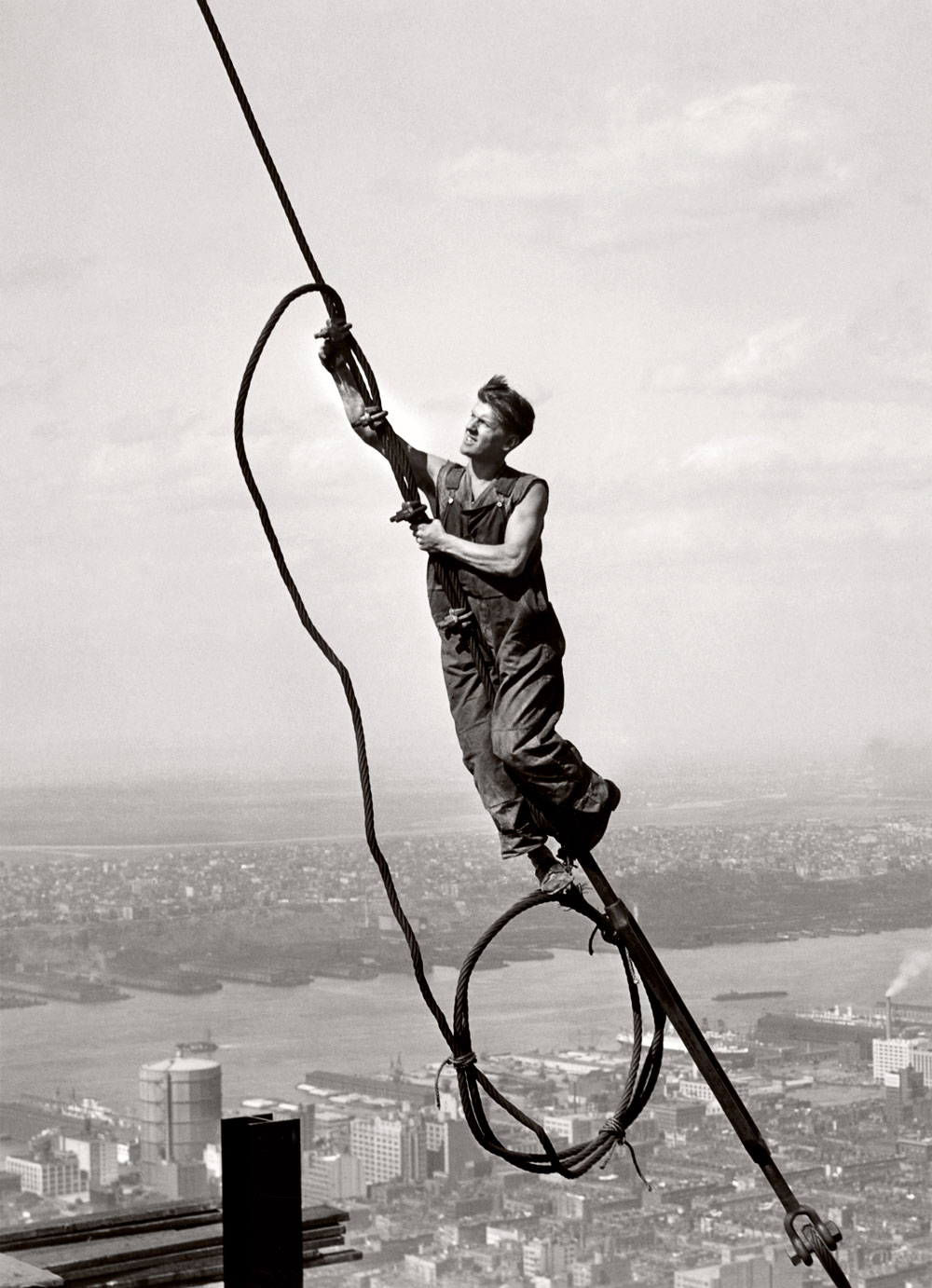
 (American, 1874-1940) 'Construction workers, Empire State Building, NYC' 1930-1931


Lewis Hine
 (American, 1874-1940)
Construction workers, Empire State Building, NYC
1930-1931
Gelatin silver print
© George Eastman House


From 15 September 2012 to 6 January 2013, the Netherlands Museum of Photography will present the first large retrospective in the Netherlands of the work of the renowned American photographer Lewis Hine. Hine was an enthusiastic photographer who wished to improve people’s lives through his photos. His pictures of immigrants on Ellis Island, of child labour, and of workers busy on the Empire State Building high above New York belong to the visual icons of the 20th century. The internationally touring exhibition contains more than 200 photos and documents, many in their original state and originating from the collection of the George Eastman House in Rochester, New York State. Lewis Hine is an initiative of three European institutions: Fondation Henri Cartier-Bresson (Paris), Fundación MAPFRE (Madrid) and the Netherlands Museum of Photography (Rotterdam). It is with great pride that the Netherlands Museum of Photography can now present this exhibition that harmonises perfectly with its aim to pay attention to the canon of international documentary photography.

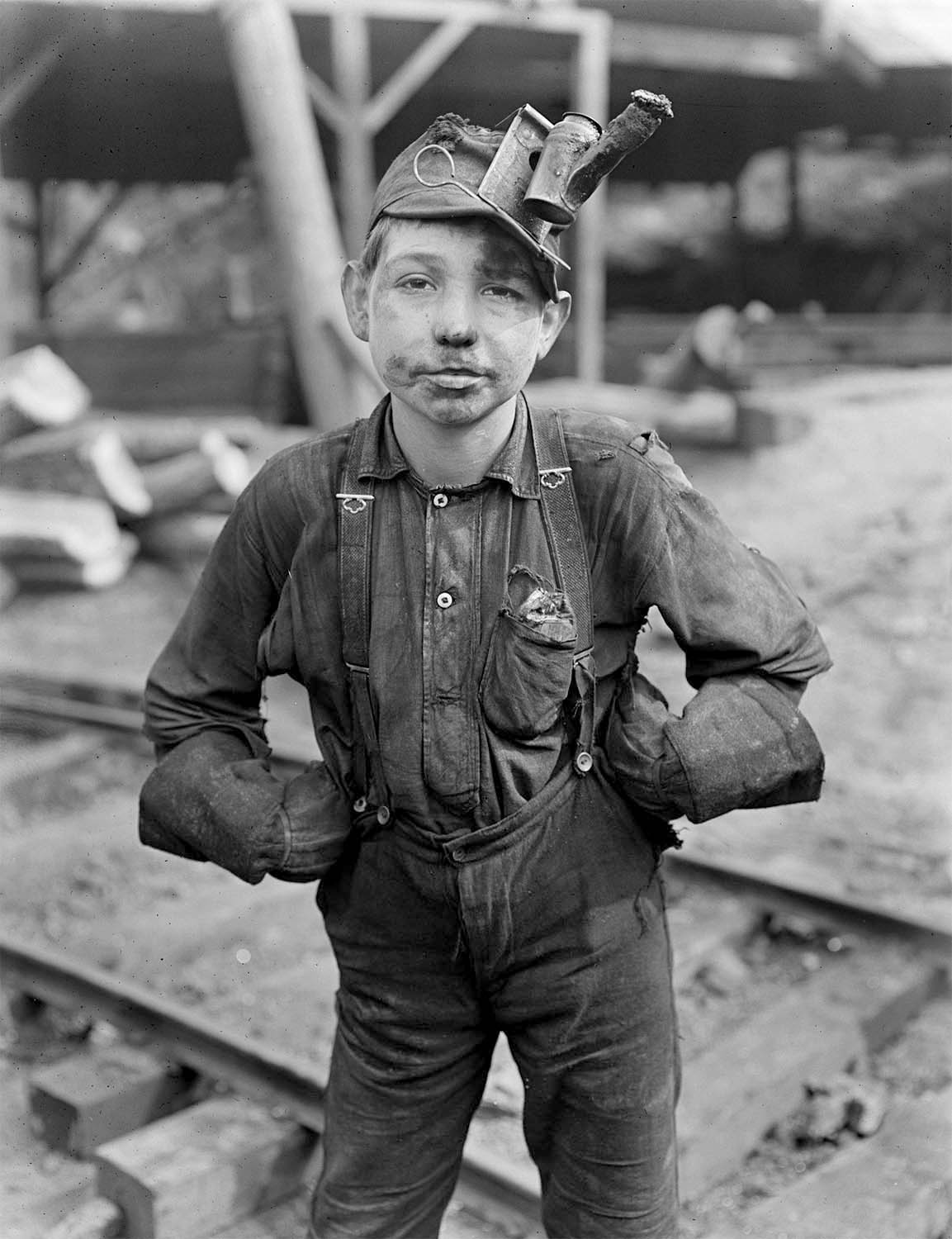
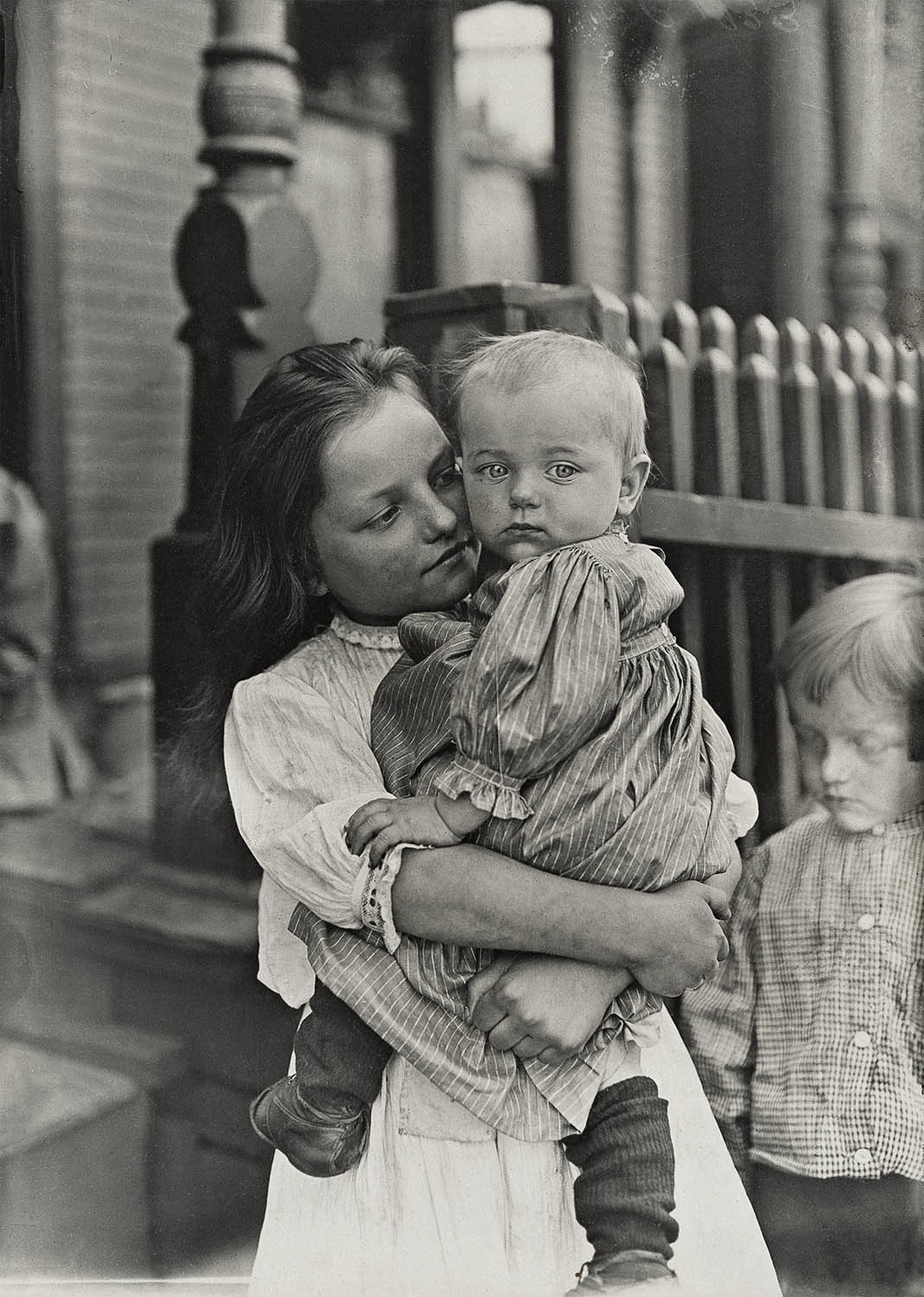
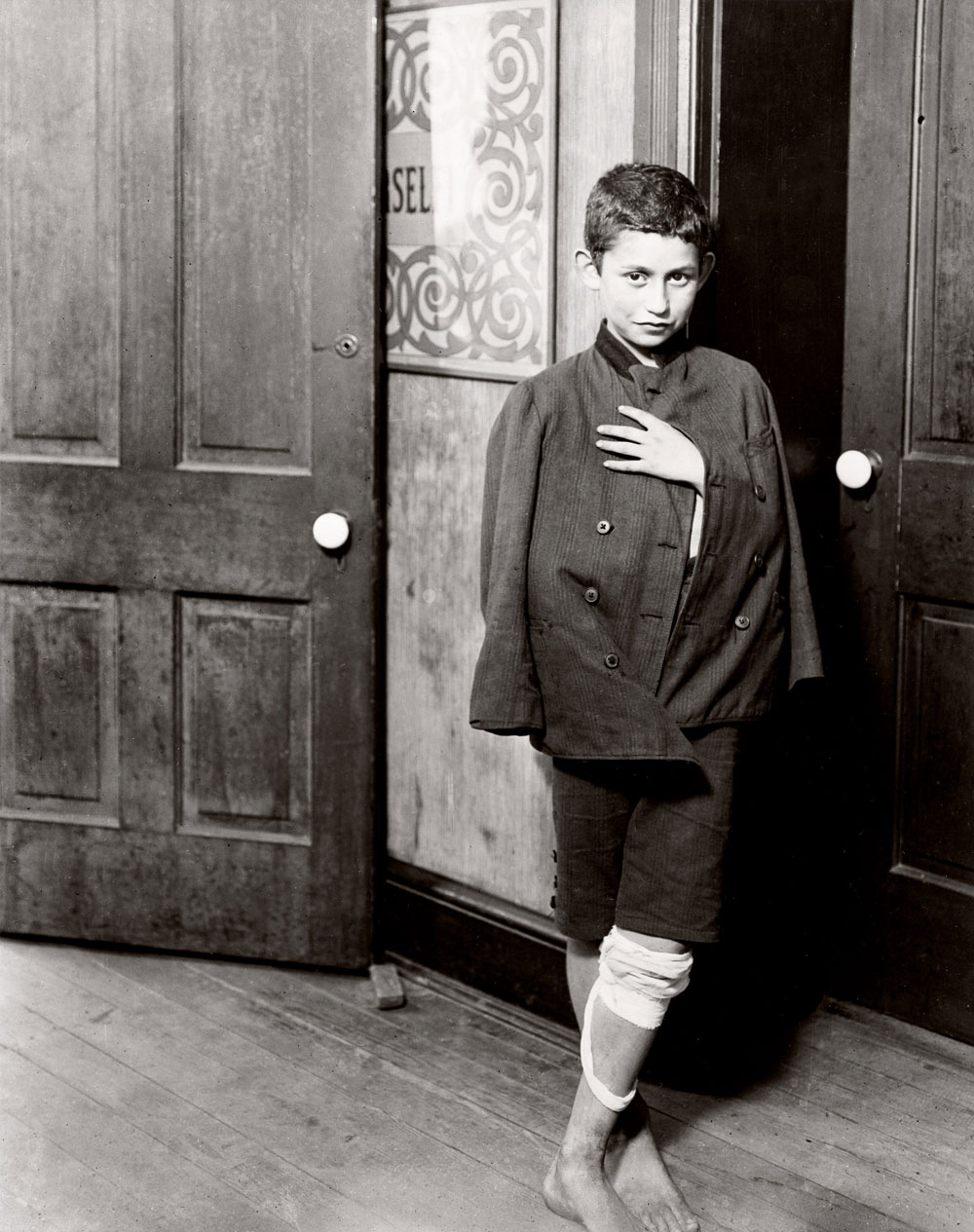
Lewis W. Hine (Wisconsin, 1874 – New York, 1940), a sociologist and photographer, belongs to the group of famous photographers such as Joel Meyerowitz, Robert Frank, Robert Capa, Eugène Atget to whom the Netherlands Museum of Photography has previously devoted impressive exhibitions. Hine is known as a 20th-century pioneer of social documentary photography. It is characteristic of Hine that he strongly believed in the camera’s powers of conviction. Thus, armed only with a heavy camera he fought for social justice. For the National Child Labor Committee he travelled more than 75,000 kilometres through the United States to photograph children working in agriculture, the mines, factories, sewing attics, and on the streets. His photos were partly responsible for reforms in these fields. The themes in Hine’s work – child labour, situations of human indignity, and the vulnerability of immigrants and refugees – are still current. Despite his present reputation, his early successes and the fact that many governmental organisations made use of his photos, he died totally impoverished in 1940.

Empire State Building and Building the Rotterdam

In 1932 Lewis Hine published the famous photographic book entitled Men at Work, which covered the construction of the Empire State Building. From the most audacious vantage points he took photos of the 381-metre building, showing the strength and willpower of humankind, man’s contribution to industry. The tall buildings on the Wilhelminapier have determined the skyline of Rotterdam for many years, just as the Empire State Building did in New York around 1930. The Wilhelminapier is now under full development. De Rotterdam Building, designed by Rem Koolhaas of OMA (Office for Metropolitan Architectural) will be completed in 2013-2014. The photographer Ruud Sies has followed the genesis of the largest building in the Netherlands for four years now. The project entitled Building the Rotterdam – a work in progress by Ruud Sies was inspired by the work of Lewis Hine and establishes the connection with the Wilhelminapier as a historical location. To the Netherlands Museum of Photography, this is a reason to include this project in the exhibition of the work of Lewis Hine.

Exhibition

With 170 vintage photos from the period 1903-1937 as well as 42 documents, this exhibition of Hine’s work is the first extensive and well-documented overview in the Netherlands and even in Europe. Hine’s entire oeuvre is on show, ranging from his earliest portraits of immigrants on Ellis Island to his work in Europe after the First World War. The Lewis Hine touring exhibition was on display in Paris toward the end of 2011, and in Madrid at the beginning of this year. For this international journey, Hine’s work has undergone preventative preservation treatment and is exposed to a minimum amount of light. After the exhibition in the Netherlands, the work will return to the George Eastman House in America to relax in a dark depot.”

Press release from the Netherlands Museum of Photography website


Lewis Hine
 (American, 1874-1940) 'Coal mine worker in West Virginia. Eleven year old boy. Tipple boy at the Turkey Knob coal mine in Macdonald, West Virginia' 1908


Lewis Hine
 (American, 1874-1940)
Coal mine worker in West Virginia. Eleven year old boy
Tipple boy at the Turkey Knob coal mine in Macdonald, West Virginia
1908
Gelatin silver print
© George Eastman House


Lewis Hine
 (American, 1874-1940) 'Little Mother, Pittsburgh District' 1909


Lewis Hine
 (American, 1874-1940)
Little Mother, Pittsburgh District
1909
Gelatin silver print
© George Eastman House


Anonymous photographer (American) 'Lewis Hine photographing children in a slum' 1910


Anonymous photographer (American)
Lewis Hine photographing children in a slum
1910
© George Eastman House


Lewis Hine
 (American, 1874-1940) 'Waiting for the dispensary to open Hull House District, Chicago' 1910


Lewis Hine
 (American, 1874-1940)
Waiting for the dispensary to open Hull House District, Chicago
1910
Gelatin silver print
© George Eastman House


Lewis Hine was born in Oshkosh, Wisconsin, in 1874. He moved to New York City in 1901 to teach at the Ethical Culture School. There Hine used photographs as educational tools, and soon began to photograph immigrants at Ellis Island. He hoped his photographs would encourage people to “exert the force to right wrongs.” While continuing to teach at ECS, Hine began to do freelance work for the National Child Labor Committee, an association that transformed his professional life.

In 1908, the NCLC provided Hine a monthly salary to photographically document children in factories, mills, canneries, textile mills, street trades, and agricultural industries. Through his photographs he sought to alert the public to the extent of child labor in America, and the degree to which it denied these children their childhood, health, and education. In one year, Hine covered 12,000 miles in his quest to end abusive child labor. By 1913, Hine was considered the leading social welfare photographer in America.

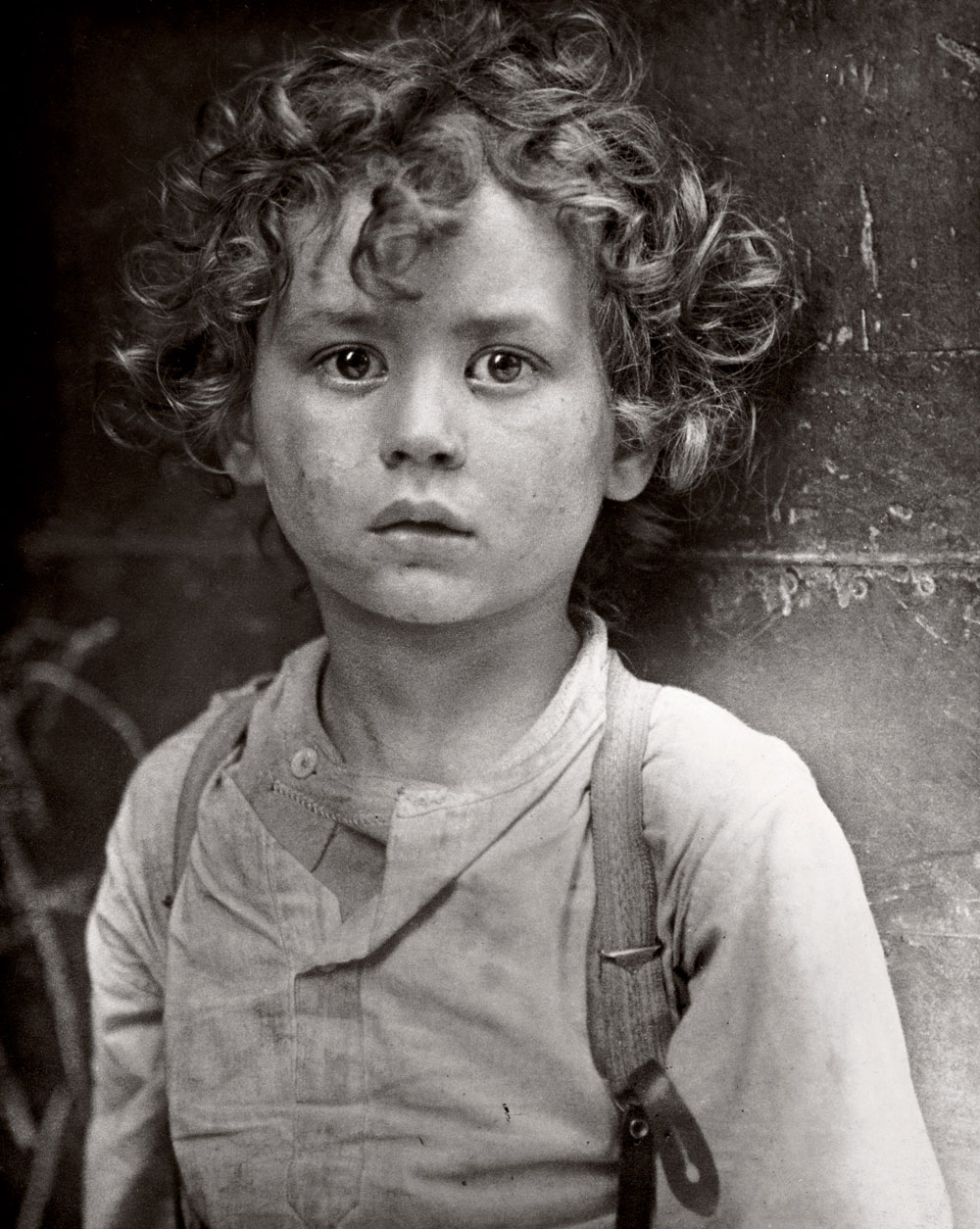
Hine enjoyed a long and successful career following his work for the NCLC. He worked for the American Red Cross (1917-1920), photographing refugees and civilians in war-torn Europe, a new series of photographs of immigrants at Ellis Island (1926), a series of photographs documenting the construction of the Empire State Building (1930), photographs of drought-ridden communities in Arkansas and Kentucky (1931), as well as work for the Tennessee Valley Authority.

In 1936-1937 Hine was appointed head photographer for the National Research Project of the Works Progress Administration. The ageing Hine, however, was disappointed at the rebuff of his attempts to secure work with the Farm Services Administration, where director Roy Stryker considered Hine old fashioned and difficult. Lewis Hine died in 1940, shortly before a resurgence of public interest in his work raised him to the highest level of American photographers.

Text from Child Labour in Virginia: Photographs by Lewis Hine web page [Online] Cited 21/12/2012 no longer available online


Lewis Hine
 (American, 1874-1940) 'Paris Gamin' 1918


Lewis Hine
 (American, 1874-1940)
Paris Gamin
1918
Gelatin silver print
© George Eastman House


Lewis Hine
 (American, 1874-1940) 'Mechanic at steam pump in electric power house' 1920


Lewis Hine
 (American, 1874-1940)
Mechanic at steam pump in electric power house
1920
Gelatin silver print
© George Eastman House


Lewis Hine
 (American, 1874-1940) 'Candy Worker, New York' 1925


Lewis Hine
 (American, 1874-1940)
Candy Worker, New York
1925
Gelatin silver print
© George Eastman House


Lewis Hine
 (American, 1874-1940) 'Man on hoisting ball, Empire State building' 1931


Lewis Hine
 (American, 1874-1940)
Man on hoisting ball, Empire State building
1931
Gelatin silver print
© George Eastman House


Lewis Hine
 (American, 1874-1940) 'Steelworker standing on beam' 1931


Lewis Hine
 (American, 1874-1940)
Steelworker standing on beam
1931
Gelatin silver print
© George Eastman House


Lewis Hine
 (American, 1874-1940) 'The Sky Boy' 1931


Lewis Hine
 (American, 1874-1940)
The Sky Boy
1931
Gelatin silver print
© George Eastman House


Netherlands Museum of Photography
Wilhelminakade 332
3072 AR Rotterdam
The Netherlands

Opening hours
Tuesday – Sunday 11am – 5pm
Closed Mondays

Nederlands Museum of Photography website

LIKE ART BLART ON FACEBOOK

Back to top

Exhibition: ‘The Serial Portrait: Photography and Identity in the Last One Hundred Years’ at the National Gallery of Art, Washington

Exhibition dates: 30th September 2012 – 31st December 2012


Emmet Gowin (American, b. 1941) 'Edith, Danville, Virginia' 1971


Figure 5. Emmet Gowin (American, b. 1941)
Edith, Danville, Virginia
1971
Gelatin silver print
20.2 x 25.2cm (7 15/16 x 9 15/16 in.)
National Gallery of Art, Washington
Patrons’ Permanent Fund
© Emmet and Edith Gowin, Courtesy Pace/MacGill Gallery, New York


~ Alfred Stieglitz / Georgia O’Keeffe
~ Paul Strand / Rebecca Strand
~ Emmet Gowin / Edith Gowin
~ Harry Callahan / Eleanor and Barbara Callahan
~ Robert Mapplethorpe / Patti Smith
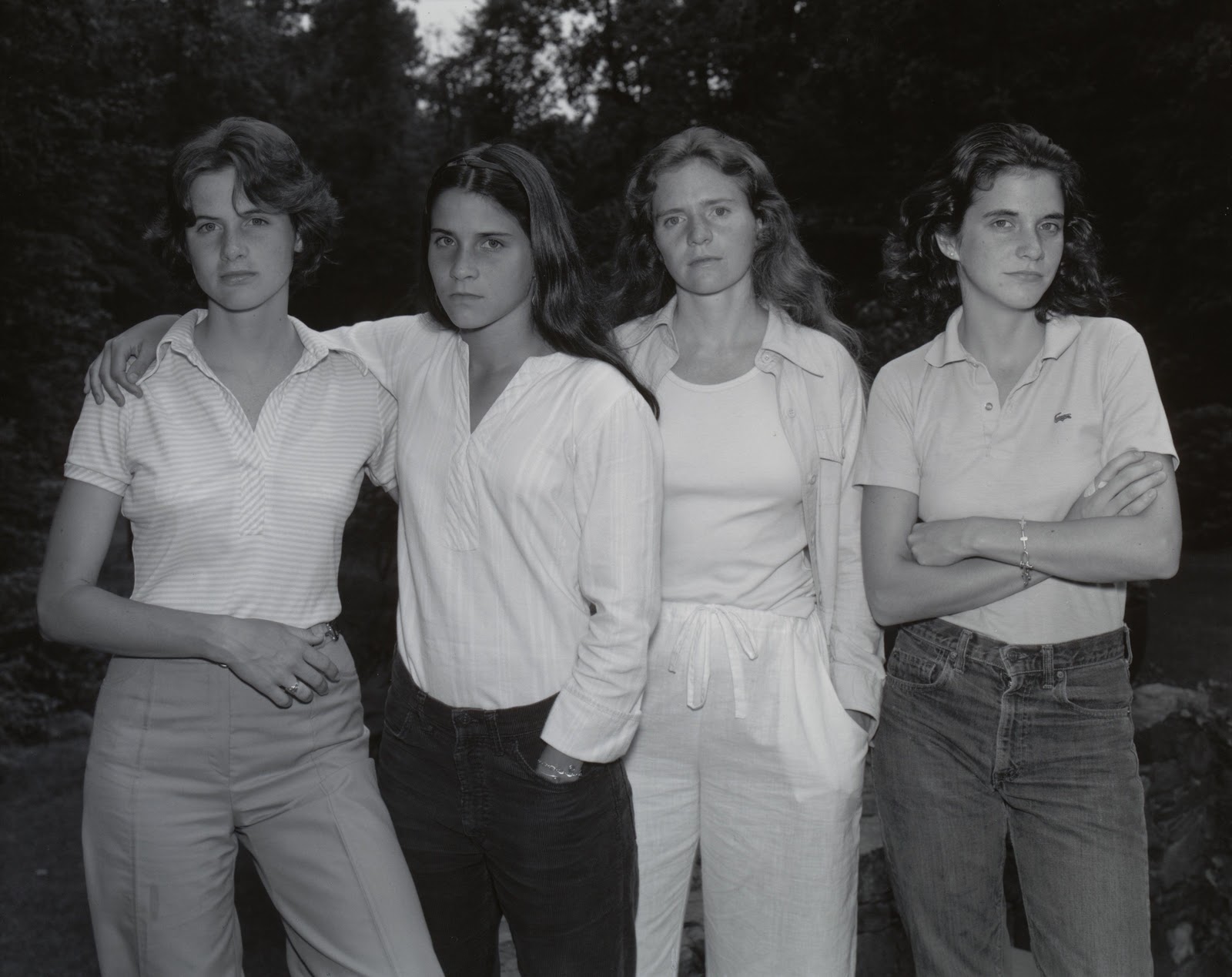
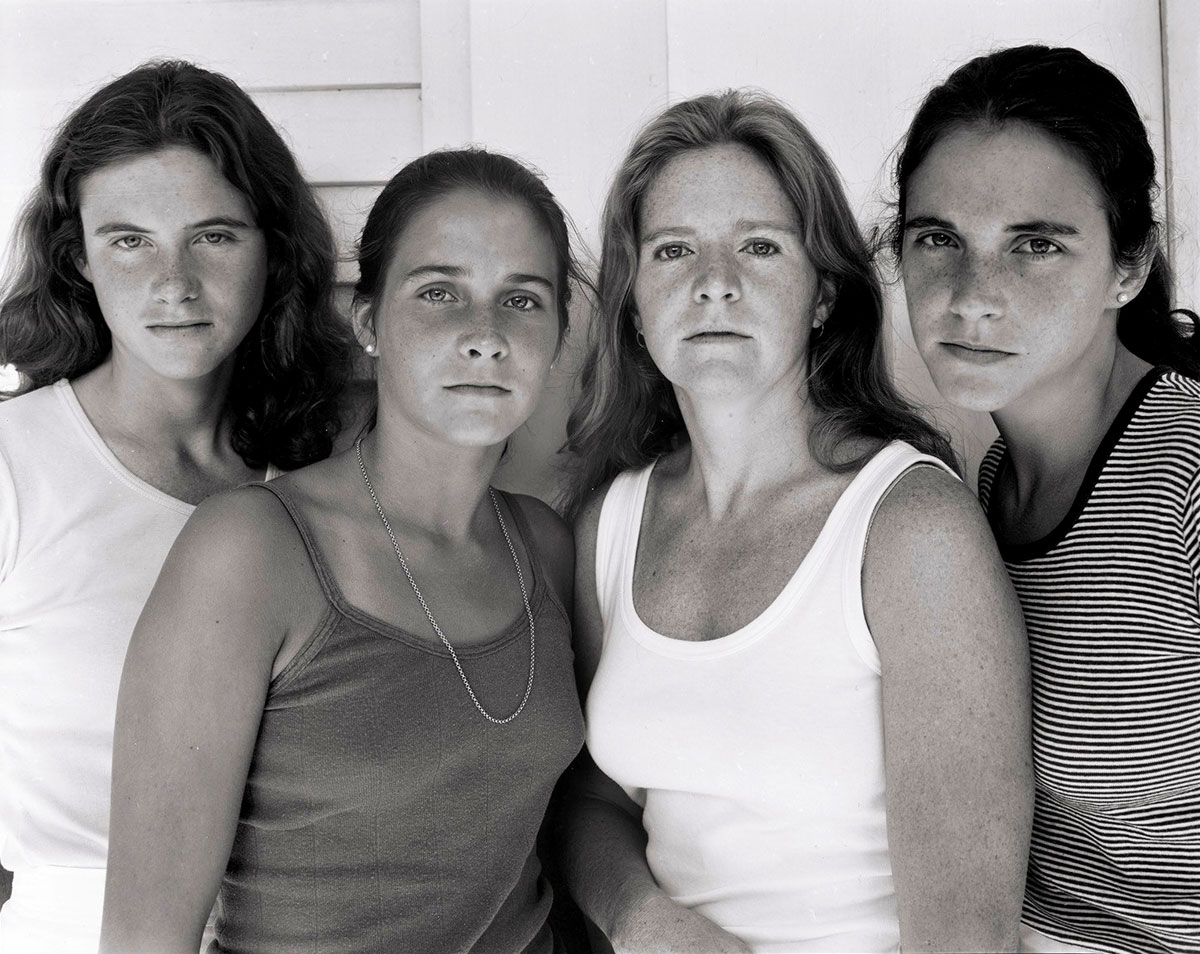
~ Nicholas Nixon / The Brown Sisters
~ Andy Warhol / Serial Photography / Photo Booth Portraits
~ Mario Testino / Kate Moss
~ Baron Adolf de Meyer / Baroness Olga de Meyer
~ Edward Weston / Charis Weston
~ Lee Friedlander / Maria Friedlander
~ Paul Caponigro / The woods of Connecticut
~ Bernd and Hilla Becher / grids
~ Gerhard Richter / Overpainted Photographs
~ Masahisa Fukase / wife and family
~ Seiichi Furuya / Christine Furuya-Gößler
~ Sally Mann / children and husband
~ William Wegman / dogs


Australia?
Nobody that I can think of except Sue Ford.

Notice how all the artists are men except two: Sally Mann and Hilla Becher.

Dr Marcus Bunyan


Many thankx to the National Gallery of Art for allowing me to publish the photographs in the posting. Please click on the photographs for a larger version of the image.


Introduction

Alfred Stieglitz, one of the most influential photographers of the twentieth century, argued that “to demand the [single] portrait… be a complete portrait of any person is as futile as to demand that a motion picture be condensed into a single still.” Stieglitz’s conviction that a person’s character could not be adequately conveyed in one image is consistent with a modern understanding of identity as constantly changing. For Stieglitz, who frequently made numerous portraits of the same sitters – including
striking photographs of his wife, the painter Georgia O’Keeffe – using the camera in a serial manner allowed him to transcend the limits of a single image.

Drawn primarily from the National Gallery of Art’s collection, the
Serial Portrait exhibition features twenty artists who photographed the same subjects – primarily friends, family, or themselves – multiple times over the course of days, months, or years. This brochure presents a selection of works by seven of these artists. Like Stieglitz’s extended portrait of O’Keeffe, Emmet Gowin’s ongoing photographic study of his wife, Edith, explores her character and reveals the bonds of love and affection between the couple. Milton Rogovin’s photographs of working-class residents of Buffalo, New York, record shifts in the appearance and situation of individuals in the context of their community over several decades.

A number of photographers in the exhibition have made serial self-portraits that investigate the malleability of personal identity. Photographing themselves as shadows, blurs, or partial reflections, Lee Friedlander and Francesca Woodman have made disorienting images that hint at the instability of self-representation. Ann Hamilton has employed unusual props and materials to transform herself into a series of hybrid objects. Finally, work by Nikki S. Lee takes the idea of mutable identity to its logical conclusion as the artist photographs herself masquerading as members of different social and ethnic groups.

Text from the NGA website


Emmet Gowin (American, b. 1941) 'Edith, Danville, Virginia' 1963


Figure 4. Emmet Gowin (American, b. 1941)
Edith, Danville, Virginia
1963
Gelatin silver print, printed 1980s
19.7 x 12.7cm (7 3/4 x 5 in.)
National Gallery of Art, Washington
Charina Endowment Fund
© Emmet and Edith Gowin, Courtesy Pace/MacGill Gallery, New York


Emmet Gowin

Emmet Gowin (born 1941) met Edith Morris in 1961 in their hometown of Danville, Virginia, just as he had decided to abandon business school to study art. Several years later at the Rhode Island School of Design, his teacher Harry Callahan, who made numerous photographs of his wife, Eleanor, encouraged Gowin to photograph the subject he knew most intimately – his family and in particular Edith, whom he married in 1964.

The Gowins’ artistic and marital collaboration has endured for half a century, yielding an extraordinary series of quiet, attentive portraits. In some photographs, such as Edith, Danville, Virginia, 1963 (fig. 4, above), Edith appears contemplative, even reserved. The somber beauty of this work stems in part from Gowin’s use of a tripod-mounted, large-format camera, which requires a lengthy exposure but produces photographs with exquisite details, such as the delicate shadow of a twig that falls across Edith’s face. To make the dramatic circular shadow that surrounds her in Edith, Danville, Virginia, 1971 (fig. 5, above), Gowin attached a lens meant for a 4 × 5 camera to a large 8 × 10 camera. This focus draws our attention to her figure, but the screen door simultaneously frames and obscures her form, resulting in a play between presence and elusiveness. While Gowin’s photographs are born of a deep intimacy, they refuse to lay bare his wife’s soul or expose the couple’s private passions.

The same delicate balance between revelation and reserve marks a group of portraits made during the couple’s travels in Central and South America. Edith and Moth Flight, 2002 (fig. 6, below), made at night using a ten-second exposure, combines Gowin’s enchantment with natural beauty and his interest in the nuances of his wife’s gestures and moods. Placing a pulsing ultraviolet light behind Edith’s head, Gowin recorded the luminous traces left by moths as they danced around her blurred face, transforming her into a ghostly and even otherworldly presence, visible yet just out of our reach.

Text from the NGA website


Emmet Gowin (American, b. 1941) 'Edith and Moth Flight' 2002


Figure 6. Emmet Gowin (American, b. 1941)
Edith and Moth Flight
2002
Digital ink jet print
19 x 19cm (7 1/2 x 7 1/2 in.)
National Gallery of Art, Washington
Charina Endowment Fund
© Emmet and Edith Gowin, Courtesy Pace/MacGill Gallery, New York


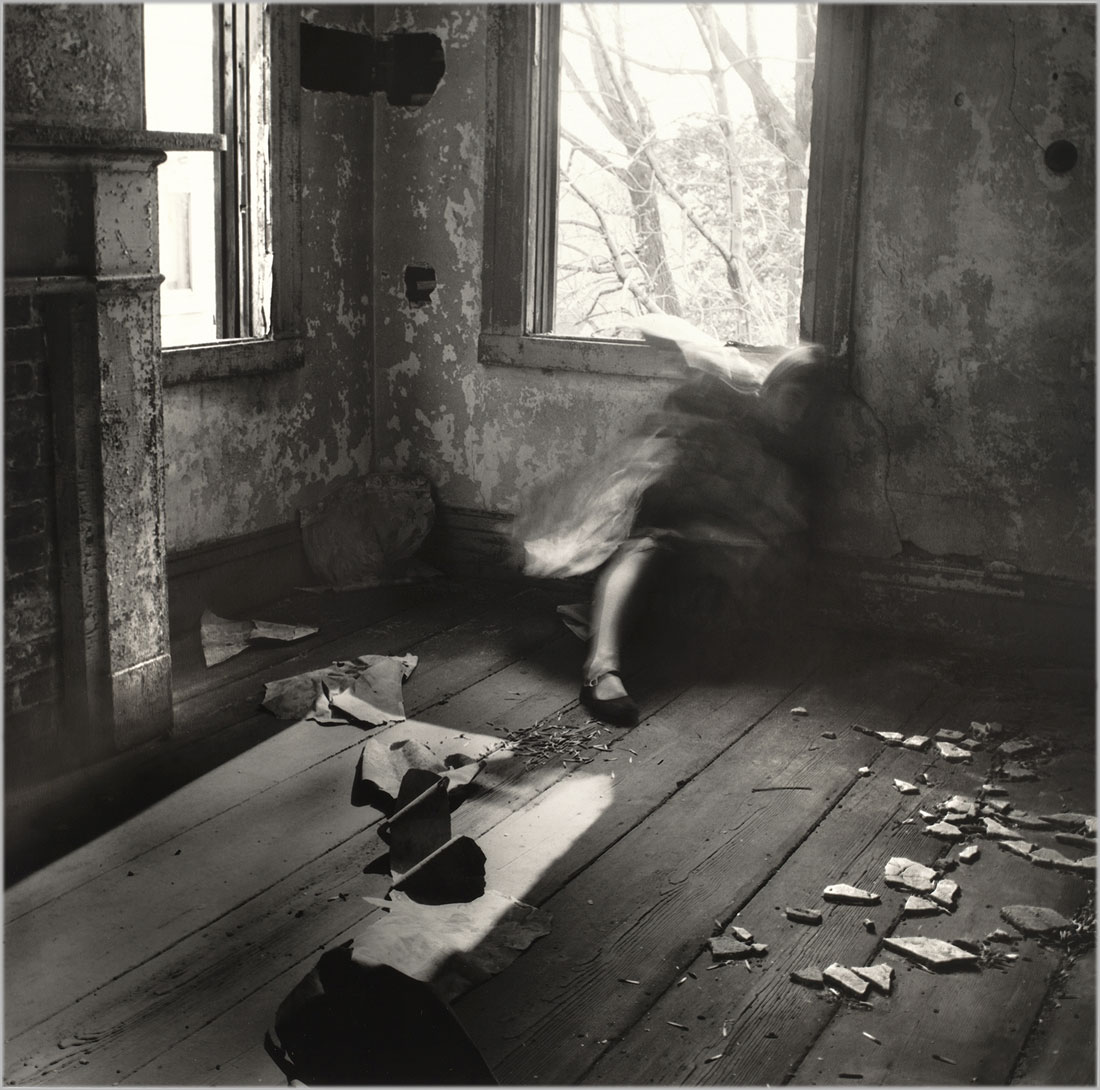
Francesca Woodman (American, 1958-1981) 'House #3, Providence, Rhode Island' 1976


Francesca Woodman (American, 1958-1981)
House #3, Providence, Rhode Island
1976
Gelatin silver print
16.1 x 16.3cm (6 5/16 x 6 7/16 in.)
National Gallery of Art, Washington
Gift of the Heather and Tony Podesta Collection


Francesca Woodman

Francesca Woodman (1958-1981) began making photographs at age thirteen, and by the time she entered the Rhode Island School of Design in 1975, she was already a skilled photographer. Using herself as the subject of nearly all her work, Woodman put her body in the service of exploring such themes as feminine identity, sexuality, mythology, and the relationship of the body to its surroundings. Conjuring visions of a complex inner world, Woodman’s photographs are powerful for their ability to suggest psychic turmoil within images of serene, ethereal beauty.

Woodman’s interest in the emotional affect of space can be seen in House #3, Providence, Rhode Island, 1976 (fig. 14, above). Using an abandoned house as a makeshift studio, Woodman often photographed herself merging with her surroundings, including doors, walls, and windows, dissolving physical or psychic boundaries. She also frequently moved during long exposures or allowed the camera to record only part of her body in order to obscure her figure. By invoking a ghostly presence, Woodman’s photographs often present her as someone who refuses to commit to a solid image of herself.

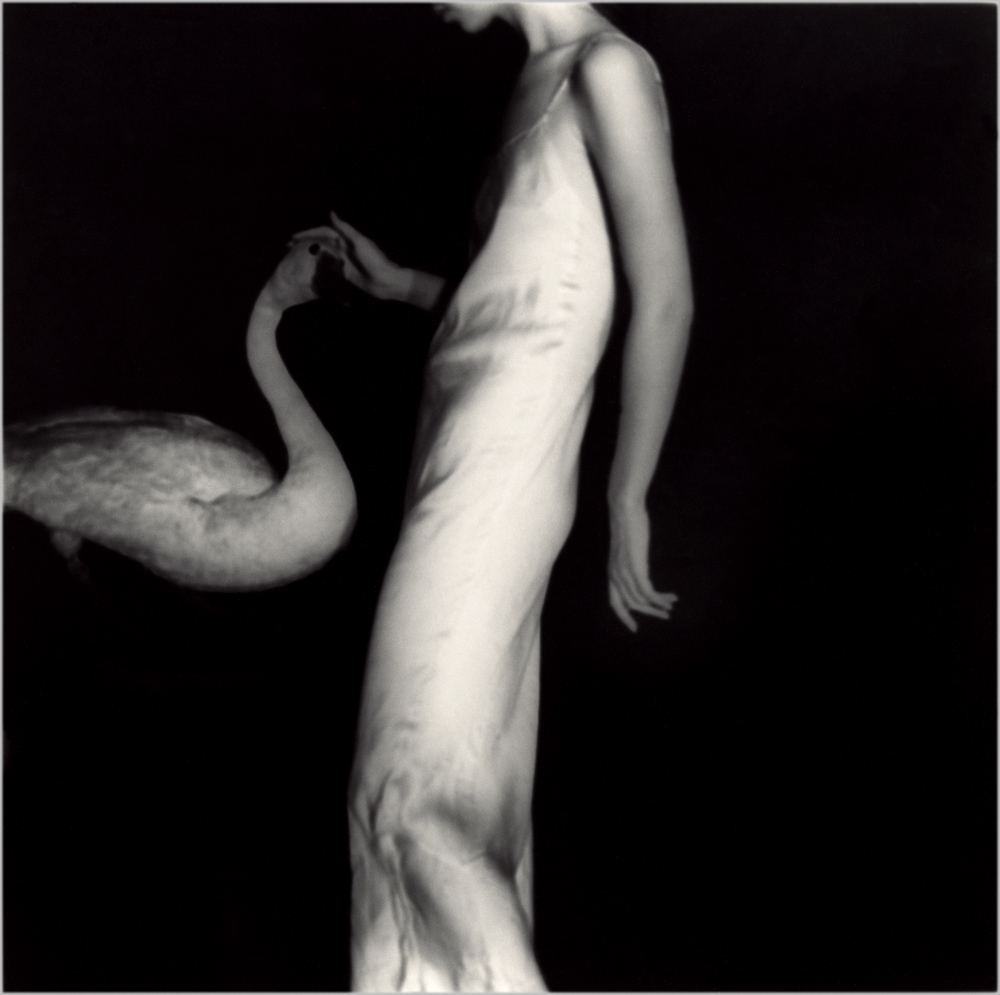
Woodman’s lush and intimate photographs thus offer a tantalising glimpse of a mysterious, private world. Yet they are more than romantic expressions of a young woman’s subjective experience. Notes in Woodman’s diary suggest, for instance, that Untitled, Providence, Rhode Island, 1975-1978 (fig. 15, below), alludes to the Greek mythological story of Leda, who was seduced by the god Zeus in the form of a swan.

Toward the end of her brief but prolific career (Woodman committed suicide when she was twenty-two) the artist began working on a much larger scale, using her body more as a structural element. Caryatid, New York, 1980 (fig. 16, below), made as part of a monumental photo-installation called Temple Project, draws both its title and inspiration from the columns carved in the shape of women that were used in ancient Greek and Roman architecture. Although Woodman displays her figure in a more expansive and direct manner than in her earlier work, the gesture that obscures her face and leaves her partial and unknowable is typical for the artist, who always preferred suggestion over declaration.

Text from the NGA website


Francesca Woodman (American, 1958-1981) 'Untitled, Providence, Rhode Island' 1975-1978


Francesca Woodman (American, 1958-1981)
Untitled, Providence, Rhode Island
1975-1978
Gelatin silver print
10.5 x 10.5cm (4 1/8 x 4 1/8 in.)
National Gallery of Art, Washington
Gift of the Collectors
Committee and R. K. Mellon Family Foundation


Francesca Woodman (American, 1958-1981) 'Caryatid, New York' 1980


Francesca Woodman (American, 1958-1981)
Caryatid, New York
1980
National Gallery of Art, Washington
William and Sarah Walton Fund and Gift of the Collectors Committee


Ann Hamilton (American, b. 1956) 'body object series #13, toothpick suit/chair' 1984


Figure 17. Ann Hamilton (American, b. 1956)
body object series #13, toothpick suit/chair
1984
Gelatin silver print, printed 1993
11 x 11cm (4 5/16 x 4 5/16 in.)
National Gallery of Art, Washington
Gift of Heather and Tony Podesta Collection


Ann Hamilton

An artist known for multimedia environments, performances, and videos, Ann Hamilton (born 1956) made the first photographs in the body object series in 1984 with objects left over from an installation she had presented as an MFA student at Yale. Later images from the series were based on subsequent performances and installations, documenting both the objects used and the actions performed with them. Hamilton appears in each photograph with objects attached to or touching her body, her face only rarely visible. The results are striking, unsettling, and often witty.

Despite emerging from Hamilton’s installation and performance practice, the photographs in the series stand on their own as works of art. Paying close attention to the material qualities of familiar objects, Hamilton models creative new uses for them, changing their function and meaning. In body object series #13, toothpick suit/chair, 1984 (fig. 17, above), for example, thousands of toothpicks transform Hamilton’s clothes into a porcupine-like hide while a chair becomes a burdensome instrument of torture. The image elicits visceral emotions – alienation, hostility, fear – though it does so with a dose of absurdist humour.

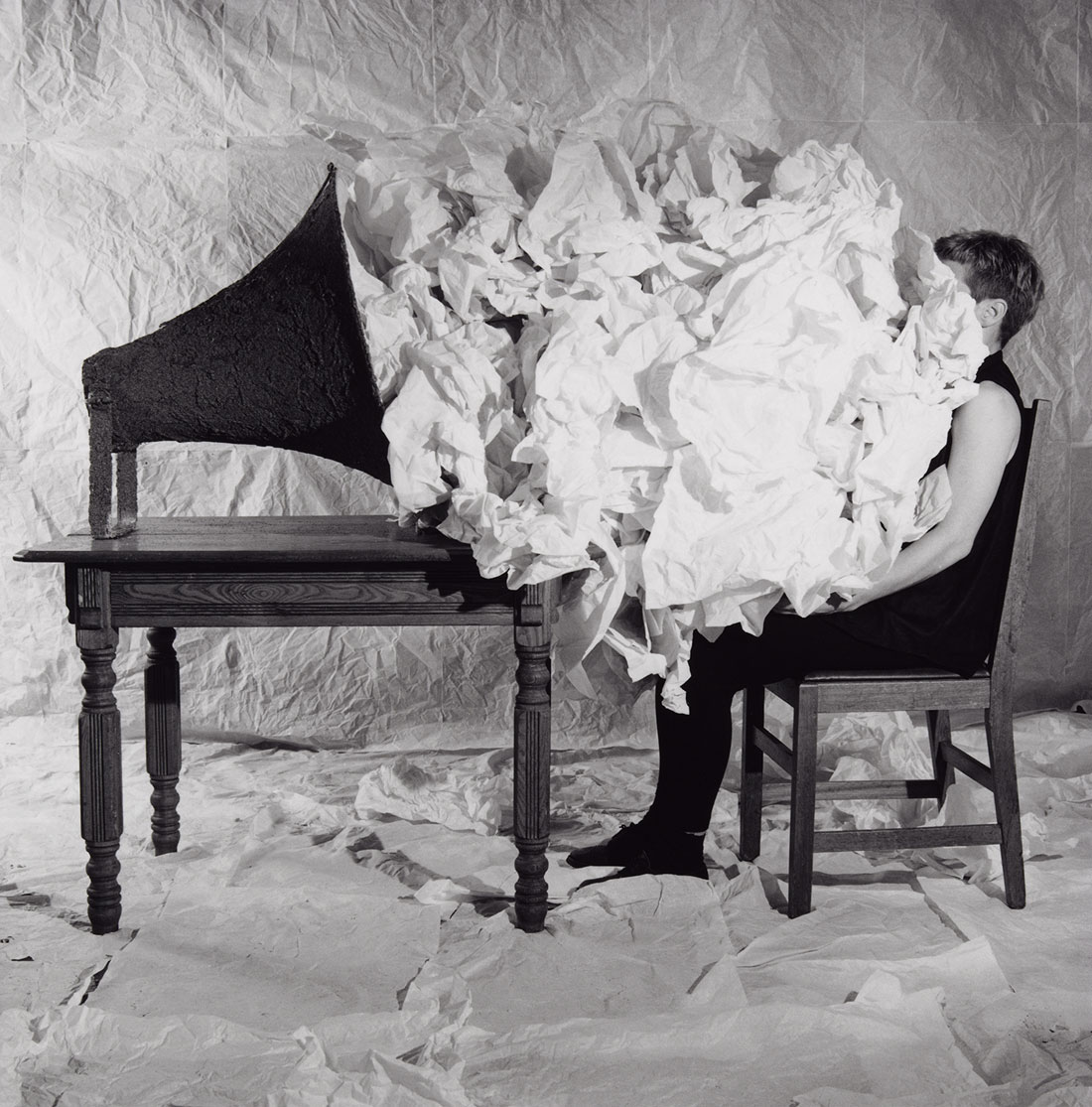
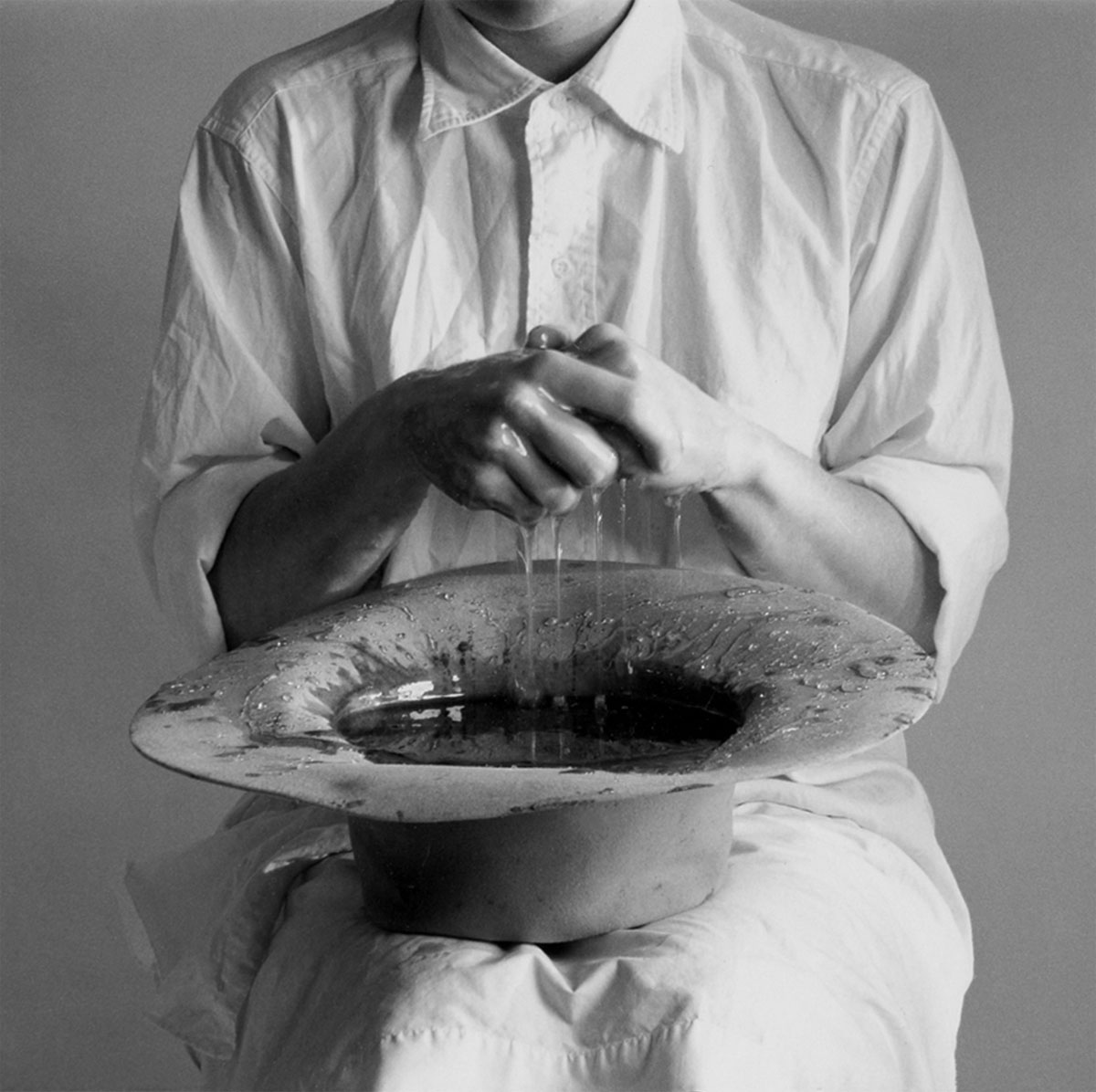
As self-representations, the photographs in the body object series depart radically from any traditional notion of portraiture. Instead of insisting on Hamilton’s uniqueness as an individual, these images present her body almost as an object on a par with other objects. Some of the photographs are linked directly to her biography: Hamilton had studied textile design before getting her MFA, and the toothpick suit refers to her love of fabrics. In other photographs she makes abstract concepts more graspable through the senses. Sound is given tactile and visual form as tissue paper in body object series #14, megaphone, 1986 (fig. 18, below), while in body object series #15, honey hat, 1989 (fig. 19, below), Hamilton wrings her hands in honey to suggest the idea of washing one’s hands of guilt. Based on an installation in which the artist embedded money – 750,000 pennies – in a layer of honey, this image also gives new meaning to the phrase “sticky fingers” and highlights the connections between language, images, and objects that Hamilton explores in both her photographs and installations.

Text from the NGA website


Ann Hamilton (American, b. 1956) 'body object series #14, megaphone' 1986


Figure 18. Ann Hamilton (American, b. 1956)
body object series #14, megaphone
1986
Gelatin silver print, printed 1993
11 x 11cm (4 5/16 x 4 5/16 in.)
National Gallery of Art, Washington
Gift of Heather and Tony Podesta Collection


Ann Hamilton (American, b. 1956) 'body object series #15, honey hat' 1989


Figure 19. Ann Hamilton (American, b. 1956)
body object series #15, honey hat
1989
Gelatin silver print, printed 1993
11 x 11cm (4 5/16 x 4 5/16 in.)
National Gallery of Art, Washington
Gift of Heather and Tony Podesta Collection


The National Gallery of Art explores how the practice of making multiple portraits of the same subjects produced some of the most revealing and provocative photographs of our time in The Serial Portrait: Photography and Identity in the Last One Hundred Years, on view in the West Building’s Ground Floor photography galleries from September 30 through December 31, 2012. Arranged both chronologically and thematically, the exhibition features 153 works by 20 artists who photographed the same subjects – friends, family, and themselves – numerous times over days, months, or years to create compelling portrait studies that investigate the many facets of personal and social identity.

“The Gallery’s photography collection essentially began with the donation of Alfred Stieglitz’s ‘key set,’ so it is fitting that this exhibition opens with portraits by Stieglitz, who understood that a person’s character was best captured through a series of photographs taken over time,” said Earl A. Powell III, director, National Gallery of Art. “Although the exhibition is drawn largely from the Gallery’s significant collection of photographs, we are grateful to the lenders who have allowed us to present more fully the serial form of portraiture that Stieglitz championed.”

Since the introduction of photography in 1839, portraiture has been one of the most widely practiced forms of the medium. Starting in the early 20th century, however, some photographers began to question whether one image alone could adequately capture the complexity of an individual. As Alfred Stieglitz, the era’s leading champion of American fine art photography, argued: “to demand the [single] portrait that will be a complete portrait of any person is as futile as to demand that a motion picture will be condensed into a single still.”

Along with Stieglitz, some of the 20th century’s most prominent photographers – Paul Strand, Harry Callahan, and Emmet Gowin – used the camera serially to transcend the limits of a single image. Each of these photographers made numerous studies of their lovers that sought to redefine the expressive possibilities of portraiture while probing the affective bonds of love and desire. By employing the camera’s capacity to record fluctuating states of being and mark the passage of time, other photographers such as Nicholas Nixon and Milton Rogovin have documented individuals – in families or communities – over four decades. Capturing subtle and dramatic shifts in appearance, demeanour, and situation, these series are poignant and elegiac memorials that remind us of our own mortality.

Other photographers have made serial self-portraits that explore the malleability of personal identity and the possibility of reinvention afforded by the camera. By photographing themselves as shadows, blurs, or partial reflections, Ilse Bing, Lee Friedlander, and Francesca Woodman have created inventive but elusive images that hint at the instability of self-representation. Conceptual artists of the 1970s and 1980s such as Vito Acconci, Blythe Bohnen, and Ann Hamilton have explicitly combined performance and self-portraiture to stage continual self-transformations. The exhibition concludes with work from the last 15 years by artists such as Nikki S. Lee and Gillian Wearing, who take the performance of self to its limits by adopting masquerades to delve into the ways identity is inferred from external appearance.

Press release from the National Gallery of Art website


Lee Friedlander (American, b. 1934) 'Westport, Connecticut' 1968


Figure 11. Lee Friedlander (American, b. 1934)
Westport, Connecticut
1968
Gelatin silver print
19.8 x 12.3cm (7 13/16 x 4 13/16 in.)
National Gallery of Art, Washington, Trellis Fund
© Lee Friedlander, courtesy Fraenkel Gallery


Lee Friedlander

In the 1960s Lee Friedlander (born 1934) sought, by his own account, to create images of “the American social landscape and its conditions.” Other photographers in his New York circle, including Diane Arbus and Garry Winogrand, also explored the chaotic beauty and contradictions of modern life. Friedlander, however, was the only member of this group to turn repeatedly to self-portraiture in order to understand the world around him. He stalked city streets with camera in hand, recording not only the haphazard incidents of daily life but also his own presence, often as a shadow or a reflection.

In the shop window of Westport, Connecticut, 1968 (fig. 11, above), for example, a reflection of Friedlander’s legs appears to merge with the shapely limbs of a woman in a bathing suit who points a camera at the viewer. The woman is an illusion, a cutout advertisement – but she is also a stand-in for the camera-wielding Friedlander, whose torso and head also appear faintly, as a shadow cast against her legs.

By letting the reflection in a window obscure what is inside, or allowing his shadow to intrude into the frame, Friedlander violates many of the rules of “good” photography. Works such as New York City, 1966 (fig. 12, below) testify to Friedlander’s ability to transform such “mistakes” into witty, ironic juxtapositions. In this case, the startling intrusion of Friedlander’s shadow onto the back of a fellow pedestrian is visually confusing, simultaneously threatening and humorous, as Friedlander’s spiky hair merges with the woman’s fur collar. A sly commentary on the predatory nature of such street photography, the looming shadow that engulfs the subject is also an effect of Friedlander’s equipment, a 35mm Leica with a wide-angle lens. In order to fill the picture frame with his chosen subject, Friedlander had to make the picture at close range, resulting in the inclusion of his own shadow.

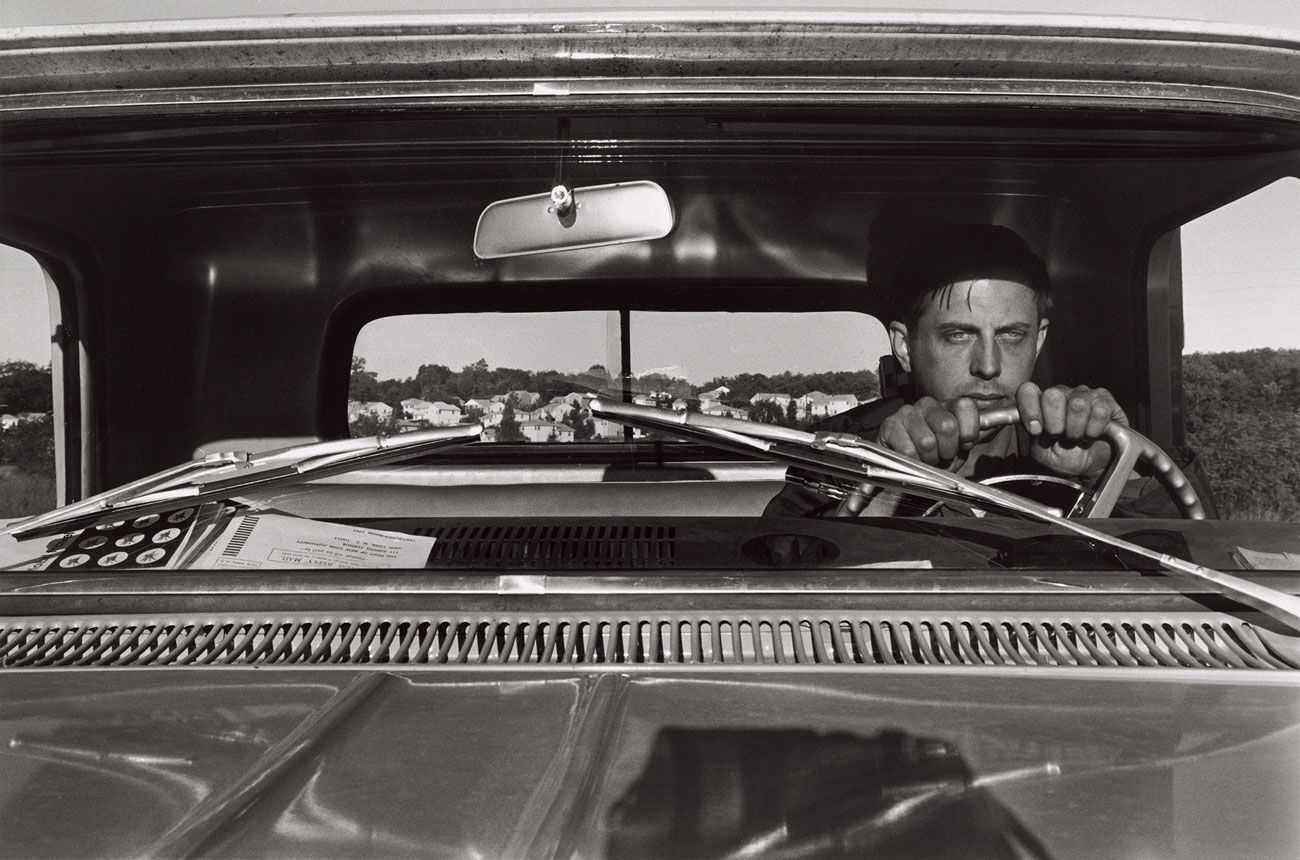
Even in self-portraits in which Friedlander makes himself fully visible to the camera, the artist often makes humorously self-deprecating deadpan images, appearing, for example, as a disheveled driver on a manic mission in Haverstraw, New York, 1966 (fig. 13, below). Edgy but unpretentious, brimming with pictorial detail, Friedlander’s self-portraits are visual puzzles that explore the place of the self in the chaos of contemporary urban life.

Text from the NGA website


Lee Friedlander (American, b. 1934) 'New York City' 1966


Figure 12. Lee Friedlander (American, b. 1934)
New York City
1966
Gelatin silver print
21.7 x 32.7cm (8 9/16 x 12 7/8 in.)
National Gallery of Art, Washington
Trellis Fund
© Lee Friedlander, courtesy Fraenkel Gallery


Lee Friedlander (American, b. 1934) 'Haverstraw, New York' 1966


Figure 13. Lee Friedlander (American, b. 1934)
Haverstraw, New York
1966
Gelatin silver print
21.7 x 32.7cm (8 9/16 x 12 7/8 in.)
National Gallery of Art, Washington
Trellis Fund
© Lee Friedlander, courtesy Fraenkel Gallery


Ilse Bing (German, 1899-1998) 'Self-Portrait with Leica' 1931


Ilse Bing (German, 1899-1998)
Self-Portrait with Leica
1931
Gelatin silver print, printed c. 1988
26.7 x 29.7cm (10 1/2 x 11 11/16 in.)
National Gallery of Art, Washington
Gift of Ilse Bing Wolff


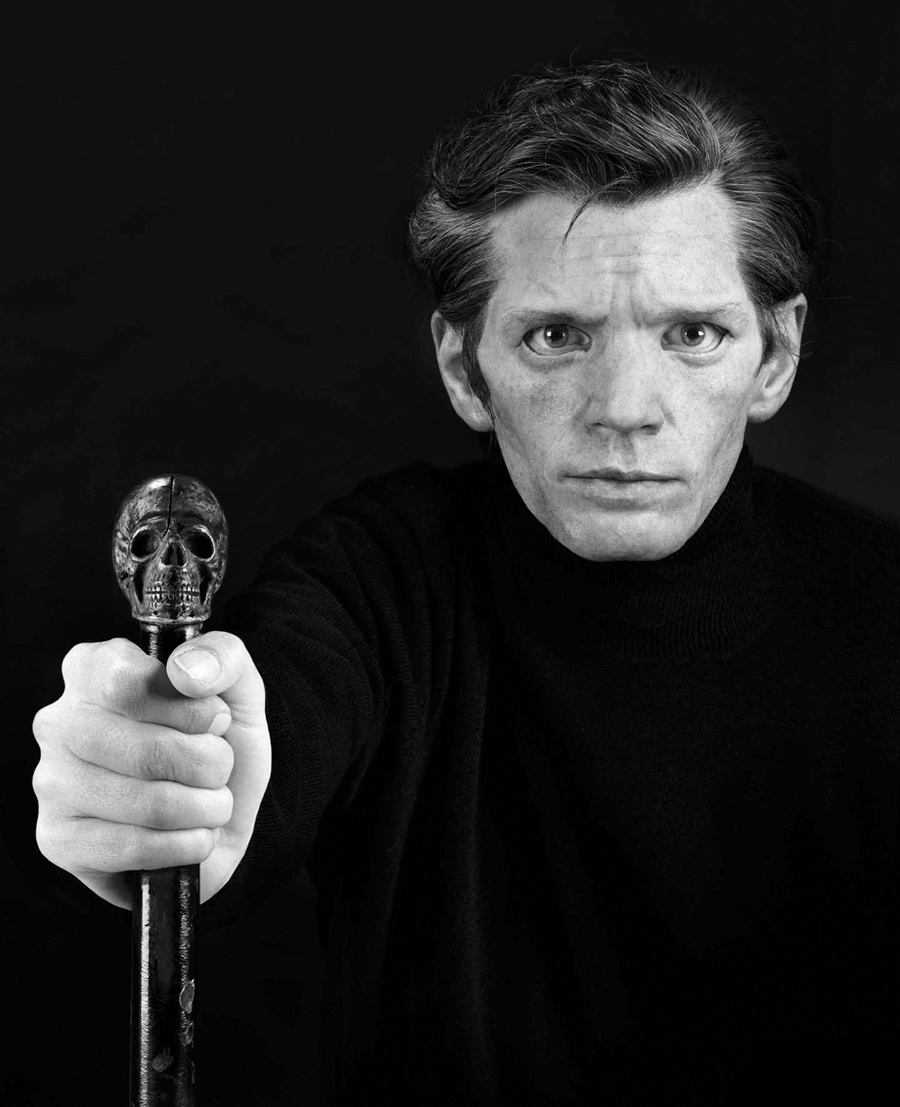
Gillian Wearing (English, b. 1963) 'Me as Mapplethorpe' 2009


Gillian Wearing (English, b. 1963)
Me as Mapplethorpe
2009
Gelatin silver print (based upon Robert Mapplethorpe work: Self Portrait, 1988. © Robert Mapplethorpe Foundation)
149.86 x 121.92cm (59 x 48 in.)
Private Collection
Courtesy the artist; Tanya Bonakdar Gallery, New York; Maureen Paley, London, Regen Projects, Los Angeles


Paul Strand (American, 1890-1976) 'Rebecca' 1922


Paul Strand (American, 1890-1976)
Rebecca
1922
Platinum print
24.4 x 19.4cm (9 5/8 x 7 5/8 in.)
National Gallery of Art, Washington
Southwestern Bell Corporation Paul Strand Collection
© Aperture Foundation Inc., Paul Strand Archive


Paul Strand (American, 1890-1976) 'Rebecca, New Mexico' 1932


Paul Strand (American, 1890-1976)
Rebecca, New Mexico
1932
Platinum print
14.9 x 11.8cm (5 7/8 x 4 5/8 in.)
National Gallery of Art, Washington
Southwestern Bell Corporation Paul Strand Collection
© Aperture Foundation Inc., Paul Strand Archive


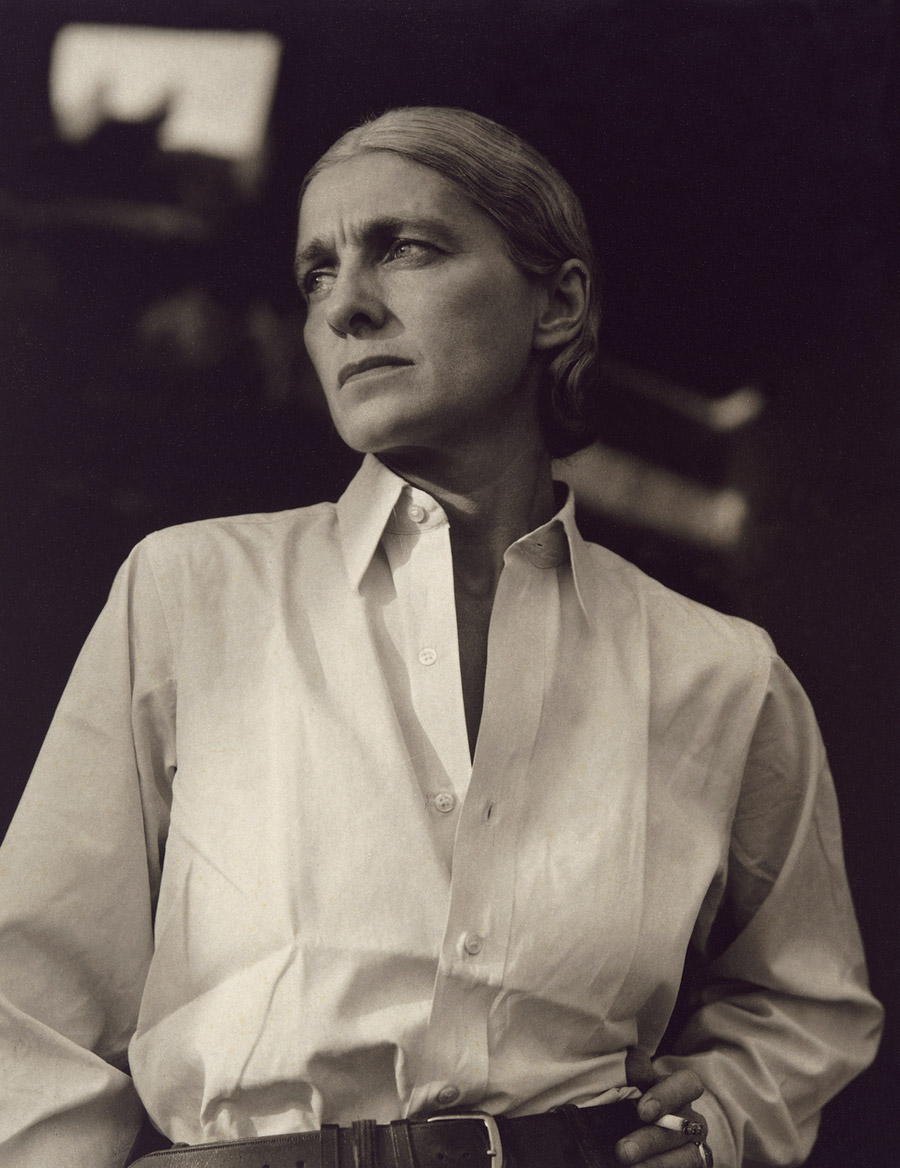
Alfred Stieglitz (American, 1864-1946) 'Georgia O'Keeffe' probably 1918


Figure 1. Alfred Stieglitz (American, 1864-1946)
Georgia O’Keeffe
probably 1918
Platinum print
18.4 x 23.1cm (7 1/4 x 9 1/8 in.)
National Gallery of Art, Washington
Alfred Stieglitz Collection


Alfred Stieglitz

Alfred Stieglitz (1864-1946) was already an accomplished photographer, publisher, and champion of modern art when he the first encountered the work of Georgia O’Keeffe in 1916. He made his first photographs of her in 1917 and sent them to her with the note, “I think I could do thousands
of things of you – a life work to express you.” Over the next two decades Stieglitz made more than three hundred photographs of O’Keeffe, whom he married in 1924, creating what he called a “composite portrait.” This extraordinary body of work charts the couple’s relationship and
expresses Stieglitz’s conviction that portraiture should function as a kind of “photographic diary.”

Many of the photographs Stieglitz made of O’Keeffe in the early years of their relationship, including Georgia O’Keeffe, c. 1918 (fig. 1, above), are palpably erotic, reflecting the intense passion they shared. Revealing herself to the lens with a bewitching vulnerability, O’Keeffe exudes a tenderness and seductiveness that belie the strain of holding the pose during the long exposures required by Stieglitz’s large-format camera. Often, his photographs express both his desire and admiration for O’Keeffe, at times verging on idealisation of the person he called “Nature’s child – a Woman.” Yet his portraits also look beyond her face to find eloquence in all
parts of her body, as in the print Georgia O’Keeffe – Hands and Thimble (fig. 2, below), where her hands display an almost tactile physicality. Here, Stieglitz used a printing technique that resulted in tonal reversal, causing deep shadows to print as bronze tones and creating the dark outlines that dramatise O’Keeffe’s graceful fingers and emphasise the metallic gleam of the thimble.

After Stieglitz exhibited more than forty portraits of O’Keeffe, including some provocative nudes, in 1921, the painter was dismayed to find that her own art began to be interpreted in a sexualised way, and she rarely posed unclothed after 1923. O’Keeffe’s desire to control her image, along with the increasingly attenuated nature of their relationship after 1929, when
she began spending several months a year working in New Mexico while he stayed in New York, further strained their partnership. In Georgia O’Keeffe, 1930 (fig. 3, below), the artist stands before one of the paintings she had made in New Mexico. Gazing steadily at the camera, she appears as a monumental force at one with her art, confident yet untouchable.

Text from the NGA website


Alfred Stieglitz (American, 1864-1946) 'Georgia O'Keeffe - Hands and Thimble' 1919


Figure 2. Alfred Stieglitz (American, 1864-1946)
Georgia O’Keeffe – Hands and Thimble
1919
Palladium print
24 x 19.4cm (9 7/16 x 7 5/8 in.)
National Gallery of Art, Washington
Alfred Stieglitz Collection


Alfred Stieglitz (American, 1864-1946) 'Georgia O'Keeffe' 1930


Figure 3. Alfred Stieglitz (American, 1864-1946)
Georgia O’Keeffe
1930
Gelatin silver print
23.9 x 19.1cm (9 7/16 x 7 1/2 in.)
National Gallery of Art, Washington
Alfred Stieglitz Collection


Nicholas Nixon (American, b. 1947) 'The Brown Sisters' 1975


Nicholas Nixon (American, b. 1947)
The Brown Sisters
1975
Gelatin silver print
20.2 x 25.2cm (7 15/16 x 9 15/16 in.)
National Gallery of Art, Washington
Patrons’ Permanent Fund
© Nicholas Nixon, courtesy Fraenkel Gallery, San Francisco and Pace/MacGill Gallery, New York


Nicholas Nixon (American, b. 1947) 'The Brown Sisters' 1978


Nicholas Nixon (American, b. 1947)
The Brown Sisters
1978
Gelatin silver print
Promised gift of James and Margie Krebs
© Nicholas Nixon, courtesy Museum of Fine Arts, Boston


For more images from this series please see my posting Nicholas Nixon: Family Album


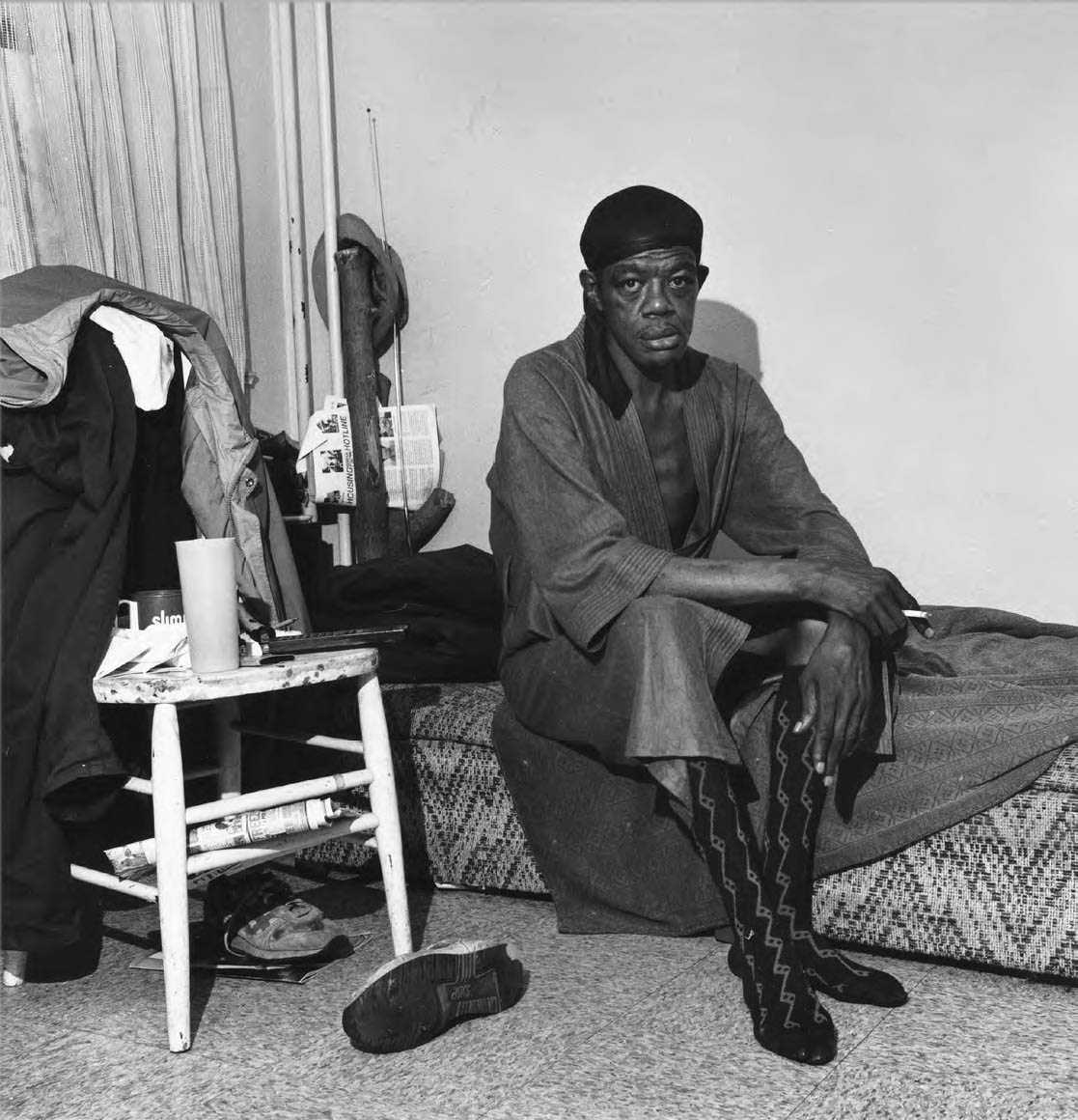
Milton Rogovin (American, 1909-2011) 'Samuel P. "Pee Wee" West (Lower West Side series)' 1974


Figure 7. Milton Rogovin (American, 1909-2011)
Samuel P. “Pee Wee” West (Lower West Side series)
1974
Gelatin silver print
National Gallery of Art, Washington
Gift of Dr. J. Patrick and Patricia A. Kennedy


Milton Rogovin

Milton Rogovin (1909-2011) belongs to a rich photographic tradition of documenting the social and personal histories of people who would otherwise be forgotten. He did so serially, returning over many years to encapsulate not just single moments but entire lifetimes. Rogovin started his career as an optometrist in Buffalo, New York. In 1957, after he refused to testify before the House Committee on Un-American Activities about his association with the Communist Party, the local paper labeled him the “Top Red in Buffalo.” His optometry practice folded as a result, leaving his family of five to survive on the salary of his wife, Anne. With free time suddenly available, Rogovin turned to photography with a strong sense of purpose. “My voice was essentially silenced,” he recalled, “so I decided to speak out through photographs.”

Rogovin’s candid, powerfully direct pictures gave voice to those who traditionally had none: immigrants, minorities, and working-class people. Even though he traveled around the world making photographs of workers, his best-known work was made closer to home. In 1972 he began photographing residents of Buffalo’s Lower West Side, the city’s poorest
and most ethnically diverse neighbourhood. With his bulky twin-lens Rolleiflex camera, the photographer was sometimes suspected of working for the police or the FBI. Over time, however, Rogovin gained the trust of his sitters by visiting regularly and by giving them prints of their portraits. Dignified and occasionally tender, these photographs depict the circumstances of each subject with sober honesty.

Several times over the next three decades, Rogovin sought out and re-photographed many of his original subjects, capturing the changes wrought by time and circumstance. The series Samuel P. “Pee Wee” West (figs. 7-10) registers changes in the sitter’s situation over the course of twenty-eight years, from 1974 to 2002. In 2003 the oral historian Dave Isay, working
alongside Rogovin, interviewed West, who related the story of his decades of heavy drinking. Reflecting on a photograph Rogovin had made of him in 1985 (fig. 8), West said, “That… picture actually changed my life”; it prompted him to stop drinking for six months before relapsing. A later brush with death led to permanent recovery and the founding of a program to help local youth reject drugs and alcohol. In this and other serial portraits, Rogovin honoured the everyday lives of his subjects, offering a powerful visual legacy of a community he respected and loved.

Text from the NGA website


Milton Rogovin (American, 1909-2011) 'Samuel P. "Pee Wee" West (Lower West Side series)' 1985


Figure 8. Milton Rogovin (American, 1909-2011)
Samuel P. “Pee Wee” West (Lower West Side series)
1985
Gelatin silver print
National Gallery of Art, Washington
Gft of Dr. J. Patrick and Patricia A. Kennedy


Milton Rogovin (American, 1909-2011) 'Samuel P. "Pee Wee" West (Lower West Side series)' 1992


Figure 9. Milton Rogovin (American, 1909-2011)
Samuel P. “Pee Wee” West (Lower West Side series)
1992
Gelatin silver print
National Gallery of Art, Washington
Gft of Dr. J. Patrick and Patricia A. Kennedy


Milton Rogovin (American, 1909-2011) 'Samuel P. "Pee Wee" West (Lower West Side series)' 2002


Figure 10. Milton Rogovin (American, 1909-2011)
Samuel P. “Pee Wee” West (Lower West Side series)
2002
Gelatin silver print
National Gallery of Art, Washington
Gift of Dr. J. Patrick and Patricia A. Kennedy


National Gallery of Art
National Mall between 3rd and 7th Streets
Constitution Avenue NW, Washington

Opening hours:
Daily 11.00am – 4.00pm

National Gallery of Art website

LIKE ART BLART ON FACEBOOK

Back to top

Exhibition: ‘Janina Green: Ikea’ at Edmund Pearce Gallery, Melbourne

Exhibition dates: 28th November 28 – 15th December 2012


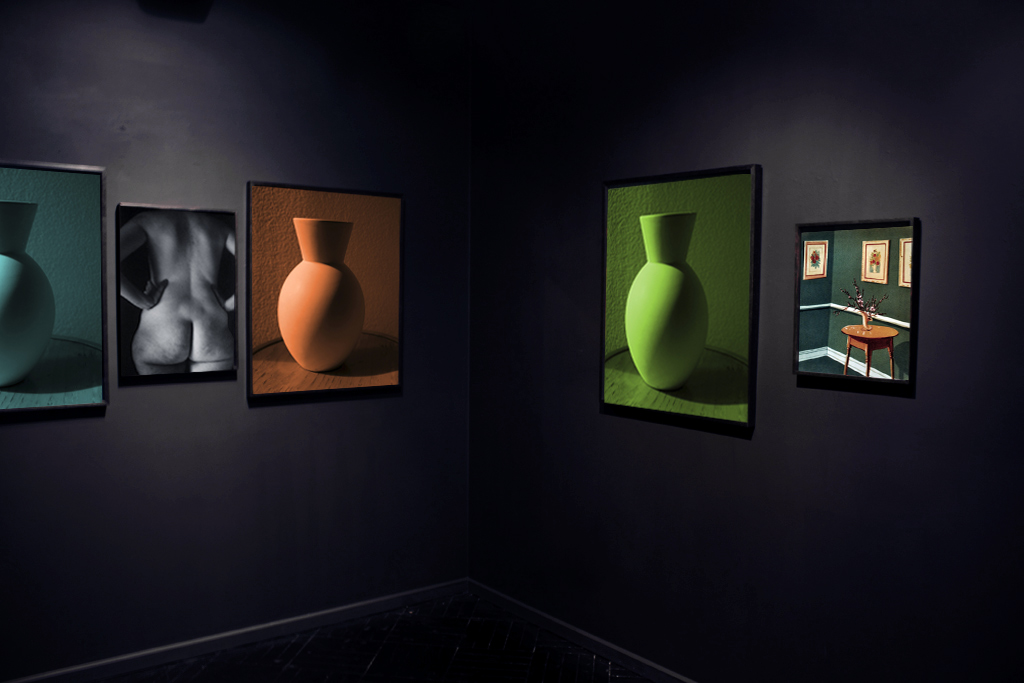
Installation photograph of 'Ikea' by Janina Green at Edmund Pearce Gallery, Melbourne


Installation photograph of Ikea by Janina Green at Edmund Pearce Gallery, Melbourne


“It is necessary to revisit what Walter Benjamin said of the work of art in the age of its mechanical reproducibility. What is lost in the work that is serially reproduced, is its aura, its singular quality of the here and now, its aesthetic form (it had already lost its ritual form, in its aesthetic quality), and, according to Benjamin, it takes on, in its ineluctable destiny of reproduction, a political form. What is lost is the original, which only a history itself nostalgic and retrospective can reconstitute as “authentic.” The most advanced, the most modern form of this development, which Benjamin described in cinema, photography, and contemporary mass media, is one in which the original no longer even exists, since things are conceived from the beginning as a function of their unlimited reproduction.”


Jean Baudrillard. ‘Simulacra and Simulation’. 1981 (English translation 1994)


“To apprehend myself as seen is, in fact, to apprehend myself as seen in the world and from the standpoint of the world. The look does not carve me out in the universe; it comes to search for me at the heart of my situation and grasps me only in irresolvable relations with instruments. If I am seen as seated, I must be seen as “seated-on-a-chair,” … But suddenly the alienation of myself, which is the act of being-looked-at, involves the alienation of the world which I organise. I am seated on this chair with the result that I do not see it at all, that it is impossible for me to see it …”


Jean-Paul Satre. ‘Being and Nothingness’ (trans. Hazel Barnes). London: Methuen, 1966, p. 263


“It must be possible to concede and affirm an array of “materialities” that pertain to the body, that which is signified by the domains of biology, anatomy, physiology, hormonal and chemical composition, illness, age, weight, metabolism, life and death. None of this can be denied. But the undeniability of these “materialities” in no way implies what it means to affirm them, indeed, what interpretive matrices condition, enable and limit that necessary affirmation. That each of those categories [BODY AND MATERIALITY] have a history and a historicity, that each of them is constituted through the boundary lines that distinguish them and, hence, by what they exclude, that relations of discourse and power produce hierarchies and overlappings among them and challenge those boundaries, implies that these are both persistent and contested regions.”


Judith Butler. ‘Bodies That Matter’. New York: Routledge, 1993, pp. 66-67


Fable = invent (an incident, person, or story)

Simulacrum = pretends to be a faithful copy, but it is a copy with no original

Performativity = power of discourse, politicisation of abjection, ritual of being

Body / identity / desire = imperfection, fluidity, domesticity, transgression, transcendence


Intimate, conceptually robust and aesthetically sensitive.
The association of the images was emotionally overwhelming.
An absolute gem. One of the highlights of the year.

Dr Marcus Bunyan


Many thankx to Edmund Pearce Gallery for allowing me to publish the photographs in the posting. Please click on the photographs for a larger version of the image.


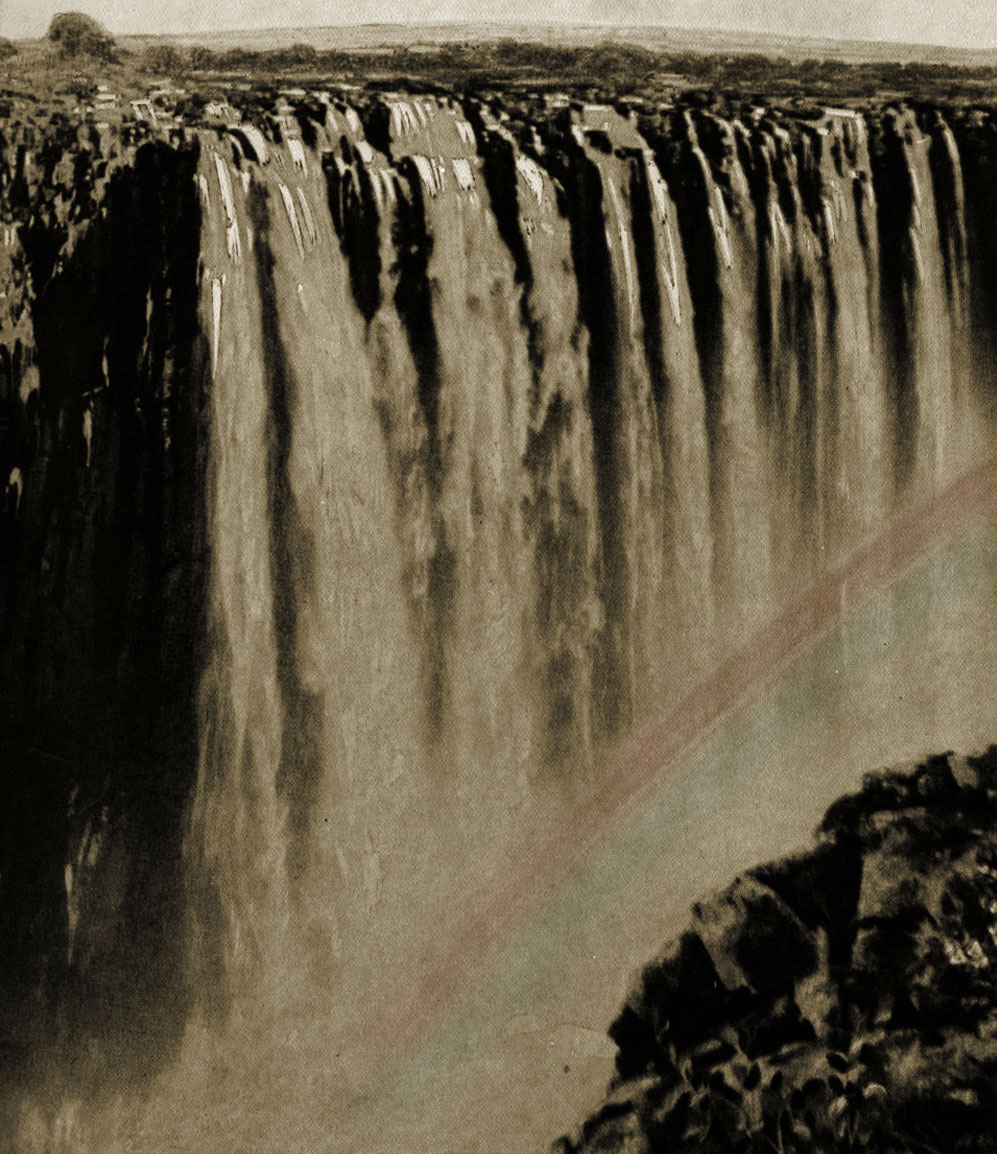
Janina Green (Australian born Germany, b. 1944) 'Waterfall' 1990


Janina Green (Australian born Germany, b. 1944)
Waterfall
1990
Silver gelatin print on Kentmere Parchment paper, tinted with coffee and photo dyes
58 x 48cm
Vintage print


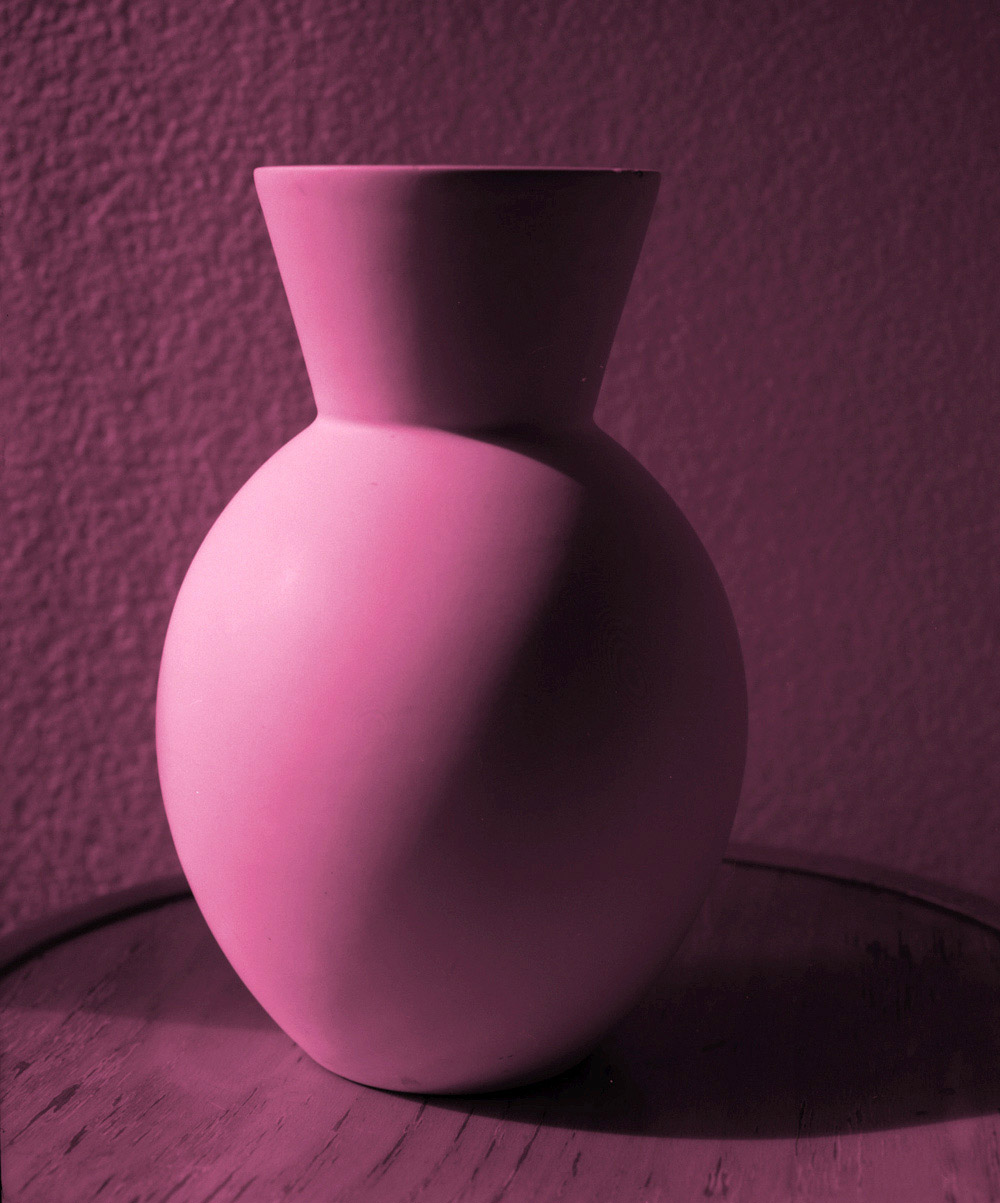
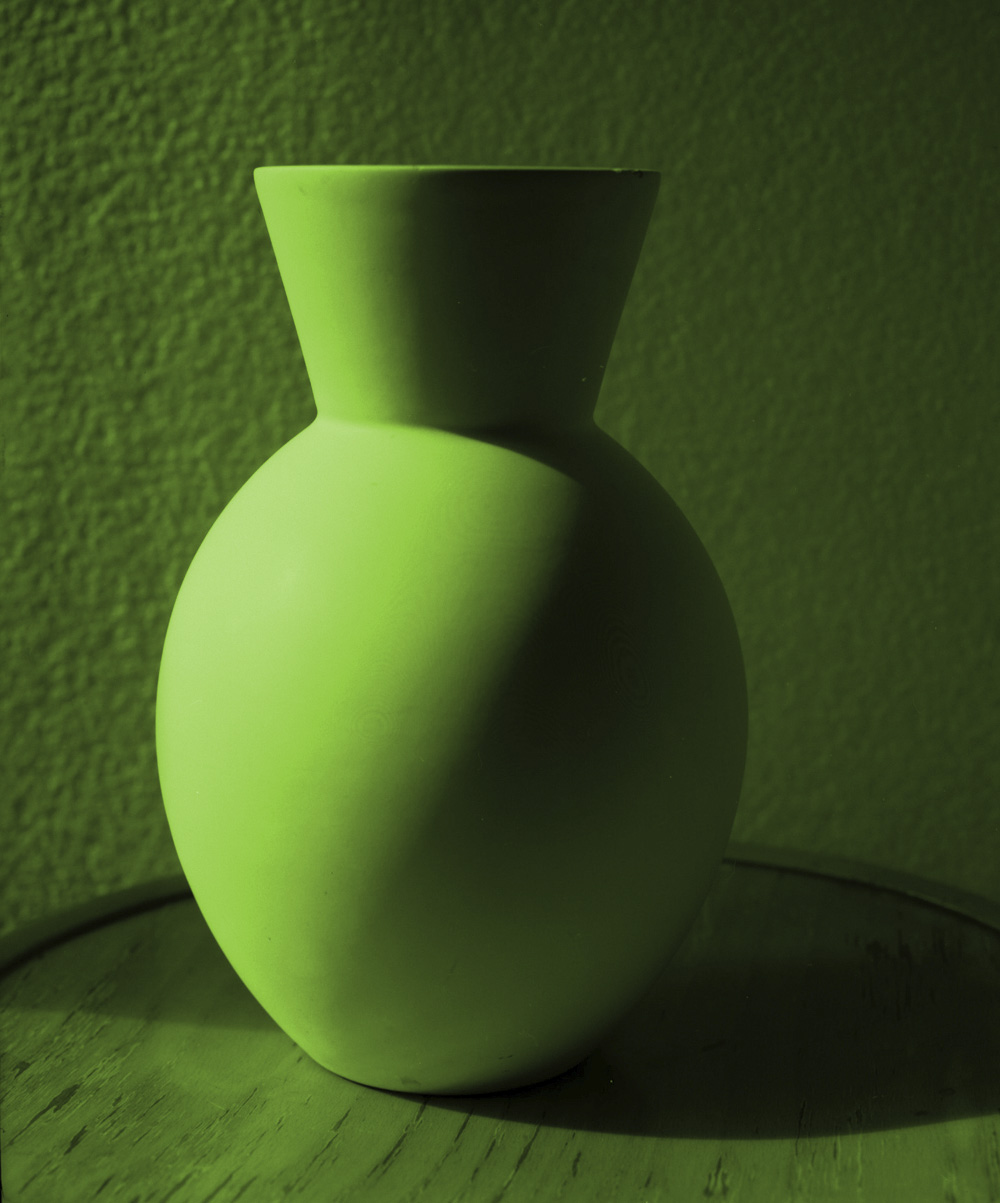
Janina Green (Australian born Germany, b. 1944) 'Pink vase' 1990 reprinted 2012


Janina Green (Australian born Germany, b. 1944)
Pink vase
1990 reprinted 2012
Silver gelatin print on fibre based paper, hand tinted with pink photo dye
85 x 70cm


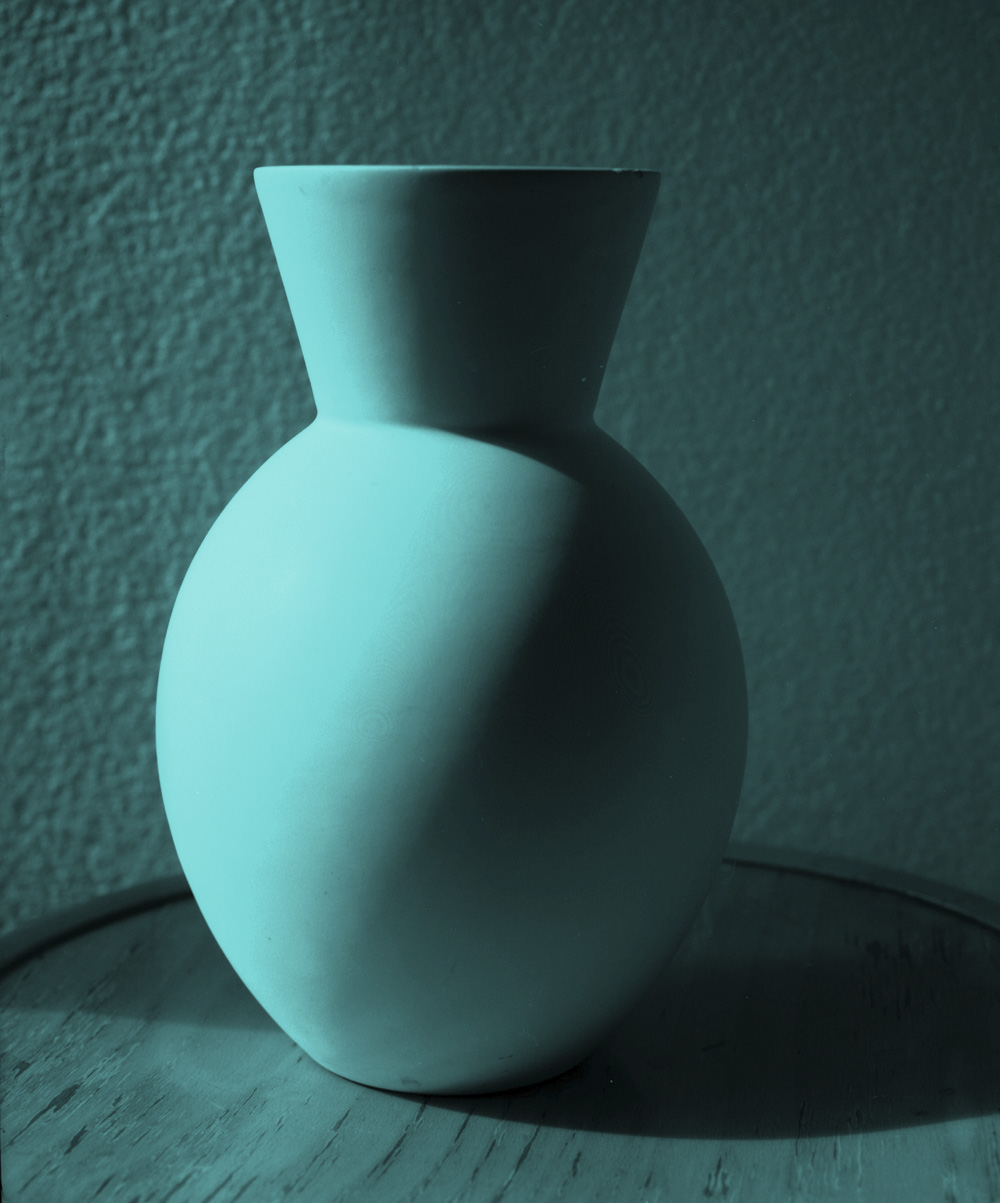
Janina Green (Australian born Germany, b. 1944) 'Blue vase' 1990 reprinted 2012


Janina Green (Australian born Germany, b. 1944)
Blue vase
1990 reprinted 2012
Silver gelatin print on fibre based paper, hand tinted with blue photo dye
85 x 70cm


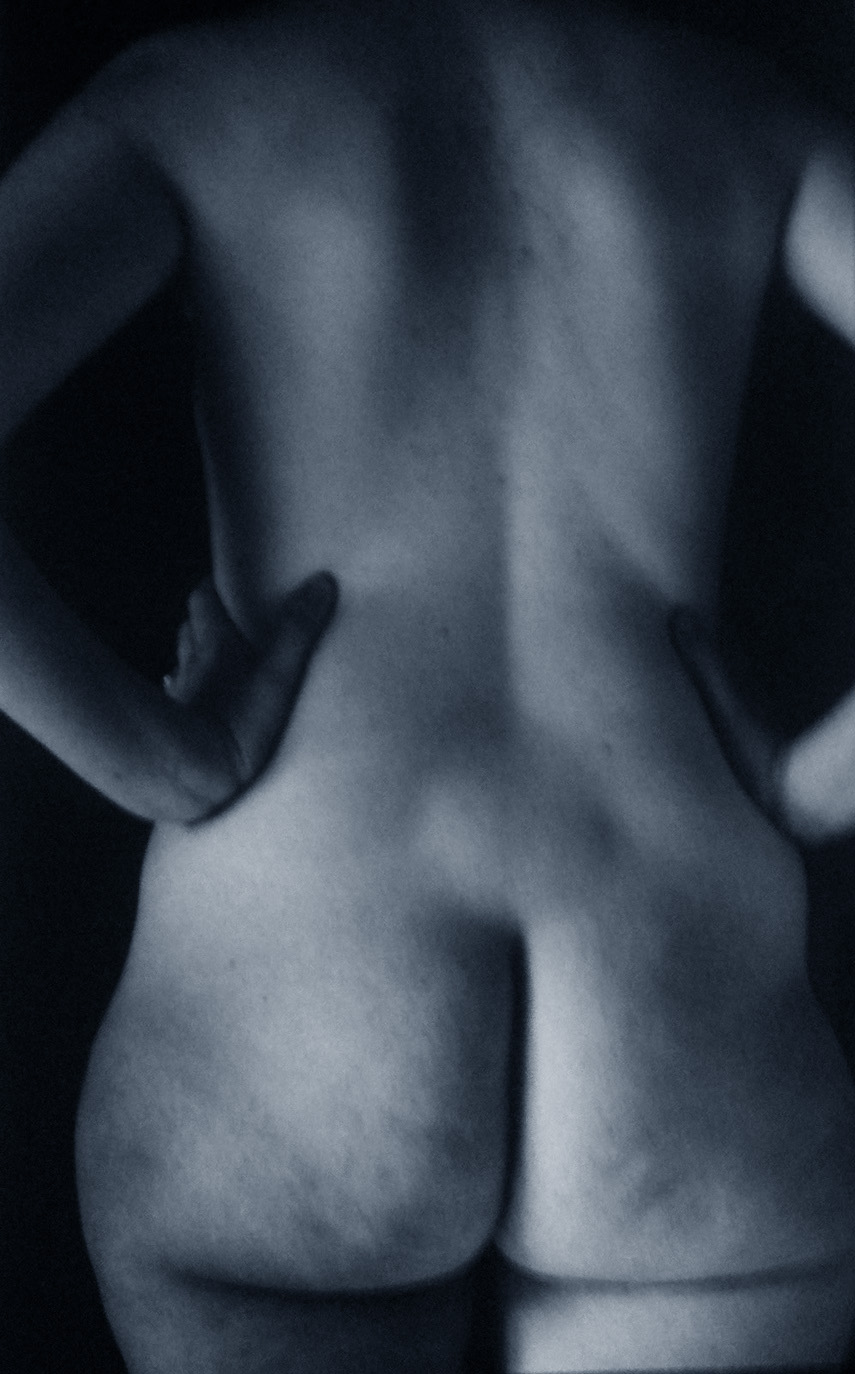
Janina Green (Australian born Germany, b. 1944) 'Nude' 1986


Janina Green (Australian born Germany, b. 1944)
Nude
1986
Silver gelatin print on fibre based paper, hand tinted with blue photo dye
60 x 45cm
Vintage print


My photographs are always about the past.

The Barthesian slogan, “this has been,” is for me, “I was there.” This series of images of a vase from Ikea consists of silver gelatin prints tinted in different coloured photographic dyes; photographs of a simple mass produced vase – its form the familiar vessel which so dominates Art History. “Ikea” for me is symbolic of the useful homely object and of the ideal home. The vase from Ikea no longer exists. The picture of that vase stands in for the vase that once existed. The photograph can be seen now – at this moment. It will continue to exist in the future. Its representation crosses time barriers.

My photographs are always documentations of a private performance.

Every photograph records what is in front of the camera, but my interest is in the occasion and the complex conditions of the making of the photograph – first the negative then the print. Each photograph ends up being a documentation of my state of mind during this intensely private moment as well as something for other people to look at. Because of changing conditions, every one of these prints from that same negative is different. For me each analogue print is an unsteady thing. They are now relics from another era, as is the vase.

As a counterpoint to the repetition of the vase prints, I have selected four vintage works from my archive.

Artists statement by Janina Green

Janina is represented by M.33


Janina Green (Australian born Germany, b. 1944) 'Orange vase' 1990 reprinted 2012


Janina Green (Australian born Germany, b. 1944)
Orange vase
1990 reprinted 2012
Silver gelatin print on fibre based paper, hand tinted with orange photo dye
85 x 70cm


Janina Green (Australian born Germany, b. 1944) 'Green vase' 1990 reprinted 2012


Janina Green (Australian born Germany, b. 1944)
Green vase
1990 reprinted 2012
Silver gelatin print on fibre based paper, hand tinted with green photo dye
85 x 70cm


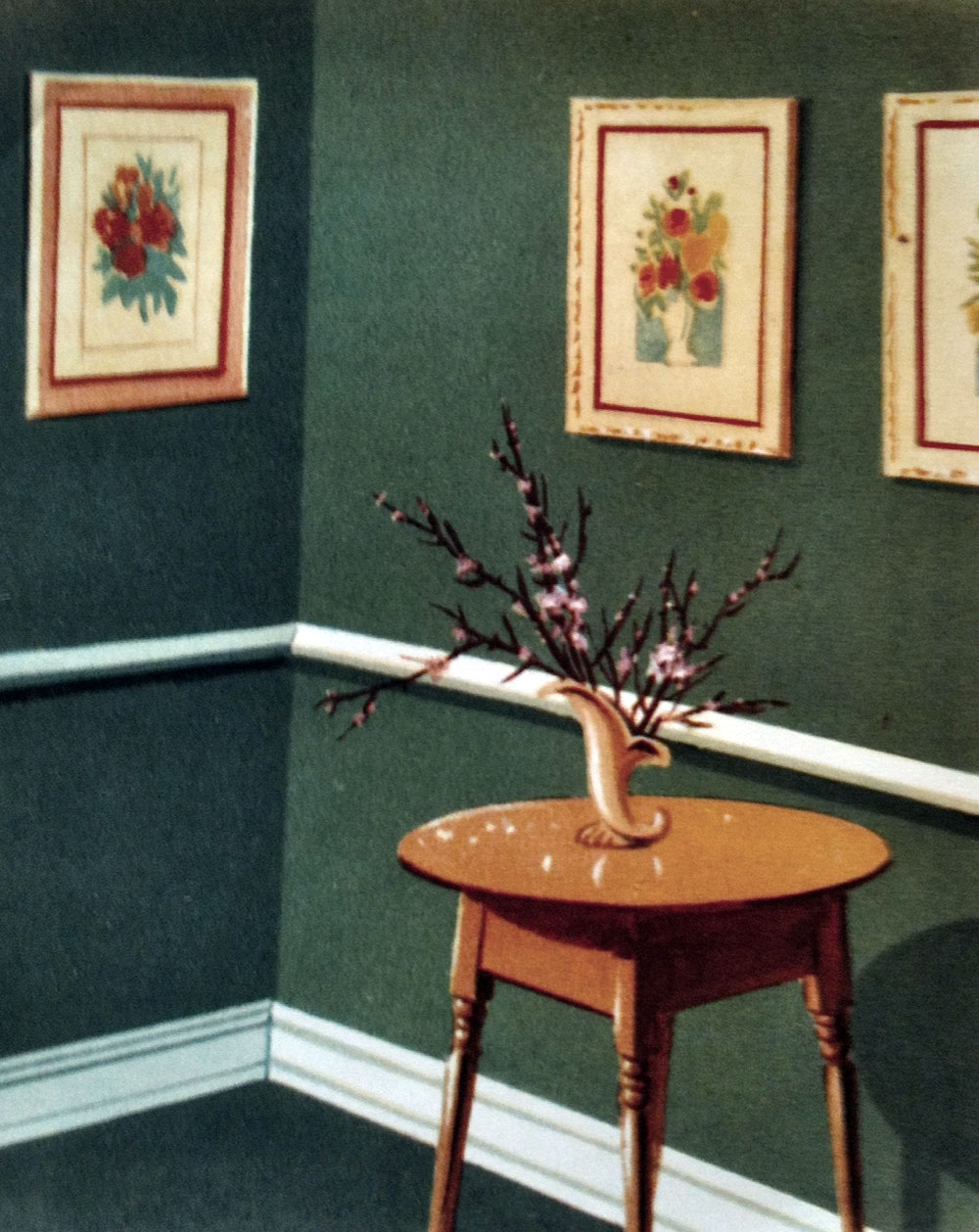
Janina Green (Australian born Germany, b. 1944) 'Interior' 1992


Janina Green (Australian born Germany, b. 1944)
Interior
1992
C Type print
38 x 30cm
Vintage print / edition of 5


Janina Green (Australian born Germany, b. 1944) 'Telephone' 1986 reprinted 2010


Janina Green (Australian born Germany, b. 1944)
Telephone
1986 reprinted 2010
Silver gelatin print on fibre based paper, tinted with coffee
58 x 48cm


Janina Green (Australian born Germany, b. 1944) 'Yellow vase' 1990 reprinted 2012


Janina Green (Australian born Germany, b. 1944)
Yellow vase
1990 reprinted 2012
Silver gelatin print on fibre based paper, hand tinted with yellow photo dye
85 x 70cm


Edmund Pearce Gallery

This gallery is now closed.

LIKE ART BLART ON FACEBOOK

Back to top

Exhibition: ‘Jeff Wall Photographs’ at The Ian Potter Centre: National Gallery of Victoria Australia, Melbourne

Exhibition dates: 30th November 2012 – 17th March 2013


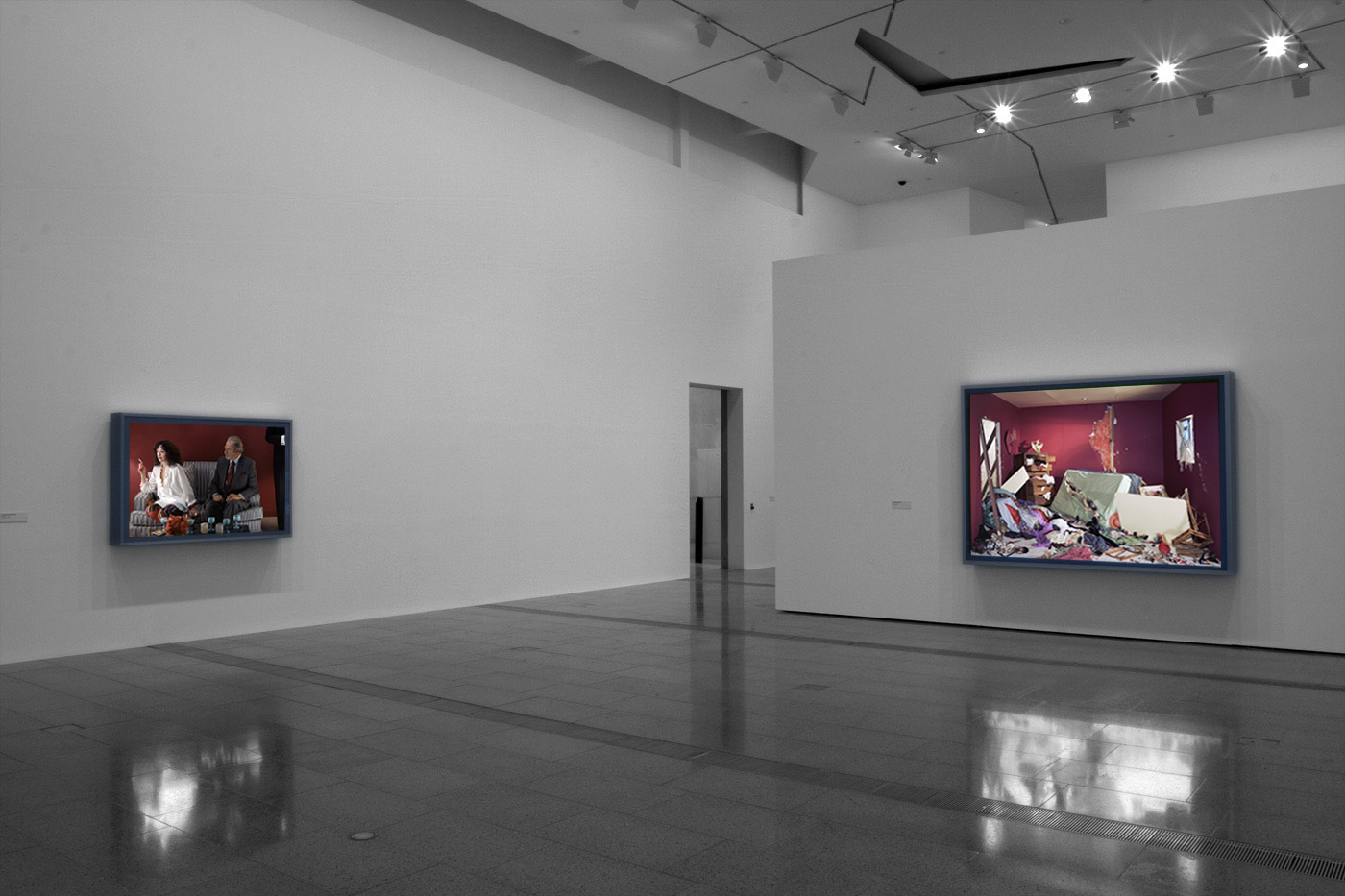
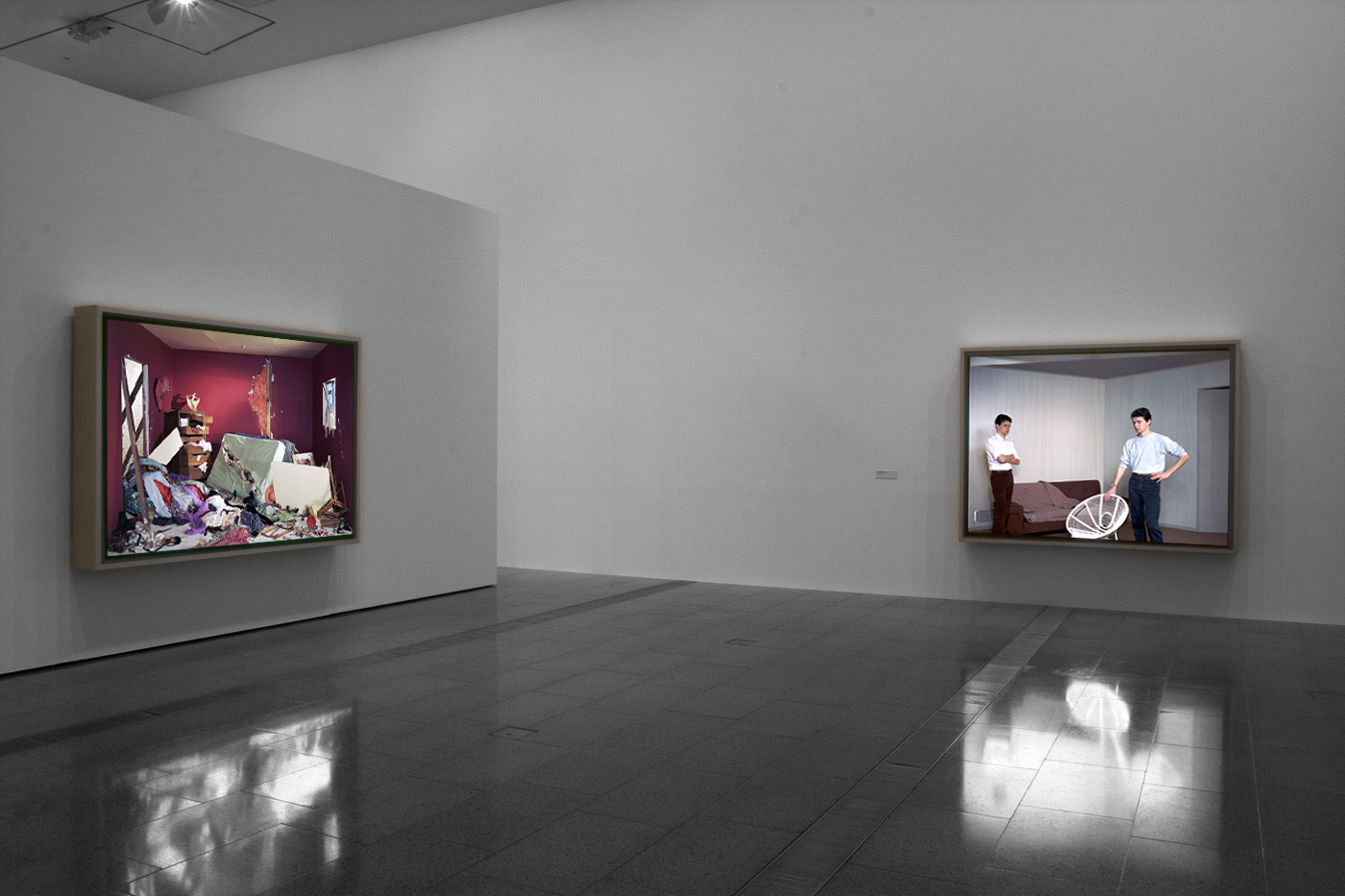
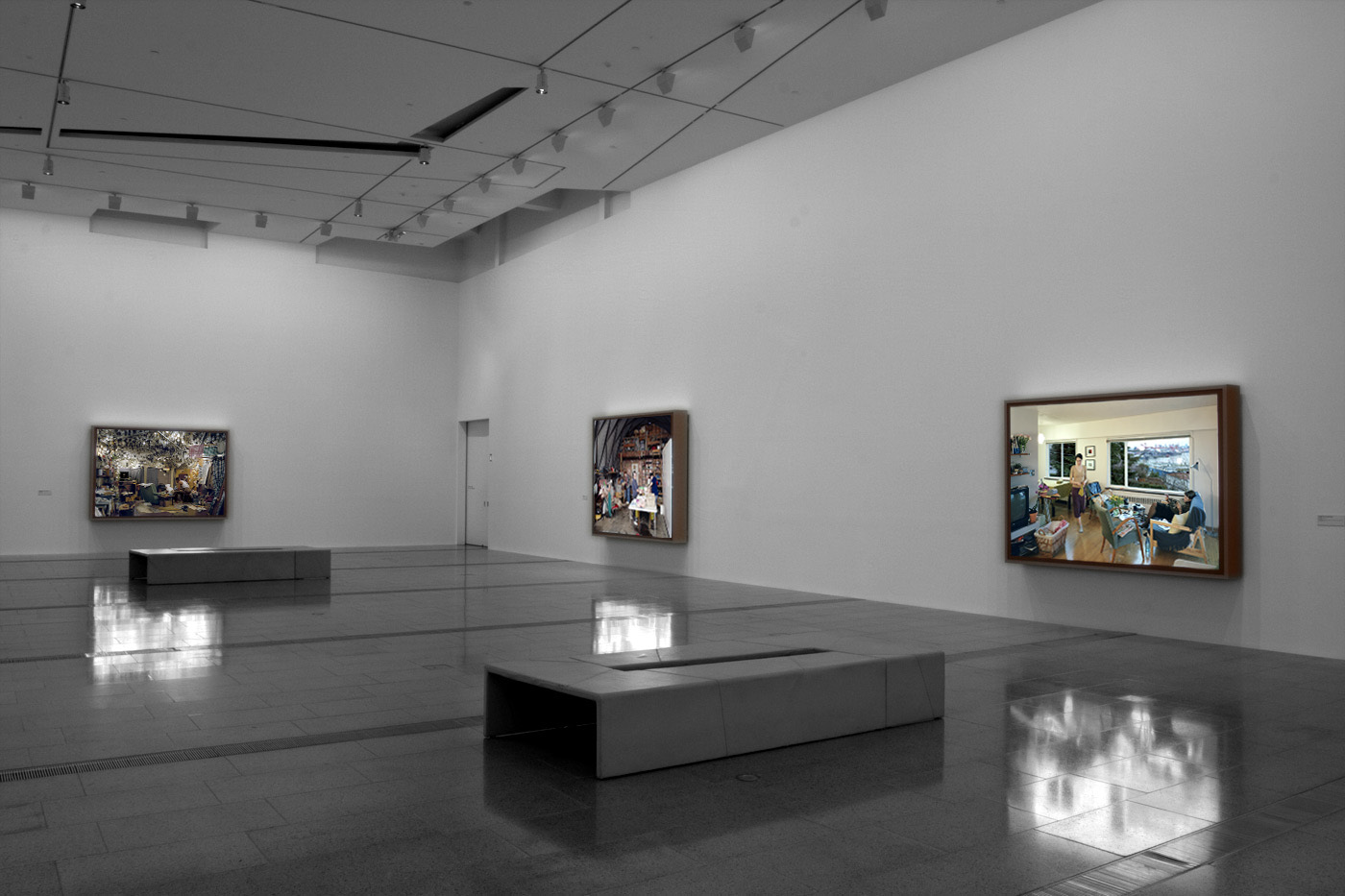
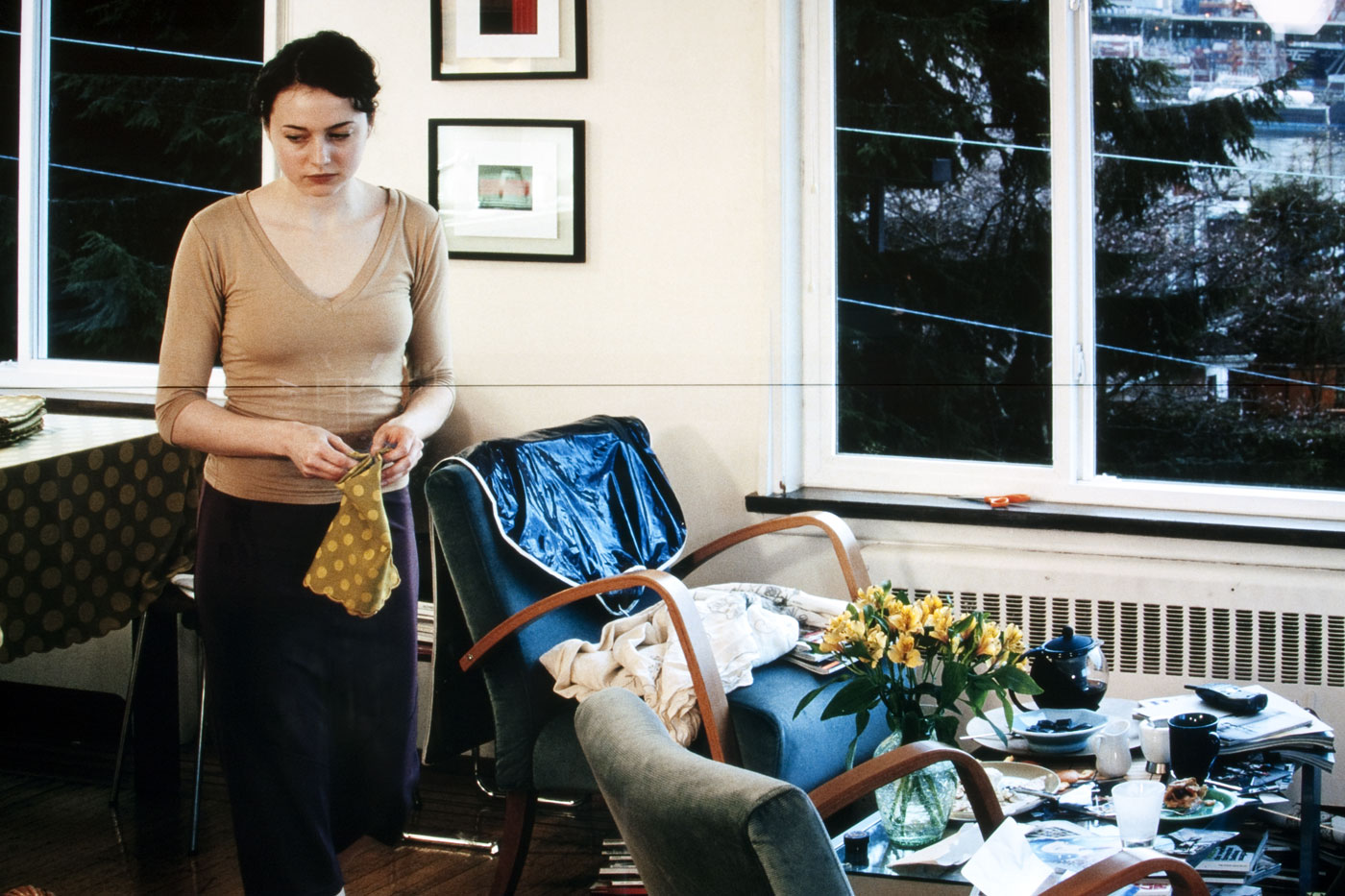
Installation view of 'Jeff Wall Photographs' at NGV Australia showing, at right, 'The Destroyed Room' 1978


Installation view of Jeff Wall Photographs at NGV Australia showing, at right, The Destroyed Room 1978
Photo: Marcus Bunyan


Installation shots of the new Jeff Wall exhibition at NGV Australia. Review to follow in due course.

Many thankx to Jemma Altmeier and all the media team at NGV for all their wonderful help and congratulations to the curators, Susan van Wyk and Dr Isobel Crombie, for their restrained yet contemporary installations and for getting the exhibitions to Melbourne. They look magnificent. Well done!

Dr Marcus Bunyan


Many thankx to the NGV for allowing me to publish the photographs in the posting. Please click on the photographs for a larger version of the image. All photographs © Marcus Bunyan © National Gallery of Victoria. May not be reproduced without permission.


Jeff Wall & Thomas Demand: In Conversation, National Gallery of Victoria


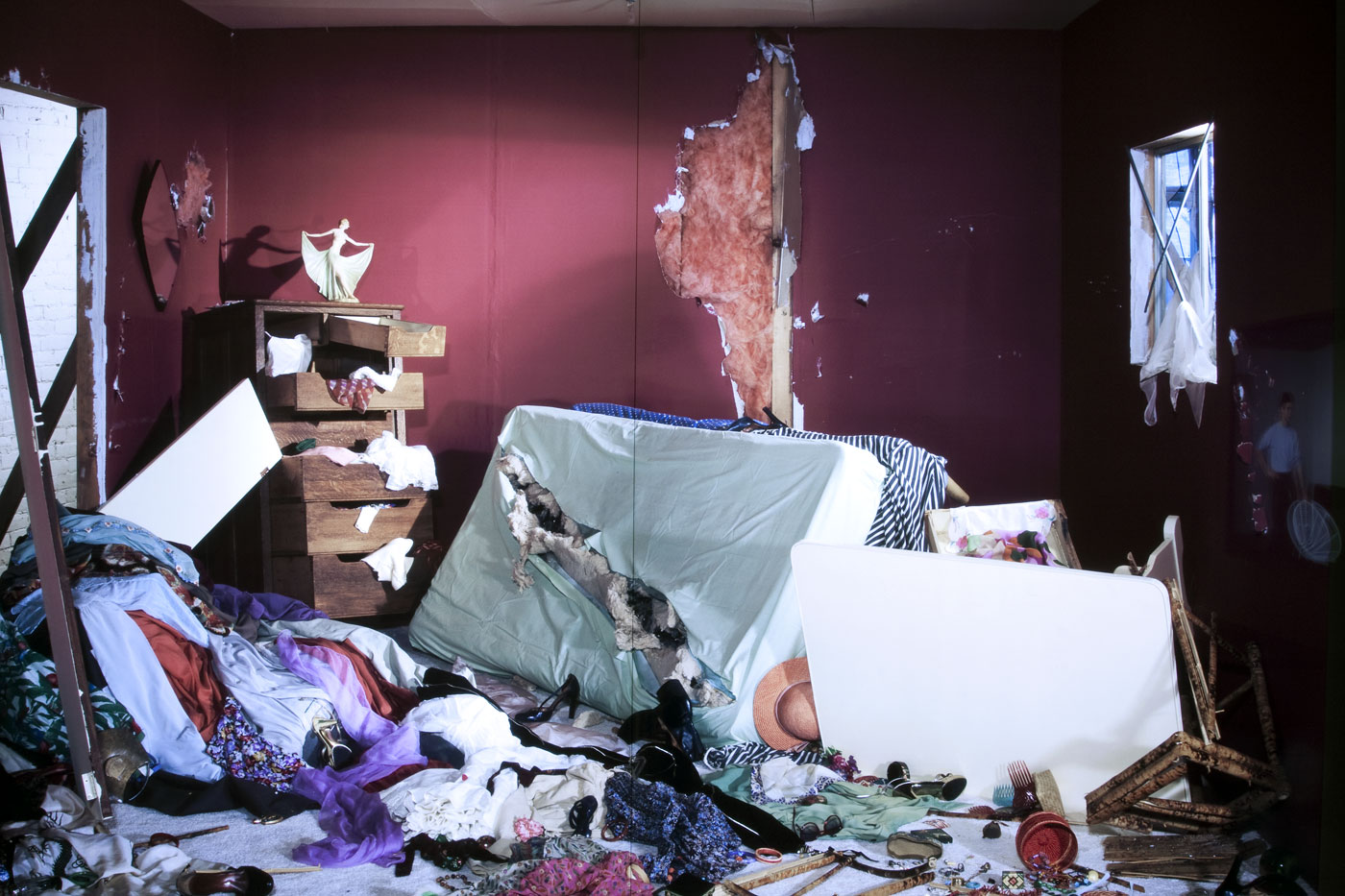
Jeff Wall (Canadian, b. 1946) 'The Destroyed Room' 1978 (detail)


Jeff Wall (Canadian, b. 1946)
The Destroyed Room (detail)
1978
Transparency in light box, AP
159.0 x 234.0cm
Collection of the artist
© Jeff Wall


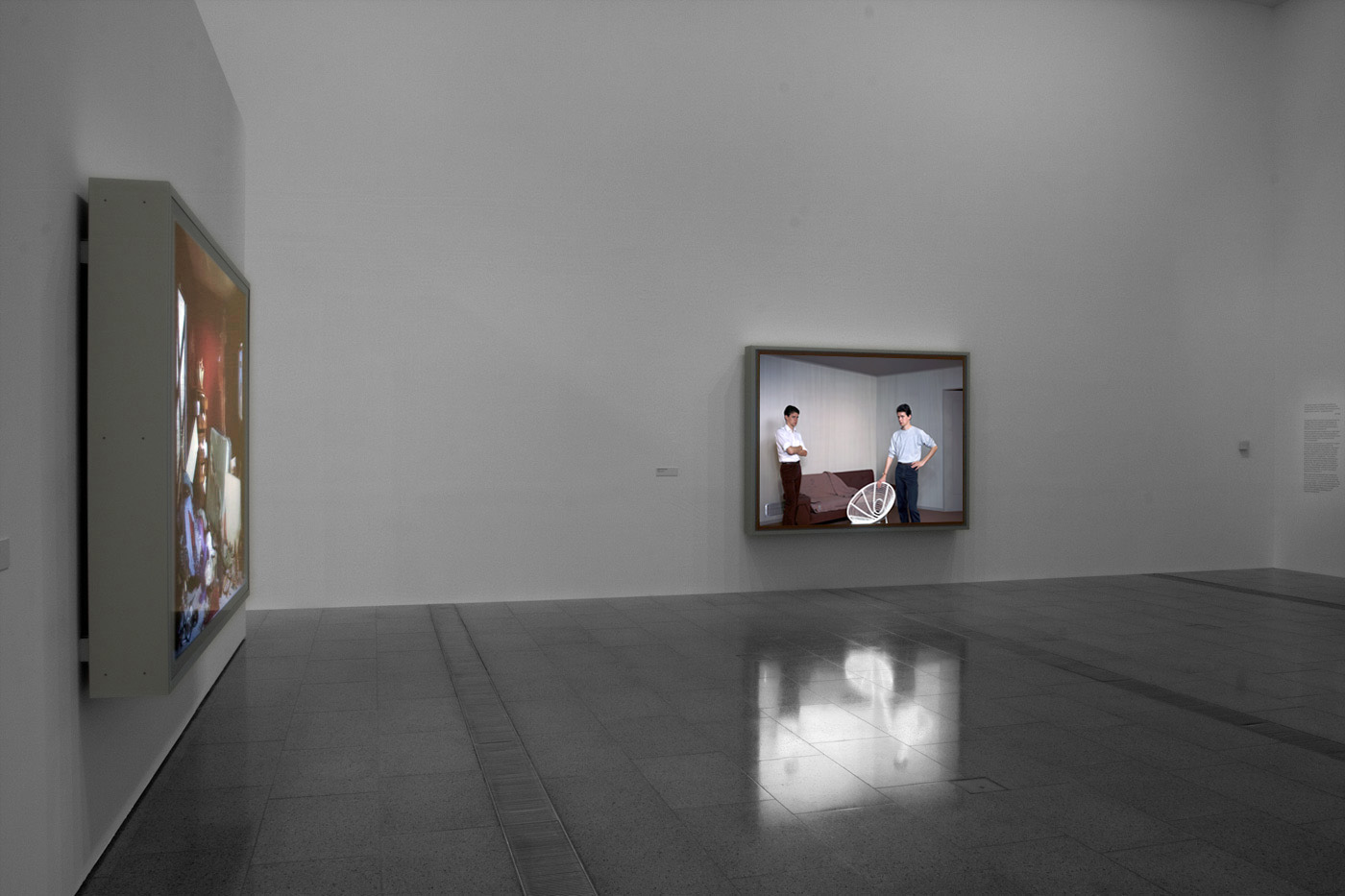
Installation view of 'Jeff Wall Photographs' at NGV Australia showing, at left, 'The Destroyed Room' 1978, and at right, 'Double Self-Portrait' 1979


Installation view of Jeff Wall Photographs at NGV Australia showing, at left, The Destroyed Room 1978, and at right, Double Self-Portrait 1979
Photo: Marcus Bunyan


Installation view of 'Jeff Wall Photographs' at NGV Australia showing, at right, 'Double Self-Portrait' 1979


Installation view of Jeff Wall Photographs at NGV Australia showing, at right, Double Self-Portrait 1979
Photo: Marcus Bunyan


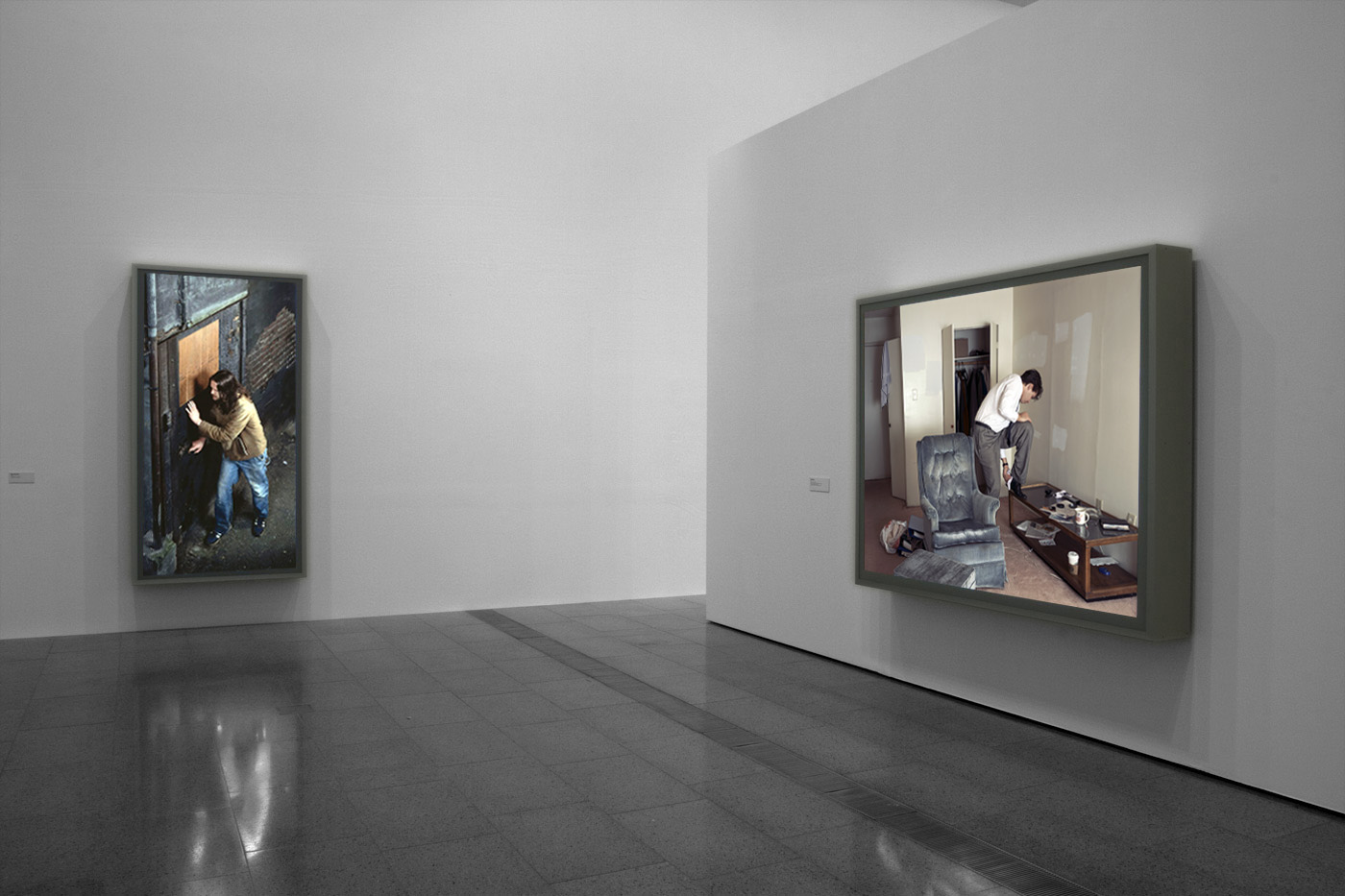
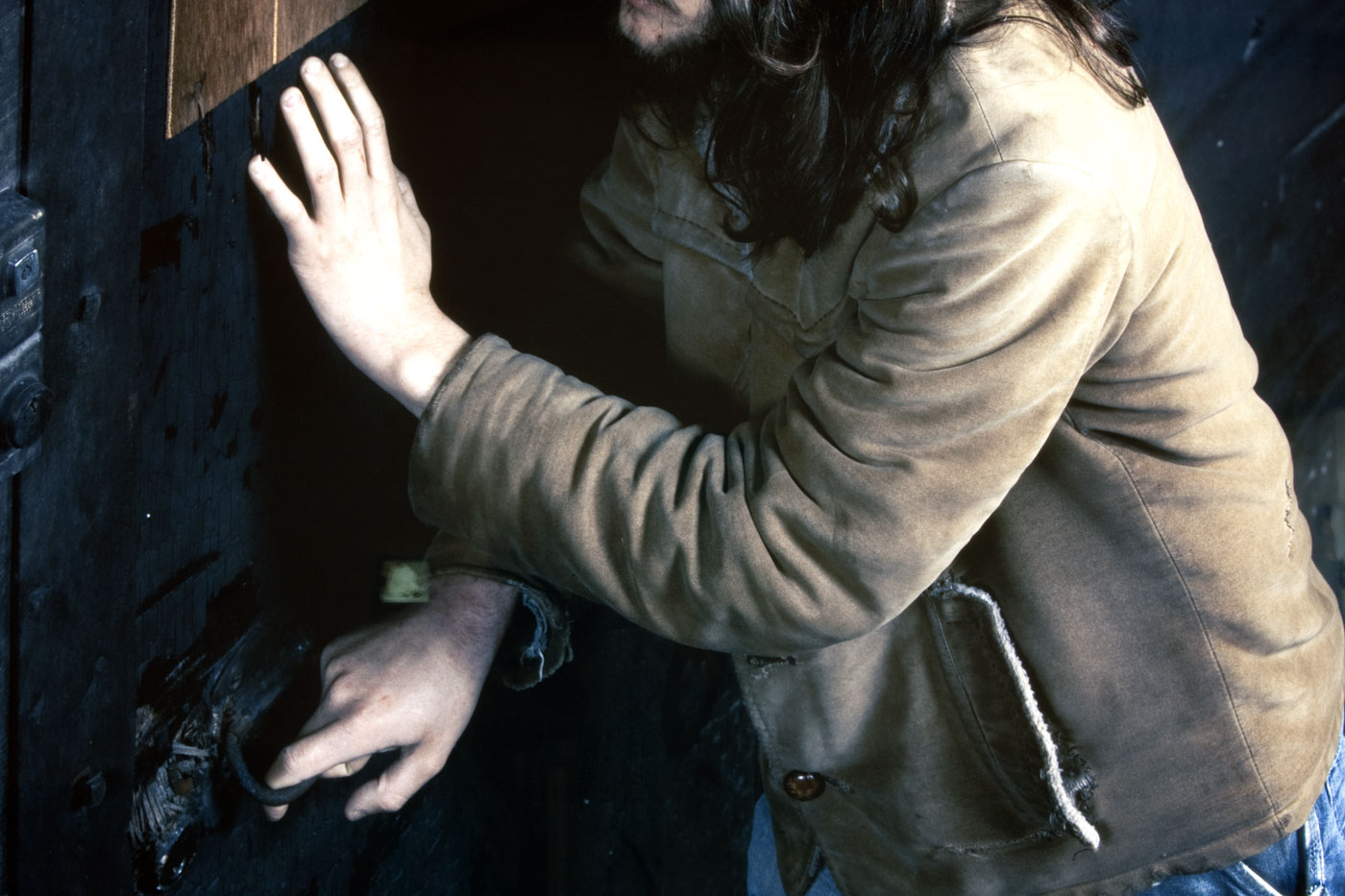
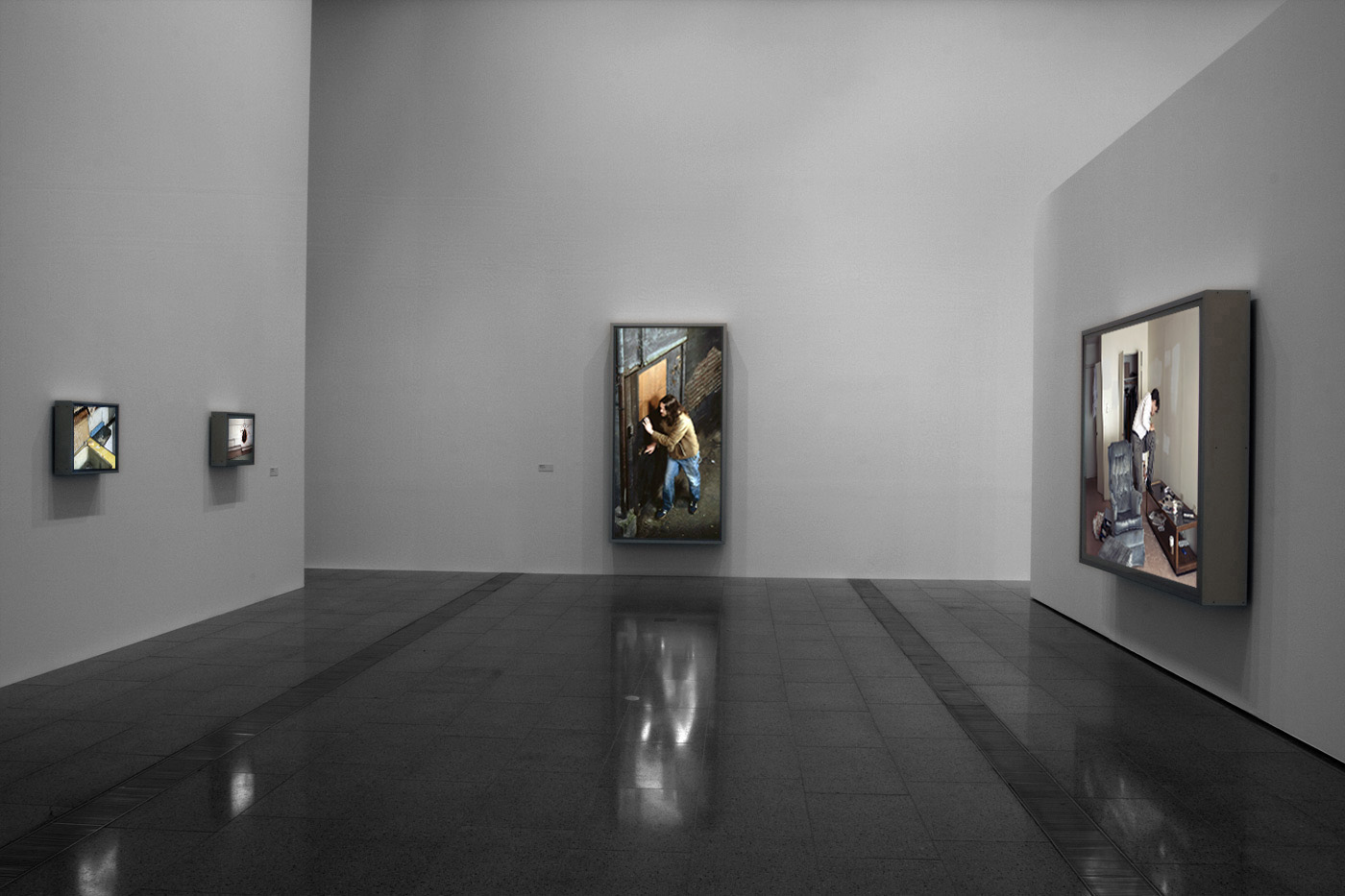
Installation view of 'Jeff Wall Photographs' at NGV Australia showing, at left, 'Doorpusher' 1984, and at right, 'Polishing' 1998


Installation view of Jeff Wall Photographs at NGV Australia showing, at left, Doorpusher 1984, and at right, Polishing 1998
Photo: Marcus Bunyan


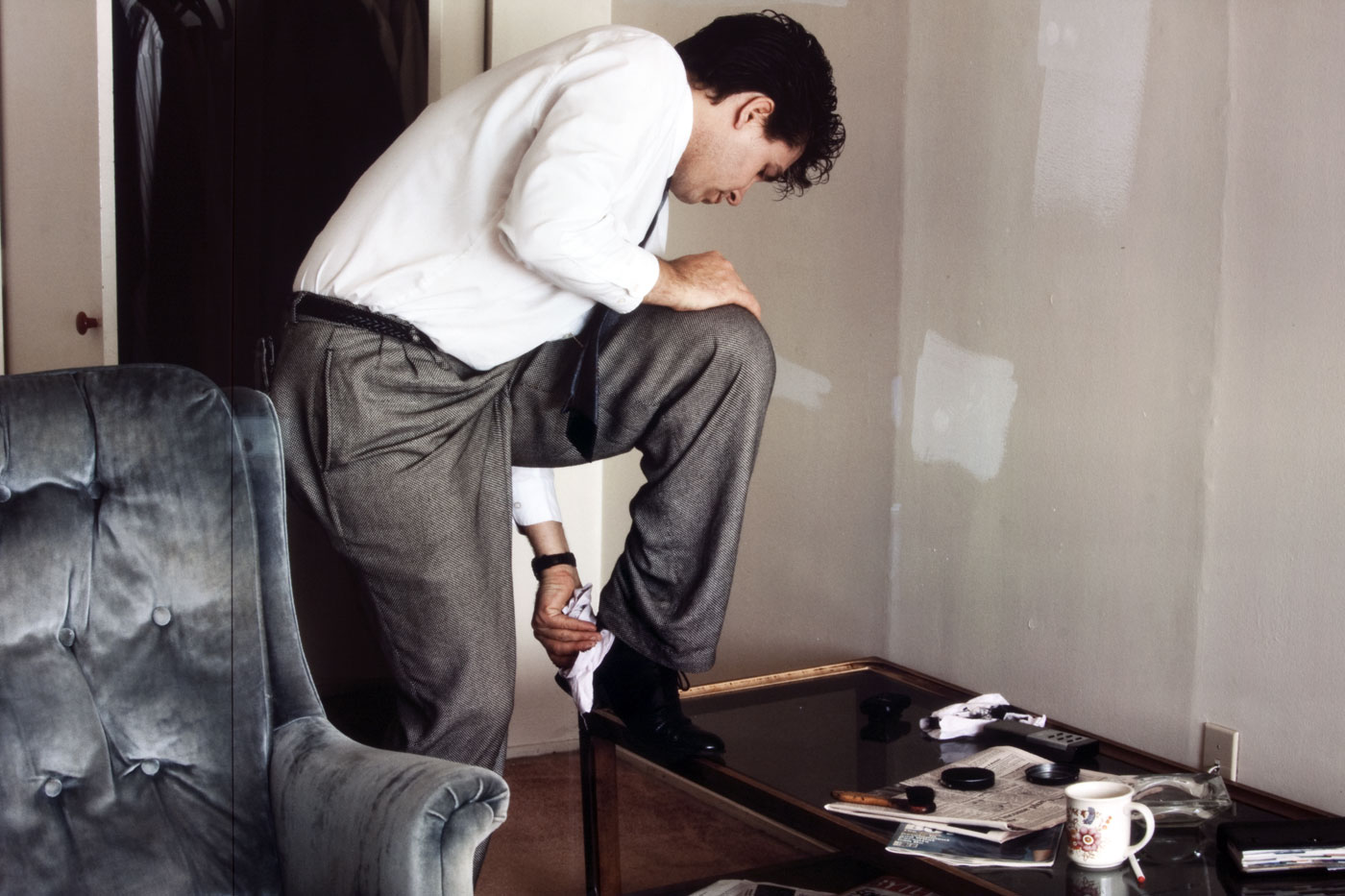
Jeff Wall (Canadian, b. 1946) 'Polishing' 1998 (detail)


Jeff Wall (Canadian, b. 1946)
Polishing (detail)
1998
Transparency in light box, 1/2
162.0 x 207.0cm
State Art Collection, Art Gallery of Western Australia
Purchased with assistance from the Art Gallery of Western Australia Foundation, 1999
© Jeff Wall


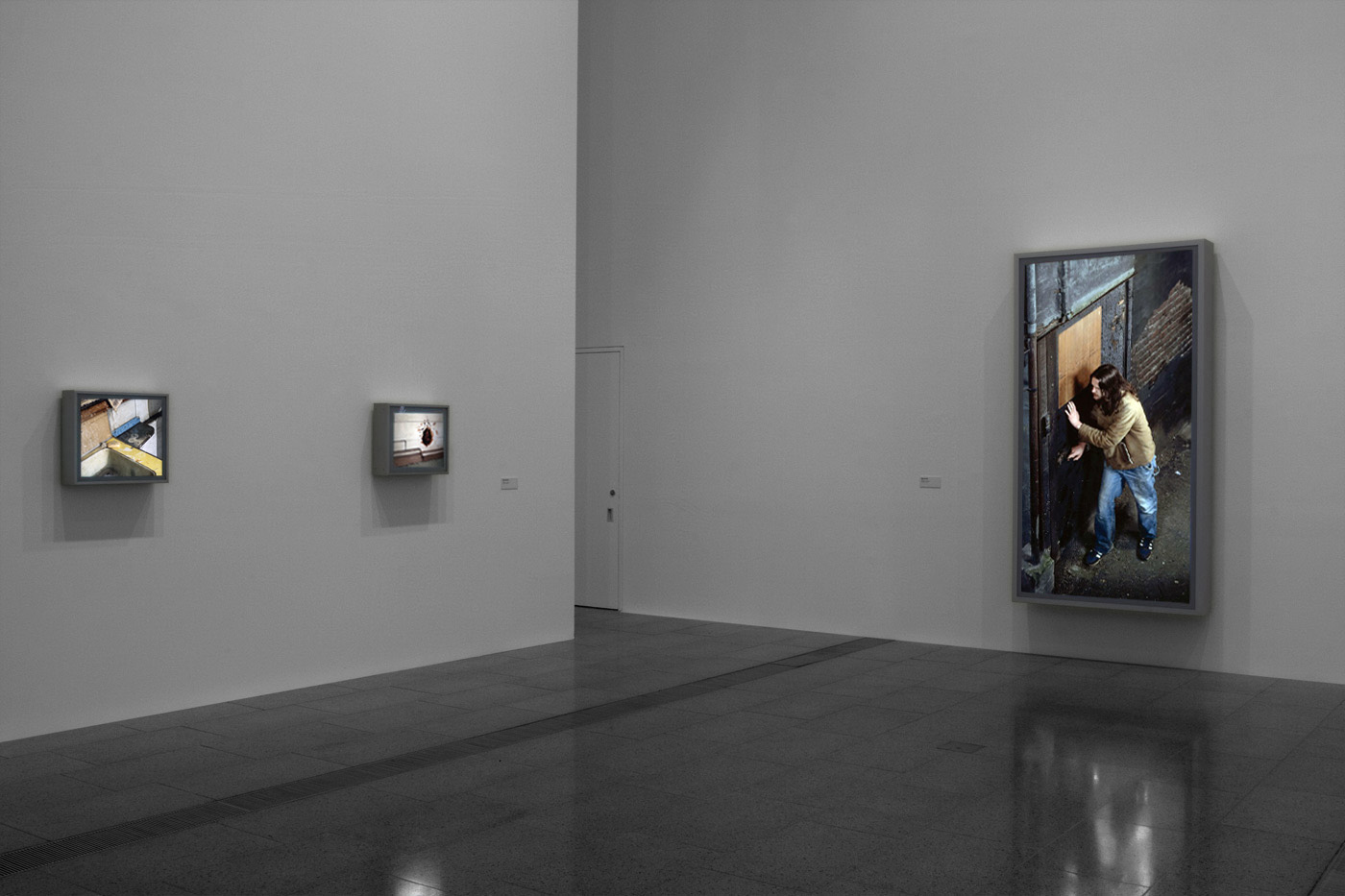
Jeff Wall (Canadian, b. 1946) 'Doorpusher' 1984 (detail)


Jeff Wall (Canadian, b. 1946)
Doorpusher
(detail)
1984
Transparency in lightbox
249 x 122cm
© Jeff Wall


Installation view of 'Jeff Wall Photographs' at NGV Australia showing, at centre, 'Doorpusher' 1984, and at right, 'Polishing' 1998


Installation view of Jeff Wall Photographs at NGV Australia showing, at centre, Doorpusher 1984, and at right, Polishing 1998
Photo: Marcus Bunyan


Installation view of 'Jeff Wall Photographs' at NGV Australia showing, at left, 'Diagonal Composition' 1993, and at right, 'Doorpusher' 1984


Installation view of Jeff Wall Photographs at NGV Australia showing, at left, Diagonal Composition 1993, and at right, Doorpusher 1984
Photo: Marcus Bunyan


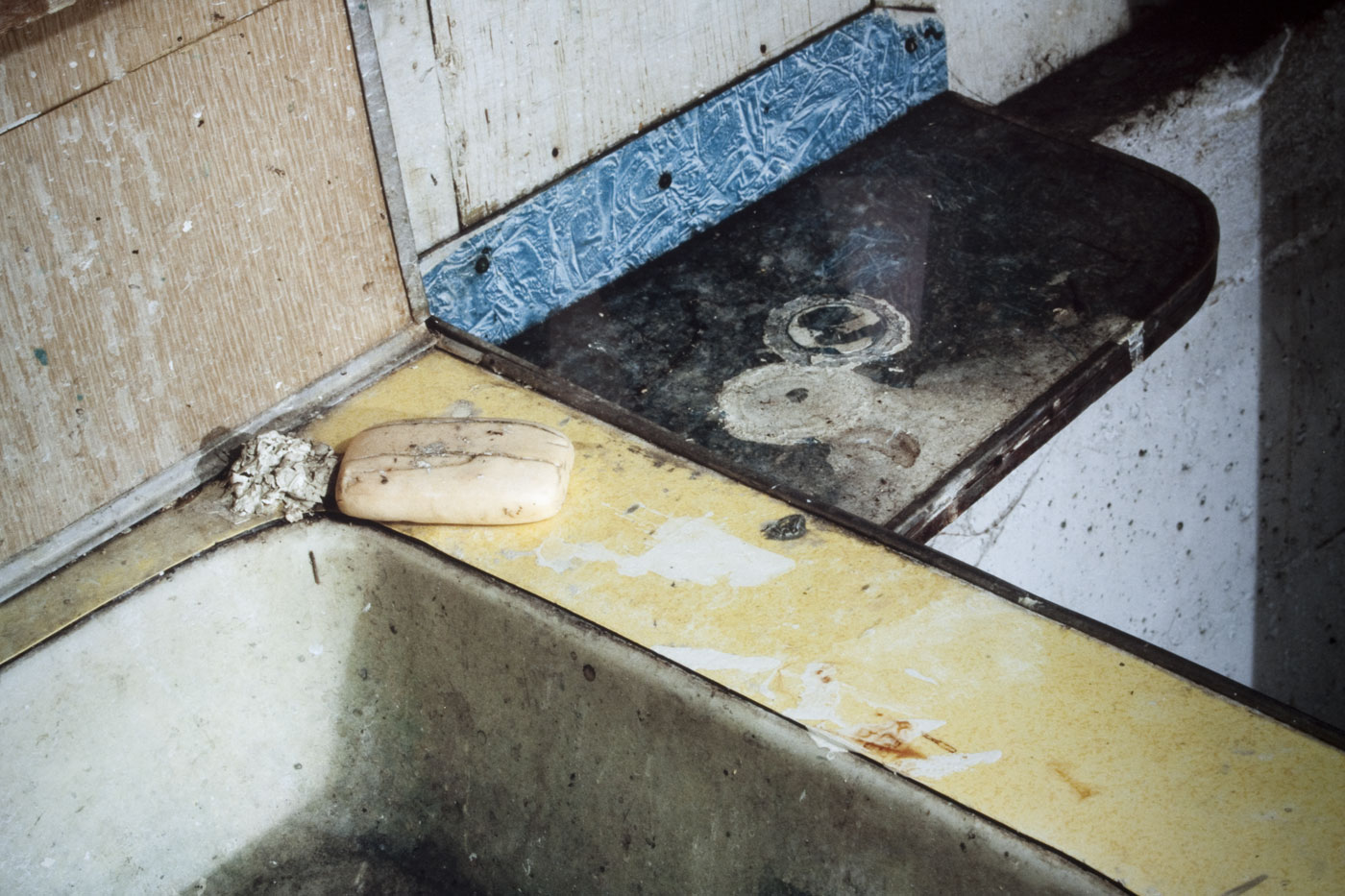
Jeff Wall (Canadian, b. 1946) 'Diagonal Composition' 1993


Jeff Wall (Canadian, b. 1946)
Diagonal Composition
1993
Transparency in light box, AP
40 x 46cm
Collection of the artist
© Jeff Wall


Jeff Wall (Canadian, b. 1946) 'Pipe Opening' 2002 (detail)


Jeff Wall (Canadian, b. 1946)
Pipe Opening (detail)
2002
Transparency in light box, AP
40 x 46cm
Collection of the artist
© Jeff Wall


Installation view of 'Jeff Wall Photographs' at NGV Australia showing, at right, 'A view from an apartment' 2004-2005


Installation view of Jeff Wall Photographs at NGV Australia showing, at right, A view from an apartment 2004-2005
Photo: Marcus Bunyan


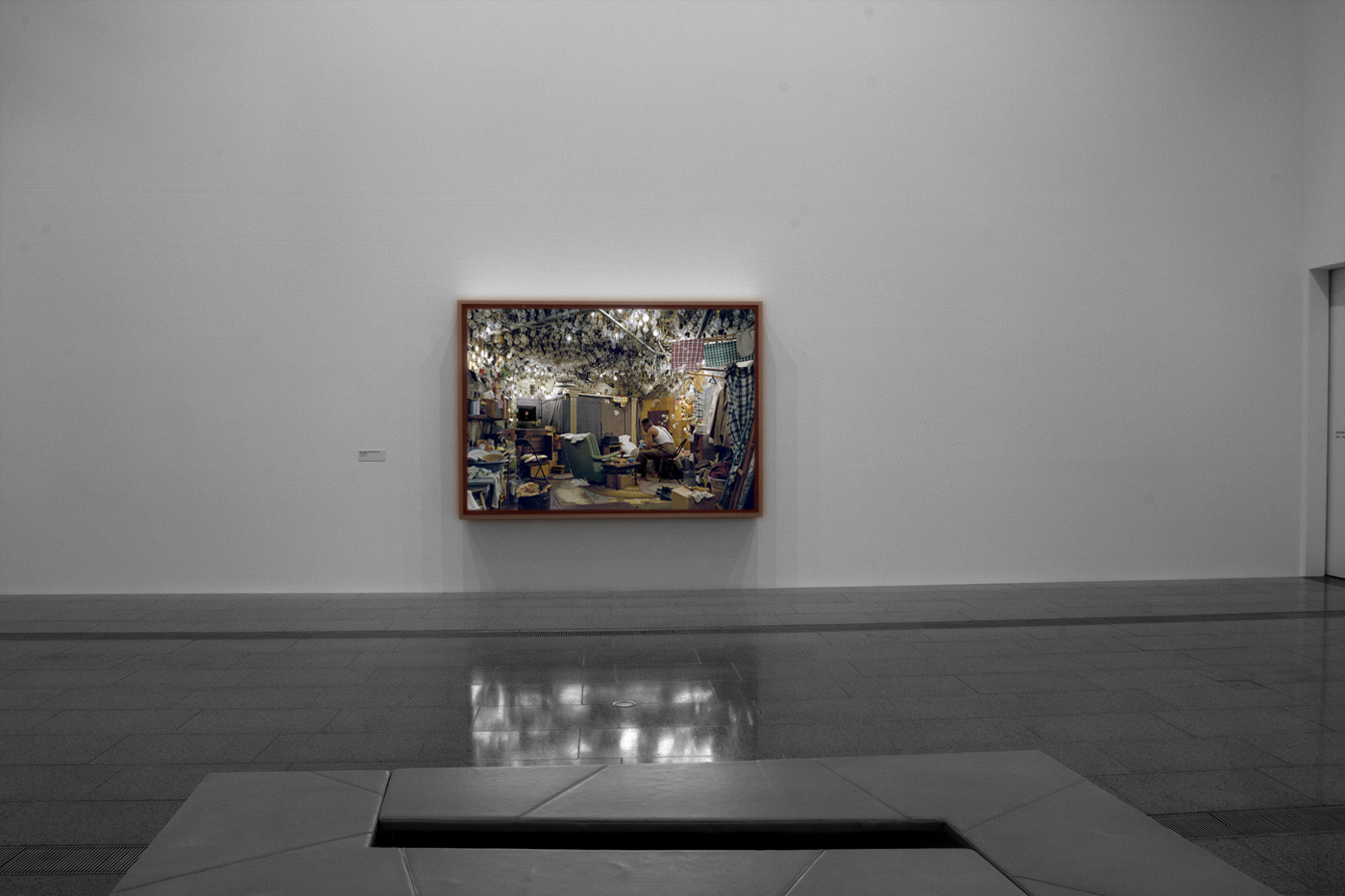
Installation view of 'Jeff Wall Photographs' at NGV Australia showing 'After 'Invisible Man' by Ralph Ellison, the Prologue' 1999-2000


Installation view of Jeff Wall Photographs at NGV Australia showing After ‘Invisible Man’ by Ralph Ellison, the Prologue 1999-2000
Photo: Marcus Bunyan


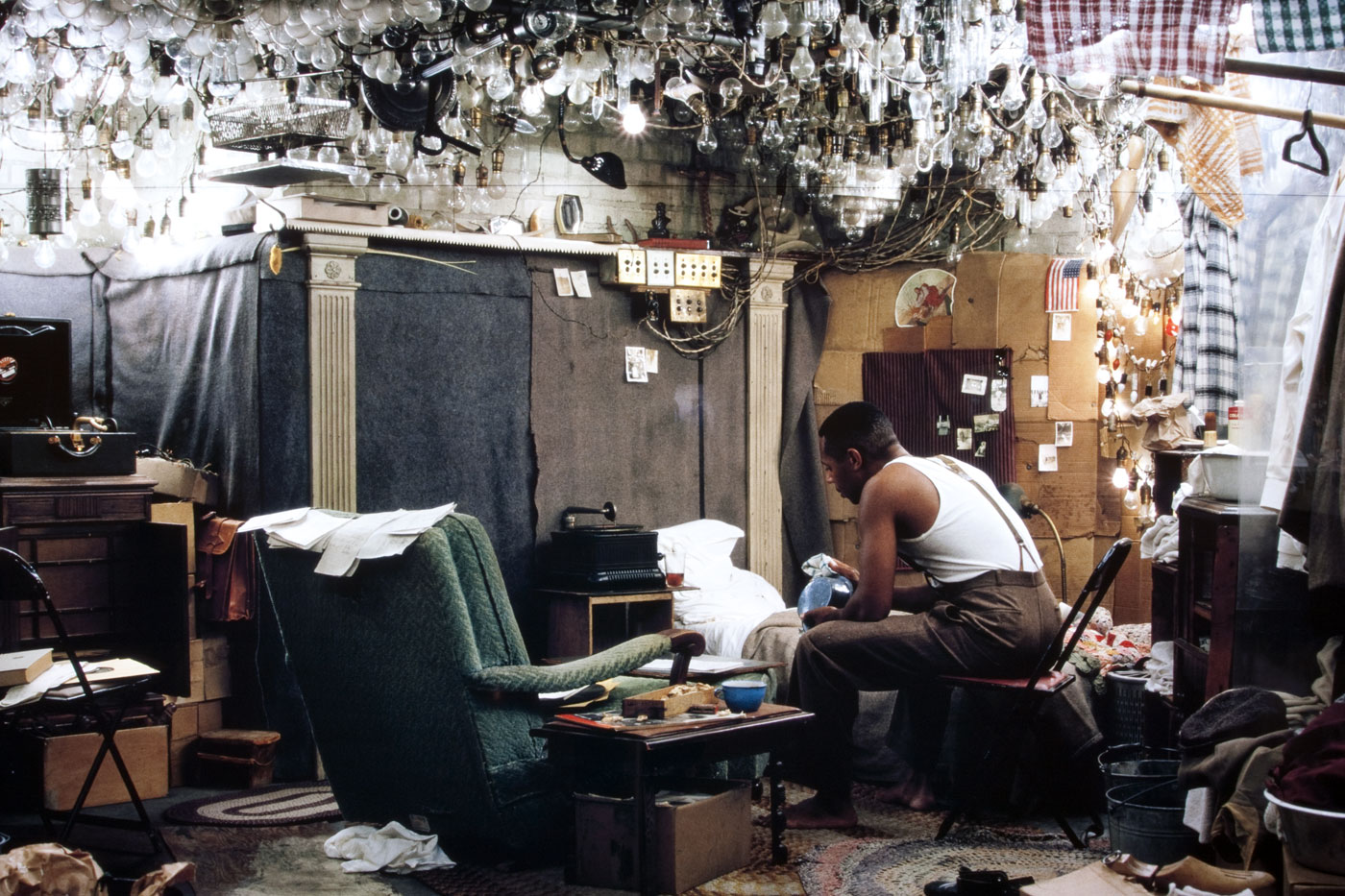
Jeff Wall (Canadian, b. 1946) 'After 'Invisible Man' by Ralph Ellison, the Prologue' 1999-2000 (detail)


Jeff Wall (Canadian, b. 1946)
After ‘Invisible Man’ by Ralph Ellison, the Prologue (detail)
1999-2000
Transparency in light box, AP
174 x 250.5cm
Collection of the artist
© Jeff Wall


Jeff Wall (Canadian, b. 1946) 'A view from an apartment' 2004-05 (detail)


Jeff Wall (Canadian, b. 1946)
A view from an apartment (detail)
2004-2005
Transparency in light box, 1/2
167.0 x 244.0cm
Tate, London
Purchased with assistance from the American Fund for the Tate Gallery and Tate Members, 2006
© Jeff Wall


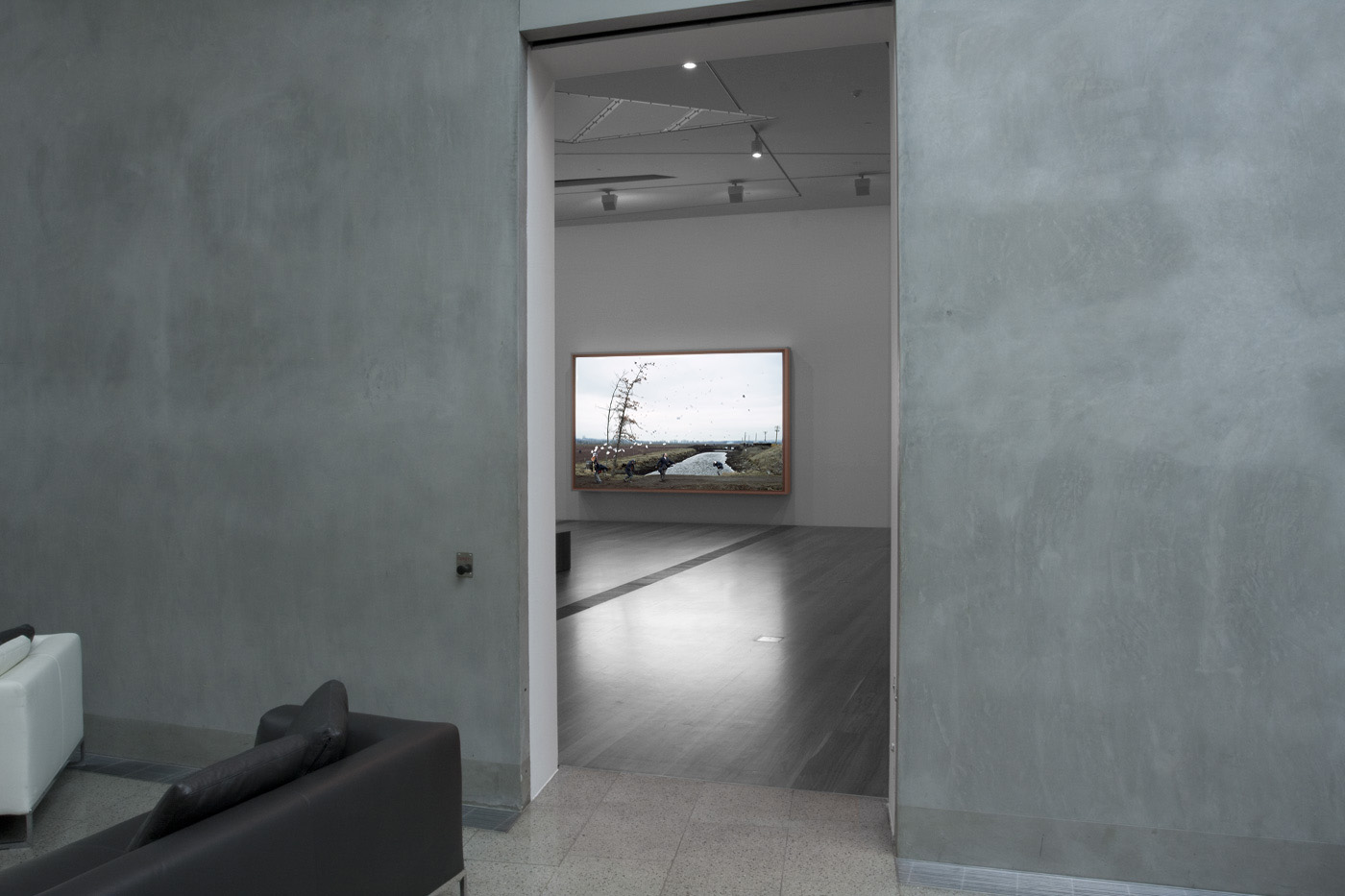
Installation view of 'Jeff Wall Photographs' at NGV Australia showing 'A sudden gust of wind (after Hokusai)' 1993


Installation view of Jeff Wall Photographs at NGV Australia showing A sudden gust of wind (after Hokusai) 1993
Photo: Marcus Bunyan


The Ian Potter Centre: NGV Australia
Federation Square
Corner of Russell and 
Flinders Streets, Melbourne

Opening hours:
Daily 10am – 5pm

National Gallery of Victoria website

LIKE ART BLART ON FACEBOOK

Back to top

Exhibition: ‘Dark Romanticism. From Goya to Max Ernst’ at the Städel Museum, Frankfurt

Exhibition dates: 26th September 2012 – 20th January, 2013


Many thankx to the Städel Museum for allowing me to publish the reproductions of the artwork in the posting. Please click on the photographs for a larger version of the image.


This slideshow requires JavaScript.


Installation photographs of the exhibition Dark Romanticism. From Goya to Max Ernst at the Städel Museum, Frankfurt
Photos: Norbert Miguletz
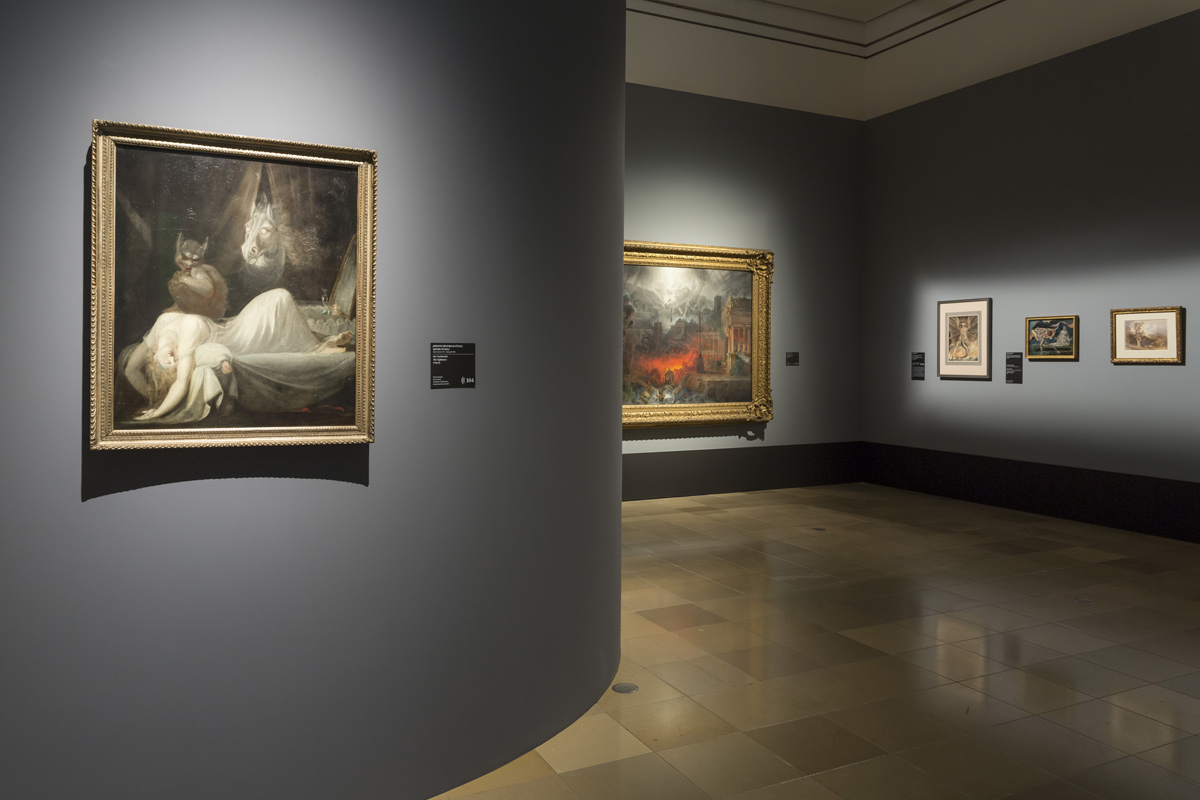
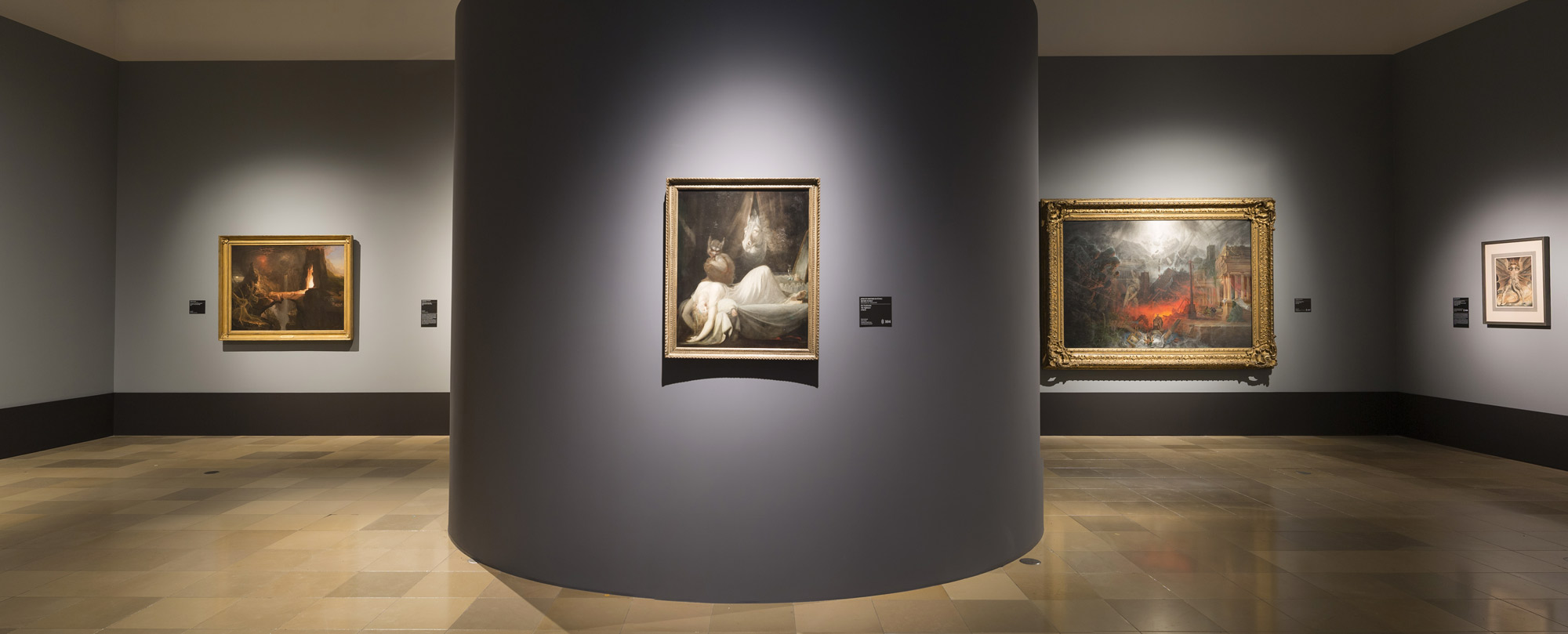
 

Installation view of the exhibition 'Dark Romanticism. From Goya to Max Ernst' at the Städel Museum, Frankfurt

Installation view of the exhibition 'Dark Romanticism. From Goya to Max Ernst' at the Städel Museum, Frankfurt showing at left, Thomas Cole's 'Expulsion: Moon and Firelight '(c. 1828); at centre, Johann Henry Fuseli's 'The Nightmare (The Incubus)' (1781-1782); at second right, Samuel Colman's 'The Edge of Doom' (1836-1838); and at right, William Blake's 'The Great Red Dragon and the Woman Clothed with the Sun' (c. 1803-1805)


Installation views of the exhibition Dark Romanticism. From Goya to Max Ernst at the Städel Museum, Frankfurt showing at left in the bottom image, Thomas Cole’s Expulsion: Moon and Firelight (c. 1828, below); at centre, Johann Henry Fuseli’s The Nightmare (The Incubus) (1781-1782, below); at second right, Samuel Colman’s The Edge of Doom (1836-1838, below); and at right, William Blake’s The Great Red Dragon and the Woman Clothed with the Sun (c. 1803-1805, below)
Photos: Norbert Miguletz
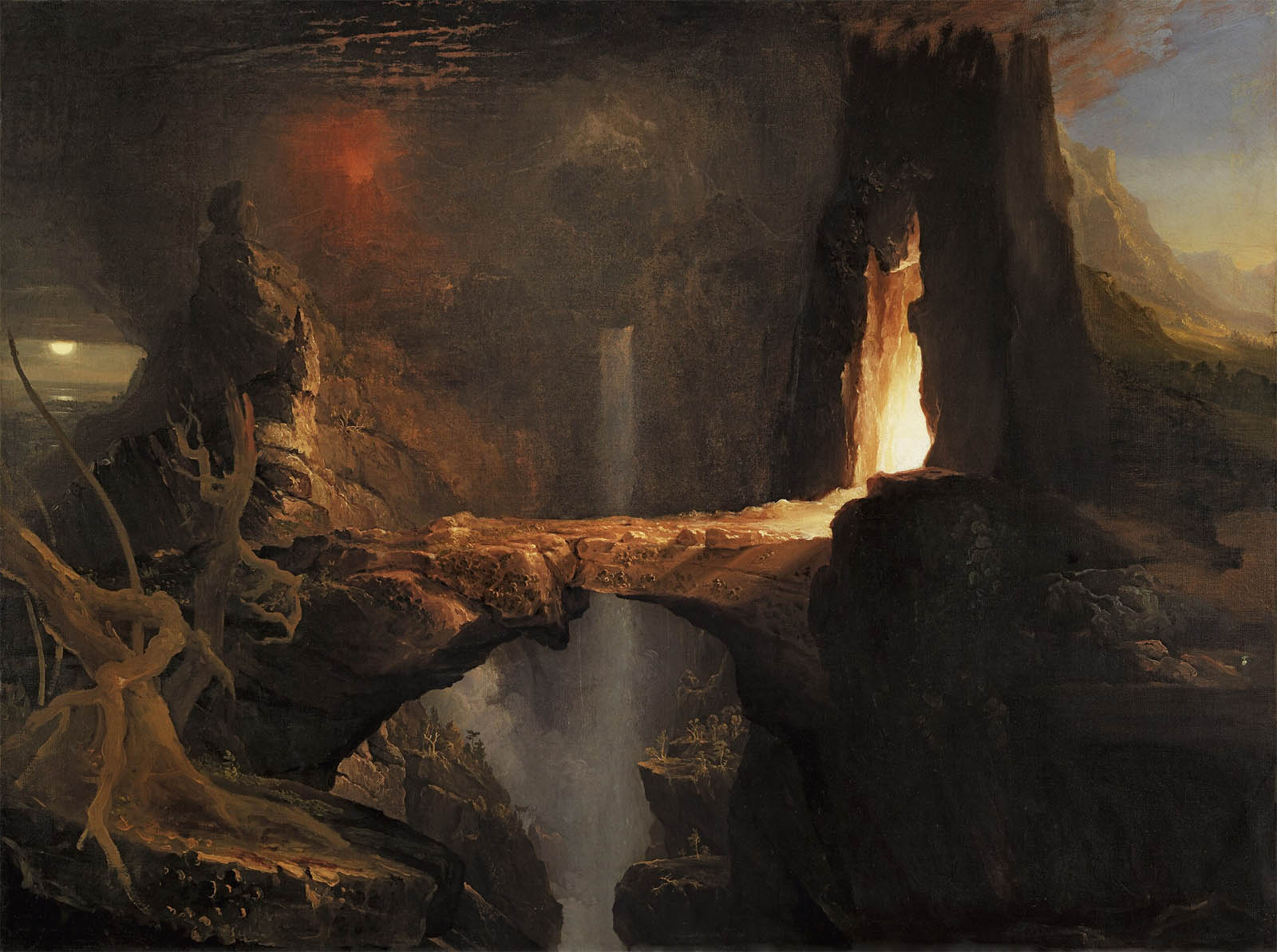
 

Thomas Cole (American born England, 1801-1848) 'Expulsion: Moon and Firelight' c. 1828


Thomas Cole (American born England, 1801-1848)
Expulsion: Moon and Firelight
c. 1828
Oil on canvas
91.4 by 122cm (36.0 in × 48.0 in)
Thyssen-Bornemisza Museum, Madrid
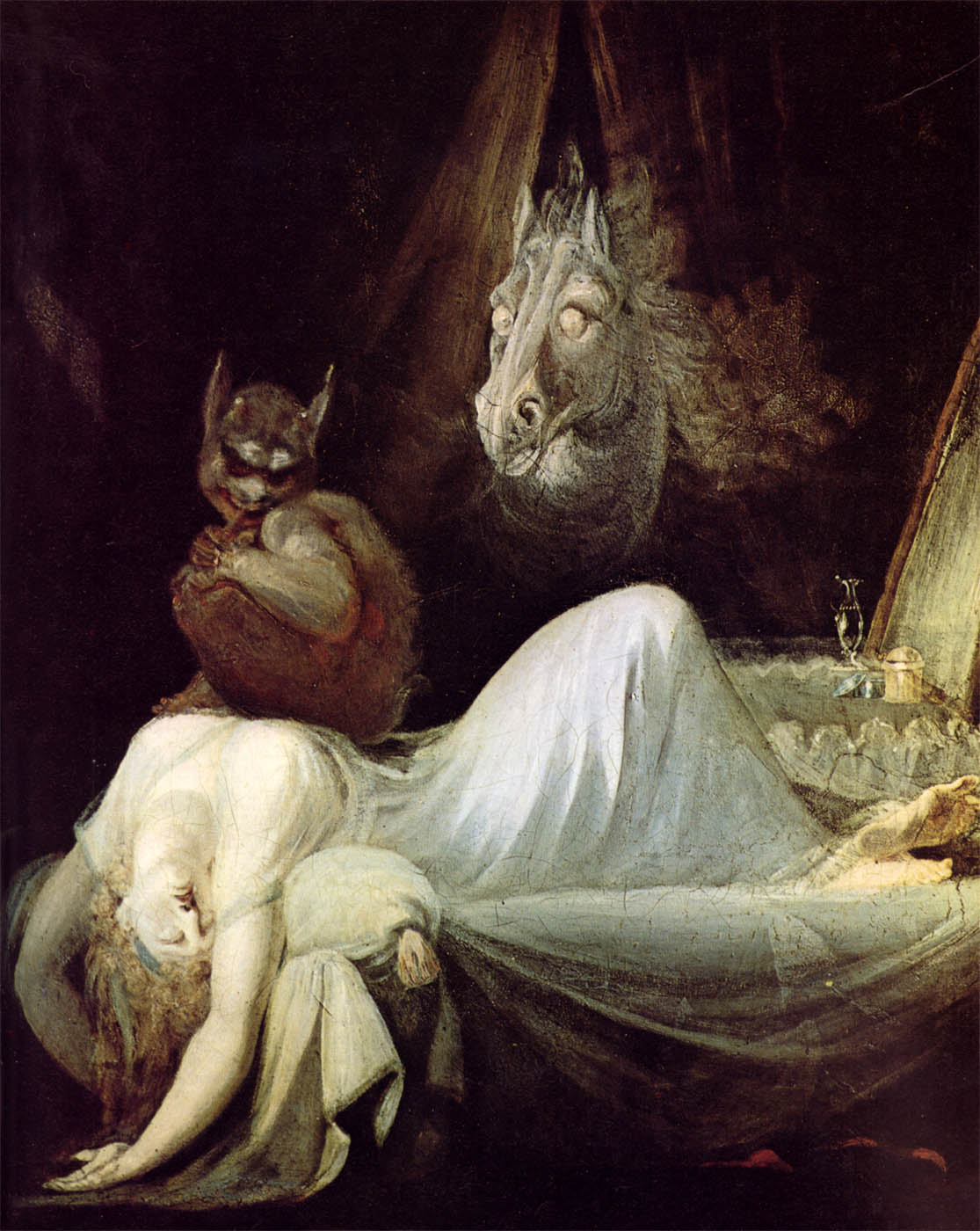
 

Johann Henry Fuseli (Swiss, 1741-1825) 'The Nightmare (The Incubus)' 1781-1782


Johann Henry Fuseli (Swiss, 1741-1825)
The Nightmare (The Incubus)
1781-1782
Oil on canvas
77cm (30.3 in) x 64cm (25.1 in)
Goethehaus (Frankfurt) collection
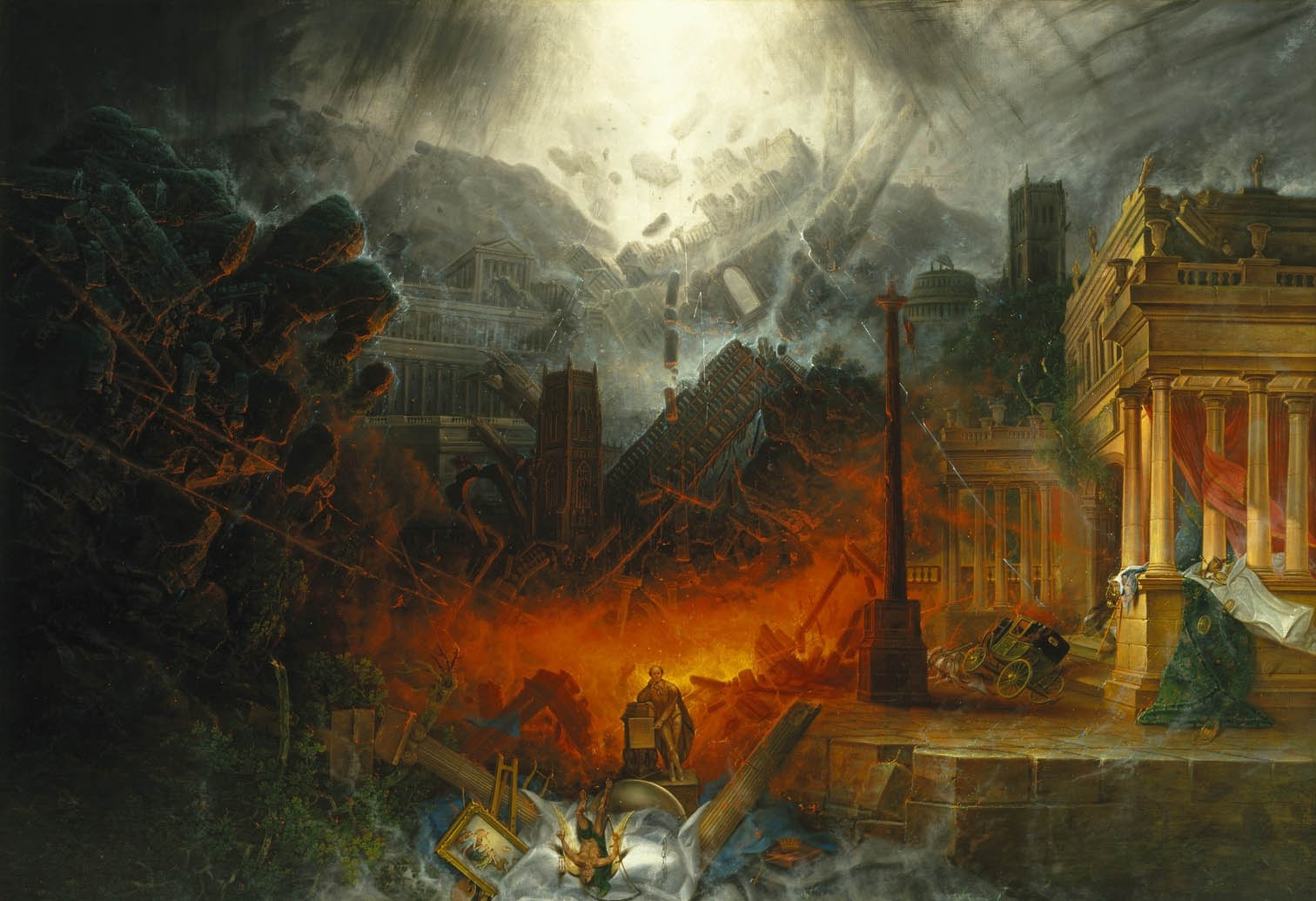
 

Samuel Colman (British, 1780-1845) 'The Edge of Doom' 1836-1838


Samuel Colman (British, 1780-1845)
The Edge of Doom
1836-1838
Oil on canvas
54 x 78 1/2 in. (137.2 x 199.4cm)
Brooklyn Museum
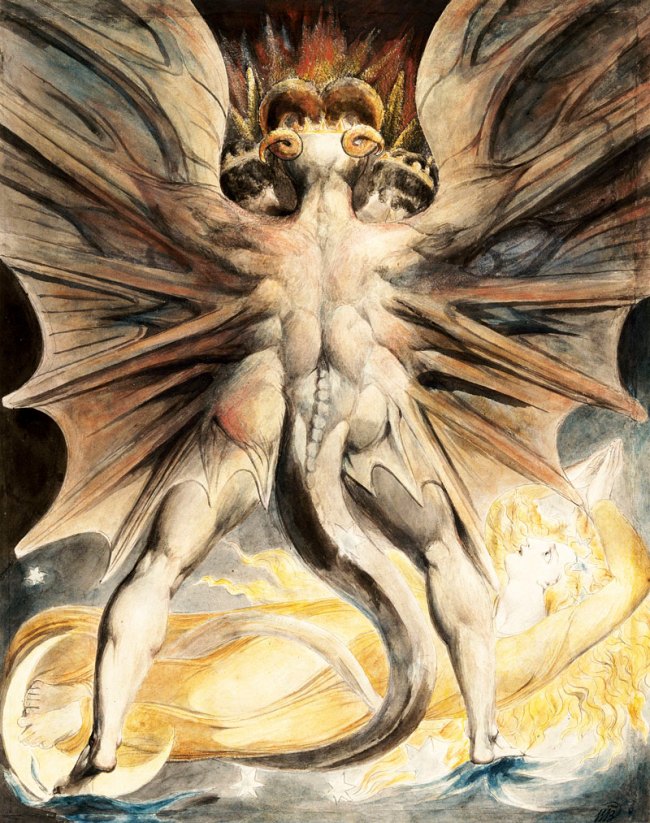
 

William Blake (British, 1757-1827) 'The Great Red Dragon and the Woman Clothed with the Sun' c.1803-1805


William Blake (British, 1757-1827)
The Great Red Dragon and the Woman Clothed with the Sun
c. 1803-1805
Watercolour, graphite and incised lines
43.7 x 34.8cm
Brooklyn Museum, Gift of William Augustus White
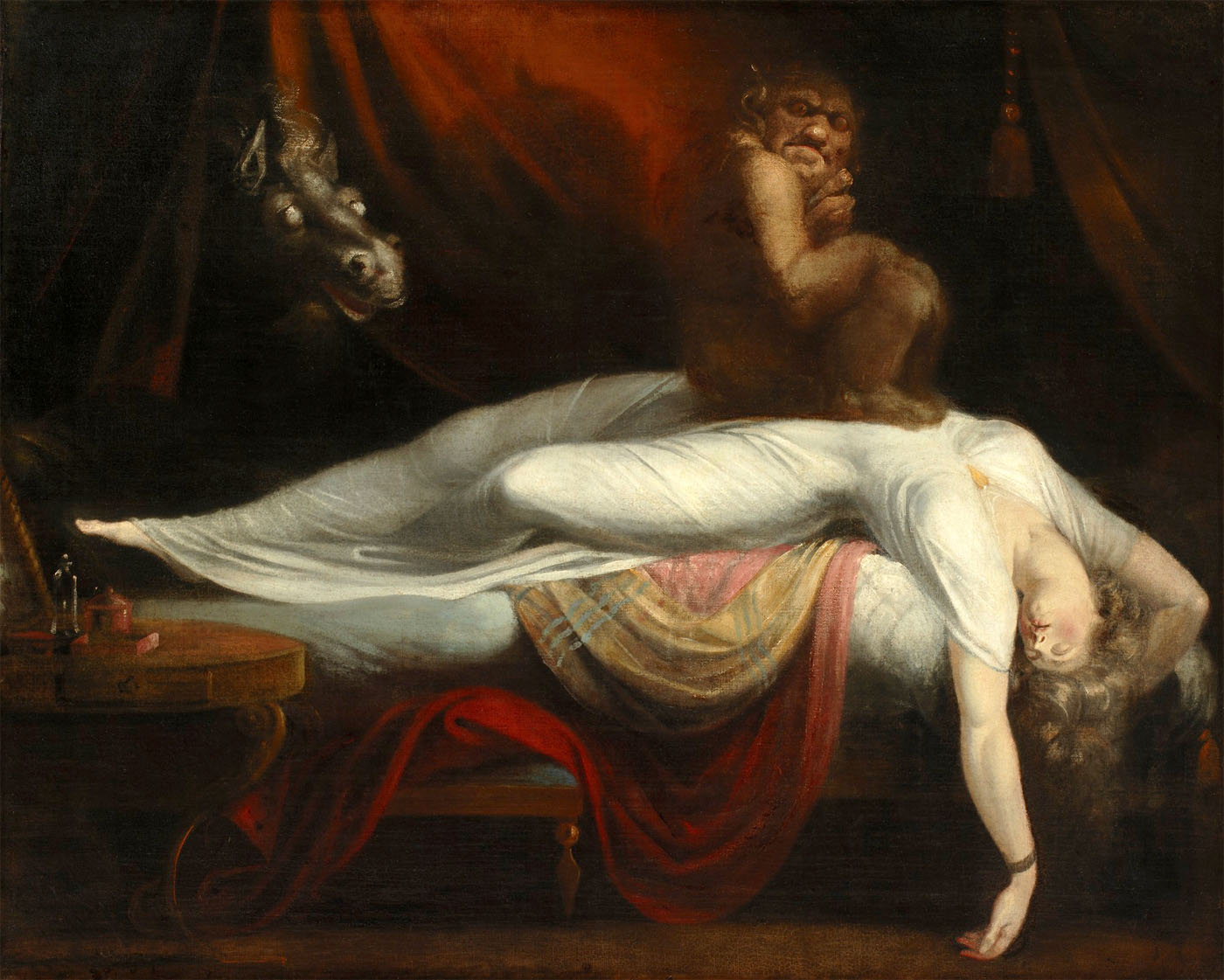
 

Johann Henry Fuseli (Swiss, 1741-1825) 'The Nightmare' 1781


Johann Henry Fuseli (Swiss, 1741-1825)
The Nightmare
1781
Oil on canvas
101.6 × 126.7cm
Detroit Institute of Arts, Founders Society
© Bridgeman Art Library
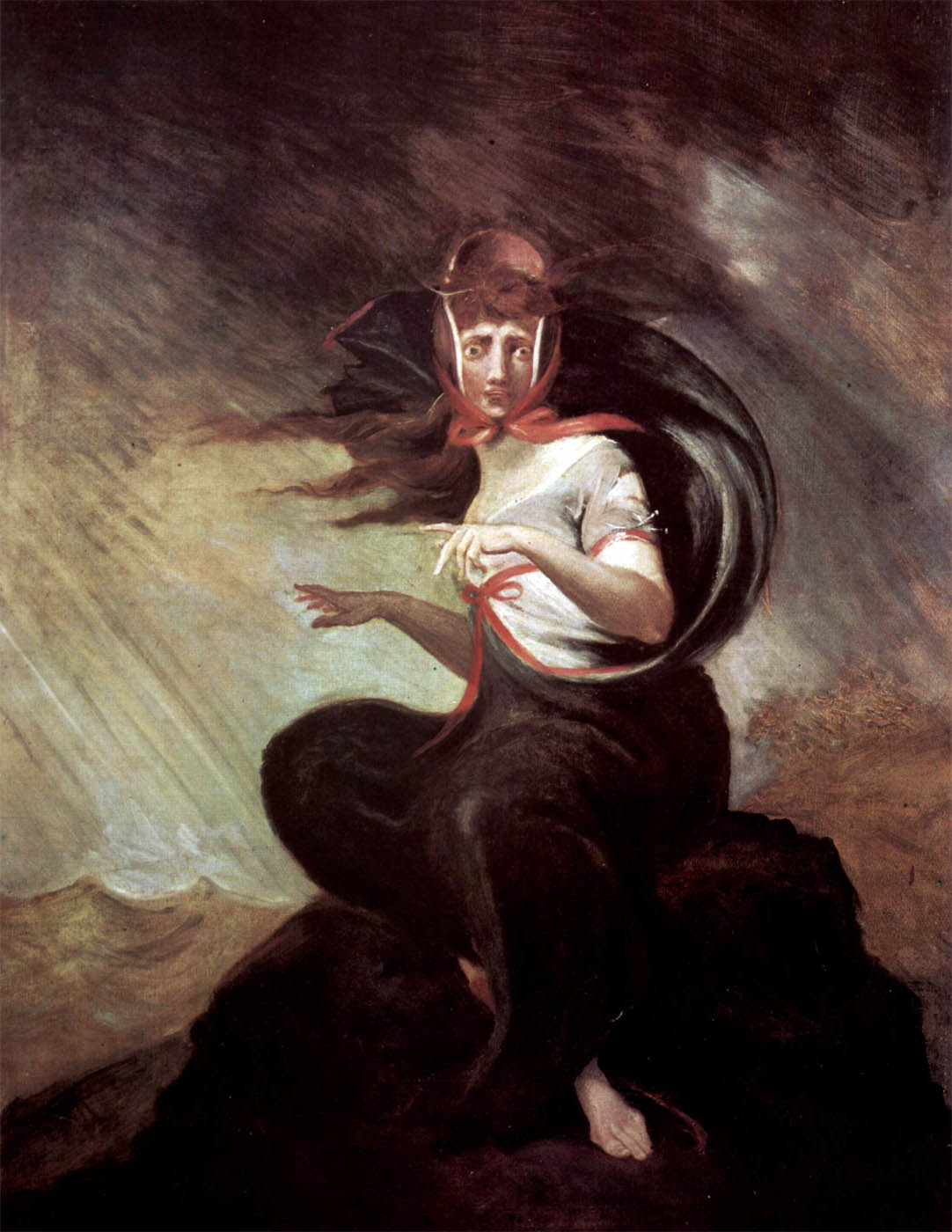
 

Johann Henry Fuseli (Swiss, 1741-1825) 'Die wahnsinnige Kate'(La folie de Kate) (Mad Kate) 1806-1807


Johann Henry Fuseli (Swiss, 1741-1825)
Die wahnsinnige Kate (La folie de Kate) (Mad Kate)
1806-1807
Oil on canvas
92cm (36.2 in) x 72.3cm (28.4 in)
Francfort-sur-le-Main, Frankfurter Goethe-Haus
Freies Deutsches Hochstift, inv.1955-007
© Ursula Edelmann/ARTOTHEK


Installation view of the exhibition 'Dark Romanticism. From Goya to Max Ernst' at the Städel Museum, Frankfurt showing Paul Delaroche's 'The Wife of the Artist, Louise Vernet, on her Death Bed' (1845)


Installation view of the exhibition Dark Romanticism. From Goya to Max Ernst at the Städel Museum, Frankfurt showing Paul Delaroche’s The Wife of the Artist, Louise Vernet, on her Death Bed (1845, below)
Photo: Norbert Miguletz


Paul Hippolyte Delaroche (French, 1797-1856) 'Louise Vernet, the artist's wife, on her Deathbed' 1845-46


Paul Hippolyte Delaroche (French, 1797-1856)
Louise Vernet, the artist’s wife, on her Deathbed
1845-1846
Oil on canvas
62 x 74.5cm
Musée des Beaux-Arts de Nantes
© Musée des Beaux-Arts de Nantes
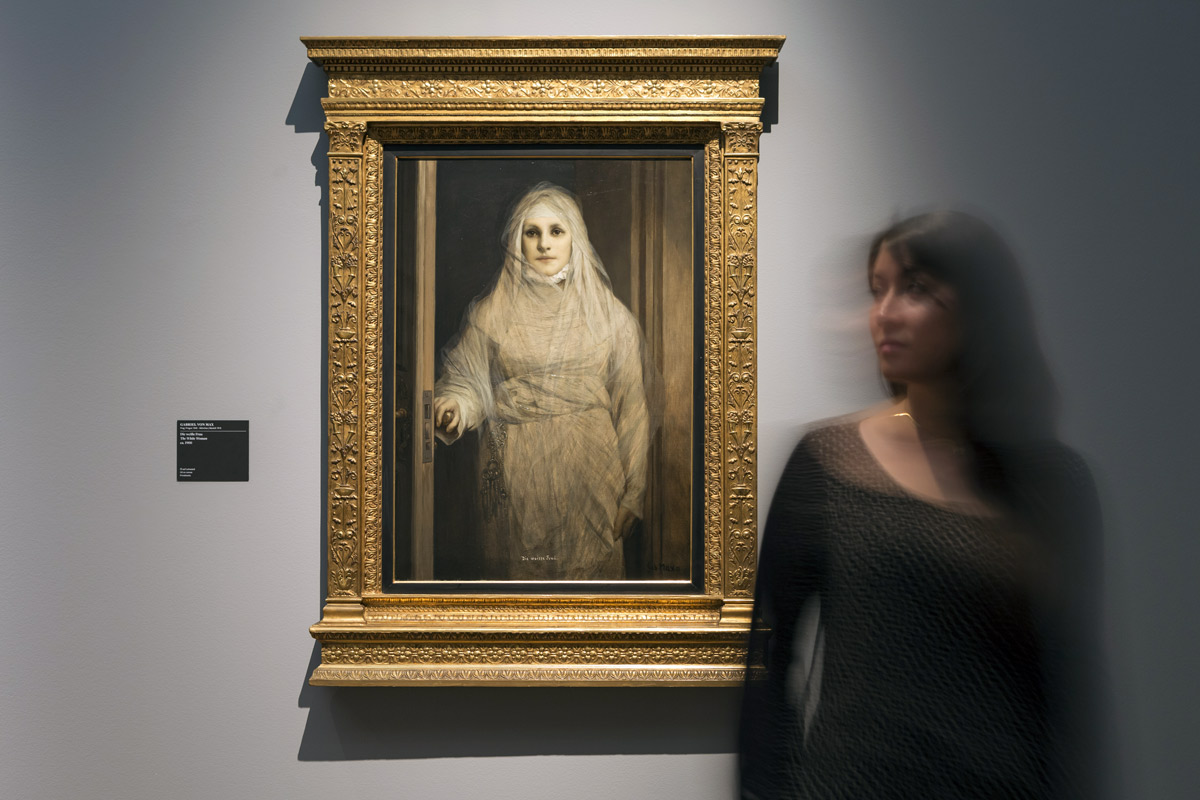
 

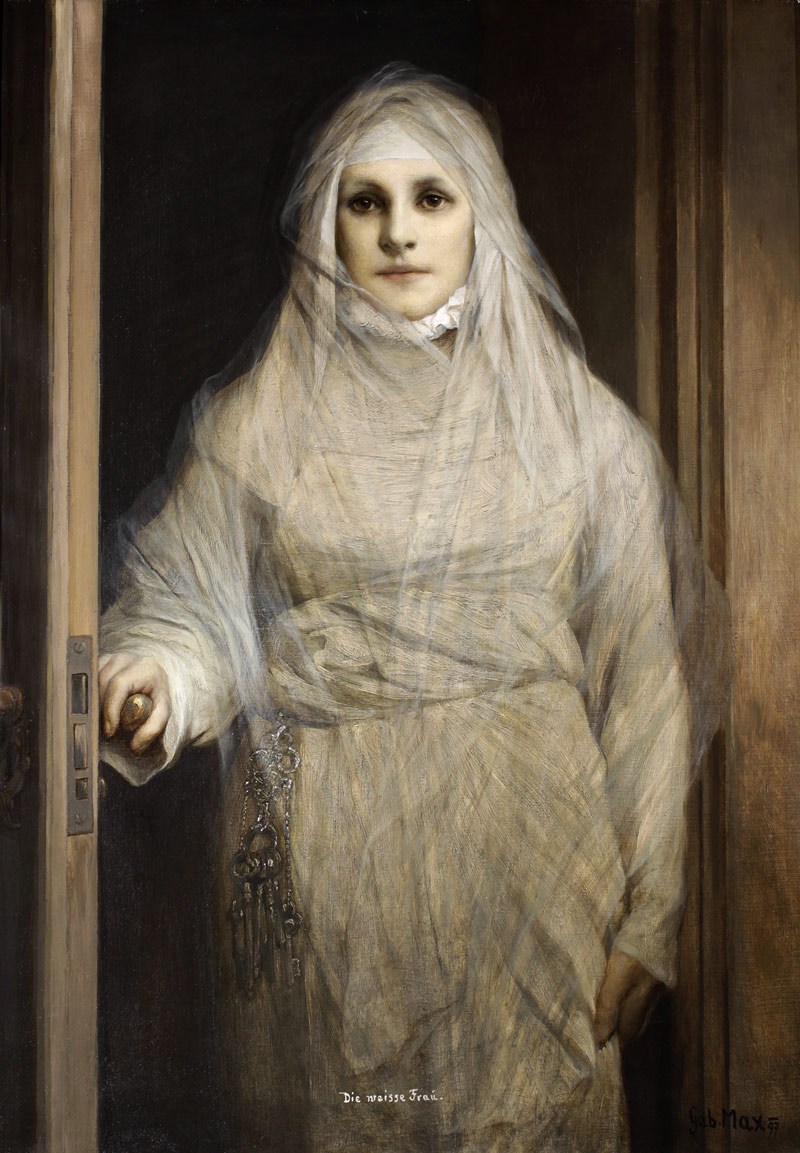
Installation view of the exhibition 'Dark Romanticism. From Goya to Max Ernst' at the Städel Museum, Frankfurt showing Gabriel von Max's 'The White Woman' (1900)


Installation view of the exhibition Dark Romanticism. From Goya to Max Ernst at the Städel Museum, Frankfurt showing Gabriel von Max’s The White Woman (1900, below)
Photo: Norbert Miguletz
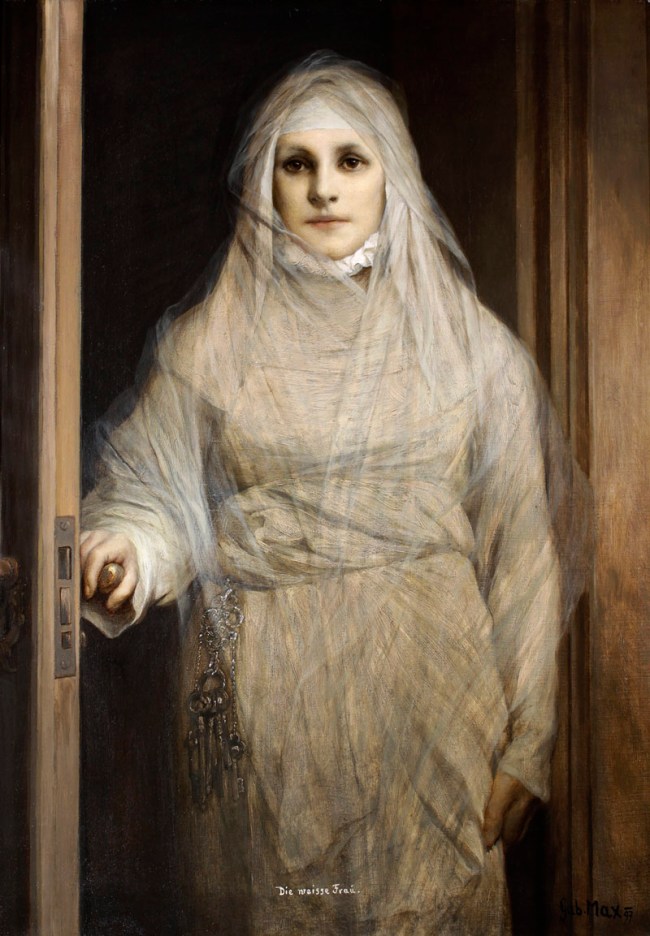
 

Gabriel von Max (Austrian, 1840-1915) 'The White Woman' 1900


Gabriel von Max (Austrian, 1840-1915)
The White Woman
1900
Oil on canvas
100 x 72cm
Private Collection
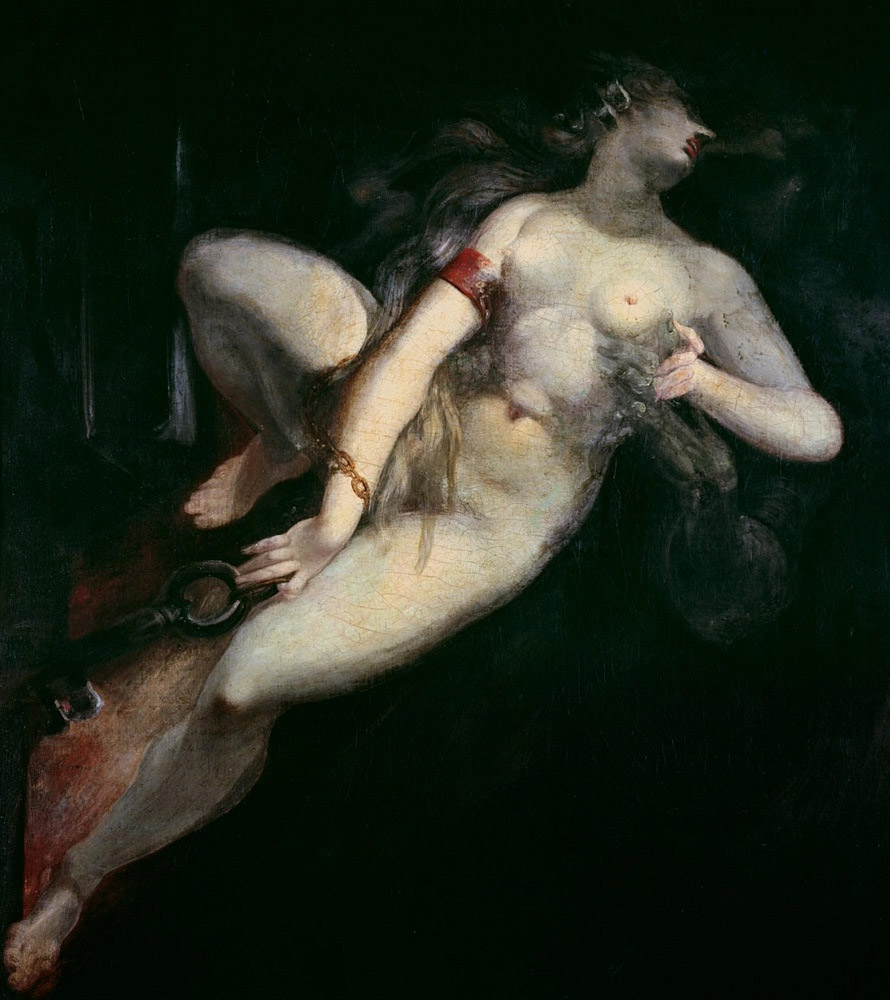
 

Johann Henry Fuseli (Swiss, 1741-1825) 'Sin Pursued by Death' 1794-1796


Johann Henry Fuseli (Swiss, 1741-1825)
Sin Pursued by Death
1794-1796
Oil on canvas
Kunsthaus, Zürich
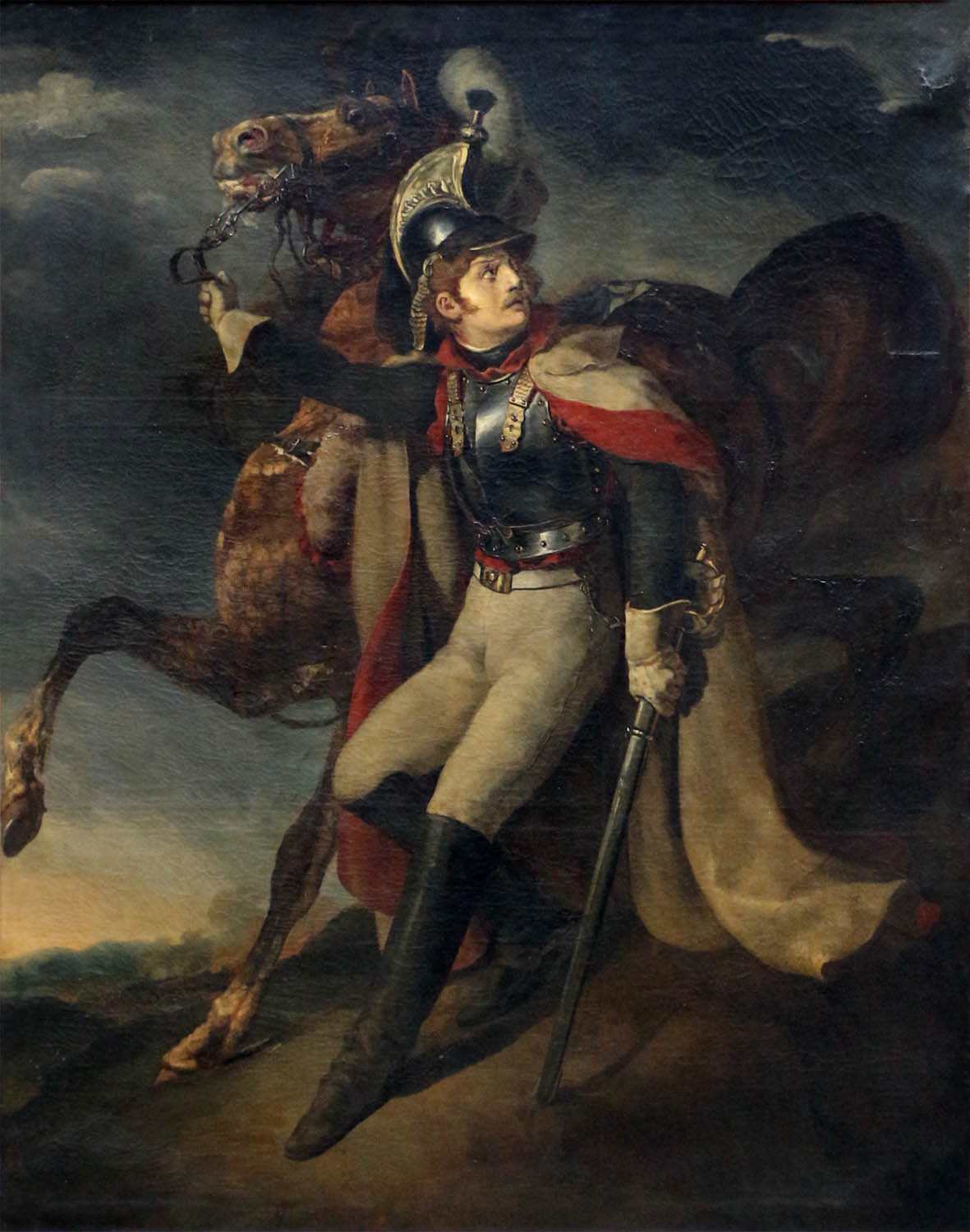
 

Théodore Géricault (French, 1791–1824) Cuirassier blessé quittant le feu / The Wounded Cuirassier 1814


Théodore Géricault (French, 1791–1824)
Cuirassier blessé quittant le feu / The Wounded Cuirassier
1814
Oil on canvas
358cm (11.7 ft) x 294cm (115.7 in)
Louvre Museum


The Wounded Cuirassier (French: Le Cuirassier blessé quittant le feu) is an oil painting of a single anonymous soldier descending a slope with his nervous horse by the French Romantic painter and lithographer Théodore Géricault (1791–1824). In this 1814 Salon entry, Géricault decided to turn away from scenes of heroism in favour of a subject that is on the losing side of the battle. On display in the aftermath of France’s disastrous military campaign in Russia, this life-size painting captured the feeling of a nation in defeat. There are no visible wounds on the figure, and the title has sometimes been interpreted to refer to soldier’s injured pride. The painting stood in stark contrast with Géricault’s Charging Chasseur, as it didn’t focus on glory or the spectacle of battle. Only his Signboard of a Hoofsmith, which is currently in a private collection, bears any resemblance in form or function to this painting.

The final salon version of The Wounded Cuirassier is at the Musée du Louvre and the smaller, study version, is located at the Brooklyn Museum.

Text from the Wikipedia website


Caspar David Friedrich (German, 1774-1840) 'Kügelgen's Tomb' 1821-1822


Caspar David Friedrich (German, 1774-1840)
Kügelgen’s Tomb
1821-1822
Oil on canvas
41.5 x 55.5cm
Die Lübecker Museen, Museum Behnhaus Drägerhaus, on loan from private collection


Ernst Ferdinand Oehme (German, 1797-1855) 'Procession in the Fog' 1828


Ernst Ferdinand Oehme (German, 1797-1855)
Procession in the Fog
1828
Oil on canvas
81.5 x 105.5cm
Galerie Neue Meister, Staatliche Kunstsammlungen Dresden


Caspar David Friedrich (German, 1774-1840) Rivage avec la lune cachée par des nuages (Clair de lune sur la mer) / Mond hinter Wolken über dem Meeresufer (Meeresküste bei Mondschein) / Moon behind clouds over the seashore (seashore by moonlight) 1836


Caspar David Friedrich (German, 1774-1840)
Rivage avec la lune cachée par des nuages (Clair de lune sur la mer) / Mond hinter Wolken über dem Meeresufer (Meeresküste bei Mondschein) / Moon behind clouds over the seashore (seashore by moonlight)
1836
Hambourg, Hamburger Kunsthalle
© BPK, Berlin, dist. RMN-Grand Palais / Elke Walford


Samuel Colman (American, 1780-1845) 'The Edge of Doom' 1836-1838


Samuel Colman (American, 1780-1845)
The Edge of Doom
1836-1838
Oil on canvas
137.2 x 199.4cm
Brooklyn Museum, Bequest of Laura L. Barnes
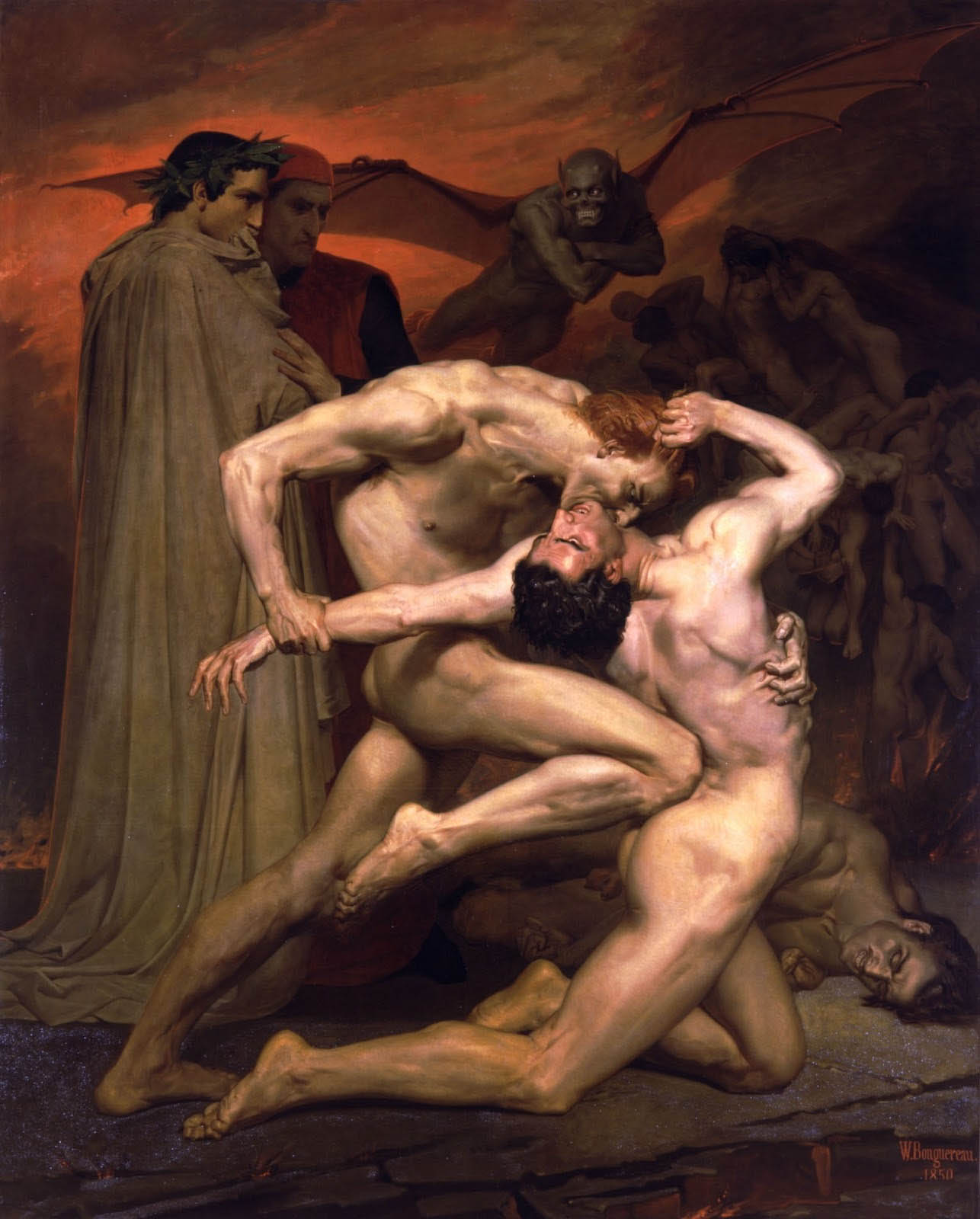
 

William-Adolphe Bouguereau (French, 1825-1905) 'Dante And Virgil In Hell' 1850


William-Adolphe Bouguereau (French, 1825-1905)
Dante And Virgil In Hell
1850
Oil on canvas
280.5cm (110.4 in) x 225.3cm (88.7 in)
Musée d’Orsay
© Musée d’Orsay, Dist. RMN-Grand Palais / Patrice Schmidt


Arnold Böcklin (Swiss, 1827-1901) 'Villa by the Sea' 1871-1874


Arnold Böcklin (Swiss, 1827-1901)
Villa by the Sea
1871-1874
Oil on canvas
108 x 154cm
Städel Museum, Frankfurt am Main
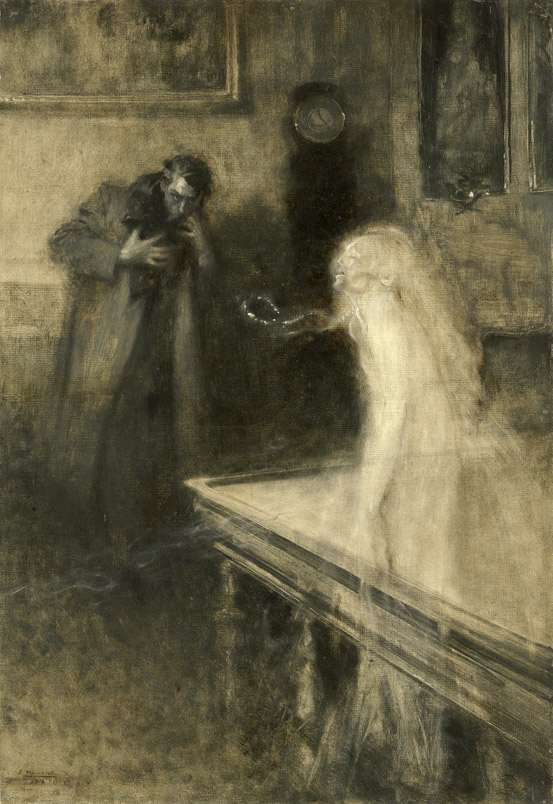
 

Serafino Macchiati (Italian, 1860-1916) 'Le Visionnaire' (The Visionary) 1904


Serafino Macchiati (Italian, 1860-1916)
Le Visionnaire (The Visionary)
1904
Oil on canvas
55.0 x 38.5cm
Don Serafino Macchiati, 1916
© Musée d’Orsay, Dist. RMN-Grand Palais / Patrice Schmidt
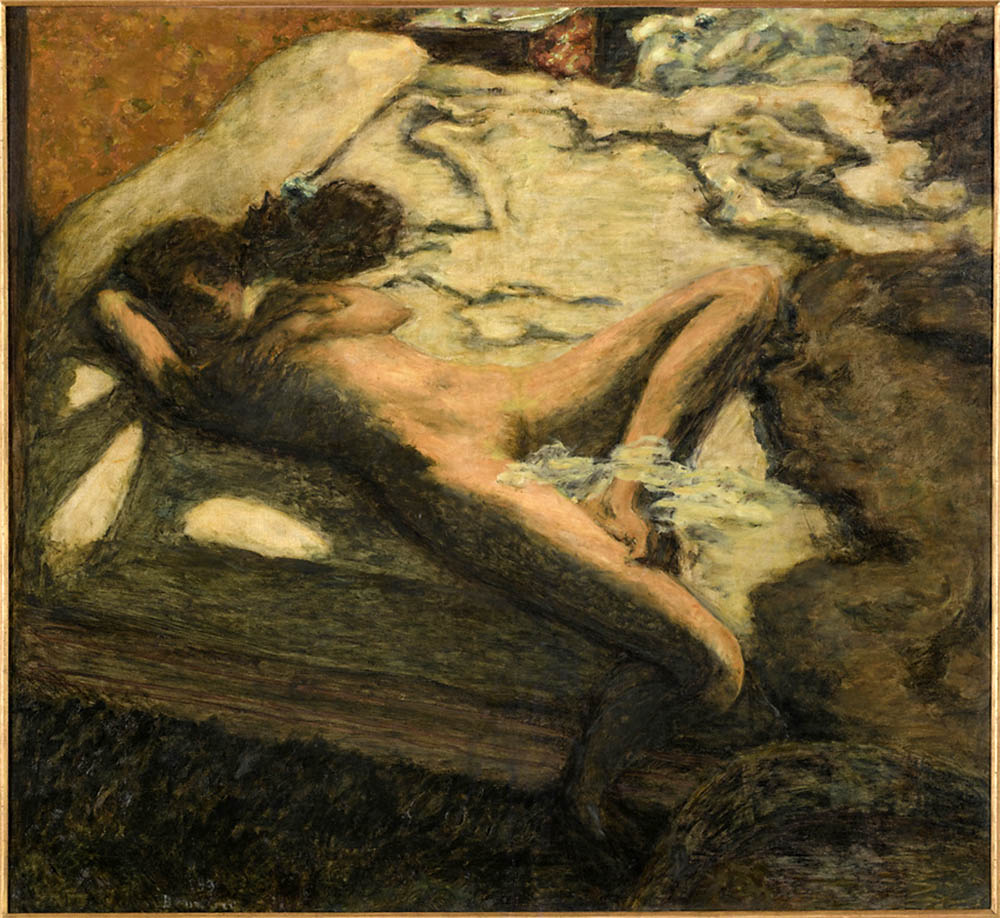
 

Pierre Bonnard (French, 1867-1945) 'Femme assoupie sur un lit' (Woman sleeping on a bed) 1899


Pierre Bonnard (French, 1867-1945)
Femme assoupie sur un lit (Woman sleeping on a bed)
1899
huile sur toile
96.4 x 105.2cm
Achat en vente publique, 1948
© Musée d’Orsay, Dist. RMN-Grand Palais / Patrice Schmidt


Pierre Bonnard (1867-1947)

A veritable hymn to voluptuousness, The Indolent Woman is a painting which relies on contrasts: the title already clashes with the young woman’s posture. Her body with its tense muscles – the left foot is literally hooked on to the right thigh – belies any idea of rest or laziness. Similarly, the modest gesture of the arm across the breasts is contradicted by the spread thighs. Sinuous lines run throughout the composition, materialised by the dark shadows on the sheets still bearing the undulating line of the bodies and the heavy jumble of the bedclothes. The electric blue “smoke” drifting across the woman’s thigh and ankle and the sumptuous dark hair spread across the bed accentuate the painting’s erotic charge.

This woman spread out for all to see after lovemaking is the epitome of unveiled intimacy, violent, passionate and sombre and, in the end, very “fin de siècle”. We are also struck by the modernity of the composition seen from above, with its monumental bed which seems to tip towards the viewer. The woman’s body, gnawed by shadows, has a tonic vibrant texture which gives it a strong timeless presence.

This is a crucial work in Bonnard’s career because it is one of the first nudes he painted, previously showing little interest in the theme. It can be compared with two other canvases from the same period: Blue Nude from the Kaganovitch collection and Man and Woman.

After seeing this painting, the famous art dealer and publisher Ambroise Vollard asked Bonnard to illustrate a collection of Paul Verlaine’s poetry, Parallèlement, which was published in 1900.

Text from the Musée d’Orsay website
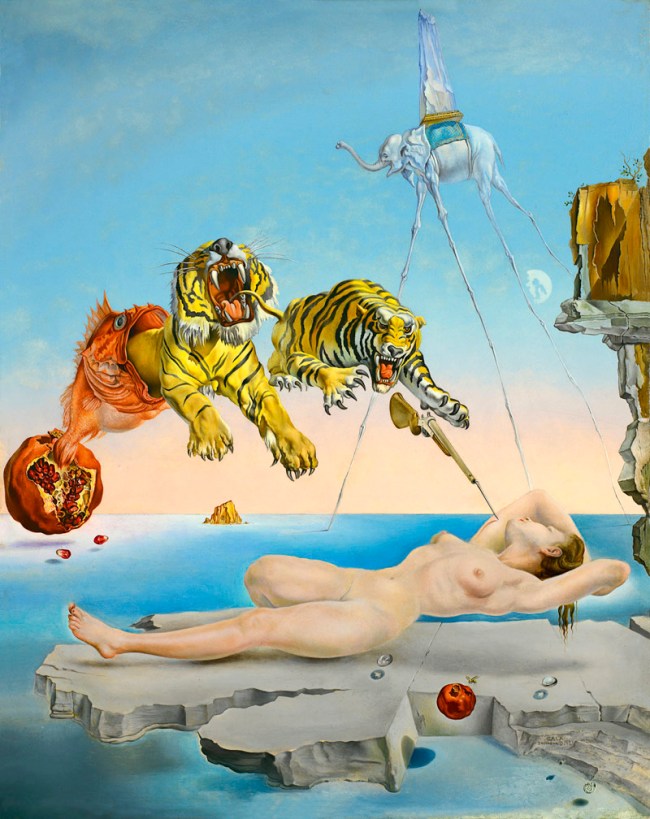
 

Salvador Dalí (Spanish, 1904-1989) 'Dream caused by the Flight of a Bee around a Pomegranate a Second before Awakening' 1944


Salvador Dalí (Spanish, 1904-1989)
Dream caused by the Flight of a Bee around a Pomegranate a Second before Awakening
1944
Oil on wood
51 x 41cm
Museo Thyssen-Bornemisza, Madrid
© VG Bild-Kunst, Bonn 2012


The Städel Museum’s major special exhibition Dark Romanticism. From Goya to Max Ernst will be on view from September 26th, 2012 until January 20th, 2013. It is the first German exhibition to focus on the dark aspect of Romanticism and its legacy, mainly evident in Symbolism and Surrealism. In the museum’s exhibition house this important exhibition, comprising over 200 paintings, sculptures, graphic works, photographs and films, will present the fascination that many artists felt for the gloomy, the secretive and the evil. Using outstanding works in the museum’s collection on the subject by Francisco de Goya, Eugène Delacroix, Franz von Stuck or Max Ernst as a starting point, the exhibition is also presenting important loans from internationally renowned collections, such as the Musée d’Orsay, the Musée du Louvre, both in Paris, the Museo del Prado in Madrid and the Art Institute of Chicago. The works on display by Goya, Johann Heinrich Fuseli and William Blake, Théodore Géricault and Delacroix, as well as Caspar David Friedrich, convey a Romantic spirit which by the end of the 18th century had taken hold all over Europe. In the 20th century artists such as Salvador Dalí, René Magritte or Paul Klee and Max Ernst continued to think in this vein. The art works speak of loneliness and melancholy, passion and death, of the fascination with horror and the irrationality of dreams. After Frankfurt the exhibition, conceived by the Städel Museum, will travel to the Musée d’Orsay in Paris.

The exhibition’s take on the subject is geographically and chronologically comprehensive, thereby shedding light on the links between different centres of Romanticism, and thus retracing complex iconographic developments of the time. It is conceived to stimulate interest in the sombre aspects of Romanticism and to expand understanding of this movement. Many of the artistic developments and positions presented here emerge from a shattered trust in enlightened and progressive thought, which took hold soon after the French Revolution – initially celebrated as the dawn of a new age – at the end of the 18th century. Bloodstained terror and war brought suffering and eventually caused the social order in large parts of Europe to break down. The disillusionment was as great as the original enthusiasm when the dark aspects of the Enlightenment were revealed in all their harshness. Young literary figures and artists turned to the reverse side of Reason. The horrific, the miraculous and the grotesque challenged the supremacy of the beautiful and the immaculate. The appeal of legends and fairy tales and the fascination with the Middle Ages competed with the ideal of Antiquity. The local countryside became increasingly attractive and was a favoured subject for artists. The bright light of day encountered the fog and mysterious darkness of the night.

The exhibition is divided into seven chapters. It begins with a group of outstanding works by Johann Heinrich Fuseli. The artist had initially studied to be an evangelical preacher in Switzerland. With his painting The Nightmare (Frankfurt Goethe-Museum) he created an icon of dark Romanticism. This work opens the presentation, which extends over two levels of the temporary exhibition space. Fuseli’s contemporaries were deeply disturbed by the presence of the incubus (daemon) and the lecherous horse – elements of popular superstition – enriching a scene set in the present. In addition, the erotic-compulsive and daemonic content, as well as the depressed atmosphere, catered to the needs of the voyeur. The other six works by Fuseli – loans from the Kunsthaus Zürich, the Royal Academy London and the Staatsgalerie Stuttgart – represent the characteristics of his art: the competition between good and evil, suffering and lust, light and darkness. Fuseli’s innovative pictorial language influenced a number of artists – among them William Blake, whose famous water colour The Great Red Dragon from the Brooklyn Museum will be on view in Europe for the first time in ten years.

The second room of the exhibition is dedicated to the Spanish artist Francisco de Goya. The Städel will display six of his works – including masterpieces such as The Witches’ Flight from the Prado in Madrid and the representations of cannibals from Besançon. A large group of works on paper from the Städel’s own collection will be shown, too. The Spaniard blurs the distinction between the real and the imaginary. Perpetrator and victim repeatedly exchange roles. Good and evil, sense and nonsense – much remains enigmatic. Goya’s cryptic pictorial worlds influenced numerous artists in France and Belgium, including Delacroix, Géricault, Victor Hugo and Antoine Wiertz, whose works will be presented in the following room. Atmosphere and passion were more important to these artists than anatomical accuracy.

Among the German artists – who are the focus of the next section of the exhibition – it is Carl Blechen who is especially close to Goya and Delacroix. His paintings are a testimony to his lust for gloom. His soft spot for the controversial author E. T. A. Hoffmann – also known as “Ghost-Hoffmann” in Germany – led Blechen to paint works such as Pater Medardus (Alte Nationalgalerie, Berlin) – a portrait of the mad protagonist in The Devil’s Elixirs. The artist was not alone in Germany when it came to a penchant for dark and disturbing subjects. Caspar David Friedrich’s works, too, contain gruesome elements: cemeteries, open graves, abandoned ruins, ships steered by an invisible hand, lonely gorges and forests are pervasive in his oeuvre. One does not only need to look at the scenes of mourning in the sketchbook at the Kunsthalle Mannheim for the omnipresent theme of death. Friedrich is prominently represented in the exhibition with his paintings Moon Behind Clouds above the Seashore from the Hamburger Kunsthalle and Kügelgen’s Grave from the Lübecker Museums, as well as with one of his last privately owned works, Ship at Deep Sea with full Sails.

Friedrich’s paintings are steeped in oppressive silence. This uncompromising attitude anticipates the ideas of Symbolism, which will be considered in the next chapter of the exhibition. These ‘Neo-Romantics’ stylised speechlessness as the ideal mode of human communication, which would lead to fundamental and seminal insights. Odilon Redon’s masterpiece Closed Eyes, a loan from the Musée d’Orsay in Paris, impressively encapsulates this notion. Paintings by Arnold Böcklin, James Ensor, Fernand Khnopff or Edvard Munch also embody this idea. However, as with the Romantics, these restrained works are face to face with works where anxiety and repressed passions are brought unrestrainedly to the surface; works that are unsettling in their radicalism even today. While Gustave Moreau, Max Klinger, Franz von Stuck and Alfred Kubin belong to the art historical canon, here the exhibition presents artists who are still to be discovered in Germany: Jean-Joseph Carriès, Paul Dardé, Jean Delville, Julien-Adolphe Duvocelle, Léon Frédéric, Eugène Laermans and Lucien Lévy-Dhurmer.

The presentation concludes with the Surrealist movement, founded by André Breton. He inspired artists such as Ernst, Brassaϊ or Dalí, to create their wondrous pictorial realms from the reservoir of the subconscious and celebrated them as fantasy’s victory over the “factual world”. Max Ernst vehemently called for “the borders between the so-called inner and outer world” to be blurred. He demonstrated this most clearly in his forest paintings, four of which have been assembled for this exhibition, one of them the major work Vision Provoked by the Nocturnal Aspect of the Porte Saint-Denis (private collection). The art historian Carl Einstein considered the Surrealists to be the Romantics’ successors and coined the phrase ‘the Romantic generation’. In spite of this historical link the Surrealists were far from retrospective. On the contrary: no other movement was so open to new media; photography and film were seen as equal to traditional media. Alongside literature, film established itself as the main arena for dark Romanticism in the 20th century. This is where evil, the thrill of fear and the lust for horror and gloom found a new home. In cooperation with the Deutsches Filmmuseum the Städel will for the first time present extracts from classics such as Frankenstein (1931), Dracula (1931), Faust (1926), Vampyr (1931-32) and The Phantom Carriage (1921) within an exhibition.

The exhibition, which presents the Romantic as a mindset that prevailed throughout Europe and remained influential beyond the 19th century, is accompanied by a substantial catalogue. As is true for any designation of an epoch, Romanticism too is nothing more than an auxiliary construction, defined less by the exterior characteristics of an artwork than by the inner sentiment of the artist. The term “dark Romanticism” cannot be traced to its origins, but – as is also valid for Romanticism per se – comes from literary studies. The German term is closely linked to the professor of English Studies Mario Praz and his publication La carne, la morte e il diavolo nella letteratura romantica of 1930, which was published in German in 1963 as Liebe, Tod und Teufel. Die schwarze Romantik (literally: Love, Death and Devil. Dark Romanticism).

Press release from the Städel Museum website


Francisco de Goya (Spanish, 1746-1828) 'Witches in the Air' 1797-1798


Francisco de Goya (Spanish, 1746-1828)
Witches in the Air
1797-1798
Oil on canvas
43.5 × 30.5cm (17 1/8 in × 12 in)
Madrid, Museo Nacional del Prado
© Museo Nacional del Prado


Witches’ Flight (Spanish: Vuelo de Brujas, also known as Witches in Flight or Witches in the Air) is an oil-on-canvas painting completed in 1798 by the Spanish painter Francisco Goya. It was part of a series of six paintings related to witchcraft acquired by the Duke and Duchess of Osuna in 1798. It has been described as “the most beautiful and powerful of Goya’s Osuna witch paintings.” …

At center point are three semi-nude witches wearing penitential coroza bearing aloft a writhing nude figure, their mouths close to their victim, as if to devour him or suck his blood. Below, two figures in peasants’ garb recoil from the spectacle: one has thrown himself to the ground covering his ears, the other attempts to escape by covering himself with a blanket, making the fig hand gesture to ward off the evil eye. Finally, a donkey emerges on the right, seemingly oblivious to the rest of the scene.

The general scholarly consensus is that the painting represents a rationalist critique of superstition and ignorance, particularly in religious matters: the witches’ corozas are not only emblematic of the violence of the Spanish Inquisition (the upward flames indicate that they have been condemned as unrepentant heretics and will be burned at the stake), but are also reminiscent of episcopal mitres, bearing the characteristic double points. The accusations of religious tribunals are thus reflected back on themselves, whose actions are implicitly equated with superstition and ritualised sacrifice. The bystanders can then be understood either as appalled but unable to do anything or wilfully ignorant and unwilling to intervene.

The donkey, finally, is the traditional symbol of ignorance.

Text from the Wikipedia website
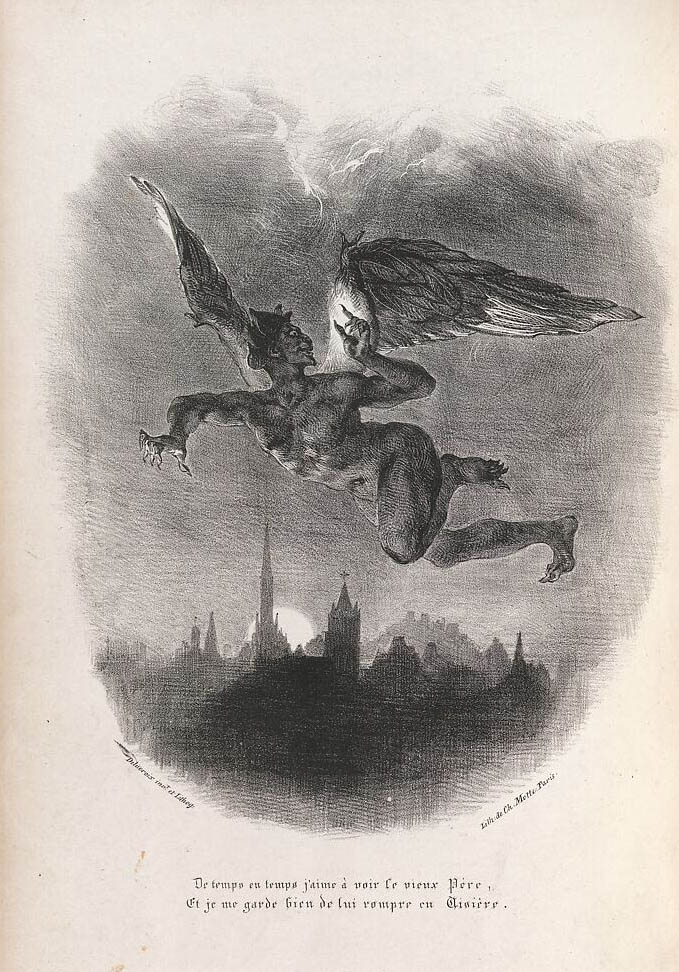
 

Eugène Delacroix (French, 1798-1863) 'Mephistopheles in the air, illustration from Goethe's Faust' 1828


Eugène Delacroix (French, 1798-1863)
Mephistopheles in the air, illustration for from Goethe’s Faust
1828
Lithograph
Frankfurt am Main, Städel Museum
© All rights reserved


Francisco de Goya (Spanish, 1746-1828) 'Flying Folly (Disparate Volante)' 1816-1819


Francisco de Goya (Spanish, 1746-1828)
Flying Folly (Disparate Volante)
from “The proverbs (Los proverbios)”, plate 5, 1816-1819, 1
Edition, 1864
Etching and aquatint
21.7 x 32.6cm
Städel Museum, Frankfurt am Main


“I am not afraid of witches, goblins, apparitions, boastful giants, evil spirits, leprechauns, etc., nor of any other kind of creatures except human beings.”


Francisco Goya


An enthusiastic champion of Enlightenment values, Goya was also on close terms with the progressive nobility, but his doubts and disillusionment increased as the French Revolution was succeeded by the Terror, and Europe was torn apart by warring armies.

The deceptively clear distinction between enlightenment and obscurantism was now supplanted by the vision of a new, grey, frightening and uncertain world, in which no sharp line could be drawn between good and evil, reality and fantasy, reason and absurdity, the beliefs of the past and the revolutionary fervour of the present.

But instead of living in the past or doing nothing, Goya swapped his court painter’s brush for the etcher’s unsparing needle. Black in all its shades was the keynote of the many series of engravings he now produced on freely chosen themes, with only the Inquisition’s censors to contend with.

The Caprices, a series produced at the end of the 18th century, reflects his amazement and exasperation at the imaginative wealth of Spanish popular culture, steeped in the superstition, fanaticism and ignorance promoted by the Jesuits.

Ten years later, the atrocities which marked the war against Napoleon inspired The Disasters of War – a cry of outrage and horror at the barbaric excesses of the “Grande Nation” and the terrifying emptiness of a world with no God or morality.

Anonymous. “The Angel of the Odd. Dark Romanticism from Goya to Max Ernst,” on the Musée D’Orsay website Nd [Online] Cited 12/08/2024
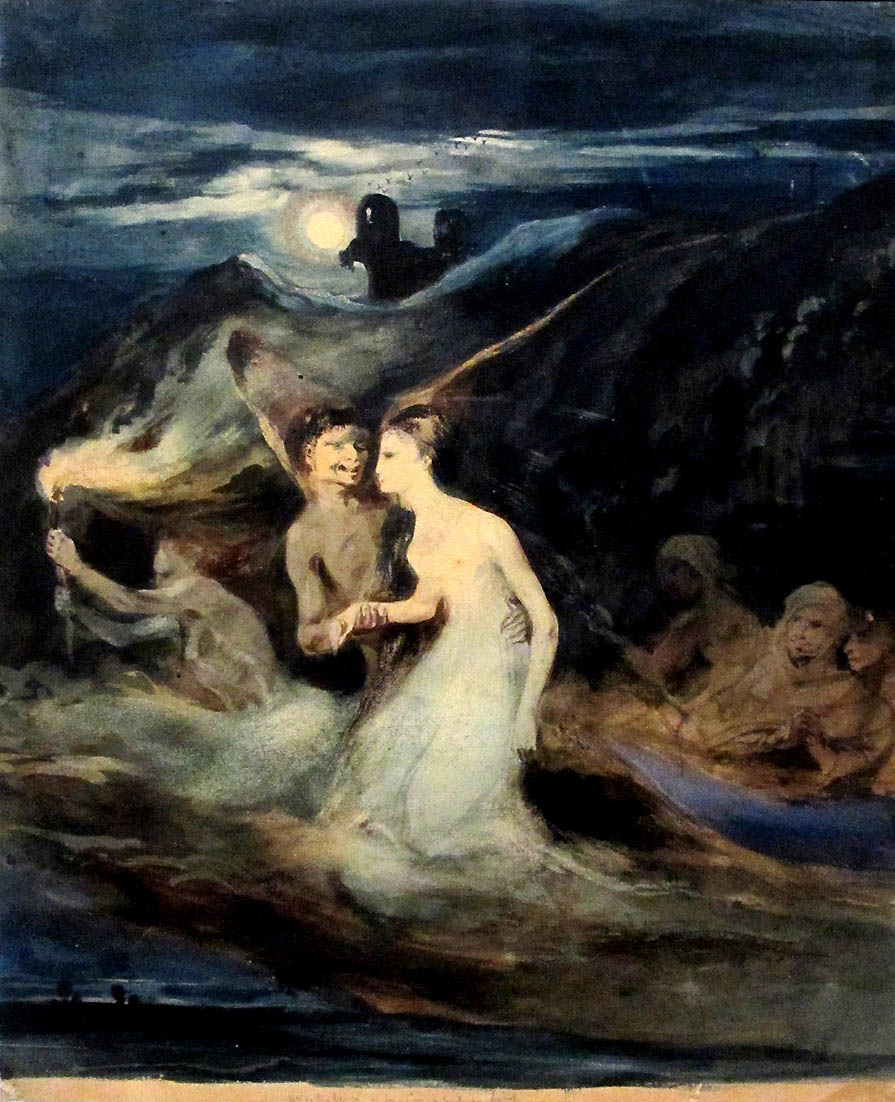
 

Louis Candide Boulanger (French, 1806-1867) 'Les Fantômes' 1829


Louis Candide Boulanger (French, 1806-1867)
Les Fantômes
1829
Oil on canvas
Maison de Victor Hugo


Carl Blechen (German, 1798-1840) 'Scaffold in Storm' 1834


Carl Blechen (German, 1798-1840)
Scaffold in Storm
1834
Oil on canvas and on board
29.5cm (11.6 in) x 46cm (18.1 in)
Galerie Neue Meister


Carl Eduard Ferdinand Blechen (29 July 1798 – 23 July 1840) was a German landscape painter and a professor at the Academy of Arts, Berlin. His distinctive style was characteristic of the Romantic ideals of natural beauty.
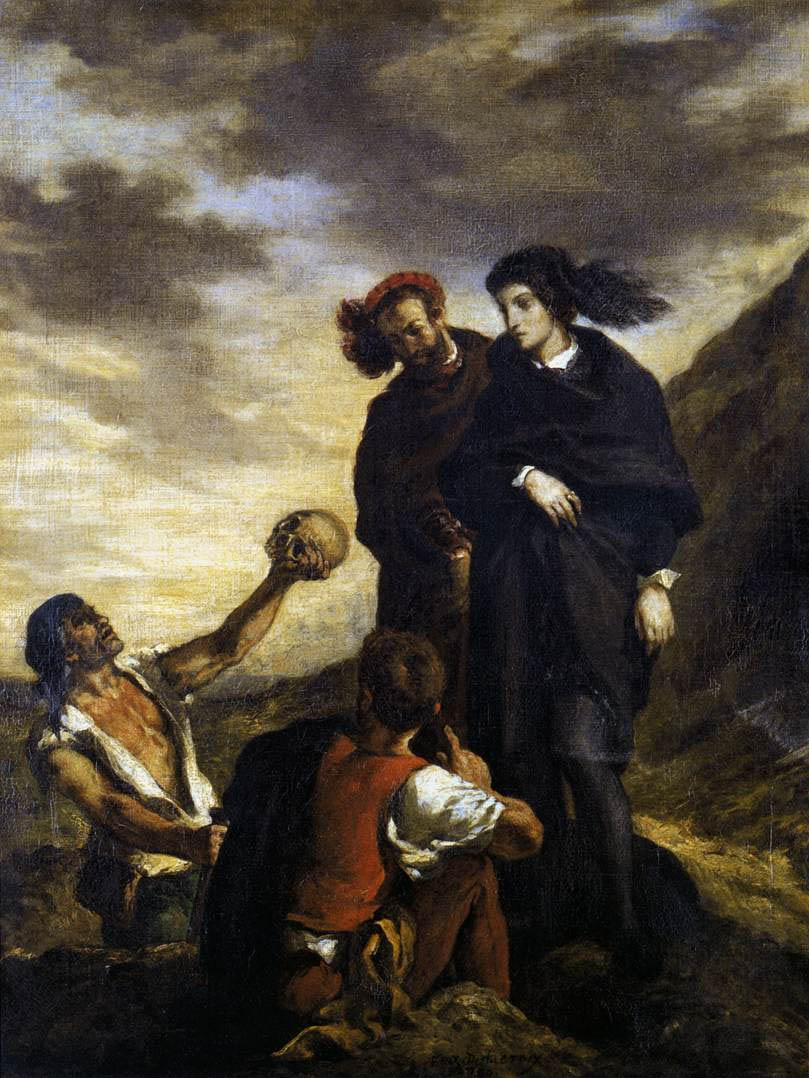
 

Eugène Delacroix (French, 1798-1863) 'Hamlet and Horatio in the Graveyard' 1839


Eugène Delacroix (French, 1798-1863)
Hamlet and Horatio in the Graveyard
1839
Oil on canvas
29.5cm (11.6 in) x 36cm (14.1 in)
Louvre Museum
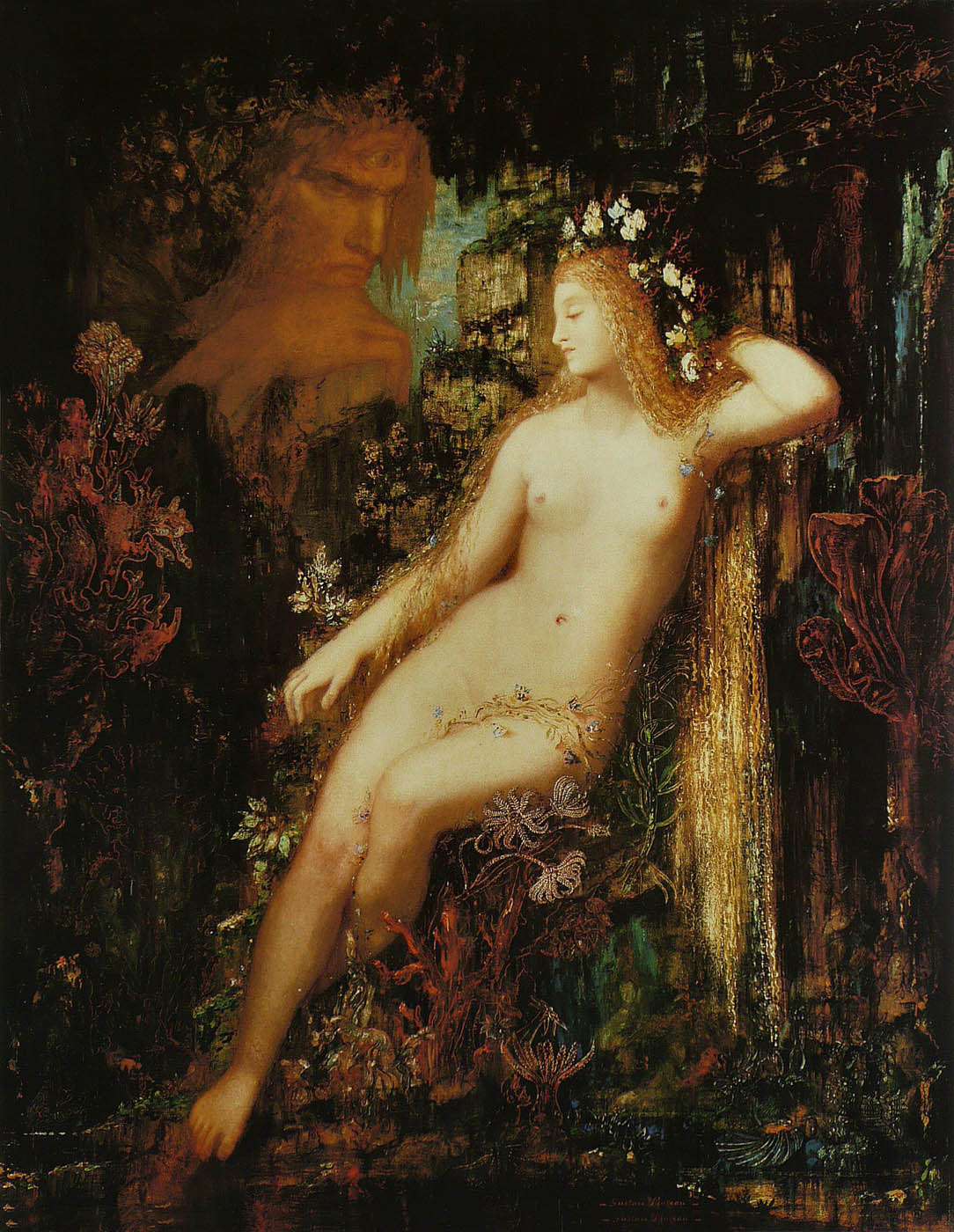
 

Gustave Moreau (French, 1826-1898) 'Galatea' c. 1880


Gustave Moreau (French, 1826-1898)
Galatea
c. 1880
Oil on panel
85.5cm (33.6 in) x 66cm (25.9 in)
Musée d’Orsay
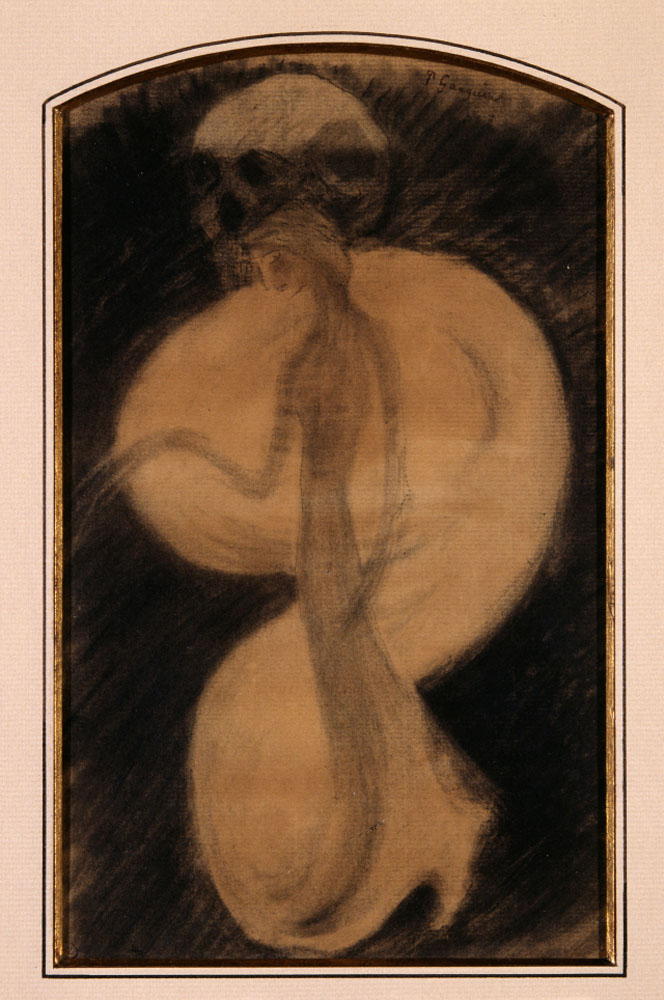
 

Paul Gauguin (French, 1848-1903) 'Madame la Mort' 1890-1891


Paul Gauguin (French, 1848-1903)
Madame la Mort
1890-1891
Charcoal on paper with wash highlights
33,5 x 23cm
Don de la société des Amis du musée d’Orsay, 1991
© RMN-Grand Palais (Musée d’Orsay) / Gérard Blot
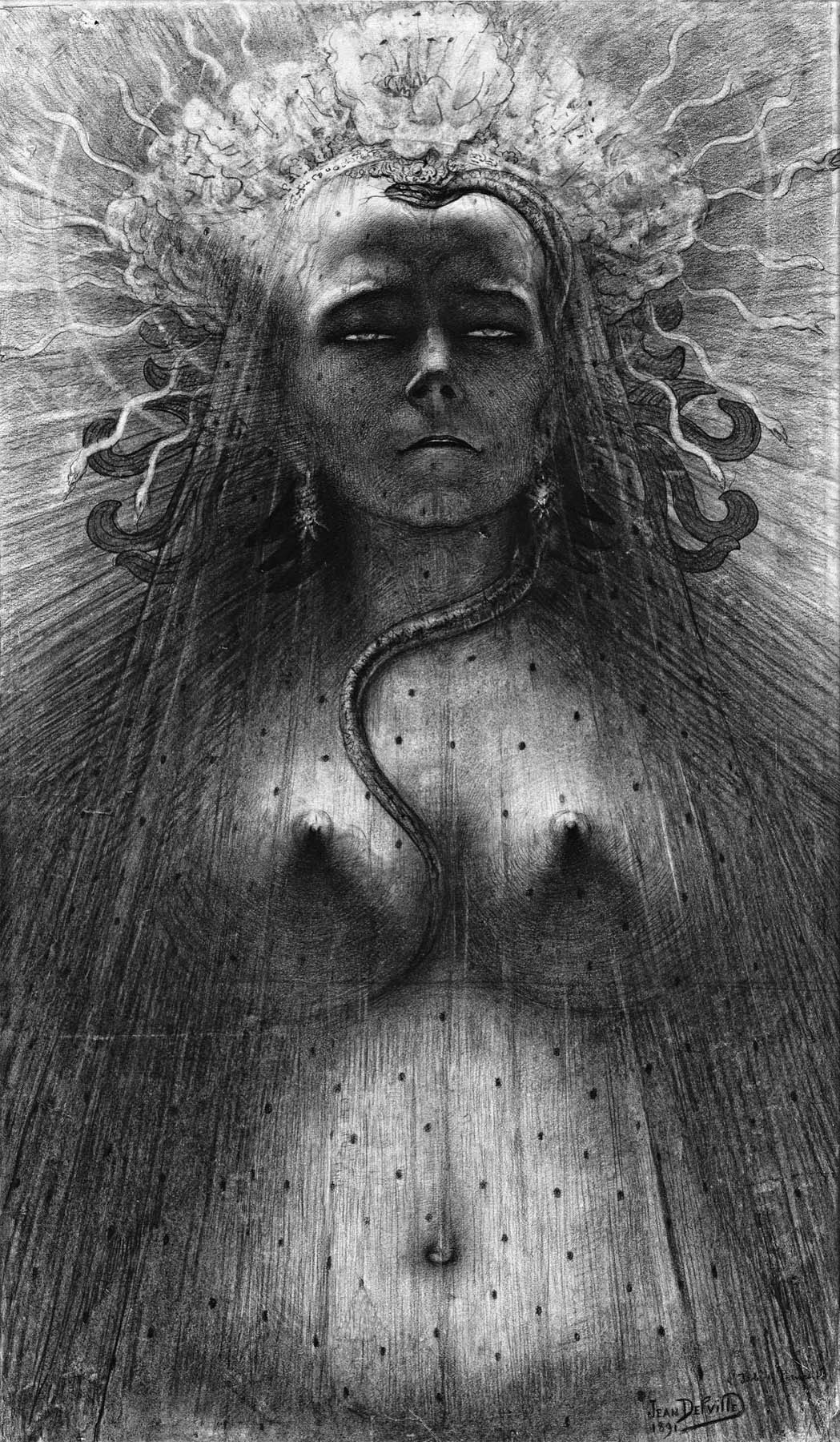
 

Jean Delville (Belgium, 1867-1953) 'L'Idole de la Perversité' (The Idol of Perversity) 1891


Jean Delville (Belgium, 1867-1953)
L’Idole de la Perversité (The Idol of Perversity)
1891
81.5 x 48.5cm
Museum Wiesbaden, Collection Ferdinand Wolfgang Neess
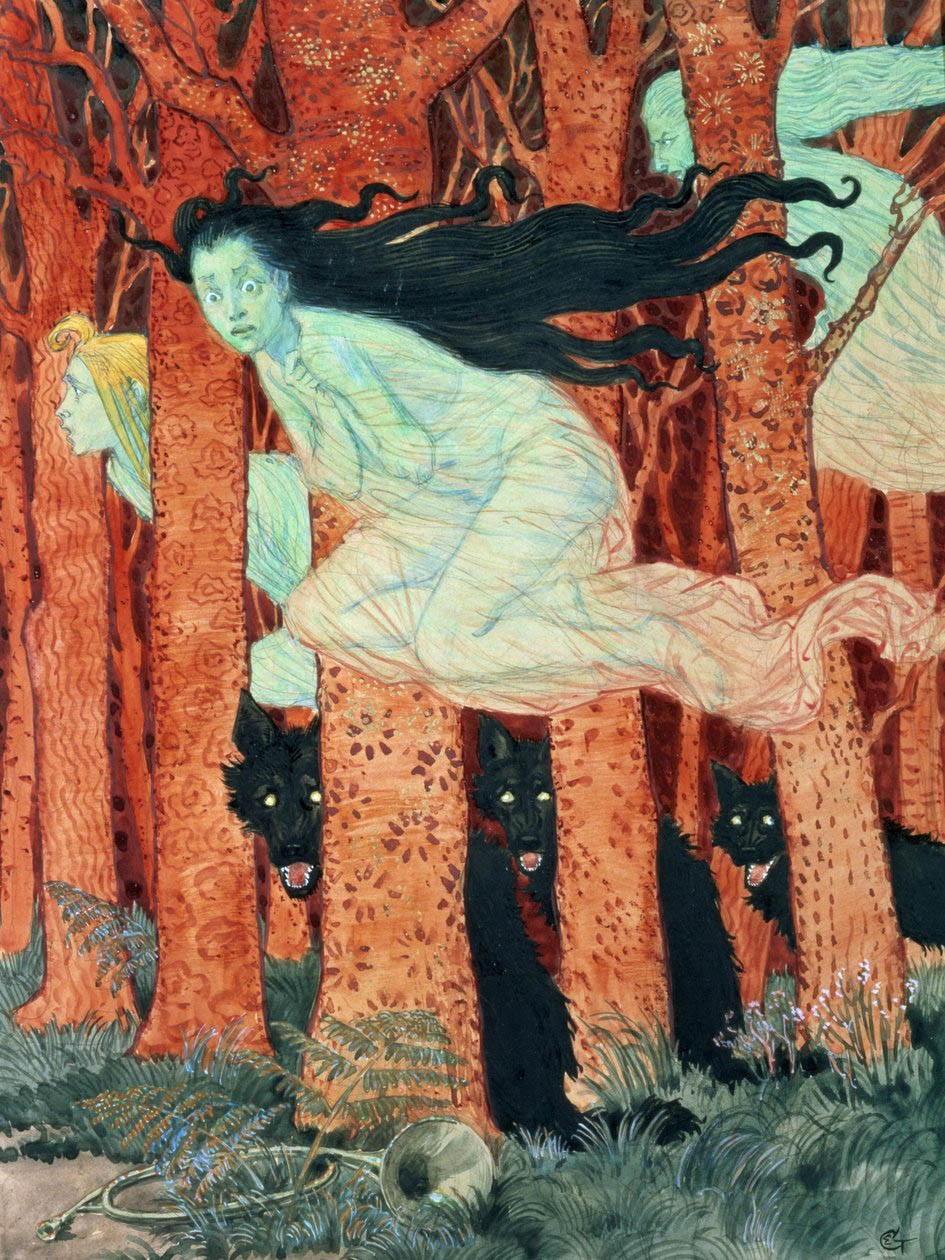
 

Eugène Grasset (French, 1845-1917) 'Trois Femmes et Trois Loups' 1892


Eugène Grasset (French, 1845-1917)
Trois Femmes et Trois Loups
1892
Pencil, watercolour, Indian ink and gold highlights on paper
35.3 x 27.3cm
Musée des Arts Décoratifs, Paris


Franz von Stuck (German, 1863-1928) 'Le Péché' (Die Sünde) (The Sin) 1893


Franz von Stuck (German, 1863-1928)
Le Péché (Die Sünde) (The Sin)
1893
Zurich, galerie Katharina Büttiker
© Galerie Katharina Büttiker, Zürich


Franz Stuck (German, 1863-1928) 'The Kiss of the Sphinx' (Le Baiser du Sphinx) (Der Kuss der Sphinx) 1895


Franz Stuck (German, 1863-1928)
The Kiss of the Sphinx (Le Baiser du Sphinx) (Der Kuss der Sphinx)
1895
Collection particulière
© Droits réservés


Franz Ritter von Stuck (February 23, 1863 – August 30, 1928), born Franz Stuck, was a German painter, sculptor, printmaker, and architect. Stuck was best known for his paintings of ancient mythology, receiving substantial critical acclaim with The Sin in 1892. In 1906, Stuck was awarded the Order of Merit of the Bavarian Crown and was henceforth known as Ritter von Stuck.
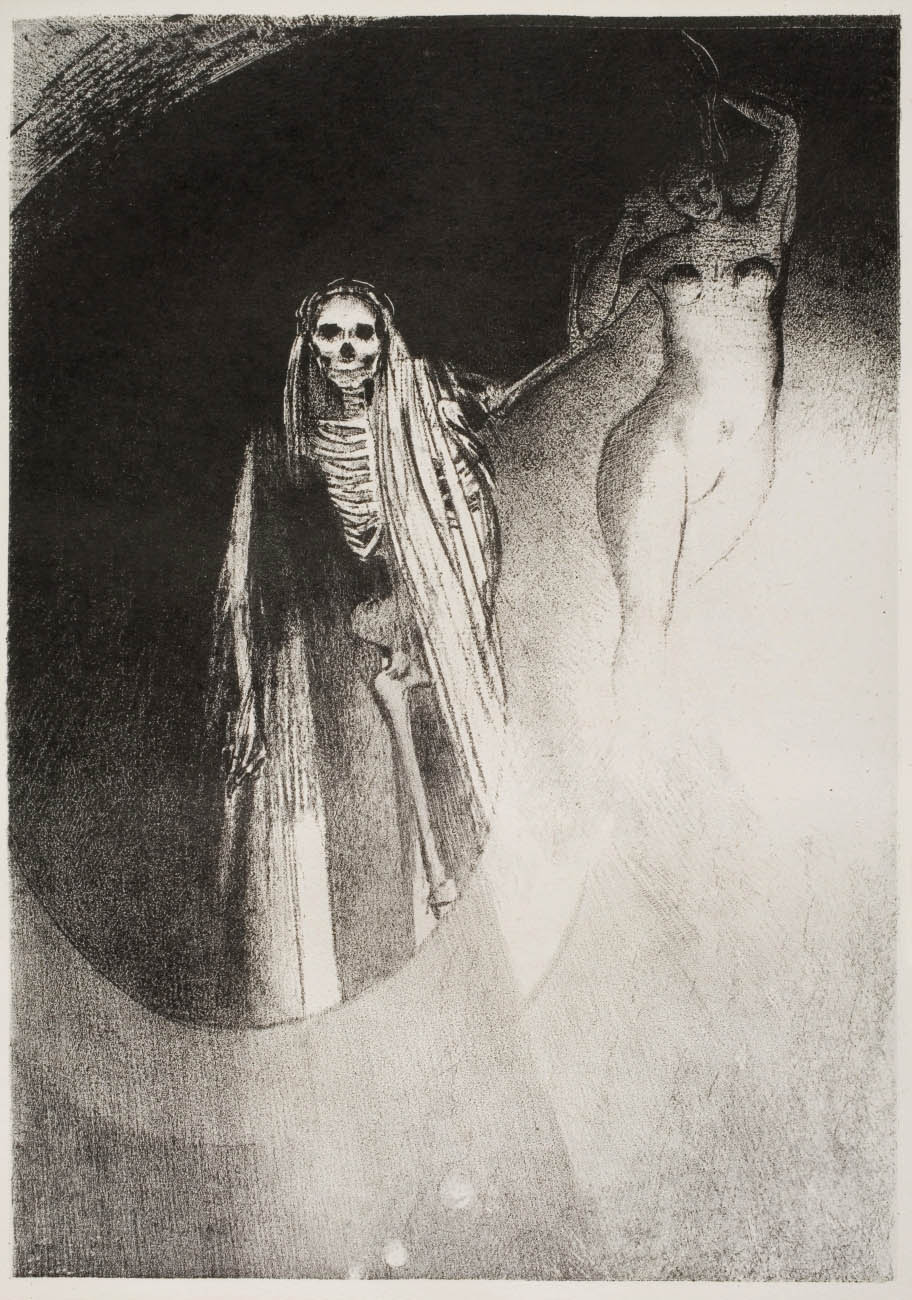
 

Odilon Redon (French, 1840-1916) 'La Mort: C'est moi qui te rends sérieuse: Enlaçons-nous' (Death: It is I who Makes You Serious; Let Us Embrace) 1896


Odilon Redon (French, 1840-1916)
La Mort: C’est moi qui te rends sérieuse: Enlaçons-nous (Death: It is I who Makes You Serious; Let Us Embrace)
1896
Plate 20 from the series “La Tentation de Saint-Antoine” (The Temptation of Saint Anthony)
Lithograph
Sheet: 17 1/8 in. x 13 in. (43.5 x 33cm)


La Mort: C’est moi qui te rends sérieuse: Enlaçons-nous is one of twenty-four prints by the French artist Odilon Redon (1840-1916) that illustrated Flaubert’s play Temptation of Saint Anthony, a lesser-known work of the literary giant but one that Flaubert laboured on painstakingly throughout his life. A contemporary to Flaubert, Redon had worked in lithography for about two decades when the final version of Temptation of Saint Anthony was published. Already working with a repertoire of dark and absurd subjects, Redon was drawn to the grotesque characters described by Flaubert and wrote fondly of the play, calling it “a literary marvel and a mine for me.”

La Mort depicts a scene in the play where Death and Lust, disguised respectively as an emaciated old woman and a fair young one, reveal their real likenesses after failed attempts to seduce Saint Anthony:

The winding-sheet flies open, and reveals the skeleton of Death. The robe bursts open, and presents to view the entire body of Lust, which has a slender figure, with an enormous development behind, and great, undulating masses of hair, disappearing towards the end.

Death tries to lead Saint Anthony to step into the abyss under the cliff and take his own life, thereby ending all pain. “It is I who make you serious, let us embrace each other,” she says, telling Saint Anthony that, by destroying himself, a work of God, he will become God’s equal.

Redon’s accomplished use of chiaroscuro, the sharp contrast between light and dark, underscores the dramatic nature of this moment. Death’s winding-sheet is enveloped by the dazzling rays of light radiating from the voluptuous body of Lust, and Lust’s hair vanishes into the darkness that seeps through Death;s skeletal body. Although the appearance of Lust differs greatly from that of Death, the overlap of their bodies suggests that they are but different phantoms created by the Devil.

Ningyi Xi. “Odilon Redon,” on the Davis Museum website 2017 [Online] Cited 11/08/2024
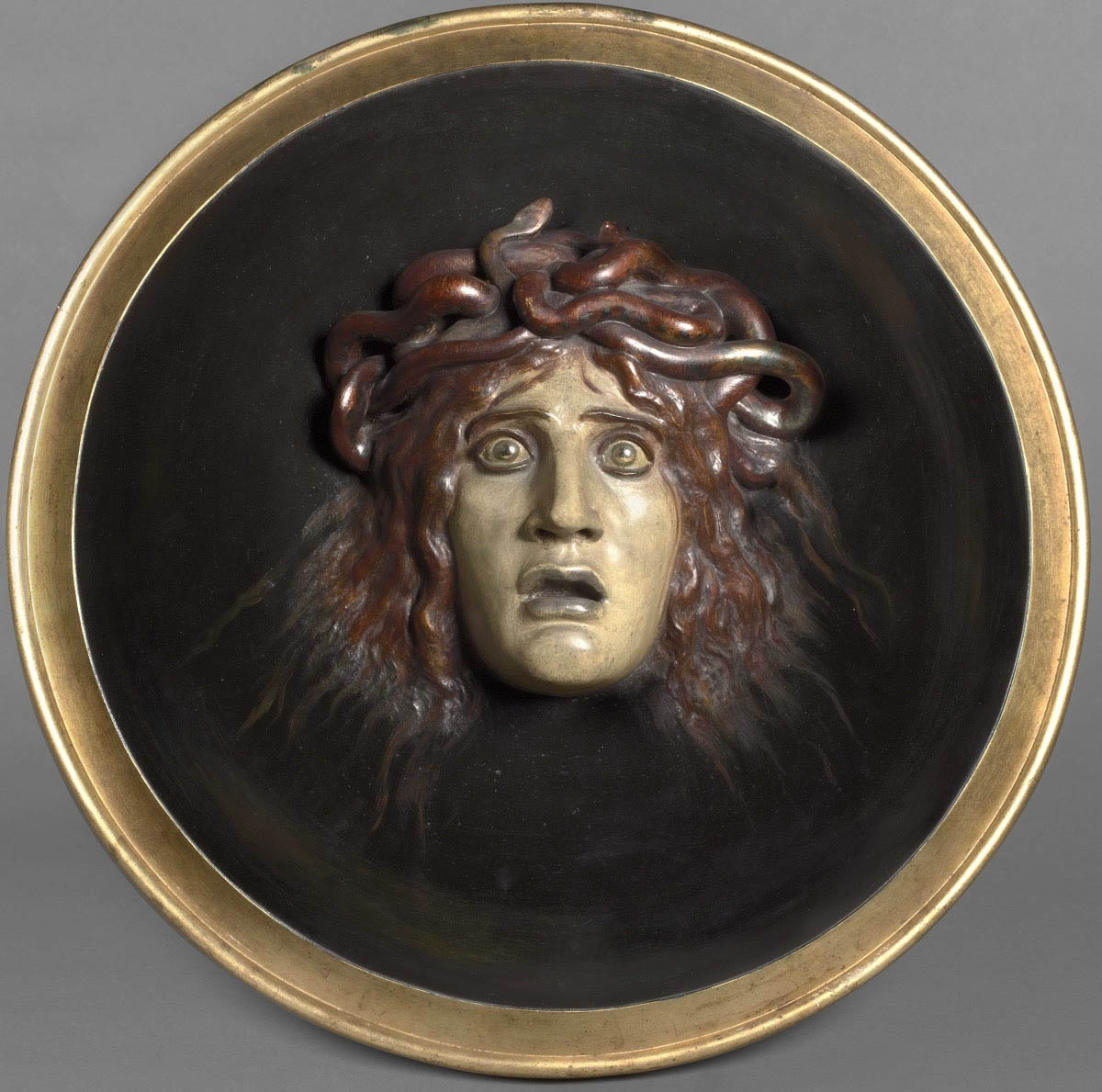
 

Arnold Böcklin (Swiss, 1827-1901) 'Shield with Gorgon's head' (Bouclier avec le visage de Méduse) 1897


Arnold Böcklin (Swiss, 1827-1901)
Shield with Gorgon’s head (Bouclier avec le visage de Méduse)
1897
Papier-mâché
610 x 610cm
© RMN (Musée d’Orsay) / Hervé Lewandowski
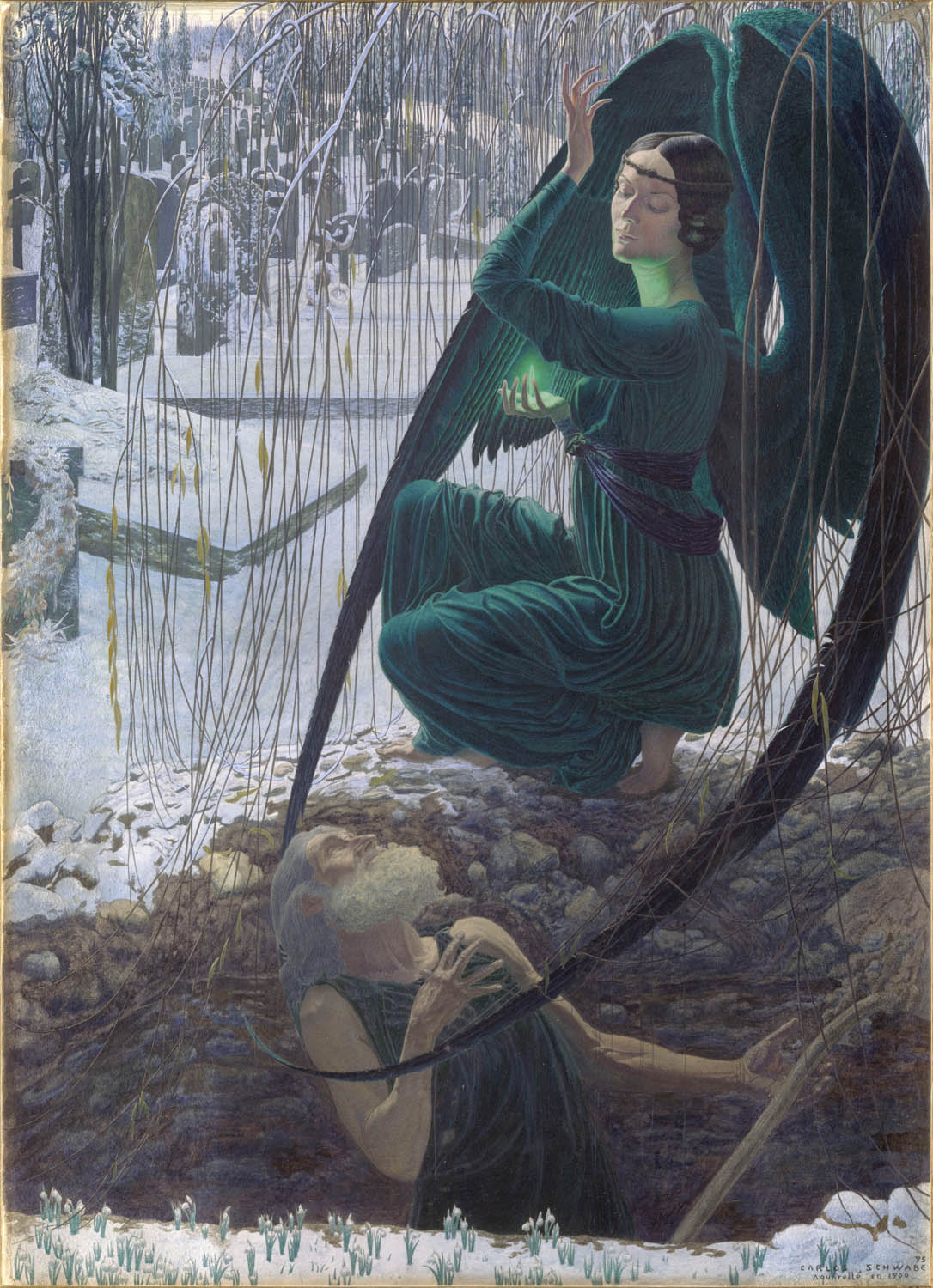
 

Carlos Schwabe (Swiss, 1866-1926) 'La Mort et le fossoyeur' (Death and the Gravedigger) 1900


Carlos Schwabe (Swiss, 1866-1926)
La Mort et le fossoyeur (Death and the Gravedigger)
1900
Paris, musée d’Orsay, conservé au département des Arts Graphiques du musée du Louvre
Legs Michonis, 1902
© RMN (Musée d’Orsay) / Jean-Gilles Berizzi / Patrice Schmidt


Julien Adolphe Duvocelle (French, 1873-1961) 'Crâne aux yeux exorbités et mains agrippées à un mur' (Skull with bulging eyes and hands gripping a wall) 1902


Julien Adolphe Duvocelle (French, 1873-1961)
Crâne aux yeux exorbités et mains agrippées à un mur (Skull with bulging eyes and hands gripping a wall)
1902
Pencil and charcoal mounted on a sheet blackened with charcoal
Paris, musée d’Orsay, conservé au département des Arts Graphiques du musée du Louvre
Don de Mme Fourier en souvenir de son fils, 1995
© DR – RMN-Grand Palais (Musée d’Orsay) / Jean-Gilles Berizzi
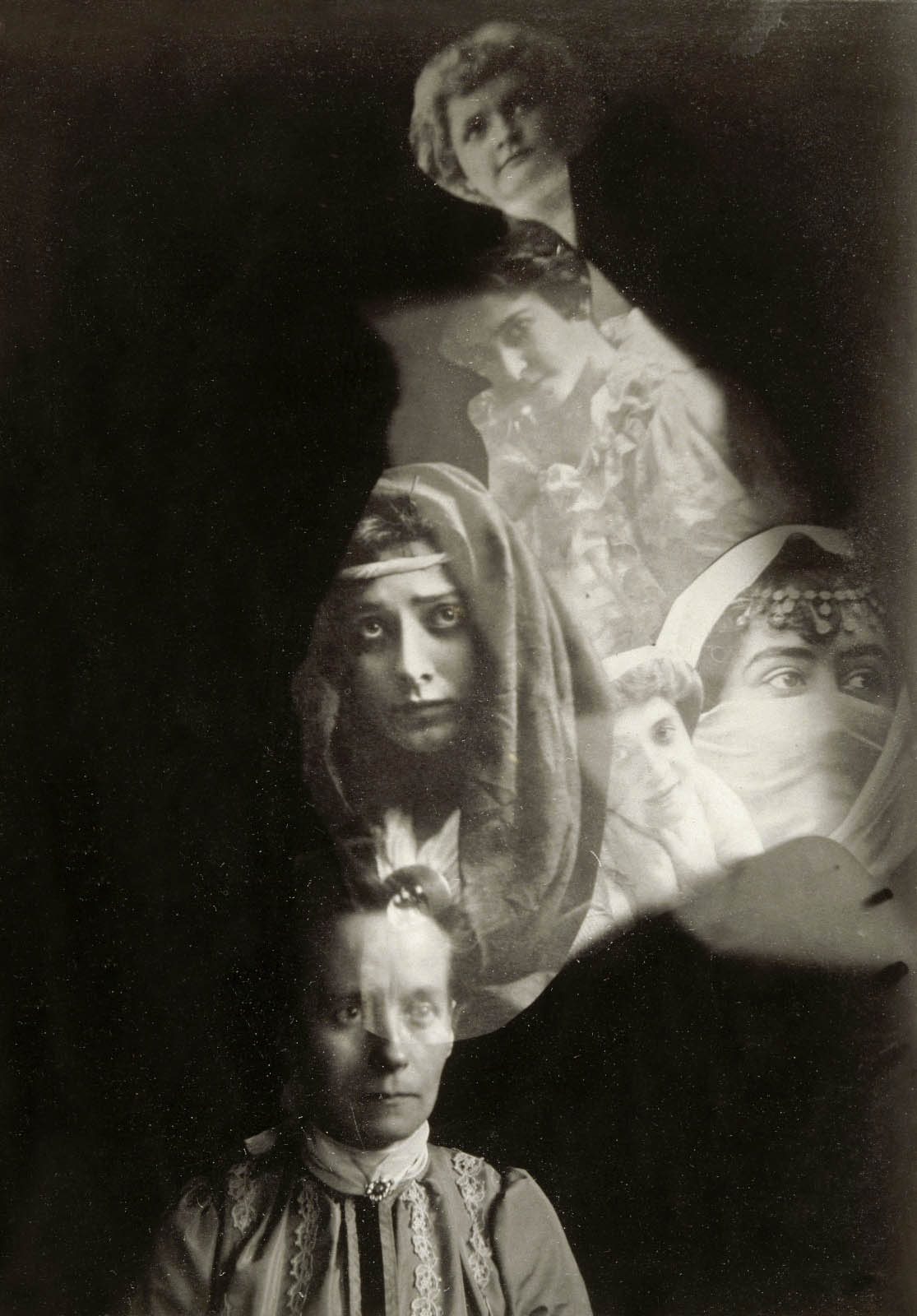
 

Anonymous photographer. 'Photographie spirite (médium et spectres)' / Spiritual photography (medium and ghosts) c. 1910


Anonymous photographer
Photographie spirite (médium et spectres) / Spiritual photography (medium and ghosts)
c. 1910
Musée d’Orsay
© RMN-Grand Palais (Musée d’Orsay) / Hervé Lewandowski / DR


Paul Dardé (French, 1888-1963) 'Eternelle douleur' (Eternal Pain)
1913


Paul Dardé (French, 1888-1963)
Eternelle douleur (Eternal Pain)
1913
Plaster, direct carving
50cm
Musée de Lodève


Paul Dardé created Eternal Pain at 25, even though he had only just finished his year of training. Having gone through the Paris National School of Beaux-Arts and Rodin’s workshop, it is probably his journey to Italy and his mythological reading which fixed the theme of the Medusa in the mind of the artist. Carved from a block of plaster gleaned on the heights of Lodève, the piece would be exhibited seven years later side by side with the great Faun, at the Salon of French artists in 1920.

Text from the Musée de Lodève website


Edvard Munch (Norwegian, 1863-1944) 'Vampire' 1916-1918


Edvard Munch (Norwegian, 1863-1944)
Vampire
1916-1918
Oil on canvas
85 x 110cm
Collection Würth
Photo: Archiv Würth
© VG Bild-Kunst, Bonn 2012
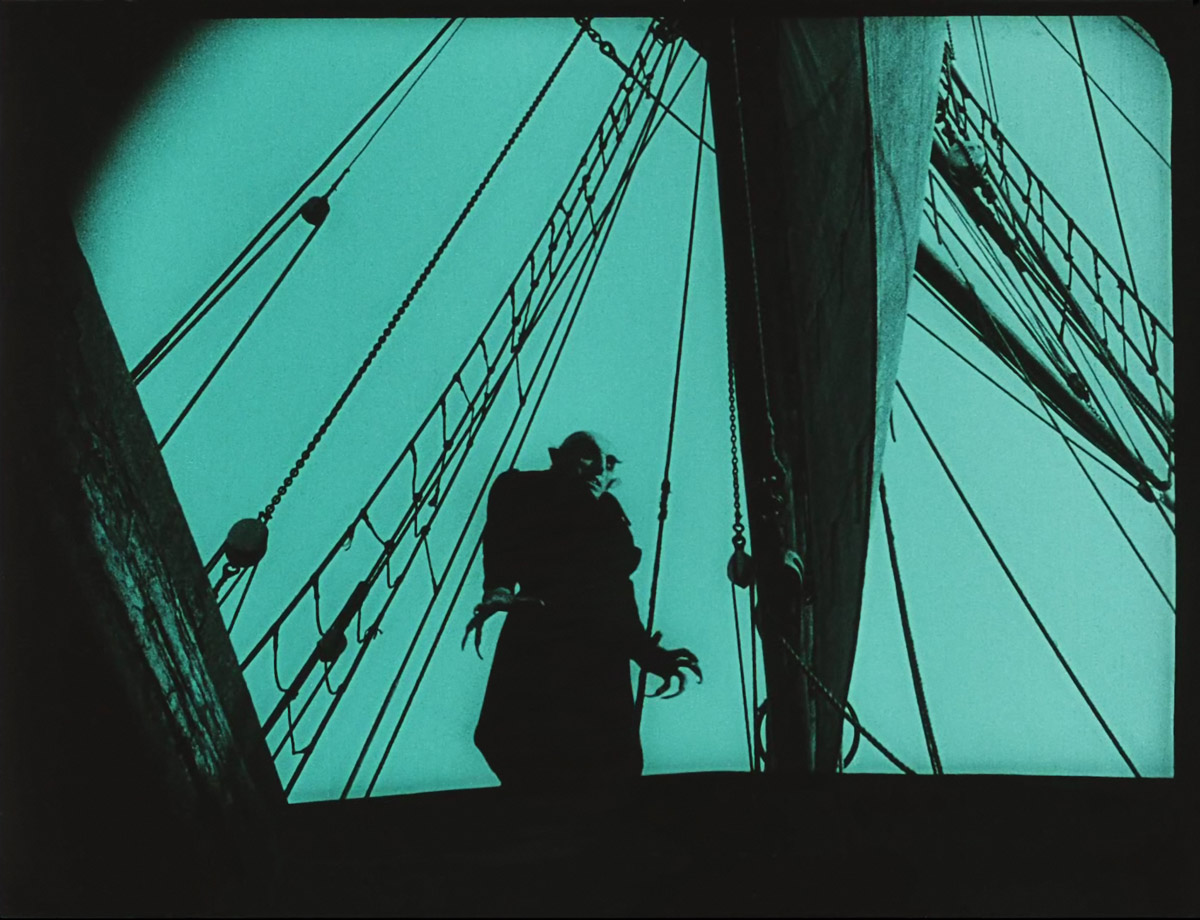
 

Friedrich Wilhelm Murnau (German, 1888-1931) 'Nosferatu – A Symphony of Horror' Germany 1922


Friedrich Wilhelm Murnau (German, 1888-1931)
Nosferatu – A Symphony of Horror
Germany 1922
Filmstill
Silent film
© Friedrich-Wilhelm-Murnau-Stiftung
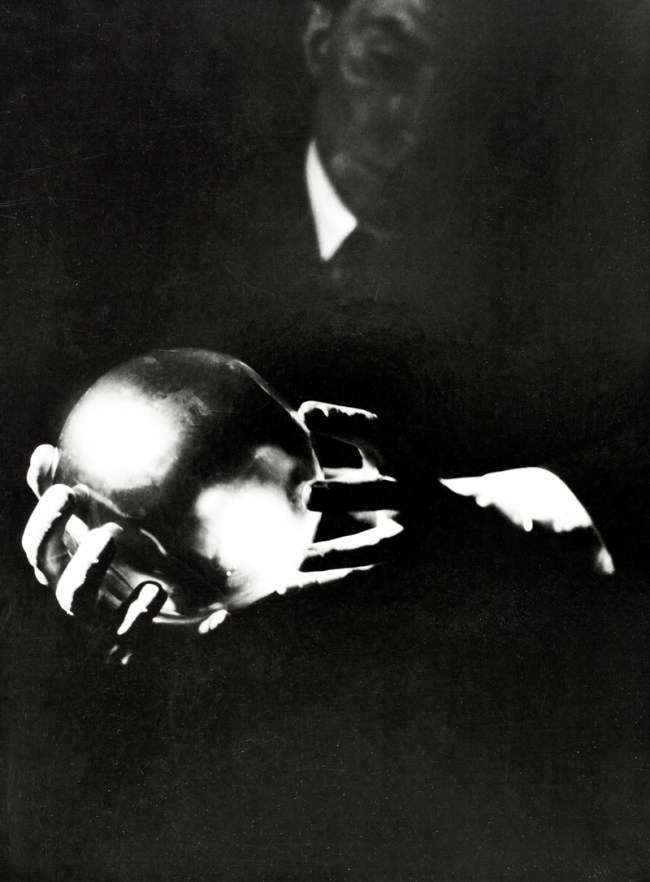
 

Roger Parry (French, 1905-1977) 'Untitled' 1929


Roger Parry (French, 1905-1977)
Untitled
1929
Illustration from Léon-Paul Fargue’s “Banalité” (Paris 1930)
Gelatin silver print
21.8 x 16.5cm
Collection Dietmar Siegert
© VG Bild-Kunst, Bonn 2012
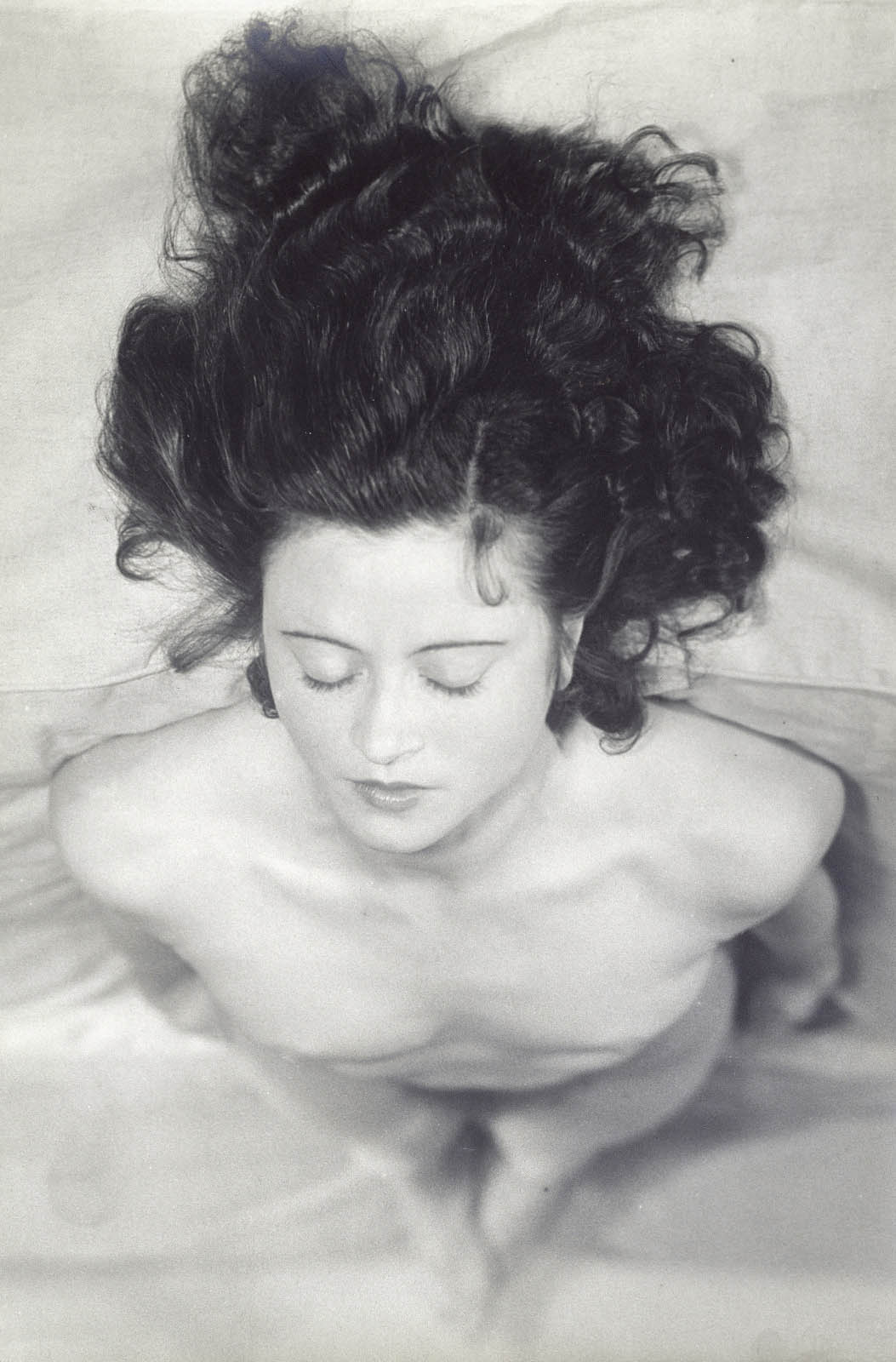
 

Jacques-André Boiffard (French, 1902-1961) 'Renée Jacobi' 1930


Jacques-André Boiffard (French, 1902-1961)
Renée Jacobi
1930
Paris, Centre Pompidou, musée national d’Art moderne, Centre de création industrielle
© Centre Pompidou, MNAM-CCI, dist. RMN-Grand Palais
Image: Centre Pompidou MNAM-CCI © Mme Denise Boiffard
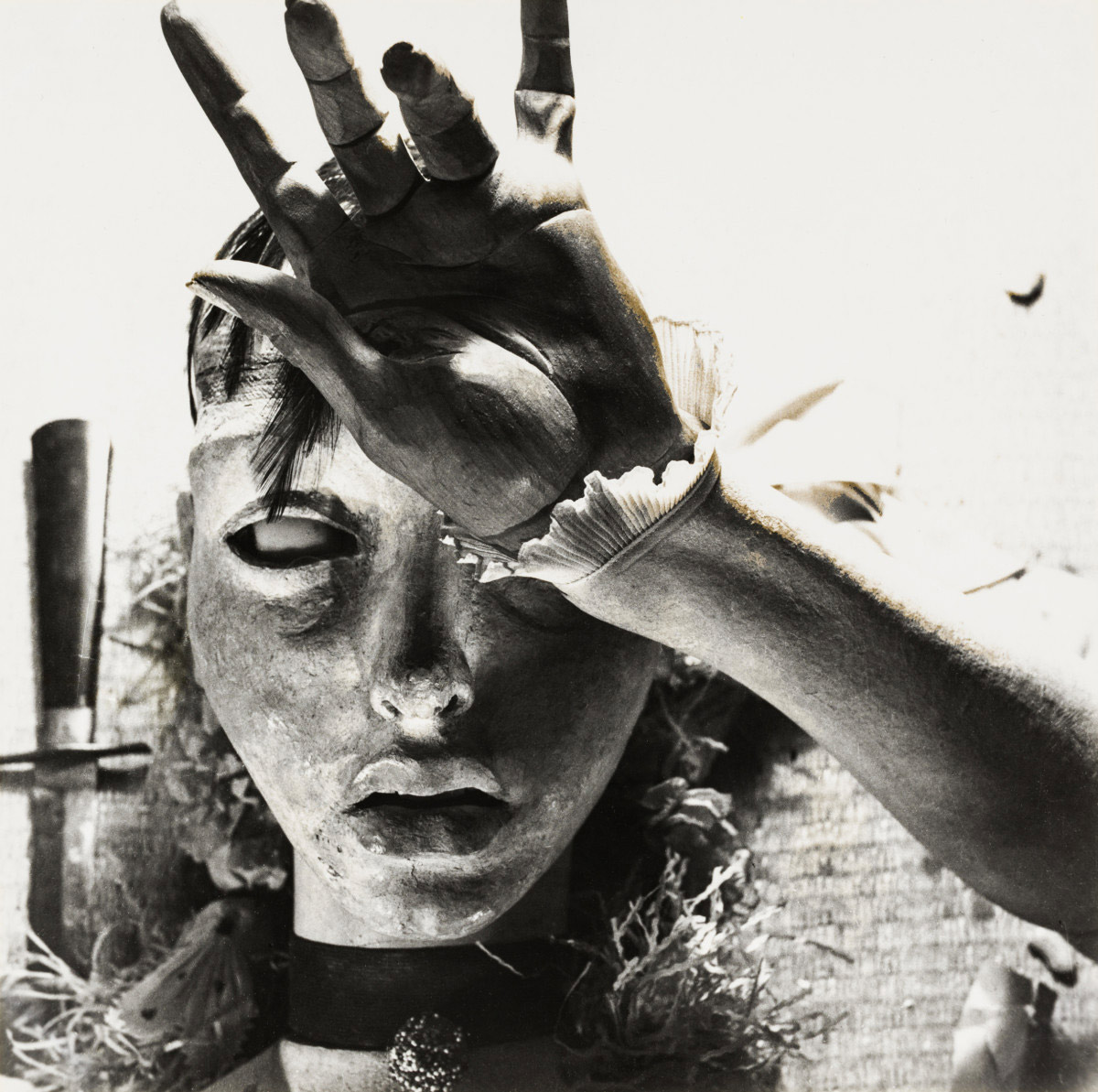
 

Hans Bellmer. 'La Poupée (tête et couteau)' / The Doll (head and knife) 1935


Hans Bellmer (German, 1902-1975)
La Poupée (tête et couteau) / The Doll (head and knife)
1935
Collection Dietmar Siegert
© ADAGP, Paris
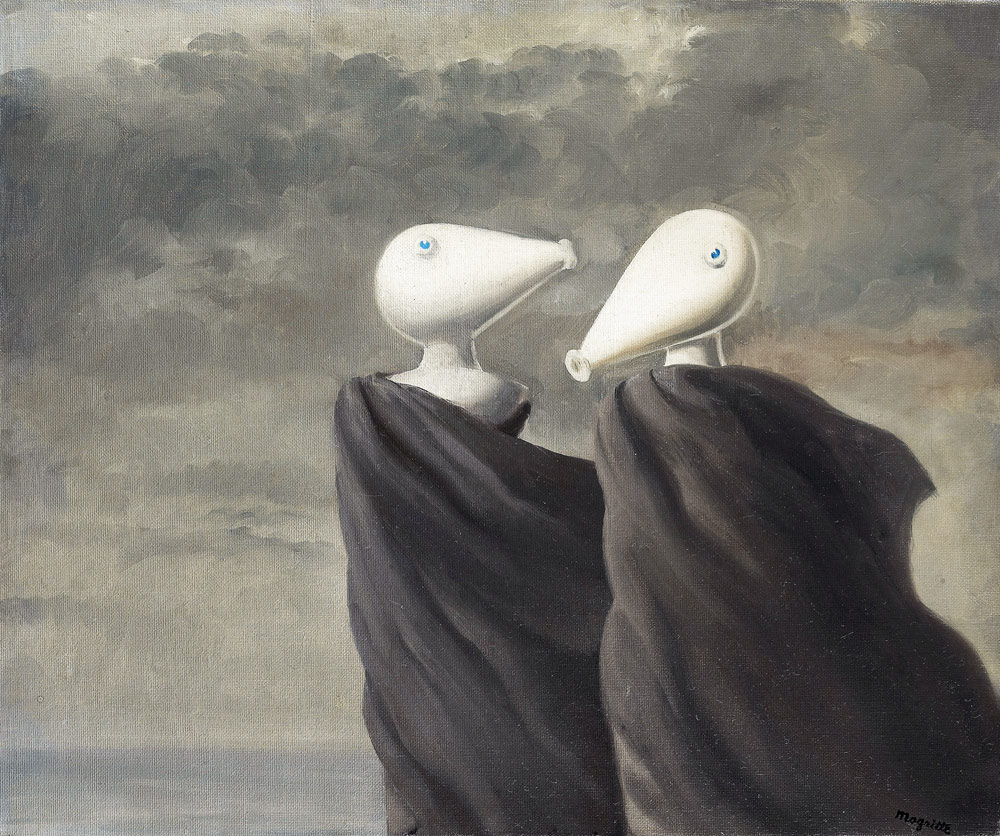
 

René Magritte (Belgian, 1898-1967) 'Sentimental Conversation' 1945


René Magritte (Belgian, 1898-1967)
Sentimental Conversation
1945
Oil on canvas
54 x 65cm
Private Collection
© VG Bild-Kunst, Bonn 2012


Städelsches Kunstinstitut und Städtische Galerie
Schaumainkai 63, 60596 Frankfurt
Phone: +49(0)69-605098-170

Opening hours:
Tuesday – Wednesday, Friday – Sunday 10 – 18 h
Thursday 10 – 21 h
Monday closed

Städel Museum website

LIKE ART BLART ON FACEBOOK

Back to top

Exhibition: ‘The Body as Protest’ at the Albertina, Vienna

Exhibition dates: 5th September – 2nd December 2012


Ishiuchi Miyako (Japanese, b. 1947) '1906#38' Nd


Ishiuchi Miyako (Japanese, b. 1947)
1906#38
Nd
Courtesy by The Third Gallery Aya


“The past neglect of the body in social theory was a product of Western mind-body dualism that divided human experience into bodily and cognitive realms. The knowledge-body distinction identifies knowledge, culture, and reason with masculinity and identifies body, nature, and emotion with femininity. Viewing human reason as the principal source of progress and emancipation, it perceives “the rational” as separate from, and exalted over, the corporeal. In other words, consciousness was grasped as separate from and preceding the body (Bordo 1993; Davis 1997). Following feminist thinking about women’s bodies in patriarchal societies, contemporary social theories shifted focus from cognitive dimensions of identity construction to embodiment in the constitution of identities (Davis 1997). Social construction theories do not view the body as a biological given but as constituted in the intersection of discourse, social institutions, and the corporeality of the body. Body practices, therefore, reflect the basic values and themes of the society, and an analysis of the body can expose the intersubjective meaning common to society. At the same time, discourse and social institutions are produced and reproduced only through bodies and their techniques (Frank 1991, 91). Thus, social analysis has expanded from studying the body as an object of social control and discipline “in order to legitimate different regimes of domination” (Bordo 1993; Foucault 1975, 1978, 1980) to perceiving it as a subject that creates meaning and performs social action (Butler 1990). The body is understood as a means for self-expression, an important feature in a person’s identity project (Giddens 1991), and a site for social subversiveness and self-empowerment (Davis 1997).”


Orna Sasson-Levy and Tamar Rapoport. “Body, Gender, and Knowledge in Protest Movements: The Israeli Case,” in ‘Gender & Society’ 17, 2003, p. 381. No longer available online


Despite my great admiration for John Coplans’ photographs of his body, on the evidence of these press photographs and the attached video, this exhibition seems a beautiful if rather tame affair considering the subject matter. Of course these photographs of the body can be understood as a means for self-expression and self-empowerment but there seems little social subversiveness in the choice of work on display.

The two Mapplethorpe’s are stylised instead of stonkingly subversive. The exhibition could have been taken photographs from his ‘X’ portfolio (the self portrait of him with a bull whip up his arse would have been particularly pleasing to see in this context). The exhibition could also have included some of the many artists using the body as protest during the AIDS crisis (perhaps some photographs by David Wojnarowicz or William Yang’s Sadness), the famous Burning Monk – The Self-Immolation (1963) by Malcolm Browne, photographs by Stellarc, Arthur Tress, Duane Michals, Nan Goldin, Diane Arbus, Francesca Woodman, Sally Mann, Cindy Sherman to name but a few; even the Farm Security Administration photographs of share cropper families by Walker Evans and Dorothea Lange would have had more impact than some of the photographs on display here.

Having not seen the entire exhibition it is hard to give an overall reading, but on the selection presented here it would seem that this was a missed opportunity, an exhibition where the body did not protest enough.

Dr Marcus Bunyan


Many thankx to the Albertina, Vienna for allowing me to publish the photographs in the posting. Please click on the photographs for a larger version of the image.


theartVIEw – The Body as Protest at ALBERTINA


Bruce Nauman (American, b. 1941) 'Studies for Holograms' Siebdruck, 1970


Bruce Nauman (American, b. 1941)
Studies for Holograms
Siebdruck, 1970
© VBK, Wien 2012
Foto: © Rheinisches Bildarchiv Köln


Ketty La Rocca (Italian, 1938-1976) 'Le mie parole e tu' 1974


Ketty La Rocca (Italian, 1938-1976)
Le mie parole e tu
1974
Courtesy Private Collection, Austria


Robert Mapplethorpe (American, 1946-1989) 'Vincent' 1981


Robert Mapplethorpe (American, 1946-1989)
Vincent
1981
Silbergelatinepapier
© Robert Mapplethorpe Foundation


Hannah Villiger (Swiss, b. 1974) 'Block XXX' 1993-1994


Hannah Villiger (Swiss, b. 1974)
Block XXX
1993-1994
© The Estate of Hannah Villiger


John Coplans (British, 1920-2003) 'Self Portrait Interlocking Fingers No 6' 1999


John Coplans (British, 1920-2003)
Self Portrait Interlocking Fingers No 6
1999
Silbergelatinepapier
Albertina, Wien


The exhibition The Body as Protest highlights the photographic representation of the human body – a motif that has provided a wide variety of photographers with an often radical means of expression for their visual protest against social, political, but also aesthetic norms.

The show centres on an outstanding group of works by the artist John Coplans from the holdings of the Albertina. In his serially conceived large-format pictures, the photographer focused on the rendering of his own nude body, which he defamiliarised through fragmentation far from current forms of idealisation. Relying on extremely sophisticated lighting, he presented himself in a monumental and sculptural manner over many years. His photographs can be understood as amalgamations of theoretical and artistic ideas, which in the show are accentuated through selective juxtapositions with works by other important exponents of body-related art.

The body also features prominently in the work of other artists such as Hannah Wilke, Ketty La Rocca, Hannah Villiger, Vito Acconci, Bruce Nauman, Robert Mapplethorpe, and Miyako Ishiuchi. By means of these positions, such diverse themes as self-dramatisation, conceptual photography, feminism, body language, and even transience are analysed within an expanded artistic range. Moreover, the exhibition offers a differentiated view of the critical depiction of the human body as it has been practiced since 1970.

Text from the Albertina website


Ketty La Rocca (Italian, 1938-1976) 'Craniologia' 1973


Ketty La Rocca (Italian, 1938-1976)
Craniologia
1973
Radiografie mit überblendeter Fotografie
SAMMLUNG VERBUND


Hannah Wilke (American, 1940-1993) 'Gestures' 1974-1976 (stills)


Hannah Wilke (American, 1940-1993)
Gestures (stills)
1974-1976
Basierend auf der gleichnamigen
Video Performance von 1974
(35:30 min, b&w, sound)
Silbergelatinepapier
12 Blatt je 12,7x 17,8 cm
© Marsie, Emanuelle, Damon and Andrew Scharlatt, The Hannah Wilke Collection & Archive, L.A./ VBK, Wien 2012


Robert Mapplethorpe (American, 1946-1989) 'Thomas' 1986


Robert Mapplethorpe (American, 1946-1989)
Thomas
1986
Silbergelatinepapier
© Robert Mapplethorpe Foundation


John Coplans (British, 1920-2003) 'Back with Arms Above' 1984


John Coplans (British, 1920-2003)
Back with Arms Above
1984
Silbergelatinepapier
© The John Coplans Trust


John Coplans (British, 1920-2003) 'Self Portrait (Hands)' 1988


John Coplans (British, 1920-2003)
Self Portrait (Hands)
1988
Silbergelatinepapier
Albertina, Wien


John Coplans (British, 1920-2003) 'Frieze No. 6' 1994


John Coplans (British, 1920-2003)
Frieze No. 6
1994
Silbergelatinepapier
Albertina, Wien


John Coplans (British, 1920-2003) 'Self Portrait Interlocking Fingers No 17' 2000


John Coplans (British, 1920-2003)
Self Portrait Interlocking Fingers No 17
2000
Silbergelatinepapier
Albertina, Wien


Albertina
Albertinaplatz 1
1010 Vienna, Austria
Phone: +43 (0)1 534 83-0

Opening hours:
Daily 10am – 6pm
Wednesday 10am – 9pm

Albertina website

LIKE ART BLART ON FACEBOOK

Back to top
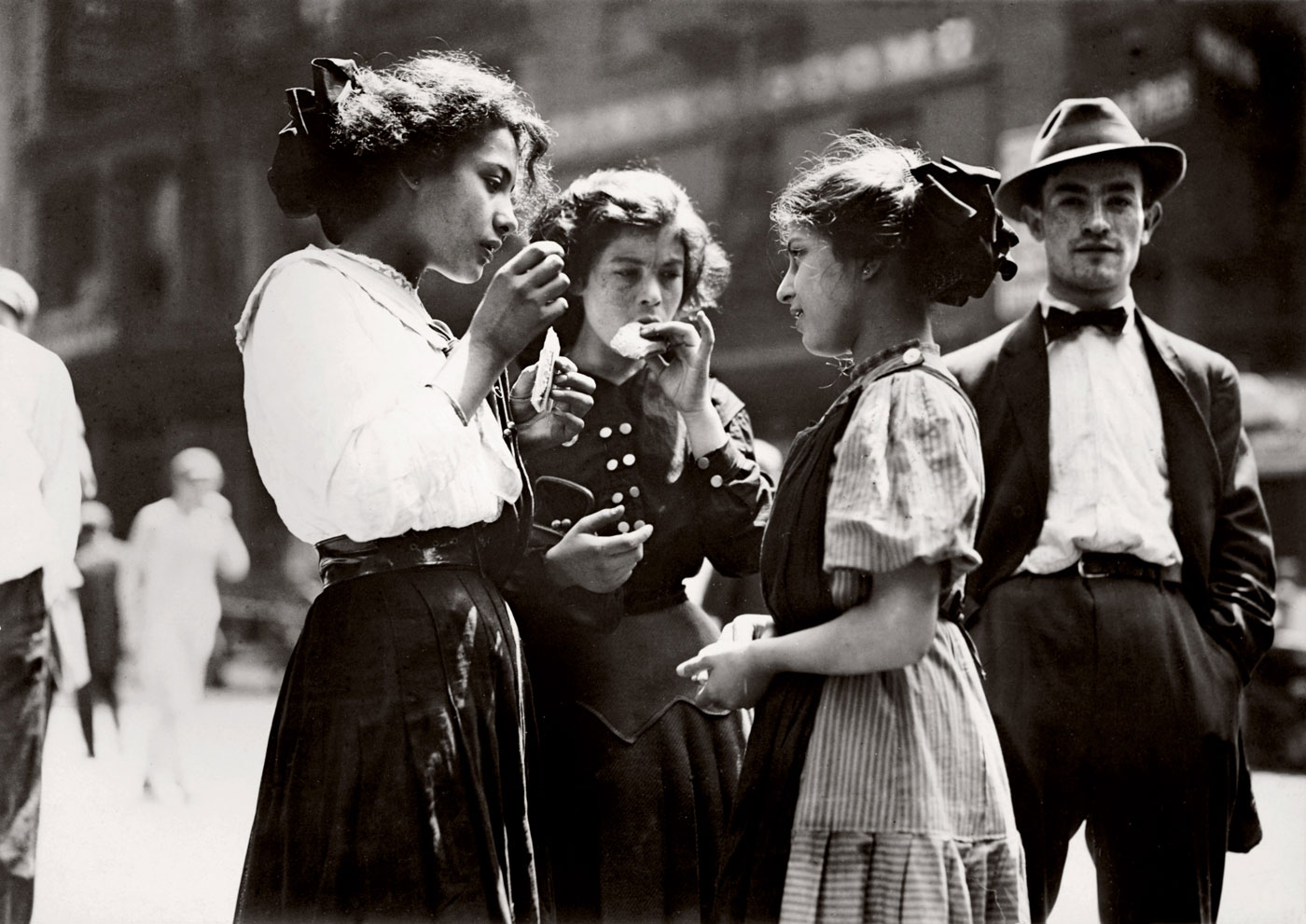
Text: Minkowski retentir / Photos: Rosemary Laing ‘groundspeed’ series

October 2012


Rosemary Liang (Australian, 1959-2024) 'groundspeed (Red Piazza) #04' 2001


Rosemary Liang (Australian, 1959-2024)
groundspeed (Red Piazza) #04
2001
C-Print
110 x 219cm
Purchased with funds provided by the Photography Collection Benefactors’ Program
© Rosemary Laing


“If, having fixed the original form in our mind’s eye, we ask ourselves how that form comes alive and fills with life, we discover a new dynamic and vital category, a new property of the universe: reverberation (retentir). It is as though a well-spring existed in a sealed vase and its waves, repeatedly echoing against the sides of this vase, filled it with their sonority. Or again, it’s as though the sound of a hunting horn, reverberating everywhere through its echo, made the tiniest leaf, the tiniest wisp of moss shudder in a common movement and transformed the whole forest, filling it to its limits, into a vibrating, sonorous world.”


Eugene Minkowski. ‘Vers une Cosmologie’ (translated by Maria Jolas) quoted on Michael Ormerod. “Minkowski’s Reverberating Forest,” on the ‘The Spirit of the Mass’ blog 23rd April 2012 [Online] Cited 24th October 2012 and again on 3rd September 2020


Rosemary Liang (Australian, 1959-2024) 'groundspeed (Red Piazza) #05' 2001


Rosemary Liang (Australian, 1959-2024)
groundspeed (Red Piazza) #05
2001
C-Print
106 x 163cm
Courtesy the artist; DZ Bank Kunstsammlung
© Rosemary Laing; Galerie CONRADS, Düsseldorf


The Australian artist Rosemary Laing moves between different genres in her work, drawing upon installation, performance and photography at the same time. The groundspeed series is the result of a sort of “field trip” to the eucalyptus forests of southern Australia. Together with a team of assistants, Laing produced a series of images of landscapes in which reality and fiction combine through the insertion of ordinary industrially produced carpets in practically unspoilt natural settings. Her work thus weds the open landscape of the image in the background with an element in the foreground that instead recalls an interior, an inhabited human environment. But where is the reality or where is the fiction? Are we sure we can believe in the reality of pure and idyllic nature?

The artist’s working method is comparable to filmmaking. A team of professionals goes to the selected location and creates a set that meets all of the artist’s requirements and is therefore ready to be photographed. This procedure enables Laing to achieve results that would be impossible through digital manipulation of the images alone. The flower-patterned carpets Laing uses belong to a European tradition that was very popular and widespread in Australia when she was young. She thus “grafts” a piece of European culture onto the Australian landscape. She intervenes in nature and alters it. Reverberating in her works is an explicit criticism of the appropriation of the Australian continent by European colonisers, a process underway for at least 200 years. In the light of these considerations, Laing’s apparently idyllic and fantastic images suddenly take on a bitter and dramatic aftertaste. The artistic representation thus succeeds in arriving at a higher level of truth than that of the concrete visual reality it uses.”

Text from the Manipulating Reality: How Images Redefine the World website [Online] Cited 24th October 2012 and again on 3rd September 2020. No longer available online


“groundspeed (Red Piazza) #4 is from the series groundspeed, in which patterned Feltex carpet is laid on the forest floor or on the edge of a rocky coastal setting. This particular image uses retro Red Piazza carpet in the forest at the George Boyd Lookout in southern New South Wales. The carpet is obviously incongruous to the forest, even though its floral pattern is inspired by nature. The lush saturated colours are typical of Laing’s work. Here, red and green – opposites on the colour spectrum – are placed in combination, heightening the tone and conceptual vigour of the union. In each photograph from the series, nature is shown as living and abundant; from the fecund, green forest to, in other images, the ferocity of waves breaking against the coast.

The title is an amalgamation of Laing’s concerns: ‘ground’ refers to land and solidity, and ‘speed’ references flight and impermanence. Placed together these terms conceptually summarise the visual considerations at work. In a reversal of accepted norms in which nature is distanced from domestic living and where nature is historically sidelined by cultural pursuits, Laing figuratively brings the inside out. In so doing groundspeed makes concrete the unstable and provocative rapport between habitation and inhabitation, stillness and movement, growth and decay. Laing’s vibrant images subsume the visual in a historical, social and cultural dialogue where the ground keeps shifting.”

Text from the Art Gallery of New South Wales website


Max Ernst (French born Germany, 1891-1976) 'Forest and Sun' 1927


Max Ernst (French born Germany, 1891-1976)
Forest and Sun
1927


LIKE ART BLART ON FACEBOOK

Back to top

Exhibition: ‘Edouard Baldus and the Modern Landscape. Important Salt Prints of Paris from the 1850s’ at James Hyman Gallery, London

Exhibition dates: 12th October – 9th November 2012


Edouard Baldus (French, 1813-1889) 'Vue generale de Paris pont neuf' c. 1855


Edouard Baldus (French, 1813-1889)
Vue generale de Paris pont neuf
c. 1855
Salt print mounted on card
33.6 x 43.9cm (13.20 x 17.25 ins)
Negative: Lower left inscribed in negative: no 82 Mount: Lower right beneath negative: stamped E. Baldus Lower left bottom: Vue generales des Paris pont neuf


A beautiful, complimentary post to the last one on the exhibition Eugène Atget: Old ParisIt is interesting to compare the styles of the two photographers and the change in photography that takes place between the 1850s and the 1890s. Baldus’ photographs are eloquent in their grandeur and frontality, tonality and texture. Atget’s photographs on the other hand are slightly claustrophobic in their intensity, the camera obliquely placed to capture old buildings, narrow cobbled streets and distant vanishing points. Both, in their own way, are very modern photographers. Baldus’ legacy, as Dr James Hyman correctly notes, was his influence on his German compatriots such as the Bechers, Thomas Struth and, to a lesser extent, Andreas Gursky. His rigorous frontality (the photographing of the thing itself) gives his photographs the simplicity of diagrams and emphasises their topographical state, while their density of detail offers encyclopaedic richness. This straightforward “objective” point of view was most notably used by Bernd and Hilla Becher in contemporary photography. Atget’s photographs, on the other hand, aroused an immediate interest “among the Surrealists because of the composition, ghosting, reflections, and its very mundanity.”

Conversely, it is the subjective signature of both artists that make their work truly great – not the mundanity, not the topographic objectivity but their intimate vision of this city, Paris. As I noted in an earlier posting on the Bechers,

“These are subjective images for all their objective desire. The paradox is the more a photographer strives for objectivity, the more ego drops away, the more the work becomes their own: subjective, beautiful, emotive… What makes great photographers, such as Eugène Atget, Walker Evans, August Sander and the Bechers, is the idiosyncratic “nature” of their vision: how Atget places his large view camera – at that particular height and angle to the subject – leaves an indelible feeling that only he could have made that image, to reveal the magic of that space in a photograph. It is their personal, unique thumbprint, recognisable in an instant.”

The same can be said of Baldus and these magnificent, ethereal photographs.

Dr Marcus Bunyan


Many thankx to James Hyman Gallery for allowing me to publish the photographs in the posting. Please click on the photographs for a larger version of the image.


Edouard Baldus (French, 1813-1889) 'Le Nouveau Louvre' c. 1857


Edouard Baldus (French, 1813-1889)
Le Nouveau Louvre
c. 1857
Salt print mounted on card
31.6 x 44.3cm (12.42 x 17.41 ins)
Le Nouveau Louvre series: 1855-1857 Negative: Lower left inscribed in negative: no 107 Mount: Lower right beneath negative: stamped E. Baldus Lower left bottom: Le Nouveau Louvre


Mid-nineteenth century Paris was a city in the midst of modernisation, and as such, was ripe for documentation of its changing landscape. Counted as one of the premier photographers of his day, Edouard Baldus captured the aesthetic of the Second Empire’s ideology in his monumental views of both old and new Parisian landmarks. In 1855, Baldus received his largest commission, to document the construction of the Musee du Louvre. This rich salt print is a survey of the project as it nears almost full completion. Baldus produced over two thousand images of each part of the new Louvre, from large pavilions to small decorative statue. This photograph, however, takes a step back from the individual pieces of the lengthy project, and allows the viewer to appreciate the endeavour as a whole.


Edouard Baldus (French, 1813-1889) 'Le Pantheon' 1853


Edouard Baldus (French, 1813-1889)
Le Pantheon
1853
Salt print mounted on card
33.8 x 43.5cm (13.28 x 17.10 ins)
Negative: Lower left inscribed in negative: Le Pantheon Lower right inscribed in negative: Baldus Mount: Lower right beneath negative: stamped E. Baldus Lower left bottom: Le Pantheon


Due to the strength of his architectural imagery and work with the Mission Heliographique, Baldus would go on to gain the support of a government commission, Les Villes de France Photographies, which focused on the landmarks of Paris in particular, such as the Pantheon. Similar in style to the frontal views of the Louvre pavilions, this image is a precursor to that project, and also includes Saint Etienne du Mont in its background. The Pantheon is one of Paris’ best-known landmarks, and was originally built as a church dedicated to Saint Genevieve. Looking out over the whole of the city, it is now a mausoleum that houses the remains of distinguished French citizens.


Edouard Baldus (French, 1813-1889) 'Arc de Caroussel' c. 1853


Edouard Baldus (French, 1813-1889)
Arc de Caroussel
c. 1853
Salt print mounted on card
34.1 x 44.3 cms (13.40 x 17.41 ins)
Negative: Lower left inscribed in negative: signature of E.Baldus Lower right inscribed in negative: no.81 Mount: Lower right beneath negative: stamped E.Baldus Lower left bottom: Arc de Caroussel
Mount: 43.9 x 61 cms
Image: 34.1 x 44.3 cms


One of Baldus’ greatest projects was to provide a photographic inventory of the New Louvre and adjoing Tuilleries. A number of these works are of particular interest, expecially those of the Tuilleries Palace, which would be burnt down in 1870-1871. All that remains today is the central triumphal arch, the Caroussel, which is depicted here, still with the palace visible in the background. Built between 1806 and 1808, the Arc de Caroussel is a monument commemorating Napolean’s military victories, with Peace riding a triumphal chariot atop the central archway. Two guards flank the sides of the arch, each atop their own horse, which not only provide for a sense of scale, but, being slightly blurred, also hint at the length of Baldus’ exposure. This enhances the effects of the delicately carved sculptures that adorn the archway, presented here with a clarity that defined the standard Baldus set with his architectural images.


James Hyman is proud to present a loan exhibition of one of the greatest photographers of the nineteenth century, Edouard Baldus. Remarkably, this is the first major exhibition of Edouard Baldus ever to be staged in London. Baldus was famed for his monumental photographs of the buildings of Paris at a time of massive transition under Napoleon III, Baron Haussman and Viollet Le Duc, as well as the depiction of the contemporary landscape of France. Acclaimed as the greatest architectural photographer of the nineteenth century, Baldus’s prints were some of the largest photographs in existence and pioneered an aesthetic of presenting modernity and the modern city that would have a profound influence on later photographers from the Bechers to John Davies.

Baldus was one of the great calotypists of the 1850s, producing works of an unprecedented range and scale. He moved to Paris in 1838 to study painting alongside other future photographers such as Le Gray, Le Secq, and Negre. He frequently retouched his paper negatives, adding pencil and ink, to add clouds or clarify details, then printing his own large-scale negatives. He was also adept at stitching several negatives together to re-create architectural views, most famously in his views of the cloisters of Saint Trophime.

Famed especially for his depiction of architecture, Baldus not only documented the modernisation of Paris but also travelled widely through France recording modernity and new construction – including new railways and aqueducts, as well as the building of the new Louvre. In 1851 the Commission des Monuments Historiques cited Baldus as one of the five best architectural photographers and he was commissioned to record the monuments of France for what became known as the Mission heliographic. His beginnings in photography are not well documented before his participation in the Mission heliographique, although it is known that he took photographs of Montmajour in 1849.

In 1852 he began Villes de France photographies to which the minister of Beaux-Arts subscribed until 1860. In 1854 he travelled with his student Petiot-Groffier in Auvergne and in 1855 the Baron James de Rothschild commissioned him to photograph the new Northern train line from Paris to Boulogne as a gift, in the form of a commemorative album, for Queen Victoria before her visit to the Exposition Universelle. Later, in his commission to document the reconstruction of the Louvre, Baldus took more than two thousand views in a period of three years. His last big commission was from 1861-1863 documenting the Paris-Lyon-Mediterranean train line illustrating seventy views of the train’s track. After this, Baldus tried to provide more commercial alternatives to his large-format works, creating smaller prints and heliogravures of his earlier work. Unfortunately, the effort was unsuccessful and Baldus passed away in bankruptcy and relative obscurity.

Press release from the James Hyman website


Edouard Baldus (French, 1813-1889) 'Pavillon Colbert, Nouveau Louvre, Paris' c.1855


Edouard Baldus (French, 1813-1889)
Pavillon Colbert, Nouveau Louvre, Paris
c. 1855
Salt print mounted on card
43.2 x 34.1cm (16.98 x 13.40 ins)
Stamped ‘E. Baldus’ on the lower right of the mount and titled lower left ‘Pavillon Colbert Nouveau Louvre’


Of the many photographs Baldus took of the Louvre during the period 1855-1857, it is his large-format photographs of the main pavilions that best demonstrate the stretch of his artistic achievements. Commissioned by the French government once again, Baldus was charged with documenting every aspect of the new Palace’s construction, which was to be the Second Empire’s largest building project. Consequently, over the course of two years, it also evolved into the largest photographic commission to date, and Baldus took over two thousand photographs ranging in subject matter from individual statuary to the grand frontal views of each completed pavilion, such as this example of the Pavillon Colbert.

This particular photograph is an astounding example of the precision and clarity wet plate negatives afforded Baldus in capturing the texture of New Louvre’s stonework. Each part of the façade, from the temple relief statuary to the columns flanking the entryway, is bathed in a bright light that emphasises the three-dimensionality of the new pavilion. The sense of crisp stonework evident in this image is only heightened by the blurred tree in the bottom left corner, as well as the trace of a ghostly figure in the foreground – a horse and cart that paused long enough to be captured, just barely, in Baldus’ long exposure.

The subject of this picture brings to bear the importance of the symbolism of the architecture of the Nouveau Louvre for the reign of Napoleon III. The relief and figures on the façade of the Pavillon Colbert highlight France’s greatest realms of achievement, from the conquering of nature through to industry. The upmost relief represents Earth and Water, while the figures to either side personify Science and Industry. Baldus has also ensured that a human figure on the right-hand side of the central entrance has stood still long enough to provide the viewer with a sense of the imposing scale of the statuary, as well as the entire façade. The result is a striking image that is sharper than any contemporary enlargement, exemplary of Baldus’ ability to isolate and capture architecture while giving a slight hint to the life that continued to move around it.


Edouard Baldus (French, 1813-1889) 'Pavillon de la Bibliotheque, Rue de Rivoli, Paris' c. 1855


Edouard Baldus (French, 1813-1889)
Pavillon de la Bibliotheque, Rue de Rivoli, Paris
c. 1855
Salt print mounted on card
43.2 x 34.3cm (16.98 x 13.48 ins)
Inscribed ‘no 103’ in the negative, lower left. Stamped E. Baldus on the lower right of the mount and titled lower left ‘Nouveau Louvre Rue Rivoli’


Edouard Baldus (French, 1813-1889) 'Pavillon Richelieu, Nouveau Louvre, Paris' c. 1855


Edouard Baldus (French, 1813-1889)
Pavillon Richelieu, Nouveau Louvre, Paris
c. 1855
Salt print mounted on card
45 x 34.5cm (17.69 x 13.56 ins)
Inscribed ‘no 79’ in the negative, lower left and signed in the negative lower right ‘E. Baldus’ Stamped E. Baldus on the lower right of the mount and titled lower left ‘Pavillon Richelieu Nouveau Louvre’


An image that the Metropolitan Museum of Art describes as “among the most spectacular of all Baldus photographs,” it is clear that Baldus took full advantage of the opportunity to use larger equipment, which was necessary to capture his tremendous subject. The technical advantages afforded by glass plate negatives allowed him to create equally large contact prints without joining separate negatives, as was his practice with many of his earlier images. Here, the resulting photograph depicts the Pavillon Richelieu in a striking range of tonality, from the crisp texture of the street to the glowing reflection of the pavilion’s new tiled roof.


Edouard Baldus (French, 1813-1889) 'Pavillon Sully, Nouveau Louvre, Paris' c. 1857


Edouard Baldus (French, 1813-1889)
Pavillon Sully, Nouveau Louvre, Paris
c. 1857
Salt print mounted on card
44.5 x 34.5cm (17.49 x 13.56 ins)
Inscribed ‘no 92’ in the negative, lower left. Stamped E. Baldus on the lower right of the mount and titled lower left ‘Pavillon Sully Nouveau Louvre’


Baldus returned to this particular pavilion numerous times, his earliest images of the structure produced while he was photographing for the Mission Heliographique. The Pavillon Sully was originally built during the Classical Period of Louis XIV in 1625, and served as a model for the Second Empire additions. One of the grandest of all the completed facades, the Pavillon Sully acquired many sculptural additions during the reconstruction, but the central clock from which the pavilion derived its original name (Pavillon de l’Horloge) remained central.

Taking an elevated view, Baldus depicted the Pavillon Sully with exemplary precision that is sharper than any contemporary enlargement. The result is one of the most imposing images of the Nouveau Louvre pavilions, giving the entire façade a commanding sense of presence as it rises above trees in the foreground, which are just blurred enough to reveal Baldus’ long exposure.


Dr James Hyman text


Edouard Baldus (French, 1813-1889) 'Saint Etienne du Mont, Paris' c. 1858


Edouard Baldus (French, 1813-1889)
Saint Etienne du Mont, Paris
c. 1858
Salt print mounted on card
44.1 x 34.2cm (17.33 x 13.44 ins)
Stamped E Baldus on the lower right of the mount and titled lower left ‘St Etienne du Mont’
Mount: 61 x 43.9 cms
Image: 44.1 x 34.2 cms


Edouard Baldus (French, 1813-1889) 'Notre Dame, Facade Principale, Paris' 1857


Edouard Baldus (French, 1813-1889)
Notre Dame, Facade Principale, Paris
1857
Salt print mounted on card
44.5 x 34.2cm (17.49 x 13.44 ins)
Inscribed ‘no 34’ in the negative, lower right. Stamped E. Baldus on the lower right of the mount and titled lower left ‘Notre Dame Facade Principal’
Dimensions Mount: 61 x 44 cms Image: 44.5 x 34.2 cms


This iconic image of Notre Dame embodies the direct and frontal style that came to define Baldus’ architectural images. Here, he has captured the majesty of one of Paris’ most notable landmarks by elevating his vantage point and placing the viewer at eye level with its magnificent rose window. This print is a carefully executed example of the type of balance and symmetry Baldus aimed to capture while working on this commission.


James Hyman Gallery
16 Savile Row
London W1S 3PL
Telephone 020 7494 3857

Opening hours:
By appointment

James Hyman Gallery website

LIKE ART BLART ON FACEBOOK

Back to top

Exhibition: ‘Eugène Atget: Old Paris’ at the Art Gallery of New South Wales, Sydney

Exhibition dates: 24th August – 4th November 2012


Eugène Atget (French, 1857-1927) 'Fireplace, Hôtel Matignon, former Austrian embassy, 57 rue de Varenne, 7th arrodissement' 1905


Eugène Atget (French, 1857-1927)
Fireplace, Hôtel Matignon, former Austrian embassy, 57 rue de Varenne, 7th arrodissement
1905
Albumen photograph
© Musée Carnavalet, Paris / Roger-Viollet / TopFoto


“… I have assembled photographic glass negatives… in all the old streets of Old Paris, artistic documents showing the beautiful civil architecture from the 16th to the 19th century. The old mansions, historic or interesting houses, beautiful façades, lovely doors, beautiful panelling, door knockers, old fountains, stylish staircases (wrought iron and wood) and interiors of all the churches in Paris… This enormous documentary and artistic collection is now finished. I can say that I possess the whole of Old Paris.”


Eugène Atget 1920


“The first time I saw photographs by Eugène Atget was in 1925 in the studio of Man Ray in Paris. Their impact was immediate and tremendous. There was a sudden flash of recognition – the shock of realism unadorned. The subjects were not sensational, but nevertheless shocking in their very familiarity. The real world, seen with wonderment and surprise, was mirrored in each print.”


Berenice Abbott 1964


Spaces That Matter…

[In revelatio, in revelation] the photographers trained eye is perhaps more of a hindrance than may at first be thought. The photographer may struggle with, “a sense of intense inevitability, insofar as this kind of image seems to be one that the photographer ‘could not not photograph’.”9 Awareness may become a double bind for the photographer. It may force the photographer to photograph because he can do nothing else, because he is aware of the presence of ‘punctum’ within a space, even an empty ‘poetic space’, but this awareness may then blind him, may ossify the condition of revealing through his directed gaze, unless he is very attentive and drops, as Harding says, “memory and imagination and desire, and just take what’s given.”10 The object, as Baudrillard notes,”isolates itself and creates a sense of emptiness … and then it irradiates this emptiness,”11 but this irradiation of emptiness does require an awareness of it in order to stabilise the transgressive fluctuations of the ecstasy of photography (which are necessarily fluid), through the making of an image that, as Baudrillard notes, “may well retrieve and immobilise subjective and objective punctum from their ‘thunderous surroundings’.”12 Knowledge of awareness is a key to this immobilisation and image making. The philosopher Krishnamurti has interesting things to say about this process, and I think it is worth quoting him extensively here:

“Now with that same attention I’m going to see that when you flatter me, or insult me, there is no image, because I’m tremendously attentive … I listen because the mind wants to find out if it is creating an image out of every word, out of every contact. I’m tremendously awake, therefore I find in myself a person who is inattentive, asleep, dull, who makes images and gets hurt – not an intelligent man. Have you understood it at least verbally? Now apply it. Then you are sensitive to every occasion, it brings its own right action. And if anybody says something to you, you are tremendously attentive, not to any prejudices, but you are attentive to your conditioning. Therefore you have established a relationship with him, which is entirely different from his relationship with you. Because if he is prejudiced, you are not; if he is unaware, you are aware. Therefore you will never create an image about him. You see the difference?”13


Now apply this attention to the awareness of the photographer. If he does not create images that are prejudice, could this not stop a photographer ‘not not’ photographing because he sees spaces with clarity, not as acts of performativity, spaces of ritualised production overlaid with memory, imagination, desire, and nostalgia?

Here an examination of the work of two photographers is instructive. The first, the early 20th century Parisian photographer Eugène Atget, brings to his empty street and parkscapes visions that elude the senses, visions that slip between dreaming and waking, between conscious and subconscious realms. These are not utopian spaces, not felicitous spaces that may be grasped and defined with the nostalgic fixity of spaces we love,14 but spaces of love that cannot be enclosed because Atget made no image of them.

I believe Atget moved his photographs onto a different spatio-temporal plane by not being aware of making images, aware-less-ness, dropping away the appendages of image making (technique, reality, artifice, reportage) by instinctively placing the camera where he wanted it, thus creating a unique artistic language. His images become a blend of the space of intimacy and world-space as he strains toward, “communion with the universe, in a word, space, the invisible space that man can live in nevertheless, and which surrounds him with countless presences.”15 These are not just ‘localised poetics’16 nor a memento of the absent, but the pre-essence of an intimate world space re-inscribed through the vision (the transgressive glance not the steadfast gaze) of the photographer. Atget is not just absent or present, here or there,17 but neither here nor there. His images reverberate (retentir), in Minkowski’s sense of the word, with an essence of life that flows onward in terms of time and space independent of their causality.18”

Dr Marcus Bunyan

Excerpt from the paper Spaces That Matter: Awareness and Entropia in the Imaging of Place (2002). Read the full paper…


Endnotes

9/ Barthes, Roland. Camera Lucida. (trans. Richard Howard). New York: Hill and Wang, 1981, p. 47, quoted in Zurbrugg, Nicholas. “‘Apocalyptic’? ‘Negative’? ‘Pessimistic’?: Baudrillard, Virilio, and techno-culture,” in Koop, Stuart (ed.,). Photography Post Photography. Melbourne: Centre for Contemporary Photography, 1995, p. 79.

10/ See Endnote 2. I believe that this form of attentiveness to present experience is not the same as Featherstone’s fragmentation of time into affect-charged experiences of the presentness of the world in postmodern culture. “Postmodern everyday culture is … a culture of stylistic diversity and heterogeneity (comprising different parts or qualities), of an overload of imagery and simulations which lead to a loss of the referent or sense of reality. The subsequent fragmentation of time into a series of presents through a lack of capacity to chain signs and images into narrative sequences leads to a schizophrenic emphasis on vivid, immediate, isolated, affect-charged experiences of the presentness of the world – of intensities.”
Featherstone, Mike. Consumer Culture and Postmodernism. London: Sage Publications, 1991, p. 124.

11/ Baudrillard, Jean. The Transparency of Evil. (trans. James Benedict). London: Verso, 1993, quoted in Zurbrugg, Nicholas. “‘Apocalyptic’? ‘Negative’? ‘Pessimistic’?: Baudrillard, Virilio, and techno-culture,” in Koop, Stuart (ed.,). Photography Post Photography. Melbourne: Centre for Contemporary Photography, 1995, p. 80.

12/ Baudrillard, Jean. The Art of Disappearance. (trans. Nicholas Zurbrugg). Brisbane: Institute of Modern Art, 1994, p.9, quoted in Zurbrugg, Nicholas. “‘Apocalyptic’? ‘Negative’? ‘Pessimistic’?: Baudrillard, Virilio, and techno-culture,” in Koop, Stuart (ed.,). Photography Post Photography. Melbourne: Centre for Contemporary Photography, 1995, p. 83.

13/ Krishnamurti. Beginnings of Learning. Harmondsworth: Penguin Books, 1978, pp. 130-131.

14/ Bachelard, Gaston. The Poetics of Space. (trans Maria Jolas). Boston: Beacon Press, 1994, p. xxxv.

15/ Ibid., p. 203.

16/ Palmer, Daniel. “Between Place and Non-Place: The Poetics of Empty Space,” in Palmer, Daniel (ed.,). Photofile Issue 62 (‘Fresh’). Sydney: Australian Centre for Photography, April 2001, p. 47.

17/ Bachelard, Gaston. The Poetics of Space. (trans Maria Jolas). Boston: Beacon Press, 1994, p. 212.

18/ See the editor’s note by Gilson, Etienne (ed.,) in Bachelard, Gaston. The Poetics of Space. (trans Maria Jolas). Boston: Beacon Press, 1994, p. xvi.


Many thankx to the Art Gallery of New South Wales for allowing me to publish the photographs in this posting. Please click on the photographs for a larger version of the image.


Eugene Atget: Old Paris

Lose yourself in the beauty of old Paris with over 200 rare and original prints from the founder of documentary photography.

His bellows camera, glass plates and printing technique may link him to earlier 19th-century photography, but the vision of Eugène Atget (1857-1927) was an astonishingly modern one.

The best of Atget’s work is revealed through his images of the streets of Old Paris. In a time of rapid transformation, Atget captured the buildings, gardens, old shops and streets that had not been touched by Baron Haussmann’s 19th-century modernisation program. We are shown a city remote from the clichés of the Belle Époque, a genuine glimpse into the past of this iconic metropolis.

Considered the founder of documentary photography, Atget and his enigmatic images inspired numerous artists including Brassaï, the Surrealists, Walker Evans and Berenice Abbott, as well as Man Ray, who collected some of the photographs included in the exhibition.


Eugène Atget (French, 1857-1927) 'Street vendor, place Saint-Médard, 5th arrondissement' September 1898


Eugène Atget (French, 1857-1927)
Street vendor, place Saint-Médard, 5th arrondissement
September 1898
Albumen photograph
© Musée Carnavalet, Paris / Roger-Viollet / TopFoto


Eugène Atget (French, 1857-1927) 'Street vendor selling shellfish' 1903


Eugène Atget (French, 1857-1927)
Street vendor selling shellfish
1903
Albumen print


Eugène Atget (French, 1857-1927) "'Spring', by the sculptor François Barois, jardin des Tuileries, 1st arrondissement" 1907


Eugène Atget (French, 1857-1927)
‘Spring’, by the sculptor François Barois, jardin des Tuileries, 1st arrondissement
1907
Albumen photograph
© Musée Carnavalet, Paris / Roger-Viollet / TopFoto


Eugène Atget (French, 1857-1927) 'Cabaret au Tambour, 62 quai de la Tournelle, 5th arrodissement' 1908


Eugène Atget (French, 1857-1927)
Cabaret au Tambour, 62 quai de la Tournelle, 5th arrodissement
1908
Albumen photograph
© Musée Carnavalet, Paris / Roger-Viollet / TopFoto


Eugène Atget (French, 1857-1927) 'Cour, 28 rue Bonaparte dépendant de l'abbaye de Saint-Germain, Editeur Ernest Leroux, 6ème arrondissement, Paris' 1910


Eugène Atget (French, 1857-1927)
Cour, 28 rue Bonaparte dépendant de l’abbaye de Saint-Germain, Editeur Ernest Leroux, 6ème arrondissement, Paris
1910
Albumen photograph
Musée Carnavalet, Histoire de Paris


Eugène Atget (French, 1857-1927) 'Cabaret de l'Enfer, Boulevard de Clichy, Paris' c. 1910


Eugène Atget (French, 1857-1927)
Cabaret de l’Enfer, Boulevard de Clichy, Paris
c. 1910
Albumen photograph


Eugène Atget (French, 1857-1927) 'Boulevard de Strasbourg' 1912


Eugène Atget (French, 1857-1927)
Boulevard de Strasbourg
1912
Albumen photograph
George Eastman House, International Museum of Photography and Film, Rochester


Eugène Atget (French, 1857-1927) 'Boutique Coiffeur, Boulevard de Strasbourg' 1912


Eugène Atget (French, 1857-1927)
Boutique Coiffeur, Boulevard de Strasbourg
1912
Albumen photograph


Eugène Atget (French, 1857-1927) 'Courtyard, 7 Rue de Valence, 5th arr.' June 1922


Eugène Atget (French, 1857-1927)
Courtyard, 7 Rue de Valence, 5th arr.
June 1922
Albumen photograph


Eugène Atget (French, Libourne 1857-1927 Paris) 'Quai d’Anjou, 6h du matin' 1924


Eugène Atget (French, 1857-1927)
Quai d’Anjou, 6h du matin
1924
Albumen photograph


Eugène Atget (French, 1857-1927) 'Rue du Figuier' 1924


Eugène Atget (French, 1857-1927)
Rue du Figuier
1924
Albumen photograph


Eugène Atget (French, 1857-1927) 'Un coin, rue de Seine' 1924


Eugène Atget (French, 1857-1927)
Un coin, rue de Seine
1924
Albumen photograph


Eugène Atget (French, 1857-1927) 'Le Dôme, boulevard Montparnasse' June 1925


Eugène Atget (French, 1857-1927)
Le Dôme, boulevard Montparnasse
June 1925
Albumen photograph


Eugène Atget (French, 1857-1927) 'Coin de la rue Valette et Pantheon, 5e arrondissement, matinee de mars' 1925


Eugène Atget (French, 1857-1927)
Coin de la rue Valette et Pantheon, 5e arrondissement, matinee de mars
1925, printed 1978
Albumen photograph


The first comprehensive exhibition in Australia of Eugène Atget’s (1857-1927) work will showcase over 200 photographs primarily from the more than 4000 strong collection of Musée Carnavalet, Paris with the important inclusion of Atget’s work, as compiled by Man Ray, from the collection of George Eastman House, Rochester, USA.

Atget was considered a commercial photographer who sold what he called ‘documents for artists’, ie. photographs of landscapes, close-up shots, genre scenes and other details that painters could use as reference. As soon as Atget turned his attention to photographing the streets of Paris, his work attracted the attention of leading institutions such as Musée Carnavalet and the Bibliothèque Nationale which became his principal clients. It is in these photographs of Paris that we find the best of Atget, the artist who shows us a city remote from the clichés of the Belle Époque. Atget’s images of ‘old Paris’ depict areas that had not been touched by Baron Haussmann’s 19th century modernisation program of the city. We see empty streets and buildings, details that usually pass unnoticed, all presented as rigorous, original compositions that offer a mysterious group portrait of the city.

The exhibition is organised into 11 sections that correspond to the thematic groupings used by Atget himself. They are: small trades, Parisian types and shops 1898-1922; the streets of Paris 1898-1913; ornaments 1900-1921; interiors 1901-1910; vehicles 1903-1910; gardens 1898-1914; the Seine 1900-1923; the streets of Paris 1921-1924; and outside the city centre 1899-1913.

The equipment and techniques deployed by Atget link him to 19th-century photography. He had an 18 x 24cm wooden, bellows camera which was heavy and had to be supported on a tripod. The use of glass plates allowed Atget to capture every tiny detail with great precision. Also traditional was his printing method, usually on albumen paper made light-sensitive with silver nitrate, exposed under natural light and subsequently gold-tinted. Atget’s vision of photography was, however, an astonishingly modern one. The photographs selected by Man Ray, who met Atget in the 1920s, indicate the immediate interest that the work aroused among the Surrealists because of the composition, ghosting, reflections, and its very mundanity. The first to appreciate his talents and importance as an artist were the photographer Berenice Abbott and Man Ray himself, both of whom lobbied to preserve Atget’s photographs.

As a result, he inspired artists and photographers such as Brassaï, the Surrealists, Walker Evans and Bernd & Hilla Becher amongst many others, and he can also be considered a starting-point for 20th-century documentary photography.

Press release from the AGNSW website


Eugène Atget (French, 1857-1927) 'Rue Hautefeuille, 6th arrondissement' 1898


Eugène Atget (French, 1857-1927)
Rue Hautefeuille, 6th arrondissement
1898
Albumen photograph
© Musée Carnavalet, Paris / Roger-Viollet / TopFoto


Eugène Atget (French, 1857-1927) 'Shop sign, au Rémouleur' 1899


Eugène Atget (French, 1857-1927)
Shop sign, au Rémouleur on the corner of the rue des Nonnains-d’Hyères and rue de l’Hôtel-de-Ville, 4th arrondissement
July 1899
Albumen photograph
© Musée Carnavalet, Paris / Roger-Viollet / TopFoto


Eugène Atget (French, 1857-1927) 'The former Collège de Chanac, 12 rue de Bièvre, 5th arrondissement' 1900


Eugène Atget (French, 1857-1927)
The former Collège de Chanac, 12 rue de Bièvre, 5th arrondissement
August 1900
Albumen photograph
© Musée Carnavalet, Paris / Roger-Viollet / TopFoto


Eugène Atget (French, 1857-1927) 'Porte d'Asnieres – cité Trébert' 1913


Eugène Atget (French, 1857-1927)
Porte d’Asnieres – cité Trébert
1913
Albumen print
21.7 x 18.0cm (trimmed)
Collection of George Eastman House, International Museum of Photography and Film, Rochester


Eugène Atget (French, 1857-1927) 'Rue de l'Hôtel de Ville' 1921


Eugène Atget (French, 1857-1927)
Rue de l’Hôtel de Ville
1921
Gelatin silver photograph
22.8 x 17.7cm
Collection Art Gallery of New South Wales


Eugène Atget (French, 1857-1927) 'Rue de l'Hôtel de Ville' 1921 (detail)


Eugène Atget (French, 1857-1927)
Rue de l’Hôtel de Ville (detail)
1921
Gelatin silver photograph
22.8 x 17.7cm
Collection Art Gallery of New South Wales


Art Gallery of New South Wales
Art Gallery Road, The Domain
Sydney NSW 2000, Australia

Opening hours:
Open every day 10am – 5pm
except Christmas Day and Good Friday

Art Gallery of New South Wales website

LIKE ART BLART ON FACEBOOK

Back to top
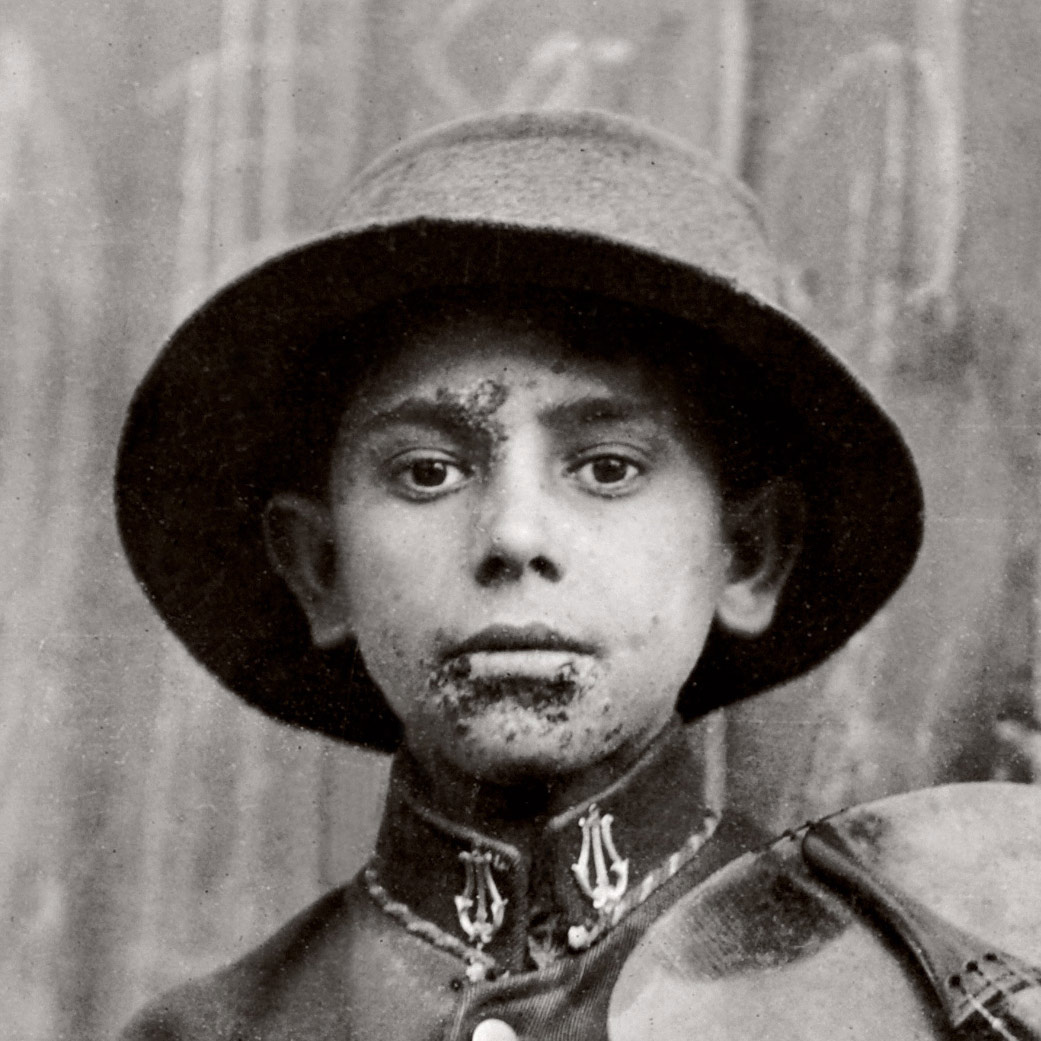
Exhibition: ‘Jewels, Gems, and Treasures: Ancient to Modern’ at the Museum of Fine Arts, Boston

Exhibition dates: 19th July 2011 – 25th November 2012


Anon. 'Bracelets' about 40-20 BC


Anon
Bracelets
about 40-20 BC
Gold, emeralds, and pearls (modern)
Classical Department Exchange Fund
Photo: © Museum of Fine Arts, Boston


“Today, in the West, we have come to regard diamond, pearl, emerald, sapphire, and ruby as the most precious of materials. That has not always been the case. Other substances have commanded equal attention, from feathers, claws, and mica appliqués to coral and rock crystal, serving a protective role, guarding their wearer from dangerous circumstances or malevolent forces. Other substances, especially those that are rare and available to a select few, are signifiers of wealth and power.”


Museum of Fine Arts, Boston


Continuing my love affair with exquisite jewellery. What splendour! I love them all…

Marcus


Many, many thankx to the Museum of Fine Arts, Boston for allowing me to publish the reproduction of the jewellery in the posting. Please click on the photographs for a larger version of the art works.


Anon. 'Armlet with feline-head terminals' Late 5th century BC


Anon
Armlet with feline-head terminals
Late 5th century BC
Gold
John Michael Rodocanachi Fund
Photo: © Museum of Fine Arts, Boston


Anon. 'Spool earring' Italic, Etruscan, Late Archaic or Classical Period early 5th century BC


Anon
Spool earring
Italic, Etruscan, Late Archaic or Classical Period
early 5th century BC
Gold
Francis Bartlett Donation of 1900
Photo: © Museum of Fine Arts, Boston


Anon. 'Cameo with portrait busts of an Imperial Julio-Claudian couple' mid-1st century AD


Anon
Cameo with portrait busts of an Imperial Julio-Claudian couple
mid-1st century AD
Sardonyx
Henry Lillie Pierce Fund
Photo: © Museum of Fine Arts, Boston


Paul Lienard (French, b. 1849) 'Seaweed brooch' French, about 1908


Paul Lienard (French, b. 1849)
Seaweed brooch
French, about 1908
Gold and mabe pearl
Height x width x depth: 5.4 x 11 x 1cm
Photo: © Museum of Fine Arts, Boston


As the saying goes, “diamonds are a girl’s best friend” – at least in modern times – but as the exhibition Jewels, Gem, and Treasures: Ancient to Modern illustrates, ornaments made of ivory, shell, and rock crystal were prized in antiquity, while jewellery made of diamonds, emeralds, sapphires, rubies, and pearls became fashionable in later years. On view July 19, 2011, through November 25, 2012, this exhibition at the Museum of Fine Arts, Boston (MFA), highlights some 75 objects representing the rich variety of jewels, gems, and treasures that have been valued over the course of four millennia.

Drawn from the MFA’s collection and select loans, these range from a 24th-century BC Nubian conch shell amulet, to Mary Todd Lincoln’s 19th-century diamond and gold suite, to a 20th-century platinum, diamond, ruby, and sapphire Flag brooch honouring the sacrifices of the Doughboys in World War I. Jewels, Gems, and Treasures is the inaugural exhibition in the MFA’s new Rita J. and Stanley H. Kaplan Family Foundation Gallery, which debuts on July 19. The gallery – one of only a few at US museums solely dedicated to jewellery – will feature works from the Museum’s outstanding collection of approximately 11,000 ornaments. It is named in recognition of the generosity of the Rita J. and Stanley H. Kaplan Family Foundation.

“The opening of the Museum’s first jewellery gallery provides an ongoing opportunity for the MFA’s collection to shine,” said Malcolm Rogers, Ann and Graham Gund Director of the MFA. “In this inaugural exhibition, visitors will see a wide range of gems that will both inform and dazzle in a beautiful new space that will allow the MFA to showcase its stellar assemblage of jewellery, which ranges from ancient to modern.”

Jewels, Gems, and Treasures sheds light on how various cultures throughout history have defined the concept of “treasure,” showcasing an exquisite array of necklaces, rings, bracelets, pendants, and brooches, as well as mineral specimens. In addition, the exhibition explains the significance of jewellery, which can be functional (pins, clasps, buckles, combs, and barrettes); protective (talismans endowed with healing or magical properties); and ornamental, making the wearer feel beautiful, loved, and remembered. Beyond functionality and adornment, jewellery can also establish one’s status and role in society. Rare gems and precious metals, made into fabulous designs by renowned craftsmen, have often served as symbols of wealth and power. This is especially evident in a section of the show where jewellery worn by celebrities is on view, including fashion designer Coco Chanel’s enamelled cuff bracelets accented with jewelled Maltese crosses (Verdura, New York, first half of 20th century) and socialite Betsey Cushing Whitney’s gold and diamond “American Indian” Tiara (Verdura, New York, about 1955), which she wore to her presentation to Queen Elizabeth II in 1956 as the wife of the US Ambassador to the Court of St. James.

The significance of precious materials in jewellery in the 20th century is explored in the exhibition, where several modern adornments from the MFA’s Daphne Farago Collection examine jewellery’s traditional roles in society. Among them are a 1985 brooch of iron, pyrite, and diamond rough by Falko Marx and a 1993 ring by Dutch jeweller Liesbeth Fit entitled Diamonds Are a Girl’s Best Friend. (The Daphne Farago Collection comprises 650 pieces of contemporary craft jewellery made by leading American and European artists from about 1940 to the present.)

Jewels, Gems, and Treasures begins with a look at jewellery made of organic materials – substances readily available and easy to work with, such as ivory, shell, wood, and coral. These range from a pair of ivory cuff bracelets from Early Kerma culture in modern Sudan (2400-2050 BC) to more sophisticated creations made possible through the advancement of tools. Examples include a gold, silver, carnelian and glass Egyptian Pectoral (1783-1550 BC) and a Nubian gold and rock crystal Hathor-headed crystal pendant (743-712 BC) recovered from the burial of a queen of King Piye, the great Kushite ruler who conquered Egypt in the eighth century BC. In addition to having magical properties that protected the wearer against malevolent forces, adornments such as these were often buried with their owners as their amuletic capabilities were needed during the arduous journey to the afterlife. On the other side of the globe, Mayans wore ear flares – conduits of spiritual energy – made of sacred green jadeite that represented key elements of human life. Various cultures throughout the ages at one point believed that amber could cure maladies, coral could safeguard children, an animal’s tooth or claw could invest the wearer with strength and ferocity, and gold and silver invoked the cosmic power of the sun and moon. In Medieval and Renaissance Europe, many hard stones were believed to have magical properties (some were even ground and consumed), and pendant reliquaries containing a holy person’s cremated ashes or bone fragments were often donned, along with rosaries (Rosary, South German, mid-17th century), as sacred adornments. Even today, zodiac ornaments and good luck charms are sometimes worn as tokens, recalling their earlier mystical importance.

Throughout much of history, jewellery’s role as a symbol of one’s elevated status has inspired the wealthy to seek out stones that sparkle, gold that gleams, and designs that reflect the greatest artistry money can buy. To illustrate this, Jewels, Gems, and Treasures features some of the most opulent works from the Museum’s jewellery collection, including an 1856 diamond wedding necklace and earrings suite given by arms merchant Samuel Colt to his wife (the 41.73-carat suite, purchased for $8,000, is now valued at $190,000) and Mary Todd Lincoln’s gold, enamel, and diamond brooch with matching earrings, which she acquired around 1864, shortly after the death of the Lincolns’ beloved son, Willy, and then sold in 1867 to pay mounting debts. Also on view is a Kashmir sapphire and diamond brooch (around 1900); a gold and diamond necklace made by August Holmström for Peter Carl Fabergé, the famous Russian jeweller to the czars; and cereal heiress Marjorie Merriweather Post’s lavish platinum brooch from the 1920s, featuring a spectacular 60-carat carved Mughal emerald surrounded by diamonds, which she purchased in anticipation of her presentation at the British court in 1929.

Also on view in the exhibition are superb adornments made by leading French Art Nouveau jewellers, which were fashioned for a wealthy and artistic clientele in the late 19th to early 20th centuries. The Art Nouveau movement, which originated in Europe, embraced an aesthetic that was avant-garde, sensuous, and symbolic – one that looked to the natural world, the Impressionists, and the arts of Japan for inspiration. In response to the “tyranny of the diamond” – the all white platinum and diamond jewellery previously in vogue – these elaborate, one-of-a kind pieces often featured coloured gems and unusual materials, such as horn, enamel, irregularly shaped pearls, steel, and glass. Examples in the show include René Lalique’s fanciful gold, silver, steel, and diamond Hair ornament with antennae (about 1900), and Paul Lienard’s gold and mabe pearl Seaweed brooch (about 1908). The Arts and Crafts movement, which emerged in Britain during the 1870s as a reaction to the mechanisation and poor working conditions of the Industrial Revolution, is represented by Marsh-bird brooch (1901-1902) by Charles Robert Ashbee, who sought to create a delicate stained-glass effect with this piece. The refined techniques of the Art Deco movement are evident in Japanesque brooch (about 1925), incorporating platinum, gold, enamel, diamonds, rubies, and onyx. The movement arose after World War I and continued through the 1930s. It was influenced by avant-garde ideology, as was the Art Nouveau and Arts and Crafts movements, but instead chose to express its aesthetic through geometric shapes, linear stylisation, and a return to platinum and diamonds.

Jewels, Gems, and Treasures also highlights a variety of interesting and unique pieces, such as a Suite of hummingbird jewelry (brooch and earrings, about 1870), made out of gold, ruby, and taxidermied hummingbirds; an ebony, ivory, silver lapis lazuli, and amber casket designed to showcase the amber cameos and intaglios collected by Arnold Buffum (about 1880-1885); an Indian silver and tiger claw necklace (19th century); and a gold, silver, agate, diamond, and ruby animal sculpture, The Balletta Bulldog (about 1910) made by the workshop of Peter Carl Fabergé Fabergé. In addition, the exhibition features jewellery as seen in William McGregor Paxton’s painting, The New Necklace (1910).
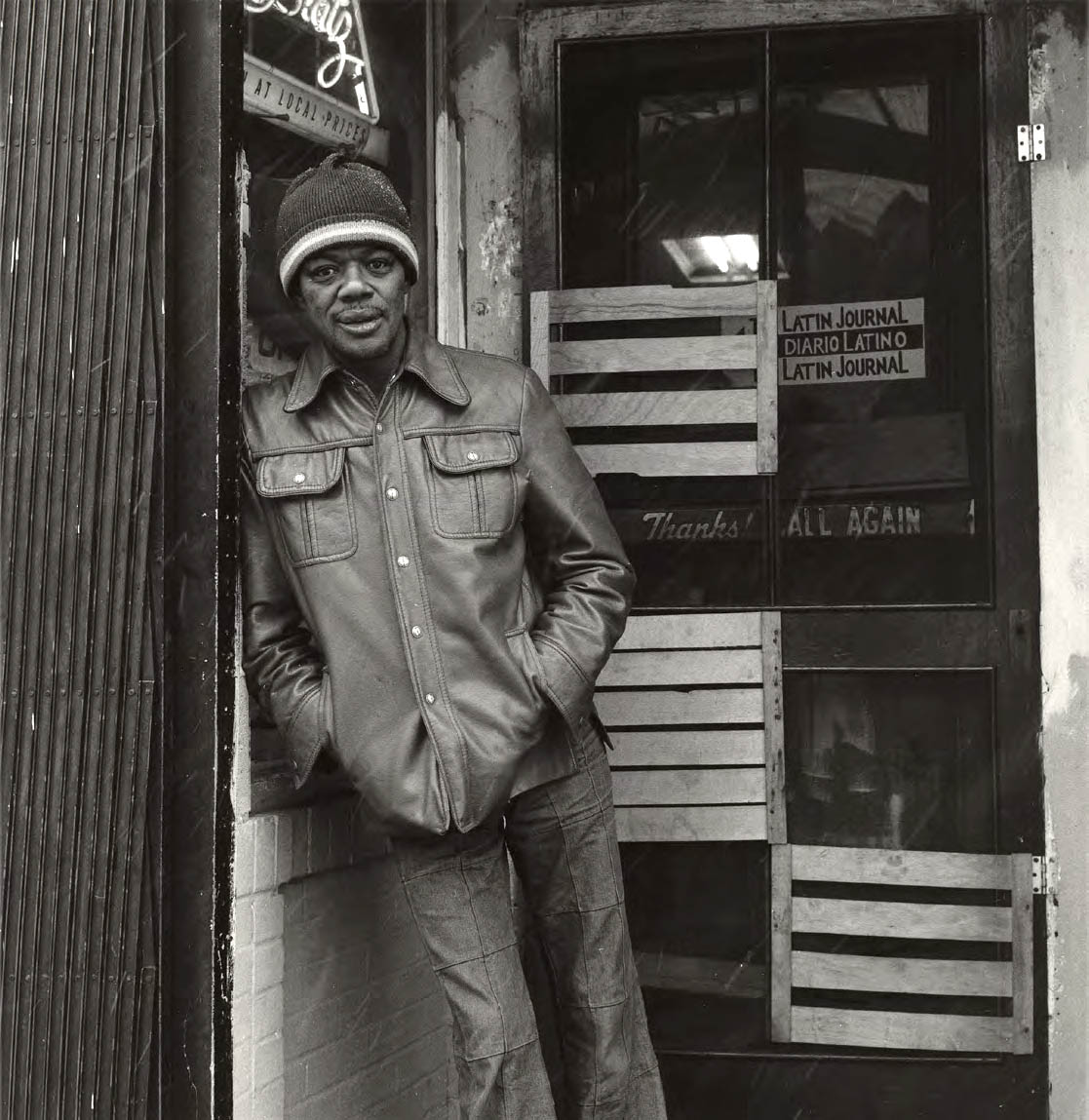
Press release from the Museum of Fine Arts, Boston website


René Lalique (French, 1860-1945) 'Hair ornament with antennae' c. 1900


René Lalique (French, 1860-1945)
Hair ornament with antennae
c. 1900
Gold, silver, steel, and diamond
Height x width x depth: 8.8 x 12.5 x 7cm
Museum of Fine Arts, Boston. Gift of the Sataloff and Cluchey Family
© 2011 Artists Rights Society (ARS), New York/ADAGP, Paris
Photo: © Museum of Fine Arts, Boston


This hair ornament with its whimsical character is a unique piece by Lalique. It features the unusual exclusive use of diamonds which were sparingly used by the Art Nouveau jewellers who preferred less precious stones and enamel to provide colour and opalescence. From the gold wire headband emerge two antenna composed of hollow silver cubes in which are set graduated brilliants each secured by four prongs. A steel wire runs through the cubes to form the curved shape of each antenna. Except for the scroll terminals of the antennae, each cube is individually mounted and stacked without being attached to each other so that they tremble when the wearer moves, accentuating the sparkle of the diamonds.


Probably by Lacloche Frères, Spanish, founded in 1875 (also working in Paris) 'Japanesque brooch' French, about 1925


Probably by Lacloche Frères, Spanish, founded in 1875 (also working in Paris)
Japanesque brooch
French, about 1925
Platinum, gold, enamel, diamond, ruby, and onyx
Height x width x depth: 3.6 x 5.2 x 0.6cm
Photo: © Museum of Fine Arts, Boston


Anon. 'Brooch worn by Mary Todd Lincoln' (American, 1818-1882) American, about 1860


Anon
Brooch worn by Mary Todd Lincoln (American, 1818-1882)
American, about 1860
Gold, enamel, and diamond
Depth x diameter: 1.3 x 3cm
Photo: © Museum of Fine Arts, Boston


The brooch is part of a suite with matching earrings. Each element is quatrefoil in shape and has a central diamond with a diamond surround. Eight smaller diamonds form a second tier of stones. The stones are all mine-cut and are probably original to the suite. The colour range is J-K with VS-VS1 clarity. there are some losses to the tracery enamel. The suite was featured in Frank Lesley’s Illustrated Newspaper (Oct. 26, 1867). It was part of a large group of Mrs. Lincoln’s clothes, jewellery, and furnishings that were offered for sale through Brady & Company of New York City. Apparently, Mrs. Lincoln fell into dire financial circumstances after the assassination of her husband, Abraham Lincoln. The sale price was listed as $350.00.


Charles Robert Ashbee (English, 1863-1942) 'Marsh-bird brooch' 1901-1902


Charles Robert Ashbee (English, 1863-1942)
Marsh-bird brooch
1901-1902
Gold, silver, enamel, moonstone, topaz, and freshwater pearl
Height x width x depth: 9 x 10.5 x 1.5cm
Photo: © Museum of Fine Arts, Boston


The brooch was originally a hair ornament that was converted to a brooch (silver pin stem and “C” hook added). Conversion probably occurred shortly after the ornament was made. The hair comb was fabricated by A. Gebhardt and enamelist William Mark, both members of the Guild of Handicraft.


Anon. 'Hathor-headed crystal pendant' Napatan Period, reign of King Piye 743-712 BC


Anon
Hathor-headed crystal pendant
Napatan Period, reign of King Piye
743-712 BC
from el-Kurru, tomb Ku 55 (Sudan)
Gold, rock crystal
Height x diameter: 5.4 x 3.3cm
Photo: © Museum of Fine Arts, Boston


John Paul Cooper (English, 1869-1933) 'English Arts and Crafts brooch' 1908


John Paul Cooper (English, 1869-1933)
English Arts and Crafts brooch
1908
Gold (15 kt), ruby, moonstone, pearl, amethyst, and chrysoprase
Height x width x depth: 14 x 9.6 x 0.8cm
Photo: © Museum of Fine Arts, Boston


John Paul Cooper, a leading figure in the British Arts and Crafts movement, was an architect, designer, and metalsmith. Born into an affluent Leicester family, Cooper prepared for a career as a writer but was discouraged from pursuing this endeavour by his industrialist father. Instead, he apprenticed to London architect John D. Sedding, a strong proponent of the ideas of John Ruskin and Henry Wilson, an architect with interests in craft, especially metalwork and jewellery. Afterwards, Cooper joined the “Birmingham Group” and served as head of the Metalwork Department of the Birmingham Municipal Art School (1901-1906). He exhibited regularly at the Arts and Crafts Society exhibitions and completed several important public commissions, including two crosses and a pair of altar vases for Birmingham Cathedral. Additionally, his work often appeared in article published in Studio and Art Journal.

Cooper’s interest in jewellery design and fabrication began shortly after his association with Wilson. Like Wilson, he eventually employed others to fabricate his jewellery designs although he sometimes did the chasing and repoussé work himself. The jewellery was crafted primarily in 15 kt gold, utilising semi-precious cabochons (domed, unfaceted stones) and mother-of-pearl. Unlike many Arts and Crafts jewellery designers, Cooper often worked his designs from a selection of stones, rather than creating a design and then finding suitable gems. He once commented that stones should “… play on one another as two notes of music…”

In addition to jewellery, Cooper’s workshop designed and fabricated ecclesiastical objects and various decorative arts, including hollowware and frames. Many of the objects incorporate unusual materials, such as coconut shell, ostrich-egg shell, and narwhal tusk. At the beginning of his career, he often used gesso and plaster modelling to decorate surfaces and, at the end of the 1890s, he began making wooden boxes which he covered with shagreen, a decorative veneer made from the skin of certain sharks and rays.

This brooch is a major work by Cooper. Created during a period when the artist relied less on chased representational imagery and more on stones, the ornament conveys a sense of refined opulence. Inspired by medieval and Celtic design, the brooch is both airy and graceful. The goldwork is decorated with finely chased leaves and tendrils and the bezel-set stones include ruby, pearl, moonstone, amethyst, and chrysoprase. It took 273 hours to produce the brooch and Lorenzo Colarosi, Cooper’s chief craftsman, was the primary fabricator. It’s possible that Cooper did the chasework. The drawing for the brooch, which is dated 3 December 1908, can be found in Stockbook I, p. 81 in the Cooper Family Archives. Cooper entitled the piece Big double gold brooch.


Anon. 'Earring with Nike driving a two-horse chariot' about 350-325 BC


Anon
Earring with Nike driving a two-horse chariot
About 350-325 BC
Gold
Henry Lillie Pierce Fund
Photo: © Museum of Fine Arts, Boston


Possibly by Oscar Heyman & Bros., American, founded in 1912 for Marcus & Co., American, 1892-1941 Marjorie Merriweather Post's platinum brooch American, late 1920s


Possibly by Oscar Heyman & Bros. (American, founded in 1912 for Marcus & Co., American, 1892-1941)
Marjorie Merriweather Post’s platinum brooch
American, late 1920s
Platinum, diamond, and emerald featuring a spectacular 60-ct carved Mughal emerald surrounded by diamonds, which she purchased in anticipation of her presentation at the British court in 1929
Overall: 5.3 x 5.4 x 1.1cm
Photo: © Museum of Fine Arts, Boston


The brooch was purchased by Marjorie Merriweather Post (1887-1973) and is documented by two portraits; one by Frank O. Salisbury (Palm Beach Bath and Tennis Club) and the other by Douglas Chador (Hillwood Museum). Both date to 1952. The central stone in the brooch is a mid-17th century carved emerald that was purchased by Marcus and Co.’s agent in Bombay in the 1920s. Oscar Heyman & Bros. made many of the jewels marketed by Marcus & Co. during the 1920s.


Anon. 'Pin with sphinxes, lions, and bees' Late 5th century BC


Anon
Pin with sphinxes, lions, and bees
Late 5th century BC
Gold
Catharine Page Perkins Fund
Photo: © Museum of Fine Arts, Boston.


Museum of Fine Arts, Boston
Avenue of the Arts
465 Huntington Avenue
Boston, Massachusetts

Opening hours:
Saturday – Monday and Wednesday 10am – 5pm
Thursday – Friday 10am – 10pm
Closed Tuesdays

Museum of Fine Arts, Boston website

LIKE ART BLART ON FACEBOOK

Back to top