Exhibition: ‘The World in Focus’ at ALBERTINA, Vienna

Exhibition dates: 22nd July – 26th October, 2026

Curator: Anna Hanreich
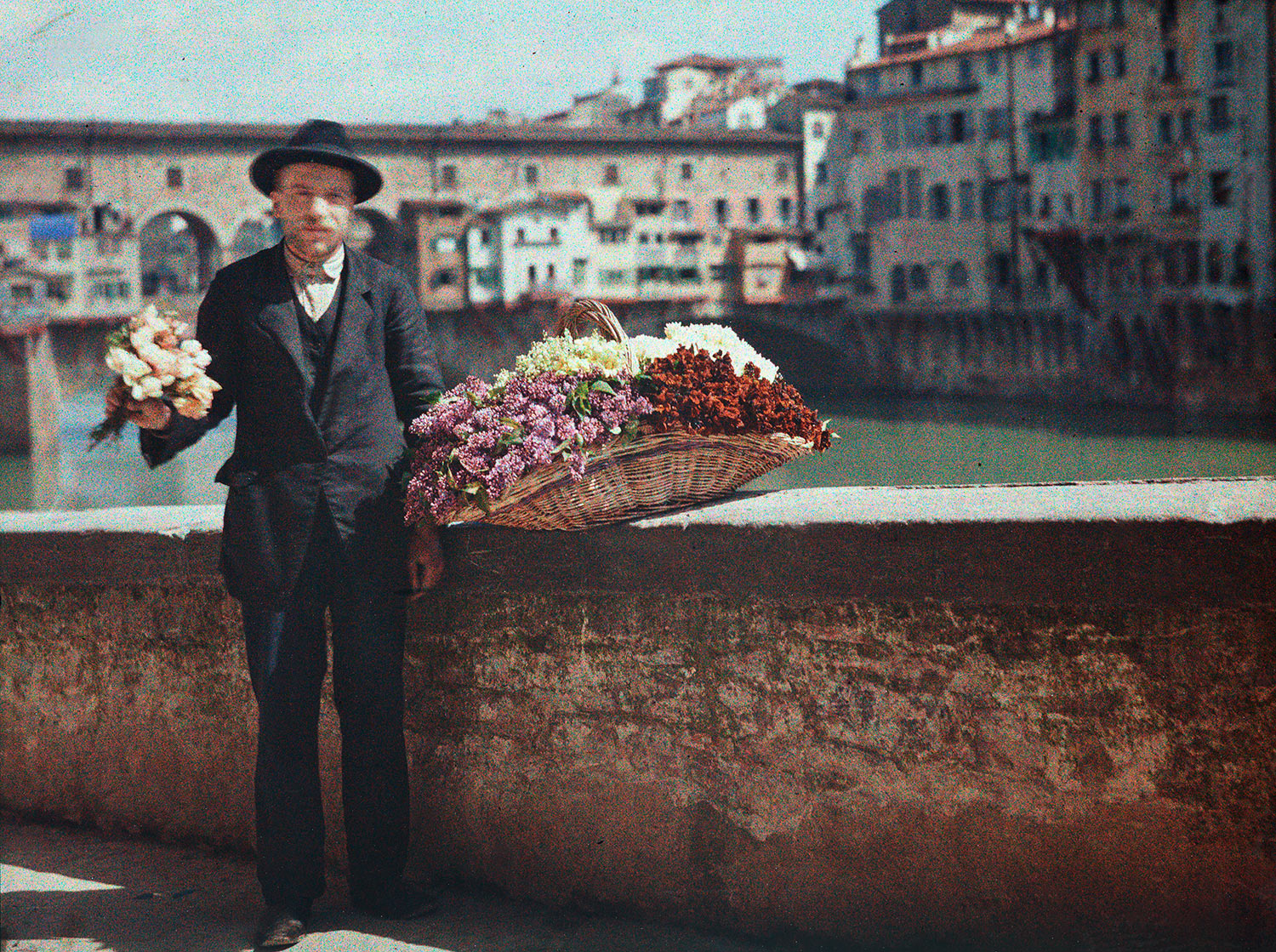
 

Anonymous photographer. 'Flower Seller in front of the Ponte Vecchio in Florence, Italy' 1907-1930


Anonymous photographer
Flower Seller in front of the Ponte Vecchio in Florence, Italy
1907-1930
Autochrome
ALBERTINA, Vienna. Dauerleihgabe der Höheren Graphischen Bundes-Lehr- und Versuchsanstalt


Travel, as a verb, means to make a journey, proceed along a route, or transmit signals (such as light or sound). Thus photography and travel are inextricably linked, for photography transmits light in the form of the representation of (a) reality, from place to place, from time to time. From past time to present time.

The travel photographs in this posting “document the landscape, people, cultures, customs, and history of a specific area to express the feeling of a time and place.” (Wikipedia)

While acknowledging the institutional and political control over the creation of some of these photographs, their creation for the commercial reasons to feed the tourist market, and their Western perspective picturing foreign and “exotic” countries and people (closely linked to colonialism in those very countries) … having acknowledged all that, these photographs still remain valuable “signals” that transmit the feeling of a time and place to us today, in all their beauty and majesty.

These early photographers knew how to frame subject matter, how to use the transmission of light, to embed aspects of the sublime in a photograph, the viewer standing at the limen – meaning threshold – standing at the threshold of another time and space brought into the present.

Sphinx, Imperial Castle, railway bridge, glacier, city, all transport us to another world, vanished worlds.

Dr Marcus Bunyan


Many thankx to Albertina for allowing me to publish the photographs in the posting. Please click on the photographs for a larger version of the image.


When photography emerged during the nineteenth century, it revolutionised visual culture. Landscapes, monuments and distant civilisations could suddenly be reproduced with remarkable precision, replacing drawings and engravings as seemingly objective representations of reality.

Yet the exhibition also demonstrates that photographs have never been neutral…

Behind every remarkable image stood extraordinary effort. Early photographers transported heavy cameras, glass plates and portable darkrooms across continents while working for governments, scientific institutions or commercial publishers. Their photographs circulated through exhibitions, books and portfolios, fundamentally influencing how distant places became known…

In an age where billions of photographs are created every day, The World in Focus offers a timely reminder that images never simply reflect reality – they construct it.


Thomas Holzleithner. “The World in Focus,” on The Style Mate website, 21 July 2026 [Online] Cited 06/10/2026. Used under fair use conditions for the purposes of education and research


Anonymous photographer. 'Part of the Chintalarayaswami Temple Complex in Tadipatri, Andhra Pradesh, India' 1858/59


Anonymous photographer
Part of the Chintalarayaswami Temple Complex in Tadipatri, Andhra Pradesh, India
1858/59
Albumen print
26 x 21cm
ALBERTINA, Vienna
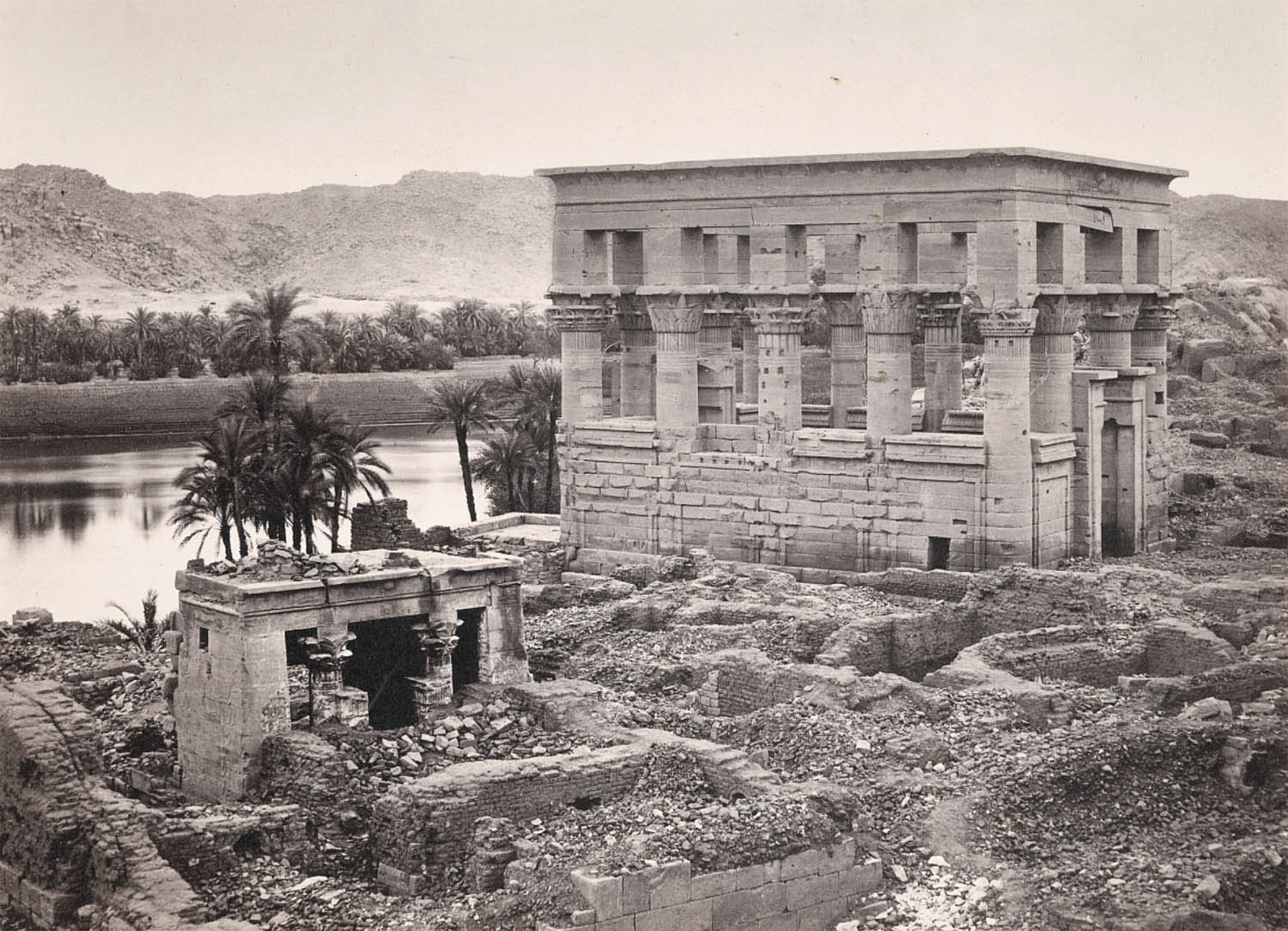
 

Francis Bedford (English, 1815-1894) 'The Hypaethral Temple at Philae' 1862


Francis Bedford (English, 1815-1894)
The Hypaethral Temple at Philae
1862
Albumen print
21.1 x 28.8cm
ALBERTINA, Vienna. Dauerleihgabe der Höheren Graphischen Bundes–Lehr–und Versuchsanstalt


For much of his career Bedford tended towards photography as an art form, painting in clouds, enhancing fine detail with pencil or brushes, and using tissue paper to darken negatives to improve lighting, but by the late 1870s, he was an advocate of simplicity. Between 1851 and 1894 he produced nearly 9,000 wet collodion negatives and albumen prints, making him one of the most prolific landscape photographers of his time

Text from the Wikipedia website


Today, photography and travel are inextricably linked – yet this connection dates back to the establishment of the new medium in the nineteenth century. The exhibition The World in Focus is dedicated to travel and expedition photography from the mid-nineteenth century onwards, when photography was increasingly employed to capture images of the world. Photographs were valued for their precision, wealth of detail, and reproducibility. Compared with the draughtsmen who had previously accompanied expeditions and were gradually replaced by photographers, work on site could also be carried out much more quickly.

The extensive series at the heart of the exhibition depict different regions of the world and tell of shifting claims to power, the expansion of mobility, the exploration of remote landscapes, and the emergence of tourism. The presentation also sheds light on the contexts in which photographers were sent on journeys, the conditions under which the images were created, and the ways in which they were presented in exhibitions, facilitated the transfer of knowledge, and had a lasting impact on perceptions of distant territories.

The World in Focus exclusively presents photographs from the ALBERTINA collection and from the collection of the Höhere Graphische Bundes-Lehr- und Versuchsanstalt, which is held at the ALBERTINA on permanent loan. With this exhibition, the ALBERTINA continues its series of thematic presentations drawn from its important photographic collection, revealing yet another facet of one of Austria’s most extensive photographic holdings.

Text from the ALBERTINA website
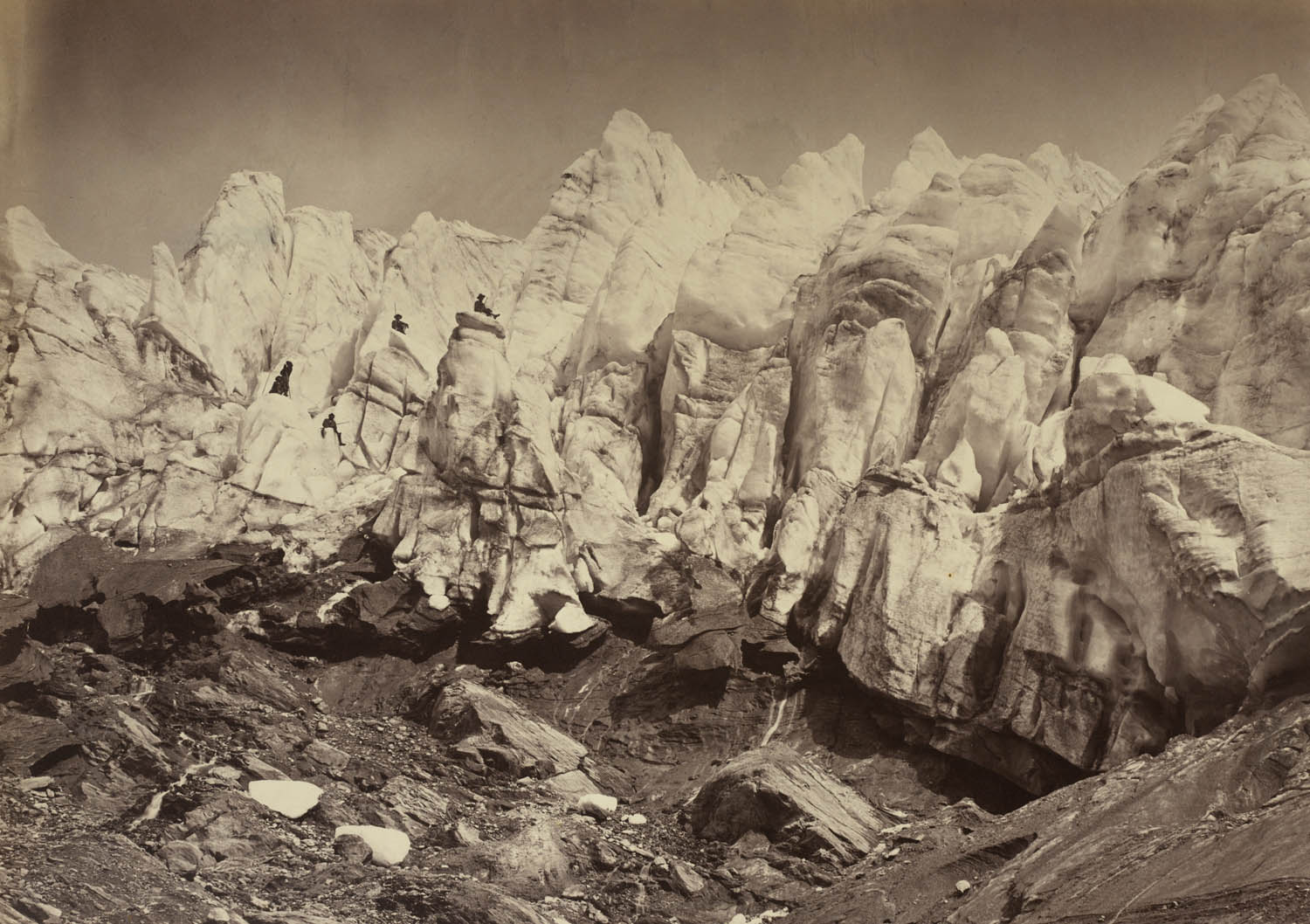
 

Gustav Jägermayer (Austrian, 1834-1901) 'The Crystal Water Glacier from North-West' 1863


Gustav Jägermayer (Austrian, 1834-1901)
The Crystal Water Glacier from North-West
1863
Albumen print
30 x 42.2cm
ALBERTINA, Vienna
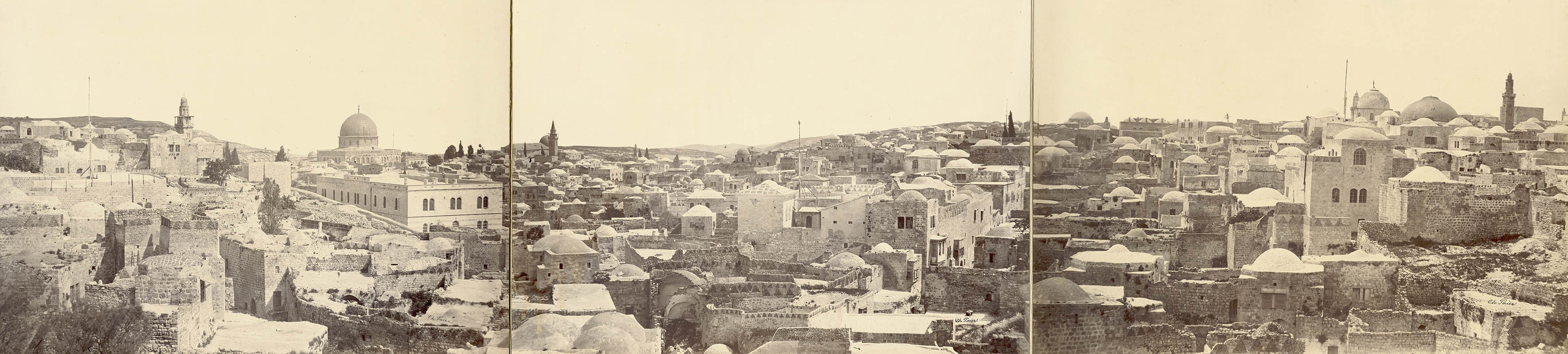
 

Christian Paier (Slovenian, 1839-1895) 'Panoramic View over the Old City of Jerusalem' 1864


Christian Paier (Slovenian, 1839-1895)
Panoramic View over the Old City of Jerusalem
1864
Albumen print
ALBERTINA, Vienna
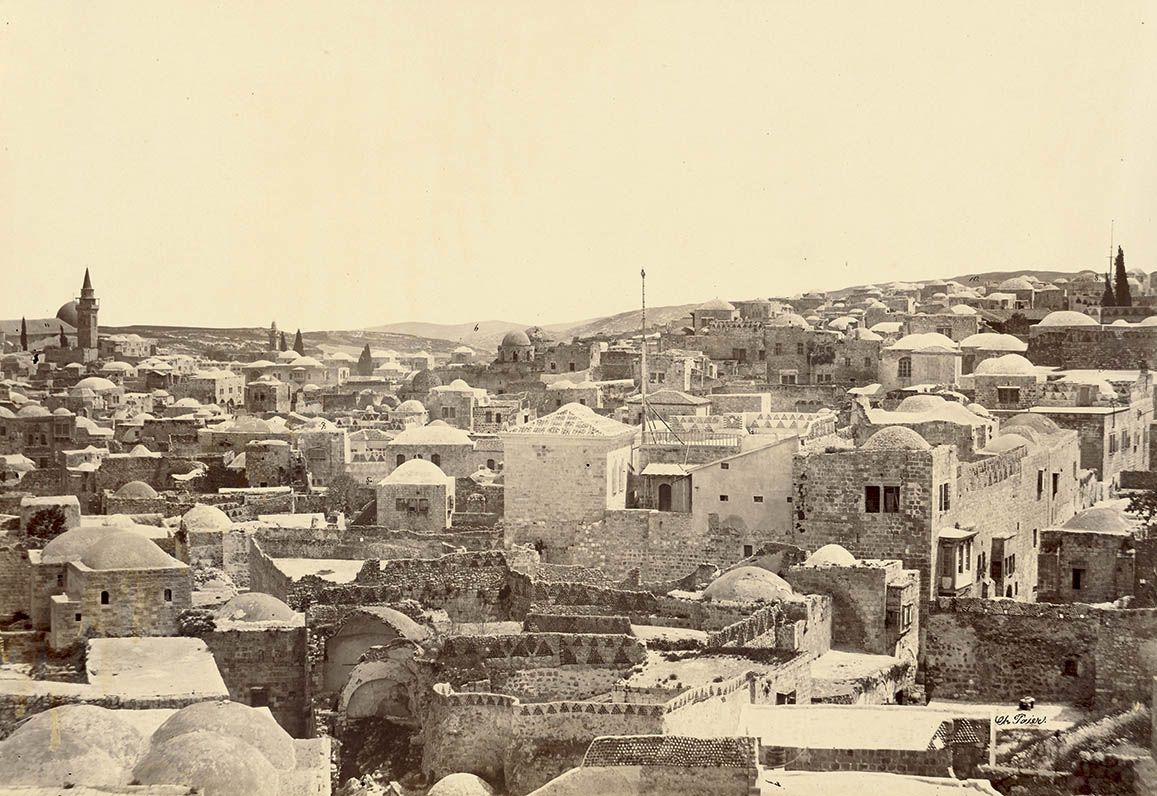
 

Christian Paier (Slovenian, 1839-1895) 'Panoramic View over the Old City of Jerusalem' 1864 (detail)


Christian Paier (Slovenian, 1839-1895)
Panoramic View over the Old City of Jerusalem (detail)
1864
Albumen print
ALBERTINA, Vienna
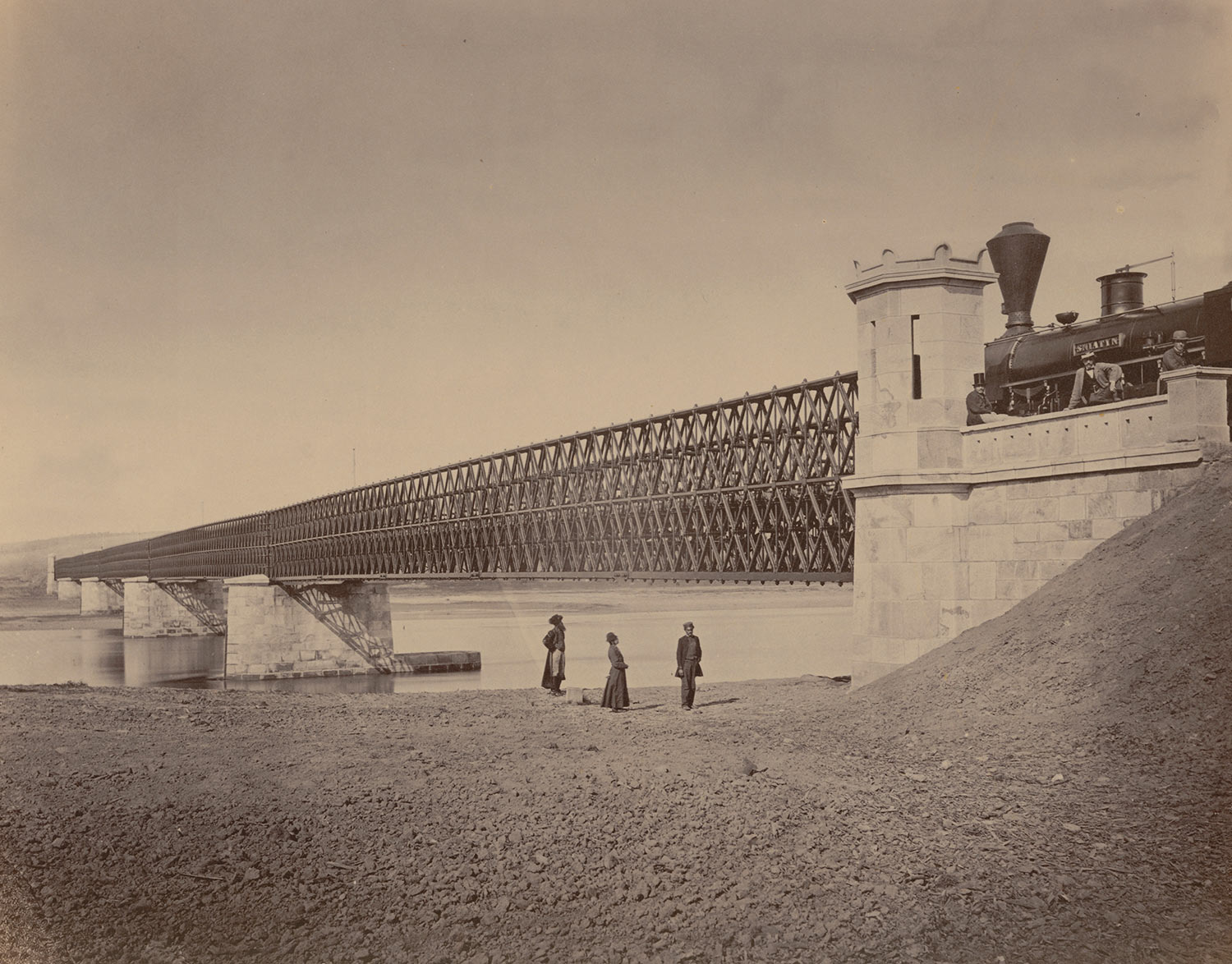
 

Adolf Schoon von Corbitzthal (Austrian, 1830-1904) 'Railway Bridge over the Dniester River near Halicz' (today: Halych, Ukraine) 1866/67


Adolf Schoon von Corbitzthal (Austrian, 1830-1904)
Railway Bridge over the Dniester River near Halicz (today: Halych, Ukraine)
1866/67
Albumen print
20 x 25cm
ALBERTINA, Vienna


Corbitzthal served as a soldier in the Austrian army and later worked as a railway official for the Lviv-Chernivtsi Railway (Lemberg-Czernowitz-Jassy Railway), where he famously documented the rail line’s infrastructure and surrounding cultural landscapes.
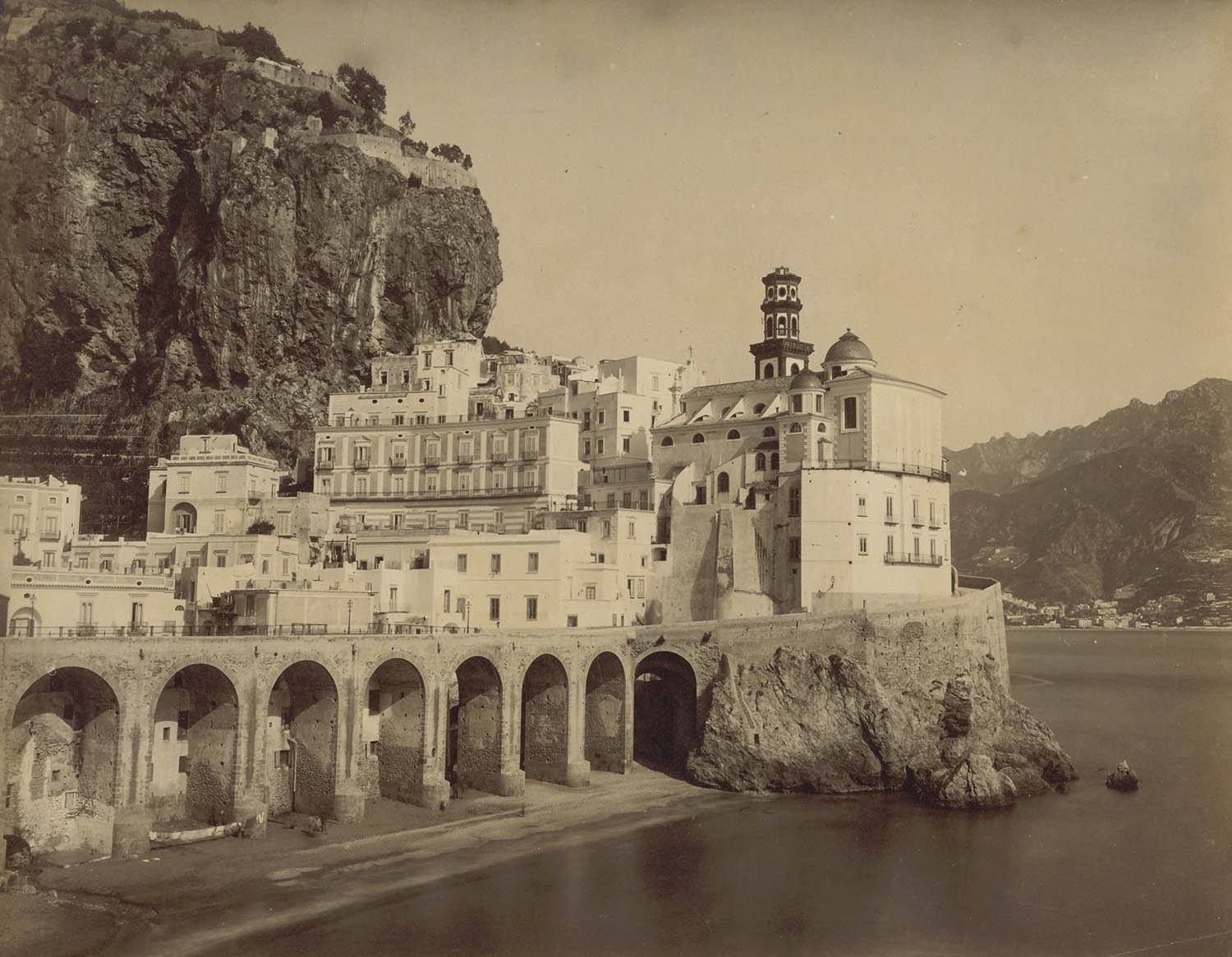
 

Giorgio Sommer (Italian born Germany, 1834-1914) 'Atrani, Italien' 1868–1870


Giorgio Sommer (Italian born Germany, 1834-1914)
Atrani, Italien
1868-1870
Albumen print
20.4 x 25.7cm
ALBERTINA, Vienna


Giorgio Sommer (2 September 1834 – 7 August 1914) was one of Europe’s most important and prolific photographers of the 19th century. Active from 1857 to 1888, he produced thousands of images of archaeological ruins, landscapes, art objects, and portraits. …

Sommer’s catalog included images from the Vatican Museums, the National Archeological Museum at Naples, the Roman ruins at Pompeii, as well as street and architectural scenes of Naples, Florence, Rome, Capri, and Sicily. Most notably, Sommer published his comprehensive album Dintorni di Napoli, which contained over one hundred images of everyday scenes in Naples. In April 1872, he documented a very large eruption of Mount Vesuvius in a series of stunning photographs.

Text from the Wikipedia website
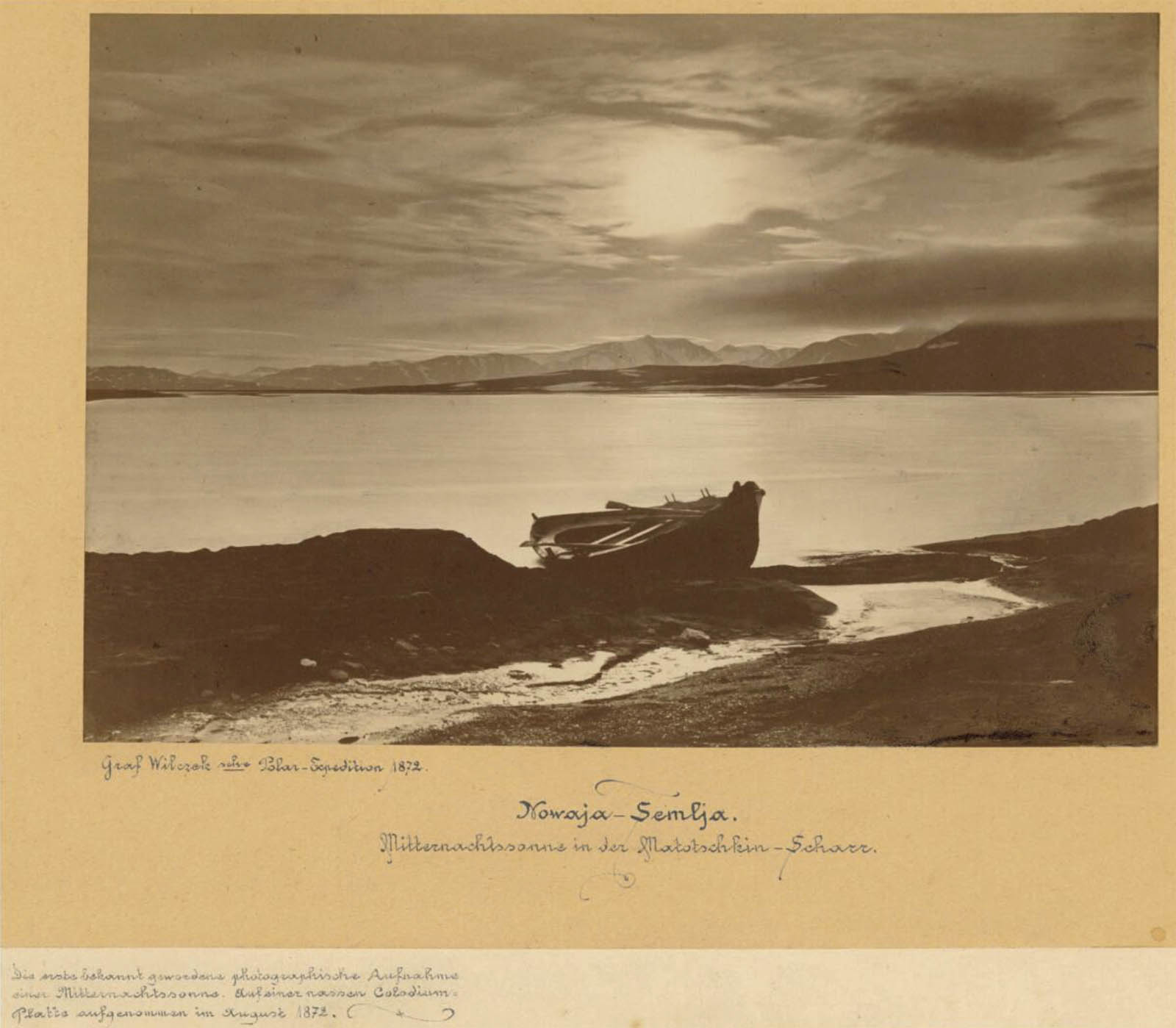
 

Wilhelm Burger (Austria, 1844-1920) Count Hans Wilczek (Austria, 1837-1922) 'Mitternachtssonne in der Meeresenge Matotschkin, Russland' (Midnight sun in the Matochkin Strait, Russia) July 30, 1872


Wilhelm Burger (Austria, 1844-1920)
Count Hans Wilczek (Austria, 1837-1922)
Mitternachtssonne in der Meeresenge Matotschkin, Russland (Midnight sun in the Matochkin Strait, Russia)
July 30, 1872
Albumen print, mounted on card
Overall: 14.6 x 21.4cm (5 3/4 x 8 7/16 in.)
Mount: 40 x 50cm
ALBERTINA, Vienna. Dauerleihgabe der Höheren Graphischen Bundes-Lehr-und Versuchsanstalt
Inscribed: Mounting paper: lower left “Graf Wilczek sche Polar-Expedition 1872”; lower center “Nowaja-Semlja. / Mitternachtssonne in der Matotschkin-Scharr.”; Mount: verso: lower left “Die erste bekannt gewordenen photographische Aufnahme / einer Mitternachtssonne. Auf einer nassen Collodium- / Platte aufgenommen im August 1872.”; Mount: verso: lower left “BURGER, Wilhelm / WILCZEK, Hans”

NB. I’m not sure this photograph is in the exhibition but Burger’s photographs of a Polar expedition are mentioned in the press release
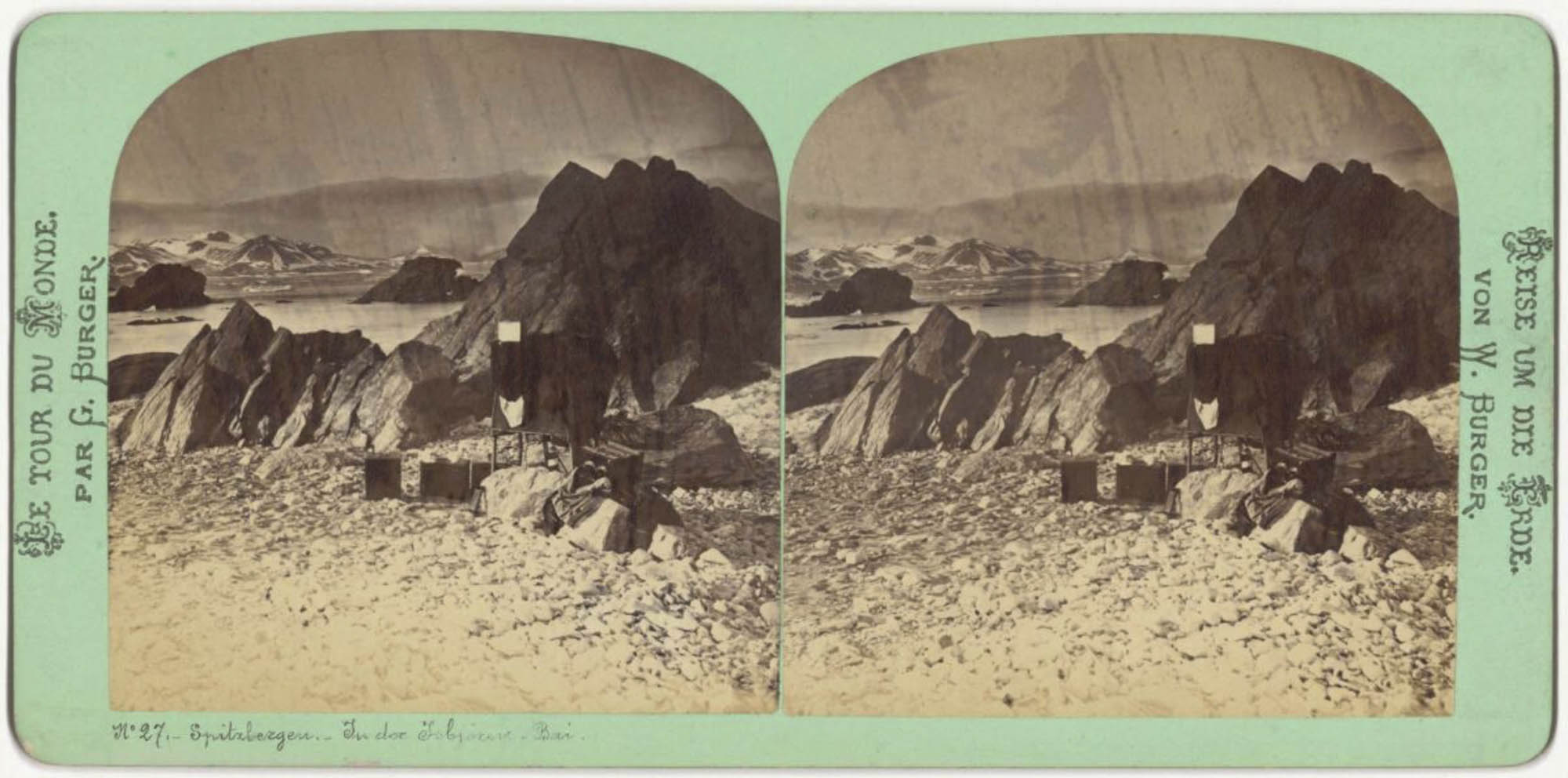
 

Wilhelm Burger (Austria, 1844-1920) Count Hans Wilczek (Austria, 1837-1922) 'Tragbare Dunkelkammer, Isbjörnbai, Spitzbergen' (Portable darkroom, Isbjörnbai, Spitsbergen) 1872


Wilhelm Burger (Austria, 1844-1920)
Count Hans Wilczek (Austria, 1837-1922)
Tragbare Dunkelkammer, Isbjörnbai, Spitzbergen (Portable darkroom, Isbjörnbai, Spitsbergen)
1872
Albumen print, on mount / stereo format
Photographic paper (per image): 7.8 x 7.7cm (3 1/16 x 3 1/16 in.)
Mount: 8.7 x 17.7cm
ALBERTINA, Vienna. Dauerleihgabe der Höheren Graphischen Bundes-Lehr-und Versuchsanstalt

NB. I’m not sure this photograph is in the exhibition but Burger’s photographs of a Polar expedition are mentioned in the press release


Long before smartphones turned every journey into an endless stream of images, photography was already transforming the way people encountered distant places. Beginning July 22, the ALBERTINA explores that history in The World in Focus, an exhibition tracing the development of travel and expedition photography from the mid-19th century through the early decades of colour photography.

On view in the museum’s Tietze Galleries through October 26, 2026, the exhibition brings together 107 photographs from the ALBERTINA’s photographic collection, along with a projection of several early autochromes. Curated by Anna Hanreich, the presentation looks beyond the scenic appeal of travel images to examine the political, scientific, commercial and cultural forces that shaped their production.

Photography and travel became closely linked almost as soon as the medium emerged. Compared with drawing, photography offered a faster and apparently more precise way to document landscapes, monuments, cities and people. Images could also be reproduced and distributed widely, allowing distant territories to enter the public imagination with unprecedented immediacy.

Yet the exhibition makes clear that these photographs were never neutral records. Many were produced during expeditions financed by governments, scientific institutions or commercial interests. Others were created for a growing tourist market eager for views of places that most Europeans would never visit themselves. In both cases, the images often reflected a distinctly Western perspective, shaping ideas about foreign cultures through assumptions that were tied to colonialism, imperial ambition and the conventions of the period.

The exhibition moves across an expansive geography, from the frozen heights of the Alps and the Arctic to Egypt, the Holy Land, Japan, India, Bosnia and Herzegovina, Italy and Norway. Together, the works show how photography accompanied the expansion of mobility, the growth of tourism and the increasing accessibility of remote regions.

Egypt occupies a prominent place in the exhibition. European fascination with the country intensified after Napoleon Bonaparte’s military campaign of 1798-1801, which helped trigger a widespread wave of “Egyptomania.” By the middle of the 19th century, photographers were travelling along the Nile and documenting ancient monuments, often before they underwent later restoration or alteration. Their images circulated through albums, books and international exhibitions, establishing visual routes that would eventually become familiar tourist itineraries.

Another section focuses on Wilhelm Burger, one of the Habsburg monarchy’s most sought-after expedition photographers. Working at a time when photography required heavy wooden cameras, glass plates, chemicals and portable darkrooms, Burger took part in the Austro-Hungarian East Asia expedition of 1868-1869 and later joined a support mission connected to the Austro-Hungarian North Pole expedition. His photographs rank among the earliest images made in the Arctic region.

The exhibition also highlights Raimund von Stillfried-Rathenitz, who established an influential studio in Yokohama in 1871. Stillfried photographed historically important sites around Tokyo and Yokohama during a period of rapid transformation following the Meiji Restoration. His carefully composed landscapes appealed to the growing number of international travellers arriving in Japan and helped define how the country was represented abroad.

Images of Jerusalem, Bethlehem and surrounding areas reveal the close relationship between pilgrimage, politics and the emerging market for travel photography. Photographers such as Christian Paier produced views of sacred sites for European audiences already familiar with biblical narratives. These photographs did more than document religious landmarks; they connected contemporary travel with long-established ideas about history, faith and cultural identity.

Photography also served as a tool of political representation within the Austro-Hungarian Empire. After the occupation of Bosnia and Herzegovina in 1878, Josef Löwy was commissioned to document the territory. Rather than concentrating on military action, he photographed roads, infrastructure and landscapes, presenting the occupation through images of modernisation and development. Stillfried returned to the region years later, producing more atmospheric scenes of daily life and local dress.

As railway networks expanded during the 19th century, travel became faster and more accessible. Railway companies quickly recognized photography’s promotional power and hired photographers to document stations, bridges, construction projects and the landscapes opened by new routes. These images functioned as corporate records, tributes to engineering and advertisements for destinations that had previously seemed unreachable.

By the end of the century, lighter cameras brought a more personal form of travel photography. Artists and wealthy amateurs began making spontaneous images based on their own interests rather than official assignments. The painter Johann Victor Krämer, for example, carried a portable Kodak camera during travels through Egypt and Palestine between 1898 and 1900, later using some of his photographs as material for paintings.

The arrival of autochrome plates in 1907 introduced another major shift. These early colour transparencies were especially popular for landscapes and travel scenes, although they had to be viewed through transmitted light or projected onto a screen. Public and private projection evenings became popular forms of entertainment, allowing audiences to experience vivid color views of Italy, the French Riviera, Norway and other destinations.

Among the press images associated with the exhibition are an autochrome of a flower seller standing before Florence’s Ponte Vecchio, an early colour view of Digermulen in Norway, Giorgio Sommer’s photograph of Atrani on the Amalfi Coast, and Stillfried’s image of the imperial palace in Tokyo. Seen together, the works reveal how travel photography gradually moved from heavy expeditionary equipment and official commissions toward the personal, immediate and colorful visual language still familiar today.

The World in Focus is on view at the ALBERTINA in Vienna from July 22 through October 26, 2026. The accompanying bilingual catalogue, edited by Anna Hanreich, is available in German and English.

Press release from ALBERTINA
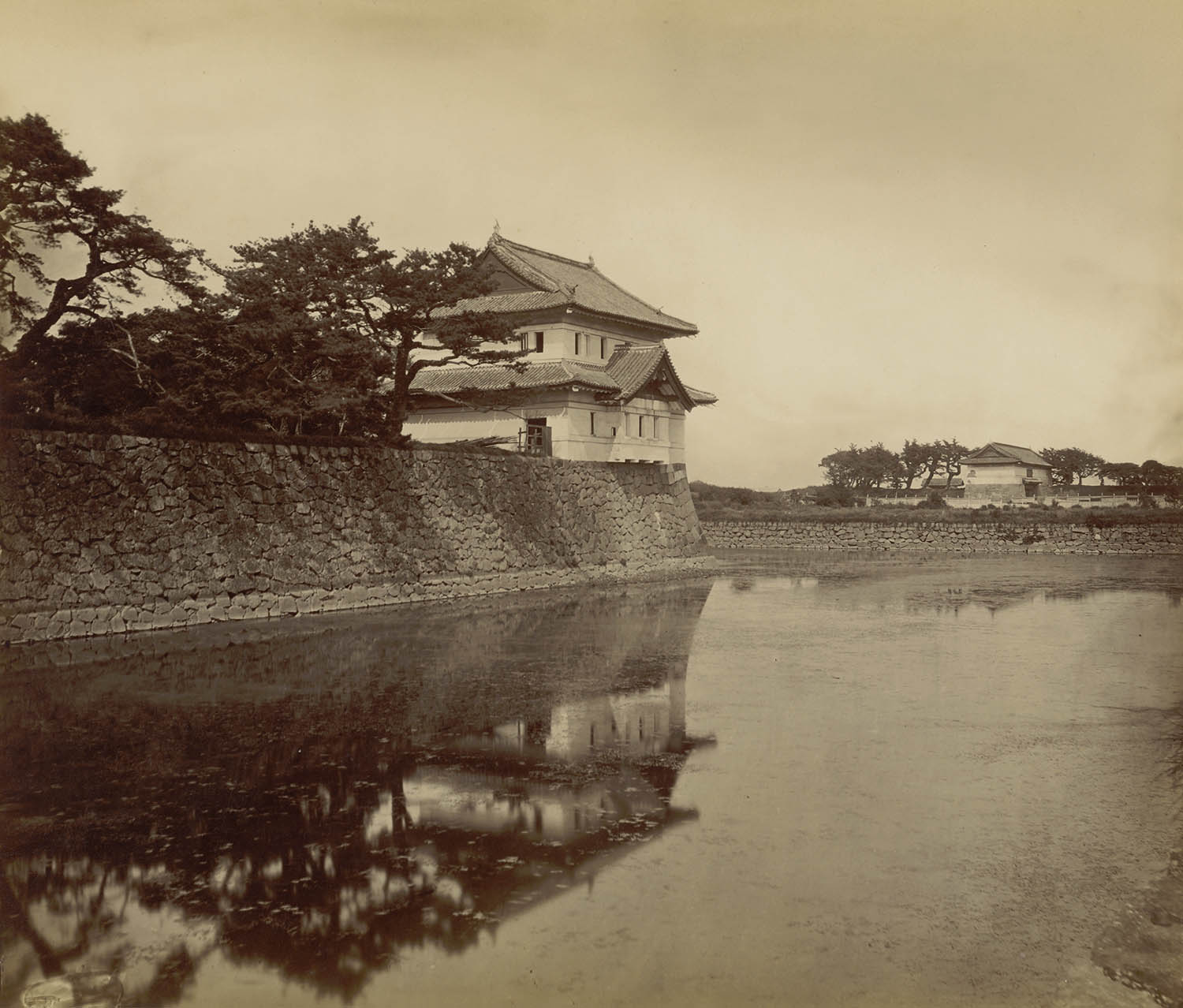
 

Raimund Stillfried von Rathenitz (Austrian, 1839-1911) 'Imperial Castle, Tokyo, Japan' c. 1875


Raimund Stillfried von Rathenitz (Austrian, 1839-1911)
Imperial Castle, Tokyo, Japan
c. 1875
Albumen print
37.6 x 44.6cm
ALBERTINA, Vienna. Dauerleihgabe der Höheren Graphischen Bundes-Lehr- und Versuchsanstalt


Baron Raimund von Stillfried, also known as Baron Raimund von Stillfried-Rathenitz (6 August 1839, in Komotau, Bohemia – 12 August 1911, in Vienna, Austrian-Hungarian Empire), was an Austrian military officer and early professional photographer in Japan. His historical photographs of Japan following the end of the Tokugawa shogunate in the 1870s have been appreciated for their documentary and artistic value and collected in international archives.

Text from the Wikipedia website
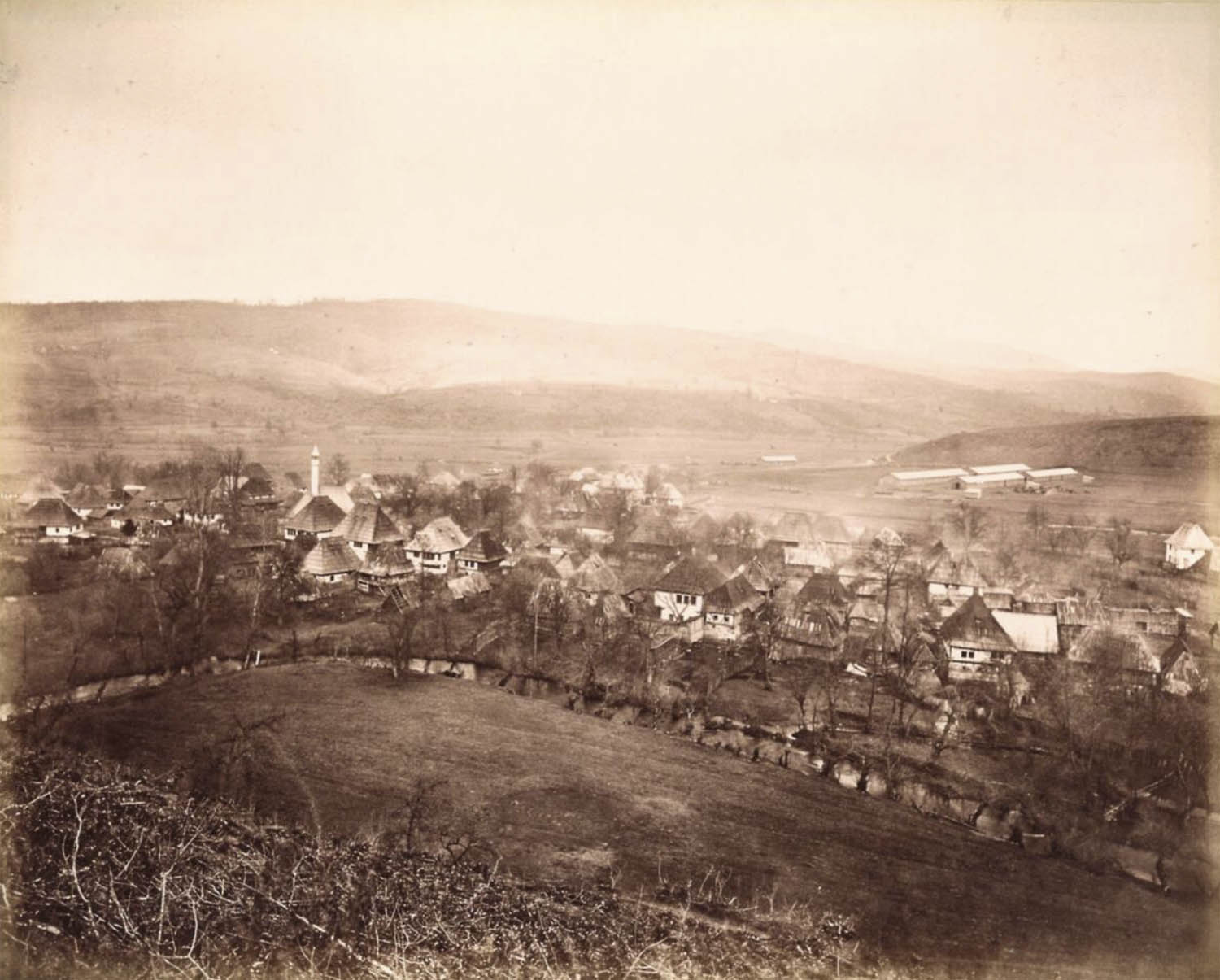
 

Josef Löwy (Austrian, 1834-1902) 'Busovaca im Kanton Zentralbosnien, ca. 20 km südlich von Zenica, im Hintergrund Baracken der österreichisch-ungarischen Besatzung' (Busovača in the Central Bosnia Canton, approx. 20 km south of Zenica; in the background, barracks of the Austro-Hungarian occupation forces)
1878


Josef Löwy (Austrian, 1834-1902)
Busovaca im Kanton Zentralbosnien, ca. 20 km südlich von Zenica, im Hintergrund Baracken der österreichisch-ungarischen Besatzung (Busovača in the Central Bosnia Canton, approx. 20 km south of Zenica; in the background, barracks of the Austro-Hungarian occupation forces)
1878
Albumen print, on backing card
Image: 20.6 x 25.5cm (8 1/8 x 10 1/16 in.)
Card: 43.4 x 32.8cm (17 1/16 x 12 15/16 in.)
ALBERTINA, Wien

NB. I’m not sure this photograph is in the exhibition but Löwy‘s photographs of Bosnia and the Austro-Hungarian occupation are mentioned in the press release
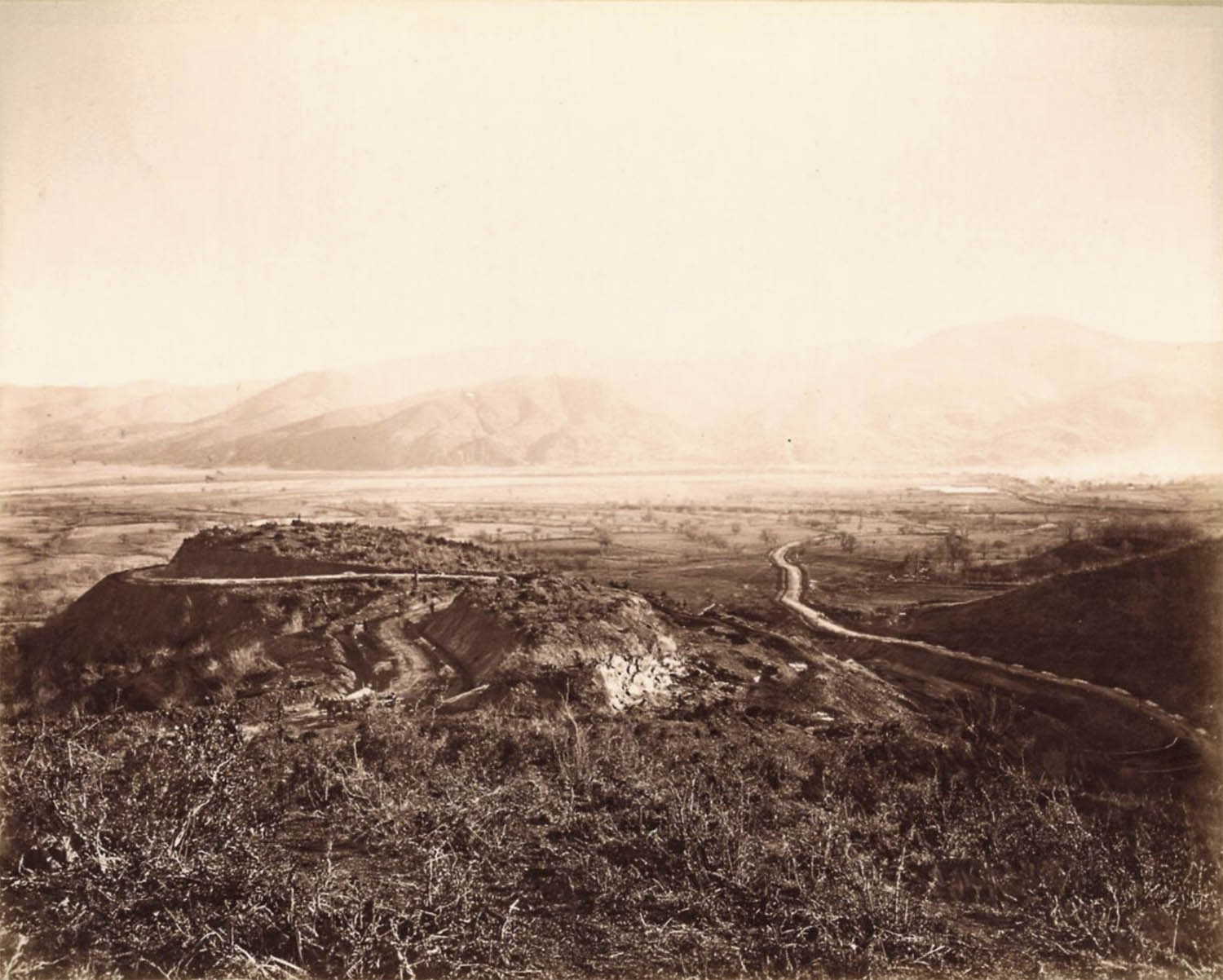
 

Josef Löwy (Austrian, 1834-1902)
'Strassencorrection vor Žepce an der Bosna zwischen Doboj und Zenica (heute: Kanton Zenica-Doboj in Bosnien und Herzegowina)' (Road realignment near Žepce on the Bosna River, between Doboj and Zenica (present-day Zenica-Doboj Canton in Bosnia and Herzegovina)) 1878


Josef Löwy (Austrian, 1834-1902)
Strassencorrection vor Žepce an der Bosna zwischen Doboj und Zenica (heute: Kanton Zenica-Doboj in Bosnien und Herzegowina) (Road realignment near Žepce on the Bosna River, between Doboj and Zenica (present-day Zenica-Doboj Canton in Bosnia and Herzegovina))
1878
Albumen print, on backing card
Image: 20.6 x 25.5cm (8 1/8 x 10 1/16 in.)
Card: 43.4 x 32.8cm (17 1/16 x 12 15/16 in.)
ALBERTINA, Wien

NB. I’m not sure this photograph is in the exhibition but Löwy‘s photographs of Bosnia and the Austro-Hungarian occupation are mentioned in the press release
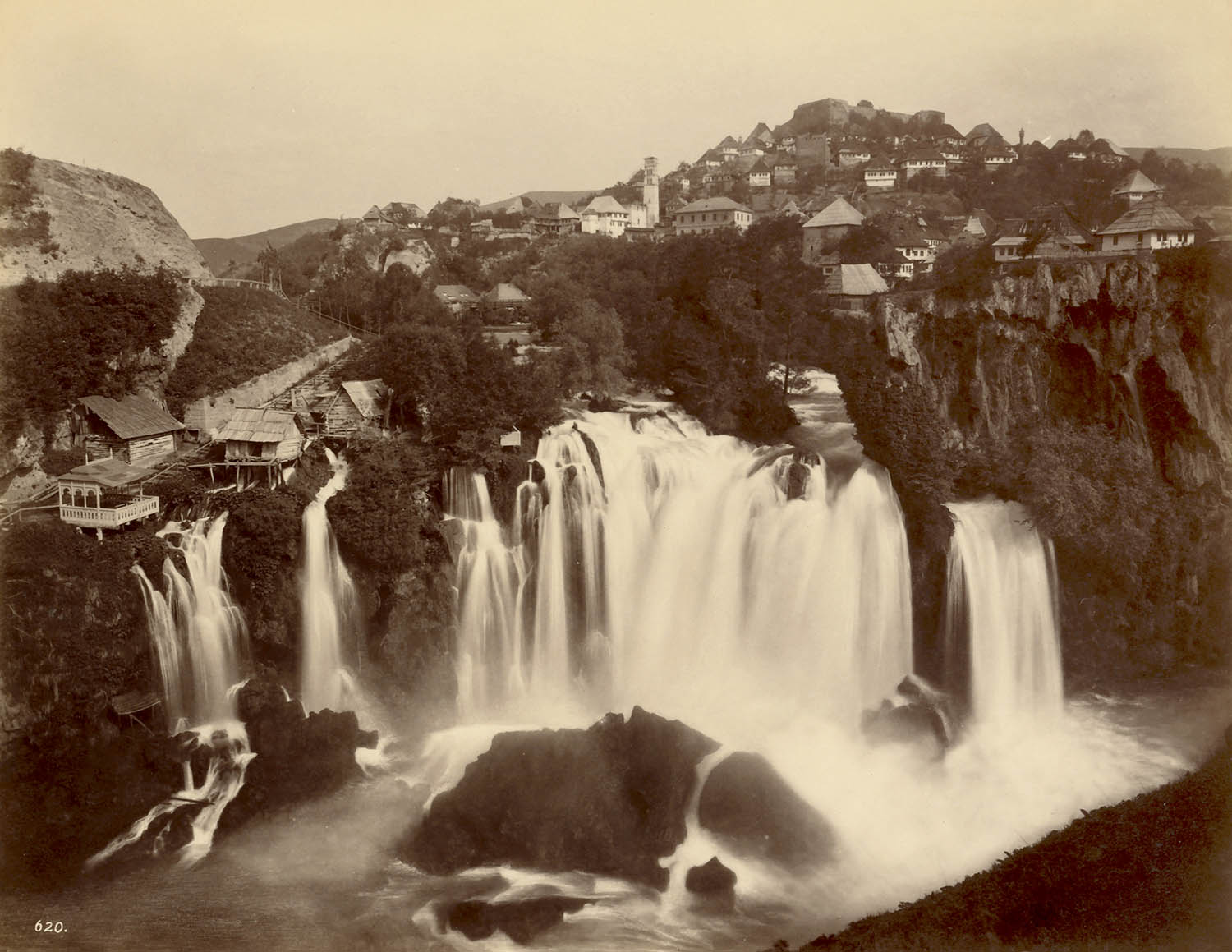
 

Raimund Stillfried von Rathenitz (Austrian, 1839-1911) 'Jajce with the Pliva Waterfall, Bosnia and Herzegovina' 1889


Raimund Stillfried von Rathenitz (Austrian, 1839-1911)
Jajce with the Pliva Waterfall, Bosnia and Herzegovina
1889
Albumen print
19.5 x 24.5cm
ALBERTINA, Wien
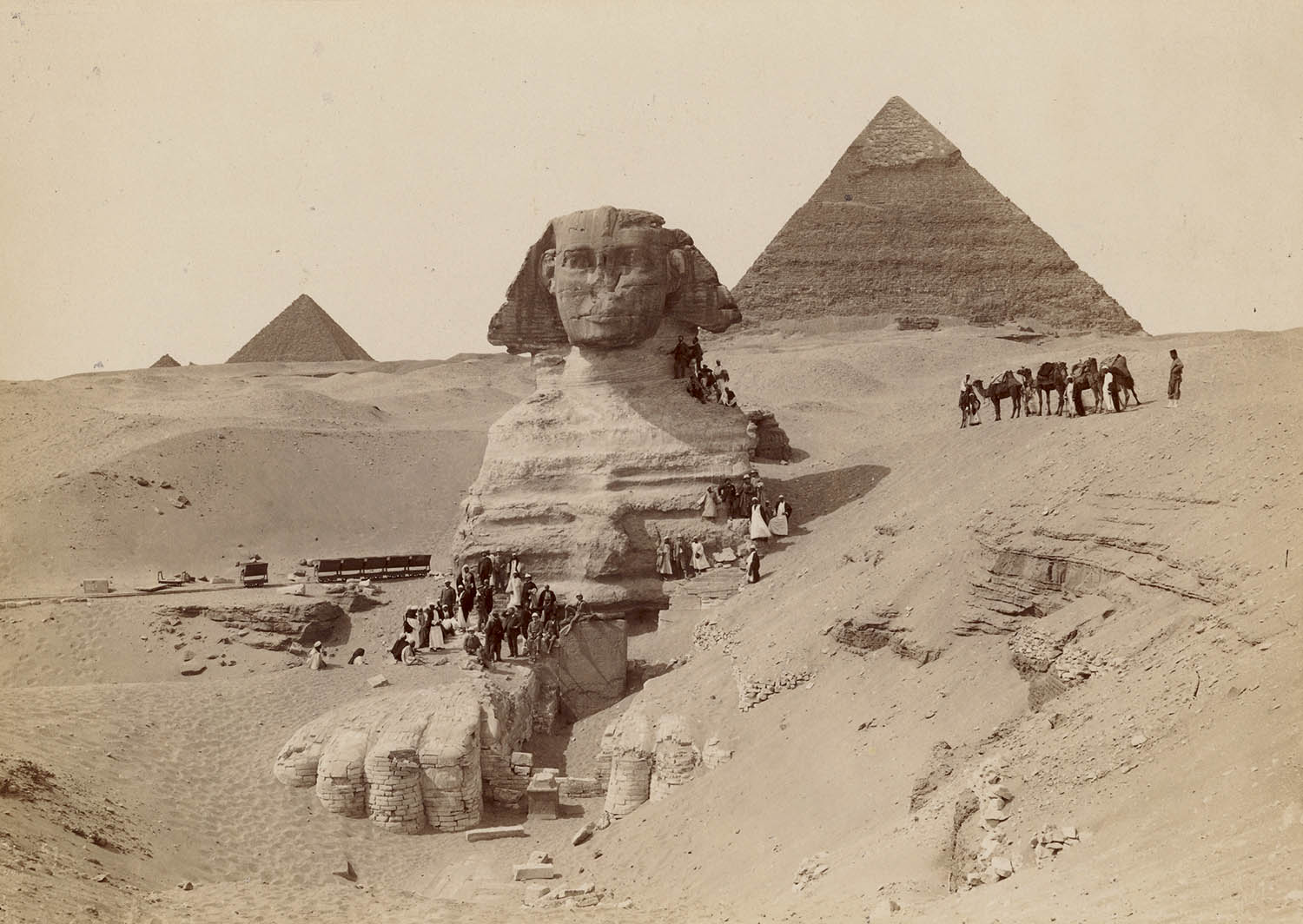
 

Anton Silberhuber (Austrian, 1839-1899) 'The Sphinx and the Pyramids, Egypt' c. 1890


Anton Silberhuber (Austrian, 1839-1899)
The Sphinx and the Pyramids, Egypt
c. 1890
Collodion paper
16.6 x 23.4cm
ALBERTINA, Vienna. Dauerleihgabe der Höheren Graphischen Bundes-Lehr- und Versuchsanstalt


Anton Silberhuber (1839-1899) was an influential 19th-century Austrian travel and documentary photographer. He is best known for capturing early archaeological and expedition photography across regions such as Egypt, Greece, and the Balkans.

One of his most celebrated pieces is a collodion paper print depicting tourists interacting with the Great Sphinx of Giza. This specific photograph captures a striking cultural moment of early global tourism, showing tourists physically climbing onto the paws and shoulders of the Sphinx for a portrait.

Text from various sources
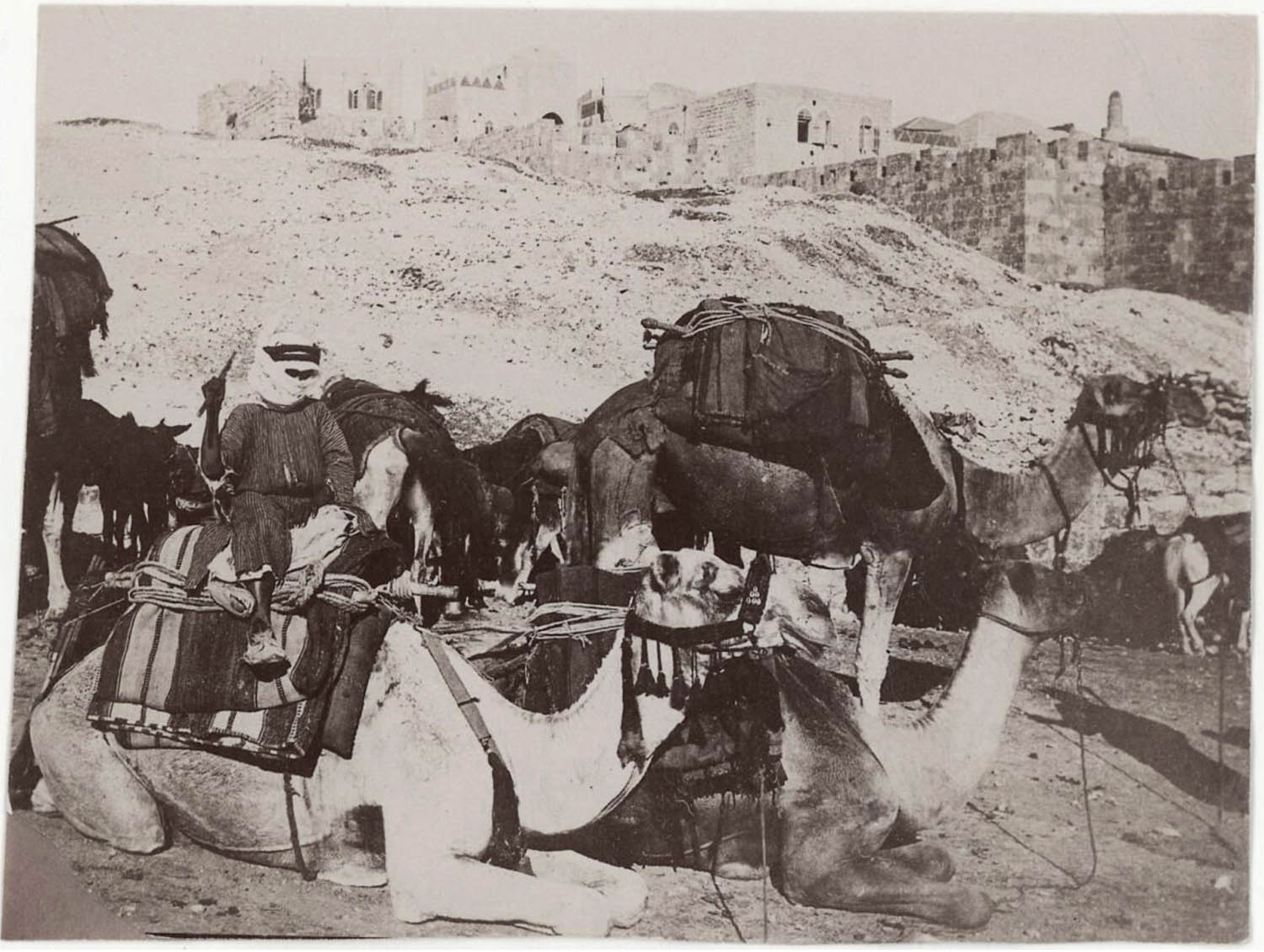
 

Johann Victor Krämer (Austria, 1861-1949) 'Künstlervorlagen' (Artist templates) 1898-1900


Johann Victor Krämer (Austria, 1861-1949)
Künstlervorlagen (Artist templates)
1898-1900
Albumen print
ALBERTINA, Vienna

NB. I’m not sure this photograph is in the exhibition but Krämer‘s photographs of Palestine are mentioned in the press release
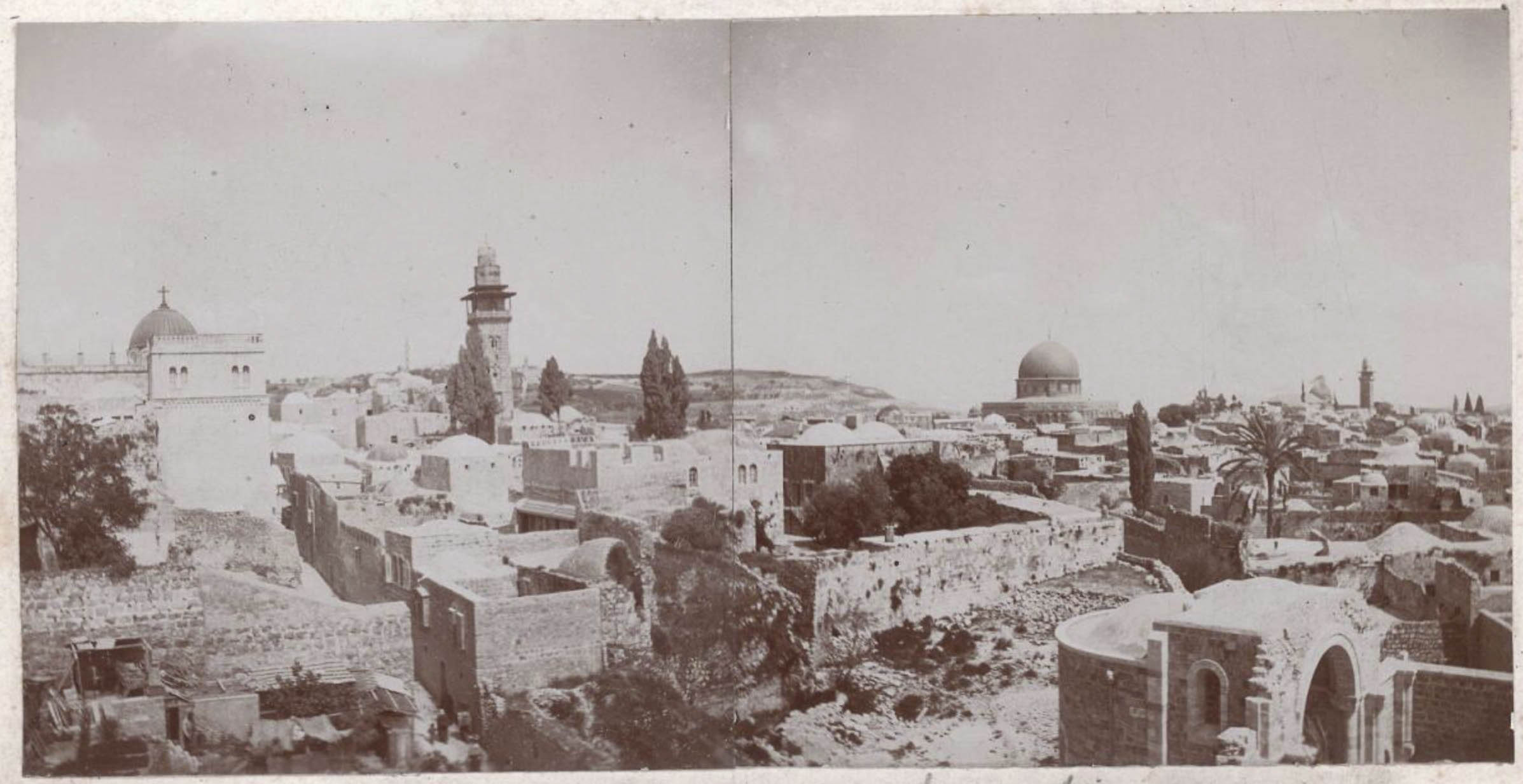
 

Johann Victor Krämer (Austria, 1861-1949) 'Jerusalem' Around 1900


Johann Victor Krämer (Austria, 1861-1949)
Jerusalem
Around 1900
Albumen paper (?), on backing card
Photographic paper: 8.3 x 16.4cm (3 1/4 x 6 7/16 in.)
Card: 14.1 x 20.5cm
ALBERTINA, Vienna

NB. I’m not sure this photograph is in the exhibition but Krämer‘s photographs of Palestine are mentioned in the press release
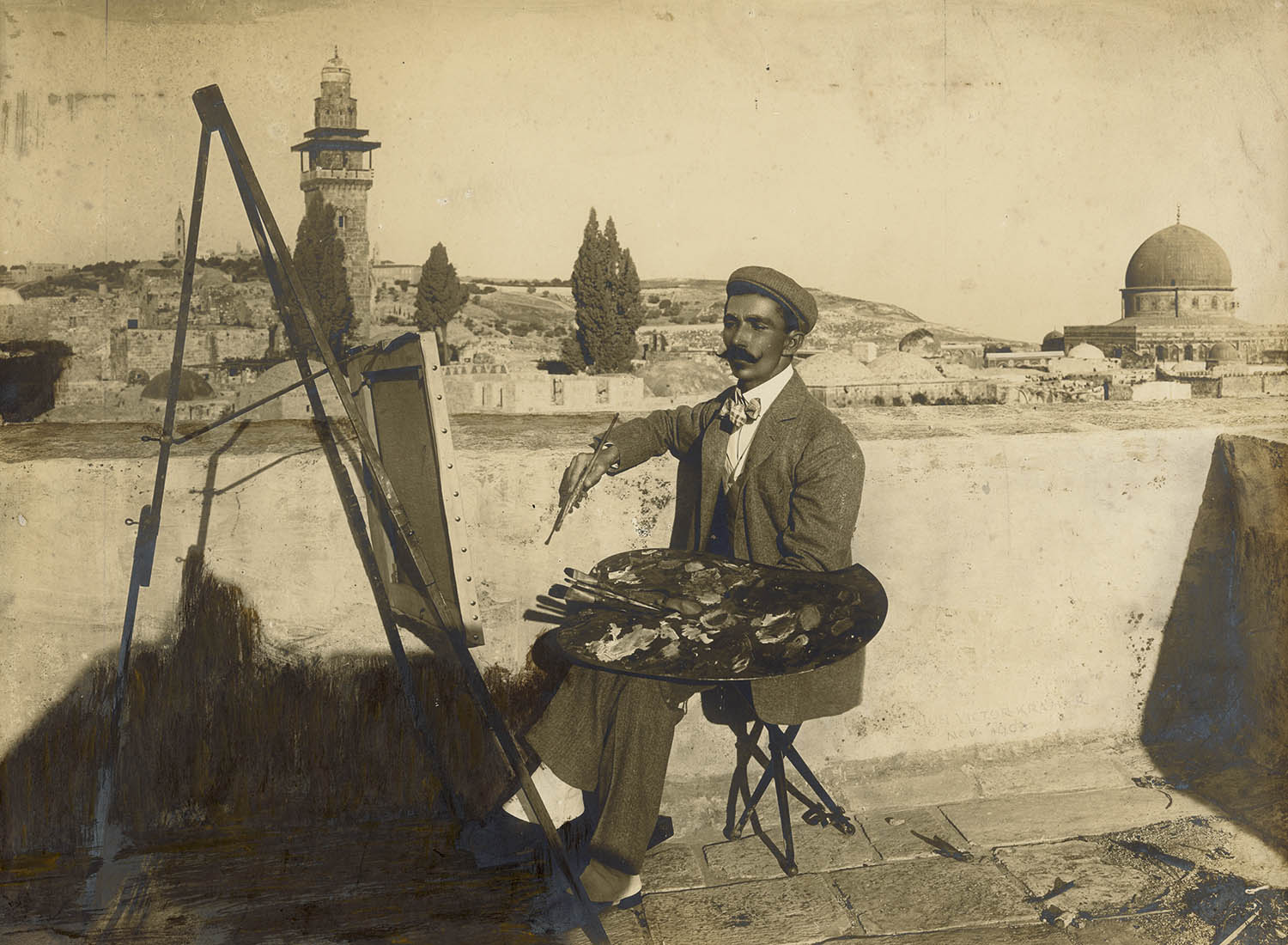
 

Johann Victor Krämer (Austria, 1861-1949) 'Self–Portrait on the Terrace of the Austrian Pilgrims’ Hospice in Jerusalem' c. 1900


Johann Victor Krämer (Austria, 1861-1949)
Self-Portrait on the Terrace of the Austrian Pilgrims’ Hospice in Jerusalem
c. 1900
20.6 x 28cm
Gelatin silver print, retouched
ALBERTINA, Vienna
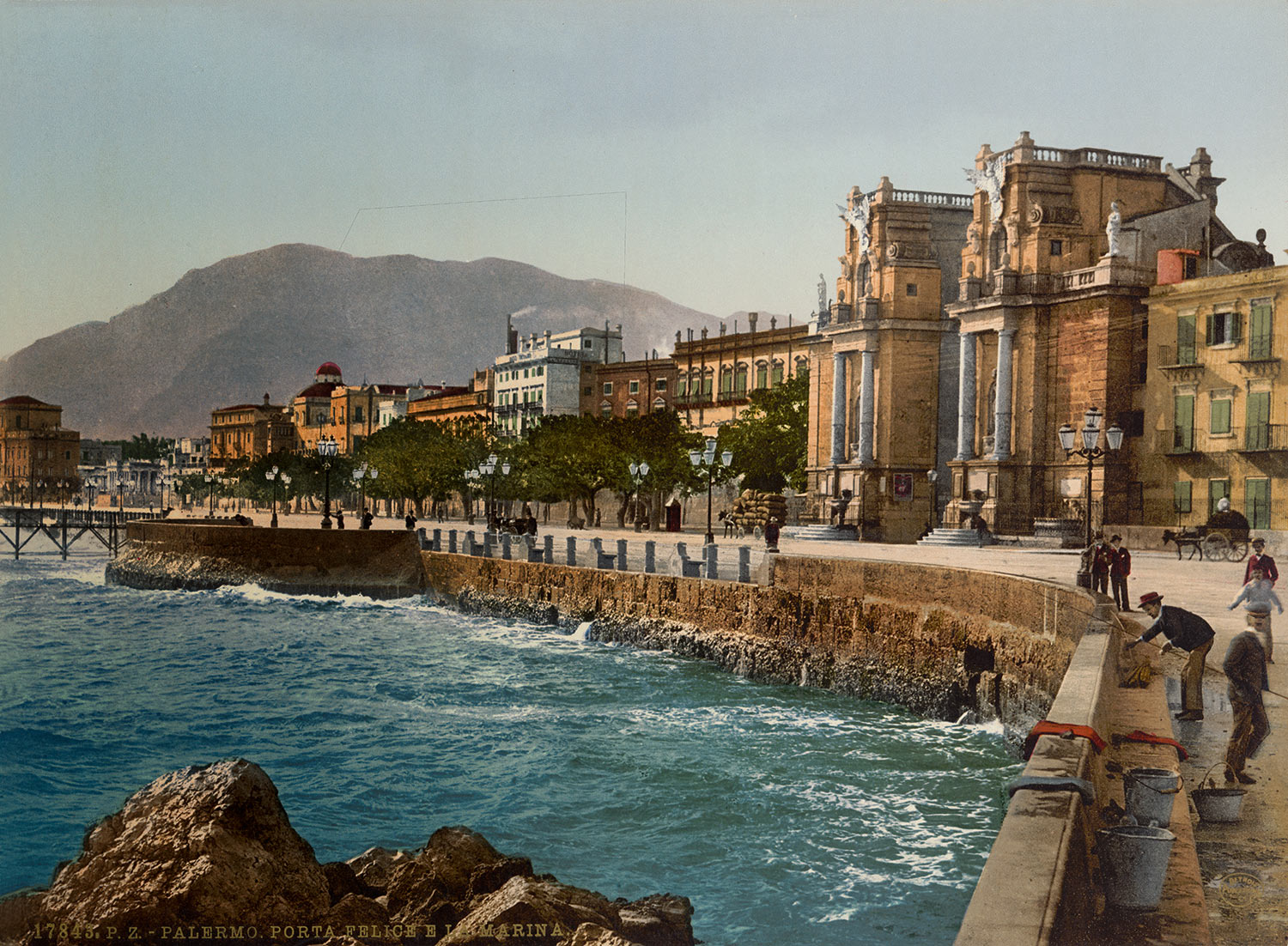
 

Anonymous photographer (Photoglob & Co., Zurich) 'Porta Felice and the Marina, Palermo, Italy' 1889–1905


Anonymous photographer (Photoglob & Co., Zurich)
Porta Felice and the Marina, Palermo, Italy
1889-1905
Photochrome
16.51 x 22.23cm
ALBERTINA, Vienna – Schenkung Harald Woschitz, Nachlass Christopher Cardozo, US
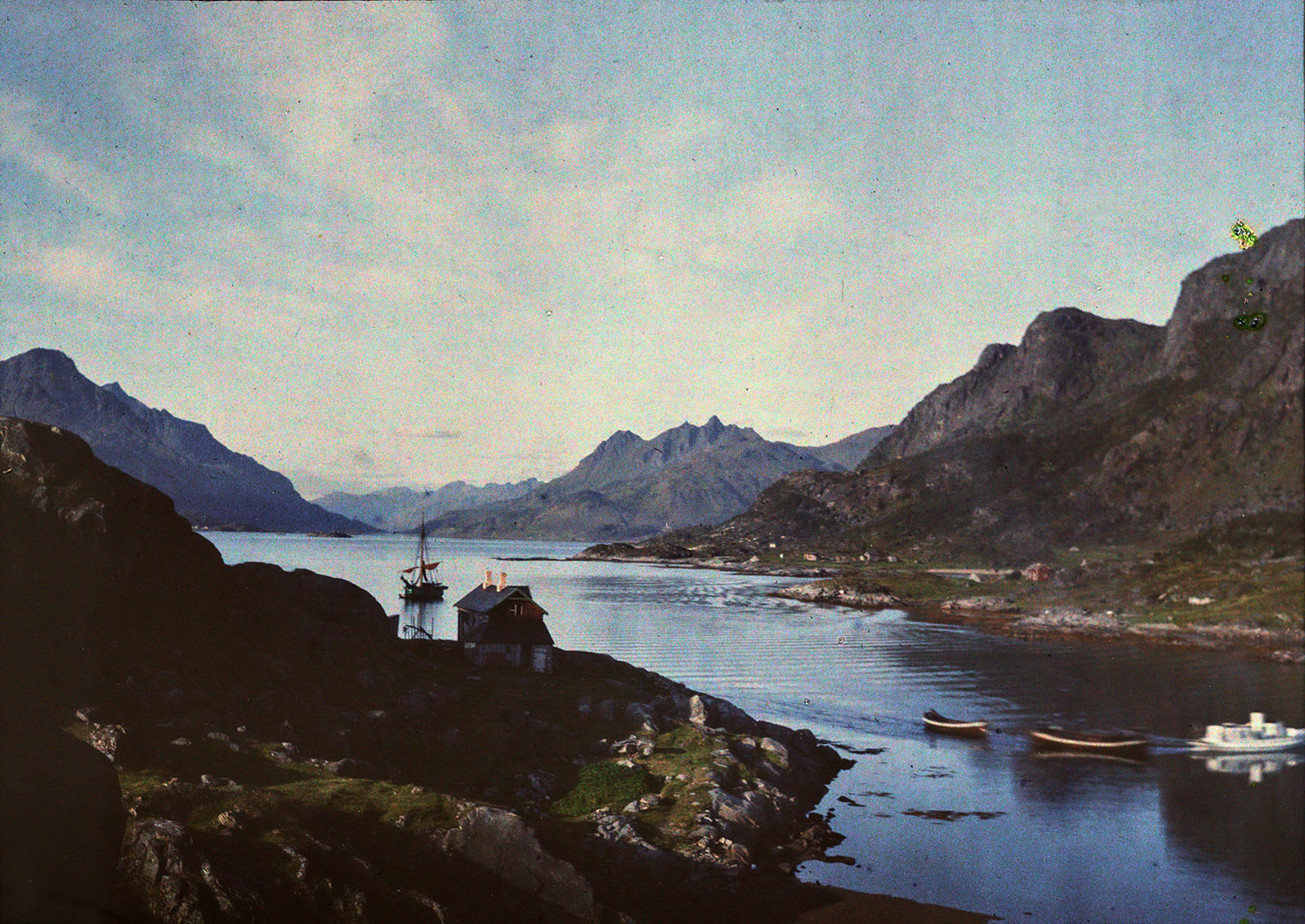
 

Anonymous photographer. 'Digermulen, Norway' 1913


Anonymous photographer
Digermulen, Norway
1913
Autochrome
9 x 12cm
ALBERTINA, Vienna. Dauerleihgabe der Höheren Graphischen Bundes-Lehr- und Versuchsanstalt


The Albertina Museum
Albertinaplatz 1
1010 Vienna
Phone: +43 (0)1 534 83 0

Daily 10am – 6pm
Except Wednesday and Friday 10am – 9pm

The Albertina Museum website

LIKE ART BLART ON FACEBOOK

Back to top

Exhibition: ‘Faces. The Power of the Human Visage’ at the Albertina, Vienna

Exhibition dates: 12th February – 20th June, 2021

Artists: Gertrud Arndt, Marta Astfalck-Vietz, Irene Bayer, Aenne Biermann, Erwin Blumenfeld, Max Burchartz, Suse Byk, Paul Citroen, Carl Theodor Dreyer, Andreas Feininger, Werner David Feist, Trude Fleischmann, Jozef Glogowski, Paul Edmund Hahn, Lotte Jacobi, Grit Kallin-Fischer, Edmund Kesting, Rudolf Koppitz, Kurt Kranz, Anneliese Kretschmer, Germaine Krull, Erna Lendvai-Dircksen, Helmar Lerski, László Moholy-Nagy, Lucia Moholy, Oskar Nerlinger, Erich Retzlaff, Hans Richter, Leni Riefenstahl, Franz Roh, Werner Rohde, Ilse Salberg, August Sander, Franz Xaver Setzer, Robert Siodmak, Anton Stankowski, Edgar G. Ulmer, Umbo, Robert Wiene, Willy Zielke.


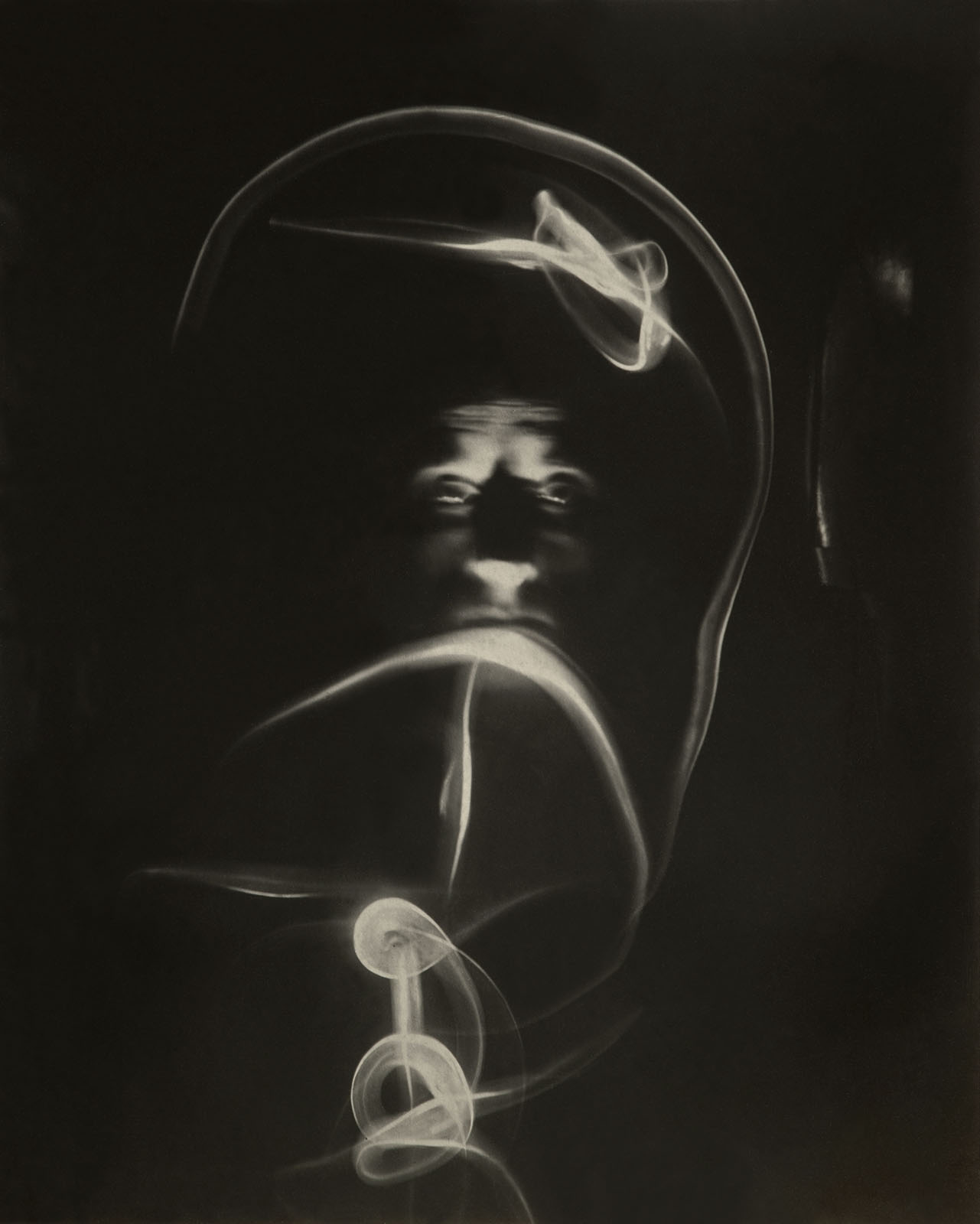
Helmar Lerski (Swiss, 1871-1956) 'Metamorphosis, 588' 1935-1936 from the exhibition 'Faces. The Power of the Human Visage' at the Albertina, Vienna, Feb - June, 2021


Helmar Lerski (Swiss, 1871-1956)
Metamorphosis, 588
1935-1936
Gelatin silver print
The ALBERTINA Museum, Vienna © Estate Helmar Lerski – Museum Folkwang, Essen


There is a limited number of media images from Faces. The Power of the Human Visage at the Albertina, Vienna, an exhibition which investigates how 1920s and ’30s saw photographers radically renew the conventional understanding of the classic portrait during the Weimar Republic. From a distance, the overall selection of artists seems slightly ad hoc: mainly German or Austrian, with Swiss, Polish, Danish and American thrown in for good measure. Surely then, you would include luminaries such as Claude Cahun, Florence Henri and Eva Besnyö for example.

The standouts in the posting are August Sander and Herman Lerski, both from opposing camps. Peter Pfrunder observes that Lerski’s earlier subjects, “showed portraits of anonymous people from the underclass of the Berlin society, presenting them as theatrical figures so that professional titles such as “chamber maid”, “beggar” or “textile worker” appeared as arbitrarily applied roles” that reveal the inner face of the photographer (his imagination) – whereas the work of Sander, who was at the same time working on his project “Menschen des 20. Jahrhunderts”, was an objective, social taxonomy of various representatives of the Weimar society.

Lerksi’s is the more esoteric enterprise, as he sought to provide proof “”that the lens does not have to be objective, that the photographer can, with the help of light, work freely, characterise freely, according to his inner face.” Contrary to the conventional idea of the portrait as an expression of human identity, Lerski used the human face as a projection surface for the figures of his imagination.” The Howard Greenberg gallery suggests that the “portraits” reflect a search for the photographers own wandering soul.

For me Lerki’s project Metamorphosis through Light (1935/36) – 137 “photographs of a man” taken by the artist on a Tel Aviv rooftop using natural sunlight and the help of up to 16 mirrors and filters – is a meditation on the mutability of the human face, identity and psyche, a brooding contemplation on the ever changing nature of the human spirit pictured through the face, over time. In this case, a compressed time atop a rooftop in Tel Aviv using an out-of-work structural draughtsman and light athlete, Leo Uschatz, as a stand-in for the artist himself.

Our face becomes us. It is our presentation to the world of who we are. The worry lines, the grey hair and the broken nose are all hard-earned signs of the life that we have led. The iconography of the face. Lerski captures this outer reflection of our inner self in a series of transcendent, abstract, modernist visages [the manifestation, image, or aspect of something] – that are among the most powerful representations of the human face that have ever been captured on film.

In their very context less being, in their very transposition from prophet, to peasant, to dying soldier, to old woman, to monk, they transgress [go beyond the limits of, and become an aspect of something else] what is normally seen and recognised of what Erwin Goffman calls ‘facework’,1 our interaction through our face with the outside world. They go beyond saving face: “Because in the face the corporeal surface makes visible something of the movements of the soul, ideally.”2

In light, through time, their transmutation is the transformation of our lives, compressed, condensed, communicated.

Dr Marcus Bunyan

PS. For more information on the face, please see my writing Facile, Facies, Facticity (2014)


1/ Facework theory is concerned with the ways in which we construct and preserve our self images, or the image of someone else. See Goffman, Erving. (1955) “On face-work: An analysis of ritual elements in social interaction,” in ‘Psychiatry: Journal for the Study of Interpersonal Processes 18, pp. 213-231.

2/ Georges Didi-Huberman. Invention of Hysteria: Charcot and the Photographic Iconography of the Salpetriere (trans. Alisa Hartz). Cambridge, Mass.: MIT Press, 2003, p. 49.


Many thankx to the Albertina for allowing me to publish the photographs in the posting. Please click on the photographs for a larger version of the image.


“For heaven’s sake, dear Mr. Meidner, you aren’t going to throw down your brush and palette and become a photographer, are you? … Don’t take offence at the machine. Here too, it’s the spirit that creates value… Photography is something great. It doesn’t do any good to step back and cry. Join in, but hurry! Photography marches on!”


Helmar Lerski to the painter Ludwig Meidner, 1930


“His model, he [Lerski] told me in Paris, was a young man with a nondescript face who posed on the roof of a house. Lerski took over a hundred pictures of that face from a very short distance, each time subtly changing the light with the aid of screens. Big close-ups, these pictures detailed the texture of the skin so that cheeks and brows turned into a maze of inscrutable runes reminiscent of soil formations, as they appear from an airplane. The result was amazing. None of the photographs recalled the model; and all of them differed from each other.

Out of the original face there arose, evoked by the varying lights, a hundred different faces, among them those of a hero, a prophet, a peasant, a dying soldier, an old woman, a monk. Did these portraits, if portraits they were, anticipate the metamorphoses which the young man would undergo in the future? Or were they just plays of light whimsically projecting on his face dreams and experiences forever alien to him? Proust would have been delighted in Lerski’s experiment with its unfathomable implications.”


Siegfried Kracauer. ‘Theory of Film’. Oxford University Press, 1960, p. 162


“‘Facies’ simultaneously signifies the singular ‘air’ of a face, the particularity of its aspect, as well as the ‘genre’ or ‘species’ under which this aspect should be subsumed. The facies would thus be a face fixed to a synthetic combination of the universal and the singular: the visage fixed to the regime of ‘representation’, in a Helgian sense.

Why the face? – Because in the face the corporeal surface makes visible something of the movements of the soul, ideally. This also holds for the Cartesian science of the expression of the passions, and perhaps also explains why, from the outset, psychiatric photography took the form of an art of the portrait.”


Georges Didi-Huberman. ‘Invention of Hysteria: Charcot and the Photographic Iconography of the Salpetriere’ (trans. Alisa Hartz). Cambridge, Mass.: MIT Press, 2003, p. 49


Starting from Helmar Lerski’s outstanding photo series Metamorphose – Verwandlungen durch Licht (Metamorphosis through Light) (1935/36), the exhibition Faces presents portraits from the period of the Weimar Republic.

The 1920s and ’30s saw photographers radically renew the conventional understanding of the classic portrait: their aim was no longer to represent an individual’s personality; instead, they conceived of the face as material to be staged according to their own ideas. In this, the photographed face became a locus for dealing with avant-garde aesthetic ideas as well as interwar-period social developments. And it was thus that modernist experiments, the relationship between individual and general type, feminist roll-playing, and political ideologies collided in – and thereby expanded – the general understanding of portrait photography.


Helmar Lerski (Swiss, 1871-1956) 'Metamorphosis, 536' 1935-1936 from the exhibition 'Faces. The Power of the Human Visage' at the Albertina, Vienna, Feb - June, 2021


Helmar Lerski (Swiss, 1871-1956)
Metamorphosis, 536
1935-1936
Gelatin silver print
The ALBERTINA Museum, Vienna © Estate Helmar Lerski – Museum Folkwang, Essen


Helmar Lerski (Swiss, 1871-1956) 'Metamorphosis, 537' 1935-1936


Helmar Lerski (Swiss, 1871-1956)
Metamorphosis, 537
1935-1936
Gelatin silver print
The ALBERTINA Museum, Vienna © Estate Helmar Lerski – Museum Folkwang, Essen


But Lerski’s pictures were only partly in line with the maxims of the New Photography, and they questioned the validity of pure objectivity. The distinguishing characteristics of his portraits included a theatrical-expressionistic, sometimes dramatic use of lighting inspired by the silent film. Although his close-up photographs captured the essential features of a face – eyes, nose and mouth –, his primary concern was not individual appearance or superficial likeness but the deeper inner potential: he emphasised the changeability, the different faces of an individual. Lerski, who sympathised with the political left wing, thereby infiltrated the photography of types that was practised (and not infrequently misused for racist purposes) by many of Lerski’s contemporaries.

In his book “Köpfe des Alltags” (Everyday Faces) (1931), a milestone in the history of photographic books, Lerski clearly expressed his convictions: he showed portraits of anonymous people from the underclass of the Berlin society, presenting them as theatrical figures so that professional titles such as “chamber maid”, “beggar” or “textile worker” appeared as arbitrarily applied roles. Thus his photographs may be interpreted as an important opposite standpoint to the work of August Sander, who was at the same time working on his project “Menschen des 20. Jahrhunderts” – that large-scale attempt at a social localisation of various representatives of the Weimar society.

But Helmar Lerski’s attitude was at its most radical in his work entitled “Metamorphosis”. This was completed within a few months at the beginning of 1936 in Palestine, to where Lerski and his second wife Anneliese had immigrated in 1932. In “Verwandlungen durch Licht” (this is the second title for this work), Lerski carried his theatrical talent to extremes. With the help of up to 16 mirrors and filters, he directed the natural light of the sun in constant new variations and refractions onto his model, the Bernese-born, at the time out-of-work structural draughtsman and light athlete Leo Uschatz. Thus he achieved, in a series of over 140 close-ups “hundreds of different faces, including that of a hero, a prophet, a peasant, a dying soldier, an old woman and a monk from one single original face” (Siegfried Kracauer). According to Lerski, these pictures were intended to provide proof “that the lens does not have to be objective, that the photographer can, with the help of light, work freely, characterise freely, according to his inner face.” Contrary to the conventional idea of the portrait as an expression of human identity, Lerski used the human face as a projection surface for the figures of his imagination. We are only just becoming aware of the modernity of this provocative series of photographs.

Peter Pfrunder. “Helmar Lerski: Metamorphosis,” on the Fotostiftung Schweiz website 2005 [Online] Cited 17/04/2021.


Lerski led a nomadic existence, driven by the events that splintered Europe and the Holy Lands throughout his life. His life was a sequence of transportations without a central resting place. It might be assumed that his thematic focus in photography, as pictured in his books Köpfe des Alltags, Les Juifs (of the “Jewish Heads” series) and Metamorphosis Through Light was of an external fascination with the human face and gesture but really reflects a search for his own self. The constant exposure to anti-Semitism and its horrible repercussions resulted in an acknowledgment of his own Judaism and for an historical identity. Ultimately, Lerski’s penetrating vision of others is a mirror of his own wandering soul.

Anonymous text on the Howard Greenberg website [Online] Cited 17/04/2021.


Helmar Lerski (Swiss, 1871-1956) 'Metamorphosis, 604' 1935-1936


Helmar Lerski (Swiss, 1871-1956)
Metamorphosis, 604
1935-1936
Gelatin silver print
The ALBERTINA Museum, Vienna © Estate Helmar Lerski – Museum Folkwang, Essen


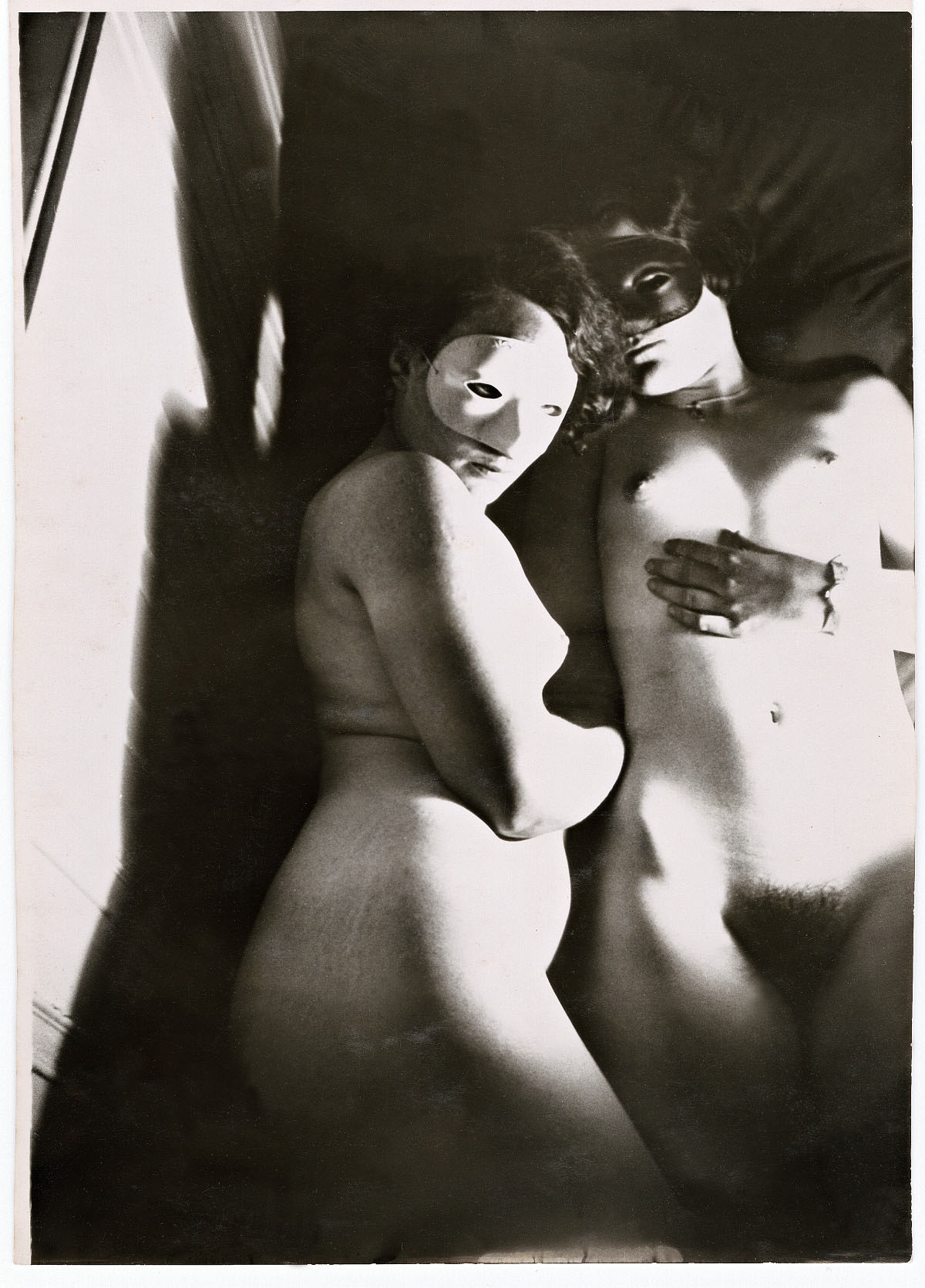
Marta Astfalck-Vietz (German, 1901-1994) 'Ohne Titel (Marta Vietz, Akt mit Spitze)' c. 1927


Marta Astfalck-Vietz (German, 1901-1994)
Ohne Titel (Marta Vietz, Akt mit Spitze) (Marta Vietz, nude with lace)
c. 1927
Gelatin silver print
Dietmar Katz/Berlinische Galerie © VG Bild-Kunst, Bonn
Dietmar Katz/Berlinische Galerie


Almost all of her archive was lost when her Berlin home was bombed in 1943. What remains was discovered by the curator Janos Frecot in 1989 and is now housed at the Berlinische Galerie in Berlin.


August Sander (German, 1876-1964) 'Handlanger' (Bricklayer / Handyman) 1928


August Sander (German, 1876-1964)
Handlanger (Bricklayer / Handyman)
1928
Gelatin silver print
© Die Photographische Sammlung/SK Stiftung Kultur – August Sander Archiv, Köln; BILDRECHT, Wien, 2020


Later in the 1920s Sander shot what was to become one of his most iconic works, ‘Handlanger (Bricklayer)’. This photograph belongs to ‘The Skilled Tradesman’, one of seven chapters within his People of the 20th Century project. The title and subject of this photograph form an archetype of Sander’s sociological documentation of people from a variety of occupations and social classes. Formally, the portrait’s centrality, flat background and conventional framing demonstrate Sander’s investment in photography as a ‘truth-telling’ device; one which represents reality as it is, without formal experimentation and within the boundaries of the history of photographic portraiture. Sander wrote in his seminal lecture ‘Photography as a Universal Language’ that photography was the medium most able to best reflect the ‘physical path to demonstrable truth and understand physiognomy’.

Anonymous text from the Hauser and Wirth website [Online] Cited 07/04/2021


August Sander’s Handlanger is one of the photographer’s definitive images from his epic series, Menschen des 20. Jahrhunderts (Men of the Twentieth Century). Sander also selected this image for publication in Antlitz der Zeit, his seminal 1929 book of portraits of the German people. Although very much of-a-piece with the portraits in this book, Handlanger stands out for the intensity of its subject’s gaze and for Sander’s strongly symmetrical composition. The photograph is an archetypal portrait of the working man, emanating capability and strength.

Titled simply Handlanger (hod-carrier, or handyman), this image took its place in Antlitz der Zeit (Face of Our Time) alongside portraits of farmers, bureaucrats, students, political radicals, artists, and others, most identified only by their occupation or type. Sander’s purpose was to create a collective portrait of the German populace that was thoroughly objective, unsentimental, and unprejudiced. His stated goal was nothing less than ‘… to be honest and tell the truth about our age and its people.’ Sander’s project and its inclusive scope, however, brought him to the attention of the German authorities. In 1934, the Reich Chamber of Arts ordered the destruction of the printing plates for Antlitz der Zeit and the seizure of all copies, effectively halting Sander’s picture-making.

Anonymous text from the Sothebys website [Online] Cited 07/04/2021


August Sander (German, 1876-1964) 'Jungbauern' (Young Farmers) 1914


August Sander (German, 1876-1964)
Jungbauern (Young Farmers)
1914
Gelatin silver print
© Die Photographische Sammlung/SK Stiftung Kultur – August Sander Archiv, Köln; BILDRECHT, Wien, 2020


What This Photo Doesn’t Show


Irene Bayer-Hecht (American, 1898-1991) 'Andor Weininger as Clown' 1926


Irene Bayer-Hecht (American, 1898-1991)
Andor Weininger as Clown
1926
Gelatin silver paper
Museum Folkwang, Essen
© Museum Folkwang, Essen


Chicago-born but raised in Hungary, Irene Bayer-Hecht studied commercial art in Berlin. After seeing the Bauhaus exhibition in 1923, she decided to concentrate on fine art. In 1925 she married Herbert Bayer and moved to Dessau, where she studied photography at the Bauhaus in order to assist him in his work. Her own photographs were mostly of people, both portraits and formal studies. Bayer’s work was included in the landmark Film und Foto exhibition in 1929 in Stuttgart. After moving back to the United States in 1938, Bayer gave up photography and became a translator.

Anonymous text from the J. Paul Getty website [Online] Cited 07/04/2021


An international figure, Irene Bayer-Hecht was born in Chicago, grew up in Hungary, and studied at the Academy of Fine Arts, Berlin, and the Sorbonne and École de Beaux-Arts, Paris. In 1923 she visited the first large Bauhaus exhibition in Weimar, where she met Herbert Bayer, whom she married in 1925. This allowed her to attend the Bauhaus’s Vorkurs (foundation course) that year without formally enrolling at the school. At the same time she attended photography courses at the Academy of Graphic Arts and Book Publishing in Leipzig. She took her own photographs and also used her technical training to support Bayer’s photographic work. The couple separated in 1928. Beyer-Hecht’s photographs feature experimental approaches and candid views of life at the Bauhaus; these pictures were included in the exhibition Film und Foto, in 1929. In 1938 she returned to the United States, abandoning photography and working instead as a translator.

Mitra Abbaspour on the MoMA website [Online] Cited 07/04/2021


Gertrud Arndt (German, 1903-2000) 'Maskenselbstbildnis Nr. 22' (Mask self-portrait No. 22) 1930


Gertrud Arndt (German, 1903-2000)
Maskenselbstbildnis Nr. 22 (Mask self-portrait No. 22)
1930
Silbergelatinepapier
Museum Folkwang, Essen
© Bildrecht, Wien 2020


Gertrud Arndt (born Gertrud Hantschk in Upper Silicia) set out to become an architect, beginning a three-year apprenticeship in 1919 at the architecture firm of Karl Meinhardt in Erfurt, where her family lived at the time. While there, she began teaching herself photography by taking pictures of buildings in town. She also attended courses in typography, drawing, and art history at the Kunstgewerbeschule (School of design). Encouraged by Meinhardt, a friend of Walther Gropius, Arndt was awarded a scholarship to continue her studies at the Bauhaus in Weimar. Enrolled from 1923 to 1927, Arndt took the Vorkurs (foundation course) from László Moholy-Nagy, who was a chief proponent of the value of experimentation with photography. After her Vorkurs, Georg Muche, leader of the weaving workshop, persuaded her to join his course, which then became the formal focus of her studies. Upon graduation, in March 1927, she married fellow Bauhaus graduate and architect Alfred Arndt. The couple moved to Probstzella in Eastern Germany, where Arndt photographed buildings for her husband’s architecture firm. In 1929, Hannes Meyer invited Alfred Arndt to teach at the Bauhaus, where Arndt focused her energy on photography, entering her period of greatest activity, featuring portraits of friends, still-lifes, and a series of performative self-portraits, as well as At the Masters’ Houses (MoMA 1607.2001), which shows the influence of her studies with Moholy-Nagy as well as her keen eye for architecture. After the Bauhaus closed, in 1932, the couple left Dessau and moved back to Probstzella. Three years after the end of World War II the family moved to Darmstadt; Arndt almost completely stopped making photographs.

Mitra Abbaspour on the MoMA website [Online] Cited 07/04/2021


In 1930, Gertrud Arndt, a Bauhaus-taught weaver and textile designer, took forty-three portraits of herself in only a few days. Adopting a style which was in direct contrast with the functional Bauhaus aesthetic – indeed, it was a “welcome break” from it –, Arndt slipped into the rôles of different eras and cultural circles and captured these mises en scène with her camera. They were private photographs, photographs intended purely as a means of coming to terms with her own self, not for publication.


Max Burchartz (German, 1887-1961) 'Lotte (Auge)' 1928


Max Burchartz (German, 1887-1961)
Lotte (Auge)
1928
Silbergelatinepapier
Museum Folkwang, Essen
© Bildrecht, Wien 2020


Max Burchartz (1887-1961) studied painting at the Akademie der Künste in Düsseldorf and came into contact with the Bauhaus in Weimar during the 1920s. In 1924 together with Johannes Canis he opened an advertising agency in Bochum, which gained a reputation for creating innovative advertising campaigns with photography and typography. Until 1932 Burchartz taught photography and commercial art at the Folkwangschule für Gestaltung in Essen. One of his students was Anton Stankowski. After Hilter came to power in 1933 Burchartz joined the Nazi Party and voluntarily joined the German army which he remained in until the end of the war. In 1949 he was reappointed to the Folkwangschule, where he taught until 1955, publishing books on design theory such as Schule des Schauens in 1962.


Two pages from the book 'Faces. The Power of the Human Visage'


Two pages from the book Faces. The Power of the Human Visage. Hirmer Verlag GmbH Hardcover – 25 May 2021


Oskar Nerlinger (German, 1893-1969) 'Kopf mit Taschenlampe' (Head with flashlight) c. 1928


Oskar Nerlinger (German, 1893-1969)
Kopf mit Taschenlampe (Head with flashlight)
c. 1928
Silbergelatinepapier
Galerie Berinson, Berlin
© Sigrid Nerlinger


Excluded & yet entangled in two dictatorships: The political constructivist Oskar Nerlinger 10/02/2021

Oskar Nerlinger (1893-1969) was one of the most important artists of the committed art scene in the Weimar Republic. He was a member of the Association of Proletarian Revolutionary Art (ASSO for short), which was founded in 1928 and belonged to the KPD, which cooperated with the Soviet avant-garde artist group Oktober. At that time there was no conflict between positions of aesthetic modernism and KPD politics. In 1932 the political and artistic avant-garde in the Soviet Union fell apart, with serious consequences for left-wing artists in Germany. Almost at the same time, the Nazi system broke with all forms of modernity. With his idea of art suddenly doubly isolated within his own party, which followed Stalin’s art verdict, and within Germany through the Nazi art policy, Nerlinger went into so-called “inner emigration”, but behaved in a very contradictory manner and adapted his artistic language to the Nazi aesthetics. After 1945 he joined the SED and followed the given political norms of socialist realism as part of the formalism campaign.

The twofold turning point in 1932 and 1933 left lasting traces in Oskar Nerlinger’s art. With this transition from innovation to regression, Nerlinger stands for a whole generation of politically committed artists in the Weimar Republic who, blindly believing in the doctrines of the communist party, gave up their own aesthetic and moral convictions. In a paradoxical way, Nerlinger was marginalised and at the same time entangled in two dictatorships.


Erich Retzlaff (German, 1899-1993) 'Bride's Traditional Dress from Kleines Walsertal' before 1936


Erich Retzlaff (German, 1899-1993)
Bride’s Traditional Dress from Kleines Walsertal
before 1936
From German Folk Costumes
17.6 × 12.3cm
Gelatin silver print on supporting cardboard
The Albertina Museum, Vienna – Permanent loan from the Österreichische Ludwig-Stiftung für Kunst und Wissenschaft)
© Volker Graf Bethusy-Huc


Erich Max Wilhelm Retzlaff was born in Reinfeld in Schleswig Holstein, Germany on October 9th 1899. He came from a prosperous protestant middle class background. His father, Friedrich, was the noted author of the definitive Handbuch für die Polizei im Reich (German police handbook) published in 1892. The young Erich grew up in the twilight of the Wilhelmine era and enlisted enthusiastically into the German army in 1916 to fight in the First World War. Retzlaff served as a machine gunner on the western front (Flanders), was very badly wounded and subsequently spent over a year in a military hospital. He received the Iron Cross (second class).

After the conclusion of the war he drifted into work in civilian life eventually completing a business apprenticeship in a paint factory in Düsseldorf. With help from one of his former army officers, Retzlaff was able to secure a position as a supplies buyer for a factory in Hamburg. He began to earn a decent salary and became a patron of the arts, visiting many exhibitions and associating with artists to the point that he contemplated a creative career himself. But Retzlaff was unable to pursue painting; his wounds during the war had left his hand permanently damaged. Instead, Retzlaff began to experiment with photography, initially as an amateur enthusiast and then ultimately as a career, starting up a small photographic portrait studio on the Königsallee (Düsseldorf). By the late 1920s Retzlaff moved to larger premises on the Kaiserstrasse as custom increased and the business grew. His circle of friends and associates widened and by the late 1930s included painters such as Werner Peiner, Emil Nolde, the photographer Paul Wolff and the Norwegian author Knut Hamsun. A passionate German Nationalist, Retzlaff became a member of Hitler’s National Socialist party in 1932 (No.1014457).

Retzlaff moved his studio several times during the 1930s and 1940s working in a number of locations including locations in Düsseldorf and Berlin. He also expanded his oeuvre as commercial needs demanded and as well as his portraits he photographed traditional German regional costumes, landscapes and industrial scenes. However, at the heart of his portfolio was Retzlaff’s interest in photographing in a physiognomic way. Physiognomy is a belief that one can read a face to discover the personality and character of the individual. Physiognomy was hugely popular as a means of evaluating people and their lives in Germany after the First World War. During the Hitler years this interest continued with an added emphasis on race. The focus of Retzlaff’s photographs from this period was making images that applied a physiognomic parascience within a political and ideological framework.

After 1945 Retzlaff continued to make his living as a photographer and his work was still widely published. His portfolio from the post-war period includes fashion photography, landscapes, portraits of prominent Germans (such as Chancellor Konrad Adenauer), and dramatic images of West German industry. However, in a general sense, the photographs he made after 1945 are less dynamic than the work made in the 1930s and 40s. The images tend to lack the punch and bite of the earlier Retzlaff. The ideology is gone and with it the personal sense of purpose that his earlier images possessed.

These biographical details are drawn from the transcript of Professor Doctor Rolf Sachsse’s 1979 recorded interview with Erich Retzlaff and from additional biographical information provided to me by Retzlaff’s son Herr Jürgen Retzlaff and his daughter Bettina Retzlaff-Cumming.

Text on the Aberystwyth University website [Online] Cited 07/04/2021


Franz Roh (German, 1890-1965) 'Masquerade' 1928-1933


Franz Roh (German, 1890-1965)
Masquerade
1928-1933
Gelatin silver print
Münchner Stadtmuseum – Nachlass Franz Roh, München


The 1920s are the decade of masquerade in the history of modern art. Was it the coming of the cinema, that “Hades of the Living”, in which the protagonists forever assume new identities and “the shadows already become immortal while still alive”31, or was it first and foremost the psychological consequences of the profound social changes following the First World War which made masks, disguises and rôle-playing the favourite means of self-stylisation and self-discovery among artists and writers of both sexes? For the psychoanalyst Joan Rivière, masquerade was one of the essential features of womanliness, which – she wrote in 1929 – “could be assumed and worn as a mask”, both to hide the possession of masculinity and to avert the reprisals expected if she was found to possess it. […] The reader may now ask how I define womanliness or where I draw the line between genuine womanliness and the ‘masquerade’. My suggestion is not, however, that there is any such difference; whether radical or superficial, they are the same thing.”32 Gender rôle-playing, hitherto reserved in the 19th century for the very close circles of male-attired lesbians, became a fashion phenomenon with the arrival of the “garçonne” in the 1920s.33 The poetess Else Lasker-Schüler, who would frequently masquerade as the Prince of Thebes in the literary cafés of Berlin, was written about as follows: “Disguise was an aid to becoming a person. It symbolises the ego in the process of either developing or disintegrating. […] Disguise is both the secret and the prediction of a person who seeks himself or herself in the game of (mis)taken identities; one who is versatile in the art of transformation, who can condense into many different persons again and again, but never into a tangible personality.”34 Thus photography was the ideal means of objectifying these transformations and of viewing one’s other self from a distance.

Extract from Herbert Molderings and Barbara Mülhens-Molderings. “Mirrors, Masks and Spaces. Self-portraits by Women Photographers in the twenties and thirties,” on the Jeu de Paume website 03/06/2011 [Online] Cited 07/04/2021. No longer available online


Franz Roh (21 February 1890 – 30 December 1965), was a German historian, photographer, and art critic. Roh is perhaps best known for his 1925 book Nach Expressionismus: Magischer Realismus: Probleme der neuesten europäischen Malerei (“After expressionism: Magical Realism: Problems of the newest European painting”) he coined the term magic realism.

Roh was born in Apolda (in present-day Thuringia), Germany. He studied at universities in Leipzig, Berlin, and Basel. In 1920, he received his Ph.D. in Munich for a work on Dutch paintings of the 17th century. As a photographer and critic, he absolutely hated photographs that mimicked painting, charcoal, or drawings. During the Nazi regime, he was isolated and briefly put in jail for his book Foto-Auge (Photo-Eye); he used his jail time he used to write the book Der Verkannte Künstler: Geschichte und Theorie des kulturellen Mißverstehens (“The unrecognised artist: history and theory of cultural misunderstanding”). After the war, in 1946, he married art historian Juliane Bartsch. He died in Munich.

Text from the Wikipedia website


An art historian, photographer, and art critic, Franz Roh deplored photographs that were derived from painting or pretended to be drawings or charcoal sketches. His writings brought him close to avant-garde artists, who inspired many of his photographs. In 1929 he co-published and co-edited a book, Foto-Auge (Photo-Eye), with graphic designer Jan Tschichold. Asserting that photographs were an effective weapon against “the mechanisation of spirit” and one of the world’s greatest physical, chemical, and technological wonders, Roh and Tschichold based the book on a film and photography exhibition held in Stuttgart. The book’s progressive stance led to Roh’s brief imprisonment by the government censors, who forbade him to continue writing. In 1946 he was awarded a professorship at the University of Munich, a position he held for the remainder of his life.

Anonymous text from the J.Paul Getty website [Online] Cited 07/04/2021


Two pages from the book 'Faces. The Power of the Human Visage'


Two pages from the book Faces.The Power of the Human Visage. Hirmer Verlag GmbH Hardcover – 25 May 2021


Lotte Jacobi (American, 1896-1990) 'Head of the Dancer Niura Norskaya' 1929


Lotte Jacobi (American, 1896-1990)
Head of the Dancer Niura Norskaya
1929


Lotte Jacobi (August 17, 1896 – May 6, 1990) was a leading American portrait photographer and photojournalist, known for her high-contrast black-and-white portrait photography, characterised by intimate, sometimes dramatic, sometimes idiosyncratic and often definitive humanist depictions of both ordinary people in the United States and Europe and some of the most important artists, thinkers and activists of the 20th century.


Two pages from the book 'Faces. The Power of the Human Visage'


Two pages from the book Faces. The Power of the Human Visage. Hirmer Verlag GmbH Hardcover – 25 May 2021


Cover from the book 'Faces. The Power of the Human Visage'


Cover from the book Faces. The Power of the Human Visage featuring Helmar Lerski (Swiss, 1871-1956) Metamorphosis, 537 1935-1936


Albertina
Albertinaplatz 1
1010 Vienna, Austria
Phone: +43 (0)1 534 83-0

Opening hours:
Daily 10am – 6pm
Wednesday and Fridays 10am – 9pm

Albertina website

LIKE ART BLART ON FACEBOOK

Back to top

Exhibition: ‘Film Stills: Photography between Advertising, Art and the Cinema’ at Albertina, Vienna

Exhibition dates: 4th November, 2016 – 26th February, 2017


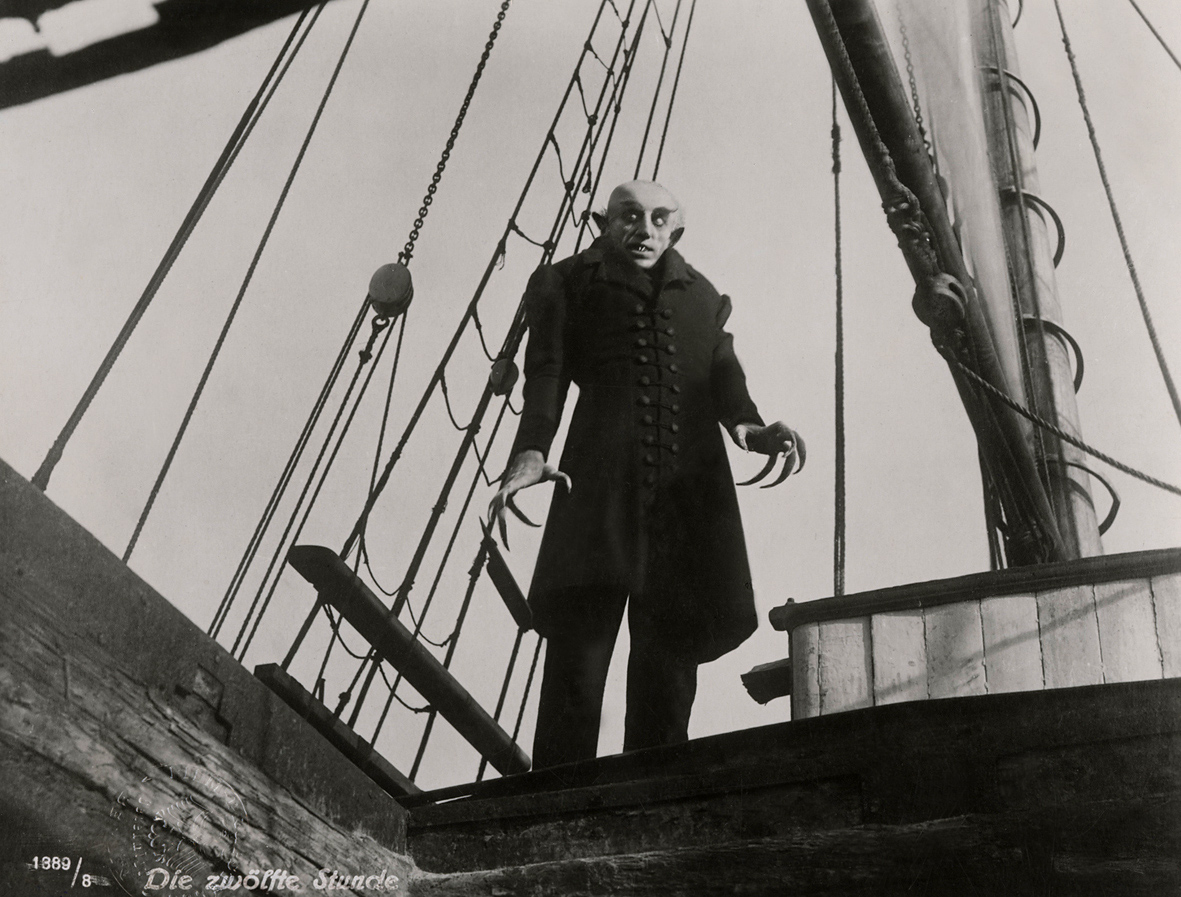
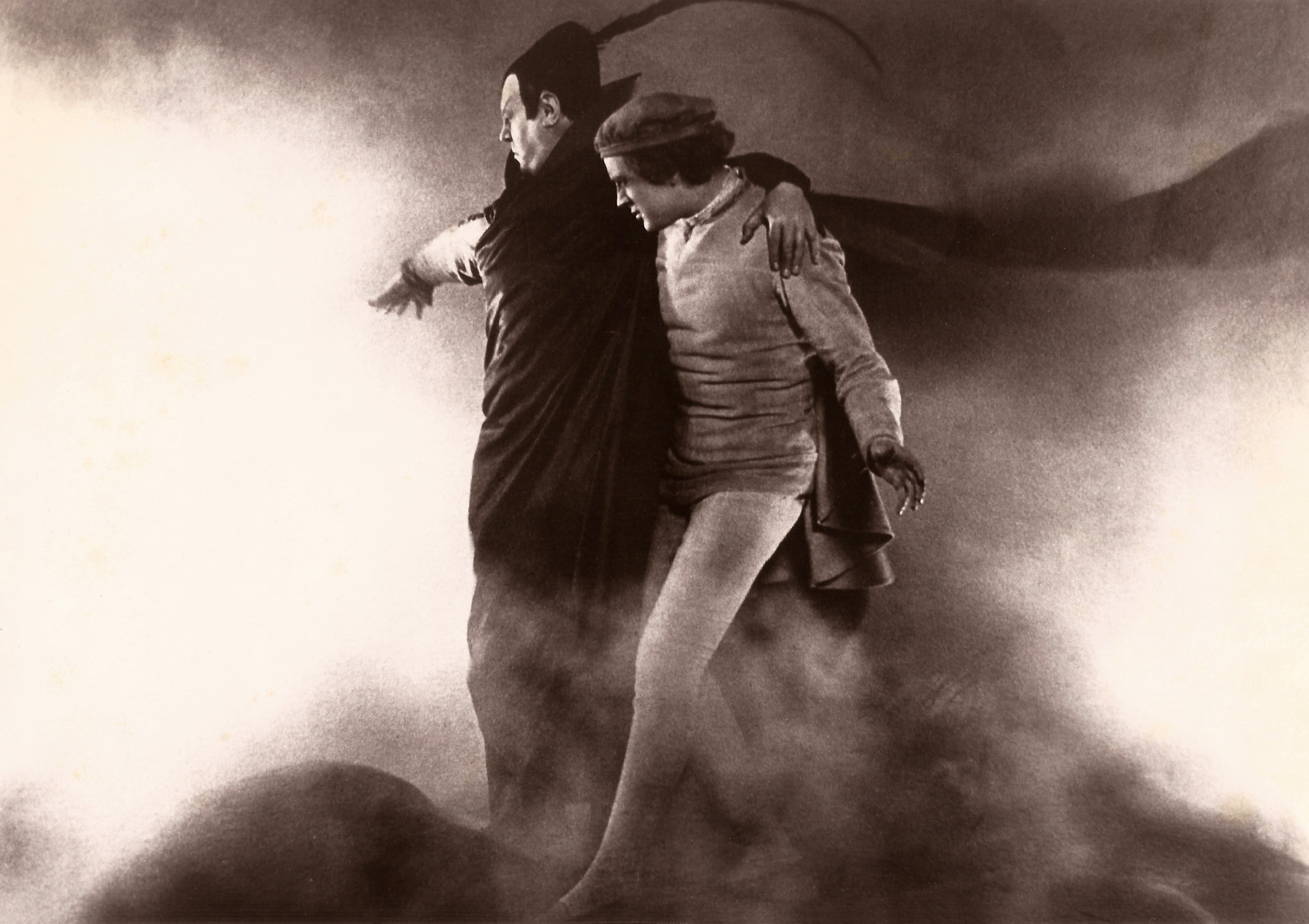
Anonymous photographer. Still from 'Nosferatu, a Symphony of Horror' 1922 from the exhibition 'Film Stills: Photography between Advertising, Art and the Cinema' at Albertina, Vienna, Nov 2016 - Feb 2017


Anonymous photographer
Still from Nosferatu, a Symphony of Horror
1922
Director: Friedrich Wilhelm Murnau (German, 1888-1931)
Gelatin silver print
© Deutsche Kinemathek


I seem to have a bit of a thing for film and photography at the moment!

More delicious film fascination, this time for the still camera. German Expressionism, film noir, science-fiction, horror, murder and mayhem – photographers using all manner of artistic techniques to get their message across. Now often found in fine art auction houses.

I love the heading “Intermediality and Self-Reflexivity” … “intermediate images” that unite aspects of both media (film and photography) and self-reflexive images that take on a life of their own, developing “a filmic work further in an independent manner, thereby allowing it to be regarded from new perspectives. Such stills often contain self-reflexive commentary on the work’s specifically “filmic” aspects.”

Sensitive, sensual, snapshot; stars and auteurism; murder and mayhem; avant-garde, beauty and sex – it has it all. Great stuff.

Dr Marcus Bunyan

PS. Look at the amazing colours in Horst von Harbou’s stills for Metropolis (1927) which were produced as transparent foils and elaborately coloured by hand. Never heard of such a thing before, coloured transparent foils.


Many thankx to the Albertina for allowing me to publish the photographs in the posting. Please click on the photographs for a larger version of the image.


Anonymous photographer. 'La Passion de Jeanne d'Arc' 1927 from the exhibition 'Film Stills: Photography between Advertising, Art and the Cinema' at Albertina, Vienna, Nov 2016 - Feb 2017


Anonymous photographer
La Passion de Jeanne d’Arc
1927
Karl Theodor Dreyer (Danish, 1889-1968) (director)


Carl Theodor Dreyer (3 February 1889 – 20 March 1968), commonly known as Carl Th. Dreyer, was a Danish film director. He is regarded by many critics and filmmakers as one of the greatest directors in cinema. His best known films include The Passion of Joan of Arc (1928), Vampyr (1932), Day of Wrath (1943), Ordet (1955), and Gertrud (1964) …

As a young man, Dreyer worked as a journalist, but he eventually joined the film industry as a writer of title cards for silent films and subsequently of screenplays. He was initially hired by Nordisk Film in 1913.

His first attempts at film direction had limited success, and he left Denmark to work in the French film industry. While living in France he met Jean Cocteau, Jean Hugo and other members of the French artistic scene and in 1928 he made his first classic film, The Passion of Joan of Arc. Working from the transcripts of Joan’s trial, he created a masterpiece of emotion that drew equally on realism and expressionism.

Text from the Wikipedia website


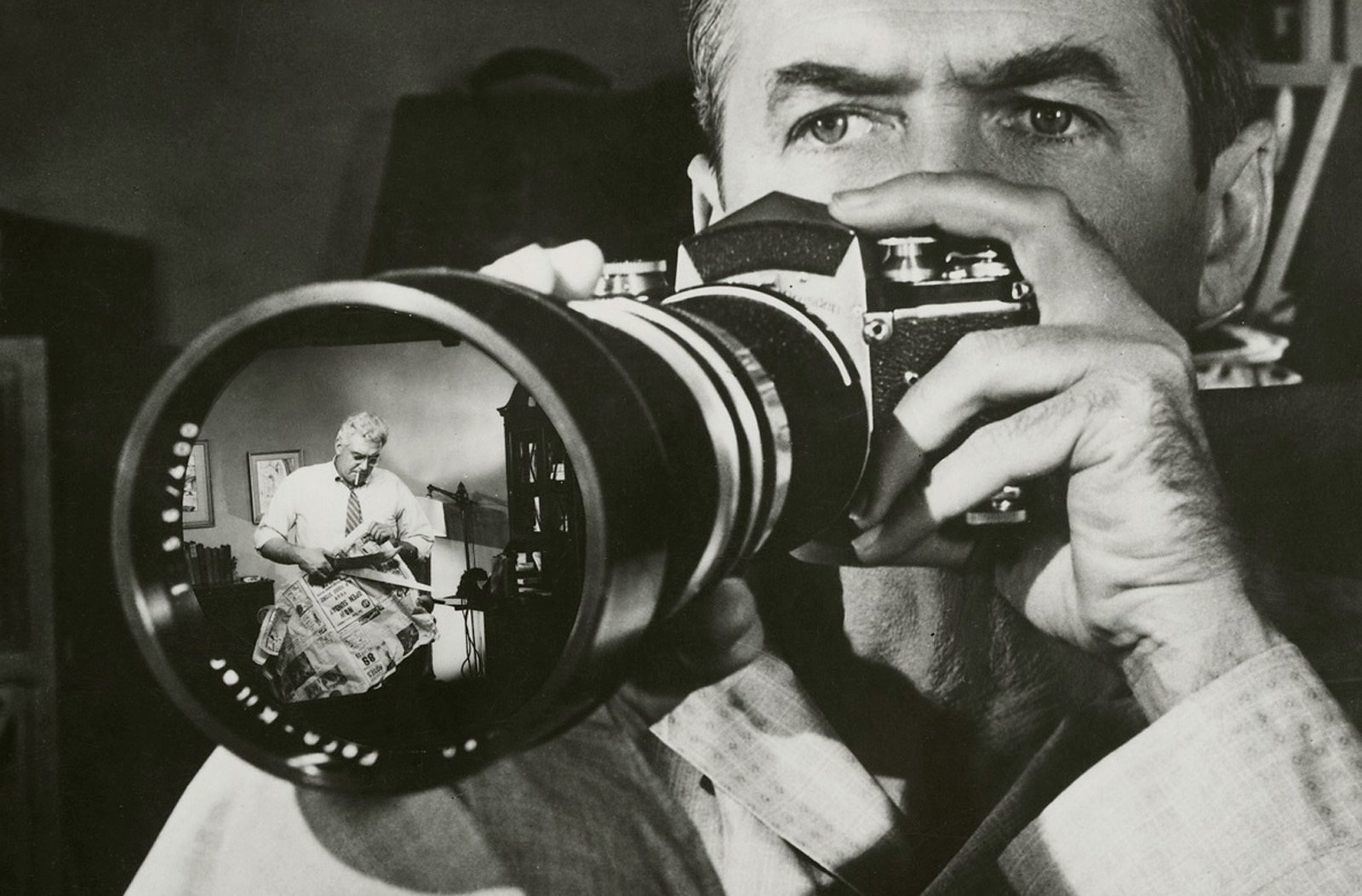
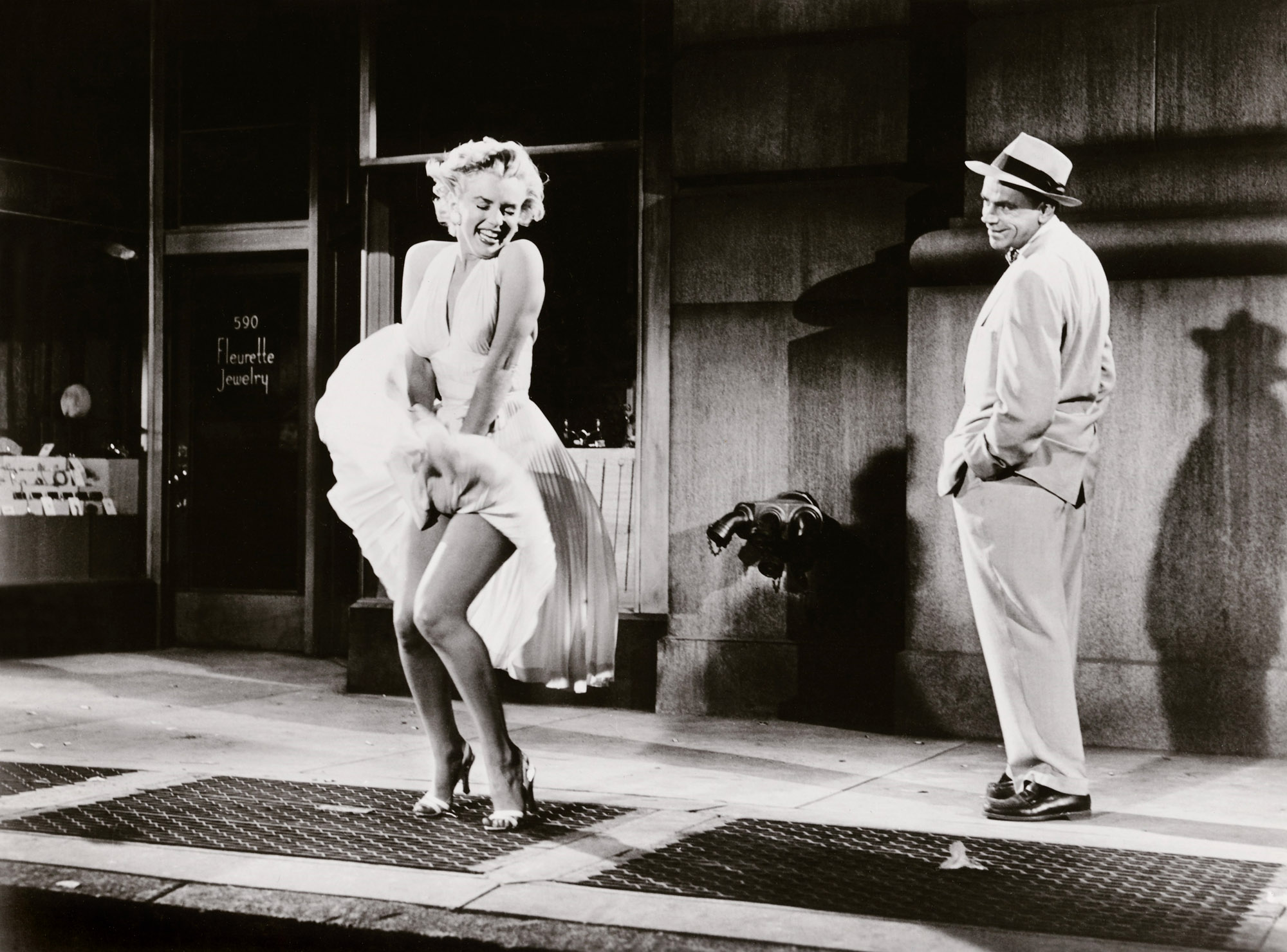
Who doesn’t know them: that picture from The Seven-Year Itch of a smiling Marilyn Monroe with her white dress blown upward by the air from a subway grate, or the photo of a conspiratorial James Stewart in Rear Window? Regardless of whether one has seen the actual movies, such images are familiar. It’s film stills like these that have burnt themselves into the collective memory and had a major impact on how their films are perceived.

Film stills embody visual traces of films as well as independent photographic images. Taken on set during production, they are based on an elaborate process in which film photographers re-stage film scenes for the still camera.

In the first-ever major exhibition devoted to this hybrid genre, the Albertina is showing 130 film stills taken between 1902 and 1975 in cooperation with the Austrian Film Museum. That was the period during which black-and-white film stills reached their highest level of technical and aesthetic quality, simultaneously covering a sweeping cross-section of various artistic movements from photographic and cinematic history such as Pictorialism and Expressionism. Employing pictures by Deborah Imogen Beer, Horst von Harbou, Pierluigi Praturlon, Karl Struss, and others, three aspects of this genre’s intermedial relationships are highlighted: the functions performed by film stills, the interfaces between photography and film with their breaks and couplings, and the additional artistic value of still photographs as such.

For the Media and the Press

The purpose of film stills is clearly defined: as material for the press and various types of advertising, they help to market films. And alongside their use in trailers, film journalism, and other marketing tools such as posters, film stills also represent a key ingredient of audience expectations pertaining to a film upon its release. Even so, it is the production of visually appealing images – rather than authentic reproduction of the film itself – that is important, here. In display windows and the media, still images visualise different aspects of a production ranging from key scenes to the actual filming work. This motivic variety corresponds to various film still categories: portrait photos of the actors and actresses taken by in-house studio photographers, as well as scene photos and making-of photos, are used in these contexts. And fed into numerous distribution processes, such photos also serve as models for posters, lobby cards, photo books, and press materials.

Intermediality and Self-Reflexivity

Film stills unite functional requirements with photographic and filmic intentions. And in fact, still photography is the only way in which to show visual traces of a production outside of the filmic event – the screening – itself. The challenges that photographers face in taking such shots lie in the difference between the media of moving (projected) film images and static (material) photography. In a complex and laborious process, they work on set to restage film scenes specifically for the still camera, thus transforming the film from a moving to a static medium.

The employment of various photographic strategies makes possible film stills’ “filmic” reception, with momentary photos that evoke a film’s dynamics being just as exemplary here as panoramic shots that require a longer look. Still photos thus repeat a film’s constituent elements, inscribing them onto a photographic medium in various ways and thus functioning as “intermediate images” that unite aspects of both media. They can be read not only as static views of a filmic reality, but also as independent types of photographic image. This quality is reinforced by the fact that stills frequently develop a filmic work further in an independent manner, thereby allowing it to be regarded from new perspectives. Such stills often contain self-reflexive commentary on the work’s specifically “filmic” aspects.

Film Stills at the Interface to Fine Art

Being situated between film and photography, many film stills also possess artistic qualities that are clearly photographic in nature. Here, composition plays a major role as it bears witness to a pictorial conception that differs from that of a filmic image. For while moving images are designed as horizontal arrangements, with the pictorial elements sequenced one after the other to effect their visual continuation, still photographers stage still photos according to the (static) central perspective governed by the camera’s vanishing point. This positions observers at that place which has been assigned them since the Renaissance – that is, looking straight down the picture’s central axis. Correspondingly, many stills exhibit reminiscences of the proscenium stage from traditional live theatre, favouring views that render scenes more immediate and thus more easily legible.

Photographers, in composing their images, often borrow iconographic and stylistic elements from various artistic movements: Expressionism, Art Nouveau, and Pictorialism are examples of these.

And in this way, still photographers depart from the original filmic work and realise their own pictorial ideas. Their photos thus refrain from “authentic” reproduction of a film’s various aspects, instead using these aspects to realise subjective artistic practices, thereby implying a reversal of the classic hierarchy between photography and film.

Press release from the Albertina


Paul Ronald (French, 1924-2015) Edra Gale in 'Otto e mezzo' (Edra Gale in '8½') 1963


Paul Ronald (French, 1924-2015)
Edra Gale in Otto e mezzo (Edra Gale in 8½)
1963
Director: Federico Fellini, 1963
Ekatchrome
© Archivio Storico del Cinema / AFE


8½ (Italian title: Otto e mezzo) is a 1963 comedy-drama film directed by Federico Fellini. Co-scripted by Fellini, Tullio Pinelli, Ennio Flaiano, and Brunello Rondi, it stars Marcello Mastroianni as Guido Anselmi, a famous Italian film director. Shot in black-and-white by cinematographer Gianni di Venanzo, the film features a soundtrack by Nino Rota with costume and set designs by Piero Gherardi.


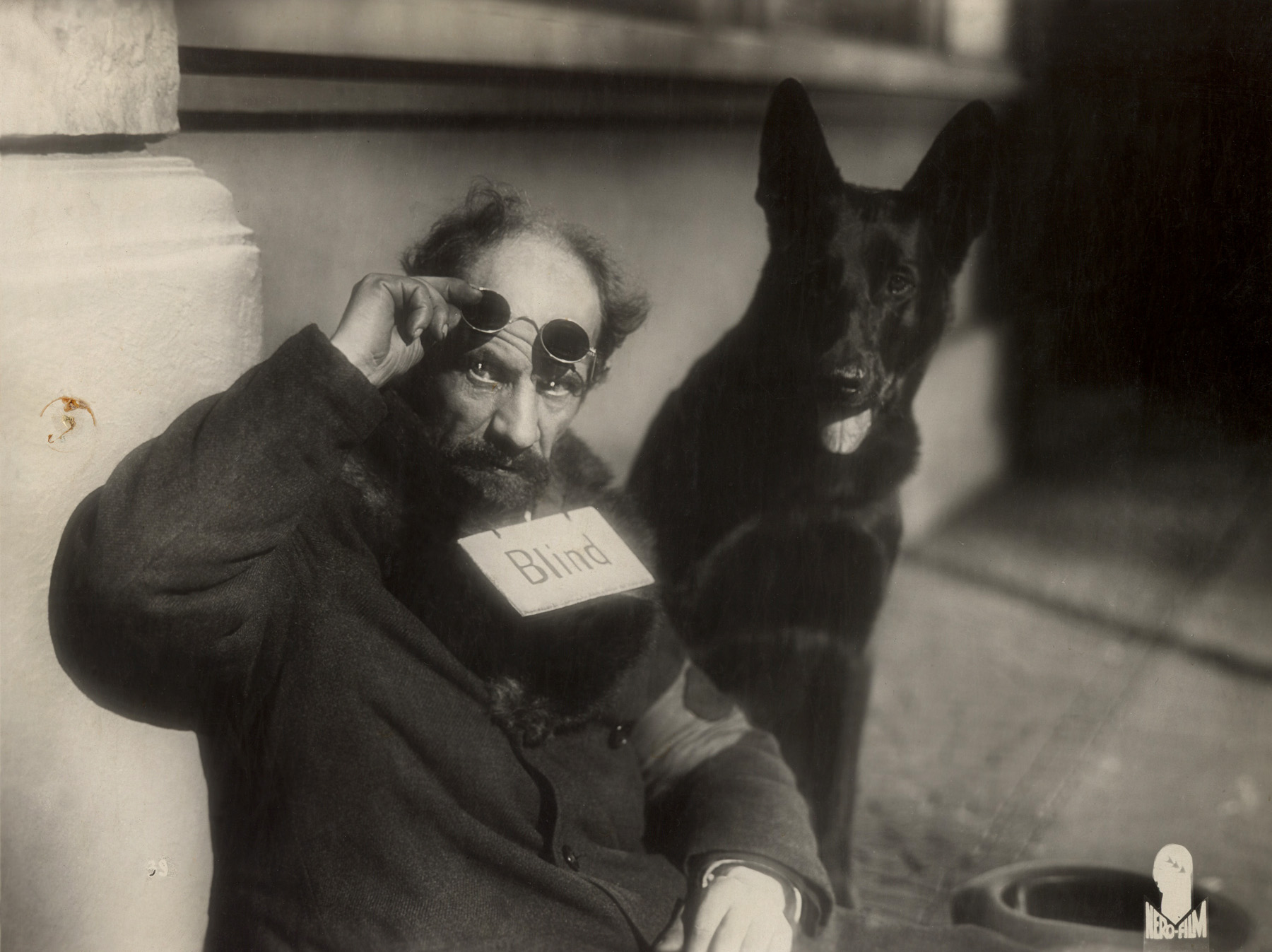
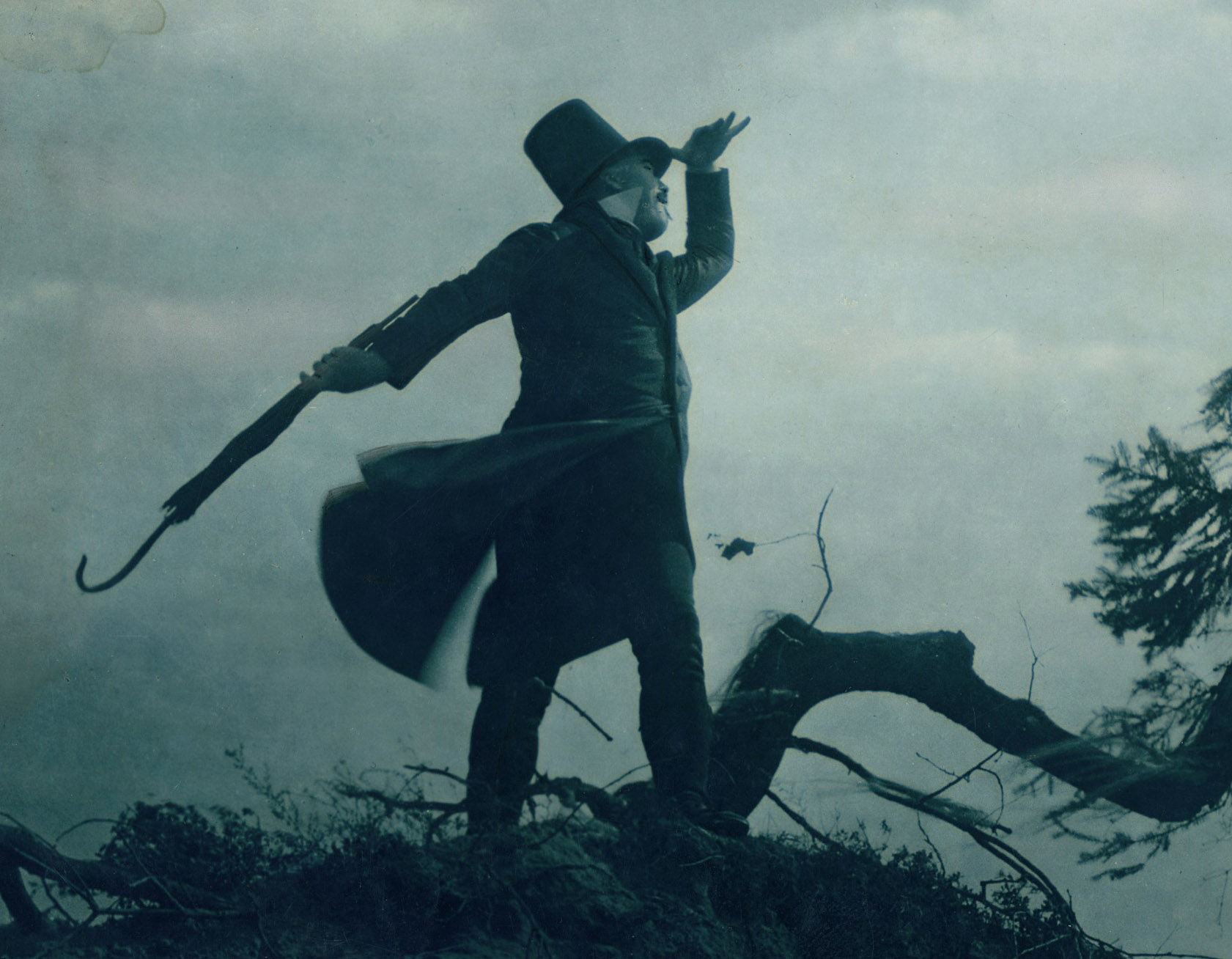
Horst von Harbou (German, 1879-1953) Georg John in 'M - A City searches for a Murderer' 1931


Horst von Harbou (German, 1879-1953)
Georg John in M – A City searches for a Murderer
1931
Gelatin silver print
Austrian Theatre Museum
© Horst von Harbou – Deutsche Kinemathek


M (German: M – Eine Stadt sucht einen Mörder – “M – A city looks for a murderer”) is a 1931 German drama-thriller film directed by Fritz Lang and starring Peter Lorre. It was written by Lang and his wife Thea von Harbou and was the director’s first sound film. It concerns the manhunt for a serial killer of children, conducted by both the police and the criminal underworld. Now considered a classic, the film was deemed by Fritz Lang as his finest work.

Little Elsie Beckmann leaves school, bouncing a ball on her way home. She is approached by Hans Beckert, who is whistling “In the Hall of the Mountain King” by Edvard Grieg. He offers to buy her a balloon from a blind street-vendor [above] and walks and talks with her. Elsie’s place at the dinner table remains empty, her ball is shown rolling away across a patch of grass and her balloon is lost in the telephone lines overhead.


M – A City Searches for a Murderer (M – Eine Stadt sucht einen Mörder) 1931 – Public Domain Movies

M (German: M – Eine Stadt sucht einen Mörder, lit. M – A City Searches for a Murderer) is a 1931 German thriller film directed by Fritz Lang and starring Peter Lorre in his breakthrough role as Hans Beckert, a serial killer of children. An early example of a procedural drama, the film centers on the manhunt for Lorre’s character, conducted by both the police and the criminal underworld.

The film’s screenplay was written by Lang and his wife Thea von Harbou and was the director’s first sound film. It features many cinematic innovations, including the use of long, fluid tracking shots, and a musical leitmotif in the form of “In the Hall of the Mountain King” whistled by Lorre’s character. Now considered a timeless classic, the film was deemed by Lang to be his magnum opus. It is widely considered one of the greatest films of all time, and an indispensable influence on modern crime and thriller fiction.

Anonymous text from the YouTube website [Online] Cited 20/02/2017. No longer available online.


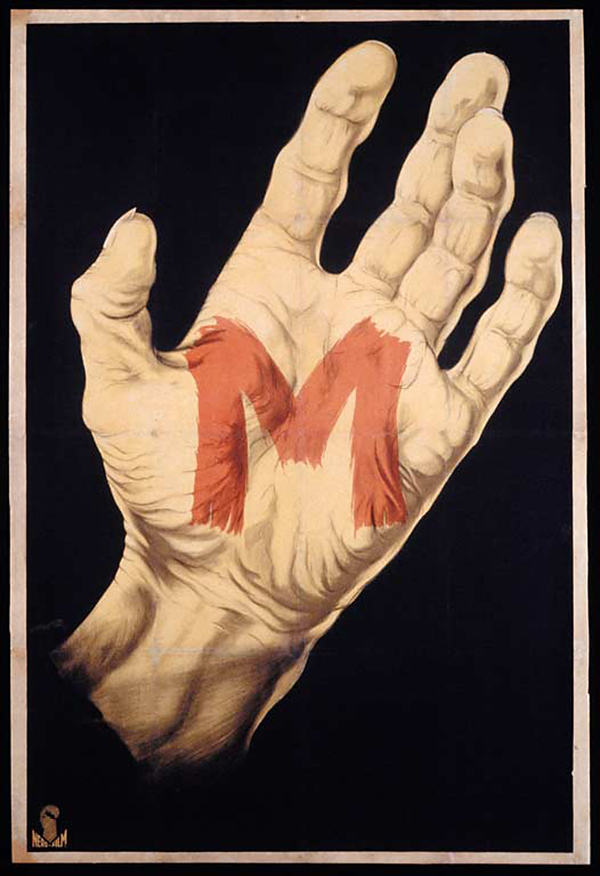
Unknown artist. 'Poster for "M"' 1931


Unknown artist
Poster for “M”
1931
Director: Fritz Lang (Austria, 1890-1976)
Collection of La Cinémathèque française


Wall texts

Advertising pictures

Aimed at inviting the public to buy a ticket, film stills were used as advertising photographs in cinema lobbies and as press material for the media. Directors and production companies depended on them for promoting their movies, because the film as a projected moving image is immaterial and does not exist beyond the screen. Stills comprise various types of pictures that show different aspects of a movie’s production: scenes, portraits of its actresses and actors, as well as production photographs capturing its shooting.

The production of stills was based on a division of labor. In major production companies like those of Hollywood, still photographers were assigned to the companies’ advertising or publicity departments. Sometimes involving the director, these departments selected the photographs intended for publication. The promotion photographs for the movie palaces’ lobbies were published in sets of twenty to forty pictures each, which visualised characteristic aspects of the film. A wider selection of stills was used for the press. Picture editors adapted the photographs according to their purposes. We find instructions for the material’s reproduction and cropping marks indicating new image areas; retouches deleted undesired elements and changed the motif in line with the planned layout.


Anonymous photographer. Still from 'The Night of the Hunter' 1954


Anonymous photographer
Still from The Night of the Hunter
1954
Silver gelatin print


Anonymous photographer. Robert Mitchum in 'The Night of the Hunter' 1955


Anonymous photographer
Robert Mitchum in The Night of the Hunter
1955
Director: Charles Laughton (English, 1899-1962)
Gelatin silver print
© The John Kobal Collection


The Night of the Hunter is a 1955 American film noir directed by Charles Laughton and starring Robert Mitchum, Shelley Winters and Lillian Gish. The screenplay by James Agee was based on the 1953 novel of the same name by Davis Grubb. The plot focuses on a corrupt reverend-turned-serial killer who attempts to charm an unsuspecting widow and steal $10,000 hidden by her executed husband.

The novel and film draw on the true story of Harry Powers, hanged in 1932 for the murder of two widows and three children in Clarksburg, West Virginia. The film’s lyrical and expressionistic style with its leaning on the silent era sets it apart from other Hollywood films of the 1940s and 1950s, and it has influenced later directors such as David Lynch, Martin Scorsese, Terrence Malick, Jim Jarmusch, Spike Lee, and the Coen brothers.

In 1992, The Night of the Hunter was deemed “culturally, historically, or aesthetically significant” by the United States Library of Congress and was selected for preservation in the National Film Registry. The influential film magazine Cahiers du cinéma selected The Night of the Hunter in 2008 as the second-best film of all time, behind Citizen Kane.

Text from the Wikipedia website


'The Night of the Hunter' film poster 1955


The Night of the Hunter film poster 1955


Anonymous photographer. Still from the film 'Vertigo, Judy behind Madeleine' 1957/1958


Anonymous photographer
Still from the film Vertigo, Judy behind Madeleine
1957/1958
Director: Alfred Hitchcock (English, 1899-1980)
Silver gelatin print


'Vertigo' film poster 1957/1958


Vertigo film poster 1957/1958


Bud Fraker (attributed to) (American, 1916-2002) 'Janet Leigh, Vera Miles and John Gavin in 'Psycho'' 1960


Bud Fraker (attributed to) (American, 1916-2002)
Janet Leigh, Vera Miles and John Gavin in Psycho
1960
Director: Alfred Hitchcock (English, 1899-1980)
Gelatin silver print
© Berlin, Deutsche Kinemathek – Paramount Pictures


Star portraits

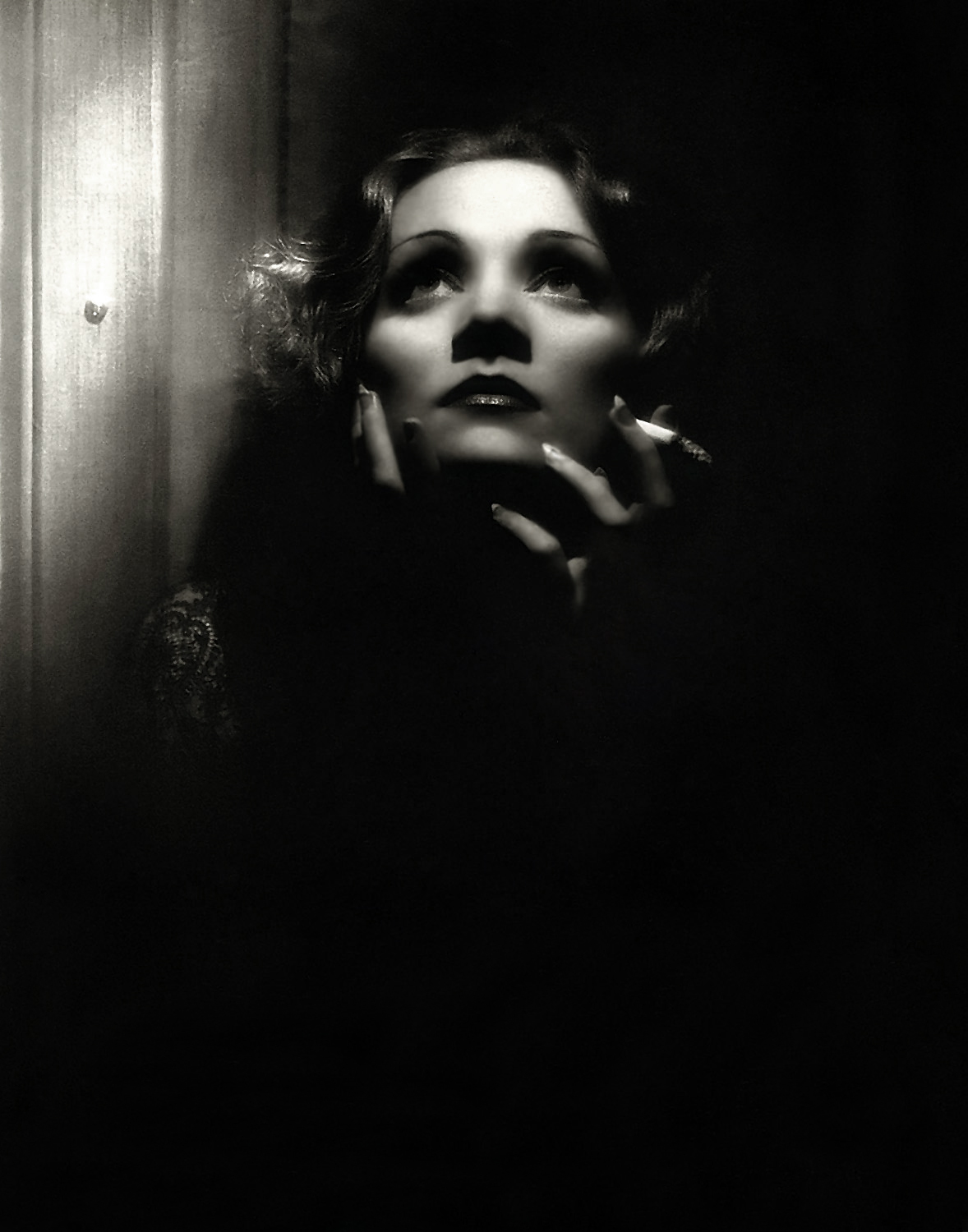
Regarded as the supreme discipline of still photography, the portraiture of stars was an integral part of the film industry’s elaborate promotion campaigns. Productions could be effectively marketed by using actresses and actors to project their image. With the emergence of the studio system, Hollywood perfected this business strategy from the 1920s on by employing specialised portrait photographers. These photographers worked in company-owned studios and – unlike set photographers who mostly remained anonymous – were known by name. Relying on sophisticated lighting and drastic retouching, they created the aesthetic of the glamour portrait. Don English perfectly translated the lighting as it had been exactly planned by Josef von Sternberg, the director, for his film in his portrait of Marlene Dietrich for Shanghai Express (1932). Generally, domestic production companies could not afford to run their own portrait studios and were thus unable to exercise any influence on photographic products from outside. This offered both the stars and the studios a certain degree of freedom when it came to the representation and interpretation of a certain look. The photograph taken of Hedy Kiesler (later Lamarr) in her role in Gustav Machatý’s Ecstasy (1933) by the renowned studio Manassé in Vienna is one of the rare portrait stills taken on the set at that time.


Karl Struss (American, 1886-1981) 'Gloria Swanson in 'Male and Female'' 1919


Karl Struss (American, 1886-1981)
Gloria Swanson in Male and Female
1919
Director: Cecil B. DeMille (American, 1881-1959)
Gelatin silver print
© The John Kobal Foundation


Don English (American, 1901-1964) 'Marlene Dietrich in 'Shanghai Express'' 1932


Don English (American, 1901-1964)
Marlene Dietrich in Shanghai Express
1932
Director: Josef von Sternberg (American born Austria, 1894-1969)
Silver gelatin print


Raymond Cauchetier (French, born 1920) 'Jean Paul Belmondo & Jean Seberg, Paris, 1959' 1959


Raymond Cauchetier (French, 1920-2021)
Jean Paul Belmondo & Jean Seberg, Paris, 1959
1959
Still from the film Breathless
Director: Jean-Luc Godard (French-Swiss, 1930-2022)
Gelatin silver print


'Breathless' film poster 1960


Breathless film poster 1960


Anonymous photographer. 'Still from the film 'Breathless'' 1959


Anonymous photographer
Still from the film Breathless
1959
Director: Jean-Luc Godard (French-Swiss, 1930-2022)
Gelatin silver print


Georges Pierre (French, 1921-2003) 'Delphine Seyrig in 'Last Year in Marienbad'' 1961


Georges Pierre (French, 1921-2003)
Delphine Seyrig in Last Year in Marienbad
1961
Director: Alain Resnais (French, 1922-2014)
Astor Pictures Corporation / Photofest
© Astor Pictures Corporation


Delphine Claire Beltiane Seyrig (10 April 1932 – 15 October 1990) was a Lebanese-born French stage and film actress, a film director and a feminist.

As a young woman, Seyrig studied acting at the Comédie de Saint-Étienne, training under Jean Dasté, and at Centre Dramatique de l’Est. She appeared briefly in small roles in the 1954 TV series Sherlock Holmes. In 1956, she returned to New York and studied at the Actors Studio. In 1958 she appeared in her first film, Pull My Daisy. In New York she met director Alain Resnais, who asked her to star in his film Last Year at Marienbad. Her performance brought her international recognition and she moved to Paris. Among her roles of this period is the older married woman in François Truffaut’s Baisers volés (1968).

During the 1960s and 1970s, Seyrig worked with directors including Truffaut, Luis Buñuel, Marguerite Duras, and Fred Zinnemann, as well as Resnais. She achieved recognition for both her stage and film work, and was named best actress at the Venice Film Festival for her role in Resnais’ Muriel ou Le temps d’un retour (1963). She played many diverse roles, and because she was fluent in French, English and German, she appeared in films in all three languages, including a number of Hollywood productions.

Text from the Wikipedia website


L’Année dernière à Marienbad (released in the US as Last Year at Marienbad and in the UK as Last Year in Marienbad) is a 1961 French-Italian film directed by Alain Resnais from a screenplay by Alain Robbe-Grillet.

Last Year at Marienbad is famous for its enigmatic narrative structure, in which truth and fiction are difficult to distinguish, and the temporal and spatial relationship of the events is open to question, even if it never quite ventures into surrealism. The film’s dreamlike nature has both fascinated and baffled viewers; many have hailed the work as a masterpiece, while others consider it incomprehensible.

At a social gathering at a château or baroque hotel, a man approaches a woman. He claims they met the year before at Marienbad and is convinced that she is waiting there for him. The woman insists they have never met. A second man, who may be the woman’s husband, repeatedly asserts his dominance over the first man, including beating him several times at a mathematical game (a version of Nim). Through ambiguous flashbacks and disorienting shifts of time and location, the film explores the relationships among the characters. Conversations and events are repeated in several places in the château and grounds, and there are numerous tracking shots of the château’s corridors, with ambiguous voiceovers. The characters are unnamed in the film; in the published screenplay, the woman is referred to as “A”, the first man is “X”, and the man who may be her husband is “M”.

Text from the Wikipedia website


'L'Année dernière à Marienbad' Japanese film poster 1961


L’Année dernière à Marienbad Japanese film poster 1961


Artistic pictures

Until the 1950s still photographers used large-format plate cameras, which projected an inverted image onto the focusing screen at the back of the body. These cameras produced technically brilliant pictures, yet were complicated to handle because of their size and comparatively long exposure times. The staging of stills had to be meticulously planned and was fundamentally different from the shooting of a film. While the film camera is geared to the story in motion and its visual continuation in the pictures to follow, actresses and actors posed for the photographer in tableaux-vivants-like arrangements using additional light. The resultant static and apparently artificial compositions mirroring the performative staging process are typical of this kind of photographs. Still photographers drew inspiration from works of art for their mise-en-scène. The anonymous photographer in charge of the stills for Henrik Galeen’s The Student of Prague (1926) quotes the Romantic painter Caspar David Friedrich’s works in his theatrical presentation of an atmospheric landscape. Horst von Harbou, who frequently worked with the director Fritz Lang, drew on Carl Otto Czeschka’s Jugendstil [Art Noveau] illustrations from 1908 for his stills accompanying the first part of Die Nibelungen (1924). Harbou translated ornamental motifs into two-dimensional pictures, as Czeschka had done before him. Presenting their pictures in exhibitions and providing fine-art prints, still photographers positioned their works as artistically independent achievements.


Anonymous photographer. 'Werner Krauss in 'The Student of Prague'' 1926


Anonymous photographer
Werner Krauss in The Student of Prague
1926
Gelatin silver print
Austrian Theatre Museum


Anonymous photographer. 'Werner Krauss in 'The Student of Prague'' 1926 (detail)


Anonymous photographer
Werner Krauss in The Student of Prague (detail)
1926
Gelatin silver print
Austrian Theatre Museum


Intermediate pictures

The difficulty in capturing the scene of a movie in a still lies in the difference between the two media of (moving) film and (static) photograph. Still photographers employ intermedia strategies which facilitate a reading of the still in analogy to the experience of the film. Snapshots evoking the dynamics of the movie are as exemplary of this approach as are series of pictures rendering a sequence in the form of the movement’s individual phases captured at short intervals. Panorama pictures are also related to the film’s spatial and temporal dimensions, since a series of motifs resembling the chronological order of films successively “unwinds” in reading them. Informed by the interwar avant-garde, the photo montages for Walter Ruttmann’s experimental film Berlin – Symphony of a Great City (1927) show an extraordinary solution. They congenially transform the subjective modern filmic point of view by relating the motifs of the film to each other through illogical perspectives and proportions. Some of Horst von Harbou’s stills for Metropolis (1927) were produced as transparent foils and elaborately coloured by hand. Presented in backlight illumination, they established a self-reflexive reference to the cinema as films also reveal their ephemeral quality in their projection.


Anonymous photographer. 'Berlin – Symphony of a Great City' 1927


Anonymous photographer
Berlin – Symphony of a Great City
1927
Director: Walther Ruttmann (German, 1887-1941)
Gelatin silver print
© Deutsche Kinemathek, Berlin


Berlin: Symphony of a Metropolis (German: Berlin: Die Sinfonie der Großstadt) is a 1927 German film directed by Walter Ruttmann, co-written by Carl Mayer and Karl Freund.

The film is an example of the city symphony film genre. A musical score for an orchestra to accompany the silent film was written by Edmund Meisel. As a “city symphony” film, it portrays the life of a city, mainly through visual impressions in a semi-documentary style, without the narrative content of more mainstream films, though the sequencing of events can imply a kind of loose theme or impression of the city’s daily life…

The film displays the filmmaker’s knowledge of Soviet montage theory. Some socialist political sympathies, or identification with the underclass can be inferred from a few of the edits in the film, though critics have suggested that either Ruttmann avoided a strong position, or else he pursued his aesthetic interests to the extent that they diminished the potential for political content. Ruttmann’s own description of the film suggests that his motives were predominantly aesthetic: “Since I began in the cinema, I had the idea of making something out of life, of creating a symphonic film out of the millions of energies that comprise the life of a big city.”

Text from the Wikipedia website


'Berlin: Symphony of a Metropolis' poster


Berlin: Symphony of a Metropolis poster


Horst von Harbou (German, 1879-1953) 'Brigitte Helm in 'Metropolis'' 1927


Horst von Harbou (German, 1879-1953)
Brigitte Helm in Metropolis
1927
Director: Fritz Lang (Austrian-German-American, 1890-1976)
Gelatin silver print
Austrian Theatre Museum
© Horst von Harbou – Deutsche Kinemathek


Horst von Harbou (German, 1879-1953) 'Metropolis' 1927


Horst von Harbou (German, 1879-1953)
Metropolis
1927
Director: Fritz Lang (Austrian-German-American, 1890-1976)
Coloured transparent nitrocellulose film
Austrian Theatre Museum
© Horst von Harbou – Deutsche Kinemathek


Meta-pictures

Some directors supported the production of stills that put characteristic aspects of their films into a new perspective. In his masterpiece Persona (1966) Ingmar Bergman reflects the support material of film by showing the film strip crack and burn up during the projection. This self-referentiality of the medium was visualised by adding perforations to the photographs so that they resembled film frames. The perforations only served to quote the film as a medium; the motifs were actually mounted in black frames afterwards. Elaborate montages not to be seen in the film were also produced for Alfred Hitchcock’s movies. Rear Window (1954) confronts us with a photographer who watches a man whom he suspects of having committed a murder with binoculars and through a long-focus lens. By mounting pictures of the persons in the lens whom Stewart watches from his window in the film, the still photographer emphasised the issue of voyeurism as a central subject of the movie. The Austrian silent movie director Erich von Stroheim used film stills for visualising contents of his films that were regarded as problematic. Because of their length and supposedly questionable sexual passages Stroheim’s movies were regularly cut down by censorship authorities and production companies. This is why stills continuing the movie were planned in advance. The sexual allusions in a scene of Foolish Wives (1922) in which Stroheim embodies a Don Juan figure about to indecently assault a sleeping woman, for example, manifested themselves in a still in which we see him kissing the sleeping woman’s foot.


Anonymous photographer. 'James Stewart in 'Rear Window'' 1954


Anonymous photographer
James Stewart in Rear Window
1954
Director: Alfred Hitchcock (English, 1899-1980)
Gelatin silver print
© BFI National Archive: London


Anonymous photographer. 'James Stewart in 'Rear Window'' 1954 (detail)


Anonymous photographer
James Stewart in Rear Window (detail)
1954
Director: Alfred Hitchcock (English, 1899-1980)
Gelatin silver print
© BFI National Archive: London


Anonymous photographer. 'Liv Ullman in 'Persona'' 1966 (detail)


Anonymous photographer
Liv Ullman in Persona (detail)
1966
Director: Ingmar Bergman
Silver gelatin print


Persona is a 1966 Swedish psychological drama film written and directed by Ingmar Bergman and starring Bibi Andersson and Liv Ullmann. Persona’s story revolves around a young nurse named Alma (Andersson) and her patient, a well-known stage actress named Elisabet Vogler (Ullmann), who has suddenly ceased to speak. The two move to a cottage, where Alma cares for and talks to Elisabet about intimate secrets, and becomes troubled distinguishing herself from her.

Bergman wrote the film with Ullmann and Andersson in mind for the lead parts, and some idea of exploring their identities, and shot the film in Stockholm and Fårö. Often categorised as a psychological horror, Persona deals with themes of duality, insanity, and personal identity…

Persona has lent itself to a variety of interpretations, with Professor Thomas Elsaesser remarking it “has been for film critics and scholars what climbing Everest is for mountaineers: the ultimate professional challenge. Besides Citizen Kane, it is probably the most written-about film in the canon.” Much of the focus has been on the resemblance of the characters, demonstrated in shots of overlapping faces, and the possibility that the two characters are one. If they are one person, there is a question if Alma is fantasising about the actress she admires, or if Elisabet is examining her psyche, or if the boy is trying to understand who his mother is. In a question of duality, Alma represents soul while Elisabet represents a stern goddess. Susan Sontag suggests that Persona is constructed as a series of variations on a theme of “doubling”. The subject of the film, Sontag proposes, is “violence of the spirit”.

Text from the Wikipedia website


'Persona' 1966 Swedish B1 Poster


Persona 1966 Swedish B1 Poster


Anonymous photographer. 'Bibi Andersson and Liv Ullman in 'Persona'' 1966 (detail)


Anonymous photographer
Bibi Andersson and Liv Ullman in Persona (detail)
1966
Director: Ingmar Bergman (Swedish, 1918-2007)
Silver gelatin print


Key pictures

Stills precede the presentation of a film, decisively informing the expectations held by the public at the time of its release. What is important for a movie’s later success (or failure) is presenting visually enticing pictures rather than conveying an authentic picture of the movie. The most famous example in this regard is Sam Shaw’s still showing a scene of Billy Wilder’s The Seven Year Itch (1955). Shaw highlighted the moment in which Marilyn Monroe stands on a subway grating far more pointedly than Wilder in the film, which neither shows the actress’s whole figure nor the dress billowing so clearly above her waist. The production company did its best for the promotion of the scene in the media: launching an elaborate publicity campaign, it fixed a special date for reporters and journalists to capture the sequence themselves. Such key images become characteristic signatures of a film with their dissemination by the media, sometimes inscribing themselves more deeply into the collective memory than the actual film scenes because of their iconic recognition value.


Anonymous photographer. 'Werner Krauss, Conrad Veidt and Lil Dagover in 'The Cabinet of Dr. Caligari'' 1919


Anonymous photographer
Werner Krauss, Conrad Veidt and Lil Dagover in The Cabinet of Dr. Caligari
1919
Director: Robert Wiene (German, 1873-1938)
Gelatin silver print
Austrian Theatre Museum


Anonymous photographer. Werner Krauss, Conrad Veidt and Lil Dagover in 'The Cabinet of Dr. Caligari' 1919 (detail)


Anonymous photographer
Werner Krauss, Conrad Veidt and Lil Dagover in The Cabinet of Dr. Caligari (detail)
1919
Director: Robert Wiene (German, 1873-1938)
Gelatin silver print
Austrian Theatre Museum


The Cabinet of Dr. Caligari (German: Das Cabinet des Dr. Caligari) is a 1920 German silent horror film, directed by Robert Wiene and written by Hans Janowitz and Carl Mayer. Considered the quintessential work of German Expressionist cinema, it tells the story of an insane hypnotist (Werner Krauss) who uses a somnambulist (Conrad Veidt) to commit murders. The film features a dark and twisted visual style, with sharp-pointed forms, oblique and curving lines, structures and landscapes that lean and twist in unusual angles, and shadows and streaks of light painted directly onto the sets…

The film presents themes on brutal and irrational authority; Dr. Caligari represents the German war government, and Cesare is symbolic of the common man conditioned, like soldiers, to kill. In his influential book From Caligari to Hitler, Siegfried Kracauer says the film reflects a subconscious need in German society for a tyrant, and it is an example of Germany’s obedience to authority and unwillingness to rebel against deranged authority. He says the film is a premonition of the rise of Adolf Hitler and the Nazi Party, and says the addition of the frame story turns an otherwise “revolutionary” film into a “conformist” one. Other themes of the film include the destabilised contrast between insanity and sanity, the subjective perception of reality, and the duality of human nature.

Text from the Wikipedia website


'Das Cabinet des Dr. Caligari' poster (1919)


Das Cabinet des Dr. Caligari poster (1919)


Sam Shaw (American, 1912-1999) 'Marilyn Monroe and Tom Ewell in 'The Seven Year Itch'' 1954


Sam Shaw (American, 1912-1999)
Marilyn Monroe and Tom Ewell in The Seven Year Itch
1954
Director: Billy Wilder (Austrian-American, 1906-2002)
Gelatin silver print
© Sam Shaw Inc. – licensed by Shaw Family Archives
Private collection


Sam Shaw (American, 1912-1999) 'Marilyn Monroe and Tom Ewell in 'The Seven Year Itch'' 1954 (detail)


Sam Shaw (American, 1912-1999)
Marilyn Monroe and Tom Ewell in The Seven Year Itch (detail)
1954
Director: Billy Wilder (Austrian-American, 1906-2002)
Gelatin silver print
© Sam Shaw Inc.- licensed by Shaw Family Archives, Private collection


Auteur pictures

The European auteur cinema of the 1950s and 1960s produced films outside the rigid studio system that had been the rule until then. Formal means such as editing and montage were used in an experimental way, and handy cameras made the shooting process more spontaneous. The changes in the production of films went hand in hand with new conditions for still photographers. As the photographers did not belong to the staff of the companies’ promotion departments like their US colleagues, most of their names are known. Whereas Hollywood photographers relied on large-format plate cameras, small-format cameras were used in Europe during the shooting of the film or directly before or after it. This resulted in spontaneous snapshots alongside traditional tableau-like stills. In the wake of Henri Cartier-Bresson’s decisive moment, the constitutive act lay in the choice of the right moment. Still photographers such as Raymond Cauchetier and Angelo Novi had already tested this approach as photojournalists in reportages and documentaries before they started working on the set.


Georges Pierre (French, 1921-2003) 'Anna Karina in 'Pierrot le fou'' 1965


Georges Pierre (French, 1921-2003)
Anna Karina in Pierrot le fou
1965
Director: Jean-Luc Godard (French-Swiss, b. 1930)
Gelatin silver print
Private collection
© Georges Pierre


Poster for 'La Dolce Vita' (The Sweet Life) 1959


Poster for La Dolce Vita (The Sweet Life) 1959


Pierluigi Praturlon (Italian, 1924-1999) 'Anita Ekberg as Sylvia in 'La Dolce Vita' (The Sweet Life)' 1959


Pierluigi Praturlon (Italian, 1924-1999)
Anita Ekberg as Sylvia in La Dolce Vita (The Sweet Life)
1959
Director: Federico Fellini (Italian, 1920-1993)
Gelatin silver print
Private Collection


La Dolce Vita (Italian for “the sweet life” or “the good life”) is a 1960 Italian comedy-drama film directed and co-written by Federico Fellini. The film follows Marcello Rubini, a journalist writing for gossip magazines, over seven days and nights on his journey through the “sweet life” of Rome in a fruitless search for love and happiness. La Dolce Vita won the Palme d’Or (Golden Palm) at the 1960 Cannes Film Festival and the Oscar for Best Costumes, and remains one of the most critically acclaimed films of all time.

Based on the most common interpretation of the storyline, the film can be divided into a prologue, seven major episodes interrupted by an intermezzo, and an epilogue. If the evenings of each episode were joined with the morning of the respective preceding episode together as a day, they would form seven consecutive days, which may not necessarily be the case.

Text from the Wikipedia website


Hans Natge

Born in Berlin, Hans Natge began his career as a theatre photographer. In the 1920s, he turned to still photography. Taking pictures of Friedrich Wilhelm Murnau’s Faust (1926), he came to test a new photographic approach which he called “snapshot photography,” which was to revolutionise the tradition of static and artificial film stills. Using small-format cameras and doing without additional light, Natge photographed during the shooting of the film right next to the cameraman, which permitted him to produce spontaneous and dynamic pictures. As this form of still photography still resulted in blurred pictures and sometimes captured the actors to their disadvantage at that time, Natge also took conventional stills in the case of Faust.


Hans Natge (Germany, b. 1893) 'Still from the film 'Faust'' 1926


Hans Natge (Germany, b. 1893)
Still from the film Faust
1926
Director: Friedrich Wilhelm Murnau (German, 1888-1931)
Gelatin silver print


Albertina
Albertinaplatz 1
1010 Vienna, Austria
Phone: +43 (0)1 534 83-0

Opening hours:
Daily 10am – 6pm
Wednesday and Friday 10am – 9pm
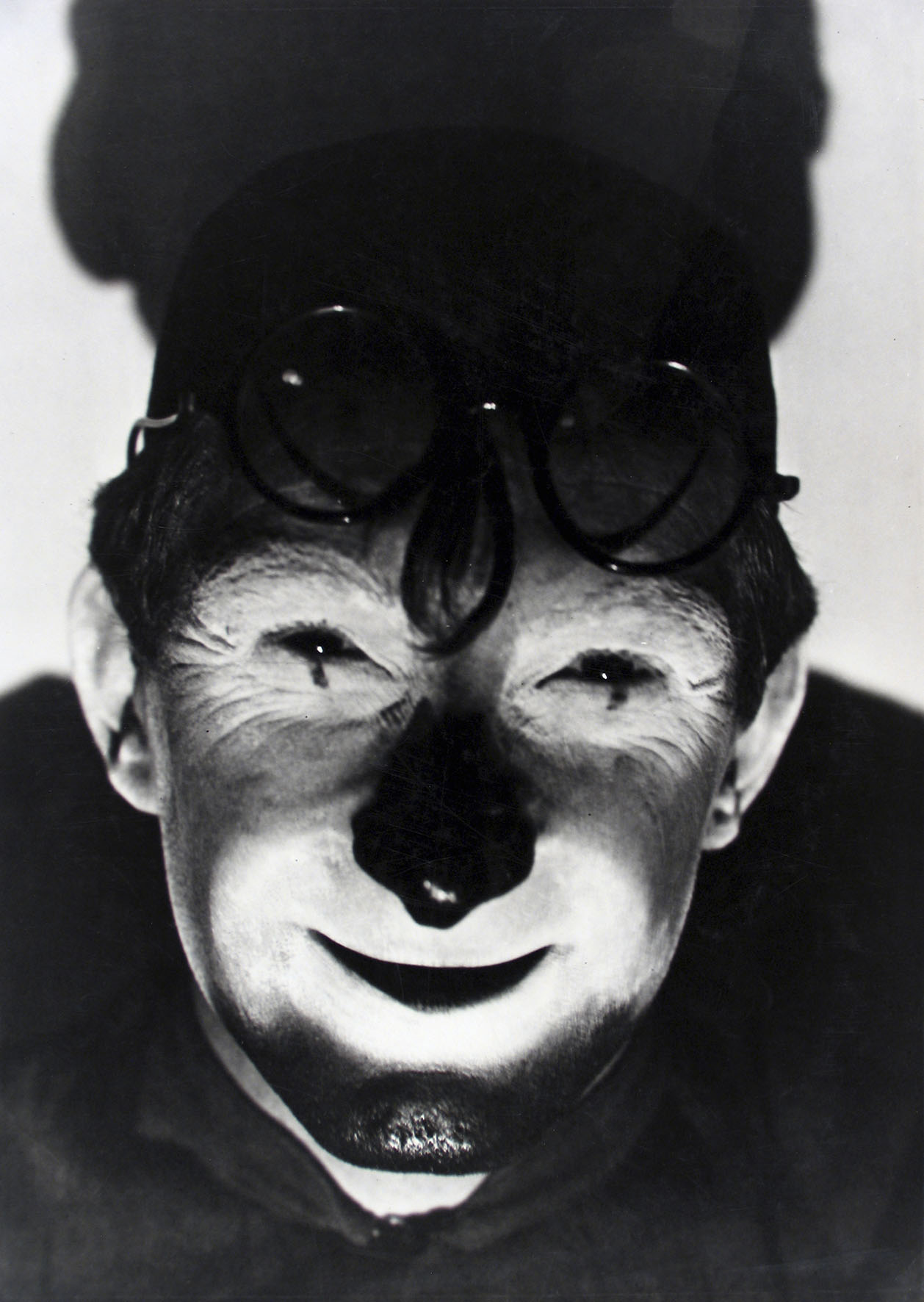
Albertina website

LIKE ART BLART ON FACEBOOK

Back to top

Exhibition: ‘The Body as Protest’ at the Albertina, Vienna

Exhibition dates: 5th September – 2nd December, 2012

Curator: Klaus Albrecht Schröder, Director of the Albertina


Ishiuchi Miyako (Japanese, b. 1947) '1906#38' Nd from the exhibition 'The Body as Protest' at the Albertina, Vienna, September - December, 2012


Ishiuchi Miyako (Japanese, b. 1947)
1906#38
Nd
Courtesy by The Third Gallery Aya


“The past neglect of the body in social theory was a product of Western mind-body dualism that divided human experience into bodily and cognitive realms. The knowledge-body distinction identifies knowledge, culture, and reason with masculinity and identifies body, nature, and emotion with femininity. Viewing human reason as the principal source of progress and emancipation, it perceives “the rational” as separate from, and exalted over, the corporeal. In other words, consciousness was grasped as separate from and preceding the body (Bordo 1993; Davis 1997). Following feminist thinking about women’s bodies in patriarchal societies, contemporary social theories shifted focus from cognitive dimensions of identity construction to embodiment in the constitution of identities (Davis 1997). Social construction theories do not view the body as a biological given but as constituted in the intersection of discourse, social institutions, and the corporeality of the body. Body practices, therefore, reflect the basic values and themes of the society, and an analysis of the body can expose the intersubjective meaning common to society. At the same time, discourse and social institutions are produced and reproduced only through bodies and their techniques (Frank 1991, 91). Thus, social analysis has expanded from studying the body as an object of social control and discipline “in order to legitimate different regimes of domination” (Bordo 1993; Foucault 1975, 1978, 1980) to perceiving it as a subject that creates meaning and performs social action (Butler 1990). The body is understood as a means for self-expression, an important feature in a person’s identity project (Giddens 1991), and a site for social subversiveness and self-empowerment (Davis 1997).”


Orna Sasson-Levy and Tamar Rapoport. “Body, Gender, and Knowledge in Protest Movements: The Israeli Case,” in ‘Gender & Society’ 17, 2003, p. 381. No longer available online. Used under fair use conditions for the purposes of education and research


Despite my great admiration for John Coplans’ photographs of his body, on the evidence of these press photographs and the attached video, this exhibition seems a beautiful if rather tame affair considering the subject matter.

Of course these photographs of the body can be understood as a means for self-expression and self-empowerment but there seems little social subversiveness in the choice of work on display.

The two Mapplethorpe’s are stylised instead of stonkingly subversive. The exhibition could have been taken photographs from his ‘X’ portfolio (the self portrait of him with a bull whip up his arse would have been particularly pleasing to see in this context). The exhibition could also have included some of the many artists using the body as protest during the AIDS crisis (perhaps some photographs by David Wojnarowicz or William Yang’s Sadness), the famous Burning Monk – The Self-Immolation (1963) by Malcolm Browne, photographs by Stellarc, Arthur Tress, Duane Michals, Nan Goldin, Diane Arbus, Francesca Woodman, Sally Mann, Cindy Sherman to name but a few; even the Farm Security Administration photographs of share cropper families by Walker Evans and Dorothea Lange would have had more impact than some of the photographs on display here.

Having not seen the entire exhibition it is hard to give an overall reading, but on the selection presented here it would seem that this was a missed opportunity, an exhibition where the body did not protest enough.

Dr Marcus Bunyan


Many thankx to the Albertina, Vienna for allowing me to publish the photographs in the posting. Please click on the photographs for a larger version of the image.


theartVIEw – The Body as Protest at ALBERTINA


Bruce Nauman (American, b. 1941) 'Studies for Holograms' Siebdruck, 1970


Bruce Nauman (American, b. 1941)
Studies for Holograms
Siebdruck, 1970
© VBK, Wien 2012
Foto: © Rheinisches Bildarchiv Köln


Ketty La Rocca (Italian, 1938-1976) 'Le mie parole e tu' 1974 from the exhibition 'The Body as Protest' at the Albertina, Vienna, September - December, 2012


Ketty La Rocca (Italian, 1938-1976)
Le mie parole e tu
1974
Courtesy Private Collection, Austria


Robert Mapplethorpe (American, 1946-1989) 'Vincent' 1981


Robert Mapplethorpe (American, 1946-1989)
Vincent
1981
Silver gelatin paper
© Robert Mapplethorpe Foundation


Hannah Villiger (Swiss, b. 1974) 'Block XXX' 1993-1994


Hannah Villiger (Swiss, b. 1974)
Block XXX
1993-1994
© The Estate of Hannah Villiger


John Coplans (British, 1920-2003) 'Self Portrait Interlocking Fingers No 6' 1999


John Coplans (British, 1920-2003)
Self Portrait Interlocking Fingers No 6
1999
Silver gelatin paper
Albertina, Wien


The exhibition The Body as Protest highlights the photographic representation of the human body – a motif that has provided a wide variety of photographers with an often radical means of expression for their visual protest against social, political, but also aesthetic norms.

The show centres on an outstanding group of works by the artist John Coplans from the holdings of the Albertina. In his serially conceived large-format pictures, the photographer focused on the rendering of his own nude body, which he defamiliarised through fragmentation far from current forms of idealisation. Relying on extremely sophisticated lighting, he presented himself in a monumental and sculptural manner over many years. His photographs can be understood as amalgamations of theoretical and artistic ideas, which in the show are accentuated through selective juxtapositions with works by other important exponents of body-related art.

The body also features prominently in the work of other artists such as Hannah Wilke, Ketty La Rocca, Hannah Villiger, Vito Acconci, Bruce Nauman, Robert Mapplethorpe, and Miyako Ishiuchi. By means of these positions, such diverse themes as self-dramatisation, conceptual photography, feminism, body language, and even transience are analysed within an expanded artistic range. Moreover, the exhibition offers a differentiated view of the critical depiction of the human body as it has been practiced since 1970.

Text from the Albertina website


Ketty La Rocca (Italian, 1938-1976) 'Craniologia' 1973


Ketty La Rocca (Italian, 1938-1976)
Craniologia
1973
Radiografie mit überblendeter Fotografie
SAMMLUNG VERBUND


Hannah Wilke (American, 1940-1993) 'Gestures' 1974-1976 (stills)


Hannah Wilke (American, 1940-1993)
Gestures (stills)
1974-1976
Basierend auf der gleichnamigen
Video Performance von 1974
(35:30 min, b&w, sound)
Silver gelatin paper
12 Blatt je 12,7x 17,8 cm
© Marsie, Emanuelle, Damon and Andrew Scharlatt, The Hannah Wilke Collection & Archive, L.A./ VBK, Wien 2012


Robert Mapplethorpe (American, 1946-1989) 'Thomas' 1986


Robert Mapplethorpe (American, 1946-1989)
Thomas
1986
Silver gelatin paper
© Robert Mapplethorpe Foundation


John Coplans (British, 1920-2003) 'Back with Arms Above' 1984


John Coplans (British, 1920-2003)
Back with Arms Above
1984
Silver gelatin paper
© The John Coplans Trust


John Coplans (British, 1920-2003) 'Self Portrait (Hands)' 1988


John Coplans (British, 1920-2003)
Self Portrait (Hands)
1988
Silver gelatin paper
Albertina, Wien


John Coplans (British, 1920-2003) 'Frieze No. 6' 1994


John Coplans (British, 1920-2003)
Frieze No. 6
1994
Silver gelatin paper
Albertina, Wien


John Coplans (British, 1920-2003) 'Self Portrait Interlocking Fingers No 17' 2000


John Coplans (British, 1920-2003)
Self Portrait Interlocking Fingers No 17
2000
Silver gelatin paper
Albertina, Wien


Albertina
Albertinaplatz 1
1010 Vienna, Austria
Phone: +43 (0)1 534 83-0

Opening hours:
Daily 10am – 6pm
Wednesday 10am – 9pm

Albertina website

LIKE ART BLART ON FACEBOOK

Back to top