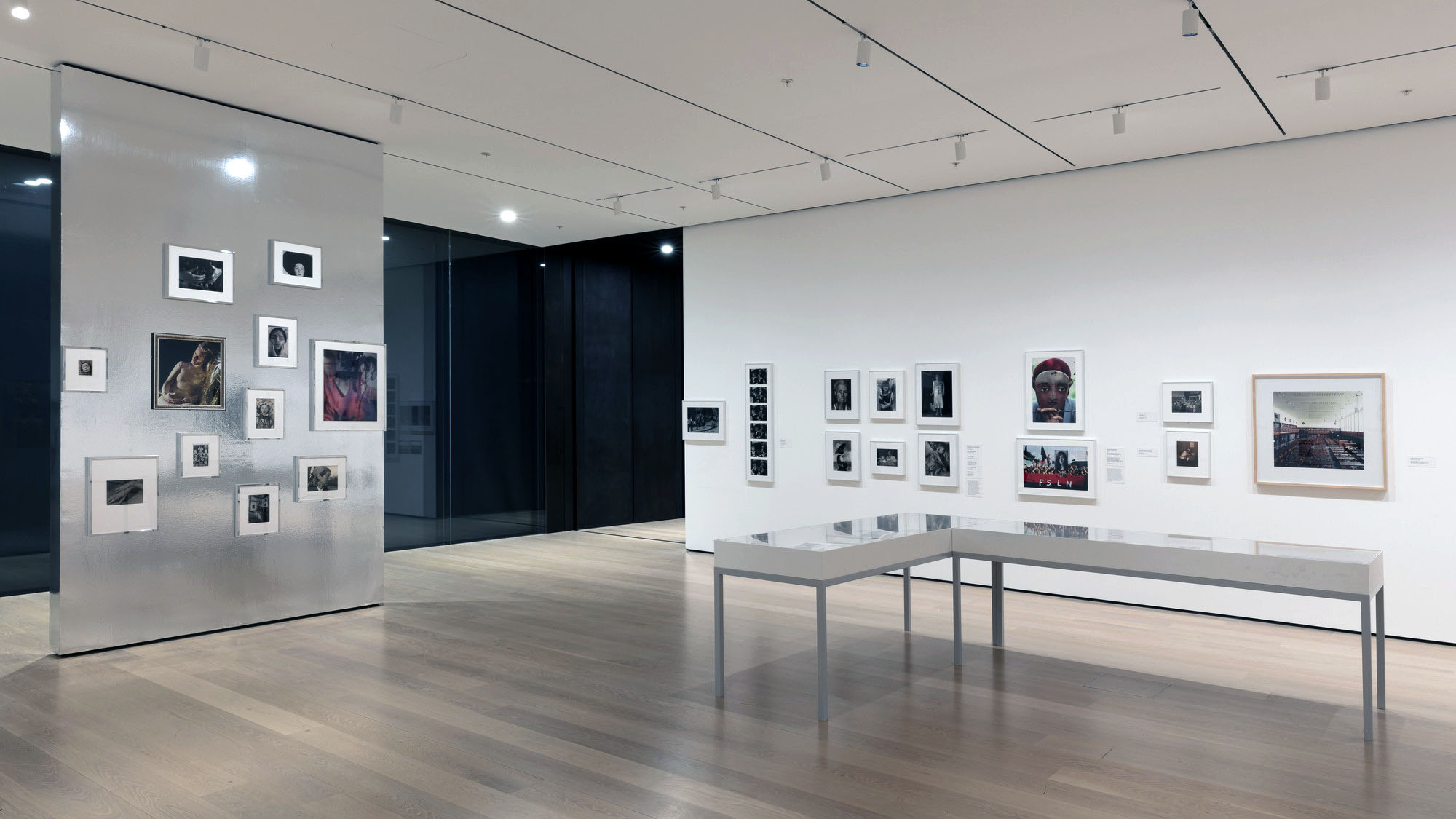
Exhibition: ‘The ’70s Lens: Reimagining Documentary Photography’ at the National Gallery of Art, Washington

Exhibition dates: 6th October, 2024 – 6th April, 2025

 Curator: Andrea Nelson, associate curator in the department of photographs, National Gallery of Art
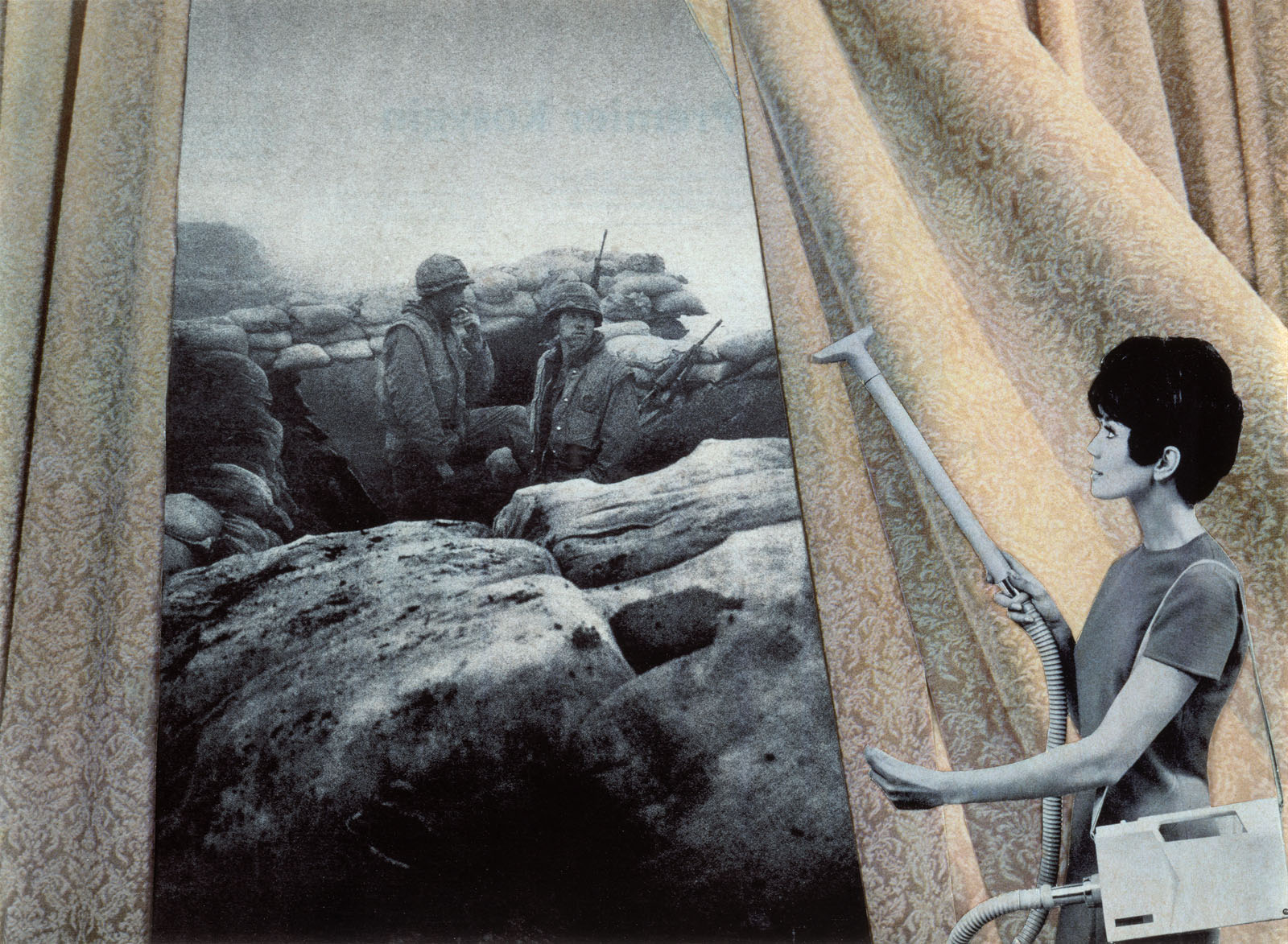
 

Martha Rosler (American, b. 1943) 'Cleaning the Drapes', from the series, 'House Beautiful: Bringing the War Home' 1967-1972 from the exhibition 'The '70s Lens: Reimagining Documentary Photography' at the National Gallery of Art, Washington


Martha Rosler (American, b. 1943)
Cleaning the Drapes
1967-1972, printed 2007
From the series House Beautiful: Bringing the War Home
Inkjet print
Image: 44.2 x 60.4cm (17 3/8 x 23 3/4 in.)
National Gallery of Art
Gift of the Collectors Committee and Pepita Milmore Memorial Fund


Martha Rosler originally distributed photocopies from this series, House Beautiful: Bringing the War Home, as flyers at anti – Vietnam War demonstrations. She made the original photomontages by combining gritty news photographs of fighting in Vietnam with homerelated advertisements culled from glossy women’s magazines. Here Rosler paired a woman cleaning patterned drapes with two tired soldiers smoking amid rocks and sandbags. The woman’s vacuum wand points to and echoes the soldiers’ rifles. The jolting collision of war imagery and affluent domestic space gives visual form to the description of the conflict as “the living room war” – so called because it appeared on television news nightly.

Wall text from the exhibition


“Ce n’est pas une pipe mais de la photographie, sous toutes ses formes variables et multivalentes”


René Magritte’s 1929 painting Ceci n’est pas une pipe is also known as La Trahison des images … The Treachery of Images.

Treachery – the betrayal of trust – is an apposite word in relation to photography of the 1970s. Finally, once and for all, documentary photography in America broke free of the West Coast fine art photography tradition of mainly white male artists and the “aura” of the fine art print (Walter Benjamin). Photography betrayed the trust placed in the authenticity of the image and its link to the “truth” of reality represented in the photograph to become a medium of variability, in concept, execution and outcome. Photography became whatever you wanted it to be.

Documentary photography and its link to the reality of the referent – its assumed representation of a truth that existed in reality – began to be subsumed into the whole of photography, just part of a conceptual, art, performative, staged, street, cameraless, documentary, fashion, photojournalist, activist, amoebic (from the Greek ἀμοιβή amoibe, meaning “change”), and viral (Paul Virilio) medium.

Photography had always been a medium of communication but now became multi-perspectival – whether that be imaginings of the mind relayed through photographs, conceptual ideas about the world and how we interact with it created and staged through photographs, or new colour photography that challenged the orthodoxy of fine art black and white West Coast American photography.

As Anne-Marie Willis observes on the On This Date In Photography website, “any curator who would challenge the orthodox Beaumont Newhall-style photo history limited to images that are distinctively photographic, aesthetic, and “Straight” … would open a Pandora’s box full of photographs pervasive across so many fields, of such limitless subject matters, and crossing so many disciplines that their histories in photography would be obscured.”1

This is the alleged treachery of multi-perspectival photography, the betraying of photographic histories that stretched back to the beginnings of the medium… but it had to be done for photography to fully open itself up to the imaginings of the human and the media flows of the world. “It was a time when photography challenged the art photography norm: photography should not, could not be restricted to what was considered ‘art’.”2

Thus, it is a great joy to see photographs from this stimulating exhibition, photographs that challenge the established “norm” of what photography should be. But what is surprising to me when looking at the complete list of photographs in this exhibition is the important artists who changed the face of photography in the 1970s who are not represented at all or only have one or two images on show:

Gordon Parks 0
Garry Winogrand 1
Lee Friedlander 2
Diane Arbus 1
Robert Mapplethorpe 0
Robert Heinecken 0
Richard Avedon 0
Andy Warhol 1 Polaroid
Cindy Sherman 0
Barbara Kruger 0
Nan Goldin 1
Stephen Shore 1

Diane Arbus, who was instrumental in changing portrait photography at the time, only has one photograph in the exhibition; Barbara Kruger and Robert Heinecken, both “para-photographers” whose work stood “beside” or “beyond” traditional ideas associated with photography have none; Stephen Shore who, along with William Eggleston, was responsible for making colour photography acceptable in art photography has only one photograph.

But most surprisingly of all, Cindy Sherman whose Untitled Film Stills were made predominantly between 1977-1980 and who casts herself as clichés or feminine types, becoming both the artist and subject in the work … is not there at all. Her loss, her evisceration, and the absence of “arguably one of the most significant bodies of work made in the twentieth century and thoroughly canonized by art historians, curators, and critics,”3 is unfathomable.

Dr Marcus Bunyan


1/ Anne-Marie Willis quoted in Dr James McArdle. “DECEMBER 14: CONTEXT,” on the On This Date In Photography website 15/12/2019 [Online] Cited 26/02/2025

2/ Ibid.,

3/ Exhibition Catalogue, New York, Museum of Modern Art, Cindy Sherman, 2012, p. 18 quoted in the “Untitled Film Stills” page on the Wikipedia website


Many thankx to the National Gallery of Art for allowing me to publish the photographs in the posting. Please click on the photographs for a larger version of the image.


Martha Rosler (American, b. 1943)
'Roadside Ambush' 1967-1972 from the exhibition 'The '70s Lens: Reimagining Documentary Photography' at the National Gallery of Art, Washington


Martha Rosler (American, b. 1943)
Roadside Ambush
1967-1972, printed 2007
Inkjet print
Image/sheet: 50.8 x 61cm (20 x 24 in.)
National Gallery of Art
Gift of the Artist and Mitchell-Innes and Nash


Rosler originally distributed photocopies of House Beautiful: Bringing the War Home at anti–Vietnam War demonstrations. “I saw House Beautiful not as art,” she later reflected. “I wanted it to be agitational.” The artist created the original photomontages, from which these collages are derived, by combining news photographs of scorched battlefields in Vietnam with glossy advertisements for US homes, layering images of soldiers within cut-out silhouettes of men from polo-shirt advertisements; and splicing pictures of soldiers’ burials with those of military marches. By tying the destruction abroad to untroubled affluence at home, Rosler gave visual form to the description of the conflict as “the living-room war” – so called because it was the first war to be televised.

MoMA gallery label from 2024


The exhibition The ’70s Lens: Reimagining Documentary Photography examines how new approaches to documentary photography that emerged during the 1970s reflected a radical shift in American life – and in the medium itself.

The 1970s was a decade of uncertainty in the US – soaring inflation, energy crises, the Watergate scandal, and protests about pressing social issues – and the profound upheaval that rocked the country formed the backdrop for a revolution in documentary photography. Now on view at @ngadc, The ’70s Lens: Reimagining Documentary Photography explores this compelling and contested moment of reinvention when the genre’s association with objectivity and truthfulness came into question. Featuring works from over eighty artists, the exhibition delves into how the camera was used to examine life in the US from a diverse range of perspectives, and in doing so, transformed the practice of documentary photography.


The ’70s Lens: A Conversation with Anthony Hernandez

Artist Anthony Hernandez discusses 50 years of work with curator Andrea Nelson on October 24, 2024. The conversation celebrates the exhibition The ’70s Lens: Reimagining Documentary Photography (October 2024 – April 2025).

Anthony Hernandez (b. 1947, Los Angeles, California) has crafted a richly varied oeuvre, ranging from a distinctive style of black-and-white street photography to colour photographs of abstracted details of his surroundings. Much of Hernandez’s work focuses on his native Los Angeles, revealing a unique insight into the people and landscape of the much-pictured city. Hernandez is a recipient of a Guggenheim Fellowship (2018), the Rome Prize (1999) and has been named a United States Artists Fellow (2009).


William Eggleston (American, b. 1939) 'Memphis' 1969-1970 from the exhibition 'The '70s Lens: Reimagining Documentary Photography' at the National Gallery of Art, Washington


William Eggleston (American, b. 1939)
Memphis
1969-1970, printed 1980
Dye imbibition print
Image: 30.2 x 44.2cm (11 7/8 x 17 3/8 in.)
National Gallery of Art, Corcoran Collection
Gift of Mr. Morris R. Garfinkle
© Eggleston Artistic Trust


Eggleston is celebrated for his use of colour photography, which he began experimenting with in the late 1960s. Eggleston’s 1976 exhibition Colour Photographs, held at the Museum of Modern Art, New York, is considered a pivotal moment in the development of colour photography as a contemporary art form and widely credited with increasing recognition of the medium.

Since first picking up a camera in 1957, Eggleston has photographed his family, friends and the people that he encountered in his everyday life, particularly in his native Memphis. Eggleston is said to find the beauty in the everyday and his work has inspired many present day photographers, artists and filmmakers, including Martin Parr, Sofia Coppola, David Lynch and Juergen Teller.

Text from the National Gallery of Victoria website


Anthony Friedkin (American, b. 1949) 'Young Man, Troupers Hall, Hollywood' 1969 From the series 'The Gay Essay'


Anthony Friedkin (American, b. 1949)
Young Man, Troupers Hall, Hollywood
1969
From the series The Gay Essay
Gelatin silver print
National Portrait Gallery
Gift of Mary and Dan Solomon


In 1969, Anthony Friedkin was only 19 years old when he set out to document the queer communities of San Francisco and Los Angeles. The resulting project, The Gay Essay, is an expressive and nuanced portrait. Friedkin charts various facets of the culture, from street life and protests to parades and drag performances.

Friedkin’s photographs record the beginnings of the gay liberation movement in California. With a respectful intimacy he pictures individuals living true to themselves while defying prevailing social norms.

Wall text from the exhibition
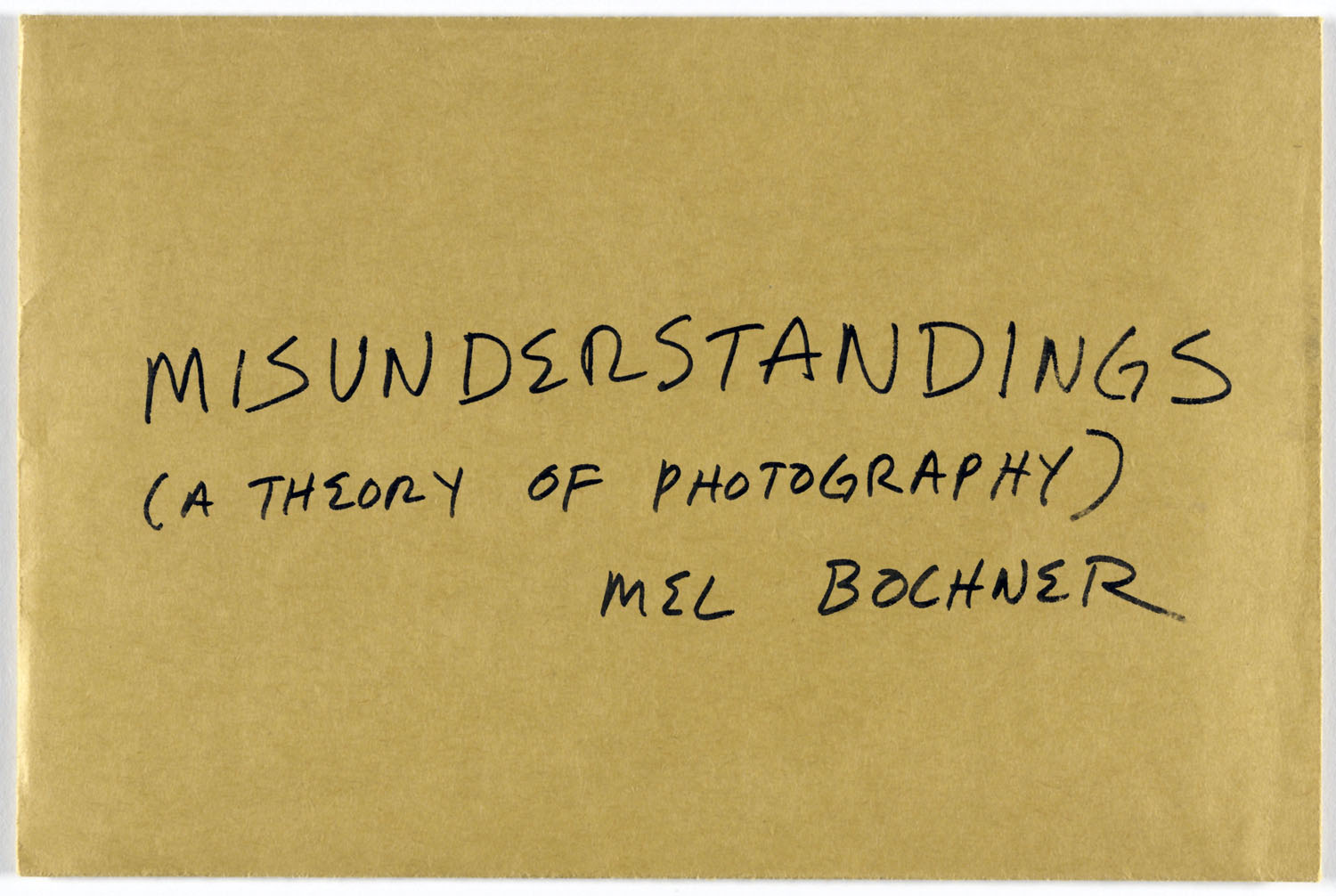
 

Mel Bochner (American, 1940-2025) 'Misunderstandings (A Theory of Photography)' 1970 (detail)


Mel Bochner (American, 1940-2025)
Misunderstandings (A Theory of Photography) (details)
1970
10 offset lithographs on notecards and envelope
Sheet (each): 12.7 x 20.32cm (5 x 8 in.)
National Gallery of Art, Gift of Mary and Dan Solomon


When Mel Bochner started documenting his works of sculpture with a camera, he realised that his practice had “become about photography without [my] wanting it to.” He studied the history of the medium and found conflicting ideas about what photography is or should be. By illustrating these “misunderstandings” with quotes from notable figures and sources, Bochner underscored the gap between a photograph itself and what it purports to represent. He even fabricated three of the quotations, further playing on photography’s tenuous relationship to truth. The photograph of the artist’s hand and forearm is also a misunderstanding: it is much smaller than the actual body part it depicts. It also appears to be a negative of a Polaroid photograph, but Polaroids exist only as positive prints.

Wall text from the exhibition


Mel Bochner was a key figure in the Conceptual Art movement of the 1960s and 70s. Bochner was part of a group of artists who challenged the traditional notion of art as a physical object to be admired for its aesthetic qualities and instead sought to explore the ideas and concepts behind the object, often using language and text as their medium.

Bochner’s early works were influenced by his interest in mathematics and logic, which he applied to create intricate geometric patterns. As his practice evolved, he incorporated language and words into his artwork, exploring the relationship between language, thought, and perception.

Text from the My Art Broker website


Anthony Barboza (American, b. 1944) 'New York City' 1970s from the exhibition 'The '70s Lens: Reimagining Documentary Photography' at the National Gallery of Art, Washington


Anthony Barboza (American, b. 1944)
New York City
1970s
Gelatin silver print
Image/sheet: 23.7 × 16.1cm (9 5/16 × 6 1/4 in.)
National Gallery of Art
Pepita Milmore Memorial Fund


Anthony Barboza’s photography has been integral in shaping the image of Black America. A founding member of the Kamoinge Workshop, a group of Black photographers formed in New York in 1963, Barboza went on to establish a thriving commercial and personal practice focused largely on Black subjects. His affirmative representations of African Americans in daily life – like this photograph of two ultra-stylish men standing in front of a hotel coffee shop in midtown Manhattan – contributed to an empowering narrative for the Black community in the face of inequality and adversity. Describing his approach to making pictures on the street, Barboza commented, “”The photograph finds you, you don’t find the photograph.”

Wall text from the exhibition


Anthony Barboza (American, b. 1944) 'New York City' 1970s from the exhibition 'The '70s Lens: Reimagining Documentary Photography' at the National Gallery of Art, Washington


Anthony Barboza (American, b. 1944)
New York City
1970s
Gelatin silver print
Image: 23.7 × 15.9cm (9 5/16 × 6 1/4 in.)
National Gallery of Art
Pepita Milmore Memorial Fund


Lee Friedlander (United States, b. 1934) 'Hillcrest, New York' 1970 from the exhibition 'The '70s Lens: Reimagining Documentary Photography' at the National Gallery of Art, Washington


Lee Friedlander (American, b. 1934)
Hillcrest, New York
1970
Gelatin silver print
Image: 20.3 x 30.5cm (8 x 12 in.)
National Gallery of Art
Patrons’ Permanent Fund


The fracturing of the image plane, where multiple, diverse realities are represented within one photograph, deconstructing the reality of fine art photography. ~ Marcus


Lee Friedlander’s layered compositions wittily observe connections between American life and commerce. In this dizzying photograph, Friedlander captures himself, at center, in a sideview mirror while at a filling station. In the reflection behind him we see a strip mall with the stores’ signs reversed. Near and far vie for attention and parts of the composition are blocked from our view.

The photograph with a World War I memorial similarly features vertical elements that break up the composition into separate frames. At left, the memorial’s soldier with rifle – who appears to be on guard – goes completely unnoticed as pedestrians make their way along a street full of storefronts.

Wall text from the exhibition


Kenneth Josephson (American, b. 1932) 'Wyoming' 1971 from the exhibition 'The '70s Lens: Reimagining Documentary Photography' at the National Gallery of Art, Washington


Kenneth Josephson (American, b. 1932)
Wyoming
1971
From the History of Photography series
Gelatin silver print
Image: 22.8 x 14.1cm (9 x 5 9/16 in.)
National Gallery of Art
Patrons’ Permanent Fund


Kenneth Josephson’s conceptual photography experiments with playful illusion to explore and question his medium. Josephson was a graduate among the first generation of photography candidates from the Illinois Institute of Design. A student of such masters as Aaron Siskind, Harry Callahan, and Minor White, Josephson went on to teach for 35 years at the Art Institute of Chicago, where he routinely taught the “Introduction to Photography” course as it inspired him to continue experimentation.

“This photograph of a photograph held in space causes the viewer to question assumptions about truthful representation according to size and scale; it also draws attention to the principle that photographic reality is constructed through an artist’s ideas and choices. The subject of the photograph is photography itself, and the ways that life is documented, manipulated, trivialised, and celebrated with photographs.”

Text from the Madison Museum of Contemporary Art website
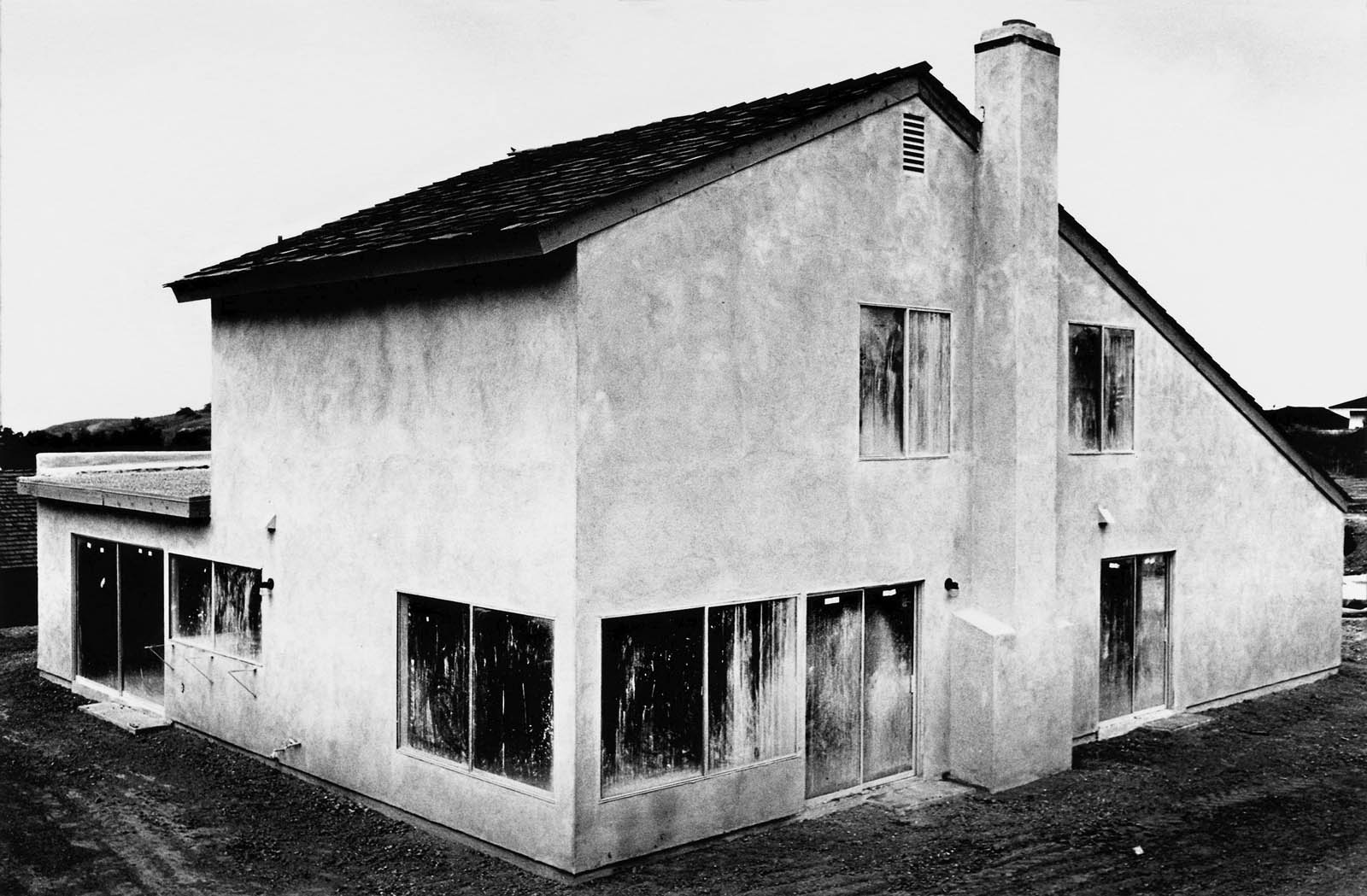
 

Lewis Baltz (American, 1945-2014) 'Tract House #4' 1971 from the exhibition 'The '70s Lens: Reimagining Documentary Photography' at the National Gallery of Art, Washington


Lewis Baltz (American, 1945-2014)
Tract House #4
1971
From the portfolio The Tract Houses
Gelatin silver print
Image/sheet: 14.5 × 22.5cm (5 11/16 × 8 7/8 in.)
National Gallery of Art
Corcoran Collection (Gift of the artist)


Lewis Baltz’s The Tract Houses captures the austere geometry of the shoddily built homes that sprang up in California’s suburban landscape beginning in the mid-1940s. Straight-edge architectural details, positioned strictly parallel to the picture plane, recall the reductive forms of minimalist art. Entire, recently constructed houses appear forlorn. None of the pictures include shadows, clouds, or people. Baltz’s series is a powerful critique of the transformation of the American landscape into an unending terrain of anonymous architecture. At the same time, the exquisitely rendered tones and textured surfaces emphasise the subtle beauty to be found in this bleak environment.

Wall text from the exhibition


With his iconic, minimalist photographs of suburban landscape, Lewis Baltz was at the forefront of a revolutionary shift in the medium of photography. Baltzs work exemplifies the ways in which photography started to loose the bonds of its isolation within its own segregated history and aesthetics and began to take its place among other media. In the late 1960s and early 1970s Baltz became fascinated by the stark, man-made landscape rolling over Californias then still-agrarian terrain. His earliest portfolio, The Tract Houses (1971), and his preliminary forays into a minimal aesthetic, The Prototype Works (1967-1976), illuminate his drive to capture the reality of a sprawling Western ecology gone wild.

Text from the Google Books website


Diane Arbus (American, 1923-1971) 'A young man and his girlfriend with hot dogs in the park' 1971


Diane Arbus (American, 1923-1971)
A young man and his girlfriend with hot dogs in the park
1971
Gelatin silver print
Image: 37.7 x 36.5cm (14 13/16 x 14 3/8 in.)
National Gallery of Art, Corcoran Collection
Gift of Stephen G. Stein


Diane Arbus prowled New York’s public spaces looking for humor and strangeness in the everyday. Here a young couple walks in Central Park, wearing similar clothes, hairstyles, and dejected expressions. Arbus’s carefully composed but disorienting photograph – the subjects are in crisp focus while the background is blurred – compels us to look anew at the familiar. Is this couple unhappy in love or expressing the uncertainty of the times? Arbus made this photograph the year she died. Her influence on documentary photography would continue through the decade.

Wall text from the exhibition


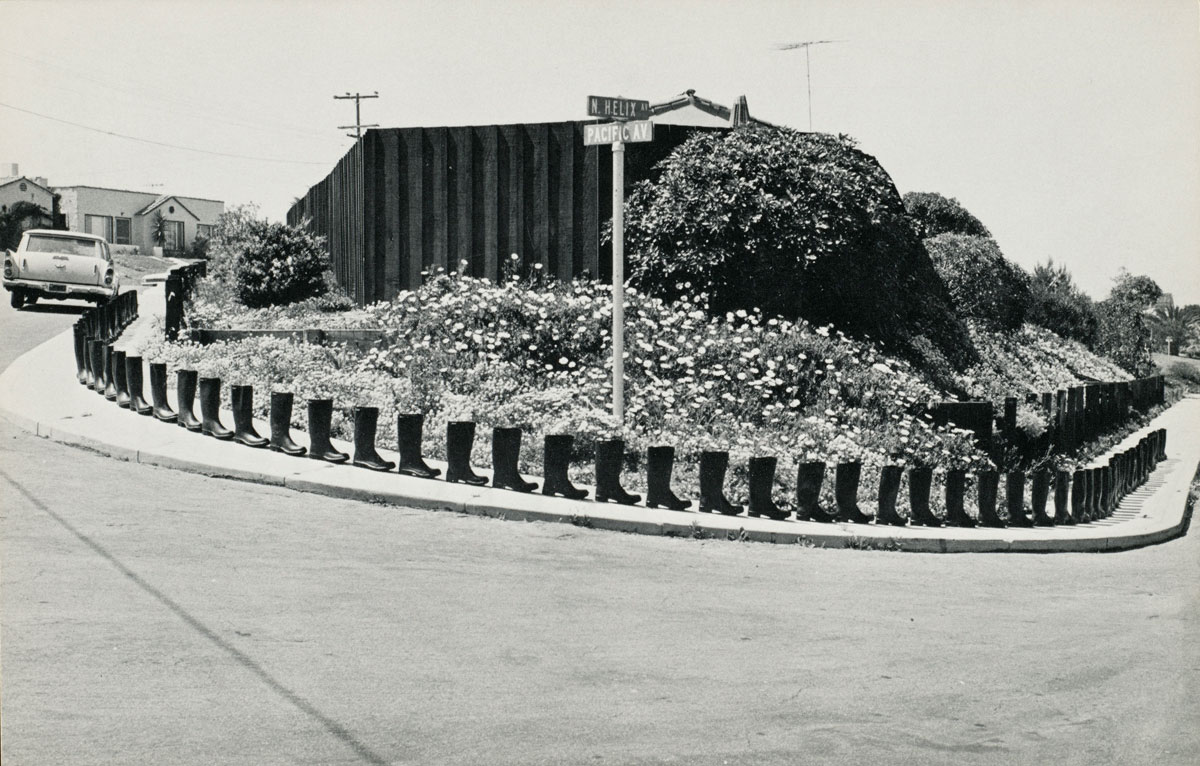
Eleanor Antin (American, b. 1935), Philip Steinmetz (American, 1944-2013) (photographer). '100 Boots' 1971-1973 (detail)


Eleanor Antin (American, b. 1935)
Philip Steinmetz (American, 1944-2013) (photographer)
100 Boots (details)
1971-1973
51 halftone prints (postcards)
image/sheet (each): 11.5 x 17.75cm (4 1/2 x 7 in.)
National Gallery of Art
Pepita Milmore Memorial Fund


In this epic visual narrative, black rubber boots stand in for a fictional hero traveling from California to New York City. Eleanor Antin created temporary installations with the boots, had them photographed (by Philip Steinmetz), and made 51 postcards, copies of which she mailed to approximately 1,000 people and institutions involved in the arts. The journey starts at a Bank of America and ends at Central Park – after a visit to the Museum of Modern Art, where the boots and a set of postcards and photographs were later exhibited. Using the postal service, Antin bypassed the traditional gallery system, which had long overlooked women artists. While many of these scenes are humorous, the empty army boots also recall the Vietnam War and the soldiers who did not come home.

Wall text from the exhibition


100 Boots, 1971-1973

For her 51-piece instalment 100 Boots Eleonor Antin positioned one hundred ordinary black rubber boots on various locations all over Southern California and consequently in New York City. She took photos, printed them on postcards and assembled a mailing list of about a thousand names – mainly artists, writers, critics, galleries, universities and museums – who received the various postcards over a period of two and a half years between 1971 and 1973. The first card, 100 Boots Facing the Sea, was mailed on the Ides of March, 1971, unannounced and without further comment. A few weeks later it was followed by 100 Boots on the Way to Church and three weeks thereafter by the next one.

In a total of 51 photographs, Eleanor Antin documented the travels of the 100 Boots, her so called “hero” – from a beach close to San Diego to a church, to a bank, to the supermarket, trespassing, under the bridge, to a saloon and on their travels eastward. Finally, on May 15th, 1973 100 Boots arrived at the Museum of Modern Art in New York. By this time, 100 Boots had long become an epic visual narrative and a picaresque work of conceptual art.

Text from the exhibition open spaces | secret places: composite works from the collection at Museum Der Moderne Salzburg, October 2012 – March 2013
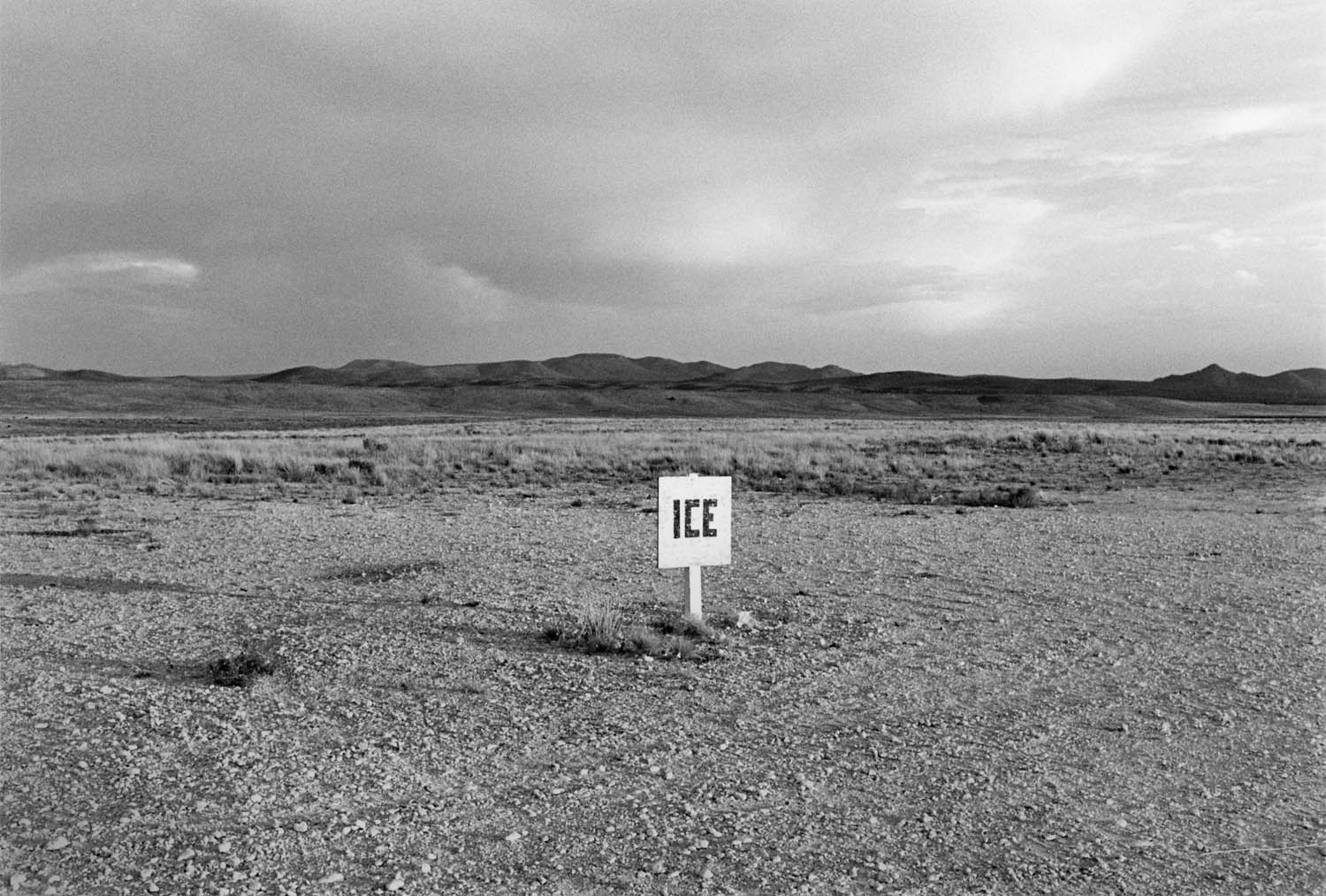
 

Henry Wessel (American, 1942-2018) 'Walapai, Arizona' 1971


Henry Wessel (American, 1942-2018)
Walapai, Arizona
1971
Gelatin silver print
Image: 26.51 x 39.85cm (10 7/16 x 15 11/16 in.)
National Gallery of Art
Gift of Mary and Dan Solomon and Patrons’ Permanent Fund


In 1975 New Topographics: Photographs of a Man-Altered Landscape opens at the International Museum of Photography in Rochester, N.Y. It includes photographs by Robert Adams, Lewis Baltz, Bernd and Hilla Becher, Joe Deal, Frank Gohlke, Nicholas Nixon, John Schott, Stephen Shore, and Henry Wessel Jr.

“Henry Wessel began taking photographs while majoring in psychology at Pennsylvania State University in the mid-1960s. Travel throughout the United States in subsequent years led him to direct his gaze increasingly to details of human interaction with the natural and man-made environment. Wessel’s move to the West Coast in the early 1970s inspired him to incorporate light and climate into his work. His inclusion in the seminal exhibition New Topographics: Photographs of a Man-Altered Landscape, organised in 1975 by the George Eastman House in Rochester, New York, solidified his reputation as a keen observer of the American topography.”

Text from Pacific Standard Time at the Getty


John Simmons (American, b. 1950)
'Will on Chevy, Nashville, Tennessee'
1971, printed 2024


John Simmons (American, b. 1950)
Will on Chevy, Nashville, Tennessee
1971, printed 2024
Gelatin silver print
Image: 30.48 x 20.32cm (12 x 8 in.)
National Gallery of Art
Alfred H. Moses and Fern M. Schad Fund


A fashionably dressed older man crosses the street with his umbrella. A young woman turns to look at the camera while holding hands with a man in uniform. These were people John Simmons encountered while studying art at Fisk University in Nashville. Raised on Chicago’s South Side, Simmons had first published photographs as a teenager in the African American newspaper Chicago Defender. Refuting white-centered media’s failure to show positive imagery of the Black experience, Simmons has focused on people enjoying everyday life.

“I always feel like my subject and I were meant to share that moment together,” he has said. “So many of the pictures I take, it was like our paths were meant to cross.”

Wall text from the exhibition


Simmons began his career at 15 as a photographer for the oldest African American-owned newspaper, The Chicago Daily Defender in 1965. Over his decades long career, he’s photographed icons of the Civil Rights Movement, turbulent protests and demonstrations, famed musicians and poignant intimate moments of everyday life. “I’m glad to see photographs I took back in my teens are still relevant today,” he says.

John Simmons quoted in Steve Simmons. “Photographer John Simmons, ‘Chronicler Of The Civil Rights Movement,’​ Featured In Three Exhibits,” on the Linkedin website August 4, 2021 [Online] Cited 11/09/2021.
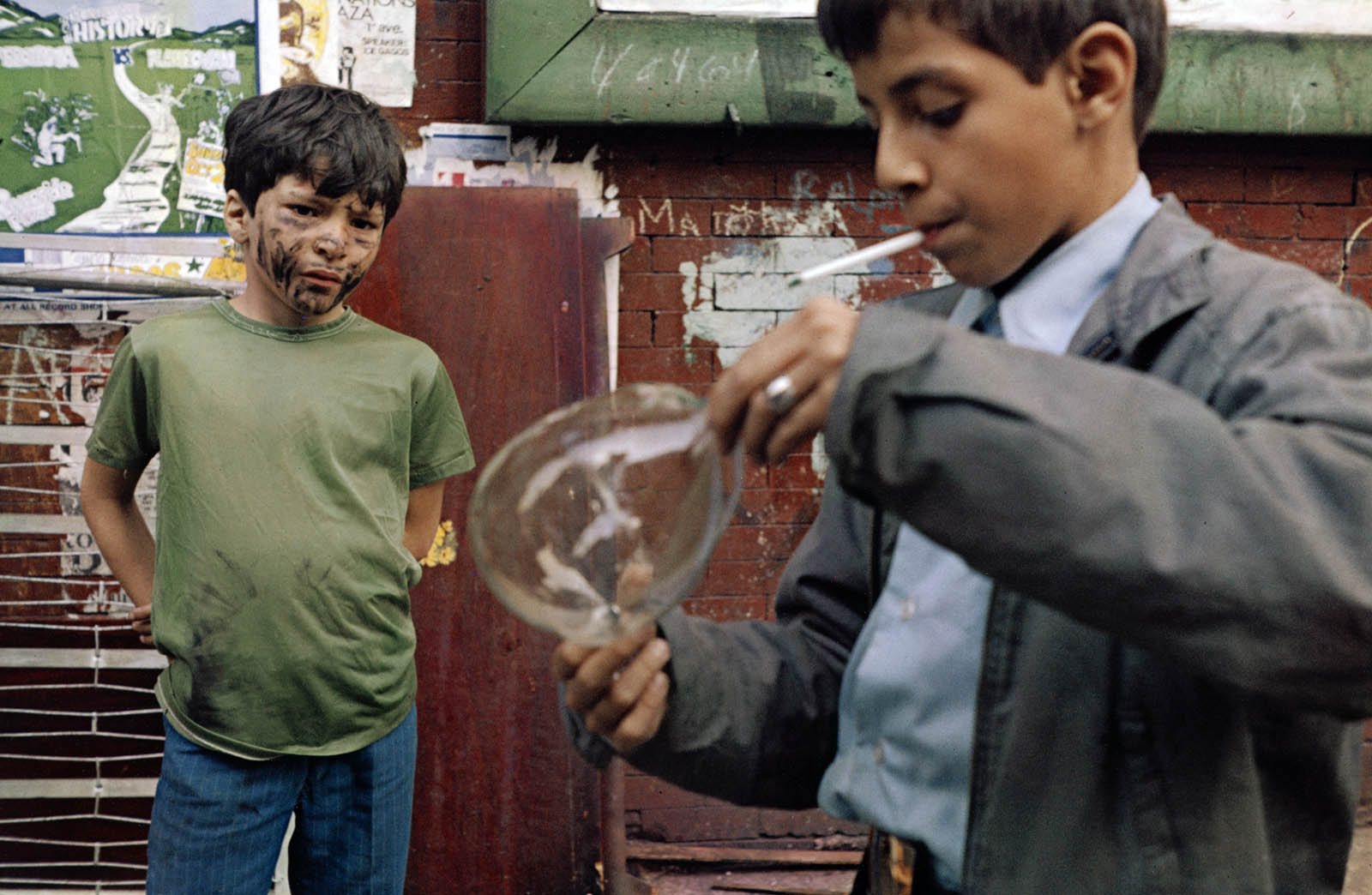
 

Helen Levitt (American, 1913-2009) 'New York' 1972 from the exhibition 'The '70s Lens: Reimagining Documentary Photography' at the National Gallery of Art, Washington


Helen Levitt (American, 1913-2009)
New York
1972
Dye imbibition print
Image: 23.5 x 36cm (9 1/4 x 14 3/16 in.)
National Gallery of Art, Patrons’ Permanent Fund
© Film Documents LLC, courtesy Zander Galerie, Cologne


Helen Levitt frequently made photographs of children on the streets of New York City, exploring their relationships to the urban setting as they played, imagined, and discovered together. After decades of working in black and white, Levitt became an early advocate of color documentary photography. Color allowed her to tell a fuller story of everyday life. Here, the green of the boy’s T-shirt is echoed in the poster and frame behind him. “I thought my photographs would be closer to reality if I got the color of the streets,” she said. “Black and white is an abstraction.”

Wall text from the exhibition


Bill Owens (American, b. 1938)
'Ronald Reagan' 1972 from the exhibition 'The '70s Lens: Reimagining Documentary Photography' at the National Gallery of Art, Washington


Bill Owens (American, b. 1938)
Ronald Reagan
1972
From the series Suburbia
Gelatin silver print
Image: 16.4 x 21.6cm (6 7/16 x 8 1/2 in.)
National Gallery of Art
Patrons’ Permanent Fund


Over the course of a year, Bill Owens made photographs of the housing developments that had recently sprung up outside of Oakland and San Francisco. With an eye to humor, he captured the apparent conformity and materialism of the new suburbs. Here, a home is decorated for Christmas. At center, Nativity figures sit atop a television console showing an old film featuring Ronald Reagan, who had been a movie actor before becoming a politician. Owens also respected the liberation that many suburbanites felt, as well as their determination to build better lives. In his book Suburbia (1972), he included quotations from his subjects describing the opportunities and challenges they faced in their new environments.

Wall text from the exhibition


Owens began his photographic career in the late 1960s as a staff photographer for a local newspaper in Livermore, California. During this period, he began his most noteworthy project, “Suburbia,” which would become a major body of work in American documentary photography.

“Suburbia” was published as a book in 1973, featuring Owens’ images and conversations with suburban dwellers. The project’s goal was to investigate the goals, aspirations, and inconsistencies of suburbia life, offering a critical yet sympathetic study of the American Dream.

Owens’ images depicted scenes of backyard barbecues, family gatherings, children at play, and the myriad rituals and social interactions that constituted suburban areas. He highlighted both the humor and the underlying intricacies of suburban life through his good observation and direct attitude.

What distinguished Owens’ work was his ability to see past the surface and capture the soul of his subjects. His images conveyed a sense of realism by portraying suburbanites in their natural settings and enabling their tales to flow through genuine moments captured in time.

Owens’ art struck a chord with a large audience because it highlighted a huge societal transition in America during the 1970s. Owens’ images challenged the idealized image of suburban life by exposing the hardships, wants, and inconsistencies inherent in the pursuit of the American Dream.

Anonymous. “Bill Owens,” on the Photo.com website Nd [Online] Cited 06/20/2025


William Eggleston (American, b. 1939) 'Sumner, Mississippi, Cassidy Bayou in the Background' c. 1972


William Eggleston (American, b. 1939)
Sumner, Mississippi, Cassidy Bayou in the Background
c. 1972, printed 1986
Dye imbibition print
Image: 27.94 x 43.18cm (11 x 17 in.)
National Gallery of Art
Gift of Stephen G. Stein
© Eggleston Artistic Trust


See how documentary photography transformed during the 1970s.

The 1970s was a decade of uncertainty in the United States. Americans witnessed soaring inflation, energy crises, and the Watergate scandal, as well as protests about pressing issues such as the Vietnam War, women’s rights, gay liberation, and the environment. The country’s profound upheaval formed the backdrop for a revolution in documentary photography. Activism and a growing awareness and acceptance of diversity opened the field to underrepresented voices. At the same time, artistic experimentation fueled the reimagining of what documentary photographs could look like.

Featuring some 100 works by more than 80 artists, The ’70s Lens examines how photographers reinvented documentary practice during this radical shift in American life. Mikki Ferrill and Frank Espada used the camera to create complex portraits of their communities. Tseng Kwong Chi and Susan Hiller demonstrated photography’s role in the development of performance and conceptual art. With pictures of suburban sprawl, artists like Lewis Baltz and Joe Deal challenged popular ideas of nature as pristine. And Michael Jang and Joanne Leonard made interior views that examine the social landscape of domestic spaces.

The questions these artists explored – about photography’s ethics, truth, and power – continue to be considered today.

Text from the National Gallery of Art


Lee Friedlander (American, b. 1934)
'Doughboy. Stamford, Connecticut' 1973


Lee Friedlander (American, b. 1934)
Doughboy. Stamford, Connecticut
1973
Gelatin silver print
Image: 17.8 x 27cm (7 x 10 5/8 in.)
National Gallery of Art
Robert B. Menschel Fund
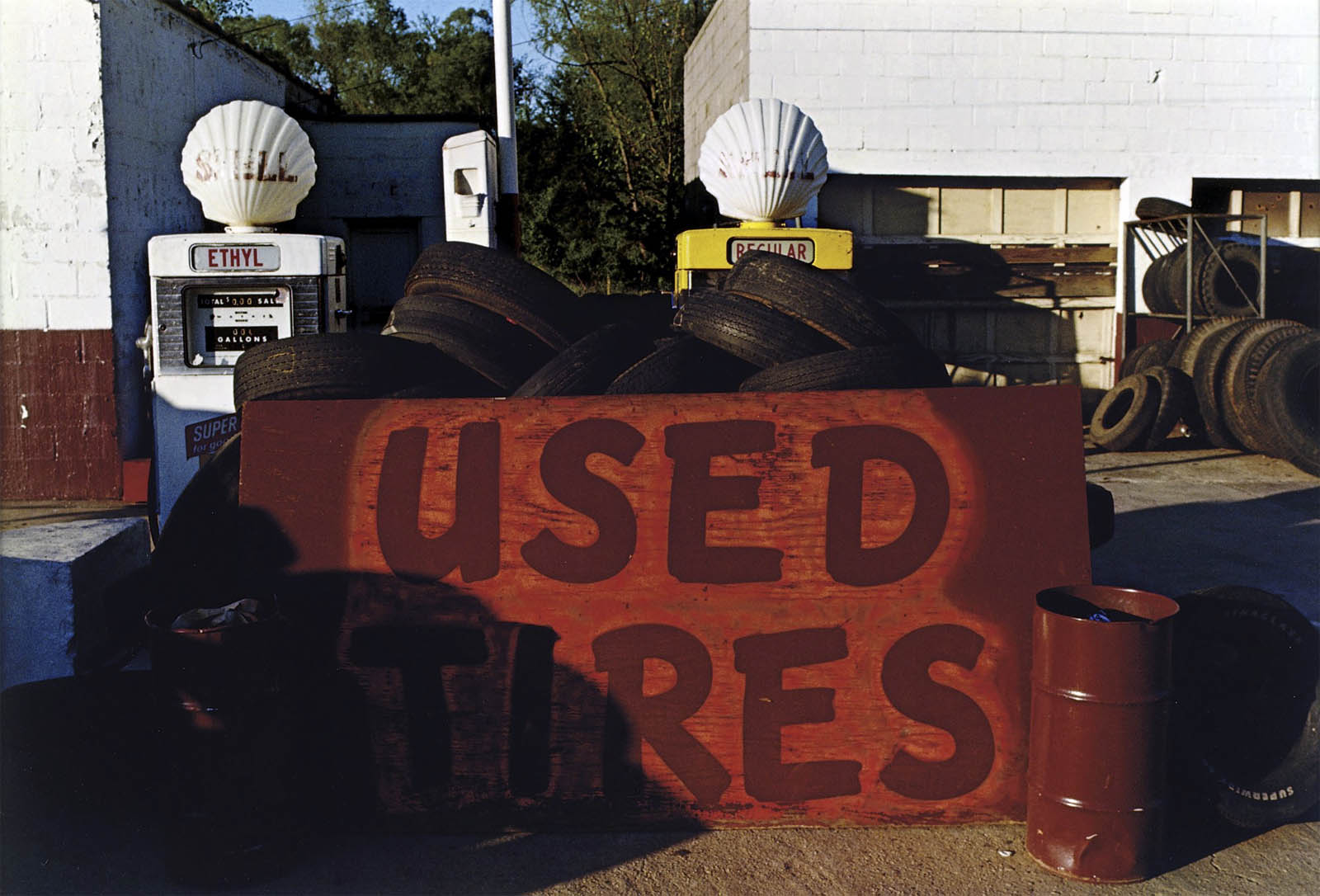
 

William Eggleston (American, b. 1939) 'Used Tires' 1973


William Eggleston (American, b. 1939)
Used Tires
1973
Dye imbibition print
Image: 33 x 48.5cm (13 x 19 1/8 in.)
National Gallery of Art
Patrons’ Permanent Fund
© Eggleston Artistic Trust
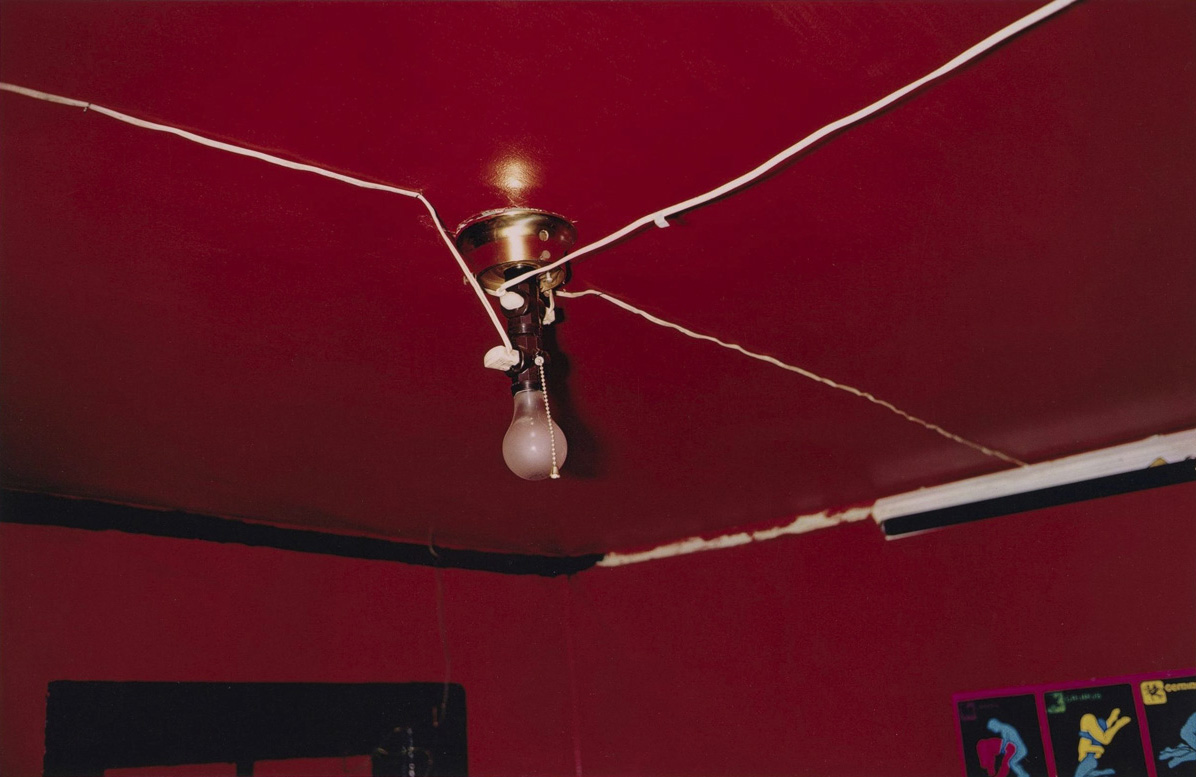
 

William Eggleston (American, b. 1939) 'Greenwood, Mississippi' 1973


William Eggleston (American, b. 1939)
Greenwood, Mississippi
1973
Dye imbibition print
Image: 32.2 x 48.2cm (12 11/16 x 19 in.)
National Gallery of Art, Corcoran Collection
Gift of the Women’s Committee of the Corcoran Gallery of
Art
© Eggleston Artistic Trust


William Eggleston has said that he has “a democratic way of looking around,” where nothing is more important or less important. For him, everyday subjects are not boring but instead offer visual richness. Here, that richness has a pronounced edge. Eggleston directed his lens up to a red ceiling with a single bare lightbulb at center. We glimpse only the top of a doorframe and a fragment of an explicit poster. The saturated, bloodlike color that dominates the composition is shocking, even menacing. It also challenged Eggleston technically as he developed his skills with dye imbibition printing. Commonly known as dye transfer, the process was labor intensive but allowed for customisation and a wide range of colours and tones.

Wall text from the exhibition


Mitchell Epstein (American, b. 1952)
'Massachusetts Turnpike' 1973, printed 2005 from the exhibition 'The '70s Lens: Reimagining Documentary Photography' at the National Gallery of Art, Washington


Mitchell Epstein (American, b. 1952)
Massachusetts Turnpike
1973, printed 2005
From the series Recreation
Chromogenic print
Image: 32.1 x 48.2cm (12 5/8 x 19 in.)
National Gallery of Art
Gift of Timothy and Suzanne Hyde in Honor of the 25th Anniversary of
Photography at the National Gallery of Art
© Black River Productions, Ltd.


Viewers of a certain age will recognize this setting as the parking lot of a Howard Johnson’s restaurant. HoJos, as they were nicknamed, were once ubiquitous along America’s highways. The cheery saturated colors belie the scene’s subject: a couple having a bad travel day. A man in suit and tie works under the hood of a beat-up Chevy Impala. His partner, wearing a pale pink skirt and top, arms crossed, appears frustrated. The cars zooming by seem to mock their immobility. Part of Mitch Epstein’s Recreation series, which documented Americans engaging in leisure activities, the photograph today evokes melancholy and nostalgia. Explaining his early turn to colour film, the artist said, “The world is in color, so why not photograph in color?”

Wall text from the exhibition


I started to work in colour, which was a radical, and some thought foolish, move in 1973. Colour photography was not yet a medium for serious photography – it was used almost exclusively for slick advertising and illustration. Within a month of shooting in colour, though, I wanted to do nothing else…

As I developed, I learned that a photograph is other than the thing itself photographed, and this freed me to think about how I could use photography to fictional effect, even while my pictures were drawn from the real world…

Photography remains a tool with which I form and sharpen my response to the world around me. Anything and everything is photographable in an infinite number of ways. That excites me.

Mitch Epstein in Lewis Blackwell. PhotoWisdom: Master Photographers on Their Art quoted quoted in “Mitch Epstein – Meet The Master Photographer,” on the Milkbooks website Nd [Online] Cited 06/02/2025
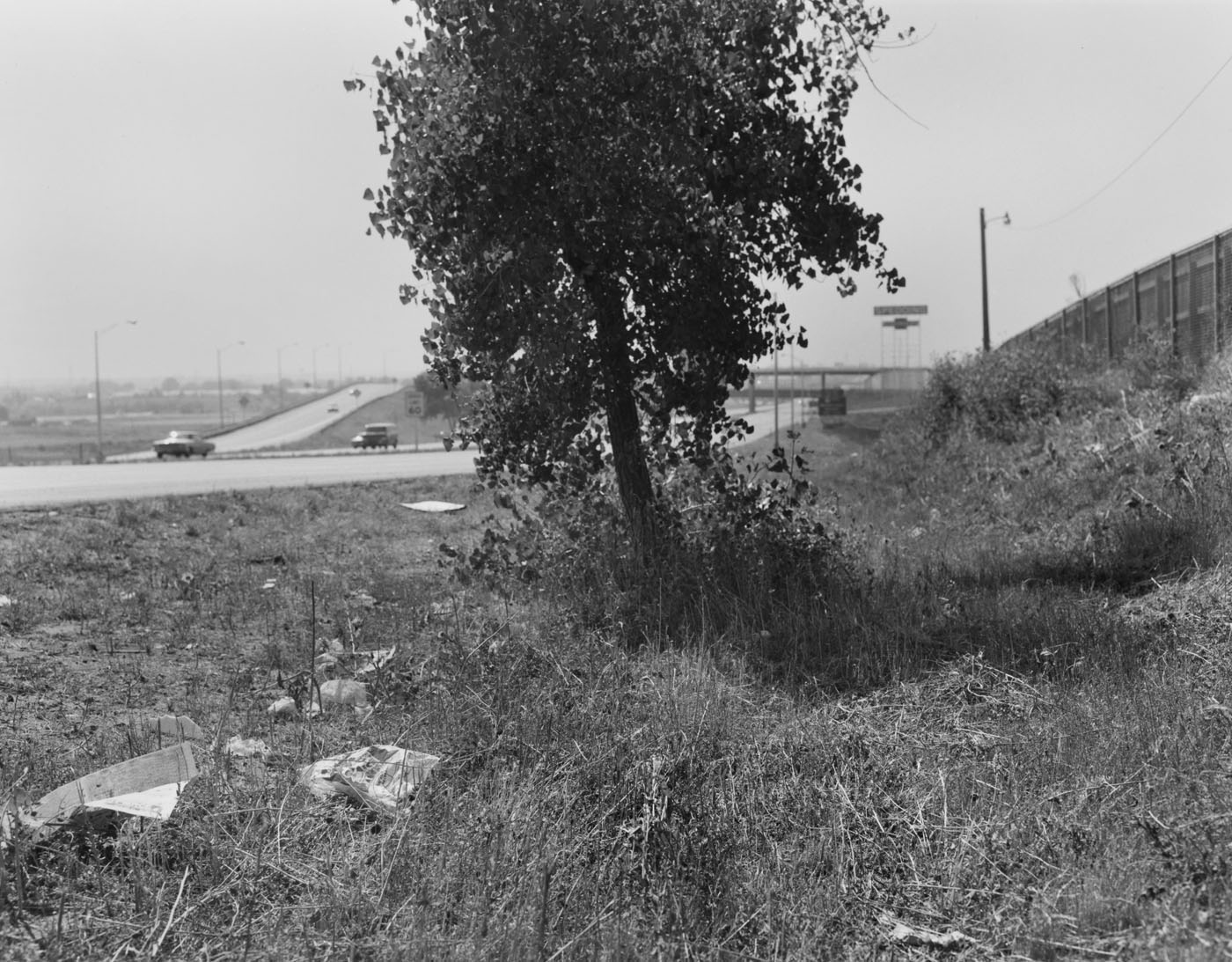
 

Robert Adams (American, b. 1937)
'Interstate 25, Denver, Colorado' 1973


Robert Adams (American, b. 1937)
Interstate 25, Denver, Colorado
1973
Gelatin silver print
Image: 15.2 x 19.3cm (6 x 7 5/8 in.)
National Gallery of Art
The Ahmanson Foundation and Gift of Robert and Kerstin Adams
© Robert Adams, Courtesy Fraenkel Gallery, San Francisco


Adams’ photographic vision is extra ordinary and I cannot fault his individual photographs. I become engrossed in them. I breathe their atmosphere. He has a resolution, both in terms of large format aesthetic, the aesthetic of beauty and of using materials, light and composition… that seems exactly right. He possesses that superlative skill of few great photographers, and by that I mean: sometimes he has true compassion** / parallel to a religious compassion, but not based on something higher / just perfect human. In some of his photographs (such as East from Flagstaff Mountain, Boulder County, Colorado 1975) he possesses real forgiveness, in others there is the perfection of cruel, the perfection of de/composition.

** achieved by Arbus, Atget and sometimes by Clift, Gowin.

And then, each image holds small clues vital to the overall conversation that is the accumulation of his work and it is in their collective accumulation of meaning that Adams’ photographs grow and build to shatter not just the American silence on environmental issues, but the deafening silence of the whole industrialised world. In their holistic nature, Adams’ body of work becomes punctum and because of this his work produces other “things”, things as great as anything the French literary theorist, essayist, philosopher, critic, and semiotician Roland Barthes wrote about. As in Barthes’ seminal work Camera Lucida, Adams’ work reminds us that the “photograph is evidence of ‘what has ceased to be’. Instead of making reality solid, it reminds us of the world’s ever changing nature.”1

Marcus Bunyan. “The quiet of the great beyond,” on the exhibition American Silence: The Photographs of Robert Adams at the National Gallery of Art, Washington, May – October 2022 on Art Blart: art and cultural memory archive website, September 25, 2022 [Online] Cited 06/02/2025

1/ Anonymous. “Roland Barthes,” on the Wikipedia website Nd [Online] Cited 23/09/2022


Michael Jang (American, b. 1951)
'Study Hall' 1973 from the exhibition 'The '70s Lens: Reimagining Documentary Photography' at the National Gallery of Art, Washington


Michael Jang (American, b. 1951)
Study Hall
1973
Gelatin silver print
15.5 × 23.5cm (6 1/8 × 9 1/4 in.)
National Gallery of Art
Charina Endowment Fund


In Study Hall, Michael Jang’s extended family sits together on a couch reading comics and a television guide, a messy tray of Kraft Teez Dip and potato chips on the table in front of them. The covers of the decidedly not studious publications block their faces, becoming stand-ins for their portraits. In Aunts and Uncles (nearby), relatives are caught joking around while posing for an official family portrait in silly sunglasses.

Jang’s humorous photographs of his Chinese American family and the trappings of their suburban lives offer a refreshing take on the often staid genre of family portraiture. They also debunk the 1970s stereotype – think The Brady Bunch – that the “all-American” family could only be white.

Wall text from the exhibition


In his series The Jangs, Michael Jang photographed family at home. His humorous photographs of their suburban lives expanded the concept of the “all-American” family – the Chinese American Jangs didn’t look like The Brady Bunch.

In Study Hall, Jang’s cousins and aunt sit together on a couch reading comics and a television guide, a messy tray of potato chips and dip on the table in front of them. The covers of decidedly not studious publications block their faces, becoming stand-ins for their portraits.

Jang’s delightful series was almost entirely forgotten. The photographs, which he had first made while a student, sat in a box in the artist’s house for decades while he established a career as a commercial photographer.

In the 2000s, Jang reconsidered this series and shared it with museums, which began adding the photographs to their collections. His photographs took on a new light in the wake of a rise of anti-Asian hate during the COVID-19 pandemic. In 2021, Jang wheat pasted images from The Jangs on buildings in San Francisco’s Chinatown.

Text from the National Gallery of Art website
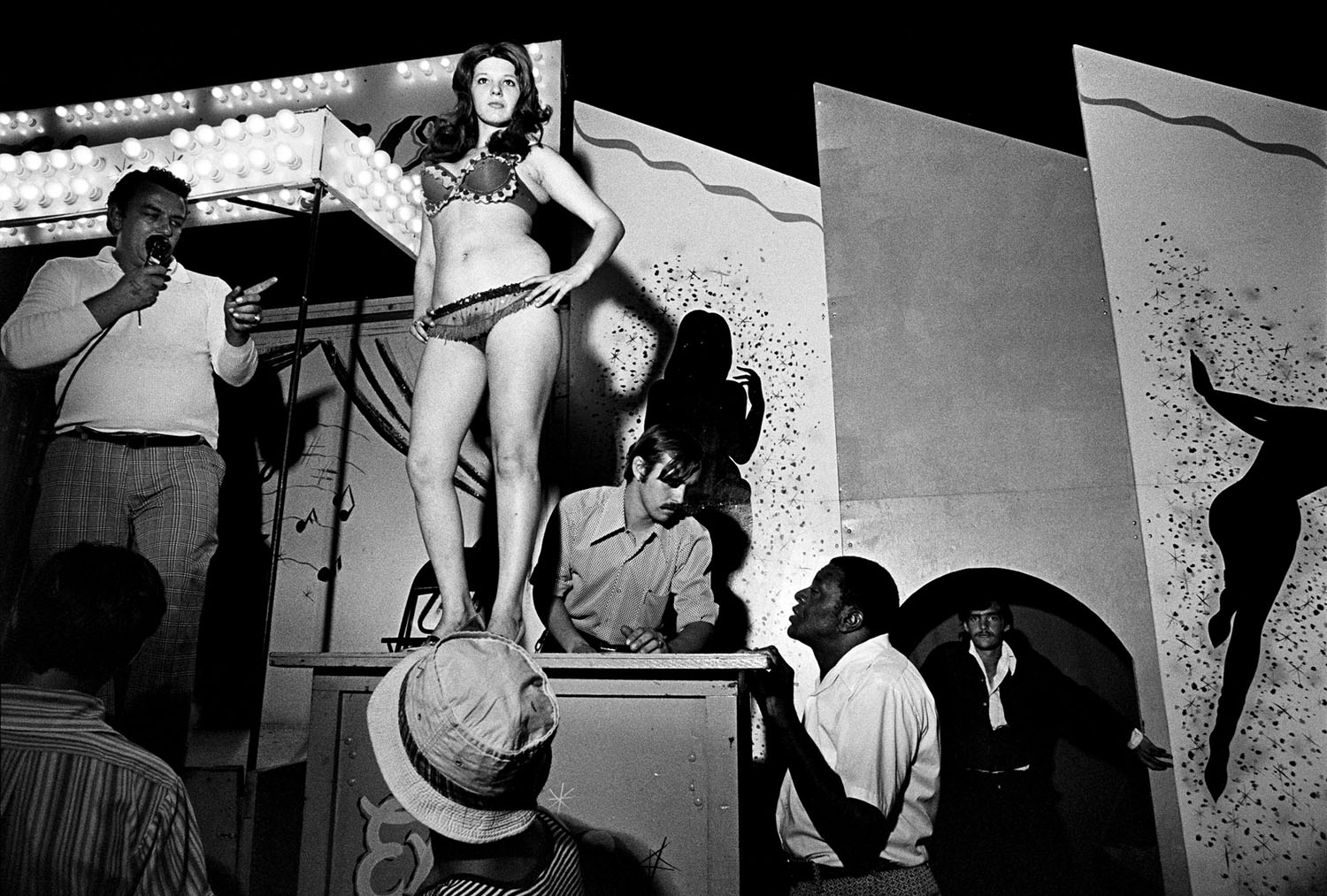
 

Susan Meiselas (American, b. 1948)
'Lena on the Bally Box, Essex Junction, Vermont' 1973


Susan Meiselas (American, b. 1948)
Lena on the Bally Box, Essex Junction, Vermont
1973
Gelatin silver print
Image: 22 x 32.5cm (8 11/16 x 12 13/16 in.)
National Gallery of Art
Anonymous Gift in honor of Sarah Greenough and Andrea Nelson


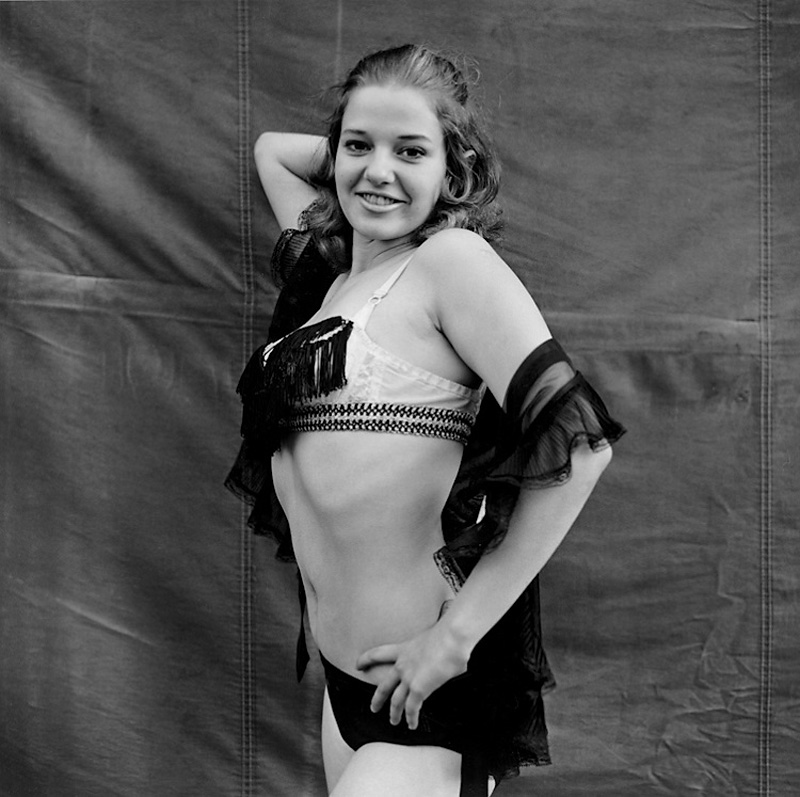
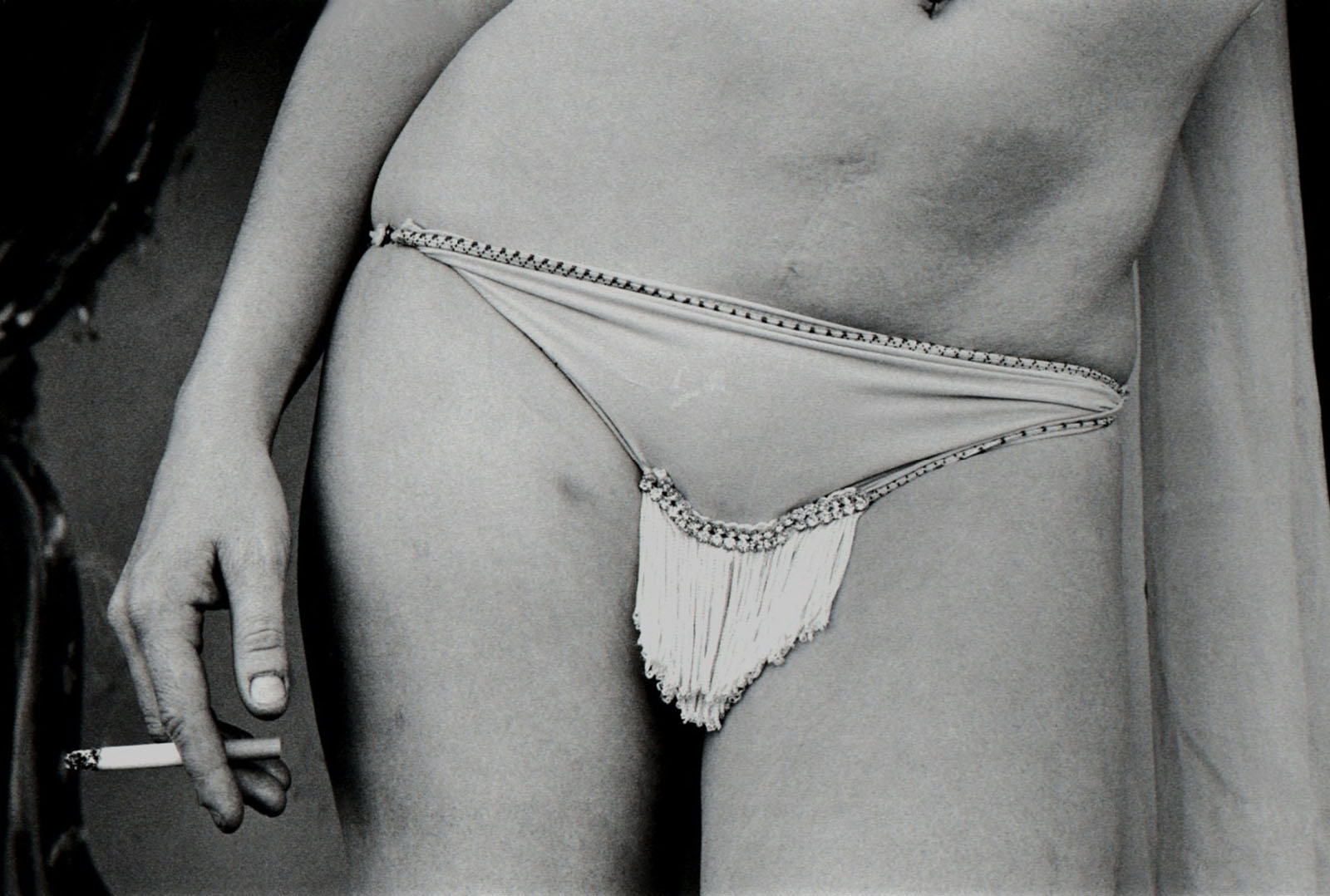
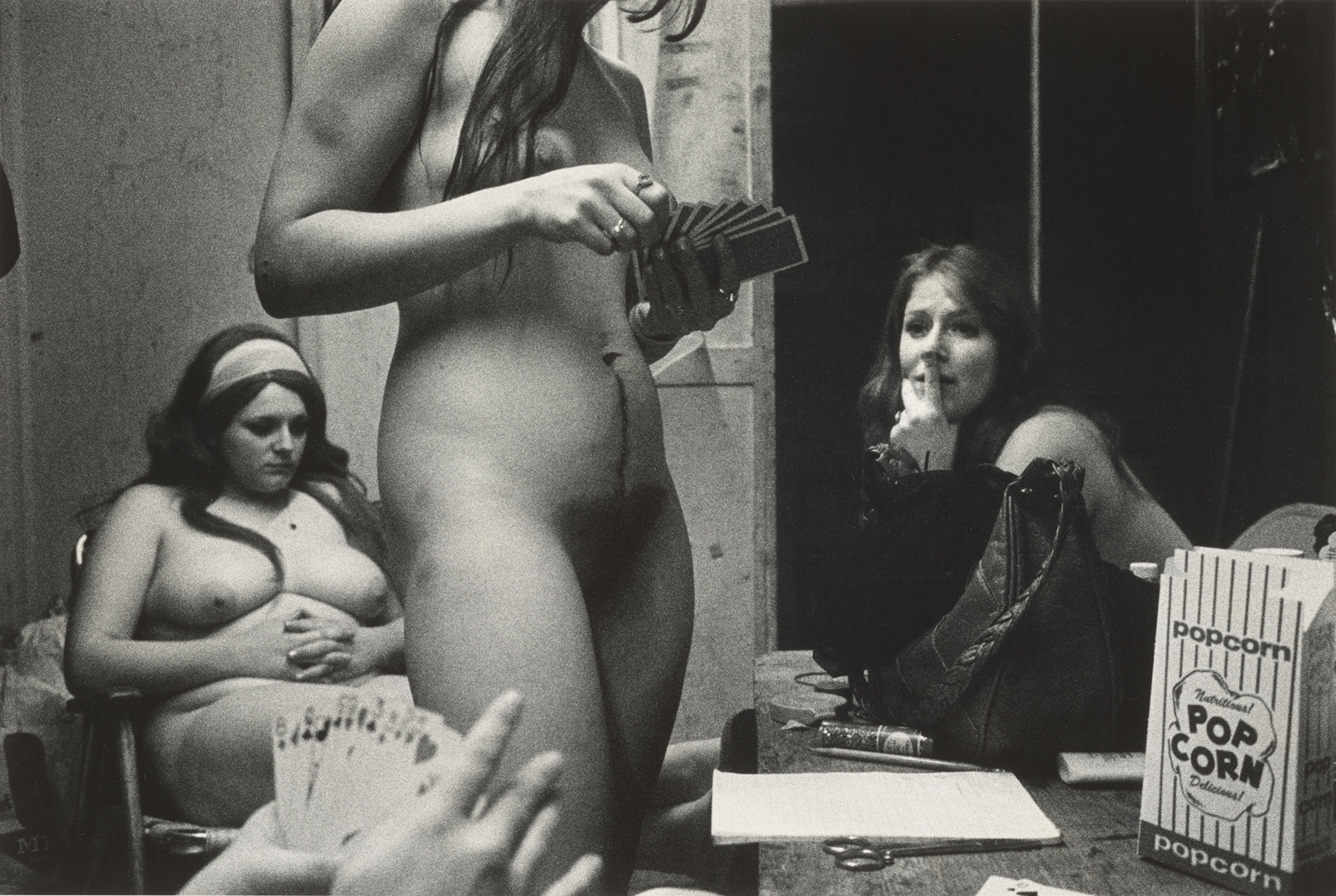
The final and most essential selection in this posting – Susan Meiselas’ 1972-1975 Carnival Strippers series – goes behind the “front” to document the lives of women who performed striptease for small-town carnivals in New England, Pennsylvania and South Carolina. “Meiselas’ frank description of these women brought a hidden world to public attention, and explored the complex role the carnival played in their lives: mobility, money and liberation, but also undeniable objectification and exploitation. Produced during the early years of the women’s movement, Carnival Strippers reflects the struggle for identity and self-esteem that characterised a complex era of change.” (Booktopia)

Intense, intimate and revealing, the series proves that we can think we know something (the phenomenal) and yet photography reveals how strange and different each world is – whether that be in trying to understand the mind of the artist and what they intended in a constructed photograph or, in this case, having an impression of someone else’s life, a life we can perceive (through the “presence” of the photograph) but never truly know (the noumenal).

Marcus Bunyan on the exhibition Known and Strange: Photographs from the Collection at the V&A Photography Centre on the Art Blart: art and cultural memory archive website, May 7, 2022 [Online] Cited 06/20/2025


Susan Meiselas (American, b. 1948)
'Tentful of Marks, Tunbridge, Vermont'
1974


Susan Meiselas (American, b. 1948)
Tentful of Marks, Tunbridge, Vermont
1974
Gelatin silver print
Image: 19.7 x 29.4cm (7 3/4 x 11 9/16 in.)
National Gallery of Art, Corcoran Collection
Museum Purchase, Photography Acquisition Fund

In Tentful of Marks, Susan Meiselas trains her camera from backstage on the legs and high heels of a carnival dancer. The all-male audience – the “marks” of the title – are in sharp focus, and they crowd around the small stage, lustfully gawking up at her. Meiselas spent three summers documenting women who performed striptease at small-town carnivals in New England, Pennsylvania, and South Carolina. In addition to making photographs, she recorded audiotapesof conversations with the dancers, giving them agency to describe their experience. Meiselas saw her project as a collaboration. Merging listening and looking, it expanded perspectives on a largely invisible and – from the dancers’ perspective – misunderstood world.

Wall text from the exhibition


Installation view of the exhibition 'The '70s Lens: Reimagining Documentary Photography' at the National Gallery of Art, Washington showing at left, Milton Rogovin's photograph 'Jimmy Webster with His Father, Verne' (1973); and at right, 'Jimmy Webster' (1985)


Installation view of the exhibition The ’70s Lens: Reimagining Documentary Photography at the National Gallery of Art, Washington showing at left, Milton Rogovin’s photograph Jimmy Webster with His Father, Verne (1973, below); and at right, Jimmy Webster (1985)

With thankx to the official Milton Rogovin Facebook page for allowing me to publish this image.


Milton Rogovin (American, 1909-2011) 'Jimmy Webster with His Father, Verne' 1973


Milton Rogovin (American, 1909-2011)
Jimmy Webster with His Father, Verne
1973
Gelatin silver print
Image: 17.4 x 15.5cm (6 7/8 x 6 1/8 in.)
National Gallery of Art
Gift of Pierre Cremieux and Denise Jarvinen

With thankx to the official Milton Rogovin Facebook page for allowing me to publish this image.


Verne Webster, sitting on his front stoop, looks guardedly at the camera while sheltering his toddler son Jimmy in a protective embrace. This is an early work from Milton Rogovin’s 30-year series documenting Buffalo’s Lower West Side. The project focused on a six-block neighbourhood that was among Buffalo’s most diverse and most impoverished. Rogovin asked permission to photograph his subjects, let them choose their poses and settings, and gave them free prints. He returned every decade or so to photograph the same individuals. A nearby picture shows Jimmy 12 years later. Looking back at Rogovin’s photographs in 2003, Jimmy Webster said, “Whenever you look at his photographs, you just see people for who they are.”

Wall text from the exhibition


John Baldessari (American, 1931-2020) 'Throwing three balls in the air to get a straight line: (best of thirty-six attempts)' 1973


John Baldessari (American, 1931-2020)
Throwing three balls in the air to get a straight line: (best of thirty-six attempts)
1973
Colour offset photolithographs
National Gallery of Art Library
David K. E. Bruce Fund


West Coast conceptual art has a whimsical air. Artists such as John Baldessari and Ed Ruscha created scenarios that lampoon both the pretense of “high art” and the self-seriousness of conceptual art, particularly as the latter was developing in New York. Beneath the humor, however, their works spoke to more substantive issues like artistic failure and social mores. In 1973 Baldessari photographed his 36 attempts to throw three balls in the air to form a straight line. He never succeeded but included his 12 best attempts in a portfolio.

Wall text from the exhibition
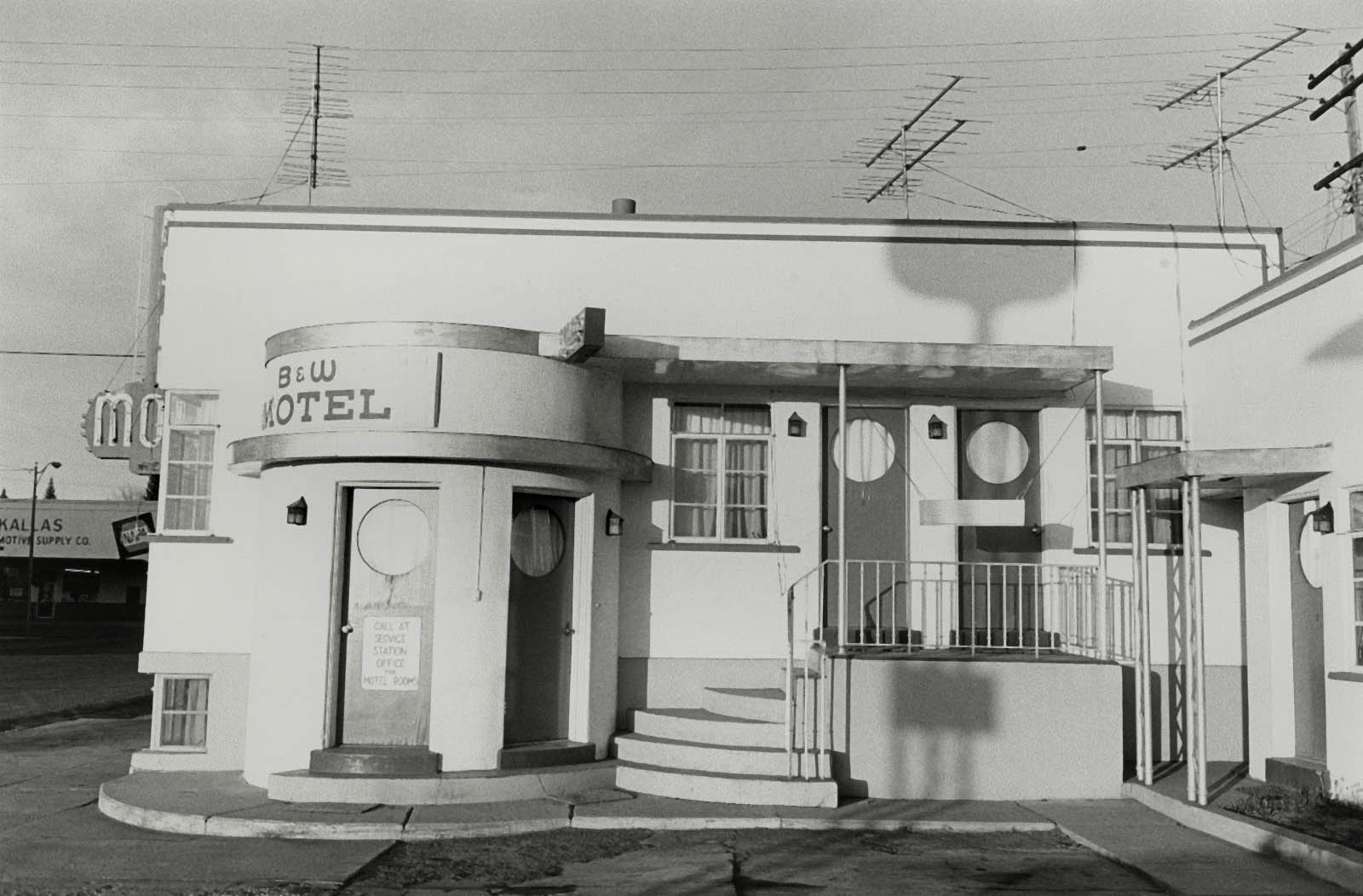
 

Henry Wessel (American, 1942-2018) 'Utah' 1974


Henry Wessel (American, 1942-2018)
Utah
1974
gelatin silver print
Image: 26.5 x 39.7cm (10 7/16 x 15 5/8 in.)
National Gallery of Art
Patrons’ Permanent Fund


Stephen Shore (American, b. 1947)
'Holden Street' July 13, 1974


Stephen Shore (American, b. 1947)
Holden Street
July 13, 1974
Chromogenic print
Image: 20.5 x 25.4cm (8 1/16 x 10 in.)
National Gallery of Art
Diana and Mallory Walker Fund


Stephen Shore’s photograph may appear casual, but it is carefully constructed. The vertical of the lamppost draws our attention to the shadowed foreground. Buildings and sidewalks on each side act as perspective lines that meet in the brighter background. Shore was exploring how three-dimensional space is rendered in two dimensions, particularly in a colour photograph. He was also examining where a once-powerful New England industrial town abruptly ended and the verdant countryside began. The lack of people, saturated colours, and clarity of detail – made possible by using a large-format 8 × 10 camera – give the picture an air of timelessness but also hyperreality.

Wall text from the exhibition
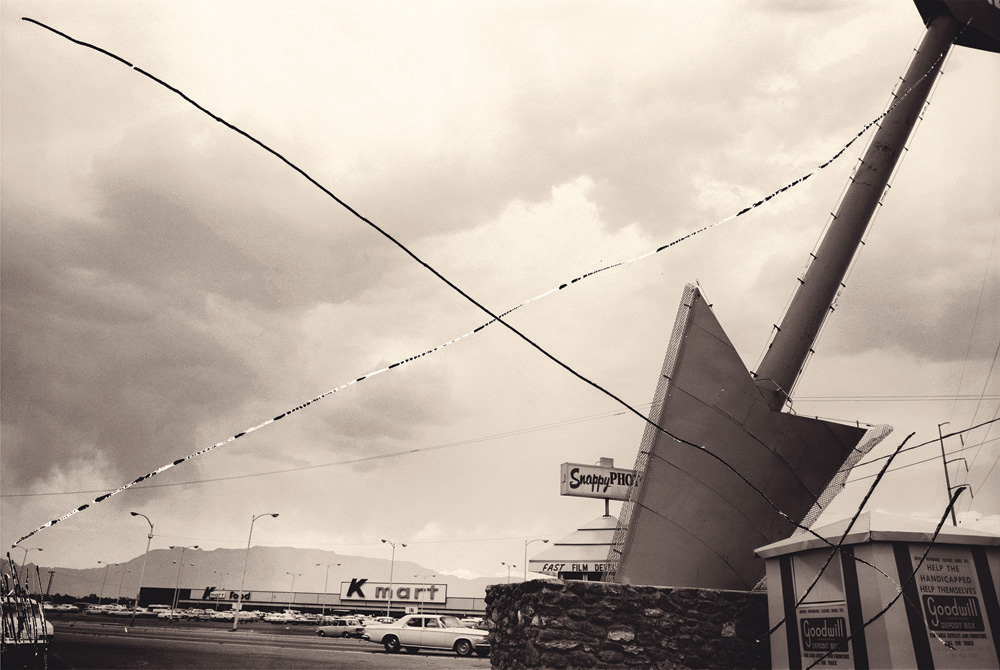
 

Thomas Barrow (American, 1938-2024) 'Dart, Albuquerque' 1974 from the exhibition 'The '70s Lens: Reimagining Documentary Photography' at the National Gallery of Art, Washington


Thomas Barrow (American, 1938-2024)
Dart
1974, printed 1994
From the series Cancellations
Gelatin silver print
23.9 × 34.6cm (9 7/16 × 13 5/8 in.)
National Gallery of Art
Randi and Bob Fisher Fund


In Dart, Thomas Barrow photographed a huge arrow that appears to have plunged from the threatening clouds above into a parking lot shared by Snappy Photos, a Goodwill drop-off bin, and a K-Mart. The work is part of his series Cancellations, documenting the suburban sprawl overtaking much of the United States. Barrow “cancelled” his images before printing by slashing the negatives with an icepick. (“Cancelling” refers to the practice of defacing a printing plate or negative to ensure no more official prints can he made from it.) This action calls attention to the photograph’s surface and its materiality, which in turn emphasise the choices Barrow made in its production.

Wall text from the exhibition


Thomas F. Barrow is an artist working with photography more than he is a photographer… For Barrow, the ideas are what matter, not the material they are realized with.

Barrow’s Cancellations series is an early expression of this artistic philosophy. Created between 1973-1981, it began when Barrow moved from Rochester, New York to Albuquerque, New Mexico to teach at UNM. Like many photographers of this era (Lewis Baltz, Frank Gohlke, Robert Adams) Barrow was struck by the transformation underway with the (sub)urbanization of the Western landscape. However, he was inspired to do more than document with his camera; he wanted to challenge his viewers while subverting some fundamental truths of photography. Inspired by a cancelled Marcel Duchamp etching (a process where the etching plate is defaced to indicate that no more official prints may be made), he began defacing his negatives with an ice pick and hole punch, “cancelling” them before making the images.

Almost 40 years later, it’s still unclear whether Barrow is canceling the photograph or the scene in the picture. He is certainly calling attention to the matrix that produced the photograph, an unheard of practice at the time and still rare today. By defacing his negatives, he has created photographs that are as much about the physical image as they are about the subject in the photograph.

David Ondrik. “Cancellations by Thomas Barrow,” in Fraction Magazine Issue 49 on the Fraction Magazine website Nd [Online] Cited 07/02/2025
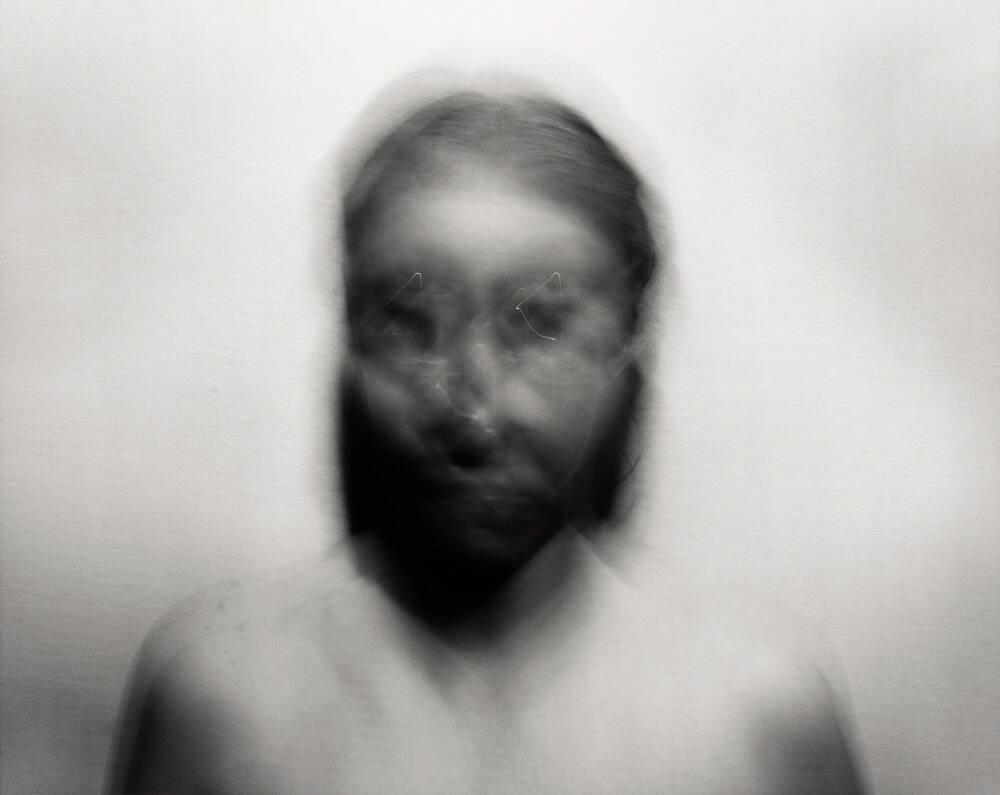
 

Blythe Bohnen (American, 1940-2022) 'Self-Portrait: Triangular Motion, Small' 1974 from the series 'Self-Portraits: Studies in Motion'


Blythe Bohnen (American, 1940-2022)
Self-Portrait: Triangular Motion, Small
1974
From the series Self-Portraits: Studies in Motion
Gelatin silver prints
National Gallery of Art
Gift of Herbert and Paula Molner


Most self-portraits offer some idea of the artist’s physical appearance and perhaps psychological state. The focus of Blythe Bohnen’s intentionally distorted self-portraits, however, is altogether different. Bohnen was interested in the physical element of artmaking – specifically, the role of her body’s movements or gestures in the creative process. Photographs usually capture an instant, but Bohnen instead used exposures of several seconds and the precise, predetermined gestures identified in her titles to distill the essence of motion. The portraits, blurry and disorienting, become more of a performance in time, condensed into a single image.

Wall text from the exhibition
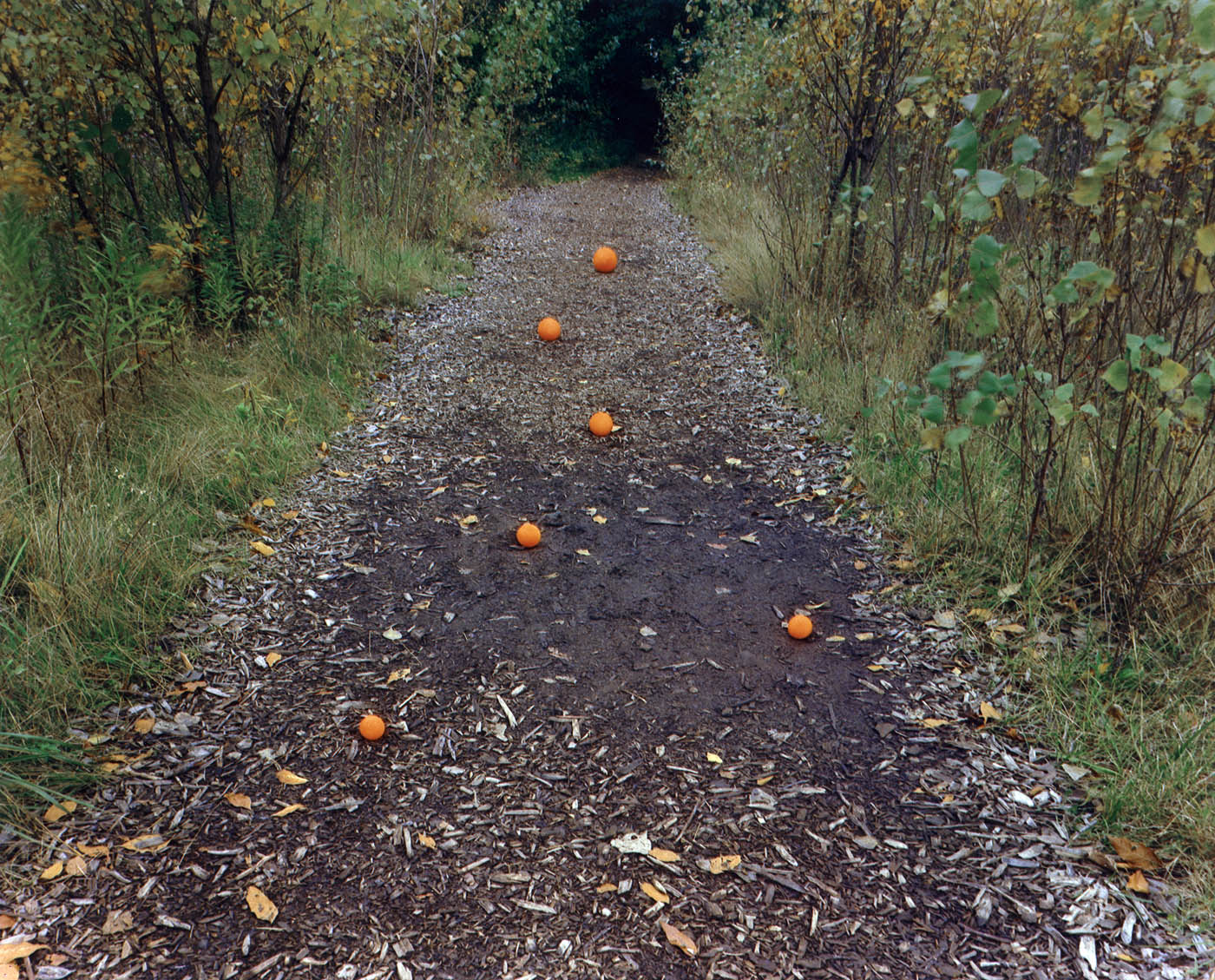
 

John Pfahl (American, 1939-2020) 'Six Oranges, Buffalo, New York' 1975 from the exhibition 'The '70s Lens: Reimagining Documentary Photography' at the National Gallery of Art, Washington


John Pfahl (American, 1939-2020)
Six Oranges, Buffalo, New York
1975
Dye imbibition print
Image: 20.6 x 25.5cm (8 1/8 x 10 1/16 in.)
National Gallery of Art
Patrons’ Permanent Fund
© The John Pfahl Trust


For the works in his series Altered Landscape, John Pfahl playfully juxtaposed the organic and natural with the manipulated and constructed. In this picture, he placed six oranges on a path in the woods. Typically, if the fruits were all the same size they would appear to grow smaller the farther from the camera they were located. Here, however, the artist has reversed that expectation, with the smallest orange sitting nearest the camera and the largest in place at the top of the picture. Through his staging, Pfahl makes the viewer aware of how a camera, by recording three-dimensional space onto a two-dimensional surface, actually produces a distorted view.

Wall text from the exhibition


In 1981, Peter C. Bunnell observes in his Introduction to James Alinder’s book Altered Landscapes: The Photographs of John Pfahl, “Our momentary, fragmented and captured vision of disorder and emotion has been replaced by a cool rendering of purposefulness as if to accord another dimension of positivism to the moving force of contemporary human awareness. Pfahl’s work is an attack on the problems of space and, ultimately, existence from a rational point of view.”

Forty years later, these photographs seem not so much rational, or picturesque, as spiritual. The human construction touches the earth lightly, almost reverentially. As Pfahl notes, utmost care is taken not to alter the actual subject in a way he would consider harmful to his positivist respect for nature. In this delicate footprint, these photographs are very prescient of the dangers of our own Anthropocene – of climate change, of raging bushfires, drought, flood and bio-exinction. We are literally destroying this planet and its creatures. Bunnell states, “Pfahl’s imagery is a sure manifestation of the belief that society can produce an art suitable to its nature and, in this case, a specific kind of photographic presence that expresses current societal values.”

Unfortunately, it’s all too late. The lesson has not been learned.

Marcus Bunyan on the exhibition John Pfahl Altered Landscapes at Joseph Bellows Gallery, La Jolla, California, November – December 2019
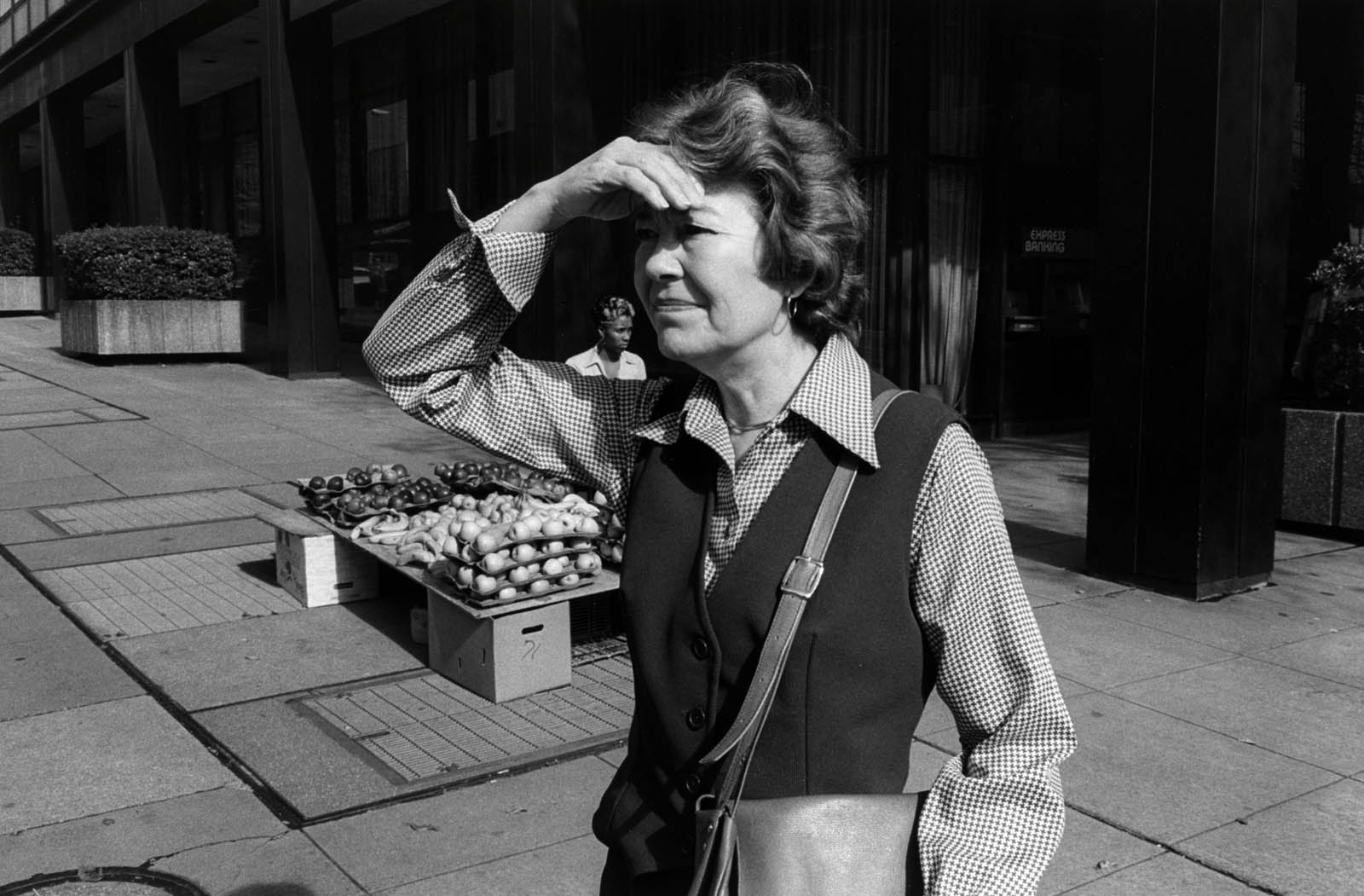
 

Anthony Hernandez (American, b. 1947) 'Washington, DC #11' 1975 from the exhibition 'The '70s Lens: Reimagining Documentary Photography' at the National Gallery of Art, Washington


Anthony Hernandez (American, b. 1947)
Washington, DC #11
1975
Gelatin silver print
Image: 18.1 × 27.31cm (7 1/8 × 10 3/4 in.)
National Gallery of Art
Corcoran Collection (Museum Purchase)


Anthony Hernandez cleverly uses the crook of a woman’s raised arm to frame a fruit seller on the street behind her. A Los Angeles – based photographer, Hernandez was invited to Washington, DC, in 1975 to participate in The Nation’s Capital in Photographs, a bicentennial documentary project organized by the Corcoran Gallery of Art. Ignoring the city’s monuments, Hernandez captured life in commercial downtown areas where the architecture and people on the street defined the landscape. This sparsely populated composition evokes urban alienation. Neither figure seems aware of the other, and both look small against the austere modern building and grate-covered sidewalk that fill the background.

Wall text from the exhibition


Anthony Hernandez’s 1970s photographs of urban inhabitants are often focused on odd-looking people staring right at the camera. His subjects often appear surprised and slightly perturbed, as if caught unaware in private moments of thought or conversation.

Following two years of study at East Los Angeles College and two years of service in the United States Army as a medic in the Vietnam War, Hernandez took up photography in earnest around 1970. He walked the streets of his native Los Angeles, observing its inhabitants. In order to work quickly and intuitively, he would pre-focus the camera and then wait for subjects to come into the zone of focus – only briefly bringing the camera to his eye as he walked past them. He repeated this strategy in other cities, including London, Madrid, Saigon, and Washington, D.C.

Text from the J. Paul Getty Museum website


Joanne Leonard (American, b. 1940)
'Memo Center with Wall Plaque' c. 1975


Joanne Leonard (American, b. 1940)
Memo Center with Wall Plaque
c. 1975
Gelatin silver print
Image: 33.3 × 43.1cm (13 1/8 × 16 15/16 in.)
National Gallery of Art
Gift of the Artist in honor of her daughter, Julia Marjorie Leonard


Dotted curtains, a flowered light switch plate, and a humorous wall plaque add a personal touch to this carefully framed picture of a so-called memo center – an area near a wall phone where notes could be jotted down that was popular in 1970s homes. A practitioner of what she called “intimate documentary,” feminist artist Joanne Leonard recorded familiar but often overlooked domestic spaces traditionally associated with women. She explained, “Through my work as an artist I’ve discovered that the realms of the personal and the public are rarely as separate as I once imagined.”

Wall text from the exhibition


In the 1970s Leonard began examining how domestic spaces are transformed through the presence of technology by photographing the interiors of her neighbours’ homes in West Oakland, California, later moving on to other locations. She captured personal objects in bedrooms and found repetition in the common appliances present in kitchen after kitchen. She also documented the proliferation of “memo centers” – areas where notes could be jotted down near the location of a telephone, which at this time was still tethered in place by a cord.

Museum of Modern Art (MoMA) Gallery label from 2022


Joanne Leonard (American, b. 1940)
'Lupe's Kitchen Window, San Leandro, California' c. 1975


Joanne Leonard (American, b. 1940)
Lupe’s Kitchen Window, San Leandro, California
c. 1975
Gelatin silver print
Image: 41.8 x 43.1cm (16 7/16 x 16 15/16 in.)
National Gallery of Art
Gift of the Artist in honor of her daughter, Julia Marjorie Leonard


Peter Hujar (American, 1934-1987) 'Susan Sontag'
1975


Peter Hujar (American, 1934-1987)
Susan Sontag
1975
Gelatin silver print
Image: 37.15 x 37.15cm (14 5/8 x 14 5/8 in.)
National Gallery of Art
Stephen G. Stein Employee Benefit Trust


Robert Cumming (American, 1943-2021) '67-Degree Body Arc Off Circle Center' 1975, printed 2022


Robert Cumming (American, 1943-2021)
67-Degree Body Arc Off Circle Center
1975, printed 2022
Inkjet print
Image: 148.59 x 185.42cm (58 1/2 x 73 in.)
National Gallery of Art
Gift of David Knaus


Sometimes Cumming used his own body as an eccentric subject, as in “67-degree body arc off circle center” from 1975. Shown in profile with his hips thrust forward, his torso arched back and his neck and head awkwardly aligned with the angle of his legs, he’s a mathematical or scientific demonstration whose geometry turns the graceful rationality of Leonardo da Vinci’s “Vitruvian Man” on its ear. The title’s geometric forms drawn around his body on the surface of the photograph might have been made with an oversized pen-nib, into which the hand on Cumming’s hip is discreetly hidden.

The artist’s photograph, like a drawing, is an artifice.

His work as a painter, sculptor and performance artist informed his distinctive, often witty approach to images made with a camera, which Cumming began to explore in 1969 and continued for more than a decade. Artists as diverse as Eve Sonneman, Jan Groover, Lew Thomas, Judy Fiskin and Lewis Baltz were blurring traditional boundaries in different but Conceptually cogent ways. Photography would never be the same.

Christopher Knight. “Robert Cumming, whose photographs transformed camera work, dies at 78,” on the Los Angeles Times website Dec. 21, 2021 [Online] Cited 07/02/2025


Francesca Woodman (American, 1958-1981) 'House #3' c. 1975-1976, printed 1997-2004


Francesca Woodman (American, 1958-1981)
House #3
c. 1975-1976, printed 1997-2004
Gelatin silver print
Image: 16.1 x 16.3cm (6 5/16 x 6 7/16 in.)
National Gallery of Art
Gift of the Heather and Tony Podesta Collection


At the far end of a decrepit room, the phantom-like figure of the photographer appears to be merging with, or emerging from, the wall. In contrast to the sharply rendered interior, she is an ethereal blur whose face can barely be made out. Both the creator and subject of most of her work, Francesca Woodman staged dreamlike performances that explore self-portraiture, the female body, and architectural space. Although sometimes carefully planned, they more often represented her spontaneous, imaginative responses to an environment. Woodman made this photograph in an abandoned house in Providence when she was in her late teens.

 Wall text from the exhibition


The 1970s was a decade of uncertainty in the United States. Americans witnessed soaring inflation, energy crises, and the Watergate scandal, as well as protests about the Vietnam War, women’s rights, gay liberation, and the environment. The profound upheaval that rocked the country formed the backdrop for a revolution in documentary photography. Activism and growing support of multiculturalism opened the field to underrepresented voices, while artistic experimentation fuelled the reimagining of what documentary photographs could look like.

The ’70s Lens: Reimagining Documentary Photography examines this compelling and contested moment of reinvention when documentary photography’s automatic association with objectivity and truthfulness came into question. The photographs on view record subjects, communities, and landscapes previously overlooked and expand the boundaries of the genre. During this turbulent decade, documentary practice became more deeply entwined with fine art, while conceptual and performance artists used the medium to preserve their ideas and record their actions. An openness to individual expression and a turn from black and white to color film further transformed a field previously celebrated for accurately representing the world and its social ills.

Drawn primarily from the National Gallery’s collection and featuring some 100 photographs by more than 80 artists, The ’70s Lens is on view from October 6, 2024, through April 6, 2025, in the West Building.

“The profound upheaval in American life during the 1970s inspired artists to question the objective nature of documentary photography,” said Kaywin Feldman, director of the National Gallery. “The extraordinary photographs on view in this exhibition explore their diverse and compelling responses, revealing relevant connections to today’s thinking about community and who gets to represent it, as well as broader concepts including photographic truth, equity, and environmental responsibility.”

The Exhibition

Organised thematically, The ’70s Lens: Reimagining Documentary Photography examines how the many documentary approaches that emerged during the 1970s reflected a radical shift in American life – and in photography itself.

Seeing Community

Spurred by the civil rights movement and a growing recognition of the rich ethnic and cultural diversity within the United States, photographers – especially from the Black, Latinx, and LGBTQ+ communities – reclaimed documentary practice to represent the fullness of their lives. Responding to a history of misrepresentation by outsiders, Anthony Barboza, Frank Espada, Mikki Ferrill, Nan Goldin, Jeanne Moutoussamy-Ashe, John Simmons, among others, focused their cameras on close-knit neighborhoods, often their own, building trusting relationships with the people they photographed. These artists worked collaboratively with their subjects to challenge preconceived notions of their communities.

Experimental Forms

Influenced by the groundbreaking photographs made by Roy DeCarava and Robert Frank beginning in the 1950s, a new generation of documentary photographers used the camera to visualise the world and their place in it. By combining clear-eyed observation with individual expression, artists such as Jim Goldberg, Sophie Rivera, and Shawn Walker revealed the complexity of the human condition from a more personal perspective. Others, such as Diane Arbus, Lee Friedlander, Anthony Hernandez, and Garry Winogrand, focused their attention on the irony and ambivalence rooted in American culture of the time, depicting everyday life with a psychological frankness. Together their revitalization of portraiture and street photography merged documentary practice with fine-art photography.

Conceptual Documents

Documentary photography became central to the practice of many conceptual artists in the 1970s. For them, the idea behind a work was more important than the finished object. John Baldessari, Thomas Barrow, and Robert Cumming interrogated the conventions of photography’s widely assumed objectivity and truthfulness by highlighting the difference between photographic appearance and reality. Others, like Susan Hiller and Dennis Oppenheim, used the camera to record their creative process, often integrating photographs with texts to address larger social issues about gender and the environment.

Performance and the Camera

Documentary photography was also integral to performance-based art during the 1970s. Many artists used the medium to record their otherwise ephemeral actions – including those who made performances specifically for the camera. This photographic documentation became a new form of art inseparable from the overall conception of the performance. Senga Nengudi in collaboration with Maren Hassinger explored the elasticity of the body through choreographed actions. Ana Mendieta and Francesca Woodman examined their identities through interventions in the environment, while Tseng Kwong Chi, Marcia Resnick, and David Wojnarowicz staged journeys and constructed histories that pushed the boundaries between truth and fiction.

Life in Color

The art world’s embrace of color film in the 1970s transformed documentary photography. Commercial color processes had existed for more than 50 years, but serious documentary photography was strictly associated with black-and-white prints. Color photography’s status changed gradually over the decade, and especially in the wake of an exhibition of William Eggleston’s mundane but incisive photographs at the Museum of Modern Art in 1976. Pictures of everyday life made in color by William Christenberry, Mitch Epstein, Richard Misrach, and John Valadez held an immediacy that fascinated viewers and offered a new framework for reflecting on contemporary life.

Alternative Landscapes

The 1970s witnessed a radical shift in how landscapes were understood and photographed. Robert Adams, Lewis Baltz, and Joe Deal challenged popular ideas of nature as pristine and timeless with pictures of environmental destruction and suburban sprawl. From grain elevators to roadside motels, Frank Gohlke and John Schott focused on structures that form the built environment, revealing how humans have shaped their surroundings. The artists in this section documented with an austere eye, and at times subversive wit, a rampant consumer culture and the damage done in the name of progress.

Intimate Documentary

Many photographers in the 1970s turned their cameras on themselves and close family members to analyze the social landscape of domestic spaces. Often informed by second-wave feminism, they prioritized interiors and life at home as topics for artistic examination. Joanne Leonard has described her narrative-rich scenes of everyday life as “intimate documentary,” while Bill Owens observed the rise of suburbia as both a place and a mentality. Concerned that documentary photography was losing its activist force, Martha Rosler and Eleanor Antin engaged with politics – especially the home front during the Vietnam War – more directly.

Press release from the National Gallery of Art


Sunil Gupta (Canadian born India, b. 1953) 'Untitled #22' 1976, printed 2023 from the exhibition 'The '70s Lens: Reimagining Documentary Photography' at the National Gallery of Art, Washington


Sunil Gupta (Canadian born India, b. 1953)
Untitled #22
1976, printed 2023
From the series Christopher Street
Gelatin silver print
Image: 61 x 91.5cm (24 x 36 in.)
National Gallery of Art
Alfred H. Moses and Fern M. Schad Fund
© Sunil Gupta


Sunil Gupta documented the emergence of a gay public space in New York’s Greenwich Village during the 1970s. The India-born Gupta had arrived from his adopted home in Montreal in 1976 to study business, but quickly decided instead to fine-tune his photographic skills. Energized by the overtly gay environment – a result, in part, of LGBTQ+ demonstrations in 1969 known as the Stonewall uprising – he started photographing people on the streets. Not impartial, Gupta was enthralled by those he encountered, including two stylishly dressed men who seem to acknowledge Gupta’s camera. In the Christopher Street series, Gupta recorded the then extraordinary act of being openly gay – a practice both political and deeply personal.

Still moved by this project, the artist has recently started making large-scale prints from his original negatives.

Wall text from the exhibition


This series was shot in New York in 1976 when I spent a year  studying photography with Lisette Model in the New School… I spent my weekends cruising with my camera, it was the heady days after Stonewall and before AIDS when we were young and busy creating a gay public space such as hadn’t really been seen before.

Text from the Sunil Gupta website
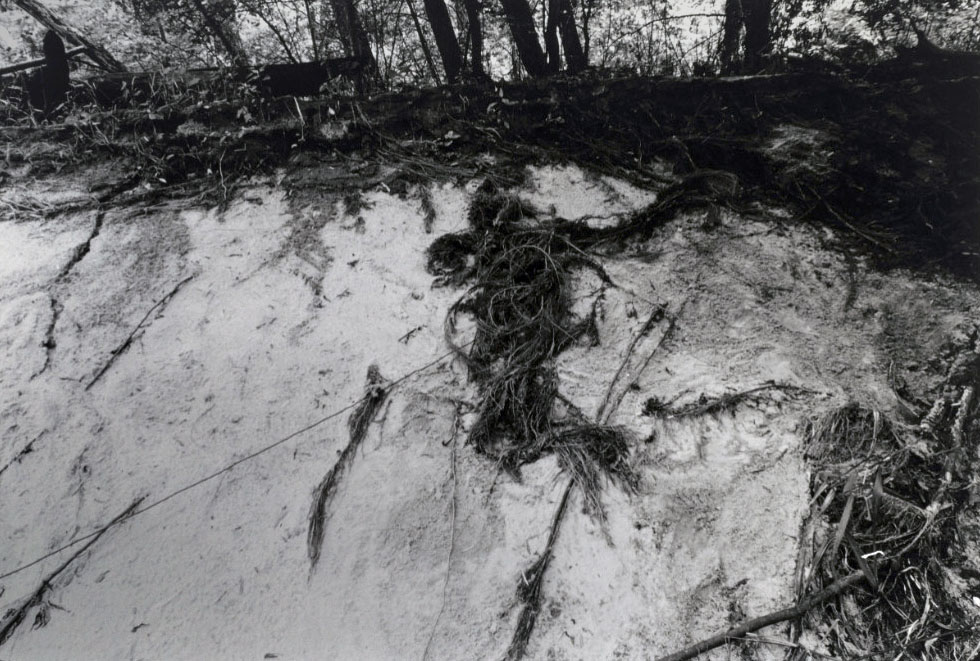
 

Ana Mendieta (Cuban-American, 1948-1985) 'Untitled' 1977-1978


Ana Mendieta (Cuban-American, 1948-1985)
Untitled
1977-1978
From the Silueta Series
Gelatin silver print
Image: 33.8 x 49.5cm (13 5/16 x 19 1/2 in.)
National Gallery of Art
Gift of the Collectors Committee


In her Silueta Series, Cuban American artist Ana Mendieta used the outline of her body to carve and shape silhouettes into the land. Informed by her interest in Afro-Cuban ritual, her fusion of performance and earthworks explored spiritual connections between nature and the female body. Mendieta’s exile with her family from Communist Cuba to the United States in the 1960s left her with a deep sense of loss. She remarked, “I have no motherland; I feel a need to join with the earth.” Photography was crucial in documenting these ephemeral pieces, preserving them before they were lost to the elements. Hauntingly beautiful, the pictures enable Mendieta’s practice to be both transitory and enduring.

Wall text from the exhibition


Larry Fink (American, 1941-2023) 'Studio 54' 1977


Larry Fink (American, 1941-2023)
Studio 54, New York City
May 1977
From the series Social Graces
Gelatin silver print
37.2 × 38cm (14 5/8 × 14 15/16 in.)
National Gallery of Art
Gift of Tony Podesta Collection, Washington, DC
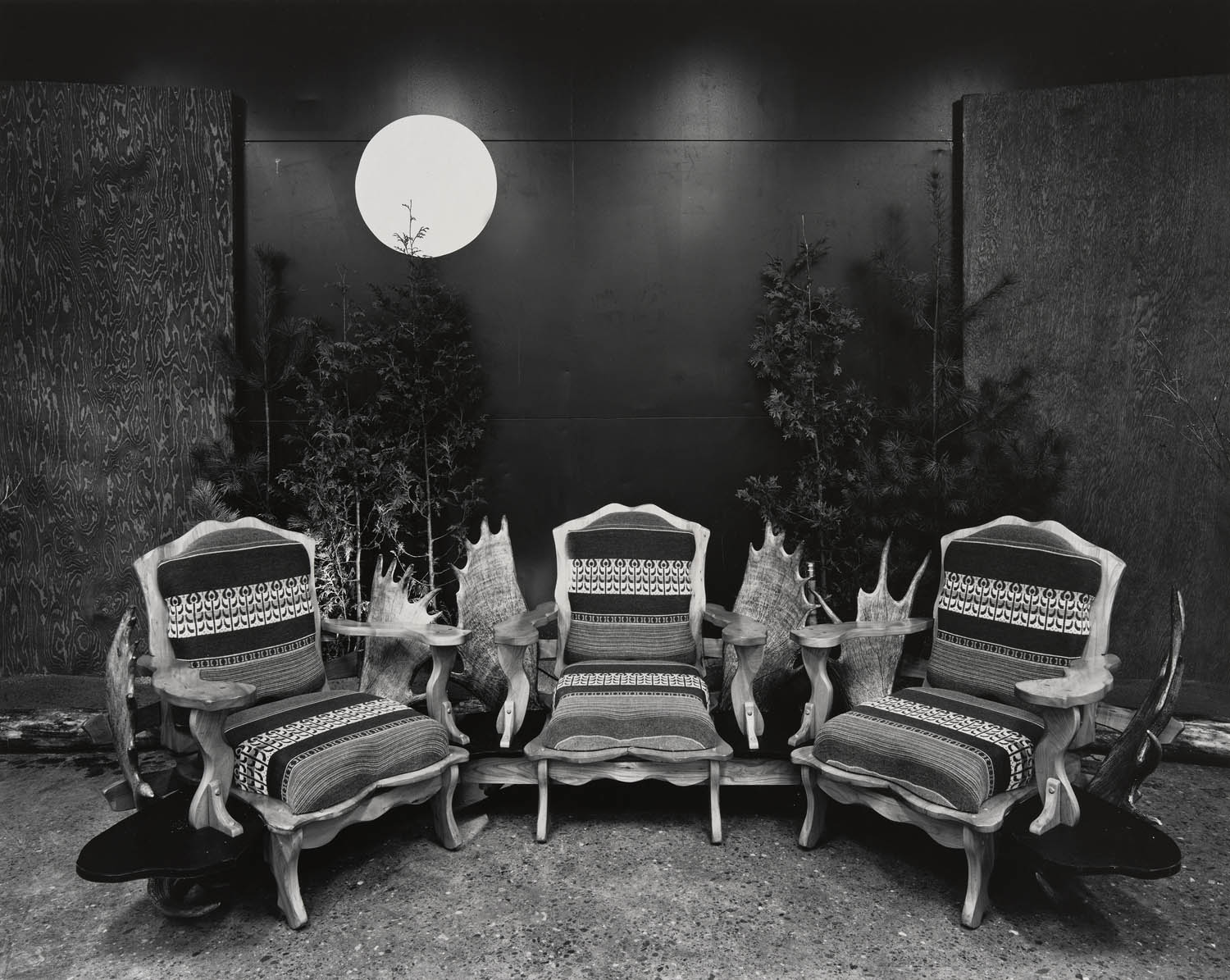
 

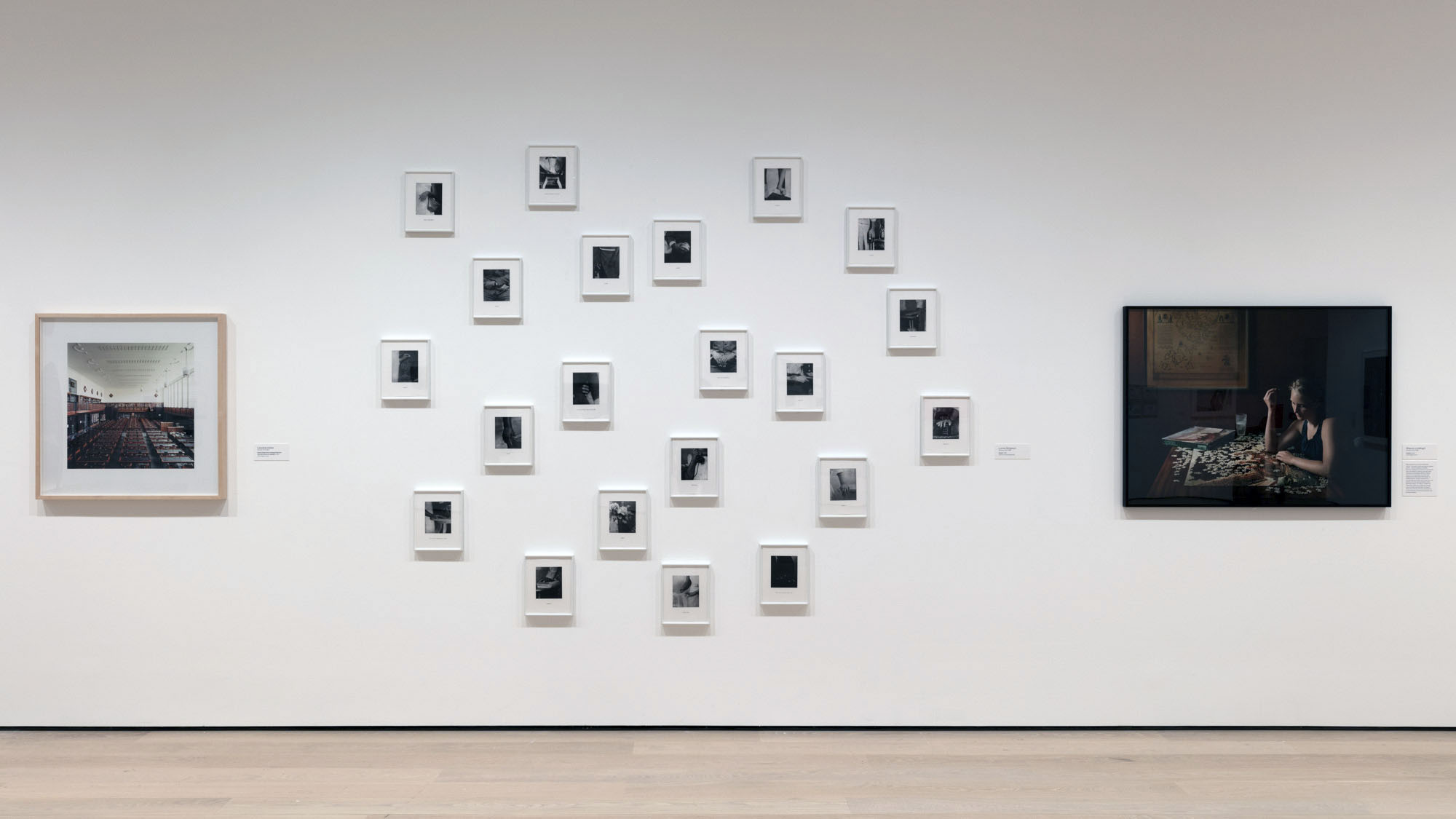
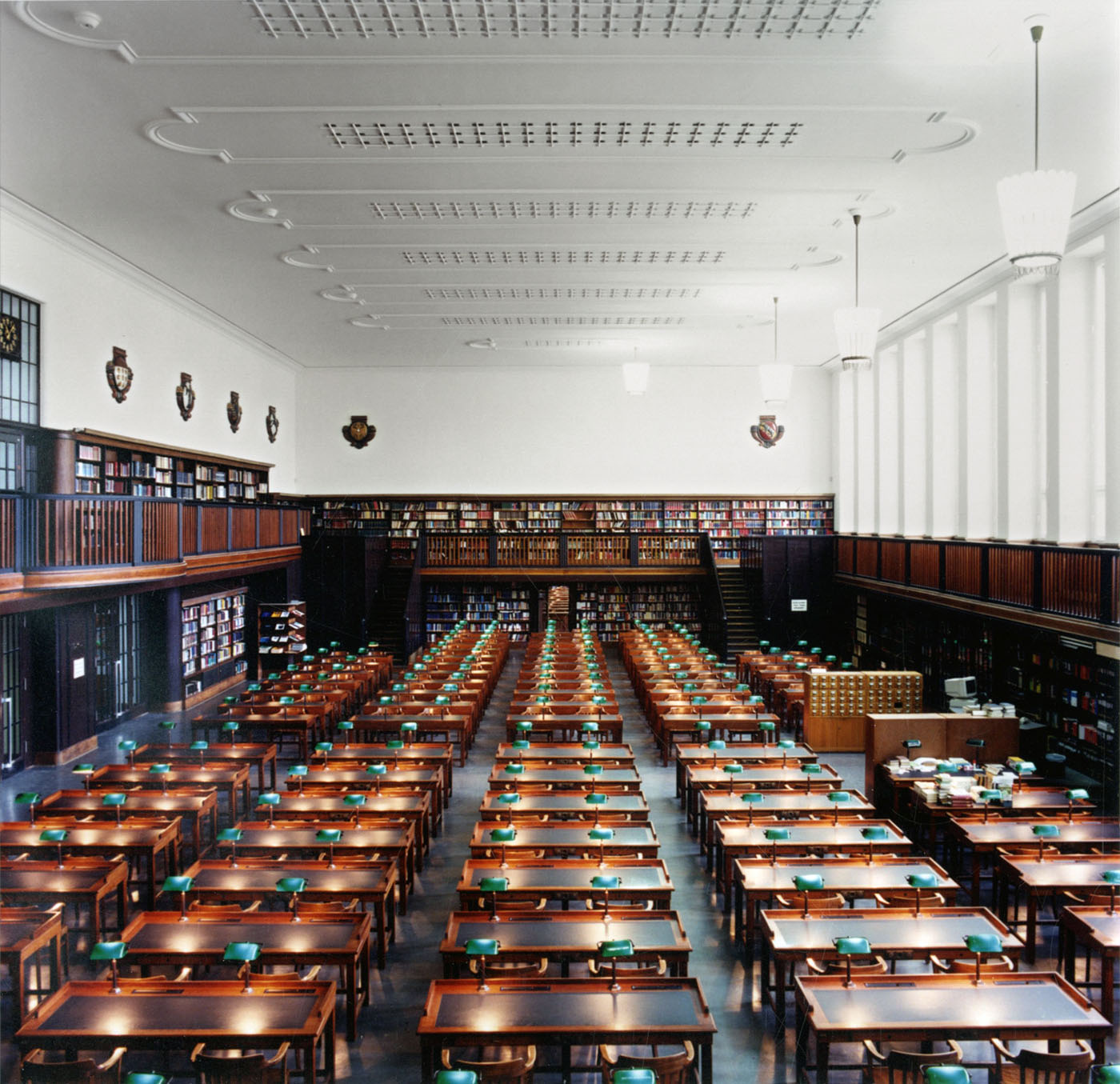
Lynne Cohen (American-Canadian, 1944-2014) 'Exhibition Hall' 1977


Lynne Cohen (American-Canadian, 1944-2014)
Exhibition Hall
1977
Gelatin silver print
Image (visible): 19 x 23.7cm (7 1/2 x 9 5/16 in.)
National Gallery of Art
Pepita Milmore Memorial Fund
© Estate of Lynne Cohen


In the photography of Lynne Cohen, you won’t see a single person. But you’ll find their traces everywhere. Her images feel haunted by people, as if the action has just ended or has yet to begin. Despite their absence, however, people are the true subject of the artist’s gaze. Former Gallery curator Ann Thomas explained in her essay for the 2001 National Gallery of Canada exhibition No Man’s Land: The Photography of Lynne Cohen: “While her photographs do not include human beings, they are on occasion more revealing about human behaviour than any group portrait.”

From her earliest photographs in 1971 to her final works before her death in 2014, Cohen made deadpan images of interior spaces, training her lens on the everyday peculiarities of living rooms, offices, banquet halls, social clubs, learning centres, salons, laboratories and shooting ranges. Her signature style used flat lighting, deep focus and symmetrical compositions to lend her works what she termed “a cool, dispassionate edge.” The works can be funny, sinister, maddening, familiar, bizarre and often surreal.

Although in later years Cohen would make prints large enough to envelope the viewer – introducing colour and shifting her choice of subject from domestic interiors and clubhouses to more restricted environments, such as military installations – her conceptual mission never wavered from the start. Her photography investigates how setting makes a simulation of experience, how reality is more engineered than we may care to recognize and how the spaces we design also design us in turn.

Chris Hampton. “Lynne Cohen: Art Surrounds Us,” on the National Gallery of Canada website November 22, 2024 [Online] Cite 07/02/2025


Joanne Leonard (American, b. 1940)
'Dining Area and Patterned Wallpaper, Blake Street, Berkeley, California' c. 1977


Joanne Leonard (American, b. 1940)
Dining Area and Patterned Wallpaper, Blake Street, Berkeley, California
c. 1977
Gelatin silver print
Image: 18 x 17.7cm (7 1/16 x 6 15/16 in.)
National Gallery of Art
Gift of the Artist in honor of her daughter, Julia Marjorie Leonard
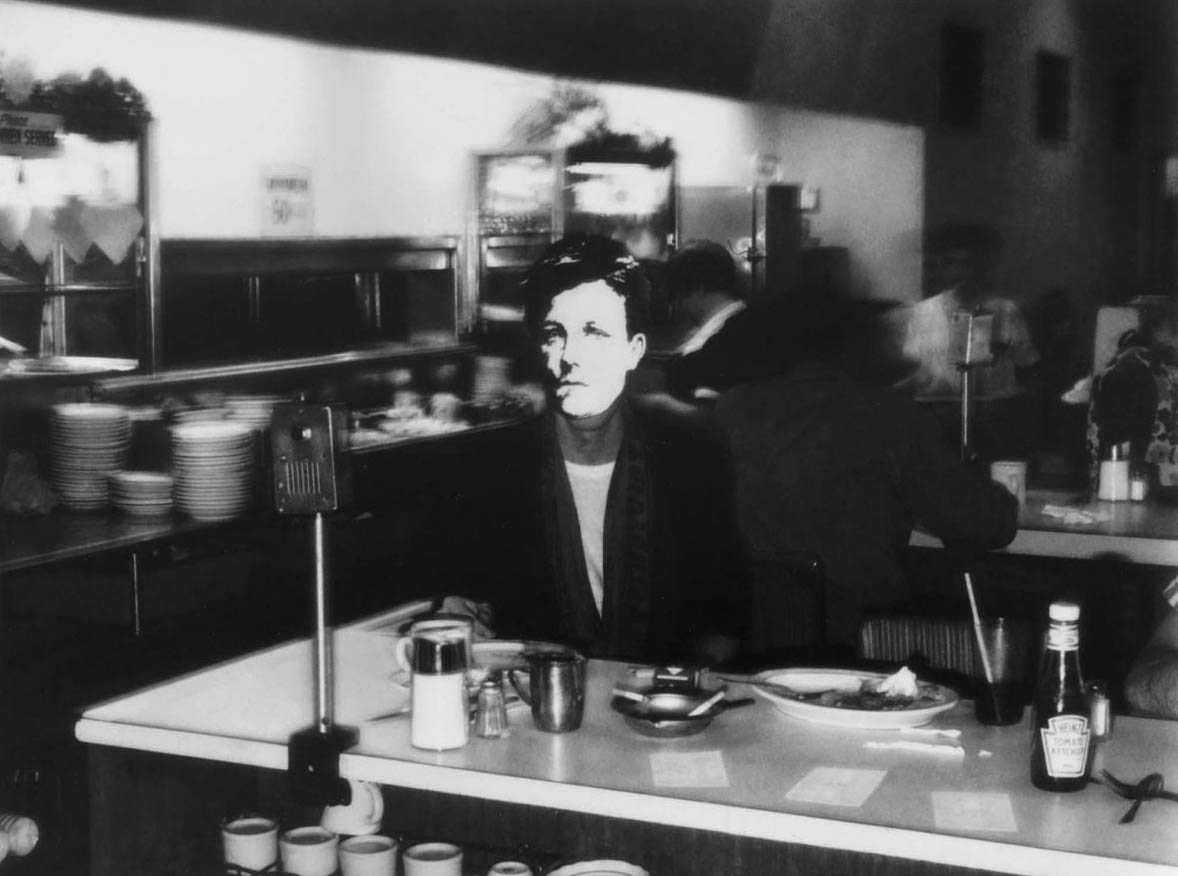
 

David Wojnarowicz (American, 1954-1992) 'Arthur Rimbaud in New York (Diner)' 1978-1979


David Wojnarowicz (American, 1954-1992)
Arthur Rimbaud in New York (Diner)
1978-1979
Gelatin silver print
Image: 17.15 x 24.13cm (6 3/4 x 9 1/2 in.)
National Gallery of Art
Gift of Funds from Heather Muir Johnson


“Transition is always a relief. Destination means death to me. If I could figure out a way to remain forever in transition, in the disconnected and unfamiliar, I could remain in a state of perpetual freedom.”

~ David Wojnarowicz , Close to the Knives: A Memoir of Disintegration


David Wojnarowicz made a series of pictures featuring friends donning a homemade mask of the 19th-century French poet Arthur Rimbaud. Staged at sites around New York that were significant to the photographer, the surrogate self-portraits explore parallels between Wojnarowicz and Rimbaud – both gay artists who rebelled against the social mores of their times. The historical figure with its unchanging expression appears alone or apart from others, a man eerily out of time. The series also documents many of the then vibrant spaces of gay life shortly before the AIDS epidemic ravaged the city’s gay community. Wojnarowicz died from AIDS-related complications at the age of 37.

Wall text from the exhibition


Sophie Rivera (American, 1938-2021) 'Untitled' 1978


Sophie Rivera (American, 1938-2021)
Untitled
1978
Gelatin silver print
Image/sheet: 25.4 x 25.4cm (10 x 10 in.)
National Gallery of Art
Estate of Martin Hurwitz


Bathed in light against a dark background, each sitter in Sophie Rivera’s portrait series of fellow New Yorkers of Puerto Rican descent, known as Nuyoricans, addresses the viewer directly. To find her subjects, Rivera asked passersby in her Harlem neighborhood if theywere Puerto Rican. If so, she invited them to her home to have their pictures taken. The mutual trust between artist and subject is reflected in the sitters’ grace and dignity.

Rivera, who defined herself as “an artist, Latino, and feminist,” sought to make Nuyoricans part of the distinguished history of American portrait photography. As she noted, “I have attempted to integrate my cultural heritage into an artistic continuum.”

Wall text from the exhibition


Rivera’s monumental portraits of Puerto Ricans in New York (or Nuyoricans) counteract the stereotypes that have circulated in the mass media. The artist found her subjects by asking passersby outside her building if they were Puerto Ricans. If they said yes, she invited them to her studio and photographed them against a dark background. Rivera’s subjects remain anonymous but never powerless. Her direct photographs allow the unassuming individuality of everyday people to speak for itself.

Our America: The Latino Presence in American Art, 2013


John M. Valadez (American, b. 1951) 'Two Guys' c. 1978, printed 2016


John M. Valadez (American, b. 1951)
Two Guys
c. 1978, printed 2016
From the East Los Angeles Urban Portrait Portfolio
Inkjet print
Sheet and image: 16 × 24 in. (40.6 × 61cm)
Smithsonian American Art Museum, Museum purchase through the Smithsonian Latino Initiatives Pool, administered by the Smithsonian Latino Center
© 1978, John M. Valadez


Multidisciplinary artist John Valadez has long been committed to depicting the lived experiences of Chicanx Angelenos like himself. Using the camera to record the world around him, Valadez first made photographs principally as source material for his drawings and paintings. In 1978 he exchanged black and white for colour film and made a series of powerful full-length portraits. His subjects included people he knew, such as the stylish young couple dressed for a birthday party, as well as people he encountered on the street, like the two men sporting identical clothes. Valadez’s aim, he said, was to capture people who weren’t being seen – by doing so, he has become a key chronicler of Chicanx identity.

Wall text from the exhibition


John M. Valadez (American, b. 1951)
'Couple Balam' c. 1978, printed 2016


John M. Valadez (American, b. 1951)
Couple Balam
c. 1978, printed 2016
From the East Los Angeles Urban Portrait Portfolio
Inkjet print
Sheet and image: 16 × 24 in. (40.6 × 61cm)
Smithsonian American Art Museum, Museum purchase through the Smithsonian Latino Initiatives Pool, administered by the Smithsonian Latino Center
© 1978, John M. Valadez


Tseng Kwong Chi (American born Hong Kong, 1950-1990) 'New York, New York' 1979, printed 2008 from the exhibition 'The '70s Lens: Reimagining Documentary Photography' at the National Gallery of Art, Washington


Tseng Kwong Chi (American born Hong Kong, 1950-1990)
New York, New York
1979, printed 2008
From the series East Meets West
Gelatin silver print
Image: 91.44 x 91.44cm (36 x 36 in.)
National Gallery of Art
Alfred H. Moses and Fern M. Schad Fund and Gift of Funds from Renee Harbers
Liddell
© Muna Tseng Dance Projects Inc.. Courtesy Yancey Richardson, New York


Tseng Kwong Chi leaps into the air in front of the Brooklyn Bridge, mimicking the joy of a first time visitor to New York. This work is from Tseng’s series East Meets West, which was inspired in part by the thaw in Chinese – United States relations following President Nixon’s visit to Beijing in 1972. A performance artist and photographer, Tseng made self-portraits as his adopted persona, Ambiguous Ambassador, at popular spots across the country. Assuming the guise of a Chinese official, Tseng – wearing what is now called a Mao suit – mischievously exposed cultural biases and notions of “the other” in American society. He made his selfies with a shutter release cable, which is visible in his right hand.

Wall text from the exhibition


Tseng Kwong Chi, known as Joseph Tseng prior to his professional career (Chinese: 曾廣智; c. 1950 – March 10, 1990), was a Hong Kong-born American photographer who was active in the East Village art scene in the 1980s.

Tseng was part of a circle of artists in the 1980s New York art scene including Keith Haring, Kenny Scharf, and Cindy Sherman. Tseng’s most famous body of work is his self-portrait series, East Meets West, also called the “Expeditionary Series”. In the series, Tseng dressed in what he called his “Mao suit” and sunglasses (dubbed a “wickedly surrealistic persona” by the New York Times), and photographed himself situated, often emotionlessly, in front of iconic tourist sites. These included the Statue of Liberty, Cape Canaveral, Disney Land, Notre Dame de Paris, and the World Trade Center. Tseng also took tens of thousands of photographs of New York graffiti artist Keith Haring throughout the 1980s working on murals, installations and the subway. In 1984, his photographs were shown with Haring’s work at the opening of the Semaphore Gallery’s East Village location in a show titled “Art in Transit”. Tseng photographed the first Concorde landing at Kennedy International Airport, from the tarmac. According to his sister, Tseng drew artistic influence from Brassai and Cartier-Bresson.

Text from the Wikipedia website


In these images Tseng inhabits a persona he referred to as the “Ambiguous Ambassador.” Wearing a Mao suit (the grey uniform associated with the Chinese Communist Party) and mirrored sunglasses, he poses next to landmarks and monuments, many of them emblems of American national identity. Like the Untitled Film Stills of Cindy Sherman – also produced in the late 1970s – East Meets West is a groundbreaking photographic work that illuminates the changeable and socially constructed nature of identity. It is also a rare piece of conceptual art to specifically reflect on the racialised experiences of Asian people in the United States. …

A gay man, Tseng was well-aware of the signifying power of dress, gesture, and posture. His donning of the Mao suit can be understood as racial camp – a playful, self-protective manoeuvre that did not prevent Tseng from being misinterpreted but did allow him to take control of the manner of the misreading. To those who perceived the levity with which Tseng wore the suit, something was revealed about his ironic sensibility. The dissonance of his appearance – the fact that the suit looked both “natural” and “unnatural” on him was not effaced but highlighted, at least to the knowing beholder. But when people were unable to see past type, the misconception did not come at the cost of Tseng’s psychic humiliation.

Tseng went on to create roughly 150 images comprising East Meets West. His performance of “Chineseness” in these photographs reveals his acute awareness of the stereotypes of Euro-American Orientalism. His blank, robotic demeanour in images such as Disneyland, California invite stock associations of the Chinese as “Yellow Peril,” and the repetition of this pose in numerous photographs would seem to tap into White America’s century-long dread of being overrun by Asian immigrants. In other images, Tseng’s stylishness and humor come through – some of the earliest photographs picture him coolly strolling the boardwalk and beaches of the popular gay vacation spot of Provincetown, Massachusetts, appearing more like a character from a French New Wave film than a visitor from the People’s Republic of China. The shutter release Tseng plainly grasps in many pictures reminds us that he is the author of these varied depicted realities; that, even as he presents himself to the Orientalist gaze, he is in command of the means of representation. Given that racial identities circulate and perpetuate via staged images – and that European American assumptions have traditionally driven those images – this is a significant gesture.

Extract from Melissa Ho. “Performing Ambiguity: The Art of Tseng Kwong Chi,” on the Smithsonian American Art Museum website June 23, 2022 [Online] Cited 06/02/2025


Jeanne Moutoussamy-Ashe (American, b. 1951)
'An Afternoon with Aunt Tootie, Daufuskie Island, South Carolina'
1979, printed 2007


Jeanne Moutoussamy-Ashe (American, b. 1951)
An Afternoon with Aunt Tootie, Daufuskie Island, South Carolina
1979, printed 2007
Gelatin silver print
Image: 21.3 x 32.4cm (8 3/8 x 12 3/4 in.)
National Gallery of Art
Gift of Funds from Diana and Mallory Walker
© Jeanne Moutoussamy-Ashe


The Gullah Geechee – enslaved people who labored on the Sea Island plantations, and their descendants – built communities all along the eastern coast of the US, from North Carolina to Florida…

From 1977 to 1982, Moutoussamy-Ashe visited Daufuskie, building relationships with the Gullah Geechee people and snapshotting rare pictures of their quotidian life. Born in Chicago, Illinois, the photographer had just returned from a six-month independent study in west Africa before she traveled to the island. At the time of her initial visit, there were only 80 permanent residents left on Daufuskie, a drastic drop from the thousands of Gullah people who had once resided there. Today, just 3% of the island’s population is Black.

Moutoussamy-Ashe’s series of monochrome images include candids of weddings, stills of a church gathering and everyday portraits of the island, showing a way of life that is treasured and fast fading.

Like many historic Black alcoves, Daufuskie has been altered by decades of gentrification. After the American civil war, many Gullah people who were already on Daufuskie made the island their permanent home once the plantation owners had left. They cultivated the land and preserved their rich culture and language, an English-based creole. But development, unfair zoning practices and other challenges have caused a sharp decrease in the Black population on the island.

Moutoussamy-Ashe’s photos offer a more private understanding of Black folks in Daufuskie, one not defined by white developers who have turned Daufuskie into a destination for tourists. The area is a placid haven in Moutoussamy-Ashe’s images. Jake and his Boat Arriving on Daufuskie’s Shore, Daufuskie Island, SC, for instance, features a man paddling a boat across a rippling river. Swooping trees frame either side of the man, who peacefully rows the vessel. The landscape looks expansive, with the scenery appearing to go on for miles. Such scenes of stillness would become rare as residents were largely driven out by the encroachment of others.

Extract from Gloria Oladipo. “How an outsider captured the intimacy of Gullah Geechee life in 13 portraits,” on The Guardian website Sat 8 Feb 2025 [Online] Cited 06/02/2025


Jeanne Moutoussamy-Ashe (American, b. 1951)
'Maid of Honor with Bride in Slippers, Daufuskie Island, South Carolina'
1980, printed 2022


Jeanne Moutoussamy-Ashe (American, b. 1951)
Maid of Honor with Bride in Slippers, Daufuskie Island, South Carolina
1980, printed 2022
Gelatin silver print
Image: 56.9 x 37.4cm (22 3/8 x 14 3/4 in.)
National Gallery of Art
Gift of Funds from Diana and Mallory Walker
© Jeanne Moutoussamy-Ashe


Between 1977 and 1981, Jeanne Moutoussamy-Ashe made extended visits to Daufuskie Island in South Carolina. The island’s relative isolation from the mainland allowed its inhabitants, who descended directly from enslaved people, to keep their distinct Gullah language and culture. Moutoussamy Ashe’s landscapes, still lifes, and portraits convey a holistic impression of the community. She captured residents’ dignity and joy – as in this photograph of a bride in fuzzy slippers, sharing a laugh with her maid of honor – but she also recorded their uncertainty in the face of development. Daufuskie’s permanent Gullah population had dwindled to 85 residents by the time Moutoussamy-Ashe published her photographs as a book in 1982.

Wall text from the exhibition


Shawn Walker (American, b. 1940)
'Untitled (New York City)' c. 1980


Shawn Walker (American, b. 1940)
Untitled (New York City)
c. 1980
Gelatin silver print
Image: 52.5 x 35cm (20 11/16 x 13 3/4 in.)
National Gallery of Art
Charina Endowment Fund
© Shawn Walker


“I see myself as a fine-arts photographer with a documentary foundation,” Shawn Walker has explained. “I look for the truth within the image, the multi-layers of existence and the ironies in our everyday lives.” Walker grounded his photographic practice in the Harlem community where he was born and raised. He joined the Kamoinge Workshop and learned from a collective of Black photographers. Inspired by Ralph Ellison’s novel Invisible Man (1952), Walker created a series of self-portraits that reveal only his silhouette. Here, the photographer pictures his reflection in a window while looking directly at us: “I look into the intersections of dark and light, into the shadows that grow the seeds of existence.”

Wall text from the exhibition


Jim Goldberg (American, b. 1953)
'Vickie Figueroa' 1981


Jim Goldberg (American, b. 1953)
Vickie Figueroa
1981
Gelatin silver print
Image/sheet: 35.4 x 27.6cm (13 15/16 x 10 7/8 in.)
National Gallery of Art
Corcoran Collection, Gift of the Artist


“My dream was to become a schoolteacher.
Mrs. Stone is rich.
I have talents but not opportunity.
I am used to standing behind
Mrs. Stone.
I have been a servant for 40 years.
Vickie Figueroa.”


Jim Goldberg (American, b. 1953) 'Clyde Norbert' 1978 from the series 'Rich and Poor'


Jim Goldberg (American, b. 1953)
Clyde Norbert
1978
From the series Rich and Poor
Gelatin silver print
Corcoran Collection
Gift of the Artist, 1994


Framed against a tall window, Clyde Norbert appears slight, flanked by his modest but carefully ordered possessions. The caption in Norbert’s own words speaks to his contrasting bold ambition: “I am going to build an empire.” In his series Rich and Poor, Jim Goldberg made portraits of both wealthy and marginalised San Franciscans where they lived. He radically shifted the relationship between photographer and subject by asking the people he photographed to respond to his pictures by writing directly on them. He believed this collaboration, which he referred to as “total documentation,” “would bring an added dimension, a deeper truth” than a photograph alone.

Wall text from the exhibition


The '70s Lens


The ’70s Lens: Reimagining Documentary Photography poster


National Gallery of Art
National Mall between 3rd and 7th Streets
Constitution Avenue NW, Washington

Opening hours:
Daily 10am – 5pm

National Gallery of Art website

LIKE ART BLART ON FACEBOOK

Back to top

Exhibition: ‘Picturing the Border’ at the Cleveland Museum of Art

Exhibition dates: 21st July, 2024 – 5th January, 2025


Miguel Fernández de Castro (Mexican, b. 1986) 'Grammar of Gates' / 'Gramática de las puertas' 2019 from the exhibition 'Picturing the Border' at the Cleveland Museum of Art, July 2024 - January 2025
 

Miguel Fernández de Castro (Mexican, b. 1986)
Grammar of Gates / Gramática de las puertas
2019
Courtesy of the artist
© Miguel Fernández de Castro


I wrote this philosophical text as a flow of consciousness, a layered exposition of my thoughts on space, photography, identity and belonging. I hope I have done the subject justice… in freedom.


within, bridge and fissure

The struggle for identity, for culture, for nation is a struggle inscribed in space. So observes Wendy Garden.1

The spaces that bodies move in, through and over are fluid spaces, permeable spaces, fragmentary and transitory spaces. They are also spaces of displacement and distance which form a kind of ‘alienation’ which derives from the Latin alienare: to render foreign, other.2

Thus the “border” between one and the other – that fluid penumbra (a peripheral or indeterminate area or group), that oscillation of energy across the line – must be constructed to be legible and fixed by those that seek to control such spaces, through the imposition of a coded representation of space itself.3 The border wall between Mexico and America is one such imposition of a coded representation of space which, seeks to control an/other. It is a “direct translation of ideology and temporality into material and spatial culture”3 which masks as much as it represents, through a selective representation of history and memory.

Through systems of surveillance (e.g. CCTV, aerial surveillance, phone taps) and control (e.g. police, government, the judiciary), in which one reinforces the other in a never ending circle, and in the of naming of the ‘other’ (Foucault) – those with privilege embedded and thus emboldened within colonial and imperial systems seek to confirm hegemonic structures of power: for example, who can travel where, who has access adequate to health care, who is seen as an ill/legal alien. “Although Foucault rarely alludes to it in a clear-cut manner, what he describes in Discipline and Punish is the formation of the discursive regime of surveillance which is a central element in the expression of the modern state.”4

But we can counter this narrative.

In his influential book Thirdspace (Blackwell, 1996), the American postmodern political geographer and urban theorist Edward Soja (1940-2015) proposes the concept of First, Second and Thirdspace to demarcate the various spatial dimensions. Firstspace “is the ‘real’, the concrete materiality of spatial forms of the world, while Secondspace interprets this reality through imagined representations of spatiality.”5 Much early photographic practice is rooted in Firstspace, in the passive representation of an undeniable truth, the veracity of the image and its representation of the referent: this existed because it was captured by the camera.

Thirdspace on the other hand, “contains both real and imagined spaces simultaneously. Thirdspace permits an intermingling of the knowable and the unknowable, the real and the imagined by the experiences, events and political choices that are shaped by the interplay between centres and peripheries (Soja, Thirdspace 1996: 31). According to Soja, Thirdspace is a place where issues of race, class and gender can be addressed simultaneously without privileging one over the other. It is a space which enables an-‘other’ way of understanding and acting to change the spatiality of human life (Soja, Thirdspace 1996: 10). Photographic space, as a Thirdspace, is a site from which to contest the dominant ideologies of Firstspace. This has important ramifications for ‘others,’ especially those disenfranchised by colonialism.”6

Thus photographic Thirdspace as an amorphous space of both the real and imagined is the vibration of energy – doubled – the real and imagined spaces of everyday life, and the real and imagined spaces of photography through which we can contest the contexts of becoming, belonging.

These Thirdspaces of the real and imagined are not spaces of universalising totality which then would be constitutive of history or memory, but in-between spaces in which differences, memories and histories are not denied or negated, hidden, forgotten or repressed. It is not the segregation of black and white, either/or, but the grey areas in-between that interest me: those fluid zones of difference – think Tarkovsky’s film Stalker 1979, in which a guide helps a writer and a professor to infiltrate a restricted area, the Zone.

“The Thirdspace – in which “everything comes together… subjectivity and objectivity, the abstract and the concrete, the real and the imagined, the knowable and the unimaginable, the repetitive and the differential, structure and agency, mind and body, consciousness and the unconscious, the disciplined and the trans-disciplinary, everyday life and unending history”a – allows that none of these couples, such as the phenomenal and the noumenal, can be divided by an either/or attitude. “This… does not mean differences are denied, instead, it most of all means the inevitable reciprocity of any pair of definitions. In such a case both leave a mark on the other. It is a question of both-and – how each of the pair influences the other”b.”7

Both leave a mark on each other. And it is in this marking that social and political relations can be reconfigured, “in such a way as to suspect, neutralise, or invert the set of relations that they happen to designate, mirror or reflect.”8 Thus, the physical aspects as well as the attitudes and habitual practices of ‘space’, the arrangements of space and the socialisation of space, “is an order that is itself always undergoing change from within through the actions and innovations of social agents. In short, all ‘space’ is social space ….”9

Following, we can say that social and spatial relationships are dialectically inter-reactive, interdependent (Soja).

“Social and spatial relationships are dialectically inter-reactive and interdependent. Cultural landscapes reflect social relations and institutions, and they shape subsequent social relations. While elites create spatial inequalities and homogeneity simultaneously through their hegemony, non-elites create counter-hegemonic landscapes which reflect their own values. Behavioural resistance to the dominant culture leads to distinctive cultural landscapes: for example, cultural resistance by Maori.

Indeed, dominant ideologies such as those which are religious, political, economic, ethnic or racial, continually define or redefine ‘deviance’ or ‘otherness’ to maintain their power and landscapes of dominance. Space and place are key factors in the definition of deviance and of order and propriety.”10

But as Wael Salah Fahmi insightfully observes, we must not fall into the idea that juxtapositions of social space are just alternating choices of “either/or” or acts of simple resistance: “But “juxtaposition” might imply alternating choices, an “either/or.” Perhaps instead we might think of Lefebvre’s image of interpenetrating spaces, one violating another, yet rising up from within the very “fundament” of the space that wishes to ignore its existence. Here, perhaps, is a spatial dialectic that does not fall into a binary opposition of simple resistance.”11

Spaces that rise up from within each other!

Change that emanates from within through the actions and innovations of social agents… human beings, artists!

Here, the thoughts of that glorious Cuban-American interdisciplinary artist, writer, and curator Coco Fusco (b. 1960) – quoted by Jean Fisher – whose work explores gender, identity, race, and power through performance, video, interactive installations, and critical writing are particularly cogent.

“Two imperatives are set in motion: to alter the perceptions of those with privileged access to hegemonic structures of power, and to change the sense of disempowerment of those deprived of political agency. “What is more fundamentally at stake than freedom,” Fusco argues, “is power – the power to choose, the power to determine value, and the right of the more powerful to consume without guilt”: entitlements that Eurocentric cultures have assumed for themselves at the expense of others. These aims are advanced through an exploration of the relationship between the politics and practices of cultural difference and social inequity, in which intellectual, experiential, and artistic alliances are built across nationalistic and geographical boundaries …””12

As Wael Salah Fahmi notes, “spaces constantly juxtapose themselves one against the other” – in real life, in art, in photography. The media saturated world of the “total flow” of images is resistant to interpretation, yet in real life – and in this exhibition – the juxta/position (mapping of space), juxta/posing (posing for the camera) of one space against another, “of image to image calls to attention a line of conflict, either fissure or bridge.”13

The images in this posting draw our attention to fissures (George Rodriguez, Susan Meiselas, Ada Trillo) and bridges (Graciela Iturbide, Ronald Rael and Virginia San Fratello with Colectivo Chopeke). They also possess a multivalent narrative, allowing the work to be accessible to different interpretations, meanings, and values: a new door or path opens up on the basis of very diverse needs and objectives. These images, untraceable gifts from photography itself, are marks of candour and authenticity, both descriptions of a stable object and the fleeting glance (Firstspace and Thirdspace) interacting upon each other. They are an investigation into our fluid identity and shifting place in our worlds.14

In spatial dialectics and in the nuances of contradictions we proceed onwards, paying no heed to the dangers which lie ahead, journeying on to fulfil our desires: to be seen, to be heard, in our difference and uniqueness, enacting change from within.

Dr Marcus Bunyan

Word count: 1,435


PS. My friend and Melbourne artist Elizabeth Gertsakis insightfully observes, “The philosophical arguments resonate with the vacillation of the photograph meanings/non-meanings. Spaces that implode from within to further generate the unknown which even in definition become dispersed. The photography around the border/wall is beautiful as well as tortuous as well as unspoken.”

Well said Liz 🙂


Footnotes

1/ Wendy Garden. “Photographic Space and the Indian Portrait Studio,” in On Space Issue Seven, Winter 2007

2/ Rob Shields. Lefebvre, Love and Struggle. London: Routledge, 1999, pp. 40-41.

3/ Ibid., pp. 79-80.

4/ Jon Stratton. The Desirable Body. Manchester: Manchester University Press, 1996, p. 19

5/ Garden, Op cit.,

6/ Garden, Op cit.,

7/ A: Edward W. Soja. Thirdspace. Malden (Mass.): Blackwell, 1996, p. 57; B: Mika Hannula. “Third space – a merry-go-round of opportunity,” on the Kiasma Magazine website No. 12, Vol. 4, 2001 [Online] Cited 01/05/2016. No longer available online quoted in Marcus Bunyan. “Thirdspace,” on the Marcus Bunyan website 2021 [Online] Cited 29/11/2024

8/ Michel Foucault. “Of Other Spaces,” in Diacritics Spring 1986, p. 24

9/ Shields, Op cit., pp. 154-155

10/Alexander Trapeznik. “Introduction,” from Public History Review, Vol. 13, 2006, p. 2

11/ Wael Salah Fahmi. “Reading of Post Modern Public Spaces As Layers Of Virtual Images and Real Events,” from The 37th International Planning Congress “HONEY, I SHRUNK THE SPACE” Planning in the Information Age. Utrecht, The Netherlands, 16-20 September, 2001

12/ Jean Fisher. “Witness for the Prosecution: The Writings of Coco Fusco,” in Coco Fusco. The Bodies That Were Not Ours. London: Routledge, 2001, pp. 226-227

13/ Wael Salah Fahmi, op cit.,

14/ Marcus Bunyan. “Thirdspace,” on the Marcus Bunyan website 2021 [Online] Cited 29/11/2024


Many thankx to the Cleveland Museum of Art for allowing me to publish the photographs in the posting. Please click on the photographs for a larger version of the image.


“And do you know what “the world” is to me? Shall I show it to you in my mirror? This world: a monster of energy, without beginning, without end; a firm, iron magnitude of force that does not grow bigger or smaller, that does not expend itself but only transforms itself; as a whole, of unalterable size, a household without expenses or losses, but likewise without increase or income; enclosed by “nothingness” as by a boundary; not something blurry or wasted, not something endlessly extended, but set in a definite space as a definite force, and not a space that might be “empty” here or there, but rather a force throughout, as a play of forces and waves of forces, at the same time one and many, increasing here and at the same time decreasing there […]”


Frederick Nietzsche, The Will to Power


“Edward Soja employs the concept of First, Second and Thirdspace to demarcate the various spatial dimensions. For Soja Firstspace is the ‘real’, the concrete materiality of spatial forms of the world, while Secondspace interprets this reality through imagined representations of spatiality (Soja 1996: 6). Much early photography participated in perpetuating the belief that photographic space was a Firstspace. The camera lens merely passively and objectively recorded all that was placed before it. However even in the nineteenth century, many practitioners acknowledged the ability of photographs to lie or distort reality.

For Soja, Thirdspace contains both real and imagined spaces simultaneously. Thirdspace permits an intermingling of the knowable and the unknowable, the real and the imagined by the experiences, events and political choices that are shaped by the interplay between centres and peripheries (Soja, Thirdspace 1996: 31). According to Soja, Thirdspace is a place where issues of race, class and gender can be addressed simultaneously without privileging one over the other. It is a space which enables an-‘other’ way of understanding and acting to change the spatiality of human life (Soja, Thirdspace 1996: 10). Photographic space, as a Thirdspace, is a site from which to contest the dominant ideologies of Firstspace. This has important ramifications for ‘others,’ especially those disenfranchised by colonialism. It may account for the rise of photography as the preferred medium for many artists today interested in issues of identity and the colonial gaze. …

Photographic space can create a spatial reality which allows those who access it to contest, enlarge or in someway recreate their experiences of Firstspace. It never attempts to close off subjectivity or pin identity down, but rather allows fluid and transitory experiments with other ways of being that can then be carried over and inform experiences of Firstspace.”


Wendy Garden. “Photographic Space and the Indian Portrait Studio,” in On Space Issue Seven, Winter 2007


Ronald Rael (American, b. 1971) and Virginia San Fratello (American, b. 1971) with Colectivo Chopeke. 'Teeter-Totter Wall' 2019


Ronald Rael (American, b. 1971) and Virginia San Fratello (American, b. 1971) with Colectivo Chopeke
Teeter-Totter Wall
2019
Single-channel video with sound; 4:13 minutes
Courtesy Rael San Fratello/Ronald Rael & Virginia San Fratello
© Ronald Rael & Virginia San Fratello
Photo: Ronald Rael


About the exhibition

Picturing the Border presents photographs of the US-Mexico borderlands from the 1970s to the present taken by both border residents and outsiders. They range in subject matter from intimate domestic portraits, narratives of migration, and proof of political demonstrations to images of border crossings and clashes between migrants and the US Border Patrol. The earliest images in this exhibition form an origin story for the topicality of the US-Mexico border at present, and demonstrate that the issues of the border have been a critical point of inquiry for artists since the 1970s. Many serve as counter-narratives to the derogatory narratives of migration and Latino/as in the US that tend to circulate in the mass media.

Capitalising on the prevalent issues of the border today, Picturing the Border aims to spark vital conversations of what constitutes citizenship, as well as complex negotiations of personal identity as it relates to the border. The exhibition shows through these images that Latinx, Chicano/a, and Mexican photographers have significantly rethought what defines citizenship, nationality, family, migration, and the border beyond traditional frameworks for decades.

Text from the Cleveland Museum of Art website


George Rodriguez (American, b. 1937) 'Los Angeles police arrest a Chicano student protester in the neighbourhood of Boyle Heights' 1970 from the exhibition 'Picturing the Border' at the Cleveland Museum of Art, July 2024 - January 2025


George Rodriguez (American, b. 1937)
Los Angeles police arrest a Chicano student protester in the neighbourhood of Boyle Heights
1970
Gelatin silver print


Susan Meiselas (American, b. 1948) '7.30am Arrest of undocumented worker by U.S. Border Patrol in downtown San Diego, CA' 1989


Susan Meiselas (American, b. 1948)
7.30am Arrest of undocumented worker by U.S. Border Patrol in downtown San Diego, CA
1989
From the series Crossings
Gelatin silver print
44.5 x 73.7cm
Courtesy of and © Susan Meiselas/Magnum Photos


Photojournalism from the US-Mexico border currently emphasises stark, divisive images: walls, fences, surveillance devices, border patrols, “coyotes,” and crossing migrants. Yet some of the most compelling artwork dealing with this region attests to several generations of cross-border familial relationships, personal identities that carry markers of both countries, and hybrid cultures that meld influences from the United States, Mexico, and farther south in Latin America. This more complex work demonstrates how border residents have resisted being defined by the border and its conflicts, concentrating instead on a deterritorialised notion of home, along with a sense of self that often transcends both nationalism and gender politics.

The photographs and video works included in Picturing the Border offer a more nuanced portrayal of life in the borderlands. The exhibition positions the US-Mexico border as a cultural framework and highlights how Latinx photographers – many of whom are border residents themselves – have instead formulated alternative photographic vocabularies with regard to place, identity, and race. Photographs range in subject matter from intimate domestic portraits, extended family gatherings, and political demonstrations to images of border crossings and clashes between migrants and the US border patrol. The earliest images in this exhibition form an origin story for the topicality of the US-Mexico border at the present moment and demonstrate that the issues of the border have been a critical point of inquiry for artists since the 1970s.

The exhibition is accompanied by an important scholarly publication that brings new insights to the subject of Latinx photography and the history of the US-Mexico border. Picturing the Border has also brought about the opportunity to grow our permanent collection in this area, precipitating recent acquisitions by Laura Aguilar and the donation of an important work by Ada Trillo, who has witnessed firsthand the perils of the unbelievably extensive journey migrants have taken from Central America to the United States.

Although Cleveland is far from the southern border, stories of global migration are woven throughout the CMA’s encyclopeadic collection as well as throughout the community in Northeast Ohio. Picturing the Border puts faces on stories and brings to life the various threads that stitch together an ever-growing understanding of, and empathy for, the migrant experience.

Nadiah Rivera Fellah, Associate Curator of Contemporary Art. “Picturing the Border,” on the Cleveland Museum of Art website June 1, 2024 [Online] Cited 19/07/2024


Teddy Cruz (American born Guatemala, b. 1962) and Fonna Forman (American, b. 1968). Installation view of 'Radicalizing the Local: 60_Miles of Trans-Border Urban Conflict' 2008


Teddy Cruz (American born Guatemala, b. 1962) and Fonna Forman (American, b. 1968)
Installation view of Radicalizing the Local: 60_Miles of Trans-Border Urban Conflict
2008
Commissioned by the US Pavilion for the Venice Architecture Biennale of 2008
Prints from a digital file; dimensions variable
© Teddy Cruz + Fonna Forman
Image courtesy the Cleveland Museum of Art


Featuring more than four dozen photographs, Picturing the Border aims to spark vital conversations of what constitutes citizenship, as well as complex negotiations of personal identity as it relates to the border. Through these images the exhibition shows that Latinx, Chicano/a, and Mexican photographers have significantly rethought what defines citizenship, nationality, family, migration, and the border beyond traditional frameworks for decades.

Opening on July 21, 2024, in the Mark Schwartz and Bettina Katz Photography Gallery, this free exhibition will be on view through January 5, 2025. From intimate domestic portraits, narratives of migration, and political demonstrations to images of border crossings and clashes between migrants and the US Border Patrol, this one-of-a-kind exhibition presents photographs taken by both border residents and outsiders, many of whom are Latinx, Chicano/a, and Mexican, and tells the story of the US-Mexico borderlands from the 1970s to the present.

“Borders have long been spaces of contention,” says Nadiah Rivera Fellah, curator of contemporary art. “The mainstream media in the United States tends to present nationalistic narratives about imminent threats at the border. This reductive and divisive narrative does not often portray the identities, languages, cultures, and social ties among communities. The photographs featured in this exhibition tell a different story that can serve as a counter-narrative and timely new perspective on life in this region.”

The earliest images in Picturing the Border form an origin story for the topicality of the US-Mexico border at present and demonstrate that the issues of the border have been a critical point of inquiry for artists since the 1970s. In addition, they showcase artists who were ahead of their time in presenting ideas about spaces and exclusion as they relate to issues of the borderlands and Latinx identities in the United States.

Exhibition catalogue

A beautifully illustrated 134-page exhibition catalogue accompanies Picturing the Border by Nadiah Rivera Fellah, curator of contemporary art, with contributions from Natalie Scenters-Zapico.

The US-Mexico border has undergone dramatic changes over the past six decades, becoming increasingly industrialised, urbanised, and militarised, especially in the aftermath of 9/11 and the War on Terror. Mainstream and conservative news coverage has often reinforced or exacerbated such developments, characterising the border as out of control and describing migrants in derogatory terms, in the process fuelling xenophobic sentiment.

A foil to this reductive and dehumanising narrative, this presentation of Latinx photography offers more nuanced portrayals of life in the borderlands. Ranging from the 1970s to the 2020s, images by Louis Carlos Bernal, Graciela Iturbide, and Laura Aguilar, as well as emerging artists such as Ada Trillo, Guadalupe Rosales, and Miguel Fernández de Castro display alternative photographic vocabularies regarding place, identity, and race. With subject matter spanning from intimate domestic portraits and youth counterculture to border crossings and clashes involving the US Border Patrol, this richly illustrated volume also features scholarly essays and new work by fronteriza poet Natalie Scenters-Zapico, providing new insights on this fraught and misunderstood region.

Press release from the Cleveland Museum of Art


Graciela Iturbide (Mexican, b. 1942) 'Cholos, White Fence, East Los Angeles' 1986 from the exhibition 'Picturing the Border' at the Cleveland Museum of Art, July 2024 - January 2025


Graciela Iturbide (Mexican, b. 1942)
Cholos, White Fence, East Los Angeles
1986
Gelatin silver print
Framed: 57.5 x 42.2cm (22 5/8 x 16 5/8 in.)
Sheet: 35.2 x 27.7cm (13 7/8 x 10 7/8 in.)
Image: 32 x 21.9cm (12 5/8 x 8 5/8 in.)
The J. Paul Getty Museum, Los Angeles, Gift of Leslie and Judith Schreyer and Gabri Schreyer-Hoffman in honour of Virginia Heckert
© Graciela Iturbide


Graciela Iturbide’s Cholo/as series from 1986 Los Angeles is perhaps the best encapsulation of the show’s thesis. The women in Cholos, White Fence, East Los Angeles told Iturbide that they wanted to be photographed under a mural of some mariachis. In fact, these were images of Emiliano Zapata, Benito Juárez and Pancho Villa. We might as well admire their freedom from context. After all, isn’t America all about freedom?

Dan Duray. “One Fine Show: ‘Picturing the Border’ at the Cleveland Museum of Art,” on the Observer website 09/06/2024 [Online] Cited 01/11/2024


Graciela Iturbide (Mexican, b. 1942) 'Rosario y Boo Boo en su casa, Los Angeles' (Rosario and Boo Boo in their home, Los Angeles) 1986


Graciela Iturbide (Mexican, b. 1942)
Rosario y Boo Boo en su casa, Los Angeles (Rosario and Boo Boo in their home, Los Angeles)
1986
Gelatin silver print


“Without the camera you see the world one way, with it, you see the world another way. Through the lens you are composing, dreaming even, with that reality, as if through the camera you are synthesising who you are… So you make your own image, interpreting.”


Graciela Iturbide


Ada Trillo (Mexican American, b. 1976) 'Sleeping by the River, Tecun-Uman Guatemala' 2020


Ada Trillo (Mexican American, b. 1976)
Sleeping by the River, Tecun-Uman Guatemala
2020
Digital print
Framed: 54.4 x 79.7cm (21 7/16 x 31 3/8 in.)
Image: 50.8 x 76.2cm (20 x 30 in.)
The Cleveland Museum of Art, Gift of the Artist
© Ada Trillo


As Los Angeles is located over 100 miles north of Mexico, Iturbide’s work demonstrates that while the border is a physical space, its communities defy any single geographical boundary.

This argument echoes in photos made over 1,500 miles away by photographer Ada Trillo, who grew up on the liminal lands between El Paso, Texas, and Ciudad Juárez, Mexico. In her photobook on view in the exhibition, titled La Caravana del Diablo (2022), the artist documents three journeys: two alongside migrant people in caravans attempting to cross into Mexico on their way to the US border and a third aboard La Bestia, the infamous freight train that hundreds of thousands of Central American migrants ride each year to the north of Mexico – risking injury and death in the process. Trillo’s works are primarily populated by people from Honduras, El Salvador, and Guatemala, representing deep friendships the artist formed over days and weeks of gruelling travel. …

Trillo’s works, like those of other artists in the exhibition, capture how the border forces migrants and other communities to weave their stories within a maddening architecture of violence that is both systematic and capricious. “Many of the photographers in this show were inspired by one another,” Rivera Fellah explained. “And many have used their politically engaged photographic practices as a counter-narrative to derogatory images of the border that have circulated in the media since the 1970s and 1980s.”

Kayla Aletha Welch. “Photography Show Aims to Upend Xenophobic Border Narratives,” on the Hyperallergic website July 18, 2024 [Online] Cited 01/11/2024


'Ada Trillo – La Caravana del Diablo' 2021


Ada Trillo – La Caravana del Diablo
Hardcover/Sewn bound
192 pages/30.5 x 24.8cm
Language: English
ISBN: 978-94-91525-93-3
November 2021


Every day, thousands of people leave in processions from Guatemala, Honduras and El Salvador via Mexico for America because of flaring violence, murder (on women) and poor economic conditions in their own country. A journey covering hundreds of kilometres, often on foot, full of fear of being arrested and sent back. Some people even ‘disappear’. Under the Trump administration, despite fierce opposition, ‘The Wall’ was built to keep these immigrants out of ‘The Northern Triangle’, making their passage into America even more perilous.

Photographer Ada Trillo considers it her mission to portray this distressing situation. In ‘La Caravana del Diablo’ she doesn’t look away but confronts us. Ada shows that each of these thousands of migrants is a human being. A human being with a family, with fear, hope and dreams.

Text from the Houston Centre for Photography website


More than three thousand kilometers of border have unified the United States and Mexico since the mid-nineteenth century. Some 8,000,000 people live, sometimes in suspense, on both shores of a division as arbitrary as it is controversial. A dividing line that has changed throughout history, affecting those who have remained on one side or the other.

This same space, mythical, liminal, polemic, has become, in the last half-century, above all, one of the most watched and controlled landscapes of the entire planet. It has also become one of the most vulnerable: millions of Mexicans, Central Americans, and many other nationalities have crossed – or tried to cross – the border.

Picturing the Border, a photographic exhibition curated by Nadiah Rivera Fellah[2] and open to the public from July 21, 2024, to January 5, 2025, at the Cleveland Museum of Art, shows other aspects of those living there. The exhibition gathers images taken between the 1970s and the present by North American and Mexican artists such as Louis Carlos Bernal, Graciela Iturbide, Laura Aguilar, Ada Trillo, Guadalupe Rosales, and Miguel Fernández de Castro. The photographs present alternative proposals for understanding and reading the border by placing the people who inhabit it in the spotlight, thus challenging fixed and stereotypical conceptions of identity and culture.

In this exhibition, as in real life, the border stands as a third space, in the same sense proposed by Homi Bhabha: that intermediate space of cultural encounters and dis-encounters from which a new site of enunciation emerges and in which the binary is deconstructed[3]. Edward Soja, in an approach similar to Bhabha’s, regarding the ‘hybridity’ of the spaces of encounters of cultures, defines the thirdspace as the place where “everything comes together… subjectivity and objectivity, the abstract and the concrete, the real and the imagined, the knowable and the unimaginable, the repetitive and the differential, structure, and agency, mind and body, consciousness and the unconscious, the disciplined and the transdisciplinary, everyday life and unending history.”[4] According to Gloria Anzaldúa, “the convergence [of Mexico and the United States] has created a shock culture, a border culture, a third country, a closed country”[5].

But, what do the exhibited photos tell us about this ‘third space,’ this ‘third hybrid country’ that exists between the United States and Mexico? That third country is occupied not only by illegal migration and drug trafficking – the primary approach from the media – but also by symbols deeply rooted in Mexican and border life, such as the Virgin of Guadalupe, the Cholo culture, the use and appropriation of iconic North American products (such as cars) by Mexican Americans, the Day of the Dead celebrations. These photos open a window for us to look, with respect and wonder, at the life that goes on in private and public spaces, often in a very different way than that imagined by those of us who are not directly associated with that geography. It also reminds us of the student and labor protests and strikes that have taken place in that region.

Damaris Puñales-Alpízar. “The Border That Unites: Picturing the Border, at the Cleveland Museum of Art,” on the CANJournal website October 29, 2024 [Online] Cited 01/11/2024

[3] See: Bhabha, Homi. The Location of Culture. Routledge, New York, 1994.
[4] See: Soja, Edward W. Thirdspace. Malden (Mass.): Blackwell, 1996, p. 57.
[5] This phrase presides over the exhibition.


Laura Aguilar (American, 1959–2018) 'Yrenia Cervantes' 1990


Laura Aguilar (American, 1959–2018)
Yrenia Cervantes
1990
Gelatin silver print
Image: 22.9 x 30.5cm (9 x 12 in.)
Paper: 27.9 x 35.6cm (11 x 14 in.)
The Cleveland Museum of Art
Karl B. Goldfield Trust
© Laura Aguilar Trust


Far from being a flash in the proverbial pan, the border has long incarnated questions about the arbitrary nature of insider and outsider dynamics, legality, and citizenship.

Among the works exploring these themes is the late photographer Laura Aguilar’s black-and-white portrait “Yrenia Cervantes” (1990), in which the titular Chicana muralist and artist stares at her reflection in her dresser mirror. Her bedroom is decorated in the elaborate style of an altar: It includes photos, iconography, and handmade objects. Cervantes is simultaneously of the border and beyond it – the viewer can’t easily determine to which side she belongs.

Kayla Aletha Welch. “Photography Show Aims to Upend Xenophobic Border Narratives,” on the Hyperallergic website July 18, 2024 [Online] Cited 01/11/2024


Louis Carlos Bernal (American, 1941-1993) 'Albert and Lynn Morales, Silver City, New Mexico' 1978


Louis Carlos Bernal (American, 1941-1993)
Albert and Lynn Morales, Silver City, New Mexico
1978


Louis Carlos Bernal (American, 1941-1993) 'La Reina de mi Vida' (The Queen of my life) 1983


Louis Carlos Bernal (American, 1941-1993)
La Reina de mi Vida (The Queen of my life)
1983
Gelatin silver print


Louis Carlos Bernal (American, 1941-1993) 'Untitled [Undocumented worker holding Huelga flag at United Farm Workers Demonstration, El Mirage, Arizona]' Negative 1978, printed 2016


Louis Carlos Bernal (American, 1941–1993)
Untitled [Undocumented worker holding Huelga flag at United Farm Workers Demonstration, El Mirage, Arizona]
Negative 1978, printed 2016
Digital inkjet print
40.6 x 40.6cm (16 x 16 in.)
Collection of the Center for Creative Photography, University of Arizona, Louis Carlos Bernal Archive, Courtesy of Lisa Bernal Brethour and Katrina Bernal
© Lisa Bernal Brethour and Katrina Bernal


Ricardo Valverde (American/Chicano, 1946-1998) 'Whittier Blvd' 1979 from the exhibition 'Picturing the Border' at the Cleveland Museum of Art, July 2024 - January 2025


Ricardo Valverde (American/Chicano, 1946-1998)
Whittier Blvd
1979
Gelatin silver print


Exhibition catalogue showing on the cover a photograph by Ricardo Valverde titled 'La Reina' (The Queen) 16th September 1976


Exhibition catalogue showing on the cover a photograph by Ricardo Valverde titled La Reina (The Queen) 16th September 1976


Cleveland Museum of Art
11150 East Boulevard
Cleveland, Ohio 44106

Opening hours:
Tuesdays, Thursdays, Saturdays, Sundays 10.00am – 5.00pm
Wednesdays, Fridays 10.00am – 9.00pm
Closed Mondays

Cleveland Museum of Art website

LIKE ART BLART ON FACEBOOK

Back to top

Exhibition: ‘What They Saw: Historical Photobooks by Women, 1843-1999’ at the Museo Nacional Centro de Arte Reina Sofía, Madrid

Exhibition dates: 23rd February – 7th June 2024

Curators: Russet Lederman and Olga Yatskevich


'What They Saw: Historical Photobooks by Women, 1843-1999' (Nueva York, 10×10 Photobooks, 2021) cover images


What They Saw: Historical Photobooks by Women, 1843-1999 (Nueva York, 10×10 Photobooks, 2021) cover images
Design: Ayumi Higuchi
Photography: Jeff Gutterman


A mid-week posting!

I wouldn’t have forgiven myself if I had missed this important exhibition about an interesting subject, the “underexposed and undocumented photobooks by women made between 1843 and 1999.”

So I thought I would squeeze it into the posting schedule which stretches a couple of months into the future…

Other than the group photographs of the book covers and installation photographs of the exhibition (below), there were no individual book covers nor details about some of the books in the media images, so I have added a few were it has been possible along with accompanying text.

I have also included photographs from what I think is one of the most iconic photobooks, even though I am not sure it is in the exhibition: Marion Palfi’s There is No More Time: An American Tragedy (1949).

So many important photobooks by so many glorious photographers.

Dr Marcus Bunyan


Many thankx to the Museo Nacional Centro de Arte Reina Sofía for allowing me to publish the photographs in the posting. Please click on the photographs for a larger version of the image.


'What They Saw: Historical Photobooks by Women, 1843-1999' (Nueva York, 10×10 Photobooks, 2021) cover images (detail)


What They Saw: Historical Photobooks by Women, 1843-1999 (Nueva York, 10×10 Photobooks, 2021) cover images (detail)
Design: Ayumi Higuchi
Photography: Jeff Gutterman


'What They Saw: Historical Photobooks by Women, 1843-1999' (Nueva York, 10×10 Photobooks, 2021) cover images (detail)


What They Saw: Historical Photobooks by Women, 1843-1999 (Nueva York, 10×10 Photobooks, 2021) cover images (detail)
Design: Ayumi Higuchi
Photography: Jeff Gutterman


'What They Saw: Historical Photobooks by Women, 1843-1999' (Nueva York, 10×10 Photobooks, 2021) cover images (detail)


What They Saw: Historical Photobooks by Women, 1843-1999 (Nueva York, 10×10 Photobooks, 2021) cover images (detail)
Design: Ayumi Higuchi
Photography: Jeff Gutterman


What They Saw project, a touring exhibition accompanied by a publication and series of public programs, is a means to ignite interest in underexposed and undocumented photobooks by women made between 1843 and 1999 and to begin a process of filling in the gaps. The present show is organised in collaboration with 10×10 Photobooks, a nonprofit organisation with a mission to share photobooks globally and encourage their appreciation and understanding.

In seeking out the omissions in photobook history, the standard definition of the photobook: a bound volume with photographic illustrations published by the author, an independent publisher or a commercial publisher, needed to be expanded to incorporate those who do not call themselves photographers or artists but who nevertheless put together a “book” composed of photographs taken by themselves or others: individual albums, slim exhibition pamphlets, scrapbooks, mock-ups, fanzines and artists’ books to be more inclusive.

This iteration of the What They Saw exhibition includes 60 books of the more than 250 volumes highlighted in the associated publication. Most of these publications are from the collection of the Museo Reina Sofía’s Library and Documentation Centre. They are presented chronologically and show examples of books from around the globe. From the pioneers, such as Anna Atkins, who was the first person ever to print and distribute a photobook, or Isabel Agnes Cowper, who used photography to document museum objects, subsequently reproduced in numerous books, to the independent and self-published photobooks of the 1990s, including Colored People: A Collaborative Book Project by Adrian Piper or Twinspotting by Ketaki Seth, this selection allows for greater inclusion of previously marginalised photographic communities, including women, queer communities, people of colour and artists from outside Europe and North America.

Although only twenty-five years old, photobook history has been written primarily by men and has focused on publications authored by men. Very few books by women photographers appear in past anthologies documenting photobook history, and those included are already quite well known. This exhibition of women’s role in the production, dissemination, and authoring of photobooks is a necessary step in unwriting the current photobook history and rewriting an updated photobook history that is more equitable and inclusive.

Text from the Museo Nacional Centro de Arte Reina Sofía website


Anna Atkins, 'Photographs of British Algae: Cyanotype Impressions', 1843


Anna Atkins, Photographs of British Algae: Cyanotype Impressions, 1843


Claude Cahun (Lucy Schwob) (French, 1894-1954) 'Aveux non avenus' (Disavowals or Cancelled Confessions) 1930

Claude Cahun (1894-1954) 'Aveux Non Avenus' Paris- Éditions du Carrefour, 1930

Claude Cahun (1894-1954) 'Aveux Non Avenus' Paris- Éditions du Carrefour, 1930

Claude Cahun (1894-1954) 'Aveux Non Avenus' Paris- Éditions du Carrefour, 1930


Claude Cahun (Lucy Schwob) (French, 1894-1954) Aveux non avenus (Disavowals or Cancelled Confessions) 1930


In her 1930 publication, Aveux non Avenus, Claude Cahun used the relationship between her inwardly focused poetic writing and symbolic photomontages to construct a unique reality for self-expression. This article focuses on three chapters and respective photographic images from the publication to relate Cahun’s, and by association her partner Marcel Moore’s, discussion on sexuality and gender expression. The utopian dreamscape created investigates issues of narcissism and otherness, female homosexuality, dandyism and going beyond gender, individual and social critique, mocking the antiquated views of art and writing, accepting and breaking taboos, while allowing for other departures from the accepted norm. Through analysis of the publication and supporting evidence from early influences, it can be seen that Cahun created a world in Aveux non Avenus where she could exist in a space between the established feminine–masculine binary of 20th-century Europe.

Abstract from Erin F. Pustarfi. “Constructed Realities: Claude Cahun’s Created World in Aveux Non Avenus,” in Journal of Homosexuality, 67(5), pp. 697-711


Germaine Krull (photographer) Cover design by M. Tchimoukow. 'MÉTAL' cover 1928


Germaine Krull (photographer) Cover design by M. Tchimoukow. MÉTAL cover 1928


Germaine Krull (1897-1985) Image from the portfolio 'MÉTAL' 1928


Germaine Krull (1897-1985) Image from the portfolio MÉTAL 1928, p. 33


I did not have a special intention or design when I took the Iron photographs. I wanted to show what I see, exactly as the eye sees it. ‘MÉTAL’ is a collection of photographs from the time. ‘MÉTAL’ initiated a new visual era and open the way or a new concept of photography. ‘MÉTAL’ was the starting point which allowed photography to become an artisanal trade and which made an artist of the photographer, because it was part of this new movement, of this new era which touched all art.

Germaine Krull. Extract from the Preface to the 1976 edition of ‘MÉTAL’

See my writing on Germaine Krull’s portfolio MÉTAL.


Germaine Krull (1897-1985) Image from the portfolio 'MÉTAL' 1928 p. 37


Germaine Krull (1897-1985) Image from the portfolio MÉTAL 1928 p. 37


'Eyes on Russia' by Margaret Bourke-White. New York: Simon and Schuster, 1931


Eyes on Russia by Margaret Bourke-White. New York: Simon and Schuster, 1931


In 1951, Westbrook Pegler wrote numerous articles attacking Margaret Bourke-White for her associations with leftist politics in the 1930s. It is probably for this reason that in her autobiography, Portrait of Myself, written about ten years later, Bourke-White didn’t mention her first book, Eyes on Russia, published in 1931. And yet, this book is of extraordinary interest, not only as a landmark in Bourke-White’s career but also as a source, both visual and narrative, on the Soviet Union during its first Five Year Plan. With letters of recommendation from influential people, including the Russian film maker, Sergei Eisenstein, Bourke-White arrived in Moscow in the fall of 1930, where she obtained the official endorsement of A.B. Khalatoff, chief of the Soviet publishing house (he was later liquidated in the 1937 purges). Khalatoff supplied her with a thick roll of rubles and a guide. Bourke-White then toured some of the most important industrial and other sites and came back with stellar images of Russia under construction, which she complemented by a spritely and charming narrative of her experiences as the first foreign photographer to photograph in the Soviet Union with official permission. On her trip, she made 800 negatives, of which 40 were published in Eyes on Russia in a sepia tone. This book, along with at least eight related illustrated articles in Fortune, the New York Times Sunday Magazine, and other periodicals, significantly enhanced Bourke-White’s reputation (and commercial business). They also helped initiate relationships she established both with Soviet officials and Americans sympathetic to the U.S.S.R. She returned to Russia in 1931 and 1932 for additional photography, but Eyes on Russia, a fascinating book for a variety of reasons, remains the largest single published collection of her work in that country. It was very well received in numerous book reviews when it appeared. For a more detailed review, see my article, Gary D. Saretzky “Margaret Bourke-White: Eyes on Russia,” The Photo Review, 22: 3-4 (Summer & Fall 1999),

Text from a comment on the Amazon website


'Roll, Jordan, Roll' by Julia Peterkin (text) and Doris Ulmann (photographs) New York: Robert O. Ballo, 1933


Roll, Jordan, Roll by Julia Peterkin (text) and Doris Ulmann (photographs) New York: Robert O. Ballo, 1933


Doris Ulmann’s photographic collaboration with Julia Peterkin focuses on the lives of former slaves and their descendants on a plantation in the Gullah coastal region of South Carolina. Peterkin, who won the Pulitzer Prize in 1929, was born in South Carolina and raised by a black nursemaid who taught her the Gullah dialect before she learned standard English. She married the heir to Lang Syne in today’s Calhoun County, SC, one of the state’s richest plantations, which became the setting for Roll, Jordan, Roll. Ulmann’s soft-focus photos-rendered as tactile as charcoal drawings in the superb gravure reproductions here-straddle Pictorialism and Modernism even as they appear to dissolve into memory.

Text from the Amazon website


Leni Riefenstahl 'Schönheit im olympischen Kampf' [Beauty in the Olympic Games] Berlin: Im Deutschen Verlag, (1937)


Leni Riefenstahl Schönheit im olympischen Kampf [Beauty in the Olympic Games] Berlin: Im Deutschen Verlag, (1937)


'Leni Riefenstahl Schönheit im olympischen Kampf' [Beauty in the Olympic Games] Berlin: Im Deutschen Verlag, (1937) pp. 220-221


Leni Riefenstahl Schönheit im olympischen Kampf [Beauty in the Olympic Games] Berlin: Im Deutschen Verlag, (1937) pp. 220-221


Berenice Abbott and Elizabeth McCausland. 'Changing New York'. New York: E. P. Dutton & Company, 1939


Berenice Abbott and Elizabeth McCausland. Changing New York. New York: E. P. Dutton & Company, 1939


“The camera alone can catch
the swift surfaces of the
cities today and speaks a
language intelligible to all.”

~ Berenice Abbott


Abbott’s landmark work on New York, illustrated with 97 halftone plates that display “the historical importance of the documentary model its power as a medium of personal expression” (Parr & Badger).


In January 1929, after eight years in Europe, Abbott boarded an ocean liner to New York City for what was meant to be a short visit. Upon arrival, she was struck by the rapid transformation of the built landscape and saw the city as ripe with photographic potential. “When I saw New York again, and stood in the dirty slush, I felt that here was the thing I had been wanting to do all my life,” she recalled. “Old New York is fast disappearing,” Abbott observed. “At almost any point on Manhattan Island, the sweep of one’s vision can take in the dramatic contrasts of the old and the new and the bold foreshadowing of the future. This dynamic quality should be caught and recorded immediately in a documentary interpretation of New York City. The city is in the making and unless this transition is crystallised now in permanent form, it will be forever lost…. The camera alone can catch the swift surfaces of the cities today and speaks a language intelligible to all.”

On the eve of the Great Depression, she began a series of documentary photographs of the city that, with the support of the Works Progress Administration’s Federal Art Project from 1935 to 1939, debuted in 1939 as the traveling exhibition and publication Changing New York.

With a handheld camera, Abbott traversed the city, photographing its skyscrapers, bridges, elevated trains, and neighbourhood street life. She pasted these “tiny photographic notes” into a standard black-page album, arranging them by subject and locale.

Consisting of 266 small black-and-white prints arranged on thirty-two pages, Abbott’s New York album marks a key turning point in her career – from her portrait work in Paris to the urban documentation that became one of her lasting legacies.

From 1935 to 1965, Berenice Abbott and art critic Elizabeth McCausland (1899-1965) lived and worked in two flats they shared on the fourth floor of the loft building at 50 Commerce Street.

Lannyl Stephens. “Berenice Abbott’s Changing New York,” on the Village Preservation website July 17, 2023 [Online] Cited 26/05/2024


Berenice Abbott and Elizabeth McCausland. 'Changing New York'. New York: E. P. Dutton & Company, 1939


Berenice Abbott and Elizabeth McCausland. Changing New York. New York: E. P. Dutton & Company, 1939


'An American Exodus: A Record of Human Erosion'. Photographs by Dorothea Lange; text by Paul Taylor. New York: Reynal & Hitchcock, 1939


An American Exodus: A Record of Human Erosion. Photographs by Dorothea Lange; text by Paul Taylor. New York: Reynal & Hitchcock, 1939


“We need to be reminded these days about what women have been, and can be. It’s a question of their really deep and fundamental place in society. I have a feeling that women need to be reminded of it. They are needed.”

~ Dorothea Lange


First published in 1939, An American Exodus is one of the masterpieces of the documentary genre. Produced by incomparable documentary photographer Dorothea Lange with text by her husband, Paul Taylor, An American Exodus was taken in the early 1930s while the couple were working for the Farm Security Administration (FSA) The book documents the rural poverty of the depression-era exodus that brought over 300,000 migrants to California in search of farm work, a westward mass migration driven by economic deprivation as opposed to the Manifest Destiny of 19th century pioneers.

Text from the Google Books website


In 1938, Dorothea Lange and her husband Paul Taylor began sorting through the stacks of photographs she had made documenting migrant farmworkers and homeless drought refugees. Their goal was to create a book that would reveal the human dimension of the crisis to the American people and, hopefully, prompt government relief. One of several books released in the late 1930s that made use of the Farm Security Administration photo archive, An American Exodus: A Record of Human Erosion was innovative in several ways. Rather than tell the story from their own perspective, Lange and Taylor used direct quotes from the migrants themselves, which Lange had painstakingly collected in the field. Released as war tensions were building in Europe and Asia, An American Exodus was largely overlooked at the time. In the years since its publication, the book has gained power, presenting an iconic image of the Dust Bowl era that has shaped the way we think of those difficult years.

Text from the Dorothea Lange Digital Archive, Oakland Museum of California website


Eslanda Goode Robeson. 'African Journey'. New York: John Day Company, 1945


Eslanda Goode Robeson. African Journey. New York: John Day Company, 1945


Eslanda Robeson’s 1936 African journal with her own photographs. Africa seen through the eyes of an African American. She went to South Africa, Kenya, Uganda, and Congo, and visited African kings and British governors, villages, gold mines, plantations, herdswomen, and modern African leaders.

Eslanda Goode Robeson (1895-1965) was an American anthropologist, author, actress, and civil rights activist. She was born in Washington, D.C., graduated from Columbia University in 1917 with a degree in chemistry, and in 1921 married the singer and actor Paul Robeson. In 1936, she received her degree in anthropology from the London School of Economics, and in 1946, the year following the publication of African Journal, earned her anthropology Ph.D. from Hartford Seminary where she specialised in African studies and race relations.

Text from the Boyd Books website


'Wrens in Camera' by Lee Miller


Wrens in Camera by Lee Miller (London: Hollis and Carter, 1945)


During the Second World War Lee Miller was the official war photographer for Vogue magazine. The images contained in Wrens in Camera were commissioned by the Admiralty and show the female navy officers and workers fulfilling their war duties. There are signallers, technicians, trainers, housekeepers and transport crews. The whole is an important document of women’s roles in war-time Britain.

Text from the Beaux Books website


'Wrens in Camera' by Lee Miller (London: Hollis and Carter, 1945) p. 47


Wrens in Camera by Lee Miller (London: Hollis and Carter, 1945) p. 47


Marion Palfi (American born Germany, 1907-1978) 'Untitled (Black woman with a white child)' 1949


Marion Palfi (American born Germany, 1907-1978)
Untitled (Black woman with a white child)
1949
From the book There Is No More Time: An American Tragedy
Marion Palfi/Center for Creative Photography
© All Rights Reserved


Marion Palfi (American born Germany, 1907-1978) 'Untitled (Portrait of Mrs. Caleb Hill, widow of a lynching victim)' 1949


Marion Palfi (American born Germany, 1907-1978)
Untitled (Portrait of Mrs. Caleb Hill, widow of a lynching victim)
1949
From the book There Is No More Time: An American Tragedy
Marion Palfi/Center for Creative Photography
© All Rights Reserved


“As a photographer, she was as interested in the discriminator as in the victims of discrimination. Long before what we tend to think of as the crux of the civil rights struggle in the 1960s, Palfi went to Georgia at a particularly dangerous time. In 1949, she was drawn to do an in-depth portrait of Irwinton, a small community where a young black man had been torn out of jail and shot by a lynch mob. The tremendous public outcry over this barbaric incident included front-page coverage and editorials by the New York Times. Obviously, the presence of a photographer in such a community would attract unwanted attention and might have endangered her life. But by a happy stroke of luck, the Vice-President of the Georgia Power Company was interested in her work. Warning her that she must “photograph the South as it really is, not as the North slanders it,” he wanted her to get to meet the “right” people. As it happened, the “right” people turned out to be the very discriminators she wanted to photograph. Left in the protection of the local postmistress, she proceeded to take terms, objective pictures of overseers and white-suited politicians.

Even if the press had not indicted Irwinton for its racism, the extreme conservatism and tension were evident in the faces of its citizens. She found a white supremacist group, “The Columbians,” whose insignia was a thunderbolt, the symbol of Hitler’s elite guard. “Mein Kampf was their bible,” she believed. Meanwhile, the wife of the lunch victim said, simply, “Caleb was a good man … he believed in his rights and therefore he died.”

Elizabeth Lindquist-Cock. “Marion Palfi: An Appreciation,” in The Archive Research Series Number 19, September 1983, Center for Creative Photography, University of Arizona, pp. 7-8.


Marion Palfi (American born Germany, 1907-1978) 'Untitled (A woman explained: "If a white man buys something...")' 1949


Marion Palfi (American born Germany, 1907-1978)
Untitled (A woman explained: “If a white man buys something…”)
1949
From the book There Is No More Time: An American Tragedy
Marion Palfi/Center for Creative Photography
© All Rights Reserved


'Acapulco en el sueño' by Francisco Tario (text) with photographs by Lola Alvarez Bravo, 1951


Acapulco en el sueño by Francisco Tario (text) with photographs by Lola Alvarez Bravo, 1951


“If my photographs have any meaning, it’s that they stand for a Mexico that once existed.”

~ Lola Alvarez Bravo


Dare Wright. 'The Lonely Doll'. New York: Doubleday & Co, 1957


Dare Wright. The Lonely Doll. New York: Doubleday & Co, 1957


Once there was a little doll. Her name was Edith. She lived in a nice house and had everything she needed except someone to play with. She was lonely! Then one morning Edith looked into the garden and there stood two bears! Since it was first published in 1957, The Lonely Doll has established itself as a unique children’s classic. Through innovative photography Dare Wright brings the world of dolls to life and entertains us with much more than just a story. Edith, the star of the show, is a doll from Wright’s childhood, and Wright selected the bear family with the help of her brother. With simple poses and wonderful expressions, the cast of characters is vividly brought to life to tell a story of friendship.

Text from the Amazon website


'Mourka, the autobiography of a Cat', by Tanaquil Le Clercq and Martha Swope. Stein and Day 1964


Mourka, the autobiography of a Cat, by Tanaquil Le Clercq and Martha Swope. Stein and Day 1964


Le Clercq is the wife of choreographer George Balanchine; she wrote this book after Mourka became famous because of the photograph of Martha Swope in Life magazine, where George Balanchine assists Mourka in his grand jeté. Mourka writes about his exercises in dance and his aspirations to travel in outer space.

Text from the Cats in Books albums Facebook page


'Mourka, the autobiography of a Cat', by Tanaquil Le Clercq and Martha Swope. Stein and Day 1964


Mourka, the autobiography of a Cat, by Tanaquil Le Clercq and Martha Swope. Stein and Day 1964


'A Way of Seeing', 1965. Photographs by Helen Levitt


A Way of Seeing, 1965. Photographs by Helen Levitt


'Dublin: A Portrait' by V.S. Pritchett (text) and Evelyn Hofer (photographs). New York: Harper & Row, 1967


Dublin: A Portrait by V.S. Pritchett (text) and Evelyn Hofer (photographs). New York: Harper & Row, 1967


The starting point for this book is Evelin Hofer’s Dublin: A Portrait, which features an in-depth essay by V. S. Pritchett and photos by Hofer, and enjoyed great popularity upon its original publication in 1967. Dublin: A Portrait is an example of Hofer’s perhaps most important body of work, her city portraits: books that present comprehensive prose texts by renowned authors alongside her self-contained visual essays with their own narratives. Dublin: A Portrait was the last book published in this renowned series. …

In Dublin Hofer repeatedly turned her camera to sights of the city, but mainly to the people who constituted its essence. She made numerous portraits – be they of writers and public figures or unknown people in the streets. Her portraits give evidence of an intense, respectful engagement with her subjects, who participate as equal partners in the process of photographing.

Text from The Eye of Photography Magazine website


'Diane Arbus: An Aperture Monograph', 1972


Diane Arbus: An Aperture Monograph, 1972


When Diane Arbus died in 1971 at the age of forty-eight, she was already a significant influence-even something of a legend-among serious photographers, although only a relatively small number of her most important pictures were widely known at the time. The publication of Diane Arbus: An Aperture Monograph in 1972 – along with the posthumous retrospective at The Museum of Modern Art – offered the general public its first encounter with the breadth and power of her achievements. The response was unprecedented.

The monograph of eighty photographs was edited and designed by the painter Marvin Israel, Diane Arbus’s friend and colleague, and by her daughter Doon Arbus. Their goal in making the book was to remain as faithful as possible to the standards by which Diane Arbus judged her own work and to the ways in which she hoped it would be seen. Universally acknowledged as a classic, Diane Arbus: An Aperture Monograph is a timeless masterpiece with editions in five languages and remains the foundation of her international reputation.

Nearly half of a century has done nothing to diminish the riveting impact of these pictures or the controversy they inspire. Arbus’s photographs penetrate the psyche with all the force of a personal encounter and, in doing so, transform the way we see the world and the people in it.

Text from the Fraenkel Gallery Shop website


Jill Freedman. 'Circus Days'. New York: Harmony Books/Crown, 1975


Jill Freedman. Circus Days. New York: Harmony Books/Crown, 1975


A photographic documentation of the Beatty-Cole Circus, recording and portraying the customs, activities, animals, and singular personalities of an endangered way of life.


Jill Freedman. 'Circus Days'. New York: Harmony Books/Crown, 1975


Jill Freedman. Circus Days. New York: Harmony Books/Crown, 1975


Susan Meiselas (American, b. 1948) 'Carnival Strippers' book cover 1975


Susan Meiselas. Carnival Strippers book cover 1975


From 1972 to 1975, Susan Meiselas spent her summers photographing women who performed striptease for small-town carnivals in New England, Pennsylvania and South Carolina. As she followed the shows from town to town, she captured the dancers on stage and off, their public performances as well as their private lives, creating a portrait both documentary and empathetic: “The recognition of this world is not the invention of it. I wanted to present an account of the girl show that portrayed what I saw and revealed how the people involved felt about what they were doing.” Meiselas also taped candid interviews with the dancers, their boyfriends, the show managers and paying customers, which form a crucial part of the book.

Meiselas’ frank description of these women brought a hidden world to public attention, and explored the complex role the carnival played in their lives: mobility, money and liberation, but also undeniable objectification and exploitation. Produced during the early years of the women’s movement, Carnival Strippers reflects the struggle for identity and self-esteem that characterised a complex era of change.

Text from the Booktopia website [Online] Cited 22/04/2022


Claudia Andujar, 'Amazônia', 1978


Claudia Andujar, Amazônia, 1978


Since the early 1970s, Claudia Andujar has been committed to the cause of the Yanomami Indians living in the heart of the Amazon rainforest and is the author of the most important photographic work dedicated to them to date. A founding member of the Brazilian NGO Comissão Pró Yanomami (CCPY), the photographer has played a fundamental role in the recognition of their territory by the Brazilian government. …

Claudia Andujar first met the Yanomami in 1971 while working on an article about the Amazon for Realidade magazine. Fascinated by the culture of this isolated community, she decided to embark on an in-depth photographic essay on their daily life after receiving a Guggenheim fellowship to support the project. From the very beginning, her approach differed greatly from the straightforward documentary style of her contemporaries. The photographs she made during this period show how she experimented with a variety of photographic techniques in an attempt to visually translate the shamanic culture of the Yanomami. Applying Vaseline to the lens of her camera, using flash devices, oil lamps and infrared film, she created visual distortions, streaks of light and saturated colors, thus imbuing her images with a feeling of the otherworldly.

Text from the Fondation Cartier pour l’art contemporain website


Cover image of 'Eye to Eye: Portraits of Lesbians' (1979). Photographs by JEB (Joan E. Biren)


Cover image of Eye to Eye: Portraits of Lesbians (1979). Photographs by JEB (Joan E. Biren)


In 1979, JEB (Joan E. Biren) self-published her first book, Eye to Eye: Portraits of Lesbians. Revolutionary at that time, JEB made photographs of lesbians from different ages and backgrounds in their everyday lives-working, playing, raising families, and striving to remake their worlds. The photographs were accompanied by testimonials from the women pictured in the book, as well as writings from icons including Audre Lorde, Adrienne Rich and a foreword from Joan Nestle. Eye to Eye signalled a radical new way of seeing – moving lesbian lives from the margins to the centre, and reversing a history of invisibility. More than just a book, it was an affirmation of the existence of lesbians that helped to propel a political movement. Reprinted for the first time in forty years and featuring new essays from photographer Lola Flash and former soccer player Lori Lindsey, Eye to Eye is a faithful reproduction of a work that continues to resonate in the queer community and beyond.

Text from the Amazon website


Jo Spence. 'Putting Myself In The Picture: A Political, Personal, and Photographic Autobiography'. London: Camden Press Ltd, 1986


Jo Spence. Putting Myself In The Picture: A Political, Personal, and Photographic Autobiography. London: Camden Press Ltd, 1986


Photographer Jo Spence challenges the assumptions of conventional photography in this groundbreaking visual autobiography, which traces her journey from self-censorship to self-healing.


Nan Goldin, 'The Ballad of Sexual Dependency', 1986


Nan Goldin, The Ballad of Sexual Dependency, 1986


Cristina García Rodero. 'España Oculta'. 1989


Cristina García Rodero. España Oculta. 1989


When Spanish photographer Cristina Garcia Rodero went to study art in Italy, in 1973, she fully understood the importance of home. Yet her time abroad formented a deeper interest in was happening in her own country and, as a result, at the age of 23, Garcia Rodero returned to Spain and started a project that she hoped would capture the essence of the myriad Spanish traditions, religious practices and rites that were already fading away. What started as a five-year project ended up lasting 15 years and came to be the book España Oculta (Hidden Spain) published in 1989. At 39 years old, Garcia Rodero had managed to compile a kind of anthropological encyclopedia of her country. The work also captured a key moment in Spain’s history – with Spanish dictator Franco dying in 1975, and the country commencing a period of transition – something that would come to have a huge effect on the way the nation’s cultural traditions and rites were experienced and performed from then on.

Text from the Google Books website


'Barbara Kruger: Thinking of You'. The MIT Press & The Museum of Contemporary Art, 1999


Barbara Kruger: Thinking of You. The MIT Press & The Museum of Contemporary Art, 1999


This is the most comprehensive publication ever produced on the work of American artist Barbara Kruger. Kruger, one of the most influential artists of the last three decades, uses pictures and words through a wide variety of media and sites to raise issues of power, sexuality, and representation. Her works include photographic prints on paper and vinyl, etched metal plates, sculpture, video, installations, billboards, posters, magazine and book covers, T-shirts, shopping bags, postcards, and newspaper op-ed pieces.

This book serves as the catalog for the first major one-person exhibition of Kruger’s work to be mounted in the United States. The book, designed by Lorraine Wild in collaboration with the artist, contains texts by Rosalyn Deutsche, Katherine Dieckmann, Ann Goldstein, Steven Heller, Gary Indiana, Carol Squiers, and Lynne Tillman on subjects associated with Kruger’s work, including photography, graphic design, public space, power, and representation, as well as an extensive exhibition history, bibliography, and checklist of the exhibition. The cover features a new piece by Kruger, entitled Thinking of You, created especially for the catalog.

Text from the Amazon website


Graciela Iturbide. 'Juchitán de las Mujeres'. Mexico: Ediciones Toledo, 1991


Graciela Iturbide. Juchitán de las Mujeres. Mexico: Ediciones Toledo, 1991


In 1979 Graciela Iturbide took a series of photographs of the Zapotec culture, published as Juchitán de la mujeres. This is certainly the best known of all her works. It is the result of ten years of work, numerous trips to the Isthmus of Tehuantepec, and a prolonged experience of living among its inhabitants. None of the subjects of these photographs was captured candidly; all were carefully posed.


Photobook history is a relatively recent area of study, with one of the first “book-on-books” anthologies published in 1999 with the release of Fotografía Pública / Photography in Print 1919-1939, a catalogue associated with an exhibition of the same title at the Museo Nacional Centro de Arte Reina Sofía. Over the past two decades, a virtual cottage industry of books-on-photobooks has emerged, documenting photographically illustrated books based on geography or around a theme. Photobooks by women are in short supply in most of these anthologies, which is why 10×10 Photobooks launched the How We See: Photobooks by Women touring reading room and associated publication in 2018. Focusing on contemporary photobooks by women from 2000 to 2018, the project was the first step in 10×10 Photobooks’ ongoing interest in reassessing photobook history as it relates to women. Although only twenty-five years old, photobook history has been written primarily by men and has focused on publications authored by men. Very few books by women photographers appear in past photobook anthologies, and those included are already quite well known.

As a nonprofit organisation with a mission to share photobooks globally and encourage their appreciation and understanding, the 10×10 Photobooks team frequently discusses how photobook history was – and continues to be – written from a skewed perspective and that a “new” history needs to emerge. Early in our discussions, we recognised photobook history as needing to be “rewritten,” but this implied we accepted the partial history already in existence, which we did not. Instead, we concluded that photobook history needs to be “unwritten,” as the existing history is riddled with omissions. What is left out is not by mistake – it indicates bias and incomplete research by the current gatekeepers. To present a more inclusive and diverse vision, we must collectively address these omissions.

What They Saw: Historical Photobooks by Women, 1843-1999, a touring reading room accompanied by a publication and series of public programs, is a means to ignite interest in some of the underexposed and undocumented photobooks by women made between 1843 and 1999 and to begin a process of filling in the gaps. We say “some photobooks” because we are keenly aware that much work is still required, and we have only opened the door a crack. In several cases, particularly for books done before 1900 in regions other than North America and Europe or by women of colour, we heard about an artist who may have produced a photographically illustrated book or album, but we were unable to find any further documentation other than a brief mention before the trail went cold. Other impediments emerged among the cohort of women who collaborated with their husbands. Many of their collaborative books are credited only with their husbands’ names, and their contributions, if mentioned at all, are included as footnotes. In some cases, women authors marked their works with a gender-neutral signature that used only their studio name or first initial and last name. In addition, our initial research was impeded by the standard definition of a photobook: a bound volume with photographic illustrations published by the author, an independent publisher, or a trade publisher.

We found that we had to widen the frame to include individual albums, slim exhibition pamphlets, scrapbooks, maquettes, zines, and artists’ books in order to be more inclusive. This wider frame necessitated redefining a photobook author to incorporate those who may not call themselves a photographer or artist but who nonetheless assembled a “book” composed of photographs taken by themselves or others. Funding was another limitation. Many women photographers who actively exhibited their work either lacked the personal resources to produce a book or could not find anyone willing to underwrite such a venture.

This iteration of the What They Saw reading room includes 60 books of the more than 250 volumes highlighted in the associated publication. Most of these publications are kept in the collection of the Museo Reina Sofía’s Library and Documentation Centre. They are presented chronologically and show examples of books from around the globe. We begin with Anna Atkins, a British botanist, who was the first person ever to print and distribute a photobook. Her simple desire to share images of her algae specimens ushered in a new art form that presents photography in the book format. In the following years, women such as Isabel Agnes Cowper, the Official Museum Photographer at the South Kensington Museum (now the Victoria and Albert Museum), used photography to document museum objects, subsequently reproduced in numerous books. Until recently, her name was forgotten, as none of the South Kensington Museum publications credit her as the photographer.

In the early twentieth-century, women authors of photobooks gained some visibility. Fine-art photographer Germaine Krull published numerous books that approached photography from a creative and inventive perspective. Margaret Bourke-White emerged as a well-regarded photojournalist who traveled worldwide photographing for Fortune and Life magazines and producing countless books. In the 1930s, in Russia, Varvara Stepanova collaborated with her husband, Aleksandr Rodchenko, to create books filled with experimental photomontages. As the century progressed, women in other parts of the world also found their voices in photobooks. African American anthropologist Eslanda Cardozo Goode Robeson traveled to Uganda and South Africa and published African Journey in 1945, one of the earliest books written on Africa by a female scholar of color. In Mexico in 1951, Lola Álvarez Bravo contributed photographs to Acapulco en el sueño, a bold publication created to attract tourism to Acapulco. A few years later, Fina Gómez Revenga, a Venezuelan photographer, worked in Paris with the famed French printing house Draeger Frères to illustrate the poems of Surrealist poet Lise Deharme.

With the arrival of the 1960s, women emerged from the sidelines and began to produce widely distributed, often socially focused, photobooks. A New York City street photographer, Helen Levitt, published A Way of Seeing in 1965, while Carla Cerati collaborated on Morire di classe in 1969, a visually compelling commentary on the appalling conditions in Italian psychiatric hospitals. With the women’s movement finding its full voice in the 1970s, women photographers took center stage in the last three decades of the twentieth-century, releasing a steady flow of photobooks. A year after her death in 1971, Aperture published Diane Arbus’s monograph, a photobook that continues to influence generations of photographers. Barbara Brändli, a Swiss immigrant to Venezuela, documents the energy and rapid transformations of Caracas, while activist-photographer JEB (Joan E. Biren) toured the United States, capturing lesbian pride events. In South Africa, Lesley Lawson, a member of the Afrapix photo agency, combined interviews and her photographs to reveal the working conditions of Black women in Johannesburg. Cameroonian Angèle Etoundi Essamba shares the beauty and spirit of Black women in Passion (1989), while American Donna Ferrato unflinchingly explores domestic violence in Living with the Enemy (1991), and Nan Goldin exposes violent love and loss in her personal narrative, The Ballad of Sexual Dependency (1986). In books centered on cultural explorations, Wang Hsin photographs the fading traditions of Lanyu (Orchid Island) off the coast of Taiwan, Cristina García Rodero records religious festivals and rituals in her native Spain, and Ketaki Sheth documents twins and triplets in the Indian Gujarati community.

In reaching out to the far corners of the world, we uncovered numerous forgotten books, but many remain undiscovered. For example, we learned about a nineteenth-century woman in Iran who kept her husband’s diary and most probably added her photographs to the volume, but no visual documentation of this diary could be found. We also discovered several books that featured the participation of women in collaboration with male photographers where the women’s contributions were ambiguous. There were several “leads” of this nature, and we decided that leaving them out would be a missed opportunity. Therefore, in the associated anthology, we have included a “timeline” that presents several historically significant publishing, magazine, small press, photography, and feminist events that may or may not have produced a photobook, but have undoubtedly influenced its history. To support further exploration of these unresolved “leads,” 10×10 Photobooks has launched a research grant program to encourage scholarship on underexplored topics in photobook history.

From its inception, What They Saw has sought to include a diverse group of photographically illustrated publications by women. For photobook history to become more inclusive, it requires everyone (men, women, nonbinary, white, Black, Asian, African, Latinx, Indigenous, Western, Eastern, etc.) to contribute. We see this reading room of women’s role in the production, dissemination, and authoring of photobooks as a necessary step in the unwriting of the current photobook history and a rewriting of a photobook history that is more equitable and inclusive. We invite future researchers to take the next steps to explore further women and other marginalised people’s historical impact in the realm of photobooks and to expand upon the books we present in this reading room and its associated anthology.

Text from the Museo Nacional Centro de Arte Reina Sofía


Installation view of the exhibition 'What They Saw: Historical Photobooks by Women, 1843-1999' at the Museo Nacional Centro de Arte Reina Sofía, Madrid

Installation view of the exhibition 'What They Saw: Historical Photobooks by Women, 1843-1999' at the Museo Nacional Centro de Arte Reina Sofía, MadridInstallation view of the exhibition 'What They Saw: Historical Photobooks by Women, 1843-1999' at the Museo Nacional Centro de Arte Reina Sofía, Madrid

Installation view of the exhibition 'What They Saw: Historical Photobooks by Women, 1843-1999' at the Museo Nacional Centro de Arte Reina Sofía, Madrid

Installation view of the exhibition 'What They Saw: Historical Photobooks by Women, 1843-1999' at the Museo Nacional Centro de Arte Reina Sofía, Madrid

Installation view of the exhibition 'What They Saw: Historical Photobooks by Women, 1843-1999' at the Museo Nacional Centro de Arte Reina Sofía, Madrid

Installation view of the exhibition 'What They Saw: Historical Photobooks by Women, 1843-1999' at the Museo Nacional Centro de Arte Reina Sofía, Madrid

Installation view of the exhibition 'What They Saw: Historical Photobooks by Women, 1843-1999' at the Museo Nacional Centro de Arte Reina Sofía, Madrid

Installation view of the exhibition 'What They Saw: Historical Photobooks by Women, 1843-1999' at the Museo Nacional Centro de Arte Reina Sofía, Madrid

Installation view of the exhibition 'What They Saw: Historical Photobooks by Women, 1843-1999' at the Museo Nacional Centro de Arte Reina Sofía, Madrid

Installation view of the exhibition 'What They Saw: Historical Photobooks by Women, 1843-1999' at the Museo Nacional Centro de Arte Reina Sofía, Madrid

Installation view of the exhibition 'What They Saw: Historical Photobooks by Women, 1843-1999' at the Museo Nacional Centro de Arte Reina Sofía, Madrid

Installation view of the exhibition 'What They Saw: Historical Photobooks by Women, 1843-1999' at the Museo Nacional Centro de Arte Reina Sofía, Madrid

Installation view of the exhibition 'What They Saw: Historical Photobooks by Women, 1843-1999' at the Museo Nacional Centro de Arte Reina Sofía, Madrid

Installation view of the exhibition 'What They Saw: Historical Photobooks by Women, 1843-1999' at the Museo Nacional Centro de Arte Reina Sofía, Madrid

Installation view of the exhibition 'What They Saw: Historical Photobooks by Women, 1843-1999' at the Museo Nacional Centro de Arte Reina Sofía, Madrid

Installation view of the exhibition 'What They Saw: Historical Photobooks by Women, 1843-1999' at the Museo Nacional Centro de Arte Reina Sofía, Madrid

Installation view of the exhibition 'What They Saw: Historical Photobooks by Women, 1843-1999' at the Museo Nacional Centro de Arte Reina Sofía, Madrid

Installation view of the exhibition 'What They Saw: Historical Photobooks by Women, 1843-1999' at the Museo Nacional Centro de Arte Reina Sofía, Madrid

Installation view of the exhibition 'What They Saw: Historical Photobooks by Women, 1843-1999' at the Museo Nacional Centro de Arte Reina Sofía, Madrid

Installation view of the exhibition 'What They Saw: Historical Photobooks by Women, 1843-1999' at the Museo Nacional Centro de Arte Reina Sofía, Madrid

Installation view of the exhibition 'What They Saw: Historical Photobooks by Women, 1843-1999' at the Museo Nacional Centro de Arte Reina Sofía, Madrid

Installation view of the exhibition 'What They Saw: Historical Photobooks by Women, 1843-1999' at the Museo Nacional Centro de Arte Reina Sofía, Madrid

Installation view of the exhibition 'What They Saw: Historical Photobooks by Women, 1843-1999' at the Museo Nacional Centro de Arte Reina Sofía, Madrid

Installation view of the exhibition 'What They Saw: Historical Photobooks by Women, 1843-1999' at the Museo Nacional Centro de Arte Reina Sofía, Madrid


Installation views of the exhibition What They Saw: Historical Photobooks by Women, 1843-1999 at the Museo Nacional Centro de Arte Reina Sofía, Madrid


Museo Nacional Centro de Arte Reina Sofía
Sabatini Building
Santa Isabel, 52
Nouvel Building
Ronda de Atocha (with plaza del Emperador Carlos V)
28012 Madrid
Phone: (34) 91 774 10 00

Opening hours:
Monday 10.00am – 9.00pm
Tuesday Closed
Wednesday – Saturday 10.00am – 9.00pm
Sunday 12.30am – 2.30pm

Museo Nacional Centro de Arte Reina Sofía website

LIKE ART BLART ON FACEBOOK

Back to top

Exhibition: ‘Our Selves: Photographs by Women Artists from Helen Kornblum’ at the Museum of Modern Art (MoMA), New York

Exhibition dates: 16th April – 2nd October, 2022

Organised by Roxana Marcoci, The David Dechman Senior Curator of Photography, with Dana Ostrander, Curatorial Assistant, and Caitlin Ryan, Curatorial Assistant, Department of Photography, MoMA


Lotte Jacobi (American, 1896-1990) 'Head of the Dancer' 1929 from the exhibition 'Our Selves: Photographs by Women Artists from Helen Kornblum' at the Museum of Modern Art (MoMA), New York, April - Oct, 2022


Lotte Jacobi (American, 1896-1990)
Head of the Dancer Niura Norskaya
1929
Gelatin silver print
7 1/2 × 9 3/8″ (19.1 × 23.8cm)
The Museum of Modern Art, New York
Gift of Helen Kornblum in honour of Roxana Marcoci


With a focus on people, this is a challenging exhibition that can only scratch the surface of the importance of the photographic work of women artists to the many investigations critical to the promotion of equality and diversity in a complex and male orientated world.

Germaine Krull is always a favourite, as is the work of neutered genius (and my hero), Claude Cahun. Susan Meiselas’s immersive work is also impressive in its “understanding of social, political and global issues and of the potentially complex ethical relationship between photographer and subject”, especially in her early work Carnival Strippers (1972-1975). I also particularly like the sensibility of the Mexican women photographers: sensitive portraits of strong women.

The most cringe worthy photograph that illustrates some of the ills associated with a male-orientated society is Ruth Orkin’s staged but spontaneous photograph, American Girl in Florence, Italy (1951, below) which was “an instant conversation starter about feminism and street harassment long… [and which is] more relevant now than ever for what it truly represents: independence, freedom and self-determination.”

“The photos ran in Cosmopolitan magazine in 1952 in a photo essay, “When You Travel Alone…”, offering tips on “money, men and morals to see you through a gay trip and a safe one.” The article encourages readers to buy ship and train tickets ahead of time. It reminds them to bring their birth certificate and check in with the State Department. The caption on the photo of Craig walking down the street reflects cultural mores of the era.

“Public admiration … shouldn’t fluster you. Ogling the ladies is a popular, harmless and flattering pastime you’ll run into in many foreign countries. The gentlemen are usually louder and more demonstrative than American men, but they mean no harm.”

It’s a far cry from what we tell women these days, but for its time the mere notion of encouraging women to travel alone was progressive. That’s what made the photos so special, Craig says. They offered a rare glimpse of two women – behind and in front of the camera – challenging the era’s gender roles and loving every minute of it.”1


Talking of challenging gender roles, I’m rather surprised there aren’t any photographs by Diane Arbus, Cindy Sherman or Francesca Woodman for example, critical women photographers who challenge our orientation towards our selves and the world. Many others could have been included as well. But that is the joy and paradox of collecting: what do you collect and what do you leave out. You have to focus on what you like and what is available.

“Rather than presenting a chronological history of women photographers or a linear account of feminist photography, the exhibition prompts new appraisals and compelling dialogues from a contemporary, intersectional feminist perspective. African-diasporic, queer, and postcolonial / Indigenous artists have brought new mindsets and questions to the canonical narratives of art history. Our Selves will reexamine a host of topics, countering racial and gender invisibility, systemic racial injustice, and colonialism, through a diversity of photographic practices, including portraiture, photojournalism, social documentary, advertising, avant-garde experimentation, and conceptual photography.” (Press release)

Dr Marcus Bunyan


1/ Emanuella Grinberg. “The real story behind ‘An American Girl in Italy’,” on the CNN website March 30, 2017 [Online] Cited 28/08/2022


Many thankx to the Museum of Modern Art for allowing me to publish the photographs in the posting. Please click on the photographs for a larger version of the image.


The Museum of Modern Art announces Our Selves: Photographs by Women Artists from Helen Kornblum, an exhibition that will present 90 photographic works by female artists from the last 100 years, on view from April 16 to October 2, 2022. Drawn exclusively from the Museum’s collection, thanks to a transformative gift of photographs from Helen Kornblum in 2021, the exhibition takes as a starting point the idea that the histories of feminism and photography have been intertwined.


Installation view of the exhibition 'Our Selves: Photographs by Women Artists from Helen Kornblum' at the Museum of Modern Art (MoMA), New York

Installation view of the exhibition 'Our Selves: Photographs by Women Artists from Helen Kornblum' at the Museum of Modern Art (MoMA), New York

Installation view of the exhibition 'Our Selves: Photographs by Women Artists from Helen Kornblum' at the Museum of Modern Art (MoMA), New York

Installation view of the exhibition 'Our Selves: Photographs by Women Artists from Helen Kornblum' at the Museum of Modern Art (MoMA), New York

Installation view of the exhibition 'Our Selves: Photographs by Women Artists from Helen Kornblum' at the Museum of Modern Art (MoMA), New York


Installation views of the exhibition Our Selves: Photographs by Women Artists from Helen Kornblum at the Museum of Modern Art (MoMA), New York


How have women artists used photography as a tool of resistance? Our Selves: Photographs by Women Artists from Helen Kornblum reframes restrictive notions of womanhood, exploring the connections between photography, feminism, civil rights, Indigenous sovereignty, and queer liberation. “Society consumes both the good girl and the bad girl,” wrote artist Silvia Kolbowski in 1984. “But somewhere between those two polarities, space must be made for criticality.”

Spanning more than 100 years of photography, the works in this exhibition range from Frances Benjamin Johnston’s early documentary photographs of racially segregated education in turn-of-the-century United States, to a contemporary portrait by Chemehuevi artist Cara Romero that celebrates the specificity of Indigenous art forms. A tribute to the generosity of collector Helen Kornblum, Our Selves features women’s contributions to a diversity of practices, including portraiture, photojournalism, social documentary, avant-garde experimentation, advertising, and performance.

As we continue to reckon with equity and diversity, Our Selves invites viewers to meditate on the artist Carrie Mae Weems’s evocative question: “In one way or another, my work endlessly explodes the limits of tradition. I’m determined to find new models to live by. Aren’t you?”

Text from the MoMA website


Alma Lavenson (American, 1897-1989) 'Self-Portrait' 1932 from the exhibition 'Our Selves: Photographs by Women Artists from Helen Kornblum' at the Museum of Modern Art (MoMA), New York, April - Oct, 2022


Alma Lavenson (American, 1897-1989)
Self-Portrait
1932
Gelatin silver print
9 × 11 7/8″ (22.9 × 30.2cm)
The Museum of Modern Art, New York
Gift of Helen Kornblum in honour of Roxana Marcoci


Germaine Krull (Dutch born Germany, 1897-1985) 'The Hands of the Actress Jenny Burnay' c. 1930 from the exhibition 'Our Selves: Photographs by Women Artists from Helen Kornblum' at the Museum of Modern Art (MoMA), New York, April - Oct, 2022


Germaine Krull (Dutch born Germany, 1897-1985)
The Hands of the Actress Jenny Burnay
c. 1930
Gelatin silver print
6 1/2 × 8 5/8″ (16.5 × 21.9cm)
The Museum of Modern Art, New York
Gift of Helen Kornblum in honour of Roxana Marcoci


Germaine Krull (Dutch born Germany, 1897-1985)

Germaine Krull was a pioneer in the fields of avant-garde photomontage, the photographic book, and photojournalism, and she embraced both commercial and artistic loyalties. Born in Wilda-Poznań, East Prussia, in 1897, Krull lived an extraordinary life lasting nine decades on four continents – she was the prototype of the edgy, sexually liberated Neue Frau (New Woman), considered an icon of modernity and a close cousin of the French garçonne and the American flapper. She had a peripatetic childhood before her family settled in Munich in 1912. She studied photography from 1916 to 1918 at Bayerische Staatslehranstalt für Lichtbildwesen (Instructional and Research Institute for Photography), and in 1919 opened her own portrait studio. Her early engagement with left-wing political activism led to her expulsion from Munich. Then, on a visit to Russia in 1921, she was incarcerated for her counterrevolutionary support of the Free French cause against Hitler. In 1926, she settled in Paris, where she became friends with artists Sonia and Robert Delaunay and intellectuals André Malraux, Jean Cocteau, Colette, and André Gide, who were also subjects of her photographic portraits.

Krull’s artistic breakthrough began in 1928, when she was hired by the nascent VU magazine, the first major French illustrated weekly. Along with photographers André Kertész and Éli Lotar, she developed a new form of reportage rooted in a freedom of expression and closeness to her subjects that resulted in intimate close-ups, all facilitated by her small-format Icarette, a portable, folding bed camera. During this period, she published the portfolio, Metal (Métal) (1928), a collection of 64 pictures of modernist iron giants, including cranes, railways, power generators, the Rotterdam transporter bridge, and the Eiffel Tower, shot in muscular close-ups and from vertiginous angles. Krull participated in the influential Film und Foto, or Fifo, exhibition (1929-1930), which was accompanied by two books, Franz Roh’s and Jan Tschichold’s Foto-Auge (Photo-Eye) and Werner Gräff’s Es kommt der neue Fotograf! (Here Comes the New Photographer!). Fifo marked the emergence of a new critical theory of photography that placed Krull at the forefront of Neues Sehen or Neue Optik (New Vision) photography, a new direction rooted in exploring fully the technical possibilities of the photographic medium through a profusion of unconventional lens-based and darkroom techniques. After the end of World War II, she traveled to Southeast Asia, and then moved to India, where, after a lifetime dedicated to recording some of the major upheavals of the twentieth century, she decided to live as a recluse among Tibetan monks.

Introduction by Roxana Marcoci, Senior Curator, Department of Photography, 2016


Ruth Orkin (American, 1921-1985) 'American Girl in Italy' 1951


Ruth Orkin (American, 1921-1985)
American Girl in Florence, Italy
1951
Gelatin silver print
8 1/2 × 11 15/16″ (21.6 × 30.3cm)
The Museum of Modern Art, New York
Gift of Helen Kornblum in honour of Roxana Marcoci


Although this photograph appears to be a street scene caught on the fly-an instance of what Henri Cartier-Bresson called the “decisive moment”  – it was actually staged for the camera by Orkin and her model. “The idea for this picture had been in my mind for years, ever since I had been old enough to go through the experience myself,” Orkin later wrote. While travelling alone in Italy, she met the young woman in the photograph at a hotel in Florence and together they set out to reenact scenes from their experiences as lone travellers. “We were having a hilarious time when this corner of the Piazza della Repubblica suddenly loomed on our horizon,” the photographer recalled. “Here was the perfect setting I had been waiting for all these years… And here I was, camera in hand, with the ideal model! All those fellows were positioned perfectly, there was no distracting sun, the background was harmonious, and the intersection was not jammed with traffic, which allowed me to stand in the middle of it for a moment.” The picture, with its eloquent blend of realism and theatricality, was later published in Cosmopolitan magazine as part of the story “Don’t Be Afraid to Travel Alone.”

Text from the Metropolitan Museum of Art website


Imogen Cunningham (American, 1883-1976) 'Three Harps' 1935


Imogen Cunningham (American, 1883-1976)
Three Harps
1935
Gelatin silver print
9 5/8 × 7 1/2″ (24.4 × 19.1cm)
The Museum of Modern Art, New York
Gift of Helen Kornblum in honour of Roxana Marcoci


Consuelo Kanaga (American, 1894-1978) 'School Girl, St. Croix' 1963


Consuelo Kanaga (American, 1894-1978)
School Girl, St. Croix
1963
Gelatin silver print
12 13/16 × 8 15/16″ (32.5 × 22.7cm)
The Museum of Modern Art, New York
Gift of Helen Kornblum in honour of Roxana Marcoci


Gertrud Arndt (German, 1903–2000) 'Untitled (Masked Self-Portrait, Dessau)' 1930


Gertrud Arndt (German, 1903–2000)
Untitled (Masked Self-Portrait, Dessau)
1930
Gelatin silver print
9 × 5 5/8 in. (22.9 × 14.3cm)
The Museum of Modern Art, New York
Gift of Helen Kornblum in honour of Roxana Marcoci


Gertrud Arndt (German, 1903-2000)

Gertrud Arndt (born Gertrud Hantschk in Upper Silicia) set out to become an architect, beginning a three-year apprenticeship in 1919 at the architecture firm of Karl Meinhardt in Erfurt, where her family lived at the time. While there, she began teaching herself photography by taking pictures of buildings in town. She also attended courses in typography, drawing, and art history at the Kunstgewerbeschule (School of design). Encouraged by Meinhardt, a friend of Walter Gropius, Arndt was awarded a scholarship to continue her studies at the Bauhaus in Weimar. Enrolled from 1923 to 1927, Arndt took the Vorkurs (foundation course) from László Moholy-Nagy, who was a chief proponent of the value of experimentation with photography. After her Vorkurs, Georg Muche, leader of the weaving workshop, persuaded her to join his course, which then became the formal focus of her studies. Upon graduation, in March 1927, she married fellow Bauhaus graduate and architect Alfred Arndt. The couple moved to Probstzella in Eastern Germany, where Arndt photographed buildings for her husband’s architecture firm.

In 1929, Hannes Meyer invited Alfred Arndt to teach at the Bauhaus, where Arndt focused her energy on photography, entering her period of greatest activity, featuring portraits of friends, still-lifes, and a series of performative self-portraits, as well as At the Masters’ Houses, which shows the influence of her studies with Moholy-Nagy as well as her keen eye for architecture. After the Bauhaus closed, in 1932, the couple left Dessau and moved back to Probstzella. Three years after the end of World War II the family moved to Darmstadt; Arndt almost completely stopped making photographs.

Introduction by Mitra Abbaspour, Associate Curator, Department of Photography, 2014


Claude Cahun (Lucy Schwob) (French, 1894-1954) 'M.R.M (Sex)' c. 1929-1930


Claude Cahun (Lucy Schwob) (French, 1894-1954)
M.R.M (Sex)
c. 1929-1930
Gelatin silver print
6 × 4 in. (15.2 × 10.2cm)
The Museum of Modern Art, New York
Gift of Helen Kornblum in honour of Roxana Marcoci


Juliet Jacques: I’m Juliet Jacques. I am a writer and filmmaker based in London. You’re looking at a photomontage by the French artist Claude Cahun, entitled M.R.M (Sex). It’s a photomontage of Cahun’s self-portraits.

Claude Cahun was born in 1894 in France into a family of prominent Jewish intellectuals and began making photomontages in 1912 when she was 18. The works were often exploring Cahun’s own identity in terms of gender and sexuality, but also this sense of a complex and fragmented personhood. Nonbinary pronouns, as we’d understand them now, weren’t officially in existence in the 1920s. Cahun actually wrote “Masculine? Feminine? It depends on the situation. Neuter is the only gender that always suits me.” So, I think either she or they is appropriate.

M.R.M was published as one of the illustrations in Cahun’s book Aveux non Avenus in 1930. Throughout the book you see this playing with the possibilities of gender expression that are kind of funny, sometimes melancholic, but are very emotionally complicated and do really speak to a sense of sometimes being trapped by the confines of gender and sometimes finding these very playful and beautiful ways to break out of it.

Artists and writers, we’re supposed to be dreamers, I think, and people who want to come up with a better world. And of course Cahun’s work is really suggesting different possibilities of free expression.

It’s hard to know how Cahun might have felt about being included in an exhibition of women artists. But, I think Cahun definitely deserves a place within this feminist canon, if not a strictly female one.

Transcript of audio from the MoMA website


Claude Cahun (Lucy Schwob) (French, 1894-1954) 'Aveux non avenus' (Disavowals or Cancelled Confessions) 1930


Claude Cahun (Lucy Schwob) (French, 1894-1954)
Aveux non avenus (Disavowals or Cancelled Confessions)
1930
Illustrated book with photogravures
Cover (closed) approx. 8 11/16 × 6 11/16″ (22 × 17cm)
The Museum of Modern Art, New York
Gift of Helen Kornblum in honour of Roxana Marcoci


Juliet Jacques: My name is Juliet Jacques.

You’re looking at Claude Cahun’s book Aveux non Avenus, which has been translated variously as “denials” or “disavowals” or “cancelled confessions.”

It’s an autobiographical text that doesn’t just refuse the conventions of memoir, it also really refuses to open up to the reader in a clearly understandable way. It’s this mixture of photography and aphorisms and longer prose-poetic passages. It doesn’t have a formalised narrative. It’s rather just exploring the fragmented and somewhat chaotic nature of their own consciousness and what they are able to access.

I’ve just flipped to page 91. Cahun writes:

“Consciousness. The carver. My enthusiasms, my impulses, my little passions were irksome. … Come on, then. … By a process of elimination, what is necessary about me? … The material is badly cut. I want it to be straightened up. A clumsy snip with the scissors. Bach! Let’s even it up on the other side. … A stain? We’ll cover it up. Let’s trim it again. I no longer exist. Perfect. Now nothing can come between us.”


The affinity I felt with Cahun is because I ended up doing a lot of writing that got bracketed as confessional or sort of first-person autobiographical writing. You can get yourself into a situation where you’re constantly expected to give away details about your personal life. And what I have always found really interesting about Cahun is the refusal of that trap, even in the project of putting oneself on the page.

I was always looking for queer and trans writers, and Cahun’s work gave me this gender non-conforming take on art that I thought always should have been there.

Transcript of audio from the MoMA website


Hulleah J. Tsinhnahjinnie (Native American (Seminole-Muscogee-Navajo)) 'Vanna Brown, Azteca Style' 1990


Hulleah J. Tsinhnahjinnie (Native American (Seminole-Muscogee-Navajo))
Vanna Brown, Azteca Style
1990
Photocollage
15 11/16 × 22 13/16″ (39.9 × 58cm)
The Museum of Modern Art, New York
Gift of Helen Kornblum in honour of Roxana Marcoci


Veronica Passalacqua: My name is Veronica Passalacqua, and I’m a curator at the C.N. Gorman Museum at the University of California Davis. My research focus is upon contemporary Native American art with a specialty in photography. This is a work called Vanna Brown, Azteca Style by the Navajo-Tuskegee artist Hulleah Tsinhnahjinnie.

It’s a hand collage that depicts Tsinhnahjinnie’s friend, dressed in her Azteca dancing regalia within the frame of a Philco television set. It was the beginning of a series of works and videos related to a project called NTV, or Native Television. She wanted to create her own vision of what she’d like to see on television.

Curator, Roxana Marcoci: The photograph makes reference to Wheel of Fortune, a televised game show where contestants guess words and phrases one letter at a time. Vanna White has been the show’s co-host for 40 years.

Veronica Passalacqua: Vanna White was always dressed in these elaborate gowns to show the letters of the enduring game show. She was there really as a symbol of the idealised beauty that television was portraying. Tsinhnahjinnie changes the name from Vanna White to Vanna Brown, addressing the beauty that she sees in her friend. What Tsinhnahjinnie wanted to focus on was this notion that you can create these beautiful images when you have a relationship with the sitter.

I’d like to read you a quote by Tsinhnahjinnie: “No longer is the camera held by an outsider looking in, the camera is held with brown hands opening familiar worlds. We document ourselves with a humanising eye, we create new visions with ease, and we can turn the camera to show how we see you.”

Transcript of audio from the MoMA website


Laura Gilpin (American, 1881-1979) 'Navajo Weaver' 1933


Laura Gilpin (American, 1881-1979)
Navajo Weaver
1933
Platinum print
13 1/8 × 9 3/8 in. (33.3 × 23.8cm)
The Museum of Modern Art, New York
Gift of Helen Kornblum in honour of Roxana Marcoci


Lola Alvarez Bravo (Mexican, 1907-1993) 'Frida Kahlo' c. 1945


Lola Alvarez Bravo (Mexican, 1907-1993)
Frida Kahlo
c. 1945
Gelatin silver print
8 3/8 × 6 1/4″ (21.3 × 15.9cm)
The Museum of Modern Art, New York
Gift of Helen Kornblum in honour of Roxana Marcoci


Lucia Moholy (British born Prague, 1894-1989) 'Frau Finsler' 1926


Lucia Moholy (British born Prague, 1894-1989)
Frau Finsler
1926
Gelatin silver print
7 7/8 × 10″ (20 × 25.4cm)
The Museum of Modern Art, New York
Gift of Helen Kornblum in honour of Roxana Marcoci


Margaret Bourke-White (American, 1904-1971) 'Woman, Locket, Georgia' 1936


Margaret Bourke-White (American, 1904-1971)
Woman, Locket, Georgia
1936
Gelatin silver print
13 × 9 3/4″ (33 × 24.8cm)
The Museum of Modern Art, New York
Gift of Helen Kornblum in honour of Roxana Marcoci


Margrethe Mather (American, 1885-1952) 'Buffie Johnson, Painter' 1933


Margrethe Mather (American, 1885-1952)
Buffie Johnson, Painter
1933
Gelatin silver print
3 3/4 × 2 7/8″ (9.5 × 7.3cm)
The Museum of Modern Art, New York
Gift of Helen Kornblum in honour of Roxana Marcoci


Meridel Rubenstein (American, b. 1948) 'Fatman with Edith' 1993


Meridel Rubenstein (American, b. 1948)
Fatman with Edith
1993
Palladium print
18 1/2 × 22 1/2″ (47 × 57.2cm)
The Museum of Modern Art, New York
Gift of Helen Kornblum in honour of Roxana Marcoci


Helen Kornblum: I’m Helen Kornblum. If there’s a theme in my collection, I’d say it’s people. My interest in people, meeting people, knowing people, learning about people.

I have felt about my photographs almost like a third child. Each one actually has its own story for me. Where I found them, who led me to them. I’ve just attached myself in different ways to each one.

One, for instance, is Fatman with Edith by Meridel Rubenstein. With this photograph she conflates war with the feminine. She has the inhumanly destructive warhead, the plutonium bomb, called Fatman, dropped on Nagasaki, juxtaposed with a portrait of a woman, Edith Warner, and a nurturing, warm cup of tea.

Curator, Roxana Marcoci: In the early 1940s Robert Oppenheimer, a physicist in charge of The Manhattan Project developed the first atomic bomb.This photograph belongs to a series that explores encounters in New Mexico between indigenous communities and the scientists who created the bomb. These two worlds collided in the home of Edith Warner, who ran a tearoom in Los Alamos.

Helen Kornblum: Oppenheimer knew Edith Warner, who lived near Santa Fe. And when he came to create the bomb at Los Alamos, he asked Edith if he could bring scientists to her home for a place away from the creation of this bomb, and he would come with them for dinner, all during the Manhattan Project.

Roxana Marcoci: By pairing two seemingly dissimilar images, Rubenstein said she hopes “to enlarge the lives of ordinary people, and strip the mythic characters of history down to their ordinariness.”

Transcript of audio from the MoMA website


Edith Warner (1893-1951), also known by the nickname “The Woman at Otowi Crossing”, was an American tea room owner in Los Alamos, New Mexico, who is best known for serving various scientists and military officers working at the Los Alamos National Laboratory during the original creation of the atomic bomb as a part of the Manhattan Project. Warner’s influence on the morale and overall attitude of the people there has been noted and written about by various journalists and historians, including several books about her life, a stage play, a photography exhibition, an opera, and a dance.

Text from the Wikipedia website


Rosemarie Trockel (German, b. 1952) 'Untitled' 2004


Rosemarie Trockel (German, b. 1952)
Untitled
2004
Chromogenic print
20 3/4 × 19″ (52.7 × 48.3 cm)
The Museum of Modern Art, New York
Gift of Helen Kornblum in honour of Roxana Marcoci


Tatiana Parcero (Mexican, b. 1967) 'Interior Cartography #35' 1996


Tatiana Parcero (Mexican, b. 1967)
Interior Cartography #35
1996
Chromogenic print and acetate
9 3/8 × 6 3/16 in. (23.8 × 15.7cm)
The Museum of Modern Art, New York
Gift of Helen Kornblum in honour of Roxana Marcoci


Artist, Tatiana Parcero

My name is Tatiana Parcero. I’m from Mexico and I’m a visual artist and a psychologist. The work is called Interior Cartography #35, and belongs to the series of the same name.

Cartography is a science that deals with maps. I am interested in working with the body as a territory, where I can explore different paths at a physical and also in a symbolic level.

I am the one that appears in all the photographs. When I did this specific shot, I wanted to show a moment of introspection and calm. And when you see my hands near my cheeks, I wanted to represent a way to be in touch with myself, not just in a physical way, but in a more spiritual way.

The image superimposed on the face is from the Codex Tudela of the 16th century. The codices are documents that were created by ancient civilisations, like Mayans, Aztecs, that represent the pre-Columbian cultures of Mexico, their amazing universe, and the way that they lived.

When I moved to New York from Mexico, I was feeling a little bit out of place and I wanted to recreate a sense of belonging. The work is a way to connect myself with my country and the ancient cultures that are before me.

I decided to study psychology because I wanted to help people. I wanted to be able to understand emotions and be able to translate personal experiences into images and make them more accessible. It’s important for me to give the viewer several layers so that you can really explore the image and make your own interpretations and reflections. I think art can transform you and take you to a parallel universe. That is where I feel that you can be able to heal and to cure.

Transcript of audio from the MoMA website


Lorie Novak (American, b. 1954) 'Self-Portraits' 1987


Lorie Novak (American, b. 1954)
Self-Portraits
1987
Chromogenic print
22 1/2 × 18 9/16″ (57.2 × 47.1cm)
The Museum of Modern Art, New York
Gift of Helen Kornblum in honour of Roxana Marcoci


The Museum of Modern Art announces Our Selves: Photographs by Women Artists from Helen Kornblum, an exhibition that will present 90 photographic works by female artists from the last 100 years, on view from April 16 to October 2, 2022. Drawn exclusively from the Museum’s collection, thanks to a transformative gift of photographs from Helen Kornblum in 2021, the exhibition takes as a starting point the idea that the histories of feminism and photography have been intertwined. Our Selves: Photographs by Women Artists from Helen Kornblum is organised by Roxana Marcoci, The David Dechman Senior Curator, with Dana Ostrander, Curatorial Assistant, and Caitlin Ryan, Curatorial Assistant, Department of Photography, MoMA.

Rather than presenting a chronological history of women photographers or a linear account of feminist photography, the exhibition prompts new appraisals and compelling dialogues from a contemporary, intersectional feminist perspective. African-diasporic, queer, and postcolonial / Indigenous artists have brought new mindsets and questions to the canonical narratives of art history. Our Selves will reexamine a host of topics, countering racial and gender invisibility, systemic racial injustice, and colonialism, through a diversity of photographic practices, including portraiture, photojournalism, social documentary, advertising, avant-garde experimentation, and conceptual photography. Highlighting both iconic and rare or lesser-known images, the exhibition’s groupings and juxtapositions of modern and contemporary works will encourage unexpected connections in the Museum’s fifth-floor collection galleries, which are typically devoted to art from the 1880s through the 1940s.

Our Selves will open with a wall of self-portraits and portraits of female artists by such modernist photographers as Lola Álvarez Bravo, Gertrud Arndt, Lotte Jacobi, and Lucia Moholy, alongside contemporary practitioners including Tatiana Parcero, Rosemarie Trockel, and Lorie Novak. Inviting viewers to consider the structural relationship between knowledge and power, Frances Benjamin Johnston’s Penmanship Class (1899) – a depiction of racially segregated education at the turn of the 20th century in the United States – will hang near Candida Höfer’s Deutsche Bucherei Leipzig IX (1997) – a part of Höfer’s series documenting library interiors weighted by forms of social inequality and colonial supremacy. Lorna Simpson’s Details (1996), a portfolio of 21 found photographs, signals how both the camera and language can culturally inscribe the body and reinforce racial and gender stereotypes.

Works by Native artists including Cara Romero and Hulleah J. Tsinhnahjinnie, and non-Native practitioners such as Sharon Lockhart and Graciela Iturbide, explore indigeneity and its relationship to colonial history. Photographs by Flor Garduño, Ana Mendieta, Marta María Pérez Bravo, and Mariana Yampolsky attest to the overlapping histories of colonialism, ethnographic practice, and patriarchy in Latin America.

Our Selves is accompanied by a richly illustrated catalogue that features more than 100 colour and black-and-white photographs. A critical essay by curator Roxana Marcoci asks the question, “What is a Feminist Picture?” and a series of 12 focused essays by Dana Ostrander, Caitlin Ryan, and Phil Taylor address a range of themes, from dance to ecology to perception. The catalogue offers both historical context and critical interpretation, exploring the myriad ways in which different photographic practices can be viewed when looking through a feminist lens.

Press release from the MoMA website


Installation view of the exhibition 'Our Selves: Photographs by Women Artists from Helen Kornblum' at the Museum of Modern Art (MoMA), New York


Installation view of the exhibition Our Selves: Photographs by Women Artists from Helen Kornblum at the Museum of Modern Art (MoMA), New York.

The images below before the next installation image are left to right in the above installation image.


Graciela Iturbide (Mexican, b. 1943) 'Mujercita' 1981


Graciela Iturbide (Mexican, b. 1943)
Mujercita
1981
Gelatin silver print
10 1/8 × 6 3/4″ (25.7 × 17.1cm)
The Museum of Modern Art, New York
Gift of Helen Kornblum in honour of Roxana Marcoci


Mariana Yampolsky (Mexican, 1925-2002) 'Mujeres Mazahua' 1989


Mariana Yampolsky (Mexican, 1925-2002)
Mujeres Mazahua
1989
Gelatin silver print
13 5/8 × 18 1/2″ (34.6 × 47cm)
The Museum of Modern Art, New York
Gift of Helen Kornblum in honour of Roxana Marcoci


Flor Garduño (Mexican, b. 1957) 'Reina (Queen)' 1989


Flor Garduño (Mexican, b. 1957)
Reina (Queen)
1989
Gelatin silver print
12 1/4 × 8 3/4″ (31.1 × 22.2cm)
The Museum of Modern Art, New York
Gift of Helen Kornblum in honour of Roxana Marcoci


Barbara Morgan (American, 1900-1992) 'Corn Stalks Growing' 1945


Barbara Morgan (American, 1900-1992)
Corn Stalks Growing
1945
Gelatin silver print
12 3/16 × 9″ (31 × 22.9cm)
The Museum of Modern Art, New York
Gift of Helen Kornblum in honour of Roxana Marcoci


Sonya Noskowiak (American born Germany, 1900-1975) 'Plant Detail' 1931


Sonya Noskowiak (American born Germany, 1900-1975)
Plant Detail
1931
Gelatin silver print
9 11/16 × 7 1/2″ (24.6 × 19.1cm)
The Museum of Modern Art, New York
Gift of Helen Kornblum in honour of Roxana Marcoci


Imogen Cunningham (American, 1883-1976) 'Agave Design I' 1920s


Imogen Cunningham (American, 1883-1976)
Agave Design I
1920
Gelatin silver print
12 7/8 × 9 13/16″ (32.7 × 24.9cm)
The Museum of Modern Art, New York
Gift of Helen Kornblum in honour of Roxana Marcoci


Florence Henri (Swiss born United States, 1893-1982) 'Composition Nature Morte' 1931


Florence Henri (Swiss born United States, 1893-1982)
Composition Nature Morte
1931
Gelatin silver print
3 3/8 × 4 1/2″ (8.6 × 11.4cm)
The Museum of Modern Art, New York
Gift of Helen Kornblum in honour of Roxana Marcoci


Alma Lavenson (American, 1897-1989) 'Eucalyptus Leaves' 1933


Alma Lavenson (American, 1897-1989)
Eucalyptus Leaves
1933
Gelatin silver print
12 × 9″ (30.5 × 22.9cm)
The Museum of Modern Art, New York
Gift of Helen Kornblum in honour of Roxana Marcoci


Ruth Bernhard (American born Germany, 1905-2006) 'Angel Wings' 1943


Ruth Bernhard (American born Germany, 1905-2006)
Angel Wings
1943
Gelatin silver print
9 5/8 × 6 1/4″ (24.4 × 15.9cm)
The Museum of Modern Art, New York
Gift of Helen Kornblum in honour of Roxana Marcoci


Nelly (Elli Sougioultzoglou-Seraidari) (Greek born Turkey, 1899-1998) 'Elizaveta "Lila" Nikolska in the Parthenon, Athens, Greece' November 1930


Nelly (Elli Sougioultzoglou-Seraidari) (Greek born Turkey, 1899-1998)
Elizaveta “Lila” Nikolska in the Parthenon, Athens, Greece
November 1930
Gelatin silver print
6 × 8 1/2″ (15.2 × 21.6cm)
The Museum of Modern Art, New York
Gift of Helen Kornblum in honour of Roxana Marcoci


Installation view of the exhibition 'Our Selves: Photographs by Women Artists from Helen Kornblum' at the Museum of Modern Art (MoMA), New York


Installation view of the exhibition Our Selves: Photographs by Women Artists from Helen Kornblum at the Museum of Modern Art (MoMA), New York

The images below before the next installation image are left to right in the above installation image.


Laurie Simmons (American, b. 1949) 'Three Red Petit-Fours' 1990


Laurie Simmons (American, b. 1949)
Three Red Petit-Fours
1990
Chromogenic print
23 × 35″ (58.4 × 88.9cm)
The Museum of Modern Art, New York
Gift of Helen Kornblum in honour of Roxana Marcoci


Kati Horna (Mexican, 1912-2000) 'Figurines' c. 1933


Kati Horna (Mexican, 1912-2000)
Figurines
c. 1933
Gelatin silver print
8 1/2 × 8″ (21.6 × 20.3cm)
The Museum of Modern Art, New York
Gift of Helen Kornblum in honour of Roxana Marcoci


Dora Maar (French 1907-1997) 'Mannequin in Window' 1935


Dora Maar (French 1907-1997)
Mannequin in Window
1935
Gelatin silver print
9 1/2 × 6″ (24.1 × 15.2 cm)
The Museum of Modern Art, New York
Gift of Helen Kornblum in honour of Roxana Marcoci


Inge Morath (Austrian, 1923-2002) 'Siesta of a Lottery Ticket Vendor, Plaza Mayor, Madrid' 1955


Inge Morath (Austrian, 1923-2002)
Siesta of a Lottery Ticket Vendor, Plaza Mayor, Madrid
1955
Gelatin silver print
7 3/16 × 4 3/4″ (18.3 × 12.1cm)
The Museum of Modern Art, New York
Gift of Helen Kornblum in honour of Roxana Marcoci


Ringl + Pit (German) Grete Stern (Argentine born Germany, 1904-1999) Ellen Auerbach (German, 1906-2004) 'Columbus' Egg' 1930


Ringl + Pit (German)
Grete Stern (Argentine born Germany, 1904-1999)
Ellen Auerbach (German, 1906-2004)
Columbus’ Egg
1930
Gelatin silver print
8 3/4 × 7 1/2″ (22.2 × 19.1cm)
The Museum of Modern Art, New York
Gift of Helen Kornblum in honour of Roxana Marcoci


Yva (Else Ernestine Neuländer) (German, 1900-1942) 'Untitled' 1935


Yva (Else Ernestine Neuländer) (German, 1900-1942)
Untitled
1935
Gelatin silver print
9 1/16 × 6 11/16″ (23 × 17cm)
The Museum of Modern Art, New York
Gift of Helen Kornblum in honour of Roxana Marcoci


Marie Cosindas (American, 1923-2017) 'Masks, Boston' 1966


Marie Cosindas (American, 1923-2017)
Masks, Boston
1966
Dye transfer print
10 × 7″ (25.4 × 17.8cm)
The Museum of Modern Art, New York
Gift of Helen Kornblum in honour of Roxana Marcoci


Kati Horna (Mexican, 1912-2000) 'Man and Candlesticks' c. 1933


Kati Horna (Mexican, 1912-2000)
Man and Candlesticks
c. 1933
Gelatin silver print
8 × 7 3/4″ (20.3 × 19.7cm)
The Museum of Modern Art, New York
Gift of Helen Kornblum in honour of Roxana Marcoci


Barbara Probst (German, b. 1964) 'Exposure #78, NYC, Collister and Hubert St.' 2010


Barbara Probst (German, b. 1964)
Exposure #78, NYC, Collister and Hubert St.
2010
Two inkjet prints (diptych)
18 3/4 × 28″ (47.6 × 71.1cm)
The Museum of Modern Art, New York
Gift of Helen Kornblum in honour of Roxana Marcoci


Barbara Probst (German, b. 1964)

Artist, Barbara Probst: I am Barbara Probst. I’m an artist working with photography. I’m born in Munich, in Germany, and I live in New York.

I’m interested in photography as a phenomenon that seemingly and supposedly depicts reality. But maybe it is the subjectivity of the photographer, which determines the image. And not the objectivity of the world.

I get a set of pictures from the same moment. By comparing these pictures, it becomes quite clear that the link between reality and photography is very thin and fragile because every picture from this moment gives a different take of this moment.

None of these images is more true or more false than any others. They are equally truthful. The viewpoints and angles and settings of the cameras and the framing and all these things determine the picture.

It’s not what is in front of the camera that determines the picture. It’s the photographer behind the camera that decides how reality is translated into an image.

Audio of Barbara Probst from the video “Elles X Paris Photo: Barbara Probst.” © Fisheye l’Agence 2021

Transcript of audio from the MoMA website


Installation view of the exhibition 'Our Selves: Photographs by Women Artists from Helen Kornblum' at the Museum of Modern Art (MoMA), New York


Installation view of the exhibition Our Selves: Photographs by Women Artists from Helen Kornblum at the Museum of Modern Art (MoMA), New York

The images below before the next installation image are left to right in the above installation image.


Carrie Mae Weems (American, b. 1953) 'Untitled (Woman and Daughter with Makeup)' 1990


Carrie Mae Weems (American, b. 1953)
Untitled (Woman and Daughter with Makeup)
1990
Gelatin silver print
27 3/16 × 27 3/16″ (69.1 × 69.1cm)
The Museum of Modern Art, New York
Gift of Helen Kornblum in honour of Roxana Marcoci


“My work endlessly explodes the limits of tradition.”

~ Carrie Mae Weems


What does it mean to bear witness to history? The artist Carrie Mae Weems has asked this question for decades through photography, video, performance, installation, and social practice. For Weems, to examine the past is to imagine a different future. “In one way or another, my work endlessly explodes the limits of tradition,” she declared in an interview with her friend, the photographer Dawoud Bey. “I’m determined to find new models to live by. Aren’t you?”1

Weems was trained as both a dancer and a photographer before enrolling in the folklore studies program at the University of California, Berkeley, in the mid-1980s, where she became interested in the observation methods used in the social sciences. In the early 1990s, she began placing herself in her photographic compositions in an “attempt to create in the work the simultaneous feeling of being in it and of it.”2 She has since called this recurring figure an “alter-ego,” “muse,” and “witness to history” who can stand in for both the artist and audience. “I think it’s very important that as a Black woman she’s engaged with the world around her,” Weems has said, “she’s engaged with history, she’s engaged with looking, with being. She’s a guide into circumstances seldom seen.”3

In her 1990 Kitchen Table series – 20 gelatin silver prints and 14 texts on silkscreen panels – Weems uses her own persona to “respond to a number of issues: woman’s subjectivity, woman’s capacity to revel in her body, and the woman’s construction of herself, and her own image.”4 Weems, or rather her protagonist, inhabits the same intimate domestic interior throughout the series. Anchored around a wooden table illuminated by an overhead light, scenes such as Untitled (Man smoking) and Untitled (Woman and Daughter with Makeup) portray the protagonist alongside a rotating cast of characters (friends, children, lovers) and props (posters, books, playing cards, a birdcage). In Untitled (Woman and Daughter with Makeup), for example, the woman sits at the table with a young girl; they gaze into mirrors at their own reflections, applying lipstick in parallel gestures. The photograph shows that gender is a learned performance, at the same time tenderly centering its Black women subjects.

With projects such as From Here I Saw What Happened and I Cried (1995), the act of witnessing is suggested in the first-person title. The J. Paul Getty Museum commissioned the work in 1994, inviting the artist to respond to 19th-century photographs of African American subjects collected by the lawyer Jackie Napoleon Wilson. In 28 chromogenic photographic prints overlaid with text on glass, Weems appropriated images from a variety of sources: Wilson’s collection, museum and university archives, The National Geographic, and the work of photographers like Walker Evans, Robert Frank, and Garry Winogrand. The artist cropped and reformatted these photographs, adding blue and red tints, text, and circular mats resembling a camera lens. Through this reframing, Weems poses a question about power: Who is doing the looking, and for what reasons?

Among the rephotographed images are four daguerreotypes by photographer J. T. Zealy of enslaved men and women – two father-and-daughter pairs, named Renty, Delia, Jack, and Drana – commissioned as racial types by Swiss naturalist Louis Agassiz in 1850. Weems exposes Agassiz’s racist pseudoscience and the violence of the white Anglo-American gaze through the addition of texts that address the subjects: “You became a scientific profile,” “a negroid type,” “an anthropological debate,” “& a photographic subject.” Discussing the daguerreotypes, the artist has described the sitters as agents of resistance and refusal: “In their anthropological way, most of these photographs were meant to strip the subjects of their humanity. But if you look closely, what you see is the evidence of a contest of wills over contested territory, contested terrain – contested by the by the owner of the Black body and the photographer’s attempt to conquer it vis-à-vis the camera.”5

Caitlin Ryan, Curatorial Assistant, Department of Photography, 2021


1/ “Carrie Mae Weems by Dawoud Bey,” BOMB, July 1, 2009, https://bombmagazine.org/articles/carrie-mae-weems/
2/ Ibid.
3/ Ibid.
4/ Weems, quoted in Carrie Mae Weems: The Kitchen Table Series (Houston: Contemporary Arts Museum Houston, 1996), 6.
5/ Weems to Deborah Willis, “In Conversation with Carrie Mae Weems,” in To Make Their Own Way in the World: The Enduring Legacy of the Zealy Daguerreotypes, eds. Ilisa Barbash, Molly Rogers, and Deborah Willis (Cambridge, MA: Peabody Museum Press; New York, NY: Aperture, 2020), 397.


Curator, Roxana Marcocci: We’re looking at a photograph from Carrie Mae Weems’s larger body of work, the Kitchen Table series.

Artist, Carrie Mae Weems: About 1990, I think, I had been really thinking a lot about what it meant to develop your own voice. And so I made this body of work.

It started as a kind of response to my sense of what needed to happen, what needed to be and these ideas about the sort of spaces of domesticity that have historically belonged to women.

Roxana Marcoci: In this image, Weems applies makeup in front of a mirror while a young girl seated in front of another mirror, puts on lipstick and looks at her own reflection. The two enact beauty in a synchronised performance, through posing, mirroring, and self-empowerment.

Carrie Mae Weems: I made them all in my own kitchen, using a single light source hanging over the kitchen table. It just swung open this door of what I could actually do in my own environment. What I’m suggesting really is that the battle around the family, the battle around monogamy, the battle around polygamy, the social dynamics that happens between men and women, that war gets carried on in that space.

The Kitchen Table series would not be simply a voice for African-American women, but more generally for women.

Audio of Carrie Mae Weems in the Art21 digital series Extended Play, “Carrie Mae Weems / ‘The Kitchen Table Series.'” © Art21, Inc. 2011

Transcript of audio from the MoMA website


Cara Romero (Native American (Chemehuevi), b. 1977) 'Wakeah' 2018


Cara Romero (Native American (Chemehuevi), b. 1977)
Wakeah
2018
Inkjet print
52 × 44″ (132.1 × 111.8cm)
The Museum of Modern Art, New York
Gift of Helen Kornblum in honour of Roxana Marcoci


Artist, Cara Romero: My name is Cara Romero, and this photograph is called Wakeah.

The inspiration for the First American Girl series was a lifetime of seeing Native American people represented in a dehumanised way. My daughter was born in 2006 and I really wanted her self image to be different. But all of the dolls that depict Native American girls were inaccurate. They lacked the detail. They lacked the love. They lacked the historical accuracy. So the series began with Wakeah.

Wakeah is Wakeah Jhane Myers and she is an incredible artist in her own right. She descends from both the Kiowa and Comanche tribes of Oklahoma. We posed Wakeah in the doll box much like you would find on the store shelves, placing all of her cultural accoutrement around her. She is wearing a traditional Southern Buckskin dress. She has a change of moccasins and her fan that she uses in dance. A lot of people ask me about the suitcase, and this is an inside joke between Native people, many of us carry our regalia in a suitcase as a way to keep it safe.

It took five family members over a year to make her regalia that she wears to compete at the pow wow dance. These contemporary pieces of regalia are really here against all odds. They exist through activism, through resistance.

A lot of what I’m doing is constructing these stories about resisting these ideas of being powerless, of being gone. Instead, I’m constructing a story of power and of knowledge and of presence. I want the viewer to fall in love. I want them to see how much I love the people that I’m working with.

Transcript of audio from the MoMA website


Catherine Opie (American, b. 1961) 'Angela Scheirl' 1993


Catherine Opie (American, b. 1961)
Angela Scheirl
1993
Silver dye bleach print
19 5/16 × 15″ (49.1 × 38.1cm)
The Museum of Modern Art, New York
Gift of Helen Kornblum in honour of Roxana Marcoci


Louise Lawler (American, b. 1947) 'Sappho and Patriarch' 1984


Louise Lawler (American, b. 1947)
Sappho and Patriarch
1984
Silver dye bleach print
39 3/4 × 27 1/2″ (101 × 69.9cm)
The Museum of Modern Art, New York
Gift of Helen Kornblum in honour of Roxana Marcoci


Installation view of the exhibition 'Our Selves: Photographs by Women Artists from Helen Kornblum' at the Museum of Modern Art (MoMA), New York


Installation view of the exhibition Our Selves: Photographs by Women Artists from Helen Kornblum at the Museum of Modern Art (MoMA), New York

The images below before the next installation image are left to right in the above installation image.


Candida Höfer (German, b. 1944) 'Deutsche Bücherei Leipzig IX' 1997


Candida Höfer (German, b. 1944)
Deutsche Bücherei Leipzig IX
1997
C-print
The Museum of Modern Art, New York
Gift of Helen Kornblum in honour of Roxana Marcoci


Sharon Lockhart (American, b. 1964) 'Untitled' 2010


Sharon Lockhart (American, b. 1964)
Untitled
2010
Chromogenic print
37 × 49″ (94 × 124.5cm)
The Museum of Modern Art, New York
Gift of Helen Kornblum in honour of Roxana Marcoci


Installation view of the exhibition 'Our Selves: Photographs by Women Artists from Helen Kornblum' at the Museum of Modern Art (MoMA), New York


Installation view of the exhibition Our Selves: Photographs by Women Artists from Helen Kornblum at the Museum of Modern Art (MoMA), New York

The images below are left to right in the above installation image.


Mary Ellen Mark (American, 1940-2015) 'Tiny, Halloween, Seattle' 1983


Mary Ellen Mark (American, 1940-2015)
Tiny, Halloween, Seattle
1983
Gelatin silver print
Image: 13 5/16 × 9″ (33.8 × 22.9cm)
Sheet: 14 × 11″ (35.6 × 27.9cm)
The Museum of Modern Art, New York
Gift of Helen Kornblum in honour of Roxana Marcoci


Dorothea Lange (American, 1895-1965) 'Mother and Child, San Joaquin Valley' 1938


Dorothea Lange (American, 1895-1965)
Mother and Child, San Joaquin Valley
1938
Gelatin silver print
7 × 9 1/2″ (17.8 × 24.1cm)
The Museum of Modern Art, New York
Gift of Helen Kornblum in honour of Roxana Marcoci


Anne Noggle (American, 1922-2005) 'Shirley Condit de Gonzales' 1986


Anne Noggle (American, 1922-2005)
Shirley Condit de Gonzales
1986
Gelatin silver print
18 1/8 × 13″ (46 × 33cm)
The Museum of Modern Art, New York
Gift of Helen Kornblum in honour of Roxana Marcoci


Nell Dorr (American, 1893-1988) 'Mother and Child' 1940


Nell Dorr (American, 1893-1988)
Mother and Child
1940
Gelatin silver print
13 15/16 × 10 13/16″ (35.4 × 27.5cm)
The Museum of Modern Art, New York
Gift of Helen Kornblum in honour of Roxana Marcoci


Susan Meiselas (American, b. 1948) 'Carnival Strippers' book cover 1975


Susan Meiselas (American, b. 1948)
Carnival Strippers
1976
New York: Farrar, Straus and Giroux.
The Museum of Modern Art Library, New York


Susan Meiselas (American, b. 1948) 'Tentful of marks, Tunbridge, VT' 1974


Susan Meiselas (American, b. 1948)
Tentful of Marks, Tunbridge, Vermont
1974, printed c. 2000
Gelatin silver print
7 11/16 × 11 3/4″ (19.5 × 29.9cm)
The Museum of Modern Art, New York
Gift of Helen Kornblum in honour of Roxana Marcoci


Wary of photography’s power to shape our understanding of social, political and global issues and of the potentially complex ethical relationship between photographer and subject, Susan Meiselas has developed an immersive approach through which she gets to know her subjects intimately. Carnival Strippers is among her earliest projects and the first in which she became accepted by the community she was documenting. Over the summers of 1972 to 1975, she followed an itinerant, small-town carnival, photographing the women who performed in the striptease shows. She captured not only their public performances, but also their private lives. To more fully contextualise these images, Meiselas presents them with audio recordings of interviews with the dancers, giving them voice and a measure of control over the way they are presented.

Additional text from “Seeing Through Photographs online course”, Coursera, 2016


Susan Meiselas (American, b. 1948)

Artist, Susan Meiselas: My name is Susan Meiselas. I’m a photographer based in New York.

Carnival Strippers is my first real body of work. The idea of projecting a self to attract a male gaze was completely counter to my sense of culture, what I wanted for myself. So I was fascinated by women who were choosing to do that. I just felt, magnetically, I need to know more.

The feminists of that period were perceiving the girl shows as exploitative institutions that should be closed down. I actually was positioned in the place of feeling these voices should be heard. They should self-define as to who they are and what their economic realities are.

Getting to know the women was very much one by one, obviously I’m in the public fairgrounds making this photograph so there are many other people surrounding me. There weren’t many other cameras. I mean, if we were making this picture today, it’s interesting the differences of how many people would have been with cameras, iPhones, etc. So I don’t think she’s performing for me. She’s performing for the public.

The girl show moves around from town to town. My working process was to be somewhere on a weekend, go back to Boston, which at the time was my base, and process the work and bring back the contact sheets and show whoever was there the following weekend, what the pictures were. And they left little initials saying, I like this one, I don’t like that one.

This negotiated or collaborative space with photography really still fascinates me. It’s a kind of offering, it’s a moment in which someone says, I want you to be here with us. The challenge of making that moment, creating that moment, that’s what still intrigues me, I think, and keeps me engaged with photography.

Transcript of audio from the MoMA website


Susan Meiselas (American, b. 1948) 'Traditional Indian dance mask from the town of Monimbó, adopted by the rebels during the fight against Somoza to conceal identity, Nicaragua' 1978


Susan Meiselas (American, b. 1948)
Traditional mask used in the popular insurrection, Monimbo, Nicaragua
1978
Chromogenic print
23 1/2 × 15 3/4″ (59.7 × 40cm)
The Museum of Modern Art, New York
Gift of Helen Kornblum in honour of Roxana Marcoci


Traditional Indian dance mask from the town of Monimbó, adopted by the rebels during the fight against Somoza to conceal identity, Nicaragua


Susan Meiselas (American, b. 1948) 'A Funeral Procession in Jinotepe for Assassinated Student Leaders. Demonstrators Carry a Photograph of Arlen Siu, an FSLN Guerilla Fighter Killed in the Mountains Three Years Earlier' 1978


Susan Meiselas (American, b. 1948)
A Funeral Procession in Jinotepe for Assassinated Student Leaders. Demonstrators Carry a Photograph of Arlen Siu, an FSLN Guerilla Fighter Killed in the Mountains Three Years Earlier
1978
Chromogenic print
15 3/8 × 23 1/4″ (39.1 × 59.1cm)
The Museum of Modern Art, New York
Gift of Helen Kornblum in honour of Roxana Marcoci


“The camera…gives me both a point of connection and a point of separation.”

~ Susan Meiselas


“The camera is an excuse to be someplace you otherwise don’t belong,” said the photographer Susan Meiselas. “It gives me both a point of connection and a point of separation.” Meiselas studied anthropology before turning to teaching and photography, and her photographic work has remained firmly rooted in those early interests.

Beginning in 1972, Meiselas spent three consecutive summers documenting women who performed stripteases as part of itinerant, small-town carnivals throughout New England. She not only photographed them at work and during their down time, but she made audio recordings of interviews she conducted with the dancers (and the men who surrounded them), to add context and give her subjects a voice. Meiselas later reflected, “The feminists of that period were perceiving the girls’ shows as exploitative institutions that should be closed down, and so I actually was positioned in the place of feeling these voices should be heard, they should self-define as to who they are and what their economic realities are.”1 Meiselas travelled with the dancers from town to town, eventually becoming accepted by the community of women. This personal connection comes across in the intimacy of the scenes. Her photo book Carnival Strippers2 was published in 1976, the same year that Meiselas was invited to join the international photographic cooperative Magnum Photos.

Over the last 50 years, Meiselas has remained dedicated to getting to know her subjects, and she maintains relationships with them, sometimes returning to photograph them decades after the initial project. One place she has photographed again and again is Nicaragua, starting with the burgeoning Sandinista revolution. From June 1978 to July 1979, she documented the violent end of the regime of dictator Anastasio Somoza Debayle. In 1990 she returned to the country with her book of photographs made at that time, Nicaragua3, and used it as a tool to track down as many subjects of those photographs as she could: “Now I want to retrace my steps, to go back to the photos I took at the time of the insurrection, and search for the people in them. What brought them to cross my path at the moment they did? What’s happened to them since? What do they think now? What do they remember?”4 She gathered their testimonies and co-directed a film, Pictures from a Revolution 5, that explored the Nicaraguan people’s hardships after the revolution. She went back to Nicaragua yet again in 2004, on the 25th anniversary of Somoza’s overthrow, and worked with local communities to install murals of her photographs on the sites where they were taken.6 It is the job of a photojournalist to bear witness, but Meiselas also considers ways in which she can challenge and confront future communities with the scenes she has witnessed.

In 1997, Meiselas completed a six-year-long project about the photographic history of the Kurds, working to piece together a collective memory of people who faced extreme displacement and destruction. She gathered these memories in a book – Kurdistan: In the Shadow of History7 – an exhibition and an online archive that can still be added to today. Throughout this project Meiselas worked with both forensic and historical anthropologists who added their own specialised context; the innumerable oral accounts from the Kurdish people themselves provide a perspective often left out of history books.

Referring to her early studies in anthropology, Meiselas said, “Those very primary experiences of diversity led me to be more curious about the world, putting me into a certain mode of exploration and openness to difference at a young age.” She has long understood the importance of giving a voice to her often little-known and marginalised subjects, and through her work she draws attention to a wide variety of human rights and social justice issues. Meiselas constantly considers the challenging relationship between photographer and subject, and the relationship of images to memory and history, always looking for new cross-disciplinary and collaborative ways to evolve the medium of documentary storytelling.

Jane Pierce, Carl Jacobs Foundation Research Assistant, Department of Photography


1/ The Museum of Modern Art, New York, “Seeing Through Photographs,” YouTube video, 5:03. February 13, 2019 https://youtu.be/HHQwAkPj8Bc
2/ Susan Meiselas, Carnival Strippers (New York: Noonday Press, 1976) and a revised second edition with bonus CD (New York: Steidl, 2003).
3/ Susan Meiselas, Nicaragua (New York: Pantheon Books, 1981).
4/ Susan Meiselas, Alfred Guzzetti and Richard P. Rogers, Pictures from a Revolution, DVD (New York: Kino International Corp., 1991).
5/ Susan Meiselas, Alfred Guzzetti, and Richard P. Rogers, Pictures from a Revolution, DVD (New York: Kino International Corp., 1991).
6/ Susan Meiselas, Alfred Guzzetti, and Pedro Linger Gasiglia, Reframing History, DVD (2004).
7/ Susan Meiselas, Kurdistan: In the Shadow of History (New York: Random House, 1997).


Frances Benjamin Johnston (American, 1864-1952) 'Penmanship Class' 1899


Frances Benjamin Johnston (American, 1864-1952)
Penmanship Class
1899
Platinum print
7 3/8 × 9 3/8 in. (18.7 × 23.8cm)
The Museum of Modern Art, New York
Gift of Helen Kornblum in honour of Roxana Marcoci


Frances Benjamin Johnston (American, 1864-1952)

After setting up her own photography studio in 1894, in Washington, D.C., Frances Benjamin Johnston was described by The Washington Times as “the only lady in the business of photography in the city.”1 Considered to be one of the first female press photographers in the United States, she took pictures of news events and architecture and made portraits of political and social leaders for over five decades. From early on, she was conscious of her role as a pioneer for women in photography, telling a reporter in 1893, “It is another pet theory with me that there are great possibilities in photography as a profitable and pleasant occupation for women, and I feel that my success helps to demonstrate this, and it is for this reason that I am glad to have other women know of my work.”2

In 1899, the principal of the Hampton Normal and Agricultural Institute in Virginia commissioned Johnston to take photographs at the school for the 1900 Exposition Universelle in Paris. The Hampton Institute was a preparatory and trade school dedicated to preparing African American and Native American students for professional careers. Johnston took more than 150 photographs and exhibited them in the Exposition Nègres d’Amerique (American Negro Exhibit) pavilion, which was meant to showcase improving race relations in America. The series won the grand prize and was lauded by both the public and the press.

Years later, writer and philanthropist Lincoln Kirstein discovered a leather-bound album of Johnston’s Hampton Institute photographs. He gave the album to The Museum of Modern Art, which reproduced 44 of its original 159 photographs in a book called The Hampton Album, published in 1966. In its preface, Kirstein acknowledged the conflict inherent in Johnston’s images, describing them as conveying the Institute’s goal of assimilating its students into Anglo-American mainstream society according to “the white Victorian ideal as criterion towards which all darker tribes and nations must perforce aspire.”3 The Hampton Institute’s most famous graduate, educator, leader, and presidential advisor Booker T. Washington, advocated for black education and accommodation of segregation policies instead of political pressure against institutionalised racism, a position criticised by anti-segregation activists such as author W. E. B. Du Bois.

Johnston’s pictures neither wholly celebrate nor condemn the Institute’s goals, but rather they reveal the complexities of the school’s value system. This is especially clear in her photographs contrasting pre- and post-Hampton ways of living, including The Old Well and The Improved Well (Three Hampton Grandchildren). In both images, black men pump water for their female family members. The old well system is represented by an aged man, a leaning fence, and a wooden pump that tilts against a desolate sky, while the new well is handled by an energetic young boy in a yard with a neat fence, a thriving tree, and two young girls dressed in starched pinafores. Johnston’s photographs have prompted the attention of artists like Carrie Mae Weems, who has incorporated the Hampton Institute photographs into her own work to explore what Weems described as “the problematic nature of assimilation, identity, and the role of education.”4

Johnston’s photographs of the Hampton Institute were only a part of her long and productive career. Having started out by taking society and political portraits, she later extensively photographed gardens and buildings, hoping to encourage the preservation of architectural structures that were quickly disappearing. Her pictures documenting the changing landscape of early-20th-century America became sources for historians and conservationists and led to her recognition by the American Institute for Architects (AIA). At a time when photography was often thought of as scientific in its straightforwardness, Johnston recognised its expressive power. As she wrote in 1897, “It is wrong to regard photography as purely mechanical. Mechanical it is, up to a certain point, but beyond that there is great scope for individual and artistic expression.”5

Introduction by Kristen Gaylord, Beaumont and Nancy Newhall Curatorial Fellow, Department of Photography, 2016


1/ “Washington Women with Brains and Business,” The Washington Times, April 21, 1895, 9.
2/ Clarence Bloomfield Moore, “Women Experts in Photography,” The Cosmopolitan XIV.5 (March 1893), 586.
3/ Lincoln Kirstein, “Introduction,” in The Hampton Album: 44 photographs by Frances B. Johnston from an album of Hampton Institute (New York: The Museum of Modern Art, 1966), 10.
4/ Quoted in Denise Ramzy and Katherine Fogg, “Interview: Carrie Mae Weems,” Carrie Mae Weems: The Hampton Project (New York: Aperture, 2000), 78.
5/ Frances Benjamin Johnston, “What a Woman Can Do with a Camera,” The Ladies’ Home Journal (September 1897): 6-7.


Installation view of the exhibition 'Our Selves: Photographs by Women Artists from Helen Kornblum' at the Museum of Modern Art (MoMA), New York

Installation view of the exhibition 'Our Selves: Photographs by Women Artists from Helen Kornblum' at the Museum of Modern Art (MoMA), New York


Installation views of the exhibition Our Selves: Photographs by Women Artists from Helen Kornblum at the Museum of Modern Art (MoMA), New York


The Museum of Modern Art
11 West 53 Street
New York, NY 10019
Phone: (212) 708-9400

Opening hours:
10.30am – 5.30pm
Open seven days a week

MoMA website

LIKE ART BLART ON FACEBOOK

Back to top

Exhibition: ‘Known and Strange: Photographs from the Collection’ at the V&A Photography Centre, London

Exhibition dates: 6th November, 2021 – 6th November, 2022


Tereza Zelenková (Czech, b. 1985) 'Georges Bataille's Grave, Vèzelay' 2013 from the exhibition Exhibition: 'Known and Strange: Photographs from the Collection' at the V&A Photography Centre, London, Nov 2021 - Nov, 2022


Tereza Zelenková (Czech, b. 1985)
Georges Bataille’s Grave, Vèzelay
2013
Gelatin silver print
Image: 23 x 29cm
Purchase funded by the Photographs Acquisition Group
© Tereza Zelenková


This is a fascinating and intelligent selection of photographs in the display Known and Strange: Photographs from the Collection at the V&A Photography Centre, London which highlights photography’s power to transform the familiar into the unfamiliar, and the ordinary into the extraordinary. Each series shows honesty and integrity of conceptualisation and purpose, evidenced through strong photographs that engage the viewer in the visual narrative.

The catch all ‘Known and Strange’ somehow seems inadequate to describe the myriad threads of intertextuality (the way that similar or related texts influence, reflect, or differ from each other) and intersectionality (the interconnected nature of social categorisations such as race, class, and gender as they apply to a given individual or group, regarded as creating overlapping and interdependent systems of discrimination or disadvantage) created by the nexus of this photographic display.

Of course, photographs can never been “known” in the truest sense: “A photograph, however much it may pretend to authenticity, must always in the final instance admit that it is not real, in the sense that what is in the picture is not here, but elsewhere.”1 Elsewhere, and always in the past. But if they cannot be known, this strangeness, their strangeness can open up a new language of visual literacy which offers the viewer new ways of approaching the world – by transcending past time into present future, time. By allowing the viewer the possibility of many different interpretations and points of view when looking at photographs. As Judy Weiser observes,

“Consider the situation of many people viewing the same photograph of a person very different from all of them. Each will be likely to perceive the photo’s subject a bit differently, depending on their own smaller differences from each other. Each person’s perceptions about that photo’s subject is indeed true and correct for that particular perceiver, even though possibly radically different from those of its other perceivers. If they can consciously recognise that all of them hold different truths about the photograph that are equally valid, they may begin to see that they need not feel threatened the next time they encounter a real-life person whose opinion or appearance is very different from theirs.”2

Following the last posting on Carnival attractions and circus photos where I showed photographs of burlesque and “girl revue” show fronts, the final and most essential selection in this posting – Susan Meiselas’ 1972-1975 Carnival Strippers series – goes behind the “front” to document the lives of women who performed striptease for small-town carnivals in New England, Pennsylvania and South Carolina. “Meiselas’ frank description of these women brought a hidden world to public attention, and explored the complex role the carnival played in their lives: mobility, money and liberation, but also undeniable objectification and exploitation. Produced during the early years of the women’s movement, Carnival Strippers reflects the struggle for identity and self-esteem that characterised a complex era of change.” (Booktopia)

Intense, intimate and revealing, the series proves that we can think we know something (the phenomenal) and yet photography reveals how strange and different each world is – whether that be in trying to understand the mind of the artist and what they intended in a constructed photograph or, in this case, having an impression of someone else’s life, a life we can perceive (through the “presence” of the photograph) but never truly know (the noumenal).

Dr Marcus Bunyan


1/ Annette Kuhn, The Power of the Image: Essays on Representation and Sexuality, Routledge and Kegan Paul, London, 1985, pp. 30-31.

2/ Judy Weiser, PhotoTherapy Techniques, Jossey-Bass Publishers, San Francisco, 1993, p. 18.


Many thankx to the V&A for allowing me to publish the photographs in the posting. Please click on the photographs for a larger version of the image.


This display highlights photography’s power to transform the familiar into the unfamiliar, and the ordinary into the extraordinary. Showcasing new acquisitions, it presents some of the most compelling achievements in contemporary art photography.


Tereza Zelenková (Czech, b. 1985) 'The Unseen' 2015 from the exhibition Exhibition: 'Known and Strange: Photographs from the Collection' at the V&A Photography Centre, London, Nov 2021 - Nov, 2022


Tereza Zelenková (Czech, b. 1985)
The Unseen
2015
Gelatin silver print
Image: 100 x 125cm
Purchase funded by the Photographs Acquisition Group
© Tereza Zelenková


Tereza Zelenkova is a Czech-born artist known for her imaginative exploration of mysticism. She is inspired by literature and philosophy, but also values intuition and coincidence as essential guides in her creative process. Zelenkova’s work peels back the layers of myth that build up over time, interrogating the historical past of places and people, probing at folklore and imparting a modern sense of Surrealism onto familiar things, such as the grave of Georges Bataille, the Moravian cave of Byci Skala, or a statue by Michelangelo in the V&A’s cast courts.

Text from the V&A website


The first photograph I’d like to talk about is The Unseen. I get asked quite often how this sits within the series and what has been the inspiration for the image. Although I rarely stage my photographs, I had a quite clear vision of this particular photograph. It is an amalgamation of two themes that somehow merged in my mind and crystalized into this heavily distilled vision that I then went on to stage and photograph. Ever since I remember, I’ve been interested in photography’s peculiar relationship with death. It may sound like a cliché now but it can’t be denied that photography, similarly as a reflection in a mirror, offers the viewer aside of the image of his or her likeness also a glimpse of his or her mortality. Moreover, as Václav Vanek writes* when he talks about the loneliness and “deathly anxiety that we feel when, while trying to find a companion, we keep finding only a mirror image of ourselves and ultimately our death, which is always present in such mirroring”. Photography offers us both a promise of immortality alongside the reminder of our discontinuity. At the same time, due to its peculiar relationship with time, its strange stillness and minute detail it promises to reveal a bit more, something beyond the ordinary image of ourselves, or the everyday reality. It lures us to believe that it can see what’s unseen to the naked eye, that it can trespass the ordinary notion of time, and even blur the thresholds between the worlds of living and those long gone. Most of the people will be probably familiar with spirit photography, in which the 19th century society believed to find a way of communicating with their deceased loved ones. What’s interesting to note in this case is that the automatism of photographic medium was one of the key elements in this wide spread belief of photography’s ability to capture the world of spirits. Automatism of photography suggested the medium’s detachment from the cognitive processes of the human brain and its ability to tap into the unconscious, be it individual or collective. Automatism played a vital role not only in communicating with spirits, but also in early modernist art, especially in Surrealism. We have remarkable examples of automatic drawings, paintings or writings. In the Czech Republic, there’s a very special collection of such automatic drawings from the early 20th century, that however don’t come from avant-garde artists but from ordinary people found in one small region right at the foot of the tallest Czech mountain range, Krkonoše (Giant Mountains in English). From the end of the 19th century up until 1945, there seemed to be a golden age of Spiritism, that was however very unique to the region due to people’s relative isolation, living in the secluded farmhouses scattered at the foot of the mountains and meeting at each other’s houses for regular Spiritistic séances mainly held to bring back relatives who died during the war. The local people often used automatic drawing to receive hallucinatory visions from the other side and the collections of these remarkable drawings can be found in a museum in Nova Paka, but their notoriety goes well beyond the Czech borders as some of the finest examples of the so called Art Brut. So this is the first ingredient of my photograph. The second one is much more visual and comes as a snippet from a Czech fairytale Goldielocks, written by one of the most famous Czech 19th century writers, Karel Jaromír Erben. The scene that I used as a base for my photograph comes from the 1970’s version of the tale and it is a moment when the main hero needs to recognise Goldielocks, the princess with golden hair, amongst her twelve sisters, even though their hair is covered with a veil. I’ve always found the scene rather surreal and it immediately connected for me with the popular image of ghosts. There’s also something ritualistic and esoteric about the whole thing.

* In an introduction to a J.J. Kolár’s short story At The Red Dragon’s in a compilation of Czech Romantic prose.

Tereza Zelenková. “The Unseen,” on the Der Greif website July 02, 2016 [Online] Cited 22/02/2022


Tereza Zelenková (Czech, b. 1985) 'Giuliano de Medici by Michelangelo' 2013


Tereza Zelenková (Czech, b. 1985)
Giuliano de Medici by Michelangelo
2013
Gelatin silver print
40 x 30cm
Purchase funded by the Photographs Acquisition Group
© Tereza Zelenková


Tereza Zelenková (Czech, b. 1985) 'Tripod, Meridian Hall' 2016


Tereza Zelenková (Czech, b. 1985)
Tripod, Meridian Hall
2016
Gelatin silver print
29 x 23cm
Purchase funded by the Photographs Acquisition Group
© Tereza Zelenková


Opening November 2021, Known and Strange: Photographs from the Collection will highlight photography’s power to transform the familiar into the unfamiliar, and the ordinary into the extraordinary.

Since its invention, photography has changed the way we see the world by inviting us to interpret reality in our own way. Known and Strange will focus on photography’s creative capacity to blur fact with fiction. The display will showcase over 50 recent contemporary acquisitions for the V&A permanent collection – created by established and emerging photographers across the globe – including Paul Graham, Susan Meiselas, Andy Sewell, Tereza Zelenková, Dafna Talmor, Zanele Muholi, Rinko Kawauchi, and Mitch Epstein. Each has expanded the ever-changing field of photography, both in terms  of stylistic experimentation and intellectual inquiry, and their work represents some of today’s most compelling achievements in contemporary photography.

The display title Known and Strange, originally from a line from the poem ‘Postscript’ by Seamus Heaney, is borrowed from a series of photographs by Andy Sewell and captures the sentiment of the works that will be presented in the display. Sewell’s series was taken on both sides of the Atlantic, taking as its visual and conceptual departure point places where internet cables are routed from the land to cross the seabed. The series – which will be presented in the display – explores the idea that the internet and the ocean, human communication and its related technologies, are both vast and unknowably strange.

Known and Strange will also feature diverse and innovative works within this broader theme, from Rinko Kawauchi’s focus on simple moments of illumination in everyday life and Mitch Epstein’s search for trees in New York City, to Zanele Muholi’s powerful series that exposes the persistent violence and discrimination faced by the South African Black LGBTQIA+ community. Tereza Zelenková – known for her imaginative explorations of mysticism – peels back the layers of myth that build up over time, whilst Dafna Talmor transforms her own photographs of landscapes by cutting them up and recombining them to create new hybrid compositions. In addition, the display will include over 20 photobooks by contemporary photographers, drawn from the collection of the National Art Library, further highlighting the innovation present in photography today.

The display will highlight the diversity of a medium that, through its malleability, allows for many different perspectives to be captured. As viewers, we can challenge everyday assumptions, be reminded of the world’s wonder, and perhaps poignantly, become aware that we might not be able to witness everything we want to during our own comparatively fleeting lives.

Press release from the V&A


Andy Sewell (British, b. 1978) 'Untitled' 2020


Andy Sewell (British, b. 1978)
Untitled
2020
From the series Known and Strange Things Pass
Pigment print
Purchase funded by Cecil Beaton Fund
© Andy Sewell


Andy Sewell (British, b. 1978) 'Untitled' 2020


Andy Sewell (British, b. 1978)
Untitled
2020
From the series Known and Strange Things Pass
Pigment print
Purchase funded by Cecil Beaton Fund
© Andy Sewell


“Known and Strange Things Pass is about the deep and complex entanglement of technology with contemporary life. It’s about the immediacy of touch and the commonplace miracle of action at a distance; the porosity of the boundaries that hold things apart, and the fragility of the bonds that lock them together.”

~ Eugenie Shinkle, 1000 Words Magazine


The photographs in this work are taken on either side of the Atlantic in places where the Internet is concentrated. Where the fibres come together, and almost everything we do online passes down a few impossibly narrow tubes, stretching along the seabed, connecting one continent to another.

Looking at these vast unknowable entities – the ocean and the Internet – we sense their strangeness. We can understand each conceptually but can only ever see or bump into small bits of them. They challenge our everyday assumptions and show us that the boundaries we put between things are more permeable than we might like to think. That the objects surrounding us daily, appearing so reliable and mundane, are actually parts of much larger, more complex, bodies extended across space and time.

The work is structured through the push and pull of intermeshing sequences. Things, in different times and places, intertwine and coexist. As we look closer, worlds we think of as separate dissolve into each other – the near and the distant, the ocean and the internet, the physical and the virtual, what we think of as natural with the cultural and technological.

Text from the Andy Sewell website [Online] Cited 22/04/2022


Installation view of 'Known and Strange: Photographs from the Collection' display at V&A (c) Victoria and Albert Museum, London


Installation view of Known and Strange: Photographs from the Collection display at V&A showing at middle left the work of Andy Sewell from the Known and Strange Things Pass series
© Victoria and Albert Museum, London


Installation view of 'Known and Strange: Photographs from the Collection' display at V&A (c) Victoria and Albert Museum, London showing the work of Andy Sewell from the 'Known and Strange Things Pass' series, installation of 20 framed prints (sizes 144 x 108cm to 28 x 21cm)


Installation view of Known and Strange: Photographs from the Collection display at V&A showing the work of Andy Sewell from the Known and Strange Things Pass series, installation of 20 framed prints (sizes 144 x 108cm to 28 x 21cm)
© Victoria and Albert Museum, London


Andy Sewell (British, b. 1978) 'Untitled' 2020


Andy Sewell (British, b. 1978)
Untitled
2020
From the series Known and Strange Things Pass
Pigment print
Purchase funded by Cecil Beaton Fund
© Andy Sewell


Andy Sewell (British, b. 1978) 'Untitled' 2020


Andy Sewell (British, b. 1978)
Untitled
2020
From the series Known and Strange Things Pass
Pigment print
Purchase funded by Cecil Beaton Fund
© Andy Sewell


Andy Sewell (British, b. 1978) 'Untitled' 2020


Andy Sewell (British, b. 1978)
Untitled
2020
From the series Known and Strange Things Pass
Pigment print
Purchase funded by Cecil Beaton Fund
© Andy Sewell


Andy Sewell (British, b. 1978) 'Untitled' 2020


Andy Sewell (British, b. 1978)
Untitled
2020
From the series Known and Strange Things Pass
Pigment print
Purchase funded by Cecil Beaton Fund
© Andy Sewell


Andy Sewell (British, b. 1978) 'Untitled' 2020


Andy Sewell (British, b. 1978)
Untitled
2020
From the series Known and Strange Things Pass
Pigment print
Purchase funded by Cecil Beaton Fund
© Andy Sewell


Andy Sewell (British, b. 1978) 'Untitled' 2020


Andy Sewell (British, b. 1978)
Untitled
2020
From the series Known and Strange Things Pass
Pigment print
Purchase funded by Cecil Beaton Fund
© Andy Sewell


Maurizio Anzeri (Italian, b. 1969) 'Lucy' 2018


Maurizio Anzeri (Italian, b. 1969)
Lucy
2018
Embroidery on gelatin silver print
292 x 444 mm
Purchase funded by the Photographs Acquisition Group
© Maurizio Anzeri


Italian artist Maurizio Anzeri lives and works in London. He uses delicate embroidery on vintage photographs that he finds at flea markets, creating otherworldly portraits and surreal landscapes. The subjects in Anzeri’s found photographs are transformed by his threadwork; the vintage photographs often appear at odds with the sharp lines and silky shimmer of the colourful threads. Through this combination of media, Anzeri’s works create a dimension where past and present converge.

Text from the V&A website


I work with sewing, embroidery and drawing to explore the essence of signs in their physical manifestation. I take inspiration from my own personal experience and observation of how, in other cultures, bodies themselves are treated as living graphic symbols. I then use sewing and embroidery in a further attempt to re-signify, and mark the space with a man-made sign, a trace. The intimate human action of embroidery is a ritual of making and reshaping stories and history of these people. I am interested in the relation between intimacy and the outer world.

~ Maurizio Anzeri


Maurizio Anzeri (Italian, b. 1969) 'Alex' 2018


Maurizio Anzeri (Italian, b. 1969)
Alex
2018
Embroidery on gelatin silver print
14 x 9cm
Purchase funded by the Photographs Acquisition Group
© Maurizio Anzeri


Maurizio Anzeri (Italian, b. 1969) Double and more, 5faces gent 2018


Maurizio Anzeri (Italian, b. 1969)
Double and more, 5faces gent
2018
Embroidery on gelatin silver print
82 x 20cm
Purchase funded by the Photographs Acquisition Group
© Maurizio Anzeri


Maurizio Anzeri (Italian, b. 1969) Double and more, 5faces gent 2018 (detail)


Maurizio Anzeri (Italian, b. 1969)
Double and more, 5faces gent (detail)
2018
Embroidery on gelatin silver print
82 x 20cm
Purchase funded by the Photographs Acquisition Group
© Maurizio Anzeri


Maurizio Anzeri (Italian, b. 1969) 'Heavenly Sounds Mountain Pink' 2018 (triptych)

Maurizio Anzeri (Italian, b. 1969) 'Heavenly Sounds Mountain Pink' 2018 (triptych)

Maurizio Anzeri (Italian, b. 1969) 'Heavenly Sounds Mountain Pink' 2018 (triptych)


Maurizio Anzeri (Italian, b. 1969)
Heavenly Sounds Mountain Pink (triptych)
2018
Embroidery on gelatin silver print
120 x 50cm (each)
Purchase funded by the Photographs Acquisition Group
© Maurizio Anzeri


Mitch Epstein (American, b. 1952) 'American Elm, Eastern Parkway, Brooklyn' 2012


Mitch Epstein (American, b. 1952)
American Elm, Eastern Parkway, Brooklyn
2012
From the series New York Arbor
Gelatin silver print
Purchase funded by Mark Storey and Carey Adina Karmel in memory of George Sassower
© Mitch Epstein


New York Arbor is a series of photographs of idiosyncratic trees that inhabit New York City; these pictures underscore the complex relationship between trees and their human counterparts. Rooted in New York’s parks, gardens, sidewalks, and cemeteries, some trees grow wild, some are contortionists adapting to their constricted surroundings, and others are pruned into prized specimens. Many of these trees are hundreds of years old and arrived as souvenirs and diplomatic gifts from abroad. As urban development closes in on them, New York’s trees surprisingly continue to thrive. The cumulative effect of these photographs is to invert people’s usual view of their city: trees no longer function as background, but instead dominate the human life and architecture around them.

Text from the Mitch Epstein website Nd [Online] Cited 22/04/2022


Zanele Muholi (South African, b. 1972) 'Bakhambile Skhosana, Natalspruit' 2010


Zanele Muholi (South African, b. 1972)
Bakhambile Skhosana, Natalspruit
2010
From the series Faces and Phases, 2007-2010
Gelatin silver print
Image: 76.5 x 50.5cm
© Zanele Muholi


Award-winning photographer Zanele Muholi’s images offer a bold stance against the stigmatisation of lesbian and gay sexualities in Africa and beyond. The ‘Faces and Phases’ series of black and white portraits by Zanele Muholi focuses on the commemoration and celebration of black lesbians’ lives. Muholi embarked on this project in 2007, taking portraits of women from the townships in South Africa. In 2008, after the xenophobic and homophobic attacks that led to the mass displacement of people in that country, she decided to expand the ongoing series to include photographs of woman from different countries. Collectively, the portraits are an act of visual activism. Depicting women of various ages and backgrounds, this gallery of images offers a powerful statement about the similarities and diversity that exist within the human race.

“I am producing this photographic document to encourage people to be brave enough to occupy space, brave enough to create without fear of being vilified … To teach people about our history, to re-think what history is all about, to re-claim it for ourselves, to encourage people to use artistic tools such as cameras as weapons to fight back … forcing the viewer to question their desire to gaze at images of my black figure”

Faces and Phases is a commemoration and celebration of black lesbians, Transgender individuals and Gender non-conforming people from South Africa and beyond. Muholi embarked on this project in 2006. To date, more than 500 portraits are part of this series. Collectively, the portraits are an act of visual activism, depicting participants of various ages, backgrounds and at different stages of their lives. Faces and Phases started months before the Civil Union Act was passed in 2006, legalising same-sex marriage in South Africa. Muholi was aware of the absence of this community from visual history. Choosing to photograph people they know, the artist has maintained these relationships across time, producing follow-up images of some participants in different periods of their lives. The project is a living archive, and Muholi continues to introduce the audience to new participants.

“[The project] started in 2006 and I dedicated it to a good friend of mine who died from HIV complications in 2007, at the age of twenty-five. I just realized that as black South Africans, especially lesbians, we don’t have much visual history that speaks to pressing issues, both current and also in the past. South Africa has the best constitution on the African continent and, dare I say, world – when it comes to recognizing LGBTI (Lesbian, Gay, Bisexual, Transgender, Intersex) persons and other sexual minorities. It is the only country on the continent that legalised same-sex marriage in 2006. I thought to myself that if you have remarkable women in America and around the globe, you equally have remarkable lesbian women in South Africa.

We should be counted and certainly counted on to write our own history and validate our existence. We should not feel that somebody owes us these liberties. So, it’s another way in which I personally claim my full citizenship as a South African photographer, as a South African female in this space, as a South African who identifies as black, and also as a lesbian. I’m basically saying we deserve recognition, respect, validation, and to have publications that mark and trace our existence.”

Anonymous text. “Zanele Muholi’s Faces & Phases,” on the Aperture Magazine website April 21, 2015 [Online] Cited 22/04/2022


Zanele Muholi (South African, b. 1972) 'Sosi Molotsane, Yeoville, Johannesburg' 2007


Zanele Muholi (South African, b. 1972)
Sosi Molotsane, Yeoville, Johannesburg
2007
From the series Faces and Phases, 2007-2010
Gelatin silver print
Image: 76.5 x 50.5cm
© Zanele Muholi


Zanele Muholi (South African, b. 1972) 'Nosipho 'Brown' Solundwana, Parktown, Johnannesburg' 2007


Zanele Muholi (South African, b. 1972)
Nosipho ‘Brown’ Solundwana, Parktown, Johnannesburg
2007
From the series Faces and Phases, 2007-2010
Gelatin silver print
Image: 76.5 x 50.5cm
© Zanele Muholi


Zanele Muholi (South African, b. 1972) 'Amogelang Senokwane, District Six, Cape Town' 2007


Zanele Muholi (South African, b. 1972)
Amogelang Senokwane, District Six, Cape Town
2007
From the series Faces and Phases, 2007-2010
Gelatin silver print
Image: 76.5 x 50.5cm
© Zanele Muholi


Rinko Kawauchi (Japanese, b. 1972) 'Untitled' 2011


Rinko Kawauchi (Japanese, b. 1972)
Untitled
2011
From the series Illuminance
C-type print
Image: 101 x 101cm
Purchased with the support of Prix Pictet
© Rinko Kawauchi courtesy PRISKA PASQUER, Cologne


These photographs are from the series Illuminance, which was nominated for the Deutsche Börse prize in 2012. In this series, Kawauchi continues with many of the themes and techniques that informed her earlier work, such as her focus on ordinary subjects and everyday situations. Her use of cropping and offhand composition as well as the subtle use of natural light evoke a dreamlike, poetical element in her photographs. Her focus in ‘Illuminance’ is on depicting the fundamental cycles of life within a personal interpretation, as well as exploring the seemingly inadvertent patterns that can be found in the natural world.

Text from the V&A website


Ten years after her precipitous entry onto the international stage, Aperture has published Illuminance (2011), the latest volume of Kawauchi’s work and the first to be published outside of Japan. Kawauchi’s photography has frequently been lauded for its nuanced palette and offhand compositional mastery, as well as its ability to incite wonder via careful attention to tiny gestures and the incidental details of her everyday environment. As Sean O’Hagan, writing in The Guardian in 2006, noted, “there is always some glimmer of hope and humanity, some sense of wonder at work in the rendering of the intimate and fragile.” In Illuminance, Kawauchi continues her exploration of the extraordinary in the mundane, drawn to the fundamental cycles of life and the seemingly inadvertent, fractal-like organisation of the natural world into formal patterns. Gorgeously produced as a clothbound volume with Japanese binding, this impressive compilation of previously unpublished images – which garnered Kawauchi a nomination for the Deutsche Börse Prize – is proof of her unique sensibility and ongoing appeal to lovers of photography.

Text from the Amazon website


In the words of the exhibition’s curator Verena Kaspar-Eisert:

The mindful awareness of what is special in simple things – which Rinko Kawauchi dedicates herself to in her photographs – must be contemplated on the background of the aesthetic concept of wabi-sabi. This philosophy postulates reduction, modesty and a symbiotic relationship with nature and is applied to many areas of life, whether architecture, dance, tea ceremonies or haiku poetry. Wabi-sabi allows room for “mistakes.” Applied to photography, the goal is not the “perfect photograph;” rather, expressivity and depth make a picture meaningful – and therein lies its beauty.

Anonymous text. “Illuminance,” on the Lens Culture website Nd [Online] Cited 22/04/2022


Installation view of 'Known and Strange: Photographs from the Collection' display at V&A showing at right the work of Rinko Kawauchi from the 'Illuminance' series


Installation view of Known and Strange: Photographs from the Collection display at V&A showing at right the work of Rinko Kawauchi from the Illuminance series
© Victoria and Albert Museum, London


Rinko Kawauchi (Japanese, b. 1972) 'Untitled' 2011


Rinko Kawauchi (Japanese, b. 1972)
Untitled
2011
From the series Illuminance
C-type print
Image: 101 x 101cm
Purchased with the support of Prix Pictet
© Rinko Kawauchi courtesy PRISKA PASQUER, Cologne


Rinko Kawauchi (Japanese, b. 1972) 'Untitled' 2011


Rinko Kawauchi (Japanese, b. 1972)
Untitled
2011
From the series Illuminance
C-type print
Image: 101 x 101cm
Purchased with the support of Prix Pictet
© Rinko Kawauchi courtesy PRISKA PASQUER, Cologne


A photograph has the power to transform the familiar into the unfamiliar,  and  to make the ordinary extraordinary.  Since its invention, photography has changed the way we see the world by  inviting  us to interpret reality in our own way.  Its creative capacity to blur fact with fiction is the focus of Known and Strange: Photographs from the Collection .

The display showcases over 50 recent contemporary acquisitions for the V&A’s permanent collection, created by internationally well-known names and emerging talents, including Paul Graham, Susan Meiselas, Maurizio Anzeri, Tom Lovelace, Pierre Cordier, Klea McKenna, Donna Ruff and James Welling. These artists have expanded the ever-changing field of photography, both through stylistic experimentation and intellectual inquiry. Individually and collectively, their work represents some of today’s most compelling achievements in contemporary photography.

The display highlights the diversity of a medium that, through its malleability, enables many different perspectives to be captured. As viewers, we can challenge everyday assumptions, be reminded of the world’s wonders and, perhaps poignantly, become aware that we might not be able to witness everything we want to during our own comparatively fleeting lives. The title Known and Strange, originally a line from the poem ‘Postscript’ by Seamus Heaney, is borrowed from a series of photographs by Andy Sewell. It captures the sentiment of the full collection of works on display.

The internet, carried by cables along the seabed, and the ocean above them are both vast and unknowably strange. In his series of photographs taken on either side of the Atlantic, Andy Sewell explores an entwining of ‘separate’ worlds – the immediate and distant, physical and virtual, natural and technological. Sewell describes how “the boundaries we put between things are more permeable than we might like to think. The objects surrounding us, appearing so reliable and mundane, are actually parts of much larger, more complex bodies extended across space and time”.

Tereza Zelenková is known for her imaginative explorations of mysticism. She is inspired by literature and philosophy, but also values intuition and coincidence as essential guides in her creative process. Zelenková’s work peels back the layers of myth that build up over time. Her photographs demonstrate how she interrogates the past, probing at folklore and overlaying a modern sense of surrealism onto objects that are loaded with history.

Dafna Talmor transforms her own photographs of landscapes by cutting them up and recombining them to create new hybrid compositions. Her work retains ghostly traces of the original locations through multiple negatives shot from different positions and places. She says “the idea that a single image is somehow insufficient is one that is also close to my own heart – particularly when that image fails to capture whatever it was about a site that motivated us to photograph it in the first place”.

Zanele Muholi‘s work exposes the persistent violence and discrimination faced by the South African Black LGBTQIA+ community. Describing themself as a visual activist, for this ongoing series Muholi photographed over 300 Black people living in South Africa who identify as lesbian, queer, trans or gender non-conforming, ranging from a soccer player to a dancer, a scholar to an activist. The portraits and their accompanying testimonies celebrate and empower each participant and, in Muholi’s words, are “a visual statement and an archive, marking, mapping and preserving an often-invisible community for posterity”.

Rinko Kawauchi focuses on simple moments encountered in everyday life: light caught in a mirror, spiderwebs threaded across garden plants or water splashing into a metal sink. Through the unusual compositional choices and the transformative effects of natural light, the objects take on a new meaning, changed into something poetic. The studies appear intimate and instinctive, capturing Kawauchi’s personal observations and encouraging the viewer to find beauty in the ordinary.

In search of trees, Mitch Epstein wandered the streets of New York City. This leaning elm, simultaneously restricted and protected by its concrete support, is a symbol of nature in an otherwise urban landscape. Epstein opens our eyes to the trees rooted in New York and their often-hidden presence in the city. His practice deals with looking and seeing, exploring the way that nature – its adaptability and endurance – can go almost unnoticed in a big city.

Anonymous text. “About the Known & Strange display,” on the V&A website Nd [Online] Cited 22/04/2022


Dafna Talmor. 'Untitled (NE-04040404-1)' 2015


Dafna Talmor
Untitled (NE-04040404-1)
2015
From the series Constructed Landscapes
C-type print
30.48 x 25.4cm
Purchase funded by the Photographs Acquisition Group
© Dafna Talmor


Constructed Landscapes is an ongoing project that stems from Talmor’s personal archive of photographs initially shot as mere keepsakes across different locations that include Venezuela, Israel, the US and UK. Produced by collaging medium format colour negatives, the process relies on experimentation, involving several incisions and configurations before a right match is achieved.

Transformed through the act of slicing and splicing, the resulting images are staged landscapes, a conflation combining the ‘real’ and the imaginary. Through this work, specific places initially loaded with personal meaning and political connotations, are transformed into a space of greater universality. Blurring place, memory and time, the work alludes to idealised and utopian spaces.

In Constructed Landscapes, condensing multiple time frames by collaging negatives to construct an image transfers the notion of the ‘decisive moment’ from the photographic act to the act of assembling and printing in the darkroom. In turn, fragments of varying source images collide and collude to create an illusory landscape; gaps and voids where negatives fail to meet or overlap mimic (and form new) elements of landscape, disrupting composition and distorting perspective.

In dialogue with the history of photography, Constructed Landscapes references Pictorialist processes of combination printing as well as Modernist experiments with the materiality of film. Whilst distinctly holding historical references, the work engages with contemporary discourse on manipulation, the analogue / digital divide and its effect on photography’s status.

Anonymous text. “Dafna Talmor | Constructed Landscapes,” on the Photofusion website Nd [Online] Cited 23/04/2022


Dafna Talmor. 'Untitled (JE-12121212-2)' 2015


Dafna Talmor
Untitled (JE-12121212-2)
2015
From the series Constructed Landscapes
C-type print
Purchase funded by the Photographs Acquisition Group
© Dafna Talmor


Installation view of 'Known and Strange: Photographs from the Collection' display at V&A showing at second right, Klea McKenna's 'Life Hours (4)' (2019); and at far right, Dafna Talmor's 'Untitled (JE-12121212-2)' (2015)


Installation view of Known and Strange: Photographs from the Collection display at V&A showing at second right, Klea McKenna’s Life Hours (4)
(2019, below); and at far right, Dafna Talmor’s Untitled (JE-12121212-2) (2015, above)
© Victoria and Albert Museum, London


Klea McKenna (American, b. 1980) 'Life Hours (4)' 2019


Klea McKenna (American, b. 1980)
Life Hours (4)
2019
From the series Generation
Gelatin silver photogram
Gift of Jim and Ruth Grover
© Klea McKenna


The strength of a photogram is that it physically meets its subject and records that touch, the mark of an interaction. Photography, throughout its short history, has been modelled after the vision of an eye; a lens opens to record the light reflecting off of the world around it. By subverting this intended use and making touch more primary than sight, I urge my already antiquated medium forward – asking it to transcribe texture, pressure and force – to read the surface of the world in a new way. I use simple materials – analog light-sensitive paper, my hands, a flashlight and sometimes an etching press – to make “photographic rubbings” and “photographic reliefs”. In darkness, I emboss the paper onto the surface of patterns from the landscape or artefacts of material culture and then cast light onto the resulting textures. This method of working feels simultaneously like reading braille, like prayer and like gambling. Risk, faith, and touching the unknowable are all part of my practice. This method is unruly, revealing nuance beyond what my eyes or fingertips can confirm and inventing new marks along the way: evidence of the friction and limitations of my materials. Yet, even when used in this crude and unbidden way, photography has a gift for describing the strange detail of reality.

In “Generation” I apply this method to textiles and clothing from the last two centuries, objects rich in touch, from the labor of their making to the marks of wear. With each alteration, mending, and use someone has inscribed themselves onto these textiles. Just as each garment was made through the patient labor of one woman’s body, so is it undone that way, worn-down slowly, deconstructed, or cannibalised to make something new. The history of textiles, of clothing and style is made up of a million stories of migration, cultural appropriation and women’s labor and sexuality. They each contain moments of aesthetic innovation and decades of ordinary devotion.

I begin by researching each garment’s origin, construction, intended meaning and broader representation, piecing together a possible history from the available world of text and images. This is a poetic form of research; simultaneously a inquiry into what one can learn from a physical object – history having inscribed itself on the material world – and an acknowledgement of how little I can know from this distance; how much these textures show only the surface of someone’s experience and nothing of it’s interior. My goal is to find a fracture, an insight that allows me to re-animate these objects and illuminate them. My inquiry is evidenced in “Legend”, a printed journal that is a companion piece and key to these photographic reliefs. When amassed, this deluge of reference images becomes a visual history not of the textiles themselves, but of changing notions of femininity and ornament and of the West’s relentless appropriation of traditional fashion, patterns and symbols. It is a glimpse into a chaotic flowchart of influences, trends and the migration of objects that has shaped what women make and wear. My process of applying pressure – even to the point of disintegration – is driven by a desire for haptic communication with a distant time and place.

Klea McKenna. “Generation,” on the Lens Culture website Nd [Online] Cited 24/02/2022


Donna Ruff (American, b. 1947) '23.3.16' 2016


Donna Ruff (American, b. 1947)
23.3.16
2016
From the series Migrant, 2011-2016
Hand-cut pattern on deacidified newspaper
Purchase funded by the Photographs Acquisition Group
© Donna Ruff


Ruff’s Migrant Series uses cover pages from The New York Times as a point of departure; she has reshaped them with intricate cutouts that offer an alternative reading. Her hand-cut templates prioritise images over journalistic framing, and in a sense, people over politics. Her intricate patterns reflect designs found in Moorish tile work and screens found in the Middle East, Spain, and North Africa, while many of the highlighted images feature migrants, some juxtaposed with text or images specific to American culture – an image of Donald Trump or a headline referencing a Kardashian.

iana McClure. “Ima Mfon: Nigerian Identities / Donna Ruff: The Migrant Series at Rick Wester Fine Art,” on the Photograph website April 8, 2017 [Online] Cited 22/04/2022


Susan Meiselas (American, b. 1948) 'Carnival Strippers' book cover 1975


Susan Meiselas (American, b. 1948)
Carnival Strippers book cover
1975


Susan Meiselas (American, b. 1948) 'Lena's first day, Essex Junction, VT' 1973


Susan Meiselas (American, b. 1948)
Lena’s first day, Essex Junction, VT
1973
From the series Carnival Strippers, 1972-1975, printed in 2016-2017
Gelatin silver print
292 x 444mm
Gift of Rafael Biosse Duplan
© Susan Meiselas/Magnum Photos. Courtesy Danziger Gallery


Susan Meiselas (American, b. 1948) 'Lena on the Bally Box, Essex Junction, Vermont' 1973


Susan Meiselas (American, b. 1948)
Lena on the Bally Box, Essex Junction, Vermont
1973
From the series Carnival Strippers, 1972-1975, printed in 2016-2017
Gelatin silver print
Gift of Rafael Biosse Duplan
© Susan Meiselas/Magnum Photos. Courtesy Danziger Gallery


From 1972 to 1975, Susan Meiselas spent her summers photographing women who performed striptease for small-town carnivals in New England, Pennsylvania and South Carolina. As she followed the shows from town to town, she captured the dancers on stage and off, their public performances as well as their private lives, creating a portrait both documentary and empathetic: “The recognition of this world is not the invention of it. I wanted to present an account of the girl show that portrayed what I saw and revealed how the people involved felt about what they were doing.” Meiselas also taped candid interviews with the dancers, their boyfriends, the show managers and paying customers, which form a crucial part of the book.

Meiselas’ frank description of these women brought a hidden world to public attention, and explored the complex role the carnival played in their lives: mobility, money and liberation, but also undeniable objectification and exploitation. Produced during the early years of the women’s movement, Carnival Strippers reflects the struggle for identity and self-esteem that characterised a complex era of change.

Text from the Booktopia website [Online] Cited 22/04/2022


Installation view of 'Known and Strange: Photographs from the Collection' display at V&A showing at left, the work of Susan Meiselas from the 'Carnival Strippers' series


Installation view of Known and Strange: Photographs from the Collection display at V&A showing at left, the work of Susan Meiselas from the Carnival Strippers series
© Victoria and Albert Museum, London


Susan Meiselas (American, b. 1948) 'The Star, Tunbridge, VT' 1975


Susan Meiselas (American, b. 1948)
The Star, Tunbridge, VT
1975
From the series Carnival Strippers, 1972-1975, printed in 2016-2017
Gelatin silver print
292 x 444mm
Gift of Rafael Biosse Duplan
© Susan Meiselas/Magnum Photos. Courtesy Danziger Gallery


Susan Meiselas (American, b. 1948) 'The Managers, Essex Junction, VT' 1974


Susan Meiselas (American, b. 1948)
The Managers, Essex Junction, VT
1974
From the series Carnival Strippers, 1972-1975, printed in 2016-2017
Gelatin silver print
292 x 444mm
Gift of Rafael Biosse Duplan
© Susan Meiselas/Magnum Photos. Courtesy Danziger Gallery


Susan Meiselas (American, b. 1948) 'New girl, Tunbridge, VT' 1975


Susan Meiselas (American, b. 1948)
New girl, Tunbridge, VT
1975
From the series Carnival Strippers, 1972-1975, printed in 2016-2017
Gelatin silver print
292 x 444mm
Gift of Rafael Biosse Duplan
© Susan Meiselas/Magnum Photos. Courtesy Danziger Gallery


Wary of photography’s power to shape our understanding of social, political and global issues and of the potentially complex ethical relationship between photographer and subject, Susan Meiselas has developed an immersive approach through which she gets to know her subjects intimately. Carnival Strippers is among her earliest projects and the first in which she became accepted by the community she was documenting. Over the summers of 1972 to 1975, she followed an itinerant, small-town carnival, photographing the women who performed in the striptease shows. She captured not only their public performances, but also their private lives. To more fully contextualise these images, Meiselas presents them with audio recordings of interviews with the dancers, giving them voice and a measure of control over the way they are presented.

Additional text from Seeing Through Photographs online course, Coursera, 2016

Text from the MoMA website [Online] Cited 23/04/2022


Susan Meiselas (American, b. 1948) 'End of the lot, Essex Junction, VT' 1973


Susan Meiselas (American, b. 1948)
End of the lot, Essex Junction, VT
1973
From the series Carnival Strippers, 1972-1975, printed in 2016-2017
Gelatin silver print
292 x 444mm
Gift of Rafael Biosse Duplan
© Susan Meiselas/Magnum Photos. Courtesy Danziger Gallery


Susan Meiselas (American, b. 1948) 'Shortie on the Bally, Barton, VT' 1974


Susan Meiselas (American, b. 1948)
Shortie on the Bally, Barton, VT
1974
From the series Carnival Strippers, 1972-1975, printed in 2016-2017
Gelatin silver print
292 x 444mm
Gift of Rafael Biosse Duplan
© Susan Meiselas/Magnum Photos. Courtesy Danziger Gallery


Susan Meiselas (American, b. 1948) 'Tentful of marks, Tunbridge, VT' 1974


Susan Meiselas (American, b. 1948)
Tentful of marks, Tunbridge, VT
1974
From the series Carnival Strippers, 1972-1975, printed in 2016-2017
Gelatin silver print
292 x 444mm
Gift of Rafael Biosse Duplan
© Susan Meiselas/Magnum Photos. Courtesy Danziger Gallery


Susan Meiselas (American, b. 1948) 'Before the show, Tunbridge, VT' 1973


Susan Meiselas (American, b. 1948)
Before the show, Tunbridge, VT
1973
From the series Carnival Strippers, 1972-1975, printed in 2016-2017
Gelatin silver print
292 x 444mm
Gift of Rafael Biosse Duplan
© Susan Meiselas/Magnum Photos. Courtesy Danziger Gallery


Susan Meiselas (American, b. 1948) 'Curtain call, Essex Junction, VT' 1973


Susan Meiselas (American, b. 1948)
Curtain call, Essex Junction, VT
1973
From the series Carnival Strippers, 1972-1975, printed in 2016-2017
Gelatin silver print
292 x 444mm
Gift of Rafael Biosse Duplan
© Susan Meiselas/Magnum Photos. Courtesy Danziger Gallery


Susan Meiselas (American, b. 1948) 'Lena in the motel, Barton, VT' 1974


Susan Meiselas (American, b. 1948)
Lena in the motel, Barton, VT
1974
From the series Carnival Strippers, 1972-1975, printed in 2016-2017
Gelatin silver print
292 x 444mm
Gift of Rafael Biosse Duplan
© Susan Meiselas/Magnum Photos. Courtesy Danziger Gallery


Susan Meiselas (American, b. 1948) 'Mitzi, Tunbridge, VT' 1974


Susan Meiselas (American, b. 1948)
Mitzi, Tunbridge, VT
1974
From the series Carnival Strippers, 1972-1975, printed in 2016-2017
Gelatin silver print
292 x 444mm
Gift of Rafael Biosse Duplan
© Susan Meiselas/Magnum Photos. Courtesy Danziger Gallery


Susan Meiselas (American, b. 1948) 'Playing strong, Tunbridge, VT' 1975


Susan Meiselas (American, b. 1948)
Playing strong, Tunbridge, VT
1975
From the series Carnival Strippers, 1972-1975, printed in 2016-2017
Gelatin silver print
292 x 444mm
Gift of Rafael Biosse Duplan
© Susan Meiselas/Magnum Photos. Courtesy Danziger Gallery


Susan Meiselas (American, b. 1948) 'Sammy, Essex Junction, VT' 1974


Susan Meiselas (American, b. 1948)
Sammy, Essex Junction, VT
1974
From the series Carnival Strippers, 1972-1975, printed in 2016-2017
Gelatin silver print
292 x 444mm
Gift of Rafael Biosse Duplan
© Susan Meiselas/Magnum Photos. Courtesy Danziger Gallery


Susan Meiselas (American, b. 1948) 'Teen Dream, Woodstock, VT' 1973


Susan Meiselas (American, b. 1948)
Teen Dream, Woodstock, VT
1973
From the series Carnival Strippers, 1972-1975, printed in 2016-2017
Gelatin silver print
292 x 444mm
Gift of Rafael Biosse Duplan
© Susan Meiselas/Magnum Photos. Courtesy Danziger Gallery


Victoria and Albert Museum
Cromwell Road
London
SW7 2RL
Phone: +44 (0)20 7942 2000

Opening hours:
Daily 10.00 – 17.30
Friday 10.00 – 21.30

V&A website

V&A Photography Centre website

LIKE ART BLART ON FACEBOOK

Back to top

Exhibition: ‘Women War Photographers – From Lee Miller to Anja Niedringhaus’ at the Fotomuseum Winterthur, Zurich

Exhibition dates: 29th February – 24th May, 2020

Curators: Anne-Marie Beckmann and Felicity Korn and adapted by Nadine Wietlisbach for Fotomuseum Winterthur.


Gerda Taro (German, 1910-1937) 'Republican militiawoman training on the beach outside Barcelona, Spain' August 1936 from the exhibition 'Women War Photographers – From Lee Miller to Anja Niedringhaus' at the Fotomuseum Winterthur, Zurich, Feb - May, 2020


Gerda Taro (German, 1910-1937)
Republican militiawoman training on the beach outside Barcelona, Spain
August 1936
Gelatin silver print
© International Center of Photography, New York


“Moments even of beauty. “Well I speak of ‘the lust of the eye’ – a biblical phrase – because much of the appeal of battle is simply this attraction of the outlandish, the strange… but, there is of course an element of beauty in this. And I must say that this, is, surely from ancient times one of the most enduring appeals of battle.””


Anonymous. From Episode 26 of ‘The World At War’, 1973-1974


The lust of the eye

While “there has been a long tradition of female photographers working in crisis zones”, and this exhibition “explodes the commonly held notion that war photography is a professional world entirely populated by men,” how do war photographs taken by women differ from their male counterparts? What does being a woman bring to the table of war photography that is different, in terms of engagement with people, feeling, context, and time and place? Do they have to differ?

The press release states that, “Even though the staging and narrative strategies of female photographers do not differ in any fundamental way from those of their male colleagues, women have had to repeatedly carve out their position on the front line and operate outside the structures envisaged for them.” In other words they defy the patriarchal structures that define contemporary society, because they operate outside what is expected of them. But does that make their photographs any different to that of men? Or, while defying hegemonic structures, do they still buy into a systematic photographic representation of war that has existed for decades?

While the press release offers a sop to difference – positing that, “in some regions and cultural milieus, their gender has also given them privileges denied to their male colleagues granting them access to families and to people affected by the conflict. This has enabled them to paint a nuanced picture of the effects of war on the civilian population” – this nuancing is not greatly evident in the photographs in this posting.

Personally what I am looking for is a more empathetic way photography can portray the effects of war through storytelling, not just the physical evidence – I was there, I captured this – but the feelings that war evokes. I, for one, never get this from the war photography of the photojournalists. The images they make are made for the fast-moving world of news reportage, and they are always working to find the one image, the one instance, that bears “witness to unimaginable realities, to move viewers.” Rarely does this strategy work.

Much of the display of the appeal of battle in the history of war photography “is simply this attraction of the outlandish, the strange…” With much war photography, “there is of course an element of beauty in this.” Consider Carolyn Cole’s ethereally beautiful photograph Dozens of bodies are laid in a mass grave on the outskirts of Monrovia, Liberia (2003, below). Who could not agree with the artist that there is not an element of beauty in this – held in opposition to its being “other” than reportage.

But if you read the poem Vergissmeinnicht (Forget Me Not) by the British war poet Keith Douglas (below), dead at 24 on the battlefield of Normandy, this poem has more engagement, more heartfelt feeling about war, death, love and loss in its prophetic lines than a thousand images I will never remember.

Dr Marcus Bunyan


Many thankx to Fotomuseum Winterthur for allowing me to publish the photographs in the posting. Please click on the photographs for a larger version of the image.


Vergissmeinnicht (Forget Me Not) (1943)

Keith Douglas 

Three weeks gone and the combatants gone,
returning over the nightmare ground
we found the place again, and found
the soldier sprawling in the sun.

The frowning barrel of his gun
overshadowing. As we came on
that day, he hit my tank with one
like the entry of a demon.

Look. Here in the gunpit spoil
the dishonoured picture of his girl
who has put: Steffi. Vergissmeinnicht.
in a copybook gothic script.

We see him almost with content,
abased, and seeming to have paid
and mocked at by his own equipment
that’s hard and good when he’s decayed.

But she would weep to see today
how on his skin the swart flies move;
the dust upon the paper eye
and the burst stomach like a cave.

For here the lover and killer are mingled
who had one body and one heart.
And death who had the soldier singled
has done the lover mortal hurt.


Remember the war poet Keith Douglas (English, 1920-1944) killed in the Invasion of Normandy on June 9, 1944 at the age of 24.


Gerda Taro (German, 1910-1937) 'Man with child in militia dress, Barcelona, Spain' August 1936 from the exhibition 'Women War Photographers – From Lee Miller to Anja Niedringhaus' at the Fotomuseum Winterthur, Zurich, Feb - May, 2020


Gerda Taro (German, 1910-1937)
Man with child in militia dress, Barcelona, Spain
August 1936
Gelatin silver print
© International Center of Photography, New York


Gerda Taro (German, 1910-1937) 'Republican soldiers with artillery, Monte Aragon, east of Huesca, Spain' August 1936


Gerda Taro (German, 1910-1937)
Republican soldiers with artillery, Monte Aragon, east of Huesca, Spain
August 1936
Gelatin silver print
© International Center of Photography, New York


Gerda Taro (German, 1910-1937) 'War orphan eating soup, Madrid, Spain' 1937


Gerda Taro (German, 1910-1937)
War orphan eating soup, Madrid, Spain
1937
Gelatin silver print
© International Center of Photography, New York


Lee Miller (American, 1907-1977) 'View of the landing craft, Normandy Beach, France' 1944


Lee Miller (American, 1907-1977)
View of the landing craft, Normandy Beach, France
1944
Gelatin silver print
© Lee Miller Archives, England 2019. All rights reserved


Lee Miller (American, 1907-1977) 'Fall of the citadel' 1944


Lee Miller (American, 1907-1977)
Fall of the citadel. The black cloud of smoke mounts high after first bombs have been dropped by P38s, Saint-Malo, France
1944
Gelatin silver print
© Lee Miller Archives, England 2019. All rights reserved


Lee Miller (American, 1907-1977) 'Freed prisoners scavenging in the rubbish dump, Dachau' Germany, 1945


Lee Miller (American, 1907-1977)
Freed prisoners scavenging in the rubbish dump, Dachau
Germany, 1945
Gelatin silver print
© Lee Miller Archives, England 2019. All rights reserved


Lee Miller wrote: ‘Prisoners were prowling these heaps, some of which were burning, in the hope of finding something more presentable than what they were wearing already’


Lee Miller (American, 1907-1977) 'Homeless children, Budapest, Hungary' 1946


Lee Miller (American, 1907-1977)
Homeless children, Budapest, Hungary
1946
Gelatin silver print
© Lee Miller Archives, England 2019. All rights reserved


Catherine Leroy (French, 1944-2006) 'Vietnam' April 1967


Catherine Leroy (French, 1944-2006)
Vietnam. US Navy officer Vernon Wike with a dying US Marine at the Battle of Hill 881, near Khe Sanh
April 1967
Gelatin silver print


Catherine Leroy (French, 1944-2006) 'Vietnam' September 1966


Catherine Leroy (French, 1944-2006)
Vietnam. US bombs pummel Binh Dinh province
September 1966
Gelatin silver print


Françoise Demulder (French, 1947-2008) 'Massacre at Quarantaine in Beirut, Lebanon' 1976


Françoise Demulder (French, 1947-2008)
Massacre at Quarantaine in Beirut, Lebanon
1976
Gelatin silver print
© Succession Françoise Demulder/Roger-Viollet


Françoise Demulder (French, 1947-2008) 'The capture of Addis Ababa: a partisan of the Revolutionary Democratic Front of the Ethiopian Peoples, Ethiopia' 30 May 1991


Françoise Demulder (French, 1947-2008)
The capture of Addis Ababa: a partisan of the Revolutionary Democratic Front of the Ethiopian Peoples, Ethiopia
30 May 1991
Pigment print on baryta paper
42 x 29.7cm
© Succession Françoise Demulder/Roger-Viollet


Fall of Addis Ababa. F.D.R.P.E. (Revolutionary Democratic Front of the Ethiopian People). Ethiopia, May 30, 1991


Christine Spengler (French, b. 1945) 'Nouenna, Western Sahara' December 1976


Christine Spengler (French, b. 1945)
Nouenna, Western Sahara. A woman holds her child and a rifle during training of Polisario soldiers in Western Sahara. The Polisario was an army dedicated to fighting Moroccan and Mauritanian occupation
December 1976
Gelatin silver print
© Christine Spengler


The exhibition Women War Photographers – From Lee Miller to Anja Niedringhaus is devoted to photojournalistic coverage of international wars and conflicts. On display are some 140 images shot between 1936 and 2011 by a number of women photojournalists and documentary photographers: Carolyn Cole (b. 1961), Françoise Demulder (1947-2008), Catherine Leroy (1944-2006), Susan Meiselas (b. 1948), Lee Miller (1907-1977), Anja Niedringhaus (1965-2014), Christine Spengler (b. 1945) and Gerda Taro (1910-1937). Their pictures provide a fragmentary insight into the complex reality of war, taking in a range of military theatres from the Spanish Civil War, World War II and the Vietnam War to more recent international conflicts in the Balkans, Afghanistan, Iraq and Libya.

The positions of the eight photographers present different ways of engaging with war and its effects – from traditional war reporting and embedded photojournalism to innovative approaches to social documentary photography. The particular perspectives chosen for the exhibition shift between objective distance and personal emotional involvement.

Curated by Anne-Marie Beckmann and Felicity Korn and adapted by Nadine Wietlisbach for Fotomuseum Winterthur, the exhibition focuses on women’s positions, making clear the long tradition of female photographers working in crisis zones. In the process, it explodes the commonly held notion that war photography is a professional world entirely populated by men. Even though the staging and narrative strategies of female photographers do not differ in any fundamental way from those of their male colleagues, women have had to repeatedly carve out their position on the front line and operate outside the structures envisaged for them. On the other hand, in some regions and cultural milieus, their gender has also given them privileges denied to their male colleagues granting them access to families and to people affected by the conflict. This has enabled them to paint a nuanced picture of the effects of war on the civilian population.

The pictures shown in the exhibition were primarily intended for the fast-moving world of news reportage. Their distribution via mass media has made them a significant force, influencing the discourses being conducted around war and discussions about the controversial impact of images of war. Shot over a period of almost a century, these pictures also bear witness to the evolution of photojournalism as a professional field – especially when seen in the context of a constantly changing media landscape that is once again undergoing radical upheaval as the digital revolution takes its course.

The photographers’ choice of visual and narrative strategies is the product of an ongoing quest, as they seek to bear witness to unimaginable realities, to move viewers, to sensitise them to the complex geo- and sociopolitical circumstances in the combat zones, and ultimately to have an effect on people’s attitudes and actions by making these situations visible. In an age when global conflict is a constant, these strategies continue to express the belief that engaging with images of violence can help us to take responsibility and bring about change.

The Women behind the Camera

In her pictures of the Spanish Civil War, German Jewish photographer Gerda Taro (1910-1937) sided with the political agenda of the Republicans. With the genre of photo essays still in its infancy, her pictures found their way into magazines like Vu and Regards. Taro was the first woman war photographer to be killed in the field: her tragic death in 1937 at the age of only twenty-six garnered international attention. However, she faded into oblivion soon afterwards, as picture agencies increasingly accredited her photographs to her partner Robert Capa.

In 1944, as a correspondent for the fashion magazine Vogue, American photographer Lee Miller (1907-1977) began documenting the Allied push against the German Reich. Initially commissioned to take pictures in a military hospital, Miller found herself on the front line owing to an internal error in military communications. She accompanied the Allied troops as they advanced from Normandy into southern Germany. Miller was one of the group of photojournalists who witnessed the Dachau and Buchenwald concentration camps at firsthand directly after their liberation.

One of the best-known photojournalists of the Vietnam War is French photographer Catherine Leroy (1944-2006). Her pictures give a clear indication of the freedom of movement she enjoyed on the front lines, where she took photographs of the conflict both from the air and on the ground, often creating short sequences of images showing a particular chain of events. Magazines like Paris Match and Life made use of the narrative potential of these pictures and printed full-page spreads of her work.

Françoise Demulder (1947-2008) likewise began her career in Vietnam, where in 1975, after most foreign journalists had already left the country, she took exclusive pictures of North Vietnamese troops invading Saigon. While working for the Gamma and Sipa Press photo agencies, Demulder also turned her attention to military actions and their impact on the civilian population.

Christine Spengler (b. 1945), who was born in Alsace, took her first photographs of an armed conflict in Chad. Later, in the 1970s, she began documenting a range of conflicts and crises in different parts of the world, including Vietnam as well as Cambodia, Iran, Western Sahara and Lebanon. A particular focus of her photographs are the local women and children and the lives they lead behind the front lines.

As an independent photographer, American Susan Meiselas (b. 1948) documented the Sandinista uprising against the Somoza regime in Nicaragua in the late 1970s. Her photo of the “Molotov Man” went on to become a cult image and is still in circulation today as a symbol of protest used in a wide range of contexts. Meiselas, who would become a Magnum photographer, chose colour as a medium for her documentary work at a time when its use was mainly limited to commercial projects. Her book Nicaragua is one of the earliest colour publications documenting war.

American Carolyn Cole (b. 1961), who has worked for the Los Angeles Times since 1994, also takes pictures in colour. She has worked as a photojournalist in the Kosovo War, Afghanistan, Liberia and Iraq. Her photographs, which are still used today in both print and online media, reveal a contemporary approach to war photography that is a reflection as much as anything of technical changes within the profession.

In the 1990s German photographer Anja Niedringhaus (1965-2014) began working in war and crisis zones ranging from the Balkans to Iraq, Afghanistan and Libya. Niedringhaus felt a special sense of connection to the civilian population, whose living conditions she documented. As an “embedded journalist”, she would accompany soldiers on operations, reporting up-close on their deployment in the different combat zones. On 4 April 2014, Niedringhaus was shot and killed inside a base used by security forces in Khost Province during her coverage of the elections in Afghanistan.

Press release from the Fotomuseum Winterthur website [Online] Cited 11/03/2020


Susan Meiselas (American, b. 1948) 'Traditional Indian dance mask from the town of Monimbó, adopted by the rebels during the fight against Somoza to conceal identity, Nicaragua' 1978


Susan Meiselas (American, b. 1948)
Traditional Indian dance mask from the town of Monimbó, adopted by the rebels during the fight against Somoza to conceal identity, Nicaragua
1978
© Susan Meiselas / Magnum Photos


Susan Meiselas (American, b. 1948) 'Wall graffiti on Somoza supporter's burned house in Monimbó, asking "Where is Norman Gonzales? The dictatorship must answer", Nicaragua' 1978


Susan Meiselas (American, b. 1948)
Wall graffiti on Somoza supporter’s burned house in Monimbó, asking “Where is Norman Gonzales? The dictatorship must answer”, Nicaragua
1978
© Susan Meiselas / Magnum Photos


Susan Meiselas (American, b. 1948) 'Sandinistas at the walls of the Estelí National Guard headquarters, Nicaragua' July 1979


Susan Meiselas (American, b. 1948)
Sandinistas at the walls of the Estelí National Guard headquarters, Nicaragua
July 1979
© Susan Meiselas / Magnum Photos


Susan Meiselas (American, b. 1948) 'Wall, Managua, Nicaragua' 1979


Susan Meiselas (American, b. 1948)
Wall, Managua, Nicaragua
1979
© Susan Meiselas / Magnum Photos


Susan Meiselas (American, b. 1948) 'Soldiers search bus passengers along the Northern Highway, El Salvador' 1980


Susan Meiselas (American, b. 1948)
Soldiers search bus passengers along the Northern Highway, El Salvador
1980
© Susan Meiselas / Magnum Photos


Carolyn Cole (American, b. 1961) 'An image of Saddam Hussein, riddled with bullet holes' April 2003


Carolyn Cole (American, b. 1961)
An image of Saddam Hussein, riddled with bullet holes, is painted over by Salem Yuel. Symbols of the leader disappeared quickly throughout Baghdad soon after US troops arrived in the city and took control, Baghdad, Iraq
April 2003
© Carolyn Cole / Los Angeles Times


Carolyn Cole (American, b. 1961) 'Iraqi police officers line up in combat gear to take part in one of several war preparation exercises, Baghdad, Iraq' 2003


Carolyn Cole (American, b. 1961)
Iraqi police officers line up in combat gear to take part in one of several war preparation exercises, Baghdad, Iraq
2003
© Carolyn Cole / Los Angeles Times


Carolyn Cole (American, b. 1961) Refugee children line up for a meagre handout of rice, the only food they receive at the refugee camp where they are staying on the outskirts of Monroiva, Liberia August 2003


Carolyn Cole (American, b. 1961)
Refugee children line up for a meagre handout of rice, the only food they receive at the refugee camp where they are staying on the outskirts of Monroiva, Liberia
August 2003
Gelatin silver print
© Carolyn Cole / Los Angeles Times


Carolyn Cole (American, b. 1961) 'Dozens of bodies are laid in a mass grave on the outskirts of Monrovia, Liberia' August 2003


Carolyn Cole (American, b. 1961)
Dozens of bodies are laid in a mass grave on the outskirts of Monrovia, Liberia
August 2003
© Carolyn Cole / Los Angeles Times


Carolyn Cole (American, b. 1961) 'A US marine is covered in camouflage face paint during the battle for Najaf, Iraq' August 2004


Carolyn Cole (American, b. 1961)
A US marine is covered in camouflage face paint during the battle for Najaf, Iraq, where American forces spent weeks bombing and fighting their way to the city’s holy Imam Ali Shrine, before negotiating an end to the fighting, Najaf, Iraq
August 2004
© Carolyn Cole / Los Angeles Times


Anja Niedringhaus (German, 1965-2014) 'Afghan men on a motorcycle overtake Canadian soldiers' September 2010


Anja Niedringhaus (German, 1965-2014)
Afghan men on a motorcycle overtake Canadian soldiers with the Royal Canadian Regiment during a patrol in the Panjwaii district, southwest of Kandahar, Salavat, Afghanistan
September 2010
© picture alliance / AP Images


Anja Niedringhaus (German, 1965-2014) 'An Afghan boy holds a toy gun' September 2009


Anja Niedringhaus (German, 1965-2014)
An Afghan boy holds a toy gun as he enjoys a ride with others on a merry-go-round to celebrate the end of Ramadan, Kabul, Afghanistan
September 2009
© picture alliance / AP Images


Anja Niedringhaus (German, 1965-2014) 'A US Marine of the 1st Division carries a GI Joe mascot as a good luck charm' November 2004


Anja Niedringhaus (German, 1965-2014)
A US Marine of the 1st Division carries a GI Joe mascot as a good luck charm in his backpack while his unit pushes further into the western part of the city, Fallujah, Iraq
November 2004
© picture alliance / AP Images


Anja Niedringhaus (German, 1965-2014) 'Baghdad, Iraq. US Marines raid the house of an Iraqi delegate in the Abu Ghraib district' November 2004


Anja Niedringhaus (German, 1965-2014)
Baghdad, Iraq. US Marines raid the house of an Iraqi delegate in the Abu Ghraib district
November 2004
© picture alliance / AP Images


Anja Niedringhaus (German, 1965-2014) 'A Canadian soldier with the Royal Canadian Regiment chases a chicken during a patrol in Salavat' September 2010


Anja Niedringhaus (German, 1965-2014)
A Canadian soldier with the Royal Canadian Regiment chases a chicken during a patrol in Salavat. Seconds later, the Canadian patrol comes under attack by militants who toss grenades over the wall, Salavat, Afghanistan
September 2010
© picture alliance / AP Images


Anja Niedringhaus (German, 1965-2014) 'Palestinians enjoy a ride at an amusement park outside Gaza City, Gaza City, Gaza Strip' March 2006


Anja Niedringhaus (German, 1965-2014)
Palestinians enjoy a ride at an amusement park outside Gaza City, Gaza City, Gaza Strip
March 2006
© picture alliance / AP Images


'Women War Photographers - From Lee Miller to Anja Niedringhaus' book cover


Women War Photographers – From Lee Miller to Anja Niedringhaus book cover


Discover eight remarkable women war photographers who have documented harrowing and unforgettable crises and combat around the world for the past eighty years.

Women have been on the front lines of war photography for more than a century. With access to places men cannot go and with startling empathy in the face of danger, the women who photograph war lend a unique perspective to the consequences of conflict. From intimate glimpses of daily life to the atrocities of conflict, this powerful book reveals the range and depth of eight women photographers’ contributions to wartime photojournalism.

Each photographer is introduced by a brief, informative essay followed by reproductions of a selection of their works. Included here are images by Lee Miller, who documented the liberation of Dachau and Buchenwald. The first woman to parachute into Vietnam, Catherine Leroy was on the ground during the Tet Offensive and was captured by the North Vietnamese Army at the age of 22. Susan Meiselas raised international awareness around the Somoza regime’s catastrophic effects in Nicaragua.

German reporter Anja Niedringhaus worked on assignment in nearly every major conflict of the 1990s, from the Balkans to Libya, Iraq to Afghanistan. The work of Carolyn Cole, Francoise Demulder, Christine Spengler, and Gerda Taro round out this collective profile of courage under pressure and of humanity in the face of war.

163 colour photographs

About the Authors

Anne-Marie Beckmann is an art historian and curator. She is Director of the Deutsche Borse Photography Foundation in Frankfurt, Germany. She has published several books on photography. Felicity Korn is an art historian, curator, and an advisor to the Director General at the Museum Kunstpalast in Dusseldorf, Germany. She was previously a curator at the Stadel Museum in Frankfurt.


'Women War Photographers - From Lee Miller to Anja Niedringhaus' book pages

'Women War Photographers - From Lee Miller to Anja Niedringhaus' book pages

'Women War Photographers - From Lee Miller to Anja Niedringhaus' book pages

'Women War Photographers - From Lee Miller to Anja Niedringhaus' book pages

'Women War Photographers - From Lee Miller to Anja Niedringhaus' book pages

'Women War Photographers - From Lee Miller to Anja Niedringhaus' book pages


Women War Photographers – From Lee Miller to Anja Niedringhaus book pages


Fotomuseum Winterthur
Grüzenstrasse 44 + 45
CH-8400
Winterthur (Zürich)

Opening hours:
Tuesday to Sunday 11am – 6pm
Wednesday 11am – 8pm
Closed on Mondays

Fotomuseum Winterthur website

LIKE ART BLART ON FACEBOOK

Back to top

Exhibition: ‘Among Others: Photography and the Group’ at The Morgan Library & Museum, New York

Exhibition dates: 31st May – 18th August, 2019

Curator: Joel Smith, the Morgan’s Richard L. Menschel Curator and Department Head


Bob Adelman (American, 1930-2016) 'People Wall, World's Fair, New York' 1965 from the exhibition 'Among Others: Photography and the Group' at The Morgan Library & Museum, New York, May - August, 2019


Bob Adelman (American, 1930-2016)
People Wall, World’s Fair, New York
1965
Gelatin silver print
The Morgan Library & Museum
Purchased as the gift of Nancy and Burton Staniar
© Bob Adelman Estate


Love Mike Mandel’s classic Baseball-Photographer Trading Cards (1975, below)

Some of my favourite group photographs:

Nicholas Nixon’s The Brown Sisters

Edward J. Kelty’s Circus photographs

Crowds at Weegee’s crime scene photographs and his Coney Island (c. 1939)

Cindy Shermans’s early Film stills

Dr Marcus Bunyan


Many thankx to the The Morgan Library & Museum for allowing me to publish the photographs in the posting. Please click on the photographs for a larger version of the image.


Photographer Unidentified. 'Untitled (women in aprons pose among trees)' 1913 from the exhibition 'Among Others: Photography and the Group' at The Morgan Library & Museum, New York, May - August, 2019


Photographer Unidentified
Untitled (women in aprons pose among trees)
1913
Commercially processed gelatin silver print; postcard
The Morgan Library & Museum
Gift of Peter J. Cohen


Photographer Unidentified. 'Untitled (women in aprons pose among trees)' 1913 (detail)


Photographer Unidentified
Untitled (women in aprons pose among trees) (detail)
1913
Commercially processed gelatin silver print; postcard
The Morgan Library & Museum
Gift of Peter J. Cohen


Myers Cope Co. Atlantic City. 'Photo-multigraph of unidentified girl (Woman in trick photo-booth)' c. 1920s


Myers Cope Co. Atlantic City
Photo-multigraph of unidentified girl (Woman in trick photo-booth)
c. 1920s
Gelatin silver print with postcard back
The Morgan Library & Museum
Gift of Peter J. Cohen


Studio Retrato-Escultura Victor. 'Fotoescultura' with eight subjects c. 1940s


Studio Retrato-Escultura Victor
Fotoescultura with eight subjects
c. 1940s
Carved, painted, and assembled wood with hand-coloured gelatin silver prints
The Morgan Library & Museum
Purchased as the gift of Richard and Ronay Menschel


Photographer Unidentified. 'Group at the Main Building, Moscow State University' after 1953


Photographer Unidentified
Group at the Main Building, Moscow State University
after 1953
Gelatin silver print and mixed media
The Morgan Library & Museum
Purchased as the gift of Peter J. Cohen


Photographer Unidentified (American) 'Untitled (seventeen women in swimsuits hold magazines up on a low stage on a lawn)' 20th century (c. 1950s)


Photographer Unidentified (American)
Untitled (seventeen women in swimsuits hold magazines up on a low stage on a lawn)
20th century (c. 1950s)
Commercially processed gelatin silver print
The Morgan Library & Museum
Gift of Peter J. Cohen


Robert Frank (Swiss-American, 1924-2019) 'Trolley – New Orleans' 1955


Robert Frank (Swiss-American, 1924-2019)
Trolley – New Orleans
1955
Gelatin silver print
The Morgan Library & Museum


Harry M. Callahan (American, 1912-1999) 'Collage, Chicago' 1957


Harry M. Callahan (American, 1912-1999)
Collage, Chicago
1957
Gelatin silver print
The Morgan Library & Museum
Gift of Richard and Ronay Menschel
© The Estate of Harry Callahan; courtesy Pace/MacGill Gallery, New York


Art Kane (American, 1925-1995) 'Harlem' 1958


Art Kane (American, 1925-1995)
Harlem
1958
In “The Golden Age of Jazz,” Esquire, January 1959
The Morgan Library & Museum
Purchased on funds given by Peter J. Cohen, Ronald R. Kass, and Elaine Goldman
Photograph by Art Kane for Esquire, a publication of the Hearst Communications, Inc.,
Art Kane Courtesy © The Art Kane Archive


Jean-Pierre Ducatez (French, b. 1941) 'Beatle Lips: George Harrison, John Lennon, Paul McCartney, Ringo Starr' 1965

Jean-Pierre Ducatez (French, b. 1941) 'Beatle Lips: George Harrison, John Lennon, Paul McCartney, Ringo Starr' 1965

Jean-Pierre Ducatez (French, b. 1941) 'Beatle Lips: George Harrison, John Lennon, Paul McCartney, Ringo Starr' 1965

Jean-Pierre Ducatez (French, b. 1941) 'Beatle Lips: George Harrison, John Lennon, Paul McCartney, Ringo Starr' 1965


Jean-Pierre Ducatez (French, b. 1941)
Beatle Lips: George Harrison, John Lennon, Paul McCartney, Ringo Starr
1965
Gelatin silver prints
The Morgan Library & Museum
Purchased as the gift of Allen Adler
© Jean-Pierre Ducatez


Susan Meiselas (American, b. 1948) 'The dressing room, Fryeburg, Maine, USA, 1975' 1975


Susan Meiselas (American, b. 1948)
The dressing room, Fryeburg, Maine, USA, 1975 (Before the show)
1975
From the series Carnival Strippers
Gelatin silver print
The Morgan Library & Museum, Purchased on the Charina Endowment Fund
© Susan Meiselas/Magnum Photos


Amy Arbus (American, b. 1954) 'The Clash, NYC' 1981


Amy Arbus (American, b. 1954)
The Clash, NYC
1981
Gelatin silver print
The Morgan Library & Museum
Gift of Amy Arbus
© Amy Arbus


Danny Lyon (American, b. 1942) 'Haitian women praying in the market, HAITI, March 1986' 1986


Danny Lyon (American, b. 1942)
Haitian women praying in the market, HAITI, March 1986
1986
The Morgan Library & Museum
Purchased as the gift of Ronald R. Kass
© Danny Lyon/Magnum Photos


The Morgan Library & Museum presents a new exhibition about photography’s unique capacity to represent the bonds that unite people. From posed group portraits and candid street scenes to collages, constructions, and serial imagery, photographers have used many methods to place people in a shared frame of reference. Opening May 31, 2019, Among Others: Photography and the Group brings together more than sixty exceptional works spanning the 1860s to the present to explore the complexity of a type of image that is often taken for granted. Drawn primarily from the Morgan’s collection, the works in the exhibition include images by Amy Arbus, Eve Arnold, Robert Frank, Peter Hujar, and August Sander.

Among Others presents the seemingly endless possibilities of the group photograph, placing historically important portraits alongside records of significant cultural moments and experiments that helped reinvent the genre. In representations of the group, artist, subjects, and circumstances come together to create an image that might call to mind a loving family, a chance encounter among strangers, an embodiment of the democratic spirit, or a photographer’s ability to read and respond to a crowd. The photographs in the exhibition come in many formats: not just exhibition prints, snapshots, and posters, but also photo books, painted wooden sculpture, collages, baseball cards, and even a wastepaper basket featuring Richard M. Nixon. In their range and ingenuity, the works pose questions about family, diversity, democracy, representation, and the varieties of visual delight.

One section of the exhibition features candid scenes from public life, such as Robert Frank’s Trolley, New Orleans (1955), seen in a large-scale print the artist made around the time it graced the cover of his landmark book, The Americans (1959). Also on view are photographs of collective actions that came to define significant cultural moments, such as Eve Arnold’s 1960 photograph of a training school for Black sit-ins and Danny Lyon’s image of Haitian women praying in the month after the collapse of the corrupt regime of Jean-Claude Duvalier.

Photographers took a wide range of approaches to representing the group beyond the arranged sittings of families or civic organisations. Bob Adelman’s People Wall, World’s Fair, New York exploits the way IBM’s 1965 attraction cast a spotlight on the social and ethnic diversity of fair attendees. For a 1970 recruitment poster for the Gay Liberation Front, Peter Hujar asked the group’s members to run exuberantly toward him on the street, enacting their slogan, “Come Out!!” Camera artists have often embedded themselves in the action they portray, as Susan Meiselas did when mingling with carnival strippers, first to capture them behind the scenes and then to photograph their audience from a performer’s perspective.

When the subjects are beloved celebrities, the portrait seals a relationship of shared admiration between maker and viewer. In 1965, press photographer Jean-Pierre Ducatez made four images that zeroed in on the lips of each of the Beatles, creating likenesses that appealed directly to dedicated fans. In 1981, Amy Arbus happened to snap a photo of a photogenic group hanging out near Times Square, and only later learned they were members of the Clash and their entourage.

The exhibition features items of “pop photographica” that play radically with the conventions of camera representation. In these pieces, individual portraits are mixed and matched to suit the purposes of board games, collectibles such as cigarette cards, and even psychological tests.

“The Morgan’s photography collection has grown and evolved in many directions since its founding in 2012, always with a dual emphasis on the camera’s creative possibilities and its role in shaping modern sensibilities,” said Colin B. Bailey, Director. “We are excited to present this wide-ranging selection of works, most of which are recent acquisitions and have never been exhibited before at the Morgan.”

Joel Smith, the Morgan’s Richard L. Menschel Curator and Department Head, said, “The group is a subject we’re so accustomed to seeing in photographs, it’s easy to forget that the conventions around it had to be invented, and that they shape our picture of reality. This exhibition invites viewers to explore the many ways images have defined – since long before the selfie – how it looks to belong to a group and what it means to be represented.”

Press release from The Morgan Library & Museum [Online] Cited 21/07/2019


Powell & Co. 'Anti-Slavery Constitutional Amendment Picture' 1865


Powell & Co.
Anti-Slavery Constitutional Amendment Picture
1865
Albumen print
The Morgan Library & Museum
Purchased on the Charina Endowment Fund


Powell & Co. 'Anti-Slavery Constitutional Amendment Picture' 1865 (detail)


Powell & Co.
Anti-Slavery Constitutional Amendment Picture (detail)
1865
Albumen print
The Morgan Library & Museum
Purchased on the Charina Endowment Fund


Eugene Omar Goldbeck (American, 1892-1986) 'Indoctrination Division, Air Training Command, Lackland Air Base, San Antonio, Texas, July 19, 1947' 1947


Eugene Omar Goldbeck (American, 1892-1986)
Indoctrination Division, Air Training Command, Lackland Air Base, San Antonio, Texas, July 19, 1947
1947
Gelatin silver print
The Morgan Library & Museum
Purchased on funds given by members of the Photography Collectors Committee


Eugene Omar Goldbeck (American, 1892-1986) 'Indoctrination Division, Air Training Command, Lackland Air Base, San Antonio, Texas, July 19, 1947' 1947 (detail)


Eugene Omar Goldbeck (American, 1892-1986)
Indoctrination Division, Air Training Command, Lackland Air Base, San Antonio, Texas, July 19, 1947 (detail)
1947
Gelatin silver print
The Morgan Library & Museum
Purchased on funds given by members of the Photography Collectors Committee


Photographer Unidentified (American) 'Untitled (human pyramid: fifty-six boys in white uniforms arranged in eight levels in a gymnasium)' 20th century


Photographer Unidentified (American)
Untitled (human pyramid: fifty-six boys in white uniforms arranged in eight levels in a gymnasium)
20th century
Commercially processed gelatin silver print
The Morgan Library & Museum
Gift of Peter J. Cohen


Photographer Unidentified (American) 'Untitled (human pyramid: fifty-six boys in white uniforms arranged in eight levels in a gymnasium)' 20th century (detail)


Photographer Unidentified (American)
Untitled (human pyramid: fifty-six boys in white uniforms arranged in eight levels in a gymnasium) (detail)
20th century
Commercially processed gelatin silver print
The Morgan Library & Museum
Gift of Peter J. Cohen


Eve Arnold (American, 1912-2012) 'A training school for Black sit-ins. They are harassed but taught not to hit back when harassed by Whites, Virginia, USA' 1960


Eve Arnold (American, 1912-2012)
A training school for Black sit-ins. They are harassed but taught not to hit back when harassed by Whites, Virginia, USA
1960
From the series Non-Violence
Gelatin silver print
The Morgan Library & Museum
Purchased on the Photography Collectors Committee Fund
© Eve Arnold/Magnum Photos


Peter Hujar (American, 1934-1987) 'Contact sheet: Gay Liberation Front poster image shoot' 1969 or 1970


Peter Hujar (American, 1934-1987)
Contact sheet: Gay Liberation Front poster image shoot
1969 or 1970
Gelatin silver print
The Morgan Library & Museum, Peter Hujar Collection
Purchased on the Charina Endowment Fund
© Peter Hujar Archive, LLC
Courtesy Pace/MacGill Gallery, New York and Fraenkel Gallery, San Francisco


Peter Hujar (American, 1934-1987) 'Contact sheet: Gay Liberation Front poster image shoot' (detail) 1969 or 1970


Peter Hujar (American, 1934-1987)
Contact sheet: Gay Liberation Front poster image shoot (detail)
1969 or 1970
Gelatin silver print
The Morgan Library & Museum, Peter Hujar Collection
Purchased on the Charina Endowment Fund
© Peter Hujar Archive, LLC
Courtesy Pace/MacGill Gallery, New York and Fraenkel Gallery, San Francisco


Peter Hujar (American, 1934-1987) 'Contact sheet: Gay Liberation Front poster image shoot' (detail) 1969 or 1970


Peter Hujar (American, 1934-1987)
Contact sheet: Gay Liberation Front poster image shoot (detail)
1969 or 1970
Gelatin silver print
The Morgan Library & Museum, Peter Hujar Collection
Purchased on the Charina Endowment Fund
© Peter Hujar Archive, LLC
Courtesy Pace/MacGill Gallery, New York and Fraenkel Gallery, San Francisco


Mike Mandel (American, b. 1950) 'Baseball-Photographer Trading Cards' (front and verso) 1975

Mike Mandel (American, b. 1950) 'Baseball-Photographer Trading Cards' (front and verso) 1975


Mike Mandel (American, b. 1950)
Baseball-Photographer Trading Cards (front and verso)
1975
Photo-offset lithography on cards
The Morgan Library & Museum
Purchased as the gift of Jane P. Watkins
© Mike Mandel
Courtesy the artist and Robert Mann Gallery, New York


Mike Mandel (American, b. 1950) 'Imogen Cunningham Baseball-Photographer Trading Card' 1975


Mike Mandel (American, b. 1950)
Imogen Cunningham Baseball-Photographer Trading Card
1975
Photo-offset lithography on card
The Morgan Library & Museum
Purchased as the gift of Jane P. Watkins
© Mike Mandel
Courtesy the artist and Robert Mann Gallery, New York


Mike Mandel (American, b. 1950) 'Duane Michals Baseball-Photographer Trading Card' 1975


Mike Mandel (American, b. 1950)
Duane Michals Baseball-Photographer Trading Card
1975
Photo-offset lithography on card
The Morgan Library & Museum
Purchased as the gift of Jane P. Watkins
© Mike Mandel
Courtesy the artist and Robert Mann Gallery, New York


The Morgan Library & Museum
225 Madison Avenue at 36th Street, New York, NY
Phone: (212) 685-0008

Opening hours:
Tuesday, Wednesday, Thursday, Saturday, and Sunday 10.30am – 5pm
Friday from 10.30am – 7pm

The Morgan Library & Museum website

LIKE ART BLART ON FACEBOOK

Back to top

Exhibition: ‘Susan Meiselas: Mediations’ at Jeu de Paume, Paris

Exhibition dates: 6th February – 20th May, 2018

Curators: Carles Guerra and Pia Viewing


Susan Meiselas (b. 1948, Baltimore) 'Sandinistes aux portes du quartier général de la Garde nationale à Esteli : "L'homme au cocktail Molotov", Nicaragua' 16 juillet 1979 from the exhibition 'Susan Meiselas: Mediations' at Jeu de Paume, Paris, Feb - May, 2018


Susan Meiselas (American, b. 1948)
Sandinistes aux portes du quartier général de la Garde nationale à Esteli : “L’homme au cocktail Molotov”, Nicaragua
16 juillet 1979
© Susan Meiselas/ Magnum Photos

NICARAGUA. Esteli. 1979. Sandinistas at the walls of the Esteli National Guard headquarters


The second of a double header from Jeu de Paume, Paris.

Whatever you write or say doesn’t matter. It’s the images that matter, the work before you.

Meiselas’ work offers respect, that is the key word, respect for the individuality of the people she photographs. You can feel it in her images; it is what gives them their power. Unlike the previous posting on the work of Raoul Hausmann, where it was all about the photographer, here the work is authored but the photographs are all about the subject: their place in the world, their trials and tribulations.

Meiselas’ photographs are very strong – graphic work (in form and declaration) balanced with an existential, human touch. Meiselas questions the nature of the original photograph and photographic process in order to understand how the photograph and its ongoing testimonies change in specific times and places, by developing multilayered narratives which integrate the participation of her subjects into her works. As such they are as much meditations on the human condition as much as mediations between place, her role as witness, storytelling, and how the meaning of images changes according to the context of their diffusion, which is facilitated by technology.

On the compilation of her visual histories, I can’t put it better than the text below:

“Lauded documentary photographer Susan Meiselas has been working at the nexus of history, politics, ethnography, art, and storytelling throughout her prolific career, producing multi-layered photographic narratives about individuals and societies across the U.S. and the world. Sensitive to both the potential and limitations of images, the 1992 MacArthur Fellow approaches her projects aware of their inevitable impartiality and incompleteness, supplementing her own photographs with texts, interviews, archival images, and other forms of documentation. “My projects are authored but I’d like to think they are not authoritative,” she says.”1

Dr Marcus Bunyan


1/ Anonymous text. “About Susan Meiselas” on the Artsy website Nd [Online] Cited 14/02/2022


Many thankx to Jeu de Paume for allowing me to publish the photographs in the posting. Please click on the photographs for a larger version of the image.


“It is important to me – in fact, it is central to my work – that I do what I can to respect the individuality of the people I photograph, all of whom exist in specific times and places.”

“This photograph is for whom. And so, for a long time that’s been the question motivating almost everything that I do.”


Susan Meiselas


A member of Magnum Photos since 1976, Susan Meiselas questions documentary practice. She became known through her work in conflict zones of Central America in the 1970s and 1980s in particular due to the strength of her colour photographs. Covering many subjects and countries, from war to human rights issues and from cultural identity to the sex industry, Meiselas uses photography, film, video and sometimes archive material, as she relentlessly explores and develops narratives integrating the participation of her subjects in her works. The exhibition highlights Susan Meiselas’ unique personal as well as geopolitical approach, showing how she moves through time and conflict and how she constantly questions the photographic process and her role as witness.


Susan Meiselas: Mediations at Jeu de Paume on Vimeo


Susan Meiselas (American, b. 1948) 'Sharif and Son' 1971 from the exhibition 'Susan Meiselas: Mediations' at Jeu de Paume, Paris, Feb - May, 2018


Susan Meiselas (American, b. 1948)
Sharif and Son
1971
From the series 44 Irving Street, 1971
© Susan Meiselas/Magnum Photos


Susan Meiselas (American, b. 1948) 'Lena juchée sur sa caisse, Essex Junction, Vermont, 1973' 1973


Susan Meiselas (American, b. 1948)
Lena juchée sur sa caisse, Essex Junction, Vermont, 1973
Lena on the Bally Box, Essex Junction, Vermont, 1973
1973
From the series Carnival Strippers, 1972-1975
© Susan Meiselas/Magnum Photos

USA. Essex Junction, Vermont. 1973. Lena on the Bally Box


Susan Meiselas (American, b. 1948) 'Lena après le spectacle, Essex Junction, Vermont, 1973' 1973


Susan Meiselas (American, b. 1948)
Lena après le spectacle, Essex Junction, Vermont, 1973
Lena after the show, Essex Junction, Vermont, 1973

1973
From the series Carnival Strippers, 1972-1975
© Susan Meiselas/ Magnum Photos

USA. Essex Junction, Vermont. 1973. Lena after the show


“Meiselas is known for her searing, visceral photographs of civil unrest and political revolution around the world, from Central America to Kurdistan. However, it is her “Carnival Strippers” that defines her career for many.”

Artsy Editors. “A History of Magnum Photos in Ten Photographers” on the Artsy website Jan 21, 2014 [Online] Cited 13/02/2022

See what they mean on the Susan Meiselas: “Carnival Strippers” 1972-1975 web page.


Susan Meiselas (American, b. 1948) 'Debbie et Renee, Rockland, Maine, 1972' 1972


Susan Meiselas (American, b. 1948)
Debbie et Renee, Rockland, Maine, 1972
1972
From the series Carnival Strippers, 1972-1975
© Susan Meiselas/Magnum Photos

USA. Rockland, Maine. 1972. Debbie and Renee


Meiselas’s first major photographic essay focused on the lives of women performing striptease at New England country fairs, whom she photographed during three consecutive summers while teaching photography in New York City public school classrooms. Carnival Strippers was originally published in 1976 with a new edition of the book (which included a CD of the audio recordings) produced by Steidl / Whitney in 2003. In 1976, Meiselas was invited to join the photographic cooperative Magnum Photos. Beginning in 1976, she photographed a group of young girls living in her neighbourhood of Little Italy, New York. Entitled Prince Street Girls, they inspired an on-going relationship.

Meiselas is best known for her coverage of the insurrection in Nicaragua and her documentation of human rights issues in Latin America for over a decade. In 1978 Meiselas made her first trip to Nicaragua, and that year one of her iconic images was published on the cover of the New York Times Magazine. In 1981, she published Nicaragua: June 1978-July 1979, reprinted in 2008 (with a DVD of the film “Pictures from a Revolution”) and in 2016 (with a customise AR app, to trigger film clips from the photographs). Her image of Pablo Jesús Aráuz, the ‘Molotov Man’, made on July 16, 1979 just before the triumph of the Sandinistas, has become an icon of the revolution. The image is shown recontextualised in the installation The Life of an Image: ‘Molotov Man’, 1979-2009. Meiselas served as an editor for two collaborative projects, both of which support and highlight the work of regional photographers. The first, El Salvador: The Work of Thirty Photographers, Writers and Readers, 1983, also features her own images. The second project, Chile from Within, W. W. Norton, 1991, focuses on work by photographers living under the Pinochet regime. Meiselas has also co-directed four films: Living at Risk: The Story of a Nicaraguan Family, 1986 ; Voyages, on her work in Nicaragua produced in collaboration with director M. Karlin, Pictures from a Revolution, 1991, with R. P. Rogers and A. Guzzetti; and Reframing History, 2004.

In 1992, Meiselas produced Kurdistan: In the Shadow of History, Random House, 1997; University of Chicago Press, 2008. The book was produced along with akaKURDISTAN, 1998, an online archive of collective memory, currently shown as a physical map with story books made by contributors from the Kurdish diaspora worldwide. Pandora’s Box, Trebruk/Magnum Editions, 2003, is an exploration of an underground New York S&M club that began in 1995. Both projects are shown as exhibition works.


Susan Meiselas (American, b. 1948) 'Mississippi' 1974


Susan Meiselas (American, b. 1948)
Mississippi
1974
From the series Porch Portraits, 1974
© Susan Meiselas/Magnum Photos


Susan Meiselas (American, b. 1948) 'Caroline du Sud' 1974


Susan Meiselas (American, b. 1948)
Caroline du Sud
1974
From the series Porch Portraits, 1974
© Susan Meiselas/Magnum Photos


Susan Meiselas (American, b. 1948) 'Dee et Lisa, Mott Street, Little Italy, New York, 1976' 1976


Susan Meiselas (American, b. 1948)
Dee et Lisa, Mott Street, Little Italy, New York, 1976
1976
From the series Prince Street Girls, 1975-1990
© Susan Meiselas/ Magnum Photos


Susan Meiselas (American, b. 1948) 'Roseann sur la route pour Manhatten Beach, New York, 1978' 1978


Susan Meiselas (American, b. 1948)
Roseann sur la route pour Manhatten Beach, New York, 1978
1978
From the series Prince Street Girls, 1975-1990
© Susan Meiselas/Magnum Photos

USA. New York CIty. 1978. Roseann on the way to Manhattan Beach


Alain Dejean / Sygma. 'Portrait de Susan Meiselas, Monimbo, Nicaragua' Septembre 1978


Alain Dejean / Sygma
Portrait de Susan Meiselas, Monimbo, Nicaragua
Septembre 1978
© Alain Dejean Sygma


The retrospective devoted to the American photographer Susan Meiselas (b. 1948, Baltimore) brings together a selection of works from the 1970s to the present day. A member of Magnum Photos since 1976, Susan Meiselas questions documentary practice. She became known through her work in conflict zones of Central America in the 1970s and 1980s in particular due to the strength of her colour photographs. Covering many subjects and countries, from war to human rights issues and from cultural identity to the sex industry, Meiselas uses photography, film, video and sometimes archive material, as she relentlessly explores and develops narratives integrating the participation of her subjects in her works. The exhibition highlights Susan Meiselas’s unique personal as well as geopolitical approach, showing how she moves through time and conflict and how she constantly questions the photographic process and her role as witness.

Her early works already illustrate her interest for documentary photography. Her very first project, 44 Irving Street (1971), was a series of black and white portraits. Here, she used her camera as a means of interacting with the other tenants of the boarding house where she lived during her time as a student. For Carnival Strippers (1972-1975), Meiselas followed strippers working in carnivals in New England over the course of three consecutive summers. The reportage is completed with audio recordings of the women, their clients and managers.

From this period originates also Prince Street Girls (1975-1992), which was shot in the district known as Little Italy, in New York, where Susan Meiselas still lives. She photographed a group of young girls over several years, capturing the changes that took place in their lives as they were growing up, constituting a chronicle of the evolving relationship between the young girls and the photographer.

Three important series represent the center of the exhibition: Nicaragua, El Salvador and Kurdistan. Made between the late 1970s and 2000, the works reveal the way in which the artist challenges and practises photography. During the course of her extensive travels in Latin America, over a number of decades, in times of war and peace, Meiselas returns to the sites where she took the original photographs, using the images to find the people she had met in order to pursue a record of their testimonies. With her project Mediations (1982), Susan Meiselas reveals how the meaning of images changes according to the context of their diffusion. Her novel approach is almost prophetic in a world where the diffusion of the image is facilitated by technology.

As from 1997, Meiselas addresses each conflict in a different way according to the context. Kurdistan: In the Shadow of History (1997) is an archive of the visual history of a people without a nation. Meiselas, who gathered those elements all around the world in collaboration with Kurdish people, constructed her work as an installation composed of a compilation of documents, photographs and videos.

In 1992, Meiselas, asked to contribute to an awareness campaign exposing domestic violence, began by photographing crime scenes, accompanying a team of police investigators, and then selected a number of documents with photographs from the archives of the San Francisco Police Department. This research led her to create Archives of Abuse, collages of police reports and photographs, exhibited in the city’s public spaces as posters on bus shelters.

For the retrospective at the Jeu de Paume, Susan Meiselas has created a new work, begun in 2015, based on her involvement with Multistory, a regional arts organisation based in the United Kingdom. This last series A Room of Their Own was made collaboratively in a refuge for women and focuses on domestic violence. The installation includes five narrative video works, featuring Meiselas’s photographs, first-hand testimonies, collages and drawings.

The exhibition of the Jeu de Paume is the most comprehensive retrospective of her work ever held in France. It retraces her trajectory since the 1970s as a visual artist who associates her subjects to her approach and questions the status of images in relation to the context in which they are perceived.

Press release from Jeu de Paume


Susan Meiselas (American, b. 1948) 'Masque traditionnel utilisé lors de l'insurrection populaire, Masaya, Nicaragua' 1978


Susan Meiselas (American, b. 1948)
Masque traditionnel utilisé lors de l’insurrection populaire, Masaya, Nicaragua
(Traditional mask used during the popular uprising, Masaya, Nicaragua)

1978
© Susan Meiselas/Magnum Photos


In the late 1970s, without an assignment of any sort, Susan Meiselas went to Nicaragua to cover the popular insurrection following the assassination of the editor of the opposition newspaper La Prensa. She became one of the most celebrated photojournalists in the world for her colour photographs of the Sandinista Popular Revolution. Some of them became icons of the Nicaraguan revolution. She didn’t see the insurrection as a series of isolated news events as a photojournalist would, but rather a historical process that was unfolding every day. Her approach was specific to the context of the conflict and the terrain.


Susan Meiselas (American, b. 1948) 'Fouille de toutes les personnes voyageant en voiture, en camion, en bus ou à pied, Ciudad Sandino, Nicaragua' 1978


Susan Meiselas (American, b. 1948)
Fouille de toutes les personnes voyageant en voiture, en camion, en bus ou à pied, Ciudad Sandino, Nicaragua
1978
© Susan Meiselas/Magnum Photos

NICARAGUA. Cuidad Sandino. Searching everyone traveling by car, truck, bus or foot


Susan Meiselas (American, b. 1948) 'Retour chez soi, Masaya, Nicaragua' 1978


Susan Meiselas (American, b. 1948)
Retour chez soi, Masaya, Nicaragua
1978
© Susan Meiselas/Magnum Photos

NICARAGUA. Masaya. September, 1978. Returning home


Susan Meiselas (American, b. 1948) 'Muchachos attendant la riposte de la Garde nationale, Matagalpa, Nicaragua' 1978


Susan Meiselas (American, b. 1948)
Muchachos attendant la riposte de la Garde nationale, Matagalpa, Nicaragua
1978
© Susan Meiselas/ Magnum Photos

NICARAGUA. Matagalpa. Muchachos await the counterattack by the National Guard


Susan Meiselas (American, b. 1948) 'Soldats fouillant la passagers du bus sur l’autoroute Nord, El Salvador' 1980


Susan Meiselas (American, b. 1948)
Soldats fouillant la passagers du bus sur l’autoroute Nord, El Salvador
1980
© Susan Meiselas/ Magnum Photos

EL SALVADOR. 1980. Soldiers search bus passengers along the Northern Highway


Susan Meiselas (American, b. 1948) 'Route pour Aguilares, El Salvador' 1983


Susan Meiselas (American, b. 1948)
Route pour Aguilares, El Salvador
1983
© Susan Meiselas/Magnum Photos

EL SALVADOR. 1983. Road to Aguilares.


With Mediations, 1982, the project that lends its title to this retrospective exhibition, Meiselas revealed the effects that the circulation of images produces on their meaning. At a time when, thanks to new technologies, photography has become the object of an all-reaching exchange, Meiselas’s attitude becomes unprecedented, while her archival projects constitute a valuable precedent. Two of them, the ones devoted to Nicaragua and Kurdistan, are widely represented in this exhibition.


Susan Meiselas (American, b. 1948) 'Veuve sur le charnier de Koreme, nord de l'Irak' 1992


Susan Meiselas (American, b. 1948)
Veuve sur le charnier de Koreme, nord de l’Irak
(Widow at the mass grave of Koreme, northern Iraq)

1992
© Susan Meiselas/Magnum Photos

NORTHERN IRAQ. Kurdistan. June, 1992. Widow at mass grave found in Koreme


The retrospective emphasises the development of Susan Meiselas’ photographic practice from the 1970s onwards. In most of her early work, she addresses the subjects of her portrait-based images by including them in one way or another in the process of her work. In 44 Irving Street, (1972), she asks the persons portrayed to comment on their representation and in Carnival Strippers (1975), a sound recording of the context in which the photographs are taken gives further perspective on the strippers lives. In addition to this aspect, her interest in archival documentation and the compilation of visual histories can also be traced back to this period (Lando, 1975) and one can see this develop in her research work on Kurdistan. Her treatment of images reveals that, in her artistic practice, she considers the photographic frame as a moment in time complementary to other forms of framing and capturing reality, which may be seen and reviewed over time.


Susan Meiselas (b. 1948, Baltimore) 'Blocs de béton signalant la fosse commune de Koreme, nord de l'Irak' 1992


Susan Meiselas (b. 1948, Baltimore)
Blocs de béton signalant la fosse commune de Koreme, nord de l’Irak
(Concrete blocks signaling Koreme Mass grave, northern Iraq)

1992
© Susan Meiselas/ Magnum Photos


Jeu de Paume
1, Place de la Concorde
75008 Paris
métro Concorde
Phone: 01 47 03 12 50

Opening hours:
Tuesday: 11.00 – 21.00
Wednesday – Sunday: 11.00 – 19.00
Closed Monday

Jeu de Paume website

LIKE ART BLART ON FACEBOOK

Back to top

Exhibition: ‘Itinerant Languages of Photography’ at the Princeton University Art Museum, Princeton

Exhibition dates: 7th September 2013 – 19th January 2014


H. Delie and E. Bechard (French, active 1870s) 'Brazilian Emperor D. Pedro II, Empress D. Thereza Christina, and the Emperor's Retinue next to the Pyramids, Cairo, Egypt' 1871


H. Delie and E. Bechard (French, active 1870s)
Brazilian Emperor D. Pedro II, Empress D. Thereza Christina, and the Emperor’s Retinue next to the Pyramids, Cairo, Egypt
1871
Albumen print
19.8 x 26.3cm
D. Thereza Christina Maria Collection, Archive of the National Library Foundation, Brazil


“The work of memory collapses time.”

Walter Benjamin


Another eclectic posting this time featuring Brazilian, Mexican, Spanish and Argentine work. There are some cracking images from the likes of Marc Ferrez, Graciela Iturbide and Joan Colom. “The Itinerant Languages of Photography begins with a simple axiom: that photography can never remain in a single place or time.” A good starting point because photographs always transcend time and space, conflating past, present and future into a movable, memorable point of departure: “the movement of photographs, as disembodied images and as physical artefacts, across time and space as well as across the boundaries of media and genres, including visual art, literature, and cinema.”

itinerant
ɪˈtɪn(ə)r(ə)nt,ʌɪ-/
adjective
adjective: itinerant

1/ travelling from place to place.

Dr Marcus Bunyan


Many thankx to The Princeton University Art Museum for allowing me to publish the photographs in the posting. Please click on the photographs for a larger version of the image.


Revert Henrique Klumb (c. 1830s - c. 1886, born in Germany, active in Brazil) 'Petrópolis’s Mountain Range (Night View), Petrópolis, Rio de Janeiro' c. 1870


Revert Henrique Klumb (c. 1830s – c. 1886, born in Germany, active in Brazil)
Petrópolis’s Mountain Range (Night View), Petrópolis, Rio de Janeiro
c. 1870
Albumen print
24 x 30cm
Gilberto Ferrez Collection, Instituto Moreira Salles Archive, Brazil


Marc Ferrez (Brazilian, 1843-1923) 'Soil Preparation for the Construction of the Railroad Tracks, Paranaguá-Curitiba Railroad, Paraná' c. 1882, printed later


Marc Ferrez (Brazilian, 1843-1923)
Soil Preparation for the Construction of the Railroad Tracks, Paranaguá-Curitiba Railroad, Paraná
c. 1882, printed later
Gelatin silver print
23 x 29cm
Gilberto Ferrez Collection, Instituto Moreira Salles Archive, Brazil


This exhibition will examine the movement of photographs, as disembodied images and as physical artefacts, across time and space as well as across the boundaries of media and genres, including visual art, literature, and cinema. The culmination of a three-year interdisciplinary project sponsored by the Princeton Council for International Teaching and Research, the exhibition traces historical continuities from the 19th century to the present by juxtaposing materials from archival collections in Spain, Argentina, Brazil, and Mexico and works by modern and contemporary photographers from museum and private collections including Joan Fontcuberta, Marc Ferrez, Rosâgela Renno and Joan Colom. A fully illustrated catalogue accompanies the exhibition.

The Itinerant Languages of Photography begins with a simple axiom: that photography can never remain in a single place or time. Like postcards, photographs are moving signs that carry any number of open secrets. They travel from one forum to another – from the family album to the museum, from books into digitised forms – and with each recontextualisation they redefine themselves and take on different and expanding meanings.

The project began in the fall of 2010 as an experimental three-year interdisciplinary program, sponsored by the Princeton Council for International Teaching and Research. Its aim was to initiate and develop new forms of international collaboration, across widely varied fields of expertise, that could bring together scholars, curators, photographers, and artists from Latin America, Europe, the United States, and potentially other areas of the world, all of whom are involved in international circuits of image production. Following on symposia held in Barcelona, Rio de Janeiro, Buenos Aires, and Mexico City, the project culminates in the exhibition now on view and the catalogue that accompanies it. Through more than ninety works from public and private collections in Argentina, Brazil, Mexico, Spain, and the United States, The Itinerant Languages of Photography explores the movement of photographs across different borders, offering a diverse and dynamic history of photography that draws new attention to the work of both well-known masters and emerging artists.

Taking our point of departure from Latin American and Catalonian archives, we sought to study the various means whereby photographs not only “speak” but also move across historical periods, national borders, and different media. In the context of an explosion of “world photography,” Latin America has been at the forefront of the development of new aesthetic paradigms in modern and contemporary photography. Across the Atlantic, Barcelona gave us access to Catalonian photographers with a long history of exchanges with Latin America and Europe. These different “sites” have helped us call attention to significant but often neglected histories of photography beyond the dominant European and American canon and, in particular, to the transnational dimension of image production at a time when photography is at the centre of debates on the role of representation, authorship, and communication in global contemporary art and culture.

The digital revolution has created an explosion in the production, circulation, and reception of photographic images. Despite the many ominous predictions of photography’s imminent and irreversible disappearance, we all have become homines photographici – obsessive archivists taking and storing hundreds and thousands of images, exchanging photographs with other equally frenzied, spontaneous archivists around the globe. From this perspective, the ubiquity and mass circulation of images that describe the present are the latest manifestation of an itinerant condition that has characterised photography from its beginnings. The first image the viewer sees on entering the galleries is Joan Fontcuberta’s Googlegram: Niépce, based on the earliest-known photograph, Joseph Nicéphore Niépce’s View from the Window at Le Gras (c. 1826). By processing the results of a Google image search for the words photo and foto through photomosaic software, Fontcuberta recreated Niépce’s photograph as a composite of ten thousand images from all over the world, what he calls “archive noise.” A meditation on the circulation and itinerancy of images, Fontcuberta’s Googlegram points to the potential for transformation inscribed within every photograph – from the very “first” photograph to all those produced today, made possible by innumerable and ever-changing technologies. Bringing together the past, present, and future of photography, the image sets the stage for the questions raised by the rest of the exhibition.

The first section, “Itinerant Photographs,” offers a glimpse into the global history of early photography by examining the circulation of images in Brazil in the second half of the nineteenth century. The works in this section, many of which have never been exhibited in the United States, are drawn from two important Brazilian collections: the Thereza Christina Maria Collection at the National Library of Brazil, which consists of more than twenty-one thousand images assembled by the Brazilian emperor Pedro II (1925-1891), and the Instituto Moreira Salles’s holdings of early Brazilian photographs. Included are works by the itinerant inventor and photographer Marc Ferrez, whose Brazilian landscapes circulated as postcards and helped define modern Brazil both inside and outside of the country.

The second section, “Itinerant Revolutions,” presents archival materials from Mexico’s Sistema Nacional de Fototecas and representative works by renowned international and Mexican modernist photographers. The notion of itinerancy appears here in two interrelated forms: first, in relation to the explosion of photographic desire ignited by the Mexican Revolution (1910-1920), which produced a massive movement of images across the country and abroad; and, second, in relation to the development of a photographic revolution based on dialogues and exchanges between local photographers, such as Manuel and Lola Alvarez Bravo and their heirs, and an international artistic and political avant-garde of peripatetic photographers represented by Tina Modotti, Henri Cartier-Bresson, and Paul Strand.

The third section, “Itinerant Subjects,” reflects on the different ways in which photography approaches moving subjects. It draws materials from the Fundación Foto Colectania in Barcelona and for the first time introduces to the American public the work of the street photographer Joan Colom and features surrealistic cinematic photo-essays by the Mexican photojournalist Nacho López. Photographs by Eduardo Gil, Graciela Iturbide, Elsa Medina, Susan Meiselas, and Pedro Meyer depict various forms of political itinerancy and migration, and others stage the relation between walking and photographic modes of seeing, suggesting that ambulatory subjects represent the movement of photography itself.

“Itinerant Archives,” the last section of the exhibition, explores the ways in which photographs and photographic archives are duplicated and revitalised through quotation and recontextualisation within a selection of works drawn mostly from Argentine and Brazilian experimental photographers. While artists such as Toni Catany and RES use quotation as a means of paying tribute to classic photography and literature, Rosângela Rennó, Esteban Pastorino Díaz, and Bruno Dubner offer conceptual meditations on the photographic condition by resurrecting older photographic technologies and processes, such as the analog camera, gum printing, and the photogram. Citation can also mobilise a recycled photograph’s dormant political meanings, as when, in 2004, Susan Meiselas returned to the sites where she had photographed events of the Nicaraguan revolution twenty-five years earlier and installed mural-size reproductions of her pictures.

Whether as project, symposia, exhibition, or catalogue, The Itinerant Languages of Photography seeks to explore, embody, and enact photography’s essential itinerancy, which defines a medium that, as the German media theorist Walter Benjamin so often told us, has no other fixity than its own incessant transformation, its endless movement across space and time.

Text from the Princeton University Art Museum website


Joan Fontcuberta (Spanish, b. 1955). 'Googlegram: Niépce' 2005


Joan Fontcuberta (Spanish, b. 1955)
Googlegram: Niépce
2005
Inkjet print from a digital file, exhibition copy
120 x 160cm
Courtesy of the artist


Introduction

Photography – as a set of technologies, a series of languages, and an ever-expanding archive – resists being fixed in a single place or time. Like postcards, photographs are moving signs that travel from one context to another. They move from the intimacy of the family album into museums and galleries; they travel in print and in digital form. And as they circulate, they redefine themselves in each new context. This exhibition examines photography’s capacity to be exchanged, appropriated, and moved across different kinds of borders in a transnational, intermedial flow that has characterised the medium since its beginnings in the nineteenth century and that occurs now with unprecedented speed. The works on view come from Latin American and Spanish Catalonian photographic archives, which, touched as they are by regional histories and cultural and ethnic heterogeneity, tell the history of photography from a richly different perspective, offering a counterpoint to canonical accounts. They also suggest the future of the medium, with Latin American photography at the forefront of new aesthetic possibilities.

The exhibition is divided into four permeable sections, each invoking different aspects of photography’s capacity to converse across political, cultural, and temporal boundaries: Itinerant Photographs, Itinerant Revolutions, Itinerant Subjects, and Itinerant Archives. Each section takes as its point of departure, respectively, Brazilian, Mexican, Spanish, and Argentine work but also opens up to other archives in order to evoke photography’s itinerancy as one moves from one gallery to another. The varied ways in which the camera travels and speaks suggest that the only thing fixed about photography is its incessant transformation, its endless movement across space and time.

Itinerant Photographs

“To collect photographs is to collect the world.”

Susan Sontag


Taking and acquiring photographs have long been ways of archiving the world. The works in this section are drawn from two superb Brazilian collections: the Thereza Christina Maria Collection at the National Library of Brazil, assembled by the Brazilian emperor Dom Pedro II (1825-1891), and the Instituto Moreira Salles’s holdings of early Brazilian photographs. These collections offer a glimpse into the transnational history of early photography, as some of the photographs arrived in Rio de Janeiro from Europe, Africa, and North America. Many of them documented scientific advances and the process of modernisation. At the same time the circulation of images of Brazil – its landscape and developing cities – solidified modern perceptions of the country. Even as the photographs on view here capture a nation in images, they also confirm that these Brazilian collections were never just Brazilian but were instead created by the movement of photographs across national and cultural borders.

Itinerant Revolutions

The Mexican Revolution sparked a transformation of artistic forms and cultural practices. Renowned Mexican photographers and foreign art photographers who travelled to Mexico – including Lola and Manuel Alvarez Bravo, Henri Cartier-Bresson, Tina Modotti, and Paul Strand – came together to challenge and transform the medium’s realist conventions. Rejecting the picturesque approach to portraying Mexico and its peoples adopted by traditional photography, they turned the medium into a site of experimentation. Their politically engaged modernist aesthetic – characterised by a strong interest in the popular classes, a taste for the surreal, and an effort to transform the photographic medium itself – persists today in the work of contemporary photographers such as Graciela Iturbide and Pablo Ortiz Monasterio.

Itinerant Subjects

“The image passes us by. We have to follow its movement as far as possible, but we must also accept that we can never entirely possess it.”

Georges Didi-Huberman


No art has captured such a large number of people as photography. But as the camera wanders, so do its subjects, whether streetwalkers, pedestrians, migrants, or illegal border crossers. This section includes works by some of the most powerful street photographers in Spain and Latin America – including the Catalonian expressionist Joan Colom and the Mexican photographers Elsa Medina and Pablo Ortiz Monasterio, who use the lens as a political instrument to register everyday life and the impact of urban modernisation. They employ a variety of strategies to capture moving subjects, from abstract composition and repetition to the creation of narrative series. Suggesting a relation between walking (or dancing) and photographic modes of seeing, between human movement and the camera’s agility, ambulatory subjects represent the movement of photography itself.

Itinerant Archives

“Eppur si muove (And yet it moves).”

Galileo Galilei


Photographs move not only when they are physically relocated but also when they reference another work or are themselves cited. Some of the works on view quote photography or literature to pay tribute to classic works; others reframe older photographs whose original meanings are vanishing; and still others exploit earlier photographic technologies such as the analog camera or the photogram. Citation can also mobilise a recycled photograph’s dormant political meanings, as when, in 2004, Susan Meiselas returned to the sites where she had photographed events of the Nicaraguan revolution twenty-five years earlier and installed mural-size reproductions of her pictures. The works in this section meditate on the nature of the photographic archive in general and on the relation between different stages in photography’s history. In doing so, they suggest that through different kinds of citation the photographic archive is constantly revived, unsettled, and undermined.

Press release from the Princeton University Art Museum


Marc Ferrez (Brazilian, 1843-1923) 'Araucárias, Paraná' c. 1884 (printed later)


Marc Ferrez (Brazilian, 1843-1923)
Araucárias, Paraná
c. 1884 (printed later)
Gelatin silver print
29 x 39cm
Gilberto Ferrez Collection, Instituto Moreira Salles Archive, Brazil


Marc Ferrez (Brazilian, 1843-1923) 'Entrance to Guanabara Bay' c. 1885


Marc Ferrez (Brazilian, 1843-1923)
Entrance to Guanabara Bay
c. 1885
Albumen print, 18 x 35 cm
Gilberto Ferrez Collection, Instituto Moreira Salles Archive, Brazil


Unknown photographer. 'Rurales under Carlos Rincón Gallardo's Command Boarding Their Horses on Their Way to Aguascalientes' May 18, 1914


Unknown photographer
Rurales under Carlos Rincón Gallardo’s Command Boarding Their Horses on Their Way to Aguascalientes
May 18, 1914
Inkjet print from a digital file, exhibition copy
14.6 x 20.3cm
Fondo Casasola, SINAFO-Fototeca Nacional del INAH


Mexican politician General Carlos Rincón Gallardo served as Minister of Agriculture in the Huerta regime and chief of the Rurales Corps in the Mexican Revolution.

Large sombreros and extravagant clothing evoke images of charros or mariachis, but these men are rurales , the Mexican police force established by President Benito Juárez in 1861. … After having been tasked with stopping banditry in the countryside during the Juárez administration, and after helping to oust the Mexican Emperor Maximillian during the French Intervention, Díaz’s modernisation program transformed the rurales into a professional auxiliary military force. The rurales soon earned international fame, being likened to the Texas Rangers, for their success in imposing order over some of Mexico’s most unruly localities. Defeated after having served alongside those troops loyal to Diaz during the Mexican Revolution in 1910, the rurales were officially disbanded by the revolutionaries in 1914.

Anonymous. “From Porfiriato to Mexican Revolution,” on the Reflections on Modernity, Memory, and Identity in 19th-Century Latin America, University of Texas at Austin website Nd [Online] Cited 28/06/2024


The Mexican Revolution (Spanish: Revolución Mexicana) was an extended sequence of armed regional conflicts in Mexico from 20 November 1910 to 1 December 1920. It has been called “the defining event of modern Mexican history” and resulted in the destruction of the Federal Army, its replacement by a revolutionary army, and the transformation of Mexican culture and government. The northern Constitutionalist faction prevailed on the battlefield and drafted the present-day Constitution of Mexico, which aimed to create a strong central government. Revolutionary generals held power from 1920 to 1940. The revolutionary conflict was primarily a civil war, but foreign powers, having important economic and strategic interests in Mexico, figured in the outcome of Mexico’s power struggles; the U.S. involvement was particularly high. The conflict led to the deaths of around one million people, mostly noncombatants.

Text from the Wikipedia website


Hugo Brehme (?) (German, 1882-1954, active in Mexico) 'Emiliano Zapata with Rifle, Sash, and Saber, Cuernavaca' June 1911


Hugo Brehme (?) (German, 1882-1954, active in Mexico)
Emiliano Zapata with Rifle, Sash, and Saber, Cuernavaca
June 1911
Inkjet print from a digital file, exhibition copy
25.4 x 17.8cm
Fondo Casasola, SINAFO-Fototeca Nacional del INAH


Emiliano Zapata, posing in Cuernavaca in 1911, with a rifle and sword, and a ceremonial sash across his chest.

Emiliano Zapata Salazar (August 8, 1879 – April 10, 1919) was a Mexican revolutionary. He was a leading figure in the Mexican Revolution of 1910–1920, the main leader of the people’s revolution in the Mexican state of Morelos, and the inspiration of the agrarian movement called Zapatismo. …

In the aftermath of the revolutionaries’ victory over Huerta, they attempted to sort out power relations in the Convention of Aguascalientes (October to November 1914). Zapata and Villa broke with Carranza, and Mexico descended into a civil war among the winners. Dismayed with the alliance with Villa, Zapata focused his energies on rebuilding society in Morelos (which he now controlled), instituting the land reforms of the Plan de Ayala. As Carranza consolidated his power and defeated Villa in 1915, Zapata initiated guerrilla warfare against the Carrancistas, who in turn invaded Morelos, employing once again scorched-earth tactics to oust the Zapatista rebels. Zapata re-took Morelos in 1917 and held most of the state against Carranza’s troops until he was killed in an ambush in April 1919. After his death, Zapatista generals aligned with Obregón against Carranza and helped drive Carranza from power. In 1920, Zapatistas obtained important positions in the government of Morelos after Carranza’s fall, instituting many of the land reforms envisioned by Zapata.

Text from the Wikipedia website


Manuel Alvarez Bravo (Mexican, 1902-2002) 'Obrero en huelga, asesinado' (Striking worker, assassinated) (portfolio #13) 1934


Manuel Alvarez Bravo (Mexican, 1902-2002)
Obrero en huelga, asesinado (Striking worker, assassinated) (portfolio #13)
1934
Gelatin silver print
18.8 x 24.5cm
Princeton University Art Museum, Gift of Mr. and Mrs. Gerald Levine


Pablo Ortiz Monasterio (Mexican, b. 1952). 'D.F.' 1987


Pablo Ortiz Monasterio (Mexican, b. 1952)
D.F.
1987
Gelatin silver print
30.5 x 45.7cm
Princeton University Art Museum, Museum purchase, David L. Meginnity, Class of 1958, Fund


Graciela Iturbide (Mexican, b. 1942). 'Cementerio (Cemetery), Juchitán, Oaxaca' 1988


Graciela Iturbide (Mexican, b. 1942)
Cementerio (Cemetery), Juchitán, Oaxaca
1988
Gelatin silver print
32.2 x 22cm
Princeton University Art Museum, Gift of Douglas C. James, Class of 1962


Eduardo Gil (Argentinian, b. 1948). 'Siluetas y canas' (Silhouettes and cops) September 21-22, 1983


Eduardo Gil (Argentinian, b. 1948)
Siluetas y canas (Silhouettes and cops)
September 21-22, 1983
From the series El siluetazo (The silhouette action), Buenos Aires, 1982-83
Gelatin silver print
31 x 50cm
Princeton University Art Museum, Museum purchase, Philip F. Maritz, Class of 1983, Photography Acquisitions Fund


Graciela Iturbide (Mexican, b. 1942). 'Mujer ángel, Desierto de Sonora, México' (Angel woman, Sonora Desert, Mexico) 1979 (printed later)


Graciela Iturbide (Mexican, b. 1942)
Mujer ángel, Desierto de Sonora, México (Angel woman, Sonora Desert, Mexico)
1979 (printed later)
Gelatin silver print
24.8 x 33cm
Private Collection


Elsa Medina (Born 1952, Mexico City) 'El migrante (The migrant), Cañon Zapata, Tijuana, Baja California, México' 1987 (printed 2011)


Elsa Medina (Mexican, b. 1952)
El migrante (The migrant), Cañon Zapata, Tijuana, Baja California, México
1987 (printed 2011)
Gelatin silver print
21.2 x 32cm
Princeton University Art Museum, Museum purchase, David L. Meginnity, Class of 1958, Fund


Susan Meiselas (American, b. 1948). 'Soldiers Searching Bus Passengers along the Northern Highway, El Salvador' 1980 (printed 2013)


Susan Meiselas (American, b. 1948)
Soldiers Searching Bus Passengers along the Northern Highway, El Salvador
1980 (printed 2013)
Gelatin silver print
20 x 30cm
Courtesy of the artist


Joan Colom (Spanish, 1921-2017) 'Fiesta Mayor' 1960


Joan Colom (Spanish, 1921-2017)
Fiesta Mayor
1960
Gelatin silver print
40 x 30cm
Collection Foto Colectania Foundation, Barcelona


Joan Colom (Spanish, 1921-2017) 'Gente de la calle' (People on the street) 1958-64


Joan Colom (Spanish, 1921-2017)
Gente de la calle (People on the street)
1958-64
Gelatin silver print
24 x 18.5cm
Collection Foto Colectania Foundation, Barcelona


Marcelo Brodsky (Born 1954, Buenos Aires) 'La camiseta' (The undershirt) 1979 (printed 2012)


Marcelo Brodsky (Argentinian, b. 1954)
La camiseta (The undershirt)
1979 (printed 2012)
LAMBDA digital photographic print
62 x 53.5cm
Princeton University Art Museum, Museum purchase, Fowler McCormick, Class of 1921, Fund


Detention photograph from ESMA.

As part of a national strategy to destroy armed and nonviolent opposition to the military regime, the Officers’ Quarters building at ESMA (Escuela Superior de Mecánica de la Armada) was used for holding captive opponents who had been abducted in Buenos Aires and interrogating, torturing and eventually killing them.

The last photo taken of a teenage desaparecido.

Desaparecido is a Spanish word that means disappeared. It may refer to: A person who is abducted by a state or political organisation, followed by a refusal to acknowledge the person’s fate and whereabouts.


The shoulders look young, crisscrossed by the straps of the shirt. (The different times in the photograph overlap, continue). The defenselessness and beauty of youth appear, at the same time, through the bits of cloth following the beating. The face is a slightly dislocated, but still complete. The photograph expands on and adds information. It contains small details that are as irrelevant as they are real. It allows you to glimpse the dark passageways that lead to the wall against which it was taken, the sounds of chains being dragged as you walk, the shackles… (another photograph shows the marks left on a young woman’s wrists, someone else’s sister, by the ropes with which she was bound).

The slight comfort provided by the undershirt dresses the body in its pain, marking it. It is not a naked body. It recalls the loincloth of another who was tortured, on the cross. And the scarves – pieces of white cloth; scraps, worn on different parts of the body.

They tell me that he worked out in his cell, in a space similar in size to a pen for raising pigs – as Víctor Basterra and I both described it – with walls barely a meter high. A rectangular place, small, about the size of a compact mattress, with barely any headroom. They did everything possible to talk there. A foam mattress and some blankets, with no cover or sheets. The bare minimum, what you provide a slave, the very basics to survive and not freeze to death, because the sessions must continue.

I always liked undershirts. I sleep in one, which is more of a t-shirt. This one is different, it is the classic style: the kind you would see in the neighborhood, worn by the butcher drinking mate. The upper half – one assumes – is quite dirty, with a clinging odor, and its folds, its shadows and highlights in the photograph, clinging to the body of my brother, still alive.

Marcelo Brodsky. “The Undershirt (1979),” on the Hemisphere Institute website. Translated by David William Foster and Marcial Godoy-Anativia. Nd [Online] Cited 27/06/2024


Susan Meiselas (American, b. 1948) 'Still from Reframing History' 2004 (printed 2013)


Susan Meiselas (American, b. 1948)
Still from Reframing History
2004 (printed 2013)
Chromogenic print
60.5 x 76.2cm
Courtesy of the artist


In July 2004, for the 25th anniversary of the overthrow of Somoza, Susan returned to Nicaragua with nineteen mural-sized images of her photographs from 1978-1979, collaborating with the Institute of History of the UCA (University of Central America) and local communities to create sites for collective memory. The project, “Reframing History,” placed murals on public walls and in open spaces in the towns, at the sites where the photographs were originally made.

Text from the Susan Meiselas website


Rosângela Rennó (Born 1962, Belo Horizonte, Brazil; lives and works in Rio de Janeiro) 'A Última Foto / The Last Photo: Eduardo Brandão Holga 120' 2006


Rosângela Rennó (Born 1962, Belo Horizonte, Brazil; lives and works in Rio de Janeiro)
A Última Foto / The Last Photo: Eduardo Brandão Holga 120
2006
Framed colour photograph and Holga 120S camera (diptych)
Print: 78 x 78 x 9.5cm
Camera: 14.8 x 21.9 x 10cm
Collection of Jorge G. Mora


Princeton University Art Museum
11 Hulfish Street
Princeton, NJ 08544

Opening hours:
Monday – Wednesday 10am – 6pm
Thursday and Saturday 10am – 7pm
Friday 10am – 8pm
Sunday 12 pm – 5pm

Princeton University Art Museum website

LIKE ART BLART ON FACEBOOK

Back to top

Exhibition: ‘WAR/PHOTOGRAPHY: Images of Armed Conflict and Its Aftermath’ at the Museum of Fine Arts, Houston, Part 1

Exhibition dates: 11th November 2012 – 3rd February 2013

Curators: Anne Tucker, Natalie Zelt and Will Michels


Roger Fenton (British, 1819-1869) 'The Valley of the Shadow of Death' 1855


Roger Fenton (British, 1819-1869)
The Valley of the Shadow of Death
1855


This is the biggest posting on one exhibition that I have ever undertaken on Art Blart!

As befits the gravity of the subject matter this posting is so humongous that I have had to split it into 4 separate postings. This is how to research and stage a contemporary photography exhibition that fully explores its theme (NGV please note!). The curators reviewed more than one million photographs in 17 countries, locating pictures in archives, military libraries, museums, private collections, historical societies and news agencies; in the personal files of photographers and service personnel; and at two annual photojournalism festivals producing an exhibition that features 26 sections (an inspired and thoughtful selection) that includes nearly 500 objects that illuminate all aspects of WAR/PHOTOGRAPHY.

I have spent hours researching and finding photographs on the Internet to support the posting. It has been a great learning experience and my admiration for photographers of all types has increased. I have discovered the photographs and stories of new image makers that I did not know and some hidden treasures along the way. I hope you enjoy this monster posting on a subject matter that should be consigned to the history books of human evolution.

**Please be aware that there are graphic photographs in all of these postings.** Part 2Part 3Part 4

Dr Marcus Bunyan


Many thankx to the Museum of Fine Arts, Houston for allowing me to publish some of the photographs in the posting. Please click on the photographs for a larger version of the image.


On November 11, 2012, the Museum of Fine Arts, Houston, debuts an unprecedented exhibition exploring the experience of war through the eyes of photographers. WAR / PHOTOGRAPHY: Images of Armed Conflict and Its Aftermath features nearly 500 objects, including photographs, books, magazines, albums and photographic equipment. The photographs were made by more than 280 photographers, from 28 nations, who have covered conflict on six continents over 165 years, from the Mexican-American War of 1846 through present-day conflicts. The exhibition takes a critical look at the relationship between war and photography, exploring what types of photographs are, and are not, made, and by whom and for whom. Rather than a chronological survey of wartime photographs or a survey of “greatest hits,” the exhibition presents types of photographs repeatedly made during the many phases of war – regardless of the size or cause of the conflict, the photographers’ or subjects’ culture or the era in which the pictures were recorded. The images in the exhibition are organised according to the progression of war: from the acts that instigate armed conflict, to “the fight,” to victory and defeat, and images that memorialise a war, its combatants and its victims. Both iconic images and previously unknown images are on view, taken by military photographers, commercial photographers (portrait and photojournalist), amateurs and artists.

“‘WAR/PHOTOGRAPHY’ promises to be another pioneering exhibition, following other landmark MFAH photography exhibitions such as ‘Czech Modernism: 1900-1945’ (1989) and ‘The History of Japanese Photography’ (2003),” said Gary Tinterow, MFAH director. “Anne Tucker, along with her co-curators, Natalie Zelt and Will Michels, has spent a decade preparing this unprecedented exploration of the complex and profound relationship between war and photography.” “Photographs serve the public as a collective memory of the experience of war, yet most presentations that deal with the material are organised chronologically,” commented Tucker. “We believe ‘WAR / PHOTOGRAPHY’ is unique in its scope, exploring conflict and its consequences across the globe and over time, analysing this complex and unrelenting phenomenon.”

The earliest work in the exhibition is from 1847, taken from the first photographed conflict: the Mexican-American War. Other early examples include photographs from the Crimean War, such as Roger Fenton’s iconic The Valley of the Shadow of Death (1855) and Felice Beato’s photograph of the devastated interior of Fort Taku in China during the Second Opium War (1860). Among the most recent images is a 2008 photograph of the Battle Company of the 173rd Airborne Brigade in the remote Korengal Valley of Eastern Afghanistan by Tim Hetherington, who was killed in April 2011 while covering the civil war in Libya. Also represented with two photographs in the exhibition is Chris Hondros, who was killed with Hetherington. While the exhibition is organised according to the phases of war, portraits of servicemen, military and political leaders and civilians are a consistent presence throughout, including Yousuf Karsh’s classic 1941 image of Winston Churchill, and the Marlboro Marine (2004), taken by embedded Los Angeles Times photographer Luis Sinco of soldier James Blake Miller after an assault in Fallujah, Iraq. Sinco’s image was published worldwide on the cover of 150 publications and became a 2005 Pulitzer Prize finalist.

The exhibition was initiated in 2002, when the MFAH acquired what is purported to be the first print made from Joe Rosenthal’s negative of Old Glory Goes Up on Mount Suribachi, Iwo Jima (1945). From this initial acquisition, the curators decided to organise an exhibition that would focus on war photography as a genre. During the evolution of the project, the museum acquired more than a third of the prints in the exhibition. The curators reviewed more than one million photographs in 17 countries, locating pictures in archives, military libraries, museums, private collections, historical societies and news agencies; in the personal files of photographers and service personnel; and at two annual photojournalism festivals: World Press Photo (Amsterdam) and Visa pour l’Image (Perpignan, France). The curators based their appraisals on the clarity of the photographers’ observation and capacity to make memorable and striking pictures that have lasting relevance. The pictures were recorded by some of the most celebrated conflict photographers, as well as by many who remain anonymous. Almost every photographic process is included, ranging from daguerreotypes to inkjet prints, digital captures and cell-phone shots.

Press release from the Museum of Fine Arts, Houston


Yousuf Karsh (Armenian-Canadian, 1908-2002) 'Winston Churchill' 1941


Yousuf Karsh (Armenian-Canadian, 1908-2002)
Winston Churchill
1941
Gelatin silver print


WAR/PHOTOGRAPHY: Images of Armed Conflict and Its Aftermath is organised into 26 sections, which unfold in the sequence that typifies the stages of war, from the advent of conflict through the fight, aftermath and remembrance. Each section showcases images appropriate to that category while cutting across cultures, time and place. Outside of this chronological approach are focused galleries for “Media Coverage and Dissemination” (with an emphasis on technology); “Iwo Jima” (a case study); and “Photographic Essays” (excerpts from two landmark photojournalism essays, by Larry Burrows and Todd Heisler).

Media Coverage and Dissemination

1. Media Coverage and Dissemination provides an overview of how technology has profoundly affected the ways that pictures from the front reach the public: from Roger Fenton and his horse-drawn photography van (commissioned by the British government to document the Crimean War), to Joe Rosenthal’s 1940s Anniversary Speed Graphic (4 x 5) camera, to pictures taken with the Hipstamatic app of an iPhone by photojournalist Michael Christopher Brown in Egypt during the protests and clashes of the Arab Spring. (22 images / objects)


Roger Fenton (English, 1819-1869) 'The artist's van [Marcus Sparling, full-length portrait, seated on Roger Fenton's photographic van]' 1855


Roger Fenton (British, 1819-1869)
The artist’s van [Marcus Sparling, full-length portrait, seated on Roger Fenton’s photographic van]
1855
Salted paper print
17.5 × 16.5cm
Library of Congress, Prints & Photographs Division


Manufactured by Graflex, active 1912-1973. 'Anniversary Speed Graphic (4 x 5), "Scott S. Wigle camera" (First American-made D-Day picture)' c. 1940


Manufactured by Graflex, active 1912-1973
Anniversary Speed Graphic (4 x 5), “Scott S. Wigle camera” (First American-made D-Day picture)
c. 1940
Camera
Collection of George Eastman House (Gift of Graflex, Inc.)


An Advent of War

2. The photographs in An Advent of War depict the catalytic events of war. These moments of instigation are rarely captured, as photographers are not always present at the initial attack or provocation. Photographs that Robert Clark took on the morning of September 11, 2001, and the aerial view of torpedoes approaching Battleship Row during the Pearl Harbor attack, taken by an unknown Japanese airman on December 7, 1941, both convey with clarity the concept of war’s advent. (11 images).


Unknown photographer (Japanese) 'War in Hawaiian Water. Japanese Torpedoes Attack Battleship Row, Pearl Harbor' December 7, 1941


Unknown photographer (Japanese)
War in Hawaiian Water. Japanese Torpedoes Attack Battleship Row, Pearl Harbor
December 7, 1941
Gelatin silver print
The Museum of Fine Arts, Houston, gift of Will Michels


Recruitment & Embarkation

3. Recruitment & Embarkation shows mobilisation: the movement toward the front. Mikhail Trakhman captures a Russian mother kissing her son goodbye in Kolkhoz farmer M. Nikolaïeva bids her son Ivan goodbye before he joins the partisans (1942), while a 1916 photograph by Josiah Barnes, known as the “Embarkation Photographer,” shows an archetypal moment: young Australian soldiers waving goodbye from a ship as they depart their home country to fight in World War I. (7 images)


Josiah Barnes (Australian, 1858-1921) 'Embarkation of HMAT Ajana, Melbourne' July 8, 1916


Josiah Barnes (Australian, 1858-1921)
Embarkation of HMAT Ajana, Melbourne
July 8, 1916
Gelatin silver print (printed 2012)
On loan from the Australian War Memorial


Known as “the embarkation photographer”, the Kew, Melbourne photographer Josiah Barnes took an interest in photographing Australian troopships as they departed for war from Melbourne. He had two sons, “Norm and Victor, who left for war in 1916 (both returned to Australia after their service),” which may have fuelled his interest.


Mikhail Trakhman (Russian, 1918-1976) 'Kolkhoz farmer M. Nikolaïeva bids her son Ivan goodbye before he joins the partisans' 1942


Mikhail Trakhman (Russian, 1918-1976)
Kolkhoz farmer M. Nikolaïeva bids her son Ivan goodbye before he joins the partisans
1942
Gelatin silver print


A kolkhoz was a form of collective farm in the Soviet Union which, alongside sovkhoz (state farm), formed the main components of the socialised farm sector which emerged after the October Revolution of 1917 as an antithesis to feudalism, aristocratic landlords, serfdom and individual farming.

Mikhail Trakhman

Mikhail Trakhman was born in Moscow in 1918. After graduating from school, he began working at the newsreel studio and at the same time studying for courses in the field of assistant operator. From 1938 he became the photo reporter of the Uchitelskaya Gazeta, and in 1939 he was drafted into the army and participated in the Soviet-Finnish war. During the Great Patriotic War, Mikhail Trakhman worked as a press photographer for the Soviet Information Bureau. His main instrument was the famous “Leica” camera, but often military weapons fell into his hands. He shot in besieged Leningrad, in Pskov and in Belarus, participated in the liberation of Poland and Hungary. The most famous are his photographs from the partisan series taken in the rear of the German troops. In his diaries, he wrote: “I take a lot of things, although I know that 80% of the shot will go to the basket, but I need to shoot it, since such things happen once in a lifetime.” Thanks to these photos, he entered the history of war reporting. Mikhail Trakhman was awarded the Order of the Red Star and the medal “For the Defense of Leningrad” and “Partisan Medal”, which he especially valued.

Anonymous. “Mikhail Trakhman,” on the Lumiere Brothers Gallery website [Online] Cited 06/09/2020


Training

4. Training explores photographs of soldiers in boot camp or more-advanced phases of instruction and exercise. World War II Royal Navy officers gather around a desk to study different types of aircraft in a photograph by Sir Cecil Beaton. Also included is the iconic Vietnam-era photograph of a U.S. Marine drill sergeant reprimanding a recruit in South Carolina, from Thomas Hoepker’s series US Marine Corps boot camp, 1970. In one photograph, shot by a Japanese soldier and published in 1938 by Look magazine, Japanese soldiers use living Chinese prisoners in bayonet practice. (13 images) 


Thomas Hoepker (German, 1936-2024) 'A US Marine drill sergeant delivers a severe reprimand to a recruit, Parris Island, South Carolina' 1970


Thomas Hoepker (German, 1936-2024)
A US Marine drill sergeant delivers a severe reprimand to a recruit, Parris Island, South Carolina
1970
From the series US Marine Corps boot camp, 1970
Inkjet print
Thomas Hoepker / Magnum Photos
© Thomas Hoepker / Magnum Photos


Daily Routine

5. Daily Routine features moments of boredom, routine and playfulness. A member of the U.S. Army Signal Corps wears a gas mask as he peels onions. A 1942 photograph by Sir Cecil Beaton catches the off-guard expression of a Royal Navy man at a sewing machine, mending a signal flag. (13 images)


Anonymous photographer. 'Soldiers trying out their gas masks in every possible way. Putting the respirator to good use while peeling onions. 40th Division, Camp Kearny, San Diego, California' 1918


Anonymous photographer
Soldiers trying out their gas masks in every possible way. Putting the respirator to good use while peeling onions. 40th Division, Camp Kearny, San Diego, California
1918
National Archives and Records Administration


Cecil Beaton (English, 1904-1980) 'A Royal Navy sailor on board HMS Alcantara uses a portable sewing machine to repair a signal flag during a voyage to Sierra Leone' March 1942


Cecil Beaton (English, 1904-1980)
A Royal Navy sailor on board HMS Alcantara uses a portable sewing machine to repair a signal flag during a voyage to Sierra Leone
March 1942
Gelatin silver print, printed 2012
The Museum of Fine Arts, Houston
Gift of the Phillip and Edith Leonian Foundation
© The Imperial War Museums (neg. #CBM 1049)


HMS Alcantara

HMS Alcatara was an RML passenger liner of 22,209 tons and 19 knots launched in 1926, and taken up by the Royal Navy for conversion to an armed merchant cruiser to counter the threat posed by German surface raiders against shipping. When Jim Hingston joined her as an ordinary seaman at Freetown she was still largely in merchant dress, with wood panelling throughout. Much to the regret of her crew this was removed during their stay at Simonstown – the wisdom of that was apparent to them only too soon.

There were some 53 such ships in all, poorly armed, in Alcantara‘s case with eight 6 inch and two 3 inch guns, the former having a range of some 14,200 yards (13,000 metres). Such armament could not be much more than defensive, the intention being that the AMCs should radio the position of the German ship and not only give merchant shipping a chance to escape but delay the commerce raider long enough to allow regular RN warships to get to the scene.

Alcantara‘s opponent, the Thor, was laid down in 1938 as a freighter of 9,200 tons displacement and a speed of 18 knots, but commissioned as a commerce raider on 14 March 1940. Though she had only 6 150 mm guns they had a much greater range, at 20,000 yards, than Alcantara and other British AMCs. She also carried a scout floatplane. During the engagement with Alcantara on 28 July 1940 the Thor inflicted significant damage but the Alcantara successfully closed, and after being hit the Thor withdrew in order to avoid the risk of being crippled or being forced to abort her mission. In later encounters with AMCs the Thor severely damaged the Carnarvon Castle and sank Voltaire.

HMS Alcantara later had her 6 in armament upgraded and was equipped with a seaplane, but as the threat of surface raiders receded she was converted to her more natural role of troopship in 1943.


Reconnaissance, Resistance and Sabotage

6. Images of Reconnaissance, Resistance and Sabotage are scarce by nature, as they reveal spies in the act and could be used against those depicted or their families. A U.S. soldier on night watch sits atop a mountain in Afghanistan, wrapped in a blanket and peering into night-vision equipment, in a photograph by Adam Ferguson. A photograph by T. E. Lawrence (known as Lawrence of Arabia) documents the bombing of the Hejaz Railway during the Arab Revolt. Cas Oorthuys’ photograph Under German Occupation (Dutch Worker’s Front), Amsterdam (c. 1940-1945), taken with a camera hidden in his jacket, shows the back of a fellow countryman who is helping to conceal the photographer, with German troops in the distance. Also included is Arkady Shaikhet’s 1942 photograph Partisan Girl depicting Olga Mekheda, who was renowned for her ability to get through German roadblocks – even while pregnant. (10 images)


T.E. Lawrence. 'Untitled [A Tulip bomb explodes on the railway Hejaz Railway, near Deraa, Hejaz, Ottoman Empire]' 1918


T.E. Lawrence (British, 1888-1935)
Untitled [A Tulip bomb explodes on the railway Hejaz Railway, near Deraa, Hejaz, Ottoman Empire]
1918
Collection of the MFA Houston


Cas Oorthuys (Dutch, 1908-1975) 'Under German Occupation (Dutch Worker's Front), Amsterdam' c. 1940-1945


Cas Oorthuys (Dutch, 1908-1975)
Under German Occupation (Dutch Worker’s Front), Amsterdam
c. 1940-1945
Gelatin silver print
13 7/8 × 11 5/8 in. (35.2 × 29.5cm)
Museum of Fine Arts, Houston
Museum purchase funded by Anne Wilkes Tucker in honor of the 50th wedding anniversary of Max and Isabell Smith Herzstein


Adam Ferguson (Australian, b. 1978) 'September 4, Tangi valley, Wardak province, Afghanistan, a soldier of the U.S. Army 10th Mountain Division was attentively monitoring a highway' September 4, 2009


Adam Ferguson (Australian, b. 1978)
September 4, Tangi valley, Wardak province, Afghanistan, a soldier of the U.S. Army 10th Mountain Division was  attentively monitoring a highway
September 4, 2009


“To me, this picture epitomises the abstract idea of the ‘enemy’ that exists within the U.S. led war in Afghanistan: a young infantryman watches a road with a long-range acquisition sight surveying for insurgents planting Improvised Explosive Devices. U.S. Army Infantrymen rarely knowingly come face to face with their enemy, combat is fleeting and fought like cat and mouse, and the most decisive blows are determined by intelligence gathering, and then delivered through technology that maintains a safe distance, just like a video game.”

~ Adam Ferguson


Arkady Shaikhet (Russian, 1898-1959) 'Partisan Girl' 1942


Arkady Shaikhet (Russian, 1898-1959)
Partisan Girl
1942
Gelatin silver print
The Museum of Fine Arts, Houston, gift of Marion Mundy
© Arkady Shaikhet Estate, Moscow, courtesy Nailya Alexander Gallery, NYC


Patrol & Troop Movement

7. Patrol & Troop Movement conveys the mass movements of peoples and personnel by land, sea and air, from the movement of troops and supplies to patrols by all five divisions of military service: Army, Navy, Marine Corps, Coast Guard and Air Force. Combat patrols are detachments of forces sent into hostile terrain for a range of missions, and they – as well as the photographers accompanying them – face considerable danger. João Silva’s three sequenced frames show, through his eyes, the tilted earth just after he was felled by an IED while on patrol in Afghanistan in 2010; he lost both legs in the incident. A tranquil, 1917 image by Australian James Frank Hurley depicts silhouetted soldiers walking in a line, their reflections captured in a body of water. A 1943 photograph by American Warrant Photographer Jess W. January USCGR shows members of the U.S. Coast Guard observing a depth-charge explosion hitting a German submarine that stalked their convoy. (14 images)

.

João Silva (South African born Portugal, b. 1966) 'Soldiers of Charlie Company, 1st Battalion, 66th Armored Regiment, 4th Infantry Division react to photographer Joao Silva stepping on a mine in the Arghandab district of Kandahar Province, Afghanistan, on Oct. 23, 2010'


João Silva (South African born Portugal, b. 1966)
Soldiers of Charlie Company, 1st Battalion, 66th Armored Regiment, 4th Infantry Division react to photographer Joao Silva stepping on a mine in the Arghandab district of Kandahar Province, Afghanistan, on Oct. 23, 2010, in a three-photo combination. For American troops in heavily-mined Afghan villages, steering clear of improvised explosive devices is the most difficult task
October 23, 2010
© João Silva / The New York Times via Redux


Frank Hurley (Australian, 1885-1962) 'Supporting troops of the 1st Australian Division walking on a duckboard track' 1917


Frank Hurley (Australian, 1885-1962)
Supporting troops of the 1st Australian Division walking on a duckboard track
1917


Warrant Photographer Jess W. January USCGR, American USCG. 'Cutter Spencer destroys Nazi sub' April 17, 1943


Warrant Photographer Jess W. January USCGR, American
USCG Cutter Spencer destroys Nazi sub
April 17, 1943
Gelatin silver print
The Museum of Fine Arts, Houston


The Wait

8. The Wait depicts a common situation of wartime. Susan Meiselas captures a tense moment during a 1978 street fight in Nicaragua, when muchachos with Molotov cocktails line up in an alleyway, ready to initiate an attack on the National Guard. Robert Capa shows two female French ambulance drivers in Italy during World War II, leaning against their vehicle, knitting, as they wait to be called. (8 images)


Robert Capa (American-Hungarian, 1913-1954) 'Drivers from the French ambulance corps near the front, waiting to be called' Italy, 1944


Robert Capa (American-Hungarian, 1913-1954)
Drivers from the French ambulance corps near the front, waiting to be called
Italy, 1944
Original album – Italy. Cassino Campaign. W.W.II.
© 2001 By Cornell Capa, Agentur Magnum


Susan Meiselas (American, b. 1948) 'Muchachos Await Counter Attack by The National Guard, Matagalpa, Nicaragua' 1978


Susan Meiselas (American, b. 1948)
Muchachos Await Counter Attack by The National Guard, Matagalpa, Nicaragua
1978
Chromogenic print (printed 2006)
The Museum of Fine Arts, Houston, museum purchase with funds provided by Photo Forum 2006
© Susan Meiselas / Magnum Photos


The Fight

9. The Fight is one of the most extensive sections in the exhibition. Dmitri Baltermants shot Attack – Eastern Front WWII (cover image of the exhibition catalogue) in 1941 from the trench, as men charged over him. Sky Over Sevastopol (1944), by Evgeny Khaldey, is an aerial photograph of planes on their way to a bombing raid of the strategically important naval point. Joe Rosenthal’s Over the Top – American Troops Move onto the Beach at Iwo Jima (1945) pictures infantrymen emerging from the protection of their landing craft into enemy fire. Staged photographs, presented as authentic documents, tend to proliferate during wartime, and several examples are included here. In 1942 the Public Relations Department of the War issued an assignment to photographers to create “representative” images of combat in North Africa for more dynamic images; official British photographer Len Chetwyn staged an Australian officer leading the charging line in the battle of El Alamein, using smoke in the background from the cookhouse to create a lively image. (21 images)


Len Chetwyn (English, 1909-1980) 'Australians approached the strong point, ready to rush in from different sides' November 3, 1942


Len Chetwyn (English, 1909-1980)
Australians approached the strong point, ready to rush in from different sides
November 3, 1942
Silver gelatin photograph


Joe Rosenthal (American, 1911-2006) 'Over the Top – American Troops Move onto the Beach at Iwo Jima' 1945

Joe Rosenthal (American, 1911-2006) 'Over the Top - American Troops Move onto the Beach at Iwo Jima' February 19, 1945


Joe Rosenthal (American, 1911-2006)
Over the Top – American Troops Move onto the Beach at Iwo Jima
February 19, 1945 (printed February 23, 1945)
Gelatin silver print with applied ink
The Museum of Fine Arts, Houston, gift of Richard S. and Dodie Otey Jackson in honor of Ira J. Jackson, M.D., and his service in the Pacific Theater during World War II
© AP / Wide World Photos


Dmitri Baltermants (Russian, 1912-1990) 'Attack – Eastern Front WWII' 1941


Dmitri Baltermants (Russian, 1912-1990)
Attack – Eastern Front WWII
1941
Silver gelatin photograph


The Wait and Rescue

10. The Wait and Rescue bookend The Fight. Among the photographs in Rescue are Ambush of the 173rd AB, South Vietnam (1965), by Tim Page, showing soldiers immediately combing through a battleground to assist the wounded; American Lt. Wayne Miller’s image of a wounded gunner being lifted from the turret of a torpedo bomber; and Life magazine photographer W. Eugene Smith’s 1944 photograph of an American soldier rescuing a dying Japanese infant. Smith wrote about that moment, stating “hands trained for killing gently… extricated the infant” to be transported to medical care. (8 images) 


Lt. Wayne Miller. 'Crewmen lifting Kenneth Bratton out of turret of TBF on the USS SARATOGA after raid on Rabaul' November 1943


Lt. Wayne Miller (American, 1918-2013)
Crewmen lifting Kenneth Bratton out of turret of TBF on the USS SARATOGA after raid on Rabaul
November 1943
Silver gelatin photograph


More information: Kenneth C. Bratton – Mississippi (WWII vet). He was born in Pontotoc, MS, December 17, 1918. He passed away April 15, 1982. Lt. Bratton won a purple heart for his bravery during the attack on Rabaul November 11, 1943.


Wayne Forest Miller (September 19, 1918 – May 22, 2013) was an American photographer known for his series of photographs The Way of Life of the Northern Negro. Active as a photographer from 1942 until 1975, he was a contributor to Magnum Photos beginning in 1958. …

War photographer

Miller then served as a lieutenant in the U.S. Navy where he was assigned to Edward Steichen’s World War II Naval Aviation Photographic Unit. He was among the first Western photographers to document the destruction at Hiroshima.

Text from the Wikipedia website


The Grumman TBF Avenger (designated TBM for aircraft manufactured by General Motors) is an American World War II-era torpedo bomber developed initially for the United States Navy and Marine Corps, and eventually used by several air and naval aviation services around the world.

The Avenger entered U.S. service in 1942, and first saw action during the Battle of Midway. Despite the loss of five of the six Avengers on its combat debut, it survived in service to become the most effective and widely-used torpedo bomber of World War II, sharing credit for sinking the super-battleships Yamato and Musashi (the only ships of that type sunk exclusively by American aircraft while under way) and being credited for sinking 30 submarines. Greatly modified after the war, it remained in use until the 1960s.

Text from the Wikipedia website


W. Eugene Smith (American, 1918-1978) 'Dying Infant Found by American Soldiers in Saipan' June 1944


W. Eugene Smith (American, 1918-1978)
Dying Infant Found by American Soldiers in Saipan
June 1944
Gelatin silver print
The Museum of Fine Arts, Houston, gift of Will Michels in honor of Anne Wilkes Tucker
© Estate of W. Eugene Smith / Black Star


Aftermath

11. Aftermath, with four subsections, features photographs taken after the battle has ended. “Death” on the battlefield is one of the earliest types of war images: Felice Beato photographed the dead in the interior of Fort Taku in the Second Opium War (1860). George Strock’s Dead GIs on Buna Beach, New Guinea (1943), which ran in Life magazine with personal details about the casualties, was the first published photograph from any conflict of American dead in World War II. In 1966, Associated Press photographer Henri Huet documented an American paratrooper, who was killed in action, being raised to an evacuation helicopter. Incinerated Iraqi, Gulf War, Iraq, taken by Kenneth Jarecke, was published in Europe, but the American Associated Press editors withheld it in the United States. “Shell Shock and Exhaustion” shows impenetrable exhaustion after battle. In Don McCullin’s Shell-shocked soldier awaiting transportation away from the front line, Hué, Vietnam (1968), the man looks forward with the “thousand-yard stare.” Robert Attebury photographed Marines so exhausted after a 2005 battle in Iraq that lasted 17 hours that they fell asleep where they had been standing, amid the rubble of a destroyed building. “Grief and Battlefield Burial” were taken at the site of the conflict, including David Turnley’s 1991 picture of a weeping soldier who has just learned that the remains in a nearby body bag are those of a close friend. “Destruction of Property” shows collateral damage from war. Christophe Agou, for instance, photographed the smouldering steel remains of the twin towers of the World Trade Center in 2001. (39 images)


George Strock (American, 1911-1977) 'Dead GIs on Buna Beach, New Guinea' January 1943


George Strock (American, 1911-1977)
Dead GIs on Buna Beach, New Guinea
January 1943
© George Strock / LIFE


Henri Huet (French, 1927-1971) 'The body of an American paratrooper killed in action in the jungle near the Cambodian border is raised up to an evacuation helicopter, Vietnam' 1966


Henri Huet (French, 1927-1971)
The body of an American paratrooper killed in action in the jungle near the Cambodian border is raised up to an evacuation helicopter, Vietnam
1966
Gelatin silver print (printed 2004)
The Museum of Fine Arts, Houston, museum purchase
© AP / Wide World Photos


Kenneth Jarecke (American, b. 1963) 'Gulf War: Incinerated Iraqi soldier in personnel carrier'
Nasiriyah, Iraq, March 1991


Kenneth Jarecke (American, b. 1963)
Gulf War: Incinerated Iraqi soldier in personnel carrier
Nasiriyah, Iraq, March 1991


Felice Beato (Italian-British, 1832-1909) 'Angle of North Taku Fort at which the French entered' August 21-22, 1860


Felice Beato (Italian-British, 1832-1909)
Angle of North Taku Fort at which the French entered
August 21-22, 1860


Don McCullin (British, b. 1935) 'Shell-shocked US soldier awaiting transportation away from the front line' Hue, Vietnam, 1968


Don McCullin (British, b. 1935)
Shell-shocked US soldier awaiting transportation away from the front line
Hue, Vietnam, 1968
© Don McCullin


David Turnley (American, b. 1955) 'American Soldier Grieving for Comrade' Iraq, 1991


David Turnley (American, b. 1955)
American Soldier Grieving for Comrade
Iraq, 1991


Ken Kozakiewicz (left) breaks down in an evacuation helicopter after hearing that his friend, the driver of his Bradley Fighting Vehicle, was killed in a “friendly fire” incident that he himself survived. Michael Tsangarakis (centre) suffers severe burns from ammunition rounds that blew up inside the vehicle during the incident. All of the soldiers were exposed to depleted uranium as a result of the explosion. They and the body of the dead man are on their way to a MASH (Mobile Army Surgical Hospital).


Prisoners of War (Civilian and Military)/Interrogation

12. Prisoners of War (Civilian and Military)/Interrogation is a frequently photographed subject because such pictures can be made outside an area of conflict. Moreover, the people in control often documented their prisoners as a show of power. The photographs in this section include the official recording of a prisoner of war before his execution by the Khmer Rouge, taken by Nhem Ein. (14 images)


Nhem Ein (Cambodian, b. 1959) 'Untitled (prisoner #389 of the Khmer Rouge; man)' 1975-79


Nhem Ein (Cambodian, b. 1959)
Untitled (prisoner #389 of the Khmer Rouge; man)
1975-1979
Gelatin silver print (printed 1994)
Courtesy of Museum of Modern Art
Arthur M. Bullowa Fund and Geraldine Murphy Fund
Digital image © The Museum of Modern Art / Licensed by SCALA Art Resource, NY. Used with permission of Photo Archive Group


Iwo Jima

13. Iwo Jima is a case study within the exhibition that presents the complete thematic narrative in photographs from a specific battle. Included in this section is the inspiration for the exhibition: Joe Rosenthal’s iconic, Pulitzer Prize-winning Old Glory Goes Up on Mount Suribachi, Iwo Jima, a photograph he took as an Associated Press photographer in World War II showing U.S. Marines and one Navy medic raising the American flag on the remote Pacific island. (25 images)


Joe Rosenthal (American, 1911-2006) 'Old Glory Goes Up on Mount Suribachi, Iwo Jima' February 23, 1945


Joe Rosenthal (American, 1911-2006)
Old Glory Goes Up on Mount Suribachi, Iwo Jima
February 23, 1945
Gelatin silver print
The Museum of Fine Arts, Houston, The Manfred Heiting Collection, gift of the Kevin and Lesley Lilly Family
© AP / Wide World Photos


Exhibition posting continued in Part 2…


Museum of Fine Arts, Houston
1001 Bissonnet Street
Houston, TX 77005

Opening hours:
Wednesday 11am – 5pm
Thursday 11am – 9pm
Friday, Saturday 11am – 6pm
Sunday 12.30 – 6pm
Closed Monday and Tuesday

Museum of Fine Arts, Boston website

LIKE ART BLART ON FACEBOOK

Back to top