Exhibition: ‘Roman Vishniac Rediscovered’ at The Photographers’ Gallery and Jewish Museum London

Exhibition dates: 26th October, 2018 – 24th February, 2019

Curators: Maya Benton in collaboration with The Photographers’ Gallery curator, Anna Dannemann and Jewish Museum London curator, Morgan Wadsworth-Boyle.

Presented simultaneously at The Photographers’ Gallery and Jewish Museum London, Roman Vishniac Rediscovered is the first UK retrospective of Russian born American photographer, Roman Vishniac (1897-1990).


Roman Vishniac (America born Russia, 1897-1990) 'Interior of the Anhalter Bahnhof railway terminus near Potsdamer Platz, Berlin' 1929-early 1930s from the exhibition Exhibition: 'Roman Vishniac Rediscovered' at The Photographers' Gallery and Jewish Museum London, Oct 2018 - Feb 2019


Roman Vishniac (America born Russia, 1897-1990)
Interior of the Anhalter Bahnhof railway terminus near Potsdamer Platz, Berlin
1929 – early 1930s
Courtesy International Center of Photography
On display at The Photographers’ Gallery
© Mara Vishniac Kohn


Wondrous, glorious images

Apart from the title, Roman Vishniac “Rediscovered” – photographically, I never thought he went away? – this is a magnificent exhibition of Vishniac’s complete works.

Since the press release states, “Roman Vishniac Rediscovered offers a timely reappraisal of Vishniac’s vast photographic output and legacy and brings together – for the first time – his complete works including recently discovered vintage prints, rare and ‘lost’ film footage from his pre-war period, contact sheets, personal correspondence, original magazine publications, newly created exhibition prints as well as his acclaimed photomicroscopy…” perhaps the exhibition should have been titled: Roman Vishniac Reappraised or Roman Vishniac: Complete Works. Each makes more sense than the title the curators chose.

Vishniac’s work is powerful and eloquent, a formal, classical, and yet poetic representation of the time and space of the photographs taking. Modernist yet romantic, monumental, sociological yet playful, his work imbibes of the music of people and place, portraying the rituals of an old society about to be swept away by the maelstrom of war. They are a joy to behold.

Here is happiness and sadness, urban poverty, isolation (as in figures from each other, figures isolated within their world, and within the pictorial frame – see the people walking in every direction in Isaac Street, Kazimierz, Cracow 1935-38, below), and nostalgia (for what has been lost). Here is life… and death.

Here is a handsome man, Ernst Kaufmann, born in Krefeld, Germany, in 1911. Arrested in June 1941 and killed in August of that year in the Mauthausen concentration camp in Austria. Killed at barely 30 years old. As Vishniac recalls of his portrait of the seven year old David Eckstein, ‘I watched this little boy for almost an hour, and in this moment I saw the whole sadness of the world.’ Never forget what human beings are capable of, lest history repeat itself, and all our hard fought freedoms are destroyed.

Despite the hubbub and movement of the people, towns and marketplaces, for me it is the sensitivity of a quiet moment, beautifully observed, that gets me every time. That hand (Exhausted. A Carrier of Heavy Loads, Warsaw c. 1935-1938, below), resting on the chest of an exhausted porter, seen in all its clarity and in humanity is transcendent. That intense feeling of an extended, (in)decisive moment, if ever there was one.

In my humble opinion, Vishniac is one of the greatest 20th century social documentary photographers to have ever lived.

Dr Marcus Bunyan


Many thankx to Photographers’ Gallery for allowing me to publish the photographs in the posting. Please click on the photographs for a larger version of the image.


Interview with curator Maya Benton


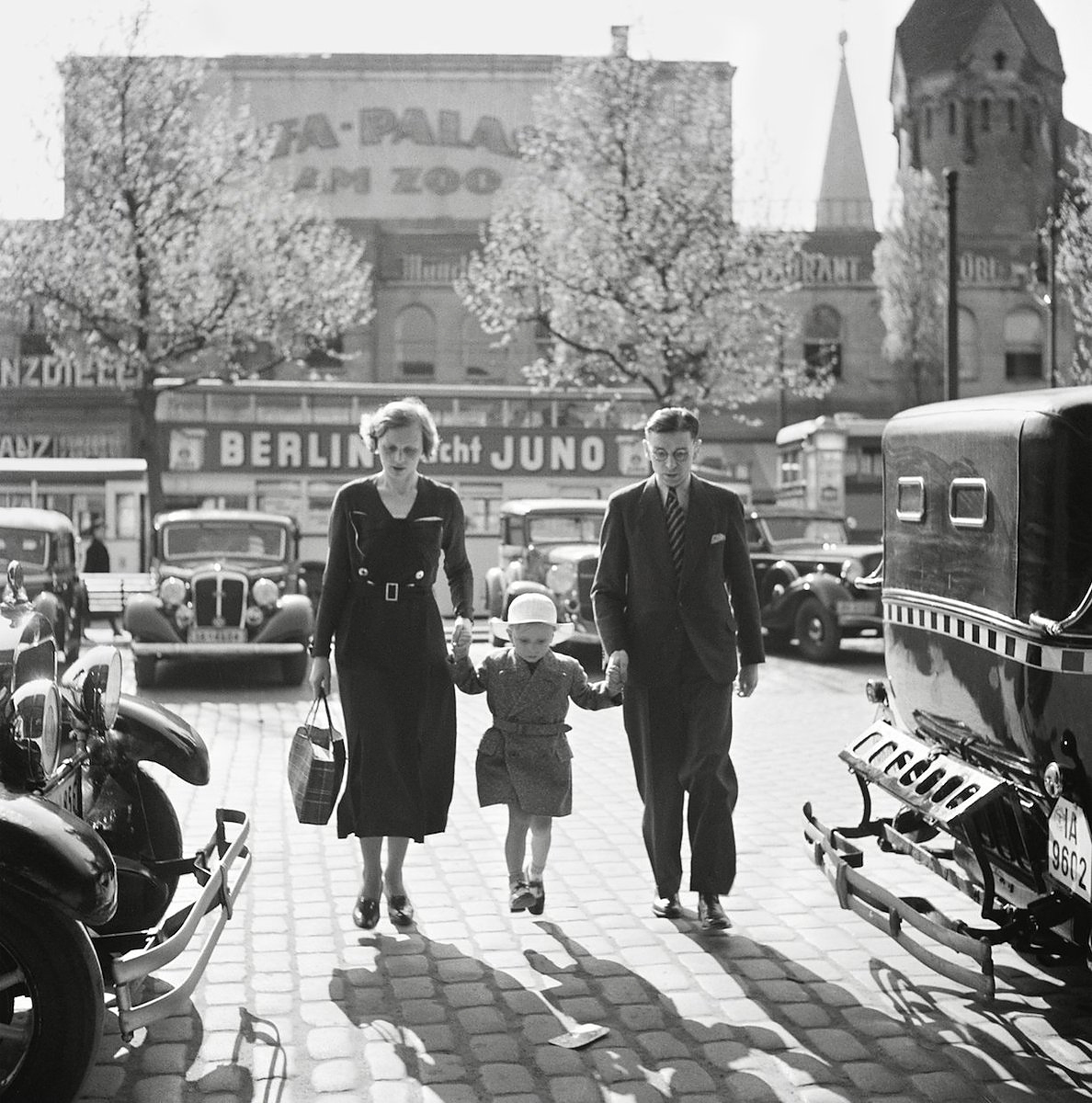
Roman Vishniac (America born Russia, 1897-1990) 'German family walking between taxicabs in front of the Ufa-Palast movie theater, Berlin' late 1920s-early 1930s from the exhibition Exhibition: 'Roman Vishniac Rediscovered' at The Photographers' Gallery and Jewish Museum London, Oct 2018 - Feb 2019


Roman Vishniac (America born Russia, 1897-1990)
German family walking between taxicabs in front of the Ufa-Palast movie theater, Berlin
late 1920s – early 1930s
Courtesy International Center of Photography
© Mara Vishniac Kohn


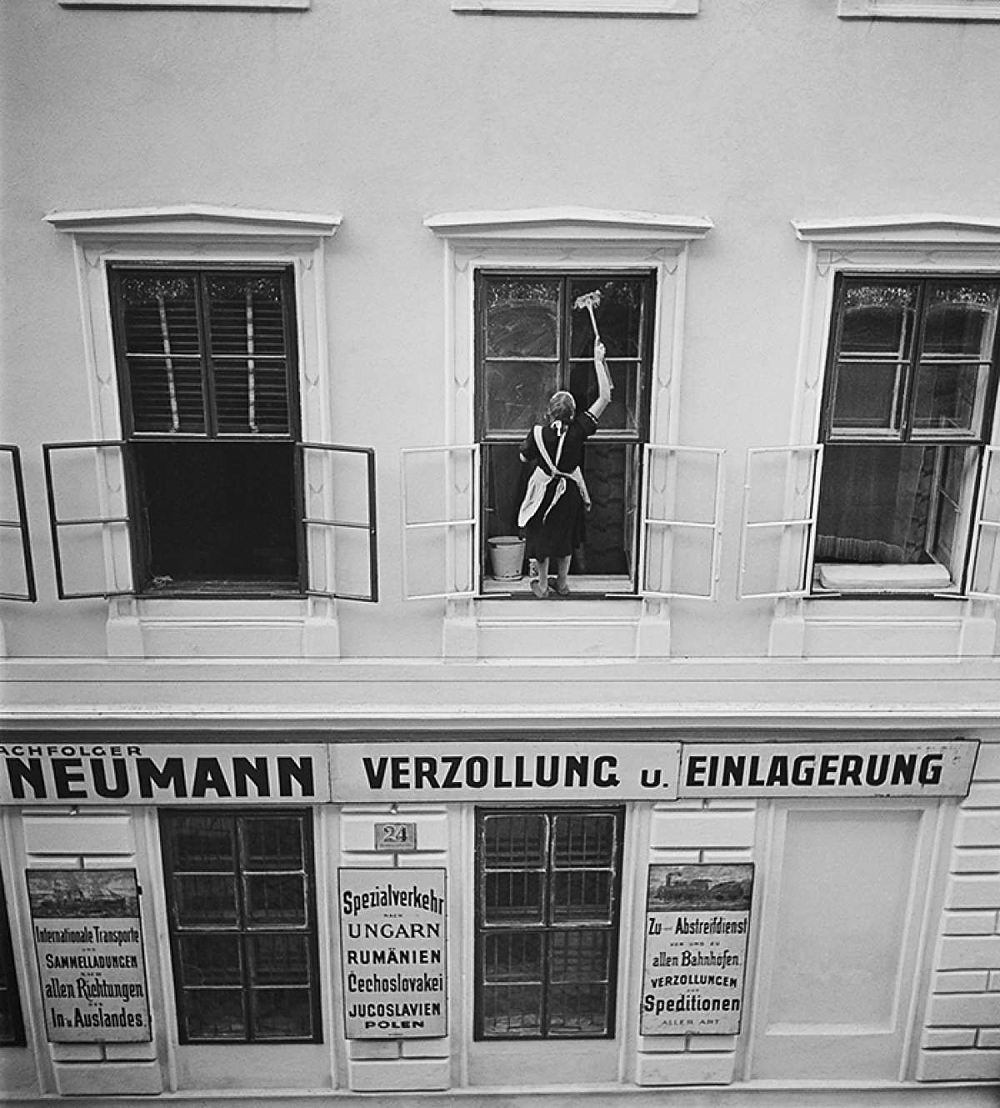
Roman Vishniac (America born Russia, 1897-1990) 'Woman washing windows above Mandtler & Neumann Speditionen (Mandtler & Neumann Forwarding Agents), Ferdinandstrasse, Leopoldstadt, Vienna' 1930s


Roman Vishniac (America born Russia, 1897-1990)
Woman washing windows above Mandtler & Neumann Speditionen (Mandtler & Neumann Forwarding Agents), Ferdinandstrasse, Leopoldstadt, Vienna
1930s
Courtesy International Center of Photography
© Mara Vishniac Kohn


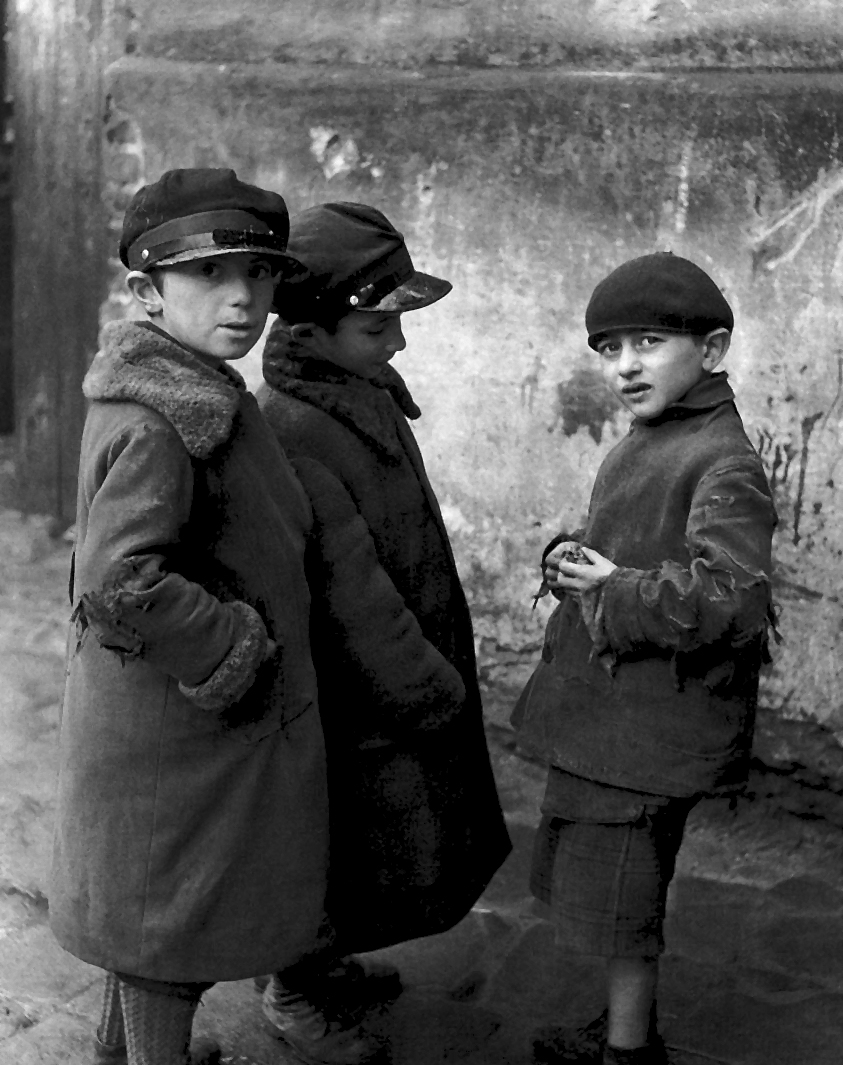
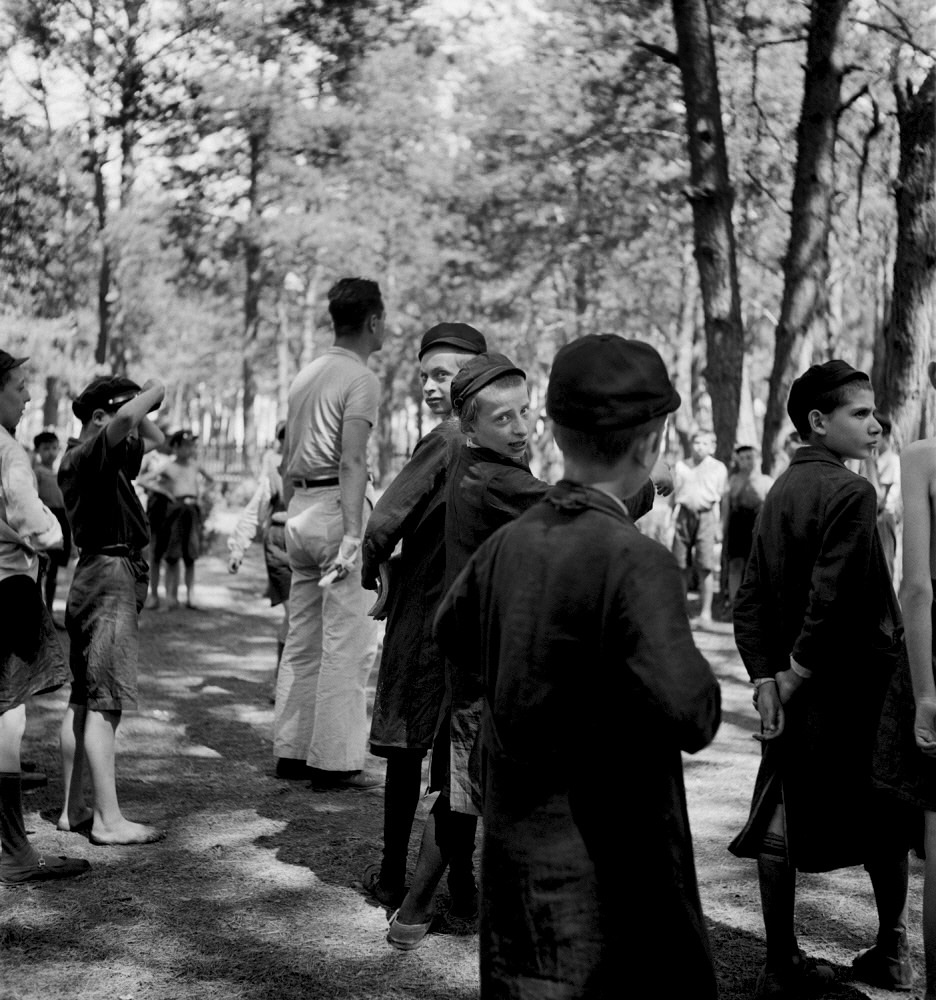
Roman Vishniac (America born Russia, 1897-1990) 'Jewish school children, Mukacevo' c. 1935-1938


Roman Vishniac (America born Russia, 1897-1990)
Jewish school children, Mukacevo
c. 1935-1938
Courtesy International Center of Photography
On display at Jewish Museum London
© Mara Vishniac Kohn


From 1935 to 1938, Vishniac made numerous trips to the city of Mukacevo, a major center of religious learning among Jews from Czechoslovakia, Hungary, and the Carpathian region. Mukacevo was widely known for its famous rabbis and yeshivot (religious schools). This image of Jewish schoolchildren appears in cropped form on the cover of Vishniac’s first posthumous publication, To Give Them Light; the recently digitised negative reveals that it represents only one-fifth of the full frame. Vishniac often directed printers or publishers to crop his images to focus on religiously observant Jewish men or boys, identifiable by their dress, an editorial decision that sometimes detracted from the composition by subverting aesthetic considerations to emphasise religious and observant life. The negative reveals Vishniac’s instinctive compositional acumen: a bustling and vibrant street scene, with a boy’s beaming, slightly out-of-focus face in the foreground and numerous hands pushing into and out of the frame, communicating the vitality and liveliness of the students.

Text from the International Center of Photography website


Roman Vishniac (America born Russia, 1897-1990) 'Man purchasing herring, wrapped in newspaper, for a Sabbath meal, Mukacevo' c. 1935-1938


Roman Vishniac (America born Russia, 1897-1990)
Man purchasing herring, wrapped in newspaper, for a Sabbath meal, Mukacevo
c. 1935-1938
International Center of Photography
© Mara Vishniac Kohn


Roman Vishniac (America born Russia, 1897-1990) 'Fish is the Favored Food for the Kosher Table' c. 1935-1938


Roman Vishniac (America born Russia, 1897-1990)
Fish is the Favored Food for the Kosher Table
c. 1935-1938
Gelatin silver print
Image (paper): 11 1/2 x 9 3/16 in. (29.2 x 23.3cm)
Collection Philip Allen
© Mara Vishniac Kohn


“This image of a boy bending over a vat of herring communicates the excitement of the marketplace and the sheer abundance of herring. The unparalleled quality of the print transmits every detail, from the wet cobblestones and circular motion of the swimming fish to the rapid, eager movement of hands reaching in to grab the herring. Rather than focusing on religious life, these early prints demonstrate the vitality and frantic charm of a town rushing to prepare for the Sabbath.”

Maya Benton, ICP Adjunct Curator


These rare vintage prints are part of a collection of sixteen recently discovered prints that comprised Vishniac’s first exhibition abroad, and were displayed in the New York office of the Jewish Joint Distribution Committee (JDC) in 1938. Vishniac developed these early prints in his apartment in Berlin, and they are rare early examples of his virtuosic skill as a master printmaker. He gifted all sixteen prints to an employee of the New York office of the JDC who had helped him to organise his first exhibit; these prints are on loan from his son.

The image of a boy bending over a vat of herring communicates the excitement of the marketplace and the sheer abundance of herring. The unparalleled quality of the print transmits every detail, from the wet cobblestones and circular motion of the swimming fish to the rapid, eager movement of hands reaching in to grab the herring. Rather than focusing on religious life, these early prints demonstrate the vitality and frantic charm of a town rushing to prepare for the Sabbath.

Anonymous text. “Roman Vishniac,” on the International Center of Photography website Nd [Online] Cited 16/03/2022


Roman Vishniac (America born Russia, 1897-1990) 'Young Jewish boys suspicious of strangers, Mukachevo' c. 1935-1938


Roman Vishniac (America born Russia, 1897-1990)
Young Jewish boys suspicious of strangers, Mukachevo
c. 1935-1938
International Center of Photography
© Mara Vishniac Kohn


Roman Vishniac (America born Russia, 1897-1990) 'Three women, Mukacevo' c. 1935-1938


Roman Vishniac (America born Russia, 1897-1990)
Three women, Mukacevo
c. 1935-1938
International Center of Photography
© Mara Vishniac Kohn


Roman Vishniac (America born Russia, 1897-1990) The notice on the wall reads "Come Celebrate Chanukah." c. 1935-1938


Roman Vishniac (America born Russia, 1897-1990)
The notice on the wall reads “Come Celebrate Chanukah”
c. 1935-1938
International Center of Photography
© Mara Vishniac Kohn


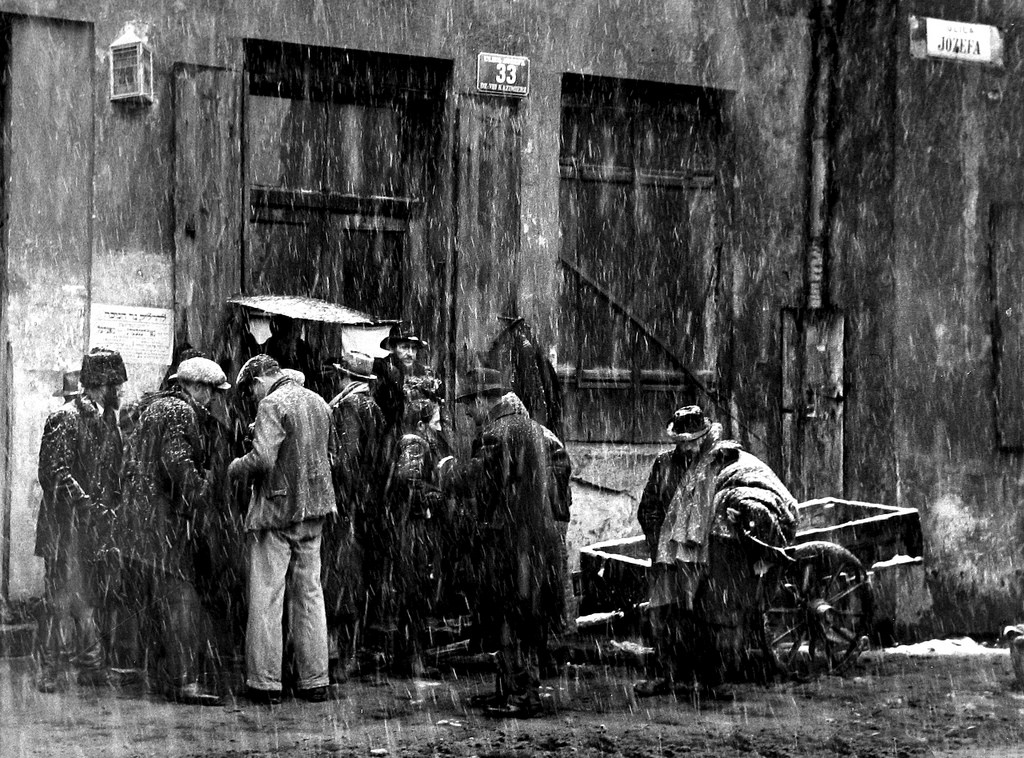
Roman Vishniac (America born Russia, 1897-1990) 'Jewish street vendors, Warsaw, Poland' 1938


Roman Vishniac (America born Russia, 1897-1990))
Jewish street vendors, Warsaw, Poland
1938
International Center of Photography
© Mara Vishniac Kohn


Roman Vishniac (America born Russia, 1897-1990) 'Children playing outdoors and watching a game' c. 1935-1937


Roman Vishniac (America born Russia, 1897-1990)
Children playing outdoors and watching a game
c. 1935-1937
International Center of Photography
© Mara Vishniac Kohn


Roman Vishniac (America born Russia, 1897-1990) 'Children playing on a street lined with swastika flags' mid-1930s


Roman Vishniac (America born Russia, 1897-1990)
Children playing on a street lined with swastika flags
mid-1930s
International Center of Photography
© Mara Vishniac Kohn


Roman Vishniac (America born Russia, 1897-1990) 'Nat Gutman's Wife, Warsaw' 1938


Roman Vishniac (America born Russia, 1897-1990)
Nat Gutman’s Wife, Warsaw
1938
International Center of Photography
© Mara Vishniac Kohn


Nat Gutman, the porter, Warsaw 1935-1938 from A Vanished World, 1983 is the photograph of her husband. After working as a bank cashier for six years, Nat Gutman was dismissed because he was a Jew. He became a porter. The loads usually weighed forty-five to ninety pounds. This was the kind of work that bank cashier Gutman, a man with a bad hernia, was reduced to in order to support his wife and son. The family were exterminated.


Roman Vishniac (America born Russia, 1897-1990) 'A street of Kazimierz, Cracow' 1935-1938


Roman Vishniac (America born Russia, 1897-1990)
A street of Kazimierz, Cracow
1935-1938
International Center of Photography
© Mara Vishniac Kohn


Roman Vishniac (America born Russia, 1897-1990) 'Isaac Street, Kazimierz, Krakow' 1935-1938


Roman Vishniac (America born Russia, 1897-1990)
Isaac Street, Kazimierz, Krakow
1935-1938
International Center of Photography
© Mara Vishniac Kohn


Roman Vishniac (America born Russia, 1897-1990) 'Isaac Street, Kazimierz, Cracow' 1935-1938


Roman Vishniac (America born Russia, 1897-1990)
Isaac Street, Kazimierz, Cracow
1935-1938
International Center of Photography
© Mara Vishniac Kohn


Roman Vishniac (America born Russia, 1897-1990) 'Window washer balancing on a ladder, Berlin' mid-1930s


Roman Vishniac (America born Russia, 1897-1990)
Window washer balancing on a ladder, Berlin
mid-1930s
Courtesy International Center of Photography
On display at The Photographers’ Gallery
© Mara Vishniac Kohn


Roman Vishniac (America born Russia, 1897-1990) 'Exhausted. A Carrier of Heavy Loads, Warsaw' c. 1935-1938


Roman Vishniac (America born Russia, 1897-1990)
Exhausted. A Carrier of Heavy Loads, Warsaw
c. 1935-38
Gelatin silver print
7 1/2 x 10 in. (19.1 x 25.4cm)
International Center of Photography
Gift of Mara Vishniac Kohn, 2013
© Mara Vishniac Kohn


“This unpublished image of a porter at rest in his wagon demonstrates Vishniac’s modern aesthetic and the influence of the avant-garde on his work. The diagonal slope of the central figure, stretched out along a sloping plane, fills the entire frame. The intuitive amalgamation of patterns and textures, one of Vishniac’s greatest talents, is evident throughout the image: the light reflected on the ornamented belt buckle; the double-patterned cable knit of his shrunken wool vest, which barely conceals a plaid shirt; and the round shapes of a wheel and bucket that divide the angular line formed by the central figure. It is a triumph of textures, angles, and lines, yet the worn sign with the name Nuta Hersz and his porter license number reminds us that the subject of the photograph is the victim of anti-Semitic boycotts and the limited job opportunities (only vendors and porters) permitted to Jews in Poland at that time.”

Maya Benton, ICP Adjunct Curator


Roman Vishniac (America born Russia, 1897-1990) 'Villagers in the Carpathian Mountains' c. 1935-1938


Roman Vishniac (America born Russia, 1897-1990)
Villagers in the Carpathian Mountains
c. 1935-1938
International Center of Photography
© Mara Vishniac Kohn


“Vishniac traveled to remote Jewish villages in rural Carpathian Ruthenia throughout the late 1930s, and in many cases was the only photographer to ever document these communities, which had been isolated for hundreds of years, yet maintained an enduring connection to Jewish observance, customs, and traditions.

Every detail of this image makes it a nearly perfect photograph: the sense of movement and the figures’ varied gestures and vibrant expressions; the carefully balanced horizontal bands of shadow and striped fabric; the detail of a woman peering out of a window while a glass pane on the facing structure points in the direction of an impossibly angled triangular building that vertically divides the frame in half; and the collective sense of surprise at encountering the photographer. Like much of Vishniac’s unpublished work, this composition recalls Henri Cartier-Bresson’s description of the decisive moment (a precise organisation of forms that give a time and place its ideal expression) and places Vishniac on par with the great photographers of the 20th century.”

Maya Benton, ICP Adjunct Curator


Roman Vishniac (America born Russia, 1897-1990) '[David Eckstein, seven years old, and classmates in cheder (Jewish elementary school), Brod]' c. 1938


Roman Vishniac (America born Russia, 1897-1990)
[David Eckstein, seven years old, and classmates in cheder (Jewish elementary school), Brod]
c. 1938
International Center of Photography
© Mara Vishniac Kohn


“The boy in this photograph has been identified as David Eckstein, a Holocaust survivor currently living in a commune in the American Southwest. Born in 1930 in the small town of Brod, Eckstein was seven years old when Vishniac took several photographs of him, his classmates, and his teacher just before the onslaught of World War II. Vishniac later recalled, ‘I watched this little boy for almost an hour, and in this moment I saw the whole sadness of the world.’ This portrait was later selected as the cover of Vishniac’s first publication, Polish Jews: A Pictorial Record (1947), and reprinted on the cover of I. B. Singer’s National Book Award-winning collection of stories, A Day of Pleasure: Stories of a Boy Growing Up in Warsaw (1969).”

Maya Benton, ICP Adjunct Curator


Roman Vishniac (America born Russia, 1897-1990) '[Grandmother and grandchildren in basement dwelling, Krochmaina Street, Warsaw]' c. 1935-1938


Roman Vishniac (America born Russia, 1897-1990)
[Grandmother and grandchildren in basement dwelling, Krochmaina Street, Warsaw]
c. 1935-1938
International Center of Photography
© Mara Vishniac Kohn


“Vishniac documented urban poverty in Warsaw, often focusing on the dark, cold basement dwellings of families where hungry Jewish children lived in crowded conditions. Vishniac photographed this woman taking care of her grandchildren while their parents searched for work in one of 26 basement compartments, each inhabited by a large family. In June 1941, the National Jewish Monthly published this image with the caption ‘Polish Jewry, once the bulwark of world Jewry, is done for as a community. Even if Hitler were to lose power tomorrow, their institutions and organisations are hopelessly smashed, could not be rebuilt in generations. But individuals remain, starved and persecuted. This picture shows an old grandmother and her grandchildren. What is going to become of them, and of the millions of other innocent victims of Fascist violence and terror?'”

Maya Benton, ICP Adjunct Curator


Roman Vishniac (America born Russia, 1897-1990) 'Sara, sitting in bed in a basement dwelling, with stencilled flowers above her head, Warsaw' c. 1935-1937


Roman Vishniac (America born Russia, 1897-1990)
Sara, sitting in bed in a basement dwelling, with stencilled flowers above her head, Warsaw
c. 1935-1937
Courtesy International Center of Photography
On display at The Photographers’ Gallery
© Mara Vishniac Kohn


Vishniac documented the basement dwellings of Warsaw using the scant natural light that trickled through a few narrow, high windows, necessitating that he shoot during the day, when adults were often out looking for work or peddling their wares and children were sometimes the only inhabitants indoors. This photograph of Sara, one of Vishniac’s most iconic images, was reproduced on charity tins, or tzedakah boxes, and circulated throughout France by Jewish social service organisations, including the American Jewish Joint Distribution Committee (AJDC) in the late 1930s.

Text from the International Center of Photography website


An extraordinarily versatile and innovative photographer, Vishniac is best known for having created one of the most widely recognised and reproduced photographic records of Jewish life in Eastern Europe between the two World Wars. Featuring many of his most iconic works, this comprehensive exhibition further introduces recently discovered and lesser-known chapters of his photographic career from the early 1920s to the late 1970s. The cross-venue exhibition presents radically diverse bodies of work and positions Vishniac as one of the most important social documentary photographers of the 20th century whose work also sits within a broader tradition of 1930s modernist photography.

Born in Pavlovsk, Russia in 1897 to a Jewish family Roman Vishniac was raised in Moscow. On his seventh birthday, he was given a camera and a microscope which began a lifelong fascination with photography and science. He began to conduct early scientific experiments attaching the camera to the microscope and as a teenager became an avid amateur photographer and student of biology, chemistry and zoology. In 1920, following the Bolshevik Revolution, he immigrated to Berlin where he joined some of the city’s many flourishing camera clubs. Inspired by the cosmopolitanism and rich cultural experimentation in Berlin at this time, Vishniac used his camera to document his surroundings. This early body of work reflects the influence of European modernism with his framing and compositions favouring sharp angles and dramatic use of light and shade to inform his subject matter.

Vishniac’s development as a photographer coincided with the enormous political changes occurring in Germany, which he steadfastly captured in his images. They represent an unsettling visual foreboding of the growing signs of oppression, the loss of rights for Jews, the rise of Nazism in Germany, the insidious propaganda – swastika flags and military parades, which were taking over both the streets and daily life. German Jews routinely had their businesses boycotted, were banned from many public places and expelled from Aryanised schools. They were also prevented from pursuing professions in law, medicine, teaching, and photography, among many other indignities and curtailments of civil liberties. Vishniac recorded this painful new reality through uncompromising images showing Jewish soup kitchens, schools and hospitals, immigration offices and Zionist agrarian training camps, his photos tracking the speed with which the city changed from an open, intellectual society to one where militarism and fascism were closing in.

Social and political documentation quickly became a focal point of his work and drew the attention of organisations wanting to raise awareness and gain support for the Jewish population. In 1935, Vishniac was commissioned by the world’s largest Jewish relief organisation, the American Jewish Joint Distribution Committee (JDC), to photograph impoverished Jewish communities in Eastern Europe. These images were intended to support relief efforts and were used in fundraising campaigns for an American donor audience. When the war broke out only a few years later, his photos served increasingly urgent refugee efforts, before finally, at the end of the war and the genocide enacted by Nazi Germany, Vishniac’s images became the most comprehensive photographic record by a single photographer of a vanished world.

Vishniac left Europe in 1940 and arrived in New York with his family on New Year’s Day, 1941. He continued to record the impact of World War II throughout the 1940s and 50s in particular focusing on the arrival of Jewish refugees and Holocaust survivors in the US, but also looking at other immigrant communities including Chinese Americans. In 1947, he returned to Europe to document refugees and relief efforts in Jewish Displaced Persons camps and also to witness the ruins of his former hometown, Berlin. He also continued his biological studies and supplemented his income by teaching and writing.

In New York, Vishniac established himself as a freelance photographer and built a successful portrait studio on Manhattan’s Upper West Side. At the same time he dedicated himself to scientific research, resuming his interest in Photomicroscopy. This particular application of photography became the primary focus of his work during the last 45 years of his life. By the mid-1950s, he was regarded as a pioneer in the field, developing increasingly sophisticated techniques for photographing and filming microscopic life forms. Vishniac was appointed Professor of Biology and Art at several universities and his groundbreaking images and scientific research were published in hundreds of magazines and books.

Although he was mainly embedded in the scientific community, Vishniac was a keen observer and scholar of art, culture, and history and would have been aware of developments in photography going on around him and the work of his contemporaries. In 1955, famed photographer and museum curator Edward Steichen featured several of Vishniac’s photographs in the influential book and travelling exhibition The Family of Man shown at the Museum of Modern Art. Steichen later describes the importance of Vishniac’s work. “[He]… gives a last minute look at the human beings he photographed just before the fury of Nazi brutality exterminated them. The resulting photographs are among photography’s finest documents of a time and place.”

Roman Vishniac Rediscovered offers a timely reappraisal of Vishniac’s vast photographic output and legacy and brings together – for the first time – his complete works including recently discovered vintage prints, rare and ‘lost’ film footage from his pre-war period, contact sheets, personal correspondence, original magazine publications, newly created exhibition prints as well as his acclaimed photomicroscopy.

Drawn from the Roman Vishniac Archive at the International Center of Photography, New York and curated by Maya Benton in collaboration with The Photographers’ Gallery curator, Anna Dannemann and Jewish Museum London curator, Morgan Wadsworth-Boyle, each venue will provide additional contextual material to illuminate the works on display and bring the artist, his works and significance to the attention of UK audiences. Roman Vishniac Rediscovered is organised by the International Center of Photography.

Press release from The Photographers’ Gallery


Roman Vishniac (America born Russia, 1897-1990) 'Inside the Jewish quarter, Bratislava' c. 1935-1938


Roman Vishniac (America born Russia, 1897-1990)
Inside the Jewish quarter, Bratislava
c. 1935-1938
Courtesy International Center of Photography
On display at Jewish Museum London
© Mara Vishniac Kohn


Roman Vishniac (America born Russia, 1897-1990) 'Children at Play, Bratislava' c. 1935-1938


Roman Vishniac (America born Russia, 1897-1990)
Children at Play, Bratislava
c. 1935-1938
Courtesy International Center of Photography
© Mara Vishniac Kohn


Roman Vishniac (America born Russia, 1897-1990) 'Vishniac's daughter Mara posing in front of an election poster for Hindenburg and Hitler' 1933


Roman Vishniac (America born Russia, 1897-1990)
Vishniac’s daughter Mara posing in front of an election poster for Hindenburg and Hitler that reads “The Marshal and the Corporal: Fight with Us for Peace and Equal Rights,” Wilmersdorf, Berlin
1933
Courtesy International Center of Photography
On display at Jewish Museum London
© Mara Vishniac Kohn


Vishniac’s daughter Mara, age seven, was photographed standing in front of this 1933 poster celebrating Hitler’s recent appointment as German chancellor. The poster advertises a plebiscite to permit withdrawal from the League of Nations and Geneva Disarmament Conference, which restricted Germany’s ability to develop a military. Other posters include the slogans “Mothers, fight for your children!,” “The coming generation accuses you!,” and “In 8 months… 2,250,000 countrymen able to put food on the table. Bolshevism destroyed. Sectionalism overcome. A kingdom and order of cleanliness built… Those are the achievements of Hitler’s rule…”

Text from the International Center of Photography website


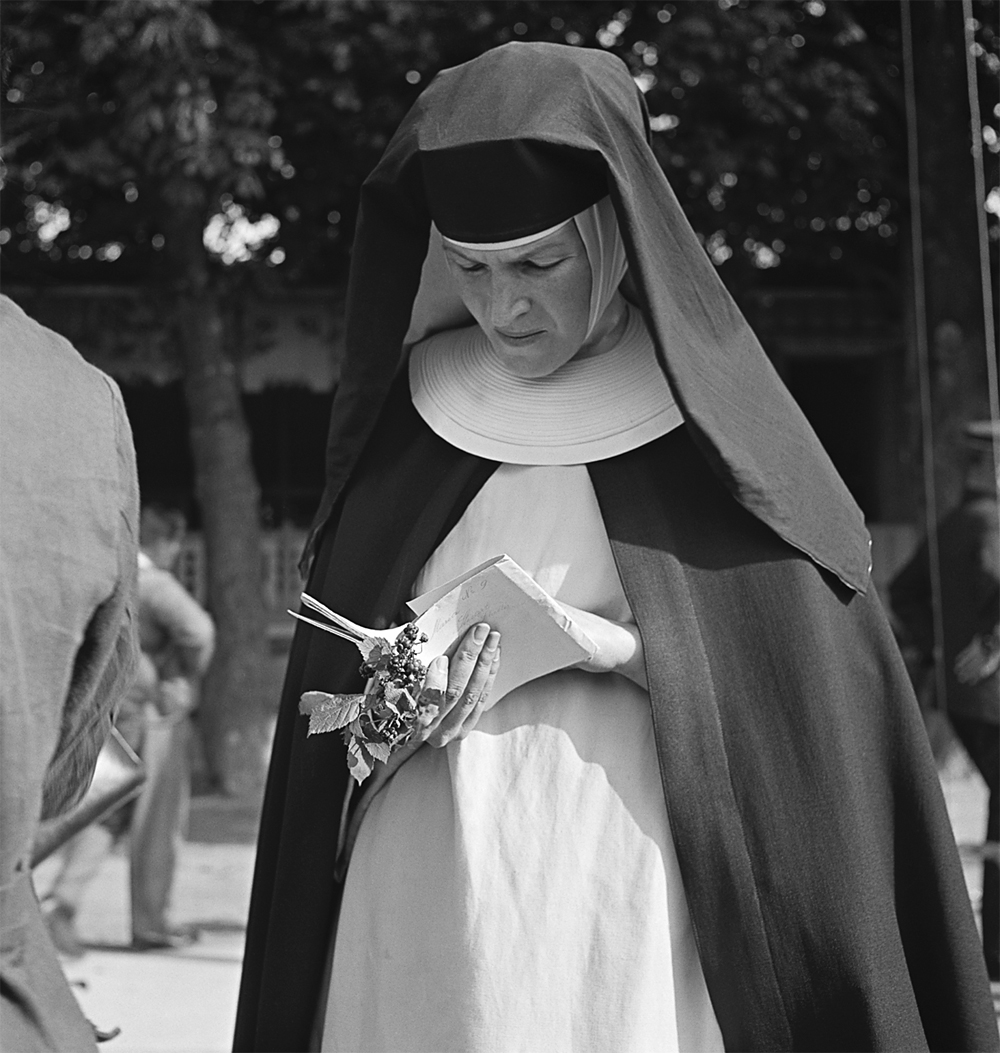
Roman Vishniac (America born Russia, 1897-1990) 'Benedictine nun reading, probably France' 1930s


Roman Vishniac (America born Russia, 1897-1990)
Benedictine nun reading, probably France
1930s, printed 2012
Photo digital inkjet print
12 x 11 3/8 in. (30.5 x 29cm)
International Center of Photography
© Mara Vishniac Kohn


Roman Vishniac (America born Russia, 1897-1990) 'Ernst Kaufmann, center, and unidentified Zionist youth' 1938-1939


Roman Vishniac (America born Russia, 1897-1990)
Ernst Kaufmann, center, and unidentified Zionist youth, wearing clogs while learning construction techniques in a quarry, Werkdorp Nieuwesluis, Wieringermeer, The Netherlands
1938-1939
Courtesy International Center of Photography
On display at Jewish Museum London
© Mara Vishniac Kohn


Ernst Kaufmann was born in Krefeld, Germany, in 1911. He was arrested in June 1941 and killed in August of that year in the Mauthausen concentration camp in Austria.

This photograph is strikingly similar in subject and composition to a bronze relief plaque made in 1935 by Dutch artist Hildo Krop (1884-1970) for the monument on the Afsluitdijk, a dam that was completed in 1933 in the north of the Netherlands. The relief depicts three stoneworkers below the text “A nation that lives builds for the future.” Dutch modernist architect Willem Dudok (1884-1974) designed the Afsluitdijk and in 1935 Krop’s plaque was added. The dam was a triumph of Dutch engineering and a source of national pride. Residents of the Werkdorp probably took Vishniac to the Afsluitdijk; the well-known relief undoubtedly inspired him to stage this shot, an ideal composition for his heroic image of Jewish pioneers in the Werkdorp, and an unusual conflation of Dutch nationalist and Zionist visual sensibilities.

Text from the International Center of Photography website


Roman Vishniac (America born Russia, 1897-1990) 'Beach dwellers in the afternoon, Nice, France' c. 1939


Roman Vishniac (America born Russia, 1897-1990)
Beach dwellers in the afternoon, Nice, France
c. 1939
Courtesy International Center of Photography
© Mara Vishniac Kohn


Roman Vishniac (America born Russia, 1897-1990) 'Boys exercising in the gymnasium of the Jewish Community House of Bensonhurst, Brooklyn' 1949


Roman Vishniac (America born Russia, 1897-1990)
Boys exercising in the gymnasium of the Jewish Community House of Bensonhurst, Brooklyn
1949
Courtesy International Center of Photography
On display at The Photographers’ Gallery
© Mara Vishniac Kohn


The Jewish Community House of Bensonhurst, known as the “J,” was established in 1927 to serve the growing population of first-generation American Jews migrating to South Brooklyn. The J’s mission, to “ennoble Jewish youth” by building and fostering a sense of Jewish community, was accomplished through the promotion of arts and recreation for all ages. American Jewish major league baseball legend Sandy Koufax, a regular at the J, had started his sports career there as a basketball player.

In a dramatic departure from his iconic photographs of impoverished children in prewar eastern Europe, here Vishniac focused on the strong, healthy young American children. The children’s vitality is reinforced by the diagonal lines and geometric angles of the ropes, contributing to a forceful and innovative composition reflective of Vishniac’s previously unknown American work from the 1940s.

Text from the International Center of Photography website


Roman Vishniac (America born Russia, 1897-1990) 'Customers waiting in line at a butcher's counter during wartime rationing, Washington Market, New York' 1941-1944


Roman Vishniac (America born Russia, 1897-1990)
Customers waiting in line at a butcher’s counter during wartime rationing, Washington Market, New York
1941-44
Courtesy International Center of Photography
On display at The Photographers’ Gallery
© Mara Vishniac Kohn


New York’s Washington Market, famed for its exceptional variety and quantity of food, was established in the eighteenth century. Vishniac documented the mostly female customers waiting for service during a period of wartime restrictions and food rationing. Through careful framing – customers stand against bare counters and voided display cases – he captured disenchanted expressions that can be read as a projection of Vishniac’s own experience as a new immigrant in America, as well as a record of comparative privation in the former plenty of Washington Market. As such, they anticipate the isolation and indifference shown in The Americans by Robert Frank, another Jewish immigrant from war-torn Europe.

Text from the International Center of Photography website


The Photographers’ Gallery
16-18 Ramillies Street
London
W1F 7LW

Opening hours:
Mon – Wed: 10.00 – 18.00
Thursday – Friday: 10.00 – 20.00
Satuday: 10.00 – 18.00
Sunday: 11.00 – 18.00

The Jewish Museum
A museum without walls at the moment.

The Photographers’ Gallery website

The Jewish Museum, London website

LIKE ART BLART ON FACEBOOK

Back to top

Exhibition: ‘In Focus: Expressions’ at the J. Paul Getty Museum, Getty Center, Los Angeles

Exhibition dates: 22nd May – 7th October, 2018


Erich Salomon (German, 1886-1944) '[Portrait of Madame Vacarescu, Romanian Author and Deputy to the League of Nations, Geneva]' 1928 from the exhibition 'In Focus: Expressions' at the J. Paul Getty Museum, Getty Center, Los Angeles, May - Oct, 2018


Erich Salomon (German, 1886-1944)
(Portrait of Madame Vacarescu, Romanian Author and Deputy to the League of Nations, Geneva)
1928
Gelatin silver print
29.7 × 39.7cm (11 11/16 × 15 5/8 in.)
The J. Paul Getty Museum, Los Angeles


In 1928, pioneering photojournalist, Erich Salomon photographed global leaders and delegates to a conference at the League for the German picture magazine Berliner Illustrirte Zeitung. In a typically frank image, Salomon has shown Vacarescu with her head thrown back passionately pleading before the international assembly.

Elena Văcărescu or Hélène Vacaresco (September 21, 1864 in Bucharest – February 17, 1947 in Paris) was a Romanian-French aristocrat writer, twice a laureate of the Académie française. Văcărescu was the Substitute Delegate to the League of Nations from 1922 to 1924. She was a permanent delegate from 1925 to 1926. She was again a Substitute Delegate to the League of Nations from 1926 to 1938. She was the only woman to serve with the rank of ambassador (permanent delegate) in the history of the League of Nations.

Text from the Wikipedia website


From a distance…

For such an engaging subject, this presentation looks to be a bit of a lucky dip / ho hum / filler exhibition. You can’t make a definitive judgement from a few media images but looking at the exhibition checklist gives you a good idea of the overall organisation of the exhibition and its content. Even the press release seems unsure of itself, littered as it is with words like posits, probes, perhaps (3 times) and problematic.

Elements such as physiognomy are briefly mentioned (with no mention of its link to eugenics), as is the idea of the mask – but again no mention of how the pose is an affective mask, nor how the mask is linked to the carnivalesque. Or how photographs portray us as we would like to be seen (the ideal self) rather than the real self, and how this incongruence forms part of the formation of our identity as human beings.

The investigation could have been so deep in so many areas (for example the representation of women, children and others in a patriarchal social system through facial expression; the self-portrait as an expression of inner being; the photograph as evidence of the mirror stage of identity formation; and the photographs of “hysterical” women of the Pitié-Salpêtrière Hospital, Paris; and on and on…) but in 45 works, I think not. The subject deserved, even cried out for (as facial expressions go), a fuller, more in depth investigation.

For more reading please see my 2014 text Facile, Facies, Facticity which comments on the state of contemporary portrait photography and offers a possible way forward: a description of the states of the body and the air of the face through a subtle and constant art of the recovering of surfaces.

Dr Marcus Bunyan


Many thanks to the J. Paul Getty Museum for allowing me to publish the photographs in the posting. Please click on the photographs for a larger version of the image.


The human face has been the subject of fascination for photographers since the medium’s inception. This exhibition includes posed portraits, physiognomic studies, anonymous snapshots, and unsuspecting countenances caught by the camera’s eye, offering a close-up look at the range of human stories that facial expressions – and photographs – can tell.


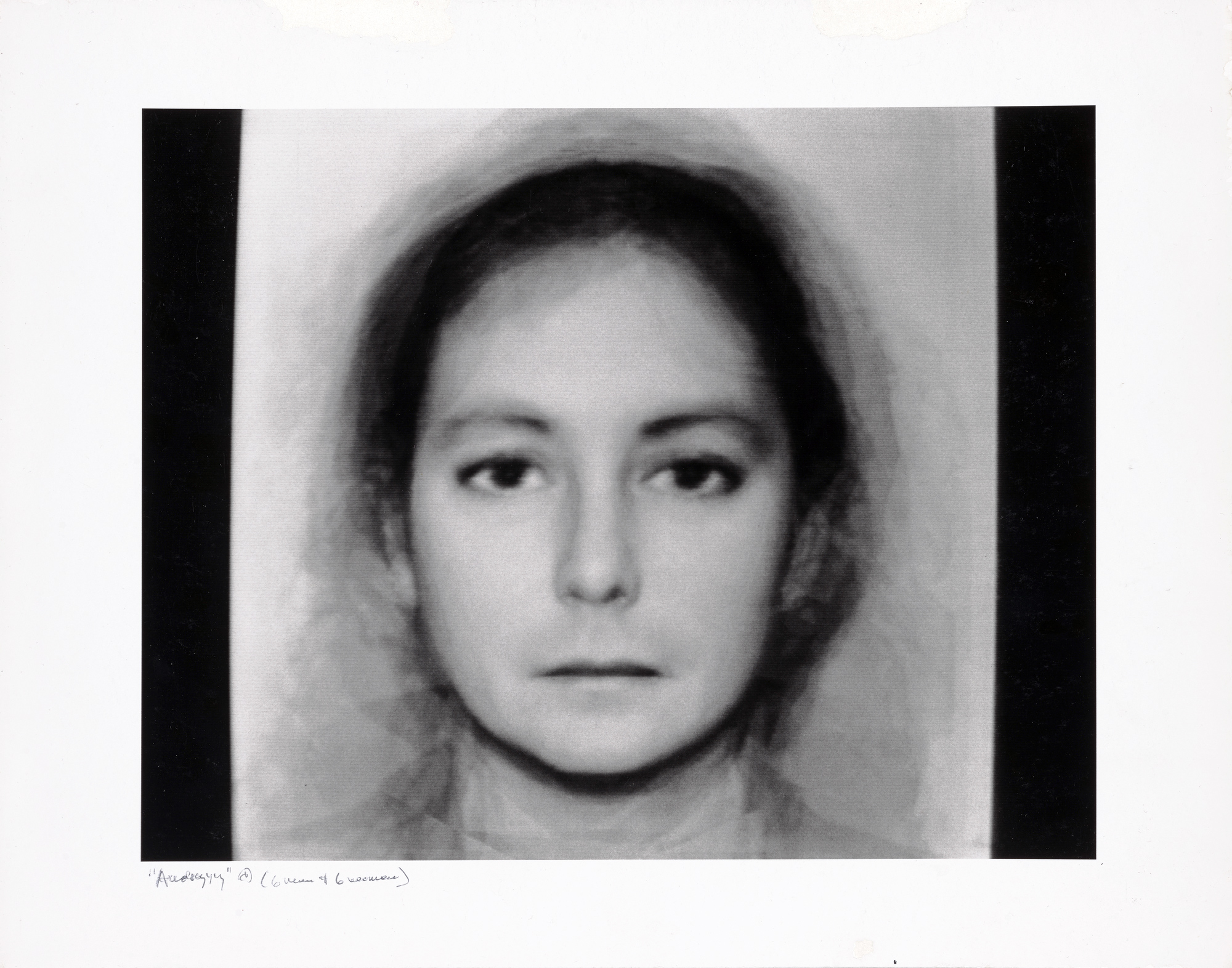
Nancy Burson (American, born 1948) 'Androgyny' 1982 from the exhibition 'In Focus: Expressions' at the J. Paul Getty Museum, Getty Center, Los Angeles, May - Oct, 2018


Nancy Burson (American, b. 1948)
Androgyny
1982
Gelatin silver print
21.6 × 27.7cm (8 1/2 × 10 7/8 in.)
© Nancy Burson
The J. Paul Getty Museum, Los Angeles


Composite image of portraits of six men and six women


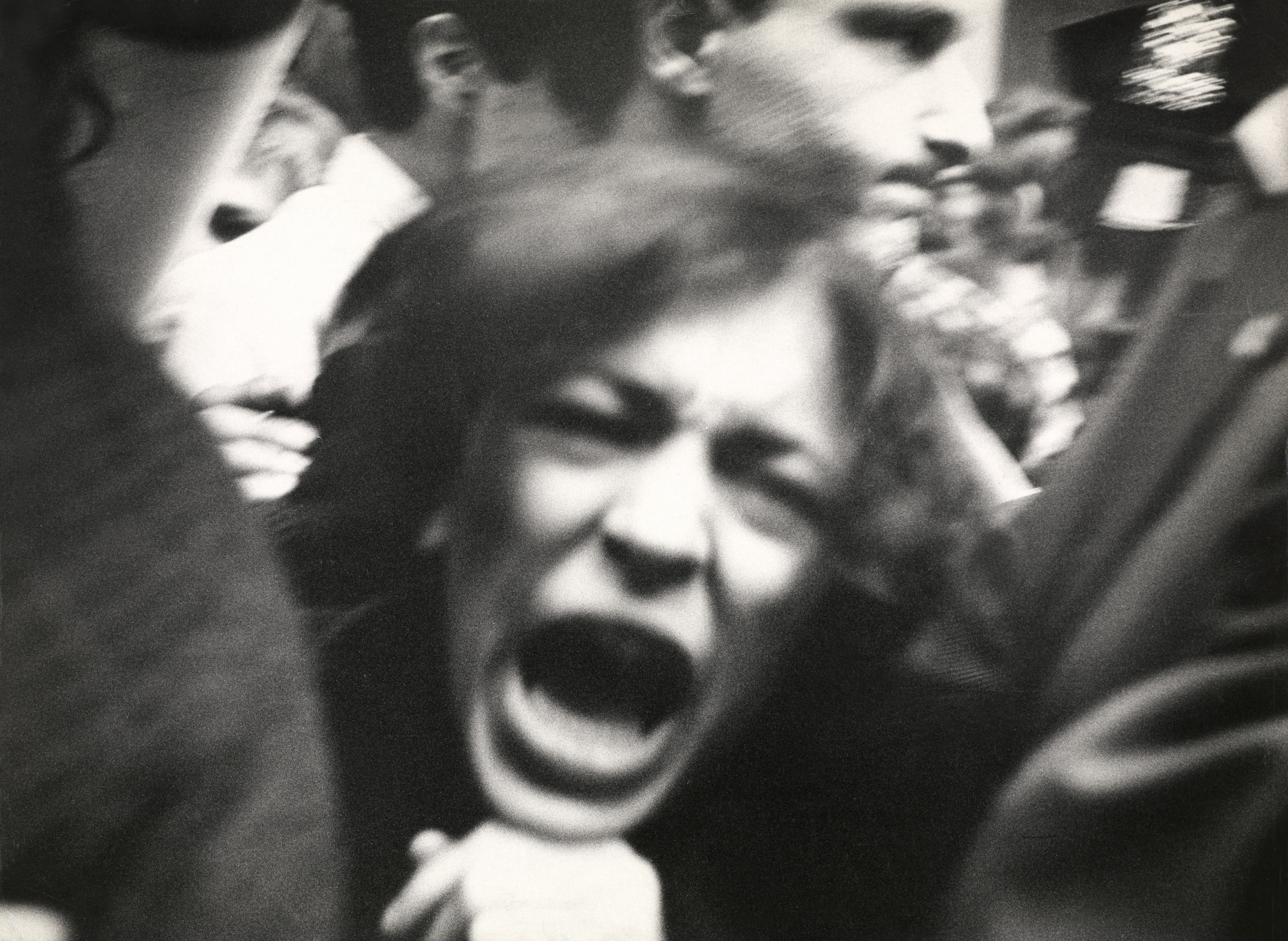
Leonard Freed (American, 1929-2006) 'Demonstration, New York City' 1963


Leonard Freed (American, 1929-2006)
Demonstration, New York City
1963
Gelatin silver print
25.9 × 35.4cm (10 3/16 × 13 15/16 in.)
© Leonard Freed / Magnum Photos, Inc.
The J. Paul Getty Museum, Los Angeles
Gift of Brigitte and Elke Susannah Freed


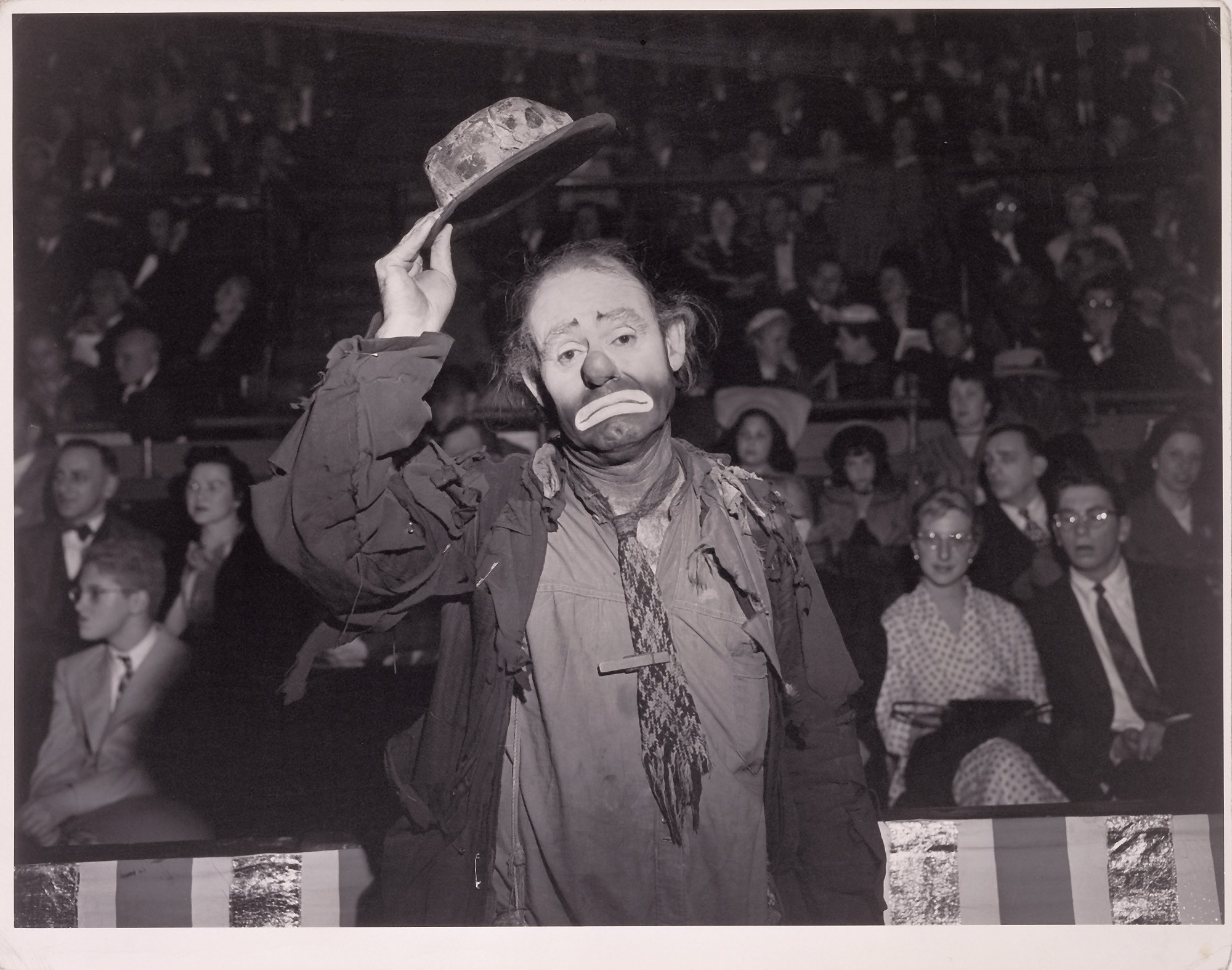
Weegee (Arthur Fellig) (American, born Austria, 1899-1968) 'Emmett Kelly, Ringling Brothers and Barnum & Bailey Circus' Negative May 1943; print about 1950


Weegee (Arthur Fellig) (American born Austria, 1899-1968)
Emmett Kelly, Ringling Brothers and Barnum & Bailey Circus
Negative May 1943; print about 1950
Gelatin silver print
26 × 34.4cm (10 1/4 × 13 9/16 in.)
© International Center of Photography
The J. Paul Getty Museum, Los Angeles


Emmett Kelly (American, 1898-1979)

Emmett Leo Kelly (December 9, 1898 – March 28, 1979) was an American circus performer, who created the memorable clown figure “Weary Willie”, based on the hobos of the Depression era.

Kelly began his career as a trapeze artist. By 1923, Emmett Kelly was working his trapeze act with John Robinson’s circus when he met and married Eva Moore, another circus trapeze artist. They later performed together as the “Aerial Kellys” with Emmett still performing occasionally as a whiteface clown.

He started working as a clown full-time in 1931, and it was only after years of attempting to persuade the management that he was able to switch from a white face clown to the hobo clown that he had sketched ten years earlier while working as a cartoonist.

“Weary Willie” was a tragic figure: a clown, who could usually be seen sweeping up the circus rings after the other performers. He tried but failed to sweep up the pool of light of a spotlight. His routine was revolutionary at the time: traditionally, clowns wore white face and performed slapstick stunts intended to make people laugh. Kelly did perform stunts too – one of his most famous acts was trying to crack a peanut with a sledgehammer – but as a tramp, he also appealed to the sympathy of his audience.

From 1942-1956 Kelly performed with the Ringling Brothers and Barnum & Bailey Circus, where he was a major attraction, though he took the 1956 season off to perform as the mascot for the Brooklyn Dodgers baseball team. He also landed a number of Broadway and film roles, including appearing as himself in his “Willie” persona in Cecil B. DeMille’s The Greatest Show on Earth (1952). He also appeared in the Bertram Mills Circus.

Text from the Wikipedia website


Hill & Adamson (Scottish, active 1843-1848) 'Mrs Grace Ramsay and four unknown women' 1843


Hill & Adamson (David Octavius Hill, Scottish 1802-1870 and Robert Adamson, Scottish 1821-1848) (Scottish, active 1843-1848)
Mrs Grace Ramsay and four unknown women
1843
Salter paper print from Calotype negative
15.2 x 20.3cm (6 x 8 in.)
The J. Paul Getty Museum, Los Angeles


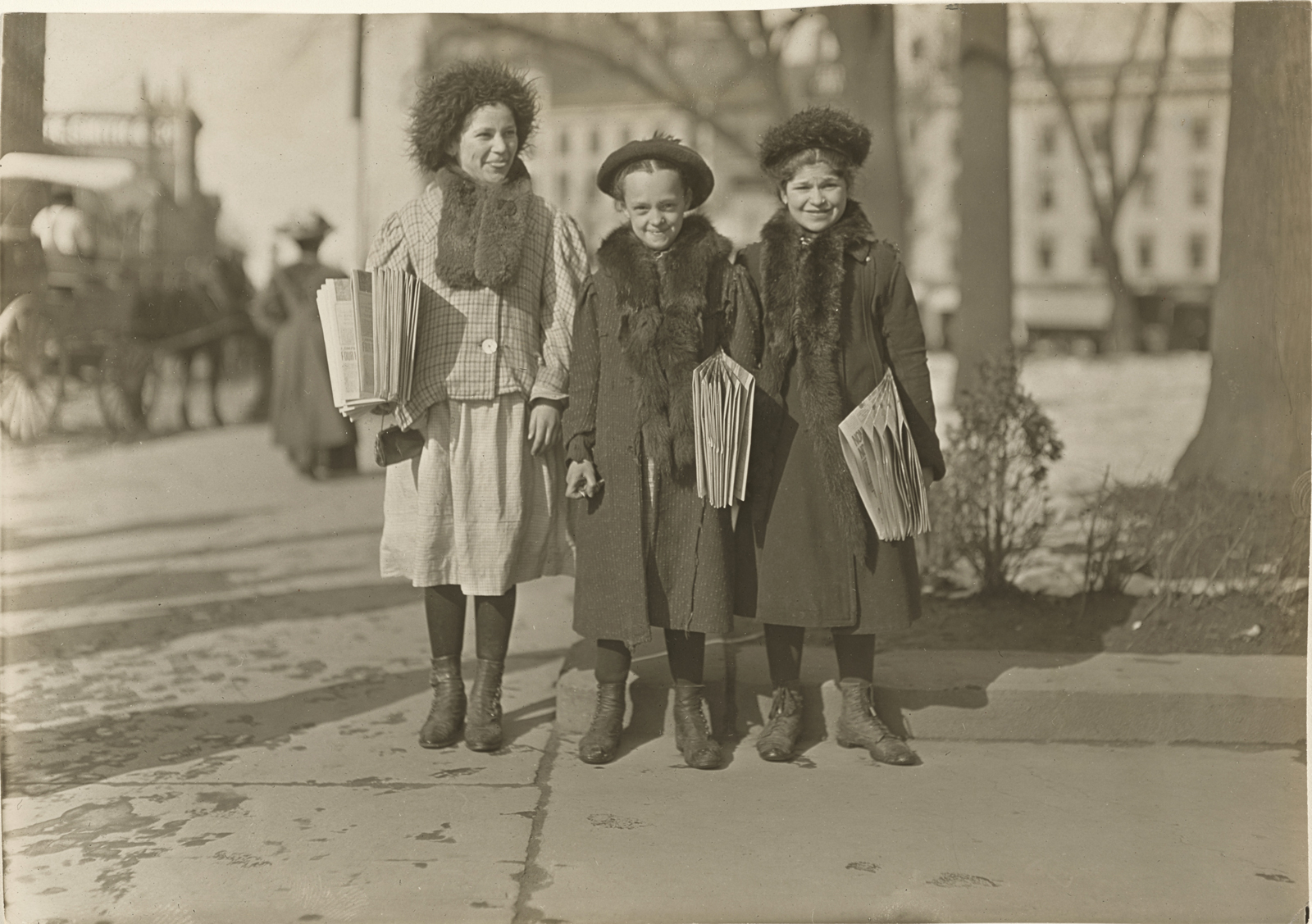
Lewis W. Hine (American, 1874-1940) 'Connecticut Newsgirls' c. 1912-1913


Lewis W. Hine (American, 1874-1940)
Connecticut Newsgirls
c. 1912-1913
Gelatin silver print
11.8 × 16.8cm (4 11/16 × 6 5/8 in.)
The J. Paul Getty Museum, Los Angeles


Nadar [Gaspard Félix Tournachon] (French, 1820-1910) '[Mme Ernestine Nadar]' 1880-1883


Nadar (Gaspard Félix Tournachon) (French, 1820-1910)
(Mme Ernestine Nadar)
1880-1883
Albumen silver print
Image (irregular): 8.7 × 21cm (3 7/16 × 8 1/4 in.)
The J. Paul Getty Museum, Los Angeles


Nadar [Gaspard Félix Tournachon] (French, 1820-1910) '[Mme Ernestine Nadar]' 1880-1883 (detail)


Nadar (Gaspard Félix Tournachon) (French, 1820-1910)
(Mme Ernestine Nadar)
(detail)
1880-1883
Albumen silver print
Image (irregular): 8.7 × 21cm (3 7/16 × 8 1/4 in.)
The J. Paul Getty Museum, Los Angeles


Julia Margaret Cameron (British, 1815-1879) 'Ophelia' Negative 1875; print, 1900


Julia Margaret Cameron (British born India, 1815-1879)
Ophelia
Negative 1875; print, 1900
Carbon print
35.2 x 27.6cm (13 7/8 x 19 7/8 in.)
The J. Paul Getty Museum, Los Angeles


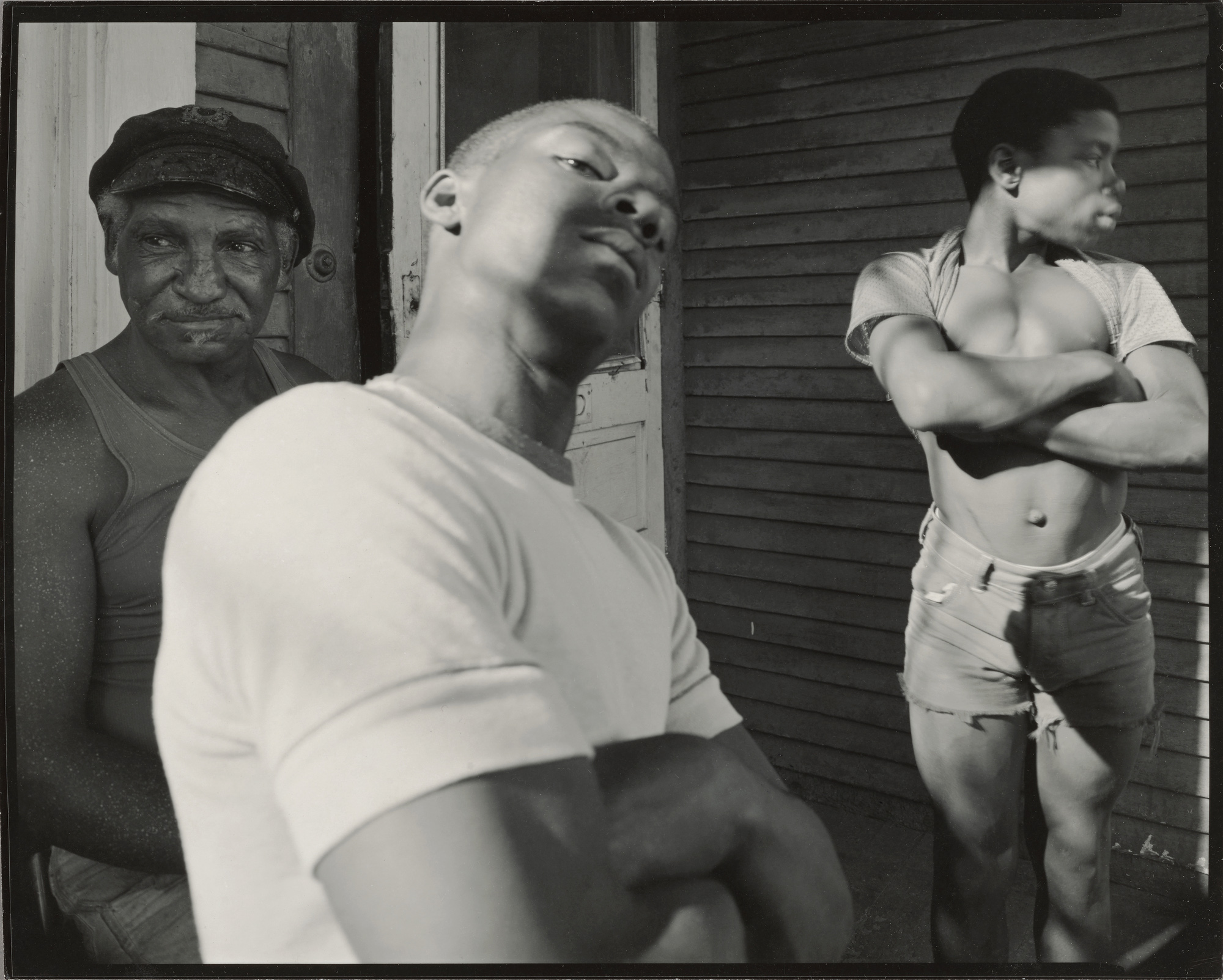
Nicholas Nixon (American, b. 1947) 'W. Canfield Ave., Detroit' 1982


Nicholas Nixon (American, b. 1947)
W. Canfield Ave., Detroit
1982
Gelatin silver print
Image (irregular): 19.7 × 24.6cm (7 3/4 × 9 11/16 in.)
© Nicholas Nixon
The J. Paul Getty Museum, Los Angeles


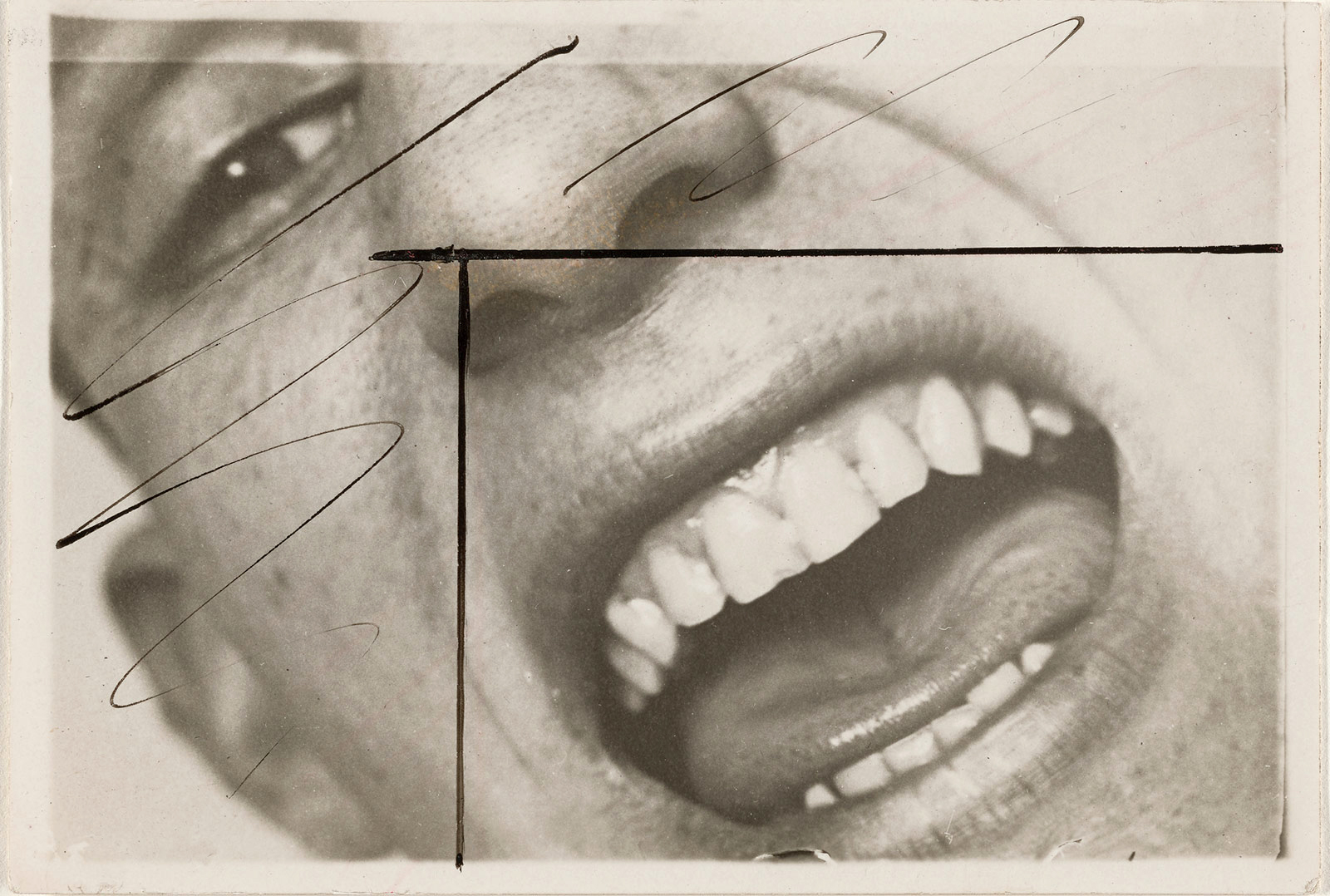
Unknown maker (German) 'Close-up of Open Mouth of Male Student' c. 1927


Unknown maker (German)
Close-up of Open Mouth of Male Student
c. 1927
Gelatin silver print
5.7 x 8.4cm (2 1/4 x 3 5/16 in.)
The J. Paul Getty Museum, Los Angeles


Alec Soth (American, b. 1969) 'Mary, Milwaukee, WI' 2014


Alec Soth (American, b. 1969)
Mary, Milwaukee, WI
2014
Inkjet print
40.1 × 53.5cm (15 13/16 × 21 1/16 in.)
© Alec Soth/Magnum Photos
The J. Paul Getty Museum, Los Angeles
Gift of Richard Lovett


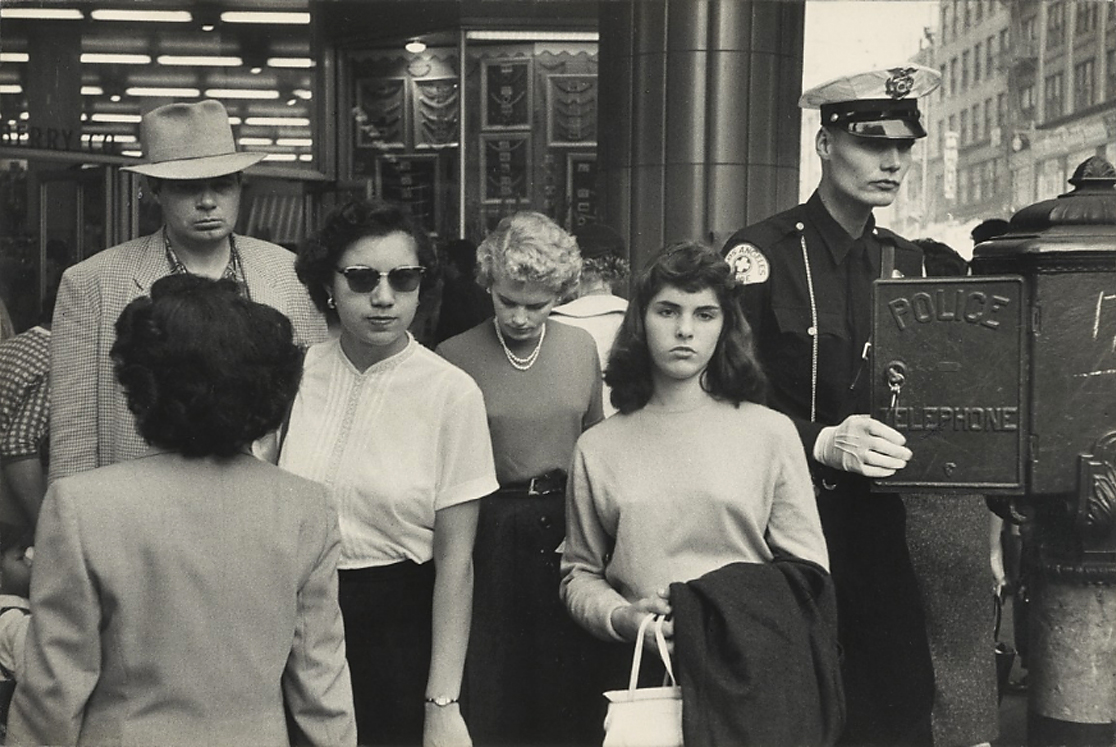
Garry Winogrand (American, 1928-1984) 'Los Angeles' January 1960


Garry Winogrand (American, 1928-1984)
Los Angeles
January 1960
Gelatin silver print
22.6 × 33.9cm (8 7/8 × 13 3/8 in.)
© 1984 The Estate of Garry Winogrand
The J. Paul Getty Museum, Los Angeles


From Leonardo da Vinci’s Mona Lisa, to Edvard Munch’s The Scream, to Dorothea Lange’s Migrant Mother, the human face has been a crucial, if often enigmatic, element of portraiture. Featuring 45 works drawn from the Museum’s permanent collection, In Focus: Expressions, on view May 22 to October 7, 2018 at the J. Paul Getty Museum, addresses the enduring fascination with the human face and the range of countenances that photographers have captured from the birth of the medium to the present day.

The exhibition begins with the most universal and ubiquitous expression: the smile. Although today it is taken for granted that we should smile when posing for the camera, smiling was not the standard photographic expression until the 1880s with the availability of faster film and hand-held cameras. Smiling subjects began to appear more frequently as the advertising industry also reinforced the image of happy customers to an ever-widening audience who would purchase the products of a growing industrial economy. The smile became “the face of the brand,” gracing magazines, billboards, and today, digital and social platforms.

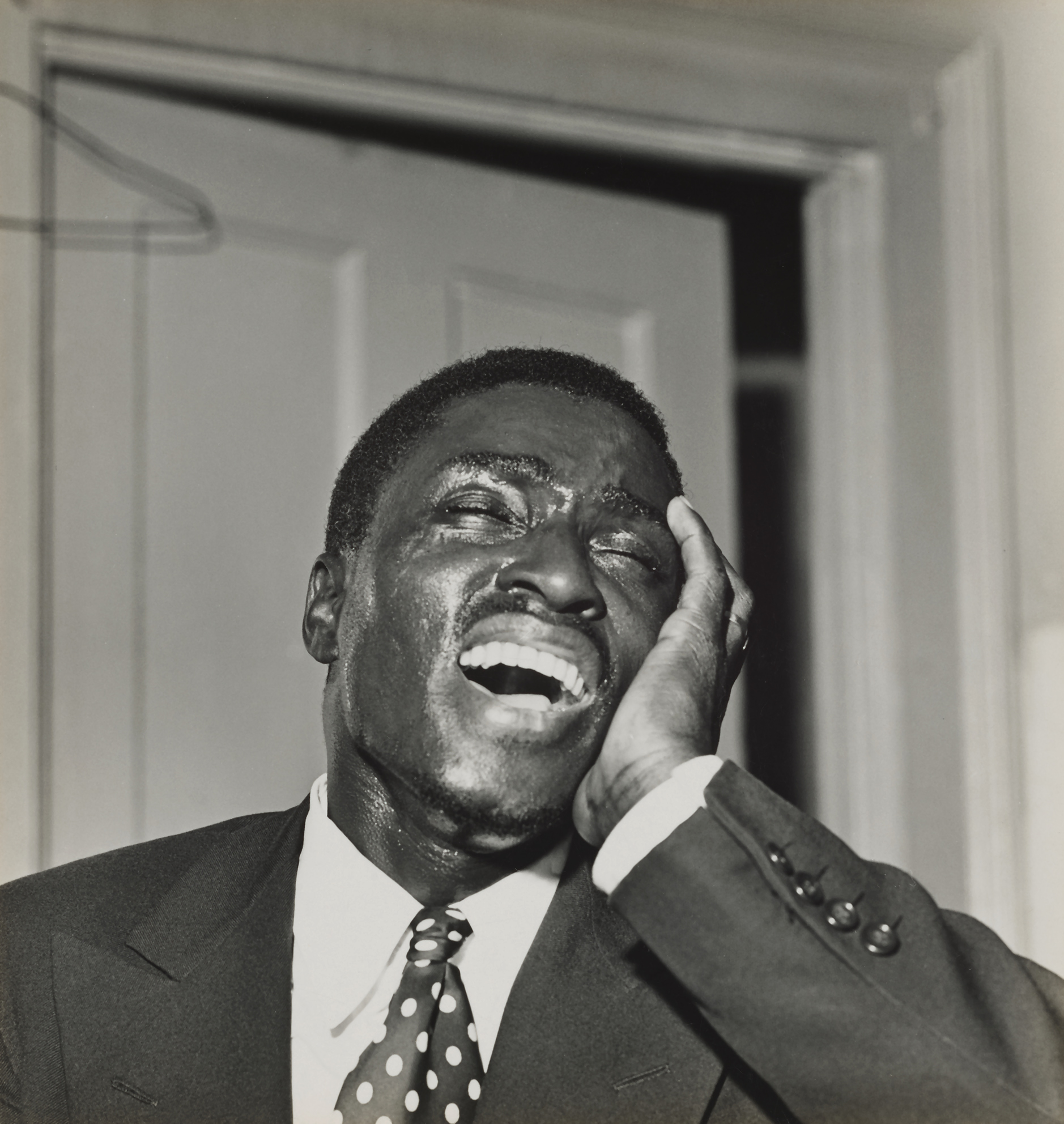
As is evident in the exhibition, the smile comes in all variations – the genuine, the smirk, the polite, the ironic – expressing a full spectrum of emotions that include benevolence, sarcasm, joy, malice, and sometimes even an intersection of two or more of these. In Milton Rogovin’s (American, 1909-2011) Storefront Churches, Buffalo (1958-1961), the expression of the preacher does not immediately register as a smile because the camera has captured a moment where his features – the opened mouth, exposed teeth, and raised face – could represent a number of activities: he could be in the middle of a song, preaching, or immersed in prayer. His corporeal gestures convey the message of his spirit, imbuing the black-and-white photograph with emotional colour. Like the other works included in this exhibition, this image posits the notion that facial expressions can elicit a myriad of sentiments and denote a range of inner emotions that transcend the capacity of words.

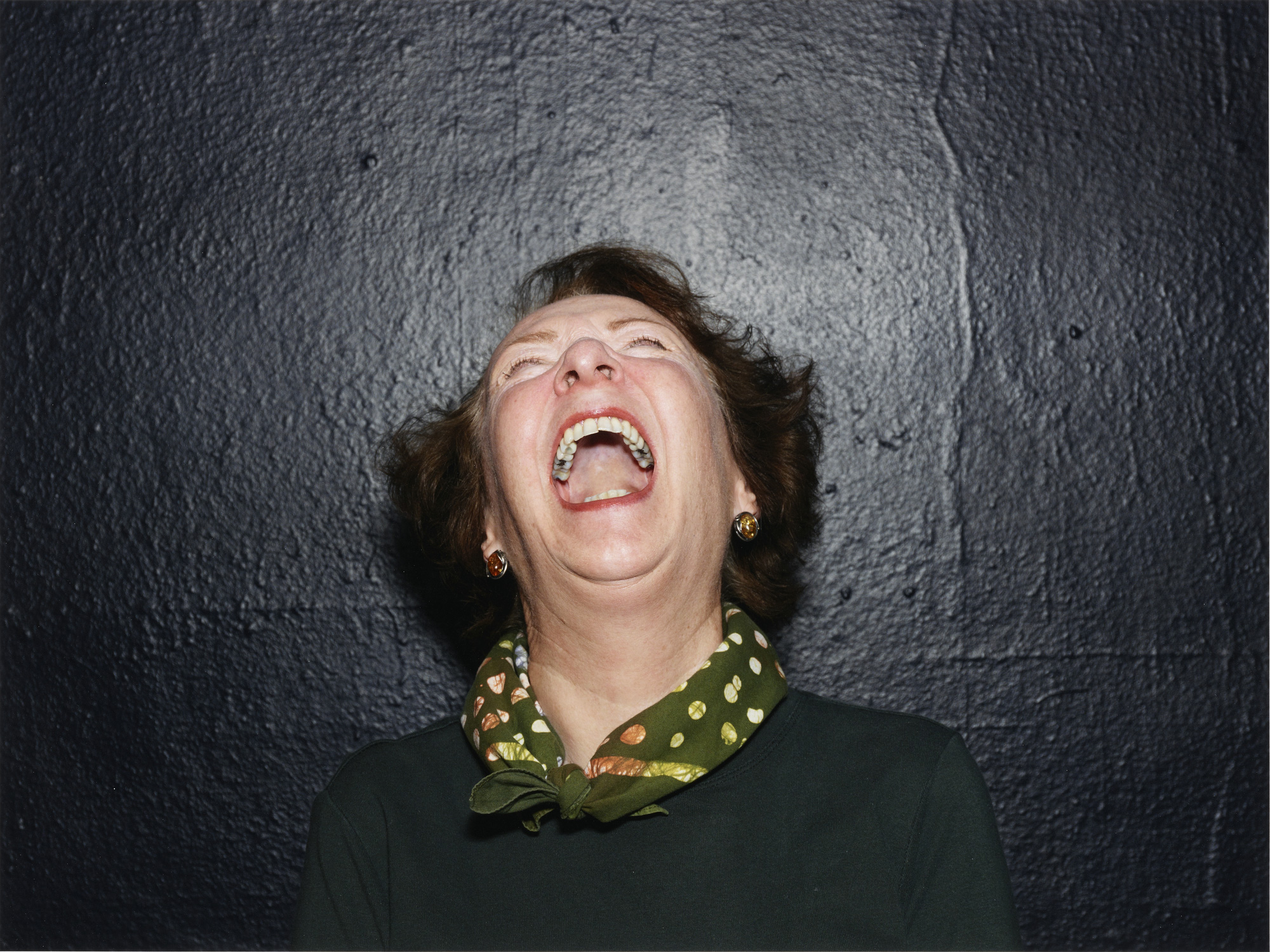
In Focus: Expressions also probes the role of the camera in capturing un-posed moments and expressions that would otherwise go unnoticed. In Alec Soth’s (American, born 1969) Mary, Milwaukee, WI (2014), a fleeting expression of laughter is materialised in such a way – head leaning back, mouth open – that could perhaps be misconstrued as a scream. The photograph provides a frank moment, one that confronts the viewer with its candidness and calls to mind today’s proliferation and brevity of memes, a contemporary, Internet-sustained visual phenomena in which images are deliberately parodied and altered at the same rate as they are spread.

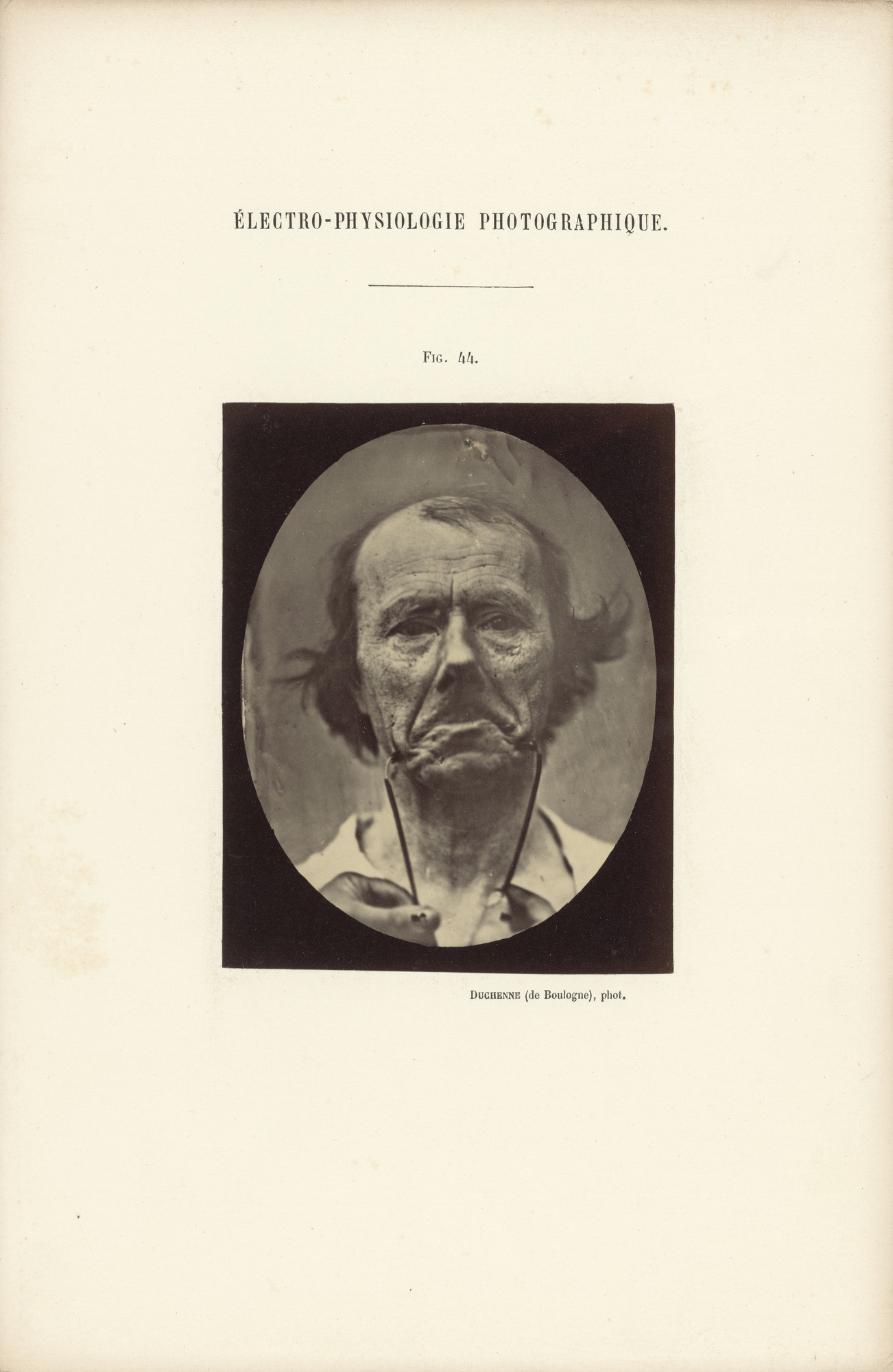
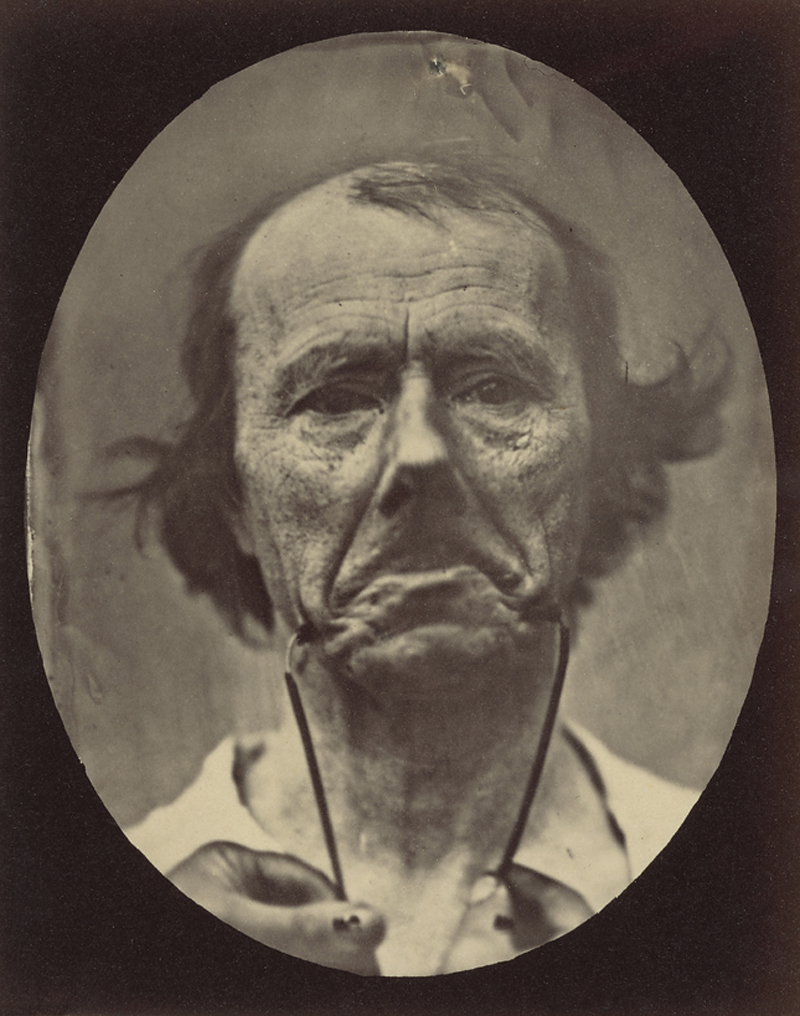
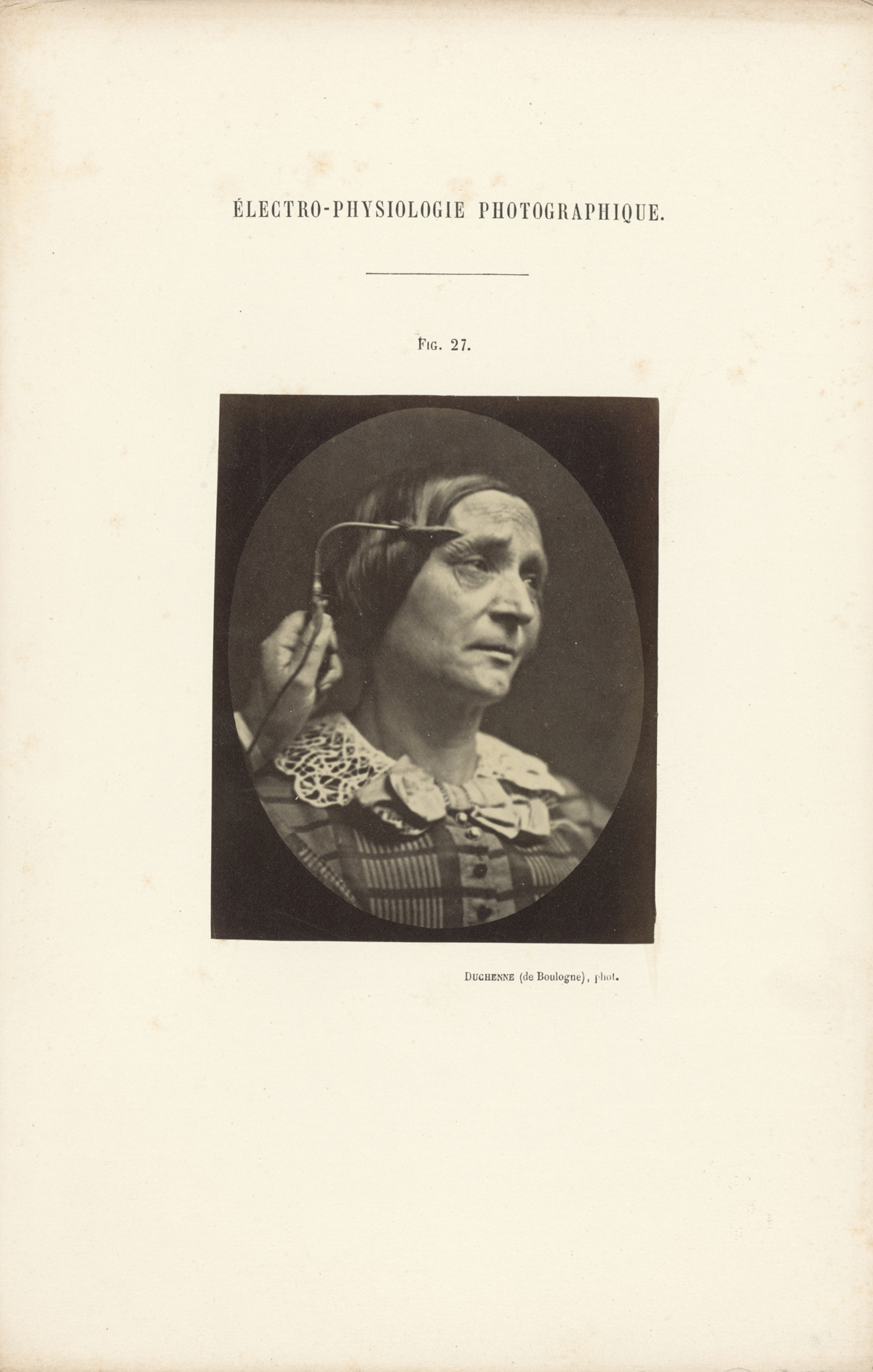
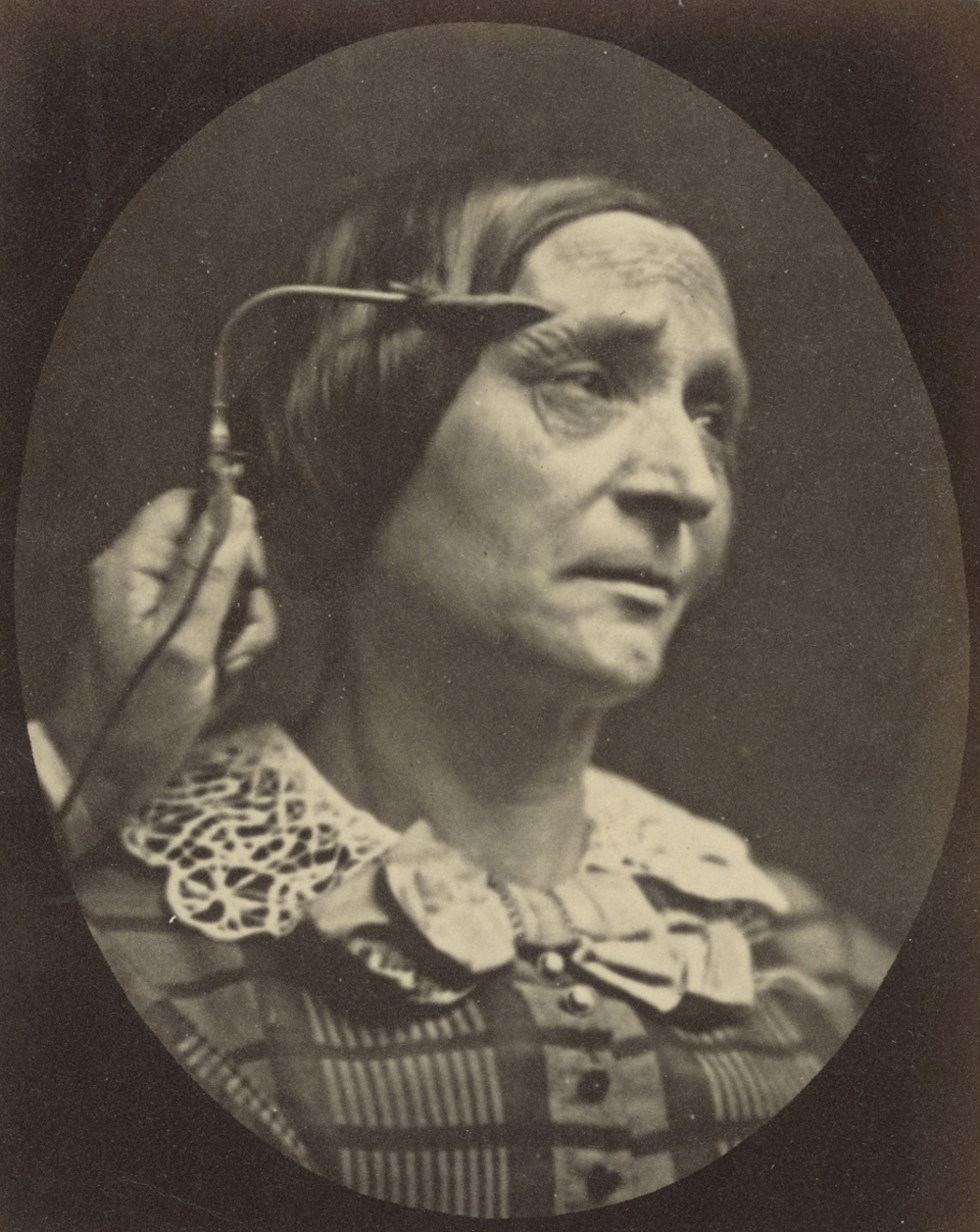
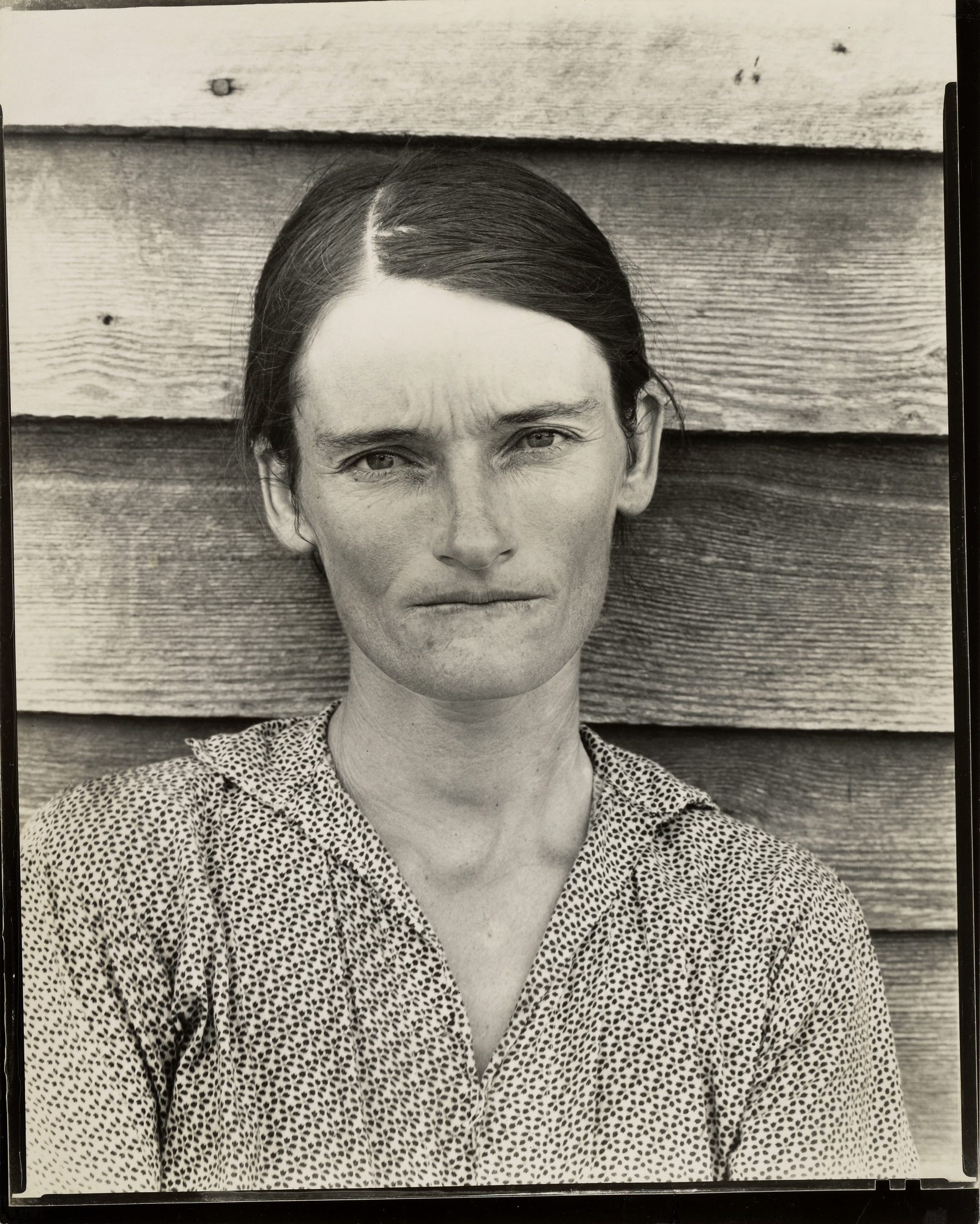
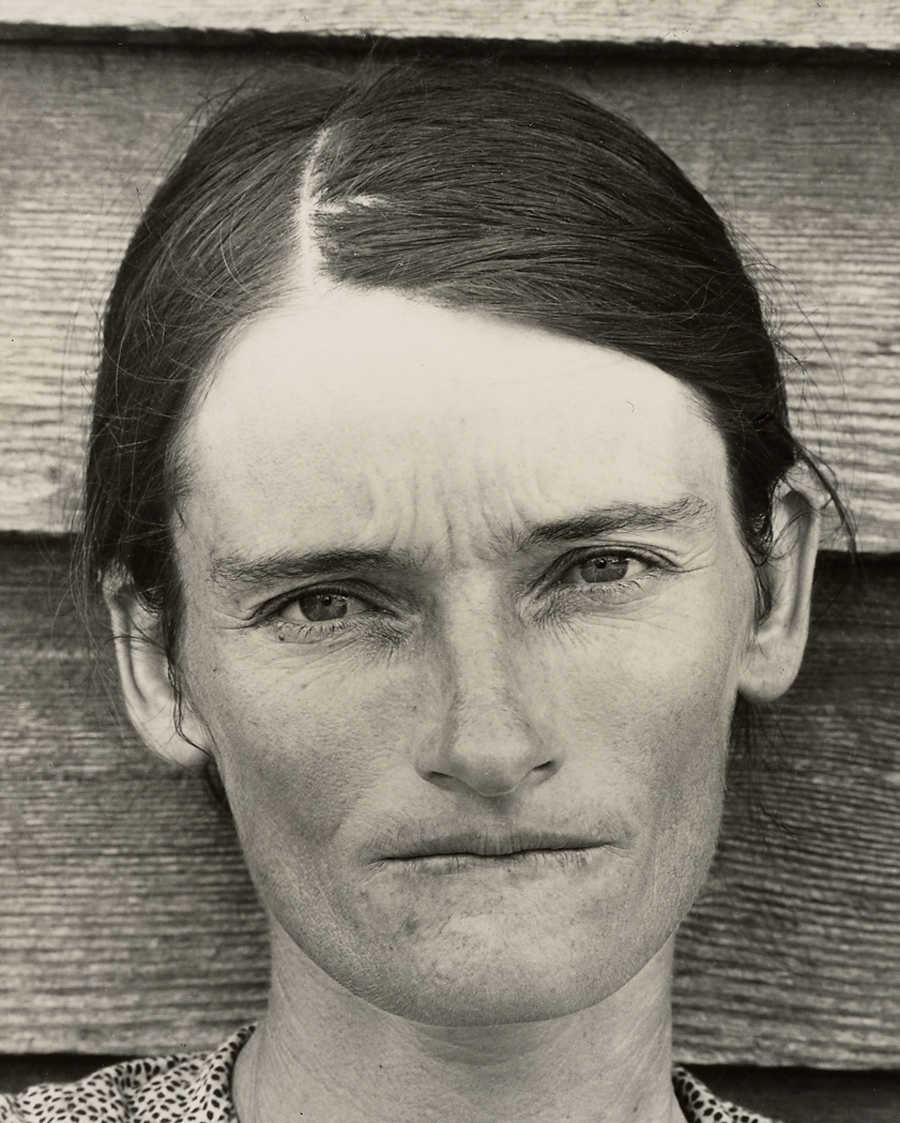
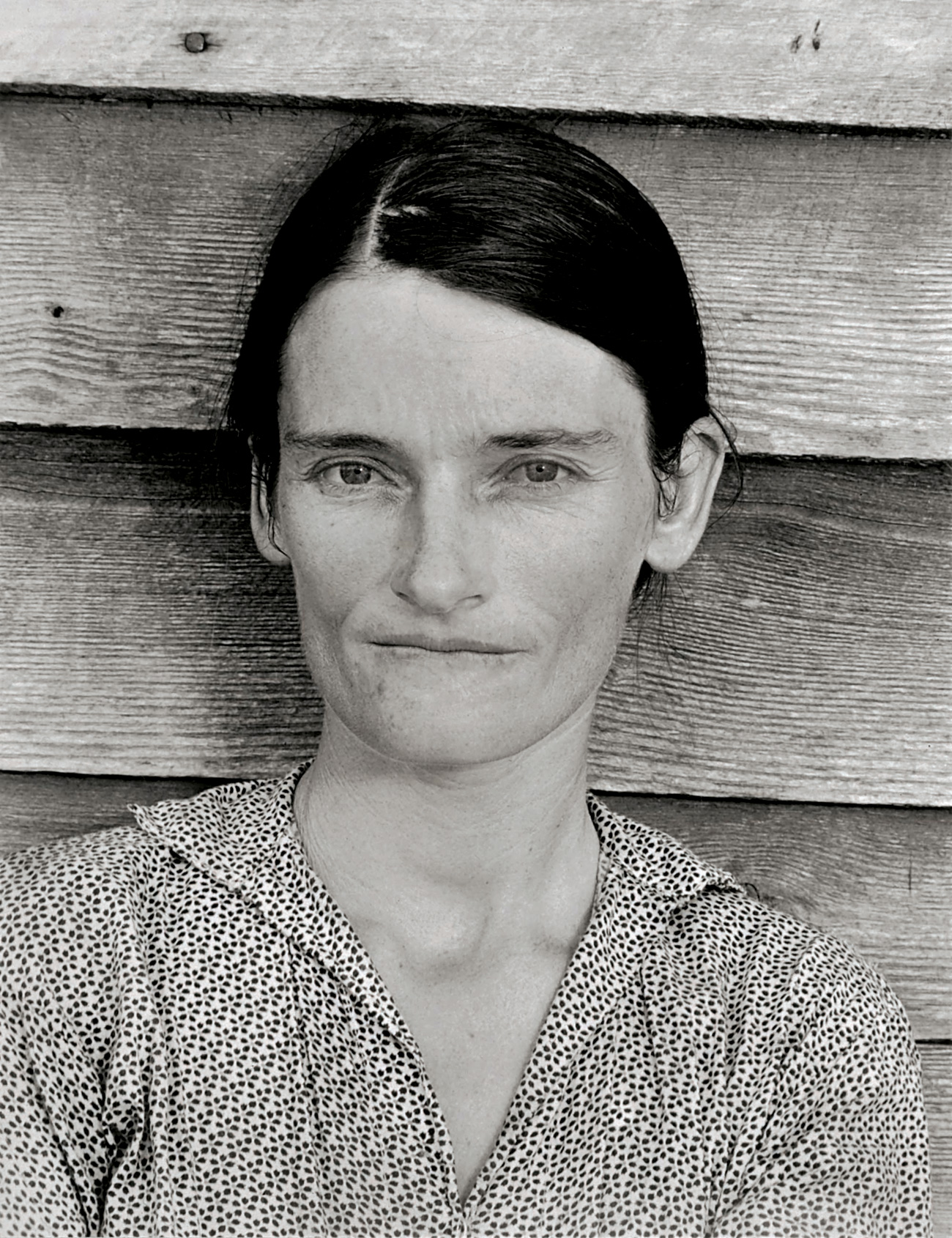
Perhaps equally radical as the introduction of candid photography is the problematic association of photography with facial expression and its adoption of physiognomy, a concept that was introduced in the 19th century. Physiognomy, the study of the link between the face and human psyche, resulted in the belief that different types of people could be classified by their visage. The exhibition includes some of the earliest uses of photography to record facial expression, as in Duchenne de Boulogne’s (French, 1806-1875) Figure 44: The Muscle of Sadness (negative, 1850s). This also resonates in the 20th-century photographs by Walker Evans (American, 1903-1975) of Allie Mae Burroughs, Hale County Alabama (negative 1936) in that the subject’s expression could be deemed as suggestive of the current state of her mind. In this frame (in others she is viewed as smiling) she stares intently at the camera slightly biting her lip, perhaps alluding to uncertainty of what is to come for her and her family.

The subject of facial expression is also resonant with current developments in facial recognition technology. Nancy Burson (American, born 1948) created works such as Androgyny (6 Men + 6 Women) (1982), in which portraits of six men and six women were morphed together to convey the work’s title. Experimental and illustrative of the medium’s technological advancement, Burson’s photograph is pertinent to several features of today’s social media platforms, including the example in which a phone’s front camera scans a user’s face and facial filters are applied upon detection. Today, mobile phones and social media applications even support portrait mode options, offering an apprehension of the human face and highlighting its countenances with exceptional quality.

In addition to photography’s engagement with human expression, In Focus: Expressions examines the literal and figurative concept of the mask. Contrary to a candid photograph, the mask is the face we choose to present to the world. Weegee’s (Arthur Fellig’s) (American, born Austria, 1899-1968) Emmett Kelly, Ringling Brothers and Barnum & Bailey Circus (about 1950) demonstrates this concept, projecting the character of a sad clown in place of his real identity as Emmett Kelly.

The mask also suggests guises, obscurity, and the freedom to pick and create a separate identity. W. Canfield Ave., Detroit (1982) by Nicholas Nixon (American, born 1947) demonstrates this redirection. Aware that he is being photographed, the subject seizes the opportunity to create a hardened expression that conveys him as distant, challenging, and fortified, highlighted by the opposing sentiments of the men who flank him. In return, the audience could be led to believe that this devised pose is a façade behind which a concealed and genuine identity exists.

Press release from the J. Paul Getty Museum


Guillaume-Benjamin Duchenne (French, 1806-1875) 'Figure 44, The Muscle of Sadness' Negative 1854-1856; print 1876


Guillaume-Benjamin Duchenne (French, 1806-1875)
Figure 44, The Muscle of Sadness
Negative 1854-1856; print 1876
From the book Mecanisme de la Physionomie Humaine ou Analyse Electro-Physiologique de l’Expression des Passions
Albumen silver print
11 x 9cm
The J. Paul Getty Museum, Los Angeles


Duchenne de Boulogne (French, 1806-1875)

Guillaume-Benjamin-Amand Duchenne (de Boulogne) (September 17, 1806 in Boulogne-sur-Mer – September 15, 1875 in Paris) was a French neurologist who revived Galvani’s research and greatly advanced the science of electrophysiology. The era of modern neurology developed from Duchenne’s understanding of neural pathways and his diagnostic innovations including deep tissue biopsy, nerve conduction tests (NCS), and clinical photography. This extraordinary range of activities (mostly in the Salpêtrière) was achieved against the background of a troubled personal life and a generally indifferent medical and scientific establishment.

Neurology did not exist in France before Duchenne and although many medical historians regard Jean-Martin Charcot as the father of the discipline, Charcot owed much to Duchenne, often acknowledging him as “mon maître en neurologie” (my teacher in neurology). … Duchenne’s monograph, the Mécanisme de la physionomie humaine – also illustrated prominently by his photographs – was the first study on the physiology of emotion and was highly influential on Darwin’s work on human evolution and emotional expression.

In 1835, Duchenne began experimenting with therapeutic “électropuncture” (a technique recently invented by François Magendie and Jean-Baptiste Sarlandière by which electric shock was administered beneath the skin with sharp electrodes to stimulate the muscles). After a brief and unhappy second marriage, Duchenne returned to Paris in 1842 in order to continue his medical research. Here, he did not achieve a senior hospital appointment, but supported himself with a small private medical practice, while daily visiting a number of teaching hospitals, including the Salpêtrière psychiatric centre. He developed a non-invasive technique of muscle stimulation that used faradic shock on the surface of the skin, which he called “électrisation localisée” and he published these experiments in his work, On Localized Electrization and its Application to Pathology and Therapy, first published in 1855. A pictorial supplement to the second edition, Album of Pathological Photographs (Album de Photographies Pathologiques) was published in 1862. A few months later, the first edition of his now much-discussed work, The Mechanism of Human Physiognomy, was published. Were it not for this small, but remarkable, work, his next publication, the result of nearly 20 years of study, Duchenne’s Physiology of Movements, his most important contribution to medical science, might well have gone unnoticed.

The Mechanism of Human Facial Expression

Influenced by the fashionable beliefs of physiognomy of the 19th century, Duchenne wanted to determine how the muscles in the human face produce facial expressions which he believed to be directly linked to the soul of man. He is known, in particular, for the way he triggered muscular contractions with electrical probes, recording the resulting distorted and often grotesque expressions with the recently invented camera. He published his findings in 1862, together with extraordinary photographs of the induced expressions, in the book Mecanisme de la physionomie Humaine (The Mechanism of Human Facial Expression, also known as The Mechanism of Human Physiognomy).

Duchenne believed that the human face was a kind of map, the features of which could be codified into universal taxonomies of mental states; he was convinced that the expressions of the human face were a gateway to the soul of man. Unlike Lavater and other physiognomists of the era, Duchenne was skeptical of the face’s ability to express moral character; rather he was convinced that it was through a reading of the expressions alone (known as pathognomy) which could reveal an “accurate rendering of the soul’s emotions”. He believed that he could observe and capture an “idealized naturalism” in a similar (and even improved) way to that observed in Greek art. It is these notions that he sought conclusively and scientifically to chart by his experiments and photography and it led to the publishing of The Mechanism of Human Physiognomy in 1862 (also entitled, The Electro-Physiological Analysis of the Expression of the Passions, Applicable to the Practice of the Plastic Arts. in French: Mécanisme de la physionomie humaine, ou Analyse électro-physiologique de l’expression des passions applicable à la pratique des arts plastiques), now generally rendered as The Mechanism of Human Facial Expression. The work compromises a volume of text divided into three parts:

1/ General Considerations,
2/ A Scientific Section, and
3/ An Aesthetic Section.

These sections were accompanied by an atlas of photographic plates. …

Duchenne defines the fundamental expressive gestures of the human face and associates each with a specific facial muscle or muscle group. He identifies thirteen primary emotions the expression of which is controlled by one or two muscles. He also isolates the precise contractions that result in each expression and separates them into two categories: partial and combined. To stimulate the facial muscles and capture these “idealized” expressions of his patients, Duchenne applied faradic shock through electrified metal probes pressed upon the surface of the various muscles of the face.

Duchenne was convinced that the “truth” of his pathognomic experiments could only be effectively rendered by photography, the subject’s expressions being too fleeting to be drawn or painted. “Only photography,” he writes, “as truthful as a mirror, could attain such desirable perfection.” He worked with a talented, young photographer, Adrien Tournachon, (the brother of Felix Nadar), and also taught himself the art in order to document his experiments. From an art-historical point of view, the Mechanism of Human Physiognomy was the first publication on the expression of human emotions to be illustrated with actual photographs. Photography had only recently been invented, and there was a widespread belief that this was a medium that could capture the “truth” of any situation in a way that other mediums were unable to do.

Duchenne used six living models in the scientific section, all but one of whom were his patients. His primary model, however, was an “old toothless man, with a thin face, whose features, without being absolutely ugly, approached ordinary triviality.” Through his experiments, Duchenne sought to capture the very “conditions that aesthetically constitute beauty.” He reiterated this in the aesthetic section of the book where he spoke of his desire to portray the “conditions of beauty: beauty of form associated with the exactness of the facial expression, pose and gesture.” Duchenne referred to these facial expressions as the “gymnastics of the soul”. He replied to criticisms of his use of the old man by arguing that “every face could become spiritually beautiful through the accurate rendering of his or her emotions”, and furthermore said that because the patient was suffering from an anesthetic condition of the face, he could experiment upon the muscles of his face without causing him pain.

Text from the Wikipedia website


Guillaume-Benjamin Duchenne (French, 1806-1875) 'Figure 44, The Muscle of Sadness' Negative 1854-1856; print 1876 (detail)


Guillaume-Benjamin Duchenne (French, 1806-1875)
Figure 44, The Muscle of Sadness (detail)
Negative 1854-1856; print 1876
From the book Mecanisme de la Physionomie Humaine ou Analyse Electro-Physiologique de l’Expression des Passions
Albumen silver print
11 x 9cm
The J. Paul Getty Museum, Los Angeles


Duchenne and his patient, an “old toothless man, with a thin face, whose features, without being absolutely ugly, approached ordinary triviality.” Duchenne faradize’s the mimetic muscles of “The Old Man.” The farad (symbol: F) is the SI derived unit of electrical capacitance, the ability of a body to store an electrical charge. It is named after the English physicist Michael Faraday


Guillaume-Benjamin Duchenne (French, 1806-1875) 'Figure 27, The Muscle of Pain' Negative 1854-1856; print 1876


Guillaume-Benjamin Duchenne (French, 1806-1875)
Figure 27, The Muscle of Pain
Negative 1854-1856; print 1876
From the book Mecanisme de la Physionomie Humaine ou Analyse Electro-Physiologique de l’Expression des Passions
Albumen silver print
11 x 9cm
The J. Paul Getty Museum, Los Angeles


Guillaume-Benjamin Duchenne (French, 1806-1875) 'Figure 27, The Muscle of Pain' Negative 1854-1856; print 1876 (detail)


Guillaume-Benjamin Duchenne (French, 1806-1875)
Figure 27, The Muscle of Pain (detail)
Negative 1854-1856; print 1876
From the book Mecanisme de la Physionomie Humaine ou Analyse Electro-Physiologique de l’Expression des Passions
Albumen silver print
11 x 9cm
The J. Paul Getty Museum, Los Angeles


Milton Rogovin (American, 1909-2011) 'Storefront Churches, Buffalo, preacher head in hand, eyes closed' 1958-1961


Milton Rogovin (American, 1909-2011)
Storefront Churches, Buffalo, preacher head in hand, eyes closed
1958-1961
Gelatin silver print
11 × 10.5cm (4 5/16 × 4 1/8 in.)
The J. Paul Getty Museum, Los Angeles
Gift of Dr. John V. and Laura M. Knaus
© Milton Rogovin


Walker Evans (American, 1903-1975) 'Allie Mae Burroughs, Hale County, Alabama' Negative 1936; print 1950s


Walker Evans (American, 1903-1975)
Allie Mae Burroughs, Hale County, Alabama
Negative 1936; print 1950s
Gelatin silver print
24.3 × 19.2cm (9 9/16 × 7 9/16 in.)
The J. Paul Getty Museum, Los Angeles


Walker Evans (American, 1903-1975) 'Allie Mae Burroughs, Hale County, Alabama' Negative 1936; print 1950s (detail)


Walker Evans (American, 1903-1975)
Allie Mae Burroughs, Hale County, Alabama (detail)
Negative 1936; print 1950s
Gelatin silver print
24.3 × 19.2cm (9 9/16 × 7 9/16 in.)
The J. Paul Getty Museum, Los Angeles


Depression-era photography

In 1935, Evans spent two months at first on a fixed-term photographic campaign for the Resettlement Administration (RA) in West Virginia and Pennsylvania. From October on, he continued to do photographic work for the RA and later the Farm Security Administration (FSA), primarily in the Southern United States.

In the summer of 1936, while on leave from the FSA, he and writer James Agee were sent by Fortune magazine on assignment to Hale County, Alabama, for a story the magazine subsequently opted not to run. In 1941, Evans’s photographs and Agee’s text detailing the duo’s stay with three white tenant families in southern Alabama during the Great Depression were published as the groundbreaking book Let Us Now Praise Famous Men. Its detailed account of three farming families paints a deeply moving portrait of rural poverty. The critic Janet Malcolm notes that as in the earlier Beals’ book there was a contradiction between a kind of anguished dissonance in Agee’s prose and the quiet, magisterial beauty of Evans’s photographs of sharecroppers.

The three families headed by Bud Fields, Floyd Burroughs and Frank Tingle, lived in the Hale County town of Akron, Alabama, and the owners of the land on which the families worked told them that Evans and Agee were “Soviet agents,” although Allie Mae Burroughs, Floyd’s wife, recalled during later interviews her discounting that information. Evans’s photographs of the families made them icons of Depression-Era misery and poverty. In September 2005, Fortune revisited Hale County and the descendants of the three families for its 75th anniversary issue. Charles Burroughs, who was four years old when Evans and Agee visited the family, was “still angry” at them for not even sending the family a copy of the book; the son of Floyd Burroughs was also reportedly angry because the family was “cast in a light that they couldn’t do any better, that they were doomed, ignorant.”

Text from the Wikipedia website


Lisette Model (American born Austria, 1901-1983) '[War Rally]' 1942


Lisette Model (American born Austria, 1901-1983)
(War Rally)
1942
Gelatin silver print
34.4 × 27.6cm (13 9/16 × 10 7/8 in.)
© Estate of Lisette Model
Courtesy Baudoin Lebon/Keitelman
The J. Paul Getty Museum, Los Angeles


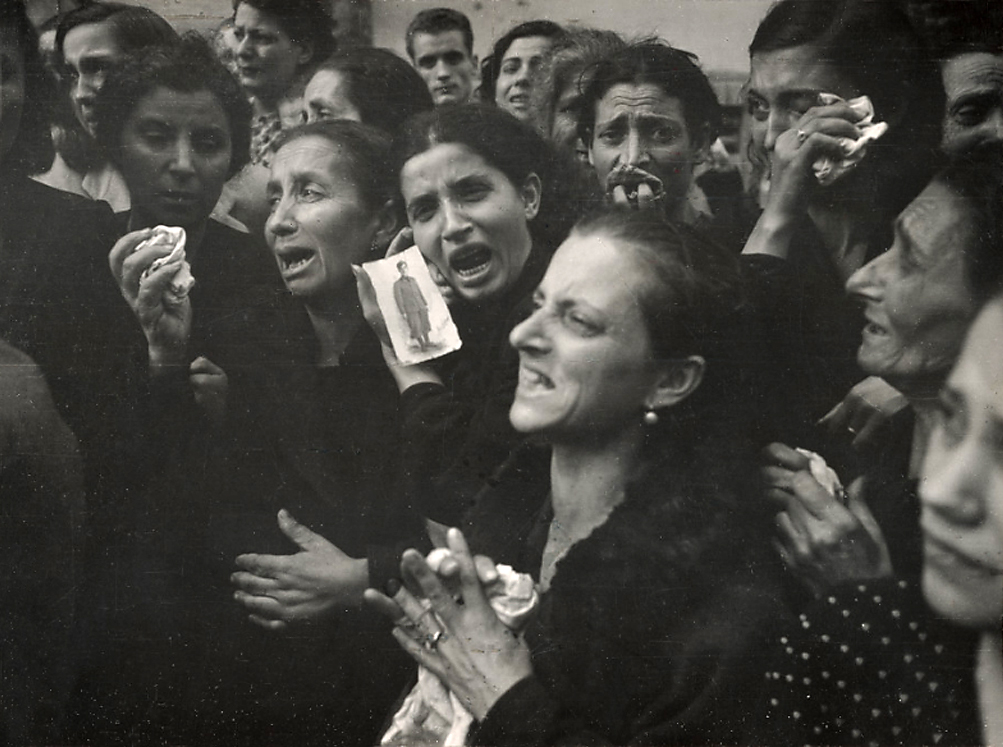
Robert Capa (American born Hungary, 1913-1954) 'Second World War, Naples' October 2, 1943


Robert Capa (American born Hungary, 1913-1954)
Second World War, Naples
October 2, 1943
Gelatin silver print
17.6 × 23.8cm (6 15/16 × 9 3/8 in.)
© International Center of Photography / Magnum Photos
The J. Paul Getty Museum, Los Angeles


View of a group of woman with pained expressions on their faces with several holding handkerchiefs and one holding a card photograph of a young man.


Unknown maker (American) '[Smiling Man]' 1860


Unknown maker (American)
(Smiling Man)
1860
Ambrotype
8.9 x 6.5cm
The J. Paul Getty Museum, Los Angeles


Baron Adolf de Meyer (American born France, 1868-1946) '[Ruth St. Denis]' c. 1918


Baron Adolf de Meyer (American born France, 1868-1946)
(Ruth St. Denis)
c. 1918
Platinum print
23.3 × 18.7cm (9 3/16 × 7 3/8 in.)
The J. Paul Getty Museum, Los Angeles


Woodbury & Page (British, active 1857-1908) '[Javanese woman seated with legs crossed, basket at side]' c. 1870


Woodbury & Page (British, active 1857-1908)
(Javanese woman seated with legs crossed, basket at side)
c. 1870
Albumen silver print
8.9 × 6cm (3 1/2 × 2 3/8 in.)
The J. Paul Getty Museum, Los Angeles


Photography in Australia, the Far East, Java and London

In 1851 Woodbury, who had already become a professional photographer, went to Australia and soon found work in the engineering department of the Melbourne waterworks. He photographed the construction of ducts and other waterworks as well as various buildings in Melbourne. He received a medal for his photography in 1854.

At some point in the mid-1850s Woodbury met expatriate British photographer James Page. In 1857 the two left Melbourne and moved to Batavia (now Jakarta), Dutch East Indies, arriving 18 May 1857, and established the partnership of Woodbury & Page that same year.

During most of 1858 Woodbury & Page photographed in Central and East Java, producing large views of the ruined temples near Surakarta, amongst other subjects, before 1 September of that year. After their tour of Java, by 8 December 1858 Woodbury and Page had returned to Batavia.

In 1859 Woodbury returned to England to arrange a regular supplier of photographic materials for his photographic studio and he contracted the London firm Negretti and Zambra to market Woodbury & Page photographs in England.

Woodbury returned to Java in 1860 and during most of that year travelled with Page through Central and West Java along with Walter’s brother, Henry James Woodbury (born 1836 – died 1873), who had arrived in Batavia in April 1859.

On 18 March 1861 Woodbury & Page moved to new premises, also in Batavia, and the studio was renamed Photographisch Atelier van Walter Woodbury, also known as Atelier Woodbury. The firm sold portraits, views of Java, stereographs, cameras, lenses, photographic chemicals and other photographic supplies. These premises continued to be used until 1908, when the firm was dissolved.

In his career Woodbury produced topographic, ethnographic and especially portrait photographs. He photographed in Australia, Java, Sumatra, Borneo and London. Although individual photographers were rarely identified on Woodbury & Page photographs, between 1861 and 1862 Walter B. Woodbury occasionally stamped the mounts of his photographs: “Photographed by Walter Woodbury, Java.”

Text from the Wikipedia website


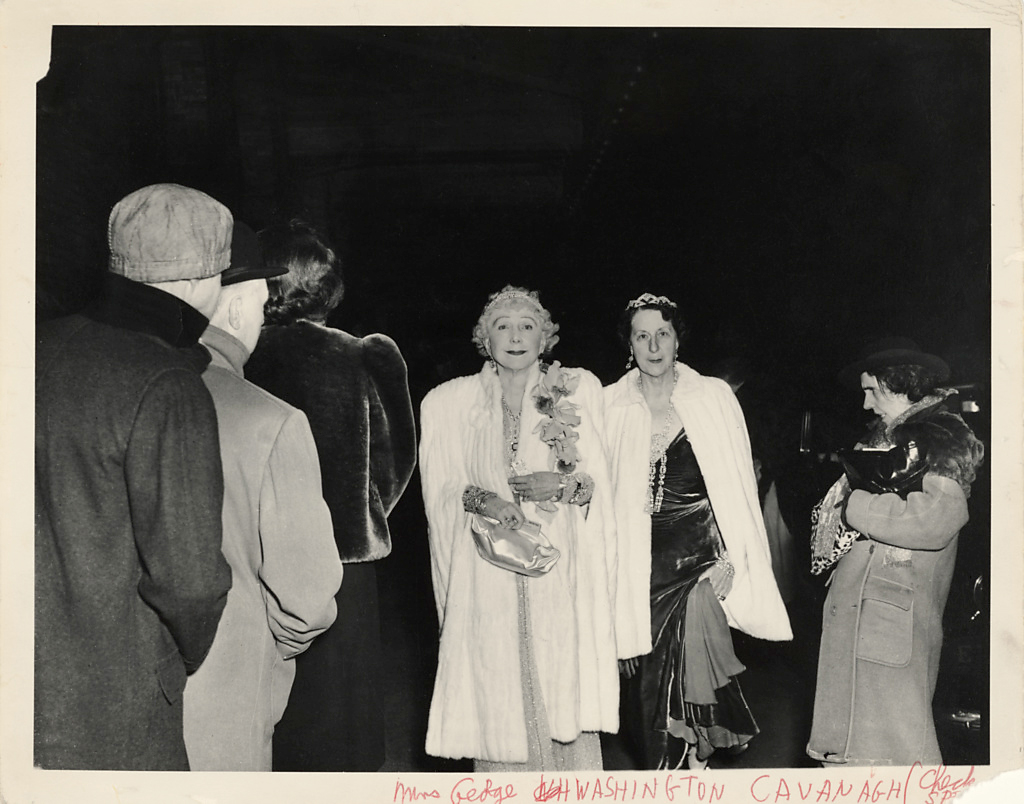
Weegee (Arthur Fellig) (American, 1899-1968) 'The Critic' November 1943


Weegee (Arthur Fellig) (American, 1899-1968)
The Critic
November 1943
Gelatin silver print
25.7 x 32.9cm (10 1/8 x 12 15/16 in.)
The J. Paul Getty Museum, Los Angeles


“I go around wearing rose-colored glasses. In other words, we have beauty. We have ugliness. Everybody likes beauty. But there is an ugliness…” ~ Weegee, in a July 11, 1945 interview for WEAF radio, New York City

While Weegee’s work appeared in many American newspapers and magazines, his methods would sometimes be considered ethically questionable by today’s journalistic standards. In this image, a drunk woman confronts two High Society women who are attending the opera. Mrs. George Washington Kavanaugh and Lady Decies appear nonplussed to be in close proximity to the disheveled woman. Weegee’s flash illuminates their fur wraps and tiaras, drawing them into the foreground. The drunk woman emerges from the shadows on the right side, her mouth tense and open as if she were saying something, hair tousled, her face considerably less sharp than those of her rich counterparts.

The Critic is the second name Weegee gave this photograph. He originally called it, The Fashionable People. In an interview, Weegee’s assistant, Louie Liotta later revealed that the picture was entirely set up. Weegee had asked Liotta to bring a regular from a bar in the Bowery section of Manhattan to the season’s opening of the Metropolitan Opera. Liotta complied. After getting the woman drunk, they positioned her near the red carpet, where Weegee readied his camera to capture the moment seen here.

Anonymous text. “The Critic,” on the J. Paul Getty Museum website [Online] Cited 24/02/2022


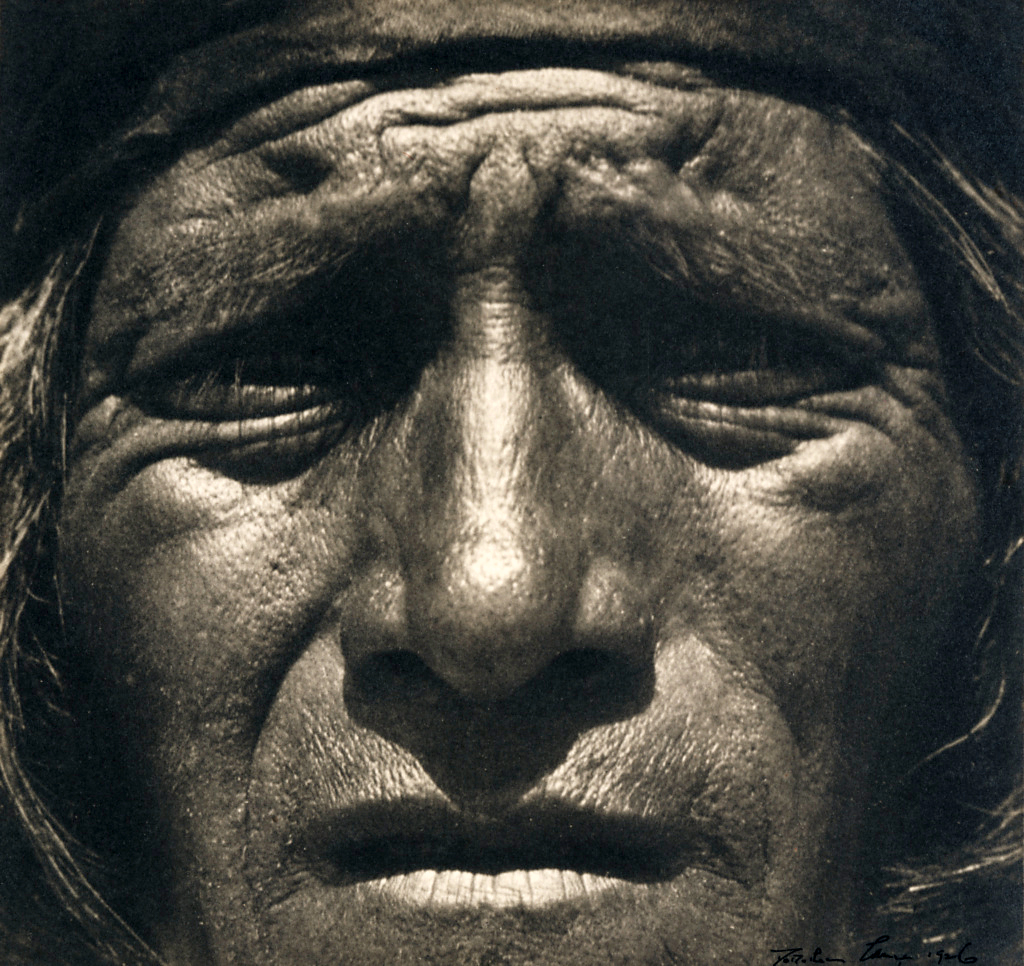
Dorothea Lange (United States, 1895-1965) 'Hopi Indian, New Mexico' Negative, c. 1923; print, 1926


Dorothea Lange (American, 1895-1965)
Hopi Indian, New Mexico
Negative, c. 1923; print, 1926
Gelatin silver print
18.4 x 19.7cm (7 1/4 x 7 3/4 in.)
The J. Paul Getty Museum, Los Angeles
© Oakland Museum of California, the City of Oakland


Dorothea Lange made this portrait study not as a social document but rather as a Pictorialist experiment in light and shadow, transforming a character-filled face into an art-for-art’s-sake abstraction. This image bridges the two distinct phases of Lange’s work: her early, soft-focus portraiture and her better-known documentary work of the 1930s.

Text from the J. Paul Getty Museum website


Walker Evans (American, 1903-1975) 'Street Scene, New Orleans' 1936


Walker Evans (American, 1903-1975)
Street Scene, New Orleans
1936
Gelatin silver print
15.6 x 16.8cm (1 1/8 x 6 5/8 in.)
The J. Paul Getty Museum, Los Angeles
© Walker Evans Archive, The Metropolitan Museum of Art


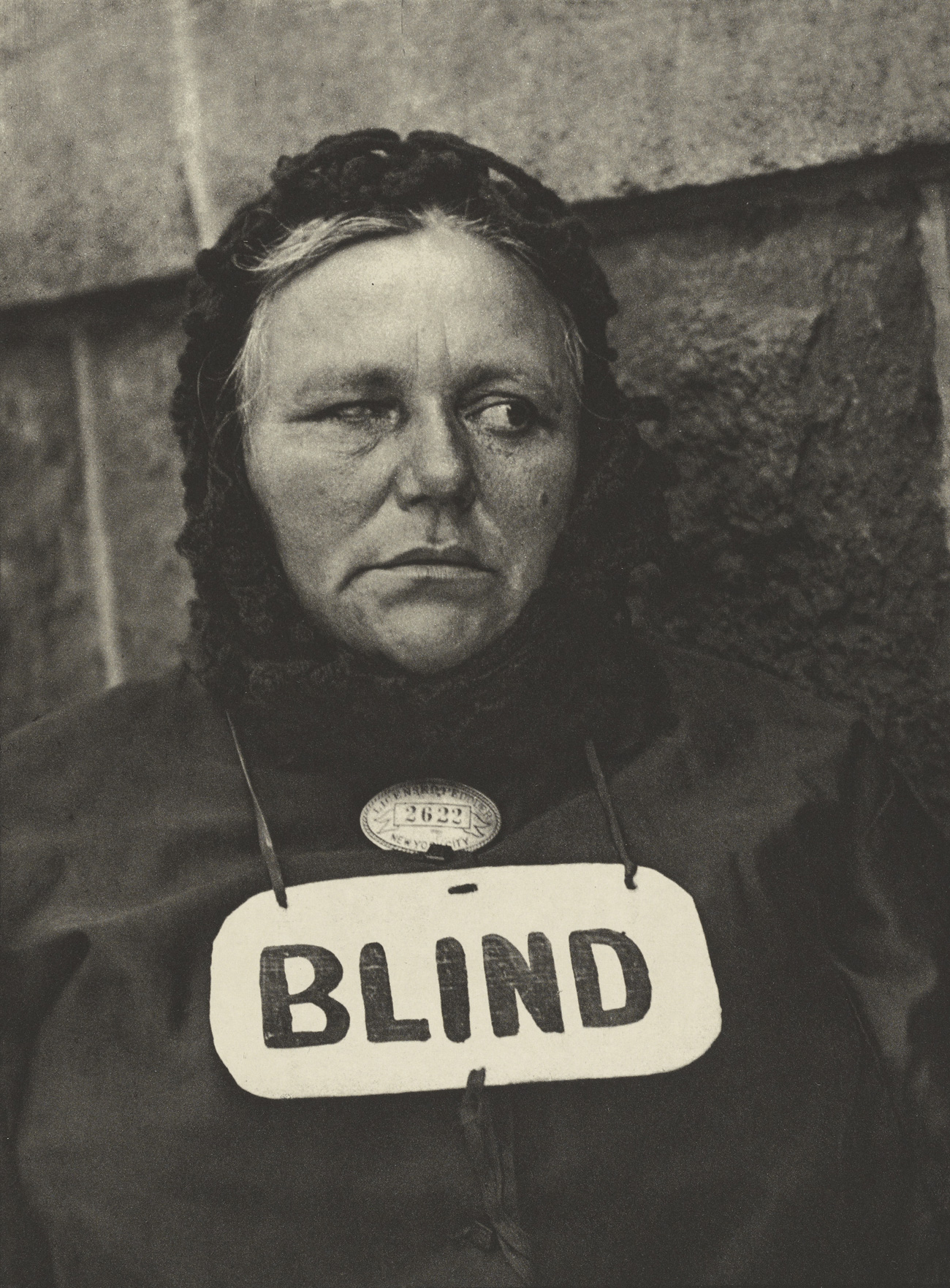
Paul Strand (American, 1890 - 1976) 'Photograph - New York' Negative 1916; print June 1917


Paul Strand (American, 1890-1976)
Photograph – New York
Negative 1916; print June 1917
Photogravure
22.4 × 16.7cm (8 13/16 × 6 9/16 in.)
The J. Paul Getty Museum, Los Angeles


“I remember coming across Paul Strand’s ‘Blind Woman’ when I was very young, and that really bowled me over … It’s a very powerful picture. I saw it in the New York Public Library file of Camera Work, and I remember going out of there over stimulated: That’s the stuff, that’s the thing to do. It charged me up.” ~ Walker Evans

The impact of seeing this striking image for the first time is evident in Walker Evans’s vivid recollection. At the time, most photographers were choosing “pretty” subjects and creating fanciful atmospheric effects in the style of the Impressionists. Paul Strand’s unconventional subject and direct approach challenged assumptions about the medium.

At once depicting misery and endurance, struggle and degradation, Strand’s portrait of a blind woman sets up a complex confrontation. “The whole concept of blindness,” as one historian has noted, “is aimed like a weapon at those whose privilege of sight permits them to experience the picture. …”

Anonymous text. “New York [Blind Woman],” on the J. Paul Getty Museum website [Online] Cited 24/02/2022


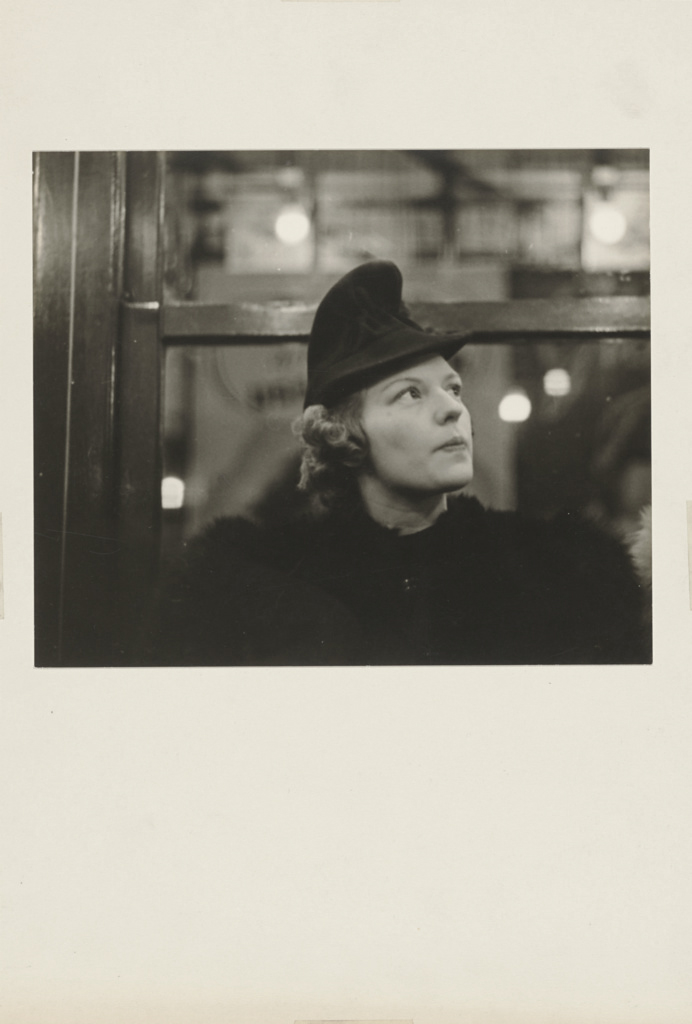
Walker Evans (American, 1903-1975) 'Subway Portrait' 1938-1941


Walker Evans (American, 1903-1975)
Subway Portrait
1938-1941
Gelatin silver print
13.2 x 16cm (5 3/16 x 6 5/16 in.)
The J. Paul Getty Museum, Los Angeles
© Walker Evans Archive, The Metropolitan Museum of Art


Camille Silvy (French, 1834-1910) '[Madame Camille Silvy]' c. 1863


Camille Silvy (French, 1834-1910)
(Madame Camille Silvy)
c. 1863
Albumen silver print
8.9 × 6cm (3 1/2 × 2 3/8 in.)
Gift in memory of Madame Camille Silvy born Alice Monnier from the Monnier Family
The J. Paul Getty Museum, Los Angeles


Mikiko Hara (Japanese, b. 1967) '[Untitled (Making a Void)]' Negative 2001; print about 2007


Mikiko Hara (Japanese, b. 1967)
Untitled (Making a Void)
Negative 2001; print about 2007
Chromogenic print
© Mikiko Hara
The J. Paul Getty Museum, Los Angeles
Purchased with funds provided by the Photographs Council


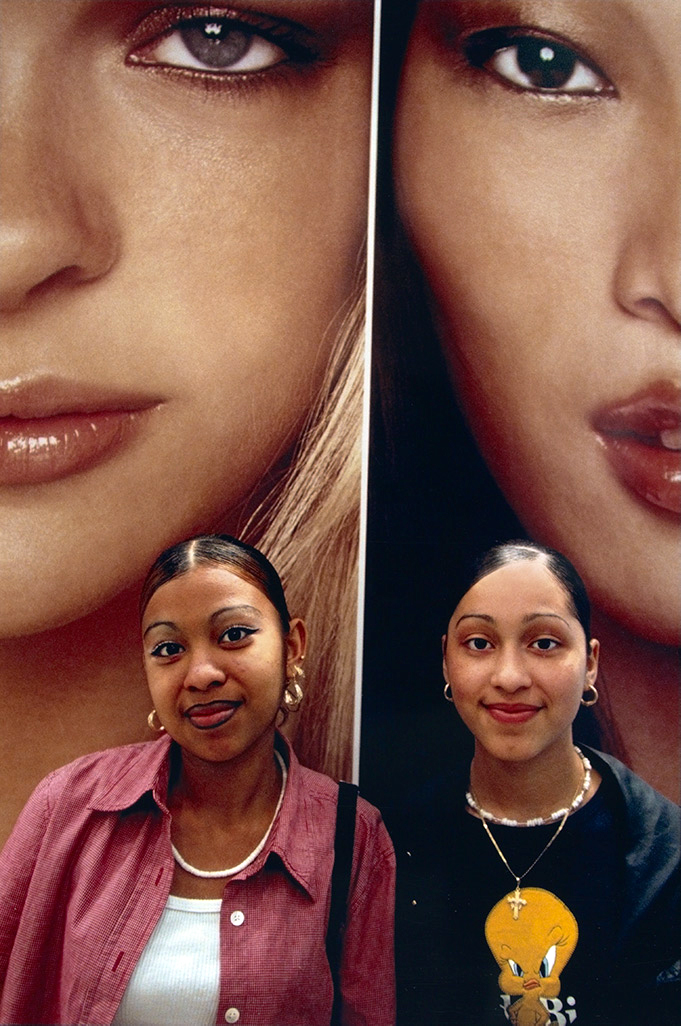
Lauren Greenfield (American, b. 1966) 'Sisters Violeta, 21, and Massiel, 15, at the Limited in a mall, San Francisco, California' Negative 1999; print 2008


Lauren Greenfield (American, b. 1966)
Sisters Violeta, 21, and Massiel, 15, at the Limited in a mall, San Francisco, California
Negative 1999; print 2008
48.9 × 32.5cm (19 1/4 × 12 13/16 in.)
© Lauren Greenfield/INSTITUTE
The J. Paul Getty Museum, Los Angeles


Daido Moriyama (Japanese, b. 1938) 'Self-portrait' 1997


Daido Moriyama (Japanese, b. 1938)
Self-portrait
1997
Gelatin silver print
13.2 x 16cm (5 3/16 x 6 5/16 in.)
The J. Paul Getty Museum, Los Angeles
Purchase with funds provided by the Photographs Council
© Daido Moriyama


The J. Paul Getty Museum
1200 Getty Center Drive
Los Angeles, California 90049

Opening hours:
Daily 10am – 5.30pm

The J. Paul Getty Museum website

LIKE ART BLACK ON FACEBOOK

Back to top

Exhibition: ‘Walker Evans’ at the San Francisco Museum of Modern Art (SFMOMA)

Exhibition dates: 30th September, 2017 – 4th February, 2018

Curator: Clément Chéroux


Walker Evans (American, 1903-1975) 'Self-Portrait' 1927 from the exhibition 'Walker Evans' at the San Francisco Museum of Modern Art (SFMOMA), Sept 2017 - Feb 2018


Walker Evans (American, 1903-1975)
Self-Portrait
1927
Gelatin silver print
Collection of The Metropolitan Museum of Art, New York, Ford Motor Company Collection, Gift of Ford Motor Company and John C. Waddell
© Walker Evans Archive, The Metropolitan Museum of Art, New York


I have posted on this exhibition before, when it was at the Centre Pompidou in Paris, but this iteration at SFMOMA is the exclusive United States venue for the Walker Evans retrospective exhibition – and the new posting contains fresh media images not available previously.

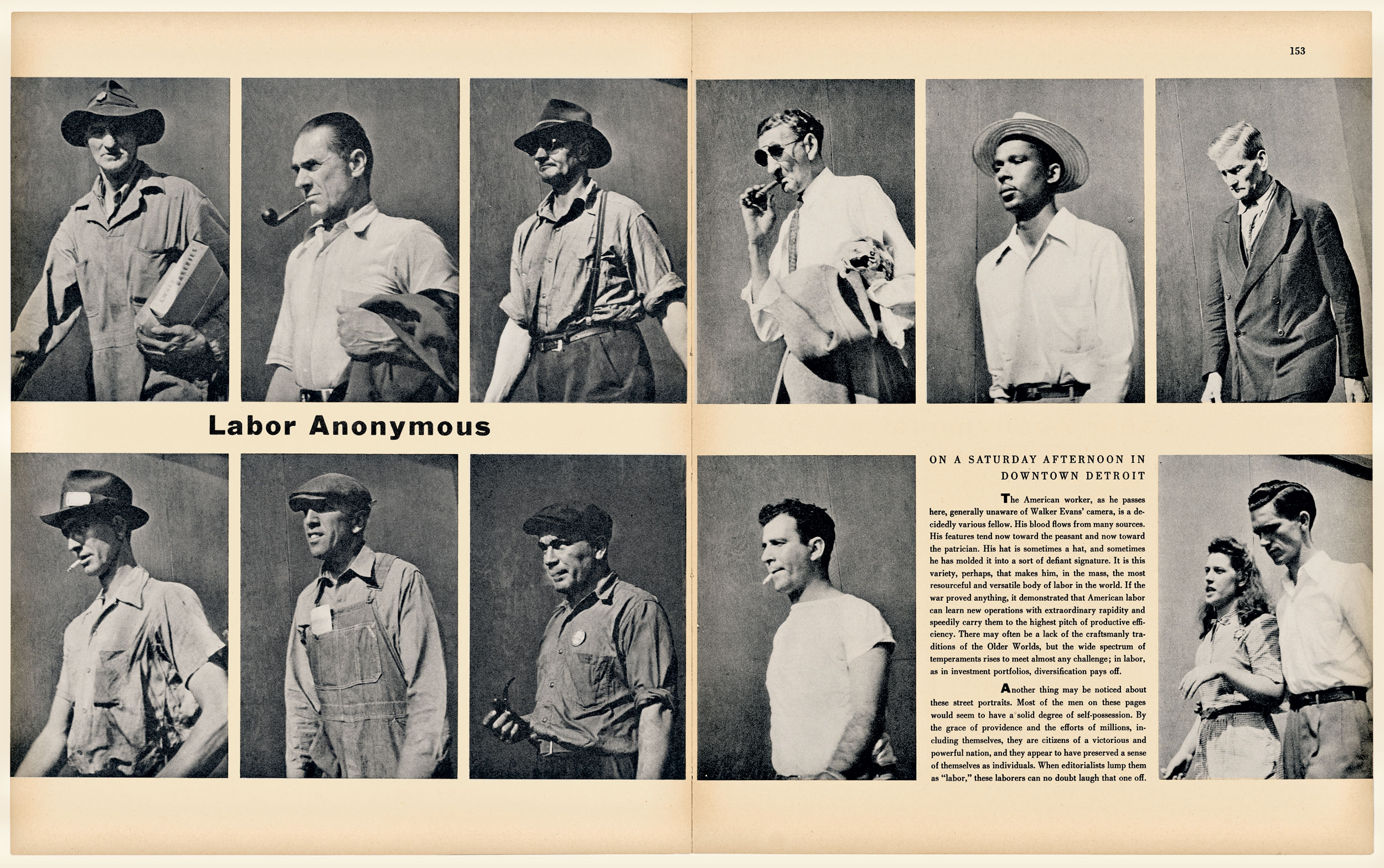
I can never get enough of Walker Evans. This perspicacious artist had a ready understanding of the contexts and conditions of the subject matter he was photographing. His photographs seem easy, unpretentious, and allow his sometimes “generally unaware” subjects (subway riders, labor workers) to speak for themselves. Does it matter that he was an outsider, rearranging furniture in workers homes while they were out in the fields: not at all. Photography has always falsified truth since the beginning of the medium and, in any case, there is never a singular truth but many truths told from many perspectives, many different points of view. For example, who is to say that the story of America proposed by Robert Frank in The Americans, from the point of view of an outsider, is any less valuable than that of Helen Levitt’s view of the streets of New York? For different reasons, both are as valuable as each other.

Evans’ photographs for the Farm Security Administration (FSA) documenting the effects of the Great Depression on American life are iconic because they are cracking good photographs, not because he was an insider or outsider. He was paid to document, to enquire, and that is what he did, by getting the best shot he could. It is fascinating to compare Floyd and Lucille Burroughs, Hale County, Alabama (1936, below) with Alabama Tenant Farmer Floyd Bourroughs (1936, below). In the first photograph the strong diagonal element of the composition is reinforced by the parallel placement of the three feet, the ‘Z’ shape of Lucille Burroughs leg then leading into her upright body, which is complemented by the two vertical door jams, Floyd’s head silhouetted by the darkness beyond. There is something pensive about the clasping of his hands, and something wistful and sad, an energy emanating from the eyes. If you look at the close up of his face, you can see that it is “soft” and out of focus, either because he moved and/or the low depth of field. Notice that the left door jam is also out of focus, that it is just the hands of both Floyd and Lucille and her face that are in focus. Does this low depth of field and lack of focus bother Evans? Not one bit, for he knows when he has captured something magical.

A few second later, he moves closer to Floyd Burroughs. You can almost hear him saying to Floyd, “Stop, don’t move a thing, I’m just going to move the camera closer.” And in the second photograph you notice the same wood grain to the right of Floyd as in the first photograph, but this time the head is tilted slightly more, the pensive look replaced by a steely gaze directed straight into the camera, the reflection of the photographer and the world beyond captured on the surface of the eye. Walker Evans is the master of recognising the extra/ordinary. “The street was an inexhaustible source of poetic finds,” describes Chéroux. In his creation of visual portfolios of everyday life, his “notions of realism, of the spectator’s role, and of the poetic resonance of ordinary subjects,” help Evans created a mythology of American life: a clear vision of the present as the past, walking into the future.

With the contemporary decline of small towns and blue collar communities across the globe Evans’ concerns, for the place of ordinary people and objects in the world, are all the more relevant today. As the text from the Metropolitan Museum observes, it is the individuals and social institutions that are the sites and relics that constitute the tangible expressions of American desires, despairs, and traditions. And not just of American people, of all people… for it is community that binds us together.

Dr Marcus Bunyan


Many thankx to the San Francisco Museum of Modern Art for allowing me to publish the text and photographs in the posting. Please click on the photographs for a larger version of the image.


Walker Evans (American, 1903-1975) 'Truck and Sign' 1928-1930 from the exhibition 'Walker Evans' at the San Francisco Museum of Modern Art (SFMOMA), Sept 2017 - Feb 2018


Walker Evans (American, 1903-1975)
Truck and Sign
1928-1930
Gelatin silver print
Private collection, San Francisco
© Walker Evans Archive, The Metropolitan Museum of Art, New York


Walker Evans is one of the most influential artists of the twentieth century. His elegant, crystal-clear photographs and articulate publications have inspired several generations of artists, from Helen Levitt and Robert Frank to Diane Arbus, Lee Friedlander, and Bernd and Hilla Becher. The progenitor of the documentary tradition in American photography, Evans had the extraordinary ability to see the present as if it were already the past, and to translate that knowledge and historically inflected vision into an enduring art. His principal subject was the vernacular – the indigenous expressions of a people found in roadside stands, cheap cafés, advertisements, simple bedrooms, and small-town main streets. For fifty years, from the late 1920s to the early 1970s, Evans recorded the American scene with the nuance of a poet and the precision of a surgeon, creating an encyclopaedic visual catalogue of modern America in the making. …

Most of Evans’ early photographs reveal the influence of European modernism, specifically its formalism and emphasis on dynamic graphic structures. But he gradually moved away from this highly aestheticised style to develop his own evocative but more reticent notions of realism, of the spectator’s role, and of the poetic resonance of ordinary subjects. …

In September 1938, the Museum of Modern Art opened American Photographs, a retrospective of Evans’ first decade of photography. The museum simultaneously published American Photographs – still for many artists the benchmark against which all photographic monographs are judged. The book begins with a portrait of American society through its individuals – cotton farmers, Appalachian miners, war veterans – and social institutions – fast food, barber shops, car culture. It closes with a survey of factory towns, hand-painted signs, country churches, and simple houses – the sites and relics that constitute the tangible expressions of American desires, despairs, and traditions.

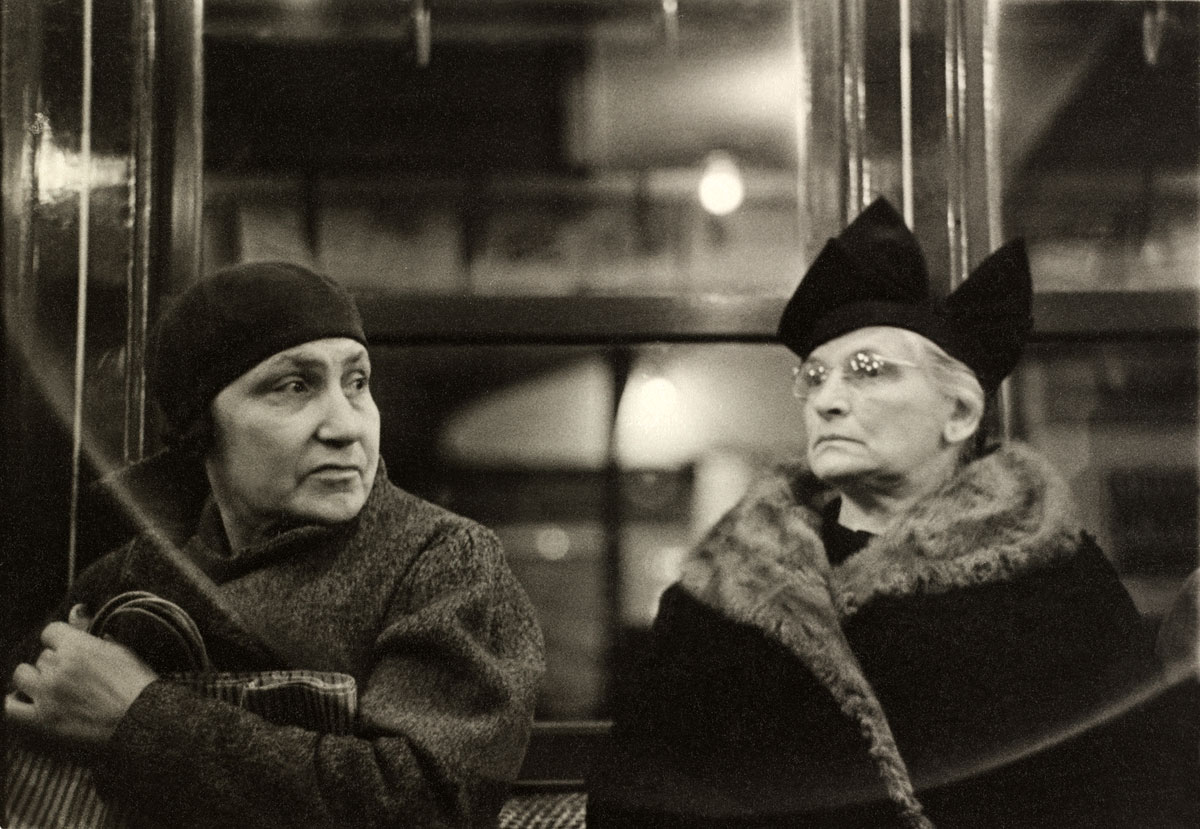
Between 1938 and 1941, Evans produced a remarkable series of portraits in the New York City subway. They remained unpublished for twenty-five years, until 1966, when Houghton Mifflin released Many Are Called, a book of eighty-nine photographs, with an introduction by James Agee written in 1940. With a 35mm Contax camera strapped to his chest, its lens peeking out between two buttons of his winter coat, Evans was able to photograph his fellow passengers surreptitiously, and at close range. Although the setting was public, he found that his subjects, unposed and lost in their own thoughts, displayed a constantly shifting medley of moods and expressions – by turns curious, bored, amused, despondent, dreamy, and dyspeptic. “The guard is down and the mask is off,” he remarked. “Even more than in lone bedrooms (where there are mirrors), people’s faces are in naked repose down in the subway.”

Extract from Department of Photographs. “Walker Evans (1903-1975),” in Heilbrunn Timeline of Art History. New York: The Metropolitan Museum of Art, 2000 on the Metropolitan Museum of Art website October 2004 [Online] Cited 08/02/2022


Walker Evans (American, 1903-1975) 'Floyd and Lucille Burroughs, Hale County, Alabama' 1936


Walker Evans (American, 1903-1975)
Floyd and Lucille Burroughs, Hale County, Alabama
1936
Gelatin silver print
Collection of the J. Paul Getty Museum, Los Angeles
© Walker Evans Archive, The Metropolitan Museum of Art, New York


Walker Evans (American, 1903-1975) 'Floyd and Lucille Burroughs, Hale County, Alabama' 1936 (detail)


Walker Evans (American, 1903-1975)
Floyd and Lucille Burroughs, Hale County, Alabama (detail)
1936
Gelatin silver print
Collection of the J. Paul Getty Museum, Los Angeles
© Walker Evans Archive, The Metropolitan Museum of Art, New York


Walker Evans (American, 1903-1975) 'Alabama Tenant Farmer Floyd Bourroughs' 1936


Walker Evans (American, 1903-1975)
Alabama Tenant Farmer Floyd Bourroughs
1936
Gelatin silver print
22.9 x 18.4cm
Collection particulière, San Francisco
© Walker Evans Archive, The Metropolitan Museum of Art
Photo: © Fernando Maquieira, Cromotex


Walker Evans (American, 1903-1975) 'Allie Mae Burroughs, Wife of a Cotton Sharecropper, Hale Country, Alabama' 1936


Walker Evans (American, 1903-1975)
Allie Mae Burroughs, Wife of a Cotton Sharecropper, Hale County, Alabama
1936
Gelatin silver print
Private collection
© Walker Evans Archive, The Metropolitan Museum of Art, New York


“These are not photographs like those of Walker Evans who in James Agee’s account in Let Us Now Praise Famous Men took his pictures of the bare floors and iron bedsteads of the American mid-western sharecroppers while they were out tending their failing crops, and who even, as the evidence of his negatives proves, rearranged the furniture for a ‘better shot’. The best shot that Heilig could take was one that showed things as they were and as they should not be. …

To call these ‘socially-conscious documentary’ photographs is to acknowledge the class from which the photographer [Heilig] comes, not to see them as the result of a benign visit by a more privileged individual [Evans], however well-intentioned.”

Extract from James McCardle. “Weapon,” on the On This Day In Photography website [Online] Cited 29/01/2018


Walker Evans (American, 1903-1975) 'Sidewalk and Shopfront, New Orleans' 1935


Walker Evans (American, 1903-1975)
Sidewalk and Shopfront, New Orleans
1935
Gelatin silver print
Collection of the Museum of Modern Art, New York, gift of Willard Van Dyke
© Walker Evans Archive, The Metropolitan Museum of Art, New York


Walker Evans (American, 1903-1975) 'Fish Market near Birmingham, Alabama' 1936


Walker Evans (American, 1903-1975)
Roadside Stand Near Birmingham/Roadside Store Between Tuscaloosa and Greensboro, Alabama
1936
Gelatin silver print
Collection of the J. Paul Getty Museum, Los Angeles
© Walker Evans Archive, The Metropolitan Museum of Art, New York


Walker Evans (American, 1903-1975) 'Penny Picture Display, Savannah' 1936


Walker Evans (American, 1903-1975)
Penny Picture Display, Savannah
1936
Gelatin silver print
Pilara Foundation Collection
© Walker Evans Archive, The Metropolitan Museum of Art, New York


Walker Evans (American, 1903-1975) 'Subway Portrait' January 1941


Walker Evans (American, 1903-1975)
Subway Portrait
1938-1941
Gelatin silver print
Collection of the J. Paul Getty Museum, Los Angeles
© Walker Evans Archive, The Metropolitan Museum of Art, New York


Walker Evans (American, 1903-1975) 'Subway Passengers, New York' 1938


Walker Evans (American, 1903-1975)
Subway Portrait
1938-1941
Gelatin silver print
Collection of the J. Paul Getty Museum, Los Angeles
© Walker Evans Archive, The Metropolitan Museum of Art, New York


Walker Evans (American, 1903-1975) 'Subway Passengers, New York' 1938


Walker Evans (American, 1903-1975)
Subway Portrait
1938-1941
Gelatin silver print
Collection of the J. Paul Getty Museum, Los Angeles
© Walker Evans Archive, The Metropolitan Museum of Art, New York


Walker Evans (American, 1903-1975) '[Subway Passengers, New York City]' 1938


Walker Evans (American, 1903-1975)
Subway Portrait
1938-1941
Gelatin silver print
Collection of the J. Paul Getty Museum, Los Angeles
© Walker Evans Archive, The Metropolitan Museum of Art, New York


Walker Evans (American, 1903-1975) 'Subway Portraits' 1938-1941


Walker Evans (American, 1903-1975)
Subway Portraits
1938-1941
Gelatin silver print
Collection of the J. Paul Getty Museum, Los Angeles
© Walker Evans Archive, The Metropolitan Museum of Art, New York


Exhibition Displays Over 400 Photographs, Paintings, Graphic Ephemera and Objects from the Artist’s Personal Collection

The San Francisco Museum of Modern Art (SFMOMA) will be the exclusive United States venue for the retrospective exhibition Walker Evans, on view September 30, 2017, through February 4, 2018. As one of the preeminent photographers of the 20th century, Walker Evans’ 50-year body of work documents and distills the essence of life in America, leaving a legacy that continues to influence generations of contemporary photographers and artists. The exhibition will encompass all galleries in the museum’s Pritzker Center for Photography, the largest space dedicated to the exhibition, study and interpretation of photography at any art museum in the United States.

“Conceived as a complete retrospective of Evans’ work, this exhibition highlights the photographer’s fascination with American popular culture, or vernacular,” explains Clément Chéroux, senior curator of photography at SFMOMA. “Evans was intrigued by the vernacular as both a subject and a method. By elevating it to the rank of art, he created a unique body of work celebrating the beauty of everyday life.”

Using examples from Evans’ most notable photographs – including iconic images from his work for the Farm Security Administration (FSA) documenting the effects of the Great Depression on American life; early visits to Cuba; street photography and portraits made on the New York City subway; layouts and portfolios from his more than 20-year collaboration with Fortune magazine and 1970s Polaroids – Walker Evans explores Evans’ passionate search for the fundamental characteristics of American vernacular culture: the familiar, quotidian street language and symbols through which a society tells its own story. Decidedly popular and more linked to the masses than the cultural elite, vernacular culture is perceived as the antithesis of fine art.

While many previous exhibitions of Evans’ work have drawn from single collections, Walker Evans will feature over 300 vintage prints from the 1920s to the 1970s on loan from the important collections at major museums including the Metropolitan Museum of Art, the Getty Museum, the Museum of Modern Art, the Art Institute of Chicago, the National Gallery of Art, Washington, D.C., the National Gallery of Canada, the Musée du Quai Branly and SFMOMA’s own collection, as well as prints from private collections from around the world. More than 100 additional objects and documents, including examples of the artist’s paintings; items providing visual inspiration sourced from Evans’ personal collections of postcards, graphic arts, enamelled plates, cut images and signage; as well as his personal scrapbooks and ephemera will be on display. The exhibition is curated by the museum’s new senior curator of photography, Clément Chéroux, who joined SFMOMA in 2017 from the Musée National d’Art Moderne of the Centre Pompidou, Paris, organiser of the exhibition.

While most exhibitions devoted to Walker Evans are presented chronologically, Walker Evans‘ presentation is thematic. The show begins with an introductory gallery displaying Evans’ early modernist work whose style he quickly rejected in favour of focusing on the visual portfolio of everyday life. The exhibition then examines Evans’ captivation with the vernacular in two thematic contexts. The first half of the exhibition will focus on many of the subjects that preoccupied Evans throughout his career, including text-based images such as signage, shop windows, roadside stands, billboards and other examples of typography. Iconic images of the Great Depression, workers and stevedores, street photography made surreptitiously on New York City’s subways and avenues and classic documentary images of life in America complete this section. By presenting this work thematically, the exhibition links work separated by time and place and highlights Evans’ preoccupation with certain subjects and recurrent themes. The objects that moved him were ordinary, mass-produced and intended for everyday use. The same applied to the people he photographed – the ordinary human faces of office workers, labourers and people on the street.

“The street was an inexhaustible source of poetic finds,” describes Chéroux.

The second half of the exhibition explores Evans’ fascination with the methodology of vernacular photography, or styles of applied photography that are considered useful, domestic and popular. Examples include architecture, catalog and postcard photography as well as studio portraiture, and the exhibition juxtaposes this work with key source materials from the artist’s personal collections of 10,000 postcards, hand-painted signage and graphic ephemera (tickets, flyers, logos and brochures). Here Evans elevates vernacular photography to art, despite his disinclination to create fine art photographs. Rounding out this section are three of Evans’ paintings using vernacular architecture as inspiration. The exhibition concludes with Evans’ look at photography itself, with a gallery of photographs that unite Evans’ use of the vernacular as both a subject and a method.

About Walker Evans

Born in St. Louis, Walker Evans (1903-1975) was educated at East Coast boarding schools, Williams College, the Sorbonne and College de France before landing in New York in the late 1920s. Surrounded by an influential circle of artists, poets and writers, it was there that he gradually redirected his passion for writing into a career as a photographer, publishing his first photograph in the short-lived avant-garde magazine Alhambra. The first significant exhibition of his work was in 1938, when the Museum of Modern Art, New York presented Walker Evans: American Photographs, the first major solo exhibition at the museum devoted to a photographer.

In the 50 years that followed, Evans produced some of the most iconic images of his time, contributing immensely to the visibility of American culture in the 20th century and the documentary tradition in American photography. Evans’ best known photographs arose from his work for the Farm Security Administration (FSA), in which he documented the hardships and poverty of Depression-era America using a large-format, 8 x 10-inch camera. These photographs, along with his photojournalism projects from the 1940s and 1950s, his iconic visual cataloguing of the common American and his definition of the “documentary style,” have served as a monumental influence to generations of photographers and artists.

Press release from SFMOMA


Walker Evans (American, 1903-1975) 'Resort Photographer at Work' 1941


Walker Evans (American, 1903-1975)
Resort Photographer at Work
1941, printed later
Gelatin silver print
Collection of the J. Paul Getty Museum, Los Angeles
© Walker Evans Archive, The Metropolitan Museum of Art, New York


Walker Evans (American, 1903-1975) 'Untitled [Street scene]' 1950s


Walker Evans (American, 1903-1975)
Untitled [Street scene]
1950s
Gouache on paper
Collection of the J. Paul Getty Museum, Los Angeles
© Walker Evans Archive, The Metropolitan Museum of Art, New York


Walker Evans (American, 1903-1975) 'Street Debris, New York City' 1968


Walker Evans (American, 1903-1975)
Street Debris, New York City
1968
Gelatin silver print
Private collection, San Francisco
© Walker Evans Archive, The Metropolitan Museum of Art, New York


Walker Evans (American, 1903-1975) '"Labor Anonymous,” Fortune 34, no. 5, November 1946' 1946


Walker Evans (American, 1903-1975)
“Labor Anonymous,” Fortune 34, no. 5, November 1946
1946
Offset lithography
Centre Pompidou, Musée national d’art moderne, Paris, Bibliothèque Kandinsky, Collection of David Campany
© Walker Evans Archive, The Metropolitan Museum of Art, New York


Walker Evans (American, 1903-1975) '"The Pitch Direct. The Sidewalk Is the Last Stand of Unsophisticated Display," Fortune 58, no. 4, October 1958' 1958


Walker Evans (American, 1903-1975)
“The Pitch Direct. The Sidewalk Is the Last Stand of Unsophisticated Display,” Fortune 58, no. 4, October 1958
1958
Offset lithography
Centre Pompidou, Musée national d’art moderne, Paris, Bibliothèque Kandinsky, Collection of David Campany
© Walker Evans Archive, The Metropolitan Museum of Art, New York


Walker Evans (American, 1903-1975) 'Collage with Thirty-Six Ticket Stubs' 1975


Walker Evans (American, 1903-1975)
Collage with Thirty-Six Ticket Stubs
1975
Cut and pasted photomechanical prints on paper
Collection of The Metropolitan Museum of Art, New York, Walker Evans Archive
© Walker Evans Archive, The Metropolitan Museum of Art, New York


Unidentified Sign Painter. 'Coca-Cola Thermometer' 1930-1970


Unidentified Sign Painter
Coca-Cola Thermometer
1930-1970
Enamel on ferrous metal
Collection of The Metropolitan Museum of Art, New York, Walker Evans Archive
© Walker Evans Archive, The Metropolitan Museum of Art, New York


Walker Evans (American, 1903-1975) 'Chain-Nose Pliers' 1955


Walker Evans (American, 1903-1975)
Chain-Nose Pliers
1955
Gelatin silver print
The Bluff Collection
© Walker Evans Archive, The Metropolitan Museum of Art, New York


John T. Hill (American, b. 1934) 'Interior of Walker Evans's House, Fireplace with Painting of Car' 1975, printed 2017


John T. Hill (American, b. 1934)
Interior of Walker Evans’s House, Fireplace with Painting of Car
1975, printed 2017
Inkjet print
Private collection
© Walker Evans Archive, The Metropolitan Museum of Art, New York


Lenoir Book Co., 'Main Street, Showing Confederate Monument, Lenoir, North Carolina' 1900-1940


Lenoir Book Co.,
Main Street, Showing Confederate Monument, Lenoir, North Carolina
1900-1940
Offset lithography
Collection of The Metropolitan Museum of Art, New York, Walker Evans Archive
© Walker Evans Archive, The Metropolitan Museum of Art, New York


San Francisco Museum of Modern Art
151 Third Street
San Francisco, CA 94103

Opening hours:
Monday – Tuesday 10am – 5pm
Wednesday Closed
Thursday 1pm – 8pm
Friday – Sunday 10am – 5pm

San Francisco Museum of Modern Art website

LIKE ART BLART ON FACEBOOK

Back to top

Exhibition: ‘1932: Rare Photographs by George Grosz’ at the Akim Monet Side by Side Gallery, Berlin

Exhibition dates: 15th January – 19th March, 2016


George Grosz (German, 1893-1959) 'Zeitvertreib an Bord der "New York" / Pastime on board the "New York"' New York, 1932 from the exhibition '1932: Rare Photographs by George Grosz' at the Akim Monet Side by Side Gallery, Berlin, Jan - March, 2016


George Grosz (German, 1893-1959)
Zeitvertreib an Bord der “New York”
Pastime on board the “New York”
New York, 1932
© George Grosz Estate


While the photographs of the bridge, rigging and pastimes aboard the twin-screw turbine steamer New York are the most avant-garde and successful (in terms of composition, light and pictorial space) in this posting, it is very interesting to observe how a German immigrant artist viewed New York through the lens of a Leica camera upon his arrival.

These photographs could be seen as typical tourist snapshots but there is a certain vivacity (don’t you just love that word, vivacity – viva/city) and angular disposition about them that raises them above the status of snapshots. Grosz captures the spatial abstractness, intensity and excitement of the metropolis in displaced beats and accents – the sense of the buildings closing in looking uptown on 42nd street, or the flashing of bodies frozen in perpetual motion.

These images are precursors to the work of other great immigrant photographers who made the journey to America – the Hungarian André Kertész in 1936 and, later, the Swiss Robert Frank in 1947. Even though these latter photographers have a completely different style to Grosz, all three artists cast their dispassionate eye over American culture. They view it from the standpoint of an outsider, reinterpreting what they see from a different point of view.

Dr Marcus Bunyan

Please note: I have added the postcard of the steamer SS New York, the photograph of the boxer Max Schmeling and the paintings by George Grosz to give some social, historical and artistic context to the photographs in the exhibition. These works are NOT included in the exhibition.


Many thankx to the Akim Monet Side by Side Gallery for allowing me to publish the photographs in the posting. Please click on the photographs for a larger version of the image.


“After his emigration to the USA in 1933, Grosz “sharply rejected [his] previous work, and caricature in general.” In place of his earlier corrosive vision of the city, he now painted conventional nudes and many landscape watercolours. More acerbic works, such as Cain, or Hitler in Hell (1944), were the exception. In his autobiography, he wrote: “A great deal that had become frozen within me in Germany melted here in America and I rediscovered my old yearning for painting. I carefully and deliberately destroyed a part of my past.” Although a softening of his style had been apparent since the late 1920s, Grosz’s work assumed a more sentimental tone in America, a change generally seen as a decline.”

Text from the Wikipedia website


George Grosz (German, 1893-1959) 'Sendemast und Takelage der "New York" / Transmitter and rigging of the "New York"' New York, 1932 from the exhibition '1932: Rare Photographs by George Grosz' at the Akim Monet Side by Side Gallery, Berlin, Jan - March, 2016


George Grosz (German, 1893-1959)
Sendemast und Takelage der “New York”
Transmitter and rigging of the “New York”
New York, 1932
© George Grosz Estate


Akim Monet Side by Side Gallery presents a selection of 60 photographs by George Grosz taken in 1932 in partnership with Ralph Jentsch, director of the George Grosz Estate.

George Grosz is well known for his painting and drawing. The DADA MARSHAL, the moralist and angry observer, whose obsessive eye misses nothing and whose cutting, razor-sharp line, records the dangers and problems of his time like no other.

Lesser known is George Grosz the photographer, who in 1932, during his first voyage to America, took camera in hand and in just a few days shot almost 200 multi-layered photos. Right before his departure for America to accept a teaching position, George Grosz bought his first camera in Berlin especially for this trip. With it he started to take photographs during the Atlantic crossing on a ship tellingly called the New York. He chose specific subject matter with a clear emphasis on angles. Behind the viewfinder of the objective camera, finding the right crop became for him a fascinating, creative moment.

His photography profoundly changed after his arrival. In New York, instead of structured stills, his photography was dominated by dynamic movement. In rapid shots taken from moving double-decker buses or in sequences of moving subjects, George Grosz captured the restless metropolis that fascinated him, as if he wanted to imitate cinema with these syncopated images. Chance and detail take the place of balanced composition. The whole, pulsating life of New York is seen through the eyes of the artist.

Text after: Jentsch, Ralph, George Grosz. Eye of the Artist, Photographs New York 1932, Weingarten, 2002.

Press release from the Akim Monet Side by Side Gallery


George Grosz (German, 1893-1959) 'Die Brücke der "New York" / The bridge of the "New York"' New York, 1932


George Grosz (German, 1893-1959)
Die Brücke der “New York”
The bridge of the “New York”
New York, 1932
© George Grosz Estate


Anonymous photographer. Knackstedt & Co (publisher) 'SS New York' Nd postcard

Anonymous photographer. Knackstedt & Co (publisher) 'SS New York' Nd postcard verso


Anonymous photographer
Knackstedt & Co (publisher)
SS New York (front and verso)
After 1926
Postcard


The Twin-Screw Turbine Steamer “New York”

Measurement: 21,500 tons gross • Length 633 ft. • Beam 79 ft. • Depth 56 ft. 5
Builders: Messrs. Blohm 6- Voss, of Hamburg (1926/27)

New York, the city after which the Hamburg-America Line (HAPAG) steamer “New York” was christened by the Lady Mayoress of the American metropolis on the occasion of her being launched in Hamburg on October 20, 1926. USA service, 1941 transferred to Deutsche Amerika Line, 1945 bombed at Kiel and capsized.


George Grosz (German, 1893-1959) 'Lower Manhattan' c. 1934


George Grosz (German, 1893-1959)
Lower Manhattan
c. 1934
Oil on cardboard
18 x 24 (45.7 x 61cm)
Gift of Dalzell Hatfield


George Grosz (German, 1893-1959) 'Im Doppeldeckerbus auf der 5th Avenue, Höhe 48th Street, mit der Collegiate Church of St. Nicholas rechts' (Aboard a double-decker on 5th Avenue at 48th street, with on the right the Collegiate Church of St. Nicholas) New York, 1932


George Grosz (German, 1893-1959)
Im Doppeldeckerbus auf der 5th Avenue, Höhe 48th Street, mit der Collegiate Church of St. Nicholas rechts
Aboard a double-decker on 5th Avenue at 48th street, with on the right the Collegiate Church of St. Nicholas
New York, 1932
© George Grosz Estate


George Grosz (German, 1893-1959) 'Im Doppeldeckerbus Downtown 5th Avenue, mit Blick Uptown auf die 42th Street' (Aboard a double-decker downtown on 5th Avenue looking uptown on 42nd street 1932), New York, 1932


George Grosz (German, 1893-1959)
Im Doppeldeckerbus Downtown 5th Avenue, mit Blick Uptown auf die 42th Street
Aboard a double-decker downtown on 5th Avenue looking uptown on 42nd street
New York, 1932
© George Grosz Estate


George Grosz (German, 1893-1959) 'Herald Square' New York, 1932


George Grosz (German, 1893-1959)
Herald Square
New York, 1932
© George Grosz Estate


George Grosz (German, 1893-1959) 'Street Scene' 1925


George Grosz (German, 1893-1959)
Street Scene
1925
Oil on canvas
81.3 × 61.3cm


George Grosz (German, 1893-1959) 'Eingang zur Subway Station 5th Avenue am Flat Iron Building' (Entrance of the Subway Station at 5th Avenue and the Flat Iron Building) New York, 1932


George Grosz (German, 1893-1959)
Eingang zur Subway Station 5th Avenue am Flat Iron Building
Entrance of the Subway Station at 5th Avenue and the Flat Iron Building
New York, 1932
© George Grosz Estate


George Grosz (German, 1893-1959) 'Max Schmeling beim Schauboxen in Kingston, 5. Juni 1932' (Max Schmeling at a boxing exhibition game in Kingston, 5th of June 1932) New York, 1932


George Grosz (German, 1893-1959)
Max Schmeling beim Schauboxen in Kingston, 5. Juni 1932
Max Schmeling at a boxing exhibition game in Kingston, 5th of June 1932
New York, 1932
© George Grosz Estate


The Greatest Boxing Fights of All Time – Max Schmeling vs Mickey Walker in 1932


Unknown photographer. 'Max Schmeling' 1929


Unknown photographer
Max Schmeling (German, 1905-2005)
“The Black Uhlan”
Heavyweight Champion
1930-1932


Maximillian Adolph Otto Siegfried “Max” Schmeling (September 28, 1905 – February 2, 2005) was a German boxer who was heavyweight champion of the world between 1930 and 1932. His two fights with Joe Louis in 1936 and 1938 were worldwide cultural events because of their national associations.

Starting his professional career in 1924, Schmeling came to the United States in 1928 and, after a ninth-round technical knockout of Johnny Risko, became a sensation. He became the first to win the heavyweight championship (at that time vacant) by disqualification in 1930, after opponent Jack Sharkey knocked him down with a low blow in the fourth round. Max retained his crown successfully in 1931 by a TKO victory over Young Stribling. A rematch in 1932 with Sharkey saw the American gaining the title from Schmeling by a controversial fifteen-round split decision. In 1933, Schmeling lost to Max Baer by a tenth-round TKO. The loss left people believing that Schmeling was past his prime. Meanwhile, Adolf Hitler and the Nazi Party took over control in Germany, and Schmeling came to be viewed as a ‘Nazi puppet.’

In 1936, Schmeling knocked out American rising star Joe Louis, placing him as the number one contender for Jim Braddock’s title, but Louis got the fight and knocked Braddock out to win the championship in 1937. Schmeling finally got a chance to regain his title in 1938, but Louis knocked him out in one round. During World War II, Schmeling served with the German Air Force (Luftwaffe) as an elite paratrooper (Fallschirmjäger). After the war, Schmeling mounted a comeback, but retired permanently in 1948.

After retiring from boxing, Schmeling worked for The Coca-Cola Company. Schmeling became friends with Louis, and their friendship lasted until the latter’s death in 1981. Schmeling died in 2005 aged 99, a sporting icon in his native Germany. Long after the Second World War, it was revealed that Schmeling had risked his own life to save the lives of two Jewish children in 1938.

Text from the Wikipedia website


George Grosz (German, 1893-1959) 'Sonntag in Manhattan / Sunday in Manhattan' New York, 1932


George Grosz (German, 1893-1959)
Sonntag in Manhattan
Sunday in Manhattan
New York, 1932
© George Grosz Estate


George Grosz (German, 1893-1959) 'New York street scene' Nd


George Grosz (German, 1893-1959)
New York street scene
c. 1930s
Watercolour


George Grosz (German, 1893-1959) 'Madison Avenue' New York, 1932


George Grosz (German, 1893-1959)
Madison Avenue
New York, 1932
© George Grosz Estate


Akim Monet Side by Side Gallery

This gallery has now closed but there is an archive website.

Akim Monet Side by Side Gallery website

LIKE ART BLART ON FACEBOOK

Back to top

Exhibition: ‘Crowd Source’ at the State Library of New South Wales, Sydney

Exhibition dates: 4th April – 23rd August, 2015

Co-curator: Margot Riley


Arthur K. Syer (Australian, d. 1935) 'Argyle Cut, The Rocks' c. 1880s - 1900 from the exhibition 'Crowd Source' at the State Library of New South Wales, Sydney, April - August, 2015


Arthur K. Syer (Australian, d. 1935)
Argyle Cut, The Rocks
c. 1880s-1900
Albumen print
From an album of Sydney street life, harbour and beach scenes, domestic animals
81 photographs in album: 15.2 x 20.4cm or smaller
Mitchell Library, State Library of New South Wales


There is an almost Dickensian mellow dramatic feel to some of these 1880s-1900 albumen photographs by Sydney photographer Arthur K. Syer.

While the photographs offer a unique point of view (low down by the waist) of Victorian era Sydney, you get the feeling that Syer was more interested in the fact that his camera was hidden, and the game he was playing to get these photographs, than in the visual construction of the images themselves.

The best of them are photographs – such as Hawker haggling with customers, with its links to the photography of Atget, and crowd scenes like Men in street, where the different poses of the men and the rising and falling of the six items of headgear – offer a rhythmic consideration and interest that other photographs in the posting lack.

The gem in this group of images is the outstanding Forest Lodge double decker steam tram stopped on Elizabeth Street near Supreme Court N.S.W. Again, it is the attitude and rhythm of the protagonists within the image frame that makes this diorama so engaging. The man at left looks away from us with his back to the camera, while above him a man stands in the tram perpendicular to him, giving a nice play to the space between the tram carriages. Three people in alternating dark and light hats wait patiently for a old biddie to descend from the open door of the tram, the man holding on to the hand rail of the tram ready to pull himself up, just as everyone still does on old trams in Melbourne to this day. Above on the top deck sits a young man staring straight at the camera (without knowing it is there), with his legs crossed in a most unusual and uncomfortable way.

Below him to the right a gent in a bowler hat talks with his wife, cigar stuck in his mouth. His facial outline, lit by the sun, is echoed in the darkness of the interior of the tram by another man with a beard and hat sitting in shadow. In front of this husband and wife is a son with his mother / grandmother – she, clutching her bag in heavy tassel-fringed cloak, protecting herself with umbrella against the sun – he, in long gents morning coat and hat looking very dapper. It must be mid afternoon by the length of the shadows cast by the sun. To the right of this pair is an older, heavy set man with great beard and hat, looking out of the image to the right. His gaze is cut across by a man sitting in the tram, all darkness and outline, beard and hat, looking out onto the scene from the interior. Finally, to ground the foreground of the image, there is a mother and daughter at bottom right of the image, with the small child clutching at the mother’s dress.

The characters in this Dickens play rise and fall from left to right. They wash over you in their happenstance, frozen interaction. It is a superbly constructed image. Interesting as they are in their own vernacular way, it just makes the other images in this posting seem rather, well, prosaic.

Dr Marcus Bunyan


Many thankx to the State Library of New South Wales for allowing me to publish the photographs in the posting. Please click on the photographs for a larger version of the image.


Arthur K. Syer (Australian, d. 1935) 'George Street, The Rocks' c. 1880s - 1900 from the exhibition 'Crowd Source' at the State Library of New South Wales, Sydney, April - August, 2015


Arthur K. Syer (Australian, d. 1935)
George Street, The Rocks
c. 1880s-1900
Albumen print
From an album of Sydney street life, harbour and beach scenes, domestic animals
81 photographs in album: 15.2 x 20.4cm or smaller

Mitchell Library, State Library of New South Wales


Thank you to Philip Cohen for pointing out this is Little Essex Street, looking East towards George Street; this street is no more as the underground railway now comes out at this point.


Arthur K. Syer (Australian, d. 1935) 'George Street, The Rocks' c. 1880s - 1900 (detail)


Arthur K. Syer (Australian, d. 1935)
George Street, The Rocks (detail)
c. 1880s-1900
Albumen print
From an album of Sydney street life, harbour and beach scenes, domestic animals
81 photographs in album: 15.2 x 20.4cm or smaller
Mitchell Library, State Library of New South Wales


Arthur K. Syer (Australian, d. 1935) 'Martin Place near the GPO Colonnade' c. 1880s - 1900


Arthur K. Syer (Australian, d. 1935)
Martin Place near the GPO Colonnade
c. 1880s-1900
Albumen print
From an album of Sydney street life, harbour and beach scenes, domestic animals
81 photographs in album: 15.2 x 20.4cm or smaller
Mitchell Library, State Library of New South Wales


Arthur K. Syer (Australian, d. 1935) 'Devonshire and Chalmers Streets near Central Station' c. 1880s - 1900


Arthur K. Syer (Australian, d. 1935)
Devonshire and Chalmers Streets near Central Station
c. 1880s-1900
Albumen print
From an album of Sydney street life, harbour and beach scenes, domestic animals
81 photographs in album: 15.2 x 20.4cm or smaller
Mitchell Library, State Library of New South Wales


Arthur K. Syer (Australian, d. 1935) Forest Lodge double decker steam tram stopped on Elizabeth Street near Supreme Court N.S.W. c. 1880s - 1900 (detail)


Arthur K. Syer (Australian, d. 1935)
Forest Lodge double decker steam tram stopped on Elizabeth Street near Supreme Court N.S.W.
c. 1880s-1900
Albumen print
From an album of Sydney street life, harbour and beach scenes, domestic animals
81 photographs in album: 15.2 x 20.4cm or smaller
Mitchell Library, State Library of New South Wales


Thank you to Philip Cohen for the following comments:

I’d love to know how you [the Mitchell Library that is] identified this view as being “near Supreme Court”. Does this imply that it is King Street on the left? But the building behind the tram has a window on the corner facade; the Supreme Court building has no such feature; then, the destination is Forest Lodge which implies that the tram is traveling South. The building behind the tram looks more like that one on the corner of Park Street, complete with telegraph pole; see “Trams in Elizabeth Street, Sydney, 1886” on the City of Sydney Archives & History Resources website Len Stone and Vic Solomons Collection Nd [Online] Cited 29/01/202.


Arthur K. Syer (Australian, d. 1935) 'Forest Lodge double decker steam tram stopped on Elizabeth Street near Supreme Court N.S.W.' (detail) c. 1880s - 1900


Arthur K. Syer (Australian, d. 1935)
Forest Lodge double decker steam tram stopped on Elizabeth Street near Supreme Court N.S.W. (detail)
c. 1880s-1900
Albumen print
From an album of Sydney street life, harbour and beach scenes, domestic animals
81 photographs in album: 15.2 x 20.4cm or smaller
Mitchell Library, State Library of New South Wales


Arthur K. Syer (Australian, d. 1935) 'Forest Lodge double decker steam tram stopped on Elizabeth Street near Supreme Court N.S.W.' (detail) c. 1880s - 1900


Arthur K. Syer (Australian, d. 1935)
Forest Lodge double decker steam tram stopped on Elizabeth Street near Supreme Court N.S.W. (detail)
c. 1880s-1900
Albumen print
From an album of Sydney street life, harbour and beach scenes, domestic animals
81 photographs in album: 15.2 x 20.4cm or smaller
Mitchell Library, State Library of New South Wales


Arthur K. Syer (Australian, d. 1935) 'Forest Lodge double decker steam tram stopped on Elizabeth Street near Supreme Court N.S.W.' c. 1880s - 1900 (detail)


Arthur K. Syer (Australian, d. 1935)
Forest Lodge double decker steam tram stopped on Elizabeth Street near Supreme Court N.S.W. (detail)
c. 1880s-1900
Albumen print
From an album of Sydney street life, harbour and beach scenes, domestic animals
81 photographs in album: 15.2 x 20.4cm or smaller
Mitchell Library, State Library of New South Wales


Some of the world’s earliest street photographs, capturing many previously unseen views of Sydney from the 1880s will go on public display for the first time in a new exhibition opening at the State Library of NSW, from Saturday 4 April. Crowd Source presents over 50 rare snapshots of Sydneysiders and Sydney’s bustling streets secretly taken with the world’s first hand‐held camera – branded the ‘Detective Camera’ – by amateur local photographer Arthur Syer.

“Arthur Syer took candid photographs of ordinary people in everyday situations which he supplied to illustrators to use as ‘source material’ to help them create a life-like quality and characters in their drawings,” says exhibition co-curator Margot Riley. “Syer’s distinctive low angle photographs evocatively capture the buzz of 1880s Sydney showing the shoe-shiners and fruit sellers, road workers, transport deliveries and barrow shopping, queues at Circular Quay, children playing, shipping and scenes at the horses races,” said Ms Riley.

Syer crossed into the publishing industry through his artist brother Walter, who introduced him to internationally renowned English cartoonist, Phil May. Invited to Sydney by The Bulletin in 1885, May often used Syer’s images to add authenticity to the backgrounds for his illustrations, for example drawings of people at the racecourse.

When the hand‐held camera was introduced in Australia in the mid‐1880s “it became a craze much like the smart phone or selfie stick of today, with photographs for the first time being able to be taken quickly and unnoticed,” said Ms Riley. The camera resembled “a square case… disguised as a … shoeblack’s box, or even a book. The operator places it upon the ground, or under his arm, the pressure of the pneumatic ball opening or closing the hidden lens at the required moment.” (The Sydney Mail, 2 July 1881).

No skill was required to operate the Detective Camera, signalling the beginning of mass photography. It used dry plate negatives – commercialised by George Eastman of Kodak fame – which were available over the counter at photography shops where negatives could be taken for developing and printing.

“This new technology, which also saw the introduction of other novelties like the ‘vest camera’ and ‘watch camera’, triggered debate around issues of privacy which led to the passing of new privacy laws in America,” says Ms Riley. “Manners and rules around candid photography continue to be a hot topic today.”

The State Library holds over 170 original Arthur Syer photographs – the most extensive collection of early Australian street photography known to exist. With the help of the Flickr community the Library has been able to label many of the images in the collection.

Crowd Source is a free exhibition at the State Library of NSW from 4 April to 23 August 2015. #1880Sydney @statelibrarynsw

Press release from the State Library of New South Wales


Arthur K. Syer (Australian, d. 1935) 'Tram, West Crescent St., North Sydney' c. 1880s - 1900


Arthur K. Syer (Australian, d. 1935)
Tram, West Crescent St., North Sydney
c. 1880s-1900
Albumen print
From an album of Sydney street life, harbour and beach scenes, domestic animals
81 photographs in album: 15.2 x 20.4cm or smaller
Mitchell Library, State Library of New South Wales


Thank you to Philip Cohen for pointing out this is in fact Elizabeth Street, near King Street.


Arthur K. Syer (Australian, d. 1935) 'Tram, West Crescent St., North Sydney' (detail) c. 1880s - 1900


Arthur K. Syer (Australian, d. 1935)
Tram, West Crescent St., North Sydney (detail)
c. 1880s-1900
Albumen print
From an album of Sydney street life, harbour and beach scenes, domestic animals
81 photographs in album: 15.2 x 20.4cm or smaller
Mitchell Library, State Library of New South Wales


Arthur K. Syer (Australian, d. 1935) 'Pyrmont Bridge looking across to City' c. 1880s - 1900


Arthur K. Syer (Australian, d. 1935)
Pyrmont Bridge looking across to City
c. 1880s-1900
Albumen print
From an album of Sydney street life, harbour and beach scenes, domestic animals
81 photographs in album: 15.2 x 20.4cm or smaller
Mitchell Library, State Library of New South Wales


Arthur K. Syer (Australian, d. 1935) 'Circular Quay near First Fleet Park' c. 1880s - 1900


Arthur K. Syer (Australian, d. 1935)
Circular Quay near First Fleet Park
c. 1880s-1900
Albumen print
From an album of Sydney street life, harbour and beach scenes, domestic animals
81 photographs in album: 15.2 x 20.4cm or smaller
Mitchell Library, State Library of New South Wales


Arthur K. Syer (Australian, d. 1935) 'Children crowd around a ladder' c. 1880s - 1900


Arthur K. Syer (Australian, d. 1935)
Children crowd around a ladder
c. 1880s-1900
Albumen print
From an album of Sydney street life, harbour and beach scenes, domestic animals
81 photographs in album: 15.2 x 20.4cm or smaller
Mitchell Library, State Library of New South Wales


Arthur K. Syer (Australian, d. 1935) 'Children crowd around a ladder' (detail) c. 1880s - 1900


Arthur K. Syer (Australian, d. 1935)
Children crowd around a ladder (detail)
c. 1880s-1900
Albumen print
From an album of Sydney street life, harbour and beach scenes, domestic animals
81 photographs in album: 15.2 x 20.4cm or smaller
Mitchell Library, State Library of New South Wales


Arthur K. Syer (Australian, d. 1935) 'Royal Exchange Building in Bridge Street' c. 1880s - 1900


Arthur K. Syer (Australian, d. 1935)
Royal Exchange Building in Bridge Street
c. 1880s-1900
Albumen print
From an album of Sydney street life, harbour and beach scenes, domestic animals
81 photographs in album: 15.2 x 20.4cm or smaller
Mitchell Library, State Library of New South Wales


Arthur K. Syer (Australian, d. 1935) 'Men in street' c. 1880s - 1900


Arthur K. Syer (Australian, d. 1935)
Men in street
c. 1880s-1900
Albumen print
From an album of Sydney street life, harbour and beach scenes, domestic animals
81 photographs in album: 15.2 x 20.4cm or smaller
Mitchell Library, State Library of New South Wales


Arthur K. Syer (Australian, d. 1935) 'Hawker haggling with customers' c. 1880s - 1900


Arthur K. Syer (Australian, d. 1935)
Hawker haggling with customers
c. 1880s-1900
Albumen print
From an album of Sydney street life, harbour and beach scenes, domestic animals
81 photographs in album: 15.2 x 20.4cm or smaller
Mitchell Library, State Library of New South Wales


Arthur K. Syer (Australian, d. 1935) 'Shoe shiner with customer' c. 1880s - 1900


Arthur K. Syer (Australian, d. 1935)
Shoe shiner with customer
c. 1880s-1900
Albumen print
From an album of Sydney street life, harbour and beach scenes, domestic animals
81 photographs in album: 15.2 x 20.4cm or smaller

Mitchell Library, State Library of New South Wales


State Library of New South Wales
Macquarie Street, Sydney
NSW 2000 Australia
Phone: +61 2 9273 1414

Opening hours:
Monday – Friday 9am – 5pm
Saturday – Sunday 10am – 5pm

State Library of New South Wales website

LIKE ART BLART ON FACEBOOK

Back to top

Photographs: Andy Warhol unplugged 2

May 2015


Andy Warhol (American, 1928-1987)
 'Air France' 
dated Jun 21 1982


Andy Warhol (American, 1928-1987)
Air France
Jun 21 1982
Unique gelatin silver print
8 x 10 in. (20.3 x 25.4cm)


Andy Warhol being, well … Andy Warhol.

Artist, tourist, celebrity, poofter, man about town and spontaneous, thoughtful snapper. The photograph of the Prado at night is superb as are the multiple, stitched together photographs. Warhol certainly loved his high key, 35mm images.

Marcus


Please click on the photographs for a larger version of the image.


Andy Warhol (American, 1928-1987)
 'Cessna Plane'
 c. 1977


Andy Warhol (American, 1928-1987)
Cessna Plane
c. 1977
Four stitched gelatin silver prints
Each: 11 x 14 in. (27.9 x 35.6cm)
Overall: 2 1 1/4 x 27 3/8 in. (54 x 69.5cm)


Andy Warhol (American, 1928-1987) 
'
City View
' May 07 1984


Andy Warhol (American, 1928-1987)
City View

May 07 1984
Unique gelatin silver print
8 x 10 in. (20.3 x 25.4cm)


Andy Warhol (American, 1928-1987) 'Houston Skyline' c. 1979


Andy Warhol (American, 1928-1987)
Houston Skyline
c. 1979
Unique gelatin silver print
8 x 10 in. (20.3 x 25.4cm)


Andy Warhol (American, 1928-1987) 'German Trolley
' Jun 23 1980


Andy Warhol (American, 1928-1987)
German Trolley

Jun 23 1980
Unique gelatin silver print
8 x 10 in. (20.3 x 25.4cm)


Andy Warhol (American, 1928-1987)
 'Limousine Interior' c. 1980


Andy Warhol (American, 1928-1987)
Limousine Interior
c. 1980
Unique gelatin silver print
8 x 10 in. (20.3 x 25.4cm)


Andy Warhol (American, 1928-1987)
 'Luxor Temple' c. 1977


Andy Warhol (American, 1928-1987)
Luxor Temple
c. 1977
Two unique gelatin silver prints
Each: 8 x 5 in. (20.3 x 12.7cm)


Andy Warhol (American, 1928-1987)
 Luxor Temple c. 1977 (detail)


Andy Warhol (American, 1928-1987)
Luxor Temple (detail)
c. 1977
Two unique gelatin silver prints
Each: 8 x 5 in. (20.3 x 12.7cm)


Andy Warhol (American, 1928-1987)
 'Ocean Landscape' 1986


Andy Warhol (American, 1928-1987)
Ocean Landscape
1986
Four stitched gelatin silver prints
Each: 11 x 14 in. (27.9 x 35.6cm)
Overall: 2 1/4 x 27 1/2 in. (54 x 69.9cm)


Andy Warhol (American, 1928-1987)
 'Statues Outside Musée D'Orsay' c. 1980


Andy Warhol (American, 1928-1987)
Statues Outside Musée D’Orsay
c. 1980
Unique gelatin silver print
8 x 10 in. (20.3 x 25.4cm)


Andy Warhol (American, 1928-1987)
 'Monastery of Saint John of the Kings, Toledo' Jan 24 1983


Andy Warhol (American, 1928-1987)
Monastery of Saint John of the Kings, Toledo
Jan 24 1983
Unique gelatin silver print
8 x 10 in. (20.3 x 25.4 cm)


Andy Warhol (American, 1928-1987)
 'Museo del Prado Exterior, Madrid, Spain' Jan 24 1983


Andy Warhol (American, 1928-1987)
Museo del Prado Exterior, Madrid, Spain
Jan 24 1983
Unique gelatin silver print
8 x 10 in. (20.3 x 25.4cm)


Andy Warhol (American, 1928-1987)
 'Spanish Portico' 
Jan 24 1983


Andy Warhol (American, 1928-1987)
Spanish Portico
Jan 24 1983
Unique gelatin silver print
8 x 10 in. (20.3 x 25.4cm)


Andy Warhol (American, 1928-1987)
 'Richard Coeur de Lion at Westminster' c. 1980


Andy Warhol (American, 1928-1987)
Richard Coeur de Lion at Westminster
c. 1980
Unique gelatin silver print
8 x 10 in. (20.3 x 25.4cm)


Andy Warhol (American, 1928-1987)
 'Pyramid' c. 1977


Andy Warhol (American, 1928-1987)
Pyramid
c. 1977
Unique gelatin silver print
5 x 8 in. (12.7 x 20.3cm)


Andy Warhol (American, 1928-1987)
 'Street Scene' c. 1982


Andy Warhol (American, 1928-1987)
Street Scene
c. 1982
Unique gelatin silver print
8 x 10 in. (20.3 x 25.4cm)


Andy Warhol (American, 1928-1987)
 'Riders from the Car' c. 1979


Andy Warhol (American, 1928-1987)
Riders from the Car
c. 1979
Two unique polaroid prints mounted on board
Each: 4 1/4 x 3 3/8 in. (10.8 x 8.6cm)


Andy Warhol (American, 1928-1987)
 'Unidentified Men' c. 1980


Andy Warhol (American, 1928-1987)
Unidentified Men
c. 1980
Unique gelatin silver print
8 x 10 in. (20.3 x 25.4cm)


Andy Warhol (American, 1928-1987)
 'Venetian Canal' 1977


Andy Warhol (American, 1928-1987)
Venetian Canal
1977
Unique gelatin silver print
8 x 10 in. (20.3 x 25.4cm)


Andy Warhol (American, 1928-1987)
 'Table Setting' c. 1980


Andy Warhol (American, 1928-1987)
Table Setting
c. 1980
Unique gelatin silver print
8 x 10 in. (20.3 x 25.4cm)


Andy Warhol (American, 1928-1987)
 'Beach Scene' c. 1975


Andy Warhol (American, 1928-1987)
Beach Scene
c. 1975
Unique polaroid print
4¼ x 3½ in. (10.8 x 8.8cm)


Andy Warhol (American, 1928-1987)
 'Place de la Concorde' c. 1980


Andy Warhol (American, 1928-1987)
Place de la Concorde
c. 1980
Unique gelatin silver print
10 x 8 in. (25.4 x 20.3cm)


Andy Warhol (American, 1928-1987)
 'Rockefeller Center' c. 1984


Andy Warhol (American, 1928-1987)
Rockefeller Center
c. 1984
Unique gelatin silver print
10 x 8 in. (25.4 x 20.3cm)


Andy Warhol (American, 1928-1987)
 'Sears Tower' c. 1980


Andy Warhol (American, 1928-1987)
Sears Tower
c. 1980
Unique gelatin silver print
10 x 8 in. (25.4 x 20.3cm)


Andy Warhol (American, 1928-1987)
 'Max Delys at the Saloon' c. 1980


Andy Warhol (American, 1928-1987)
Max Delys at the Saloon
c. 1980
Unique polaroid print mounted on board
4 1/4 x 3/ 3/8 in. (10.8 x 8.5cm)


Andy Warhol (American, 1928-1987)
 'Union Square' c. 1975


Andy Warhol (American, 1928-1987)
Union Square
c. 1975
Unique polaroid print
4 1/4 x 3 3/8 in. (10.8 x 8.5cm)


Andy Warhol (American, 1928-1987)
 'Tunnel' c. 1980


Andy Warhol (American, 1928-1987)
Tunnel
c. 1980
Unique gelatin silver print
8 x 10 in. (20.3 x 25.4cm)


LIKE ART BLART ON FACEBOOK

Back to top

Exhibition: ‘Joel Meyerowitz Retrospective’ at NRW-Forum Düsseldorf

Exhibition dates: 27th September, 2014 – 11th January, 2015

Curator: Ralph Goertz, director of the Institut für Kunstdokumentation (IKS) in collaboration with the artist himself and the Culture Department of Düsseldorf


Joel Meyerowitz (American, b. 1938) 'New York City' 1963 from the exhibition 'Joel Meyerowitz Retrospective' at NRW-Forum Düsseldorf, September 2014 - January 2015


Joel Meyerowitz (American, b. 1938)
New York City
1963


Meyerowitz really comes into his own in the ’70s. Luscious colours and lascivious compositions in which the attention of the photographer is directed towards the relationship between object, light and time. The image becomes an object of fetishistic desire.

The hyperreal colours and placement of figures are crucial to this ocular obsession. Look at the image Gold corner, New York City (1974) and observe the precise, choreographed placement of the figures and how the colours flow, from orange/brown to green/blue and onto turquoise/red and polka dot, the central figure’s eyes shielded under a wide-brimmed hat, hand to head, model style. This is colour porn for the eyes. And Meyerowitz does it so well… the stretch of thigh and shadow in Los Angeles Airport, California (1976), the classic red of Truro (1976) or the bare midriff and raised yellow heel in New York City, 42nd and Fifth Ave (1974).

The best of these photos give you a zing of excitement and a surge of recognition – like a superlative Stephen Shore or an outstanding William Eggelston. At his best Meyerowitz is mesmerising.

Dr Marcus Bunyan


Many thankx to the NRW-Forum Düsseldorf for allowing me to publish the photographs in the posting. Please click on the photographs for a larger version of the image.


Joel Meyerowitz (American, b. 1938) 'Untitled' 1976 from the exhibition 'Joel Meyerowitz Retrospective' at NRW-Forum Düsseldorf, September 2014 - January 2015


Joel Meyerowitz (American, b. 1938)
Ballston Beach, Truro, Cape Cod
1976


Joel Meyerowitz (American, b. 1938) 'Los Angeles Airport, California' 1976


Joel Meyerowitz (American, b. 1938)
Los Angeles Airport, California
1976


Joel Meyerowitz (American, b. 1938) 'Dairyland, Provincetown' 1976


Joel Meyerowitz (American, b. 1938)
Dairyland, Provincetown
1976


Joel Meyerowitz (American, b. 1938) 'Truro' 1976


Joel Meyerowitz (American, b. 1938)
Truro
1976


Joel Meyerowitz (American, b. 1938) 'Red Interior, Provincetown, Massachusetts' 1977


Joel Meyerowitz (American, b. 1938)
Red Interior, Provincetown, Massachusetts
1977


Joel Meyerowitz is a “street photographer” in the tradition of Henri Cartier-Bresson and Robert Frank, who influenced him greatly at the beginning of his career. Since the mid-seventies he has photographed exclusively in colour.

The artist was born in 1938 in the Bronx. He initially studied art, history of art and medical illustration at the Ohio State University. Back in New York City he began his career in 1959 as an Art Director and Designer. Particularly impressed by an encounter with the photographer Robert Frank, he started taking photographs in 1962 and in the same year he left the agency, devoting himself from this point on, exclusively to photography. He travelled through New York City and capturing the mood of the streets. He soon developed his distinctive sensitivity and his candid, people-focussed style, a very unique visual language. In 1966, he embarked on an 18 month trip through Europe, which both profoundly affected and also influenced him and can be described as an artistic turning point. Meyerowitz photographed many of his works from a moving car. These works were displayed in 1968 in his first exhibition at the Museum of Modern Art in New York: Photographs from a moving car, curated by the photography legend John Szarkowski. From the late seventies onward, Joel Meyerowitz concentrated exclusively on colour photography. In the first half of the seventies, he created numerous unique works of “street photography”. In order to further improve the image quality, the artist took another crucial step: in the mid 1970s he changed from the 35mm format to the 8 x 10″ plate camera.

In 1979, his first book Cape Light was published by Phaidon Verlag. The picture book sold over 100,000 copies and is to this day regarded as a milestone in colour photography. 17 further publications followed, most recently in 2012 with a comprehensive two-volume edition Taking my Time, a retrospective of 50 years of his photography, also published by Phaidon Verlag.

A few days after the attack on the World Trade Center, Meyerowitz began to document its destruction and reconstruction. As the only photographer, he received unrestricted access to the site of the incident. It resulted in over 8000 photographs for the The World Trade Center exhibition, which was displayed in the 9/11 Memorial Museum in New York City.

Joel Meyerowitz’ works have been and will be shown in numerous solo and group exhibitions around the world; several times in the Museum of Modern Art in New York City. On 27 September, the NRW Forum in Düsseldorf opens the most comprehensive retrospective of the artist. In addition, the works are represented in many international collections, including in the Museum of Modern Art and the Boston Museum of Fine Art.

Text from the NRW-Forum Düsseldorf website


Joel Meyerowitz (American, b. 1938) 'New York City' 1965


Joel Meyerowitz (American, b. 1938)
New York City
1965


Joel Meyerowitz (American, b. 1938) 'London, England' 1966


Joel Meyerowitz (American, b. 1938)
London, England
1966


Joel Meyerowitz (American, b. 1938) 'JFK Airport, New York City' 1968


Joel Meyerowitz (American, b. 1938)
JFK Airport, New York City
1968


Joel Meyerowitz (American, b. 1938) 'Paris, France' 1967


Joel Meyerowitz (American, b. 1938)
Paris, France
1967


Joel Meyerowitz (American, b. 1938) 'New York City, 42nd and Fifth Ave' 1974


Joel Meyerowitz (American, b. 1938)
New York City, 42nd and Fifth Ave
1974


Joel Meyerowitz (American, b. 1938) 'Dusk, New Jersey' 1978


Joel Meyerowitz (American, b. 1938)
Dusk, New Jersey
1978
Archival pigment print


Joel Meyerowitz (born 1938 in New York) is, along with William Eggleston and Stephen Shore, one of the most important representatives of American New Colour Photography of the 1960s / 70s. After a first encounter with Robert Frank 1962, Meyerowitz decided to give up his job as art director in New York and to devote himself to photography. In particular, his photographs of street scenes of American cities, which he takes with his 35mm camera as fleeting moments, make him a precursor of street photography and his works icons of contemporary photography.

“Watching Life is all about Timing”

A first turning point in his photography was his annual trip to Europe in 1966/67, a trip which allowed him to critically question his colour photography. As early as 1968, he had his first solo exhibition at the Museum of Modern Art (MoMA) of works created in Europe under the title From a moving car. His first book, Cape Light (1978), in which he examines achromatic variations of light at Cape Cod, is now regarded as a milestone in photography. In addition to his film camera, which he always carries with him, Meyerowitz has been working since the late 1970s with the 8 x 10 plate camera, which allows him to capture the relationship between object, light and time in a new and more accurate way for him.

“Time is what Photography is About”

The exhibition at the NRW-Forum presents the entire photographic spectrum of 50 years of his photography for the first time in Germany. In addition to the early black / white and colour photographs of the 1960s / there will be years works from all business groups such as Cape Light, Portraits, Between the Dog and the Wolf and Ground Zero series, presented to allow the visitor a photographic and cultural image-comparison between Europe and the USA. In addition, the first documentary about the life and work of the photographer, created over a period of three years in France, Italy and the United States, will have its world premiere.”

Text from the NRW-Forum Düsseldorf website


Joel Meyerowitz (American, b. 1938) 'Gold corner, New York City' 1974


Joel Meyerowitz (American, b. 1938)
Gold corner, New York City
1974


Joel Meyerowitz (American, b. 1938) 'Madison Avenue, New York City' 1975


Joel Meyerowitz (American, b. 1938)
Madison Avenue, New York City
1975


Joel Meyerowitz (American, b. 1938) 'New York City' 1975


Joel Meyerowitz (American, b. 1938)
New York City
1975


Joel Meyerowitz (American, b. 1938) 'Provincetown' 1977


Joel Meyerowitz (American, b. 1938)
Provincetown
1977


Joel Meyerowitz (American, b. 1938) 'Roseville Cottages, Truro, Massachusetts' 1976


Joel Meyerowitz (American, b. 1938)
Roseville Cottages, Truro, Massachusetts
1976


Joel Meyerowitz (American, b. 1938) 'New York City' 1963


Joel Meyerowitz (American, b. 1938)
New York City
1963


Joel Meyerowitz (American, b. 1938) 'Cape Cod' 1976


Joel Meyerowitz (American, b. 1938)
Cape Cod
1963


Joel Meyerowitz (American, b. 1938) 'Pool, Dusk, Sun in Window, Florida' 1978


Joel Meyerowitz (American, b. 1938)
Pool, Dusk, Sun in Window, Florida
1978


Joel Meyerowitz (American, b. 1938) 'Bay Sky, Provincetown, Massachusetts' 1985


Joel Meyerowitz (American, b. 1938)
Bay Sky, Provincetown, Massachusetts
1985


Joel Meyerowitz (American, b. 1938) 'Five more found, New York City' 2001


Joel Meyerowitz (American, b. 1938)
Five more found, New York City
2001


NRW-Forum Kultur und Wirtschaft
Ehrenhof 2, 40479 Düsseldorf
Phone: +49 (0)211 – 89 266 90

Opening hours:
Tuesday to Sunday 11.00 – 18.00
Thursday until 21.00

NRW-Forum Kultur und Wirtschaft website

LIKE ART BLART ON FACEBOOK

Back to top

Exhibition: ‘Eyes Wide Open: 100 Years of Leica Photography’ at Deichtorhallen Hamburg

Exhibition dates: 24th October, 2014 – 11th January, 2015

Curator: Hans-Michael Koetzle


Oskar Barnack (Germany, 1879-1936) 'Wetzlar Eisenmarkt' 1913 from the exhibition 'Eyes Wide Open: 100 Years of Leica Photography' at Deichtorhallen Hamburg, October 2014 - January 2015


Oskar Barnack (Germany, 1879-1936)
Wetzlar Eisenmarkt
1913
© Leica Camera AG


A photographic revolution. So much more than just photojournalism… and it has a nice sound as well.

“Indiscreet discretion” as the photographer F. C. Gundlach puts it.

There are some memorable photographs here.

Dr Marcus Bunyan


Many thankx to the Deichtorhallen Hamburg for allowing me to publish the photographs in the posting. Please click on the photographs for a larger version of the image.


Ernst Leitz (German, 1843-1920) 'New York II' 1914 from the exhibition 'Eyes Wide Open: 100 Years of Leica Photography' at Deichtorhallen Hamburg, October 2014 - January 2015


Ernst Leitz (German, 1843-1920)
New York II
1914
© Leica Camera AG


Just a few months before the outbreak of the First World War, Ernst Leitz II travelled to the USA. While there, he was able to capture photos, using a second model of the “Liliput” camera developed by Oskar Barnack, which most certainly would be found in a history of street photography.


Oskar Barnack (Germany, 1879-1936) 'Flood in Wetzlar' 1920


Oskar Barnack (Germany, 1879-1936)
Flood in Wetzlar
1920
© Leica Camera AG


From around the time of 1914, Oskar Barnack must have carried a prototype camera with him, particularly during his travels – the camera first received the name Leica in 1925. Perhaps his most famous sequence of images, because it has been shown continually since, is the striking series of the floods in Wetzlar, Germany, in 1920


'Ur-Leica' 1914


Ur-Leica
1914
© Leica Camera AG


Oskar Barnack invents the Ur-Leica

Designed by Oskar Barnack, the first functional prototype of a new camera for 35 mm perforated cinema film stock was completed in March 1914. The camera consisted of a metal housing, had a retractable lens and a focal plane shutter, which is not overlapped, however. A bolt-on lens cap that was swivelled during film transport, prevented incidental light. For the first time film advance and shutter cocking were connected to a camera – double exposures were excluded. The camera has gone down in the history of photography under the name Ur-Leica.


Ilse Bing (German, 1899-1998) 'Self-portrait in Spiegeln' 1931


Ilse Bing (German, 1899-1998)
Self-portrait in Spiegeln
1931
© Leica Camera AG


Anton Stankowski (German, 1906-1998) 'Greeting, Zurich, Rüdenplatz' 1932


Anton Stankowski (German, 1906-1998)
Greeting, Zurich, Rüdenplatz
1932
© Stankowski-Stiftung


Henri Cartier-Bresson (French, 1908-2004) 'Behind the Gare Saint-Lazare, Paris' 1932


Henri Cartier-Bresson (French, 1908-2004)
Behind the Gare Saint-Lazare, Paris
1932
Gelatin silver print


Alexander Rodchenko (Russian, 1891-1956) 'Girl with Leica' 1934


Alexander Rodchenko (Russian, 1891-1956)
Girl with Leica
1934
Gelatin silver print


Jewgenija Lemberg, shown here, was a lover of the photographer Alexander Rodchenko for quite some time. In 1992, a print of this photo brought in a tremendous 115,000 British pounds at a Christie’s auction in London. Alexander Rodchenko was continually capturing Jewgenija Lemberg in new, surprising and bold poses – until her death in a train accident. 


Heinrich Heidersberger (German, 1906-2006) 'Laederstraede, Copenhagen' 1935


Heinrich Heidersberger (German, 1906-2006)
Laederstraede, Copenhagen
1935
Gelatin silver print
© Institut Heidersberger


Robert Capa (Hungarian-American, 1913-1954) 'Loyalist Militiaman at the Moment of Death, Cerro Muriano, September 5, 1936' 1936


Robert Capa (Hungarian-American, 1913-1954)
Loyalist Militiaman at the Moment of Death, Cerro Muriano, September 5, 1936
1936
Gelatin silver print


At the age of 23 and equipped with his Leica, Robert Capa embedded himself in the Spanish Civil War while on assignment for the French press. On 5 September 1936, he managed to capture the perhaps most well-known war photo of the 20th century. 


Henri Cartier-Bresson (French, 1908-2004) 'Sunday on the banks of the River Marne' Juvisy France 1938


Henri Cartier-Bresson (French, 1908-2004)
Sunday on the banks of the River Marne
Juvisy, France 1938
Gelatin silver print


This photo was taken two years after the large-scale strikes that ultimately led to a fundamental improvement in social conditions. Against this backdrop, the picnic in nature is also, above all, a political message – convincing in a formal, aesthetic way, and inherently consistent and suggestive at the same time.


Evgeny Khaldey (Russian, 1917-1997) 'The Flag of Victory' 1945


Evgeny Khaldey (Russian, 1917-1997)
The Flag of Victory
1945
Gelatin silver print
© Collection Ernst Volland and Heinz Krimmer, Leica Camera AG


Although this scene was staged, it loses none of its impact as an image and in no way hampers the resounding global response that it has achieved. The Red Army prevailed – there’s nothing more to convey in such a harmonious picture.


Alfred Eisenstaedt (American, born Germany 1898-1995) 'VJ Day, Times Square, NY, 14. August 1945' 1945


Alfred Eisenstaedt (American, born Germany 1898-1995)
VJ Day, Times Square, NY, 14. August 1945
1945
Gelatin silver print
© Alfred Eisenstaedt, 2014


This photo appeared on the cover of Life magazine and grew to become one of Alfred Eisenstaedt’s most well-known images. “People tell me,” he once said, “that when I am in heaven they will remember this picture.”


W. Eugene Smith (American, 1918-1978) 'Guardia Civil, Spain' 1950


W. Eugene Smith (American, 1918-1978)
Guardia Civil, Spain
1950
Gelatin silver print
25.1 x 32.1 cm


W. Eugene Smith’s image of Guardia Civil is also a symbol of an imperious, backward Spain under the rule of Franco. For two months, W. Eugene Smith went scouting for a village and photographed it with the residents’ consent. What he shows us is a strange world: rural, archaic, as if on another planet. 


Inge Morath (American born Austria, 1923-2002) 'London' 1950


Inge Morath (American born Austria, 1923-2002)
London
1950
Gelatin silver print


Inge Morath’s photo titled “London” is well spotted, clearly composed and yet complicated in its arrangement. It also tells of a structure of domination, of hierarchies and traditions which certainly were more stable in England than in other European countries. 


Franz Hubmann (Austrian, 1914-2007) 'Regular guest at the Café Hawelka, Vienna' 1956/1957


Franz Hubmann (Austrian, 1914-2007)
Regular guest at the Café Hawelka, Vienna
1956/1957
Gelatin silver print
© Franz Hubmann. Leica Camera AG


We shall never discover who the man is in this photo. Franz Hubmann, more or less while walking by the table, captured the guest gently balancing a cup with the tips of his fingers – viewed from above without the use of flash, without any hectic movement, and not at all staged.


Frank Horvat (French, 1928-2020) 'Givenchy Hat For Jardin des Modes, Paris' 1958


Frank Horvat (French, 1928-2020)
Givenchy Hat For Jardin des Modes, Paris
1958
Gelatin silver print
Abzug 1995 / Haus der Photographie / Sammlung F.C. Gundlach Hamburg


F.C. Gundlach (German, 1926-2021) 'Fashion reportage for 'Nino', Port of Hamburg' 1958


F.C. Gundlach (German, 1926-2021)
Fashion reportage for ‘Nino’, Port of Hamburg
1958
Gelatin silver print
© F.C. Gundlach


Hans Silvester (German, b. 1938) 'Steel frame assembly' about the end of the 1950s


Hans Silvester (German, b. 1938)
Steel frame assembly
about the end of the 1950s
Silver gelatin, vintage print
© Hans Silvester / Leica AG


100 Years of Leica Photography | Euromaxx


The exhibition EYES WIDE OPEN: 100 YEARS OF LEICA PHOTOGRAPHY illuminates across fourteen chapters various aspects of recent small-format photography, from journalistic strategies to documentary approaches and free artistic positions, spanning fourteen chapters. Among the artists whose work will be shown are Alexander Rodchenko, Henri Cartier-Bresson, Robert Capa, Christer Strömholm, Robert Frank, Bruce Davidson, William Klein, William Eggleston, René Burri, Thomas Hoepker and Bruce Gilden. Following its premiere in the House of Photography at the Deichtorhallen Hamburg, the exhibition will travel to Frankfurt, Berlin, Vienna and Munich.

Some 500 photographs, supplemented by documentary material, including journals, magazines, books, advertisements, brochures, camera prototypes and films, will recount the history of small-format photography from its beginnings to the present day. The exhibition, which is curated by Hans-Michael Koetzle, follows the course of technological change and photographic history.

According to an entry in the workshop records, by March 1914 at the latest, Oskar Barnack, who worked as an industrial designer at Ernst Leitz in Wetzlar, completed the first functional model of a small-format camera for 35mm cinema film. The introduction of the Leica (a combination of “Leitz” and “Camera”) which was delayed until 1925 due to the war, was not merely the invention of a new camera; the small, reliable and always-ready Leica, equipped with a high-performance lens specially engineered by Max Berek, marked a paradigm shift in photography. Not only did it offer amateur photographers, newcomers and emancipated women greater access to photography; the Leica, which could be easily carried in a coat pocket, also became a ubiquitous part of everyday life. The comparatively affordable small-format camera stimulated photographic experimentation and opened up new perspectives. In general, visual strategies for representing the world became more innovative, bold and dynamic. Without question, the Leica developed by Oskar Barnack and introduced by Ernst Leitz II in 1924 was something like photography’s answer to the phenomenological needs of a new, high-speed era.

The exhibition EYES WIDE OPEN: 100 YEARS OF LEICA PHOTOGRAPHY will attempt for the first time to offer a comprehensive overview of the change in photography brought about by the invention and introduction of the Leica. Rather than isolating the history of the camera or considering it for its own sake, it will examine the visual revolution sparked by the technological innovation of the Leica. The exhibition will take an art- and cultural-historical perspective in pursuit of the question of how the photographic gaze changed as a result of the Leica and the small-format picture, and what effects the miniaturisation of photography had on the work of amateurs, artists and photojournalists. Not least, it will also seek to determine what new subjects the camera addressed with its wide range of interchangeable lenses, and how these subjects were seen in a new light: a new way of perceiving the world through the Leica viewfinder.

Among the featured photographers are those who are internationally known for their work with Leica cameras as well as amateurs and artists who have not yet been widely associated with small-format photography, including Ilja Ehrenburg, Alfons Walde, Ben Shahn and George Grosz. Important loans, some of which have never been shown before, come from the factory archives of Leica Camera AG in Wetzlar, international collections and museums, as well as private lenders (Sammlung F. C. Gundlach, Sammlung Skrein, Sammlung WestLicht).

Press release from the Deichtorhallen Hamburg website


Robert Lebeck (German, 1929-2014) 'The stolen sword, Belgian Congo Leopoldville' 1960


Robert Lebeck (German, 1929-2014)
The stolen sword, Belgian Congo Leopoldville
1960
Gelatin silver print
© Robert Lebeck/ Leica Camera AG


When a young Congolese man grabs the king’s sword from the backseat of an open-top car on 29 June 1960, Robert Lebeck manages to capture the image of his life. The photo became a metaphor for the end of the descending dominance by Europeans on the African continent. 


Christer Strömholm (Swedish, 1918-2002) 'Nana, Place Blanche, Paris' 1961


Christer Strömholm (Swedish, 1918-2002)
Nana, Place Blanche, Paris
1961
Gelatin silver print
© Christer Strömholm/Strömholm Estate, 2014


Ulrich Mack (German, 1934-2024) 'Wild horses in Kenya' 1964


Ulrich Mack (German, 1934-2024)
Wild horses in Kenya
1964
Gelatin silver print
© Ulrich Mack, Hamburg / Leica Camera AG


Ulrich Mack travelled to Africa to discover the continent as a reporter – a continent that had been battered by warmongers and massacres. But all this changed: as if in a state of ecstasy, Ulrich Mack photographed a herd of wild horses, virtually throwing himself down under the animals


Claude Dityvon (French, 1937-2008) '"L'homme à la chaise", Bd St. Michel, 21 May 1968' 1968 [The main the chair]


Claude Dityvon (French, 1937-2008)
“L’homme à la chaise”, Bd St. Michel, 21 May 1968 [The man in the chair]
1968
Gelatin silver print
© Chris Dityvon, Paris


Fred Herzog (German, 1930-2019) 'Man with Bandage' 1968


Fred Herzog (German, 1930-2019)
Man with Bandage
1968
Courtesy of Equinox Gallery, Vancouver
© Fred Herzog, 2014


Lee Friedlander (American, b. 1934) 'Mount Rushmore, South Dakota' 1969


Lee Friedlander (American, b. 1934)
Mount Rushmore, South Dakota
1969
Gelatin silver print
Haus der Photographie / Sammlung F.C. Gundlach Hamburg


Nick Út (Vietnamese-American, b. 1951) / Associated Press. 'Napalm attack in Vietnam' 1972


Nick Út (Vietnamese-American, b. 1951) / Associated Press
Napalm attack in Vietnam
1972
Gelatin silver print
© Nick Út/AP/ Leica Camera AG


Elliott Erwitt (American, 1928-2023) 'Felix, Gladys and Rover' New York City, 1974


Elliott Erwitt (American, 1928-2023)
Felix, Gladys and Rover
New York City, 1974
Gelatin silver print


Elliott Erwitt’s passion focused on dogs – for him, they were the incarnation of human beings, with fur and a tail. His photo titled “New York City” was taken for a shoe manufacturer. 


René Burri (Swiss, 1933-2014) 'San-Cristobál' 1976


René Burri (Swiss, 1933-2014)
San-Cristobál
1976


Martine Franck (British-Belgian, 1938-2012) 'Swimming pool designed by Alain Capeilières' 1976


Martine Franck (British-Belgian, 1938-2012)
Swimming pool designed by Alain Capeilières
1976
Gelatin silver print


Wilfried Bauer (German, 1944-2005) From the series 'Hong Kong' 1985


Wilfried Bauer (German, 1944-2005)
From the series Hong Kong
1985
Gelatin silver print
Originally published in the Frankfurter Allgemeine Zeitung # 307, 17.01.1986
© Nachlass Wilfried Bauer/Stiftung F.C. Gundlach


Rudi Meisel (German, b. 1949) 'Leningrad' 1987


Rudi Meisel (German, b. 1949)
Leningrad
1987
Gelatin silver print


Jeff Mermelstein (American, b. 1957) 'Sidewalk' 1995


Jeff Mermelstein (American, b. 1957)
Sidewalk
1995
© Jeff Mermelstein


Michael von Graffenried (Swiss, b. 1957) From the series 'Night in Paradise', Thielle (Switzerland) 1998


Michael von Graffenried (Swiss, b. 1957)
From the series Night in Paradise, Thielle (Switzerland)
1998
Gelatin silver print
© Michael von Graffenried


Bruce Gilden (American, b. 1946) 'Untitled', from the series "GO" 2001


Bruce Gilden (American, b. 1946)
Untitled, from the series “GO”
2001
Gelatin silver print
© Bruce Gilden 2014/Magnum Photos


Bruce Gilden is an avid portrait photographer, without his photos ever appearing posed or staged. His image of humanity arises from the flow of life, the hectic everyday goings-on or – like in “Go” – the deep pit of violence, the Mafia and corruption. 


François Fontaine (French, b. 1968) 'Vertigo' from the 'Silenzio!' series 2012


François Fontaine (French, b. 1968)
Vertigo from the Silenzio! series
2012


Julia Baier (German, b. 1971) From the series 'Geschwebe' 2014


Julia Baier (German, b. 1971)
From the series Geschwebe
2014
Gelatin silver print
© Julia Baier


Deichtorhallen Hamburg
House of Photography
Deichtorstr. 1-2
D – 20095 Hamburg

Opening hours:
Tuesday – Sunday 11am – 6pm
Every first Thursday of the month 11am – 9pm

Deichtorhallen Hamburg website

LIKE ART BLART ON FACEBOOK

Back to top

Exhibition: ‘Eyes on the Street: street photography in the 21st century’ at the Cincinnati Art Museum

Exhibition dates: 11th October, 2014 – 4th January, 2015

Artists

Olivo Barbieri (Italian; lives and works in Modena, Italy)
Philip-Lorca diCorcia (American; lives and works in New York)
Jason Evans (British; lives and works in London)
Paul Graham (British; lives and works in New York)
Mark Lewis (Canadian; lives and works in London)
Jill Magid (American; lives and works in New York)
James Nares (American; lives and works in New York)
Barbara Probst (German; lives and works in New York)
Jennifer West (American; lives and works in Los Angeles)
Michael Wolf (German; lives and works in Paris and Hong Kong)


Installation view of the exhibition 'Eyes on the Street: street photography in the 21st century' at the Cincinnati Art Museum


Installation view by Rob Deslongchamps


Watching the watcher watching…

Dr Marcus Bunyan


Many thankx to the Cincinnati Art Museum for allowing me to publish the photographs in the posting. Please click on the photographs for a larger version of the image.


“Some of the artists in ‘Eyes on the Street’ made their work at street level; others sought higher vantage points. Some sharpen our appreciation for individuals, while others underscore universal urban traits. Some work with still images, while others create films and videos. What links them, and binds them to the historical tradition of street photography, is the quality of attention they give these bustling environments. They are watchful. What distinguishes them from the twentieth-century street-photography tradition, however, is that these artists are also acutely conscious of the active roles cameras play in making urban public places today. They know they are part of a greater system of watching.”


Brian Sholis, Associate Curator of Photography, Cincinnati Art Museum


Installation view of the exhibition 'Eyes on the Street: street photography in the 21st century' at the Cincinnati Art Museum


Installation view by Rob Deslongchamps


Barbara Probst (German, b. 1964) 'Exposure #106: N.Y.C., Broome & Crosby Streets, 04.17.13, 2:29 p.m.' 2013 from the exhibition 'Eyes on the Street: street photography in the 21st century' at the Cincinnati Art Museum, October 2014 - January 2015


Barbara Probst (German, b. 1964)
Exposure #106: N.Y.C., Broome & Crosby Streets, 04.17.13, 2:29 p.m.
2013
Ultrachrome ink on cotton paper in twelve parts
Each 29 x 44 inches
Courtesy of the artist and Murray Guy, New York


On January 7, 2000, Barbara Probst first deployed a photographic technique that has become her signature and which she is still fruitfully exploring. On that night she used a remote-control device to synchronise the shutters of twelve cameras, creating as many perspectives on the same scene. In that work, and the more than one hundred that have followed, Probst dissects the photographic moment. Take, for example, the twelve-panel Exposure #106, exhibited here, which combines colour and black-and-white film, multiple photographic genres, staged and unscripted elements, and a patchwork of vantage points. One can’t help but “read” these individual images sequentially, creating a false sense of narrative momentum from a collection of pictures taken in the same instant. One likewise builds, as Probst has called it, a “sculpture in the mind” by piecing together a three-dimensional scene from two-dimensional fragments. The process is never perfect, underscoring, as does all of Probst’s work, the incompleteness and partiality of any photograph.

“Probst forcefully deconstructs the notion of photographic truth, not by specifically questioning that photographic truth but merely by pointing out its necessary incompleteness.

~ Jens Erdman Rasmussen, Dutch curator.


Jason Evans (Welsh, b. 1968) 'Untitled,' from the series "NYLPT," 2008 from the exhibition 'Eyes on the Street: street photography in the 21st century' at the Cincinnati Art Museum, October 2014 - January 2015


Jason Evans (Welsh, b. 1968)
Untitled from the series NYLPT
2008
Gelatin silver print
24 x 24 inches
Courtesy of the photographer


Jason Evans is a street photographer who, in his words, simply likes to “walk around and look at things, follow people, and get lost.” The series exhibited here, NYLPT, was made between 2005 and 2012 in New York, London, Paris, and Tokyo. Evans would expose a roll of 35-mm black-and-white film in one of these cities, then rewind and set aside the roll until his travels brought him to another. There, he would reload the film and re-expose the frames, doing so up to five times without knowing what the results would look like. Sometimes a fragment of language or familiar landmark reveals where part of the picture was made. More often, however, the textures, shapes, and surreal combinations of built environments come together to connote urbanness as a category of experience. Aware that people consume images in myriad ways, Evans not only developed the photographs in a darkroom, but also worked closely with a book publisher and digital programmers to create versions of the series specific to different mediums.


Olivo Barbieri (Italian, b. 1954) 'site specific_ISTANBUL #4' 2011


Olivo Barbieri (Italian, b. 1954)
site specific_Istanbul #4
2011
Archival pigment print
45 x 61 inches
Courtesy of the artist and Yancey Richardson Gallery, New York


Between 2003 and 2013, the Italian artist Olivo Barbieri photographed more than forty of the world’s cities from low-flying helicopters. Fascinated by the expanding megalopolises, Barbieri sought a new visual language to present their shifting forms. He hit upon the idea of using a tilt-shift lens – normally used to correct the apparent convergence of parallel lines in pictures of buildings – to render sections of his images out of focus. By also slightly overexposing the photographs, Barbieri created a diorama-like effect; the people and places he captured seemed to inhabit miniature worlds. His pictures contained enormous amounts of information yet placed some of it tantalisingly out of focus.

This visual effect became so popular that Barbieri sought other ways to push photography’s language in response to the cities that inspired him. In recent years he has adopted a wide array of digital post-production techniques to modify his images, all in service of representing the dizzying state of cities today.

“Captivated by a vision of the twenty-first-century city as a kind of site-specific installation – temporary, malleable, and constantly in flux – [Barbieri] sought a photographic corollary for the radical mutations of urban form that he saw taking place.”

~ Christopher S. Phillips, curator


Installation view of the exhibition 'Eyes on the Street: street photography in the 21st century' at the Cincinnati Art Museum


Installation view by Rob Deslongchamps


Cameras are an integral part of our lives, and the Cincinnati Art Museum’s new exhibition, Eyes on the Street, on view Oct. 11, 2014 – Jan. 4, 2015, examines how they can be used in public spaces. Through a collection of photographs, films and videos by 10 internationally renowned artists – most of whom have never previously exhibited in Cincinnati – the exhibition reimagines street photography and reveals how cameras shape perceptions of cities. Eyes on the Street is the Art Museum’s contribution to the region-wide FotoFocus festival and is a celebration of street photography in the twenty-first century.

“Street photography is a perennial subject of museum exhibitions, but by emphasising the role cameras’ technical capabilities play in making these artworks, I hope to broaden our understanding of the genre,” said Brian Sholis, associate curator of photography. “At the same time, it’s important to recognise that we are not merely subject to faceless surveillance, but can use cameras to amplify the invigorating aspects of city life.”

Eyes on the Street reimagines the genre of street photography and demonstrates how cameras shape our perceptions of cities. It features ten internationally renowned artists who work in photography, film, and video, each of whom deliberatively uses the camera’s technical capabilities to reveal new aspects of the urban environment. Through high-speed and high-definition lenses, multiple or simultaneous exposures, “impossible” film shots, and appropriated surveillance-camera footage, these artists breathe new life into the genre and remind us that urban public places are sites of creative and imaginative encounters.

The exhibition title comes from influential urban theorist Jane Jacobs, who wrote, in her classic treatise The Death and Life of Great American Cities, of “eyes on the street” being crucial to urban neighbourhoods’ vitality – and their ability to accommodate different people and activities. Today, discussion of cameras in public spaces often revolves around surveillance tactics or battles over first-amendment rights. Eyes on the Street reflects the diversity of urban experience and shows us how cameras can help us comprehend the complex urban environment.

The show includes artworks made in New York, San Francisco, Paris, Beirut, Tokyo, Istanbul, and elsewhere by artists who have exhibited widely and have received numerous grants, fellowships, and prizes. Most have never before exhibited in the Cincinnati area.

Press release from the Cincinnati Art Museum


Philip-Lorca diCorcia (American, b. 1951) 'Head #23' 2001


Philip-Lorca diCorcia (American, b. 1951)
Head #23
2001
Fujicolor Crystal Archive print
48 x 60 inches
Courtesy of the artist and David Zwirner, New York/London


To make the photographs exhibited in Eyes on the Street, Philip-Lorca diCorcia affixed a powerful strobe flash to construction scaffolding above a sidewalk in Times Square. He placed his camera some distance away, so as to remain unnoticed, and photographed unwitting strangers bathed in a halo of light. This outdoor “studio” married control and chance, isolating people from their busy surroundings. Their pensive faces reveal complex interior lives it would be easy to miss if we passed them on a busy street.

The resulting series, Heads, comprises a few dozen photographs chosen from the thousands that diCorcia made between 1999 and 2001. Erno Nussenzweig, the subject of Head #13, discovered the photograph of him in 2005. He sued the photographer for using his image without permission. The case went to the New York Court of Appeals, where judges ruled that diCorcia’s images qualify as art, not as advertising, thereby exempting him from privacy protections afforded by law. The case has become an important precedent for artists who wish to take pictures in public places.


Jill Magid (American, b. 1973) 'Control Room' 2004


Jill Magid (American, b. 1973)
Control Room
2004
Still from a two-channel digital video, ten minutes
Courtesy of the artist and Galerie Yvon Lambert, Paris


For more than a decade artist Jill Magid has deliberately worked with institutions of authority to create videos, books, installations, and other artworks. For a series made in Liverpool in 2004, Magid spent thirty-one days in the English port city – the length of time footage from its Citywatch surveillance system is stored. Wearing a red trench coat, she aimed “to use the CCTV system as a film crew, to act as the protagonist, and to be saved in [its] evidence locker.”

During the project she developed relationships with the camera operators. In the video Trust, Magid closes her eyes and allows a CCTV operator to verbally guide her safely through the city’s busy streets. She has described the interaction as one of the most intimate she has experienced, and wrote the Subject Access Request Forms, used to obtain the footage, in the form of love letters. As she later said, “Only by being watched, and influencing how I was watched, could I touch the system and become vulnerable to it.”


Installation view of James Nares's film 'Street' in the exhibition 'Eyes on the Street: street photography in the 21st century' at the Cincinnati Art Museum


Installation view of James Nares’s film Street. Photo by Rob Deslongchamps.


James Nares Street

James Nares moved to New York during the 1970s and joined the experimental music and art scenes as a filmmaker, painter, sculptor, musician, and performer. Today he is perhaps best known for his beautiful abstract paintings, but he has made still- and moving-image work throughout his career. His 2012 film STREET has drawn renewed attention to his work with cameras. STREET uses the remarkable clarity offered by a high-speed, high-definition camera to mesmerising effect. Shot from the window of a car, “the camera is moving in one line at a constant speed,” he has said. “I take small fragments of time and extend them. […] I just wanted to see the drama in small things that happen all the time, everywhere, the little dramas that become big along the way.”

STREET is an unscripted 61-minute high definition video filmed by artist James Nares over one week in September 2011. The final video is a mesmerising experiment in the nuance and beauty of everyday people and people-watching; providing a global view that extends beyond the streets of New York where it was filmed: from Battery Park to the furthest reaches of Upper Broadway, and West Side to East Side in Nares’ personal homage to actualité films. In Nares’ words, “I wanted the film to be about people. All it needed were magical moments, and there are enough of those happening every moment of any given day.”

The scenes are drawn from more than sixteen hours of material and accompanied by a guitar soundtrack performed by Thurston Moore of Sonic Youth.


Eyes on the Street

Brian Sholis

Associate Curator of Photography
Cincinnati Art Museum


The title of this exhibition comes from the architecture writer and urban activist Jane Jacobs, who, in her classic 1961 treatise The Death and Life of Great American Cities, wrote of eyes on the street being crucial to the vitality of urban neighbourhoods, in particular their ability to accommodate different people and activities. She was celebrating her Greenwich Village neighbours, “allies whose eyes help us natives keep the peace of the street,” the “lucky possessors of a city order that makes it relatively simple to keep the peace.” She was quick to add, “there is nothing simple about that order itself, or the bewildering number of components that go into it.” Fifty years later the elements that make urban life vibrant and challenging are even greater in number, and the omnipresence of cameras is one of the greatest changes to the ways we manage a city’s order. Today, discussion of cameras in public places often concentrates on issues of surveillance, personal privacy, and first-amendment rights. As the writer Tom Vanderbilt asked in a 2002 essay that touches on Jacobs’s legacy, “Why is a police surveillance camera on a public street any more intrusive than a patrolman stationed on the corner? […] The real question in all of this is motive, not means: who’s doing the watching, and for what purpose?” The artworks brought together in Eyes on the Street offer ways to think about the social, political, legal, and architectural implications of these questions.

The photographs, films, and videos exhibited here also offer ways to reimagine the genre of street photography, which art historians typically associate with Jacobs’s mid-twentieth-century era. At the time she was drafting the ideas quoted above, photographers like Robert Frank, Henri Cartier-Bresson, and Garry Winogrand prowled Western cities, 35-mm cameras in hand, taking pictures of the daily sidewalk ballet. They worked tirelessly, often photographing rapidly and without introducing themselves to their subjects, whom they corralled into rectangular compositions that expressed some of the dynamism of the passing parade. By contrast, the artists in Eyes on the Street, all working in the twenty-first century, respond to the changed conditions of the city in part by using more deliberative strategies to capture their subjects. They recognise the pervasive influence of cameras on the urban environment by employing their own cameras’ special capabilities to show things our eyes may not see or our minds might not notice. For photographers working half a century ago, the lens was a natural extension of their hands and a relatively simple conduit of their artistic sensibilities. The artists in Eyes on the Street work more self-consciously to disclose the forces conditioning the urban environment and to acknowledge cameras’ active role in that process. In so doing, they create stunning still- and moving-image artworks that show us such places as New York, Shanghai, Beirut, Paris, Chicago, and Istanbul as we’ve never seen them before.

Faces in the Crowd

Writing more than a century ago, German sociologist Georg Simmel diagnosed the mental life of people living in rapidly modernising cities, suggesting that our psychological survival depended upon separating ourselves from the many stimulations of the urban environment. The influence of Simmel’s thinking upon the social sciences has been profound, but scholars today increasingly identify an inversion of his theory as true: for the survival of the metropolis, we must overcome narrow individualism to empathise with others who share it with us. However, one’s capacity to relate to others is necessarily limited, and this cosmopolitan ethics can be difficult to maintain. James Nares’s 2012 film Street uses the remarkable clarity offered by a high-speed, high-definition camera to offset the potentially numbing effect of so many encounters. By slowing down his footage of New York sidewalks, taken from the window of a car moving thirty miles per hour, Nares isolates small vignettes unspooling on the sidewalk. Peoples’ movements are picked out in fine detail, their individual gestures and expressions heightened into a slow-motion monumentality. A similar effect characterises the photographs in Philip-Lorca diCorcia’s series Heads (1999-2001). To make these works, diCorcia, affixed a flash strobe to construction scaffolding on a sidewalk in Times Square. Placing his camera far enough away to be unnoticed, he pre-focused his lens on the spot illuminated by the flash and captured unwitting strangers bathed in a halo of light. His improvised outdoor studio married control and chance, isolating people from their busy surroundings and catching them in moments of inwardness. Their pensive faces reveal complex interior lives it would be all too easy to ignore should we be strolling past them. The quality of attention afforded by Nares and diCorcia’s cameras results in the humanism of their work and grants the dignity we can read in these faces. As the critic Ken Johnson observed of Street, what results is an update of “Walt Whitman’s poetic embrace of humanity. The camera gazes at all with the same equanimity and finds each person, in his or her own way, dignified, loveable, and even beautiful.”

In his series NYLPT, photographer Jason Evans reverses this penchant for individuation. The acronym stands for “New York London Paris Tokyo.” Working over a period of eight years, Evans would expose a roll of 35-mm black-and-white film in one of these cities, then rewind and set aside the roll until his travels brought him to another. There, he would reload the film and re-expose the frames, sometimes doing so up to five times without knowing what the results would look like. As he has said, “The ‘decisive moment’ was no longer out there waiting to be hunted down,” as with traditional street photography. Instead, “it had moved behind the lens, onto the film plane.” Sometimes a fragment of language or familiar landmark reveals where part of the picture was made. More often, however, the textures, shapes, and surreal combinations of built environments come together to connote urbanness as a category of experience.


Jennifer West (American, b. 1966) Still from 'One Mile Film' 2012


Jennifer West (American, b. 1966)
One Mile Film (5,280 feet of 35mm film negative and print taped to the mile-long High Line walk way in New York City for 17 hours on Thursday, September 13th, 2012 with 11,500 visitors – the visitors walked, wrote, jogged, signed, drew, touched, danced, parkoured, sanded, keyed, melted popsicles, spit, scratched, stomped, left shoe prints of all kinds and put gum on the filmstrip – it was driven on by baby stroller and trash can wheels and was traced by art students – people wrote messages on the film and drew animations, etched signs, symbols and words into the film emulsion lines drawn down much of the filmstrip by visitors and Jwest with highlighters and markers – the walk way surfaces of concrete, train track steel, wood, metal gratings and fountain water impressed into the film; filmed images shot by Peter West – filmed Parkour performances by Thomas Dolan and Vertical Jimenez – running on rooftops by Deb Berman and Jwest – film taped, rolled and explained on the High Line by art students and volunteers)
2012
Still from 35-mm film transferred to high-definition video
Commissioned and produced by Friends of the High Line and the New York City Department of Parks and Recreation
Courtesy of the artist and Marc Foxx, Los Angeles


Jennifer West is resolutely experimental in her approach to film, and is known in particular for the ways she treats her film stock: submerging it in seawater, bathing it in chemicals, or exposing it to different types of radiation, usually to psychedelic effect. Her One Mile Film … (2012), commissioned by and for the High Line, an elevated park in New York, documents free-running practitioners – athletes who explore environments without limitations of movement – climbing, jumping, and exploring the park and its environs. Here, though, her “treatment” is an alternative method of recording people in this public space. Once she had completed filming, West affixed her film stock to the High Line’s footpaths, inviting park visitors – some 11,500 of them – to walk on, roll over, draw on, and otherwise imprint their presence upon her work. The finished film appears semi-abstract but is in fact a trace of the people who passed through that particular place on that September 2012 day, like the rubbings people make of manholes and headstones.


Michael Wolf (German, 1954-2019) 'Night #20' 2007


Michael Wolf (German, 1954-2019)
Night #20
2007
Digital c-print
48 x 60 inches
Courtesy of the artist and Bruce Silverstein Gallery, New York


The number of both people and buildings tucked into Hong Kong’s small landmass inspired Michael Wolf to express the verticality and compactness of that unique place. His series Architecture of Density emphasises the repetition inherent to most large-scale construction by zeroing in on building facades and eliminating the ground, the sky, and all other elements that might reveal the picture’s scale. The residential towers seem to stretch on forever; the only variation comes from small human elements, such as laundry hung out to dry. The buildings depicted in the series Transparent City, made in 2007 and 2008 in Chicago, are not quite as close together, and Wolf subsequently created looser compositions. He likewise took advantage of a 300-mm lens and the buildings’ glass curtain-wall construction to peer through the windows at the life inside. “I became acutely aware of being a voyeur,” Wolf said.


Mark Lewis (Canadian, b. 1958) Still from 'Beirut' 2011


Mark Lewis (Canadian, b. 1958)
Beirut
2011
Still from a high-definition video, 8 minutes 11 seconds
Courtesy of the artist and Daniel Faria Gallery, Toronto


In his short films, Mark Lewis repeatedly isolates the fundamental gestures of cinema, exaggerating a zoom or a tracking shot to reveal the constructedness of a seemingly natural scene. Without sacrificing beauty or mystery, Lewis’s meticulously planned works uncover the kinds of artifice that big-budget popular movies aim to conceal. In his eight-minute film Beirut (2011), Lewis crafts a Steadicam shot to explore the multiple cultures and tangled histories represented on a Lebanese street. In a remarkable single take, the camera rounds a corner, proceeds down the street, then lifts magically into the air, floating above roofline to situate these histories in the larger urban fabric. And the end of this short film reminds us of the life that continues around us even as we focus only at street level.


Cincinnati Art Museum
953 Eden Park Drive
Cincinnati, Ohio 45202
Phone: (513) 721-ARTS (2787)

Opening hours:
Open Tuesday – Sunday 11am – 5pm
Closed Mondays

Cincinnati Art Museum website

LIKE ART BLART ON FACEBOOK

Back to top