Exhibition: ‘The ’70s Lens: Reimagining Documentary Photography’ at the National Gallery of Art, Washington

Exhibition dates: 6th October, 2024 – 6th April, 2025

 Curator: Andrea Nelson, associate curator in the department of photographs, National Gallery of Art
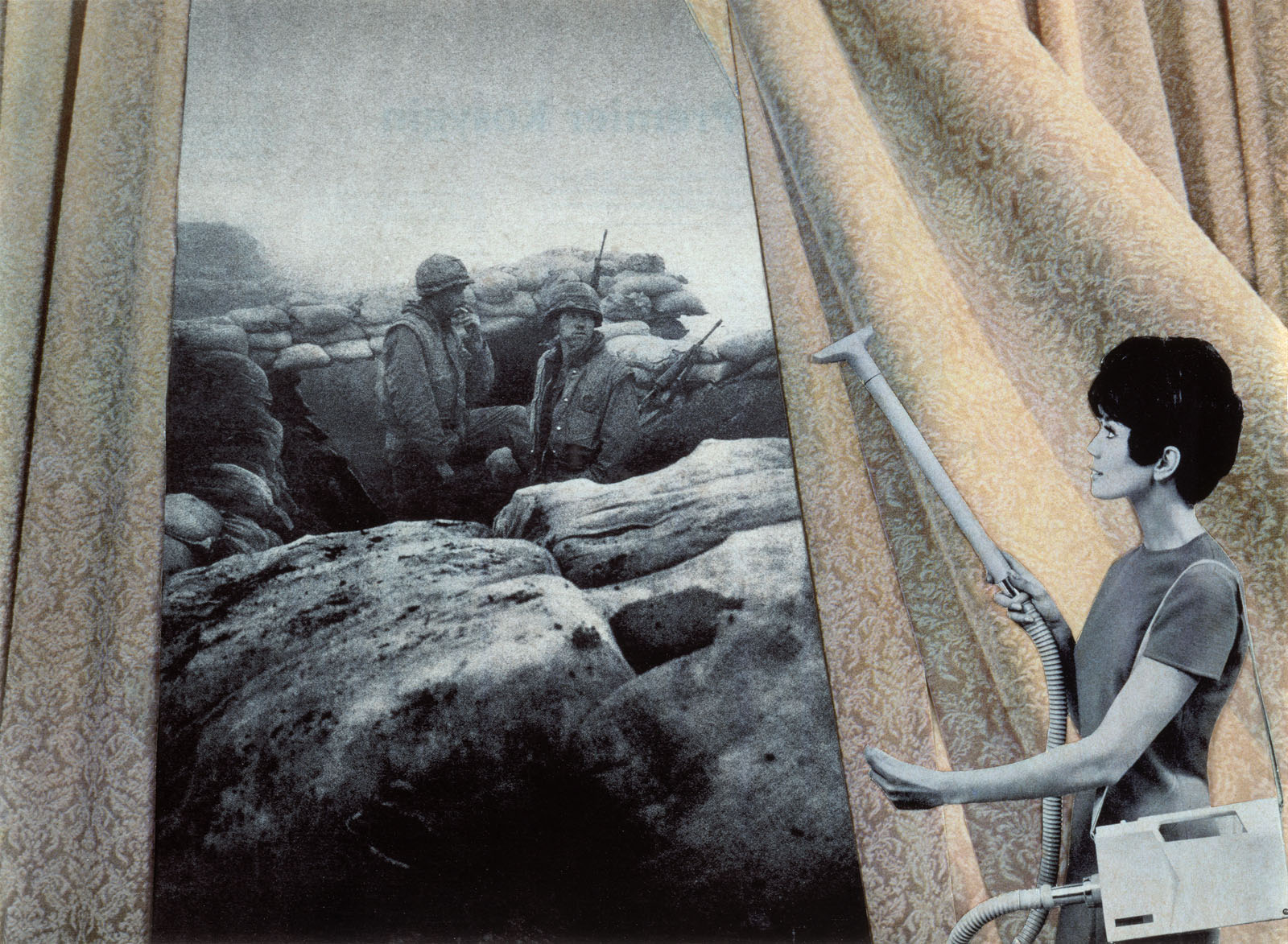
 

Martha Rosler (American, b. 1943) 'Cleaning the Drapes', from the series, 'House Beautiful: Bringing the War Home' 1967-1972 from the exhibition 'The '70s Lens: Reimagining Documentary Photography' at the National Gallery of Art, Washington


Martha Rosler (American, b. 1943)
Cleaning the Drapes
1967-1972, printed 2007
From the series House Beautiful: Bringing the War Home
Inkjet print
Image: 44.2 x 60.4cm (17 3/8 x 23 3/4 in.)
National Gallery of Art
Gift of the Collectors Committee and Pepita Milmore Memorial Fund


Martha Rosler originally distributed photocopies from this series, House Beautiful: Bringing the War Home, as flyers at anti – Vietnam War demonstrations. She made the original photomontages by combining gritty news photographs of fighting in Vietnam with homerelated advertisements culled from glossy women’s magazines. Here Rosler paired a woman cleaning patterned drapes with two tired soldiers smoking amid rocks and sandbags. The woman’s vacuum wand points to and echoes the soldiers’ rifles. The jolting collision of war imagery and affluent domestic space gives visual form to the description of the conflict as “the living room war” – so called because it appeared on television news nightly.

Wall text from the exhibition


“Ce n’est pas une pipe mais de la photographie, sous toutes ses formes variables et multivalentes”


René Magritte’s 1929 painting Ceci n’est pas une pipe is also known as La Trahison des images … The Treachery of Images.

Treachery – the betrayal of trust – is an apposite word in relation to photography of the 1970s. Finally, once and for all, documentary photography in America broke free of the West Coast fine art photography tradition of mainly white male artists and the “aura” of the fine art print (Walter Benjamin). Photography betrayed the trust placed in the authenticity of the image and its link to the “truth” of reality represented in the photograph to become a medium of variability, in concept, execution and outcome. Photography became whatever you wanted it to be.

Documentary photography and its link to the reality of the referent – its assumed representation of a truth that existed in reality – began to be subsumed into the whole of photography, just part of a conceptual, art, performative, staged, street, cameraless, documentary, fashion, photojournalist, activist, amoebic (from the Greek ἀμοιβή amoibe, meaning “change”), and viral (Paul Virilio) medium.

Photography had always been a medium of communication but now became multi-perspectival – whether that be imaginings of the mind relayed through photographs, conceptual ideas about the world and how we interact with it created and staged through photographs, or new colour photography that challenged the orthodoxy of fine art black and white West Coast American photography.

As Anne-Marie Willis observes on the On This Date In Photography website, “any curator who would challenge the orthodox Beaumont Newhall-style photo history limited to images that are distinctively photographic, aesthetic, and “Straight” … would open a Pandora’s box full of photographs pervasive across so many fields, of such limitless subject matters, and crossing so many disciplines that their histories in photography would be obscured.”1

This is the alleged treachery of multi-perspectival photography, the betraying of photographic histories that stretched back to the beginnings of the medium… but it had to be done for photography to fully open itself up to the imaginings of the human and the media flows of the world. “It was a time when photography challenged the art photography norm: photography should not, could not be restricted to what was considered ‘art’.”2

Thus, it is a great joy to see photographs from this stimulating exhibition, photographs that challenge the established “norm” of what photography should be. But what is surprising to me when looking at the complete list of photographs in this exhibition is the important artists who changed the face of photography in the 1970s who are not represented at all or only have one or two images on show:

Gordon Parks 0
Garry Winogrand 1
Lee Friedlander 2
Diane Arbus 1
Robert Mapplethorpe 0
Robert Heinecken 0
Richard Avedon 0
Andy Warhol 1 Polaroid
Cindy Sherman 0
Barbara Kruger 0
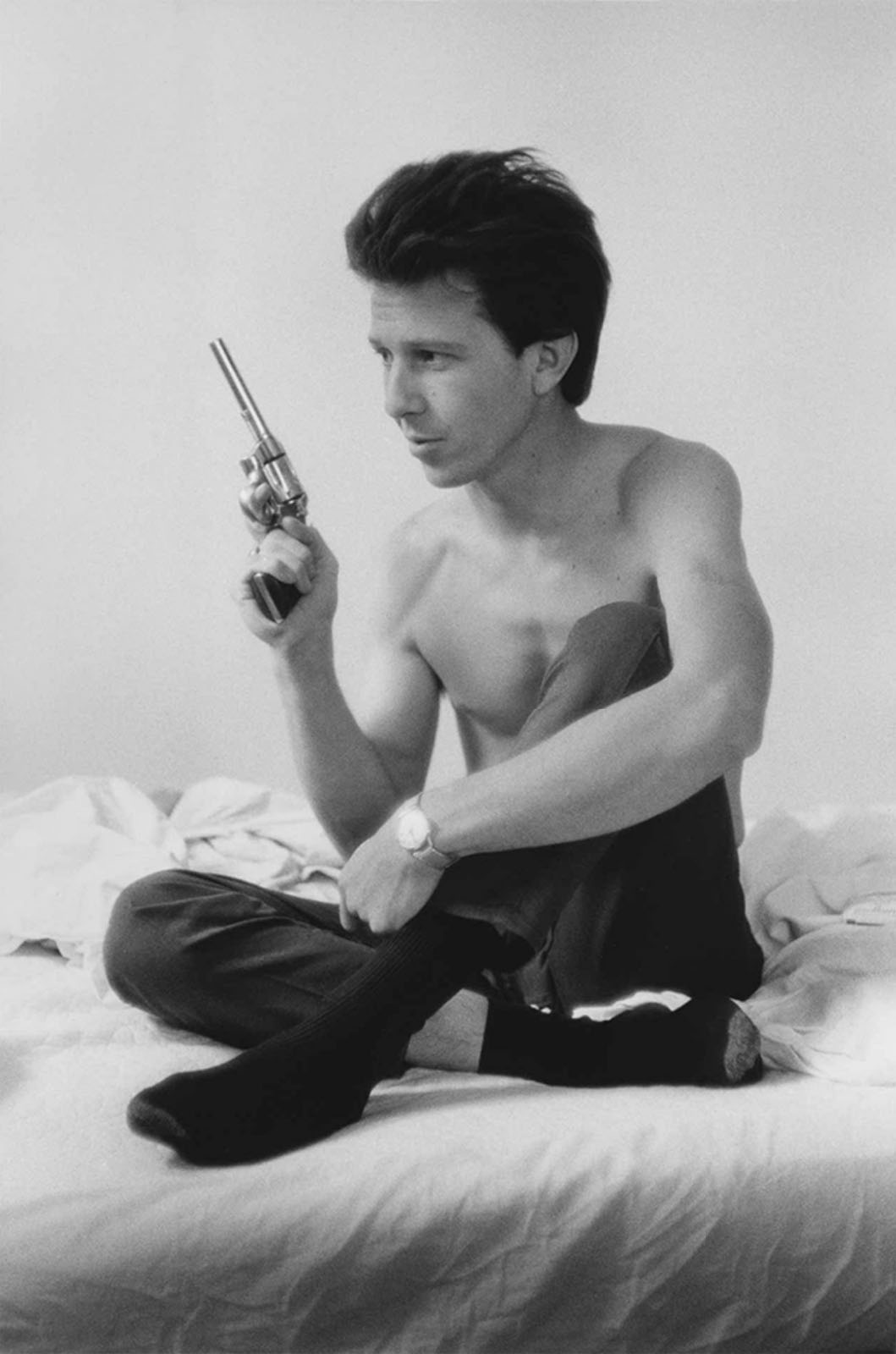
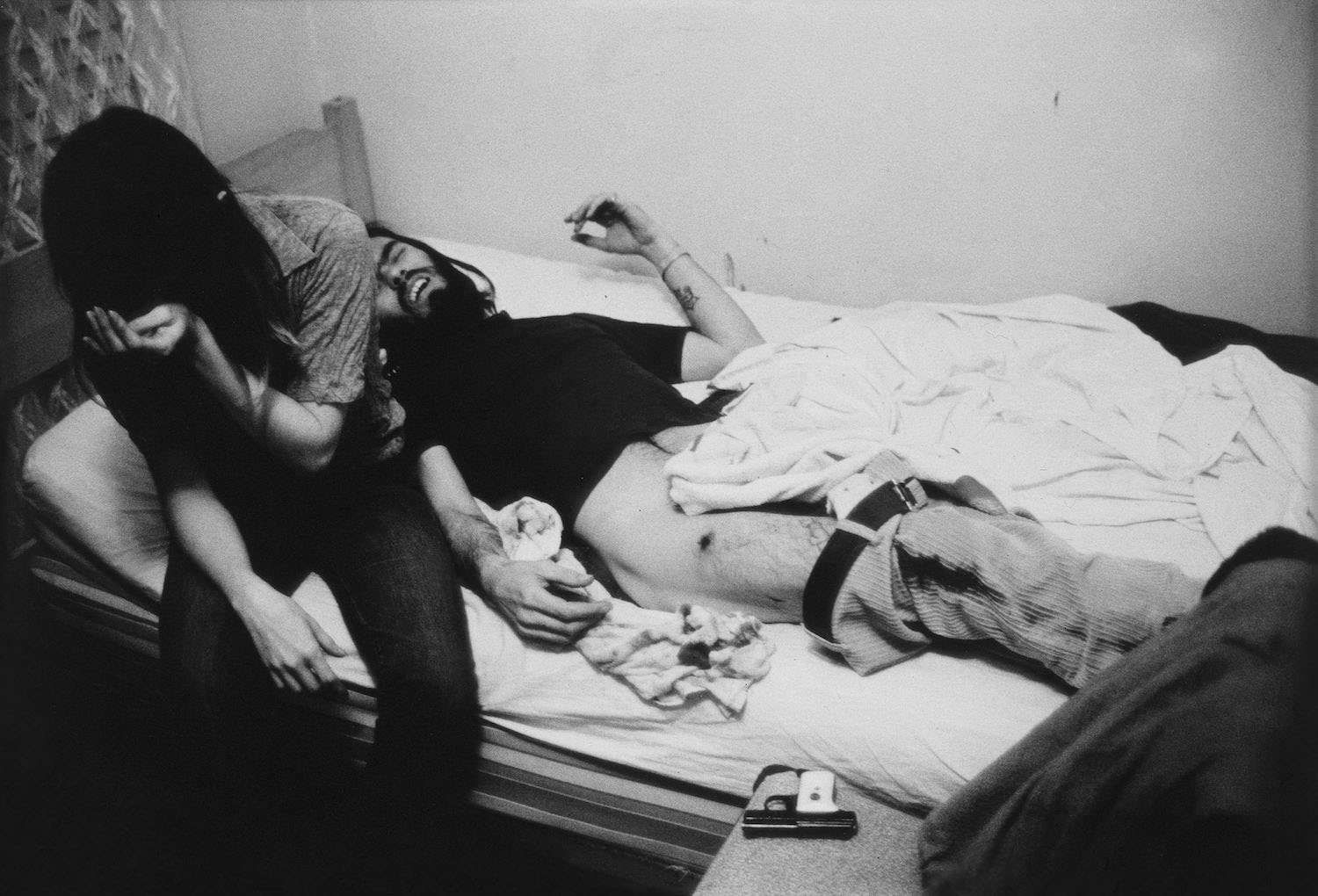
Nan Goldin 1
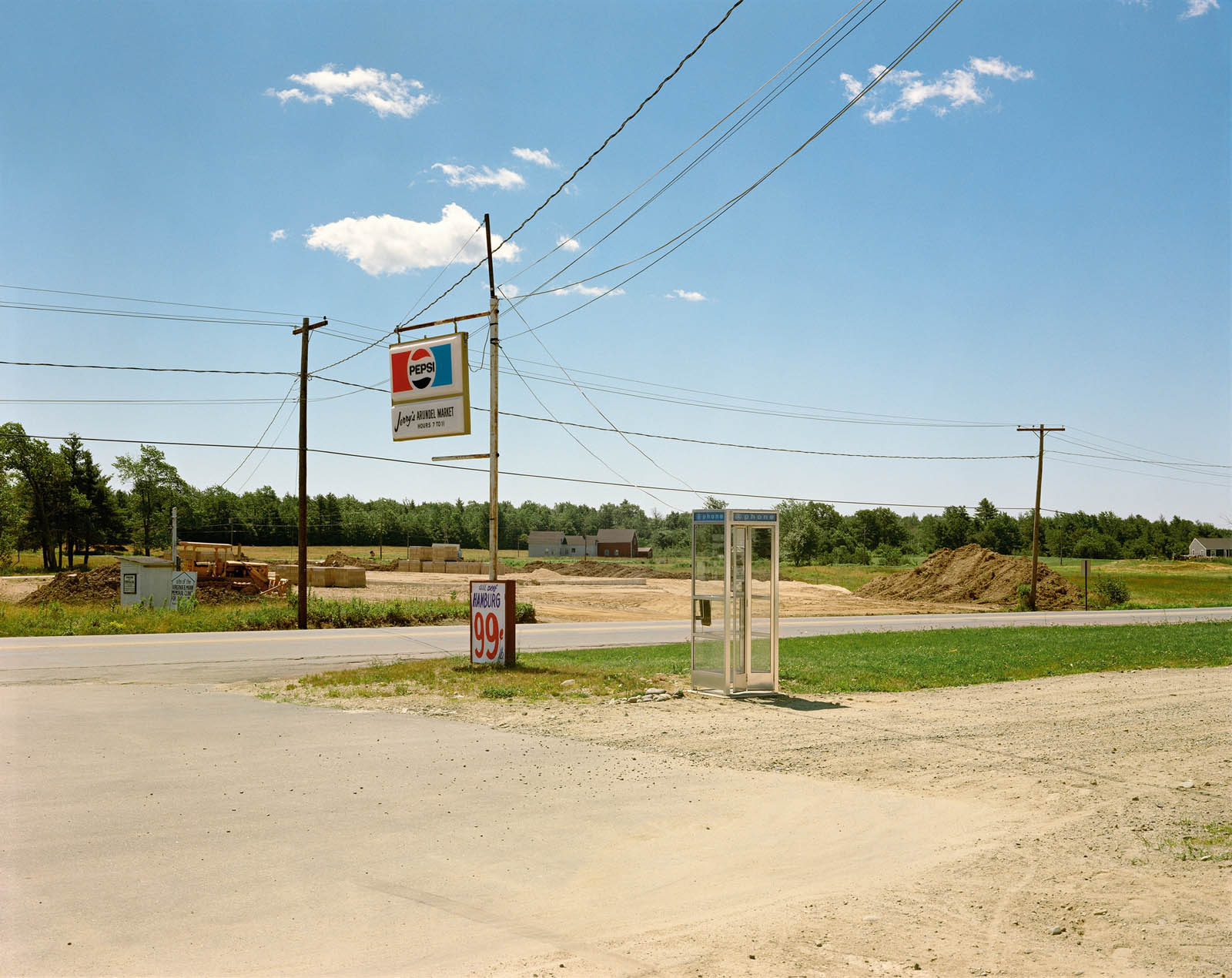
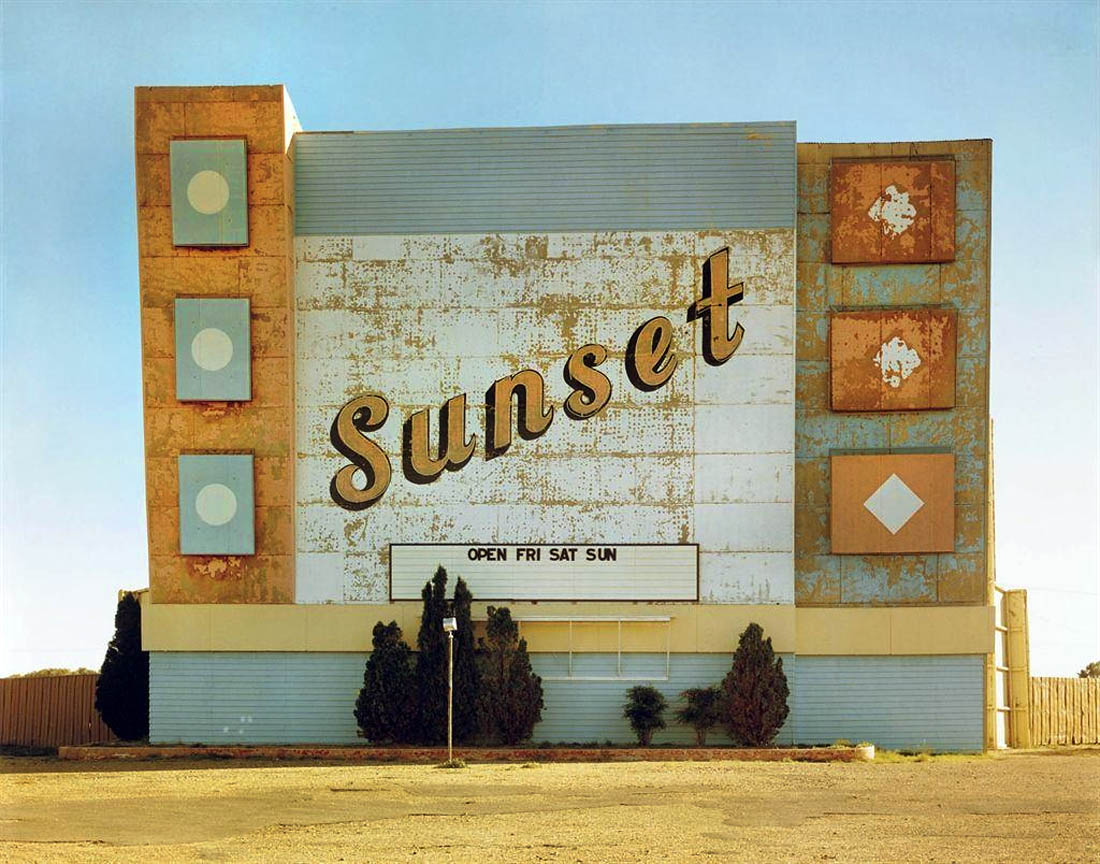
Stephen Shore 1

Diane Arbus, who was instrumental in changing portrait photography at the time, only has one photograph in the exhibition; Barbara Kruger and Robert Heinecken, both “para-photographers” whose work stood “beside” or “beyond” traditional ideas associated with photography have none; Stephen Shore who, along with William Eggleston, was responsible for making colour photography acceptable in art photography has only one photograph.

But most surprisingly of all, Cindy Sherman whose Untitled Film Stills were made predominantly between 1977-1980 and who casts herself as clichés or feminine types, becoming both the artist and subject in the work … is not there at all. Her loss, her evisceration, and the absence of “arguably one of the most significant bodies of work made in the twentieth century and thoroughly canonized by art historians, curators, and critics,”3 is unfathomable.

Dr Marcus Bunyan


1/ Anne-Marie Willis quoted in Dr James McArdle. “DECEMBER 14: CONTEXT,” on the On This Date In Photography website 15/12/2019 [Online] Cited 26/02/2025

2/ Ibid.,

3/ Exhibition Catalogue, New York, Museum of Modern Art, Cindy Sherman, 2012, p. 18 quoted in the “Untitled Film Stills” page on the Wikipedia website


Many thankx to the National Gallery of Art for allowing me to publish the photographs in the posting. Please click on the photographs for a larger version of the image.


Martha Rosler (American, b. 1943)
'Roadside Ambush' 1967-1972 from the exhibition 'The '70s Lens: Reimagining Documentary Photography' at the National Gallery of Art, Washington


Martha Rosler (American, b. 1943)
Roadside Ambush
1967-1972, printed 2007
Inkjet print
Image/sheet: 50.8 x 61cm (20 x 24 in.)
National Gallery of Art
Gift of the Artist and Mitchell-Innes and Nash


Rosler originally distributed photocopies of House Beautiful: Bringing the War Home at anti–Vietnam War demonstrations. “I saw House Beautiful not as art,” she later reflected. “I wanted it to be agitational.” The artist created the original photomontages, from which these collages are derived, by combining news photographs of scorched battlefields in Vietnam with glossy advertisements for US homes, layering images of soldiers within cut-out silhouettes of men from polo-shirt advertisements; and splicing pictures of soldiers’ burials with those of military marches. By tying the destruction abroad to untroubled affluence at home, Rosler gave visual form to the description of the conflict as “the living-room war” – so called because it was the first war to be televised.

MoMA gallery label from 2024


The exhibition The ’70s Lens: Reimagining Documentary Photography examines how new approaches to documentary photography that emerged during the 1970s reflected a radical shift in American life – and in the medium itself.

The 1970s was a decade of uncertainty in the US – soaring inflation, energy crises, the Watergate scandal, and protests about pressing social issues – and the profound upheaval that rocked the country formed the backdrop for a revolution in documentary photography. Now on view at @ngadc, The ’70s Lens: Reimagining Documentary Photography explores this compelling and contested moment of reinvention when the genre’s association with objectivity and truthfulness came into question. Featuring works from over eighty artists, the exhibition delves into how the camera was used to examine life in the US from a diverse range of perspectives, and in doing so, transformed the practice of documentary photography.


The ’70s Lens: A Conversation with Anthony Hernandez

Artist Anthony Hernandez discusses 50 years of work with curator Andrea Nelson on October 24, 2024. The conversation celebrates the exhibition The ’70s Lens: Reimagining Documentary Photography (October 2024 – April 2025).

Anthony Hernandez (b. 1947, Los Angeles, California) has crafted a richly varied oeuvre, ranging from a distinctive style of black-and-white street photography to colour photographs of abstracted details of his surroundings. Much of Hernandez’s work focuses on his native Los Angeles, revealing a unique insight into the people and landscape of the much-pictured city. Hernandez is a recipient of a Guggenheim Fellowship (2018), the Rome Prize (1999) and has been named a United States Artists Fellow (2009).


William Eggleston (American, b. 1939) 'Memphis' 1969-1970 from the exhibition 'The '70s Lens: Reimagining Documentary Photography' at the National Gallery of Art, Washington


William Eggleston (American, b. 1939)
Memphis
1969-1970, printed 1980
Dye imbibition print
Image: 30.2 x 44.2cm (11 7/8 x 17 3/8 in.)
National Gallery of Art, Corcoran Collection
Gift of Mr. Morris R. Garfinkle
© Eggleston Artistic Trust


Eggleston is celebrated for his use of colour photography, which he began experimenting with in the late 1960s. Eggleston’s 1976 exhibition Colour Photographs, held at the Museum of Modern Art, New York, is considered a pivotal moment in the development of colour photography as a contemporary art form and widely credited with increasing recognition of the medium.

Since first picking up a camera in 1957, Eggleston has photographed his family, friends and the people that he encountered in his everyday life, particularly in his native Memphis. Eggleston is said to find the beauty in the everyday and his work has inspired many present day photographers, artists and filmmakers, including Martin Parr, Sofia Coppola, David Lynch and Juergen Teller.

Text from the National Gallery of Victoria website


Anthony Friedkin (American, b. 1949) 'Young Man, Troupers Hall, Hollywood' 1969 From the series 'The Gay Essay'


Anthony Friedkin (American, b. 1949)
Young Man, Troupers Hall, Hollywood
1969
From the series The Gay Essay
Gelatin silver print
National Portrait Gallery
Gift of Mary and Dan Solomon


In 1969, Anthony Friedkin was only 19 years old when he set out to document the queer communities of San Francisco and Los Angeles. The resulting project, The Gay Essay, is an expressive and nuanced portrait. Friedkin charts various facets of the culture, from street life and protests to parades and drag performances.

Friedkin’s photographs record the beginnings of the gay liberation movement in California. With a respectful intimacy he pictures individuals living true to themselves while defying prevailing social norms.

Wall text from the exhibition
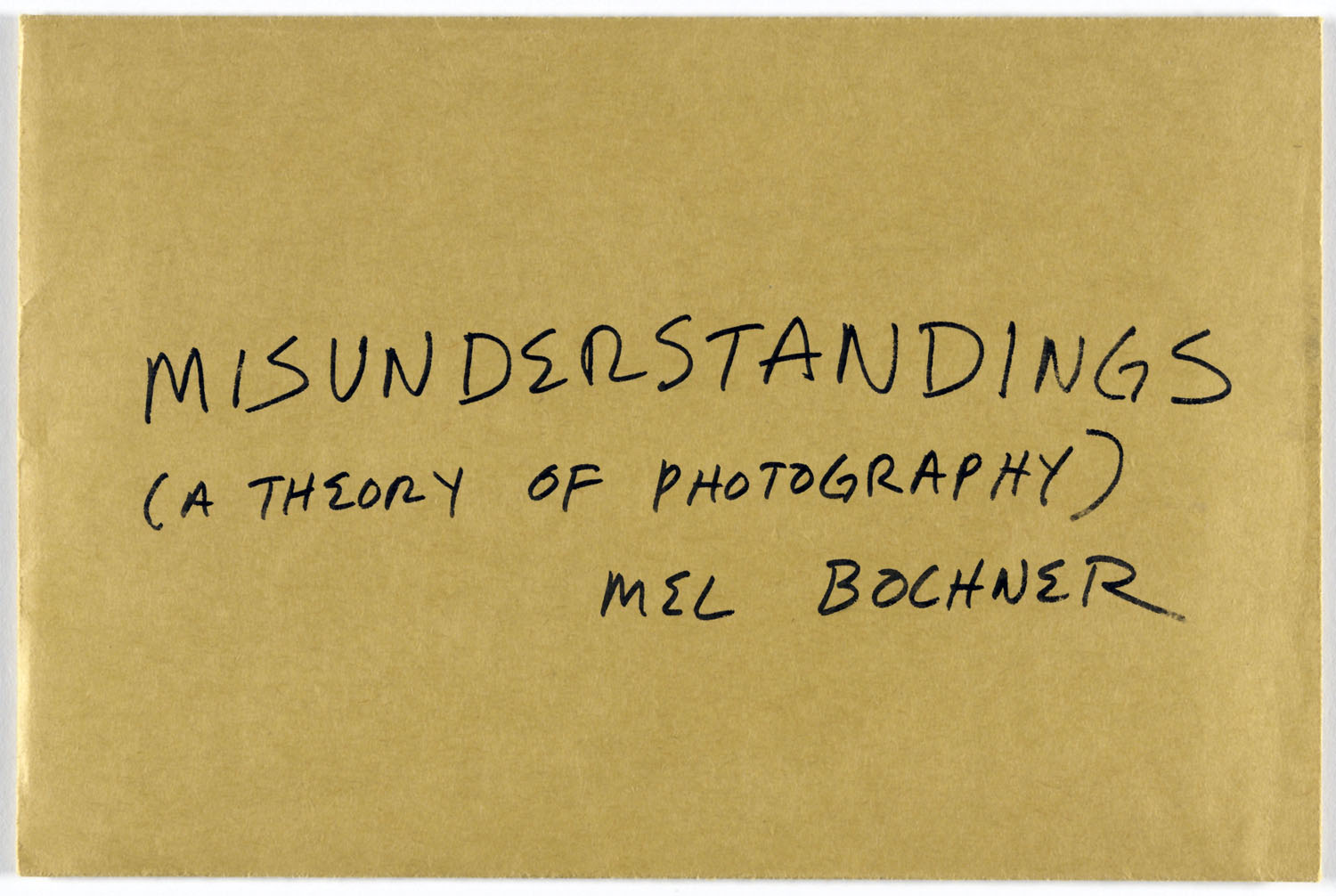
 

Mel Bochner (American, 1940-2025) 'Misunderstandings (A Theory of Photography)' 1970 (detail)


Mel Bochner (American, 1940-2025)
Misunderstandings (A Theory of Photography) (details)
1970
10 offset lithographs on notecards and envelope
Sheet (each): 12.7 x 20.32cm (5 x 8 in.)
National Gallery of Art, Gift of Mary and Dan Solomon


When Mel Bochner started documenting his works of sculpture with a camera, he realised that his practice had “become about photography without [my] wanting it to.” He studied the history of the medium and found conflicting ideas about what photography is or should be. By illustrating these “misunderstandings” with quotes from notable figures and sources, Bochner underscored the gap between a photograph itself and what it purports to represent. He even fabricated three of the quotations, further playing on photography’s tenuous relationship to truth. The photograph of the artist’s hand and forearm is also a misunderstanding: it is much smaller than the actual body part it depicts. It also appears to be a negative of a Polaroid photograph, but Polaroids exist only as positive prints.

Wall text from the exhibition


Mel Bochner was a key figure in the Conceptual Art movement of the 1960s and 70s. Bochner was part of a group of artists who challenged the traditional notion of art as a physical object to be admired for its aesthetic qualities and instead sought to explore the ideas and concepts behind the object, often using language and text as their medium.

Bochner’s early works were influenced by his interest in mathematics and logic, which he applied to create intricate geometric patterns. As his practice evolved, he incorporated language and words into his artwork, exploring the relationship between language, thought, and perception.

Text from the My Art Broker website


Anthony Barboza (American, b. 1944) 'New York City' 1970s from the exhibition 'The '70s Lens: Reimagining Documentary Photography' at the National Gallery of Art, Washington


Anthony Barboza (American, b. 1944)
New York City
1970s
Gelatin silver print
Image/sheet: 23.7 × 16.1cm (9 5/16 × 6 1/4 in.)
National Gallery of Art
Pepita Milmore Memorial Fund


Anthony Barboza’s photography has been integral in shaping the image of Black America. A founding member of the Kamoinge Workshop, a group of Black photographers formed in New York in 1963, Barboza went on to establish a thriving commercial and personal practice focused largely on Black subjects. His affirmative representations of African Americans in daily life – like this photograph of two ultra-stylish men standing in front of a hotel coffee shop in midtown Manhattan – contributed to an empowering narrative for the Black community in the face of inequality and adversity. Describing his approach to making pictures on the street, Barboza commented, “”The photograph finds you, you don’t find the photograph.”

Wall text from the exhibition


Anthony Barboza (American, b. 1944) 'New York City' 1970s from the exhibition 'The '70s Lens: Reimagining Documentary Photography' at the National Gallery of Art, Washington


Anthony Barboza (American, b. 1944)
New York City
1970s
Gelatin silver print
Image: 23.7 × 15.9cm (9 5/16 × 6 1/4 in.)
National Gallery of Art
Pepita Milmore Memorial Fund


Lee Friedlander (United States, b. 1934) 'Hillcrest, New York' 1970 from the exhibition 'The '70s Lens: Reimagining Documentary Photography' at the National Gallery of Art, Washington


Lee Friedlander (American, b. 1934)
Hillcrest, New York
1970
Gelatin silver print
Image: 20.3 x 30.5cm (8 x 12 in.)
National Gallery of Art
Patrons’ Permanent Fund


The fracturing of the image plane, where multiple, diverse realities are represented within one photograph, deconstructing the reality of fine art photography. ~ Marcus


Lee Friedlander’s layered compositions wittily observe connections between American life and commerce. In this dizzying photograph, Friedlander captures himself, at center, in a sideview mirror while at a filling station. In the reflection behind him we see a strip mall with the stores’ signs reversed. Near and far vie for attention and parts of the composition are blocked from our view.

The photograph with a World War I memorial similarly features vertical elements that break up the composition into separate frames. At left, the memorial’s soldier with rifle – who appears to be on guard – goes completely unnoticed as pedestrians make their way along a street full of storefronts.

Wall text from the exhibition


Kenneth Josephson (American, b. 1932) 'Wyoming' 1971 from the exhibition 'The '70s Lens: Reimagining Documentary Photography' at the National Gallery of Art, Washington


Kenneth Josephson (American, b. 1932)
Wyoming
1971
From the History of Photography series
Gelatin silver print
Image: 22.8 x 14.1cm (9 x 5 9/16 in.)
National Gallery of Art
Patrons’ Permanent Fund


Kenneth Josephson’s conceptual photography experiments with playful illusion to explore and question his medium. Josephson was a graduate among the first generation of photography candidates from the Illinois Institute of Design. A student of such masters as Aaron Siskind, Harry Callahan, and Minor White, Josephson went on to teach for 35 years at the Art Institute of Chicago, where he routinely taught the “Introduction to Photography” course as it inspired him to continue experimentation.

“This photograph of a photograph held in space causes the viewer to question assumptions about truthful representation according to size and scale; it also draws attention to the principle that photographic reality is constructed through an artist’s ideas and choices. The subject of the photograph is photography itself, and the ways that life is documented, manipulated, trivialised, and celebrated with photographs.”

Text from the Madison Museum of Contemporary Art website
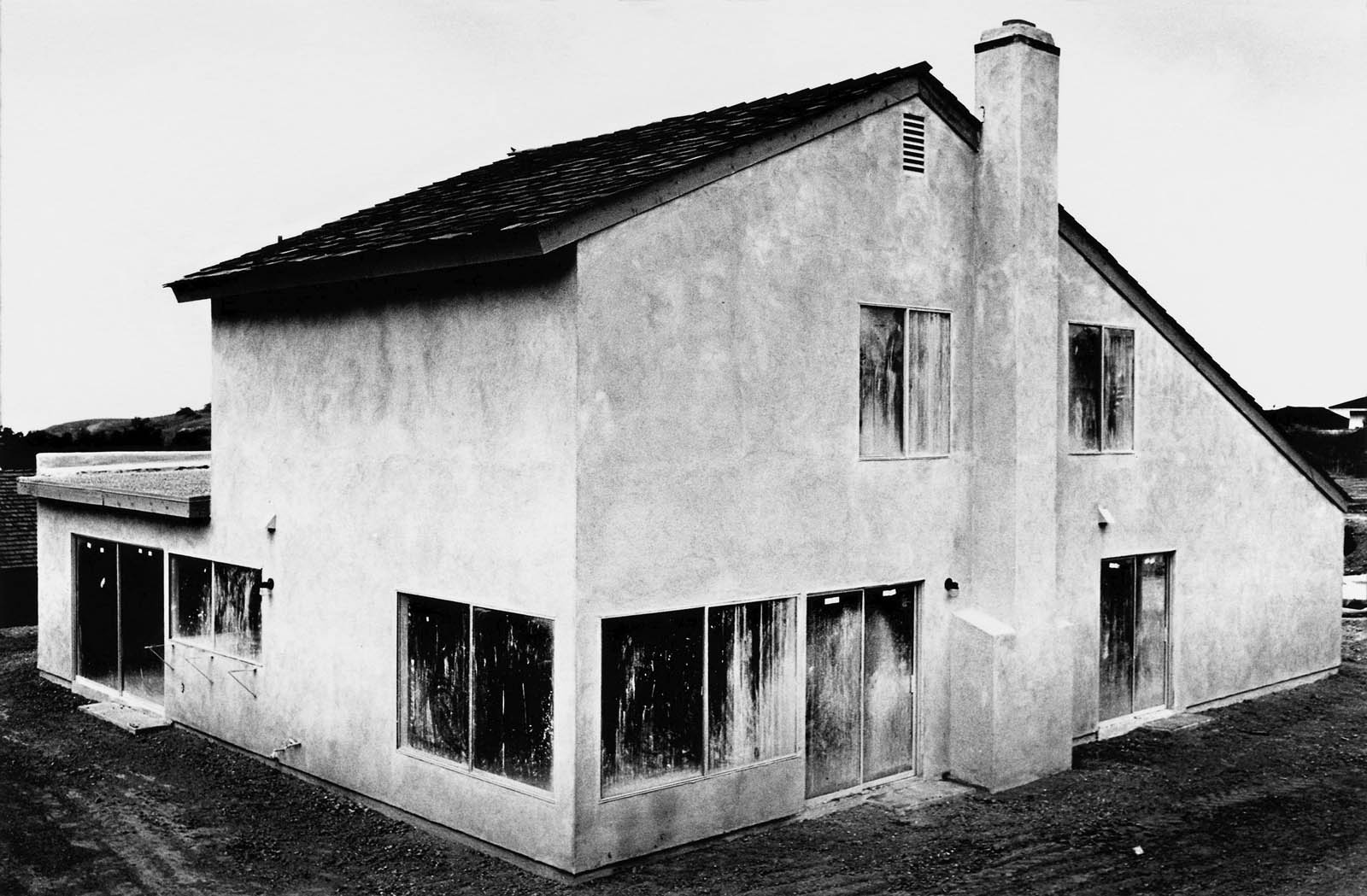
 

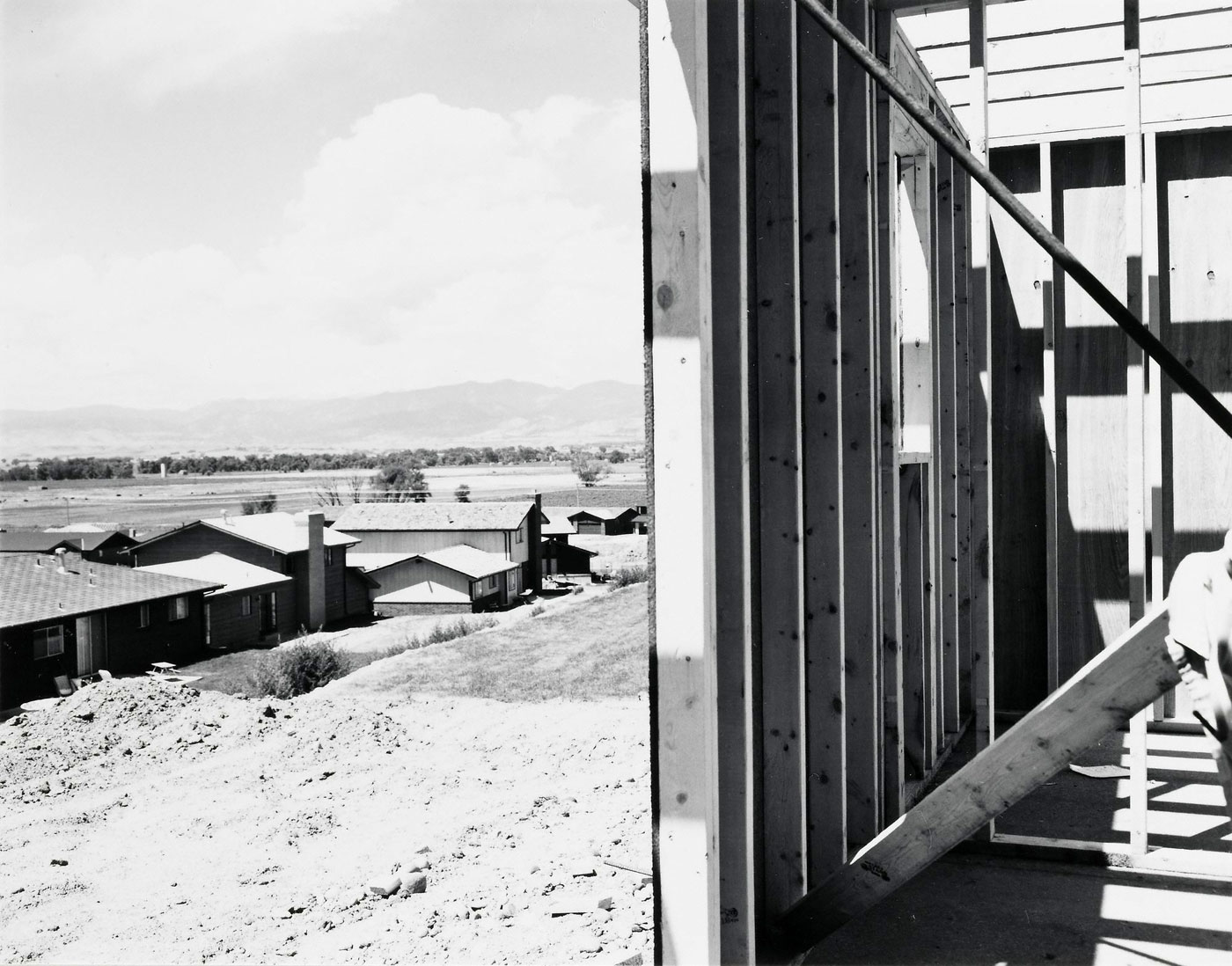
Lewis Baltz (American, 1945-2014) 'Tract House #4' 1971 from the exhibition 'The '70s Lens: Reimagining Documentary Photography' at the National Gallery of Art, Washington


Lewis Baltz (American, 1945-2014)
Tract House #4
1971
From the portfolio The Tract Houses
Gelatin silver print
Image/sheet: 14.5 × 22.5cm (5 11/16 × 8 7/8 in.)
National Gallery of Art
Corcoran Collection (Gift of the artist)


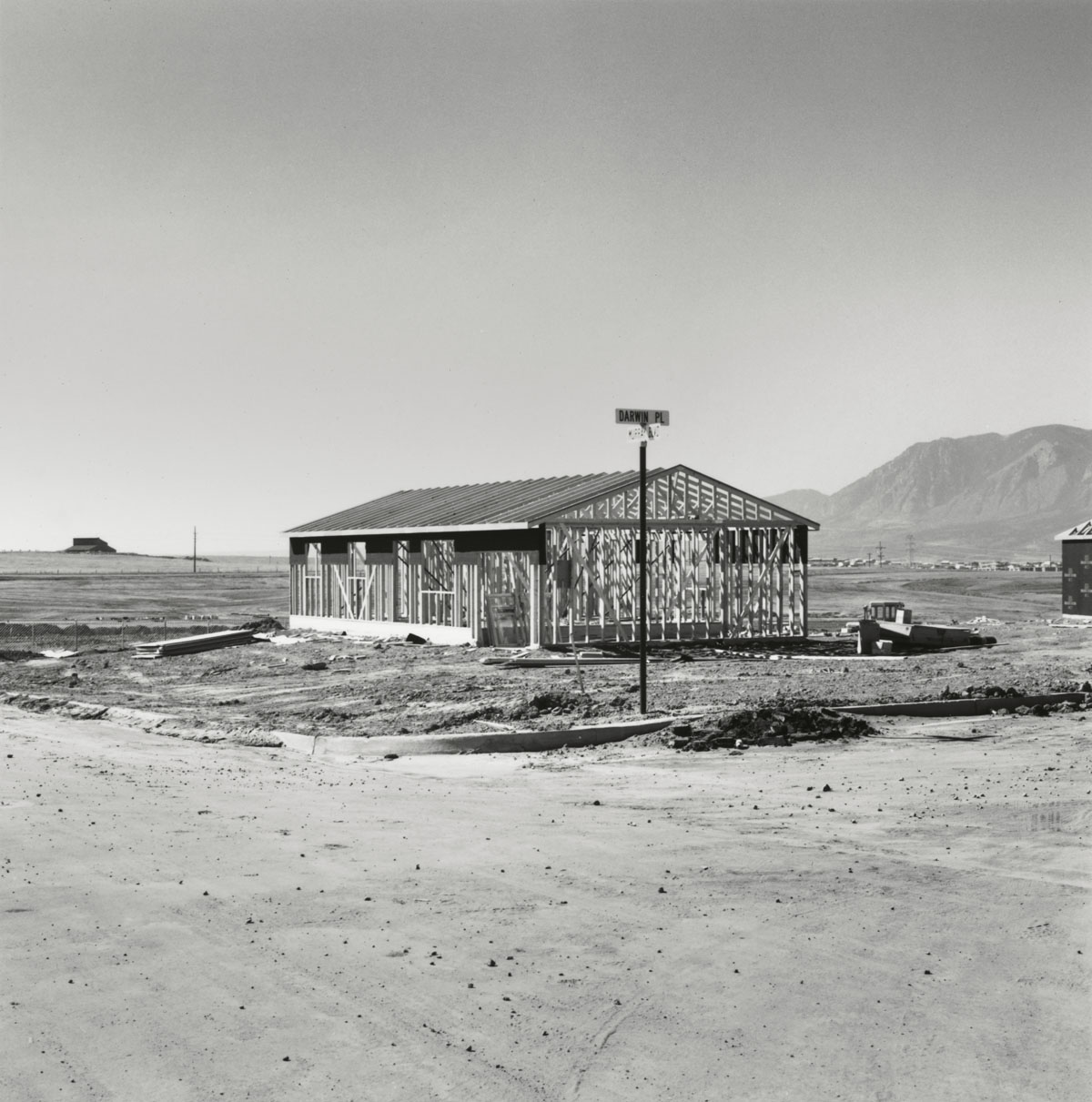
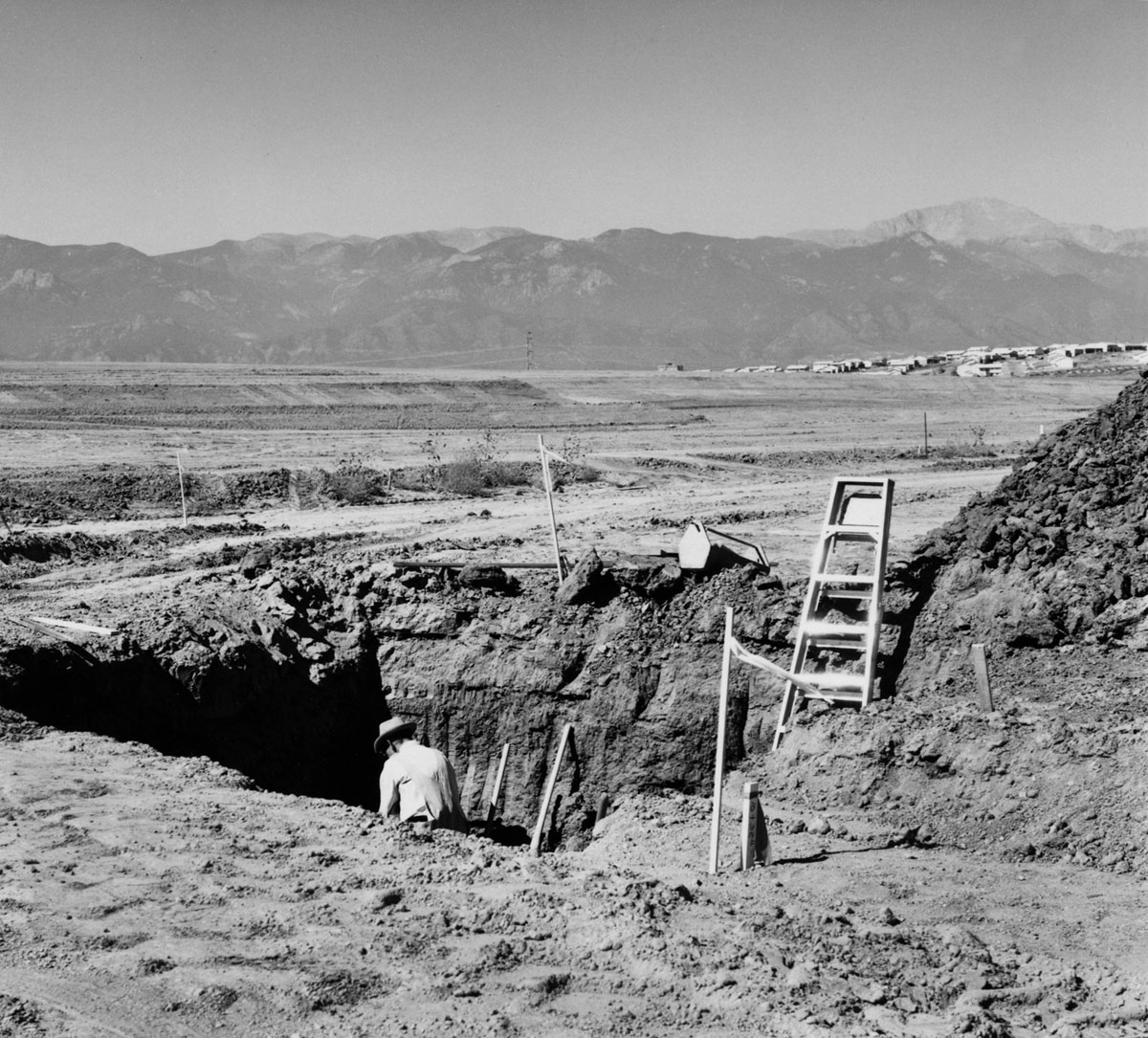
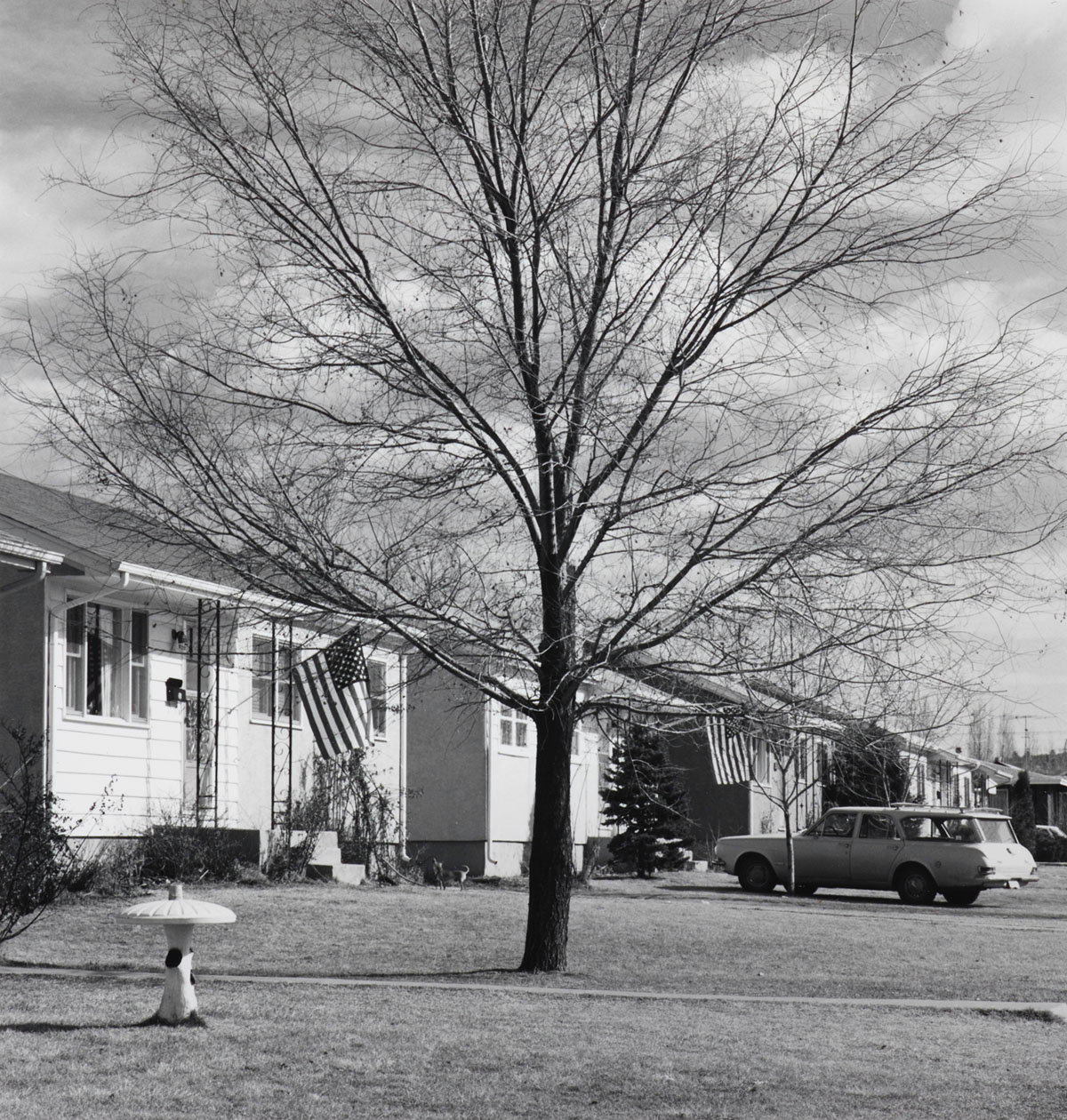
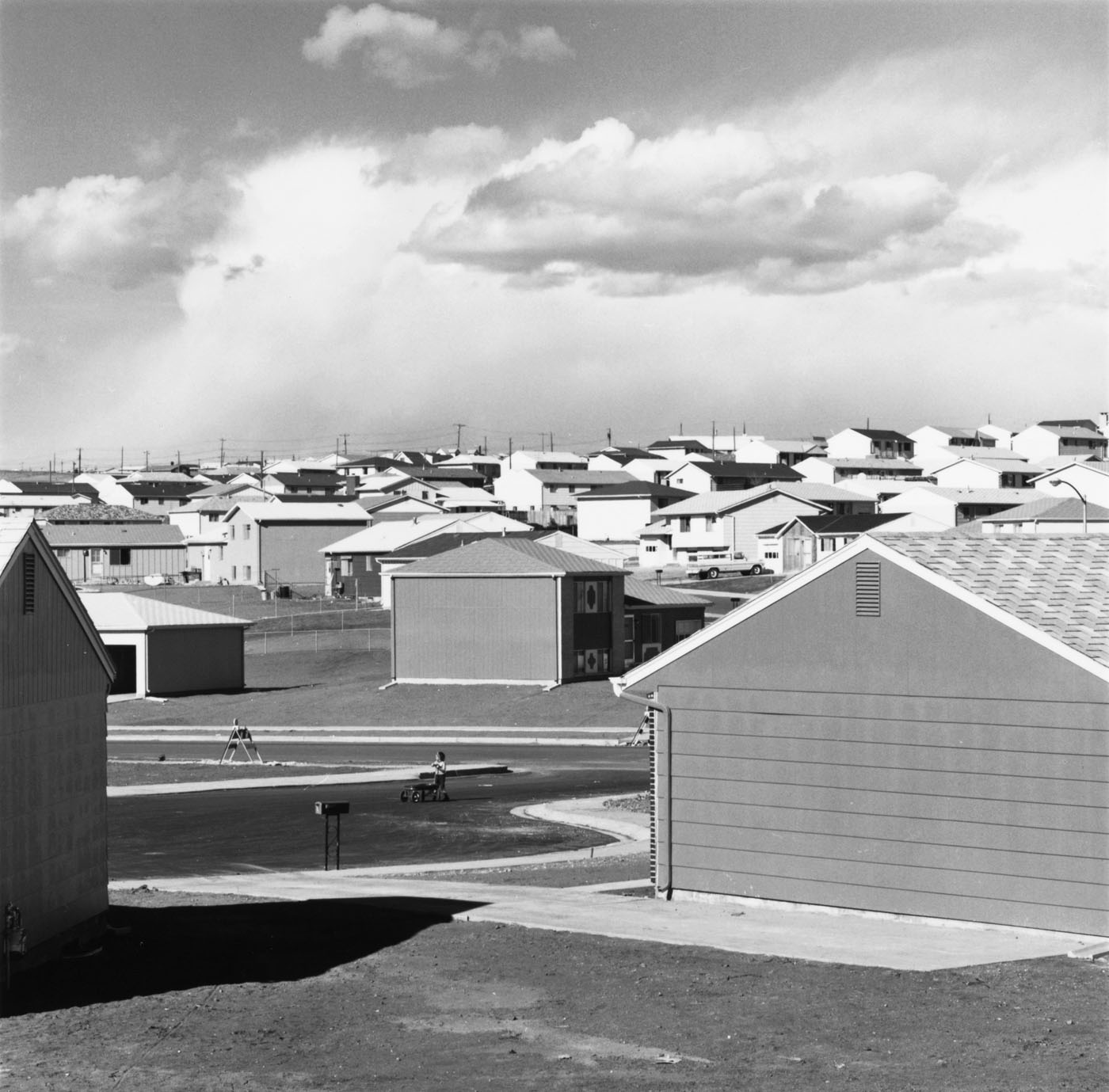
Lewis Baltz’s The Tract Houses captures the austere geometry of the shoddily built homes that sprang up in California’s suburban landscape beginning in the mid-1940s. Straight-edge architectural details, positioned strictly parallel to the picture plane, recall the reductive forms of minimalist art. Entire, recently constructed houses appear forlorn. None of the pictures include shadows, clouds, or people. Baltz’s series is a powerful critique of the transformation of the American landscape into an unending terrain of anonymous architecture. At the same time, the exquisitely rendered tones and textured surfaces emphasise the subtle beauty to be found in this bleak environment.

Wall text from the exhibition


With his iconic, minimalist photographs of suburban landscape, Lewis Baltz was at the forefront of a revolutionary shift in the medium of photography. Baltzs work exemplifies the ways in which photography started to loose the bonds of its isolation within its own segregated history and aesthetics and began to take its place among other media. In the late 1960s and early 1970s Baltz became fascinated by the stark, man-made landscape rolling over Californias then still-agrarian terrain. His earliest portfolio, The Tract Houses (1971), and his preliminary forays into a minimal aesthetic, The Prototype Works (1967-1976), illuminate his drive to capture the reality of a sprawling Western ecology gone wild.

Text from the Google Books website


Diane Arbus (American, 1923-1971) 'A young man and his girlfriend with hot dogs in the park' 1971


Diane Arbus (American, 1923-1971)
A young man and his girlfriend with hot dogs in the park
1971
Gelatin silver print
Image: 37.7 x 36.5cm (14 13/16 x 14 3/8 in.)
National Gallery of Art, Corcoran Collection
Gift of Stephen G. Stein


Diane Arbus prowled New York’s public spaces looking for humor and strangeness in the everyday. Here a young couple walks in Central Park, wearing similar clothes, hairstyles, and dejected expressions. Arbus’s carefully composed but disorienting photograph – the subjects are in crisp focus while the background is blurred – compels us to look anew at the familiar. Is this couple unhappy in love or expressing the uncertainty of the times? Arbus made this photograph the year she died. Her influence on documentary photography would continue through the decade.

Wall text from the exhibition


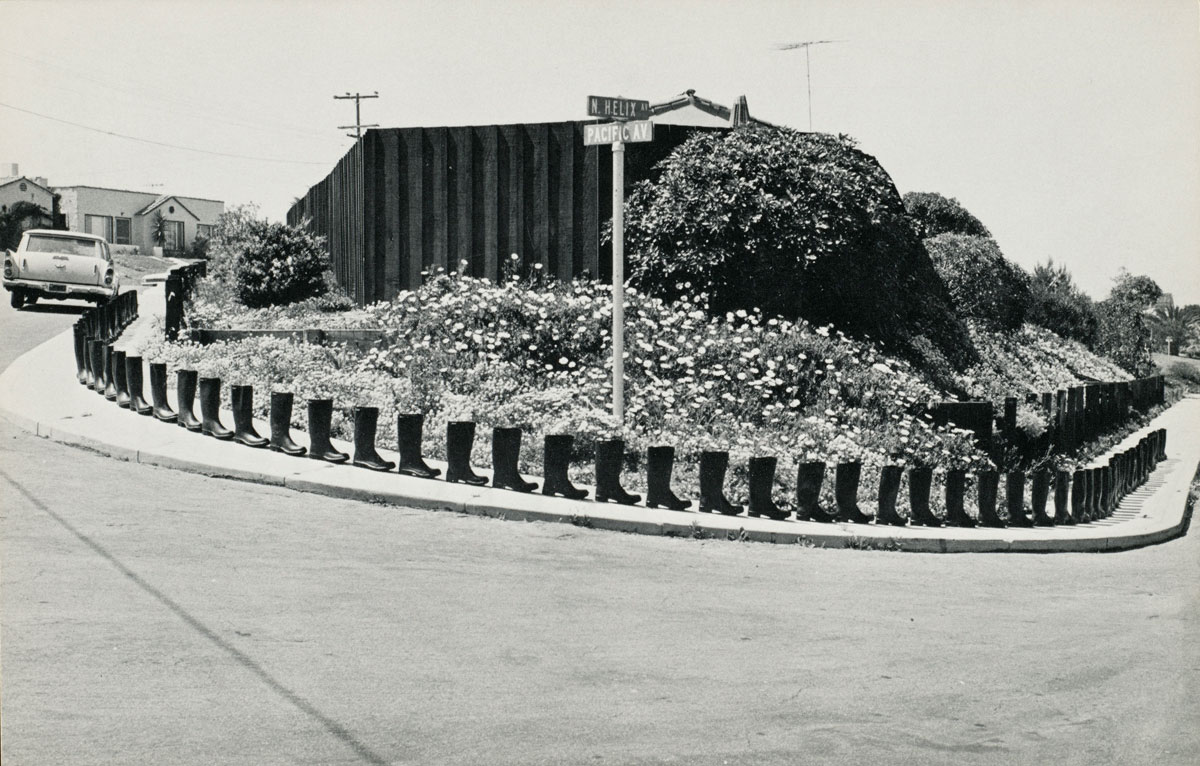
Eleanor Antin (American, b. 1935), Philip Steinmetz (American, 1944-2013) (photographer). '100 Boots' 1971-1973 (detail)


Eleanor Antin (American, b. 1935)
Philip Steinmetz (American, 1944-2013) (photographer)
100 Boots (details)
1971-1973
51 halftone prints (postcards)
image/sheet (each): 11.5 x 17.75cm (4 1/2 x 7 in.)
National Gallery of Art
Pepita Milmore Memorial Fund


In this epic visual narrative, black rubber boots stand in for a fictional hero traveling from California to New York City. Eleanor Antin created temporary installations with the boots, had them photographed (by Philip Steinmetz), and made 51 postcards, copies of which she mailed to approximately 1,000 people and institutions involved in the arts. The journey starts at a Bank of America and ends at Central Park – after a visit to the Museum of Modern Art, where the boots and a set of postcards and photographs were later exhibited. Using the postal service, Antin bypassed the traditional gallery system, which had long overlooked women artists. While many of these scenes are humorous, the empty army boots also recall the Vietnam War and the soldiers who did not come home.

Wall text from the exhibition


100 Boots, 1971-1973

For her 51-piece instalment 100 Boots Eleonor Antin positioned one hundred ordinary black rubber boots on various locations all over Southern California and consequently in New York City. She took photos, printed them on postcards and assembled a mailing list of about a thousand names – mainly artists, writers, critics, galleries, universities and museums – who received the various postcards over a period of two and a half years between 1971 and 1973. The first card, 100 Boots Facing the Sea, was mailed on the Ides of March, 1971, unannounced and without further comment. A few weeks later it was followed by 100 Boots on the Way to Church and three weeks thereafter by the next one.

In a total of 51 photographs, Eleanor Antin documented the travels of the 100 Boots, her so called “hero” – from a beach close to San Diego to a church, to a bank, to the supermarket, trespassing, under the bridge, to a saloon and on their travels eastward. Finally, on May 15th, 1973 100 Boots arrived at the Museum of Modern Art in New York. By this time, 100 Boots had long become an epic visual narrative and a picaresque work of conceptual art.

Text from the exhibition open spaces | secret places: composite works from the collection at Museum Der Moderne Salzburg, October 2012 – March 2013
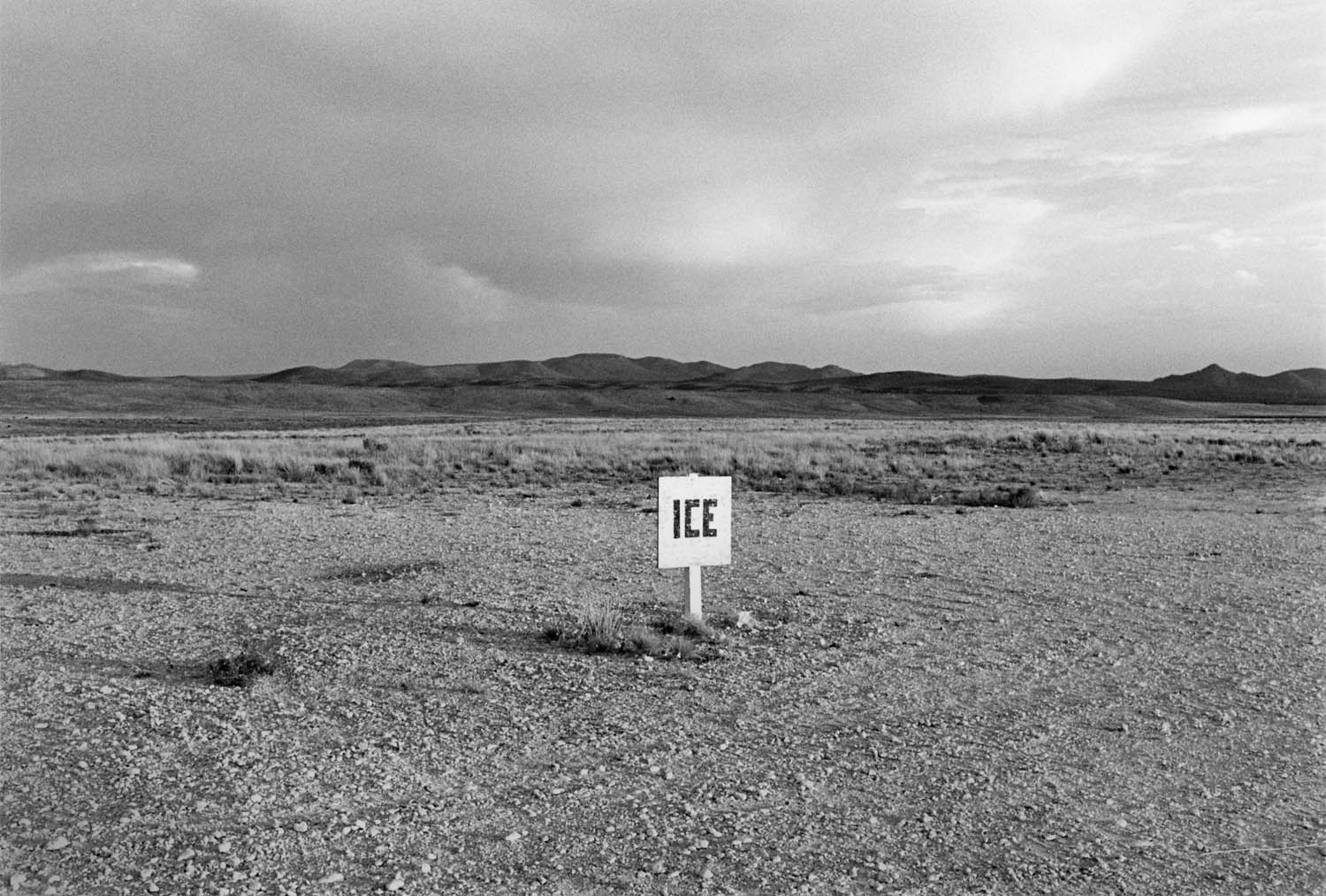
 

Henry Wessel (American, 1942-2018) 'Walapai, Arizona' 1971


Henry Wessel (American, 1942-2018)
Walapai, Arizona
1971
Gelatin silver print
Image: 26.51 x 39.85cm (10 7/16 x 15 11/16 in.)
National Gallery of Art
Gift of Mary and Dan Solomon and Patrons’ Permanent Fund


In 1975 New Topographics: Photographs of a Man-Altered Landscape opens at the International Museum of Photography in Rochester, N.Y. It includes photographs by Robert Adams, Lewis Baltz, Bernd and Hilla Becher, Joe Deal, Frank Gohlke, Nicholas Nixon, John Schott, Stephen Shore, and Henry Wessel Jr.

“Henry Wessel began taking photographs while majoring in psychology at Pennsylvania State University in the mid-1960s. Travel throughout the United States in subsequent years led him to direct his gaze increasingly to details of human interaction with the natural and man-made environment. Wessel’s move to the West Coast in the early 1970s inspired him to incorporate light and climate into his work. His inclusion in the seminal exhibition New Topographics: Photographs of a Man-Altered Landscape, organised in 1975 by the George Eastman House in Rochester, New York, solidified his reputation as a keen observer of the American topography.”

Text from Pacific Standard Time at the Getty


John Simmons (American, b. 1950)
'Will on Chevy, Nashville, Tennessee'
1971, printed 2024


John Simmons (American, b. 1950)
Will on Chevy, Nashville, Tennessee
1971, printed 2024
Gelatin silver print
Image: 30.48 x 20.32cm (12 x 8 in.)
National Gallery of Art
Alfred H. Moses and Fern M. Schad Fund


A fashionably dressed older man crosses the street with his umbrella. A young woman turns to look at the camera while holding hands with a man in uniform. These were people John Simmons encountered while studying art at Fisk University in Nashville. Raised on Chicago’s South Side, Simmons had first published photographs as a teenager in the African American newspaper Chicago Defender. Refuting white-centered media’s failure to show positive imagery of the Black experience, Simmons has focused on people enjoying everyday life.

“I always feel like my subject and I were meant to share that moment together,” he has said. “So many of the pictures I take, it was like our paths were meant to cross.”

Wall text from the exhibition


Simmons began his career at 15 as a photographer for the oldest African American-owned newspaper, The Chicago Daily Defender in 1965. Over his decades long career, he’s photographed icons of the Civil Rights Movement, turbulent protests and demonstrations, famed musicians and poignant intimate moments of everyday life. “I’m glad to see photographs I took back in my teens are still relevant today,” he says.

John Simmons quoted in Steve Simmons. “Photographer John Simmons, ‘Chronicler Of The Civil Rights Movement,’​ Featured In Three Exhibits,” on the Linkedin website August 4, 2021 [Online] Cited 11/09/2021.
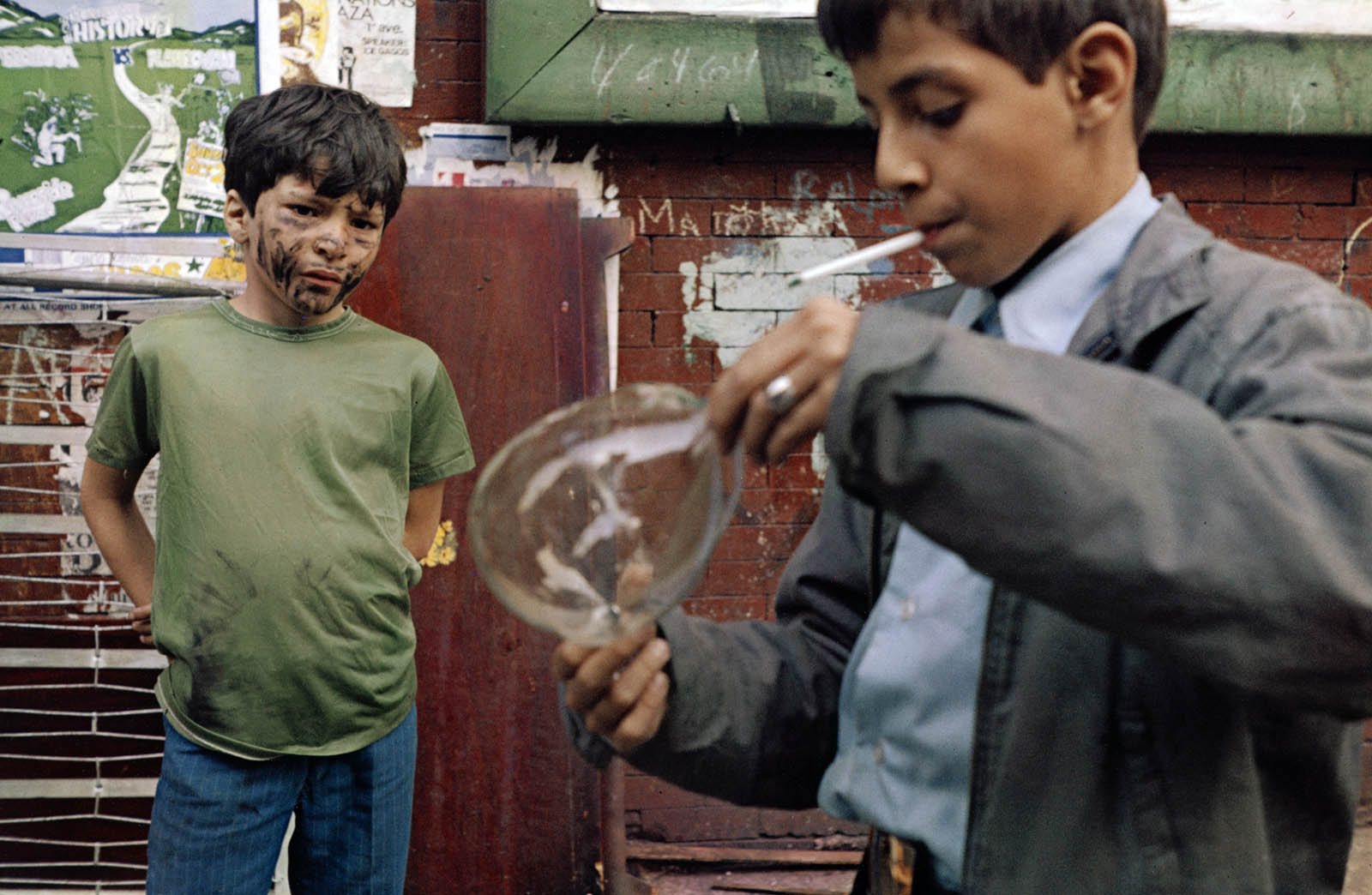
 

Helen Levitt (American, 1913-2009) 'New York' 1972 from the exhibition 'The '70s Lens: Reimagining Documentary Photography' at the National Gallery of Art, Washington


Helen Levitt (American, 1913-2009)
New York
1972
Dye imbibition print
Image: 23.5 x 36cm (9 1/4 x 14 3/16 in.)
National Gallery of Art, Patrons’ Permanent Fund
© Film Documents LLC, courtesy Zander Galerie, Cologne


Helen Levitt frequently made photographs of children on the streets of New York City, exploring their relationships to the urban setting as they played, imagined, and discovered together. After decades of working in black and white, Levitt became an early advocate of color documentary photography. Color allowed her to tell a fuller story of everyday life. Here, the green of the boy’s T-shirt is echoed in the poster and frame behind him. “I thought my photographs would be closer to reality if I got the color of the streets,” she said. “Black and white is an abstraction.”

Wall text from the exhibition


Bill Owens (American, b. 1938)
'Ronald Reagan' 1972 from the exhibition 'The '70s Lens: Reimagining Documentary Photography' at the National Gallery of Art, Washington


Bill Owens (American, b. 1938)
Ronald Reagan
1972
From the series Suburbia
Gelatin silver print
Image: 16.4 x 21.6cm (6 7/16 x 8 1/2 in.)
National Gallery of Art
Patrons’ Permanent Fund


Over the course of a year, Bill Owens made photographs of the housing developments that had recently sprung up outside of Oakland and San Francisco. With an eye to humor, he captured the apparent conformity and materialism of the new suburbs. Here, a home is decorated for Christmas. At center, Nativity figures sit atop a television console showing an old film featuring Ronald Reagan, who had been a movie actor before becoming a politician. Owens also respected the liberation that many suburbanites felt, as well as their determination to build better lives. In his book Suburbia (1972), he included quotations from his subjects describing the opportunities and challenges they faced in their new environments.

Wall text from the exhibition


Owens began his photographic career in the late 1960s as a staff photographer for a local newspaper in Livermore, California. During this period, he began his most noteworthy project, “Suburbia,” which would become a major body of work in American documentary photography.

“Suburbia” was published as a book in 1973, featuring Owens’ images and conversations with suburban dwellers. The project’s goal was to investigate the goals, aspirations, and inconsistencies of suburbia life, offering a critical yet sympathetic study of the American Dream.

Owens’ images depicted scenes of backyard barbecues, family gatherings, children at play, and the myriad rituals and social interactions that constituted suburban areas. He highlighted both the humor and the underlying intricacies of suburban life through his good observation and direct attitude.

What distinguished Owens’ work was his ability to see past the surface and capture the soul of his subjects. His images conveyed a sense of realism by portraying suburbanites in their natural settings and enabling their tales to flow through genuine moments captured in time.

Owens’ art struck a chord with a large audience because it highlighted a huge societal transition in America during the 1970s. Owens’ images challenged the idealized image of suburban life by exposing the hardships, wants, and inconsistencies inherent in the pursuit of the American Dream.

Anonymous. “Bill Owens,” on the Photo.com website Nd [Online] Cited 06/20/2025


William Eggleston (American, b. 1939) 'Sumner, Mississippi, Cassidy Bayou in the Background' c. 1972


William Eggleston (American, b. 1939)
Sumner, Mississippi, Cassidy Bayou in the Background
c. 1972, printed 1986
Dye imbibition print
Image: 27.94 x 43.18cm (11 x 17 in.)
National Gallery of Art
Gift of Stephen G. Stein
© Eggleston Artistic Trust


See how documentary photography transformed during the 1970s.

The 1970s was a decade of uncertainty in the United States. Americans witnessed soaring inflation, energy crises, and the Watergate scandal, as well as protests about pressing issues such as the Vietnam War, women’s rights, gay liberation, and the environment. The country’s profound upheaval formed the backdrop for a revolution in documentary photography. Activism and a growing awareness and acceptance of diversity opened the field to underrepresented voices. At the same time, artistic experimentation fueled the reimagining of what documentary photographs could look like.

Featuring some 100 works by more than 80 artists, The ’70s Lens examines how photographers reinvented documentary practice during this radical shift in American life. Mikki Ferrill and Frank Espada used the camera to create complex portraits of their communities. Tseng Kwong Chi and Susan Hiller demonstrated photography’s role in the development of performance and conceptual art. With pictures of suburban sprawl, artists like Lewis Baltz and Joe Deal challenged popular ideas of nature as pristine. And Michael Jang and Joanne Leonard made interior views that examine the social landscape of domestic spaces.

The questions these artists explored – about photography’s ethics, truth, and power – continue to be considered today.

Text from the National Gallery of Art


Lee Friedlander (American, b. 1934)
'Doughboy. Stamford, Connecticut' 1973


Lee Friedlander (American, b. 1934)
Doughboy. Stamford, Connecticut
1973
Gelatin silver print
Image: 17.8 x 27cm (7 x 10 5/8 in.)
National Gallery of Art
Robert B. Menschel Fund
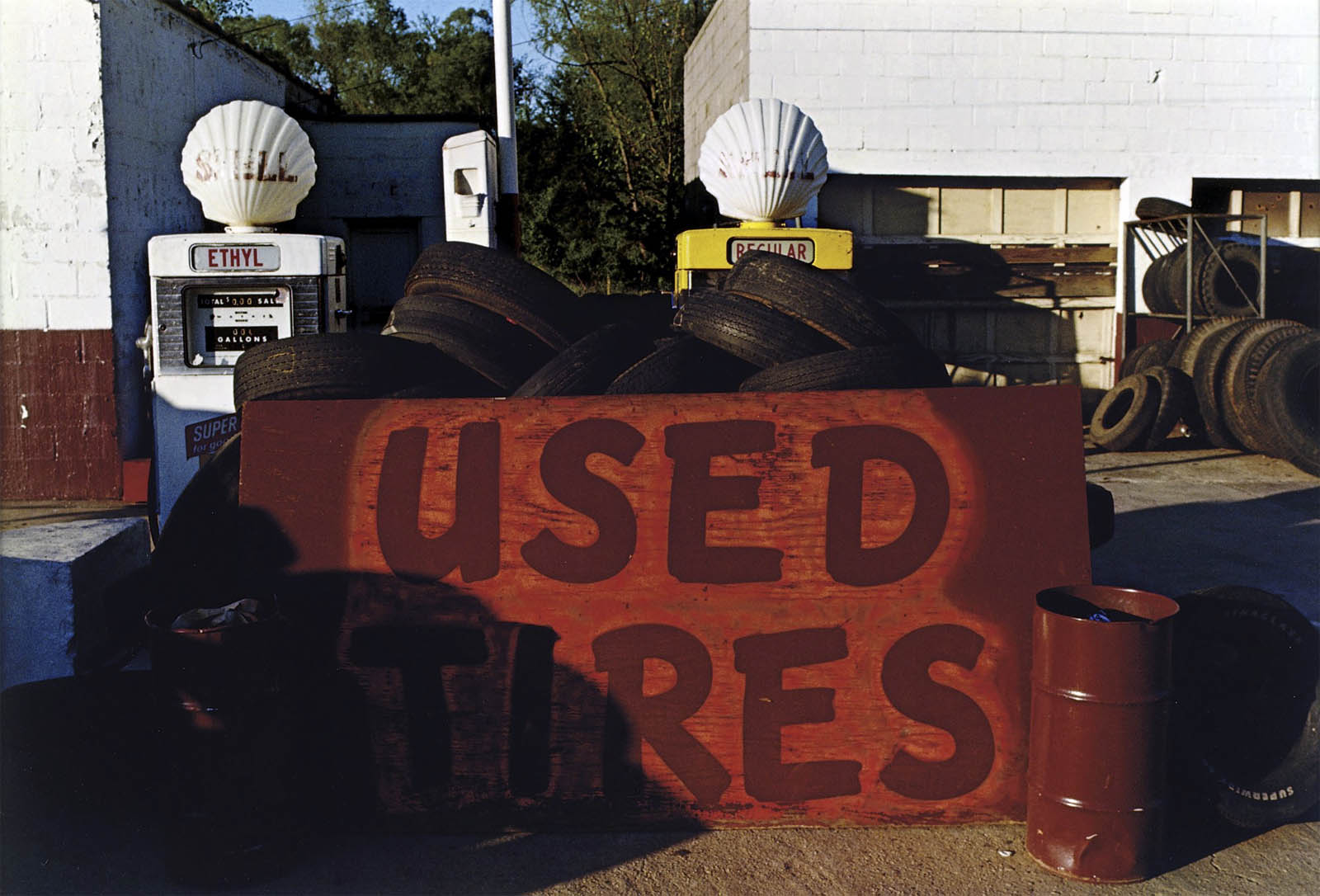
 

William Eggleston (American, b. 1939) 'Used Tires' 1973


William Eggleston (American, b. 1939)
Used Tires
1973
Dye imbibition print
Image: 33 x 48.5cm (13 x 19 1/8 in.)
National Gallery of Art
Patrons’ Permanent Fund
© Eggleston Artistic Trust
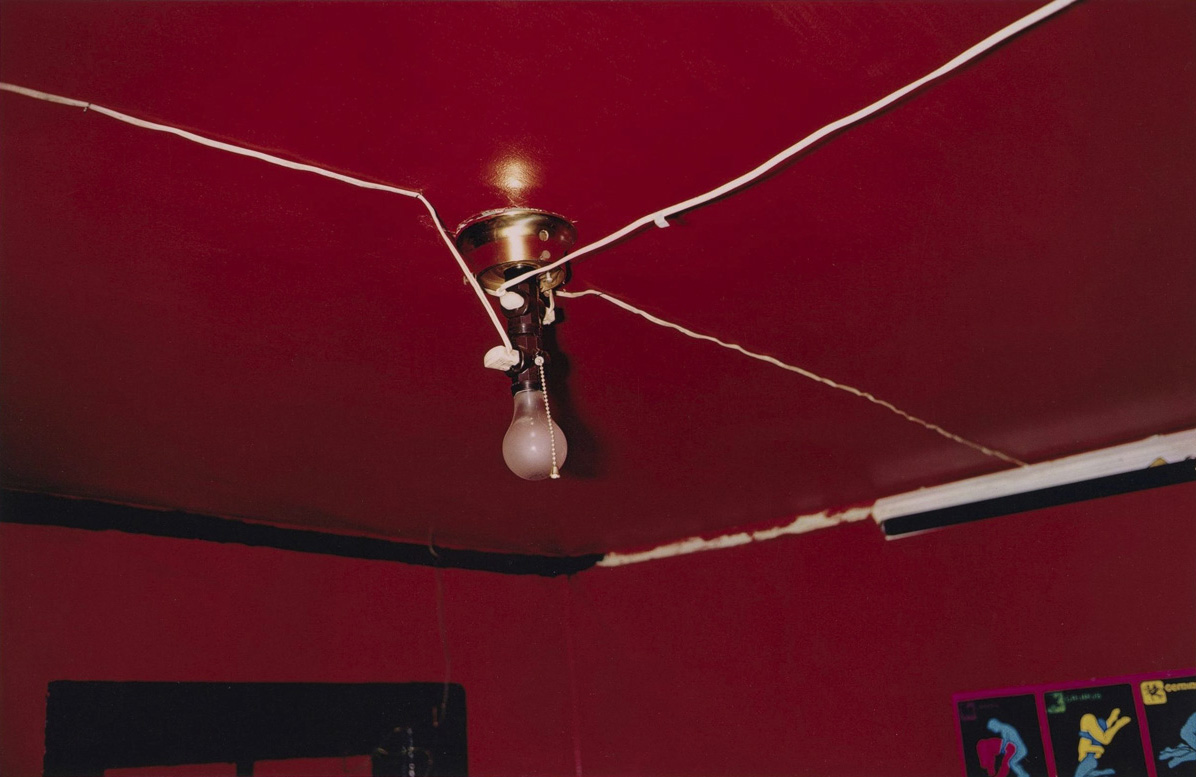
 

William Eggleston (American, b. 1939) 'Greenwood, Mississippi' 1973


William Eggleston (American, b. 1939)
Greenwood, Mississippi
1973
Dye imbibition print
Image: 32.2 x 48.2cm (12 11/16 x 19 in.)
National Gallery of Art, Corcoran Collection
Gift of the Women’s Committee of the Corcoran Gallery of
Art
© Eggleston Artistic Trust


William Eggleston has said that he has “a democratic way of looking around,” where nothing is more important or less important. For him, everyday subjects are not boring but instead offer visual richness. Here, that richness has a pronounced edge. Eggleston directed his lens up to a red ceiling with a single bare lightbulb at center. We glimpse only the top of a doorframe and a fragment of an explicit poster. The saturated, bloodlike color that dominates the composition is shocking, even menacing. It also challenged Eggleston technically as he developed his skills with dye imbibition printing. Commonly known as dye transfer, the process was labor intensive but allowed for customisation and a wide range of colours and tones.

Wall text from the exhibition


Mitchell Epstein (American, b. 1952)
'Massachusetts Turnpike' 1973, printed 2005 from the exhibition 'The '70s Lens: Reimagining Documentary Photography' at the National Gallery of Art, Washington


Mitchell Epstein (American, b. 1952)
Massachusetts Turnpike
1973, printed 2005
From the series Recreation
Chromogenic print
Image: 32.1 x 48.2cm (12 5/8 x 19 in.)
National Gallery of Art
Gift of Timothy and Suzanne Hyde in Honor of the 25th Anniversary of
Photography at the National Gallery of Art
© Black River Productions, Ltd.


Viewers of a certain age will recognize this setting as the parking lot of a Howard Johnson’s restaurant. HoJos, as they were nicknamed, were once ubiquitous along America’s highways. The cheery saturated colors belie the scene’s subject: a couple having a bad travel day. A man in suit and tie works under the hood of a beat-up Chevy Impala. His partner, wearing a pale pink skirt and top, arms crossed, appears frustrated. The cars zooming by seem to mock their immobility. Part of Mitch Epstein’s Recreation series, which documented Americans engaging in leisure activities, the photograph today evokes melancholy and nostalgia. Explaining his early turn to colour film, the artist said, “The world is in color, so why not photograph in color?”

Wall text from the exhibition


I started to work in colour, which was a radical, and some thought foolish, move in 1973. Colour photography was not yet a medium for serious photography – it was used almost exclusively for slick advertising and illustration. Within a month of shooting in colour, though, I wanted to do nothing else…

As I developed, I learned that a photograph is other than the thing itself photographed, and this freed me to think about how I could use photography to fictional effect, even while my pictures were drawn from the real world…

Photography remains a tool with which I form and sharpen my response to the world around me. Anything and everything is photographable in an infinite number of ways. That excites me.

Mitch Epstein in Lewis Blackwell. PhotoWisdom: Master Photographers on Their Art quoted quoted in “Mitch Epstein – Meet The Master Photographer,” on the Milkbooks website Nd [Online] Cited 06/02/2025
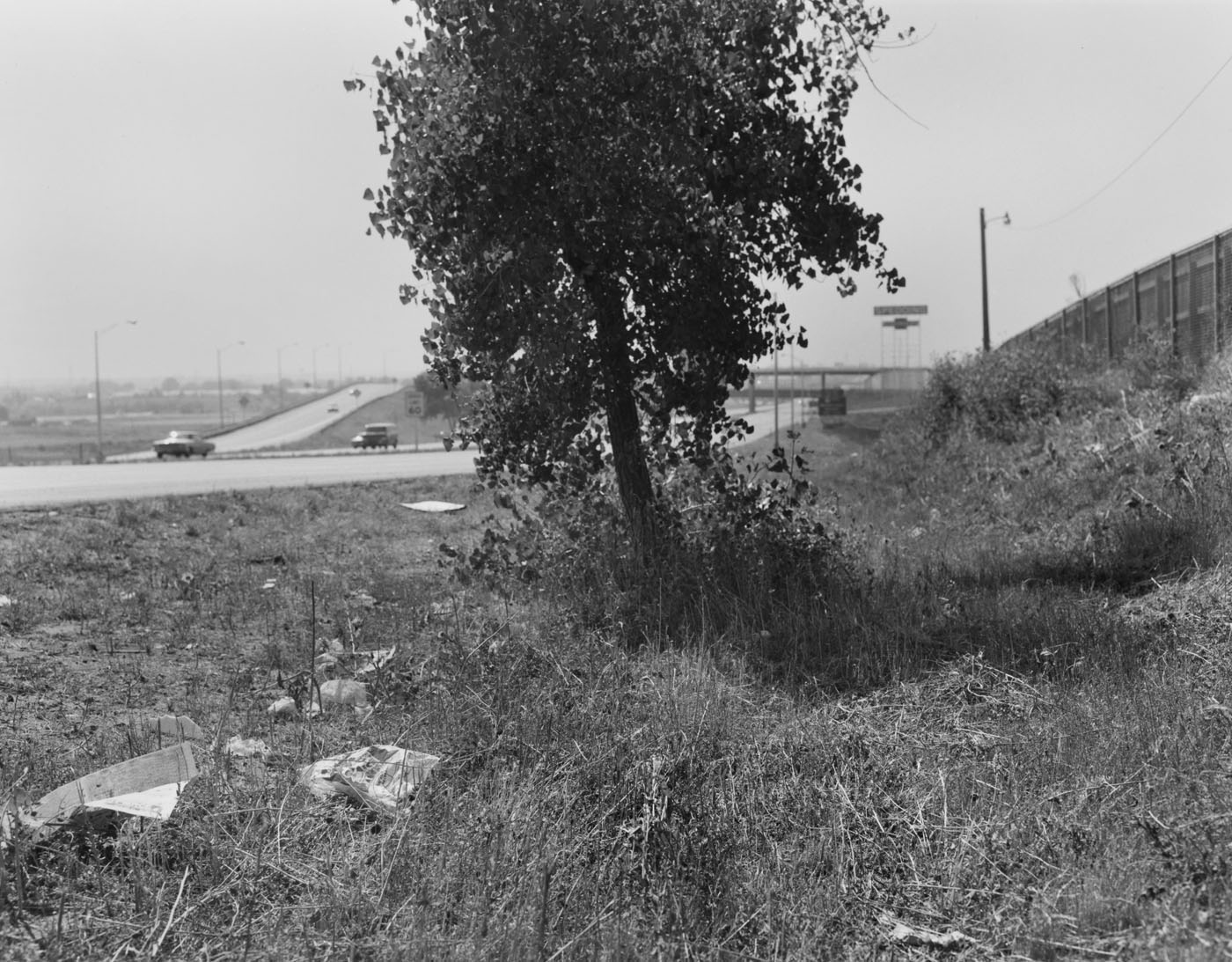
 

Robert Adams (American, b. 1937)
'Interstate 25, Denver, Colorado' 1973


Robert Adams (American, b. 1937)
Interstate 25, Denver, Colorado
1973
Gelatin silver print
Image: 15.2 x 19.3cm (6 x 7 5/8 in.)
National Gallery of Art
The Ahmanson Foundation and Gift of Robert and Kerstin Adams
© Robert Adams, Courtesy Fraenkel Gallery, San Francisco


Adams’ photographic vision is extra ordinary and I cannot fault his individual photographs. I become engrossed in them. I breathe their atmosphere. He has a resolution, both in terms of large format aesthetic, the aesthetic of beauty and of using materials, light and composition… that seems exactly right. He possesses that superlative skill of few great photographers, and by that I mean: sometimes he has true compassion** / parallel to a religious compassion, but not based on something higher / just perfect human. In some of his photographs (such as East from Flagstaff Mountain, Boulder County, Colorado 1975) he possesses real forgiveness, in others there is the perfection of cruel, the perfection of de/composition.

** achieved by Arbus, Atget and sometimes by Clift, Gowin.

And then, each image holds small clues vital to the overall conversation that is the accumulation of his work and it is in their collective accumulation of meaning that Adams’ photographs grow and build to shatter not just the American silence on environmental issues, but the deafening silence of the whole industrialised world. In their holistic nature, Adams’ body of work becomes punctum and because of this his work produces other “things”, things as great as anything the French literary theorist, essayist, philosopher, critic, and semiotician Roland Barthes wrote about. As in Barthes’ seminal work Camera Lucida, Adams’ work reminds us that the “photograph is evidence of ‘what has ceased to be’. Instead of making reality solid, it reminds us of the world’s ever changing nature.”1

Marcus Bunyan. “The quiet of the great beyond,” on the exhibition American Silence: The Photographs of Robert Adams at the National Gallery of Art, Washington, May – October 2022 on Art Blart: art and cultural memory archive website, September 25, 2022 [Online] Cited 06/02/2025

1/ Anonymous. “Roland Barthes,” on the Wikipedia website Nd [Online] Cited 23/09/2022


Michael Jang (American, b. 1951)
'Study Hall' 1973 from the exhibition 'The '70s Lens: Reimagining Documentary Photography' at the National Gallery of Art, Washington


Michael Jang (American, b. 1951)
Study Hall
1973
Gelatin silver print
15.5 × 23.5cm (6 1/8 × 9 1/4 in.)
National Gallery of Art
Charina Endowment Fund


In Study Hall, Michael Jang’s extended family sits together on a couch reading comics and a television guide, a messy tray of Kraft Teez Dip and potato chips on the table in front of them. The covers of the decidedly not studious publications block their faces, becoming stand-ins for their portraits. In Aunts and Uncles (nearby), relatives are caught joking around while posing for an official family portrait in silly sunglasses.

Jang’s humorous photographs of his Chinese American family and the trappings of their suburban lives offer a refreshing take on the often staid genre of family portraiture. They also debunk the 1970s stereotype – think The Brady Bunch – that the “all-American” family could only be white.

Wall text from the exhibition


In his series The Jangs, Michael Jang photographed family at home. His humorous photographs of their suburban lives expanded the concept of the “all-American” family – the Chinese American Jangs didn’t look like The Brady Bunch.

In Study Hall, Jang’s cousins and aunt sit together on a couch reading comics and a television guide, a messy tray of potato chips and dip on the table in front of them. The covers of decidedly not studious publications block their faces, becoming stand-ins for their portraits.

Jang’s delightful series was almost entirely forgotten. The photographs, which he had first made while a student, sat in a box in the artist’s house for decades while he established a career as a commercial photographer.

In the 2000s, Jang reconsidered this series and shared it with museums, which began adding the photographs to their collections. His photographs took on a new light in the wake of a rise of anti-Asian hate during the COVID-19 pandemic. In 2021, Jang wheat pasted images from The Jangs on buildings in San Francisco’s Chinatown.

Text from the National Gallery of Art website
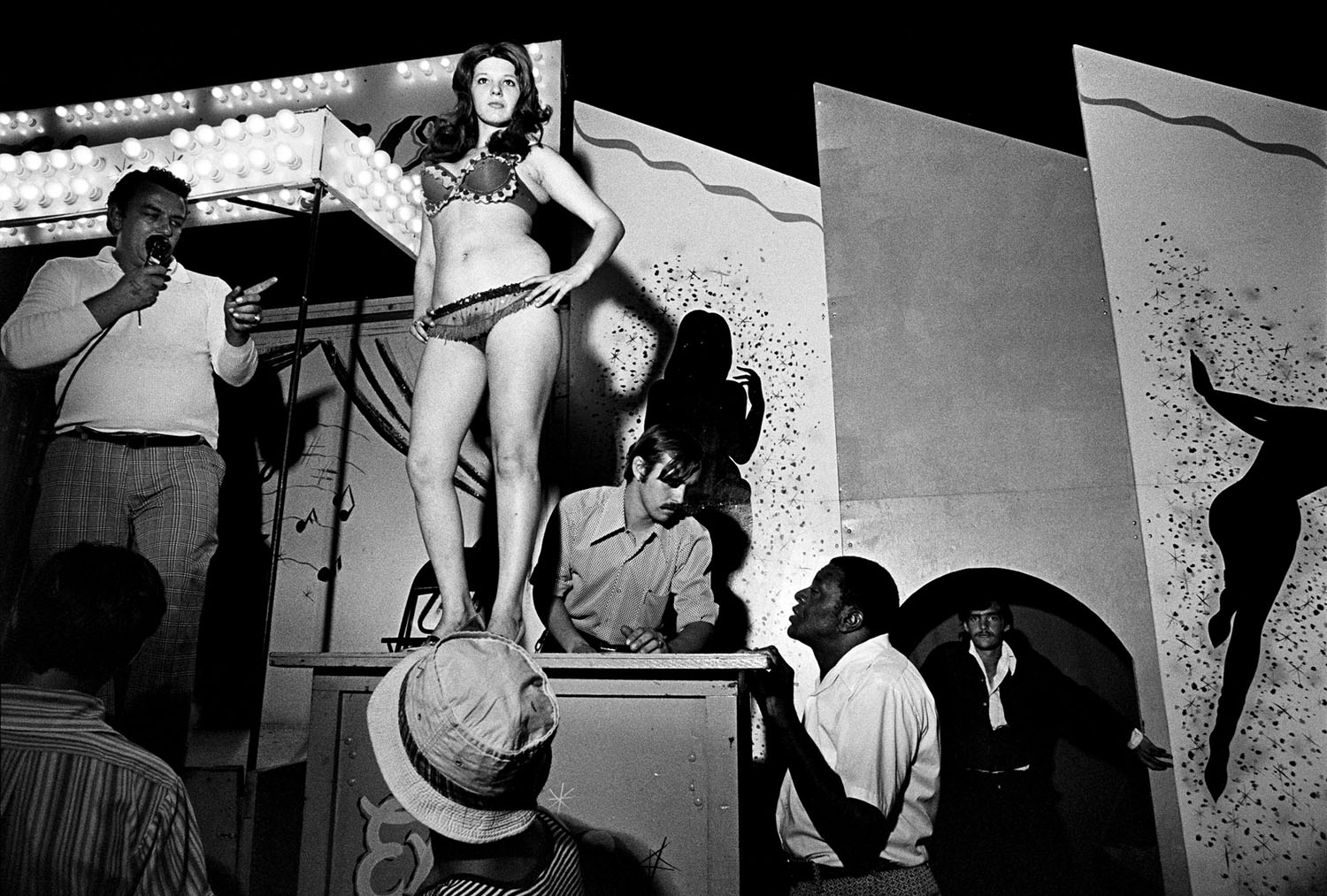
 

Susan Meiselas (American, b. 1948)
'Lena on the Bally Box, Essex Junction, Vermont' 1973


Susan Meiselas (American, b. 1948)
Lena on the Bally Box, Essex Junction, Vermont
1973
Gelatin silver print
Image: 22 x 32.5cm (8 11/16 x 12 13/16 in.)
National Gallery of Art
Anonymous Gift in honor of Sarah Greenough and Andrea Nelson


The final and most essential selection in this posting – Susan Meiselas’ 1972-1975 Carnival Strippers series – goes behind the “front” to document the lives of women who performed striptease for small-town carnivals in New England, Pennsylvania and South Carolina. “Meiselas’ frank description of these women brought a hidden world to public attention, and explored the complex role the carnival played in their lives: mobility, money and liberation, but also undeniable objectification and exploitation. Produced during the early years of the women’s movement, Carnival Strippers reflects the struggle for identity and self-esteem that characterised a complex era of change.” (Booktopia)

Intense, intimate and revealing, the series proves that we can think we know something (the phenomenal) and yet photography reveals how strange and different each world is – whether that be in trying to understand the mind of the artist and what they intended in a constructed photograph or, in this case, having an impression of someone else’s life, a life we can perceive (through the “presence” of the photograph) but never truly know (the noumenal).

Marcus Bunyan on the exhibition Known and Strange: Photographs from the Collection at the V&A Photography Centre on the Art Blart: art and cultural memory archive website, May 7, 2022 [Online] Cited 06/20/2025


Susan Meiselas (American, b. 1948)
'Tentful of Marks, Tunbridge, Vermont'
1974


Susan Meiselas (American, b. 1948)
Tentful of Marks, Tunbridge, Vermont
1974
Gelatin silver print
Image: 19.7 x 29.4cm (7 3/4 x 11 9/16 in.)
National Gallery of Art, Corcoran Collection
Museum Purchase, Photography Acquisition Fund

In Tentful of Marks, Susan Meiselas trains her camera from backstage on the legs and high heels of a carnival dancer. The all-male audience – the “marks” of the title – are in sharp focus, and they crowd around the small stage, lustfully gawking up at her. Meiselas spent three summers documenting women who performed striptease at small-town carnivals in New England, Pennsylvania, and South Carolina. In addition to making photographs, she recorded audiotapesof conversations with the dancers, giving them agency to describe their experience. Meiselas saw her project as a collaboration. Merging listening and looking, it expanded perspectives on a largely invisible and – from the dancers’ perspective – misunderstood world.

Wall text from the exhibition


Installation view of the exhibition 'The '70s Lens: Reimagining Documentary Photography' at the National Gallery of Art, Washington showing at left, Milton Rogovin's photograph 'Jimmy Webster with His Father, Verne' (1973); and at right, 'Jimmy Webster' (1985)


Installation view of the exhibition The ’70s Lens: Reimagining Documentary Photography at the National Gallery of Art, Washington showing at left, Milton Rogovin’s photograph Jimmy Webster with His Father, Verne (1973, below); and at right, Jimmy Webster (1985)

With thankx to the official Milton Rogovin Facebook page for allowing me to publish this image.


Milton Rogovin (American, 1909-2011) 'Jimmy Webster with His Father, Verne' 1973


Milton Rogovin (American, 1909-2011)
Jimmy Webster with His Father, Verne
1973
Gelatin silver print
Image: 17.4 x 15.5cm (6 7/8 x 6 1/8 in.)
National Gallery of Art
Gift of Pierre Cremieux and Denise Jarvinen

With thankx to the official Milton Rogovin Facebook page for allowing me to publish this image.


Verne Webster, sitting on his front stoop, looks guardedly at the camera while sheltering his toddler son Jimmy in a protective embrace. This is an early work from Milton Rogovin’s 30-year series documenting Buffalo’s Lower West Side. The project focused on a six-block neighbourhood that was among Buffalo’s most diverse and most impoverished. Rogovin asked permission to photograph his subjects, let them choose their poses and settings, and gave them free prints. He returned every decade or so to photograph the same individuals. A nearby picture shows Jimmy 12 years later. Looking back at Rogovin’s photographs in 2003, Jimmy Webster said, “Whenever you look at his photographs, you just see people for who they are.”

Wall text from the exhibition


John Baldessari (American, 1931-2020) 'Throwing three balls in the air to get a straight line: (best of thirty-six attempts)' 1973


John Baldessari (American, 1931-2020)
Throwing three balls in the air to get a straight line: (best of thirty-six attempts)
1973
Colour offset photolithographs
National Gallery of Art Library
David K. E. Bruce Fund


West Coast conceptual art has a whimsical air. Artists such as John Baldessari and Ed Ruscha created scenarios that lampoon both the pretense of “high art” and the self-seriousness of conceptual art, particularly as the latter was developing in New York. Beneath the humor, however, their works spoke to more substantive issues like artistic failure and social mores. In 1973 Baldessari photographed his 36 attempts to throw three balls in the air to form a straight line. He never succeeded but included his 12 best attempts in a portfolio.

Wall text from the exhibition
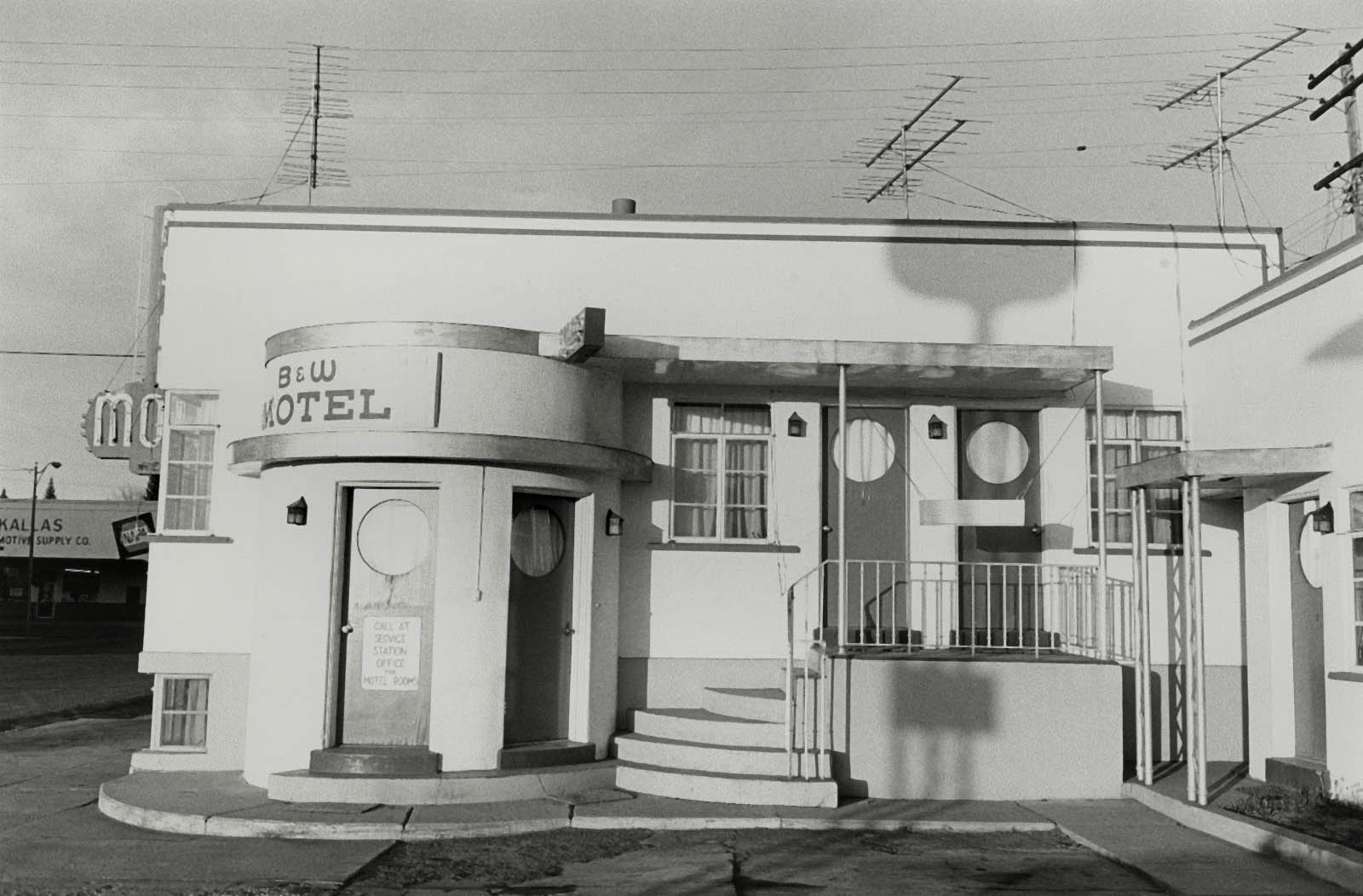
 

Henry Wessel (American, 1942-2018) 'Utah' 1974


Henry Wessel (American, 1942-2018)
Utah
1974
gelatin silver print
Image: 26.5 x 39.7cm (10 7/16 x 15 5/8 in.)
National Gallery of Art
Patrons’ Permanent Fund


Stephen Shore (American, b. 1947)
'Holden Street' July 13, 1974


Stephen Shore (American, b. 1947)
Holden Street
July 13, 1974
Chromogenic print
Image: 20.5 x 25.4cm (8 1/16 x 10 in.)
National Gallery of Art
Diana and Mallory Walker Fund


Stephen Shore’s photograph may appear casual, but it is carefully constructed. The vertical of the lamppost draws our attention to the shadowed foreground. Buildings and sidewalks on each side act as perspective lines that meet in the brighter background. Shore was exploring how three-dimensional space is rendered in two dimensions, particularly in a colour photograph. He was also examining where a once-powerful New England industrial town abruptly ended and the verdant countryside began. The lack of people, saturated colours, and clarity of detail – made possible by using a large-format 8 × 10 camera – give the picture an air of timelessness but also hyperreality.

Wall text from the exhibition
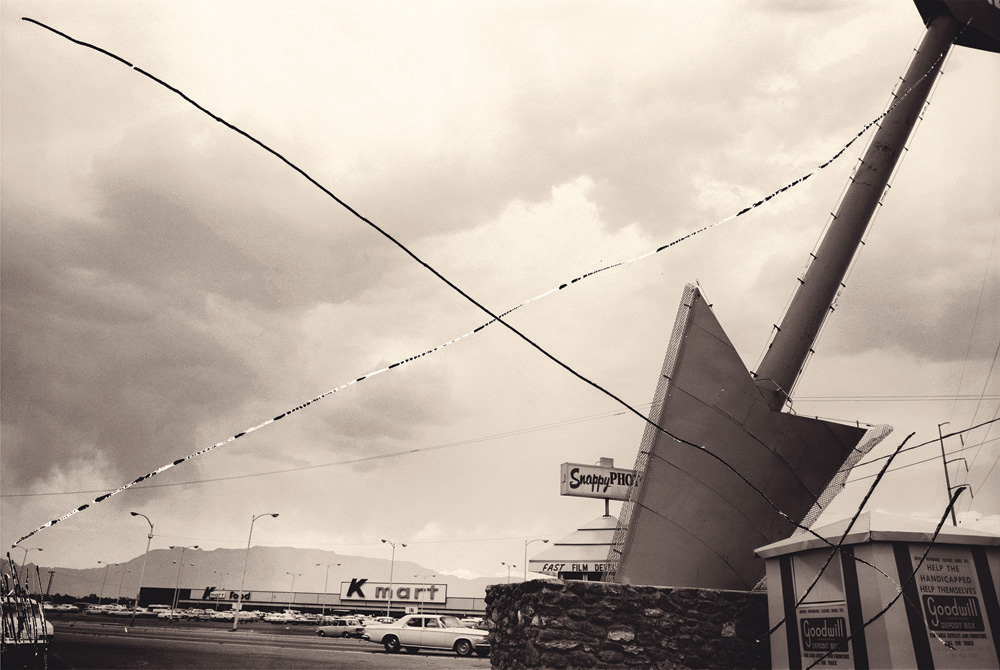
 

Thomas Barrow (American, 1938-2024) 'Dart, Albuquerque' 1974 from the exhibition 'The '70s Lens: Reimagining Documentary Photography' at the National Gallery of Art, Washington


Thomas Barrow (American, 1938-2024)
Dart
1974, printed 1994
From the series Cancellations
Gelatin silver print
23.9 × 34.6cm (9 7/16 × 13 5/8 in.)
National Gallery of Art
Randi and Bob Fisher Fund


In Dart, Thomas Barrow photographed a huge arrow that appears to have plunged from the threatening clouds above into a parking lot shared by Snappy Photos, a Goodwill drop-off bin, and a K-Mart. The work is part of his series Cancellations, documenting the suburban sprawl overtaking much of the United States. Barrow “cancelled” his images before printing by slashing the negatives with an icepick. (“Cancelling” refers to the practice of defacing a printing plate or negative to ensure no more official prints can he made from it.) This action calls attention to the photograph’s surface and its materiality, which in turn emphasise the choices Barrow made in its production.

Wall text from the exhibition


Thomas F. Barrow is an artist working with photography more than he is a photographer… For Barrow, the ideas are what matter, not the material they are realized with.

Barrow’s Cancellations series is an early expression of this artistic philosophy. Created between 1973-1981, it began when Barrow moved from Rochester, New York to Albuquerque, New Mexico to teach at UNM. Like many photographers of this era (Lewis Baltz, Frank Gohlke, Robert Adams) Barrow was struck by the transformation underway with the (sub)urbanization of the Western landscape. However, he was inspired to do more than document with his camera; he wanted to challenge his viewers while subverting some fundamental truths of photography. Inspired by a cancelled Marcel Duchamp etching (a process where the etching plate is defaced to indicate that no more official prints may be made), he began defacing his negatives with an ice pick and hole punch, “cancelling” them before making the images.

Almost 40 years later, it’s still unclear whether Barrow is canceling the photograph or the scene in the picture. He is certainly calling attention to the matrix that produced the photograph, an unheard of practice at the time and still rare today. By defacing his negatives, he has created photographs that are as much about the physical image as they are about the subject in the photograph.

David Ondrik. “Cancellations by Thomas Barrow,” in Fraction Magazine Issue 49 on the Fraction Magazine website Nd [Online] Cited 07/02/2025
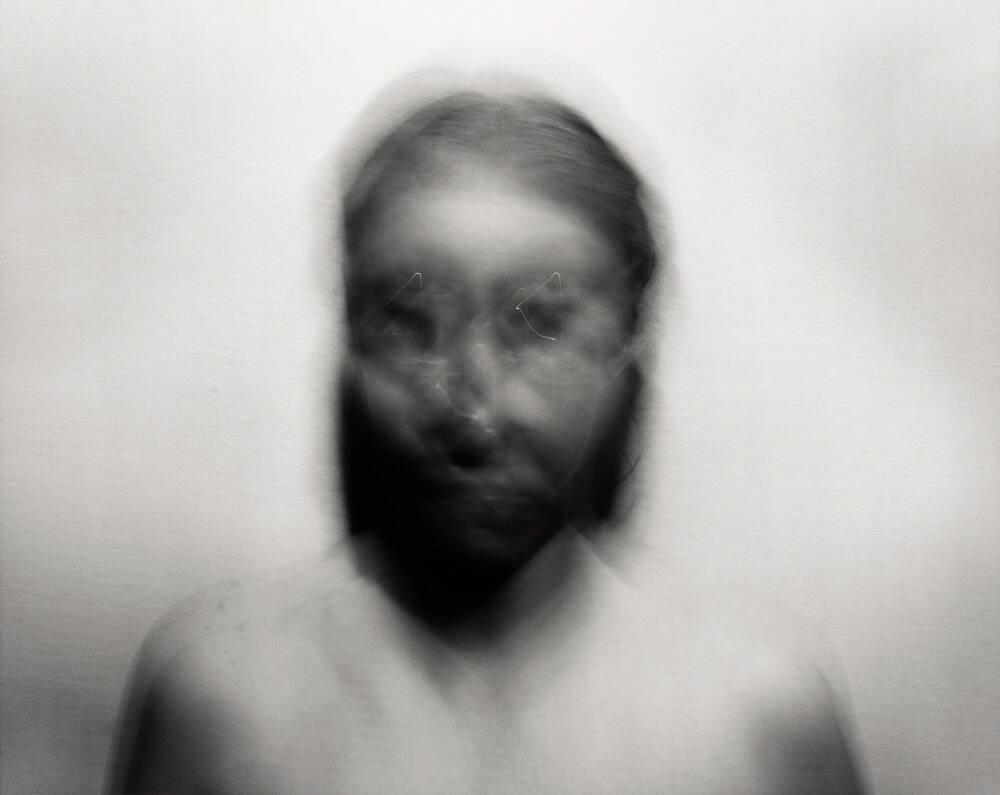
 

Blythe Bohnen (American, 1940-2022) 'Self-Portrait: Triangular Motion, Small' 1974 from the series 'Self-Portraits: Studies in Motion'


Blythe Bohnen (American, 1940-2022)
Self-Portrait: Triangular Motion, Small
1974
From the series Self-Portraits: Studies in Motion
Gelatin silver prints
National Gallery of Art
Gift of Herbert and Paula Molner


Most self-portraits offer some idea of the artist’s physical appearance and perhaps psychological state. The focus of Blythe Bohnen’s intentionally distorted self-portraits, however, is altogether different. Bohnen was interested in the physical element of artmaking – specifically, the role of her body’s movements or gestures in the creative process. Photographs usually capture an instant, but Bohnen instead used exposures of several seconds and the precise, predetermined gestures identified in her titles to distill the essence of motion. The portraits, blurry and disorienting, become more of a performance in time, condensed into a single image.

Wall text from the exhibition
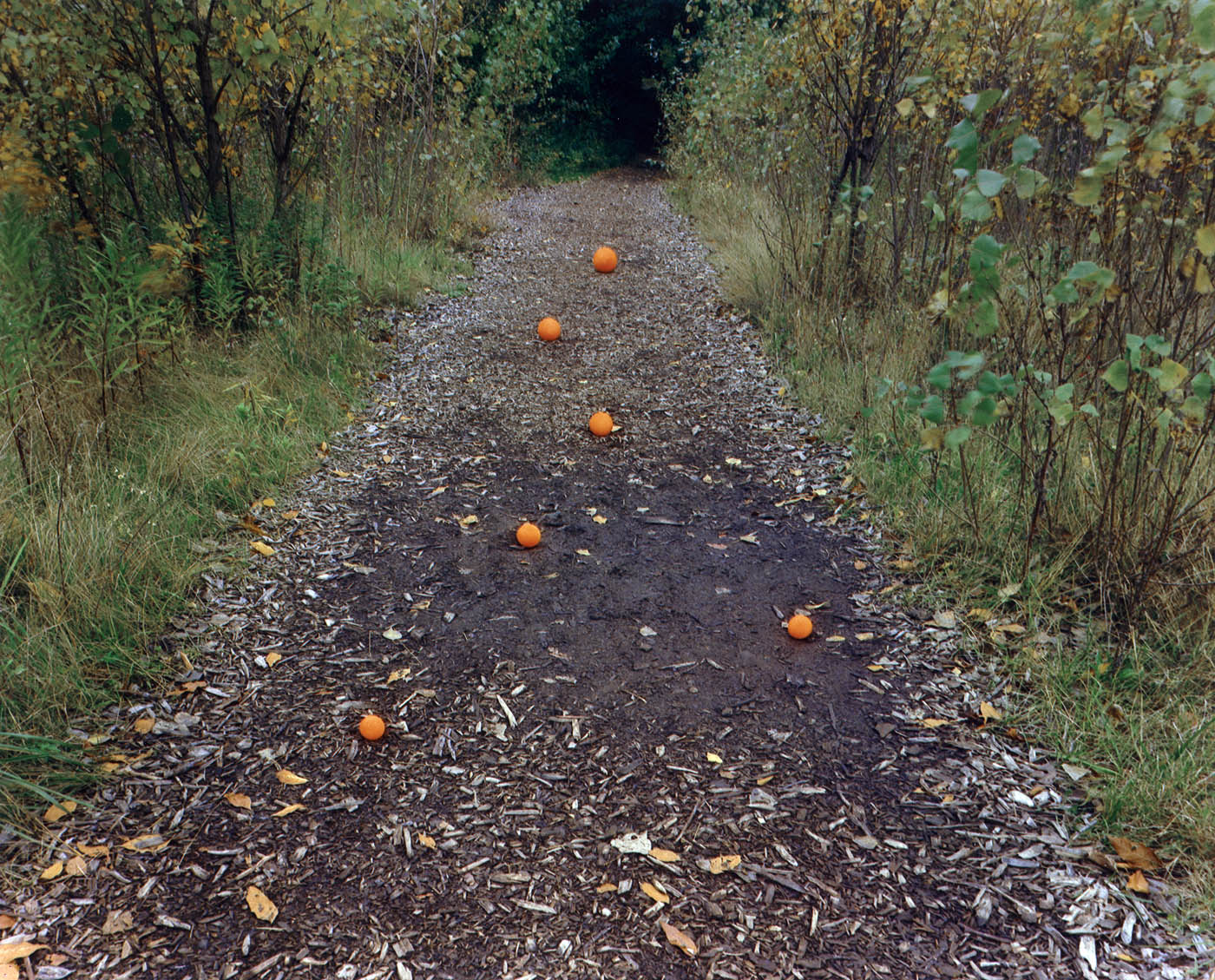
 

John Pfahl (American, 1939-2020) 'Six Oranges, Buffalo, New York' 1975 from the exhibition 'The '70s Lens: Reimagining Documentary Photography' at the National Gallery of Art, Washington


John Pfahl (American, 1939-2020)
Six Oranges, Buffalo, New York
1975
Dye imbibition print
Image: 20.6 x 25.5cm (8 1/8 x 10 1/16 in.)
National Gallery of Art
Patrons’ Permanent Fund
© The John Pfahl Trust


For the works in his series Altered Landscape, John Pfahl playfully juxtaposed the organic and natural with the manipulated and constructed. In this picture, he placed six oranges on a path in the woods. Typically, if the fruits were all the same size they would appear to grow smaller the farther from the camera they were located. Here, however, the artist has reversed that expectation, with the smallest orange sitting nearest the camera and the largest in place at the top of the picture. Through his staging, Pfahl makes the viewer aware of how a camera, by recording three-dimensional space onto a two-dimensional surface, actually produces a distorted view.

Wall text from the exhibition


In 1981, Peter C. Bunnell observes in his Introduction to James Alinder’s book Altered Landscapes: The Photographs of John Pfahl, “Our momentary, fragmented and captured vision of disorder and emotion has been replaced by a cool rendering of purposefulness as if to accord another dimension of positivism to the moving force of contemporary human awareness. Pfahl’s work is an attack on the problems of space and, ultimately, existence from a rational point of view.”

Forty years later, these photographs seem not so much rational, or picturesque, as spiritual. The human construction touches the earth lightly, almost reverentially. As Pfahl notes, utmost care is taken not to alter the actual subject in a way he would consider harmful to his positivist respect for nature. In this delicate footprint, these photographs are very prescient of the dangers of our own Anthropocene – of climate change, of raging bushfires, drought, flood and bio-exinction. We are literally destroying this planet and its creatures. Bunnell states, “Pfahl’s imagery is a sure manifestation of the belief that society can produce an art suitable to its nature and, in this case, a specific kind of photographic presence that expresses current societal values.”

Unfortunately, it’s all too late. The lesson has not been learned.

Marcus Bunyan on the exhibition John Pfahl Altered Landscapes at Joseph Bellows Gallery, La Jolla, California, November – December 2019
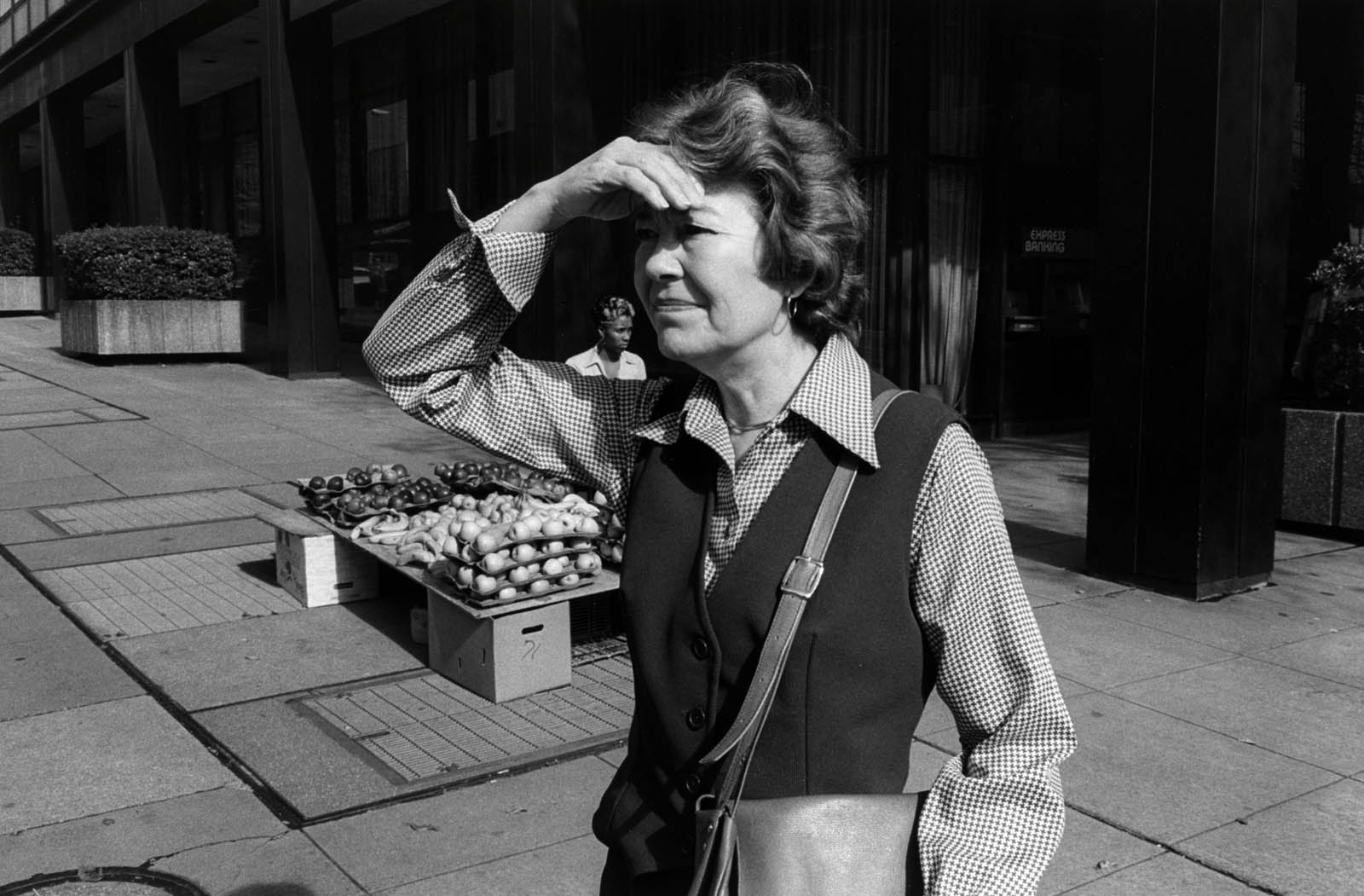
 

Anthony Hernandez (American, b. 1947) 'Washington, DC #11' 1975 from the exhibition 'The '70s Lens: Reimagining Documentary Photography' at the National Gallery of Art, Washington


Anthony Hernandez (American, b. 1947)
Washington, DC #11
1975
Gelatin silver print
Image: 18.1 × 27.31cm (7 1/8 × 10 3/4 in.)
National Gallery of Art
Corcoran Collection (Museum Purchase)


Anthony Hernandez cleverly uses the crook of a woman’s raised arm to frame a fruit seller on the street behind her. A Los Angeles – based photographer, Hernandez was invited to Washington, DC, in 1975 to participate in The Nation’s Capital in Photographs, a bicentennial documentary project organized by the Corcoran Gallery of Art. Ignoring the city’s monuments, Hernandez captured life in commercial downtown areas where the architecture and people on the street defined the landscape. This sparsely populated composition evokes urban alienation. Neither figure seems aware of the other, and both look small against the austere modern building and grate-covered sidewalk that fill the background.

Wall text from the exhibition


Anthony Hernandez’s 1970s photographs of urban inhabitants are often focused on odd-looking people staring right at the camera. His subjects often appear surprised and slightly perturbed, as if caught unaware in private moments of thought or conversation.

Following two years of study at East Los Angeles College and two years of service in the United States Army as a medic in the Vietnam War, Hernandez took up photography in earnest around 1970. He walked the streets of his native Los Angeles, observing its inhabitants. In order to work quickly and intuitively, he would pre-focus the camera and then wait for subjects to come into the zone of focus – only briefly bringing the camera to his eye as he walked past them. He repeated this strategy in other cities, including London, Madrid, Saigon, and Washington, D.C.

Text from the J. Paul Getty Museum website


Joanne Leonard (American, b. 1940)
'Memo Center with Wall Plaque' c. 1975


Joanne Leonard (American, b. 1940)
Memo Center with Wall Plaque
c. 1975
Gelatin silver print
Image: 33.3 × 43.1cm (13 1/8 × 16 15/16 in.)
National Gallery of Art
Gift of the Artist in honor of her daughter, Julia Marjorie Leonard


Dotted curtains, a flowered light switch plate, and a humorous wall plaque add a personal touch to this carefully framed picture of a so-called memo center – an area near a wall phone where notes could be jotted down that was popular in 1970s homes. A practitioner of what she called “intimate documentary,” feminist artist Joanne Leonard recorded familiar but often overlooked domestic spaces traditionally associated with women. She explained, “Through my work as an artist I’ve discovered that the realms of the personal and the public are rarely as separate as I once imagined.”

Wall text from the exhibition


In the 1970s Leonard began examining how domestic spaces are transformed through the presence of technology by photographing the interiors of her neighbours’ homes in West Oakland, California, later moving on to other locations. She captured personal objects in bedrooms and found repetition in the common appliances present in kitchen after kitchen. She also documented the proliferation of “memo centers” – areas where notes could be jotted down near the location of a telephone, which at this time was still tethered in place by a cord.

Museum of Modern Art (MoMA) Gallery label from 2022


Joanne Leonard (American, b. 1940)
'Lupe's Kitchen Window, San Leandro, California' c. 1975


Joanne Leonard (American, b. 1940)
Lupe’s Kitchen Window, San Leandro, California
c. 1975
Gelatin silver print
Image: 41.8 x 43.1cm (16 7/16 x 16 15/16 in.)
National Gallery of Art
Gift of the Artist in honor of her daughter, Julia Marjorie Leonard


Peter Hujar (American, 1934-1987) 'Susan Sontag'
1975


Peter Hujar (American, 1934-1987)
Susan Sontag
1975
Gelatin silver print
Image: 37.15 x 37.15cm (14 5/8 x 14 5/8 in.)
National Gallery of Art
Stephen G. Stein Employee Benefit Trust


Robert Cumming (American, 1943-2021) '67-Degree Body Arc Off Circle Center' 1975, printed 2022


Robert Cumming (American, 1943-2021)
67-Degree Body Arc Off Circle Center
1975, printed 2022
Inkjet print
Image: 148.59 x 185.42cm (58 1/2 x 73 in.)
National Gallery of Art
Gift of David Knaus


Sometimes Cumming used his own body as an eccentric subject, as in “67-degree body arc off circle center” from 1975. Shown in profile with his hips thrust forward, his torso arched back and his neck and head awkwardly aligned with the angle of his legs, he’s a mathematical or scientific demonstration whose geometry turns the graceful rationality of Leonardo da Vinci’s “Vitruvian Man” on its ear. The title’s geometric forms drawn around his body on the surface of the photograph might have been made with an oversized pen-nib, into which the hand on Cumming’s hip is discreetly hidden.

The artist’s photograph, like a drawing, is an artifice.

His work as a painter, sculptor and performance artist informed his distinctive, often witty approach to images made with a camera, which Cumming began to explore in 1969 and continued for more than a decade. Artists as diverse as Eve Sonneman, Jan Groover, Lew Thomas, Judy Fiskin and Lewis Baltz were blurring traditional boundaries in different but Conceptually cogent ways. Photography would never be the same.

Christopher Knight. “Robert Cumming, whose photographs transformed camera work, dies at 78,” on the Los Angeles Times website Dec. 21, 2021 [Online] Cited 07/02/2025


Francesca Woodman (American, 1958-1981) 'House #3' c. 1975-1976, printed 1997-2004


Francesca Woodman (American, 1958-1981)
House #3
c. 1975-1976, printed 1997-2004
Gelatin silver print
Image: 16.1 x 16.3cm (6 5/16 x 6 7/16 in.)
National Gallery of Art
Gift of the Heather and Tony Podesta Collection


At the far end of a decrepit room, the phantom-like figure of the photographer appears to be merging with, or emerging from, the wall. In contrast to the sharply rendered interior, she is an ethereal blur whose face can barely be made out. Both the creator and subject of most of her work, Francesca Woodman staged dreamlike performances that explore self-portraiture, the female body, and architectural space. Although sometimes carefully planned, they more often represented her spontaneous, imaginative responses to an environment. Woodman made this photograph in an abandoned house in Providence when she was in her late teens.

 Wall text from the exhibition


The 1970s was a decade of uncertainty in the United States. Americans witnessed soaring inflation, energy crises, and the Watergate scandal, as well as protests about the Vietnam War, women’s rights, gay liberation, and the environment. The profound upheaval that rocked the country formed the backdrop for a revolution in documentary photography. Activism and growing support of multiculturalism opened the field to underrepresented voices, while artistic experimentation fuelled the reimagining of what documentary photographs could look like.

The ’70s Lens: Reimagining Documentary Photography examines this compelling and contested moment of reinvention when documentary photography’s automatic association with objectivity and truthfulness came into question. The photographs on view record subjects, communities, and landscapes previously overlooked and expand the boundaries of the genre. During this turbulent decade, documentary practice became more deeply entwined with fine art, while conceptual and performance artists used the medium to preserve their ideas and record their actions. An openness to individual expression and a turn from black and white to color film further transformed a field previously celebrated for accurately representing the world and its social ills.

Drawn primarily from the National Gallery’s collection and featuring some 100 photographs by more than 80 artists, The ’70s Lens is on view from October 6, 2024, through April 6, 2025, in the West Building.

“The profound upheaval in American life during the 1970s inspired artists to question the objective nature of documentary photography,” said Kaywin Feldman, director of the National Gallery. “The extraordinary photographs on view in this exhibition explore their diverse and compelling responses, revealing relevant connections to today’s thinking about community and who gets to represent it, as well as broader concepts including photographic truth, equity, and environmental responsibility.”

The Exhibition

Organised thematically, The ’70s Lens: Reimagining Documentary Photography examines how the many documentary approaches that emerged during the 1970s reflected a radical shift in American life – and in photography itself.

Seeing Community

Spurred by the civil rights movement and a growing recognition of the rich ethnic and cultural diversity within the United States, photographers – especially from the Black, Latinx, and LGBTQ+ communities – reclaimed documentary practice to represent the fullness of their lives. Responding to a history of misrepresentation by outsiders, Anthony Barboza, Frank Espada, Mikki Ferrill, Nan Goldin, Jeanne Moutoussamy-Ashe, John Simmons, among others, focused their cameras on close-knit neighborhoods, often their own, building trusting relationships with the people they photographed. These artists worked collaboratively with their subjects to challenge preconceived notions of their communities.

Experimental Forms

Influenced by the groundbreaking photographs made by Roy DeCarava and Robert Frank beginning in the 1950s, a new generation of documentary photographers used the camera to visualise the world and their place in it. By combining clear-eyed observation with individual expression, artists such as Jim Goldberg, Sophie Rivera, and Shawn Walker revealed the complexity of the human condition from a more personal perspective. Others, such as Diane Arbus, Lee Friedlander, Anthony Hernandez, and Garry Winogrand, focused their attention on the irony and ambivalence rooted in American culture of the time, depicting everyday life with a psychological frankness. Together their revitalization of portraiture and street photography merged documentary practice with fine-art photography.

Conceptual Documents

Documentary photography became central to the practice of many conceptual artists in the 1970s. For them, the idea behind a work was more important than the finished object. John Baldessari, Thomas Barrow, and Robert Cumming interrogated the conventions of photography’s widely assumed objectivity and truthfulness by highlighting the difference between photographic appearance and reality. Others, like Susan Hiller and Dennis Oppenheim, used the camera to record their creative process, often integrating photographs with texts to address larger social issues about gender and the environment.

Performance and the Camera

Documentary photography was also integral to performance-based art during the 1970s. Many artists used the medium to record their otherwise ephemeral actions – including those who made performances specifically for the camera. This photographic documentation became a new form of art inseparable from the overall conception of the performance. Senga Nengudi in collaboration with Maren Hassinger explored the elasticity of the body through choreographed actions. Ana Mendieta and Francesca Woodman examined their identities through interventions in the environment, while Tseng Kwong Chi, Marcia Resnick, and David Wojnarowicz staged journeys and constructed histories that pushed the boundaries between truth and fiction.

Life in Color

The art world’s embrace of color film in the 1970s transformed documentary photography. Commercial color processes had existed for more than 50 years, but serious documentary photography was strictly associated with black-and-white prints. Color photography’s status changed gradually over the decade, and especially in the wake of an exhibition of William Eggleston’s mundane but incisive photographs at the Museum of Modern Art in 1976. Pictures of everyday life made in color by William Christenberry, Mitch Epstein, Richard Misrach, and John Valadez held an immediacy that fascinated viewers and offered a new framework for reflecting on contemporary life.

Alternative Landscapes

The 1970s witnessed a radical shift in how landscapes were understood and photographed. Robert Adams, Lewis Baltz, and Joe Deal challenged popular ideas of nature as pristine and timeless with pictures of environmental destruction and suburban sprawl. From grain elevators to roadside motels, Frank Gohlke and John Schott focused on structures that form the built environment, revealing how humans have shaped their surroundings. The artists in this section documented with an austere eye, and at times subversive wit, a rampant consumer culture and the damage done in the name of progress.

Intimate Documentary

Many photographers in the 1970s turned their cameras on themselves and close family members to analyze the social landscape of domestic spaces. Often informed by second-wave feminism, they prioritized interiors and life at home as topics for artistic examination. Joanne Leonard has described her narrative-rich scenes of everyday life as “intimate documentary,” while Bill Owens observed the rise of suburbia as both a place and a mentality. Concerned that documentary photography was losing its activist force, Martha Rosler and Eleanor Antin engaged with politics – especially the home front during the Vietnam War – more directly.

Press release from the National Gallery of Art


Sunil Gupta (Canadian born India, b. 1953) 'Untitled #22' 1976, printed 2023 from the exhibition 'The '70s Lens: Reimagining Documentary Photography' at the National Gallery of Art, Washington


Sunil Gupta (Canadian born India, b. 1953)
Untitled #22
1976, printed 2023
From the series Christopher Street
Gelatin silver print
Image: 61 x 91.5cm (24 x 36 in.)
National Gallery of Art
Alfred H. Moses and Fern M. Schad Fund
© Sunil Gupta


Sunil Gupta documented the emergence of a gay public space in New York’s Greenwich Village during the 1970s. The India-born Gupta had arrived from his adopted home in Montreal in 1976 to study business, but quickly decided instead to fine-tune his photographic skills. Energized by the overtly gay environment – a result, in part, of LGBTQ+ demonstrations in 1969 known as the Stonewall uprising – he started photographing people on the streets. Not impartial, Gupta was enthralled by those he encountered, including two stylishly dressed men who seem to acknowledge Gupta’s camera. In the Christopher Street series, Gupta recorded the then extraordinary act of being openly gay – a practice both political and deeply personal.

Still moved by this project, the artist has recently started making large-scale prints from his original negatives.

Wall text from the exhibition


This series was shot in New York in 1976 when I spent a year  studying photography with Lisette Model in the New School… I spent my weekends cruising with my camera, it was the heady days after Stonewall and before AIDS when we were young and busy creating a gay public space such as hadn’t really been seen before.

Text from the Sunil Gupta website
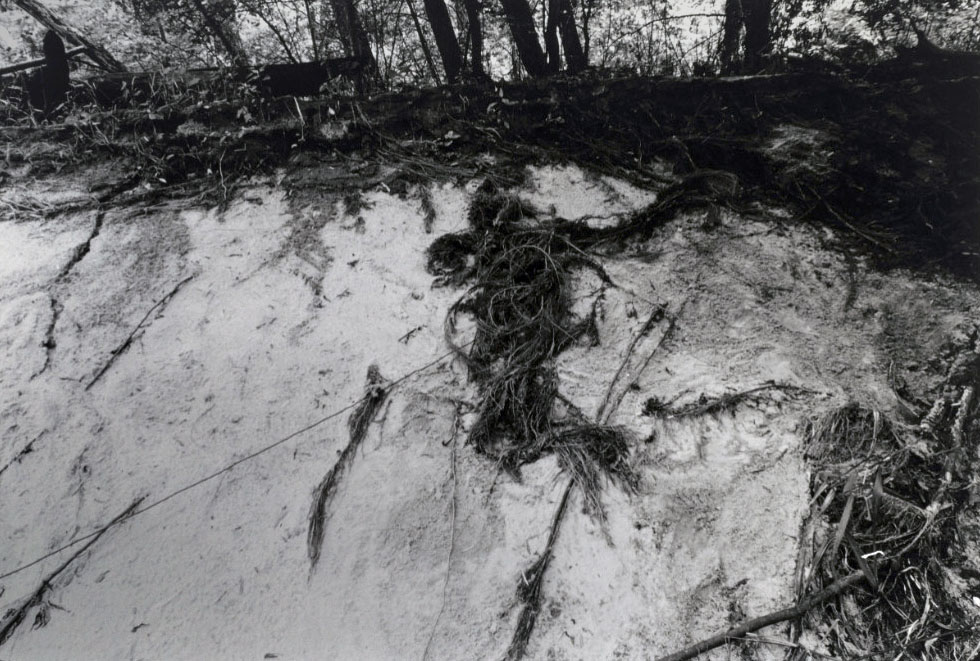
 

Ana Mendieta (Cuban-American, 1948-1985) 'Untitled' 1977-1978


Ana Mendieta (Cuban-American, 1948-1985)
Untitled
1977-1978
From the Silueta Series
Gelatin silver print
Image: 33.8 x 49.5cm (13 5/16 x 19 1/2 in.)
National Gallery of Art
Gift of the Collectors Committee


In her Silueta Series, Cuban American artist Ana Mendieta used the outline of her body to carve and shape silhouettes into the land. Informed by her interest in Afro-Cuban ritual, her fusion of performance and earthworks explored spiritual connections between nature and the female body. Mendieta’s exile with her family from Communist Cuba to the United States in the 1960s left her with a deep sense of loss. She remarked, “I have no motherland; I feel a need to join with the earth.” Photography was crucial in documenting these ephemeral pieces, preserving them before they were lost to the elements. Hauntingly beautiful, the pictures enable Mendieta’s practice to be both transitory and enduring.

Wall text from the exhibition


Larry Fink (American, 1941-2023) 'Studio 54' 1977


Larry Fink (American, 1941-2023)
Studio 54, New York City
May 1977
From the series Social Graces
Gelatin silver print
37.2 × 38cm (14 5/8 × 14 15/16 in.)
National Gallery of Art
Gift of Tony Podesta Collection, Washington, DC
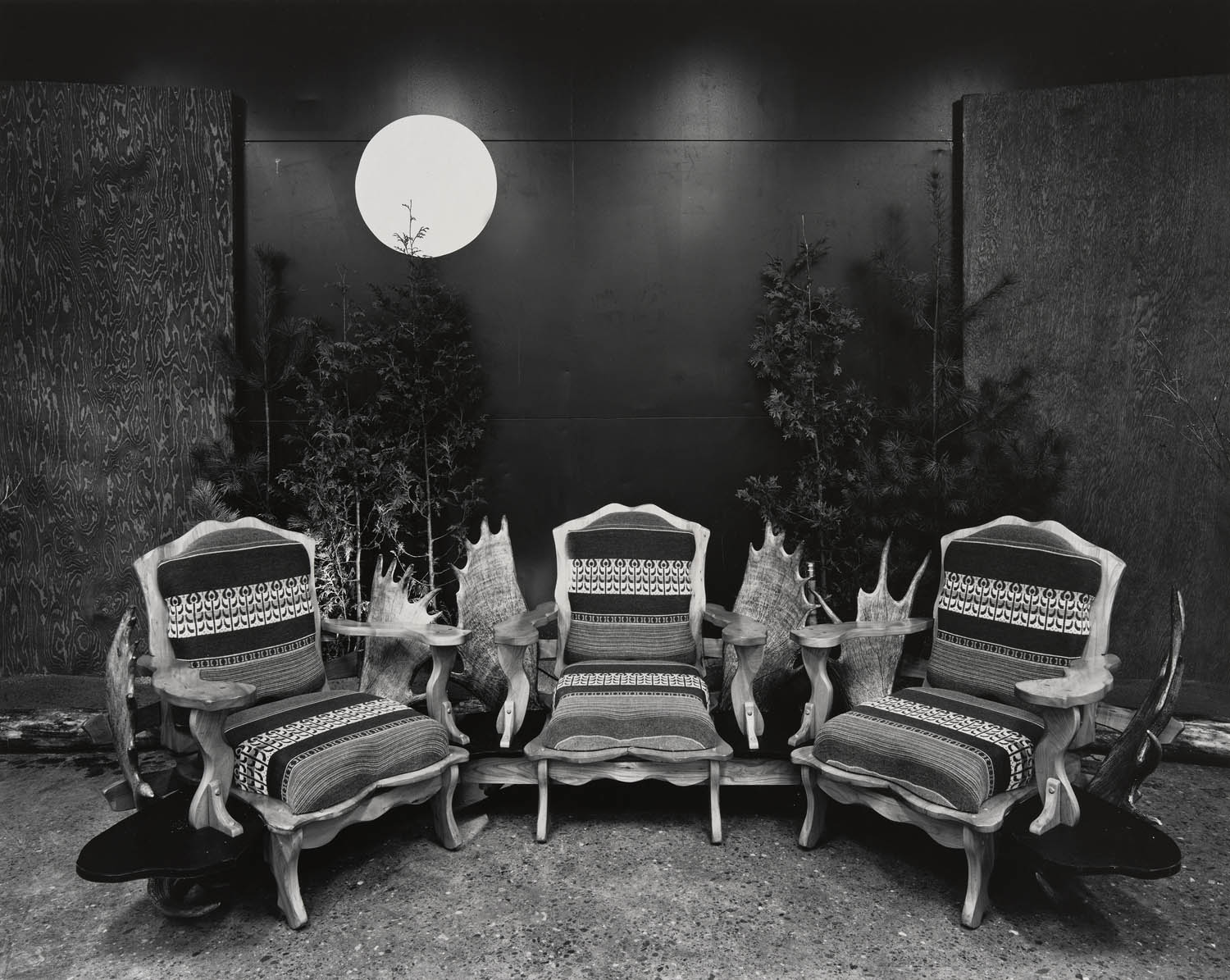
 

Lynne Cohen (American-Canadian, 1944-2014) 'Exhibition Hall' 1977


Lynne Cohen (American-Canadian, 1944-2014)
Exhibition Hall
1977
Gelatin silver print
Image (visible): 19 x 23.7cm (7 1/2 x 9 5/16 in.)
National Gallery of Art
Pepita Milmore Memorial Fund
© Estate of Lynne Cohen


In the photography of Lynne Cohen, you won’t see a single person. But you’ll find their traces everywhere. Her images feel haunted by people, as if the action has just ended or has yet to begin. Despite their absence, however, people are the true subject of the artist’s gaze. Former Gallery curator Ann Thomas explained in her essay for the 2001 National Gallery of Canada exhibition No Man’s Land: The Photography of Lynne Cohen: “While her photographs do not include human beings, they are on occasion more revealing about human behaviour than any group portrait.”

From her earliest photographs in 1971 to her final works before her death in 2014, Cohen made deadpan images of interior spaces, training her lens on the everyday peculiarities of living rooms, offices, banquet halls, social clubs, learning centres, salons, laboratories and shooting ranges. Her signature style used flat lighting, deep focus and symmetrical compositions to lend her works what she termed “a cool, dispassionate edge.” The works can be funny, sinister, maddening, familiar, bizarre and often surreal.

Although in later years Cohen would make prints large enough to envelope the viewer – introducing colour and shifting her choice of subject from domestic interiors and clubhouses to more restricted environments, such as military installations – her conceptual mission never wavered from the start. Her photography investigates how setting makes a simulation of experience, how reality is more engineered than we may care to recognize and how the spaces we design also design us in turn.

Chris Hampton. “Lynne Cohen: Art Surrounds Us,” on the National Gallery of Canada website November 22, 2024 [Online] Cite 07/02/2025


Joanne Leonard (American, b. 1940)
'Dining Area and Patterned Wallpaper, Blake Street, Berkeley, California' c. 1977


Joanne Leonard (American, b. 1940)
Dining Area and Patterned Wallpaper, Blake Street, Berkeley, California
c. 1977
Gelatin silver print
Image: 18 x 17.7cm (7 1/16 x 6 15/16 in.)
National Gallery of Art
Gift of the Artist in honor of her daughter, Julia Marjorie Leonard
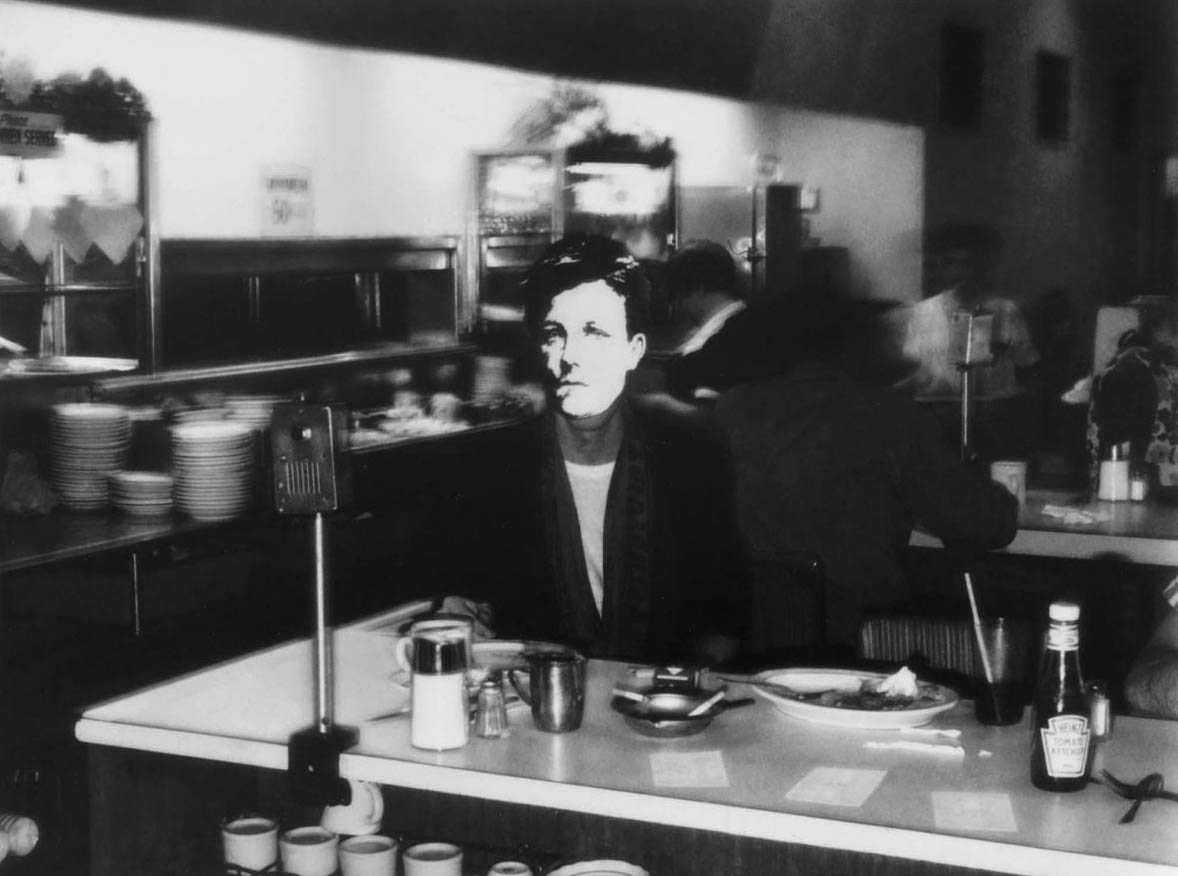
 

David Wojnarowicz (American, 1954-1992) 'Arthur Rimbaud in New York (Diner)' 1978-1979


David Wojnarowicz (American, 1954-1992)
Arthur Rimbaud in New York (Diner)
1978-1979
Gelatin silver print
Image: 17.15 x 24.13cm (6 3/4 x 9 1/2 in.)
National Gallery of Art
Gift of Funds from Heather Muir Johnson


“Transition is always a relief. Destination means death to me. If I could figure out a way to remain forever in transition, in the disconnected and unfamiliar, I could remain in a state of perpetual freedom.”

~ David Wojnarowicz , Close to the Knives: A Memoir of Disintegration


David Wojnarowicz made a series of pictures featuring friends donning a homemade mask of the 19th-century French poet Arthur Rimbaud. Staged at sites around New York that were significant to the photographer, the surrogate self-portraits explore parallels between Wojnarowicz and Rimbaud – both gay artists who rebelled against the social mores of their times. The historical figure with its unchanging expression appears alone or apart from others, a man eerily out of time. The series also documents many of the then vibrant spaces of gay life shortly before the AIDS epidemic ravaged the city’s gay community. Wojnarowicz died from AIDS-related complications at the age of 37.

Wall text from the exhibition


Sophie Rivera (American, 1938-2021) 'Untitled' 1978


Sophie Rivera (American, 1938-2021)
Untitled
1978
Gelatin silver print
Image/sheet: 25.4 x 25.4cm (10 x 10 in.)
National Gallery of Art
Estate of Martin Hurwitz


Bathed in light against a dark background, each sitter in Sophie Rivera’s portrait series of fellow New Yorkers of Puerto Rican descent, known as Nuyoricans, addresses the viewer directly. To find her subjects, Rivera asked passersby in her Harlem neighborhood if theywere Puerto Rican. If so, she invited them to her home to have their pictures taken. The mutual trust between artist and subject is reflected in the sitters’ grace and dignity.

Rivera, who defined herself as “an artist, Latino, and feminist,” sought to make Nuyoricans part of the distinguished history of American portrait photography. As she noted, “I have attempted to integrate my cultural heritage into an artistic continuum.”

Wall text from the exhibition


Rivera’s monumental portraits of Puerto Ricans in New York (or Nuyoricans) counteract the stereotypes that have circulated in the mass media. The artist found her subjects by asking passersby outside her building if they were Puerto Ricans. If they said yes, she invited them to her studio and photographed them against a dark background. Rivera’s subjects remain anonymous but never powerless. Her direct photographs allow the unassuming individuality of everyday people to speak for itself.

Our America: The Latino Presence in American Art, 2013


John M. Valadez (American, b. 1951) 'Two Guys' c. 1978, printed 2016


John M. Valadez (American, b. 1951)
Two Guys
c. 1978, printed 2016
From the East Los Angeles Urban Portrait Portfolio
Inkjet print
Sheet and image: 16 × 24 in. (40.6 × 61cm)
Smithsonian American Art Museum, Museum purchase through the Smithsonian Latino Initiatives Pool, administered by the Smithsonian Latino Center
© 1978, John M. Valadez


Multidisciplinary artist John Valadez has long been committed to depicting the lived experiences of Chicanx Angelenos like himself. Using the camera to record the world around him, Valadez first made photographs principally as source material for his drawings and paintings. In 1978 he exchanged black and white for colour film and made a series of powerful full-length portraits. His subjects included people he knew, such as the stylish young couple dressed for a birthday party, as well as people he encountered on the street, like the two men sporting identical clothes. Valadez’s aim, he said, was to capture people who weren’t being seen – by doing so, he has become a key chronicler of Chicanx identity.

Wall text from the exhibition


John M. Valadez (American, b. 1951)
'Couple Balam' c. 1978, printed 2016


John M. Valadez (American, b. 1951)
Couple Balam
c. 1978, printed 2016
From the East Los Angeles Urban Portrait Portfolio
Inkjet print
Sheet and image: 16 × 24 in. (40.6 × 61cm)
Smithsonian American Art Museum, Museum purchase through the Smithsonian Latino Initiatives Pool, administered by the Smithsonian Latino Center
© 1978, John M. Valadez


Tseng Kwong Chi (American born Hong Kong, 1950-1990) 'New York, New York' 1979, printed 2008 from the exhibition 'The '70s Lens: Reimagining Documentary Photography' at the National Gallery of Art, Washington


Tseng Kwong Chi (American born Hong Kong, 1950-1990)
New York, New York
1979, printed 2008
From the series East Meets West
Gelatin silver print
Image: 91.44 x 91.44cm (36 x 36 in.)
National Gallery of Art
Alfred H. Moses and Fern M. Schad Fund and Gift of Funds from Renee Harbers
Liddell
© Muna Tseng Dance Projects Inc.. Courtesy Yancey Richardson, New York


Tseng Kwong Chi leaps into the air in front of the Brooklyn Bridge, mimicking the joy of a first time visitor to New York. This work is from Tseng’s series East Meets West, which was inspired in part by the thaw in Chinese – United States relations following President Nixon’s visit to Beijing in 1972. A performance artist and photographer, Tseng made self-portraits as his adopted persona, Ambiguous Ambassador, at popular spots across the country. Assuming the guise of a Chinese official, Tseng – wearing what is now called a Mao suit – mischievously exposed cultural biases and notions of “the other” in American society. He made his selfies with a shutter release cable, which is visible in his right hand.

Wall text from the exhibition


Tseng Kwong Chi, known as Joseph Tseng prior to his professional career (Chinese: 曾廣智; c. 1950 – March 10, 1990), was a Hong Kong-born American photographer who was active in the East Village art scene in the 1980s.

Tseng was part of a circle of artists in the 1980s New York art scene including Keith Haring, Kenny Scharf, and Cindy Sherman. Tseng’s most famous body of work is his self-portrait series, East Meets West, also called the “Expeditionary Series”. In the series, Tseng dressed in what he called his “Mao suit” and sunglasses (dubbed a “wickedly surrealistic persona” by the New York Times), and photographed himself situated, often emotionlessly, in front of iconic tourist sites. These included the Statue of Liberty, Cape Canaveral, Disney Land, Notre Dame de Paris, and the World Trade Center. Tseng also took tens of thousands of photographs of New York graffiti artist Keith Haring throughout the 1980s working on murals, installations and the subway. In 1984, his photographs were shown with Haring’s work at the opening of the Semaphore Gallery’s East Village location in a show titled “Art in Transit”. Tseng photographed the first Concorde landing at Kennedy International Airport, from the tarmac. According to his sister, Tseng drew artistic influence from Brassai and Cartier-Bresson.

Text from the Wikipedia website


In these images Tseng inhabits a persona he referred to as the “Ambiguous Ambassador.” Wearing a Mao suit (the grey uniform associated with the Chinese Communist Party) and mirrored sunglasses, he poses next to landmarks and monuments, many of them emblems of American national identity. Like the Untitled Film Stills of Cindy Sherman – also produced in the late 1970s – East Meets West is a groundbreaking photographic work that illuminates the changeable and socially constructed nature of identity. It is also a rare piece of conceptual art to specifically reflect on the racialised experiences of Asian people in the United States. …

A gay man, Tseng was well-aware of the signifying power of dress, gesture, and posture. His donning of the Mao suit can be understood as racial camp – a playful, self-protective manoeuvre that did not prevent Tseng from being misinterpreted but did allow him to take control of the manner of the misreading. To those who perceived the levity with which Tseng wore the suit, something was revealed about his ironic sensibility. The dissonance of his appearance – the fact that the suit looked both “natural” and “unnatural” on him was not effaced but highlighted, at least to the knowing beholder. But when people were unable to see past type, the misconception did not come at the cost of Tseng’s psychic humiliation.

Tseng went on to create roughly 150 images comprising East Meets West. His performance of “Chineseness” in these photographs reveals his acute awareness of the stereotypes of Euro-American Orientalism. His blank, robotic demeanour in images such as Disneyland, California invite stock associations of the Chinese as “Yellow Peril,” and the repetition of this pose in numerous photographs would seem to tap into White America’s century-long dread of being overrun by Asian immigrants. In other images, Tseng’s stylishness and humor come through – some of the earliest photographs picture him coolly strolling the boardwalk and beaches of the popular gay vacation spot of Provincetown, Massachusetts, appearing more like a character from a French New Wave film than a visitor from the People’s Republic of China. The shutter release Tseng plainly grasps in many pictures reminds us that he is the author of these varied depicted realities; that, even as he presents himself to the Orientalist gaze, he is in command of the means of representation. Given that racial identities circulate and perpetuate via staged images – and that European American assumptions have traditionally driven those images – this is a significant gesture.

Extract from Melissa Ho. “Performing Ambiguity: The Art of Tseng Kwong Chi,” on the Smithsonian American Art Museum website June 23, 2022 [Online] Cited 06/02/2025


Jeanne Moutoussamy-Ashe (American, b. 1951)
'An Afternoon with Aunt Tootie, Daufuskie Island, South Carolina'
1979, printed 2007


Jeanne Moutoussamy-Ashe (American, b. 1951)
An Afternoon with Aunt Tootie, Daufuskie Island, South Carolina
1979, printed 2007
Gelatin silver print
Image: 21.3 x 32.4cm (8 3/8 x 12 3/4 in.)
National Gallery of Art
Gift of Funds from Diana and Mallory Walker
© Jeanne Moutoussamy-Ashe


The Gullah Geechee – enslaved people who labored on the Sea Island plantations, and their descendants – built communities all along the eastern coast of the US, from North Carolina to Florida…

From 1977 to 1982, Moutoussamy-Ashe visited Daufuskie, building relationships with the Gullah Geechee people and snapshotting rare pictures of their quotidian life. Born in Chicago, Illinois, the photographer had just returned from a six-month independent study in west Africa before she traveled to the island. At the time of her initial visit, there were only 80 permanent residents left on Daufuskie, a drastic drop from the thousands of Gullah people who had once resided there. Today, just 3% of the island’s population is Black.

Moutoussamy-Ashe’s series of monochrome images include candids of weddings, stills of a church gathering and everyday portraits of the island, showing a way of life that is treasured and fast fading.

Like many historic Black alcoves, Daufuskie has been altered by decades of gentrification. After the American civil war, many Gullah people who were already on Daufuskie made the island their permanent home once the plantation owners had left. They cultivated the land and preserved their rich culture and language, an English-based creole. But development, unfair zoning practices and other challenges have caused a sharp decrease in the Black population on the island.

Moutoussamy-Ashe’s photos offer a more private understanding of Black folks in Daufuskie, one not defined by white developers who have turned Daufuskie into a destination for tourists. The area is a placid haven in Moutoussamy-Ashe’s images. Jake and his Boat Arriving on Daufuskie’s Shore, Daufuskie Island, SC, for instance, features a man paddling a boat across a rippling river. Swooping trees frame either side of the man, who peacefully rows the vessel. The landscape looks expansive, with the scenery appearing to go on for miles. Such scenes of stillness would become rare as residents were largely driven out by the encroachment of others.

Extract from Gloria Oladipo. “How an outsider captured the intimacy of Gullah Geechee life in 13 portraits,” on The Guardian website Sat 8 Feb 2025 [Online] Cited 06/02/2025


Jeanne Moutoussamy-Ashe (American, b. 1951)
'Maid of Honor with Bride in Slippers, Daufuskie Island, South Carolina'
1980, printed 2022


Jeanne Moutoussamy-Ashe (American, b. 1951)
Maid of Honor with Bride in Slippers, Daufuskie Island, South Carolina
1980, printed 2022
Gelatin silver print
Image: 56.9 x 37.4cm (22 3/8 x 14 3/4 in.)
National Gallery of Art
Gift of Funds from Diana and Mallory Walker
© Jeanne Moutoussamy-Ashe


Between 1977 and 1981, Jeanne Moutoussamy-Ashe made extended visits to Daufuskie Island in South Carolina. The island’s relative isolation from the mainland allowed its inhabitants, who descended directly from enslaved people, to keep their distinct Gullah language and culture. Moutoussamy Ashe’s landscapes, still lifes, and portraits convey a holistic impression of the community. She captured residents’ dignity and joy – as in this photograph of a bride in fuzzy slippers, sharing a laugh with her maid of honor – but she also recorded their uncertainty in the face of development. Daufuskie’s permanent Gullah population had dwindled to 85 residents by the time Moutoussamy-Ashe published her photographs as a book in 1982.

Wall text from the exhibition


Shawn Walker (American, b. 1940)
'Untitled (New York City)' c. 1980


Shawn Walker (American, b. 1940)
Untitled (New York City)
c. 1980
Gelatin silver print
Image: 52.5 x 35cm (20 11/16 x 13 3/4 in.)
National Gallery of Art
Charina Endowment Fund
© Shawn Walker


“I see myself as a fine-arts photographer with a documentary foundation,” Shawn Walker has explained. “I look for the truth within the image, the multi-layers of existence and the ironies in our everyday lives.” Walker grounded his photographic practice in the Harlem community where he was born and raised. He joined the Kamoinge Workshop and learned from a collective of Black photographers. Inspired by Ralph Ellison’s novel Invisible Man (1952), Walker created a series of self-portraits that reveal only his silhouette. Here, the photographer pictures his reflection in a window while looking directly at us: “I look into the intersections of dark and light, into the shadows that grow the seeds of existence.”

Wall text from the exhibition


Jim Goldberg (American, b. 1953)
'Vickie Figueroa' 1981


Jim Goldberg (American, b. 1953)
Vickie Figueroa
1981
Gelatin silver print
Image/sheet: 35.4 x 27.6cm (13 15/16 x 10 7/8 in.)
National Gallery of Art
Corcoran Collection, Gift of the Artist


“My dream was to become a schoolteacher.
Mrs. Stone is rich.
I have talents but not opportunity.
I am used to standing behind
Mrs. Stone.
I have been a servant for 40 years.
Vickie Figueroa.”


Jim Goldberg (American, b. 1953) 'Clyde Norbert' 1978 from the series 'Rich and Poor'


Jim Goldberg (American, b. 1953)
Clyde Norbert
1978
From the series Rich and Poor
Gelatin silver print
Corcoran Collection
Gift of the Artist, 1994


Framed against a tall window, Clyde Norbert appears slight, flanked by his modest but carefully ordered possessions. The caption in Norbert’s own words speaks to his contrasting bold ambition: “I am going to build an empire.” In his series Rich and Poor, Jim Goldberg made portraits of both wealthy and marginalised San Franciscans where they lived. He radically shifted the relationship between photographer and subject by asking the people he photographed to respond to his pictures by writing directly on them. He believed this collaboration, which he referred to as “total documentation,” “would bring an added dimension, a deeper truth” than a photograph alone.

Wall text from the exhibition


The '70s Lens


The ’70s Lens: Reimagining Documentary Photography poster


National Gallery of Art
National Mall between 3rd and 7th Streets
Constitution Avenue NW, Washington

Opening hours:
Daily 10am – 5pm
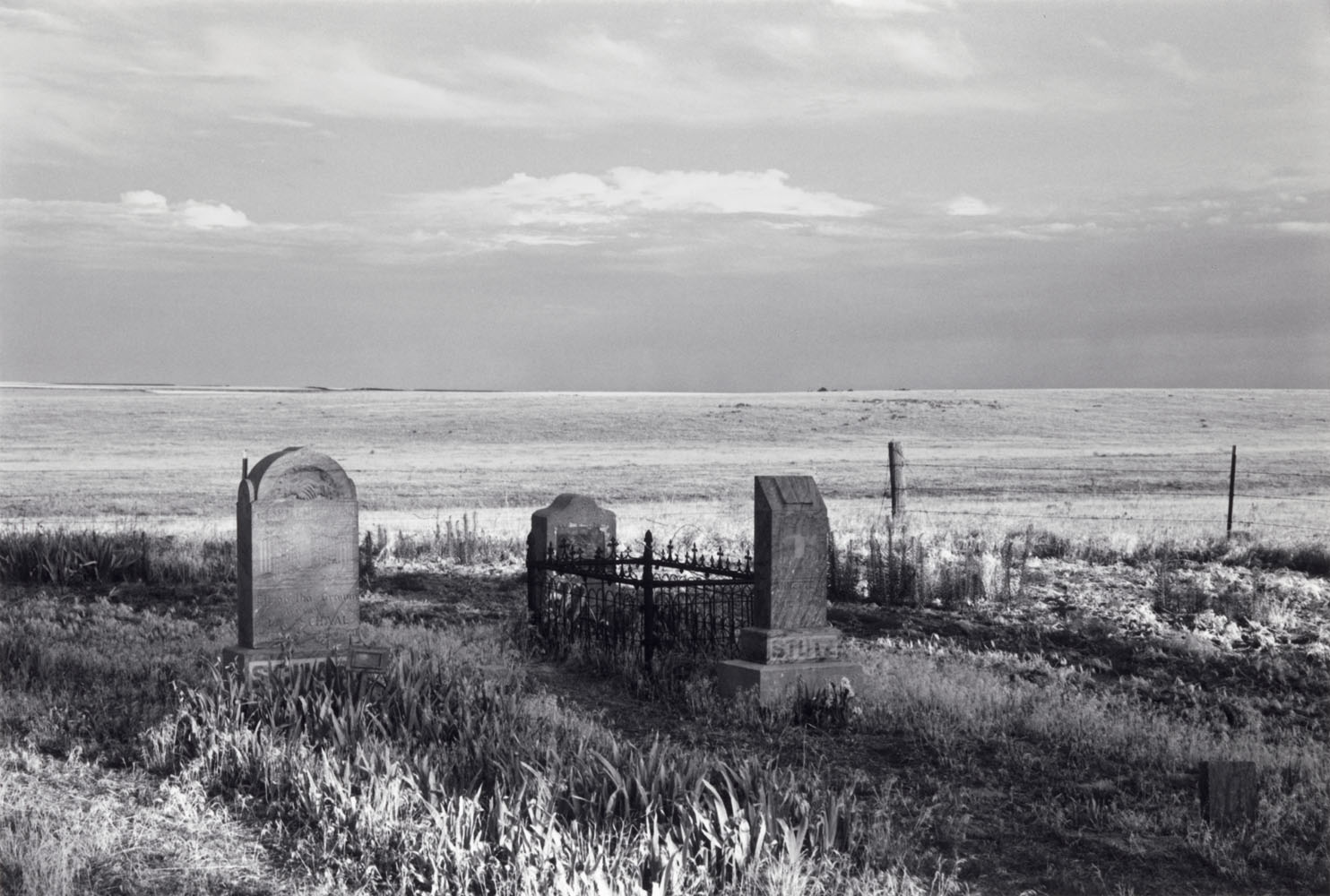
National Gallery of Art website

LIKE ART BLART ON FACEBOOK

Back to top

Exhibition: ‘American Silence: The Photographs of Robert Adams’ at the National Gallery of Art, Washington

Exhibition dates: 29th May – 2nd October, 2022

Curator: Sarah Greenough, senior curator and head of the department of photographs, National Gallery of Art


Robert Adams (American, b. 1937) 'Summer, Early Morning, Immigrant Cemetery, North of Bethune, Colorado' 1965 from the exhibition 'American Silence: The Photographs of Robert Adams' at the National Gallery of Art, Washington, May - Oct, 2022


Robert Adams (American, b. 1937)
Summer, Early Morning, Immigrant Cemetery, North of Bethune, Colorado
1965
Gelatin silver print
Image: 10.4 x 15.2 cm (4 1/8 x 6 in.)
National Gallery of Art, Washington, Pepita Milmore Memorial Fund and Gift of Robert and Kerstin Adams
© Robert Adams, Courtesy Fraenkel Gallery, San Francisco


The quiet of the great beyond

With gratitude, I admire the photographs of Robert Adams. I admire their perspicuous (“clear, lucid”, able to be seen through) and perspicacious (“keen, astute,” able to see through) nature.

They imbibe (“absorb, assimilate,” ideas or knowledge) in us “the wonder and fragility of the American landscape, its inherent beauty, and the inadequacy of our response to it… [they] capture the sense of peace and harmony that the beauty of nature can instill in us – “the silence of light,” as he calls it… [and they] question our silent complicity in the desecration of that beauty by consumerism, industrialisation, and lack of environmental stewardship… While these photographs lament the ravages that have been inflicted on the land, they also pay homage to what remains.”

Like so many photographers of the American landscape, Adams’ debt to the vision of Walker Evans can be seen in his early work, in images such as Movie Theater, Otis, Colorado (1965, below) and Catholic Church, Summer, Ramah, Colorado (1965, below) – but even in images such as Wheat Stubble, South of Thurman, Colorado (1965, below) we can begin to see the beginnings of Adams personal artistic signature, the quiet of “the great beyond” (both physically and spiritually).

In modernist photographs that step off from Walker Evans’ legacy, Adams quiet, still photographs require of the viewer contemplation and reflection… reflection on the isolation of tract housing seemingly dropped into the vast American landscape. In these photographs (such as the two photographs Newly Occupied Tract Houses, Colorado Springs, 1968 below) Adams’ use of near/far is exemplary, with the nearness of the new excavation, the new scarring of the earth, contrasting with the sublime majesty of the mountains beyond. Other more personal psychological scarring can be seen in the two photographs Colorado Springs (1968-1971, below) where single, isolated, anonymous human beings are occluded in silhouette or shadow, damned by the hot sun.

In other photographs houses become like fossilised dinosaur skeletons, their graves marked by ironic street names such as Darwin Pl. (Frame for a Tract House, Colorado Springs, 1969 below), or multiply across the landscape, breeding like some genetically identical sequence (Pikes Peak Park, Colorado Springs, 1969, below). Even petrol stations blare out the name “Frontier” as though to irrevocably define that here we live on the edge of nowhere. And so it goes in Adams’ work… isolated people living in a barren landscape being colonised and inhabited without much thought for the beauty or the destruction of the landscape.

From the mid-1970s onwards, Adams’ landscape photographs begin to eschew all but the smallest pointers to human habitation, but this makes these human marks on the landscape all the more intrusive because of it. For example, in the photograph of the vast landscape South of the Rocky Flats Nuclear Weapons Plant, Jefferson County, Colorado (1976, below) the only markings of human activity are the tyre marks in the foreground and the telegraph poles, road and cars at far right… and then the title hits you with a double-whammy, “Rocky Flats Nuclear Weapons Plant”, not present in the photograph but present in our consciousness (of the landscape). Even less evidence of human existence is signalled in the photograph Missouri River, Clay County, South Dakota (1977, below), but then we notice at bottom left a discarded tin can, just a discarded tin can, but this one tin can says so much about our use and abuse of our only habitable planet, earth.

In image after image, roads scar the landscape, planes fly overhead, industry and housing colonise the sublime, and human beings hug and are alienated amongst concrete jungles and car parks. New development erodes the earth leaving behind the detritus of human existence. Old growth trees are slaughtered in clearcut operations in which every tree has been cut down and removed. A dead albatross rots on an expanse of beach (The Sea Beach, Albatross, 2015 below) while in the distance the photographer picks out 4 ghosts of human beings (The Sea Beach, 2015 below).

Adams’ photographic vision is extra ordinary and I cannot fault his individual photographs. I become engrossed in them. I breathe their atmosphere. He has a resolution, both in terms of large format aesthetic, the aesthetic of beauty and of using materials, light and composition… that seems exactly right. He possesses that superlative skill of few great photographers, and by that I mean: sometimes he has true compassion** / parallel to a religious compassion, but not based on something higher / just perfect human. In some of his photographs (such as East from Flagstaff Mountain, Boulder County, Colorado 1975, below) he possesses real forgiveness, in others there is the perfection of cruel, the perfection of de/composition.

** achieved by Arbus, Atget and sometimes by Clift, Gowin.

And then, each image holds small clues vital to the overall conversation that is the accumulation of his work and it is in their collective accumulation of meaning that Adams’ photographs grow and build to shatter not just the American silence on environmental issues, but the deafening silence of the whole industrialised world. In their holistic nature, Adams’ body of work becomes punctum and because of this his work produces other “things”, things as great as anything the French literary theorist, essayist, philosopher, critic, and semiotician Roland Barthes wrote about. As in Barthes’ seminal work Camera Lucida, Adams’ work reminds us that the “photograph is evidence of ‘what has ceased to be’. Instead of making reality solid, it reminds us of the world’s ever changing nature.”1

Human beings can never leave anything as they find it, they always have to possess and change whatever they see in a form of desecration (the action of damaging or showing no respect toward something holy or very much respected). Except human beings do not respect the only place that have to live on, this earth. When will it change?

As Alain de Botton observes on the importance of the sublime places to the human psyche,

“If the world is unfair or beyond our understanding, sublime places suggest it is not surprising things should be thus. We are the playthings of the forces that laid out the oceans and chiselled the mountains. Sublime places acknowledge limitations that we might otherwise encounter with anxiety or anger in the ordinary flow of events. It is not just nature that defies us. Human life is as overwhelming, but it is the vast spaces of nature that perhaps provide us with the finest, the most respectful reminder of all that exceeds us. If we spend time with them, they may help us to accept more graciously the great unfathomable events that molest our lives and will inevitably return us to dust.”2


We loose these places at our peril and the peril of the entire human race.

Dr Marcus Bunyan


1/ Anonymous. “Roland Barthes,” on the Wikipedia website Nd [Online] Cited 23/09/2022

2/ Alain de Botton. The Art of Travel. London: Penguin, 2002, pp. 178-179.


Many thankx to the National Gallery of Art for allowing me to publish the photographs in the posting. Please click on the photographs for a larger version of the image.


“Robert Adams’s photographs often seem to demand that viewers do a double-take. Seemingly ordinary subjects like tree stumps, tract housing or the moon seen from a parking lot “require very careful looking and careful consideration,” says curator Sarah Greenough, before they reveal the photographer’s deeply personal visions of nature – and, sometimes, his despair at what humans have done with it.”


Peter Saenger. “Robert Adams Takes Photos That Face Facts,” on The Wall Street Journal website May 13, 2022 [Online] Cited 23/06/2022


Robert Adams (American, b. 1937) 'Wheat Stubble, South of Thurman, Colorado' 1965, printed 1988 from the exhibition 'American Silence: The Photographs of Robert Adams' at the National Gallery of Art, Washington, May - Oct, 2022


Robert Adams (American, b. 1937)
Wheat Stubble, South of Thurman, Colorado
1965, printed 1988
Gelatin silver print
Image: 22.9 x 27.9cm (9 x 11 in.)
Collection of Jeffrey Fraenkel and Alan Mark
© Robert Adams, Courtesy Fraenkel Gallery, San Francisco


For 50 years, Robert Adams (b. 1937) has made compelling, provocative, and highly influential photographs that show us the wonder and fragility of the American landscape, its inherent beauty, and the inadequacy of our response to it. This exhibition explores the reverential way he looks at the world around him and the almost palpable silence of his work.

Many of these photographs of the American West capture the sense of peace and harmony that the beauty of nature can instill in us – “the silence of light,” as he calls it, that he sees on the prairie, in the woods, and by the ocean. Other pictures question our silent complicity in the desecration of that beauty by consumerism, industrialisation, and lack of environmental stewardship. Divided into three sections – The Gift, Our Response, and Tenancy – the exhibition features some 175 works from the artist’s most important projects and includes pictures of suburban sprawl, strip malls, highways, homes, and stores, as well as rivers, skies, the prairie, and the ocean.

While these photographs lament the ravages that have been inflicted on the land, they also pay homage to what remains.


Robert Adams (American, b. 1937) 'Movie Theater, Otis, Colorado' 1965, printed c. 1977 from the exhibition 'American Silence: The Photographs of Robert Adams' at the National Gallery of Art, Washington, May - Oct, 2022


Robert Adams (American, b. 1937)
Movie Theater, Otis, Colorado
1965, printed c. 1977
Gelatin silver print
Image: 16.3 x 20.3cm (6 7/16 x 8 in.)
National Gallery of Art, Washington, Pepita Milmore Memorial Fund and Gift of Robert and Kerstin Adams
© Robert Adams, Courtesy Fraenkel Gallery, San Francisco


Robert Adams (American, b. 1937) 'Catholic Church, Winter, Ramah, Colorado' 1965, printed 1982


Robert Adams (American, b. 1937)
Catholic Church, Winter, Ramah, Colorado
1965, printed 1982
Gelatin silver print
Image: 22.3 x 16.4cm (8 3/4 x 6 7/16 in.)
National Gallery of Art, Washington, Pepita Milmore Memorial Fund and Gift of Robert and Kerstin Adams
© Robert Adams, Courtesy Fraenkel Gallery, San Francisco


Robert Adams (American, b. 1937) 'Catholic Church, Summer, Ramah, Colorado' 1965, printed 1981


Robert Adams (American, b. 1937)
Catholic Church, Summer, Ramah, Colorado
1965, printed 1981
Gelatin silver print
Image: 21.5 x 16.4cm (8 7/16 x 6 7/16 in.)
National Gallery of Art, Washington, Pepita Milmore Memorial Fund and Gift of Robert and Kerstin Adams
© Robert Adams, Courtesy Fraenkel Gallery, San Francisco


Robert Adams (American, b. 1937) 'Store, Elizabeth, Colorado' 1965, printed 1988


Robert Adams (American, b. 1937)
Store, Elizabeth, Colorado
1965, printed 1988
Gelatin silver print
Image: 26.9 x 22.8cm (10 9/16 x 9 in.)
National Gallery of Art, Washington, Pepita Milmore Memorial Fund and Gift of Robert and Kerstin Adams
© Robert Adams, Courtesy Fraenkel Gallery, San Francisco


Robert Adams (American, b. 1937) 'Arriba, Colorado' 1966, printed 1981


Robert Adams (American, b. 1937)
Arriba, Colorado
1966, printed 1981
Gelatin silver print
Image: 28.4 x 22.7cm (11 3/16 x 8 15/16 in.)
National Gallery of Art, Washington, Pepita Milmore Memorial Fund and Gift of Robert and Kerstin Adams
© Robert Adams, Courtesy Fraenkel Gallery, San Francisco


Robert Adams (American, b. 1937) 'Schoolyard, Ramah, Colorado' 1968


Robert Adams (American, b. 1937)
Schoolyard, Ramah, Colorado
1968
Gelatin silver print
Image: 15.2 x 15.2 cm (6 x 6 in.)
Private collection, San Francisco
© Robert Adams, Courtesy Fraenkel Gallery, San Francisco


Robert Adams (American, b. 1937) 'Newly Occupied Tract Houses, Colorado Springs' 1968


Robert Adams (American, b. 1937)
Newly Occupied Tract Houses, Colorado Springs
1968
Gelatin silver print
Image: 12.7 x 13.3cm (5 x 5 1/4 in.)
Private collection, San Francisco
© Robert Adams, Courtesy Fraenkel Gallery, San Francisco


Robert Adams (American, b. 1937) 'New Tract Housing, Colorado Springs' 1968, printed 1981


Robert Adams (American, b. 1937)
New Tract Housing, Colorado Springs
1968, printed 1981
Gelatin silver print
Image: 14.4 x 15cm (5 11/16 x 5 7/8 in.)
Philadelphia Museum of Art, Purchased with the Alice Newton Osborn Fund, 1982
Courtesy of the Philadelphia Museum of Art
© Robert Adams, Courtesy Fraenkel Gallery, San Francisco


Robert Adams (American, b. 1937) 'Colorado Springs' 1968, printed 1983


Robert Adams (American, b. 1937)
Colorado Springs
1968, printed 1983
Gelatin silver print
Image: 15.2 x 15.2cm (6 x 6 in.)
National Gallery of Art, Washington, Gift of Mary and Dan Solomon and Patrons’ Permanent Fund
© Robert Adams, Courtesy Fraenkel Gallery, San Francisco


Robert Adams (American, b. 1937) 'Colorado Springs' 1968-1971


Robert Adams (American, b. 1937)
Colorado Springs
1968-1971
Gelatin silver print
Image: 15.2 x 15.2cm (6 x 6 in.)
Private collection, San Francisco
© Robert Adams, Courtesy Fraenkel Gallery, San Francisco


Robert Adams (American, b. 1937) 'Alameda Avenue, Denver' 1968-1971


Robert Adams (American, b. 1937)
Alameda Avenue, Denver
1968-1971
Gelatin silver print
Image: 15.2 x 15.2cm (6 x 6 in.)
Private collection, San Francisco
© Robert Adams, Courtesy Fraenkel Gallery, San Francisco


Robert Adams (American, b. 1937) 'Northeast of Keota, Colorado' 1969, printed 1981


Robert Adams (American, b. 1937)
Northeast of Keota, Colorado
1969, printed 1981
Gelatin silver print
Image: 39.2 x 47.8cm (15 7/16 x 18 13/16 in.)
National Gallery of Art, Washington, Pepita Milmore Memorial Fund and Gift of Robert and Kerstin Adams
© Robert Adams, Courtesy Fraenkel Gallery, San Francisco


Robert Adams (American, b. 1937) 'Frame for a Tract House, Colorado Springs' 1969, printed 1984


Robert Adams (American, b. 1937)
Frame for a Tract House, Colorado Springs
1969, printed 1984
Gelatin silver print
Image: 15.1 x 15cm (5 15/16 x 5 7/8 in.)
National Gallery of Art, Washington, Gift of Mary and David Robinson
© Robert Adams, Courtesy Fraenkel Gallery, San Francisco


Robert Adams (American, b. 1937) 'Basement for a Tract House, Colorado Springs' 1969


Robert Adams (American, b. 1937)
Basement for a Tract House, Colorado Springs
1969
Gelatin silver print
Image: 26.6 x 27.6cm (10 1/2 x 10 7/8 in.)
National Gallery of Art, Washington, Gift of Robert and Kerstin Adams
© Robert Adams, Courtesy Fraenkel Gallery, San Francisco


Robert Adams (American, b. 1937) 'Colorado Springs' 1969


Robert Adams (American, b. 1937)
Colorado Springs
1969
Gelatin silver print
Image: 15.6 x 15.2cm (6 1/8 x 6 in.)
Private collection, San Francisco
© Robert Adams, Courtesy Fraenkel Gallery, San Francisco


Robert Adams (American, b. 1937) 'Pikes Peak Park, Colorado Springs' 1969


Robert Adams (American, b. 1937)
Pikes Peak Park, Colorado Springs
1969
Gelatin silver print
Image: 15.1 x 15.2cm (5 15/16 x 6 in.)
Yale University Art Gallery, Purchased with a gift from Saundra B. Lane, a grant from the Trellis Fund, and the Janet and Simeon Braguin Fund
© Robert Adams, Courtesy Fraenkel Gallery, San Francisco


Robert Adams (American, b. 1937) 'New Housing, Colorado Springs' 1969, printed 2005


Robert Adams (American, b. 1937)
New Housing, Colorado Springs
1969, printed 2005
Gelatin silver print
Image: 17.5 x 15.1cm (6 7/8 x 5 15/16 in.)
National Gallery of Art, Washington, Pepita Milmore Memorial Fund and Gift of Robert and Kerstin Adams
© Robert Adams, Courtesy Fraenkel Gallery, San Francisco


Robert Adams (American, b. 1937) 'Pikes Peak, Colorado Springs' 1969


Robert Adams (American, b. 1937)
Pikes Peak, Colorado Springs
1969
Gelatin silver print
Image: 14 x 14.9cm (5 1/2 x 5 7/8 in.)
Private collection, San Francisco
© Robert Adams, Courtesy Fraenkel Gallery, San Francisco


For 50 years, Robert Adams (b. 1937) has made compelling, provocative, and highly influential photographs that show the wonder and fragility of the American landscape, its inherent beauty, and the inadequacy of our response to it. American Silence: The Photographs of Robert Adams celebrates the art of this seminal American photographer and explores the reverential way he looks at the world around him and the almost palpable silence of his work. Organised in cooperation with the artist, the exhibition is accompanied by a fully illustrated catalog. American Silence: The Photographs of Robert Adams is on view from May 29 through October 2, 2022, in the West Building of the National Gallery of Art.

Capturing the sense of peace and harmony created through what Adams calls “the silence of light” that can be seen on the prairie, in the woods, and by the ocean, American Silence features some 175 pictures from 1965 to 2015. Other images on view question our moral silence to the desecration of that beauty by consumerism, industrialisation, and lack of environmental stewardship. Divided into three sections – The Gift, Our Response, and Tenancy – the exhibition includes works from not only the artist’s most important projects but also lesser-known ones that depict suburban sprawl, strip malls, highways, homes, and stores, as well as rivers, skies, the prairie, and the ocean. While these photographs lament the ravages that have been inflicted on the land, they also pay homage to what remains.

“The photographs in this exhibition encourage us to experience the sense of silence that the beauty of nature can inspire while asking us to question our own silent complicity in the face of its desecration,” said Kaywin Feldman, director of the National Gallery of Art. “We are deeply grateful to Robert Adams and his wife, Kerstin, for their steadfast commitment to this endeavour and for their many donations to the National Gallery. I would like to extend our thanks to the Trellis Fund, Jane P. Watkins, The Shared Earth Foundation, Randi and Bob Fisher, Wes and Kate Mitchell, Nion McEvoy, Greg and Aline Gooding, and the James D. and Kathryn K. Steele Fund for Photography whose generous support has made this exhibition possible as well as to all our lenders for their willingness to share their treasured works of art with our public.”

About the exhibition

The exhibition begins with The Gift, which presents selected works that reveal the silence, beauty, peace, and spiritual harmony found in the landscape itself. Spanning three decades, this section includes photographs from Prairie (1978), Perfect Times, Perfect Places (1988), Listening to the River (1994), Pine Valley (2005), and This Day (2011). These pictures demonstrate the artist’s exceptional ability to find the sublime in the vast vistas and quiet, often overlooked, corners of the sparse and fragile American West, particularly in Colorado and Oregon, two areas of the country that Adams knows intimately. Infused with a deep understanding of the way light articulates forms, these photographs illuminate the natural world and demonstrate how Adams seeks to illustrate, in his own words, “a quiet so absolute that it allows one to begin again, to love the future.”

The largest section of the exhibition, Our Response examines how Americans have dealt with both the potential and the vulnerability of the West. Divided into six thematic subjects arranged chronologically, this section begins with “Early Hispanic and Plains Communities,” including work from some of the artist’s earliest publications: White Churches of the Plains (1970), The Architecture and Art of Early Hispanic Colorado (1974), and Prairie (1978). These pictures portray the respectful nature of older settlements in the West and acknowledge the importance of the gravel roads, farmhouses, furrowed fields, stores, and churches. They also demonstrate how early settlers attempted to achieve a unity with nature, rather than dominate over it.

“Our Imprint on the Land” and “A New West” feature works from seminal early publications by Adams: The New West: Landscapes along the Colorado Front Range (1974), denver: A Photographic Survey of the Metropolitan Area (1977), From the Missouri West (1980), and What We Bought: The New World, Scenes from the Denver Metropolitan Area, 1970-1974 (1995). “Our Imprint on the Land” includes pictures made along the Missouri River around the time of the 1976 bicentennial of the United States, a moment of national reflection on the past and assessment of the present. The photographs in “A New West” address the construction of a new kind of American environment. Dominated by cars, highways, cheaply fabricated homes, and commercial developments, these pictures emphasise the lack of community and the great isolation that grew in these new suburban communities.

“Our Lives and Our Children” depicts the area near Rocky Flats, a nuclear weapons plant northwest of Denver, where Adams photographed the simple dignity of everyday people to illustrate what would be lost in a nuclear disaster. Our Response ends with “Southern California” and “A Mythic Forest,” drawing works from two of his sharpest critiques: Los Angeles Spring (1986), depicting the destruction of the fragile landscape around Los Angeles in the early 1980s, and Turning Back: A Photographic Journal of Re-exploration (2005), illustrating the American timber industry’s exploitation of the North­west forests.

American Silence concludes with a selection of works from one of the artist’s recent books, Tenancy: Between the River and the Sea; The Nehalem Spit, the Coast of Oregon (2017). Divided into three parts, this series of photographs was made between 2013 and 2015 along a two-mile promontory on the Oregon coast, the Nehalem Spit. The first examines the eastern edge of the spit where massive tree stumps washed up on the shore reveal the brutality of the clearcutting done farther up the Nehalem River. The second part looks at the spit itself, a sanctuary of small trees, meadows, and dunes resting near a large geologic fault, and the third depicts the ever-changing beauty and wonder of the ocean to the west, as well as the people who seek “to escape illusion and to be reconciled,” as Adams noted. Tenancy illustrates his belief that we are only temporary occupants of the land that nourishes and sustains us, and it reveals the strength of his convictions, his deep spirituality, and the eloquent power of his vision.

Exhibition Catalog

Published by the National Gallery of Art and Aperture, New York, American Silence: The Photographs of Robert Adams traces the evolution of his work, highlighting the importance of faith to his art and – through his elegant visual reckonings – how “what was” has become “what is.” It is richly illustrated, with over 200 compelling photographs that explore the profound questions of our responsibility to the land and the moral dilemmas of progress. This extensive 332-page monograph includes award-winning curator Sarah Greenough’s in-depth examination of the evolution of his art as well as personal reflections by the celebrated nonfiction author Terry Tempest Williams and writings by Adams himself, along with a timeline of the artist’s life.

Press release from the National Gallery of Art, Washington


Robert Adams (American, b. 1937) 'Genoa, Colorado' 1970


Robert Adams (American, b. 1937)
Genoa, Colorado
1970
Gelatin silver print
Image: 19.1 x 19.1cm (7 1/2 x 7 1/2 in.)
Private collection, San Francisco
© Robert Adams, Courtesy Fraenkel Gallery, San Francisco


Robert Adams (American, b. 1937) 'Boys in a Pickup, Simla, Colorado' 1970, printed 1991


Robert Adams (American, b. 1937)
Boys in a Pickup, Simla, Colorado
1970, printed 1991
Gelatin silver print
Image: 15.1 x 14.2cm (5 15/16 x 5 9/16 in.)
National Gallery of Art, Washington, Pepita Milmore Memorial Fund and Gift of Robert and Kerstin Adams
© Robert Adams, Courtesy Fraenkel Gallery, San Francisco


Robert Adams (American, b. 1937) 'Lakewood, Colorado' 1970, printed 1981


Robert Adams (American, b. 1937)
Lakewood, Colorado
1970, printed 1981
Gelatin silver print
Image: 15.1 x 15cm (5 15/16 x 5 7/8 in.)
Philadelphia Museum of Art, Purchased with the Alice Newton Osborn Fund, 1982
Courtesy of the Philadelphia Museum of Art
© Robert Adams, Courtesy Fraenkel Gallery, San Francisco


Robert Adams (American, b. 1937) 'Walking to a Shopping Center, North Edge of Denver' 1970-1974


Robert Adams (American, b. 1937)
Walking to a Shopping Center, North Edge of Denver
1970-1974
Gelatin silver print
Image: 15.1 x 19.2cm (5 15/16 x 7 9/16 in.)
Philadelphia Museum of Art, Purchased with the Alice Newton Osborn Fund, 1982
Courtesy of the Philadelphia Museum of Art
© Robert Adams, Courtesy Fraenkel Gallery, San Francisco


Robert Adams (American, b. 1937) 'Sandstone Grave Marker, Walsenburg, Colorado' 1972


Robert Adams (American, b. 1937)
Sandstone Grave Marker, Walsenburg, Colorado
1972
Gelatin silver print
Image: 15.2 x 15.2cm (6 x 6 in.)
National Gallery of Art, Washington, Pepita Milmore Memorial Fund and Gift of Robert and Kerstin Adams
© Robert Adams, Courtesy Fraenkel Gallery, San Francisco


Robert Adams (American, b. 1937) 'Clarkville, Colorado' 1972


Robert Adams (American, b. 1937)
Clarkville, Colorado
1972
Gelatin silver print
Image: 18.4 x 16.5cm (7 1/4 x 6 1/2 in.)
Private collection, San Francisco
© Robert Adams, Courtesy Fraenkel Gallery, San Francisco


Robert Adams (American, b. 1937) 'North of Keota, Colorado' 1973


Robert Adams (American, b. 1937)
North of Keota, Colorado
1973
Gelatin silver print
Image: 15.2 x 19cm (6 x 7 1/2 in.)
Private collection, San Francisco
© Robert Adams, Courtesy Fraenkel Gallery, San Francisco


Robert Adams (American, b. 1937) 'Longmont, Colorado' 1973, printed 1988


Robert Adams (American, b. 1937)
Longmont, Colorado
1973, printed 1988
Gelatin silver print
Image: 15.1 x 19.3cm (5 15/16 x 7 5/8 in.)
National Gallery of Art, Washington, Pepita Milmore Memorial Fund and Gift of Robert and Kerstin Adams
© Robert Adams, Courtesy Fraenkel Gallery, San Francisco


Robert Adams (American, b. 1937) 'Tract House, Longmont, Colorado' 1973


Robert Adams (American, b. 1937)
Tract House, Longmont, Colorado
1973
Gelatin silver print
Image: 15.6 x 19.4cm (6 1/8 x 7 5/8 in.)
Collection of Frish Brandt and August Fischer
© Robert Adams, Courtesy Fraenkel Gallery, San Francisco


Robert Adams (American, b. 1937) 'Longmont, Colorado' 1973, printed 1981


Robert Adams (American, b. 1937)
Longmont, Colorado
1973, printed 1981
Gelatin silver print
Image: 15.2 x 19.4cm (6 x 7 5/8 in.)
Philadelphia Museum of Art, Purchased with the Alice Newton Osborn Fund, 1982
Courtesy of the Philadelphia Museum of Art
© Robert Adams, Courtesy Fraenkel Gallery, San Francisco


Robert Adams (American, b. 1937) 'Lakewood, Colorado' 1973-1974, printed 2008


Robert Adams (American, b. 1937)
Lakewood, Colorado
1973-1974, printed 2008
Gelatin silver print
Image: 15.2 x 15.1cm (6 x 5 15/16 in.)
National Gallery of Art, Washington, Pepita Milmore Memorial Fund and Gift of Robert and Kerstin Adams
© Robert Adams, Courtesy Fraenkel Gallery, San Francisco


Robert Adams (American, b. 1937) 'From Interstate 25, North Edge of Denver' 1973


Robert Adams (American, b. 1937)
From Interstate 25, North Edge of Denver
1973
Gelatin silver print
Image: 15.2 x 19.1cm (6 x 7 1/2 in.)
National Gallery of Art, Washington, Pepita Milmore Memorial Fund and Gift of Robert and Kerstin Adams
© Robert Adams, Courtesy Fraenkel Gallery, San Francisco


Robert Adams (American, b. 1937) 'Mobile Home Park, North Edge of Denver' 1973, printed 2005


Robert Adams (American, b. 1937)
Mobile Home Park, North Edge of Denver
1973, printed 2005
Gelatin silver print
Image: 15.2 x 19.8cm (6 x 7 13/16 in.)
National Gallery of Art, Washington, Gift of Mary and Dan Solomon and Patrons’ Permanent Fund
© Robert Adams, Courtesy Fraenkel Gallery, San Francisco


Robert Adams (American, b. 1937) 'North Edge of Denver' 1973-1974, printed 2008


Robert Adams (American, b. 1937)
North Edge of Denver
1973-1974, printed 2008
Gelatin silver print
Image: 15.2 x 19.2cm (6 x 7 9/16 in.)
National Gallery of Art, Washington, Gift of Robert and Kerstin Adams
© Robert Adams, Courtesy Fraenkel Gallery, San Francisco


Robert Adams (American, b. 1937) 'Next to Interstate 25, Denver' 1973, printed 1991


Robert Adams (American, b. 1937)
Next to Interstate 25, Denver
1973, printed 1991
Gelatin silver print
Image: 15.2 x 19.3cm (6 x 7 5/8 in.)
National Gallery of Art, Washington, The Ahmanson Foundation and Gift of Robert and Kerstin Adams
© Robert Adams, Courtesy Fraenkel Gallery, San Francisco


Robert Adams (American, b. 1937) 'Outdoor Theater, North Edge of Denver' 1973-1974


Robert Adams (American, b. 1937)
Outdoor Theater, North Edge of Denver
1973-1974
Gelatin silver print
Image: 15.6 x 19.7cm (6 1/8 x 7 3/4 in.)
National Gallery of Art, Washington, Gift of Robert and Kerstin Adams
© Robert Adams, Courtesy Fraenkel Gallery, San Francisco


Robert Adams (American, b. 1937) 'Highway, Northeast Denver' 1973


Robert Adams (American, b. 1937)
Highway, Northeast Denver
1973
Gelatin silver print
Image: 15.1 x 19.1cm (5 15/16 x 7 1/2 in.)
Stephen G. Stein Employee Benefit Trust
© Robert Adams, Courtesy Fraenkel Gallery, San Francisco


Robert Adams (American, b. 1937) 'Longmont, Colorado' 1973-1974, printed 2001


Robert Adams (American, b. 1937)
Longmont, Colorado
1973-1974, printed 2001
gelatin silver print
Image: 16.8 x 17.2cm (6 5/8 x 6 3/4 in.)
Private collection
© Robert Adams, Courtesy Fraenkel Gallery, San Francisco


Robert Adams (American, b. 1937) 'Lakewood, Colorado' 1973


Robert Adams (American, b. 1937)
Lakewood, Colorado
1973
Gelatin silver print
Image: 14.3 x 15.1cm (5 5/8 x 5 15/16 in.)
National Gallery of Art, Washington, Pepita Milmore Memorial Fund and Gift of Robert and Kerstin Adams
© Robert Adams, Courtesy Fraenkel Gallery, San Francisco


Robert Adams (American, b. 1937) 'Lakewood, Colorado' 1973, printed 1979


Robert Adams (American, b. 1937)
Lakewood, Colorado
1973, printed 1979
gelatin silver print
Image: 15.2 x 15.2cm (6 x 6 in.)
National Gallery of Art, Washington, Pepita Milmore Memorial Fund and Gift of Robert and Kerstin Adams
© Robert Adams, Courtesy Fraenkel Gallery, San Francisco


Robert Adams (American, b. 1937) 'Longmont, Colorado' 1973


Robert Adams (American, b. 1937)
Longmont, Colorado
1973
Gelatin silver print
Image: 17.2 x 15.2cm (6 3/4 x 6 in.)
National Gallery of Art, Washington, Pepita Milmore Memorial Fund and Gift of Robert and Kerstin Adams
© Robert Adams, Courtesy Fraenkel Gallery, San Francisco


Robert Adams (American, b. 1937) 'Boulder County, Colorado' 1974


Robert Adams (American, b. 1937)
Boulder County, Colorado
1974
Gelatin silver print
Image and sheet: 15.2 x 19.2cm (6 x 7 9/16 in.)
Philadelphia Museum of Art, Purchased with the Alice Newton Osborn Fund, 1982
Courtesy of the Philadelphia Museum of Art
© Robert Adams, Courtesy Fraenkel Gallery, San Francisco


Robert Adams (American, b. 1937) 'Lakewood, Colorado' 1974, printed 1981


Robert Adams (American, b. 1937)
Lakewood, Colorado
1974, printed 1981
Gelatin silver print
Image: 22.8 x 29.2cm (9 x 11 1/2 in.)
Philadelphia Museum of Art, Purchased with the Alice Newton Osborn Fund, 1982
Courtesy of the Philadelphia Museum of Art
© Robert Adams, Courtesy Fraenkel Gallery, San Francisco


Robert Adams (American, b. 1937) 'Arvada, Colorado' 1974


Robert Adams (American, b. 1937)
Arvada, Colorado
1974
Gelatin silver print
Image: 15.2 x 19.7cm (6 x 7 3/4 in.)
National Gallery of Art, Washington, The Ahmanson Foundation and Gift of Robert and Kerstin Adams
© Robert Adams, Courtesy Fraenkel Gallery, San Francisco


Robert Adams (American, b. 1937) 'Shopping Mall and Parking Lot, Denver' 1974, printed 1980s


Robert Adams (American, b. 1937)
Shopping Mall and Parking Lot, Denver
1974, printed 1980s
Gelatin silver print
Image: 15.2 x 19.4cm (6 x 7 5/8 in.)
National Gallery of Art, Washington, Gift of Robert and Kerstin Adams
© Robert Adams, Courtesy Fraenkel Gallery, San Francisco


Robert Adams (American, b. 1937) 'Northeast from Flagstaff Mountain, Boulder County, Colorado' 1975


Robert Adams (American, b. 1937)
Northeast from Flagstaff Mountain, Boulder County, Colorado
1975
Gelatin silver print
Image: 38.1 x 47.9cm (15 x 18 7/8 in.)
National Gallery of Art, Washington, Gift of Robert and Kerstin Adams
© Robert Adams, Courtesy Fraenkel Gallery, San Francisco


Robert Adams (American, b. 1937) 'East from Flagstaff Mountain, Boulder County, Colorado' 1975


Robert Adams (American, b. 1937)
East from Flagstaff Mountain, Boulder County, Colorado
1975
Gelatin silver print
Image: 22.9 x 28.6cm (9 x 11 1/4 in.)
Fraenkel Gallery, San Francisco
© Robert Adams, Courtesy Fraenkel Gallery, San Francisco


Robert Adams (American, b. 1937) 'Garden of the Gods, El Paso County, Colorado' 1976


Robert Adams (American, b. 1937)
Garden of the Gods, El Paso County, Colorado
1976
Gelatin silver print
Image: 22.9 x 28.3cm (9 x 11 1/8 in.)
National Gallery of Art, Washington, Pepita Milmore Memorial Fund and Gift of Robert and Kerstin Adams
© Robert Adams, Courtesy Fraenkel Gallery, San Francisco


Robert Adams (American, b. 1937) 'South of the Rocky Flats Nuclear Weapons Plant, Jefferson County, Colorado' 1976


Robert Adams (American, b. 1937)
South of the Rocky Flats Nuclear Weapons Plant, Jefferson County, Colorado
1976
Gelatin silver print
Image: 17.4 x 21.8cm (6 7/8 x 8 9/16 in.)
National Gallery of Art, Washington, Pepita Milmore Memorial Fund and Gift of Robert and Kerstin Adams
© Robert Adams, Courtesy Fraenkel Gallery, San Francisco


Robert Adams (American, b. 1937) 'Lakewood, Jefferson County, Colorado' 1976


Robert Adams (American, b. 1937)
Lakewood, Jefferson County, Colorado
1976
Gelatin silver print
Image: 22.9 x 28.6cm (9 x 11 1/4 in.)
National Gallery of Art, Washington, Gift of Robert and Kerstin Adams
© Robert Adams, Courtesy Fraenkel Gallery, San Francisco


Robert Adams (American, b. 1937) 'Longmont, Colorado' 1976


Robert Adams (American, b. 1937)
Longmont, Colorado
1976
Gelatin silver print
Image: 17.8 x 17.8cm (7 x 7 in.)
Private collection, San Francisco
© Robert Adams, Courtesy Fraenkel Gallery, San Francisco


Robert Adams (American, b. 1937) 'Berthoud, Colorado' 1976


Robert Adams (American, b. 1937)
Berthoud, Colorado
1976
Gelatin silver print
Image: 12.7 x 12.7 cm (5 x 5 in.)
Philadelphia Museum of Art, Purchased with funds contributed by Marilyn L. Steinbright, 1985
Courtesy of the Philadelphia Museum of Art
© Robert Adams, Courtesy Fraenkel Gallery, San Francisco


Robert Adams (American, b. 1937) 'Missouri River, Clay County, South Dakota' 1977


Robert Adams (American, b. 1937)
Missouri River, Clay County, South Dakota
1977
Gelatin silver print
Image: 22.7 x 28.1cm (8 15/16 x 11 1/16 in.)
National Gallery of Art, Washington, Gift of Mary and Dan Solomon and Patrons’ Permanent Fund
© Robert Adams, Courtesy Fraenkel Gallery, San Francisco


Robert Adams (American, b. 1937) 'Concrete and Ice, Missouri River, Clay County, South Dakota' 1977


Robert Adams (American, b. 1937)
Concrete and Ice, Missouri River, Clay County, South Dakota
1977
Gelatin silver print
Image: 18 x 22.2cm (7 1/16 x 8 3/4 in.)
National Gallery of Art, Washington, Pepita Milmore Memorial Fund and Gift of Robert and Kerstin Adams
© Robert Adams, Courtesy Fraenkel Gallery, San Francisco


Robert Adams (American, b. 1937) 'Larimer County, Colorado' 1977


Robert Adams (American, b. 1937)
Larimer County, Colorado
1977
Gelatin silver print
Image: 22.5 x 28.1cm (8 7/8 x 11 1/16 in.)
National Gallery of Art, Washington, Gift of Jeffrey Fraenkel and Alan Mark
© Robert Adams, Courtesy Fraenkel Gallery, San Francisco


Robert Adams (American, b. 1937) 'Abandoned Car, Carbon County, Wyoming' 1977


Robert Adams (American, b. 1937)
Abandoned Car, Carbon County, Wyoming
1977
Gelatin silver print
Image: 22.8 x 28.5cm (9 x 11 1/4 in.)
National Gallery of Art, Washington, Pepita Milmore Memorial Fund and Gift of Robert and Kerstin Adams
© Robert Adams, Courtesy Fraenkel Gallery, San Francisco


Robert Adams (American, b. 1937) 'Arkansas River Canyon, Colorado' 1977


Robert Adams (American, b. 1937)
Arkansas River Canyon, Colorado
1977
Gelatin silver print
Image: 22.7 x 28.5cm (8 15/16 x 11 1/4 in.)
National Gallery of Art, Washington, Gift of Lou and Di Stovall
© Robert Adams, Courtesy Fraenkel Gallery, San Francisco


Robert Adams (American, b. 1937) 'Highway 287, Larimer County, Colorado' 1977


Robert Adams (American, b. 1937)
Highway 287, Larimer County, Colorado
1977
Gelatin silver print
Image: 22.3 x 28.5cm (8 3/4 x 11 1/4 in.)
National Gallery of Art, Washington, Pepita Milmore Memorial Fund and Gift of Robert and Kerstin Adams
© Robert Adams, Courtesy Fraenkel Gallery, San Francisco


Robert Adams (American, b. 1937) 'Longmont, Colorado' 1977


Robert Adams (American, b. 1937)
Longmont, Colorado
1977
Gelatin silver print
Image: 12.7 x 12.7cm (5 x 5 in.)
Philadelphia Museum of Art, Purchased with the Alice Newton Osborn Fund, 1982
Courtesy of the Philadelphia Museum of Art
© Robert Adams, Courtesy Fraenkel Gallery, San Francisco


Robert Adams (American, b. 1937) 'Fort Collins, Colorado' 1977, printed 1985


Robert Adams (American, b. 1937)
Fort Collins, Colorado
1977, printed 1985
Gelatin silver print
Image: 12.7 x 12.7cm (5 x 5 in.)
Philadelphia Museum of Art, Purchased with funds contributed by Marilyn L. Steinbright, 1985
Courtesy of the Philadelphia Museum of Art
© Robert Adams, Courtesy Fraenkel Gallery, San Francisco


Robert Adams (American, b. 1937) 'Development Road, San Timoteo Canyon, Redlands, California' 1977


Robert Adams (American, b. 1937)
Development Road, San Timoteo Canyon, Redlands, California
1977
Gelatin silver print
Image: 17.8 x 22.2cm (7 x 8 3/4 in.)
Philadelphia Museum of Art, Purchased with a grant from the National Endowment for the Arts and with matching funds contributed by Mr. and Mrs. Robert A. Hauslohner and Harvey S. Shipley Miller, 1980
Courtesy of the Philadelphia Museum of Art
© Robert Adams, Courtesy Fraenkel Gallery, San Francisco


Robert Adams (American, b. 1937) 'Edge of San Timoteo Canyon, Redlands, California' 1977-1978


Robert Adams (American, b. 1937)
Edge of San Timoteo Canyon, Redlands, California
1977-1978
Gelatin silver print
Image: 17.8 x 22.5cm (7 x 8 7/8 in.)
Philadelphia Museum of Art, Purchased with a grant from the National Endowment for the Arts and with matching funds contributed by Mr. and Mrs. Robert A. Hauslohner and Harvey S. Shipley Miller, 1980
Courtesy of the Philadelphia Museum of Art
© Robert Adams, Courtesy Fraenkel Gallery, San Francisco


Robert Adams (American, b. 1937) 'Santa Ana Wash, Norton Air Force Base, San Bernardino County, California' 1977-1978


Robert Adams (American, b. 1937)
Santa Ana Wash, Norton Air Force Base, San Bernardino County, California
1977-1978
Gelatin silver print
Image: 17.8 x 22.2cm (7 x 8 3/4 in.)
Philadelphia Museum of Art, Purchased with a grant from the National Endowment for the Arts and with matching funds contributed by Mr. and Mrs. Robert A. Hauslohner and Harvey S. Shipley Miller, 1980
Courtesy of the Philadelphia Museum of Art
© Robert Adams, Courtesy Fraenkel Gallery, San Francisco


Robert Adams (American, b. 1937) 'Nebraska State Highway 2, Box Butte County, Nebraska' 1978, printed 1991


Robert Adams (American, b. 1937)
Nebraska State Highway 2, Box Butte County, Nebraska
1978, printed 1991
Gelatin silver print
Image: 22.2 x 27.8cm (8 3/4 x 10 15/16 in.)
National Gallery of Art, Washington, The Ahmanson Foundation and Gift of Robert and Kerstin Adams
© Robert Adams, Courtesy Fraenkel Gallery, San Francisco


Robert Adams (American, b. 1937) 'Umatilla County, Oregon' 1978


Robert Adams (American, b. 1937)
Umatilla County, Oregon
1978
Gelatin silver print
Image: 38.2 x 47.6cm (15 1/16 x 18 3/4 in.)
National Gallery of Art, Washington, Patrons’ Permanent Fund
© Robert Adams, Courtesy Fraenkel Gallery, San Francisco


Robert Adams (American, b. 1937) 'Quarried Mesa Top, Pueblo County, Colorado' 1978


Robert Adams (American, b. 1937)
Quarried Mesa Top, Pueblo County, Colorado
1978
Gelatin silver print
Image: 38 x 47cm (14 15/16 x 18 1/2 in.)
National Gallery of Art, Washington, Patrons’ Permanent Fund
© Robert Adams, Courtesy Fraenkel Gallery, San Francisco


Robert Adams (American, b. 1937) 'Edge of San Timoteo Canyon, Redlands, California' 1978


Robert Adams (American, b. 1937)
Edge of San Timoteo Canyon, Redlands, California
1978
Gelatin silver print
Image: 22.7 x 28.3cm (8 15/16 x 11 1/8 in.)
National Gallery of Art, Washington, Gift of Mary and Dan Solomon and Patrons’ Permanent Fund
© Robert Adams, Courtesy Fraenkel Gallery, San Francisco


Robert Adams (American, b. 1937) 'Eucalyptus along Interstate 10, Redlands, California' 1978


Robert Adams (American, b. 1937)
Eucalyptus along Interstate 10, Redlands, California
1978
Gelatin silver print
Image: 22.9 x 28.3cm (9 x 11 1/8 in.)
Collection of Frish Brandt and August Fischer
© Robert Adams, Courtesy Fraenkel Gallery, San Francisco


Robert Adams (American, b. 1937) 'Longmont, Colorado' 1979, printed 1985


Robert Adams (American, b. 1937)
Longmont, Colorado
1979, printed 1985
Gelatin silver print
Image: 12.7 x 12.7cm (5 x 5 in.)
National Gallery of Art, Washington, Gift of Mary and David Robinson
© Robert Adams, Courtesy Fraenkel Gallery, San Francisco


Robert Adams (American, b. 1937) 'Longmont, Colorado' 1979


Robert Adams (American, b. 1937)
Longmont, Colorado
1979
Gelatin silver print
Image: 22.9 x 22.5cm (9 x 8 7/8 in.)
Robert and Kerstin Adams, Courtesy Fraenkel Gallery, San Francisco
© Robert Adams, Courtesy Fraenkel Gallery, San Francisco


Robert Adams is a man who walks with silences. I feel the pace of his stride in the quiet, acute considerations of his photographs of the American West. That he is drawn to sources of light in darkness, be it the moon, the shimmering light on poplar leaves, or the lonely lamp radiating on to the streets from a house in the suburbs, inspires me to pursue my own night walks in summer. In the embrace of the night, my own darkness is absorbed into an uncommon stillness that does not frighten me. I see the eye-shine of other creatures and it is a comfort to know we are not alone.

The stillness married to loneliness in Adams work is something I understand as a westerner born in the suburbs of 1955. Though we have never met, he photographed my mother on one of his walks in Colorado Springs (1968) even though she was sitting in a different living room on Moor Mont Drive in Salt Lake City, Utah. …

The silhouette of the woman I see in the window, facing the door that is closed, in a red brick house, with a putting-green lawn, where a gentle curve of concrete leads to the entrance, is the home I was raised in as a child. I write this long sentence intentionally, because those were the days of my childhood that felt languid and secure.

This was the New West that Robert Adams captured in the middle of construction. We lived inside the green square houses used in the game Monopoly. But what we always knew was that beyond the dust of development and the play money that became real, wildness awaited us – even if it was the empty lot next door or the dirt road nearby that led to the creek shaded by cottonwoods.

Cottonwoods were the guardians of our childhood. They were deemed safe by our parents. They sheltered us from the heat of summer and the claustrophobia of winter. We knew their secrets. Inside their tangled skirts of lower branches families of house wrens lived and in the upper branches, great horned owls could be heard. The cottonwoods’ massive fluted trunks were our hide-and-seek. And if we gave our siblings a hand-stirrup up, we could climb into the large embrace of the trees. Once in the cottonwood’s arms, we were camouflaged in its rustling leaves – we would simply listen. It’s where I learned to trust other species more than my own. My love of solitude was nurtured inside these cathedral groves of cottonwoods.

The cottonwoods that appear in Weld County, Colorado (1992) and reappear throughout Adams’ work are emblematic of his intimacy and understanding of the American West. Cottonwoods root themselves near water. They are the wanderer’s hope in arid country. Water is the difference between living and dying in the West. And when Adams speaks of his affection toward one particular cottonwood in a field in Colorado, photographing it over many years, only to return one day to see it cut down – he faced what remained of the beloved tree as grieving kin. The body of a man, the body of a tree, there is no separation in the shared reach of a relationship. …

Robert Adams has been led by Beauty on what could be seen as the spiritual path of the artist as he followed forms of light again and again through the depths of darkness, even his own. Never easy, but often, glorious. We are the beneficiaries of his focus. He is a trustworthy companion. I choose to walk with him. Perhaps, he learned something about tenacious love as a form of being on those solitary summer nights as he walked in moonlight with an eye toward stillness.

Terry Tempest Williams. “Terry Tempest Williams on Walking with Robert Adams,” on the National Gallery of Art website May 19, 2022 [Online] Cited 31/05/2022, excerpted from the afterword by Terry Tempest Williams in the book American Silence: The Photographs of Robert Adams.


Robert Adams (American, b. 1937) 'Denver' 1980


Robert Adams (American, b. 1937)
Denver
1980
Gelatin silver print
Image: 16.8 x 17.2cm (6 5/8 x 6 3/4 in.)
Robert and Kerstin Adams, Courtesy Fraenkel Gallery, San Francisco
© Robert Adams, Courtesy Fraenkel Gallery, San Francisco


Robert Adams (American, b. 1937) 'Denver' 1980


Robert Adams (American, b. 1937)
Denver
1980
Gelatin silver print
Image: 20.3 x 15.9cm (8 x 6 1/4 in.)
Robert and Kerstin Adams, Courtesy Fraenkel Gallery, San Francisco
© Robert Adams, Courtesy Fraenkel Gallery, San Francisco


Robert Adams (American, b. 1937) 'Denver' 1980


Robert Adams (American, b. 1937)
Denver
1980
Gelatin silver print
Image: 24.6 x 22.7cm (9 11/16 x 8 15/16 in.)
National Gallery of Art, Washington, Pepita Milmore Memorial Fund and Gift of Robert and Kerstin Adams
© Robert Adams, Courtesy Fraenkel Gallery, San Francisco


Robert Adams (American, b. 1937) 'Denver' 1980


Robert Adams (American, b. 1937)
Denver
1980
Gelatin silver print
Image: 26 x 22.6cm (10 1/4 x 8 7/8 in.)
National Gallery of Art, Washington, Pepita Milmore Memorial Fund and Gift of Robert and Kerstin Adams
© Robert Adams, Courtesy Fraenkel Gallery, San Francisco


Robert Adams (American, b. 1937) 'Longmont, Colorado' 1980


Robert Adams (American, b. 1937)
Longmont, Colorado
1980
Gelatin silver print
Image: 18.1 x 15.6cm (7 1/8 x 6 1/8 in.)
Robert and Kerstin Adams, Courtesy Fraenkel Gallery, San Francisco
© Robert Adams, Courtesy Fraenkel Gallery, San Francisco


Robert Adams (American, b. 1937) 'Denver' 1980


Robert Adams (American, b. 1937)
Denver
1980
Gelatin silver print
Image: 27.9 x 22.5cm (11 x 8 7/8 in.)
Robert and Kerstin Adams, Courtesy Fraenkel Gallery, San Francisco
© Robert Adams, Courtesy Fraenkel Gallery, San Francisco


Robert Adams (American, b. 1937) 'Weld County, Colorado' 1981, printed 1987


Robert Adams (American, b. 1937)
Weld County, Colorado
1981, printed 1987
Gelatin silver print
Image: 38 x 47.6cm (14 15/16 x 18 3/4 in.)
National Gallery of Art, Washington, Pepita Milmore Memorial Fund and Gift of Robert and Kerstin Adams
© Robert Adams, Courtesy Fraenkel Gallery, San Francisco


Robert Adams (American, b. 1937) 'Weld County, Colorado' 1981, printed 1988


Robert Adams (American, b. 1937)
Weld County, Colorado
1981, printed 1988
Gelatin silver print
Image: 37.8 x 47cm (14 7/8 x 18 1/2 in.)
National Gallery of Art, Washington, Pepita Milmore Memorial Fund and Gift of Robert and Kerstin Adams
© Robert Adams, Courtesy Fraenkel Gallery, San Francisco


Robert Adams (American, b. 1937) 'Denver' 1981


Robert Adams (American, b. 1937)
Denver
1981
Gelatin silver print
Image: 14.6 x 15.2cm (5 3/4 x 6 in.)
Robert and Kerstin Adams, Courtesy Fraenkel Gallery, San Francisco
© Robert Adams, Courtesy Fraenkel Gallery, San Francisco


Robert Adams (American, b. 1937) 'Denver' 1981


Robert Adams (American, b. 1937)
Denver
1981
Gelatin silver print
Image: 17.15 x 16.83cm (6 3/4 x 6 5/8 in.)
Robert and Kerstin Adams, Courtesy Fraenkel Gallery, San Francisco
© Robert Adams, Courtesy Fraenkel Gallery, San Francisco


Robert Adams (American, b. 1937) 'Denver' 1981


Robert Adams (American, b. 1937)
Denver
1981
Gelatin silver print
Image: 17.2 x 17.2cm (6 3/4 x 6 3/4 in.)
Robert and Kerstin Adams, Courtesy Fraenkel Gallery, San Francisco
© Robert Adams, Courtesy Fraenkel Gallery, San Francisco


Robert Adams (American, b. 1937) 'Denver' 1981


Robert Adams (American, b. 1937)
Denver
1981
Gelatin silver print
Image: 18.4 x 15.7cm (7 1/4 x 6 3/16 in.)
Yale University Art Gallery, Purchased with a gift from Saundra B. Lane, a grant from the Trellis Fund, and the Janet and Simeon Braguin Fund
© Robert Adams, Courtesy Fraenkel Gallery, San Francisco


Robert Adams (American, b. 1937) 'Denver' 1981


Robert Adams (American, b. 1937)
Denver
1981
Gelatin silver print
Image: 20.6 x 15.9cm (8 1/8 x 6 1/4 in.)
Robert and Kerstin Adams, Courtesy Fraenkel Gallery, San Francisco
© Robert Adams, Courtesy Fraenkel Gallery, San Francisco


Robert Adams (American, b. 1937) 'Denver' 1981


Robert Adams (American, b. 1937)
Denver
1981
Gelatin silver print
Image: 17.8 x 15.9cm (7 x 6 1/4 in.)
Fraenkel Gallery, San Francisco
© Robert Adams, Courtesy Fraenkel Gallery, San Francisco


Robert Adams (American, b. 1937) 'Remains of a Eucalyptus Windbreak, Redlands, California' 1982, printed 1990


Robert Adams (American, b. 1937)
Remains of a Eucalyptus Windbreak, Redlands, California
1982, printed 1990
Gelatin silver print
Image: 38.1 x 47.5cm (15 x 18 11/16 in.)
National Gallery of Art, Washington, Pepita Milmore Memorial Fund and Gift of Robert and Kerstin Adams
© Robert Adams, Courtesy Fraenkel Gallery, San Francisco


Robert Adams (American, b. 1937) 'Firebreak, above East Highland, California' 1982


Robert Adams (American, b. 1937)
Firebreak, above East Highland, California
1982
Gelatin silver print
Image: 27.4 x 22.8cm (10 13/16 x 9 in.)
National Gallery of Art, Washington, The Ahmanson Foundation and Gift of Robert and Kerstin Adams
© Robert Adams, Courtesy Fraenkel Gallery, San Francisco


Robert Adams (American, b. 1937) 'Santa Ana Wash, Redlands, California' 1982


Robert Adams (American, b. 1937)
Santa Ana Wash, Redlands, California
1982
Gelatin silver print
Image: 38 x 47.1cm (14 15/16 x 18 9/16 in.)
National Gallery of Art, Washington, Pepita Milmore Memorial Fund and Gift of Robert and Kerstin Adams
© Robert Adams, Courtesy Fraenkel Gallery, San Francisco


Robert Adams (American, b. 1937) 'Rialto, California' 1982


Robert Adams (American, b. 1937)
Rialto, California
1982
Gelatin silver print
Image: 22.8 x 28.6cm (9 x 11 1/4 in.)
National Gallery of Art, Washington, The Ahmanson Foundation and Gift of Robert and Kerstin Adams
© Robert Adams, Courtesy Fraenkel Gallery, San Francisco


Robert Adams (American, b. 1937) 'Looking toward the Mountains in Smog, Weld County, Colorado' 1983


Robert Adams (American, b. 1937)
Looking toward the Mountains in Smog, Weld County, Colorado
1983
Gelatin silver print
Image: 37.8 x 47cm (14 7/8 x 18 1/2 in.)
National Gallery of Art, Washington, Gift of Robert and Kerstin Adams
© Robert Adams, Courtesy Fraenkel Gallery, San Francisco


Robert Adams (American, b. 1937) 'Boulder County, Colorado' 1983


Robert Adams (American, b. 1937)
Boulder County, Colorado
1983
Gelatin silver print
Image: 37.8 x 47.5cm (14 7/8 x 18 11/16 in.)
National Gallery of Art, Washington, Pepita Milmore Memorial Fund and Gift of Robert and Kerstin Adams
© Robert Adams, Courtesy Fraenkel Gallery, San Francisco


Robert Adams (American, b. 1937) 'Old Estate Road, Redlands, California' 1983


Robert Adams (American, b. 1937)
Old Estate Road, Redlands, California
1983
Gelatin silver print
Image: 22.9 x 28.6cm (9 x 11 1/4 in.)
National Gallery of Art, Washington, Gift of Robert and Kerstin Adams
© Robert Adams, Courtesy Fraenkel Gallery, San Francisco


Robert Adams (American, b. 1937) 'Eucalyptus Branch, Redlands, California' 1983


Robert Adams (American, b. 1937)
Eucalyptus Branch, Redlands, California
1983
Gelatin silver print
Image: 37.9 x 47.1cm (14 15/16 x 18 9/16 in.)
Philadelphia Museum of Art, Gift of the Friends of the Philadelphia Museum of Art, 1986
Courtesy of the Philadelphia Museum of Art
© Robert Adams, Courtesy Fraenkel Gallery, San Francisco


Robert Adams (American, b. 1937) 'On Signal Hill, Overlooking Long Beach, California' 1983, printed 1990


Robert Adams (American, b. 1937)
On Signal Hill, Overlooking Long Beach, California
1983, printed 1990
Gelatin silver print
Image: 22.9 x 28.5cm (9 x 11 1/4 in.)
National Gallery of Art, Washington, Gift of Mary and Dan Solomon and Patrons’ Permanent Fund
© Robert Adams, Courtesy Fraenkel Gallery, San Francisco


Robert Adams (American, b. 1937) 'Broken Trees, East of Riverside, California' 1983


Robert Adams (American, b. 1937)
Broken Trees, East of Riverside, California
1983
Gelatin silver print
Image: 37.6 x 46.7cm (14 13/16 x 18 3/8 in.)
Philadelphia Museum of Art, Purchased with the Alice Newton Osborn Fund, 1986
Courtesy of the Philadelphia Museum of Art
© Robert Adams, Courtesy Fraenkel Gallery, San Francisco


Robert Adams (American, b. 1937) 'Eroding Edge of a Former Citrus-Growing Estate, Highland, California' 1983


Robert Adams (American, b. 1937)
Eroding Edge of a Former Citrus-Growing Estate, Highland, California
1983
Gelatin silver print
Image: 38 x 46.7cm (14 15/16 x 18 3/8 in.)
Philadelphia Museum of Art, Purchased with the Alice Newton Osborn Fund, 1986
Courtesy of the Philadelphia Museum of Art
© Robert Adams, Courtesy Fraenkel Gallery, San Francisco


Robert Adams (American, b. 1937) 'On Top of the La Loma Hills, Colton, California' 1983


Robert Adams (American, b. 1937)
On Top of the La Loma Hills, Colton, California
1983
Gelatin silver print
Image: 38 x 47cm (14 15/16 x 18 1/2 in.)
Philadelphia Museum of Art, Purchased with the Alice Newton Osborn Fund, 1986
Courtesy of the Philadelphia Museum of Art
© Robert Adams, Courtesy Fraenkel Gallery, San Francisco


Robert Adams (American, b. 1937) 'New Development on a Former Citrus-Growing Estate, Highland, California' 1983


Robert Adams (American, b. 1937)
New Development on a Former Citrus-Growing Estate, Highland, California
1983
Gelatin silver print
Image: 38.1 x 47cm (15 x 18 1/2 in.)
Andrew Szegedy-Maszak and Elizabeth Bobrick
© Robert Adams, Courtesy Fraenkel Gallery, San Francisco


Robert Adams (American, b. 1937) 'New Housing, Reche Canyon, San Bernardino County, California' 1983


Robert Adams (American, b. 1937)
New Housing, Reche Canyon, San Bernardino County, California
1983
Gelatin silver print
Image: 37.9 x 47.8cm (14 15/16 x 18 13/16 in.)
Philadelphia Museum of Art, Purchased with funds contributed by Ann and Donald W. McPhail and the Atlantic Richfield Foundation, 1986
Courtesy of the Philadelphia Museum of Art
© Robert Adams, Courtesy Fraenkel Gallery, San Francisco


Robert Adams (American, b. 1937) 'Interstate 10, West Edge of Redlands, California' 1983


Robert Adams (American, b. 1937)
Interstate 10, West Edge of Redlands, California
1983
Gelatin silver print
Image: 37.5 x 45.7cm (14 3/4 x 18 in.)
Christine and Michael J. Murray
© Robert Adams, Courtesy Fraenkel Gallery, San Francisco


Robert Adams (American, b. 1937) 'Fontana, California' 1983


Robert Adams (American, b. 1937)
Fontana, California
1983
Gelatin silver print
Image: 22.9 x 28.6cm (9 x 11 1/4 in.)
National Gallery of Art, Washington, Gift of Robert and Kerstin Adams
© Robert Adams, Courtesy Fraenkel Gallery, San Francisco


Robert Adams (American, b. 1937) 'Weld County, Colorado' 1984


Robert Adams (American, b. 1937)
Weld County, Colorado
1984
Gelatin silver print
Image: 38 x 47.7cm (14 15/16 x 18 3/4 in.)
National Gallery of Art, Washington, The Ahmanson Foundation and Gift of Robert and Kerstin Adams
© Robert Adams, Courtesy Fraenkel Gallery, San Francisco


Robert Adams (American, b. 1937) 'Weld County, Colorado' 1984


Robert Adams (American, b. 1937)
Weld County, Colorado
1984
Gelatin silver print
Image: 37.9 x 46.8cm (14 15/16 x 18 7/16 in.)
National Gallery of Art, Washington, The Ahmanson Foundation and Gift of Robert and Kerstin Adams
© Robert Adams, Courtesy Fraenkel Gallery, San Francisco


Robert Adams (American, b. 1937) 'Weld County, Colorado' 1984


Robert Adams (American, b. 1937)
Weld County, Colorado
1984
Gelatin silver print
Image: 38.1 x 47.3cm (15 x 18 5/8 in.)
National Gallery of Art, Washington, Gift of Robert and Kerstin Adams
© Robert Adams, Courtesy Fraenkel Gallery, San Francisco


Robert Adams (American, b. 1937) 'Sally, Weld County, Colorado' 1984, printed 1990


Robert Adams (American, b. 1937)
Sally, Weld County, Colorado
1984, printed 1990
Gelatin silver print
Image: 22.7 x 28.2cm (8 15/16 x 11 1/8 in.)
National Gallery of Art, Washington, Gift of Mary and David Robinson
© Robert Adams, Courtesy Fraenkel Gallery, San Francisco


Robert Adams (American, b. 1937) 'Weld County, Colorado' 1992


Robert Adams (American, b. 1937)
Weld County, Colorado
1992
Gelatin silver print
Image: 37 x 46cm (14 9/16 x 18 1/8 in.)
National Gallery of Art, Washington, Pepita Milmore Memorial Fund and Gift of Robert and Kerstin Adams
© Robert Adams, Courtesy Fraenkel Gallery, San Francisco


Robert Adams (American, b. 1937) 'Irrigation Canal, Larimer County, Colorado' 1995


Robert Adams (American, b. 1937)
Irrigation Canal, Larimer County, Colorado
1995
Gelatin silver print
Image: 29 x 22.8cm (11 7/16 x 9 in.)
National Gallery of Art, Washington, Pepita Milmore Memorial Fund and Gift of Robert and Kerstin Adams
© Robert Adams, Courtesy Fraenkel Gallery, San Francisco


Robert Adams (American, b. 1937) 'Poplars, Harney County, Oregon' 1999


Robert Adams (American, b. 1937)
Poplars, Harney County, Oregon
1999
Photogravure
Image: 50.5 x 40cm (19 7/8 x 15 3/4 in.)
National Gallery of Art, Washington, Linda Hackett and Russell Munson Fund and Alfred H. Moses and Fern M. Schad Fund
© Robert Adams, Courtesy Fraenkel Gallery, San Francisco


Robert Adams (American, b. 1937) 'Poplars, Harney County, Oregon' 1999


Robert Adams (American, b. 1937)
Poplars, Harney County, Oregon
1999
Photogravure
Image: 49.3 x 40cm (19 7/16 x 15 3/4 in.)
National Gallery of Art, Washington, Linda Hackett and Russell Munson Fund and Alfred H. Moses and Fern M. Schad Fund
© Robert Adams, Courtesy Fraenkel Gallery, San Francisco


Robert Adams (American, b. 1937) 'Poplars, Harney County, Oregon' 1999


Robert Adams (American, b. 1937)
Poplars, Harney County, Oregon
1999
Photogravure
Image: 50.5 x 40cm (19 7/8 x 15 3/4 in.)
National Gallery of Art, Washington, Linda Hackett and Russell Munson Fund and Alfred H. Moses and Fern M. Schad Fund
© Robert Adams, Courtesy Fraenkel Gallery, San Francisco


Robert Adams (American, b. 1937) 'Poplars, Harney County, Oregon' 1999


Robert Adams (American, b. 1937)
Poplars, Harney County, Oregon
1999
Photogravure
Image: 50 x 40cm (19 11/16 x 15 3/4 in.)
National Gallery of Art, Washington, Linda Hackett and Russell Munson Fund and Alfred H. Moses and Fern M. Schad Fund
© Robert Adams, Courtesy Fraenkel Gallery, San Francisco


Robert Adams (American, b. 1937) 'Clearcut, Coos County, Oregon' 1999


Robert Adams (American, b. 1937)
Clearcut, Coos County, Oregon
1999
Gelatin silver print
Image: 28.2 x 22.7cm (11 1/8 x 8 15/16 in.)
National Gallery of Art, Washington, Pepita Milmore Memorial Fund and Gift of Robert and Kerstin Adams
© Robert Adams, Courtesy Fraenkel Gallery, San Francisco


Robert Adams (American, b. 1937) 'Kerstin next to an Old-Growth Stump, Coos County, Oregon' 1999


Robert Adams (American, b. 1937)
Kerstin next to an Old-Growth Stump, Coos County, Oregon
1999
Gelatin silver print
Image: 27.9 x 22.9cm (11 x 9 in.)
San Francisco Museum of Modern Art, Gift of Daniel Greenberg and Susan Steinhauser
© Robert Adams, Courtesy Fraenkel Gallery, San Francisco
Photograph: Don Ross


Robert Adams (American, b. 1937) 'Clearcut, Coos County, Oregon' 1999


Robert Adams (American, b. 1937)
Clearcut, Coos County, Oregon
1999
Gelatin silver print
Image: 22.7 x 28.2cm (8 15/16 x 11 1/8 in.)
National Gallery of Art, Washington, Pepita Milmore Memorial Fund and Gift of Robert and Kerstin Adams
© Robert Adams, Courtesy Fraenkel Gallery, San Francisco


Robert Adams (American, b. 1937) 'Columbia County, Oregon' 1999-2001


Robert Adams (American, b. 1937)
Columbia County, Oregon
1999-2001
Gelatin silver print
Image: 31.3 x 39.7cm (12 5/16 x 15 5/8 in.)
San Francisco Museum of Modern Art, Purchase through a gift of an anonymous donor
© Robert Adams, Courtesy Fraenkel Gallery, San Francisco
Photograph: Don Ross


Robert Adams (American, b. 1937) 'Baker County, Oregon' 2000


Robert Adams (American, b. 1937)
Baker County, Oregon
2000
Gelatin silver print
Image: 20.6 x 26.1cm (8 1/8 x 10 1/4 in.)
National Gallery of Art, Washington, Gift of Robert and Kerstin Adams
© Robert Adams, Courtesy Fraenkel Gallery, San Francisco


Robert Adams (American, b. 1937) 'Clearcut, Coos County, Oregon' c. 2000


Robert Adams (American, b. 1937)
Clearcut, Coos County, Oregon
c. 2000
Gelatin silver print
Image: 39.4 x 31.3cm (15 1/2 x 12 5/16 in.)
San Francisco Museum of Modern Art, Gift of Daniel Greenberg and Susan Steinhauser
© Robert Adams, Courtesy Fraenkel Gallery, San Francisco
Photograph: Don Ross


Robert Adams (American, b. 1937) 'Clearcut, Clatsop County, Oregon' c. 2000


Robert Adams (American, b. 1937)
Clearcut, Clatsop County, Oregon
c. 2000
Gelatin silver print
Image: 22.8 x 28.6cm (9 x 11 1/4 in.)
National Gallery of Art, Washington, Gift of Robert and Kerstin Adams
© Robert Adams, Courtesy Fraenkel Gallery, San Francisco


Robert Adams (American, b. 1937) 'Clearcut, Clatsop County, Oregon' c. 2000


Robert Adams (American, b. 1937)
Clearcut, Clatsop County, Oregon
c. 2000
Gelatin silver print
Image: 22.5 x 28.6cm (8 7/8 x 11 1/4 in.)
San Francisco Museum of Modern Art, Purchase through a gift of an anonymous donor
© Robert Adams, Courtesy Fraenkel Gallery, San Francisco
Photograph: Don Ross


Robert Adams (American, b. 1937) 'Clearcut, Clatsop County, Oregon' 2001


Robert Adams (American, b. 1937)
Clearcut, Clatsop County, Oregon
2001
Gelatin silver print
Image: 22.8 x 28.9cm (9 x 11 3/8 in.)
National Gallery of Art, Washington, Pepita Milmore Memorial Fund and Gift of Robert and Kerstin Adams
© Robert Adams, Courtesy Fraenkel Gallery, San Francisco


Robert Adams (American, b. 1937) 'Kerstin, Old-Growth Stump, the Last Evidence of the Original Forest, Clatsop County, Oregon' c. 2001


Robert Adams (American, b. 1937)
Kerstin, Old-Growth Stump, the Last Evidence of the Original Forest, Clatsop County, Oregon
c. 2001
Gelatin silver print
Image: 22.8 x 28.7cm (9 x 11 5/16 in.)
National Gallery of Art, Washington, Pepita Milmore Memorial Fund and Gift of Robert and Kerstin Adams
© Robert Adams, Courtesy Fraenkel Gallery, San Francisco


These views of the American West evoke a wide range of memories, myths, and regrets associated with America’s final frontier. In the nineteenth century, that frontier began at the Missouri River. Beyond it lay a landscape of natural grandeur and purity, challenging the spirit and promising redemption. At the time the pictures were made, the hand of man had not so much disfigured as domesticated that paradise, leaving its mark of intrusion almost casually, with the assurance of absolute triumph. Adams recorded this intrusion with neither judgment nor irony; the land he shows has simply been changed, reduced, made ordinary. Yet a second look makes it apparent that the hand of man has, after all, its limitations. The simple natural facts imposed upon by civilization still exert a mysterious counterforce: they abide, in a kind of triumph of resignation. That counterforce is present in all of Adams’s images, recognizable as the same silence and stillness that once summoned pioneers into a wilderness, and now summon their descendants to remember.

~ from the book Robert Adams: From the Missouri West

9.5 x 11.5 in, Hardcover
First edition, 46 b&w photographs
Aperture
1980


denver and What We Bought, together with The New West, form a loose trilogy of Robert Adams’s work exploring the rapidly developing landscape of the Denver metropolitan area from 1968 through 1974. In the former two books, Adams created a comprehensive document that was resolute in its avoidance of romantic notions of the American West and dispassionately honest about man’s despoliation of the land. Both books demonstrate the artist at the height of his powers as a documentary photographer and a poetic sequencer of images.

The photographs featured in denver and What We Bought show tract housing with mountain ranges in the distance, trailer lots devoid of people, suburban streets through generic windows, shopping mall interiors, and parking lots: subjects distinctly unspectacular, familiar, and banal. Adams’s compositions are straightforward and democratic, and it is this precise turn from sentimentality that has made Adams one of the most influential figures in the history of American photography.

~ the publisher

8 x 9.25 in., Hardbound
136 pages, 117 tritone illustrations
Yale University Press
2009


Listening to the River is a celebration of anonymous places where we can still find nature’s beauty. Robert Adams first visited these particular locations as a boy, when the West seemed unchanging. Now in his fifties, he returns to them with the affection of a longtime acquaintance. The book records hushed walks when irrelevancies are forgotten, when sunlight makes the fields, hills, and roads new. Adams has chosen twelve poems by William Stafford to accompany the pictures. Both photographer and poet observe a practice of quiet in the out-of-doors, and both discover there a promise.

This is an optimistic book, though not a sentimental one: a number of the photographs record views of the suburban West. “Any tree in the path of development appears to have an uncertain future,” Adams observes. Listening to the River affirms, however, that trees and other elements of nature are ultimately protected. “Part of what their beauty means,” says the photographer, “is that they are safe.”

In 1989 Adams spoke at the Philadelphia Museum of Art about his enjoyment of the landscape, citing as an example his experiences at rural crossroads on the plains: “Sometimes there doesn’t seem to be anything there at all – just two roads, four fields, and sky. Small things, however, can become important – a lark or a mailbox or sunflowers. And if I wait I may see the architecture – the roads and the fields and the sky. Were you and I to drive the prairie together, and the day turned out to be a good one, we might not say much. We might get out of the truck at a crossroads, stretch, walk a little ways, and then walk back. Maybe the lark would sing. Maybe we would stand for a while, all views to the horizon, all roads interesting. We might find there a balance of form and openness, even of community and freedom. It would be the world as we had hoped, and we would recognize it together.”

~ the publisher

10 x 13 in, Hardcover
Featuring poems by William Stafford; 176 plates
Aperture
1994


Robert Adams (American, b. 1937) 'The River's Edge' 2015


Robert Adams (American, b. 1937)
The River’s Edge
2015
Gelatin silver print
Image: 19.8 x 29.9cm (7 13/16 x 11 3/4 in.)
National Gallery of Art, Washington, Gift of Stephen G. Stein
© Robert Adams, Courtesy Fraenkel Gallery, San Francisco


Robert Adams (American, b. 1937) 'The River's Edge' 2015


Robert Adams (American, b. 1937)
The River’s Edge
2015
Gelatin silver print
Image: 19.7 x 29.8cm (7 3/4 x 11 3/4 in.)
National Gallery of Art, Washington, Gift of Stephen G. Stein
© Robert Adams, Courtesy Fraenkel Gallery, San Francisco


Robert Adams (American, b. 1937) 'The River's Edge' 2015


Robert Adams (American, b. 1937)
The River’s Edge
2015
Gelatin silver print
Image: 19.9 x 29.9cm (7 13/16 x 11 3/4 in.)
National Gallery of Art, Washington, Gift of Stephen G. Stein
© Robert Adams, Courtesy Fraenkel Gallery, San Francisco


Robert Adams (American, b. 1937) 'The River's Edge' 2015


Robert Adams (American, b. 1937)
The River’s Edge
2015
Gelatin silver print
Image: 19.8 x 30cm (7 13/16 x 11 13/16 in.)
National Gallery of Art, Washington, Gift of Stephen G. Stein
© Robert Adams, Courtesy Fraenkel Gallery, San Francisco


Robert Adams (American, b. 1937) 'The River's Edge' 2015


Robert Adams (American, b. 1937)
The River’s Edge
2015
Gelatin silver print
Image: 19.8 x 29.8cm (7 13/16 x 11 3/4 in.)
National Gallery of Art, Washington, Gift of Stephen G. Stein
© Robert Adams, Courtesy Fraenkel Gallery, San Francisco


Robert Adams (American, b. 1937) 'The Interior of the Spit' 2015


Robert Adams (American, b. 1937)
The Interior of the Spit
2015
Gelatin silver print
Image: 22.5 x 28.7cm (8 7/8 x 11 5/16 in.)
National Gallery of Art, Washington, Gift of Stephen G. Stein
© Robert Adams, Courtesy Fraenkel Gallery, San Francisco


Robert Adams (American, b. 1937) 'The Interior of the Spit' 2015


Robert Adams (American, b. 1937)
The Interior of the Spit
2015
Gelatin silver print
Image: 22.6 x 28.8cm (8 7/8 x 11 5/16 in.)
National Gallery of Art, Washington, Gift of Stephen G. Stein
© Robert Adams, Courtesy Fraenkel Gallery, San Francisco


Robert Adams (American, b. 1937) 'The Interior of the Spit' 2015


Robert Adams (American, b. 1937)
The Interior of the Spit
2015
Gelatin silver print
Image: 22.6 x 28.8cm (8 7/8 x 11 5/16 in.)
National Gallery of Art, Washington, Gift of Stephen G. Stein
© Robert Adams, Courtesy Fraenkel Gallery, San Francisco


Robert Adams (American, b. 1937) 'The Sea Beach' 2015


Robert Adams (American, b. 1937)
The Sea Beach
2015
Gelatin silver print
Image: 22.6 x 28.2cm (8 7/8 x 11 1/8 in.)
National Gallery of Art, Washington, Gift of Stephen G. Stein
© Robert Adams, Courtesy Fraenkel Gallery, San Francisco


Robert Adams (American, b. 1937) 'The Sea Beach' 2015


Robert Adams (American, b. 1937)
The Sea Beach
2015
Gelatin silver print
Image: 22.7 x 28.8cm (8 15/16 x 11 5/16 in.)
National Gallery of Art, Washington, Gift of Stephen G. Stein
© Robert Adams, Courtesy Fraenkel Gallery, San Francisco


Robert Adams (American, b. 1937) 'The Sea Beach' 2015


Robert Adams (American, b. 1937)
The Sea Beach
2015
Gelatin silver print
Image: 22.5 x 28.5cm (8 7/8 x 11 1/4 in.)
National Gallery of Art, Washington, Gift of Stephen G. Stein
© Robert Adams, Courtesy Fraenkel Gallery, San Francisco


Robert Adams (American, b. 1937) 'The Sea Beach' 2015


Robert Adams (American, b. 1937)
The Sea Beach
2015
Gelatin silver print
Image: 22.5 x 28.3cm (8 7/8 x 11 1/8 in.)
National Gallery of Art, Washington, Gift of Stephen G. Stein
© Robert Adams, Courtesy Fraenkel Gallery, San Francisco


Robert Adams (American, b. 1937) 'The Sea Beach' 2015


Robert Adams (American, b. 1937)
The Sea Beach
2015
Gelatin silver print
Image: 22.6 x 28.2cm (8 7/8 x 11 1/8 in.)
National Gallery of Art, Washington, Gift of Stephen G. Stein
© Robert Adams, Courtesy Fraenkel Gallery, San Francisco


Robert Adams (American, b. 1937) 'The Sea Beach, Albatross' 2015


Robert Adams (American, b. 1937)
The Sea Beach, Albatross
2015
Gelatin silver print
Image: 22.5 x 28.2cm (8 7/8 x 11 1/8 in.)
National Gallery of Art, Washington, Gift of Stephen G. Stein
© Robert Adams, Courtesy Fraenkel Gallery, San Francisco


Robert Adams (American, b. 1937) 'The Sea Beach' 2015


Robert Adams (American, b. 1937)
The Sea Beach
2015
Gelatin silver print
Image: 22.5 x 28.5cm (8 7/8 x 11 1/4 in.)
National Gallery of Art, Washington, Gift of Stephen G. Stein
© Robert Adams, Courtesy Fraenkel Gallery, San Francisco


Robert Adams (American, b. 1937) 'The Sea Beach' 2015


Robert Adams (American, b. 1937)
The Sea Beach
2015
Gelatin silver print
Image: 22.8 x 28.8cm (9 x 11 5/16 in.)
National Gallery of Art, Washington, Gift of Stephen G. Stein
© Robert Adams, Courtesy Fraenkel Gallery, San Francisco


Robert Adams (American, b. 1937) 'The Sea Beach' 2015


Robert Adams (American, b. 1937)
The Sea Beach
2015
Gelatin silver print
Image: 22.5 x 28.4cm (8 7/8 x 11 3/16 in.)
National Gallery of Art, Washington, Gift of Stephen G. Stein
© Robert Adams, Courtesy Fraenkel Gallery, San Francisco


Robert Adams (American, b. 1937) 'The Sea Beach' 2015


Robert Adams (American, b. 1937)
The Sea Beach
2015
Gelatin silver print
Image: 22.7 x 28.9cm (8 15/16 x 11 3/8 in.)
National Gallery of Art, Washington, Gift of Stephen G. Stein
© Robert Adams, Courtesy Fraenkel Gallery, San Francisco


Robert Adams (American, b. 1937) 'The Sea Beach' 2015


Robert Adams (American, b. 1937)
The Sea Beach
2015
Gelatin silver print
Image: 22.5 x 28cm (8 7/8 x 11 in.)
National Gallery of Art, Washington, Gift of Stephen G. Stein
© Robert Adams, Courtesy Fraenkel Gallery, San Francisco


Robert Adams (American, b. 1937) 'The Sea Beach' 2015


Robert Adams (American, b. 1937)
The Sea Beach
2015
Gelatin silver print
Image: 22.8 x 28.9cm (9 x 11 3/8 in.)
National Gallery of Art, Washington, Gift of Stephen G. Stein
© Robert Adams, Courtesy Fraenkel Gallery, San Francisco


Robert Adams (American, b. 1937) 'The Sea Beach' 2015


Robert Adams (American, b. 1937)
The Sea Beach
2015
Gelatin silver print
Image: 22.7 x 28.9cm (8 15/16 x 11 3/8 in.)
National Gallery of Art, Washington, Gift of Stephen G. Stein
© Robert Adams, Courtesy Fraenkel Gallery, San Francisco


Robert Adams (American, b. 1937) 'The Sea Beach' 2015


Robert Adams (American, b. 1937)
The Sea Beach
2015
Gelatin silver print
Image: 22.6 x 28.3cm (8 7/8 x 11 1/8 in.)
National Gallery of Art, Washington, Gift of Stephen G. Stein
© Robert Adams, Courtesy Fraenkel Gallery, San Francisco


National Gallery of Art
National Mall between 3rd and 7th Streets
Constitution Avenue NW, Washington

Opening hours:
Daily 10am – 5pm
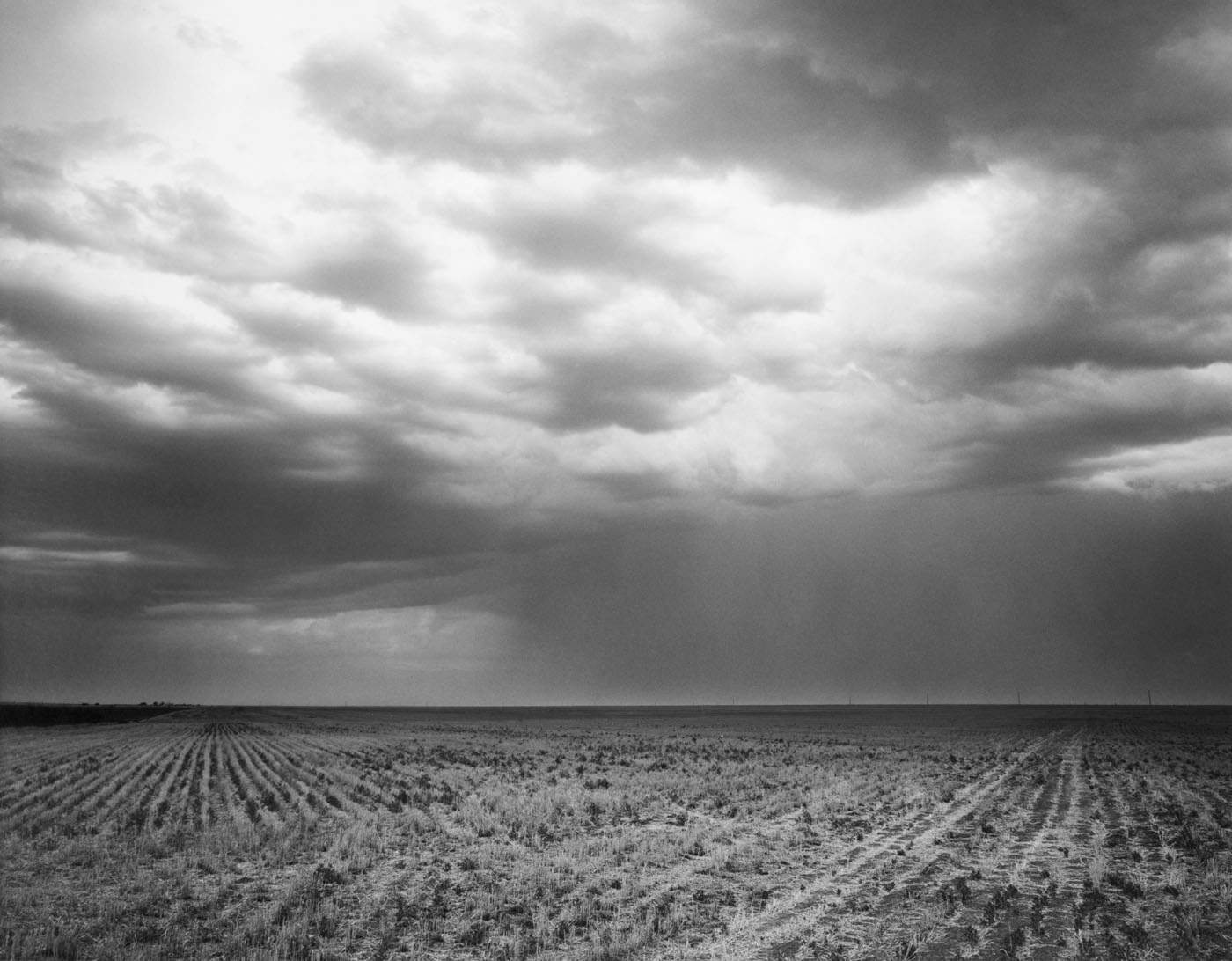
National Gallery of Art website

LIKE ART BLART ON FACEBOOK

Back to top

Exhibition: ‘In Light of the Past: Celebrating 25 Years of Photography at the National Gallery of Art’ at the National Gallery of Art, Washington

Exhibition dates: 3rd May – 26th July, 2015

Curators: Sarah Greenough, Senior Curator and Head of the Department of Photographs, and Diane Waggoner, Associate Curator, Department of Photographs, National Gallery of Art


Charles Nègre (French, 1820-1880) 'Market Scene at the Port of the Hotel de Ville, Paris' before February 1852 from the exhibition 'In Light of the Past: Celebrating 25 Years of Photography at the National Gallery of Art' at the National Gallery of Art, Washington, May - July, 2015


Charles Nègre (French, 1820-1880)
Market Scene at the Port of the Hotel de Ville, Paris
before February 1852
Salted paper print
14.7 x 19.9cm
National Gallery of Art, Washington, Patrons’ Permanent Fund, 2003


What a great title for an exhibition. Photography always evidences light of the past, we live in light of the past (the light of the Sun takes just over 8 minutes to reach Earth) and, for whatever reason, human beings never seem to learn from mistakes, in light of the past history of the human race.

My favourites in this postings are the 19th century photographs, to which I am becoming further attuned the more I look at them. There is almost a point when you become psychologically enmeshed with their light, with the serenity of the images, a quality that most contemporary photographs seem to have lost. There is a quietness to their presence, a contemplation on the nature of the world through the pencil of nature that is captivating. You only have to look at Gustave Le Gray’s The Pont du Carrousel, Paris: View to the West from the Pont des Arts (1856-1858, below) to understand the everlasting, transcendent charisma of these images. Light, space, time, eternity.

Dr Marcus Bunyan


Many thankx to the National Gallery of Art for allowing me to publish the photographs in the posting. Please click on the photographs for a larger version of the image.

The Collection of Photographs at the National Gallery of Art, Washington (110kb Word doc)


William Henry Fox Talbot (English, 1800-1877) 'A Scene in York: York Minster from Lop Lane' 1845 from the exhibition 'In Light of the Past: Celebrating 25 Years of Photography at the National Gallery of Art' at the National Gallery of Art, Washington, May - July, 2015


William Henry Fox Talbot (English, 1800-1877)
A Scene in York: York Minster from Lop Lane
1845
Salted paper print
16.2 x 20.4cm
National Gallery of Art, Washington, Edward J. Lenkin Fund, Melvin and Thelma Lenkin Fund and Stephen G. Stein Fund, 2011


A British polymath equally adept in astronomy, chemistry, Egyptology, physics, and philosophy, Talbot spent years inventing a photographic process that created paper negatives, which were then used to make positive prints – the conceptual basis of nearly all photography until the digital age. Calotypes, as he came to call them, are softer in effect than daguerreotypes, the other process announced in 1839. Though steeped in the sciences, Talbot understood the ability of his invention to make striking works of art. Here the partially obstructed view of the cathedral rising from the confines of the city gives a sense of discovery, of having just turned the corner and encountered this scene.


Carleton E. Watkins (American, 1829-1916) 'Piwac, Vernal Falls, 300 feet, Yosemite' 1861


Carleton E. Watkins (American, 1829-1916)
Piwac, Vernal Falls, 300 feet, Yosemite
1861
Albumen print
39.9 x 52.3cm
National Gallery of Art, Washington, Gift of Mary and David Robinson, 1995


The westward expansion of America opened up new opportunities for photographers such as Watkins and William Bell. Joining government survey expeditions, hired by railroad companies, or catering to tourists and the growing demand for grand views of nature, they created photographic landscapes that reached a broad audience of scientists, businessmen, and engineers, as well as curious members of the middle class. Watkins’s photographs of the sublime Yosemite Valley, which often recall landscape paintings of similar majestic subjects, helped convince Congress to pass a bill in 1864 protecting the area from development and commercial exploitation.


Eugène Cuvelier (French, 1837-1900) 'Belle-Croix' 1860s


Eugène Cuvelier (French, 1837-1900)
Belle-Croix
1860s
Albumen print
25.4 x 34.3cm
National Gallery of Art, Washington, Gail and Benjamin Jacobs for the Millennium Fund, 2007


In the second half of the nineteenth century, some photographers in France, hired by governmental agencies to make photographic inventories or simply catering to the growing demand for pictures of Paris, drew on the medium’s documentary abilities to record the nation’s architectural patrimony and the modernisation of Paris. Others explored the camera’s artistic potential by capturing the ephemeral moods of nature in the French countryside. Though photographers faced difficulties in carting around heavy equipment and operating in the field, they learned how to master the elements that directly affected their pictures, from securing the right vantage point to dealing with movement, light, and changing atmospheric conditions during long exposure times.


Gustave Le Gray (French, 1820-1884) 'The Pont du Carrousel, Paris: View to the West from the Pont des Arts' 1856-1858


Gustave Le Gray (French, 1820-1884)
The Pont du Carrousel, Paris: View to the West from the Pont des Arts
1856-1858
Albumen print
37.8 x 48.8cm
National Gallery of Art, Washington, Patrons’ Permanent Fund, 1995


Édouard-Denis Baldus (French, 1813-1889) 'Toulon, Train Station' c. 1861


Édouard-Denis Baldus (French, 1813-1889)
Toulon, Train Station
c. 1861
Albumen print
27.4 x 43.1cm
National Gallery of Art, Washington, Patrons’ Permanent Fund, 1995


In Light of the Past: Celebrating 25 Years of Photography at the National Gallery of Art, on view in the West Building from May 3 through July 26, 2015, will commemorate more than two decades of the Gallery’s robust photography program. Some 175 of the collection’s most exemplary holdings will reveal the evolution of the art of photography, from its birth in 1839 to the late 1970s. In Light of the Past is one of three stellar exhibitions that will commemorate the 25th anniversary of the National Gallery of Art’s commitment to photography acquisitions, exhibitions, scholarly catalogues, and programs.

In Light of the Past includes some of the rarest and most compelling photographs ever created,” said Earl A. Powell III, director, National Gallery of Art, Washington. “It also honours the generous support of our donors who have enabled us to achieve this new place of prominence for photography at the Gallery.

About the exhibition

In Light of the Past begins with exceptional 19th-century salted paper prints, daguerreotypes, and albumen prints by acclaimed early practitioners such as William Henry Fox Talbot (1800-1877), Gustave Le Gray (1820-1884), Roger Fenton (1819-1869), Julia Margaret Cameron (1815-1879), Albert Sands Southworth (1811-1894), and Josiah Johnson Hawes (1808-1901). It also displays works by American expeditionary photographers, including William Bell (1830-1910) and Carleton E. Watkins (1829-1916).

The exhibition continues with late 19th- and early 20th-century American Pictorialist photographs by Alfred Stieglitz (1864-1946), Clarence H. White (1871-1925), Gertrude Käsebier (1852-1934), and Alvin Langdon Coburn (1882-1966), among others, as well as European masters such as Eugène Atget (1857-1927). The exhibition also examines the international photographic modernism of artists such as Paul Strand (1890-1976), André Kertész (1894-1985), Marianne Brandt (1893-1983), László Moholy-Nagy (1895-1946), and Ilse Bing (1899-1998) before turning to the mid-20th century, where exceptional work by Walker Evans (1903-1975), Robert Frank (b. 1924), Harry Callahan (1912-1999), Irving Penn (1917-2009), Lee Friedlander (b. 1934), and Diane Arbus (1923-1971) will be on view.

The exhibition concludes with pictures from the 1960s and 1970s, showcasing works by photographers such as Robert Adams (b. 1937), Lewis Baltz (1945-2014), and William Eggleston (b. 1939), as well as Mel Bochner (b. 1940) and Sol LeWitt (1928-2007), which demonstrate the diverse practices that invigorated photography during these decades.

Press release from the National Gallery of Art


Albert Sands Southworth (American, 1811-1894) and Josiah Johnson Hawes (American, 1808-1901) 'The Letter' c. 1850


Albert Sands Southworth (American, 1811-1894) and Josiah Johnson Hawes (American, 1808-1901)
The Letter
c. 1850
Daguerreotype
Plate: 20.3 x 15.2cm
National Gallery of Art, Washington, Patrons’ Permanent Fund, 1999


Working together in Boston, the portrait photographers Southworth and Hawes aimed to capture the character of their subjects using the daguerreotype process. Invented in France and one of the two photographic processes introduced to the public in early 1839, the daguerreotype is made by exposing a silver-coated copper plate to light and then treating it with chemicals to bring out the image. The heyday of the technique was the 1840s and 1850s, when it was used primarily for making portraits. The daguerreotype’s long exposure time usually resulted in frontal, frozen postures and stern facial expressions; this picture’s pyramidal composition and strong sentiments of friendship and companionship are characteristic of Southworth and Hawes’s innovative approach.


Clarence H. White (American, 1871-1925) 'The Hillside' c. 1898


Clarence H. White (American, 1871-1925)
The Hillside
c. 1898
Gum dichromate print
20.8 x 15.88cm
National Gallery of Art, Washington, Patrons’ Permanent Fund, 2008


The Photo-Secession

At the turn of the century in America, Alfred Stieglitz and his colleague Edward Steichen led the movement to establish photography’s status as a fine art. In 1902 Stieglitz founded an organisation called the Photo-Secession, consisting of young artists who shared his belief in the creative potential of the medium. Many of the photographers featured here were members of the group, including Gertrude Käsebier, Clarence White, and Alvin Langdon Coburn. Through the exhibitions Stieglitz organised in his New York gallery, called 291, and the essays he published in his influential quarterly, Camera Work, he and the Photo-Secession promoted the Pictorialist aesthetic of softly textured, painterly pictures that elicit emotion and appeal to the imagination. Occasionally the photographers’ compositions refer to other works of art, such as Steichen’s portrait of his friend Auguste Rodin, whose pose recalls one of the sculptor’s most famous works, The Thinker. Influenced by the modern European and American painting, sculpture, and drawing he exhibited at 291, Stieglitz lost interest in the Photo-Secession in the early 1910s and began to explore a more straightforward expression.


Eugène Atget (French, 1857-1927) 'Saint-Cloud' 1926


Eugène Atget (French, 1857-1927)
Saint-Cloud
1926
Albumen print
22.2 x 18.1cm
National Gallery of Art, Washington, Gift of Mary and Dan Solomon and Patrons’ Permanent Fund, 2006


Using a cumbersome camera mounted on a tripod, Atget recorded the myriad facets of Paris and its environs at the turn of the century. Transforming ordinary scenes into poetic evocations, he created a visual compendium of the objects, architecture, and landscapes that were expressive of French culture and its history. He sold his photographs to artists, architects, and craftsmen, as well as to libraries and museums interested in the vanishing old city. Throughout his career he returned repeatedly to certain subjects and discovered that the variations caused by changing light, atmosphere, and season provided inexhaustible subjects for the perceptive photographer.


Julia Margaret Cameron (British, 1815-1879) 'The Mountain Nymph, Sweet Liberty' June 1866


Julia Margaret Cameron (British, 1815-1879)
The Mountain Nymph, Sweet Liberty
June 1866
Albumen print
36.1 x 26.7cm
National Gallery of Art, Washington, New Century Fund, 1997


Ensconced in the intellectual and artistic circles of midcentury England, Cameron manipulated focus and light to create poetic pictures rich in references to literature, mythology, and history. Her monumental views of life-sized heads were unprecedented, and with them she hoped to define a new mode of photography that would rival the expressive power of painting and sculpture. The title of this work alludes to John Milton’s mid-seventeenth-century poem L’Allegro. Describing the happy life of one who finds pleasure and beauty in the countryside, the poem includes the lines:

Come, and trip it as ye go
On the light fantastic toe;
And in thy right hand lead with thee,
The mountain nymph, sweet Liberty.


Dr Guillaume-Benjamin-Amant Duchenne (de Boulogne) (French, 1806-1875) 'Figure 63, "Fright" from "Mécanisme de la physionomie humaine (Mechanism of human physiognomy)" (1862)' 1854-1855


Dr Guillaume-Benjamin-Amant Duchenne (de Boulogne) (French, 1806-1875)
Figure 63, “Fright” from “Mécanisme de la physionomie humaine (Mechanism of human physiognomy)” (1862)
1854-1855
Albumen print
21.5 × 16cm
National Gallery of Art, Washington, Pepita Milmore Memorial Fund, 2015


A neurologist, physiologist, and photographer, Duchenne de Boulogne conducted a series of experiments in the mid-1850s in which he applied electrical currents to various facial muscles to study how they produce expressions of emotion. Convinced that these electrically-induced expressions accurately rendered internal feelings, he then photographed his subjects to establish a precise visual lexicon of human emotions, such as pain, surprise, fear, and sadness. In 1862 he included this photograph representing fright in a treatise on physiognomy (a pseudoscience that assumes a relationship between external appearance and internal character), which enjoyed broad popularity among artists and scientists.


Lewis Hine (American, 1874-1940) 'An Anaemic Little Spinner in a New England Cotton Mill (North Pownal, Vermont)' 1910


Lewis Hine (American, 1874-1940)
An Anaemic Little Spinner in a New England Cotton Mill (North Pownal, Vermont)
1910
Gelatin silver print
24.1 × 19.2cm
National Gallery of Art, Washington, Pepita Milmore Memorial Fund, 2015


Trained as a sociologist and initially employed as a teacher, Hine used the camera both as a research tool and an instrument of social reform. One of the earliest and most influential social documentary photographers of his time, he made many pictures under the auspices of the National Child Labor Committee, an organisation formed in 1904 to promote better working conditions for children. Hine’s focus on the thin, frail body of this barefoot twelve-year-old spinner, who stands before rows of bobbins in the mill where she worked, was meant to illustrate the unhealthy effects of her employment. Photographs like this one were crucial to the campaign to change American child labor laws in the early twentieth century.


In Light of the Past: Twenty-Five Years of Photography at the National Gallery of Art

Georgia O’Keeffe and the Alfred Stieglitz Estate laid the foundation of the photography collection of the National Gallery of Art in 1949 with their donation of 1,650 Stieglitz photographs, an unparalleled group known as the Key Set. Yet the Gallery did not start actively acquiring photographs until 1990, when it launched an initiative to build a collection of works by European and American photographers from throughout the history of the medium and mount major exhibitions with scholarly publications. Now including nearly fifteen thousand prints, the collection encompasses the rich diversity of photographic practice from fine art to scientific and amateur photography, as well as photojournalism. It is distinguished by its large holdings of works by many of the medium’s most acclaimed masters, such as Paul Strand, Walker Evans, André Kertész, Ilse Bing, Robert Frank, Harry Callahan, Lee Friedlander, Gordon Parks, Irving Penn, and Robert Adams, among others.

In Light of the Past celebrates the twenty-fifth anniversary of the 1990 initiative by presenting some of the Gallery’s finest photographs made from the early 1840s to the late 1970s. It is divided into four sections arranged chronologically. The first traces the evolution of the art of photography during its first decades in the work of early British, French, and American practitioners. The second looks at the contributions of late nineteenth and early twentieth-century photographers, from Stieglitz and the American Pictorialists to European masters such as Eugène Atget. The third section examines the international photographic modernism of the 1920s and 1930s, and the fourth features seminal mid-twentieth-century photographers. The exhibition concludes with pictures representing the varied practices of those working in the late 1960s and 1970s.

The Nineteenth Century: The Invention of Photography

In 1839 a new means of visual representation was announced to a startled world: photography. Although the medium was immediately and enthusiastically embraced by the public at large, photographers themselves spent the ensuing decades experimenting with techniques and debating the nature of this new invention. The works in this section suggest the range of questions addressed by these earliest practitioners. Was photography best understood as an art or a science? What subjects should photographs depict, what purpose should they serve, and what should they look like? Should photographers work within the aesthetics established in other arts, such as painting, or explore characteristics that seemed unique to the medium? This first generation of photographers became part scientists as they mastered a baffling array of new processes and learned how to handle their equipment and material. Yet they also grappled with aesthetic issues, such as how to convey the tone, texture, and detail of multicoloured reality in a monochrome medium. They often explored the same subjects that had fascinated artists for centuries – portraits, landscapes, genre scenes, and still lifes – but they also discovered and exploited the distinctive ways in which the camera frames and presents the world.

Photography at the Turn of the Twentieth Century

In the late nineteenth century, improvements in technology and processing, along with the invention of small handheld cameras such as the Kodak, suddenly made it possible for anyone of middle-class means to take photographs. Many amateurs took up the camera to commemorate family, friends, and special events. Others, such as the sociologist Lewis Hine, used it as a tool for social and political change. Partially in response to the new ease of photography, more serious practitioners in America and Europe banded together to assert the artistic merit of the medium. Called Pictorialists, they sought to prove that photography was just as capable of poetic, subjective expression as painting. They freely manipulated their prints to reveal their authorial control, often resulting in painterly effects, and consciously separated themselves from amateur photographers and mechanised processes.

Photography Between the Wars

In the aftermath of World War I – the first modern, mechanised conflict – sweeping changes transformed photography. Avant-garde painters, graphic designers, and journalists turned to the medium, seeing it as the most effective tool to express the fractured, fast-paced nature of modernity and the new technological culture of the twentieth century. A wide variety of new approaches and techniques flourished during these years, especially in Europe. Photographers adopted radical cropping, unusual angles, disorienting vantage points, abstraction, collage, and darkroom alchemy to achieve what the influential Hungarian teacher László Moholy-Nagy celebrated as the “new vision.” Other photographers, such as the German August Sander or the Americans Alfred Stieglitz, Edward Weston, and Walker Evans, sought a more rigorous objectivity grounded in a precise examination of the world.

Postwar Photography

Photography thrived in the decades after World War II, invigorated by new ideas, practices, and expanding venues for circulating and displaying pictures. Immediately after the war, many photographers sought to publish their pictures in illustrated magazines, which prospered during these years. Some, such as Gordon Parks, made photographs highlighting racial, economic, and social disparities. Others, such as Louis Faurer, Sid Grossman, and Robert Frank, turned to the street to address the conditions of modern life in pictures that expose both its beauty and brutality. Using handheld cameras and available light, they focused on the random choreography of sidewalks, making pictures that are often blurred, out of focus, or off-kilter.

In the later 1950s and 1960s a number of photographers pushed these ideas further, mining the intricate social interactions of urban environments. Unlike photographers from the 1930s, these practitioners, such as Garry Winogrand, Lee Friedlander, and Diane Arbus, sought not to reform American society but to record it in all its complexity, absurdity, and chaos. By the late 1960s and 1970s, other photographers, such as Robert Adams and Lewis Baltz, looked beyond conventional notions of natural beauty to explore the despoliation of the urban and suburban landscape. Their pictures of tract houses, highways, and motels are stripped of any artistic frills, yet they are exquisitely rendered and replete with telling details. Also starting in the 1960s, many conceptual or performance artists working in a variety of media embraced what they perceived to be photography’s neutrality and turned to it as an essential part of their experiments to expand traditional notions of art. In the late 1960s, improvements in colour printing techniques led others, such as William Eggleston, to explore the artistic potential of colour photography.


Edward Steichen (American, 1879-1973) 'An Apple, A Boulder, A Mountain' 1921


Edward Steichen (American, 1879-1973)
An Apple, A Boulder, A Mountain
1921
Platinum print
National Gallery of Art, Washington, Patrons’ Permanent Fund, 2014


After World War I, Steichen became disillusioned with the painterly aesthetic of his earlier work and embarked on a series of experiments to study light, form, and texture. Inverting an apple, he demonstrated how a small object, when seen in a new way, can assume the monumentality and significance of a much larger one. His close-up scrutiny of a natural form closely links this photograph with works by other American modernists of the 1920s, such as Edward Weston, Paul Strand, and Georgia O’Keeffe.


Paul Strand (American, 1890-1976) 'People, Streets of New York, 83rd and West End Avenue' 1916


Paul Strand (American, 1890-1976)
People, Streets of New York, 83rd and West End Avenue
1916
Platinum print
24.2 x 33cm
National Gallery of Art, Washington, Patrons’ Permanent Fund, 1990


Strand was introduced to photography in high school by his teacher Lewis Hine, who instilled in him a strong interest in social issues. In 1907, Hine took his pupil to Alfred Stieglitz’s 291 gallery in New York, which launched Strand’s desire to become a fine art photographer. By the early 1910s, influenced by Stieglitz, he began to make clearly delineated portraits, pictures of New York, and nearly abstract still lifes. Strand came to believe that photography was a gift of science to the arts, that it was an art of selection, not translation, and that objectivity was its very essence.


American 20th Century. 'Untitled' c. 1930


American 20th Century
Untitled
c. 1930
Gelatin silver print
5.7 x 10cm
National Gallery of Art, Washington, Gift of Robert E. Jackson, 2007


Snapshots

After World War I, a parade of technological improvements transformed the practice of photography. With smaller cameras, faster shutter speeds, and more sensitive film emulsions, both amateurs and more serious practitioners could now easily record motion, investigate unexpected angles and points of view, and work in dim light and inclement weather. The amateur’s less staid, more casual approach began to play an important role in the work of modernist photographers as they explored spontaneity and instantaneity, seeking to capture the cacophony and energy of modern life. Blurriness, distorted perspectives, and seemingly haphazard cropping-once considered typical amateur mistakes-were increasingly embraced as part of the modern, vibrant way of picturing the world.


Robert Frank (Swiss, 1924-2019) 'City of London' 1951


Robert Frank (Swiss, 1924-2019)
City of London
1951
Gelatin silver print
23 x 33.6cm
National Gallery of Art, Washington, Robert Frank Collection, Purchased as a Gift of The Howard Gilman Foundation, in Honor of the 50th Anniversary of the National Gallery of Art, 1991


Robert Frank (Swiss, 1924-2019) 'Woman/Paris' 1952


Robert Frank (Swiss, 1924-2019)
Woman/Paris
1952
Gelatin silver print in bound volume
Image: 35.1 x 25.4cm
National Gallery of Art, Washington, Robert Frank Collection, Gift (Partial and Promised) of Robert Frank, in Honor of the 50th Anniversary of the National Gallery of Art, 1990


In the late 1940s and early 1950s, Frank made several handbound volumes of photographs, exploring different ways to link his pictures through non-narrative sequences. While in Zurich in October 1952, he assembled pictures taken in Europe, South America, and the United States in a book called Black White and Things. With a brief introductory quote from Antoine de Saint-Exupéry – “it is only with the heart that one can see rightly; what is essential is invisible to the eye” – the photographs are arranged in a sophisticated sequence that uses formal repetition, conceptual contrasts, and, as here, witty juxtapositions to evoke a range of ideas …

While in Zurich in October of 1952, Frank assembled photographs taken in Europe, South America, and the United States in the preceding years into a bound book called Black White and Things. Designed by Frank’s friend Werner Zryd, and with only a brief introductory statement describing the three sections, the photographs appear in a sophisticated sequence that relies on subtle, witty juxtapositions and powerful visual formal arrangements to evoke a wide range of emotions.

Frank made three copies of this book, all identical in size, construction, and sequence. He gave one copy to his father, gave one to Edward Steichen, and kept one. The book that belonged to his father is now in a private collection; Steichen’s copy resides at the Museum of Modern Art, New York; and in 1990 Frank gave his copy to the Robert Frank Collection at the National Gallery of Art.


Robert Frank (Swiss, 1924-2019) 'Trolley - New Orleans' 1955


Robert Frank (Swiss, 1924-2019)
Trolley – New Orleans
1955
Gelatin silver print
Sheet: 21 x 31.6cm
National Gallery of Art, Washington, Gift of Maria and Lee Friedlander, 2001


Roy DeCarava (American, 1919-2009) 'Mississippi Freedom Marcher, Washington, D.C.' 1963


Roy DeCarava (American, 1919-2009)
Mississippi Freedom Marcher, Washington, D.C.
1963
Gelatin silver print
25.5 x 33cm
National Gallery of Art, Washington, Horace W. Goldsmith Foundation through Robert and Joyce Menschel, 1999


Lee Friedlander (American, b. 1934) 'New York City' 1966


Lee Friedlander (American, b. 1934)
New York City
1966
Gelatin silver print
Image: 13.3 x 20.6 cm
National Gallery of Art, Washington, Trellis Fund, 2001


Heir to the tradition of documentary photography established by Eugène Atget, Walker Evans, and Robert Frank, Friedlander focuses on the American social landscape in photographs that can seem absurd, comical, and even bleak. In dense, complex compositions, he frequently depicts surprising juxtapositions that make the viewer look twice. He has made numerous self-portraits, yet he appears in these pictures in oblique and unexpected ways, for example reflected in a mirror or window. The startling intrusion of Friedlander’s shadow onto the back of a pedestrian’s coat, at once threatening and humorous, slyly exposes the predatory nature of street photography.


Giovanni Anselmo (Italian, 1934-2023) 'Entering the Work' 1971


Giovanni Anselmo (Italian, 1934-2023)
Entering the Work
1971
Photographic emulsion on canvas
49 x 63.5cm
National Gallery of Art, Washington, Glenstone in honor of Eileen and Michael Cohen, 2008


Conceptual Photography

In the 1960s, many painters and sculptors questioned the traditional emphasis on aesthetics and turned to creating art driven by ideas. Photography’s association with mechanical reproduction appealed to them as they sought to downplay the hand of the artist while promoting his or her role as idea maker. Some conceptual artists, such as Sol Lewitt and Mel Bochner, used photographs to explore an interest in perspective, scale, and mathematics. Others turned to photography as a tool to record performances and artistic undertakings, the resulting pictures acting as an integral part of those projects.

Anselmo was a member of the Italian Arte Povera group, which sought to break down the separation of art and life through experimental performances and the use of natural materials such as trees and leaves. To make this work, Anselmo set his camera up with a timed shutter release, and raced into view so that his running figure creates a modest yet heroic impression on the landscape.


Robert Adams (American, b. 1937) 'Colorado Springs, Colorado' 1974


Robert Adams (American, b. 1937)
Colorado Springs, Colorado
1974
Gelatin silver print, printed 1983
15.2 x 15.2cm
National Gallery of Art, Washington, Gift of Mary and Dan Solomon and Patrons’ Permanent Fund, 2006


For more than forty years, Adams has recorded the changing American landscape, especially the ongoing settlement of the West. Although he has photographed roads, tract houses, and strip malls that have utterly transformed the landscape, he has also captured the beauty that remains and indeed, that refuses to die, as in his poetic picture of morning fog over California hills. He is convinced, as he wrote in 1974, that “all land, no matter what has happened to it, has over it a grace, an absolutely persistent beauty.”


Margaret Bourke-White (American, 1904-1971) 'Fort Peck Dam, Montana' 1936


Margaret Bourke-White (American, 1904-1971)
Fort Peck Dam, Montana
1936
Gelatin silver print
33.02 × 27.31cm
National Gallery of Art, Washington, Patrons’ Permanent Fund, 2014


One of the most iconic photographs by the pioneering photojournalist Bourke-White, Fort Peck Dam, Montana was published on the cover of the inaugural issue of Life magazine on November 23, 1936. A striking representation of the machine age, the photograph depicts the stark, massive piers for an elevated highway over the spillway near the dam. The two men at the bottom of the print indicate the piers’ massive scale while revealing the vulnerable position of the worker in the modern industrial landscape.


György Kepes (American born Hungary, 1906-2001) 'Juliet with Peacock Feather and Red Leaf' 1937-1938


György Kepes (American born Hungary, 1906-2001)
Juliet with Peacock Feather and Red Leaf
1937-1938
Gelatin silver print with gouache
15.7 × 11.6cm
National Gallery of Art, Washington, Pepita Milmore Memorial Fund, 2014


Trained as a painter at the Academy of Fine Arts in Budapest, Kepes was an influential designer, educator, aesthetic theorist, and photographer. In 1930 he moved to Berlin, where he worked with László Moholy-Nagy, but eventually settled in Chicago and later Cambridge, Massachusetts. Created soon after his arrival in America, this startling photograph is both an intimate depiction of Kepes’s wife and a study of visual perception. Like the red leaf that seems to float above the image, the peacock feather – its eye carefully lined up with Juliet’s – obscures not only her vision but also the viewer’s ability to see her clearly.


Irving Penn (American, 1917-2009) 'Woman with Roses (Lisa Fonssagrives-Penn in Lafaurie Dress), Paris' 1950


Irving Penn (American, 1917-2009)
Woman with Roses (Lisa Fonssagrives-Penn in Lafaurie Dress), Paris
1950
Platinum/palladium print, 1977
55.1 x 37cm
National Gallery of Art, Washington, Gift of Irving Penn, 2002


One of the most influential fashion and portrait photographers of his time, Penn made pictures marked by refinement, elegance, and clarity. Trained as a painter and designer, he began to photograph in the early 1940s while working at Vogue; more than 150 of his photographs appeared on the cover of the magazine during his long career. A perfectionist, Penn explored earlier printing techniques, such as a late nineteenth-century process that used paper coated with solutions of platinum or palladium rather than silver, to achieve the subtle tonal range he desired.


National Gallery of Art
National Mall between 3rd and 7th Streets
Constitution Avenue NW, Washington

Opening hours:
Open daily 10.00 am – 5.00pm

National Gallery of Art website

LIKE ART BLART ON FACEBOOK

Back to top

Exhibition: ‘In Focus: Architecture’ at the J. Paul Getty Museum, Getty Center, Los Angeles

Exhibition dates: 15th October 2013 – 2nd March 2014


William Henry Fox Talbot (English, 1800-1877) 'Boulevard des Italiens, Paris' 1843


William Henry Fox Talbot (English, 1800-1877)
Boulevard des Italiens, Paris
1843
Salted paper print from a Calotype negative
16.8 x 17.3cm
The J. Paul Getty Museum, Los Angeles


Another gem of a photography exhibition from the Getty. These In Focus exhibitions are just a treasure: from Making a Scene, Still Life and The Sky to Los Angeles, Picturing the Landscape and now Architecture. All fabulous. To have a photography collection such as the Getty possesses, and to use it. To put on these fantastic exhibitions…

I like observing the transition between epochs (or, in more architectural terms, ‘spans’ of time), photographers and their styles. From the directness and frontality of Fox Talbot’s Boulevard des Italiens, Paris (1843, below) to the atmospheric ethereality of Atget’s angular The Panthéon (1924, below) taken just three years before he died; from the lambent light imbued in Frederick Evans’ architectural study of the attic at Kelmscott Manor (1896, below) to the blocked, colour, geometric facade of William Christenberry’s Red Building in Forest, Hale County, Alabama (1964, below).

I love architecture, I love photography. Put the two together and I am in heaven.

Dr Marcus Bunyan


Many thankx to the J. Paul Getty Museum for allowing me to publish the photographs in the posting. Please click on the photographs for a larger version of the image.


Eugéne Atget (French, 1857-1927) 'The Panthéon' 1924


Eugéne Atget (French, 1857-1927)
The Panthéon
1924
Gelatin silver chloride print on printing-out paper
Image: 17.8 x 22.6cm
The J. Paul Getty Museum, Los Angeles


Eugène Atget made this atmospheric study across the place Sainte-Geneviève toward the back of the Panthéon, a church boldly designed to combine the splendour of Greece with the lightness of Gothic churches. The church’s powerful colonnaded dome, Atget’s primary point of interest, hovers in the background, truncated by the building in the left foreground.

In order to make the fog-veiled Panthéon visible when printing this negative, Atget had to expose the paper for a long period of time. As a consequence of the long printing, the two buildings in the foreground are overexposed, appearing largely as black silhouettes. Together they frame the Panthéon, rendered entirely in muted greys. This photograph exceeds documentation to become more a study of mood and atmospheric conditions than of architecture.


Frederick H. Evans (British, 1863-1943) 'Kelmscott Manor: In the Attics (No. 1)' 1896


Frederick H. Evans (British, 1863-1943)
Kelmscott Manor: In the Attics (No. 1)
1896
Platinum print
15.6 x 20.2cm
© Mrs Janet M. Stenner, sole granddaughter of Frederick H, Evans
The J. Paul Getty Museum, Los Angeles


Frederick Evans’s architectural study of the attic at Kelmscott Manor, a medieval house, part of which dates from 1280, is a visual geometry lesson. The composition is all angles and intersections, formed not only by the actual structure but also by the graphic definition of light within the space. Soft illumination bathes the area near the stairs, while the photograph’s foreground plunges into murky darkness. The sharp angles of intersecting planes are mediated by the rough-hewn craftsmanship of the beams and posts, almost sensuous in their sinewy imperfection and plainly wrought by hand. The platinum print medium favoured by Evans provides softened tonalities that further unify the triangles, squares, and diagonal lines of the dynamic composition.


William Christenberry (American, b. 1936) 'Red Building in Forest, Hale County, Alabama' 1964


William Christenberry (American, b. 1936)
Red Building in Forest, Hale County, Alabama
1964
44.5 x 55.9cm
© William Christenberry
The J. Paul Getty Museum, Los Angeles


William Christenberry began photographing this makeshift wooden structure in his native Alabama in 1974. Since that time, he has made nearly annual trips to document the facade of this isolated dwelling, located deep in the Talladega National Forest. Such vernacular structures were uncommon photographic subjects until Walker Evans, Ed Ruscha, William Eggleston, and other twentieth-century photographers elevated their stature. Like the edifices photographed by Eugène Atget, Bernd and HIlla Becher, and others, the buildings Christenberry recorded in the southern United States were often in disrepair and in danger of disappearing altogether.


Soon after its invention in 1839, photography surpassed drawing as the preferred artistic medium for recording and presenting architecture. Novel photographic techniques have kept pace with innovations in architecture, as both media continue to push artistic boundaries. In Focus: Architecture, on view October 15, 2013 – March 2, 2014 at the J. Paul Getty Museum, Getty Center, traces the long, interdependent relationship between architecture and photography through a selection of more than twenty works from the Museum’s permanent collection, including recently acquired photographs by Andreas Feininger, Ryuji Miyamoto, and Peter Wegner.

“Architectural photography was an integral part of the early days of the medium, with the construction of many of the world’s most important and magnificent structures documented from start to finish with the camera,” explains Timothy Potts, director of the J. Paul Getty Museum. “This exhibition demonstrates how architectural photography has grown from straightforward documentary style photographs in its early days to genre-bending works like those of Peter Wegner from 2009.”

Beginnings of Architectural Photography

Recognised for their accuracy and precision, photographs could render architectural details as never before and show the built environment during construction, after completion, or in ruin. Nineteenth-century photographers were eager to utilize the new medium to document historic sites and structures, as well as buildings that rose alongside them, or in their place. In 1859, Gustave Le Gray photographed the Mollien Pavilion, a structure that constituted part of the “New Louvre,” a museum expansion completed during the reign of Napoleon III. Le Gray’s picturesque composition highlighted the Pavilion’s ornamented façade and other intricate details that could inform the work of future architects. Louis-Auguste Bisson, a trained architect, worked with his brother Auguste-Rosalie to photograph grand architectural spaces such as Interior of Saint-Ouen Church in Rouen (1857). The Bisson brothers produced a monumental print, derived from a glass negative of the same size, to feature the nave of the structure in an interior view rarely depicted in 19th century photographs.

A burgeoning commercial market for tourist photographs emerged toward the end of the nineteenth century. Views of architectural landmarks and foreign ruins became popular souvenirs and tokens of the ancient world. Artists such as J.B. Greene, who ventured to exotic destinations, provided visions of historic sites in Egypt, while Louis-Émile Durandelle took a series of photographs that documented the construction of the Eiffel Tower in the years before it became a symbol of the modern era at the World’s Exposition of 1889. Durandelle’s frontal view of the structure underscored its perfect geometric form, and his photographs were the earliest of what became a popular motif for amateur and professional photographers. Other noted photographers of this period included Eugène Atget, who obsessively documented the streets and buildings of Paris before its modernisation, and Frederick H. Evans, who created poetic photographs of Romanesque and Gothic cathedrals.

The Rise of Modern Architectural Photography

As the commercial market for photographs expanded and technologies advanced, representations of architectural forms began to evolve as well. In the twentieth century, images of buildings developed in conjunction with the rise of avant-garde, experimental, documentary, and conceptual modes of photographic expression.

Andreas Feininger, who studied architecture in Weimar, followed what Bauhaus instructor László Moholy-Nagy called a “new vision” of photography as an autonomous artistic practice with its own laws of composition and lighting. In Portal in Greifswald (1928), Feininger created a negative print, or a photograph with reversed tonalities, resulting in a high contrast image that enhanced the mystery of the architectural subject and removed it from its ecclesiastical context.

“The experimental spirit that permeated photography in the first half of the twentieth century inspired new ways to look at architectural forms,” says Amanda Maddox, assistant curator of photographs at the J. Paul Getty Museum and curator of the exhibition. “As photographs could present buildings in abstracted, close-up, or fragmented views, they encouraged viewers to see the built environment around them as never before.”

At the same time the Bauhaus was influencing photographers throughout Europe, Walker Evans was at the forefront of vernacular photography in the United States, which elevated ordinary objects and events to photographic subjects. In keeping with this trend, architectural photography shifted its focus to ordinary domestic and functional buildings. Derelict and isolated dwellings feature prominently in the work of William Christenberry, whose photograph and “building construction” of Red Building in Forest, Hale County, Alabama (1994) will be on display in the exhibition.

Architecture as a photographic subject became more malleable at the end of the twentieth century, as artists continued to explore the symbolism and vitality of the modern cityscape. This transition is exemplified in Peter Wegner’s 32-part Building Made of Sky III (2009), in which the spaces between skyscrapers in New York, San Francisco and Chicago create buildings of their own. Wegner described the series as “the architecture of air, the space defined by the edges of everything else.” When presented as a grid, the works form a new, imaginary city.

Press release from the J. Paul Getty website


Gustave Le Gray (French, 1820 - 1884) 'Mollien Pavilion, the Louvre' 1859


Gustave Le Gray (French, 1820-1884)
Mollien Pavilion, the Louvre
1859
Albumen silver print
Image: 36.7 x 47.9cm
The J. Paul Getty Museum, Los Angeles


Standing opposite a newly built pavilion of the Louvre, Gustave Le Gray made this photograph when the sun’s position allowed him to best capture the details of the heavily ornamented facade, from the fluted columns on the ground level to the figurative group on the nearest gable. Paving stones lead the viewer’s eye directly to the corner of the pavilion, where the sunlit facade is further highlighted beside an area blanketed in shadow.

Though the extensive art collections of the Louvre had first been opened to the public in 1793, after the French Revolution, it was not until 1848 that the museum became the property of the state. Le Gray’s image shows the exuberance of the architecture undertaken shortly thereafter, during the reign of Napoléon III, when large sections of the building housed government offices.


Ryuji Miyamoto (Japanese, b. 1947) 'Kowloon Walled City' 1987


Ryuji Miyamoto (Japanese, b. 1947)
Kowloon Walled City
1987
Gelatin silver print
34.4 x 51.1cm
© Ryuji Miyamoto
The J. Paul Getty Museum, Los Angeles


Robert Adams (American, b. 1937) 'Longmont, Colorado' 1973


Robert Adams (American, b. 1937)
Longmont, Colorado
1973
Gelatin silver print
15.2 x 19.4cm
© Robert Adams
The J. Paul Getty Museum, Los Angeles


The long, interdependent relationship between photography and architecture is the subject of this survey drawn from the Getty Museum’s collection. Spanning the history of the medium, the exhibition features twenty-four works by such diverse practitioners as William Henry Fox Talbot, Eugène Atget, Walker Evans, Bernd and Hilla Becher, and Ryuji Miyamoto. Seen together, the varied photographic representations of secular and sacred structures on display reveal how the medium has impacted our understanding and perception of architecture.

In the nineteenth century, photography surpassed drawing as the preferred artistic medium for recording and presenting architecture. Recognised for their accuracy and precision, photographs could render architectural elements as never before. The intricate ornamented facade, the sprawling sunlit Napoléon Courtyard, and the classical design of the Louvre appear in magnificent detail in Gustave Le Gray’s picturesque image of the Mollien Pavilion, a structure completed in the 1850s during the reign of Napoléon III.

Photographers working in the nineteenth century documented historic structures on the verge of disappearance as well as contemporary buildings erected before their eyes. They also captured the built environment during construction, after completion, and in ruin. This photograph by Louis-Émile Durandelle shows the Eiffel Tower, the centrepiece of the 1889 World Exposition, in November 1888 when only its four columns, piers, and first two platforms were in place.

With the advancement of photographic technologies and the modernisation of the built environment around the turn of the twentieth century came innovative representations of architecture. Compositions and photographic processes began to reflect the avant-garde and modernist sensibilities of the time, and photographs of buildings, churches, homes, and other structures often showcased these developments. Andreas Feininger, who trained as an architect, utilised an experimental printing technique to depict gothic St. Nikolai cathedral in Greifswald in a nontraditional way.

Images of architecture by contemporary photographers Robert Adams, William Christenberry, and others working in the documentary tradition often underscore the temporality of buildings. Vernacular structures found in his native Alabama are among the subjects Christenberry has systematically recorded for the past six decades. By returning year-after-year to photograph the same places, such as the red building shown above, Christenberry chronicles the decay (and sometimes the ultimate disappearance) of stores, tenant houses, churches, juke joints, and other rural buildings.

Experimental and conceptual approaches toward the representation of architecture have been embraced by photographers. Peter Wegner used skyscrapers in New York, San Francisco, and Chicago as his framing devices to feature the spaces between high rises that form buildings of their own. By upending images of these canyons, he created buildings made of sky. When presented as a grid, they form a new, imaginary city.

Text from the J. Paul Getty website


Henri Le Secq (French, 1818 - 1882) 'Tour de Rois à Rheims' ('Tower of the Kings at Rheims Cathedral') 1851


Henri Le Secq (French, 1818-1882)
Tour de Rois à Rheims (Tower of the Kings at Rheims Cathedral)
1851
Salted paper print
35.1 x 25.9cm
The J. Paul Getty Museum, Los Angeles


Louis-Émille Durandelle (French, 1839 - 1917) 'The Eiffel Rower: State of Construction' 1888


Louis-Émille Durandelle (French, 1839-1917)
The Eiffel Rower: State of Construction
1888
Albumen silver print
43.2 x 34.6cm
The J. Paul Getty Museum, Los Angeles


The Centennial Exposition of 1889 was organised by the French government to commemorate the French Revolution. Bridge engineer Gustave Eiffel’s 984-foot (300-meter) tower of open-lattice wrought iron was selected in a competition to erect a memorial at the exposition. Twice as high as the dome of St. Peter’s in Rome or the Great Pyramid of Giza, nothing like it had ever been built before. This view was made about four months short of the tower’s completion. Louis-Émile Durandelle photographed the tower from a low vantage point to emphasise its monumentality. The massive building barely visible in the far distance is dwarfed under the tower’s arches. Incidentally, the tower’s innovative glass-cage elevators, engineered to ascend on a curve, were designed by the Otis Elevator Company of New York, the same company that designed the Getty Center’s diagonally ascending tram.


Andreas Feininger (American born France, 1906-1999) 'Portal in Greifswald' 1928


Andreas Feininger (American, born France, 1906-1999)
Portal in Greifswald
1928
Gelatin silver print
23.4 x 17.5cm
© Estate of Gertrud E. Feininger
The J. Paul Getty Museum, Los Angeles


William Eggleston (American, b. 1939) '(Untitled)' Negative about 1967-1974; print 1974


William Eggleston (American, b. 1939)
(Untitled)
Negative about 1967-1974; print 1974
Chromogenic print
Image: 22.2 x 15.2cm
© Eggleston Artistic Trust
The J. Paul Getty Museum, Los Angeles


The J. Paul Getty Museum
1200 Getty Center Drive
Los Angeles, California 90049

Opening hours:
Tues – Friday 10am – 5.30pm
Saturday 10am – 8pm
Sunday 10am – 5.30pm
Monday closed

The J. Paul Getty Museum website

LIKE ART BLART ON FACEBOOK

Back to top

Exhibition: ‘A Democracy of Images: Photographs from the Smithsonian American Art Museum’ at the Smithsonian American Art Museum, Washington DC

Exhibition dates: 28th June 2013 – 5th January 2014
1st floor West, American Art Museum (8th and F Streets, N.W.)

Browse the exhibition and related works on the exhibition website


Unidentified artist. '[Bird in Basin with Thread Spool and Patterned Cloth]' c. 1855


Unidentified artist
[Bird in Basin with Thread Spool and Patterned Cloth]
c. 1855
Daguerreotype
Plate: 2 3/4 x 3 1/4 in. (6.9 x 8.2cm)
Smithsonian American Art Museum
Museum purchase from the Charles Isaacs Collection made possible in part by the Luisita L. and Franz H. Denghausen Endowment


The next two weeks sees a lot of exhibitions finish their run on the 5th January 2014.

Here is a bumper posting which contains one of my favourite photographs of all time: Danny Lyon’s Crossing the Ohio River, Louisville (1966, below). From a distance, this looks to be a very interesting exhibition on a large topic, delineated for the viewer into four main sections. The task of the curator cannot have been easy, picking 113 images to represent a “democracy” of images out of a collection of over 7,000 images. Of course there can never be a true “democracy” of images as some will always be more valued within our culture than others. There is a meritocracy in this exhibition which features images by masters of the medium but this is balanced by the inclusion of images by anonymous photographers, little known photographers and vernacular and street photography.

What is most impressive is the specially developed website which includes many images from the different sections of the exhibition. These images are of good quality and, along with relevant text, help the viewer place the images in context. Related content is also suggested from the full photographic collection at The Smithsonian which has been placed online with good image quality. This is a far cry from many exhibitions at state galleries in Australia where there are hardly any dedicated exhibition websites. Most of the photographic collection from these galleries is not available online and if it has been scanned, the image quality is generally poor. How many times have I searched a state gallery or library collection and come up with the answer: “Image not available” ?

Dr Marcus Bunyan


Many thankx to the Smithsonian American Art Museum for allowing me to publish the photographs and text in the posting. Please click on the photographs for a larger version of the image.


“More often, though, the moments, places, people and views that have been collected here feel offhand and stumbled upon, telling a fragmentary, incomplete tale. Sometimes it’s literally a glance, as in “Girl Holding Popsicle,” a 1972 image by Mark Cohen, who rarely even looked through his viewfinder. Other times, it’s more like a long stare, as in William Christenberry’s 1979 “China Grove Church – Hale County, Alabama,” a locale that the Washington-based artist and Alabama native returned to again and again. These 113 pictures are, at the same time, quietly telling, revealing bits of America in oblique, prismatic ways.”


Part of Michael O’Sullivan’s review of the exhibition in The Washington Post.


American Characters

Photographers have captured the texture of everyday life since the medium’s arrival in the United States in 1839. Photographic portraits have made both the iconic and the commonplace serve as stand-ins for all of us, forging a shared language of political and social understanding. In charting the passing parade of history – the faces of the anonymous and the famous; evolving stories of immigration, disenfranchisement, and assimilation; as well as emblematic objects and celebrated landmarks lodged within our collective memory – photographs reveal the complexities of America.


Larry Sultan (American, 1946-2009) 'Portrait of My Father with Newspaper' 1988


Larry Sultan (American, 1946-2009)
Portrait of My Father with Newspaper
1988
Chromogenic print
Image: 28 5/8 x 34 5/8 in. (72.7 x 87.9cm)
Smithsonian American Art Museum
Gift of Nan Tucker McEvoy
© 1988, Larry Sultan


In Portrait of My Father with Newspaper, Irving Sultan reads the Los Angeles Times as light pours in behind him. This carefully composed portrait reveals the artist’s father almost entirely through reflections and shadows. Thin newsprint shields his body from the camera, while only a vague profile of his face is discernible on the right half of the spread. Prompted by the discovery of a box of home movies, Larry Sultan embarked on an eight-year enquiry into his parents’ lives. He stayed in their home for weeks at a time, interviewing them about their marriage and photographing their domestic activities.


Eugene Richards (American, b. 1944) 'First Communion (Dorchester, Mass.)' 1976


Eugene Richards (American, b. 1944)
First Communion (Dorchester, Mass.)
1976
Gelatin silver print
Image: 8 x 12 in. (20.3 x 30.5cm)
Sheet: 11 x 14 in. (27.9 x 35.6cm)
Smithsonian American Art Museum
Transfer from the National Endowment for the Arts
© 1974, Eugene Richards


Mark Cohen (American, b. 1943) 'Girl Holding Popsicle' 1972, printed 1983


Mark Cohen (American, b. 1943)
Girl Holding Popsicle
1972, printed 1983
Gelatin silver print
Sheet: 14 x 17 in. (35.5 x 43.2cm)
Smithsonian American Art Museum
Gift of Dene and Mel Garbow
© 1972, Mark Cohen


In Girl Holding Popsicle a young girl twists shyly as she poses before a graffiti-inscribed brick wall. Mark Cohen took this photograph spontaneously as he passed through a back alley. Cohen does not hesitate to get assertively close to the strangers he meets in his hometown of Wilkes-Barre, Pennsylvania. Many of his photographs are made without looking through a viewfinder, and so remain a mystery even to Cohen until they are developed.


Unidentified artist. '[Gold Nugget]' c. 1860s


Unidentified artist
[Gold Nugget]
c. 1860s
Albumen silver print
Image: 2 1/8 x 3 5/8 in. (5.4 x 9.2cm)
Sheet: 2 3/8 x 3 7/8 in. (6.1 x 9.8cm) irregular
Smithsonian American Art Museum
Gift of Charles Isaacs and Carol Nigro


Mathew B. Brady (American, 1823-1896) 'Reviewing Stand in Front of the Executive Mansion, Washington, D.C., May, 1865' 1865, printed early 1880s


Mathew B. Brady (American, 1823-1896)
Reviewing Stand in Front of the Executive Mansion, Washington, D.C., May, 1865
1865, printed early 1880s
Albumen silver print
Sheet and image: 6 1/2 x 9 in. (16.5 x 22.9cm)
Smithsonian American Art Museum
Museum purchase through the Julia D. Strong Endowment


Kevin Bubriski (American, b. 1954) 'World Trade Center Series, New York City' 2001


Kevin Bubriski (American, b. 1954)
World Trade Center Series, New York City
2001
Gelatin silver print
Image: 18 x 18 in. (45.7 x 45.7cm)
Smithsonian American Art Museum
Gift of the Consolidated Natural Gas Company Foundation
© 2001, Kevin Bubriski


In the weeks and months following the World Trade Center attacks on September 11, 2001, Kevin Bubriski photographed people who gathered at Ground Zero. Frozen in awe, struck with disbelief, and overcome with loss, people stood before the destroyed building site to confront the horrible tragedy. More than ten years later, Bubriski’s photographs preserve the emotional impact of this infamous day through images of those who witnessed its aftermath first-hand.


Deborah Luster (American, b. 1951) '01-26 Location. 1800 Leonidas Street (Carrollton) Date(s). July 14, 2009 7:55 a.m. Name(s). Brian Christopher Smith (22) Notes. Face up with multiple gunshot wounds' 2008-2012


Deborah Luster (American, b. 1951)
01-26 Location. 1800 Leonidas Street (Carrollton) Date(s). July 14, 2009 7:55 a.m. Name(s). Brian Christopher Smith (22) Notes. Face up with multiple gunshot wounds
2008-2012
Gelatin silver print
55 x 55 in. (139.7 x 139.7cm)
Smithsonian American Art Museum
Museum purchase through the Luisita L. and Franz H. Denghausen Endowment
© 2010, Deborah Luster


This photograph, from a series that documents contemporary and historical homicide sites in New Orleans, presents Deborah Luster’s interpretation of the last view of the crime victim lying face up on the ground. The title is the entry from the New Orleans Police blotter, but the photograph is Luster’s meditation on looking, seeing, and the power of images to haunt our imagination.


Unidentified artist. '[Two Workmen Polishing a Stove]' c. 1865


Unidentified artist
[Two Workmen Polishing a Stove]
c. 1865
Albumen silver print
Sheet and image: 14 1/8 x 11 in. (35.9 x 28cm)
Smithsonian American Art Museum
Museum purchase from the Charles Isaacs Collection made possible in part by the Luisita L. and Franz H. Denghausen Endowment


Anthony Barboza (American, b. 1944) '"Marvelous" Marvin Hagler, boxer' 1981


Anthony Barboza (American, b. 1944)
“Marvelous” Marvin Hagler, boxer
1981
Gelatin silver print
Image: 13 7/8 x 13 7/8 in. (35.2 x 35.2cm)
Smithsonian American Art Museum
Gift of Kenneth B. Pearl
© 1981, Anthony Barboza


Edward S. Curtis (American, 1868-1952) 'Girl and Jar – San Ildefonso' 1905


Edward S. Curtis (American, 1868-1952)
Girl and Jar – San Ildefonso
1905
Photogravure
16 5/8 x 12 1/4 in. (12.3 x 31.1cm)
Smithsonian American Art Museum
Transfer from the United States Marshal Service of the U.S. Department of Justice


Between 1900 and 1930, Edward S. Curtis traveled across the continent photographing more than seventy Native American tribes. The photographs, compiled into twenty volumes, presented daily activities, customs, and religions of a people he called “a vanishing race.” Curtis hoped to preserve the legacy of Native peoples in lasting images. To this end, Curtis often costumed his subjects and set up scenes, mixing tribal artefacts and traditions to match his romantic vision of the people he studied. In this intimate portrait, a young Tewa woman named Povi-Tamu (“Flower Morning”) balances a large jug with help from a hidden fiber ring. She is from the San Ildefonso Pueblo of New Mexico, which is famed for its rich tradition of fine pottery. Curtis associated the serpentine design of the vessel with the serpent cult, which he noted was central to Tewa life.


Oliver H. Willard (American, active 1850s-1870s, died 1875) 'Portrait of a Young Woman' c. 1857


Oliver H. Willard (American, active 1850s-1870s, died 1875)
Portrait of a Young Woman
c. 1857
Salted paper print
8 7/8 x 6 3/4 in. (22.5 x 17.1cm)
Smithsonian American Art Museum
Museum purchase through the Horace W. Goldsmith Foundation, 1999.29.1


Spiritual Frontier

The earliest photographs made in America describe an awesome land blessed with such an abundance of natural beauty that it seemed heaven sent. Images of waterfalls, mountains, and vast open spaces conveyed the beauty, the grandeur, the sublimity, and dynamics of a great spiritual endeavour. In the nineteenth century photographers pictured wilderness landscapes that symbolised American greatness. More recently, photographers have described a landscape no less romantic, but now recalibrated to account for the interaction of nature and culture.


Eadweard Muybridge (English, 1830-1904) 'Valley of the Yosemite from Union Point' 1872


Eadweard Muybridge (English, 1830-1904)
Valley of the Yosemite from Union Point
1872
Albumen silver print
Sheet: 17 x 21 1/2 in. (43.2 x 54.6cm)
Smithsonian American Art Museum
Gift of Dr. and Mrs. Charles T. Isaacs


Eadweard Muybridge went to great lengths to photograph the best possible views of the West. He chopped down trees if they obstructed his camera, and ventured to “points where his packers refused to follow him.” Muybridge was determined to produce the most comprehensive photographs ever made of Yosemite and the surrounding region. His views were sold widely in both large-format prints and stereograph cards, which are viewed through a device that creates the illusion of three-dimensional space. This allowed Muybridge to transport his audience, if just for a moment, to a faraway place caught on film.


Robert Frank (Swiss, 1924-2019) 'Butte, Montana' 1956, printed 1973


Robert Frank (Swiss, 1924-2019)
Butte, Montana
1956, printed 1973
Gelatin silver print
Image: 8 3/4 x 13 in. (22.2 x 33cm)
Smithsonian American Art Museum
Museum purchase


Robert Adams (American, b. 1937) 'New Housing, Longmont, Colorado' 1973


Robert Adams (American, b. 1937)
New Housing, Longmont, Colorado
1973
Gelatin silver print
Sheet: 6 x 7 5/8 in. (15.1 x 19.3cm)
Smithsonian American Art Museum
Transfer from the National Endowment for the Arts
© 1973, Robert Adams


As both a photographer and writer, Robert Adams is committed to describing the western American landscape as both awe-inspiring and scarred by man. In New Housing, Longmont Colorado, Adams contrasted the vast space of the distant landscape view with a foreground image of the wall of a newly constructed suburban tract house. Adams invites a consideration of the balance between myth and reality and the land as home as well as scenic backdrop.


Charles L. Weed (American, 1824-1903) 'Mirror Lake and Reflections, Yosemite Valley, Mariposa County, California' 1865


Charles L. Weed (American, 1824-1903)
Mirror Lake and Reflections, Yosemite Valley, Mariposa County, California
1865
Albumen silver print
Sheet and image: 15 1/2 x 20 1/4 in. (39.4 x 51.4cm)
Smithsonian American Art Museum
Gift of Dr. and Mrs. Charles T. Isaacs


Like Carleton Watkins, his better-known competitor, Charles Weed recognised the pictorial dividend to be gained by showing Yosemite’s glorious geological features in duplicate, using the valley’s lakes as reflecting ponds. Weed first traveled to what was then known as “Yo-Semite,” in 1859, but with a relatively small camera; he returned in 1865 with a larger model capable of using what were called mammoth plates. Like Watkins, he sold his prints to buyers eager to own a photograph of majestic natural beauty.


Ansel Adams (American, 1902-1984) 'Monolith: The Face of Half Dome, Yosemite Valley' 1926-1927, printed 1927


Ansel Adams (American, 1902-1984)
Monolith: The Face of Half Dome, Yosemite Valley
1926-1927, printed 1927
Gelatin silver print
Sheet: 11 7/8 x 9 7/8 in. (30.2 x 25.1cm)
Smithsonian American Art Museum
Museum purchase
© 2013 The Ansel Adams Publishing Rights Trust


At just over 4,700 feet above the valley, Half Dome is the most iconic rock formation in Yosemite National Park. Adams squeezed the monolith into the frame to emphasise the majesty of its scale and the drama of its cliff. As it thrusts out of the brilliant white snow, Half Dome stands as a symbol of the unspoiled western landscape. Ansel Adams made his first trip to the Sierra Nevada mountain range when he was fourteen years old, and he returned every year until the end of his life, often for month-long stretches. Throughout his career Adams traveled widely – from Hawaii to Maine – to photograph the most picturesque vistas in America. After his death in 1984, a section of the Sierra Nevada was named the Ansel Adams Wilderness in his honour.


John Pfahl (American, 1939-2020) 'Goodyear #5, Niagara Falls, New York' 1989


John Pfahl (American, 1939-2020)
Goodyear #5, Niagara Falls, New York
1989
Chromogenic print
Sheet: 20 x 24 in. (50.8 x 61.0cm)
Smithsonian American Art Museum
Gift of the Consolidated Natural Gas Company Foundation
© 1989, John Pfahl


John Pfahl’s photographs embody the conflict between progress and preservation. Throughout the 1980s he focused on oil refineries and power plants. He chose the sites strategically based on their location in picturesque landscapes, where he observed a “transcendental” connection between industry and nature. In Goodyear #5 a nuclear power plant occupies the horizon. The setting sun provides a romantic colour palette as light filters through clouds of billowing steam. The landscape is reduced to an abstract composition that celebrates colour and texture. Pfahl’s intention with this series, titled Smoke, was to “make photographs whose very ambiguity provokes thought.” This photograph complicates popular notions of power plants by revealing an uncommonly beautiful view of a controversial structure.


A Democracy of Images: Photographs from the Smithsonian American Art Museum celebrates the numerous ways in which photography, from early daguerreotypes to contemporary digital works, has captured the American experience. The photographs presented here are selected from the approximately 7,000 images collected since the museum’s photography program began thirty years ago, in 1983. Ranging from daguerreotype to digital, they depict the American experience and are loosely grouped around four ideas: American Characters, Spiritual Frontier, America Inhabited, and Imagination at Work.

The exhibition’s title is inspired by American poet Walt Whitman’s belief that photography provided America with a new, democratic art form that matched the spirit of the young country and his belief that photography was a quintessentially American activity, rooted in everyday people and ordinary things and presented in a straightforward way. Known as the “poet of democracy,” Whitman wrote after visiting a daguerreotype studio in 1846: “You will see more life there – more variety, more human nature, more artistic beauty… than in any spot we know.” At the time of Whitman’s death, in 1892, George Eastman had just introduced mass market photography when he put an affordable box camera into the hands of thousands of Americans. The ability to capture an instant of lasting importance and fundamental truth mesmerised Americans then and continues to inspire photographers working today. Marking the thirtieth anniversary of the establishment of the museum’s pioneering photography collection, the exhibition examines photography’s evolution in the United States from a documentary medium to a full-fledged artistic genre and showcases the numerous ways in which it has distilled our evolving idea of “America.”

The exhibition features 113 photographs selected from the museum’s permanent collection, including works by Edward S. Curtis, Timothy H. O’SullivanBerenice AbbottDiane ArbusRoy DeCaravaWalker Evans,Irving PennTrevor Paglen, among others, as well as vernacular works by unknown artists. A number of recent acquisitions are featured, including works by Ellen CareyMitch EpsteinMuriel HasbunAlfredo Jaar, Annie Leibovitz, Deborah Luster, and Sally Mann. Landscapes, portraits, documentary-style works from the New York Photo League and images from surveying expeditions sent westward after the Civil War are among the images on display, and explore how photographs have been used to record and catalogue, to impart knowledge, to project social commentary, and as instruments of self-expression.

Photography’s arrival in the United States in 1840 allowed ordinary people to make and own images in a way that had not been previously possible. Photographers immediately became engaged with the life of the emerging nation, the activity of new urban centers, and the possibilities of unprecedented access to the vast western frontier. From the nineteenth to the twentieth century, photography not only captured the country’s changing cultural and physical landscape, but also developed its own language and layers of meaning.

A Democracy of Images: Photographs from the Smithsonian American Art Museum is organised around four major themes that defined American photography. “American Characters” examines the ways in which photographs of individuals, places, and objects become a catalogue of our collective memory and have contributed to the ever-evolving idea of the American character. “Spiritual Frontier” investigates early ideas of a vast, inexhaustible wilderness that symbolised American greatness. “America Inhabited” traces the nation’s rapid industrialisation and urbanisation through images of speed, change, progress, immigration, and contemporary rural, urban, and suburban landscapes. “Imagination at Work” demonstrates how photography’s role of spontaneous witness gradually gave way to contrived arrangement and artistic invention. The exhibition is organised by Merry Foresta, guest curator and independent consultant for the arts. She was the museum’s curator of photography from 1983 to 1999.

Connecting online

A complementary website designed for viewing on tablets includes photographs on view in the exhibition, an expanded selection of works from the museum’s collection and a timeline of American photography. It is available through tablet stations in the exhibition galleries, online, and on mobile devices.”

Press release from the Smithsonian American Art Museum website


America Inhabited

Photography’s early presence in America coincided with the rise of an industrial economy, the growth of major urban population centers, and the fulfilling of what some saw as the Manifest Destiny of spanning the continent from sea to sea. Images of progress and industry, as well as of city and suburbs, quickly added themselves to photography’s catalogue of places and people. Some of these images reflect idealistically, and at times nostalgically, on the beauty and humanity of our own backyards. Others stand as social documents that can be seen as critical and ironic, inviting outrage as well as compassion about the way we now live our lives.


Helen Levitt (American, 1913-2009) 'New York' c. 1942, printed later


Helen Levitt (American, 1913-2009)
New York
c. 1942, printed later
Gelatin silver print
Image: 7 1/8 x 10 1/2 in. (18.1 x 26.6cm)
Smithsonian American Art Museum
Museum purchase
© 1981, Helen Levitt


Caught before they run off into the streets, three masked youngsters pause on their front stoop. Expressive postures and mysterious disguises give this trio a theatrical quality. Helen Levitt, who found poetry in the uninhibited gestures of children, used a right-angle viewfinder to capture boys and girls roaming freely and playing with found objects. Working in New York City during the years surrounding World War II, her photographs show the drama of life that unfolded on the sidewalks of poor and working-class neighbourhoods.


Louis Faurer (American, 1916-2001) 'Broadway, New York, N.Y.' 1949-1950, printed 1980-1981


Louis Faurer (American, 1916-2001)
Broadway, New York, N.Y.
1949-1950, printed 1980-1981
Gelatin silver print
Image: 8 3/8 x 12 9/16 in. (21.3 x 32cm)
Smithsonian American Art Museum
Gift of David L. Davies and John D. Weeden and museum purchase
© Estate of Louis Faurer


Danny Lyon (American, b. 1942) 'Crossing the Ohio River, Louisville' 1966, printed 1985


Danny Lyon (American, b. 1942)
Crossing the Ohio River, Louisville
1966, printed 1985
Gelatin silver print
Image: 8 3/4 x 12 7/8 in. (22.2 x 32.7cm)
Smithsonian American Art Museum
Museum purchase made possible by Mrs. Marshall Langhorne
Photo courtesy Edwynn Houk Gallery


William Eggleston (America, born July 27, 1939) 'Memphis' c. 1970


William Eggleston (American, b. 1939)
Tricycle (Memphis)
about 1975, printed 1980
Dye transfer print
Smithsonian American Art Museum, Gift of Amy Loeserman Klein


An ordinary tricycle is made monumental in this playful colour photograph. Taken from below, it suggests a child’s perspective – elevating this rusty tricycle to a symbol of innocence and freedom. The quiet Memphis suburb in the background typifies the safe neighbourhoods where children could spend hours playing after school. This print was made with the expensive and exacting dye imbibition process, which was typically used for fashion and advertising at the time. Eggleston began experimenting with colour photography in the mid-1960s. Inspired by trips to a commercial photography lab, he developed an approach that imitates the random, imperfect style of amateur snapshots to describe his immediate surroundings combined with a keen interest in the effects of colour.


Tina Barney (American, b. 1945) 'Marina's Room' 1987


Tina Barney (American, b. 1945)
Marina’s Room
1987
Chromogenic print
Sheet: 48 x 60 in. (121.9 x 52.3cm)
Smithsonian American Art Museum
Museum purchase
© 1987, Tina Barney, Courtesy Janet Borden, Inc.


Aaron Siskind (American, 1903-1991) 'Untitled' 1937, printed later


Aaron Siskind (American, 1903-1991)
Untitled
1937, printed later
Gelatin silver print
Sheet: 10 x 14 in. (25.4 x 35.5cm)
Smithsonian American Art Museum
Gift of Tennyson and Fern Schad, courtesy of Light Gallery
© 1940, Aaron Siskind


In this untitled photograph Aaron Siskind focused on the regular grid of boarded-up windows on a derelict tenement building. Once portals into intimate domestic spaces, the windows represent loss in a community plagued by poverty, unemployment, and racial discrimination. Building upon the traditions of social documentary photographers before him, Siskind used his camera to raise public awareness of Harlem’s struggle, even as he created a modernist work of art.


Walker Evans (American, 1903-1975) 'Kitchen Wall, Alabama Farmstead' 1936, printed 1974


Walker Evans (American, 1903-1975)
Kitchen Wall, Alabama Farmstead
1936, printed 1974
Gelatin silver print
Sheet and image: 9 3/8 x 12 in. (23.9 x 30.5cm)
Smithsonian American Art Museum
Gift of Lee and Maria Friedlander


During the summer of 1936, Walker Evans joined writer James Agee in rural Alabama to work on a magazine assignment on cotton farming. Evans and Agee met with three tenant farm families and documented every detail of their experiences. The result, which the magazine declined to publish, was released as the book Let Us Now Praise Famous Men in 1941. It contains some of the most iconic and contentious photographs to document the Great Depression. Kitchen Wall, Alabama Farmstead reads like a modern novel. Every crack in the wood, every speck of paint tells part of the story. Evans drew special attention to the scarcity of cooking tools at the family’s disposal. These everyday utensils illustrate a metaphor for the struggle to meet basic needs.


Judy Fiskin (American, b. 1945) 'Long Beach Pike (broken fence)', from the 'Long Beach, California Documentary Survey Project' 1980


Judy Fiskin (American, b. 1945)
Long Beach Pike (broken fence), from the Long Beach, California Documentary Survey Project
1980
Gelatin silver print
Image: 2 1/2 x 2 1/2 in. (6.2 x 6.2cm)
Smithsonian American Art Museum
Transfer from the National Endowment for the Arts
© 1980, Judy Fiskin


For this series, sponsored by the National Endowment of the Art’s Long Beach Documentary Survey Project, Judy Fiskin focused on the Long Beach Pike, an amusement park that was demolished soon after she made the photographs. By printing in high contrast and restricting the scale of her prints, Fiskin reduced form to its bare essentials. Devoid of superfluous detail, these photographs appear more like conjured images than documents of reality. Judy Fiskin systematically catalogues the world of architecture and design in order to study variations of historical styles. Her series carefully investigate esoteric subjects such as military base architecture, “dingbat” style houses in southern California, and the art of flower arranging.


Berenice Abbott (American, 1898-1991) 'Brooklyn Bridge, Water and Dock Streets, Brooklyn' 1936


Berenice Abbott (American, 1898-1991)
Brooklyn Bridge, Water and Dock Streets, Brooklyn
1936
Gelatin silver print
Sheet: 18 x 14 3/8 in. (45.7 x 36.6cm)
Smithsonian American Art Museum
Transfer from the Evander Childs High School, Bronx, New York through the General Services Administration


Berenice Abbott returned home in 1929 after nearly eight years abroad and found herself fascinated by the rapid growth of New York City. She saw the city as bristling with new buildings and structures which seemed to her as solid and as permanent as a mountain range. Aiming to capture “the past jostling the present,” Abbott spent the next five years on a project she called Changing New York. In Brooklyn Bridge, Water and Dock Streets, Brooklyn, Abbott presented a century of history in a single image. The Brooklyn Bridge, once a marvel of modern engineering, seems dark and heavy compared with the skeletal structure beneath it. The construction site at center suggests the never-ending cycle of death and regeneration. And the Manhattan skyline, veiled and weightless, hangs just out of reach, its shape accommodating the ambitious spirit of American modernism.


Robert Disraeli (American, 1905-1987) 'Cold Day on Cherry Street' 1932


Robert Disraeli (American, 1905-1987)
Cold Day on Cherry Street
1932
Gelatin silver print
Image and sheet: 14 x 11 in. (35.5 x 28cm)
Smithsonian American Art Museum
Museum purchase made possible by Mr. and Mrs. G. Howland Chase, Mrs. James S. Harlan (Adeline M. Noble Collection), Lucie Louise Fery, Berthe Girardet, and Mrs. George M. McClellan
© 1932, Robert Disraeli


Imagination at Work

Nineteenth-century French commentator Alexis de Tocqueville observed that in America, nothing is ever quite what it seems. Yet the idea that “seeing is believing” is deeply ingrained in the American character. By yoking together style and subject under the guise of the real, today’s photographers borrow from photography’s rich past while embracing the conceptual framework of contemporary art. They read reality as something on the surface of a picture or, more complexly, as something located in the mind of its beholder.


Sonya Noskowiak (American born Germany, 1900-1975) 'Calla Lily' c. 1930s


Sonya Noskowiak (American born Germany, 1900-1975)
Calla Lily
c. 1930s
Gelatin silver print
Sheet: 7 3/8 x 9 3/4 in. (18.8 x 24.7cm)
Smithsonian American Art Museum
Museum purchase made possible through Deaccession Funds


Ray K. Metzker (American, 1931-2014) 'Composites: Philadelphia (Car and Street Lamp)' 1966


Ray K. Metzker (American, 1931-2014)
Composites: Philadelphia (Car and Street Lamp)
1966
Gelatin silver prints
Image: 25 3/8 x 17 3/4 in. (64.5 x 45cm)
Smithsonian American Art Museum
Museum purchase
© 1966, Ray K. Metzker


Ray Metzker’s Composites series, begun in 1964, connected in a dramatic fashion his interests in contrasts of light and shadow, his strong sense of design, and his earlier explorations of the multiple image. Metzker studied at Chicago’s Institute of Design, where a rigorously formal, problem-solving approach to photography was taught. For this series he assembled grids of individual photographs to create complex image-fields. When viewed from a distance, this work reads as an abstract, rhythmic pattern of light and dark. On closer inspection, however, many crisply descriptive images are revealed. The Composites function somewhat like short filmstrips. The mystery of these brief narratives is exaggerated by the repetitive design and provides a unique opportunity, in Metzker’s words, “to deal with complexity of succession and simultaneity, of collected and related moments.”


Irving Penn (American, 1917-2009) 'Mud Glove – New York' 1975, printed 1976


Irving Penn (American, 1917-2009)
Mud Glove – New York
1975, printed 1976
Platinum-palladium print
Sheet and image: 29 3/4 x 22 1/4 in. (75.5 x 56.5cm)
Smithsonian American Art Museum
Gift of the artist


Irving Penn was one of the most important and influential photographers of the twentieth century. In a career that spanned almost seventy years, Penn worked across multiple genres, from celebrity portraits to fashion, from still lives to images of native cultures in remote places of the world. Throughout his career Penn also worked on a series of photographs of discarded objects: things that had been lost, neglected, or misused. Printed in platinum, these detailed photographs of objects such as a lost glove found in the gutter, are Penn’s photographic memento mori, offering beauty compromised by age or disuse.


Edward Weston (American, 1886-1958) 'Pepper no. 30' 1930


Edward Weston (American, 1886-1958)
Pepper no. 30
1930
Gelatin silver print
Sheet: 9 1/2 x 7 1/2 in. (24.3 x 19.2cm)
Smithsonian American Art Museum
Museum purchase


Imogen Cunningham (American, 1883-1976) 'Auragia' 1953, printed c. 1960s


Imogen Cunningham (American, 1883-1976)
Auragia
1953, printed c. 1960s
Gelatin silver print
Sheet and image: 11 1/8 x 8 3/4 in. (28.3 x 22.2cm)
Smithsonian American Art Museum
Gift of Charles Isaacs and Carol Nigro


Ellen Carey (American, b. 1952) 'Dings and Shadows' 2012


Ellen Carey (American, b. 1952)
Dings and Shadows
2012
Chromogenic print
Sheet and image: 40 x 30 in. (101.6 x 76.2cm)
Smithsonian American Art Museum
Gift of Linda Cheverton Wick and Walter Wick
© 2012, Ellen Carey


Ellen Carey created the series she calls Dings and Shadows by exposing photosensitive paper to light projected through primary and complementary colour filters. The artist first folds and crushes paper; then after exposing the paper to light from a colour enlarger, flattens it out again for processing. In doing so, Carey dissects the process of developing film, and evokes the hand-crafted nature of early photographic techniques.


Some images from the Timeline on the website

1843

Daguerreotypists Albert S. Southworth and Josiah Johnson Hawes begin a partnership, establishing Southworth & Hawes as the most highly regarded portrait studio in Boston, Mass. The studio caters to the city’s elite, and is visited by Charles Dickens, Ralph Waldo Emerson, and Oliver Wendell Holmes, among many other influential people of the time.


Albert Sands Southworth (American, 1811-1894) and Josiah Johnson Hawes (American, 1808-1901) 'A Bride and Her Bridesmaids' 1851


Albert Sands Southworth (American, 1811-1894) and Josiah Johnson Hawes (American, 1808-1901)
A Bride and Her Bridesmaids
1851
Daguerreotype
Smithsonian American Art Museum
Museum purchase made possible by Walter Beck


1853

The New York Daily Tribune estimates that in the United States, three million daguerreotypes are being produced annually.


Unidentified artist. 'Mother and Son' c. 1855


Unidentified artist
Mother and Son
c. 1855
Daguerreotype with applied colour
Smithsonian American Art Museum
Museum purchase from the Charles Isaacs Collection made possible in part by the Luisita L. and Franz H. Denghausen Endowment


1857

Julian Vannerson and Samuel Cohner make the first systematic photographs of Native American delegations to visit Washington, D.C. They photograph ninety delegates representing thirteen tribes who conduct treaty and other negotiations with government officials.


Julian Vannerson (American, 1827-1875) 'Shining Metal' 1858


Julian Vannerson (American, 1827-1875)
Shining Metal
1858
Salted paper print
Smithsonian American Art Museum
Museum purchase from the Charles Isaacs Collection made possible in part by the Luisita L. and Franz H. Denghausen Endowment


1861

American Civil War begins with shots fired on Fort Sumter by Confederate troops. Portrait photographer Mathew Brady is given permission by President Abraham Lincoln to photograph the First Battle of Bull Run, but comes so close to the battle that he narrowly avoids capture. Using paid assistants Alexander Gardner, Timothy O’Sullivan, George N. Barnard, and others, Brady’s studio makes thousands of photos of the sites, material, and people of the war. Civilian free-lance photographer Egbert Guy Fowx sells numerous negatives to Brady’s studio, which publishes and copyrights many of them. Many other images are credited to Fowx, including this group of Union officers.


Egbert Guy Fowx (American, 1821-1889) 'New York 7th Regiment Officers' c. 1863


Egbert Guy Fowx (American, 1821-1889)
New York 7th Regiment Officers
c. 1863
Salted paper print
Smithsonian American Art Museum
Museum purchase from the Charles Isaacs Collection made possible in part by the Luisita L. and Franz H. Denghausen Endowment


1867

Eadweard Muybridge begins trip to photograph in Yosemite Valley. He publishes his photographs under the name “Helios,” which is also the name of his San Francisco studio. An exhibition of more than 300 photographic portraits of Native American delegates to Washington, D.C., opens in the Smithsonian Castle. Clarence R. King begins direction of the U.S. Geological Expedition of the Fortieth Parallel, appointing Timothy O’Sullivan as the official photographer. Photographer Carleton Watkins joins the survey in 1871.


Timothy H. O'Sullivan  (American born Ireland, 1840-1882) 'Tufa Domes, Pyramid Lake, Nevada' 1867


Timothy H. O’Sullivan  (American born Ireland, 1840-1882)
Tufa Domes, Pyramid Lake, Nevada
1867
Albumen silver print
Smithsonian American Art Museum
Museum purchase from the Charles Isaacs Collection made possible in part by the Luisita L. and Franz H. Denghausen Endowment


1869

Andrew J. Russell’s album, The Great West Illustrated in a Series of Photographic Views across the Continent; Taken along the Line of the Union Pacific Railroad from Omaha, Nebraska, Volume I, is published. George M. Wheeler begins direction of the United States Geological Surveys West of the 100th Meridian for the U.S. Army Corps of Engineers. Wheeler makes fourteen trips to the West over the next eight years. Photographer Timothy O’Sullivan accompanies him in 1871, 1873, and 1874.


Andrew Joseph Russell (American, 1829-1902) 'Sphinx of the Valley' 1869


Andrew Joseph Russell (American, 1829-1902)
Sphinx of the Valley
1869
Albumen silver print
Smithsonian American Art Museum
Museum purchase from the Charles Isaacs Collection made possible in part by the Luisita L. and Franz H. Denghausen Endowment


1967

The Friends of Photography is founded in Carmel, California, by Ansel Adams, Beaumont and Nancy Newhall, Brett Weston, and others, with the aim of promoting creative photography and supporting its practitioners. It remains in existence until 2001.


Brett Weston (American, 1911-1993) 'Untitled (Snow Covered Mountains)' 1973


Brett Weston (American, 1911-1993)
Untitled (Snow Covered Mountains)
1973
Gelatin silver print
Smithsonian American Art Museum
Transfer from the National Endowment for the Arts
© 1973, Brett Weston


1975

New Topographics: Photographs of a Man-Altered Landscape opens at the International Museum of Photography in Rochester, N.Y. It includes photographs by Robert Adams, Lewis Baltz, Bernd and Hilla Becher, Joe Deal, Frank Gohlke, Nicholas Nixon, John Schott, Stephen Shore, and Henry Wessel Jr.


Frank Gohlke (American, b. 1942) 'Grain Elevator, Dumas, Texas, 1973' 1973, printed 1994


Frank Gohlke (American, b. 1942)
Grain Elevator, Dumas, Texas, 1973
1973, printed 1994
Gelatin silver print
Smithsonian American Art Museum, Museum purchase through the Luisita L. and Franz H. Denghausen Endowment
© 1973, Frank Gohlke


Smithsonian American Art Museum
8th and F Streets, N.W.
Washington, D.C. 20004

Opening hours:
11.30am – 7.00pm daily

Smithsonian American Art Museum website

A Democracy of Images website

LIKE ART BLART ON FACEBOOK

Back to top

Exhibition: ‘True Stories: American Photography from the Sammlung Moderne Kunst’ at Pinakothek der Moderne, Munich

Exhibition dates: 2nd March – 20th September 2012


Lewis Baltz (American, 1945-2014) 'Greenbrae' 1968


Lewis Baltz (American, 1945-2014)
Greenbrae
1968
from the series The Prototype Works
Vintage gelatin silver print
13.1 x 21.4cm
Sammlung Moderne Kunst in the Pinakothek der Moderne Munich, Acquired in 2011 by PIN. Freunde der Pinakothek der Moderne e.V.
© Lewis Baltz


You can’t get much better than this to start a posting: Baltz, Friedlander, Winogrand, Nixon, Baldessari, Eggleston and Shore. I recall seeing my first vintage Stephen Shore at the American Dreams exhibition at the Bendigo Art Gallery last year. What a revelation. At the time I said,

“Two Stephen Shore chromogenic colour prints from 1976 where the colours are still true and have not faded. This was incredible – seeing vintage prints from one of the early masters of colour photography; noticing that they are not full of contrast like a lot of today’s colour photographs – more like a subtle Panavision or Technicolor film from the early 1960s. Rich, subtle, beautiful hues.”

You can get an idea of those colours in the image posted here. Like an early Panavision or Technicolor feature film.

Perhaps there is something to this analogue photography that digital will never be able to capture, let alone reproduce…

Dr Marcus Bunyan


Many thankx to Pinakothek der Moderne for allowing me to publish the photographs in the posting. Please click on the photographs for a larger version of the image.


Lee Friedlander (American, b. 1934) 'T.V. in hotel room – Galax, Virginia' 1962


Lee Friedlander (American, b. 1934)
T.V. in hotel room – Galax, Virginia
1962
From the portfolio 15 Photographs
Gelatin silver print
© Lee Friedlander


Lee Friedlander (American, b. 1934) 'Untitled (Self-Portrait Reflected in Window, New Orleans)' c. 1965


Lee Friedlander (American, b. 1934)
Untitled (Self-Portrait Reflected in Window, New Orleans)
c. 1965
Gelatin silver print
© Lee Friedlander


Lee Friedlander (American, b. 1934) 'Flag, New York City' 1965


Lee Friedlander (American, b. 1934)
Flag, New York City
1965
Gelatin silver print
© Lee Friedlander


Lee Friedlander (American, b. 1934) 'New York City' 1966


Lee Friedlander (American, b. 1934)
New York City
1966
Gelatin silver print
Baryt paper (card)
21.9 x 32.8cm
On permanent loan from Siemens AG, Munich, to the Sammlung Moderne Kunst since 2003
© Lee Friedlander


Lee Friedlander (American, b. 1934) 'Provincetown, Massachusetts' 1968


Lee Friedlander (American, b. 1934)
Provincetown, Massachusetts
1968
Gelatin silver print
© Lee Friedlander


Lee Friedlander (American, b. 1934) 'Route 9W, New York' 1969


Lee Friedlander (American, b. 1934)
Route 9W, New York
1969
Gelatin silver print, Baryt paper (card)
20.4 x 30.5cm
On permanent loan from Siemens AG, Munich, to the Sammlung Moderne Kunst since 2003
© Lee Friedlander


Lee Friedlander (American, b. 1934) 'Lee Ave., Butte, Montana' 1970


Lee Friedlander (American, b. 1934)
Lee Ave., Butte, Montana
1970
Gelatin silver print on baryta paper
© Lee Friedlander


Garry Winogrand (American, 1928-1984) 'New York World's Fair' 1964


Garry Winogrand (American, 1928-1984)
New York World’s Fair
1964
Gelatin silver print
© Estate of Garry Winogrand


Garry Winogrand (American, 1928-1984) 'Los Angeles, California' 1969


Garry Winogrand (American, 1928-1984)
Los Angeles, California
1969
Gelatin silver print (pre 1984)
21.8 x 32.8cm
On permanent loan from Siemens AG, Munich, to the Sammlung Moderne Kunst since 2003
© Estate of Garry Winogrand


Garry Winogrand (American, 1928-1984) 'New York City' 1969


Garry Winogrand (American, 1928-1984)
New York City
1969
Gelatin silver print
© Estate of Garry Winogrand


Garry Winogrand (American, 1928-1984) 'Peace Demonstration, Central Park, New York' 1970


Garry Winogrand (American, 1928-1984)
Peace Demonstration, Central Park, New York
1970
Gelatin silver print
© Estate of Garry Winogrand


Nicholas Nixon (American, b. 1947) 'Buildings on Tremont Street, Boston' 1975


Nicholas Nixon (American, b. 1947)
Buildings on Tremont Street, Boston
1975
From the series Boston Views 1974-1976
Gelatin silver print, Baryt paper (card)
© Nicholas Nixon


Nicholas Nixon (American, b. 1947) 'View of Beacon Hill, Boston' 1975


Nicholas Nixon (American, b. 1947)
View of Beacon Hill, Boston
1975
From the series Boston Views 1974-1976
Gelatin silver print, Baryt paper (card)
© Nicholas Nixon


Nicholas Nixon (American, b. 1947) 'View of State Street, Boston' 1976


Nicholas Nixon (American, b. 1947)
View of State Street, Boston
1976
From the series Boston Views 1974-1976
Gelatin silver print, Baryt paper (card)
20.3 x 25.2cm
On permanent loan from Siemens AG, Munich, to the Sammlung Moderne Kunst since 2003
© Nicholas Nixon


Nicholas Nixon (American, b. 1947) 'View of Essex Street and Downtown Entrance to the Massachusetts Turnpike, Boston' 1976


Nicholas Nixon (American, b. 1947)
View of Essex Street and Downtown Entrance to the Massachusetts Turnpike, Boston
1976
From the series Boston Views 1974-1976
Gelatin silver print, Baryt paper (card)
© Nicholas Nixon


John Baldessari (American, 1931-2020) 'Man Running/Men Carrying Box' 1988-1990


John Baldessari (American, 1931-2020)
Man Running/Men Carrying Box
1988-1990
Gelatin silver prints, vinyl paint and shading in oil
Part 1: 121.3 x 118.6cm; Part 2: 121.3 x 146.6cm
On permanent loan from Siemens AG, Munich, to the Sammlung Moderne Kunst since 2003
© John Baldessari


William Eggleston (American, b. 1939) 'Untitled' 1970-1973 From the portfolio 'Troubled Waters'


William Eggleston (American, b. 1939)
Untitled
1970-1973
From the portfolio Troubled Waters 1980
© Eggleston Artistic Trust


William Eggleston (American, b. 1939) 'Untitled' 1980 From the portfolio 'Troubled Waters' 1980


William Eggleston (American, b. 1939)
Untitled
1980
From the portfolio Troubled Waters 1980
© Eggleston Artistic Trust


William Eggleston (American, b. 1939) 'Untitled' 1970-1973 From the portfolio 'Troubled Waters' 1980


William Eggleston (American, b. 1939)
Untitled
1970-1973
From the portfolio Troubled Waters 1980
© Eggleston Artistic Trust


William Eggleston (American, b. 1939) 'Untitled' 1980


William Eggleston (American, b. 1939)
Untitled
1980
The first of 15 works from the portfolio Troubled Waters
Dye transfer print
29 x 44cm
On permanent loan from Siemens AG, Munich, to the Sammlung Moderne Kunst since 2003
© Eggleston Artistic Trust


William Eggleston (American, b. 1939) 'Tennessee (Gulf Sign)' 1971


William Eggleston (American, b. 1939)
Tennessee (Gulf Sign)
1971
Dye transfer print
© Eggleston Artistic Trust


William Eggleston (American, b. 1939) from 'Southern Suite' (10-part series) 1981


William Eggleston (American, b. 1939)
from Southern Suite (10-part series)
1981
Dye transfer print
25.0 x 38.2cm
Sammlung Moderne Kunst in the Pinakothek der Moderne Munich. Acquired in 2006 through PIN. Freunde der Pinakothek der Moderne e.V.
© Eggleston Artistic Trust


American photography forms an extensive and simultaneously top-quality focal point in the collection, of which a selected overview is now being exhibited for the first time. The main interest of young photographers, who have been examining changes in political, social and ecological aspects of everyday American life since the late 1960s, has been the American social landscape. They have developed new pictorial styles that define stylistic devices perceived as genuinely American while at the same time being internationally recognised. Whereas Lee Friedlander, Garry Winogrand, Robert Adams, Lewis Baltz and Larry Clark, who are now considered classical modern photographers, have remained true to black-and-white photography, William Eggleston and Stephen Shore in particular have established colour photography as an artistically independent form of expression. The exhibition brings together around 100 works that, thanks to the Siemens Photography Collection and through acquisitions, bequests and donations, are now part of the museum’s holdings. True stories covers a spectrum from the street photography of the late 1960s to New Topographics and pictures by the New York photographer Zoe Leonard, taken just a few years ago.

“A new generation of photographers has directed the documentary approach toward more personal ends. Their work betrays a sympathy for the imperfection and frailties of society. Their aim has been not to reform life but to know it.” With the exhibition New Documents in spring 1967, John Szarkowski, the influential curator of photography at the Museum of Modern Art in New York, rang in a new era in American photography. Those photographers represented, including Lee Friedlander and Garry Winogrand in addition to Diane Arbus, stood for a change in attitude within documentary photography that was conditioned exclusively by the subjective viewpoint of an individual’s reality. The object of photographic interest lay in the American social landscape and its conditions. It was less concerned with the natural landscape and its increasingly cultural reshaping than with the urban or urbanised space and how people move within it. In so doing, the New Documentarians rejected any obviously explanatory impetus, turning instead to the everyday and commonplace.

The exhibition New Topographics: Photographs of a Man-Altered Landscape that was staged in the mid 1970s at the International Museum of Photography in Rochester, represented a countermovement to this subjective form of expression. Their protagonists, including Robert Adams, Lewis Baltz, Nicholas Nixon and Stephen Shore, also pleaded for a documentary approach and were influenced by figures such as Walker Evans und Robert Frank, but considered themselves rooted in the tradition of 19th-century topographical photography in particular. The prime initiator of this working method, that was expressly not governed by style, is the Los Angeles-based artist Ed Ruscha. Their central aim is a distanced and seemingly analytical depicition, free of judgement; their topic, the landscape altered by mankind. It is the image of the American West in particular, so much conditioned by myths and dreams but long since brought back to reality as a result of commercial and ecological exploitation, that is visible in their works.

The decisive quantum leap to establishing the position of colour photography was made by the Southerner William Eggleston in his exhibition in 1976, also held at the Museum of Modern Art in New York, and the publication of the William Eggleston’s Guide. The harsh public criticism of his pictures was not to do with his use of colour but the fact that Eggleston photographed things and everyday situations – on the spur of the moment and in a seemingly careless manner – that, until then, had not been considered worthy of being photographed turning them into exquisite prints using the expensive and complicated dye-transfer process. In Eggleston’s cosmos of images that is strongly influenced by motifs and the light of the Mississippi Delta, colour constitutes the picture. The “rush of colour” championed by this exhibition led to the comprehensive implementation of colour photography in the field of artistic photography in the years that followed, starting in the USA and then in Europe – and especially in Germany.

An artistic attitude became established at the end of the 1970s that, with recourse to existing picture material from art, film, advertising and the mass media, formulated new pictorial concepts and, in the same breath, opened up traditional artistic and art-historical categories such as authorship, originality, uniqueness, intellectual property and authenticity to discussion. Appropriation Art owes its decisive influences to the artist John Baldessari, who lives and teaches in California. One of its most famous representatives is Richard Prince, who became famous in particular as a result of his artistic adaptation of advertising images. Concept art in the 1960s and ’70s similarly makes use of photography, both as part of an artistic practice using the most varied of materials and as a unique medium for documenting campaigns, happenings and performances. As works by Dan Graham and Zoe Leonard clearly show, the previously precisely delineated boundaries between photography that alludes to its own intrinsically, media-related history and the use of photography as an artistic strategy, have become more fluid.

Press release from the Pinakothek der Moderne website


Robert Adams (American, b. 1937) 'East from Flagstaff Mountain, Boulder County, Colorado' 1975


Robert Adams (American, b. 1937)
East from Flagstaff Mountain, Boulder County, Colorado
1975
Gelatin silver print
Courtesy Fraenkel Gallery, San Francisco
© Robert Adams


Robert Adams (American, b. 1937) 'Missouri River, Clay County, South Dakota' 1977


Robert Adams (American, b. 1937)
Missouri River, Clay County, South Dakota
1977
Gelatin silver print
Courtesy Fraenkel Gallery, San Francisco
© Robert Adams


Robert Adams (American, b. 1937) 'Nebraska State Highway 2, Box Butte County, Nebraska' 1978, printed 1991


Robert Adams (American, b. 1937)
Nebraska State Highway 2, Box Butte County, Nebraska
1978, printed 1991
Gelatin silver print
Courtesy Fraenkel Gallery, San Francisco
© Robert Adams


Dan Graham (American, b. 1942) 'View Interior, New Highway Restaurant, Jersey City, N.J.,' 1967 (detail)


Dan Graham (American, b. 1942)
View Interior, New Highway Restaurant, Jersey City, N.J., (detail)
1967 (printed 1996)
C-prints
Each 50.6 x 76.2cm
On permanent loan from Siemens AG, Munich, to the Sammlung Moderne Kunst since 2003
© Dan Graham


Stephen Shore (American, b. 1947) 'U.S. 1, Arundel, ME.' 1974


Stephen Shore (American, b. 1947)
U.S. 1, Arundel, ME.
1974
Chromogenic print
© Stephen Shore


Stephen Shore (American, b. 1947) 'Wilde Street and Colonization Avenue, Dryden, Ontario' 1974


Stephen Shore (American, b. 1947)
Wilde Street and Colonization Avenue, Dryden, Ontario
1974
Chromogenic print
© Stephen Shore


Stephen Shore (American, b. 1947) 'West 9th Avenue, Amarillo, Texas' 1974


Stephen Shore (American, b. 1947)
West 9th Avenue, Amarillo, Texas
1974
Dye coupler print
© Stephen Shore


Shore was a consummate New York City boy who dropped out of high school when he was 17 and instead spent his time watching and making films and photographing Andy Warhol and his compatriots at his studio, the Factory. But a 1969 trip to Amarillo, Texas, to visit the family of his friend Michael Marsh set him on a new path, spurring a decade of road trips exploring the United States. His itineraries usually included Amarillo, and its people and buildings appear throughout his photographs from the time. “I loved Amarillo, not just what it looked like but the way people hung out – the pace of the life, the car culture, the barbecue joints,” he said. This stark, frontal portrait of the Sunset drive-in conveys the withering Texas heat that has peeled the facade’s paint, as well as a sense of forlornness and neglect that proved prescient when the drive-in closed two years later.

Text taken from the Carter Handbook (2023) on the American Carter Museum of American Art website


Stephen Shore (American, b. 1947) 'La Brea Avenue & Beverly Boulevard, Los Angeles, California' 1975


Stephen Shore (American, b. 1947)
La Brea Avenue & Beverly Boulevard, Los Angeles, California
1975
Chromogenic print, Kodak professional paper (1998)
20.4 x 25.5cm
On permanent loan from Siemens AG, Munich, to the Sammlung Moderne Kunst since 2003
© Stephen Shore


Larry Clark (American, b. 1943) 'Billy Mann Dead 1970' 1968


Larry Clark (American, b. 1943)
Billy Mann Dead 1970
1968
From the series Tulsa
Gelatin silver print
© Larry Clark


Larry Clark (American, b. 1943) 'Tulsa' 1972


Larry Clark (American, b. 1943)
Tulsa
1972
Gelatin silver print
20.3 x 25.4cm (sheet)
Sammlung Moderne Kunst in the Pinakothek der Moderne Munich. Acquired in 2003 by PIN. Freunde der Pinakothek der Moderne
© Larry Clark


Larry Clark (American, b. 1943) 'Accidental Gunshot Wound' 1971


Larry Clark (American, b. 1943)
Accidental Gunshot Wound
1971
Gelatin silver print
© Larry Clark


Judith Joy Ross (American, b. 1946) 'Untitled' 1984 from the series 'Portraits at the Vietnam Veterans Memorial, Washington, D.C.'


Judith Joy Ross (American, b. 1946)
Untitled
1984, printed 1996
From the series Portraits at the Vietnam Veterans Memorial, Washington, D.C. 1983-1984
Gelatin silver print on daylight printing-out paper, shading in gold
25.2 x 20.2cm
On permanent loan from Siemens AG, Munich, to the Sammlung Moderne Kunst since 2003
© Judith Joy Ross


Judith Joy Ross (American, b. 1946) 'Untitled' 1984, printed 1996 From the series 'Portraits at the Vietnam Veterans Memorial, Washington, D.C.'


Judith Joy Ross (American, b. 1946)
Untitled
1984, printed 1996
From the series Portraits at the Vietnam Veterans Memorial, Washington, D.C. 1983-1984
Gelatin silver print on daylight printing-out paper
© Judith Joy Ross


Judith Joy Ross (American, b. 1946) 'Untitled' 1984, printed 1996 From the series 'Portraits at the Vietnam Veterans Memorial, Washington, D.C.'


Judith Joy Ross (American, b. 1946)
Untitled
1984, printed 1996
From the series Portraits at the Vietnam Veterans Memorial, Washington, D.C. 1983-1984
Gelatin silver print on daylight printing-out paper
© Judith Joy Ross


John Gossage (American, b. 1946) 'EL NEGRITO' 1997


John Gossage (American, b. 1946)
EL NEGRITO
1997
From the series There and Gone
Gelatin silver print, Baryt paper, screen print on photo mount card
55.4 x 45.0 cm
On permanent loan from Siemens AG, Munich, to the Sammlung Moderne Kunst since 2003
© John Gossage


Pinakothek Der Moderne
Barer Strasse 40
Munich

Opening hours:
Daily except Monday 10am – 6pm
Thursday 10am – 8pm

Pinakothek der Moderne website

LIKE ART BLART ON FACEBOOK

Back to top

Exhibition: ‘Robert Adams: The Place We Live, a retrospective selection of photographs’ at Los Angeles County Museum of Art (LACMA)

 Exhibition dates: 11th March – 3rd June 2012


Robert Adams (American, b. 1937) 'Interstate 25, Eden Colorado' 1968


More photographs from this fabulous retrospective, different images from the two previous postings. More images from the retrospective can be found in these postings when the exhibition appeared at the Denver Art Museum (DAM), September 2011 – Jan 2012 and the Vancouver Art Gallery, September 2010 – January 2011.

Marcus


Many thankx to the Los Angeles County Museum of Art (LACMA) for allowing me to publish the photographs in the posting. Please click on the photographs for a larger version of the image.


“Over the years I have come to believe… that we live in several landscapes at once, among them the landscape of hope, and that though we must usually focus on what is characteristic of the immediate and troubled present, it is rash to say that other geographies are unimportant or even finally separate.”


Robert Adams


“Southern California was, by the reports of those who lived there at the turn of the century, beautiful; there were live oaks on the hills, orchards across the valleys, and ornamental cypress, palms, and eucalyptus lining the roads. Even now we can almost extrapolate an Eden from what has lasted – from the architecture of old eucalyptus trunks, for example, and from the astringent perfume of the trees’ flowers as it blends with the sweetness of orange blossoms.

What citrus remain today, however, are mostly abandoned, scheduled for removal, and large eucalyptus have often been vandalized, like the hundreds west of Fontana that have been struck head high with shotgun fire. Whether those trees that stand are reassuring is a question for a lifetime. All that is clear is the perfection of what we were given, the unworthiness of our response, and the certainty, in view of our current deprivation, that we are judged.”


Robert Adams 1986


Robert Adams (American, b. 1937) 'Edge of Timoteo Canyon, looking toward Los Angeles, Redlands, California' 1978


The Los Angeles County Museum of Art (LACMA) presents Robert Adams: The Place We Live, A Retrospective Selection of Photographs, an exhibition that showcases the artistic legacy of American photographer Robert Adams (b. 1937) and his longstanding engagement with the contemporary Western landscape. Featuring nearly three hundred photographs and a key selection of the artist’s publications, the retrospective weaves together four decades of Adams’s work into an epic narrative of American experience in the late twentieth and early twenty first centuries. Adams’s work reflects his dedication to describing the changing Western landscape – the growth of its built environment and the lives of its inhabitants – contemplating the presence of trees, the open plains, the Pacific Ocean, and the deforestation of the Pacific Northwest. At LACMA, the exhibition highlights Adams’s extraordinary portrayal of the terrain of the Los Angeles region.

“It is hard to envision the American West without the extraordinary achievements of Robert Adams. Adams conveys the often sharp luminosity and inky shadows of western geography like no other. Yet it is in his reckoning with man’s fraught presence that Adams’s spare and terribly beautiful photographs continue to challenge us,” said Edward Robinson, associate curator of the Wallis Annenberg Photography Department, who organised LACMA’s presentation.

Exhibition overview

With nearly three hundred gelatin silver prints, the exhibition features the photographer’s major projects, from early pictures of quiet buildings and monuments erected by settlers of his native Colorado, to his most recent images of oceans and migratory birds in the Pacific Northwest. Accompanying the photographs in the exhibition are texts drawn from

Adams’s own published writings that total more than forty books to date. The reach of Adams’s work has been felt equally through his publications, which are an indispensable element of the artist’s creative practice. A selection of these books will be displayed; copies will also be available in a reading area and digitally on iPads in the exhibition, enabling visitors to experience Adams’s masterly use of the photographic book as a poetic medium in its own right.

Press release from the LACMA website


Robert Adams (American, b. 1937) 'Edge of San Timoteo Canyon, Redlands, California' 1978


Robert Adams (American, b. 1937)
Edge of San Timoteo Canyon, Redlands, California
1978
Yale University Art Gallery, purchased with a gift from Saundra B. Lane, a grant from the Trellis Fund, and the Janet and Simeon Braguin Fund
© 2012 Robert Adams


Robert Adams (American, b. 1937) 'Abandoned windbreak, West of Fontana, California' 1982


Robert Adams (American, b. 1937) 'New development on a former citrus-growing estate, Highland, California' 1983


Robert Adams (American, b. 1937) 'Cottonwood, Longmont, Colorado' 1973-1975


Robert Adams (American, b. 1937)
Cottonwood, Longmont, Colorado
1973-1975
Gelatin silver print
Yale University Art Gallery, purchased with a gift from Saundra B. Lane, a grant from the Trellis Fund, and the Janet and Simeon Braguin Fund
© 2012 Robert Adams


Robert Adams (American, b. 1937) 'Pikes Peak, Colorado Springs, Colorado' 1969


Robert Adams (American, b. 1937)
Pikes Peak, Colorado Springs, Colorado
1969
Yale University Art Gallery, purchased with a gift from Saundra B. Lane, a grant from the Trellis Fund, and the Janet and Simeon Braguin Fund
© 2012 Robert Adams


Robert Adams (American, b. 1937) 'Cottonwood' 1973-1975


Robert Adams (American, b. 1937)
Cottonwood
1973-1975
Gelatin silver print
Yale University Art Gallery, purchased with a gift from Saundra B. Lane, a grant from the Trellis Fund, and the Janet and Simeon Braguin Fund
© 2012 Robert Adams


Robert Adams (American, b. 1937) 'East from Flagstaff Mountain, Boulder County, Colorado' 1975


Robert Adams (American, b. 1937)
Northeast from Flagstaff Mountain, Boulder County, Colorado
1975
Gelatin silver print
Yale University Art Gallery, purchased with a gift from Saundra B. Lane, a grant from the Trellis Fund, and the Janet and Simeon Braguin Fund
© 2012 Robert Adams


Robert Adams (American, b. 1937) 'Quarried Mesa Top, Pueblo County, Colorado' 1978


Robert Adams (American, b. 1937)
Quarried Mesa Top, Pueblo County, Colorado
1978
Gelatin silver print
Yale University Art Gallery, purchased with a gift from Saundra B. Lane, a grant from the Trellis Fund, and the Janet and Simeon Braguin Fund
© 2012 Robert Adams


Robert Adams (American, b. 1937) 'On Signal Hill, Overlooking Long Beach, California' 1983


Robert Adams (American, b. 1937)
On Signal Hill, overlooking Long Beach, California
1983
Gelatin silver print
Yale University Art Gallery, purchased with a gift from Saundra B. Lane, a grant from the Trellis Fund, and the Janet and Simeon Braguin Fund
© 2012 Robert Adams


Robert Adams (American, b. 1937) 'Southwest from the South Jetty, Clatsop County, Oregon' 1992


Robert Adams (American, b. 1937)
Southwest from the South Jetty, Clatsop County, Oregon
1992
Yale University Art Gallery, purchased with a gift from Saundra B. Lane, a grant from the Trellis Fund, and the Janet and Simeon Braguin Fund
© 2012 Robert Adams


Robert Adams (American, b. 1937) 'In a New Subdivision, Colorado Springs, Colorado' 1969


Robert Adams (American, b. 1937)
In a New Subdivision, Colorado Springs, Colorado
1969
Yale University Art Gallery, purchased with a gift from Saundra B. Lane, a grant from the Trellis Fund, and the Janet and Simeon Braguin Fund
© 2012 Robert Adams


Los Angeles County Museum of Art (LACMA)
5905 Wilshire Boulevard (at Fairfax Avenue)
Los Angeles, CA, 90036
Phone: 323 857-6000

Opening hours:
Monday, Tuesday, Thursday: 11am – 6pm
Friday: 11am – 8pm
Saturday, Sunday: 10am – 7pm
Closed Wednesday

LACMA website

LIKE ART BLART ON FACEBOOK

Back to top

Exhibition: ‘Robert Adams: The Place We Live, A Retrospective Selection of Photographs’ at the The Denver Art Museum (DAM)

Exhibition dates:  25th September 2011 – 1st January 2012


Many thankx to The Denver Art Museum for allowing me to publish the photographs in the posting. Please click on the photographs for a larger version of the image.


Robert Adams (American, b. 1937) 'Burning oil sludge, north of Denver, Colorado' 1973-1974


Robert Adams (American, b. 1937)
Burning oil sludge, north of Denver, Colorado
1973-1974
Gelatin silver print
Yale University Art Gallery, purchased with a gift from Saundra B. Lane, a grant from the Trellis Fund and the Janet and Simeon Braguin Fund


Robert Adams (American, b. 1937) 'North of Keota, Colorado' 1973


Robert Adams (American, b. 1937)
North of Keota, Colorado
1973 printed 1989
Gelatin silver print
Yale University Art Gallery, purchased with a gift from Saundra B. Lane, a grant from the Trellis Fund and the Janet and Simeon Braguin Fund


Robert Adams (American, b. 1937) 'Mobile home park, north edge of Denver, Colorado' 1973-1974


Robert Adams (American, b. 1937)
Mobile home park, north edge of Denver, Colorado
1973-1974
Gelatin silver print
Yale University Art Gallery, purchased with a gift from Saundra B. Lane, a grant from the Trellis Fund and the Janet and Simeon Braguin Fund


The Denver Art Museum (DAM) is the first U.S. venue for Robert Adams: The Place We Live, A Retrospective Selection of Photographs. The exhibition features more than 200 black-and-white photos spanning Adams’s 45-year career, showcasing the artistic legacy of the American photographer and his longstanding engagement with the contemporary Western landscape. Adams lived and worked in Colorado for nearly 30 years. Many of his most acclaimed images were taken in the Rocky Mountain region and will strike a familiar chord with visitors. The exhibition, organised by the Yale University Art Gallery, will be on view September 25, 2011 – January 1, 2012 in the museum’s Gallagher Family Gallery.

“We’re excited to host the work of one of the foremost photographers of our time,” said Eric Paddock, the DAM’s curator of photography. “Robert Adams’s striking yet quiet photos provoke thought about current economic, political and environmental issues Westerners confront every day. We think visitors will see something very familiar in his work.”

Since becoming a photographer in the mid-1960s, Adams has been widely regarded as one of the most significant and influential chroniclers of the American West. Adams’s photographs and writing insist that the realities of everyday landscapes are as beautiful as idealised scenes from nature. They ask questions about the ways people change and interact with nature, and what it means to live simply and quietly in today’s world. This commitment earned Adams prominence in photography’s “New Topographics” movement of the late 20th century and lends authority to his ongoing work. His photographs of Colorado suburban growth and clear cut forests in the Pacific Northwest, for example, express shock at mainstream social and economic values.

“The Denver Art Museum is pleased to be the first U.S. venue for The Place We Live, showcasing our continued commitment to our photography program,” said Christoph Heinrich, Frederick and Jan Mayer Director of the DAM. “Colorado has a rich photography history and we’re excited to have visitors engage with these artworks that provide a narrative to the American experience and take a fresh look at their surroundings.”

Featuring more than 200 gelatin silver prints, The Place We Live weaves together four decades of Adam’s work into a cohesive, epic narrative of American experience in the late 20th and early 21st centuries. Each of the photographer’s major projects is represented, from early pictures of quiet buildings and monuments erected by prior settlers of his native Colorado to his most recent images of forests and migratory birds in the Pacific Northwest.

Biography

Born in Orange, N.J., in 1937, Robert Adams moved with his family from Madison, Wis., to Denver, Colo., at the age of 15. He earned a doctorate degree from the University of Southern California and, intent on pursuing an academic career, returned to Colorado in 1962 as an assistant professor of English at Colorado College. Disturbed by the rapid transformation of the Colorado Springs and Denver areas, Adams began photographing a landscape transformed by tract housing, highways, strip malls and gas stations. “The pictures record what we purchased, what we paid and what we could not buy,” Adams wrote. “They document a separation from ourselves, and in turn from the natural world that we professed to love.” Since 1997, he has lived and worked in Oregon.”

Press release from The Denver Art Museum


Robert Adams (American, b. 1937) 'Lakewood, Colorado' 1968-1971


Robert Adams (American, b. 1937)
Lakewood, Colorado
1968-1971
Gelatin silver print
Yale University Art Gallery, purchased with a gift from Saundra B. Lane, a grant from the Trellis Fund and the Janet and Simeon Braguin Fund


Robert Adams (American, b. 1937) 'In a New Subdivision, Colorado Springs, Colorado' 1969


Robert Adams (American, b. 1937)
In a New Subdivision, Colorado Springs, Colorado
1969
Gelatin silver print
Yale University Art Gallery, purchased with a gift from Saundra B. Lane, a grant from the Trellis Fund and the Janet and Simeon Braguin Fund


Robert Adams (American, b. 1937) 'Frame for a Tract House, Colorado Springs, Colorado' 1969


Robert Adams (American, b. 1937)
Frame for a Tract House, Colorado Springs, Colorado
1969
Gelatin silver print
Yale University Art Gallery, purchased with a gift from Saundra B. Lane, a grant from the Trellis Fund and the Janet and Simeon Braguin Fund


Robert Adams (American, b. 1937) 'Pikes Peak, Colorado Springs, Colorado' 1969


Robert Adams (American, b. 1937)
Pikes Peak, Colorado Springs, Colorado
1969
Gelatin silver print
Yale University Art Gallery, purchased with a gift from Saundra B. Lane, a grant from the Trellis Fund and the Janet and Simeon Braguin Fund


Robert Adams (American, b. 1937) 'Denver, Colorado' c. 1970


Robert Adams (American, b. 1937)
Denver, Colorado
c. 1970
Gelatin silver print
Yale University Art Gallery, purchased with a gift from Saundra B. Lane, a grant from the Trellis Fund and the Janet and Simeon Braguin Fund


Robert Adams (American, b. 1937) 'Longmont, Colorado' 1973-1974, printed 2007


Robert Adams (American, b. 1937)
Longmont, Colorado
1973-1974, printed 2007
Gelatin silver print
Yale University Art Gallery, purchased with a gift from Saundra B. Lane, a grant from the Trellis Fund and the Janet and Simeon Braguin Fund


Robert Adams (American, b. 1937) 'Eden, Colorado' 1968


Robert Adams (American, b. 1937)
Eden, Colorado
1968
Gelatin silver print
Yale University Art Gallery
Purchased with a gift from Saundra B. Lane, a grant from the Trellis Fund and the Janet and Simeon Braguin Fund


Robert Adams (American, b. 1937) 'Colorado Springs, Colorado' 1974


Robert Adams (American, b. 1937)
Colorado Springs, Colorado
1968
Gelatin silver print
Yale University Art Gallery
Purchased with a gift from Saundra B. Lane, a grant from Trellis Fund, and the Janet and Simeon Braguin Fund


Robert Adams (American, b. 1937) 'Edge of San Timoteo Canyon, Redlands, California' 1978


Robert Adams (American, b. 1937)
Edge of San Timoteo Canyon, looking toward Los Angeles, Redlands, California
1978
Gelatin silver print
Yale University Art Gallery
Purchased with a gift from Saundra B. Lane, a grant from the Trellis Fund and the Janet and Simeon Braguin Fund


Robert Adams (American, b. 1937) 'Quarried Mesa Top, Pueblo County, Colorado' 1978


Robert Adams (American, b. 1937)
Quarried Mesa Top, Pueblo County, Colorado
1978
Gelatin silver print
Yale University Art Gallery
Purchased with a gift from Saundra B. Lane, a grant from Trellis Fund, and the Janet and Simeon Braguin Fund


Robert Adams (American, b. 1937) 'Longmont, Colorado' 1979, printed 1985


Robert Adams (American, b. 1937)
Longmont, Colorado
1979, printed 1985
Gelatin silver print
Yale University Art Gallery, purchased with a gift from Saundra B. Lane, a grant from the Trellis Fund and the Janet and Simeon Braguin Fund


Robert Adams (American, b. 1937) 'Santa Ana Wash, Redlands, California' 1982


Robert Adams (American, b. 1937)
Santa Ana Wash, Redlands, California
1983, printed 1991
Gelatin silver print
Yale University Art Gallery, purchased with a gift from Saundra B. Lane, a grant from the Trellis Fund and the Janet and Simeon Braguin Fund


Robert Adams (American, b. 1937) 'Sitka spruce, Cape Blanco State Park, Curry County, Oregon' 1999-2000


Robert Adams (American, b. 1937)
Sitka spruce, Cape Blanco State Park, Curry County, Oregon
1999-2000
Gelatin silver print
Yale University Art Gallery, purchased with a gift from Saundra B. Lane, a grant from the Trellis Fund and the Janet and Simeon Braguin Fund


The Denver Art Museum
Civic Center Cultural Complex
located on 13th Avenue between Broadway and Bannock in downtown Denver

Opening hours:
Daily 10am – 5pm
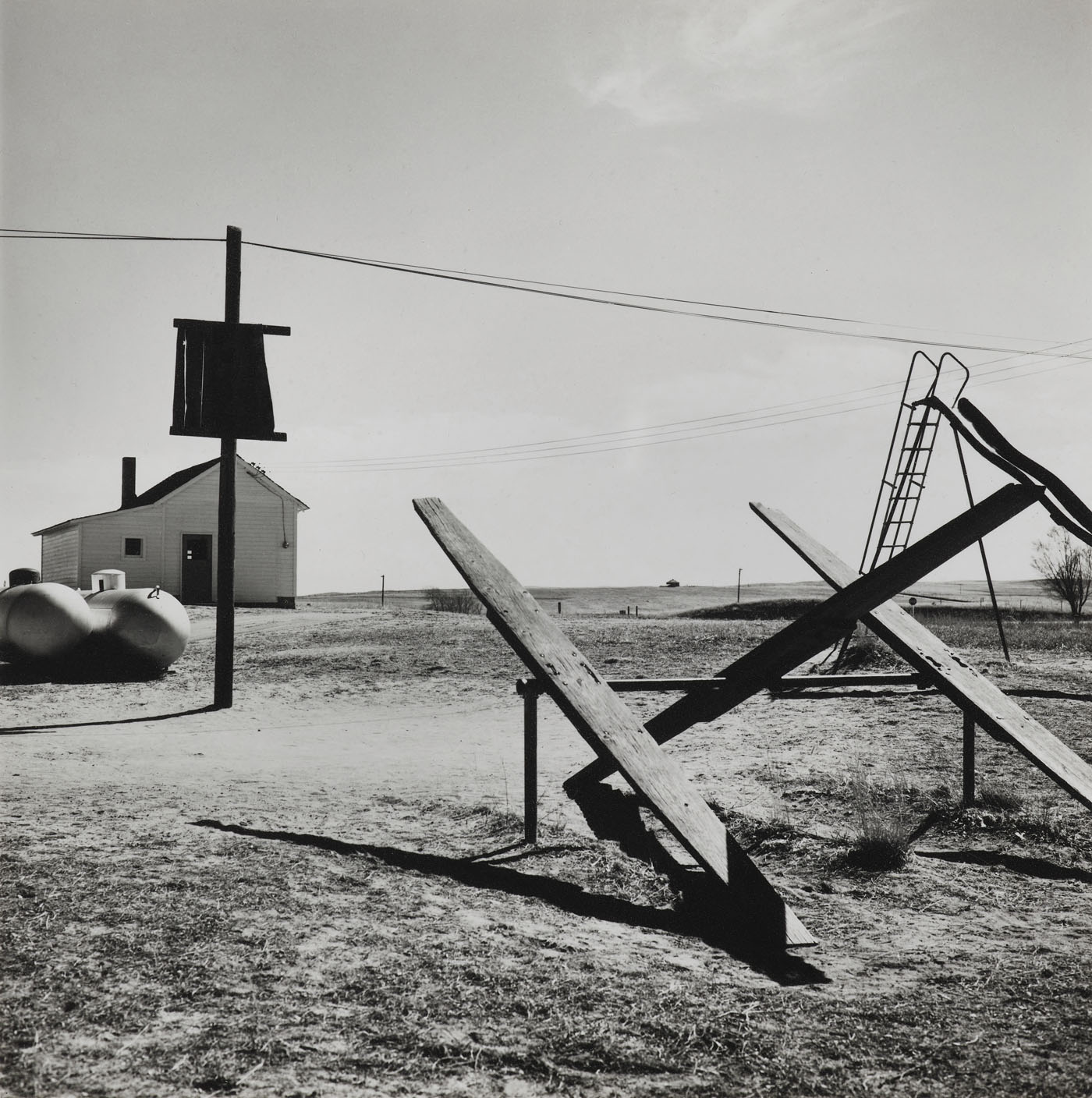
The Denver Art Museum website

LIKE ART BLART ON FACEBOOK

Back to top

Review: ‘Stormy Weather: Contemporary Landscape Photography’ at NGV Australia, Melbourne

Exhibition dates: 24th September 2010 – 20th March 2011


Nici Cumpston (Australian / Barkindji, b. 1963) 'Nookamka - Lake Bonney' 2007


Nici Cumpston (Australian / Barkindji, b. 1963)
Nookamka – Lake Bonney
2007
watercolour and coloured pencils on ink on canvas
74.2 x 203cm
National Gallery of Victoria, Melbourne
Purchased, Victorian Foundation for Living Australian Artists, 2008
© Nici Cumpston


“It is this irreversibly modified world, from the polar caps to the equatorial forests, that is all the nature we have.”


Simon Schama. Landscape and Memory 1


“The term “landscape” can be ambiguous and is often used to describe a creative interpretation of the land by an artist and the terrain itself. But there is a clear distinction: the land is shaped by natural forces while the artist’s act of framing a piece of external reality involves exerting creative control. The terms of this ‘control’ have be theorised since the Renaissance and, while representations of nature have changed over the centuries, a landscape is essentially a mediated view of nature.”


Dr Isobel Crombie 2


“And, finally, what of the vexed, interrelated matter of non-Aboriginal Australians’ sense of belonging? While the Australian historian Manning Clark speculated that European settlers were eternal outsiders who could never know ‘heart’s ease in a foreign land, because … there live foreign ancestral spirits’, it now seems plausible that non-Aboriginal Australians are developing their own form of attachment, not to land as such, but to place. Indeed, it has recently been argued that for contemporary non-Aboriginal Australians, belonging may have no connection with land at all. Perhaps this is one of the reasons why art photographs of the natural landscape have lost their currency and are now far outnumbered by photographs of urban and suburban environments – after all, it is ‘here’ that most Australians live and ‘there’ that the tourist industry beckons them to escape.”


Helen Ennis. Photography and Australia 3


This review took a lot of research, reading, thinking and writing, all good stuff – I hope you enjoy it!


Heavy Weather: Photography and the Australian Land(e)scape

There is nothing fresh about the work in this exhibition. If feels like all the oxygen has been sucked out of the term ‘landscape’, the land itself gasping for air, for life. What the exhibition does evince is an “undercurrent of disruption and contradiction that suggests that all is not as it may appear” (wall text) – and on this evidence the process of photographing the Australian landscape seems to have become an escape from the land, a fragmented and dislocated scoping, mapping and photographing of mental aspects of the land that have little to do with the landscape itself. Landscape as a site of psychological performance. In this sense, the title Stormy Weather should perhaps have been Heavy Weather for contemporary photographic artists seem to make heavy going of photographing our sense of belonging to land, to place.

Is it the artists or the curators that seek to name this work ‘landscape photography’ for it is about everything but the landscape – an escape from the land, perhaps even a denial of it’s very existence. I believe it is the framing of landscape and its imaging in terms of another subject matter. While I am not going to critique individual works in the exhibition, what I am interested in is this framing of the work as ‘landscape photography’.


Since colonial settlement there has been a rich history of photographing the Australian landscape. In the early colonial period the emphasis was on documenting the building of new cities and communities through realist photography and later more picturesque and panoramic vistas of the Australian land as settlers sought comfort in familiar surroundings and a sense of ‘belonging’ to the land (for example day trippers and photographers travelling to the Blue Mountains). Photographers rarely accompanied expeditions into the interior, unlike the exploration and mapping of the land from the East Coast to the West Coast in the United States. Unlike America there has been little tradition of photographing sublime places in Australia because they are not of the same scale as in the USA. It is very difficult to photograph the vast horizon line of the Australian outback and make it sublime. Photographing the landscape then ventured through Pictorialism in the interwar years, Modernism after WWII through to the emergence of art photography in the 1970s (for example see my posting on Dr John Cato), wilderness and tourist photography. An excellent book to begin to understand the history of photography in Australia is Photography and Australia by Helen Ennis (London: Reaktion Books, 2007) that contains the chapter “Land and Landscape.” As Ennis comments in this chapter, “… landscape photography has been the practice of settler Australians and the expression of a settler-colonial culture … The viewpoint in landscape photography has therefore been almost exclusively European”4 although this culture has been changing in recent years with the emergence of Indigenous photographers.

Ennis observes that contemporary landscape photographers embrace internationalist styles, showing a distaste for totalising nationalist narratives and a rejection of essentialist or absolutist viewpoints, noting that an overarching framework like multiculturalism has lost its currency in favour of transnationalism (which is a social movement grown out of the heightened interconnectivity between people and the loosening of boundaries between countries) that does not disavow colonial inequalities and asymmetrical relations between countries and continents.5 Photographers have developed a “photographic language that allows for the expression of the contradictions inherent in contemporary settler Australians’ relations with the land,”6 whilst offering visual artists a “non-linear, non-didactic way of dealing with the complexities of Australia history and experience, and the relationship between past and present.”7

This much then is a given. Let us now look at the framing of the work in the exhibition as ‘landscape photography’.


Simon Schama in his erudite book Landscape and Memory (New York: Vintage, 1996) believes that there can never be a natural or neutral landscape (even the brilliant meadow-floor [at Yosemite] which suggested to its first eulogists a pristine Eden was in fact the result of regular fire-clearances by its Ahwahneechee Indian occupants) and that it is our shaping perception that makes the difference between raw matter and landscape. There was also a recognition that ‘nature’ was neither neutral nor beyond ideology during the 1970s-1980s. Hence there is a double mediation – by both nature and the artist.

Despite the rejection of essentialist or absolutist viewpoints by contemporary photographers and an acknowledgment of the mediated view by/of nature one can say that there is not a single photograph in this exhibition that is just a ‘landscape’. Even the most sublime photographs in the exhibition, David Stephenson’s (Self-portrait), Reflected moon, Tasmania (1985) is cut up into a grid, or Murray Fredericks Salt photographs (2005, see below) where the photographer has waited agonisingly for weeks for just the right weather conditions to take his photographs which the general public, when visiting Lake Eyre, would have no chance of ever seeing. Through this mediation there seems to have emerged an abrogation or denial of landscape by the artists and curators conceptualisation of it, as though they are performing a particular condition, a style; working out a plan of what to do and say. Is it just a denial or is it an artistic strategy?

I believe that these are strategies that limit artists, not strategies that enable them. The curators are equally implicated in these strategies by their naming of these works ‘landscapes’. What purpose does this naming serve, in terms of the development of a sense of place, not nation, that people living in Australia seek to have? We can ask the question: Where do you stand in relationship to the landscape both philosophically and geographically?

After Butler, we can also ask: What forms of cultural myth making are “embedded” in the framing of landscape by the curators, the naming of such work as ‘landscape photography’?


Rarely is the framing recognised for what it is, when it is the viewer interpreting the interpretation that has been imposed upon us, that limits the visual discourse, producing a view of Australian landscape as fragmented norms enacted through visual narrative frames – that in this case efface the representation of land and place. This conceptual framing of what the work is about limits the grounds for discourse for a frame excludes as much as it corrals. The curators form an interpretative matrix of what is seen (or not seen, or withheld), reinforcing notions of landscape photography, the ‘landscape photography’ “that requires a certain kind of subject that actually institutes that conceptual requirement as part of its description and diagnosis.”8 In other words the description ‘landscape photography’ established by the curators becomes a limiting, self-fulfilling prophecy.

Personally, I think the problem with a landscape exhibition is that this is virtually an inane topic. Somehow “documentary” works as a topic because it is about a mental discipline. But “landscape” is no longer really a topic – it used to be a topic when landscape painters wanted to show the landscape (!) but does anyone really want to show this today? Even when the landscape painters wanted to show the sublime, the landscape was always treated with deference. No-one thinks of Minor White as a landscape photographer for he was a metaphysical photographer. And that’s what this exhibition needs – another word to give sense to a photographers efforts.

This is difficult subject matter. While artists may reject essentialist or absolutist viewpoints what has been substituted in their place is a framing, a definition that is post-nature, that undermines any sense of belonging to land, to place. The dissolutive pendulum has swung too far the other way; we look to theory to be inclusive and sometimes stand on our heads to achieve this to our detriment.

As of this moment we are not at the point where we can look back with some certainty and see that we have reached the beginning of the path of understanding. What I would propose to any artist is a photography that is broadly based, cumulative, offering a layered body of work that builds and refers back to an original body of work, much like the photographs of Robert Adams – photographs that do not make claims but ask questions and hint at a more responsive engagement with the landscape.

My hope is that a more broadly based view of place and our sense of belonging to the land emerges, one that challenges our contemporary understanding of the landscape, a viewpoint and line of sight that calm our troubled sense of reality. Robert Adams has written eloquently about photography and the art of seeing. Here is a quote from his seminal book Why People Photograph (Aperture Foundation, 1994) that aptly concludes this review.

“At our best and most fortunate we make pictures because of what stands in front of the camera, to honor what is greater and more interesting than we are. We never accomplish this perfectly, though in return we are given something perfect – a sense of inclusion. Our subject thus redefines us, and is part of the biography by which we want to be known.”9

Dr Marcus Bunyan


Many thankx to Jemma Altmeier and the National Gallery of Victoria for allowing me to publish the photographs in the posting. Please click on the photographs for a larger version of the image.

Addendum

Further to my argument above there is a session ‘Australian Identity: Australian Bio-diversity and the Landscape of the Imagination’ at the Festival of Ideas, Friday June 17th 2011 at the University of Melbourne where, in the details of the upcoming session, Ian Burn has been quoted about the loss of the landscape:

Details of the session: ‘The connection between landscape and national identity figures prominently in discussions of Australian experience. Recently the pairing of the two has taken a melancholic turn; artist Ian Burn has remarked that ‘A commitment to representing the landscape has come to be about the “loss” of the landscape’. Has the landscape that once supported the Australian legend disappeared? The landscape is represented not only in art but also through science, law and commerce. Are new landscapes and new identities now being imagined and discovered?’

Quotation: “The idea of landscape does not just invoke rival institutional discourses, but today attracts wider and more urgent reflections. A commitment to representing the landscape has become about the ‘loss’ of landscape in the twentieth century … that is about its necessity and impossibility at the same time. Seeing a landscape means focusing on a picture, implicating language in our seeing of the landscape.”

Burn, Ian quoted in Stephen, Ann (ed.,). Artists think: the late works of Ian Burn. Sydney: Power Publications in association with Monash University Gallery, Melbourne, 1996, p. 8.

Footnotes

1/ Schama, Simon. Landscape and Memory. New York: Vintage, 1996, p. 7

2/ Crombie, Isobel. Stormy Weather. Contemporary Landscape Photography (exhibition catalogue). Melbourne: National Gallery of Victoria, 2010, p. 15

3/ Clark, Manning quoted by Peter Read in “A Haunted Land No Longer? Changing Relationships to a Spiritualised Australia,” in Australian Book Review CCLXV (October 2004) pp. 28-33 in Ennis, Helen. “Land and Landscape,” in Photography and Australia. London: Reaktion Books, 2007, pp. 71-72

4/ Ennis, Helen. “Land and Landscape,” in Photography and Australia. London: Reaktion Books, 2007, pp. 51-52

5/ Ennis, Helen. “Land and Landscape,” in Photography and Australia. London: Reaktion Books, 2007, p. 123, p. 133

6/ Ibid., “Land and Landscape,” pp. 71-72

7/ Ibid., “Localism and Internationalism,” p. 128

8/ Butler, Judith. Frames of War: When is Life Grievable? London: Verso, 2010, p. 161

9/ Adams, Robert. Why People Photograph. New York: Aperture Foundation, 1994, p. 179


Nici Cumpston (Australian / Barkindji, b. 1963) 'Flooded Gum, Katarapko Creek, Murray River National Park' 2007


Nici Cumpston (Australian / Barkindji, b. 1963)
Flooded Gum, Katarapko Creek, Murray River National Park
2007
Watercolour and pencil on inkjet print on canvas
74.5 x 202.5cm
National Gallery of Victoria, Melbourne
Purchased, Victorian Foundation for Living Australian Artists, 2008
© Nici Cumpston


Stephanie Valentin (Australian, b. 1962) 'Earthbound' 2009


Stephanie Valentin (Australian, b. 1962)
Earthbound
2009
from the Earthbound series
inkjet photograph
70 x 90cm
National Gallery of Victoria, Melbourne
Purchased with funds donated by Phillip Ross and Sophia Pavlovski-Ross, 2009
© Stephanie Valentin


Harry Nankin (Australian, b. 1953) 'Of Great Western tears / Duet 2' 2006


Harry Nankin (Australian, b. 1953)
Of Great Western tears / Duet 2
2006
From The rain series 2006-2007
Gelatin silver photographs
(a-b) 107.1 x 214.3cm (overall)
National Gallery of Victoria, Melbourne
Purchased NGV Foundation, 2007
© Harry Nankin


Stephanie Valentin (Australia, b. 1962) 'Rainbook' 2009


Stephanie Valentin (Australia, b. 1962)
Rainbook
2009
From the earthbound series 2009
Colour inkjet print
69.9 x 86.9cm
National Gallery of Victoria, Melbourne
Purchased with funds donated by Philip Ross and Sophia Pavlovski-Ross, 2009
© Stephanie Valentin


Murray Fredericks (Australia, b. 1970) 'Salt 154' 2005


Murray Fredericks (Australia, b. 1970)
Salt 154
2005
From the Salt series 2003-
Colour inkjet print
119.3 x 149.3cm
National Gallery of Victoria, Melbourne
Purchased, Victorian Foundation for Living Australian Artists, 2009
© Murray Fredericks


Siri Hayes (Australia, b. 1977) 'Plein air explorers' 2008


Siri Hayes (Australia, b. 1977)
Plein air explorers
2008
Type C photograph
104.3 x 134.8cm
National Gallery of Victoria, Melbourne
Purchased, Victorian Foundation for Living Australian Artists, 2009
© Siri Hayes


The work of the contemporary Australian photographers highlighted in this exhibition comes from a profound engagement with the lived landscape around them. The quiet intensity of their work comes from their close and sustained relationship to particular environments. These photographers may use that lived observation to reveal the layers of history in a landscape; to provoke ecological concerns; as the place for site specific performances; or to use the specific poetics of light to reveal the beauty of a place.  However for all of them, the real world is the starting point for images of particularity.

Photographers’ interest in the landscape has increased in the last few years. Perhaps as a result of heightened environmental awareness, or an evolution in our engagement with Australian history, practitioners are again turning to the natural world as a site for critical practice and inspiration.

Drawn from the permanent collection the National Gallery of Victoria, the selected photographers in this exhibition have a particular focus that comes from their active relationship to various environments. The artists displayed here reveal history in a landscape; provoke ecological concerns; use the landscape as a site of performance; or reveal the distinctive beauty of a place.

Frequently underpinning these works of quiet intensity and considerable beauty is an undercurrent of disruption and contradiction that suggests all is not as it may first appear.

Text from the National Gallery of Victoria website [Online] Cited 26/02/2011 no longer available online


Rosemary Laing (Australia, b. 1959) 'weather #9' 2006


Rosemary Laing (Australia, b. 1959)
weather #9
2006
From the weather series 2006
Type C photograph
109.9 x 184.6cm
National Gallery of Victoria, Melbourne
Purchased, Victorian Foundation for Living Australian Artists, 2007
© Rosemary Laing and Tolarno Galleries, Melbourne


Jill Orr (Australia , b. 1952, lived in the Netherlands 1980-1984) 'Southern Cross to bear and behold - Burning' 2007)


Jill Orr (Australia , b. 1952, lived in the Netherlands 1980-1984)
Southern Cross to bear and behold – Burning
2007
Colour inkjet print
65.5 x 134.9cm
National Gallery of Victoria, Melbourne
Purchased, Victorian Foundation for Living Australian Artists, 2010
Photographer: Naomi Herzog for Jill Orr
© Jill Orr


The Ian Potter Centre: NGV Australia
Federation Square

Corner of Russell and 
Flinders Streets, Melbourne

Opening hours:
Open daily 10am – 5pm
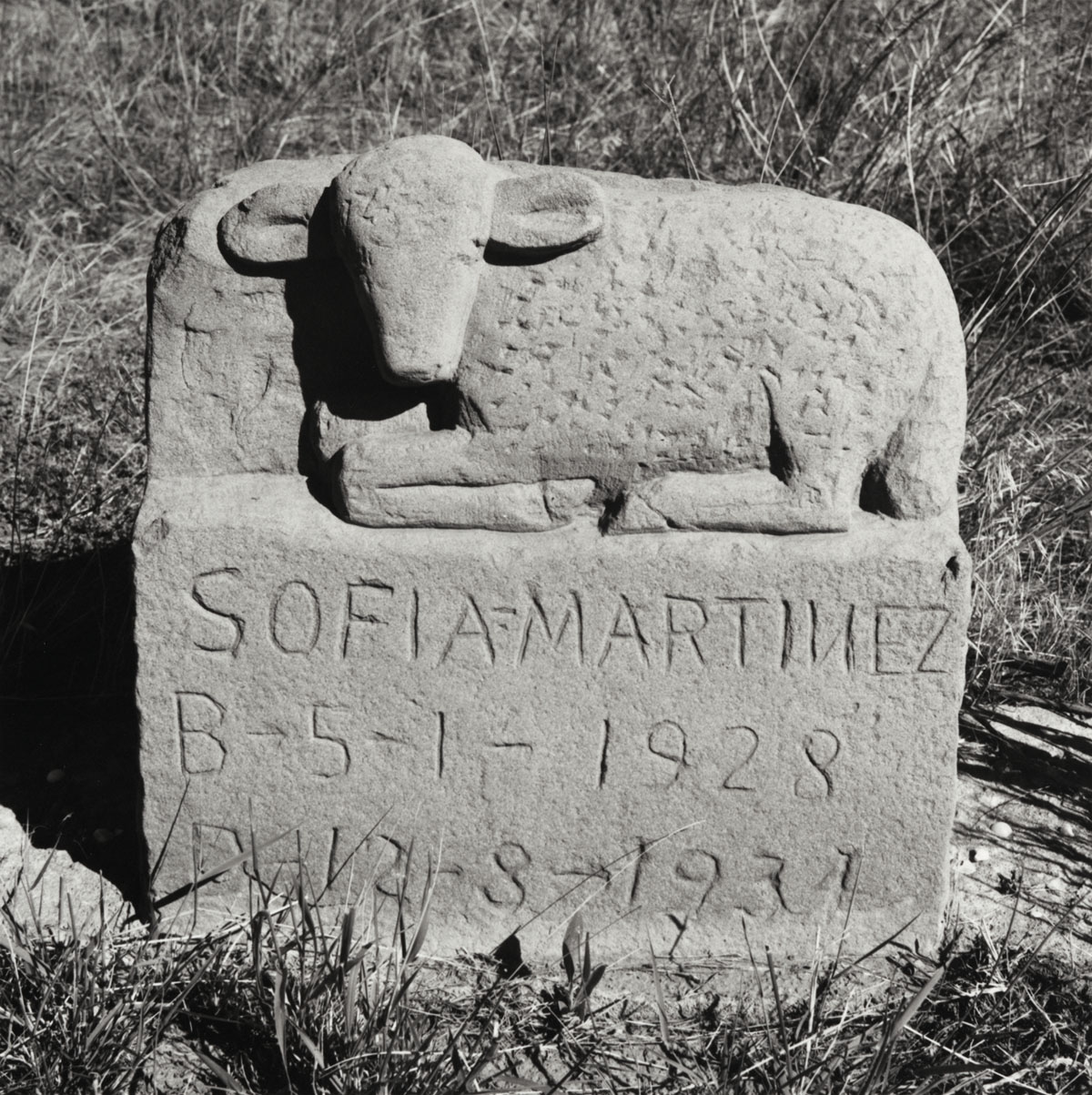
National Gallery of Victoria website

LIKE ART BLART ON FACEBOOK

Back to top