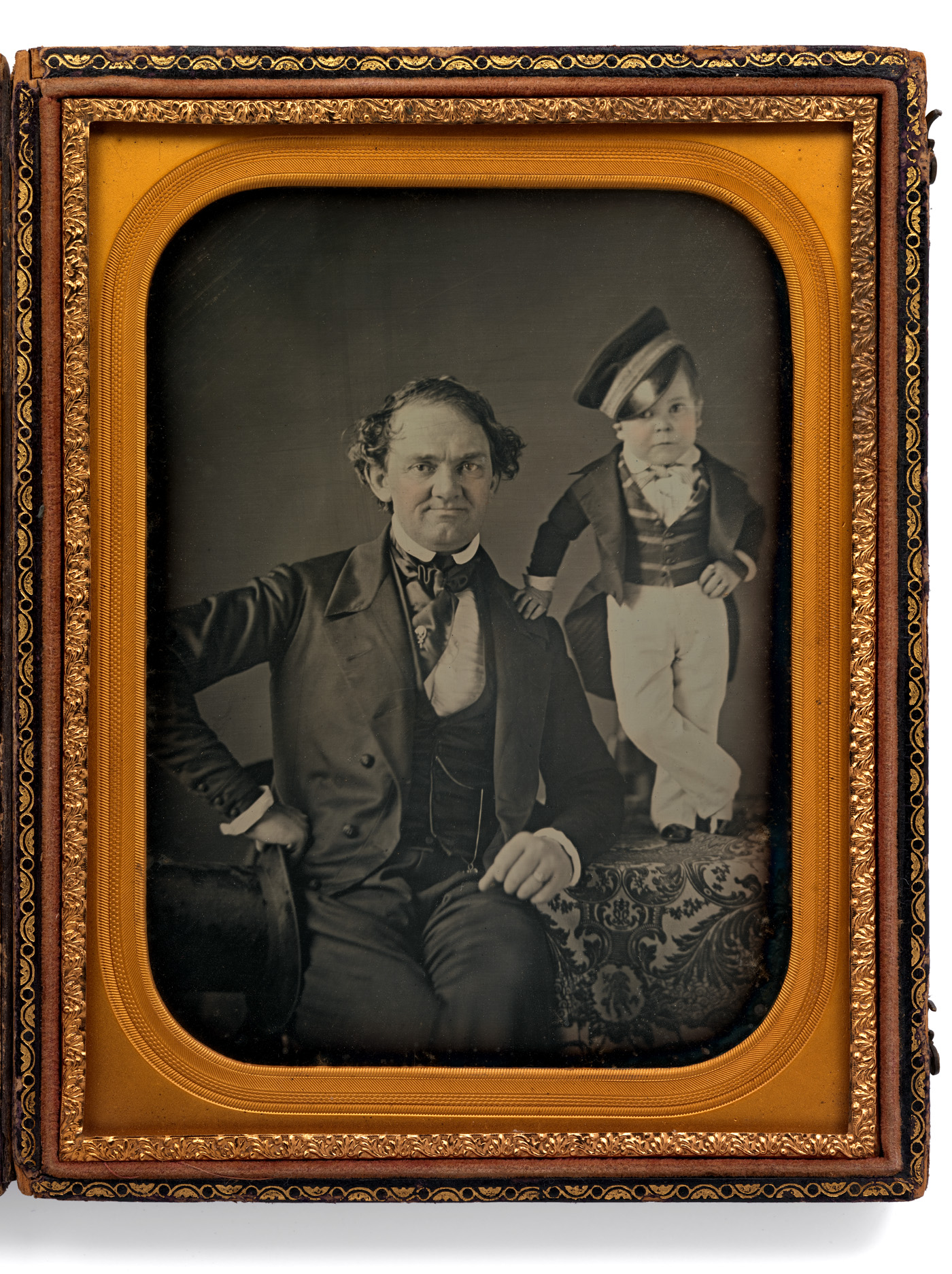
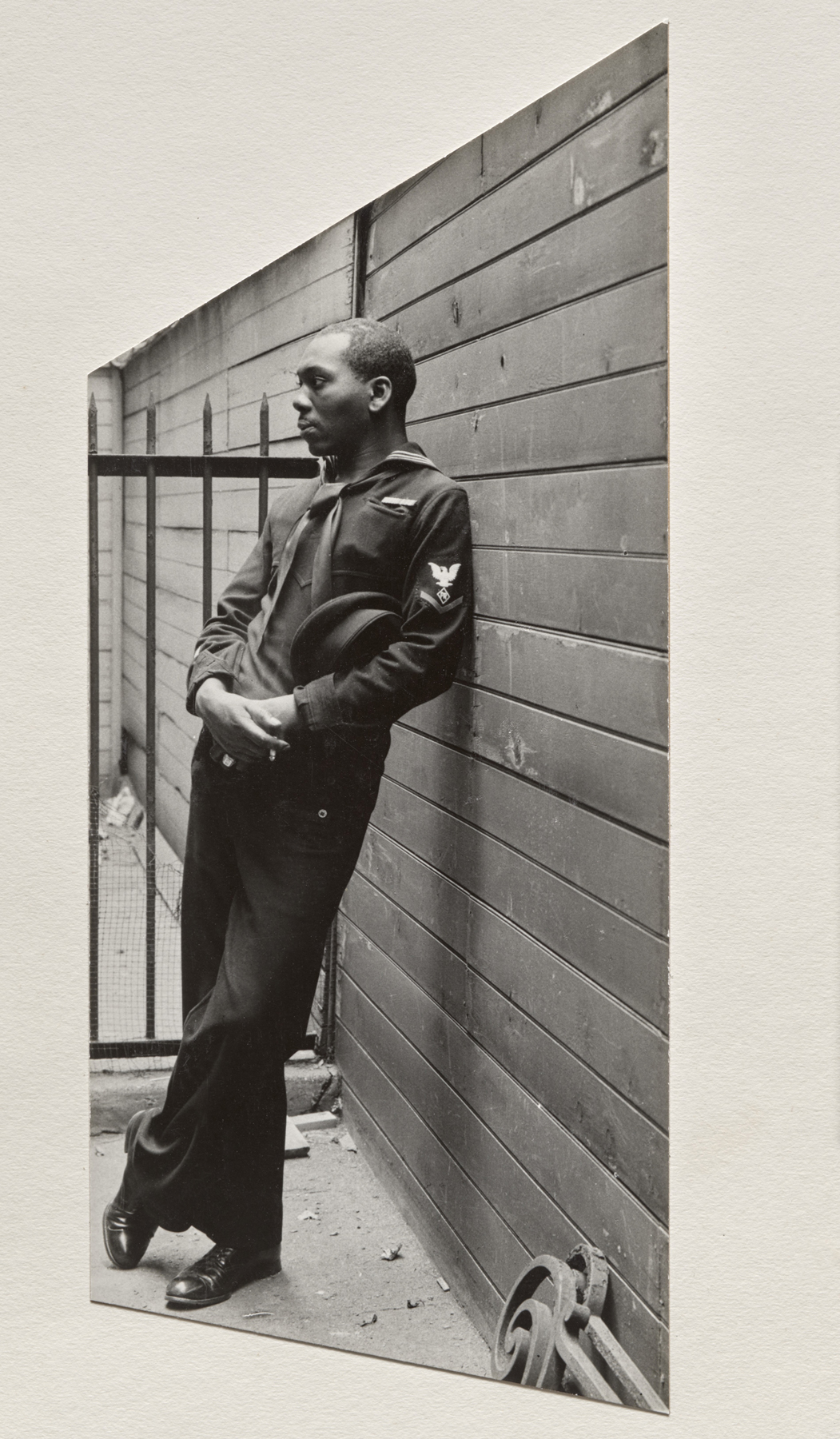
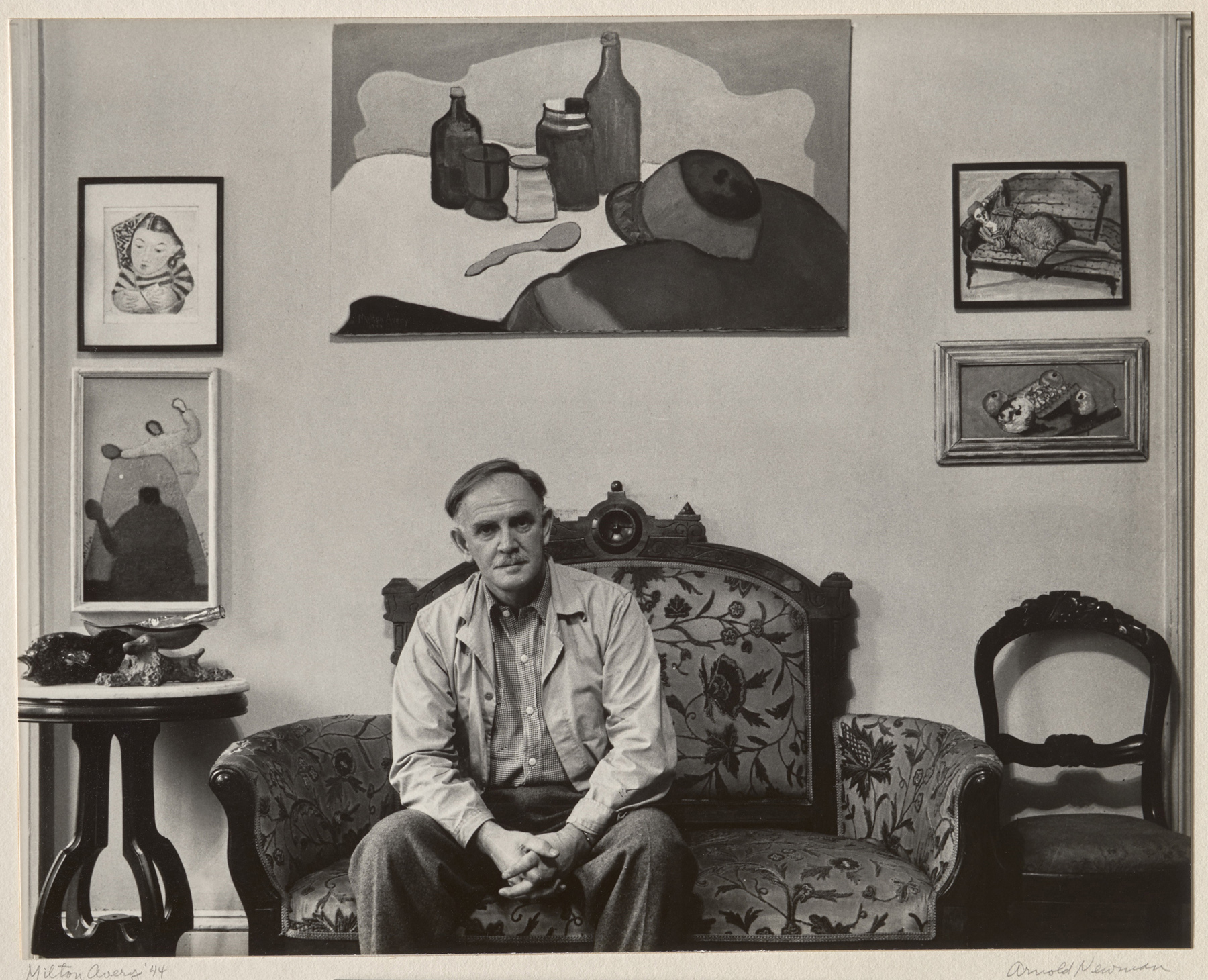
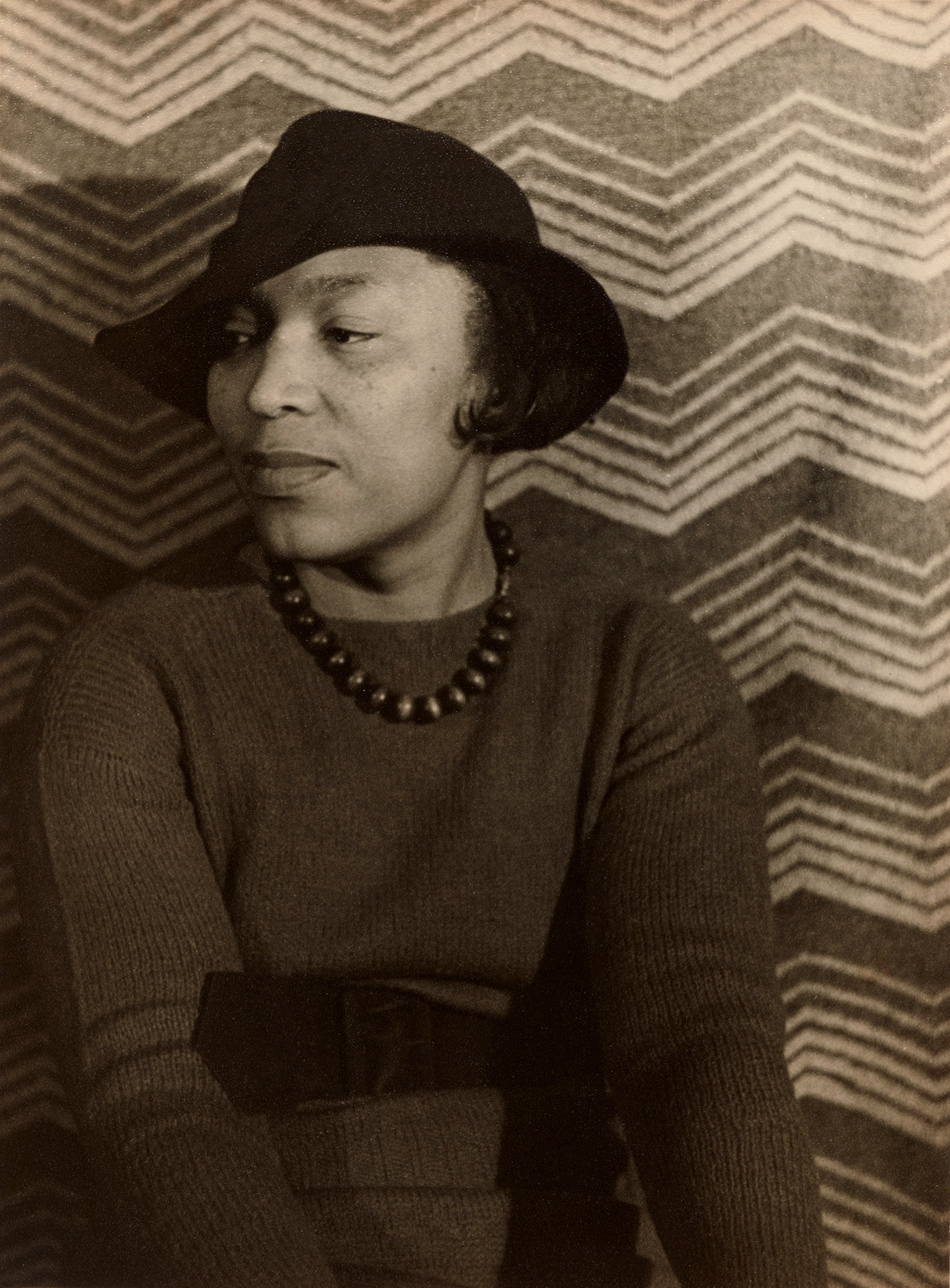
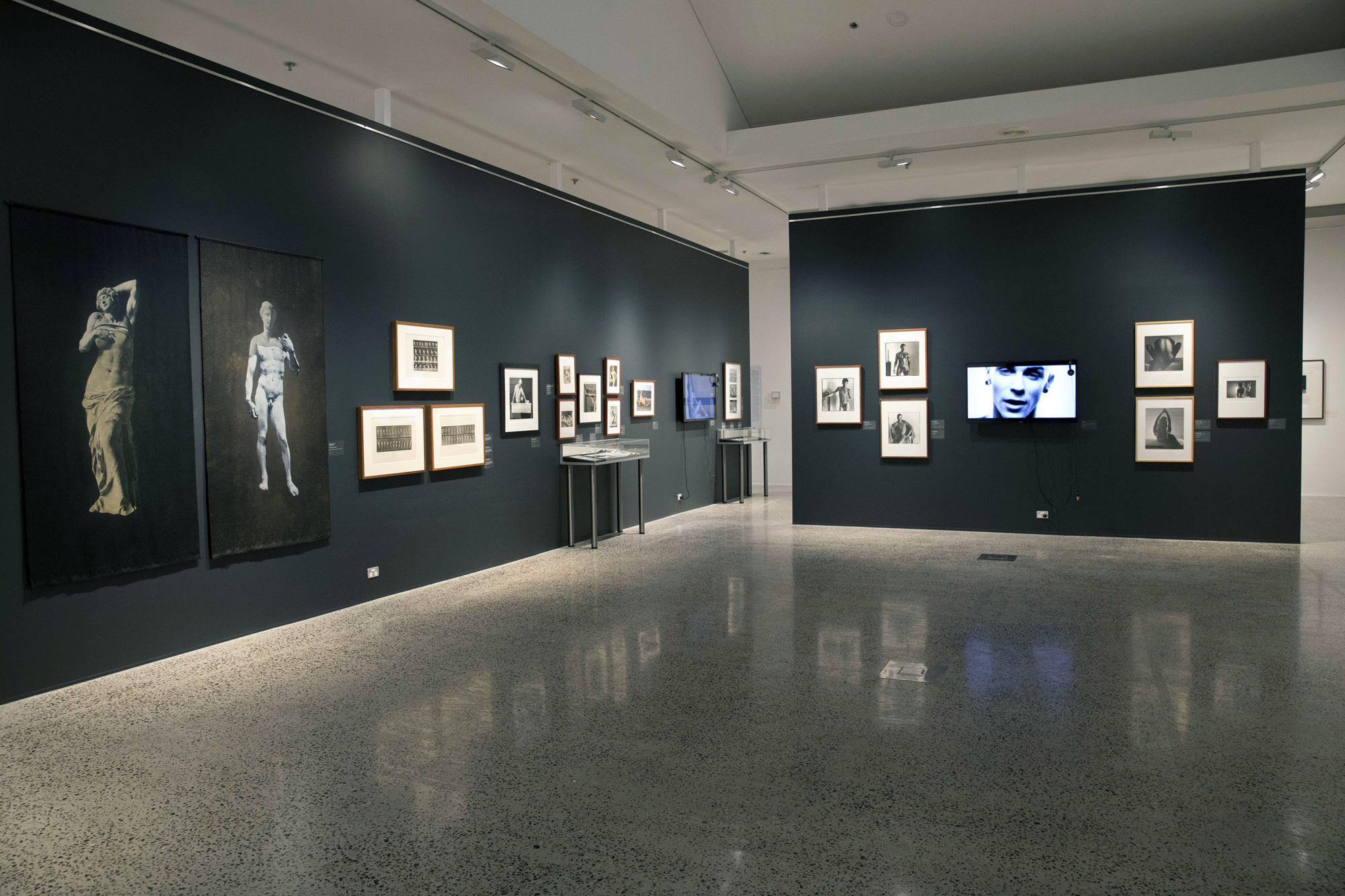
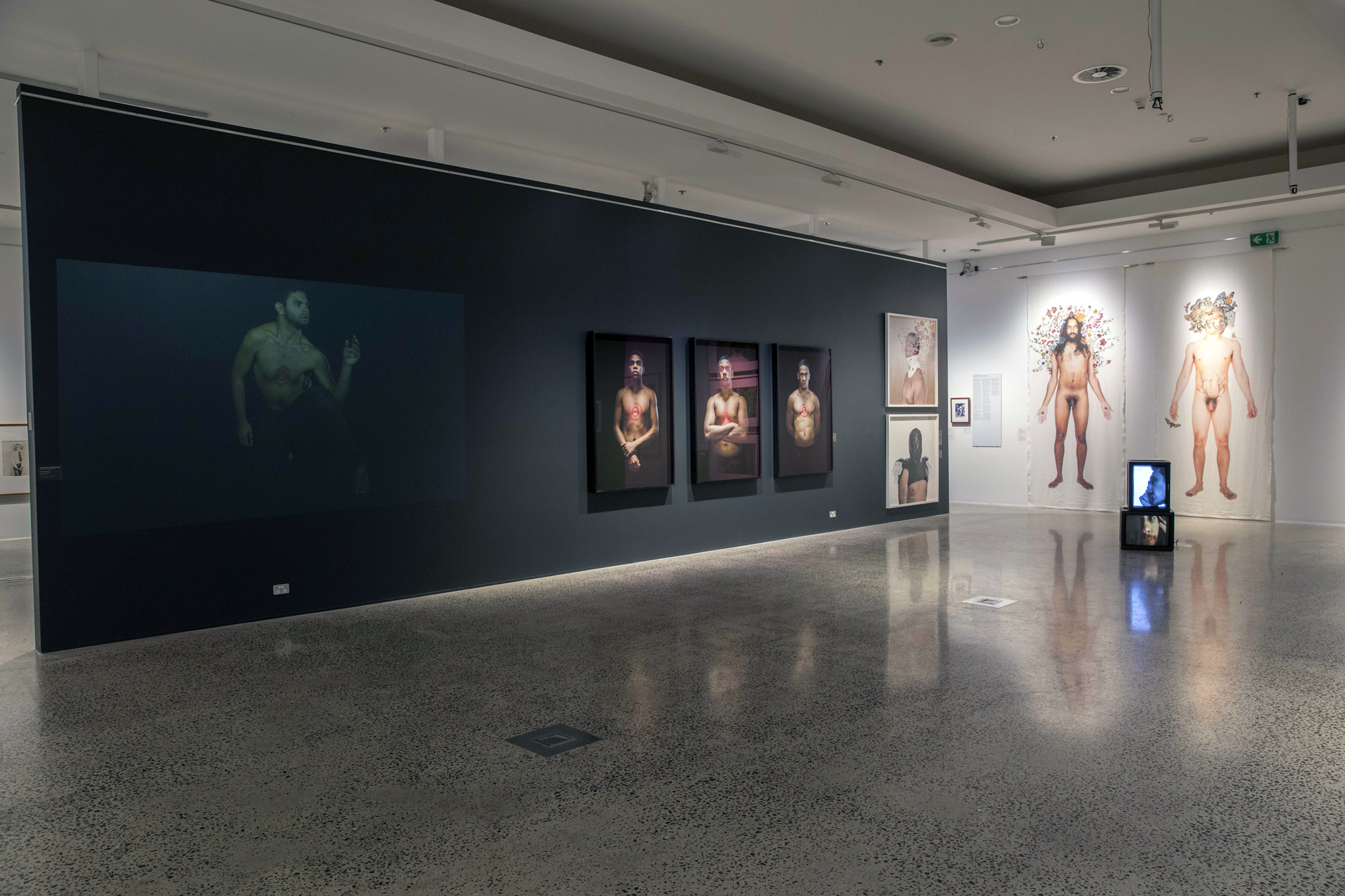
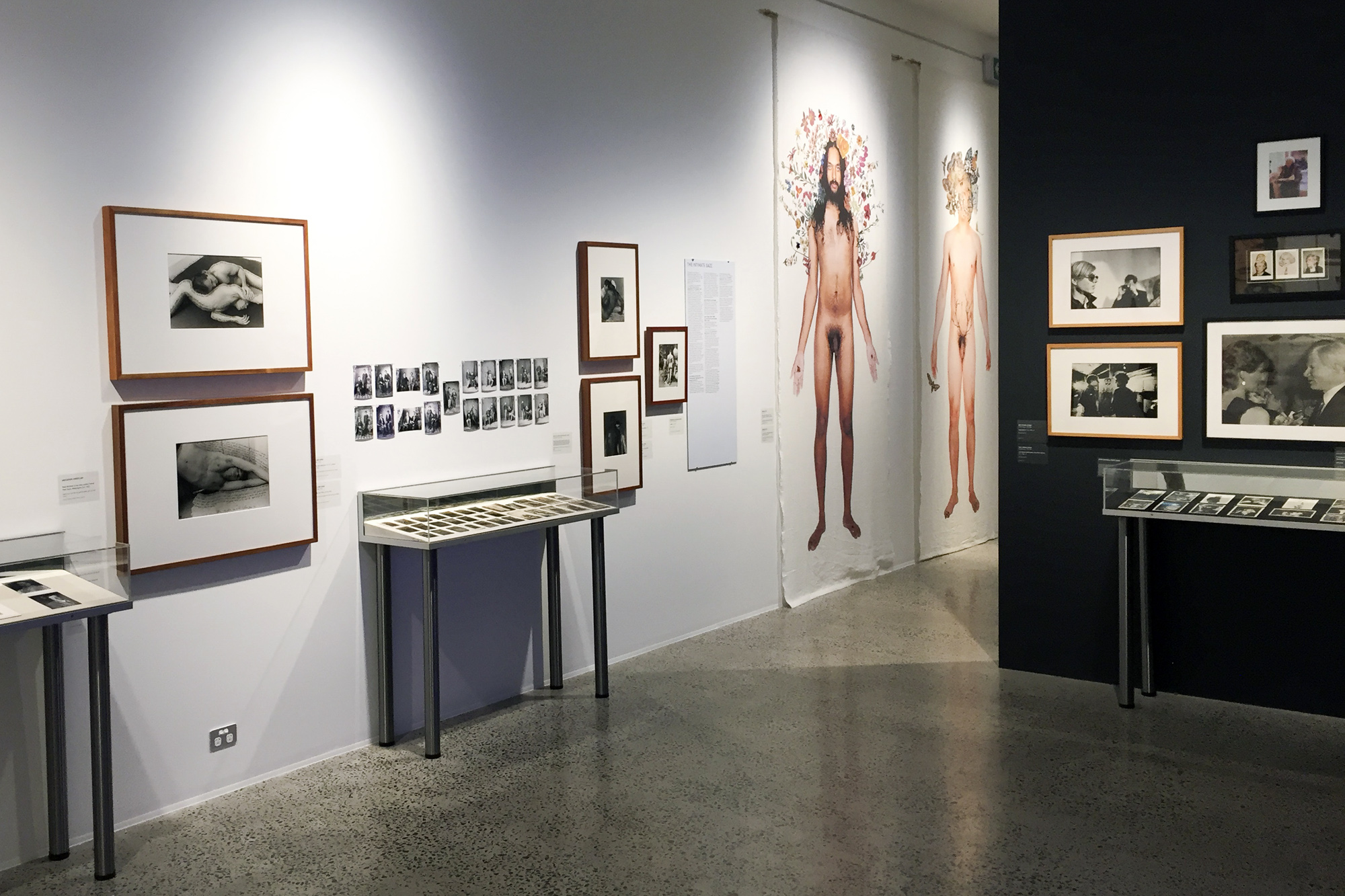
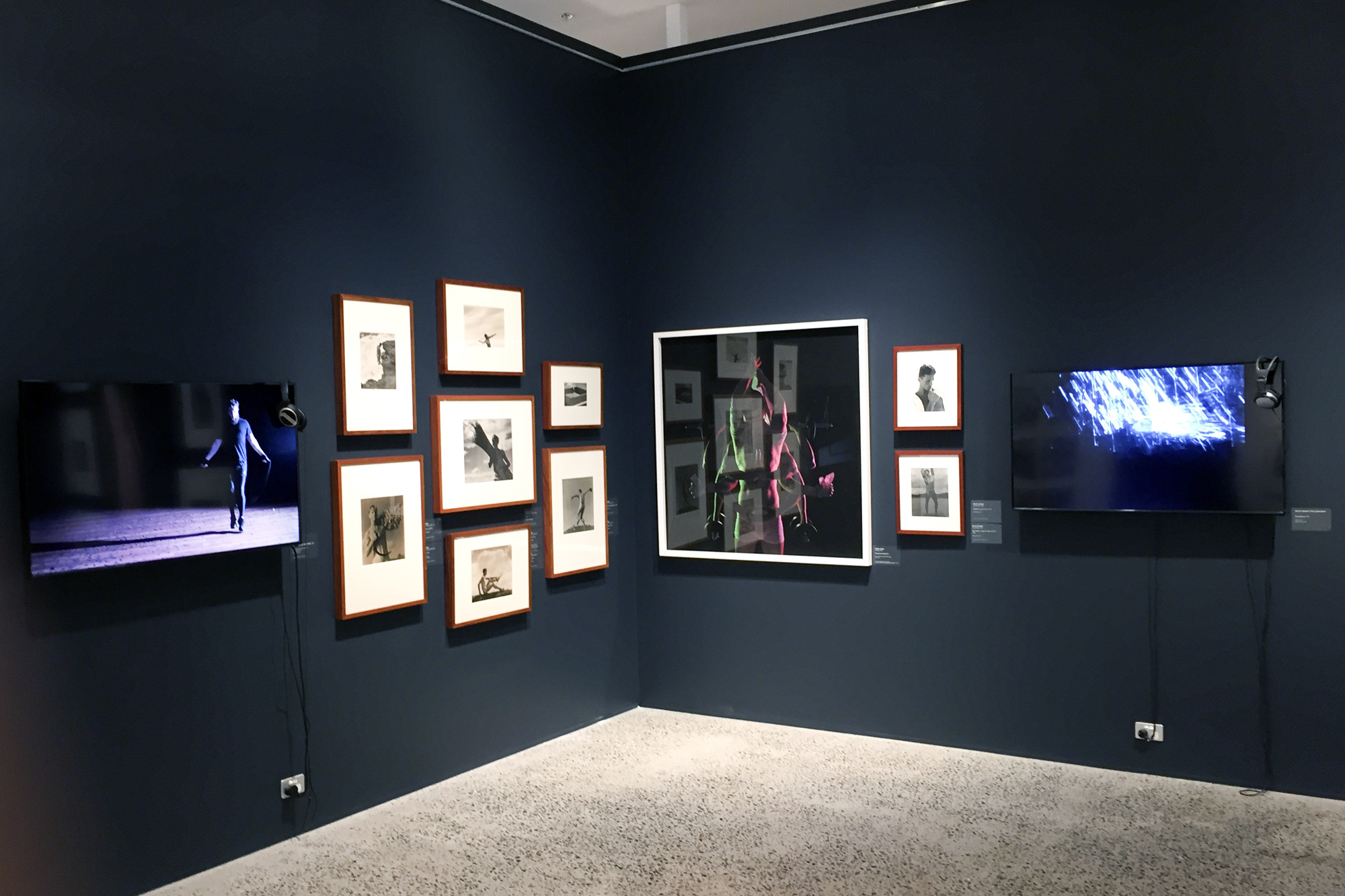
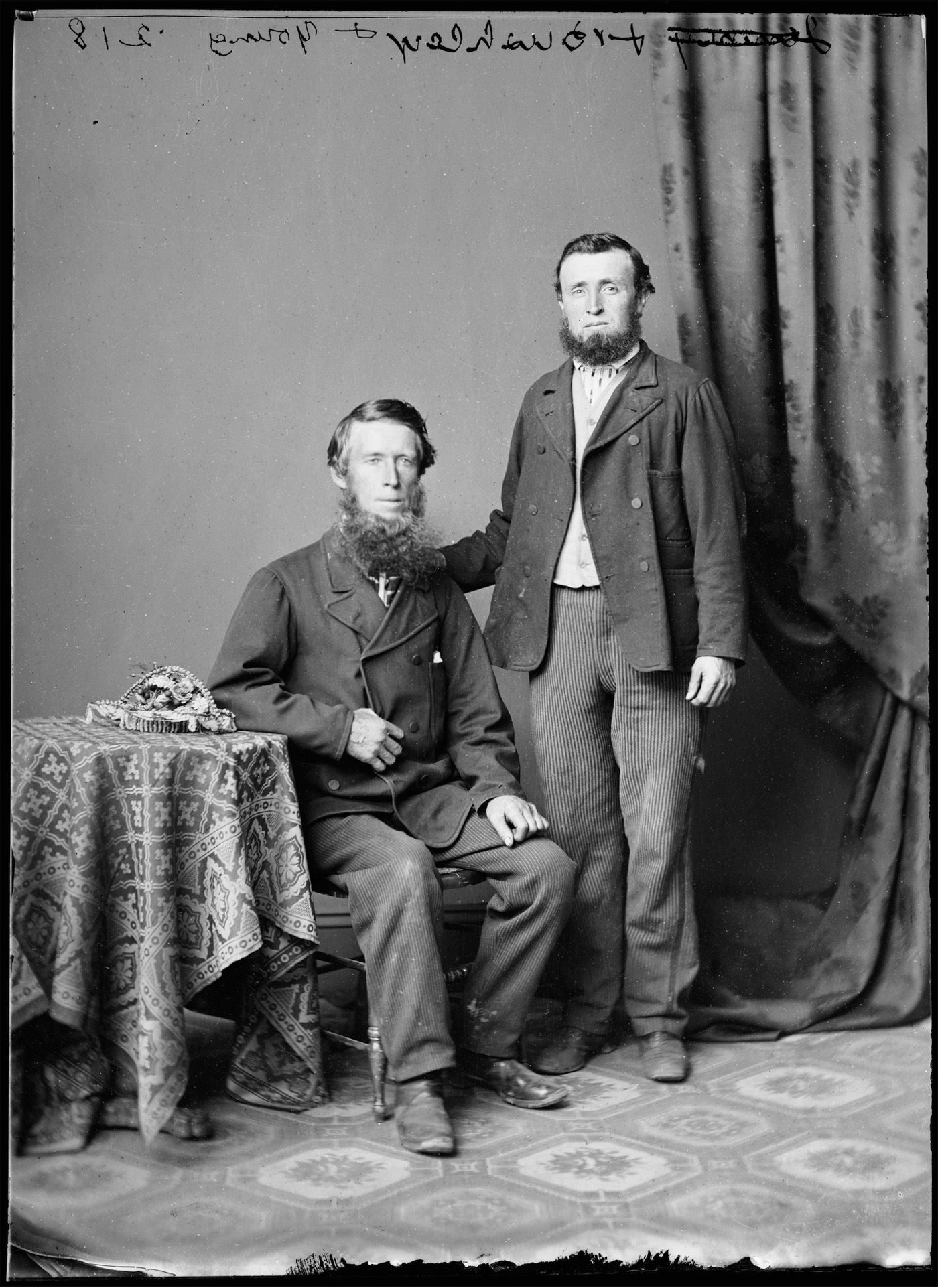
Exhibition: ‘Carte-o-mania!’ at the National Portrait Gallery, Canberra, Australia

Exhibition dates: 8th November, 2018 – 22nd April, 2019

Curator: Jo Gilmour


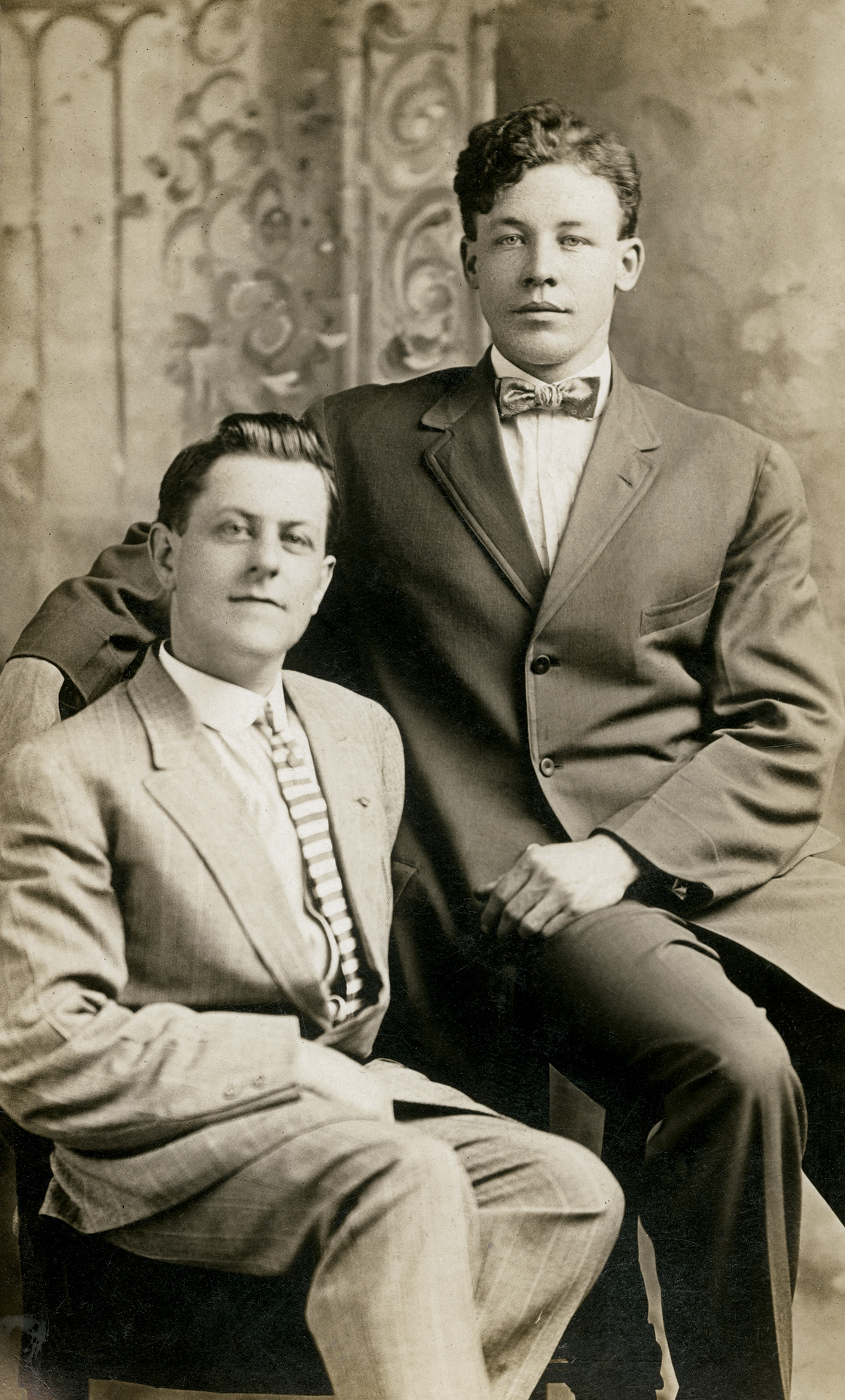
The Photographic Society of Victoria, Melbourne. 'Thomas Pearce (age 18 in 1878)' c. 1878 from the exhibition 'Carte-o-mania!' at the National Portrait Gallery, Canberra, Australia, Nov 2018 - April 2019


The Photographic Society of Victoria, Melbourne
Thomas Pearce (age 18 in 1878)
c. 1878
Albumen paper carte de visite
Support: 10.2 x 6.5cm
Image: 9.1 x 5.6cm
National Portrait Gallery, Canberra
Purchased 2010


A friend of mine is really ill at the moment in hospital. At 87 years old, she is a fiercely independent woman, possessing amazing intelligence and insight, a wicked sense of humour, stubborn, opinionated, passionate… and one of the most incredible human beings I have met during my life. If I had not met her, my life would have been so much poorer. It is a privilege to know her.

These Australian cartes des visite and cabinet cards give small insight into now largely forgotten lives, of both photographer and sitter. If only for a brief instant, we can pull back the curtain of time and enquire into their lives and existence. In a small way, we can reanimate their earthly spirit.

“Each photograph is like a miniature world of its own with an incredible story embedded in it. The poses, the props and the fashions throw an intriguing light onto the world of the nineteenth-century studio, while the stories of the photographers and their subjects combine to create a rich and vivid archive of Australian society at a precise moment in time. Rich or poor, male or female, famous or infamous, powerful or anonymous: everyone was captured in these tiny photographs.”

It is such a pity that we have to loose the knowledge that age brings, the powerful sages full of wisdom that could stop the human race repeating the mistakes of the past over and over again.

Dr Marcus Bunyan


PS. What is unsaid in these stories and images, is that most riches are built on the back of oppression, built on the bones of the Indigenous people of Australia. Rich whites, buying up land, pastoralists, sending their children to school in the Old Country… just because they can.


Many thankx to the National Portrait Gallery for allowing me to publish the photographs in the posting. All text unless otherwise noted from the National Portrait Gallery, Canberra. Please click on the photographs for a larger version of the image.


The Photographic Society of Victoria, Melbourne. 'Thomas Pearce (age 18 in 1878)' c. 1878 (detail)


The Photographic Society of Victoria, Melbourne
Thomas Pearce (age 18 in 1878) (detail)
c. 1878
Albumen paper carte de visite
Support: 10.2 x 6.5cm
Image: 9.1 x 5.6cm
National Portrait Gallery, Canberra
Purchased 2010


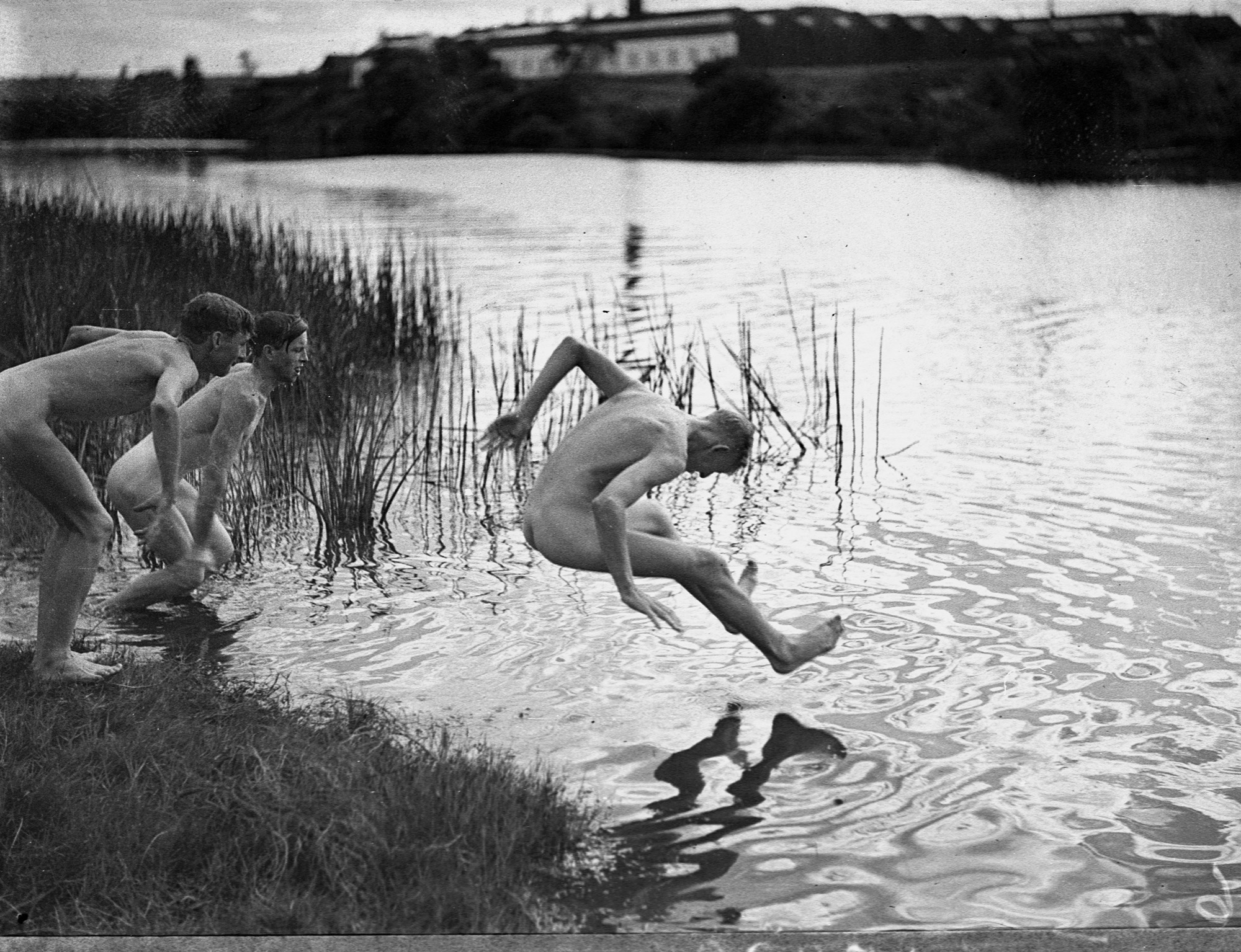
Thomas Pearce (c. 1860-1909) was a young apprentice on board the English merchant vessel the Loch Ard, which departed chilly Gravesend, England, for warmer climes in Australia in March 1878. There were 37 crew and sixteen passengers aboard. In stormy weather on 1 June 1878, just days from completing the three-month voyage, the captain of the magnificent iron-hulled clipper mistakenly thought the ship was 50 miles from the coastline when she was dashed by heavy surf onto the rocks of Muttonbird Island. Only two survived the wreckage: eighteen-year-old Pearce and eighteen-year-old Irish emigrant, Eva Carmichael. Supported by the upturned hull of a lifeboat, Pearce was washed ashore in a small cove, now known as Loch Ard Gorge. When he heard Eva Carmichael’s cries and saw her clinging to wreckage, ‘he at once divested himself of his unnecessary clothing, plunged in the sea, swan out to her, and brought her safely to the beach’. Lauded for his brave and gallant act, Pearce was presented with a valuable gold watch and chain by governor George Ferguson Bowen as a ‘slight token of the respect and admiration in which your noble conduct is held by all classes in this colony’. He was also presented with the first gold medal issued by the Royal Humane Society of Victoria. Popular sentiment was for a permanent union; but Eva returned to Ireland having lost her parents and siblings in the wreck. Pearce became a ship’s captain. According to an ‘interview’ published in the Argus in 1934, Carmichael returned Pearce’s favour some years later when, ‘living on the Irish coast’, she and her husband Captain Townsend were called on to help survivors from wrecks and that ‘on one occasion who should fall into her care but Tom Pearce!’.

As sole survivors of the wreck, Tom Pearce and Eva Carmichael experienced a period of celebrity during which the sensational story of the Loch Ard created much fodder for newspapers. The 6 July issue of the Australasian Sketcher featured wood engravings of the scene of the sinking, an engraved portrait of Eva, ‘drawn from life’, and one of Tom based on this carte de visite, which was captioned as being ‘from a photograph by Mr Burman’. There were four photographers named Burman in Melbourne in 1878: brothers Frederick, William and Arthur Burman, and their father, William Insull Burman, all of whom took photographs of Pearce and Carmichael. The Burmans were among the photographers later contracted to produce photographs relating to Ned Kelly’s activities, and many souvenir photos of him, his gang, his captors and the Glenrowan incident bear the Burman stamp. The Photographic Society of Victoria was formed in 1876 to ‘bring photographers together in a friendly spirit, in order to advance the art and science of photography in the colony’. At the time of the first annual meeting on 9 March 1877 there were 61 members, five whom were ladies. Members included well-known Melbourne photographers Charles Hewitt and Charles Nettleton as well as Joseph Turner of Geelong.

The Photographic Society of Victoria was formed in 1876 to ‘bring photographers together in a friendly spirit, in order to advance the art and science of photography in the colony, without any attempt at binding or dictating to members any special trading rules, such as charges for photographs or hours or days for closing or opening their respective establishments.’ At the time of the first annual meeting on 9 March 1877 there were 61 members, five whom were ladies. Members included well-known Melbourne photographers George William Perry, William Hall, Charles Hewitt, Charles Nettleton, and David Wood as well as Joseph Turner of Geelong.


Thomas Pearce (1860-1909)

Thomas Pearce (1860?-1909) was an apprentice on the English merchant vessel the Loch Ard, which embarked for Victoria in March 1878 carrying 37 crew and 16 passengers, many from the Carmichael family. In stormy weather on 1 June 1878, just days from completing the three-month voyage, the Loch Ard wrecked against Muttonbird Island. Supported by an upturned lifeboat, the teenaged Pearce was washed ashore in a small bay, now known as Loch Ard Gorge; but when he spotted eighteen-year-old Eva Carmichael clinging to wreckage in the ocean, he swam out and struggled back to shore with her. As sole survivors of the wreck, Tom Pearce and Eva Carmichael became celebrities and posed for a number of Melbourne photographers after their recuperation. Pearce was presented with the first gold medal of the Royal Humane Society of Victoria. Popular sentiment was for a permanent union; but Eva returned to Ireland, and Pearce became a ship’s captain. Several drowned members of Eva’s family are buried in a clifftop cemetery above Loch Ard Gorge. A porcelain figure of a peacock, made by English pottery Minton, was washed up from the wreck intact. Now on display at Warrnambool’s Flagstaff Hill Maritime Museum, the ‘Loch Ard Peacock’ is Australia’s most valuable shipwreck artefact, valued at $4 million.
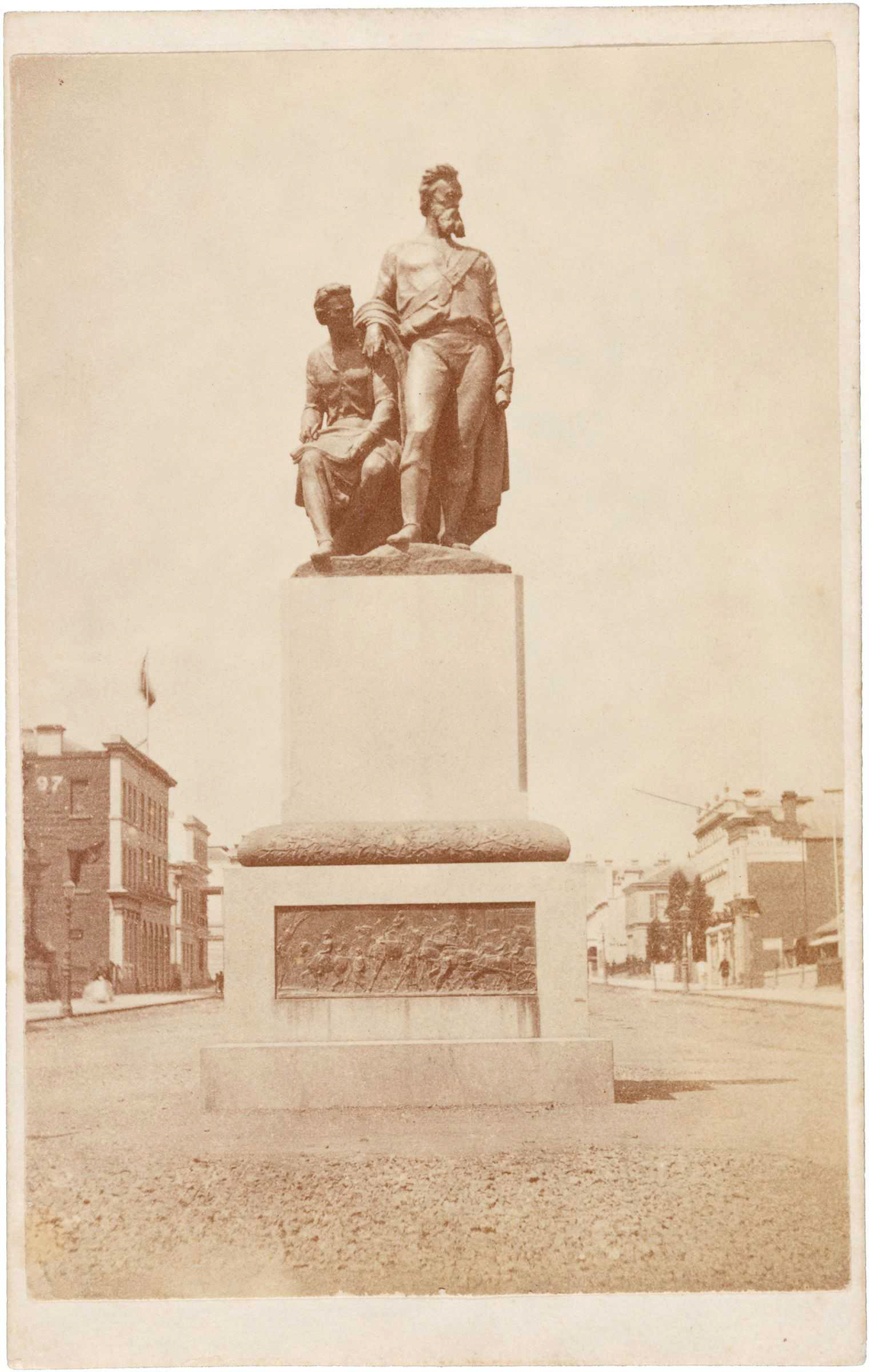
 

Thomas Foster Chuck (Australian born London, 1826-1898) 'The Burke and Wills Monument' 1869 from the exhibition 'Carte-o-mania!' at the National Portrait Gallery, Canberra, Australia, Nov 2018 - April 2019


Thomas Foster Chuck (Australian born London, 1826-1898)
The Burke and Wills Monument
1869
Albumen paper photograph on carte de visite
Support: 10.1 x 6.4cm
Image: 9.3 x 6.2cm
National Portrait Gallery, Canberra
Purchased 2001


From its outset, the Victorian Exploring Expedition (later renamed the Burke and Wills Expedition) provided much material for artists. William Strutt, for example, made portraits of expedition members and depictions of its preparations at Royal Park, while Burke and Wills both sat for the Melbourne photographer Thomas Adams Hill shortly before their departure in August 1860. Their deaths less than a year later, however, generated a plethora of portraits in a variety of formats. Sculptor Charles Summers (1825-1878) created waxworks of Burke and Wills soon after news of their lamentable deaths became known and was subsequently awarded the commission to create their official memorial. The monument was installed at the intersection of Collins and Russell Streets in 1865 and was the largest bronze casting carried out in Australia to that date. Thomas Foster Chuck, photographer and entrepreneur, also sought to cash in on the epic failure of the expedition. In early 1862, he and several others – including artist William Pitt, a scene painter for George Selth Coppin’s Theatre Royal – devised a ‘Grand Moving Diorama’ which toured south-eastern Australia in 1862 and 1863. Based on first-hand accounts and sketches by Strutt and others, the diorama consisted of sixteen painted scenes – one of which featured ‘Novel and Dioramic Automaton Effects’ in the form of mechanical camels ‘ and was billed as ‘the most interesting and superior Entertainment ever exhibited in Australia’.

Thomas Foster Chuck had studios in Melbourne and Daylesford from the mid-1860s and exhibited examples of his work at the Intercolonial Exhibition in 1866. In Melbourne, he traded as the ‘London Portrait Gallery’ from this address on Collins Street and later from the Royal Arcade on Bourke Street. In 1870, he commenced work on his mammoth Historical Picture of The Explorers and Early Colonists of Victoria, a photographic mosaic of over 700 individual portraits. It was completed in 1872 and was something of a money-spinner for Chuck, who sold individual cartes de visite of the sitters as well as prints of the composite image. A selection of Chuck’s portraits received an honourable mention in the photographic section of the Victorian Intercolonial Exhibition of 1873, and were awarded a gold medal at the London International Exhibition in 1874. In 1876 he moved to Ballarat where he opened his ‘Gallery of Art’ and continued to produce various types of photographic works, including hand-coloured ‘chromatypes’ (he was one of several photographers who claimed to have invented this process) and his much-admired composite portraits.

Thomas Foster Chuck (Australian, 1826-1898)

Thomas Foster Chuck (1826-1898), photographer and entrepreneur, was born in London and arrived in Victoria in 1861. The following year he produced and toured a ‘Grand Moving Diorama’ of dramatic painted scenes from the Burke and Wills expedition. By 1866 he had established a studio in Daylesford and examples of his work were shown at the Melbourne Intercolonial Exhibition that year. Returning to Melbourne, he occupied a series of studios before opening the ‘London Portrait Gallery’ in rooms in the Royal Arcade on Bourke Street. There, in 1870, he commenced work on his mammoth Historical Picture of The Explorers and Early Colonists of Victoria, a photographic mosaic composed of over 700 individual photographs of prominent citizens. The work was finally completed in 1872 and is said to have been quite a boon for its creator, with Chuck selling individual cartes de visite and enlarged prints of many of the portraits as well as reduced prints of the composite image. Chuck submitted hand-coloured enlargements of his portraits of Justices Redmond Barry and Edward Eyre Williams to the Intercolonial Exhibition; in January 1873, the Argus reported that ‘Photographic portraits, finished in oil, watercolours, and mezzotints’, and an ‘untouched solar enlargement’ by Chuck received an honourable mention in the photographic section of the Victorian Intercolonial Exhibition. Chuck forwarded the same works and a selection of smaller plain and coloured photographs to the London International Exhibition in 1874, winning a gold medal there. In 1872, he was awarded a contract to photograph the National Gallery’s collections; this resulted in eighteen photographs which were issued between 1873 and 1874 and published as Photographs of the Pictures in the National Gallery of Melbourne. In 1876 Chuck sold his Melbourne studio and moved to Ballarat where he opened his ‘Gallery of Art’ and continued to produce various types of photographic works, including hand-coloured ‘chromatypes’ (a process he claimed to have invented) and his much-admired composite portraits.


W & D Downey (William Downey (1829-1915) and Daniel Downey, British photographers). 'Lillie Langtry (age 32 in 1885)' c. 1885


W & D Downey (William Downey (1829-1915) and Daniel Downey, British photographers)
Lillie Langtry (age 32 in 1885)
c. 1885
Albumen silver carte de visite
Support: 10.3 x 6.2cm
Image: 9.8 x 5.1cm
National Portrait Gallery, Ca
Donated through the Australian Government’s Cultural Gifts Program by Malcolm Robertson inberran memory of William Thomas Robertson 2018


Lillie Langtry (American, 1853-1929)

Lillie Langtry (1853-1929) was born Emilie Charlotte Le Breton in Jersey in 1853. Aged nineteen she married the son of a Belfast shipowner with whom she moved to London. There, she rose to prominence as a professional beauty and style-setter whose acquaintances included various members of the social and cultural elite. She thus came within the orbit of Albert Edward, Prince of Wales (known as Bertie to his family), Queen Victoria’s eldest son and heir to the throne, whose dalliance with the Irish actress Nellie Clifden in 1861 had already created scandal. His liaison with Langtry commenced in 1877 and lasted three years. It was an open secret, generating notoriety and cachet for Langtry in equal measure. Around 1880 she began a relationship with Prince Louis of Battenberg (Louis Mountbatten), with whom she had a daughter. This precipitated the deterioration of her marriage which ended in 1881. Being without a conventional means of support she decided to earn a living as an actress and made her professional stage debut in London in December 1881. Capitalising on her beauty and reputation, she then formed her own theatre company with which she toured to the United States several times between 1882 and 1889. That year, having established independent wealth through investments in racehorses and real estate, she returned permanently to England. In 1899 she married the heir to an English baronetcy who was eighteen years her junior. She retired to Monaco after World War One and published her memoir The days I knew in 1925.

William Downey (1829-1915) and Daniel Downey, British photographers

Brothers William Downey (1829-1915) and Daniel Downey opened their first photographic studio in 1863 in Newcastle-on-Tyne. In 1872 the business expanded to London, William running the new studio in Belgravia while Daniel maintained the business in Newcastle. The firm became known for carte de visite and cabinet card portraits of celebrities and the aristocracy and is said to have been particularly favoured by Queen Victoria, whom they photographed on many occasions from the late 1860s until the 1890s. The Prince of Wales, later King Edward VII, was also a significant patron. W & D Downey’s 1868 carte-de-visite of his wife the Princess of Wales (later Queen Alexandra) piggy-backing her baby daughter Princess Louise was extraordinarily popular, selling some 300,000 copies. William’s son William Edward Downey (1855-1908) also became a photographer.
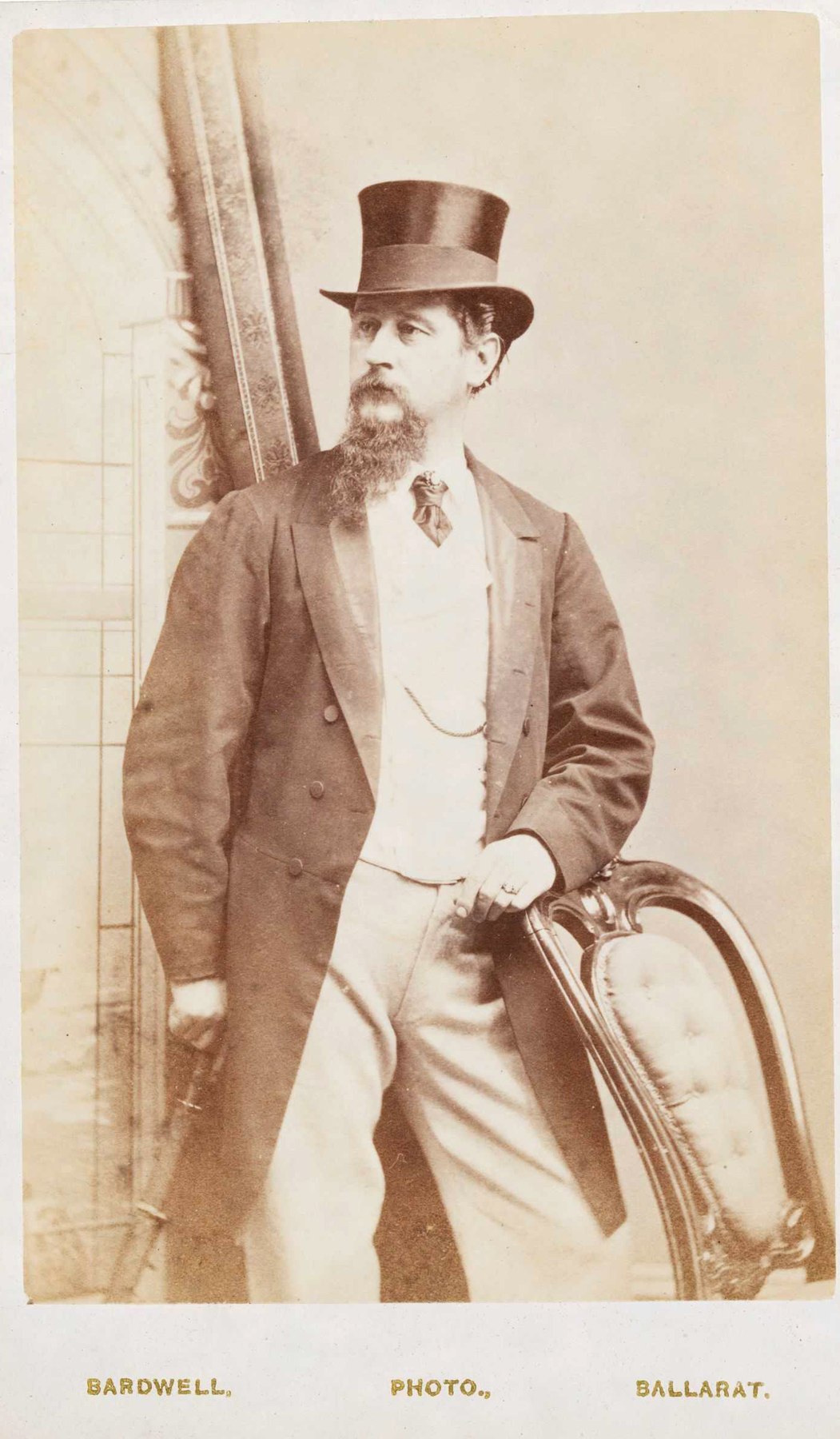
 

William H. Bardwell (Australian) 'Self portrait (age 34 in 1870)' 1870


William H. Bardwell (Australian)
Self portrait (age 34 in 1870)
1870
albumen silver carte de visite photograph
Support: 10.6 x 6.3cm
Image: 9.4 x 6.0cm
National Portrait Gallery, Canberra
Purchased 2015


William H. Bardwell

Photographer William H. Bardwell (life dates unknown), worked at various studios in Ballarat from 1858 until 1895. In 1859, he was in partnership with Saul Solomon; they specialised in portraiture and providing photographs of the town from unusual vantage points, some of which were lithographed for The Ballarat Album (1859). Together, he and Solomon exhibited portraits at the 1862 Geelong Industrial Exhibition, where they received special commendation for their ‘sennotype’ process, a process consisting of two albumen prints, one waxed and one hand-coloured, mounted with glass plate. The two also exhibited their portraits in the 1863 Ballarat Mechanics’ Institute Exhibition. The same year, the Argus reported that Bardwell had captured the laying of the foundation stone of the Sturt Street Burke and Wills memorial from the roof of the Post Office. In the late 1860s he photographed a visiting troupe of Japanese gymnasts, and in 1871 he took photographs of Chang the Chinese Giant and his entourage. Bardwell exhibited photographs of Ballarat at the Intercolonial Exhibition in Sydney in 1870, offering prints at the substantial price of £6 each, and had a photographic panorama of Ballarat among his views of its buildings and streets in the Victorian section of the London International Exhibition of 1873. From his studio at 11 Royal Arcade, Melbourne, William Bardwell exhibited photographs at the Melbourne Centennial International Exhibition 1888-1889. In this self-portrait we see Bardwell in standing pose, dressed in stately attire, his frock coat with lowered waistline and three-piece suit characteristic of the period. Supported by a chair and his walking cane, Bardwell projects a stately figure with his hat tidily atop his head.

In 1866, William Bardwell established the Royal Photographic Studio independently of Solomon, an advertisement in the Clunes Gazette announcing, ‘The studio is every way replete with suitable accommodation for the preparation of toilet and rooms are provided for both ladies and gentlemen. Mr Bardwell’s long and practical example will entitle him to the claim to the first position in Ballarat as a photographer’. Bardwell took advantage of his studio’s close proximity to the Theatre Royal, producing photographs for visiting theatre groups and operatic companies. Along with actresses and actors coming and going, Bardwell catered for the upper echelons of Ballarat society. Boasting the ‘best appointed Studio in the colonies’, one could imagine Bardwell’s studio was flooded with natural light, his darkroom in complete darkness for the meticulous preparation of plates, paper and photographic chemicals used to render surfaces sensitive to light. Bardwell went into partnership with John Beauchamp at Ballarat for some part of 1878, before relocating to open his studio in Melbourne later that year. Bardwell’s Royal Studios at Ballarat remained active throughout the 1880s under the operation of Mr Williams while William Bardwell remained in Melbourne.


Timothy Noble. 'Charles Blondin (age 50 in 1874)' 1874


Timothy Noble (Australian, active 1871-1888)
Charles Blondin (age 50 in 1874)
1874
Albumen photograph on carte de visite
Support: 10.2 x 6.2cm
Image: 9.3 x 5.6cm
National Portrait Gallery, Canberra
Purchased 2018


Charles Blondin (French, 1824-1897)

The famed nineteenth century French tightrope walker and aerial acrobat, Charles Blondin, born Jean Francoix Gravelet (1824-1897), was known for thrilling audiences world-wide with his acrobatic feats. The ‘crazy, bearded little Frenchman’ is said to have crossed Niagara Gorge on over 300 occasions, at first performing simple crossings then amazing onlookers with increasingly bizarre and challenging stunts. Encouraged by Australian entrepreneur and agent Harry (HP) Lyons, ‘The Great Blondin’ followed his North American tour with a visit to Australia in 1874, performing for enthralled onlookers in Brisbane, Sydney and Melbourne. On 25 July he made his first appearance in Australia, thrilling over 3,500 onlookers when he crossed the Brisbane Botanic Gardens on a tightrope measuring 76 metres in length and suspended 24 metres above the ground. He first danced across the tightrope in knight’s armour before performing several acrobatic stunts including balancing on his head for ten seconds, cooking an omelette on a stove while drinking a glass of champagne, balancing on two legs of a wooden chair, and carrying his assistant, Mr Niaud, pick-a’-back from one end to the other. Blondin’s performance captivated the audience for one hour and 45 minutes, during which time he would consistently toy with the crowd, pretending to stumble and fall to heighten the drama. The Maryborough Chronicle reported that Blondin’s appearance ‘produced the curious effect known as bringing the heart into the mouth’. Blondin’s popularity in Australia was such that to ‘blond’ on the back of the fence was the ambition of every kiddie. He inspired at least five Australians to emulate his feats, the most famed being the funambulist and aeronautical balloonist, Henri L’Estrange, commonly known as ‘the Australian Blondin’.

Timothy Noble (Australian, active 1871-1888)

Photographer Timothy Noble worked from a number of addresses in Melbourne between 1871 and 1884 before relocating to Sydney. At the time of Charles Blondin’s visit to Melbourne in 1874, Noble’s studio was at 135 Bourke Street, not far from George Selth Coppin’s Theatre Royal. It was there that Blondin made his inaugural Victorian appearance, the Age advising readers on 20 October 1874 that ‘Chevalier Blondin, The Hero of Niagara’ would be visiting the Theatre the following evening, and advising that ‘Early application should be made for seats and tickets’. In early November the paper reported that ‘We have received from Mr. Noble, photographer, of Bourke-street, a very good likeness of M. Blondin, with all his honours. The medals shown in the photograph have quite a history attached to them. Among them is the order of her Catholic Majesty the Queen of Spain’. Blondin’s pose likewise suggests his courageous spirit, while the pair of binoculars at his side is perhaps an allusion to the means by which some witnessed his thrilling and spectacular performances. The State Library of Victoria has 30 of Noble’s photographs, including portraits of actresses Hattie Shepparde and Maggie Moore, and impresario J.C. Williamson.


About the exhibition

Drawn from the NPG’s burgeoning collection of cartes de visite, Carte-o-mania! celebrates the wit, style and substance of the pocket-sized portraits that were taken and collected like crazy in post-goldrush Australia.

In May 1860 Queen Victoria and Prince Albert and their children sat for the London photographer John Jabez Edwin Mayall. With Her Majesty’s approval, the resultant photographs were made available to the public as a series of cartes de visite titled ‘The Royal Album’. Sales went crazy, netting Mayall £35,000 and propelling the carte de visite from relative obscurity to fervent, widespread popularity.

The diminutive-format albumen photographs, mounted on cards measuring ten by six centimetres, had been conceived of in Paris in 1854. Yet in the English-speaking world it wasn’t until the Queen saw fit to have herself documented in this way – and in relatable semblances and settings – that the populace began to embrace cartes as a novel, affordable way of collecting images, whether of royals and other luminaries or, increasingly, of themselves.

Cartes enabled people from various strata of society to acquire multiple portraits for a matter of shillings, providing ‘the opportunity of distributing yourself among your friends, and letting them see you in your favourite attitude, and with your favourite expression’.

Occupying a mid-point between the invention of the daguerreotype in 1839 and the advent of the Kodak camera in the 1880s, the carte de visite was the first truly democratic form of portraiture. Collections of cartes, and the outputs of their exponents, thus often constitute the most inclusive of portrait galleries and the most comprehensive archives of a nation’s faces.

Text from the National Portrait Gallery website [Online] Cited 20/03/2019


Unknown artist. 'Thomas Wentworth Wills (age 21 in 1857)' c.1857 or c.1864 (printed c.1905-1910)


Unknown artist
Thomas Wentworth Wills (age 21 in 1857)
c.1857 or c.1864 (printed c. 1905-1910)
Gelatin silver photograph on grey paper support on card
Support: 11 x 9cm
Image: 9.6 x 7.4cm
National Portrait Gallery, Canberra
Gift of T S Wills Cooke 2014
Donated through the Australian Government’s Cultural Gifts Program


Thomas Wentworth (Tom) Wills (Australian, 1836-1880)

Thomas Wentworth (Tom) Wills (1836-1880), is popularly thought of as the ‘inventor’ of Australian Rules football. Born in Sydney and named for his father’s good friend (and lawyer), William Charles Wentworth, Tom was not yet four when he took part in the journey by which his father, Horatio Spencer Wills, relocated from New South Wales to the Port Phillip district in 1839. Tom received some of his schooling in Melbourne before, at fourteen, being sent ‘home’ to be educated at Rugby, where he proved an adept sportsman but not much of a scholar. He then attended Cambridge but did not matriculate, once again earning greater distinction for his on-field prowess, particularly in cricket. He later played for Kent and the Marylebone Cricket Club, continuing his cricket career on returning to Victoria in late 1856. In all, between 1857 and 1876, in addition to playing for Richmond, the Melbourne Cricket Club, and several other teams, he represented Victoria in twelve matches against New South Wales, scoring a total of 319 runs and taking 72 wickets at the impressive average of ten for 23. His significance to Australian sporting history, however, arguably resides primarily in his instigating a local code of football as a means of keeping cricketers fit during winter. In 1858, Wills helped establish the Melbourne Football Club; in 1859, he led the group that set down the code of laws for what became known as Victorian or Australian Rules football – elements of which, some historians have argued, may have their origins in marngrook, a traditional game involving a possum-skin ball played by the Aboriginal people of the Western District, and which Wills may have witnessed and played as a boy.

In 1861, Tom along with at least 25 of his father’s employees (and 10,500 sheep), overlanded from Brisbane to Cullin-la-ringo, a property Horatio Wills had leased near Emerald in Queensland. Sent on an errand to another station soon after the party had arrived, Tom was absent from Cullin-la-ringo when a group of Aboriginal people camped nearby mounted a violent raid on the property, killing nineteen people, his father included. Tom remained at Cullin-la-ringo nevertheless, initially making an attempt to run it while resorting increasingly to alcohol as a method of quelling the demons occasioned by the circumstances of his father’s death. Back in Victoria permanently by 1864, he returned to sport, playing football for both Melbourne and Geelong, representing his state again in inter-colonial cricket, and serving in administrative capacities in both sports. In 1866, he was engaged as the captain-coach of a team of Aboriginal players that subsequently played a number of fixtures in Victoria and New South Wales but which disbanded prior to a planned tour to England in 1867. By the mid-1870s, however, the career of the so-called ‘Grace of Australia’ was unravelling, his performances routinely blighted by drunkenness. In his final years, he lived at Heidelberg with his partner, Sarah Barber (whom his family never recognised). Fearful that he would harm himself, in April 1880 Sarah had Tom admitted to the Melbourne Hospital for restraint. He absconded and died soon afterwards, having stabbed himself with a pair of scissors while in a state of delirium tremens.


William Edward Kilburn (British, 1818-1891) 'William Robertson' 1863


William Edward Kilburn (British, 1818-1891)
William Robertson
1863
Albumen paper carte de visite
Support: 10.2 x 6.5cm
Image: 8.6 x 5.5cm
National Portrait Gallery, Canberra
Donated through the Australian Government’s Cultural Gifts Program by Malcolm Robertson in memory of William Thomas Robertson 2018


William Robertson (Australian, 1839-1892)

William Robertson (1839-1892), lawyer, politician and pastoralist, was the second eldest son and third child of merchant and landowner William Robertson and his wife Margaret. William senior had emigrated to Van Diemen’s Land in the 1820s, building a successful business in Hobart before relocating to Victoria. William junior was educated in Hobart and then at Wadham College, Oxford. While there ‘he entered with zest into the athletics of the place, and he rowed in the Oxford and Cambridge annual boat race on the Thames in 1861’. He graduated in 1862 and the following year, in Tunbridge Wells, he married Martha Mary Murphy (1844-1909). On returning home William and Martha settled initially in Hobart before William was admitted to the bar in Victoria. He his brothers John, George and James each inherited property on their father’s death in 1874, William acquiring The Hill, ‘a stretch of very rich agricultural and grazing land’ near Colac. As Robertson Brothers the four managed the family’s various pastoral concerns, developing a reputation for their shorthorn cattle. William was a member of the Victorian Legislative Assembly in the 1870s and 1880s, ‘but his interest in politics was not very keen’. ‘He was much better fitted to shine in social life’, his obituary said, ‘being a man of amiable disposition and high private character’. He died while undergoing surgery for cancer in 1892.

William Edward Kilburn (British, 1818-1891)

William Edward Kilburn (1818-1891) was one of London’s earliest exponents of the daguerreotype. He opened his first studio on Regent Street, London, in 1847 and in 1848 Prince Albert acquired Kilburn’s daguerreotypes showing a large Chartist gathering at Kennington. This led to Kilburn being appointed ‘Her Majesty’s Daguerreotypist’ and began an association with the Royal Family that resulted in a number of portraits over the next several years. Leading members of society admired Kilburn’s work, which was often finely hand-coloured or engraved for publication in illustrated newspapers. Kilburn adapted easily to the waning popularity of the daguerreotype and the advent of paper photographs, his studio becoming a leading London supplier of cartes de visite in the late 1850s, and sitters such as Florence Nightingale and Benjamin Disraeli had cartes de visite taken by him. He is perhaps of especial interest to historians of Australian photography as the brother of Douglas Kilburn, who is considered Melbourne’s first professional photographer. Douglas’s early advertisements state that ‘Mr Kilburn, having just received materials and the latest information from his brother, in London (Photographic Artist to the Queen), will be ready next week to TAKE LIKENESSES by the Daguerreotype Process’.


S. Milbourn Jnr (Australian, 1863-1897) 'Adam Lindsay Gordon' 1890-1894


S. Milbourn Jnr (Australian, 1863-1897)
Adam Lindsay Gordon
1890-1894
Albumen silver photograph on cabinet card
Support: 16.5 x 10.7cm
Image: 13.1 x 10.6cm
National Portrait Gallery, Canberra
Purchased 2008


Adam Lindsay Gordon (Australian, 1833-1870)

Adam Lindsay Gordon (1833-1870), poet and horseman, arrived in Adelaide in 1853 and joined the South Australian Mounted Police. After two years he resigned and found work as a horse-breaker and also began establishing himself as a steeplechase rider at country race meetings. On his mother’s death in 1859 he came into a £7,000 inheritance, much of which was later squandered in various imprudent investments. Meanwhile, he’d married, served a term in the South Australian parliament, and started writing. Gordon’s poems began appearing in newspapers in 1864 and in 1867 he published his first two volumes of verse. He then moved to Ballarat and joined the Light Horse but suffered a serious horse-riding accident in early 1868 which compounded other misfortunes: the failure of yet another business venture and the death of his infant daughter. He nevertheless built on his reputation for hunting and horsemanship; and continued to publish and garner praise for his poetry, a third volume of which, Bush Ballads and Galloping Rhymes, appeared in 1870. Very shortly after its publication, however, and having failed to secure another inheritance that would have assuaged some of his financial worries, Gordon committed suicide, shooting himself on the beach at Brighton. ‘The bold resolute man, the accomplished scholar in whose heart burned true poetic fire, and the warm-hearted friend’ was buried in the Brighton cemetery, his grave becoming a site of pilgrimage for his admirers for many years to come.

S. Milbourn Jnr (Australian, 1863-1897)

S. Milbourn Junior is listed as operating as a photographer in Glenelg, South Australia, from 1890 to 1894, though there are scant details of his practice in existing texts on Australian photography. Over the course of the 1890s S. Milbourn Junior wrote various pieces of music, including ‘The Broken Hill Schottische’, ‘Eden-love’, ‘Friends no Longer’, ‘Love’s Guardian’, ‘Love’s Memories’ and the ‘Yacht Club Mazurka’. Milbourn’s music is advertised for sale on the reverse of these photographs, but the music advertised was written many years after the death of the writers depicted. Milbourn is unlikely to have taken the original photographs of Kendall and Gordon, but it is possible that he composed and fabricated the images on offer, using photographs taken many years before.


About the exhibition

The National Portrait Gallery is bringing the Victorian era back to life in a special exhibition exploring the colour and character of post-goldrush Australia.

Opening on Thursday 8 November, Carte-o-mania! celebrates the cute, quirky, intimate medium of the carte de visite – a diminutive style of studio photograph that took portraiture by storm in the 1860s.

Exhibition Curator Jo Gilmour says the National Portrait Gallery has never had an exhibition like this before. ‘When the Portrait Gallery first began, we had very few carte de visite photographs in the collection – but in recent years our collection of them has grown to over 100.

Each photograph is like a miniature world of its own with an incredible story embedded in it. The poses, the props and the fashions throw an intriguing light onto the world of the nineteenth-century studio, while the stories of the photographers and their subjects combine to create a rich and vivid archive of Australian society at a precise moment in time. Rich or poor, male or female, famous or infamous, powerful or anonymous: everyone was captured in these tiny photographs.

What I love about Carte-o-mania! is its wit and its fun factor. All of the portraits in the show will be displayed in showcases and albums, giving viewers the opportunity to get up close and immerse themselves in the photographs, which became part of a widespread collecting fad’.

Text from the National Portrait Gallery website [Online] Cited 20/03/2019


Batchelder and O'Neill (Australian firm active 1857-1863) 'Lady Anne Maria Barkly (age 25 in 1863)' 1863


Batchelder and O’Neill (Australian firm active 1857-1863)
Lady Anne Maria Barkly (age 25 in 1863)
1863
Albumen silver carte de visite
Support: 10.7 x 6.2cm
Image: 9.0 x 5.7cm
National Portrait Gallery, Canberra
Purchased 2014


Anne Maria Barkly (British, c. 1838-1932)

British botanist, Anne Maria Barkly née Pratt (c. 1838-1932) collected and drew plant specimens while accompanying her husband, Sir Henry Barkly, on his governing duties abroad. Following Sir Henry’s time as Governor of Victoria from 1856 to 1863, Lady Barkly accompanied her husband and his daughter by his first wife, Emily, to South Africa to assume the position of Governor of Mauritius (1863-1870). It was here that Lady Barkly corresponded with Sir Joseph Dalton Hooker at Kew Gardens about the plants of the island. In 1870, she journeyed to South Africa to join her husband in his newly appointed position as the Governor of the Cape of Good Hope. During their seven year stay on the Cape, Lady Barkly along with step daughter Emily Blanche Barkly made drawings of the plants that Sir Henry collected. Copies of their drawings of Stapeliae (odoriferous succulents in which her husband was very interested) were sent with Sir Henry’s descriptions of the living plants to Kew Gardens. Lady Barkly also collected plants herself, mainly pteridophyta. In 1875, she compiled and published A Revised List of the Ferns of South Africa. A set of her ferns was arranged at the Albany Museum in 1890. She is listed in the Dictionary of British and Irish Botanists, as is her step-daughter. In 1860, Nicholas Chevalier designed a fancy-dress costume for the new Lady Barkly, trimmed with sheepskin and gemstone nuggets, appliquéd with fern motifs and accessorised with a lyrebird-inspired fan. In this carte de visite, Lady Barkly is depicted in day dress with double-puff bishop sleeves, her small, elegant hat with frill detail perched on top of her head. The detailing of her fur-trimmed shawl is reflected in the mirror behind, while her hands rest gently on a lace shawl with leaf motif.

Batchelder & O’Neill (Australian firm active 1857-1863)

The preeminent Melbourne photographic firm Batchelder & O’Neill had its origins in the studio founded on Collins Street in 1854 by the Massachusetts-born photographer Perez Mann Batchelder (1818-1873), who had come to Victoria after several years in California. Batchelder’s brothers Benjamin (1826-1891), Nathaniel (1827-1860) and Freeman (life dates unknown) joined him in Melbourne in February 1856. The firm promised ‘Portraits taken on Glass and Silver Plates by the Collodion and Daguerreotype Process, in the highest perfection of the art’ and ‘in a style surpassed by none in the colonies’. The studio also offered tuition in photography and ‘supplied [the trade] with apparatus and materials of every description’. Perez Batchelder left Victoria in 1857 and another American, Daniel O’Neill, joined the business. By late 1864, Batchelder & O’Neill – with O’Neill as sole partner – had relocated to Swanston Street. O’Neill later moved to Sydney, where in April 1868 he advertised the availability of his carte de visite of the Duke of Edinburgh’s would-be assassin Henry O’Farrell a week before his execution. Meanwhile, Perez Batchelder had returned to Boston, where he died in 1873. By 1866 the old firm no longer existed, but other photographers traded under the names ‘Batchelder’s Portrait Rooms’ and ‘Batchelder & Co.’ from 1866 to 1895.


Johnstone O'Shannessy & Co (Henry James Johnstone and Emily Florence Kate O'Shaughnessy) (Melbourne, active c. 1865 to 1905) 'Martha M. Robertson (age 22 in 1866)' 1866


Johnstone O’Shannessy & Co (Henry James Johnstone and Emily Florence Kate O’Shaughnessy) (Melbourne, active c. 1865 to 1905)
Martha M. Robertson (age 22 in 1866)
1866
Albumen photograph on carte de visite
Support: 10.5 x 6.2cm
Image: 9.7 x 6.0cm
National Portrait Gallery, Canberra
Donated through the Australian Government’s Cultural Gifts Program by Malcolm Robertson in memory of William Thomas Robertson 2018


Martha Mary Robertson (née Murphy, Australian, 1844-1909)

Martha Mary Robertson (née Murphy, 1844-1909) married barrister William Robertson (1839-1892) in England in 1863. Like her husband, Martha was from a fabulously successful colonial family. Her father, John Robert Murphy (1806-1891), was your archetypical self-made man, a brewer by profession, who had emigrated to Van Diemen’s Land and then – like William’s father – availed himself of the opportunities presented by expansion to the Port Phillip district in the 1830s. Murphy, according to his obituary, initially took up land at Warrnambool before moving to Melbourne, opening a brewery, and investing ‘in the purchase of city and suburban lands, all of which proved to be investments of the first class’. By 1850 Murphy was in position to take his children to England to be educated, and it was presumably through their Tasmanian / Victorian connections that Martha and William met there, William having graduated from Oxford in 1862. Their first child, a son, was born in England in 1864. Another four children, three girls and one boy, were born after they’d returned to Victoria. In 1874 the family moved to The Hill, near Colac, one of a number of properties William and his brothers inherited on their father’s death and which they managed in partnership until the early 1890s. William was a keen amateur photographer and his images include those of family life at The Hill, where he died in 1892. Martha outlived him by seventeen years, spending the latter part of her life in Armadale.

Johnstone O’Shannessy & Co (Melbourne, active c. 1865 to 1905)

Henry James Johnstone was born in Birmingham in 1835 and studied at the Birmingham School of Design before joining his father’s photographic firm. He arrived in Victoria in 1853 and spent three years on the goldfields before returning to Melbourne and opening a studio in Bourke Street with Emily Florence Kate O’Shaughnessy in 1862. Initially trading as Johnstone & Co, it became Johnstone, O’Shannessy & Co in 1864. They operated in premises next door to the GPO until 1886 and were awarded a medal at the 1866 Intercolonial Exhibition. Johnstone meanwhile continued his art studies, taking lessons from Charles Summers and Louis Buvelot, and later under Thomas Clark at the National Gallery School. According to one historian, Johnstone toured Victoria with HRH Prince Alfred The Duke of Edinburgh during his visit in 1867-1868, by which stage Johnstone, O’Shannessy & Co. was one of Melbourne’s most fashionable photographic studios. O’Shaughnessy – whose name appears always to have been misspelt – is believed to have left the business around 1870, although the studio continued to trade under the Johnstone O’Shannessy name. From 1872 Johnstone exhibited paintings with the Victorian Academy of Arts. He left Melbourne in the late 1870s and was reported to be living in California when four of his paintings were shown at the Victorian Academy of Arts exhibition in 1879. By 1881 he was in England, exhibiting regularly at the Royal Academy until 1900. He died in 1907.
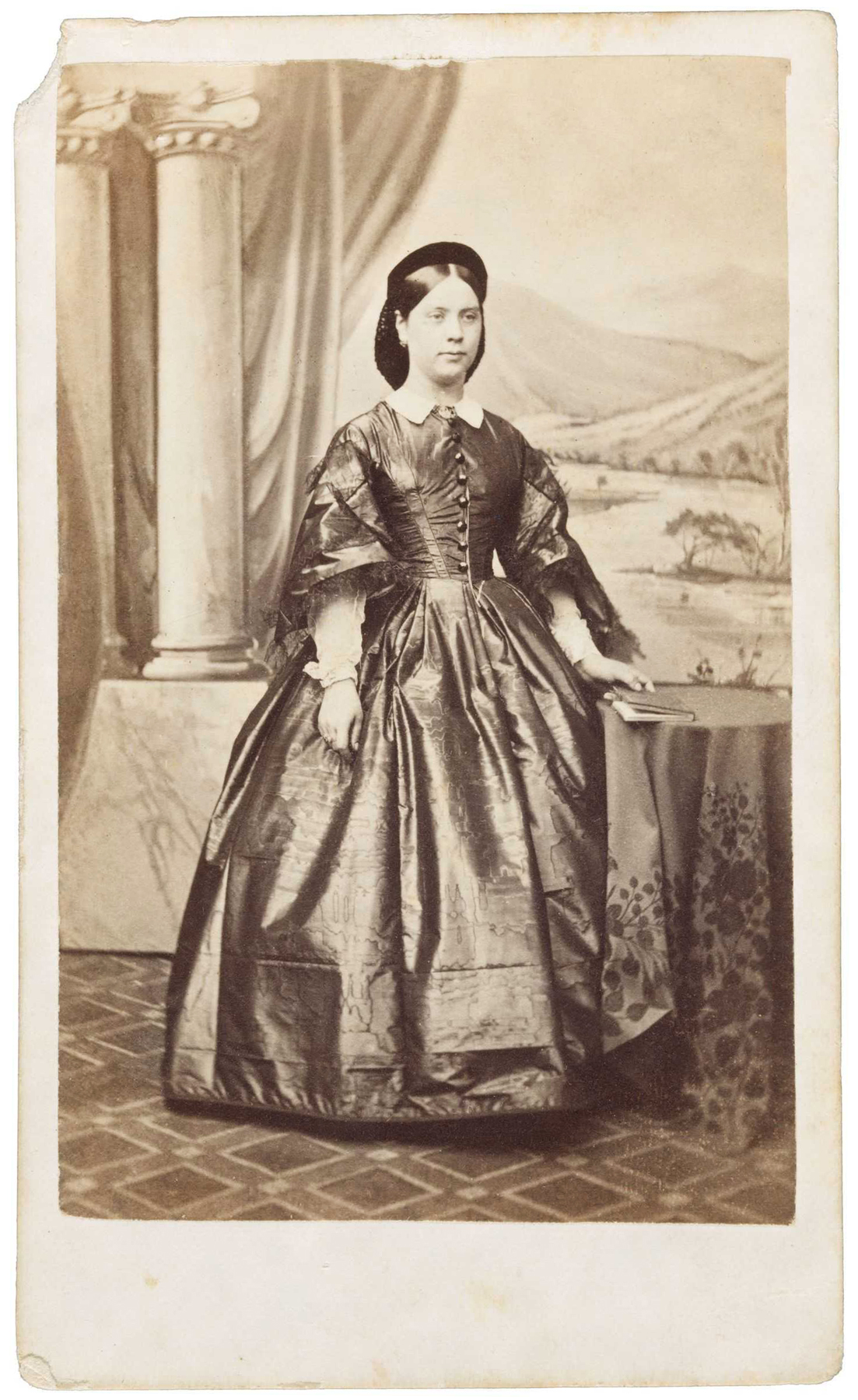
 

Davies & Co (William Davies, English active Melbourne, 1855-1882) 'Julia Matthews (age 20 in 1862)' c. 1862


Davies & Co (William Davies, English active Melbourne, 1855-1882)
Julia Matthews (age 20 in 1862)
c. 1862
Albumen paper carte de visite
Support: 10.5 x 6.4 cm
Image: 9.0 x 5.7 cm
National Portrait Gallery, Canberra
Purchased 2010


Julia Matthews (English, 1842-1876)

Legend has it that Julia Matthews (1842-1876) was one of the main reasons why Robert O’Hara Burke signed up for the ill-fated expedition he led to the Gulf of Carpentaria in 1860-1861. An actress and singer twenty-one years his junior, Matthews first encountered Burke in 1858 when she toured to Beechworth, where Burke was police inspector. He reportedly saw all of her performances there and was so enamoured that he asked her to marry him. She refused. Undeterred – and purportedly thinking that the glory he expected to achieve by the expedition would make him an irresistible prospect – he proposed again on evening of the expedition’s departure from Melbourne in August 1860. She declined to give him a definitive answer, but Burke had sufficient inducement to give her a miniature portrait of himself regardless, having two days earlier made her his sole beneficiary in the event of his death. Matthews is said to have urged a search party once rumours of the expedition’s failure began to circulate in Melbourne, and soon after news of her would-be suitor’s demise was confirmed she placed a notice in the newspapers offering a reward to anyone who recovered the portrait of Burke she claimed to have lost while walking in the Botanic Gardens. Whether this was a publicity stunt or arose out of genuine sadness at losing the memento is unclear. Following the end of a six-year marriage to a faithless drunkard husband, Matthews toured the UK and the United States to support her three children. She died in Missouri in May 1876.

Davies & Co (William Davies, English active Melbourne, 1855-1882)

English photographer William Davies had arrived in Melbourne by 1855. He is said to have worked with his friend Walter Woodbury and for the local outpost of the New York firm Meade Brothers before establishing his own business in 1858. By the middle of 1862, ‘Davies & Co’ had rooms at 91 and 94 Bourke Street, from where patrons could procure ‘CARTE de VISITE and ALBUM PORTRAITS, in superior style’. Like several of his contemporaries and competitors, Davies appears to have made the most of his location ‘opposite the Theatre Royal’, subjects of Davies & Co cartes de visite including leading actors such as Barry Sullivan and Gustavus Vaughan Brooke, and comedian Harry Rickards. Examples of the firm’s work – portraits and views – were included in the 1861 Victorian Exhibition and the London International Exhibition of 1862; and at the 1866 Intercolonial Exhibition the firm exhibited ‘Portraits, Plain and Coloured, in Oils and Water Colours’ alongside a selection of views for which they received an honourable mention.


Arthur William Burman (Australian, 1851-1915) 'Clara Crosbie' c. 1885


Arthur William Burman (Australian, 1851-1915)
Clara Crosbie
c. 1885
Albumen photograph on carte de visite
Support: 10.1 x 6.1 cm
Image: 8.9 x 5.6 cm
Courtesy of John McPhee


Clara Harriet Crosbie (Australian, b. 1873)

Clara Harriet Crosbie was twelve years old when she went missing in the bush near Yellingbo in the Yarra Valley in May 1885. ‘The child had been sent on a visit to a neighbour about a mile from her mother’s house’, reported the Argus, but ‘as a town-bred girl, of warm affections and quick impulses … she resolved to find her way home, although she did not know the way’. Faced with the perilous wilds, Clara took shelter in the hollow of a tree for three weeks, crawling to a nearby creek to drink and trying to cooee her way to safety. Her cries for help were eventually heard – by chance – by two men named Cowan and Smith while they were in the vicinity searching for horses. A low sound, ‘like a young blackbird’s whistle’, had caught the acute ear of the two experienced bushmen and they followed the ‘wailing note borne softly on the breeze’ to its source. With the return of each low and piercing cooee, the men at last caught sight of the little girl, frail and woebegone. ‘The little creature was tottering towards us, in her ulster, without shoes or stockings on, but quite sensible’, they recounted. Following her convalescence in the Melbourne Hospital, Clara’s father leased her to Maximilian Kreitmayer, the proprietor of the waxworks on Bourke Street. From August to November 1885, ‘The Latest Attraction, CLARA CROSBIE’, performed to hordes of intrigued onlookers, explaining ‘How To Live For Three Weeks in the Bush Without Food’. In December 1885 she proceeded to Sydney to repeat the spectacle.

Throughout the nineteenth century there were several accounts of young children from settlements around Melbourne wandering off into the bewildering bush, never to be found again. Several painters of the period, including Frederick McCubbin, William Strutt and S.T. Gill, were inspired by these dramatic, melancholic tales of lost children. The theme also resonated deeply with the populace and became something of a mainstay of nineteenth-century Australian culture. McCubbin’s depiction of a young girl enveloped by bush in Lost (1886) is said to have been inspired by Clara’s story of survival, which McCubbin may well have heard first-hand at Kreitmayer’s Waxworks. In Arthur William Burman’s portrait of Clara, the studio is set up to simulate forbidding bushland, with the lost little girl’s bewildered eyes peering towards the lens. Burman was one of four siblings who followed their father into the photography profession. The various Burmans, and the several studios they operated either individually or in partnership, often sought to cash in on persons of ephemeral celebrity. Among the numerous other subjects of Burman cartes are Eva Carmichael and Tom Pearce, the survivors of the 1878 sinking of the Loch Ard, for example, and Dominick Sonsee, ‘the Smallest Man in the World’, who was exhibiting himself at the Eastern Arcade on Bourke Street in 1880.

Arthur William Burman (Australian, 1851-1915)

Arthur William Burman was one of the nine children of photographer William Insull Burman (1814-1890), who came to Victoria in 1853. Burman senior worked as a painter and decorator before establishing his own photography business in Carlton around 1863. Arthur and his older brother, Frederick, worked in the family business which, by 1869, operated a number of studios around Melbourne. Arthur is listed as operating businesses under his own name from addresses in East Melbourne, Carlton, Windsor, Fitzroy and Richmond between 1878 and his death in 1890.


Archibald McDonald (Australian born Nova Scotia, 1831-1873) 'Chang the Chinese Giant with his wife Kin Foo and manager Edward Parlett' c. 1871


Archibald McDonald (Australian born Nova Scotia, 1831-1873)
Chang the Chinese Giant with his wife Kin Foo and manager Edward Parlett
c. 1871
Albumen photograph on carte de visite
Support: 10.2 x 6.2cm
Image: 9.3 x 5.9cm
National Portrait Gallery, Canberra
Purchased 2010


Chang Woo Gow (Chinese, c. 1846-1893)

Chang Woo Gow (c. 1846-1893), aka ‘Chang the Chinese Giant’, is believed to have been born in either Fuzhou or Beijing and claimed to be from a line of scholarly, similarly proportioned forbears. He first exhibited himself in London in 1865 at the Egyptian Hall, Piccadilly, which functioned as ‘a cluster of speculative showcases for the miscellaneous entertainers who worked the London circuit’. A woman described as his wife, Kin Foo, and a dwarf were part of the spectacle. Hordes of people were reported to have attended Chang’s levées, readily paying for the privilege of looking upon ‘this most splendid specimen of a man’, dressed in his traditional Chinese robes and diverting his audiences with samples of the several languages he spoke fluently. Having fulfilled further engagements in the UK and Paris, Chang travelled to the USA, appearing in New York, Detroit, Boston, Philadelphia, Chicago and San Francisco among other cities before making his way to Melbourne in January 1871. Chang’s inaugural Australian levée was conducted at St. George’s Hall, formerly known as Weston’s Opera House. Like the Egyptian Hall, it was a venue that hosted a diverse assortment of ‘attractions’, such as the mesmerist Madame Sibly, who was ‘manipulating heads’ for packed houses nightly in early March 1871. Chang and his party then proceeded throughout country Victoria. By May they were in Sydney, appearing at the School of Arts with the Australian Tom Thumb, and they subsequently appeared in Maitland, Singleton, Scone, Muswellbrook and Newcastle. In November 1871 Chang married Catherine ‘Kitty’ Santley, a native of Liverpool, England, whom he had met in Geelong. In December it was reported that Chang, his ‘sister’ Kin Foo, and his wife had sailed from Auckland for Shanghai. After a stint with Barnum and Bailey’s ‘Greatest Show on Earth’, Chang retired with his family to Bournemouth, where he opened a tearoom with a sideline in Chinese curios and fabrics.

Portraits had a role to play not just in the marketing but in the performances of those in the live exhibit profession, with accounts of Chang’s receptions indicating that the issuing of cartes de visite was part of the whole experience. In Chang’s case, and in keeping with the civility characterising his ‘levees’, the photographs may have been intended to function equally as a memento of having been in his ‘Celestial presence’ and as a miniature conversation piece or quirky, curious souvenir. Among the St George’s Hall tenants when Chang was appearing there in early 1871 was Archibald McDonald (1831-1873), a Canadian-born photographer who had first come to Australia in the late 1840s, working in Melbourne, Geelong, Tasmania and then Melbourne again, and establishing his gallery and studio in St. George’s Hall around 1864. McDonald was consequently among the various photographers to produce cartes of Chang and his entourage. It seems to have been standard to photograph him in either Chinese or English mode; and alongside those of average or dramatically different proportions so as to throw his own into greater relief. Both methods are in evidence in two photographs of Chang bearing McDonald’s studio stamp: one shows Chang and Kin Foo in traditional robes alongside his manager, Edward Partlett – seated atop a pedestal; and the second sees Chang in European clothes, seated, and flanked by four others including a Chinese boy. In April 1871 the Ballarat photographer William Bardwell created a number of cartes of Chang, one of which depicted him with Partlett tucked comfortably underneath his arm.


Batchelder and O'Neill (Australian firm active 1857-1863) 'John Pascoe Fawkner (age 75 in 1867)' c. 1867


Batchelder and O’Neill (Australian firm active 1857-1863)
John Pascoe Fawkner (age 75 in 1867)
c. 1867
Albumen silver carte de visite
Support: 10.5 x 6.3cm
National Portrait Gallery, Canberra
Purchased 2008


John Pascoe Fawkner (Australian, 1792-1869)

John Pascoe Fawkner (1792-1869), sometimes called the ‘Founder of Melbourne’ was a pioneer and adventurer. The self-educated son of a convict, he spent his early years in Van Diemen’s Land, pursuing a variety of occupations from baker to builder to bush lawyer, often finding himself in trouble with the law largely because of debts but in 1814 for abetting an attempted escape by convicts. He launched the Launceston Advertiser in 1828 and edited it for the next two years, championing the emancipist class and attacking officialdom. In 1835 he organised an expedition to what is now Melbourne. Landing in Hobson’s Bay, Fawkner soon became a man of property and influence, acquired substantial lots of land, running a hotel and establishing the Port Phillip Patriot and Melbourne Advertiser. A member of the Legislative Council from its introduction in 1851 until his death, Fawkner railed in his Port Phillip Patriot against the privileged squattocracy and was known as ‘the tribune of the people’.

Batchelder & O’Neill (Australian firm active 1857-1863)

The American brothers Perez Mann, Benjamin and Nathaniel Batchelder worked in Victoria and New South Wales in the 1850s and 1860s. Perez Batchelder had come to the colony from the Californian goldfields, which he had traversed making daguerreotypes. He and Benjamin Batchelder set up the Melbourne studio of PM Batchelder in 1852; the family also opened short-lived enterprises in Sydney in 1858 and Bendigo in 1866. Perez’s business, Batchelder and O’Neill, not only took photographs, but sold ‘photographic materials of every description’ which were illustrated in their free catalogues. The inaugural meeting of the Photographic Society of Victoria took place in Batchelder and O’Neill’s rooms in 1860.
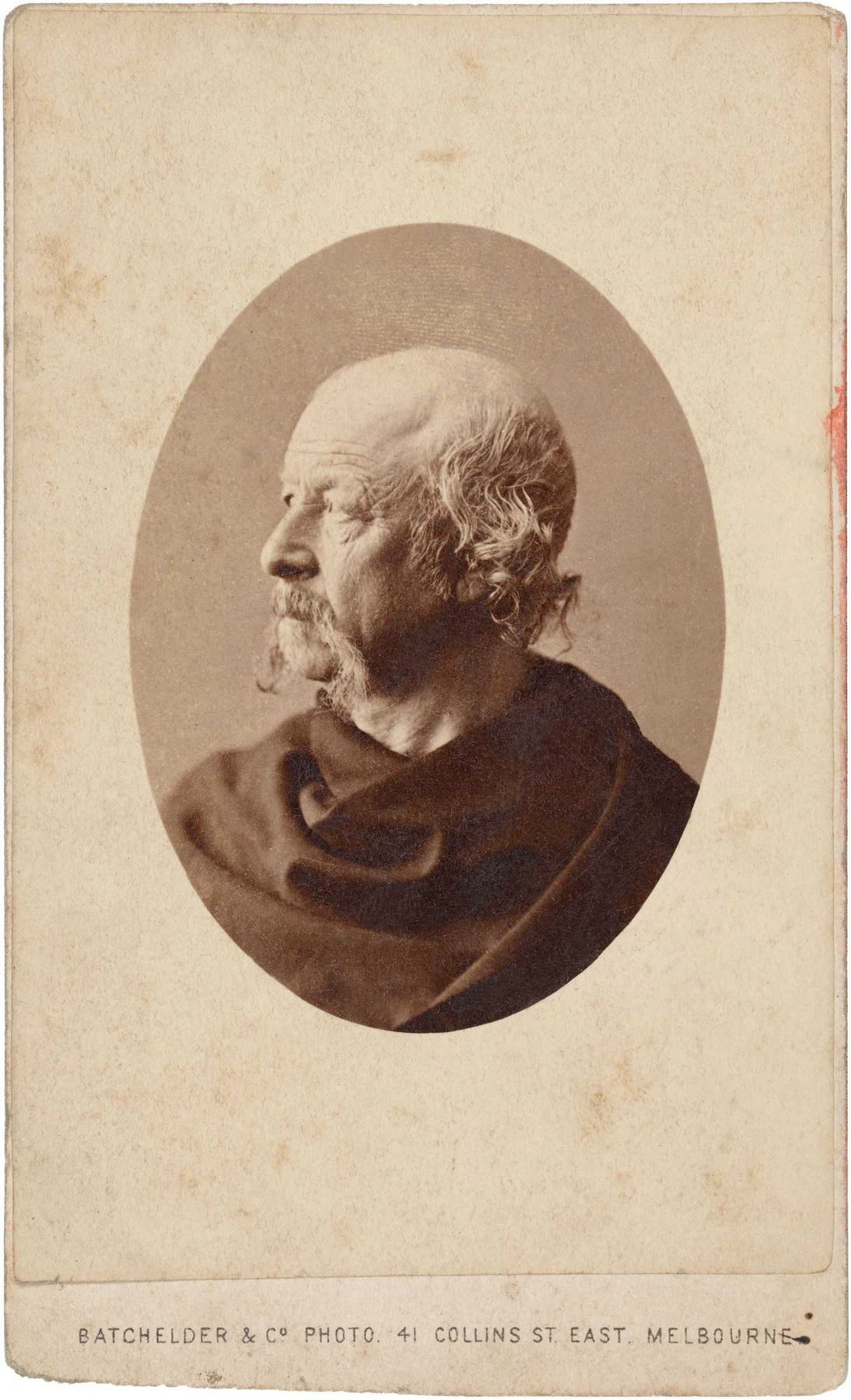
 

Batchelder & Co. Photo (Australian firm active 1854-1890s) 'Richard Henry Horne (age 58 in 1860)' mid 1860s


Batchelder & Co. Photo (active 1854 – 1890s)
Richard Henry Horne (age 58 in 1860)
mid 1860s
Albumen paper carte de visite
Support: 10.5 x 6.3cm
Image: 9.4 x 6.2cm
National Portrait Gallery, Canberra
Purchased with funds provided by Graham Smith 2009


Richard Henry Horne (English, 1802-1884)

Poet Richard Henry Horne (1802-1884) arrived in Melbourne in 1852 hoping to make money on the goldfields but ended up instead in a variety of less remunerative prospects. Initially he was appointed to the command of a private gold escort; in 1853 he became assistant gold commissioner for Heathcote and Waranga but by the end of 1854 had been dismissed. In December that year, in the wake of the Eureka rebellion, he published an article defending miners’ grievances with the licensing system and alleging corruption on the part of some goldfields police, ‘especially in relation with sly-grog tents’. Though not exactly a model of propriety in his own life, Horne saw fit to decry colonial society and ‘social evils’ on a number of other occasions. In Australian Facts and Prospects (1859), for instance, he wrote that ‘with regard to drunkenness and prostitution [Melbourne] is far worse than Sydney, or any other city in the world’, citing the bar at the Theatre Royal as a case in point. ‘Between every act it is the custom of the audience to rush out to the bars for a nobbler of brandy, or other drinks. They all think they need it, whatever the weather may be’. Between 1855 and his return to England, disillusioned, in 1869, Horne stood for election to parliament (unsuccessfully); wrote plays, essays, articles and verse; was a member of the Garrick Club; and helped establish the Tahbilk Winery.

Batchelder & Co. (Australian firm active 1854-1890s)

Batchelder & Co. was the last in a series of names applied to a photography business on Collins Street, Melbourne, that had been established in 1854. Its founder, Perez Mann Batchelder, came to Victoria having run a number of studios – including travelling ones – in California with his brother Benjamin. He and another two Batchelder brothers, Nathaniel and Freeman, came to Melbourne in 1856 to work in the business. Nathaniel Batchelder subsequently opened a branch in Sydney. The Melbourne business became Batchelder & O’Neill when Daniel O’Neill became a partner in 1857. By early 1865 John Botterill, Frederick Dunn and John Wilson had acquired the studio along with ‘all the negatives and other portraits, the accumulation of over 11 years of Batchelder and O’Neill’s business’. They traded as ‘Batchelder’s Portrait Rooms’ until 1867, after which it became known as Batchelder & Co. and continued until the mid-1890s.


National Portrait Gallery
King Edward Terrace
Parkes, Canberra

Opening hours:
Open daily 10am – 5pm
National Portrait Gallery website

LIKE ART BLART ON FACEBOOK

Back to top

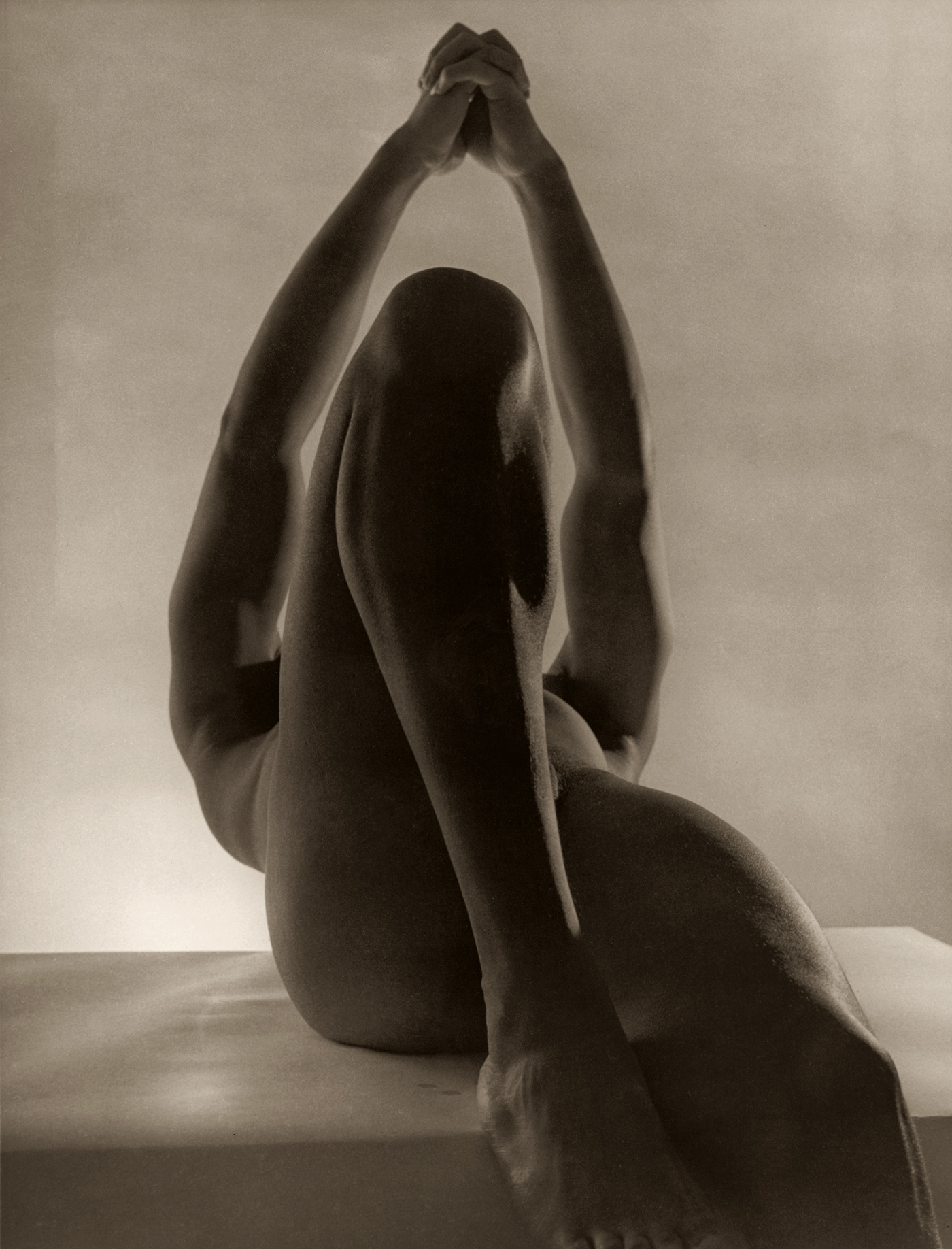
Marcus Bunyan black and white archive: ‘Mask’, 1995-1996

April 2019

*PLEASE NOTE THIS POSTING CONTAINS ART PHOTOGRAPHS OF MALE NUDITY – IF YOU DO NOT LIKE PLEASE DO NOT LOOK, FAIR WARNING HAS BEEN GIVEN*


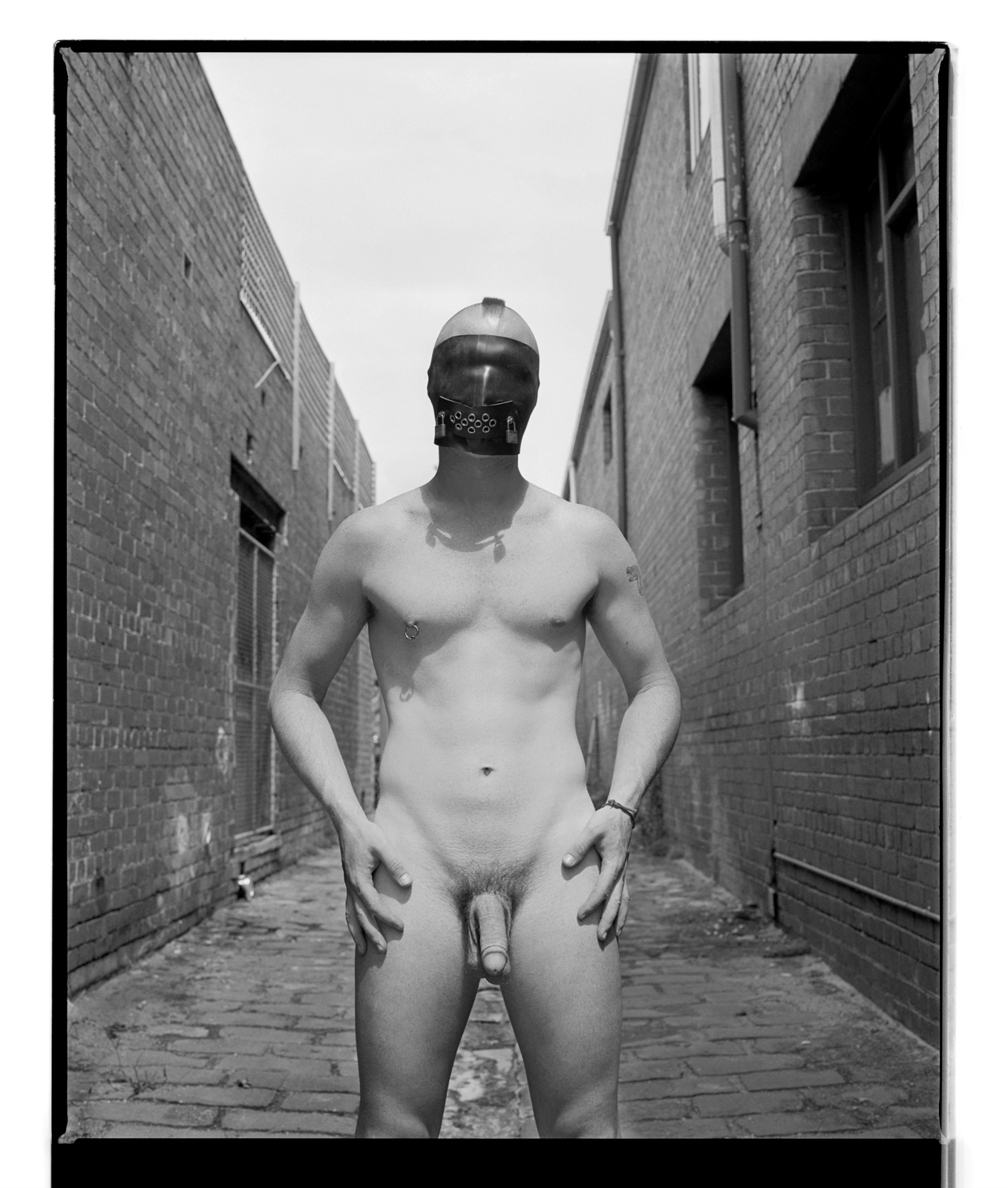
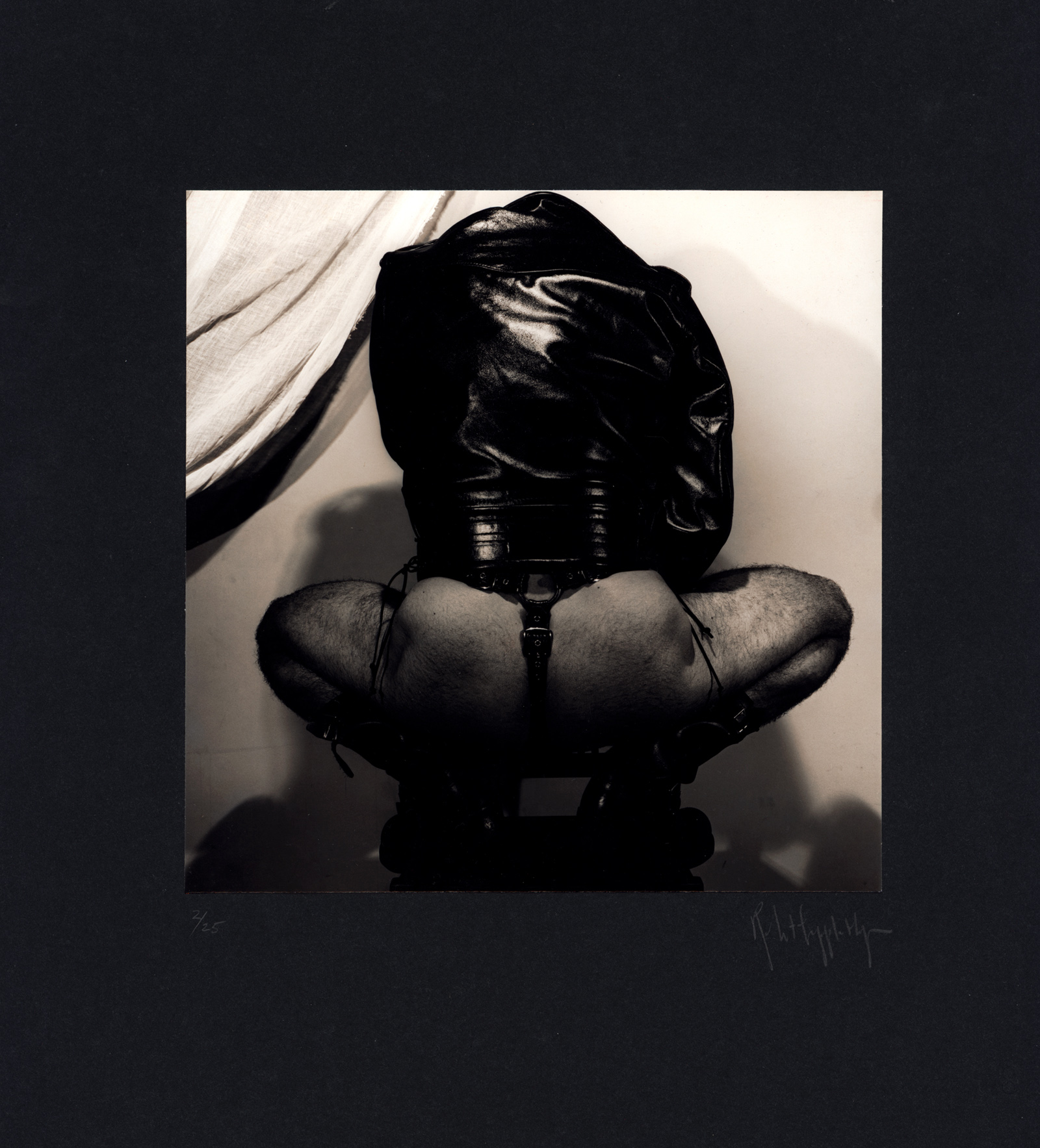
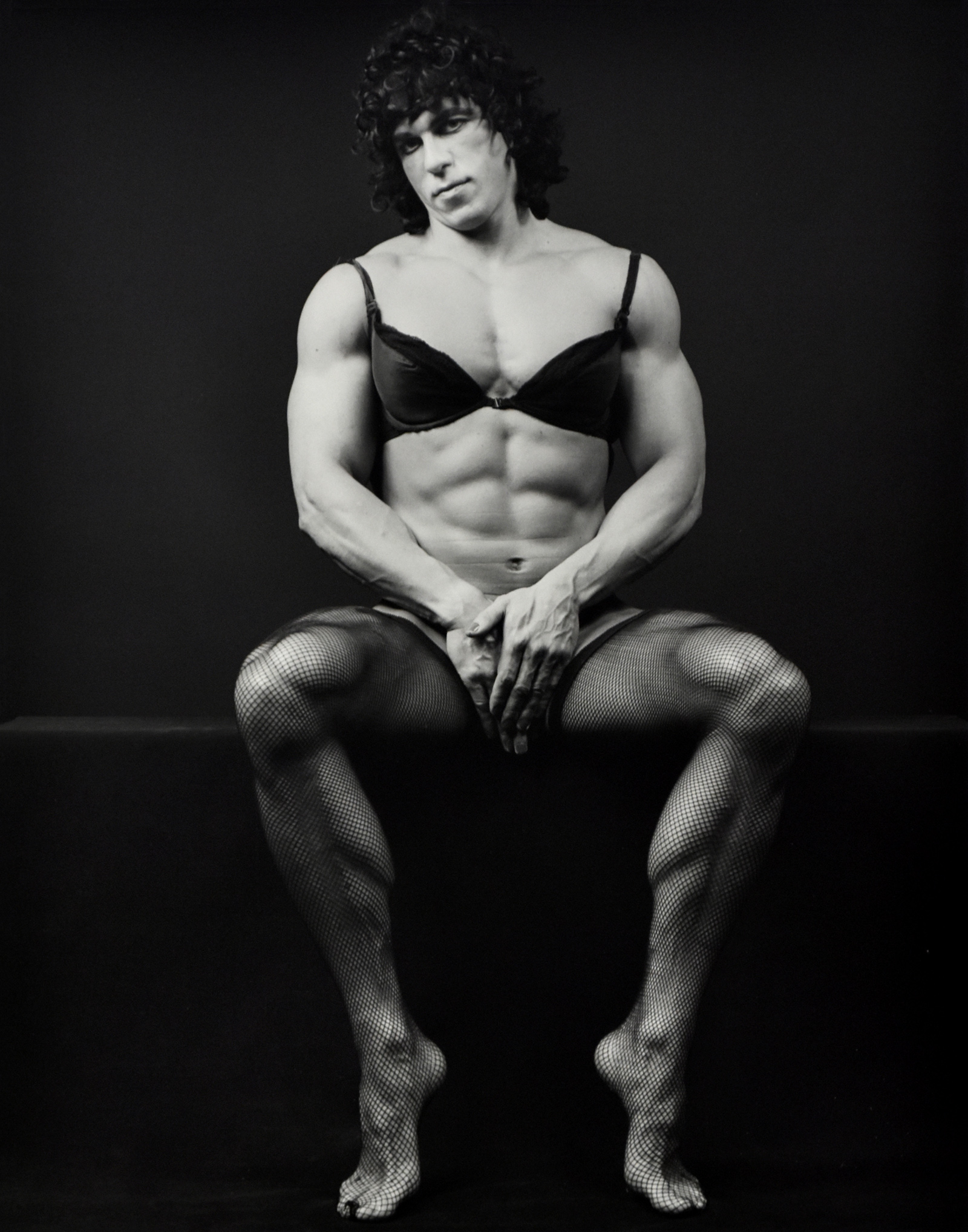
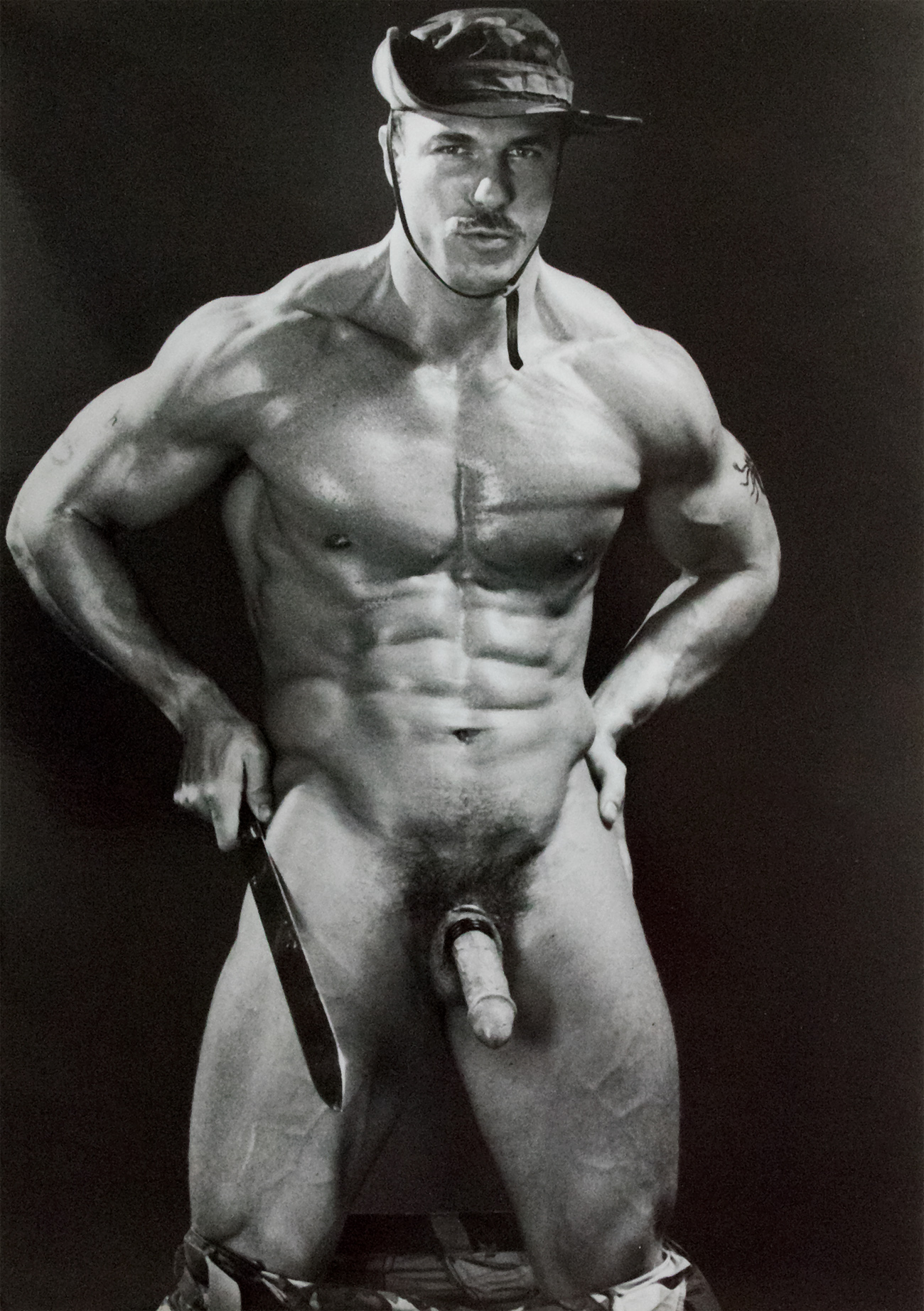
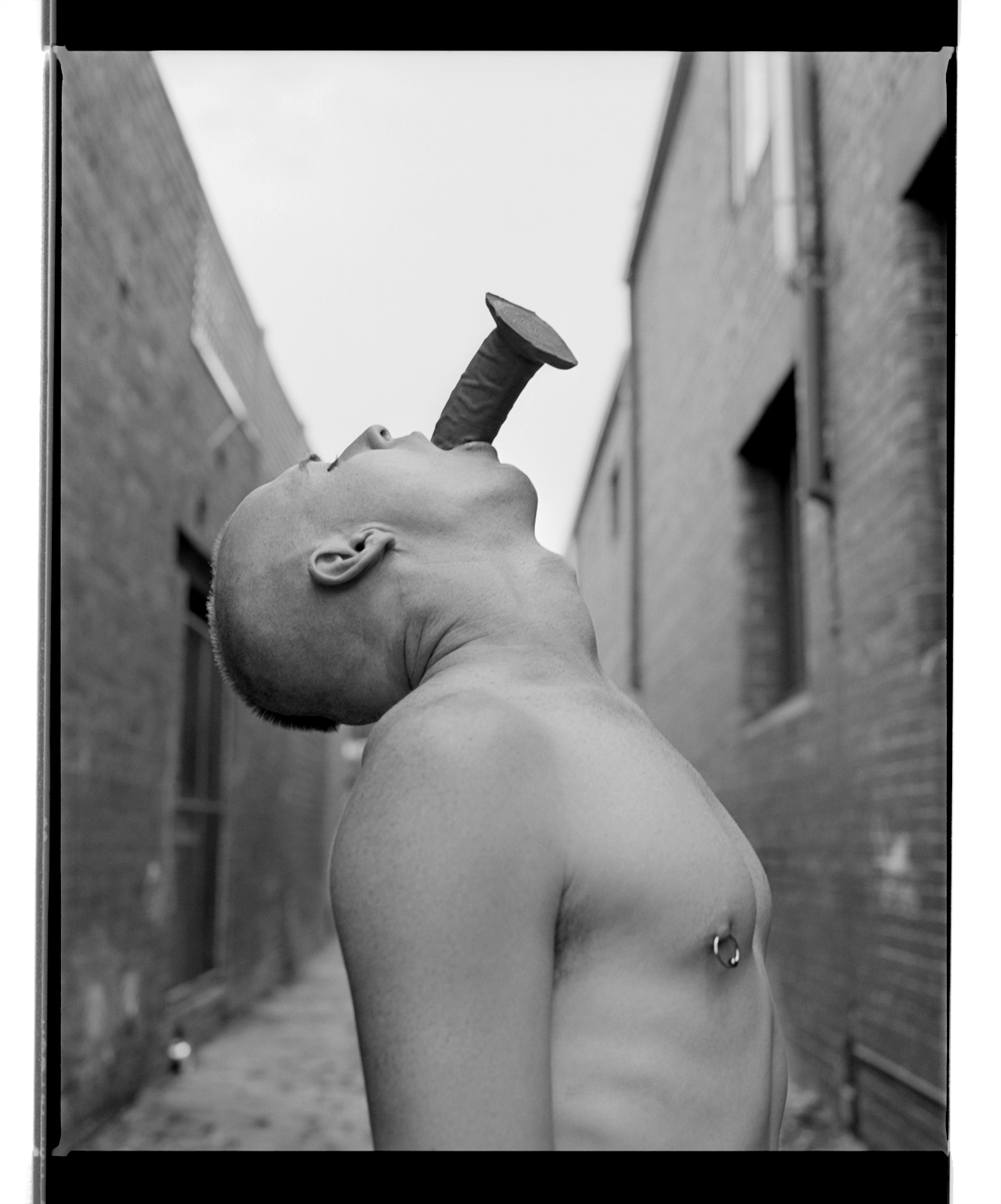
Marcus Bunyan (Australian, b. 1958) 'Paul (Dildo I)' 1995-1996 from the series 'Mask'


Marcus Bunyan (Australian born England, b. 1958)
Paul (Dildo I)
1995-1996
From the series Mask
Gelatin silver print


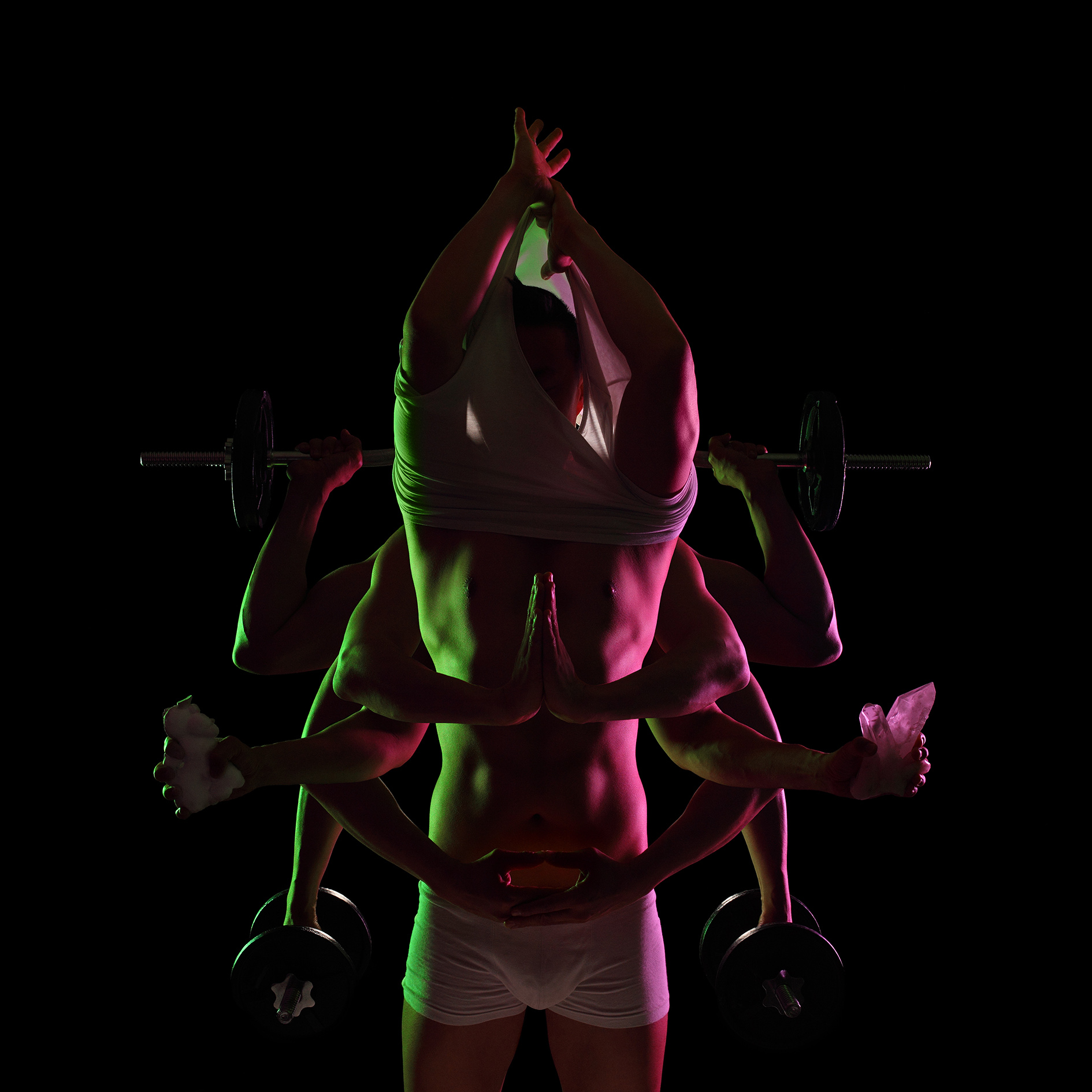
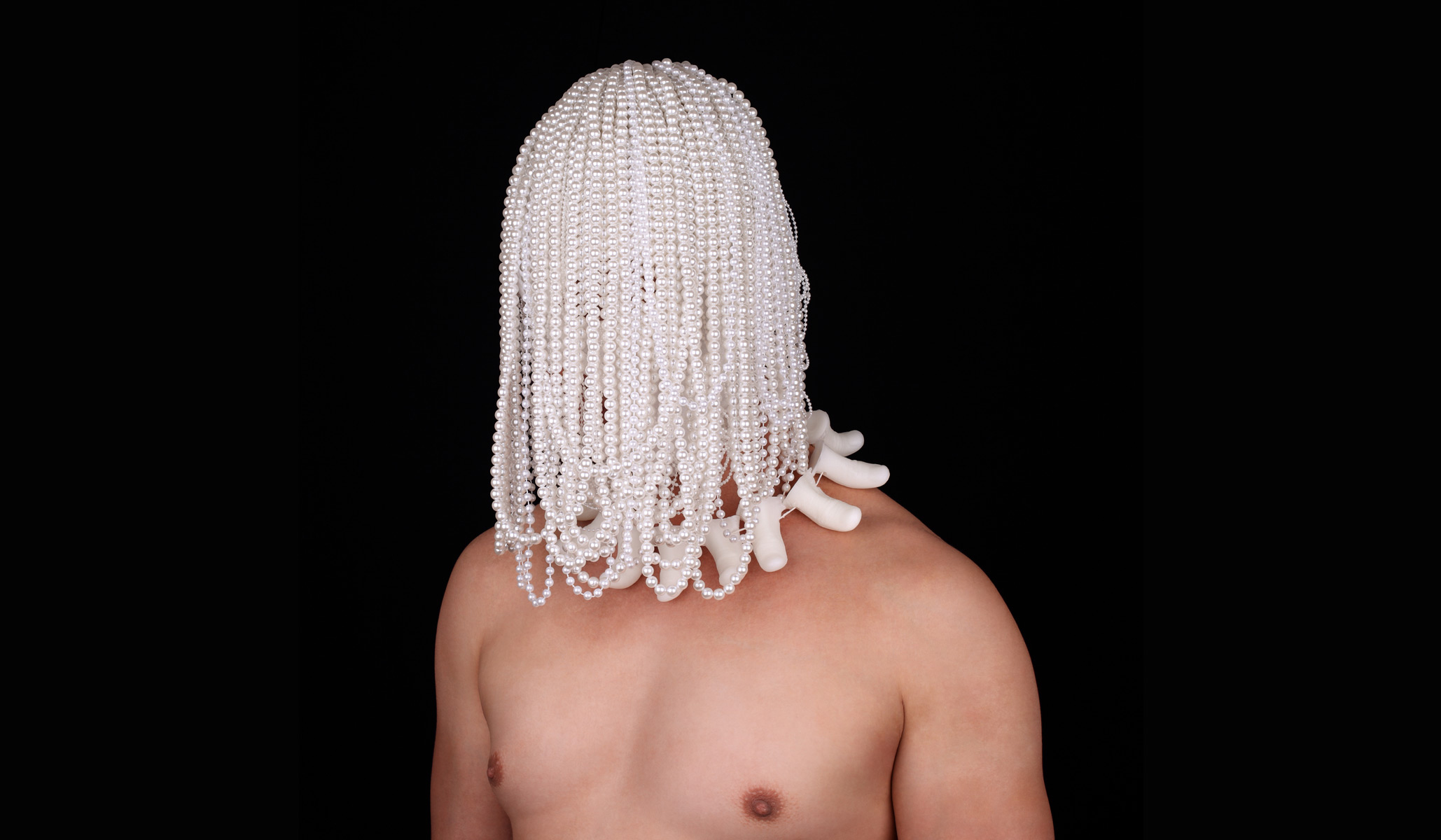
This series of photographs is of my partner, my lover, my best friend and my muse for twelve and a half years. We had such fun with life, pushing the boundaries at every opportunity. It was a privilege to be able to photograph him in every situation that we thought about, to capture the creativity of spirit and being, of existence.

There are many photographs of this handsome, intelligent man that I took – a deep collaboration that I will never have again in my lifetime. The photographs that emerged from our relationship remind me of those that Alfred Stieglitz took of Georgia O’Keeffe – strong images based on trust and intimacy.

To Paul, I am proud of the photographs we took together and I am eternally grateful for our love, relationship and exploration of body, mind and spirit. Thank you.

Marcus


I am scanning my negatives made during the years 1991-1997 to preserve them in the form of an online archive as a process of active memory, so that the images are not lost forever. These photographs were images of my life and imagination at the time of their making, the ideas I was thinking about and the people and things that surrounded me.

All images © Marcus Bunyan. Please click the photographs for a larger version of the image. Please remember these are just straight scans of the prints, all full frame, no cropping !

Photographs are available from this series for purchase. As a guide, a vintage 8″ x 10″ silver gelatin print costs $700 plus tracked and insured shipping. For more information please see my Store web page.


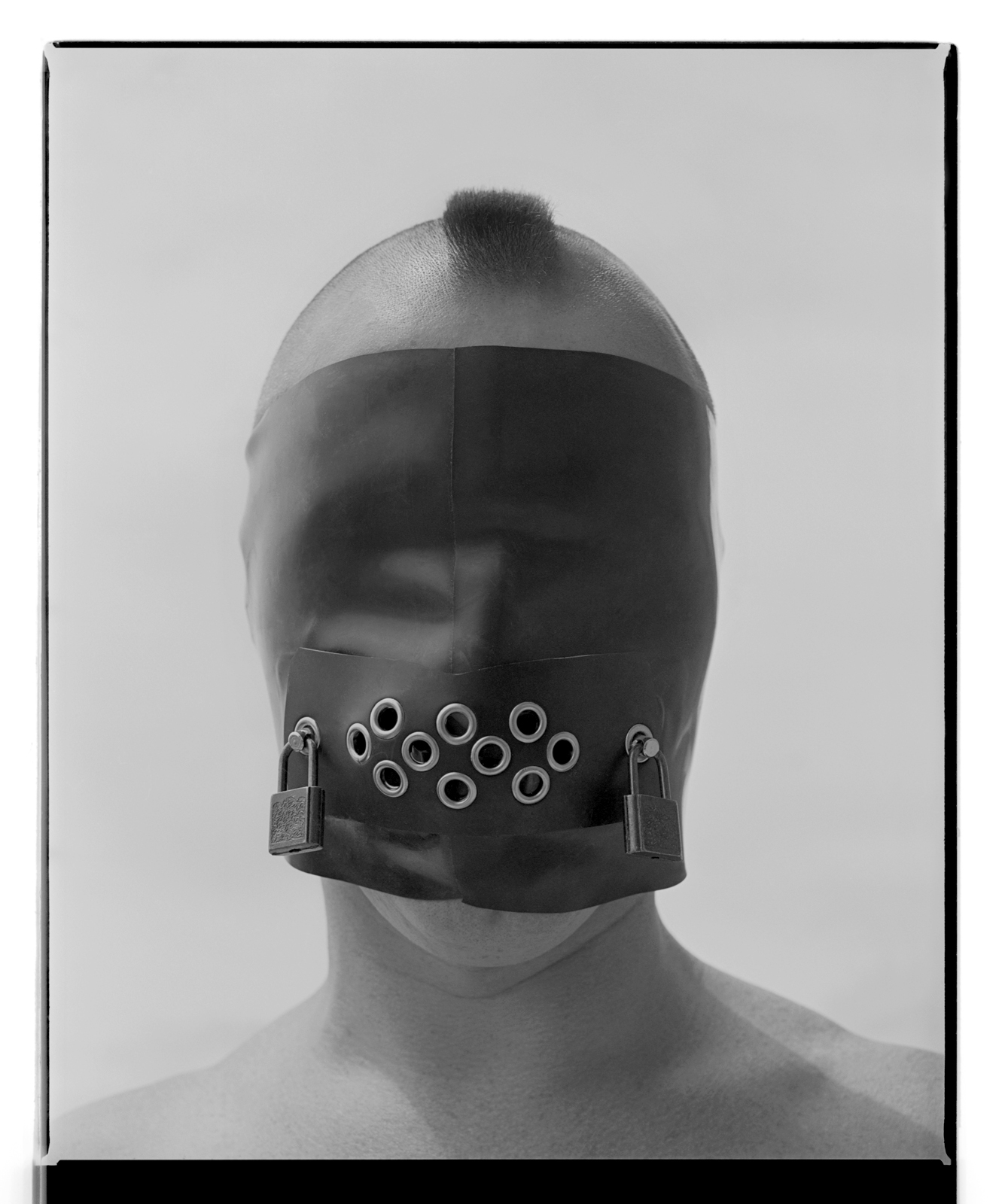
Marcus Bunyan (Australian born England, b. 1958) 'Mask I' 1995-1996 from the series 'Mask'


Marcus Bunyan (Australian born England, b. 1958)
Mask I
1995-1996
From the series Mask
Gelatin silver print


Marcus Bunyan (Australian born England, b. 1958) 'Mask II' 1995-1996 from the series 'Mask'


Marcus Bunyan (Australian born England, b. 1958)
Mask II
1995-1996
From the series Mask
Gelatin silver print


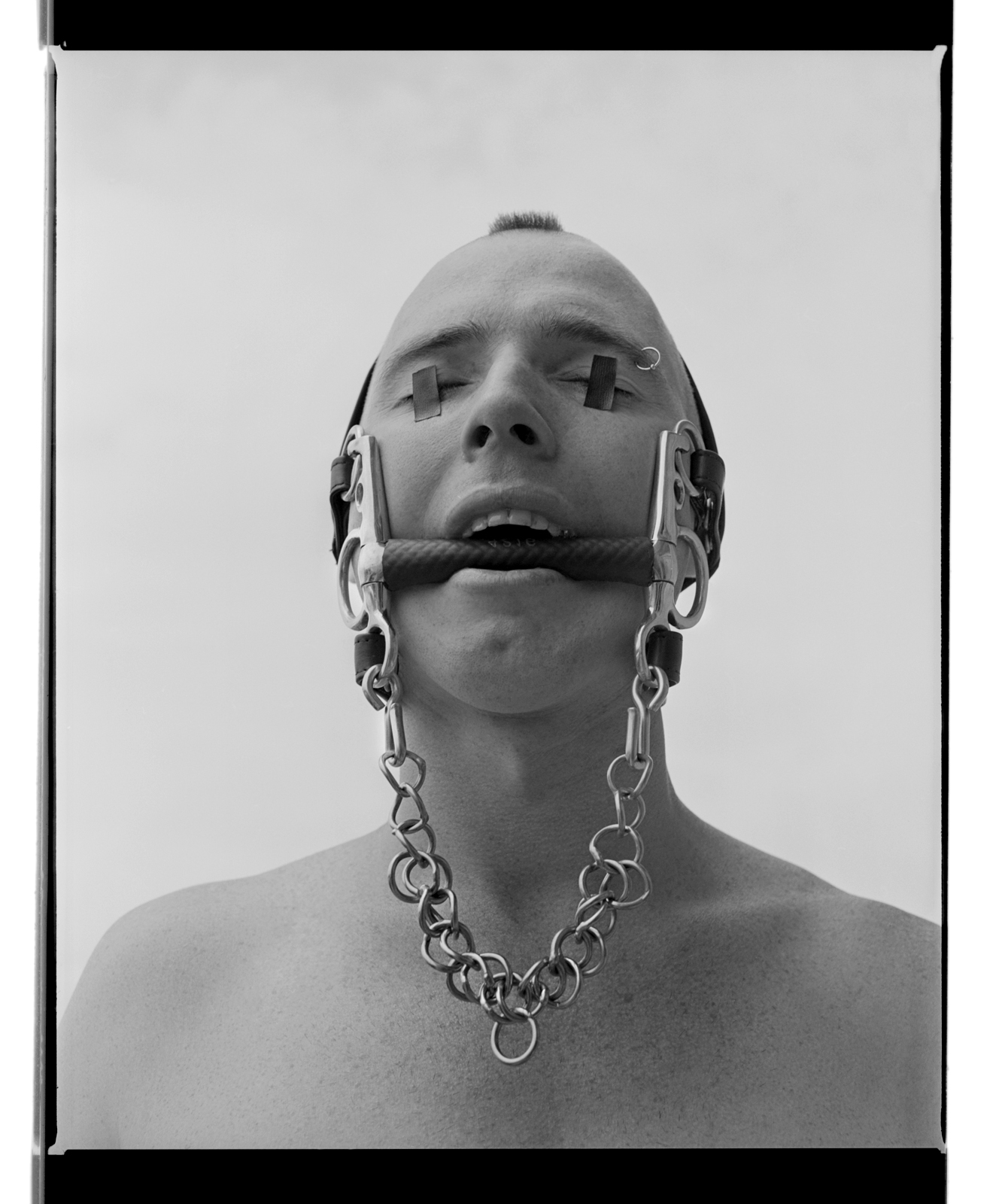
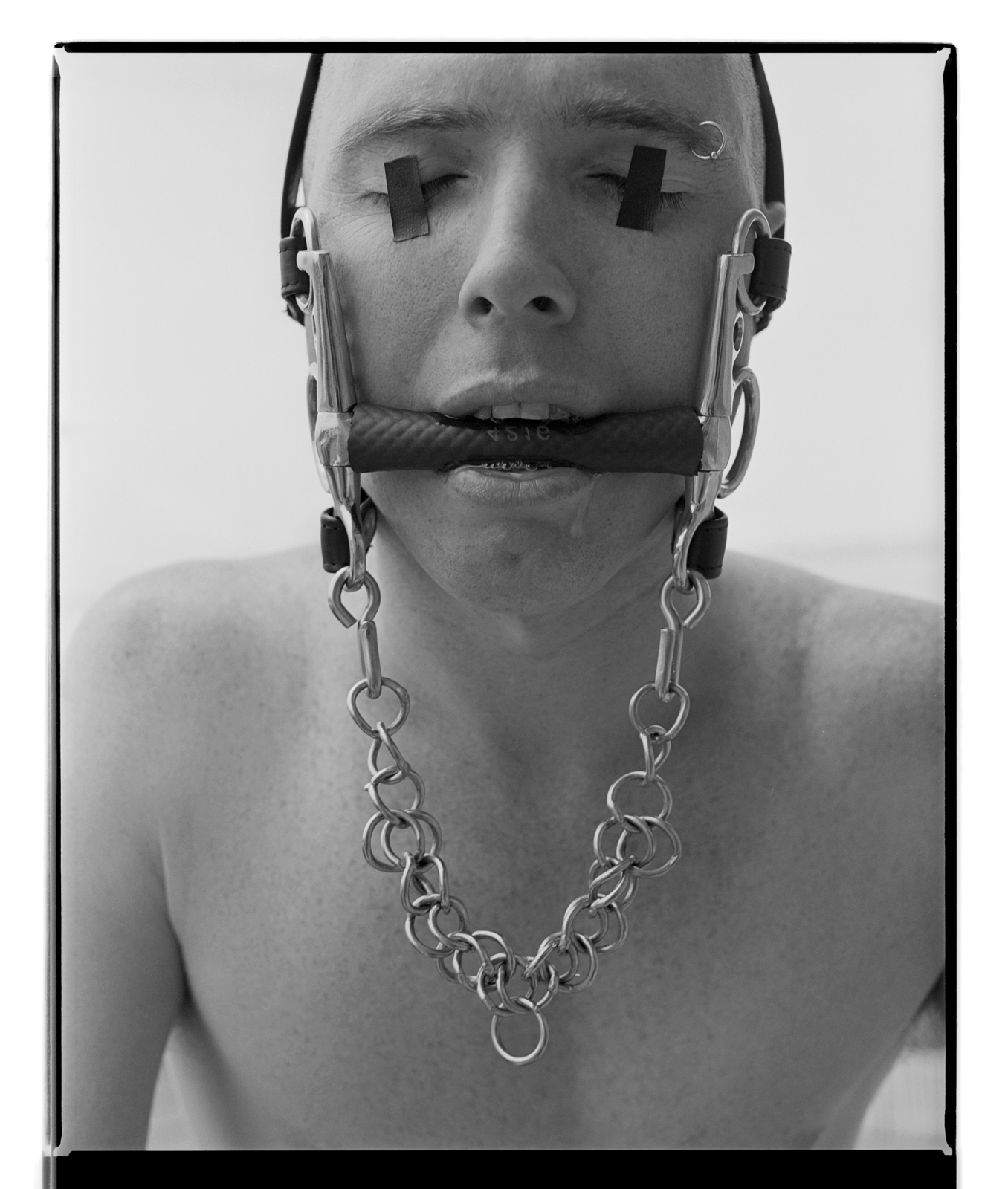
Marcus Bunyan (Australian born England, b. 1958) 'Paul (Horse bit)' 1995-1996 from the series 'Mask'


Marcus Bunyan (Australian born England, b. 1958)
Paul (Horse bit)
1995-1996
From the series Mask
Gelatin silver print


Marcus Bunyan (Australian born England, b. 1958) 'Paul (Boots)' 1995-1996 from the series 'Mask'


Marcus Bunyan (Australian born England, b. 1958)
Paul (Boots)
1995-1996
From the series Mask
Gelatin silver print


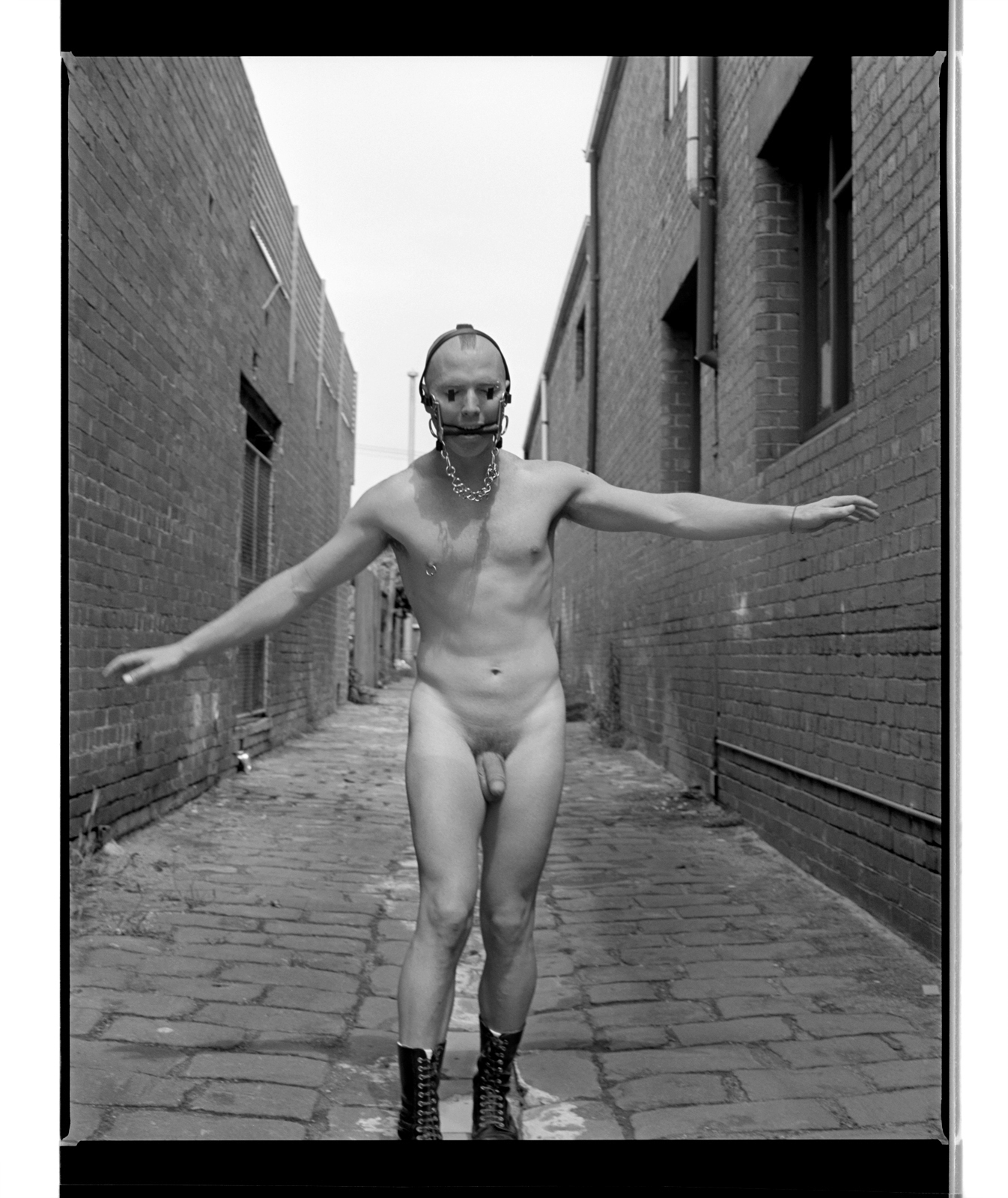
Marcus Bunyan (Australian born England, b. 1958) 'Balance I' 1995-1996 from the series 'Mask'


Marcus Bunyan (Australian born England, b. 1958)
Balance I
1995-1996
From the series Mask
Gelatin silver print


Marcus Bunyan (Australian born England, b. 1958) 'Mask III' 1995-1996 from the series 'Mask'


Marcus Bunyan (Australian born England, b. 1958)
Mask III
1995-1996
From the series Mask
Gelatin silver print


Marcus Bunyan (Australian born England, b. 1958) 'Paul (Dildo II)' 1995-1996 from the series 'Mask'


Marcus Bunyan (Australian born England, b. 1958)
Paul (Dildo II)
1995-1996
From the series Mask
Gelatin silver print


Marcus Bunyan (Australian born England, b. 1958) 'Paul (Blind)' 1995-1996 from the series 'Mask'


Marcus Bunyan (Australian born England, b. 1958)
Paul (Blind)
1995-1996
From the series Mask
Gelatin silver print


Marcus Bunyan (Australian born England, b. 1958) 'Balance II' 1995-1996 from the series 'Mask'


Marcus Bunyan (Australian born England, b. 1958)
Balance II
1995-1996
From the series Mask
Gelatin silver print


Marcus Bunyan (Australian born England, b. 1958) 'Balance III' 1995-1996 from the series 'Mask'


Marcus Bunyan (Australian born England, b. 1958)
Balance III
1995-1996
From the series Mask
Gelatin silver print


Marcus Bunyan (Australian born England, b. 1958) 'Balance IV' 1995-1996 from the series 'Mask'


Marcus Bunyan (Australian born England, b. 1958)
Balance IV
1995-1996
From the series Mask
Gelatin silver print


Marcus Bunyan (Australian born England, b. 1958) 'Paul (Dildo III)' 1995-1996 from the series 'Mask'


Marcus Bunyan (Australian born England, b. 1958)
Paul (Dildo III)
1995-1996
From the series Mask
Gelatin silver print


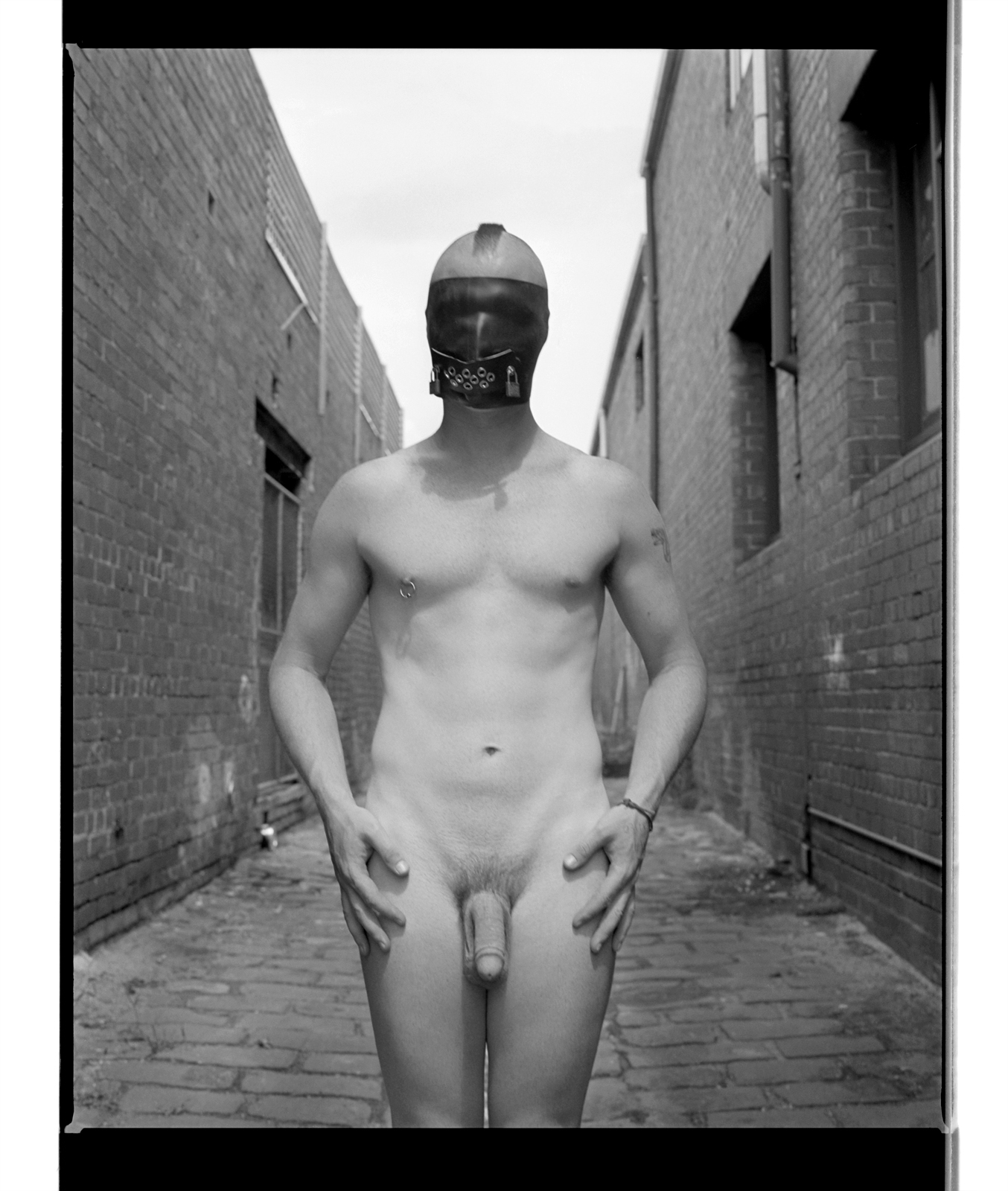
Marcus Bunyan (Australian born England, b. 1958) 'Paul (Hands on hips)' 1995-1996 from the series 'Mask'


Marcus Bunyan (Australian born England, b. 1958)
Paul (Hands on hips)
1995-1996
From the series Mask
Gelatin silver print


Marcus Bunyan (Australian born England, b. 1958) 'Paul (Blind)' 1995-1996 from the series 'Mask'


Marcus Bunyan (Australian born England, b. 1958)
Paul (Blind)
1995-1996
From the series Mask
Gelatin silver print


Marcus Bunyan (Australian born England, b. 1958) 'Paul (Hands on hips)' 1995-1996 from the series 'Mask'


Marcus Bunyan (Australian born England, b. 1958)
Paul (Hands on hips)
1995-1996
From the series Mask
Gelatin silver print


Marcus Bunyan (Australian born England, b. 1958) 'Saliva I' 1995-1996 from the series 'Mask'


Marcus Bunyan (Australian born England, b. 1958)
Saliva I
1995-1996
From the series Mask
Gelatin silver print


Marcus Bunyan (Australian born England, b. 1958) 'Saliva II' 1995-1996 from the series 'Mask'


Marcus Bunyan (Australian born England, b. 1958)
Saliva II
1995-1996
From the series Mask
Gelatin silver print


Marcus Bunyan (Australian born England, b. 1958) 'Paul (Hands behind back)' 1995-1996 from the series 'Mask'


Marcus Bunyan (Australian born England, b. 1958)
Paul (Hands behind back)
1995-1996
From the series Mask
Gelatin silver print


Marcus Bunyan (Australian born England, b. 1958) 'Mask IV' 1995-1996 from the series 'Mask'


Marcus Bunyan (Australian born England, b. 1958)
Mask IV
1995-1996
From the series Mask
Gelatin silver print


Marcus Bunyan (Australian born England, b. 1958) 'Paul (Boots and mask)' 1995-1996 from the series 'Mask'


Marcus Bunyan (Australian born England, b. 1958)
Paul (Boots and mask)
1995-1996
From the series Mask
Gelatin silver print


Marcus Bunyan website

Marcus Bunyan black and white archive 1991-1997

LIKE ART BLART ON FACEBOOK

Back to top

Exhibition: ‘Daguerreotypes: Five Decades of Collecting’ at the Smithsonian National Portrait Gallery, Washington, DC

Exhibition dates: 15th June, 2018 – 2nd June, 2019

 Curator: Ann Shumard, Senior Curator of Photographs at the Smithsonian National Portrait Gallery, Washington, DC


Bishop & Gray Studio (American, active c. 1843) 'Dr. Rufus Priest' c. 1843 from the exhibition 'Daguerreotypes: Five Decades of Collecting' at the Smithsonian National Portrait Gallery, Washington, DC, June 2018 - June 2019


Bishop & Gray Studio (American, active c. 1843)
Dr. Rufus Priest
c. 1843
Sixth-plate daguerreotype
8.3cm x 7cm (3 1/4″ x 2 3/4″)
National Portrait Gallery, Smithsonian Institution; gift of David Becker


What strong faces these people have, especially in the three-quarter or slightly oblique profile view with the subject not staring at the camera.

There is something incredibly powerful about these one off, cased mausoleum portraits that today’s throwaway representations struggle to match. As Montgomery P. Simons opines, “The delicacy, durability and wonderful minutiae of the daguerreotype has never been approached by any of the improved pictures recently introduced.” The contemporary Philadelphia daguerreotypist Marcus Aurelius Root paid them this praise: “Their style, indeed, is peculiar to themselves; presenting beautiful effects of light and shade, and giving depth and roundness together with a wonderful softness or mellowness. These traits have achieved for them a high reputation with all true artists and connoisseurs.” Indeed, their jewel-like aura seems to emanate from within.

I have added bibliographic details about the sitters and the photographers where possible to the posting, as well as artwork – paintings, illustrations, writing, postcards and drawings – and enlarged details of the daguerreotypes. Pictured are the great and good of the land. Surgeon, cardinal, poet, artist, actress, entrepreneur, president, social reformer, general, commodore, nurse and advocate for the mentally ill with minimal acknowledgement of Native American people (Seneca Chief Governor Blacksnake). This “man of rare intellectual and moral power” died on a reservation in December 1859.

Dr Marcus Bunyan


Many thankx to the Smithsonian National Portrait Gallery for allowing me to publish the photographs in the posting. Please click on the photographs for a larger version of the image.


Marcus Aurelius Root (American, 1808-1888) 'Thomas Buchanan Read' (March 12, 1822-May 11, 1872) c. 1850 from the exhibition 'Daguerreotypes: Five Decades of Collecting' at the Smithsonian National Portrait Gallery, Washington, DC, June 2018 - June 2019


Marcus Aurelius Root (American, 1808-1888)
Thomas Buchanan Read (March 12, 1822 – May 11, 1872)
c. 1850
Half-plate daguerreotype
National Portrait Gallery, Smithsonian Institution; gift of Miss Eunice Chambers


Thomas Buchanan Read (American, 1822-1872)

Thomas Buchanan Read (March 12, 1822 – May 11, 1872), was an American poet and portrait painter. Read was born in Corner Ketch, a hamlet close to Downingtown, in Chester County, Pennsylvania on March 12, 1822.

Beside painting, Read wrote a prose romance, The Pilgrims of the Great St. Bernard, and several books of poetry, including The New Pastoral, The House by the Sea, Sylvia, and A Summer Story. Some of the shorter pieces included in these, e.g., Sheridan’s Ride, Drifting, The Angler, The Oath, and The Closing Scene, have great merit. Read was briefly associated with the Pre-Raphaelite Brotherhood. His greatest artistic popularity took place in Florence. Among portraits he painted were Abraham Lincoln, Henry Wadsworth Longfellow, Alfred Tennyson, Elizabeth Barrett Browning, Robert Browning and William Henry Harrison. Read died from injuries sustained in a carriage accident, which weakened him and led him to contract pneumonia while on shipboard returning to America.

Text from the Wikipedia website

Marcus Aurelius Root (American, 1808-1888)

Marcus Aurelius Root (1808-1888) was a writing teacher and photographer. He was born in Granville, Ohio and died in Philadelphia, Pennsylvania.

On 20 June 1846, he bought John Jabez Edwin Mayall’s Chestnut Street photography studio that was in the same building as Root’s residence in Philadelphia, Pennsylvania. Root had success as a daguerreotypist working with his brother, Samuel Root. The Root Brothers had a gallery in New York City from 1849 to 1857. Marcus Aurelius Root authored an important book on photography entitled The Camera and the Pencil.


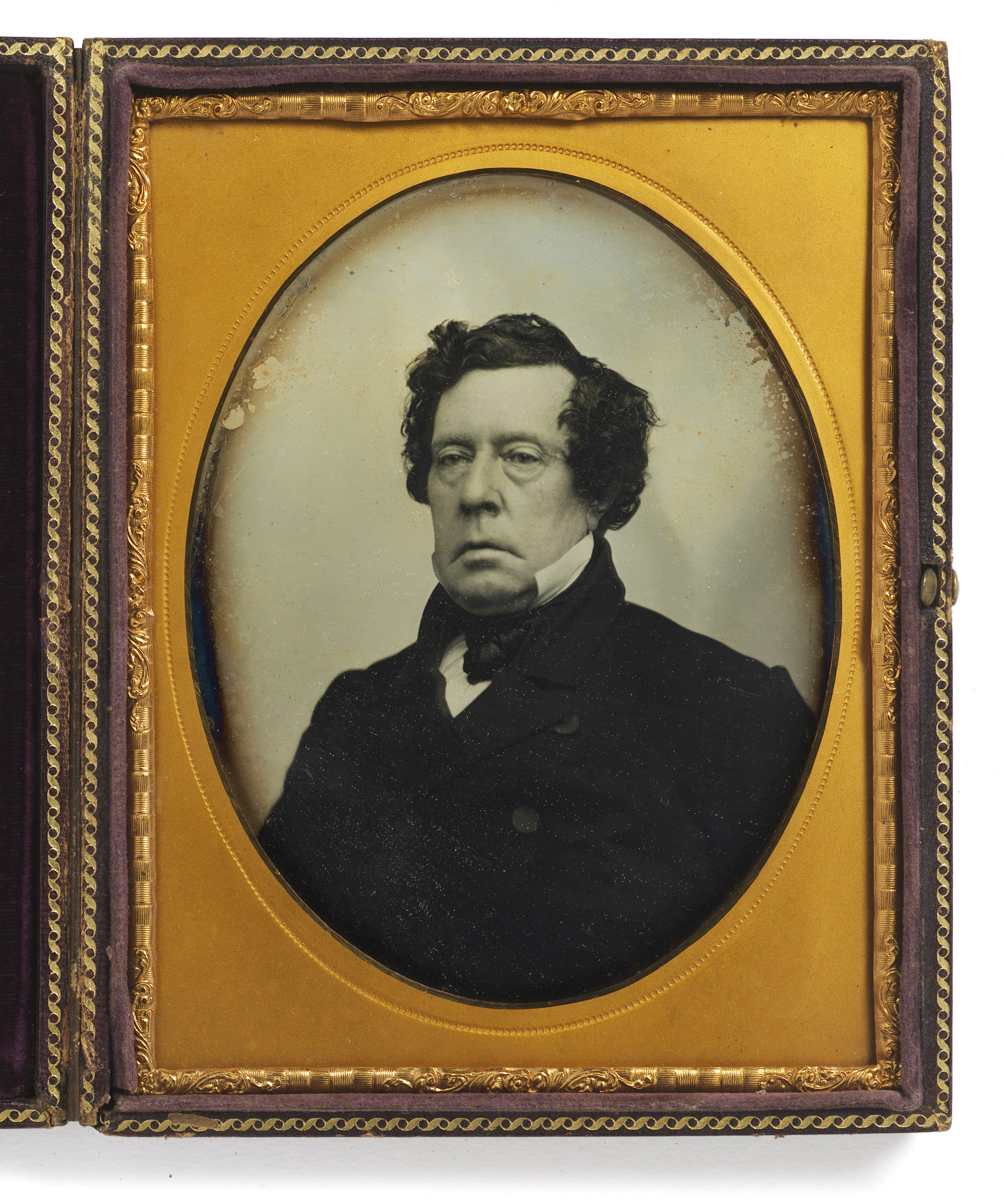
Beckers and Piard (American) 'Matthew Calbraith Perry' (April 10, 1794-March 4, 1858) c. 1855


Beckers and Piard (American)
Alexander Beckers (American born Germany, 1815-1905, active 1842-1869)
Victor Piard (American born France, 1825-1901)
Matthew Calbraith Perry (April 10, 1794 – March 4, 1858)
c. 1855
Half-plate daguerreotype
National Portrait Gallery, Smithsonian Institution


Alexander Beckers (American born German, 1815-1905)

Alexander Beckers first saw a daguerreotype in Philadelphia, and subsequently went to work there for photographer Frederick David Langenheim in 1843. The following year he moved to New York, where he is credited with the first whole-plate daguerreotypes made in that city. Within months Beckers opened the Langenheim & Beckers studio in New York, which became Beckers & Piard in 1849. In 1857 he patented a revolving stereograph viewer and shortly thereafter sold his daguerreotype business in order to concentrate his attention on the manufacture of stereograph viewers.

Anonymous text. “Alexander Beckers,” on the J. Paul Getty Museum website [Online] Cited 15/03/2022

Matthew Calbraith Perry (American, 1794-1858)

Matthew Calbraith Perry (April 10, 1794 – March 4, 1858) was a Commodore of the United States Navy who commanded ships in several wars, including the War of 1812 and the Mexican-American War (1846-1848). He played a leading role in the opening of Japan to the West with the Convention of Kanagawa in 1854.

Perry was interested in the education of naval officers, and assisted in the development of an apprentice system that helped establish the curriculum at the United States Naval Academy. With the advent of the steam engine, he became a leading advocate of modernising the U.S. Navy and came to be considered “The Father of the Steam Navy” in the United States.

Text from the Wikipedia website


[Several] daguerreotypes of Matthew Calbraith Perry (1794-1858) [were] made in New York City, in the months following Commodore Perry’s triumphant return from Japan in January of 1855. The seminal achievement of his long naval career, Perry’s shrewd and persistent negotiations with Japan opened that isolated nation to the West for the first time in its history.

[These] portraits can be dated to 1855-1856, based on the date of Perry’s return to the United States and the years the Beckers & Piard studio operated at 264 Broadway. A variant, more conventional, portrait from this same sitting, previously unattributed, exists in three identical half-plates, one in the National Portrait Gallery (above), one in the New-York Historical Society, and one sold at Swann Galleries, New York, in 1988 (Sale 1468, Lot 186). In addition, there is a half-plate profile study of Perry in the U. S. Naval Academy Museum in Annapolis, also made by Beckers & Piard, that was the model for a commemorative medal struck in Perry’s honour in 1856; and a half-plate seated portrait of Perry in his full uniform and regalia, also owned by the New-York Historical Society.

The portraits can be dated to 1855 or 1856 based upon Perry’s arrival in New York, from Japan, in 1855, and by the address of the daguerreotypists stamped on the portrait’s mat. Alexander Beckers and Victor Piard were active at 264 Broadway, the address on the mat, from 1853 to 1856. At some point in 1856, the studio moved across the street to 261 Broadway. This portrait would, therefore, have to have been made in 1855 or 1856.

Anonymous text. “Catalogue note,” on the Sotheby’s website 2012 [Online] Cited 28/11/2018.


Unknown artist (Japanese) 'Gasshukoku suishi teitoku kōjōgaki (Oral statement by the American Navy admiral)' c. 1854


Unknown artist (Japanese)
Gasshukoku suishi teitoku kōjōgaki (Oral statement by the American Navy admiral)
c. 1854
Library of Congress
Public domain


A Japanese print showing three men, believed to be Commander Anan, age 54; Perry, age 49; and Captain Henry Adams, age 59, who opened up Japan to the west. The text being read may be President Fillmore’s letter to Emperor of Japan. This is a somewhat extensive restoration, meant to keep focus on the artwork, instead of the damage.


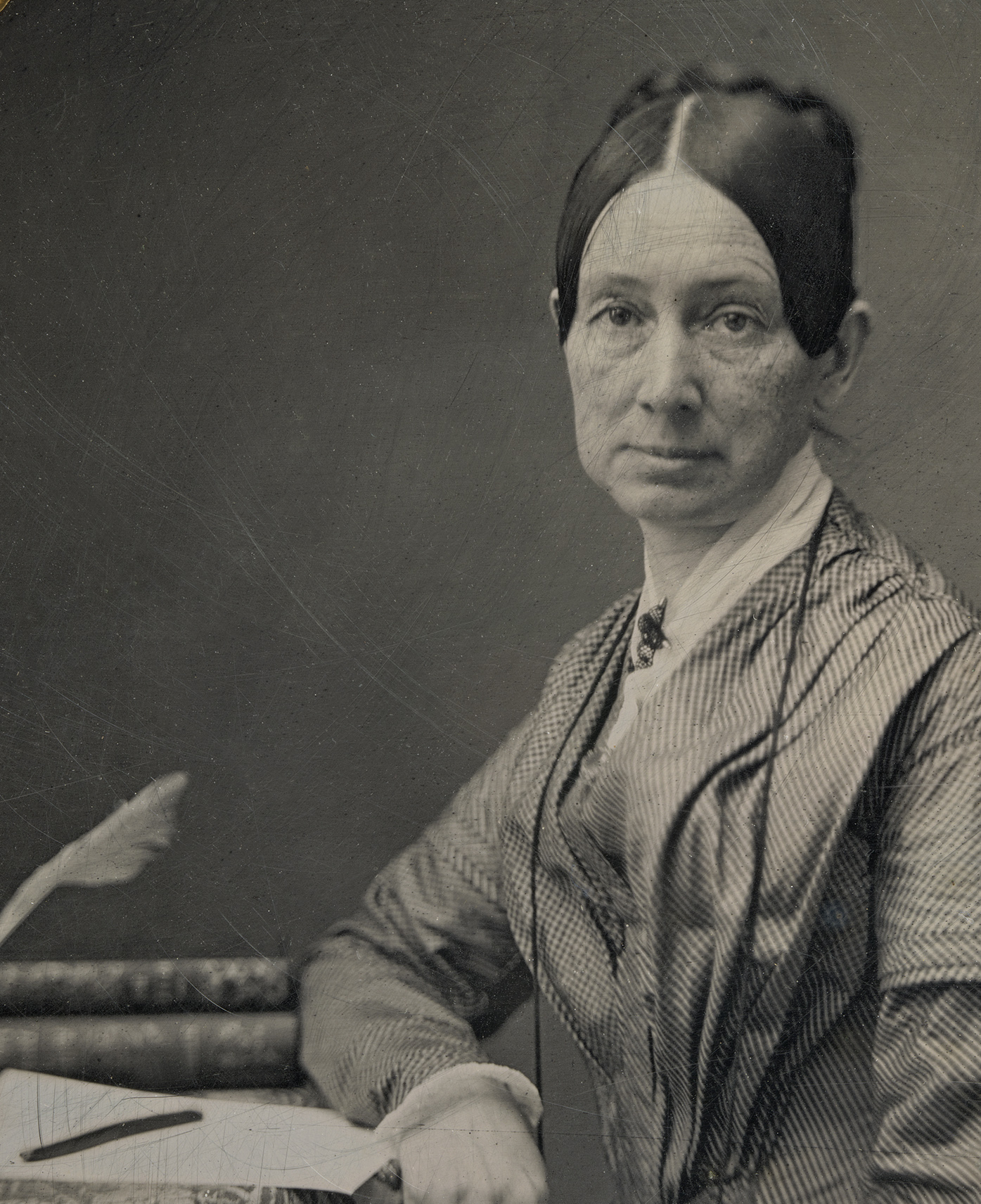
Unidentified artist (American) 'Dorothea Lynde Dix' c. 1849


Unidentified artist (American)
Dorothea Lynde Dix
c. 1849
Half-plate daguerreotype
National Portrait Gallery, Smithsonian Institution


Dorothea Lynde Dix (American, 1802-1887)

Dorothea Lynde Dix (April 4, 1802 – July 17, 1887) was an American advocate on behalf of the indigent mentally ill who, through a vigorous and sustained program of lobbying state legislatures and the United States Congress, created the first generation of American mental asylums. During the Civil War, she served as a Superintendent of Army Nurses. (Wikipedia)

What a human being… read her full Wikipedia entry. A champion of the poor and mentally ill, Dix and her nurses cared for the wounded from both sides of the American Civil War.


Unidentified artist (American) 'Dorothea Lynde Dix' c. 1849 (detail)


Unidentified artist (American)
Dorothea Lynde Dix (detail)
c. 1849
Half-plate daguerreotype
National Portrait Gallery, Smithsonian Institution


Unidentified artist (American) 'Charlotte Cushman' c. 1850


Unidentified artist (American)
Charlotte Cushman
c. 1850
Half-plate daguerreotype
National Portrait Gallery, Smithsonian Institution


Charlotte Saunders Cushman (July 23, 1816 – February 18, 1876) was an American stage actress. Her voice was noted for its full contralto register, and she was able to play both male and female parts. She lived intermittently in Rome, in an expatriate colony of prominent artists and sculptors, some of whom became part of her tempestuous private life.


Unidentified artist (American) 'Charlotte Cushman' c. 1850 (detail)


Unidentified artist (American)
Charlotte Cushman (detail)
c. 1850
Half-plate daguerreotype
National Portrait Gallery, Smithsonian Institution


Mathew Brady (1822-1896) 'Charlotte Saunders Cushman' between 1855 and 1865


Mathew Brady (American, 1822-1896)
Charlotte Saunders Cushman
between 1855 and 1865
Wet collodion glass negative
Library of Congress Prints and Photographs Division. Brady-Handy Photograph Collection
Public domain


Library of Congress description: “Charlotte Cushman as Meg Merriles”


Henry B. Hull (American, active c. 1855) 'Stonewall Jackson' (Thomas Jonathan Jackson, 21 Jan 1824-10 May 1863) 1855


Henry B. Hull (American, active c. 1855)
Stonewall Jackson (Thomas Jonathan Jackson, 21 Jan 1824 – 10 May 1863)
1855
Sixth-plate daguerreotype
Image: 8.4 x 7.2cm (3 5/16 x 2 13/16″)
Case Open: 9.4 x 16.5 x 1.1cm (3 11/16 x 6 1/2 x 7/16″)
National Portrait Gallery, Smithsonian Institution


Born Clarksburg, West Virginia

When future Confederate general Stonewall Jackson sat for this likeness in 1855, his emergence as one of the South’s most brilliant military tacticians lay six years away. A West Point graduate, Jackson had served with distinction in the Mexican American War, earning more citations for valour than any other American officer. He joined Virginia Military Institute as a professor of artillery tactics and natural philosophy in 1851, and later commanded the corps of VMI cadets that guarded the gallows at John Brown’s execution. Jackson had this daguerreotype made as a memento for his aunt and uncle while visiting them in the summer of 1855.

Text from the Smithsonian National Portrait Gallery website


Unidentified artist (American) 'Robert Dale Owen' c. 1847


Unidentified artist (American)
Robert Dale Owen
c. 1847
Sixth-plate daguerreotype
National Portrait Gallery, Smithsonian Institution; gift of Andrew Oliver


Robert Owen Dale (American, 1801-1877)

Robert Dale Owen (November 7, 1801 – June 24, 1877) was a Scottish-born social reformer who immigrated to the United States in 1825, became a U.S. citizen, and was active in Indiana politics as member of the Democratic Party in the Indiana House of Representatives (1835-1839 and 1851-1853) and represented Indiana in the U.S. House of Representatives (1843-1847). As a member of Congress, Owen successfully pushed through the bill that established Smithsonian Institution and served on the Institution’s first Board of Regents. Owen also served as a delegate to the Indiana Constitutional Convention in 1850 and was appointed as U.S. chargé d’affaires (1853-1858) to Naples.

Owen was a knowledgeable exponent of the socialist doctrines of his father, Robert Owen, and managed the day-to-day operation of New Harmony, Indiana, the socialistic utopian community he helped establish with his father in 1825. Throughout his adult life, Robert Dale Owen wrote and published numerous pamphlets, speeches, books, and articles that described his personal and political views, including his belief in spiritualism. Owen co-edited the New-Harmony Gazette with Frances Wright in the late 1820s in Indiana and the Free Enquirer in the 1830s in New York City. Owen was an advocate of married women’s property and divorce rights, secured inclusion of an article in the Indiana Constitution of 1851 that provided tax-supported funding for a uniform system of free public schools, and established the position of Indiana Superintendent of Public Instruction. Owen is also noted for a series of open letters he wrote in 1862 that favoured the abolition of slavery and supported general emancipation, as well as a suggestion that the federal government should provide assistance to freedmen.

Text from the Wikipedia website


Unidentified artist (American) 'Robert Dale Owen' c. 1847 (detail)


Unidentified artist (American)
Robert Dale Owen (detail)
c. 1847
Sixth-plate daguerreotype
National Portrait Gallery, Smithsonian Institution; gift of Andrew Oliver


Southworth & Hawes (American, active 1843-1862) 'Franklin Pierce' (23 Nov 1804-8 Oct 1869) c. 1852


Southworth & Hawes (American, active 1843-1862)
Albert Sands Southworth (12 Mar 1811 – 3 Mar 1894)
Josiah Johnson Hawes (20 Feb 1808 – 7 Aug 1901)
Franklin Pierce (23 Nov 1804 – 8 Oct 1869)
c. 1852
Quarter-plate daguerreotype
Image: 8.8 x 6.8cm (3 7/16 x 2 11/16″)
Case Closed: 11.9 x 9.4cm (4 11/16 x 3 11/16″)
Case Open: 11.9 x 18.7 x 1.2cm (4 11/16 x 7 3/8 x 1/2″)
National Portrait Gallery, Smithsonian Institution


Franklin Pierce (American, 1804-1869)

Franklin Pierce (November 23, 1804 – October 8, 1869) was the 14th President of the United States (1853-1857), a northern Democrat who saw the abolitionist movement as a fundamental threat to the unity of the nation. He alienated anti-slavery groups by championing and signing the Kansas-Nebraska Act and enforcing the Fugitive Slave Act; yet he failed to stem conflict between North and South, setting the stage for Southern secession and the American Civil War.

Pierce was born in New Hampshire, and served in the U.S. House of Representatives and the Senate until he resigned from the Senate in 1842. His private law practice in New Hampshire was a success, and he was appointed U.S. Attorney for his state in 1845. He took part in the Mexican-American War as a brigadier general in the Army. He was seen by Democrats as a compromise candidate uniting northern and southern interests and was nominated as the party’s candidate for president on the 49th ballot at the 1852 Democratic National Convention. He and running mate William R. King easily defeated the Whig Party ticket of Winfield Scott and William A. Graham in the 1852 presidential election.

Text from the Wikipedia website


Southworth & Hawes (American, active 1843-1862)

Southworth & Hawes was an early photographic firm in Boston, 1843-1863. Its partners, Albert Sands Southworth (1811-1894) and Josiah Johnson Hawes (1808-1901), have been hailed as the first great American masters of photography, whose work elevated photographic portraits to the level of fine art. Their images are prominent in every major book and collection of early American photography.

Southworth & Hawes worked almost exclusively in the daguerreotype process. Working in the 8 1/2 x 6 1/2 inch whole plate format, their images are brilliant, mirror-like, and finely detailed. Writing in the Photographic and Fine Art Journal, August 1855, the contemporary Philadelphia daguerreotypist Marcus Aurelius Root paid them this praise: “Their style, indeed, is peculiar to themselves; presenting beautiful effects of light and shade, and giving depth and roundness together with a wonderful softness or mellowness. These traits have achieved for them a high reputation with all true artists and connoisseurs.” He further noted that the firm had devoted their time chiefly to daguerreotypes, with little attention to photography on paper. …

During their 20 years of collaboration, Southworth & Hawes catered to Boston society and the famous. Their advertisements drew a distinction between the appropriate styles for personal versus public portraiture. “A likeness for an intimate acquaintance or one’s own family should be marked by that amiability and cheerfulness, so appropriate to the social circle and the home fireside. Those for the public, of official dignitaries and celebrated characters admit of more firmness, sternness and soberness.” Among their sitters were Louisa May Alcott, Lyman Beecher, Benjamin Butler, William Ellery Channing, Rufus Choate, Cassius Marcellus Clay, Charlotte Cushman, Richard Henry Dana, Jr., Dorothea Dix, Ralph Waldo Emerson, Edward Everett, William Lloyd Garrison, Grace Greenwood, Oliver Wendell Holmes, Sam Houston, Thomas Starr King, Louis Kossuth, Jenny Lind, Henry Wadsworth Longfellow, Horace Mann, Donald McKay, Lola Montez, George Peabody, William H. Prescott, Lemuel Shaw, Harriet Beecher Stowe, Charles Sumner, Daniel Webster, John Greenleaf Whittier, and Robert C. Winthrop.

Text from the Wikipedia website


Unidentified artist (American) 'Brady's New Daguerreotype Saloon, New York Jun 11, 1853'


Unidentified artist (American)
Brady’s New Daguerreotype Saloon, New York
Jun 11, 1853
Wood engraving on paper
36.6 × 24cm (14 7/16 × 9 7/16″)
National Portrait Gallery, Smithsonian Institution


During the 1850s, Manhattan continued to extend north, and Mathew Brady followed suit with the opening of a new gallery, elegantly furnished, at number 359 Broadway. On June 11, 1853, the New York newspaper Illustrated News published a view of the interior of the gallery with the following comment: “The reception room is furnished with richness and artistic taste. Adorning its walls an extensive collection of daguerreotypes of remarkable figures, excellently executed, which is well worth a visit by anyone who wishes to contemplate American and European celebrities. Residents and foreigners alike will enjoy observing the great progress of the art exhibited here, and we convey to Mr. Brady our cordial wishes for success in his new venture.”

Text from the Smithsonian National Portrait Gallery website


Mathew B. Brady (American, 1823? - 15 Jan 1896) 'Thomas Cole' (1 Feb 1801 - 11 Feb 1848) c. 1845


Mathew B. Brady (American, 1823? – 15 Jan 1896)
Thomas Cole (1 Feb 1801 – 11 Feb 1848)
c. 1845
Half-plate daguerreotype on silver-coated copper plate
Plate: 13.7 x 10.2cm (5 3/8 x 4″)
Case Open: 15.8 × 24.4 × 1cm (6 1/4 × 9 5/8 × 3/8″)
Case Closed: 15.8 × 12.3 × 2.7cm (6 1/4 × 4 13/16 × 1 1/16″)
National Portrait Gallery, Smithsonian Institution; gift of Edith Cole Silberstein


Born Bolton-le-Moors, Lancashire, England

Artist Thomas Cole was a founding member of the Hudson River School of American painting, which sought to capture the sublime grandeur of the nation’s natural landscape. Believing that the best art also conveyed a moral lesson, Cole achieved his greatest fame with two series of allegorical paintings entitled The Course of Empire (1836) and The Voyage of Life (1841).

From the outset of his career, Mathew Brady courted major artists and welcomed the opportunity to daguerreotype them. This portrait is one of two known copies Brady made of his original daguerreotype of Cole, which is now in the collection of the Library of Congress.

Text from the Smithsonian National Portrait Gallery website


The Course of Empire is a series of five paintings created by Thomas Cole in the years 1833-1836. It is notable in part for reflecting popular American sentiments of the times, when many saw pastoralism as the ideal phase of human civilisation, fearing that empire would lead to gluttony and inevitable decay. The theme of cycles is one that Cole returned to frequently, such as in his The Voyage of Life series. The Course of Empire comprises the following works: The Course of Empire – The Savage State; The Arcadian or Pastoral State; The Consummation of Empire; Destruction; and Desolation. All the paintings are 39.5 inches by 63.5 inches (100cm by 161cm) except The Consummation of Empire which is 51″ by 76″ (130cm by 193cm).

The series of paintings depicts the growth and fall of an imaginary city, situated on the lower end of a river valley, near its meeting with a bay of the sea. The valley is distinctly identifiable in each of the paintings, in part because of an unusual landmark: a large boulder is situated atop a crag overlooking the valley. Some critics believe this is meant to contrast the immutability of the earth with the transience of man.

Text from the Wikipedia website


Thomas Cole (American, 1801-1848) 'The Savage State' 1834


Thomas Cole (American, 1801-1848)
The Savage State
1834
From The Course of Empire
Oil on canvas
Height: 39.5 in (100.3cm)
Width: 63.5 in (161.2cm)
New-York Historical Society


Thomas Cole (American, 1801-1848) 'The Consummation of Empire' 1836


Thomas Cole (American, 1801-1848)
The Consummation of Empire
1836
From The Course of the Empire
Oil on canvas
Height: 51 in (129.5cm)
Width: 76 in (193cm)
New-York Historical Society


The Voyage of Life is a series of paintings created by Thomas Cole in 1842, representing an allegory of the four stages of human life: childhood, youth, manhood, and old age. The paintings depict a voyager who travels in a boat on a river through the mid-19th-century American wilderness. In each painting the voyager rides the boat on the River of Life accompanied by a guardian angel. The landscape, each reflecting one of the four seasons of the year, plays a major role in conveying the story. With each instalment the boat’s direction of travel is reversed from the previous picture. In childhood, the infant glides from a dark cave into a rich, green landscape. As a youth, the boy takes control of the boat and aims for a shining castle in the sky. In manhood, the adult relies on prayer and religious faith to sustain him through rough waters and a threatening landscape. Finally, the man becomes old and the angel guides him to heaven across the waters of eternity.

Cole’s renowned four-part series traces the journey of an archetypal hero along the “River of Life.” Confidently assuming control of his destiny and oblivious to the dangers that await him, the voyager boldly strives to reach an aerial castle, emblematic of the daydreams of “Youth” and its aspirations for glory and fame. As the traveler approaches his goal, the ever more turbulent stream deviates from its course and relentlessly carries him toward the next picture in the series, where nature’s fury, evil demons, and self-doubt will threaten his very existence. Only prayer, Cole suggests, can save the voyager from a dark and tragic fate.

From the innocence of childhood, to the flush of youthful overconfidence, through the trials and tribulations of middle age, to the hero’s triumphant salvation, The Voyage of Life seems intrinsically linked to the Christian doctrine of death and resurrection. Cole’s intrepid voyager also may be read as a personification of America, itself at an adolescent stage of development. The artist may have been issuing a dire warning to those caught up in the feverish quest for Manifest Destiny: that unbridled westward expansion and industrialisation would have tragic consequences for both man and the land itself.

Text from the Wikipedia website


Thomas Cole (American, 1801-1848) 'The Voyage of Life: Youth' 1842


Thomas Cole (American, 1801-1848)
The Voyage of Life: Youth
1842
Oil on canvas
134 × 194cm (53 in × 76 in)
National Gallery of Art


Thomas Cole (American, 1801-1848) 'The Voyage of Life: Manhood' 1842


Thomas Cole (American, 1801-1848)
The Voyage of Life: Manhood
1842
Oil on canvas
132.8 × 198.1cm (52.3 in × 78.0 in)
National Gallery of Art


Unidentified artist (American) 'Julia Catherine Seymour Conkling' 1848


Unidentified artist (American)
Julia Catherine Seymour Conkling
1848
Sixth-plate daguerreotype
Plate: 8.2 x 6.8cm (3 1/4″ x 2 11/16″)
National Portrait Gallery, Smithsonian Institution


In addition to being the wife of Senator Roscoe Conkling, Julia Seymour was the sister of New York Governor and 1868 Democratic presidential nominee Horatio Seymour. In 1893 Julia Conkling founded the Oneida Chapter of the Daughters of the American Revolution, the fourth chapter formed after the 1890 founding of the national D.A.R.


A linen postcard of Conkling House, #3 Rutger Park, Rutger Street, Utica NY


A linen postcard of Conkling House, #3 Rutger Park, Rutger Street, Utica NY (The Landmarks Society of Greater Utica)


The first commercially viable form of photography, daguerreotypes brought portraiture within reach of average Americans in the mid-1800s. Today, they are an essential part of the museum’s collection. Daguerreotypes: Five Decades of Collecting celebrates the Portrait Gallery’s tradition of collecting with this intimate exhibition of 13 small-scale, one-of-a-kind portraits of early American influencers. The exhibition opens June 15 and will be on display on the museum’s first floor through June 2, 2019.

The presentation, organised by Ann Shumard, senior curator of photographs, celebrates the museum’s golden anniversary and highlights its extraordinary collection. With more than 23,000 objects, the Portrait Gallery holds some of the most important photographic portraits, including prized glass-plate negatives by Mathew Brady and the acclaimed 2017 acquisition of an 1843 daguerreotype likeness of President John Quincy Adams by artist Philip Haas, on permanent view in the museum’s America’s Presidents gallery.

The Portrait Gallery’s first photographic acquisition was a daguerreotype, which arrived as a gift in 1965 – three years before the museum opened its doors to the public. The image was a portrait by Marcus Aurelius Root of poet, painter and sculptor Thomas Buchanan Read, whose equestrian portrait of Union army general Philip Sheridan is on exhibit in the museum’s Civil War galleries.

When an Act of Congress established the National Portrait Gallery in 1962, the new museum was not initially authorised to collect photographs. An exception was made to accommodate gifts to its Support Collection. This enabled the Portrait Gallery to accept several significant daguerreotype portraits before 1976, when its charter was amended to allow for the acquisition of photographs. The museum’s collection now includes more than 150 daguerreotypes representing individuals as diverse in their achievements as showman P.T. Barnum, Seneca Nation leader Blacksnake, actress Charlotte Cushman, humanitarian Dorothea Dix, surgeon Thomas D. Mütter, U.S. Navy Commodore Matthew C. Perry and writer Henry David Thoreau.

“These daguerreotypes are remarkable artefacts from the dawn of American photography,” Shumard said. “Each is truly, as Oliver Wendell Holmes Sr. said, a ‘mirror with a memory.'”

A daguerreotype is a one-of-a-kind, direct-positive image produced on a sensitised plate of silver-clad copper. The process was introduced by French artist Louis-Jacques-Mandé Daguerre, but American practitioners were the ones who recognised the daguerreotype’s potential as a portrait medium. Through technical innovations, they transformed it from an experimental process into a commercially viable one within months of its introduction in August 1839. For nearly 20 years, the daguerreotype flourished in the United States as Americans flocked to studios in communities large and small to pose for their portraits.

Press release from the Smithsonian National Portrait Gallery


Alfred R. Waud (Alfred Rudolph) (American, 1828-1891) 'Kennesaw's Bombardment, 64' June 27, 1864


Alfred R. Waud (Alfred Rudolph) (American, 1828-1891)
Kennesaw’s Bombardment, 64
June 27, 1864
Drawing on light gray paper: pencil, Chinese white, and black ink wash
Digitised from original
Library of Congress
Public domain


Jeremiah Gurney (American, 1812-1895) 'Alfred R. Waud' c. 1852


Jeremiah Gurney (American, 17 October 1812 – 21 April 1895)
Alfred R. Waud
c. 1852
Half-plate daguerreotype
National Portrait Gallery, Smithsonian Institution


Alfred Rudolph Waud (wōd) (October 2, 1828 – April 6, 1891) was an American artist and illustrator, born in London, England. He is most notable for the sketches he made as an artist correspondent during the American Civil War.

 Jeremiah Gurney (American, 1812-1895)

Jeremiah Gurney (October 17, 1812 – April 21, 1895), was an American daguerreotype photographer operating in New York.

Gurney worked in the jewellery trade in Little Falls, New York, but soon moved his business to New York City and shortly after turned to photography, having been instructed and inspired by Samuel Morse. He was one of the pioneering practitioners of the daguerreotype process, opening the first American photo gallery at 189 Broadway in 1840, and charging $5 for a portrait.

He created remarkably detailed portraits, using to the full the remarkable tonal rendition of the process. He selected his clients from New York’s society elite, calling them “Distinguished Persons of the Age” and eschewing the political and entertainment figures favoured by his rival, Mathew Brady. The quality of Gurney’s portraits soon ensconced him as the finest daguerreotypist in Gotham.

Gurney’s photographic skills received numerous accolades, including a write-up in the Scientific American of 5 December 1846. The New York Illustrated News, in an 1853 article, wrote that his establishment at 349 Broadway “consisted of nine spacious rooms, devoted exclusively to this art.” In the 1840s Gurney showed his images at numerous exhibitions such as the American Institute Fair and later at the Crystal Palace in London, achieving international renown. His business flourished and in 1858 he built a three-story white marble studio at 707 Broadway to house his pictures, and it was the first building built for the sole purpose of photography in the United States.

Gurney played a leading role in the training of the first wave of pioneering photographers such as Mathew Brady, who made a name for himself as a civil war photographer. Brady had been employed as a journeyman making jewellery cases for E. Anthony & Co., and also made display cases for Gurney’s daguerreotypes. One of the things Gurney is best known for is having taken the only known photograph of Abraham Lincoln in death.

Text from the Wikipedia website


Jeremiah Gurney (American, 1812-1895) 'Alfred R. Waud' c. 1852 (detail)


Jeremiah Gurney (American, 17 October 1812 – 21 April 1895)
Alfred R. Waud (detail)
c. 1852
Half-plate daguerreotype
National Portrait Gallery, Smithsonian Institution


Leslie & Hooper (engravers) 'Gurney's Daguerreian Saloon at 349 Broadway, NYC' 12 November, 1853


Leslie & Hooper (engravers)
Gurney’s Daguerreian Saloon at 349 Broadway, NYC
12 November, 1853
From Frank Leslie’s Illustrated Newspaper
Public domain


Samuel Root and Marcus Aurelius Root. 'P.T. Barnum and General Tom Thumb' c. 1850


Samuel Root and Marcus Aurelius Root (American)
Samuel Root (American, c. 1820-1889)
Marcus Aurelius Root 
(American, 1808-1888)
P.T. Barnum and General Tom Thumb
c. 1850
Half-plate daguerreotype
National Portrait Gallery, Smithsonian Institution


Samuel Root (American, c. 1820-1889)
Marcus Aurelius Root (American, 1808-1888)

Samuel Root, was born circa 1820. Marcus spent his childhood in Ohio and briefly attended Ohio University before contracting pleurisy forced him to drop out. After working briefly as a portrait artist, Marcus began teaching penmanship at the encouragement of painter Thomas Sully, and opened his own school in Philadelphia in 1835. During this period, he wrote several books on penmanship, including Philosophical Theory and Practice of Penmanship (1842).

Marcus Root‘s interest in daguerreian art began when Louis Daguerre’s process was introduced in Philadelphia in 1839. He studied under famed daguerreian Robert Cornelius. For him, daguerreotype was more than just a new art form; it was an expression of nationalist ideals. After opening a series of galleries in various locations, he returned to Philadelphia, where he was joined by his younger brother Samuel, to whom he taught the daguerreian art. Together, the siblings opened a gallery at 363 Broadway in New York City in 1849, which Samuel managed. Marcus eventually sold his interest in the gallery to Josiah W. Thompson so that he could concentrate on the Philadelphia gallery.

By the 1850s, Marcus Root had become one of America’s most respected daguerreians, and Samuel Root’s artistry was also receiving national attention. He completed the first daguerreotype of Swedish opera singer Jenny Lind and such prominent political officials as Henry Clay and George M. Dallas. When major daguerreotype dealer Edward Anthony held the first national photographic contest, Samuel Root received the second prize, a pair of goblets.

After selling the Philadelphia gallery in 1856, Marcus Root heavily invested in the Mount Vernon Hotel in Cape May, New Jersey. However, shortly thereafter, the uninsured structure was destroyed in a fire. His misfortunes continued when he was seriously injured in a train accident while preparing for a New York City gallery opening. His one leg was crushed, and despite undergoing a lengthy and arduous recovery, Marcus Root remained crippled for the rest of his life. Samuel Root was also enduring his share of hardship. His first wife died, leaving him with a young son. He married Harriet Furman in 1856, and the couple settled in Dubuque, Iowa, where Samuel opened a gallery at 166 Main Street. He became a respected member of the community, and published several photographic texts on Dubuque, including Views of Dubuque and Stereoscopic Views of Dubuque and Surrounding Scenery.

During his long recovery, Marcus Root worked on an exhaustive history of American photography, which was later published as The Camera and the Pencil; Or the Heliographic Art. He was well enough to exhibit his daguerreotype portraits of famous people at the 1876 Centennial Celebration, but a serious fall from a streetcar in 1885 ended his active life, which was spent in relative seclusion until his death on April 12, 1888 at the age of 79. Samuel Root was not one to let adversity get him down, and after a hailstorm destroyed his gallery’s skylight, he photographed and sold the four-inch hailstones. He sold his Dubuque gallery on May 27, 1887, and while on a visit to his sister-in-law in New York, Samuel Root died suddenly of a cerebral haemorrhage on March 11, 1889. The Root brothers were two of America’s earliest and most commercially successful photographic pioneers.

Anonymous text. “Marcus and Samuel Root,” on the Historic Camera website 07/11/2013 [Online] Cited 15/03/2022

 Charles Sherwood Stratton “General Tom Thumb” (American, 1838-1883)

Charles Sherwood Stratton (January 4, 1838 – July 15, 1883), better known by his stage name “General Tom Thumb”, was a dwarf who achieved great fame as a performer under circus pioneer P.T. Barnum. …

Phineas T. Barnum, a distant relative (half fifth cousin, twice removed), heard about Stratton and after contacting his parents, taught the boy how to sing, dance, mime, and impersonate famous people. Barnum also went into business with Stratton’s father, who died in 1855. Stratton made his first tour of America at the age of five, with routines that included impersonating characters such as Cupid and Napoleon Bonaparte as well as singing, dancing and comical banter with another performer who acted as a straight man. It was a huge success and the tour expanded.

A year later, Barnum took young Stratton on a tour of Europe, making him an international celebrity. Stratton appeared twice before Victoria of the United Kingdom of Great Britain and Ireland. He also met the three-year-old Prince of Wales, who would become King Edward VII. In 1845, he triumphed at the Théâtre du Vaudeville (France) in the play Le petit Poucet of Dumanoir and Clairville. The tour was a huge success, with crowds mobbing him wherever he went. After his three-year tour in Europe, Stratton began his rise to stardom in the United States. Stratton’s fame grew at an astonishing rate, and his popularity and celebrity surpassed that of any actor within his lifetime. …

Stratton’s first performances in New York marked a turning point in the history of freak show entertainment. Prior to Stratton’s debut, the presentation of ‘human curiosities’ for the purpose of entertainment was deemed dishonourable and seen as an unpleasing carnival attraction. However, after viewers were introduced to Stratton and performances, he was able to change the perception people held toward freak shows. Stratton’s lively and entertaining performances made these types of carnival shows one of the most favoured forms of theatrical entertainment in the United States.

Text from the Wikipedia website


Southworth & Hawes (American, active 1843-1862) 'Jonas Chickering' 1853


Southworth & Hawes (American, active 1843-1862)
Albert Sands Southworth (12 Mar 1811 – 3 Mar 1894)
Josiah Johnson Hawes (20 Feb 1808 – 7 Aug 1901)
Jonas Chickering (April 5, 1798 – December 8, 1853)
1853
Whole-plate daguerreotype
National Portrait Gallery, Smithsonian Institution


Jonas Chickering (April 5, 1798 – December 8, 1853) was a piano manufacturer in Boston, Massachusetts.


Southworth & Hawes (American, active 1843-1862) 'Gaetano Bedini' 1853


Southworth & Hawes (American, active 1843-1862)
Albert Sands Southworth
(12 Mar 1811 – 3 Mar 1894)
Josiah Johnson Hawes
(20 Feb 1808 – 7 Aug 1901)
Gaetano Bedini
1853
Whole-plate daguerreotype
National Portrait Gallery, Smithsonian Institution


Gaetano Bedini (Italian, 1806-1864)

Gaetano Bedini (15 May 1806 – 6 September 1864) was an Italian ecclesiastic, Cardinal and diplomat of the Catholic Church.

On 15 March 1852 he was named titular Archbishop of Thebes, and, three days after, Apostolic Nuncio in Brazil. Once he received the archiepiscopal order on 4 July 1852 from cardinal Luigi Lambruschini, he decided to leave for Brazil, but he could not enter the country because of a plague epidemic, so he went to the United States. He was the first Papal Nuncio in the United States.

He arrived in New York on 30 June 1853. He became the target of attacks by non-Catholics because of his role in overthrowing the Anti-Papal Roman Republic in 1849, and his visit triggered the Cincinnati Riot of 1853 in which several hundred men marched in protest against his visit.

While travelling, Bedini met the president of the United States, Franklin Pierce, to whom he delivered a letter from the Pope, and the American Secretary of State, William L. Marcy. He ordained some new bishops, amongst whom were James Roosevelt Bayley, archbishop of the Archdiocese of Newark, John Loughlin, bishop of the Diocese of Brooklyn, and Louis De Goesbriand, bishop of the Diocese of Burlington. After visiting New York, Pittsburgh, Louisville, Baltimore and Philadelphia, he returned to Rome from New Orleans in January 1854.

Text from the Wikipedia website


F. C. Flint (American) 'Blacksnake' c. 1850


F. C. Flint (American)
Seneca Chief Governor Blacksnake
c. 1850
Quarter-plate daguerreotype
National Portrait Gallery, Smithsonian Institution


Governor Blacksnake (Tah-won-ne-ahs, born c. 1737-1760 – died 1859)

Tah-won-ne-ahs or Thaonawyuthe “The Nephew” (born between 1737 and 1760, died 1859), known in English as either Governor Blacksnake or Chainbreaker, was a Seneca war chief and leader. Along with other Iroquois war chiefs (most notably Mohawk leader Joseph Brant), he led warriors to fight on the side of the British during the American Revolutionary War from 1777 to 1783. He was prominent for his role at the Battle of Oriskany, in which the Loyalist and allied forces ambushed a force of rebels (now called Patriots). After the war he supported his maternal uncle Handsome Lake, as a prominent religious leader. Governor Blacksnake allied with the United States in the War of 1812 and later encouraged some accommodation to European-American settlers, allowing missionaries and teachers on the Seneca reservation.

Importantly, he also led a successful postwar struggle in New York in the 1850s after white men illegally bought reservation land. He helped gain a New York State Appeals Court ruling in 1861 that restored the Oil Springs Reservation to the Seneca. …

Blacksnake died on the Allegany Reservation in Cattaraugus County, New York in late December 1859. He is remembered by the Seneca Nation as “a man of rare intellectual and moral power.”

Text from the Wikipedia website


Montgomery P. Simons (American, 1817-1877, active Philadelphia, Pennsylvania 1840s-1870s) Dr. 'Thomas Dent Mutter' 1846


Montgomery P. Simons (American, 1817-1877, active Philadelphia, Pennsylvania 1840s-1870s)
Dr. Thomas Dent Mutter (1811-1858)
1846
Half-plate daguerreotype
National Portrait Gallery, Smithsonian Institution; purchased through the Marc Pachter Acquisitions Fund, Jon and Lillian Lovelace; partial gift of Stanley B. Burns, MD and The Burns Archive


Thomas Dent Mutter (American, 1811-1858)

Born in Richmond Virginia in 1811, Thomas Dent Mutter lost his brother, mother, father, and guardian grandmother to illness by the time he was seven. As a sickly orphan, Mutter developed an interest in medicine, enrolling in the University of Pennsylvania medical school at age 17.

Then as now, Philadelphia was the leading city in the nation for medical education. Founded in 1765, Mutter’s alma mater was the first hospital and medical school in North America. Today, Penn is one of five med schools in the city educating nearly 20% of all doctors in America. Visitors to Philadelphia can still see the stately Pennsylvania Hospital building at 8th and Spruce streets.

After graduating from Penn, young Mutter followed the path of many American doctors of the time and continued his education among the surgeons of Paris, France. There he learnt the innovative techniques of les operations plastiques (plastic surgery): cosmetic procedures to repair skin and tissue damaged by burns, tumors, or congenital defects.

In Paris, Mutter obtained an item since seen by thousands of museum-goers: a wax head-cast of a “horned” lady, a young woman with a thick brown protrusion extending from her forehead to below her chin. It was the first of many wax models, skeletons, and preserved body parts he would collect over the next few decades.

On returning to Philadelphia, Mütter (as he now styled himself, adding an umlaut to appear more European) became a prominent plastic surgeon. He was soon named chair of surgery at Jefferson Medical College, the city’s second-oldest medical school (now Thomas Jefferson University). There, he used his growing collection of one-of-a-kind medical specimens as a teaching tool to demonstrate the varied maladies which could affect the human body. “He wanted a well-rounded collection,” says Robert Hicks, director of the Mütter Museum. “One that reflected what a physician might see in practice.”

At Jefferson, Mütter built a reputation as a flamboyant and popular lecturer, a precocious young doctor at the forefront of a wave of new surgical techniques. He was an early adopter of anaesthesia and sterilisation, developments which made operations significantly less painful and risky. Tickets to his public surgeries were a hot commodity, and aspiring students praised his teaching skills and the specimens from his growing collection, which he wove into his lectures “so as to impress yet not confuse,” as he wrote at the time.

The later years of Mütter’s life were plagued by illness, including painful attacks of gout – a swelling of the joints often caused by poor nutrition – which made it impossible for the doctor to perform surgeries. Seeing that his days were numbered, the physician sought a permanent home for his extensive holdings of pathological specimens, waxworks, and diagrams so that they would be useful to future generations of doctors.

Extract from Christopher Munden. “A Weird History: Dr. Thomas Dent Mütter and his peculiar museum,” on the Phindie website May 23, 2016 [Online] Cited 01 November 2018


Montgomery P. Simons (American, 1817-1877) 'Photography in a nut shell' 1858

Montgomery P. Simons (American, 1817-1877) 'Photography in a nut shell' 1858

Montgomery P. Simons (American, 1817-1877) 'Photography in a nut shell' 1858


Montgomery P. Simons (American, 1817-1877)
Photography in a nut shell; or, The experience of an artist in photography, on paper, glass and silver : with illustrations
1858
King & Baird, printer


Benjamin D. Maxham (American, 1821-1899, active 1848-1858) 'Henry David Thoreau' 1856

Benjamin D. Maxham (American, 1821-1899, active 1848-1858) 'Henry David Thoreau' (July 12, 1817-May 6, 1862) 1856


Benjamin D. Maxham (American, 1821-1899, active 1848-1858)
Henry David Thoreau (July 12, 1817 – May 6, 1862)
1856
Ninth-plate daguerreotype
Height: 63mm (2.48 in)
Width: 47mm (1.85 in)
National Portrait Gallery, Smithsonian Institution; gift of anonymous donor


Calvin R. Greene was a Thoreau “disciple” who lived in Rochester, Michigan, and who first began corresponding with Thoreau in January 1856. When Greene asked for a photographic image of the author, Thoreau initially replied: “You may rely on it that you have the best of me in my books, and that I am not worth seeing personally – the stuttering, blundering, clodhopper that I am.” Yet Greene repeated his request and sent money for the sitting. Thoreau must have kept this commitment to his fan in the back of his mind for the next several months. On June 18, 1856, during a trip to Worcester, Massachusetts, Henry Thoreau visited the Daguerrean Palace of Benjamin D. Maxham at 16 Huntington Street and had three daguerreotypes taken for fifty cents each. He gave two of the prints to his Worcester friends and hosts, H.G.O. Blake and Theophilius Brown. The third he sent to Calvin Greene in Michigan. “While in Worcester this week I obtained the accompanying daguerreotype – which my friends think is pretty good – though better looking than I,” Thoreau wrote.

Text from the Wikipedia website


Benjamin D. Maxham (American, 1821-1899, active 1848-1858) 'Henry David Thoreau' 1856 (detail)


Benjamin D. Maxham (American, 1821-1899, active 1848-1858)
Henry David Thoreau (July 12, 1817 – May 6, 1862) (detail, restored)
1856
Ninth-plate daguerreotype
National Portrait Gallery, Smithsonian Institution; gift of anonymous donor


Henry David Thoreau (American, 1817-1862)

Henry David Thoreau (July 12, 1817 – May 6, 1862) was an American essayist, poet, philosopher, abolitionist, naturalist, tax resister, development critic, surveyor, and historian. A leading transcendentalist, Thoreau is best known for his book Walden, a reflection upon simple living in natural surroundings, and his essay “Civil Disobedience” (originally published as “Resistance to Civil Government”), an argument for disobedience to an unjust state.

Thoreau’s books, articles, essays, journals, and poetry amount to more than 20 volumes. Among his lasting contributions are his writings on natural history and philosophy, in which he anticipated the methods and findings of ecology and environmental history, two sources of modern-day environmentalism. His literary style interweaves close observation of nature, personal experience, pointed rhetoric, symbolic meanings, and historical lore, while displaying a poetic sensibility, philosophical austerity, and Yankee attention to practical detail. He was also deeply interested in the idea of survival in the face of hostile elements, historical change, and natural decay; at the same time he advocated abandoning waste and illusion in order to discover life’s true essential needs.

He was a lifelong abolitionist, delivering lectures that attacked the Fugitive Slave Law while praising the writings of Wendell Phillips and defending the abolitionist John Brown. Thoreau’s philosophy of civil disobedience later influenced the political thoughts and actions of such notable figures as Leo Tolstoy, Mahatma Gandhi, and Martin Luther King Jr.

Thoreau is sometimes referred to as an anarchist. Though “Civil Disobedience” seems to call for improving rather than abolishing government – “I ask for, not at once no government, but at once a better government” – the direction of this improvement contrarily points toward anarchism: “‘That government is best which governs not at all;’ and when men are prepared for it, that will be the kind of government which they will have.”

Transcendentalism

A core belief of transcendentalism is in the inherent goodness of people and nature. Adherents believe that society and its institutions have corrupted the purity of the individual, and they have faith that people are at their best when truly “self-reliant” and independent.

Transcendentalism emphasises subjective intuition over objective empiricism. Adherents believe that individuals are capable of generating completely original insights with little attention and deference to past masters.

Text from the Wikipedia website


Unidentified artist (American) 'The Daguerreotypist' 1849


Unidentified artist (American)
The Daguerreotypist
1849
Wood engraving on paper
National Portrait Gallery, Smithsonian Institution


Smithsonian National Portrait Gallery
8th and F Sts NW
Washington, DC 20001

Opening hours:
11.30am – 7.00pm daily

Smithsonian National Portrait Gallery website

LIKE ART BLART ON FACEBOOK

Back to top

Exhibition: ‘Face to Face: Portraits of Artists’ at the Philadelphia Museum of Art

Exhibition dates: 26th June – 14th October, 2018

Curator: Peter Barberie, The Brodsky Curator of Photographs, Alfred Stieglitz Center


Arnold Newman (American, 1918-2006) 'Isamu Noguchi' c. 1941-1945 from the exhibition 'Face to Face: Portraits of Artists' at the Philadelphia Museum of Art, June - Oct, 2025


Arnold Newman (American, 1918-2006)
Isamu Noguchi
c. 1941-1945
Gelatin silver print
Image: 7 7/16 × 9 1/2 inches
Sheet: 7 15/16 × 10 inches
Mount (primary): 9 × 11 inches
Mount (secondary): 16 15/16 × 13 7/8 inches
Philadelphia Museum of Art: Gift of R. Sturgis and Marion B. F. Ingersoll, 1945


Arnold Newman (American, 1918-2006)

Isamu Noguchi (野口 勇 Noguchi Isamu, November 17, 1904-December 30, 1988) was a Japanese American artist and landscape architect whose artistic career spanned six decades, from the 1920s onward. Known for his sculpture and public works, Noguchi also designed stage sets for various Martha Graham productions, and several mass-produced lamps and furniture pieces, some of which are still manufactured and sold.

In 1947, Noguchi began a collaboration with the Herman Miller company, when he joined with George Nelson, Paul László and Charles Eames to produce a catalog containing what is often considered to be the most influential body of modern furniture ever produced, including the iconic Noguchi table which remains in production today. His work lives on around the world and at the Noguchi Museum in New York City. …

Upon his return to New York, Noguchi took a new studio in Greenwich Village. Throughout the 1940s, Noguchi’s sculpture drew from the ongoing surrealist movement; these works include not only various mixed-media constructions and landscape reliefs, but lunars – self-illuminating reliefs – and a series of biomorphic sculptures made of interlocking slabs. The most famous of these assembled-slab works, Kouros, was first shown in a September 1946 exhibition, helping to cement his place in the New York art scene.

Text from the Wikipedia website


No much to see here. A couple of interesting images but other than that the images are stylised and static, offering little insight into the “public personas of their creative subjects.” I have added biographical information to the posting to add some context to the photographs.

Dr Marcus Bunyan


Many thankx to the Philadelphia Museum of Art for allowing me to publish the photographs in the posting. Please click on the photographs for a larger version of the image.


Billie Holiday with her pit bull. Jacob Lawrence in his Coast Guard uniform. Georgia O’Keeffe with her Model A Ford. See how photographers helped craft the public personas of their creative subjects in this stunning collection of rare photographs from the Museum’s collection. The exhibition features works by Dorothy Norman, Man Ray, Richard Avedon, Alice O’Malley, and many others who captured some of the most fascinating artists and performers of the past 150 years.


Arnold Newman (American, 1918-2006) 'Jacob Lawrence' 1944


Arnold Newman (American, 1918-2006)
Jacob Lawrence
1944
Gelatin silver print
Image and sheet: 9 1/2 × 4 inches
Sheet: 16 9/16 × 13 11/16 inches
Philadelphia Museum of Art: Gift of R. Sturgis and Marion B. F. Ingersoll, 1945


Jacob Lawrence (American, 1917-2000)

Jacob Lawrence (September 7, 1917 – June 9, 2000) was an African-American painter known for his portrayal of African-American life. As well as a painter, storyteller, and interpreter, he was an educator. Lawrence referred to his style as “dynamic cubism”, though by his own account the primary influence was not so much French art as the shapes and colours of Harlem. He brought the African-American experience to life using blacks and browns juxtaposed with vivid colours. He also taught and spent 15 years as a professor at the University of Washington.

Lawrence is among the best-known 20th-century African-American painters. He was 25 years old when he gained national recognition with his 60-panel Migration Series, painted on cardboard. The series depicted the Great Migration of African-Americans from the rural South to the urban North. A part of this series was featured in a 1941 issue of Fortune. The collection is now held by two museums: the odd-numbered paintings are on exhibit in the Phillips Collection in Washington, D.C., and the even-numbered are on display at MoMA in New York. Lawrence’s works are in the permanent collections of numerous museums, including the Philadelphia Museum of Art, the Museum of Modern Art, the Whitney Museum, the Phillips Collection, Metropolitan Museum of Art, the Brooklyn Museum, and Reynolda House Museum of American Art. He is widely known for his modernist illustrations of everyday life as well as epic narratives of African American history and historical figures

Text from the Wikipedia website


Arnold Newman (1918-2006) 'Milton Avery' 1944


Arnold Newman (American, 1918-2006)
Milton Avery
1944
Gelatin silver print
Image and sheet: 7 11/16 × 9 11/16 inches
Mount: 16 15/16 × 14 inches
Philadelphia Museum of Art: Gift of R. Sturgis and Marion B. F. Ingersoll, 1945


Milton Avery (American, 1885-1865)

Milton Clark Avery (March 7, 1885 – January 3, 1965) was an American modern painter. Born in Altmar, New York, he moved to Connecticut in 1898 and later to New York City. According to painter Mark Rothko,

“What was Avery’s repertoire? His living room, Central Park, his wife Sally, his daughter March, the beaches and mountains where they summered; cows, fish heads, the flight of birds; his friends and whatever world strayed through his studio: a domestic, unheroic cast. But from these there have been fashioned great canvases, that far from the casual and transitory implications of the subjects, have always a gripping lyricism, and often achieve the permanence and monumentality of Egypt.”

Art critic Hilton Kramer said, “He was, without question, our greatest colourist… Among his European contemporaries, only Matisse – to whose art he owed much, of course – produced a greater achievement in this respect.”

Text from the Wikipedia website

Arnold Newman (American, 1918-2006)

Arnold Abner Newman (3 March 1918 – June 6, 2006) was an American photographer, noted for his “environmental portraits” of artists and politicians. He was also known for his carefully composed abstract still life images. …

Newman found his vision in the empathy he felt for artists and their work. Although he photographed many personalities – Marlene Dietrich, John F. Kennedy, Harry S. Truman, Piet Mondrian, Pablo Picasso, Arthur Miller, Marilyn Monroe, Ronald Reagan, Mickey Mantle, and Audrey Hepburn – he maintained that even if the subject is not known, or is already forgotten, the photograph itself must still excite and interest the viewer.

Newman is often credited with being the first photographer to use so-called environmental portraiture, in which the photographer places the subject in a carefully controlled setting to capture the essence of the individual’s life and work. Newman normally captured his subjects in their most familiar surroundings with representative visual elements showing their professions and personalities. A musician for instance might be photographed in their recording studio or on stage, a Senator or other politician in their office or a representative building. Using a large-format camera and tripod, he worked to record every detail of a scene.

“I didn’t just want to make a photograph with some things in the background,” Newman told American Photo magazine in an interview. “The surroundings had to add to the composition and the understanding of the person. No matter who the subject was, it had to be an interesting photograph. Just to simply do a portrait of a famous person doesn’t mean a thing.”

Text from the Wikipedia website


This summer, the Philadelphia Museum of Art presents a unique selection of photographic portraits of artists, from the French painter Henri Matisse to American writer Eudora Welty and the great jazz singer Ella Fitzgerald as well as many other figures in the world of the visual, literary, performing arts. Ranging in date from the late nineteenth century to the present, the compelling images in Face to Face reveal the expressive ways in which artists have used photography not only to portray their subjects but also to promote or shape their own celebrity. Many of the photographs in this exhibition represent artists whose work can be seen in Modern Times: American Art 1910-1950, on view concurrently at the Museum. Among these are portraits of Berenice Abbott, George Biddle, Arthur B. Carles, Jacob Lawrence, Georgia O’Keeffe, and Alfred Stieglitz.

Of special note are several groups of pictures of artists, such as Marcel Duchamp, Thomas Eakins, Frida Kahlo, O’Keeffe and Stieglitz, who skilfully crafted their public personae through photography. Stieglitz and O’Keeffe realised the power of photographs to shape their public reputation, and over time were the subjects of many portraits. By contrast, most of the images of Kahlo in the Museum’s collection are from a single session with her art dealer and friend Julien Levy, who produced what appears to be a collaborative and intimate exploration of her artistic identity. Another photograph from this same session, recently discovered, shows Levy’s future wife, Muriel Streeter, wearing some of Kahlo’s clothes, adding another dimension to this intriguing series.

Consisting of over one hundred works, the exhibition is centred around two groups of portraits by Arnold Newman and Carl Van Vechten that are foundational to the Museum’s photography collection. Newman’s portraits were featured in the Museum’s inaugural photography exhibition in 1945, titled Artists Look Like This. Among the subjects depicted are such well-known figures as cartoonist Saul Steinberg and painter Piet Mondrian, as well as illustrator Peggy Bacon and painter Robert Gwathmey. The sitters captured by Van Vechten – a novelist and artistic patron who photographed those he knew well – include Ella Fitzgerald and Zora Neale Hurston, Bessie Smith and Ethel Waters. Writer James Baldwin, sculptor Richmond Barthé and painter Aaron Douglas are also highlights of this group.

Peter Barberie, The Brodsky Curator of Photographs, Alfred Stieglitz Center, said: “We are delighted to share these portraits of some of the most creative people of the past century and to take this opportunity to explore an important aspect of our collection.”

Press release from the Philadelphia Museum of Art website


Carl Van Vechten (American, 1880-1964) 'Zora Neale Hurston' April 3, 1935 from the exhibition 'Face to Face: Portraits of Artists' at the Philadelphia Museum of Art, June - Oct, 2025


Carl Van Vechten (American, 1880-1964)
Zora Neale Hurston
April 3, 1935
Gelatin silver print
Image and sheet: 9 5/8 × 7 1/8 inches
Philadelphia Museum of Art: Gift of John Mark Lutz, 1965


Zora Neale Hurston (American, 1891-1960)

Zora Neale Hurston (January 7, 1891 – January 28, 1960) was an influential author of African-American literature and anthropologist, who portrayed racial struggles in the early 20th century American South, and published research on Haitian voodoo. Of Hurston’s four novels and more than 50 published short stories, plays, and essays, her most popular is the 1937 novel Their Eyes Were Watching God.

Hurston was born in Notasulga, Alabama, and moved to Eatonville, Florida, with her family in 1894. Eatonville would become the setting for many of her stories and is now the site of the Zora! Festival, held each year in Hurston’s honour. In her early career, Hurston conducted anthropological and ethnographic research while attending Barnard College. While in New York she became a central figure of the Harlem Renaissance. Her short satires, drawing from the African-American experience and racial division, were published in anthologies such as The New Negro and Fire!! After moving back to Florida, Hurston published her literary anthropology on African-American folklore in North Florida, Mules and Men (1935) and her first three novels: Jonah’s Gourd Vine (1934); Their Eyes Were Watching God (1937); and Moses, Man of the Mountain (1939). Also published during this time was Tell My Horse: Voodoo and Life in Haiti and Jamaica (1938), documenting her research on rituals in Jamaica and Haiti.

Hurston’s works touched on the African-American experience and her struggles as an African-American woman. Her novels went relatively unrecognised by the literary world for decades, but interest revived after author Alice Walker published “In Search of Zora Neale Hurston” in the March 1975 issue of Ms. Magazine. Hurston’s manuscript Every Tongue Got to Confess (2001), a collection of folktales gathered in the 1920s, was published posthumously after being discovered in the Smithsonian archives. Her nonfiction book Barracoon was published posthumously in 2018.

Text from the Wikipedia website


Carl Van Vechten (American, 1880-1964) 'Ella Fitzgerald' January 19, 1940


Carl Van Vechten (American, 1880-1964)
Ella Fitzgerald
January 19, 1940
Gelatin silver print
Image and sheet: 9 15/16 × 7 15/16 inches
Philadelphia Museum of Art: Gift of John Mark Lutz, 1965


Carl Van Vechten (American, 1880-1964)

Carl Van Vechten (June 17, 1880 – December 21, 1964) was an American writer and artistic photographer who was a patron of the Harlem Renaissance and the literary executor of Gertrude Stein. He gained fame as a writer, and notoriety as well, for his novel Nigger Heaven. In his later years, he took up photography and took many portraits of notable people. Although he was married to women for most of his adult life, Van Vechten engaged in numerous homosexual affairs over his lifetime.

By the start of the 1930s and at age 50, Van Vechten was finished with writing and took up photography, using his apartment at 150 West 55th Street as a studio, where he photographed many notable persons.

Text from the Wikipedia website


Alfred Stieglitz (American, 1864-1946) 'Georgia O'Keeffe - After Return from New Mexico' 1929


Alfred Stieglitz (American, 1864-1946)
Georgia O’Keeffe – After Return from New Mexico
1929
Gelatin silver print
Image/Sheet/Mount: 3 1/16 × 4 11/16 inches
Mount (secondary): 13 1/2 × 10 11/16 inches
125th Anniversary Acquisition
The Alfred Stieglitz Collection, purchased with the gift (by exchange) of Dr. and Mrs. Paul Todd Makler, the Lynne and Harold Honickman Fund for Photography, the Alice Newton Osborn Fund, and the Lola Downin Peck Fund, with funds contributed by Mr. and Mrs. John J. F. Sherrerd, Lynne and Harold Honickman, John J. Medveckis, and M. Todd Cooke, and gift of The Georgia O’Keeffe Foundation, 1997


Peter A. Juley & Son (American) 'Diego Rivera and Frida Kahlo with Lucile and Arnold Blanch at Coyoacán' c. 1930


Peter A. Juley & Son (American)
Diego Rivera and Frida Kahlo with Lucile and Arnold Blanch at Coyoacán
c. 1930
Gelatin silver print
Image and sheet: 9 1/2 x 7 1/2 inches
Philadelphia Museum of Art: Gift of Carl Zigrosser, 1975


Peter A. Juley & Son collection at The Smithsonian

The Juleys photographed the work of turn-of-the-century painters such as Childe Hassam, Thomas Eakins, and Albert Pinkham Ryder; ash can school artists such as Robert Henri and John Sloan; the avant-garde group associated with Alfred Stieglitz; regionalists of the 1930 and 1940s such as Thomas Hart Benton and Grant Wood; abstract expressionists such as Hans Hoffman and Robert Motherwell; and sculptors such as Daniel Chester French and William Zorach.

The Juley collection also holds some 4,700 photographic portraits of artists. These images capture some of the best-known artists of the twentieth century, including Thomas Hart Benton, Alexander Calder, Stuart Davis, Edward Hopper, Frida Kahlo, Jacob Lawrence, Barnett Newman, Diego Rivera, and Grant Wood. Many of the portraits depict artists at work in their studios or at home with their families and offer glimpses into the artistic and social climate of the period.

Group photography by the Juley firm records the histories of the National Academy of Design and Art Students League and documents important summer art colonies at Provincetown, Massachusetts; Woodstock, New York; Old Lyme, Connecticut; and Ogunquit, Maine. In addition to the negatives produced by the Juley’s, the firm also acquired valuable negatives from other fine arts photographers, including Myra Albert, A. B. Bogart, George C. Cox, Walter Russell, A. E. Sproul, and De Witt Ward, to broaden its holdings.

Text from The Smithsonian Institution website


Man Ray (American, 1890-1976) 'George Biddle Painting a Portrait of Man Ray' 1941


Man Ray (American, 1890-1976)
George Biddle Painting a Portrait of Man Ray
1941
Gelatin silver print
Philadelphia Museum of Art
Gift of C. K. Williams, II, 2003
© Man Ray Trust / Arts Rights Society (ARS), New York / ADAGP, Paris


George Biddle (American, 1885-1973)

George Biddle (January 24, 1885 – November 6, 1973) was an American painter, muralist and lithographer, best known for his social realism and combat art. A childhood friend of President Franklin D. Roosevelt, he played a major role in establishing the Federal Art Project (1935-1943), which employed artists under the Works Progress Administration. …

Some factors that contributed to Biddle’s artwork are the many art movements that he was involved in. Biddle was involved in “French Impressionism; the American Ashcan School; the School of Paris and Cubism during those early and exciting days when it first exploded on the world; Regionalism, the Mexican Mural Movement, and the New Deal Subsidy of Art”. He also was involved in the “post war currents of contemporary art”. Many of his works of art were contemporary. Another factor that contributed to Biddle’s artwork were his friendships with many great “painters, sculptors, and critics of the past generation and his life-long activity in behalf of fellow artists”. He borrowed many of the other artists’ styles and turned them into his own by using different techniques and images to get a different effect. Biddle believed that everyone’s life should be influenced by every “fact with which one comes in contact, until one ceases to grow or is, actually dead”. This is the reason why Biddle became such a successful American artist; he had his own style, and expressed real actual events.

Text from the Wikipedia website


Irving Penn (American, 1917-2009) 'Elsa Schiaparelli' 1948 (negative), c. 1948 (print)


Irving Penn (American, 1917-2009)
Elsa Schiaparelli
1948 (negative), c. 1948 (print)
Gelatin silver print
Image and sheet: 10 1/8 × 8 1/8 inches
Philadelphia Museum of Art: Gift of the artist, 2005


Elsa Schiaparelli (Italian, 1890-1873)

Elsa Schiaparelli (1890-1973) was an Italian fashion designer. Along with Coco Chanel, her greatest rival, she is regarded as one of the most prominent figures in fashion between the two World Wars. Starting with knitwear, Schiaparelli’s designs were heavily influenced by Surrealists like her collaborators Salvador Dalí and Jean Cocteau. Her clients included the heiress Daisy Fellowes and actress Mae West. Schiaparelli did not adapt to the changes in fashion following World War II and her couture house closed in 1954.

Text from the Wikipedia website


Sonia Katchian (American, born Lebanon, 1947) 'Muhammed Ali' 1974


Sonia Katchian (American born Lebanon, b. 1947)
Muhammed Ali
1974
Gelatin silver print
Image: 11 7/8 x 8 inches
Sheet: 13 15/16 x 11 inches
Philadelphia Museum of Art: 125th Anniversary Acquisition. The Lynne and Harold Honickman Gift of the Julien Levy Collection, 2001


Sonia Katchian immigrated to the U.S. from Beirut, Lebanon, where she was born to Armenian parents. She is a Barnard College graduate. A New Yorker for 23 years, she was the first woman photographer hired by The N.Y. Post, was affiliated with Black Star photo agency, and was a founding member of the Soho Photo Gallery. She worked for W. Eugene Smith. In 1982 she established Photo Shuttle: Japan, moving her photo business to Tokyo, where she shuttled between NY and Tokyo for 12 years. She is currently based outside Chapel Hill, NC, where she produces fine-art portfolios, consults and shoots documentary and commercial projects – both still and video.


Dorothy Norman (American, 1905-1997) 'John Cage' 1970s


Dorothy Norman (American, 1905-1997)
John Cage
1970s
Gelatin silver print
2 15/16 × 2 3/4 inches (7.4 × 7cm)
Philadelphia Museum of Art
From the Collection of Dorothy Norman, 1984


Dorothy Norman (American, 1905-1997)

Dorothy Norman (28 March 1905 – 12 April 1997) was an American photographer, writer, editor, arts patron and advocate for social change. …

Norman never worked as a professional photographer, instead capturing images of friends, loved ones and prominent figures in the arts and in politics. People she photographed include Jawaharlal Nehru, Indira Gandhi, Thomas Mann (with his wife Katia, or Katy), John Cage, Marcel Duchamp, Bernard Berenson, Albert Einstein, Theodore Dreiser, Elia Kazan, Lewis Mumford and Sherwood Anderson. She also photographed special sites, special trees, special harbours, special churches and buildings. She detailed the interior of An American Place, Stieglitz’s last gallery. She created an extended portrait study of Stieglitz (he returned the favour by creating a similar study of Norman).

Norman’s photographic work is noted for its clarity of vision, masterful mix of light and shading, and professional-quality printing techniques. Norman chose provocative aphorisms by contemporary and historical writers, male and female, and from various cultures, to accompany the thematic groups of photographs in sections of MoMA’s world-touring exhibition The Family of Man for its curator Edward Steichen, a long-term associate of Alfred Stieglitz.

Text from the Wikipedia website

 John Cage (American, 1912-1992)

John Milton Cage Jr. (September 5, 1912 – August 12, 1992) was an American composer and music theorist. A pioneer of indeterminacy in music, electroacoustic music, and non-standard use of musical instruments, Cage was one of the leading figures of the post-war avant-garde. Critics have lauded him as one of the most influential composers of the 20th century. He was also instrumental in the development of modern dance, mostly through his association with choreographer Merce Cunningham, who was also Cage’s romantic partner for most of their lives.

Cage is perhaps best known for his 1952 composition 4’33”, which is performed in the absence of deliberate sound; musicians who present the work do nothing aside from being present for the duration specified by the title. The content of the composition is not “four minutes and 33 seconds of silence,” as is often assumed, but rather the sounds of the environment heard by the audience during performance. The work’s challenge to assumed definitions about musicianship and musical experience made it a popular and controversial topic both in musicology and the broader aesthetics of art and performance. Cage was also a pioneer of the prepared piano (a piano with its sound altered by objects placed between or on its strings or hammers), for which he wrote numerous dance-related works and a few concert pieces. The best known of these is Sonatas and Interludes (1946-1948).

Text from the Wikipedia website


Henry Horenstein (American, b. 1947) 'Mother Maybelle Carter, Lone Star Ranch, Reeds Ferry, NH' 1973


Henry Horenstein (American, b. 1947)
Mother Maybelle Carter, Lone Star Ranch, Reeds Ferry, NH
1973
Gelatin silver print
9 × 5 15/16 inches (22.9 × 15.1cm)
Philadelphia Museum of Art
Purchased with funds contributed in memory of Judith Taylor, 2013


Henry Horenstein (born 1947, New Bedford, Massachusetts) is an American artist / photographer. He studied history at the University of Chicago and earned his BFA and MFA at Rhode Island School of Design (RISD), where he is now professor of photography. He has worked as a professional photographer, teacher, and author since the early 1970s. A student of photographers / teachers Harry Callahan, Aaron Siskind, and Minor White, Horenstein is the author of over 30 books, including a series of instructional textbooks that have been used by hundreds of thousands of photography students over the past 40 years.

“Mother” Maybelle Carter (born Maybelle Addington; May 10, 1909 – October 23, 1978) was an American country musician. She is best known as a member of the historic Carter Family act in the 1920s and 1930s and also as a member of Mother Maybelle and the Carter Sisters.

Texts from the Wikipedia website


Philadelphia Museum of Art
26th Street and the Benjamin Franklin Parkway
Philadelphia, PA 19130

Opening hours:
Tuesday – Sunday: 10am – 5pm

Philadelphia Museum of Art website

LIKE ART BLART ON FACEBOOK

Back to top

Exhibition: ‘African American Portraits: Photographs from the 1940s and 1950s’ at the Metropolitan Museum of Art, New York Part 2

Exhibition dates: 26th June – 8th October, 2018

Curator: Jeff L. Rosenheim, Joyce Frank Menschel Curator in Charge of the Department of Photographs at The Met


Unknown American photographer. 'Studio Portrait' 1940s-1950s from the exhibition 'African American Portraits: Photographs from the 1940s and 1950s' at the Metropolitan Museum of Art, New York, June - Oct, 2018


Unknown American photographer
Studio Portrait
1940s-1950s
Gelatin silver print
The Metropolitan Museum of Art, New York, Twentieth-Century Photography Fund, 2015, 2017
Image courtesy The Metropolitan Museum of Art


“To the eye and spirit, pictures are just what poetry and music are to the ear and heart.”

“With the clear perception of things as they are, must stand the faithful rendering of things as they seem. The dead fact is nothing without the living expression.”


Frederick Douglass. “Pictures and Progress”


“True art, when it happens to us, challenges the ‘I’ that we are.”


Jeanette Winterson. “Art Objects,” in Art Objects: Essays on Ecstasy and Effrontery, 1996


Without worry … here ‘I am’

Part 2 of this glorious posting: mainly 1940s, African American “studio” portrait photography. Lets see what we can garner about these “studio” spaces by looking at the photographs. View Part 1 of the posting.

Firstly, they are very small, usually with bare floorboards, carpet or linoleum on the floor. Some (such as the photography of the man holding his child) are literally just big enough to pose and light the subject. As can be seen in the photograph of the lady holding a large handbag, the painted backdrops can be changed in and out, in this instance the scrim placed in front of another painted background. Notice also the worn lino in this photograph, where so many people have walked in an posed in this studio, in this very spot. Historically, painted backdrops have been used since the earliest days of photography, appearing in ambrotypes and tintypes of American Civil War soldiers. It would not surprise me is some of the studios from that time were still going in the 1940s.

Secondly, we can observe the lighting and depth of field. The lighting seems to be either by one or two lights (probably not moved between clients) that sit on axis, meaning there is a horizontal line between the light, the camera and the subject – a nearly horizontal light source. The depth of field is low, the camera probably pre-focused on the table, chair or pedestal within the studio space. Because of the small studio space, the subject placed up tight against the painted backdrop, and the low depth of field… there is a consequent flattening of the subject within the image plane. The photographs are either full figure standing, sitting or cropped closer at the waist.

While the idyllic painted backdrops add context to these studio portraits, it is the pose of the sitters that is so mesmerising in the photographs. These people were living in anxious, dangerous times – the Second World War, the Cold War, and the ever present racism against African Americans were some of the issues that they had to deal with – and yet they pose quite confidently for the camera, seemingly with no hidden agenda or deception. They are choosing to pose for their own reasons. As Jeff Rosenheim, the Met’s photography curator observes, “In these pictures, we see them in reflection of where they are and what their conditions are.”

I think there are a few things happening at once here. These studios give the impression that they are really joyous places. Is it the staff, or the need to document an important occasion like the birth of a child, a marriage, a graduation, or sisters, or is it something more intangible? The studios seem a great place to be. There is this JOY that seems to radiate off of the sitters and then there is a pride that is not referencing being accepted in a white community, but has layers of self containment / their own self, their friends, and something else.  

“You live the life you’ve got.” So says a character from one of my favourite British TV series Vera. And that is what these photographs picture – the life they are living, the life they have got. In these photographs there is a direct vision, direct seeing… and looking, which is what makes them so powerful and effective. Unlike contemporary popular portraits, blasted over the airwaves on Instagram, Snapchat, Facebook, etc. there is a direct connection to the lives of these people. While they lived in anxious times, their representation by the camera is clear and focused. Today our anxiety is more prescient, more at the forefront of out consciousness, our identity formation, the way we interact with the world. Who is looking and who is watching, and what is our image. Selfies on sticks or images in front of mirrors step to the front.

When looking at these photographs I have to ask, is there something here that is gone? Something we can remember yet has been sneakily stolen from us?

In contemporary portrait photography what has been stolen from us is the sense of joy, happiness, and intimacy in our own self, and how devolved we have become from the essence of our own being. The “dead pan” looks on people’s faces, the anxiety to get the right shot, the hands in the air with mobile phones to capture anything that is seen as worthwhile (just because you can) has become ubiquitous the world over. We have gone through a recent period of devolution and may need to regain lost ground, for what makes these photographs special – magical in the truest sense sense of the word – is that they just are. No ego from subject or photographer, no prejudice encroaching from the outside world, these people and their photographic trace just capture the essence of their being. Without worry… here ‘I am’.

Dr Marcus Bunyan


Many thankx to the Metropolitan Museum of Art for allowing me to publish the photographs in the posting. Please click on the photographs for a larger version of the image.


This exhibition will present more than one hundred and fifty studio portraits of African Americans from the mid-twentieth century, part of an important recent acquisition by The Met. Produced by mostly unidentified makers, the photographs are a poignant, collective self portrait of the African American experience during the 1940s and 1950s – a time of war, middle-class growth, and seismic cultural change.


Charles "Teenie" Harris (American, 1908-1998) 'John Davis after being beaten by police officer Dan McTague, in his home at 1303 Wylie Avenue, Hill District, August 1951' 1951 from the exhibition 'African American Portraits: Photographs from the 1940s and 1950s' at the Metropolitan Museum of Art, New York, June - Oct, 2018


Charles “Teenie” Harris (American, 1908-1998)
John Davis after being beaten by police officer Dan McTague, in his home at 1303 Wylie Avenue, Hill District, August 1951
1951
Gelatin silver print


Charles "Teenie" Harris (American, 1908-1998) 'Mary Reid holding threatening notes with swastikas and American Nazi Party propaganda, in July 1964' 1964


Charles “Teenie” Harris (American, 1908-1998)
Mary Reid holding threatening notes with swastikas and American Nazi Party propaganda, in July 1964
1964
Gelatin silver print


Unknown American photographer. 'Studio Portrait' 1940s-1950s


Unknown American photographer
Studio Portrait
1940s-1950s
Gelatin silver print
The Metropolitan Museum of Art, New York, Twentieth-Century Photography Fund, 2015, 2017
Image courtesy The Metropolitan Museum of Art


Unknown American photographer. 'Studio Portrait' 1940s-1950s


Unknown American photographer
Studio Portrait
1940s-1950s
Gelatin silver print
The Metropolitan Museum of Art, New York, Twentieth-Century Photography Fund, 2015, 2017
Image courtesy The Metropolitan Museum of Art


Unknown American photographer. 'Studio Portrait' 1940s-1950s


Unknown American photographer
Studio Portrait
1940s-1950s
Gelatin silver print
The Metropolitan Museum of Art, New York, Twentieth-Century Photography Fund, 2015, 2017
Image courtesy The Metropolitan Museum of Art


Unknown American photographer. 'Studio Portrait' 1940s-1950s


Unknown American photographer
Studio Portrait
1940s-1950s
Gelatin silver print
The Metropolitan Museum of Art, New York, Twentieth-Century Photography Fund, 2015, 2017
Image courtesy The Metropolitan Museum of Art


Unknown American photographer. 'Studio Portrait' 1940s-1950s


Unknown American photographer
Studio Portrait
1940s-1950s
Gelatin silver print
The Metropolitan Museum of Art, New York, Twentieth-Century Photography Fund, 2015, 2017
Image courtesy The Metropolitan Museum of Art


Unknown American photographer. 'Studio Portrait' 1940s-1950s


Unknown American photographer
Studio Portrait
1940s-1950s
Gelatin silver print
The Metropolitan Museum of Art, New York, Twentieth-Century Photography Fund, 2015, 2017
Image courtesy The Metropolitan Museum of Art


Unknown American photographer. 'Studio Portrait' 1940s-1950s


Unknown American photographer
Studio Portrait
1940s-1950s
Gelatin silver print
The Metropolitan Museum of Art, New York, Twentieth-Century Photography Fund, 2015, 2017
Image courtesy The Metropolitan Museum of Art


Unknown American photographer. 'Studio Portrait' 1940s-1950s


Unknown American photographer
Studio Portrait
1940s-1950s
Gelatin silver print
The Metropolitan Museum of Art, New York, Twentieth-Century Photography Fund, 2015, 2017
Image courtesy The Metropolitan Museum of Art


Unknown American photographer. 'Studio Portrait' 1940s-1950s


Unknown American photographer
Studio Portrait
1940s-1950s
Gelatin silver print
The Metropolitan Museum of Art, New York, Twentieth-Century Photography Fund, 2015, 2017
Image courtesy The Metropolitan Museum of Art


Unknown American photographer. 'Studio Portrait' 1940s-1950s


Unknown American photographer
Studio Portrait
1940s-1950s
Gelatin silver print
The Metropolitan Museum of Art, New York, Twentieth-Century Photography Fund, 2015, 2017
Image courtesy The Metropolitan Museum of Art


Unknown American photographer. 'Studio Portrait' 1940s-1950s


Unknown American photographer
Studio Portrait
1940s-1950s
Gelatin silver print
The Metropolitan Museum of Art, New York, Twentieth-Century Photography Fund, 2015, 2017
Image courtesy The Metropolitan Museum of Art


African American Portraits: Photographs from the 1940s and 1950s, on view June 26 through October 8, 2018, will present more than 150 studio portraits from the mid-20th century. The exhibition offers a seldom seen view of the African American experience in the United States during World War II and the following decade – a time of war, middle-class growth, and seismic cultural change. Part of an important acquisition made by The Met in 2015 and 2017, these photographs build on and expand the Museum’s strong holdings in portraiture from the beginning of photography in the 1840s to the present. The exhibition is made possible by the Alfred Stieglitz Society.

The portraits on view generally feature sitters in a frontal pose against a painted backdrop – soldiers and sailors model their uniforms, graduates wear their caps and gowns, lovers embrace, and new parents cradle their infants. Both photographers and subjects remain mostly unidentified.

In the wartime economy, photographic studios became hubs of activity for local and regional communities. Some studios were small and transient, others more established and identifiable, such as the Daisy Studio in Memphis, Tennessee. Using waterproof direct positive paper rather than film, the studios were able to offer their clientele high quality, inexpensive portraits in a matter of minutes. The poignancy of these small photographs lies in the essential respect the camera offers its subjects, who sit for their portraits as an act of self-expression.

African American Portraits: Photographs from the 1940s and 1950s is organised by Jeff L. Rosenheim, Joyce Frank Menschel Curator in Charge of the Department of Photographs at The Met.

Press release from the Metropolitan Museum of Art


SAME STUDIO AND PERSON


Unknown American photographer. 'Studio Portrait' 1940s-1950s


Unknown American photographer
Studio Portrait
1940s-1950s
Gelatin silver print
The Metropolitan Museum of Art, New York, Twentieth-Century Photography Fund, 2015, 2017
Image courtesy The Metropolitan Museum of Art


Unknown American photographer. 'Studio Portrait' 1940s-1950s


Unknown American photographer
Studio Portrait
1940s-1950s
Gelatin silver print
The Metropolitan Museum of Art, New York, Twentieth-Century Photography Fund, 2015, 2017
Image courtesy The Metropolitan Museum of Art


SAME STUDIO, SAME AND DIFFERENT BACKDROPS

You can tell by the legs of the seat.


Unknown American photographer. 'Studio Portrait' 1940s-1950s


Unknown American photographer
Studio Portrait
1940s-1950s
Gelatin silver print
The Metropolitan Museum of Art, New York, Twentieth-Century Photography Fund, 2015, 2017
Image courtesy The Metropolitan Museum of Art


Unknown American photographer. 'Studio Portrait' 1940s-1950s


Unknown American photographer
Studio Portrait
1940s-1950s
Gelatin silver print
The Metropolitan Museum of Art, New York, Twentieth-Century Photography Fund, 2015, 2017
Image courtesy The Metropolitan Museum of Art


Unknown American photographer. 'Studio Portrait' 1940s-1950s


Unknown American photographer
Studio Portrait
1940s-1950s
Gelatin silver print
The Metropolitan Museum of Art, New York, Twentieth-Century Photography Fund, 2015, 2017
Image courtesy The Metropolitan Museum of Art


Unknown American photographer. 'Studio Portrait' 1940s-1950s


Unknown American photographer
Studio Portrait
1940s-1950s
Gelatin silver print
The Metropolitan Museum of Art, New York, Twentieth-Century Photography Fund, 2015, 2017
Image courtesy The Metropolitan Museum of Art


Unknown American photographer. 'Studio Portrait' 1940s-1950s


Unknown American photographer
Studio Portrait
1940s-1950s
Gelatin silver print
The Metropolitan Museum of Art, New York, Twentieth-Century Photography Fund, 2015, 2017
Image courtesy The Metropolitan Museum of Art


SAME STUDIO DIFFERENT BACKDROP

You can tell by the curtain at right, and the pedestal.


Unknown American photographer. 'Studio Portrait' 1940s-1950s


Unknown American photographer
Studio Portrait
1940s-1950s
Gelatin silver print
The Metropolitan Museum of Art, New York, Twentieth-Century Photography Fund, 2015, 2017
Image courtesy The Metropolitan Museum of Art


Unknown American photographer. 'Studio Portrait' 1940s-1950s


Unknown American photographer
Studio Portrait
1940s-1950s
Gelatin silver print with hand colouring
The Metropolitan Museum of Art, New York, Twentieth-Century Photography Fund, 2015, 2017
Image courtesy The Metropolitan Museum of Art


SAME STUDIO DIFFERENT BACKDROP

You can tell by the style of the painting, the positioning of the flowers, and the decoration on the carpet of the stairs.


Unknown American photographer. 'Studio Portrait' 1940s-1950s


Unknown American photographer
Studio Portrait
1940s-1950s
Gelatin silver print
The Metropolitan Museum of Art, New York, Twentieth-Century Photography Fund, 2015, 2017
Image courtesy The Metropolitan Museum of Art


Unknown American photographer. 'Studio Portrait' 1940s-1950s


Unknown American photographer
Studio Portrait
1940s-1950s
Gelatin silver print with hand colouring
The Metropolitan Museum of Art, New York, Twentieth-Century Photography Fund, 2015, 2017
Image courtesy The Metropolitan Museum of Art


DAISY STUDIO


Daisy Studio (American, active 1940s) 'Studio Portrait' 1940s-1950s from the exhibition 'African American Portraits: Photographs from the 1940s and 1950s' at the Metropolitan Museum of Art, New York, June - Oct, 2018


Daisy Studio (American, active 1940s)
Studio Portrait
1940s-1950s
Gelatin silver print
The Metropolitan Museum of Art, New York, Twentieth-Century Photography Fund, 2015, 2017
Image courtesy The Metropolitan Museum of Art


Daisy Studio (American, active 1940s) 'Studio Portrait' 1940s-1950s


Daisy Studio (American, active 1940s)
Studio Portrait
1940s-1950s
Gelatin silver print
The Metropolitan Museum of Art, New York, Twentieth-Century Photography Fund, 2015, 2017
Image courtesy The Metropolitan Museum of Art


Daisy Studio (American, active 1940s) 'Studio Portrait' 1940s-1950s


Daisy Studio (American, active 1940s)
Studio Portrait
1940s-1950s
Gelatin silver print
The Metropolitan Museum of Art, New York, Twentieth-Century Photography Fund, 2015, 2017
Image courtesy The Metropolitan Museum of Art


Daisy Studio (American, active 1940s) 'Studio Portrait' 1940s-1950s


Daisy Studio (American, active 1940s)
Studio Portrait
1940s-1950s
Gelatin silver print
The Metropolitan Museum of Art, New York, Twentieth-Century Photography Fund, 2015, 2017
Image courtesy The Metropolitan Museum of Art


The Metropolitan Museum of Art
1000 Fifth Avenue at 82nd Street
New York, New York 10028-0198
Phone: 212-535-7710

Opening hours:
Sunday – Tuesday and Thursday: 10am – 5pm
Friday and Saturday: 10am – 9pm
Closed Wednesday

The Metropolitan Museum of Art website

LIKE ART BLART ON FACEBOOK

Back to top

Photographs: Hermann Kummler (1863-1949) (compiler) ‘Ethnographic portraits of Indigenous women of Pernambuco and Bahia’ 1861-1862

August 2018


Hermann Kummler (compiler) (Swiss, 1863-1949) '[Portrait of Indigenous Brazilian tradeswoman]' 1861-1862


Hermann Kummler (compiler) (Swiss, 1863-1949)
(Portrait of Indigenous Brazilian tradeswoman)
1861-1862
From Ethnographic portraits of indigenous women of Pernambuco and Bahia
Salt paper print, hand-painted


Art Blart has been mining a rich vein of (anti-)colonial art and photography over the past few months, and the next two posts continue this trend.

Tonight we have Ethnographic portraits of Indigenous women of Pernambuco and Bahia (Brazil, 1861-1862) by unknown local photographers, collected and compiled by the Swiss photographer Hermann Kummler in 1888-1891 into an album. These were vintage prints when he purchased them and already had significant historical interest.

Thus, we have unknown sitters photographed by unknown photographers, removed from their original context(s) – the family, business or photographers album perhaps – to be annotated in a foreign hand, the machinations of (colonial, male) power evidenced through the gaze of the camera. And text. Mulatto; Mestizo; Negress.

The underprivileged of society being punished in their men/iality: servile; submissive: menial attitudes; pertaining to or suitable for domestic servants. Mistress punishing a native child. Teacher with a schoolgirl in Bahia in one picture, becomes Native Brazilian lady-in-waiting and young child attend to a veiled aristocrat in another (note the same background curtain).

None of the sitters look happy. Most scowl at the camera, unsmiling at their lot, probably being forced to have their photograph taken. The hand-coloured photographs are even more absurd, the lurid colours creating caricatures of human beings, cut out figures with all semblance of humanity removed. Rather than reinforcing “the sense of individual style associated with these remarkable figures”, the photographs become pure representation of figurative form. The camera enacts the shaping of disputed, contested identities into a particular figure, a particular palatable form.

Why it is valuable to show these photographs is that we must be ever vigilant in understanding the networks of power, dispossession and enslavement that patriarchal societies use to marginalise the poor, the weak, the different for their gain. For it is men that are looking.

“The category of “masculinity” should be seen as always ambivalent, always complicated, always dependent on the exigencies (necessary conditions and requirements) of personal and institutional power … [masculinity is] an interplay of emotional and intellectual factors – an interplay that directly implicates women as well as men, and is mediated by other social factors, including race, sexuality, nationality, and class … Far from being just about men, the idea of masculinity engages, inflects, and shapes everyone.”1


Dr Marcus Bunyan

PS. “two of the Indigenous women (one of whom wears a cross), simply pose in the studio” – they are not in a studio, a curtain has been drawn over a back wall.


1/ Berger, Maurice; Wallis, Brian and Watson, Simon. Constructing Masculinity. Introduction. New York: Routledge, 1995, pp. 3-7.


These digitally cleaned photographs are published under “fair use” for the purposes of academic research and critical commentary. Please click on the photographs for a larger version of the image.


Overview

Group of 19 ethnographic portraits of Indigenous women of Pernambuco and Bahia that were compiled by the Swiss photographer Hermann (Ermano) Kummler (1863-1949). With subjects of Indian and mixed-race descent, including vendors, wet nurses, maids, mothers and children, and merchants, including a mistress punishing a native child. Salted paper prints with trimmed corners, the images measuring 7 x 3 3/8 to 7 1/4 x 4 1/2 inches (17.8 x 8.4 to 18.4 x 11.4 cm).

7 are hand-coloured with gouache; the original mounts, 9 bright blue or green, 6 double mounted, measuring 9 1/4 x 7 to 8 1/4 x 11 1/4 inches (24.1 x 17.8 to 21 x 29.8 cm), most with Kummler’s caption notations, in ink, and each with his red hand stamp on prints (one) or mounts recto. 1861-1862

Kummler was a Swiss photographer who accompanied Als Kaufmann to Brazil, where they traveled extensively from 1888-91. Kummler apparently purchased vintage prints by local photographers (which he stamped and annotated), and eventually set up his own commercial studio in the town of Aarau. During the three year period he was in Brazil with Kaufmann, Kummler apparently made more than 130 photographs. Their journey was the subject of a monograph entitled Als Kaufmann in Pernambuco, Ein Reisebericht mit Bildern aus Brasiilien von Hermann Kummler (Als Kaufmann in Pernambuco 1888-1891. A travelogue with pictures from Brazil by Hermann Kummler), copiously illustrated with his images.

Tradeswomen are depicted with a teapot on a table, a comb, a basket laden with bottles or wares carefully balanced on their heads; maids hold embroidered cloth and a wet nurse is shown with an infant. A native lady-in-waiting (and a young child) attend to a gorgeously dressed aristocrat, who wears a long veil. The hand-coloured prints reinforce the sense of individual style associated with these remarkable figures; two of the Indigenous women (one of whom wears a cross), simply pose in the studio with trade womens objects.

Text from an auction house website

Pernambuco and Bahia

Pernambuco is a state of Brazil, located in the Northeast region of the country. Bahia is one of the 26 states of Brazil and is located in the Northeastern part of the country on the Atlantic coast.

Charles Darwin visited Bahia in 1832 on his famous voyage on the Beagle. In 1835, Bahia was the site of an urban slave revolt, particularly notable as the only predominately-Muslim slave rebellion in the history of the Americas. Under the Empire, Bahia returned 14 deputies to the general assembly and 7 senators; its own provincial assembly consisted of 36 members. In the 19th century, cotton, coffee, and tobacco plantations joined those for sugarcane and the discovery of diamonds in 1844 led to large influx of “washers” (garimpeiros = an independent prospector for minerals) until the still-larger deposits in South Africa came to light.


Hermann Kummler (compiler) (Swiss, 1863-1949) 'Mullatin [Portrait of a Indigenous Brazilian woman wearing a cross]' 1861-1862


Hermann Kummler (compiler) (Swiss, 1863-1949)
Mullatin (Portrait of a Indigenous Brazilian woman wearing a cross)
1861-1862
From Ethnographic portraits of indigenous women of Pernambuco and Bahia
Salt paper print, hand-painted


Mulatto

Mulatto is a term used to refer to people born of one white parent and one black parent or to people born of a mulatto parent or parents. In English, the term is today generally confined to historical contexts. English speakers of mixed white and black ancestry seldom choose to identify themselves as “mulatto.” …

Mulattoes represent a significant part of the population of various Latin American and Caribbean countries: Brazil (49.1% mixed-race, Gypsy and Black, Mulattoes (20.5%), Mestiços, Mamelucos or Caboclos (21.3%), Blacks (7.1%) and Eurasian (0.2%).

In colonial Latin America, mulato could also refer to an individual of mixed African and Native American ancestry. In the 21st century, persons with indigenous and black African ancestry in Latin America are more frequently called zambos in Spanish or cafuzo in Portuguese.

According to the IBGE 2000 census, 38.5% of Brazilians identified as pardo, i.e. of mixed ancestry. This figure includes mulatto and other multiracial people, such as people who have European and Amerindian ancestry (called caboclos), as well as assimilated, westernised Amerindians, and mestizos with some Asian ancestry. A majority of mixed-race Brazilians have all three ancestries: Amerindian, European, and African. According to the Brazilian Institute of Geography and Statistics census 2006, some 42.6% of Brazilian identify as pardo, an increase over the 2000 census.

Text from the Wikipedia website


Hermann Kummler (compiler) (Swiss, 1863-1949) 'Mestize [Portrait of a Brazilian woman]' 1861-1862


Hermann Kummler (compiler) (Swiss, 1863-1949)
Mestize (Portrait of a Brazilian woman)
1861-1862
From Ethnographic portraits of indigenous women of Pernambuco and Bahia
Salt paper print, hand-painted

Mestizo: (in Latin America) a person of mixed race, especially one having Spanish and American Indian parentage.


Mixed-race Brazilian

Brazilian censuses do not use a “multiracial” category. Instead, the censuses use skin colour categories. Most Brazilians of visibly mixed racial origins self-identify as pardos. However, many white Brazilians have distant non-white ancestry, while the group known as pardos likely contains non-mixed acculturated Amerindians. According to the 2010 census, “pardos” make up 82.277 million people, or 43.13% of Brazil’s population. …

History

Before the arrival of the Portuguese in 1500, Brazil was inhabited by nearly five million Amerindians. The Portuguese colonisation of Brazil started in the sixteenth century. In the first two centuries of colonisation, 100,000 Portuguese arrived in Brazil (around 500 colonists per year). In the eighteenth century, 600,000 Portuguese arrived (6,000 per year). Another race, Blacks, were brought from Africa as slaves, starting around 1550. Many came from Guinea, or from West African countries – by the end of the eighteenth century many had been taken from Congo, Angola and Mozambique (or, in Bahia, from Benin). By the time of the end of the slave trade in 1850, around 3.5 million slaves had been brought to Brazil – 37% of all slave traffic between Africa and the Americas.

In the late nineteenth and early twentieth centuries, a considerable influx of mainly European immigrants arrived in Brazil. According to the Memorial do Imigrante, Brazil attracted nearly 5 million immigrants between 1870 and 1953. Most of the immigrants were from Italy or Portugal, but also significant numbers of Germans, Spaniards, Japanese and Syrian-Lebanese.

The Portuguese settlers were the ones to start the intensive race-mixing process in Brazil. Miscegenation in Brazil… was not a pacific process as some used to believe: it was a form of domination from the Portuguese against the Native Brazilian and African populations. …

White/Amerindian

Most of the first colonists from Portugal who arrived in Brazil were singles or did not bring their wives. For that reason the first interracial marriages in Brazil occurred between Portuguese males and Amerindian females.

In Brazil, people of White/Indian ancestry are historically known as caboclos or mamelucos. They predominated in many regions of Brazil. One example are the Bandeirantes (Brazilian colonial scouts who took part in the Bandeiras, exploration expeditions) who operated out of São Paulo, home base for the most famous bandeirantes.

Indians, mostly free men and mamelucos, predominated in the society of São Paulo in the 16th and early 17th centuries and outnumbered Europeans. The influential families generally bore some Indian blood and provided most of the leaders of the bandeiras, with a few notable exceptions such as Antonio Raposo Tavares (1598-1658), who was European born.

White/Black

According to some historians, Portuguese settlers in Brazil used to prefer to marry Portuguese-born females. If not possible, the second option were Brazilian-born females of recent Portuguese background. The third option were Brazilian-born women of distant Portuguese ancestry. However, the number of White females in Brazil was very low during the Colonial period, causing a large number of interracial relationships in the country.

White/Black relationships in Brazil started as early as the first Africans were brought as slaves in 1550 where many Portuguese men starting marrying black women. The Mulattoes (people of White/Black ancestry) were also enslaved, though some children of rich aristocrats and owners of gold mines were educated and became important people in Colonial Brazil. Probably, the most famous case was Chica da Silva, a mixed-race Brazilian slave who married a rich gold mine owner and became one of the richest people in Brazil.

Other mulattoes largely contributed to Brazil’s culture: Aleijadinho (sculptor and architect), Machado de Assis (writer), Lima Barreto (writer), Chiquinha Gonzaga (composer), etc. In 1835, Blacks would have made up the majority of Brazil’s population, according to a more recent estimate quoted by Thomas Skidmore. In 1872, their number was shown to be much smaller according to the census of that time, outnumbered by pardos and Whites. …

Black/Amerindian

People of Black African and Native Brazilian ancestry are known as Cafuzos and are historically the less numerous group. Most of them have origin in black women who escaped slavery and were welcomed by indigenous communities, where started families with local amerindian men.

Text from the Wikipedia website


Modesto Brocos (Brazilian born Spain, 1853-1936) 'A Redenção de Cam (Ham's Redemption)' 1895


Modesto Brocos (Brazilian born Spain, 1853-1936)
A Redenção de Cam (Ham’s Redemption)
1895
Oil on canvas
199cm (78.3 in) x 166cm (65.3 in)
Public domain / Museu Nacional de Belas Artes


The painting shows a Brazilian family each generation becoming “whiter” (black grandmother, mulatto mother and white baby).


Hermann Kummler (compiler) (Swiss, 1863-1949) '[Portrait of Indigenous Brazilian tradeswoman]' 1861-1862


Hermann Kummler (compiler) (Swiss, 1863-1949)
(Portrait of Indigenous Brazilian tradeswoman)
1861-1862
From Ethnographic portraits of indigenous women of Pernambuco and Bahia
Salt paper print, hand-painted


Hermann Kummler (compiler) (Swiss, 1863-1949) '[Portrait of Indigenous Brazilian tradeswoman]' 1861-1862


Hermann Kummler (compiler) (Swiss, 1863-1949)
(Portrait of Indigenous Brazilian tradeswoman)
1861-1862
From Ethnographic portraits of indigenous women of Pernambuco and Bahia
Salt paper print, hand-painted


Hermann Kummler (compiler) (Swiss, 1863-1949) '[Portrait of a maid holding an embroidered cloth]' 1861-1862


Hermann Kummler (compiler) (Swiss, 1863-1949)
(Portrait of a maid holding an embroidered cloth)
1861-1862
From Ethnographic portraits of indigenous women of Pernambuco and Bahia
Salt paper print, hand-painted


Hermann Kummler (compiler) (Swiss, 1863-1949) '[Portrait of wet nurse with infant]' 1861-1862


Hermann Kummler (compiler) (Swiss, 1863-1949)
(Portrait of wet nurse with infant)
1861-1862
From Ethnographic portraits of indigenous women of Pernambuco and Bahia
Salt paper print, hand-painted


Indigenous peoples in Brazil

Indigenous peoples in Brazil (Portuguese: povos indígenas no Brasil), or Indigenous Brazilians (Portuguese: indígenas brasileiros), comprise a large number of distinct ethnic groups who have inhabited what is now the country of Brazil since prior to the European contact around 1500. Unlike Christopher Columbus, who thought he had reached the East Indies, the Portuguese, most notably Vasco da Gama, had already reached India via the Indian Ocean route when they reached Brazil.

Nevertheless, the word índios (“Indians”) was by then established to designate the people of the New World and continues to be used today in the Portuguese language to designate these people, while a person from India is called indiano in order to distinguish the two.

At the time of European contact, some of the indigenous people were traditionally mostly semi-nomadic tribes who subsisted on hunting, fishing, gathering, and migrant agriculture. Many of the estimated 2,000 nations and tribes which existed in the 16th century suffered extinction as a consequence of the European settlement, and many were assimilated into the Brazilian population.

The indigenous population was largely killed by European diseases, declining from a pre-Columbian high of millions to some 300,000 (1997), grouped into 200 tribes. However, the number could be much higher if the urban indigenous populations are counted in all the Brazilian cities today. A somewhat dated linguistic survey found 188 living indigenous languages with 155,000 total speakers.

The rubber trade

The 1840s brought trade and wealth to the Amazon. The process for vulcanising rubber was developed, and worldwide demand for the product skyrocketed. The best rubber trees in the world grew in the Amazon, and thousands of rubber tappers began to work the plantations. When the Indians proved to be a difficult labor force, peasants from surrounding areas were brought into the region. In a dynamic that continues to this day, the indigenous population was at constant odds with the peasants, who the Indians felt had invaded their lands in search of treasure.

Urban Rights Movement

The urban rights movement is a recent development in the rights of indigenous peoples. Brazil has one of the highest income inequalities in the world, and much of that population includes indigenous tribes migrating toward urban areas both by choice and by displacement. Beyond the urban rights movement, studies have shown that the suicide risk among the indigenous population is 8.1 times higher than the non-indigenous population.

Many indigenous rights movements have been created through the meeting of many indigenous tribes in urban areas. For example, in Barcelos, an indigenous rights movement arose because of “local migratory circulation.” This is how many alliances form to create a stronger network for mobilisation. Indigenous populations also living in urban areas have struggles regarding work. They are pressured into doing cheap labor. Programs like Oxfam have been used to help indigenous people gain partnerships to begin grassroots movements. Some of their projects overlap with environmental activism as well.

Many Brazilian youths are mobilising through the increased social contact, since some indigenous tribes stay isolated while others adapt to the change. Access to education also affects these youths, and therefore, more groups are mobilising to fight for indigenous rights.

Text from the Wikipedia website


Hermann Kummler (compiler) (Swiss, 1863-1949) '[Portrait of Indigenous Brazilian tradeswoman]' 1861-1862


Hermann Kummler (compiler) (Swiss, 1863-1949)
(Portrait of Indigenous Brazilian tradeswoman)
1861-1862
From Ethnographic portraits of indigenous women of Pernambuco and Bahia
Salt paper print


Hermann Kummler (compiler) (Swiss, 1863-1949) 'Hermann Kummler (compiler) (1863-1949) '[Kellnerinnen im Grand Hotel / Waitresses in Grand Hotel]' 1861-1862' 1861-1862


Hermann Kummler (compiler) (Swiss, 1863-1949)
(Kellnerinnen im Grand Hotel / Waitresses in Grand Hotel)
1861-1862
From Ethnographic portraits of indigenous women of Pernambuco and Bahia
Salt paper print


Hermann Kummler (compiler) (Swiss, 1863-1949) '[Lehrerin mit Schülerin im Bahia / Teacher with a schoolgirl in Bahia]' 1861-1862


Hermann Kummler (compiler) (Swiss, 1863-1949)
(Lehrerin mit Schülerin im Bahia / Teacher with a schoolgirl in Bahia)
1861-1862
From Ethnographic portraits of indigenous women of Pernambuco and Bahia
Salt paper print


Hermann Kummler (compiler) (Swiss, 1863-1949) '[Native Brazilian lady-in-waiting and young child attend to a veiled aristocrat]' 1861-1862


Hermann Kummler (compiler) (Swiss, 1863-1949)
(Native Brazilian lady-in-waiting and young child attend to a veiled aristocrat)
1861-1862
From Ethnographic portraits of indigenous women of Pernambuco and Bahia
Salt paper print


Hermann Kummler (compiler) (Swiss, 1863-1949) '[Negerin mit dem Knaben in schlechter Stimmung / Negress with a boy in a bad mood]' 1861-1862


Hermann Kummler (compiler) (Swiss, 1863-1949)
(Negerin mit dem Knaben in schlechter Stimmung / Negress with a boy in a bad mood)
1861-1862
From Ethnographic portraits of indigenous women of Pernambuco and Bahia
Salt paper print


Hermann Kummler (compiler) (Swiss, 1863-1949) '[Portrait of Brazilian woman servant and child]' 1861-1862


Hermann Kummler (compiler) (Swiss, 1863-1949)
(Portrait of Brazilian woman servant and child)
1861-1862
From Ethnographic portraits of indigenous women of Pernambuco and Bahia
Salt paper print


Hermann Kummler (compiler) (Swiss, 1863-1949) '[Portrait of a young Brazilian woman]' 1861-1862


Hermann Kummler (compiler) (Swiss, 1863-1949)
(Portrait of a young Brazilian woman)
1861-1862
From Ethnographic portraits of indigenous women of Pernambuco and Bahia
Salt paper print


 Hermann Kummler (compiler) (Swiss, 1863-1949) '[Portrait of a Brazilian woman]' 1861-1862


Hermann Kummler (compiler) (Swiss, 1863-1949)
(Portrait of a Brazilian woman)
1861-1862
From Ethnographic portraits of indigenous women of Pernambuco and Bahia
Salt paper print


 Hermann Kummler (compiler) (Swiss, 1863-1949) '[Portrait of a Brazilian woman]' 1861-1862


Hermann Kummler (compiler) (Swiss, 1863-1949)
(Portrait of a Brazilian woman)
1861-1862
From Ethnographic portraits of indigenous women of Pernambuco and Bahia
Salt paper print


Hermann Kummler (compiler) (Swiss, 1863-1949) '[Portrait of a Brazilian woman with two children]' 1861-1862


Hermann Kummler (compiler) (Swiss, 1863-1949)
(Portrait of a Brazilian woman with two children)
1861-1862
From Ethnographic portraits of indigenous women of Pernambuco and Bahia
Salt paper print


Hermann Kummler (compiler) (Swiss, 1863-1949) '[Portrait of a Brazilian mother and child]' 1861-1862


Hermann Kummler (compiler) (Swiss, 1863-1949)
(Portrait of a Brazilian mother and child)
1861-1862
From Ethnographic portraits of indigenous women of Pernambuco and Bahia
Salt paper print


Hermann Kummler (compiler) (Swiss, 1863-1949) '[Mistress punishing a native child]' 1861-1862


Hermann Kummler (compiler) (Swiss, 1863-1949)
(Mistress punishing a native child)
1861-1862
From Ethnographic portraits of indigenous women of Pernambuco and Bahia
Salt paper print


LILKE ART BLART ON FACEBOOK

Back to top

Exhibition: ‘Photography in Argentina, 1850-2010: Contradiction and Continuity’ at The J. Paul Getty Museum, Los Angeles

Exhibition dates: 16th September, 2017 – 28th January, 2018


Charles DeForest Fredricks (American, 1823-1894) 'Inmigrantes alemanes en Buenos Aires jugando cartas' / 'German Immigrants in Buenos Aires Playing Cards' c. 1852 from the exhibition 'Photography in Argentina, 1850-2010: Contradiction and Continuity' at The J. Paul Getty Museum, Los Angeles, Sept 2017 - Jan 2018


Charles DeForest Fredricks (American, 1823-1894)
Inmigrantes alemanes en Buenos Aires jugando cartas / German Immigrants in Buenos Aires Playing Cards
c. 1852
Daguerreotype
Courtesy of Carlos G. Vertanessian


Charles DeForest Fredricks (American, 1823-1894)

Charles DeForest Fredricks (December 11, 1823 – May 25, 1894) was an American photographer.

Charles D. Fredricks was born in New York City on December 11, 1823. He learned the art of the daguerreotype from Jeremiah Gurney in New York, while he worked as a casemaker for Edward Anthony. In 1843, at the suggestion of his brother, Fredricks sailed for Angostura, today Ciudad Bolívar, Venezuela. His business took him to Pará, Rio Grande do Sul, Montevideo, Buenos Aires. He enjoyed great success in South America, remaining there until some time in the early 1850s.

Following a brief period in Charleston, South Carolina, Fredricks moved to Paris in 1853. Here he became the first photographer to create life-sized portraits, which artists (like Jules-Émile Saintin) were hired to colour using pastel.

On his return to New York City, he rejoined Jeremiah Gurney, though it is not clear whether he was initially a partner or an employee. By 1854, he had developed an early process for enlarging photographs. His partnership with Gurney ended in 1855.

During the latter half of the decade he operated a studio in Havana. Here he received awards for his photographic oil colours and watercolours. During the 1860s he operated a studio on Broadway that was noted for its cartes de visites. In the early 1860s, Charles Fredricks personally photographed John Wilkes Booth (the assassin of President Lincoln) on several occasions at his studio.

He retired from photography in 1889 and died in Newark, New Jersey, five years later, on May 25, 1894.

Text from the Wikipedia website


Charles DeForest Fredricks (American, 1823-1894) 'Inmigrantes alemanes en Buenos Aires jugando cartas' / 'German Immigrants in Buenos Aires Playing Cards' c. 1852 (detail)


Charles DeForest Fredricks (American, 1823-1894)
Inmigrantes alemanes en Buenos Aires jugando cartas / German Immigrants in Buenos Aires Playing Cards (detail)
c. 1852
Daguerreotype
Courtesy of Carlos G. Vertanessian


I knew very little about Argentinian photography before researching for this posting.

Such a rich historical photographic archive – Indigenous, political, activist, performative – engaged in the dissection of national identity construction. Lots of German émigrés, lots of strong women photographers e.g. Grete Stern, Annemarie Heinrich, Julio Pantoja and Graciela Sacco.

There is a deep probing in Argentinian photography. There is the irony of the not quite right and an investigation of the dark side, of danger, fear and violence, of loss, grief, rage and resignation. As one of the sections of the exhibition is titled, of Civilisation and Barbarism. A quotation in the posting observes, “One of the most effective means to exercise control of populations in contemporary capitalism is the production of fear.” Drop dead fear.

The bloodlines of the collective consciousness of the Argentinian people run very deep. The dead ones are still there…

Apologies for the lack of photographs in The Aesthetic Gesture section, there were just no good images available.

Dr Marcus Bunyan


Many thankx to the J. Paul Getty Museum for allowing me to publish the photographs in the posting. Please click on the photographs for a larger version of the image.


Gustavo Di Mario (Argentine, b. 1969) 'Malambistas I' / 'Malambo Dancers I' Negative 2014, print 2016 from the exhibition 'Photography in Argentina, 1850-2010: Contradiction and Continuity' at The J. Paul Getty Museum, Los Angeles, Sept 2017 - Jan 2018


Gustavo Di Mario (Argentinian, b. 1969)
Malambistas I / Malambo Dancers I
Negative 2014, print 2016
Chromogenic print
60 x 50cm
Courtesy of Gustavo Di Mario
© Gustavo Di Mario


Gustavo Di Mario (Argentinian, b. 1969) 'Carnaval' Negative 2005, printed 2015


Gustavo Di Mario (Argentinian, b. 1969)
Carnaval
Negative 2005, printed 2015
Chromogenic print
50 x 63.1cm
The J. Paul Getty Museum, purchased with funds provided by the Photographs Council
© Gustavo Di Mario


From its independence in 1810 until the economic crisis of 2001, Argentina was perceived as a modern country with a powerful economic system, a strong middle class, a large European-immigrant population, and an almost nonexistent indigenous culture. This perception differs greatly from the way that other Latin American countries have been viewed, and underlines the difference between Argentina’s colonial and postcolonial process and those of its neighbours. Comprising three hundred works by sixty artists, this exhibition examines crucial periods and aesthetic movements in which photography had a critical role, producing – and, at times, dismantling – national constructions, utopian visions, and avant-garde artistic trends.

This exhibition is part of Pacific Standard Time: LA/LA, a far reaching and ambitious exploration of Latin American and Latino art in dialogue with Los Angeles, taking place from September 2017 through January 2018 at more than 70 cultural institutions across Southern California. Pacific Standard Time is an initiative of the Getty. The presenting sponsor is Bank of America.

Contradiction and Continuity examines the complexities of Argentina’s history over 160 years, stressing the creation of contradictory narratives and the role of photography in constructing them. The exhibition concentrates on photographs that are fabricated rather than found, such as narrative tableaux and performances staged for the camera. However, it also includes examples of what has been considered documentary photography but can be interpreted as imagery intended as political propaganda or expressions of personal ideology.

The exhibition comprises seven sections: Civilization and Barbarism; National Myths: The Indigenous People; National Myths: The Gaucho; National Myths: Evita and the Modern City; The Aesthetic Gesture; The Political Gesture; and Fissures. These themes were chosen to emphasise crucial historical moments and aesthetic movements in Argentina in which photography played a critical role.

Civilisation and Barbarism

In 1845 Domingo Sarmiento (1811-1888), a prominent Argentine intellectual, published the novel Facundo, subtitled Civilization and Barbarism. Sarmiento, who would later be elected president, presented his political ideas in terms of an opposition between civilisation, represented by the capital city of Buenos Aires and European culture, and barbarism, represented by colonial customs, the gauchos, and the indigenous peoples. This section of the exhibition employs these antagonistic themes to introduce some of the complexities of Argentina’s history and culture. Nineteenth-century albums show the growth and advancement of the country through views of Buenos Aires and images that refer to progressive strategies initiated during this period, including railroad construction and the development of the educational system. In contrast, the work of several contemporary artists embodies the lifestyle and popular culture of the vast interior provinces of Argentina.

Like Sarmiento, Juan Bautista Alberdi (1810-1884), another influential intellectual, viewed immigration as a definitive measure for modernising the country. In Bases, published in 1853, he addressed the necessity of implementing policies to encourage immigration. The studio photographs in this section depict the growing presence of immigrant communities. Immigration is a key component to understanding Argentine society that continues to inspire contemporary artists.


Esteban Gonnet (French, 1830-1868) 'Recuerdos de Beunos Ayres' / 'Memories of Beunos Aires' 1864


Esteban Gonnet (French, 1830-1868)
Recuerdos de Beunos Ayres / Memories of Beunos Aires
1864
Page opening: La pirámide / The Pyramid
Albumen print


Benito Panunzi (Italian, 1835-1896) 'Monument to General San Martín' c. 1860-1869


Benito Panunzi (Italian, 1835-1896)
Monument to General San Martín
c. 1860-1869
Albumen print


National Myths: The Gaucho

The National Myths section of the exhibition focuses on the construction of specific state symbols, including indigenous people, the gaucho, First Lady Eva Perón, and the city of Buenos Aires. Around 1880, coinciding with increasing waves of immigration and efforts at modernisation, an avid debate on national identity arose among Argentine intellectuals and politicians.

By 1910, when the Centennial of Independence was celebrated, the gaucho emerged as an emblematic figure in the national iconography. The gaucho was already a common theme in Costumbrista (customs and character types) paintings of the eighteenth and nineteenth centuries. Criollismo (native culture), a movement of the late nineteenth century, stimulated a wider interest in gaucho-themed art, fiction, theatre, and photographs.

José Hernández’s epic narrative poem Martín Fierro (1872) and Eduardo Gutiérrez’s novel Juan Moreira (1879) were major influences. About 1890, amateur photographer Francisco Ayerza staged a series of romanticised photographs meant to illustrate a later edition of Fierro. Commercial studios accommodated women and children who wanted to be pictured as gauchos. More than a national symbol, the gaucho embodied the idealised masculinity of the virile Argentine man; the contemporary fashion photographs of Gustavo Di Mario present a queer interpretation of the gauchesque.


Francisco Ayerza (Argentinian, 1860-1901) 'Estudio para la edición de "Martín Fierro," gaucho con caballo' / 'Study for an edition of Martín Fierro, Gaucho with Horse' c. 1890, print about 1900-1905


Francisco Ayerza (Argentinian, 1860-1901)
Estudio para la edición de “Martín Fierro,” gaucho con caballo / Study for an edition of Martín Fierro, Gaucho with Horse
c. 1890, print about 1900-1905
Gelatin silver print
Courtesy of a private collection


Francisco Ayerza (1860 – Buenos Aires, Argentina – 1901), was a photographic artist founding member of the Argentine Photographic Society. He formed an artistic movement in Latin America .

At the end of the 19th century, Doctor Francisco Ayerza cultivated the still new photographic art as an amateur. He was one of the organizers of the Argentine Amateur Photographic Society, the first entity of the genre created in that country.

It was at Francisco Ayerza’s house (1266 Piedad Street) where a group of gentlemen met “with the aim of forming a society of photography amateurs”, which ultimately constituted the Argentine Amateur Photographic Society (1889). The following participated in the first session: Leonardo Pereyra, who was elected president; Germán Kühr, Francisco Ayerza (secretary), José María Gutiérrez, Roberto Wernicke, Ricardo N. Murray, Fritz Büsch, Juan Quevedo, Isidro Calderón de la Barca Piñeyro, Daniel MacKinglay, Leonardo Pereyra Iraola, Fernando Steinius and Fernando Denis. …

An aspect of the immediate reality that seduced Francisco Ayerza and his friends for its picturesque appearance was the Pampa, whose geography began to be altered by machinism and immigration, as documented by some prints. From this interest in the Argentine countryside and its customs was born the idea of ​​photographically illustrating the Martín Fierro and, although they made many shots, it could not be finished, despite the efforts made by the authors in such an exhausting task, and although the selected field to photograph was the Estancia San Juan de Pereyra, very close to Buenos Aires.

Text translated from the Spanish Wikipedia website


Gustavo Di Mario (Argentinian, b. 1969) 'Malambistas IV' / 'Malambo Dancers IV' Negative 2014, print 2016


Gustavo Di Mario (Argentinian, b. 1969)
Malambistas IV / Malambo Dancers IV
Negative 2014, print 2016
Chromogenic print
60 x 50cm
Courtesy of Gustavo Di Mario
© Gustavo Di Mario


Malambo was born in the Pampas around the 1600. Malambo is a peculiar native dance that is executed by men only. Its music has no lyrics and it is based entirely on rhythm. The malambo dancer is a master of tap dancing wearing gaucho’s boots. Among the most important malambo moves are: “la cepillada” (the foot sole brushes the ground), “el repique” (a strike to the floor using the back part of the boot) and the “floreos”. Malambo dancers’ feet barely touch the ground but all moves are energetic and complex. Together with tap dancing, malambo dancers use “boleadoras” and other aids such as “lazos”. Like “Payadas” for gauchos (improve singing), malambo was *the* competition among gaucho dancers.

Read more about the Malambo dance


Nicola Constantino (Argentinian, b. 1964) 'Nicola alada, inspirado en Bacon inspirado en Rembrandt' / 'Winged Nicola, Inspired by Bacon Inspired by Rembrandt' 2010


Nicola Constantino (Argentinian, b. 1964)
Nicola alada, inspirado en Bacon inspirado en Rembrandt / Winged Nicola, Inspired by Bacon Inspired by Rembrandt
2010
Inkjet print
173 x 135cm
Courtesy of Nicola Constantino
© Nicola Constantino


Marcos López (Argentinian, b. 1958) 'Reina del trigo. Gálvez, Provincia de Santa Fe' (Queen of Wheat, Gálvez, Santa Fe Province) 1997


Marcos López (Argentinian, b. 1958)
Reina del trigo. Gálvez, Provincia de Santa Fe (Queen of Wheat, Gálvez, Santa Fe Province)
1997, printed 2017
Hand-coloured inkjet print
50 × 70cm (19 11/16 × 27 9/16 in.)
Courtesy of the artist and Rolf Art, Buenos Aires
© Marcos López


Marcos López (Argentinian, b. 1958) 'Gaucho Gil. Buenos Aires' 2009, print 2017


Marcos López (Argentinian, b. 1958)
Gaucho Gil. Buenos Aires
2009, printed 2017
Hand-coloured inkjet print
144 × 100cm
Courtesy of Rolf Art and Marcos López
© Marcos López


National Myths: The Indigenous People

While the gaucho became a national myth, “official” images rarely addressed the existence of indigenous peoples. The practice of recording their presence in photography, however, was well established by the late nineteenth century. It began in the portrait studios of Buenos Aires when native caciques (chiefs) visited the capital for peaceful negotiations, or when they were brought in as prisoners and made to pose in traditional garb. Later, photographers would travel by train or wagon to Native American settlements or plantations where indigenous people worked.

These staged compositions, as in the rest of Latin America, portrayed indigenous people as exotic and passive, objectifying them and emphasising their “otherness.” Sitters were always isolated from signs of the “civilised” or “Christian” world. The iconography found in these nineteenth- and early twentieth century photographs corresponds to a nostalgic image of a backward and subjugated group ignored by progress. Modernist and contemporary artists, such as Grete Stern and Guadalupe Miles, presented a different and more accurate view of these people. Both Stern and Miles immersed themselves in indigenous communities, portraying their subjects as individuals rather than stereotypes.


Esteban Gonnet (French, 1830-1868) 'Cacique Tehuelche Casimiro Biguá' / 'Tehuelche Chief, Casimiro Biguá' 1864


Esteban Gonnet (French, 1830-1868)
Cacique Tehuelche Casimiro Biguá / Tehuelche Chief, Casimiro Biguá
1864
Albumen print
14.1 x 9.7cm
Courtesy of the Daniel Sale Collection
Photo: Javier Augustín Rojas


Born in Grenoble, France, Esteban Gonnet moved to Argentina from Newcastle, England, in 1857. Gonnet became a photographer after arriving in Buenos Aires in 1857. He was a surveyor, working with his cousin Hippolyte Gaillard, also a surveyor.

Gonnet’s work reflected the rural lifetime and customs, showing the life and customs of Aboriginal people and paisanos of that era, although Gonnet also took photographies in urban places. In most of his photography he tried to show the typical image of the creole, stereotyping Argentine customs, and using objects as symbols that would create iconic images of the era. His photos were then sold abroad (mostly in Europe), when photography of travels or distant places where gaining in popularity. Gonnet’s innovative style of work consisted of the use of negative system rather than daguerreotype (that was the most common technique by then). Furthermore, Gonnet usually chose to take pictures outdoors instead of working at a studio, which was also his hallmark.

Text from Wikipedia website


Antonio Pozzo (Argentinian born Italy, 1829-1910) 'Cacique Pincén' (Chief Pincén) 1878


Antonio Pozzo (Argentinian born Italy, 1829-1910)
Cacique Pincén (Chief Pincén)
1878
Printed by Samuel Rimathé, Swiss, born Italy, 1863-unknown
Albumen print
20.2 x 14cm (7 15/16 x 5 1/2 in.)
Collection of Diran Sirinian


Antonio Pozzo (Argentinian born Italy, 1829-1910) 'Cacique Pincén' (Chief Pincén) negative 1878; print c. 1900


Antonio Pozzo (Argentinian born Italy, 1829-1910)
Cacique Pincén (Chief Pincén)
Negative 1878; print c. 1900
Unknown printer, active Argentina, c. 1900
Hand-coloured halftone postcard
13.7 x 8.7cm
Courtesy of the Daniel Sale Collection
Photo: Javier Augustín Rojas


Sociedad Fotográfica Argentina de Aficionados (Argentine, active 1889-1926) 'India yagán u ona tejiendo una canasta' / 'Yagán or Ona Woman Weaving a Basket' c. 1890s


Sociedad Fotográfica Argentina de Aficionados (Argentine, active 1889-1926)
India yagán u ona tejiendo una canasta / Yagán or Ona Woman Weaving a Basket
c. 1890s
Printing-out paper
21 x 17cm
Courtesy of the Daniel Sale Collection
Photo: Javier Augustín Rojas


Attributed to Carlos R. Gallardo (Argentinian, 1855-1938) 'Esperando el ataque' / 'Waiting for the Attack' 1902


Attributed to Carlos R. Gallardo (Argentinian, 1855-1938)
Esperando el ataque / Waiting for the Attack
1902
Gelatin silver print
15.5 x 22cm
Courtesy of the Diran Sirinian
Photo: Javier Augustín Rojas


Grete Stern (Argentinian born Germany, 1904-1999) 'Mujer pilagá con sus hijos. Los Lomitas, Formosa' / 'Pilagá Woman with her Kids. Las Lomitas, Formosa' 1964


Grete Stern (Argentinian born Germany, 1904-1999)
Mujer pilagá con sus hijos. Los Lomitas, Formosa / Pilagá Woman with her Kids. Las Lomitas, Formosa
1964
From the series Aborígenes del gran Chaco argentine / Indigenous People from the Argentine Gran Chaco
Gelatin silver print
30 x 38cm
Courtesy of a private collection
© Estate of Grete Stern courtesy Galería Jorge Mara – La Ruche, Buenos Aires, 2016


Grete Stern (9 May 1904 – 24 December 1999) was a German-Argentinian photographer. Like her husband Horacio Coppola, she helped modernise the visual arts in Argentina, and in fact presented the first exhibition of modern photographic art in Buenos Aires, in 1935. (Wikipedia)

In Berlin in 1927, Stern began taking private classes with Walter Peterhans, who was soon to become head of photography at the Bauhaus. A year later, in Peterhans’s studio, she met Ellen (Rosenberg) Auerbach, with whom she opened a pioneering studio specialising in portraiture and advertising. Named after their childhood nicknames, the studio ringl + pit embraced both commercial and avant-garde loyalties, creating proto-feminist works. In Buenos Aires during the same period, Coppola initiated his photographic experimentations, exploring his surroundings and contributing to the discourse on modernist practices across media in local cultural magazines. In 1929 he founded the Buenos Aires Film Club to introduce the most innovative foreign films to Argentine audiences. His early works show the burgeoning interest in new modes of photographic expression that led him to the Bauhaus in 1932, where he met Stern and they began their joint history.

Following the close of the Bauhaus and amid the rising threat of the Nazi powers in 1933, Stern and Coppola fled Germany. Stern arrived first in London, where her friends included activists affiliated with leftist circles and where she made her now iconic portraits of German exiles, including those of Bertolt Brecht and Karl Korsch. After traveling through Europe, camera in hand, Coppola joined Stern in London, where he pursued a modernist idiom in his photographs of the fabric of the city, tinged alternately with social concern and surrealist strangeness.

In the summer of 1935, Stern and Coppola embarked for Buenos Aires [the had married in the same year, divorcing in 1943], where they mounted an exhibition in the offices of the avant-garde magazine Sur, announcing the arrival of modern photography in Argentina. The unique character of Buenos Aires was captured in Coppola’s photographic encounters from the city’s centre to its outskirts, and in Stern’s numerous portraits of the city’s intelligentsia, from feminist playwright Amparo Alvajar to essayist Jorge Luis Borges to poet-politician Pablo Neruda.

Text from the MoMA website


Leonel Luna (Argentinian, b. 1965) 'El rapto de Guinnard' / 'The Kidnap of Guinnard' 2002; print, 2017


Leonel Luna (Argentinian, b. 1965)
El rapto de Guinnard / The Kidnap of Guinnard
2002; print, 2017
Inkjet print on vinyl
112 x 72cm
Courtesy of a private collection
© Leonel Luna


National Myths: Evita and the Modern City

Photography contributed substantially to the construction of the myths of Buenos Aires as the “Modern City” and Evita as the symbol of Peronism. From the 1930s into the 1950s, the capital, like other advanced cosmopolitan metropolises, continued to expand. Some of the emblematic streets and monuments of the city, such as the Obelisk (1936), Avenida 9 de Julio (begun 1935), and Avenida Corrientes (1936), were built or renovated during this period. Buenos Aires became a model of progress for photographers like Horacio Coppola and Sameer Makarius, who produced series reinforcing this view.

Photography was among the propagandistic strategies deployed by the populist Perón administration (1946-1955). Eva Duarte de Perón (1919-1952), known as Evita, had an important role during the first presidency of her husband, Juan Perón (1895-1974), and became the most enduring image of Peronist ideology. Numerous photographers contributed to building an image of Evita as both an elegant celebrity and a compassionate politician. While Juan Di Sandro, considered the father of photojournalism in Argentina, made her political life accessible through views of official events, Annemarie Heinrich helped create her “new” femininity in glamorous studio portraits. Jaime Davidovich’s installation Evita, Then and Now: A Video Scrapbook (1984) and Santiago Porter’s Evita (2008) offer contrasting – critical as well as multidimensional – views of this complex figure.


Annemarie Heinrich (Argentinian born Germany, 1912-2005) 'Eva Perón' Negative 1944, print 1995


Annemarie Heinrich (Argentinian born Germany, 1912-2005)
Eva Perón
Negative 1944, print 1995
Gelatin silver print
32.5 x 27cm
Courtesy of Galería Vasari
© Archivo Heinrich Sanguinetti


Annemarie Heinrich (9 January 1912 – 22 September 2005) was a German-born naturalised Argentine photographer, who specialised in portraits and nudity. She is known for having photographed various celebrities of Argentine cinema, such as Tita Merello, Carmen Miranda, Zully Moreno and Mirtha Legrand; as well as other cultural personalities like Jorge Luis Borges, Pablo Neruda and Eva Perón.

Heinrich was born in Darmstadt and moved to Larroque, Entre Ríos Province, with her family in 1926, her father having been injured during the First World War. In 1930 she opened her first studio in Buenos Aires. Two years later she moved to a larger studio, and began photographing actors from the Teatro Colón. Her photos were also the cover of magazines such as El Hogar, Sintonía, Alta Sociedad, Radiolandia and Antena for forty years.

Heinrich’s work was shown in New York for the first time in 2016 at Nailya Alexander Gallery in the show “Annemarie Heinrich: Glamour and Modernity in Buenos Aires.” Heinrich is considered one of Argentina’s most important photographers.

Text from the Wikipedia website


Annemarie Heinrich (Argentinian born Germany, 1912-2005) 'Veraneando en la ciudad' / 'Spending the Summer in the City' 1959


Annemarie Heinrich (Argentinian born Germany, 1912-2005)
Veraneando en la ciudad / Spending the Summer in the City
1959
Gelatin silver print
18 x 18cm
Courtesy of the Guillermo Navone Collection
© Archivo Heinrich Sanguinetti


Juan Di Sandro (Argentinian born Italy, 1898-1988) 'Avenida 9 de julio con obelisco. Vista panorámica' / 'Avenida 9 de Julio with Obelisk. Panoramic View' 1956


Juan Di Sandro (Argentinian born Italy, 1898-1988)
Avenida 9 de julio con obelisco. Vista panorámica / Avenida 9 de Julio with Obelisk. Panoramic View
1956
Gelatin silver print
29 x 42cm
Courtesy of Galería Vasari
© Familia Di Sandro


Sameer Makarius (Argentinian born Egypt, 1924-2009) 'Obelisco' / 'Obelisk' 1957


Sameer Makarius (Argentinian born Egypt, 1924-2009)
Obelisco / Obelisk
1957
Gelatin silver print
Courtesy of Diran Sirinian
Photo: Javier Agustin Rojas
© Throckmorton Fine Arts


Sameer Makarius was without doubt one of the most prolific photographers in Buenos Aires during the 1950s and 60s. Almost every weekend, he ventured out taking along with him his two cameras, a Leica and an Olympus, to record his new home town. Makarius arrived in Buenos Aires in 1953 and the city must have made a real impact on him. Europe was scarred and slowly recuperating, but things were completely different here. A bustling, modern, elegant plus very confident capital was waiting to be explored. Taking photographs probably helped him to find his bearings and get to know the customs of the city’s inhabitants really well. But then, everybody’s past often determines both their present and their future. Makarius had studied art in Hungary and – being an artist – was inclined to a visual approach. He started out as a painter and abstraction, in all its various ramifications, was one of the main tendencies at the time, with Makarius following suit. Still, when he came to Argentina he was already principally interested in photography. At some stage, probably between the mid and late nineteen forties, a major shift had thus taken place and it is interesting to speculate why. Maybe, Makarius switched to photography because of practical reasons. Cameras were not only widely available at the time, but also coincided perfectly with his wandering life after the end of the war. Before moving to Argentina, he visited and lived in many countries, for example France and Switzerland. And, last but not least, because of his artistic background, he already knew how to deal with composition, light and shadow.

Marjan Groothuis. “Sameer Makarius,” on the Arte Aldia website Nd [Online] Cited 03/02/2022


Santiago Porter (Argentine, b. 1971) 'Evita' 2008


Santiago Porter (Argentinian, b. 1971)
Evita
2008
From the series Bruma II / Mist II
Inkjet print
154 x 123.5cm
Courtesy of the Collection Malba, Museo de Arte Latinoamericano de Buenos Aires
© Santiago Porter


The Political Gesture

The gesture of “pointing out” had its origin in conceptual Argentine photography of the 1960s and 1970s. The artistic act evolved into radical actions as the sociopolitical situation in Argentina deteriorated. This section of the exhibition investigates photographs of political gestures provoked by the last dictatorship of 1976-83, in relation to the earlier conceptual practice presented in the adjacent gallery, “The Aesthetic Gesture.”

The action of showing a photograph of a person who was kidnapped or “disappeared” during the dictatorship was employed by the activist group Madres de Plaza de Mayo. In their weekly marches, the Mothers always wore white head scarves and carried photographs of their children on homemade signs demanding they “Return Alive.” With the arrival of democracy and Nunca Más (Never Again), the official 1984 report of crimes against humanity, trials of the military leaders began. However, over the next fifteen years, many of those who were culpable operated with impunity due to such regulations as the Full Stop Law (1986), the Law of Due Obedience (1987), and the Pardons Act (1990). During this time, activist artist groups, such as Grupo Etcétera… and Escombros, emerged to remind the public of crimes and atrocities, pointing out those assassins who had hoped to remain anonymous.


Nicolás García Uriburu (Argentinian, 1937-2016) 'Le Geste - Coloration Du Grand Canale - Venise 1968-1970' / 'The Gesture - Colouring the Grand Canal - Venice 1968-70' 1968-1970


Nicolás García Uriburu (Argentinian, 1937-2016)
Le Geste – Coloration Du Grand Canale – Venise 1970 / The Gesture – Colouring the Grand Canal – Venice 1970
1968-70
Chromogenic print, stencil and ink
67 x 101cm
Courtesy of Rubén and Agustina Esposito
© Nicolás García Uriburu


Born in Buenos Aires in 1937, García Uriburu began painting at an early age and, in 1954, secured his first exhibition at the local Müller Gallery. He enrolled at the University of Buenos Aires, where he received a degree in architecture, and relocated to Paris with his wife, Blanca Isabel Álvarez de Toledo, in 1965. He would later father a child named “Azul” with Blanca. His Three Graces, a sculpture in the pop art style, earned him a Grand Prize at the National Sculpture Salon in 1968. Venturing into conceptual art, he mounted an acrylic display at the Iris Clert Gallery, creating an artificial garden that set a new direction for García Uriburu’s work towards environmental activism.

He was invited to the prestigious Venice Biennale in June 1968, where García Uriburu dyed Venice’s Grand Canal using fluorescein, a pigment which turns a bright green when synthesised by microorganisms in the water. Between 1968 and 1970, he repeated the feat in New York’s East River, the Seine, in Paris, and at the mouth of Buenos Aires’ polluted southside Riachuelo.

A pioneer in what became known as land art, he created a montage in pastel colours over photographs of the scenes in 1970, allowing the unlimited photographic reproduction of the work for the sake of raising awareness of worsening water pollution, worldwide. In addition to environmental conservation he also produced works of art that showcased humanistic naturalism and an antagonism between society and nature, such as: Unión de Latinoamérica por los ríos (Latin America Union for Rivers), and No a las fronteras políticas (No to Political Borders).

Text from the Wikipedia website


Eduardo Longoni (Argentinian, b. 1959) 'Madres de Plaza de Mayo durante su habitual ronda' / 'Mothers of Plaza de Mayo during Their Customary March' 1981


Eduardo Longoni (Argentinian, b. 1959)
Madres de Plaza de Mayo durante su habitual ronda / Mothers of Plaza de Mayo during Their Customary March
1981
Gelatin silver print
Courtesy of and © Eduardo Longoni


Eduardo Gil (Argentinian, b. 1948) 'Siluetas y canas. El Siluetazo. Buenos Aires 21-22 de setiembre, 1983' / 'Silhouettes and Cops. El Siluetazo. Buenos Aires, September 21-22, 1983' 1983


Eduardo Gil (Argentinian, b. 1948)
Siluetas y canas. El Siluetazo. Buenos Aires 21-22 de setiembre, 1983 / Silhouettes and Cops. El Siluetazo. Buenos Aires, September 21-22, 1983
1983
Gelatin silver print
17.5 x 24.5cm
Courtesy of a private collection
© Eduardo Gil


Adriano Lestido (Argentinian, b. 1955) 'Madre e hija de Plaza de Mayo' / 'Mother and Daughter from Plaza de Mayo' 1982, printed 1984


Adriano Lestido (Argentinian, b. 1955)
Madre e hija de Plaza de Mayo / Mother and Daughter from Plaza de Mayo
1982, printed 1984
Gelatin silver image
16.5 x 21.2cm
Courtesy of Rolf Art and Adriana Lestido
© Adriana Lestido


Grupo Escombros (Argentine, active since 1988) 'Mariposas' (Butterflies) 1988


Grupo Escombros (Argentine, active since 1988)
Mariposas (Butterflies)
1988
Pancartas (Signs) series
Chromogenic print (printed in monochrome) mounted on wood
40 × 60cm (15 3/4 × 23 5/8 in.)
Courtesy of the artists and WALDEN, Buenos Aires
© Grupo Escombros / WALDEN


Grupo Escombros was born in 1988, in full hyperinflation, as a group of street art or public art as it is usually defined. In that Argentina where the economic value of things changed hour by hour, everything seemed to collapse, including democracy reconquered at the cost of 30,000 missing and collective wounds that may never close.

When analysing this social, political and economic situation, the founding artists of the group asked themselves what would be left of the country. The answer was: “the rubble.” That day the group acquired its name. A name that today is more current than ever, because Argentina continues to collapse, relentlessly. Next to the name, and beyond the inevitable changes, there are characteristics that remained intact:

Most of the works were made outdoors, one street, a square, a cellar, an urban stream

They always express the sociopolitical reality that the country lives at that moment

It is expressed through all possible forms of communication: installations, manifestos, murals, objects, posters, poems, prints, talks, visual poems, graffiti, postcards, net art

Its members come from various disciplines: plastic, journalism, design, architecture. Their works are always collective, annulling the individualities that compose it. They do not belong to any political party or religious creed in particular. Despite constantly denouncing the conditions of absolute injustice in which the men, women and children of Argentina and Latin America live, it is a mistaken simplification to say that it is only a protest group.

Anonymous text from the Grupo Escombros website Nd [Online] 24/01/2018. No longer available online


Grupo Etcétera (Argentine, active since 1997) 'MÁSCARAS DESINHIBIDORAS - Escraches a los militares Riverso y Peyón' / 'UNINHIBITING MASKS - Escraches to (Former) Military Officers Riverso and Peyón (2)' 1998


Grupo Etcétera (Argentine, active since 1997)
MÁSCARAS DESINHIBIDORAS – Escraches a los militares Riverso y Peyón / UNINHIBITING MASKS – Escraches to (Former) Military Officers Riverso and Peyón (2)
1998
Chromogenic print
15 x 21.5cm
Courtesy of Archivo Etcétera
© Etcétera Archive


Etcétera is a multi-disciplinary collective created in Buenos Aires in 1997. It is made up of artists with a background in poetry, theater, visual arts and music. Its original purpose was to bring artistic expression closer to places of social conflict and shift these problems to cultural production spaces. These experiences take place at contemporary art venues such as museums, galleries and cultural centres, but also in the streets, at festivals, during protests and demonstrations, using different strategies including contextual and ephemeral public interventions. They consider themselves part of the “committed art” movement. In 2005, they created the Fundación del Movimiento Internacional Errorista (International Errorist Movement Foundation) with other artists and activists. This international organisation seeks to consolidate error as a life philosophy. The co-founders of the collective, Loreto Garín Guzmán y Federico Zukerfeld, are responsible for coordinating all activities, archives and other initiatives since 2007.


Grupo Etcétera (Argentine, active since 1997) 'ARGENTINA VS. ARGENTINA. Escrache to General Galtieri' 1998


Grupo Etcétera (Argentine, active since 1997)
ARGENTINA VS. ARGENTINA. Escrache to General Galtieri
1998
Chromogenic print
15 x 21.5cm
Courtesy of Archivo Etcétera
© Etcétera Archive


Escrache: Intimidatory action by citizens against persons in the political, administrative or military sphere, which consists in disseminating information about the abuses committed during their administration to their private homes or to any public place where they are identified.


Florencia Blanco (French, b. 1971) 'María y Andrés Pedro. Lobería, Buenos Aires' 2008


Florencia Blanco (French, b. 1971)
María y Andrés Pedro. Lobería, Buenos Aires
2008
From the series Donde están los muertos? / Where Are the Dead Ones?
Chromogenic print
70 x 70cm
Courtesy of Florencia Blanco
© Florencia Blanco


Julio Pantoja (Argentinian, b. 1961) 'Laura Romero, 26 años, estudiante de artes de la serie Los hijos. Tucumán, veinte años despues' / 'Laura Romero, 26 Years Old, Art Student from the series The Sons and Daughters. Tucumán, Twenty Years Later' 1996


Julio Pantoja (Argentinian, b. 1961)
Laura Romero, 26 años, estudiante de artes de la serie Los hijos. Tucumán, veinte años despues /
Laura Romero, 26 Years Old, Art Student from the series The Sons and Daughters. Tucumán, Twenty Years Later

1996
Gelatin silver print
20.7 x 20.7cm
The J. Paul Getty Museum, purchased with funds provided by the Photographs Council
© Julio Pantoja


Julio Pantoja (Argentinian, b. 1961) 'Natalia Ariñez, 23 años, esudiante de arquitectura' / 'Natalia Ariñez, 23 Years Old, Architecture Student' 1999


Julio Pantoja (Argentinian, b. 1961)
Natalia Ariñez, 23 años, esudiante de arquitectura / Natalia Ariñez, 23 Years Old, Architecture Student
1999
From the series The Sons and Daughters. Tucumán, Twenty Years Later
Gelatin silver print
20.7 x 20.7cm
The J. Paul Getty Museum, purchased with funds provided by the Photographs Council
© Julio Pantoja


Graciela Sacco (Argentinian, b. 1956) 'Untitled (#2)' 1993


Graciela Sacco (Argentinian, b. 1956)
Untitled (#2)
1993
From the series Bocanada
Heliography on paper
72.1 x 50.1cm
The J. Paul Getty Museum purchase with funds provided by the Photographs Council
© Graciela Sacco


Graciela Sacco (Argentina, Rosario, 1956 – November 5, 2017) was a visual artist and teacher from Argentina. She worked mainly with photography, video and installation.She received great recognition for the wide participation of his work in individual and collective exhibitions in his country, fairs and international biennials as those in Mexico, Venice and Shanghai , the most important worldwide… She was an artist committed to the problems of her country. …

Through light, shadows, space, time and movement, she captures the themes he addresses, builds, dialogues and discusses in his works; her first technical interest was photography as a visual language to portray time in a certain space, a certain context lived in a fixed image, navigating analogue and digital media, working with techniques such as Heliography , through which she transfers images to the surface of objects chosen for their compositions, which have been previously emulsified with photosensitive substances which allows their printing and thus provide wooden blocks, acrylic sheets, PVC, paintings, windows, suitcases, dishes, spoons, knives of new meanings and meanings that speak beyond their own meaning; how to use an empty spoon with the “reflection” of the mouth that will eat from it to talk about a society that goes hungry and needs, because as she herself has said: “we are individuals different from each other in their personal growth, but with shared or unresolved needs that unite us and relate”. For this reason Bocanada (1993-2014) and “Body to Body” (1996-2014) become an active work as long as the situation is repeated or is not solved (societies with hunger and ignored basic needs), will remain valid, in force and it can be traced and displayed as many times as necessary.

The first was a set of images reproduced and multiplied, a technique that took from the media and its means to advertise and promote ideas, events, news and products, but through art, taking advantage of the reproducibility of the same product, worth the redundancy, of modernity in the technification and technological evolution of the visual arts. It was born from the urban interventions that Sacco practiced in schools and public squares in Argentina, Brazil and European cities, in which she painted the streets with the image repeated hundreds of times of open mouths, which portray the hunger of the world, the poverty, the need, humility, problems that affect much of the world and that are of human and universal interest, anyone can understand or arouse.

Hence, the work can be reinterpreted anywhere in the world, alluding to the context in which it is presented. As in the second work mentioned in which is not hunger but protests and public demonstrations to claim rights and welfare of student and civil communities, then take advantage of public space as the space of free thought where they can be transformed, evidence and manifest the plurality of ideas and get the support or rejection of their listeners.

Google Translate from the Spanish Wikipedia entry


The Aesthetic Gesture

During the 1960s and 1970s, the art scene in Argentina fostered a radical break with traditional forms of art. The opening of new spaces dedicated to experimental art, most notably the Instituto Torcuato di Tella and CAyC (Centro de Arte y Comunicación), gave rise to conceptual art and the engagement of intellectual artists, who began to generate works in unconventional forms, including performances, actions, and installations.

Among these innovations was the “aesthetic gesture,” in which artists used actions and performances to “point out” or signal everyday life events, objects, and people, thus transforming them into works of art. Documented primarily with photographs, these pieces sought to invoke viewers as active participants in artistic actions, erasing the divisions between art and life. In his 1962 Vivo-Dito manifesto, for example, Alberto Greco advocated for “a living art”; and in his Signaling series of 1968, Edgardo Antonio Vigo “pointed out” common objects and events with the intention of producing aesthetic experiences. The difficult political climate of repression in the early 1970s, which culminated in the dictatorship period, provoked artists to undertake increasingly political productions.


Jaime Davidovich (Argentine-American, 1936-2016) 'Tape Project: Sidewalk 1' 1971


Jaime Davidovich (Argentine-American, 1936-2016)
Tape Project: Sidewalk 1
1971
Gelatin silver print
The J. Paul Getty Museum
© Jaime Davidovich


Fissures

The democracy restored to Argentina in 1983 followed a neoliberal model, one that favoured free-market capitalism. The implementation of neoliberalism, during the presidency of Carlos Menem (1989-99), together with the catastrophic economic collapse of 2001, provoked the questioning of long-held national ideals. The works in this section utilise architecture to highlight aspects of national history in relation to current sociopolitical issues. Santiago Porter’s photographs reflect the prosperity of the past in contrast to the present fiscal situation. Similarly, Nuna Mangiante’s graphite-altered pictures revolve around the 2001 crisis and, specifically, the corralito (when citizens were not allowed to withdraw their money from banks).

The works in this section stress inequality and its consequences in contemporary Argentina. SUB, Photographic Cooperative’s series A puertas cerradas (Behind Closed Gates) documents the comfortable life of a wealthy family in a gated neighbourhood outside Buenos Aires, while Gian Paolo Minelli’s photographs focus on people living in Barrio Piedrabuena, an impoverished neighbourhood in the capital city. Ananké Asseff’s portraits of middle-class citizens with their guns attest to rising fear and paranoia in contemporary Argentine society.


Santiago Porter (Argentinian, b. 1971) 'Casa de Moneda de la serie Bruma' / 'The Mint' Negative, 2007; print, 2015


Santiago Porter (Argentinian, b. 1971)
Casa de Moneda de la serie Bruma / The Mint
Negative, 2007; print, 2015
From the series Mist
inkjet print
The J. Paul Getty Museum, purchased with funds provided by the Photographs Council
© Santiago Porter


Martín Weber (Argentinian-Chilean, b. 1868) 'El jugador' / 'The Chess Player' 1999


Martín Weber (Argentinian-Chilean, b. 1868)
El jugador / The Chess Player
1999
From the series Ecos del interior / Echoes from the Interior
Silver dye bleach print
84 x 99cm framed
Courtesy and © Martín Weber


In the mid-nineteenth century, Argentina opened up to several waves of immigration, mostly European, which arrived through the port of Buenos Aires. The country also experienced strong waves of emigration: the first was in the 40s and was followed by two of a more political nature. One during the political persecution at universities under the dictatorship of Juan Carlos Onganía and the second following the coup in 1976. None however compared with the emigration that took place as from December 2001, when unemployment reached 22%.


Martín Weber (Argentinian-Chilean, b. 1868) 'Barras de colores' / 'Color Bars' 1996


Martín Weber (Argentinian-Chilean, b. 1868)
Barras de colores / Color Bars
1996
From the series Ecos del interior / Echoes from the Interior
Silver dye bleach print
84 x 99cm framed
Courtesy and © Martín Weber


Black-and-white TV began to be broadcast during Peron’s regime. The inaugural transmission showed Evita’s speaking from Plaza de Mayo. Color TV arrived under the military dictatorship of 1978, in time to broadcast soccer’s World Cup.


Guadalupe Miles (Argentinian, b. 1971) 'Sin título' (Untitled) 2001


Guadalupe Miles (Argentinian, b. 1971)
Sin título (Untitled)
2001, printed 2017
Chaco series
Inkjet print
100 × 100cm (39 3/8 × 39 3/8 in.)
Courtesy of the artist
© Guadalupe Miles


Guadalupe Miles (Argentinian, b. 1971) 'Untitled' 2001


Guadalupe Miles (Argentinian, b. 1971)
Sin título (Untitled)
2001, printed 2017
Chaco series
Inkjet print
100 × 100cm (39 3/8 × 39 3/8 in.)
Courtesy of the artist
© Guadalupe Miles


Alessandra Sanguinetti (American, b. 1968) 'Untitled' 1996-2004


Alessandra Sanguinetti (American, b. 1968)
Untitled
1996-2004
From the series En el sexto día / On the Sixth Day
Chromogenic (FujiFlex) print
73.7 x 73.7cm
Courtesy of Yossi milo Gallery, New York
© Alessandra Sanguinetti, Courtesy of Yossi milo Gallery, New York


Alessandra Sanguinetti (1968, New York, New York) is an American photographer. Born in New York, Sanguinetti moved to Argentina at the age of two and lived there until 2003. Sanguinetti has stated that she began taking photographs to create a sense of permanence in her life after realising that “everything is transitory.” Currently, she lives in San Francisco, California.

Her most involved project is a documentary photography project about two cousins – Guillermina and Belinda – as they grow up outside of Buenos Aires. The project began in 1999 when Sanguinetti visited her grandmother, Juana, in Argentina. She intended to take pictures of the animals which occupied her grandmother’s rural farm. However, she saw potential in her cousins, whom she had previously disregarded. Sanguinetti recounts this, “I was shooting them without even thinking it was work. My first idea was to just do a single story trying to figure out what they imagined life to be, just so I could get into their world.” Titled The Adventures of Guille and Belinda and the Enigmatic Meaning of their Dreams, the project follows them as they fantasise about becoming adults, early motherhood, and becoming young women while their relationship changes. In this particular collection of photographs, Alessandra makes commentaries about feminine conventions of beauty and behaviour, as well as gender roles and gender identity. She occasionally ridicules social expectations through her images, which are often satirical in nature.  These commentaries are best typified in Petals (2000) and The Couple (1999). Her images focus on the lives of young women and children. Sanguinetti told Vice reporter, Bruno Bayley, “Children are fascinating… As a society, we project so much of our hopes, frustrations, denials, and aspirations on children, and they are so transparent in how they reflect everything that is thrust upon them. How could I not photograph them?”

Text from the Wikipedia website


Alessandra Sanguinetti (American, b. 1968) 'Untitled' 1996-2004


Alessandra Sanguinetti (American, b. 1968)
Untitled
1996-2004
From the series En el sexto día / On the Sixth Day
Chromogenic (FujiFlex) print
73.7 x 73.7cm
Courtesy of Yossi milo Gallery, New York
© Alessandra Sanguinetti, Courtesy of Yossi milo Gallery, New York


Sebastián Friedman (Argentinian, b. 1973) 'Segurismos #7' c. 2010-11, printed 2016


Sebastián Friedman (Argentinian, b. 1973)
Segurismos #7
c. 2010-2011, printed 2016
From the series Segurismos
Chromogenic print
59.7 x 80cm
Courtesy of Sebastián Friedman
© Sebastián Friedman


SUB, Photographic Cooperative (Argentine, active since 2004) 'Titi (She Has the Same Name as Her Mother, Silvina) and Lili, One of the Maids, Share Moments of Relaxation. Titi Was Born in San Jorge Village and Her Relationship with Liliana Has developed since Birth' 2012, printed in 2017


SUB, Photographic Cooperative (Argentine, active since 2004)
Titi (She Has the Same Name as Her Mother, Silvina) and Lili, One of the Maids, Share Moments of Relaxation. Titi Was Born in San Jorge Village and Her Relationship with Liliana Has developed since Birth
2012, printed 2017
From the series A puertas cerradas (Behind Closed Gates)
Inkjet print
60 x 80cm
Courtesy of SUB, Photographic Cooperative
© Sub. Coop Todos los derechos reservados


Ananké Asseff (Argentinian, b. 1971) 'Luis' c. 2005-07, printed 2015


Ananké Asseff (Argentinian, b. 1971)
Luis
c. 2005-07, printed 2015
From the series Potential
198.6 x 129.2cm
Courtesy of Rolf Art and Ananké Asseff
© Ananké Asseff


One of the most effective means to exercise control of populations in contemporary capitalism is the production of fear.

To talk about one of my projects, in “Potential” I worked on the reaction of contemporary society when facing fear, and I got involved with Argentinian society more directly when I photographed the middle and upper classes with weapons in their houses. In this country, this is not something socially accepted, on the contrary. The embedded image of people carrying weapons is something associated with low-income earners and criminals. I put into question the prototype of the “suspect” that is generated by each society, but this issue, like all the other aspects that make up this project, goes beyond Argentinian society. It is something that involves us on a global level. At the time I made this work, people talked exhaustively about the lack of safety in Argentina and terrorism around the world. At the time I lived in Germany for a while (I got a scholarship from KHM) and the sense of insecurity was evident there as well, the weariness before someone unknown approaching or the presence of a stranger (a feeling that was much stronger if the other person looked like they were from the Middle East). Everything was exacerbated and worsened by the obsession of the mass media which propagated fear and terror in society. How awake we had to be (and still have to be) to avoid succumbing to these manipulations!

As Leonor Arfuch says, “certain registers of contemporary communication, certain topics and media obsessions allow the defining, and building, of tendentious trends and consensus, shared beliefs and feelings that invade our intimate and family structures, thus spreading easily into our personal history.”

Fear is a feeling that’s experienced individually but built within a society.

Anonymous text. “Argentina Notebook: Interview with Ananké Asseff,” on the Fototazo website 30/10/2015 [Online] Cited 03/02/2022


Ananké Asseff (Argentinian, b. 1971) 'Alberto de la serie (POTENCIAL)' / 'Alberto from the series (POTENTIAL)' c. 2005-2007; print, 2015


Ananké Asseff (Argentinian, b. 1971)
Alberto de la serie (POTENCIAL) / Alberto from the series (POTENTIAL)
c. 2005-2007; printed 2015
Inkjet print
The J. Paul Getty Museum, purchased with funds provided by the Photographs Council
© Ananké Asseff


Gian Paolo Minelli (Swiss, b. 1968) 'Milton' 2009, printed 2016


Gian Paolo Minelli (Swiss, b. 1968)
Milton
2009, printed 2016
From the series Zona Sur Barrio Piedrabuena
54 x 66cm
Courtesy of Dot Fiftyone Gallery and the artist
© Gian Paolo Minelli


Gian Paolo Minelli (Swiss, b. 1968) 'Luciano con tatuaje' / 'Luciano with Tatoo' 2009, printed 2016


Gian Paolo Minelli (Swiss, b. 1968)
Luciano con tatuaje / Luciano with Tatoo
2009, printed 2016
From the series Zona Sur Barrio Piedrabuena
54 x 66cm
Courtesy of Dot Fiftyone Gallery and the artist
© Gian Paolo Minelli


The J. Paul Getty Museum
1200 Getty Center Drive
Los Angeles, California 90049

Opening hours:
Daily 10am – 5pm
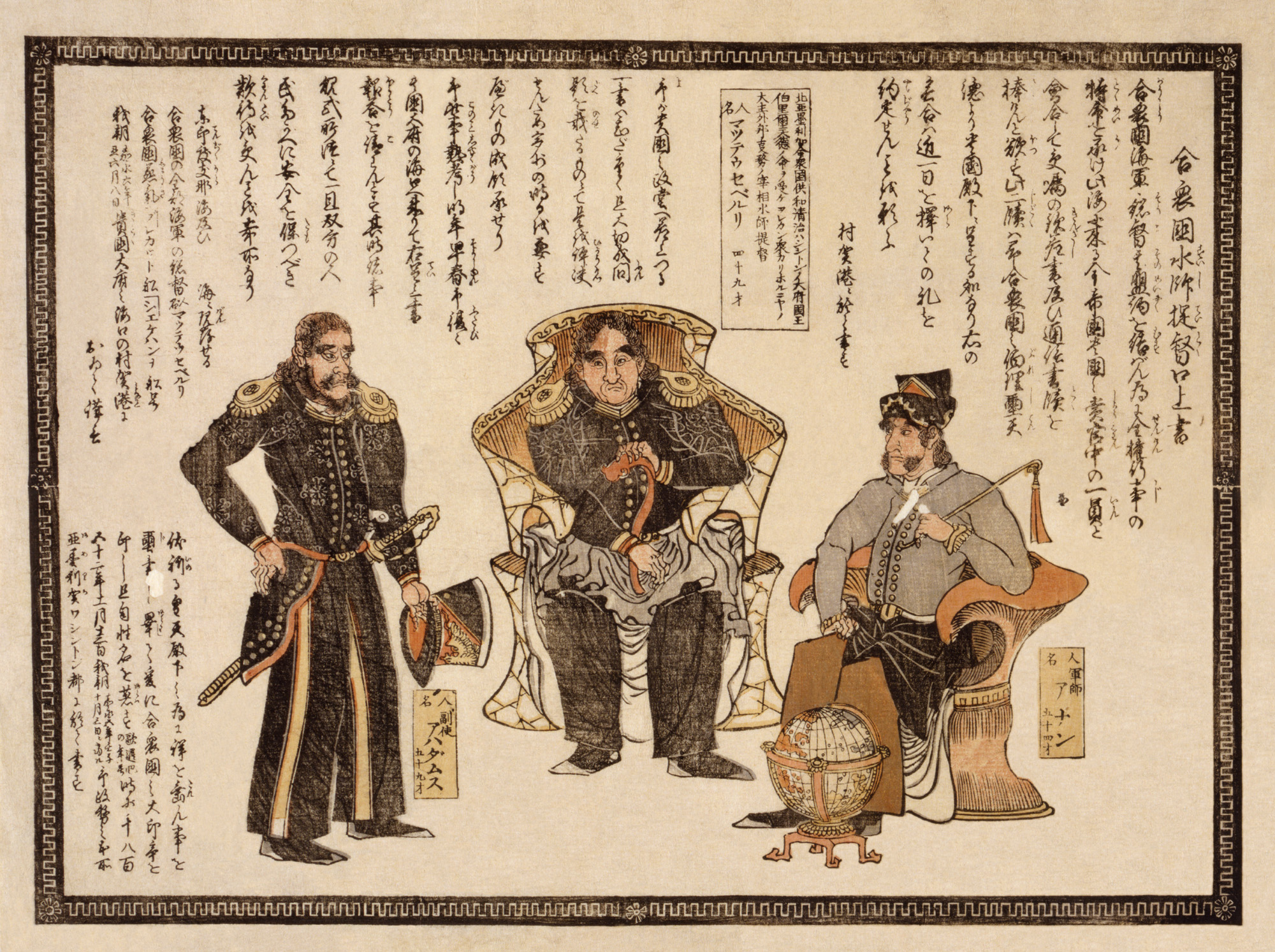
The J. Paul Getty Museum website

LIKE ART BLART ON FACEBOOK

Back to top

Exhibition: ‘Jakob Tuggener – Machine time’ at Fotostiftung Schweiz, Winterthur, Zurich

Exhibition dates: 21st October, 2017 – 28th January, 2018

Curator: Martin Gasser


Jakob Tuggener (Swiss, 1904-1988) 'Fabrik' (book cover) 1943


Jakob Tuggener (Swiss, 1904-1988)
Fabrik (Factory) (book cover)
1943
Rotapfel Verlag, Erlenbach-Zurich


Rare magician, strange alchemist, tells stories through visuals

I am indebted to James McArdle’s blog posting “Work” on his excellent On This Date In Photography website for alerting me to this exhibition, and for reminding me of the work of this outstanding artist, Jakob Tuggener.

The short version: Jakob Tuggener was a draftsman before he became an artist, studying poster design, typography, photography and film. “In 1943, in the middle of the Second World War, Tuggerer’s book Fabrik (Factory) appeared. At first glance, the series of 72 photographs without a text contained therein seems to depict a kind of history of industrialisation – from the rural textile industry to mechanical engineering and high-voltage electrical engineering to modern power plant construction in the mountains. An in-depth reading, however, shows that Tuggener’s film-associative series of photographs simultaneously points to the destructive potential of unrestrained technological progress, as a result of which he sees the then raging World War, and for which the Swiss arms industry produced unlimited weapons. Tuggener was ahead of his time with the book conceived according to the laws of silent film.” (Press release)

Fabrik, subtitled Ein Bildepos der Technik (“Epic of the technological image” or “A picture of technology”) pictures the world of work and industry, and “is considered a milestone in the history of the photo book.” It uses expressive visuals (actions, appearances and behaviours; movements, gestures and details – Tuggener loves the detail) to tell a subjective story, that of the relationship between human and machine. While the book was well ahead of its time, and influenced the early work of that famous Swiss photographer Robert Frank, it did not emerge out of a vacuum and is perhaps not as revolutionary as some people think. Nothing ever appears out of thin air.

“German photographer Paul Wolff, often working in collaboration with Alfred Tritschler, produced a number of exceptional photo books through the 1920s and ’30s, at a time when Constructivism and the Bauhaus influenced many with visions “of an industrialized and socialized society” that placed Germany at “the forefront of European photography” (Martin Parr and Gerry Badger. The Photobook: A History Volume I, Phaidon Press, 2005, p. 86). Arbeit! (1937) is particularly noted for its architectural framing and lighting of massive machinery, its striking portraits of factory workers, and is frequently aligned with works such as Lewis Hine’s Men at Work (1932) and Albert Renger-Patzsch’s Eisen und Stahl (Iron and Steel) (1931).” (Anonymous. “Arbeit!,” on the Bauman Rare Books website [Online] Cited 03/02/2022)

François Kollar’s project La France travail (Working France) (1931-1934), E. O. Hoppé’s Deutsche Arbeit (1930), Heinrich Hauser’s Schwarzes Revier (Black Area) (1930) and Germaine Krull’s Metal (1928) all address the profound social and economic tensions that preceded the Second World War, through an avant-garde photography in the style of “New Vision” and “New Objectivity” – that is, through objective photographs that question common rules of composition, avoiding the more obvious ways subjects would have been photographed at the time. Obscure angles and perspectives abound in these striking photobooks, making their clinical, objective fervour “the great persuaders” of the 1930s and 40s, Modernist and propaganda books of their time.

What made Tuggener so different was the uncompromising subjectiveness of his work, “photographing the two worlds, privilege and labour.” His direct, strong images of factories and high society use wonderful form, light, and shadow to convey their message, never loosing sight of the human dimension, for they shift “our angle from the boss’ POV [point of view] to those unable to get any respite or distance from the situation,” that of the workers. They are a piece of time and human history, which gets closer to the lived reality of the factory floor, than much of the work of his predecessors. Tuggener portrays the mundanity of the “operational sequence” (la chaîne opératoire) of the machine, where the human becomes the oil used to grease the cogs of the ever-demanding “mechanical monsters.” (See Evan Calder Williams’ “Rattling Devils” quotations below)

Tuggener then adds to this new way of seeing which recorded the multiplicity of his points of view – “a modern new style of photography showing not just how things looked, but how it felt to be there” – through the sequencing of the images, which can be seen in the wonderfully combined double pages of the Fabrik book layouts below. Take for example, the photograph that is on the dust jacket, a portrait of a middle-aged worker with a grave look on his face that says, “why the hell are you taking my photograph, why don’t you just f… off.” In the book, Tuggener pairs this image with a whistle letting off steam, a metaphor for the man’s state of being. Tuggener creates these most alien worlds from the inside out, worlds which are grounded in actual lived experience – the little screws lying in the palm of a blackened hand; Navy Cut cigarettes amongst steel artefacts; man being consumed by machine; man being dwarfed by machine; man as machine (the girl paired opposite the counting machine); the Frankenstein scenario of the laboratory (man as monster, machine as man); the intense, feverish eyes of the worker in Heater on electric furnace (the machine human as the devil); and the surrealism of a small doll among the serried ranks of mass destruction, facing the opposition, the opposing lined face of an older worker. This is the stuff of alchemy, the place where art challenges life.

“As Arnold Burgaurer cogently states in his introduction, Tuggener is a jack-of-all-trades: he exhibits, ‘the sharp eye of the hunter, the dreamy eye of the painter; he can be a realist, a formalist, romantic, theatrical, surreal.’ Tuggener’s moves effortlessly between large-format lucidity and grainy, blurred impressionism, in a book that is a decade ahead of its time.” (Martin Parr and Gerry Badger. The Photobook: A History Volume I, Phaidon Press, 2005, p. 144.)

James McCardle observes that, “the meaning of Fabrik is left to the viewer to discover between its pictures, its glimpses of an overwhelming industrial whole; it is essentially filmic on a cryptic film-noir level, a revelation to Frank.” Tuggener’s influence on the early work of Robert Frank can be seen in a sequence from the book Portfolio: 40 Photos 1941/1946 by Robert Frank that was republished by Steidl in 2009 (see below). “Like Tuggener, Frank tackles the task of seemingly incongruous subject matter and finds a harmony through edit and assembly. Again and again throughout this portfolio, Frank is not just trying to show his prowess in making images but in pairing them. They define conflicts in life.” Pace Tuggener. At Frank’s suggestion, Tuggener’s work appeared in both Edward Steichen’s Post-War European Photography and in The Museum of Modern Art’s seminal exhibition, The Family of Man, the latter an essentially humanist exhibition which took the form of a photo essay celebrating the universal aspects of the human experience.

McCardle goes onto suggest that Fabrik, as a photo book, was a model for Frank’s Les Américains: The Americans published fifteen years later in Paris by Delpire, 1958. On this point, we disagree. While his early work as seen in Portfolio: 40 Photos 1941/1946 may have been heavily influenced by Tuggener’s photo book, by the time Frank came to compose Les Américains (for that is what The Americans is, a composition) his point of view had changed, as had that of his camera. While The Americans has many formal elements that can be seen in the construction of the photographs, they also have an element of jazz that would have been inconceivable to Tuggener at that time. Grainy film, strange angles, lighting flare, street lights, night time photography, jukeboxes and American flags portray the American dream not so much from the vantage point of a knowing insider (as Tuggener was) but as a visitor from another planet. Not so much alienating world (man as machine) as alien world, picturing something that has never been recognised before. These are two different models of being. While both are photo books and both pair images together in sequences, Frank had moved on to another point of view, that of an “invalid” outsider, and his photo book has a completely different nature to that of Tuggener’s Fabrik.

Dr Marcus Bunyan

Word count: 1,366


Many thankx to Fotostiftung Schweiz for allowing me to publish some of the photographs in the posting. Please click on the photographs for a larger version of the image.


For Jakob Tuggener, whose works can be seen within the context of social documentary photography, the individual and the industrial boom of the 19th and 20th centuries were central themes. His often somber, black and white photographs seem to confront this new world with a sense of fear as well as admiration. Will technology help relieve us of physically hard labour or replace us altogether? Tuggener owes his renown to his photo book Fabrik (Factory) that was published in 1943. With an aesthetic approach that was unique for his time, Tuggener explores in his photographic essay the relationship between humans and the perceived threat as well as progress of technology. The labourers depicted are grave, their faces worn marked by deep folds, while a factory building in the background stands strong, enveloped in a vaporous cloud. This “Pictorial Epic of Technology,” as Tuggener himself described it, is today considered a milestone in the history of photography books.


Jakob Tuggener (Swiss, 1904-1988) Page layout from the book 'Fabrik' 1943

Jakob Tuggener (1904-1988) Page layout from the book Fabrik 1943


Jakob Tuggener (Swiss, 1904-1988) 'Steam whistle, Steckborn artificial silk factory' 1938 from the exhibition Exhibition: 'Jakob Tuggener – Machine time' at Fotostiftung Schweiz, Winterthur, Zurich, Oct 2017 - Jan 2018


Jakob Tuggener (Swiss, 1904-1988)
Steam whistle, Steckborn artificial silk factory
1938
Silver gelatin print
© Jakob Tuggener-Stiftung


Selection from the book 'Portfolio: 40 Photos 1941/1946' by Robert Frank


Selection from the book Portfolio: 40 Photos 1941/1946 by Robert Frank (Steidl, 2009)


The ‘weightless’ and the ‘grounded’ are two opposing themes that Frank repeatedly uses to move us through this sequence. Three radio transistors in a product shot float into the sky while a music conductor, his band and a church steeple succumb to gravity on the facing page. Even in this image Frank shifts focus to the sky and beyond – the weightless. When he photographs rural life, the farmers heft whole pigs into the air and another carries a huge bale of freshly cut grain which seems featherlight but for the woman trailing behind with hands ready to assist.

Considering this work was made while fascism was on the move through Europe, external politics is felt through metaphor. A painted portrait of men in uniform among a display of pots and pans for sale faces a brightly polished cog from a machine – its teeth sharp and precise. In another pairing, demonstrators waving flags in the streets of Zurich face a street sign covered with snow and frost, a Swiss flag blows in the background. in yet another of a crowd of spectators face the illuminated march of a piece of machinery – its illusory shadow filling in the ranks. These pairings feel under the influence of Jakob Tuggener, whose work Frank certainly knew. Like Tuggener, Frank tackles the task of seemingly incongruous subject matter and finds a harmony through edit and assembly.

Again and again throughout this portfolio, Frank is not just trying to show his prowess in making images but in pairing them. They define conflicts in life. One boy struggles to climb a rope while a ski jumper is frozen in flight. Fisherman bask in sunlight while two pedestrians are caught in blinding snowfall.

Text from the SB4 Photography and Books website December 14, 2009


Jakob Tuggener (Swiss, 1904-1988) 'Autoritratto, Zurigo [Self-portrait, Zurich]' 1927 from the exhibition Exhibition: 'Jakob Tuggener – Machine time' at Fotostiftung Schweiz, Winterthur, Zurich, Oct 2017 - Jan 2018


Jakob Tuggener (Swiss, 1904-1988)
Autoritratto, Zurigo (Self-portrait, Zurich)
1927
Silver gelatin print
© Jakob Tuggener-Stiftung


Jakob Tuggener (Swiss, 1904-1988) 'Budenzauber (Charm of the Attic Room) Jakob Tuggener with friends' 1935


Jakob Tuggener (Swiss, 1904-1988)
Budenzauber (Charm of the Attic Room) Jakob Tuggener with friends
1935
Silver gelatin print
© Jakob Tuggener-Stiftung


Jakob Tuggener (Swiss, 1904-1988) 'Plant entrance, Oerlikon Machine Factory' 1934


Jakob Tuggener (Swiss, 1904-1988)
Plant entrance, Oerlikon Machine Factory
1934
Silver gelatin print
© Jakob Tuggener-Stiftung


Jakob Tuggener (Swiss, 1904-1988) 'Work in the boiler' 1935


Jakob Tuggener (Swiss, 1904-1988)
Work in the boiler
1935
Silver gelatin print
© Jakob Tuggener-Stiftung


Jakob Tuggener (Swiss, 1904-1988) 'Running girl in the Maschinenfabrik Oerlikon' 1934


Jakob Tuggener (Swiss, 1904-1988)
Running girl in the Maschinenfabrik Oerlikon
1934
Silver gelatin print
© Jakob Tuggener-Stiftung


Jakob Tuggener (Swiss, 1904-1988) 'Façade, Oerlikon Machine Factory' 1936


Jakob Tuggener (Swiss, 1904-1988)
Façade, Oerlikon Machine Factory
1936
Silver gelatin print
© Jakob Tuggener-Stiftung


Jakob Tuggener (Swiss, 1904-1988) Page layout from the book 'Fabrik' 1943

Jakob Tuggener (1904-1988) Page layout from the book Fabrik 1943


Jakob Tuggener (Swiss, 1904-1988) 'Nell'ufficio della fonderia, fabbrica di costruzioni meccaniche Oerlikon' [In the foundry office, Oerlikon mechanical engineering factory] 1937


Jakob Tuggener (Swiss, 1904-1988)
Nell’ufficio della fonderia, fabbrica di costruzioni meccaniche Oerlikon (In the foundry office, Oerlikon mechanical engineering factory)
1937
From Fabrik 1933-1953
Silver gelatin print
© Jakob Tuggener-Stiftung


“Above all, the contrast between the brilliantly lit ballroom and the dark factory hall influenced the perception of his artistic oeuvre,” [curator] Martin Gasser explains. “Tuggener also positioned himself between these two extremes when he stated: ‘Silk and machines, that’s Tuggener’. In reality, he loved both: the wasteful luxury and the dirty work, the enchanting women and the sweaty labourers. For him, they were both of equal value and he resisted being categorised as a social critic who pitted one world against the other. On the contrary, these contrasts belonged to his conception of life and he relished experiencing the extremes – and the shades of tones in between – to the most intense degree.”


“Jakob Tuggener’s ‘Fabrik’, published in Zurich in 1943, is a milestone in the history of the photography book. Its 72 images, in the expressionist aesthetic of a silent movie, impart a skeptical view of technological progress: at the time the Swiss military industry was producing weapons for World War II. Tuggener, who was born in 1904, had an uncompromisingly critical view of the military-industrial complex that did not suit his era. His images of rural life and high-society parties had been easy to sell, but ‘Fabrik’ found no publisher. And when the book did come out, it was not a commercial success. Copies were sold at a loss and some are believed to have been pulped. Now this seminal work, which has since become a sought-after classic, is being reissued with a contemporary afterword. In his lifetime, Tuggener’s work appeared – at Robert Frank’s suggestion – in Edward Steichen’s ‘Post-War European Photography’ and in The Museum of Modern Art’s seminal exhibition, ‘The Family of Man’, in whose catalogue it remains in print. Tuggener’s death in 1988 left an immense catalogue of his life’s work, much of which has yet to be shown: more than 60 maquettes, thousands of photographs, drawings, watercolours, oil paintings and silent films.”


Book description on Amazon. The book has been republished by Steidl in January, 2012.


Jakob Tuggener (Swiss, 1904-1988) 'Tornos Machine-tool Factory, Moutier' 1942


Jakob Tuggener (Swiss, 1904-1988)
Tornos Machine-tool Factory, Moutier
1942
Silver gelatin print
© Jakob Tuggener-Stiftung


Jakob Tuggener (Swiss, 1904-1988) 'Navy Cut, Ateliers de construction mécanique Oerlikon (MFO)' [Navy Cut, Machine Shops Oerlikon (MFO)] 1940


Jakob Tuggener (Swiss, 1904-1988)
Navy Cut, Ateliers de construction mécanique Oerlikon (MFO) [Navy Cut, Machine Shops Oerlikon (MFO)]
1940
Silver gelatin print
© Jakob Tuggener-Stiftung


Jakob Tuggener (Swiss, 1904-1988) 'Pressure pipe, Vernayaz' 1938


Jakob Tuggener (Swiss, 1904-1988)
Pressure pipe, Vernayaz
1938
Silver gelatin print
© Jakob Tuggener-Stiftung


Jakob Tuggener (Swiss, 1904-1988) 'Grande Dixence power station' 1942


Jakob Tuggener (Swiss, 1904-1988)
Grande Dixence power station
1942
Silver gelatin print
© Jakob Tuggener Foundation


Jakob Tuggener (Swiss, 1904-1988) 'Laboratorio di ricerca, fabbrica di costruzioni meccaniche Oerlikon' [Research laboratory, Oerlikon mechanical engineering factory] 1941


Jakob Tuggener (Swiss, 1904-1988)
Laboratorio di ricerca, fabbrica di costruzioni meccaniche Oerlikon (Research laboratory, Oerlikon mechanical engineering factory)
1941
From Fabrik 1933-1953
Silver gelatin print
© Jakob Tuggener-Stiftung


Jakob Tuggener (Swiss, 1904-1988) 'Heater on electric furnace' 1943 (detail)


Jakob Tuggener (Swiss, 1904-1988)
Heater on electric furnace (detail)
1943
Silver gelatin print
© Jakob Tuggener-Stiftung


Jakob Tuggener (Swiss, 1904-1988) 'Heater on electric furnace' 1943


Jakob Tuggener (Swiss, 1904-1988)
Heater on electric furnace
1943
Silver gelatin print
© Jakob Tuggener-Stiftung


Jakob Tuggener (Swiss, 1904-1988) 'Worker, Maschinenfabrik Oerlikon' 1940s


Jakob Tuggener (Swiss, 1904-1988)
Worker, Maschinenfabrik Oerlikon
1940s
Silver gelatin print
© Jakob Tuggener Foundation


Jakob Tuggener (Swiss, 1904-1988) '"Amore", Maschinenfabrik Oerlikon' 1940s


Jakob Tuggener (Swiss, 1904-1988)
“Amore”, Maschinenfabrik Oerlikon
1940s
Silver gelatin print
© Jakob Tuggener Foundation


Jakob Tuggener (Swiss, 1904-1988) 'Weaving mill, Glattfelden' 1940s


Jakob Tuggener (Swiss, 1904-1988)
Weaving mill, Glattfelden
1940s
Silver gelatin print
© Jakob Tuggener Foundation


Jakob Tuggener (Swiss, 1904-1988) 'Lathe, Maschinenfabrik Oerlikon' 1949


Jakob Tuggener (Swiss, 1904-1988)
Lathe, Maschinenfabrik Oerlikon
1949
Silver gelatin print
© Jakob Tuggener-Stiftung


Jakob Tuggener (Swiss, 1904-1988) 'Lathe, Maschinenfabrik Oerlikon' 1949 (detail)


Jakob Tuggener (Swiss, 1904-1988)
Lathe, Maschinenfabrik Oerlikon (detail)
1949
Silver gelatin print
© Jakob Tuggener-Stiftung


Jakob Tuggener (Swiss, 1904-1988) 'Jacob Tuggener at the popular pavillion Montpellier manufactures an epic of industrial photographs of workers' portraits' Montpellier magazine 1943


Jakob Tuggener (Swiss, 1904-1988)
Jacob Tuggener at the popular pavillion Montpellier manufactures an epic of industrial photographs of workers’ portraits
Montpellier magazine
1943
© Jakob Tuggener-Stiftung


Jakob Tuggener (Swiss, 1904-1988) 'Forgeron dans une fabrique de wagons de Schlieren' [Blacksmith in a Schlieren wagon factory] 1949


Jakob Tuggener (Swiss, 1904-1988)
Forgeron dans une fabrique de wagons de Schlieren [Blacksmith in a Schlieren wagon factory]
1949
Silver gelatin print
© Jakob Tuggener-Stiftung


Jakob Tuggener (Swiss, 1904-1988) 'Untitled (Arms of work)' c. 1947


Jakob Tuggener (Swiss, 1904-1988)
Untitled (Arms of work)
c. 1947
Silver gelatin print
© Jakob Tuggener-Stiftung


Jakob Tuggener (1904-1988) is one of the exceptional phenomena of Swiss photography. His personal and expressive recordings of glittering celebrations of better society are legendary, and his 1943 book Fabrik (Factory) is considered a milestone in the history of the photo book. At the centre of the exhibition “Machine time” are photographs and films from the world of work and industry. They not only reflect the technical development from the textile industry in the Zurich Oberland to power plant construction in the Alps, but also testify to Tuggener’s lifelong fascination with all sorts of machines: from looms to smelting furnaces and turbines to locomotives, steamers and racing cars. He loved her noise, her dynamic movements and her unruly power, and he artistically transposed them. At the same time, he observed the men and women who keep up the motor of progress with their work – not without hinting that one day machines might dominate people.

Machine time

Jakob Tuggener knew the world of factories like no other photographer of his time, having completed an apprenticeship as a draftsman at Maag Zahnräder AG in Zurich and then worked in their design department. Through the photographer Gustav Maag he was also introduced to the technique of photography. However, as a result of the economic crisis in the late 1920s, he was dismissed, after which he fulfilled his childhood dream of becoming an artist by studying at the Reimannschule in Berlin. For almost a year he dealt intensively with poster design, typography and film and let himself be carried away with his camera by the dynamics of the big city.

After returning to Switzerland in 1932, he began working as a freelancer for the Maschinenfabrik Oerlikon (MFO), especially for their house newspaper with the programmatic title Der Gleichrichter (The Rectifier). Although the company already employed its own photographer, he was entrusted with the task of developing a kind of photographic interior view of the company. This was intended to bridge the gap between workers and office workers on the one hand and management on the other. By the end of the 1930s, in addition to multi-part reports from the production halls, as well as portraits of “members of the MFO family”, one-sided, album-like series of unnoticed scenes from everyday factory life appeared. From 1937 Tuggener also created a series of 16mm short films – always black and white, silent, and representing the tension between fiction and documentation. This includes, for example, the drama about death and transience (Die Seemühle (The Sea mill), 1944), which was influenced by surrealism and staged by Tuggener with amateur actors in a vacant factory on the shores of Lake Zurich. or the cinematic exploration of the subject of man and machine (Die Maschinenzeit (The Machine Time), 1938-1970). This ties in with the earlier book maquette of the same name and transforms it into a moving, immediately perceptible, but also fleeting vision of the Tuggenean machine age.

In 1943, in the middle of the Second World War, Tuggerer’s book Fabrik (Factory) appeared. At first glance, the series of 72 photographs without a text contained therein seems to depict a kind of history of industrialisation – from the rural textile industry to mechanical engineering and high-voltage electrical engineering to modern power plant construction in the mountains. An in-depth reading, however, shows that Tuggener’s film-associative series of photographs simultaneously points to the destructive potential of unrestrained technological progress, as a result of which he sees the then raging World War, and for which the Swiss arms industry produced unlimited weapons. Tuggener was ahead of his time with the book conceived according to the laws of silent film.1 Neither his uncompromisingly subjective photography nor his critical attitude matched the threatening situation in which Switzerland was called to unity and strength under the slogan “Spiritual Defense”.

Although the book was not commercially successful, Tuggener’s Fabrik was a great artistic success and continued to explore the issues of work and industry. He produced two more book maquettes: Schwarzes Eisen (Black Iron) (1950) and Die Maschinenzeit (The Machine Time) (1952). They can be understood as a kind of continuation of the published book, which the journalist Arnold Burgauer described as a “glowing and sparkling factual and accountable report of the world of the machine, of its development, its possibilities and limitations.” In the mid-1950s, on the threshold of the computer age, Tuggener’s classic “machine time” came to an end. On the one hand, the mechanical processes that had so fascinated Tuggener evaded his eyes. On the other hand, he could not or did not want to make friends with the idea that one day even a human heart could be replaced by a machine.

Portrayer of opposites

As early as 1930 in Berlin, Tuggener had begun to take pictures of the then famous Reimannschule balls. He was fascinated by the tingling erotic atmosphere of these occasions, and he found photography in sparsely lit rooms a great challenge. Back in Zurich, he immediately plunged into local nightlife to surrender to the splendour and luxury of mask, artist and New Year’s balls. Again and again he let himself be abducted by elegant ladies with their silk dresses, their necklines, bare back or shoulders in a glittering fairytale world, whose mysterious facets he sought to fathom with his Leica. Although Tuggener’s ball recordings were only perceived by a small insider audience for a long time, many quickly saw him as a “masterful portrayer of our world of stark contrasts,” a world torn between a brightly lit ballroom and gloomy factory hall. Tuggener also positioned himself between these extremes when he stated, “Silk and machines, that’s Tuggener.” Because he loved both the lavish luxury and the dirty work, the jewelled women and the sweaty men. He felt that he was equal and resisted being classified as a social critic.

In whatever world he moved, Jakob Tuggener did it with the elegance of a grand seigneur [a man whose rank or position allows him to command others]. He was an eye man with a casual, loving look for the inconspicuous, the superficial incident; not just a sensitive picture-poet, but the “photographische Dichter römisch I,” as he used to call himself self-confidently. Critic Max Eichenberger wrote of the Fabrik photographs: “Tuggener is able to make factory photographs that reveal not only a painter, but also a poet, and a rare magician and strange alchemist – lead, albeit modestly turned into gold.”

The exhibition Jakob Tuggener – Maschinenzeit includes vintage and later prints from the early 1930s to the late 1950s, which for the most part come from the photographers estate. In an adjoining room the exhibition will also feature a selection of his 16mm short films from the years 1937-1970, which revolve around the topic of “man and machine” in various ways. These films were newly digitised specifically for the exhibition (in collaboration with Lichtspiel / Cinematheque Bern).

Press release from Fotostiftung Schweiz


1/ The story in silent film is best told through visuals (such as actions, appearances and behaviours). Focus on movements and gestures, and borrow from dance and mime. Large, exaggerated motions translate well to silent films, but balance these also with subtlety (ie. a raised eyebrow, a quivering lip – especially when paired with a close-up shot).
Karlanna Lewis. “8 Tips for Making Silent Movies,” on the Raindance website June 1, 2014 [Online] Cited 03/02/2022


Jakob Tuggener (Swiss, 1904-1988) Page layout from the book 'Fabrik' 1943

Jakob Tuggener (Swiss, 1904-1988) Page layout from the book 'Fabrik' 1943

Jakob Tuggener (Swiss, 1904-1988) Page layout from the book 'Fabrik' 1943

Jakob Tuggener (Swiss, 1904-1988) Page layout from the book 'Fabrik' 1943

Jakob Tuggener (Swiss, 1904-1988) Page layout from the book 'Fabrik' 1943

Jakob Tuggener (Swiss, 1904-1988) Page layout from the book 'Fabrik' 1943

Jakob Tuggener (Swiss, 1904-1988) Page layout from the book 'Fabrik' 1943

Jakob Tuggener (Swiss, 1904-1988) Page layout from the book 'Fabrik' 1943

Jakob Tuggener (Swiss, 1904-1988) Page layout from the book 'Fabrik' 1943

Jakob Tuggener (Swiss, 1904-1988) Page layout from the book 'Fabrik' 1943

Jakob Tuggener (Swiss, 1904-1988) Page layout from the book 'Fabrik' 1943

Jakob Tuggener (Swiss, 1904-1988) Page layout from the book 'Fabrik' 1943

Jakob Tuggener (Swiss, 1904-1988) Page layout from the book 'Fabrik' 1943

Jakob Tuggener (Swiss, 1904-1988) Page layout from the book 'Fabrik' 1943

Jakob Tuggener (Swiss, 1904-1988) Page layout from the book 'Fabrik' 1943

Jakob Tuggener (1904-1988) Page layouts from the book Fabrik 1943


Extracts from Shard Cinema by Evan Calder Williams London: Repeater Books, 2017

“All gestures are perhaps inhuman, because they enact that hinge with the world, forging a bridge and buffer that can’t be navigated by words or by actions that feel like purely one’s own. In Vilém Flusser’s definition, a gesture is “a movement of the body or of a tool connected to the body for which there is no satisfactory causal explanation” – that is, it can’t be explained on its own isolated terms.26 The factory will massively extend this tendency, because the “explanation” lies not in the literal circuit of production but in the social abstraction of value driving the entire process yet nowhere immediately visible. We might frame the difficulty of this imagining with the concept of “operational sequence” (la chaîne opératoire), posed by French archaeologist André Leroi-Gourhan, which designates a “succession of mental operations and technical gestures, in order to satisfy a need (immediate or not), according to a preexisting project.”25

26. Vilém Flusser, Gestures (Minneapolis: University of Minnesota Press, 2014), p. 2.
27. Catherine Perlès, Les Industries Lithiques Taillées de Franchthi, Argolide: Presentation Generate et Industries Paleolithiques (Terre Haute: Indiana University Press, 1987), p. 23.


“Which is to say: we build factories. And in those factories, the process of the exteriorization of memory and muscle becomes almost total, as “the hand no longer intervenes except to feed or to stop” what Leroi-Gourhan, like Larcom, will call “mechanical monsters,” “machines without a nervous system of their own, constantly requiring the assistance of a human partner.”30 But along with engendering the panic of becoming caregiver to the inanimate, this also poses the problem of animation in an unprecedented way. Because if a “technical gesture is the producer of forms, deriving them from inert nature and preparing them for animation,” the factory constitutes us in a different network of the animated and animating.31 It’s a network that can be seen in those writings of factory workers, with their distinct sense of not just preparing those materials but becoming the pivot that eases, smooths, and guides the links of an operational sequence. In particular, a worker functions as the point of compression and transformation between tremendous motive force and products made whose regularity must be assured. The human becomes the regulator of this process, the assurance of an abstract standardization.”

30 André Leroi-Gourhan, Gesture and Speech, trans. Anna Bostock Berger (Cambridge, MA: MIT Press, 1993), p. 246
31. Ibid., p. 313


“… what I’m sketching here in this passage through scattered materials of the century prior to filmed moving images is something simpler, a small corrective to insist that by the time cinema was becoming a medium that seemed to offer a novel form of mechanical time, motion, and vision, one that historians and theorists will fixate on as the unique province and promise of film, many of its viewers had themselves already been enacting and struggling against that form for decades, day in, day out. The point is to place the human operator back in the frame, to ask after those who tended the machine before it was available as a spectacle, and to listen to how they understood what they were tangled in the midst of. But this is neither a humanist gesture of assuring the centrality of the person in the mesh that holds them nor a historical rejoinder to the forgetting and active dismissal of many of these personal accounts. Rather, it’s an effort to show how only with the operator’s experience made central can we see the real historical destruction of such illusions of centrality and, in their place, the novel construction of the human as tender and mender of a flailing inhuman net, the pivot who forms the connective tissue that enacts the lethal animation around her. In short, to see how the real subsumption of labor to capital is not only a systemic or periodizing concept that marks the historical transformation of discrete activities in accordance with the abstractions of value. It also is the granular description of a lived and bitterly contested process by which those abstractions get corporally and mechanically made and unmade, one which we can understand differently if we shift our angle from the boss’ POV to those unable to get any respite or distance from the situation.”

Excerpt from Evan Calder Williams. “Rattling Devils,” on the Viewpoint Magazine website July 13, 2017 [Online] Cited 29/12/2017


Jakob Tuggener (Swiss, 1904-1988) 'Ballo ungherese, Grand Hotel Dolder, Zurigo, 1935' [Hungarian dance, Grand Hotel Dolder, Zurich, 1935] 1935


Jakob Tuggener (Swiss, 1904-1988)
Ballo ungherese, Grand Hotel Dolder, Zurigo, 1935 (Hungarian dance, Grand Hotel Dolder, Zurich, 1935)
1935
From the series Nuits de bal, 1934-1950
Silver gelatin print
© Jakob Tuggener-Stiftung


Jakob Tuggener (Swiss, 1904-1988) 'Ballo ungherese, Grand Hotel Dolder, Zurigo, 1935' [Hungarian dance, Grand Hotel Dolder, Zurich, 1935] 1935


Jakob Tuggener (Swiss, 1904-1988)
Ballo ungherese, Grand Hotel Dolder, Zurigo, 1935 (Hungarian dance, Grand Hotel Dolder, Zurich, 1935)
1935
From the series Nuits de bal, 1934-1950
Silver gelatin print
© Jakob Tuggener-Stiftung


Jakob Tuggener (Swiss, 1904-1988) 'Hotel Belvédère, Davos, 1944' 1944


Jakob Tuggener (Swiss, 1904-1988)
Hotel Belvédère, Davos, 1944
1944
From the series Nuits de bal, 1934-1950
Silver gelatin print
© Jakob Tuggener-Stiftung


Jakob Tuggener (Swiss, 1904-1988) 'Carlton hotel, St. Moritz' Nd


Jakob Tuggener (Swiss, 1904-1988)
Carlton hotel, St. Moritz
Nd
From the series Nuits de bal, 1934-1950
Silver gelatin print
© Jakob Tuggener-Stiftung


Jakob Tuggener (Swiss, 1904-1988) 'Palace hotel, St. Moritz' 1948-1949


Jakob Tuggener (Swiss, 1904-1988)
Palace Hotel, St. Moritz, San Silvestro
1948-49
From the series Nuits de bal, 1934-1950
Silver gelatin print
© Jakob Tuggener-Stiftung


Jakob Tuggener (Swiss, 1904-1988) 'Ballo Acs, Grand Hotel Dolder, Zurigo, 1948' 1948


Jakob Tuggener (Swiss, 1904-1988)
Ballo Acs,Grand Hotel Dolder, Zurigo, 1948
1948
From the series Nuits de bal, 1934-1950
Silver gelatin print
© Jakob Tuggener-Stiftung


Jakob Tuggener (Swiss, 1904-1988) 'Ball Nights' 1934-1950


Jakob Tuggener (Swiss, 1904-1988)
Ball Nights
From the series Nuits de bal, 1934-1950
Silver gelatin print
© Jakob Tuggener-Stiftung


Fotostiftung Schweiz
Grüzenstrasse 45
CH-8400 Winterthur (Zürich)
Phone: +41 52 234 10 30

Opening hours:
Tuesday – Saturday 11am – 6pm
Wednesday 11am – 8pm
Closed on Mondays

Fotostiftung Schweiz website

LIKE ART BLART ON FACEBOOK

Back to top

Photographs: Marcus Bunyan. ‘The Shape of Dreams’ 2013-2017

December 2017


CLICK ON AND ENLARGE THE IMAGES BELOW AND USE THE SCROLL BAR TO SEE THE FULL SEQUENCE AND SPACING OF THE IMAGES


Marcus Bunyan (Australian, b. 1958) 'The Shape of Dreams' 2013 - 2017 (detail)

Marcus Bunyan (Australian, b. 1958) 'The Shape of Dreams' 2013 - 2017 (detail)

Marcus Bunyan (Australian, b. 1958) 'The Shape of Dreams' 2013 - 2017 (detail)


Marcus Bunyan (Australian, b. 1958)
The Shape of Dreams 
(detail of sequence)
2013-2017
Digital photographs
42 images in the series
© Marcus Bunyan


The form of formlessness
The shape of dreams


The Shape of Dreams

A Christmas present to myself… my most complex and enigmatic sequence to date.

Shot in Japan, all of the images come from two 1950s photography albums, one of which has a large drawing of a USAF bomber on it’s cover. The images were almost lost they were so dirty, scratched and deteriorated. It has taken me four long years to scan, digitally clean and restore the images, heightening the colour already present in the original photographs.

Sometimes the work flowed, sometimes it was like pulling teeth. Many times I nearly gave up, asking myself why I was spending my life cleaning dirt and scratches from these images. The only answer is… that I wanted to use these images so that they told a different story.

Then to sequence the work in such a way that there is an enigmatic quality, a mystery in that narrative journey. Part auteur, part cinema – a poem to the uncertainty of human dreams.

Dr Marcus Bunyan

Please go to my website to see the larger images

Photographs are available from this series for purchase. As a guide, a digital colour 16″ x 20″ costs $1000 plus tracked and insured shipping. For more information please see my Store web page.


A selection of individual images from the sequence


Marcus Bunyan (Australian, b. 1958) 'Untitled' from the series 'The Shape of Dreams' 2013 - 2017


Marcus Bunyan (Australian, b. 1958) 'Untitled' from the series 'The Shape of Dreams' 2013 - 2017


Marcus Bunyan (Australian, b. 1958) 'Untitled' from the series 'The Shape of Dreams' 2013 - 2017


Marcus Bunyan (Australian, b. 1958) 'Untitled' from the series 'The Shape of Dreams' 2013 - 2017


Marcus Bunyan. 'Untitled' from the series 'The Shape of Dreams' 2013 - 2017


Marcus Bunyan. 'Untitled' from the series 'The Shape of Dreams' 2013 - 2017


Marcus Bunyan. 'Untitled' from the series 'The Shape of Dreams' 2013 - 2017


Marcus Bunyan. 'Untitled' from the series 'The Shape of Dreams' 2013 - 2017


Marcus Bunyan. 'Untitled' from the series 'The Shape of Dreams' 2013 - 2017


Marcus Bunyan (Australian, b. 1958)
Untitled from the series The Shape of Dreams
2013-2017
Silver gelatin print
© Marcus Bunyan


Sequencing The Shape of Dreams 2013-2017

Sequencing The Shape of Dreams at a cafe table in Richmond, Melbourne, Victoria in July 2017 with my friend Ian Lobb.


Marcus Bunyan (Australian, b. 1958) 'Sequenceing 'The Shape of Dreams' 2013 - 2017' 2017

Marcus Bunyan (Australian, b. 1958) 'Sequenceing 'The Shape of Dreams' 2013 - 2017' 2017

Marcus Bunyan (Australian, b. 1958) 'Sequenceing 'The Shape of Dreams' 2013 - 2017' 2017


Marcus Bunyan (Australian, b. 1958)
Sequenceing ‘The Shape of Dreams’ 2013-2017
July 2017


Marcus Bunyan website

LIKE ART BLART ON FACEBOOK

Back to top

Text / Exhibition: ‘The Unflinching Gaze: photo media and the male figure’ at the Bathurst Regional Art Gallery, New South Wales

Exhibition dates: 14th October – 3rd December, 2017

Curator: Richard Perram OAM

Warning: this posting contains male nudity. If you don’t want to see please do not look.


Todd Fuller (Australian, b. 1988) and Amy Hill (Australian, b. 1988) 'They're Only Words' 2009 (video still) from the exhibition 'The Unflinching Gaze: photo media and the male figure' at the Bathurst Regional Art Gallery, New South Wales, October- December, 2017


Todd Fuller (Australian, b. 1988) and Amy Hill (Australian, b. 1988)
They’re Only Words (video still)
2009
Film, sound duration: 2:42 mins
Courtesy the artists and May Space, Sydney


I must congratulate curator and gallery Director, Richard Perram OAM and the Bathurst Regional Art Gallery for putting on such a fine exhibition, worthy of many a large gallery in a capital city. An incredible achievement, coming at the same time as Latrobe Regional Art Gallery put on the recent René Magritte exhibition. All power to these regional galleries. Now on with the show…

Show and tell

The male body. The female body. The trans body. The gay body. Etc. etc. etc. …
The male gaze. The female gaze. The trans gaze. The gay gaze. Etc. etc. etc. …

I did my Doctor of Philosophy, all four and a half years of it, on the history of photography and its depiction of the male body so I know this subject intimately. It is such a complicated subject that after all of time, nothing is ever certain, everything is changeable and fluid.

To start, the definition of masculinity that I used as a determination for the term in my PhD is included as the first quotation below. The quotation is followed by others – on the optic experience and the creation of body image; on body image and our relation to other people; on the anxiety caused by the crisis of looking as it intersects with the crisis of the body; and how we can overcome the passivity of objective truth (accepting dominant images in this case, as they are presented to us) through an active struggle for subjective truth, or an acceptance of difference. A further, longer quote in the posting by Chris Schilling examines Ernst Goffman’s theories of body, image and society in which Goffman states that the body is characterised by three main features: firstly, that the body as material property of individuals; secondly, that meanings attributed to the body are determined by ‘shared vocabularies of body idiom’ such as dress, bearing, movements and position, sound level, physical gestures such as waving and saluting, facial decorations, and broad emotional expressions; and thirdly; that the body plays an important role in mediating the relationship between people’s self-identity and their social identity. These quotations just start to scratch the surface of this very complicated, negotiated social area.

What we can say is this: that masculinity is always and forever a construct; that male body image is always and forever a further construct built on the first construct; and that photo media images of the male body are a construct, in fact a double or triple construct as they seek to capture the surface representation of the previous two conditions.

What strikes me with most of the photographs in this posting is that they are about a constructed “performance” of masculinity, performances that challenge cultural signifiers of mainstream and marginalised aspects of Western patriarchal culture. In most the masculine subject position is challenged through complex projections of masculinity, doubled through the construction of images. In fact, spectatorship is no longer male and controlling but polymorphous and not organised along normative gender lines.

Thus, these artists respond to four defined action problems in terms of representation of body usage: “… control (involving the predicability of performance); desire (whether the body is lacking or producing desire); the body’s relation to others (whether the body is monadic and closed in on itself or dyadic and constituted through either communicative or dominating relations with others); and the self-relatedness of the body (whether the body associates and ‘feels at home’ in itself, or dissociates itself from its corporeality).”1 Further, four ideal types of body usage can be defined in terms of these action problems: the disciplined body where the medium is regimentation, the model of which is the rationalisation of the monastic order; the mirroring body where the medium is consumption, the model of which is the department store; the dominating body where the medium is force, the model of which is war; and the communicative body where the medium is recognition, the model of which could be shared narratives, communal rituals (such as sex) and caring relationships.2

As Chris Schilling observes, “The boundaries of the body have shifted away from the natural and on to the social, and the body now has ‘a thoroughly permeable “outer layer” through which the reflexive project of the self and externally formed abstract systems enter.” In other words, masculinity and male figure can be anything to any body and any time in any context. The male body can be prefigured by social conditions. But the paradox is, the more we know masculinity and the male body, the more knowledge we have, the more we can alter and shape these terms, the less certain we are as to what masculinity and the male body is, and how or if it should be controlled. Taking this a step further, Schilling notes that the photographic image of the body itself has become an abstract system/symbolic token which is traded without question, much as money is, without the author or participants being present.3 You only have to look into some of the gay chats rooms to know this to be true!

The most difficult question I had to ask myself in relation to this exhibition was, what is it to be male? Such a question is almost impossible to answer…

Is being male about sex, a penis, homosociality, homosexuality, heterosexuality, friendship, braveness, dominance, perversity, fantasy, love, attraction, desire, pleasure, Ockerism, respect, loyality, spirituality, joy, happiness etc. etc. It is all of these and more besides. And this is where I find some most of these images to be just surface representations of deeper feelings: I just like dressing in drag; I like pulling a gun on someone; I like holding a knife next to my penis to make my phallus and my armoured body look “butch”. It’s as though the “other”, our difference from ourselves (and others), has been normalised and found wanting. I want to strip them away from this performative, normalising aspect. Most of these photographs are male figures dressed up to the nines, projecting an image, a surface, to the outside world (even though the performative tells us a great deal about the peculiarities of the human imagination). I want them to be more essential, not just a large penis dressed up for show. Only in the image Untitled (Auschwitz victim) (Nd, below), where the performance for the camera and the clothing the man is wearing is controlled by others – does some sense of an inner strength of a male come through. In times of unknown horror and dire circumstances, this man stares you straight in the eye with a calm presence and inner composure.

For me personally, being male is about a spiritual connection – to myself, to the earth and to the cosmos. I hope it is about respect for myself and others. Of course I use the systems above as a projection of myself into the world, as to who I am and who I want people to see through my image. But there is so much more to being male than these defined, representational personas. This is not some appeal to, as David Smail puts it, “a simple relativity of ‘truths'” (anything to anybody at anytime in any context), nor a essentialist reductionism to a “single truth” about our sense of being, but an appeal for a ‘non-finality’ of truth, neither fixed nor certain, that changes according to our values and what we understand of ourselves, what it is to be male. This understanding requires intense, ongoing inner work, something many males have no desire to undertake…

Dr Marcus Bunyan

Word count: 1,230


Footnotes

1/ Chris Schilling, The Body and Social Theory, Sage Publications, London, 1993, p.95.

2/ Ibid., p. 95.

3/ Ibid., p. 183.


Many thankx to Director Richard Perram, Assistant Curator Julian Woods and the Bathurst Regional Art Gallery for allowing me to publish the photographs in the posting. Please click on the photographs for a larger version of the image.


“The category of “masculinity” should be seen as always ambivalent, always complicated, always dependent on the exigencies (necessary conditions and requirements) of personal and institutional power … [masculinity is] an interplay of emotional and intellectual factors – an interplay that directly implicates women as well as men, and is mediated by other social factors, including race, sexuality, nationality, and class … Far from being just about men, the idea of masculinity engages, inflects, and shapes everyone.”


Berger, Maurice; Wallis, Brian and Watson, Simon. Constructing Masculinity. Introduction. New York: Routledge, 1995, pp. 3-7.


“We choose and reject by action … Nietzsche calls the body ‘Herrschaftsgebilde’ (creation of the dominating will). We may say the same about body-image. Since optic experience plays such an enormous part in our relation to the world, it will also play a dominating role in the creation of the body-image. But optic experience is also experience by action. By actions and determinations we give the final shape to our bodily self. It is a process of continual active development.” (My underline)


Schilder, Paul. The Image and Appearance of The Human Body. New York: International Universities Press, 1950, pp. 104-105.


“Body images should not exist in isolation. We desire the relation of our body-images to the body-images of all other persons, and we want it especially concerning all sexual activities and their expression in the body-image. Masturbation is specifically social. It is an act by which we attempt to draw the body-images of others, especially in their genital region, nearer to us.”


Schilder, Paul. The Image and Appearance of The Human Body. New York: International Universities Press, 1950, p. 237.


“As the French critic Maurice Blanchot wrote, “The image has nothing to do with signification, meaning, as implied by the existence of the world, the effort of truth, the law and the brightness of the day. Not only is the image of an object not the meaning of that object and of no help in comprehending it, but it tends to withdraw it from its meaning by maintaining it in the immobility of a resemblance that it has nothing to resemble” … It is this severance of meaning and its object, this resemblance of nothing, that the crisis of looking intersects with the crisis of the body. In contemporary culture we promote the body as infinitely extendable and manageable. Indeed, we mediate this concept through the permeation of the photographic image in popular culture – through advertising and dominant discourse that place the young, beautiful, erotic body as the desirable object of social attention. This is a body apparently conditioned by personal control (moral concern). But the splitting apart of image and meaning pointed to by Blanchot suggests that such control is illusory. There is no single truth; there are only competing narratives and interpretations of a world that cannot be wholly, accurately described.” (My underline)


Blanchot, Maurice. The Gaze of Orpheus. New York: Barrytown, 1981, p. 85, quoted in Townsend, Chris. Vile Bodies: Photography and the Crisis of Looking. Munich: Prestel, 1998, p. 10.


“Where objective knowing is passive, subjective knowing is active – rather than giving allegiance to a set of methodological rules which are designed to deliver up truth through some kind of automatic process [in this case the construction of the male figure through the image], the subjective knower takes a personal risk in entering into the meaning of the phenomena to be known … Those who have some time for the validity of subjective experience but intellectual qualms about any kind of ‘truth’ which is not ‘objective’, are apt to solve their problem by appealing to some kind of relativity. For example, it might be felt that we all have our own versions of the truth about which we must tolerantly agree to differ. While in some ways this kind of approach represents an advance on the brute domination of ‘objective truth’, it in fact undercuts and betrays the reality of the world given to our subjectivity. Subjective truth has to be actively struggled for: we need the courage to differ until we can agree. Though the truth is not just a matter of personal perspective, neither is it fixed and certain, objectively ‘out there’ and independent of human knowing. ‘The truth’ changes according to, among other things, developments and alterations in our values and understandings … the ‘non-finality’ of truth is not to be confused with a simple relativity of ‘truths’.” (My underline).


Smail, David. Illusion and Reality: The Meaning of Anxiety. London: J.M. Dent & Sons, 1984, pp. 152-153.


The Unflinching Gaze: photo media & the male figure

The Unflinching Gaze: photo media & the male figure surveys how the male figure has been depicted by Australian and international artists in photo media over the last 140 years. It includes historic and contemporary fine art photography and film, fashion photography, pop videos and homoerotic art. Images range from the beautiful to the banal to the confounding.

The Unflinching Gaze: photo media & the male figure is a Bathurst Regional Art Gallery exhibition in partnership with Leslie-Lohman Museum of Gay and Lesbian Art, New York. Curated by Richard Perram OAM. This exhibition is supported by the Dobell Exhibition Grant, funded by the Sir William Dobell Art Foundation and managed by Museums & Galleries of NSW.


Installation view of the exhibition 'The Unflinching Gaze: photo media and the male figure' at the Bathurst Regional Art Gallery

Installation view of the exhibition 'The Unflinching Gaze: photo media and the male figure' at the Bathurst Regional Art Gallery

Installation view of the exhibition 'The Unflinching Gaze: photo media and the male figure' at the Bathurst Regional Art Gallery

Installation view of the exhibition 'The Unflinching Gaze: photo media and the male figure' at the Bathurst Regional Art Gallery

Installation view of the exhibition 'The Unflinching Gaze: photo media and the male figure' at the Bathurst Regional Art Gallery


Installation views of the exhibition The Unflinching Gaze: photo media and the male figure at the Bathurst Regional Art Gallery, New South Wales
Photos: Sharon Hickey Photography


In line with current thinking the exhibition posits masculinity, and gender itself, as a kind of performance – a social construct that is acquired rather than biologically determined.

This idea has its limits, with most people happy to accept anatomy as destiny. Nevertheless, there is much we view as ‘natural’ that might be more accurately described as ‘cultural’. In an exceptional catalogue essay, Peter McNeil refers to Jonathan Ned Katz’s book, The Invention of Heterosexuality, which notes that the term “heterosexual” was first published in the United States in 1892. This is a remarkably late entry for a concept often viewed as a cornerstone of social orthodoxy.

A condition doesn’t require a word to make it a reality but it sure helps. Wittgenstein’s famous dictum: “The limits of my language are the limits of my world,” reminds us of the power of naming and categorisation.

To establish anything as an unquestionable norm is to stigmatise other views as abnormal. From the perception of abnormality comes the fear and hatred that surfaced during a same-sex marriage postal survey that revealed more about political cowardice than it did about Australian social attitudes. Although Perram has no qualms about celebrating gay sexuality his chief concern is to encourage a broader, more inclusive understanding of masculinity. …

One of the most striking moments in Perram’s show is a juxtaposition of Mapplethorpe’s 1983 portrait of gay porn star, Roger Koch, aka Frank Vickers, wearing a wig, bra and fishnets, his hands clasped demurely over his groin. The feminine coyness is at odds with Vickers’s musclebound torso and biceps which are fully on display in his self-portrait of the same year, along with his semi-erect penis.

The photos may be two versions of camp but the comparison shows how an individual’s sexual identity can be reconfigured with the appropriate props and body language. In the case of performance artist, Leigh Bowery, captured in a series of photos by Fergus Greer, the play of fantasy transcended the simple binary opposition of male and female, to create monstrous hybrids that question the limits of what it is to be human.”

John McDonald. “The Unflinching Gaze,” November 24, 2017 [Online] Cited 25/11/2017


Tony Albert (Australia, b. 1981) 'Brother (Our Past)' 2013 from the exhibition 'The Unflinching Gaze: photo media and the male figure' at the Bathurst Regional Art Gallery, New South Wales, October - December, 2017

Tony Albert (Australia, b. 1981) 'Brother (Our Present)' 2013 from the exhibition 'The Unflinching Gaze: photo media and the male figure' at the Bathurst Regional Art Gallery, New South Wales, October - December, 2017

Tony Albert (Australia, b. 1981) 'Brother (Our Future)' 2013 from the exhibition 'The Unflinching Gaze: photo media and the male figure' at the Bathurst Regional Art Gallery, New South Wales, October - December, 2017


Tony Albert (Australian, b. 1981)
Brother (Our Past) 2013
Brother (Our Present) 2013
Brother (Our Future) 2013
Pigment on paper, edition of 3 150 x 100cm each
Courtesy UTS Art, Corrigan Collection


Andy Warhol (United States, 1928-1987) 'Blow Job' 1964 (still)


Andy Warhol (American, 1928-1987)
Blow Job [still]
1964
16mm film, black and white, silent duration: 41 min at 16 frames per second
© 2017 The Andy Warhol Museum, Pittsburgh, PA, a museum of Caregie Institute. All rights reserved


Andy Warhol (American, 1928-1987)
Blowjob
1964


Blow Job is a silent film directed by Andy Warhol. It depicts the face of an uncredited DeVeren Bookwalter as he apparently receives fellatio from an unseen partner. While shot at 24 frames per second, Warhol specified that it should be projected at 16 frames per second, slowing it down by a third.

Whether it is a male or a female performing the act is not stated, and the viewer must assume that fellatio is occurring. The salaciousness has also been speculated to be entirely in the title with no fellatio actually being performed. The identity of the person performing the act is disputed. Warhol states in his book Popism: The Warhol Sixties (1980) that five different boys performed the fellatio. In this book, Warhol writes that he originally asked Charles Rydell, the boyfriend of filmmaker Jerome Hill, to star in the film, promising that there would be “five beautiful boys” to perform the act.

However, when Warhol set up the film shoot at The Factory on a Sunday, Rydell failed to show up. Warhol phoned Rydell at Hill’s suite at the Algonquin Hotel and asked where Rydell was. Rydell replied that he thought Warhol was kidding and had no intention of appearing in such a film. When he declined Andy used “a good-looking kid that happened to be hanging around the Factory that day”, who was later identified as Bookwalter. According to Peter Gidal, the film distances the viewer from the experience it purportedly depicts, “Sometimes the young actor looks bored, sometimes as if he is thinking, sometimes as if he is aware of the camera, sometimes as if he is not.” Douglas Crimp states that after a few minutes, “it becomes clear that we will see nothing more than the repetition, with slight variations, of what we’ve already seen”. This frees the mind to look in a different way. Likewise, the sexual act has the effect of distracting the actor from the presence of the camera, creating a unique kind of unselfconsciousness.

Critic Roy Grundmann argues that “Blow Job‘s self-reflexive devices create a new kind of spectatorial address that dislodges audiences from their contemplative positions in a number of ways. Blow Job‘s reflexivity makes spectators intensely aware that seeing a film makes projecting onto and investing into an image a part of oneself which is also a socialized acculturated act”. Grundmann further claims that “viewers oscillate between an awareness of their contingency on the larger scheme and the promise of ocular centric mastery of the image”.

Text from the YouTube website


Robert Wilson (American, b. 1941) 'Brad Pitt' 2004 (video still)


Robert Wilson (American, b. 1941)
Brad Pitt
2004
Video portrait, looped
Dimensions variable
Courtesy the artist and the Byrd Hoffman Water Mill Foundation, New York


Robert Wilson (American, b. 1941)
Brad Pitt video portrait
2004


Peter Elfes (Australia, b. 1961) 'Brenton [Heath-Kerr] as Tom of Finland' 1992


Peter Elfes (Australian, b. 1961)
Brenton (Heath-Kerr) as Tom of Finland
1992
Cibachrome print
51 x 40.6cm
Courtesy the artist
© Peter Elfes


Casa Susanna Attributed to Andrea Susan '(Lee in white dress)' 1961


Casa Susanna
Attributed to Andrea Susan
(Lee in white dress)
1961
Digital copy from colour photographs
Collection of Art Gallery of Ontario, purchased with funds generously donated by Martha LA McCain 2015
© Art Gallery of Ontario
Photo: Ian Lefebvre


Nikki Johnson (American, b. 1972) 'David Amputation Fetishist' 2007


Nikki Johnson (American, b. 1972)
David Amputation Fetishist
2007
Digital print (from a set of images)
Courtesy the artist


Luke Parker (Australian, b. 1975) 'Double hanging' 2005


Luke Parker (Australian, b. 1975)
Double hanging
2005
Photograph, cotton thread, pins
15 x 40cm
Courtesy the artist and 55 Sydenham Rd


Gregory Collection. 'Mr Cullen & Mr Gornall' Date unknown


Gregory Collection
Mr Cullen & Mr Gornall
Date unknown
Digital copy from scanned negative
Courtesy the Bathurst Historical Society


Two hundred photos and videos by sixty two leading artists (twenty four Australian and thirty eight international) will be exhibited at Bathurst Regional Art Gallery (BRAG) from Saturday 14 October until Sunday 3 December 2017.

Curated by BRAG Director Richard Perram OAM, an openly gay man, The Unflinching Gaze: photo media and the male figure surveys how the male figure has been depicted by Australian and international artists in photo media over the last 140 years. It includes historic and contemporary fine art photography and film, fashion photography, pop videos and homoerotic art. Images range from the beautiful to the banal to the confounding.

Key artists in the exhibition include iconic American artists Robert Mapplethorpe, Andy Warhol, and avant-garde theatre director Robert Wilson with a video portrait of Brad Pitt; European artists such as Eadweard Muybridge, and Baron Wilhelm Von Gloeden; and historic and contemporary Australian artists including Beaufoy Merlin and Charles Bayliss, Max Dupain, Deborah Kelly, William Yang, Gary Carsley, Owen Leong and Liam Benson. Works have been sourced from Australian and international collections, including a major loan of 60 works from the Leslie-Lohman Museum of Gay and Lesbian Art, New York.

The exhibition brings an unflinching gaze to how concepts of humanity and the male figure are intertwined and challenged. Themes include the Pink Triangle, which deals with the persecution, torture and genocide of homosexuals in concentration camps during World War II to those in Chechyna today; and the AIDS crisis in the 1980s.

The Unflinching Gaze exhibition is a unique opportunity for audiences in the Bathurst Region to access a world class photo-media exhibition, says Richard Perram OAM. The Unflinching Gaze not only deals with aesthetic concerns but also engages the community in a discussion around social issues. BRAG is working with local Bathurst LGBTI community groups to ensure that one of the most important outcomes of the exhibition will be to inform and educate the general Bathurst community and support and affirm the Bathurst LGBTI community.

The Unflinching Gaze: photo media and the male figure is a Bathurst Regional Art Gallery exhibition in partnership with Leslie Lohman Museum of Gay and Lesbian Art, New York. Curated by Richard Perram OAM. This exhibition is supported by the Dobell Exhibition Grant, funded by the Sir William Dobell Art Foundation and managed by Museums & Galleries of NSW.

Press release from the Bathurst Regional Art Gallery (BRAG)


American & Australian Photographic Company (Beaufoy Merlin & Charles Bayliss) 'Mssrs. Bushley & Young' Nd


American & Australian Photographic Company
(Beaufoy Merlin and Charles Bayliss)
Mssrs. Bushley & Young
Nd
Digital reproductions from glass photo negatives, quarter plate
From the Collections of the State Library of NSW


Horst P. Horst (Germany; United States, 1906-1996) 'Male Nude I NY' 1952


Horst P. Horst (Germany; United States, 1906-1996)
Male Nude I NY
1952
Silver gelatin print
25.4 x 20.3cm
Leslie-Lohman Museum of Gay & Lesbian Art, gift of Ricky Horst


Liam Benson (Australian, b. 1980) 'The Crusader' 2015

Liam Benson (Australian, b. 1980) 'The Executioner' 2015

Liam Benson (Australian, b. 1980) 'The Terrorist' 2015


Liam Benson (Australian, b. 1980)
The Crusader 2015
The Executioner 2015
The Terrorist 2015
Inkjet print on cotton rag paper, edition of 5 90 x 134cm
Photograph by Alex Wisser
Courtesy of the artist and Artereal Gallery


George Platt Lynes (American, 1907-1955) 'Blanchard Kennedy' 1936


George Platt Lynes (American, 1907-1955)
Blanchard Kennedy
1936
Gelatin silver photograph
23 x 18.2cm
National Gallery of Australia, Canberra. Purchased 1981


Christopher Makos (American, b. 1948) 'Altered Image: One Photograph of Andy Warhol' 1982


Christopher Makos (American, b. 1948)
Altered Image: One Photograph of Andy Warhol
1982
Gelatin silver photograph
50.6 x 40.8cm each
National Gallery of Australia, Canberra. Purchased 1982


Robert Mapplethorpe (United States, 1946-1989) 'Helmut, N.Y.C. (from X Portfolio)' 1978


Robert Mapplethorpe (American, 1946-1989)
Helmut, N.Y.C. (from X Portfolio)
1978
Selenium toned silver gelatin print
19.7 x 19.7cm
Leslie-Lohman Museum of Gay & Lesbian Art, Foundation Purchase
© Robert Mapplethorpe Foundation. Used by permission


Robert Mapplethorpe (United States, 1946-1989) 'Roger Koch aka Frank Vickers: From the "Roger" Series' 1983


Robert Mapplethorpe (American, 1946-1989)
Roger Koch aka Frank Vickers: From the “Roger” Series
1983
Gelatin silver photo
48.9 x 38.1cm
Leslie-Lohman Museum of Gay & Lesbian Art, Founders Gift
© Robert Mapplethorpe Foundation. Used by permission


Body, image and society

Goffman’s approach to the body is characterised by three main features. First, there is a view of the body as material property of individuals. In contrast to naturalistic views … Goffman argues that individuals usually have the ability to control and monitor their bodily performances in order to facilitate social interaction. Here, the body is associated with the exercise of human agency, and it appears in Goffman’s work as a resource which both requires and enables people to manage their movements and appearances.

Second, while the body is not actually produced by social forces, as in Foucault’s work, the meanings attributed to it are determined by ‘shared vocabularies of body idiom’ which are not under the immediate control of individuals (E. Goffman, Behaviour In Public Places: Notes on the Social Organisation of Gatherings, The Free Press, New York, 1963, p.35). Body idiom is a conventionalized form of non-verbal communication which is by far the most important component of behaviour in public. It is used by Goffman in a general sense to refer to ‘dress, bearing, movements and position, sound level, physical gestures such as waving and saluting, facial decorations, and broad emotional expressions’ (Goffman, 1963:33). As well as allowing us to classify information given off by bodies, shared vocabularies of body idiom provide categories which label and grade hierarchically people according to this information. Consequently, these classifications exert a profound influence over ways in which individuals seek to manage and present their bodies.

The first two features of Goffman’s approach suggest that human bodies have a dual location. Bodies are the property of individuals, yet are defined as significant and meaningful by society. This formulation lies at the core of the third main feature of Goffman’s approach to the body. In Goffman’s work, the body plays an important role in mediating the relationship between people’s self-identity and their social identity. The social meanings which are attached to particular bodily forms and performances tend to become internalized and exert a powerful influence on an individuals sense of self and feelings of inner worth.

Goffman’s general approach to the body is revealed through his more specific analyses of the procedures involved in what he terms the ‘interaction order’. Goffman conceptualises the interaction order as somehow autonomous sphere of social life (others include the economic sphere) which should not be seen as ‘somehow prior, fundamental, or constitutive of the shape of macroscopic phenomena’ (Goffman, 1983:4). His analysis of this sphere of life demonstrates that intervening successfully in daily life, and maintaining a single definition in the face of possible disruptions, requires a high degree of competence in controlling the expressions, movements and communications of the body.” (Goffman, 1969).

Schilling, Chris. The Body and Social Theory. London: Sage Publications, 1993, pp. 82-83.


Owen Leong (Australian, b. 1979) 'Resistance Training' 2017


Owen Leong (Australian, b. 1979)
Resistance Training
2017
Archival pigment print on cotton paper, edition of 5 + 2 AP
120 x 120cm
Courtesy the artist and Artereal Gallery, Sydney Commissioned by BRAG for The Unflinching Gaze: photo media & the male figure with funds from BRAGS Inc. (Bathurst Regional Art Gallery Society Inc.)


Owen Leong (Australian, b. 1979) 'Milk Teeth' 2014


Owen Leong (Australian, b. 1979)
Milk Teeth
2014
Archival pigment print on cotton paper, edition of 5 + 2Ap
120 x 120cm
Courtesy of the artists and Artereal Gallery Sydney


Samuel J Hood (Australia, 1872-1953) 'The 9th Field Brigade' 24/2/1938


Samuel J Hood (Australian, 1872-1953)
The 9th Field Brigade (four images)
24/2/1938 (Liverpool, NSW)
Photo negative (copied from original nitrate photograph) 35mm
From the Collections of the State Library of NSW


Anthony Sansone (Italy; United States, 1905-1987) 'Untitled' 1935


Anthony Sansone (Italy; United States, 1905-1987)
Untitled
1935
Bromide print
24.1 x 18.9cm
Leslie-Lohman Museum of Gay & Lesbian Art, gift of David Aden Gallery


Fergus Greer (United Kingdom, 1961-1994) 'Leigh Bowery, Session V' Look 27 February 1992


Fergus Greer (United Kingdom, 1961-1994)
Leigh Bowery, Session V
Look 27 February 1992
Digital reproduction
Courtesy Fergus Greer


Fergus Greer (United Kingdom, 1961-1994) 'Leigh Bowery, Session VII' Look 34, June 1994


Fergus Greer (United Kingdom, 1961-1994)
Leigh Bowery, Session VII
Look 34, June 1994
Digital reproduction
Courtesy Fergus Greer


Fergus Greer (English, 1961-1994) 'Leigh Bowery, Session VII, Look 34' June 1994


Fergus Greer (United Kingdom, 1961-1994)
Leigh Bowery, Session VII, Look 34
June 1994
Silver gelatin print
60.7 × 50.5cm


Unknown American photographer. 'Vintage photograph from the Closeted History/Wunderkamera' Nd


Unknown American photographer
Vintage photograph from the Closeted History/Wunderkamera
Nd
Tintypes, paper photographs
Collection of Luke Roberts


Frank Vickers (United States, 1948-1991) 'Untitled (self-portrait)' 1983


Frank Vickers (American, 1948-1991)
Untitled (self-portrait)
1983
Silver gelatin print
17.8 x 12.4cm
Leslie-Lohman Museum of Gay & Lesbian Art, Founders’ gift


Baron Wilhelm von Gloeden (Germany; Italy, 1856-1931) 'Untitled' c. 1910


Baron Wilhelm von Gloeden (Germany; Italy, 1856-1931)
Untitled
c. 1910
Albumen silver print
20.3 x 15.2cm
Leslie-Lohman Museum of Gay and Lesbian Art, Founders’ gift


Andy Warhol (United States, 1928-1987) 'Untitled (Victor Hugo's Penis)' Date unknown


Andy Warhol (American, 1928-1987)
Untitled (Victor Hugo’s Penis)
Date unknown
Polaroid
8.5 x 10.5cm
Collection of Byrd Hoffman Water Mill Foundation


Gary Carsley (Australia, b. 1957) 'YOWL' 2017 (still)


Gary Carsley (Australian, b. 1957)
YOWL [still]
2017
Single Channel HD Video on Layered A3 Photocopy substrate
360 x 247cm
Duration 4.32 min
Videography Ysia Song, Soundscape Tarun Suresh, Art Direction Shahmen Suku


Royale Hussar (Basil Clavering and John Parkhurst) 'Queens Guard 3' 1959-1960


Royale Hussar (Basil Clavering and John Parkhurst)
Queens Guard 3
1959-1960
Digital print from original negative


William Yang (Australian-Chinese, b. 1943) ''Allan' from the monologue 'Sadness'' 1992


William Yang (Australian-Chinese, b. 1943)
‘Allan’ from the monologue ‘Sadness’
1992
19 gelatin silver photographs in the monologue
51.0 x 41.0cm each sheet
Photograph: William Yang/Bathurst Regional Art Gallery


A photograph from the Sadness series, which depicts the slow death of his sometime lover, Allan Booth, from AIDS.


Unknown photographer. 'Untitled [Auschwitz victim]' Nd


Unknown photographer
Untitled [Auschwitz victim]
Nd
Photograph: Bathurst Regional Art Gallery


This prisoner was sent to Auschwitz under Section 175 of the German Criminal Code, which criminalised homosexuality.


The picture may have been taken by Wilhelm Brasse who was born on this date, 3 December in 1917, who became known as the “photographer of Auschwitz concentration camp”, though he was one of several, including Alfred Woycicki , Tadeusz Myszkowski, Józef Pysz, Józef Światłoch, Eugeniusz Dembek, Bronisław Jureczek, Tadeusz Krzysica, Stanisław Trałka, and Zdzisław Pazio whom the Camp Gestapo kept alive for the job of recording thousands of photographs of their fellow prisoners, supervised by Bernhard Walter, the head of Erkenundienst.

The photographs themselves present a transgression of the subject’s own self-image. The carte-de-visite format forces a confrontation of the victim (which in this situation, they are) with themselves in a visual interrogation, by placing a profile and a three-quarter view either side of a frontal mug shot. The final image seems to depict the subject beholden to a higher authority.

Brasse had been arrested in 1940, at age 23, for trying to leave German-occupied Poland and sent to KL Auschwitz-Birkenau where because he had been a Polish professional photographer in his aunt’s studio his skills were useful. Brasse has estimated that he took 40,000 to 50,000 “identity pictures” from 1940 until 1945.

Brasse and another prisoner Bronisław Jureczek preserved the photographs when in January 1945, during the evacuation of the camp, they were ordered to burn all of the photographs. They put wet photo paper in the furnace first and followed by such a great number of photos and negatives that the fire was suffocated. When the SS-Hauptscharfürer Walter left the laboratory, Brasse and Jureczek swept undestroyed photographs from the furnace, scattering them in the rooms of the laboratory and boarding up the door to the laboratory. 38,916 photographs were saved.

James McCardle. “Ghosts,” on the On This Day in Photography website 03/12/2017


M. P. Rice (American) 'American poet Walt Whitman and his 'rebel soldier friend', Pete Doyle' Walt Whitman and Peter Doyle, Washington DC. c. 1865


M. P. Rice (American)
American poet Walt Whitman and his ‘rebel soldier friend’, Pete Doyle
Walt Whitman and Peter Doyle, Washington DC.
c. 1865
Charles E. Feinberg Collection, Library of Congress
Photograph: Library of Congress/Library of Congress/Bathurst Regional Art Gallery


The first extant photo of Whitman with anyone else, here Peter Doyle, Whitman’s close friend and companion in Washington. Doyle was a horsecar driver and met Whitman one stormy night in 1865 when Whitman, looking (as Doyle said) “like an old sea-captain,” remained the only passenger on Doyle’s car. They were inseparable for the next eight years.


Christopher Makos (American, b. 1982) 'Altered Image: Five Photographs of Andy Warhol' 1982


Christopher Makos (American, b. 1982)
Altered Image: Five Photographs of Andy Warhol
1982
Portfolio of five gelatin silver prints
Each sheet: 20 x 16 in. (50.8 x 40.6cm)
Each image: 18 x 12 3/4 in. (45.7 x 32.3cm)


Bathurst Regional Art Gallery (BRAG)
70 -78 Keppel St
Bathurst NSW 2795

Opening hours:
Tues to Sat 10am – 5pm
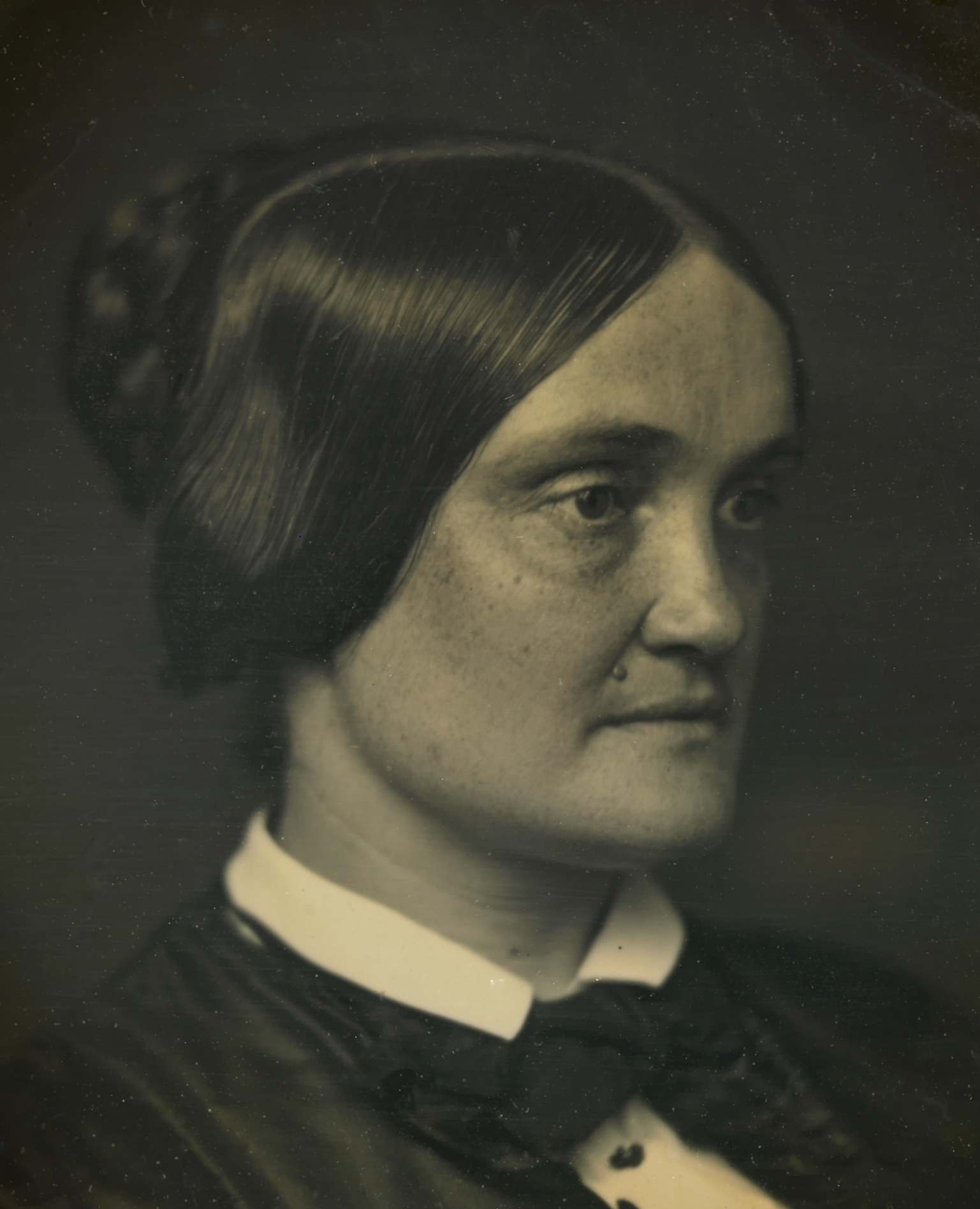
Sundays 11am – 2pm

Bathurst Regional Art Gallery website

LIKE ART BLART ON FACEBOOK

Back to top