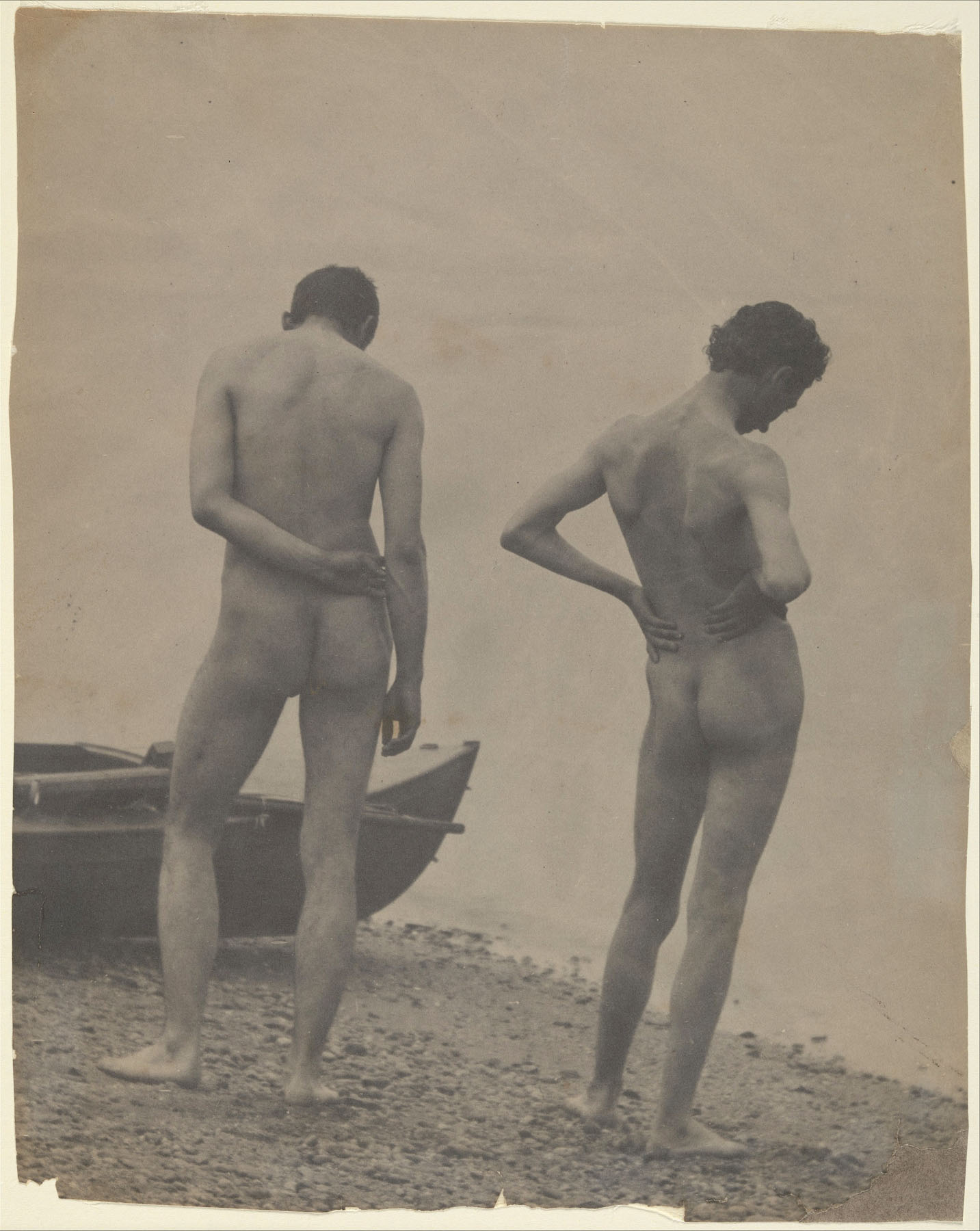
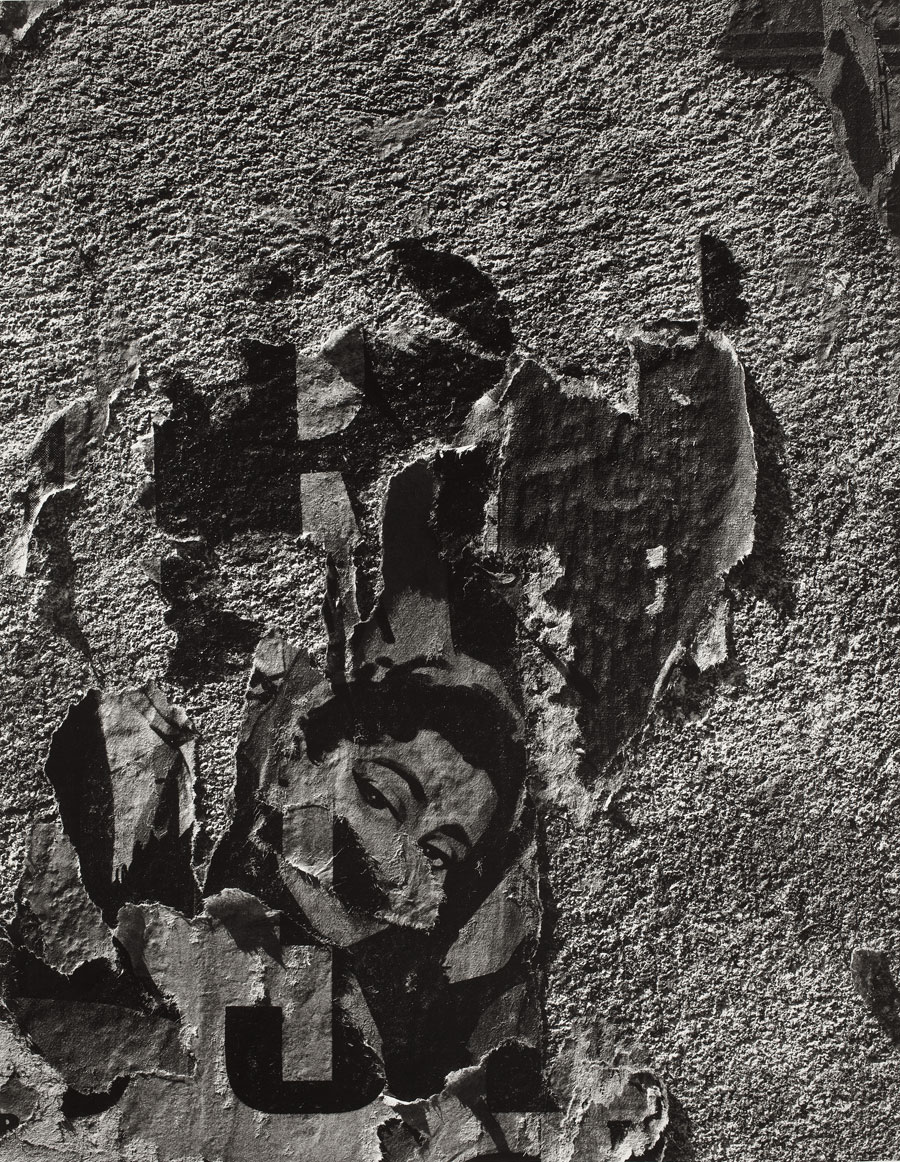
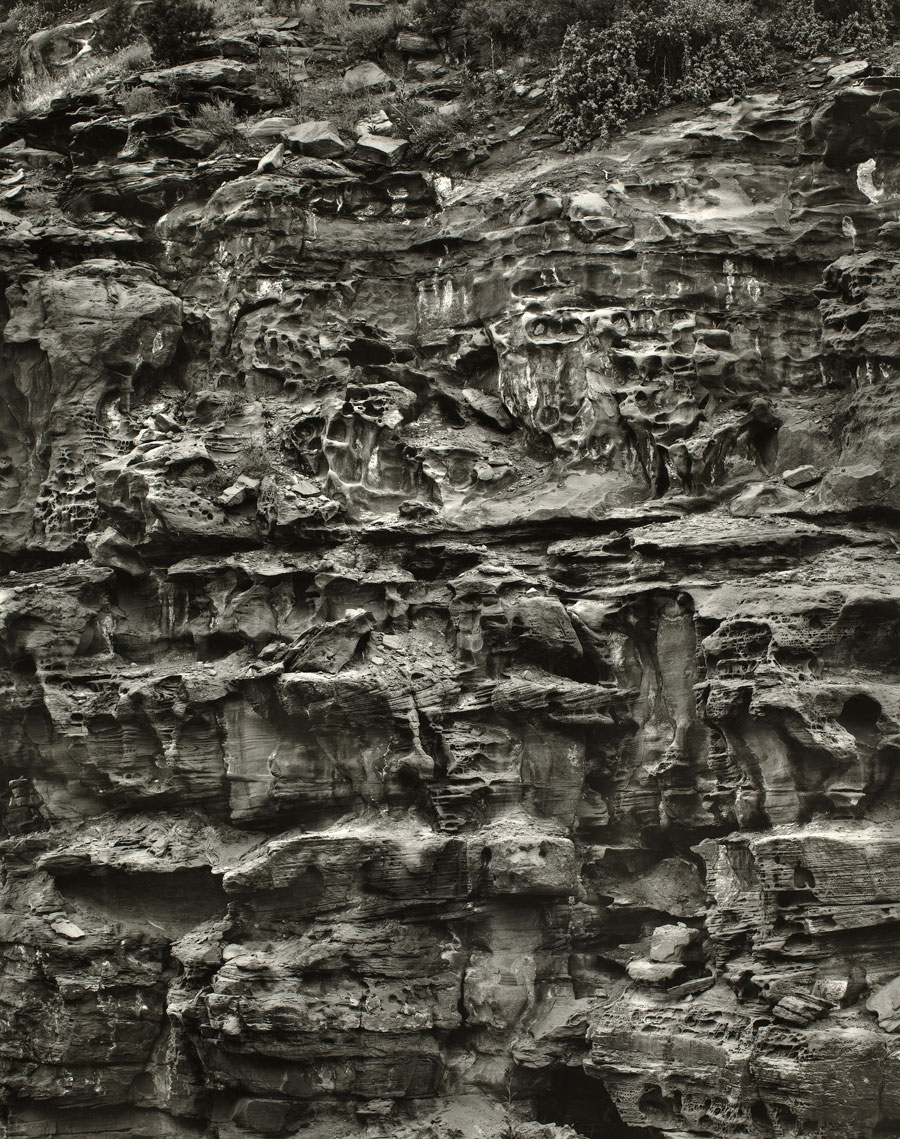
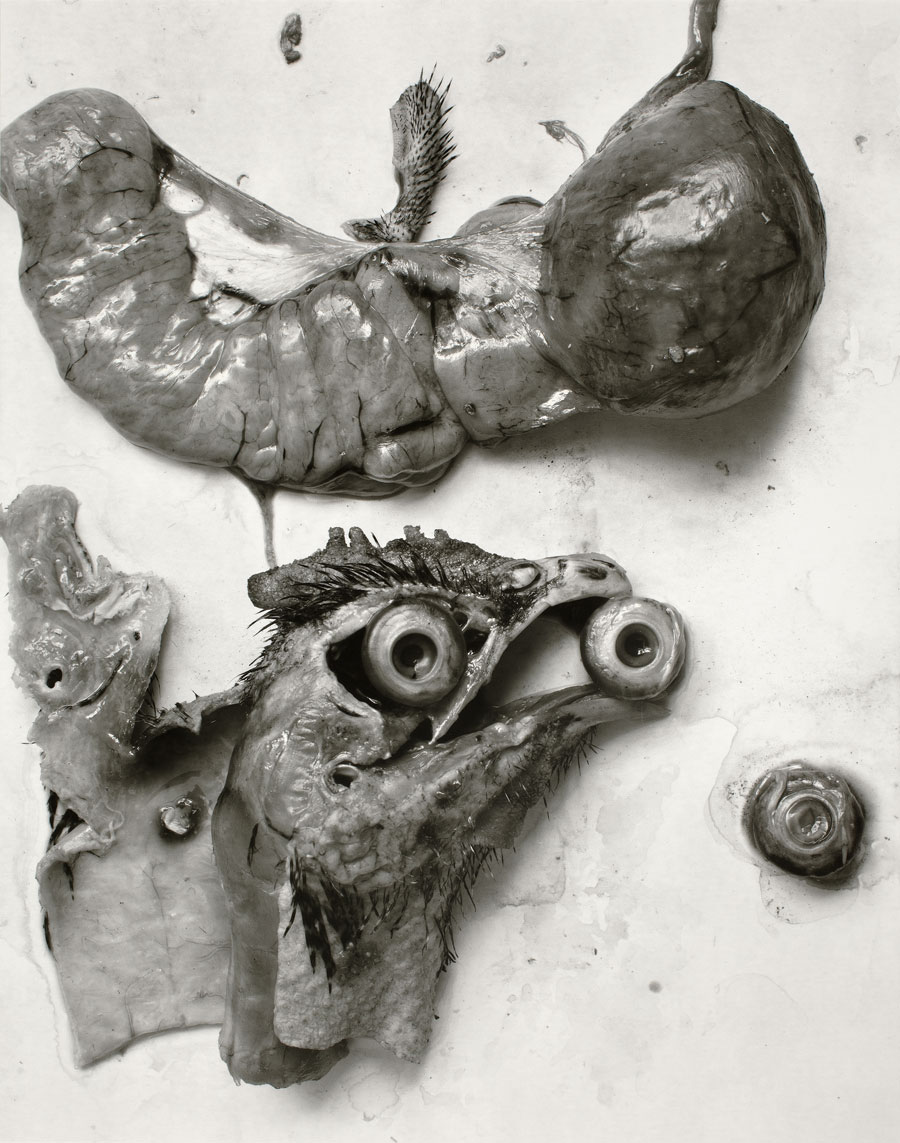
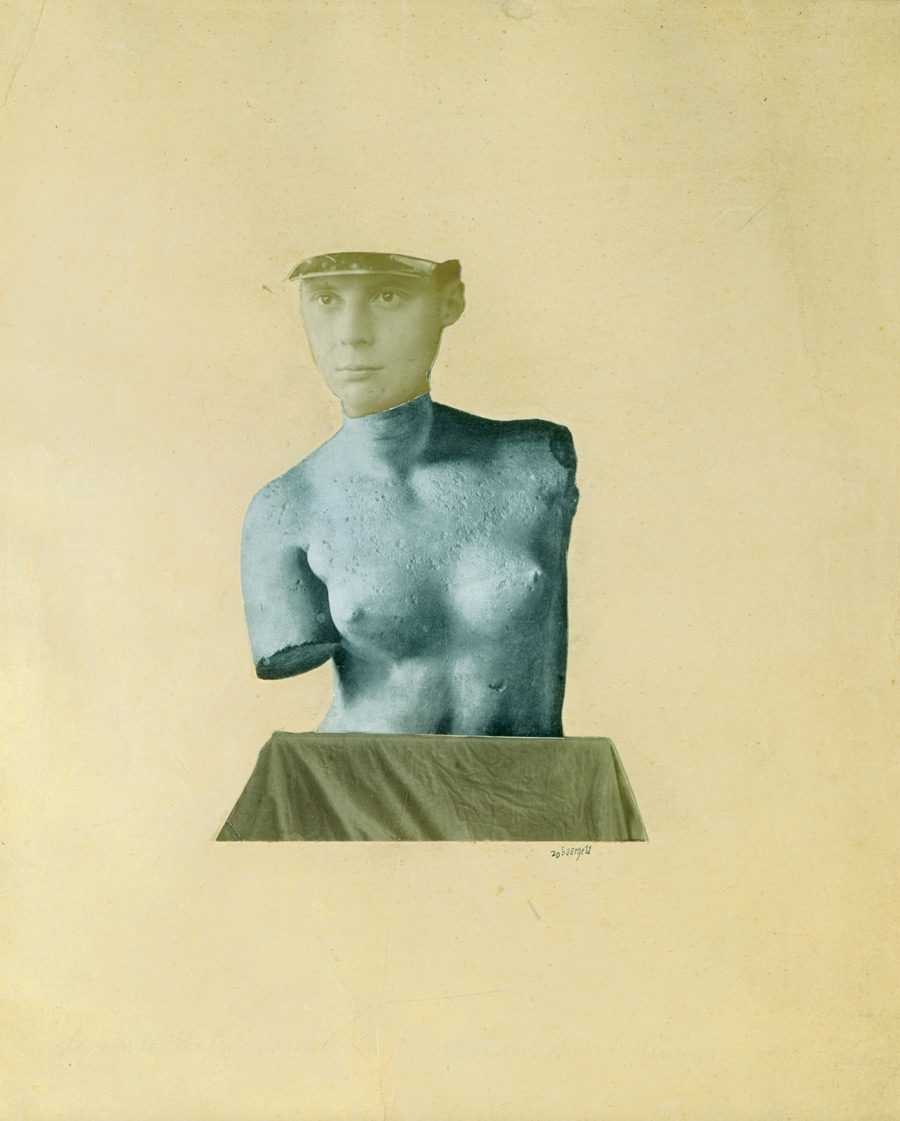
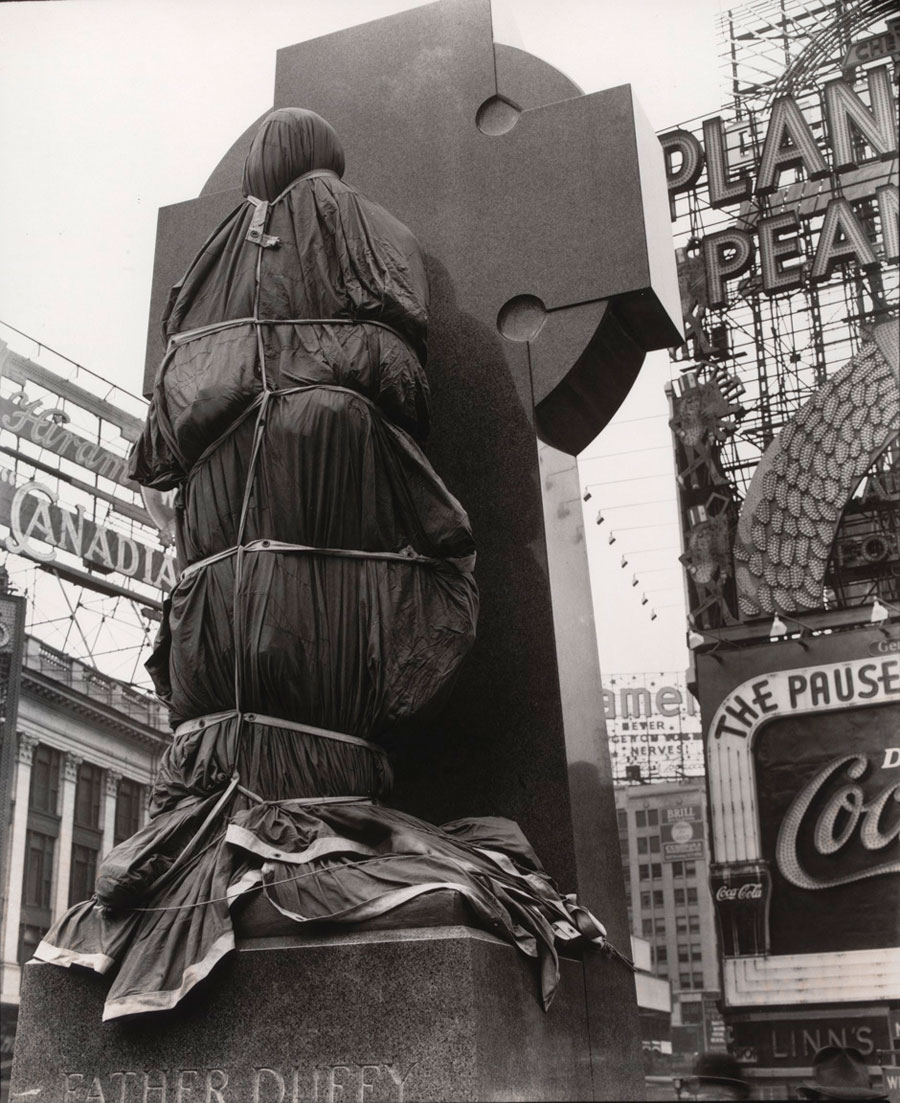
Exhibition: ‘The Shaping of New Visions: Photography, Film, Photobook’ at the Museum of Modern Art (MoMA), New York

Exhibition dates: 18th April 2012 – 29th April 2013


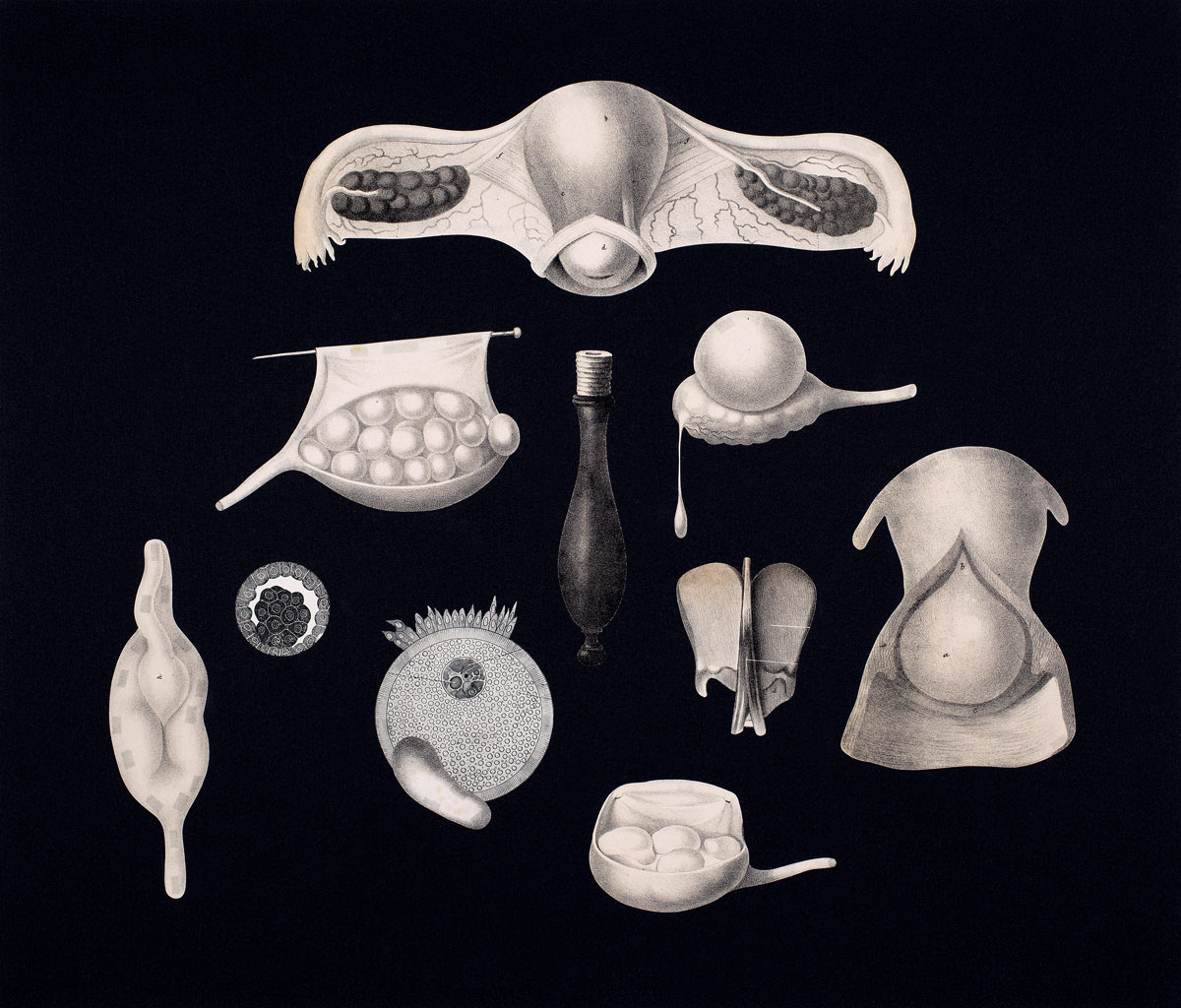
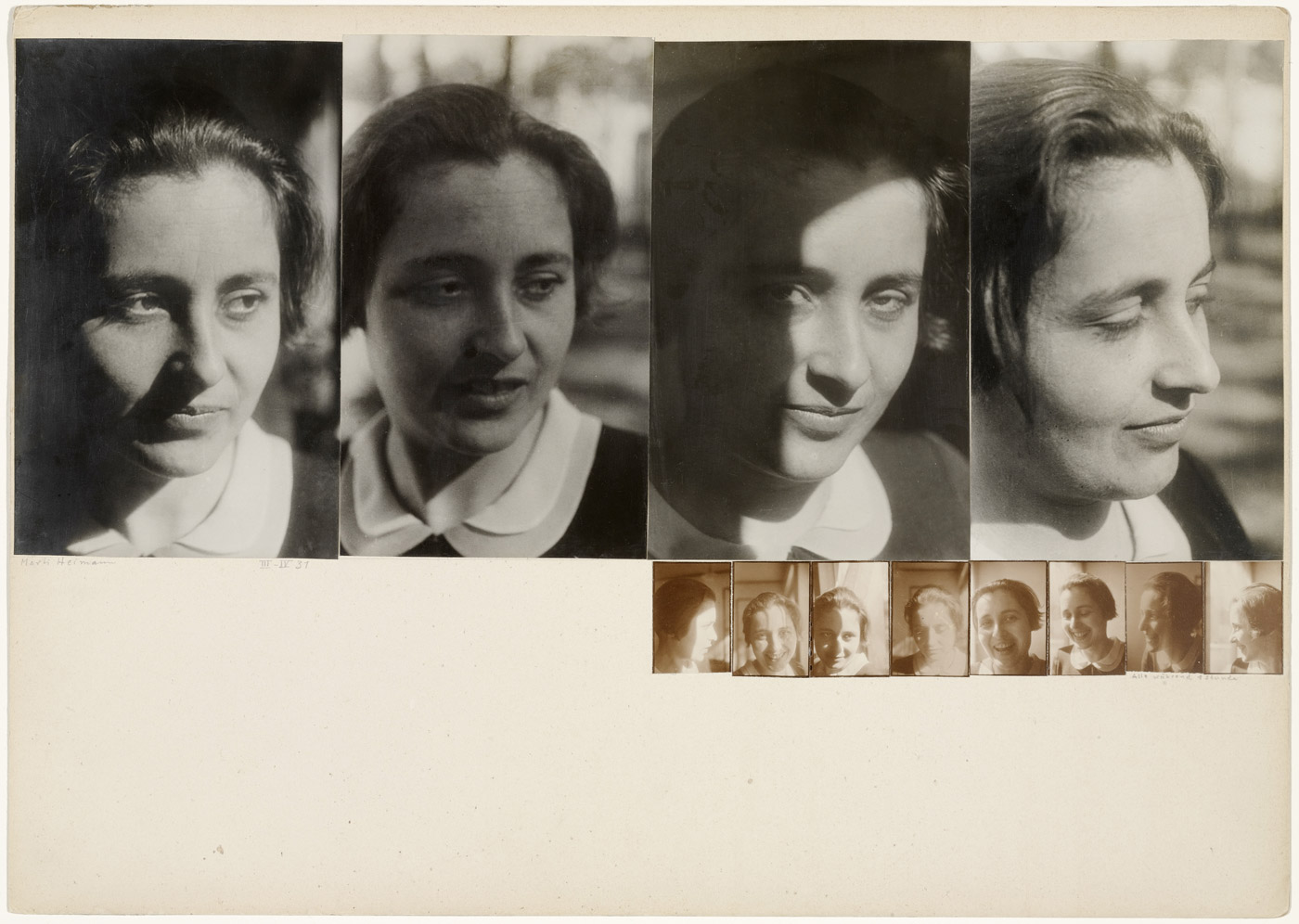
Josef Albers (German, 1888-1976) 'Marli Heimann, Alle während 1 Stunde (Marli Heimann, All During an Hour)' 1931


Josef Albers (German, 1888-1976)
Marli Heimann, Alle während 1 Stunde (Marli Heimann, All During an Hour)
1931
Twelve gelatin silver prints
Overall 11 11/16 x 16 7/16″ (29.7 x 41.8cm)
The Museum of Modern Art, New York
Gift of The Josef Albers Foundation, Inc.
© 2012 The Josef and Anni Albers Foundation / Artists Rights Society (ARS), New York


Another fascinating exhibition and a bumper posting to boot (pardon the pun!)

A panoply of famous photographers along with a few I had never heard of before (such as Georges Hugnet) are represented in this posting. As the press blurb states, through “key photographic projects, experimental films, and photobooks, The Shaping of New Visions offers a critical reassessment of photography’s role in the avant-garde and neo-avant-garde movements, and in the development of contemporary artistic practices.”

The large exhibition seems to have a finger in every pie, wandering from the birth of the 20th-century modern metropolis, through “New Vision” photography in the 1920s, experimental film, Surrealism, Constructivism and New Objectivity, Dada, Rayographs, photographic avant-gardism, photocollages, photomontages, street photography of the  1960s, colour slide projection performance, through New Topographics, self-published books, and conceptual photography, featuring works that reevaluate the material and contextual definitions of photography. “The final gallery showcases major installations by a younger generation of artists whose works address photography’s role in the construction of contemporary history.”

Without actually going to New York to see the exhibition (I wish!!) – from a distance it does seem a lot of ground to cover within 5 galleries even if there are 250 works. You could say this is a “meta” exhibition, drawing together themes and experiments from different areas of photography with rather a long bow. Have a look at the The Shaping of New Visions exhibition checklist to see the full listing of what’s on show and you be the judge. There are some rare and beautiful images that’s for sure. From the photographs in this posting I would have to say the distorted “eyes” have it…

Dr Marcus Bunyan


Many thankx to MoMA for allowing me to publish the photographs in the posting. Please click on the photographs for a larger version of the image.


Paul Strand (American, 1890-1976) and Charles Sheeler (American, 1883-1965)
Manhatta
1921
Film
Courtesy of the Museum of Modern Art, New York
© Aperture Foundation Inc., Paul Strand Archive


In 1920 Paul Strand and artist Charles Sheeler collaborated on Manhatta, a short silent film that presents a day in the life of lower Manhattan. Inspired by Walt Whitman’s book Leaves of Grass, the film includes multiple segments that express the character of New York. The sequences display a similar approach to the still photography of both artists. Attracted by the cityscape and its visual design, Strand and Sheeler favoured extreme camera angles to capture New York’s dynamic qualities. Although influenced by Romanticism in its view of the urban environment, Manhatta is considered the first American avant-garde film.


Man Ray (American, 1890-1976) 'Rayograph' 1922


Man Ray (American, 1890-1976)
Rayograph
1922
Gelatin silver print (photogram)
9 3/8 x 11 3/4″ (23.9 x 29.9cm)
The Museum of Modern Art, New York
Gift of James Thrall Soby
© 2012 Man Ray Trust / Artists Rights Society (ARS), New York / ADAGP, Paris


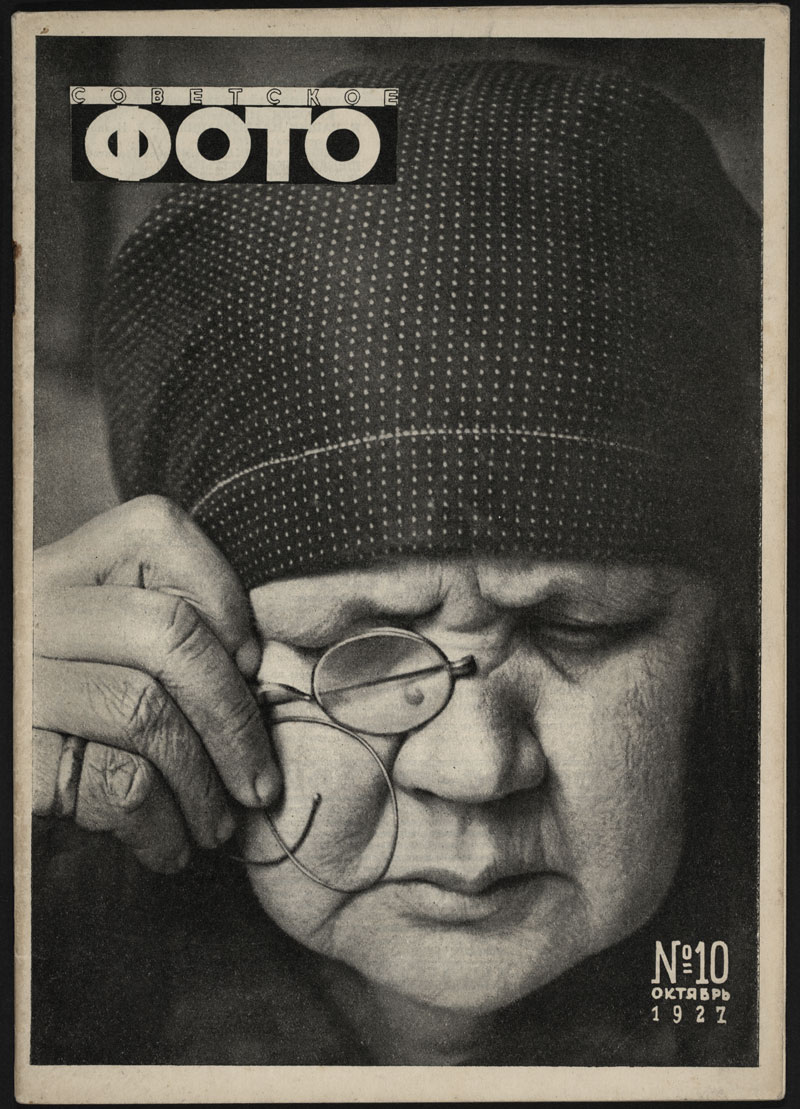
Aleksandr Rodchenko (Russian, 1891-1956) 'Sovetskoe foto (Soviet Photo)' No. 10 October 1927


Aleksandr Rodchenko (Russian, 1891-1956)
Sovetskoe foto (Soviet Photo) No. 10
October 1927
Letterpress
10 3/8 x 7 1/4″ (26.3 x 18.4cm)
Publisher: Ogonek, Moscow
The Museum of Modern Art, New York. Gift of the Judith Rothschild Foundation


August Sander (German, 1876-1964) 'Das rechte Auge meiner Tochter Sigrid (The Right Eye of My Daughter Sigrid)' 1928


August Sander (German, 1876-1964)
Das rechte Auge meiner Tochter Sigrid (The Right Eye of My Daughter Sigrid)
1928
Gelatin silver print
7 1/16 x 9″ (17.9 x 22.9cm)
The Museum of Modern Art, New York
Gift of the photographer
© 2012 Artists Rights Society (ARS), New York / VG Bild-Kunst, Bonn


Claude Cahun (French, 1894-1954) 'Untitled' c. 1928


Claude Cahun (French, 1894-1954)
Untitled
c. 1928
Gelatin silver print
4 9/16 x 3 1/2″ (10 x 7.6cm)
The Museum of Modern Art, New York
Purchase and anonymous promised gift
© 2012 Estate of Claude Cahun


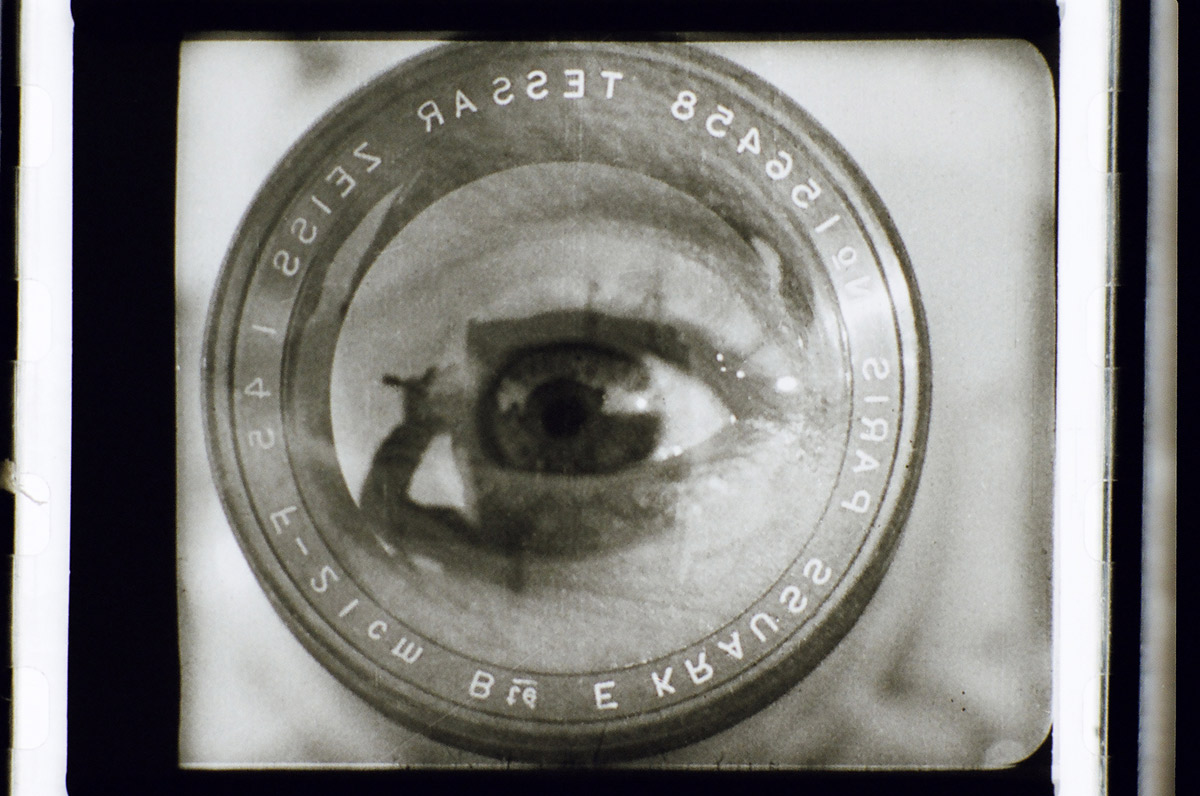
Dziga Vertov (Russian, 1896-1954) 'Chelovek s kinoapparatom (Man with a Movie Camera)' (still) 1929


Dziga Vertov (Russian, 1896-1954)
Chelovek s kinoapparatom (Man with a Movie Camera) (still)
1929
35mm film
65 min ( black and white, silent)
The Museum of Modern Art, New York
Department of Film


Excerpt from a camera operators diary
ATTENTION VIEWERS:
This film is an experiment in cinematic communication of real events
Without the help of Intertitles
Without the help of a story
Without the help of theatre
This experimental work aims at creating a truly international language of cinema based on its absolute separation from the language of theatre and literature


Man with a Movie Camera (Russian: Человек с киноаппаратом (Chelovek s kinoapparatom) is an experimental 1929 silent documentary film, with no story and no actors by Soviet-Russian director Dziga Vertov, edited by his wife Elizaveta Svilova.

Vertov’s feature film, produced by the film studio VUFKU, presents urban life in the Soviet cities of Kiev, Kharkov, Moscow and Odessa. From dawn to dusk Soviet citizens are shown at work and at play, and interacting with the machinery of modern life. To the extent that it can be said to have “characters,” they are the cameramen of the title, the film editor, and the modern Soviet Union they discover and present in the film.

This film is famous for the range of cinematic techniques Vertov invents, deploys or develops, such as double exposure, fast motion, slow motion, freeze frames, jump cuts, split screens, Dutch angles, extreme close-ups, tracking shots, footage played backwards, stop motion animations and self-reflexive visuals (at one point it features a split-screen tracking shot; the sides have opposite Dutch angles).

In the British Film Institute’s 2012 Sight & Sound poll, film critics voted Man with a Movie Camera the 8th best film ever made. In 2014 Sight & Sound also named it the best documentary of all time.

Text from the YouTube website


László Moholy-Nagy (Hungarian, 1895-1946)
Ein Lichtspiel: schwarz weiss grau (A Lightplay: Black White Gray) (excerpt)
1930


This short film made by László Moholy-Nagy is based on the shadow patterns created by his Light-Space Modulator, an early kinetic sculpture consisting of a variety of curved objects in a carefully choreographed cycle of movements. Created in 1930, the film was originally planned as the sixth and final part of a much longer work depicting the new space-time.


Raoul Hausmann (Austrian, 1886-1971) 'Untitled' February 1931


Raoul Hausmann (Austrian, 1886-1971)
Untitled
February 1931
Gelatin silver print
5 3/8 x 4 7/16″ (13.6 x 11.2cm)
The Museum of Modern Art, New York
Thomas Walther Collection Gift of Thomas Walther
© 2012 Raoul Hausmann / Artists Rights Society (ARS), New York / ADAGP, Paris


Georges Hugnet (French, 1906-1974) 'Untitled [Surrealist beach collage]' c. 1935


Georges Hugnet (French, 1906-1974)
Untitled [Surrealist beach collage]
c. 1935
Collage of photogravure, lithograph, chromolithograph and gelatin silver prints on gelatin silver print
11 7/8 x 9 7/16″ (30.2 x 24cm)
The Museum of Modern Art, New York
Gift of Timothy Baum in memory of Harry H. Lunn, Jr.


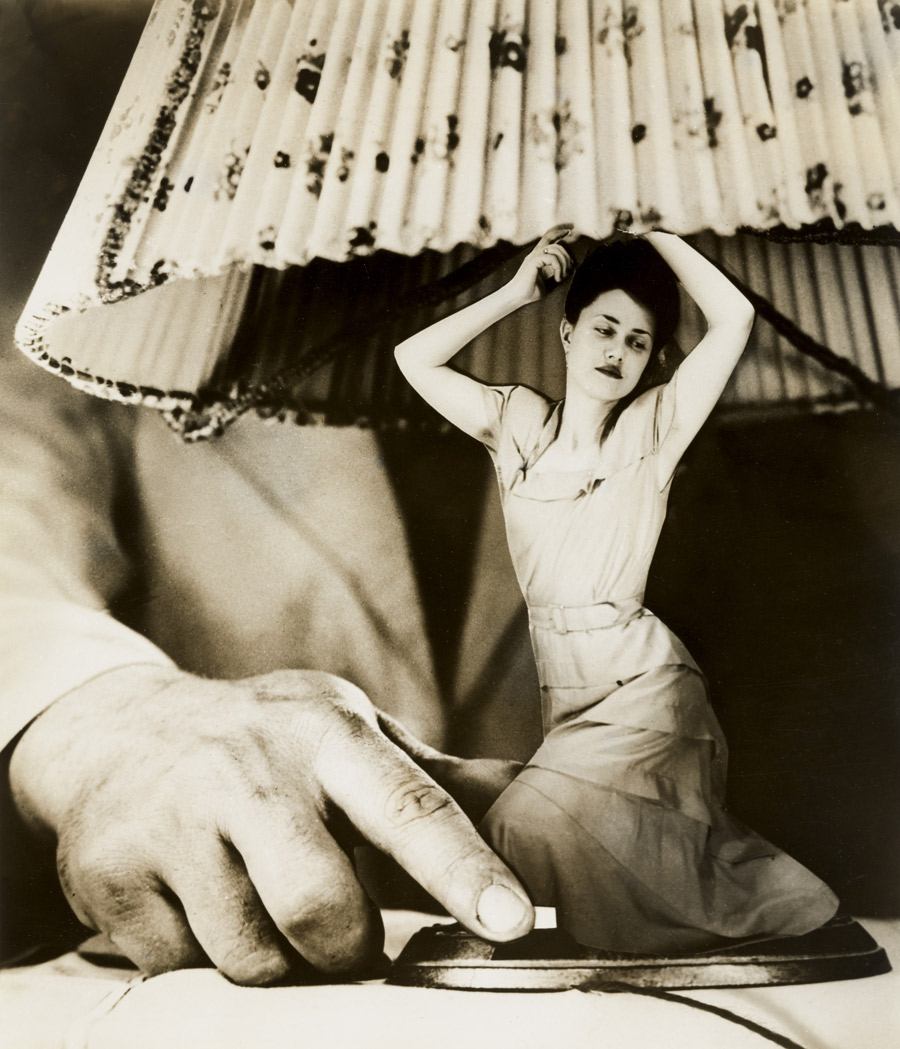
Grete Stern (German-Argentinian, 1904-1999) No. 1 from the series 'Sueños' (Dreams) 1949


Grete Stern (German-Argentinian, 1904-1999)
No. 1 from the series Sueños (Dreams)
1949
Gelatin silver print
10 1/2 x 9″ (26.6 x 22.9cm)
Latin American and Caribbean Fund through gift of Marie-Josée and Henry R. Kravis in honor of Adriana Cisneros de Griffin
© 2012 Horacio Coppola


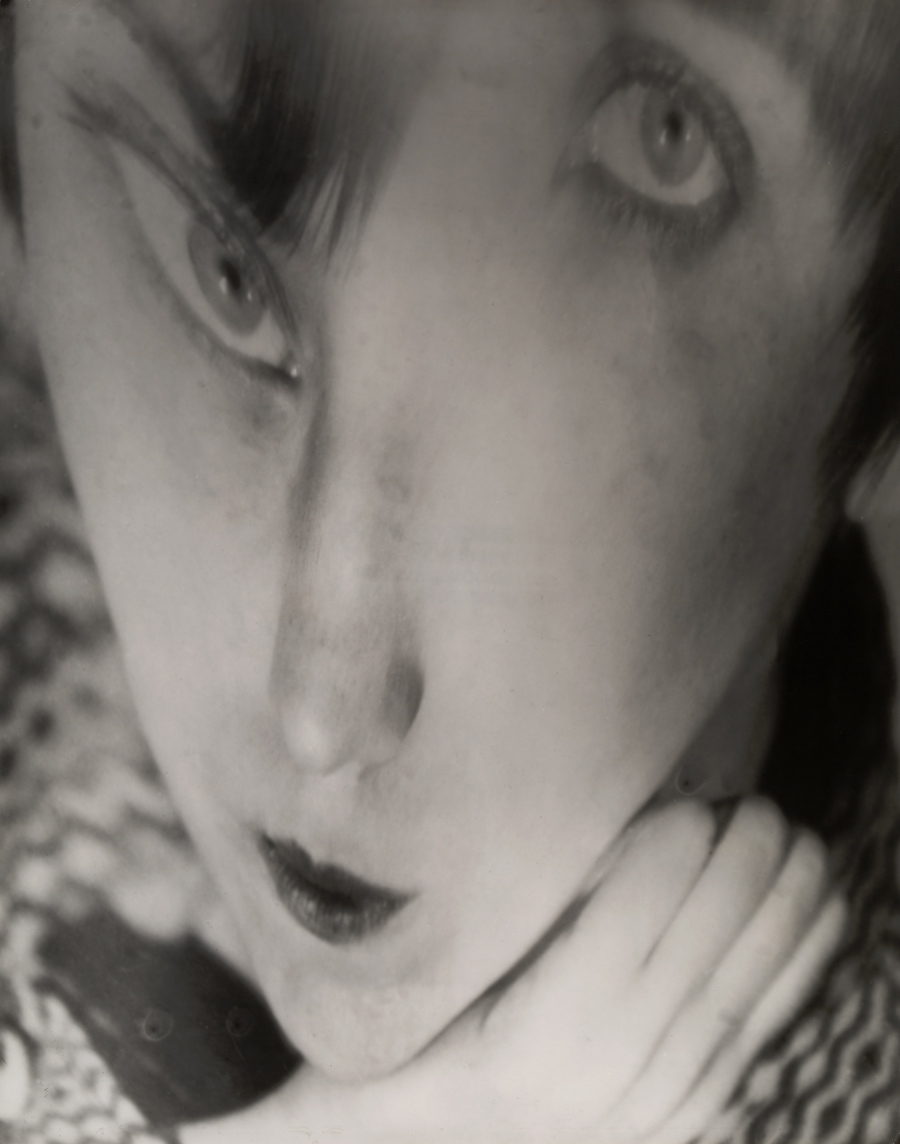
Berenice Abbott (American, 1898-1991) 'Portrait of the Artist as a Young Woman' Negative c. 1930/Distortion c. 1950


Berenice Abbott (American, 1898-1991)
Portrait of the Artist as a Young Woman
Negative c. 1930/Distortion c. 1950
Gelatin silver print
12 3/4 x 10 1/8″ (32.6 x 25.7cm)
The Museum of Modern Art, New York
Frances Keech Fund in honor of Monroe Wheeler
© 2012 Berenice Abbott/Commerce Graphics


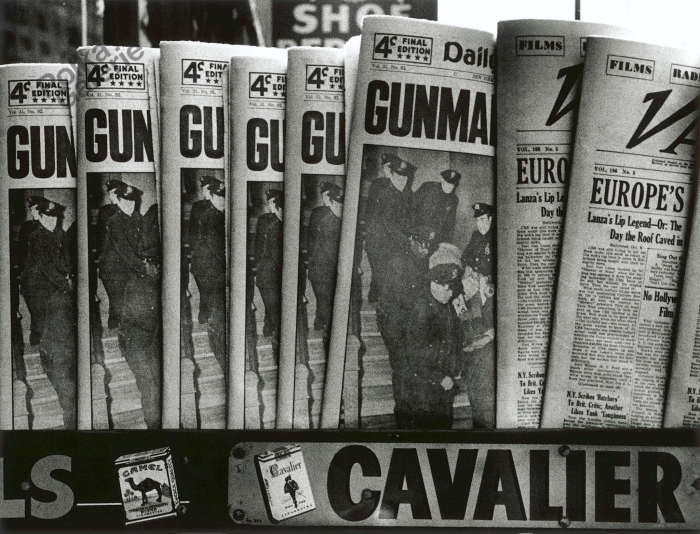
William Klein (American, 1928-2022) 'Gun, Gun, Gun, New York' 1955


William Klein (American, 1928-2022)
Gun, Gun, Gun, New York 
1955
Gelatin silver print
10 1/4 x 13 5/8″ (26 x 34.6cm)
The Museum of Modern Art, New York
Gift of Arthur and Marilyn Penn


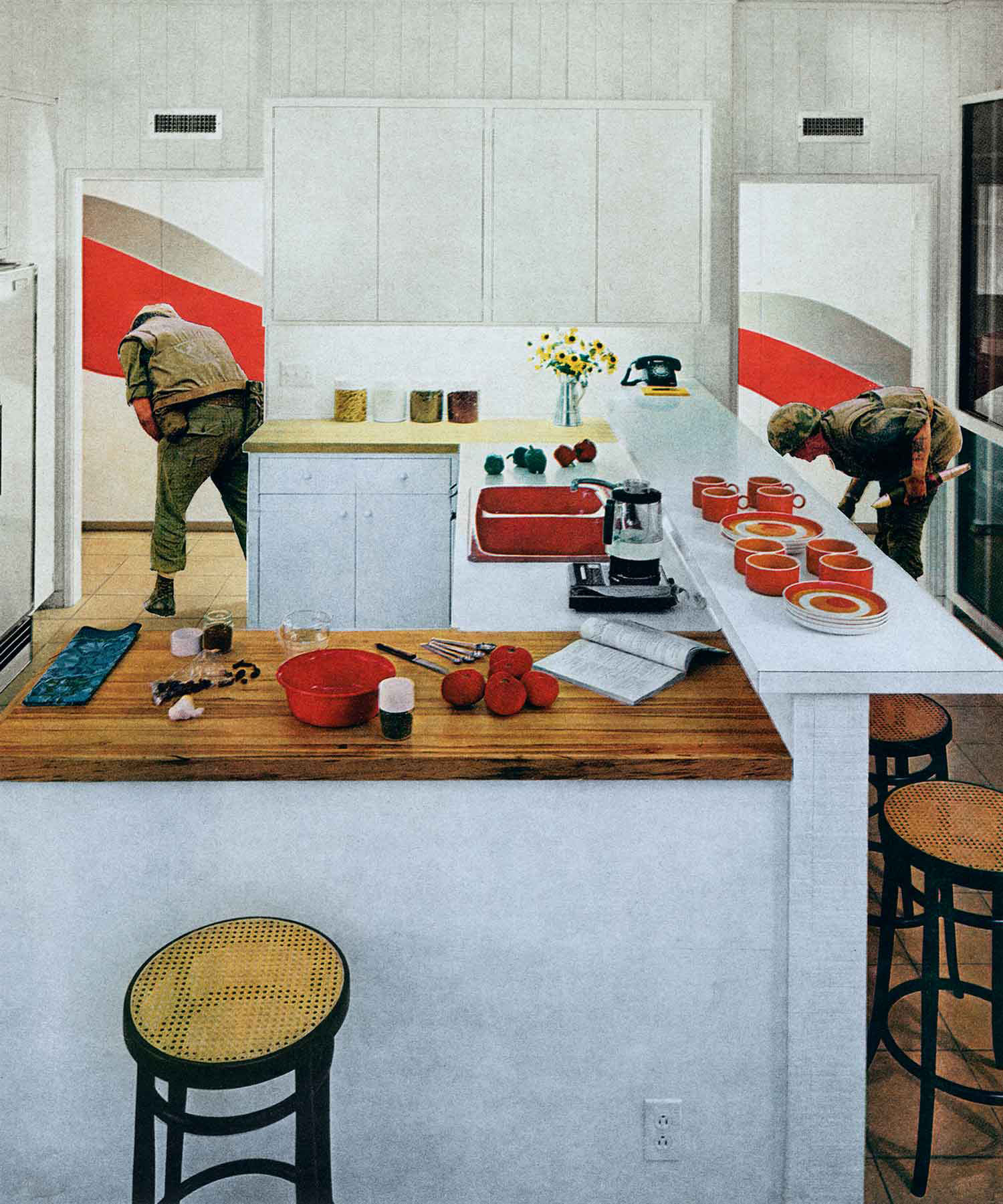
Martha Rosler (American, b. 1943) 'Red Stripe Kitchen' 1967-1972


Martha Rosler (American, b. 1943)
Red Stripe Kitchen
1967-1972
From the series Bringing the War Home: House Beautiful 
Pigmented inkjet print, printed 2011
23 3/4 x 18 1/8″ (60.3 x 46cm)
The Museum of Modern Art, New York
Purchase and The Modern Women’s Fund


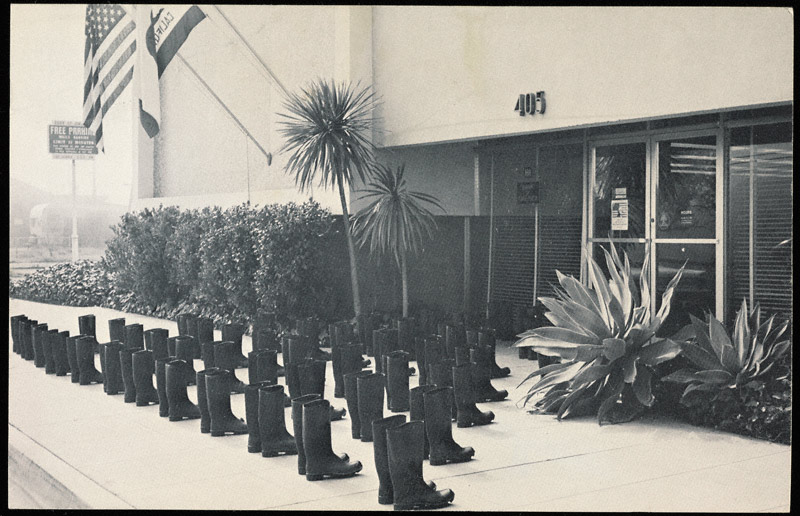
Eleanor Antin (American, b. 1935) '100 Boots' 1971-1973

Eleanor Antin (American, b. 1935) '100 Boots' 1971-1973

Eleanor Antin (American, b. 1935) '100 Boots' 1971-1973


Eleanor Antin (American, b. 1935)
100 Boots
1971-1973
Photographed by Philip Steinmetz
Halftone reproductions on 51 cards
4 1/2 x 7 in. each
Courtesy Ronald Feldman Fine Arts, New York
© Eleanor Antin


The Museum of Modern Art draws from its collection to present the exhibition The Shaping of New Visions: Photography, Film, Photobook on view from April 18, 2012, to April 29, 2013. Filling the third-floor Edward Steichen Photography Galleries, this installation presents more than 250 works by approximately 90 artists, with a focus on new acquisitions and groundbreaking projects by Man Ray, László Moholy-Nagy, Aleksandr Rodchenko, Germaine Krull, Dziga Vertov, Gerhard Rühm, Helen Levitt, Robert Frank, Daido Moriyama, Robert Heinecken, Edward Ruscha, Martha Rosler, Bernd and Hilla Becher, Philip-Lorca diCorcia, Paul Graham, and The Atlas Group / Walid Raad. The exhibition is organised by Roxana Marcoci, Curator, Department of Photography, The Museum of Modern Art.

Punctuated by key photographic projects, experimental films, and photobooks, The Shaping of New Visions offers a critical reassessment of photography’s role in the avant-garde and neo-avant-garde movements, and in the development of contemporary artistic practices. The shaping of what came to be known as “new vision” photography in the 1920s bore the obvious influence of “lens-based” and “time-based” works. The first gallery begins with photographs capturing the birth of the 20th-century modern metropolis by Berenice Abbott, Edward Steichen, and Alfred Stieglitz, presented next to the avant-garde film Manhatta (1921), a collaboration between Paul Strand and Charles Sheeler.

The 1920s were a period of landmark constructions and scientific discoveries all related to light – from Thomas Edison’s development of incandescent light to Albert Einstein’s theory of relativity and light speed. Man Ray began experimenting with photograms (pictures made by exposing objects placed on photosensitive paper to light) – which he renamed “rayographs” after himself – in which light was both the subject and medium of his work. This exhibition presents Man Ray’s most exquisite rayographs, alongside his first short experimental film, Le Retour à la raison (Return to Reason, 1923), in which he extended the technique to moving images.

In 1925, two years after he joined the faculty of the Bauhaus school in Weimar Germany, László Moholy-Nagy published his influential book Malerei, Fotografie, Film (Painting, Photography, Film) – part of a series that he coedited with Bauhaus director Walter Gropius – in which he asserted that photography and cinema are heralding a “culture of light” that has overtaken the most innovative aspects of painting. Moholy-Nagy extolled photography and, by extension, film as the quintessential medium of the future. Moholy-Nagy’s interest in the movement of objects and light through space led him to construct Light-Space Modulator, the subject of his only abstract film, Ein Lichtspiel: schwarz weiss grau (A Lightplay: Black White Gray, 1930), which is presented in the exhibition next to his own photographs and those of Florence Henri.

The rise of photographic avant-gardism from the 1920s to the 1940s is traced in the second gallery primarily through the work of European artists. A section on Constructivism and New Objectivity features works by Paul Citroën, Raoul Hausmann, Florence Henri, Germaine Krull, El Lissitzky, Albert Renger-Patzsch, and August Sander. A special focus on Aleksandr Rodchenko underscores his engagement with the illustrated press through collaborations with Vladimir Mayakovsky and Sergei Tretyakov on the covers and layouts of Novyi LEF, the Soviet avant-garde journal of the “Left Front of the Arts,” which popularised the idea of “factography,” or the manufacture of innovative aesthetic facts through photomechanical processes. Alongside Rodchenko, film director Dziga Vertov redefined the medium of still and motion-picture photography with the concept of kino-glaz (cine-eye), according to which the perfectible lens of the camera led to the creation of a novel perception of the world. The exhibition features the final clip of Vertov’s 1929 experimental film Chelovek s kinoapparatom (Man with a Movie Camera), in which the eye is superimposed on the camera lens to form an indivisible apparatus fit to view, process, and convey reality, all at once. This gallery also features a selection of Dada and Surrealist works, including rarely seen photographs, photocollages, and photomontages by Hans Bellmer, Claude Cahun, George Hugnet, André Kertész, Jan Lukas, and Grete Stern, alongside such avant-garde publications as Documents and Littérature.

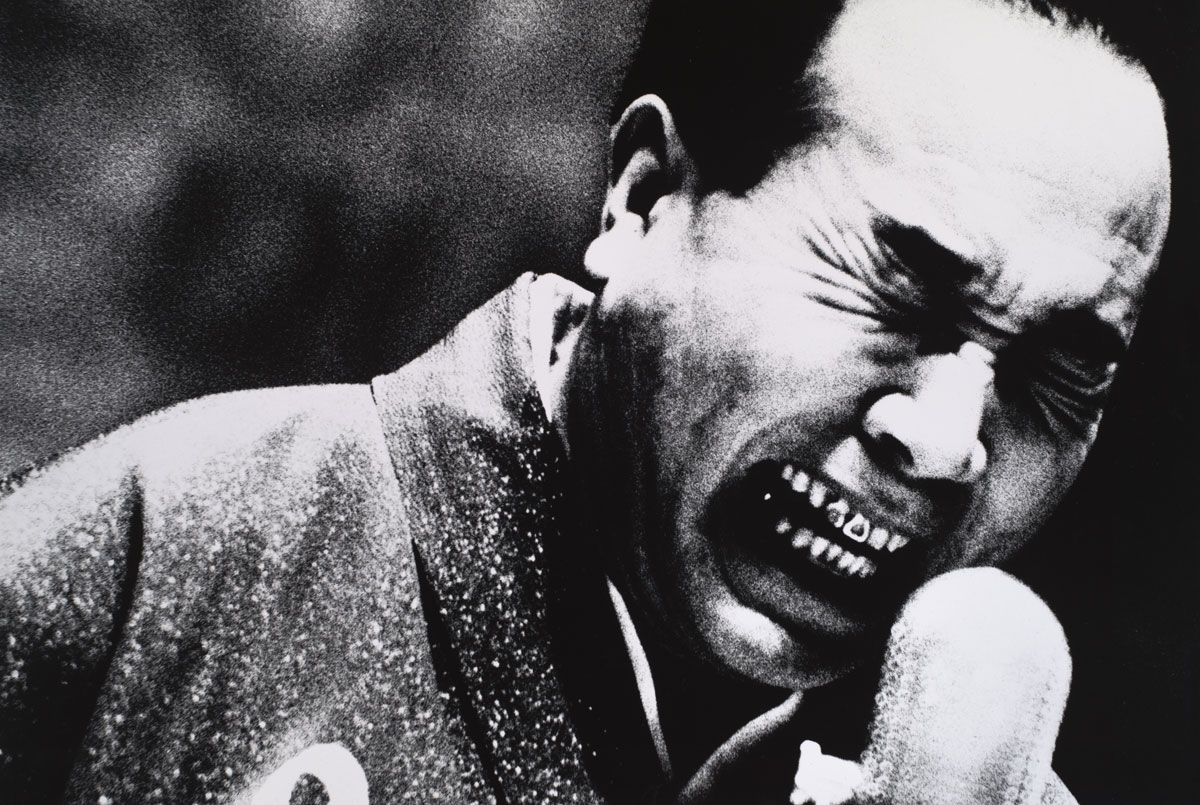
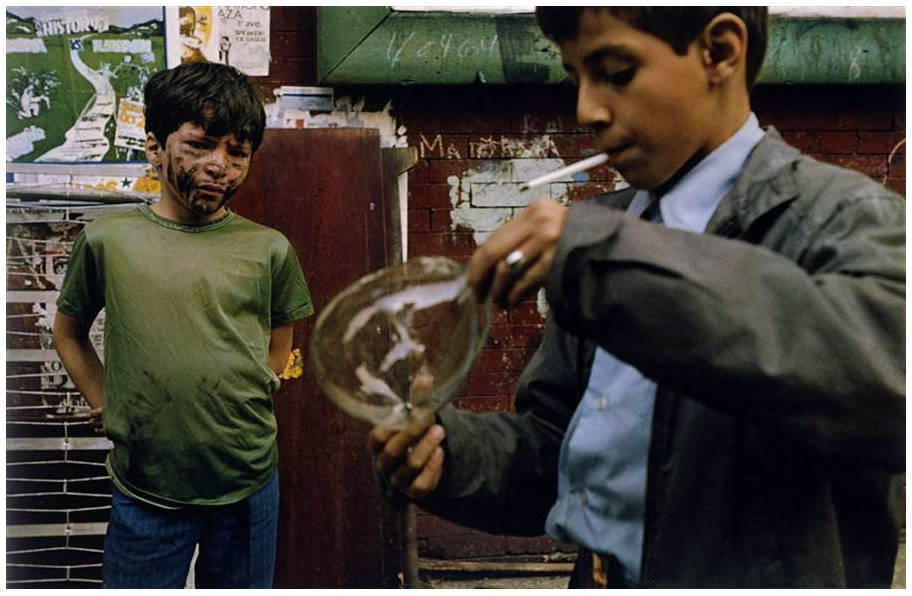
The third gallery features artists exploring the social world of the postwar period. On view for the first time is a group of erotic and political typo-collages by Gerhard Rühm, a founder of the Wiener Gruppe (1959-1960), an informal group of Vienna-based writers and artists who engaged in radical visual dialogues between pictures and texts. The rebels of street photography – Robert Frank, William Klein, Daido Moriyama, and Garry Winogrand – are represented with a selection of works that refute the then prevailing rules of photography, offering instead elliptical, off-kilter styles that are as personal and controversial as are their unsparing views of postwar society. A highlight of this section is the pioneering slide show Projects: Helen Levitt in Color (1971-1974). Capturing the lively beat, humour, and drama of New York’s street theatre, Levitt’s slide projection is shown for the first time at MoMA since its original presentation at the Museum in 1974.

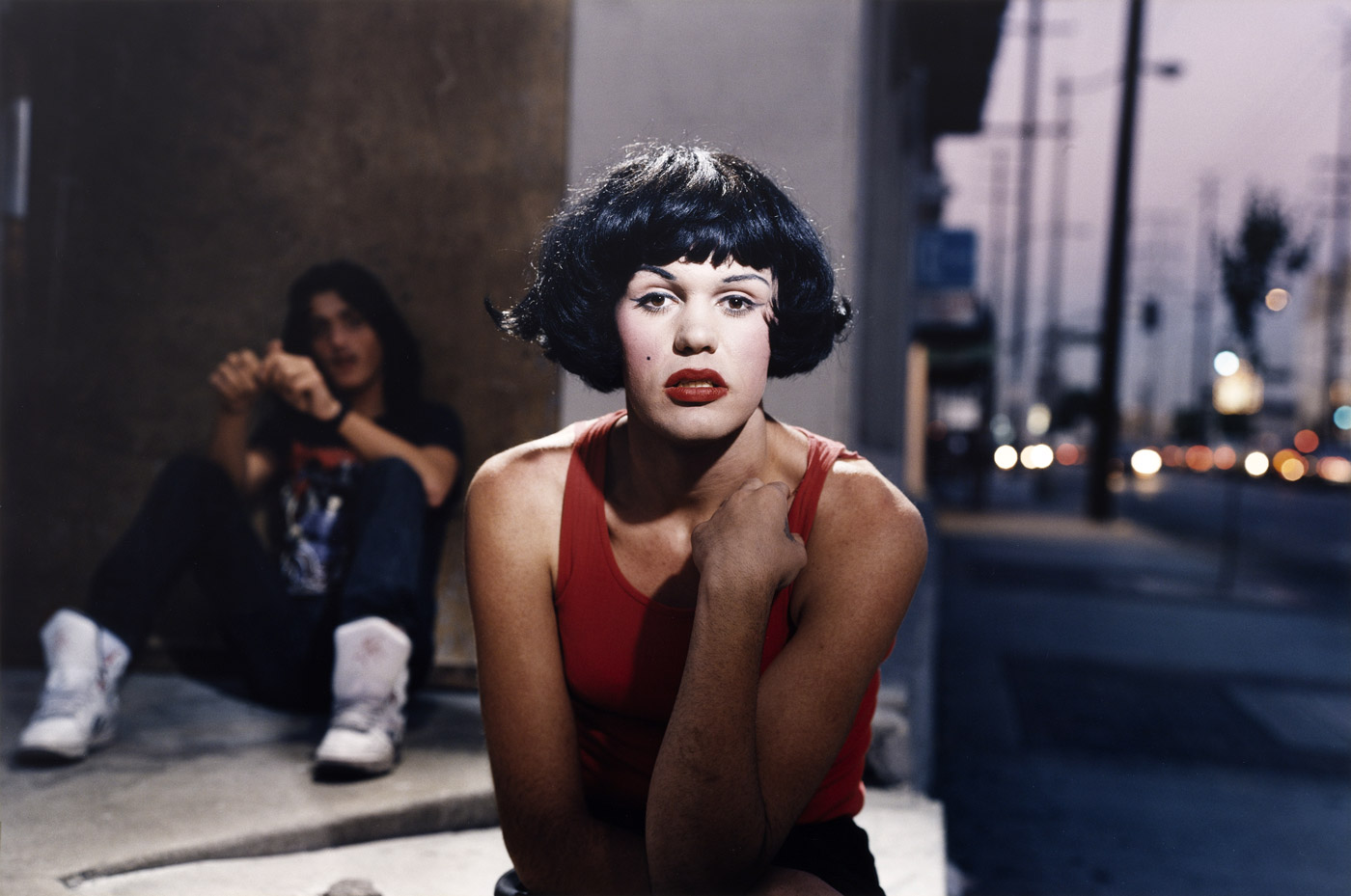
Photography’s tradition in the postwar period continues in the fourth gallery, which is divided into two sections. One section features “new topographic” works by Robert Adams, Bernd and Hilla Becher, Stephen Shore, and Joel Sternfeld, along with a selection of Edward Ruscha’s self-published books, in which the use of photography as mapmaking signals a conceptual thrust. This section introduces notable works from the 1970s by artists who embraced photography not just as a way of describing experience, but as a conceptual tool. Examples include Eleanor Antin’s 100 Boots (1971-1973), Mel Bochner’s Misunderstandings (A theory of photography) (1970), VALIE EXPORT’s Einkreisung (Encirclement) (1976), On Kawara’s I Got Up… (1977), and Gordon Matta-Clark’s Splitting (1974), all works that reevaluate the material and contextual definitions of photography. The other section features two major and highly experimental recent acquisitions: Martha Rosler’s political magnum opus Bringing the War Home (1967-1972), developed in the context of her anti-war and feminist activism, for which the artist spliced together images of domestic bliss clipped from the pages of House Beautiful with grim pictures of the war in Vietnam taken from Life magazine; and Sigmar Polke’s early 1970s experiments with multiple exposures, reversed tonal values, and under-and-over exposures, which underscore the artist’s idea that “a negative is never finished.” The unmistakably cinematic turn that photography takes in the 1980s and early 1990s is represented with a selection of innovative works ranging from Robert Heinecken’s Recto/Verso (1988) to Philip-Lorca diCorcia’s breakthrough Hustler series (1990-1992).

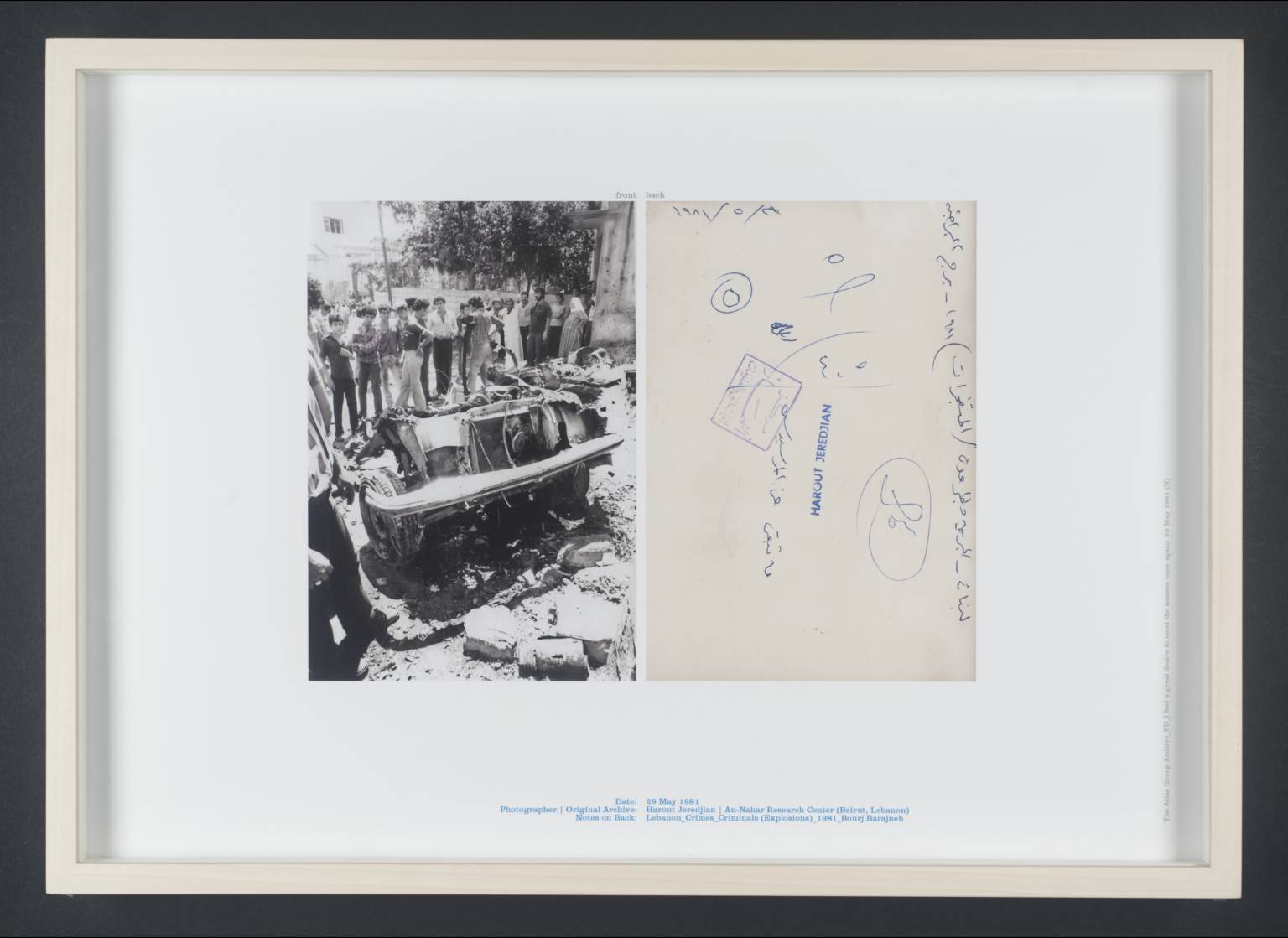
The final gallery showcases major installations by a younger generation of artists whose works address photography’s role in the construction of contemporary history. Tapping into forms of archival reconstitution, The Atlas Group / Walid Raad is represented with My Neck Is Thinner Than a Hair: Engines (1996-2004), an installation of 100 pictures of car-bomb blasts in Beirut during the Lebanese civil war (1975-1990) that provokes questions about the factual nature of existing records, the traces of war, and the symptoms of trauma. A selection from Harrell Fletcher’s The American War (2005) brings together bootlegged photojournalistic pictures of the U.S. military involvement in Southeast Asia, throwing into sharp focus photography’s role as a documentary and propagandistic medium in the shaping of historical memory. Jules Spinatsch’s Panorama: World Economic Forum, Davos (2003), made of thousands of still images and three surveillance video works, chronicles the preparations for the 2003 World Economic Forum, when the entire Davos valley was temporarily transformed into a high security zone. A selection of Paul Graham’s photographs from his major photobook project a shimmer of possibility (2007), consisting of filmic haikus about everyday life in today’s America, concludes the exhibition.

Press release from the MoMA website


Daido Moriyama. 'Entertainer on Stage, Shimizu' 1967


Daido Moriyama (Japanese, b. 1938)
Entertainer on Stage, Shimizu
1967
Gelatin silver print
18 7/8 x 28″ (48.0 x 71.2cm)
The Museum of Modern Art, New York
Gift of the photographer
© 2012 Daido Moriyama


Martha Rosler (American, b. 1943) 'Hands Up / Makeup' 1967-1972


Martha Rosler (American, b. 1943)
Hands Up / Makeup
1967-1972
From the series Bringing the War Home: House Beautiful
Pigmented inkjet print, printed 2011
23 3/4 x 13 15/16″ (60.4 x 35.4cm)
The Museum of Modern Art, New York
Purchase and The Modern Women’s Fund
© 2012 Martha Rosler


Helen Levitt (American, 1913-2009) 'Projects: Helen Levitt in Color' 1971-1974 (detail)

Helen Levitt (American, 1913-2009) 'Projects: Helen Levitt in Color' 1971-1974 (detail)


Helen Levitt (American, 1913-2009)
Projects: Helen Levitt in Color (detail)
1971-1974
40 colour slides shown in continuous projection
Originally presented at The Museum of Modern Art, New York, September 26-October 20, 1974


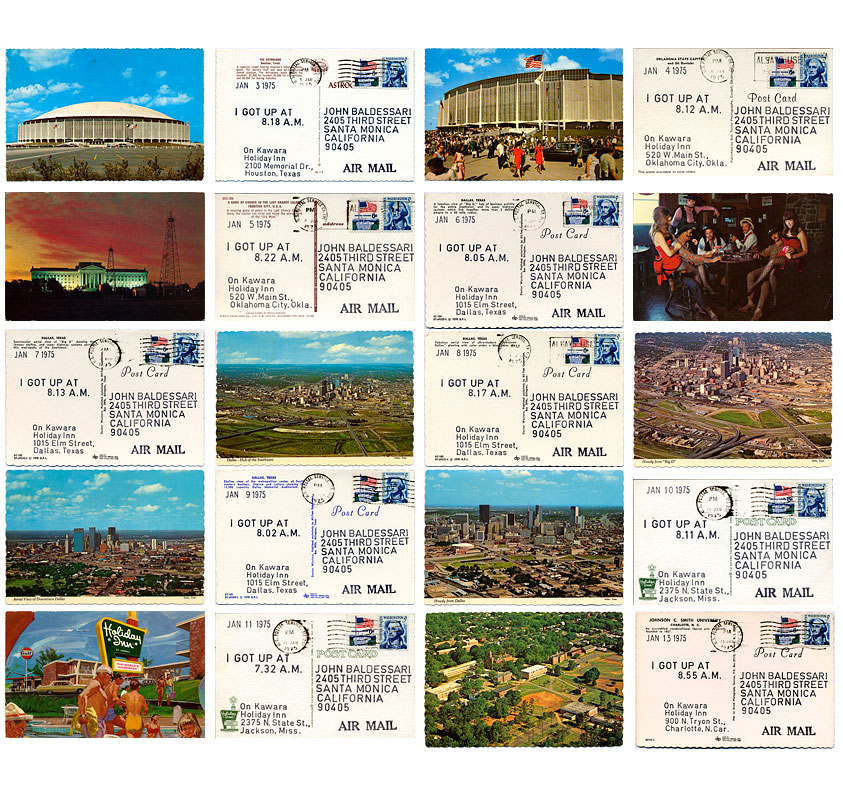
On Kawara (Japanese, 1932-2014) 'I Got Up At...' 1974-1975


On Kawara (Japanese, 1932-2014)
I Got Up At…
1974-1975
(Ninety postcards with printed rubber stamps)


The semi autobiographical I Got Up At… by On Kawara is a series of postcards sent to John Baldessari. Each card was sent from his location that morning detailing the time he got up. The time marked on each card varies drastically from day to day, the time stamped on each card is the time he left his bed as opposed to actually waking up. Kawara’s work often acts to document his existence in time, giving a material form to which is formally immaterial. The series has been repeated frequently sending the cards to a variety of friends and colleagues.


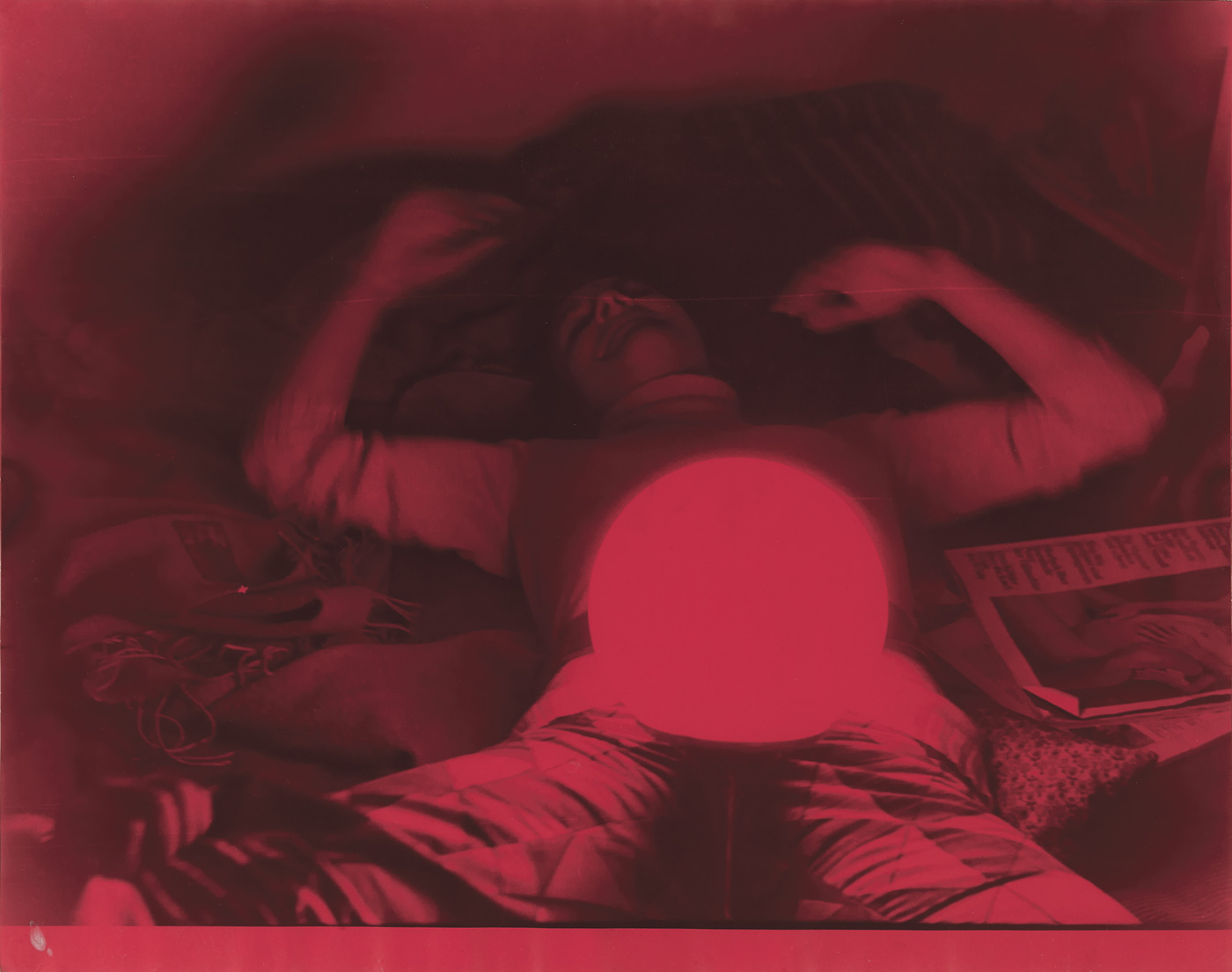
Sigmar Polke (German, 1941-2010) 'Untitled (Mariette Althaus)' c. 1975


Sigmar Polke (German, 1941-2010)
Untitled (Mariette Althaus)
c. 1975
Gelatin silver print (red toned)
9 1/4 x 11 13/16″ (23.5 x 30cm)
The Museum of Modern Art, New York
Acquired through the generosity of Edgar Wachenheim III and Ronald S. Lauder
© 2012 Estate of Sigmar Polke / Artists Rights Society (ARS), New York / VG Bild-Kunst, Bonn, Germany


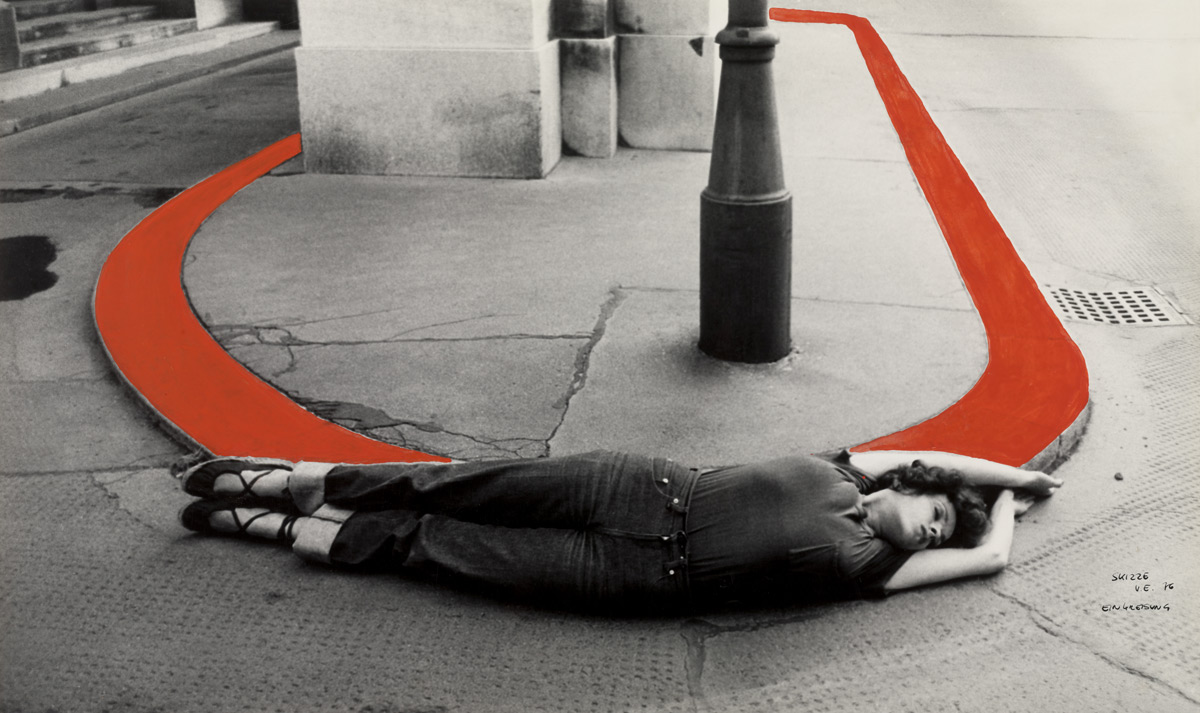
VALIE EXPORT (Austrian, b. 1940) 'Einkreisung (Encirclement)' 1976


VALIE EXPORT (Austrian, b. 1940)
Einkreisung (Encirclement)
1976
From the series Körperkonfigurationen (Body Configurations)
Gelatin silver print with red ink
14 x 23 7/16″ (35.5 x 59.6cm)
The Museum of Modern Art, New York
Carl Jacobs Fund
© 2012 VALIE EXPORT / Artists Rights Society (ARS), New York / VBK, Austria


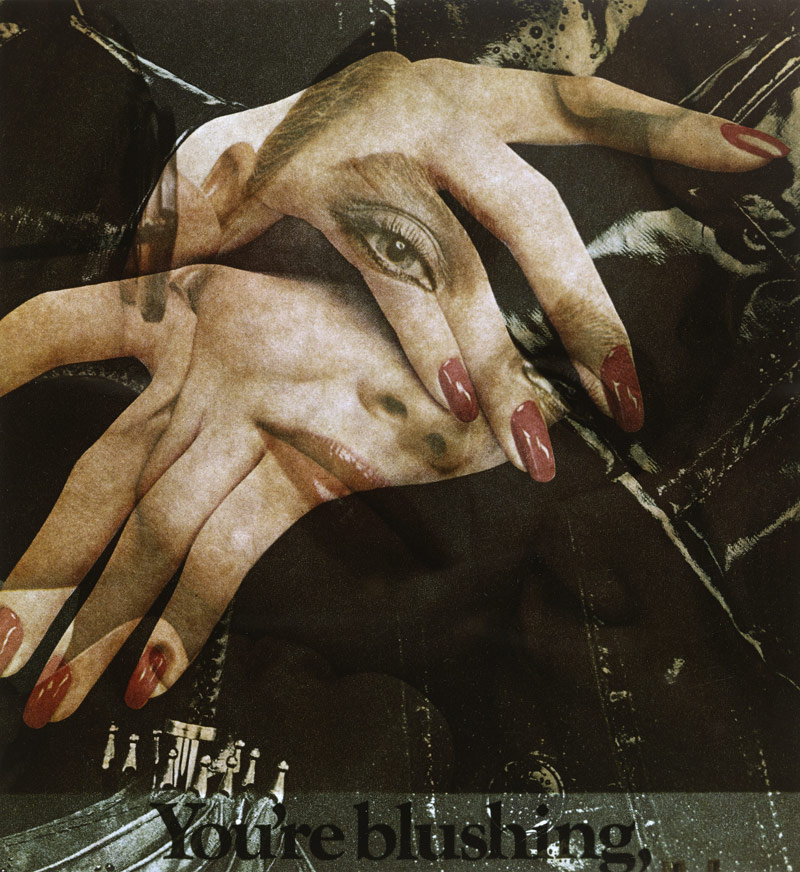
Robert Heinecken (American, 1931-2006) 'Recto/Verso #2' 1988


Robert Heinecken (American, 1931-2006)
Recto/Verso #2
1988
Silver dye bleach print
8 5/8 x 7 7/8″ (21.9 x 20cm)
The Museum of Modern Art, New York
Mr. and Mrs. Clark Winter Fund
© 2012 The Robert Heinecken Trust


Philip-Lorca diCorcia (American, b. 1951) 'Marilyn; 28 Years Old; Las Vegas, Nevada; $30' 1990-1992


Philip-Lorca diCorcia (American, b. 1951)
Marilyn; 28 Years Old; Las Vegas, Nevada; $30
1990-1992
Chromogenic colour print
24 x 35 15/16″ (61 x 91.4cm)
The Museum of Modern Art, New York
E.T. Harmax Foundation Fund
© 2012 Philip-Lorca diCorcia, courtesy David Zwirner, New York


Atlas Group, Walid Raad. 'My Neck is Thinner Than a Hair: Engines' 1996-2004 (detail)


Atlas Group, Walid Raad
My Neck is Thinner Than a Hair: Engines (detail)
1996-2004
100 pigmented inkjet prints
9 7/16 x 13 3/8″ (24 x 34cm) each
The Museum of Modern Art, New York
Fund for the Twenty-First Century


The Museum of Modern Art
11 West 53 Street
New York, NY 10019
Phone: (212) 708-9400

Opening hours:
10.30am – 5.30pm
Open seven days a week

MoMA website

LIKE ART BLART ON FACEBOOK

Back to top

Exhibition: ‘Treasures of the Alfred Stieglitz Center: Photographs from the Permanent Collection’ at the Philadelphia Museum of Art

Exhibition dates: 22nd December 2012 – 7th April 2013


Many thankx to the Philadelphia Museum of Art for allowing me to publish the photographs in the posting. Please click on the photographs for a larger version of the image.


William Henry Fox Talbot (British, 1800-1877) 'Group of Persons Selling Fruit and Flowers' 1845


William Henry Fox Talbot (British, 1800-1877)
Group of Persons Selling Fruit and Flowers
1845
Salted paper print from a paper negative
6 11/16 x 8 1/4 inches (17 x 21cm)
Philadelphia Museum of Art, Purchased with the Robert A. Hauslohner Fund, 1967


Felice Beato (English born Italy, 1825-1913) 'Confucius, Canton, April 1860 April' 1860


Felice Beato (English born Italy, 1825-1913)
Confucius, Canton, April 1860
April 1860
Albumen silver print
10 x 12 inches (25.4 x 30.5cm)
Philadelphia Museum of Art, Purchased with funds contributed by Dr. Chaoying Fang, Harvey S. Shipley Miller and J. Randall Plummer, and with the Alice Newton Osborn Fund, 1978


Dorothy Norman (American, 1905-1997) 'Harbor II, (Osterville), Cape Cod' 1930s


Dorothy Norman (American, 1905-1997)
Harbor II, (Osterville), Cape Cod
1930s
Gelatin silver print
Sheet: 2 7/8 x 3 7/8 inches (7.3 x 9.8cm)
Philadelphia Museum of Art, From the Collection of Dorothy Norman, 1980


Edward Weston (American, 1886-1958) 'Dunes, Oceano' 1936


Edward Weston (American, 1886-1958)
Dunes, Oceano
1936
Gelatin silver print
Philadelphia Museum of Art


Louise Lawler (American, b. 1947) 'Living Room Corner Arranged by Mr. and Mrs. Burton Tremaine, Sr.,' 1984


Louise Lawler (American, b. 1947)
Living Room Corner Arranged by Mr. and Mrs. Burton Tremaine, Sr.,
1984
Dye destruction print
Sheet: 18 1/4 x 23 3/4 inches (46.4 x 60.3cm)
Philadelphia Museum of Art, Gift of Henry S. McNeil, Jr., 1988


Richard Misrach (American, b. 1949) 'Pink Lightning, Salton Sea' 1985


Richard Misrach (American, b. 1949)
Pink Lightning, Salton Sea
1985
Chromogenic print
18 5/16 x 23 1/16 inches (46.5 x 58.6cm)
Philadelphia Museum of Art, Gift of the Friends of the Philadelphia Museum of Art, 1986


Joachim Koester (Danish active United States, b. 1962) 'Room of Nightmares #1' 2005


Joachim Koester (Danish active United States, b. 1962)
Room of Nightmares #1
2005
Chromogenic print
18 7/8 x 23 7/8 inches (47.9 x 60.6cm)
Philadelphia Museum of Art, Gift of Lynne and Harold Honickman


This exhibition presents a survey of photographs from the permanent collection and includes an important group of works by Dorothy Norman and her mentor Alfred Stieglitz, one of the greatest figures in twentieth-century American art. There are also early masterworks by Gustave Le Gray, whose images of light and motion inspired the Impressionists; Edward Weston; Julia Margaret Cameron; and Charles Aubry. These striking images are complemented by an array of modern and contemporary works that trace the medium’s history as a visual art form, including recent acquisitions by artists such as Florence Henri, Roy DeCarava, and Hiroh Kikai, many on view for the first time in Philadelphia.

The mainly black-and-white photographs reflect the strengths of the Museum’s photography collection, ranging from the 1840s to 2005. Nineteenth-century photographs include works by William Henry Fox Talbot, an early inventor of photography; a group of views from Felice Beato’s 1860 album China; and Rue des Prêtres SaintÉtienne, de la rue Descartes by Charles Marville, who documented the narrow quarters of nineteenth-century Paris.

Post-World War II American and Japanese photography is seen through a number of works by Robert Frank including Jehovah’s Witness, Los Angeles (1955), Diane Arbus’s Untitled (6) (1970-71), and Masahisa Fukase’s Untitled (1976). The exhibition continues with contemporary photography by a broad range of international artists, including Joachim Koester’s Room of Nightmares #1 (2005) and Gerhard Richter’s Guildenstern (Rhombus II) (1998), a cunning investigation of the shared terrain between painting and photography.

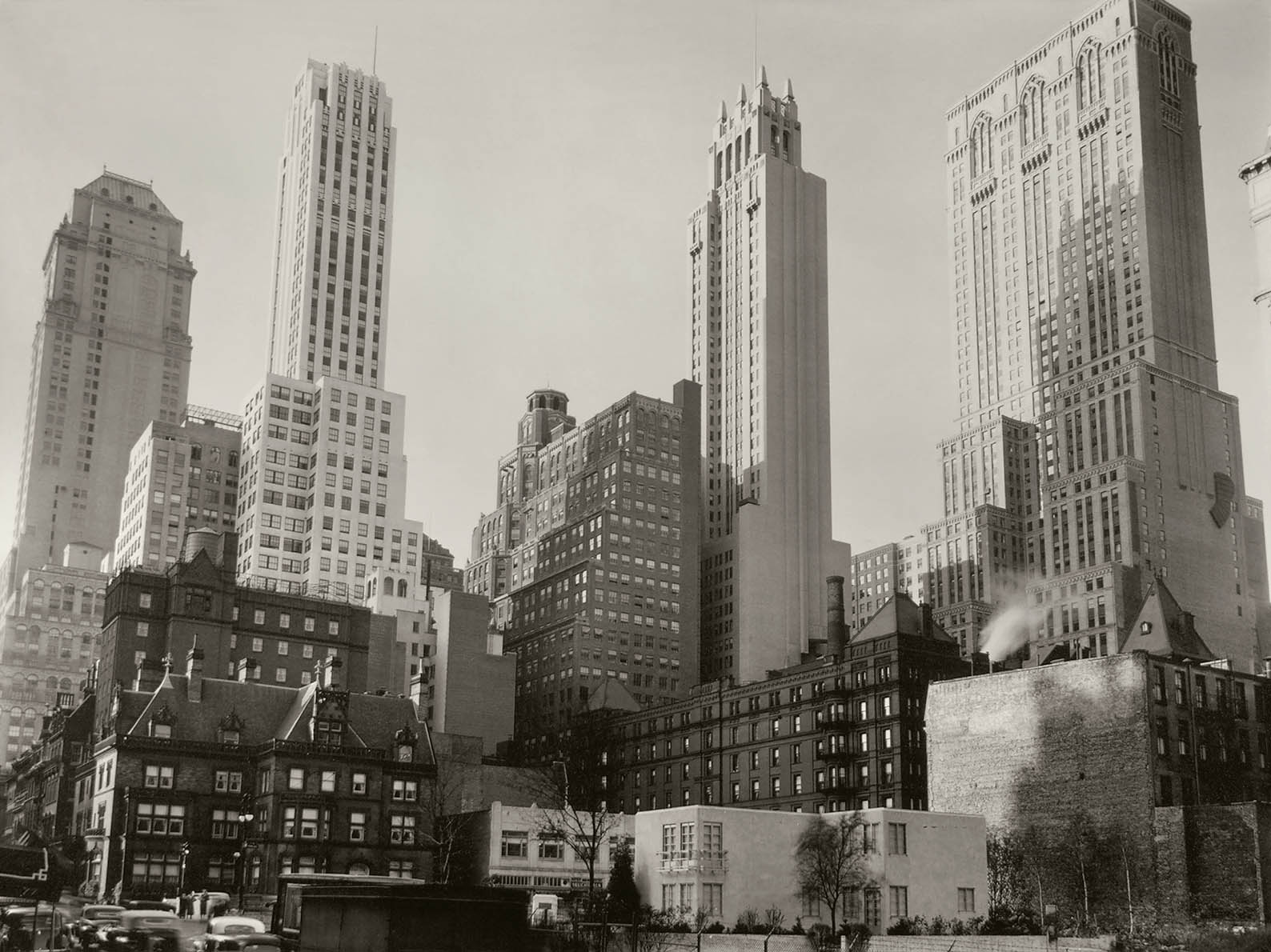
The works by Norman and Stieglitz were made during the years of their creative exchange, from 1929 until Stieglitz’s death in 1946. These include a number of portraits, such as Norman’s cropped close-up Alfred Stieglitz IX, New York (1933); cityscapes and landscapes, as seen in Stieglitz’s New York from the Shelton (1935), showing the interplay of light and shadow on the skyscrapers of a changing New York skyline; and Norman’s Harbor II, Osterville, Cape Cod (1930s), a study in line and composition. These images are complemented by photographs made by their contemporaries, including Man Ray’s surrealist Marquise Casati (1922) and Florence Henri’s Portrait (c. 1930).

Press release from the Philadelphia Museum of Art website


Charles Marville (French, 1816-1879) 'Rue des Prêtres Saint-Étienne, de la rue Descartes' c. 1865


Charles Marville (French, 1816-1879)
Rue des Prêtres Saint-Étienne, de la rue Descartes
c. 1865
Albumen silver print
Image and sheet: 12 13/16 x 10 3/8 inches (32.5 x 26.4cm)
Philadelphia Museum of Art, Purchased with the Lola Downin Peck Fund, 2009


Man Ray (American, 1890-1976) 'Marquise Casati' 1922


Man Ray (American, 1890-1976)
Marquise Casati
1922
Gelatin silver print
Image and sheet: 8 1/2 x 6 9/16 inches (21.6 x 16.7cm)
Philadelphia Museum of Art, Gift of Carl Van Vechten, 1949
© Man Ray Trust / Artists Rights Society (ARS), New York / ADAGP, Paris


Dorothy Norman (American, 1905-1997) 'Alfred Stieglitz IX, New York' 1933


Dorothy Norman (American, 1905-1997)
Alfred Stieglitz IX, New York
1933
Gelatin silver print
Sheet: 2 5/8 x 2 11/16 inches (6.7 x 6.8cm)
Philadelphia Museum of Art, From the Collection of Dorothy Norman, 1968


Alfred Stieglitz (American, 1864-1946) 'New York from the Shelton' 1935


Alfred Stieglitz (American, 1864-1946)
New York from the Shelton
1935
Gelatin silver print
Image and sheet: 9 5/8 x 7 9/16 inches (24.4 x 19.2cm)
Philadelphia Museum of Art, From the Collection of Dorothy Norman, 1997
© The Georgia O’Keeffe Foundation / Artists Rights Society (ARS), New York


Robert Frank (American, 1924-2019) 'Jehovah's Witness. Los Angeles' 1955


Robert Frank (American, 1924-2019)
Jehovah’s Witness, Los Angeles
1955
Gelatin silver print
Philadelphia Museum of Art


Diane Arbus (American, 1923-1971 'Untitled (6)' 1970-1971


Diane Arbus (American, 1923-1971
Untitled (6)
1970-71
Gelatin silver print
Philadelphia Museum of Art


Philadelphia Museum of Art
26th Street and the Benjamin Franklin Parkway
Philadelphia, PA 19130

Opening hours:
Tuesday through Sunday: 10am – 5pm

Philadelphia Museum of Art website

LIKE ART BLART ON FACEBOOK

Back to top

Review: ‘Shrouds’ by Mike Reid at the Colour Factory Gallery, Fitzroy, Melbourne

Exhibition dates: 8th March – 30th March 2013


Mike Reid (Australian) 'Santa Monica, Los Angeles, USA' Nd


Mike Reid (Australian)
Santa Monica, Los Angeles, USA
Nd


“Any discovery changing the nature, or the destination of an object or phenomenon constitutes a Surrealist achievement. Already the automats are multiplying and dreaming… realism prunes trees, Surrealism prunes life.”


J-A. Boiffard, Paul Ellard and Roger Vitrac, in La Revolution Surréaliste, December 1924, p. 2, quoted in Arturo Schwarz, Man Ray: the rigour of imagination, Thames & Hudson, London, 1977, p. 161.


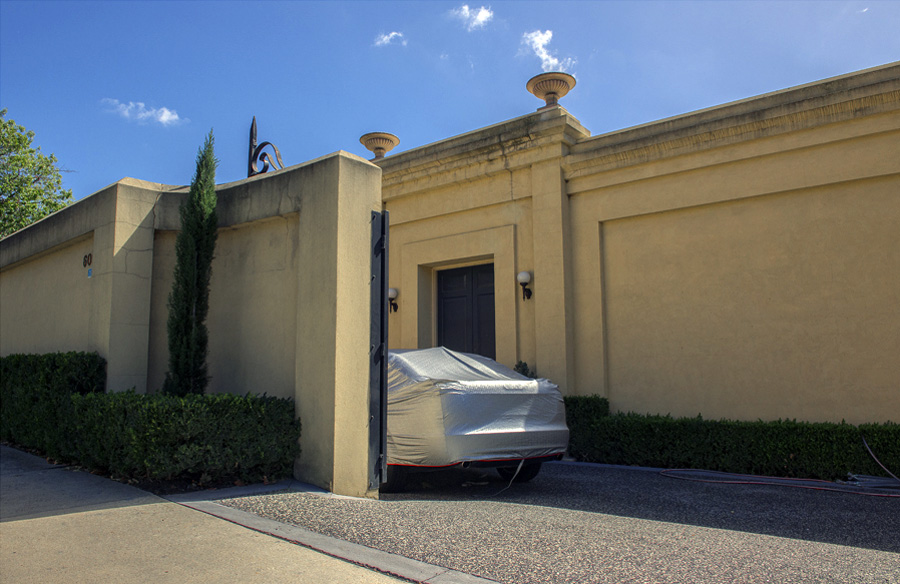
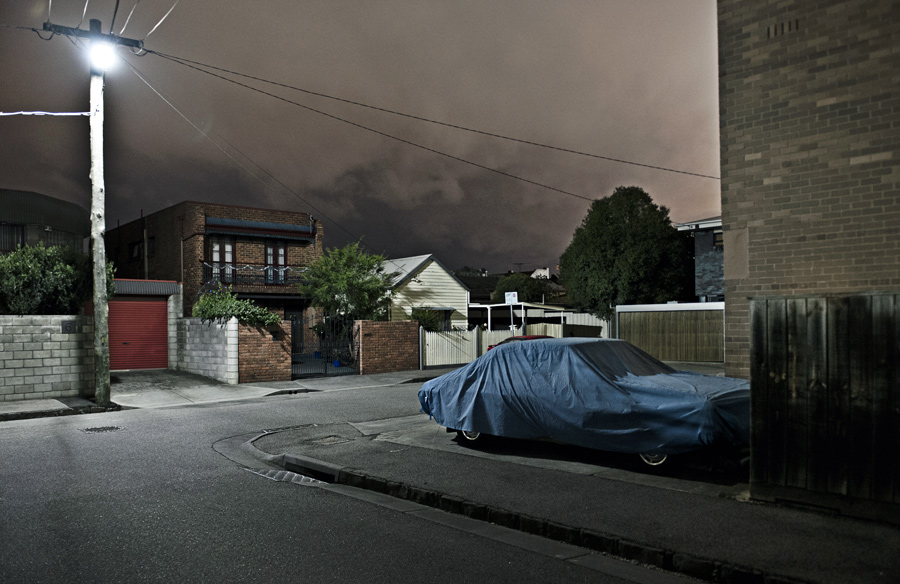
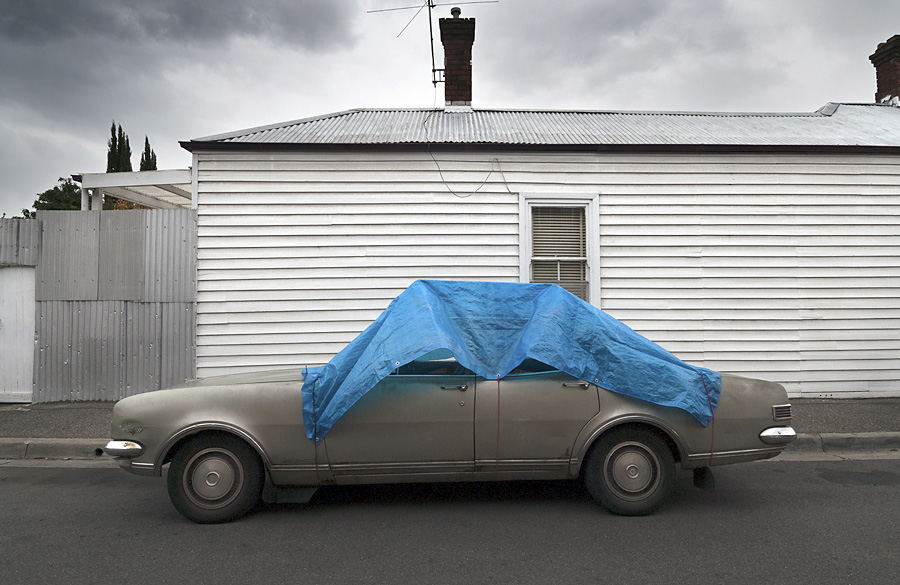
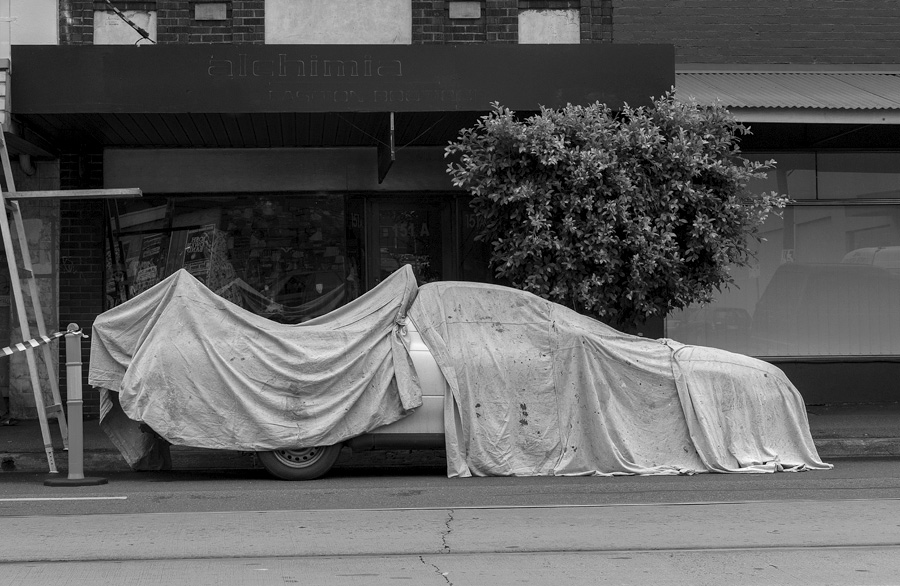
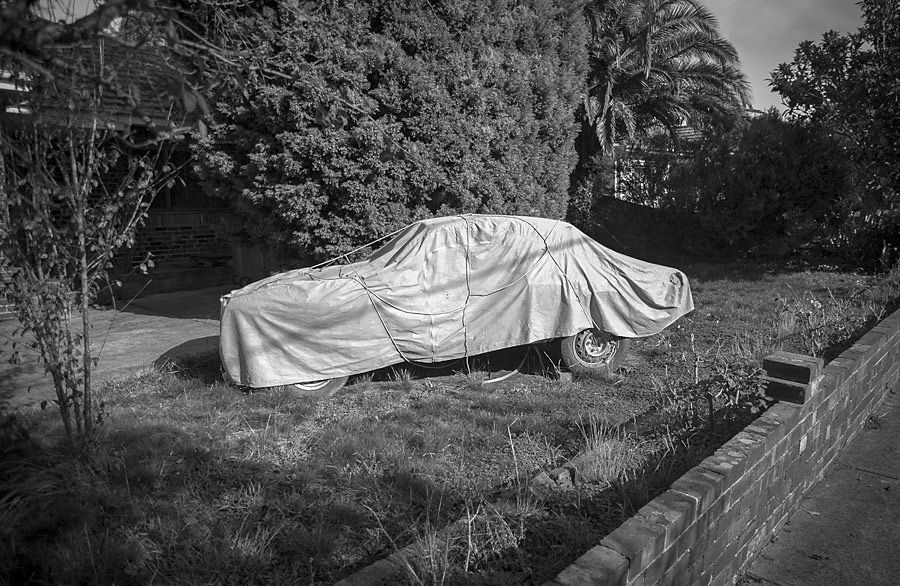
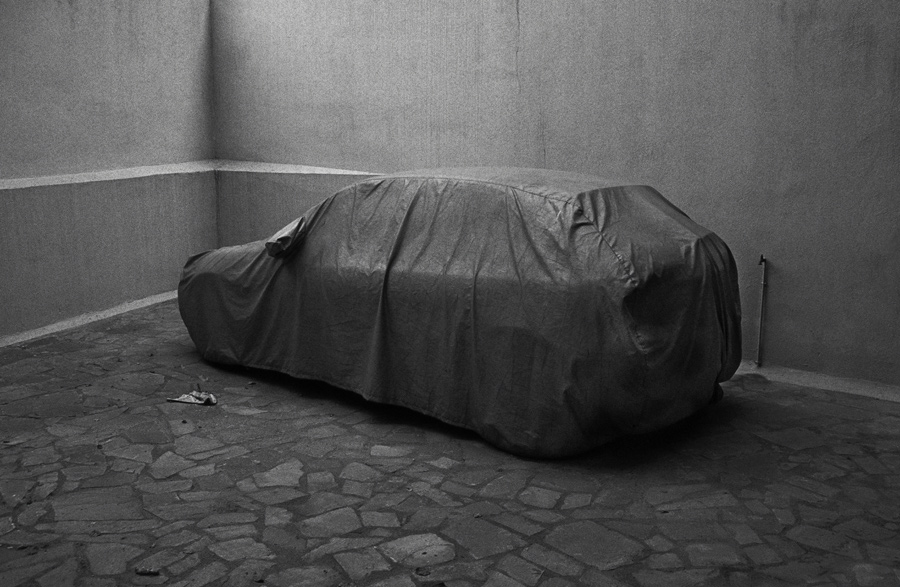
This is a strong exhibition of documentary photography by Mike Reid at the Colour Factory Gallery. Interesting idea; well seen formal photographs; good use of colour (brown, blue, silver, red and green shrouds); nice sized prints appropriate to the subject matter; and an excellent self published book to accompany the exhibition. This is just what it is – a solid exhibition of documentary photography.

Unfortunately the artist cannot leave it there. In his almost unintelligible artist statement (below), he tries to lever the concept of resurrection onto the work, meandering from Horus and Osiris through The Shroud of Turin, to Jewish Tachrichim (burial shrouds) and onto the commerce of Billabong and the politics of the burqa linking, very tenuously, the covering of Islamic women with the idea of these cars being “old bombs.”

Here I take issue with Reid’s conceptualisation of the word “shroud” vis a vis his photographs of covered cars. One of the definitions of shroud is “A cloth used to wrap a body for burial” but the more pertinent use of the word in relation to this work is “To shut off from sight; something that conceals, protects, or screens” from the Middle English schrud, garment. These are not abandoned, lifeless vehicles awaiting resurrection but loved vehicles that have been protected from the elements by their owners, wrapped and cocooned jewels that are in a state of hibernation. If they were unwanted they would have been abandoned by their owners to the elements, not protected beneath a concealing garment in a state of metamorphosis. The shrouding of the car acts like a Surrealist canvas, hinting at the structure underneath (the Cadillac, the Volkswagen, the Morris Minor) but allowing the viewer to discover the changing nature of the object.

All that was needed to accompany the exhibition and the book was something like the quotation at the top of the posting. Leave the rest up to the strength of the work and the viewer. They have the intelligence and imagination to work out what is going on without all the proselytising that only reveals the artist’s ultimate disconnection from the source. In other words, less is more. Nothing more, nothing less.

Dr Marcus Bunyan


Many thankx to the Colour Factory Gallery for allowing me to publish the photographs in the posting. Please click on the photographs for a larger version of the image.


Mike Reid (Australian) 'Toorak, Victoria' Nd


Mike Reid (Australian)
Toorak, Victoria
Nd


Mike Reid (Australian) 'South Fremantle, Western Australia' Nd


Mike Reid (Australian)
South Fremantle, Western Australia
Nd


Mike Reid (Australian) 'Richmond, Victoria' Nd


Mike Reid (Australian)
Richmond, Victoria
Nd


Shrouds, by Mike Reed is a collection of photographs of covered cars. His love of gleaning was inherited from his ‘rag and bone’ father who amassed a metal detritus found on the bicycle route home from the factory where he worked. This assortment was stockpiled in his father’s rusted sheds, which appeared like an ‘Aladdin’s cave’ to a youthful Mike.

“The car was draped with a plastic sheet in the back blocks of Surfers Paradise whilst seeking to photograph decay in the landscape… You start with one and then see another then… over time, the medley plays into a collection… patterns precipitate or idiosyncrasies evolve from within…This is the joy of “seeing”.”

“Within my category of covered cars I began to view these still loved but lifeless vehicles, as if a resurrection was about to take place… for the heavenly roads of restoration or hell.”

Mike equates the car covers to the burial garments adorning the dead in preparation for resurrection. Mike cites the ‘wrapping’ of objects found in the work of artists’ Christo, Jean Claude, Man Ray and Magritte as inspiration. This incredible accumulation of images spans over two decades and 6 countries. A small selection has been chosen for this exhibition and a larger range appears in his book to be launched at the opening of Shrouds.

Press release from the Colour Factory Gallery website


Mike Reid (Australian) 'Richmond, Victoria' Nd


Mike Reid (Australian)
Richmond, Victoria
Nd


Mike Reid (Australian) 'Macleod, Victoria' Nd


Mike Reid (Australian)
Macleod, Victoria
Nd


Shrouds

The resurrection of the dead is a fundamental and central doctrine of Judaism, Christianity, and Islam. Many religious critics have alleged that even Christ’s resurrection was borrowed from the accounts of Osiris, God of the underworld, and the best-known deity in all of ancient Egyptian history. As a life-death-rebirth deity, Horus, the Sun God, and Osiris became a reflection of the annual cycle of crop harvesting as well as reflecting people’s desires for a successful afterlife. The Masons, Illuminati, Priory De Sion, clandestine government groups, and others believed that on December 22, 2012, Osiris would be resurrected. Nothing happened on that world shattering day but Spam and candle sales most certainly went through the roof. Thus in preparation to meet thy maker, a shroud, burial sheet or winding-cloth, usually cotton or linen but with no pockets, is wrapped around a body after it has been ceremonially washed and readied for burial.

Certainly the most controversial and famous burial garment is the Shroud of Turin. It is now stored in the Cathedral of St. John the Baptist in Turin, Northern Italy after the crusaders stole it and bought it first to France around 1204.

Many believe this 4.3 by 1.1m linen cloth of a rare herringbone weave covered the beaten and crucified body of Jesus of Nazareth when He was laid in a tomb prior to His resurrection. Is it really the cloth that wrapped His bloodstained body, or is it simply a medieval hoax? This has lead to intense scrutiny by forensic experts, scientists, chemists, immunologists, pathologists, believers, historians, and writers regarding the where, when, and how the bloodstain image on the shroud was created. C-14 Carbon dating carried out in 1988, dated the cloth between 1260 and 1390.

In Jewish religious traditions the Tachrichim (burial shrouds) are traditional simple white burial garments, containing no pockets, usually made from 100% pure linen.A shroud or sometimes a prayer shawl for a man, in which Jews are dressed by the Chevra Kadisha for burial after undergoing a taharah (purification ceremony). Burying the departed in a garment is considered a testimony of faith in the resurrection of the body (commentary of Shach). This is a fundamental principle of faith, one of the thirteen principles, which the Rambam enumerates as being essential to Jewish belief. More to the point today we have an insurrection, while not yet violent against the wearing of another kind of covering… the niqab or the burqa. European governments are escalating the introduction of laws on the basis that the face covering, along with ski masks and bikies helmets, encourages female subjugation, lack of communication, non-safety, isolation, female abuse, oppression of freedom and non-conformity to the western culture. In fact the Koran only dictates to modesty in dress. May I say it that Billabong could improve sales with the launch of a ‘Tri-Kini’ on the beaches next summer.

Meanwhile… “The 2012 ban in France is officially the second country in Europe, after Belgium, to introduce a full ban on a garment which immigration minister Eric Besson has called a “walking coffin.””1 Indeed Australian Liberal Cory Bernadi said, “The burqa is no longer simply the symbol of female repression and Islamic culture, it is now emerging as a disguise of bandits and n’er do wells.”2 More so now the government and police authorities in the Netherlands, a usually very tolerant nation, have become anxious regarding security worries that a terrorist could use one for concealment. Well my shrouded cars could be the same, as most do conceal “old bombs.”

The inspiration for my rag tag assortment evolved from the artistes Christo and Jeanne-Claude who have wrapped, covered whole buildings, bridges and landscapes. Other favourites of mine, Man Ray and Rene Magritte have objects and humans covered as well, specifically Magrittes’ Las Amants 1 & II (The Lovers)3 1928. A plastic explanation is that “love is blind” and that the mantles are symbolic to the idea that a devoted lover would identify his soul mate in any form, immortal love. Another interpretation of Magrittes’ shrouds is that the paintings symbolise his mothers’ death. Magritte, when only 14, discovered her lifeless body which was naked apart from her nightdress that had swathed up around her face.

I started recording these morphological images over 20 years ago. The first was draped with a plastic sheet in a paddock in the back blocks of Surfers Paradise while meandering aimlessly, seeking decay in the landscape.

With my wandering and collecting shots I realised I have inherited the trait from my father. In his latter years my father became a rag and bone man in order to supplement the low family income. A bicycle route from his employment at Laminex factory to home lay through the local hard rubbish dump. Copper wire, lead, iron, even an aerial practice bomb, military helmets, a stockless revolver and rifle, rusted tools… festooned from his bike and festooned from his gladstone bag. Two rusting sheds contained somewhat the ever-growing metal waste for selling or keeping… an Aladdins’ cave to a young boy, everyday re-discovering lifes’ discards care of the Dendy Street tip.

Within my category of covered cars I began to view these still loved but lifeless vehicles, as if a resurrection was about to take place… for the heavenly roads of restoration or hell… (a scrap yard)

Mike Reed, 2013


1/ The Telegraph, April 11 , 2011, “Peter Allen In Paris”
2/ Cory Bernadi, SMH, May 6, 2011
3/ “Las Amants” 1 is in the NGA collection, Canberra, NGA


Mike Reid (Australian) 'Brunswick East, Victoria' Nd


Mike Reid (Australian)
Brunswick East, Victoria
Nd


Mike Reid (Australian) 'Fairfield, Victoria' Nd


Mike Reid (Australian)
Fairfield, Victoria
Nd


Man Ray (American, 1890-1976) 'L'Enigme d'Isidore Ducasse' 1920, remade 1972


Man Ray (American, 1890-1976)
L’Enigme d’Isidore Ducasse
1920, remade 1972
Sewing machine, wool and string
355 x 605 x 335 mm


Mike Reid (Australian) 'Athens, Greece' Nd


Mike Reid (Australian)
Athens, Greece
Nd


Colour Factory Gallery
409-429 Gore Street
Fitzroy, Victoria 3056
Phone: +61 3 9419 8756

Opening hours:
Closed for refurbishment

Mike Reed Photography website

Colour Factory Gallery website

LIKE ART BLART ON FACEBOOK

Back to top

Exhibition: ‘Eugène Atget: Old Paris’ at the Art Gallery of New South Wales, Sydney

Exhibition dates: 24th August – 4th November 2012


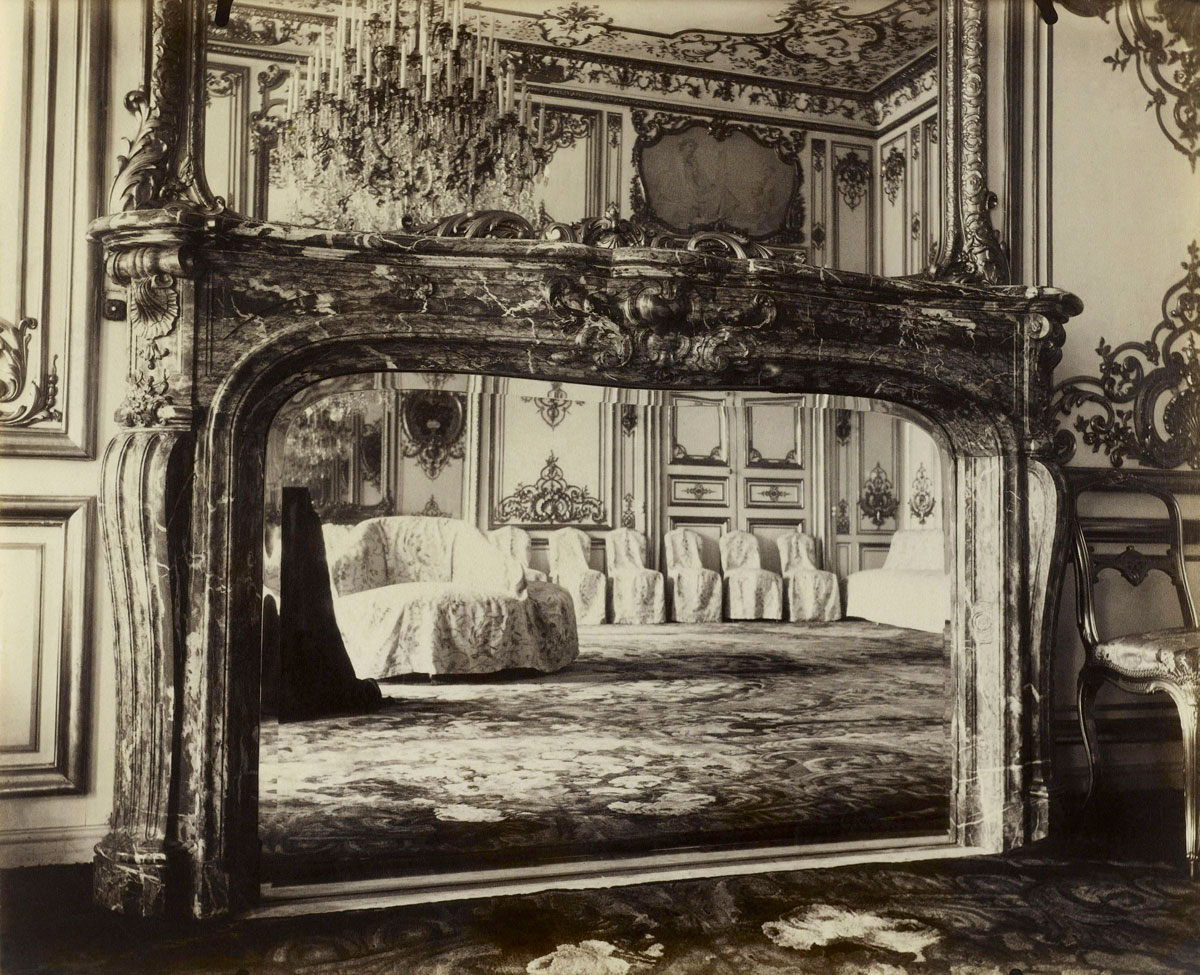
Eugène Atget (French, 1857-1927) 'Fireplace, Hôtel Matignon, former Austrian embassy, 57 rue de Varenne, 7th arrodissement' 1905


Eugène Atget (French, 1857-1927)
Fireplace, Hôtel Matignon, former Austrian embassy, 57 rue de Varenne, 7th arrodissement
1905
Albumen photograph
© Musée Carnavalet, Paris / Roger-Viollet / TopFoto


“… I have assembled photographic glass negatives… in all the old streets of Old Paris, artistic documents showing the beautiful civil architecture from the 16th to the 19th century. The old mansions, historic or interesting houses, beautiful façades, lovely doors, beautiful panelling, door knockers, old fountains, stylish staircases (wrought iron and wood) and interiors of all the churches in Paris… This enormous documentary and artistic collection is now finished. I can say that I possess the whole of Old Paris.”


Eugène Atget 1920


“The first time I saw photographs by Eugène Atget was in 1925 in the studio of Man Ray in Paris. Their impact was immediate and tremendous. There was a sudden flash of recognition – the shock of realism unadorned. The subjects were not sensational, but nevertheless shocking in their very familiarity. The real world, seen with wonderment and surprise, was mirrored in each print.”


Berenice Abbott 1964


Spaces That Matter…

[In revelatio, in revelation] the photographers trained eye is perhaps more of a hindrance than may at first be thought. The photographer may struggle with, “a sense of intense inevitability, insofar as this kind of image seems to be one that the photographer ‘could not not photograph’.”9 Awareness may become a double bind for the photographer. It may force the photographer to photograph because he can do nothing else, because he is aware of the presence of ‘punctum’ within a space, even an empty ‘poetic space’, but this awareness may then blind him, may ossify the condition of revealing through his directed gaze, unless he is very attentive and drops, as Harding says, “memory and imagination and desire, and just take what’s given.”10 The object, as Baudrillard notes,”isolates itself and creates a sense of emptiness … and then it irradiates this emptiness,”11 but this irradiation of emptiness does require an awareness of it in order to stabilise the transgressive fluctuations of the ecstasy of photography (which are necessarily fluid), through the making of an image that, as Baudrillard notes, “may well retrieve and immobilise subjective and objective punctum from their ‘thunderous surroundings’.”12 Knowledge of awareness is a key to this immobilisation and image making. The philosopher Krishnamurti has interesting things to say about this process, and I think it is worth quoting him extensively here:

“Now with that same attention I’m going to see that when you flatter me, or insult me, there is no image, because I’m tremendously attentive … I listen because the mind wants to find out if it is creating an image out of every word, out of every contact. I’m tremendously awake, therefore I find in myself a person who is inattentive, asleep, dull, who makes images and gets hurt – not an intelligent man. Have you understood it at least verbally? Now apply it. Then you are sensitive to every occasion, it brings its own right action. And if anybody says something to you, you are tremendously attentive, not to any prejudices, but you are attentive to your conditioning. Therefore you have established a relationship with him, which is entirely different from his relationship with you. Because if he is prejudiced, you are not; if he is unaware, you are aware. Therefore you will never create an image about him. You see the difference?”13


Now apply this attention to the awareness of the photographer. If he does not create images that are prejudice, could this not stop a photographer ‘not not’ photographing because he sees spaces with clarity, not as acts of performativity, spaces of ritualised production overlaid with memory, imagination, desire, and nostalgia?

Here an examination of the work of two photographers is instructive. The first, the early 20th century Parisian photographer Eugène Atget, brings to his empty street and parkscapes visions that elude the senses, visions that slip between dreaming and waking, between conscious and subconscious realms. These are not utopian spaces, not felicitous spaces that may be grasped and defined with the nostalgic fixity of spaces we love,14 but spaces of love that cannot be enclosed because Atget made no image of them.

I believe Atget moved his photographs onto a different spatio-temporal plane by not being aware of making images, aware-less-ness, dropping away the appendages of image making (technique, reality, artifice, reportage) by instinctively placing the camera where he wanted it, thus creating a unique artistic language. His images become a blend of the space of intimacy and world-space as he strains toward, “communion with the universe, in a word, space, the invisible space that man can live in nevertheless, and which surrounds him with countless presences.”15 These are not just ‘localised poetics’16 nor a memento of the absent, but the pre-essence of an intimate world space re-inscribed through the vision (the transgressive glance not the steadfast gaze) of the photographer. Atget is not just absent or present, here or there,17 but neither here nor there. His images reverberate (retentir), in Minkowski’s sense of the word, with an essence of life that flows onward in terms of time and space independent of their causality.18”

Dr Marcus Bunyan

Excerpt from the paper Spaces That Matter: Awareness and Entropia in the Imaging of Place (2002). Read the full paper…


Endnotes

9/ Barthes, Roland. Camera Lucida. (trans. Richard Howard). New York: Hill and Wang, 1981, p. 47, quoted in Zurbrugg, Nicholas. “‘Apocalyptic’? ‘Negative’? ‘Pessimistic’?: Baudrillard, Virilio, and techno-culture,” in Koop, Stuart (ed.,). Photography Post Photography. Melbourne: Centre for Contemporary Photography, 1995, p. 79.

10/ See Endnote 2. I believe that this form of attentiveness to present experience is not the same as Featherstone’s fragmentation of time into affect-charged experiences of the presentness of the world in postmodern culture. “Postmodern everyday culture is … a culture of stylistic diversity and heterogeneity (comprising different parts or qualities), of an overload of imagery and simulations which lead to a loss of the referent or sense of reality. The subsequent fragmentation of time into a series of presents through a lack of capacity to chain signs and images into narrative sequences leads to a schizophrenic emphasis on vivid, immediate, isolated, affect-charged experiences of the presentness of the world – of intensities.”
Featherstone, Mike. Consumer Culture and Postmodernism. London: Sage Publications, 1991, p. 124.

11/ Baudrillard, Jean. The Transparency of Evil. (trans. James Benedict). London: Verso, 1993, quoted in Zurbrugg, Nicholas. “‘Apocalyptic’? ‘Negative’? ‘Pessimistic’?: Baudrillard, Virilio, and techno-culture,” in Koop, Stuart (ed.,). Photography Post Photography. Melbourne: Centre for Contemporary Photography, 1995, p. 80.

12/ Baudrillard, Jean. The Art of Disappearance. (trans. Nicholas Zurbrugg). Brisbane: Institute of Modern Art, 1994, p.9, quoted in Zurbrugg, Nicholas. “‘Apocalyptic’? ‘Negative’? ‘Pessimistic’?: Baudrillard, Virilio, and techno-culture,” in Koop, Stuart (ed.,). Photography Post Photography. Melbourne: Centre for Contemporary Photography, 1995, p. 83.

13/ Krishnamurti. Beginnings of Learning. Harmondsworth: Penguin Books, 1978, pp. 130-131.

14/ Bachelard, Gaston. The Poetics of Space. (trans Maria Jolas). Boston: Beacon Press, 1994, p. xxxv.

15/ Ibid., p. 203.

16/ Palmer, Daniel. “Between Place and Non-Place: The Poetics of Empty Space,” in Palmer, Daniel (ed.,). Photofile Issue 62 (‘Fresh’). Sydney: Australian Centre for Photography, April 2001, p. 47.

17/ Bachelard, Gaston. The Poetics of Space. (trans Maria Jolas). Boston: Beacon Press, 1994, p. 212.

18/ See the editor’s note by Gilson, Etienne (ed.,) in Bachelard, Gaston. The Poetics of Space. (trans Maria Jolas). Boston: Beacon Press, 1994, p. xvi.


Many thankx to the Art Gallery of New South Wales for allowing me to publish the photographs in this posting. Please click on the photographs for a larger version of the image.


Eugene Atget: Old Paris

Lose yourself in the beauty of old Paris with over 200 rare and original prints from the founder of documentary photography.

His bellows camera, glass plates and printing technique may link him to earlier 19th-century photography, but the vision of Eugène Atget (1857-1927) was an astonishingly modern one.

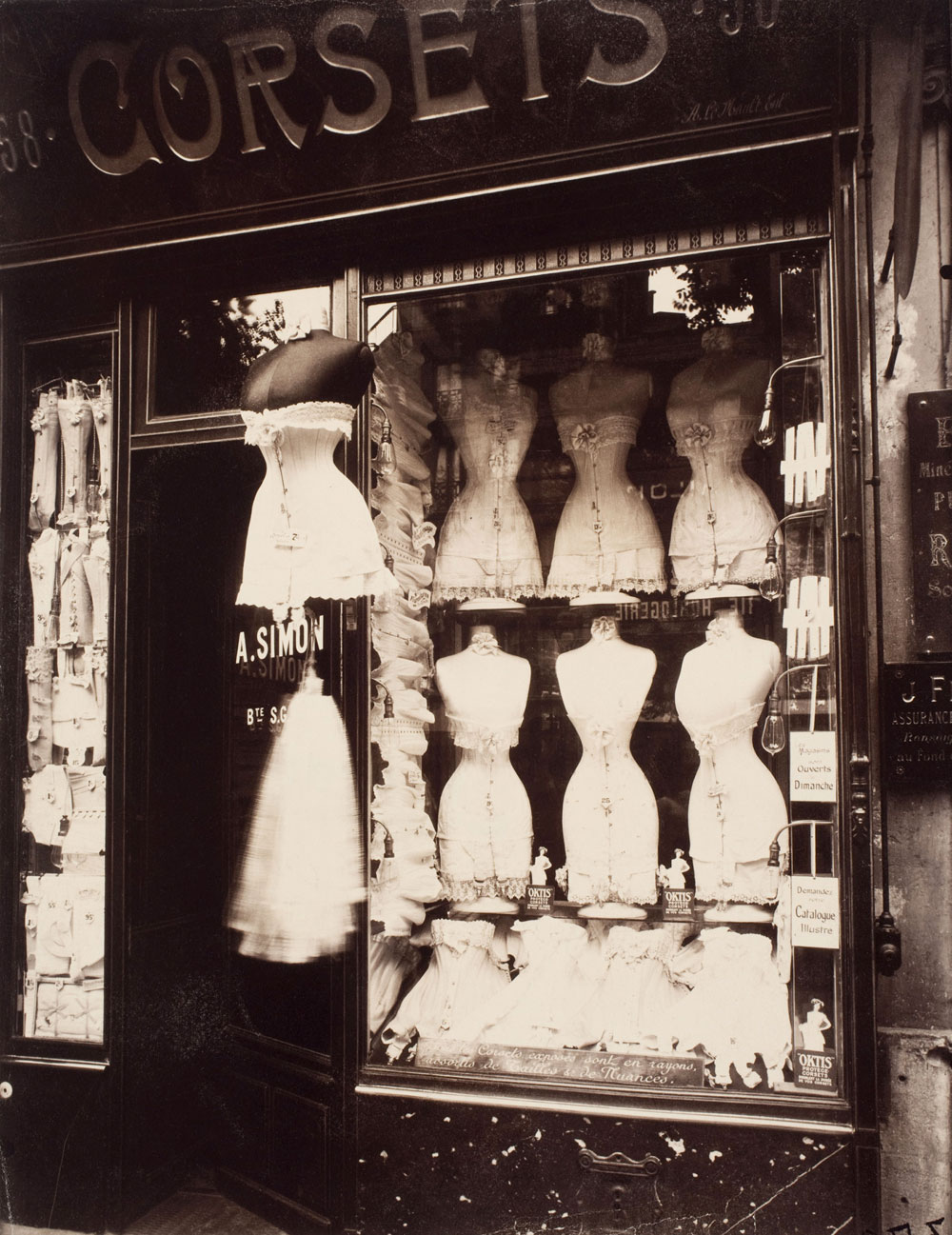
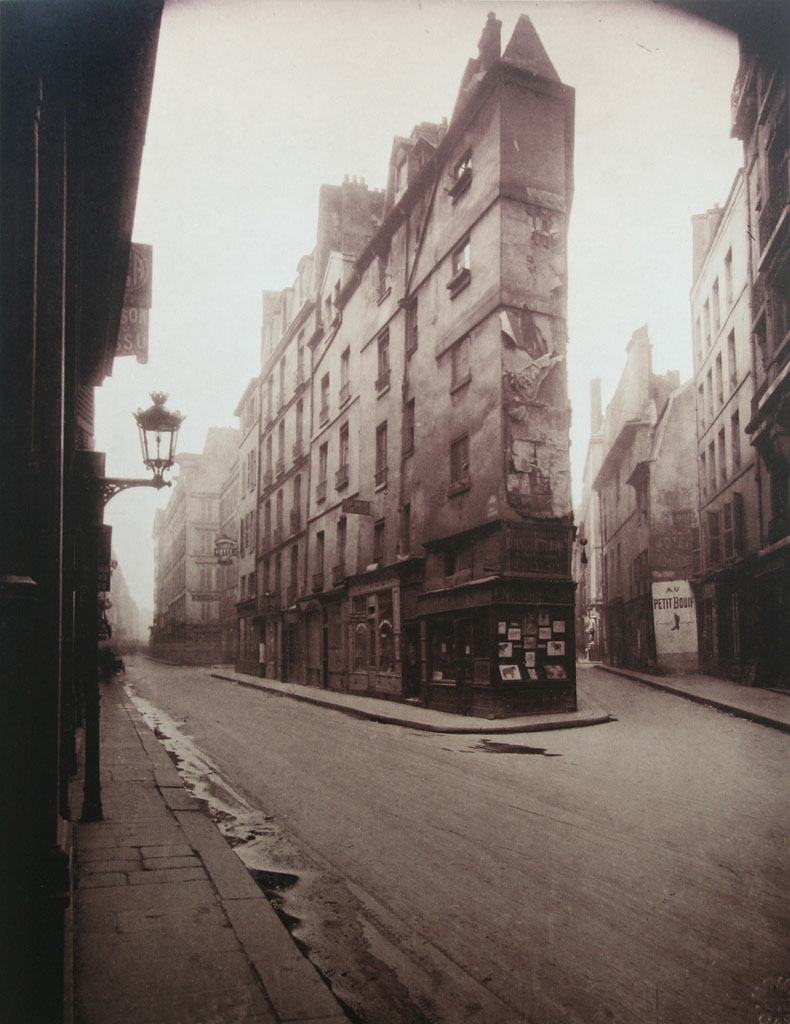
The best of Atget’s work is revealed through his images of the streets of Old Paris. In a time of rapid transformation, Atget captured the buildings, gardens, old shops and streets that had not been touched by Baron Haussmann’s 19th-century modernisation program. We are shown a city remote from the clichés of the Belle Époque, a genuine glimpse into the past of this iconic metropolis.

Considered the founder of documentary photography, Atget and his enigmatic images inspired numerous artists including Brassaï, the Surrealists, Walker Evans and Berenice Abbott, as well as Man Ray, who collected some of the photographs included in the exhibition.


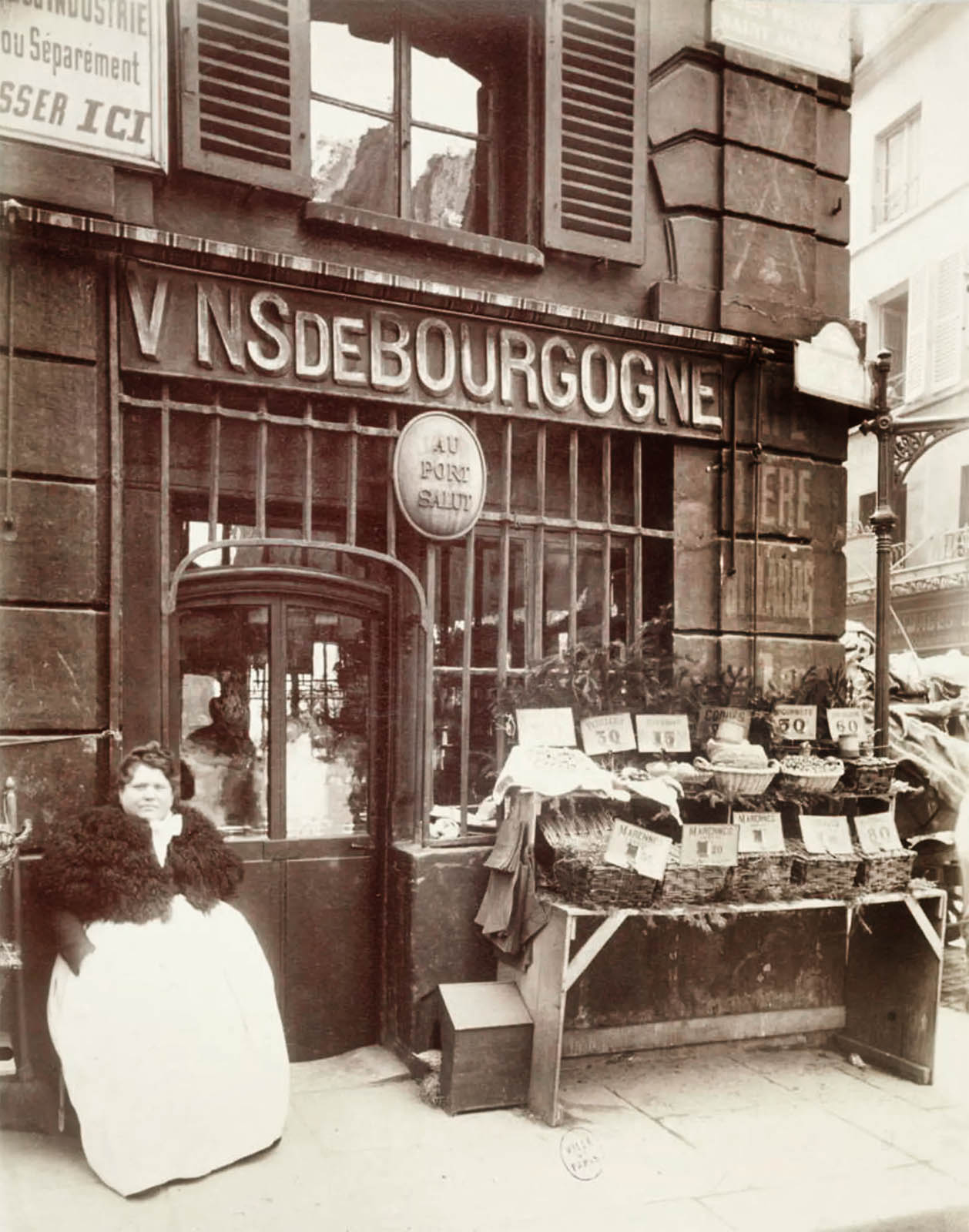
Eugène Atget (French, 1857-1927) 'Street vendor, place Saint-Médard, 5th arrondissement' September 1898


Eugène Atget (French, 1857-1927)
Street vendor, place Saint-Médard, 5th arrondissement
September 1898
Albumen photograph
© Musée Carnavalet, Paris / Roger-Viollet / TopFoto


Eugène Atget (French, 1857-1927) 'Street vendor selling shellfish' 1903


Eugène Atget (French, 1857-1927)
Street vendor selling shellfish
1903
Albumen print


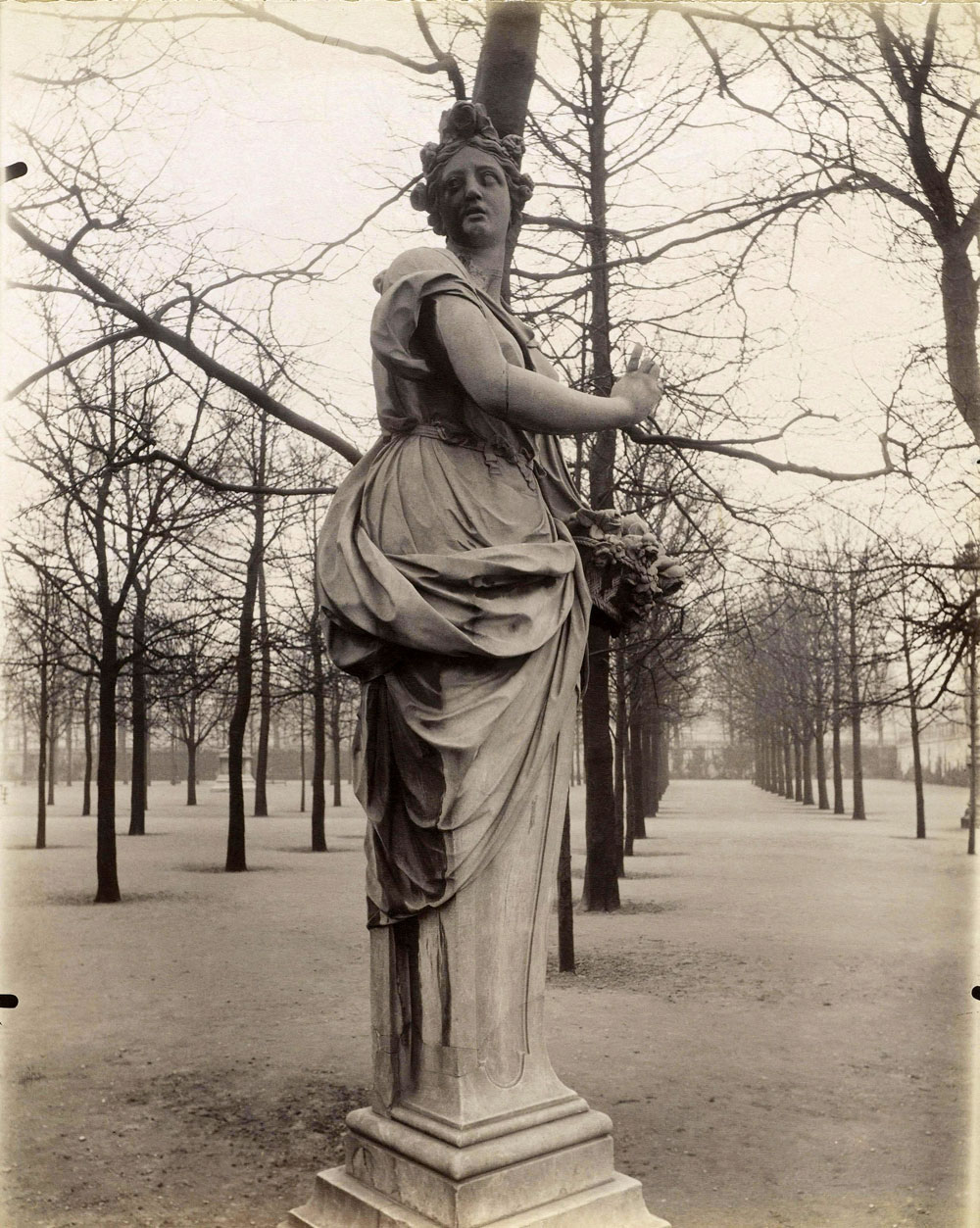
Eugène Atget (French, 1857-1927) "'Spring', by the sculptor François Barois, jardin des Tuileries, 1st arrondissement" 1907


Eugène Atget (French, 1857-1927)
‘Spring’, by the sculptor François Barois, jardin des Tuileries, 1st arrondissement
1907
Albumen photograph
© Musée Carnavalet, Paris / Roger-Viollet / TopFoto


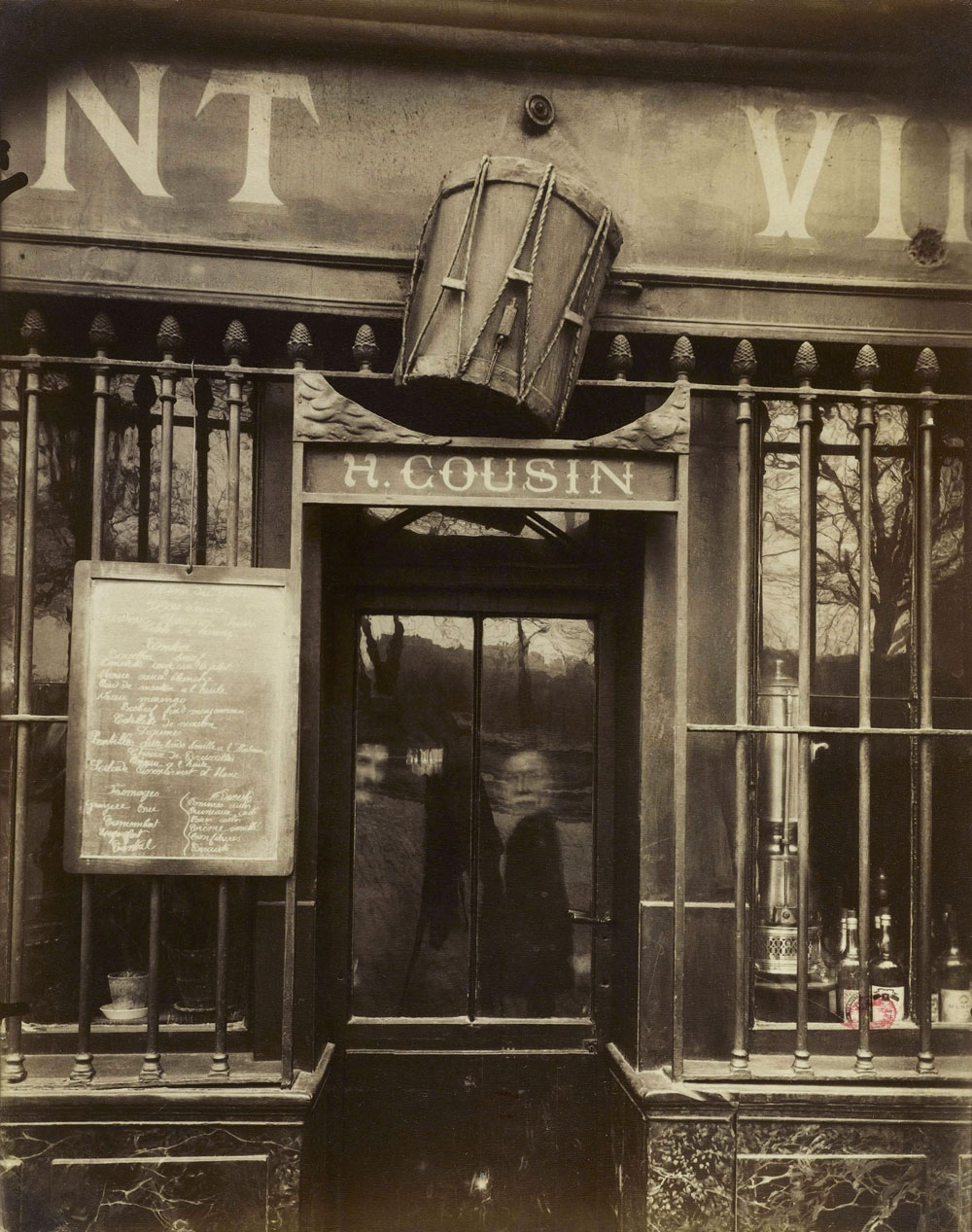
Eugène Atget (French, 1857-1927) 'Cabaret au Tambour, 62 quai de la Tournelle, 5th arrodissement' 1908


Eugène Atget (French, 1857-1927)
Cabaret au Tambour, 62 quai de la Tournelle, 5th arrodissement
1908
Albumen photograph
© Musée Carnavalet, Paris / Roger-Viollet / TopFoto


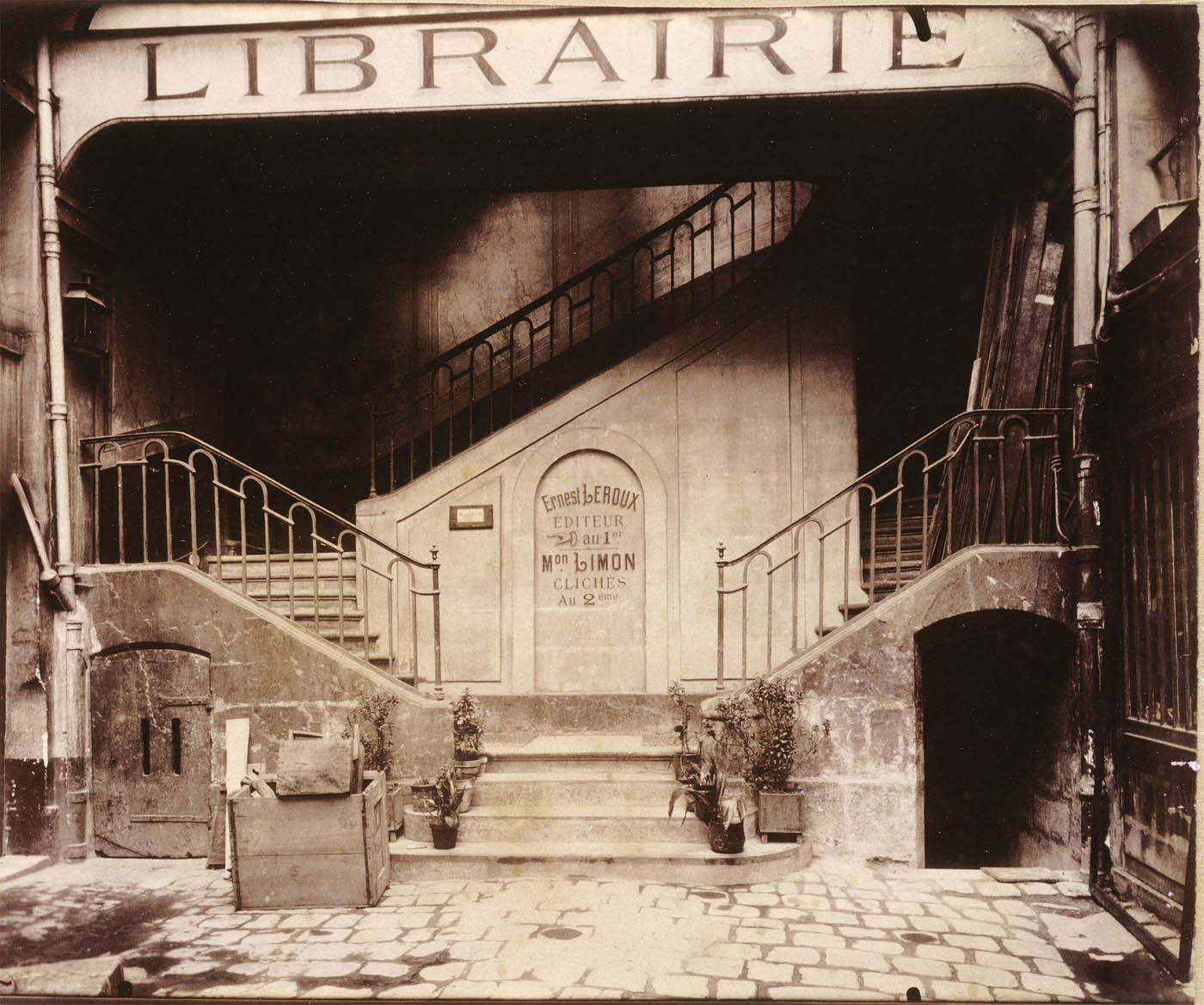
Eugène Atget (French, 1857-1927) 'Cour, 28 rue Bonaparte dépendant de l'abbaye de Saint-Germain, Editeur Ernest Leroux, 6ème arrondissement, Paris' 1910


Eugène Atget (French, 1857-1927)
Cour, 28 rue Bonaparte dépendant de l’abbaye de Saint-Germain, Editeur Ernest Leroux, 6ème arrondissement, Paris
1910
Albumen photograph
Musée Carnavalet, Histoire de Paris


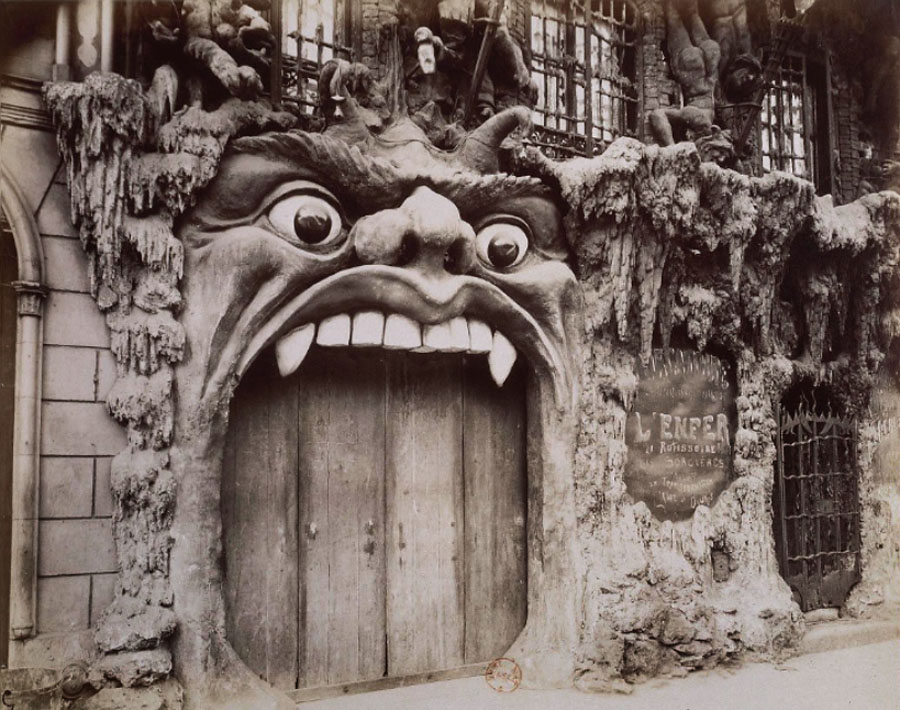
Eugène Atget (French, 1857-1927) 'Cabaret de l'Enfer, Boulevard de Clichy, Paris' c. 1910


Eugène Atget (French, 1857-1927)
Cabaret de l’Enfer, Boulevard de Clichy, Paris
c. 1910
Albumen photograph


Eugène Atget (French, 1857-1927) 'Boulevard de Strasbourg' 1912


Eugène Atget (French, 1857-1927)
Boulevard de Strasbourg
1912
Albumen photograph
George Eastman House, International Museum of Photography and Film, Rochester


Eugène Atget (French, 1857-1927) 'Boutique Coiffeur, Boulevard de Strasbourg' 1912


Eugène Atget (French, 1857-1927)
Boutique Coiffeur, Boulevard de Strasbourg
1912
Albumen photograph


Eugène Atget (French, 1857-1927) 'Courtyard, 7 Rue de Valence, 5th arr.' June 1922


Eugène Atget (French, 1857-1927)
Courtyard, 7 Rue de Valence, 5th arr.
June 1922
Albumen photograph


Eugène Atget (French, Libourne 1857-1927 Paris) 'Quai d’Anjou, 6h du matin' 1924


Eugène Atget (French, 1857-1927)
Quai d’Anjou, 6h du matin
1924
Albumen photograph


Eugène Atget (French, 1857-1927) 'Rue du Figuier' 1924


Eugène Atget (French, 1857-1927)
Rue du Figuier
1924
Albumen photograph


Eugène Atget (French, 1857-1927) 'Un coin, rue de Seine' 1924


Eugène Atget (French, 1857-1927)
Un coin, rue de Seine
1924
Albumen photograph


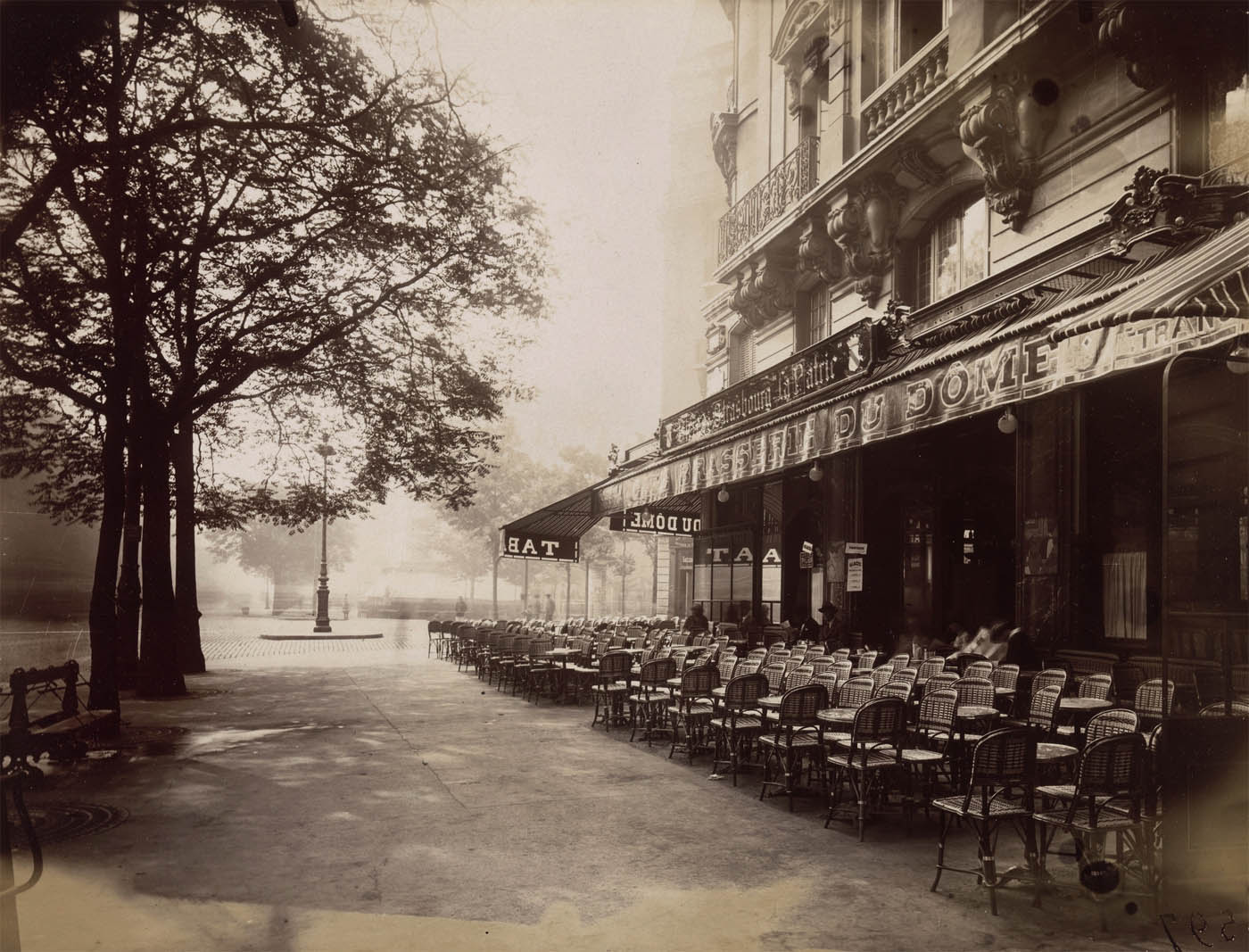
Eugène Atget (French, 1857-1927) 'Le Dôme, boulevard Montparnasse' June 1925


Eugène Atget (French, 1857-1927)
Le Dôme, boulevard Montparnasse
June 1925
Albumen photograph


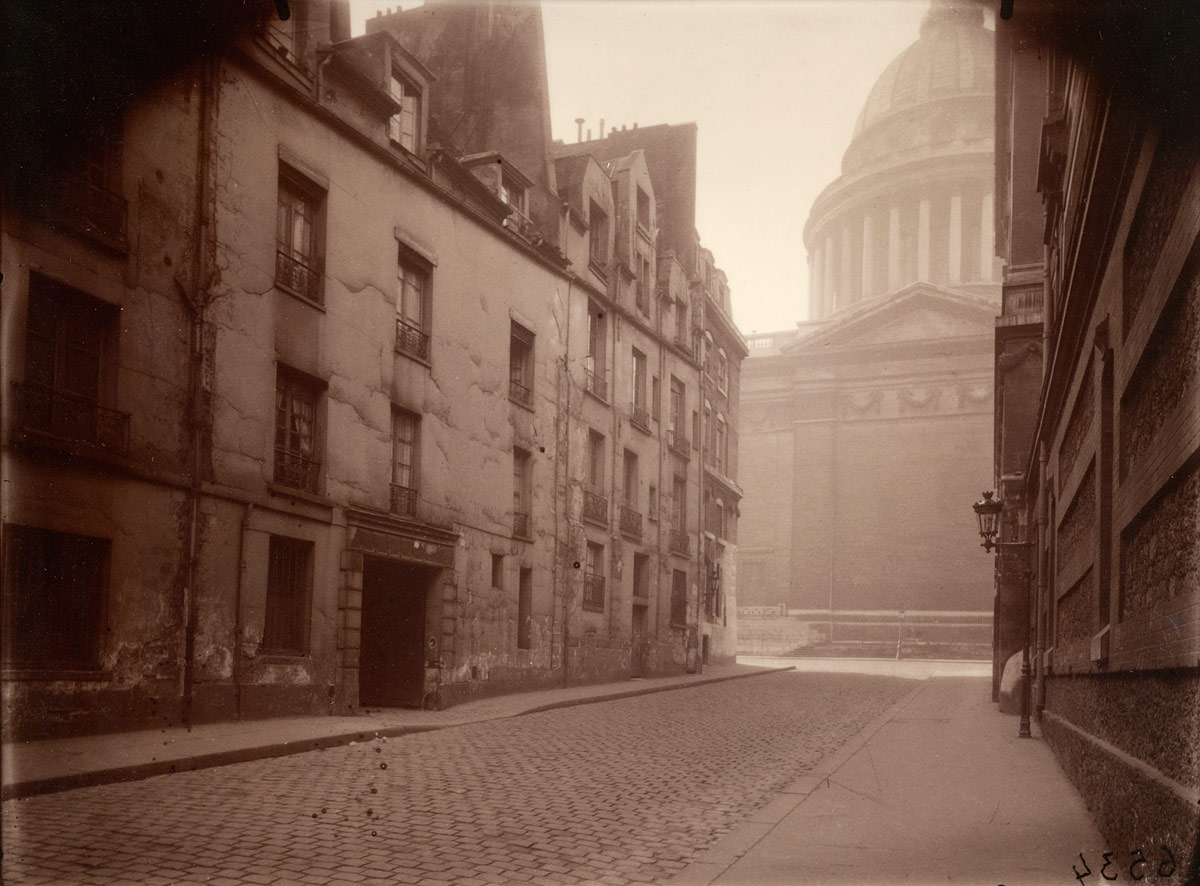
Eugène Atget (French, 1857-1927) 'Coin de la rue Valette et Pantheon, 5e arrondissement, matinee de mars' 1925


Eugène Atget (French, 1857-1927)
Coin de la rue Valette et Pantheon, 5e arrondissement, matinee de mars
1925, printed 1978
Albumen photograph


The first comprehensive exhibition in Australia of Eugène Atget’s (1857-1927) work will showcase over 200 photographs primarily from the more than 4000 strong collection of Musée Carnavalet, Paris with the important inclusion of Atget’s work, as compiled by Man Ray, from the collection of George Eastman House, Rochester, USA.

Atget was considered a commercial photographer who sold what he called ‘documents for artists’, ie. photographs of landscapes, close-up shots, genre scenes and other details that painters could use as reference. As soon as Atget turned his attention to photographing the streets of Paris, his work attracted the attention of leading institutions such as Musée Carnavalet and the Bibliothèque Nationale which became his principal clients. It is in these photographs of Paris that we find the best of Atget, the artist who shows us a city remote from the clichés of the Belle Époque. Atget’s images of ‘old Paris’ depict areas that had not been touched by Baron Haussmann’s 19th century modernisation program of the city. We see empty streets and buildings, details that usually pass unnoticed, all presented as rigorous, original compositions that offer a mysterious group portrait of the city.

The exhibition is organised into 11 sections that correspond to the thematic groupings used by Atget himself. They are: small trades, Parisian types and shops 1898-1922; the streets of Paris 1898-1913; ornaments 1900-1921; interiors 1901-1910; vehicles 1903-1910; gardens 1898-1914; the Seine 1900-1923; the streets of Paris 1921-1924; and outside the city centre 1899-1913.

The equipment and techniques deployed by Atget link him to 19th-century photography. He had an 18 x 24cm wooden, bellows camera which was heavy and had to be supported on a tripod. The use of glass plates allowed Atget to capture every tiny detail with great precision. Also traditional was his printing method, usually on albumen paper made light-sensitive with silver nitrate, exposed under natural light and subsequently gold-tinted. Atget’s vision of photography was, however, an astonishingly modern one. The photographs selected by Man Ray, who met Atget in the 1920s, indicate the immediate interest that the work aroused among the Surrealists because of the composition, ghosting, reflections, and its very mundanity. The first to appreciate his talents and importance as an artist were the photographer Berenice Abbott and Man Ray himself, both of whom lobbied to preserve Atget’s photographs.

As a result, he inspired artists and photographers such as Brassaï, the Surrealists, Walker Evans and Bernd & Hilla Becher amongst many others, and he can also be considered a starting-point for 20th-century documentary photography.

Press release from the AGNSW website


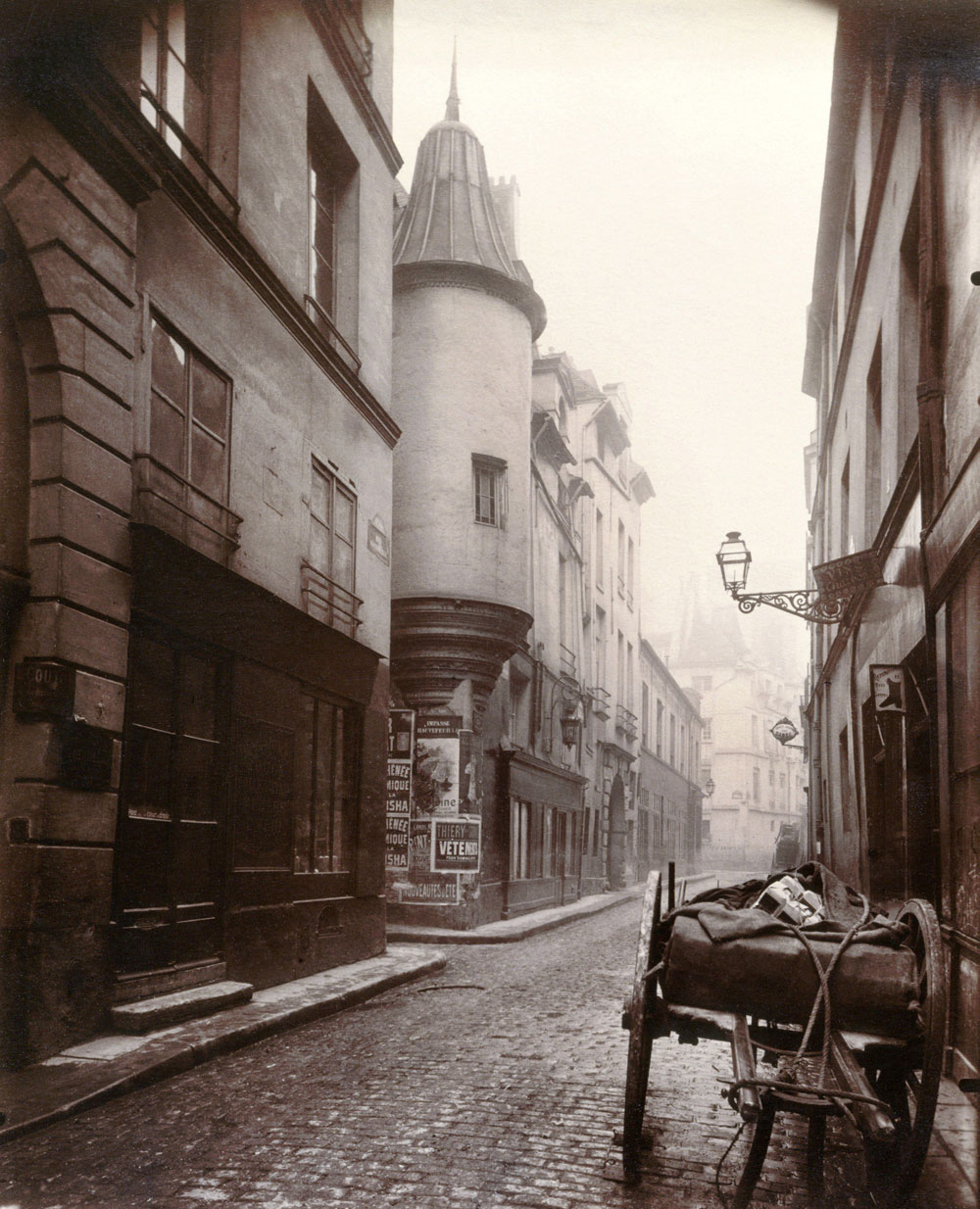
Eugène Atget (French, 1857-1927) 'Rue Hautefeuille, 6th arrondissement' 1898


Eugène Atget (French, 1857-1927)
Rue Hautefeuille, 6th arrondissement
1898
Albumen photograph
© Musée Carnavalet, Paris / Roger-Viollet / TopFoto


Eugène Atget (French, 1857-1927) 'Shop sign, au Rémouleur' 1899


Eugène Atget (French, 1857-1927)
Shop sign, au Rémouleur on the corner of the rue des Nonnains-d’Hyères and rue de l’Hôtel-de-Ville, 4th arrondissement
July 1899
Albumen photograph
© Musée Carnavalet, Paris / Roger-Viollet / TopFoto


Eugène Atget (French, 1857-1927) 'The former Collège de Chanac, 12 rue de Bièvre, 5th arrondissement' 1900


Eugène Atget (French, 1857-1927)
The former Collège de Chanac, 12 rue de Bièvre, 5th arrondissement
August 1900
Albumen photograph
© Musée Carnavalet, Paris / Roger-Viollet / TopFoto


Eugène Atget (French, 1857-1927) 'Porte d'Asnieres – cité Trébert' 1913


Eugène Atget (French, 1857-1927)
Porte d’Asnieres – cité Trébert
1913
Albumen print
21.7 x 18.0cm (trimmed)
Collection of George Eastman House, International Museum of Photography and Film, Rochester


Eugène Atget (French, 1857-1927) 'Rue de l'Hôtel de Ville' 1921


Eugène Atget (French, 1857-1927)
Rue de l’Hôtel de Ville
1921
Gelatin silver photograph
22.8 x 17.7cm
Collection Art Gallery of New South Wales


Eugène Atget (French, 1857-1927) 'Rue de l'Hôtel de Ville' 1921 (detail)


Eugène Atget (French, 1857-1927)
Rue de l’Hôtel de Ville (detail)
1921
Gelatin silver photograph
22.8 x 17.7cm
Collection Art Gallery of New South Wales


Art Gallery of New South Wales
Art Gallery Road, The Domain
Sydney NSW 2000, Australia

Opening hours:
Open every day 10am – 5pm
except Christmas Day and Good Friday

Art Gallery of New South Wales website

LIKE ART BLART ON FACEBOOK

Back to top

Exhibition: ‘Naked Before the Camera’ at the Metropolitan Museum of Art, New York

Exhibition dates: 27th March – 9th September 2012

WARNING: this posting contains photographs of nudity. If you do not like please do not look.


Many thankx to the Metropolitan Museum of Art for allowing me to publish the photographs in the posting. Please click on the photographs for a larger version of the image.


Franck-François-Genès Chauvassaignes (French, 1831 - after 1900) 'Untitled [Female Nude in Studio]' 1856-1859


Franck-François-Genès Chauvassaignes (French, 1831 – after 1900)
Untitled [Female Nude in Studio]
1856-1859
Salted paper print from glass negative
19.1 x 15.2cm (7.5 x 6 in.)
Metropolitan Museum of Art
Purchase, The Horace W. Goldsmith Foundation Gift, through Joyce and Robert Menschel, 1998
Public domain


This corner of a painter’s atelier somewhere in France in the middle of the nineteenth century is scarcely tethered to time or place; it could as easily be a loft in New York today or, had photography existed four centuries earlier, a studio in the Italian Renaissance. What is surprising here is the absence of even the thinnest disguise – no swags of drapery, elaborate coiffure, or skeins of beads as are commonly found in the work of other purveyors of “studies for artists.” Here, the model is utterly naked. With her intelligent head and dirty feet, this young woman helped found the matter-of-fact modelling sorority joined a decade later by Édouard Manet’s Olympia.

Text from the Metropolitan Museum of Art website


Félix-Jacques-Antoine Moulin (French, 1800 - after 1875) 'Untitled [Two Standing Female Nudes]' c. 1850


Félix-Jacques-Antoine Moulin (French, 1800 – after 1875)
Untitled [Two Standing Female Nudes]
c. 1850
Daguerreotype
Visible: 14.5 x 11.1cm (5 11/16 x 4 3/8 in.)
Metropolitan Museum of Art
The Rubel Collection, Purchase, Anonymous Gift and Lila Acheson Wallace Gift, 1997
Public domain


Although Moulin was sentenced in 1851 to a month in jail for producing images that, according to court papers, were “so obscene that even to pronounce the titles… would be to commit an indecency,” this daguerreotype seems more allied to art than to erotica. Instead of the boudoir props and provocative poses typical of hand-coloured pornographic daguerreotypes, Moulin depicted these two young women utterly at ease, as unselfconscious in their nudity as Botticelli’s Venus.

Text from the Metropolitan Museum of Art website


Unknown photographer (French) '[Seated Female Nude]' c. 1850


Unknown photographer (French)
[Seated Female Nude]
c. 1850
Daguerreotype
9.1 x 6.9cm (3 9/16 x 2 11/16 in.)
Metropolitan Museum of Art
Credit Line: Gilman Collection, Gift of The Howard Gilman Foundation, 2005
Public domain


This daguerreotype was surely intended to serve artistic purposes, but the odd twist of the body and the strange relationship of the three visible limbs seem to render it inappropriate for artistic emulation. Such tension between an artistic ideal and realistic means – between the classicism of an academic pose and the awkwardness of the camera’s rendering of human movement – seems emblematic of the dilemma faced by the nascent medium striving to be an art.

Text from the Metropolitan Museum of Art website


Julien Vallou de Villeneuve (French, 1795-1866) '[Standing Female Nude]' c. 1853


Julien Vallou de Villeneuve (French, 1795-1866)
[Standing Female Nude]
c. 1853
Salted paper print from paper negative
12 x 16cm (4 3/4 x 6 5/16 in.)
Metropolitan Museum of Art
Purchase, Lila Acheson Wallace Gift, 1993
Public domain


A student of the painter Jean François Millet (1814-1875) and a lithographer of scenes of daily life, costume, and erotica in the 1820s and 1830s, Vallou reportedly took up photography in the early 1840s. Because his early photographs have not been identified, it has been assumed that they depicted naked women, a subject for which it was to improper to acknowledge authorship.

Between 1851 and 1855, Vallou made a series of small-scale paper photographs of female nudes that he marketed (and legally registered) as models for artists. Vallou’s nudes have long been associated with those of Gustave Courbet (1819-1877), who is known to have used photographs in his painting process. Though no absolute one-to-one correspondence can be pointed to, there are some striking similarities in pose, and the heavy, soporific quality of Vallou’s models is very close to Courbet’s concept of the nude.

Text from the Metropolitan Muesum of Art website


Eugène Durieu (French, 1800-1874) 'Untitled [Seated Female Nude]' 1853-1854


Eugène Durieu (French, 1800-1874)
Untitled [Seated Female Nude]
1853-1854
Albumen silver print from glass negative
6 13/16 × 4 11/16 in. (17.3 × 11.9cm)
Metropolitan Museum of Art
Gilman Collection, Purchase, Mr. and Mrs. Henry R. Kravis Gift, 2005
Public domain


Durieu was a lawyer and early advocate and practitioner of photography in France who, in 1853-1854, made a series of photographic studies of nude and costumed figures as models for artists. The French Romantic painter Eugène Delacroix helped him pose the figures and later praised the prints, from which he sketched, as “palpable demonstrations of the free design of nature.” While the painter saw the accurate transcription of reality as a virtue of photography, Durieu knew that a good photograph was not simply the result of the correct use of the medium but, more significantly, an expression of the photographer’s temperament and vision. In an important article he emphasised the interpretative nature of the complex manipulations in photography and explained that the photographer must previsualise his results so as to make a “picture,” not just a “copy.”

This photograph proves Durieu’s point: through the elegant contours of the drapery, the smooth modelling of the flesh, and the grace and restraint of the pose, the picture attains an artistic poise that combines Delacroix’s sensuality with Ingres’s classicism, and rivals both.

Text from the Metropolitan Museum of Art website


Charles Alphonse Marlé (French, 1821 - after 1867) 'Untitled [Standing Male Nude]' c. 1855


Charles Alphonse Marlé (French, 1821 – after 1867)
Untitled [Standing Male Nude]
c. 1855
Salted paper print from paper negative
25.7 x 17.6cm (10 1/8 x 6 15/16 in.)
Metropolitan Museum of Art
Purchase, Ezra Mack Gift and The Horace W. Goldsmith Foundation Gift through Joyce and Robert Menschel, 1991


Marlé’s photograph was probably intended as an aid for painters and sculptors. The jury-rigged arrangement of podium, books, and potted tree, as well as the painting held in the background by a studio assistant, may strike the modern viewer as an incongruous contrast to the heroic gesture of the model. Marlé and those who bought his photograph, however, would have been absorbed by the grand academic pose and likely would have thought the awkward accoutrements of little consequence.

Text from the Metropolitan Museum of Art website


Nadar (French, Paris 1820 - 1910 Paris) '[Standing Female Nude]' 1860-1861


Nadar (French, Paris 1820 – 1910 Paris)
[Standing Female Nude]
1860-1861
20.2 x 13.3cm (7 15/16 x 5 1/4 in.)
Metropolitan Museum of Art
Purchase, The Horace W. Goldsmith Foundation Gift, through Joyce and Robert Menschel, 1991
Public Domain


Famed for his portraits of writers, artists, and left-wing politicians, Nadar is known to have photographed only three female nudes. This one was made at the behest of the painter Jean-Léon Gérôme to assist in the process of painting Phryné before the Areopagus, displayed at the Salon of 1861. Gérôme’s painting depicts the moment when the famous courtesan Phryné, on trial for impiety, is suddenly unveiled by her lawyer; persuaded by Phryné’s divine beauty, the jurors acquit her.

Like Phryné, who is said to have modelled for the ancient Greek painter Apelles and other artists of antiquity, Nadar’s model, Marie-Christine Leroux (1820-1863), was widely sought by artists of her time and was the basis for the character Musette in Henri Murger’s Scènes de la vie de bohème.

Text from the Metropolitan Museum of Art website


Depicting the human body has been among the greatest challenges, preoccupations, and supreme achievements of artists for centuries. The nude – even in generalised or idealised renderings – has triggered impassioned discussions about sin, sexuality, cultural identity, and canons of beauty, especially when the chosen medium is photography, with its inherent accuracy and specificity. Through September 9, 2012, Naked before the Camera, an exhibition of more than 60 photographs selected from the renowned holdings of The Metropolitan Museum of Art, surveys the history of this subject and explores some of the motivations and meanings that underlie photographers’ fascination with the nude.

“In every culture and across time, artists have been captivated by the human figure,” commented Thomas P. Campbell, Director of the Metropolitan. “In Naked before the Camera, we see how photographers have used their medium to explore this age-old subject and create compelling new images.”

The exhibition begins in the 19th century, when photographs often served artists as substitutes for live models. Such “studies for artists” were known to have been used by the French painter Gustave Courbet, whose Woman with a Parrot (1866), for instance, is strikingly similar to photographer Julien Vallou de Villeneuve’s Female Nude of 1853. Even when their stated purpose was to aid artists, however, the best of these 19th-century photographs of the nude were also intended as works of art in their own right. Two recently acquired photographs, made in the mid-1850s by an unknown French artist, are striking examples. Not only are they larger than all other photographic nudes from the time, they stand out due to an extraordinary surface pattern that interrupts the images and suggests a view through gossamer or a photograph printed on finely pleated silk rather than paper. The elegant Female Nude harkens back to an Eve or Venus and is vignetted by the camera lens as if seen through a peephole, while her male counterpart is shown in strict profile in a pose that recalls precedents from antiquity. Each figure draws from the past while being presented in a strikingly modern way, without any equivalent among other 19th-century studies for artists.

Not all photographers of the nude were motivated by artistic desire. The second section of Naked before the Camera includes photographs made for medical and forensic purposes, as ethnographic studies, as tools to analyse anatomy and movement, and – not surprisingly – as erotica. The lines between such categories were not always clearly drawn; some photographers called their images “studies for artists” merely to evade the censors, while viewers of the G. W. Wilson Studio’s Zulu Girls (1892-93) or Paul Wirz’s ethnographic photographs of scantily clad Indonesians from the 1910s and 1920s were undoubtedly titillated by the blending of exoticism and eroticism.

Beginning in the fertile period of modernist experimentation that followed on the heels of World War I, photographers such as Brassaï, Man Ray, Hans Bellmer, André Kertész, and Bill Brandt found in the human body a perfect vehicle for both visual play and psycho-sexual exploration. In Distortion #6 (1932) by André Kertész, a woman’s body is stretched and pulled in the reflections of a fun-house mirror – a figure from a Surrealist dream that stands in stark contrast to the images of perfect feminine beauty by earlier photographers.

In mid-20th-century America, photographers more often communicated an intimate connection with their subjects. Following the example of Alfred Stieglitz’s famed portraits of Georgia O’Keeffe, photographers such as Edward Weston, Harry Callahan, and Emmet Gowin made many nude studies of their wives. Callahan’s photograph of his wife and daughter, Eleanor and Barbara, Chicago (1954), for instance, gives the viewer access to a private, tender moment of intimacy.

In the wake of the sexual revolution of the 1960s and the AIDS crisis that began in the 1980s, artists began to think of the body as a politicised terrain and explored issues of identity, sexuality, and gender. Diane Arbus’s Retired man and his wife at home in a nudist camp one morning, N.J. (1963) and A naked man being a woman, N.Y.C. (1968), Larry Clark’s untitled image (1972-1973) from the series Teenage Lust, and Hannah Wilke’s Snatch Shot with Ray Gun (1978) are among the works featured in the concluding section of the exhibition.

Press release from the Metropolitan Museum of Art website


Unknown photographer (French) '[Nude with Mirror]' c. 1850


Unknown photographer (French)
[Nude with Mirror]
c. 1850
Daguerreotype
Dimensions: visible: 7 x 5.7cm (2 3/4 x 2 1/4 in.)
Metropolitan Museum of Art
The Rubel Collection, Purchase, Lila Acheson Wallace Gift, 1997
Public domain


Julien Vallou de Villeneuve (French, 1795-1866) '[Reclining Female Nude]' c. 1853


Julien Vallou de Villeneuve (French, 1795-1866)
[Reclining Female Nude]
c. 1853
Salted paper print from paper negative
11.8 x 16.0cm (4 5/8 x 6 5/16 in.)
Metropolitan Museum of Art
Purchase, Lila Acheson Wallace Gift, 1993
Public domain


A student of the painter Jean François Millet and a lithographer of scenes of daily life, costume, and erotica in the 1820s and 1830s, Vallou reportedly took up photography in the early 1840s, but his early photographs have not been identified. Perhaps they depicted naked women, a subject for which it was improper to acknowledge authorship.

Between 1851 and 1855, however, Vallou made a series of photographs of female nudes that he marketed (and legally registered) as models for artists. Vallou’s nudes have long been associated with those of Gustave Courbet, who is known to have used photographs in his painting process. Although no absolute one-to-one correspondence can be pointed to, the heavy soporific quality of Vallou’s models is very close to Courbet’s concept of the nude, and the reclining figure displayed here is strikingly similar in pose to the painter’s Woman with a Parrot (1866), on view in the galleries for nineteenth-century painting.

Text from the Metropolitan Museum of Art website


Gustave Le Gray (French, 1820-1884) 'Nu féminin allongé sur un canapé Récamier' (Female nude lying on a Recamier sofa) c. 1856


Gustave Le Gray (French, 1820-1884)
Nu féminin allongé sur un canapé Récamier (Female nude lying on a Recamier sofa)
c. 1856
Albumen silver print from glass negative
21.7 x 32.9cm (8 9/16 x 12 15/16 in.)
Metropolitan Museum of Art
Gilman Collection, Purchase, The Horace W. Goldsmith Foundation Gift, through Joyce and Robert Menschel, 2005
Public domain


The central figure in French photography of the 1850s, Le Gray was a master of many genres including landscape and seascape, architectural photography, and portraiture. Only four nude studies by Le Gray are known, however, each in a single example. In this striking image, the photographer departed from the usual academic treatment of the nude, such as he might have learned from his years in the painting studio of Paul Delaroche, in favor of a more psychologically charged spirit. The daybed’s velvet upholstery, the tassels on the pillow, and the heavy curtain fabric have a reassuring and familiar presence, but the serpentine locks of hair evoke Medusa and hint at strangulation, while the legs and feet cross and tense in the manner of a crucifixion. Withdrawn in sleep – or is it death? – the beautiful young woman reminds one of a drowning victim, an Ophelia freshly recovered from the Seine, a theme favoured by the painters and poets of Paris.

Text from the Metropolitan Museum of Art website


Unknown photographer (French) '[Standing Female Nude]' c. 1856


Unknown photographer (French)
[Standing Female Nude]
c. 1856
Salted paper print from collodion glass negative
43.4 x 28.3cm (17 1/16 x 11 1/8 in.)
Metropolitan Museum of Art
Purchase, Louis V. Bell, Harris Brisbane Dick, Fletcher, and Rogers Funds and Joseph Pulitzer Bequest; Edwynn Houk and Hans P. Kraus Jr., Alfred Stieglitz Society, Robert Mapplethorpe Foundation, Anonymous, Adam R. Rose and Peter R. McQuillan, Joseph M. Cohen, Susan and Thomas Dunn, Kurtz Family Foundation, W. Bruce and Delaney H. Lundberg, Christian Keesee Charitable Trust, and Robert A. Taub Gifts; and Funds from various donors, 2012
Public domain


The original impulse behind these boldly ambitious figure studies may have been to aid a painter or sculptor, but they are nonetheless without parallel in the early history of photography. Enlarged to the size of drawn académies – drawings of the live model that were a standard part of art instruction in France – their scale alone sets them apart from the more modest productions of Vallou de Villeneuve, Durieu, and other artists of the 1850s. More unusually, the images are interrupted by a surface pattern that gives the impression that the photographs are printed on finely pleated silk rather than paper – likely the result of a technical error. Instead of wiping clean his glass-plate negatives and starting over as virtually all other photographers would have done, this artist recognised that the pattern created a veil that, like time or memory, removed the images from their merely utilitarian purpose and elevated them from the mundane to the realm of art.

Just as the eye and mind may be pleasantly torn between bravura brushwork and the ostensible subject of a painting, there is a tension here between the beauty of the subject – the elegant female draped in gossamer; the strict profile and geometric setting of the male – and the visible traces of their creation, such as the flowing surface pattern and the strong vignetting of the female, which suggests a view spied through a peephole.

Text from the Metropolitan Museum of Art website


Unknown photographer (French) '[Standing Male Nude]' c. 1856


Unknown photographer (French)
[Standing Male Nude]
c. 1856
Salted paper print from collodion glass negative
43.4 x 28.4cm (17 1/16 x 11 3/16 in.)
Metropolitan Museum of Art
Purchase, Louis V. Bell, Harris Brisbane Dick, Fletcher, and Rogers Funds and Joseph Pulitzer Bequest; Edwynn Houk and Hans P. Kraus Jr., Alfred Stieglitz Society, Robert Mapplethorpe Foundation, Anonymous, Adam R. Rose and Peter R. McQuillan, Joseph M. Cohen, Susan and Thomas Dunn, Kurtz Family Foundation, W. Bruce and Delaney H. Lundberg, Christian Keesee Charitable Trust, and Robert A. Taub Gifts; and funds from various donors, 2012
Public domain
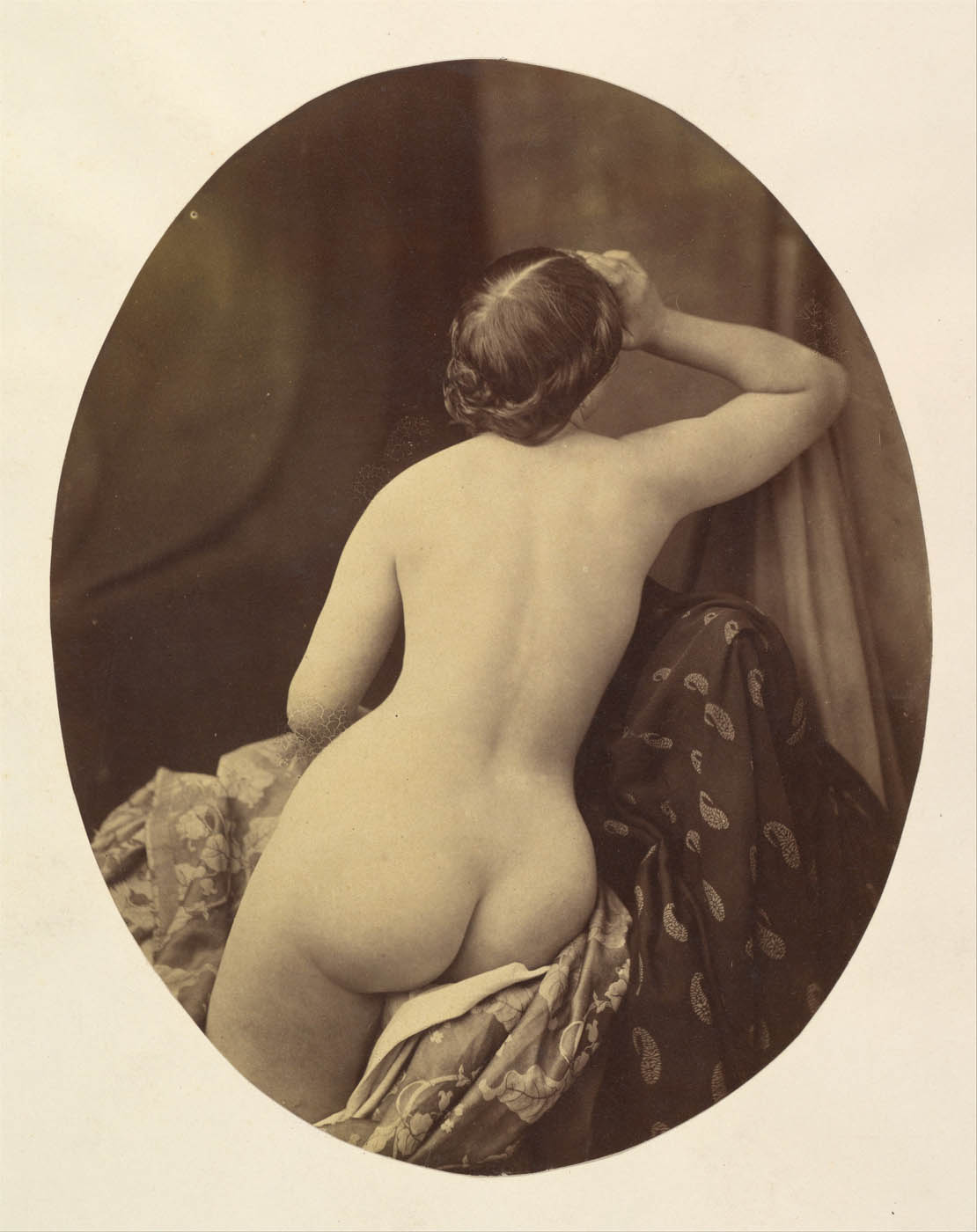
 

Oscar Gustav Rejlander (British born Sweden, 1813-1875) 'Ariadne' 1857


Oscar Gustav Rejlander (British born Sweden, 1813-1875)
Ariadne
1857
Albumen silver print from glass negative
Mount: 16 1/16 in. × 13 1/16 in. (40.8 × 33.2cm)
Image: 8 1/4 × 6 1/2 in. (21 × 16.5cm); oval
Metropolitan Museum of Art
Gilman Collection, Purchase, The Horace W. Goldsmith Foundation Gift, through Joyce and Robert Menschel, 2005
Public domain


Working in a place – Victorian England – where any photographic nude was considered offensive because the process implied not only the “nastiness” of the artist and vendor, but also “the degradation of the person who serves as model on the occasion,” Rejlander sought to ally his work with that of noted painters. This nude study is one of a series based on figures in the work of Raphael, Titian, Correggio, Rubens, Murillo, and Gainsborough; the precedent here is Titian’s Venus and Adonis, and Rejlander’s intention was to show how the painter adhered to or strayed from the ways a real body can twist and turn. Critic A. H. Wall defended the propriety of Rejlander’s Studies from the Nude, saying, “Refined and ennobled by art, real beauty, palpable flesh and blood, speaks of nothing but its own inherent loveliness.”

Such references to painting did not always afford adequate protection, however. Writing of Rejlander’s famous Two Ways of Life, photographer and critic Thomas Sutton wrote, “There is no impropriety in exhibiting such works of art as Etty’s Bathers Surprised by a Swan or the Judgment of Paris but there is impropriety in allowing the public to see photographs of nude prostitutes, in flesh-and-blood truthfulness and minuteness of detail.”

Text from the Metropolitan Museum of Art website


Unknown photographer (French) '[Female Nude with Mask]' c. 1870


Unknown photographer (French)
[Female Nude with Mask]
c. 1870
Albumen silver print from glass negative
26 x 19.1cm (10 1/4 x 7 1/2 in.)
Metropolitan Museum of Art
Gilman Collection, Gift of The Howard Gilman Foundation, 2005
Public domain


Even as she seems to part her tresses to expose her naked body, the model here masks her face in an effort to conceal her identity. While drawing, painting, and sculpture of the human figure commonly involve elements of transformation, idealisation, or the combination of features from various models, photography usually presents a recognisable image of its subject. It was not uncommon, therefore, for models who routinely posed nude for artists in other media to hide their faces when standing naked before the camera. For the viewer – not always an artist looking for help in figure drawing – the mask added an element of erotic frisson.

Text from the Metropolitan Museum of Art website
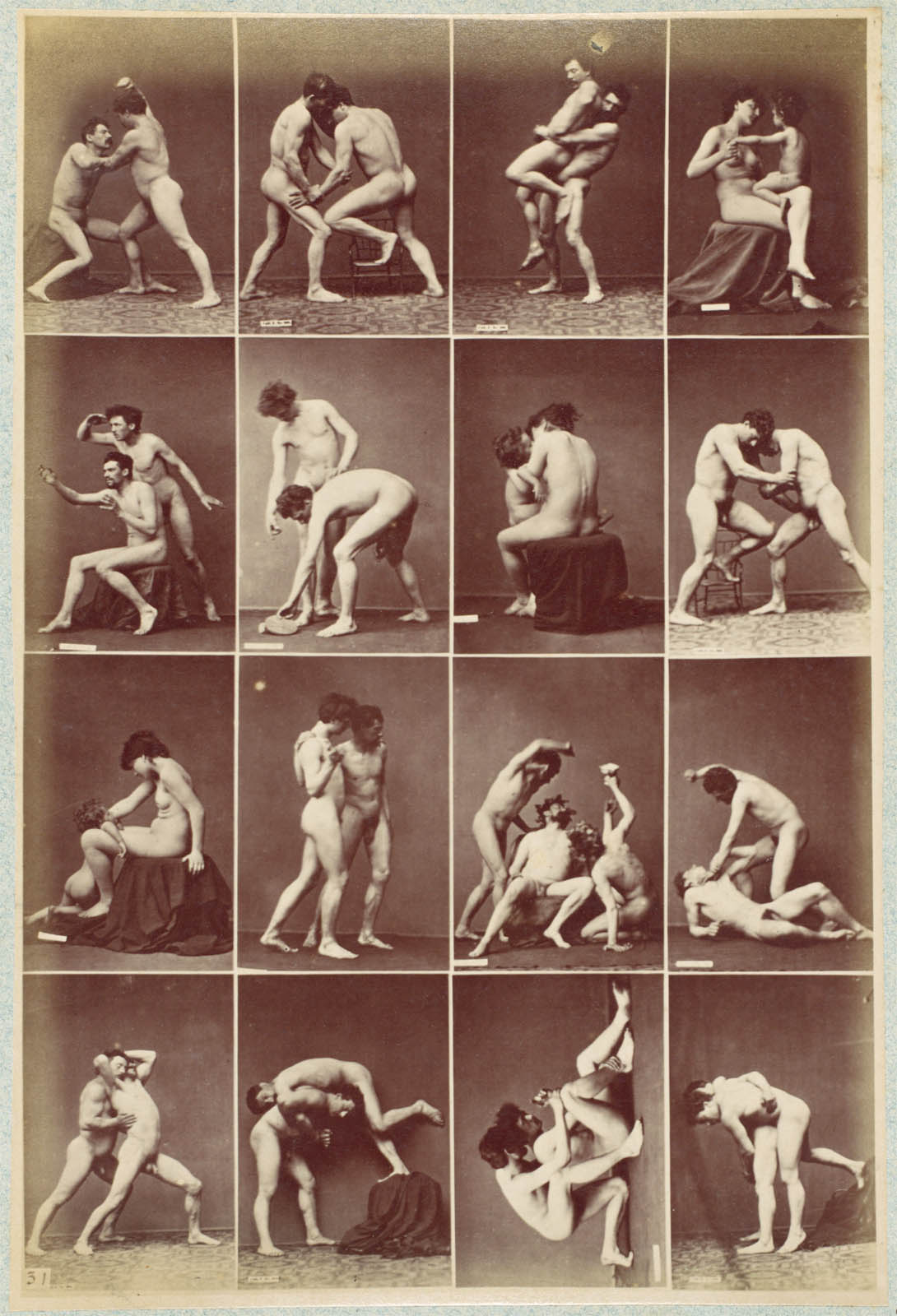
 

Louis Igout (French, 1837-1881)(Photographer) A. Calavas (French)(Editor) 'Plate from Album d'Études – Poses' c. 1880


Louis Igout (French, 1837-1881)(Photographer)
A. Calavas (French)(Editor)
Plate from Album d’Études – Poses
c. 1880
Albumen silver prints from glass negatives
Metropolitan Museum of Art
Purchase, The Horace W. Goldsmith Foundation Gift, through Joyce and Robert Menschel, 1993
Public domain


This album is an excellent example of the type of photography produced in the nineteenth century as an aid to artists in the study of contour, modelling, and proportion, and as a vocabulary of expression, gesture, and pose sanctioned by the art of antiquity and the Old Masters. Groupings representing Cain and Abel, the Drunken Silenus, Hercules and Antaeus, the Dying Gaul, the Cnidian Aphrodite, and others are recognisable among the photographs. Single prints showing sixteen small images, such as the page shown here, served as a type of stock catalogue, allowing clients to survey a broad range of possible poses and order larger prints of those which best served their needs.

Text from the Metropolitan Museum of Art website
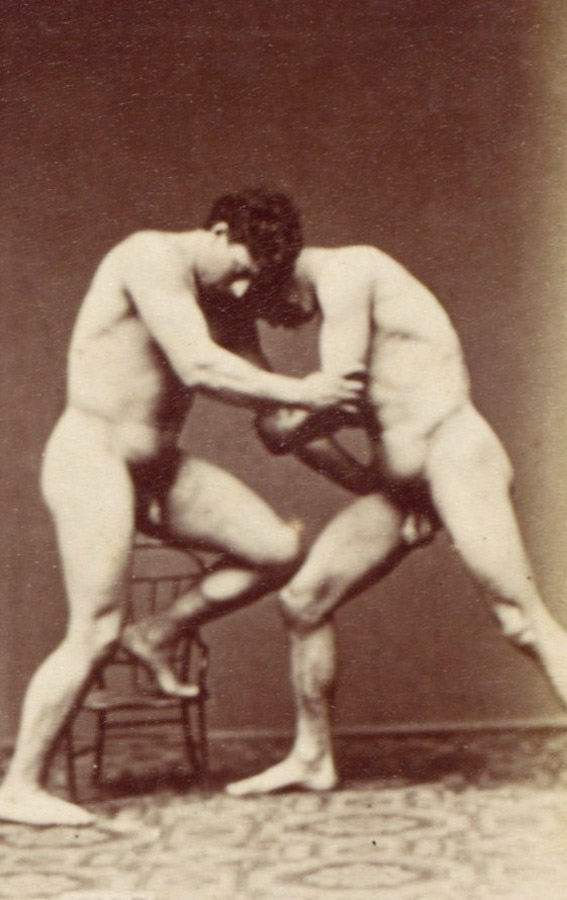
 

Louis Igout (French, 1837-1881)(Photographer) A. Calavas (French)(Editor) 'Plate from Album d'Études – Poses' c. 1880 (detail)

Louis Igout (French, 1837-1881)(Photographer) A. Calavas (French)(Editor) 'Plate from Album d'Études – Poses' c. 1880 (detail)

Louis Igout (French, 1837-1881)(Photographer) A. Calavas (French)(Editor) 'Plate from Album d'Études – Poses' c. 1880 (detail)


Louis Igout (French, 1837-1881)(Photographer)
A. Calavas (French)(Editor)
Plate from Album d’Études – Poses (details)
c. 1880
Albumen silver prints from glass negatives
Metropolitan Museum of Art
Purchase, The Horace W. Goldsmith Foundation Gift, through Joyce and Robert Menschel, 1993
Public domain


Thomas Eakins (American, 1844-1916) '(Thomas Eakins and John Laurie Wallace on a Beach)' c. 1883


Thomas Eakins (American, Philadelphia, Pennsylvania 1844–1916 Philadelphia, Pennsylvania)
[Thomas Eakins and John Laurie Wallace on a Beach]
c. 1883
Platinum print
25.5 x 20.4cm (10 1/16 x 8 1/16 in.), irregular
Metropolitan Museum of Art
David Hunter McAlpin Fund, 1943
Public domain


The great American painter and photographer Thomas Eakins was devoted to the scientific study of the human form and committed to its truthful representation. While he and his students at the Pennsylvania Academy of the Fine Arts were surrounded by casts of classical sculpture, Eakins declared that he did not like “a long study of casts. … At best they are only imitations, and an imitation of imitations cannot have so much life as an imitation of life itself.” Photography provided an obvious solution.

This photograph, in which Eakins and a student affected the elegant contrapposto stances of classical sculpture, was probably taken during an excursion with students to Manasquan Inlet at Point Pleasant, New Jersey, during the summer of 1883. Valuing his photographs not only as studies for paintings but also for their own sake, Eakins carefully printed the best images on platinum paper. In this case, he went to the additional trouble of enlarging the original, horizontally formatted image and cropping it vertically to better contain the perfectly balanced figures.

Text from the Metropolitan Museum of Art website
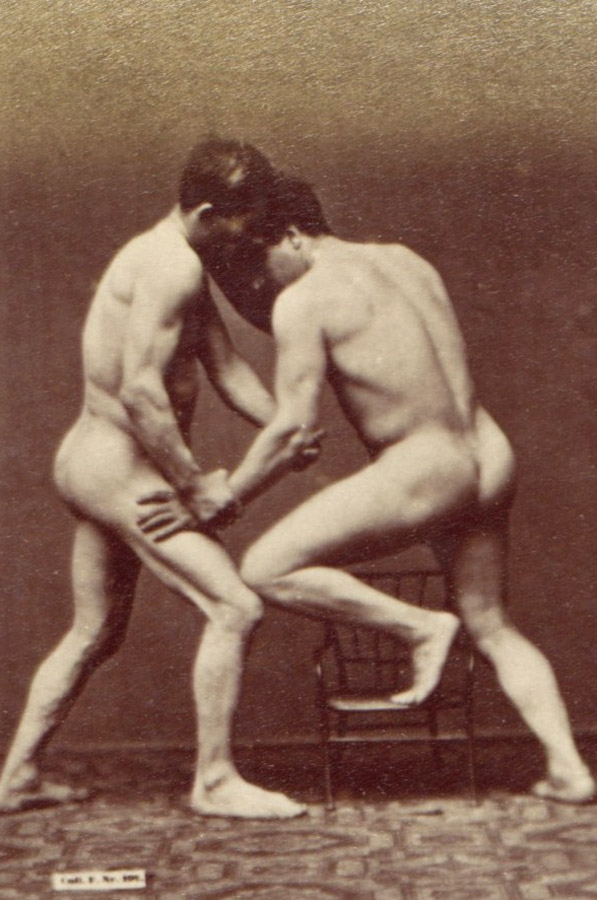
 

Albert Londe (French, 1858-1917) Paul Marie Louis Pierre Richer (French, 1849-1933) '[Male Musculature Study]' c. 1890


Albert Londe (French, 1858-1917)
Paul Marie Louis Pierre Richer (French, 1849-1933)
[Male Musculature Study]
c. 1890
Albumen silver print
Image: 14.9 x 9.6 cm (5 7/8 x 3 3/4 in.)
Mount: 14.9 x 9.9 cm (5 7/8 x 3 7/8 in.)
Metropolitan Museum of Art
Gift of Charles Isaacs and Carol Nigro, 2012


Author of a treatise on the importance of the camera in medical practice, Albert Londe declared, “the photographic plate is the scientist’s true retina.” In collaboration with a laboratory director and professor of anatomy at the École des Beaux-Arts, Londe found that photographs intended for physiological analysis could also serve artistic applications. Their careful portraits of athletes – whether taken with stop-action cameras specially designed by Londe or in static poses such as the example here – were used in scientific texts on musculature and became templates for illustrations to aid artists in rendering ideally proportioned figures.

Text from the Metropolitan Museum of Art website
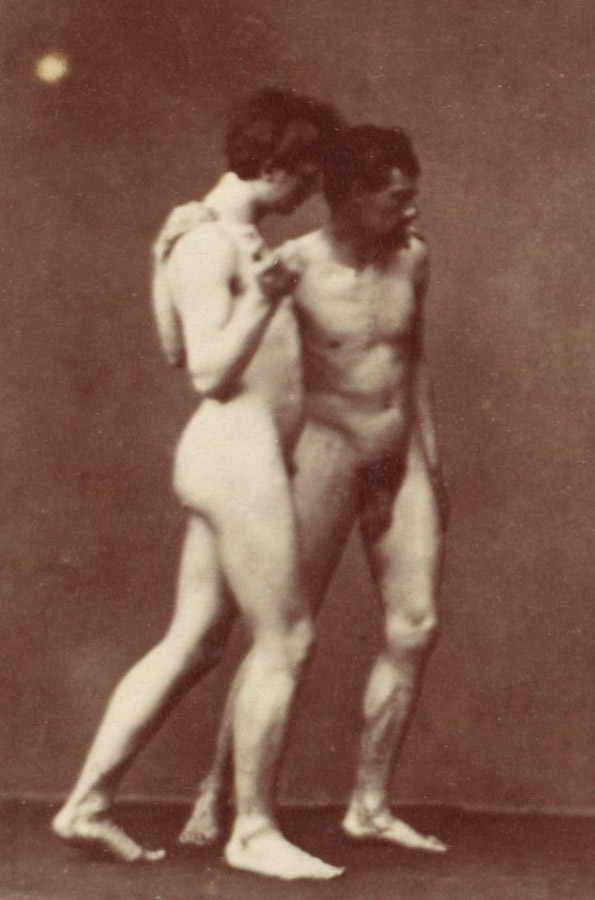
 

Guglielmo Plüshow (Italian born Germany, 1852–1930) '[Young Male Nude Seated on Leopard Skin]' 1890s-1900s


Guglielmo Plüshow (Italian born Germany, 1852–1930)
[Young Male Nude Seated on Leopard Skin]
1890s-1900s
Albumen silver print from glass negative
22.2 x 16.2cm (8 3/4 x 6 3/8 in.)
Metropolitan Museum of Art
Museum Accession
Creative Commons CC0 1.0 Universal Public Domain Dedication


Censors have long struggled to keep pace with evolving technology and expanding distribution networks of photographic erotica. In nineteenth-century France, government officials regularly seized thousands of photographs similar to the daguerreotype displayed here, which were deemed lewd.

Male nudity has frequently been subject to stricter control than pornography featuring women. The Arcadian photographs of Plüshow and his cousin and student Wilhelm von Gloeden were avidly collected in the late nineteenth century, but in the 1930s many of their prints and negatives, considered deviant by the Italian Fascist government, were destroyed. For much of the twentieth century, it was illegal in the United States to mail photographs that might be judged prurient, forcing photographers to mask genitalia and pubic hair with strategic props or with overpainting that could be easily removed by purchasers. Sale of erotic male physique magazines and bodybuilder pin-ups, ostensibly circulated to promote fitness, was legalised in a 1962 Supreme Court ruling, which concluded that “portrayals of the male nude cannot fairly be regarded as more objectionable than many portrayals of the female nude that society tolerates.”

Text from the Metropolitan Museum of Art website
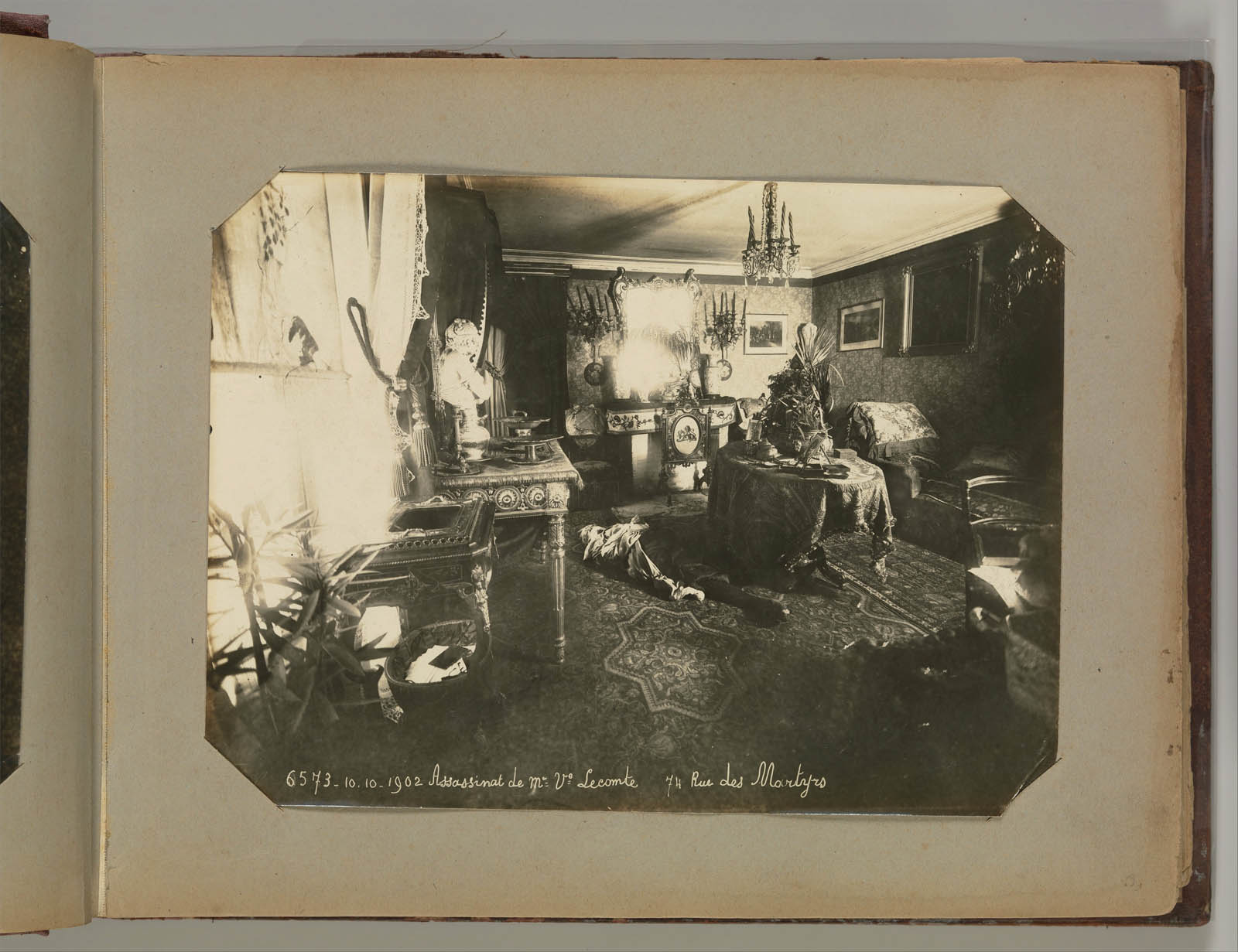
 

Attributed to Alphonse Bertillon (French, 1853–1914) 'Assasination of C. Lecomte 711 Rue des Martyrs' 1901-1908 From 'Album of Paris Crime Scenes'


Attributed to Alphonse Bertillon (French, 1853–1914)
Assasination of C. Lecomte 711 Rue des Martyrs
1901-1908
From Album of Paris Crime Scenes
Gelatin silver print
Overall: 24.3 x 31cm (9 9/16 x 12 3/16in.)
Page: 23 x 29cm (9 1/16 x 11 7/16 in.)
Metropolitan Museum of Art
Gilman Collection, Purchase, The Howard Gilman Foundation Gift, 2001
Public domain


Alphonse Bertillon, the chief of criminal identification for the Paris police department, developed the mug shot format and other photographic procedures used by police to register criminals. Although the images in this extraordinary album of forensic photographs were made by or under the direction of Bertillon, it was probably assembled by a private investigator or secretary who worked at the Paris prefecture. Photographs of the pale bodies of murder victims are assembled with views of the rooms where the murders took place, close-ups of objects that served as clues, and mug shots of criminals and suspects. Made as part of an archive rather than as art, these postmortem portraits, recorded in the deadpan style of a police report, nonetheless retain an unsettling potency.

Text from the Metropolitan Museum of Art website
 

Attributed to Alphonse Bertillon (French, 1853–1914) 'Untitled' 1901-1908 From 'Album of Paris Crime Scenes'


Attributed to Alphonse Bertillon (French, 1853–1914)
Untitled
1901-1908
From Album of Paris Crime Scenes
Gelatin silver print
Overall: 24.3 x 31cm (9 9/16 x 12 3/16in.)
Page: 23 x 29cm (9 1/16 x 11 7/16 in.)
Metropolitan Museum of Art
Gilman Collection, Purchase, The Howard Gilman Foundation Gift, 2001
Public domain
 

Attributed to Alphonse Bertillon (French, 1853–1914) 'Untitled' 1901-1908 From 'Album of Paris Crime Scenes'


Attributed to Alphonse Bertillon (French, 1853–1914)
Untitled
1901-1908
From Album of Paris Crime Scenes
Gelatin silver print
Overall: 24.3 x 31cm (9 9/16 x 12 3/16in.)
Page: 23 x 29cm (9 1/16 x 11 7/16 in.)
Metropolitan Museum of Art
Gilman Collection, Purchase, The Howard Gilman Foundation Gift, 2001
Public domain


Lady Ottoline Violet Anne Cavendish-Bentinck Morrell (British, 1873-1938) '[Cavorting by the Pool at Garsington]' c. 1916


Lady Ottoline Violet Anne Cavendish-Bentinck Morrell (British, 1873-1938)
[Cavorting by the Pool at Garsington]
c. 1916
Gelatin silver print
8.8 x 6.3cm (3 7/16 x 2 7/16 in.)
Metropolitan Museum of Art
Gilman Collection, Purchase, The Horace W. Goldsmith Foundation Gift, through Joyce and Robert Menschel, 2005
Creative Commons CC0 1.0 Universal Public Domain Dedication


Rebelling against the narrow values of upper-class Edwardian society, Lady Ottoline Morrell, an eccentric hostess to Bloomsbury, surrounded herself in London and on her estate at Garsington with a large circle of friends including Bertrand Russell, W. B. Yeats, D. H. Lawrence, T. S. Eliot, Virginia Woolf, Aldous Huxley, and E. M. Forster. These images of an improvised dance show Lady Ottoline’s ten-year-old daughter, Julian, and her slightly older companions embroiled in a naked whirl, pagan in its exuberance, that reflects the emancipated attitudes of the photographer’s circle.

Text from the Metropolitan Museum of Art website


Lady Ottoline Violet Anne Cavendish-Bentinck Morrell (British, 1873-1938) '[Cavorting by the Pool at Garsington]' c. 1916


Lady Ottoline Violet Anne Cavendish-Bentinck Morrell (British, 1873-1938)
[Cavorting by the Pool at Garsington]
c. 1916
Gelatin silver print
8.8 x 6.2cm (3 7/16 x 2 7/16 in.)
Metropolitan Museum of Art
Gilman Collection, Purchase, The Horace W. Goldsmith Foundation Gift, through Joyce and Robert Menschel, 2005
Creative Commons CC0 1.0 Universal Public Domain Dedication


Edward Weston (American, Highland Park, Illinois 1886 - 1958 Carmel, California) '[Nude]' 1925


Edward Weston (American, Highland Park, Illinois 1886 – 1958 Carmel, California)
[Nude]
1925
Gelatin silver print
Image: 14.8 x 23.4 cm (5 13/16 x 9 3/16 in.)
Mount: 35.2 x 43.9 cm (13 7/8 x 17 5/16 in.)
Metropolitan Museum of Art
Gilman Collection, Purchase, Ann Tenenbaum and Thomas H. Lee Gift, 2005
© Center for Creative Photography, Arizona Board of Regents
Public domain


In his early attempts to merge the realism of photography with the expressive effect of abstract art, Weston honed in on close-up details of his subjects. That the faces of his models were often cropped or averted served practical as well as aesthetic purposes, enabling the photographs to be read as figure studies rather than as individual portraits while also protecting the privacy of the friends and lovers who served as models.

Text from the Metropolitan Museum of Art website


George Platt Lynes (American, East Orange, New Jersey 1907–1955 New York) '[Male Nude]' 1930s


George Platt Lynes (American, East Orange, New Jersey 1907–1955 New York)
[Male Nude]
1930s
Gelatin silver print
24.5 x 18.9cm (9 5/8 x 7 7/16 in.)
Metropolitan Museum of Art
Ford Motor Company Collection, Gift of Ford Motor Company and John C. Waddell, 1987
© Estate of George Platt Lynes
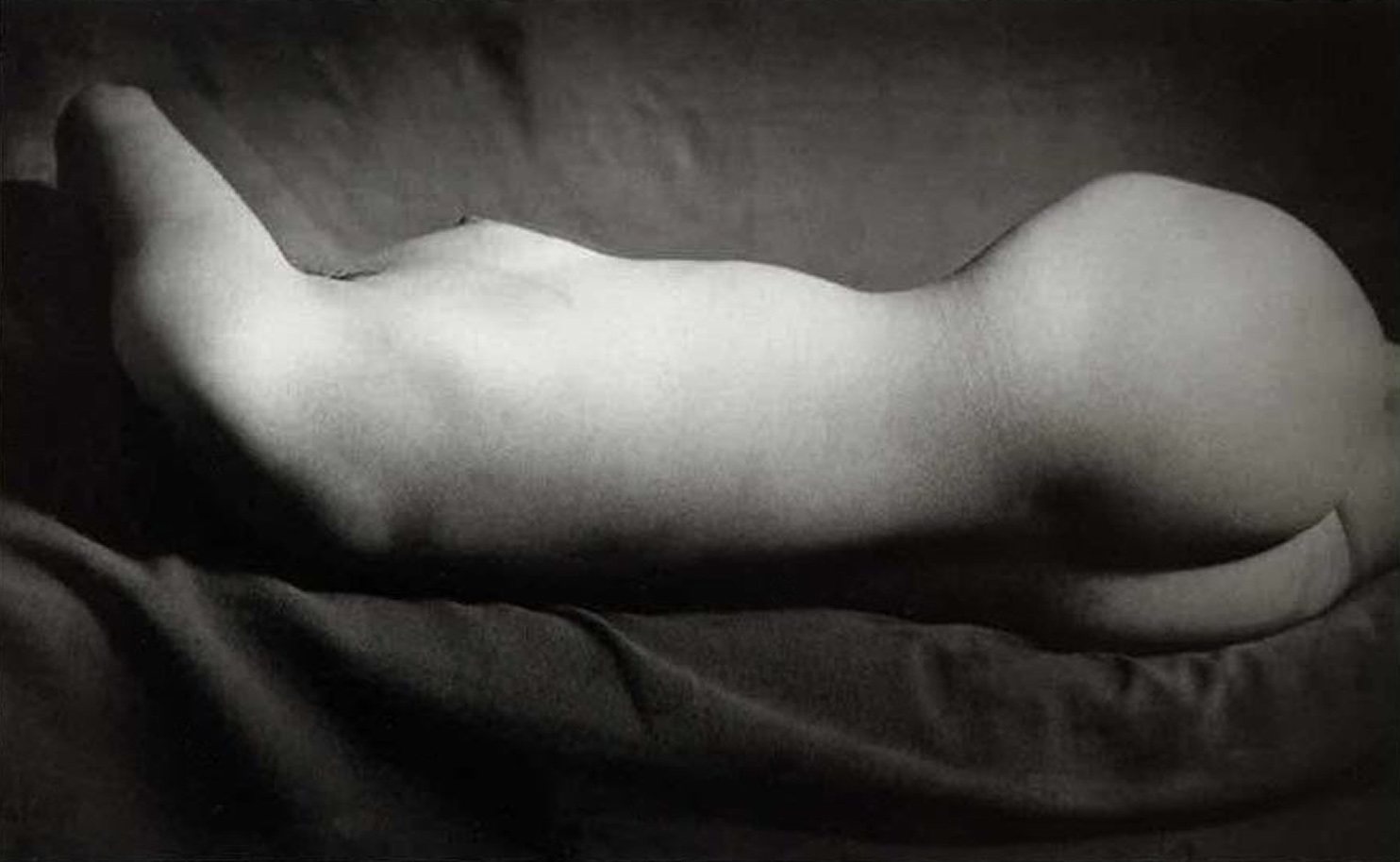
 

Brassaï (French born Romania, Brasov 1899 - 1984 Côte d'Azur) 'Nude' 1931-1934


Brassaï (French born Romania, Brasov 1899 – 1984 Côte d’Azur)
Nude
1931-1934
Gelatin silver print
14.1 x 23.5cm (5 9/16 x 9 1/4 in.)
Metropolitan Museum of Art
Twentieth-Century Photography Fund, 2007
© The Estate of Brassai


One of the most radically abstract of Brassaï’s nudes, this image was published in 1933 in the inaugural issue of the avant-garde magazine Minotaure. With the figure’s head and legs cut off by the picture’s edges, the twisting, truncated torso seems to float in space like an apparition – an ambiguous, organic form with an uncanny resemblance to a phallus. This transformation of the female figure into a fetish object is a hallmark of Surrealism that reflects the important influence of Freud’s psychoanalytic theory on European art of the early twentieth century.

Text from the Metropolitan Museum of Art website
 

Brassaï (French born Romania, Brasov 1899 - 1984 Côte d'Azur) 'L'Académie Julian' 1931, printed 1950s


Brassaï (French born Romania, Brasov 1899 – 1984 Côte d’Azur)
L’Académie Julian
1931, printed 1950s
Gelatin silver print
29.7 x 23.7cm (11 11/16 x 9 5/16 in.)
Metropolitan Museum of Art
Gilman Collection, Purchase, The Horace W. Goldsmith Foundation Gift, through Joyce and Robert Menschel, 2005
© Estate Brassaï Succession – Paris
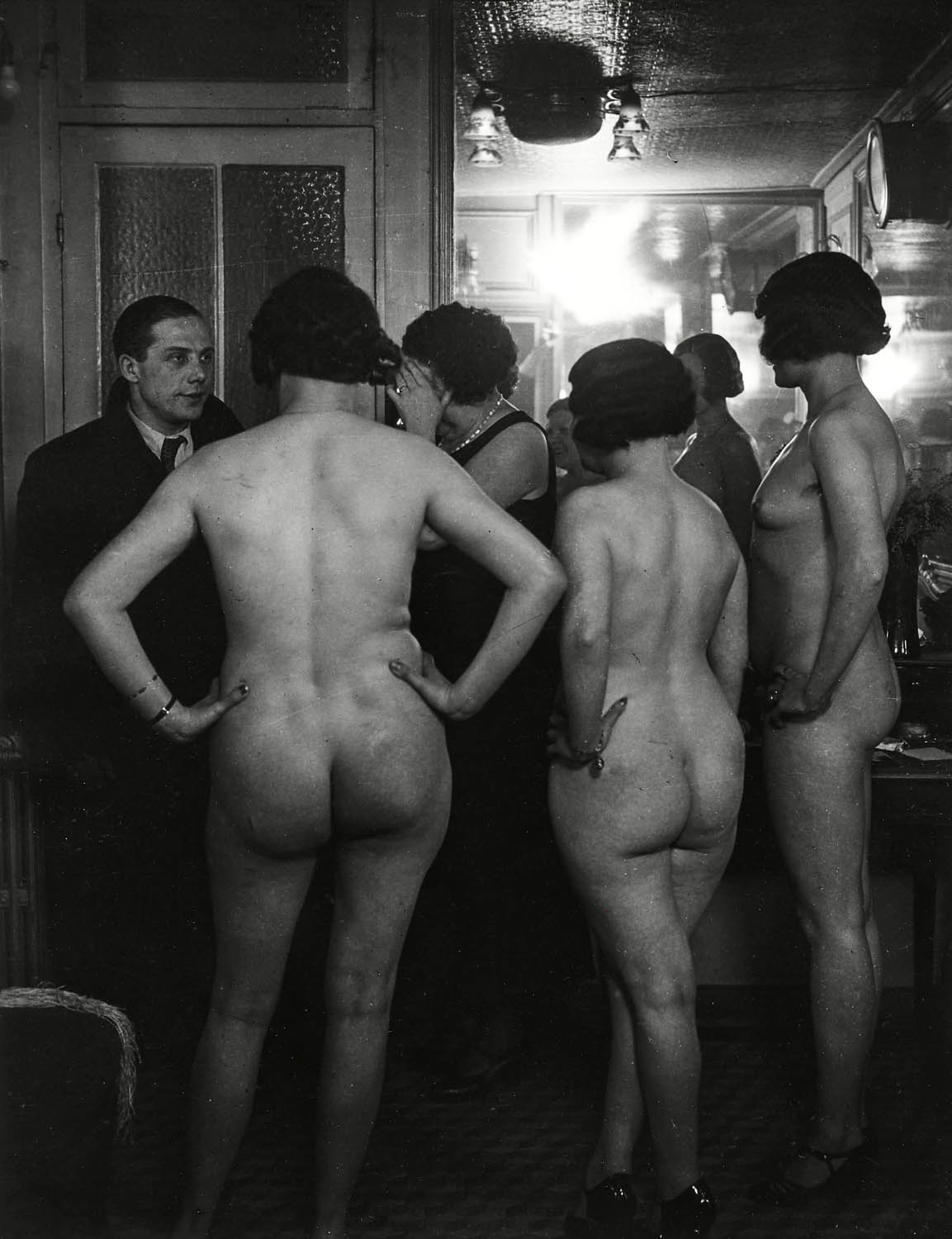
 

Brassaï (French born Romania, Brasov 1899 - 1984 Côte d'Azur) 'Introductions at Suzy's' 1932-1933


Brassaï (French born Romania, Brasov 1899 – 1984 Côte d’Azur)
Introductions at Suzy’s
1932-1933, printed later
Gelatin silver print
23.1 x 16.8cm (9 1/16 x 6 5/8 in.)
Metropolitan Museum of Art
Ford Motor Company Collection, Gift of Ford Motor Company and John C. Waddell, 1987
© Estate Brassaï Succession – Paris


Brassaï made his name as a chronicler of the night, with images that ranged from reflections on wet cobblestones to the denizens of bars and brothels. Like so many of his photographs, Introductions at Suzy’s was not an impromptu scene caught by an undetected observer but rather a carefully constructed tableau meant to highlight the dynamic between buttoned-up bourgeois clients and Suzy’s bevy of prostitutes, naked but for their bracelets and high heels. The “client” was actually Brassaï’s friend and bodyguard; the “girls,” however, were not stand-ins.

Text from the Metropolitan Museum of Art website


Brassaï (French, 1899-1984) 'Chez Suzy / Armoire à glace dans un hôtel de passe, rue Quincampoix' (Mirrored cabinet in a brothel, rue Quincampoix) 1932, printed 1950s


Brassaï (French, 1899-1984)
Chez Suzy / Armoire à glace dans un hôtel de passe, rue Quincampoix (Mirrored cabinet in a brothel, rue Quincampoix)
1932, printed 1950s
Gelatin silver print
23.3 x 16.8cm (9 3/16 x 6 5/8 in.)
Metropolitan Museum of Art
Warner Communications Inc. Purchase Fund, 1980
© Estate Brassaï Succession – Paris


A keen observer of Parisian nightlife in the 1930s, Brassaï was drawn to the visual conundrums and optical innuendos of everyday life. The play of reflections and absences in this image, made in a Paris brothel, suggests the materialization of subconscious impulses. Evoking Freud’s definition of desire as the sensation arising from a perceived absence of remembered pleasure, this blatantly sexual scene suggests but withholds a specific narrative.

Text from the Metropolitan Museum of Art website
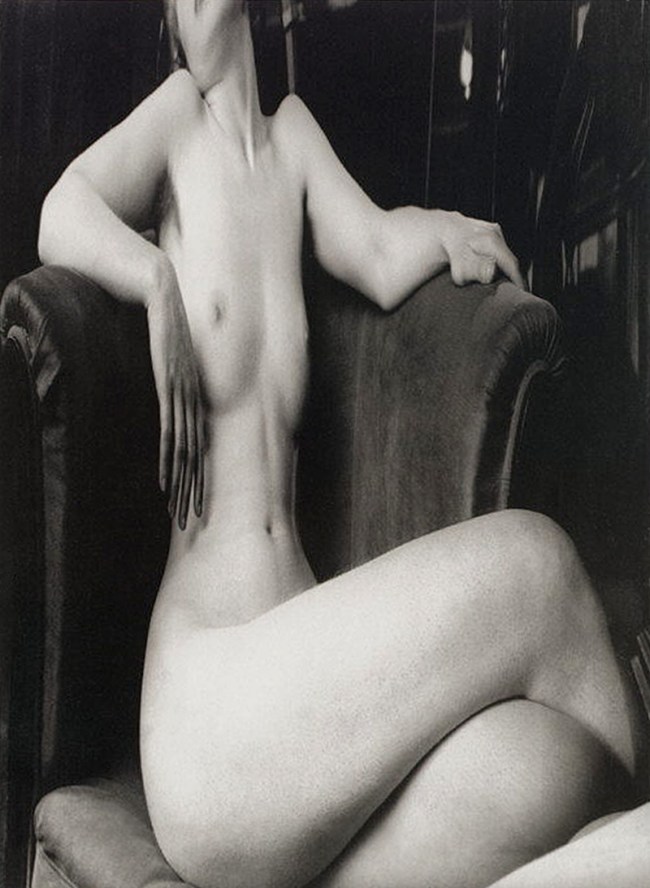
 

André Kertész (American born Hungary, Budapest 1894 - 1985 New York City) 'Distortion #6' 1932


André Kertész (American born Hungary, Budapest 1894 – 1985 New York City)
Distortion #6
1932
Gelatin silver print
23.4 x 17.3cm (9 3/16 x 6 13/16 in.)
Metropolitan Museum of Art
Ford Motor Company Collection, Gift of Ford Motor Company and John C. Waddell, 1987
© The Estate of André Kertész / Higher Pictures


Although Kertesz had long been interested in mirrors, reflections, and the idea of distorting the human figure, he did not seriously investigate their photographic possibilities until 1933, when the risqué French magazine Le Sourire commissioned him to make a series of figure studies. Using a funhouse mirror from a Parisian amusement park, Kertesz, who had never photographed nudes before, spent four weeks making about two hundred negatives.

Kertész accentuated the narrow ribcage and long waist of the ideal contemporary woman by photographing his model in a carnival mirror. If the top half of this beautiful nude resembles those Modigliani painted, the swell of the haunch recalls Mannerist nudes and their nineteenth-century revivals, especially Ingres’ grande odalisque.

Text from the Metropolitan Museum of Art website
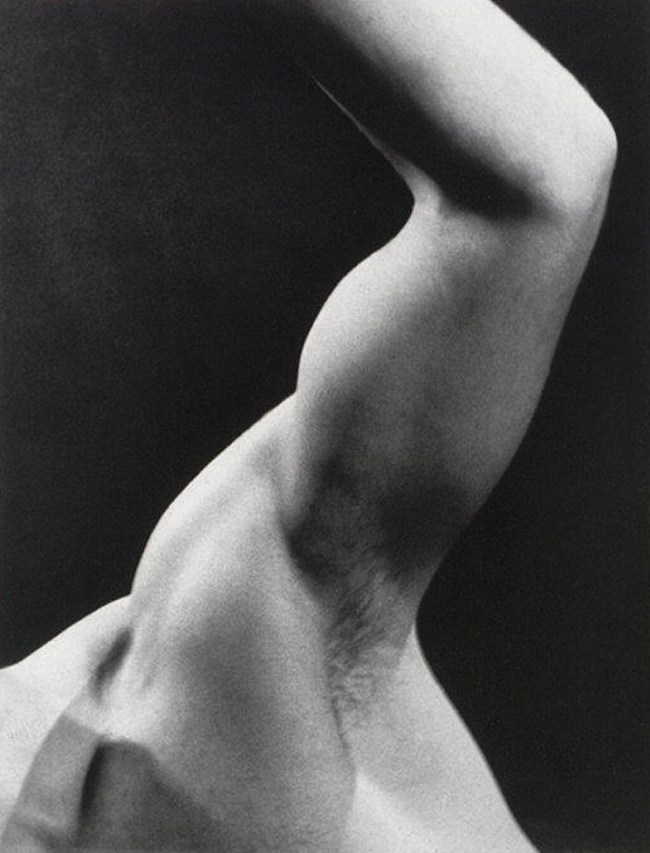
 

Man Ray (American, Philadelphia, Pennsylvania 1890 - 1976 Paris) 'Arm' c. 1935


Man Ray (American, Philadelphia, Pennsylvania 1890 – 1976 Paris)
Arm
c. 1935
Gelatin silver print
29.7 x 23.0cm (11 11/16 x 9 1/16 in.)
Metropolitan Museum of Art
Ford Motor Company Collection, Gift of Ford Motor Company and John C. Waddell, 1987
© 2012 Man Ray Trust / Artists Rights Society (ARS), NY / ADAGP, Paris


Man Ray’s photograph of an arm is cropped so abstractly that it seems to metamorphose into other body parts – a knee, a calf, a thigh – or into some utterly unidentifiable yet heroic form. This image appeared on the cover of Formes Nues (1935), which also included the work of Brassaï, László Moholy-Nagy, Franz Roh, and George Platt Lynes, among others.

In the magazine’s introduction, Man Ray wrote, “were it not for the fact that photography permits me to seize and to possess the human body and face in more than a temporary manner, I should quickly have tired of this medium.”

Text from the Metropolitan Museum of Art website


Paul Outerbridge Jr. (American, New York 1896 - 1959 Laguna Beach, California) 'Nude with Mask and Hat' c. 1936


Paul Outerbridge Jr. (American, New York 1896 – 1959 Laguna Beach, California)
Nude with Mask and Hat
c. 1936
Carbro print
43.3 x 30.0cm (17 1/16 x 11 13/16 in.)
Metropolitan Museum of Art
Warner Communications Inc. Purchase Fund, 1977


Outerbridge was a successful commercial photographer, but although he found such work stimulating, he also made photographs as a means of personal expression throughout his career. Photographing nude models in colour in the 1930s was challenging – not only in the difficulty of correctly capturing skin tones using complicated new processes, but also because finding a venue to publish or exhibit the work was unlikely. Although he began by posing his models in the manner of painted masterpieces, Outerbridge’s compositions became increasingly provocative in the late 1930s. The sexualised charge and commercial palette of works such as this were not in keeping with attitudes of the period and were not shown during the artist’s lifetime.

Text from the Metropolitan Museum of Art website


Hans Bellmer (German born Poland, Katowice 1902–1975 Paris) 'La Poupée' 1936


Hans Bellmer (German born Poland, Katowice 1902–1975 Paris)
La Poupée
1936
Gelatin silver print with applied colour
Mount: 9 5/8 in. × 7 1/2 in. (24.5 × 19cm)
Image: 5 5/16 × 5 9/16 in. (13.5 × 14.1cm)
Metropolitan Museum of Art
Ford Motor Company Collection, Gift of Ford Motor Company and John C. Waddell, 1987
© 2024 Artists Rights Society (ARS), New York


In his nightmarish tableaux of mutilated and reassembled dolls posed in domestic interiors, Bellmer grappled with the base condition of the human body and with the bodily fragment as fetish object. Mannequins and dolls – simultaneously familiar and strange – supplied the material for his primal expressions of terror and awe, which often evoked the innocent violence and latent sexuality of childhood games. Whether they are read as Freudian emblems of the uncanny or as ominous harbingers of Nazi atrocities, Bellmer’s images exemplify the Surrealist view of the female body as the source of simultaneous fascination and revulsion.

Text from the Metropolitan Museum of Art website


Edward Weston (American 1886-1958) 'Nude' 1936, printed c. 1954


Edward Weston (American, Highland Park, Illinois 1886 – 1958 Carmel, California)
Printer: Brett Weston (American, Los Angeles, California 1911-1993 Kona, Hawaii) or Cole Weston (American, 1919-2003)
Nude on Sand, Oceano
1936, printed c. 1954
Gelatin silver print
19.1 x 24.2cm (7 1/2 x 9 1/2 in.)
David Hunter McAlpin Fund, 1957
© Center for Creative Photography, Arizona Board of Regents


Charis Wilson, the model for this series, admitted to being shocked upon seeing Weston’s nudes for the first time, as she had previously known only the romantically retouched photographs of depilated bodies then popular. In studying Weston’s work she found, “I couldn’t get past the simple amazement at how real they were. Then I began to see the rhythmic patterns, the intensely perceived sculptural forms, the subtle modulations of tone, of which these small, perfect images were composed. And I began to appreciate the originality of the viewpoint that had selected just these transitory moments and made them fast against the current of time.”

Text from the Metropolitan Museum of Art website
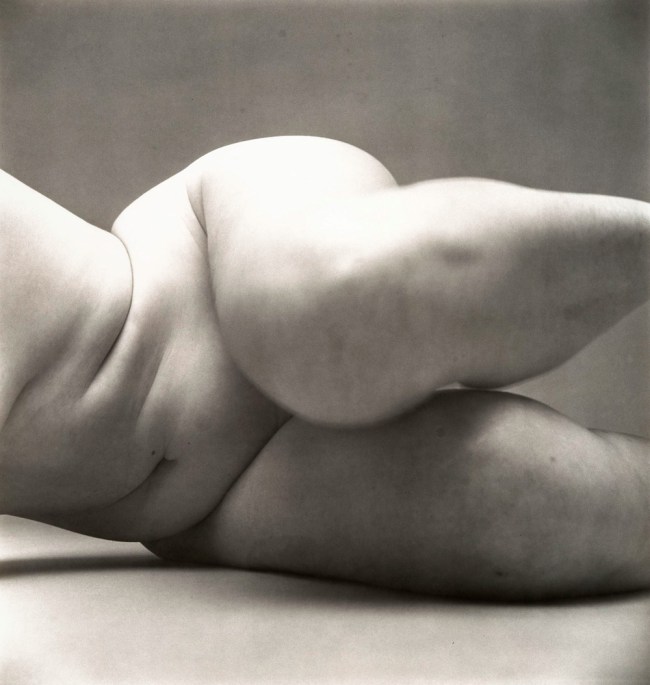
 

Irving Penn (American, Plainfield, New Jersey 1917 - 2009 New York City) 'Nude No. 57' 1949-1950


Irving Penn (American, Plainfield, New Jersey 1917 – 2009 New York City)
Nude No. 57
1949-1950
Gelatin silver print
39.4 x 37.5cm (15 1/2 x 14 3/4 in.)
Metropolitan Museum of Art
Gift of the artist, 2002
© 1950-2002 Irving Penn


By 1950, Penn was a well-known Vogue portrait and fashion photographer but had already made, privately, a major series of nudes – a personal but lesser-known body of work. During the week, he photographed models wearing fashionable clothes for the magazine, but weekends and evenings he made studies of female nudes. The women were full-bodied and the photographs unorthodox, recalling the form and spirit of archaic fertility idols.

Text from the Metropolitan Museum of Art website


Harry Callahan (American, 1912-1999) 'Eleanor and Barbara' 1954, printed 1970s


Harry Callahan (American, 1912-1999)
Eleanor and Barbara
1954
Gelatin silver print
22.8 x 22.1cm (9 x 8 11/16 in.)
Metropolitan Museum of Art
Gift of Joyce and Robert Menschel, 1993
© The Estate of Harry Callahan; Courtesy Pace/MacGill Gallery, New York


Muses throughout his career, Callahan’s wife and daughter played, posed, and aged before his lens. With their attention to the physicality of light, however, Callahan’s photographs transcend mere family portraiture by calling attention to the simple beauty of life’s fleeting moments. “He just liked to take the pictures of me,” Eleanor recalled in her nineties. “In every pose. Rain or shine. And whatever I was doing. If I was doing the dishes or if I was half asleep. And he knew that I never, never said no. I was always there for him. Because I knew that Harry would only do the right thing.”

Eleanor Callahan died in February 2012 at the age of ninety-five.

Text from the Metropolitan Museum of Art website


Diane Arbus (American, 1923-1971) 'Retired man and his wife at home in a nudist camp one morning, N.J.' 1963


Diane Arbus (American, 1923-1971)
Retired man and his wife at home in a nudist camp one morning, N.J.
1963
Gelatin silver print
39.9 × 37.9cm (15 11/16 × 14 15/16 in.)
Metropolitan Museum of Art
Purchase, Joyce Frank Menschel, and Ann Tenenbaum and Thomas H. Lee Gifts; Louis V. Bell, Harris Brisbane Dick, Fletcher, and Rogers Funds and Joseph Pulitzer Bequest; and Marlene Nathan Meyerson Family Foundation, Twentieth-Century Photography Fund, Diana Barrett and Robert Vila, Elizabeth S. and Robert J. Fisher, Charlotte and Bill Ford, Lita Annenberg Hazen Charitable Trust and Hazen Polsky Foundation Inc., Jennifer and Joseph Duke, Jennifer and Philip Maritz, Saundra B. Lane, The Jerry and Emily Spiegel Family Foundation and Pamela and Arthur Sanders, Anonymous, and The Judith Rothschild Foundation Gifts, 2007
© The Estate of Diane Arbus


Arbus’s interest in the tension between revelation and concealment comes into starkest focus in the portraits she made at Sunshine Park, a family nudist camp in New Jersey. While nudism might be considered the ultimate form of exposure, it often required a different kind of cover-up. As the artist remarked in an unpublished article written for Esquire magazine in 1966: “For many of these people, their presence here is the darkest secret of their lives, unsuspected by relatives, friends, and employers in the outside world, the disclosure of which might bring disgrace.”

Text from the Metropolitan Museum of Art website
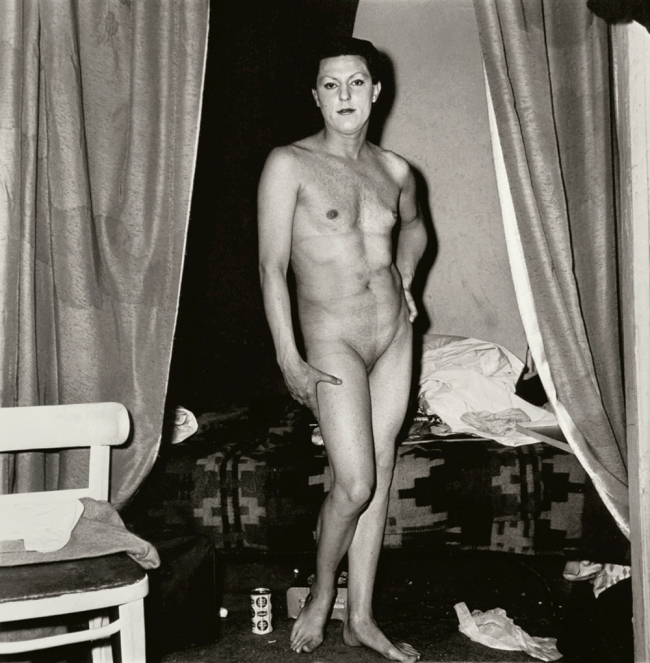
 

Diane Arbus (American, 1923-1971) 'A naked man being a woman, N.Y.C.' 1968


Diane Arbus (American, 1923-1971)
A naked man being a woman, N.Y.C.
1968
Gelatin silver print
38.2 x 36.2cm
Metropolitan Museum of Art
Purchase, Joyce Frank Menschel, and Ann Tenenbaum and Thomas H. Lee Gifts; Louis V. Bell, Harris Brisbane Dick, Fletcher, and Rogers Funds and Joseph Pulitzer Bequest; and Marlene Nathan Meyerson Family Foundation, Twentieth-Century Photography Fund, Diana Barrett and Robert Vila, Elizabeth S. and Robert J. Fisher, Charlotte and Bill Ford, Lita Annenberg Hazen Charitable Trust and Hazen Polsky Foundation Inc., Jennifer and Joseph Duke, Jennifer and Philip Maritz, Saundra B. Lane, The Jerry and Emily Spiegel Family Foundation and Pamela and Arthur Sanders, Anonymous, and The Judith Rothschild Foundation Gifts, 2007
© The Estate of Diane Arbus


Mark Morrisroe (American, 1959-1989) 'Untitled [Two Men in Silhouette]' c. 1987


Mark Morrisroe (American, 1959-1989)
Untitled [Two Men in Silhouette]
c. 1987
Gelatin silver print
28.4 x 20.8cm (11 3/16 x 8 3/16 in.)
Metropolitan Museum of Art
Twentieth-Century Photography Fund, 2009
© The Estate of Mark Morrisroe (Ringier Collection) at Fotomuseum Winterthur


Sexuality and mortality – which many would say are central preoccupations of humankind – are key to Morrisroe’s biography and art. The son of a drug-addicted mother, a teenage hustler, and a precocious punk queer, Morrisroe carried a bullet (shot by a disgruntled john) in his chest from the age of eighteen and consequently walked with a limp that added one more element to his outsider self-image. Sex and death were persistent themes in his work, with pronounced poignancy after his 1986 AIDS diagnosis. In this work, Morrisroe has taken a page from a gay S&M magazine, cut out the shapes of two naked men, and used the sheet as a negative to print a unique image in which the figures – literally absent – appear as dark silhouettes against a netherworld of sexual activity.

Text from the Metropolitan Museum of Art website


The Metropolitan Museum of Art
1000 Fifth Avenue at 82nd Street
New York, New York 10028-0198
Phone: 212-535-7710

Opening hours:
Thursday – Tuesday 10am – 5pm
Closed Wednesday

The Metropolitan Museum of Art website

LIKE ART BLART ON FACEBOOK

Back to top

Exhibition: ‘Portraits of Renown: Photography and the Cult of Celebrity’ at the J. Paul Getty Museum, Los Angeles

Exhibition dates: 3rd April – 26th August 2012


Marie Cosindas (American, 1925-2017) 'Yves Saint Laurent, Paris' 1968


Marie Cosindas (American, 1925-2017)
Yves Saint Laurent, Paris
1968
Dye colour diffusion [Polaroid ®] print
The J. Paul Getty Museum, Los Angeles
© Marie Cosindas


On the Nature of Photography


“To get from the tangible to the intangible (which mature artists in any medium claim as part of their task) a paradox of some kind has frequently been helpful. For the photographer to free himself of the tyranny of the visual facts upon which he is utterly dependent, a paradox is the only possible tool. And the talisman paradox for unique photography is to work “the mirror with a memory” as if it were a mirage, and the camera is a metamorphosing machine, and the photograph as if it were a metaphor… Once freed of the tyranny of surfaces and textures, substance and form [the photographer] can use the same to pursue poetic truth.”


Minor White quoted in Beaumont Hewhall (ed.,). The History of Photography. Boston: Little, Brown, and Co., 1982, p. 281


“Carol Jerrems and I taught at the same secondary school in the 1970’s. In a classroom that was unused at that time, I remember having my portrait taken by her. She held her Pentax to her eye. Carols’ portraits all seemed to have been made where the posing of her subjects was balanced by an incisive naturalness (for want of a better description). As a challenge to myself I tried to look “natural”, but kept in my consciousness that I was having my portrait taken. Minutes passed and neither she nor her camera moved at all.

Then the idea slipped from my mind for just a moment, and I was straightaway bought back by the sound of the shutter. What had changed in my face? – probably nothing, or 1 mm of muscle movement. Had she seen it through the shutter? Or something else – I don’t know.”


Australian artist Ian Lobb on being photographed by the late Carol Jerrems


There is always something that you can’t quite put your finger on in an outstanding portrait, some ineffable other that takes the portrait into another space entirely. I still haven’t worked it out but my thoughts are this: forget about the pose of the person. It would seem to me to be both a self conscious awareness by the sitter of the camera and yet at the same time a knowing transcendence of the visibility of the camera itself. In great portrait photography it is almost as though the conversation between the photographer and the person being photographed elides the camera entirely. Minor White, in his three great mantras, the Three Canons, observes:


Be still with yourself
Until the object of your attention
Affirms your presence

Let the Subject generate its own Composition

When the image mirrors the man
And the man mirrors the subject
Something might take over


Freed from the tyranny of the visual facts something else emerges.

Celebrities know only too well how to “work” the camera but the most profound portraits, even of celebrities, are in those moments when the photographer sees something else in the person being photographed, some unrecognised other that emerges from the shadows – a look, a twist of the head, the poignancy of the mouth, the vibrancy of the dancer Josephine Baker, the sturdiness of the gaze of Walt Whitman with hands in pockets, the presence of the hands (no, not the gaze!) of Picasso. I remember taking a black and white portrait of my partner Paul holding a wooden finial like a baby among some trees, a most beautiful, revealing photograph. He couldn’t bear to look at it, for it stripped him naked before the lens and showed a side of himself that he had never seen before: vulnerable, youthful, beautiful.

Why do great portrait photographers make so many great portraits? Why can’t this skill be shared or taught? Why can’t Herb Ritts (for example) make a portrait that goes beyond a caricature? Why is it that what can be taught is so banal that it has no value?

In photography, maybe we edit out what is expected and then it seems that photography does something that goes beyond language; it goes beyond function that can be described as a part of speech, metonym or metaphor. When this something else takes over I think it is truly “unrecognised” in the best portraits (and landscape / urban photographs) – and it is fantastic and wonderful.

This is my understanding, then, of perception and vision (when spirit takes over) – [which is] the ability to see this certain something in the mind (previsualisation) before seeing it through the viewfinder and to then be able to reveal it in the physicality of the print. It is a liminal moment in time and space.

I believe this is the reality of photography itself in its absolute essential form – and here I am deliberately forgetting about post-photography, post-modernism, modernism, pictorialism, ism, ism – getting down to why I really like photography:

the BEYOND visualisation of a world, the transcendence of time and space that leads, in great photographs, to a recognition of the discontinuous nature of life but in the end, to its ultimate persistence.

This is as close as I have got so far…

Dr Marcus Bunyan
August 2012


Many thankx to the J. Paul Getty Museum for allowing me to publish the photographs in the posting. Please click on the photograph for a larger version of the image.


Mariana Cook (American, b. 1955) 'Barack and Michelle Obama, Chicago' May 26, 1996


Mariana Cook (American, b. 1955)
Barack and Michelle Obama, Chicago
May 26, 1996
Selenium-toned gelatin silver print
The J. Paul Getty Museum, Los Angeles


Marie Cosindas (American, 1925-2017) 'Andy Warhol' 1966


Marie Cosindas (American, 1925-2017)
Andy Warhol
1966
Dye colour diffusion [Polaroid ®] print
11.4 x 8.9cm
The J. Paul Getty Museum, Los Angeles
© Marie Cosindas


Marie Cosindas (American, 1925-2017) 'Yves St Laurent' 1968


Marie Cosindas (American, 1925-2017)
Yves St Laurent
1968
Dye colour diffusion [Polaroid ®] print
11.4 x 8.9cm
The J. Paul Getty Museum, Los Angeles
© Marie Cosindas


Andy Warhol (American, 1928-1987) 'Grace Jones' 1984


Andy Warhol (American, 1928-1987)
Grace Jones
1984
Polaroid Polacolor print
9.5 x 7.3cm
The J. Paul Getty Museum, Los Angeles
© 2011 The Andy Warhol Foundation for the Visual Arts / Artists Rights Society (ARS), New York


Edward Weston (American, 1889-1958) 'Igor Stravinsky' 1935


Edward Weston (American, 1889-1958)
Igor Stravinsky
1935
Gelatin silver print
The J. Paul Getty Museum, Los Angeles


Coy Watson Jr. (American, 1912-2009) 'Joe Louis – “The Brown Bomber”, Los Angeles, February 1935'


Coy Watson Jr. (American, 1912-2009)
Joe Louis – “The Brown Bomber”, Los Angeles, February 1935
1935
Gelatin silver print
The J. Paul Getty Museum, Los Angeles


Edward Steichen (American, 1879-1973) 'Gloria Swanson' 1924


Edward Steichen (American, 1879-1973)
Gloria Swanson
1924
Gelatin silver print
27.8 x 21.6cm (10 15/16 x 8 1/2 in.)
The J. Paul Getty Museum, Los Angeles
© Permission Joanna T. Steichen


Portraits of Renown surveys some of the visual strategies used by photographers to picture famous individuals from the 1840s to the year 2000. “This exhibition offers a brief visual history of famous people in photographs, drawn entirely from the Museum’s rich holdings in this genre,” says Paul Martineau, curator of the exhibition and associate curator of photographs at the J. Paul Getty Museum. “It also provides a broad historical context for the work in the concurrent exhibition Herb Ritts: L.A. Style, which includes a selection of Ritts’s best celebrity portraits.”

Photography’s remarkable propensity to shape identities has made it the leading vehicle for representing the famous. Soon after photography was invented in the 1830s, it was used to capture the likenesses and accomplishments of great men and women, gradually supplanting other forms of commemoration. In the twentieth century, the proliferation of photography and the transformative power of fame have helped to accelerate the desire for photographs of celebrities in magazines, newspapers, advertisements, and on the Internet. The exhibition is arranged chronologically to help make visible some of the overarching technical and stylistic developments in photography from the first decade of its invention to the end of the twentieth century.

A wide range of historical figures are portrayed in Portraits of Renown. A photograph by Alexander Gardner of President Lincoln documents his visit to the battlefield of Antietam during the Civil War. Captured by Nadar, a portrait of Alexander Dumas, best known for his novels The Count of Monte Cristo and The Three Musketeers, shows the author with an energetic expression, illustrating the lively personality that made his writing so popular. Baron Adolf De Meyer’s portrait of Josephine Baker, an American performer who became an international sensation at the Folies Bergère in Paris, showcases her comedic charm, a trait that proved central to her popularity as a performer. An iconic portrait of the silent screen actress, Gloria Swanson, created by Edward Steichen for Vanity Fair reveals both the intensity of its sitter and the skill of the artist. A picture of Pablo Picasso by his friend Man Ray portrays the master of Cubism with a penetrating gaze.

Yves St. Laurent, Andy Warhol, and Grace Jones are among the contemporary figures included in the exhibition. Fashion designer Yves St. Laurent was photographed by Marie Cosindas using instant color film by Polaroid. The photograph, made the year his first boutique in New York opened, graced the walls of the store for ten years. A Cosindas portrait of Andy Warhol shows the artist wearing dark sunglasses, which partially conceal his face. Warhol, who was fascinated by celebrity, delighted in posing public personalities like Grace Jones for his camera.

Press release from the J. Paul Getty Museum website


Man Ray (American, 1890-1976) 'Pablo Picasso' 1934


Man Ray (American, 1890-1976)
Pablo Picasso
1934
Gelatin silver print
25.2 x 20cm
The J. Paul Getty Museum, Los Angeles
© Man Ray Trust ARS-ADAGP


Berenice Abbott (American, 1898-1991) 'James Joyce' 1928


Berenice Abbott (American, 1898-1991)
James Joyce
1928
Gelatin silver print
The J. Paul Getty Museum, Los Angeles


Baron Adolf De Meyer (American born France, 1868-1946) 'Portrait of Josephine Baker' 1925


Baron Adolf De Meyer (American born France, 1868-1946)
Portrait of Josephine Baker
1925
Collotype print
39.1 x 39.7cm
The J. Paul Getty Museum, Los Angeles


In 1925 Josephine Baker, an American dancer from Saint Louis, Missouri, made her debut on the Paris stage in La Revue nègre (The Black Review) at the Théâtre des Champs-Elysées, wearing nothing more than a skirt of feathers and performing her danse sauvage (savage dance). She was an immediate sensation in Jazz-Age France, which celebrated her perceived exoticism, quite the opposite of the reception she had received dancing in American choruses. American expatriate novelist Ernest Hemingway called Baker “the most sensational woman anybody ever saw – or ever will.”

Baron Adolf de Meyer, a society and fashion photographer, took this playful portrait in the year of Baker’s debut. Given the highly sexual nature of her stage persona, this portrait is charming and almost innocent; Baker’s personality is suggested by her face rather than her famous body.

Text from the J. Paul Getty website


Edward Steichen (American, 1879-1973) 'John Barrymore as Hamlet' 1922


Edward Steichen (American, 1879-1973)
John Barrymore as Hamlet
1922
Gelatin silver print
The J. Paul Getty Museum, Los Angeles


Alfred Stieglitz (American, 1964-1946) 'Georgia O'Keeffe: A Portrait' 1918


Alfred Stieglitz (American, 1964-1946)
Georgia O’Keeffe: A Portrait
1918
Gelatin silver print
The J. Paul Getty Museum, Los Angeles


Arnold Genthe (American born Germany, 1869-1942) 'Anna Pavlowa' about 1915


Arnold Genthe (American born Germany, 1869-1942)
Anna Pavlowa
about 1915
Gelatin silver print
33.5 × 25.2cm (13 3/16 × 9 15/16 in.)
The J. Paul Getty Museum, Los Angeles


The Russian ballerina Anna Pavlowa (or Pavlova) so greatly admired Arnold Genthe’s work that she made the unusual decision to visit his studio, rather than have him come to her rehearsals. The resulting portrait of the prolific dancer, leaping in mid-air, is the only photograph to capture Pavlowa in free movement. Genthe regarded this print as one of the best dance photographs he ever made.

Text from the J. Paul Getty website


Alvin Langdon Coburn (British born United States, 1882-1966) 'Mark Twain (Samuel Langhorne Clemens)' Negative December 21, 1908; print 1913


Alvin Langdon Coburn (British born United States, 1882-1966)
Mark Twain (Samuel Langhorne Clemens)
Negative December 21, 1908; print 1913
Photogravure
20.6 × 14.8cm (8 1/8 × 5 13/16 in.)
The J. Paul Getty Museum, Los Angeles


Alfred Stieglitz (American, 1864-1946) '[Self-Portrait]' Negative 1907; print 1930


Alfred Stieglitz (American, 1864-1946)
[Self-Portrait]
Negative 1907; print 1930
Gelatin silver print
24.8 × 18.4cm (9 3/4 × 7 1/4 in.)
The J. Paul Getty Museum, Los Angeles


Edward Steichen (American 1879-1973) 'Rodin The Thinker' 1902


Edward Steichen (American, 1879-1973)
Rodin – Le Penseur (The Thinker)
1902
Gelatin-carbon print
The J. Paul Getty Museum, Los Angeles


Sarah Choate Sears (American, 1858-1935) '[Julia Ward Howe]' about 1890


Sarah Choate Sears (American, 1858-1935)
[Julia Ward Howe]
about 1890
Platinum print
23.5 × 18.6cm (9 1/4 × 7 5/16 in.)
The J. Paul Getty Museum, Los Angeles


Julia Ward Howe (May 27, 1819 – October 17, 1910) was an American poet and author, known for writing “The Battle Hymn of the Republic” and the original 1870 pacifist Mother’s Day Proclamation. She was also an advocate for abolitionism and a social activist, particularly for women’s suffrage.


Sarah Choate Sears (American, 1858-1935) 'John Singer Sargent' about 1890


Sarah Choate Sears (American, 1858-1935)
John Singer Sargent
about 1890
Gelatin silver print
The J. Paul Getty Museum, Los Angeles


Although John Singer Sargent was the most famous American portrait painter of his time, he apparently did not like to be photographed. The few photographs that exist show him at work, as he is here, sketching and puffing on a cigar. His friend Sarah Choate Sears, herself a painter of some note, drew many of her sitters for photographs from the same aristocratic milieu as Sargent did for his paintings.

Text from the J. Paul Getty website


Nadar [Gaspard Félix Tournachon] (French, 1820-1910) '[Sarah Bernhardt as the Empress Theodora in Sardou's "Theodora"]' Negative 1884; print and mount about 1889


Nadar (Gaspard Félix Tournachon) (French, 1820-1910)
[Sarah Bernhardt as the Empress Theodora in Sardou’s “Theodora”]
Negative 1884; print and mount about 1889
Albumen silver print
14.6 × 10.5 cm (5 3/4 × 4 1/8 in.)
The J. Paul Getty Museum, Los Angeles


J. Wood (American, active New York, New York 1870s-1880s) 'L.P. Federmeyer' 1879


J. Wood (American, active New York, New York 1870s-1880s)
L.P. Federmeyer
1879
Albumen silver print
14.8 × 10 cm (5 13/16 × 3 15/16 in.)
The J. Paul Getty Museum, Los Angeles


Julia Margaret Cameron (British born India, 1815-1879) 'Ellen Terry at Age Sixteen' 1864


Julia Margaret Cameron (British born India, 1815-1879)
Ellen Terry at Age Sixteen
Negative 1864; print about 1875
Carbon print
24.1cm (9 1/2 in.)
The J. Paul Getty Museum, Los Angeles


This image of Ellen Terry (1847-1928) is one of the few known photographs of a female celebrity by Julia Margaret Cameron. Terry, the popular child actress of the British stage, was sixteen years old when Cameron made this image. This photograph was most likely taken just after she married the eccentric painter, George Frederick Watts (1817-1904), who was thirty years her senior. They spent their honeymoon in the village of Freshwater on the Isle of Wight where Cameron resided.

Cameron’s portrait echoes Watt’s study of Terry titled Choosing (1864, National Portrait Gallery, London). As in the painting, Terry is shown in profile with her eyes closed, an ethereal beauty in a melancholic dream state. In this guise, Terry embodies the Pre-Raphaelite ideal of womanhood rather than appearing as the wild boisterous teenager she was known to be. The round (“tondo”) format of this photograph was popular among Pre-Raphaelite artists.

Cameron titled another print of this image Sadness (see 84.XZ.186.52), which may suggest the realisation of a mismatched marriage. Terry’s anxiety is plainly evident – she leans against an interior wall and tugs nervously at her necklace. The lighting is notably subdued, leaving her face shadowed in doubt. In The Story of My Life (1909), Terry recalls how demanding Watts was, calling upon her to sit for hours as a model and giving her strict orders not to speak in front of distinguished guests in his studio.

This particular version was printed eleven years after Cameron first made the portrait. In order to distribute this image commercially, the Autotype Company of London rephotographed the original negative after the damage had been repaired. The company then made new prints using the durable, non-fading carbon print process. Thus, this version is in reverse compared to Sadness. Terry’s enduring popularity is displayed by the numerous photographs taken of her over the years. Along with the two portraits by Cameron, the Getty owns three more of Terry by other photographers.

Adapted from Julian Cox. Julia Margaret Cameron, In Focus: Photographs from the J. Paul Getty Museum (Los Angeles: J. Paul Getty Museum, 1996), 12. ©1996 The J. Paul Getty Museum; with additions by Carolyn Peter, J. Paul Getty Museum, Department of Photographs, 2019.


Charles DeForest Fredricks (American, 1823-1894) '[Mlle Pepita]' 1863


Charles DeForest Fredricks (American, 1823-1894)
[Mlle Pepita]
1863
Albumen silver print
9 × 5.4cm (3 9/16 × 2 1/8 in.)
The J. Paul Getty Museum, Los Angeles


André Adolphe-Eugène Disdéri (French, 1819-1889) '[Rosa Bonheur]' 1861-1864


André Adolphe-Eugène Disdéri (French, 1819-1889)
[Rosa Bonheur]
1861-1864
Albumen silver print
8.4 × 5.2cm (3 5/16 × 2 1/16 in.)
The J. Paul Getty Museum, Los Angeles


Rosa Bonheur, born Marie-Rosalie Bonheur (16 March 1822 – 25 May 1899), was a French artist, mostly a painter of animals (animalière) but also a sculptor, in a realist style. Her best-known paintings are Ploughing in the Nivernais, first exhibited at the Paris Salon of 1848, and now at the Musée d’Orsay in Paris, and The Horse Fair (in French: Le marché aux chevaux), which was exhibited at the Salon of 1853 (finished in 1855) and is now in the Metropolitan Museum of Art, in New York City. Bonheur was widely considered to be the most famous female painter of the nineteenth century.

Text from the Wikipedia website


Mathew B. Brady (American, about 1823-1896) 'Walt Whitman' about 1870


Mathew B. Brady (American, about 1823-1896)
Walt Whitman
about 1870
Albumen silver print
14.6 x 10.3cm
The J. Paul Getty Museum, Los Angeles


Mathew B. Brady (American, about 1823-1896) 'Robert E. Lee' 1865


Mathew B. Brady (American, about 1823-1896)
Robert E. Lee
1865
Albumen silver print
The J. Paul Getty Museum, Los Angeles


John Robert Parsons (British, about 1826-1909) '[Portrait of Jane Morris (Mrs. William Morris)]' Negative July 1865; print after 1900


John Robert Parsons (British, about 1826-1909)
[Portrait of Jane Morris (Mrs. William Morris)]
Negative July 1865; print after 1900
Gelatin silver print
22.9 × 19.2cm (9 × 7 9/16 in.)
The J. Paul Getty Museum, Los Angeles


Nadar [Gaspard Félix Tournachon] (French, 1820-1910) 'George Sand (Amandine-Aurore-Lucile Dupin), Writer' c. 1865


Nadar (Gaspard Félix Tournachon) (French, 1820-1910)
George Sand (Amandine-Aurore-Lucile Dupin)
about 1865
Albumen silver print
The J. Paul Getty Museum, Los Angeles


Amandine-Aurore-Lucile Dudevant, née Dupin, took the pseudonym George Sand in 1832. She was a successful Romantic novelist and a close friend of Nadar, and during the 1860s he photographed her frequently. Her writing was celebrated for its frequent depiction of working-class or peasant heroes. She was also a woman as renowned for her romantic liaisons as her writing; here she allowed Nadar to photograph her, devoid of coquettish charms but nevertheless a commanding presence.

This portrait is a riot of textural surfaces. The sumptuous satin of Sand’s gown and silken texture of her hair have a rich tactile presence. Her shimmering skirt melts into the velvet-draped support on which she leans, creating a visual triangle with the careful centre part of her wavy hair. The portrait details the exquisite laces, beads, and buttons of her gown, but her face, the apex of the triangle, is out of focus. Sand was apparently unable to remain perfectly still throughout the exposure, and the slight blurring of her facial features erases the unforgiving details that the years had drawn upon her.

Text from the J. Paul Getty website


Alexander Gardner (American born Scotland, 1821-1882) 'President Lincoln, United States Headquarters, Army of the Potomac, near Antietam, October 4, 1862'


Alexander Gardner (American born Scotland, 1821-1882)
President Lincoln, United States Headquarters, Army of the Potomac, near Antietam, October 4, 1862
1862
Albumen silver print
21.9 x 19.7cm (8 5/8 x 7 3/4 in.)
The J. Paul Getty Museum, Los Angeles


Twenty-six thousand soldiers were killed or wounded in the Battle of Antietam on September 17, 1862, after which Confederate General Robert E. Lee was forced to retreat to Virginia. Just two weeks after the victory, President and Commander-in-Chief Abraham Lincoln conferred with General McClernand and Allan Pinkerton, Chief of the nascent Secret Service, who had organised espionage missions behind Confederate lines.

Lincoln stands tall, front and centre in his stovepipe hat, his erect and commanding posture emphasised by the tent pole that seems to be an extension of his spine. The other men stand slightly apart in deference to their leader, in postures of allegiance with their hands covering their hearts. The reclining figure of the man at left and the shirt hanging from the tree are a reminder that, although this is a formally posed picture, Lincoln’s presence did not halt the camp’s activity, and no attempts were made to isolate him from the ordinary circumstances surrounding the continuing military conflict.

Text from the J. Paul Getty website


Alexander Gardner (American born Scotland, 1821-1882) 'President Lincoln, United States Headquarters, Army of the Potomac, near Antietam, October 4, 1862' (detail)


Alexander Gardner (American born Scotland, 1821-1882)
President Lincoln, United States Headquarters, Army of the Potomac, near Antietam, October 4, 1862 (detail)
1862
Albumen silver print
21.9 x 19.7cm (8 5/8 x 7 3/4 in.)
The J. Paul Getty Museum, Los Angeles


Pierre Louis Pierson (French, 1822-1913) 'Napoleon III and the Prince Imperial' about 1859


Pierre Louis Pierson (French, 1822-1913)
Napoleon III and the Prince Imperial
about 1859
Albumen silver print from a wet collodion glass negative
21 × 16cm (8 1/4 × 6 5/16 in.)
The J. Paul Getty Museum, Los Angeles


The Prince Imperial, son of Napoleon III, sits strapped securely into a seat on his horse’s back, a model subject for the camera. An attendant at the left steadies the horse so that the little prince remains picture-perfect in the centre of the backdrop erected for the photograph. The horse stands upon a rug that serves as a formalising element, making the scene appear more regal. The Emperor Napoleon III himself stands off to the right in perfect profile, supervising the scene with his dog and forming a framing mirror-image of the horse and attendant on the other side.

Pierre-Louis Pierson placed his camera far enough back from the Prince to capture the entire scene and all the players, but this was not the version sold as a popular carte-de-visite. The carte-de-visite image was cropped so that only the Prince upon his horse was visible.

Text from the J. Paul Getty website


Nadar [Gaspard Félix Tournachon] (French, 1820-1910) 'Alexander Dumas [père] (1802-1870) / Alexandre Dumas' 1855


Nadar (Gaspard Félix Tournachon) (French, 1820-1910)
Alexander Dumas [père] (1802-1870) / Alexandre Dumas
1855
Salted paper print
Image (rounded corners): 23.5 x 18.7cm (9 1/4 x 7 3/8 in.)
The J. Paul Getty Museum, Los Angeles
Public domain


The writer Alexander Dumas was Nadar’s boyhood idol. Nadar’s father had published Dumas’s first novel and play, and a portrait of Dumas hung in young Nadar’s room. The son of a French revolutionary general and a black mother, Dumas arrived in Paris from the provinces in 1823, poor and barely educated. Working as a clerk, he educated himself in French history and began to write. In 1829 he met with his first success; with credits including The Three Musketeers and The Count of Monte Cristo, published in 1844 and 1845, respectively, his fame and popularity were assured.

Nadar was the first photographer to use photography to enhance the sitter’s reputation. Given Dumas’s popularity, this mounted edition print, signed and dedicated by him, was likely intended for sale.

Dumas is represented as a lively, vibrant man. The self-restraint of his crossed hands, resting on a chair that disappears into the shadows, seems like an attempt to contain an undercurrent of boundless energy that threatened to ruin the necessary stillness of the pose and appears to have found an outlet through Dumas’s hair. Around the time of this sitting, the prolific Dumas and Nadar were planning to collaborate on a theatrical spectacle, which was ultimately never staged.

Text from the J. Paul Getty website


Unknown maker (American) 'Portrait of Edgar Allan Poe' late May - early June 1849


Unknown maker (American)
Portrait of Edgar Allan Poe
1849
Daguerreotype
The J. Paul Getty Museum, Los Angeles
Public domain


“A noticeable man clad in black, the fashion of the times, close-buttoned, erect, forward looking, something separate in his bearing … a beautifully poetic face.” ~ Basil L. Gildersleeve to Mary E. Phillips, 1915 (his childhood recollection of Poe)


Many of Edgar Allan Poe’s contemporaries described him as he appears in this portrait: a darkly handsome and intelligent man who possessed an unorthodox personality. Despite being acknowledged as one of America’s greatest writers of poetry and short stories, Poe’s life remains shrouded in mystery, with conflicting accounts about poverty, alcoholism, drug use, and the circumstances of his death in 1849. Like his life, Poe’s poems and short stories are infused with a sense of tragedy and mystery. Among his best-known works are: The RavenAnnabel Lee, and The Fall of the House of Usher.

This daguerreotype was made several months before Poe’s death at age 40. After his wife died two years earlier in 1847, Poe turned to two women for support and companionship. He met Annie Richmond at a poetry lecture that he gave when visiting Lowell, Massachusetts. Although she was married, they developed a deep, mutual affection. Richmond is thought to have arranged and paid for this portrait sitting. Poe is so forcibly portrayed that historians have described his appearance as disheveled, brooding, exhausted, haunted, and melancholic.

For reasons that are not entirely clear, relatively few daguerreotypes of notable poets, novelists, or painters have survived from the 1840s, and some of the best we have are by unknown makers. The art of the daguerreotype was one in which the sitter’s face usually took priority over the maker’s name, and many daguerreotypists failed to sign their works. This is the case with the Getty’s portrait of Poe.

Adapted from getty.edu, Interpretive Content Department, 2009; and Weston Naef, The J. Paul Getty Museum Handbook of the Photographs Collection (Los Angeles: J. Paul Getty Museum, 1995), 35. © 1995 The J. Paul Getty Museum.


Charles Richard Meade (American, 1826-1858) 'Portrait of Louis-Jacques-Mandé Daguerre' 1848


Charles Richard Meade (American, 1826-1858)
Portrait of Louis-Jacques-Mandé Daguerre
1848
Daguerreotype, hand-coloured
The J. Paul Getty Museum, Los Angeles
Public domain


By New Year’s Day of 1840 – little more than one year after William Henry Fox Talbot had first displayed his photogenic drawings in London and just four to five months after the first daguerreotypes had been exhibited in Paris at the Palais d’Orsay in conjunction with a series of public demonstrations of the process – Daguerre’s instruction manual had been translated into at least four languages and printed in at least twenty-one editions. In this way, his well-kept secret formula and list of materials quickly spread to the Americas and to provincial locations all over Europe. Photography became a gold rush-like phenomenon, with as much fiction attached to it as fact.

Nowhere was the daguerreotype more enthusiastically accepted than in the United States. Charles R. Meade was the proprietor of a prominent New York photographic portrait studio. He made a pilgrimage to France in 1848 to meet the founder of his profession and while there became one of the very few people to use the daguerreotype process to photograph the inventor himself.

A daguerreotype was (and is) created by coating a highly polished silver plated sheet of copper with light sensitive chemicals such as chloride of iodine. The plate is then exposed to light in the back of a camera obscura. When first removed from the camera, the image is not immediately visible. The plate must be exposed to mercury vapours to “bring out” the image. The image is then “fixed” (or “made permanent on the plate”) by washing it in a bath of hyposulfite of soda. Finally it is washed in distilled water. Each daguerreotype is a unique image; multiple prints cannot be made from the metal plate.

Adapted from Weston Naef, The J. Paul Getty Museum Handbook of the Photographs Collection (Los Angeles: J. Paul Getty Museum, 1995), 33, © 1995 The J. Paul Getty Museum; with additions by Carolyn Peter, J. Paul Getty Museum, Department of Photographs, 2019.


The J. Paul Getty Museum
1200 Getty Center Drive
Los Angeles, California 90049

Opening hours:
Daily 10am – 5pm

The J. Paul Getty Museum website

LIKE ART BLART ON FACEBOOK

Back to top
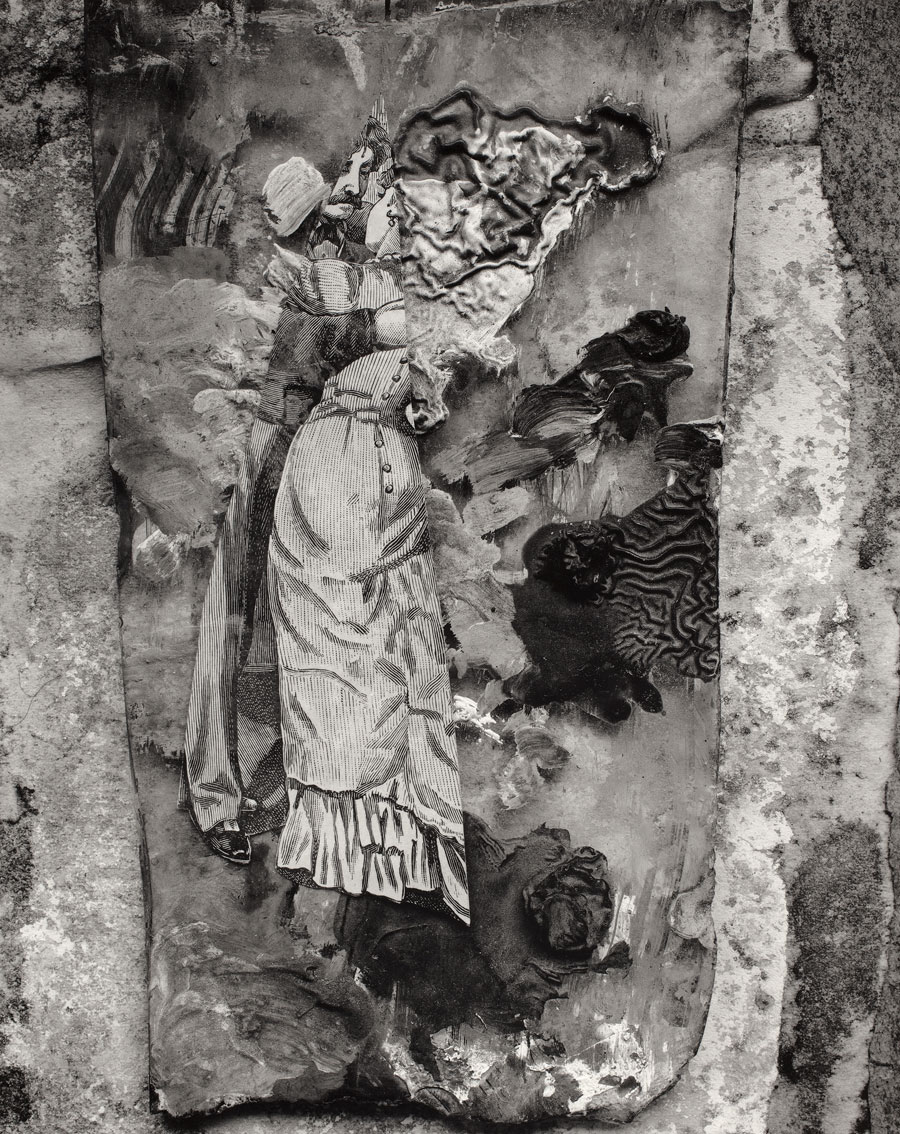
Exhibition: ‘A New Vision: Modernist Photography’ at the Currier Museum of Art, Manchester, New Hampshire

Exhibition dates: 4th February – 13th May 2012


Minor White (American, 1908-1976) 'Birdlime and Surf, Point Lobos, California' 1951


Minor White (American, 1908-1976)
Bird Lime and Surf, Point Lobos, CA
1951
Gelatin silver print
8 1/4 in. x 10 3/8 in. (20.96 x 26.35cm)
Currier Museum of Art, Manchester, New Hampshire
Gift of Edith Vallarino


The conceptual idea of Modernist photography is “look at this,” look at how photography interprets the world: through light, lens, glass, film, paper, brain and eye. Early Modernist photography occurred in the first two decades of the twentieth century (through the vision of Alfred Steiglitz, Paul Strand, Edward Steichen et al) before it was even named “Modernism” and led to radically different forms of artistic expression that broke the pictorialist conventions of the era. Gritty realism was the order of the day, clean lines, repetition of form, strange viewpoints where the photographers observation of the subject is as important as the subject itself. Look at how I, and the camera, see the world: that is all there is, the indexical relation to the word of truth.

“Artists and photographers began looking at the photographs used in mass culture, to develop an aesthetic true to the intrinsic qualities of photographic materials: the accurate rendition of visible reality; framing that crops into a larger spatial and temporal context; viewpoints and perspectives generated by modern lenses and typically modern spatial organisations (for example, tall buildings); and sharp, black-and-white images. This objective, mechanised vision became art by foregrounding not its subject matter, but its formal structure as an image.”1

Steiglitz and Strand, “often abstracted reality by eliminating social or spatial context; by using viewpoints that flattened pictorial space, acknowledging the flatness of the picture plane; and by emphasising shape and tonal rendition in highlights and shadows as much as in the actual subject matter.”2 Such use of highlights and shadows can be seen in the most famous work by the photographer Helmar Lerski, Transformation Through Light (1937), a photograph of which is presented below. Have a look on Google Images to see the changes wrought on the same face just through the use of light.

It is interesting to note the inclusion of photographers such as Paul Caponigro and Brett Weston in this exhibition as later examples of artists influenced by language of Modernism. While this may be partially true by the mid-1970s the mechanised vision of early Modernism (with its link to the indexicality of the image, its documentary authority and ability to express the individuality of the artist) had dissipated with the advent of the seminal exhibition New Topographics: Photographs of a Man-Altered Landscape (International Museum of Photography at the George Eastman House, 1975). “The pictures were stripped of any artistic frills and reduced to an essentially topographic state, conveying substantial amounts of visual information but eschewing entirely the aspects of beauty, emotion and opinion.” These typologies, often shown in grids, “depicted urban or suburban realities under changes in an allegedly detached approach… casting a somewhat ironic or critical eye on what American society had become.” (Wikipedia) While the photographs by Weston and Caponigro do show some allegiance to Modernist Photography they are of an altogether different order of things, one that is not predicated on what the object is or what the artist says it is (its reality), but also, what else it can be.

Of course, this leads into more critical readings on the meaning of photographs that emerged in the late 1970s-80s. As Patrizia di Bello has insightfully written,

“John Tagg, in The Burden of Representation (1988), argues that the indexical nature of the photograph does not explain its meanings. “What makes the link between the pre-photographic referent and the sign is a discriminatory technical, cultural and historical process in which particular optical and chemical devices are set to work to organise experience and desire and produce a new reality – the paper image which, through further processes, may become meaningful in all sorts of ways.” Rather than being a guarantor of realism, the camera is itself an ideological construct, producing an all-seeing spectator and effacing the means of its production. Analyses of who has possessed the means to represent and who has been represented reveal that photography has been profoundly implicated in issues of political, cultural, and sexual domination. This area of investigation has especially drawn upon Michel Foucault’s (1926-84) reflections on the emergence of forms of knowledge; on the modern notion of the subject; and on practices of power which produce subjects actively participating in the dominant disciplinary order. Particularly influential have been his rejection of the notion of a pre-given self or human nature, and his insistence that every system of power and knowledge also creates possibilities of resistance. The role of critics then becomes the deconstruction of dominant assumptions within and about representations, to identify works embodying the possibility of resistance.”3

The camera as ideological construct. Photography as profoundly implicated in issues of political, cultural, and sexual domination. In other words who is looking, at what, what is being pictured or excluded, who has control over that image (and access to it), who understands the language of that representation and controls its meaning (this picturing of a version of reality), and who resists the dominant assumptions within and about its representations.

Modernist Photography does indeed have a lot to answer for.

Dr Marcus Bunyan


1/ Patrizia di Bello. “Modernsim and Photography,” on Answers.com website [Online] Cited 03/08/2012 no longer available online

2/ Ibid.,

3/ Ibid.,


Many thankx to the Currier Museum of Art for allowing me to publish the photographs in the posting. Please click on the photographs for a larger version of the image.


Paul Caponigro (American, 1932-2024) 'Two Pears, Cushing, ME' 1999


Paul Caponigro (American, 1932-2024)
Two Pears, Cushing, ME
1999
Gelatin silver print
7 9/16 x 9 11/16 in
Currier Museum of Art, Manchester, New Hampshire
Gift of Paul Caponigro, photographer


Captured from above, the still-life Two Pears, Cushing, ME by Paul Caponigro is composed of two pieces of fruit nestled in a wooden bowl. The oval bowl is centrally located in the horizontal composition and is surrounded by a black background. The composition is roughly symmetrical, except for the stems of the pears, which break the central axis and create a diagonal frame. The pears hold a complementary position with relation to each other, reminiscent of a yin-yang symbol.

The pears glow a brilliant white in stark contrast to the black background. The fruit seems impossibly smooth, as though carved from marble, with the subtlest of grays suggesting vaguely corporeal curves. The smooth texture is juxtaposed with the rough natural bark that lines the edge of the wooden bowl. The interior of the bowl shows the subtle patterns, striations and concentric rings, of the tree from which the bowl was carved. …

Context and Analysis

Though primarily known as a landscape photographer, Caponigro also focuses on still-life. One of his favourite subjects is fruit. Caponigro began producing dramatic, black-and-white images of apples and pears in the 1960s. Devoid of their characteristic colour, the close-up images become abstract studies in form and, more important, pattern.

Many of Caponigro’s fruit still-lifes from the 1960s focus on the marks and patterns on the skin of the fruit. This is particularly true in Galaxy Apple, New York (1964), a high-contrast image that highlights the natural white markings on the dark surface of an apple, creating an effect reminiscent of stars in the night sky. Documenting decay in fruit still-life pictures is a tradition dating back hundreds of years, as seen in such works as Balthasar Van der Ast’s 1617 oil painting Still Life with Fruit on a Kraak Porcelain Dish (Currier, 2004.15 ). Still-life compositions are often about the passage of time. In the late-career photograph Two Pears, Cushing, ME, Caponigro instead presents the fruit as near-perfect and timeless.

Connections

Caponigro studied with pioneering photographer Minor White, whose work is also represented in the Currier’s collection. White and Caponigro shared an interest in modernist techniques and in ways of conveying the passage of time by using the natural world as subject matter. White’s 1963 photograph Bird Lime and Surf, Point Lobos, CA (Currier, 1992.15.13, above) shows a rock spotted with bright white bird droppings, traces of the birds gathering and flying along the shoreline.

Jane Seney. “Two Pears, Cushing, ME,” on the Currier Museum of Art website Nd [Online] Cited 17/10/2024


Paul Caponigro (American, 1932-2024) 'San Sebastian, New Mexico' 1980


Paul Caponigro (American, 1932-2024)
San Sebastian, New Mexico
1980
gelatin silver print
9 3/4 in. x 13 11/16 in. (24.77 x 34.77cm)
Currier Museum of Art, Manchester, New Hampshire
Henry Melville Fuller Fund


Brett Weston (American, 1911-1993) '(Untitled) Tide Pool and Kelp' c. 1980


Brett Weston (American, 1911-1993)
(Untitled) Tide Pool and Kelp
c. 1980
Gelatin silver print
10 9/16 x 13 11/16 in
Currier Museum of Art, Manchester, New Hampshire
Gift from the Christian K. Keesee Collection
© The Brett Weston Archive


Brett Weston (American, 1911-1993) '(Untitled) Branches and Snow' c. 1975


Brett Weston (American, 1911-1993)
(Untitled) Branches and Snow
c. 1975
Gelatin silver print
12 3/4 x 10 5/8 in
Currier Museum of Art, Manchester, New Hampshire
Gift from the Christian K. Keesee Collection
© The Brett Weston Archive


Helmar Lerski (Swiss, 1871-1956) 'Metamorphosis through Light #587' 1935-36


Helmar Lerski (Swiss, 1871-1956)
Metamorphosis through Light #587
1935-1936
Vintage gelatin silver print
11 1/2 x 9 1/4 in
Currier Museum of Art, Manchester, New Hampshire


Helmar Lerski (18 February 1871, Strasbourg – 19 September 1956, Zürich) was a photographer who laid some of the important foundations of modern photography. He focused mainly on portraits and the technique of photography with mirrors. Lerski concentrated on archetypal characteristics rather than on individual features, favouring extreme close-ups and tight cropping, and he became renowned for his experiments with multiple light sources.

Lerski was involved concurrently in the two major, emergent mediums of his time: film and photography. Born in Alsace in the then German city of Strausburg, he became involved in the theatre and, in 1896, moved to New York to pursue a career in acting, eventually working at the Irving Place Theater and later the German Pabst Theater. It was in this setting that Lerski first became aware of the unique visual effects achievable with stage lighting. Drawing from his acting experience, he began investigating photography as an artistic medium after meeting his wife, also a photographer. While photographing their colleagues, Lerski experimented with a series of portraits that severely manipulated the lighting effects. The resulting images formed a base for his later success in both commercial and art photography… This body of work upholds the artist’s declaration that “in every human being there is everything; the question is only what the light falls on.”

In 1937 he created his masterpiece, Transformation Through Light, on a rooftop terrace in Tel Aviv, in which he projected 175 different images of a single model, altered using multiple mirrors to direct intense sunlight towards his face at various angles and intensities. Siegfried Kracauer wrote about this series in his Theory of Film (Oxford University Press, 1960, p. 162):

“His model, he [Lerski] told me in Paris, was a young man with a nondescript face who posed on the roof of a house. Lerski took over a hundred pictures of that face from a very short distance, each time subtly changing the light with the aid of screens. Big close-ups, these pictures detailed the texture of the skin so that cheeks and brows turned into a maze of inscrutable runes reminiscent of soil formations, as they appear from an airplane. The result was amazing. None of the photographs recalled the model; and all of them differed from each other…

Out of the original face there arose, evoked by the varying lights, a hundred different faces, among them those of a hero, a prophet, a peasant, a dying soldier, an old woman, a monk. Did these portraits, if portraits they were, anticipate the metamorphoses which the young man would undergo in the future? Or were they just plays of light whimsically projecting on his face dreams and experiences forever alien to him? Proust would have been delighted in Lerski’s experiment with its unfathomable implications.”

Text from Wikipedia, Weimar Blog and Articles and Texticles websites


Margaret Bourke-White (American, 1904-1971) 'Turbine, Niagara Falls Power Co.,' 1928


Margaret Bourke-White (American, 1904-1971)
Turbine, Niagara Falls Power Co.,
1928
Gelatin silver print
13 1/2 x 9 1/2 in
Currier Museum of Art, Manchester, New Hampshire
Photo © Estate of Margaret Bourke-White/Licensed by VAGA, New York, NY


The Currier Museum of Art’s latest special exhibition traces the development of the modernist movement from the 1920s to its impact on artists today. Featuring more than 150 works displayed in three expansive galleries, A New Vision: Modernist Photography reflects the international nature of modernism, and includes American photographers such as Ansel Adams, Edward and Brett Weston, Margaret Bourke-White, Man Ray and Charles Sheeler, as well as European artists including Lotte Jacobi, László Moholy-Nagy, Helmar Lerski and Imre Kinszki…

[Marcus: Imre Kinszki (1901-1944) was a pioneer of modernist photography in Hungary, and a founder member of the group called Modern Hungarian Photographers. His son died in Buchenwald while he died on a death march to Sachsenhausen in 1944. See a moving video on YouTube where his daughter, who survived the ghetto, Judit Kinszki Talks About Her Father. The heartbreaking quotation below comes from the Articles and Texticles website which is no longer available online. It makes me very angry and very sad.

“In the ghetto we didn’t know anything about Auschwitz and what happened to those in forced labor service. It didn’t even occur to us that my father might not be alive. My mother and I went every day to the Keleti railroad station and went up to everybody who got off and asked them. Once my mother found a man who had been in the same group, and he remembered my father. He said that their car had been unhooked and the train went on towards Germany. They got off somewhere and went on foot towards Sachsenhausen – this was a death march. They spent the night on a German farm, in a barn on straw, and the man [who came back] said his legs had been so full of injuries that he couldn’t go on, and had decided that he would take his chances: he wormed himself into the straw. He did it, they didn’t find him, and that’s how he survived. He didn’t know about the others. We never found anyone else but this single man. So it’s clear that somewhere between this farm and Sachsenhausen everyone had been shot. But we interpreted this news in such a way that all we knew about him was that he would arrive sometime soon. We didn’t have news of my brother for a long time, then my mother found a young man who had worked with my brother. He told us that when they arrived in Buchenwald in winter, they were driven out of the wagon, and asked them what kind of qualifications they had. My brother told them that he was a student. This young man told us that the Germans immediately tied him up, it was a December morning, and they hosed him down with water just to watch him freeze to death. Those who didn’t have a trade were stripped of their clothes and hosed with cold water until they froze. I think that at that moment something broke in my mother. She was always waiting for my father, she refused to declare him dead even though she would have been eligible for a widow’s pension. But she waited for my father until the day she died. She couldn’t wait for my brother, because she had to believe what she had heard. Why would that young man have said otherwise?”]


Boris Ignatovich’s 1930s Tramway Handles and Margaret Bourke-White’s 1928 photo Turbine, Niagara Falls Power Co. [see below] showcase modernist images of isolated elements from the manmade world. While close-ups of nature, such as Brett Weston’s 1980 (Untitled) Tide Pool and Kelp, reveal striking abstract compositions that emphasise the repetition of patterns and dramatic contrast of light and shade. This new vision shared by modernist photographers makes form and composition as important as subject matter in their photographs.

“This exhibition illustrates the diversity of the modernist movement and its important contribution to the art of the 20th and 21st centuries,” said Kurt Sundstrom, curator of the exhibition. Adding, “Modernist photographers expanded the visual vocabulary of art – making everyday objects – from grass, drying laundry, machinery and lumber to details of the human body – subjects worthy of artistic interest.”

Contemporary New England photographers are still building upon the artistic language that their predecessors developed. Paul Caponigro, who lives in Cushing, Maine, Carl Hyatt of Portsmouth, New Hampshire and Arno Minkkinen of Andover, MA all clearly connect to modernism and are part of A New Vision.

A New Vision also explores the reciprocal influences among all media that shaped the modern art movement. Artists in the varied media shared a common vision; to illustrate this interconnectedness, paintings by Marsden Hartley, Georgia O’Keeffe, Charles Sheeler and Childe Hassam are paired with photographs in this exhibition.

Press release from the Currier Museum of Art website


Boris Ignatovich (Russian, 1899-1976) 'Tramway Handles' 1930s (printed 1955)


Boris Ignatovich (Russian, 1899-1976)
Tramway Handles
1930s (printed 1955)
Gelatin silver print
9 1/2 x 6 3/8 in
Currier Museum of Art, Manchester, New Hampshire
Art © Estate of Boris Ignatovich/RAO, Moscow/VAGA, New York.


Boris Ignatovich, born in Lutsk, Ukraine in 1899, was a Soviet photographer and a member of the Russian avant-garde movement. Ignatovich began his career in 1918, first working as a journalist and a newspaper editor before taking up photography in 1923. In the early 1920s he worked for a number of publications, most notably, Bednota (Poverty), Krasnaya Niva (Red Field) and Ogonyok. Ignatovich’s first photographic success was a documentary series about villagers in the Ramenskoe’s Workers’ settlement, which coincided with the first 5-year plan after Stalin’s victory. Ignatovich tried to alter the traditional format of documentary photography by using very low and very high unconventional angles, developing new perspectives, and including birds-eye constructions, which rendered the landscape as an abstract composition. In 1926 Ignatovich participated at the exhibition of the Association of Moscow Photo-Correspondents, and later became one of its leaders. In 1927, he photographed power plants and factories for Bednota and developed close association with Alexander Rodchenko, as they photographed for Dajosch together. Ignatovich’s famous photo stories also included the first American tractors in the USSR and aerial photographs of Leningrad and Moscow. In 1928, Ignatovich participated in the exhibition 10 Years of Soviet Photography, in Moscow and Leningrad, which was organized by the State Academy of Artistic Sciences. Due to his companionship with Rodchenko, Ignatovich was greatly influenced by his style and unconventional techniques. Both became members of the distinguished Oktiabr, the October group, which was a union of artists, architects, film directors, and photographers. In February of 1930, a photographic section of the October group was organised. Rodchenko was the head of the section and wrote its program. Other members include Dmitrii Debabov; Boris, Ol’ga, and Elizaveta Ignatovich; Vladimir Griuntal’; Roman Karmen; Eleazar Langman; Moriakin; Abram Shterenberg; and Vitalii Zhemchuzhnyi. The October group, whose styles favored fragmentary techniques and the distortion of images in an avant-garde manner, captured the idea of a world in dynamic form and rhythms.

First general October exhibition opened at Gorky Park, a park of culture and rest named after Gorky in Moscow. The photography section, organised by Rodchenko and Stepanova, includes the magazine Radioslushatel, designed by Stepanova and illustrated with photographs by Griuntal, Ignatovich, and Rodchenko. When Rodchenko was expelled from the October group for his formalist photography, Ignatovich took over as head of the photographic section of the group until the group was dissolved in 1932 by governmental decree.  Apart from October, Ignatovich worked on documentary films from 1930 to 1932. As a movie cameraman, Ignatovich worked on the first sound film, Olympiada of the Arts. After 1932 he began to pioneer ideas such as the theory of collectivism in photojournalism at the Soyuzfoto agency where he developed specific rules and laws of photography, so much so that the photographers working under him were obliged to follow and jointly credit their work to Ignatovich by signing their photographs “Ignatovich Brigade.” Ignatovich participated in 1935 Exhibition of the Work of the Masters of Soviet Photography as well as the All-Union Exhibition of Soviet photography at the State Pushkin Museum in 1937. During the 1930s, Ignatovich also contributed photographs to the USSR In Construction, and in 1941, worked as a war photo correspondent on the front. After the War, Ignatovich concentrated on landscape and portraiture, experimenting with the use of symbols, picture captions, and ideas of collectivism, particularly at the Soyuzfoto agency where he continued to work as a photojournalist until he died in 1976.

Text from the Nailya Alexander Gallery website


Man Ray (American, 1890-1976) 'Mr. and Mrs. Woodman' c. 1930


Man Ray (American, 1890-1976)
Mr. and Mrs. Woodman
c. 1930
Rayograph
Currier Museum of Art, Manchester, New Hampshire


Paul Strand (American, 1890-1976) 'Akeley Motion Picture Camera' 1923, printed 1976


Paul Strand (American, 1890-1976)
Akeley Motion Picture Camera
1923, printed 1976
Gelatin silver print
9 1/2 in. x 7 5/8 in. (24.13 x 19.37cm)
Currier Museum of Art, Manchester, New Hampshire
Gift of Edith Vallarino


The Currier’s Akeley Motion Picture Camera is one of the machine-inspired photographs that distinguished Strand early in his career. In the summer of 1922 Strand purchased an Akeley motion picture camera for the purpose of making freelance newsreel and documentary films. Fascinated by the camera’s complex construction, he made it the subject of a series of close-up photographs. In these works, Strand explored the expressive possibilities of abstract form and composition while simultaneously celebrating the technological achievement of the dawning machine age.

Avoiding anecdotal associations that might arise from showing the motion picture camera within a larger pictorial context, Strand adopts a close-up view that makes it difficult to identify the machine or its purpose. The resulting composition is a nearly abstract presentation that expresses the spirit of all machinery rather than the facts of a particular model of motion picture camera. Here the viewer is presented with an assemblage of interlocking parts, each polished and gleaming. Although it is unclear as to each part’s specific function, one cannot help but admire the precision with which each is made and fitted together. Taking the viewer’s gaze past an array of complex shapes and forms -disks, cylinders, spiral springs, and others more organic in nature- Strand points to the ingenuity of the engineers, draftsmen, and manufacturers behind their making. Like the Precisionist paintings of Strand’s friend Charles Sheeler, the image is one of newness, cleanliness, and logical rigor. Epitomizing the efficiency and purity of the modern machine, Akeley Motion Picture Camera becomes a metaphor for modernism itself, and a key to understanding Strand’s own philosophy as an artist.

Anonymous. “Akeley Motion Picture Camera,” on the Currier Museum of Art website Nd [Online] Cited 17/10/2024


Lotte Jacobi (American, 1896-1990) 'Kaiser Wilhelm Memorial Church, Berlin' 1932


Lotte Jacobi (American, 1896-1990)
Kaiser Wilhelm Memorial Church, Berlin
1932
Gelatin silver print
9 1/2 in. x 7 1/2 in. (24.13 x 19.05cm)
Currier Museum of Art, Manchester, New Hampshire
Gift of Mr. and Mrs. Richard Thorner in honor of Kurt Sundstrom


Emerging out of the enveloping darkness, a large church stands out from the background with a sense of imposing volume. The burned-in whites of the street lamps, the lights of the cars, and the bright reflections on the rain-streaked streets are all emphasised by the photographer’s use of a long exposure. Looking carefully, one can notice the trail of light left by a moving car, which also suggests a long exposure.

Photographer Lotte Jacobi chose to angle her camera slightly downward. In doing so, she enlarged the foreground space and enhanced the scale of the church by lowering the horizon line and emphasising the leading lines of the streetcar tracks. The massive medieval shapes of the church contrast in form and theme with the modernity of the lamps, cars, and streetcar tracks.

Context and Analysis

Jacobi is best known for her expressive portraits and also for her abstract “photogenic” series, but she photographed other subjects as well. Her body of work includes cityscapes of Berlin, Germany, her native city, and photographs documenting her trip to the Soviet Union in 1932-33.

Kaiser Wilhelm Memorial Church, Berlin is a modernist experiment with the expressive power of nighttime photography. Jacobi’s use of dramatic light and shadows recalls Brassaï’s nocturnal photographs of Paris from the same era. Jacobi would later explain: “I am involved in seeing.” In this photograph she created a dramatic record of her vision.

Although its architecture appears to be from the Middle Ages, with stone towers, arches, and stained-glass windows, Kaiser Wilhelm Memorial Church was actually built in the late 1800s in the Romanesque Revival architectural style. Designed by architect Franz Schwechten, it was constructed between 1891 and 1906. The church was dedicated to Kaiser Wilhelm I by his grandson, Kaiser Wilhelm II. Wilhelm I had achieved the unification of Germany, becoming the first German emperor. After Germany’s loss in World War I, Wilhelm II abdicated, and the German Empire was replaced by the Weimar Republic.

Eleven years after Jacobi made this photograph, the church was irreparably damaged by Allied bombing in World War II, one of many culturally significant buildings destroyed in that war. In the early 1960s a modern church was built around the site, preserving the ruins of the old structure.

Martin Fox. “Kaiser Wilhelm Memorial Church, Berlin,” on the Currier Museum of Art website Nd [Online] Cited 17/10/2024


Brett Weston (American, 1911-1993) '(Untitled) Fremont Bridge, Portland' 1971


Brett Weston (American, 1911-1993)
(Untitled) Fremont Bridge, Portland
1971
Gelatin silver print
13 1/4 x 10 1/2 in
Currier Museum of Art, Manchester, New Hampshire. Gift from the Christian K. Keesee Collection
© The Brett Weston Archive


Currier Museum of Art
150 Ash Street, Manchester
New Hampshire 03104
Phone: 603.669.6144

Opening hours:
Wednesday – Sunday 10am – 5pm
Closed Mondays and Tuesdays

The Currier Museum of Art website

LIKE ART BLART ON FACEBOOK

Back to top
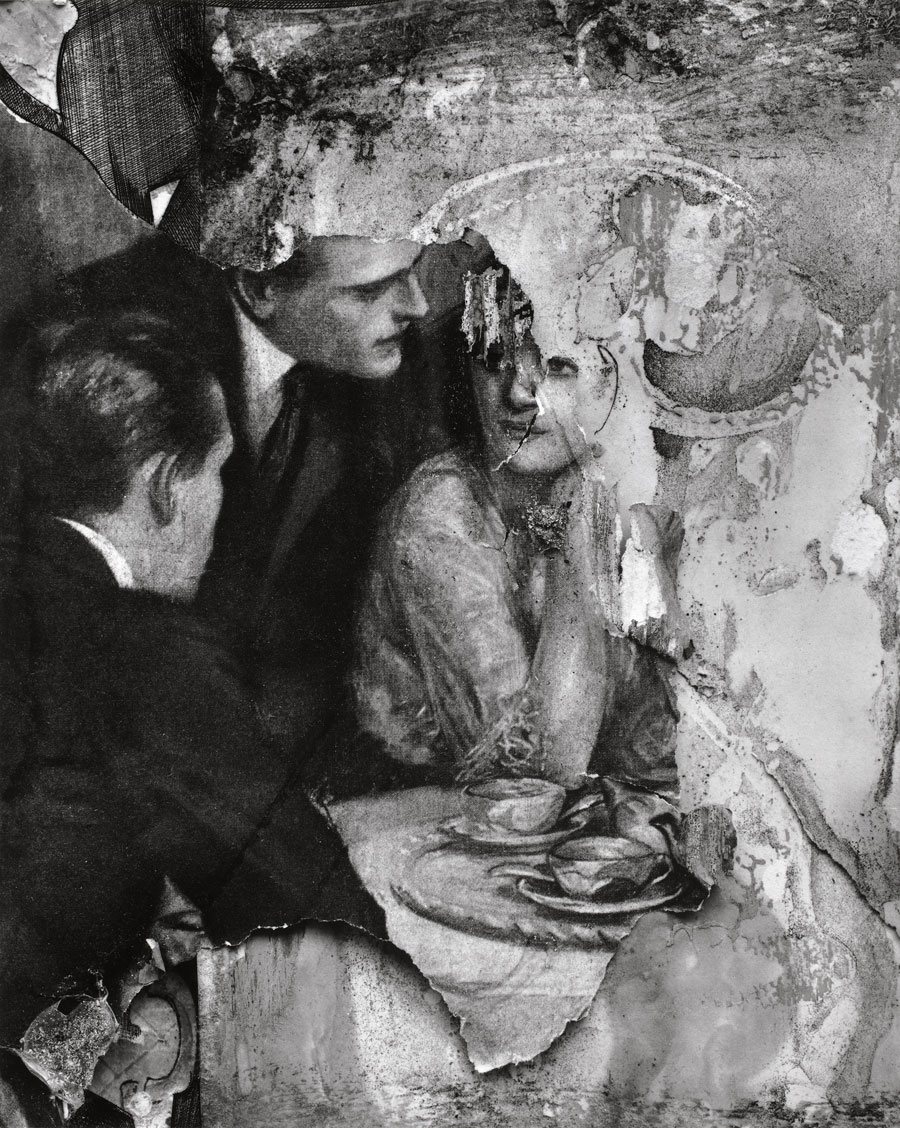
Exhibition: ‘Berenice Abbott (1898-1991), Photographs’ at Jeu de Paume, Paris

Exhibition dates: 21st February – 29th April 2012

Curator: Gaëlle Morel


Berenice Abbott (American, 1898-1991) 'New York Stock Exchange, New York City' 1933


Berenice Abbott (American, 1898-1991)
New York Stock Exchange, New York City
1933
Gelatin silver print
24 x 19cm
Ronald Kurtz / Commerce Graphics
© Berenice Abbott / Commerce Graphics Ltd, Inc.


It is not her portraits or the road trip photographs, nor her scientific work for which Berenice Abbott will be remembered. Firstly, she will always be remembered as the person who photographed Eugene Atget in 1927 just before he died and who bought the remainder of his negatives (after the French government had bought over 2,000 in 1920 and another 2,000 had been sold after his death). She then tirelessly promoted Atget’s work helping him gain international recognition until her sale of the archive to the Museum of Modern Art in 1968. Secondly, she is remembered for her magnificent photographs of New York City and its urban environs, photographs that show the influence of Atget in their attention to detail and understanding of the placement of the camera, and imaging of old and new parts of the city (much as Atget had photographed old Paris before it was destroyed). However, these photographs are uniquely her own, with their modernist New Vision aesthetic, bold perspectives and use of deep chiaroscuro to enhance form within the photograph. Abbott’s best known project, Changing New York (1935-1939) eventually consisted of 305 photographs that document the buildings of Manhattan, some of which are now destroyed. As the text on Wikipedia insightfully notes:

“Abbott’s project was primarily a sociological study imbedded within modernist aesthetic practices. She sought to create a broadly inclusive collection of photographs that together suggest a vital interaction between three aspects of urban life: the diverse people of the city; the places they live, work and play; and their daily activities. It was intended to empower people by making them realise that their environment was a consequence of their collective behaviour (and vice versa). Moreover, she avoided the merely pretty in favour of what she described as “fantastic” contrasts between the old and the new, and chose her camera angles and lenses to create compositions that either stabilised a subject (if she approved of it), or destabilised it (if she scorned it).”


In the text below Gaëlle Morel observes, “Rather than the kind of nostalgic approach often brought to bear on a city’s landmarks and typical sites, this ensemble offers an exploration of the nature of modernity and focuses on the ways in which the past and future are temporarily linked together. Seeking to reinvent the forms and functions of photography in relation to the practice of documentary, Abbott sets out to capture the “disappearance of the moment” by juxtaposing motifs from a city subject to an unprecedented process of demolition and reconstruction.”

While Abbott’s photographs are definitely modernist in nature I believe that today they can also be seen as deeply nostalgic, emerging as they do in the period after the Great Depression when the economy was on the move again, a peaceful time before the oncoming armageddon of the Second World War, closely followed by the fear of nuclear annihilation and the threat of communist indoctrination. They are timeless portraits of a de/reconstructed city. The images seem to float in the air, breathe in the shadows. This is the disappearance of the moment into the enigma of past, present, future – where the photograph becomes eternal, where the best work of both Atget and Abbott resides.

Dr Marcus Bunyan


Many thankx to Jeu de Paume for allowing me to publish the photographs in the posting. Please click on the photographs for a larger version of the image.


Berenice Abbott (American, 1898-1991) 'Treasury Building, New York City' 1933


Berenice Abbott (American, 1898-1991)
Treasury Building, New York City
1933
Gelatin silver print
51 x 40.5cm
Ronald Kurtz / Commerce Graphics
© Berenice Abbott / Commerce Graphics Ltd, Inc.


Architecture

“The tempo of the city is not that of eternity, nor that of time, but that of the ephemeral. That is why recording it is so important, in both documentary and artistic terms.”

“All the photographs of New York took a long time to make, because the camera had to be carefully positioned. There is nothing fortuitous about these photographs.”


The exhibition features a substantial collection from Abbott’s best known project, Changing New York (1935-1939). Commissioned by the Roosevelt administration as part of its response to the nationwide economic crisis, Abbott saw this piece of work as both a way of documenting the City and as a personal work of art. Eighty of the 305 photographs taken by Abbott are on show here, along with various documents providing insight into the background of this major photographic undertaking, including posters and views of the exhibition organised by the Museum of the City of New York in 1937, sketches and historical notes made by the team of journalists working with Abbott on the project, and proofs and dummies of the layout made by the photographer before she started work.

Abbott homes in on the contrasts between old and new elements in the City’s structure. Her images alternate between a New Vision aesthetic, characterised by an emphasis on details and bold perspectives, and a more documentary style that is frontal and neutral. Rather than the kind of nostalgic approach often brought to bear on a city’s landmarks and typical sites, this ensemble offers an exploration of the nature of modernity and focuses on the ways in which the past and future are temporarily linked together. Seeking to reinvent the forms and functions of photography in relation to the practice of documentary, Abbott sets out to capture the “disappearance of the moment” by juxtaposing motifs from a city subject to an unprecedented process of demolition and reconstruction.

In 1938, hoping to take advantage of the fifty million visitors expected at the New York World’s Fair of 1939, the publisher, E.P. Dutton, offered to bring out a selection of one hundred images from the project accompanied by a text by the renowned art critic Elizabeth McCausland, who also happened to be Abbott’s companion and staunch supporter. Going against the women’s original ideas for an art book, Dutton produced a more standard tourist guide, breaking the City down into a series of tours, from south to north and from the centre outwards. The text, too, was shorn of its poetic and pedagogical dimensions, leaving only informative entries about the buildings in the pictures.

In the exhibition, this set of architectural photographs is rounded out by a selection of pictures of vernacular architecture taken by Abbott during a journey in the southern states of the US in the 1930s and when she was travelling along Route 1 in the 1950s. Here, portraits of farmers and wooden houses alternate with pictures of streets and local events.

Berenice Abbott Petit Journal

With over 120 photographs, plus a selection of books and documents never shown before, this is the first exhibition in France to cover the many different facets of the American photographer Berenice Abbott (1898-1991), who is also famous for her international advocacy of Eugène Atget. She came to Paris in 1921 where she learnt her craft from Man Ray before opening her own studio and embarking on a successful career as a portraitist. Returning to New York City in 1929, she conceived what remains her best‑known project, Changing New York (1935-1939). This was financed by the Works Progress Administration as part of its response to the economic crisis sweeping the country. The photographs she took in 1954 when travelling along the US East Coast on Route 1 (the exhibition presents a previously unseen selection of these images) reflect her ambition to represent the whole of what she called the “American scene.” Furthermore, in the 1950s, she also worked on a set of images for the Massachusetts Institute of Technology (MIT) designed to illustrate the principles of mechanics and light for educational purposes.

A committed member of the avant‑garde from the early 1920s, and a staunch opponent of Pictorialism and the school of Alfred Stieglitz, Abbott spent the whole of her career exploring the limits and nature of documentary photography and photographic realism. This exhibition shows the rich array of her interests and conveys both the unity and diversity of her work.

Portraits

Berenice Abbott moved to New York City in the early 1920s and went about becoming a sculptor. Mixing in the bohemian circles of Greenwich Village, she met writers and artists such as Djuna Barnes, Sadakichi Hartmann and Marcel Duchamp. She also posed for Man Ray. Economic hardship at home and the allure of what then seemed the cultural Eldorado of Europe impelled several of these artists to try their luck in Paris, and Abbott herself joined this group of American expatriates in 1921.

In 1923 she became the assistant of Man Ray, who had opened a portrait studio shortly after his arrival in France in 1921. While a fair portion of the studio’s clients were American tourists, Abbott found herself at the heart of the avant-garde scene – especially that of the Surrealists. Between 1923 and 1926 she thus learnt about darkroom techniques and portrait photography while at the same time picking up a broader intellectual and artistic education. She produced her portraits in Man Ray’s studio before opening her own in 1926. Success soon followed. Her clientele was a mixture of French cultural figures and American expatriates, of bourgeois, bohemians and literary types. Her portraits were on occasion manifestly influenced by Surrealism, and more generally show an interest in masquerade, play and disguise, but sometimes even in their use of overprinting and distortion.

The female models express a kind of sexual ambiguity, notably by their masculine haircut or clothes, deliberately exuding a sense of uncertainty with regard to their identity. In composing her portraits, Abbott developed a distinctive aesthetic, far removed from the usual commercial conventions. The absence of a set, with the background usually no more than a plain wall, helped to focus on the sitter and their posture, the position of their body and their facial expression. The use of a tripod and long-focus lenses placed at eye-height allowed her to avoid distortions and thus heighten the physical presence of the models. In early 1929 Abbott left Paris for New York City. Back in America she continued with the same activities, opening a new portrait studio and taking part in exhibitions of modernist photography, while also promoting the work of Eugène Atget, having bought part of his estate in 1928.

New York City

In the early 1930s, Abbott set about her project for a great documentary portrait of the City of New York, but had no luck when she approached institutions such as the Museum of the City of New York and the New York Historical Society for funding. She assembled her first efforts in an album (eight pages of which are exhibited here) in order to convey the scale of her ambitious undertaking, and in 1934 exhibited her photographs of the City at the Museum of the City of New York in the hope of attracting sponsors. In 1935, support was at last forthcoming from the Federal Art Project, a programme set up to aid artists by the Works Progress Administration as part of the New Deal; she now had the support of a team of researchers who produced an information pack with text and drawings to accompany each image. Entitled Changing New York, she conceived this commission as both a vast documentary record of the City and a personal work of art. Eighty of the 305 photographs constituting this project have been selected for the exhibition. These are accompanied by documents – a poster, exhibition views, sketches and historical notes, proofs, pages from the preparatory album and original editions – that help to convey the concerns and ambitions behind this major photographic undertaking.

Abbott focused on the contrasts and links between old and new in the City’s structure. Her images alternate between a New Vision aesthetic, characterised by an emphasis on details and bold perspectives, and a more documentary style that is frontal and neutral. Rather than the kind of nostalgic approach often brought to bear on a city’s landmarks and typical sites, this ensemble offers an exploration of the nature of modernity and focuses on the ways in which the past and future are temporarily linked together. Seeking to reinvent the forms and functions of photography in relation to the practice of documentary, Abbott sets out to capture the “vanishing instant” by juxtaposing motifs from a city subject to an unprecedented process of demolition and reconstruction.

The upshot of all this work was the publication of a book, Changing New York, in 1939. But there was considerable tension between the publisher, whose concerns were commercial, and the photographer, with her artistic ambitions. In 1938, hoping to take advantage of the fifty million visitors expected at the New York World’s Fair of 1939, the publishing house E.P. Dutton proposed to bring out a selection of one hundred images from the project accompanied by a text from the renowned art critic Elizabeth McCausland, who also happened to be Abbott’s companion and unfailing supporter. Straying far from the project originally envisaged by the two women, Dutton changed the presentation of the photographs and produced what was a standard tourist guide, breaking the City down into a series of tours, from south to north and from the centre outwards. The text, too, was shorn of its poetic and pedagogical dimensions, leaving only information about the buildings in the pictures.

The “American scene”

This set of architectural images is completed by a selection of vernacular photographs. In the summer of 1935, Berenice Abbott went on a road trip down to the Southern US in order to create a portrait of a rural world in crisis. Choosing the kind of documentary style that would be the hallmark of the photographic survey launched by the Farm Security Administration (FSA) that same year, she focused on the modest wooden houses and the farmers. Driving around these states with Elizabeth McCausland, Abbott took some two hundred photographs which the two women saw as part of an ambitious photographic portrait of America in book form, although in the end this was never published. A similar fate befell Abbott’s piece on the small towns and villages along Route 1, which she travelled in 1954. Covering approximately 6,500  kilometres as she followed this road along the East Coast of the US, she took some 2,400 photographs, taking in stalls, shops, portraits of farmers, diners and bars and dance halls. Her photography alternated between the documentary aesthetic and Street Photography. With Route 1, Abbott continued to pursue her ambition of representing the whole of the “American scene.”

Science

Abbott started photographing scientific phenomena in 1939. In 1944 she was recruited by the journal Science Illustrated, where she published some of her own pictures, as head of its photography department. Abbott took a committed, pedagogical approach, seeing her images as a vital bridge between modern science and the general public. In 1957, as a result of the anxiety about national science stirred by the Soviet launch of the Sputnik into outer space, at the height of the Cold War, the National Science Foundation set up a Physical Science Study Committee at Massachusetts Institute of Technology. Its role was to develop new textbooks for the teaching of science in schools and to use innovative photographs to illustrate the principles of quantum mechanics. Abbott was hired by MIT to produce photographs for the popularisation and teaching of the sciences. Using abstract forms to visually express complex mechanical concepts and invisible mechanical laws, she used black grounds to reveal principles such as gravity and light waves. The exhibition features a score of Abbott’s scientific and experimental images, as well as some of the books for which they were used. Harking back to the experiments of the avant-gardes, and in particular the Rayogram technique, she was able to produce visually attractive and surprising images that were also rich in discovery, thus combining documentary information with a sense of wonder.”

Text by Gaëlle Morel, curator of the exhibition, on the Jeu de Paume website


Presentation of the exhibition Berenice Abbott

The exhibition “Berenice Abbott (1898-1991), photographies” reveals for the first time in France the different stages of the career of this American photographer. This retrospective offers more than 120 photographs, original works and a series of unpublished documents. By presenting portraits, architectural photographs and scientific shots, the exhibition shows the multiple facets of a work often reduced to a few images.


Berenice Abbott (American, 1898-1991) 'Triborough Bridge, East 125th Street Approach, New York City, June 29, 1937'


Berenice Abbott (American, 1898-1991)
Triborough Bridge, East 125th Street Approach, New York City, June 29, 1937
1937
Gelatin silver print
24.5 x 19cm
Museum of the City of New York. Gift of the Metropolitan Museum of Art
© Berenice Abbott / Commerce Graphics Ltd, Inc.


Berenice Abbott (American, 1898-1991) 'Broadway to the Battery, New York City, May 4, 1938' 1938


Berenice Abbott (American, 1898-1991)
Broadway to the Battery, New York City, May 4, 1938
1938 
Gelatin silver print
17.5 x 24cm
Museum of the City of New York
Museum Purchase with funds from the Mrs. Elon Hooker Acquisition Fund
© Berenice Abbott / Commerce Graphics Ltd, Inc.


Berenice Abbott (American, 1898-1991) 'Flat Iron Building, Broadway and Fifth Avenue, New York City' 1938


Berenice Abbott (American, 1898-1991)
Flat Iron Building, Broadway and Fifth Avenue, New York City
1938
Gelatin silver print
101.5 x 76cm
Ronald Kurtz / Commerce Graphics
© Berenice Abbott / Commerce Graphics Ltd, Inc.


Berenice Abbott (American, 1898-1991) 'Blossom Restaurant, 103 Bowery, New York City, October 24, 1935' 1935


Berenice Abbott (American, 1898-1991)
Blossom Restaurant, 103 Bowery, New York City, October 24, 1935
1935
Gelatin silver print
19 x 24.5cm
Museum of the City of New York
Gift of the Metropolitan Museum of Art
© Berenice Abbott / Commerce Graphics Ltd, Inc.


Berenice Abbott (American, 1898-1991) 'Sunoco Station, Trenton, New Jersey' 1954


Berenice Abbott (American, 1898-1991)
Sunoco Station, Trenton, New Jersey
1954
Gelatin silver print
19 x 24.5cm
Ronald Kurtz / Commerce Graphics
© Berenice Abbott / Commerce Graphics Ltd, Inc.


Berenice Abbott (American, 1898-1991) 'Park Avenue and 39th Street, New York' 1936


Berenice Abbott (American, 1898-1991)
Park Avenue and 39th Street, New York
1936
Gelatin silver print
19 x 24.5cm
© Berenice Abbott / Commerce Graphics Ltd, Inc.


Berenice Abbott (American, 1898-1991) 'Gunsmith and Police Department Headquarters, 6 Centre Market Place and 240 Centre Street, New York City, February 4, 1937' 1937


Berenice Abbott (American, 1898-1991)
Gunsmith and Police Department Headquarters, 6 Centre Market Place and 240 Centre Street, New York City, February 4, 1937
1937 
Gelatin silver print
19 x 24.5cm
Museum of the City of New York
Gift of the Metropolitan Museum of Art
© Berenice Abbott / Commerce Graphics Ltd, Inc.


Berenice Abbott (American, 1898-1991) 'Happy's Refreshment Stand, Daytona Beach, Florida' 1954


Berenice Abbott (American, 1898-1991)
Happy’s Refreshment Stand, Daytona Beach, Florida
1954
Gelatin silver print
29.5 x 28cm
Ronald Kurtz / Commerce Graphics
© Berenice Abbott / Commerce Graphics Ltd, Inc.


Berenice Abbott. 'Miner, Greenview, West Virginia' 1935


Berenice Abbott (American, 1898-1991)
Miner, Greenview, West Virginia
1935
Gelatin silver print
25 x 19cm
Ronald Kurtz / Commerce Graphics
© Berenice Abbott / Commerce Graphics Ltd, Inc.


Berenice Abbott (American, 1898-1991) 'Jean Cocteau with a revolver' 1926


Berenice Abbott (American, 1898-1991)
Jean Cocteau with a revolver
1926
Gelatin silver print
35.5 x 28cm
Ronald Kurtz / Commerce Graphics.
© Berenice Abbott / Commerce Graphics Ltd, Inc.


Berenice Abbott (American, 1898-1991) 'Eugène Atget' 1927


Berenice Abbott (American, 1898-1991)
Eugène Atget
Paris, 1927
Gelatin silver print
© Berenice Abbott/Commerce Graphics.


Jeu de Paume
1, place de la Concorde
75008 Paris
métro Concorde
Phone: 01 47 03 12 50

Opening hours:
Tuesday – Friday: 12am – 8pm
Saturday and Sunday: 11am – 7pm
Closed Monday

Jeu de Paume website

LIKE ART BLART ON FACEBOOK

Back to top
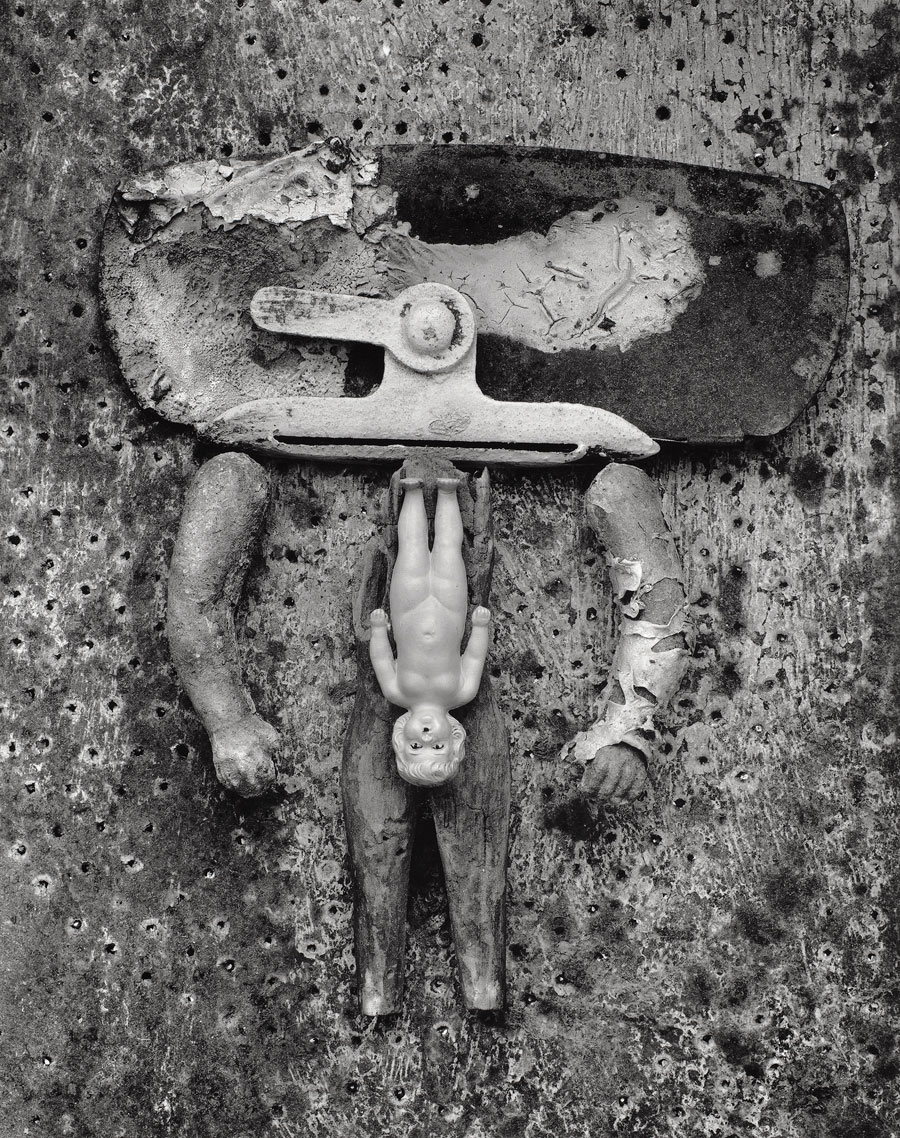
Exhibition: ‘The Original Copy: Photography of Sculpture, 1839 to Today’ at The Museum of Modern Art (MoMA), New York

Exhibition dates: 1st August – 1st November 2010


A huge posting of wonderful photographs!

Many thankx to the Museum of Modern Art for allowing me to publish the photographs in the posting. Please click on the photographs for a larger version of the image.


Edward Weston (American, 1886-1958) 'Rubber Dummies, Metro Goldwyn Mayer Studios, Hollywood' 1939 from the exhibition 'The Original Copy: Photography of Sculpture, 1839 to Today' at MoMA, New York, Aug - Nov 2010


Edward Weston (American, 1886-1958)
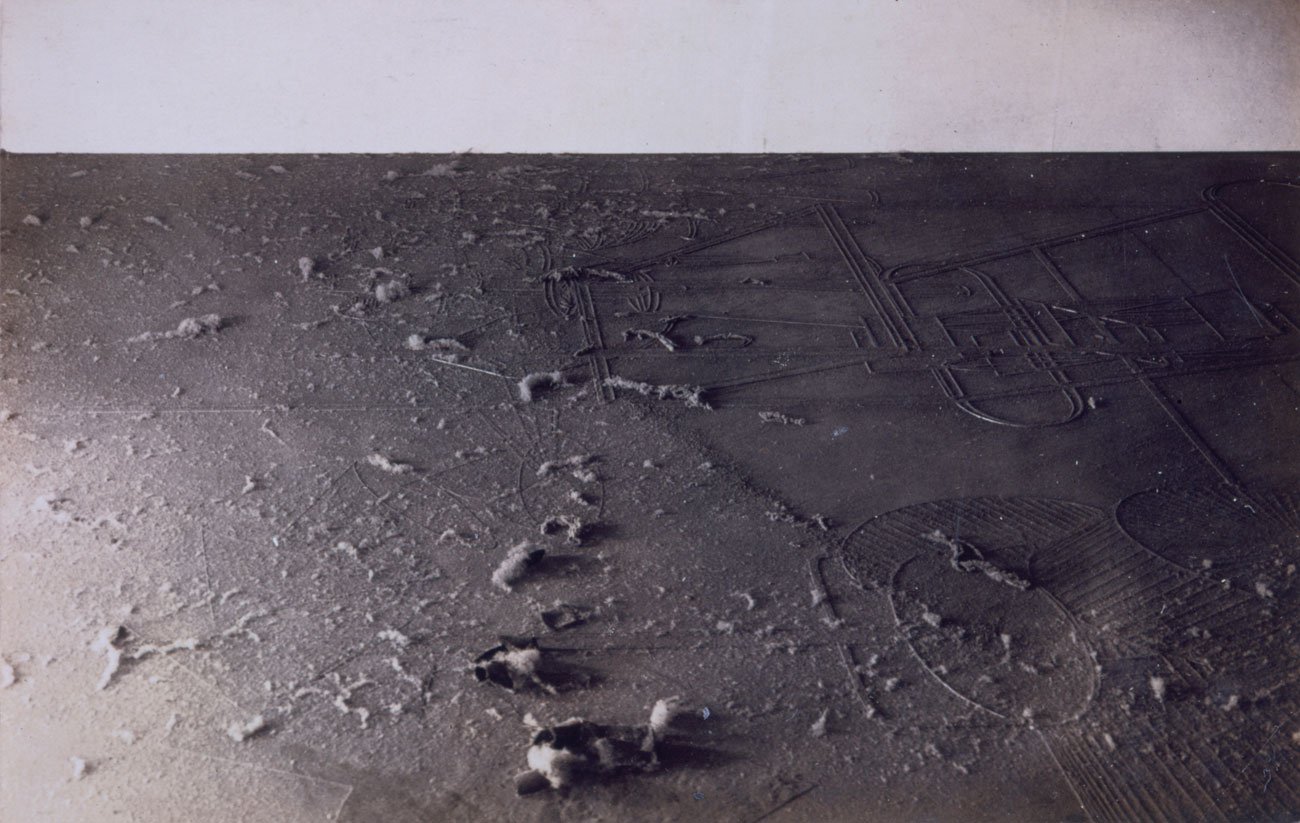
Rubber Dummies, Metro Goldwyn Mayer Studios, Hollywood
1939
Gelatin silver print
7 9/16 x 9 5/8″ (19.3 x 24.4cm)
The Museum of Modern Art, New York. Gift of Edward Steichen
© 1981 Collection Center for Creative Photography, Arizona Board of Regents


David Goldblatt (South African, 1930-2018) 'Monument to Karel Landman, Voortrekker Leader, De Kol, Eastern Cape' April 10, 1993 from the exhibition 'The Original Copy: Photography of Sculpture, 1839 to Today' at MoMA, New York, Aug - Nov 2010


David Goldblatt (South African, 1930-2018)
Monument to Karel Landman, Voortrekker Leader, De Kol, Eastern Cape
April 10, 1993
Gelatin silver print
10 15/16 x 13 11/16″ (27.9 x 34.8cm)
The Museum of Modern Art, New York. Purchase
© 2010 David Goldblatt. Courtesy David Goldblatt and the Goodman Gallery


Eugène Atget (French, 1857-1927) 'Saint-Cloud' 1923 from the exhibition 'The Original Copy: Photography of Sculpture, 1839 to Today' at MoMA, New York, Aug - Nov 2010


Eugène Atget (French, 1857-1927)
Saint-Cloud
1923
Albumen silver print
6 7/8 x 8 3/8″ (17.5 x 21.3cm)
The Museum of Modern Art, New York. Anonymous gift


Edward Steichen (American born Luxembourg, 1879-1973) 'Midnight - Rodin’s Balzac'. 1908 from the exhibition 'The Original Copy: Photography of Sculpture, 1839 to Today' at MoMA, New York, Aug - Nov 2010


Edward Steichen (American born Luxembourg, 1879-1973)
Midnight – Rodin’s Balzac
1908
Pigment print
12 1/8 x 14 5/8″ (30.8 x 37.1cm)
The Museum of Modern Art, New York. Gift of the photographer
Permission of Joanna T. Steichen


Bruce Nauman. 'Waxing Hot' from the portfolio 'Eleven Color Photographs' 1966–67/1970/2007


Bruce Nauman (American, b. 1941)
Waxing Hot from the portfolio Eleven Color Photographs
1966-1967/1970/2007
Inkjet print (originally chromogenic colour print)
19 15/16 x 19 15/16″ (50.6 x 50.6cm)
Museum of Contemporary Art, Chicago. Gerald S. Elliott Collection
© 2010 Bruce Nauman/Artists Rights Society (ARS), New York


Gilbert & George (Gilbert Proesch. British, b. Italy 1943. George Passmore. British, b. 1942) 'Great Expectations'. 1972


Gilbert & George (Gilbert Proesch. British, b. Italy 1943. George Passmore. British, b. 1942)
Great Expectations
1972
Dye transfer print
11 9/16 x 11 1/2″ (29.4 x 29.2cm)
The Museum of Modern Art, New York. Art & Project/Depot VBVR
© 2010 Gilbert & George


Hans Bellmer (German, 1902-1975) 'The Doll' 1935-1937


Hans Bellmer (German, 1902-1975)
The Doll
1935-1937
Gelatin silver print
9 1/2 x 9 5/16″ (24.1 x 23.7cm)
The Museum of Modern Art, New York. Samuel J. Wagstaff, Jr. Fund
© 2010 Artists Rights Society (ARS), New York/ADAGP, Paris


The Original Copy: Photography of Sculpture, 1839 to Today presents a critical examination of the intersections between photography and sculpture, exploring how one medium informs the analysis and creative redefinition of the other. On view at The Museum of Modern Art from August 1 through November 1, 2010, the exhibition brings together over 300 photographs, magazines, and journals, by more than 100 artists, from the dawn of modernism to the present, to look at the ways in which photography at once informs and challenges the meaning of what sculpture is. The Original Copy is organised by Roxana Marcoci, Curator, Department of Photography, The Museum of Modern Art. Following the exhibition’s presentation at MoMA, it will travel to Kunsthaus Zürich, where it will be on view from February 25 through May 15, 2011.

When photography was introduced in 1839, aesthetic experience was firmly rooted in Romanticist tenets of originality. In a radical way, photography brought into focus the critical role that the copy plays in art and in its perception. While the reproducibility of the photograph challenged the aura attributed to the original, it also reflected a very personal form of study and offered a model of dissemination that would transform the entire nature of art.

“In his 1947 book Le Musée Imaginaire, the novelist and politician André Malraux famously advocated for a pancultural ‘museum without walls,’ postulating that art history, and the history of sculpture in particular, had become ‘the history of that which can be photographed,'” said Ms. Marcoci.

Sculpture was among the first subjects to be treated in photography. There were many reasons for this, including the desire to document, collect, publicise, and circulate objects that were not always portable. Through crop, focus, angle of view, degree of close-up, and lighting, as well as through ex post facto techniques of dark room manipulation, collage, montage, and assemblage, photographers have not only interpreted sculpture but have created stunning reinventions of it.

Conceived around ten conceptual modules, the exhibition examines the rich historical legacy of photography and the aesthetic shifts that have taken place in the medium over the last 170 years through a superb selection of pictures by key modern, avant-garde, and contemporary artists. Some, like Eugène Atget, Walker Evans, Lee Friedlander, and David Goldblatt, are best known as photographers; others, such as Auguste Rodin, Constantin Brancusi, and David Smith, are best known as sculptors; and others, from Hannah Höch and Sophie Taeuber-Arp to such contemporaries as Bruce Nauman, Fischli/Weiss, Rachel Harrison, and Cyprien Gaillard, are too various to categorise but exemplify how fruitfully and unpredictably photography and sculpture have combined.

The Original Copy begins with Sculpture in the Age of Photography, a section comprising early photographs of sculptures in French cathedrals by Charles Nègre and in the British Museum by Roger Fenton and Stephen Thompson; a selection of André Kertész’s photographs from the 1920s showing art amid common objects in the studios of artist friends; and pictures by Barbara Kruger and Louise Lawler that foreground issues of representation to underscore photography’s engagement in the analysis of virtually every aspect of art. Eugène Atget: The Marvelous in the Everyday presents an impressive selection of Atget’s photographs, dating from the early 1900s to the mid 1920s, of classical statues, reliefs, fountains, and other decorative fragments in Paris, Versailles, Saint-Cloud, and Sceaux, which together amount to a visual compendium of the heritage of French civilisation at the time.

Auguste Rodin: The Sculptor and the Photographic Enterprise includes some of the most memorable pictures of Rodin’s sculptures by various photographers, including Edward Steichen’s Rodin – The Thinker (1902), a work made by combining two negatives: one depicting Rodin in silhouetted profile, contemplating The Thinker (1880-82), his alter ego; and one of the artist’s luminous Monument to Victor Hugo (1901). Constantin Brancusi: The Studio as Groupe Mobile focuses on Brancusi’s uniquely nontraditional techniques in photographing his studio, which was articulated around hybrid, transitory configurations known as groupe mobiles (mobile groups), each comprising several pieces of sculpture, bases, and pedestals grouped in proximity. In search of transparency, kineticism, and infinity, Brancusi used photography to dematerialise the static, monolithic materiality of traditional sculpture. His so-called photos radieuses (radiant photos) are characterised by flashes of light that explode the sculptural gestalt.

Marcel Duchamp: The Readymade as Reproduction examines Box in a Valise (1935-41), a catalogue of his oeuvre featuring 69 reproductions, including minute replicas of several readymades and one original work that Duchamp “copyrighted” in the name of his female alter ego, Rrose Sélavy. Using collotype printing and pochoir – in which colour is applied by hand with the use of stencils – Duchamp produced “authorised ‘original’ copies” of his work, blurring the boundaries between unique object, readymade, and multiple. Cultural and Political Icons includes selections focusing on some of the most significant photographic essays of the twentieth century – Walker Evans’s American Photographs (1938), Robert Franks’s The Americans (1958), Lee Friedlander’s The American Monument (1976), and David Goldblatt’s The Structure of Things Then (1998) – many of which have never before been shown in a thematic context as they are here.

The Studio without Walls: Sculpture in the Expanded Field explores the radical changes that occurred in the definition of sculpture when a number of artists who did not consider themselves photographers in the traditional sense, such as Robert Smithson, Robert Barry, and Gordon Matta-Clark, began using the camera to document remote sites as sculpture rather than the traditional three-dimensional object. Daguerre’s Soup: What Is Sculpture? includes photographs of found objects or assemblages created specifically for the camera by artists, such as Brassaï’s Involuntary Sculptures (c. 1930s), Alina Szapocznikow’s Photosculptures (1970-1971), and Marcel Broodthaers’s Daguerre’s Soup (1974), the last work being a tongue-in-cheek picture which hints at the various fluid and chemical processes used by Louis Daguerre to invent photography in the nineteenth century, bringing into play experimental ideas about the realm of everyday objects.

The Pygmalion Complex: Animate and Inanimate Figures looks at Dada and Surrealist pictures and photo-collages by artists, including Man Ray, Herbert Bayer, Hans Bellmer, Hannah Höch, and Johannes Theodor Baargeld, who focused their lenses on mannequins, dummies, and automata to reveal the tension between living figure and sculpture. The Performing Body as Sculptural Object explores the key role of photography in the intersection of performance and sculpture. Bruce Nauman, Charles Ray, and Dennis Oppenheim, placing a premium on their training as sculptors, articulated the body as a sculptural prop to be picked up, bent, or deployed instead of traditional materials. Eleanor Antin, Ana Mendieta, VALIE EXPORT, and Hannah Wilke engaged with the “rhetoric of the pose,” using the camera as an agency that itself generates actions through its presence.

Press release from the Museum of Modern Art website


Man Ray (Emmanuel Radnitzky) (American, 1890-1976) 'Noire et blanche' (Black and white) 1926


Man Ray (Emmanuel Radnitzky) (American, 1890-1976)
Noire et blanche (Black and white)
1926
Gelatin silver print
6 3/4 x 8 7/8″ (17.1 x 22.5cm)
The Museum of Modern Art, New York. Gift of James Thrall Soby
2010 Man Ray Trust/Artists Rights Society (ARS), New York/ADAGP, Paris


Walker Evans (American, 1903-1975) 'Stamped Tin Relic' 1929 (printed c. 1970)


Walker Evans (American, 1903-1975)
Stamped Tin Relic
1929 (printed c. 1970)
Gelatin silver print
4 11/16 x 6 5/8″ (11.9 x 16.9cm)
The Museum of Modern Art, New York. Lily Auchincloss Fund
© 2010 Estate of Walker Evans


Lee Friedlander (American, b. 1934) 'Mount Rushmore, South Dakota' 1969


Lee Friedlander (American, b. 1934)
Mount Rushmore, South Dakota
1969
Gelatin silver print
8 1/16 x 12 1/8″ (20.5 x 30.8cm)
The Museum of Modern Art, New York. Gift of the photographer
© 2010 Lee Friedlander


Sibylle Bergemann (German, 1941-2010) 'Das Denkmal, East Berlin' (The monument, East Berlin)


Sibylle Bergemann (German, 1941-2010)
Das Denkmal, East Berlin (The monument, East Berlin)
1986
Gelatin silver print
19 11/16 x 23 5/8″ (50 x 60cm)
Sibylle Bergemann/Ostkreuz Agentur der Fotografen, Berlin
© 2010 Sibylle Bergemann/Ostkreuz Agentur der Fotografen, Berlin


Marcel Duchamp (American, born France, 1887-1968) and Man Ray (Emmanuel Radnitzky) (American, 1890-1976) 'Élevage de poussière (Dust breeding)' 1920


Marcel Duchamp (American, born France, 1887-1968)
Man Ray (Emmanuel Radnitzky) (American, 1890-1976)
Élevage de poussière (Dust breeding)
1920
Gelatin silver contact print
2 13/16 x 4 5/16″ (7.1 x 11cm)
The Bluff Collection, LP
© 2010 Man Ray Trust/Artists Rights Society (ARS), New York/ADAGP, Paris


Guy Tillim (South African, b. 1962) 'Bust of Agostinho Neto, Quibala, Angola' 2008


Guy Tillim (South African, b. 1962)
Bust of Agostinho Neto, Quibala, Angola
2008
Pigmented inkjet print
17 3/16 x 25 3/4″ (43.6 x 65.4cm)
The Museum of Modern Art, New York
Acquired through the generosity of the Contemporary Arts Council of The Museum of Modern Art
© 2010 Guy Tillim. Courtesy Michael Stevenson Gallery


Selected wall text from the exhibition

“The advent of photography in 1839, when aesthetic experience was firmly rooted in Romanticist tenets of originality, brought into focus the critical role that the copy plays in the perception of art. The medium’s reproducibility challenged the aura attributed to the original, but it also reflected a new way of looking and offered a model for dissemination that would transform the entire nature of art. The aesthetic singularity of the photograph, the archival value of a document bearing the trace of history, and the combinatory capacity of the image, open to be edited into sequences in which it mixes with others – all these contribute to the status of photography as both an art form and a medium of communication.

Sculpture was among the first subjects to be treated in photography. In his 1947 book Le Musée imaginaire, the novelist and politician André Malraux famously advocated for a pancultural “museum without walls,” postulating that art history, and the history of sculpture in particular, had become “the history of that which can be photographed.” There were many reasons for this, including the immobility of sculpture, which suited the long exposure times needed with the early photographic processes, and the desire to document, collect, publicise and circulate objects that were not always portable. Through crop, focus, angle of view, degree of close-up, and lighting, as well as through ex post facto techniques of dark room manipulation, collage, montage, and assemblage, photographers not only interpret sculpture but create stunning reinventions of it.

The Original Copy presents a critical examination of the intersections between photography and sculpture, exploring how the one medium has been implicated in the analysis and creative redefinition of the other. Bringing together 300 pictures, magazines and journals by more than 100 artists from the dawn of modernism to the present, this exhibition looks at the ways in which photography at once informs and challenges our understanding of what sculpture is within specific historic contexts.

Sculpture in the Age of Photography

If we consider photography a child of the industrial era – a medium that came of age alongside the steam engine and the railroad – it is not surprising that one of its critical functions was to bring physically inaccessible worlds closer by means of reproduction. Among its early practitioners, Charles Nègre photographed sculpture in the cathedrals of Chartres, Amiens, and, in Paris, Notre Dame, circling them at different levels to capture perspectives of rarely seen sculptural details, while in London Roger Fenton and Stephen Thompson documented the ancient statuary in the British Museum, making visible the new power of collecting institutions.

With the advent of the handheld portable camera in the early 1920s, photographers had the flexibility to capture contingent sculptural arrangements taken from elliptical viewpoints. André Kertész, for instance, recorded unexpected juxtapositions between art and common objects in the studios of artist friends, including Fernand Léger and Ossip Zadkine. His ability to forge heterogeneous materials and objects into visual unity inspired the novelist Pierre Mac Orlan to confer on him the title of “photographer-poet.”

Focusing on details in this way, photographers have interpreted not only sculpture itself, as an autonomous object, but also the context of its display. The results often show that the meaning of art is not fixed within the work but open to the beholder’s reception of it at any given moment. Taking a place in the tradition of institutional critique, Barbara Kruger’s and Louise Lawler’s pictures foreground issues of representation to underscore photography’s engagement in the analysis of virtually every aspect of art.

Eugène Atget
The Marvelous in the Everyday

During the first quarter of the twentieth century, Atget took hundreds of photographs of sculptures – classical statues, reliefs, fountains, door knockers, and other finely wrought decorative fragments – in Paris and its outlying parks and gardens, especially at Versailles, Saint-Cloud, and Sceaux. These images amount to a visual compendium of the heritage of French civilisation at that time.

At Versailles, most intensely between 1901 and 1906 and again between 1921 and 1926, Atget photographed the gardens that André Le Nôtre, the landscape architect of King Louis XIV, had designed in the second half of the seventeenth century. In a series of pictures of allegorical statues punctuating the garden’s vistas, Atget focused on the scenic organisation of the sculptures, treating them as characters in a historical play. The pantomimic effect of the statues’ postures clearly appealed to Atget, who in 1880, before turning to photography, had taken acting classes at the Conservatory of the Théâtre national de France. Depicting the white marble statues from low viewpoints, in full length, and against the dark, unified tones of hedges and trees, Atget brought them into dramatic relief, highlighting the theatrical possibilities of sculpture.

Among the pictures taken at Saint-Cloud is a series centred on a melancholy pool surrounded by statues whose tiny silhouettes can be seen from a distance. Atget’s interest in the variable play between nature and art through minute changes in the camera’s angle, or as functions of the effects of light and time of day, is underscored in his notations of the exact month and sometimes even the hour when the pictures were taken.

Auguste Rodin
The Sculptor and the Photographic Enterprise

Rodin never took pictures of his sculptures but reserved the creative act for himself, actively directing the enterprise of photographing his work. He controlled staging, lighting and background, and he was probably the first sculptor to enlist the camera to record the changing stages through which his work passed from conception to realisation. The photographers working with Rodin were diverse and their images of his work varied greatly, partly through each individual’s artistic sensibility and partly through changes in the photographic medium. The radical viewing angles that Eugène Druet, for instance, adopted in his pictures of hands, in around 1898, inspired the poet Rainer Maria Rilke to write: “There are among the works of Rodin hands, single small hands which without belonging to a body, are alive. Hands that rise, irritated and in wrath; hands whose five bristling fingers seem to bark like the five jaws of a dog of Hell.”

Among the most memorable pictures of Rodin’s sculptures is Edward Steichen’s Rodin – The Thinker (1902), a work made by combining two negatives: Rodin in dark silhouetted profile contemplating The Thinker (1880-1882), his alter ego, is set against the luminous Monument to Victor Hugo (1901), a source of poetic creativity. Steichen also photographed Rodin’s Balzac, installed outdoors in the sculptor’s garden at Meudon, spending a whole night taking varying exposures from fifteen minutes to an hour to secure a number of dramatic negatives. The three major pictures of the sculpture against the nocturnal landscape taken at 11 p.m., midnight, and 4 a.m. form a temporal series. 

Constantin Brancusi
The Studio as Groupe Mobile

“Why write?” Brancusi once queried. “Why not just show the photographs?” The sculptor included many great photographers among his friends – Edward Steichen was one of his early champions in the United States; Alfred Stieglitz organised in 1914 his first solo exhibition in New York; Man Ray helped him buy photographic equipment; Berenice Abbott studied sculpture under him; and he was on close terms with Brassaï, André Kertész, and László Moholy-Nagy. Yet he declined to have his work photographed by others, preferring instead to take, develop, and print his own pictures.

Pushing photography against its grain, Brancusi developed an aesthetic antithetical to the usual photographic standards. His so-called photos radieuses (radiant photos) are characterised by flashes of light that explode the sculptural gestalt. In search of transparency, kineticism, and infinity, Brancusi used photography and polishing techniques to dematerialise the static, monolithic materiality of traditional sculpture, visualising what Moholy-Nagy called “the new culture of light.”

Brancusi’s pictures of his studio underscore his scenographic approach. The artist articulated the studio around hybrid, transitory configurations known as groupes mobiles (mobile groups), each comprising several pieces of sculpture, bases, and pedestals grouped in proximity. Assembling and reassembling his sculptures for the camera, Brancusi used photography as a diary of his sculptural permutations. If, as it is often said, Brancusi “invented” modern sculpture, his use of photography belongs to a reevaluation of sculpture’s modernity.

Cultural and Political Icons

How do we remember the past? What role do photographs play in mediating history and memory? In an era resonating with the consequences of two world wars, the construction and then dismantling of the Berlin Wall, the Vietnam War, and the after effects of the colonialist legacy in South Africa, commemoration has provided a rich subject for photographic investigation.

Some of the most significant photographic essays of the twentieth century – Walker Evans’s American Photographs (1938), Robert Frank’s The Americans (1958), Lee Friedlander’s The American Monument (1976), and David Goldblatt’s The Structure of Things Then (1998) – articulate to different degrees the particular value of photography as a means of defining the cultural and political role of monuments.

Evans’s emblematic image of a crushed Ionic column made of cheap sheet metal; Frank’s picture of a statue of St. Francis preaching, cross and Bible in hands, to the bleak vista of a gas station; Friedlander’s photograph of World War I hero Father Duffy, engulfed in the cacophony of Times Square’s billboards and neon, which threaten to jeopardise the sculpture’s patriotic message; and Goldblatt’s pictures of monuments to some of the most potent symbols of Afrikaner triumphalism – all take a critical look at the world that public statues inhabit.

The Studio without Walls
Sculpture in the Expanded Field

In the late 1960s a radical aesthetic change altered both the definition of the sculptural object and the ways in which that object was experienced. A number of artists who did not consider themselves photographers in the traditional sense began using the camera to rework the idea of what sculpture is, dispensing with the immobile object in favour of an altered site: the built environment, the remote landscape, or the studio or museum space in which the artist intervened.

This engagement with site and architecture – undoubtedly a function of early critiques of art’s institutional status – meant that sculpture no longer had to be a permanent three-dimensional object; it could, for instance, be a configuration of debris on the studio floor, a dematerialised vapour released into the landscape, a dissected home reconfigured as gravity-defying walk-through sculpture, or a wrapped-up building. Bruce Nauman, Robert Barry, Gordon Matta-Clark, and Christo respectively, as well as Michael Heizer, Richard Long, Dennis Oppenheim, and Robert Smithson made extensive use of photography, collecting and taking hundreds of pictures as raw material for other pieces, such as collages and photomontages.

In the first decade of the twenty-first century, artists such as Zhang Dali, Cyprien Gaillard, and Rachel Whiteread have continued this dialogue through photographs contemplating examples of architecture and sculpture in states of dilapidation and entropy, remnants of a society in demise.

Daguerre’s Soup
What Is Sculpture?

In 1932, Brassaï challenged the established notions of what is or is not sculpture when he photographed a series of found objects – tiny castoff scraps of paper that had been unconsciously rolled, folded, or twisted by restless hands, strangely shaped bits of bread, smudged pieces of soap, and accidental blobs of toothpaste, which he titled Involuntary Sculptures. In the 1960s and ’70s artists engaging with various forms of reproduction, replication, and repetition used the camera to explore the limits of sculpture. The word “sculpture” itself was somewhat modified, no longer signifying something specific but rather indicating a polymorphous objecthood. For instance, in 1971 Alina Szapocznikow produced Photosculptures, pictures of a new kind of sculptural object made of stretched, formless and distended pieces of chewing gum.

At the same time, Marcel Broodthaers concocted absurdist taxonomies in photographic works. In Daguerre’s Soup (1975), Broothaers hinted at the various fluids and chemical processes used by Louis Daguerre to invent photography in the nineteenth century by bringing into play experimental ideas about language and the realm of everyday objects. A decade later, the duo Fischli/Weiss combined photography with wacky, ingeniously choreographed assemblages of objects. Their tongue-in-cheek pictures of assemblages shot on the verge of collapse convey a sense of animated suspension and deadpan comedy.

In 2007, Rachel Harrison drew on Broodthaers’s illogical systems of classification and parodic collections of objects to produce Voyage of the Beagle, a series of pictures that collectively raise the question “What is sculpture?” Ranging from images of prehistoric standing stones to mass-produced Pop mannequins, and from topiaries to sculptures made by modernist masters, Harrison’s work constitutes an oblique quest for the origins and contemporary manifestations of sculpture.

The Pygmalion Complex
Animate and Inanimate Figures

The subject of the animated statue spans the history of avant-garde photography. Artists interested in Surrealist tactics used the camera to tap the uncanniness of puppets, wax dummies, mannequins, and automata, producing pictures that both transcribe and alter appearances. Laura Gilpin explored this perturbing mix of stillness and living, alluring lifelikeness in her mysterious portrait George William Eggers (1926), in which Eggers, the director of the Denver Art Museum, keeps company with a fifteenth-century bust whose polychrome charm is enhanced by the glow of the candle he holds next to her face. So does Edward Weston, in his whimsical Rubber Dummies, Metro Goldwyn Mayer Studios, Hollywood (1939), showing two elastic dolls caught in a pas de deux on a movie-studio storage lot; and Clarence John Laughlin, in his eerie photomontage The Eye That Never Sleeps (1946), in which the negative of an image taken in a New Orleans funeral parlour has been overlaid with an image of a mannequin – one of whose legs, however, is that of a flesh-and-blood model.

The tension between animate object and inanimate female form lies at the crux of many of Man Ray’s photographs, including Black and White (1926), which provocatively couples the head of the legendary model, artist, and cabaret singer Alice Prin, a.k.a. Kiki of Montparnasse, with an African ceremonial mask. Hans Bellmer’s photographs of dismembered dolls, and the critical photomontages of Herbert Bayer, Hannah Höch, and Johannes Theodor Baargeld, probe the relationship between living figure and sculpture by invoking the unstable subjectivity and breakdown of anatomic boundaries in the aftermath of the Great War.

The Performing Body as Sculptural Object

In 1969, Gilbert & George covered their heads and hands in metallic powders to sing Flanagan and Allen’s vaudeville number “Underneath the Arches” in live performance. Declaring themselves living sculptures, they claimed the status of an artwork, a role they used photography to express. Charles Ray and Dennis Oppenheim, placing a premium on their training as sculptors, articulated the body as a prop that could be picked up, bent, or deployed instead of more traditional materials as a system of weight, mass, and balance.

In the radicalised climate of the 1970s, artists such as Eleanor Antin, Ana Mendieta, VALIE EXPORT, and Hannah Wilke engaged with the “rhetoric of the pose,” underscoring the key role of photography in the intersection of performance, sculpture and portraiture.

Other artists as diverse as Robert Morris, Claes Oldenburg, Otto Muehl, Bas Jan Ader, and Bruce Nauman, experimented with the plasticity of the body as sculptural material. Several of Nauman’s pictures from his portfolio Eleven Color Photographs (1966-1967 / 1970) spoof the classic tradition of sculpture. Yet the signature image of the group – Self-Portrait as a Fountain, in which a stripped-to-the-waist Nauman spews water from his mouth like a medieval gargoyle – is a deadpan salute to Marcel Duchamp’s Fountain (1917). In this spirit, Erwin Wurm’s series of One Minute Sculptures (1997-98) evoke gestural articulations in which the artist’s body is turned into a sculptural form. Wurm, like the other artists presented in this exhibition, focuses attention on what one can do with and through photography, using the camera not to document actions that precede the impulse to record them but as an agency that itself generates actions through its own presence.


Clarence John Laughlin (American, 1905-1985) 'The Eye That Never Sleeps' 1946


Clarence John Laughlin (American, 1905-1985)
The Eye That Never Sleeps
1946
Gelatin silver print
12 3/8 x 8 3/4″ (31.4 x 22.2cm)
The Museum of Modern Art, New York. Purchase
© Clarence John Laughlin


Fischli/Weiss (Peter Fischli. Swiss, born 1952. David Weiss. Swiss, born 1946) 'Outlaws' 1984


Fischli/Weiss (Peter Fischli. Swiss, b. 1952. David Weiss. Swiss, b. 1946)
Outlaws
1984
Chromogenic colour print
15 ¾ x 11 13/16″ (40 x 30cm)
Courtesy the artists and Matthew Marks Gallery, New York
© Peter Fischli and David Weiss. Courtesy Matthew Marks Gallery, New York


Claes Oldenburg (American born Sweden. b. 1929) 'Claes Oldenburg - Projects for Monuments'. 1967


Claes Oldenburg (American born Sweden. b. 1929)
Claes Oldenburg: Projects for Monuments
1967
Offset lithograph
34 11/16 x 22 1/2″ (88.0 x 57.2 cm)
The Museum of Modern Art, New York. Gift of Barbara Pine
© 2010 Claes Oldenburg


Man Ray (Emmanuel Radnitzky) (American, 1890-1976) 'L'Homme' (Man) 1918


Man Ray (Emmanuel Radnitzky) (American, 1890-1976)
L’Homme (Man)
1918
Gelatin silver print
19 x 14 1/2″ (48.3 x 36.8cm)
Private collection, New York
© 2010 Man Ray Trust/Artists Rights Society (ARS), New York/ADAGP, Paris


Herbert Bayer (American born Austria, 1900-1985) 'Humanly impossible' 1932


Herbert Bayer (American born Austria, 1900-1985)
Humanly impossible
1932
Gelatin silver print
15 3/8 x 11 9/16″ (39 x 29.3cm)
The Museum of Modern Art, New York. Thomas Walther Collection. Purchase
© 2010 Artists Rights Society (ARS), New York/VG Bild-Kunst, Bonn


Constantin Brancusi (French born Romania, 1876-1957) 'L'Oiseau' (Golden Bird). c. 1919


Constantin Brancusi (French born Romania, 1876-1957)
L’Oiseau (Golden Bird)
c. 1919
Gelatin silver print
9 x 6 11/16″ (22.8 x 17cm)
The Museum of Modern Art, New York. Thomas Walther Collection. Purchase
© 2010 Artists Rights Society (ARS), New York/ADAGP, Paris


Gillian Wearing (British, b. 1963) 'Self-Portrait at 17 Years Old' 2003


Gillian Wearing (British, b. 1963)
Self-Portrait at 17 Years Old
2003
Chromogenic color print
41 x 32″ (104.1 x 81.3cm)
The Museum of Modern Art, New York
Acquired through the generosity of The Contemporary Arts Council of The Museum of Modern Art
© 2010 Gillian Wearing. Courtesy the artist, Tanya Bonakdar Gallery, New York, and Maureen Paley, London


Johannes Theodor Baargeld (Alfred Emanuel Ferdinand Gruenwald) (German, 1892-1927) 'Typische Vertikalklitterung als Darstellung des Dada Baargeld' (Typical vertical mess as depiction of the Dada Baargeld). 1920


Johannes Theodor Baargeld (Alfred Emanuel Ferdinand Gruenwald) (German, 1892-1927)
Typische Vertikalklitterung als Darstellung des Dada Baargeld (Typical vertical mess as depiction of the Dada Baargeld)
1920
Photomontage
14 5/8 x 12 3/16″ (37.1 x 31cm)
Kunsthaus Zürich, Grafische Sammlung


Berenice Abbott (American, 1898-1991) 'Father Duffy, Times Square' April 14, 1937


Berenice Abbott (American, 1898-1991)
Father Duffy, Times Square
April 14, 1937
Gelatin silver print
9 5/16 x 7 5/8″ (23.7 x 19.4cm)
The Museum of Modern Art, New York. Gift of Ronald A. Kurtz
© 2010 Berenice Abbott/Commerce Graphics, Ltd., New York


The Museum of Modern Art (MoMA)
11, West Fifty-Third Street, New York

Opening hours:
Daily 10am – 5.30pm

MoMA website

LIKE ART BLART ON FACEBOOK

Back to top