Exhibition: ‘From Shadow to Substance: Grand-Scale Portraits During Photography’s Formative Years’ at the National Portrait Gallery, Washington

Exhibition dates: 20th June, 2025 – 7th June, 2026

Curator: Ann Shumard, Senior Curator of Photographs at the National Portrait Gallery, Washington
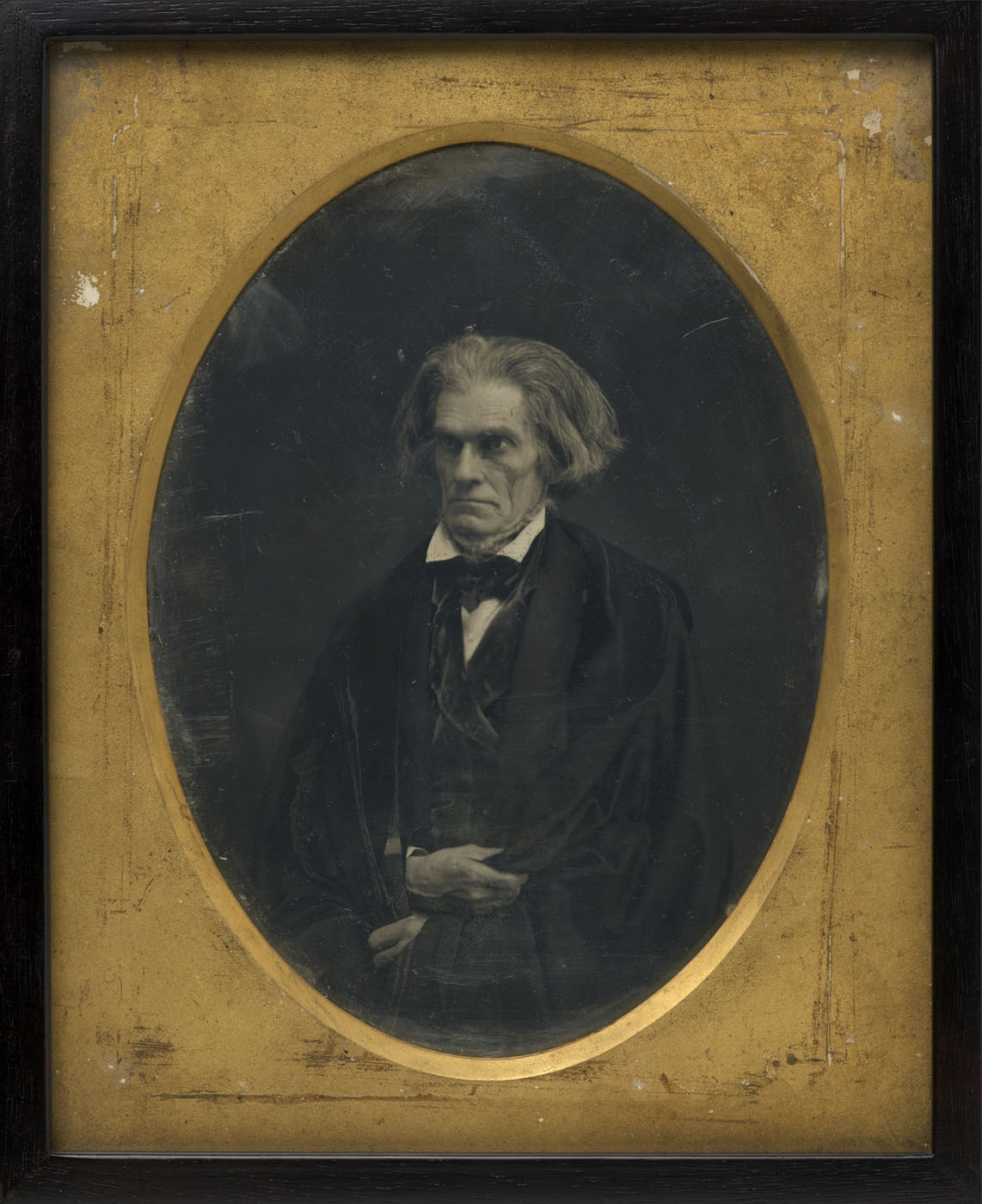
 

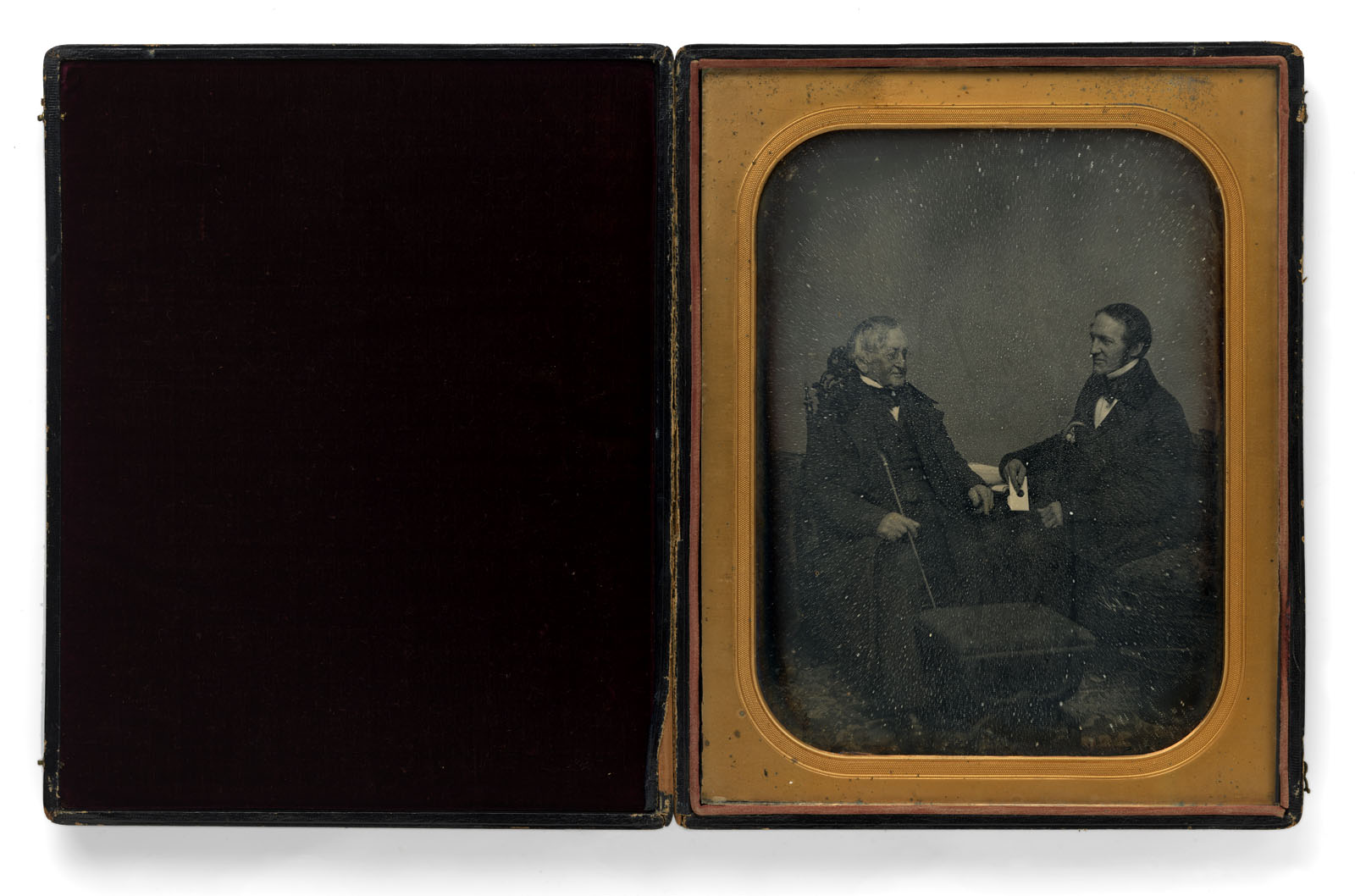
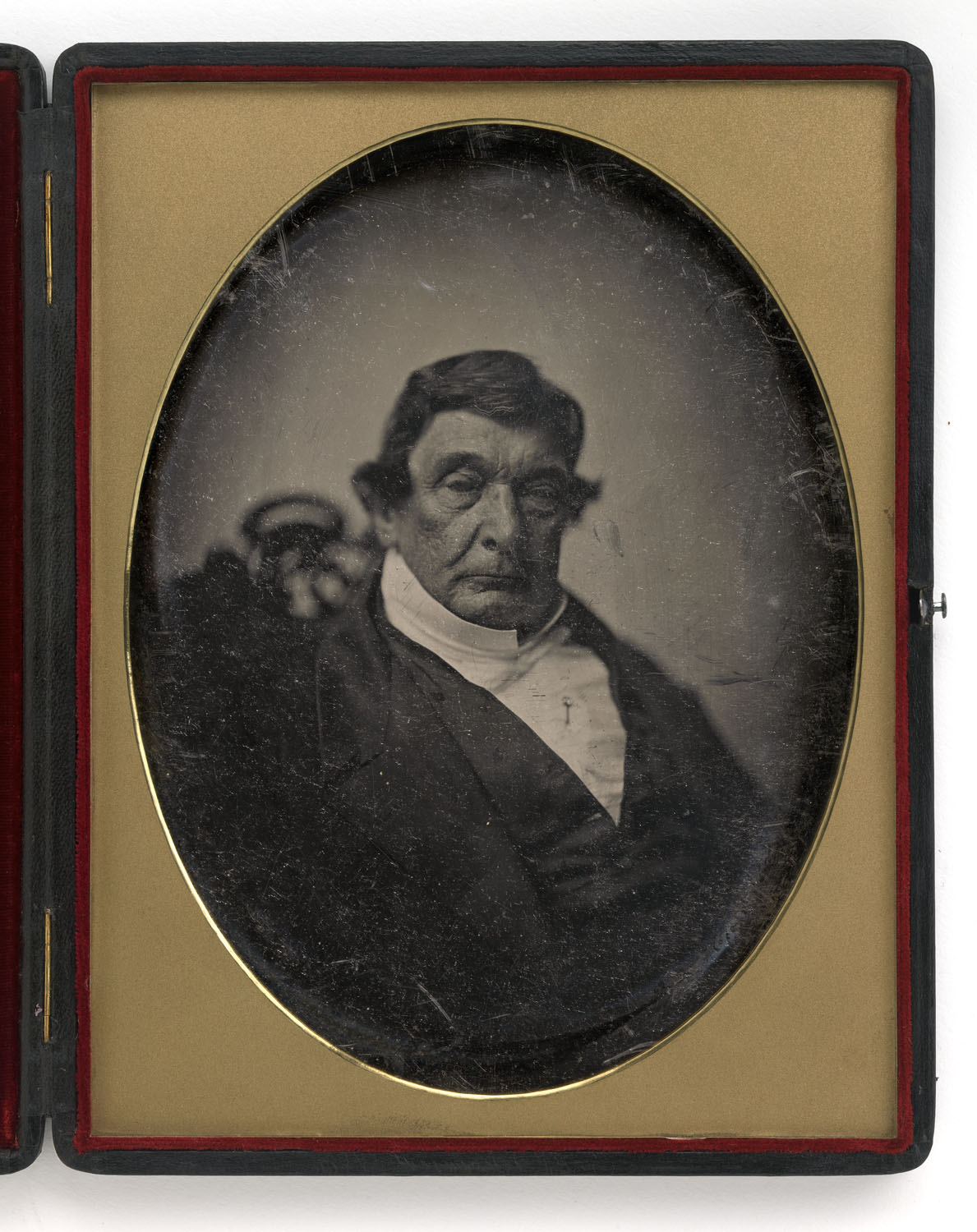
Mathew B. Brady (American, 1822-1896) 'John C. Calhoun' 1849 from the exhibition 'From Shadow to Substance: Grand-Scale Portraits During Photography's Formative Years' at the National Portrait Gallery, Washington, June 2025 - June 2026


Mathew B. Brady (American, 1822-1896)
John C. Calhoun
1849
Whole-plate daguerreotype
Image/Sight: 20.2 x 15cm (7 15/16 x 5 7/8″)
Mat (brass): 24.3 x 19.4cm (9 9/16 x 7 5/8″)
Frame: 35 x 30 x 2.5cm (13 3/4 x 11 13/16 x 1″)
Case closed: 5.8 x 34.3 x 39.7cm (2 5/16 x 13 1/2 x 15 5/8″)
Case open: 5.8 x 72.7 x 39.7cm (2 5/16 x 28 5/8 x 15 5/8″)
National Portrait Gallery, Smithsonian Institution
Gift of Stephan Loewentheil


Mathew Brady’s mastery of the whole plate is on full display in this compelling portrait – the last daguerreotype made of Senator John C. Calhoun before his death in 1850. A contemporary praised the portrait as one of “the best which Mr. Brady has taken himself,” adding, “So perfect was it regarded by the family [of Calhoun], that several copies of it have been made at their request.” Commenting on his subject’s most notable feature, Brady observed, “Calhoun’s eye was startling, and almost hypnotised me.” A painting based on this daguerreotype was commissioned by Brady and now hangs in the U.S. Senate.

Text from the National Portrait Gallery website


High-class portraits

Eight white men (all whole-plate daguerreotypes) and one black woman (whole-plate tintype) – sounds about right.

“To put the era’s pricing in context, a year’s supply of coal for a working-class family in 1850 cost $15 – the minimum price for a Southworth & Hawes whole-plate daguerreotype. The whole plate was therefore too expensive for most consumers… A whole-plate tintype was likely priced from $.75 to $1 in the 1860s, when the average daily wage of a labourer was only $2.”

Picture and price / detail and scale / delicacy of lights and shadows / beauty of execution – execution being the operative word, considering the upcoming devastation of the American Civil War.

Thus, from unapologetic enslaver (Calhoun) who “staunchly defended chattel slavery and its expansion beyond the American South” and whose painting based on Brady’s daguerreotype hangs in the American senate (really!) – to an unidentified literate Black woman, birthplace unknown, born May 10, 1811 taken by an unknown photographer.

I know which one I would rather honour.

Dr Marcus Bunyan


Many thankx to the National Portrait Gallery for allowing me to publish the photographs in the posting. Please click on the photographs for a larger version of the image.


“Competition prompted photographers such as Mathew Brady and Southworth & Hawes to produce advertisements that provided a wealth of detail about the services offered by their respective establishments … I am inclined to think that word of mouth may well have played a greater role in motivating patronage. In the case of Brady and Southworth & Hawes, the knowledge that these studios counted national celebrities among their clientele could have been a strong inducement for the general public to patronise them as well. …

While the National Portrait Gallery’s collection of early photography is substantial, it’s the rare whole-plate daguerreotypes, ambrotypes, and tintypes that stand out for their detail and scale. This exhibition allows visitors to consider how new photographic processes impacted the quality and appeal of the medium … As an aside, the impetus for ‘From Shadow to Substance’ was the extraordinary gift to the museum in 2023 of Mathew Brady’s iconic whole-plate daguerreotype of the powerful antebellum senator John C. Calhoun. A subsequent review of other whole-plates in the Portrait Gallery’s collection sparked consideration of the format’s staying power as a top-of-the-line offering through the succession of early photographic processes. This is the story the exhibition seeks to illuminate.”


Ann Shumard, Senior Curator of Photographs quoted in Kate Garibaldi. “How Portrait Photography’s ‘Grand-Scale’ Origins Changed History,” on the Petapixel website Aug 01, 2025 [Online] Cited 26/02/2026. Used under fair use conditions for the purposes of education and research
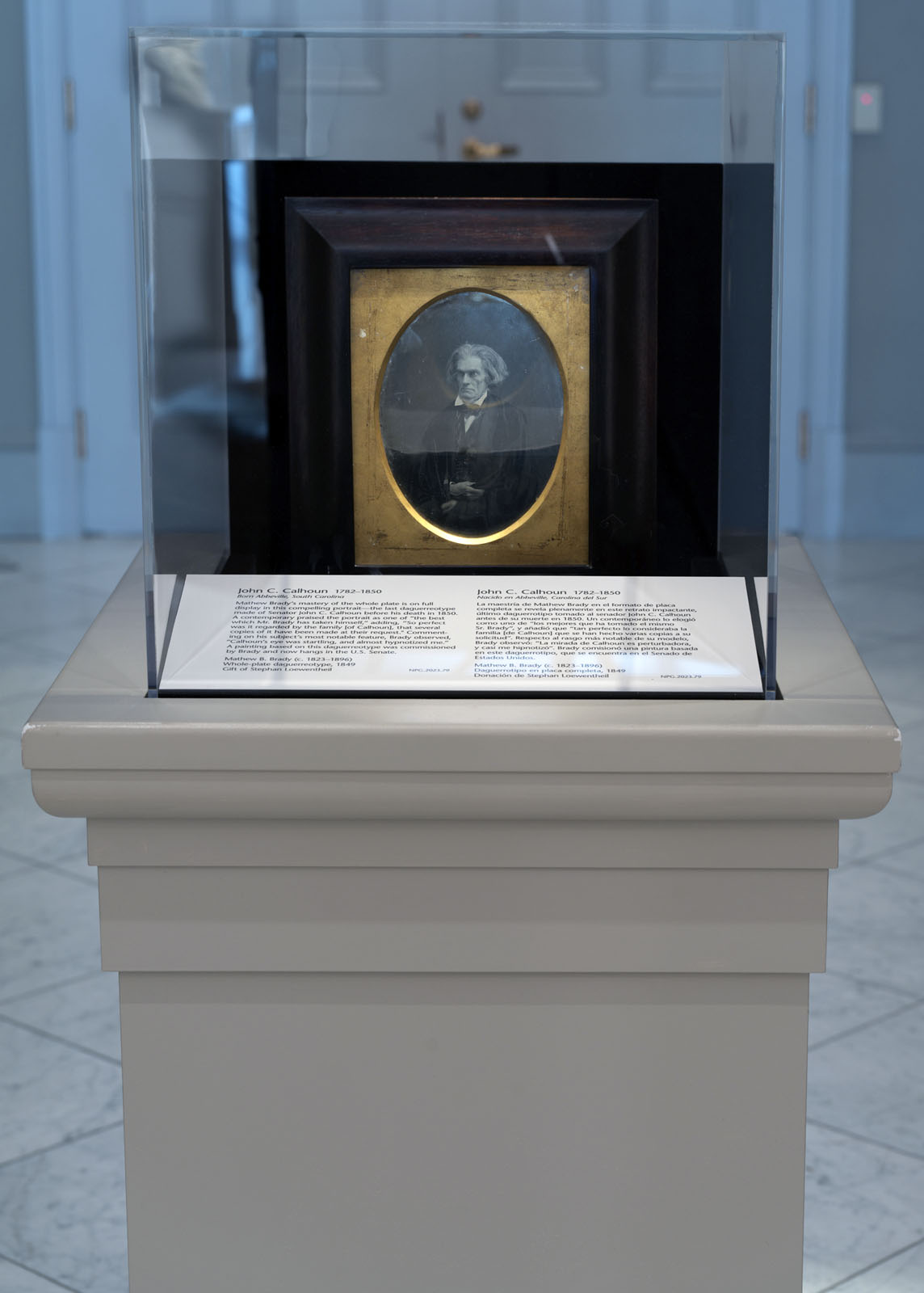


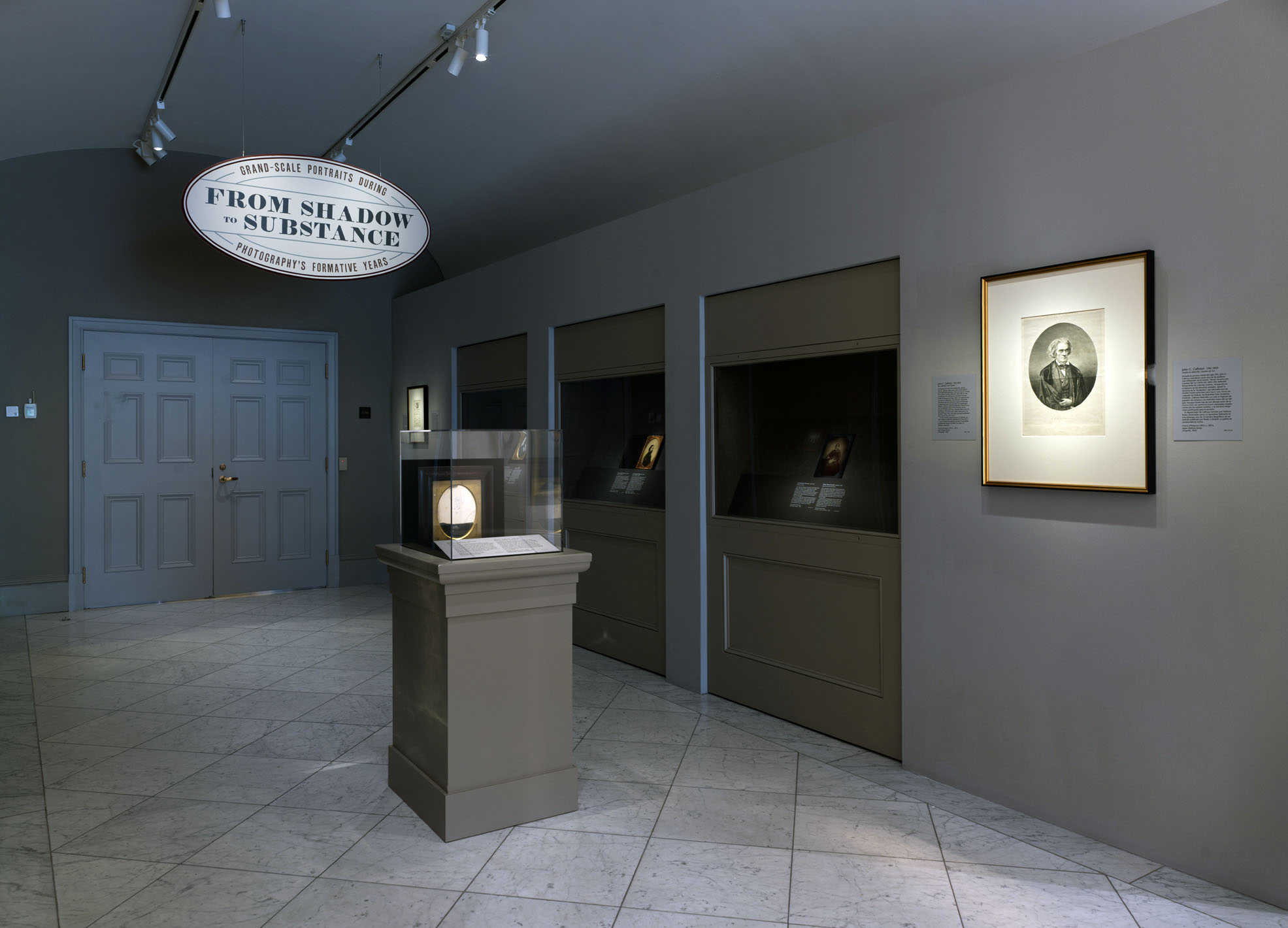
Installation view of the exhibition 'From Shadow to Substance: Grand-Scale Portraits During Photography's Formative Years' at the National Portrait Gallery, Washington, June 20, 2025 - June 7, 2026 showing Mathew B. Brady (American, 1823? - 15 Jan 1896) 'John C. Calhoun' c. 1849-1850


Installation view of the exhibition From Shadow to Substance: Grand-Scale Portraits During Photography’s Formative Years at the National Portrait Gallery, Washington, June 20, 2025 – June 7, 2026 showing Mathew B. Brady (American, 1822-1896) John C. Calhoun 1849 (above)
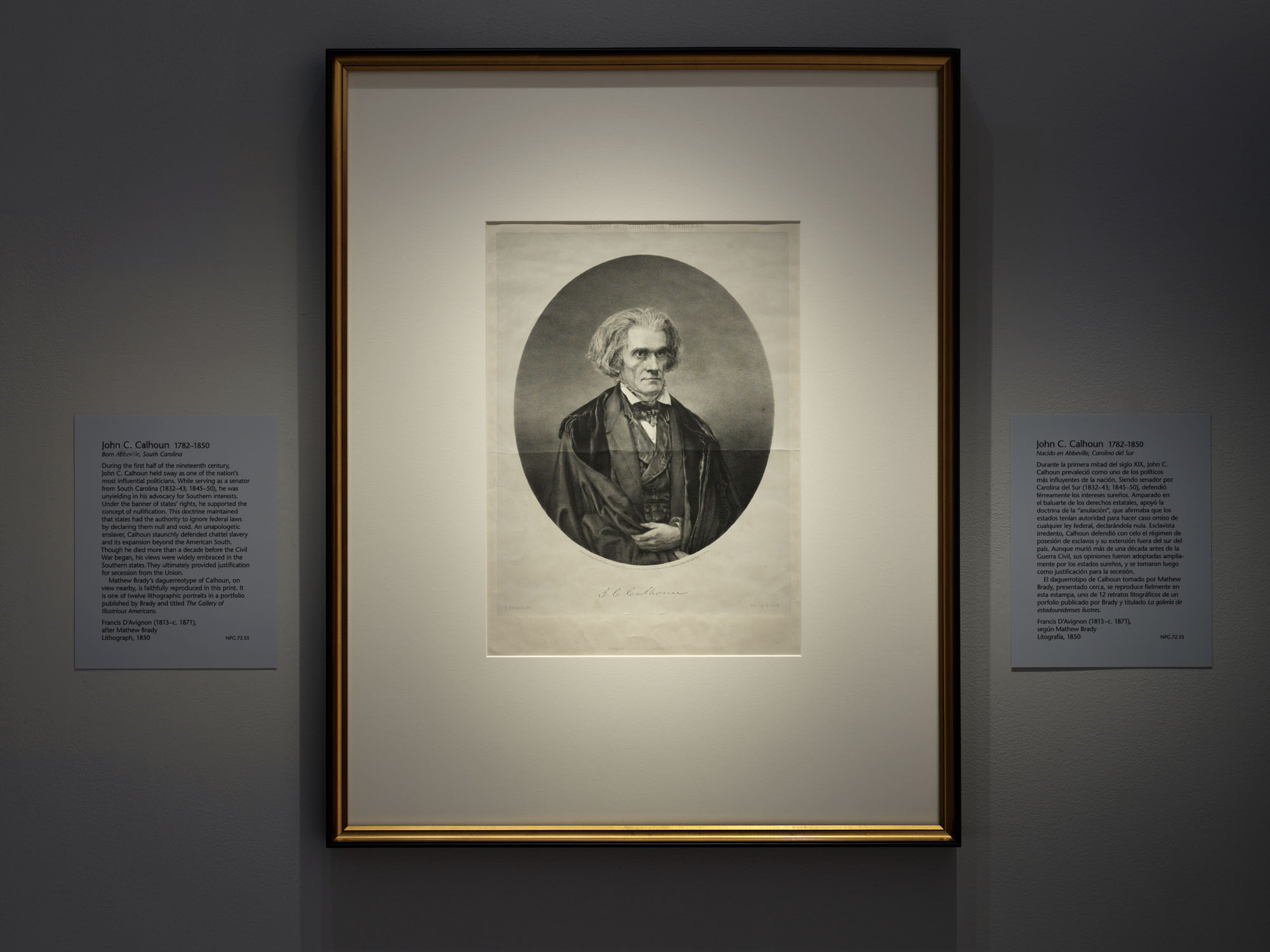
 

Installation view of the exhibition 'From Shadow to Substance: Grand-Scale Portraits During Photography's Formative Years' at the National Portrait Gallery, Washington, June 20, 2025 - June 7, 2026 showing Francis D'Avignon (French, 1813 - c. 1871) Copy after Mathew B. Brady (American, 1823? - 15 Jan 1896) 'John Caldwell Calhoun, 18 Mar 1782 - 31 Mar 1850' 1850


Installation view of the exhibition From Shadow to Substance: Grand-Scale Portraits During Photography’s Formative Years at the National Portrait Gallery, Washington, June 20, 2025 – June 7, 2026 showing Francis D’Avignon (French, 1813 – c. 1871) Copy after Mathew B. Brady (American, 1823? – 15 Jan 1896) John Caldwell Calhoun, 18 Mar 1782 – 31 Mar 1850 1850
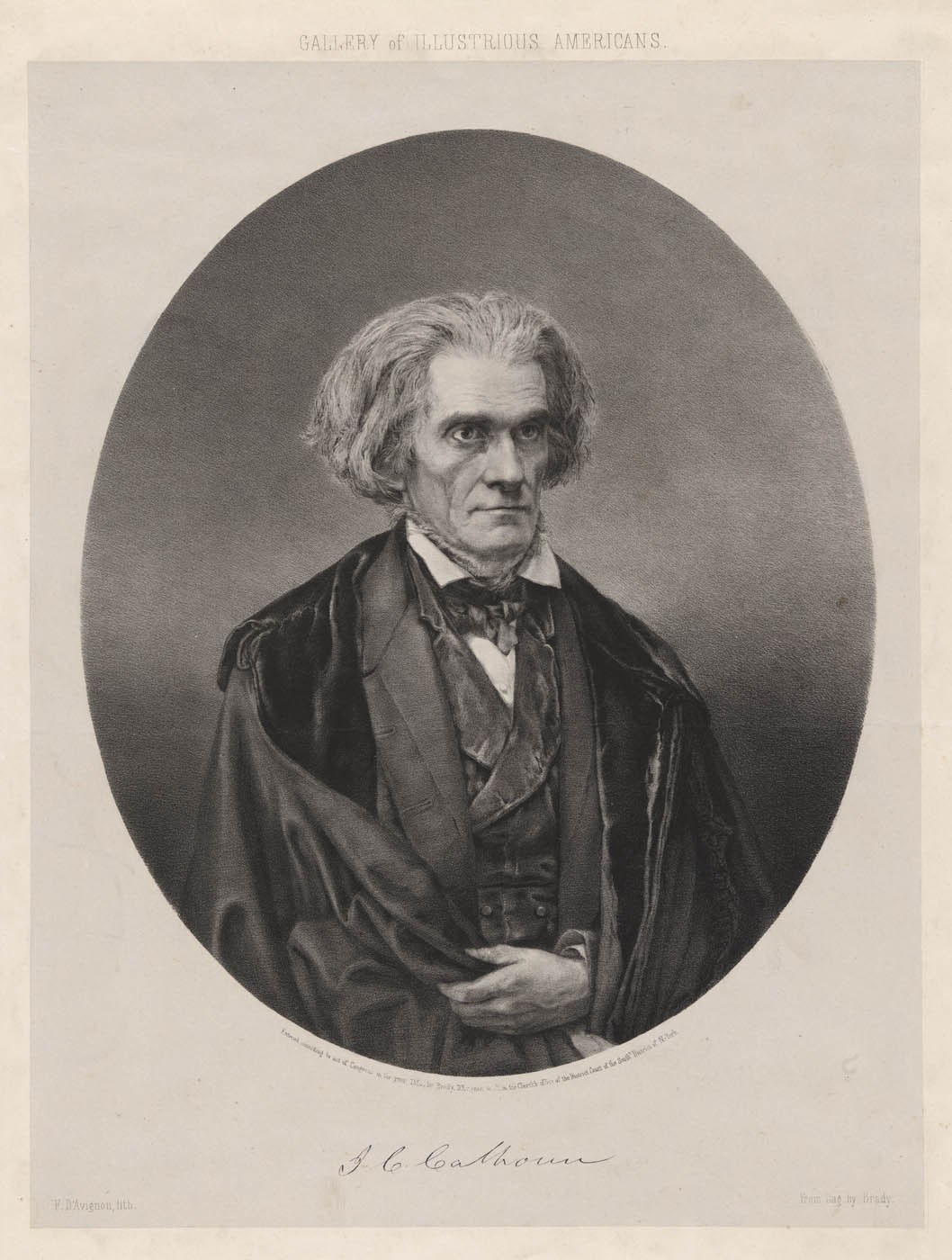
 

Francis D'Avignon (French, 1813 - c. 1871) Copy after Mathew B. Brady (American, 1822-1896) 'John Caldwell Calhoun, 18 Mar 1782 - 31 Mar 1850' 1850


Francis D’Avignon (French, 1813 – c. 1871)
Copy after
Mathew B. Brady (American, 1822-1896)
John Caldwell Calhoun, 18 Mar 1782 – 31 Mar 1850
1850
Lithograph on paper
Sheet: 56.7 x 40.6cm (22 5/16 x 16″)
Book: The Gallery of Illustrious Americans
National Portrait Gallery, Smithsonian Institution


During the first half of the nineteenth century, John C. Calhoun held sway as one of the nation’s most influential politicians. While serving as a senator from South Carolina (1832-1843; 1845-1850), he was unyielding in his advocacy for Southern interests. Under the banner of states’ rights, he supported the concept of nullification. This doctrine maintained that states had the authority to ignore federal laws by declaring them null and void. An unapologetic enslaver, Calhoun staunchly defended chattel slavery and its expansion beyond the American South. Though he died more than a decade before the Civil War began, his views were widely embraced in the Southern states. They ultimately provided justification for secession from the Union. Mathew Brady’s daguerreotype of Calhoun, on view nearby, is faithfully reproduced in this print. It is one of twelve lithographic portraits in a portfolio published by Brady and titled The Gallery of Illustrious Americans.

Text from the National Portrait Gallery website
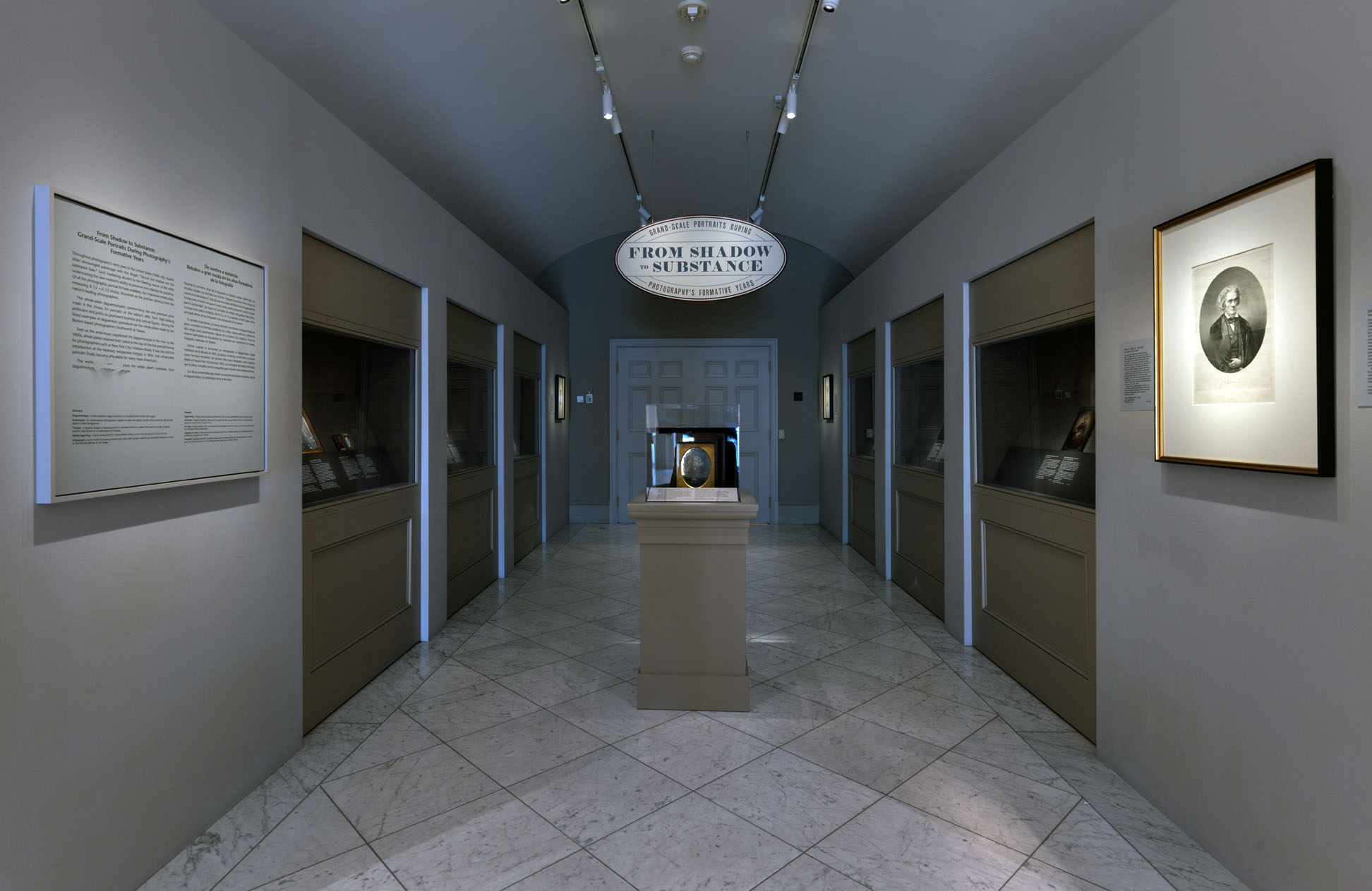
 

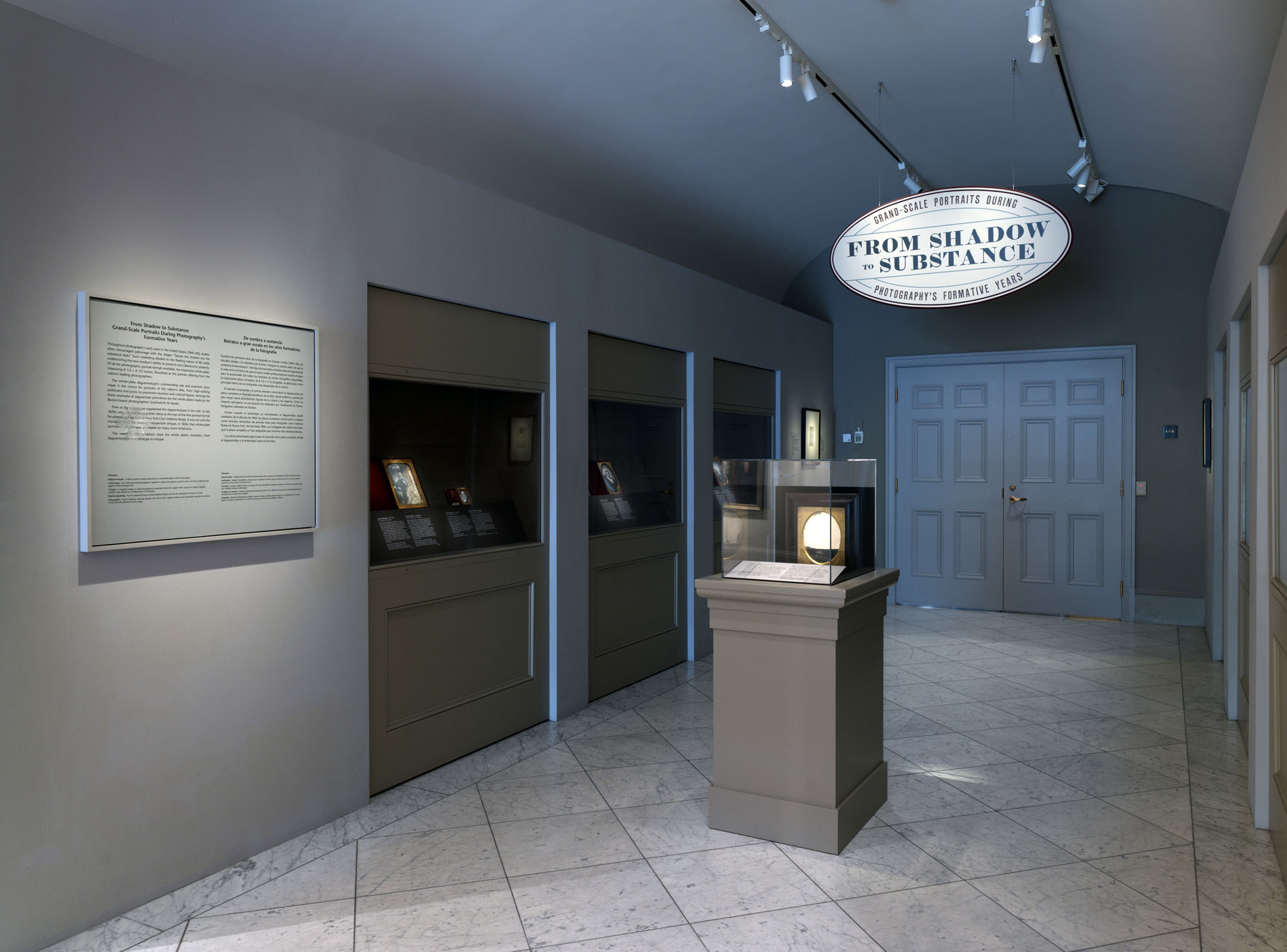
Installation view of the exhibition 'From Shadow to Substance: Grand-Scale Portraits During Photography's Formative Years' at the National Portrait Gallery, Washington, June 20, 2025 - June 7, 2026


Installation views of the exhibition From Shadow to Substance: Grand-Scale Portraits During Photography’s Formative Years at the National Portrait Gallery, Washington, June 20, 2025 – June 7, 2026


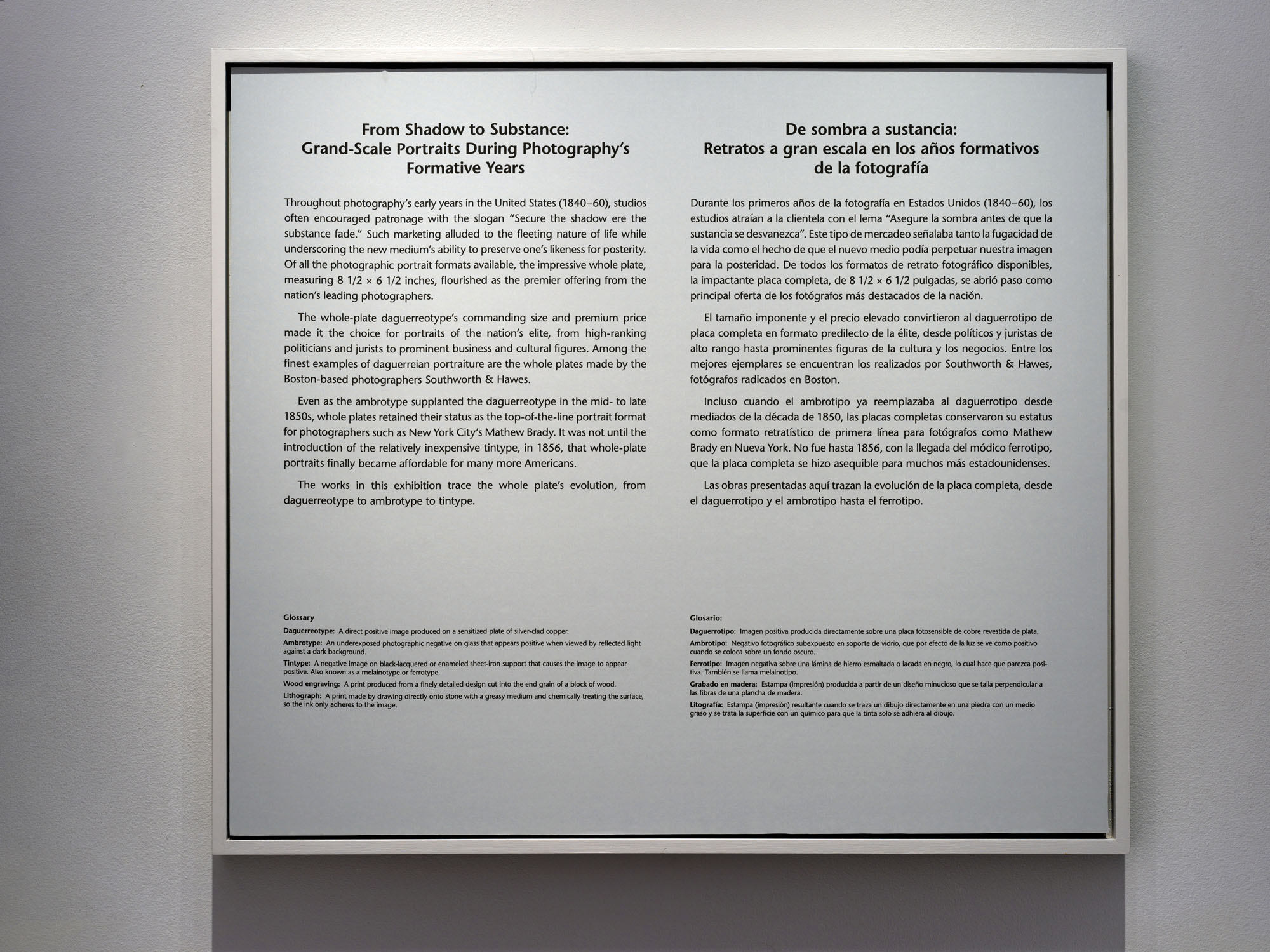
Photographers seeking customers during the medium’s early years often urged the public to “Secure the shadow, ere the substance fade.” Hinting at life’s fragility, this tagline underscored photography’s ability to capture a fleeting likeness and preserve it for posterity. Portraits in the impressive whole-plate format – measuring 8.5 x 6.5 inches – were among the premier offerings of the nation’s leading photographic studios.

Drawing on the National Portrait Gallery’s extensive early photography collection, this exhibition traces the evolution of the grand-scale, whole-plate format from the high-end daguerreotype to the mid-range ambrotype to the more affordable tintype. Examples of whole plates in each of these mediums illustrate how the format evolved as new photographic processes were introduced. Featured works include daguerreotypes representing U.S. senators Daniel Webster and John C. Calhoun, as well as papal nuncio Gaetano Bedini; an ambrotype portrait of American landscape artist John Frederick Kensett; and a tintype likeness of an unidentified African American woman.

Text from the National Portrait Gallery website
 

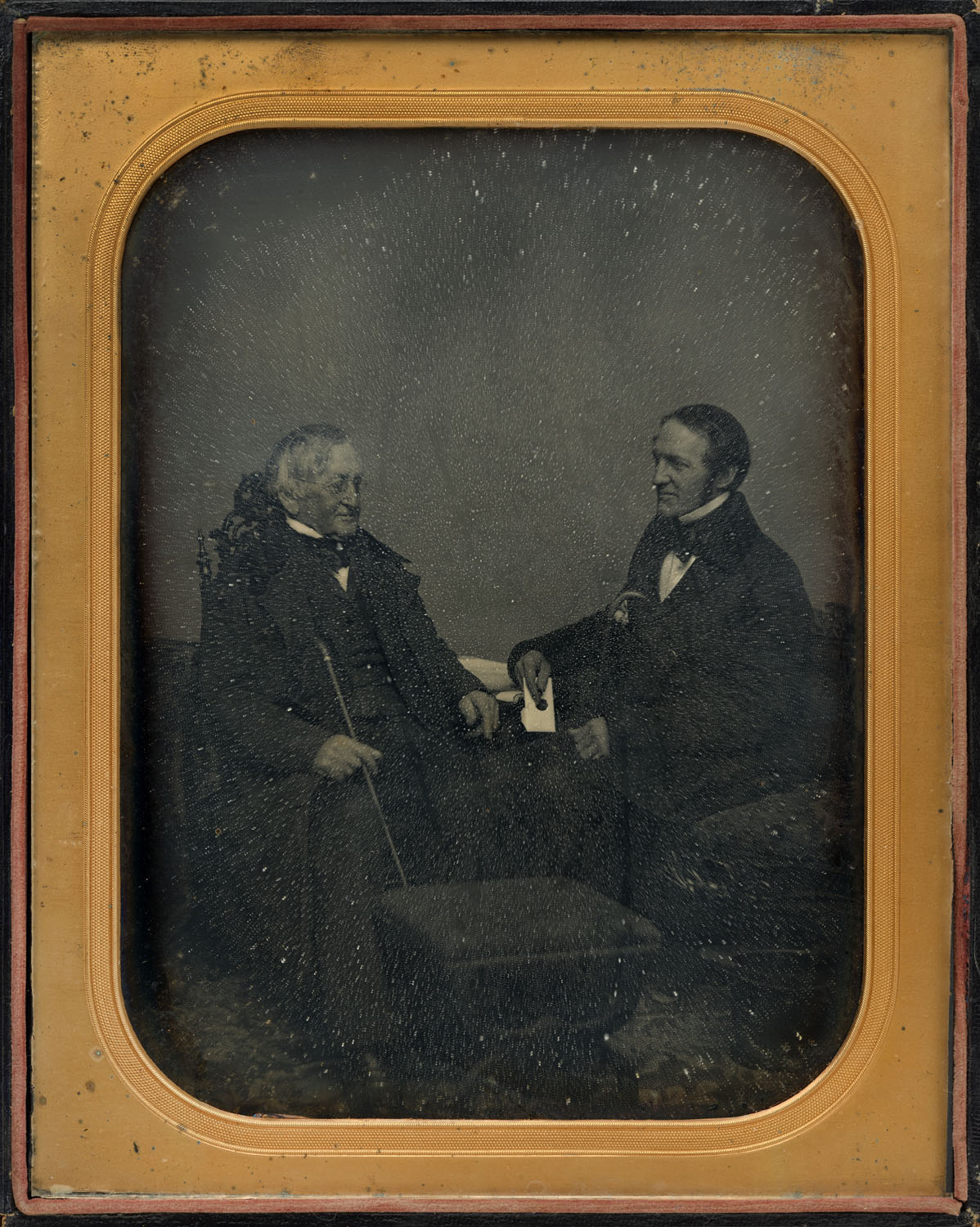
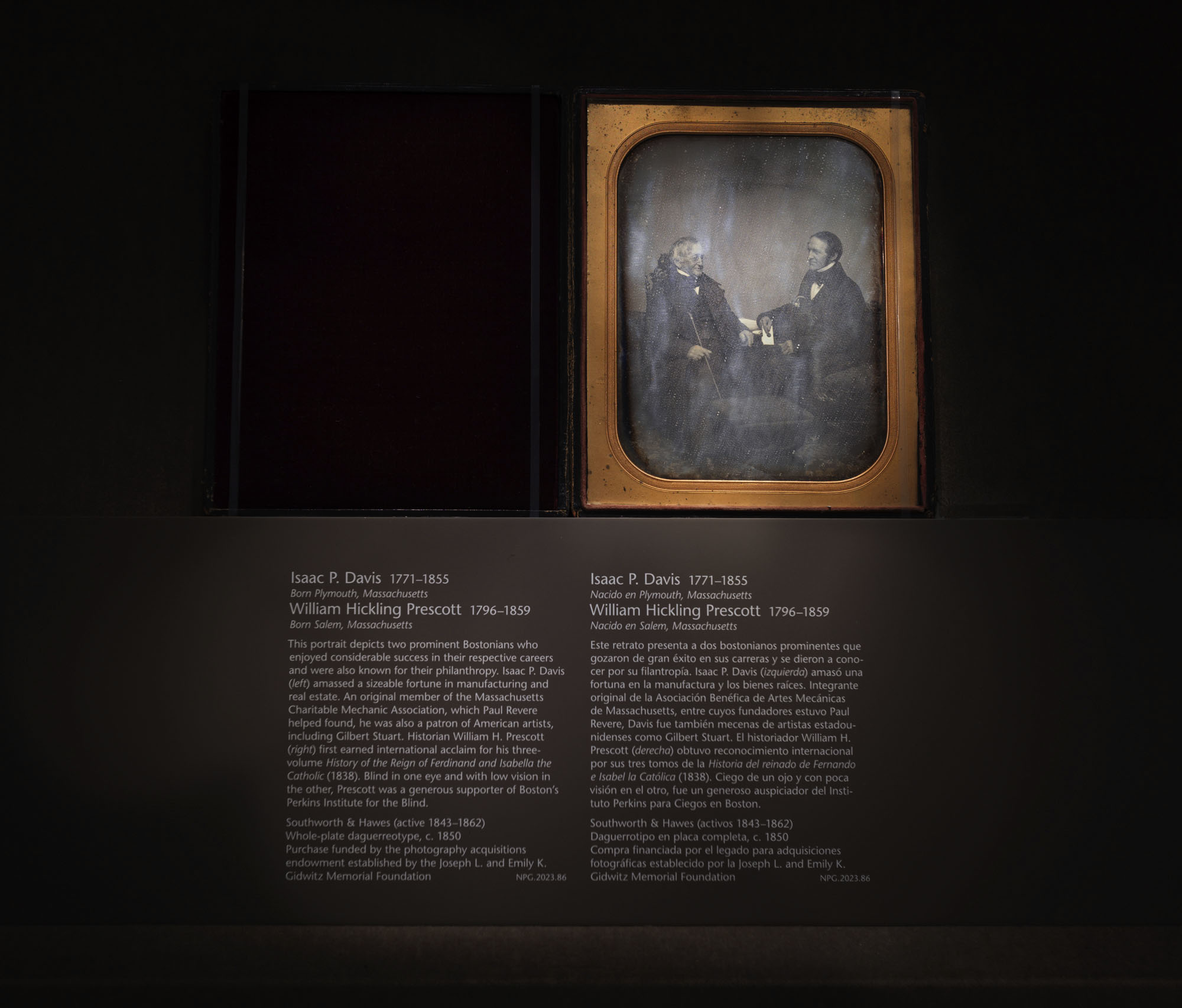
Installation view of the exhibition 'From Shadow to Substance: Grand-Scale Portraits During Photography's Formative Years' at the National Portrait Gallery, Washington, June 20, 2025 - June 7, 2026 showing Southworth & Hawes' 'Issac P. Davis 1771-1855 and William Hickling Prescott 1796-1859' c. 1850


Installation view of the exhibition From Shadow to Substance: Grand-Scale Portraits During Photography’s Formative Years at the National Portrait Gallery, Washington, June 20, 2025 – June 7, 2026 showing Southworth & Hawes’ Issac P. Davis 1771-1855 and William Hickling Prescott 1796-1859 c. 1850 (below)


Southworth & Hawes (active 1843-1862) Albert Sands Southworth (American, 1811-1894) Josiah Johnson Hawes (American, 1808-1901) 'Isaac P. Davis, 7 Oct 1771 - 13 Jan 1855 and William Hickling Prescott, 4 May 1796 - 28 Jan 1859' c. 1850
Southworth & Hawes (active 1843-1862) Albert Sands Southworth (American, 1811-1894) Josiah Johnson Hawes (American, 1808-1901) 'Isaac P. Davis, 7 Oct 1771 - 13 Jan 1855 and William Hickling Prescott, 4 May 1796 - 28 Jan 1859' c. 1850 from the exhibition 'From Shadow to Substance: Grand-Scale Portraits During Photography's Formative Years' at the National Portrait Gallery, Washington, June 2025 - June 2026


Southworth & Hawes (active 1843-1862)
Albert Sands Southworth (American, 1811-1894)
Josiah Johnson Hawes (American, 1808-1901)
Isaac P. Davis, 7 Oct 1771 – 13 Jan 1855
William Hickling Prescott, 4 May 1796 – 28 Jan 1859

c. 1850
Whole-plate daguerreotype
Image/Sight: 20.3 x 15.2cm (8 × 6″)
Mat (brass): 23.6 x 18.6cm (9 5/16 x 7 5/16″)
Case open: 25.3 x 40.2 x 2.3cm (9 15/16 x 15 13/16 x 7/8″)
Case closed: 25.3 x 20.7 x 3.5cm (9 15/16 x 8 1/8 x 1 3/8″)
National Portrait Gallery, Smithsonian Institution
Purchase funded by the photography acquisitions endowment established by the Joseph L. and Emily K. Gidwitz Memorial Foundation


Isaac P. Davis, 7 Oct 1771 – 13 Jan 1855
Born Plymouth, Massachusetts

William Hickling Prescott, 4 May 1796 – 28 Jan 1859
Born Salem, Massachusetts

This portrait depicts two prominent Bostonians who enjoyed considerable success in their respective careers and were also known for their philanthropy. Isaac P. Davis (left) amassed a sizeable fortune in manufacturing and real estate. An original member of the Massachusetts Charitable Mechanic Association, which Paul Revere helped found, he was also a patron of American artists, including Gilbert Stuart. Historian William H. Prescott (right) first earned international acclaim for his three-volume History of the Reign of Ferdinand and Isabella the Catholic (1838). Blind in one eye and with low vision in the other, Prescott was a generous supporter of Boston’s Perkins Institute for the Blind.

Text from the National Portrait Gallery website
 

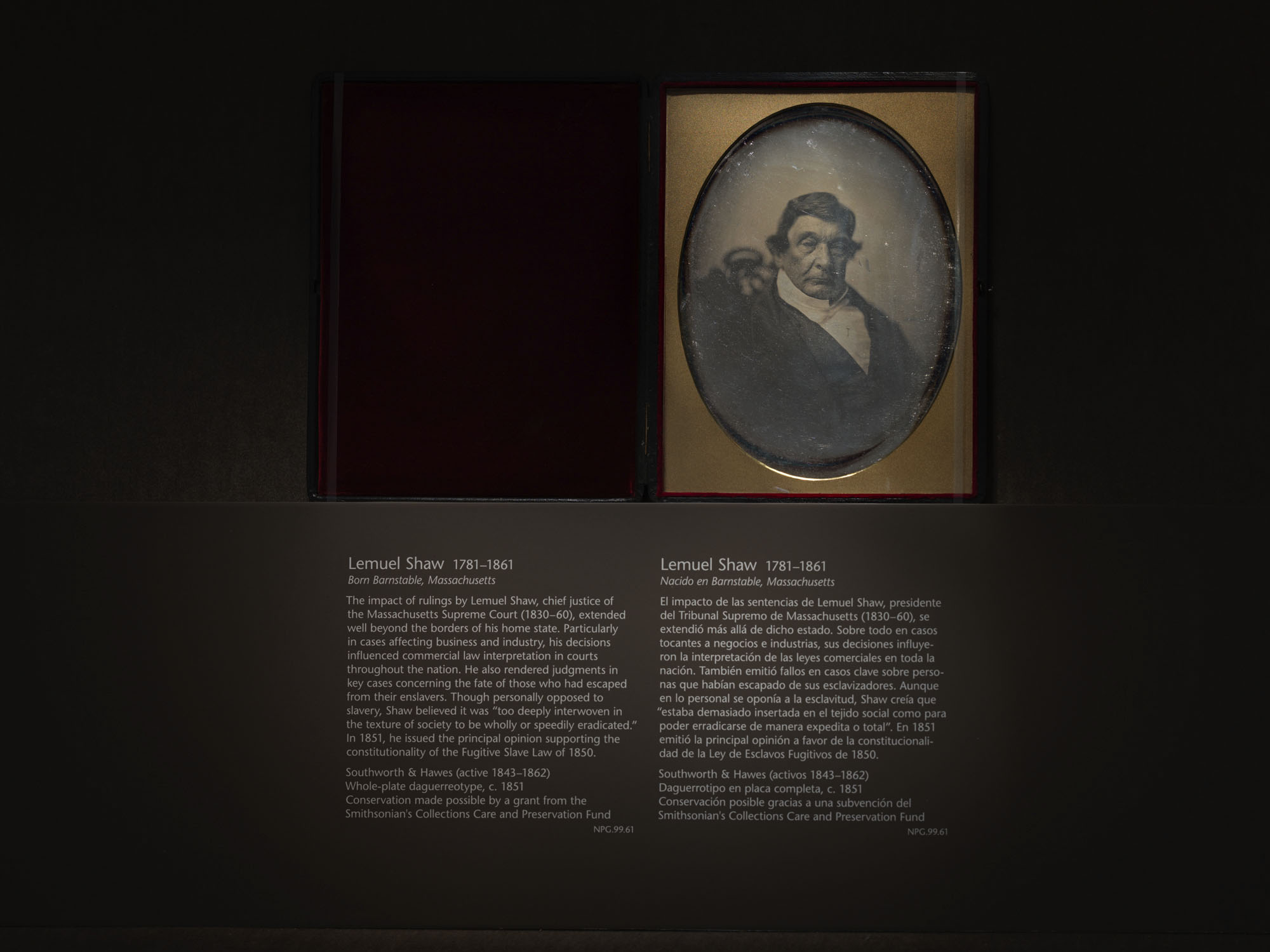
Installation view of the exhibition 'From Shadow to Substance: Grand-Scale Portraits During Photography's Formative Years' at the National Portrait Gallery, Washington, June 20, 2025 - June 7, 2026 Southworth & Hawes' 'Lemuel Shaw 1787-1861' c. 1851


Installation view of the exhibition From Shadow to Substance: Grand-Scale Portraits During Photography’s Formative Years at the National Portrait Gallery, Washington, June 20, 2025 – June 7, 2026 Southworth & Hawes’ Lemuel Shaw 1787-1861 c. 1851 (below)


Southworth & Hawes (active 1843-1862) Albert Sands Southworth (American, 1811-1894) Josiah Johnson Hawes (American, 1808-1901) 'Lemuel Shaw, 9 Jan 1781 - 30 Mar 1861' c. 1851


Southworth & Hawes (active 1843-1862)
Albert Sands Southworth (American, 1811-1894)
Josiah Johnson Hawes (American, 1808-1901)
Lemuel Shaw, 9 Jan 1781 – 30 Mar 1861
c. 1851
Whole-plate daguerreotype with silver-plated copper sheet support
Plate (sight): 21.5 x 16cm (8 7/16 x 6 5/16″)
Case Open: 23.4 x 36.3 x 0.9cm (9 3/16 x 14 5/16 x 3/8″)
Case Closed: 23.4 x 18.2 x 1.8cm (9 3/16 x 7 3/16 x 11/16″)
National Portrait Gallery, Smithsonian Institution
Conservation made possible by a grant from the Smithsonian’s Collections Care and Preservation Fund


Lemuel Shaw, 9 Jan 1781 – 30 Mar 1861
Born Barnstable, Massachusetts

The impact of rulings by Lemuel Shaw, chief justice of the Massachusetts Supreme Court (1830-1860), extended well beyond the borders of his home state. Particularly in cases affecting business and industry, his decisions influenced commercial law interpretation in courts throughout the nation. He also rendered judgments in key cases concerning the fate of those who had escaped from their enslavers. Though personally opposed to slavery, Shaw believed it was “too deeply interwoven in the texture of society to be wholly or speedily eradicated.” In 1851, he issued the principal opinion supporting the constitutionality of the Fugitive Slave Law of 1850.

Text from the National Portrait Gallery website
 

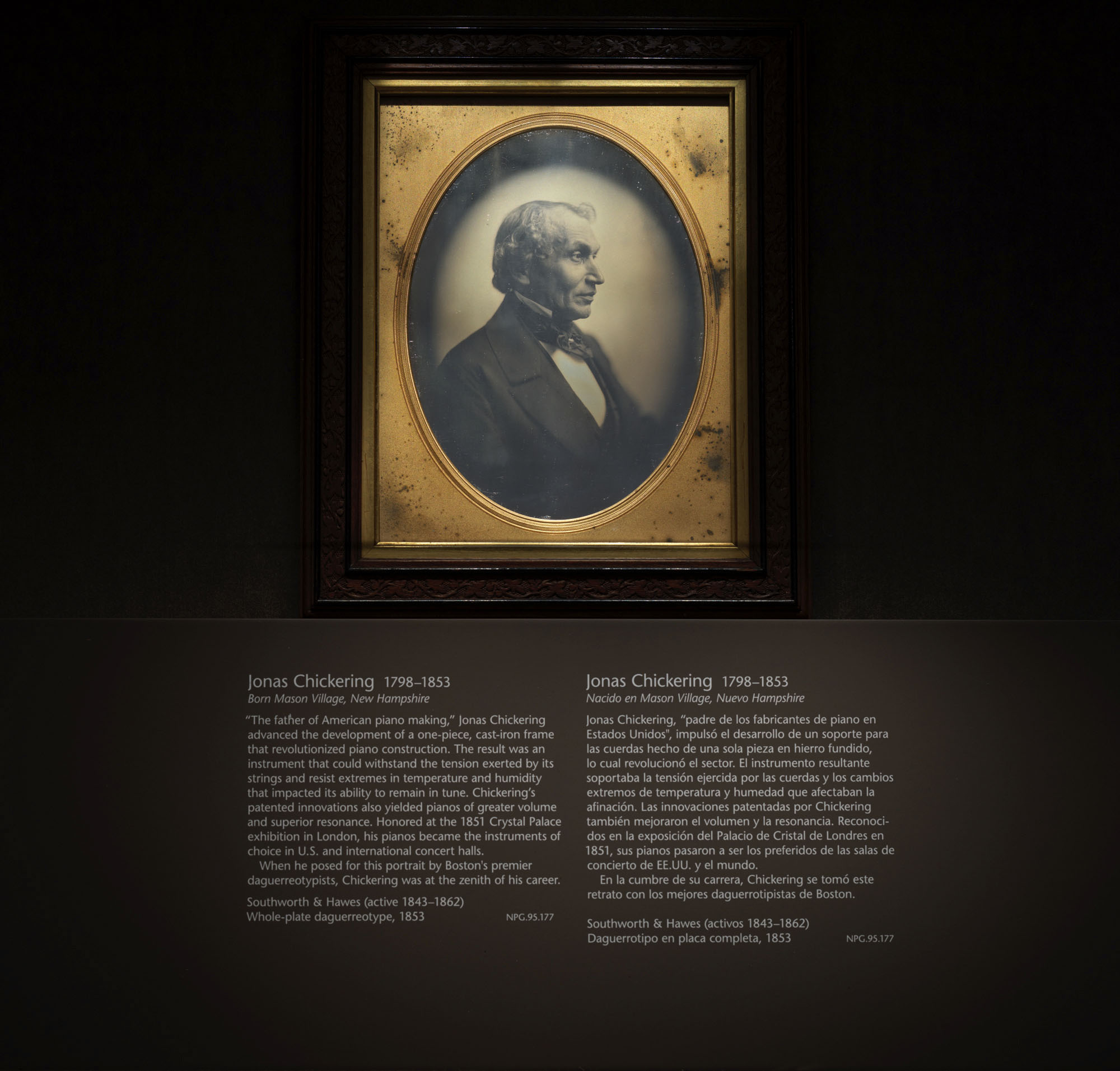
Installation view of the exhibition 'From Shadow to Substance: Grand-Scale Portraits During Photography's Formative Years' at the National Portrait Gallery, Washington, June 20, 2025 - June 7, 2026 showing Southworth & Hawes' 'Jonas Chickering' 1853


Installation view of the exhibition From Shadow to Substance: Grand-Scale Portraits During Photography’s Formative Years at the National Portrait Gallery, Washington, June 20, 2025 – June 7, 2026 showing showing Southworth & Hawes’ Jonas Chickering 1853 (below)


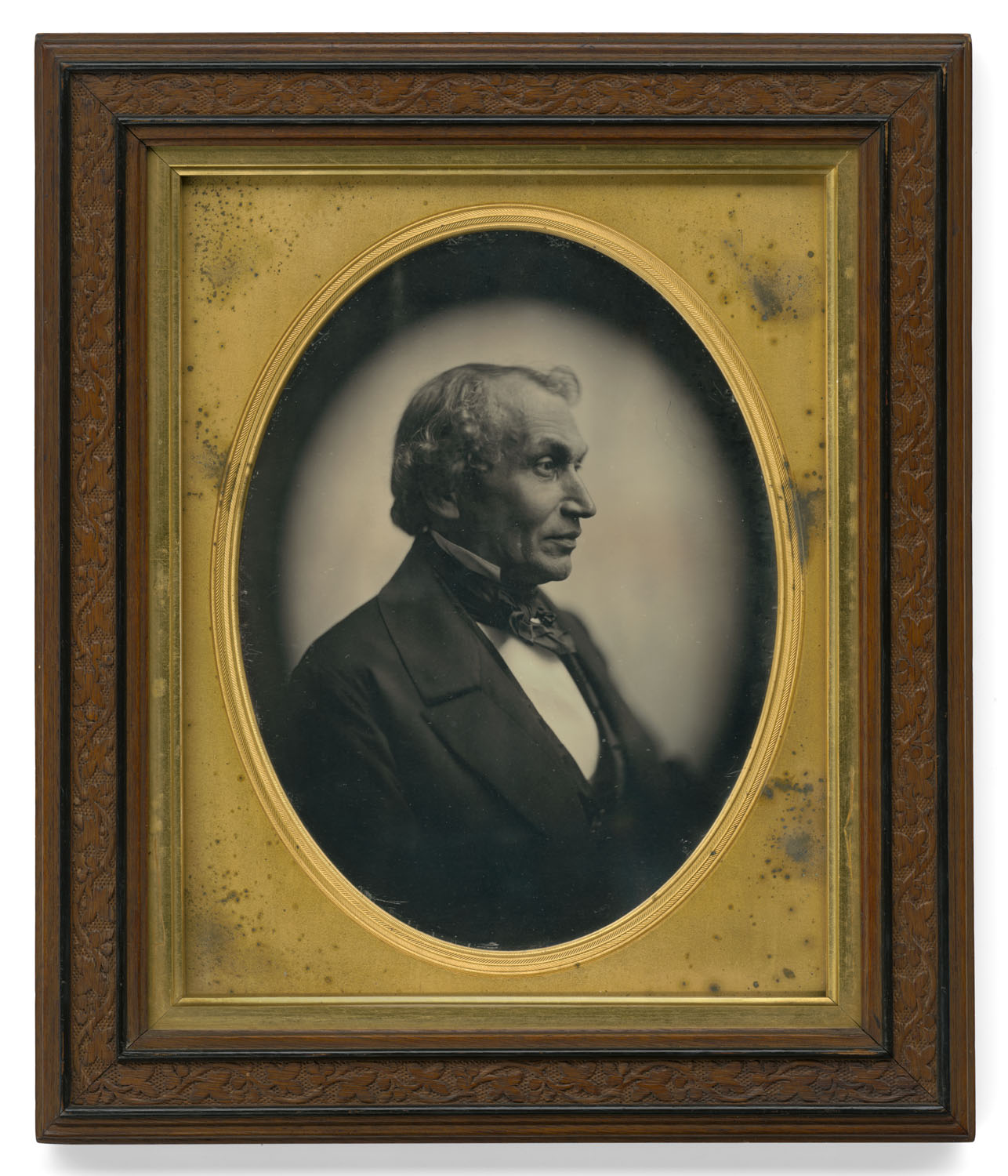
Southworth & Hawes (active 1843-1862) Albert Sands Southworth (American, 1811-1894) Josiah Johnson Hawes (American, 1808-1901) 'Jonas Chickering, 5 Apr 1798 - 8 Dec 1853' 1853


Southworth & Hawes (active 1843-1862)
Albert Sands Southworth (American, 1811-1894)
Josiah Johnson Hawes (American, 1808-1901)
Jonas Chickering, 5 Apr 1798 – 8 Dec 1853
1853
Whole-plate daguerreotype
Image: 20 x 15cm (7 7/8 x 5 7/8″)
Frame: 31.1 x 25.7 x 2.5cm (12 1/4 x 10 1/8 x 1″)
National Portrait Gallery, Smithsonian Institution


Jonas Chickering, 5 Apr 1798 – 8 Dec 1853
Born Mason Village, New Hampshire

“The father of American piano making,” Jonas Chickering advanced the development of a one-piece, cast-iron frame that revolutionised piano construction. The result was an instrument that could withstand the tension exerted by its strings and resist extremes in temperature and humidity that impacted its ability to remain in tune. Chickering’s patented innovations also yielded pianos of greater volume and superior resonance. Honoured at the 1851 Crystal Palace exhibition in London, his pianos became the instruments of choice in U.S. and international concert halls.

When he posed for this portrait by Boston’s premier daguerreotypists, Chickering was at the zenith of his career.

Text from the National Portrait Gallery website
 

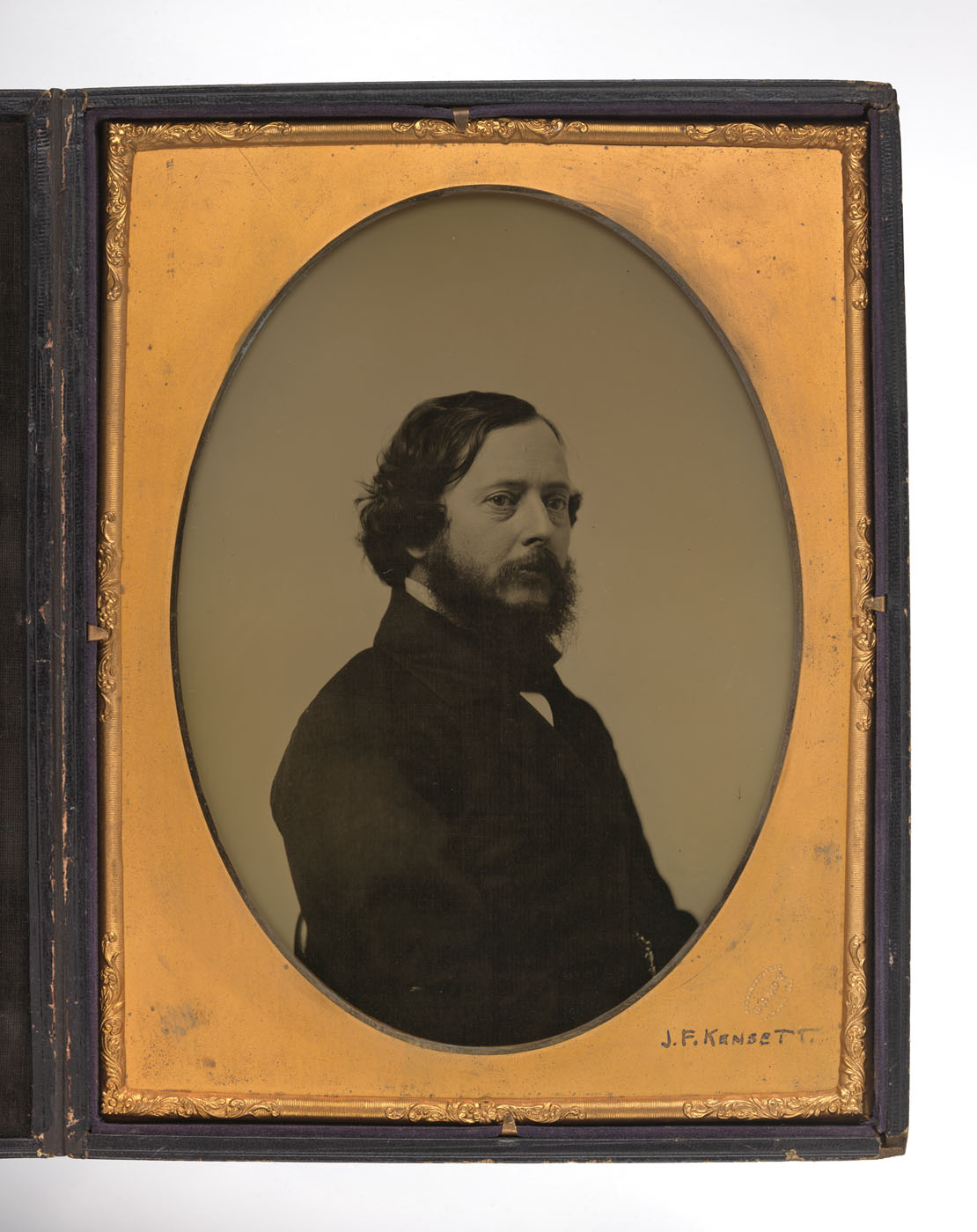
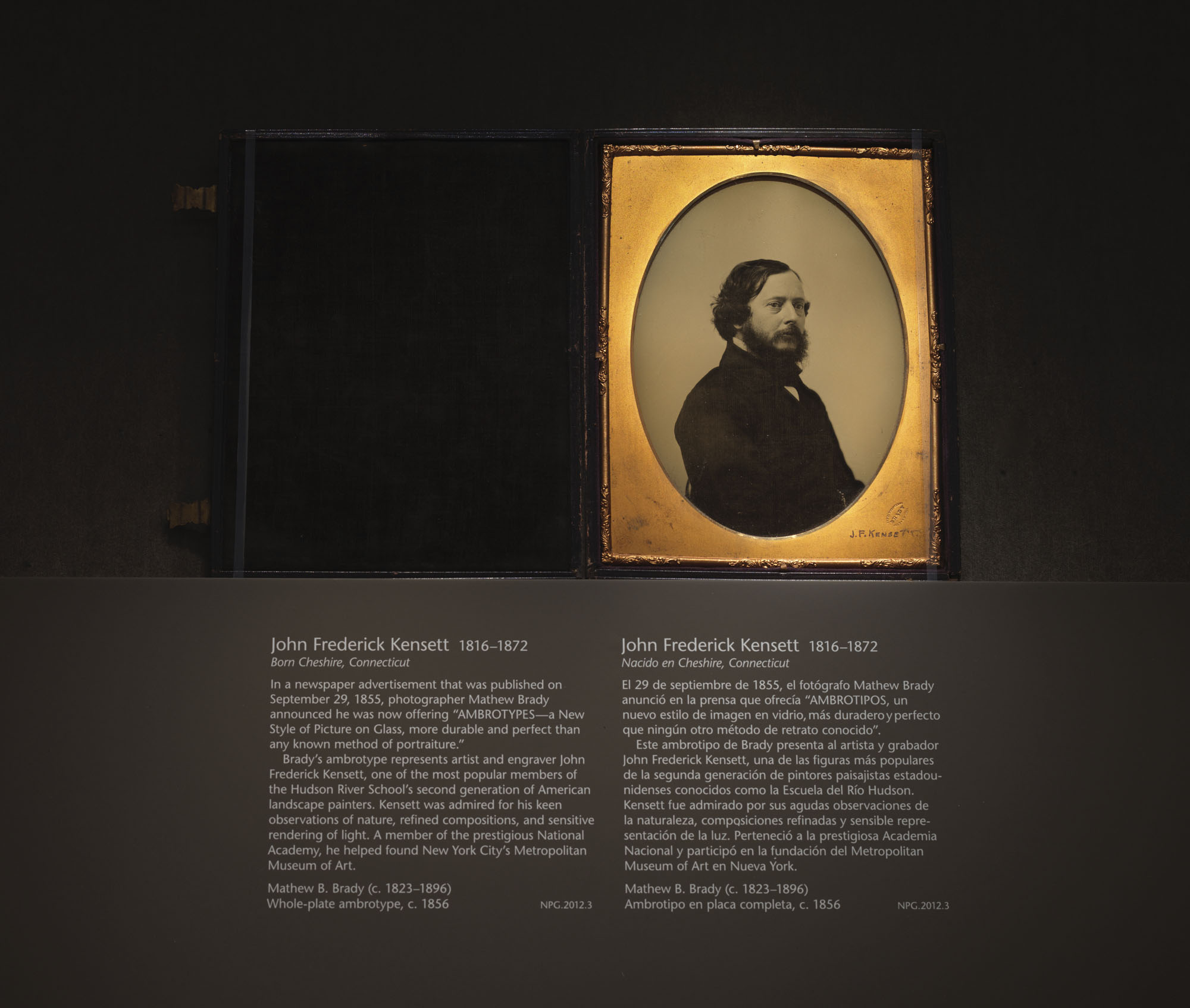
Installation view of the exhibition 'From Shadow to Substance: Grand-Scale Portraits During Photography's Formative Years' at the National Portrait Gallery, Washington, June 20, 2025 - June 7, 2026 showing Mathew B. Brady's 'John Frederick Kensett 1816-1872' c. 1856


Installation view of the exhibition From Shadow to Substance: Grand-Scale Portraits During Photography’s Formative Years at the National Portrait Gallery, Washington, June 20, 2025 – June 7, 2026 showing Mathew B. Brady’s John Frederick Kensett 1816-1872 c. 1856 (below)


Mathew B. Brady (American, 1822-1896) 'John Frederick Kensett, 22 Mar 1816 - 15 Dec 1872' c. 1856


Mathew B. Brady (American, 1822-1896)
John Frederick Kensett, 22 Mar 1816 – 15 Dec 1872
c. 1856
Whole-plate ambrotype
Image: 18.4 x 13.2cm (7 1/4 x 5 3/16″)
Case Open: 23 x 36.4cm (9 1/16 x 14 5/16″)
Case Closed: 23 x 18.4cm (9 1/16 x 7 1/4″)
National Portrait Gallery, Smithsonian Institution


John Frederick Kensett, 22 Mar 1816 – 15 Dec 1872
Born Cheshire, Connecticut

In a newspaper advertisement that was published on September 29, 1855, photographer Mathew Brady announced he was now offering “AMBROTYPES – a New Style of Picture on Glass, more durable and perfect than any known method of portraiture.”

Brady’s ambrotype represents artist and engraver John Frederick Kensett, one of the most popular members of the Hudson River School’s second generation of American landscape painters. Kensett was admired for his keen observations of nature, refined compositions, and sensitive rendering of light. A member of the prestigious National Academy, he helped found New York City’s Metropolitan Museum of Art.

Text from the National Portrait Gallery website


National Portrait Gallery Presents “From Shadow to Substance: Grand-Scale Portraits During Photography’s Formative Years”

The Smithsonian’s National Portrait Gallery will present “From Shadow to Substance: Grand Scale Portraits During Photography’s Formative Years” June 20 through June 7, 2026. Drawing from the museum’s extensive early photography collection, this exhibition traces the evolution of the grand scale, whole-plate portrait format from the high-end daguerreotype and mid-range ambrotype to the more affordable tintype. The exhibition is curated by Senior Curator of Photographs Ann Shumard.

Photographers seeking customers during the medium’s early years, from 1840 to 1860, often urged the public to “Secure the shadow ere the substance fade.” Hinting at life’s fragility, this tagline underscored photography’s ability to capture a fleeting likeness and preserve it for posterity. Portraits in the impressive whole-plate format – measuring 8 1/2 by 6 1/2 inches – were among the premier offerings of the nation’s leading photographic studios.

“This exhibition marks the first time these whole-plate daguerreotype, ambrotype and tintype portraits will be shown together at the Portrait Gallery,” Shumard said. Examples of whole plates in each of these mediums illustrate how the format evolved as new photographic processes were introduced. Featured works include daguerreotypes representing U.S. Senators Daniel Webster and John C. Calhoun, an ambrotype portrait of American landscape artist John Frederick Kensett and a tintype likeness of an unidentified African American woman. Also included are original advertisements issued by photographers Albert Sands Southworth and Josiah Johnson Hawes, and Mathew B. Brady to promote their respective businesses. The exhibition will be presented in the Early Photography Alcove on the museum’s first floor.

Press release from the National Portrait Gallery


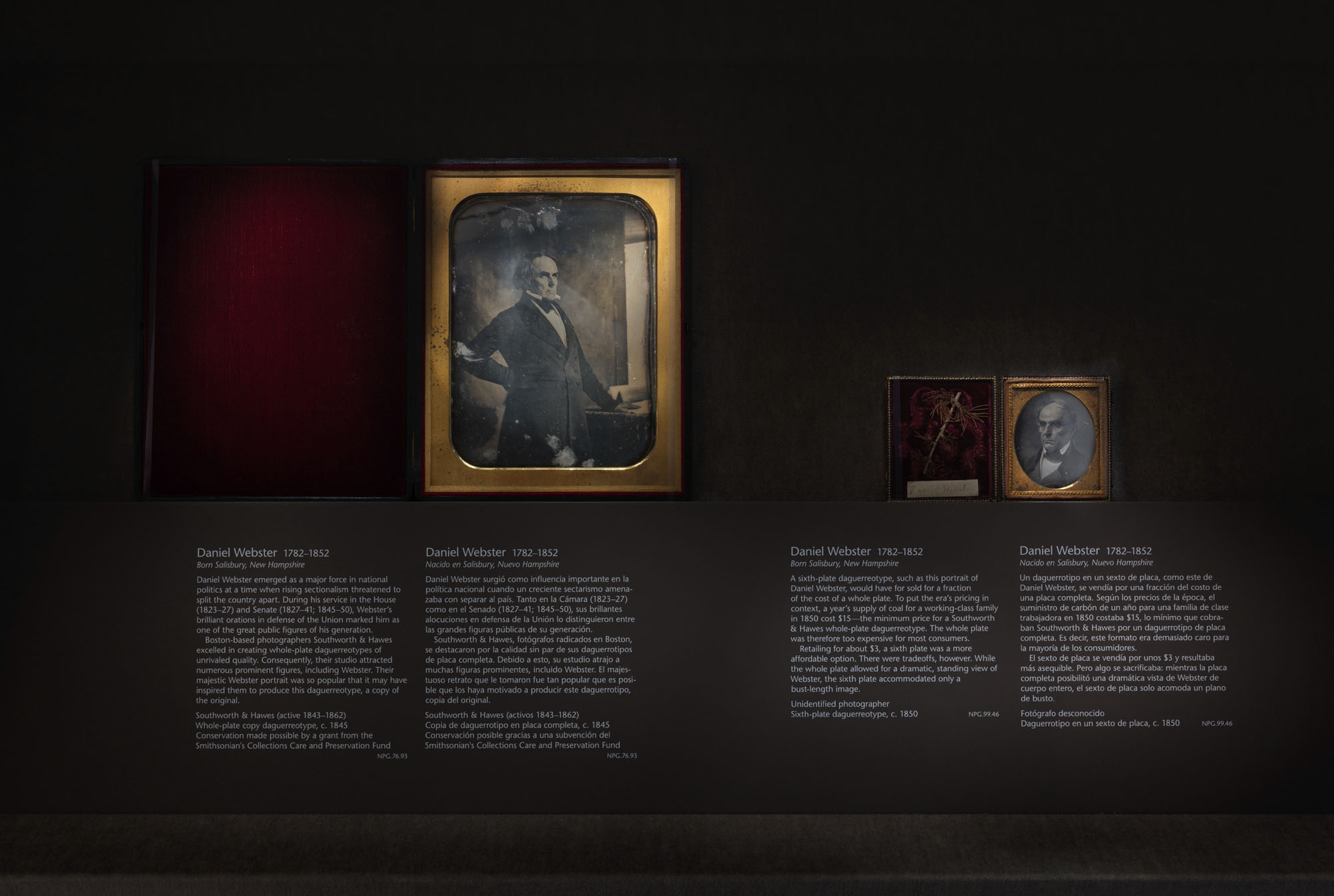
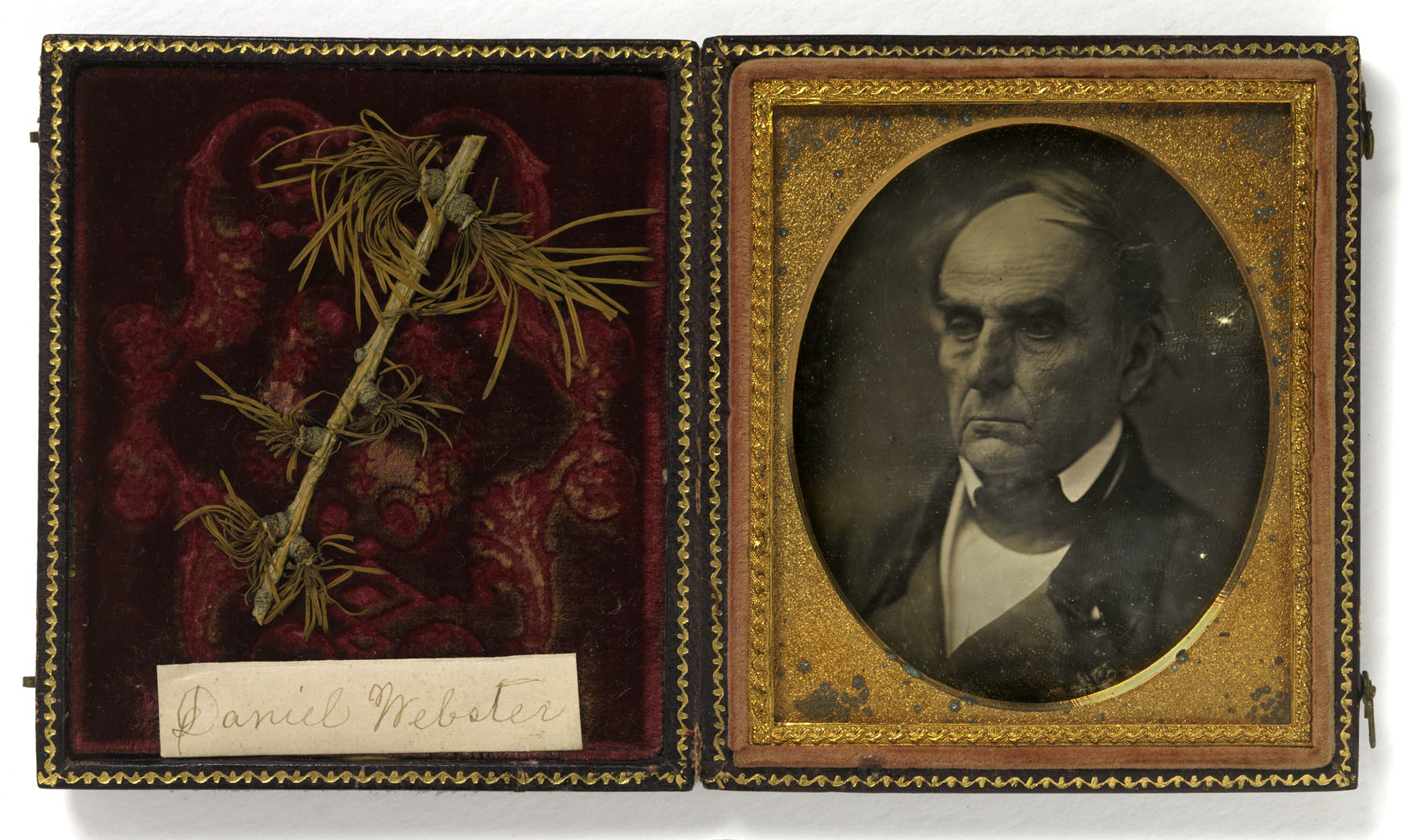
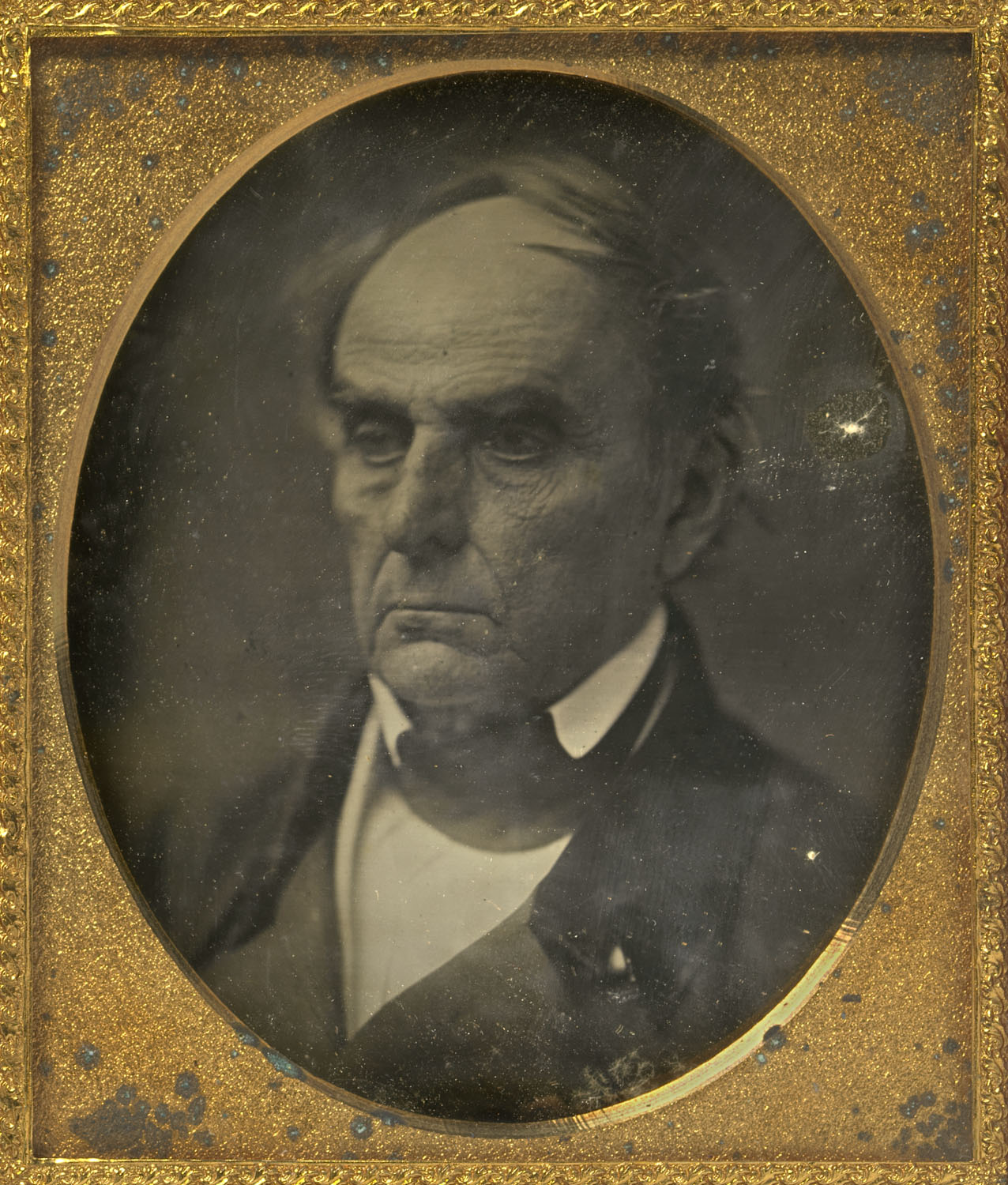
Installation view of the exhibition 'From Shadow to Substance: Grand-Scale Portraits During Photography's Formative Years' at the National Portrait Gallery, Washington, June 20, 2025 - June 7, 2026 showing at left, Southworth & Hawes' 'Daniel Webster 1782-1852' c. 1845; and at right, Unidentified photographer 'Daniel Webster 1782-1852' c. 1850


Installation view of the exhibition From Shadow to Substance: Grand-Scale Portraits During Photography’s Formative Years at the National Portrait Gallery, Washington, June 20, 2025 – June 7, 2026 showing at left, Southworth & Hawes’ Daniel Webster 1782-1852 c. 1845; and at right, Unidentified photographer Daniel Webster 1782-1852 c. 1850


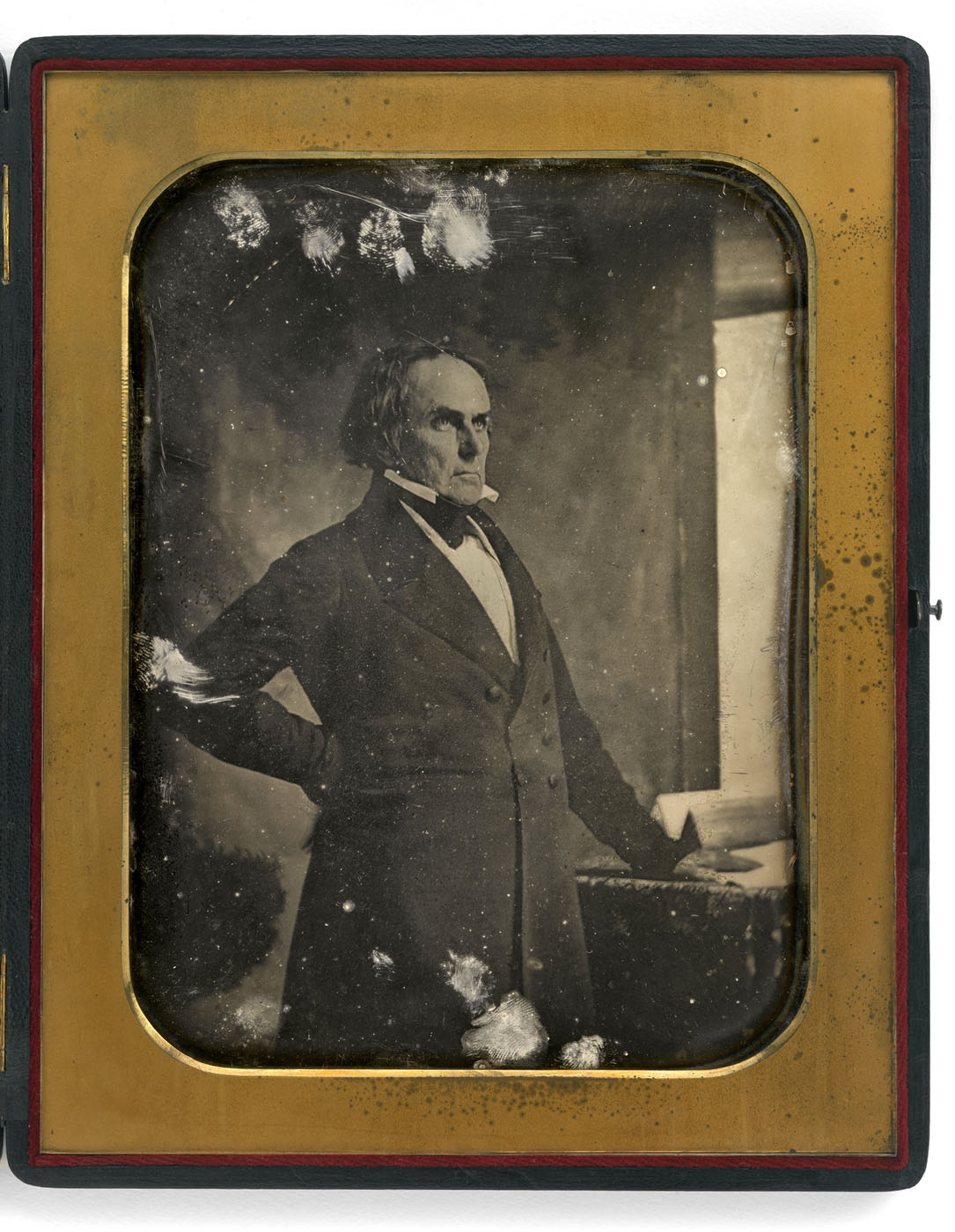
Southworth & Hawes (active 1843-1862) 'Daniel Webster 1782-1852' c. 1845


Southworth & Hawes (active 1843-1862)
Albert Sands Southworth (American, 1811-1894)
Josiah Johnson Hawes (American, 1808-1901)
Daniel Webster 1782-1852
c. 1845
Whole plate copy daguerreotype
National Portrait Gallery, Smithsonian Institution
Conservation made possible by a grant from the Smithsonian’s Collections Care and Preservation Fund


Daniel Webster 1782-1852
Born Salisbury, New Hampshire

Daniel Webster emerged as a major force in national politics at a time when rising sectionalism threatened to split the country apart. During his service in the House (1823-1827) and Senate (1827-1841; 1845-1850), Webster’s brilliant orations in defence of the Union marked him as one of the great public figures of his generation.

Boston-based photographers Southworth & Hawes excelled in creating whole-plate daguerreotypes of unrivalled quality. Consequently, their studio attracted numerous prominent figures, including Webster. Their majestic Webster portrait was so popular that it may have inspired them to produce this daguerreotype, a copy of the original.

Text from the National Portrait Gallery website
 

Unidentified photographer. 'Daniel Webster 1782-1852' c. 1850


Unidentified photographer
Daniel Webster 1782-1852
c. 1850
Sixth-plate daguerreotype
National Portrait Gallery, Smithsonian Institution


A sixth-plate daguerreotype such as this portrait of Daniel Webster, would have sold for a fraction of the cost of a whole plate. To put the era’s pricing in context, a year’s supply of coal for a working-class family in 1850 cost $15 – the minimum price for a Southworth & Hawes whole-plate daguerreotype. The whole plate was therefore too expensive for most consumers.

Retailing for about $3, a sixth-plate was a more affordable option. There were tradeoffs, however. While the whole plate allowed for a dramatic, standing view of Webster, the Sith-plate accommodated only a bust-length image.

In a period when American federalism faced increasing challenges from states’-rights supporters, Daniel Webster emerged as one of the Union’s most eloquent defenders. Having gained acclaim as a lawyer who argued some of the young republic’s pivotal Supreme Court cases, Webster became a major force in national politics through his service in the House and in the Senate. There, his brilliant orations on behalf of the indivisibility of the Union marked him as one of the greatest public figures of his generation. Despite his national stature, Webster fell short of mustering the broad support that might have won him the presidency.

This daguerreotype represents Webster around the time of his controversial endorsement of the Compromise of 1850. In supporting the measure, Webster sought to preserve the Union through concession and compromise but succeeded principally in incurring the wrath of his northern constituents, who abhorred the legislation’s Fugitive Slave Act. Although attacks from his critics left Webster shaken and burdened by “the crushing weight of anxiety and responsibility,” he soldiered on until a liver ailment claimed his life in October 1852. The evergreen sprig preserved with this daguerreotype serves as a reminder of Webster’s endurance as a symbol and an icon in American history.

Text from the National Portrait Gallery website
 

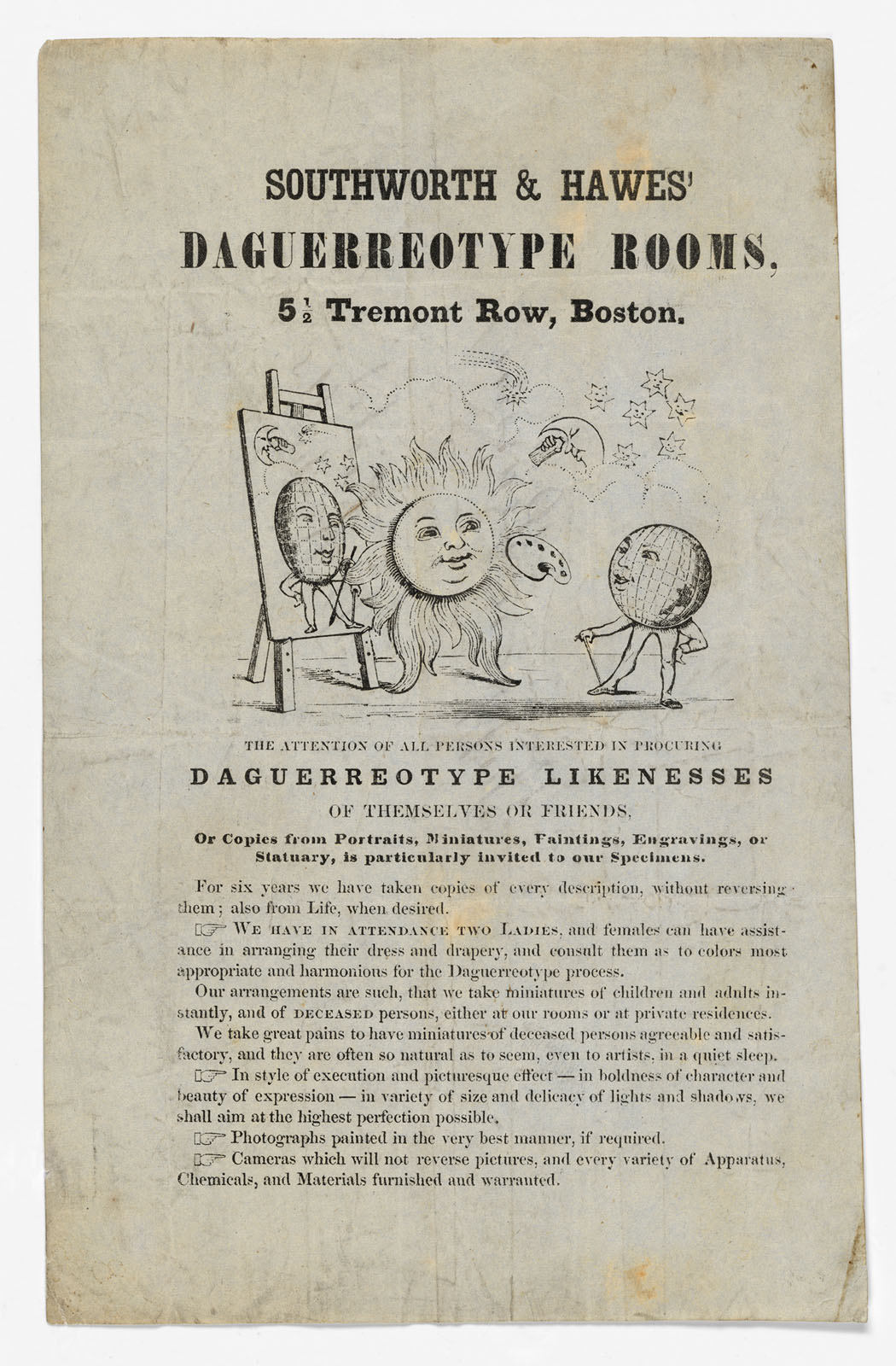
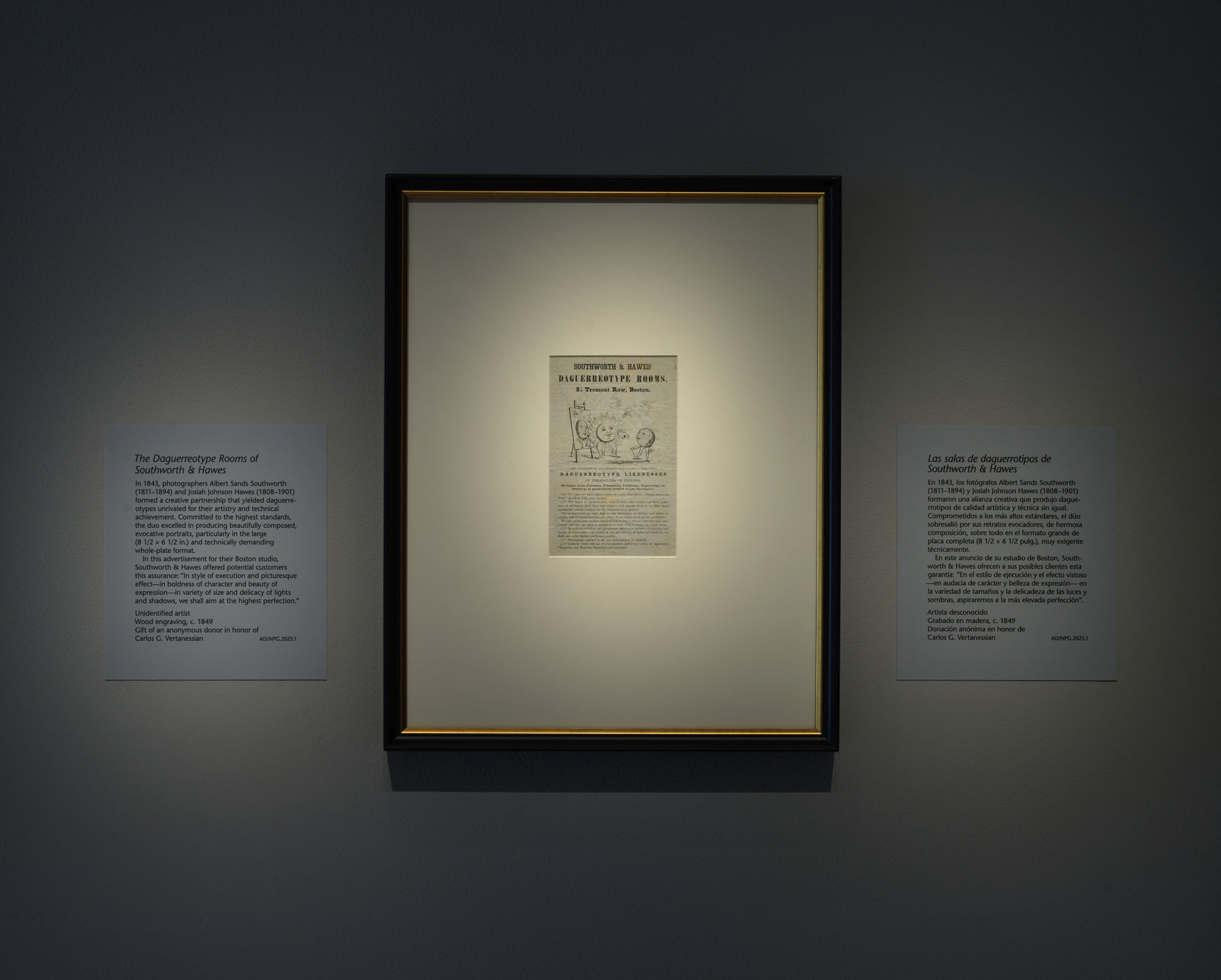
Installation view of the exhibition 'From Shadow to Substance: Grand-Scale Portraits During Photography's Formative Years' at the National Portrait Gallery, Washington, June 20, 2025 - June 7, 2026 showing a wood engraving by an unidentified artist of 'Southworth & Hawes' Daguerreotype Rooms' c. 1849


Installation view of the exhibition From Shadow to Substance: Grand-Scale Portraits During Photography’s Formative Years at the National Portrait Gallery, Washington, June 20, 2025 – June 7, 2026 showing a wood engraving by an unidentified artist of Southworth & Hawes’ Daguerreotype Rooms c. 1849 (below)


Unidentified Artist. 'Southworth & Hawes' Daguerreotype Rooms' c. 1849


Unidentified Artist
Southworth & Hawes’ Daguerreotype Rooms
c. 1849
Wood engraving
20 x 12.7cm (7 7/8 x 5″)
National Portrait Gallery, Smithsonian Institution
Gift of an anonymous donor in honour of Carlos G. Vertanssian


In 1843, photographer Albert Sands Southworth (1811-1894) and Josiah Johnson Hawes (1808-1901) formed a creative partnership that yielded daguerreotypes unrivalled for their artistry and technical achievement. Committed to the highest standards, the duo excelled in producing beautiful composed, evocative portraits, particularly in the large (8 1/2 x 6 1/2 in.) and technically demanding whole-plate format.

In this advertisement for their Boston studio, Southworth & Hawes offered potential customers the assurance: ‘In style of execution and picturesque effect – in boldness of character and beauty of expression – in variety of size and delicacy of lights and shadows, we shall aim at the highest perfection’.

Text from the National Portrait Gallery website
 

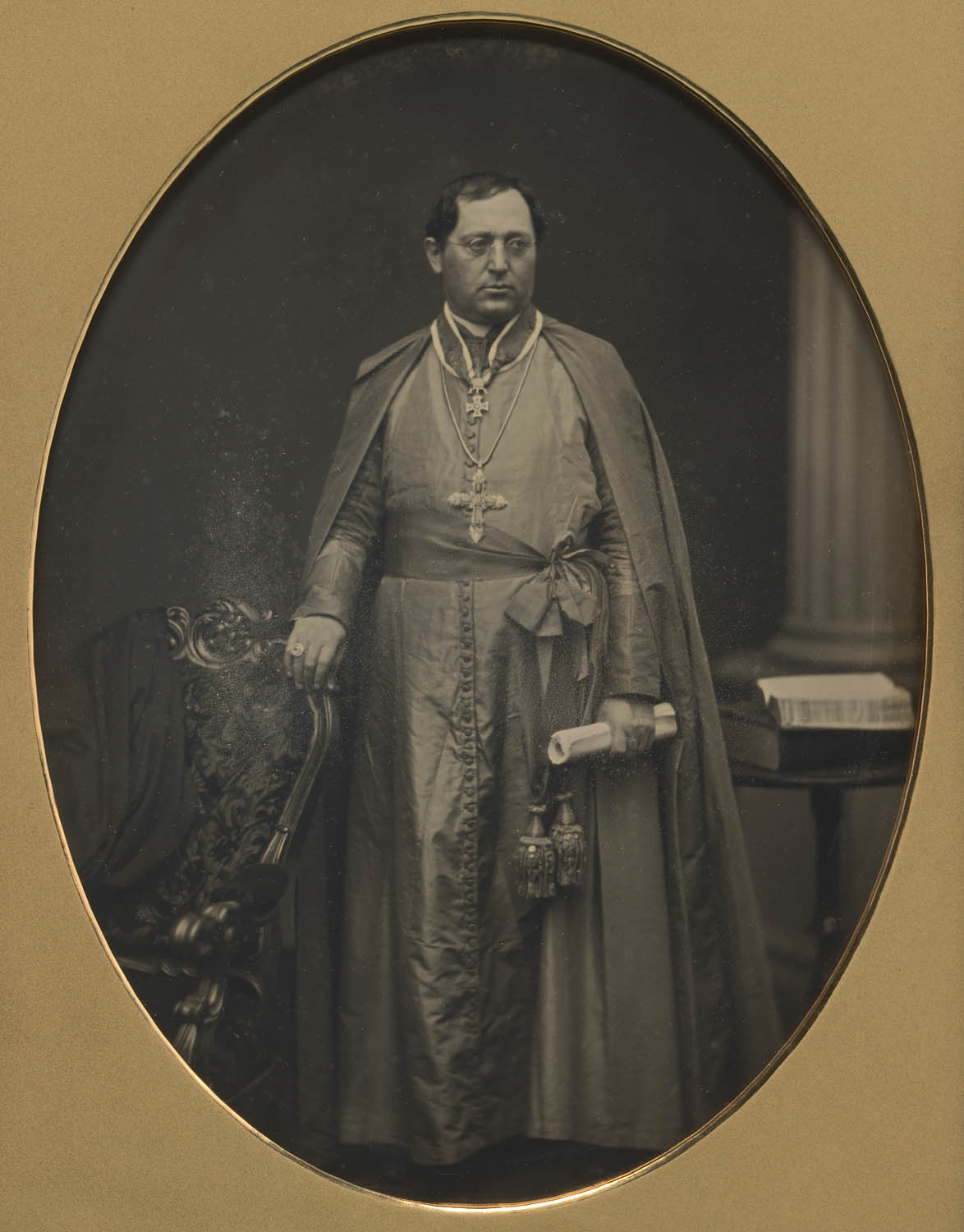
Southworth & Hawes (active 1843-1862) Albert Sands Southworth (American, 1811-1894) Josiah Johnson Hawes (American, 1808-1901) 'Gaetano Bedini, 1806-1864' 1853


Southworth & Hawes (active 1843-1862)
Albert Sands Southworth (American, 1811-1894)
Josiah Johnson Hawes (American, 1808-1901)
Gaetano Bedini, 1806-1864
1853
Whole-plate daguerreotype
Image: 20 x 15cm (7 7/8 x 5 7/8″)
Case Open: 25.4 x 40.8 x 1cm (10 x 16 1/16 x 3/8″)
Case Closed: 23.1 x 18.1 x 1.7cm (9 1/8 x 7 1/8 x 11/16″)
National Portrait Gallery, Smithsonian Institution
Transfer from the Archives of American Art, Smithsonian Institution. Conservation made possible by a grant from the Smithsonian’s Collections Care and Preservation Fund


Gaetano Bedini, 1806-1864
Born Sinigaglia, Italy

In 1853, Italian archbishop Gaetano Bedini travelled to the United States at the request of Pope Pius IX to assess the condition of the Catholic Church in North America and to study the possibility of establishing a papal mission in Washington, D.C. Bedini’s multi-month, fact-finding tour coincided with an intense wave of anti-Catholic, anti-immigrant feeling fanned by the newly ascendant American (or Know-Nothing) Party. In several cities, his presence sparked hostile demonstrations. Upon returning to the Vatican, Bedini advocated successfully for the creation of a North American College in Rome to prepare Roman Catholic clergy for service in the United States.

Text from the National Portrait Gallery website
 

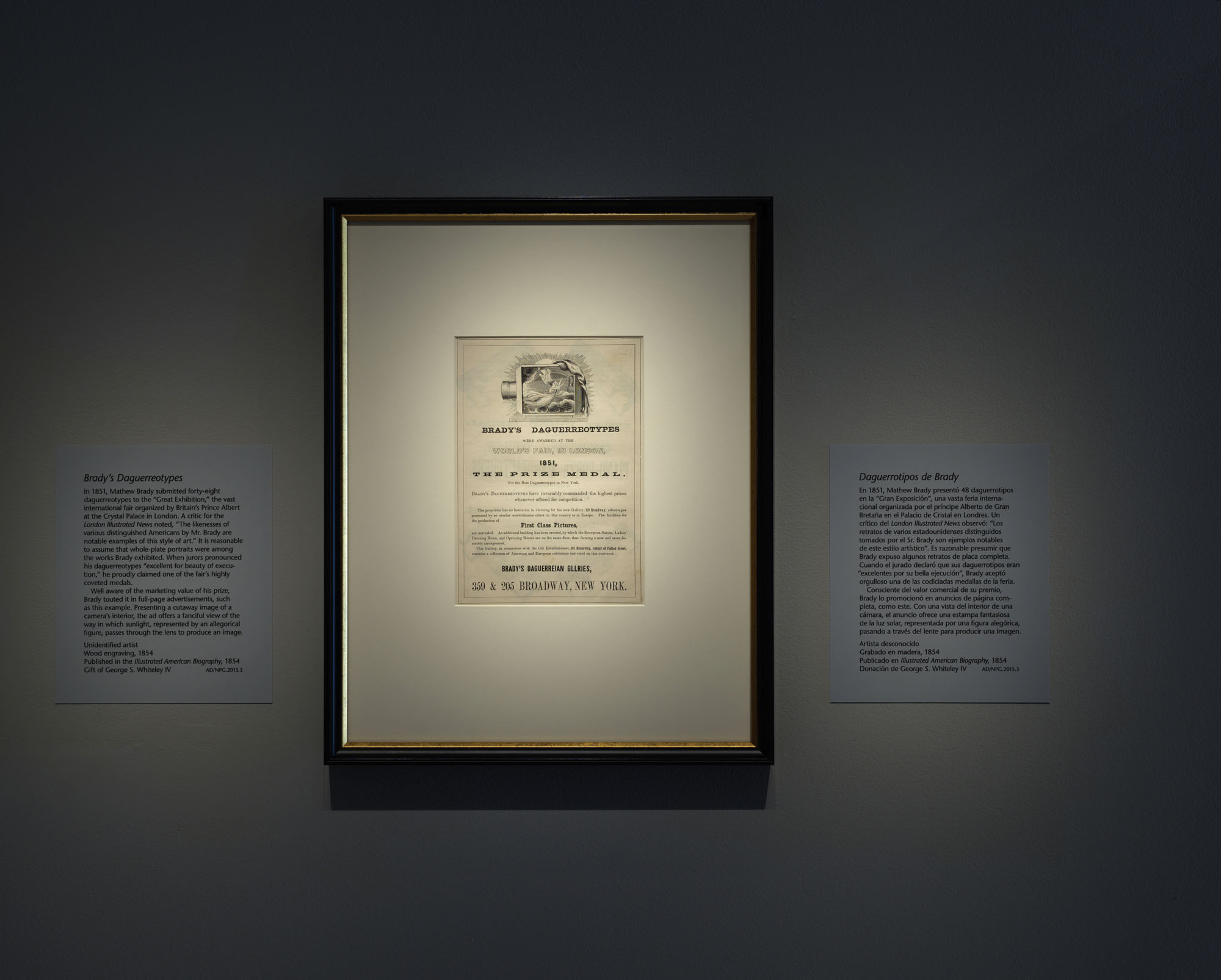
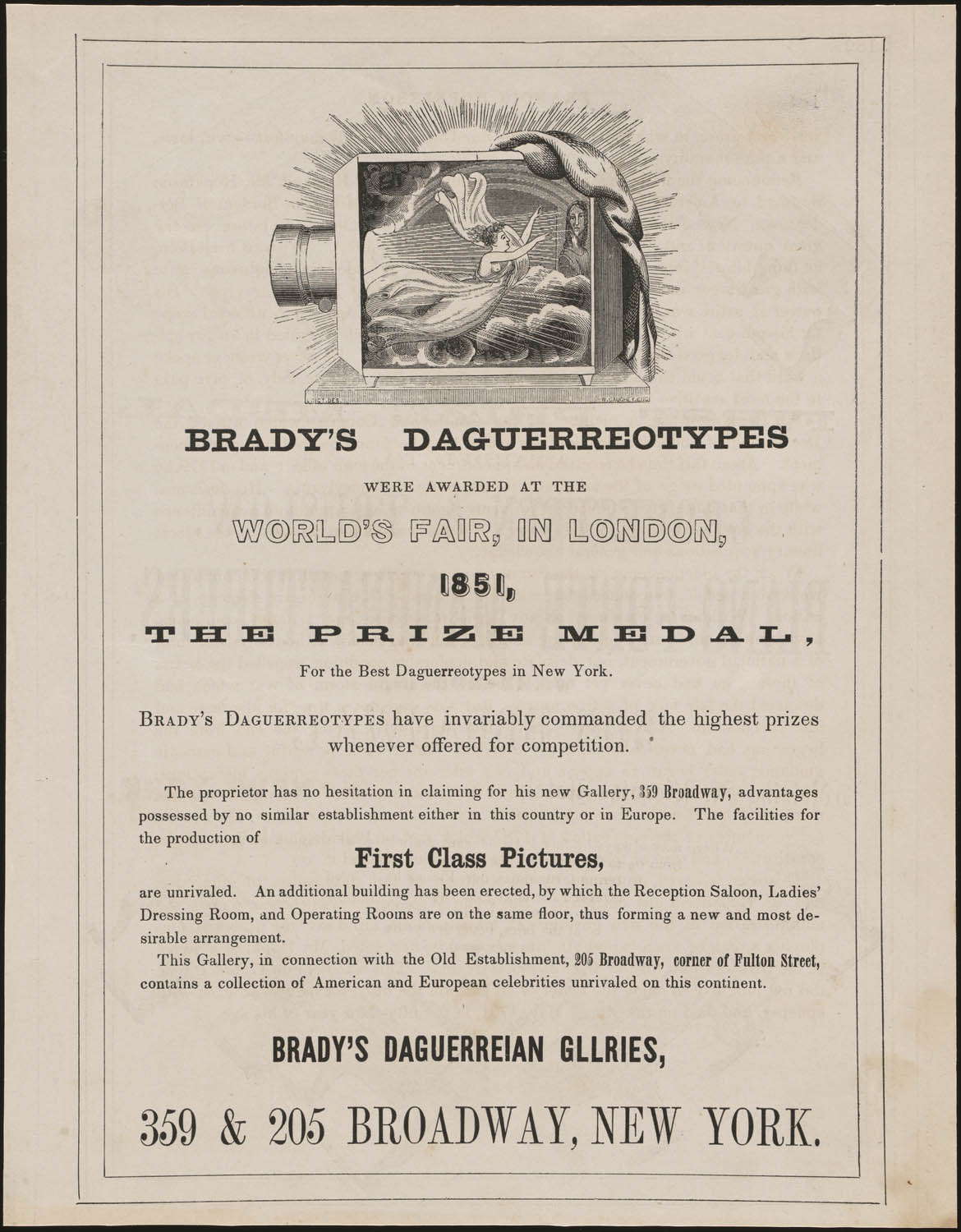
Installation view of the exhibition 'From Shadow to Substance: Grand-Scale Portraits During Photography's Formative Years' at the National Portrait Gallery, Washington, June 20, 2025 - June 7, 2026 showing a wood engraving by an unidentified artist 'Brady's Daguerreotypes' 1854


Installation view of the exhibition From Shadow to Substance: Grand-Scale Portraits During Photography’s Formative Years at the National Portrait Gallery, Washington, June 20, 2025 – June 7, 2026 showing a wood engraving by an unidentified artist of Brady’s Daguerreotypes 1854 (below)


Unidentified Artist. 'Brady's Daguerreotypes' 1854


Unidentified Artist
Brady’s Daguerreotypes
1854
Wood engraving on paper
Image: 21.8 x 14.8cm (8 9/16 x 5 13/16″)
Sheet: 24 x 18.6cm (9 7/16 x 7 5/16″)
Mat: 45.8 x 35.6cm (18 1/16 x 14″)
Published in the Illustrated American Biography, 1854
National Portrait Gallery, Smithsonian Institution
Gift of George S. Whiteley IV


Mathew Brady placed this full-page advertisement in the Illustrated American Biography, a publication that marketed itself as a biographical volume but was actually a glorified business directory. With its cutaway image of a camera, Brady’s ad presents a fanciful view of the process by which sunlight passes through the camera’s lens to produce an image.

In 1851, Mathew Brady submitted forty-eight daguerreotypes to the “Great Exhibition,” the vast international fair organised by Britain’s Prince Albert at the Crystal Palace in London. A critic for the London Illustrated News noted, “The likenesses of various distinguished Americans by Mr. Brady are notable examples of this style of art.” It is reasonable to assume that whole-plate portraits were among the works Brady exhibited. When jurors pronounced his daguerreotypes “excellent for beauty of execution,” he proudly claimed one of the fair’s highly coveted medals.

Well aware of the marketing value of his prize, Brady touted it in full-page advertisements, such as this example. Presenting a cutaway image of a camera’s interior, the ad offers a fanciful view of the way in which sunlight, represented by an allegorical figure, passes through the lens to produce an image.

Text from the National Portrait Gallery website
 

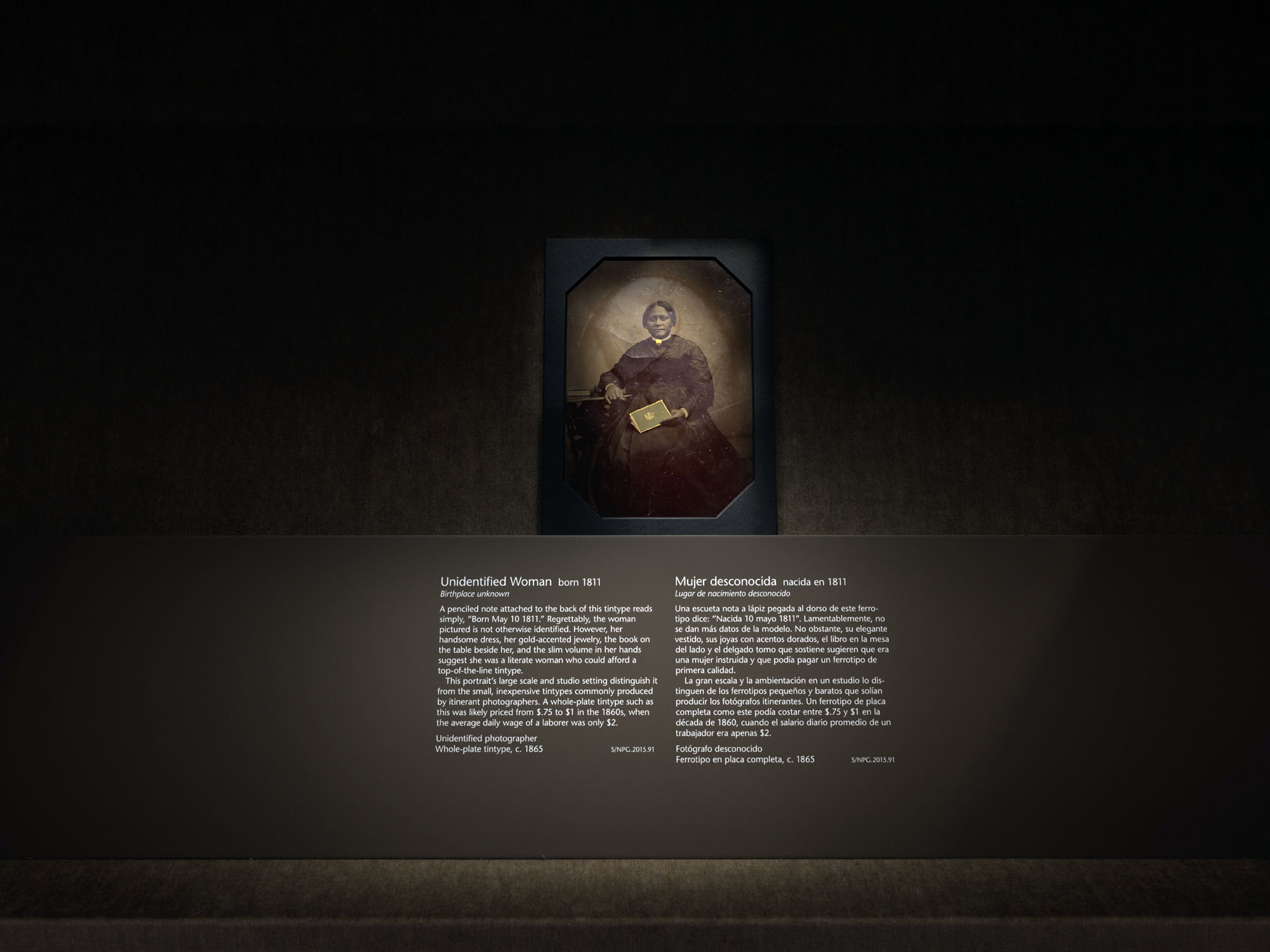
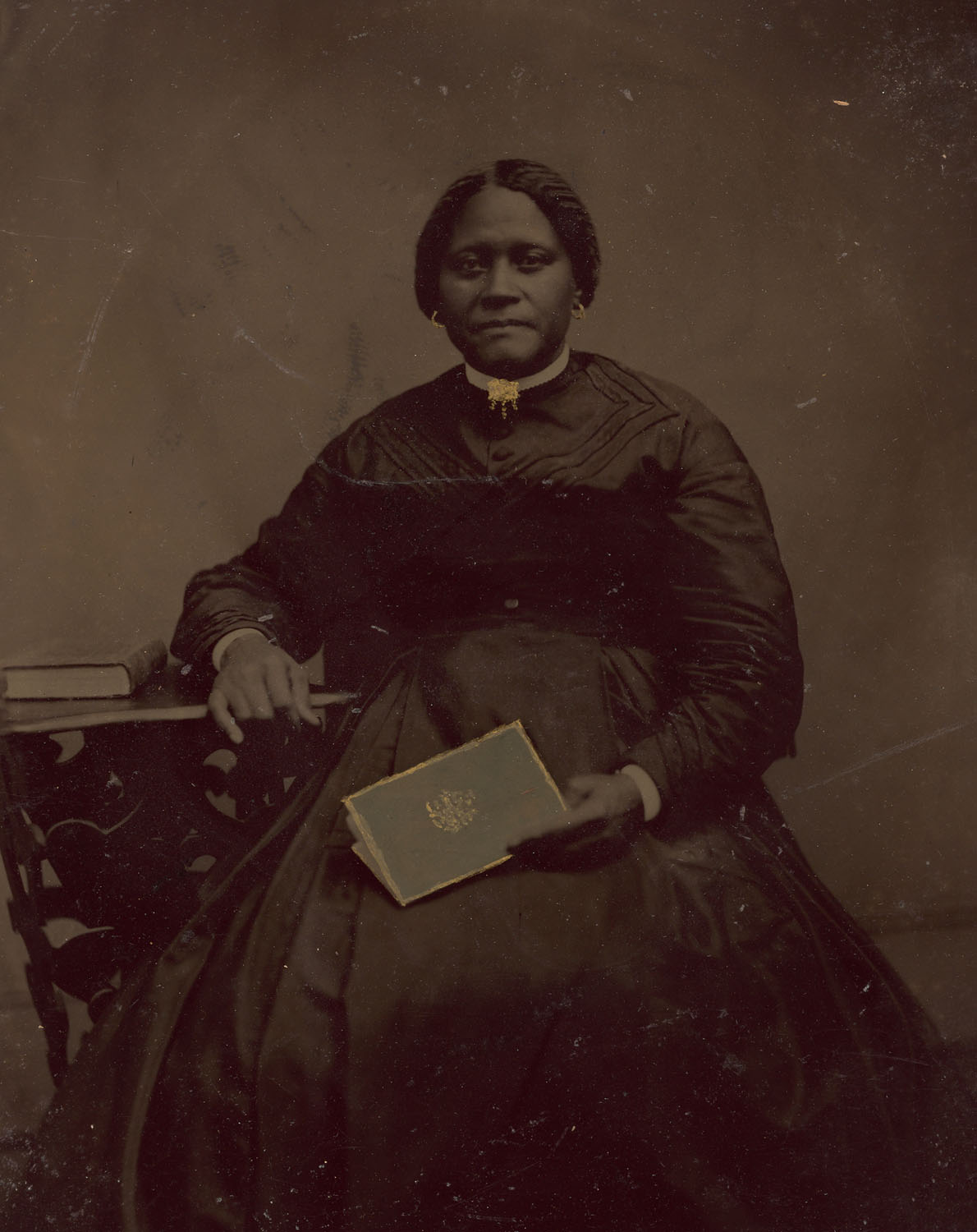
Installation view of the exhibition 'From Shadow to Substance: Grand-Scale Portraits During Photography's Formative Years' at the National Portrait Gallery, Washington, June 20, 2025 - June 7, 2026 showing a whole-plate tintype by an unidentified photographer of an 'Unidentified Woman' c. 1865


Installation view of the exhibition From Shadow to Substance: Grand-Scale Portraits During Photography’s Formative Years at the National Portrait Gallery, Washington, June 20, 2025 – June 7, 2026 showing a whole-plate tintype by an unidentified photographer of an Unidentified Woman c. 1865 (below)


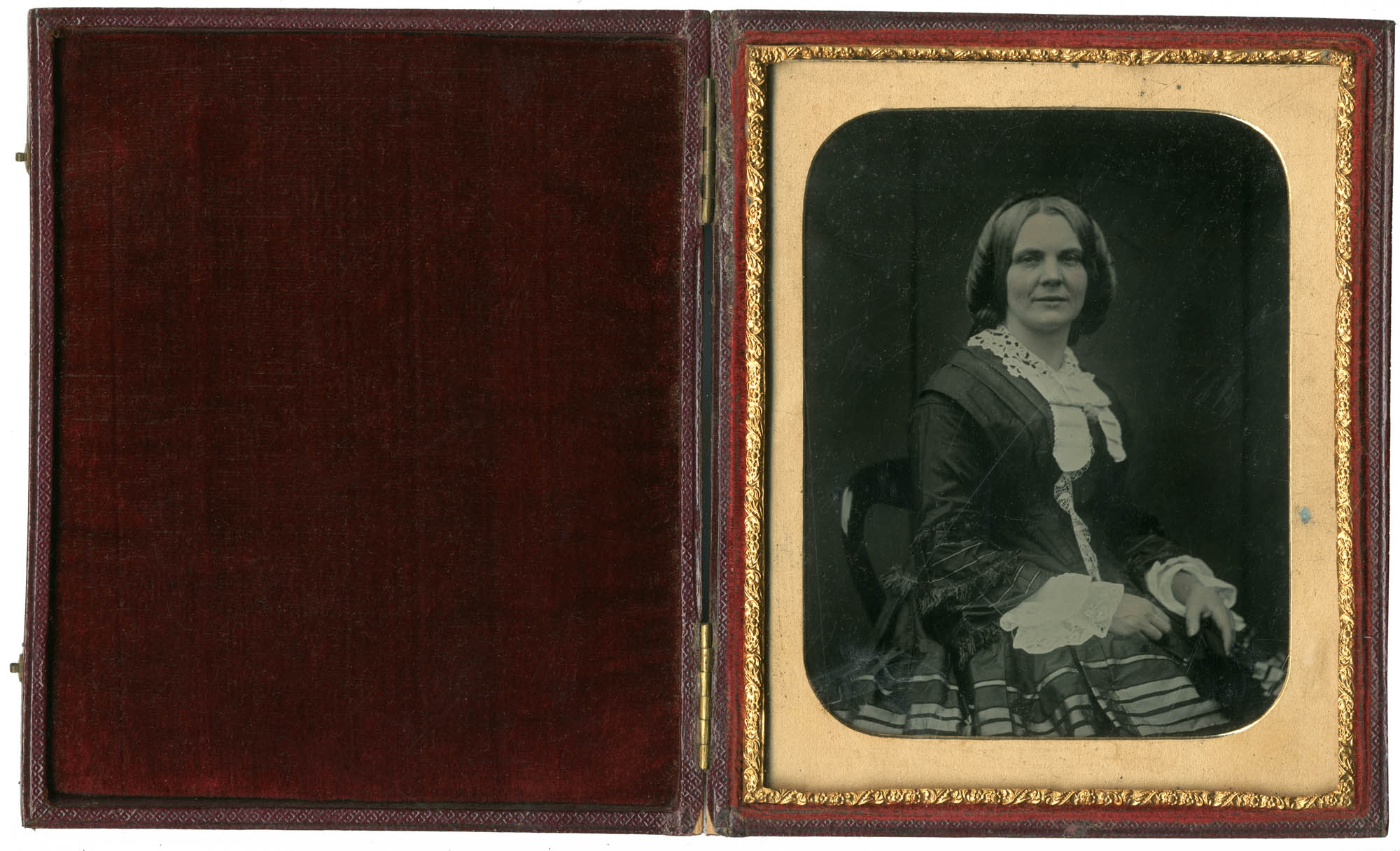
Unidentified photographer. 'Unidentified Woman' c. 1865


Unidentified photographer
Unidentified Woman
c. 1865
Whole-plate tintype
Image/Sheet: 21.6 x 15.2 cm (8 1/2 x 6″)
National Portrait Gallery, Smithsonian Institution


Unidentified Woman
Birthplace unknown

A penciled note attached to the back of this tintype reads simply, “Born May 10 1811.” Regrettably, the woman pictured is not otherwise identified. However, her handsome dress, her gold-accented jewelry, the book on the table beside her, and the slim volume in her hands suggest she was a literate woman who could afford a top-of-the-line tintype.

This portrait’s large scale and studio setting distinguish it from the small, inexpensive tintypes commonly produced by itinerant photographers. A whole-plate tintype such as this was likely priced from $.75 to $1 in the 1860s, when the average daily wage of a labourer was only $2.

Text from the National Portrait Gallery website


National Portrait Gallery
8th and F Sts NW
Washington, DC 20001

Opening hours:
11.30am – 7.00pm daily

National Portrait Gallery website
LIKE ART BLART ON FACEBOOK

Back to top


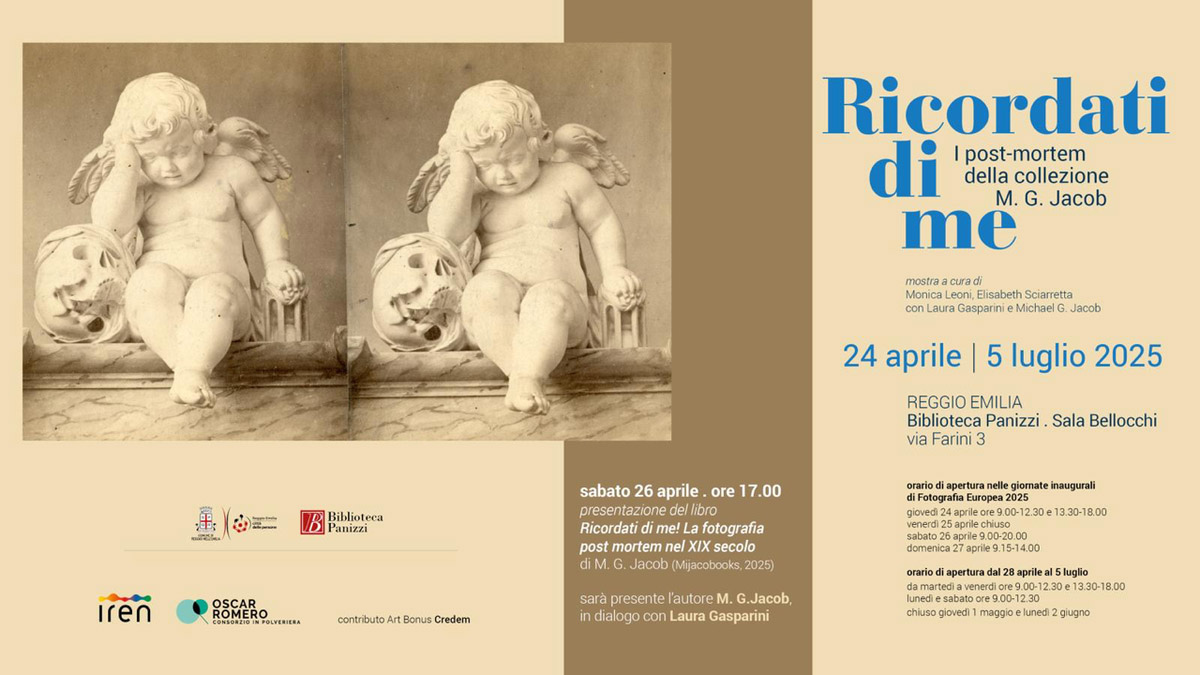
Exhibitions: ‘Ricordati di me. I post mortem della collezione M. G. Jacob’ and ‘Attraverso la luce. I primi 20 anni della fotografia nelle collezioni della Fototeca’ at Biblioteca Panizzi, Reggio Emilia, Italy

Exhibition dates: 24th April – 5th July, 2025

‘Remember Me. Postmortems from the M. G. Jacob Collection’ and ‘Through Light. The First 20 Years of Photography in the Photo Library Collections’

Postmortem curators: Monica Leoni, Elisabeth Sciarretta with Laura Gasparini and Michael G. Jacob

Attraverso la luce curators: Monica Leoni, Elisabeth Sciarretta with Laura Gasparini


'Ricordati di me. I post mortem della collezione M. G. Jacob'


Sleeping beauty


“When I am dead and in my grave

And all my bones are rotten.

When this you see remember me

Lest I should be forgotten.”


This is the first posting on Art Blart on the phenomenon of postmortem photography for exhibitions on this subject are few and far between.

Any photograph is a “little death” which “refers to the concept of “la petite mort” or “the little death,” a French idiom and euphemism for the momentary loss of consciousness or breath, often associated with orgasm, but also used to describe the act of freezing a moment in time through photography. This concept suggests that photography, by capturing a specific moment, essentially stops time and thus, in a way, creates a small, contained death of that moment.” (Google AI Overview)

All photographs (and especially postmortem photography where the deceased are memorialised through images) can be seen as “memento mori”, a Latin phrase meaning “remember you must die,” reminding us that of the impermanence of life – for photographs “capture a moment in time, forever preserving a fleeting instant and highlighting the passage of time and the inevitability of death.” (Google AI Overview)

As Susan Sontag observed, “All photographs are memento mori. To take a photograph is to participate in another person’s (or thing’s) mortality, vulnerability, mutability.” (On Photography)

Victorians were faced with the vicissitudes of fortune, and death at any age was a common occurrence due to illness with no antibiotics available to treat the many lethal diseases. They became stoic in the face of the impermanence of life, stoic in the face of death and through photography, sought to record into permanence the likenesses of the departed (the beloved), so that they could remember and honour them. Photographs thus became symbols of mortality which encouraged reflection on the meaning and fleetingness of life…

But unlike a photographic self-portrait, where a human looks at their image (in which they are dead) which reminds them about their physical death in the future, an anterior future of which death is the stake (and the prick of discovery of this equivalence)1 – in postmortem photography the little death and the actual death are as one for the anterior future can never be viewed by the subject of the photograph (they are dead), a separation only revived in the heart and mind of another.

Through postmortem photography the deceased live in an interstitial space, forever brought back to life in the eyes of the viewer as we reawaken and reactivate their spirit in the world. I was once here and I am again. Remember me.

Thus the euphemism “sleeping” is appropriate (sleeping beauty awakened once more with a kiss), as the viewer transcends time bringing past dead back into living world – where past, present and future coalesce into single point in time – their death and our death connected through the gaze and the knowledge of our discontinuity. Eons contracted into an eternal moment.2

In this expanded-specific moment in time, through an awareness of our own dis/continuity, what we are doing is talking about something that is remarkable. We are moving towards a language that defines the human condition…

Dr Marcus Bunyan


1/ Roland Barthes, Camera Lucida (La Chambre claire), Section 39, 1980

2/ Marcus Bunyan. “This is not my favourite photograph,” part of What makes a great photograph? at the Centre for Contemporary Photography (CCP), Fitzroy, Wednesday 5th December 2012 [Online] Cited 27/06/2025


Many thankx to the Biblioteca Panizzi and Michael G. Jacob for allowing me to publish the photographs in the posting. Please click on the photographs for a larger version of the image.


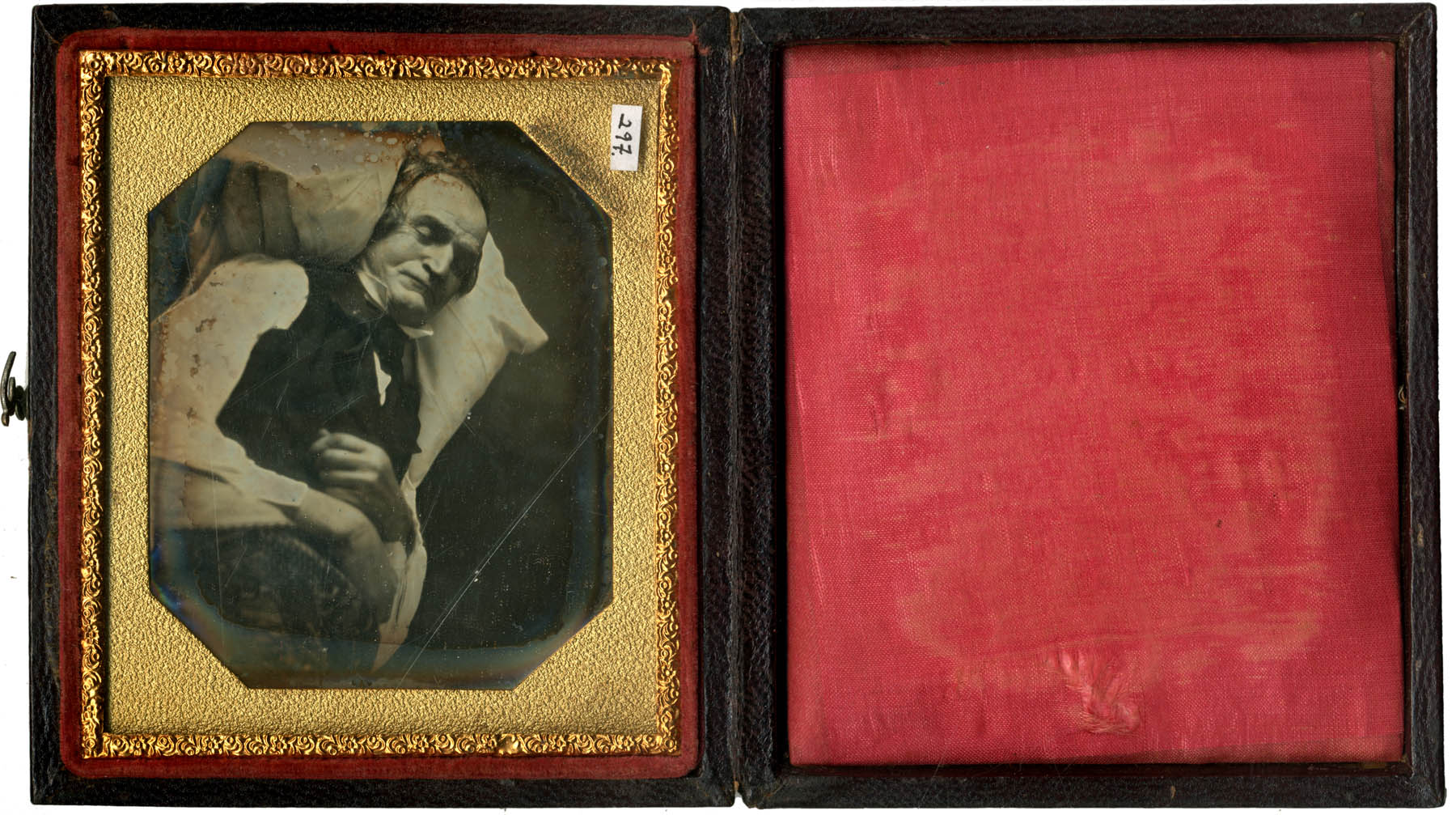
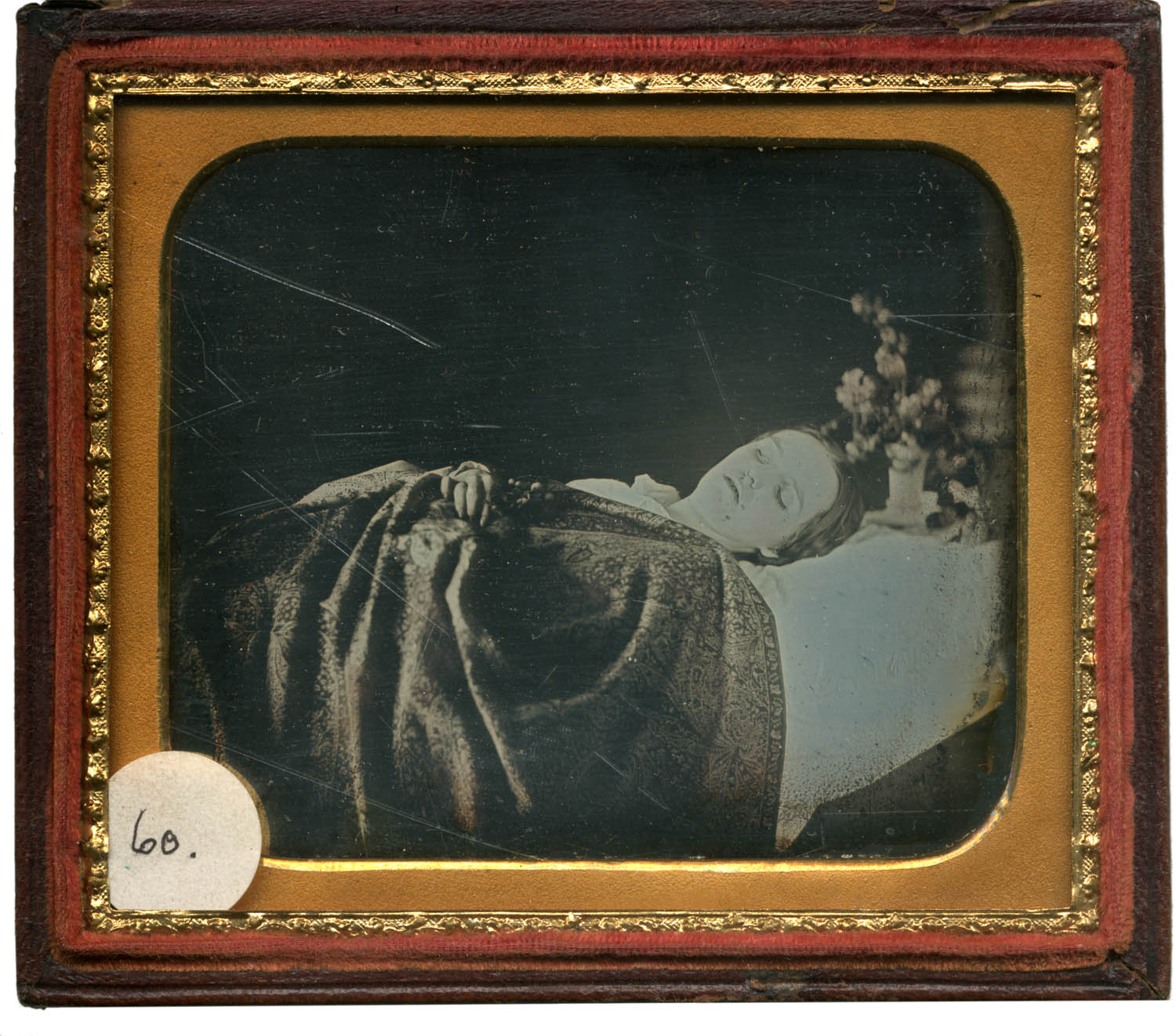
Unknown photographer (American) 'A sleeping man' c. 1846


Unknown photographer (American)
A sleeping man
c. 1846
Daguerreotype
Title given by the collector


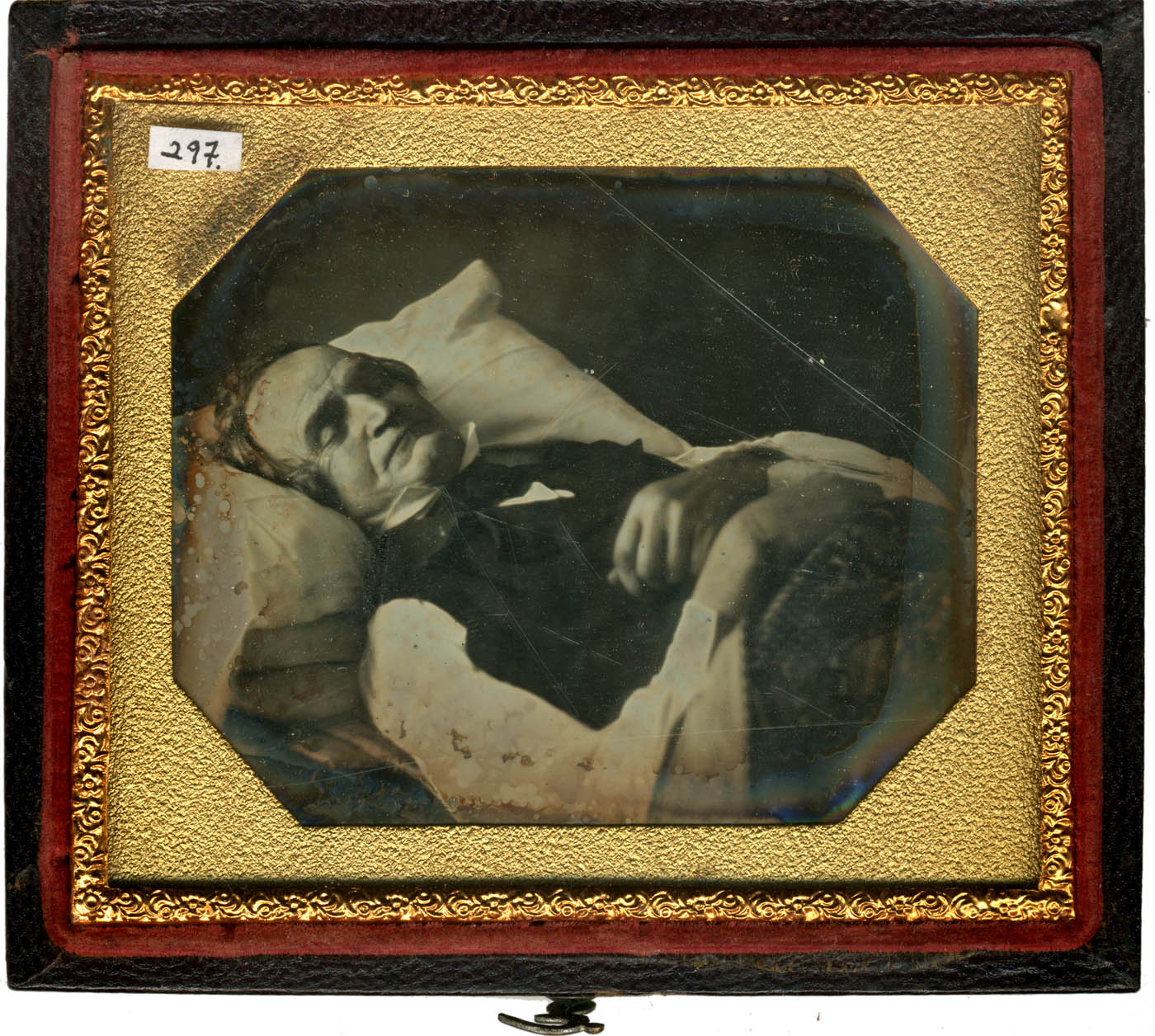
Unknown photographer (American) 'A sleeping man' c. 1846 (detail)


Unknown photographer (American)
A sleeping man (detail)
c. 1846
Daguerreotype
Title given by the collector


Ricordati di me

Una esposizione dedicata alla collezione di Michael G. Jacob, alla riscoperta della fotografia “post mortem”: la realizzazione di immagini commemorative di familiari defunti per genitori, amici e parenti era un aspetto significativo del lavoro quotidiano di molti studi fotografici vittoriani.

An exhibition dedicated to the collection of Michael G. Jacob, to the rediscovery of “post mortem” photography: the creation of commemorative images of deceased family members for parents, friends and relatives was a significant aspect of the daily work of many Victorian photographic studios.

Text translated by Google Translate from the Biblioteca Panizzi website


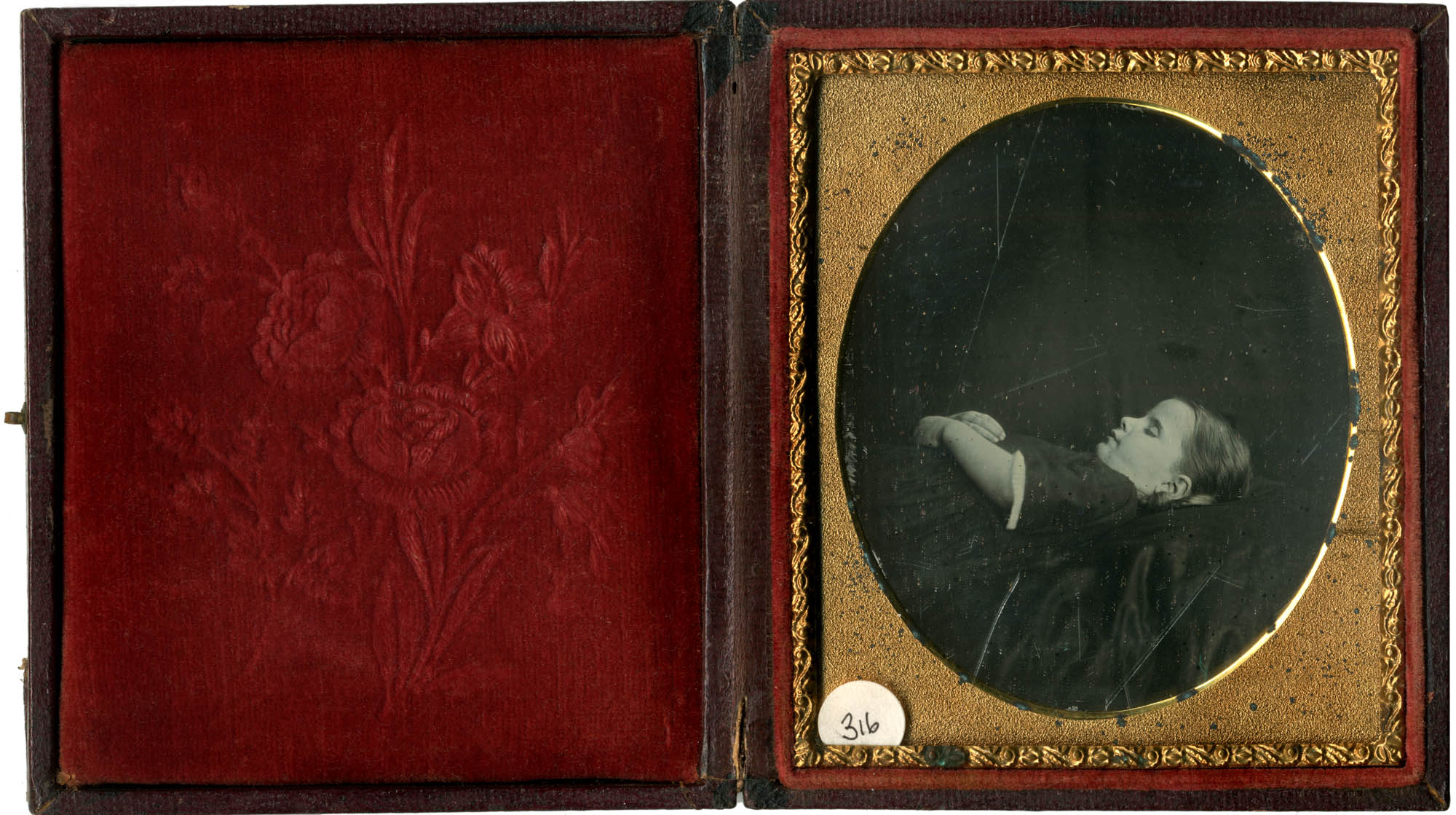
Unknown photographer (American) 'A sleeping girl' c. 1846


Unknown photographer (American)
A sleeping girl
c. 1846
Daguerreotype
Title given by the collector


Unknown photographer (American) 'A woman with long fingernails, bured teeth & cut flowers' c. 1846


Unknown photographer (American)
A woman with long fingernails, bured teeth & cut flowers
c. 1846
Daguerreotype
Title given by the collector


Unknown photographer (American) 'A woman with long fingernails, bured teeth & cut flowers' c. 1846 (detail)


Unknown photographer (American)
A woman with long fingernails, bured teeth & cut flowers (detail)
c. 1846
Daguerreotype
Title given by the collector


Unknown photographer (American) 'Young girl holding a daguerrotype' c. 1846


Unknown photographer (American)
Young girl holding a daguerrotype
c. 1846
Daguerreotype
Title given by the collector


L’esposizione dedicata alla collezione di Michael G. Jacob alla riscoperta della fotografia “post mortem” nell’epoca vittoriana, ha l’intento di illustrare il legame di affezione e rispetto di quella cultura che indusse i vivi a ricordare i propri defunti, analizzando come, dopo gli anni Quaranta del XIX secolo, la fotografia sia diventata centrale anche nel modo di sentire e vivere il lutto.

La pratica di raffigurare il volto del defunto è antichissima e la fotografia si innesta in questa tradizione, modificando il modo di vivere e comunicare il lutto. Come tutte le tradizioni più o meno radicate, anche nella colta ed evoluta Europa le esequie e il lutto seguono consuetudini e usanze che si sono perdute o modificate nel tempo. Il galateo del lutto, in epoca vittoriana, è uno degli aspetti per noi meno comprensibili ma più affascinanti, i cui codici, nel tempo, sono andati perduti o si sono radicalmente trasformati.

I rituali funebri, così come venivano concepiti dai vittoriani, si manifestavano in comportamenti, abbigliamento e usanze che spesso appaiono eccessivi per la sensibilità moderna e hanno oggi bisogno di essere decodificati per comprenderne la vasta iconografia. L’antropologia e la sociologia ci hanno spiegato quali reazioni emotive e formali l’essere umano ha avuto nel corso del tempo di fronte alla morte e al corpo dei defunti, indotte dalla cultura a cui apparteniamo, mentre la fotografia contribuisce sostanzialmente a documentare questa cultura del lutto.


The exhibition dedicated to the Michael G. Jacob collection and the rediscovery of “post mortem” photography in the Victorian era, aims to illustrate the bond of affection and respect of that culture that induced the living to remember their dead, analysing how, after the 1840s, photography also became central to the way of feeling and experiencing mourning.

The practice of depicting the face of the deceased is very ancient and photography is grafted onto this tradition, modifying the way of experiencing and communicating mourning. Like all more or less rooted traditions, even in cultured and evolved Europe, funerals and mourning follow customs and habits that have been lost or modified over time. The etiquette of mourning, in the Victorian era, is one of the aspects that is least comprehensible to us but most fascinating, whose codes, over time, have been lost or have radically transformed.

Funeral rituals, as conceived by the Victorians, manifested themselves in behaviors, clothing and customs that often seem excessive for modern sensibilities and today need to be decoded to understand their vast iconography. Anthropology and sociology have explained to us what emotional and formal reactions human beings have had over time in front of death and the body of the deceased, induced by the culture to which we belong, while photography contributes substantially to documenting this culture of mourning.

Text translated by Google Translate from the Biblioteca Panizzi website


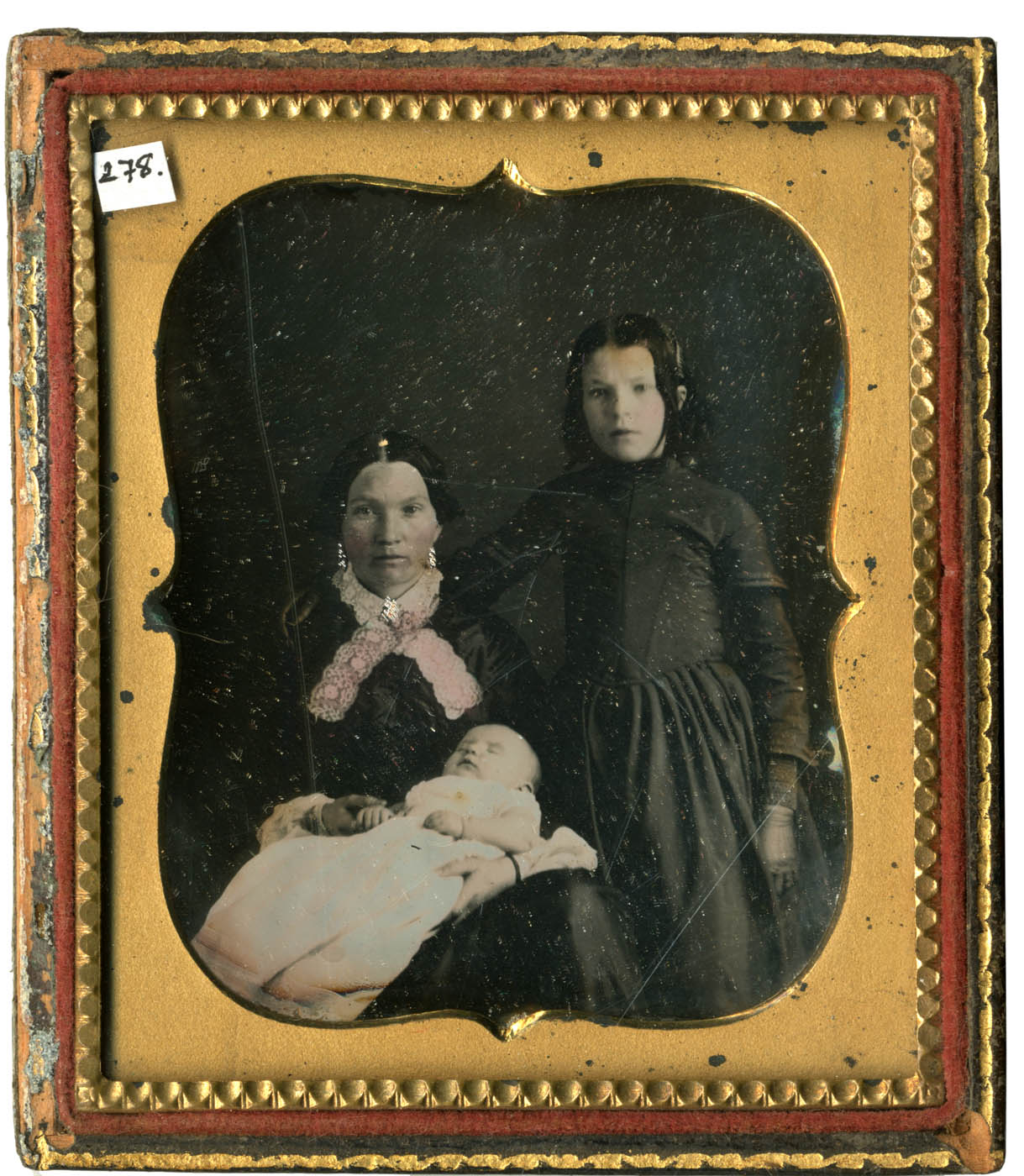
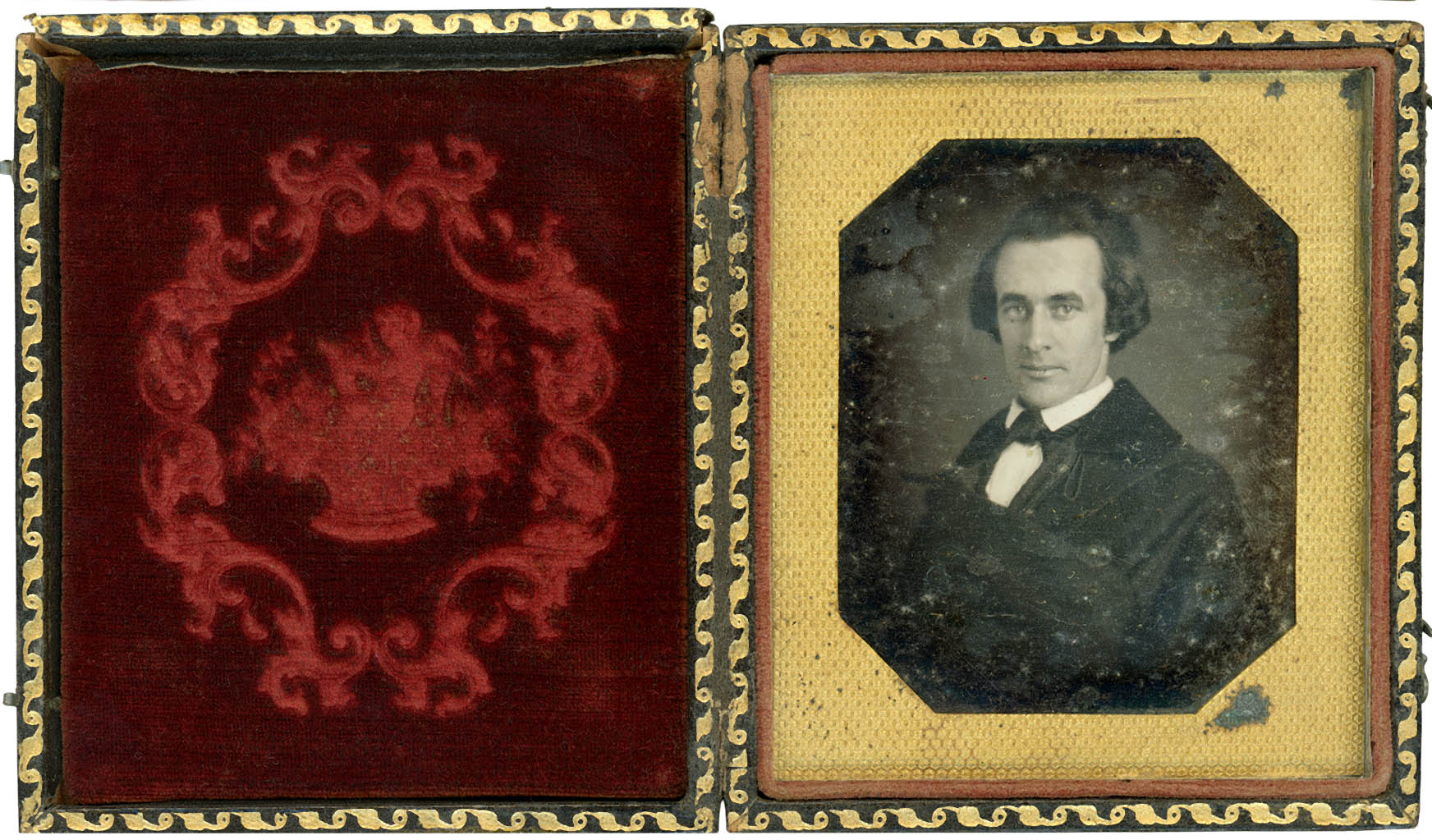
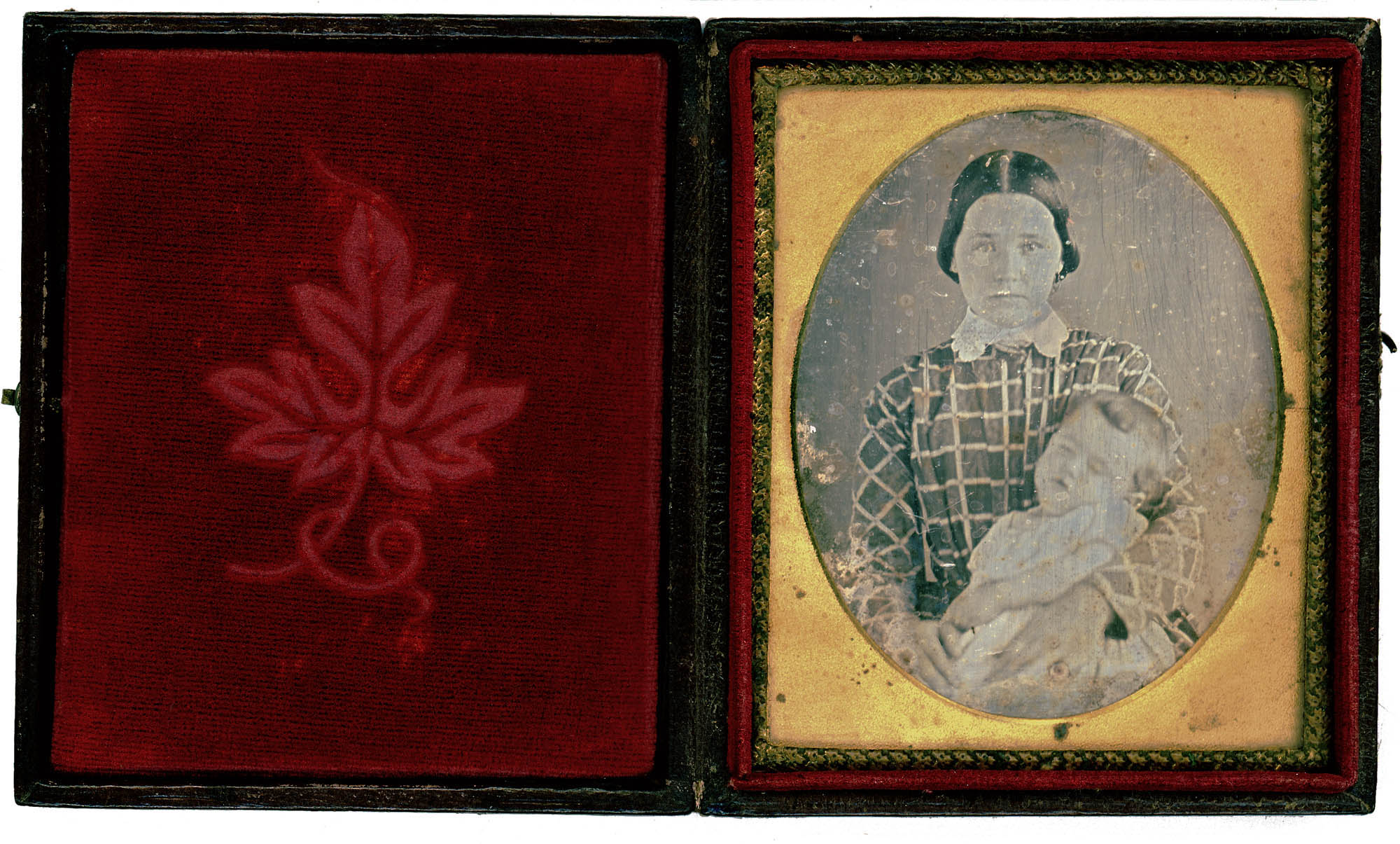
Unknown photographer (American) 'A mother, daughter and dead infant' c. 1848


Unknown photographer (American)
A mother, daughter and dead infant
c. 1848
Daguerreotype retouched in colour
Title given by the collector


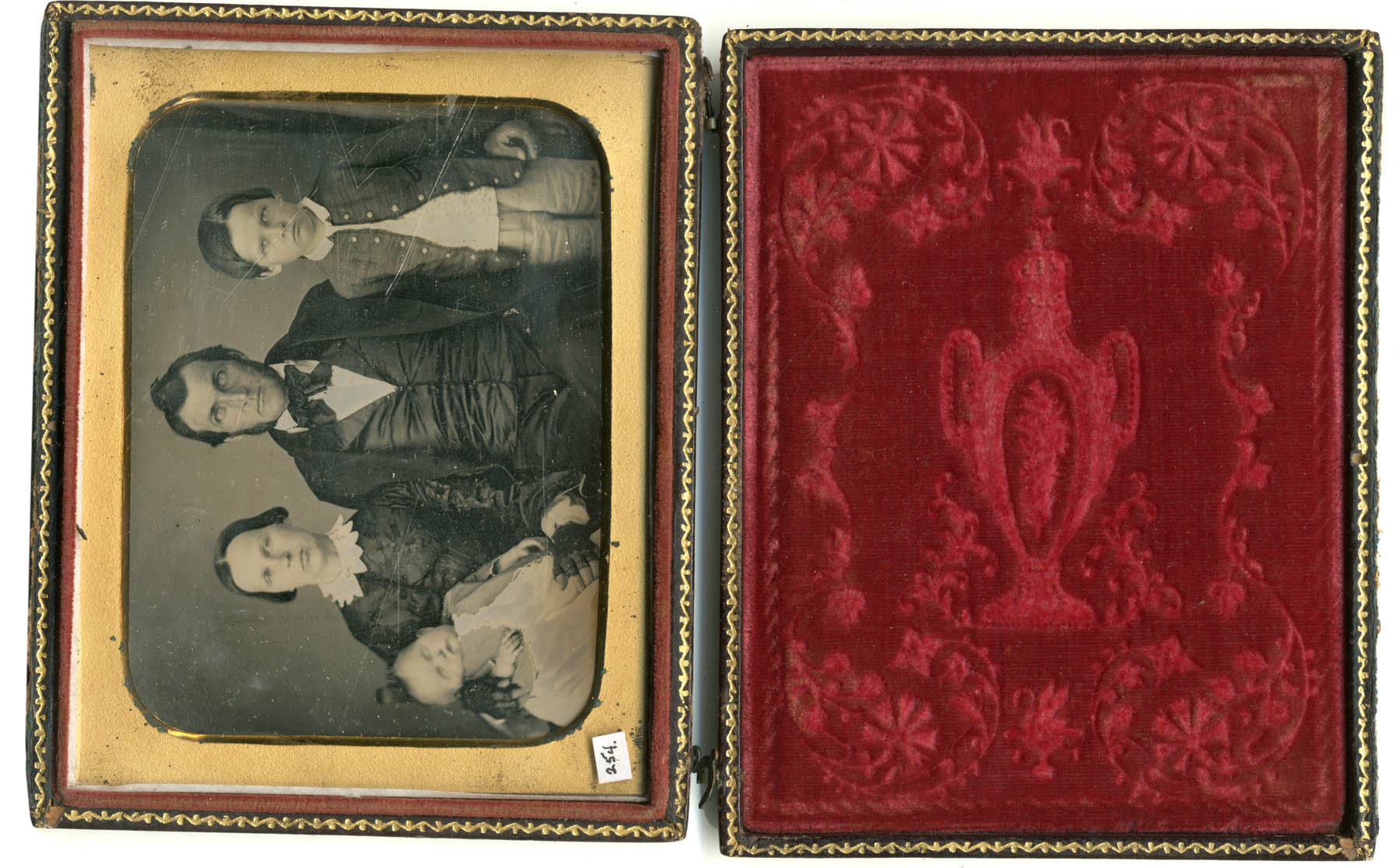
Unknown photographer (American) 'A family group' 1853


Unknown photographer (American)
A family group
1853
Daguerreotype
Date in handwritten characters on the lower edge of the daguerreotype: “July 15 1853”
Title given by the collector


Unknown photographer (American) 'A family group' 1853 (detail)


Unknown photographer (American)
A family group (detail)
1853
Daguerreotype
Date in handwritten characters on the lower edge of the daguerreotype: “July 15 1853”
Title given by the collector


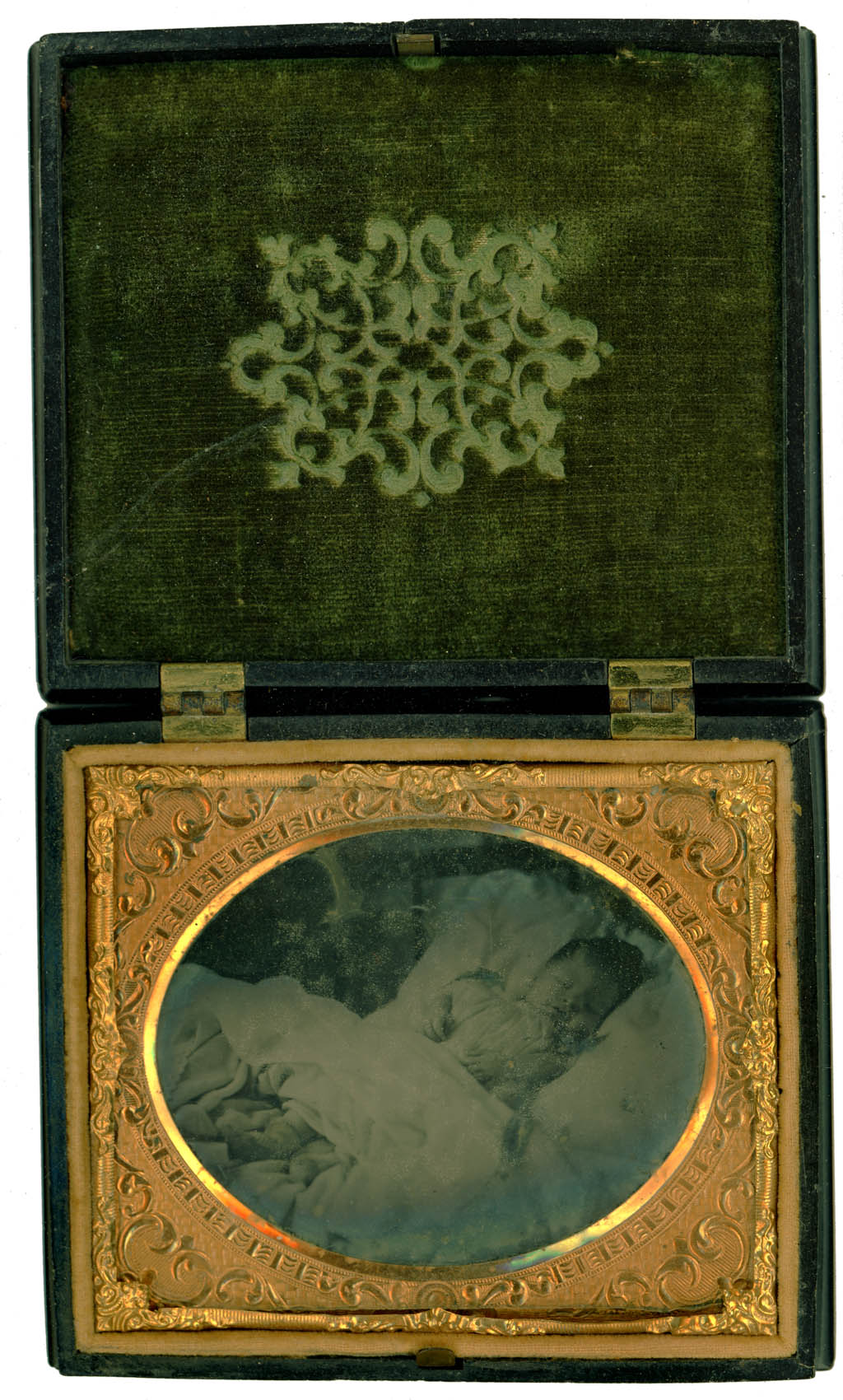
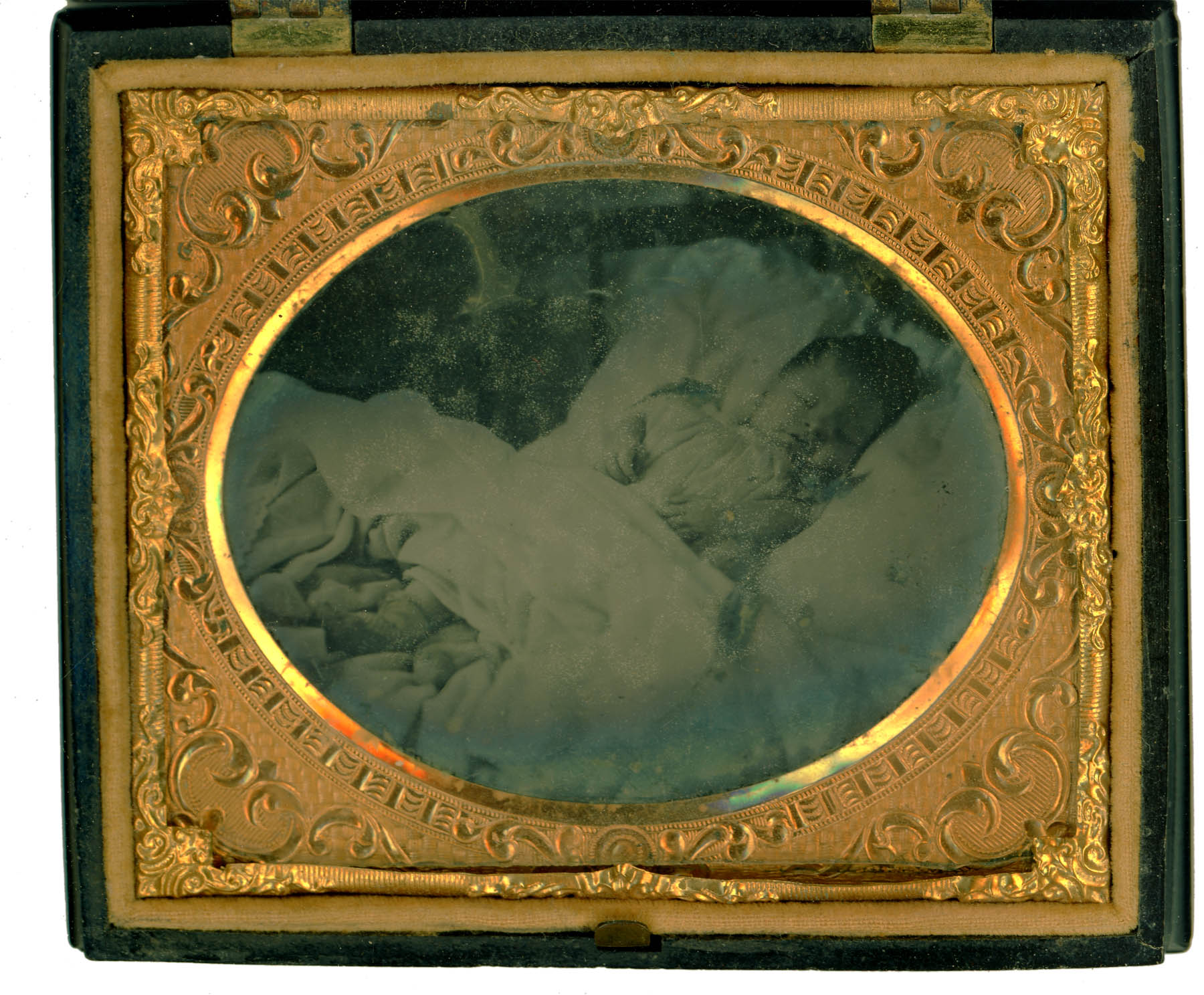
Unknown photographer (American) 'Sleeping baby' c. 1860


Unknown photographer (American)
Sleeping baby
c. 1860
Ambrotype
Title given by the collector


Unknown photographer (American) 'Sleeping baby' c. 1860 (detail)


Unknown photographer (American)
Sleeping baby (detail)
c. 1860
Ambrotype
Title given by the collector


Unknown photographer (American) 'A Sleeping child' c. 1860


Unknown photographer (American)
A Sleeping child
c. 1860
Ferrotype
Title given by the collector


'Attraverso la luce. I primi 20 anni della fotografia nelle collezioni della Fototeca'


Attraverso la luce

In occasione di Fotografia Europea, la Biblioteca Panizzi propone una mostra dedicata ai primi 20 anni della fotografia nelle collezioni della Fototeca attraverso l’esposizione di fotografie su carta salata, albumine, e dagherrotipi, tra cui la prestigiosa collezione di Michael G. Jacob.

On the occasion of Fotografia Europea, the Panizzi Library presents an exhibition dedicated to the first 20 years of photography in the collections of the Photo Library through the display of photographs on salted paper, albumen, and daguerreotypes, including the prestigious collection of Michael G. Jacob.

Text translated by Google Translate from the Biblioteca Panizzi website


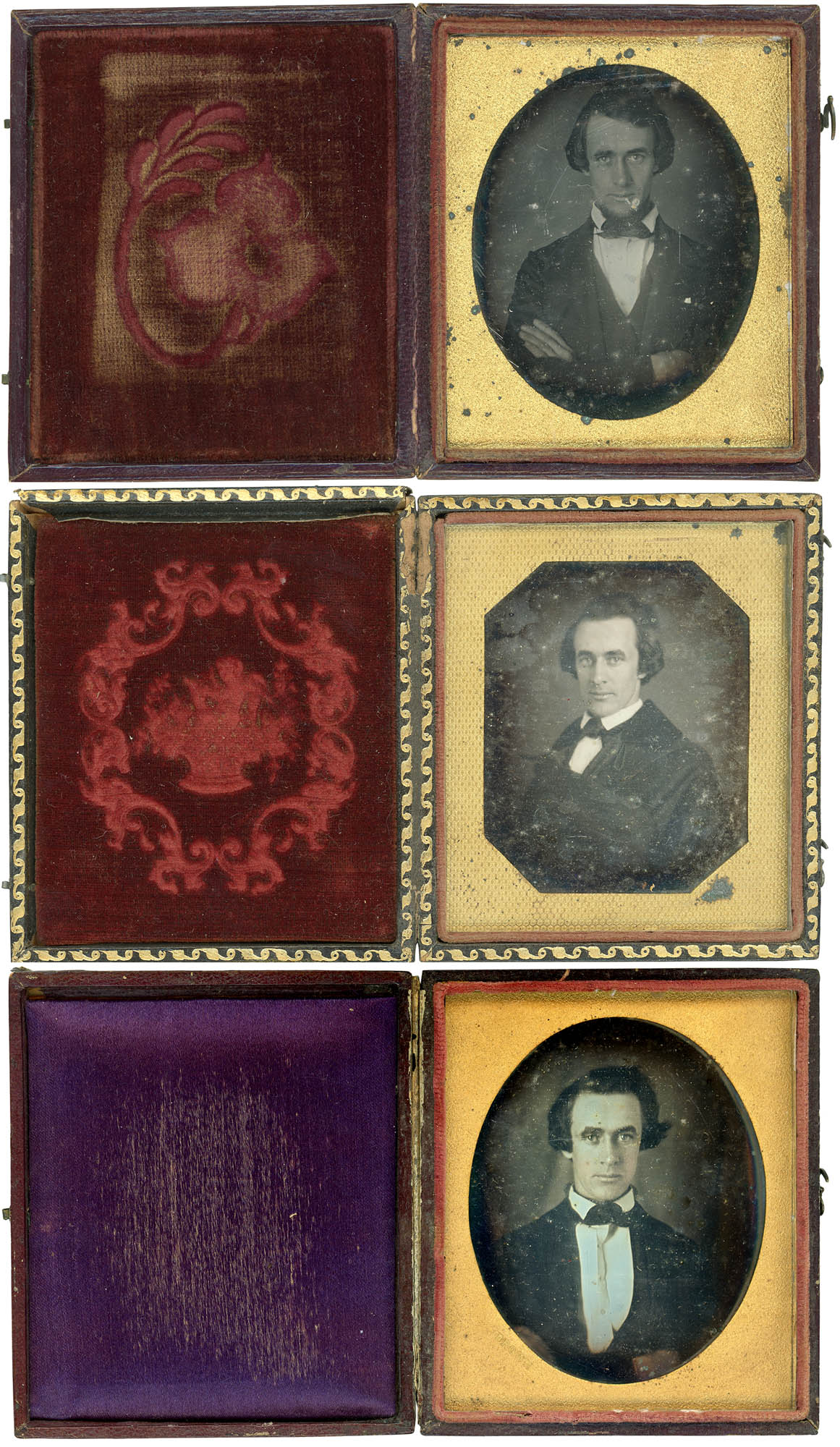
John Brown. 'Portrait of a Young Man' c. 1848 3 Daguerreotypes


John Brown
Portrait of a Young Man
c. 1848
3 Daguerreotypes


John Brown. 'Portrait of a Young Man' c. 1848


John Brown
Portrait of a Young Man
c. 1848
Daguerreotype


John Brown. 'Portrait of a Young Man' c. 1848


John Brown
Portrait of a Young Man
c. 1848
Daguerreotype


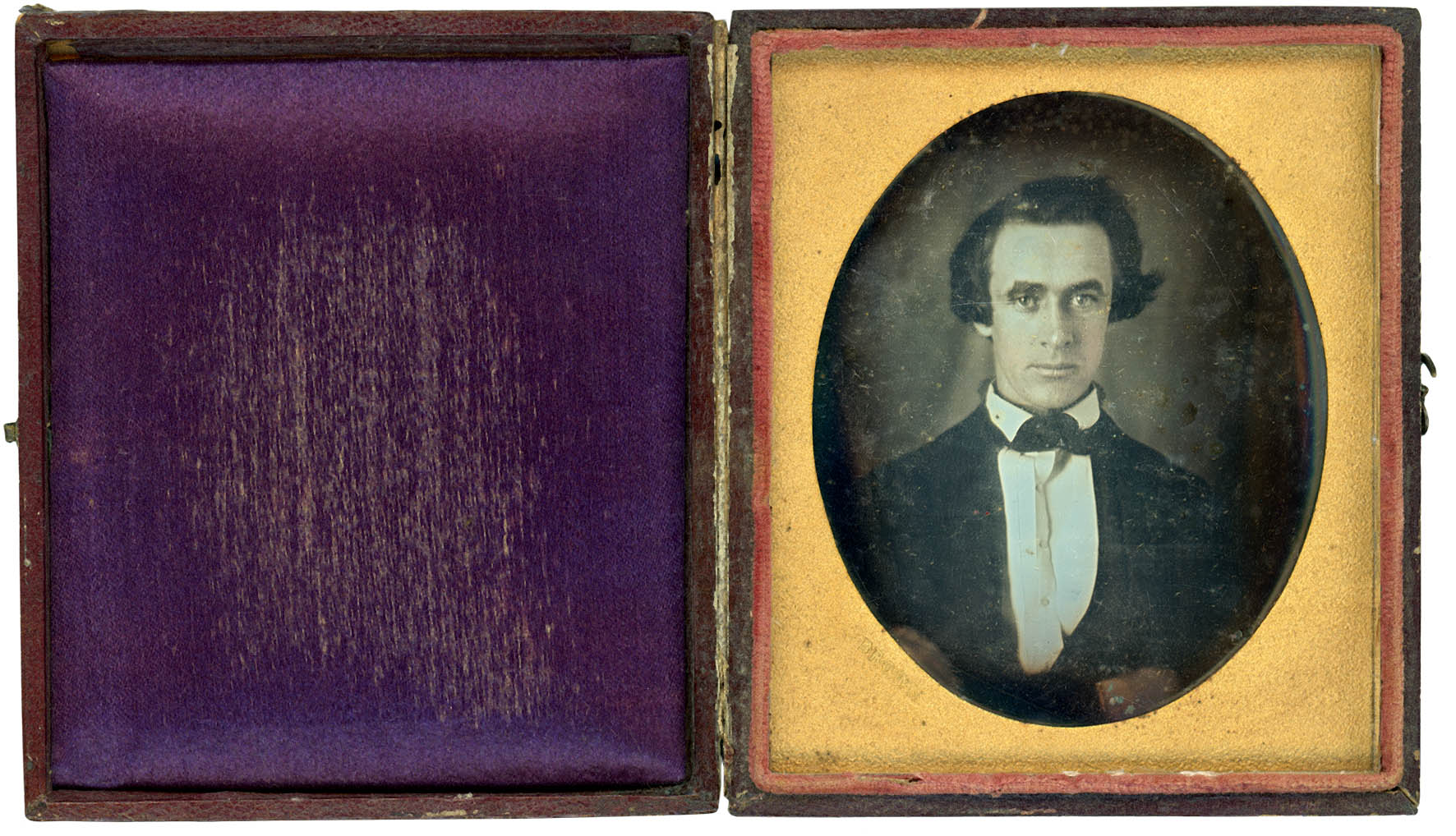
John Brown. 'Portrait of a Young Man' c. 1848


John Brown
Portrait of a Young Man
c. 1848
Daguerreotype


La mostra presenta un percorso attraverso rari esempi di fotografie su carta salata e numerosi dagherrotipi, ambrotipi, ferrotipi e album delle collezioni della Fototeca della Bibliotecca Panizzi. Una narrazione, quindi, che ci portera indietro nel tempo, agli anni pionieristici della sperimentazione sceintifica attraverso la luce, la chimica e la trasformazione di materiali quali l’argento, per arrivare ali’arte del ritratto e del paesaggio e giungere a quel’oggetto di culto che e stata la fotografia delle origini.

The exhibition presents a journey through rare examples of photographs on salted paper and numerous daguerreotypes, ambrotypes, ferrotypes and albums from the collections of the Photo Library of the Panizzi Library. A narrative, therefore, that will take us back in time, to the pioneering years of scientific experimentation through light, chemistry and the transformation of materials such as silver, to arrive at the art of portraiture and landscape and reach that cult object that was the photography of the origins.

Text translated by Google Translate from the Biblioteca Panizzi website


Unknown photographer (American) 'Dead child in his mother's arms' c. 1850


Unknown photographer (American)
Dead child in his mother’s arms
c. 1850
Daguerreotype


Unknown photographer (American) 'Girl holding a flower' c. 1850


Unknown photographer (American)
Girl holding a flower
c. 1850
Daguerreotype


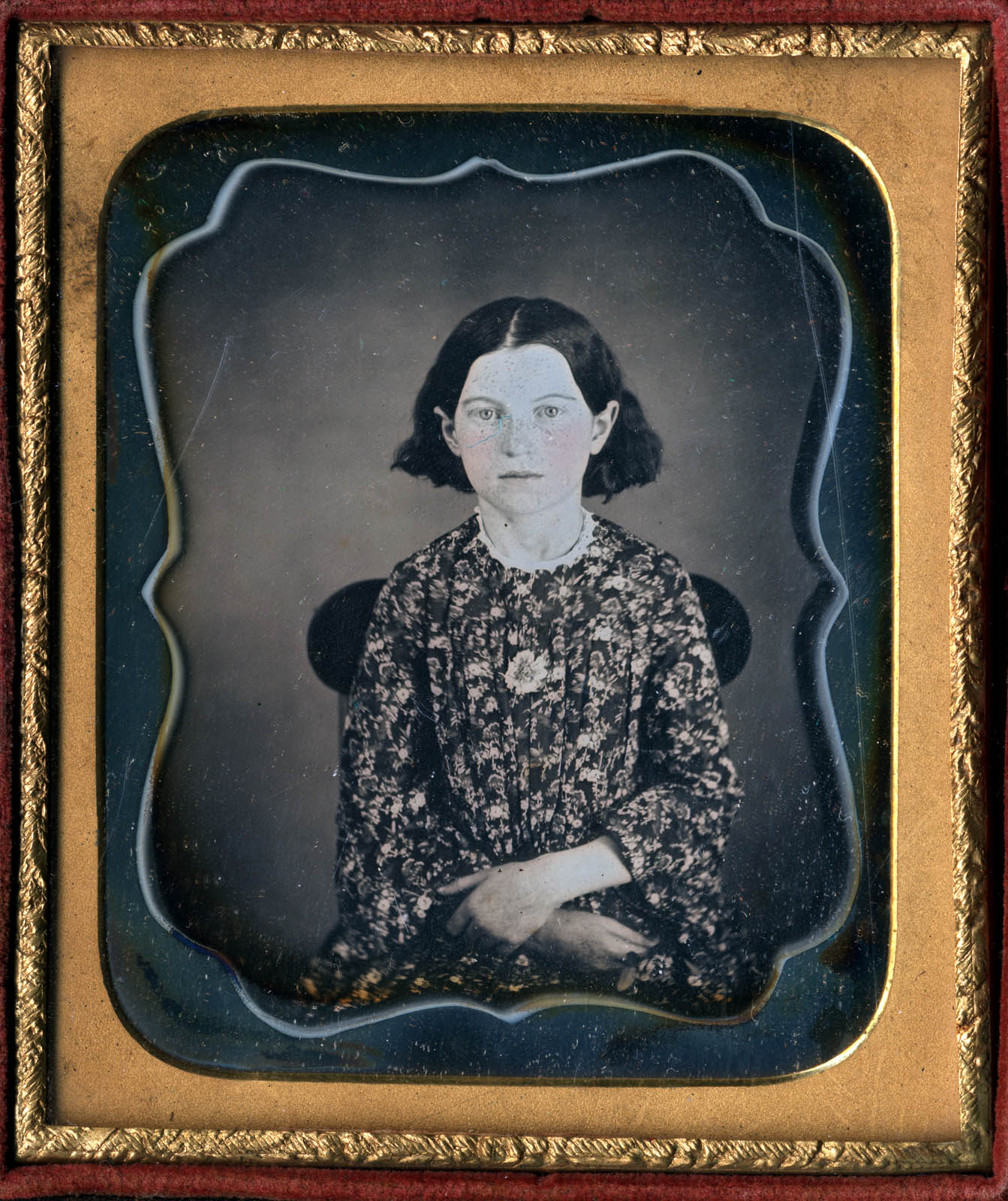
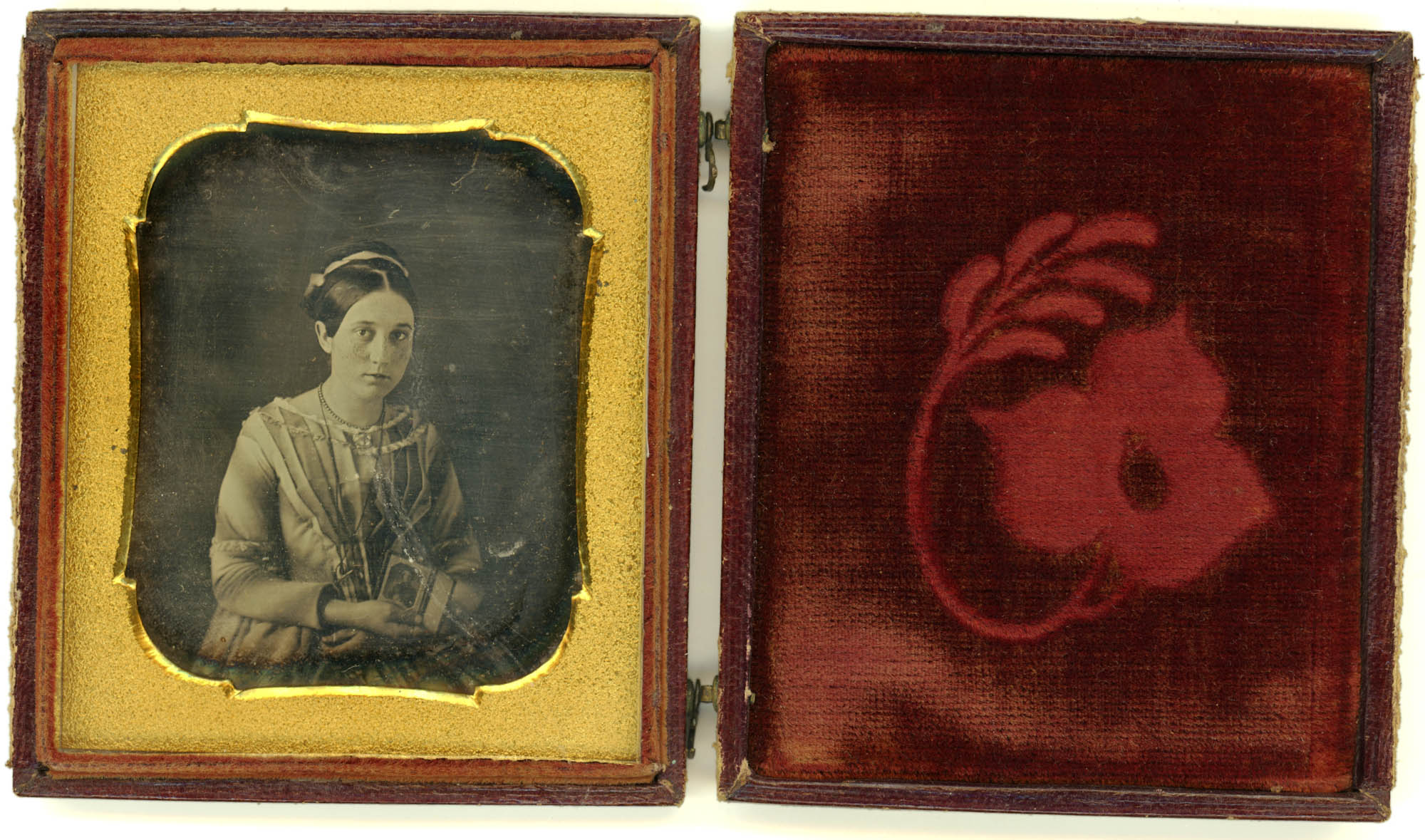
Unknown photographer (American) 'Freckled girl with daguerreotype' c. 1850


Unknown photographer (American)
Freckled girl with daguerreotype
c. 1850
Daguerreotype retouched in colour


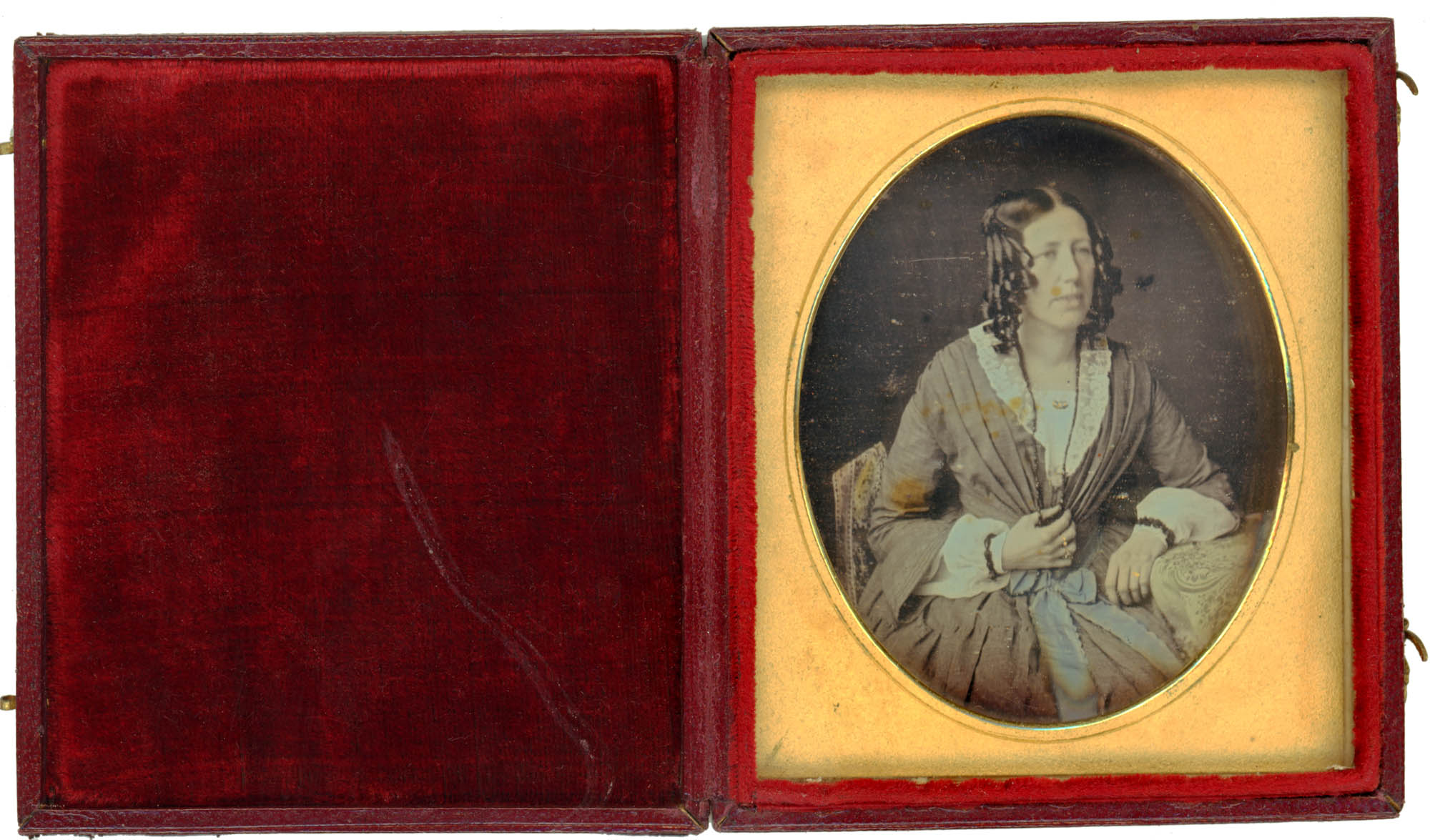
Unknown photographer (American) 'Tinted woman' c. 1850


Unknown photographer (American)
Tinted woman
c. 1850
Daguerreotype retouched in colour


Unknown photographer (American) 'Portrait of mother with child' c. 1850


Unknown photographer (American)
Portrait of mother with child
c. 1850
Daguerreotype


La magia della luce è stata per secoli oggetto di importanti studi scientifici, ma ha affascinato anche e soprattutto il mondo dell’arte, oltre che la cultura popolare. La fotografia, attraverso i vari procedimenti storici, si inserisce in questo capitolo della storia visuale, intrecciandosi con arte, scienza e tecnologia, unite alla passione comune per la nascita di un nuovo e accattivante linguaggio. La mostra presenta un percorso attraverso gli esemplari che appartengono alla collezione di Michael G. Jacob, ultima acquisita grazie alla generosa donazione di questo importante collezionista e studioso, insieme a rari esempi di fotografie su carta salata e numerosi dagherrotipi, ambrotipi, ferrotipi e album delle collezioni della Fototeca della Biblioteca Panizzi. Una narrazione, quindi, che ci porterà indietro nel tempo, agli anni pionieristici della sperimentazione scientifica attraverso la luce, la chimica e la trasformazione di materiali quali l’argento, per arrivare all’arte del ritratto e del paesaggio e giungere a quell’oggetto di culto che è stata la fotografia delle origini.


The magic of light has been the subject of important scientific studies for centuries, but it has also fascinated the world of art, as well as popular culture. Photography, through its various historical processes, fits into this chapter of visual history, intertwining with art, science and technology, combined with a shared passion for the birth of a new and captivating language. The exhibition presents a journey through the specimens that belong to the collection of Michael G. Jacob, the last acquired thanks to the generous donation of this important collector and scholar, together with rare examples of photographs on salted paper and numerous daguerreotypes, ambrotypes, ferrotypes and albums from the collections of the Photo Library of the Panizzi Library. A narrative, therefore, that will take us back in time, to the pioneering years of scientific experimentation through light, chemistry and the transformation of materials such as silver, to arrive at the art of portraiture and landscape and reach that cult object that was early photography.

Text translated by Google Translate from the Biblioteca Panizzi website


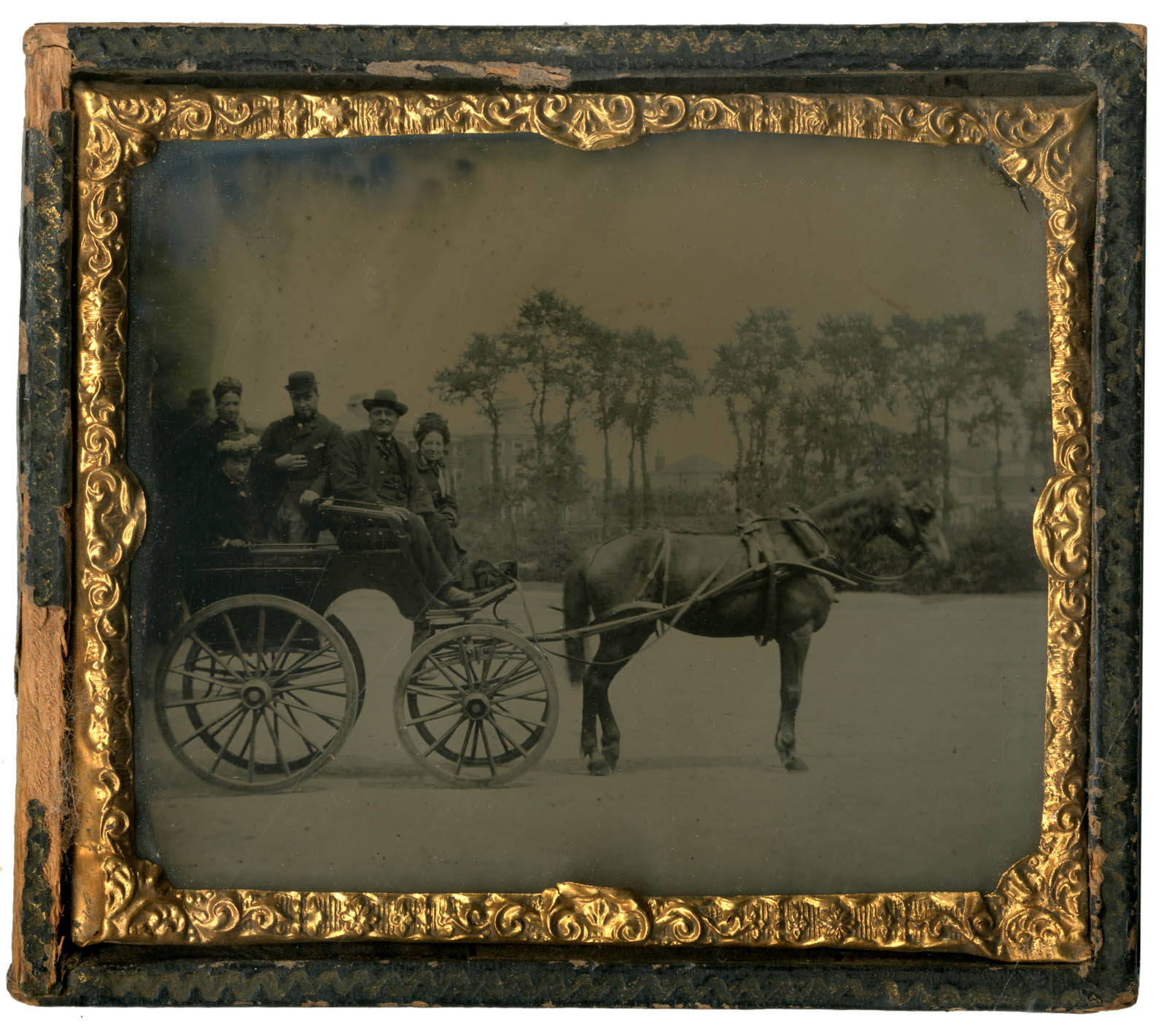
Unknown photographer (American) 'Coach in park' c. 1860


Unknown photographer (American)
Coach in park
c. 1860
Ambrotype


Unknown photographer (American) 'Portrait of women' c. 1860


Unknown photographer (American)
Portrait of women
c. 1860
Ferrotype


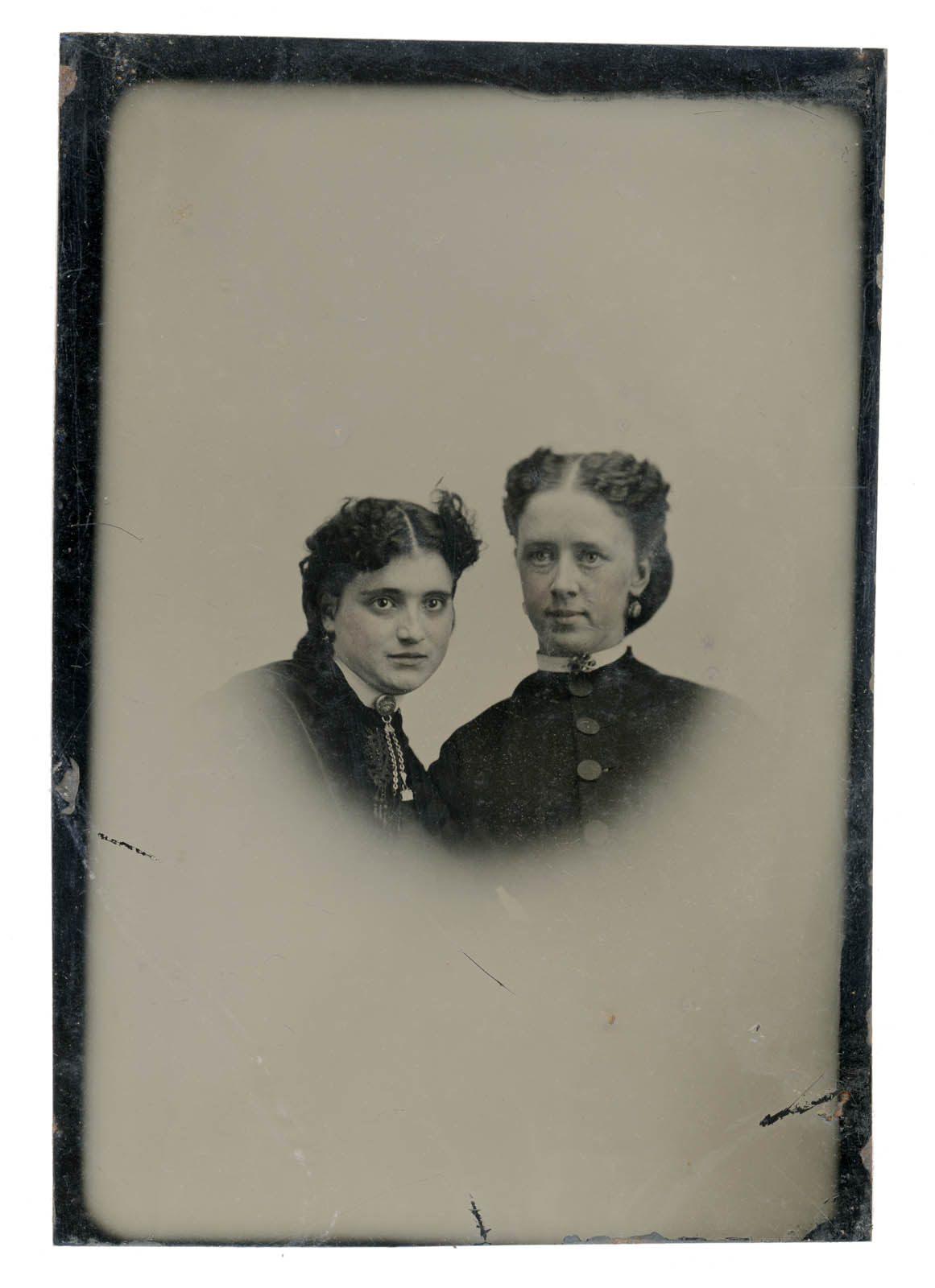
Unknown photographer (American) 'Double vignette friends' c. 1860


Unknown photographer (American)
Double vignette friends
c. 1860
Ferrotype


Unknown photographer (American) 'Well dressed lady' c. 1880


Unknown photographer (American)
Well dressed lady
c. 1880
Ambrotype


Biblioteca Panizzi
Via Luigi Carlo Farini, 3,
42121 Reggio Emilia RE, Italy

Opening hours:
Monday – Saturday, 9am – 7pm

Biblioteca Panizzi website

LIKE ART BLART ON FACEBOOK

Back to top

Exhibition: ‘Portraits of Renown: Photography and the Cult of Celebrity’ at the J. Paul Getty Museum, Los Angeles

Exhibition dates: 3rd April – 26th August 2012


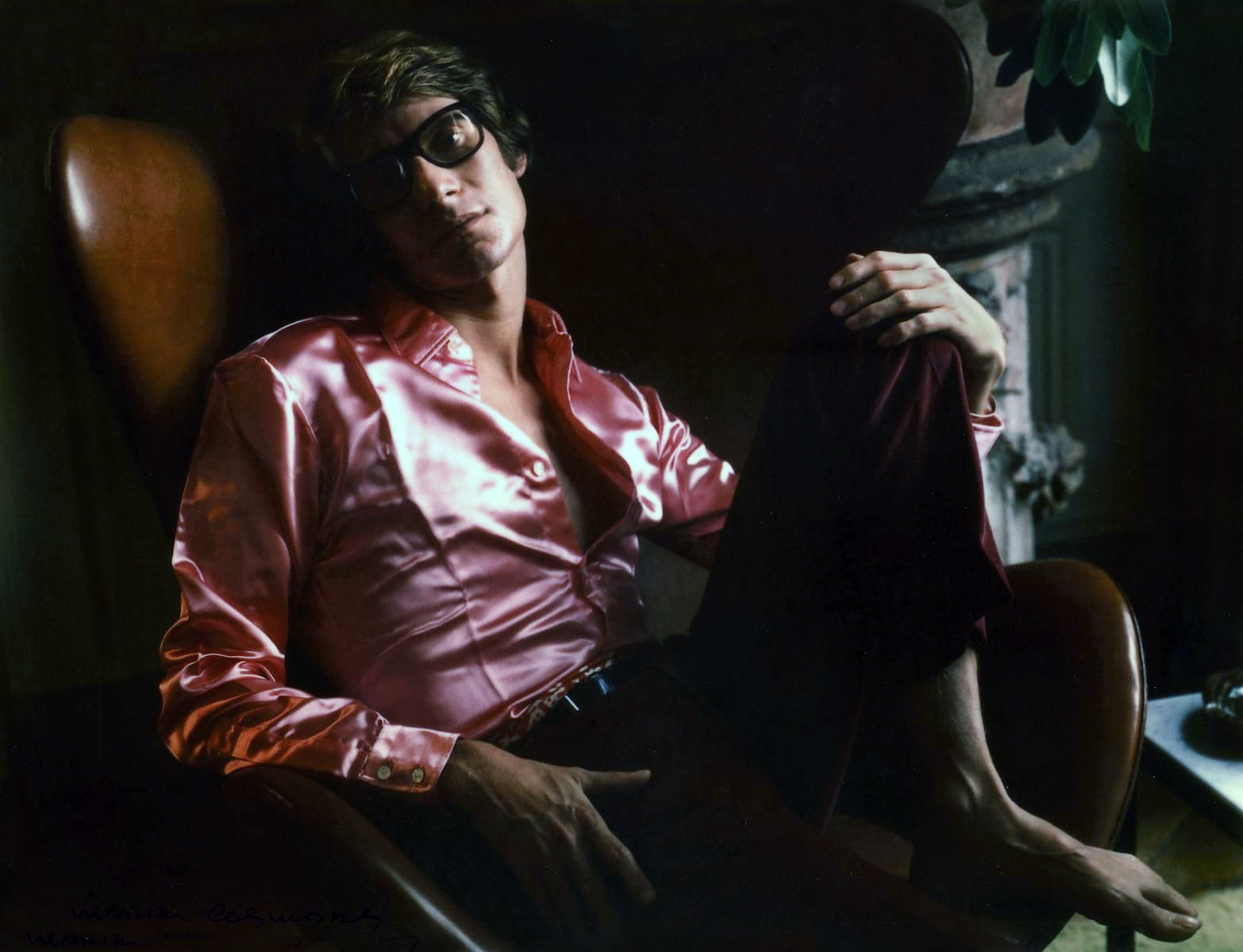
Marie Cosindas (American, 1925-2017) 'Yves Saint Laurent, Paris' 1968


Marie Cosindas (American, 1925-2017)
Yves Saint Laurent, Paris
1968
Dye colour diffusion [Polaroid ®] print
The J. Paul Getty Museum, Los Angeles
© Marie Cosindas


On the Nature of Photography


“To get from the tangible to the intangible (which mature artists in any medium claim as part of their task) a paradox of some kind has frequently been helpful. For the photographer to free himself of the tyranny of the visual facts upon which he is utterly dependent, a paradox is the only possible tool. And the talisman paradox for unique photography is to work “the mirror with a memory” as if it were a mirage, and the camera is a metamorphosing machine, and the photograph as if it were a metaphor… Once freed of the tyranny of surfaces and textures, substance and form [the photographer] can use the same to pursue poetic truth.”


Minor White quoted in Beaumont Hewhall (ed.,). The History of Photography. Boston: Little, Brown, and Co., 1982, p. 281


“Carol Jerrems and I taught at the same secondary school in the 1970’s. In a classroom that was unused at that time, I remember having my portrait taken by her. She held her Pentax to her eye. Carols’ portraits all seemed to have been made where the posing of her subjects was balanced by an incisive naturalness (for want of a better description). As a challenge to myself I tried to look “natural”, but kept in my consciousness that I was having my portrait taken. Minutes passed and neither she nor her camera moved at all.

Then the idea slipped from my mind for just a moment, and I was straightaway bought back by the sound of the shutter. What had changed in my face? – probably nothing, or 1 mm of muscle movement. Had she seen it through the shutter? Or something else – I don’t know.”


Australian artist Ian Lobb on being photographed by the late Carol Jerrems


There is always something that you can’t quite put your finger on in an outstanding portrait, some ineffable other that takes the portrait into another space entirely. I still haven’t worked it out but my thoughts are this: forget about the pose of the person. It would seem to me to be both a self conscious awareness by the sitter of the camera and yet at the same time a knowing transcendence of the visibility of the camera itself. In great portrait photography it is almost as though the conversation between the photographer and the person being photographed elides the camera entirely. Minor White, in his three great mantras, the Three Canons, observes:


Be still with yourself
Until the object of your attention
Affirms your presence

Let the Subject generate its own Composition

When the image mirrors the man
And the man mirrors the subject
Something might take over


Freed from the tyranny of the visual facts something else emerges.

Celebrities know only too well how to “work” the camera but the most profound portraits, even of celebrities, are in those moments when the photographer sees something else in the person being photographed, some unrecognised other that emerges from the shadows – a look, a twist of the head, the poignancy of the mouth, the vibrancy of the dancer Josephine Baker, the sturdiness of the gaze of Walt Whitman with hands in pockets, the presence of the hands (no, not the gaze!) of Picasso. I remember taking a black and white portrait of my partner Paul holding a wooden finial like a baby among some trees, a most beautiful, revealing photograph. He couldn’t bear to look at it, for it stripped him naked before the lens and showed a side of himself that he had never seen before: vulnerable, youthful, beautiful.

Why do great portrait photographers make so many great portraits? Why can’t this skill be shared or taught? Why can’t Herb Ritts (for example) make a portrait that goes beyond a caricature? Why is it that what can be taught is so banal that it has no value?

In photography, maybe we edit out what is expected and then it seems that photography does something that goes beyond language; it goes beyond function that can be described as a part of speech, metonym or metaphor. When this something else takes over I think it is truly “unrecognised” in the best portraits (and landscape / urban photographs) – and it is fantastic and wonderful.

This is my understanding, then, of perception and vision (when spirit takes over) – [which is] the ability to see this certain something in the mind (previsualisation) before seeing it through the viewfinder and to then be able to reveal it in the physicality of the print. It is a liminal moment in time and space.

I believe this is the reality of photography itself in its absolute essential form – and here I am deliberately forgetting about post-photography, post-modernism, modernism, pictorialism, ism, ism – getting down to why I really like photography:

the BEYOND visualisation of a world, the transcendence of time and space that leads, in great photographs, to a recognition of the discontinuous nature of life but in the end, to its ultimate persistence.

This is as close as I have got so far…

Dr Marcus Bunyan
August 2012


Many thankx to the J. Paul Getty Museum for allowing me to publish the photographs in the posting. Please click on the photograph for a larger version of the image.


Mariana Cook (American, b. 1955) 'Barack and Michelle Obama, Chicago' May 26, 1996


Mariana Cook (American, b. 1955)
Barack and Michelle Obama, Chicago
May 26, 1996
Selenium-toned gelatin silver print
The J. Paul Getty Museum, Los Angeles


Marie Cosindas (American, 1925-2017) 'Andy Warhol' 1966


Marie Cosindas (American, 1925-2017)
Andy Warhol
1966
Dye colour diffusion [Polaroid ®] print
11.4 x 8.9cm
The J. Paul Getty Museum, Los Angeles
© Marie Cosindas


Marie Cosindas (American, 1925-2017) 'Yves St Laurent' 1968


Marie Cosindas (American, 1925-2017)
Yves St Laurent
1968
Dye colour diffusion [Polaroid ®] print
11.4 x 8.9cm
The J. Paul Getty Museum, Los Angeles
© Marie Cosindas


Andy Warhol (American, 1928-1987) 'Grace Jones' 1984


Andy Warhol (American, 1928-1987)
Grace Jones
1984
Polaroid Polacolor print
9.5 x 7.3cm
The J. Paul Getty Museum, Los Angeles
© 2011 The Andy Warhol Foundation for the Visual Arts / Artists Rights Society (ARS), New York


Edward Weston (American, 1889-1958) 'Igor Stravinsky' 1935


Edward Weston (American, 1889-1958)
Igor Stravinsky
1935
Gelatin silver print
The J. Paul Getty Museum, Los Angeles


Coy Watson Jr. (American, 1912-2009) 'Joe Louis – “The Brown Bomber”, Los Angeles, February 1935'


Coy Watson Jr. (American, 1912-2009)
Joe Louis – “The Brown Bomber”, Los Angeles, February 1935
1935
Gelatin silver print
The J. Paul Getty Museum, Los Angeles


Edward Steichen (American, 1879-1973) 'Gloria Swanson' 1924


Edward Steichen (American, 1879-1973)
Gloria Swanson
1924
Gelatin silver print
27.8 x 21.6cm (10 15/16 x 8 1/2 in.)
The J. Paul Getty Museum, Los Angeles
© Permission Joanna T. Steichen


Portraits of Renown surveys some of the visual strategies used by photographers to picture famous individuals from the 1840s to the year 2000. “This exhibition offers a brief visual history of famous people in photographs, drawn entirely from the Museum’s rich holdings in this genre,” says Paul Martineau, curator of the exhibition and associate curator of photographs at the J. Paul Getty Museum. “It also provides a broad historical context for the work in the concurrent exhibition Herb Ritts: L.A. Style, which includes a selection of Ritts’s best celebrity portraits.”

Photography’s remarkable propensity to shape identities has made it the leading vehicle for representing the famous. Soon after photography was invented in the 1830s, it was used to capture the likenesses and accomplishments of great men and women, gradually supplanting other forms of commemoration. In the twentieth century, the proliferation of photography and the transformative power of fame have helped to accelerate the desire for photographs of celebrities in magazines, newspapers, advertisements, and on the Internet. The exhibition is arranged chronologically to help make visible some of the overarching technical and stylistic developments in photography from the first decade of its invention to the end of the twentieth century.

A wide range of historical figures are portrayed in Portraits of Renown. A photograph by Alexander Gardner of President Lincoln documents his visit to the battlefield of Antietam during the Civil War. Captured by Nadar, a portrait of Alexander Dumas, best known for his novels The Count of Monte Cristo and The Three Musketeers, shows the author with an energetic expression, illustrating the lively personality that made his writing so popular. Baron Adolf De Meyer’s portrait of Josephine Baker, an American performer who became an international sensation at the Folies Bergère in Paris, showcases her comedic charm, a trait that proved central to her popularity as a performer. An iconic portrait of the silent screen actress, Gloria Swanson, created by Edward Steichen for Vanity Fair reveals both the intensity of its sitter and the skill of the artist. A picture of Pablo Picasso by his friend Man Ray portrays the master of Cubism with a penetrating gaze.

Yves St. Laurent, Andy Warhol, and Grace Jones are among the contemporary figures included in the exhibition. Fashion designer Yves St. Laurent was photographed by Marie Cosindas using instant color film by Polaroid. The photograph, made the year his first boutique in New York opened, graced the walls of the store for ten years. A Cosindas portrait of Andy Warhol shows the artist wearing dark sunglasses, which partially conceal his face. Warhol, who was fascinated by celebrity, delighted in posing public personalities like Grace Jones for his camera.

Press release from the J. Paul Getty Museum website


Man Ray (American, 1890-1976) 'Pablo Picasso' 1934


Man Ray (American, 1890-1976)
Pablo Picasso
1934
Gelatin silver print
25.2 x 20cm
The J. Paul Getty Museum, Los Angeles
© Man Ray Trust ARS-ADAGP


Berenice Abbott (American, 1898-1991) 'James Joyce' 1928


Berenice Abbott (American, 1898-1991)
James Joyce
1928
Gelatin silver print
The J. Paul Getty Museum, Los Angeles


Baron Adolf De Meyer (American born France, 1868-1946) 'Portrait of Josephine Baker' 1925


Baron Adolf De Meyer (American born France, 1868-1946)
Portrait of Josephine Baker
1925
Collotype print
39.1 x 39.7cm
The J. Paul Getty Museum, Los Angeles


In 1925 Josephine Baker, an American dancer from Saint Louis, Missouri, made her debut on the Paris stage in La Revue nègre (The Black Review) at the Théâtre des Champs-Elysées, wearing nothing more than a skirt of feathers and performing her danse sauvage (savage dance). She was an immediate sensation in Jazz-Age France, which celebrated her perceived exoticism, quite the opposite of the reception she had received dancing in American choruses. American expatriate novelist Ernest Hemingway called Baker “the most sensational woman anybody ever saw – or ever will.”

Baron Adolf de Meyer, a society and fashion photographer, took this playful portrait in the year of Baker’s debut. Given the highly sexual nature of her stage persona, this portrait is charming and almost innocent; Baker’s personality is suggested by her face rather than her famous body.

Text from the J. Paul Getty website


Edward Steichen (American, 1879-1973) 'John Barrymore as Hamlet' 1922


Edward Steichen (American, 1879-1973)
John Barrymore as Hamlet
1922
Gelatin silver print
The J. Paul Getty Museum, Los Angeles


Alfred Stieglitz (American, 1964-1946) 'Georgia O'Keeffe: A Portrait' 1918


Alfred Stieglitz (American, 1964-1946)
Georgia O’Keeffe: A Portrait
1918
Gelatin silver print
The J. Paul Getty Museum, Los Angeles


Arnold Genthe (American born Germany, 1869-1942) 'Anna Pavlowa' about 1915


Arnold Genthe (American born Germany, 1869-1942)
Anna Pavlowa
about 1915
Gelatin silver print
33.5 × 25.2cm (13 3/16 × 9 15/16 in.)
The J. Paul Getty Museum, Los Angeles


The Russian ballerina Anna Pavlowa (or Pavlova) so greatly admired Arnold Genthe’s work that she made the unusual decision to visit his studio, rather than have him come to her rehearsals. The resulting portrait of the prolific dancer, leaping in mid-air, is the only photograph to capture Pavlowa in free movement. Genthe regarded this print as one of the best dance photographs he ever made.

Text from the J. Paul Getty website


Alvin Langdon Coburn (British born United States, 1882-1966) 'Mark Twain (Samuel Langhorne Clemens)' Negative December 21, 1908; print 1913


Alvin Langdon Coburn (British born United States, 1882-1966)
Mark Twain (Samuel Langhorne Clemens)
Negative December 21, 1908; print 1913
Photogravure
20.6 × 14.8cm (8 1/8 × 5 13/16 in.)
The J. Paul Getty Museum, Los Angeles


Alfred Stieglitz (American, 1864-1946) '[Self-Portrait]' Negative 1907; print 1930


Alfred Stieglitz (American, 1864-1946)
[Self-Portrait]
Negative 1907; print 1930
Gelatin silver print
24.8 × 18.4cm (9 3/4 × 7 1/4 in.)
The J. Paul Getty Museum, Los Angeles


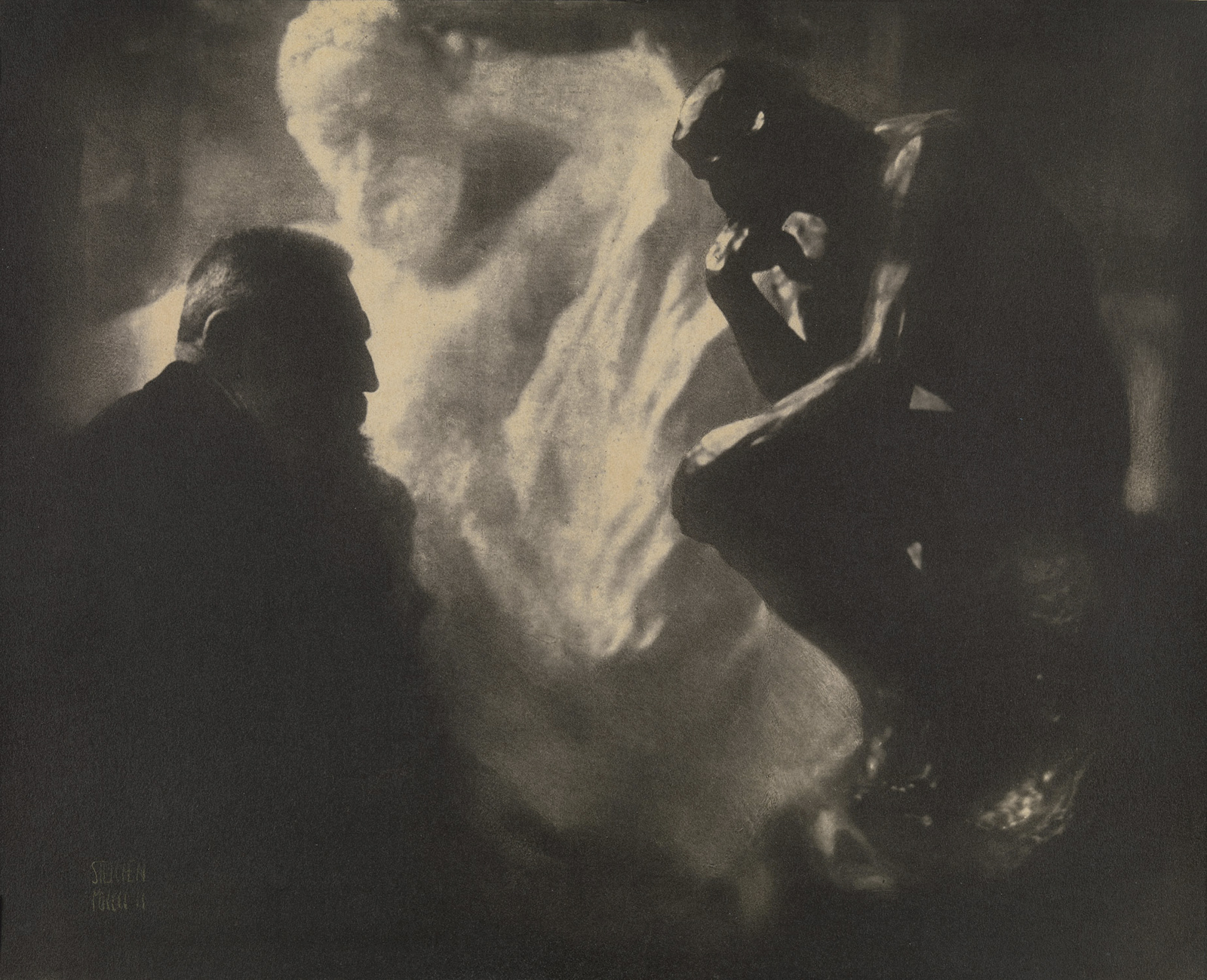
Edward Steichen (American 1879-1973) 'Rodin The Thinker' 1902


Edward Steichen (American, 1879-1973)
Rodin – Le Penseur (The Thinker)
1902
Gelatin-carbon print
The J. Paul Getty Museum, Los Angeles


Sarah Choate Sears (American, 1858-1935) '[Julia Ward Howe]' about 1890


Sarah Choate Sears (American, 1858-1935)
[Julia Ward Howe]
about 1890
Platinum print
23.5 × 18.6cm (9 1/4 × 7 5/16 in.)
The J. Paul Getty Museum, Los Angeles


Julia Ward Howe (May 27, 1819 – October 17, 1910) was an American poet and author, known for writing “The Battle Hymn of the Republic” and the original 1870 pacifist Mother’s Day Proclamation. She was also an advocate for abolitionism and a social activist, particularly for women’s suffrage.


Sarah Choate Sears (American, 1858-1935) 'John Singer Sargent' about 1890


Sarah Choate Sears (American, 1858-1935)
John Singer Sargent
about 1890
Gelatin silver print
The J. Paul Getty Museum, Los Angeles


Although John Singer Sargent was the most famous American portrait painter of his time, he apparently did not like to be photographed. The few photographs that exist show him at work, as he is here, sketching and puffing on a cigar. His friend Sarah Choate Sears, herself a painter of some note, drew many of her sitters for photographs from the same aristocratic milieu as Sargent did for his paintings.

Text from the J. Paul Getty website


Nadar [Gaspard Félix Tournachon] (French, 1820-1910) '[Sarah Bernhardt as the Empress Theodora in Sardou's "Theodora"]' Negative 1884; print and mount about 1889


Nadar (Gaspard Félix Tournachon) (French, 1820-1910)
[Sarah Bernhardt as the Empress Theodora in Sardou’s “Theodora”]
Negative 1884; print and mount about 1889
Albumen silver print
14.6 × 10.5 cm (5 3/4 × 4 1/8 in.)
The J. Paul Getty Museum, Los Angeles


J. Wood (American, active New York, New York 1870s-1880s) 'L.P. Federmeyer' 1879


J. Wood (American, active New York, New York 1870s-1880s)
L.P. Federmeyer
1879
Albumen silver print
14.8 × 10 cm (5 13/16 × 3 15/16 in.)
The J. Paul Getty Museum, Los Angeles


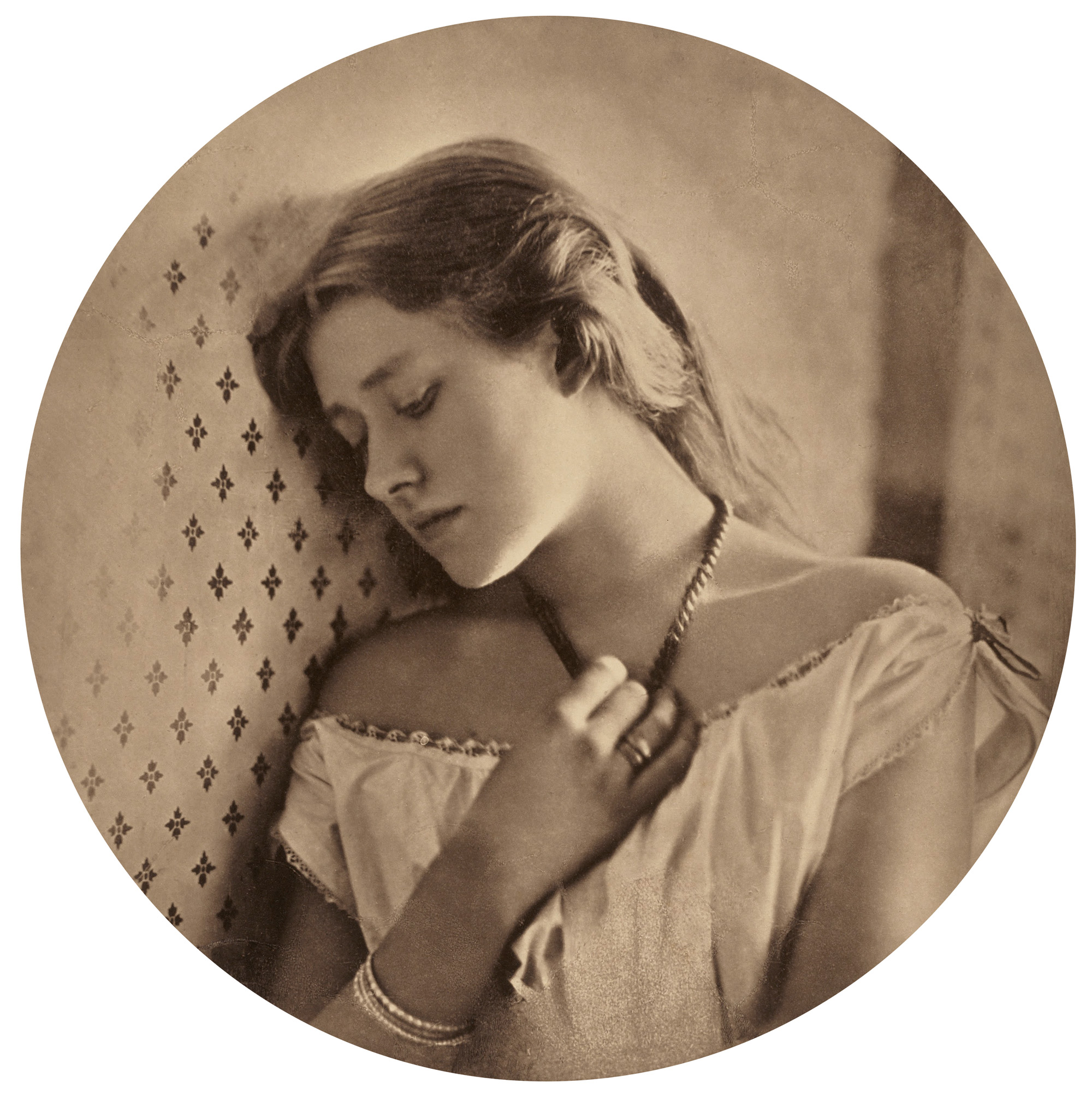
Julia Margaret Cameron (British born India, 1815-1879) 'Ellen Terry at Age Sixteen' 1864


Julia Margaret Cameron (British born India, 1815-1879)
Ellen Terry at Age Sixteen
Negative 1864; print about 1875
Carbon print
24.1cm (9 1/2 in.)
The J. Paul Getty Museum, Los Angeles


This image of Ellen Terry (1847-1928) is one of the few known photographs of a female celebrity by Julia Margaret Cameron. Terry, the popular child actress of the British stage, was sixteen years old when Cameron made this image. This photograph was most likely taken just after she married the eccentric painter, George Frederick Watts (1817-1904), who was thirty years her senior. They spent their honeymoon in the village of Freshwater on the Isle of Wight where Cameron resided.

Cameron’s portrait echoes Watt’s study of Terry titled Choosing (1864, National Portrait Gallery, London). As in the painting, Terry is shown in profile with her eyes closed, an ethereal beauty in a melancholic dream state. In this guise, Terry embodies the Pre-Raphaelite ideal of womanhood rather than appearing as the wild boisterous teenager she was known to be. The round (“tondo”) format of this photograph was popular among Pre-Raphaelite artists.

Cameron titled another print of this image Sadness (see 84.XZ.186.52), which may suggest the realisation of a mismatched marriage. Terry’s anxiety is plainly evident – she leans against an interior wall and tugs nervously at her necklace. The lighting is notably subdued, leaving her face shadowed in doubt. In The Story of My Life (1909), Terry recalls how demanding Watts was, calling upon her to sit for hours as a model and giving her strict orders not to speak in front of distinguished guests in his studio.

This particular version was printed eleven years after Cameron first made the portrait. In order to distribute this image commercially, the Autotype Company of London rephotographed the original negative after the damage had been repaired. The company then made new prints using the durable, non-fading carbon print process. Thus, this version is in reverse compared to Sadness. Terry’s enduring popularity is displayed by the numerous photographs taken of her over the years. Along with the two portraits by Cameron, the Getty owns three more of Terry by other photographers.

Adapted from Julian Cox. Julia Margaret Cameron, In Focus: Photographs from the J. Paul Getty Museum (Los Angeles: J. Paul Getty Museum, 1996), 12. ©1996 The J. Paul Getty Museum; with additions by Carolyn Peter, J. Paul Getty Museum, Department of Photographs, 2019.


Charles DeForest Fredricks (American, 1823-1894) '[Mlle Pepita]' 1863


Charles DeForest Fredricks (American, 1823-1894)
[Mlle Pepita]
1863
Albumen silver print
9 × 5.4cm (3 9/16 × 2 1/8 in.)
The J. Paul Getty Museum, Los Angeles


André Adolphe-Eugène Disdéri (French, 1819-1889) '[Rosa Bonheur]' 1861-1864


André Adolphe-Eugène Disdéri (French, 1819-1889)
[Rosa Bonheur]
1861-1864
Albumen silver print
8.4 × 5.2cm (3 5/16 × 2 1/16 in.)
The J. Paul Getty Museum, Los Angeles


Rosa Bonheur, born Marie-Rosalie Bonheur (16 March 1822 – 25 May 1899), was a French artist, mostly a painter of animals (animalière) but also a sculptor, in a realist style. Her best-known paintings are Ploughing in the Nivernais, first exhibited at the Paris Salon of 1848, and now at the Musée d’Orsay in Paris, and The Horse Fair (in French: Le marché aux chevaux), which was exhibited at the Salon of 1853 (finished in 1855) and is now in the Metropolitan Museum of Art, in New York City. Bonheur was widely considered to be the most famous female painter of the nineteenth century.

Text from the Wikipedia website


Mathew B. Brady (American, about 1823-1896) 'Walt Whitman' about 1870


Mathew B. Brady (American, about 1823-1896)
Walt Whitman
about 1870
Albumen silver print
14.6 x 10.3cm
The J. Paul Getty Museum, Los Angeles


Mathew B. Brady (American, about 1823-1896) 'Robert E. Lee' 1865


Mathew B. Brady (American, about 1823-1896)
Robert E. Lee
1865
Albumen silver print
The J. Paul Getty Museum, Los Angeles


John Robert Parsons (British, about 1826-1909) '[Portrait of Jane Morris (Mrs. William Morris)]' Negative July 1865; print after 1900


John Robert Parsons (British, about 1826-1909)
[Portrait of Jane Morris (Mrs. William Morris)]
Negative July 1865; print after 1900
Gelatin silver print
22.9 × 19.2cm (9 × 7 9/16 in.)
The J. Paul Getty Museum, Los Angeles


Nadar [Gaspard Félix Tournachon] (French, 1820-1910) 'George Sand (Amandine-Aurore-Lucile Dupin), Writer' c. 1865


Nadar (Gaspard Félix Tournachon) (French, 1820-1910)
George Sand (Amandine-Aurore-Lucile Dupin)
about 1865
Albumen silver print
The J. Paul Getty Museum, Los Angeles


Amandine-Aurore-Lucile Dudevant, née Dupin, took the pseudonym George Sand in 1832. She was a successful Romantic novelist and a close friend of Nadar, and during the 1860s he photographed her frequently. Her writing was celebrated for its frequent depiction of working-class or peasant heroes. She was also a woman as renowned for her romantic liaisons as her writing; here she allowed Nadar to photograph her, devoid of coquettish charms but nevertheless a commanding presence.

This portrait is a riot of textural surfaces. The sumptuous satin of Sand’s gown and silken texture of her hair have a rich tactile presence. Her shimmering skirt melts into the velvet-draped support on which she leans, creating a visual triangle with the careful centre part of her wavy hair. The portrait details the exquisite laces, beads, and buttons of her gown, but her face, the apex of the triangle, is out of focus. Sand was apparently unable to remain perfectly still throughout the exposure, and the slight blurring of her facial features erases the unforgiving details that the years had drawn upon her.

Text from the J. Paul Getty website


Alexander Gardner (American born Scotland, 1821-1882) 'President Lincoln, United States Headquarters, Army of the Potomac, near Antietam, October 4, 1862'


Alexander Gardner (American born Scotland, 1821-1882)
President Lincoln, United States Headquarters, Army of the Potomac, near Antietam, October 4, 1862
1862
Albumen silver print
21.9 x 19.7cm (8 5/8 x 7 3/4 in.)
The J. Paul Getty Museum, Los Angeles


Twenty-six thousand soldiers were killed or wounded in the Battle of Antietam on September 17, 1862, after which Confederate General Robert E. Lee was forced to retreat to Virginia. Just two weeks after the victory, President and Commander-in-Chief Abraham Lincoln conferred with General McClernand and Allan Pinkerton, Chief of the nascent Secret Service, who had organised espionage missions behind Confederate lines.

Lincoln stands tall, front and centre in his stovepipe hat, his erect and commanding posture emphasised by the tent pole that seems to be an extension of his spine. The other men stand slightly apart in deference to their leader, in postures of allegiance with their hands covering their hearts. The reclining figure of the man at left and the shirt hanging from the tree are a reminder that, although this is a formally posed picture, Lincoln’s presence did not halt the camp’s activity, and no attempts were made to isolate him from the ordinary circumstances surrounding the continuing military conflict.

Text from the J. Paul Getty website


Alexander Gardner (American born Scotland, 1821-1882) 'President Lincoln, United States Headquarters, Army of the Potomac, near Antietam, October 4, 1862' (detail)


Alexander Gardner (American born Scotland, 1821-1882)
President Lincoln, United States Headquarters, Army of the Potomac, near Antietam, October 4, 1862 (detail)
1862
Albumen silver print
21.9 x 19.7cm (8 5/8 x 7 3/4 in.)
The J. Paul Getty Museum, Los Angeles


Pierre Louis Pierson (French, 1822-1913) 'Napoleon III and the Prince Imperial' about 1859


Pierre Louis Pierson (French, 1822-1913)
Napoleon III and the Prince Imperial
about 1859
Albumen silver print from a wet collodion glass negative
21 × 16cm (8 1/4 × 6 5/16 in.)
The J. Paul Getty Museum, Los Angeles


The Prince Imperial, son of Napoleon III, sits strapped securely into a seat on his horse’s back, a model subject for the camera. An attendant at the left steadies the horse so that the little prince remains picture-perfect in the centre of the backdrop erected for the photograph. The horse stands upon a rug that serves as a formalising element, making the scene appear more regal. The Emperor Napoleon III himself stands off to the right in perfect profile, supervising the scene with his dog and forming a framing mirror-image of the horse and attendant on the other side.

Pierre-Louis Pierson placed his camera far enough back from the Prince to capture the entire scene and all the players, but this was not the version sold as a popular carte-de-visite. The carte-de-visite image was cropped so that only the Prince upon his horse was visible.

Text from the J. Paul Getty website


Nadar [Gaspard Félix Tournachon] (French, 1820-1910) 'Alexander Dumas [père] (1802-1870) / Alexandre Dumas' 1855


Nadar (Gaspard Félix Tournachon) (French, 1820-1910)
Alexander Dumas [père] (1802-1870) / Alexandre Dumas
1855
Salted paper print
Image (rounded corners): 23.5 x 18.7cm (9 1/4 x 7 3/8 in.)
The J. Paul Getty Museum, Los Angeles
Public domain


The writer Alexander Dumas was Nadar’s boyhood idol. Nadar’s father had published Dumas’s first novel and play, and a portrait of Dumas hung in young Nadar’s room. The son of a French revolutionary general and a black mother, Dumas arrived in Paris from the provinces in 1823, poor and barely educated. Working as a clerk, he educated himself in French history and began to write. In 1829 he met with his first success; with credits including The Three Musketeers and The Count of Monte Cristo, published in 1844 and 1845, respectively, his fame and popularity were assured.

Nadar was the first photographer to use photography to enhance the sitter’s reputation. Given Dumas’s popularity, this mounted edition print, signed and dedicated by him, was likely intended for sale.

Dumas is represented as a lively, vibrant man. The self-restraint of his crossed hands, resting on a chair that disappears into the shadows, seems like an attempt to contain an undercurrent of boundless energy that threatened to ruin the necessary stillness of the pose and appears to have found an outlet through Dumas’s hair. Around the time of this sitting, the prolific Dumas and Nadar were planning to collaborate on a theatrical spectacle, which was ultimately never staged.

Text from the J. Paul Getty website


Unknown maker (American) 'Portrait of Edgar Allan Poe' late May - early June 1849


Unknown maker (American)
Portrait of Edgar Allan Poe
1849
Daguerreotype
The J. Paul Getty Museum, Los Angeles
Public domain


“A noticeable man clad in black, the fashion of the times, close-buttoned, erect, forward looking, something separate in his bearing … a beautifully poetic face.” ~ Basil L. Gildersleeve to Mary E. Phillips, 1915 (his childhood recollection of Poe)


Many of Edgar Allan Poe’s contemporaries described him as he appears in this portrait: a darkly handsome and intelligent man who possessed an unorthodox personality. Despite being acknowledged as one of America’s greatest writers of poetry and short stories, Poe’s life remains shrouded in mystery, with conflicting accounts about poverty, alcoholism, drug use, and the circumstances of his death in 1849. Like his life, Poe’s poems and short stories are infused with a sense of tragedy and mystery. Among his best-known works are: The RavenAnnabel Lee, and The Fall of the House of Usher.

This daguerreotype was made several months before Poe’s death at age 40. After his wife died two years earlier in 1847, Poe turned to two women for support and companionship. He met Annie Richmond at a poetry lecture that he gave when visiting Lowell, Massachusetts. Although she was married, they developed a deep, mutual affection. Richmond is thought to have arranged and paid for this portrait sitting. Poe is so forcibly portrayed that historians have described his appearance as disheveled, brooding, exhausted, haunted, and melancholic.

For reasons that are not entirely clear, relatively few daguerreotypes of notable poets, novelists, or painters have survived from the 1840s, and some of the best we have are by unknown makers. The art of the daguerreotype was one in which the sitter’s face usually took priority over the maker’s name, and many daguerreotypists failed to sign their works. This is the case with the Getty’s portrait of Poe.

Adapted from getty.edu, Interpretive Content Department, 2009; and Weston Naef, The J. Paul Getty Museum Handbook of the Photographs Collection (Los Angeles: J. Paul Getty Museum, 1995), 35. © 1995 The J. Paul Getty Museum.


Charles Richard Meade (American, 1826-1858) 'Portrait of Louis-Jacques-Mandé Daguerre' 1848


Charles Richard Meade (American, 1826-1858)
Portrait of Louis-Jacques-Mandé Daguerre
1848
Daguerreotype, hand-coloured
The J. Paul Getty Museum, Los Angeles
Public domain


By New Year’s Day of 1840 – little more than one year after William Henry Fox Talbot had first displayed his photogenic drawings in London and just four to five months after the first daguerreotypes had been exhibited in Paris at the Palais d’Orsay in conjunction with a series of public demonstrations of the process – Daguerre’s instruction manual had been translated into at least four languages and printed in at least twenty-one editions. In this way, his well-kept secret formula and list of materials quickly spread to the Americas and to provincial locations all over Europe. Photography became a gold rush-like phenomenon, with as much fiction attached to it as fact.

Nowhere was the daguerreotype more enthusiastically accepted than in the United States. Charles R. Meade was the proprietor of a prominent New York photographic portrait studio. He made a pilgrimage to France in 1848 to meet the founder of his profession and while there became one of the very few people to use the daguerreotype process to photograph the inventor himself.

A daguerreotype was (and is) created by coating a highly polished silver plated sheet of copper with light sensitive chemicals such as chloride of iodine. The plate is then exposed to light in the back of a camera obscura. When first removed from the camera, the image is not immediately visible. The plate must be exposed to mercury vapours to “bring out” the image. The image is then “fixed” (or “made permanent on the plate”) by washing it in a bath of hyposulfite of soda. Finally it is washed in distilled water. Each daguerreotype is a unique image; multiple prints cannot be made from the metal plate.

Adapted from Weston Naef, The J. Paul Getty Museum Handbook of the Photographs Collection (Los Angeles: J. Paul Getty Museum, 1995), 33, © 1995 The J. Paul Getty Museum; with additions by Carolyn Peter, J. Paul Getty Museum, Department of Photographs, 2019.


The J. Paul Getty Museum
1200 Getty Center Drive
Los Angeles, California 90049

Opening hours:
Daily 10am – 5pm

The J. Paul Getty Museum website

LIKE ART BLART ON FACEBOOK

Back to top