
Exhibition dates: 20th June, 2025 – 7th June, 2026
Curator: Ann Shumard, Senior Curator of Photographs at the National Portrait Gallery, Washington
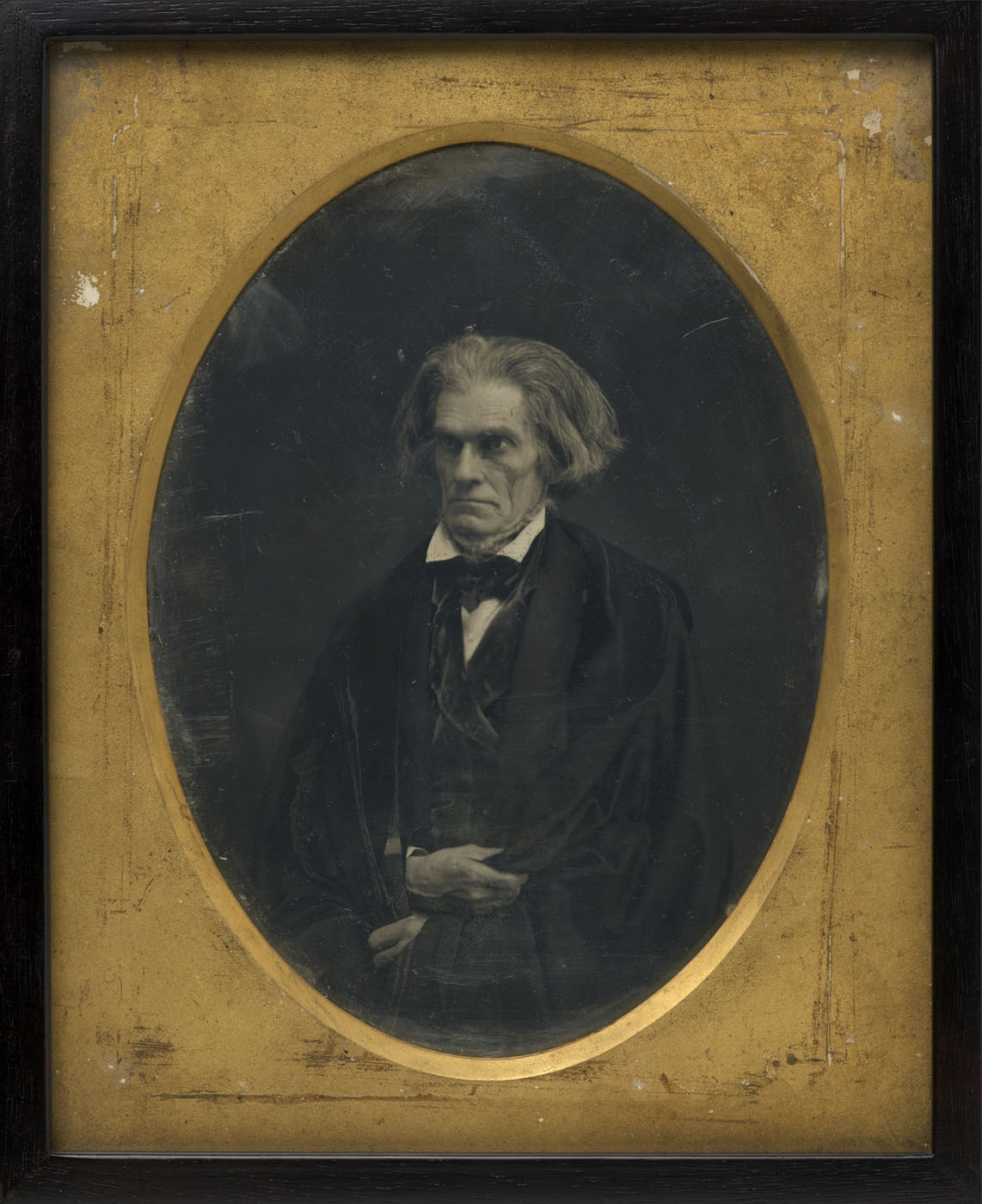
Mathew B. Brady (American, 1822-1896)
John C. Calhoun
1849
Whole-plate daguerreotype
Image/Sight: 20.2 x 15cm (7 15/16 x 5 7/8″)
Mat (brass): 24.3 x 19.4cm (9 9/16 x 7 5/8″)
Frame: 35 x 30 x 2.5cm (13 3/4 x 11 13/16 x 1″)
Case closed: 5.8 x 34.3 x 39.7cm (2 5/16 x 13 1/2 x 15 5/8″)
Case open: 5.8 x 72.7 x 39.7cm (2 5/16 x 28 5/8 x 15 5/8″)
National Portrait Gallery, Smithsonian Institution
Gift of Stephan Loewentheil
Mathew Brady’s mastery of the whole plate is on full display in this compelling portrait – the last daguerreotype made of Senator John C. Calhoun before his death in 1850. A contemporary praised the portrait as one of “the best which Mr. Brady has taken himself,” adding, “So perfect was it regarded by the family [of Calhoun], that several copies of it have been made at their request.” Commenting on his subject’s most notable feature, Brady observed, “Calhoun’s eye was startling, and almost hypnotised me.” A painting based on this daguerreotype was commissioned by Brady and now hangs in the U.S. Senate.
Text from the National Portrait Gallery website
High-class portraits
Eight white men (all whole-plate daguerreotypes) and one black woman (whole-plate tintype) – sounds about right.
“To put the era’s pricing in context, a year’s supply of coal for a working-class family in 1850 cost $15 – the minimum price for a Southworth & Hawes whole-plate daguerreotype. The whole plate was therefore too expensive for most consumers… A whole-plate tintype was likely priced from $.75 to $1 in the 1860s, when the average daily wage of a labourer was only $2.”
Picture and price / detail and scale / delicacy of lights and shadows / beauty of execution – execution being the operative word, considering the upcoming devastation of the American Civil War.
Thus, from unapologetic enslaver (Calhoun) who “staunchly defended chattel slavery and its expansion beyond the American South” and whose painting based on Brady’s daguerreotype hangs in the American senate (really!) – to an unidentified literate Black woman, birthplace unknown, born May 10, 1811 taken by an unknown photographer.
I know which one I would rather honour.
Dr Marcus Bunyan
Many thankx to the National Portrait Gallery for allowing me to publish the photographs in the posting. Please click on the photographs for a larger version of the image.
“Competition prompted photographers such as Mathew Brady and Southworth & Hawes to produce advertisements that provided a wealth of detail about the services offered by their respective establishments … I am inclined to think that word of mouth may well have played a greater role in motivating patronage. In the case of Brady and Southworth & Hawes, the knowledge that these studios counted national celebrities among their clientele could have been a strong inducement for the general public to patronise them as well. …
While the National Portrait Gallery’s collection of early photography is substantial, it’s the rare whole-plate daguerreotypes, ambrotypes, and tintypes that stand out for their detail and scale. This exhibition allows visitors to consider how new photographic processes impacted the quality and appeal of the medium … As an aside, the impetus for ‘From Shadow to Substance’ was the extraordinary gift to the museum in 2023 of Mathew Brady’s iconic whole-plate daguerreotype of the powerful antebellum senator John C. Calhoun. A subsequent review of other whole-plates in the Portrait Gallery’s collection sparked consideration of the format’s staying power as a top-of-the-line offering through the succession of early photographic processes. This is the story the exhibition seeks to illuminate.”
Ann Shumard, Senior Curator of Photographs quoted in Kate Garibaldi. “How Portrait Photography’s ‘Grand-Scale’ Origins Changed History,” on the Petapixel website Aug 01, 2025 [Online] Cited 26/02/2026. Used under fair use conditions for the purposes of education and research
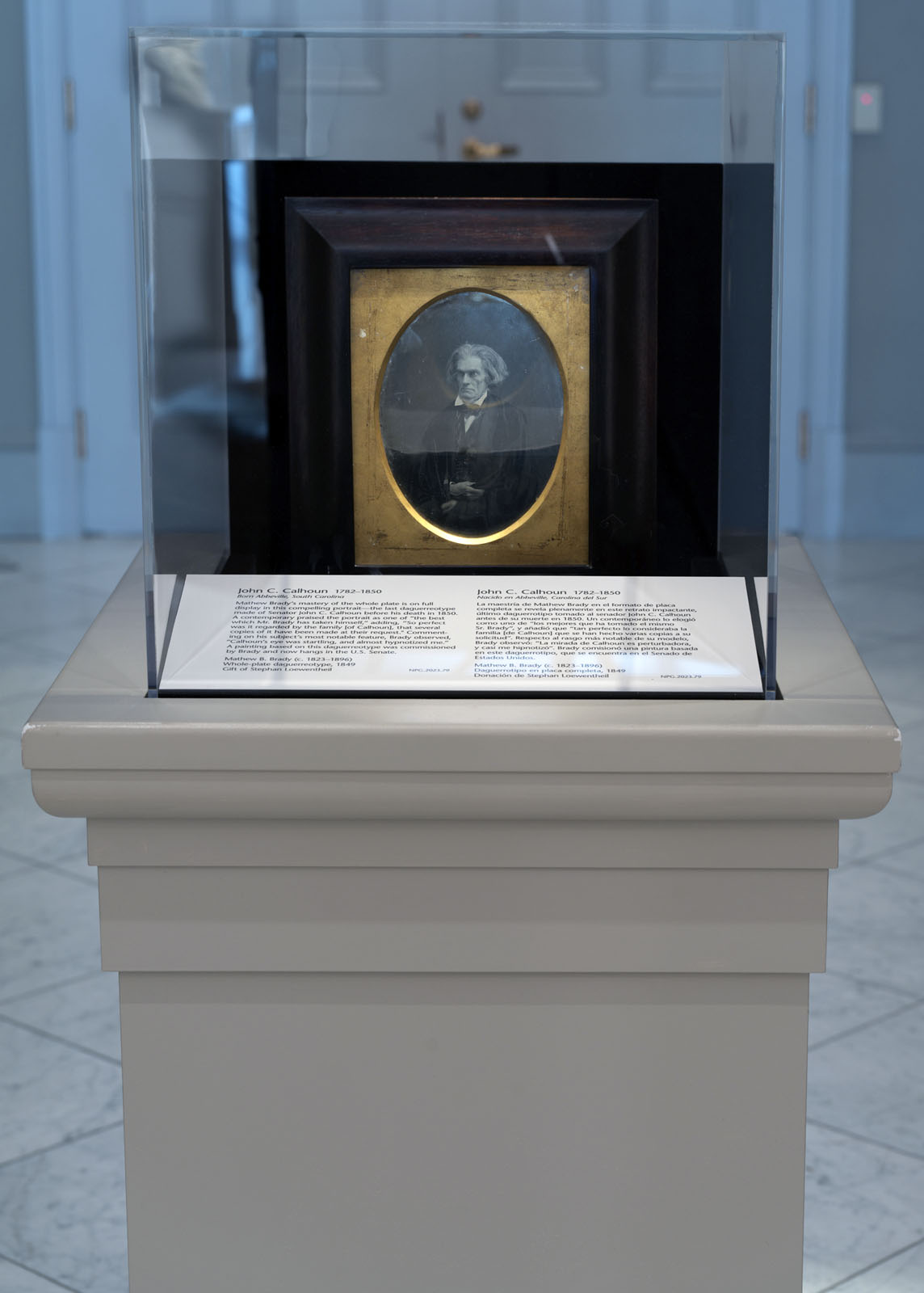
Installation view of the exhibition From Shadow to Substance: Grand-Scale Portraits During Photography’s Formative Years at the National Portrait Gallery, Washington, June 20, 2025 – June 7, 2026 showing Mathew B. Brady (American, 1822-1896) John C. Calhoun 1849 (above)
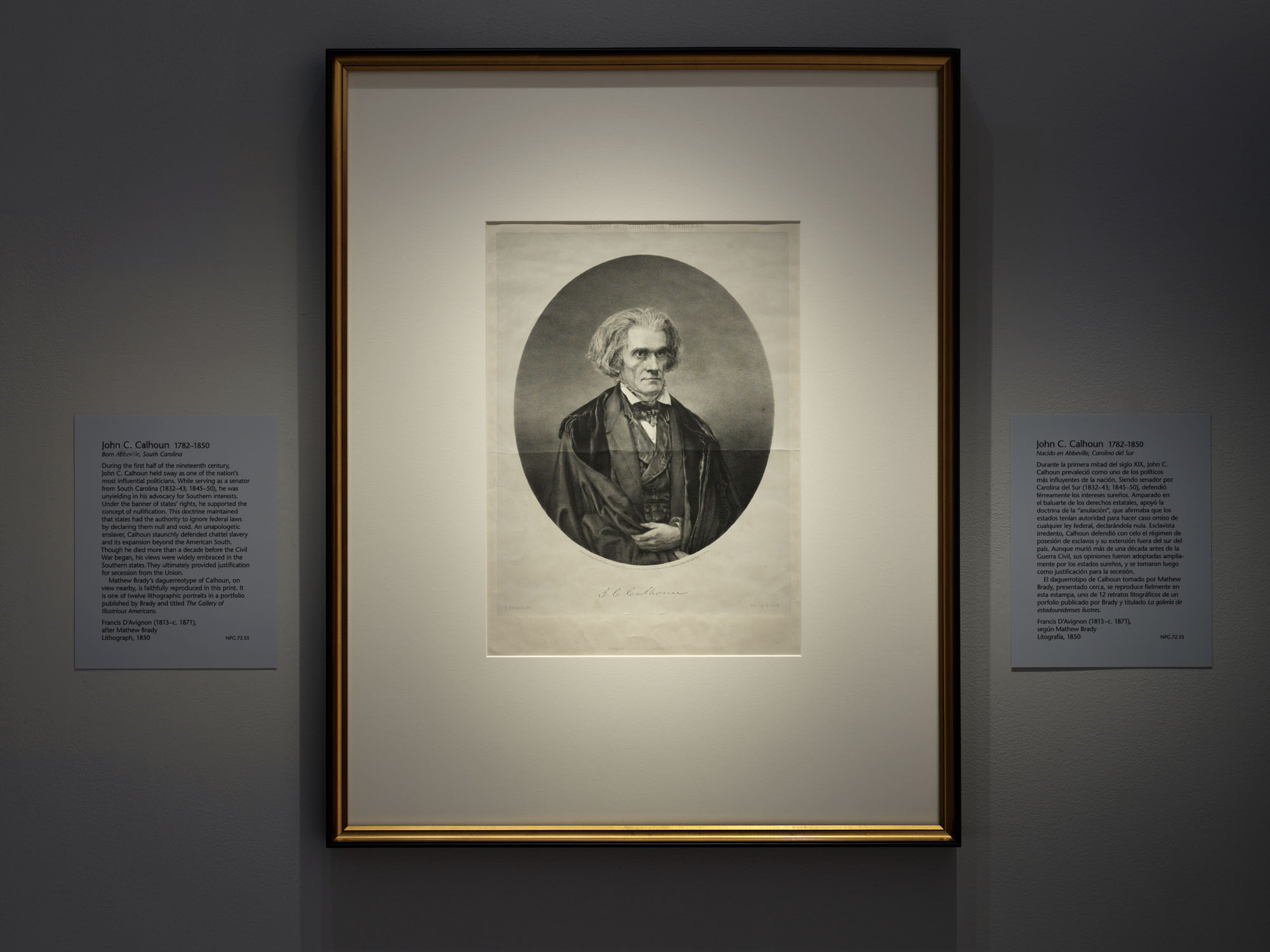
Installation view of the exhibition From Shadow to Substance: Grand-Scale Portraits During Photography’s Formative Years at the National Portrait Gallery, Washington, June 20, 2025 – June 7, 2026 showing Francis D’Avignon (French, 1813 – c. 1871) Copy after Mathew B. Brady (American, 1823? – 15 Jan 1896) John Caldwell Calhoun, 18 Mar 1782 – 31 Mar 1850 1850
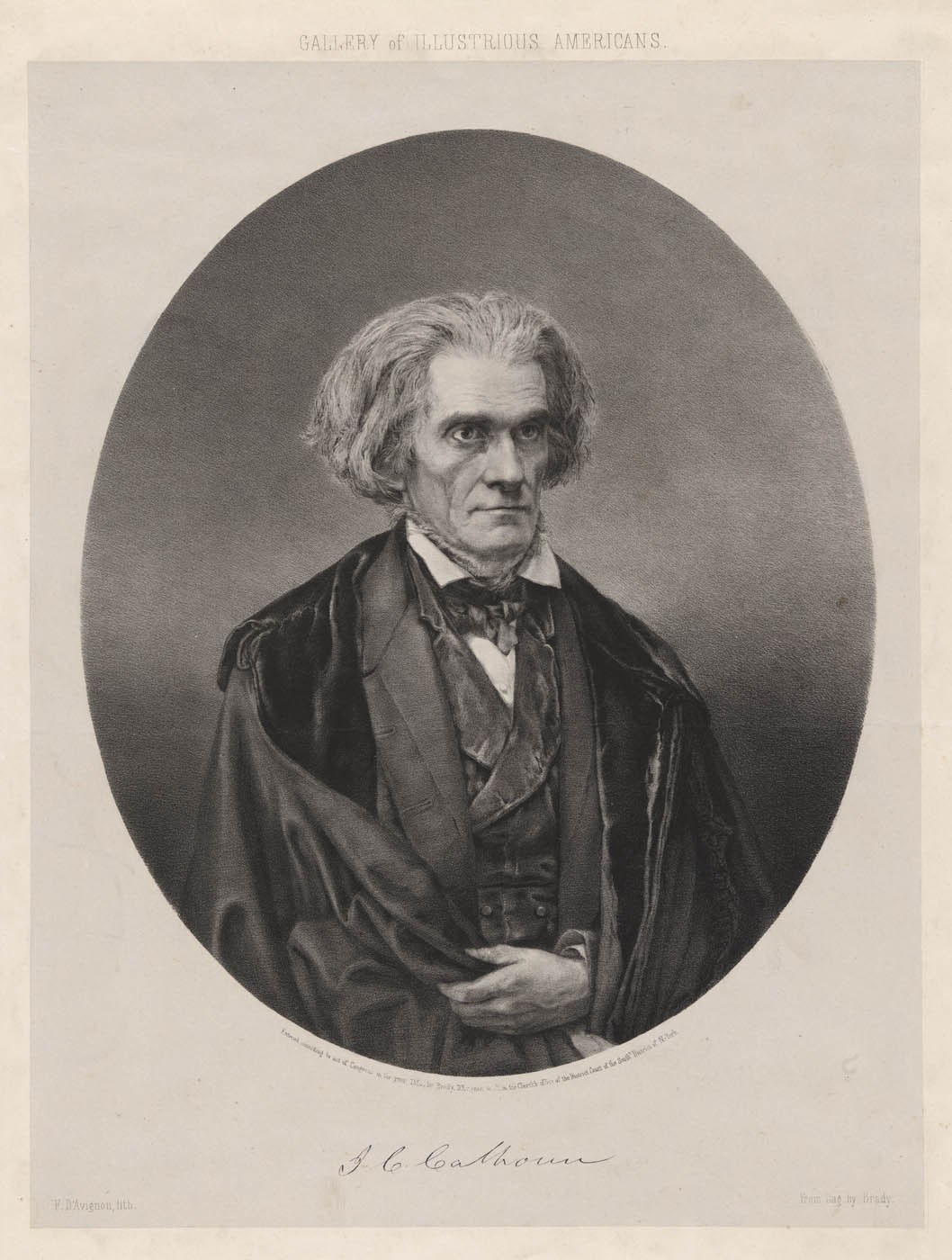
Francis D’Avignon (French, 1813 – c. 1871)
Copy after
Mathew B. Brady (American, 1822-1896)
John Caldwell Calhoun, 18 Mar 1782 – 31 Mar 1850
1850
Lithograph on paper
Sheet: 56.7 x 40.6cm (22 5/16 x 16″)
Book: The Gallery of Illustrious Americans
National Portrait Gallery, Smithsonian Institution
During the first half of the nineteenth century, John C. Calhoun held sway as one of the nation’s most influential politicians. While serving as a senator from South Carolina (1832-1843; 1845-1850), he was unyielding in his advocacy for Southern interests. Under the banner of states’ rights, he supported the concept of nullification. This doctrine maintained that states had the authority to ignore federal laws by declaring them null and void. An unapologetic enslaver, Calhoun staunchly defended chattel slavery and its expansion beyond the American South. Though he died more than a decade before the Civil War began, his views were widely embraced in the Southern states. They ultimately provided justification for secession from the Union. Mathew Brady’s daguerreotype of Calhoun, on view nearby, is faithfully reproduced in this print. It is one of twelve lithographic portraits in a portfolio published by Brady and titled The Gallery of Illustrious Americans.
Text from the National Portrait Gallery website
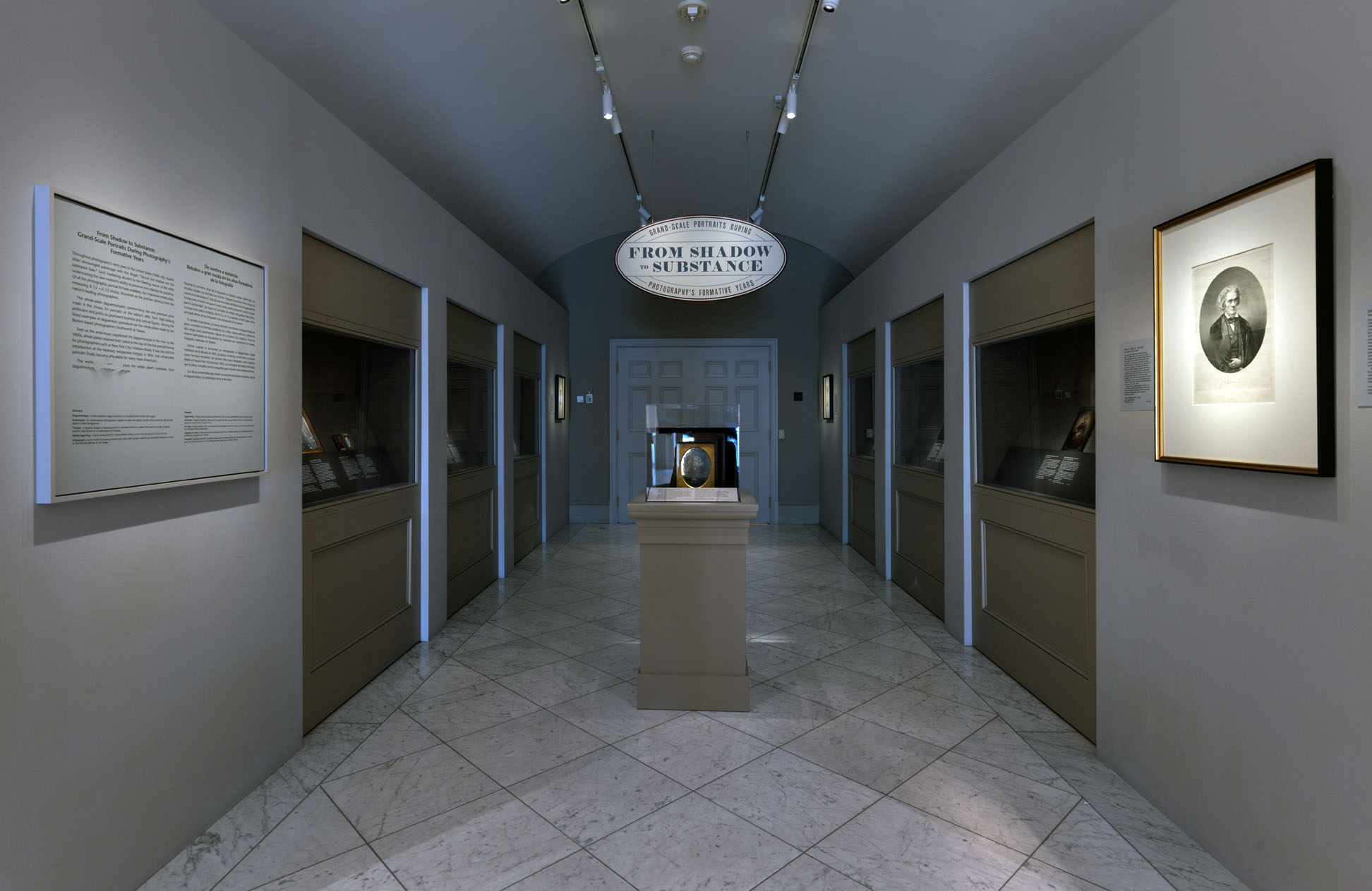
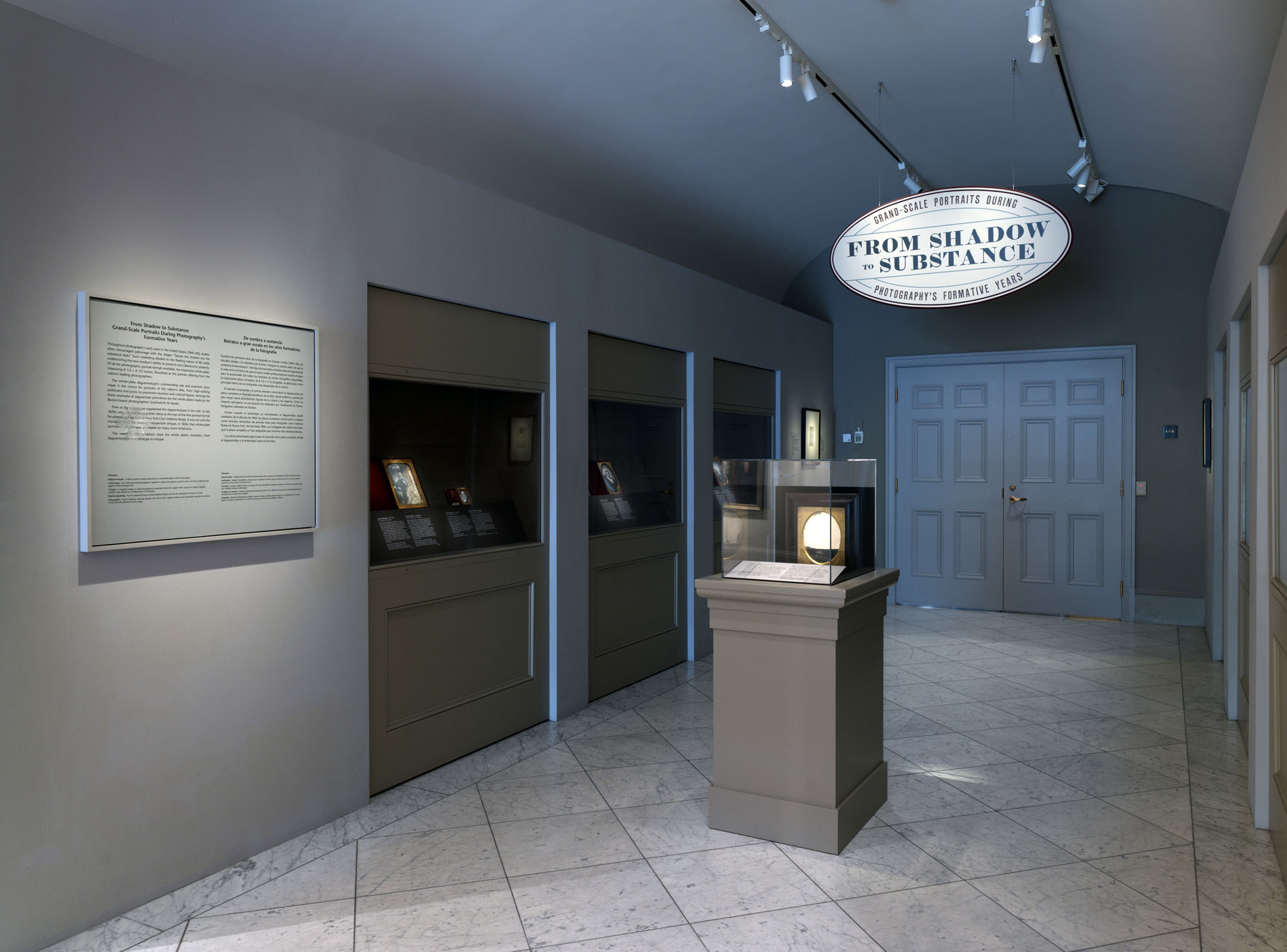
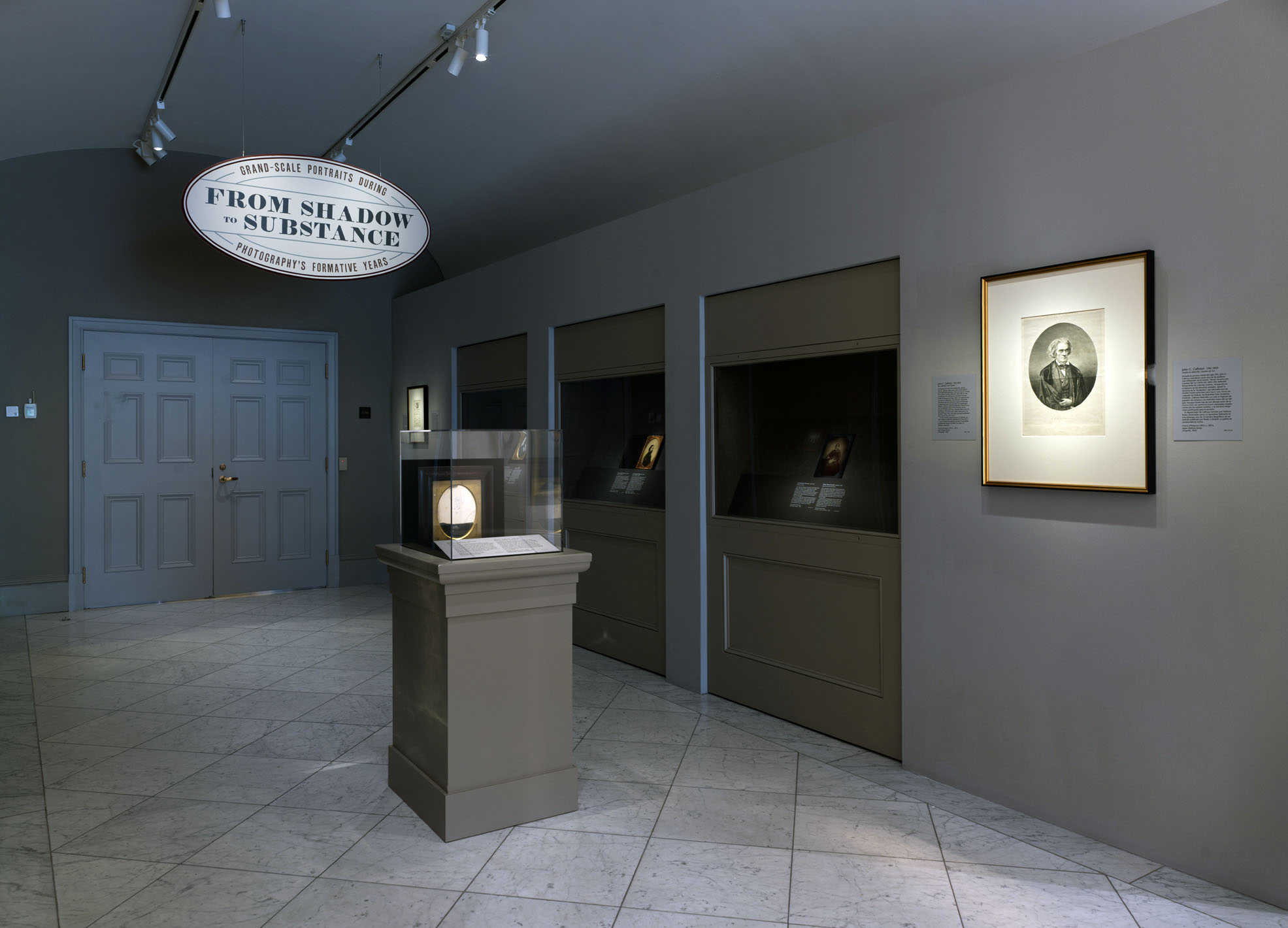
Installation views of the exhibition From Shadow to Substance: Grand-Scale Portraits During Photography’s Formative Years at the National Portrait Gallery, Washington, June 20, 2025 – June 7, 2026
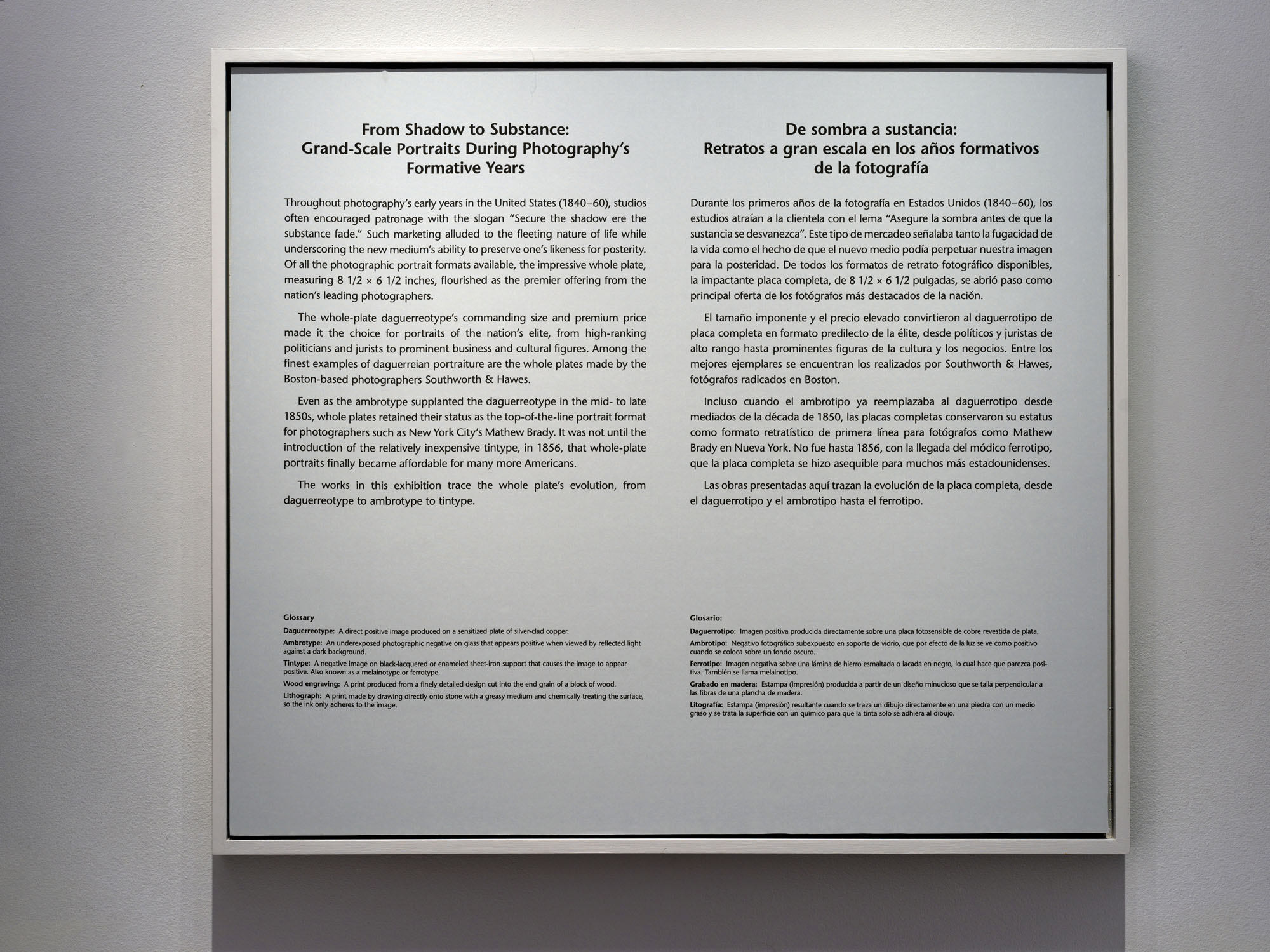
Photographers seeking customers during the medium’s early years often urged the public to “Secure the shadow, ere the substance fade.” Hinting at life’s fragility, this tagline underscored photography’s ability to capture a fleeting likeness and preserve it for posterity. Portraits in the impressive whole-plate format – measuring 8.5 x 6.5 inches – were among the premier offerings of the nation’s leading photographic studios.
Drawing on the National Portrait Gallery’s extensive early photography collection, this exhibition traces the evolution of the grand-scale, whole-plate format from the high-end daguerreotype to the mid-range ambrotype to the more affordable tintype. Examples of whole plates in each of these mediums illustrate how the format evolved as new photographic processes were introduced. Featured works include daguerreotypes representing U.S. senators Daniel Webster and John C. Calhoun, as well as papal nuncio Gaetano Bedini; an ambrotype portrait of American landscape artist John Frederick Kensett; and a tintype likeness of an unidentified African American woman.
Text from the National Portrait Gallery website
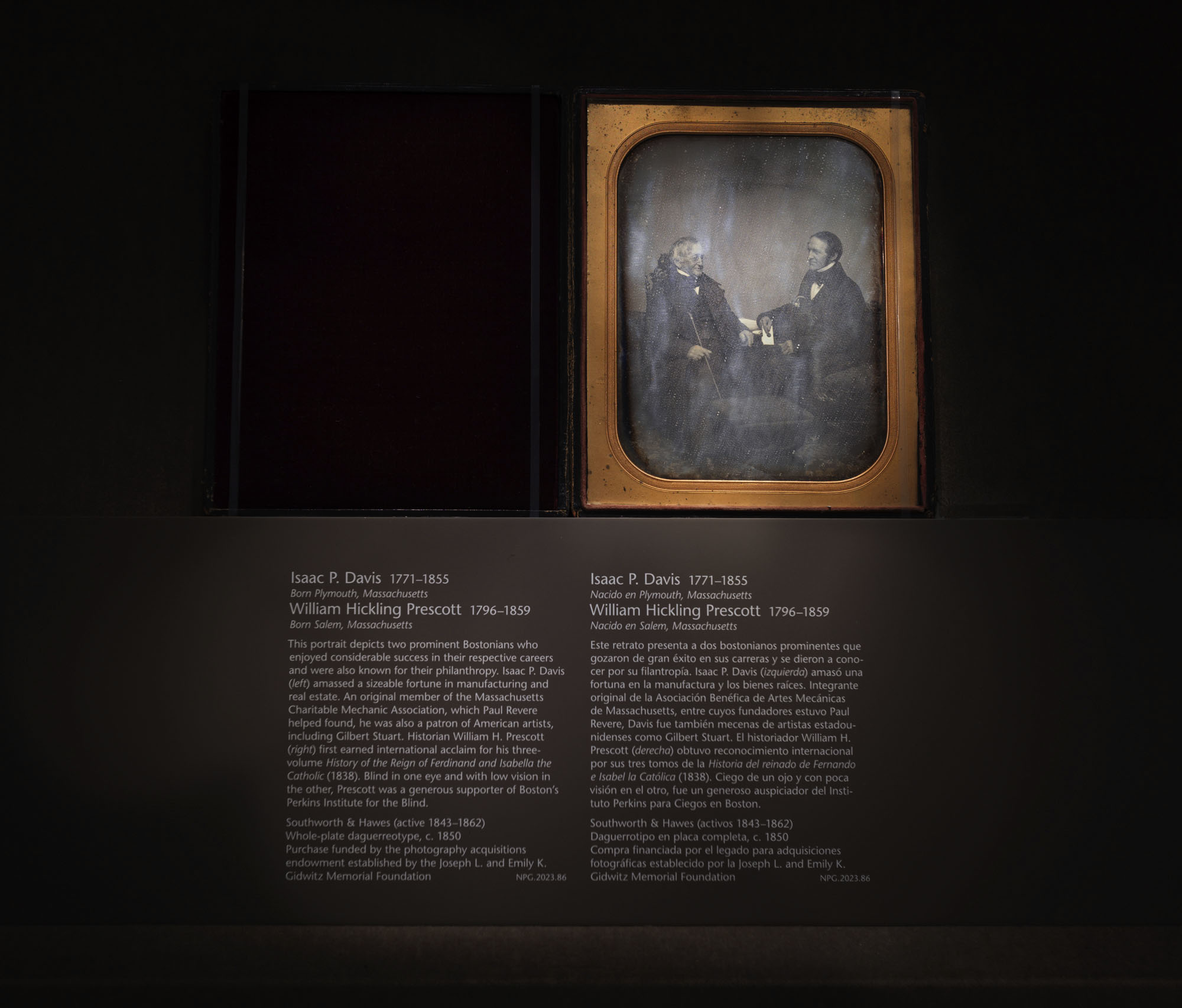
Installation view of the exhibition From Shadow to Substance: Grand-Scale Portraits During Photography’s Formative Years at the National Portrait Gallery, Washington, June 20, 2025 – June 7, 2026 showing Southworth & Hawes’ Issac P. Davis 1771-1855 and William Hickling Prescott 1796-1859 c. 1850 (below)
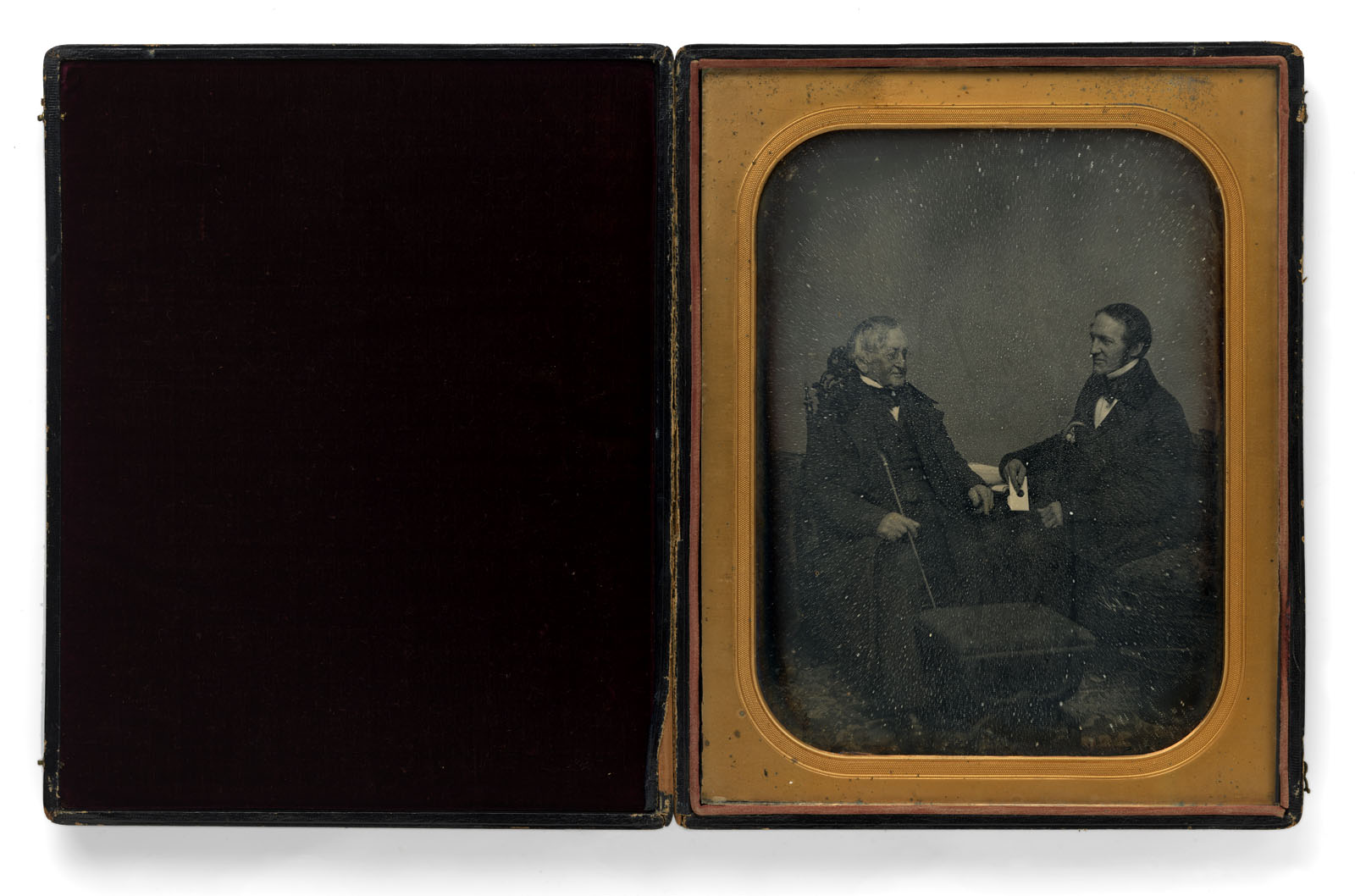
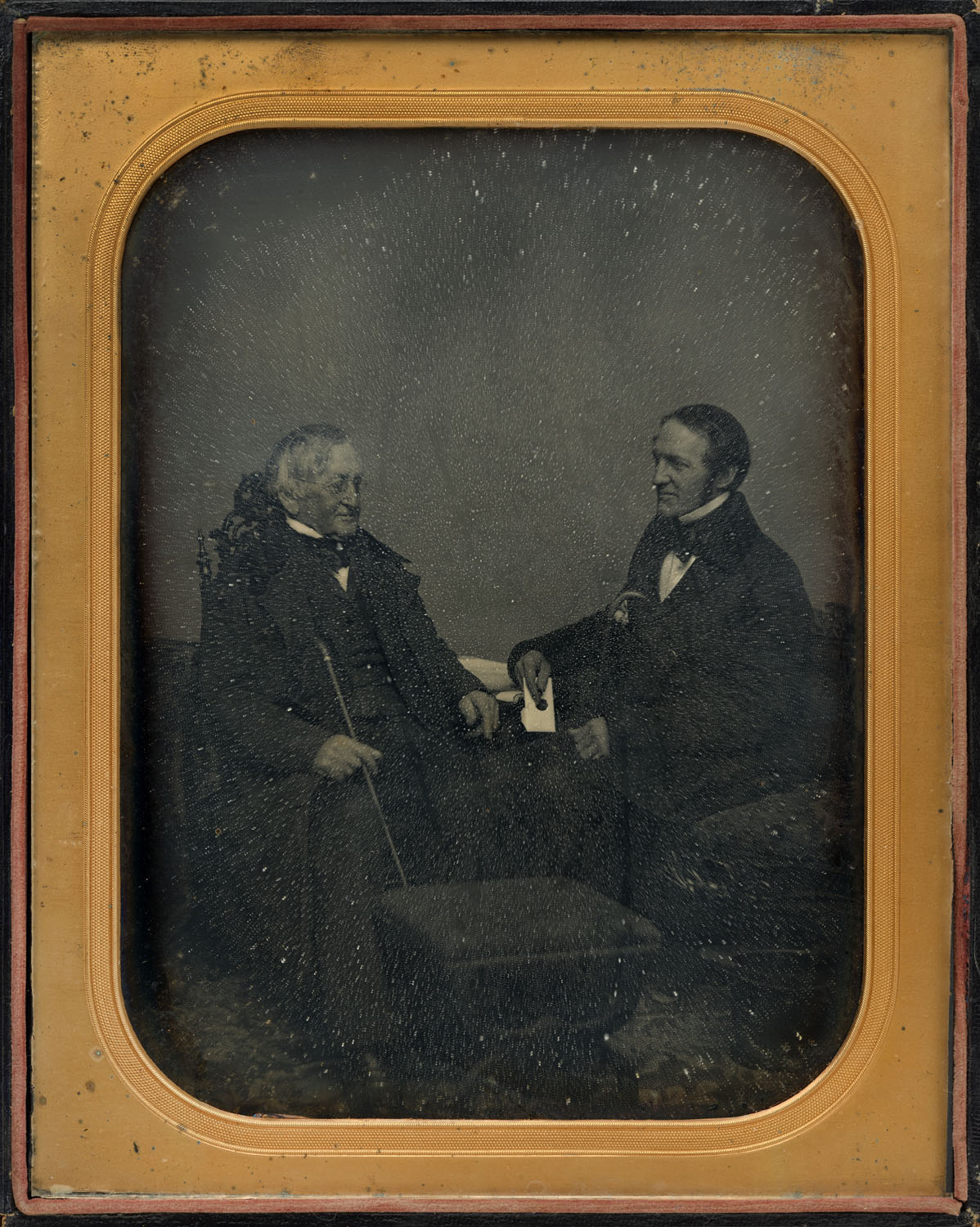
Southworth & Hawes (active 1843-1862)
Albert Sands Southworth (American, 1811-1894)
Josiah Johnson Hawes (American, 1808-1901)
Isaac P. Davis, 7 Oct 1771 – 13 Jan 1855
William Hickling Prescott, 4 May 1796 – 28 Jan 1859
c. 1850
Whole-plate daguerreotype
Image/Sight: 20.3 x 15.2cm (8 × 6″)
Mat (brass): 23.6 x 18.6cm (9 5/16 x 7 5/16″)
Case open: 25.3 x 40.2 x 2.3cm (9 15/16 x 15 13/16 x 7/8″)
Case closed: 25.3 x 20.7 x 3.5cm (9 15/16 x 8 1/8 x 1 3/8″)
National Portrait Gallery, Smithsonian Institution
Purchase funded by the photography acquisitions endowment established by the Joseph L. and Emily K. Gidwitz Memorial Foundation
Isaac P. Davis, 7 Oct 1771 – 13 Jan 1855
Born Plymouth, Massachusetts
William Hickling Prescott, 4 May 1796 – 28 Jan 1859
Born Salem, Massachusetts
This portrait depicts two prominent Bostonians who enjoyed considerable success in their respective careers and were also known for their philanthropy. Isaac P. Davis (left) amassed a sizeable fortune in manufacturing and real estate. An original member of the Massachusetts Charitable Mechanic Association, which Paul Revere helped found, he was also a patron of American artists, including Gilbert Stuart. Historian William H. Prescott (right) first earned international acclaim for his three-volume History of the Reign of Ferdinand and Isabella the Catholic (1838). Blind in one eye and with low vision in the other, Prescott was a generous supporter of Boston’s Perkins Institute for the Blind.
Text from the National Portrait Gallery website
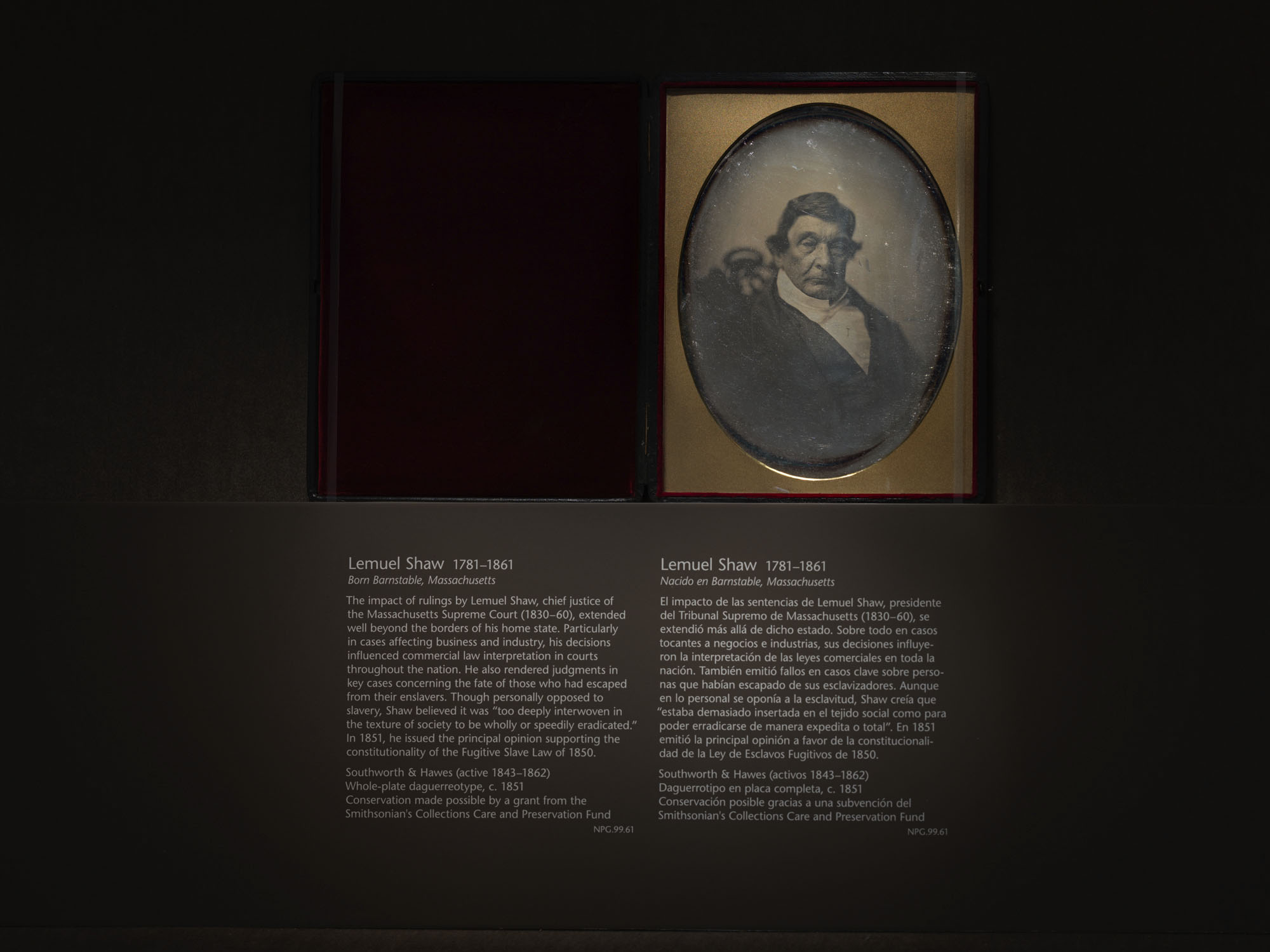
Installation view of the exhibition From Shadow to Substance: Grand-Scale Portraits During Photography’s Formative Years at the National Portrait Gallery, Washington, June 20, 2025 – June 7, 2026 Southworth & Hawes’ Lemuel Shaw 1787-1861 c. 1851 (below)
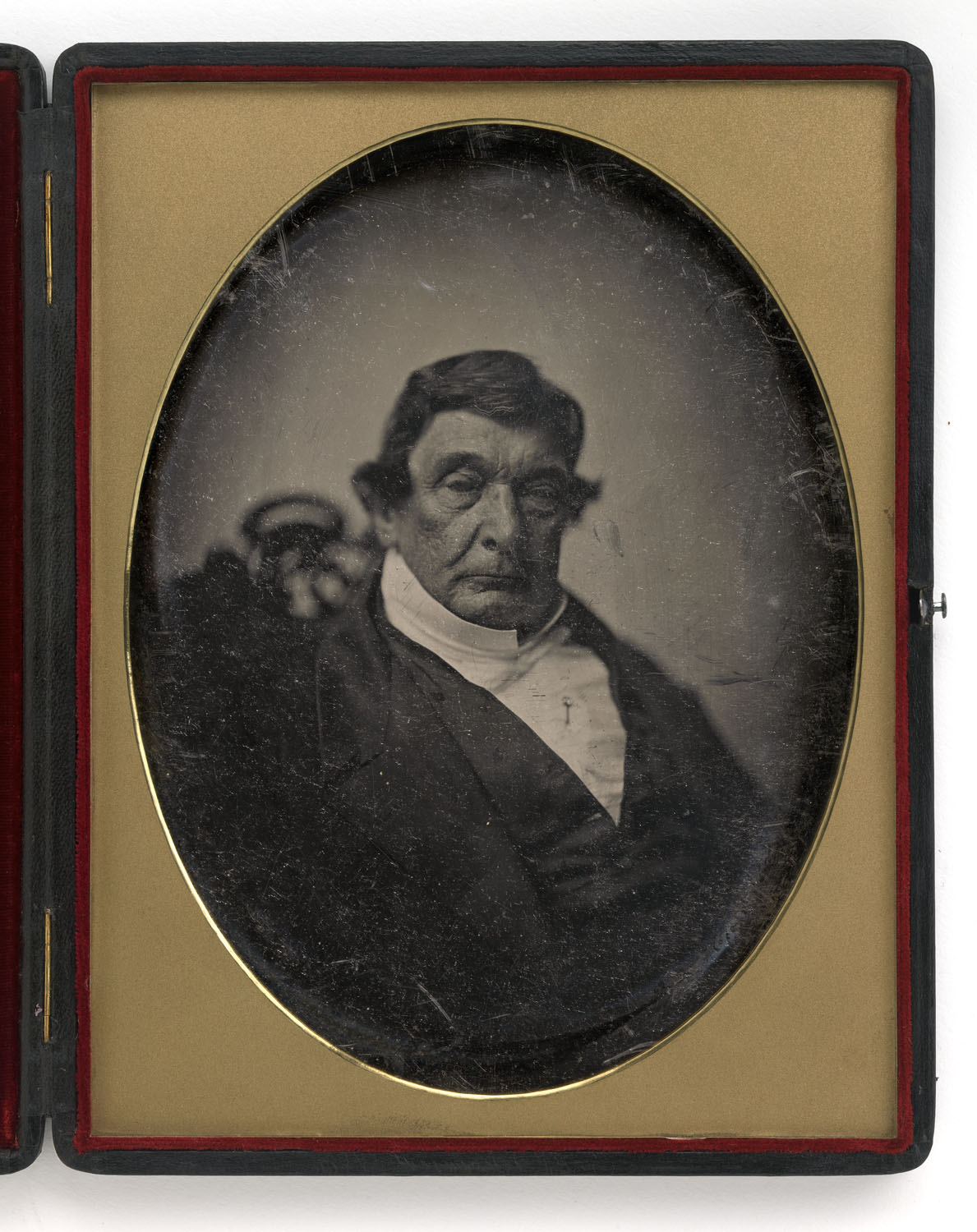
Southworth & Hawes (active 1843-1862)
Albert Sands Southworth (American, 1811-1894)
Josiah Johnson Hawes (American, 1808-1901)
Lemuel Shaw, 9 Jan 1781 – 30 Mar 1861
c. 1851
Whole-plate daguerreotype with silver-plated copper sheet support
Plate (sight): 21.5 x 16cm (8 7/16 x 6 5/16″)
Case Open: 23.4 x 36.3 x 0.9cm (9 3/16 x 14 5/16 x 3/8″)
Case Closed: 23.4 x 18.2 x 1.8cm (9 3/16 x 7 3/16 x 11/16″)
National Portrait Gallery, Smithsonian Institution
Conservation made possible by a grant from the Smithsonian’s Collections Care and Preservation Fund
Lemuel Shaw, 9 Jan 1781 – 30 Mar 1861
Born Barnstable, Massachusetts
The impact of rulings by Lemuel Shaw, chief justice of the Massachusetts Supreme Court (1830-1860), extended well beyond the borders of his home state. Particularly in cases affecting business and industry, his decisions influenced commercial law interpretation in courts throughout the nation. He also rendered judgments in key cases concerning the fate of those who had escaped from their enslavers. Though personally opposed to slavery, Shaw believed it was “too deeply interwoven in the texture of society to be wholly or speedily eradicated.” In 1851, he issued the principal opinion supporting the constitutionality of the Fugitive Slave Law of 1850.
Text from the National Portrait Gallery website
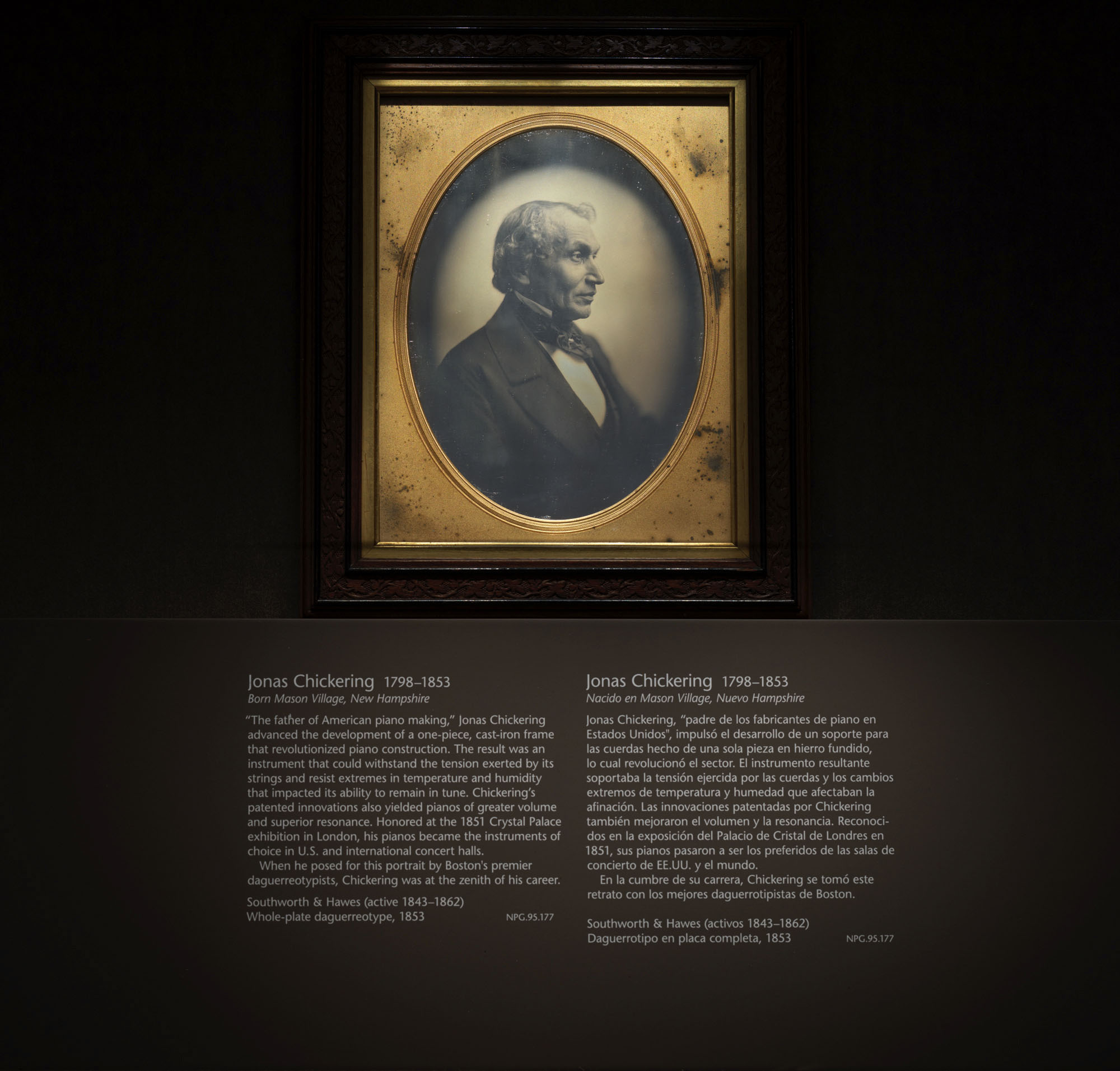
Installation view of the exhibition From Shadow to Substance: Grand-Scale Portraits During Photography’s Formative Years at the National Portrait Gallery, Washington, June 20, 2025 – June 7, 2026 showing showing Southworth & Hawes’ Jonas Chickering 1853 (below)
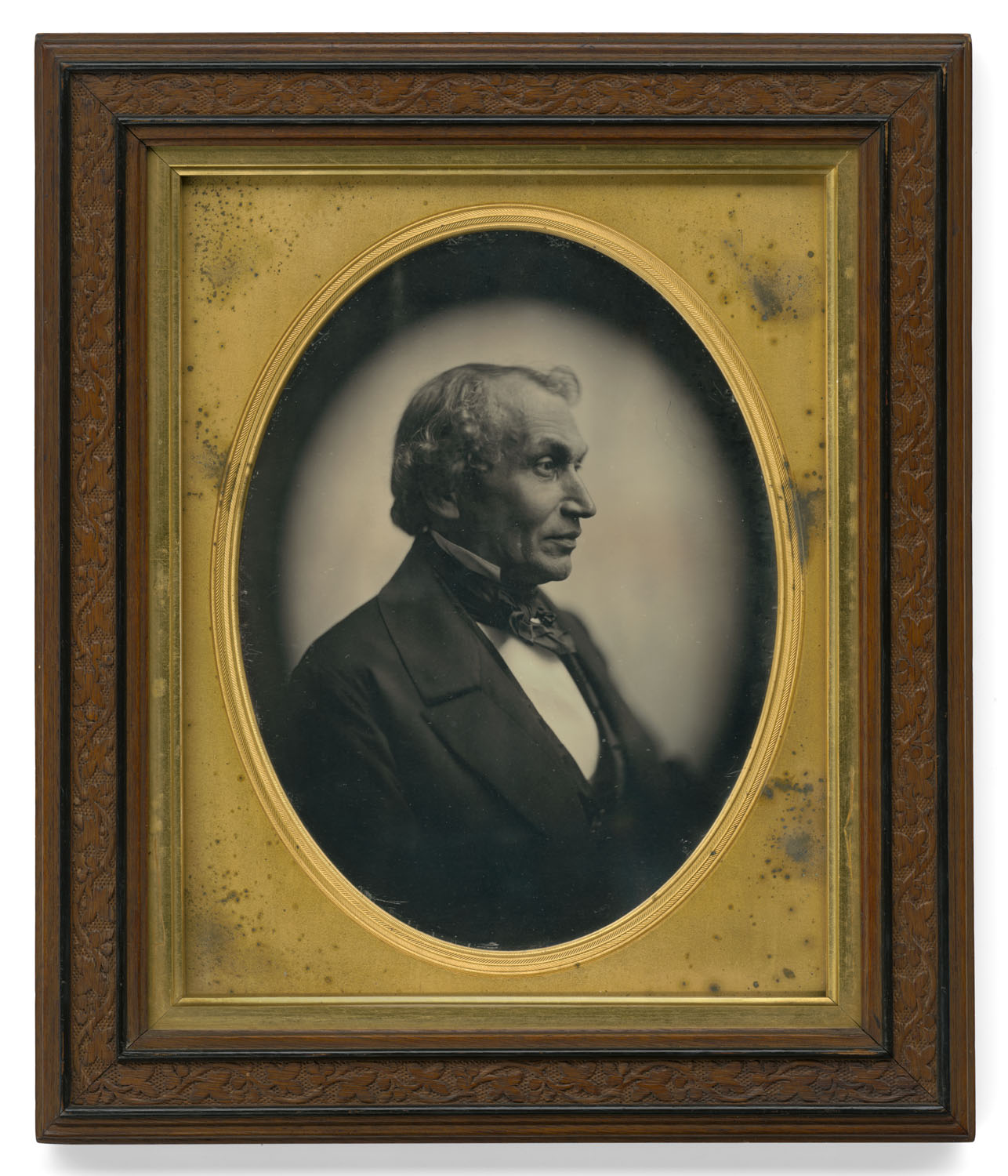
Southworth & Hawes (active 1843-1862)
Albert Sands Southworth (American, 1811-1894)
Josiah Johnson Hawes (American, 1808-1901)
Jonas Chickering, 5 Apr 1798 – 8 Dec 1853
1853
Whole-plate daguerreotype
Image: 20 x 15cm (7 7/8 x 5 7/8″)
Frame: 31.1 x 25.7 x 2.5cm (12 1/4 x 10 1/8 x 1″)
National Portrait Gallery, Smithsonian Institution
Jonas Chickering, 5 Apr 1798 – 8 Dec 1853
Born Mason Village, New Hampshire
“The father of American piano making,” Jonas Chickering advanced the development of a one-piece, cast-iron frame that revolutionised piano construction. The result was an instrument that could withstand the tension exerted by its strings and resist extremes in temperature and humidity that impacted its ability to remain in tune. Chickering’s patented innovations also yielded pianos of greater volume and superior resonance. Honoured at the 1851 Crystal Palace exhibition in London, his pianos became the instruments of choice in U.S. and international concert halls.
When he posed for this portrait by Boston’s premier daguerreotypists, Chickering was at the zenith of his career.
Text from the National Portrait Gallery website
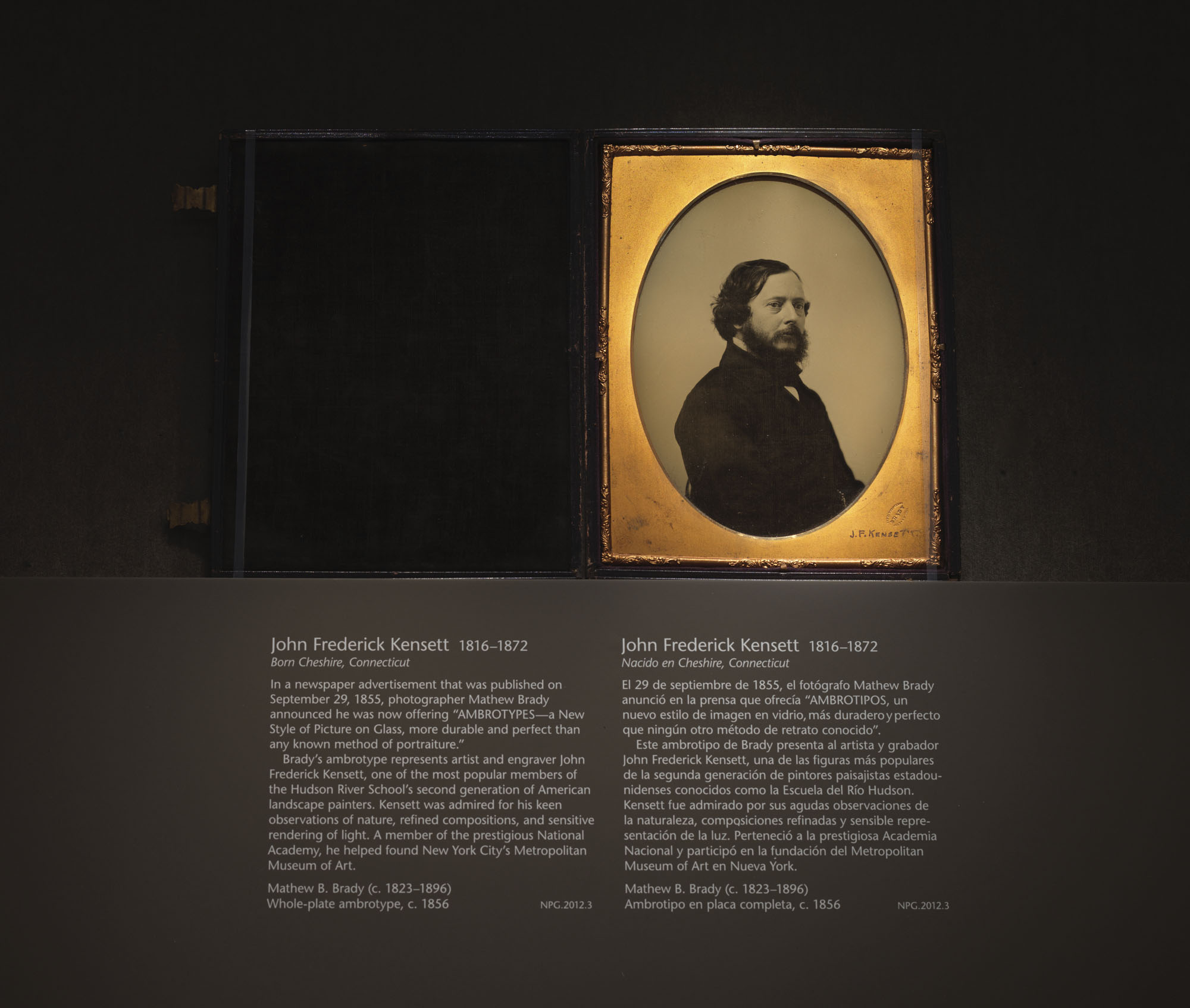
Installation view of the exhibition From Shadow to Substance: Grand-Scale Portraits During Photography’s Formative Years at the National Portrait Gallery, Washington, June 20, 2025 – June 7, 2026 showing Mathew B. Brady’s John Frederick Kensett 1816-1872 c. 1856 (below)
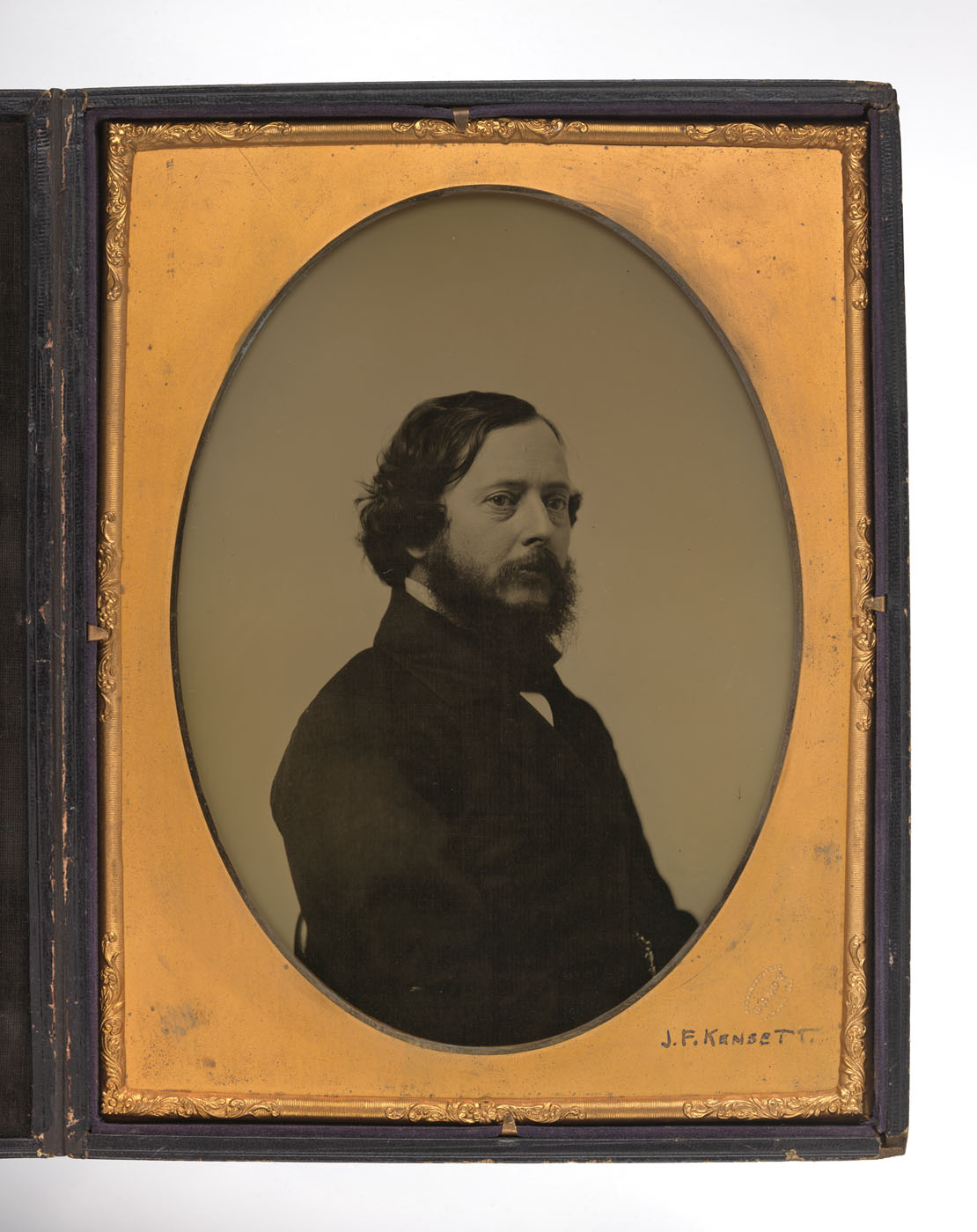
Mathew B. Brady (American, 1822-1896)
John Frederick Kensett, 22 Mar 1816 – 15 Dec 1872
c. 1856
Whole-plate ambrotype
Image: 18.4 x 13.2cm (7 1/4 x 5 3/16″)
Case Open: 23 x 36.4cm (9 1/16 x 14 5/16″)
Case Closed: 23 x 18.4cm (9 1/16 x 7 1/4″)
National Portrait Gallery, Smithsonian Institution
John Frederick Kensett, 22 Mar 1816 – 15 Dec 1872
Born Cheshire, Connecticut
In a newspaper advertisement that was published on September 29, 1855, photographer Mathew Brady announced he was now offering “AMBROTYPES – a New Style of Picture on Glass, more durable and perfect than any known method of portraiture.”
Brady’s ambrotype represents artist and engraver John Frederick Kensett, one of the most popular members of the Hudson River School’s second generation of American landscape painters. Kensett was admired for his keen observations of nature, refined compositions, and sensitive rendering of light. A member of the prestigious National Academy, he helped found New York City’s Metropolitan Museum of Art.
Text from the National Portrait Gallery website
National Portrait Gallery Presents “From Shadow to Substance: Grand-Scale Portraits During Photography’s Formative Years”
The Smithsonian’s National Portrait Gallery will present “From Shadow to Substance: Grand Scale Portraits During Photography’s Formative Years” June 20 through June 7, 2026. Drawing from the museum’s extensive early photography collection, this exhibition traces the evolution of the grand scale, whole-plate portrait format from the high-end daguerreotype and mid-range ambrotype to the more affordable tintype. The exhibition is curated by Senior Curator of Photographs Ann Shumard.
Photographers seeking customers during the medium’s early years, from 1840 to 1860, often urged the public to “Secure the shadow ere the substance fade.” Hinting at life’s fragility, this tagline underscored photography’s ability to capture a fleeting likeness and preserve it for posterity. Portraits in the impressive whole-plate format – measuring 8 1/2 by 6 1/2 inches – were among the premier offerings of the nation’s leading photographic studios.
“This exhibition marks the first time these whole-plate daguerreotype, ambrotype and tintype portraits will be shown together at the Portrait Gallery,” Shumard said. Examples of whole plates in each of these mediums illustrate how the format evolved as new photographic processes were introduced. Featured works include daguerreotypes representing U.S. Senators Daniel Webster and John C. Calhoun, an ambrotype portrait of American landscape artist John Frederick Kensett and a tintype likeness of an unidentified African American woman. Also included are original advertisements issued by photographers Albert Sands Southworth and Josiah Johnson Hawes, and Mathew B. Brady to promote their respective businesses. The exhibition will be presented in the Early Photography Alcove on the museum’s first floor.
Press release from the National Portrait Gallery
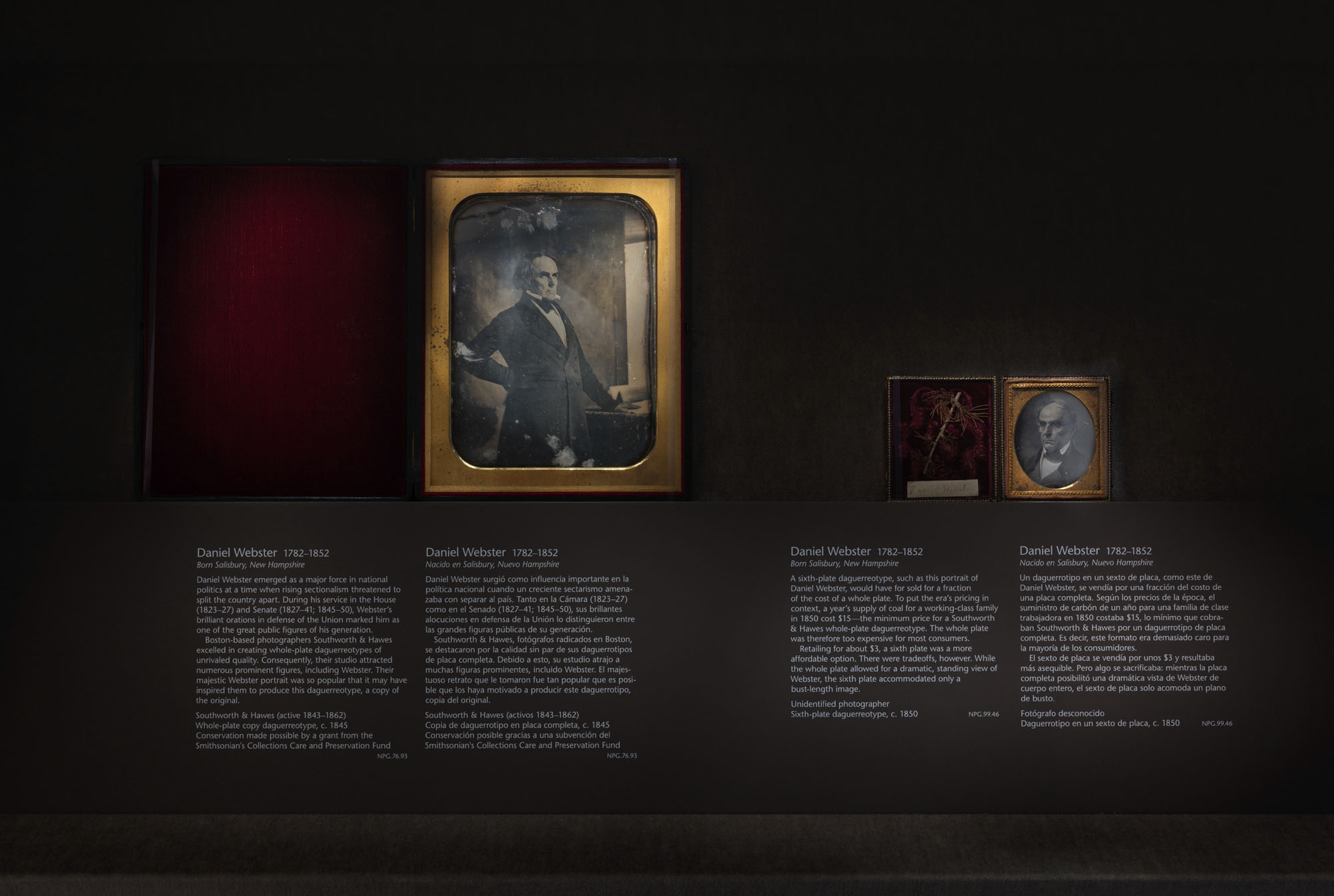
Installation view of the exhibition From Shadow to Substance: Grand-Scale Portraits During Photography’s Formative Years at the National Portrait Gallery, Washington, June 20, 2025 – June 7, 2026 showing at left, Southworth & Hawes’ Daniel Webster 1782-1852 c. 1845; and at right, Unidentified photographer Daniel Webster 1782-1852 c. 1850
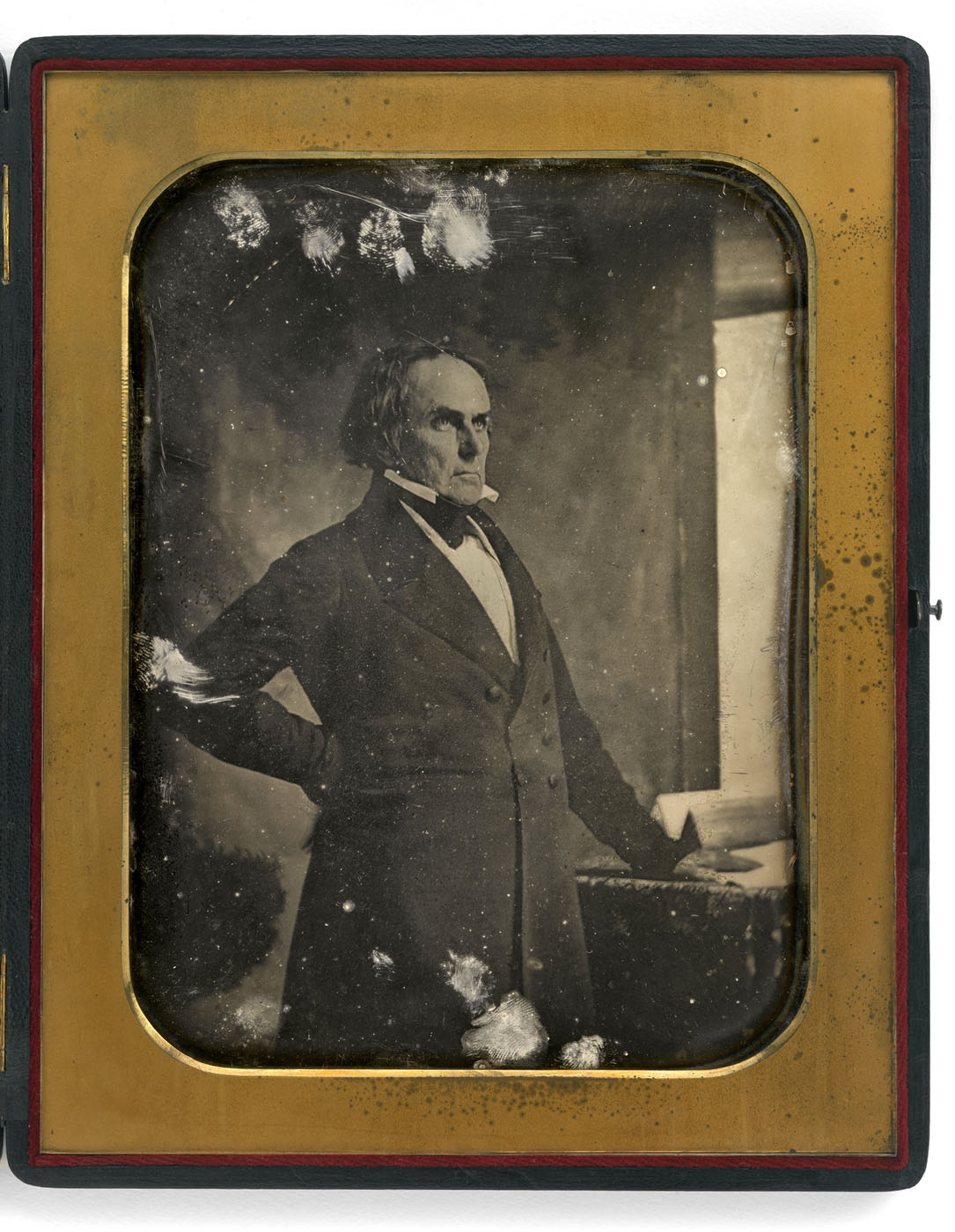
Southworth & Hawes (active 1843-1862)
Albert Sands Southworth (American, 1811-1894)
Josiah Johnson Hawes (American, 1808-1901)
Daniel Webster 1782-1852
c. 1845
Whole plate copy daguerreotype
National Portrait Gallery, Smithsonian Institution
Conservation made possible by a grant from the Smithsonian’s Collections Care and Preservation Fund
Daniel Webster 1782-1852
Born Salisbury, New Hampshire
Daniel Webster emerged as a major force in national politics at a time when rising sectionalism threatened to split the country apart. During his service in the House (1823-1827) and Senate (1827-1841; 1845-1850), Webster’s brilliant orations in defence of the Union marked him as one of the great public figures of his generation.
Boston-based photographers Southworth & Hawes excelled in creating whole-plate daguerreotypes of unrivalled quality. Consequently, their studio attracted numerous prominent figures, including Webster. Their majestic Webster portrait was so popular that it may have inspired them to produce this daguerreotype, a copy of the original.
Text from the National Portrait Gallery website
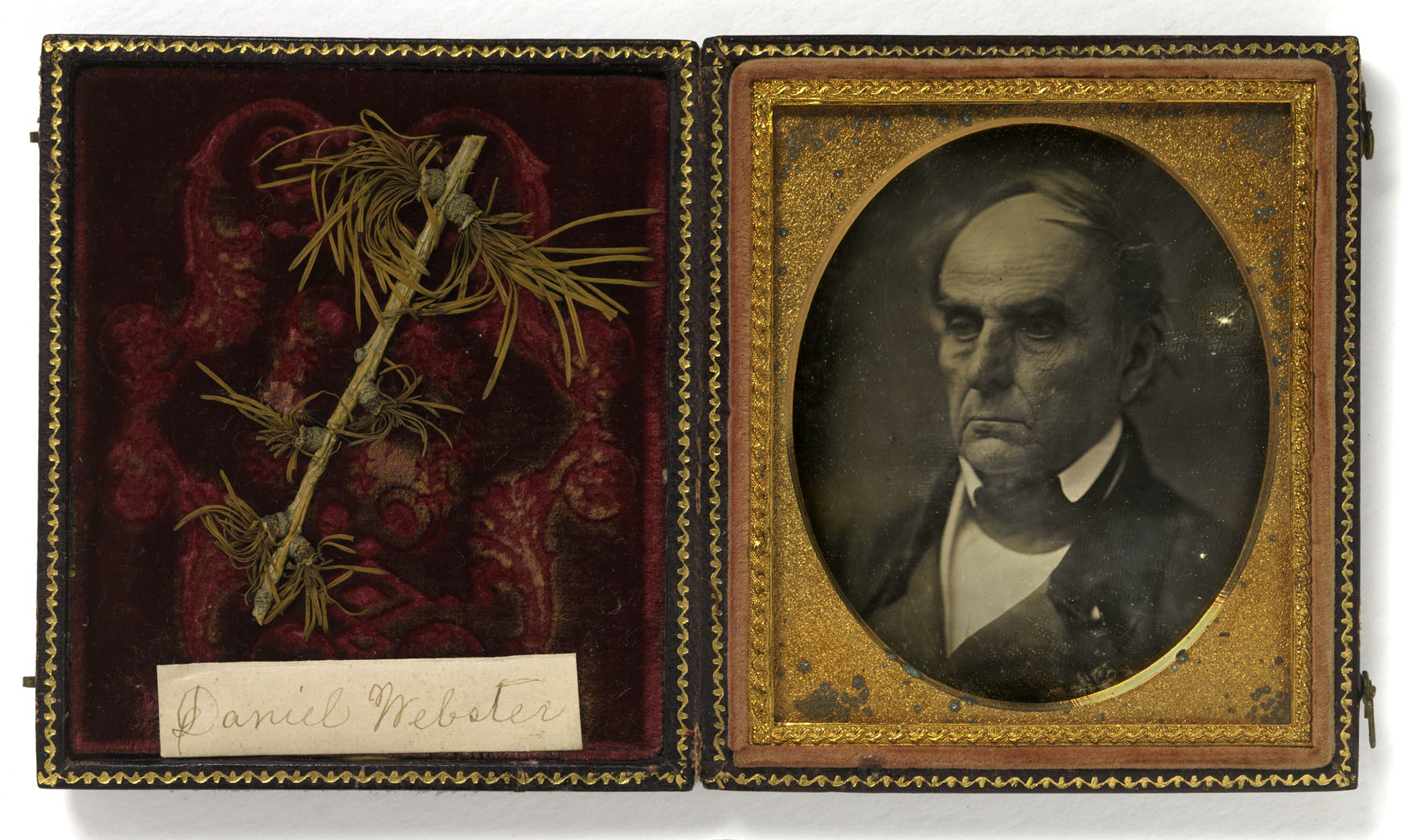
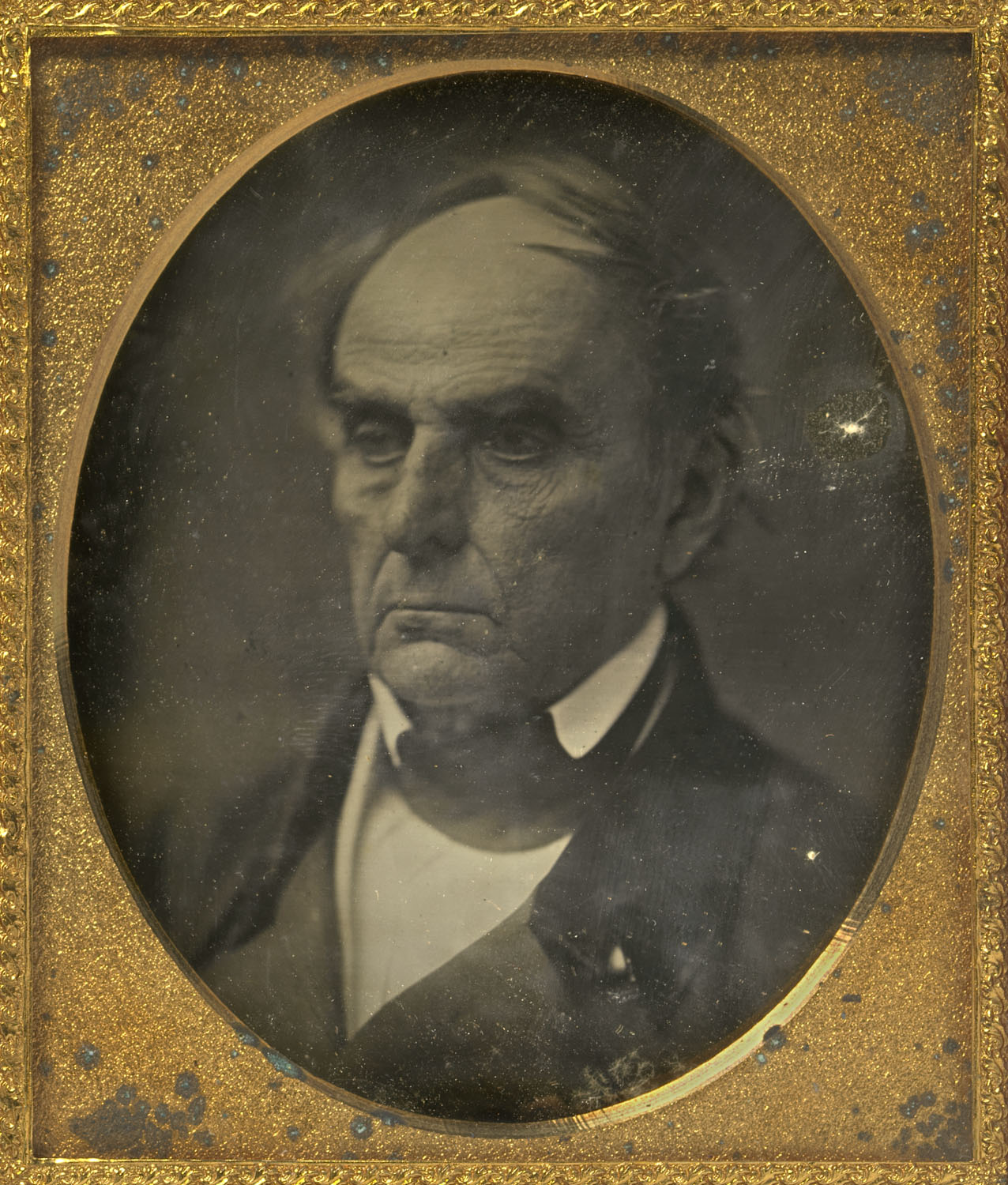
Unidentified photographer
Daniel Webster 1782-1852
c. 1850
Sixth-plate daguerreotype
National Portrait Gallery, Smithsonian Institution
A sixth-plate daguerreotype such as this portrait of Daniel Webster, would have sold for a fraction of the cost of a whole plate. To put the era’s pricing in context, a year’s supply of coal for a working-class family in 1850 cost $15 – the minimum price for a Southworth & Hawes whole-plate daguerreotype. The whole plate was therefore too expensive for most consumers.
Retailing for about $3, a sixth-plate was a more affordable option. There were tradeoffs, however. While the whole plate allowed for a dramatic, standing view of Webster, the Sith-plate accommodated only a bust-length image.
In a period when American federalism faced increasing challenges from states’-rights supporters, Daniel Webster emerged as one of the Union’s most eloquent defenders. Having gained acclaim as a lawyer who argued some of the young republic’s pivotal Supreme Court cases, Webster became a major force in national politics through his service in the House and in the Senate. There, his brilliant orations on behalf of the indivisibility of the Union marked him as one of the greatest public figures of his generation. Despite his national stature, Webster fell short of mustering the broad support that might have won him the presidency.
This daguerreotype represents Webster around the time of his controversial endorsement of the Compromise of 1850. In supporting the measure, Webster sought to preserve the Union through concession and compromise but succeeded principally in incurring the wrath of his northern constituents, who abhorred the legislation’s Fugitive Slave Act. Although attacks from his critics left Webster shaken and burdened by “the crushing weight of anxiety and responsibility,” he soldiered on until a liver ailment claimed his life in October 1852. The evergreen sprig preserved with this daguerreotype serves as a reminder of Webster’s endurance as a symbol and an icon in American history.
Text from the National Portrait Gallery website
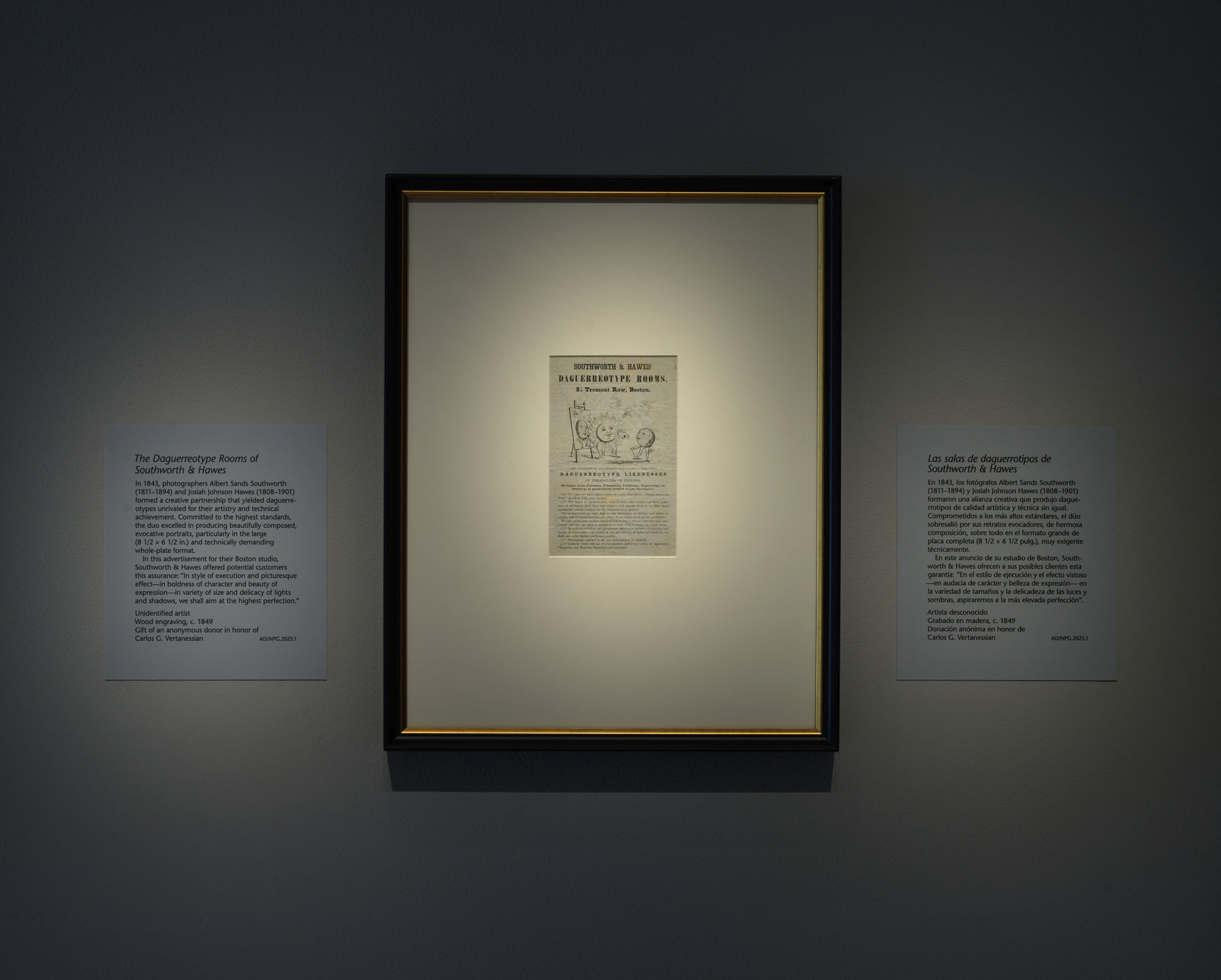
Installation view of the exhibition From Shadow to Substance: Grand-Scale Portraits During Photography’s Formative Years at the National Portrait Gallery, Washington, June 20, 2025 – June 7, 2026 showing a wood engraving by an unidentified artist of Southworth & Hawes’ Daguerreotype Rooms c. 1849 (below)
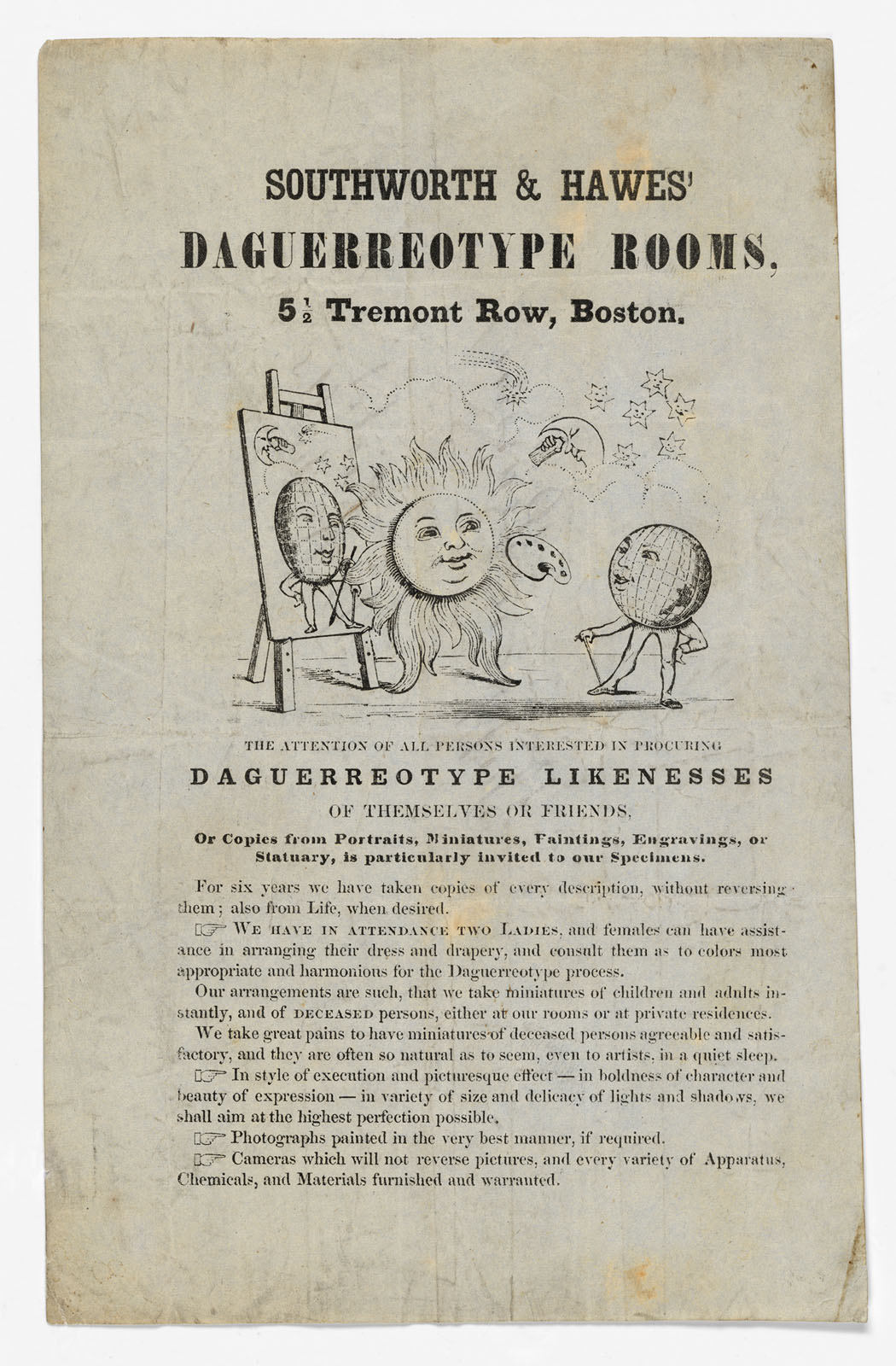
Unidentified Artist
Southworth & Hawes’ Daguerreotype Rooms
c. 1849
Wood engraving
20 x 12.7cm (7 7/8 x 5″)
National Portrait Gallery, Smithsonian Institution
Gift of an anonymous donor in honour of Carlos G. Vertanssian
In 1843, photographer Albert Sands Southworth (1811-1894) and Josiah Johnson Hawes (1808-1901) formed a creative partnership that yielded daguerreotypes unrivalled for their artistry and technical achievement. Committed to the highest standards, the duo excelled in producing beautiful composed, evocative portraits, particularly in the large (8 1/2 x 6 1/2 in.) and technically demanding whole-plate format.
In this advertisement for their Boston studio, Southworth & Hawes offered potential customers the assurance: ‘In style of execution and picturesque effect – in boldness of character and beauty of expression – in variety of size and delicacy of lights and shadows, we shall aim at the highest perfection’.
Text from the National Portrait Gallery website
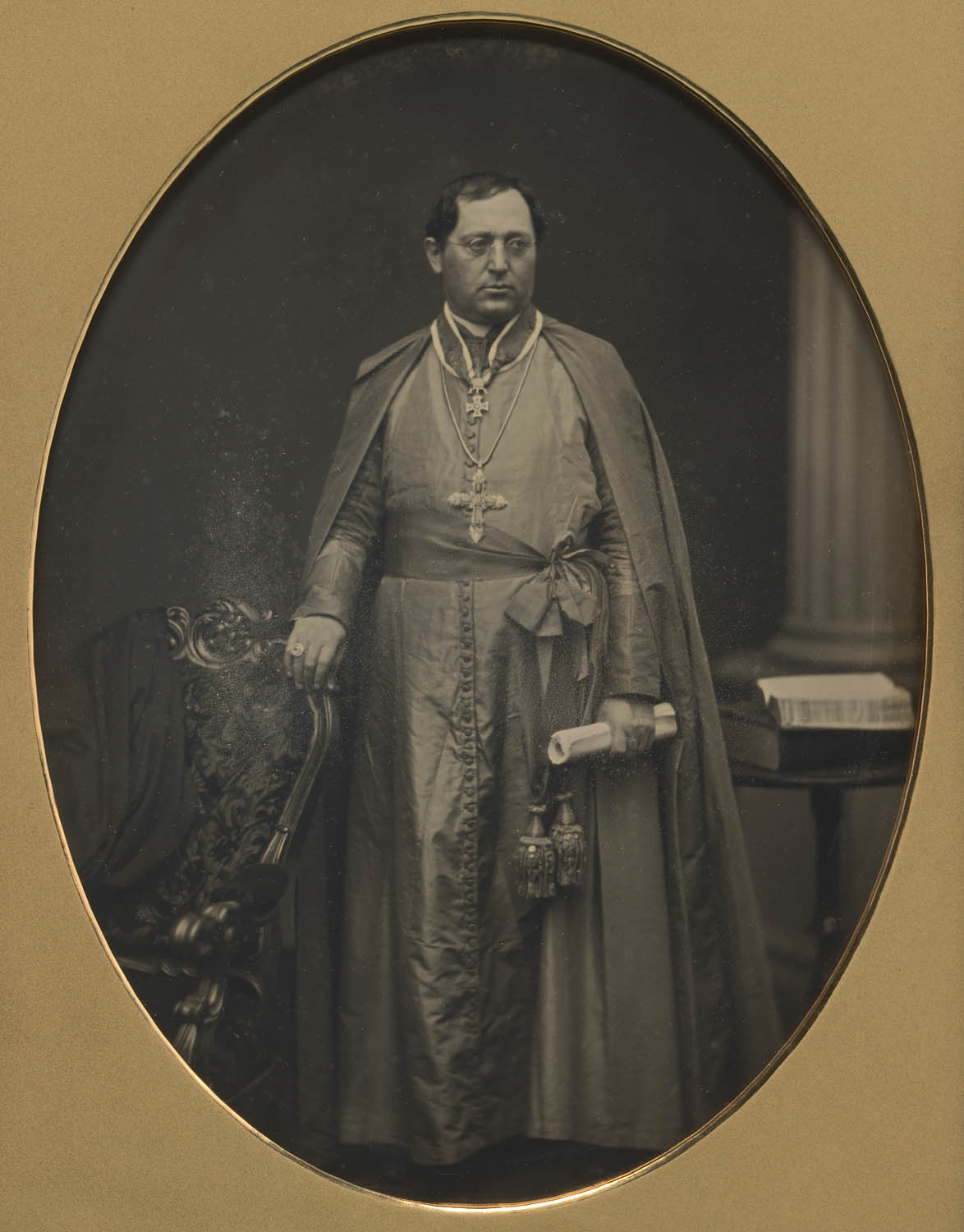
Southworth & Hawes (active 1843-1862)
Albert Sands Southworth (American, 1811-1894)
Josiah Johnson Hawes (American, 1808-1901)
Gaetano Bedini, 1806-1864
1853
Whole-plate daguerreotype
Image: 20 x 15cm (7 7/8 x 5 7/8″)
Case Open: 25.4 x 40.8 x 1cm (10 x 16 1/16 x 3/8″)
Case Closed: 23.1 x 18.1 x 1.7cm (9 1/8 x 7 1/8 x 11/16″)
National Portrait Gallery, Smithsonian Institution
Transfer from the Archives of American Art, Smithsonian Institution. Conservation made possible by a grant from the Smithsonian’s Collections Care and Preservation Fund
Gaetano Bedini, 1806-1864
Born Sinigaglia, Italy
In 1853, Italian archbishop Gaetano Bedini travelled to the United States at the request of Pope Pius IX to assess the condition of the Catholic Church in North America and to study the possibility of establishing a papal mission in Washington, D.C. Bedini’s multi-month, fact-finding tour coincided with an intense wave of anti-Catholic, anti-immigrant feeling fanned by the newly ascendant American (or Know-Nothing) Party. In several cities, his presence sparked hostile demonstrations. Upon returning to the Vatican, Bedini advocated successfully for the creation of a North American College in Rome to prepare Roman Catholic clergy for service in the United States.
Text from the National Portrait Gallery website
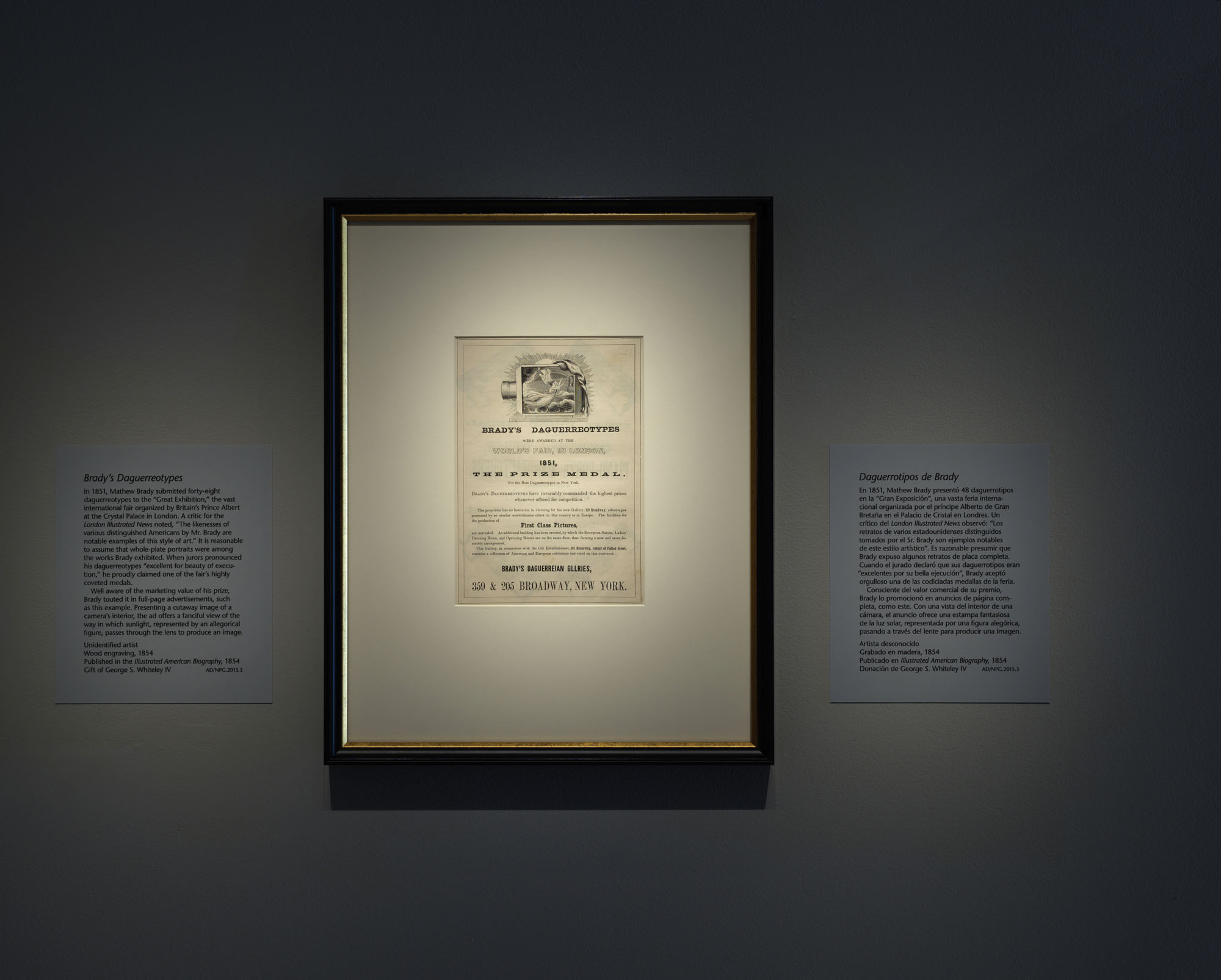
Installation view of the exhibition From Shadow to Substance: Grand-Scale Portraits During Photography’s Formative Years at the National Portrait Gallery, Washington, June 20, 2025 – June 7, 2026 showing a wood engraving by an unidentified artist of Brady’s Daguerreotypes 1854 (below)
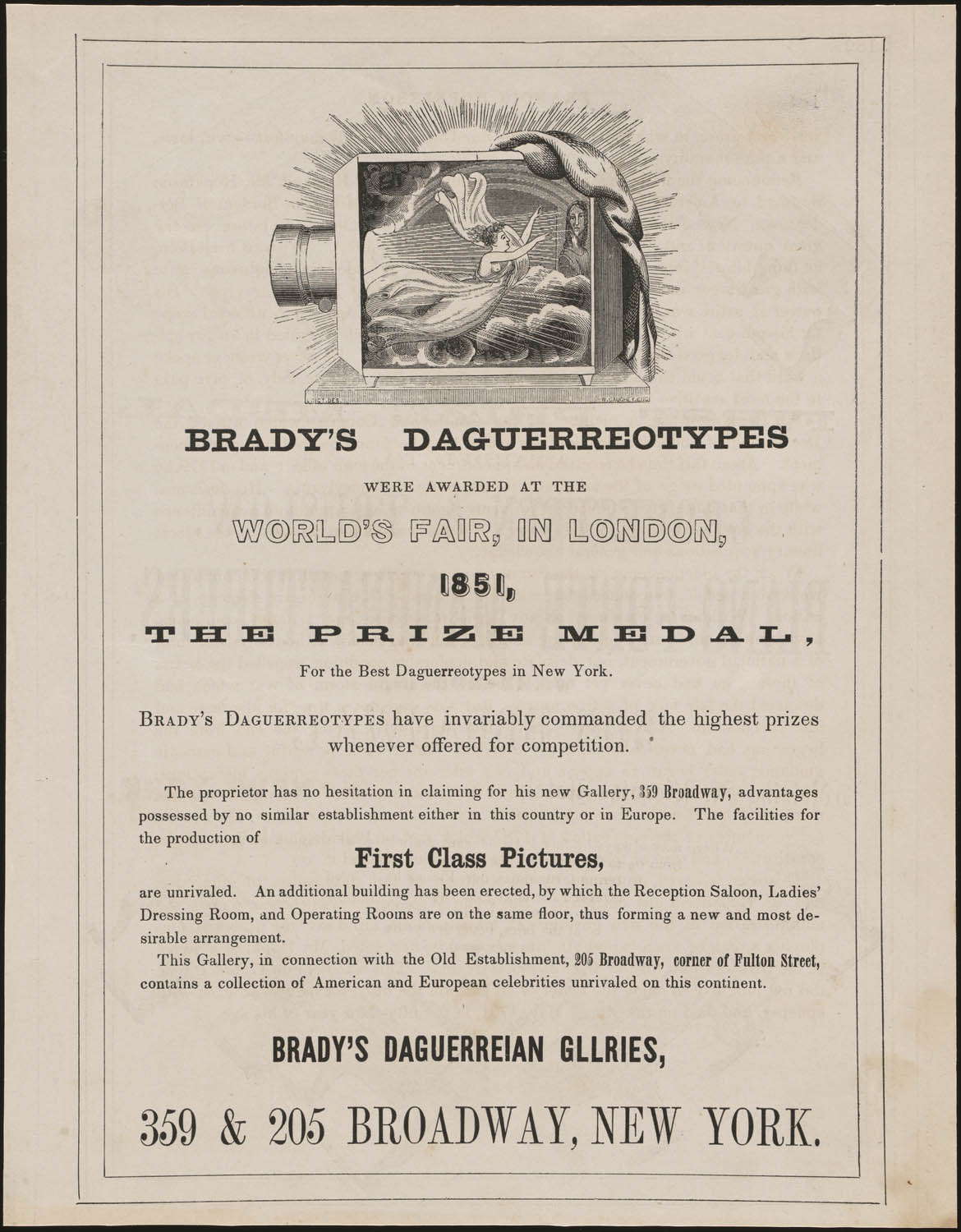
Unidentified Artist
Brady’s Daguerreotypes
1854
Wood engraving on paper
Image: 21.8 x 14.8cm (8 9/16 x 5 13/16″)
Sheet: 24 x 18.6cm (9 7/16 x 7 5/16″)
Mat: 45.8 x 35.6cm (18 1/16 x 14″)
Published in the Illustrated American Biography, 1854
National Portrait Gallery, Smithsonian Institution
Gift of George S. Whiteley IV
Mathew Brady placed this full-page advertisement in the Illustrated American Biography, a publication that marketed itself as a biographical volume but was actually a glorified business directory. With its cutaway image of a camera, Brady’s ad presents a fanciful view of the process by which sunlight passes through the camera’s lens to produce an image.
In 1851, Mathew Brady submitted forty-eight daguerreotypes to the “Great Exhibition,” the vast international fair organised by Britain’s Prince Albert at the Crystal Palace in London. A critic for the London Illustrated News noted, “The likenesses of various distinguished Americans by Mr. Brady are notable examples of this style of art.” It is reasonable to assume that whole-plate portraits were among the works Brady exhibited. When jurors pronounced his daguerreotypes “excellent for beauty of execution,” he proudly claimed one of the fair’s highly coveted medals.
Well aware of the marketing value of his prize, Brady touted it in full-page advertisements, such as this example. Presenting a cutaway image of a camera’s interior, the ad offers a fanciful view of the way in which sunlight, represented by an allegorical figure, passes through the lens to produce an image.
Text from the National Portrait Gallery website
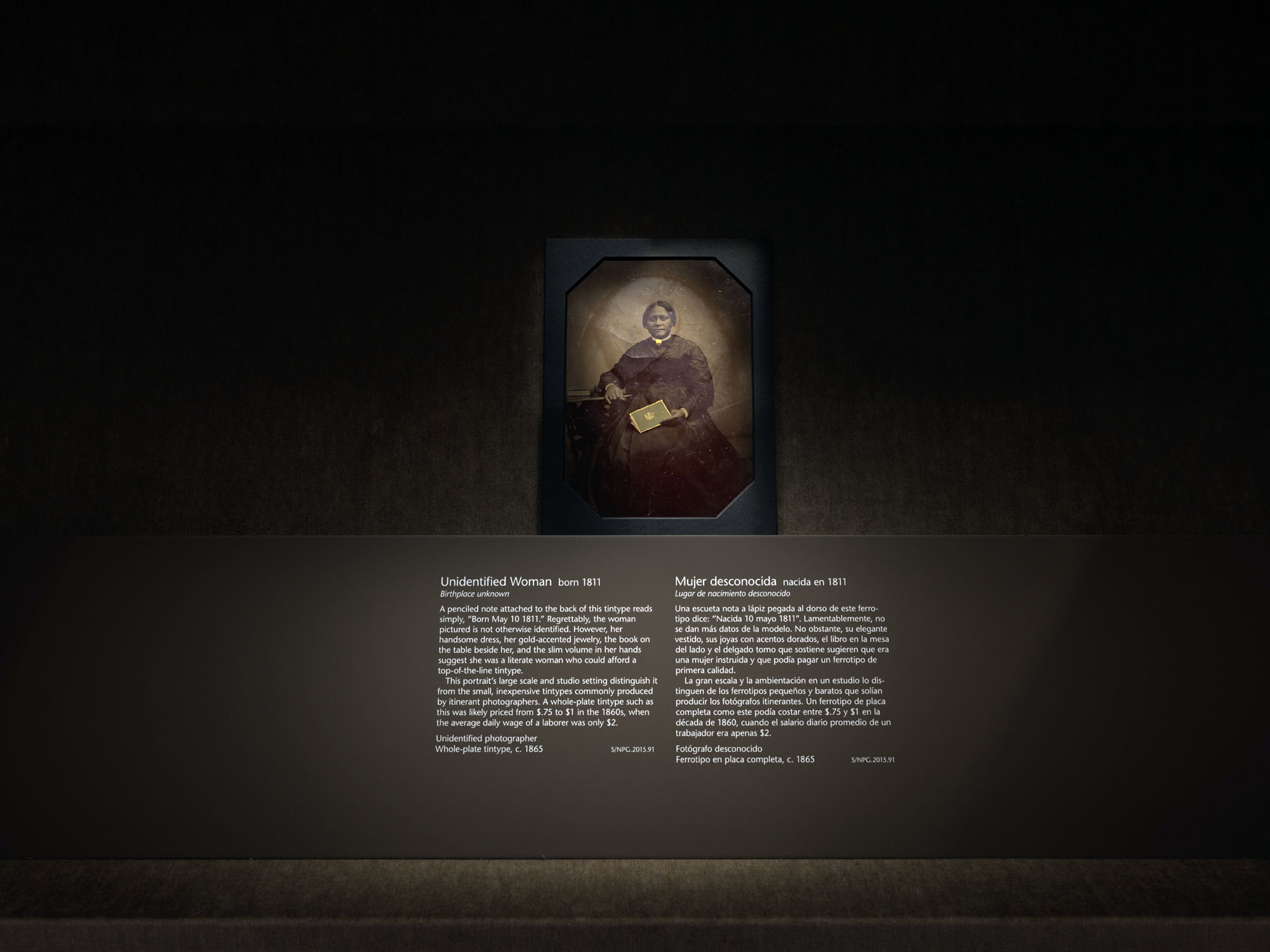
Installation view of the exhibition From Shadow to Substance: Grand-Scale Portraits During Photography’s Formative Years at the National Portrait Gallery, Washington, June 20, 2025 – June 7, 2026 showing a whole-plate tintype by an unidentified photographer of an Unidentified Woman c. 1865 (below)
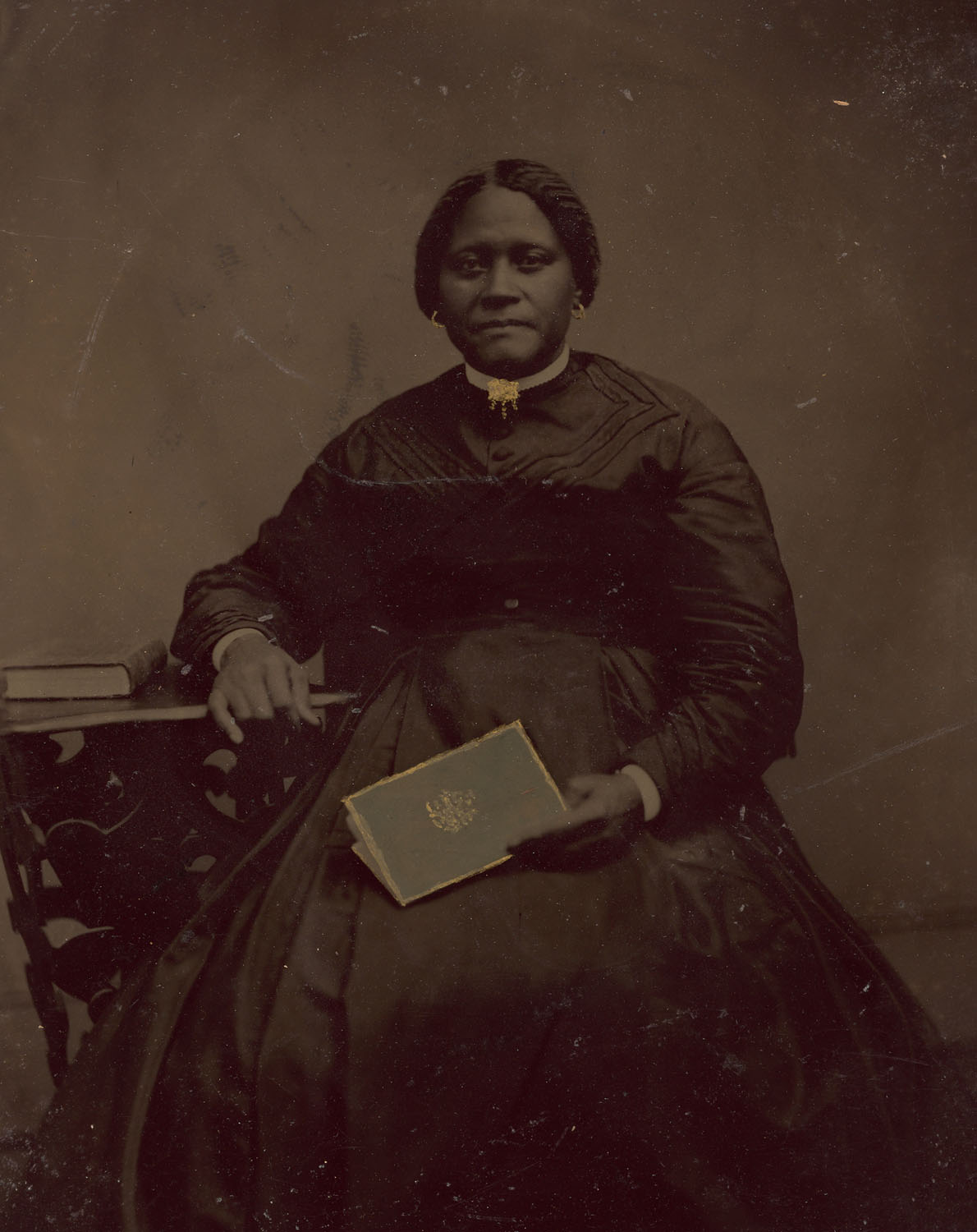
Unidentified photographer
Unidentified Woman
c. 1865
Whole-plate tintype
Image/Sheet: 21.6 x 15.2 cm (8 1/2 x 6″)
National Portrait Gallery, Smithsonian Institution
Unidentified Woman
Birthplace unknown
A penciled note attached to the back of this tintype reads simply, “Born May 10 1811.” Regrettably, the woman pictured is not otherwise identified. However, her handsome dress, her gold-accented jewelry, the book on the table beside her, and the slim volume in her hands suggest she was a literate woman who could afford a top-of-the-line tintype.
This portrait’s large scale and studio setting distinguish it from the small, inexpensive tintypes commonly produced by itinerant photographers. A whole-plate tintype such as this was likely priced from $.75 to $1 in the 1860s, when the average daily wage of a labourer was only $2.
Text from the National Portrait Gallery website
National Portrait Gallery
8th and F Sts NW
Washington, DC 20001
Opening hours:
11.30am – 7.00pm daily
National Portrait Gallery website


You must be logged in to post a comment.