Exhibition: ‘From Shadow to Substance: Grand-Scale Portraits During Photography’s Formative Years’ at the National Portrait Gallery, Washington

Exhibition dates: 20th June, 2025 – 7th June, 2026

Curator: Ann Shumard, Senior Curator of Photographs at the National Portrait Gallery, Washington
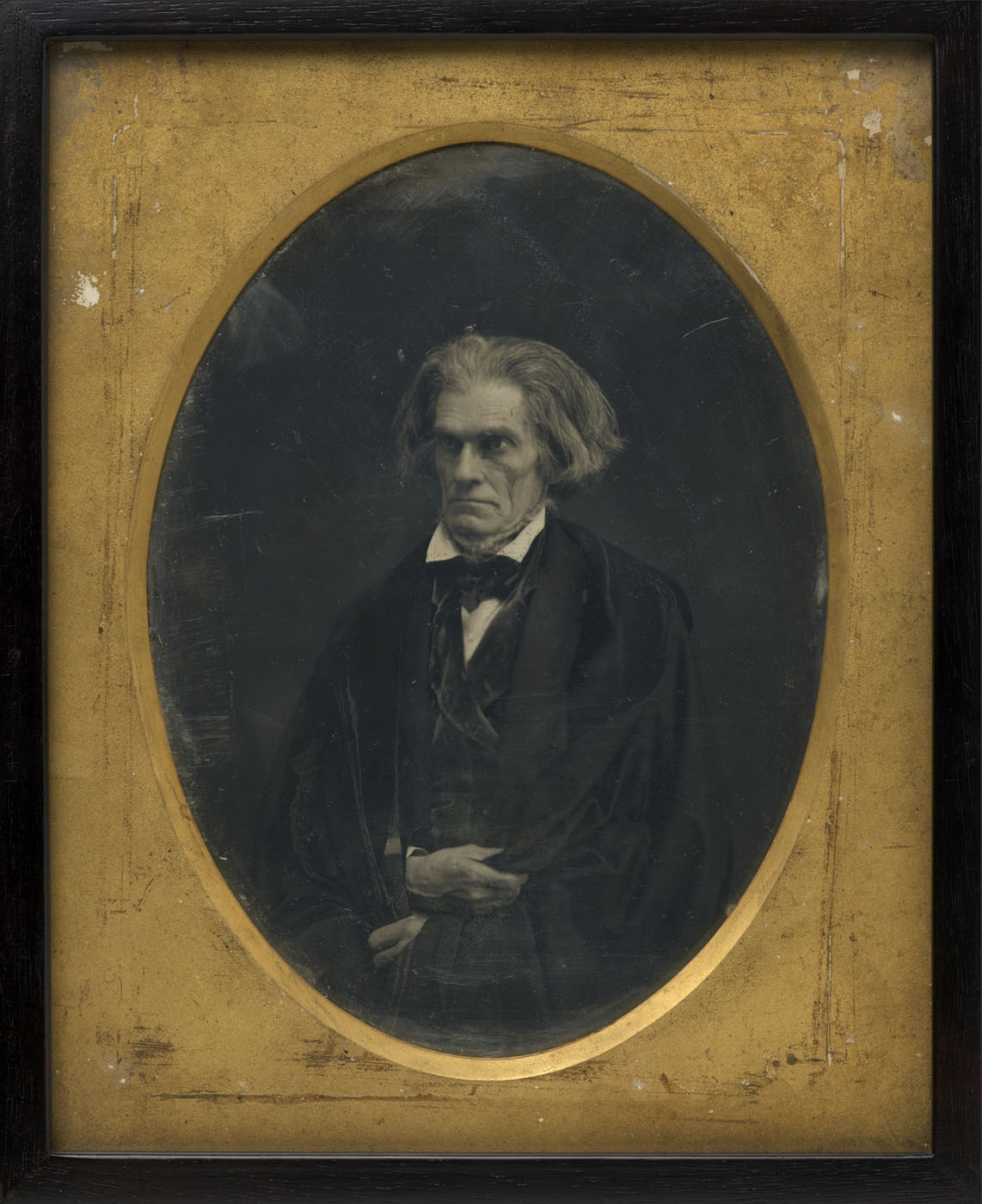
 

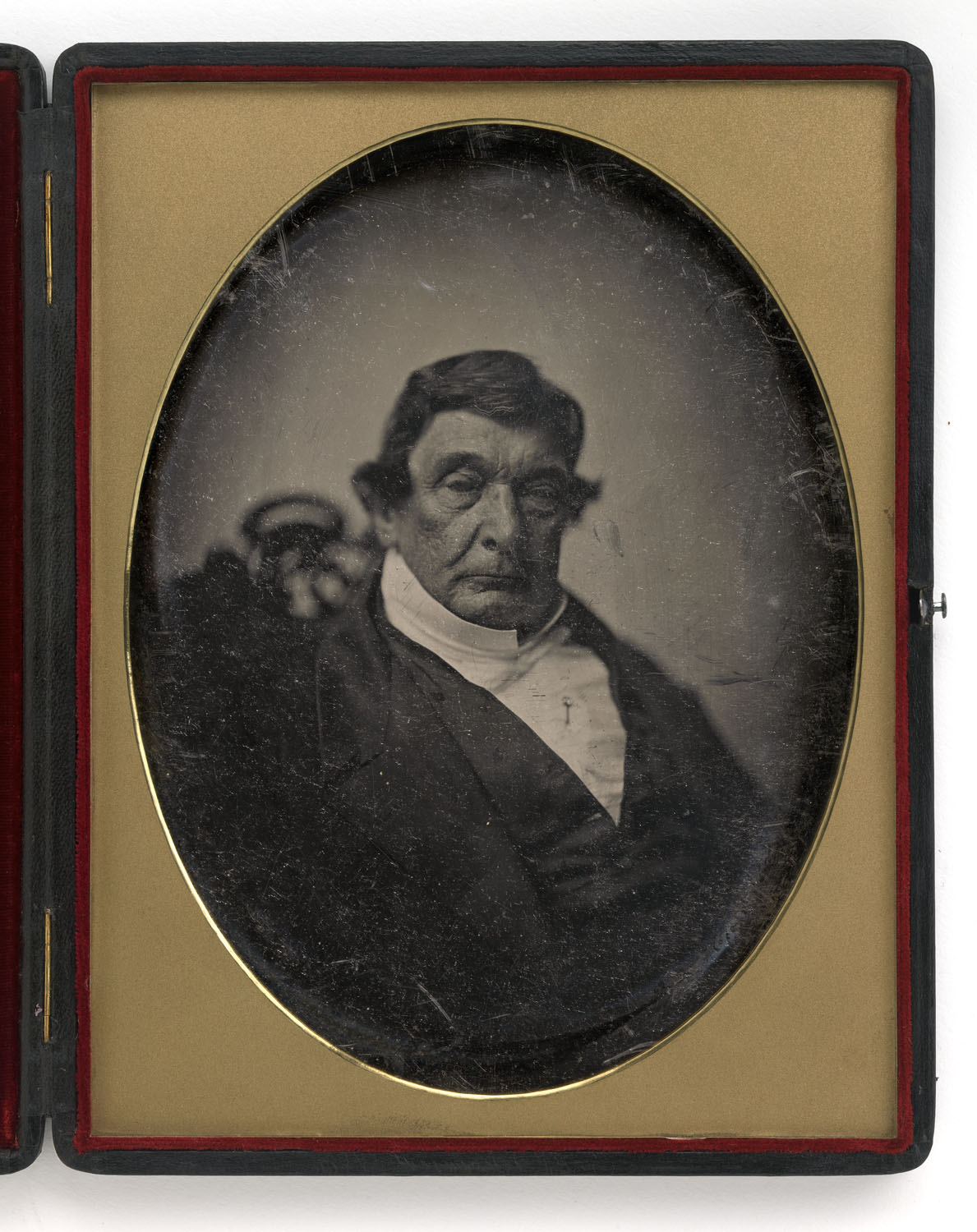
Mathew B. Brady (American, 1822-1896) 'John C. Calhoun' 1849 from the exhibition 'From Shadow to Substance: Grand-Scale Portraits During Photography's Formative Years' at the National Portrait Gallery, Washington, June 2025 - June 2026


Mathew B. Brady (American, 1822-1896)
John C. Calhoun
1849
Whole-plate daguerreotype
Image/Sight: 20.2 x 15cm (7 15/16 x 5 7/8″)
Mat (brass): 24.3 x 19.4cm (9 9/16 x 7 5/8″)
Frame: 35 x 30 x 2.5cm (13 3/4 x 11 13/16 x 1″)
Case closed: 5.8 x 34.3 x 39.7cm (2 5/16 x 13 1/2 x 15 5/8″)
Case open: 5.8 x 72.7 x 39.7cm (2 5/16 x 28 5/8 x 15 5/8″)
National Portrait Gallery, Smithsonian Institution
Gift of Stephan Loewentheil


Mathew Brady’s mastery of the whole plate is on full display in this compelling portrait – the last daguerreotype made of Senator John C. Calhoun before his death in 1850. A contemporary praised the portrait as one of “the best which Mr. Brady has taken himself,” adding, “So perfect was it regarded by the family [of Calhoun], that several copies of it have been made at their request.” Commenting on his subject’s most notable feature, Brady observed, “Calhoun’s eye was startling, and almost hypnotised me.” A painting based on this daguerreotype was commissioned by Brady and now hangs in the U.S. Senate.

Text from the National Portrait Gallery website


High-class portraits

Eight white men (all whole-plate daguerreotypes) and one black woman (whole-plate tintype) – sounds about right.

“To put the era’s pricing in context, a year’s supply of coal for a working-class family in 1850 cost $15 – the minimum price for a Southworth & Hawes whole-plate daguerreotype. The whole plate was therefore too expensive for most consumers… A whole-plate tintype was likely priced from $.75 to $1 in the 1860s, when the average daily wage of a labourer was only $2.”

Picture and price / detail and scale / delicacy of lights and shadows / beauty of execution – execution being the operative word, considering the upcoming devastation of the American Civil War.

Thus, from unapologetic enslaver (Calhoun) who “staunchly defended chattel slavery and its expansion beyond the American South” and whose painting based on Brady’s daguerreotype hangs in the American senate (really!) – to an unidentified literate Black woman, birthplace unknown, born May 10, 1811 taken by an unknown photographer.

I know which one I would rather honour.

Dr Marcus Bunyan


Many thankx to the National Portrait Gallery for allowing me to publish the photographs in the posting. Please click on the photographs for a larger version of the image.


“Competition prompted photographers such as Mathew Brady and Southworth & Hawes to produce advertisements that provided a wealth of detail about the services offered by their respective establishments … I am inclined to think that word of mouth may well have played a greater role in motivating patronage. In the case of Brady and Southworth & Hawes, the knowledge that these studios counted national celebrities among their clientele could have been a strong inducement for the general public to patronise them as well. …

While the National Portrait Gallery’s collection of early photography is substantial, it’s the rare whole-plate daguerreotypes, ambrotypes, and tintypes that stand out for their detail and scale. This exhibition allows visitors to consider how new photographic processes impacted the quality and appeal of the medium … As an aside, the impetus for ‘From Shadow to Substance’ was the extraordinary gift to the museum in 2023 of Mathew Brady’s iconic whole-plate daguerreotype of the powerful antebellum senator John C. Calhoun. A subsequent review of other whole-plates in the Portrait Gallery’s collection sparked consideration of the format’s staying power as a top-of-the-line offering through the succession of early photographic processes. This is the story the exhibition seeks to illuminate.”


Ann Shumard, Senior Curator of Photographs quoted in Kate Garibaldi. “How Portrait Photography’s ‘Grand-Scale’ Origins Changed History,” on the Petapixel website Aug 01, 2025 [Online] Cited 26/02/2026. Used under fair use conditions for the purposes of education and research
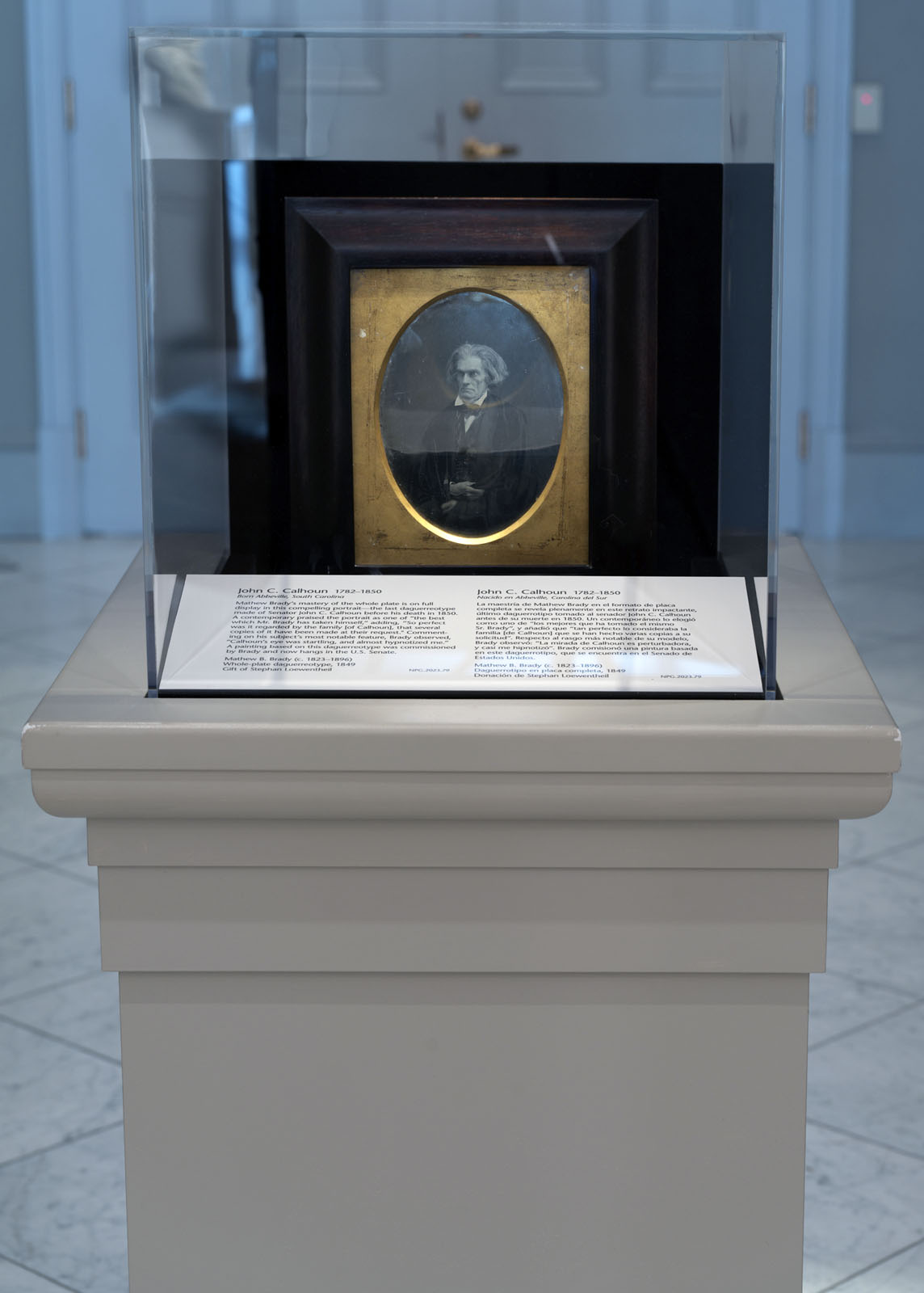


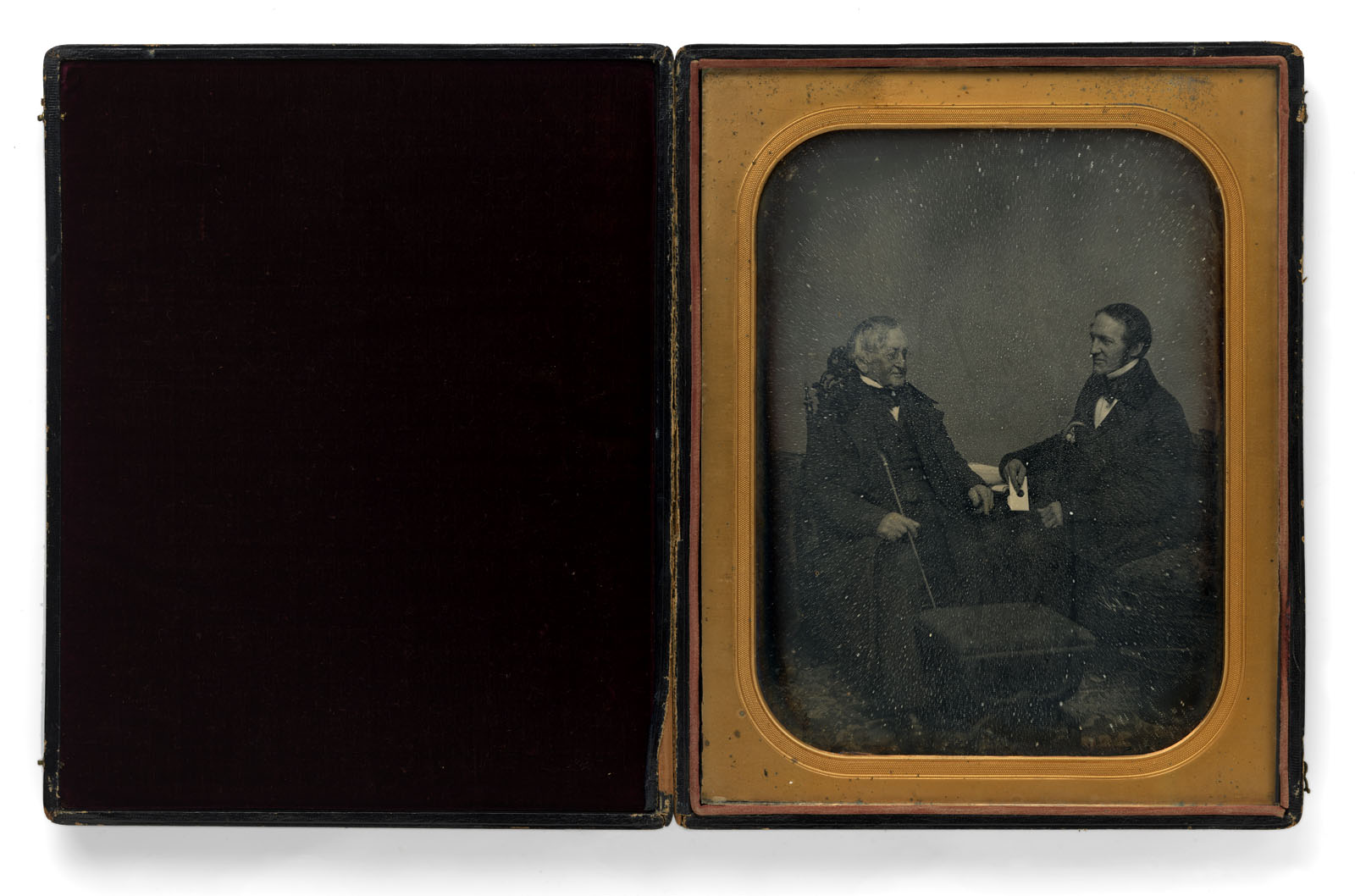
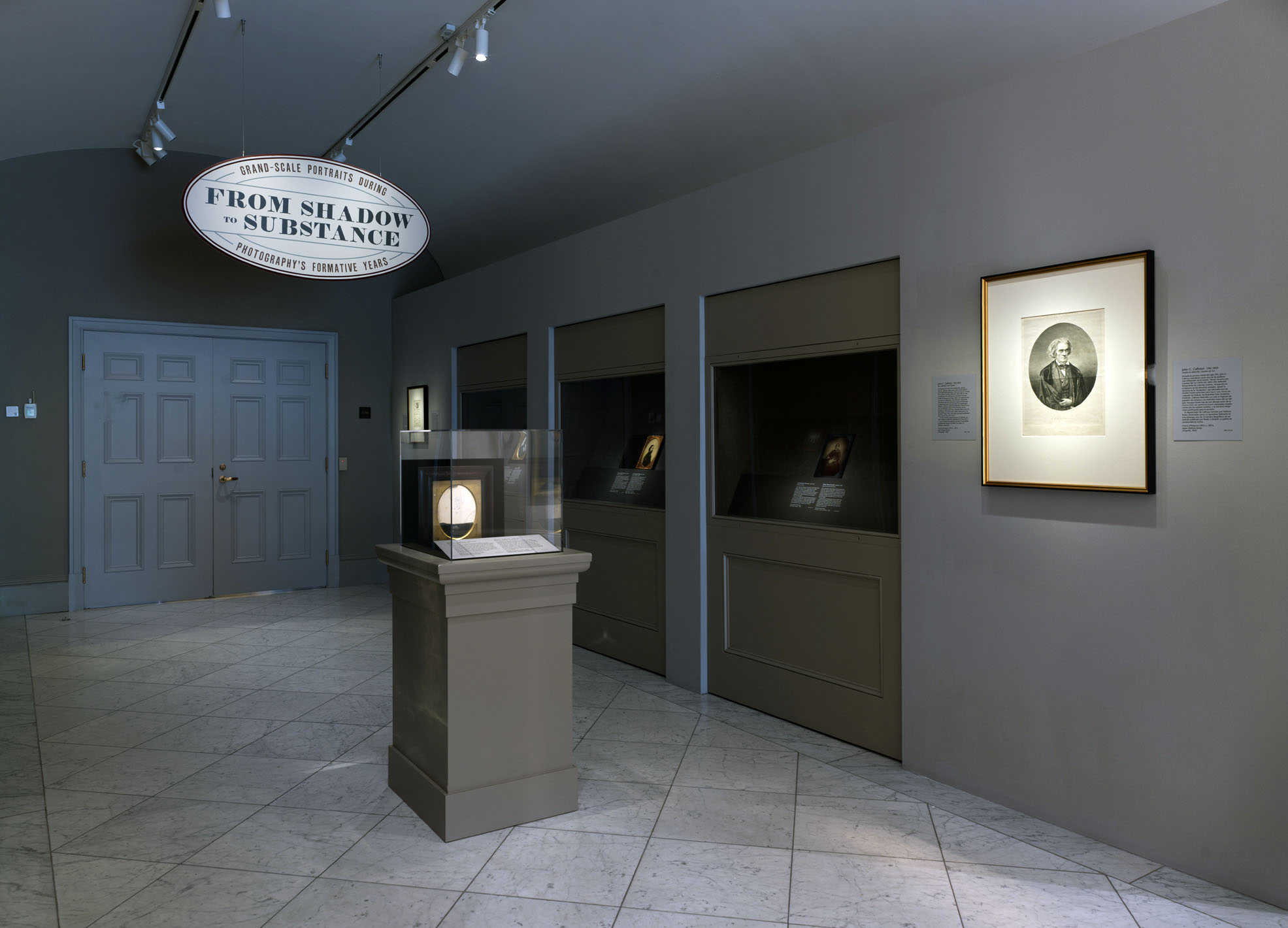
Installation view of the exhibition 'From Shadow to Substance: Grand-Scale Portraits During Photography's Formative Years' at the National Portrait Gallery, Washington, June 20, 2025 - June 7, 2026 showing Mathew B. Brady (American, 1823? - 15 Jan 1896) 'John C. Calhoun' c. 1849-1850


Installation view of the exhibition From Shadow to Substance: Grand-Scale Portraits During Photography’s Formative Years at the National Portrait Gallery, Washington, June 20, 2025 – June 7, 2026 showing Mathew B. Brady (American, 1822-1896) John C. Calhoun 1849 (above)
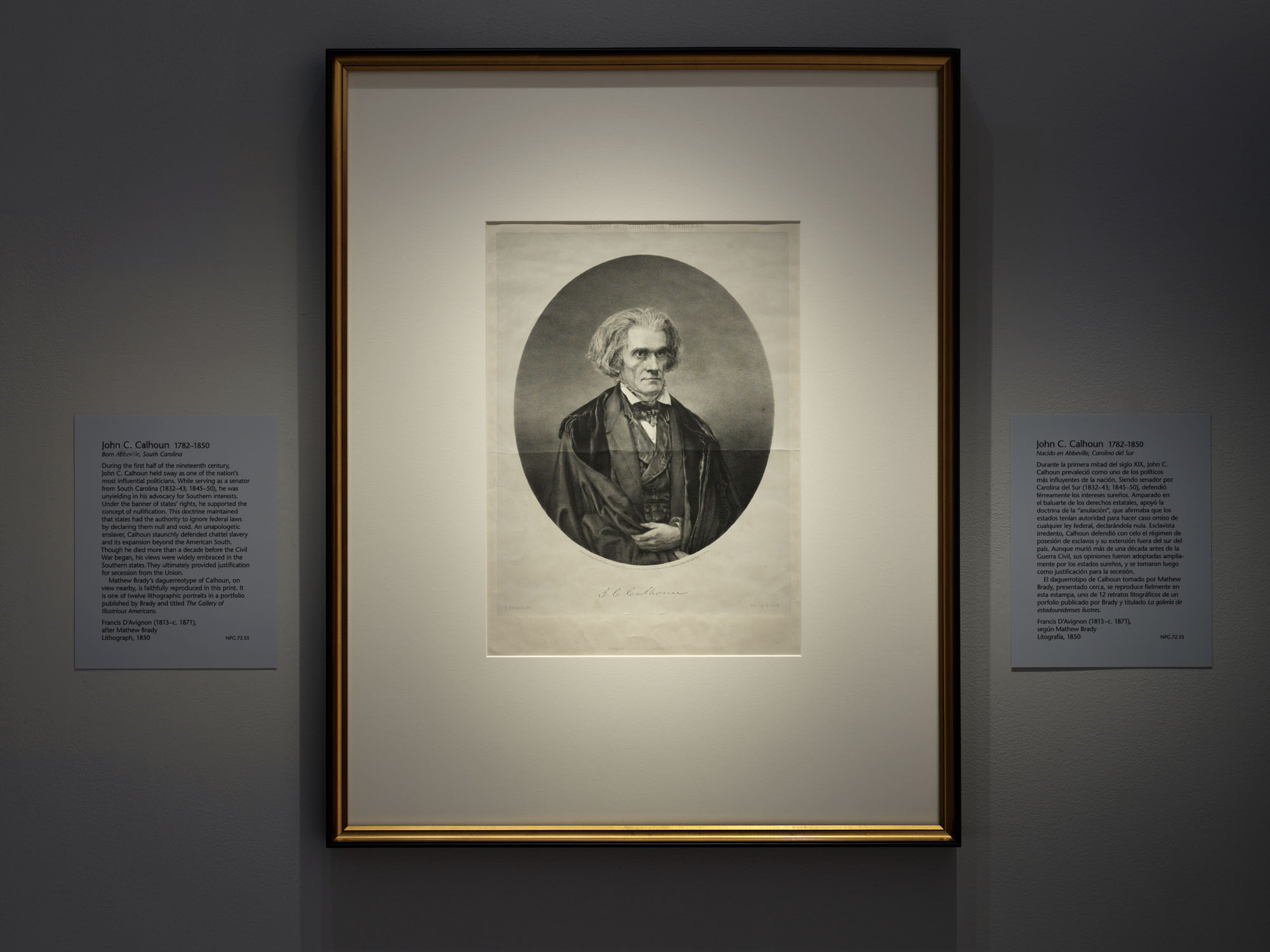
 

Installation view of the exhibition 'From Shadow to Substance: Grand-Scale Portraits During Photography's Formative Years' at the National Portrait Gallery, Washington, June 20, 2025 - June 7, 2026 showing Francis D'Avignon (French, 1813 - c. 1871) Copy after Mathew B. Brady (American, 1823? - 15 Jan 1896) 'John Caldwell Calhoun, 18 Mar 1782 - 31 Mar 1850' 1850


Installation view of the exhibition From Shadow to Substance: Grand-Scale Portraits During Photography’s Formative Years at the National Portrait Gallery, Washington, June 20, 2025 – June 7, 2026 showing Francis D’Avignon (French, 1813 – c. 1871) Copy after Mathew B. Brady (American, 1823? – 15 Jan 1896) John Caldwell Calhoun, 18 Mar 1782 – 31 Mar 1850 1850
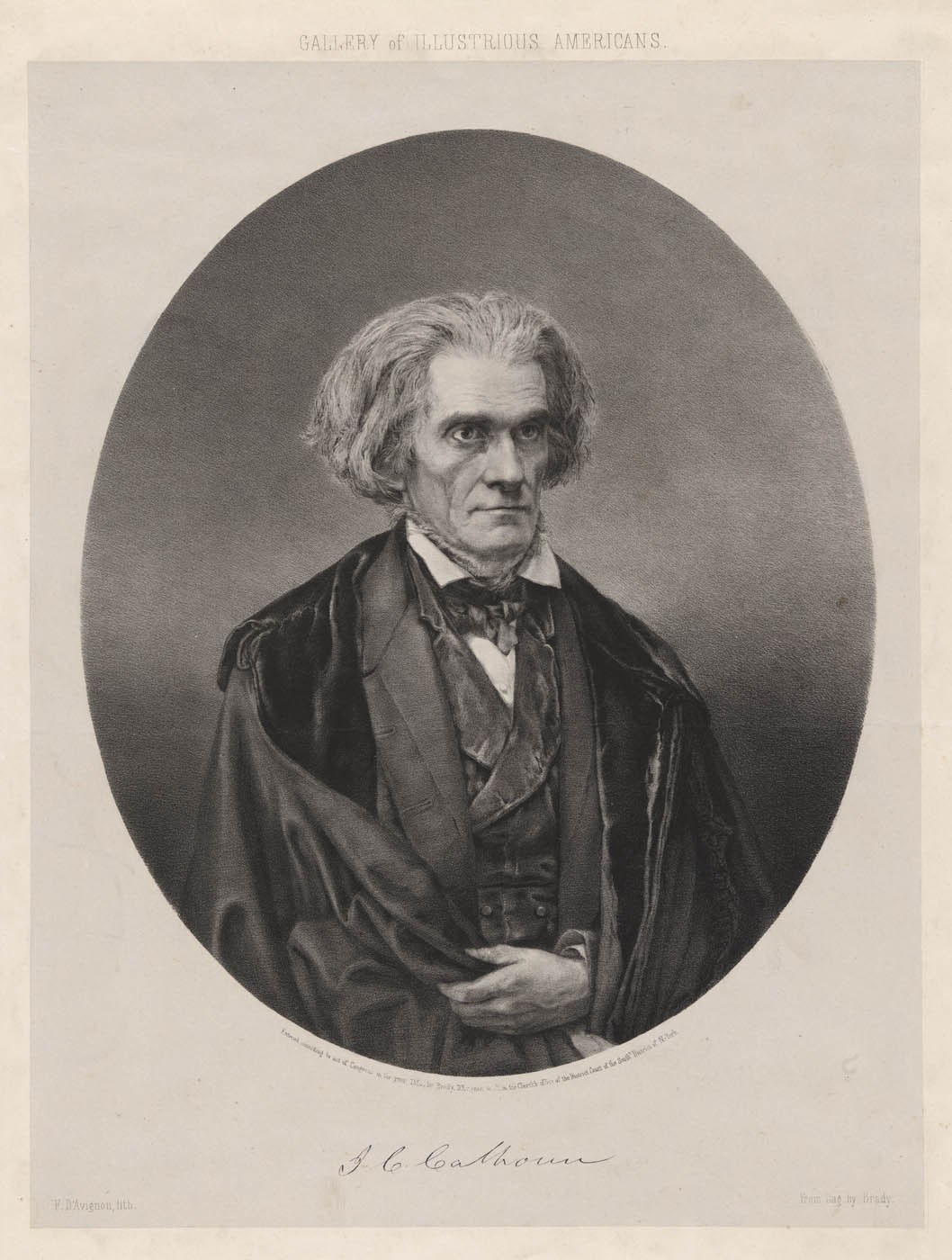
 

Francis D'Avignon (French, 1813 - c. 1871) Copy after Mathew B. Brady (American, 1822-1896) 'John Caldwell Calhoun, 18 Mar 1782 - 31 Mar 1850' 1850


Francis D’Avignon (French, 1813 – c. 1871)
Copy after
Mathew B. Brady (American, 1822-1896)
John Caldwell Calhoun, 18 Mar 1782 – 31 Mar 1850
1850
Lithograph on paper
Sheet: 56.7 x 40.6cm (22 5/16 x 16″)
Book: The Gallery of Illustrious Americans
National Portrait Gallery, Smithsonian Institution


During the first half of the nineteenth century, John C. Calhoun held sway as one of the nation’s most influential politicians. While serving as a senator from South Carolina (1832-1843; 1845-1850), he was unyielding in his advocacy for Southern interests. Under the banner of states’ rights, he supported the concept of nullification. This doctrine maintained that states had the authority to ignore federal laws by declaring them null and void. An unapologetic enslaver, Calhoun staunchly defended chattel slavery and its expansion beyond the American South. Though he died more than a decade before the Civil War began, his views were widely embraced in the Southern states. They ultimately provided justification for secession from the Union. Mathew Brady’s daguerreotype of Calhoun, on view nearby, is faithfully reproduced in this print. It is one of twelve lithographic portraits in a portfolio published by Brady and titled The Gallery of Illustrious Americans.

Text from the National Portrait Gallery website
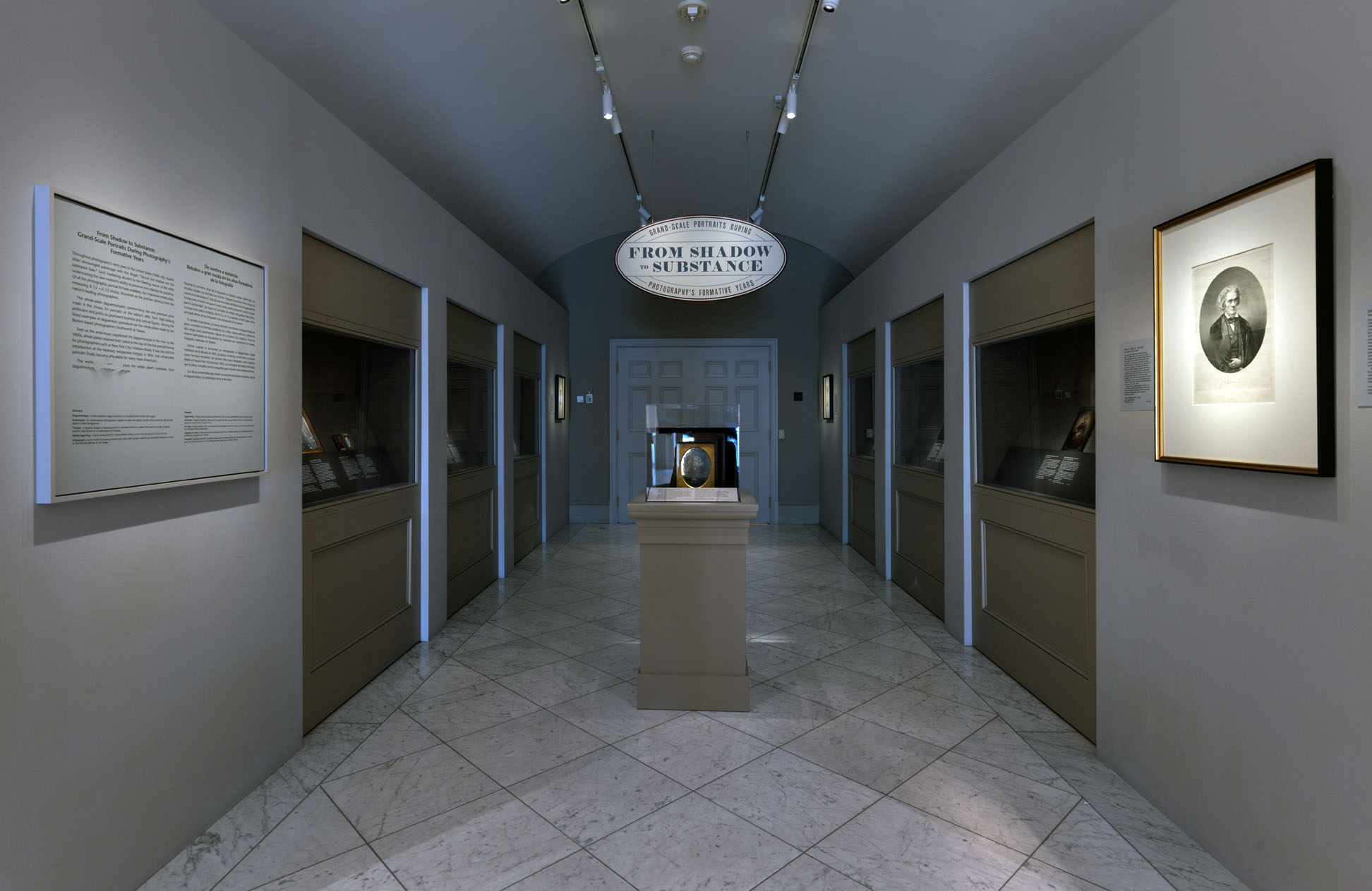
 

Installation view of the exhibition 'From Shadow to Substance: Grand-Scale Portraits During Photography's Formative Years' at the National Portrait Gallery, Washington, June 20, 2025 - June 7, 2026


Installation views of the exhibition From Shadow to Substance: Grand-Scale Portraits During Photography’s Formative Years at the National Portrait Gallery, Washington, June 20, 2025 – June 7, 2026


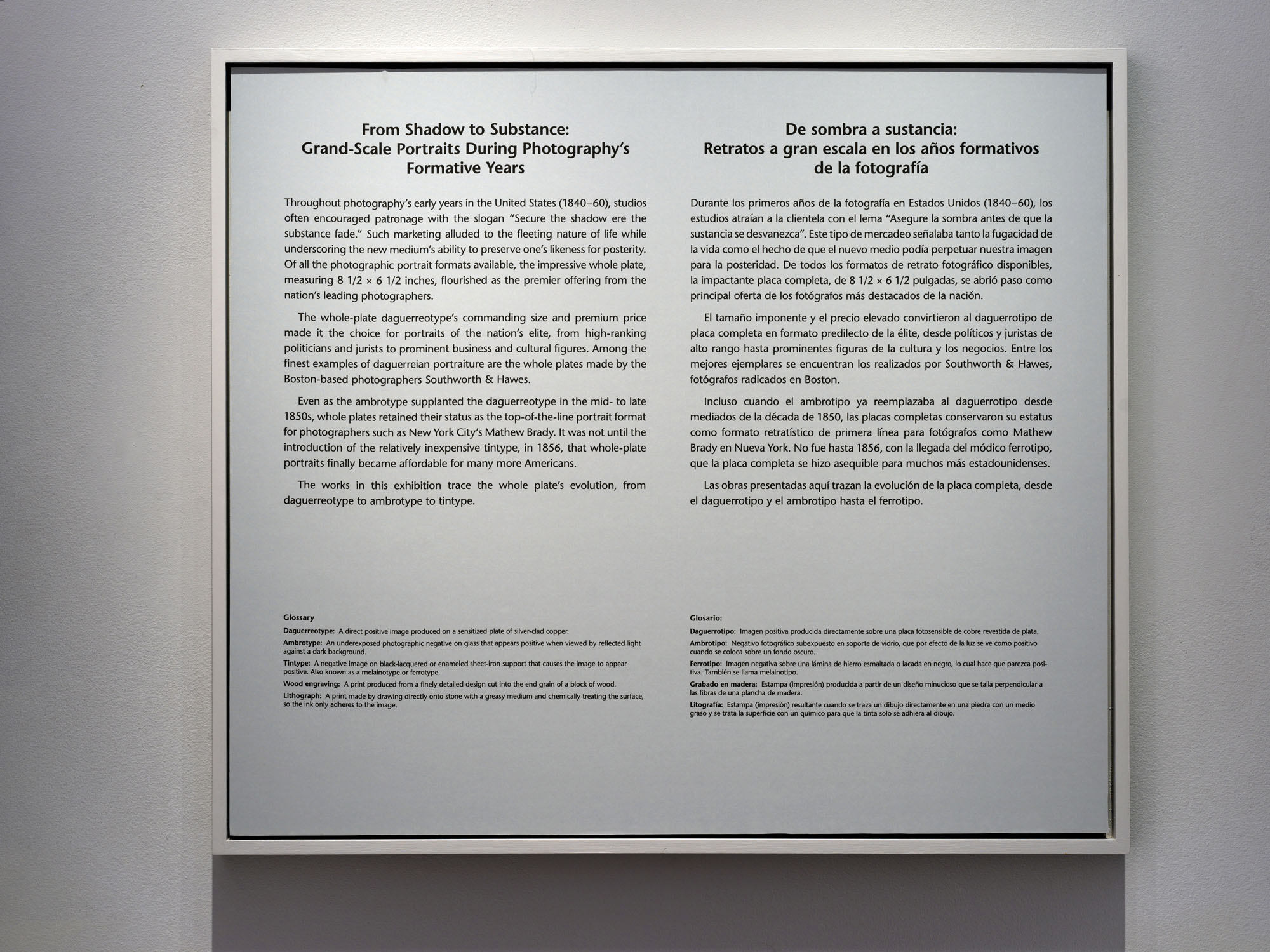
Photographers seeking customers during the medium’s early years often urged the public to “Secure the shadow, ere the substance fade.” Hinting at life’s fragility, this tagline underscored photography’s ability to capture a fleeting likeness and preserve it for posterity. Portraits in the impressive whole-plate format – measuring 8.5 x 6.5 inches – were among the premier offerings of the nation’s leading photographic studios.

Drawing on the National Portrait Gallery’s extensive early photography collection, this exhibition traces the evolution of the grand-scale, whole-plate format from the high-end daguerreotype to the mid-range ambrotype to the more affordable tintype. Examples of whole plates in each of these mediums illustrate how the format evolved as new photographic processes were introduced. Featured works include daguerreotypes representing U.S. senators Daniel Webster and John C. Calhoun, as well as papal nuncio Gaetano Bedini; an ambrotype portrait of American landscape artist John Frederick Kensett; and a tintype likeness of an unidentified African American woman.

Text from the National Portrait Gallery website
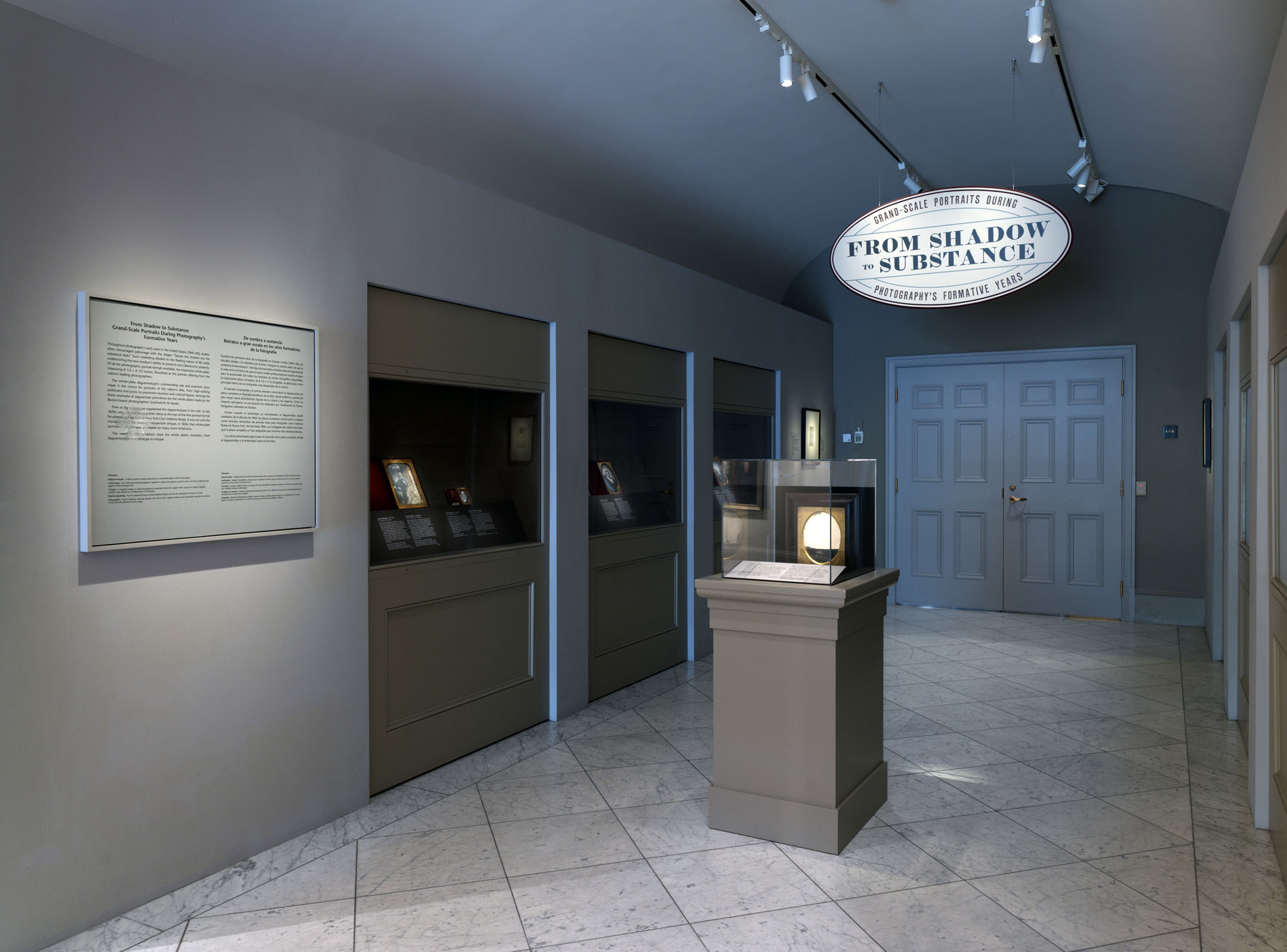
 

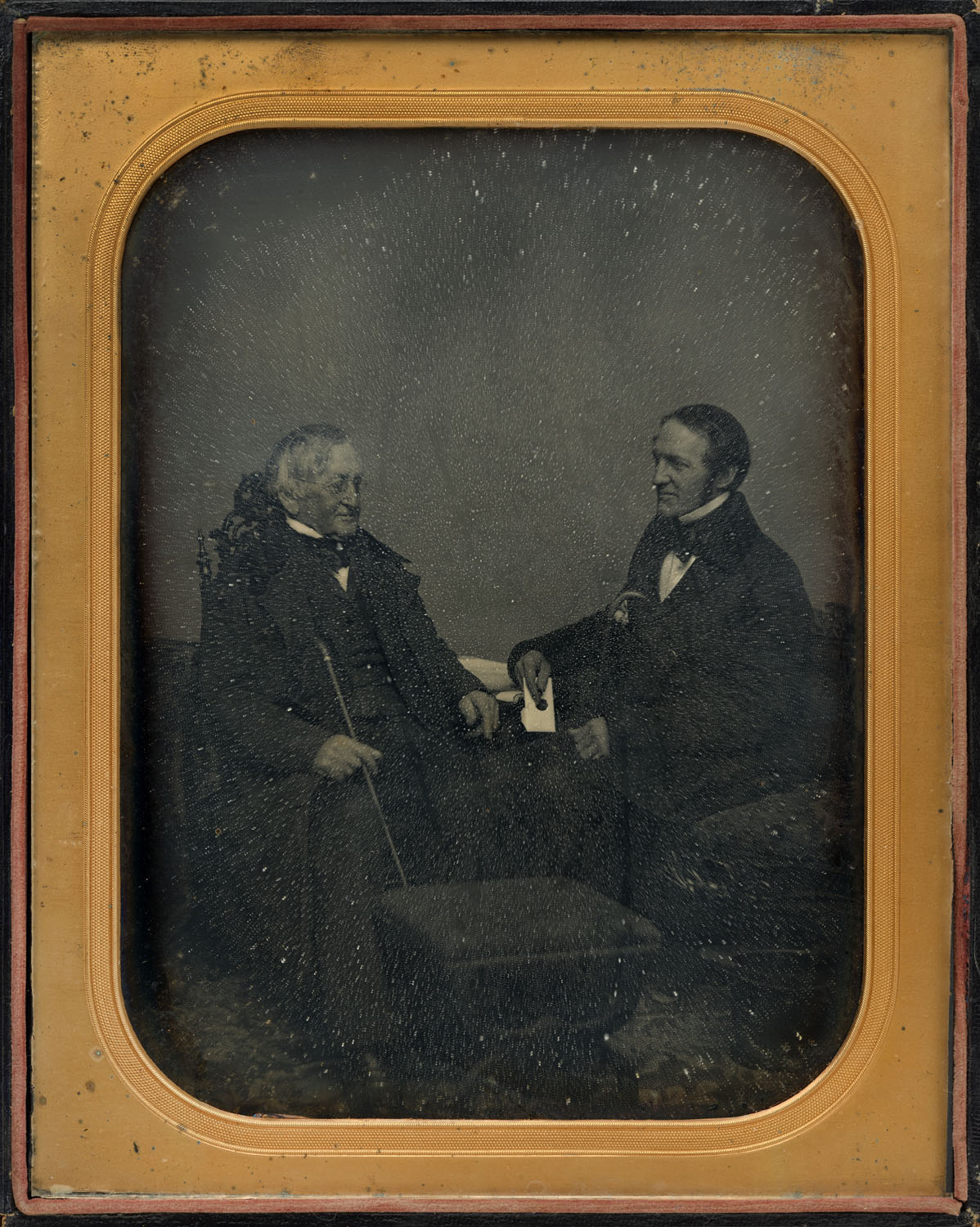
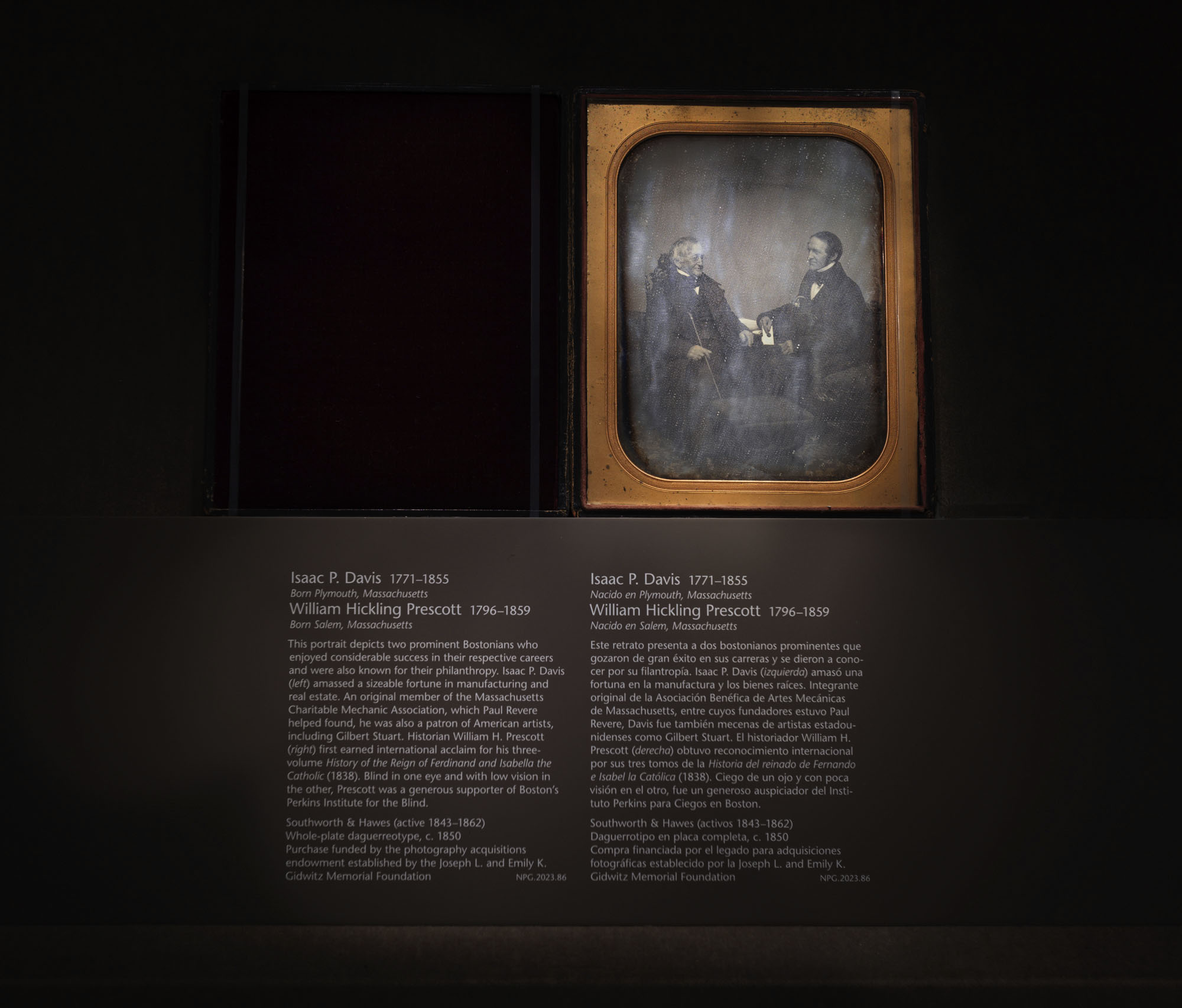
Installation view of the exhibition 'From Shadow to Substance: Grand-Scale Portraits During Photography's Formative Years' at the National Portrait Gallery, Washington, June 20, 2025 - June 7, 2026 showing Southworth & Hawes' 'Issac P. Davis 1771-1855 and William Hickling Prescott 1796-1859' c. 1850


Installation view of the exhibition From Shadow to Substance: Grand-Scale Portraits During Photography’s Formative Years at the National Portrait Gallery, Washington, June 20, 2025 – June 7, 2026 showing Southworth & Hawes’ Issac P. Davis 1771-1855 and William Hickling Prescott 1796-1859 c. 1850 (below)


Southworth & Hawes (active 1843-1862) Albert Sands Southworth (American, 1811-1894) Josiah Johnson Hawes (American, 1808-1901) 'Isaac P. Davis, 7 Oct 1771 - 13 Jan 1855 and William Hickling Prescott, 4 May 1796 - 28 Jan 1859' c. 1850
Southworth & Hawes (active 1843-1862) Albert Sands Southworth (American, 1811-1894) Josiah Johnson Hawes (American, 1808-1901) 'Isaac P. Davis, 7 Oct 1771 - 13 Jan 1855 and William Hickling Prescott, 4 May 1796 - 28 Jan 1859' c. 1850 from the exhibition 'From Shadow to Substance: Grand-Scale Portraits During Photography's Formative Years' at the National Portrait Gallery, Washington, June 2025 - June 2026


Southworth & Hawes (active 1843-1862)
Albert Sands Southworth (American, 1811-1894)
Josiah Johnson Hawes (American, 1808-1901)
Isaac P. Davis, 7 Oct 1771 – 13 Jan 1855
William Hickling Prescott, 4 May 1796 – 28 Jan 1859

c. 1850
Whole-plate daguerreotype
Image/Sight: 20.3 x 15.2cm (8 × 6″)
Mat (brass): 23.6 x 18.6cm (9 5/16 x 7 5/16″)
Case open: 25.3 x 40.2 x 2.3cm (9 15/16 x 15 13/16 x 7/8″)
Case closed: 25.3 x 20.7 x 3.5cm (9 15/16 x 8 1/8 x 1 3/8″)
National Portrait Gallery, Smithsonian Institution
Purchase funded by the photography acquisitions endowment established by the Joseph L. and Emily K. Gidwitz Memorial Foundation


Isaac P. Davis, 7 Oct 1771 – 13 Jan 1855
Born Plymouth, Massachusetts

William Hickling Prescott, 4 May 1796 – 28 Jan 1859
Born Salem, Massachusetts

This portrait depicts two prominent Bostonians who enjoyed considerable success in their respective careers and were also known for their philanthropy. Isaac P. Davis (left) amassed a sizeable fortune in manufacturing and real estate. An original member of the Massachusetts Charitable Mechanic Association, which Paul Revere helped found, he was also a patron of American artists, including Gilbert Stuart. Historian William H. Prescott (right) first earned international acclaim for his three-volume History of the Reign of Ferdinand and Isabella the Catholic (1838). Blind in one eye and with low vision in the other, Prescott was a generous supporter of Boston’s Perkins Institute for the Blind.

Text from the National Portrait Gallery website
 

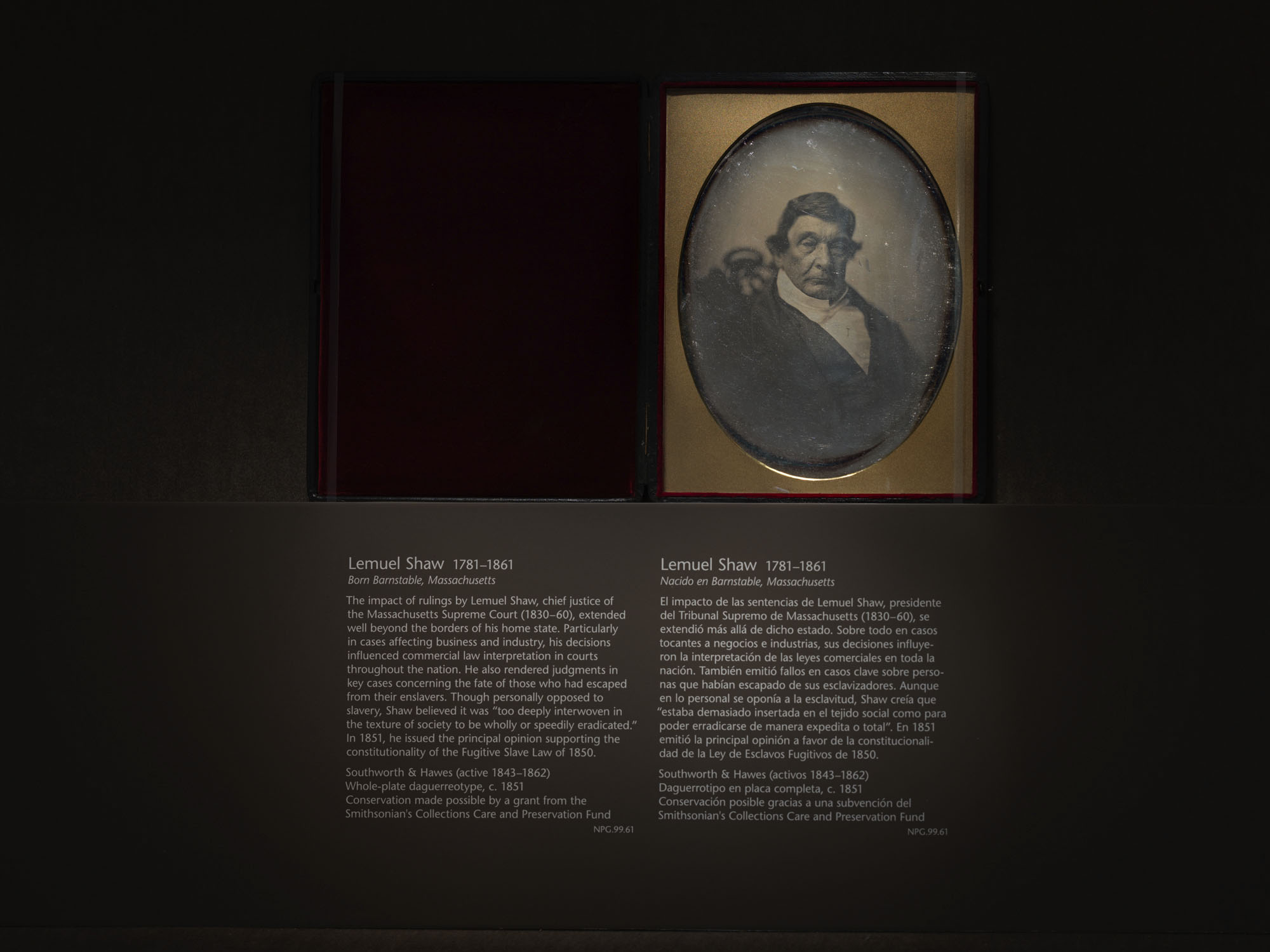
Installation view of the exhibition 'From Shadow to Substance: Grand-Scale Portraits During Photography's Formative Years' at the National Portrait Gallery, Washington, June 20, 2025 - June 7, 2026 Southworth & Hawes' 'Lemuel Shaw 1787-1861' c. 1851


Installation view of the exhibition From Shadow to Substance: Grand-Scale Portraits During Photography’s Formative Years at the National Portrait Gallery, Washington, June 20, 2025 – June 7, 2026 Southworth & Hawes’ Lemuel Shaw 1787-1861 c. 1851 (below)


Southworth & Hawes (active 1843-1862) Albert Sands Southworth (American, 1811-1894) Josiah Johnson Hawes (American, 1808-1901) 'Lemuel Shaw, 9 Jan 1781 - 30 Mar 1861' c. 1851


Southworth & Hawes (active 1843-1862)
Albert Sands Southworth (American, 1811-1894)
Josiah Johnson Hawes (American, 1808-1901)
Lemuel Shaw, 9 Jan 1781 – 30 Mar 1861
c. 1851
Whole-plate daguerreotype with silver-plated copper sheet support
Plate (sight): 21.5 x 16cm (8 7/16 x 6 5/16″)
Case Open: 23.4 x 36.3 x 0.9cm (9 3/16 x 14 5/16 x 3/8″)
Case Closed: 23.4 x 18.2 x 1.8cm (9 3/16 x 7 3/16 x 11/16″)
National Portrait Gallery, Smithsonian Institution
Conservation made possible by a grant from the Smithsonian’s Collections Care and Preservation Fund


Lemuel Shaw, 9 Jan 1781 – 30 Mar 1861
Born Barnstable, Massachusetts

The impact of rulings by Lemuel Shaw, chief justice of the Massachusetts Supreme Court (1830-1860), extended well beyond the borders of his home state. Particularly in cases affecting business and industry, his decisions influenced commercial law interpretation in courts throughout the nation. He also rendered judgments in key cases concerning the fate of those who had escaped from their enslavers. Though personally opposed to slavery, Shaw believed it was “too deeply interwoven in the texture of society to be wholly or speedily eradicated.” In 1851, he issued the principal opinion supporting the constitutionality of the Fugitive Slave Law of 1850.

Text from the National Portrait Gallery website
 

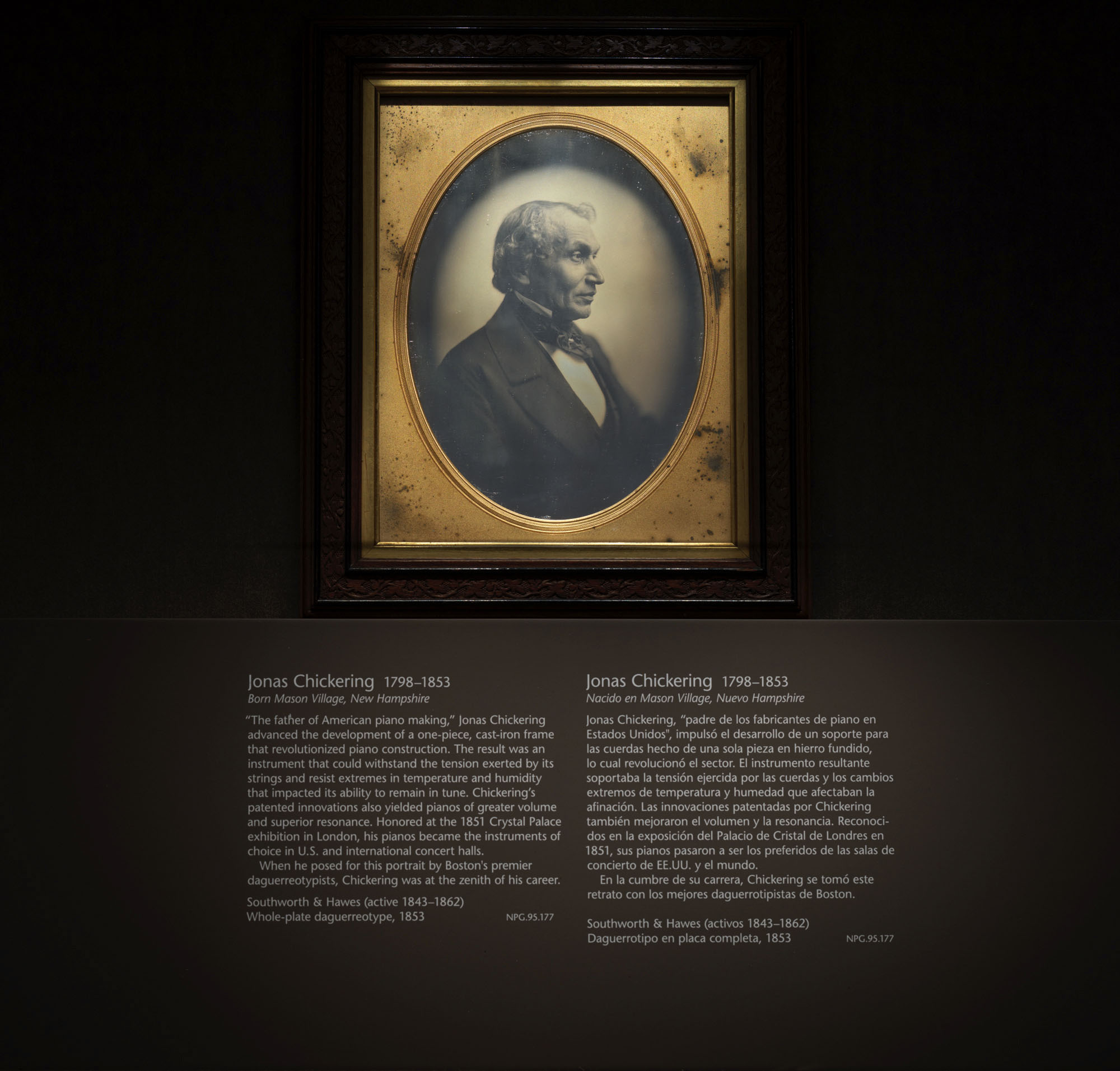
Installation view of the exhibition 'From Shadow to Substance: Grand-Scale Portraits During Photography's Formative Years' at the National Portrait Gallery, Washington, June 20, 2025 - June 7, 2026 showing Southworth & Hawes' 'Jonas Chickering' 1853


Installation view of the exhibition From Shadow to Substance: Grand-Scale Portraits During Photography’s Formative Years at the National Portrait Gallery, Washington, June 20, 2025 – June 7, 2026 showing showing Southworth & Hawes’ Jonas Chickering 1853 (below)


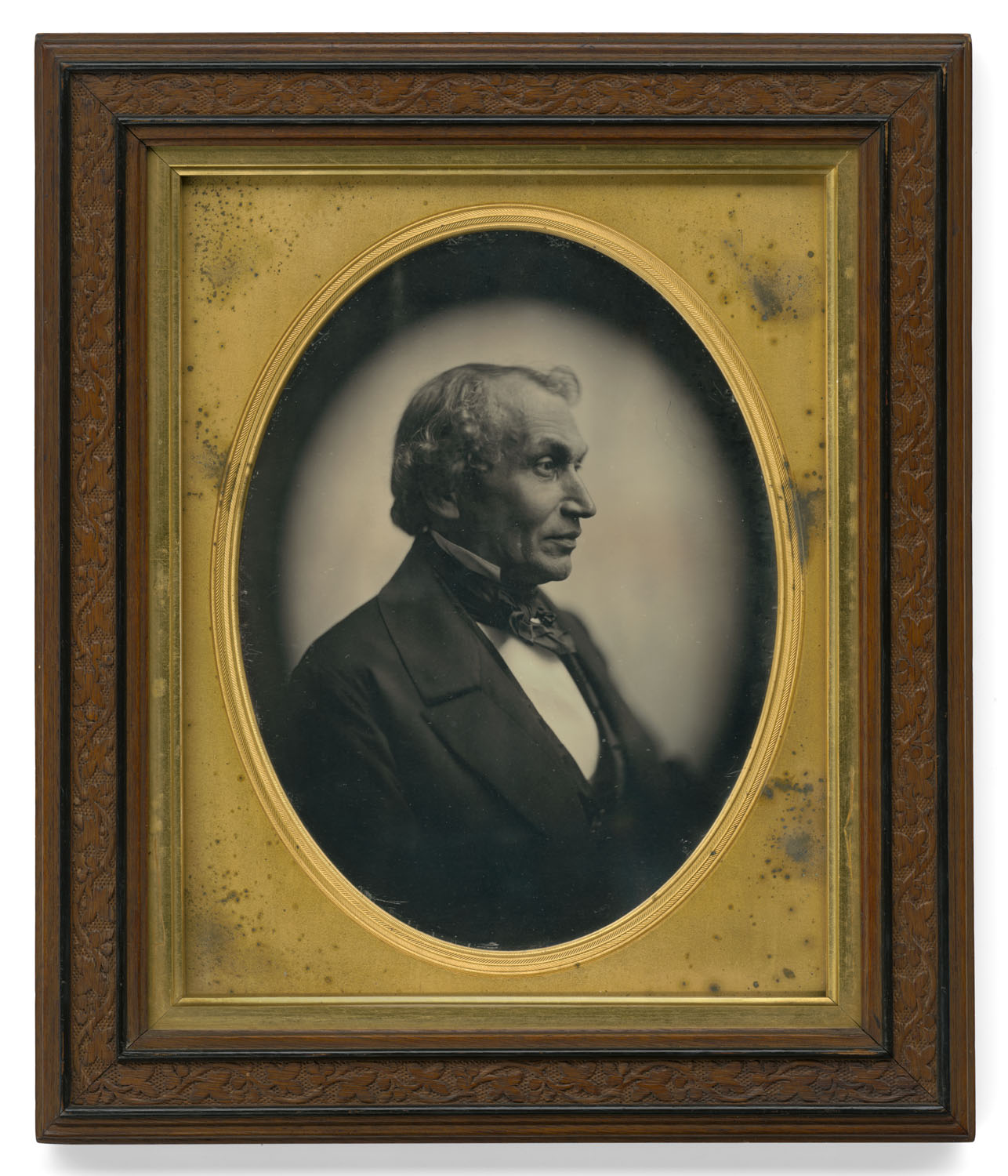
Southworth & Hawes (active 1843-1862) Albert Sands Southworth (American, 1811-1894) Josiah Johnson Hawes (American, 1808-1901) 'Jonas Chickering, 5 Apr 1798 - 8 Dec 1853' 1853


Southworth & Hawes (active 1843-1862)
Albert Sands Southworth (American, 1811-1894)
Josiah Johnson Hawes (American, 1808-1901)
Jonas Chickering, 5 Apr 1798 – 8 Dec 1853
1853
Whole-plate daguerreotype
Image: 20 x 15cm (7 7/8 x 5 7/8″)
Frame: 31.1 x 25.7 x 2.5cm (12 1/4 x 10 1/8 x 1″)
National Portrait Gallery, Smithsonian Institution


Jonas Chickering, 5 Apr 1798 – 8 Dec 1853
Born Mason Village, New Hampshire

“The father of American piano making,” Jonas Chickering advanced the development of a one-piece, cast-iron frame that revolutionised piano construction. The result was an instrument that could withstand the tension exerted by its strings and resist extremes in temperature and humidity that impacted its ability to remain in tune. Chickering’s patented innovations also yielded pianos of greater volume and superior resonance. Honoured at the 1851 Crystal Palace exhibition in London, his pianos became the instruments of choice in U.S. and international concert halls.

When he posed for this portrait by Boston’s premier daguerreotypists, Chickering was at the zenith of his career.

Text from the National Portrait Gallery website
 

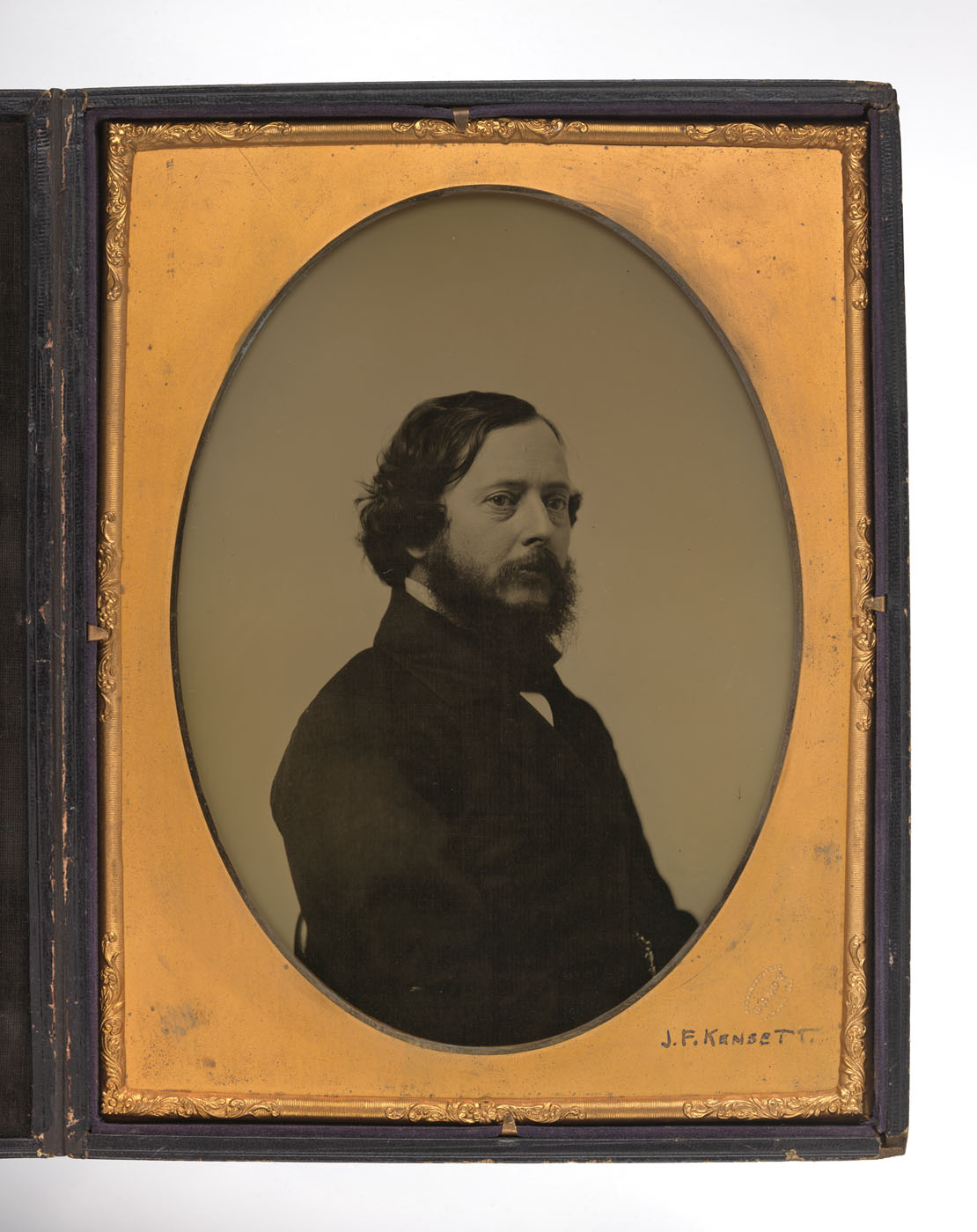
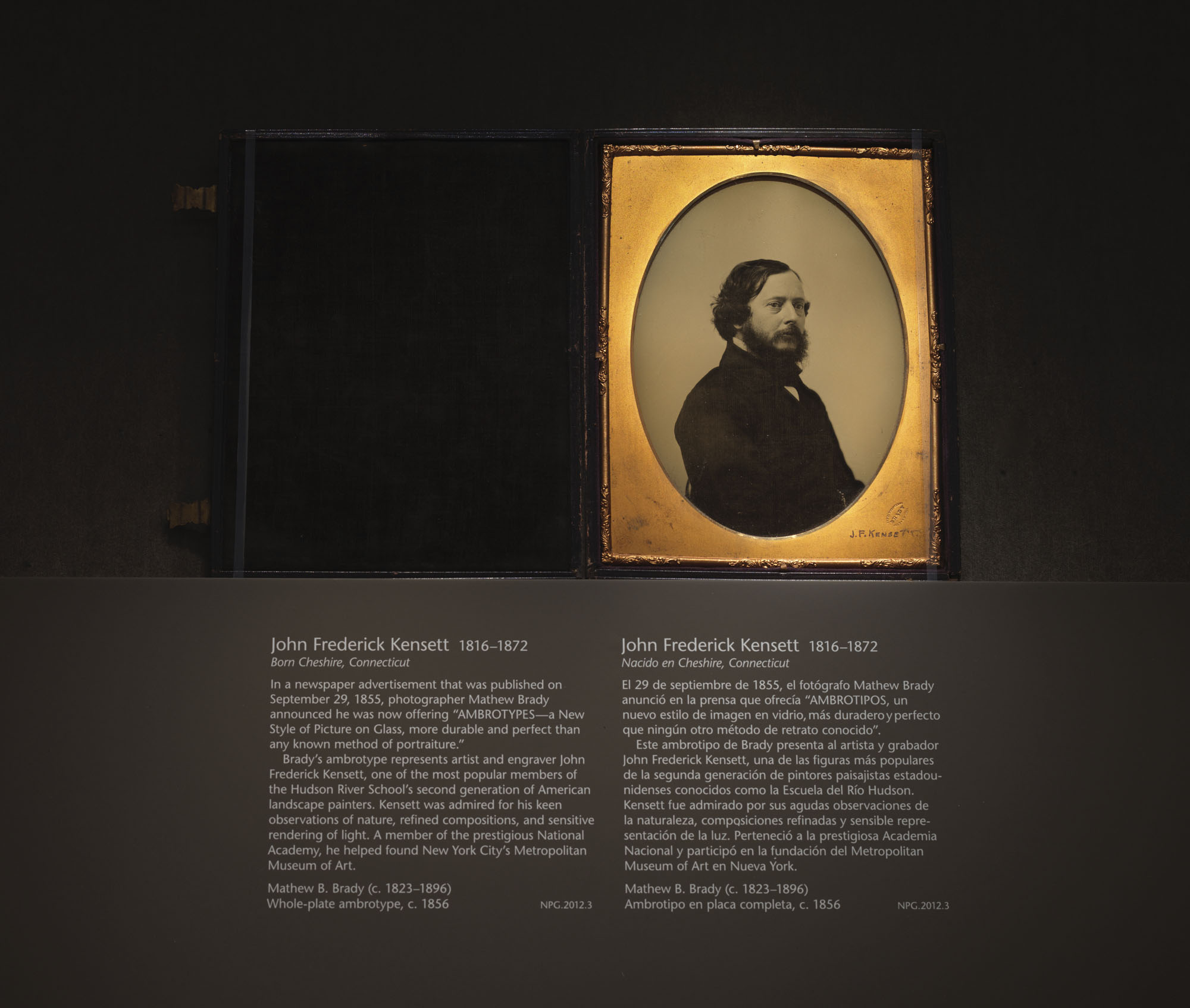
Installation view of the exhibition 'From Shadow to Substance: Grand-Scale Portraits During Photography's Formative Years' at the National Portrait Gallery, Washington, June 20, 2025 - June 7, 2026 showing Mathew B. Brady's 'John Frederick Kensett 1816-1872' c. 1856


Installation view of the exhibition From Shadow to Substance: Grand-Scale Portraits During Photography’s Formative Years at the National Portrait Gallery, Washington, June 20, 2025 – June 7, 2026 showing Mathew B. Brady’s John Frederick Kensett 1816-1872 c. 1856 (below)


Mathew B. Brady (American, 1822-1896) 'John Frederick Kensett, 22 Mar 1816 - 15 Dec 1872' c. 1856


Mathew B. Brady (American, 1822-1896)
John Frederick Kensett, 22 Mar 1816 – 15 Dec 1872
c. 1856
Whole-plate ambrotype
Image: 18.4 x 13.2cm (7 1/4 x 5 3/16″)
Case Open: 23 x 36.4cm (9 1/16 x 14 5/16″)
Case Closed: 23 x 18.4cm (9 1/16 x 7 1/4″)
National Portrait Gallery, Smithsonian Institution


John Frederick Kensett, 22 Mar 1816 – 15 Dec 1872
Born Cheshire, Connecticut

In a newspaper advertisement that was published on September 29, 1855, photographer Mathew Brady announced he was now offering “AMBROTYPES – a New Style of Picture on Glass, more durable and perfect than any known method of portraiture.”

Brady’s ambrotype represents artist and engraver John Frederick Kensett, one of the most popular members of the Hudson River School’s second generation of American landscape painters. Kensett was admired for his keen observations of nature, refined compositions, and sensitive rendering of light. A member of the prestigious National Academy, he helped found New York City’s Metropolitan Museum of Art.

Text from the National Portrait Gallery website


National Portrait Gallery Presents “From Shadow to Substance: Grand-Scale Portraits During Photography’s Formative Years”

The Smithsonian’s National Portrait Gallery will present “From Shadow to Substance: Grand Scale Portraits During Photography’s Formative Years” June 20 through June 7, 2026. Drawing from the museum’s extensive early photography collection, this exhibition traces the evolution of the grand scale, whole-plate portrait format from the high-end daguerreotype and mid-range ambrotype to the more affordable tintype. The exhibition is curated by Senior Curator of Photographs Ann Shumard.

Photographers seeking customers during the medium’s early years, from 1840 to 1860, often urged the public to “Secure the shadow ere the substance fade.” Hinting at life’s fragility, this tagline underscored photography’s ability to capture a fleeting likeness and preserve it for posterity. Portraits in the impressive whole-plate format – measuring 8 1/2 by 6 1/2 inches – were among the premier offerings of the nation’s leading photographic studios.

“This exhibition marks the first time these whole-plate daguerreotype, ambrotype and tintype portraits will be shown together at the Portrait Gallery,” Shumard said. Examples of whole plates in each of these mediums illustrate how the format evolved as new photographic processes were introduced. Featured works include daguerreotypes representing U.S. Senators Daniel Webster and John C. Calhoun, an ambrotype portrait of American landscape artist John Frederick Kensett and a tintype likeness of an unidentified African American woman. Also included are original advertisements issued by photographers Albert Sands Southworth and Josiah Johnson Hawes, and Mathew B. Brady to promote their respective businesses. The exhibition will be presented in the Early Photography Alcove on the museum’s first floor.

Press release from the National Portrait Gallery


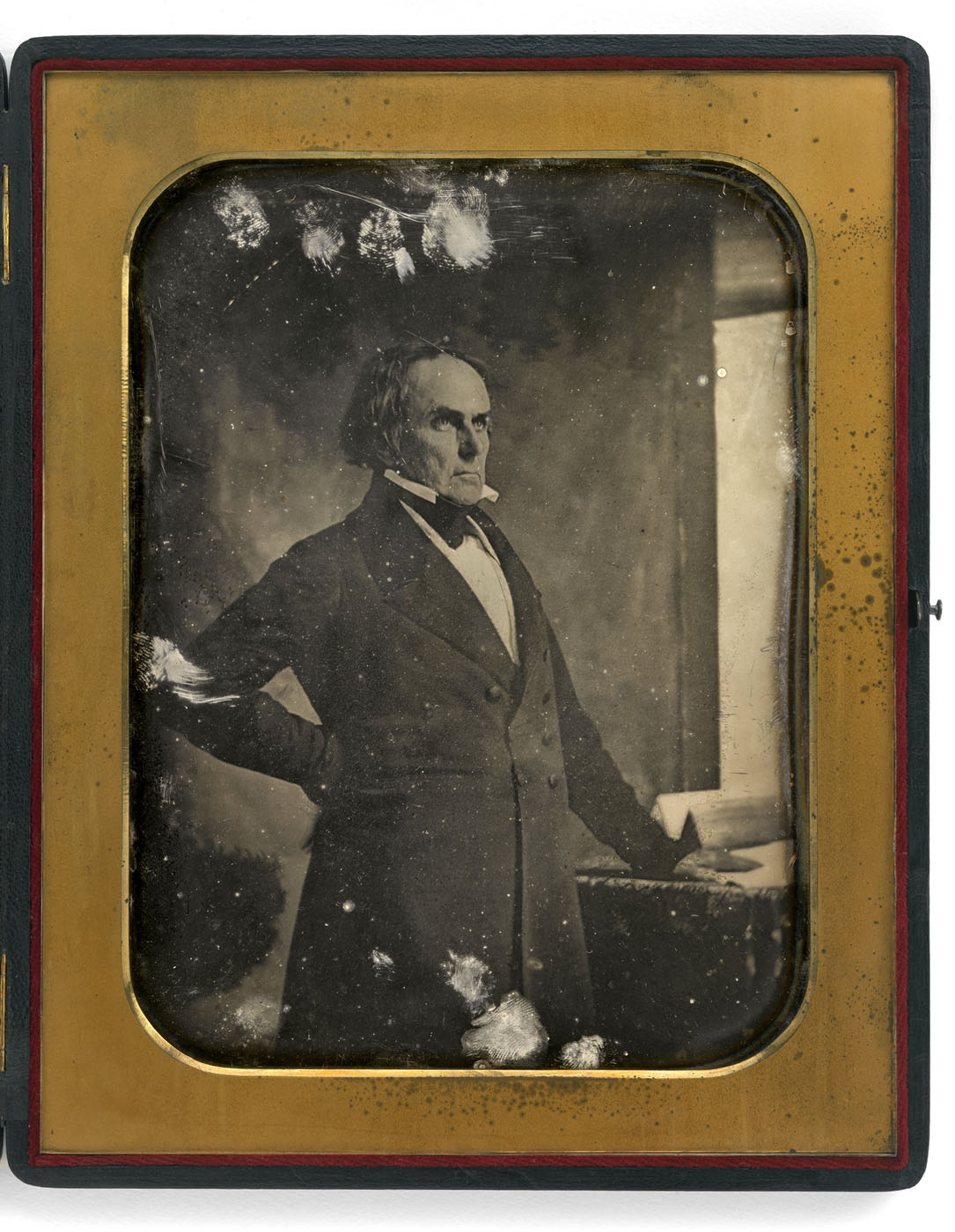
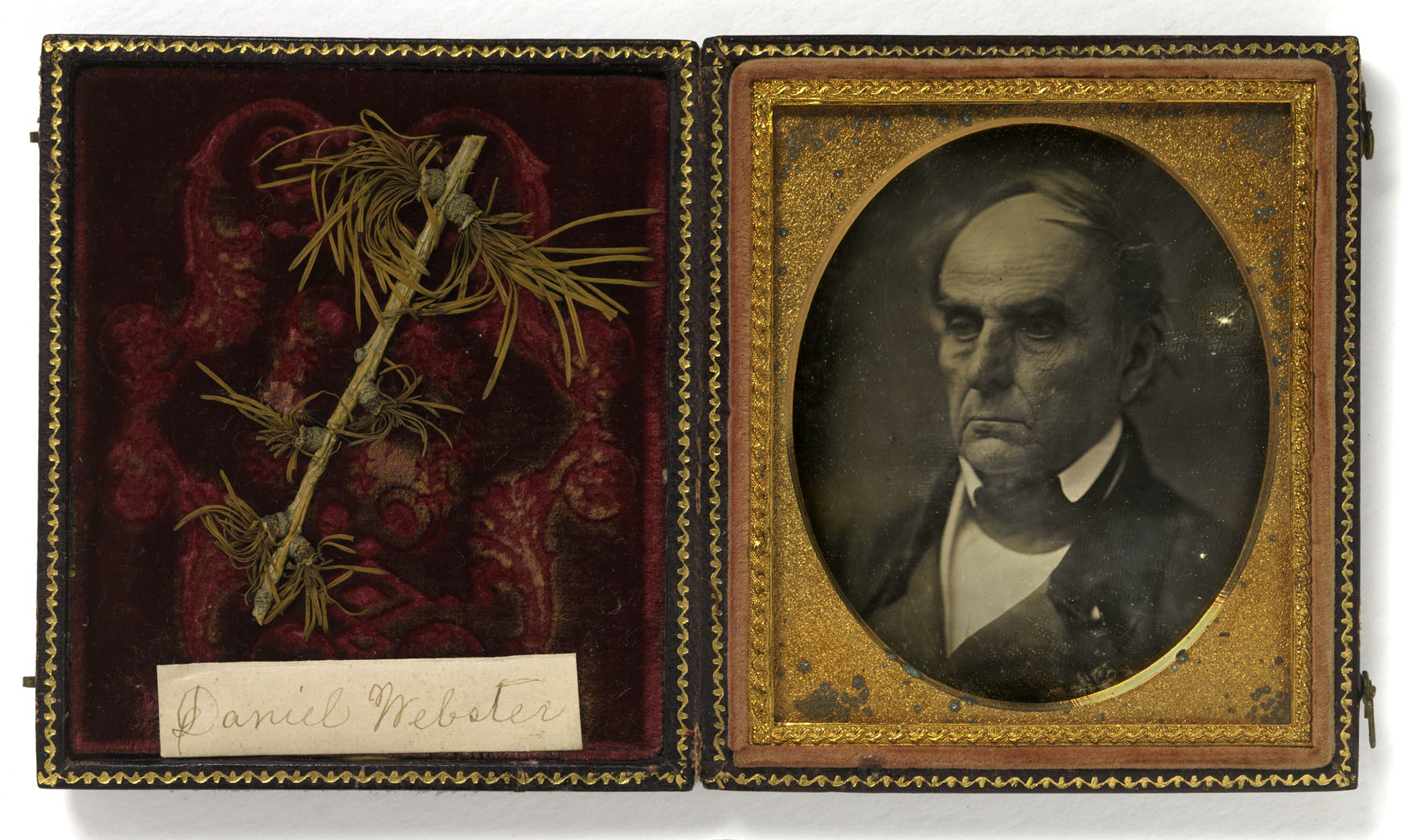
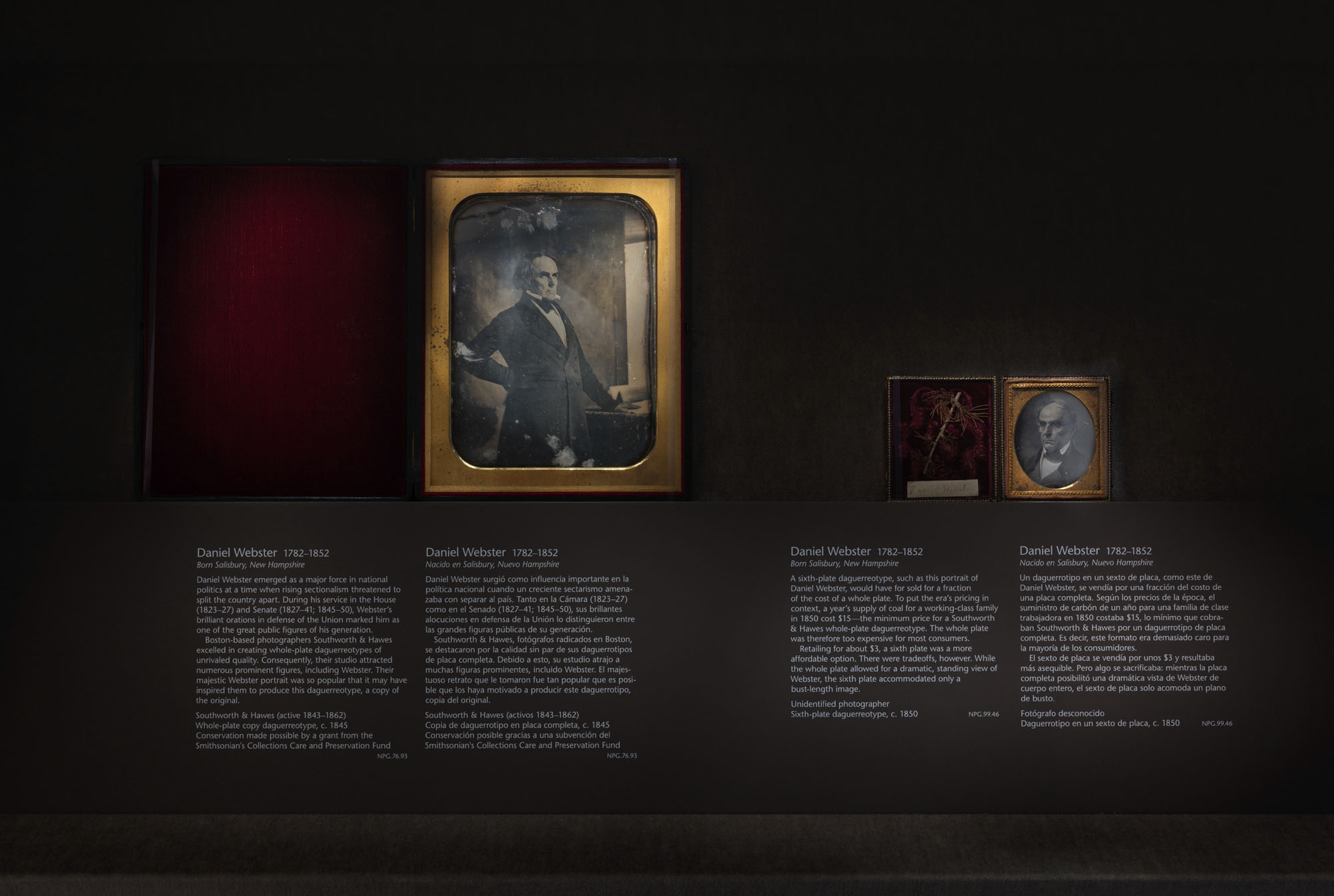
Installation view of the exhibition 'From Shadow to Substance: Grand-Scale Portraits During Photography's Formative Years' at the National Portrait Gallery, Washington, June 20, 2025 - June 7, 2026 showing at left, Southworth & Hawes' 'Daniel Webster 1782-1852' c. 1845; and at right, Unidentified photographer 'Daniel Webster 1782-1852' c. 1850


Installation view of the exhibition From Shadow to Substance: Grand-Scale Portraits During Photography’s Formative Years at the National Portrait Gallery, Washington, June 20, 2025 – June 7, 2026 showing at left, Southworth & Hawes’ Daniel Webster 1782-1852 c. 1845; and at right, Unidentified photographer Daniel Webster 1782-1852 c. 1850


Southworth & Hawes (active 1843-1862) 'Daniel Webster 1782-1852' c. 1845


Southworth & Hawes (active 1843-1862)
Albert Sands Southworth (American, 1811-1894)
Josiah Johnson Hawes (American, 1808-1901)
Daniel Webster 1782-1852
c. 1845
Whole plate copy daguerreotype
National Portrait Gallery, Smithsonian Institution
Conservation made possible by a grant from the Smithsonian’s Collections Care and Preservation Fund


Daniel Webster 1782-1852
Born Salisbury, New Hampshire

Daniel Webster emerged as a major force in national politics at a time when rising sectionalism threatened to split the country apart. During his service in the House (1823-1827) and Senate (1827-1841; 1845-1850), Webster’s brilliant orations in defence of the Union marked him as one of the great public figures of his generation.

Boston-based photographers Southworth & Hawes excelled in creating whole-plate daguerreotypes of unrivalled quality. Consequently, their studio attracted numerous prominent figures, including Webster. Their majestic Webster portrait was so popular that it may have inspired them to produce this daguerreotype, a copy of the original.

Text from the National Portrait Gallery website
 

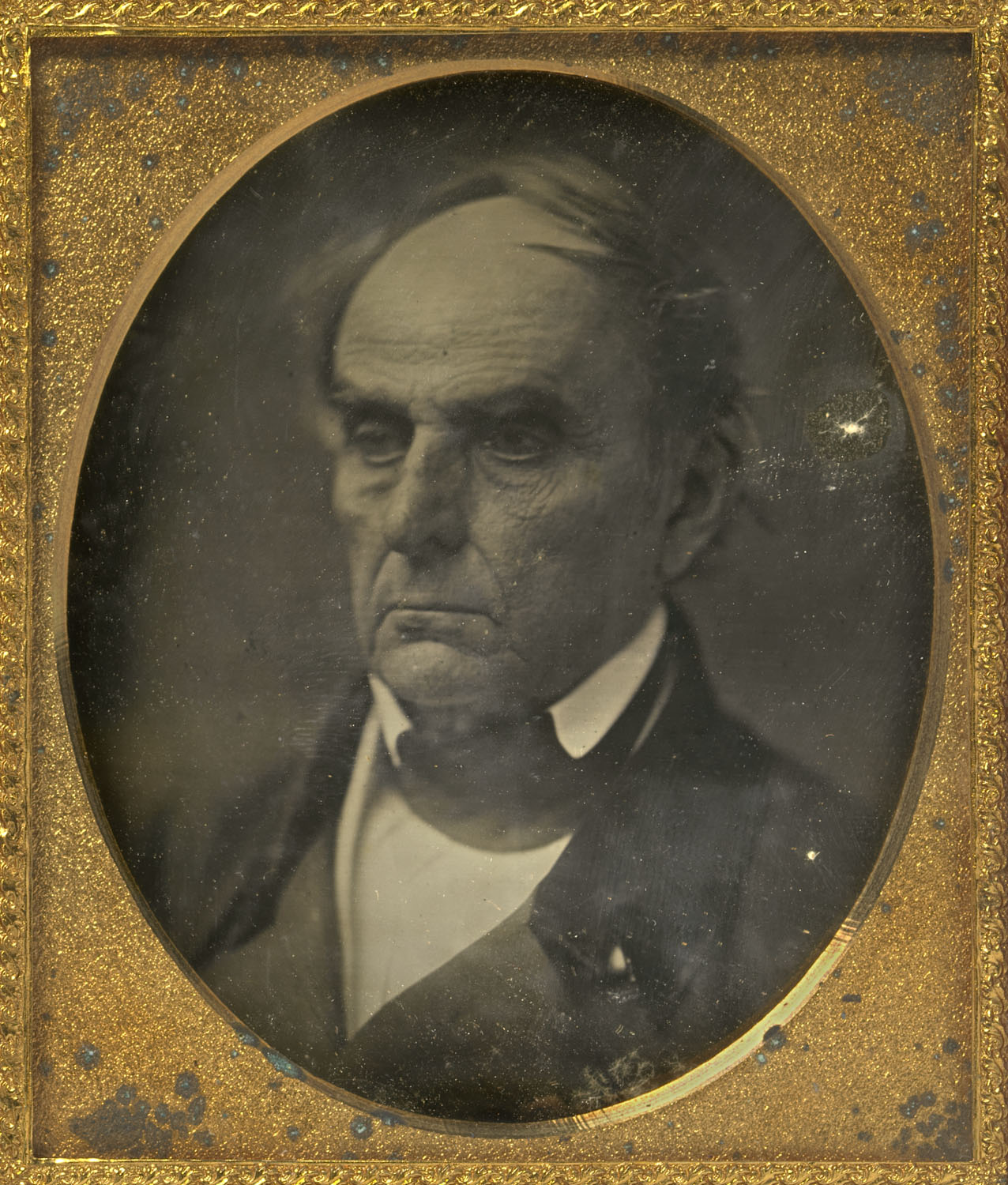
Unidentified photographer. 'Daniel Webster 1782-1852' c. 1850


Unidentified photographer
Daniel Webster 1782-1852
c. 1850
Sixth-plate daguerreotype
National Portrait Gallery, Smithsonian Institution


A sixth-plate daguerreotype such as this portrait of Daniel Webster, would have sold for a fraction of the cost of a whole plate. To put the era’s pricing in context, a year’s supply of coal for a working-class family in 1850 cost $15 – the minimum price for a Southworth & Hawes whole-plate daguerreotype. The whole plate was therefore too expensive for most consumers.

Retailing for about $3, a sixth-plate was a more affordable option. There were tradeoffs, however. While the whole plate allowed for a dramatic, standing view of Webster, the Sith-plate accommodated only a bust-length image.

In a period when American federalism faced increasing challenges from states’-rights supporters, Daniel Webster emerged as one of the Union’s most eloquent defenders. Having gained acclaim as a lawyer who argued some of the young republic’s pivotal Supreme Court cases, Webster became a major force in national politics through his service in the House and in the Senate. There, his brilliant orations on behalf of the indivisibility of the Union marked him as one of the greatest public figures of his generation. Despite his national stature, Webster fell short of mustering the broad support that might have won him the presidency.

This daguerreotype represents Webster around the time of his controversial endorsement of the Compromise of 1850. In supporting the measure, Webster sought to preserve the Union through concession and compromise but succeeded principally in incurring the wrath of his northern constituents, who abhorred the legislation’s Fugitive Slave Act. Although attacks from his critics left Webster shaken and burdened by “the crushing weight of anxiety and responsibility,” he soldiered on until a liver ailment claimed his life in October 1852. The evergreen sprig preserved with this daguerreotype serves as a reminder of Webster’s endurance as a symbol and an icon in American history.

Text from the National Portrait Gallery website
 

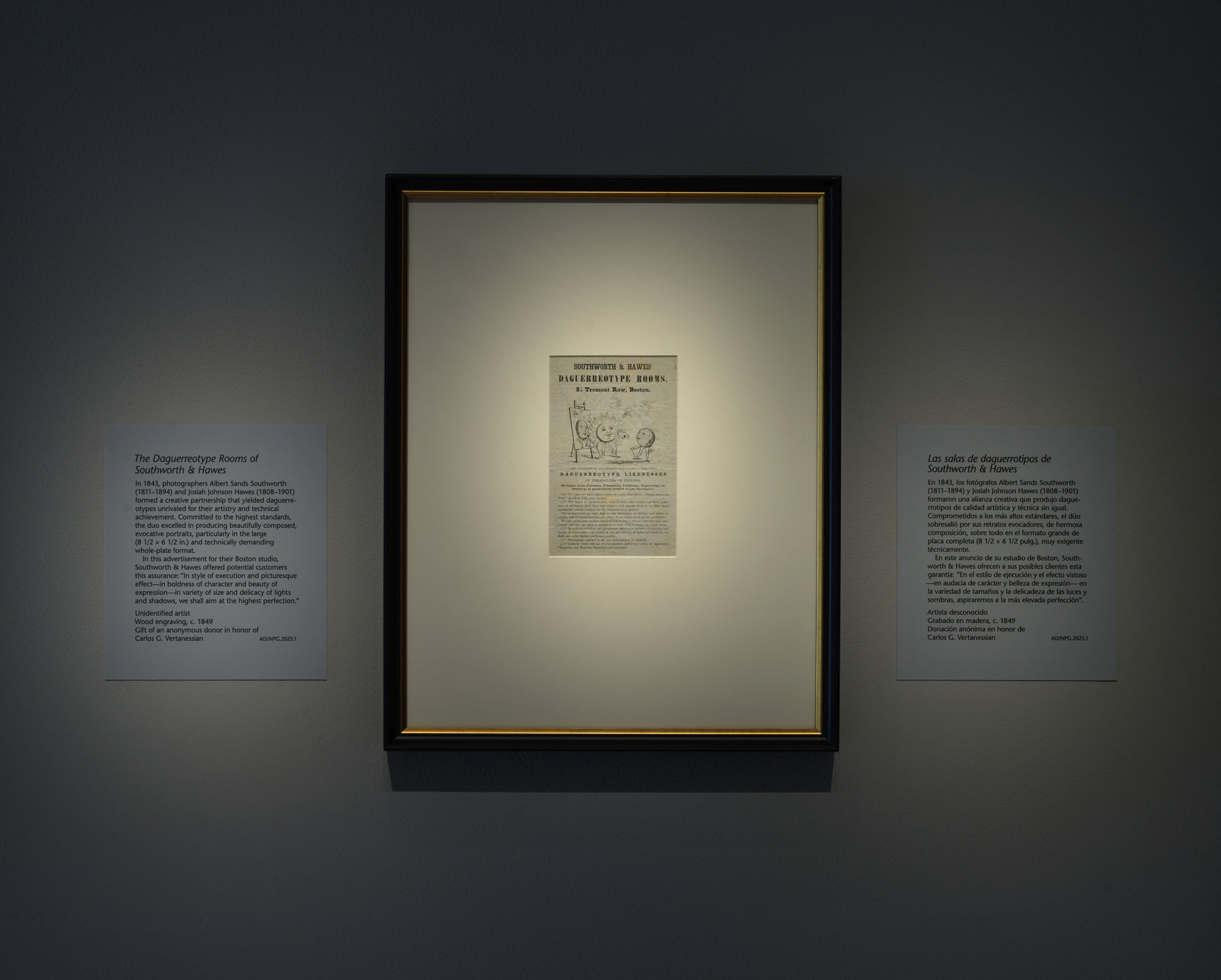
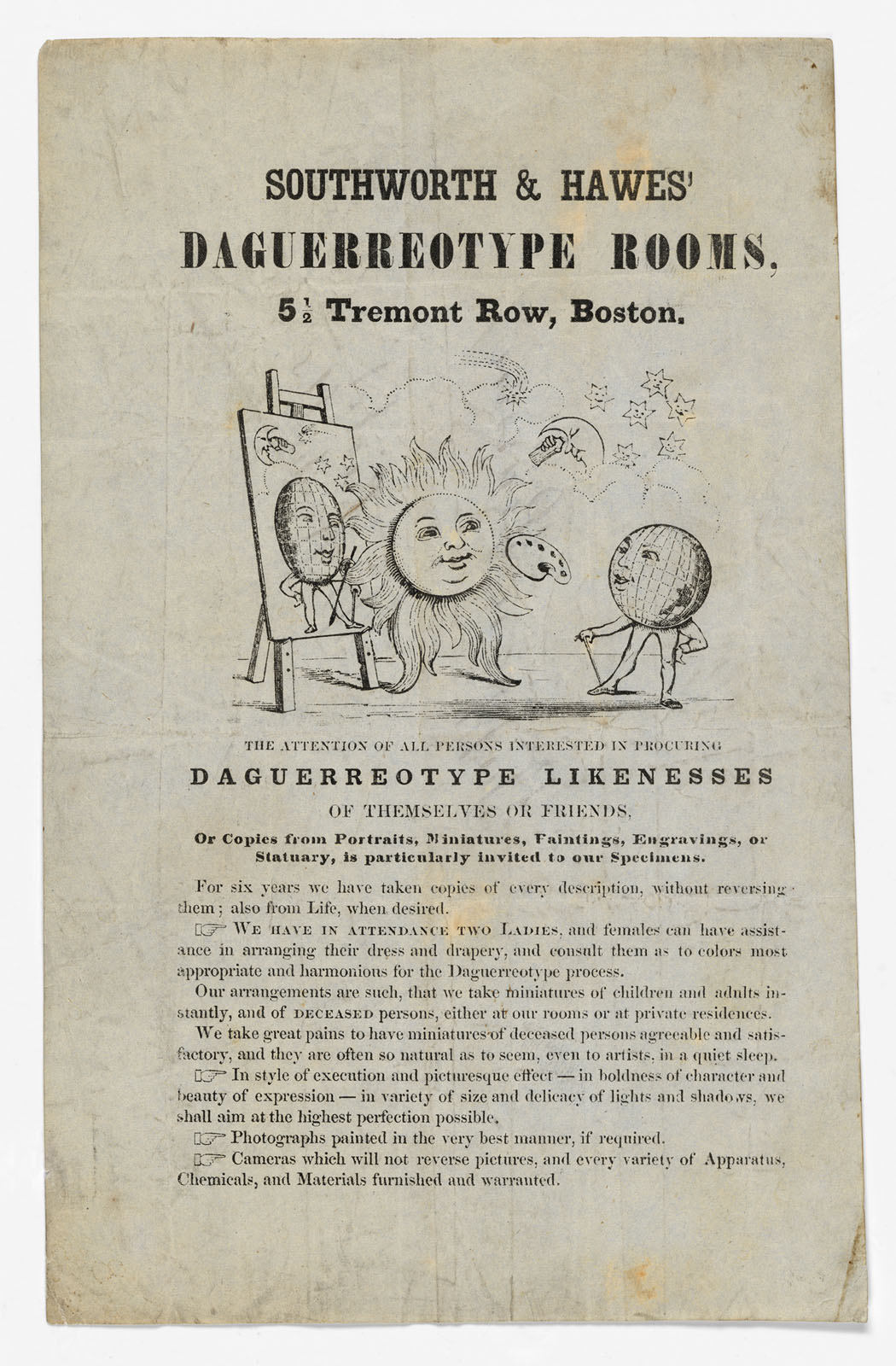
Installation view of the exhibition 'From Shadow to Substance: Grand-Scale Portraits During Photography's Formative Years' at the National Portrait Gallery, Washington, June 20, 2025 - June 7, 2026 showing a wood engraving by an unidentified artist of 'Southworth & Hawes' Daguerreotype Rooms' c. 1849


Installation view of the exhibition From Shadow to Substance: Grand-Scale Portraits During Photography’s Formative Years at the National Portrait Gallery, Washington, June 20, 2025 – June 7, 2026 showing a wood engraving by an unidentified artist of Southworth & Hawes’ Daguerreotype Rooms c. 1849 (below)


Unidentified Artist. 'Southworth & Hawes' Daguerreotype Rooms' c. 1849


Unidentified Artist
Southworth & Hawes’ Daguerreotype Rooms
c. 1849
Wood engraving
20 x 12.7cm (7 7/8 x 5″)
National Portrait Gallery, Smithsonian Institution
Gift of an anonymous donor in honour of Carlos G. Vertanssian


In 1843, photographer Albert Sands Southworth (1811-1894) and Josiah Johnson Hawes (1808-1901) formed a creative partnership that yielded daguerreotypes unrivalled for their artistry and technical achievement. Committed to the highest standards, the duo excelled in producing beautiful composed, evocative portraits, particularly in the large (8 1/2 x 6 1/2 in.) and technically demanding whole-plate format.

In this advertisement for their Boston studio, Southworth & Hawes offered potential customers the assurance: ‘In style of execution and picturesque effect – in boldness of character and beauty of expression – in variety of size and delicacy of lights and shadows, we shall aim at the highest perfection’.

Text from the National Portrait Gallery website


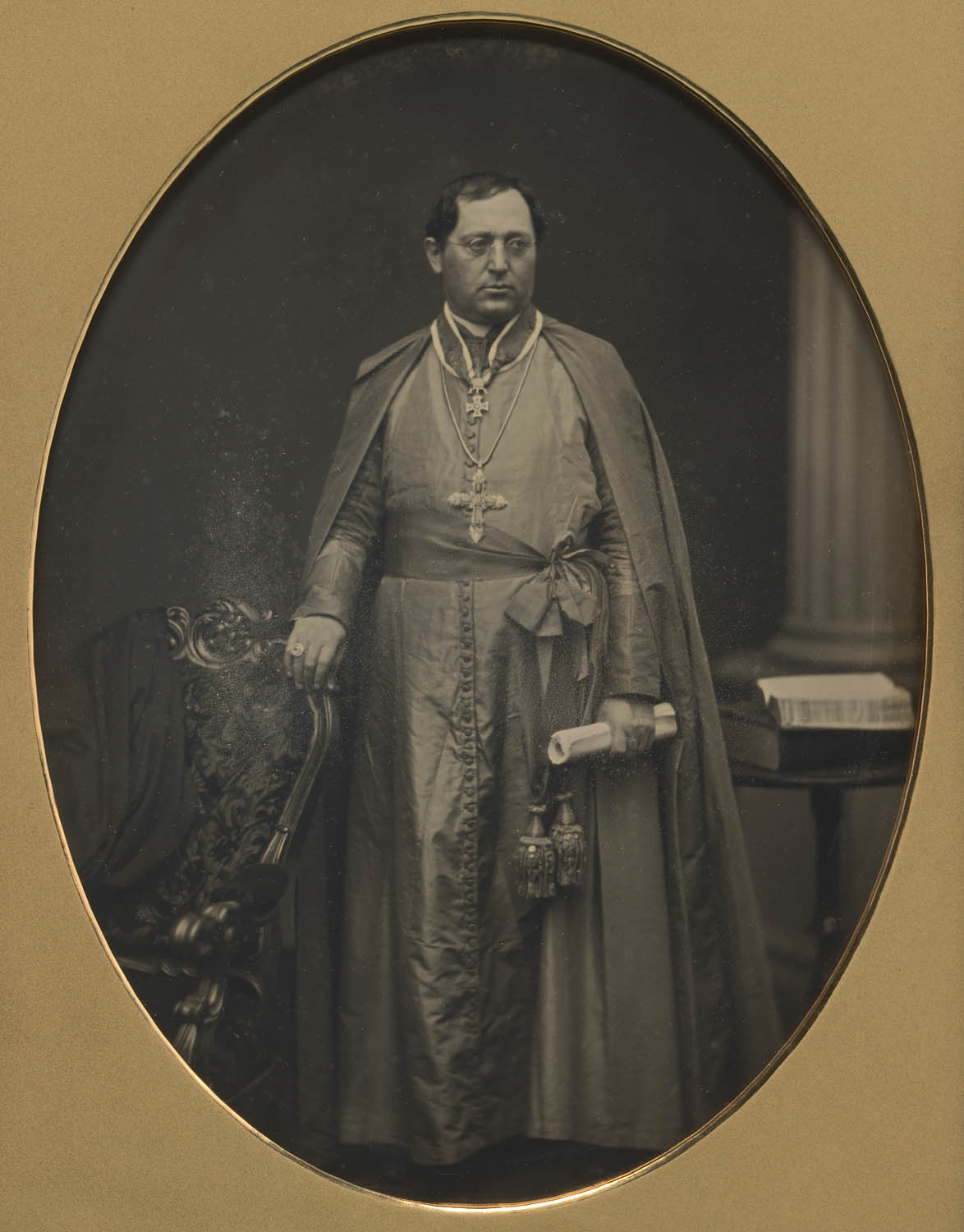
Southworth & Hawes (active 1843-1862) Albert Sands Southworth (American, 1811-1894) Josiah Johnson Hawes (American, 1808-1901) 'Gaetano Bedini, 1806-1864' 1853


Southworth & Hawes (active 1843-1862)
Albert Sands Southworth (American, 1811-1894)
Josiah Johnson Hawes (American, 1808-1901)
Gaetano Bedini, 1806-1864
1853
Whole-plate daguerreotype
Image: 20 x 15cm (7 7/8 x 5 7/8″)
Case Open: 25.4 x 40.8 x 1cm (10 x 16 1/16 x 3/8″)
Case Closed: 23.1 x 18.1 x 1.7cm (9 1/8 x 7 1/8 x 11/16″)
National Portrait Gallery, Smithsonian Institution
Transfer from the Archives of American Art, Smithsonian Institution. Conservation made possible by a grant from the Smithsonian’s Collections Care and Preservation Fund


Gaetano Bedini, 1806-1864
Born Sinigaglia, Italy

In 1853, Italian archbishop Gaetano Bedini travelled to the United States at the request of Pope Pius IX to assess the condition of the Catholic Church in North America and to study the possibility of establishing a papal mission in Washington, D.C. Bedini’s multi-month, fact-finding tour coincided with an intense wave of anti-Catholic, anti-immigrant feeling fanned by the newly ascendant American (or Know-Nothing) Party. In several cities, his presence sparked hostile demonstrations. Upon returning to the Vatican, Bedini advocated successfully for the creation of a North American College in Rome to prepare Roman Catholic clergy for service in the United States.

Text from the National Portrait Gallery website


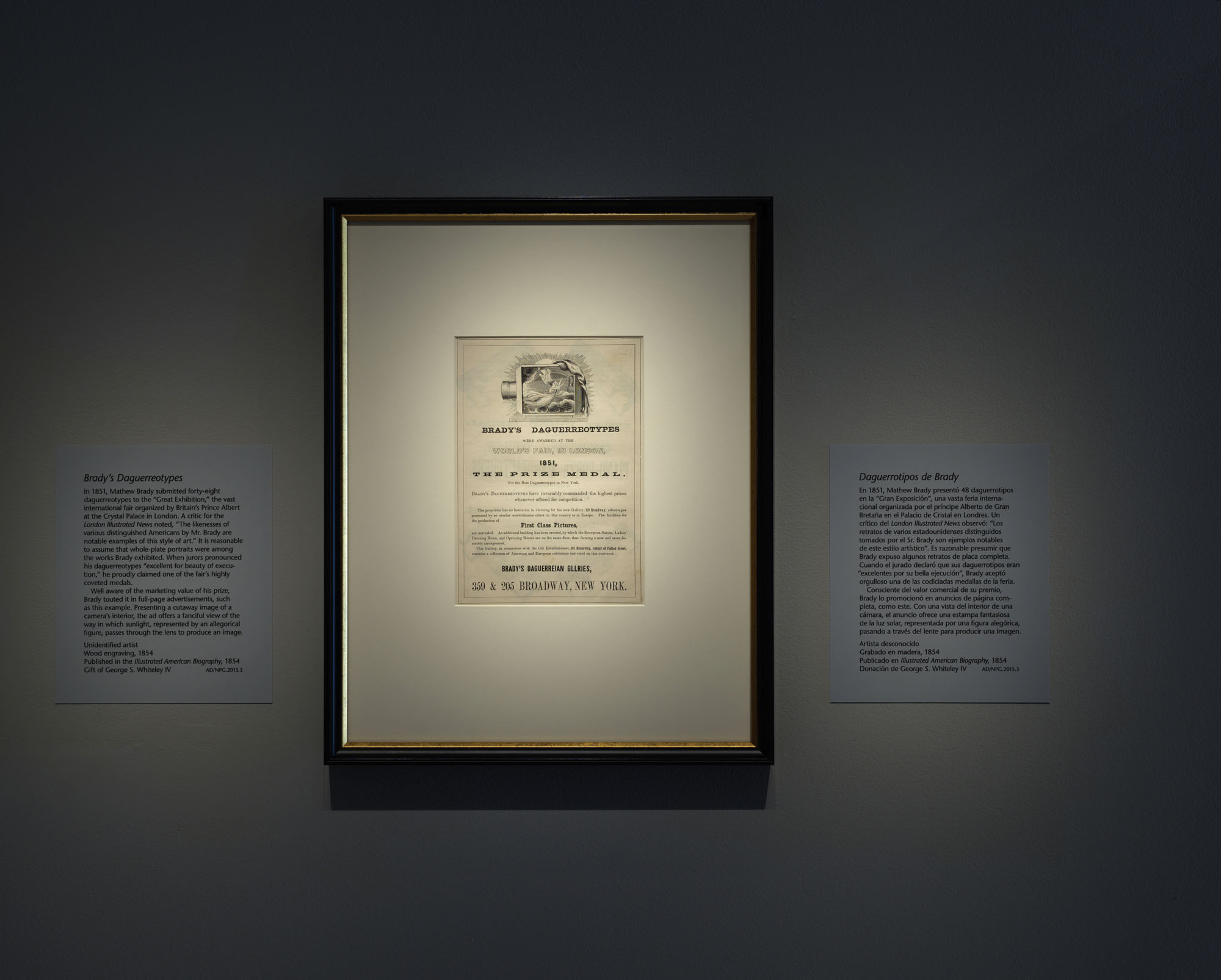
Installation view of the exhibition 'From Shadow to Substance: Grand-Scale Portraits During Photography's Formative Years' at the National Portrait Gallery, Washington, June 20, 2025 - June 7, 2026 showing a wood engraving by an unidentified artist 'Brady's Daguerreotypes' 1854


Installation view of the exhibition From Shadow to Substance: Grand-Scale Portraits During Photography’s Formative Years at the National Portrait Gallery, Washington, June 20, 2025 – June 7, 2026 showing a wood engraving by an unidentified artist of Brady’s Daguerreotypes 1854 (below)


Unidentified Artist. 'Brady's Daguerreotypes' 1854


Unidentified Artist
Brady’s Daguerreotypes
1854
Wood engraving on paper
Image: 21.8 x 14.8cm (8 9/16 x 5 13/16″)
Sheet: 24 x 18.6cm (9 7/16 x 7 5/16″)
Mat: 45.8 x 35.6cm (18 1/16 x 14″)
Published in the Illustrated American Biography, 1854
National Portrait Gallery, Smithsonian Institution
Gift of George S. Whiteley IV


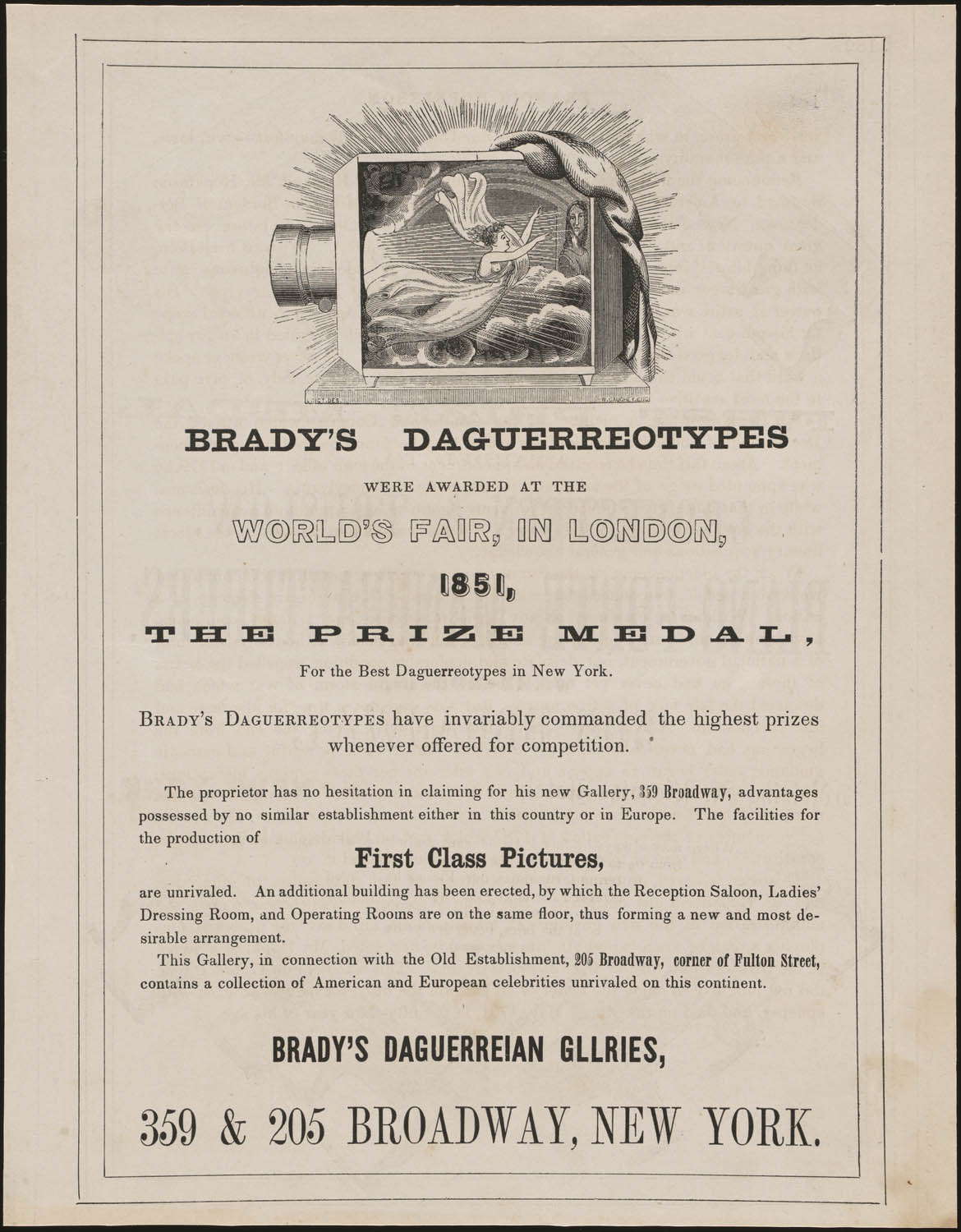
Mathew Brady placed this full-page advertisement in the Illustrated American Biography, a publication that marketed itself as a biographical volume but was actually a glorified business directory. With its cutaway image of a camera, Brady’s ad presents a fanciful view of the process by which sunlight passes through the camera’s lens to produce an image.

In 1851, Mathew Brady submitted forty-eight daguerreotypes to the “Great Exhibition,” the vast international fair organised by Britain’s Prince Albert at the Crystal Palace in London. A critic for the London Illustrated News noted, “The likenesses of various distinguished Americans by Mr. Brady are notable examples of this style of art.” It is reasonable to assume that whole-plate portraits were among the works Brady exhibited. When jurors pronounced his daguerreotypes “excellent for beauty of execution,” he proudly claimed one of the fair’s highly coveted medals.

Well aware of the marketing value of his prize, Brady touted it in full-page advertisements, such as this example. Presenting a cutaway image of a camera’s interior, the ad offers a fanciful view of the way in which sunlight, represented by an allegorical figure, passes through the lens to produce an image.

Text from the National Portrait Gallery website


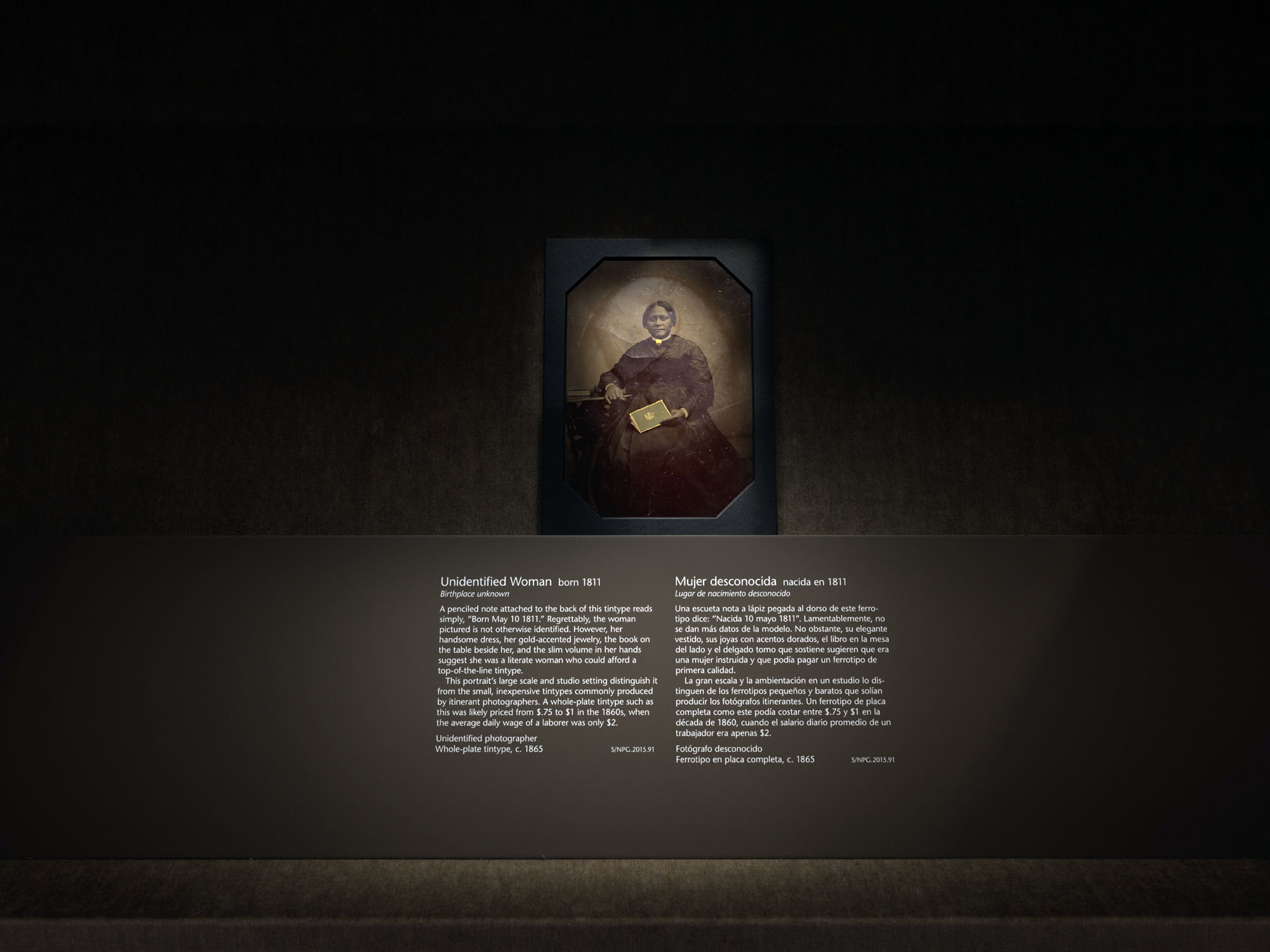
Installation view of the exhibition 'From Shadow to Substance: Grand-Scale Portraits During Photography's Formative Years' at the National Portrait Gallery, Washington, June 20, 2025 - June 7, 2026 showing a whole-plate tintype by an unidentified photographer of an 'Unidentified Woman' c. 1865


Installation view of the exhibition From Shadow to Substance: Grand-Scale Portraits During Photography’s Formative Years at the National Portrait Gallery, Washington, June 20, 2025 – June 7, 2026 showing a whole-plate tintype by an unidentified photographer of an Unidentified Woman c. 1865 (below)


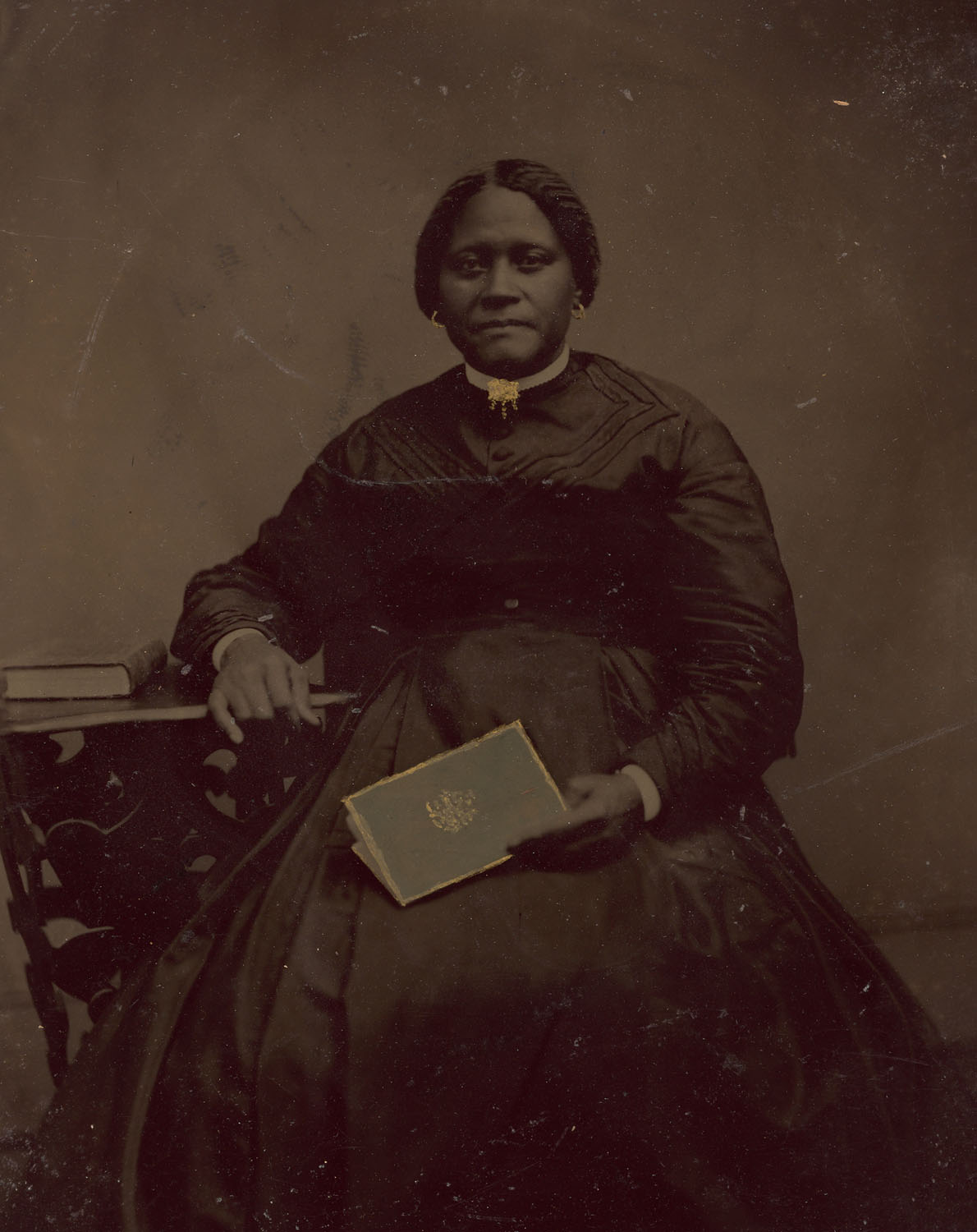
Unidentified photographer. 'Unidentified Woman' c. 1865


Unidentified photographer
Unidentified Woman
c. 1865
Whole-plate tintype
Image/Sheet: 21.6 x 15.2 cm (8 1/2 x 6″)
National Portrait Gallery, Smithsonian Institution


Unidentified Woman
Birthplace unknown

A penciled note attached to the back of this tintype reads simply, “Born May 10 1811.” Regrettably, the woman pictured is not otherwise identified. However, her handsome dress, her gold-accented jewelry, the book on the table beside her, and the slim volume in her hands suggest she was a literate woman who could afford a top-of-the-line tintype.

This portrait’s large scale and studio setting distinguish it from the small, inexpensive tintypes commonly produced by itinerant photographers. A whole-plate tintype such as this was likely priced from $.75 to $1 in the 1860s, when the average daily wage of a labourer was only $2.

Text from the National Portrait Gallery website


National Portrait Gallery
8th and F Sts NW
Washington, DC 20001

Opening hours:
11.30am – 7.00pm daily

National Portrait Gallery website

LIKE ART BLART ON FACEBOOK

Back to top


Exhibition: ‘Women of Progress: Early Camera Portraits’ at the Smithsonian National Portrait Gallery, Washington, DC

Exhibition dates: 14th June, 2019 – 31st May, 2020

Curator: Ann Shumard


Unidentified Artist. 'Charlotte Cushman' c. 1850 (detail) from the exhibition 'Women of Progress: Early Camera Portraits' at the Smithsonian National Portrait Gallery, Washington, DC, June 2019 - May 2020


Unidentified Artist
Charlotte Cushman (detail)
c. 1850
Half-plate daguerreotype
Image: 12 × 9cm (4 3/4 × 3 9/16″)
National Portrait Gallery, Smithsonian Institution


Let us celebrate strong, creative, (com)passionate women.

Marcus


Many thankx to the National Portrait Gallery for allowing me to publish the photographs in the posting. Please click on the photographs for a larger version of the image.


Seriousness of their intent and purpose writ large upon their faces. Portraits of the self, as if alone, without decorous engagement for the camera.


Elizabeth Gertsakis


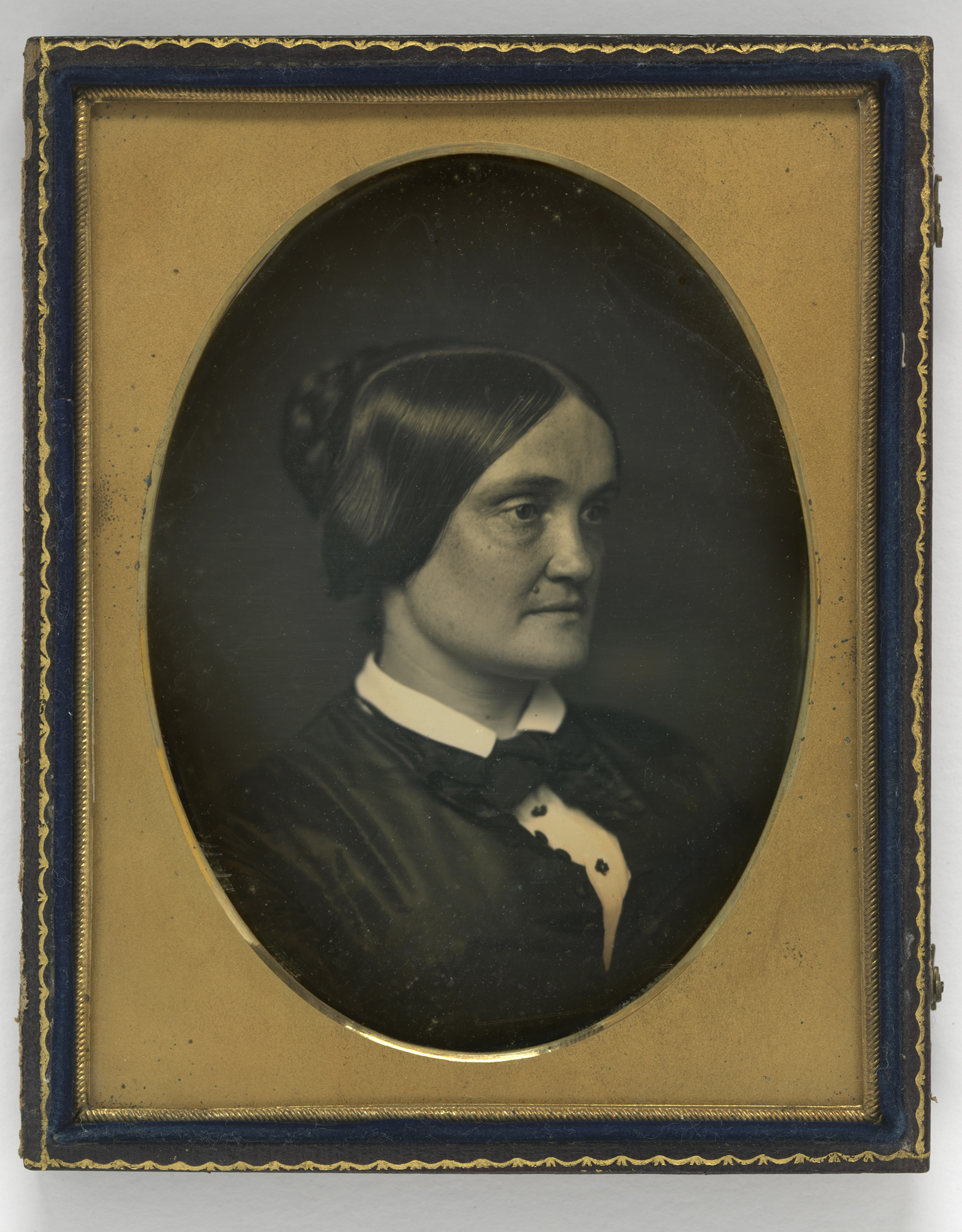
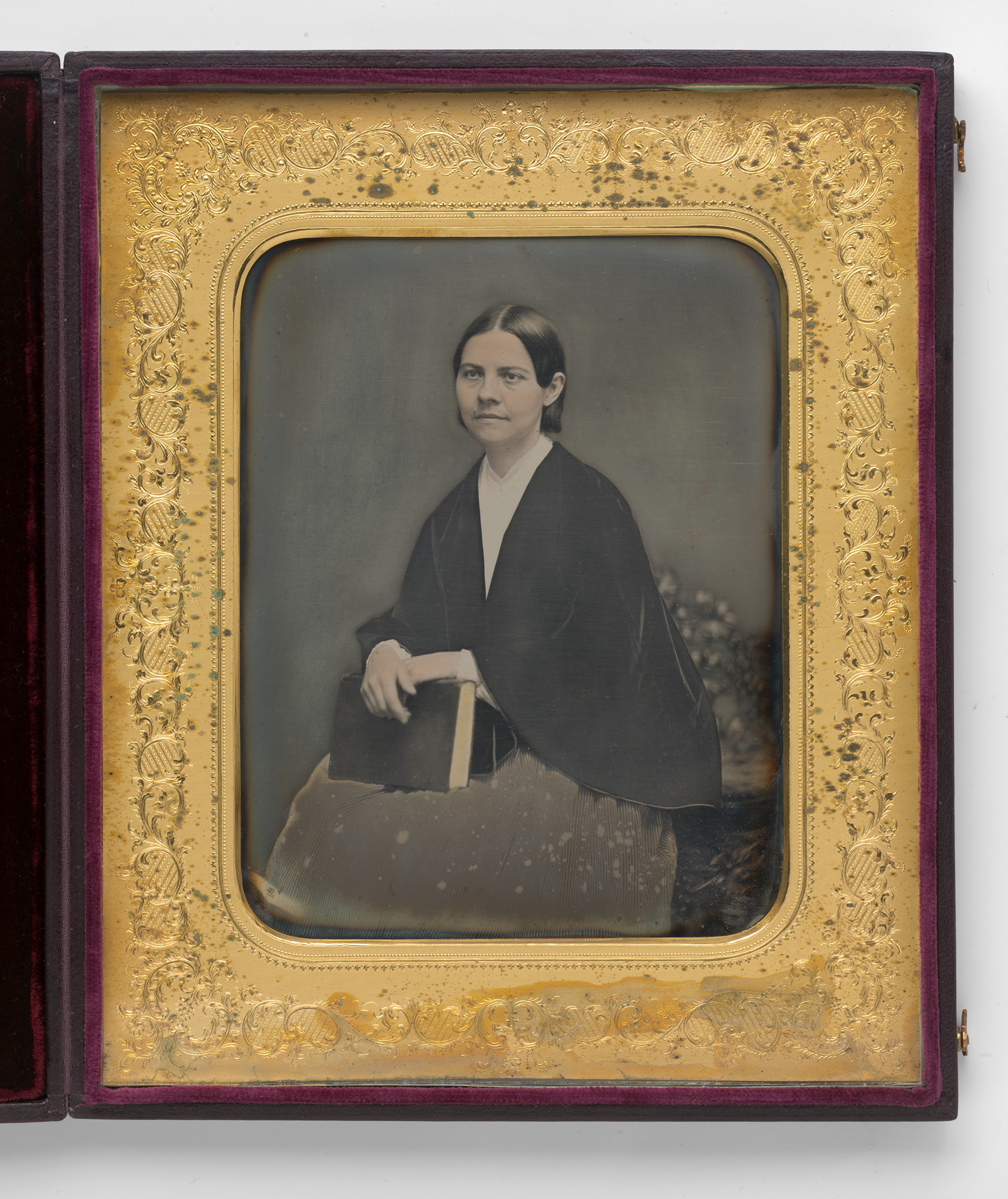
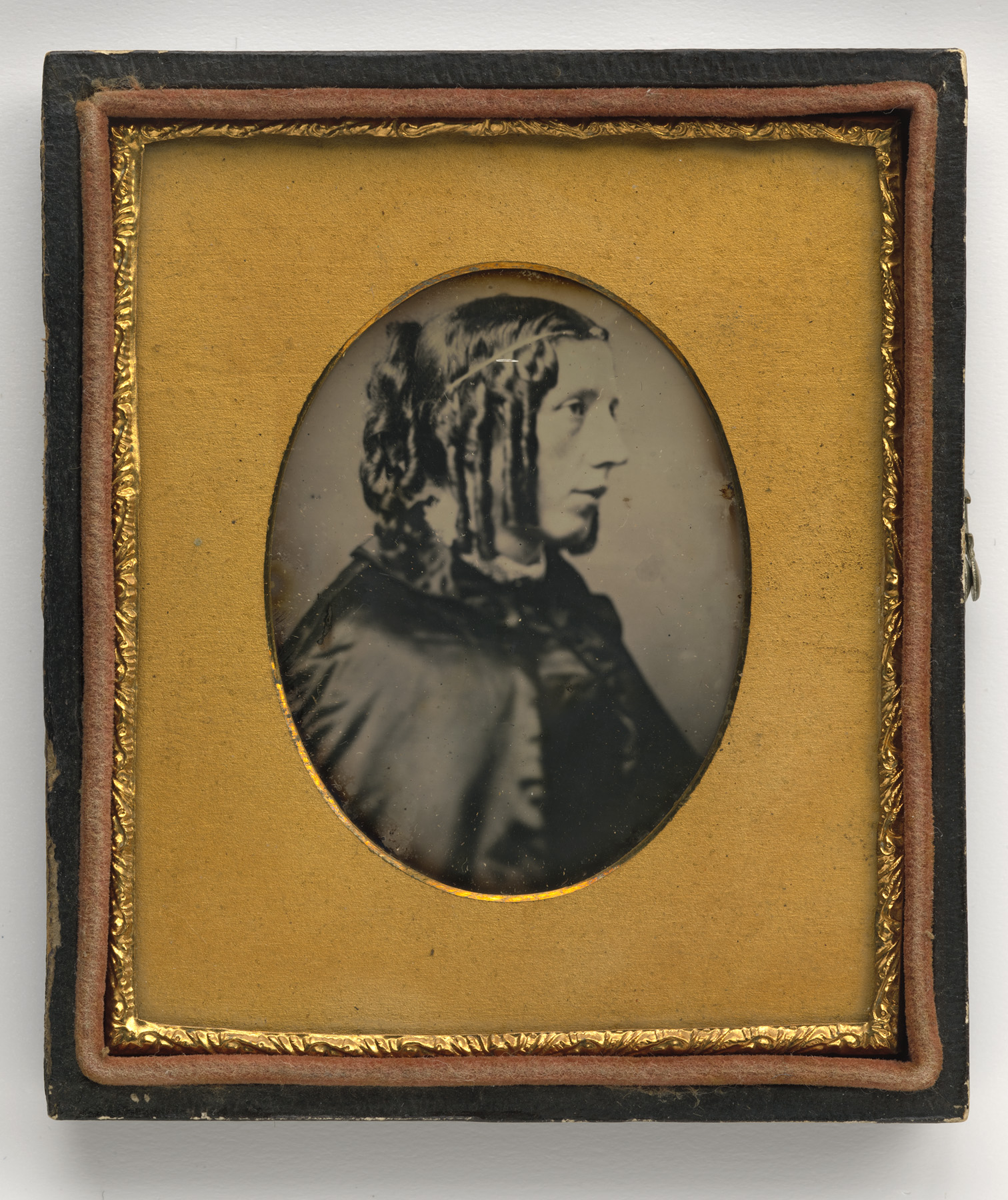
In mid-nineteenth-century America, the growing presence of women in public life coincided with the rise of portrait photography. This exhibition of daguerreotypes and ambrotypes from the 1840s and 1850s features portraits of early feminist icons, women’s rights advocates Margaret Fuller and Lucy Stone, abolitionist Lucretia Mott and best-selling author Harriet Beecher Stowe.


Unidentified Artist. 'Charlotte Cushman' c. 1850 from the exhibition 'Women of Progress: Early Camera Portraits' at the Smithsonian National Portrait Gallery, Washington, DC, June 2019 - May 2020


Unidentified Artist
Charlotte Cushman
c. 1850
Half-plate daguerreotype
Image: 12 × 9cm (4 3/4 × 3 9/16″)
National Portrait Gallery, Smithsonian Institution


Charlotte Saunders Cushman (July 23, 1816 – February 18, 1876) was an American stage actress. Her voice was noted for its full contralto register, and she was able to play both male and female parts. She lived intermittently in Rome, in an expatriate colony of prominent artists and sculptors, some of whom became part of her tempestuous private life.

Text from the Wikipedia website


Charlotte Cushman was the foremost American-born actress of her day and the first to enjoy critical and popular acclaim at home and abroad. Following her 1836 New York City stage debut as Lady Macbeth, she honed her craft there and in Philadelphia, where she managed the Walnut Street Theatre from 1842 to 1844. With a dramatic range and commanding stage presence that more than compensated for her lack of conventional beauty, Cushman boldly developed a repertoire that included male as well as female roles. Taking London by storm in 1845, she returned to universal acclaim in the United States in 1849.

Exhibition label from Smithsonian National Portrait Gallery website [Online] Cited 13/11/2019.


Unidentified Artist. 'Lucy Stone' c. 1855 from the exhibition 'Women of Progress: Early Camera Portraits' at the Smithsonian National Portrait Gallery, Washington, DC, June 2019 - May 2020


Unidentified Artist
Lucy Stone
c. 1855
Half-plate daguerreotype
Case Open: 19.9 × 32.9 × 0.8cm (7 13/16 × 12 15/16 × 5/16″)
National Portrait Gallery, Smithsonian Institution


Lucy Stone (August 13, 1818 – October 18, 1893) was a prominent U.S. orator, abolitionist, and suffragist, and a vocal advocate and organiser promoting rights for women. In 1847, Stone became the first woman from Massachusetts to earn a college degree. She spoke out for women’s rights and against slavery at a time when women were discouraged and prevented from public speaking. Stone was known for using her birth name after marriage, the custom being for women to take their husband’s surname.

Text from the Wikipedia website


Lucy Stone was unequivocal in her opposition to slavery and her support for women’s rights. Yet, when some abolitionists argued that her antislavery efforts should take precedence, she replied, “I was a woman before I was an abolitionist.” Stone helped to organise the first national women’s rights conference in Worcester, Massachusetts, in 1850, and lectured widely on the topic of women’s suffrage. When she married Henry Blackwell in 1855, she defied tradition by retaining her maiden name. In 1866, Stone became a founder of the American Equal Rights Association, which sought to secure voting rights for African Americans and women.

Exhibition label from Smithsonian National Portrait Gallery website [Online] Cited 13/11/2019.


Unidentified Artist. 'Harriet Beecher Stowe' 1852 from the exhibition 'Women of Progress: Early Camera Portraits' at the Smithsonian National Portrait Gallery, Washington, DC, June 2019 - May 2020


Unidentified Artist
Harriet Beecher Stowe
1852
Sixth-plate daguerreotype
Image: 3.9cm x 3.4cm (1 9/16″ x 1 5/16″)
National Portrait Gallery, Smithsonian Institution


Harriet Elisabeth Beecher Stowe (June 14, 1811 – July 1, 1896) was an American abolitionist and author. She came from the Beecher family, a famous religious family, and is best known for her novel Uncle Tom’s Cabin (1852), which depicts the harsh conditions for enslaved African Americans. The book reached millions as a novel and play, and became influential in the United States and Great Britain, energising anti-slavery forces in the American North, while provoking widespread anger in the South. Stowe wrote 30 books, including novels, three travel memoirs, and collections of articles and letters. She was influential for both her writings and her public stances and debates on social issues of the day.

Text from the Wikipedia website


Harriet Beecher Stowe authored numerous articles, essays, and books during her long career, but it was her dramatic, antislavery novel Uncle Tom’s Cabin that brought her fame at home and abroad. First serialised in the National Era newspaper, Uncle Tom’s Cabin appeared in book form in 1852 and sold more than 300,000 copies during its first year in print. Lionised by Northern abolitionists and vilified by Southern slaveholders, Stowe became the subject of intense public interest. When requests for her portrait multiplied, she responded by posing for several daguerreotype likenesses that were soon copied and distributed widely.

Exhibition label from Smithsonian National Portrait Gallery website [Online] Cited 13/11/2019.


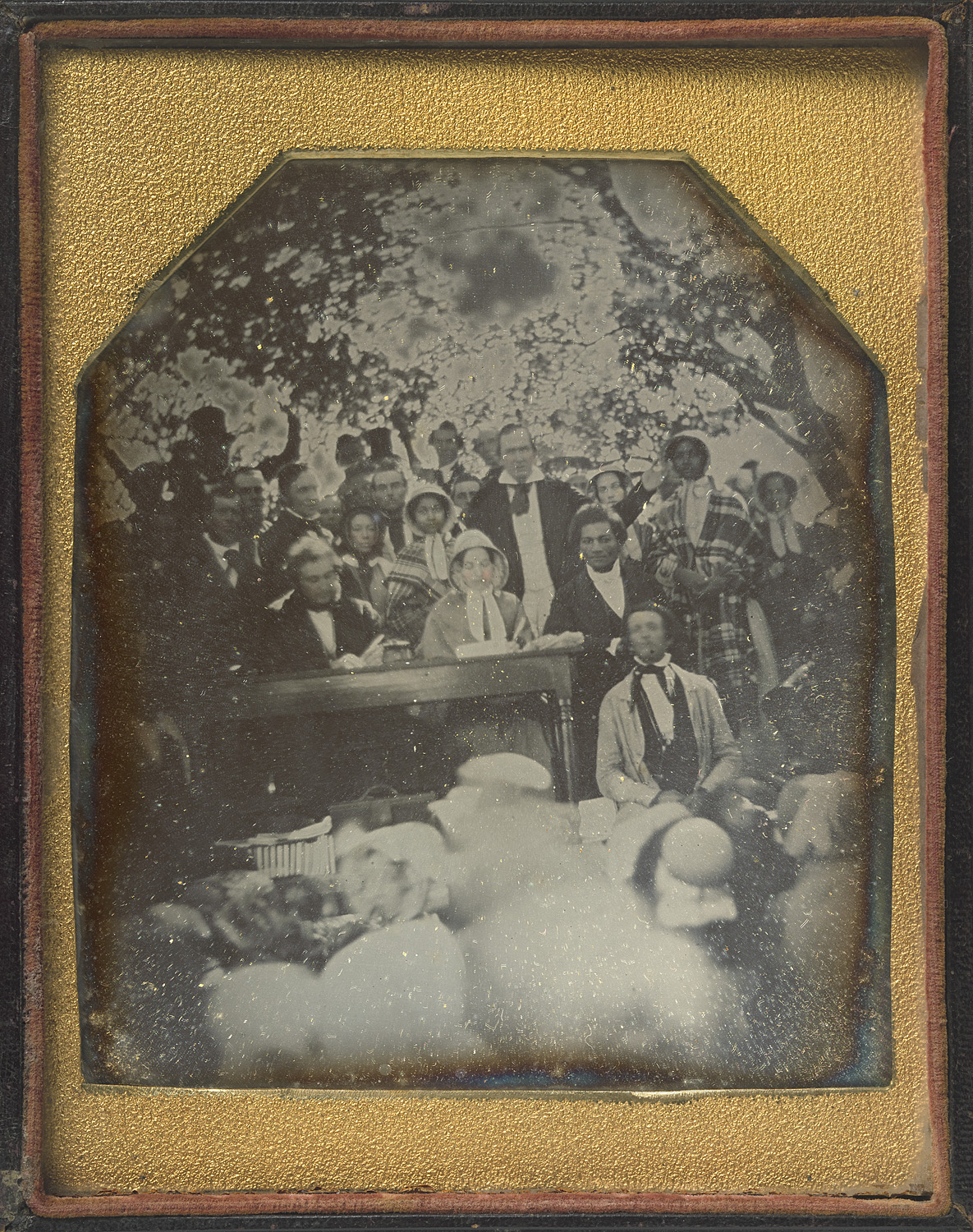
Ezra Greenleaf Weld (American, 1801-1874) 'Frederick Douglass with the Edmonson Sisters at Fugitive Slave Law Convention, Cazenovia, New York' 1850


Ezra Greenleaf Weld (American, 1801-1874)
Frederick Douglass with the Edmonson Sisters at Fugitive Slave Law Convention, Cazenovia, New York
1850
Half-plate copy daguerreotype
Case Open: 15.2 x 24.4 x 1.3 cm (6 x 9 5/8 x 1/2″)
National Portrait Gallery, Smithsonian Institution; on loan from Mr. and Mrs. Set Charles Momjian


Weld daguerreotype taken at the 1850 Fugitive Slave Law Convention, Cazenovia, New York. The Edmonson sisters are standing wearing bonnets and shawls in the row behind the seated speakers. Frederick Douglass is seated, with Gerrit Smith standing behind him.

Ezra Greenleaf Weld (October 26, 1801 – October 14, 1874), often known simply as “Greenleaf”, was a photographer and an operator of a daguerreotype studio in Cazenovia, New York. He and his family were involved with the abolitionist movement.

Weld opened his first studio in his home in 1845. In 1850, Cazenovia hosted the abolitionist meeting known as the Fugitive Slave Law Convention. This gave Weld the opportunity to photograph the legendary orator Frederick Douglass with the Edmonson sisters, Gerritt Smith and Abby Kelley Foster. This daguerreotype was given to the imprisoned abolitionist William Chaplin who had helped many of the attendees escape to freedom.

Of the six daguerreotypes of Douglass that have survived, only one besides Greenleaf’s image has had its daguerreotypist identified. Greenleaf’s image is unique because it is a group shot at an outdoor meeting rather than a studio portrait. Daguerreotypes were seldom attempted under these circumstances because the long exposure time required made it difficult to get a satisfactory result. Weld’s is the only daguerreotype of Douglass whose date is known with certainty. This daguerreotype is also unique in the paradoxical sense that it is the only one known to have been copied. Two original half-plates exist: One is held by the Madison County Historical Society in Oneida, New York, the other is in a private collection and currently on display at the Smithsonian Institution in Washington, D.C.

Text from the Wikipedia website


The Fugitive Slave Law Convention was held in Cazenovia, New York, August 21-22, 1850. Organised to oppose passage of the Fugitive Slave Act of 1850 by the United States Congress, participants included Frederick Douglass, the Edmonson sisters, Gerrit Smith, Samuel Joseph May, and Theodore Dwight Weld, among others. The convention opened at the First Congregational Church of Cazenovia (now Cazenovia College’s theater building), then moved to “the orchard of Grace Wilson’s School, located on Sullivan Street,” to accommodate the estimated 2000 to 3000 participants. It was chaired by Douglass.

Text from the Wikipedia website


Frederick Douglass (born Frederick Augustus Washington Bailey; c.  February 1818 – February 20, 1895) was an American social reformer, abolitionist, orator, writer, and statesman. After escaping from slavery in Maryland, he became a national leader of the abolitionist movement in Massachusetts and New York, gaining note for his oratory and incisive antislavery writings. In his time, he was described by abolitionists as a living counter-example to slaveholders’ arguments that slaves lacked the intellectual capacity to function as independent American citizens. Northerners at the time found it hard to believe that such a great orator had once been a slave. …

Douglass was a firm believer in the equality of all peoples, whether white, black, female, Native American, or Chinese immigrants. He was also a believer in dialogue and in making alliances across racial and ideological divides, and in the liberal values of the U.S. Constitution. When radical abolitionists, under the motto “No Union with Slaveholders”, criticised Douglass’ willingness to engage in dialogue with slave owners, he replied: “I would unite with anybody to do right and with nobody to do wrong.”

Text from the Wikipedia website


Mary Edmonson (1832-1853) and Emily Edmonson (1835-1895), “two respectable young women of light complexion”, were African Americans who became celebrities in the United States abolitionist movement after gaining their freedom from slavery. On April 15, 1848, they were among the 77 slaves who tried to escape from Washington, DC on the schooner The Pearl to sail up the Chesapeake Bay to freedom in New Jersey.

Although that effort failed, they were freed from slavery by funds raised by the Congregational Church in Brooklyn, New York, whose pastor was Henry Ward Beecher, an abolitionist. After gaining freedom, the Edmonsons were supported to go to school; they also worked. They campaigned with Beecher throughout the North for the end of slavery in the United States.

Text from the Wikipedia website


Gerrit Smith (March 6, 1797 – December 28, 1874), also spelled Gerritt, was a leading American social reformer, abolitionist, politician, and philanthropist. Spouse to Ann Carroll Fitzhugh, Smith was a candidate for President of the United States in 1848, 1856, and 1860, but only served 18 months in the federal government – in Congress as a Free Soil Party Representative, in 1853-1854.

Text from the Wikipedia website


In 1850, as Congress considered passage of a harsh new Fugitive Slave Law, more than 2,000 people heeded the call of abolitionist Gerrit Smith (standing, center) to meet in Cazenovia, New York, and protest the impending legislation. Among the nearly fifty escaped slaves to participate were Emily and Mary Edmonson (in plaid shawls), whose freedom had been purchased by abolitionists in 1848, and Frederick Douglass (seated, center right), who served as the convention’s presiding officer. On the gathering’s second day, the overflowing crowd moved from its initial meeting place in a church to a nearby orchard. There, a local daguerreotypist made this extraordinary record of the convention.

Exhibition label from Smithsonian National Portrait Gallery website [Online] Cited 13/11/2019.


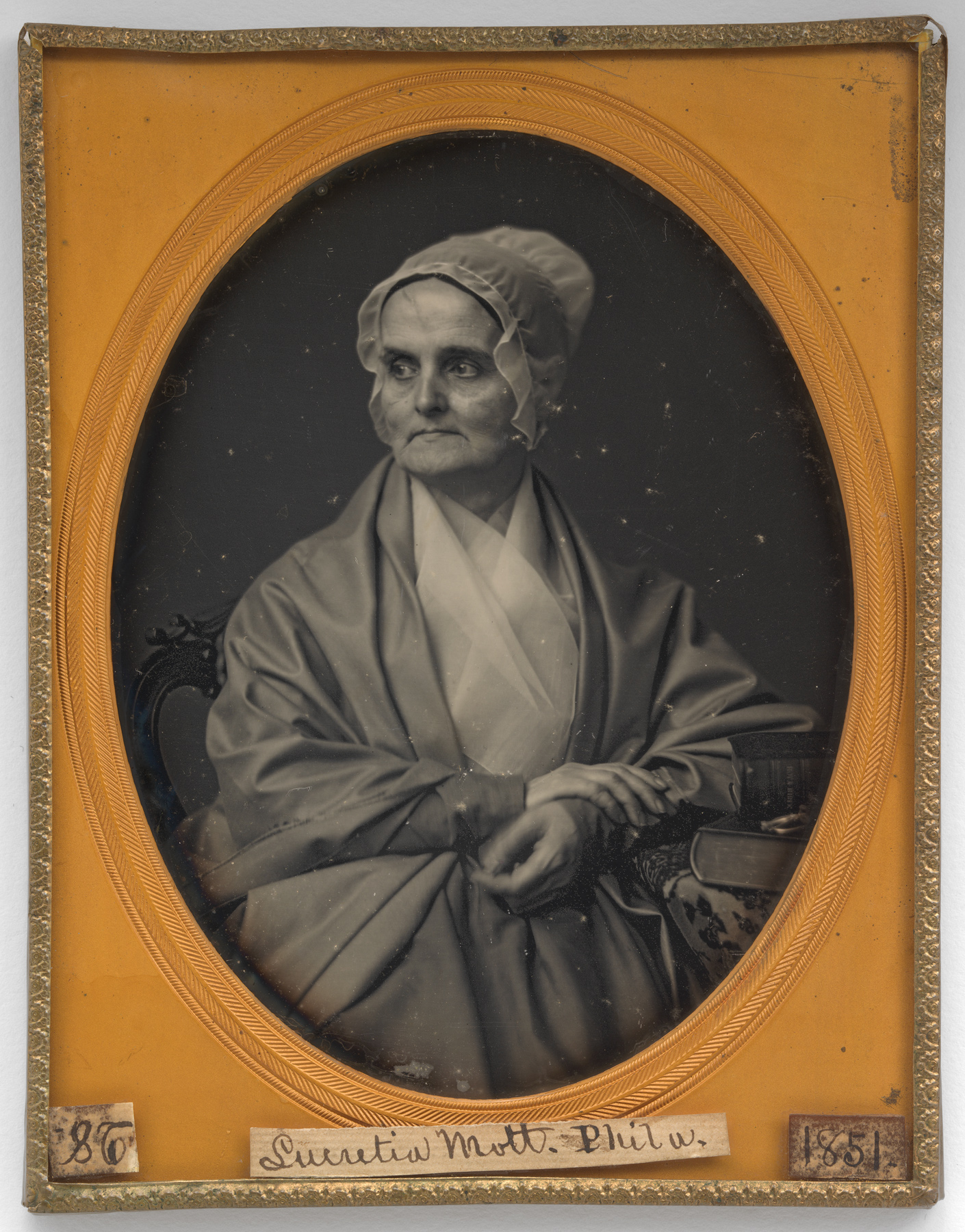
Marcus Aurelius Root (American, 1808-1888) 'Lucretia Coffin Mott' 1851


Marcus Aurelius Root (American, 1808-1888)
Lucretia Coffin Mott
1851
Half-plate daguerreotype
Case Open: 15 x 23.2 x 1cm (5 7/8 x 9 1/8 x 3/8″)
National Portrait Gallery, Smithsonian Institution


Marcus Aurelius Root (1808-1888) was a writing teacher and photographer. He was born in Granville, Ohio and died in Philadelphia, Pennsylvania.

On 20 June 1846, he bought John Jabez Edwin Mayall’s Chestnut Street photography studio that was in the same building as Root’s residence in Philadelphia, Pennsylvania. Root had success as a daguerreotypist working with his brother, Samuel Root. The Root Brothers had a gallery in New York City from 1849 to 1857. Marcus Aurelius Root authored an important book on photography entitled The Camera and the Pencil.

Text from the Wikipedia website


Lucretia Mott (née Coffin; January 3, 1793 – November 11, 1880) was a U.S. Quaker, abolitionist, women’s rights activist, and social reformer. She had formed the idea of reforming the position of women in society when she was amongst the women excluded from the World Anti-Slavery Convention in 1840. In 1848 she was invited by Jane Hunt to a meeting that led to the first meeting about women’s rights. Mott helped write the Declaration of Sentiments during the 1848 Seneca Falls Convention.

Her speaking abilities made her an important abolitionist, feminist, and reformer. When slavery was outlawed in 1865, she advocated giving former slaves who had been bound to slavery laws within the boundaries of the United States, whether male or female, the right to vote. She remained a central figure in the abolition and suffrage movement until her death in 1880.

Text from the Wikipedia website


A devout Quaker whose activism proved unsettling to some members of her faith, Lucretia Mott assumed a highly visible role in the abolitionist movement. After joining William Lloyd Garrison at the launch of the American Anti-Slavery Society, she helped to found Philadelphia’s Female Anti-Slavery Society. Her concern for women’s rights was a natural outgrowth of her abolitionist efforts. In 1848, Mott and Elizabeth Cady Stanton organised the convention at Seneca Falls, New York, that galvanised the women’s suffrage movement.

Exhibition label from the Smithsonian National Portrait Gallery website [Online] Cited 13/11/2019.


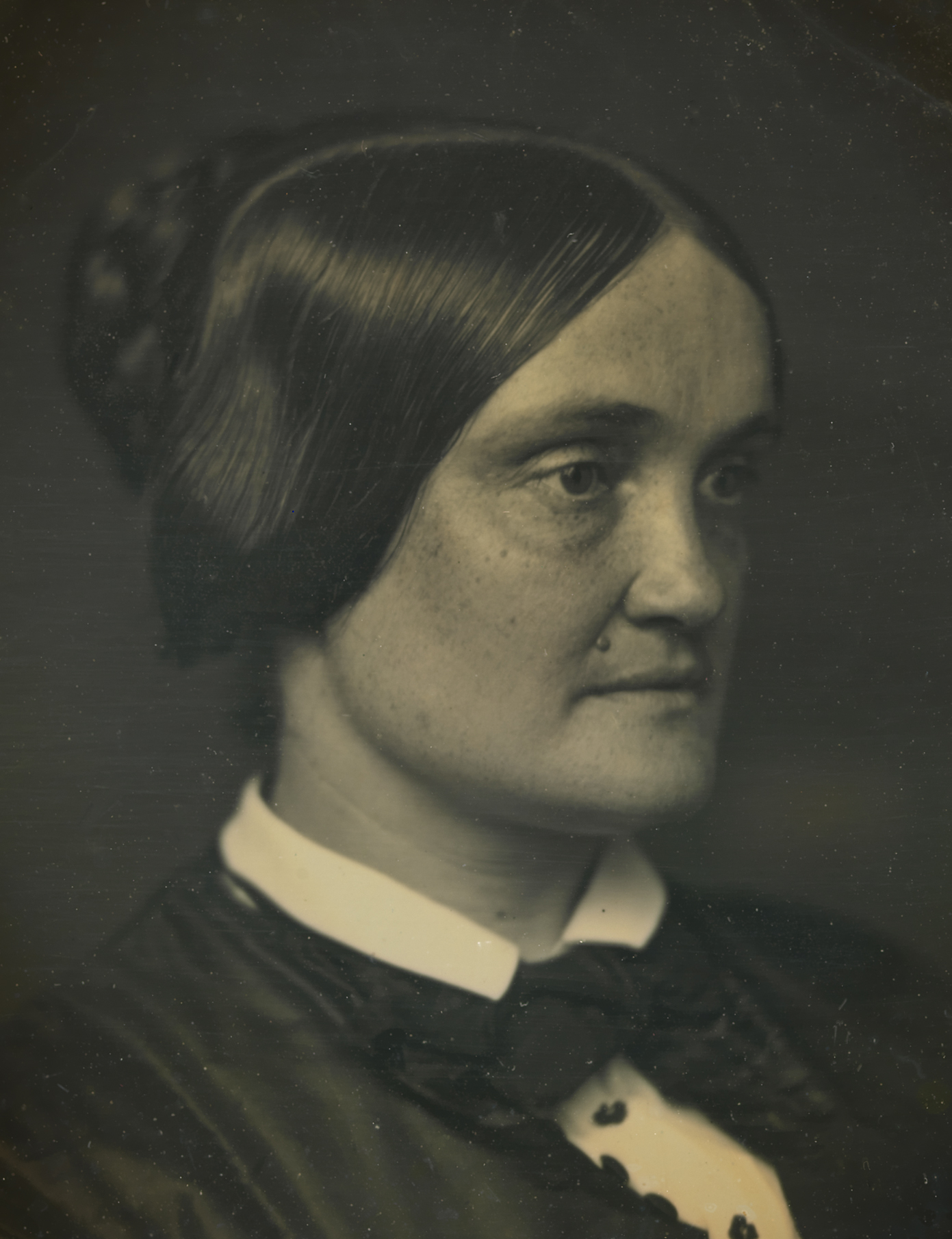
Marcus Aurelius Root (American, 1808-1888) 'Lucretia Coffin Mott' 1851 (detail)


Marcus Aurelius Root (American, 1808-1888)
Lucretia Coffin Mott (detail)
1851
Half-plate daguerreotype
Case Open: 15 x 23.2 x 1cm (5 7/8 x 9 1/8 x 3/8″)
National Portrait Gallery, Smithsonian Institution


The Smithsonian’s National Portrait Gallery will display photographs of 19th-century activists and professionals in “Women of Progress: Early Camera Portraits,” a presentation of 10 daguerreotypes and two ambrotypes from the museum’s extensive collection of antebellum portraits. This focused exhibition will explore the increasing visibility of American women in society before the Civil War and the corresponding advent of portrait photography. Organised by Ann Shumard, senior curator of photographs, “Women of Progress” is part of the Smithsonian American Women’s History Initiative, “Because of Her Story,” and is one of seven exhibitions in the Portrait Gallery’s 2019 – 2020 program to highlight women in history. “Women of Progress: Early Camera Portraits” will be displayed on the museum’s first floor June 14 through May 31, 2020.

The Portrait Gallery’s exhibition will reacquaint visitors with the fascinating lives of 13 memorable Americans. “In the 1840s and 1850s, the growing presence of women in public life coincided with the rise of portrait photography,” Shumard said. “As a result, women who were making their mark in endeavours as varied as journalism, literature, abolitionism and the burgeoning women’s rights movement became sought-after subjects for the camera.”

Those featured in the exhibition will include Dorothea Lynde Dix, activist and educator who sought humane treatment for people with mental illness; Margaret Fuller, editor and women’s rights advocate; Lucretia Mott, abolitionist and co-organiser of the Seneca Falls Convention; Lucy Stone, suffragist and a founder of the American Equal Rights Association; and Harriet Beecher Stowe, author of Uncle Tom’s Cabin. Other pioneers are the actress Laura Keene, the first woman manager of a major theatre in New York City and Mary Ann Brown Patten, the first woman to command a sailing ship around Cape Horn. The exhibition will also highlight the abolitionists Emily and Mary Edmonson, who are pictured in a daguerreotype with Frederick Douglass at the 1850 Fugitive Slave Law Convention in Cazenovia, New York. Funding for the exhibition was made possible by the National Portrait Gallery’s Women’s Initiative Leadership Committee including Capital One and the Smithsonian American Women’s History Initiative.

Press release from the National Portrait Gallery [Online] Cited 03/11/2019
 

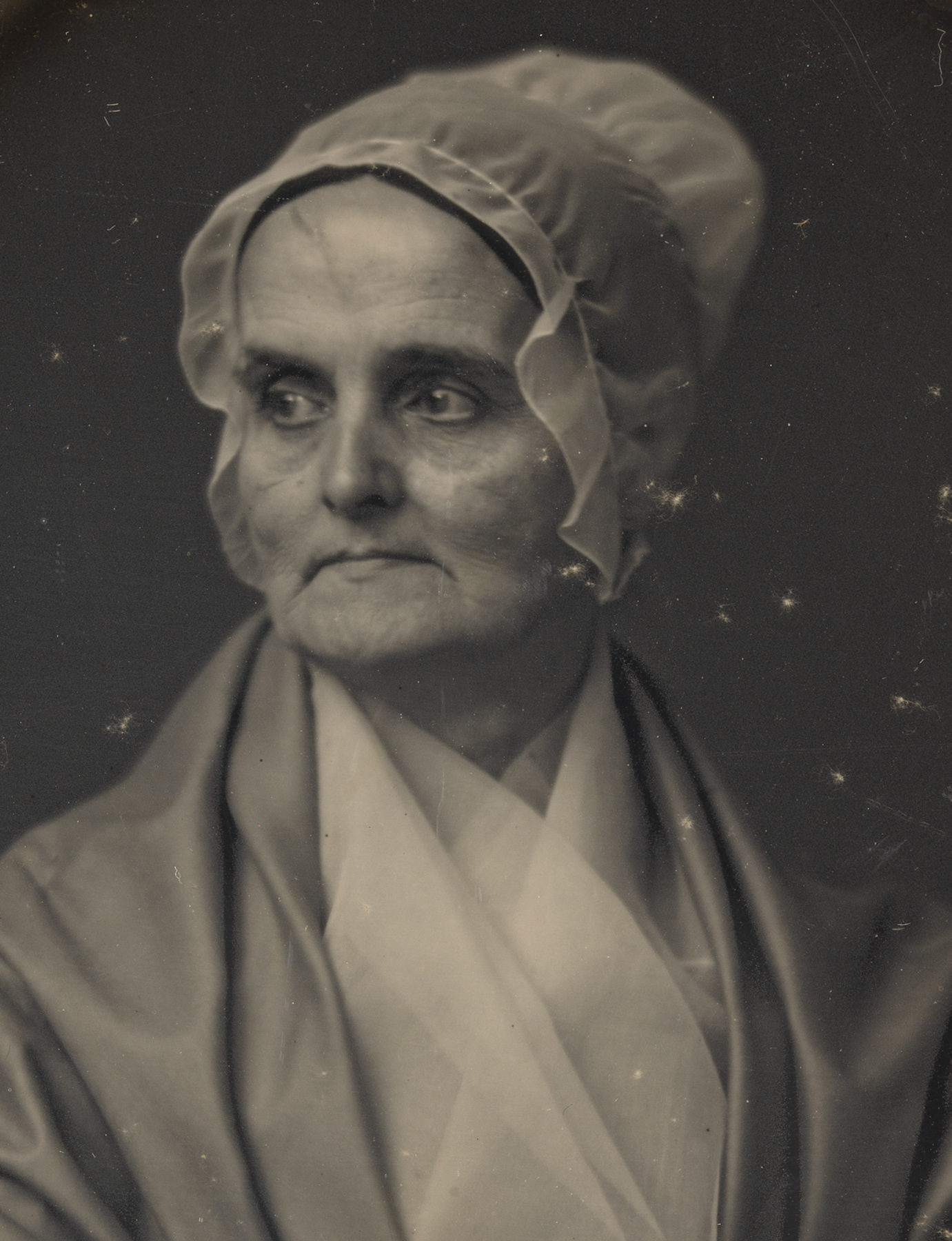
Rufus Anson. 'Laura Keene' c. 1855


Rufus Anson (American, c. 1821-?)
Laura Keene
c. 1855
Sixteenth-plate daguerreotype
Case Open: 5.4 × 9.7cm (2 1/8 × 3 13/16″)
National Portrait Gallery, Smithsonian Institution
Acquired through the generosity of Bill and Sally Wittliff


Rufus Anson (active 1851-1867), American daguerreotypist who operated a studio in New York City.

An accomplished comedic actress, Laura Keene (20 July 1826 – 4 November 1873) rattled New York City’s theatrical establishment in 1855 when she became the first woman manager of a major theatre in that city. After leasing the Metropolitan Theatre, she opened Laura Keene’s Varieties, serving as manager, director, and principal star. Keene faced hostility from New York’s male theatrical managers. Her theatre was vandalised, and she lost her lease. Undeterred, she opened the Laura Keene Theatre in a new building in 1856. Well versed in all aspects of her craft, Keene was a highly successful manager who championed emerging playwrights and attracted the brightest stars to her acting company.

Exhibition label from the Smithsonian National Portrait Gallery website [Online] Cited 13/11/2019.
 

Rufus Anson. 'Laura Keene' c. 1855 (detail)


Rufus Anson (American, c. 1821-?)
Laura Keene (detail)
c. 1855
Sixteenth-plate daguerreotype
Case Open: 5.4 × 9.7cm (2 1/8 × 3 13/16″)
National Portrait Gallery, Smithsonian Institution
Acquired through the generosity of Bill and Sally Wittliff


John Plumbe, Jr. (American born Wales, 1809-1857) 'Margaret Fuller' 1846


John Plumbe, Jr. (American born Wales, 1809-1857)
Margaret Fuller
1846
Sixth-plate daguerreotype
National Portrait Gallery, Smithsonian Institution


Short on funds and waiting to receive a commission from the United States Congress to survey the route for a transcontinental railroad, an idea which he is credited with originating, civil engineer John Plumbe, Jr., took up photography in 1840 after seeing the work of an itinerant daguerreotypist in Washington, D.C. A Welshman by birth, Plumbe opened a gallery in Boston the following year. He eventually maintained galleries in thirteen cities, making his name recognisable in numerous cities across the country. Plumbe opened his Washington, D.C., gallery in 1844, the first in the nation’s capital. By the time he established the National Plumbeotype Gallery of engraved and lithographic reproductions of his own images in 1846, Plumbe had been dubbed “the American Daguerre” by the press. In 1847 Plumbe found himself in financial trouble and he sold his business to his employees. Two years later he gave up photography and retired to Dubuque, Iowa, where [suffering from the prolonged effects of malaria and from acute depression] he met an untimely end by cutting his own throat [at his brother’s residence in Dubuque on May 28, 1857].

Text from the J. Paul Getty Museum website [Online] Cited 13/11/2019


After working briefly for the Wisconsin territorial legislature in late 1839, Plumbe went east to continue his campaign for a Pacific railroad. He turned to the newly introduced daguerreotype process of photography as a means of support and excelled in that endeavour. Within six years Plumbe had attained a national reputation through photographic competitions and by establishing a chain of 23 galleries. Plumbe’s Dubuque gallery, opened in 1841 and operated by his brother Richard (1810-1896), was the first photographic establishment west of the Mississippi. Plumbe manufactured and imported photographic materials, gave instruction to the first generation of photographers, and published dozens of lithographic prints of noted Americans based on his daguerreotypes. Among his many achievements are the earliest photographs of the U.S. Capitol and White House (exterior and interior), the earliest photograph of a president in office (James K. Polk), and thousands of portraits of the most noted personalities of the era. Plumbe pioneered brand name recognition, obtained patent rights for colour photography, and published a magazine filled with illustrations based on his photographs. By late 1848, however, Plumbe had experienced severe financial reverses due to competition and mismanagement and was forced to sell his galleries to pay his debts.

Text from The Biographical Dictionary of Iowa website [Online] Cited 13/11/2019


John Plumbe, Jr. (American born Wales, 1809-1857) 'Margaret Fuller' 1846 (detail)


John Plumbe, Jr. (American born Wales, 1809-1857)
Margaret Fuller (detail)
1846
Sixth-plate daguerreotype
National Portrait Gallery, Smithsonian Institution


The only known daguerreotype of Margaret Fuller.

Sarah Margaret Fuller Ossoli (May 23, 1810 – July 19, 1850), commonly known as Margaret Fuller, was an American journalist, editor, critic, and women’s rights advocate associated with the American transcendentalism movement. She was the first full-time American female book reviewer in journalism. Her book Woman in the Nineteenth Century is considered the first major feminist work in the United States. …

Fuller was an advocate of women’s rights and, in particular, women’s education and the right to employment. She also encouraged many other reforms in society, including prison reform and the emancipation of slaves in the United States. Many other advocates for women’s rights and feminism, including Susan B. Anthony, cite Fuller as a source of inspiration. Many of her contemporaries, however, were not supportive, including her former friend Harriet Martineau. She said that Fuller was a talker rather than an activist. Shortly after Fuller’s death, her importance faded; the editors who prepared her letters to be published, believing her fame would be short-lived, censored or altered much of her work before publication.

Text from the Wikipedia website


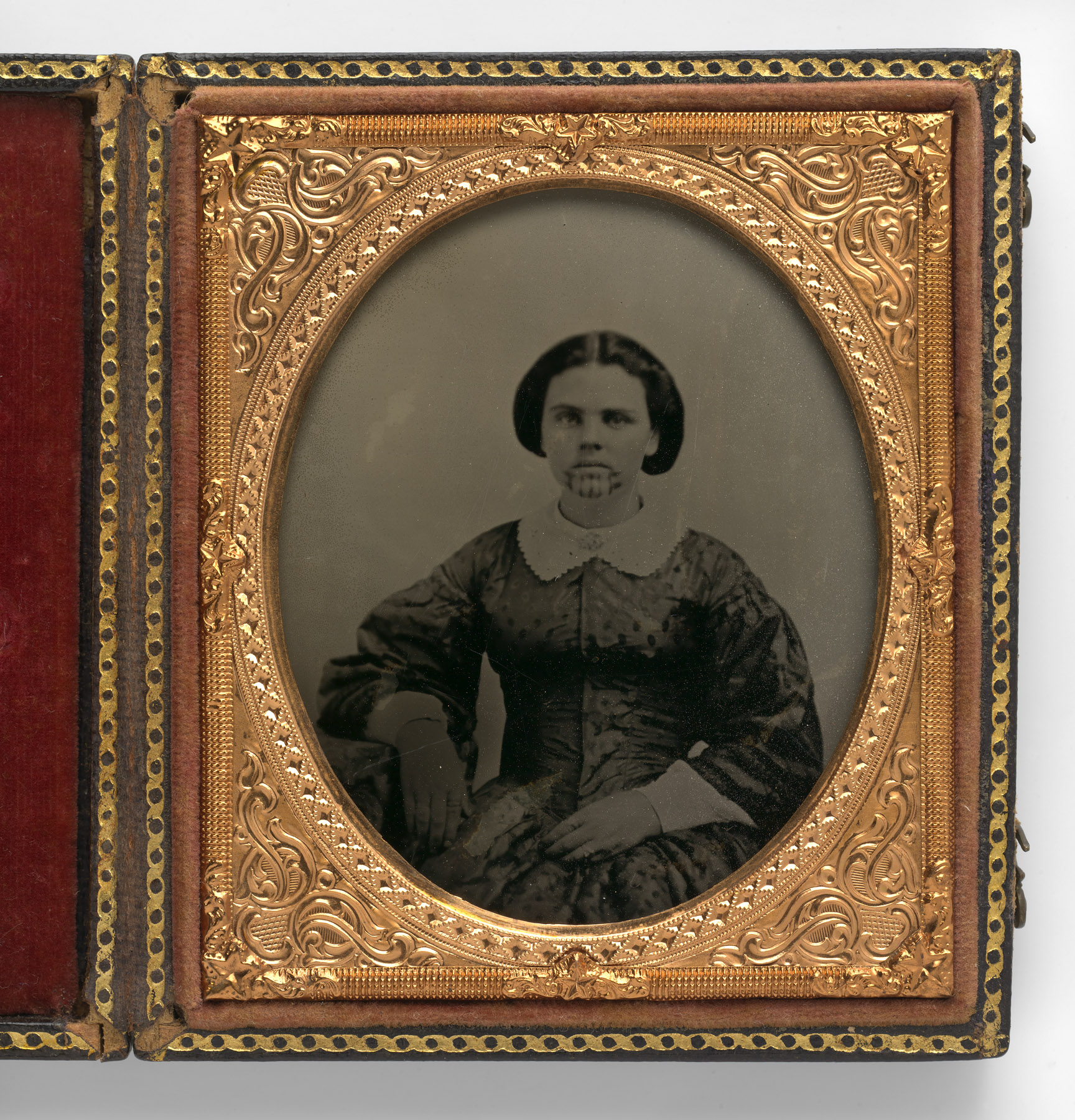
Unidentified Artist. 'Olive Oatman' Nd


Unidentified Artist
Olive Oatman
Nd
Ambrotype
National Portrait Gallery, Smithsonian Institution


In the spring of 1851, a band of Apache men in present-day Arizona captured thirteen-year-old Olive Oatman and her younger sister. They killed or seriously injured the rest of the family during the attack. At the time, the Oatman family-originally from Illinois-was headed west to California to start their lives anew. Shortly thereafter the Apache sold the two sisters to a Mohave family. While living with this family, Oatman was tattooed on the chin, a custom common among members of the tribe. In 1856, after enduring five years in captivity and the death of her sister, Oatman had her freedom negotiated, and she was given over to authorities at Fort Yuma. Accounts of her release were published widely, and her biography became a best-seller. Though Oatman stated that her Mojave family treated her well, stories such as hers reinforced commonly held assumptions that Native Americans were violent savages.

Exhibition label from the Smithsonian National Portrait Gallery website [Online] Cited 13/11/2019.
 

Olive Ann Oatman (September 7, 1837 – March 21, 1903) was a woman born in Illinois. While traveling from Illinois to California with a company of Mormon Brewsterites, her family was killed in 1851, in present-day Arizona by a Native American tribe. The town of Oatman, Arizona is named after the Oatman family and the massacre which occurred therein. Though she identified her family’s attackers as Apache, they were most likely Tolkepayas (Western Yavapai). This small group of Native Americans clubbed Olive’s family to death. They captured Olive and her younger sister, Mary Ann, and enslaved them for one year. The girls were traded to the Mohave people. Olive spent four years with the Mohave. During her time with the Mohave tribe her sister, Mary Ann, died from starvation. Olive returned to white society five years after the Oatman Massacre, wearing a blue tattoo on her chin as a reminder of her time with the Mohave people.

Following her repatriation into American society, Olive’s story began to be retold with dramatic license in the press, as well as in her own “memoir” and speeches. Novels, plays, movies, and poetry have been inspired by Olive’s story, which resonated in the media of the time and long afterward. She had become an oddity in 1860s America, partly owing to the prominent blue tattooing of Oatman’s face by the Mohave, making her the first known tattooed American woman on record. Much of what actually occurred during her time with the Native Americans remains unknown.

Text from the Wikipedia website


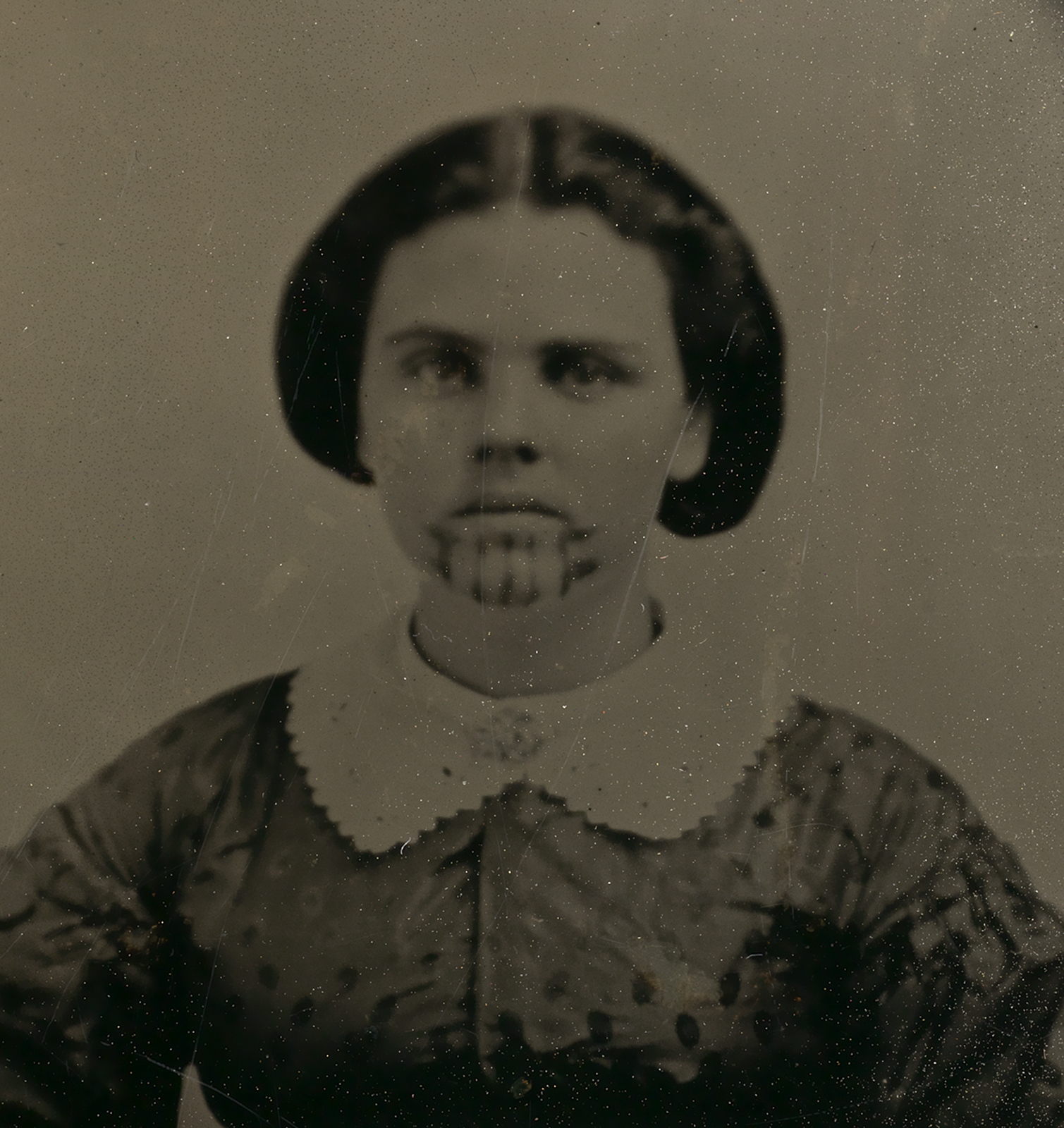
Unidentified Artist. 'Olive Oatman' Nd (detail)


Unidentified Artist
Olive Oatman (detail)
Nd
Ambrotype
National Portrait Gallery, Smithsonian Institution


In the United States, the rise of studio portrait photography during the 1840s and ’50s coincided with a period of heightened visibility for women, who were emerging as prominent players in arenas including activism, literature, journalism and theatre. Harriet Beecher Stowe’s Uncle Tom’s Cabin, for example, sold 300,000 copies across the nation in the first year following its publication, while in 1855, comedic stage actress Laura Keene became the first female manager of a major New York City theatre. These women, as well as others making their mark in antebellum America, increasingly found themselves in front of the camera, posing for portraits to be shared with the public or exchanged among loved ones as tokens of affection.

“Women of Progress” catalogues the stories of 13 such mid-19th century figures through the lens of ten daguerreotypes and two ambrotypes. Some of these individuals remain household names today – Beecher Stowe, Lucretia Mott and Dorothea Dix, for example. Others, including Mary Ann Brown Patten, the first woman to sail a clipper ship around Cape Horn; Charlotte Cushman, a popular actress who played both male and female parts; and Mary Ann Meade, a daguerreotypist in her own right – are lesser known. Regardless, the women are united by both their progressive bent and the fact that their camera likenesses survive as a direct result of the burgeoning popularity of photography.

An 1846 photograph of journalist Margaret Fuller falls into the first of these categories: In a letter to her brother, the writer explains that photographer John Plumbe Jr. asked her to pose for a portrait. The resulting image, a sixth-plate daguerreotype, depicts its sitter reading a hefty tome, seemingly so engrossed in the text that she remains unaware of the camera’s presence. The image was later displayed in Plumbe’s studio to attract future clientele.

The circumstances surrounding the production of an 1851 half-plate daguerreotype of abolitionist and women’s rights advocate Lucretia Mott are far hazier. Taken by photographer Marcus Aurelius Root, the portrait served as the basis for a widely circulated lithographic print by Boston-based artist Leopold Grozelier. Unlike daguerreotypes, lithographic prints could be produced in multiple copies. Lithographs also conveyed a greater variety of tones than earlier printing methods, allowing for more accurate copies of original works such as daguerreotypes and paintings.

Shumard says it’s possible Root’s photograph was taken with the direct intention of serving as the basis for Grozelier’s print. Whereas a daguerreotype sitting typically produced just one plate, lithographs could be easily mass-produced for public purchase. …

To make copies of daguerreotypes, photographers placed original plates on specialised copy stands and then reshot the image – a process known as redaguerreotyping. Although these copies often lacked the level of contrast and subtle gradation seen in the original daguerreotypes, they were more accurate than lithographs and could be circulated on a smaller scale. “Women in Progress” features two copies – an 1852 picture of Beecher Stowe and a half-plate depicting sisters Mary and Emily Catherine Edmonson in a group photograph taken at an 1850 gathering of abolitionists protesting the impending passage of the new federal Fugitive Slave Law. The Edmonsons earned their freedom from slavery with the help of the Uncle Tom’s Cabin author’s brother, Henry Ward Beecher.

Shumard notes that the group portrait had previously been exhibited in relation to two of its better-known sitters, abolitionists Frederick Douglass and Gerrit Smith. Now, however, the scene’s female subjects are the ones commanding visitors’ attention. “In this instance,” she says, “it’s really nice to be able to highlight the Edmonson sisters.” The Beecher Stowe copy, Shumard says, stems from one of several studio sittings that yielded multiple plates ready for reproduction and distribution to an eager public.

The majority of daguerreotypes produced in mid-19th century America were designed for private rather than public consumption. “They are very intimate objects, [made] to be held in your hand and looked at,” says Shumard, or perhaps gifted to a loved one as a personal memento.

The medium’s capacity for conveying familiarity is apparent in an 1855 half-plate of abolitionist and women’s rights advocate Lucy Stone, who took the then-unheard of step of keeping her maiden name upon marrying husband Henry Blackwell. In the portrait, Stone’s features and clothing – including hand-coloured peach-tinted flesh and a pink pigmented skirt – are accentuated in an attempt to make the keepsake image look more lifelike.

Other notable images not to be missed include an 1850 quarter-plate daguerreotype of poet Sarah T. Bolton, who urged readers to “Battle for the right. / And break the chains that bind / the mighty to the few,” and a sixth-plate ambrotype of Olive Oatman, a young woman who was abducted by Native Americans and spent five years in captivity, first as a slave of the tribe that murdered most of her family and later as an adopted member of the Mohave people.

Oatman’s 1856 return attracted national attention. She was the subject of an exaggerated 1857 account, Life Among the Indians: Captivity of the Oatman Girls, and traveled the country on a publicity lecture circuit. Her likeness, meanwhile, was cemented in the public’s imagination by blue markings tattooed across the length of her chin. This facial tattoo, applied with cactus ink, is just discernible in the exhibition ambrotype, which is among the National Portrait Gallery’s most recent acquisitions.

Referencing the Oatman and Brown Patten ambrotypes, Shumard concludes, “I’m so excited that we have these ambrotypes of [women] who are not household names but… who experienced such trying circumstances and managed to survive.”

Extract from Meilan Solly. “How the Camera Introduced American to their Heroines,” on the Smithsonian.com website July 9, 2019 [Online] Cited 12/11/2019


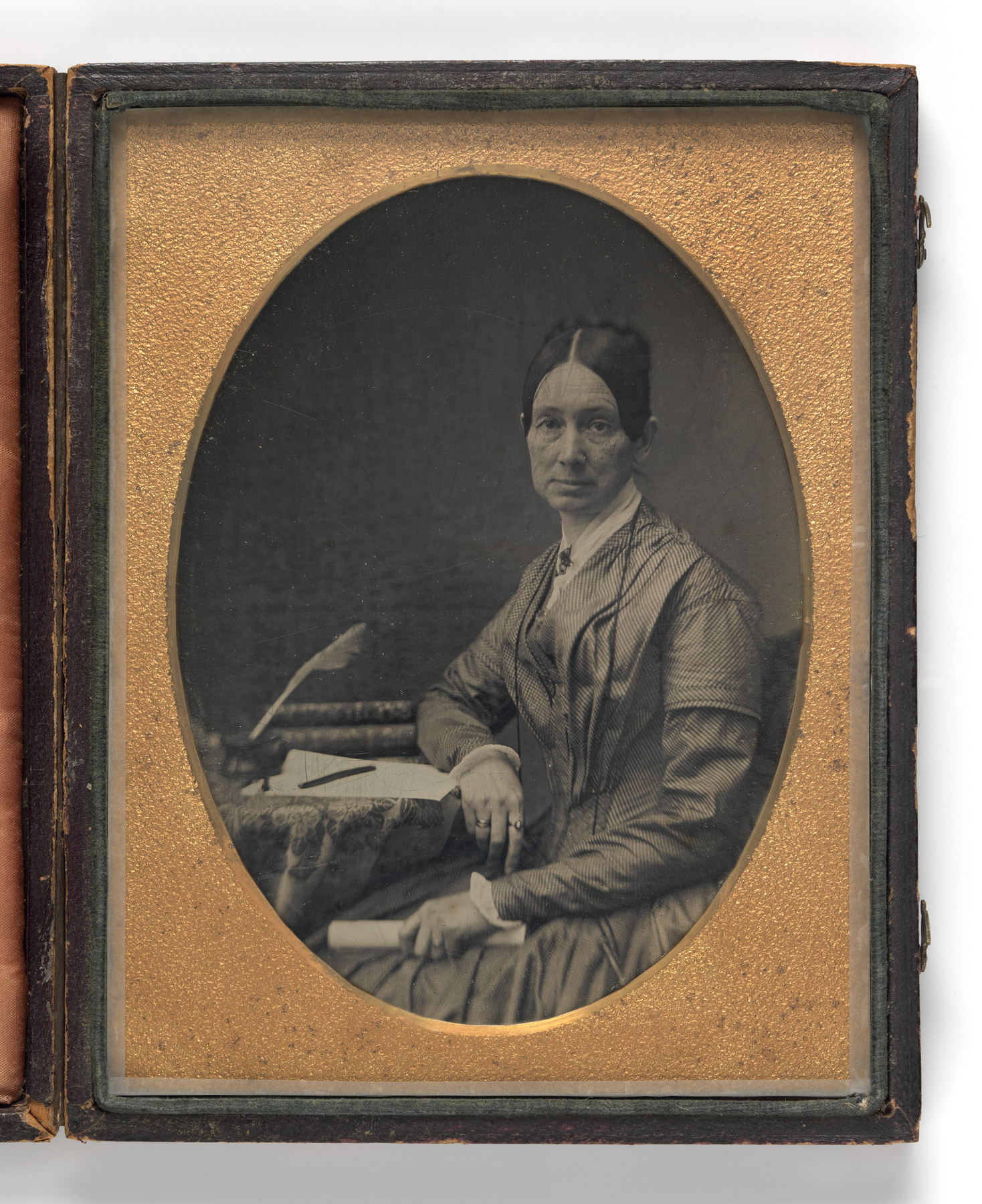
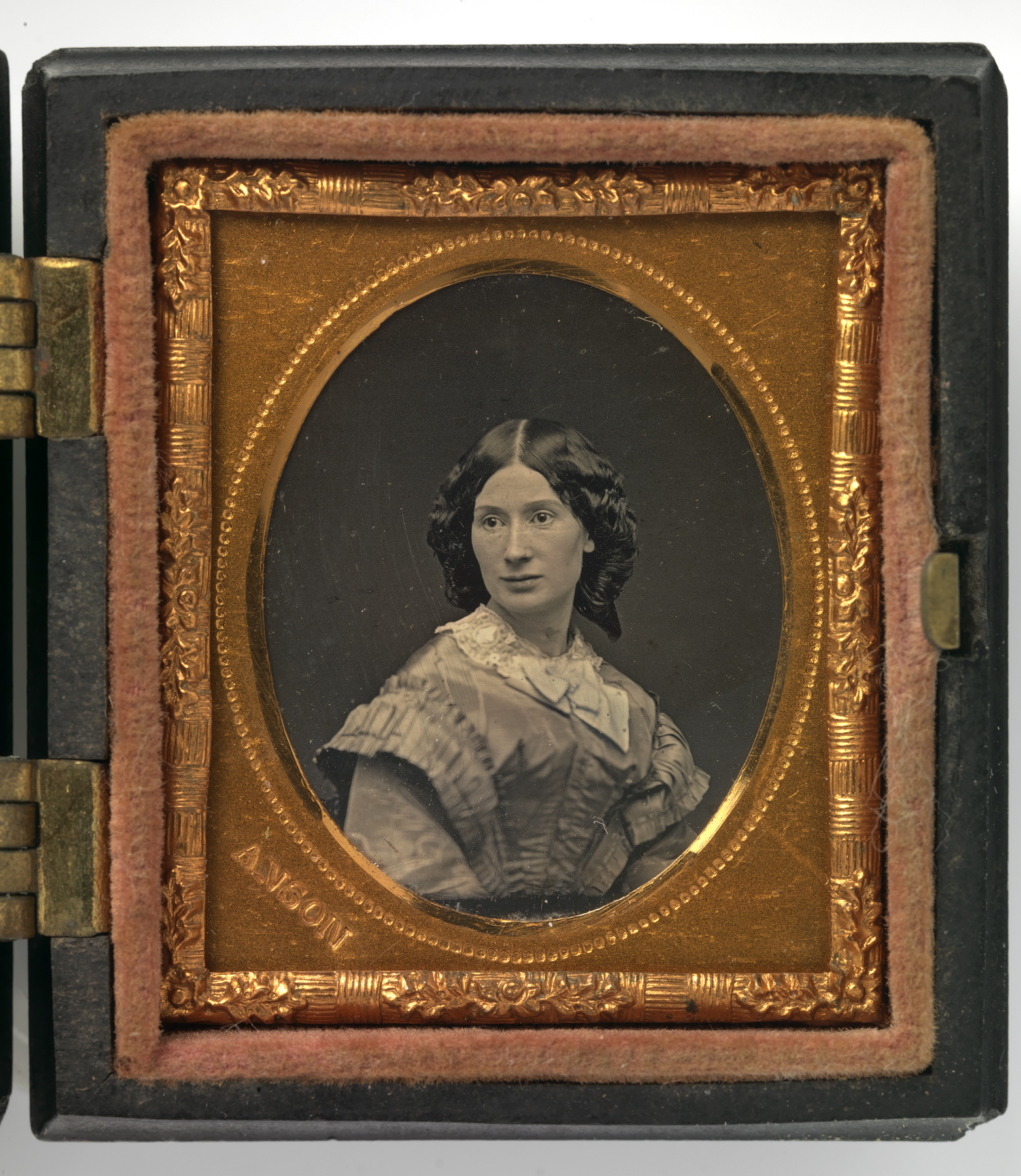
Unidentified Artist. 'Dorothea Lynde Dix' c. 1849


Unidentified Artist
Dorothea Lynde Dix
c. 1849
Half-plate daguerreotype
Case Open: 15.4 x 24.4 x 1.3cm (6 1/16 x 9 5/8 x 1/2″)
National Portrait Gallery, Smithsonian Institution


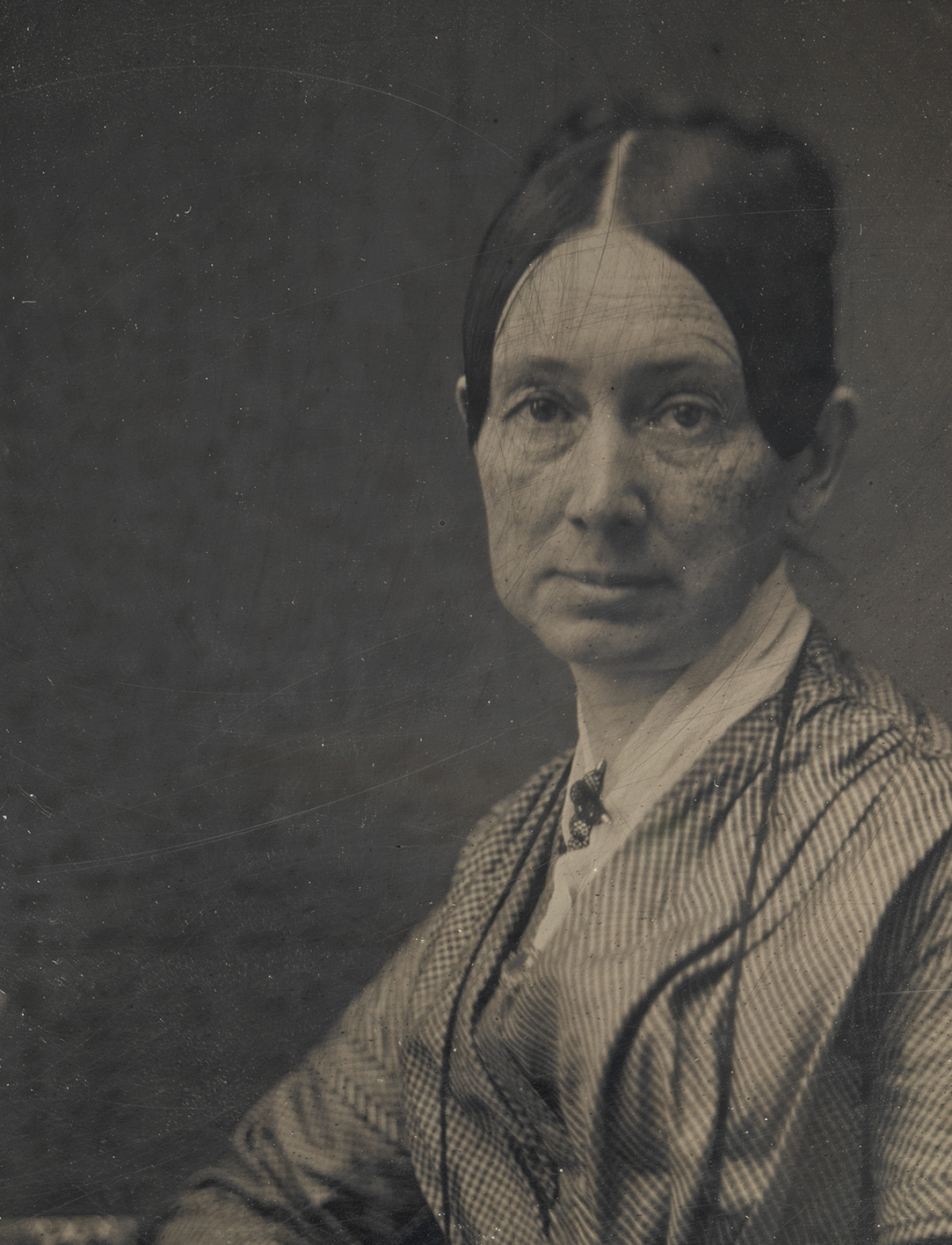
In 1841, teacher, humanitarian, and reformer Dorothea Dix launched a vigorous campaign to secure humane treatment for those afflicted with mental illness. At a time when such individuals were more often imprisoned and abused than cared for and treated, Dix became a tireless advocate for their welfare. Personally investigating the “cages, cellars, stalls, [and] pens” where sufferers were confined, she reported her findings in speeches and articles, as well as in the petitions she submitted to lawmakers. Thanks to her efforts, facilities for the mentally ill were greatly expanded and improved.

Exhibition label from the Smithsonian National Portrait Gallery website [Online] Cited 13/11/2019. For more information on Dorothea Dix see the large Wikipedia entry.
 

Unidentified Artist. 'Dorothea Lynde Dix' c. 1849 (detail)


Unidentified Artist
Dorothea Lynde Dix (detail)
c. 1849
Half-plate daguerreotype
Case Open: 15.4 x 24.4 x 1.3cm (6 1/16 x 9 5/8 x 1/2″)
National Portrait Gallery, Smithsonian Institution


Meade Brothers Studio. 'Mary Ann Meade' c. 1850


Meade Brothers Studio
Mary Ann Meade
c. 1850
Sixth-plate daguerreotype
Case Open: 9.6 × 15.9 × 1.6cm (3 3/4 × 6 1/4 × 5/8″)
National Portrait Gallery, Smithsonian Institution
Gift of Mr. and Mrs. Dudley Emerson Lyons


A daguerreotypist in her own right, Mary Ann Meade began her career in the successful photography business founded around 1840 by her brothers, Charles and Henry Meade. After Charles’s death in 1858, Mary Ann gained greater visibility in the gallery’s operations. At a time when few women worked behind the camera, she was listed as a photographer in Trow’s New York City Directory (1861-62). In 1861, an article about the Meade Brothers gallery noted, “Mr. [Henry] Meade and his sister attend personally to visitors.” By June 1863, Mary Ann had become the gallery’s director and was billed as “Successor to MEADE BROTHERS.”

Text from the Smithsonian National Portrait Gallery website [Online] Cited 13/11/2019
 

Meade Brothers Studio

The brothers opened their daguerreian gallery in Albany, N.Y., in 1842, and their business later expanded to other cities. They each traveled to Europe and in 1848, Charles Meade became the first American to photograph Frenchman Louis-Jacques-Mandé Daguerre – the originator of the daguerreotype process. In 1850, the Meade brothers established their flagship American Daguerreotype Gallery on Broadway in New York City, where they photographed such famous subjects as statesman Daniel Webster and entertainer Lola Montez.

Exhibition label from the Smithsonian website [Online] Cited 13/11/2019


Meade Brothers Studio. 'Mary Ann Meade' c. 1850 (detail)


Meade Brothers Studio
Mary Ann Meade (detail)
c. 1850
Sixth-plate daguerreotype
Case Open: 9.6 × 15.9 × 1.6cm (3 3/4 × 6 1/4 × 5/8″)
National Portrait Gallery, Smithsonian Institution
Gift of Mr. and Mrs. Dudley Emerson Lyons


Unidentified Artist. 'Mary Ann Brown Patten' c. 1857


Unidentified Artist
Mary Ann Brown Patten
c. 1857
Ninth-plate ambrotype
Case Open: 7.4 x 12.4 x 0.9cm (2 15/16 x 4 7/8 x 3/8″)
National Portrait Gallery, Smithsonian Institution
Gift of Dorthy Knouse Koepke


Mary Ann Brown Patten (April 6, 1837 – March 18, 1861) was the first female commander of an American merchant vessel. She was the wife of Joshua Patten, captain of the merchant clipper ship Neptune’s Car. The ship was bound around Cape Horn from New York towards San Francisco when Joshua Patten collapsed from fatigue in 1856. His wife took command for 56 days, faced down a mutiny, and successfully managed to navigate the clipper ship into San Francisco. At the time she was 19 years old and pregnant with her first child.

Text from the Wikipedia website


In 1856, Mary Ann Brown Patten became the first woman to sail a clipper ship around Cape Horn, through the notoriously treacherous waters at the tip of South America. Schooled in navigation by her sea captain husband, she took helm of his ship after he fell seriously ill and the first mate proved untrustworthy. Only nineteen years old and pregnant at the time, Patten captained the San Francisco-bound Neptune’s Car for fifty-one days, during the most hazardous portion of its 15,000-mile voyage. Upon bringing the vessel safely to its destination, she was hailed for her skill as well as her courage.

Exhibition label from the Smithsonian National Portrait Gallery website [Online] Cited 13/11/2019


Smithsonian National Portrait Gallery
8th and F Sts NW
Washington, DC 20001

Opening hours:
11.30am – 7.00pm daily

Smithsonian National Portrait Gallery website
LIKE ART BLART ON FACEBOOK

Back to top

Exhibition: ‘In the Looking Glass: Recent Daguerreotype Acquistions’ at the Nelson-Atkins Museum of Art, Kansas City

Exhibition dates: 25th January – 20th July, 2014

Curator: Jane Aspinwall, Associate Curator of Photography


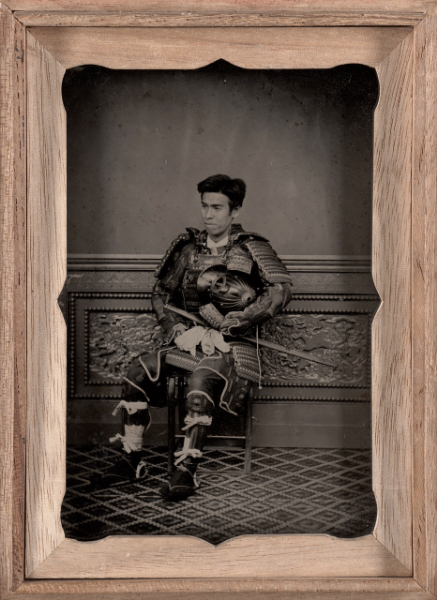
Attributed to: Tsukamoto, Japanese. 'Portrait of a man in samurai armor' mid 1870s


Attributed to:
Tsukamoto (Japanese)
Portrait of a man in samurai armour
mid 1870s
Ambrotype
5 x 3 1/2 inches
Gift of the Hall Family Foundation
© Nelson Gallery Foundation


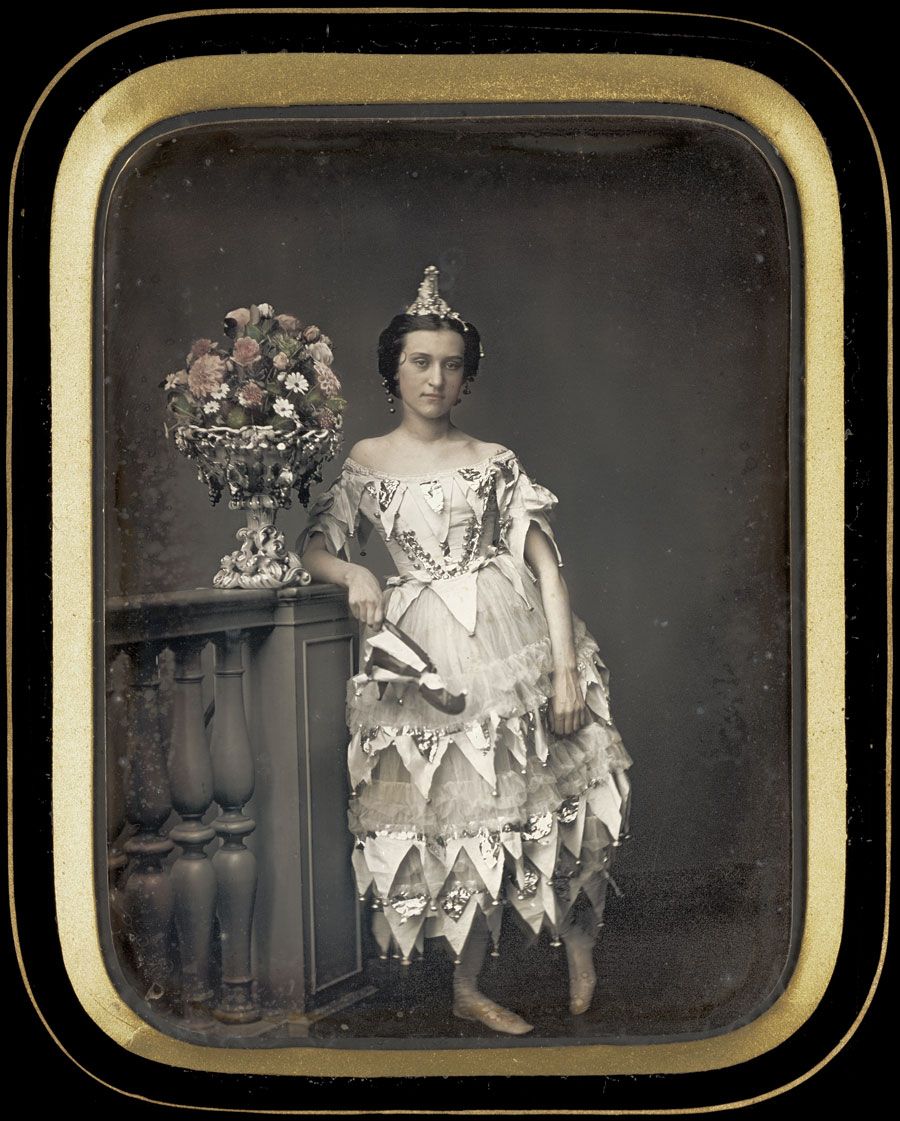
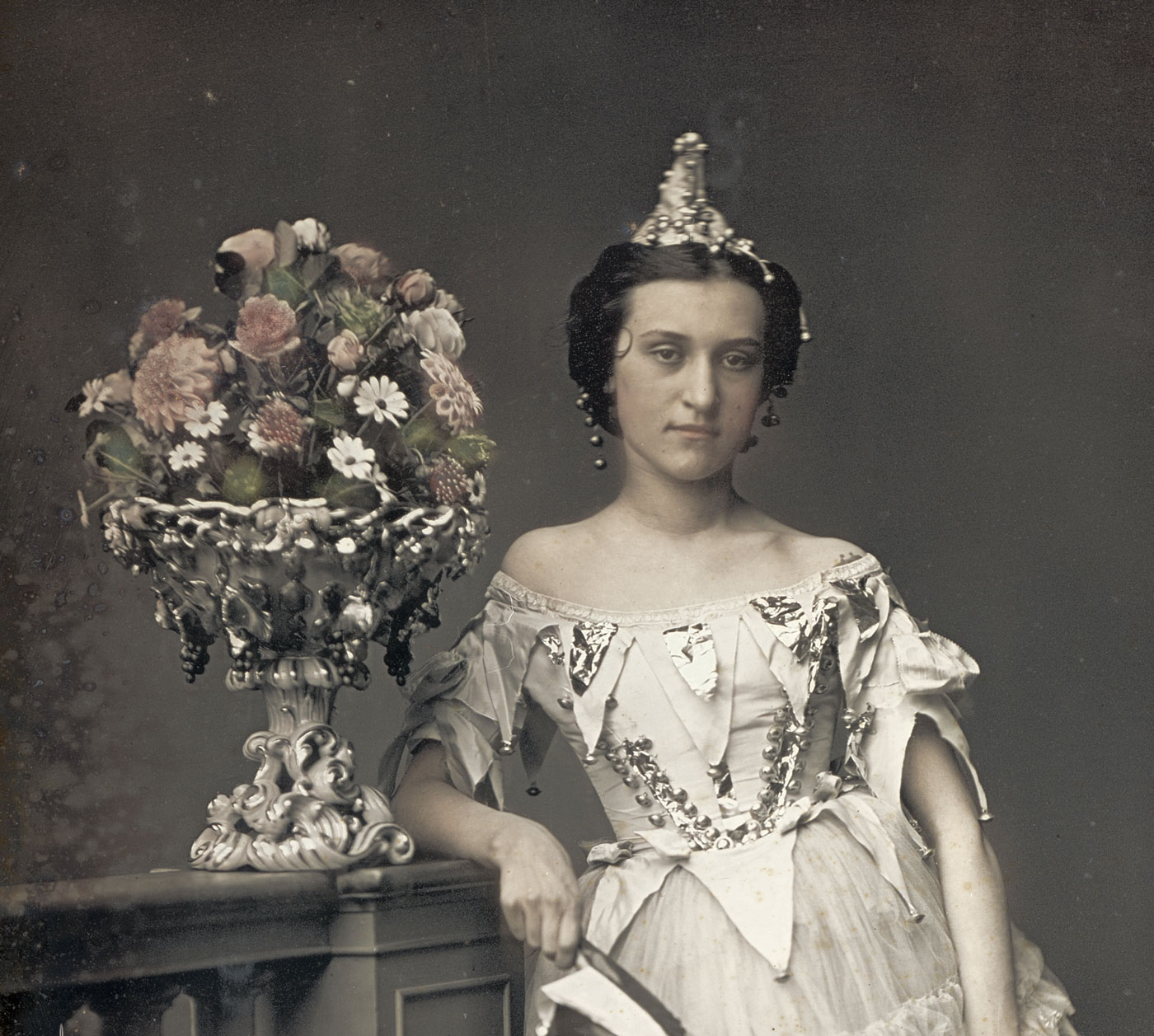
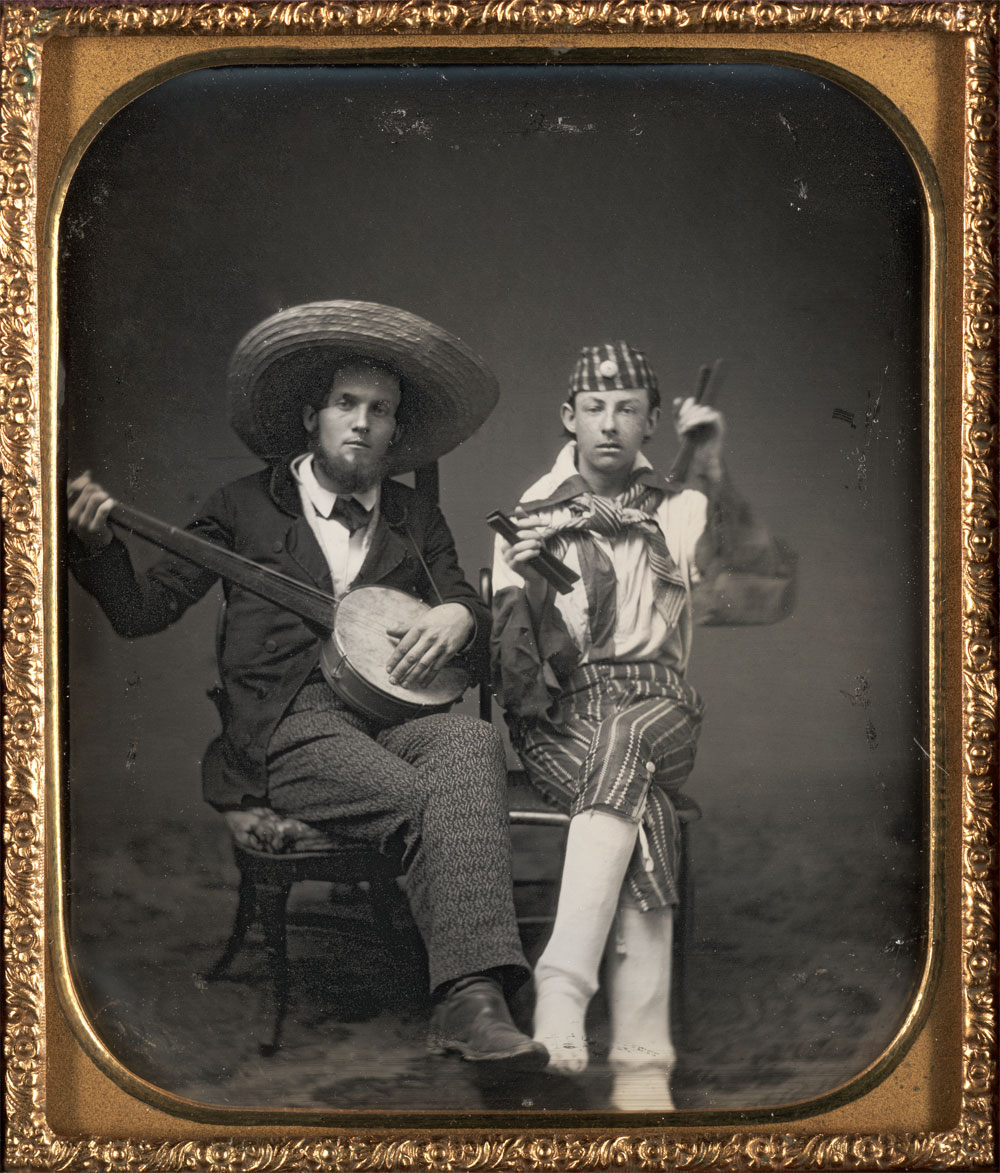
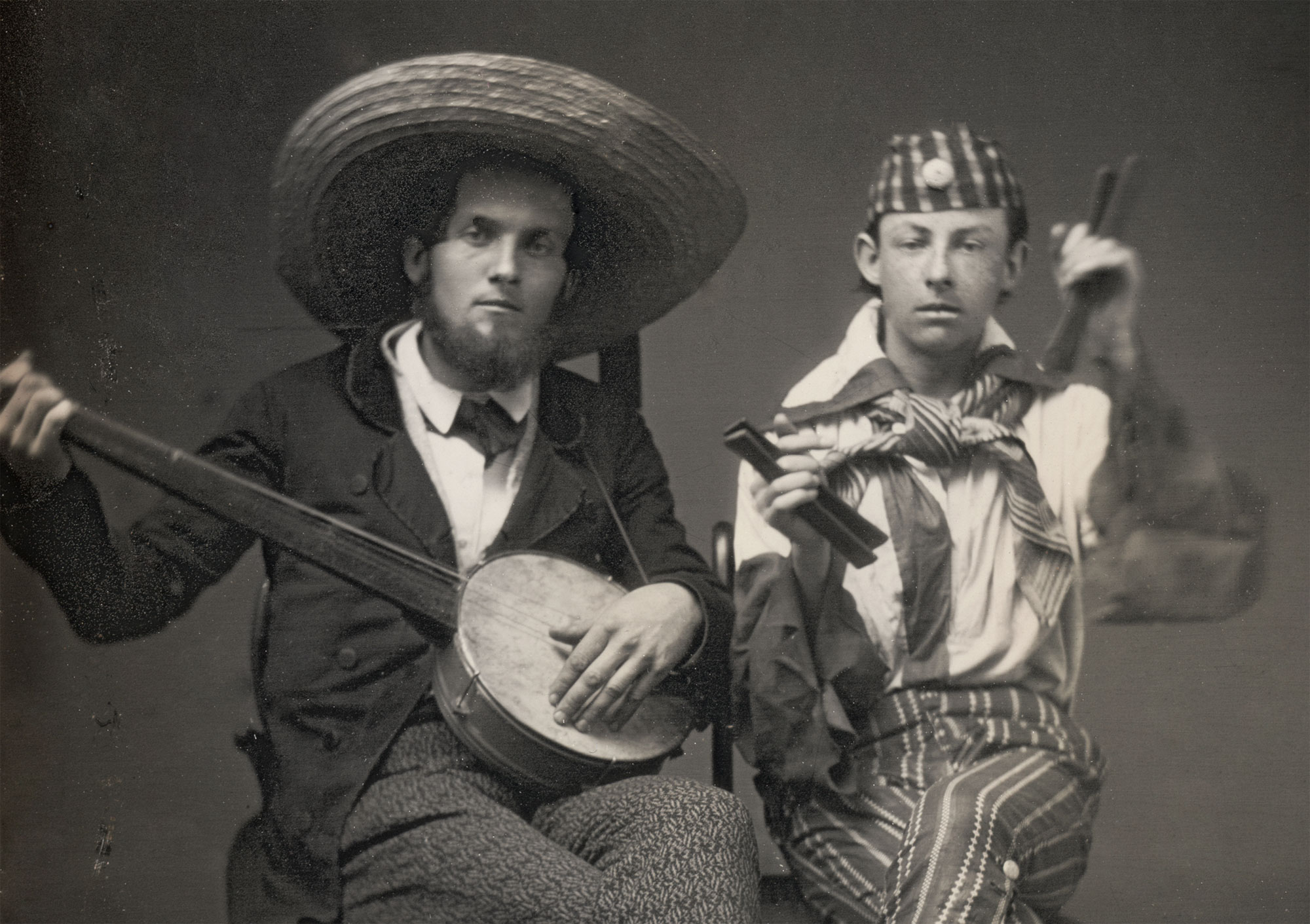
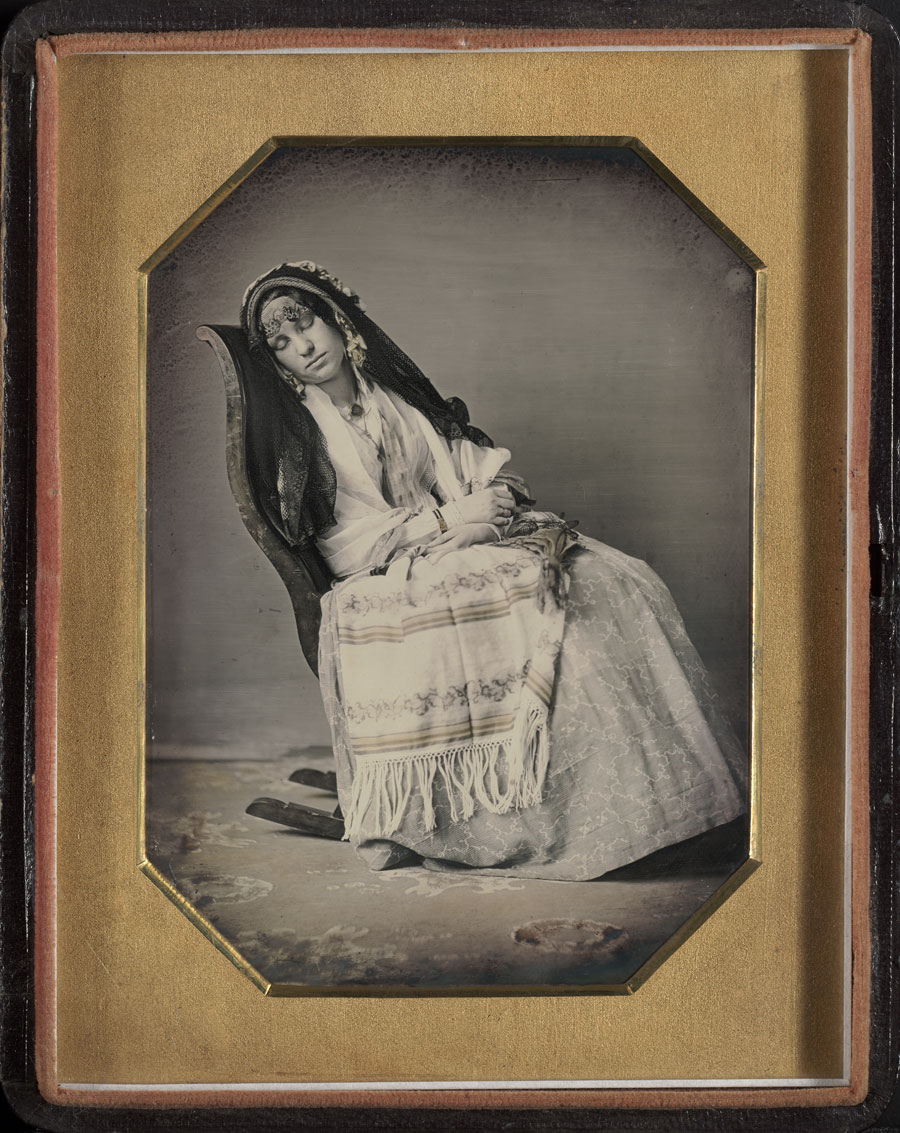
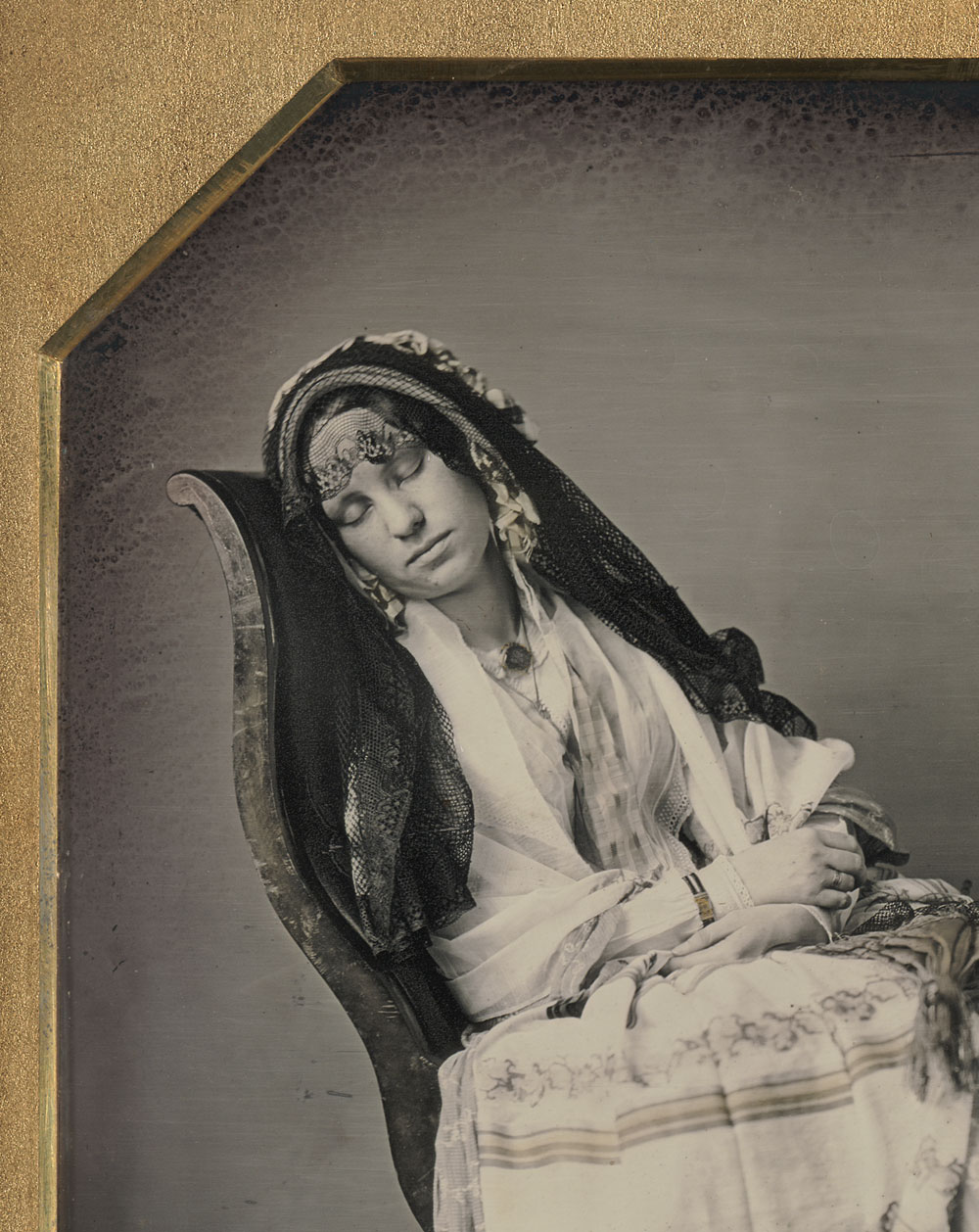
OMG some of these images are SO beautiful and others SO bizarre. Please enlarge the detailed shots of Lady in Costume (c. 1850, below) and Traveling Minstrels – banjo and bones (c. 1850, below) – my two favourites – so you can see the costumes and the people. The clothes of the bones player are incredible… I wonder what they did with their lives, where they went and how they lived. How old do you think they are? And what is that on the front of his hat, a watch?

Dr Marcus Bunyan


Many thankx to The Nelson-Atkins Museum of Art for allowing me to publish the photographs in the posting. Please click on the photographs for a larger version of the image.


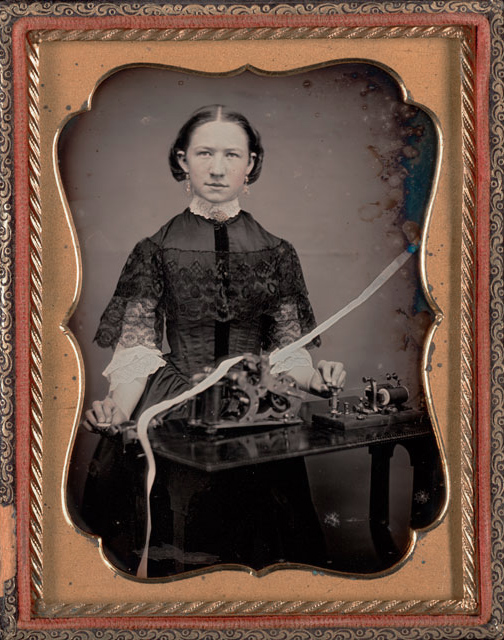
Unknown maker (American) 'Woman telegrapher' c. 1850 from the exhibition 'In the Looking Glass: Recent Daguerreotype Acquistions' at the Nelson-Atkins Museum of Art, Kansas City, January - July, 2014


Unknown maker (American)
Woman telegrapher
c. 1850
Daguerreotype, quarter plate
Image size: 4 1/4 x 3 1/4 inches
Gift of the Hall Family Foundation
© Nelson Gallery Foundation


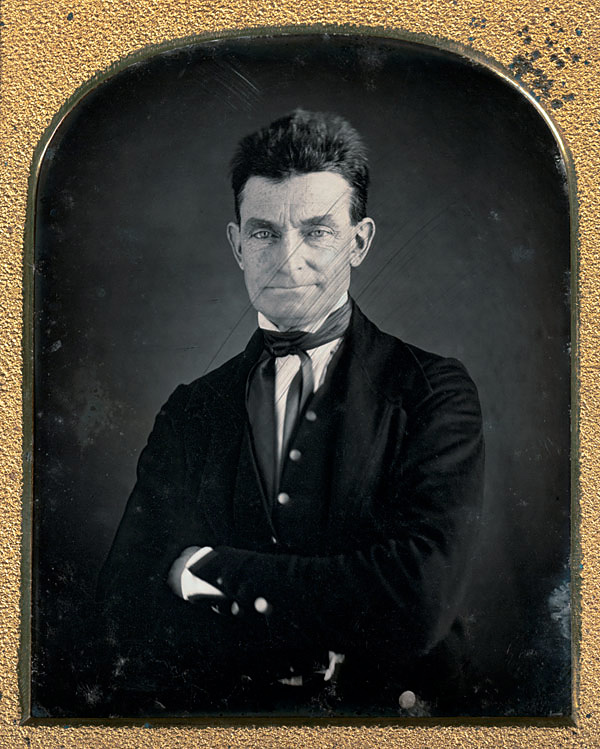
Augustus Washington (American, 1820-1875) 'John Brown' c. 1846-1847 from the exhibition 'In the Looking Glass: Recent Daguerreotype Acquistions' at the Nelson-Atkins Museum of Art, Kansas City, January - July, 2014


Augustus Washington (American, 1820-1875)
John Brown
c. 1846-1847
Quarter plate daguerreotype
4 x 3 3/16 inches
Gift of the Hall Family Foundation
© Nelson Gallery Foundation


John Brown (American, 1800-1859)

John Brown (May 9, 1800 – December 2, 1859) was a white American abolitionist who believed armed insurrection was the only way to overthrow the institution of slavery in the United States. During the 1856 conflict in Kansas, Brown commanded forces at the Battle of Black Jack and the Battle of Osawatomie. Brown’s followers also killed five slavery supporters at Pottawatomie. In 1859, Brown led an unsuccessful raid on the federal armoury at Harpers Ferry that ended with his capture. Brown’s trial resulted in his conviction and a sentence of death by hanging.

Brown’s attempt in 1859 to start a liberation movement among enslaved African Americans in Harpers Ferry, Virginia, electrified the nation. He was tried for treason against the Commonwealth of Virginia, the murder of five men and inciting a slave insurrection. He was found guilty on all counts and was hanged. Southerners alleged that his rebellion was the tip of the abolitionist iceberg and represented the wishes of the Republican Party to end slavery. Historians agree that the Harpers Ferry raid in 1859 escalated tensions that, a year later, led to secession and the American Civil War.

Text from Wikipedia website
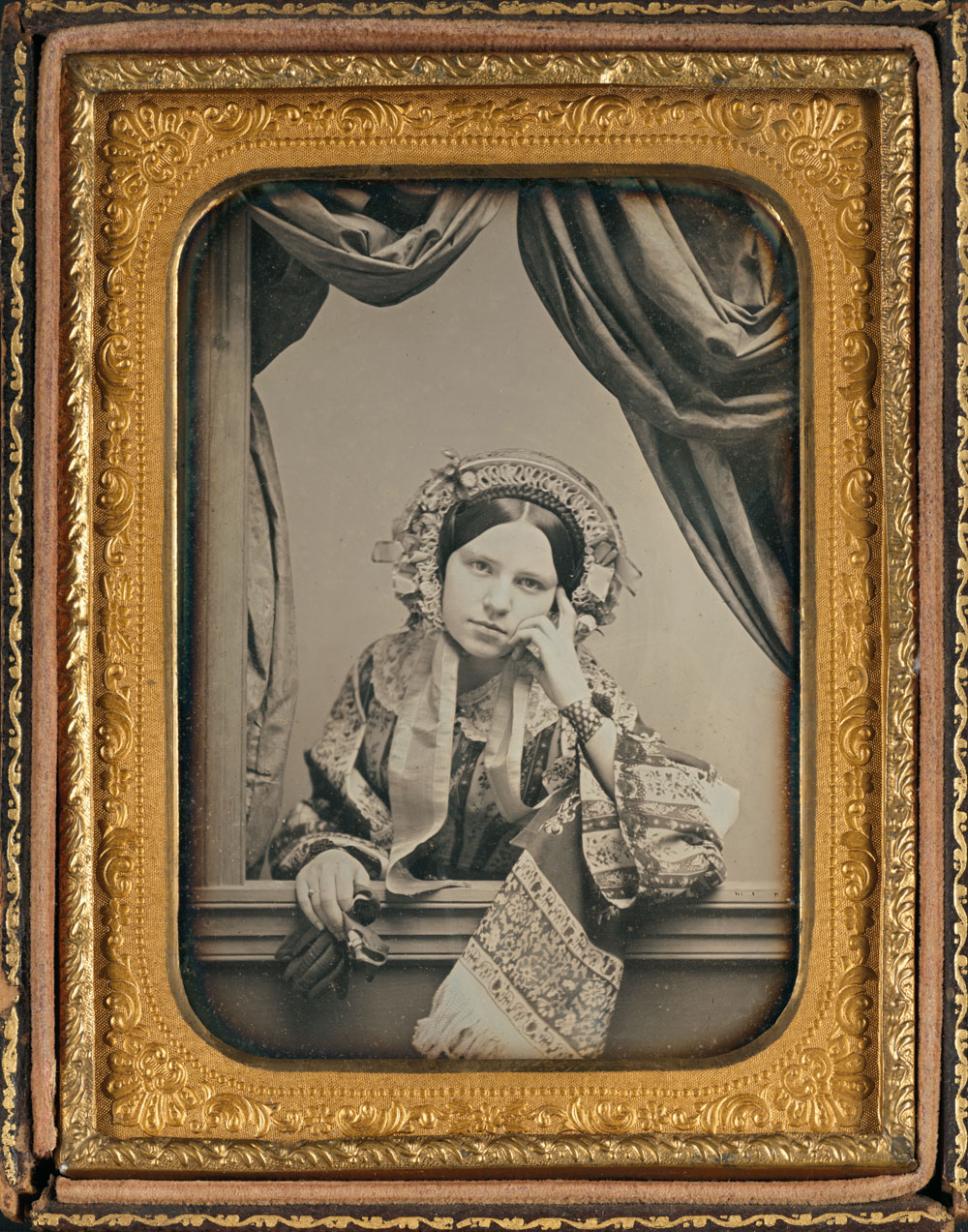
 

(Pierre) Victor Plumier (French, active 1840s-1850s) 'Lady in Costume' c. 1850


(Pierre) Victor Plumier (French, active 1840s-1850s)
Lady in Costume
c. 1850
Daguerreotype, half-plate
Plate: 5 1/2 x 4 1/2 inches (13.97 x 11.43cm)
Mount (open): 8 1/8 x 6 5/8 inches (20.64 x 16.83cm)
Gift of the Hall Family Foundation
© Nelson Gallery Foundation


(Pierre) Victor Plumier, French, active 1840s-1850s 'Lady in Costume' c. 1850 (detail)


(Pierre) Victor Plumier, French, active 1840s-1850s
Lady in Costume (detail)
c. 1850
Daguerreotype, half-plate
Plate: 5 1/2 x 4 1/2 inches (13.97 x 11.43cm)
Mount (open): 8 1/8 x 6 5/8 inches (20.64 x 16.83cm)
Gift of the Hall Family Foundation
© Nelson Gallery Foundation


Unknown photographer. 'Traveling Minstrels – banjo and bones' c. 1850


Unknown photographer
Traveling Minstrels – banjo and bones
c. 1850
Daguerreotype, sixth plate
Plate: 3 1/4 x 2 3/4 inches (8.26 x 6.99cm)
Case: 3 3/4 x 3 3/8 x 5/8 inches (9.53 x 8.59 x 1.6cm)
Gift of the Hall Family Foundation
© Nelson Gallery Foundation


The bones are a musical instrument (more specifically, a folk instrument) which, at the simplest, consists of a pair of animal bones, or pieces of wood or a similar material. Sections of large rib bones and lower leg bones are the most commonly used true bones, although wooden sticks shaped like the earlier true bones are now more often used…

They have contributed to many music genres, including 19th century minstrel shows, traditional Irish music, the blues, bluegrass, zydeco, French-Canadian music, and music from Cape Breton in Nova Scotia…

They are typically about 5″ to 7″ in length, but can be much longer, and they are often curved, roughly resembling miniature barrel staves. Bones can also be flat, for example by the cutting of a yardstick. They are played by holding them between one’s fingers, convex surfaces facing one another, and moving one’s wrist in such a way that they knock against each other…

While North American players are typically two-handed, the Irish tradition finds the vast majority of bones players using only one hand, a distinction in method that has a strong impact on musical articulation. The comparison of the function of banjo rolls with that of bones within an ensemble suggests that stereotypically a subdivided accompaniment pattern is played on the bones.

Text from Wikipedia website
 

Unknown photographer. 'Traveling Minstrels – banjo and bones' c. 1850 (detail)


Unknown photographer
Traveling Minstrels – banjo and bones (detail)
c. 1850
Daguerreotype, sixth plate
Plate: 3 1/4 x 2 3/4 inches (8.26 x 6.99cm)
Case: 3 3/4 x 3 3/8 x 5/8 inches (9.53 x 8.59 x 1.6cm)
Gift of the Hall Family Foundation
© Nelson Gallery Foundation


David C. Collins (American, 1825-1909) 
Thomas P. Collins (American, 1823-1873) 'Portrait of Frances Amelia Collins Mitchell' c. 1850


David C. Collins (American, 1825-1909)
Thomas P. Collins (American, 1823-1873)
Portrait of Frances Amelia Collins Mitchell
c. 1850
Daguerreotype, half plate
Plate: 5 1/2 x 4 1/2 inches (13.97 x 11.43cm)
Case: 6 x 4 7/8 x 3/4 inches (15.24 x 12.37 x 1.91cm)
Gift of the Hall Family Foundation
© Nelson Gallery Foundation


David C. Collins (American, 1825-1909) 
Thomas P. Collins (American, 1823-1873) 'Portrait of Frances Amelia Collins Mitchell' c. 1850 (detail)


David C. Collins (American, 1825-1909)
Thomas P. Collins (American, 1823-1873)
Portrait of Frances Amelia Collins Mitchell (detail)
c. 1850
Daguerreotype, half plate
Plate: 5 1/2 x 4 1/2 inches (13.97 x 11.43cm)
Case: 6 x 4 7/8 x 3/4 inches (15.24 x 12.37 x 1.91cm)
Gift of the Hall Family Foundation
© Nelson Gallery Foundation


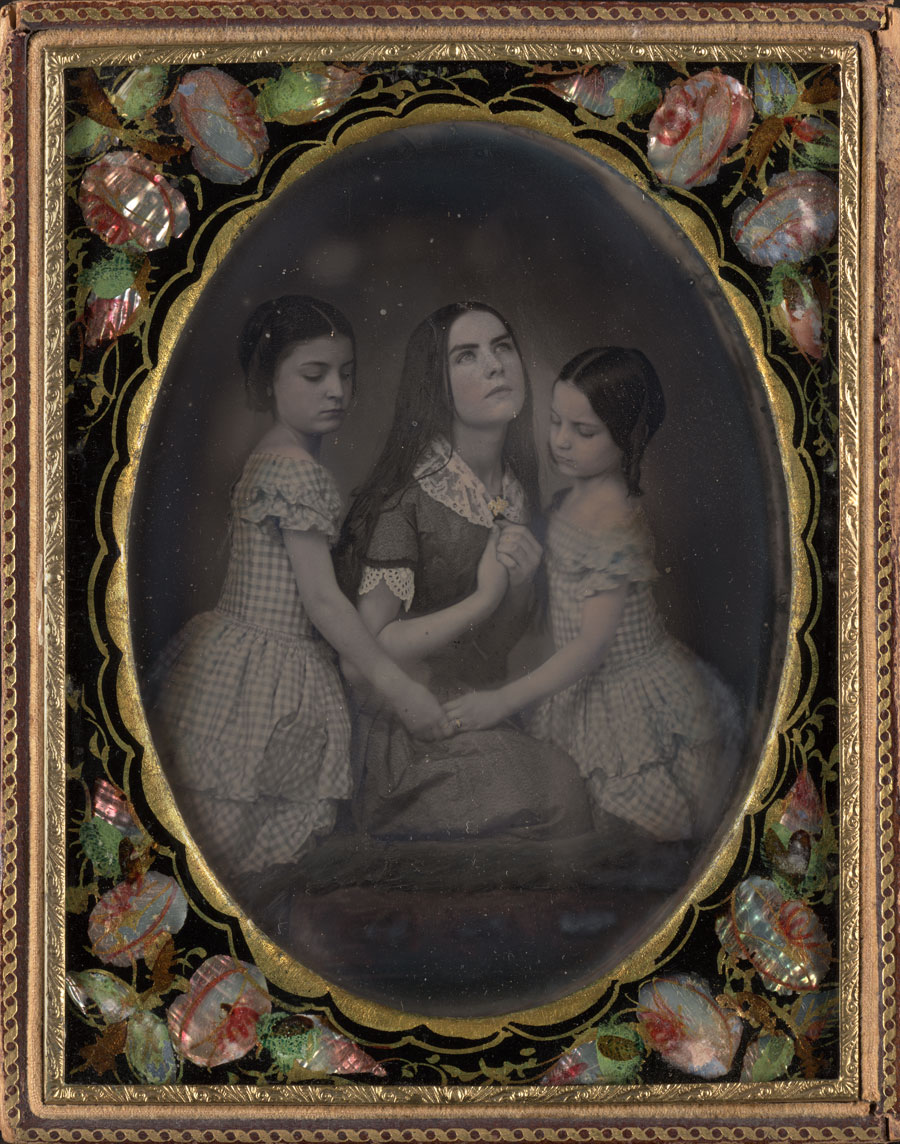
Unknown photographer. 'Portrait of Three Girls' c. 1850s


Unknown photographer
Portrait of Three Girls
c. 1850s
Daguerreotype, half plate
Plate: 5 1/2 x 4 1/2 inches (13.97 x 11.43cm)
Gift of the Hall Family Foundation
© Nelson Gallery Foundation


An exhibition featuring more than 50 daguerreotypes acquired by The Nelson-Atkins Museum of Art since 2007 opened on Jan. 24. In the Looking Glass: Recent Daguerreotype Acquisitions is a fascinating look at an early photographic process that was introduced in 1839. “In the 19th century, daguerreotypes seemed to be magical bits of reality,” says Jane Aspinwall, associate curator of Photography. “Now, more than a century later, they still hold that kind of wonder and appeal.”

A precursor of printed photography, the daguerreotype image is formed on a highly polished silver surface that is exposed to iodine fumes. The fumes produce a light sensitive coating. The plate is then covered with a protective dark slide and placed into a camera. An image is projected through the lens and onto the plate; the image is then developed using heated mercury. The distinguishing visual characteristics of a daguerreotype are that the image is on a bright, mirror-like surface of metallic silver and it appears either positive or negative depending on the lighting conditions and whether a light or dark background is being reflected in the metal.

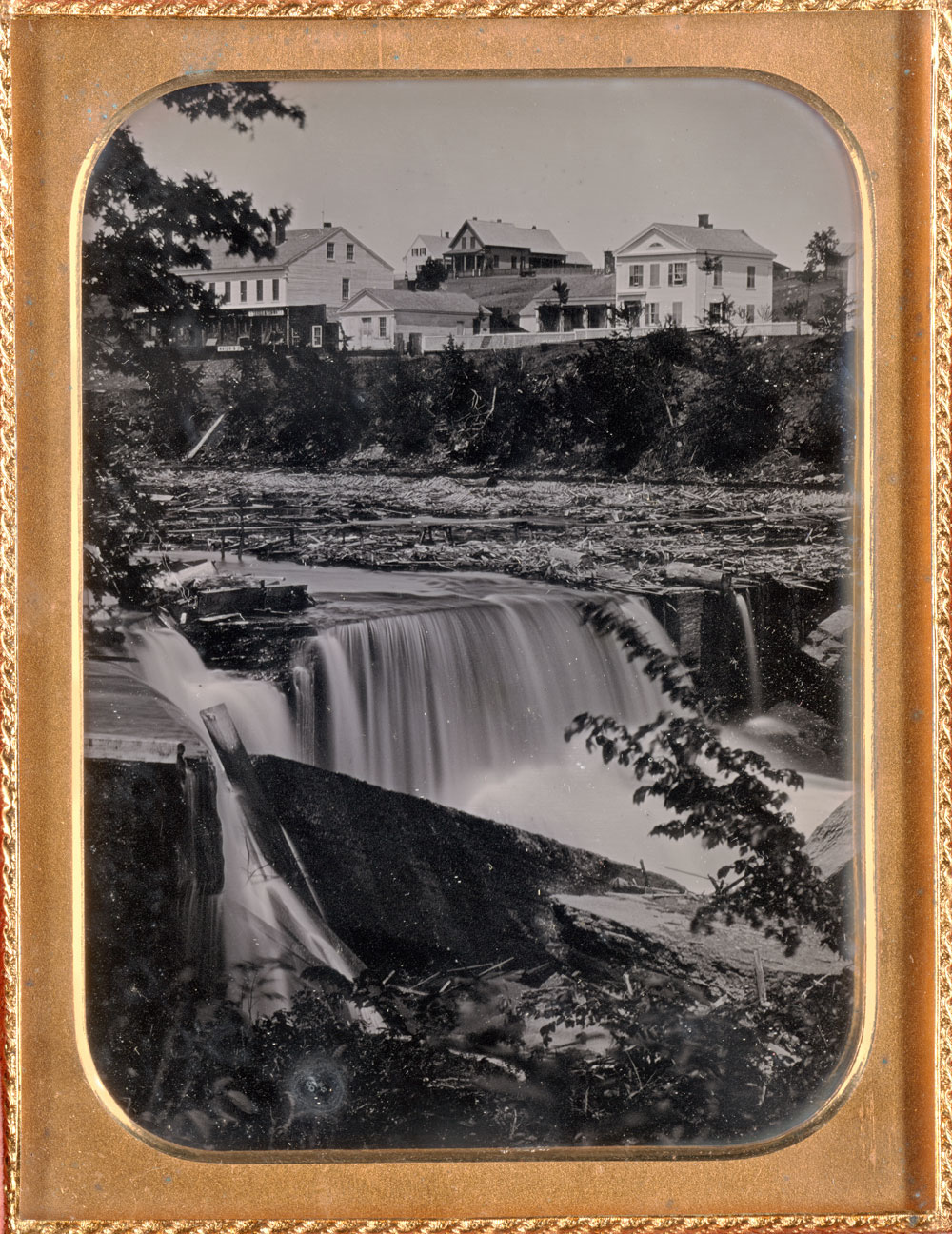
Important additions to the Nelson-Atkins American collection include portraits by major makers, including possibly the earliest of only six known daguerreotypes of noted abolitionist John Brown. In the French holding, lively portraits, cityscapes, and archaeological images are highlighted. A 170-year-old daguerreotype from Egypt transports viewers to the shimmering banks of the Nile River, a place few would have been able to travel to at the time. British pieces are distinguished by elaborate hand-colouring.

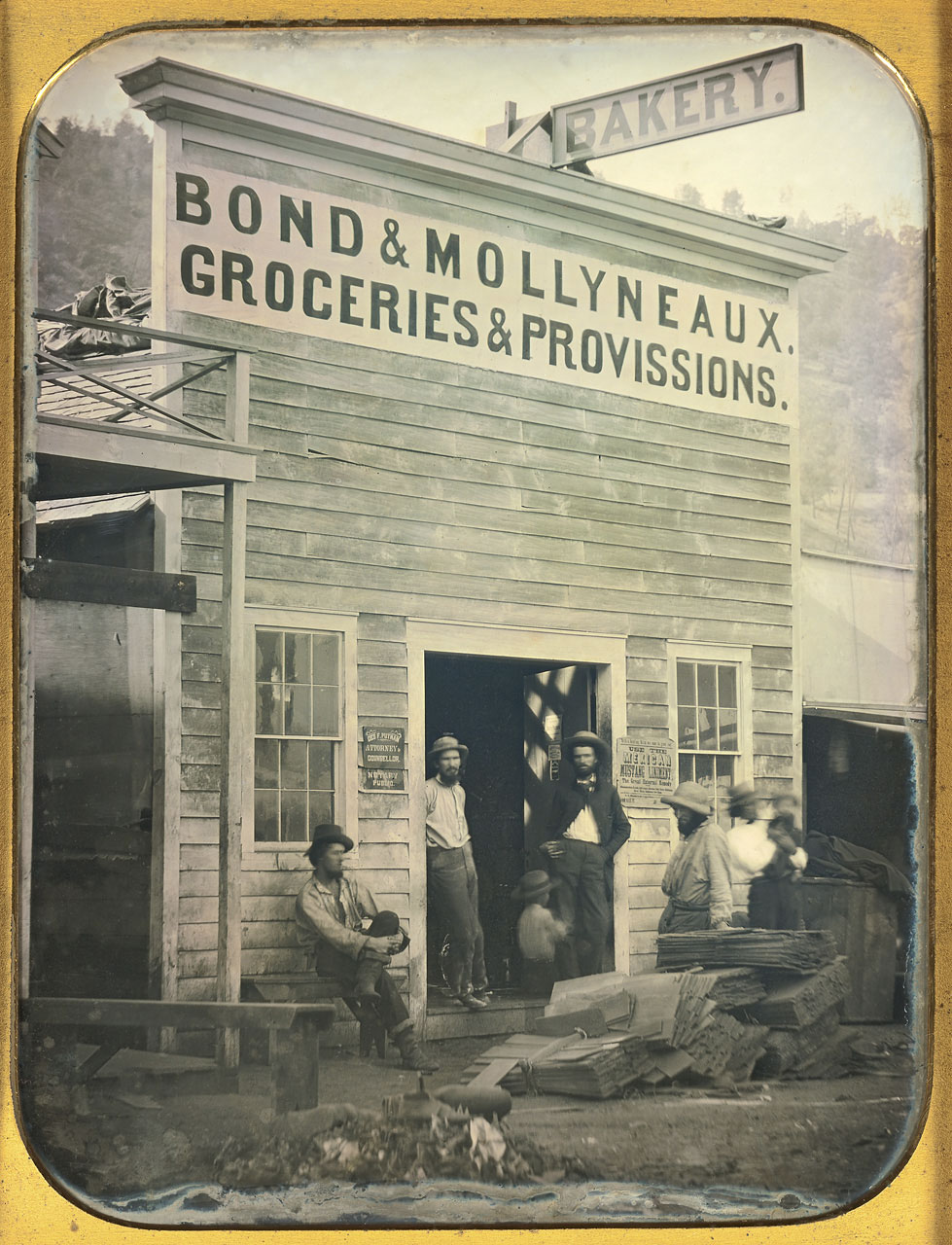
Small, intimate American daguerreotypes, most housed in jewel-like velvet or silk-lined cases, were made to be held close and scrutinised. Because they are reflective, the Nelson-Atkins designed more than two dozen cases with special lighting features to provide optimal viewing conditions, bringing each detailed image to life. A daguerreotype of a young girl clutching a shawl around her bare shoulders seems to float; another sharply detailed, rare Gold Rush image [second image, below] depicts a small group of men standing in front of their grocery store located in a California frontier town.

“It’s an amazing experience to view these precious, one-of-a-kind daguerreotypes,” said Aspinwall. “Once you see one, you never forget it. It takes you back in time to share a mid-19­th century moment with the sitter.”

The Nelson-Atkins is recognised as having one of the top five American daguerreotype collections in the U.S. and loaned more than 80 to the Taft Museum in Cincinnati for the 2013 exhibition Photographic Wonders. Daguerreotypes are an internationally significant cornerstone of the museum’s photography holdings.”

Press release from the  Nelson-Atkins Museum of Art website
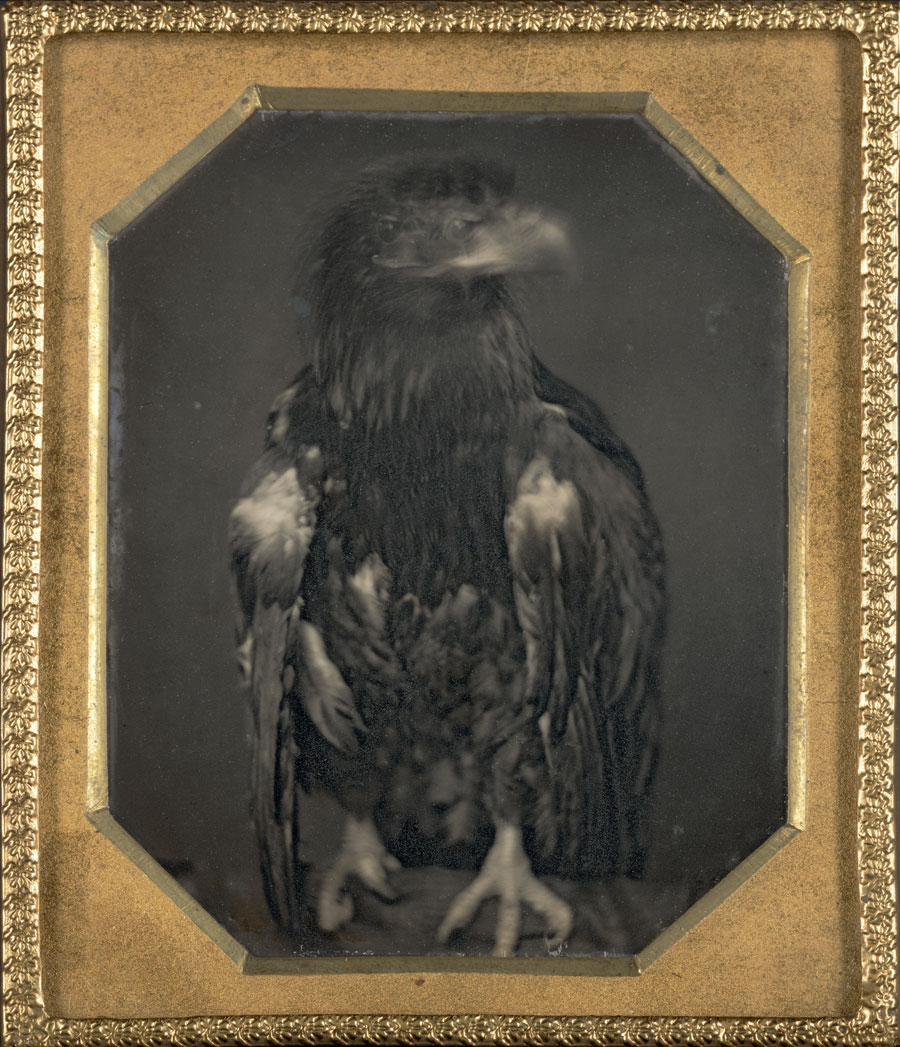
 

Unknown photographer. 'St. Anthony Falls' c. 1852


Unknown photographer
St. Anthony Falls
c. 1852
Daguerreotype, half plate
Plate: 5 1/2 x 4 1/2 inches (13.97 x 11.43cm)
Case: 6 x 4 3/4 x 1/2 inches (15.24 x 12.07 x 1.27cm)
Gift of the Hall Family Foundation
© Nelson Gallery Foundation


Unknown maker, American. 'Bond & Mollyneaux Groceries and Provisions' c. 1850


Unknown maker, American
Bond & Mollyneaux Groceries and Provisions
c. 1850
Daguerreotype, whole plate
Image size: 8 1/2 x 6 1/2 inches
© Nelson Gallery Foundation


Unknown photographer. 'Three carpenters in their workshop' c. 1848-1850


Unknown photographer
Three carpenters in their workshop
c. 1848-1850
Daguerreotype, quarter plate
Plate: 4 1/4 x 3 1/4 inches (10.8 x 8.26cm)
Case (open): 4 3/4 x 7 1/2 inches (12.07 x 19.05cm)
Gift of the Hall Family Foundation
© Nelson Gallery Foundation


David C. Collins (American, 1825-1909) Thomas P. Collins (American, 1823-1873) 'Portrait of Annie M. Collins' c. 1847


David C. Collins (American, 1825-1909)
Thomas P. Collins (American, 1823-1873)
Portrait of Annie M. Collins
c. 1847
Daguerreotype, quarter plate
Plate: 4 1/4 x 3 1/4 inches (10.8 x 8.26cm)
Case: 4 5/8 x 3 3/4 inches (11.76 x 9.53cm)
Gift of the Hall Family Foundation
© Nelson Gallery Foundation


Unknown photographer. 'Genushe (animal post-mortem)' c. 1845-1846


Unknown photographer
Genushe (animal post-mortem)
c. 1845-1846
Daguerreotype, sixth plate
Plate: 3 1/4 x 2 3/4 inches (8.26 x 6.99cm)
Case: 3 3/4 x 3 1/4 x 1/4 inches (9.53 x 8.26 x 0.64cm)
Gift of the Hall Family Foundation
© Nelson Gallery Foundation


Unknown photographer. 'Untitled (eagle facing left)' c. 1850


Unknown photographer
Untitled (eagle facing left)
c. 1850
Daguerreotype, sixth plate
Case: 3 3/4 x 3 3/4 x 3/4 inches (9.53 x 9.53 x 1.91cm)
Gift of the Hall Family Foundation
© Nelson Gallery Foundation


The Nelson-Atkins Museum of Art
4525 Oak Street
Kansas City, MO 64111

Opening hours:
Thursday – Monday 10am – 5pm
Closed Tuesdays and Wednesdays

The Nelson-Atkins Museum of Art website

LIKE ART BLART ON FACEBOOK

Back to top