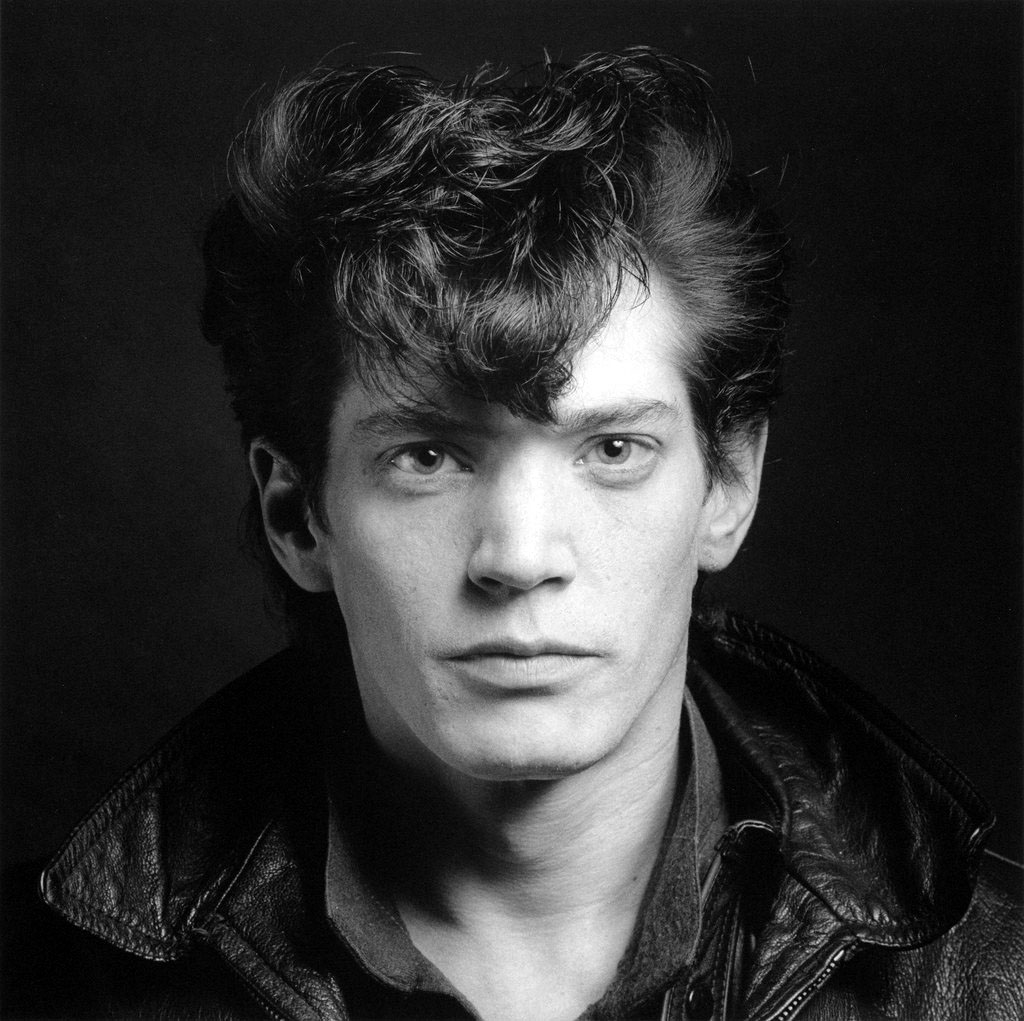
Exhibition: ‘Joseph Cornell: Wanderlust’ at the Royal Academy of Arts, London

Exhibition dates: 4th July – 27th September, 2015

Curator: Sarah Lea


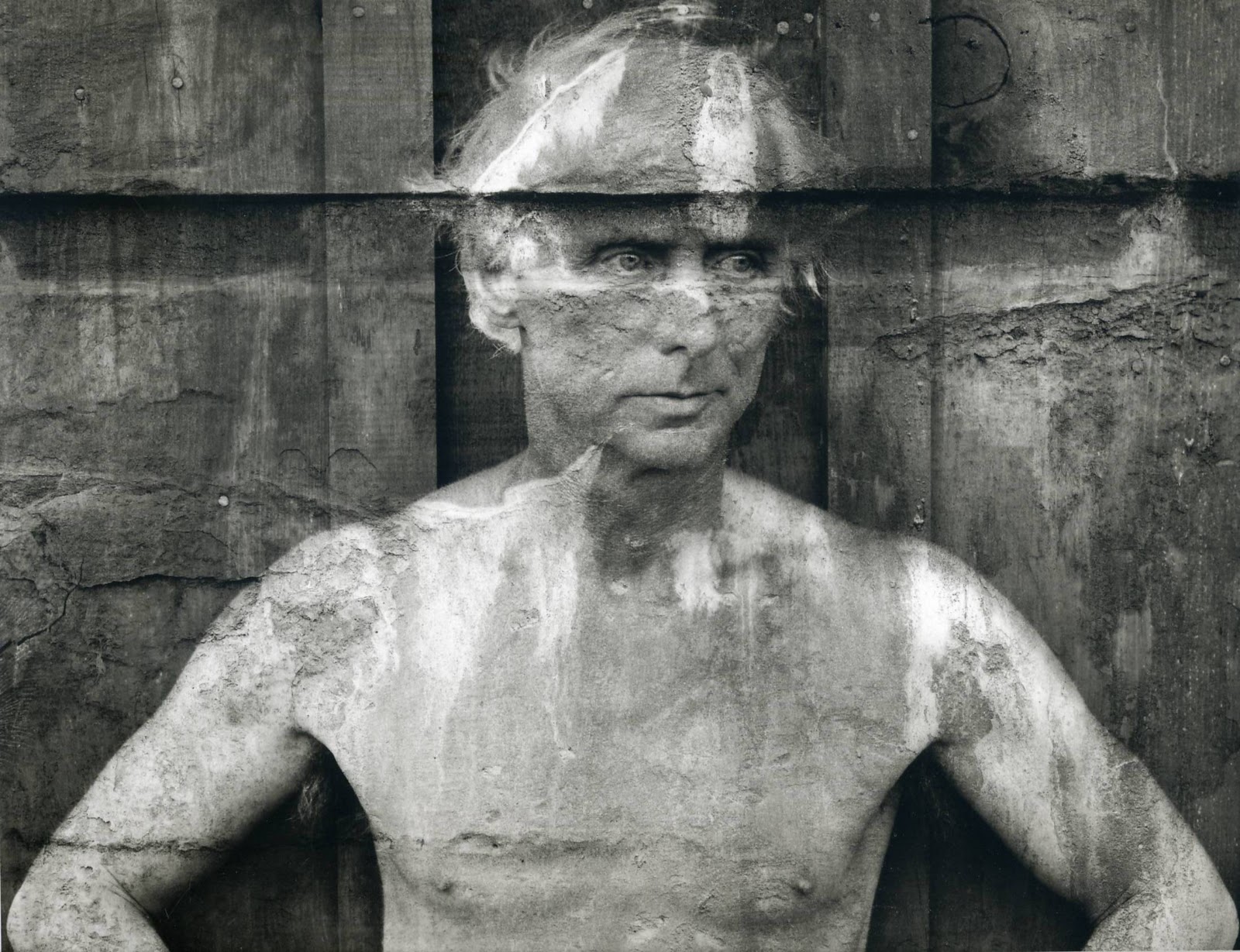
Hans Namuth (American born Germany, 1915-1990) 'Joseph Cornell' 1969 from the exhibition 'Joseph Cornell: Wanderlust' at the Royal Academy of Arts, London, July - Sept, 2015


Hans Namuth (American born Germany, 1915-1990)
Joseph Cornell
1969
Courtesy Center for Creative Photography, University of Arizona
© 1991 Hans Namuth Estate


Now, Voyager


“The untold want by life and land ne’er granted,
Now, voyager, sail thou forth, to seek and find.”

Walt Whitman (1819-1892). “Untold Want,” from Leaves of Grass. 1900


Joseph Cornell is my favourite artist who has ever lived on this Earth. I do not make this observation lightly, but after much consideration, thought and reflection.

I have always loved his work, from the very first time I saw it in a book. To then see a recreation of one of his 1950s exhibitions at the Art Institute of Chicago in 2001 was one of those seminal moments where you are lifted out of yourself, where your life becomes forever changed. For me that transcendent experience is up there with being alone with the Rembrandt portraits in the Louvre for 10 precious minutes. Both were among the most exquisite, poignant and beautiful spiritual experiences I have had in my life.

I am not an expert on Cornell, although I have read many books on his work and on his spirituality. He saw himself as an “armchair voyager”, a bit like a latter day Baudelaire, a man who has romantic notions of travel but never actually goes anywhere, who has romantic notions of love but never finds it, except in his imagination. Cornell never left his native New York. Cornell expressed his self through a passion for the artefacts he collected, through his assemblage of those artefacts into magical boxes that addressed unrequited love and faith – for Hollywood and movie stars, ballerinas, hotels, birds, the Renaissance, princes and princesses, the stars, games and chance. He was an avid collector, rummaging through the junk shops of New York and storing his collectibles for his art, something to which I have an affinity, being an avid op shopper (or thrift shopper) myself.

Here I can see an association with the words of Walt Whitman in his lines “Untold Want” from Leaves of Grass, those lines forming the title for the book upon which the film Now Voyager (1942) with Bette Davis was based. “The untold want” of Whitman’s lines are whatever you yearn for and cannot get in the social context (“life”) and place (“land”) where you are born. Whitman says, stop “studying the charts,” and “now obey, thy cherish’d, secret wish,” – in other words he’s saying that your heart’s desire is the best indicator of where your destiny lies, but it is possible to miss out on it by not going for it. Fast forward to Now Voyager where frumpy Bette Davis has an affair with a married man, becomes independent, defies her tyrannical mother who promptly dies, and ends up circuitously looking after her lover’s daughter. They decide to have a platonic relationship “sustaining a romantic, unconsummated relationship and creating a ‘family’ by becoming the surrogate, adoptive care-giver for his daughter.”

There is a specific desire here. Davis and Whitman are freed to love without restriction in a romantic way, and after the end of Now Voyager, perhaps Cornell is channelling Bette Davis. He loved in his mind, he created boxes in his imagination (and then physically), he astral travelled through the stars, he created games of chance (such as penny arcades and slot machines) and shooting galleries (that exposed his inner mind) letting the air rush out into the world. He created surreality itself but he was never surreal, for his work is always based on the collision of realities. His boxes are tiny cosmos, like the Tardis from Dr Who, the interior (under a microscope, within four walls) larger than the exterior … yet, magically, they inhabit the whole world, they inhabit our mind. He used the alchemical reaction of elements, the elementary, to affect travel, love, life and change. And he did it in four dimensions for his boxes affect us as much today as he did when he created them. Perhaps that is why I like his work so much… he used seemingly mundane materials, multi/media objects, imagination and love to let’s our spirits soar into the universe. No other artist has ever affected me so much. No one ever will.

Undeniably, Cornell’s poetic theatres are joyous creations that free our soul from the everyday.

Perhaps it is through love, or in death, or the afterlife, that the Voyager can seek that untold want.

Dr Marcus Bunyan


My Mind to me a Kingdom Is

Sir Edward Dyer (1543-1607)

1 My mind to me a kingdom is;
2 Such perfect joy therein I find
3 That it excels all other bliss
4 Which God or nature hath assign’d.
5 Though much I want that most would have,
6 Yet still my mind forbids to crave.

7 No princely port, nor wealthy store,
8 No force to win a victory,
9 No wily wit to salve a sore,
10 No shape to win a loving eye;
11 To none of these I yield as thrall, –
12 For why? my mind despise them all.

13 I see that plenty surfeit oft,
14 And hasty climbers soonest fall;
15 I see that such as are aloft
16 Mishap doth threaten most of all.
17 These get with toil and keep with fear;
18 Such cares my mind can never bear.

19 I press to bear no haughty sway,
20 I wish no more than may suffice,
21 I do no more than well I may,
22 Look, what I want my mind supplies.
23 Lo ! thus I triumph like a king,
24 My mind content with anything.

25 I laugh not at another’s loss,
26 Nor grudge not at another’s gain;
27 No worldly waves my mind can toss;
28 I brook that is another’s bane.
29 I fear no foe, nor fawn on friend,
30 I loathe not life, nor dread mine end.

31 My wealth is health and perfect ease,
32 And conscience clear my chief defence;
33 I never seek by bribes to please,
34 Nor by desert to give offence.
35 Thus do I live, thus will I die, –
36 Would all did so as well as I!


Many thankx to the Royal Academy of Arts for allowing me to publish the art work in the posting. Please click on the photographs for a larger version of the art work. The excellent, educational text was written by Asha McLoughlin, Learning Department © Royal Academy of Arts.


“Beauty should be shared for it enhances our joys. To explore its mystery is to venture towards the sublime.”

“Life can have significance even if it appears to be a series of failures.”


Joseph Cornell


Bette Davis ~ Don’t Let’s Ask For The Moon (Now Voyager 1942)


“Cornell was a voyager, travelling through space and time to dimensions of the imagination and the spirit. He infused this sense of adventure and an infinite beyond into modestly scaled works whose fragments of reality give way to worlds to be explored.”


Robert Lehrman, Joseph Cornell: Shadowplay Eterniday, 2003


“White is just what I mean. Not monstrously, but in wonderful variations. All I want to perform is white magic.”


Joseph Cornell quoted in Tracking the Marvellous: A Life in the New York Art World, John Bernard Myers, 1984
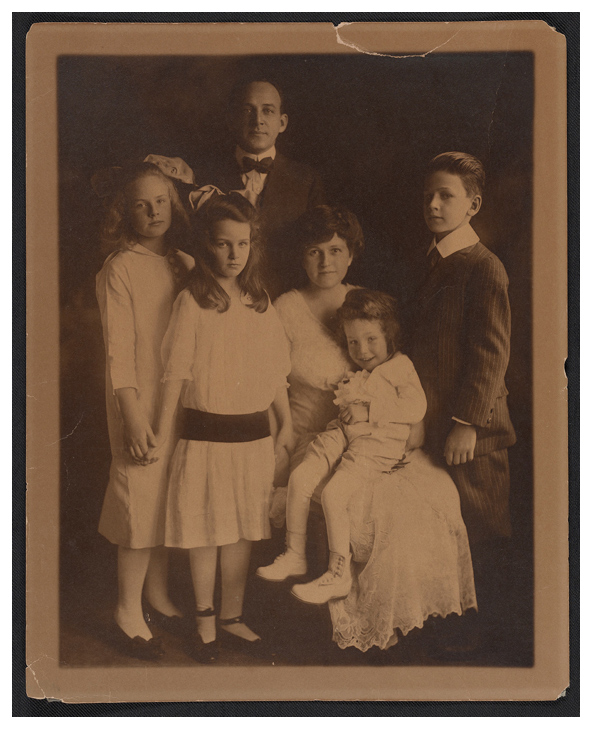


Unidentified photographer. 'The Cornell family' c. 1915 from the exhibition 'Joseph Cornell: Wanderlust' at the Royal Academy of Arts, London, July - Sept, 2015


Unidentified photographer
The Cornell family
c. 1915
Joseph Cornell (far right) with his parents (Joseph I. Cornell, Sr. and Helen Storms Cornell) and siblings (l to r: Elizabeth, Helen, and Robert)
Joseph Cornell papers, Archives of American Art, Smithsonian Institution
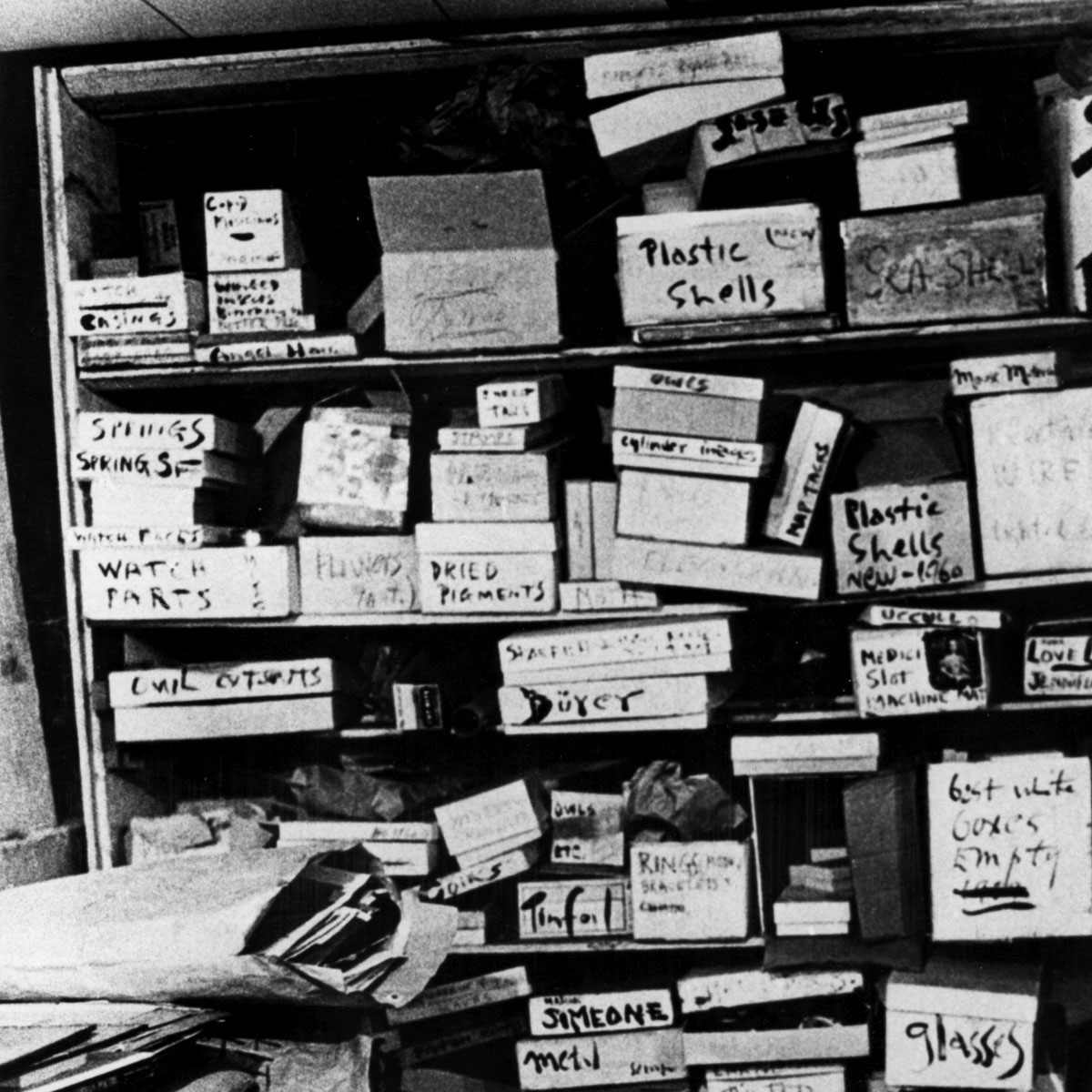
 

Cornell's basement studio, 3708 Utopia Parkway, Flushing, New York, 1964


Cornell’s basement studio, 3708 Utopia Parkway, Flushing, New York, 1964
Collection Duff Murphy and Janice Miyahira
© Terry Schutté


“What kind of man is this, who, from old brown cardboard photographs collected in second-hand bookstores, has reconstructed the nineteenth century “grand tour” of Europe for his mind’s eye more vividly than those who took it, who was not born then and has never been abroad, who knows Vesuvius’s look on a certain morning of AD 79, and of the cast-iron balconies of that hotel in Lucerne?”


Robert Motherwell on Joseph Cornell, Joseph Cornell’s Theatre of the Mind, 1993


“He uses selected, sought-for, desired objects. He must have been clipping all the time, poring through magazines, collecting things and haunting junk shops and flea markets, looking for the images that corresponded to his imagination.”


Susan Sontag, Joseph Cornell: Worlds in a Box, directed by Mark Stokes, 1991


Lee Miller (American, 1907-1977) 'Joseph Cornell, New York' 1933


Lee Miller (American, 1907-1977)
Joseph Cornell, New York
1933
Vintage photograph
‘Joseph Cornell, New York Studio, New York, USA 1933’ by Lee Miller (96-2)
© Lee Miller Archives, England 2015. All rights reserved


Joseph Cornell (American, 1903-1972) 'Untitled (Schooner)' 1931


Joseph Cornell (American, 1903-1972)
Untitled (Schooner)
1931


Joseph Cornell (American, 1903-1972) 'Untitled [Sagittarius, Scorpio, and Lupus Constellations]' c.1934


Joseph Cornell (American, 1903-1972)
Untitled [Sagittarius, Scorpio, and Lupus Constellations]
c. 1934
Collage with ink on paper
14 x 18.6cm
Drs. Steven and Sara Newman. Photo Collection of Drs. Steven and Sara Newman, Chicago, Illinois, USA
© The Joseph and Robert Cornell Memorial Foundation/VAGA, NY/DACS, London 2015


Joseph Cornell (American, 1903-1972) 'Untitled (M'lle Faretti)' 1933


Joseph Cornell (American, 1903-1972)
Untitled (M’lle Faretti)
1933
Box construction
27.9 x 20.3 x 5.1cm
Private Collection
Photo: Michael Tropea, Chicago
© The Joseph and Robert Cornell Memorial Foundation/VAGA, NY/DACS, London 2015


Joseph Cornell (American, 1903-1972) 'Object (Soap Bubble Set)' 1936


Joseph Cornell (American, 1903-1972)
Object (Soap Bubble Set)
1936
Box construction


Joseph Cornell (American, 1903-1972) 'Object (Soap Bubble Set)' 1941


Joseph Cornell (American, 1903-1972)
Object (Soap Bubble Set)
1941
Box construction
46.4 x 31.4 x 9.5cm
The Robert Lehrman Art Trust, Courtesy of Aimee and Robert Lehrman
© The Joseph and Robert Cornell Memorial Foundation/VAGA, NY/DACS, London 2015
Photo: Quicksilver Photographers, LLC. Exhibition organised by the Royal Academy of Arts, London, and Kunsthistorisches Museum, Vienna


Joseph Cornell (American, 1903-1972) 'Object (Soap Bubble Set)' 1941 (detail)


Joseph Cornell (American, 1903-1972)
Object (Soap Bubble Set) (detail)
1941
Box construction
46.4 x 31.4 x 9.5cm
The Robert Lehrman Art Trust, Courtesy of Aimee and Robert Lehrman
© The Joseph and Robert Cornell Memorial Foundation/VAGA, NY/DACS, London 2015
Photo: Quicksilver Photographers, LLC. Exhibition organised by the Royal Academy of Arts, London, and Kunsthistorisches Museum, Vienna


Joseph Cornell (American, 1903-1972) 'Pharmacy' 1943


Joseph Cornell (American, 1903-1972)
Pharmacy
1943
Box construction
38.7 x 30.5 x 7.9cm
Collection Paul Schärer
Photo Dominique Uldry, Bern
© The Joseph and Robert Cornell Memorial Foundation/VAGA, NY/ DACS, London 2015


Joseph Cornell (American, 1903-1972) 'Pharmacy' 1943 (detail)


Joseph Cornell (American, 1903-1972)
Pharmacy (detail)
1943
Box construction
38.7 x 30.5 x 7.9cm
Collection Paul Schärer
Photo Dominique Uldry, Bern
© The Joseph and Robert Cornell Memorial Foundation/VAGA, NY/ DACS, London 2015
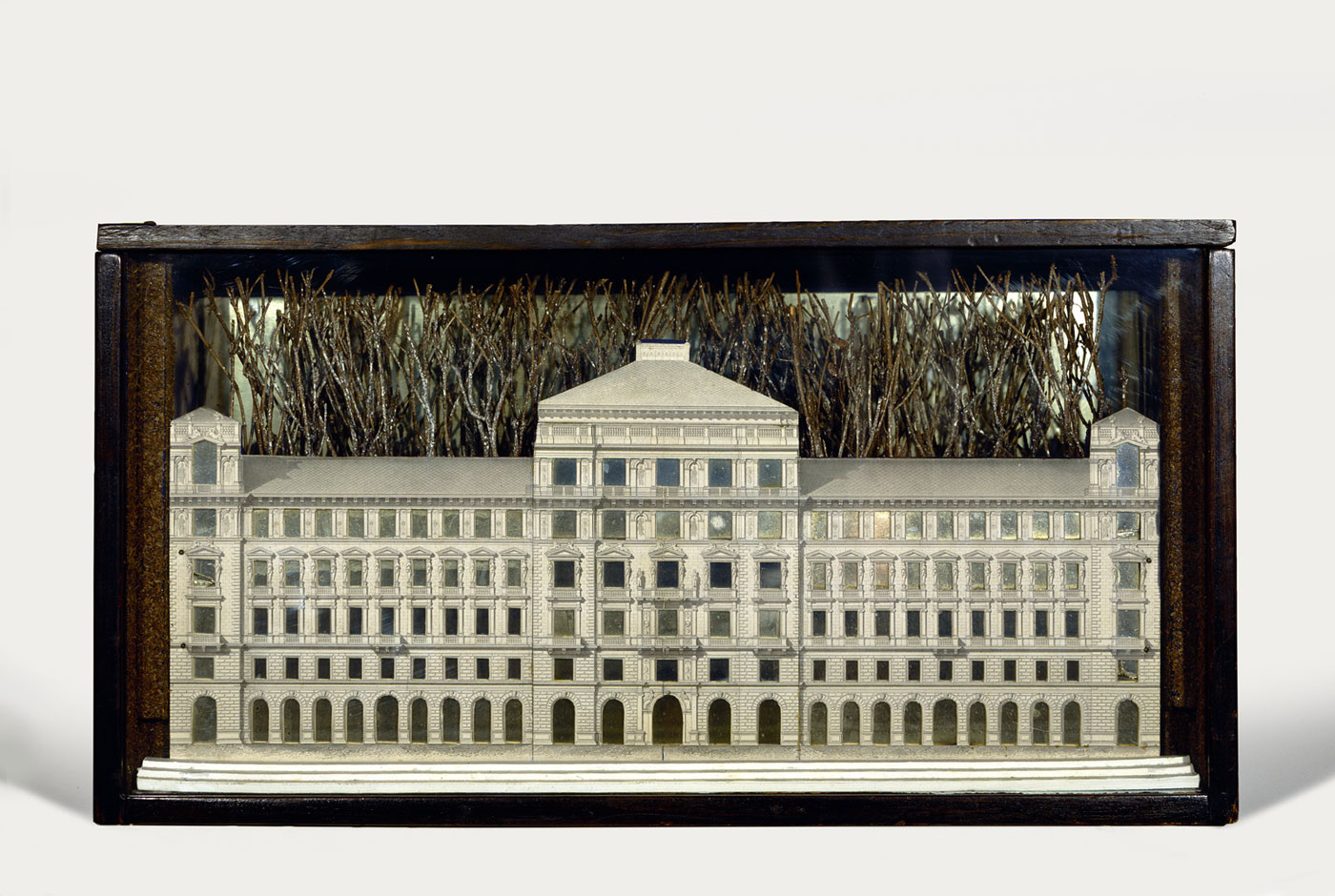
 

Joseph Cornell (American, 1903-1972) 'Palace' 1943


Joseph Cornell (American, 1903-1972)
Palace
1943
Box construction
Glass-paned, stained wood box with photomechanical reproduction, mirror, spray-painted twigs, wood and shaved bark
26.7 x 50.5 x 13cm
The Menil Collection, Houston
Photo: The Menil Collection, Houston. Photography: Hickey-Robertson
© The Joseph and Robert Cornell Memorial Foundation/VAGA, NY/DACS, London 2015


Joseph Cornell (American, 1903-1972) 'Untitled (Tilly Losch)' c. 1935-1938


Joseph Cornell (American, 1903-1972)
Untitled (Tilly Losch)
c. 1935-1938
Box Construction
25.4 x 23.5 x 5.4cm
Collection of Robert Lehrman, courtesy of Aimee and Robert Lehrman
Photo: The Robert Lehrman Art Trust, courtesy of Aimee and Robert Lehrman. Photography: Quicksilver Photographers, LLC
© The Joseph and Robert Cornell Memorial Foundation/VAGA, NY/DACS, London 2015


“Creative filing
Creative arranging
As poetics
As technique
As joyous creation”


Joseph Cornell, diary entry, 9 March 1959


“On the way to ART OF THIS CENTURY from Julien’s, carrying De Medici girl Slot Machine and bird with cracked glass saw Marlene Dietrich in polo coat and black beanie cap on back of hair waiting at curb of Jay Thorpe’s for a taxi. First time I’d seen her off screen and brought an unexpectedly elated feeling. Working in cellar that night on Soap Bubble Set the green glass locket portrait of her on the floor evoked very special feelings.”


Joseph Cornell, diary entry, spring 1944


“Original inspiration of the bird store, windows, simplicity of magic, pet shop.”


Joseph Cornell, c. 1943, Joseph Cornell Papers, Archives of American Art, Smithsonian Institution, Washington, DC


Joseph Cornell (American, 1903-1972) 'Untitled Object (Mona Lisa)' c. 1940-1942


Joseph Cornell (American, 1903-1972)
Untitled Object (Mona Lisa)
c. 1940-1942
Box construction
3.5 x 7.6cm
The Collection of Marguerite and Robert Hoffman
Photo: Brad Flowers
© The Joseph and Robert Cornell Memorial Foundation/VAGA, NY/DACS, London 2015


Joseph Cornell (American, 1903-1972) 'Untitled (Owl Habitat)' c. mid- to late 1940s


Joseph Cornell (American, 1903-1972)
Untitled (Owl Habitat)
c. mid- to late 1940s
Collection Jasper Johns Photo Collection Jasper Johns
© The Joseph and Robert Cornell Memorial Foundation/VAGA, NY/DACS, London 2015


“Some of his boxes are less cryptic, and more naturalistic, such as Untitled (Owl Habitat), from the 1940s. The snowy owl trapped behind a pane of glass is not a fancy piece of taxidermy fit for a natural history diorama, but a mere paper illustration pasted onto plywood. The midnight-blue forest the owl inhabits is contrived from painted bark and lichen. Cornell, of course, was himself a famous night owl. In some ways the owl box can seem as close as he ever came to self-portraiture, with its majestic creature alone in the woods, eyes wide, watching.”

Deborah Solomon, May 2015


Joseph Cornell (American, 1903-1972) 'Habitat Group for a Shooting Gallery' 1943


Joseph Cornell (American, 1903-1972)
Habitat Group for a Shooting Gallery
1943
Mixed media
39.4 x 28.3 x 10.8cm
Purchased with funds from the Coffin Fine Arts Trust; Nathan Emory Coffin Collection of the Des Moines Art Center, 1975.27
Photo: Collection of the Des Moines Art Center
© The Joseph and Robert Cornell Memorial Foundation/VAGA, NY/DACS, London 2015


Joseph Cornell (American, 1903-1972) 'Soap Bubble Set' 1948


Joseph Cornell (American, 1903-1972)
Soap Bubble Set
1948
Box construction
36.8 x 52.1 x 9.8cm
Mr. and Mrs. John Stravinsky
Photo © 2014 Christie’s Images Limited
© The Joseph and Robert Cornell Memorial Foundation/VAGA, NY/DACS, London 2015
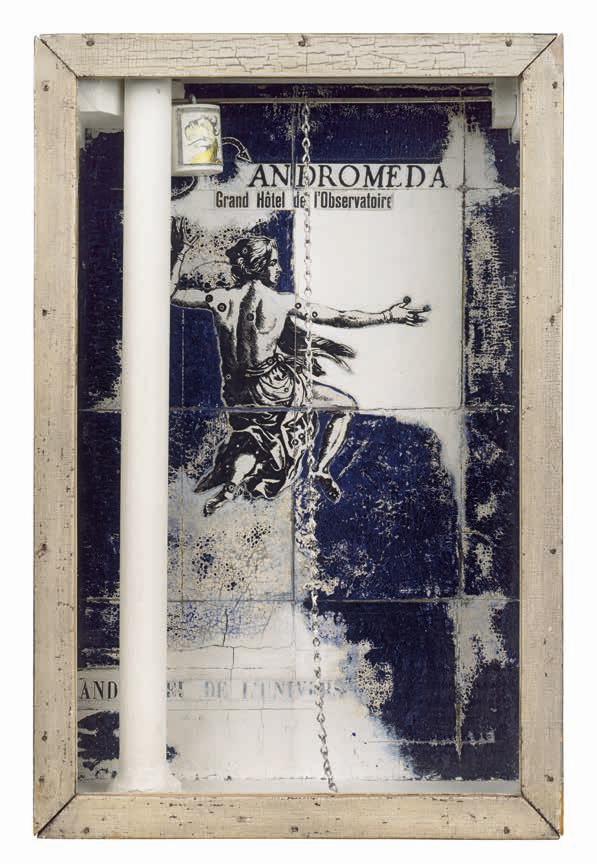
 

Joseph Cornell (American, 1903-1972) 'Andromeda: Grand Hôtel de l'Observatoire' 1954


Joseph Cornell (American, 1903-1972)
Andromeda: Grand Hôtel de l’Observatoire
1954
Box construction
46.5 x 33 x 9.8cm
Solomon R. Guggenheim Museum, New York. Partial gift, C. and B. Foundation, by exchange, 1980
Photo © SRGF, New York
Photography: David Heald
© The Joseph and Robert Cornell Memorial Foundation/VAGA, NY/ DACS, London 2015
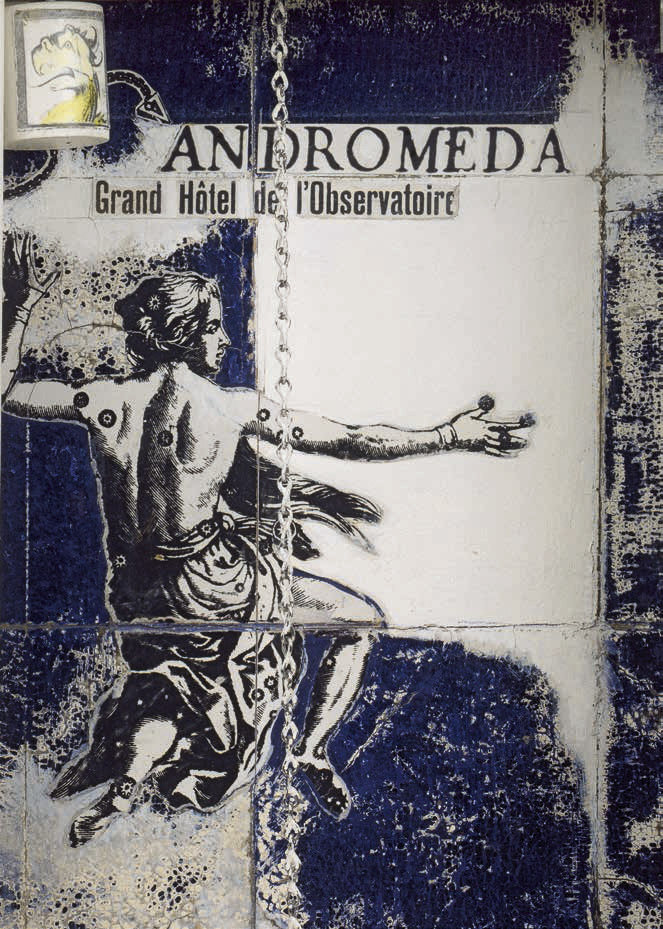
 

Joseph Cornell (American, 1903-1972) 'Andromeda: Grand Hôtel de l'Observatoire' 1954 (detail)


Joseph Cornell (American, 1903-1972)
Andromeda: Grand Hôtel de l’Observatoire (detail)
1954
Box construction
46.5 x 33 x 9.8cm
Solomon R. Guggenheim Museum, New York. Partial gift, C. and B. Foundation, by exchange, 1980
Photo © SRGF, New York
Photography: David Heald
© The Joseph and Robert Cornell Memorial Foundation/VAGA, NY/ DACS, London 2015


Joseph Cornell (American, 1903-1972) 'Untitled (Medici Princess)' c. 1948


Joseph Cornell (American, 1903-1972)
Untitled (Medici Princess)
c. 1948
Box construction
44.8 x 28.3 x 11.1cm
Private collection, New York
Photo courtesy private collection, New York
© The Joseph and Robert Cornell Memorial Foundation/VAGA, NY/ DACS, London 2015


Joseph Cornell and travel

The title of our Joseph Cornell exhibition is Wanderlust. Curator Sarah Lea describes how this theme is closely linked to Cornell’s artistic practice, and his travels of the imagination.
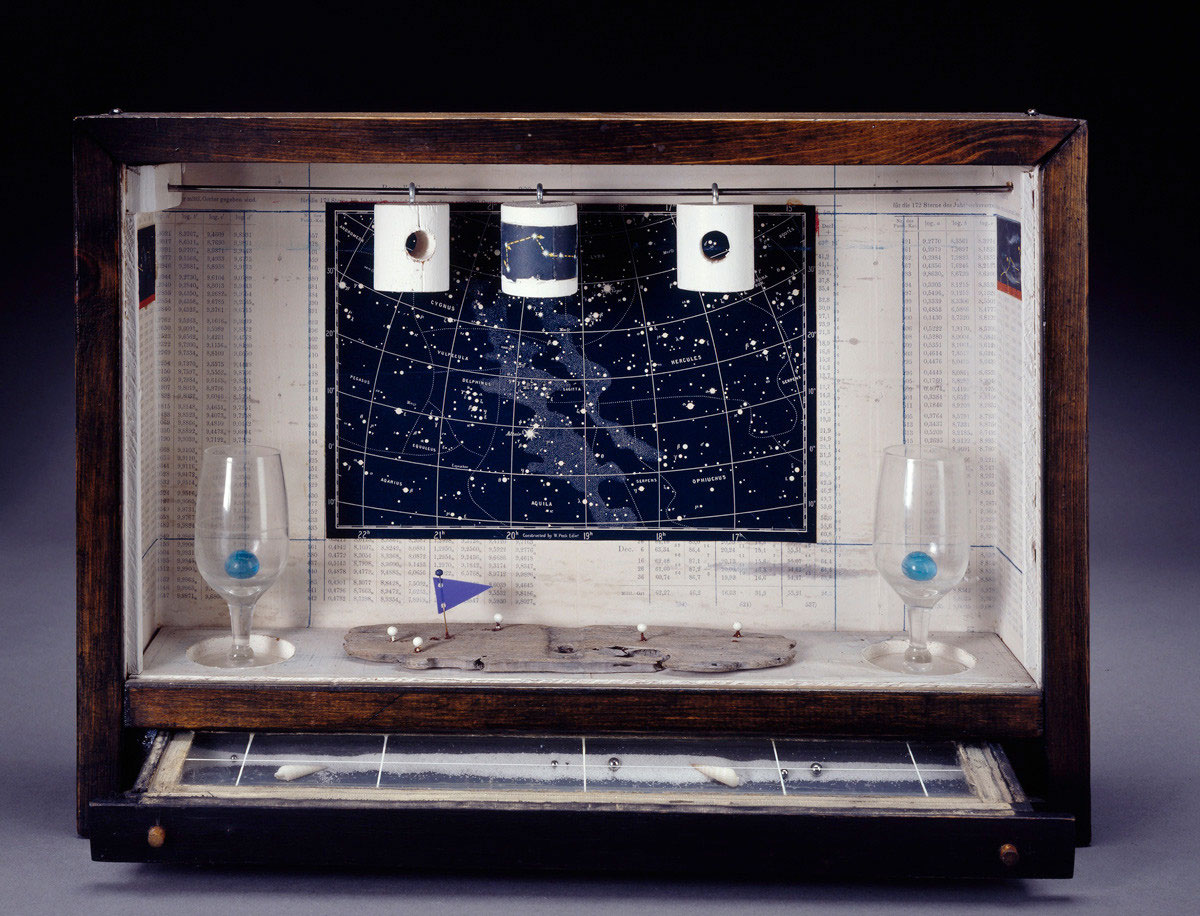
 

Joseph Cornell (American, 1903-1972) 'Untitled (Celestial Navigation)' 1956-1958


Joseph Cornell (American, 1903-1972)
Untitled (Celestial Navigation)
1956-1958
Box construction
30.8 x 43.2 x 9.2cm
The Robert Lehrman Art Trust, courtesy of Aimee and Robert Lehrman
Photo The Robert Lehrman Art Trust, courtesy of Aimee and Robert Lehrman
Photography: Quicksilver Photographers, LLC
© The Joseph and Robert Cornell Memorial Foundation/VAGA, NY/DACS, London 2015


Joseph Cornell (1903-1972), born on Christmas Eve in Nyack, New York, remains one of the most enigmatic yet influential American artists of the twentieth century. Almost entirely self-taught as an artist, Cornell lived quietly for most of his life with his mother and younger brother, crafting in the confines of his basement or on the kitchen table the ‘shadow boxes’ for which he is best known.

He rarely travelled, and almost never left New York, yet his work, based on collage and assemblage, resonates with references to foreign places and distant times. In the course of his life he befriended ballerinas, film stars, poets and generations of world-famous artists. He showed in a succession of New York galleries, participated in landmark group shows at the Wadsworth Atheneum in Hartford, Connecticut, and the Museum of Modern Art, New York, and was honoured before he died with major surveys at the Pasadena Museum of Californian Art and the Solomon R. Guggenheim Museum.

A popular romanticised image of Cornell pervades as an ascetic outsider – a shy, eccentric man yearning for intimacy, unable to converse with the women who enthralled him but with a vibrant interior life of daydreams and an imagination capable of crossing oceans, centuries and the celestial realm. Yet this mythologised version of the man belies his active interest in the art movements of his time, and the innovative nature of his creations which have paved the way for today’s appropriation and installation artists, contemporary collage and archive based practices.

This exhibition at the Royal Academy brings together 80 of Cornell’s most remarkable shadow boxes, assemblages, collages and films, including many works held in private collections and a number never seen before outside of the USA. The first major UK exhibition solely devoted to Cornell in almost 35 years, it presents a rare chance to experience a concentrated survey of his oeuvre, and to journey inside the mind of an artist who described himself as ‘an armchair voyager’. The ‘wanderlust’ referenced in the exhibition title – the desire to explore and travel the world – is central to Cornell’s art, as was his penchant for collecting and his astonishingly wide-ranging interests. His creations transport the viewer into private universes, populated with objects and ephemera imbued with personal associations.

From a basement in New York, Joseph Cornell channelled his limitless imagination into some of the most original art of the 20th century. Step into his beguiling world at this landmark exhibition. Cornell hardly ventured beyond New York State, yet the notion of travel was central to his art. His imaginary voyages began as he searched Manhattan’s antique bookshops and dime stores, collecting a vast archive of paper ephemera and small objects to make his signature glass-fronted ‘shadow boxes’. These miniature masterpieces transform everyday objects into spellbinding treasures. Together they reveal his fascination with subjects from astronomy and cinema to literature and ornithology and especially his love of European culture, from the Romantic ballet to Renaissance Italy.

Wanderlust brings together 80 of Cornell’s most remarkable boxes, assemblages, collages and films, some never before seen outside the USA. Entirely self-taught, the independence of Cornell’s creative voice won the admiration of artists from Marcel Duchamp and the Surrealists, to Robert Motherwell and the Abstract Expressionists, with echoes of his work felt in Pop and Minimalist art. Wanderlust is a long overdue celebration of an incomparable artist, a man the New York Times called “a poet of light; an architect of memory-fractured rooms and a connoisseur of stars, celestial and otherwise.”

Early Life

Joseph Cornell was the eldest of four children – he had two sisters, Elizabeth and Helen, and a brother, Robert, who suffered from cerebral palsy and was confined to a wheelchair for most of his life. When Cornell was thirteen, his father died of leukaemia and Robert became Joseph’s responsibility (partly to assuage their overbearing mother). Robert however was a cheerful child and took pleasure in drawing and collecting model trains. Cornell considered Robert to be a pure soul, and willingly took on his brother’s care. A salesman and textile designer, Cornell’s father had left considerable debts for his family to manage and for several years Cornell’s mother was forced to take odd jobs to support the family, and move them into a succession of smaller rented houses. In 1917, with the help of his father’s former employer, Joseph was able to enrol at the Phillips Academy in Andover, Massachusetts: a highly regarded private school. There he discovered an interest in American and European literature, poetry, history and French. Yet, away from his close knit family and after the relatively recent death of his father, Cornell struggled and was a mediocre student. He developed the first in a lifelong series of nervous crises and stomach problems, and left the Academy in 1921 without graduating.

Upon his return home, Cornell assumed the role of ‘man of the house’ and became a sample salesman in his father’s trade for a wholesale textile business, the William Whitman Company on lower Madison Avenue. Cornell found the job mundane and himself unsuited to its demands. In his twenties, a time when the stress of supporting his family was exacerbating his stomach ailments, he converted to Christian Science. This religion teaches that reality is purely spiritual and the material world an illusion, so disease and other afflictions associated with the physical body are thought to be manifestations of a troubled mind that ought to be treated with prayer, not medicine. Joseph remained an active member until his death and recruited his brother Robert and sister Elizabeth into the fold.

In 1929, Mrs Cornell moved the family to an unassuming house at 3708 Utopia Parkway in Flushing, Queens, New York. Here, Cornell would live with his mother and brother until he died. His main escape from the tedium of domestic life and the awkward social interactions thrust upon him at work was to walk the city streets in his lunch hour, browsing the second-hand bookshops on Fourth Avenue, the flea markets and dime stores, collecting keepsakes and scavenging for relics and once-precious fragments of other people’s lives. Cornell loved to explore Manhattan and the ‘teeming life of the metropolis’, which seemed to him the epitome of glamour. These wanderings led to Cornell amassing a vast personal archive of treasured finds – books, prints, postcards and three-dimensional ephemera such as clay pipes and watch springs – often tinged with the romance of foreign places and the nostalgia of times past, which would in due course form the material elements of the very personal poetry that is his art.

Play and Experiment

Although he did not complete his formal education, Cornell was extremely well read and kept abreast of Manhattan’s literary, musical and artistic events. Not only did he regularly attend the theatre and the ballet, but he also became an avid cinema-goer, thriving on the excitement of the city. Indeed, Cornell often waited at the stage door of theatres and opera houses for a glimpse of the female performers he idolised. He also spent time in art galleries, and in 1931 at the Julien Levy Gallery he came across collages by Max Ernst (1891-1976), a pioneer of Surrealism, who combined high art and popular imagery in his work.

Although Cornell was never officially part of the Surrealist movement and came to dismiss Surrealist associations with his own practice, it had a major influence on him, most notably inspiring his embrace of unexpected juxtapositions in his assemblages and his experimental films, like Rose Hobart (1936). Rejecting Surrealism’s more violent and erotic aspects – the shock effect of jarring images – Cornell preferred instead what he described as the ‘white magic’ side of Surrealism, and the poetic connections between everyday objects.

By 1931 Cornell had shifted from simply collecting objects to creating them. He began to make collages and assemblages first in a style resembling Max Ernst’s, then in his own manner. The basis of collage – piecing together and assembling – would be central to Cornell’s works throughout his life, be they two- or three-dimensional. At this early stage he took images from the dense dossiers of engravings and clippings that he had accumulated by this time, fashioning compositions from seemingly unrelated cutout images to create whimsical pairings, which often revealed his dual interests in science and the world of children. Both these themes would recur and overlap throughout his career…

After viewing a number of Cornell’s small surreal collages, such as Untitled (Schooner), 1931, Julien Levy invited him to show in his exhibition, Surréalisme, which opened in January 1932. Later, Levy offered Cornell a solo show, the first of several that were held at his gallery. Entitled Objects by Joseph Cornell: Minutiae, Glass Bells, Shadow Boxes, Coups d’Oeil, Jouets Surréalistes, it included a series of collages and small three-dimensional objects such as bell jars and pillboxes. All the works were made at his kitchen table at night as his mother and brother slept.

Uneasy about his work being associated with Surrealism, Cornell later wrote to Alfred H. Barr, founding director of the Museum of Modern Art in New York and organiser of the 1936 exhibition, Fantastic Art, Dada, Surrealism, in which Cornell’s work was to feature: “In the event that you are saying a word or two about my work in the catalogue, I would appreciate your saying that I do not share in the subconscious and dream theories of the Surrealists. While fervently admiring much of their work I have never been an official Surrealist, and I believe that Surrealism has healthier possibilities than have been developed.” Regardless of Cornell’s own attempt to distance himself from the movement, Surrealism provided him, at least, with a context in which he could make his collages and objets, and understand them as deserving of a mature and discerning audience.

Around this time, Cornell encountered the collages and box constructions of Kurt Schwitters (1887-1948), composed of urban detritus, and the ‘readymades’ of Marcel Duchamp (1887-1968), which are ordinary, unaltered manufactured objects designated by the artist to be works of art. In Duchamp, Cornell discovered an unlikely friend; the two regularly corresponded throughout their lifetime. When Duchamp visited New York in the 1940s, he enlisted Cornell to help him with a new project, a miniature ‘museum’ of his work, known as the Boîte-en-valise or ‘box in a suitcase’. Cornell already had his own ‘valise’ experiment, Untitled (The Crystal Cage: Portrait of Berenice).

Collecting and Classification

In the 1930s, Cornell began to make the ‘shadow boxes’ for which he is best known – glass-fronted box constructions containing intimately-scaled arrangements of found objects and paper ephemera, assembled in a sort of three-dimensional collage. The 1936 exhibition Fantastic Art, Dada, Surrealism at MoMA, New York, showed one of his first shadow boxes, Untitled (Soap Bubble Set) (above). This was the first in a long series of the same name and recalls the children’s pastime of blowing bubbles, as well as the eighteenth-century European painting association of bubbles as memento mori, a reminder of the transience of life. Precisely what led Cornell to the idea of the box remains unclear. In a Life magazine article from 1967 he said that it came to him during one of his walks through Manhattan, as he passed a collection of compasses in the window of an antique shop:

“I thought, everything can be used in a lifetime, can’t it, and went on walking. I’d scarcely gone two blocks when I came on another shop window full of boxes, all different kinds […] Halfway home on the train that night, I thought of the compasses and boxes, it occurred to me to put the two together.”

Before Cornell developed his own carpentry skills, his early shadow boxes were housed in prefabricated, semi-antique wooden boxes, popular during the Victorian era for displaying small paintings, ship models, ladies’ handiwork and mementoes. In the nineteenth century, a similar tradition existed in China, where hardwood boxes with sliding glass covers and papered or silk-lined interiors were used to display fine ceramics, especially figurines made for export. Cornell’s approach also recalls European traditions that began to appear in his research dossiers during the 1930s: small seventeenth- and eighteenth-century Dutch and Flemish kunstschranke or kunstkammer – cabinets that housed separate elements assembled to represent the world in miniature. In the mid 1930s, Cornell’s neighbour Carl Backman taught him some basic carpentry skills, which allowed him to construct his own boxes. The boxes are often hard to date accurately, as Cornell would tinker with and refine his constructions over several years, returning to them gradually. However, except for his early boxes which tend to be singular, we can see patterns emerging in his practice as he worked on larger ‘families’ of works that share discernible visual motifs, often unfolding over a decade or more. These series include: ‘Hotels’, ‘Pharmacies’, ‘Aviaries’, ‘Dovecotes’, ‘Observatories’ and ‘Night Skies’.

The ‘Pharmacy’ assemblages, with their compartmentalised structures and associations with collection and classification – a nod to the ordered world of museum display – are a good illustration of one of Cornell’s ‘families’. Here, in this early example of a series that stretched over a decade with at least six similar works, we see a small specimen case containing four ordered rows of five glass jars. Its title appears to refer to medicine and healing, yet as a practising Christian Scientist, Cornell was forbidden to take medicine. Instead, in this miniature apothecary, he has created tonics for the soul and the imagination, with each fragile jar containing an object or substance that has poetic connotations – shells and sand for travel, feathers, delicate butterfly wings, tiny snippets of parchment. The interior is lined with mirrors, creating echoing reflections of the jars that line the shelves. Though its contents may seem trivial, each jar is imbued with significance, its humble items elevated and made precious through the language of their display. Looking into this box, we see a world of associations, nostalgia and elusive meaning.

By the time Cornell created Pharmacy, he had stopped working, and was pursuing his art full time. From this point on, Cornell regularly exhibited and sold his artwork. He also did freelance design work and picture research for magazines such as Vogue and House & Garden. He set up a workshop and storage area in the basement of the house on Utopia Parkway. Working in his new studio, which he sometimes referred to as his ‘laboratory’, Cornell was able to conceive works with more complex craftsmanship than he had been able to do when working at the kitchen table. While most days were spent at home, he would still escape into New York in search of inspiration and to visit friends. A keen diarist, he would sit in Manhattan coffee shops, indulging his notorious sweet tooth with sugary snacks while furiously scribbling notes on scraps of paper that would later be typed up into more formal diary entries.

As well as being an avid people-watcher, Cornell enjoyed ornithology and expressed his love of birds in the ‘Aviary’ and ‘Habitat’ series, which speak of their exoticism and beauty. Birds often symbolise freedom, their flight paths linking the heavens and the earth. In myths and religion, small birds in particular have been used to represent the souls of children freed from their earthly bonds.

While visually distinct from the ‘Pharmacy’ series, Habitat Group for a Shooting Gallery (above) continues the theme of arrangement and classification in Cornell’s work, with the cut-out illustrations of macaws, a parrot and a cockatoo mounted like museum specimens or dioramas against a bright white background. However, this dynamic construction has an uncharacteristic aura of violence, and contrasts with other pieces where the box is seen as a safe environment in which objects could be placed, secure and cherished. In this case, the glass that protects the sanctuary of the box has been cracked, its contents exposed to external elements. The central ‘bullet hole’ directly in front of the cockatoo’s crown acts as a focal point for the assemblage, guiding our eye in and then out to the four corners of the box. Bold splashes of colour convey a sense of theatricality and drama (Cornell referred to some of his boxes as ‘poetic theatres’), and the game counters placed over each bird evoke the targets of shooting galleries in penny arcades. Scattered feathers at the bottom of the construction, the shot glass and splotches of paint all suggest a violent event. In a rare moment of political commentary in Cornell’s work, this habitat serves as a metaphor for the horrors of the Second World War, with the birds embodying the innocence of victims caught up in the destruction of war.

Observation and Exploration

One of the great paradoxes in Cornell’s life was the gulf between the multitudinous references in his work to distant times and foreign places, and the fact that he himself never physically left the USA. He was a devotee of nineteenth century European culture and a collector of Baedeker Guides (to travel, published in the 1830s), timetables and travel literature, yet he never went abroad – not because he didn’t have the means to do so but because, as one commentator noted, he ‘preferred the ticket to the trip’, which makes his evocation of a traveller’s sense of wanderlust even more remarkable. Cornell let dreams of voyages, particularly to Europe, remain imagined and thus unrealised, preserving his reveries in the same fashion as his glass-fronted boxes. Recurring often in his work are poignant emblems of transience and travel – birds, celestial maps, exotic-sounding hotels and luggage tags – but they remain frozen in their boxed confinement. Thus, fittingly, the central paradox in Cornell’s life found expression in the very medium for which he is now best known.

“Original inspiration of the bird store, windows, simplicity of magic, pet shop.”

Joseph Cornell, c. 1943, Joseph Cornell Papers, Archives of American Art, Smithsonian Institution, Washington, DC


Cornell also dreamed of celestial navigation and was fascinated by the night sky and planets. In Soap Bubble Set (1948, below), Cornell arranged fragments collected during his Manhattan wanderings against the backdrop of an antique lunar map, the roundness of the moon alluding to the titular spherical soap bubble. In his shadow boxes, soap bubbles came to symbolise the relationship between science and childhood imagination, knowledge and wonder, as well as serving as an allegory of vanitas and the ephemerality of life. White Dutch clay pipes, the signature motif of the ‘Soap Bubble’ series, are positioned symmetrically in side compartments, laid out like scientific instruments in a lab, gleaming against the dark velvet interior of the case. These pipes, used as toys for blowing bubbles, suggest the element air, while at a lower level a fragment of driftwood (probably scavenged by Cornell while beach combing on Long Island) grounds us in the natural world and hints at the weathering effects of wind and water over time. A cordial glass stands alone, delicate and vulnerable, empty in this construction but in others from this series cradling a marble, perhaps as a metaphor for forces securing the planets in place. At the top of the construction, the artist has hung a row of seven cylinders, the number possibly invoking the Copernican model of the solar system (in which seven planets orbit the Sun). The overall impression is of a poetic understanding of science, the infinity of space made bearable by the inclusion of objects whose culturally recognisable associations position us, along with Cornell, on Earth.

Ironically, Cornell’s first recorded response to the cosmos was fear. According to his sister Elizabeth, after having returned from school for the Christmas holidays, he woke her one night, ‘shaking like a leaf’, and stood at the window while confessing his anxiety about the concept of infinity. His concern translated to intrigue later in life and his shadow boxes abound with references to astronomy and space exploration. Cornell kept up to date with the latest scientific discoveries and was a keen stargazer, regularly observing the night sky from his backyard, or his kitchen window, sometimes referred to as his ‘observatory’.

In 1949, Cornell joined the Egan Gallery in New York, run by Charles Egan. Around this time we can see a fresh approach emerging in his work, as he branched away from the more theatrical Victorian constructs of his early career, which can appear comparatively dense. This may have been a reaction to Abstract Expressionism, a new movement developed by American painters such as Jackson Pollock (1912-1956) and Robert Motherwell (1915-1991) who used abstraction and gesture to convey expressive content. The Egan Gallery’s roster of artists included notable Abstract Expressionists such as Willem de Kooning (1904-1997) and Franz Kline (1910-1962).

Cornell continued to explore themes of astronomy and celestial navigation in the ‘Observatory’, ‘Night Skies’, and ‘Hotel’ series (the latter also playing with the notion of a hotel as a microcosm of the wider world and, for Cornell, the universe). This work, Andromeda: Grand Hôtel de l’Observatoire (1954, above), combines many of the motifs prevalent in these series, yet is noticeably pared back. The deep, contemplative blue of the composition suggests a starry night sky, and the cracked, aged, white frame evokes the faded grandeur of forgotten European hotels, built for wealthy travellers between the 1880s and 1920s but now fallen into disrepair. Cornell scrapbooked the names of the hotels in this series from adverts in turn-of-the-century guidebooks to European cities.

Despite the smallness of the box, Cornell has created a sense of space within by foregrounding a delicate silver chain and white dowel against the rich starry expanse beyond. The female figure we see in the background is Andromeda, a character in Greek mythology who was chained to a rock as a sacrificial offering to a sea monster because her mother, Cassiopeia, had angered the sea god Poseidon and the Nereids by boasting of her and her daughter’s beauty. Andromeda was rescued from her plight by the hero Perseus, who then married her. Upon her death, she was placed in the skies as a constellation alongside her husband and her mother. Like her rescuer, Cornell has liberated Andromeda from the chains that bound her to the Earth. She is not attached to the silver chain, which both recalls the myth and suggests a ladder to the heavens. With the lightest touch, Cornell has skilfully created both the physical presence of a beautiful woman, and her heavenly equivalent as a constellation in the night sky.

As well as seeking inspiration across galaxies and the limitless expanses of space, Cornell would also delve into myth and history, both factual and personal, to seek out the characters who reside in his shadow boxes. In one of his most famous series, the ‘Medici Slot Machines’, Cornell superimposed memories of his own happy childhood (before his father’s death) onto reproductions of portraits of Medici princes and princesses by the Renaissance artists Sofonisba Anguissola (1532-1625), Bronzino (1503-1572) and Pinturicchio (1454-1513). By mixing his personal history (Cornell recalled with fondness the outings to penny arcades and shooting galleries of his youth) with these Florentine children, and further juxtaposing Old Master paintings with symbols of popular amusement, he created a mysterious world that contrasts high and low culture with haunting beauty.

This elegiac composition centres around Bronzino’s posthumous portrait of Bia de’ Medici. Bia, the illegitimate but beloved daughter of Cosimo I de’ Medici, died from a fever aged 6, and Bronzino used her death mask as a model. Around her neck, she wears a medallion with her father’s profile on it. Cornell has effectively enshrined Bia in this box, simultaneously surrounded by the trappings of childhood (marbles, jacks, toy blocks), and, notably, the metal spirals of watch springs in the upper corners, which act as a metaphor for time cycles and life repeating itself. A bright red ball in front of the young girl attracts the viewer, as do the sightlines, mimicking the cross-hair targets of amusement park shooting galleries, which converge over one eye. Bia is flanked by columns, decorated with Baedeker maps of Italy, and further side compartments stacked with repeated images, like the spliced frames of a film, recalling Eadweard Muybridge’s (1830-1904) early sequences of animal and human movement, as well as foreshadowing Pop artist Andy Warhol’s (1928-1987) multiple silkscreen homages to celebrities like Elizabeth Taylor and Marilyn Monroe. There is a concealed drawer at the base of the box, containing a bundle of letters tied with thread, and a paper fan, perhaps a nod to the attributes of the courtly life of a princess. Cornell’s creations often included kinetic elements like marbles or toy balls, although they are seldom activated now, as the assemblages are too delicate. In this box, the unfixed objects placed around Bia accentuate her stillness and steady gaze. Perhaps because of the blue staining of the glass, we become more aware of the wall that separates us from this young girl, frozen in a world that we can look in upon, but not enter. She looks out at us directly, but is she imprisoned or merely on display?

“Peering into glass panelled boxes to inspect their contents is not unlike looking through a telescope in order to bring the distant closer. Windows, doors, compartments, drawers, cross-hair targets – all of these elements grant access or focus as we navigate the world Cornell has framed.”

Lynda Roscoe Hartigan, Joseph Cornell: Shadowplay Eterniday, 2003

That he visited the opera and the ballet in New York is not surprising, as his miniature dioramas also recall stage sets with a scenic and narrative quality. As Mary Ann Caws writes in Joseph Cornell’s Theatre of the Mind, “Cornell’s shadow boxes invite us to peek, to peep, and finally to yield to our imagination… We meet in the confines of this tiny frame, this microcosm of complicity.” The boxes are filled with potential energy, as if just about to move, and are spaces in which multiple scales co-exist: time and history, the natural world and the cosmos. They are places of curious juxtaposition: take Untitled (Celestial Navigation) (1956-1958, above), in which the universe is depicted through everyday objects.

Longing and Reverie

For Cornell, a relationship with a woman (other than his mother) seemed unattainable. He never married, and for him the female figure took on an elevated accumulation of hope and desire of almost mythic proportions. Throughout his life he developed obsessions with opera singers, waitresses, film stars, shop girls and most vividly, ballerinas (alive or dead). In the 1930s he discovered the international revival of the Romantic ballet, and spent the next 30 years exploring his fascination with the ‘queens of the dance’. His favourites included Romanticera prima ballerinas Marie Taglioni (1804-1884) and Fanny Cerrito (1817-1909), and their modern counterparts Tamara Toumanova (1919-1996) and Allegra Kent (b. 1937). He also became good friends with Pavel Tchelitchew (1898-1957), the Russian Surrealist painter and set and costume designer who, as a well-known figure on the international dance scene, introduced Cornell to dancers and other balletomanes.

This box (Naples, 1942, below) is a tender homage to Fanny Cerrito, a nineteenth-century ballerina who captivated Cornell (he first came across her likeness in a bookstore on Fourth Avenue, on a souvenir lithograph from 1842). Cerrito was best known for her 1843 performance in Ondine, a ballet based on a fairy tale about a knight who falls in love with an ethereal water sprite. For her first entrance on stage, Cerrito posed in a giant cockleshell, rising up on a platform through the stage. In this assemblage, Cornell celebrates her birthplace of Naples, illustrating its famously narrow streets festooned with lines of laundry. The luggage label and the handle of the box, which recall a suitcase, give a sense of travel and distance, but the seashells propped up in the corners of the box and the faded sea-green paint that borders the scene speak to Cerrito’s most famous role.

Another example of Cornell’s devotional works is this stunningly austere piece entitled Toward the Blue Peninsula: for Emily Dickinson (1953, below). The purity of this box and the inclusion of a grid-like structure recall the signature style of Piet Mondrian (1872-1944), a Minimalist artist who radically simplified the elements of painting to reflect the underlying spiritual order of the visible world that he believed in. Cornell admired Mondrian’s work and mentioned him in his 1946 diary: ‘Mondrian feeling strong. Feeling of progress and satisfaction.’

As the title suggests, this shadow box was created for the nineteenth-century American poet Emily Dickinson (1830-1886), with whom Cornell felt a deep affinity. Like Cornell, Dickinson lived with her family, never travelled far from home or married, and translated her intense longing into her art. A withdrawn and enigmatic woman, she rarely left the upstairs bedroom in her home in Amherst, Massachusetts, where she wrote her poems. Dickinson’s bedroom inspired the setting for this simple, white-washed box that resembles an abandoned aviary. At first, almost everything about this box suggests containment – the white mesh cage, the dowel perch and bird feeder – but we find no resident here. In fact, the mesh has been cut open and to the left we see a rectangle of clear, refreshing blue suggesting a window open to the sky – the infinite beyond into which our bird has flown. Emily Dickinson sometimes referred to herself as a ‘little wren’ and often, like Cornell, included birds in her work. Here, Cornell ensures that she has been set free, present only in spirit, with two small scraps of printed paper at the bottom of the case the only physical reminder of her presence. The empty box is silent, a vacuum left after the action has occurred. The title of this work comes from a poem by Dickinson that begins: ‘It might be lonelier / Without the Loneliness / I’m so accustomed to my Fate.’ It ends:

It might be easier
To fail – with Land in Sight –
Than gain – My Blue Peninsula –
To perish – of Delight –


Here, Dickinson is asking whether longing is better than having, a question that clearly spoke to Cornell and his own deep-seated yearning. Better that dream remain imagined but unrealised, the poet advises, lest it disappoint. It seems these are words that Cornell heeded his entire life.

In the early 1960s, Cornell did finally break with tradition and became attached to a young woman, a New York waitress named Joyce Hunter. This was Cornell’s first real-life romance and he was dazzled by her, making her several gifts of his boxes and collages. Joyce eventually stole artworks from his home (though he refused to prosecute her), and was later murdered by an acquaintance in an unrelated incident in December 1964. Her death devastated Cornell, and marks the beginning of his decline into isolation; his brother Robert died in 1965, his mother a year later. In the winter of 1965 he began a series of collages dedicated to Robert’s memory…

Now alone in his family home, Cornell still received visitors (an invitation to Utopia Parkway had become something of an art-world trophy) but conditions in the house declined as his involvement in Christian Science and the metaphysical world increased. He would write letters to the ghosts of his former life – Robert, his mother, Joyce Hunter. Cornell became more and more interested in sharing his work with a younger audience and one of his last exhibitions in 1972 was expressly for children: A Joseph Cornell Exhibition for Children at the Cooper Union School of Art and Architecture, where cake and soda pops were served instead of the traditional champagne and canapés. He often said children were his most enthusiastic and receptive audience, and lent boxes to children in his neighbourhood for their enjoyment. Cornell continued to work until the end of his life, although he stopped making new boxes sometime in the 1960s, after which he focused on ‘refurbishing’ earlier boxes by breaking them down and reconstituting them. His main focus was a renewed interest in creating collages, which he saw as freer and more spontaneous than box construction. He also concentrated on making films and re-editing earlier cinematic work. Following prostate surgery in June 1972, he spent several months recuperating with family in Westhampton before returning to Utopia Parkway in November. Cornell died of heart failure alone at home, just a few days after his sixty-ninth birthday.

Conclusion

What can we make of the life of Joseph Cornell? From his shadow boxes we get the impression of a man who preferred fantasy to reality, finding inspiration and affinity with long-dead characters from history, from Renaissance princesses to Romantic ballerinas. But Cornell was also conscious of and responded to the changing landscape of twentieth-century art – Surrealism, Abstract Expressionism, Pop Art and Minimalism – and had a tremendous influence on other artists during his lifetime. He had an appetite for subjects that were as far ranging as his imagination, and was able to express, with the deftest of touches, huge concepts within intimate, self-contained spaces. Cornell’s cloistered worlds seem to encompass the entire universe in microcosm – its infinity, wonder, mystery and power all contained within a small box. Their appeal can only be accentuated by the fact that their creator conjured these worlds purely from imagination rather than experience. His last reported words to his sister Elizabeth on the day he died were, “You know, I was thinking, I wish I hadn’t been so reserved.” While this restraint may have caused him regret in his daily life, we see little trace of it in his art, which seems instead to be a magical, generous invitation to the viewer as a gateway to reverie, and to dream.

Written by Asha McLoughlin
Learning Department
© Royal Academy of Arts


Joseph Cornell (American, 1903-1972) 'L'Égypte de Mlle Cléo de Mérode cours élémentaire d'histoire naturelle' 1940


Joseph Cornell (American, 1903-1972)
L’Égypte de Mlle Cléo de Mérode cours élémentaire d’histoire naturelle
1940
Box construction
11.9 x 27.1 x 18.4cm (closed)
The Robert Lehrman Art Trust, courtesy of Aimee and Robert Lehrman
Photo The Robert Lehrman Art Trust, courtesy of Aimee and Robert Lehrman
Photography: Quicksilver Photographers, LLC
© The Joseph and Robert Cornell Memorial Foundation/VAGA, NY/DACS, London 2015


Joseph Cornell (American, 1903-1972) 'Naples' 1942


Joseph Cornell (American, 1903-1972)
Naples
1942
Box construction
28.6 x 17.1 x 12.1cm
The Robert Lehrman Art Trust, Courtesy of Aimee and Robert Lehrman
© The Joseph and Robert Cornell Memorial Foundation/VAGA, NY/DACS, London 2015
Photo: Quicksilver Photographers, LLC


Joseph Cornell (American, 1903-1972) 'Toward the Blue Peninsula – for Emily Dickinson' c. 1953


Joseph Cornell (American, 1903-1972)
Toward the Blue Peninsula – for Emily Dickinson
c. 1953
Box construction
36.8 x 26 x 14cm
The Robert Lehrman Art Trust, courtesy of Aimee and Robert Lehrman
Photo The Robert Lehrman Art Trust, courtesy of Aimee and Robert Lehrman
Photography: Quicksilver Photographers, LLC
© The Joseph and Robert Cornell Memorial Foundation/VAGA, NY/DACS, London 2015.


Joseph Cornell (American, 1903-1972) 'Untitled (Pinturicchio Boy)' 1942-1952


Joseph Cornell (American, 1903-1972)
Untitled (Pinturicchio Boy)
1942-1952
Box construction
35.4 x 28.4 x 9.8cm
Photo: Tim Nighswander/Imaging4Art.com, courtesy Glenstone
© The Joseph and Robert Cornell Memorial Foundation/VAGA, NY/DACS, London 2015


Joseph Cornell (American, 1903-1972) 'A Parrot for Juan Gris' 1953-1954


Joseph Cornell (American, 1903-1972)
A Parrot for Juan Gris
1953-1954
Box construction
45.1 x 31 x 11.7cm
The Collection of Robert Lehrman, courtesy of Aimee and Robert Lehrman
Photo The Robert Lehrman Art Trust, courtesy of Aimee and Robert Lehrman
Photography: Quicksilver Photographers, LLC
© The Joseph and Robert Cornell Memorial Foundation/VAGA, NY/DACS, London 2015


Joseph Cornell: Wanderlust offers an overview of the American artist’s inventive oeuvre, surveying around 80 of his remarkable box constructions, assemblages, collages and films. The last major solo exhibition of Cornell in Europe took place nearly 35 years ago, originating at the Museum of Modern Art, New York, in 1980, and travelling to the Whitechapel Gallery in the UK. With very few works on permanent display in European museums, the exhibition is an opportunity to see rarely lent masterpieces from public and private collections in the United States, Europe and Japan.

Cornell (1903-1972) never left America and hardly ventured beyond New York City, yet through his art he set out to travel through history, the continents of the globe and even the spiritual realm. His works are manifestations of a powerful ‘wanderlust’ of the mind and soul.

Collecting was central to Cornell’s creativity; he amassed a vast and eclectic personal archive of paper ephemera and found objects, eventually numbering tens of thousands of items. This material revealed his wide-ranging interests from opera, ballet, cinema and theatre to history, ornithology, poetry and astronomy. Europe held a special place in Cornell’s imagination, and many of the works selected for this exhibition highlight his love of its historic cultures, from the Belle Époque to the Italian Renaissance. Inspired by these interests, he incorporated his collected materials inside glass-fronted wooden box constructions creating miniature worlds known as his ‘shadow boxes’, as well as producing collages and film.

Cornell was entirely self-taught and has often been characterised as an outsider to the New York art scene. In reality, he was highly engaged with the art movements and artists of the time, exhibiting regularly alongside the Surrealists and Abstract Expressionists, whilst carefully maintaining his independence from any one group. He counted many vanguard artists among his friends including Marcel Duchamp, Robert Motherwell, and Dorothea Tanning.

The exhibition is arranged thematically in four sections that reflect the artistic processes expressed in Cornell’s diaries and notes; Play and Experiment, Collecting and Classification, Observation and Exploration and Longing and Reverie. The selection brings together key works from his major series: Museums, Aviaries, Soap Bubble Sets, Palaces, Medici Slot Machines, Hotels and Dovecotes.

Press release from the Royal Academy of Arts website


“Impressions intriguingly diverse – that, in order to hold fast, one might assemble, assort, and arrange into a cabinet – the contraption kind of the amusement resorts with endless ingenuity of effect, worked by coin and plunger, or brightly coloured pin-balls – travelling inclined runways – starting in motion compartment after compartment with a symphony of mechanical magic of sight and sound borrowed from the motion picture art – into childhood – into fantasy – through the streets of New York – through tropical skies – etc. – into the receiving trays the balls come to rest releasing prizes.”


Joseph Cornell


Royal Academy of Arts
Piccadilly site
Burlington House, Piccadilly
London W1J 0BD
Burlington Gardens site
6 Burlington Gardens
London W1S 3ET

Opening hours:
Saturday – Thursday 10am – 6pm
Friday 10am – 10pm

Royal Academy of Arts website

LIKE ART BLART ON FACEBOOK

Back to top

Exhibition: ‘Shatter Rupture Break’ at the Art Institute of Chicago

Exhibition dates: 15th February – 3rd May, 2015

Co-curators: Elizabeth Siegel, Associate Curator of Photography, and Sarah Kelly Oehler, Gilda and Henry Buchbinder Associate Curator of American Art at the Art institute of Chicago


Ivan Albright (American, 1897-1983) 'Medical Sketchbook' 1918 from the exhibition 'Shatter Rupture Break' at the Art Institute of Chicago, February - May, 2025
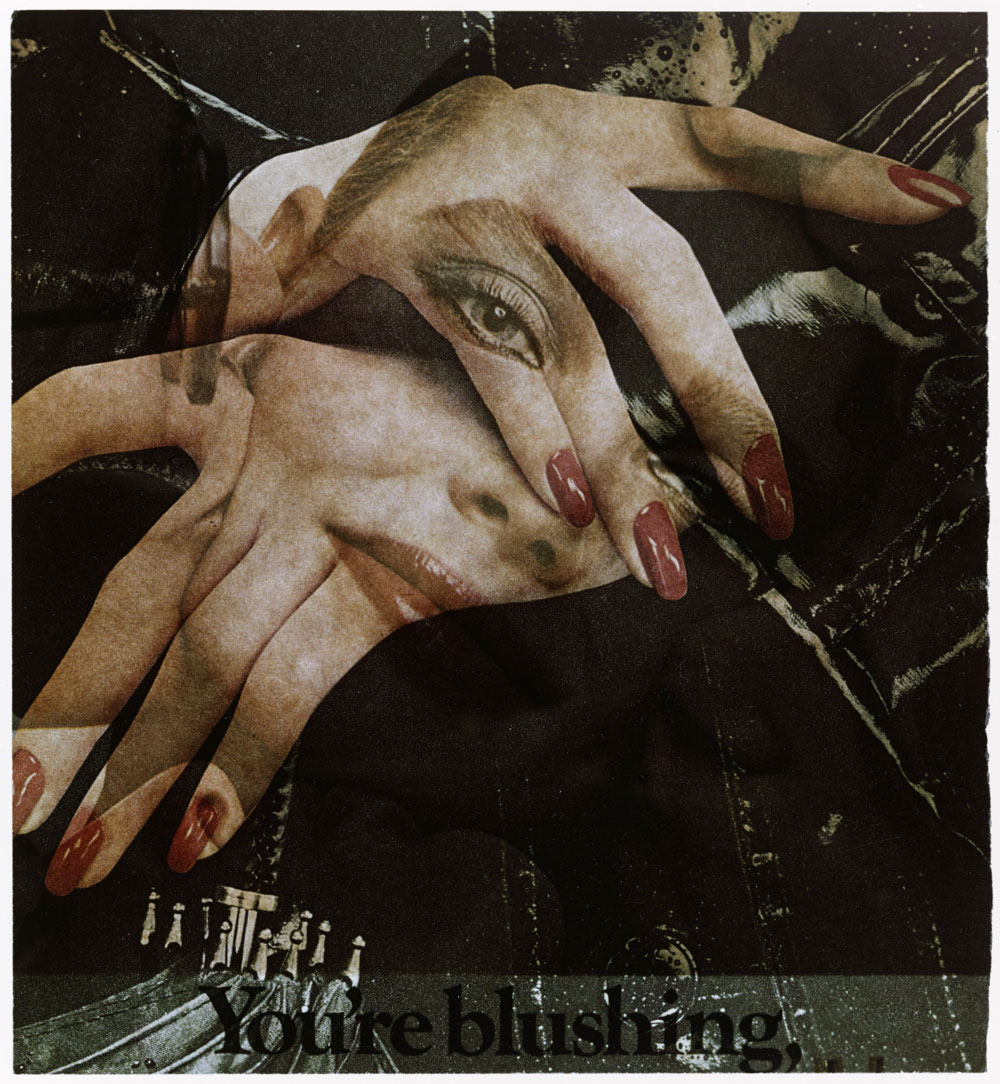
 

Ivan Albright (American, 1897-1983)
Medical Sketchbook
1918
The Art Institute of Chicago
Gift of Philip V. Festoso
© The Art Institute of Chicago


Again, I am drawn to these impressive avant-garde works of art. I’d have any of them residing in my flat, thank you very much. The Dalí, Delaunay and Léger in painting and drawing for me, and in photography, the muscular Ilse Bing, the divine Umbo and the mesmeric, disturbing can’t take your eyes off it, Witkiewicz self-portrait.

Dr Marcus Bunyan


Many thankx to the Art Institute of Chicago for allowing me to publish the art works in the posting. Please click on the photographs for a larger version of the image.


“Everything had broken down in any case, and new things had to be made out of the fragments.”


Kurt Schwitters, 1930


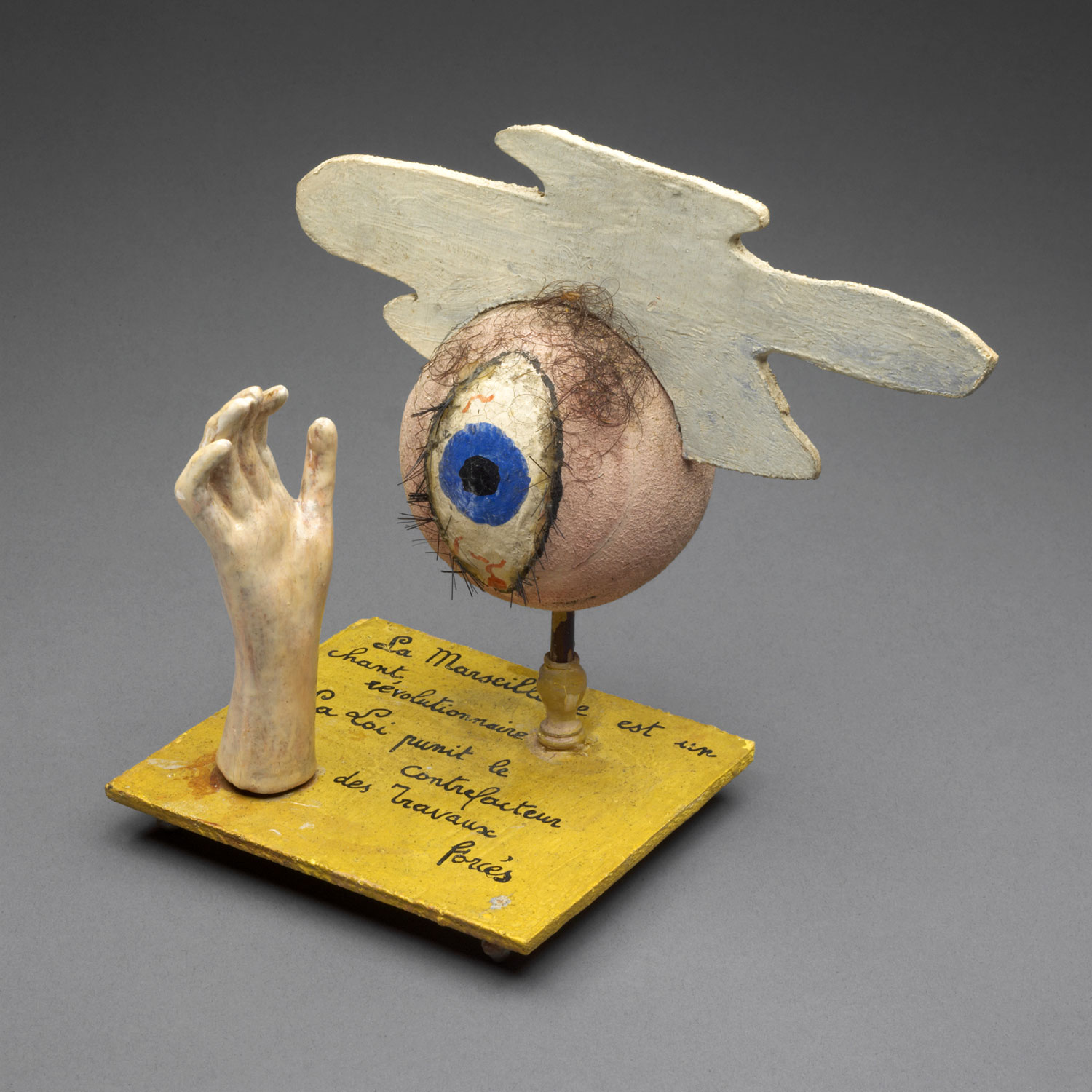
Salvador Dalí (Spanish, 1904-1989) 'City of Drawers' 1936 from the exhibition 'Shatter Rupture Break' at the Art Institute of Chicago, February - May, 2025


Salvador Dalí (Spanish, 1904-1989)
City of Drawers
1936
The Art Institute of Chicago
Gift of Frank B. Hubachek
© Salvador Dalí, Fundació Gala-Salvador Dalí / Artists Rights Society (ARS), New York, 2014


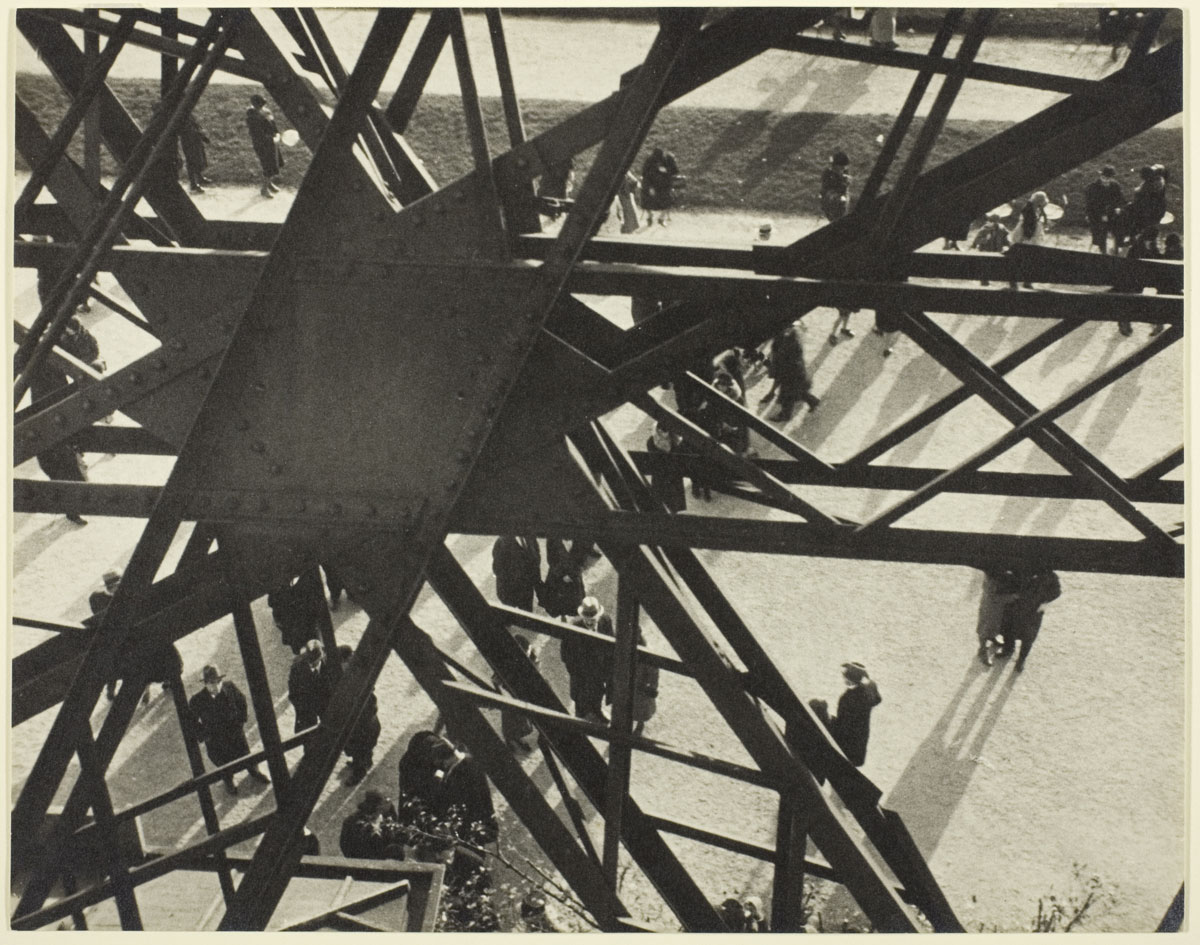
Ilse Bing (German, 1899-1998) 'Eiffel Tower, Paris, 1931' 1931


Ilse Bing (German, 1899-1998)
Eiffel Tower, Paris, 1931
1931
Julien Levy Collection, Gift of Jean and Julien Levy
© Estate of Ilse Bing


Luis Buñuel (Spanish, 1900-1983) and Salvador Dalí (Spanish, 1904-1989)
Un Chien Andalou
1929

Director – Luis Buñuel
Writers – Salvador Dali, Luis Buñuel
Cast – Simone Mareuil, Pierre Batcheff


Un Chien Andalou (An Andalusian Dog) is a 1929 Franco-Spanish silent surrealist short film by Spanish director Luis Buñuel and artist Salvador Dalí. Buñuel’s first film, it was initially released in a limited capacity at Studio des Ursulines in Paris, but became popular and ran for eight months.

Un Chien Andalou has no plot in the conventional sense of the word. With disjointed chronology, jumping from the initial “once upon a time” to “eight years later” without events or characters changing, it uses dream logic in narrative flow that can be described in terms of the then-popular Freudian free association, presenting a series of tenuously related scenes.


Fernand Léger (French, 1881-1955) and Dudley Murphy (American, 1897-1968)
Ballet Mécanique
1924


Ballet Mécanique (1923-1924) is a Dadaist post-Cubist art film conceived, written, and co-directed by the artist Fernand Léger in collaboration with the filmmaker Dudley Murphy (with cinematographic input from Man Ray). It has a musical score by the American composer George Antheil. However, the film premiered in silent version on 24 September 1924 at the Internationale Ausstellung neuer Theatertechnik (International Exposition for New Theater Technique) in Vienna presented by Frederick Kiesler. It is considered one of the masterpieces of early experimental filmmaking.


Ballet mécanique (1924) | MoMA

Ballet mécanique, conceived by painter Fernand Léger and photographed by filmmaker Dudley Murphy (possibly with some involvement from Man Ray), is a rhythmic interplay between human and object. Affected by his experience of fighting in World War I, and in particular by the mustard gas attack that left him hospitalised for a year, Léger became fascinated with mechanical technology, which would feature heavily in his post-1917 art. Ballet mécanique, his only film, is an example of this juxtaposition of man and machine: gears and pendulums vs. eyes and mouths, pistons pumping vs. a woman’s endless climb up the stairs, clocks vs. legs. A kaleidoscopic combination of faces and kitchen utensils, Ballet mécanique was completely unlike contemporary commercial movies, and would pave the way for other revolutionary films like Metropolis and Limite.

If you were to see Ballet mécanique installed in one of our galleries or projected in one of our theaters, it would look a little different than it does here – the frameline would be stabilised and the edges of the picture would either be cropped or camouflaged with masking around the screen. However, we are presenting this version the way a scholar visiting the Film Study Center would see it on a flatbed viewing machine, with a slight bounce to the image and the sprocket holes visible, and without live musical accompaniment. (The score, composed by George Antheil and usually performed as a separate concert piece, was finished several years after Ballet mécanique premiered and is significantly longer than the film.)

MoMA text from the YouTube website


Claude Cahun (French, 1894-1954) 'Object' 1936


Claude Cahun (French, 1894-1954)
Object
1936
The Art Institute of Chciago
Through prior gift of Mrs. Gilbert W. Chapman


A century ago, society and life were changing as rapidly and radically as they are in today’s digital age. Quicker communication, faster production, and wider circulation of people, goods, and ideas – in addition to the outbreak of World War I – produced a profoundly new understanding of the world, and artists in the early years of the 20th century responded to these issues with both exhilaration and anxiety. Freeing themselves from the restraints of tradition, modern artists developed groundbreaking pictorial strategies that reflect this new shift in perception.

Shatter Rupture Break, the first exhibition in The Modern Series, explores the manifold ways that ideas of fragmentation and rupture, which permeated both the United States and Europe, became central conceptual and visual themes in art of the modern age. Responding to the new forms and pace of the metropolis, artists such as Robert Delaunay and Gino Severini disrupted traditional conventions of depth and illusionism, presenting vision as something fractured. Kurt Schwitters and George Grosz explored collage, using trash and bits and pieces of printed material in compositions to reflect social and political upheaval and produce something whole out of fragments. In the wake of new theories of the mind as well as the literal tearing apart of bodies in war, artists such as Hans Bellmer, Salvador Dalí, and Stanisław Witkiewicz produced photographs and objects revealing the fractured self or erotic dismemberment. The theme of fragmentation was ubiquitous as inspiration for both the formal and conceptual revolutions in art making in the modern age.

Shatter Rupture Break unites diverse objects from across the entire holdings of the Art Institute – paintings, sculpture, works on paper, photographs, decorative arts and designed objects, textiles, books, and films – to present a rich cacophony that exemplifies the radical and generative ruptures of modern art.

The Modern Series

A quintessentially modern city, Chicago has been known as a place for modern art for over a century, and the Art Institute of Chicago has been central to this history. The Modern Series exhibitions are designed to bring together the museum’s acclaimed holdings of modern art across all media, display them in fresh and innovative ways within new intellectual contexts, and demonstrate the continued vitality and relevance of modern art for today.

Text from the Art Institute of Chicago website


Robert Delaunay (French, 1885-1941) 'Champs de Mars: The Red Tower' 1911/1923


Robert Delaunay (French, 1885-1941)
Champs de Mars: The Red Tower
1911/1923
The Art Institute of Chicago
Joseph Winterbotham Collection


Fernand Léger (French, 1881-1955) 'Composition in Blue' 1921-1927


Fernand Léger (French, 1881-1955)
Composition in Blue
1921-1927
The Art Institute of Chicago
Charles H. and Mary F. S. Worcester Collection
© 2014 Artists Rights Society (ARS), New York / ADAGP, Paris


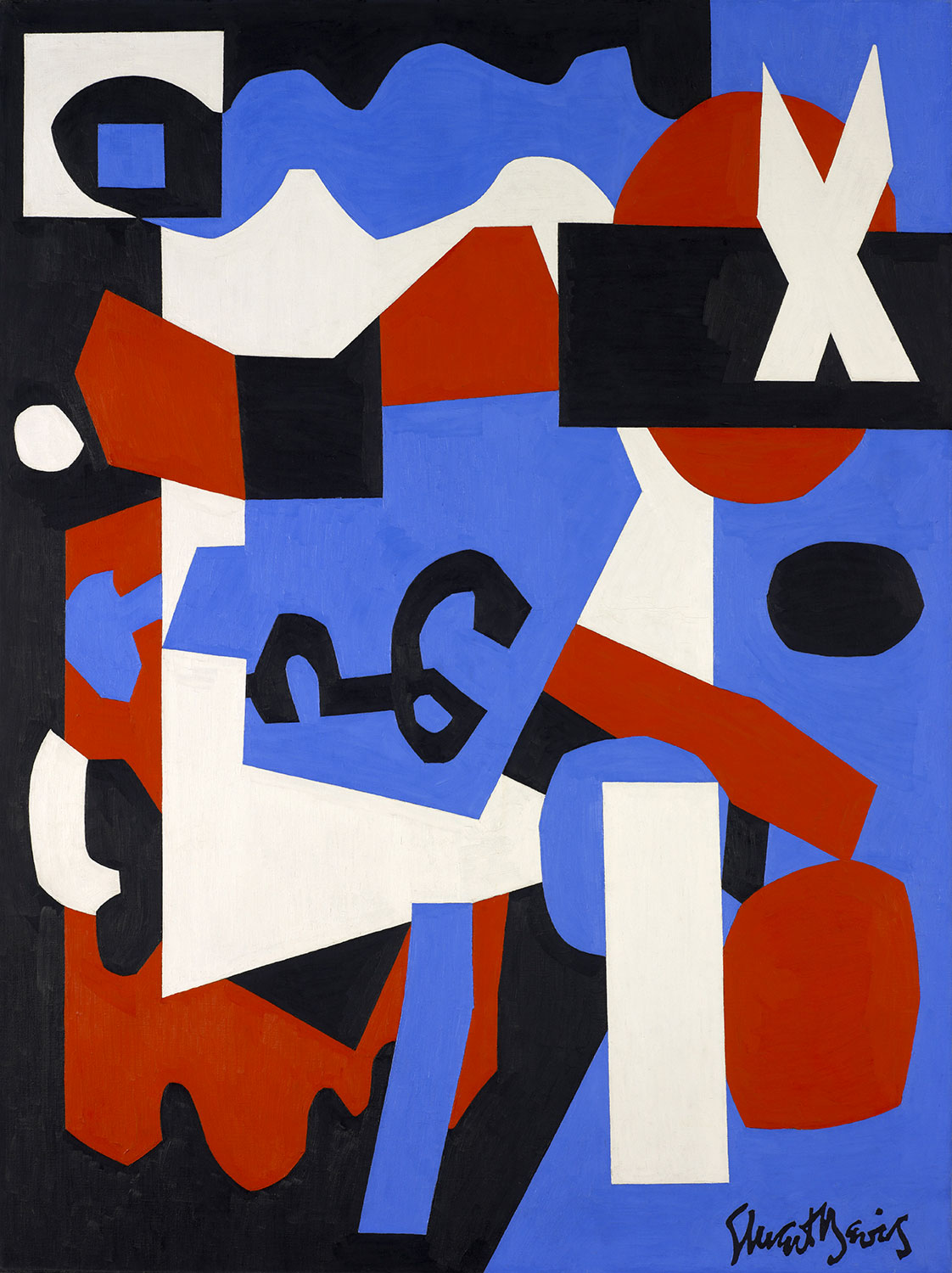
Stuart Davis (American, 1892-1964) 'Ready-to-Wear' 1955


Stuart Davis (American, 1892-1964)
Ready-to-Wear
1955
The Art Institute of Chicago
Restricted gift of Mr. and Mrs. Sigmund W. Kunstadter; Goodman Endowment


Designed by Ruben Haley, Made by Consolidated Lamp and Glass Company. "Ruba Rombic" Vase, 1928/1932


Designed by Ruben Haley
Made by Consolidated Lamp and Glass Company
“Ruba Rombic” Vase
1928/1932
Art Institute of Chicago
Raymond W. Garbe Fund in honor of Carl A. Erikson; Shirley and Anthony Sallas Fund


Kurt Schwitters (German, 1887-1948) 'Mz 13 Call' 1919


Kurt Schwitters (German, 1887-1948)
Mz 13 Call
1919
The Art Institute of Chicago
Gift of Mr. and Mrs. Maurice E. Culberg
© 2014 Artists Rights Society (ARS), New York / VG Bild-Kunst, Bonn


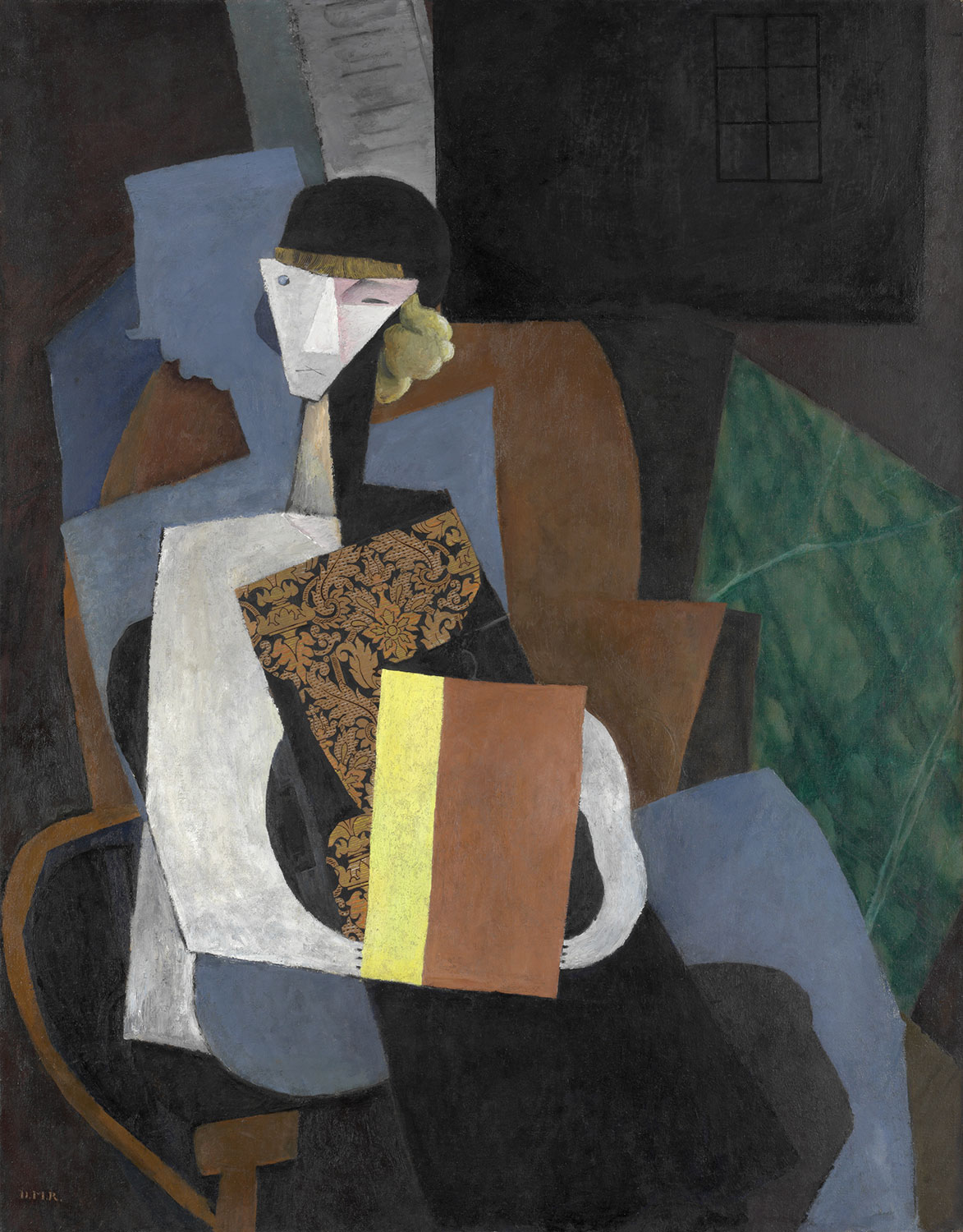
Diego Rivera (Mexican, 1886-1957) 'Portrait of Marevna' c. 1915


Diego Rivera (Mexican, 1886-1957)
Portrait of Marevna
c. 1915
The Art Institute of Chicago
Alfred Stieglitz Collection, gift of Georgia O’Keeffe
© 2014 Banco de México Diego Rivera Frida Kahlo Museums Trust, Mexico, D.F. / Artists Rights Society (ARS), New York


The Art Institute of Chicago is introducing an innovative new series of exhibitions that presents works from the museum’s acclaimed collection of modern art in reimagined ways that demonstrate the continued vitality and significance these works have today.

The Modern Series debuts with Shatter Rupture Break, opening Sunday, February 15, in Galleries 182 and 184 of the museum’s Modern Wing. The exhibition unites such diverse objects as paintings, sculpture, works on paper, photographs, decorative arts and designed objects, textiles, books, and films.

“We wanted to explore how the idea of rupture permeated modern life in Europe and the Americas,” said Elizabeth Siegel, Associate Curator of Photography, who, with Sarah Kelly Oehler, the Gilda and Henry Buchbinder Associate Curator of American Art, took the lead in organising the first exhibition. “It served as an inspiration for revolutionary formal and conceptual developments in art making that remain relevant today.”

A century ago, society was changing as rapidly and radically as it is in today’s digital age. Quicker communication, faster production, and wider circulation of people, goods, and ideas – in addition to the outbreak of World War I – produced a profoundly new understanding of the world, and artists responded with both anxiety and exhilaration. Freeing themselves from the restraints of tradition, modern artists developed groundbreaking pictorial strategies that reflected this new shift in perception.

Responding to the new forms and pace of cities, artists such as Robert Delaunay (French, 1885-1941) and Gino Severini (Italian, 1883-1966) disrupted traditional conventions of depth and illusionism, presenting vision as something fractured. Delaunay’s Champs de Mars: The Red Tower fragments the iconic form of the Eiffel Tower, exemplifying how modern life – particularly in an accelerated urban environment – encouraged new and often fractured ways of seeing. Picturesque vistas no longer adequately conveyed the fast pace of the modern metropolis.

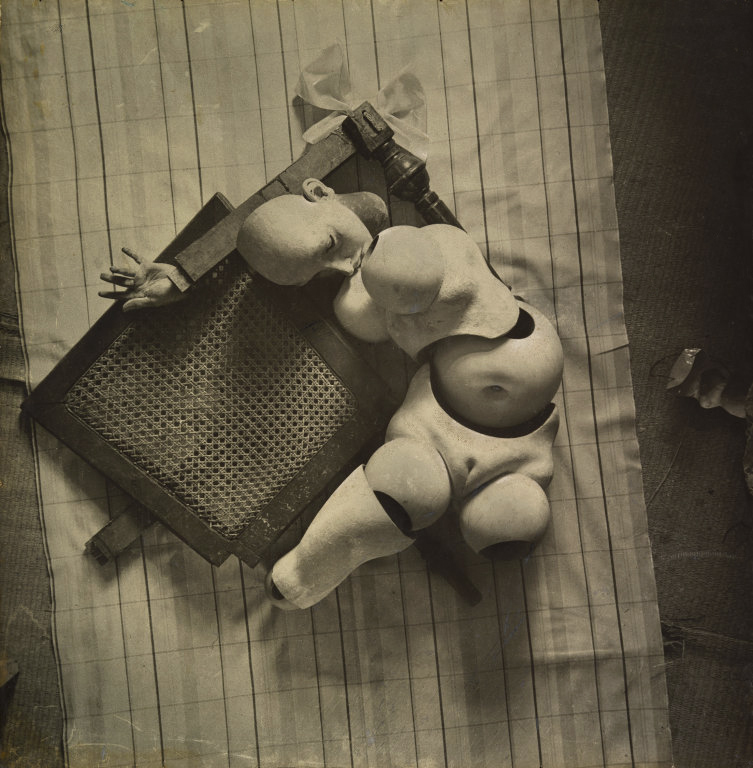
The human body as well could no longer be seen as intact and whole. A devastating and mechanised world war had returned men from the front with unimaginable wounds, and the fragmented body became emblematic of a new way of understanding a fractured world. Surrealists such as Hans Bellmer (German, 1902-1975), Claude Cahun (French, 1894-1954) and Salvador Dalí (Spanish, 1904-1989) fetishised body parts in images, separating out eyes, hands, and legs in suggestive renderings. A more literal representation of the shattered body comes from Chicago’s own Ivan Albright, who was a medical draftsman in World War I. In his rarely shown Medical Sketchbook, he created fascinatingly gruesome watercolours that documented injured soldiers and the x-rays of their wounds.

Just as with the body, the mind in the modern era also came to be seen as fragmented. Stanislaw Witkiewicz (Polish, 1885-1939) produced a series of self-portraits as an act of psychological exploration. His work culminated in one stunning photograph made by shattering a glass negative, which he then reassembled and printed, thus conveying an evocative sense of a shattered psyche. The artistic expression of dreams and mental imagery perhaps reached a pinnacle not in a painting or a sculpture, but in a film. Luis Buñuel and Salvador Dalí’s film Un chien andalou (An Andalusian Dog) mystified viewers with its dreamlike narrative, dissolves from human to animal forms, dismembered body parts, and shockingly violent acts in an attempt to translate the unconscious mind onto a celluloid strip.

Kurt Schwitters (German, 1887-1948) and George Grosz (German, 1893-1959) explored collage, which took on new importance for avant-garde artists thanks to the aesthetic appeal and widespread availability of mass-produced media. Schwitters used the ephemera of German society to create what he called Merz, an invented term signifying an artistic practice that included collage, assemblage, painting, poems, and performance. The Art Institute owns a significant group of these collages by Schwitters, and six will appear in the exhibition. The use of thrown-away, ripped up, and scissored-out pieces of paper, divorced from their original meaning and reassembled with nails and glue into new objects, was an act that exposed the social and political disruptions of a German society that seemed broken and on the edge of collapse in the aftermath of World War I.

Shatter Rupture Break is unusual in that it unites objects from across the entire museum – from seven curatorial departments as well as the library. This multiplicity is significant because modern artists did not confine themselves to one medium, but explored different visual effects across a variety of media. As well, the show prominently features the voices of artists, writers, scientists, and other intellectuals of the period. The goal is to create a dynamic space that evokes the electrifying, disruptive, and cacophonous nature of modern art at the time.

“We hope to excite interest in the modern period as a crucial precursor to the changes of our own time, to show how what might seem old now was shockingly fresh then,” said Oehler.

Considered one of the finest and most comprehensive in the world, the Art Institute’s collection of modern art includes nearly 1,000 works by artists from Europe and the Americas. The museum was an early champion of modern artists, from its presentation of the Armory Show in 1913 to its early history of acquiring major masterpieces. This show highlights some recent acquisitions of modern art, but also includes some long-held works that have formed the core of the modern collection for decades. Shatter Rupture Break celebrates this history by bringing together works that visitors may know well, but have never seen in this context or with this diverse array of objects.”

Press release from the Art Institute of Chicago


Hans Bellmer (German born Poland, 1902-1975) 'The Doll (La Poupée)' 1935


Hans Bellmer (German born Poland, 1902-1975)
The Doll (La Poupée)
1935
Gelatin silver print overpainted with white gouache
65.6 x 64cm
Anonymous restricted gift; Special Photography Acquisition Fund; through prior gifts of Boardroom, Inc., David C. and Sarajean Ruttenberg, Sherry and Alan Koppel, the Sandor Family Collection, Robert Wayne, Simon Levin, Michael and Allison Delman, Charles Levin, and Peter and Suzann Matthews; restricted gift of Lynn Hauser and Neil Ross
© 2015 Artists Rights Society (ARS), New York / ADAGP, Paris


Umbo (Otto Umber) (German, 1902-1980) 'Untitled' 1928


Umbo (Otto Umber) (German, 1902-1980)
Untitled
1928
Julien Levy Collection, Gift of Jean and Julien Levy
© 2014 Phyllis Umbehr/Galerie Kicken Berlin/ Artists Rights Society (ARS), New York


Stanisław Ignacy Witkiewicz (Polish, 1885-1939) 'Self-Portrait, Zakopane [Broken Glass]' 1910


Stanisław Ignacy Witkiewicz (Polish, 1885-1939)
Self-Portrait, Zakopane [Broken Glass]
1910
Promised Gift of a Private Collection


The Art Institute of Chicago
111 South Michigan Avenue
Chicago, Illinois 60603-6404
Phone: (312) 443-3600

Opening hours:
Thursday – Monday 11am – 5pm
Closed Tuesday and Wednesday
The museum is closed Thanksgiving, Christmas, and New Year’s days.

The Art Institute of Chicago website

LIKE ART BLART ON FACEBOOK

Back to top

Exhibition: ‘Florence Henri. Mirror of the avant-garde 1927-1940’ at Jeu de Paume, Paris

Exhibition dates: 24th February – 17th May, 2015

Curator: Cristina Zelich


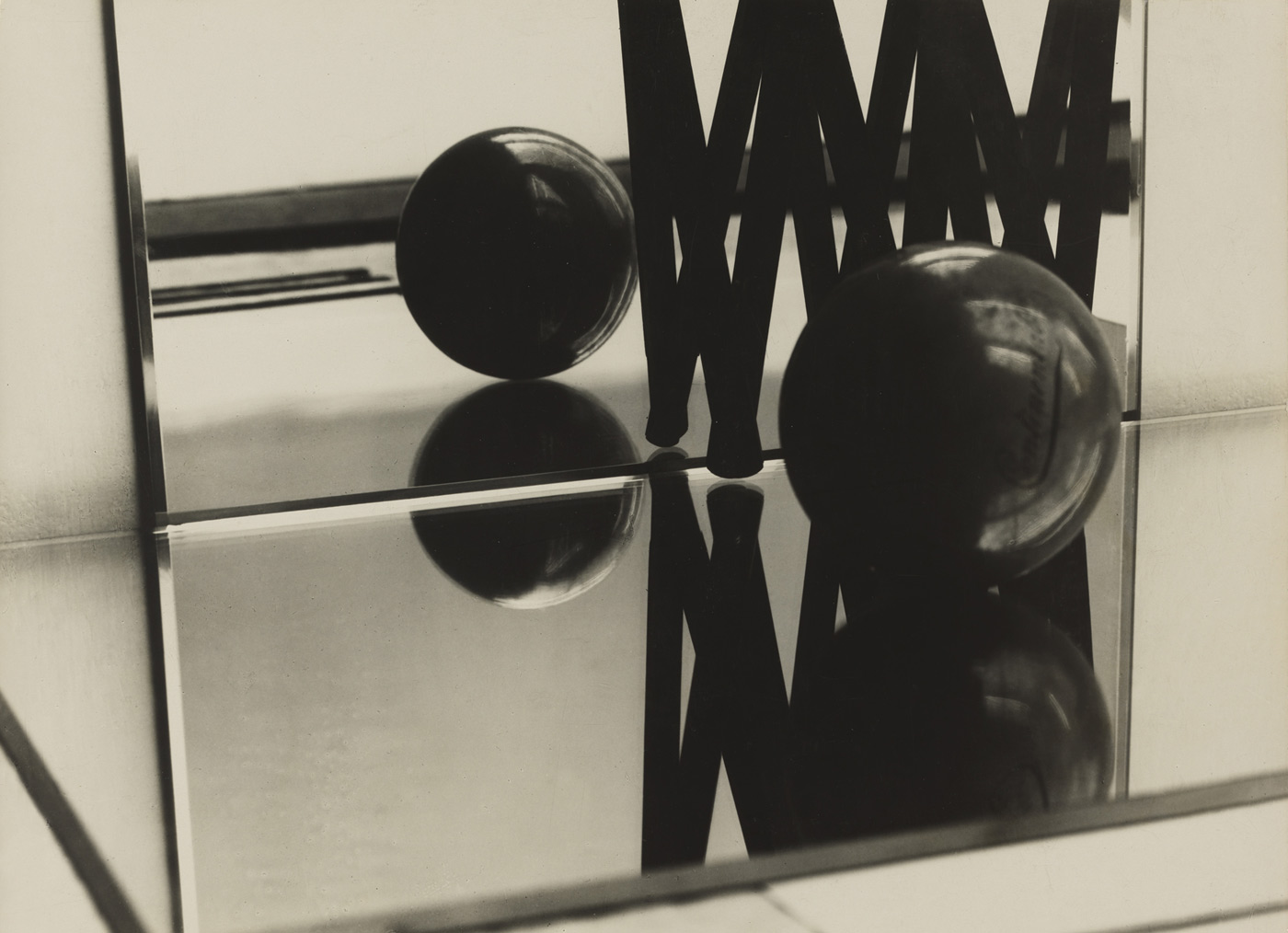
Florence Henri (New York 1893 - Compiègne 1982) 'Composition' 1928 from the exhibition 'Florence Henri. Mirror of the avant-garde 1927-1940' at Jeu de Paume, Paris, February - May, 2015


Florence Henri (New York 1893 – Compiègne 1982)
Composition
1928
Gelatin silver print, vintage
27.2 x 37.5cm
Bauhaus Archiv, Berlin
© Florence Henri / Galleria Martini & Ronchetti Photo
© Bauhaus Archiv


Objects in and of space, the two the same

Florence Henri is rapidly becoming one of my favourite photographers, an artist who emerged during one of the golden periods of photography, the avant-garde of the 1920s-30s. While we have seen some of these photographs before in a previous posting, there are some new and delightful images to enjoy here.

If you believe the text by Priscilla Frank, “Meet Florence Henri, The Under-Acknowledged Queen Of Surrealist Photography,” on the Huffington Post website [02/20/2015], you could be forgiven for thinking that her photography is based on Surrealist themes. Nothing could be farther from the truth. There is nothing about Henri’s photographs to suggest that they are based on the creative potential of the unconscious mind exemplified by the irrational juxtaposition of images. Henri’s photographs are quite logical and ordered, being an investigation into space, time and object using the “extension of the formal and structural aesthetics of Cubism, Purism and Constructivism.”

Her geometric abstractions “exploited the dialogue between realism and abstraction… and she explored spatial extension and fragmentation in her utter modern vocabulary. Her still life and abstract compositions achieved by balancing abstraction with a pure and essential subject were created in the spirit of the machine age. She viewed space as if it were elastic, distorting figure and ground and altering planes through the use of mirrors and lenses.”

Through attention and attentiveness to subject, Henri achieved her results by using created space to investigate the fragmentation and distortion of the world. Her art is not about the production of phenomena (the spectacle), but about the creation of volumes that are in an of space itself. As Donald Judd’s observes of his created volumes in 1981: “… familiar objects, objects as we habitually perceive them, assume physical neutrality because they and their environment are deactivated: “They are points in space, and space is an empty surround. Instead, what is needed is a created space, space made by someone, space that is formed as a solid, the two the same, with the space and the solid defining each other.” Objects in and of space, the two the same: this was the crux. Judd did more than set new solids into existing voids. He formed solids and their correlative spaces as an integrated operation, as if he were establishing an architecture from the ground up, creating the entire environment, intensifying it, saturating it with its own sensation.”1

In a photographic sense, Henri can be seen as a precursor to Judd’s volumes, creating her own worlds from the ground up, creating the entire environment where the space and the object are one and the same thing… only to then record and flatten that space into the essential nature of the photograph, its physicality. Her sensory affects “remain fixed in the concatenation of materials, structure and placement that generates it. They are the lived equivalent of those conditions, experienced as continuous in time – hence, timeless – remaining wholly the same until interrupted.”2 How appropriate for Henri’s photographs for they do indeed have a timeless “air”, a transcendence of the time and place they were taken, a transcendence of the space which her volumes inhabit. Objects in and of space, the two the same.

As Judd observes, “Time and space don’t exist [as idealised abstractions]; they are made by events and positions. Time and space can be made and don’t have to be found like stars in the sky or rocks on a hillside.” Time and space are grounded in being human: they exist when someone experiences them.”3 Here is the nub of the matter, for it matters that we experience Henri’s photographs each in its definite time and space. Henri’s being is immersed in these volumes and they hold our interest because the created environments are saturated with her own sensations.

Dr Marcus Bunyan


Footnotes

1/ Donald Judd quoted in Richard Shiff. “Sensous Thoughts,” in Marianne Stockebrand (ed.,). Donald Judd. The Multicolored Works. Yale University Press, 2014, p. 106

2/ Ibid.,

3/ Ibid., p. 107.


Many thankx to the Jeu de Paume for allowing me to publish the photographs in the posting. Please click on the photographs for a larger version of the image.


“With photography, what I really want to do is compose the image, as I do in painting. The volumes, lines, shadows and light should submit to my will and say what I would like them to say. All of this under the strict control of the composition, because I do not claim to be able to explain the world or to explain my own thoughts.”


Florence Henri in an interview with Attilio Colombo, “Specchio, essenzialità, geometría,” in ‘Florence Henri’ (Milan: Gruppo Editoriale Fabbri, 1983)


“Henri soon recognised the medium’s capacity as a pictorial language and outlet for creative expression. Upon returning to France [from the Bauhaus], Henri began to develop a large body of photographic work based upon her Bauhaus experience and an extension of the formal and structural aesthetics of Cubism, Purism and Constructivism. These non-objective principles forged an alternative to the then-dominant French art movement Surrealism. Henri transcended the avant-garde of one art form to that of another…

Henri’s greatest experimentation with geometric abstraction occurred during the period between 1929-1930… In the photographic work, Florence Henri exploited the dialogue between realism and abstraction, but always maintained a recognisable subject. She was concerned with transparency and movement, and she explored spatial extension and fragmentation in her utter modern vocabulary.

Her still life and abstract compositions achieved by balancing abstraction with a pure and essential subject were created in the spirit of the machine age. She viewed space as if it were elastic, distorting figure and ground and altering planes through the use of mirrors and lenses.”


Lynne Warren. ‘Encyclopedia of Twentieth-Century Photography’, 3-Volume set. Routledge, 2005, p. 691.


Florence Henri (New York 1893 - Compiègne 1982) 'Composition' 1928 from the exhibition 'Florence Henri. Mirror of the avant-garde 1927-1940' at Jeu de Paume, Paris, February - May, 2015


Florence Henri (New York 1893 – Compiègne 1982)
Composition
1928
Gelatin silver print, vintage
27 x 37.1cm
Museum Folkwang, Essen
© Florence Henri / Galleria Martini & Ronchetti


Florence Henri (New York 1893 - Compiègne 1982) 'Composition abstraite [Still-life composition]' 1929


Florence Henri (New York 1893 – Compiègne 1982)
Composition abstraite [Still-life composition]
1929
Collage, gelatin silver print cut and pasted on paper
12 x 14cm
Private collection, courtesy Florence Henri Archive, Genoa
© Florence Henri / Galleria Martini & Ronchetti


Florence Henri (New York 1893 - Compiègne 1982) 'Portrait Composition, Tulia Kaiser' c. 1930


Florence Henri (New York 1893 – Compiègne 1982)
Portrait Composition, Tulia Kaiser
c. 1930
Gelatin silver print, vintage
23 x 29.2cm
Achat grâce au mécénat de Yves Rocher, 2011
Ancienne collection Christian Bouqueret Centre Pompidou, Paris. Musée national d’art moderne / Centre de création industrielle
© Florence Henri / Galleria Martini & Ronchetti Photo
© Centre Pompidou, Mnam-Cci, Dist. Rmn-Grand Palais / Georges Meguerditchian


Summary of exhibition

Florence Henri. Mirror of the avantgarde illustrates the desire of the Jeu de Paume to highlight the important role played by women photographers from the 1920s to the 1950s, and follows on from previous exhibitions devoted to Claude Cahun, Kati Horna, Eva Besnyö, Berenice Abbott, Lisette Model, Laure Albin Guillot and indeed, Lee Miller.

The exhibition brings together, for the first time in France, over 130 vintage prints by Florence Henri, as well as rare documents and publications, revealing the artist’s photographic production. Influenced by Constructivism, Cubism and Surrealism, Florence Henri’s work is part of the exciting creative tenor of the period, during which, photography, like cinema or architecture, embodied a spirit of innovation and progress, as well as a certain unconventionality in terms of the dominant visual order.

Familiar with Bauhaus, Florence Henri was one of the figures of the European artistic intelligentsia of the time. Her friendship with Fernand Léger, the Delaunays, Hans Arp, László Moholy-Nagy and Theo van Doesburg would have a profound influence on her work. In 1929, Florence Henri opened a photography studio in Paris. It soon rivalled that of Man Ray’s. Her classes were very well-attended and her talents as a portrait photographer were quickly recognised.

It is not so much the image alone as the constant research that brings Florence Henri’s work to life. Lines and geometric compositions are recurring elements in her photographs. Over the years, she made her compositions increasingly complex through the use of mirrors, industrial and natural objects, or through collage and superposition. The exhibition attempts to both decipher and highlight the work of Florence Henri in terms of reflections, perspective, the depth of field and photomontage – key technical experimentations in the history of modern photography.


Florence Henri (New York 1893 - Compiègne 1982) 'Mannequin de tailleur [Tailor's mannequin]' 1930-1931


Florence Henri (New York 1893 – Compiègne 1982)
Mannequin de tailleur [Tailor’s mannequin]
1930-1931
Gelatin silver print, vintage
17.1 x 22.8cm
Private collection, courtesy Florence Henri Archive, Genoa
©Florence Henri / Galleria Martini & Ronchetti


Florence Henri (New York 1893 - Compiègne 1982) 'Composition Nature morte [Still-life composition]' 1931


Florence Henri (New York 1893 – Compiègne 1982)
Composition Nature morte [Still-life composition]
1931
Gelatin silver print dated 1977
23 x 30cm
Private collection, courtesy Florence Henri Archive, Genoa
© Florence Henri / Galleria Martini & Ronchetti


Florence Henri (New York 1893 - Compiègne 1982) 'Pont [Bridge]' 1930-1935


Florence Henri (New York 1893 – Compiègne 1982)
Pont [Bridge]
1930-1935
Gelatin silver print dated 1977
23.5 x 23.8cm
Private collection, courtesy Florence Henri Archive, Genoa
© Florence Henri / Galleria Martini & Ronchetti


Florence Henri (New York 1893 - Compiègne 1982) 'Composition, The Glory that was Greece' c. 1933


Florence Henri (New York 1893 – Compiègne 1982)
Composition, The Glory that was Greece
c. 1933
Photomontage, gelatin silver print dated 1975
23.5 x 29.5cm
Private collection, courtesy Florence Henri Archive, Genoa
© Florence Henri / Galleria Martini & Ronchetti


“All that I know, and how I know this, is primarily made up of abstract elements: spheres, planes, and grids whose parallel lines provide numerous opportunities, without taking into account the mirrors I use, to present the same object from several different angles within a single photograph, in order to yield, in the same way, different visions that complement and complete each other, and which when taken as a whole, are better able to explain it. Essentially, all of this is much more difficult to explain than to do.”


Florence Henri in an interview with Attilio Colombo, “Specchio, essenzialità, geometría,” in ‘Florence Henri’ (Milan: Gruppo Editoriale Fabbri, 1983)


Florence Henri (New York 1893 – Compiègne (France) 1982) was a multi-faceted artist, who was first known for her paintings before making a name for herself as a major figure in avant-garde photography between the end of the 1920s and the beginning of the 1940s. She lived in Silesia, Munich, Vienna, Rome and above all Berlin, before finally settling in Paris in 1924 and devoting herself to photography. This medium enabled her to experiment new relationships with space, in particular by the use of mirrors and other objects in her compositions.

The Jeu de Paume is presenting a vast panorama of Florence Henri’s photographic production from 1927 to 1940, including her self-portraits, abstract compositions, portraits of artists, nudes, photomontages, photocollages, as well as documentary photos taken in Rome, Paris and Brittany. The exhibition comprises vintage prints, various documents and published material.

When she was young, Florence Henri studied music and painting in England and Germany. In 1919, when she was a student at the Berlin Academy of Arts, she made the acquaintance of writer and art historian Carl Einstein and became friends with several figures of the avant-garde, including Hans Arp, Adrian Ludwig Richter, John Heartfield and Lázló Moholy-Nagy. She took classes with Paul Klee and Vassily Kandinsky at the Bauhaus in Weimar. In 1924 she moved to Paris, where she followed classes at the Académie Montparnasse, whose director was André Lhote, then at the Académie moderne (founded by Fernand Léger and Amédée Ozenfant). In 1927, after a visit to Bauhaus in Dessau, she abandoned painting in favour of photography. It was at this time that she produced her famous self-portraits in mirrors and her still lifes; the result of her first steps in the spatial research that she would carry out through the medium of photography.

Between the end of the 1920s and the beginning of the 1930s, three mythical exhibitions in terms of the history of European photography took place in Germany: “Fotografie der Gegenwart” at the Folkwang Museum in Essen (1929); “Film ind Foto” (Fifo) organised the same year by the Deutscher Werkbund in Stuttgart and “Das Lichtbild” held in Munich (1931). These exhibitions bore witness to the rapid expansion of new photographic concepts and a rupture with tradition. Fifo marked the zenith of the Neues Sehen (New Vision) movement of which László Moholy-Nagy was an exponent and “Das Lichtbild” marked the triumph of Neue Sachlichkeit (New Objectivity), whose leading representative was Albert Renger-Patzsch.

Florence Henri was invited to show an important number of prints at these three exhibitions in recognition of her photographic production during this fundamental period that saw the photography used to free our vision and open out onto new experiences.

Florence Henri’s studio rivalled that of Man Ray, even if she had also opened a school of photography where Lisette Model and Gisèle Freund, amongst others, would enrol. In fact, despite the central position that her oeuvre occupied in avant-garde photography at the end of the 1920s, her reputation as a portraitist in Paris, and the fact that her photos had been published in many of the period’s illustrated magazines such as Arts et Métiers and Lilliput etc, Florence Henri’s body of work remains largely unknown.

László Moholy-Nagy’s* comments are a perfect illustration of Florence Henri’s position: “With Florence Henri’s photos, photographic practice enters a new phase, the scope of which would have been unimaginable before today. Above and beyond the precise and exact documentary composition of these highly defined photos, research into the effects of light is tackled not only through abstract photograms, but also in photos of real-life subjects. The entire problem of manual painting is taken onboard by the photographic process and is manifestly given a whole new depth thanks to this new optical instrument. Reflections and spatial relationships, superposition and intersections are just some of the areas explored from a totally new perspective and viewpoint.”

*László Moholy-Nagy, “Zu den Fotografien von Florence Henri”, i10, No 17-18, Amsterdam, December 20, 1928.

Press release from the Jeu de Paume website


Florence Henri (New York 1893 - Compiègne 1982) 'Double portrait' 1927-1928


Florence Henri (New York 1893 – Compiègne 1982)
Double portrait
1927-1928
Gelatin silver print dated 1977
24 x 18cm
Private collection, courtesy Florence Henri Archive, Genoa
© Florence Henri / Galleria Martini & Ronchetti


Florence Henri (New York 1893 - Compiègne 1982) 'Autoportrait [Self-portrait]' 1928


Florence Henri (New York 1893 – Compiègne 1982)
Autoportrait [Self-portrait]
1928
Gelatin silver print, vintage
39.3 x 25.5cm
Staatliche Museen zu Berlin, Kunstbibliothek
© Florence Henri / Galleria Martini & Ronchetti


Her most well-known work is a self-portrait, in which Henri sits before a mirror, dolled up almost as if in drag. Two silver balls lay reflected up against the mirror, equivocal symbols of both testicles and breasts. Henri, influential in both her artistic style and personal styles, toyed with gender binaries, using her personal appearance to emphasise the performative nature of gender. The artist was married to a Swiss house servant, but went on to have other relationships with both men and women, including a longtime affair with artist and model Margarete Schall.

Henri established herself as a formidable photographer, and remained consistent in her work up until World War II. Then her work declined considerably, both due to lack of materials and the prohibitions imposed under the Nazi occupation. Henri briefly returned to painting, but her central period of output remained in the 1920s and 1930s. Her compositions, simultaneously warm, playful, clever and inquisitive, set the stage for future explorations into the limits of photography, or lack thereof.

Priscilla Frank. “Meet Florence Henri, The Under-Acknowledged Queen Of Surrealist Photography,” on the Huffington Post website, 20th February 2015 [Online] Cited 10/03/2015.


Florence Henri (New York 1893 - Compiègne 1982) 'Femme aux cartes [Woman with cards]' 1930


Florence Henri (New York 1893 – Compiègne 1982)
Femme aux cartes [Woman with cards]
1930
Gelatin silver print, vintage
39 x 28.5cm
Private collection, courtesy Florence Henri Archive, Genoa
© Florence Henri / Galleria Martini & Ronchetti


Florence Henri (New York 1893 - Compiègne 1982) 'Portrait Composition, Cora' 1931


Florence Henri (New York 1893 – Compiègne 1982)
Portrait Composition, Cora
1931
Gelatin silver print, vintage
13.6 x 11.4cm
Private collection, courtesy Florence Henri Archive, Genoa
© Florence Henri / Galleria Martini & Ronchetti


Florence Henri (New York 1893 - Compiègne 1982) 'Fernand Léger' 1934


Florence Henri (New York 1893 – Compiègne 1982)
Fernand Léger
1934
Gelatin silver print, vintage
30.4 x 24cm
Private collection, courtesy Archives Florence Henri, Genoa
© Florence Henri / Galleria Martini & Ronchetti


Earliest compositions

Her earliest compositions introduce an element that would be fundamental for her artistic investigations, namely the mirror. Using a very limited number of elements, Henri created extremely complex images characterised by the fragmentation of space and the use of multiple viewpoints. They include one of her best-known works, the self-portrait looking in the mirror with two metal spheres, which may be said to embody the spirit of freedom typical of that period, conveying the image of a modern and emancipated female artist, one who failed to conform to the societal status traditionally assigned to women.

Multiple exposure

Florence Henri uses methods such as multiple exposures when shooting, or a combination of several negatives, some inverted, to obtain abstract images, in which she manages to bestow static objects with a sense of dynamism. Florence Henri’s output during this early phase can be described as a perfect synthesis between abstract geometrical painting and the innovations of New Vision photography.

“Florence Henri’s work lured me to come to Paris in 1929. I wanted to live in a place where images were made that coincided with my own concepts.”

~ Ilse Bing, quoted in Gisèle Freund’s preface to Ilse Bing 1929/1955: Femmes de l’enfance à la vieillesse

Advertising photography

In the field of professional photography, Florence Henri stands out for her very personal approach to advertising photography. Indeed, her images are the natural extension of her photographic experimentation and investigations using objects and mirrors.

Collages

She quickly substitutes industrial objects with natural elements in her compositions. In addition, she introduces a new tool in her work: collage. She makes them with fragments of prints, and then reproduces them to create the final print. She also introduces a new technique into her work – collage – thereby underlining her interest in autonomous images that move away from a simple reproduction of reality, all the while emphasising the conceptual work of the artist.

Shadows

Her quest for experimentation leads Florence Henri to work on the shadows passing vertically through the frame, creating a dark gap that interrupts and fragments the continuity of the image.

Nu composition

Their aesthetic characteristics clearly place the works grouped under the title Nu composition as part of the formal research Florence Henri carried out from the early 1930s, where the mastery of the composition obviously remains the central concern of her work.

Here, the camera is positioned at a slight distance in order to capture the sensuality of the female form, while natural objects – hyacinths and shells – or other more enigmatic elements, such as a comb or cards, also appear in the frame.

Rome

In late 1931 and early 1932, Florence Henri visits Rome where she takes a series of photographs, notably at the Roman Forum, but also at Saint Peter’s Square, which she uses, upon her return to Paris, as material for numerous collages, developing the technique she had already used in certain of her still lifes.

Portrait composition

The series Portrait Composition, is characterised by the tight framing of the central figurer – though some are models, most are her friends, including Grete Willers, Sonia Delaunay, Woty Werner, Kurt Wilhelm-Kästner, Fernand Léger, and Tulia Kaiser. The artist often makes use of harsh lighting, which marks the traits or make-up of her subjects with a diagonal composition or even distorts the image.

Brittany

The photographs taken in Brittany, which at first glance could be seen as purely documentary, reveal a very carefully considered attention to structure. In some of the more general shots, Florence Henri inserts a blurred, graphic element between the lens and the landscape, thereby going against the idea of photography as merely capturing reality, and once again, reinforcing the notion of composition.

Store windows

When Florence Henri strolls through Paris with her camera, her images reveal a very different preoccupation to that of other photographers. Faithful to her attention to structure, in the reflections of store windows she finds the same spirit that brings life to her studio compositions using mirrors. In 1936, Florence Henri moves to the Rue Saint-Romain in Montparnasse, where she makes use of the terrace to work in natural light, and to pursue her study of the fragmentation of the image through the use of shadows and reflections. She also returns to her self-portrait work.


Florence Henri (New York 1893 - Compiègne 1982) 'Fenêtre [Window]' 1929


Florence Henri (New York 1893 – Compiègne 1982)
Fenêtre [Window]
1929
Gelatin silver print, vintage
37.3 x 27.5cm
Staatliche Museen zu Berlin, Kunstbibliothek
© Florence Henri / Galleria Martini & Ronchetti


Florence Henri (New York 1893 - Compiègne 1982) 'Jeanne Lanvin' 1929


Florence Henri (New York 1893 – Compiègne 1982)
Jeanne Lanvin
1929
Gelatin silver print, vintage
36.7 x 28.7cm
Collection particulière, courtesy Archives Florence Henri, Gênes
© Florence Henri / Galleria Martini & Ronchetti


Florence Henri (New York 1893 - Compiègne 1982) 'Composition Nature morte [Still-life composition]' 1931


Florence Henri (New York 1893 – Compiègne 1982)
Composition Nature morte [Still-life composition]
1931
Gelatin silver print, vintage
45.9 x 37.7cm
Private collection, courtesy Florence Henri Archive, Genoa
© Florence Henri / Galleria Martini & Ronchetti


Florence Henri (New York 1893 - Compiègne 1982) 'Composition Nature morte [Still-life composition]' c. 1933


Florence Henri (New York 1893 – Compiègne 1982)
Composition Nature morte [Still-life composition]
c. 1933
Photomontage, épreuve gélatino-argentique d’époque
29.4 x 24cm
Private collection, courtesy Florence Henri Archive, Genoa
© Florence Henri / Galleria Martini & Ronchetti


Florence Henri (New York 1893 - Compiègne 1982) 'Robert Delaunay' c. 1935


Florence Henri (New York 1893 – Compiègne 1982)
Robert Delaunay
c. 1935
Gelatin silver print, vintage
49.5 x 39.7cm
Private collection, courtesy Florence Henri Archive, Genoa
© Florence Henri / Galleria Martini & Ronchetti


Florence Henri (New York 1893 - Compiègne 1982) 'Robert Delaunay' c. 1935 'Bretagne [Brittany]' 1937-1940


Florence Henri (New York 1893 – Compiègne 1982)
Bretagne [Brittany]
1937-1940
Gelatin silver print, vintage
28.2 x 24.2cm
Private collection, courtesy Florence Henri Archive, Genoa
© Florence Henri / Galleria Martini & Ronchetti


Florence Henri (New York 1893 - Compiègne 1982) 'Structure (intérieur du Palais de l'Air, Paris, Exposition Universelle) [Structure (Interior of the Palais de l'Air, Paris, World's Fair)]' 1937


Florence Henri (New York 1893 – Compiègne 1982)
Structure (intérieur du Palais de l’Air, Paris, Exposition Universelle) [Structure (Interior of the Palais de l’Air, Paris, World’s Fair)]
1937
Gelatin silver print dated 1976
17.5 x 17.5cm
Private collection, courtesy Florence Henri Archive, Genoa
© Florence Henri / Galleria Martini & Ronchetti


Florence Henri (New York 1893 - Compiègne 1982) 'Autoportrait [Self-portrait]' 1938


Florence Henri (New York 1893 – Compiègne 1982)
Autoportrait [Self-portrait]
1938
Gelatin silver print dated 1970’s
24.8 x 23.1cm
Private collection, courtesy Florence Henri Archive, Genoa
© Florence Henri / Galleria Martini & Ronchetti


Jeu de Paume
1, Place de la Concorde
75008 Paris
métro Concorde
Phone: 01 47 03 12 50

Opening hours:
Tuesday: 12.00 – 21.00
Wednesday – Sunday: 10.00 – 19.00
Closed Monday

Jeu de Paume website

LIKE ART BLART ON FACEBOOK

Back to top

Exhibition: ‘The City Lost and Found: Capturing New York, Chicago, and Los Angeles, 1960-1980’ at the Art Institute of Chicago

Exhibition dates: 26th October, 2014 – 11th January, 2015

Curators: Alison Fisher (Art Institute of Chicago), Katherine A. Bussard (Princeton University Art Museum), and Greg Foster-Rice (Columbia College, Chicago


Bruce Davidson (American, b. 1933) 'Untitled', from 'East 100th Street' 1966-1968 from the exhibition 'The City Lost and Found: Capturing New York, Chicago, and Los Angeles, 1960-1980' at the Art Institute of Chicago, October 2014 - January 2015


Bruce Davidson (American, b. 1933)
Untitled, fromEast 100th Street
1966-1968
Courtesy of Howard Greenberg Gallery, New York and Magnum Photos


What looks to be another fascinating exhibition. They are coming thick and fast at the moment, it’s hard to keep up!

Dr Marcus Bunyan


Many thankx to the Art Institute of Chicago for allowing me to publish the photographs in the posting. Please click on the photographs for a larger version of the image.


The American city of the 1960s and 1970s experienced seismic physical changes and social transformations, from urban decay and political protests to massive highways that threatened vibrant neighbourhoods. Nowhere was this sense of crisis more evident than in the country’s three largest cities: New York, Chicago, and Los Angeles. Yet in this climate of uncertainty and upheaval, the streets and neighbourhoods of these cities offered places where a host of different actors – photographers, artists, filmmakers, planners, and activists – could transform these conditions of crisis into opportunities for civic discourse and creative expression.

The City Lost and Found is the first exhibition to explore this seminal period through the emergence of new photographic and cinematic practices that reached from the art world to the pages of Life magazine. Instead of aerial views and sweeping panoramas, photographers and filmmakers turned to in-depth studies of streets, pedestrian life, neighbourhoods, and seminal urban events, like Bruce Davidson’s two-year study of a single block in Harlem, East 100th Street (1966-68). These new forms of photography offered the public a complex image of urban life and experience while also allowing architects, planners, and journalists to imagine and propose new futures for American cities.

Drawn from the Art Institute’s holdings, as well as from more than 30 collections across the United States, this exhibition brings together a large range of media, from slideshows and planning documents to photo collage and artist books. The City Lost and Found showcases important bodies of work by renowned photographers and photojournalists such as Thomas Struth, Martha Rosler, and Barton Silverman, along with artists known for their profound connections to place, such as Romare Bearden in New York and ASCO in Los Angeles. In addition, projects like artist Allan Kaprow’s Chicago happening, Moving, and architect Shadrach Wood’s hybrid plan for SoHo demonstrate how photography and film were used in unconventional ways to make critical statements about the stakes of urban change. Blurring traditional boundaries between artists, activists, planners, and journalists, The City Lost and Found offers an unprecedented opportunity to experience the deep interconnections between art practices and the political, social, and geographic realities of American cities in the 1960s and 1970s.

Organiser

The City Lost and Found: Capturing New York, Chicago, and Los Angeles, 1960-1980 is organised by the Art Institute of Chicago and the Princeton University Art Museum.

Text from the Art Institute of Chicago website


James Nares (British, b. 1953)
Pendulum
1976
Courtesy of Paul Kasmin Gallery, New York


James Nares’s film Pendulum illustrates the extraordinary status of Lower Manhattan during the 1970s, where disuse and decay created both the threat of demolition and the freedom to produce ambitious public art projects. The film shows a large pendulum swinging languidly in largely abandoned streets, suggesting the passage of time as well as the menace of the wrecking ball. Nares created this project by suspending a cast-concrete ball from an elevated pedestrian bridge on Staple Street on the Lower West Side adjacent to his loft. Unlike many neighbourhoods, urban renewal plans never came to fruition for this area, which still retains a connection to this precarious, yet liberating time in New York.


Romare Bearden (African-American, 1911-1988) 'The Block II' 1972 (detail) from the exhibition 'The City Lost and Found: Capturing New York, Chicago, and Los Angeles, 1960-1980' at the Art Institute of Chicago, October 2014 - January 2015


Romare Bearden (African-American, 1911-1988)
The Block II (detail)
1972
Collection of Walter O. and Linda J. Evans


This monumental collage depicts both a specific, identifiable block in Harlem and also the importance of everyday routines to the city. From the 1960s Romare Bearden used collage to convey the texture and dynamism of urban life, combining paint and pencil with found photographs and images from newspapers, magazines, product labels, and fabric and wallpaper samples. Here Bearden showed the diverse inhabitants of Harlem apartment buildings perched in windows and on fire escapes, sitting on front stoops and street benches. The scene highlights the innumerable ways city dwellers “make do” so that their environments are more functional and liveable, from transforming front steps into a living room to turning sidewalks into playgrounds. While Bearden’s work has strong connections to avant-garde art and American and African histories, his collage technique can also be seen as a form of making do, just like the practices of his neighbours in New York.


“The American city of the 1960s and ’70s witnessed seismic physical changes and social transformations, from shifting demographics and political protests to the aftermath of decades of urban renewal. In this climate of upheaval and uncertainty, a range of makers – including photographers, filmmakers, urban planners, architects, and performance artists – countered the image of the city in crisis by focusing on the potential and the complexity of urban places. Moving away from the representation of cities through aerial views, maps, and sweeping panoramas, new photographic and planning practices in New YorkChicago, and Los Angeles explored real streets, neighbourhoods, and important urban events, from the Watts Rebellion to the protests surrounding the Democratic National Convention in Chicago. These ideas and images defined not only cities’ social and political stakes in the eyes of the American public, but they also led a new generation of architects, urban planners, and sociologists to challenge long-held attitudes about the future of inner-city neighbourhoods.

Works throughout the exhibition describe this new ideal of urban experience following three main lines of inquiry – preservation, demonstration, and renewal. The first reflects the widespread interest in preserving urban neighbourhoods and communities, including the rise of the historic preservation movement in the United States. The second captures the idea of demonstration in the broadest sense, encompassing political protests during the 1960s, as well as temporary appropriations of streets and urban neighbourhoods through performance art, film, and murals. The third, renewal, presents new and alternative visions for the future of American cities created by artists, filmmakers, architects, and planners. Together these works blur the lines between artists, activists, and journalists, and demonstrate the deep connections between art practices and the political, social, and geographic realities of American cities in a tumultuous era.”

New York

The election of Mayor John Lindsay in 1965 represented a watershed for New York, as the city moved away from administrator Robert Moses’s highly centralised push for new infrastructure and construction in previous decades. Lindsay’s efforts to create a more open and participatory city government were often in dialogue with ideas advanced by critic Jane Jacobs, who argued for the value of streets, neighbourhoods, and small-scale change. This new focus on local and self-directed interventions had a wide influence, leading to the development of pocket parks to replace vacant lots and the groundbreaking Plan for New York City’s use of photo essays and graphic design to express goals of diversity and community. In turn, many artists of the period, including Hans Haacke and Mierle Laderman Ukeles, created work that directly engaged with important social and political issues in the city, such as slum housing and labor strikes.

A multifaceted theme of preservation comes to the fore in work by the many artists and architects in New York who documented, staged, and inhabited areas where buildings were left vacant and in disrepair following postwar shifts in population and industry. The historic streets of Lower Manhattan became an integral part of projects by artist Gordon Matta-Clark and architect Paul Rudolph, for example, while low-income, yet vibrant neighbourhoods like Harlem gave rise to important bodies of work by Romare Bearden, Bruce Davidson, and Martha Rosler. James Nares’s elegiac film Pendulum and Danny Lyon’s remarkable photographs in The Destruction of Lower Manhattan are examples of a growing awareness of the struggle to preserve the existing urban fabric and cultures of New York during the 1960s and ’70s.


Mierle Laderman Ukeles (American, b. 1939) 'Touch Sanitation Performance' 1977-1980


Mierle Laderman Ukeles (American, b. 1939)
Touch Sanitation Performance
1977-1980
Courtesy of Ronald Feldman Fine Arts, New York


In 1977 Mierle Laderman Ukeles embarked on the multiyear performance piece Touch Sanitation, in which she shook the hand of every one of the 8,500 sanitation workers, or “sanmen,” employed by the city of New York, in keeping with her practice’s focus on labor. After the vilification of sanitation workers during the strikes of 1968, Ukeles’s personal and political camaraderie with the workers took on particular importance; every handshake was accompanied by the words “Thank you for keeping the city alive.” She worked the same hours as the sanmen and followed their paths through the streets of New York. Touch Sanitation was also distinguished by the importance Ukeles placed on the participation of the workers, as she explained in the brochure for the project: “I’m creating a huge artwork called TOUCH SANITATION about and with you, the men of the Department. All of you.”


Paul Rudolph (American, 1918-1997) 'Lower Manhattan Expressway, New York City, perspective section' c. 1970


Paul Rudolph (American, 1918-1997)
Lower Manhattan Expressway, New York City, perspective section
c. 1970
The Paul Rudolph Archive, Library of Congress


Known for high-tech buildings in concrete, architect Paul Rudolph began working on a project for Lower Manhattan Expressway in 1965, funded by the Ford Foundation as research and design exploring “New Forms of the Evolving City.” Rudolph diverged from Robert Moses’s strategy for infrastructural projects through a sensitive engagement with the scale and texture of the dense urban fabric of Lower Manhattan. He proposed a below-grade road surmounted by a large, continuous residential structure of varying heights that would protect the surrounding neighbourhood from the pollution and noise of the highway. In many places this terraced megastructure was precisely scaled to the height of the surrounding loft buildings, with entrances and gardens on existing streets, a contextual quality emphasised in his detailed drawings. Rudolph also designed the expressway complex to resonate with established functions and symbols of the city, with tall buildings flanking the Manhattan and Williamsburg Bridges like monumental gates to the city.


Thomas Struth (German, b. 1954) 'Crosby Street, New York, Soho' 1978


Thomas Struth (German, b. 1954)
Crosby Street, New York, Soho
1978
© Thomas Struth


Thomas Struth’s 1978 photographs in the series Streets of New York City are remarkable representations of a city undergoing dramatic change, from the derelict streets of Lower Manhattan and public-housing buildings in Harlem to the dazzling, mirage-like towers of the newly built World Trade Center. Struth produced these photographs during a residency at the New York Institute for Art and Urban Resources, Inc. (now MoMA’s PS1) from December 1977 until September 1978. As he would later write, “I was interested in the possibility of the photographic image revealing the different character or the ‘sound’ of the place. I learned that certain areas of the city have an emblematic character; they express the city’s structure.” Although these photographs adopt the symmetrical framing and deadpan documentary style of his mentors Bernd and Hilla Becher, they led Struth to ask, “Who has the responsibility for the way a city is?”

Chicago

In the 1960s and ’70s Chicago emerged from its industrial past led by a powerful mayor, Richard J. Daley, who prioritised development in the downtown areas. His work to modernise the city resulted in the construction of massive highways, housing projects, and imposing skyscrapers – new architectural and infrastructural icons that were explored by many photographers of the era. The arts experienced a similar boom, with the foundation and expansion of museums and university programs. Growth came at a cost, however, and the art of this period highlights the disparate experiences of local communities in Chicago, including Jonas Dovydenas’s photographs of life in ethnic neighbourhoods and independent films exploring issues ranging from the work of African American community activists to the forced evictions caused by urban renewal projects.

Demonstrations loomed large in Chicago, where artists responded to two major uprisings in 1968, the first on the West Side, following the assassination of Martin Luther King Jr., and the second downtown, during the Democratic National Convention. These violent confrontations between protestors and police drew national attention to issues of race relations and political corruption in Chicago and led to an outpouring of new art projects as forms of demonstration, including community murals like the West Wall and an exhibition at the Richard Feigen Gallery condemning Daley’s actions during the DNC. The image of Chicago that emerged in the mass media of this period was one of destruction and resilience, a duality highlighted by contemporary artists like Gordon-Matta Clark and Allan Kaprow, whose work existed in the fragile space of opportunity between the streets and the wrecking ball.


Ken Josephson (American, b. 1932) 'Chicago' 1969


Ken Josephson (American, b. 1932)
Chicago
1969
The Art Institute of Chicago, Gift of the School of the Art Institute of Chicago


Still from 'Lord Thing', directed by DeWitt Beall, 1970


Still from Lord Thing, directed by DeWitt Beall
1970
Courtesy Chicago Film Archives


Lord Thing documents the development of the Vice Lords from an informal club for young men on the streets of Chicago’s West Side, its emergence as a street gang, and its evolution into the Conservative Vice Lords, a splinter group that aspired to nonviolent community activism. The film uses a mix of black-and-white sequences to retrospectively analyse the group’s violent middle period and contrasts these with colour sequences that show the Conservative Vice Lords fostering unity and developing black-owned businesses and social programs during the late 1960s. Together, Lord Thing argues for the agency of African Americans in the face of decades of spatialised oppression in Chicago.


Art Sinsabaugh (American, 1924-1983) 'Chicago Landscape #117' 1966


Art Sinsabaugh (American, 1924-1983)
Chicago Landscape #117
1966
Art Sinsabaugh Archive, Indiana University Art Museum
© 2004 Katherine Anne Sinsabaugh and Elisabeth Sinsabaugh de la Cova


Sinsabaugh’s panoramic photographs are among the most distinctive visual records of Chicago, capturing the built landscape with what Sinsabaugh called “special photographic seeing,” achieved with large-format negatives. The Department of City Planning used his photographs in a 1963 planning document to help describe the qualities of Chicago’s tall buildings “as vertical forms contrasting with these two great horizontal expanses [the flat prairie and the lakefront edge].” Sinsabaugh’s panoramas also flirt with abstraction when depicting such remarkable places as Chicago’s Circle Interchange, a monumental coil of highways completed in the early 1960s. Sinsabaugh recalled that for the photographer, like the motorist, freeways provided “an access, an opening, a swath cut right through the heart of the City in all directions.” However, his early thrill at the novelty of these developments soon gave way to an appreciation of their violence, in which entire “neighbourhoods were laid bare and their very bowels exposed.” (Please enlarge by clicking on the image)


Alvin Boyarsky (Polish-​Canadian, 1928-1990) 'Chicago à la Carte: The City as Energy System' 1970


Alvin Boyarsky (Polish-​Canadian, 1928-1990)
Chicago à la Carte: The City as Energy System
1970
Special issue of Architectural Design, December 1970
Courtesy Alvin Boyarsky Archive, London


The concept of the city as organism emerged during the 1960s as a response to the increasingly complex interconnections of technology, communication, and history. One exceptional project in this vein was the British architect Alvin Boyarsky’s Chicago à la Carte. Boyarsky drew on an archive of historical postcards, newspaper clippings, and printed ephemera to trace a hidden history of Chicago’s built environment as an “energy system.” This idea was represented on the cover by a striking postcard image of a vivisection of State Street in the Loop, showing subway tunnels, sidewalks, El tracks, and skyscrapers in what Boyarsky described as “the tumultuous, active, mobile, and everywhere dynamic centre of a vast distribution system.” On other pages, Boyarsky showed images of Chicago’s newly built skyscrapers with newspaper clippings of recent political protests to juxtapose the city’s reaction to recent political protests against the disciplinary tradition of modern architecture in Chicago.

Los Angeles

Los Angeles has always been known for its exceptionalism, as a city of horizontal rather than vertical growth and a place where categories of private and public space prove complex and intertwined. During the 1960s and ’70s these qualities inspired visual responses by seminal artists like Ed Ruscha as well as critics like Reyner Banham, one of the most attentive observers of the city during this period. In many other respects, however, Los Angeles experienced events and issues similar to those of New York and Chicago, including problems of racial segregation, a sense of crisis about the decay of its historical downtown, and large-scale demonstrations, with responses ranging from photography and sculpture to provocative new forms of performance art by the collective Asco.

Concerns about the future forms of urbanism in Los Angeles and a renewal of the idea of the city were major preoccupations for artists, architects, and filmmakers. Many photographers focused on the everyday banality and auto-centric nature of the city, such as Robbert Flick’s Sequential Views project and Anthony Hernandez’s Public Transit Areas series. The historic downtown core continued to hold a special place in popular memory as many of these areas – including the former neighbourhood of Bunker Hill – were razed and rebuilt. Julius Shulman’s photographs of new development in the 1960s – including Bunker Hill and Century City – focus on the spectacular quality of recent buildings as well their physical and cultural vacancy. Architects played a strong role in creating new visions for the future city, including an unrealised, yet bold and influential plan for redeveloping Grand Avenue as a mixed-use district shaped by ideals of diversity and pedestrian-friendly New Urbanism.


Julius Shulman (American, 1910-2009) 'The Castle, 325 S. Bunker Hill Avenue, Los Angeles, California, (Demolished 1969)' c. 1968


Julius Shulman (American, 1910-2009)
The Castle, 325 S. Bunker Hill Avenue, Los Angeles, California, (Demolished 1969)
c. 1968
Julius Shulman Photography Archive, Research Library at the Getty Research Institute, Los Angeles (2004.R.10)
© J. Paul Getty Trust. Used with permission


Julius Shulman (October 10, 1910 – July 15, 2009) was an American architectural photographer best known for his photograph “Case Study House #22, Los Angeles, 1960. Pierre Koenig, Architect.” The house is also known as the Stahl House. Shulman’s photography spread the aesthetic of California’s Mid-century modern architecture around the world. Through his many books, exhibits and personal appearances his work ushered in a new appreciation for the movement beginning in the 1990s.

His vast library of images currently resides at the Getty Center in Los Angeles. His contemporaries include Ezra Stoller and Hedrich Blessing Photographers. In 1947, Julius Shulman asked architect Raphael Soriano to build a mid-century steel home and studio in the Hollywood Hills.

Some of his architectural photographs, like the iconic shots of Frank Lloyd Wright’s or Pierre Koenig’s remarkable structures, have been published countless times. The brilliance of buildings like those by Charles Eames, as well as those of his close friends, Richard Neutra and Raphael Soriano, was first brought to wider attention by Shulman’s photography. The clarity of his work added to the idea that architectural photography be considered as an independent art form in which perception and understanding for the buildings and their place in the landscape informs the photograph.

Many of the buildings photographed by Shulman have since been demolished or re-purposed, lending to the popularity of his images.

Text from the Wikipedia website


Asco. 'Decoy Gang War Victim' 1974 (printed later)


Asco
Decoy Gang War Victim
1974 (printed later)
Photograph by Harry Gamboa Jr.
Courtesy of Harry Gamboa Jr.


The Chicano art collective Asco was famous for their No Movies – works that appropriate certain stylistic qualities of the movies while maintaining a nonchalance that allows them to critique the media industry’s role in Los Angeles. Asco’s performances, therefore, function on different registers to engage with current events and issues facing the Chicano community as well as acknowledge the mainstream media’s distorted image of the city. For Decoy Gang War Victim, Asco’s members staged a fake gang shooting then circulated the images to local television stations, simultaneously feeding and deriding the media’s hunger for sensationalist imagery of urban neighbourhoods.


William Reagh (American, 1911-1992) 'Bunker Hill to soon be developed' 1971 (printed later)


William Reagh (American, 1911-1992)
Bunker Hill to soon be developed
1971 (printed later)
Los Angeles Public Library


From 1939 to 1990, William Reagh produced over 40,000 photographs of Los Angeles in considerable architectural detail. Reagh is also well known for his specific efforts to document the Downtown area from the 1950s to the 1980s. His collection is now part of the California State Library, and a photography center in his name, the William Reagh Los Angeles Photography Center, is located at 2332 W. Fourth Street.

The William Reagh Los Angeles Photography Center is operated by Grupo de Teatro SINERGIA in partnership with the Department of Cultural Affairs City of Los Angeles, and is the only Community Photography Laboratory in the Los Angeles area.


Reagh was on the streets: Looking. Lingering. Documenting. He walked Los Angeles and consequently saw Los Angeles — offering a different perspective than the mere suggestion of place so often gleaned in motion or generalised shorthand. He circled neighbourhoods, returned to some locations year after year, charting their evolution. And though, until his death in 1992, he became one of Los Angeles’ most prolific visual documentarians, he didn’t set out to be a photographer, nor was his trove of L.A. images meant to be a formal paean to Los Angeles. A painter and philosopher, by training and inclination, photography was something that he “picked up,” while in the service, a proficiency, that overtime became, at turns, poetic – though he, says his son, would never see it as such. …

His father’s arrival in Los Angeles, coincided with the city’s most vigorous years of growth, as well as its many phases of urban renewal. For years, his day job was work as a commercial photographer – shooting products, catalogues, art collections “whatever the clients called for,” his son recalls. But the weekends were dedicated to solely to prowling Los Angeles, uncovering and documenting its very disparate parts, assembling a sense of the whole.

To say there was a goal, a plan or even an organising thesis to his images, would be to overstate his process, Patrick suggests. His father, he says, was a wanderer who would lose himself within the intricate folds of the city, “wherever his muse led him.” Patrick remembers the meanderings of his father. “He just loved to wander downtown and walk around the streets and shoot. Sometimes it might be a streetscape, sometimes it might be people. He’d often shoot from the hip, hold the camera low. He was very good at taking pictures of people without them knowing. But really, he was so non-threatening, such a friendly guy – even in the seediest of neighbourhoods – he would make everyone feel at ease.”

While Saturdays often meant a solo trek – perhaps crisscrossing the freeways by car, touring surface streets on foot for inspiration – on Sundays, Reagh might take Patrick and his sister along. It was an opportunity to see the city through his eyes – the places he felt were important to document, even if he couldn’t articulate why in words. “Train yards, he loved. Shipyards. Amusement parks, the Pike and Pacific Ocean Park,” Reagh recalls. These were places at the edge of things – of the city or the coastline – and, metaphorically, our imaginations. The transit hubs in particular provided an interesting opportunity to see behind the scenes – an end on one story, beginning of another.

Each setting called for a different set up. “If he was downtown shooting people, he’d have his reflex, or another smaller camera, maybe his Leica. At the train yard or shipyard, he’d bring his tripod and set up his big Speed-Graphic. Back then there were no security guards asking questions: who you were and what you were doing. I would climb on stuff, those piled up streetcars. There was broken glass all over. He’d be off shooting. I’d climb. Back when you could do that sort of thing.” …

Decades later, the work reveals his heart. And what the images, taken as a whole, most eloquently preserve is not just sense of place, but a sense of the city’s humanity, its particular vernacular – its feel, pace, space; its leisureliness, and idiosyncratic visual language. “He was just interested in the passing parade.” says Reagh, “He let the camera do the talking.”

Lynell George. “Sidewalk Stories: The Photography of William Reagh,” on the KCET website January 10, 2013 [Online] Cited 26/11/2022. Used under fair use conditions for the purposes of education and research


John Humble (American, b. 1944) '300 Block of Broadway, Los Angeles, October 3, 1980' 1980


John Humble (American, b. 1944)
300 Block of Broadway, Los Angeles, October 3, 1980
1980
Courtesy of Craig Krull Gallery, Santa Monica


Brought up in a military family, John Humble spent his childhood moving around the country from one military base to another. Humble was drafted during the Vietnam War, then became a photojournalist for the Washington Post before pursuing a graduate degree at the San Francisco Art Institute. His itinerant nature continued when he traveled the world in the early 1970s, going from Europe to the Middle East, then to Africa and Asia in his Volkswagen van. However, since the summer of 1974 Humble has lived in one place: Los Angeles. His traveling instinct did not diminish despite his fixed geographical location; rather, it intensified as he traversed the length and breadth of the city (from the San Fernando Valley and East Los Angeles to Venice and the shores of Long Beach), creating images that explore the postmodern qualities of America’s second largest city. Humble’s desire to capture “the incongruities and ironies of the Los Angeles landscape” results in a compelling body of work where power lines cut across blue skies, freeways divide neighbourhoods and a river bisects the city.

Humble began working with a 35mm camera, favouring black-and-white prints, but in September 1979 he bought his first view camera and switched to colour printing, producing first Cibachrome, then chromogenic prints. In the 1970s colour emerged within the tradition of photography, most notably in the 1976 exhibition Photographs by William Eggleston at the Museum of Modern Art in New York. No longer confined to the commercial domain of advertising, colour photography gained recognition as a valid expression of fine art. For Humble, the choice was clear; to fully capture the realities of the city – what he refers to as “the urban landscape” – colour was essential.

Text from the J. Paul Getty Museum website


The Art Institute of Chicago
111 South Michigan Avenue
Chicago, Illinois 60603-6404
Phone: (312) 443-3600

Opening hours:
Monday, 11.00am – 6.00pm
Tuesday – Wednesday, closed
Thursday, 11am – 9.00pm
Friday, 11am – 9.00pm
Saturday – Sunday, 11.00am – 6.00pm
The museum is closed Thanksgiving, Christmas, and New Year’s days.

The Art Institute of Chicago website

LIKE ART BLART ON FACEBOOK

Back to top

Exhibition: ‘Robert Heinecken: Object Matter’ at The Museum of Modern Art (MoMA), New York

Exhibition dates: 15th March – 7th September, 2014

Curators: Eva Respini, Curator, with Drew Sawyer, Beaumont and Nancy Newhall Curatorial Fellow, Department of Photography, The Museum of Modern Art

*PLEASE NOTE THIS POSTING CONTAINS ART PHOTOGRAPHS OF FEMALE NUDITY – IF YOU DO NOT LIKE PLEASE DO NOT LOOK, FAIR WARNING HAS BEEN GIVEN*


Robert Heinecken (American, 1931-2006) 'Figure Horizon #1' 1971


Robert Heinecken (American, 1931-2006)
Figure Horizon #1
1971
Ten canvas panels with photographic emulsion
Each 11 13/16 x 11 13/16″ (30 x 30cm)
The Museum of Modern Art, New York
Gift of Shirley C. Burden, by exchange


A bumper posting on probably the most important photo-media artist who has ever lived. This is how to successfully make conceptual photo-art.

A revolutionary artist, this para-photographer’s photo puzzles are just amazing!

Dr Marcus Bunyan


Many thank to MoMA for allowing me to publish the photographs in the posting. Please click on the photographs for a larger version of the image.


Robert Heinecken (American, 1931-2006) 'Le Voyeur / Robbe-Grillet #2' 1972


Robert Heinecken (American, 1931-2006)
Le Voyeur / Robbe-Grillet #2
1972
Three canvas panels with bleached photographic emulsion and pastel chalk
14 x 40″ (35.6 x 101.6cm)
George Eastman House, Rochester, New York
Museum purchase with National Endowment for the Arts support


Robert Heinecken (American, 1931-2006) 'Child Guidance Toys' 1965


Robert Heinecken (American, 1931-2006)
Child Guidance Toys
1965
Black-and-white film transparency
5 x 18 1/16″ (12.7 x 45.8cm)
The Art Institute of Chicago
Gift of Boardroom, Inc.


Robert Heinecken (American, 1931-2006) 'Lessons in Posing Subjects / Matching Facial Expressions' 1981


Robert Heinecken (American, 1931-2006)
Lessons in Posing Subjects / Matching Facial Expressions
1981
Fifteen internal dye diffusion transfer prints (SX-70 Polaroid) and lithographic text on Rives BFK paper
15 x 20″ (38.1 x 50.8cm)
Collection UCLA Grunwald Center for Graphic Art, Hammer Museum, Los Angeles
Gift of Dean Valentine and Amy Adelson


Robert Heinecken (American, 1931-2006) 'Kodak Safety Film / Taos Church' 1972


Robert Heinecken (American, 1931-2006)
Kodak Safety Film / Taos Church
1972
Black-and-white film transparency
40 x 56″ (101.6 x 142.2cm)
The Museum of Modern Art, New York
Committee on Photography Fund


Robert Heinecken (American, 1931-2006) 'As Long As Your Up' 1965


Robert Heinecken (American, 1931-2006)
As Long As Your Up
1965
Black-and-white film transparency
15 1/2 x 19 5/8″ (39.4 x 49.8cm)
The Robert Heinecken Trust, Chicago
Courtesy Petzel Gallery, New York


Robert Heinecken (American, 1931-2006) 'Periodical #5' 1971


Robert Heinecken (American, 1931-2006)
Periodical #5
1971
Offset lithography on found magazine
12 1/4 x 9″ (31.1 x 22.9cm)
Collection Philip Aarons and Shelley Fox Aarons, New York


Robert Heinecken (American, 1931-2006) 'Six Figures/Mixed' 1968


Robert Heinecken (American, 1931-2006)
Six Figures/Mixed
1968
Layered Plexiglas and black-and-white film transparencies
5.75 x 9.75 x 1.5″ (14.61 x 24.77 x 3.81cm)
Collection Darryl Curran, Los Angeles


Robert Heinecken (American, 1931-2006) 'Figure / Foliage #2' 1969


Robert Heinecken (American, 1931-2006)
Figure / Foliage #2
1969
Layered Plexiglas and black-and-white film transparencies
5 x 5 x 1 1/4″ (12.7 x 12.7 x 3.2cm)
Collection Anton D. Segerstrom, Corona del Mar, California


Robert Heinecken (American, 1931-2006) 'Kaleidoscopic Hexagon #2' 1965 from the exhibition Exhibition: 'Robert Heinecken: Object Matter' at The Museum of Modern Art (MoMA), New York, March - September, 2014


Robert Heinecken (American, 1931-2006)
Kaleidoscopic Hexagon #2
1965
Six gelatin silver prints on wood
Diameter: 14″ (35.6cm)
Black Dog Collection
Promised gift to San Francisco Museum of Modern Art


Robert Heinecken (American, 1931-2006) '24 Figure Blocks' 1966 from the exhibition Exhibition: 'Robert Heinecken: Object Matter' at The Museum of Modern Art (MoMA), New York, March - September, 2014


Robert Heinecken (American, 1931-2006)
24 Figure Blocks
1966
Twelve gelatin silver prints on wood blocks, and twelve additional wood blocks
14 1/16 x 14 1/16 x 13/16″ (35.7 x 35.7 x 2.1cm)
Whitney Museum of American Art, New York
Gift of Jeanne and Richard S. Press


Robert Heinecken (American, 1931-2006) 'Multiple Solution Puzzle' 1965


Robert Heinecken (American, 1931-2006)
Multiple Solution Puzzle
1965
Sixteen gelatin silver prints on wood
11 1/4 x 11 1/4 x 1″ (28.6 x 28.6 x 2.5cm)
Collection Maja Hoffmann/LUMA Foundation


The Museum of Modern Art presents Robert Heinecken: Object Matter, the first retrospective of the work of Robert Heinecken since his death in 2006 and the first exhibition on the East Coast to cover four decades of the artist’s unique practice, from the early 1960s through the late 1990s, on view from March 15 to September 7, 2014. Describing himself as a “para-photographer,” because his work stood “beside” or “beyond” traditional ideas associated with photography, Heinecken worked across multiple mediums, including photography, sculpture, printmaking, and collage. Culling images from newspapers, magazines, pornography, and television, he recontextualized them through collage and assemblage, photograms, darkroom experimentation, and rephotography. His works explore themes of commercialism, Americana, kitsch, sex, the body, and gender. In doing so, the works in this exhibition expose his obsession with popular culture and its effects on society, and with the relationship between the original and the copy. Robert Heinecken: Object Matter is organised by Eva Respini, Curator, with Drew Sawyer, Beaumont and Nancy Newhall Curatorial Fellow, Department of Photography, The Museum of Modern Art. The exhibition will travel to the Hammer Museum, and will be on view there from October 5, 2014 through January 17, 2015.

Heinecken dedicated his life to making art and teaching, establishing the photography program at UCLA in 1964, where he taught until 1991. He began making photographs in the early 1960s. The antithesis of the fine-print tradition exemplified by West Coast photographers Ansel Adams and Edward Weston, who photographed landscapes and objects in sharp focus and with objective clarity, Heinecken’s early work is marked by high contrast, blur, and under- or overexposure, as seen in Shadow Figure (1962) and Strip of Light (1964). In the mid-1960s he began combining and sequencing disparate pictures, as in Visual Poem/About the Sexual Education of a Young Girl (1965), which comprises seven black-and-white photographs of dolls with a portrait of his then-five-year-old daughter Karol at the centre.

The female nude is a recurring motif, featured in Refractive Hexagon (1965), one of several “photopuzzles” composed of photographs of female body parts mounted onto 24 individual “puzzle” pieces. Other three-dimensional sculptures – geometric volumes ranging in height from five to 22 inches – consist of photographs mounted onto individual blocks, which rotate independently around a central axis. In Fractured Figure Sections (1967), as in Refractive Hexagon, the female figure is never resolved as a single image – the body is always truncated, never contiguous. In contrast, a complete female figure can be reconstituted in his largest photo-object, Transitional Figure Sculpture (1965), a towering 26-layer octagon composed from photographs of a nude that have been altered using various printing techniques. At the time, viewer engagement was key to creating random configurations and relationships in the work; any number of possibilities may exist, only to be altered with the next manipulation. Today, due to the fragility of the works, these objects are displayed in Plexiglas-covered vitrines. However, the number of sculptures and puzzles gathered here offer the viewer a sense of this diversity.

Heinecken’s groundbreaking suite Are You Rea (1964-1968) is a series of 25 photograms made directly from magazine pages. Representative of a culture that was increasingly commercialised, technologically mediated, and suspicious of established truths, Are You Rea cemented Heinecken’s interest in the multiplicity of meanings inherent in existing images and situations. Culled from more than 2000 magazine pages, the work includes pictures from publications such as Life, Time, and Woman’s Day, contact-printed so that both sides are superimposed in a single image. Heinecken’s choice of pages and imagery are calculated to reveal specific relationships and meanings – ads for Coppertone juxtaposed with ads for spaghetti dinners and an article about John F. Kennedy superimposed on an ad for Wessex carpets – the portfolio’s narrative moves from relatively commonplace and alluring images of women to representations of violence and the male body.

Heinecken began altering magazines in 1969 with a series of 120 periodicals titled MANSMAG: Homage to Werkman and Cavalcade. He used the erotic men’s magazine Cavalcade as source material, making plates of every page, and randomly printing them on pages that were then reassembled into a magazine, now scrambled. In the same year, he disassembled numerous Time magazines, imprinting pornographic images taken from Cavalcade on every page, and reassembled them with the original Time covers. He circulated these reconstituted magazines by leaving them in waiting rooms or slipping them onto newsstands, allowing the work to come full circle – the source material returning to its point of origin after modification. He reprised this technique in 1989 with an altered issue of Time titled 150 Years of Photojournalism, a greatest hits of historical events seen through the lens of photography.


Installation view of 'Robert Heinecken: Object Matter' at The Museum of Modern Art (MoMA)

Installation view of 'Robert Heinecken: Object Matter' at The Museum of Modern Art (MoMA)

Installation view of 'Robert Heinecken: Object Matter' at The Museum of Modern Art (MoMA)

Installation view of 'Robert Heinecken: Object Matter' at The Museum of Modern Art (MoMA)


Installation views of Robert Heinecken: Object Matter at The Museum of Modern Art (MoMA)
Photos by Jonathan Muzikar
© The Museum of Modern Art


Robert Heinecken (American, 1931-2006) 'Breast / Bomb #5' 1967


Robert Heinecken (American, 1931-2006)
Breast / Bomb #5
1967
Gelatin silver prints, cut and reassembled
38 1/2 x 38 1/4″ (97.8 x 97.2cm)
Denver Art Museum
Funds From 1992 Alliance For Contemporary Art Auction


Robert Heinecken (American, 1931-2006) 'Then People Forget You' 1965


Robert Heinecken (American, 1931-2006)
Then People Forget You
1965
Gelatin silver print
10 3/8 x 12 15/16″ (26.3 x 32.8cm)
The Art Institute of Chicago
Gift of Boardroom, Inc.


Robert Heinecken (American, 1931-2006) 'Cliche Vary / Autoeroticism' 1974


Robert Heinecken (American, 1931-2006)
Cliche Vary / Autoeroticism
1974
Eleven canvas panels with photographic emulsion and pastel chalk
39 1/2 x 39 1/2 in. (100.3 x 100.3cm)
Collection Susan and Peter MacGill, New York


Robert Heinecken (American, 1931-2006) 'Surrealism on TV' 1986


Robert Heinecken (American, 1931-2006)
Surrealism on TV
1986
216 35 mm colour slides, slide-show time variable
The Robert Heinecken Trust, Chicago
Courtesy Cherry and Martin Gallery, Los Angeles
© 2013 The Robert Heinecken Trust.


Robert Heinecken (American, 1931-2006) 'Shiva Manifesting as a Single Mother' 1989


Robert Heinecken (American, 1931-2006)
Shiva Manifesting as a Single Mother
1989
Magazine paper, paint and varnish
Collection Philip F. Denny, Chicago
© 2014 The Robert Heinecken Trust


Transparent film is also used in many of Heinecken’s works to explore different kinds of juxtapositions. In Kodak Safety Film / Christmas Mistake (1971), pornographic images are superimposed on a Christmas snapshot of Heinecken’s children with the suggestion in the title that somehow two rolls of film were mixed up at the photo lab. Kodak Safety Film / Taos Church (1972) takes photography itself as a subject, picturing an adobe church in New Mexico that was famously photographed by Ansel Adams and Paul Strand, and painted by Georgia O’Keeffe and John Marin. Presented as a negative, Heinecken’s version transforms an icon of modernism into a murky structure flanked by a pickup truck, telephone wires, and other modern-day debris.

Heinecken’s hybrid photographic paintings, created by applying photographic emulsion on canvas, are well represented in the exhibition. In Figure Horizon #1 (1971), Heinecken reprised the cut-and-reassemble techniques from his puzzles and photo-sculptures, sequencing images of sections of the nude female body, to create impossible undulating landscapes. Cliché Vary, a pun on the 19th-century cliché verre process, is comprised of three large-scale modular works, all from 1974: Autoeroticism, Fetishism, and Lesbianism. The works are comprised of separately stretched canvas panels with considerable hand-applied colour on the photographic image, invoking clichés associated with autoeroticism, fetishism, and lesbianism. Reminiscent of his cut-and-reassembled pieces, each panel features disjointed views of bodies and fetish objects that never make a whole, and increase in complexity, culminating with Lesbianism, which is made with seven or eight different negatives.

In the mid-1970s, Heinecken experimented with new materials introduced by Polaroid – specifically the SX-70 camera (which required no darkroom or technical know-how) – to produce the series He/She (1975-1980) and, later, Lessons in Posing Subjects (1981-82). Heinecken experimented with different types of instant prints, including the impressive two-panel S.S. Copyright Project: “On Photography” (1978), made the year after the publication of Susan Sontag’s collection of essays On Photography (1977). The S.S. Copyright Project consists of a magnified and doubled picture of Sontag, derived from the book’s dustcover portrait (taken by Jill Krementz). The work equates legibility with physical proximity – from afar, the portraits appear to be grainy enlargements from a negative (or, to contemporary eyes, pixilated low-resolution images), but at close range, it is apparent that the panels are composed of hundreds of small photographic scraps stapled together. The portrait on the left is composed of photographs of Sontag’s text; the right features random images taken around Heinecken’s studio by his assistant.

Heinecken’s first large-scale sculptural installation, TV/Time Environment (1970), is the earliest in a series of works that address the increasingly dominant presence of television in American culture. In the installation, a positive film transparency of a female nude is placed in front of a functioning television set in an environment that evokes a living room, complete with recliner chair, plastic plant, and rug. Continuing his work with television, Heinecken created videograms – direct captures from the television that were produced by pressing Cibachrome paper onto the screen to expose the sensitized paper. Inaugural Excerpt Videograms (1981) features a composite from the live television broadcast of Ronald Reagan’s inauguration speech and the surrounding celebrations. The work, originally in 27 parts, now in 24, includes randomly chosen excerpts of the oration and news reports of it. Surrealism on TV (1986) explores the idea of transparency and layering using found media images to produce new readings. It features a slide show comprised of more than 200 images loaded into three slide projectors and projected in random order. The images generally fit into broad categories, which include newscasters, animals, TV evangelists, aerobics, and explosions.

Text from the MoMA press release


Robert Heinecken (American, 1931-2006) 'Figure Cube' 1965


Robert Heinecken (American, 1931-2006)
Figure Cube
1965
Gelatin silver prints on Masonite
5 7/8 x 5 7/8″ (15 x 15cm)
The Robert Heinecken Trust
Courtesy Center for Creative Photography, University of Arizona, Tucson


Robert Heinecken (American, 1931-2006) 'Figure in Six Sections' 1965


Robert Heinecken (American, 1931-2006)
Figure in Six Sections
1965
Gelatin silver prints on wood blocks
8 1/2 x 3 x 3″ (21.6 x 7.6 x 7.6cm)
Collection Kathe Heinecken
Courtesy The Robert Heinecken Trust, Chicago


Robert Heinecken (American, 1931-2006) 'Fractured Figure Sections' 1967


Robert Heinecken (American, 1931-2006)
Fractured Figure Sections
1967
Gelatin silver prints on wood blocks
8 1/4 x 3 x 3″ (21 x 7.6 x 7.6cm)
The Museum of Modern Art, New York
The Photography Council Fund and Committee on Photography Fund


Robert Heinecken (American, 1931-2006) 'The S.S. Copyright Project: "On Photography"' (Part 1 of 2) 1978


Robert Heinecken (American, 1931-2006)
The S.S. Copyright Project: “On Photography” (Part 1 of 2)
1978
Collage of black and white instant prints attached to composite board with staples
47 13/16 x 47 13/16″ (121.5 x 121.5cm)
The Museum of Modern Art, New York
Purchased as the partial gift of Celeste Bartos


Robert Heinecken (American, 1931-2006) 'Recto/Verso #2' 1988


Robert Heinecken (American, 1931-2006)
Recto/Verso #2
1988
Silver dye bleach print
8 5/8 x 7 7/8″ (21.9 x 20cm)
The Museum of Modern Art, New York
Mr. and Mrs. Clark Winter Fund


Robert Heinecken (American, 1931-2006) 'Figure Parts / Hair' 1967


Robert Heinecken (American, 1931-2006)
Figure Parts / Hair
1967
Black-and-whtie film transparencies over magazine-page collage
16 x 12″ (40.6 x 30.5cm)
Collection Karol Heinecken Mora, Los Angeles


Robert Heinecken (American, 1931-2006) 'V.N. Pin Up' 1968


Robert Heinecken (American, 1931-2006)
V.N. Pin Up
1968
Black-and-white film transparency over magazine-page collage
12 1/2 x 10″ (31.8 x 25.4cm)
Museum of Contemporary Art, Chicago
Gift of Daryl Gerber Stokols


Robert Heinecken (American, 1931-2006) 'Typographic Nude' 1965


Robert Heinecken (American, 1931-2006)
Typographic Nude
1965
Gelatin silver print
14 1/2 x 7″ (36.8 x 17.8cm)
Collection Geofrey and and Laura Wyatt, Santa Barbara, California


Robert Heinecken (American, 1931-2006) 'Are You Rea #1' 1968


Robert Heinecken (American, 1931-2006)
Are You Rea #1
1968
Twenty-five gelatin silver prints
Various dimensions
Collection Jeffrey Leifer, San Francisco


Robert Heinecken (American, 1931-2006) 'Are You Rea #25' 1968


Robert Heinecken (American, 1931-2006)
Are You Rea #25
1968
Twenty-five gelatin silver prints
Various dimensions
Collection Jeffrey Leifer, San Francisco


Robert Heinecken (American, 1931–2006) 'Cybill Shepherd / Phone Sex' 1992


Robert Heinecken (American, 1931–2006)
Cybill Shepherd / Phone Sex
1992
Silver dye bleach print on foamcore
63 x 17″ (160 x 43.2cm)
The Robert Heinecken Trust
Courtesy of Petzel Gallery, New York


Robert Heinecken (American, 1931-2006) 'MANSMAG: Homage to Werkman and Cavalcade' 1969


Robert Heinecken (American, 1931-2006)
MANSMAG: Homage to Werkman and Cavalcade
1969
Offset lithography on bound paper
8 3/4 x 6 5/8″ (22.2 x 16.8cm)
The Robert Heinecken Trust, Chicago


The Museum of Modern Art
11 West 53 Street
New York, NY 10019
Phone: (212) 708-9400

Opening hours:
Sunday – Friday, 10.30am – 5.30pm
Saturday, 10.30am – 7.00pm

MOMA website

LIKE ART BLART ON FACEBOOK

Back to top

Review: ‘Tangent’ by Michael Corridore at Edmund Pearce Gallery, Melbourne

Exhibition dates: 11th September – 5th October, 2013


Michael Corridore (Australian) 'Form Collage 0004' 2001 from the exhibition Tangent' by Michael Corridore at Edmund Pearce Gallery, Melbourne, September - October, 2013


Michael Corridore (Australian)
Form Collage 0004
2001
Archival pigment print
20 x 26.5cm
© Michael Corridore


This is a patchy exhibition by Michael Corridore at Edmund Pearce Gallery.

The four small images from the initial foray into digital collage (the photograph above and the top three photographs below, all 2001) are the most striking and effective works in the exhibition. Lucid in their Duchampian layering and movement, these beautiful photographs most clearly express the conceptual ideas behind the collages. The four pieces literally stopped me in my tracks when I saw them in the gallery space. The colours are bold, the overlapping and movement refined and the effect on this viewer was profound, so intense was the visualisation of the work.

The new photographs possess a different order of being. Subtle and requiring greater contemplation there were only five images that impinged on my consciousness in the rest of the exhibition (the first five photographs after the press release below, all 2013). Even the best of them seem more an exercise in the formal qualities of digital collage rather than the élan vital of the earlier work. While Corridore re-interprets “what we see from differing perspectives and synthesise[s] those components of our observations and memory information into a two-dimensional image,” what he produces are images that are not that memorable. Interesting exercises, perhaps, in the topography of being, but not that memorable or emotive as images.

The rest of the new photographs simply did not work for me. Either there was not enough for this viewer to hang his hat on (visually speaking) or the image was so subtle and occluded behind the glass of the frame that the viewer gets no feeling, no presence from the image at all. (Of course, this is the perennial difficulty of framing dark or subtle work in a gallery environment, the ability of the viewer to actually see the work if glass or perspex is placed in front of it. Either you pin the work to the wall, or frame it without glass, or mount on aluminium – unfortunately all but the latter precludes the easy sale to customers who want an artwork ready to purchase off the gallery wall). Tangentially speaking, it is as if the train of thought of the artist has wandered as he seeks other pathways to creation, pathways that fail to interestingly develop the initial topic of conversation.

It is all very well to go off at a tangent (defined as a line, curve, or surface meeting another line, curve, or surface at a common point and sharing a common tangent line or tangent plane at that point; a sudden digression or change of course), but the meeting point between artist’s intentions and the viewer’s reception have to at some point possess some common ground of interest and understanding. As it stands, I will always, always remember Corridore’s initial ‘fictional realities’ for their intensity and beauty but the later work will seep from my mind as easily as thought placed it there.

Dr Marcus Bunyan


Many thankx to Edmund Pearce Gallery for allowing me to publish the photographs in the posting. Please click on the photographs for a larger version of the image.


Michael Corridore (Australian) 'Form Collage 0015' 2001 from the exhibition Tangent' by Michael Corridore at Edmund Pearce Gallery, Melbourne, September - October, 2013


Michael Corridore (Australian)
Form Collage 0015
2001
Archival pigment print
26.5 x 20cm
© Michael Corridore


Michael Corridore (Australian) 'Form Collage 0001' 2001


Michael Corridore (Australian)
Form Collage 0001
2001
Archival pigment print
26.5 x 20cm
© Michael Corridore


Michael Corridore (Australian) 'Form Collage 0003' 2001


Michael Corridore (Australian)
Form Collage 0003
2001
Archival pigment print
26.5 x 20 cm
© Michael Corridore


Although a departure from the Angry Black Snake series and ongoing landscape work, Tangents reflects Michael’s deep artistic practise and an ability to experiment confidently with different techniques and styles. Such strong technique reflects this photographer’s mastery of his craft.

Michael Corridore’s primary interest in his fine-art and commercial photography has been in inventing new narratives. Whether it is spectators shrouded in the smoke of burning rubber, his unique portraits of the famous and not so famous, capturing empty urban everyday spaces, or external landscapes that are at times exceptionally beautiful or beautifully strange and mysterious, you cannot help but be drawn in by Corridore’s ‘fictional realities’.

In this new series, Tangents, Corridore uses references to Cubism and art history, redefining such ideas in a modern photographic context. This project was commenced in 2000 and now in 2013 it has been fully realised by the artist due to advances in digital capture technology. Vibrant and subtle colour can now be fully preserved in the collage process.

“In this series of collages, I have returned to a series that I had started in 2000. The original series resulted in about a dozen or so photographs. My first attempts at collage were through printing negatives onto black and white Lithographic film and layering multiple sheets of those films onto a light box and photographing the assembled sheets as collages.

From there I decided to experiment with digital capture of the original components and assemble the layers in photoshop so that I could preserve colour, which was lost in the lithographic printing process. This was my first foray into working with digital capture technology.

In the past year I began to explore this collage process again photographing various forms working with life models, mannequins and various household objects which offered me the opportunity to explore both malleable and solid forms and shapes that could be layered together in the assembled collages.

This exploration in collage stems from my interest in the Cubists approach to re-interpreting what we see from differing perspectives and synthesise those components of our observations and memory information into a two-dimensional image.”

Michael Corridore artist statement 2013


Michael Corridore (Australian) 'Form 3784' 2013


Michael Corridore (Australian)
Form 3784
2013
Archival pigment print
100 x 67cm
© Michael Corridore


Michael Corridore (Australian) 'Form 3781' 2013


Michael Corridore (Australian)
Form 3781
2013
Archival pigment print
100 x 67cm
© Michael Corridore


Michael Corridore (Australian) 'Form 4107' 2013


Michael Corridore (Australian)
Form 4107
2013
Archival pigment print
100 x 67cm
© Michael Corridore


Michael Corridore (Australian) 'Form 4102' 2013


Michael Corridore (Australian)
Form 4102
2013
Archival pigment print
100 x 67cm
© Michael Corridore


Michael Corridore (Australian) 'Form 0137' 2013


Michael Corridore (Australian)
Form 0137
2013
Archival pigment print
100 x 67cm
© Michael Corridore


Michael Corridore (Australian) 'Form 3783' 2013


Michael Corridore (Australian)
Form 3783
2013
Archival pigment print
100 x 67cm
© Michael Corridore


Edmund Pearce Gallery

This gallery has now closed.

LIKE ART BLART ON FACEBOOK

Back to top

Exhibition: ‘Max Ernst’ at Fondation Beyeler, Riehen, Switzerland

Exhibition dates: 26th May – 8th September, 2013


Many thankx to the Fondation Beyeler for allowing me to publish the images in the posting. Please click on the images for a larger version of the art.


Max Ernst (German, 1891-1976) The Entire City La ville entière 1935/36 from the exhibition 'Max Ernst' at Fondation Beyeler, Riehen, Switzerland, May-  September, 2013


Max Ernst (German, 1891-1976)
The Entire City
La ville entière

1935-1936
Oil on canvas
60 x 81cm
Kunsthaus Zurich
© 2013, ProLitteris, Zurich
Photo: Kunsthaus Zurich


Max Ernst (German, 1891-1976) Nature at Dawn (Evensong) La nature à l’aurore (Chant du soir) 1938 from the exhibition 'Max Ernst' at Fondation Beyeler, Riehen, Switzerland, May-  September, 2013


Max Ernst (German, 1891-1976)
Nature at Dawn (Evensong)
La nature à l’aurore (Chant du soir)

1938
Oil on canvas
81 x 100cm
Private collection
© 2013, ProLitteris, Zurich


Max Ernst (German, 1891-1976) 'Painting for Young People' 1943


Max Ernst (German, 1891-1976)
Painting for Young People
1943
Oil on canvas
60.5 x 76.5cm
The Ulla and Heiner Pietzsch Collection, Berlin
© 2013, ProLitteris, Zurich
Photo: Jochen Littkemann, Berlin


Max Ernst (German, 1891-1976) Woman, Old Man, and Flower Weib, Greis und Blume 1924


Max Ernst (German, 1891-1976)
Woman, Old Man, and Flower
Weib, Greis und Blume

1924
Oil on canvas
97 x 130cm
The Museum of Modern Art, New York
© 2013, ProLitteris, Zurich
Photo: © 2013, Digital image, The Museum of Modern Art, New York / Scala, Florence


Max Ernst (German, 1891-1976) 'Oedipus Rex' 1922


Max Ernst (German, 1891-1976)
Oedipus Rex
1922
Oil on canvas
93 x 102cm
Private collection
© 2013, ProLitteris, Zurich


This work is innately Freudian just in name, let alone in content. The Oedipus complex is one of the most well recognised components of Freudian theory and it is seen in this work names after it in many ways. The first is through the process of condensation. This can be seen as the bird headed man, which shows up in many of Ernst’s images: the association in this image between the man and the bird is the desire of man to be free from the inhibitions imposed upon him by society, and despite the fact that these two still retain their separate identities, they are consistent with Freud’s ideas. In the case of this work, the head is removed from the body, showing a detachment from true feeling and true understanding of life. Another Freudian idea is the use of the joke, which is seen in the treatment of several of the objects in this work. Such as the contrast and juxtaposition of the wall, the over-sized fingers, upside down eyes on the birds, and the balloon in the aft of the painted collage. Several other associations relating this work to Freud can be drawn as well.

This work has intense sexual undercurrents. The nut represents the female and the crack in the nut is a symbol for the vulva. The cracking of the nut by the hands of a male is a metaphor for sexual intercourse and also gender roles in traditional patriarchal cultures. The idea of the treatment of woman and of her place within society is also visible in another piece by Ernst, The Tottering Woman. In this piece, he addresses the constraints in which woman are held in the world and the patriarchy that she must deal with on a daily basis. It also touches upon the objectification of woman as well. Hoffman also theorises that the squeezing of the nut has implications of sadomasochistic roles as the nut is being dominated and crushed, the spike is punishing the hand equally and finally, once forced open, the “nut” could always snap back shut, injuring the index finger and thereby is a signifier of neurotic sexual attachment. The bird head towards the back of the picture plane is tethered by some sort of rope, which could be seen as societal restrictions on deviant sexuality and possibly is a reaction to the taboo associated with incest. Additionally, the arrow as it pierces the shell of the nut could be seen as a phallic signifier or also as a representation for the idea of love and then a refutation of the existence of love within the constraints of sexual desire and sexuality. The imagery in this piece by Ernst is intensely psychosexual in nature and content and can be seen mostly in those terms.

In defence of picking Oedipus Rex to write about in the context of collage, it is true that it is an oil painting, but its imagery was taken from print sources and then was transposed into the work by the act of painting them. The nut squeezing image was taken from an article entitled “Experience sur l’elasticite, faite avec une noix,” from the popular 19th century French Magazine La Nature.

Anonymous. “Ernst: Chance, Collage and the Study of Freud,” on the Center for Biological Computing, Indiana State University Department of Life Sciences website [Online] Cited 12/12/2020. No longer available online. Used under fair use conditions for the purposes of education and research


Max Ernst (German, 1891-1976) The Fireside Angel (The Triumph of Surrealism) L’ange du foyer (Le triomphe du surréalisme) 1937


Max Ernst (German, 1891-1976)
The Fireside Angel (The Triumph of Surrealism)
L’ange du foyer (Le triomphe du surréalisme)

1937
Oil on canvas
114 x 146cm
Private collection
© 2013, ProLitteris, Zurich


This is one of the rare pictures by Max Ernst which refer directly to a political incident. He commented on this: “The Fireside Angel is a picture I painted after the defeat of the Republicans in Spain. This is, of course, an ironical title for a kind of clumsy oaf which destroys everything that gets in the way. That was my impression in those days of the things that might happen in the world. And I was right.” The Fireside Angel is depicted as an avenging character from the Bible. Its destructive potential is stressed by its aggressive colouring. In the figure of the angel, blind traumatising force is expressed, against which mankind is defenceless. Since there is no hope for negotiations with an inhuman force, the blind aggressor seems even more frightening.


With the exhibition of over 160 of his works at the Fondation Beyeler in cooperation with the Albertina, Vienna, the “artist of the century” Max Ernst (1891-1976) will be given the first comprehensive retrospective in Switzerland since his death as well as the first held in a German-speaking country since 1999.

Max Ernst is one of Modernism’s most versatile artists. After his beginnings as a rebellious Dadaist in Cologne, he moved to Paris in 1922, where he soon became one of the pioneers of Surrealism. He was interned twice as an enemy alien during the Second World but was released thanks to the intervention of the poet Paul Éluard, who was his friend. In 1941 Max Ernst fled to the USA, where he found new stimuli for his work as well as providing new impulses for the generation of young American artists. A decade later he returned to a Europe that had been devastated by the war and where the once highly esteemed Max Ernst seemed to have been forgotten, only to be rediscovered as one of the 20th century’s most multifaceted artists. In 1958, having renounced his German nationality in 1948 in order to take US citizenship, Max Ernst eventually became a French citizen.

Ernst was indeed one of the “artists of the century” – not only because of the high quality and wide range of his oeuvre but also because of the length of his creative career, which lasted around 60 years from 1915 to 1975. Active at a time of tremendous artistic, social, political and technical upheaval, he knew how to integrate these changes into his oeuvre, which therefore reflects key characteristics of the 20th century. The pleasure Max Ernst took in experimenting with different techniques made him a pioneer of multimedia expression. With no apparent effort, he combined in his work the themes, styles and techniques that were important to successive generations. His ceaseless quest for new forms of expression, questions and subjects is emblematic of modern man. Max Ernst appears to us as the artist who never wanted to find himself, as he once said: “A painter is lost when he finds himself”.

With his early Dadaist experience, his key position among the Surrealists and his prelude to action painting, Max Ernst travelled between worlds and cultures, moving to Paris from Cologne and from New York back to France. At a time of political unrest, he maintained his critical, creative gaze, seeking refuge in a country, the USA, which he scarcely knew but to which he nonetheless responded with curiosity and which provided him with important impulses for his late work. With exhibitions in New York, projects in Arizona and Touraine, participation in the Venice Biennale and Documenta, Max Ernst was an early 20th century example of the kind of “cultural and artistic nomad” who only later became a customary figure.

Collage

As early as 1919, Max Ernst started working with the technique of collage, which he used to design or simulate new pictorial realities. He created his collages from illustrations taken from various novels, textbook catalogues, natural science journals and 19th century sales catalogues. He excised the fragments from wood engravings, using a scalpel in order to achieve cut edges that were perfectly exact and smooth. In around 1929 / 1930 Max Ernst created his most famous collage novels La femme 100 têtes (Hundred-Headed Woman / Headless Woman) and Rêve d’une petite fille qui voulut entrer au Carmel (A little Girl dreams of taking the Veil), which are among Surrealism’s most fascinating, enigmatic works.

Frottage

In around 1925, Max Ernst began his Natural History series, in which he used the technique of frottage for the first time (the French word frotter means “to rub”) as a semi-automatic procedure. He placed objets trouvés he found outdoors, such as leaves and wood, under a sheet of paper and rubbed over them with a pencil. Then he took the structures that emerged and transformed them into fantastic pictures. In his frottages, Ernst breathes new life into lifeless objects, giving them another, to some extent uncustomary, significance. Max Ernst developed frottage while he was staying in Brittany. In his essay Beyond Painting he describes a kind of visionary revelation that caused him to use the wooden floor and other objects in his guest-house room as objects for his frottages.

Grattage

Grattage is an artistic technique used by Max Ernst in painting that he developed in around 1927 as an extension of frottage. In a first phase, he applied several superimposed layers of paint to a canvas. Underneath the painting ground that he prepared in that way, he placed objects such as metal grids, wooden boards and string, the relief of which could be seen through the canvas. In order to transfer those structures to the picture, he scratched away the top layers of paint (gratter is the French word for “to scratch”). In a subsequent phase, he reworked the patterns that had become visible, transforming them into forests, shellflowers, birds and petrified cities.

Decalcomania

Decalcomania is a transfer technique in which the damp pigment on a piece of glass or a sheet of paper is pressed against a canvas, leaving behind fine streaks, bubbles or marbled traces of paint when they are removed. In a subsequent phase, the artist reworks the complex surface structure. This artistic technique had already been developed in the 18th century and was used by other Surrealist artists too. Max Ernst adopted the technique in the late 1930s, using it to represent mysterious landscapes peopled by eery faces, figures and animals hiding in the thickets of nature.

Oscillation

In around 1942, while an exile in the USA, Max Ernst started developing the technique of oscillation. He let paint drip out of a tin perforated with a number of holes, which he attached to a long string and swung to and fro over the canvas. This largely uncontrollable and, once again, semi-automatic procedure created reticulated compositions of circles, lines and points on the surface that were reminiscent of planets’ orbits. Oscillation was an innovative technique that not only extended the range of Surrealism’s artistic repertoire but also heralded Jackson Pollock’s Drip Painting.

Press release from the Fondation Beyeler website


Max Ernst (German, 1891-1976) At the First Limpid Word Au premier mot limpide 1923


Max Ernst (German, 1891-1976)
At the First Limpid Word
Au premier mot limpide

1923
Oil on plaster, transferred to canvas
232 x 167cm
Kunstsammlung Nordrhein-Westfalen, Düsseldorf
© 2013, ProLitteris, Zurich
Photo: Walter Klein, Düsseldorf


At the First Limpid Word is one such puzzle. A monumental work, it formed part of the decoration of the house that Max Ernst shared with Paul Éluard and his wife Gala (who later became Dalí’s muse). It was only in the 1960s that the wall painting, which had been painted over, was rediscovered. This painting, “an allegory of seduction,” is such a simple composition but is filled with symbolism in colour and subject.


Max Ernst (German, 1891-1976) 'Ubu Imperator' 1923


Max Ernst (German, 1891-1976)
Ubu Imperator
1923
Oil on canvas
100 x 81cm
Musée national d’art moderne, Centre Georges Pompidou, Paris
© 2013, ProLitteris, Zurich
Photo: © Centre Pompidou, MNAM-CCI, Dist. RMN-Grand Palais / Philippe Migeat


Like many of Ernst’s paintings during his Paris period (1922-1941), Ubu Imperator resembles a collage in painted form. The artist’s knowledge of Freudian theories, familiarity with myth and extreme wit are reflected in this early painting, which is now considered proto-Surrealist due to its strange juxtapositions.

In Ubu Imperator (1923), an anthropomorphic top dances in a vast, empty landscape. Such works captured early on the surrealist notion of estrangement and commitment to the subconscious, but also they seem surprisingly contemporary. The red Ubu Imperator marked the entry of Ernst in the articulated stage of surrealism by his use of a literary narrative that was sometimes personal, sometimes political. In this seminal work a spinning top, a red carcass with iron reinforcement, and human hands express an astonishing image of the Ubu Father, a grotesque symbol of authority invented by Alfred Jarry. Other paintings suggest Ernst’s impressions of ancient Buddhist temples (à la Angkor Wat) as inspired from his trip to Asia following the breakup of his famous ménage à trois with Gala and Paul Eluard. This structure and thickly overgrown plants appear in many of his engravings and grattage [Grattage is a surrealist painting technique that involves laying a canvas prepared with a layer of oil paint over a textured object and then scraping the paint off to create an interesting and unexpected surface (Tate)] oil paintings, such as The Entire City (1935-1936) and The Petrified City (1935).

Valery Oisteanu. “Max Ernst: A Retrospective,” on the The Brooklyn Rail website, May 2005 [Online] Cited 12/12/2020. Used under fair use conditions for the purposes of education and research


Max Ernst (German, 1891-1976) 'Approaching Puberty… (The Pleiades)' La puberté proche... (les pléiades) 1921


Max Ernst (German, 1891-1976)
Approaching Puberty… (The Pleiades)
La puberté proche… (les pléiades)

1921
Collage, gouache, and oil on paper, mounted on cardboard
24.5 x 16.5cm
Private collection
© 2013, ProLitteris, Zurich


The Pleiades, companions of Artemis, were the seven daughters of the titan Atlas and the sea-nymph Pleione born on Mount Cyllene. They are the sisters of Calypso, Hyas, the Hyades, and the Hesperides. The Pleiades were nymphs in the train of Artemis, and together with the seven Hyades were called the Atlantides, Dodonides, or Nysiades, nursemaids and teachers to the infant Bacchus. There is some debate as to the origin of the name Pleiades. Previously, it was accepted the name is derived from the name of their mother, Pleione. However, the name Pleiades may derive from πλεῖν(to sail) because of their importance in delimiting the sailing season in the Mediterranean Sea. (Wikipedia)

For Ernst eroticism was another way of entering the unconscious, of escaping from convention, and possibly of tweaking bourgeois taste. But he was aware that adult sexuality had its limits, as is apparent in the exquisite Approaching Puberty… (1921). A photograph of a nude, faceless girl floats in a blue space stratified by horizontal lines, suggesting water or the sky. A few strangely disparate forms surround the girl, and the short text at the bottom ends, “The gravitation of the undulations does not yet exist.” The title, this line, and the fact that the girl floats in space rather than standing on the ground – as most of Ernst’s figures do – suggests that he sees in pubescence a kind of weightless freedom. In a related but nonsexual image, an Untitled c. 1921 collage, four schoolboys peer out of their classroom (from which a wall is missing) at a vast blue sky in which a hot-air balloon floats. A schoolmaster stands alone and ignored at his desk; next to him one of the boys balances a giant pencil on a pointer. What’s learned in school, Ernst seems to say, is far less important than visions of the sky.

Fred Camper. “Max Ernst’s Theater of Reveries,” on the Chicago Reader website, November 1993 [Online] Cited 12/12/2020. Used under fair use conditions for the purposes of education and research


Max Ernst (German, 1891-1976) 'Napoleon in the Wilderness' 1941


Max Ernst (German, 1891-1976)
Napoleon in the Wilderness
1941
Oil on canvas
46.3 x 38cm
The Museum of Modern Art, New York
© 2013, ProLitteris, Zurich
Photo: © 2013, Digital image, The Museum of Modern Art, New York / Scala, Florence


In Max Ernst’s painting Napoleon in the Wilderness (1941), a strange whimsical trumpet appears in the hand of a female figure that seems to have sprung from the sinister rock and coral formations of a world in ruin. This painting formed part of suite of decalcomania [A transfer technique, developed in the 18th century, in which ink, paint, or another medium is spread onto a surface and, while still wet, covered with material such as paper, glass, or aluminium foil, which, when removed, transfers a pattern that may be further embellished upon. The technique was adopted by the Surrealists to create imagery by chance rather than through conscious control (MoMA)] works, in which Carrington’s semi-naked figure haunts a series of eerie landscapes, richly textured and abundant with mythological hybrid forms. Between periods of internment during the war, Ernst had managed to continue painting, producing haunting images of his abandoned lover in works that evoke his own sense of loss and grief in macabre scenes that promise both decay and renewal.

Text from Natalya Lusty, Surrealism, Feminism, Psychoanalysis. Ashgate Publishing, 2007.


The exhibition is a chronological presentation of all the major creative phases and groups of themes in Max Ernst’s work, opening with Capricorn, his most important sculpture. Max Ernst, who was born on 2 April 1891 in Brühl (Germany), first learnt about painting from his father. He had a conservative, middle-class upbringing, against which he soon rebelled. Starting in 1910, he studied art history as well as psychology, Romance languages and philosophy. Initially influenced by Expressionism and Futurism, he soon came in contact with other artists and art movements.

His early work City with Animals demonstrates this unique combination of different styles, displaying both Cubist and Futurist features. His encounter with Hans Arp (also represented in the Beyeler Collection along with the Surrealists Dalí, Giacometti and Miró) came at a time full of turmoil. Dada is born; the years after the First World War are a time of radical change, protest and experimentation.

Dada brings Max Ernst into contact with Surrealist artists. He ceases to be just a German artist and becomes a leading figure in the Surrealist art movement in Paris. There his works begin to acquire enigmatic qualities, for the unconscious and dreams are important elements of Surrealism, which it took over from psychoanalysis. Max Ernst remains an innovator, experimenting with frottage from the mid-1920s onwards. Hybrid creatures are created from different natural species; his interest in the natural sciences finds expression in his works.

At the First Limpid Word is one such puzzle. A monumental work, it formed part of the decoration of the house that Max Ernst shared with Paul Éluard and his wife Gala (who later became Dalí’s muse). It was only in the 1960s that the wall painting, which had been painted over, was rediscovered. The Blessed Virgin Chastising the Infant Jesus is an equally spectacular work, a scandal-provoking painting with blasphemous elements that deconstructs the traditional sacred image of the Madonna, representing a radical liberation from Ernst’s middle class roots. One whole room in the exhibition is developed to the theme of the forest, with a number of masterpieces from that series. Considerable importance is also attached to the series of Horde paintings from the late 1920s; the metamorphosed figures convey the theme of transformation. With the Flowers and Cities series (which focus on the antitheses of nature and culture), other important groups of themes are also presented.

Room 11 will contain a number of key works with the jungle paintings from the second half of the 1930s including Nature at Dawn with its dark, sinister character. Different traditions are echoed here, ranging from borrowings from Henri Rousseau to the Romanticism of a painter like Caspar David Friedrich. With The Robing of the Bride there is not only an obvious reference to Renaissance art but also a more differentiated context. The transformation of a woman into an animal and vice versa is an erotic motif that the painting conveys through a number of details. The Fireside Angel, on the other hand, thematises the Spanish Civil War of the late 1930s, with which many artists and intellectuals concerned themselves. With the brightly coloured, mask-like, terrifying dimension of its figure, which seems to fly towards the viewer as an unstoppable whirlwind between aggression and mockery, Max Ernst prefigures the political catastrophe that was to befall Europe.

Ernst’s late work displays thematic caesura – on the one hand, a poetical and sensuous contemplation using over-painting in the refined, technically innovative work The Garden of France and, on the other, Birth of a Galaxy, a splendid late work in which air, water, earth and light all rise into a starry firmament. As a free spirit – ironical, elegant and rebellious – and a man of many different facets, Max Ernst today remains an artist whose work is both accessible and complex. His works speak to us, evoking uncharted depths and hidden mysteries, as well as prompting reflection. Like mercury – which continuously changes shape in a fascinating way, hence being impossible to grasp – Max Ernst is still an exceptional artist almost forty years after his death, exemplary in his artistic independence and possessing an urge for freedom and a bold readiness for innovation in his work and life that preserve his oeuvre from stylistic opportunism and conventionality.

Max Ernst’s creativity in handling sources of imagery and inspiration, the breaks between his many phases and types of subject matter, are still capable of astonishing viewers today. Like a revolutionary of vision, he rearranged images and elements, and as a Surrealist established links between pictures and the viewer’s unconscious mind. What remained a constant was the persistence of Ernst’s rebellion. Like his life, he once said, his work was “not harmonious in the sense of classical composers.” A master of metamorphosis, Ernst was a searcher and discoverer, an honorary doctor of philosophy who increasingly expanded his range of investigation to include astronomy, ethnology, ornithology, mathematics and psychoanalysis, following up his love of the natural sciences and creative chance.

Press release from the Fondation Beyeler website


Max Ernst (German, 1891-1976) The Robing of the Bride L'habillement de l’épousée / de la mariée 1940


Max Ernst (German, 1891-1976)
The Robing of the Bride
L’habillement de l’épousée / de la mariée

1940
Oil on canvas
129.6 x 96.3cm
Peggy Guggenheim Collection, Venice (Solomon R. Guggenheim Foundation, New York)
© 2013, ProLitteris, Zurich
Photo: Peggy Guggenheim Collection, Venice (Solomon R. Guggenheim Foundation, New York)


The Robing of the Bride (1939-1941; Venice, Guggenheim) employs Renaissance perspective devices and Cranach-like figures to represent a pagan marriage.


Max Ernst (German, 1891-1976) The Blessed Virgin Chastising the Infant Jesus before Three Witnesses: André Breton, Paul Éluard and the Artist La Vierge corrigeant l’enfant Jésus devant trois témoins: André Breton, Paul Éluard et le peintre 1926


Max Ernst (German, 1891-1976)
The Blessed Virgin Chastising the Infant Jesus before Three Witnesses: André Breton, Paul Éluard and the Artist
La Vierge corrigeant l’enfant Jésus devant trois témoins: André Breton, Paul Éluard et le peintre

1926
Oil on canvas
196 x 130cm
Museum Ludwig, Cologne
© 2013, ProLitteris, Zurich
Photo: Peter Willi / ARTOTHEK


Max Ernst (German, 1891-1976) The Immaculate Conception L'immaculée conception 1929


Max Ernst (German, 1891-1976)
The Immaculate Conception
L’immaculée conception

1929
Master illustration for La femme 100 têtes, chapter 1, plate 12
Collage on paper
14.2 x 14.5cm
Private collection
© 2013, ProLitteris, Zurich


La Femme 100 Têtes 1967 with English Subtitles


'Dorothea Tanning and Max Ernst with the cement sculpture Capricorne (Capricorn), Sedona, Arizona' 1948


Dorothea Tanning and Max Ernst with the cement sculpture Capricorne (Capricorn), Sedona, Arizona
1948
© 
2013, ProLitteris, Zurich
Photo: Max Ernst Documentation, Deutsches Forum für Kunstgeschichte, Paris / John Kasnetsis


Dorothea Margaret Tanning (American, 1910-2012)

Dorothea Margaret Tanning (August 25, 1910 – January 31, 2012) was an American painter, printmaker, sculptor and writer. She created ballet sets and costumes for George Balanchine’s Night Shadow, at the Metropolitan Opera House and others. She also appeared in Hans Richter’s avant-garde films. As an artist she was influenced by Dada and Surrealism and married fellow Surrealist Max Ernst.

As she recounts in her memoirs, Birthday and Between Lives, when Ernst visited her studio in 1942, they played chess, fell in love, and embarked on a life together that soon took them to Sedona, Arizona, and later to France. They met at a party in 1942 and after he would drop by Dorothea’s studio where she painted for a Surrealist movement exhibition of art by women for Peggy Guggenheim’s Art of This Century. In that exhibition, Tanning’s work showed along with the work of Louise Nevelson and Gypsy Rose Lee. Soon after this encounter Ernst moved in with her.

They married in 1946, in a double wedding with Man Ray and Juliet Browner in Hollywood, after Ernst’s divorce from Peggy Guggenheim. They remained married for 30 years until his death. In 1949, Tanning and Ernst moved to France, where they divided their time between Paris, Touraine and later Provence. They would often host guest such as Balanchine, Henri Cartier-Bresson, Marcel Duchamp, Pavel Tchelitchew and Dylan Thomas. In 1957 Tanning and Ernst moved to France again because Max Ernst was denied citizenship as a German during the McCarthy era. When speaking on her relationship with Ernst in an interview, Tanning said: “I was a loner, am a loner, good Lord, it’s the only way I can imagine working. And then when I hooked up with Max Ernst, he was clearly the only person I needed and, I assure you, we never, never talked art. Never.”

After Max Ernst died in 1979 Dorothea Tanning returned to the United States.

Text from the Wikipedia website


'Max Ernst with rocking horse, Paris' 1938


Max Ernst with rocking horse, Paris
1938
2013, ProLitteris, Zurich
Photo: Max Ernst Museum Brühl des LVR, Stiftung Max Ernst


Fondation Beyeler
Beyeler Museum AG
Baselstrasse 77, CH-4125
Riehen, Switzerland

Opening hours:
10 am – 6 pm daily, Wednesdays until 8 pm

Fondation Beyeler website

LIKE ART BLART ON FACEBOOK

Back to top

Exhibition: ‘A World of Bonds: Frederick Sommer’s Photography and Friendships’ at the National Gallery of Art, Washington

Exhibition dates: 16th June – 4th August, 2013

Curator: Ksenya Gurshtein, A.W. Mellon Postdoctoral Curatorial Fellow in the Department of Photographs at the National Gallery of Art, Washington


Frederick Sommer (American, 1905-1999) 'Moon Culmination' 1951 from the exhibition 'A World of Bonds: Frederick Sommer's Photography and Friendships' at the National Gallery of Art, Washington, June - August, 2013


Frederick Sommer (American, 1905-1999)
Moon Culmination
1951
Gelatin silver print
24.2 x 19.2cm (9 1/2 x 7 9/16 in.)
Gift of Frederick Sommer


Frederick Sommer is not as well known as others in the famous quintet (the others being Ansel Adams, Edward Weston, Minor White and Paul Strand). He is the (slightly) forgotten master. But for those that know his work, Frederick Sommer is the photographer’s photographer.

There is a visual and intellectual alchemy transmitted through his work. It is as if he was a magician, producing images out of thin air: paper cuts, smoke on glass, collage, found objects, rites, passages, cleavages, heroes, occultism (Paracelsus was a Renaissance physician, botanist, alchemist, astrologer, and general occultist). From the few photographs I have seen in the flesh, his prints, like his thinking, have a volume to them that few other photographers can match.

Here I must cede to the knowledge of my friend and photographer Ian Lobb who visited Sommer at his home in Prescott, Arizona:

“You will notice with FS prints that the only date given is the date of the negative. This is not unusual of course, but one of FS strengths is being interested in returning to a negative and print it with enthusiasm after looking at other versions for a very long time.

Another strength is a really simple strong way of working – according to Les Walkling, FS had a block of wood the same size as an 8 x 10 contact print. By placing the print on this base as he spotted, the print was always raised above his work environment and the chance of an accident was reduced. So simple – so elegant. I see this state of mind repeated – eg when he was out photographing with Siskind and he found a pile of X-rays and said that this was his work for the day.

Caponigro and Sommer are the ones that make their technical skill communicate in very unique ways. By chronology, Sommer is the first one who found that something beyond the f/64 Group vocabulary could be said. Whereas Edward Weston and Paul Strand are working at about 3/10 for their prints, Sommer is working at 9/10. He doesn’t always get there in every print but when he succeeds the results are beyond what any other classical photographer ever achieved in the physical presence of the photograph.

Venus, Jupiter and Mars was the first extended viewing of Sommer that arrived here (in Australia). It would have been at the Printed Image (bookshop) in 1981.”

Ian Lobb


Dr Marcus Bunyan


Many thankx to the National Gallery of Art for allowing me to publish the photographs in the posting. Please click on the photographs for a larger version of the image.


Frederick Sommer (American, 1905-1999) 'Venus, Jupiter and Mars' 1949 from the exhibition 'A World of Bonds: Frederick Sommer's Photography and Friendships' at the National Gallery of Art, Washington, June - August, 2013


Frederick Sommer (American, 1905-1999)
Venus, Jupiter and Mars
1949
Gelatin silver print
23.8 x 19.1cm (9 3/8 x 7 1/2 in.)
National Gallery of Art, Washington, Gift of Frederick Sommer


Frederick Sommer (American, 1905-1999) 'Valise d'Adam' 1949


Frederick Sommer (American, 1905-1999)
Valise d’Adam
1949
Gelatin silver print
23.9 x 18.9cm (9 7/16 x 7 7/16 in.)
National Gallery of Art, Washington, Gift of Frederick Sommer


Against a backdrop of rusting metal, Frederick Sommer arranged a grouping of found objects. A clipboard clamp represents a head and shoulders while dirty, cracking doll’s arms and legs provide more literal context, defining the object as a human body. Within that fragmented body, Sommer places a complete doll with its head pointed downward, as if ready to be born. The photograph’s French title, Valise d’Adam, or as Sommer translated it, Adam’s Traveling Case, is a sly reference to the idea that man travels through woman into the world, and perhaps, woman even carries man through life.


Frederick Sommer (American, 1905-1999) 'Manzanillo, Mexico' 1955


Aaron Siskind (American, 1903-1991)
Manzanillo, Mexico
1955
Gelatin silver print
35.6 x 27.8cm (14 x 10 15/16 in.)
National Gallery of Art, Washington, René Huyghe Collection
Image courtesy of the Aaron Siskind Foundation


Frederick Sommer (American, 1905-1999) 'Untitled' 1947


Frederick Sommer (American, 1905-1999)
Untitled
1947
Gelatin silver print
24.2 x 19.1cm (9 1/2 x 7 1/2 in.)
National Gallery of Art, Washington, Gift of Frederick Sommer


Frederick Sommer (American, 1905-1999) 'The Anatomy of a Chicken' 1939


Frederick Sommer (American, 1905-1999)
The Anatomy of a Chicken
1939
Gelatin silver print mounted on paperboard
24.1 x 19cm (9 1/2 x 7 1/2 in.)
National Gallery of Art, Washington, Gift of Frederick Sommer


Frederick Sommer (American, 1905-1999) 'Paracelsus' 1957


Frederick Sommer (American, 1905-1999)
Paracelsus
1957
Gelatin silver print
34.3 x 25.6cm (13 1/2 x 10 1/16 in.)
National Gallery of Art, Washington, Gift of Frederick Sommer


Paracelsus (1493/1494 – 24 September 1541), born Theophrastus von Hohenheim (full name Philippus Aureolus Theophrastus Bombastus von Hohenheim), was a Swiss physician, alchemist, lay theologian, and philosopher of the German Renaissance.

He was a pioneer in several aspects of the “medical revolution” of the Renaissance, emphasising the value of observation in combination with received wisdom. He is credited as the “father of toxicology”. Paracelsus also had a substantial impact as a prophet or diviner, his “Prognostications” being studied by Rosicrucians in the 1600s. Paracelsianism is the early modern medical movement inspired by the study of his works.

Text from the Wikipedia website


Frederick Sommer (American, 1905-1999) 'Cut Paper' 1980


Frederick Sommer (American, 1905-1999)
Cut Paper
1980
Gelatin silver print
24.2 x 18.7cm (9 1/2 x 7 3/8 in.)
National Gallery of Art, Washington, Gift of Frederick Sommer


The National Gallery of Art explores the continuities in Frederick Sommer’s varied body of work and demonstrates the influence of his friendships with fellow artists in the exhibition A World of Bonds: Frederick Sommer’s Photography and Friendships, on view in the East Building from June 16 to August 4, 2013. Drawn from the Gallery’s significant holdings, which include a major 1995 gift from the artist himself, the exhibition showcases 27 works by Sommer, Edward Weston, Max Ernst, Man Ray, Aaron Siskind, and Charles Sheeler, including three pieces on loan from other museums and private collections.

“The Gallery is privileged to display this influential body of work, which illuminates Frederick Sommer’s interactions with his fellow artists,” said Earl A. Powell III, director, National Gallery of Art. “In addition to photographs drawn from our permanent collection, we are grateful to the lenders who have assisted us in revealing the continuities in Sommer’s broad range of work, as well as The Robert Mapplethorpe Foundation for its generous support.”

About the exhibition

The exhibition showcases the beauty and diversity of Sommer’s striking images and places them in the context of his formative friendships with such prominent contemporaries as Edward Weston, Max Ernst, Man Ray, Charles Sheeler, and Aaron Siskind.

As an artist, Frederick Sommer notoriously defies classification. Over the span of more than 60 years, he created paintings, drawings, and photographs, as well as collages, musical scores, poetry, and theoretical texts. Today, Sommer is best known for his photography, the medium in which he produced his most inventive visual experiments and which best suited the breadth of his visual interests. These ranged from disorienting desert landscapes to surrealistic arrangements of found objects, and to abstractions that brought together drawing and photography.

“All rare things should be lent away / and I have borrowed very freely,” Sommer wrote of his art. He also asserted that “the world is not a world of cleavages, it is a world of bonds.” This exhibition examines both claims, offering a glimpse into the ways in which Sommer shared ideas with his contemporaries while simultaneously creating a body of work uniquely his own.

About the artist

Just as he defied the bounds of medium and genre, Sommer, who lived in the small town of Prescott, Arizona, also never fully belonged to any artistic group or movement. His work reflects both wide-ranging personal interests and a broad scope of artistic affinities with artists as divergent as the surrealists and the members of the f/64 group of West Coast photographers.

Sommer’s circle of close artist-friends and mentors helps explain his idiosyncratic sensibilities. This circle included the photographer Edward Weston, whose precise attention to the details of the natural world inspired Sommer’s turn to photography. Equally important to Sommer, however, was his friendship with Max Ernst, the surrealist whose automatic painting techniques and uncanny imagery encouraged Sommer to reconfigure familiar objects into strange new creations. Aaron Siskind was yet another close friend and peer with whom Sommer shared a fascination with the abstract textures of everyday materials. Other artists represented in the exhibition who influenced Sommer’s approach to photographing assemblages and his exploration of photographic abstraction include Man Ray and Charles Sheeler.

Text from the National Gallery of Art website


Frederick Sommer (American, 1905-1999) 'Coyotes' 1945


Frederick Sommer (American, 1905-1999)
Coyotes
1945
Gelatin silver print mounted on paperboard
19 x 24.2cm (7 1/2 x 9 1/2 in.)
National Gallery of Art, Washington, Gift of Frederick Sommer


Frederick Sommer (American, 1905-1999) 'Man tracks #9R' from the 'Mantracks' series 1978-83


John Cato (Australian, 1926-2011)
Man tracks #9R
From the Mantracks series 1978-83
Gelatin silver photograph
42.9 x 35.2cm


Frederick Sommer (American, 1905-1999) 'Ondine' 1950


Frederick Sommer (American, 1905-1999)
Ondine
1950
Gelatin silver print mounted on paperboard
19.2 x 24.3cm (7 9/16 x 9 9/16 in.)
National Gallery of Art, Washington, Gift of Frederick Sommer


The nymph Ondine was an immortal water spirit who became human after falling in love for a man, marrying him, and having a baby. In one of the versions of the tale, when she caught her husband sleeping with another woman, she cursed him to remain awake in order to control his own breathing.


Frederick Sommer (American, 1905-1999) 'Taylor, Arizona' 1945


Frederick Sommer (American, 1905-1999)
Taylor, Arizona
1945
Gelatin silver print
19.2 x 24.2cm (7 9/16 x 9 1/2 in.)
National Gallery of Art, Washington, Gift of Frederick Sommer


Frederick Sommer (American, 1905-1999) 'Max Ernst' 1946


Frederick Sommer (American, 1905-1999)
Max Ernst
1946
Gelatin silver print
19.05 x 24.13cm (7 1/2 x 9 1/2 in.)
Collection of Susan and Peter MacGill
Frederick & Frances Sommer Foundation


Frederick Sommer (American, 1905-1999) 'Untitled' 1947


Frederick Sommer (American, 1905-1999)
Untitled
1947
Gelatin silver print
19 x 24cm (7 1/2 x 9 7/16 in.)
National Gallery of Art, Washington, Gift of Frederick Sommer


Frederick Sommer (American, 1905-1999) 'Coyotes' 1941


Frederick Sommer (American, 1905-1999)
Coyotes
1941
Gelatin silver print
19.1 x 24.1cm (7 1/2 x 9 1/2 in.)
National Gallery of Art, Washington, Gift of Frederick Sommer


Les Walkling (Australia, b. 1953) 'Flypaper' 1980


Les Walkling (Australia, b. 1953)
Flypaper
1980
Gelatin silver photograph
19.1 x 24.3cm
Gift of the Philip Morris Arts Grant 1982
© Les Walkling


Frederick Sommer (American, 1905-1999) 'Lacryma' 1992


Frederick Sommer (American, 1905-1999)
Lacryma
1992
Collage of photomechanical reproductions of lithographic, relief and intaglio prints on heavyweight wove paper
36 x 42.4cm (14 3/16 x 16 11/16 in.)
National Gallery of Art, Washington, Gift of Frederick Sommer


Lacryma, alternative form of lacrima – a tear (drop of liquid from crying)


Frederick Sommer (American, 1905-1999) 'Drawing' 1948


Frederick Sommer (American, 1905-1999)
Drawing
1948
Tempera on black wove paper
30.4 x 46.9cm (11 15/16 x 18 7/16 in.)
National Gallery of Art, Washington, Gift of Frederick Sommer


Frederick Sommer (American, 1905-1999) 'The Queen of Sheba' 1992


Frederick Sommer (American, 1905-1999)
The Queen of Sheba
1992
Collage of photomechanical reproductions of relief and intaglio prints on heavyweight wove paper
21.8 x 31.8cm (8 9/16 x 12 1/2 in.)
National Gallery of Art, Washington, Gift of Frederick Sommer


Fiona Hall (Australian, b. 1953) 'Envy, Seven Deadly Sins' 1985


Fiona Hall (Australian, b. 1953)
Envy, Seven Deadly Sins
1985
Polaroid photograph
61 x 50.8cm
© Fiona Hall


National Gallery of Art
National Mall between 3rd and 7th Streets
Constitution Avenue NW, Washington

Opening hours:
Daily 10.00am – 5.00pm

National Gallery of Art website

Frederick Sommer website

LIKE ART BLART ON FACEBOOK

Back to top

Exhibition: ‘The Shaping of New Visions: Photography, Film, Photobook’ at the Museum of Modern Art (MoMA), New York

Exhibition dates: 18th April, 2012 – 29th April, 2013

Curator: Roxana Marcoci, Senior Curator of Photography


Josef Albers (German, 1888-1976) 'Marli Heimann, Alle während 1 Stunde (Marli Heimann, All During an Hour)' 1931 from the exhibition 'The Shaping of New Visions: Photography, Film, Photobook' at the Museum of Modern Art (MoMA), New York, April 2012 - April 2013


Josef Albers (German, 1888-1976)
Marli Heimann, Alle während 1 Stunde (Marli Heimann, All During an Hour)
1931
Twelve gelatin silver prints
Overall 11 11/16 x 16 7/16″ (29.7 x 41.8cm)
The Museum of Modern Art, New York
Gift of The Josef Albers Foundation, Inc.
© 2012 The Josef and Anni Albers Foundation / Artists Rights Society (ARS), New York


Another fascinating exhibition and a bumper posting to boot (pardon the pun!)

A panoply of famous photographers along with a few I had never heard of before (such as Georges Hugnet) are represented in this posting. As the press blurb states, through “key photographic projects, experimental films, and photobooks, The Shaping of New Visions offers a critical reassessment of photography’s role in the avant-garde and neo-avant-garde movements, and in the development of contemporary artistic practices.”

The large exhibition seems to have a finger in every pie, wandering from the birth of the 20th-century modern metropolis, through “New Vision” photography in the 1920s, experimental film, Surrealism, Constructivism and New Objectivity, Dada, Rayographs, photographic avant-gardism, photocollages, photomontages, street photography of the  1960s, colour slide projection performance, through New Topographics, self-published books, and conceptual photography, featuring works that reevaluate the material and contextual definitions of photography. “The final gallery showcases major installations by a younger generation of artists whose works address photography’s role in the construction of contemporary history.”

Without actually going to New York to see the exhibition (I wish!!) – from a distance it does seem a lot of ground to cover within 5 galleries even if there are 250 works. You could say this is a “meta” exhibition, drawing together themes and experiments from different areas of photography with rather a long bow. Have a look at the The Shaping of New Visions exhibition checklist to see the full listing of what’s on show and you be the judge. There are some rare and beautiful images that’s for sure.

From the photographs in this posting I would have to say the distorted “eyes” have it…

Dr Marcus Bunyan


Many thankx to MoMA for allowing me to publish the photographs in the posting. Please click on the photographs for a larger version of the image.


Paul Strand (American, 1890-1976) and Charles Sheeler (American, 1883-1965)
Manhatta
1921
Film
Courtesy of the Museum of Modern Art, New York
© Aperture Foundation Inc., Paul Strand Archive


In 1920 Paul Strand and artist Charles Sheeler collaborated on Manhatta, a short silent film that presents a day in the life of lower Manhattan. Inspired by Walt Whitman’s book Leaves of Grass, the film includes multiple segments that express the character of New York. The sequences display a similar approach to the still photography of both artists. Attracted by the cityscape and its visual design, Strand and Sheeler favoured extreme camera angles to capture New York’s dynamic qualities. Although influenced by Romanticism in its view of the urban environment, Manhatta is considered the first American avant-garde film.


Man Ray (American, 1890-1976) 'Rayograph' 1922 from the exhibition 'The Shaping of New Visions: Photography, Film, Photobook' at the Museum of Modern Art (MoMA), New York, April 2012 - April 2013


Man Ray (American, 1890-1976)
Rayograph
1922
Gelatin silver print (photogram)
9 3/8 x 11 3/4″ (23.9 x 29.9cm)
The Museum of Modern Art, New York
Gift of James Thrall Soby
© 2012 Man Ray Trust / Artists Rights Society (ARS), New York / ADAGP, Paris


Aleksandr Rodchenko (Russian, 1891-1956) 'Sovetskoe foto (Soviet Photo)' No. 10 October 1927


Aleksandr Rodchenko (Russian, 1891-1956)
Sovetskoe foto (Soviet Photo) No. 10
October 1927
Letterpress
10 3/8 x 7 1/4″ (26.3 x 18.4cm)
Publisher: Ogonek, Moscow
The Museum of Modern Art, New York. Gift of the Judith Rothschild Foundation


August Sander (German, 1876-1964) 'Das rechte Auge meiner Tochter Sigrid (The Right Eye of My Daughter Sigrid)' 1928


August Sander (German, 1876-1964)
Das rechte Auge meiner Tochter Sigrid (The Right Eye of My Daughter Sigrid)
1928
Gelatin silver print
7 1/16 x 9″ (17.9 x 22.9cm)
The Museum of Modern Art, New York
Gift of the photographer
© 2012 Artists Rights Society (ARS), New York / VG Bild-Kunst, Bonn


Claude Cahun (French, 1894-1954) 'Untitled' c. 1928


Claude Cahun (French, 1894-1954)
Untitled
c. 1928
Gelatin silver print
4 9/16 x 3 1/2″ (10 x 7.6cm)
The Museum of Modern Art, New York
Purchase and anonymous promised gift
© 2012 Estate of Claude Cahun


Dziga Vertov (Russian, 1896-1954) 'Chelovek s kinoapparatom (Man with a Movie Camera)' (still) 1929


Dziga Vertov (Russian, 1896-1954)
Chelovek s kinoapparatom (Man with a Movie Camera) (still)
1929
35mm film
65 min ( black and white, silent)
The Museum of Modern Art, New York
Department of Film


Excerpt from a camera operators diary
ATTENTION VIEWERS:
This film is an experiment in cinematic communication of real events
Without the help of Intertitles
Without the help of a story
Without the help of theatre
This experimental work aims at creating a truly international language of cinema based on its absolute separation from the language of theatre and literature


Man with a Movie Camera (Russian: Человек с киноаппаратом (Chelovek s kinoapparatom) is an experimental 1929 silent documentary film, with no story and no actors by Soviet-Russian director Dziga Vertov, edited by his wife Elizaveta Svilova.

Vertov’s feature film, produced by the film studio VUFKU, presents urban life in the Soviet cities of Kiev, Kharkov, Moscow and Odessa. From dawn to dusk Soviet citizens are shown at work and at play, and interacting with the machinery of modern life. To the extent that it can be said to have “characters,” they are the cameramen of the title, the film editor, and the modern Soviet Union they discover and present in the film.

This film is famous for the range of cinematic techniques Vertov invents, deploys or develops, such as double exposure, fast motion, slow motion, freeze frames, jump cuts, split screens, Dutch angles, extreme close-ups, tracking shots, footage played backwards, stop motion animations and self-reflexive visuals (at one point it features a split-screen tracking shot; the sides have opposite Dutch angles).

In the British Film Institute’s 2012 Sight & Sound poll, film critics voted Man with a Movie Camera the 8th best film ever made. In 2014 Sight & Sound also named it the best documentary of all time.

Text from the YouTube website


László Moholy-Nagy (Hungarian, 1895-1946)
Ein Lichtspiel: schwarz weiss grau (A Lightplay: Black White Gray) (excerpt)
1930


This short film made by László Moholy-Nagy is based on the shadow patterns created by his Light-Space Modulator, an early kinetic sculpture consisting of a variety of curved objects in a carefully choreographed cycle of movements. Created in 1930, the film was originally planned as the sixth and final part of a much longer work depicting the new space-time.


Raoul Hausmann (Austrian, 1886-1971) 'Untitled' February 1931


Raoul Hausmann (Austrian, 1886-1971)
Untitled
February 1931
Gelatin silver print
5 3/8 x 4 7/16″ (13.6 x 11.2cm)
The Museum of Modern Art, New York
Thomas Walther Collection Gift of Thomas Walther
© 2012 Raoul Hausmann / Artists Rights Society (ARS), New York / ADAGP, Paris


Georges Hugnet (French, 1906-1974) 'Untitled [Surrealist beach collage]' c. 1935


Georges Hugnet (French, 1906-1974)
Untitled [Surrealist beach collage]
c. 1935
Collage of photogravure, lithograph, chromolithograph and gelatin silver prints on gelatin silver print
11 7/8 x 9 7/16″ (30.2 x 24cm)
The Museum of Modern Art, New York
Gift of Timothy Baum in memory of Harry H. Lunn, Jr.


Grete Stern (German-Argentinian, 1904-1999) No. 1 from the series 'Sueños' (Dreams) 1949


Grete Stern (German-Argentinian, 1904-1999)
No. 1 from the series Sueños (Dreams)
1949
Gelatin silver print
10 1/2 x 9″ (26.6 x 22.9cm)
Latin American and Caribbean Fund through gift of Marie-Josée and Henry R. Kravis in honor of Adriana Cisneros de Griffin
© 2012 Horacio Coppola


Berenice Abbott (American, 1898-1991) 'Portrait of the Artist as a Young Woman' Negative c. 1930/Distortion c. 1950


Berenice Abbott (American, 1898-1991)
Portrait of the Artist as a Young Woman
Negative c. 1930/Distortion c. 1950
Gelatin silver print
12 3/4 x 10 1/8″ (32.6 x 25.7cm)
The Museum of Modern Art, New York
Frances Keech Fund in honor of Monroe Wheeler
© 2012 Berenice Abbott/Commerce Graphics


William Klein (American, 1928-2022) 'Gun, Gun, Gun, New York' 1955


William Klein (American, 1928-2022)
Gun, Gun, Gun, New York 
1955
Gelatin silver print
10 1/4 x 13 5/8″ (26 x 34.6cm)
The Museum of Modern Art, New York
Gift of Arthur and Marilyn Penn


Martha Rosler (American, b. 1943) 'Red Stripe Kitchen' 1967-1972


Martha Rosler (American, b. 1943)
Red Stripe Kitchen
1967-1972
From the series Bringing the War Home: House Beautiful 
Pigmented inkjet print, printed 2011
23 3/4 x 18 1/8″ (60.3 x 46cm)
The Museum of Modern Art, New York
Purchase and The Modern Women’s Fund


Eleanor Antin (American, b. 1935) '100 Boots' 1971-1973

Eleanor Antin (American, b. 1935) '100 Boots' 1971-1973

Eleanor Antin (American, b. 1935) '100 Boots' 1971-1973


Eleanor Antin (American, b. 1935)
100 Boots
1971-1973
Photographed by Philip Steinmetz
Halftone reproductions on 51 cards
4 1/2 x 7 in. each
Courtesy Ronald Feldman Fine Arts, New York
© Eleanor Antin


The Museum of Modern Art draws from its collection to present the exhibition The Shaping of New Visions: Photography, Film, Photobook on view from April 18, 2012, to April 29, 2013. Filling the third-floor Edward Steichen Photography Galleries, this installation presents more than 250 works by approximately 90 artists, with a focus on new acquisitions and groundbreaking projects by Man Ray, László Moholy-Nagy, Aleksandr Rodchenko, Germaine Krull, Dziga Vertov, Gerhard Rühm, Helen Levitt, Robert Frank, Daido Moriyama, Robert Heinecken, Edward Ruscha, Martha Rosler, Bernd and Hilla Becher, Philip-Lorca diCorcia, Paul Graham, and The Atlas Group / Walid Raad. The exhibition is organised by Roxana Marcoci, Curator, Department of Photography, The Museum of Modern Art.

Punctuated by key photographic projects, experimental films, and photobooks, The Shaping of New Visions offers a critical reassessment of photography’s role in the avant-garde and neo-avant-garde movements, and in the development of contemporary artistic practices. The shaping of what came to be known as “new vision” photography in the 1920s bore the obvious influence of “lens-based” and “time-based” works. The first gallery begins with photographs capturing the birth of the 20th-century modern metropolis by Berenice Abbott, Edward Steichen, and Alfred Stieglitz, presented next to the avant-garde film Manhatta (1921), a collaboration between Paul Strand and Charles Sheeler.

The 1920s were a period of landmark constructions and scientific discoveries all related to light – from Thomas Edison’s development of incandescent light to Albert Einstein’s theory of relativity and light speed. Man Ray began experimenting with photograms (pictures made by exposing objects placed on photosensitive paper to light) – which he renamed “rayographs” after himself – in which light was both the subject and medium of his work. This exhibition presents Man Ray’s most exquisite rayographs, alongside his first short experimental film, Le Retour à la raison (Return to Reason, 1923), in which he extended the technique to moving images.

In 1925, two years after he joined the faculty of the Bauhaus school in Weimar Germany, László Moholy-Nagy published his influential book Malerei, Fotografie, Film (Painting, Photography, Film) – part of a series that he coedited with Bauhaus director Walter Gropius – in which he asserted that photography and cinema are heralding a “culture of light” that has overtaken the most innovative aspects of painting. Moholy-Nagy extolled photography and, by extension, film as the quintessential medium of the future. Moholy-Nagy’s interest in the movement of objects and light through space led him to construct Light-Space Modulator, the subject of his only abstract film, Ein Lichtspiel: schwarz weiss grau (A Lightplay: Black White Gray, 1930), which is presented in the exhibition next to his own photographs and those of Florence Henri.

The rise of photographic avant-gardism from the 1920s to the 1940s is traced in the second gallery primarily through the work of European artists. A section on Constructivism and New Objectivity features works by Paul Citroën, Raoul Hausmann, Florence Henri, Germaine Krull, El Lissitzky, Albert Renger-Patzsch, and August Sander. A special focus on Aleksandr Rodchenko underscores his engagement with the illustrated press through collaborations with Vladimir Mayakovsky and Sergei Tretyakov on the covers and layouts of Novyi LEF, the Soviet avant-garde journal of the “Left Front of the Arts,” which popularised the idea of “factography,” or the manufacture of innovative aesthetic facts through photomechanical processes. Alongside Rodchenko, film director Dziga Vertov redefined the medium of still and motion-picture photography with the concept of kino-glaz (cine-eye), according to which the perfectible lens of the camera led to the creation of a novel perception of the world. The exhibition features the final clip of Vertov’s 1929 experimental film Chelovek s kinoapparatom (Man with a Movie Camera), in which the eye is superimposed on the camera lens to form an indivisible apparatus fit to view, process, and convey reality, all at once. This gallery also features a selection of Dada and Surrealist works, including rarely seen photographs, photocollages, and photomontages by Hans Bellmer, Claude Cahun, George Hugnet, André Kertész, Jan Lukas, and Grete Stern, alongside such avant-garde publications as Documents and Littérature.

The third gallery features artists exploring the social world of the postwar period. On view for the first time is a group of erotic and political typo-collages by Gerhard Rühm, a founder of the Wiener Gruppe (1959-1960), an informal group of Vienna-based writers and artists who engaged in radical visual dialogues between pictures and texts. The rebels of street photography – Robert Frank, William Klein, Daido Moriyama, and Garry Winogrand – are represented with a selection of works that refute the then prevailing rules of photography, offering instead elliptical, off-kilter styles that are as personal and controversial as are their unsparing views of postwar society. A highlight of this section is the pioneering slide show Projects: Helen Levitt in Color (1971-1974). Capturing the lively beat, humour, and drama of New York’s street theatre, Levitt’s slide projection is shown for the first time at MoMA since its original presentation at the Museum in 1974.

Photography’s tradition in the postwar period continues in the fourth gallery, which is divided into two sections. One section features “new topographic” works by Robert Adams, Bernd and Hilla Becher, Stephen Shore, and Joel Sternfeld, along with a selection of Edward Ruscha’s self-published books, in which the use of photography as mapmaking signals a conceptual thrust. This section introduces notable works from the 1970s by artists who embraced photography not just as a way of describing experience, but as a conceptual tool. Examples include Eleanor Antin’s 100 Boots (1971-1973), Mel Bochner’s Misunderstandings (A theory of photography) (1970), VALIE EXPORT’s Einkreisung (Encirclement) (1976), On Kawara’s I Got Up… (1977), and Gordon Matta-Clark’s Splitting (1974), all works that reevaluate the material and contextual definitions of photography. The other section features two major and highly experimental recent acquisitions: Martha Rosler’s political magnum opus Bringing the War Home (1967-1972), developed in the context of her anti-war and feminist activism, for which the artist spliced together images of domestic bliss clipped from the pages of House Beautiful with grim pictures of the war in Vietnam taken from Life magazine; and Sigmar Polke’s early 1970s experiments with multiple exposures, reversed tonal values, and under-and-over exposures, which underscore the artist’s idea that “a negative is never finished.” The unmistakably cinematic turn that photography takes in the 1980s and early 1990s is represented with a selection of innovative works ranging from Robert Heinecken’s Recto/Verso (1988) to Philip-Lorca diCorcia’s breakthrough Hustler series (1990-1992).

The final gallery showcases major installations by a younger generation of artists whose works address photography’s role in the construction of contemporary history. Tapping into forms of archival reconstitution, The Atlas Group / Walid Raad is represented with My Neck Is Thinner Than a Hair: Engines (1996-2004), an installation of 100 pictures of car-bomb blasts in Beirut during the Lebanese civil war (1975-1990) that provokes questions about the factual nature of existing records, the traces of war, and the symptoms of trauma. A selection from Harrell Fletcher’s The American War (2005) brings together bootlegged photojournalistic pictures of the U.S. military involvement in Southeast Asia, throwing into sharp focus photography’s role as a documentary and propagandistic medium in the shaping of historical memory. Jules Spinatsch’s Panorama: World Economic Forum, Davos (2003), made of thousands of still images and three surveillance video works, chronicles the preparations for the 2003 World Economic Forum, when the entire Davos valley was temporarily transformed into a high security zone. A selection of Paul Graham’s photographs from his major photobook project a shimmer of possibility (2007), consisting of filmic haikus about everyday life in today’s America, concludes the exhibition.

Press release from the MoMA website


Daido Moriyama. 'Entertainer on Stage, Shimizu' 1967


Daido Moriyama (Japanese, b. 1938)
Entertainer on Stage, Shimizu
1967
Gelatin silver print
18 7/8 x 28″ (48.0 x 71.2cm)
The Museum of Modern Art, New York
Gift of the photographer
© 2012 Daido Moriyama


Martha Rosler (American, b. 1943) 'Hands Up / Makeup' 1967-1972


Martha Rosler (American, b. 1943)
Hands Up / Makeup
1967-1972
From the series Bringing the War Home: House Beautiful
Pigmented inkjet print, printed 2011
23 3/4 x 13 15/16″ (60.4 x 35.4cm)
The Museum of Modern Art, New York
Purchase and The Modern Women’s Fund
© 2012 Martha Rosler


Helen Levitt (American, 1913-2009) 'Projects: Helen Levitt in Color' 1971-1974 (detail)

Helen Levitt (American, 1913-2009) 'Projects: Helen Levitt in Color' 1971-1974 (detail)


Helen Levitt (American, 1913-2009)
Projects: Helen Levitt in Color (detail)
1971-1974
40 colour slides shown in continuous projection
Originally presented at The Museum of Modern Art, New York, September 26-October 20, 1974


On Kawara (Japanese, 1932-2014) 'I Got Up At...' 1974-1975


On Kawara (Japanese, 1932-2014)
I Got Up At…
1974-1975
(Ninety postcards with printed rubber stamps)


The semi autobiographical I Got Up At… by On Kawara is a series of postcards sent to John Baldessari. Each card was sent from his location that morning detailing the time he got up. The time marked on each card varies drastically from day to day, the time stamped on each card is the time he left his bed as opposed to actually waking up. Kawara’s work often acts to document his existence in time, giving a material form to which is formally immaterial. The series has been repeated frequently sending the cards to a variety of friends and colleagues.


Sigmar Polke (German, 1941-2010) 'Untitled (Mariette Althaus)' c. 1975


Sigmar Polke (German, 1941-2010)
Untitled (Mariette Althaus)
c. 1975
Gelatin silver print (red toned)
9 1/4 x 11 13/16″ (23.5 x 30cm)
The Museum of Modern Art, New York
Acquired through the generosity of Edgar Wachenheim III and Ronald S. Lauder
© 2012 Estate of Sigmar Polke / Artists Rights Society (ARS), New York / VG Bild-Kunst, Bonn, Germany


VALIE EXPORT (Austrian, 1940-2026) 'Einkreisung (Encirclement)' 1976


VALIE EXPORT (Austrian, 1940-2026)
Einkreisung (Encirclement)
1976
From the series Körperkonfigurationen (Body Configurations)
Gelatin silver print with red ink
14 x 23 7/16″ (35.5 x 59.6cm)
The Museum of Modern Art, New York
Carl Jacobs Fund
© 2012 VALIE EXPORT / Artists Rights Society (ARS), New York / VBK, Austria


Robert Heinecken (American, 1931-2006) 'Recto/Verso #2' 1988


Robert Heinecken (American, 1931-2006)
Recto/Verso #2
1988
Silver dye bleach print
8 5/8 x 7 7/8″ (21.9 x 20cm)
The Museum of Modern Art, New York
Mr. and Mrs. Clark Winter Fund
© 2012 The Robert Heinecken Trust


Philip-Lorca diCorcia (American, b. 1951) 'Marilyn; 28 Years Old; Las Vegas, Nevada; $30' 1990-1992


Philip-Lorca diCorcia (American, b. 1951)
Marilyn; 28 Years Old; Las Vegas, Nevada; $30
1990-1992
Chromogenic colour print
24 x 35 15/16″ (61 x 91.4cm)
The Museum of Modern Art, New York
E.T. Harmax Foundation Fund
© 2012 Philip-Lorca diCorcia, courtesy David Zwirner, New York


Atlas Group, Walid Raad. 'My Neck is Thinner Than a Hair: Engines' 1996-2004 (detail)


Atlas Group, Walid Raad
My Neck is Thinner Than a Hair: Engines (detail)
1996-2004
100 pigmented inkjet prints
9 7/16 x 13 3/8″ (24 x 34cm) each
The Museum of Modern Art, New York
Fund for the Twenty-First Century


The Museum of Modern Art
11 West 53 Street
New York, NY 10019
Phone: (212) 708-9400

Opening hours:
10.30am – 5.30pm
Open seven days a week

MoMA website

LIKE ART BLART ON FACEBOOK

Back to top

Exhibition: ‘In Focus: Robert Mapplethorpe’ at The J. Paul Getty Museum, Los Angeles

Exhibition dates: 23rd October, 2012 – 24th March, 2013

Curator: Paul Martineau, Associate Curator of Photographs at The J. Paul Getty Museum


Robert Mapplethorpe
 (American, 1946-1989) 'Ken Moody and Robert Sherman' 1984 Platinum print from the exhibition 'In Focus: Robert Mapplethorpe' at The J. Paul Getty Museum, Los Angeles, October 2012 - March 2013


Robert Mapplethorpe
 (American, 1946-1989)
Ken Moody and Robert Sherman
1984
Platinum print
Jointly acquired by the Los Angeles County Museum of Art, with funds provided by The David Geffen Foundation, and The J. Paul Getty Trust
© Robert Mapplethorpe Foundation


One of the reasons for setting up Art Blart nearly five years ago was the idea of an exhibition archive – the cataloguing of the archive so that featured exhibitions did not ephemerally drift off into virtual space. One of the problems of a blog is its roll-through postings one after the other and I didn’t want this to happen. Thankfully, I recognised the need for a taxonomic ordering of the information early on in the life of the archive, so that Art Blart has now become a form of cultural memory.

The impulse for this idea was the memory of seeing the Robert Mapplethorpe retrospective at the Museum of Contemporary Art (MCA) in Sydney in 1995 (and what an outstanding experience it was) and being able to find nothing about this exhibition online (at the time of writing in 2013). Thankfully, there is now a Mapplethorpe Retrospective web page with 7 installation photographs on the MCA website, so at least there is some representation online.

Dr Marcus Bunyan


This exhibition runs concurrently with that of the last posting, Robert Mapplethorpe: XYZ at the Los Angeles County Museum of Art (LACMA). Many thankx to The J. Paul Getty Museum for allowing me to publish the photographs in the posting. Please click on the photographs for a larger version of the image.


Robert Mapplethorpe
 (American, 1946-1989) 'Leatherman #1' 1970 from the exhibition 'In Focus: Robert Mapplethorpe' at The J. Paul Getty Museum, Los Angeles, October 2012 - March 2013


Robert Mapplethorpe
 (American, 1946-1989)
Leatherman #1
1970
Mixed media print
9 7/16 x 6 3/4 in
Jointly acquired by the Los Angeles County Museum of Art, with funds provided by The David Geffen Foundation, and The J. Paul Getty Trust
© Robert Mapplethorpe Foundation


Early Work

Born in Queens, New York, Mapplethorpe studied graphic arts at Pratt Institute in Brooklyn. His early work included collage, found objects, and jewellery. Before he took up the camera, Mapplethorpe often used pictures he cut out of magazines as collaged elements to explore sexuality and eroticism. By altering this fetishistic image and re-presenting it in a shadow box, Mapplethorpe removed the picture from its original context and elevated it to a homoerotic icon. The five-pointed star is a symbol of religious significance and the plastic mesh covering the figure evokes the metal screens commonly found in confessionals in Roman Catholic churches.

In 1972 Mapplethorpe met two influential curators: John McKendry, who gave him a Polaroid camera, and Samuel Wagstaff Jr., who became the artist’s lover and mentor. By the mid-1970s, Mapplethorpe had acquired a medium format camera and began documenting New York’s gay S&M community.


Robert Mapplethorpe
 (American, 1946-1989) 'Holly Solomon' Negative 1976; print 2005


Robert Mapplethorpe
 (American, 1946-1989)
Holly Solomon
Negative 1976; print 2005
Gelatin silver print
35.3 × 35.5 cm (13 7/8 × 14 in.)
Jointly acquired by the J. Paul Getty Trust and the Los Angeles County Museum of Art, with funds provided by the J. Paul Getty Trust and the David Geffen Foundation
© Robert Mapplethorpe Foundation


Robert Mapplethorpe
 (American, 1946-1989) 'Lisa Lyon' 1982


Robert Mapplethorpe
 (American, 1946-1989)
Lisa Lyon
1982
Jointly acquired by the Los Angeles County Museum of Art, with funds provided by The David Geffen Foundation, and The J. Paul Getty Trust
© Robert Mapplethorpe Foundation


Portraits

Mapplethorpe met writer-musician Patti Smith in 1967, and they lived together as intimate and artistic partners until 1974. This image of Smith was one of his earliest celebrity portraits. 

The two collaborated to create this image as the cover for her 1975 debut rock album, Horses. Working in a borrowed apartment, Mapplethorpe suggested using a wall adjacent to a window where a triangle of light fell at a certain time in the afternoon. Smith dressed in men’s clothes and channeled the American entertainer Frank Sinatra with her jacket slung over her shoulder. Her uncombed hair and androgynous air broke radically from the image that the music industry expected women in rock to assume.


Robert Mapplethorpe
 (American, 1946-1989) 'Patti Smith' Negative 1975; print 1995


Robert Mapplethorpe
 (American, 1946-1989)
Patti Smith
Negative 1975; print 1995
Jointly acquired by the Los Angeles County Museum of Art, with funds provided by The David Geffen Foundation, and The J. Paul Getty Trust
© Robert Mapplethorpe Foundation


A man’s jacket slung over one shoulder, the cuffs of her shirt cut off with scissors, the Bohemian poet and performer Patti Smith levels her gaze outward with authority and calm. The set of her jaw and lift of her chin suggest she wears confrontation lightly. Simultaneously, a waifish delicacy haunts her tiny body. She touches the ribbon around her neck with long fingers cupped near her heart – a shy gesture and nod to the garb of the 19th-century Romantic poets she admires. With quiet ferocity, the portrait hovers between masculine and feminine, strength and vulnerability.

Intimately bonded in life and work, Mapplethorpe and Smith made this image for the cover of her debut rock album, Horses. It is one of his earliest celebrity portraits, a genre in which he went on to distinguish himself. He often amplified the glamour of his subjects, but modernised conventional portrayals with provocative depictions of race, gender, and sexuality. For example, record executives, concerned that Smith with her lack of makeup and messy hair wasn’t conventionally pretty enough to sell records like other “girl singers,” wanted to airbrush this image. Knowing Mapplethorpe would back her up, Smith refused and the image and album shaped the start of both their iconoclastic careers.


Robert Mapplethorpe (American, 1946-1989) 'Jim, Sausalito' 1977


Robert Mapplethorpe
 (American, 1946-1989)
Jim, Sausalito
1977
Gelatin silver print
35.2 × 35.3cm (13 7/8 × 13 7/8 in.)
Jointly acquired by the J. Paul Getty Trust and the Los Angeles County Museum of Art, with funds provided by the J. Paul Getty Trust and the David Geffen Foundation
© Robert Mapplethorpe Foundation


Robert Mapplethorpe (American, 1946-1989) 'Ken Moody' 1983


Robert Mapplethorpe
 (American, 1946-1989)
Ken Moody
1983
Gelatin silver print
38.5 × 38.7cm (15 3/16 × 15 1/4 in.)
Jointly acquired by the J. Paul Getty Trust and the Los Angeles County Museum of Art, with funds provided by the J. Paul Getty Trust and the David Geffen Foundation
© Robert Mapplethorpe Foundation


The model Ken Moody poses face front, eyes closed, centred in a simple composition characteristic of the photographer Robert Mapplethorpe’s clean aesthetic. His perfectly hairless head, face, and body, the result of alopecia universalis, appear to take on a sculptural weight and dimension. The dark shadows of the background seem to lap at his neck, shoulders and under his arms, as if he emerges from a timeless, dark sea. The sophisticated lighting also sculpts the curves of his face, collarbone, and chest to further heighten their elegant forms.

This figure study is part of a large body of work featuring African-American men. Mapplethorpe was absorbed by the texture and colour of their skin, which he referred to as bronze. He used Agfa’s Portriga 118 paper for its ability to produce the velvety texture and glow discernible in this reproduction. His strong, uncluttered compositions of statuesque male models fused a classical sensibility with homoerotic content at a time when the male nude was not a popular subject among camera artists.

Text from the J. Paul Getty Museum website


Robert Mapplethorpe
 (American, 1946-1989) 'Ajitto' 1981


Robert Mapplethorpe
 (American, 1946-1989)
Ajitto
1981
Gelatin silver print
45.4 x 35.5cm (17 7/8 x 14 in.)
Jointly acquired by the J. Paul Getty Trust and the Los Angeles County Museum of Art, with funds provided by the J. Paul Getty Trust and the David Geffen Foundation
© Robert Mapplethorpe Foundation


Robert Mapplethorpe (American, 1946-1989) 'Grapes' Negative 1985; print 2004


Robert Mapplethorpe (American, 1946-1989)
Grapes
Negative 1985; print 2004
Gelatin silver print
38.5 x 38cm (15 3/16 x 14 15/16 in.)
Jointly acquired by the J. Paul Getty Trust and the Los Angeles County Museum of Art, with funds provided by the J. Paul Getty Trust and the David Geffen Foundation
© Robert Mapplethorpe Foundation


Robert Mapplethorpe. 'Calla Lily' Negative 1988; print 1990


Robert Mapplethorpe
 (American, 1946-1989)
Calla Lily
Negative 1988; print 1990
Gelatin silver print
The J. Paul Getty Museum, Los Angeles, Jointly acquired by The J. Paul Getty Trust and the Los Angeles County Museum of Art. Partial gift of The Robert Mapplethorpe Foundation; partial purchase with funds provided by The J. Paul Getty Trust and the David Geffen Foundation
© Robert Mapplethorpe Foundation


Flowers and Still Lifes

Mapplethorpe refined his style in the early 1980s, creating images of timeless elegance. After his erotic nudes, his delicate floral still lifes encouraged sexual interpretations. Although floral still lifes have traditionally held these connotations, Mapplethorpe transformed them from a subject that sophisticated collectors were reluctant to display in their homes into an important contemporary theme.

 Arranged with his characteristic sense of balance and meticulously lit, this image of a calla lily appears to glow from within. Although preternaturally still, the composition exudes a sense of latent excitement, with the milky white flower almost vibrating against the rich, black background.


“My whole point is to transcend the subject… go beyond the subject somehow, so that the composition, the lighting, all around, reaches a certain point of perfection.”

~ Robert Mapplethorpe


Mapplethorpe’s work, whether in his fashion or fine art photography, is distinguished by a tension between opposites. At the base of this image of a calla lily, he punctuates the wide planes of black and white with what seems a decadent surprise: the three-dimensional, curving lip of the flower’s edge. He explores the effects of light as a painter might experiment with a palette of colours. At the top, the flower glows milky white, reminiscent of light seen through delicate alabaster or porcelain. Mapplethorpe’s spare compositions often showcase familiar subjects in unusual ways. Floral still lifes, for example, have long encouraged sexual interpretations, and especially here, given the artist’s other work with erotic and sadomasochistic subjects. His imagination transformed and energised what some had considered a stale genre.


Robert Mapplethorpe
 (American, 1946-1989) 'Parrot Tulips' 1988


Robert Mapplethorpe
 (American, 1946-1989)
Parrot Tulips
Negative 1988; print 1990
49 x 49cm (19 5/16 x 19 5/16 in.)
Jointly acquired by the J. Paul Getty Trust and the Los Angeles County Museum of Art; partial gift of The Robert Mapplethorpe Foundation; partial purchase with funds provided by the J. Paul Getty Trust and the David Geffen Foundation
© Robert Mapplethorpe Foundation


Robert Mapplethorpe (American, 1946-1989) is one of the best-known and most controversial photographers of the second half of the 20th century. As a tastemaker and provocateur, his highly stylised explorations of gender, race, and sexuality became hallmarks of the period and exerted a powerful influence on his contemporaries. In recognition of the 2011 joint acquisition of Mapplethorpe’s art and archival materials with the Getty Research Institute and the Los Angeles County Museum of Art (LACMA), the Getty Museum presents In Focus: Robert Mapplethorpe, on view October 23, 2012 – March 24, 2013 at the J. Paul Getty Museum, Getty Center.

Containing 23 images that date from the early 1970s to the late 1980s, the Getty’s exhibition features key last of edition prints, rarely shown early unique mixed-media objects, and PolaroidsTM, as well as a wide range of subject matter including self-portraits, nudes and still lifes.

Before he took up the camera, Mapplethorpe often used pictures he cut out of magazines as collaged elements to explore sexuality and eroticism. In Leatherman #1 (1970), Mapplethorpe alters a fetishistic image and re- presents it in a shadow box, removing the picture from its original context and elevating it to a homoerotic icon. His early work also reflected the influence of his idol, Andy Warhol, and it is perhaps Warhol’s cover art for the band The Velvet Underground’s 1967 debut album featuring a banana that inspired Banana & Keys (1973), a photograph-in-a-box construction. This object marks a transition in Mapplethorpe’s work between his collages and sculpture and his work as a photographer. Much of the tension is contained in the object’s success as a clever trompe l’oeil.

“The mixed-media objects and PolaroidTM snapshots in the exhibition demonstrate the struggle of a budding artist to find his proper medium of expression and develop his aesthetic vision,” said Paul Martineau, associate curator of photographs at the J. Paul Getty Museum. “However, the carefully crafted gelatin silver and platinum prints make evident Mapplethorpe’s mature style as well as his eye for prints of the highest quality and beauty.”

As Mapplethorpe committed his focus to photography, he began to explore the subjects to which he would return throughout his career – portraits, self-portraits, and nudes. Photographs that feature these subjects are among his best-known, and continue to influence artists today. One of his earliest celebrity portraits, Patti Smith (1975), was carefully staged by Mapplethorpe and Smith, his lifelong friend. Dressed in men’s clothes and channeling the American entertainer Frank Sinatra, Smith broke radically from the image that women in rock were expected to assume, and embodies the androgyny often found in Mapplethorpe’s photographs.

Mapplethorpe also evoked classical themes in his work, particularly in his nude figure studies. Using the motif of the three graces as depicted by artists from ancient Greece to the 19th century, Ken and Lydia and Tyler (1985) features one female and two male models of different racial backgrounds. Mapplethorpe chose a range of skin tones from light to dark in order to invite new, non-binary interpretations of gender, race and sexual orientation.

Concurrent to the Getty’s exhibition, the Los Angeles County Museum of Art will present Robert Mapplethorpe: XYZ, from October 21, 2012 – March 24, 2013. The exhibition presents the 39 black and white photographs that make up the X, Y, and Z Portfolios created by Mapplethorpe and published in 1978, 1978, and 1981, respectively. Taken together, the portfolios summarise his ambitions as a fine-art photographer and contemporary artist.

About Robert Mapplethorpe (1946-1989)

Mapplethorpe was a major cultural figure during a period of tumultuous change who contributed to shaping not only the art of photography but the larger social landscape. His international fame derives from his prolific body of almost 2,000 editioned, large format black-and-white and colour photographs, which have been featured in over 200 solo exhibitions around the world since 1977. Extensively exhibited and widely published, Mapplethorpe’s elegant prints representing portraits, nudes, flowers, and erotic and sadomasochistic subjects dominated photography in the late 20th century. Less known are the over 1,500 PolaroidTM works that Mapplethorpe produced in the early 1970s before he took up the Hasselblad 500 camera given to him in 1975 by Sam Wagstaff, the visionary curator who became Mapplethorpe’s benefactor and mentor.

Widely recognised for the role he played in elevating photography to the level of art, Robert Mapplethorpe always considered himself not only a photographer, but an artist. From 1963 to 1969, Mapplethorpe studied for a B.F.A. at the Pratt Institute, Brooklyn, where he majored in graphic arts and took courses in painting and sculpture – but never attended photography courses. In the late 1960s, he started clipping images from magazines to incorporate into collages. While living at the Chelsea Hotel with his friend and muse, Patti Smith, he borrowed a PolaroidTM camera in 1971 from fellow hotel resident Sandy Daley to create his own images for use in collages. Overshadowed by the power of his later large format photographs, Mapplethorpe’s early drawings, collages and assemblages, created between 1968 and 1972, remain largely unfamiliar, despite the importance they hold in understanding the artist’s formative years.

In the mid-1970s, using the Hasselblad 500, he began photographing participants in New York’s S&M subculture and created many of the strikingly powerful studies for which he is most renowned. He refined his style in the early 1980s and began concentrating on elegant figure studies and delicate floral still lifes, as well as glamorous celebrity portraits. In the late 1980s and early 1990s, his work emerged at the centre of a culture war over the use of public money to support art that some deemed obscene or blasphemous. When some of Mapplethorpe’s more controversial works were exhibited at The Contemporary Arts Center in Cincinnati, director Dennis Barrie was arrested and charged with pandering (a charge of which he was ultimately acquitted after a landmark public trial).

Mapplethorpe died in 1989 at age 42 from complications of AIDS.

Press release from the J. Paul Getty Museum website


Nudes

Mapplethorpe often evoked classical themes in his work, particularly in his nude figure studies. In this image, he began with motif of the Three Graces as depicted by artists from the ancient Greeks to the nineteenth century, but took the reference in fresh directions. 

He selected one female and two male models of different racial backgrounds to achieve a range of skin tones from light to dark and to invite new, non-binary interpretations of gender, race, and sexual preference. Mapplethorpe trained his lens on the models’ conjoined bodies, purposely excluding their heads from the frame. Although he identified his models by name in the title, instead of a portrait, he created an elegant study of form and tone.


Robert Mapplethorpe
 (American, 1946-1989) 'Thomas' Negative 1987; print 1994


Robert Mapplethorpe
 (American, 1946-1989)
Thomas
Negative 1987; print 1994
Jointly acquired by the Los Angeles County Museum of Art, with funds provided by The David Geffen Foundation, and The J. Paul Getty Trust
© Robert Mapplethorpe Foundation


Mapplethorpe’s strong, uncluttered compositions of statuesque male models fused a classical sensibility with homoerotic content at a time when the male nude was not a popular subject among camera artists. In this image, the model’s body is taut with compressed energy, his muscled limbs bent in a way that is reminiscent of those seen on ancient Greek figure vases.


Robert Mapplethorpe
 (American, 1946-1989) 'Ken and Lydia and Tyler Negative' 1985, print 2004


Robert Mapplethorpe
 (American, 1946-1989)
Ken and Lydia and Tyler
Negative 1985, print 2004
Gelatin silver print
5 1/8 x 15 1/16 in.
Jointly acquired by the Los Angeles County Museum of Art, with funds provided by The David Geffen Foundation, and The J. Paul Getty Trust
© Robert Mapplethorpe Foundation


Robert Mapplethorpe
 (American, 1946-1989) 'Self-Portrait' 1980


Robert Mapplethorpe
 (American, 1946-1989)
Self-Portrait
1980
Gelatin silver print
14 x 14 in.
Jointly acquired by The J. Paul Getty Trust and the Los Angeles County Museum of Art. Partial gift of The Robert Mapplethorpe Foundation; partial purchase with funds provided by The J. Paul Getty Trust and the David Geffen Foundation
© Robert Mapplethorpe Foundation


Self Portraits

From 1970 until his untimely death in 1989, Mapplethorpe continually returned to the self-portrait as a means of expression. Despite his elaborate pompadour and face so attractive as to be almost pretty, the artist’s stare in this self-portrait is forceful and direct. Mapplethorpe’s sophisticated use of lighting gives the outlines of his mouth, nostrils, and earlobes a refined, even sculptural quality. The same elements of glamour and striking simplicity for which he is known in his celebrity and fashion portraiture are visible here, including a tightly cropped composition and uncluttered background that further dramatise the face. Mapplethorpe drew on his early commercial work for magazines, including Vogue. This aspect of his career followed the examples of other noted photographers such as Edward Steichen, Irving Penn, Richard Avedon, and Herb Ritts.


Robert Mapplethorpe
 (American, 1946-1989) 'Self-Portrait' 1985


Robert Mapplethorpe
 (American, 1946-1989)
Self-Portrait
1985
Gelatin silver print
15 1/4 x 15 3/16 in.
Jointly acquired by the Los Angeles County Museum of Art, with funds provided by The David Geffen Foundation, and The J. Paul Getty Trust
© Robert Mapplethorpe Foundation


The J. Paul Getty Museum
1200 Getty Center Drive
Los Angeles, California 90049

Opening hours:
Tuesday – Friday, Sunday 10am – 5.30pm
Saturday 10am – 8pm
Monday Closed

The J. Paul Getty Museum website

LIKE ART BLART ON FACEBOOK

Back to top