Exhibition: ‘Faking It: Manipulated Photography Before Photoshop’ at The Metropolitan Museum of Art, New York

Exhibition dates at the MMA: 11th October 2012 – 27th January 2013


Unidentified American artist. 'Two-Headed Man' c. 1855


Unidentified American artist
Two-Headed Man
c. 1855
Daguerreotype
The Nelson-Atkins Museum of Art, Kansas City, Missouri, Gift of Hallmark Cards, Inc.


What a fascinating subject. Having completed multiple exposure work under the black and white enlarger I can attest to how difficult it was to get a print correctly exposed. I was using multiple negatives, moving the piece of photographic paper and printing in grids. Trying to get the alignment right was quite a task but the outcomes were very satisfying. Of course today these skills have mainly been lost to be replaced by other technological skills within the blancmange that is Photoshop. Somehow it’s not the same. My admiration for an artist like Jerry Uelsmann will always remain undimmed for the undiluted joy, beauty and skill of their analogue imagery.

I will post different photographs in this exhibition from the National Gallery of Art hang when I receive them!

See the second posting on this exhibition.

Dr Marcus Bunyan


Many thankx to the The Metropolitan Museum of Art, New York for allowing me to publish the photographs in the posting. Please click on the photographs for a larger version of the image.


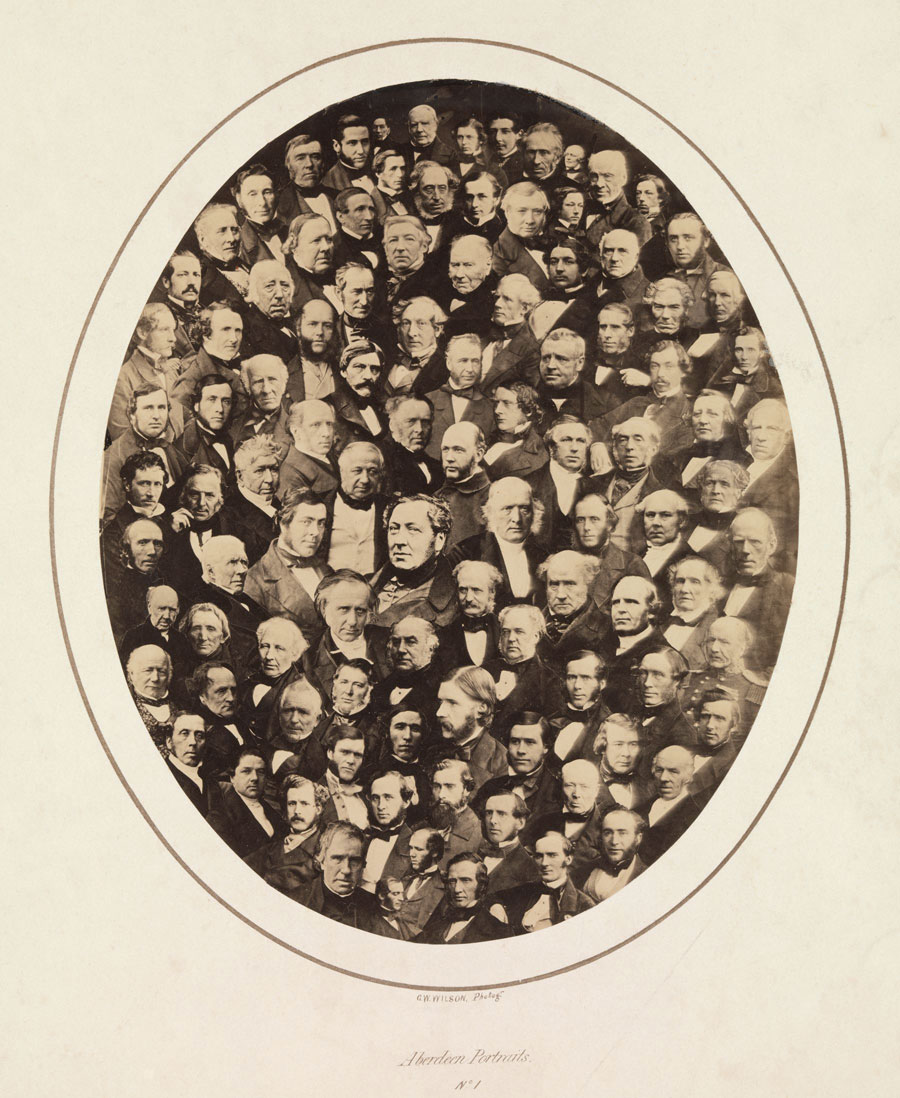
George Washington Wilson (Scottish, 1823-1893) 'Aberdeen Portraits No. 1' 1857


George Washington Wilson (Scottish, 1823-1893)
Aberdeen Portraits No. 1
1857
Albumen silver print from glass negative
The Metropolitan Museum of Art, The Horace W. Goldsmith Foundation Fund, through Joyce and Robert Menschel, 2011


Henry Peach Robinson (English, 1830-1901) 'Fading Away' 1858


Henry Peach Robinson (English, 1830-1901)
Fading Away
1858
Albumen silver print from glass negatives
The Royal Photographic Society Collection at the National Media Museum, Bradford, United Kingdom


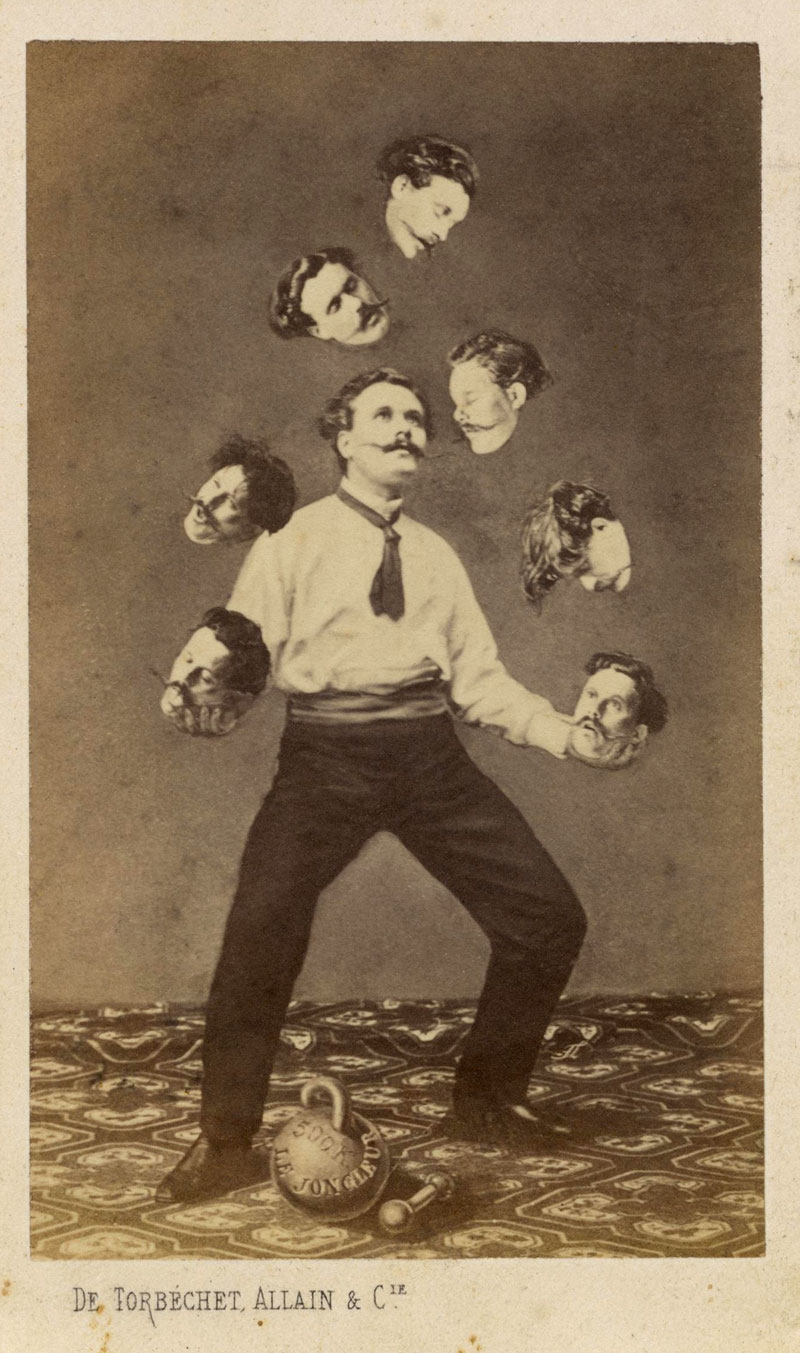
Unidentified artist / De Torbechet, Allain & Cie (publisher) 'Man Juggling His Own Head' c. 1880


Unidentified artist
De Torbechet, Allain & Cie
(publisher)
Man Juggling His Own Head
c. 1880
Albumen silver print from glass negative
Collection of Christophe Goeury


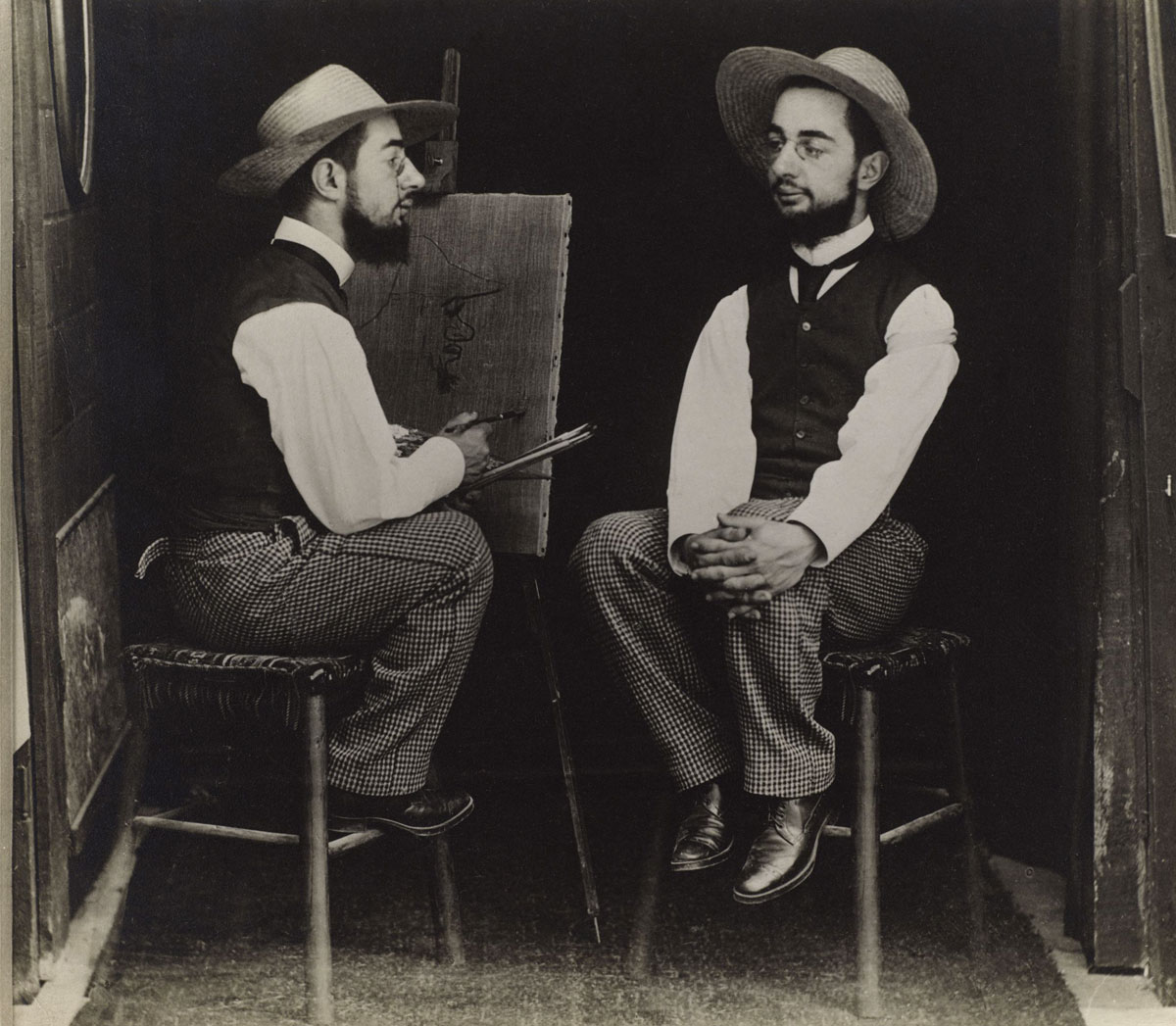
Maurice Guibert (French, 1856-1913) 'Henri de Toulouse-Lautrec as Artist and Model' c. 1900


Maurice Guibert (French, 1856-1913)
Henri de Toulouse-Lautrec as Artist and Model
c. 1900
Gelatin silver print
Philadelphia Museum of Art


F. Holland Day (American, 1864-1933) 'The Vision (Orpheus Scene)' 1907


F. Holland Day (American, 1864-1933)
The Vision (Orpheus Scene)
1907
Platinum print
The Royal Photographic Society Collection at the National Media Museum, Bradford, United Kingdom


Unidentified American artist. 'Man on Rooftop with Eleven Men in Formation on His Shoulders' c. 1930


Unidentified American artist
Man on Rooftop with Eleven Men in Formation on His Shoulders
c. 1930
Gelatin silver print
Collection of George Eastman House, International Museum of Photography and Film, Rochester


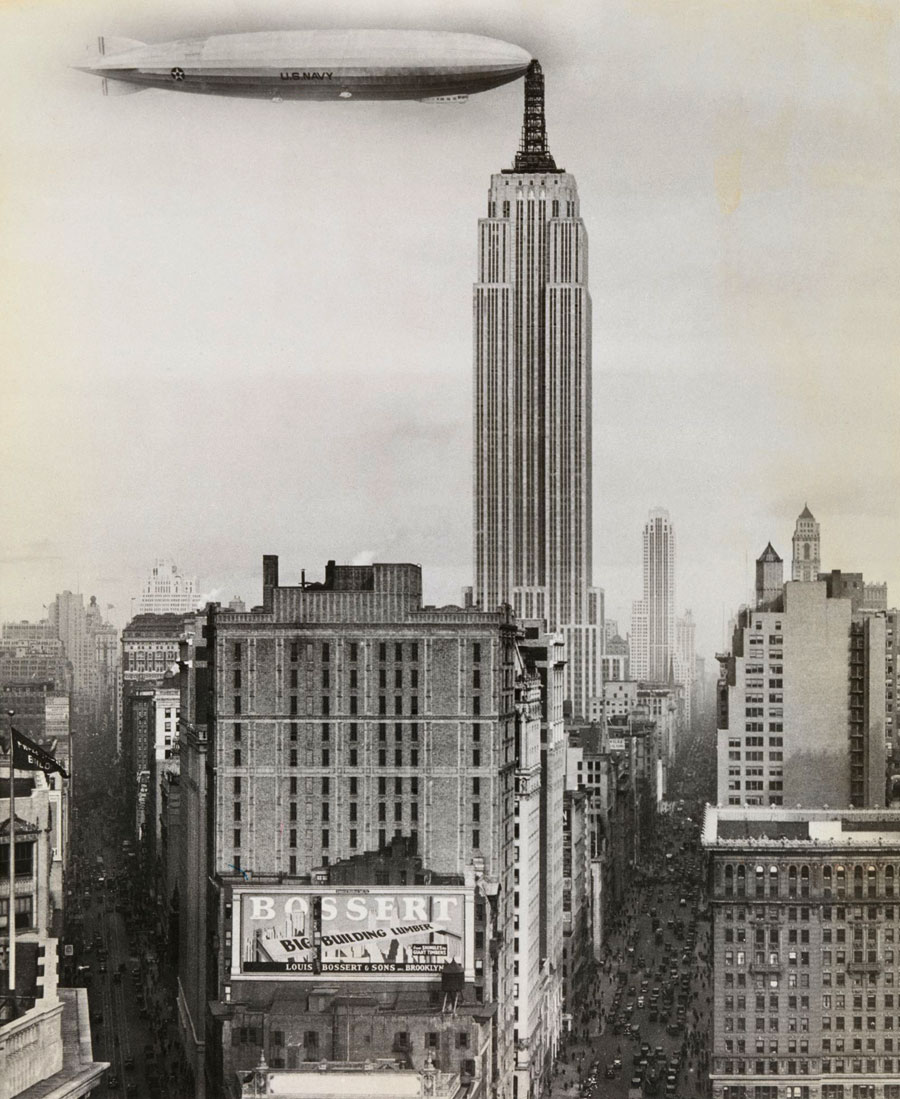
Unidentified American artist. 'Dirigible Docked on Empire State Building, New York' 1930


Unidentified American artist
Dirigible Docked on Empire State Building, New York
1930
Gelatin silver print
The Metropolitan Museum of Art, Twentieth-Century Photography Fund, 2011


While digital photography and image-editing software have brought about an increased awareness of the degree to which camera images can be manipulated, the practice of doctoring photographs has existed since the medium was invented. Faking It: Manipulated Photography Before Photoshop at The Metropolitan Museum of Art is the first major exhibition devoted to the history of manipulated photography before the digital age. Featuring some 200 visually captivating photographs created between the 1840s and 1990s in the service of art, politics, news, entertainment, and commerce, the exhibition offers a provocative new perspective on the history of photography as it traces the medium’s complex and changing relationship to visual truth. 

The exhibition is made possible by Adobe Systems Incorporated. 

The photographs in the exhibition were altered using a variety of techniques, including multiple exposure (taking two or more pictures on a single negative), combination printing (producing a single print from elements of two or more 
negatives), photomontage, overpainting, and retouching on the negative or print. 

In every case, the meaning and content of the camera image was significantly transformed in the process of manipulation.

Faking It is divided into seven sections, each focusing on a different set of motivations for manipulating the camera image. “Picture Perfect” explores 19th-century photographers’ efforts to compensate for the new medium’s technical limitations – specifically, its inability to depict the world the way it looks to the naked eye. To augment photography’s monochrome palette, pigments were applied to portraits to make them more vivid and lifelike. Landscape photographers faced a different obstacle: the uneven sensitivity of early emulsions often resulted in blotchy, overexposed skies. To overcome this, many photographers, such as Gustave Le Gray and Carleton E. Watkins, created spectacular landscapes by printing two negatives on a single sheet of paper – one exposed for the land, the other for the sky. This section also explores the challenges involved in the creation of large group portraits, which were often cobbled together from dozens of photographs of individuals. 

For early art photographers, the ultimate creativity lay not in the act of taking a photograph but in the subsequent transformation of the camera image into a hand-crafted picture.

“Artifice in the Name of Art” begins in the 1850s with elaborate combination prints of narrative and allegorical subjects by Oscar Gustave Rejlander and Henry Peach Robinson. It continues with the revival of Pictorialism at the dawn of the twentieth century in the work of artist-photographers such as Edward Steichen, Anne W. Brigman, and F. Holland Day. 

“Politics and Persuasion” presents photographs that were manipulated for explicitly political or ideological ends. It begins with Ernest Eugene Appert’s faked photographs of the 1871 Paris Commune massacres, and continues with images used to foster patriotism, advance racial ideologies, and support or protest totalitarian regimes. Sequences of photographs published in Stalin-era Soviet Russia from which purged Party officials were erased demonstrate the chilling ease with which the historical record could be falsified. Also featured are composite portraits of criminals by Francis Galton and original paste-ups of John Heartfield’s anti-Nazi photomontages of the 1930s.

“Novelties and Amusements” brings together a broad variety of amateur and commercial photographs intended to astonish, amuse, and entertain. Here, we find popular images of figures holding their own severed heads or appearing doubled or tripled. Also included in this light-hearted section are ghostly images by the spirit photographer William Mumler, “tall-tale” postcards produced in Midwestern farming communities in the 1910s, trick photographs by amateurs, and Weegee’s experimental distortions of the 1940s. 

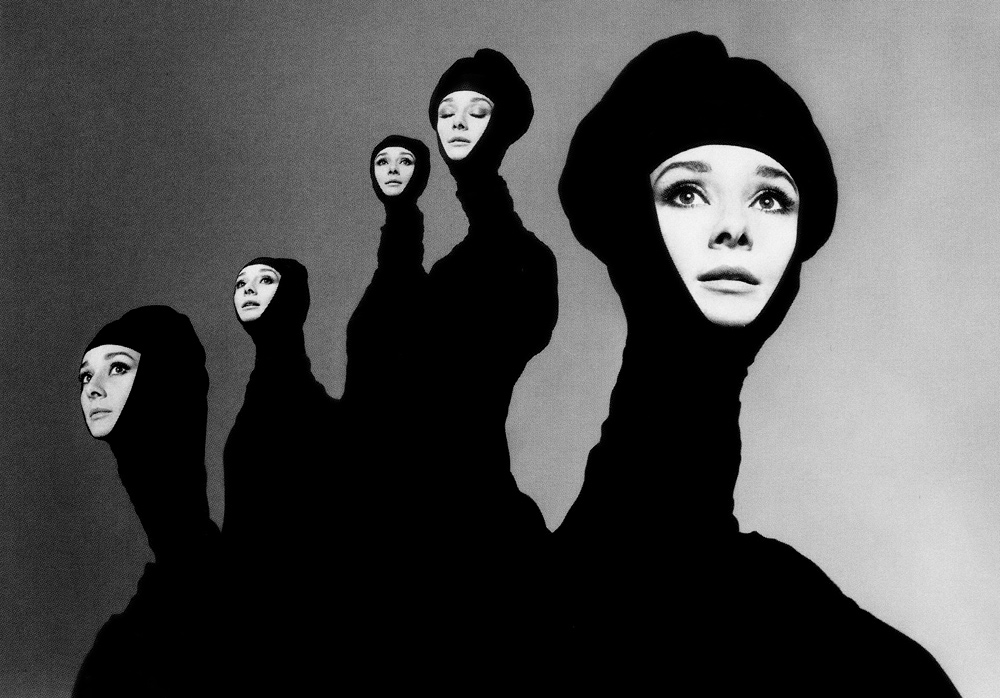
”Pictures in Print” reveals the ways in which newspapers, magazines, and advertisers have altered, improved, and sometimes fabricated images in their entirety to depict events that never occurred – such as the docking of a zeppelin on the tip of the Empire State Building. Highlights include Erwin Blumenfeld’s famous “Doe Eye” Vogue cover from 1950 and Richard Avedon’s multiple portrait of Audrey Hepburn from 1967.

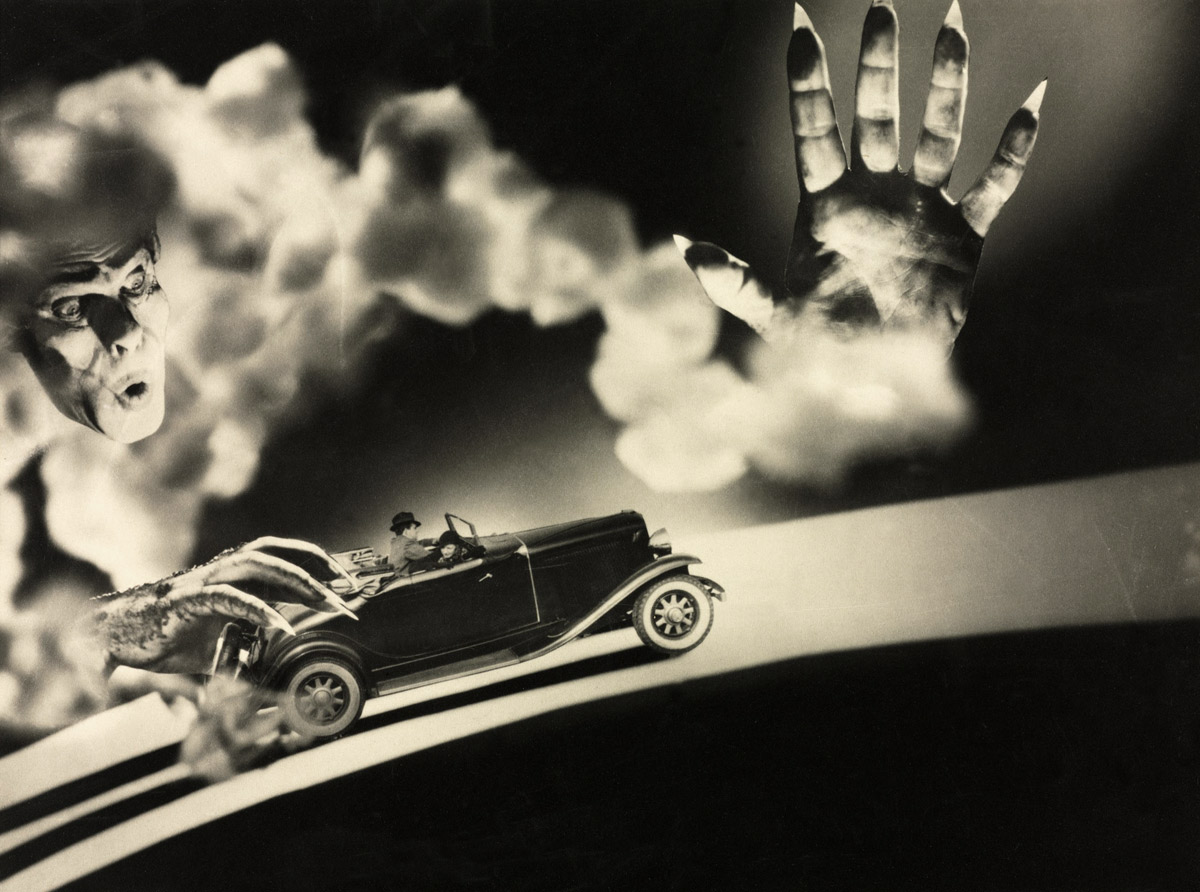
“Mind’s Eye” features works from the 1920s through 1940s by such artists as Herbert Bayer, Maurice Tabard, Dora Maar, Clarence John Laughlin, and Grete Stern, who have used photography to evoke subjective states of mind, conjuring dreamlike scenarios and surreal imaginary worlds. 

The final section, “Protoshop,” presents photographs from the second half of the 20th century by Yves Klein, John Baldessari, Duane Michals, Jerry Uelsmann, and other artists who have adapted earlier techniques of image manipulation – such as spirit photography or news photo retouching – to create works that self-consciously and often humorously question photography’s presumed objectivity.

Press release from The Metropolitan Museum of Art website


William Mortensen (American, 1897-1965) 'Obsession' c. 1930


William Mortensen  (American, 1897-1965)
Obsession
c. 1930
Gelatin silver print
18.4 x 14.5cm
The Elisha Whittelsey Collection, The Elisha Whittelsey Fund, 1975


Maurice Tabard (French, 1897-1984) 'Room with Eye' 1930


Maurice Tabard (French, 1897-1984)
Room with Eye
1930
Gelatin silver print
The Metropolitan Museum of Art, The Elisha Whittelsey Collection, The Elisha Whittelsey Fund, 1962


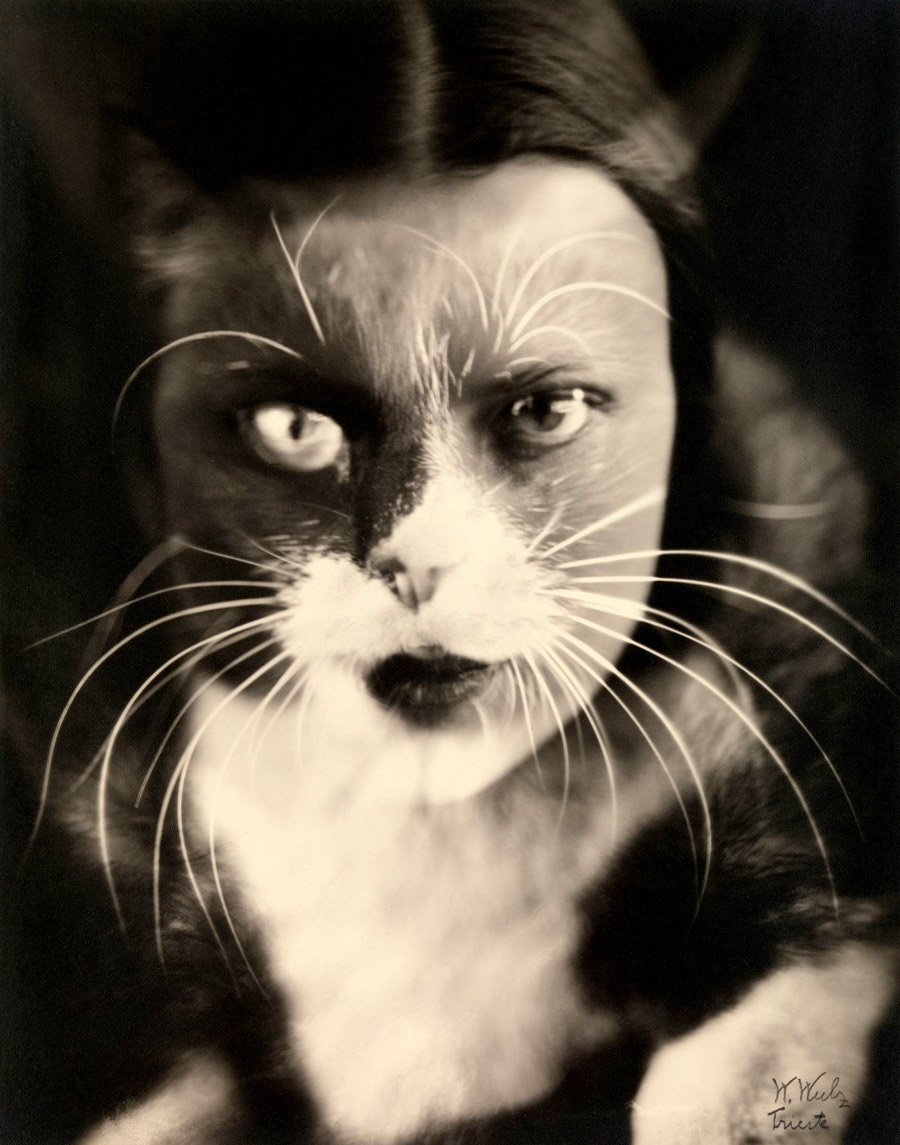
Wanda Wulz (Italian, 1903-1984) 'Io + gatto (Cat + I)' 1932


Wanda Wulz (Italian, 1903-1984)
Io + gatto (Cat + I)
1932
Gelatin silver print
The Metropolitan Museum of Art, Ford Motor Company Collection, Gift of Ford Motor Company and John C. Waddell, 1987
Alinari / Art Resource © Wanda Wulz


John Paul Pennebaker (American, 1903-1953) 'Sealed Power Piston Rings' 1933


John Paul Pennebaker (American, 1903-1953)
Sealed Power Piston Rings
1933
Gelatin silver print
1934 Art and Industry Exhibition Photograph Collection, Baker Library Historical Collections, Harvard Business School, Boston, Mass.
© John Paul Pennebaker


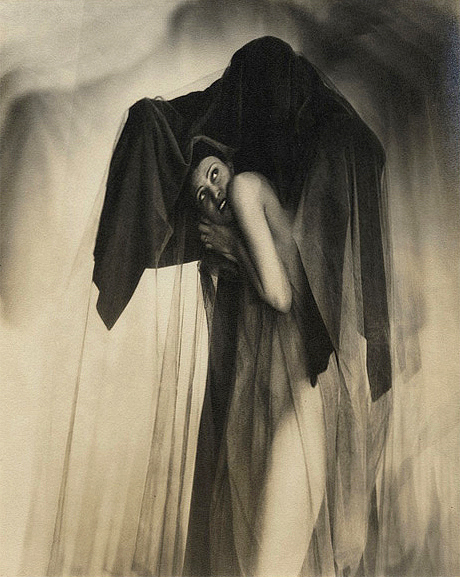
George Platt Lynes (American, 1907-1955) 'The Sleepwalker' 1935


George Platt Lynes (American, 1907-1955)
The Sleepwalker
1935
Gelatin silver print with applied media
The Metropolitan Museum of Art, Ford Motor Company Collection, Gift of Ford Motor Company and John C. Waddell, 1987
© The Estate of George Platt Lynes


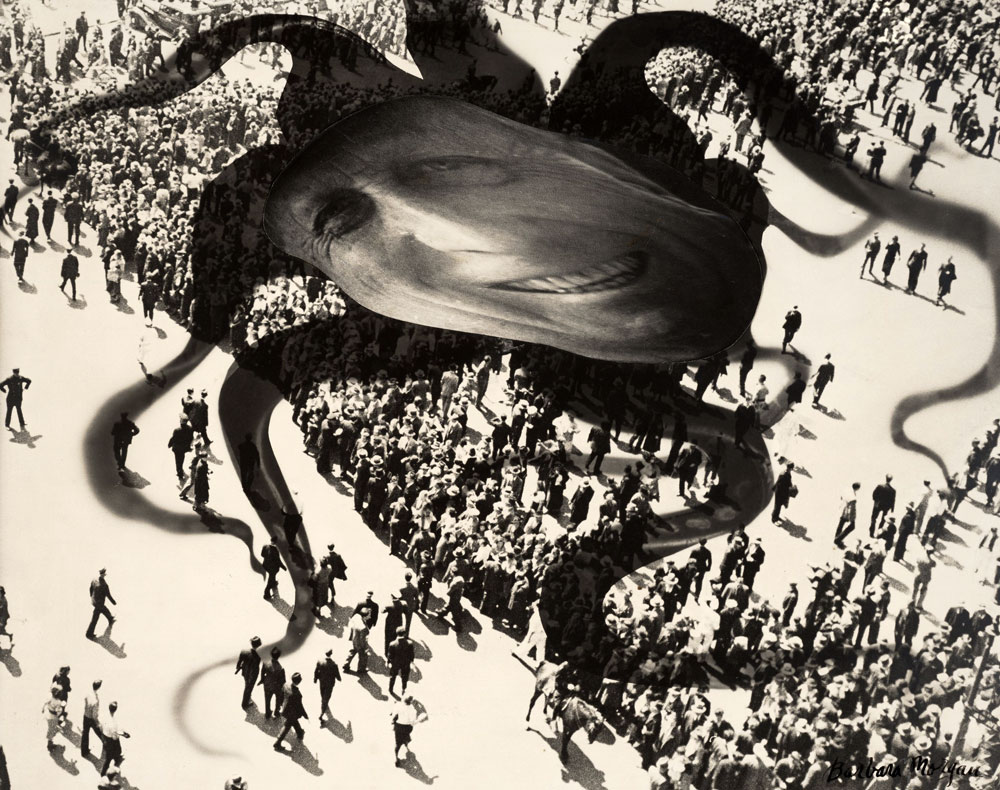
Barbara Morgan (American, 1900-1992) 'Hearst over the People' 1939


Barbara Morgan (American, 1900-1992)
Hearst over the People
1939
Collage of gelatin silver prints with applied media
The Nelson-Atkins Museum of Art, Kansas City, Missouri, Gift of Hallmark Cards, Inc.


Grete Stern (Argentinian born Germany, 1904-1999) 'Dream No. 1: Electrical Appliances for the Home' 1948


Grete Stern (Argentinian born Germany, 1904-1999)
Dream No. 1: Electrical Appliances for the Home
1948
Gelatin silver print
The Metropolitan Museum of Art, Twentieth-Century Photography Fund, 2012
Courtesy of Galería Jorge Mara – La Ruche, Buenos Aires


Erwin Blumenfeld (American born Germany, 1897-1969) '"Doe Eye" Vogue cover' 1950


Erwin Blumenfeld (American born Germany, 1897-1969)
“Doe Eye” Vogue cover
1950


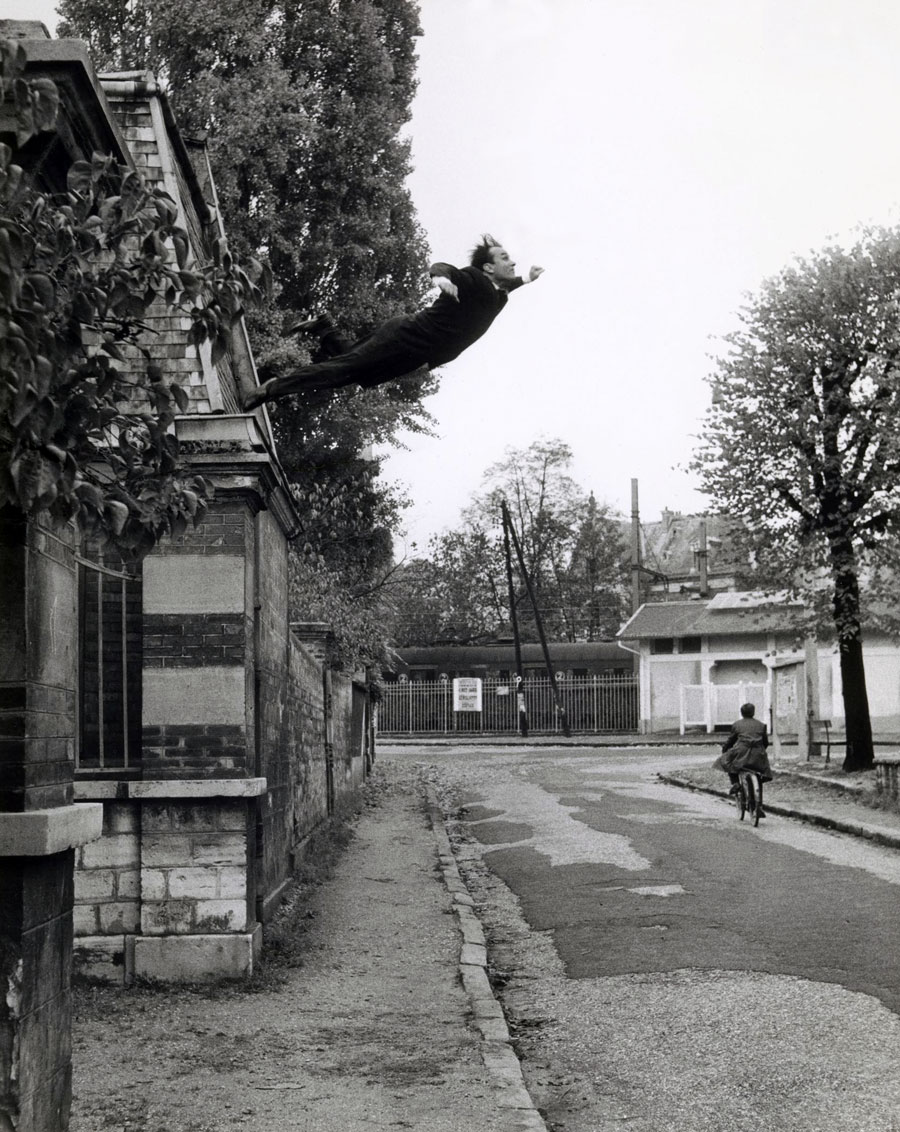
Yves Klein (French, 1928-1962) Photographed by Harry Shunk (German, 1924-2006) and János (Jean) Kender (Hungarian, 1937-2009) 'Leap into the Void' 1960


Yves Klein (French, 1928-1962)
Photographed by Harry Shunk (German, 1924-2006) and János (Jean) Kender (Hungarian, 1937-2009)
Leap into the Void
1960
Gelatin silver print
Purchase, The Horace W. Goldsmith Foundation Gift, through Joyce and Robert Menschel, 1992
© Yves Klein / Artists Rights Society (ARS), New York / ADAGP, Paris
Photograph Shunk-Kender © Roy Lichtenstein Foundation


Weegee (Arthur Fellig) (American, 1899-1968) 'Judy Garland' 1960


Weegee (Arthur Fellig) (American, 1899-1968)
Judy Garland
1960
Silver gelatin photograph
Copyright Weegee/International Center of Photography/Getty Images


Weegee (Arthur Fellig) (American, 1899-1968) 'American, 1899-1968 Draft Johnson for President' c. 1968


Weegee (Arthur Fellig) (American, 1899-1968)
Draft Johnson for President
c. 1968
Gelatin silver print
International Center of Photography, Bequest of Wilma Wilcox, 1993
Copyright Weegee/International Center of Photography/Getty Images.


Richard Avedon (American 1923-2004) 'Audrey Hepburn, New York, January 1967' 1967


Richard Avedon (American, 1923-2004)
Audrey Hepburn, New York, January 1967
1967
Collage of gelatin silver prints, with applied media, mylar overlay with applied media


Jerry N. Uelsmann (American, 1934-2022) 'Untitled' 1969


Jerry N. Uelsmann (American, 1934-2022)
Untitled
1969
Gelatin silver print
The Metropolitan Museum of Art, Twentieth-Century Photography Fund, 2011
© Jerry N. Uelsmann


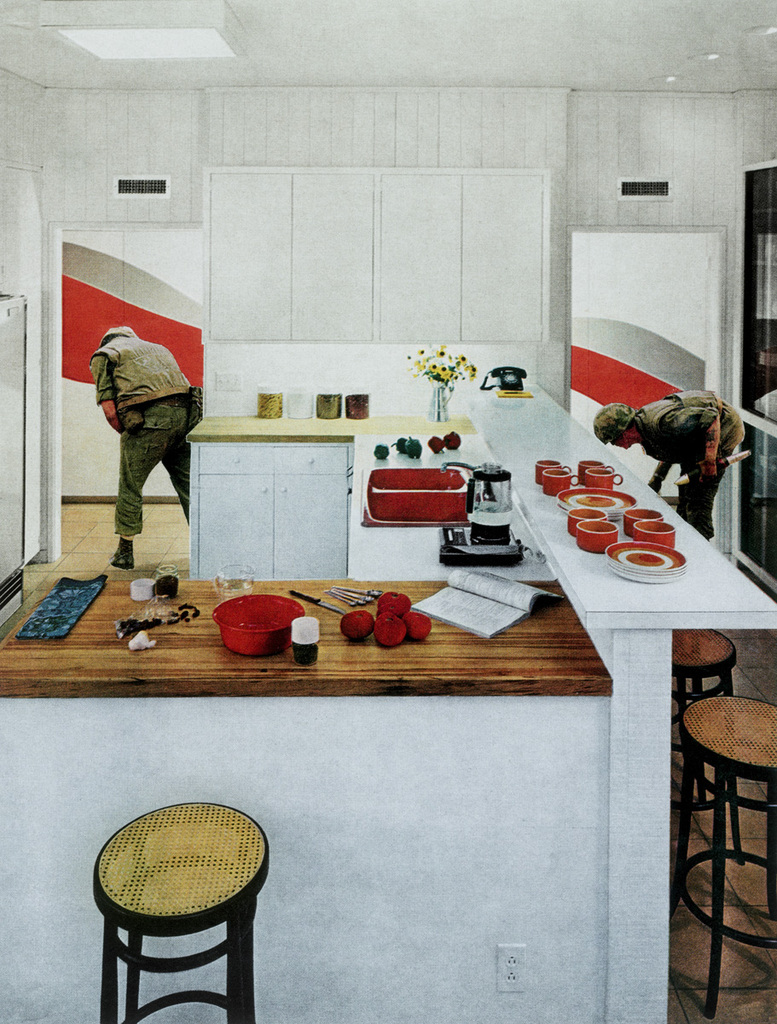
Martha Rosler (American, b. 1943) 'Red Stripe Kitchen', from the series "House Beautiful: Bringing the War Home" 1967-72


Martha Rosler (American, b. 1943)
Red Stripe Kitchen
1967-1972, printed early 1990s
From the series “House Beautiful: Bringing the War Home”
Chromogenic print
The Metropolitan Museum of Art, Purchase, Anonymous Gift, 2002
© Martha Rosler


The Metropolitan Museum of Art
1000 Fifth Avenue at 82nd Street
New York, New York 10028-0198
Phone: 212-535-7710

Opening hours:
Sunday – Tuesday 10am – 5pm
Closed Wednesdays

The Metropolitan Museum of Art website

National Gallery of Art
National Mall between 3rd and 7th Streets
Constitution Avenue NW, Washington

Opening hours:
Daily 10.00am – 5.00pm

National Gallery of Art website

LIKE ART BLART ON FACEBOOK

Back to top

Exhibition: ‘WAR/PHOTOGRAPHY: Images of Armed Conflict and Its Aftermath’ at the Museum of Fine Arts, Houston – Posting Part 3

Exhibition dates: 11th November 2012 – 3rd February 2013


Walter Astrada, (Argentinean, b. 1974) 'Congolese women fleeing to Goma' 2008


Walter Astrada, (Argentinean, b. 1974)
Congolese women fleeing to Goma
2008
From the series Violence against women in Congo, Rape as weapon of war in DRC
Chromogenic print (printed 2010)
The Museum of Fine Arts, Houston, museum purchase with funds provided by Photo Forum 2010
© Walter Astrada


“War is, above all, grief.”

Dmitri Baltermants


“Violence is the last refuge of the incompetent”


Salvor Hardin in Isaac Asimov’s ‘Foundation’ series


Part three of the biggest posting on one exhibition that I have ever undertaken on Art Blart!

As befits the gravity of the subject matter this posting is so humongous that I have had to split it into 4 separate postings. This is how to research and stage a contemporary photography exhibition that fully explores its theme. The curators reviewed more than one million photographs in 17 countries, locating pictures in archives, military libraries, museums, private collections, historical societies and news agencies; in the personal files of photographers and service personnel; and at two annual photojournalism festivals producing an exhibition that features 26 sections (an inspired and thoughtful selection) that includes nearly 500 objects that illuminate all aspects of WAR/PHOTOGRAPHY.

I have spent hours researching and finding photographs on the Internet to support the posting. It has been a great learning experience and my admiration for photographers of all types has increased. I have discovered the photographs and stories of new image makers that I did not know and some enlightenment along the way. I despise war, I detest the state and the military that propagate it and I surely hate the power, the money and the ethics of big business that support such a disciplinarian structure for their own ends. I hope you meditate on the images in this monster posting, an exhibition on a subject matter that should be consigned to the history books of human evolution.

**Please be aware that there are graphic photographs in all of these postings.** Part 1Part 2Part 4

Dr Marcus Bunyan


Many thankx to the Museum of Fine Arts, Houston for allowing me to publish some of the photographs in the posting. Please click on the photographs for a larger version of the image.


Civilians

21. Civilians spans World War II through 2008. The subsection “Dead and Wounded” includes Grief, Kerch, Crimea, by Dmitri Baltermants, of civilians in 1942 searching the bodies of Russian Jewish family members who had been executed by Germans soldiers as they retreated. A 2003 photograph, taken by Ahmed Jadallah for the news agency Reuters while he lay wounded from shrapnel, shows bodies in the street in the largest refugee camp in the Gaza Strip. “Daily Life” shows a Congolese woman breastfeeding as a tank rolls by, in a 2008 image by Walter Astrada; Londoners sleeping in an underground train station in 1940, by Bill Brandt; a woman eating bread in Amsterdam during the Hongerwinter famine of 1944, by Cas Oorthuys; a 1940/1941 meeting in New York of members of the Bund, an American Nazi party, by Otto Hagel; a monk burning himself in Saigon in 1963, in protest against alleged religious persecution by the South Vietnamese government, by Malcolm Browne; and a man uncovering an anti-personnel land mine in Angola in 2004, by Sean Sutton. Pictures of civilian “Grief” are common, and the images here include a woman in Tehran inspecting photographs of the missing, by Gilles Peress; a man at an airport, grieving alone and holding a folded American flag, by Harry Benson; a father digging a grave for his daughter in a soccer field in Somalia, by Howard Castleberry; and a woman mourning in Afghanistan in 1996, at the grave of her brother who was killed by a Taliban rocket, by James Nachtwey. (46 images)


Otto Hagel (American born Germany, 1909-1973) 'German-Americans at a meeting in New Jersey of the Deutsche Bund' 1940-41


Otto Hagel (American born Germany, 1909-1973)
German-Americans at a meeting in New Jersey of the Deutsche Bund
1940-1941
Silver gelatin print


Dmitri Baltermants (Russian born Poland, 1912-1990) 'Grief, Kerch, Crimea' Spring 1942


Dmitri Baltermants (Russian born Poland, 1912-1990)
Grief, Kerch, Crimea
Spring 1942
Silver gelatin print


“War, is, above all, grief. I photographed non-stop for years and I know that in all that time I produced only five or six real photographs. War is not for photography. If, heaven forbid, I had to photograph war again, I would do it quite differently. I agonise now at the thought of all the things that I did not photograph.”

Dmitri Baltermants quoted in “The Russian War, 1941-1945” (J. Cape, London, 1978)


Cas Oorthuys (Dutch, 1908-1975) 'Portrait of starving woman in the hunger winter, Amsterdam' 1944-1945


Cas Oorthuys (Dutch, 1908-1975)
Portrait of starving woman in the hunger winter, Amsterdam
1944-1945
Silver gelatin print


Malcolm Browne (American, 1931-2012) 'Burning Monk - The Self-Immolation' 1963


Malcolm Browne (American, 1931-2012)
Burning Monk – The Self-Immolation
1963
Gelatin silver print


Harry Benson (Scottish, b. 1929) 'Grieving man, holding flag' 1971


Harry Benson (Scottish, b. 1929)
Grieving man, holding flag
1971
Gelatin silver print


Children

22. Children have been consistently photographed during wartime as both victims and soldiers. Images in this section include Sir Cecil Beaton’s Three-year-old Eileen Dunne in Hospital for Sick Children, England (1940); children viewing the bodies of other children who were hanged as collaborators in Russia in the 1940s, by Mark Redkin; Philip Jones Griffiths’ image of a young boy, Called “Little Tiger” for killing two “Vietcong women cadre” – his mother and teacher, it was rumored (1968); children playing “execution” in Italy, by Enzo Sellerio; two orphaned boys smoking cigarettes in post-World War II Japan, by Hayashi Tadahiko; a father home on leave reading the newspaper with his son, who wears his dad’s helmet, by Andrea Bruce; and the 2005 photograph, by Chris Hondros, of a blood-splattered Iraqi girl whose family was mistakenly ambushed by U.S. troops. (13 images) 


Cecil Beaton (British, 1904-1980) 'Eileen Dunne, aged three, sits in bed with her doll at Great Ormond Street Hospital for Sick Children, after being injured during an air raid on London in September 1940' 1940


Cecil Beaton (British, 1904-1980)
Eileen Dunne, aged three, sits in bed with her doll at Great Ormond Street Hospital for Sick Children, after being injured during an air raid on London in September 1940
1940
Gelatin silver print
© IWM (MH 26395)


Philip Jones Griffiths (Welsh, 1936-2008) 'Called "Little Tiger” for killing two "Vietcong women cadre” - his mother and teacher, it was rumored, Vietnam' 1968


Philip Jones Griffiths (Welsh, 1936-2008)
Called “Little Tiger” for killing two “Vietcong women cadre” – his mother and teacher, it was rumored, Vietnam
1968
Gelatin silver print
The Philip Jones Griffiths Foundation, courtesy of Howard Greenberg Gallery
© Philip Jones Griffiths / Magnum Photos


Andrea Bruce (American, b. 1973) 'Untitled [A father home on leave reading the newspaper with his son, who wears his dad’s helmet]' 2006


Andrea Bruce (American, b. 1973)
Untitled [A father home on leave reading the newspaper with his son, who wears his dad’s helmet]
2006
From the series When the War Comes Home
Gelatin silver print


Portraits

23. Portraits are the most common type of photograph made during conflicts. Dispersed throughout the exhibition, lining the main walkway through the galleries, are the faces of leaders, the enlisted, heroes and war criminals, as well as group portraits. One of the earliest prints in the exhibition is a daguerreotype from the Mexican-American War of a high-ranking officer. Matthew Brady, one of the most famous photographers of the 19th century, was renowned for coverage of the Civil War; his MajorGeneral Joseph Hooker, c. 1863, is on view. Among the most recent is a self-portrait by American Cpl. Reynaldo Leal USMC. Leal – who was born and grew up in Edinburg, Texas, and now lives in El Paso – served in Iraq conducting combat patrols through the villages along the Euphrates. (40 images)


Matthew B. Brady (American, 1823-1896) 'Colonel William Gates, believed to have been taken upon his return from the Mexican War' c. 1848


Matthew B. Brady (American, 1823-1896)
Colonel William Gates, believed to have been taken upon his return from the Mexican War
c. 1848
Half plate daguerreotype, gold toned
Library of Congress


Mathew B. Brady (American, 1823-1896) 'Major-General Joseph Hooker' c. 1863


Mathew B. Brady (American, 1823-1896)
Major-General Joseph Hooker
c. 1863
Salted paper print, hand coloured
The Museum of Fine Arts, Houston, museum purchase with funds provided by the S. I. Morris Photography Endowment


Corporal Reynaldo Leal USMC (American, b. 1983) 'Self‑portrait after a Patrol' c. 2004-2006


Corporal Reynaldo Leal USMC (American, b. 1983)
Self‑portrait after a Patrol
c. 2004-2006
Inkjet print
13 1/2 × 9 in. (34.3 × 22.9cm)
The Museum of Fine Arts, Houston
Museum purchase with funds provided by Will Michels and Clinton T. Willour
© Reynaldo Leal


War’s End

24. War’s End is identifiable at the moment a photograph is taken. The subsection “Victory/Defeat” is the visual manifest of the outcome of war, from the Japanese signing peace documents on board the USS Missouri, by Carl Mydans; to German generals discussing terms of surrender in the woods just four days after Adolf Hitler committed suicide in 1945, by E. G. Malindine; and the raising of the Hammer and Sickle over the Reichstag in Berlin in 1945, by Evgeny Khaldey. Also included is Simon Norfolk’s Victory arch built by the Northern Alliance at the entrance to a local commander’s headquarters in Bamiyan. The empty niche housed the smaller of the two Buddhas, destroyed by the Taliban in 2001, from the series Afghanistan: Chronotopia. “Retribution” contains a 1945 image, by Lee Miller, of a concentration-camp guard who was beaten by prisoners after their liberation; and a photograph by Robert Capa of a Frenchwoman who had been impregnated by a German soldier, as she walks through a jeering crowd with her head shaved in punishment and carrying her baby. The photographs in “Homecoming” establish an emotive connection: a family reunion on the tarmac at an Air Force base in California in 1973, by Sal Veder; a mother and son embracing at the Ben-Gurion Airport in Israel in 1976, by Micha Bar-Am; and a man who has returned from duty in Bosnia in 1995 to discover that his home and everyone in it is gone, by Ron Haviv. (23 images)


Robert Capa (Hungarian-American, 1913-1954) 'Collaborator woman who had a German soldier's child, Chartres, 18 August 1944' 1944


Robert Capa (Hungarian-American, 1913-1954)
Collaborator woman who had a German soldier’s child, Chartres, 18 August 1944
1944
Gelatin silver print
33 x 49cm


Evgeny Khaldey (Russian, 1917-1997) 'The Flag of Victory' 1945


Evgeny Khaldey (Russian, 1917-1997)
The Flag of Victory
1945
Gelatin silver print


E. G. Malindine (British, 1906-1970) 'German Military Forces Seek Surrender Terms, May 1945'


E. G. Malindine (British, 1906-1970)
No 5 Army Film & Photographic Unit, Malindine E G (Capt), Morris (Sgt)
German Military Forces Seek Surrender Terms, May 1945
1945
Gelatin silver print
Public domain


Field Marshal Sir Bernard Montgomery with the German delegates outside his headquarters at 21st Army Group


Carl Mydans (American, 1907-2004) 'Japanese signing peace documents on board the USS Missouri' 1945


Carl Mydans (American, 1907-2004)
Japanese signing peace documents on board the ‘USS Missouri’
1945
Gelatin silver print


Sal Velder (American, b. 1926) 'Released prisoner of war Lt. Col. Robert L. Stirm is greeted by his family at Travis Air Force Base in Fairfield, California on March 17, 1973, as he returns home from the Vietnam War' 1973


Sal Velder (American, b. 1926)
Released prisoner of war Lt. Col. Robert L. Stirm is greeted by his family at Travis Air Force Base in Fairfield, California on March 17, 1973, as he returns home from the Vietnam War
1973
Silver gelatin print
© Sal Velder


Micha Bar-Am (Israeli born Germany, 1930-2022) 'The return from Entebbe, Ben-Gurion Airport, Israel' 1976


Micha Bar-Am (Israeli born Germany, 1930)
The return from Entebbe, Ben-Gurion Airport, Israel
1976
From the series Promised Land
Inkjet print
Courtesy of the artist and Andrea Meislin Gallery, New York
© Micha Bar-Am / Magnum Photos


Ron Haviv (American, b.1965) 'A Bosnian soldier stands on what is believed to be a mass grave outside his destroyed home. He was the sole survivor of 69 people' 1995


Ron Haviv (American, b. 1965)
A Bosnian soldier stands on what is believed to be a mass grave outside his destroyed home. He was the sole survivor of 69 people
1995
Inkjet print
Courtesy of Ron Haviv/VII
© Ron Haviv


Simon Norfolk (British born Nigeria, b. 1963)
'Victory arch built by the Northern Alliance at the entrance to a local commander’s headquarters in Bamiyan. The empty niche housed the smaller of the two Buddhas, destroyed by the Taliban in 2001' 2001


Simon Norfolk (British born Nigeria, b. 1963)
Victory arch built by the Northern Alliance at the entrance to a local commander’s headquarters in Bamiyan. The empty niche housed the smaller of the two Buddhas, destroyed by the Taliban in 2001
2001
From the series Afghanistan: Chronotopia


Museum of Fine Arts, Houston
1001 Bissonnet Street
Houston, TX 77005

Opening hours:
Wednesday 11am – 5pm
Thursday 11am – 9pm
Friday 11am – 6pm
Saturday 11am – 6pm
Sunday 12.30pm – 6pm
Monday Closed
Tuesday Closed

Museum of Fine Arts, Boston website

LIKE ART BLART ON FACEBOOK

Back to top

Exhibition: ‘Imogen Cunningham’ at Fundación Mapfre, Madrid

Exhibition dates: 18th September 18 2012 – 20th January 2013


Imogen Cunningham exhibition poster


Imogen Cunningham exhibition poster


This is the first posting on one of my favourite photographers of all time: Imogen Cunningham. The sensuality of this artist, from the early Pictorialist studies (including her ground breaking depiction of the male nude, her husband artist Roi Partridge) to the later Modernist nudes, portraits, industrial landscapes and botanical photographs is of the highest order. Cunningham reminds me of a photographic version of Georgia O’Keeffe without the undoubted darkness that inhabits some of O’Keeffe’s work.

The portrait of Frida Kahlo Rivera (1931, below) is a magnificent study of a proud woman with delicate use of natural light framing the face and gently clasped hands. Note the textures within the photograph – the dress, the shawl, the wicker chair and the wall – and also notice the reflective light falling behind the sitter upper left to balance the frontal light coming from bottom right. Masterful. Cunningham’s famous Two Callas (1929, below) is an glorious study of form, light and texture, a sensual symphony for the eyes, the background a kind of mutable black that allows the viewer’s gaze to be immersed in the subject. The viewer’s voyeuristic gaze is further engaged by the voluptuous suggestiveness of the copious hair and out of focus breast of Phoenix Recumbent (1968, below) where, “the object of the gaze is not aware of the current viewer (though they may originally have been aware of being filmed, photographed, painted etc. and may sometimes have been aware that strangers could subsequently gaze at their image).” (Daniel Chandler “Notes on ‘The Gaze'” on the Aberystwyth University website [Online] Cited 12/01/2013 no longer available online)

Finally, the photograph of Imogen Cunningham and Twinka Thiebaud by Judy Dater (1974, below) seems to me to capture the spirit of the human being Imogen Cunningham with indelible grace. Youth, beauty, age, wisdom. A constantly inquisitive mind, wanting to know, wanting to see things more clearly, taking photographs right up until her final years. There she is with her twin-lens Rollei dressed as if from another century, the quizzical nature of her left hand and the look that passes between Imogen and Twinka, the space between them seeming to shimmer with possibility. That space seems to wash away the years of Imogen’s life to when she was young, lying naked near some trees (Self-Portrait (1906, below). It is a truly memorable image. In the sensitivity of this image, Dater embodies everything that I admire in Cunningham’s work: light, texture, sensitivity to subject, an understanding of beauty and an irrepressible, joyous sensuality. A fitting tribute to one of the world’s great photographers.

Dr Marcus Bunyan


Many thankx to the Fundación Mapfre, Madrid for allowing me to publish the photographs in the posting. Please click on the photographs for a a larger version of the image.


Imogen Cunningham (American, 1883-1976) 'Self-Portrait' 1906


Imogen Cunningham (American, 1883-1976)
Self-Portrait
1906
Platinum print
©The Imogen Cunningham Trust, 2012


Imogen Cunningham (American, 1883-1976) 'Roi on the Dipsea trail 3' 1918


Imogen Cunningham (American, 1883-1976)
Roi on the Dipsea trail 3
1918
Gelatin sliver print
© The Imogen Cunningham Trust, 2012


Imogen Cunningham (American, 1883-1976) 'Magnolia Blossom' 1925


Imogen Cunningham (American, 1883-1976)
Magnolia Blossom
1925
Gelatin silver print
© The Imogen Cunningham Trust, 2012


Imogen Cunningham (American, 1883-1976) 'Three Dancers, Mills College' 1929


Imogen Cunningham (American, 1883-1976)
Three Dancers, Mills College
1929
Gelatin silver print
© The Imogen Cunningham Trust, 2012


Imogen Cunningham (American, 1883-1976) 'Five Eggs' 1951


Imogen Cunningham (American, 1883-1976)
Five Eggs
1951
Cibachrome
© The Imogen Cunningham Trust


Imogen Cunningham (American, 1883-1976) 'The Unmade Bed' 1957


Imogen Cunningham (American, 1883-1976)
The Unmade bed
1957
Gelatin silver print
© The Imogen Cunningham Trust, 2012


Imogen Cunningham (American, 1883-1976) 'The dream' 1910


Imogen Cunningham (American, 1883-1976)
The dream
1910
Gelatin silver print
© The Imogen Cunningham Trust, 2011


Imogen Cunningham (American, 1883-1976) 'The Wood Beyond the World' c. 1912


Imogen Cunningham (American, 1883-1976)
The Wood Beyond the World
c. 1912
Gelatin silver print
© The Imogen Cunningham Trust


Imogen Cunningham (American, 1883-1976) 'Agave Design 2' 1920s


Imogen Cunningham (American, 1883-1976)
Agave Design 2
1920s
Gelatin silver print
© The Imogen Cunningham Trust


Imogen Cunningham (American, 1883-1976) 'Edward Weston and Margrethe Mather, Photographers I-II' 1922
 

Imogen Cunningham (American, 1883-1976)
Edward Weston and Margrethe Mather, Photographers I-II
1922
Gelatin silver print
© The Imogen Cunningham Trust, 2011


Imogen Cunningham (American, 1883-1976) 'Aloe' 1925
 

Imogen Cunningham (American, 1883-1976)
Aloe
1925
Gelatin silver print
© The Imogen Cunningham Trust, 2012


Imogen Cunningham (American, 1883-1976) 'Two Callas' 1929


Imogen Cunningham (American, 1883-1976)
Two Callas
1929
Gelatin silver print
© The Imogen Cunningham Trust, 2012


Imogen Cunningham (American, 1883-1976) 'Hen and Chickens' 1929


Imogen Cunningham (American, 1883-1976)
Hen and Chickens
1929
Gelatin silver print
© The Imogen Cunningham Trust, 2011


Imogen Cunningham (American, 1883-1976) 'Frida Kahlo Rivera, Painter and Wife of Diego Rivera' 1931


Imogen Cunningham (American, 1883-1976)
Frida Kahlo Rivera, Painter and Wife of Diego Rivera
1931
Gelatin silver print
© The Imogen Cunningham Trust, 2012


Imogen Cunningham (American, 1883-1976) 'Cary Grant, Actor' 1932


Imogen Cunningham (American, 1883-1976)
Cary Grant, Actor
1932
Gelatin silver print
© The Imogen Cunningham Trust, 2012


Imogen Cunningham (American, 1883-1976) 'Nude' 1939


Imogen Cunningham (American, 1883-1976)
Nude
1939
Gelatin silver print
© The Imogen Cunningham Trust, 2012


Imogen Cunningham (American, 1883-1976) 'Phoenix Recumbent' 1968


Imogen Cunningham (American, 1883-1976)
Phoenix Recumbent
1968
Gelatin silver print
Private Collection


Judy Dater (American, b. 1941) 'Imogen Cunningham and Twinka Thiebaud' 1974


Judy Dater (American, b. 1941)
Imogen Cunningham and Twinka Thiebaud
1974


FUNDACIÓN MAPFRE – Instituto de Cultura
Paseo de Recoletos, 23
28004 Madrid, Spain
Phone: +34 915 81 61 00

Opening hours:
Monday (except Holidays): 2pm – 8pm
Tuesday to Saturday: 11am to 8pm
Sundays and Holidays: 11am – 7pm

Fundación Mapfre website

LIKE ART BLART ON FACEBOOK

Back to top

Exhibition: ‘Wolfgang Tillmans’ at Moderna Museet Stockholm

Exhibition dates: 6th October 2012 – 20th January 2013


This slideshow requires JavaScript.


Installation photographs of various rooms of the exhibition Wolfgang Tillmans at Moderna Museet Stockholm, including Venus transit (2004) and Man pissing on chair (1997)
Photographs © Carmen Brunner


In this bumper posting, a big call: in my opinion, the greatest photography based image maker in the world today.

Tillmans challenges the way we think and feel about photography. As Tom Holert in his excellent catalogue essay The Unforeseen notes, Tillmans problematises and reconfigures narration and visualisation, experimenting with a sensory experiential backdrop against and within which the photographs are produced. Modes of perception and the regimes of emotion are inducted into the aesthetics of production and meaning so that, “the pictures communicate with each other in a way that is not bound to the pattern of a closed narrative or any particular line of argument. Instead they create a form of aesthetic and thematic interaction that Tillmans sees as ‘a language of personal associations and “thought-maps.”” The mobilisation and reversal of value and meaning are central strategies in Tillmans’ praxis.

In this way Tillmans opens up spaces for research, “in which learning and unlearning, resonance and interference, a new affective solidarity and real experimentation might be possible before the onset of all sorts of methods, all forms of governance, all kinds of discipline and doxa [common belief or popular opinion].

This form of experimentation does not lead to benchmark research results; nothing is ever proved or illustrated, regardless of what is in the images or what they may purport to show. Ever engaging in experiment Tillmans roams through the reality of materials, forms, affects and gives us tangible access to these unportrayble, unreferential realities. Tillmans engages his emotions when he is working, also and specifically when he is photographing people, or plants, machines and cities. Individual emotions separate off from the representation of living beings and objects and form nodes of emotion in the viewer’s mind.”

Through these rhizomic tendencies (a la Delueze and Guittari A Thousand Plateaus) Tillmans images generate emotion and affect, “rhythmically resonating between pictures, from wall to wall, from room to room, from side to side,” so that in each instance, in each publication or exhibition, he can “modify and modulate anew the relations between picture and picture support, representation and presentation, motif and materiality.”

Nothing is ever fixed in linear time. The work is presented as an infinitely variable, spatial and emotional relationship – an orthogonal performativity where the ritual of production and meaning is never fully predetermined at any stage of production and reception.

Tom Holert’s excellent catalogue essay The Unforeseen. On the Production of the New, and Other Movements in the Work of Wolfgang Tillmans includes information on Jacques Rancière’s concept of “‘aisthesis’ for the way in which very different things have been registered as ‘art’ for the last two hundred years or so. As he points out, “this is not about the ‘reception’ of works of art, but about the sensory experiential backdrop against and within which they come about. These are completely material conditions – places of performance or exhibition, forms of circulation and reproduction – but also modes of perception and the regimes of emotion, the categories that identify them and the patterns of thought that classify and interpret them.'” A thought provoking text (extracts below to accompany the photographs).

Dr Marcus Bunyan


Many thankx to the Moderna Museet for allowing me to publish the photographs and the text in the posting. Please click on the photographs for a larger version of the image.


Wolfgang Tillmans (German, b. 1968) 'Arkadia_I' 1996


Wolfgang Tillmans (German, b. 1968)
Arkadia_I
1996
© Wolfgang Tillmans. Courtesy Galerie Buchholz, Cologne/Berlin


Wolfgang Tillmans (German, b. 1968) 'New Family' 2001


Wolfgang Tillmans (German, b. 1968)
New Family
2001
© Wolfgang Tillmans. Courtesy Galerie Buchholz, Cologne/Berlin


Wolfgang Tillmans (German, b. 1968) 'Paper drop (window)' 2006


Wolfgang Tillmans (German, b. 1968)
Paper drop (window)
2006
© Wolfgang Tillmans. Courtesy Galerie Buchholz, Cologne/Berlin


Wolfgang Tillmans is one of the leading artists of his generation and is constantly in the public eye, with exhibitions all over the world. The exhibition at Moderna Museet is Tillmans’ first major show in Sweden and brings nearly twenty years of picture-making to a new audience. Moderna Museet is delighted to welcome Wolfgang Tillmans – an artist who has extended the boundaries of photography and redefined the medium of photography as an artform.

Wolfgang Tillmans (b. 1968) first attracted attention at the beginning of the 1990s, with his apparently mundane pictures of subjects taken from his own surroundings. After studying in Britain, he published photographs in prominent publications such as i-D, Spex and Interview. Today, these pictures are considered trendsetting for the young generation of the 1990s, and raise questions about subcultures and sexual identities. By turning everyday situations into almost monumental images, Tillmans very strikingly captured the spirit of the times. It soon became evident that his pictures renegotiate photographic conventions and reflect contemporary currents related to culture and identity. Since then, Tillmans has continued his in-depth investigations, expanding the the realm of photography and redefining the very medium as an artform.

“Wolfgang Tillmans moves freely between images of the club scene in Berlin, political manifestations, and skyscrapers in Hong Kong; all with the same direct tonality. At the same time, all of his pictures explore photography itself – as a medium, but also as a material, convention and process,” says Curator Jo Widoff.

Recently Tillmans’ art has taken a number of different directions, revolving around various issues, everything from still lifes and modern landscapes to his lifelong interest in astronomy and the night sky. He has also taken his in-depth exploration of abstract photography even further. Tillmans’ abstract images are more closely related to the painterly tradition and he researches photography as a self-reflexive medium. Abstract images, such as Freischwimmer and Silver, are made in the darkroom, striking a balance between the deliberate and chance. Since 1995, Tillmans has been working actively and strategically with the exhibition space, so as to reveal the possibilities and limitations of the space in interplay with the photographs. His installations display a bewildering variety of formats and sizes, ways of composing the hanging of the pictures, and contexts. The exhibition at Moderna Museet should thus be seen as a site-specific installation. In recent years, Tillmans has been travelling the world taking photographs with the general title Neue Welt. These pictures relate to the new world of markets and trade, to politics and economics, and to the hypermodern. The title also refers to the new digital camera that Wolfgang used to take these pictures, which captures and documents more detail than we can perceive with the naked eye.

“Wolfgang Tillmans is one of today’s most prominent artists. Despite its visual complexity, his pictorial language is immediately recognisable. He captures the explosive energy in social situations and crosses boundaries between different artforms. He is able to use photographic means to create a kind of abstract painting,” says Museum Director Daniel Birnbaum.

Press release from the Moderna Museet website


Wolfgang Tillmans (German, b. 1968) 'Lux' 2009


Wolfgang Tillmans (German, b. 1968)
Lux
2009
© Wolfgang Tillmans. Courtesy Galerie Buchholz, Cologne/Berlin


Wolfgang Tillmans (German, b. 1968) 'Iguazu' 2010


Wolfgang Tillmans (German, b. 1968)
Iguazu
2010
© Wolfgang Tillmans. Courtesy Galerie Buchholz, Cologne/Berlin


Wolfgang Tillmans (German, b. 1968) 'Paper drop (Roma)' 2007


Wolfgang Tillmans (German, b. 1968)
Paper drop (Roma)
2007
C-type print
30.5 x 40.6cm
Courtesy the artist and Maureen Paley, London


Wolfgang Tillmans (German, b. 1968) 'Freischwimmer 93' 2004


Wolfgang Tillmans (German, b. 1968)
Freischwimmer 93
2004
© Wolfgang Tillmans. Courtesy Galerie Buchholz, Cologne/Berlin


The Freischwimmer series – Free Swimmer is the most basic Lifesaving level in Germany and Switzerland – is an excellent example of Tillmans’s more experimental works. On one hand, the huge photographic papers were affixed to the wall with simple adhesive tape or paper clips; on the other, the images eluded all description and eschewed portraiture, landscape, still life or other subject matters he had centred on up to then.

The creative process of Freischwimmer, ongoing to the present, seems to speak to pure photography, divested of any form of intervention either in shooting or in enlargement, or indeed optical devices of any kind. We can almost imagine the artist in front of a large tray with reagents, performing some kind of alchemical ritual at the origin of these vaporous images, images containing a refinement that exceeds any human intention, just pure representations of themselves, of a unique and absolutely unrepeatable process. Of their reality.”

José Manuel Costa. “Swimming to Freedom 38,” on the CA2M Centro de Arte Dos de Mayo website [Online] Cited 12/10/2013 no longer available online


The Freischwimmer, which Tillmans started to produce in the early 2000s, form a group or family of images that are not made using a camera lens. As the results of gestural and chemical operations in the dark room, these originals on medium-sized photo paper, which are subsequently scanned and enlarged both as ink-jet prints and as light-jet prints on photo paper, are unrepeatable one-offs. It has been said that these images, which include ensembles such as Peaches, Blushes and Urgency, call to mind microscopically detailed images of biolog­ical processes, hirsute epidermises, highly erogenous zones, and that their aura fills the whole space – above all when they are presented in such large formats as in Warsaw or yet larger still, as in the case of the two monumental Ostgut Freischwimmer (2004) that used to grace the walls of the Panorama Bar at Berghain in Berlin. The Freischwimmer and their kin can be read as diagrams of sexualised atmospheres in private or semi-public spaces, in boudoirs or clubs, as highly non-representational images that both suspend and supplement conventional depic­tions of sex.

Extract from Tom Holert. The Unforeseen. On the Production of the New, and Other Movements in the Work of Wolfgang Tillmans. [Online] Cited 12/10/2013 no longer available online


Wolfgang Tillmans (German, b. 1968) 'Nanbei Hu' 2009


Wolfgang Tillmans (German, b. 1968)
Nanbei Hu
2009
Inkjet print
207 x 138cm
Courtesy the artist and Maureen Paley, London


Wolfgang Tillmans (German, b. 1968) 'Anders pulling splinter from his foot' 2004


Wolfgang Tillmans (German, b. 1968)
Anders pulling splinter from his foot
2004
© Wolfgang Tillmans. Courtesy Galerie Buchholz, Cologne/Berlin


Wolfgang Tillmans (German, b. 1968) 'Onion' 2010


Wolfgang Tillmans (German, b. 1968)
Onion
2010
© Wolfgang Tillmans. Courtesy Galerie Buchholz, Cologne/Berlin


Wolfgang Tillmans (German, b. 1968) 'Venus transit' 2004


Wolfgang Tillmans (German, b. 1968)
Venus transit
2004
© Wolfgang Tillmans. Courtesy Galerie Buchholz, Cologne/Berlin


Wolfgang Tillmans (German, b. 1968) 'Heptathlon' 2009


Wolfgang Tillmans (German, b. 1968)
Heptathlon
2009
Inkjet print
208.5 x 138cm
Courtesy the artist and Maureen Paley, London


Wolfgang Tillmans (German, b. 1968) 'Headlight (a)' 2012


Wolfgang Tillmans (German, b. 1968)
Headlight (a)
2012
© Wolfgang Tillmans. Courtesy Galerie Buchholz, Cologne/Berlin


Wolfgang Tillmans (German, b. 1968) 'Ushuaia Lupine (a)' 2010


Wolfgang Tillmans (German, b. 1968)
Ushuaia Lupine (a)
2010
© Wolfgang Tillmans. Courtesy Galerie Buchholz, Cologne/Berlin


Wolfgang Tillmans (German, b. 1968) 'Tukan' 2010


Wolfgang Tillmans (German, b. 1968)
Tukan
2010
Inkjet print on paper, clips


Wolfgang Tillmans (German, b. 1968) 'Photocopy' 1994


Wolfgang Tillmans (German, b. 1968)
Photocopy
1994
© Wolfgang Tillmans, Courtesy Galerie Daniel Buchholz, Köln


Extracts from Tom Holert. The Unforeseen. On the Production of the New, and Other Movements in the Work of Wolfgang Tillmans. [Online] Cited 12/10/2013. No longer available online

Parallelism – Subjectivism – Objectivism

This all means that the decorative unity of wall and image, which the hanging of the Freischwimmer initially promises, is not only thwarted by the shift in dimensions, the infringement of symmetrical order and the (supposed) discontinuity of abstraction and figuration, and by the fact that the different types of image and their configuration on this wall require the viewer to move around in the space and to continually readjust his or her gaze, bearing in mind that in the corner of one’s eye or following a slight turn of the body more pictures are constantly looming into view, mostly unframed, very small (postcard-sized), very large, hung very low down, but also very high up, portraits and still lifes, gestural abstractions, a close-up of a vagina, a picture of a modern Boy with Thorn, street scenes, an air-conditioning system. It also means that the pictures communicate with each other in a way that is not bound to the pattern of a closed narrative or any particular line of argument. Instead they create a form of aesthetic and thematic interaction that Tillmans sees as ‘a language of personal associations and “thought-maps”‘,1 as ‘… a pattern of parallelism as opposed to one linear stream of thought’,2 and which the critic Jan Verwoert has aptly described as a ‘performative experiment’ with the viewer.3

With all their variability and flexibility – underpinned by an invisible rectilinear grid yet fundamentally open in their interconnections – these installations serve Tillmans as reflections of his own way of perceiving the world, as externalisations of his thinking and feeling, and as a chance to fashion a utopian world according to his own ideas and fantasies.4 However, this Romantic subjectivism of self-expression or externalisation has to be seen in light of a radical objectivism (Tillmans attaches great importance to this) that specifically draws attention not only to the expressive potential arising from the ageing process, from evidence of wear and other precariousnesses in the materials of photography (paper, camera techniques, chemicals, developing equipment etc.) but also to the remarkable resistance and persistence of these same materials.

Amongst the phenomena that inform this objectivism there are those instances of loss of control that can arise during the mechanical production processes of analogue photography or from coding errors, glitches, in digital images. Temporality, finity, brevity come into play here – a certain melancholy that activates rather than paralyses.

Over the years Tillmans has constantly found new ways to explore, to interpret and to stage this dialectic of intention and contingency. His repertoire and means of aesthetic production have multiplied. And this expansion has not been without consequences for the presentation of his work. Tillmans himself feels that the character of his installations has changed since 2006/07, in other words, when different versions of a solo exhibition of his work toured to three museums in the United States. It was during this exhibition tour that Tillmans started to see the benefit of placing greater weight on individual groups of works in the various rooms of larger exhibitions. In so doing he gave visitors the chance to engage in a different kind of concentration, without the pressure of constantly having to deal with the ‘full spectrum’ (Tillmans) of his oeuvre.5

Value Theory, Value Praxis

The visitor to an exhibition of the work of Wolfgang Tillmans in the year 2012, in this case the author of these lines, arrives in expectation of a particular, clearly defined type of art and image experience. A sense (however fragmentary) of the artist’s past exhibitions and publications is always present in any encounter with his work. And this includes the need to see the ‘abstract pictures’ in the context of an oeuvre where realistic and abstract elements have never intentionally been separated from each other. On the contrary, abstraction is always co-present with figurative and representational elements. There is no contradiction between forms and matter free of meaning – that is to say, visual moments that on the face of it neither represent nor illustrate anything – and Tillmans’ photographs of people, animals, objects and landscapes; in fact there is an unbroken connection, a continuum. This applies both to individual images as much as to the internal, dynamic relationalism of his oeuvre as a whole. And it also applies to each individual, concrete manifestation of multiplicity, as in the case of the installation in the first room of the exhibition in Warsaw.

Both aesthetic theory and the institution of art itself provide decisive grounds for discussing photography and visual art in such a way that images are not solely considered in terms of documentary functions or ornamental aspects nor are they reduced to the question as to whether their contents are stage-managed or authentic, but that attention is paid instead to the material nature of the pictures and objects in the space, to their sculptural qualities. Having decided early on against a career as a commercial photographer and in favour of a life in art, there was no need for Tillmans to seek to justify the interest he had already felt in his youth in a non-hierarchical, queer approach to various forms and genres in the visual arts. For the young Wolfgang Tillmans the cover artwork for a New Order LP, a portrait of Barbara Klemm (in-house photographer at the Frankfurter Allgemeine Zeitung), or a screenprint collage of Robert Rauschenberg in Kunstsammlung Nordrhein-Westfalen were all ‘equally important’ images’.7 The mobilisation and reversal of value and meaning are central strategies in his praxis. He questions the ‘language of importance’8 in photography and alters valencies of the visual by, for instance – in a ‘transformation of value’9 – producing C-prints from the supposedly impoverished or inadequate visuality of old black-and-white copies or wrongly developed images and thus raising them to the status of museum art. However much he may set store by refinement and precision, he avoids conventional forms of presentation, that is to say, ‘the signifiers that give immediate value to something, such as the picture frame’.10

Conditions: Subject – Work – Mediation

If we take the line proposed by the philosopher Jacques Rancière, then the ‘aesthetic regime’ of the modern era, which – following the introduction of a modern concept of art and aesthetics – abandoned the regulatory aesthetic canon of the classical age in the nineteenth century, is distinguished by the fact that under its auspices the traditional hierarchies separating the high from the popular branches of narration and visualisation were problematised and reconfigured in such a way that a new politics of aesthetics and a ‘distribution of the sensible’ in the name of art ensued. Rancière has recently proposed the term ‘aisthesis’ for the way in which very different things have been registered as ‘art’ for the last two hundred years or so. As he points out, this is not about the ‘reception’ of works of art, but about the sensory experiential backdrop against and within which they come about. ‘These are completely material conditions – places of performance or exhibition, forms of circulation and reproduction – but also modes of perception and the regimes of emotion, the categories that identify them and the patterns of thought that classify and interpret them.’12

In order to understand why the work of Wolfgang Tillmans – so seemingly casual, so heterogeneous and so wide-ranging – is not only extremely successful, but has, for over twenty years, been intelligible and influential both within and outside the field of art, with the result that by now his praxis seems like a universal, subtly normative style of perception and image-making, it is essential to consider the ‘conditions’ alluded to by Rancière. For these are fundamental to the specific visibility and speakability of this oeuvre and to its legitimacy as art…

The Production of the New

Tillmans thus also makes his contribution to an answer to the question posed by the philosopher John Rajchman (in response to Gilles Deleuze and Michel Foucault and their deliberations on the production of the new and on the creative act in present-day, control-obsessed societies). Rajchman asked how, in and with the arts and their institutions, spaces for open searches and researches could be devised, in which learning and unlearning, resonance and interference, a new affective solidarity and real experimentation might be possible before the onset of all sorts of methods, all forms of governance, all kinds of discipline and doxa.18

This form of experimentation does not lead to benchmark research results; nothing is ever proved or illustrated, regardless of what is in the images or what they may purport to show. Ever engaging in experiment Tillmans roams through the reality of materials, forms, affects and gives us tangible access to these unportrayble, unreferential realities. Tillmans engages his emotions when he is working, also and specifically when he is photographing people, or plants, machines and cities. Individual emotions separate off from the representation of living beings and objects and form nodes of emotion in the viewer’s mind. ‘Artists are presenters of affects, the inventors and creators of affects’, as Gilles Deleuze and Félix Guattari put it in What is Philosophy?, ‘they draw us into the compound’.19 And indeed Tillmans’ laboratories are places where emotion and affect are generated and presented, rhythmically resonating between pictures, from wall to wall, from room to room, from side to side. The dog asleep on the stones, its breathing body warmed by the sun (in the video Cuma, 2011), Susanne’s lowered gaze (in Susanne, No Bra, 2006), with the line of her hair encircling her head like an incomplete figure of eight, but also the disturbed, interrupted, lurking monochromaticism of the Lighter and Silver works – they all open up the longer you look at them, the longer you are with them, to a perceiving in terms of forces and affects. They alert us to the fact that all images are fabricated.

Assimilating Photography into the Paradox

By virtue of the portability and variability of his works, with every print, with every exhibition, with every publication Tillmans can modify and modulate anew the relations between picture and picture support, representation and presentation, motif and materiality. In the two decades that have elapsed since his entry into the art business his praxis has continuously expanded. From the outset photography was his springboard for both integrative and eccentric acts. And even though this oeuvre may create the impression that the medium of photography knows no limits, photography – as discourse, as technique, as history, as convention – has remained the constant point of reference for all of Tillmans’ complex operations. It could also be said that he is immensely faithful to his chosen medium, although – or precisely because – that medium is not always recognisable as such. To quote an older essay on photography and painting by Richard Hamilton (whom Tillmans once photographed), his work is about ‘assimilating photography into the domain of paradox, incorporating it into the philosophical contradictions of art…’30 Since Tillmans’ experiments with a laser copier in the 1980s, he has produced hundreds of images that may be beholden to the etymology of photography (light drawing) but that also constantly undermine or overuse the social and epistemological functions of photography as a means to depict reality, as proof, as an aide mémoire, as documentation or as a form of aesthetic expression. The discourse on photography, with all its ‘post-photographic’ exaggerations, the debate on the status of the photographic image – none of these have been concluded; on the contrary, Tillmans is continuously advancing them on his own terms. His praxis forms the backdrop for experimentation and adventures in perception that are closely intertwined with the past and the present of photography and theories of photography; yet the specific logic of this oeuvre creates a realm of its own in which archive and presentation interlock in such a way that photography still plays an important part as historic and discursive formation, but the problems and paradoxes of fine art have now taken over the key functions.

The contagious impact of the epistemological problems of art has opened up new options for the medium of photography, new contexts of reception. And in this connection it is apparent, as Julie Ault has put it, that ‘Tillmans enacts his right to complex mediation’.31 In other words, photography provides a means for him to engage with a whole range of interactions with the viewer. In his eyes and hands photography becomes a realm of potential, where a never-ending series of constellations and juxtapositions of materialities, dimensions and motifs of the ‘unforeseen’ can come about. Photography thus regains a dimension of experimentation, an openness that is not constrained by aesthetic formats and technical formatting but that does arise from a precise knowledge and understanding of the history of the medium.”

Extracts from Tom Holert. The Unforeseen. On the Production of the New, and Other Movements in the Work of Wolfgang Tillmans. [Online] Cited 12/10/2013 no longer available online


Footnotes from extracts

1/ “Peter Halley in Conversation with Wolfgang Tillmans,” in Jan Verwoert, Peter Halley and Midori Matsui, Wolfgang Tillmans (London: Phaidon, 2002), 8-33 at 29

2/ Steve Slocombe, “Wolfgang Tillmans – The All-Seeing Eye,” in Flash Art, vol. 32, no. 209, November – December 1999, 92-95 at 95

3/ Jan Verwoert, “Survey: Picture Possible Lives: The Work of Wolfgang Tillmans,” in Verwoert et. al., Wolfgang Tillmans, 36-89 at 72

4/ See Slocombe, “Wolfgang Tillmans – The All-Seeing Eye” (see note 2), 95

5/ See Julia Peyton-Jones and Hans Ulrich Obrist, “Interview with Wolfgang Tillmans,” in Wolfgang Tillmans (London: Serpentine Gallery / Koenig Books, 2010), 21-27 at 24

7/ Wolfgang Tillmans, email of 12 May 2012.

8/ Julie Ault, “Das Thema lautet Ausstellen Installations as Possibility in the Practice of Wolfgang Tillmans,” in Wolfgang Tillmans. Lighter (Stuttgart/Berlin: Hatje Cantz/SMB), Nationalgalerie Staatliche Museen zu Berlin, 2008, 27

9/ See Hans Ulrich Obrist, Wolfgang Tillmans (Cologne: Verlag der Buchhandlung Walther König, 2007 = The Conversation Series, 6), 41

10/ Gil Blank, “The Portraiture of Wolfgang Tillmans,” in Influence, 2, autumn 2004, 110-21 at 117

12/ Jacques Rancière, Aisthesis. Scènes du régime esthétique de l’art (Paris: Galilée, 2011), 10

18/ Zepke (ed.), Deleuze, Guattari and the Production of the New (London: Continuum, 2008), 80-90 at 89

19/ See Deleuze and Guattari, What Is Philosophy?, trans. Hugh Tomlinson and Graham Burchell (New York: Columbia University Press, 1994), 175

30/ Richard Hamilton, “Photography and Painting,” in Studio International, vol. 177, no. 909, March 1969, 120-25 at 125

31/ Julie Ault, “The Subject Is Exhibition” (see note 8), 15


Wolfgang Tillmans (German, b. 1968) 'Alex Lutz back' 1992


Wolfgang Tillmans (German, b. 1968)
Alex Lutz back
1992
© Wolfgang Tillmans. Courtesy Galerie Buchholz, Cologne/Berlin


Wolfgang Tillmans (German, b. 1968) 'Smokin Jo' 1995


Wolfgang Tillmans (German, b. 1968)
Smokin Jo
1995
© Wolfgang Tillmans. Courtesy Galerie Buchholz, Cologne/Berlin


Wolfgang Tillmans (German, b. 1968) 'Lutz & Alex sitting in the trees' 1992


Wolfgang Tillmans (German, b. 1968)
Lutz & Alex sitting in the trees
1992
Inkjet print on paper, clips
208 × 138 cm


Moderna Museet, Stockholm

Moderna Museet is ten minutes away from Kungsträdgården, and twenty minutes from T-Centralen or Gamla Stan. Walk past Grand Hotel and Nationalmuseum on Blasieholmen, opposite the Royal Palace. After crossing the bridge to Skeppsholmen, continue up the hill. The entrance to Moderna Museet and Arkitekturmuseet is on the left-hand side.

Opening hours:
Tuesday – Sunday 11 – 18
Monday closed

Moderna Museet website

LIKE ART BLART ON FACEBOOK

Back to top

Exhibition: ‘William Klein + Daido Moriyama’ at the Tate Modern, London

Exhibition dates: 10th October 2012 – 20th January 2013


William Klein (French born America, 1926-2022) 'Candy Store, New York' 1955


William Klein (French born America, 1926-2022)
Candy Store, New York
1955
Gelatin silver print
© William Klein


More Daido Moriyama photographs can be found on my 2012 posting Fracture: Daido Moriyama at the Los Angeles County Museum of Art (LACMA) and 2009 posting Daido Moriyama: Tokyo Photographs at Philadelphia Museum of Art.

Dr Marcus Bunyan


Many thankx to the Tate Modern for allowing me to publish the photographs in the posting. Please click on the photographs for a larger version of the image.


William Klein (French born America, 1926-2022) 'Pray + Sin, New York' 1954


William Klein (French born America, 1926-2022)
Pray + Sin, New York
1954
Gelatin silver print
© William Klein


Explore modern urban life in New York and Tokyo through the photographs of William Klein and Daido Moriyama. This is the first exhibition to look at the relationship between the work of influential photographer and filmmaker Klein, and that of Moriyama, the most celebrated photographer to emerge from the Japanese Provoke movement of the 1960s.

With work from the 1950s to the present day, the exhibition demonstrates the visual affinity between their urgent, blurred and grainy style of photography and also their shared desire to convey street life and political protest, from anti-war demonstrations and gay pride marches to the effects of globalisation and urban deprivation.

The exhibition also considers the medium and dissemination of photography itself, exploring the central role of the photo-book in avant-garde photography and the pioneering use of graphic design within these publications. As well the issues of Provoke magazine in which Moriyama and his contemporaries showcased their work, the exhibition will include fashion photography from Klein’s work with Vogue and installations relating to his satirical films Mister Freedom and Who Are You Polly Maggoo?

Text from the Tate Modern website


William Klein (French born America, 1926-2022) 'Bikini, Moscow' 1959


William Klein (French born America, 1926-2022)
Bikini, Moscow
1959
Gelatin silver print
© William Klein


William Klein (French born America, 1926-2022) 'Piazza di Spagna, Rome' 1960


William Klein (French born America, 1926-2022)
Piazza di Spagna, Rome
1960
Gelatin silver print
© William Klein


William Klein (French born America, 1926-2022) 'Gun 1, New York' 1955


William Klein (French born America, 1926-2022)
Gun 1, New York
1955
Gelatin silver print
© William Klein


William Klein (French born America, 1926-2022) 'lsa Maxwell's Toy ball, Waldorf Hotel, New York' 1955


William Klein (French born America, 1926-2022)
lsa Maxwell’s Toy ball, Waldorf Hotel, New York
1955
Gelatin silver print
© William Klein


William Klein (French born America, 1926-2022) 'Kiev railway station, Moscow' 1959


William Klein (French born America, 1926-2022)
Kiev railway station, Moscow
1959
Gelatin silver print
© William Klein


William Klein (French born America, 1926-2022) 'School out, Dakar' 1963


William Klein (French born America, 1926-2022)
School out, Dakar
1963
Gelatin silver print
© William Klein


William Klein (French born America, 1926-2022) 'Dance Happening in Ginza, Tokyo' 1961


William Klein (French born America, b. 1928)
Dance Happening in Ginza, Tokyo
1961
Gelatin silver print
© William Klein


William Klein + Daidō Moriyama Exhibition Tate Modern, London

Slideshow of images from the press view at the William Klein / Daido Moriyama Exhibition at Tate Modern, London


Explore modern urban life in New York and Tokyo through the photographs of William Klein and Daido Moriyama. This is the first exhibition to look at the relationship between the work of influential photographer and filmmaker Klein, and that of Moriyama, the most celebrated photographer to emerge from the Japanese Provoke movement of the 1960s. With work from the 1950s to the present day, the exhibition demonstrates the visual affinity between their urgent, blurred and grainy style of photography and also their shared desire to convey street life and political protest, from anti-war demonstrations and gay pride marches to the effects of globalisation and urban deprivation. Taking as its central theme the cities of New York and Tokyo, William Klein + Daido Moriyama explores both artists’ celebrated depictions of modern urban life.

The exhibition is formed of two retrospectives side by side, bringing together over 300 works, including vintage prints, contact sheets, film stills, photographic installations and archival material. The influence of Klein’s seminal 1956 publication Life is Good & Good for You in New York, Trance Witness Revels, as well as his later books Tokyo 1964 and Rome: The City and Its People 1959, is traced through Moriyama’s radical depictions of post-war Tokyo in Sayonara Photography and The Hunter 1972. The juxtaposition of these artists not only demonstrates the visual affinity between their urgent, blurred and grainy style of photography, but also their shared desire to convey street life and political protest, from anti-war demonstrations and student protests to the effects of globalisation and urban deprivation.

This exhibition also considers the medium and dissemination of photography itself, exploring the central role of the photo-book in avant-garde photography and the pioneering use of graphic design within these publications. As well the issues of Provoke magazine in which Moriyama and his contemporaries showcased their work, the exhibition includes fashion photography from Klein’s work with Vogue and installations relating to his satirical films Mister Freedom and Who Are You Polly Maggoo? New ways of presenting photography are also demonstrated by Moriyama’s installation Polaroid/Polaroid 1997, which recreates his studio interior through a meticulous arrangement of Polaroid images.

Press release from the Tate Modern website


'William Klein + Daido Moriyama' exhibition banner


William Klein + Daido Moriyama exhibition banner


Daidō Moriyama (Japanese, b. 1938) 'Misawa' 1971


Daidō Moriyama (Japanese, b. 1938)
Misawa
1971
Gelatin silver print
© Daido Moriyama


Daido Moriyama (Japanese, b. 1938) 'Marine Accident (Premeditated or not 5)' 1969


Daidō Moriyama (Japanese, b. 1938)
Marine Accident (Premeditated or not 5)
1969
Gelatin silver print
© Daido Moriyama


William Klein + Daido Moriyama is the first exhibition to examine the relationship between the work of William Klein (born 1928), one of the twentieth century’s most important photographers and film-makers, and that of Daido Moriyama (born 1938), the most celebrated photographer to emerge from the Japanese Provoke movement. Taking as its central theme the cities of New York and Tokyo, William Klein + Daido Moriyama explores both artists’ celebrated depictions of modern urban life.

The exhibition is formed of two retrospectives side by side, bringing together over 300 works, including vintage prints, contact sheets, film stills, photographic installations and archival material. The influence of Klein’s seminal 1956 publication Life is Good & Good for You in New York, Trance Witness Revels, as well as his later books Tokyo 1964 and Rome: The City and Its People 1959, is traced through Moriyama’s radical depictions of post-war Tokyo in Sayonara Photography and The Hunter 1972. The juxtaposition of these artists not only demonstrates the visual affinity between their urgent, blurred and grainy style of photography, but also their shared desire to convey street life and political protest, from anti-war demonstrations and student protests to the effects of globalisation and urban deprivation.

This exhibition also considers the medium and dissemination of photography itself, exploring the central role of the photo-book in avant-garde photography and the pioneering use of graphic design within these publications. As well the issues of Provoke magazine in which Moriyama and his contemporaries showcased their work, the exhibition includes fashion photography from Klein’s work with Vogue and installations relating to his satirical films Mister Freedom and Who Are You Polly Maggoo? New ways of presenting photography are also demonstrated by Moriyama’s installation Polaroid/Polaroid 1997, which recreates his studio interior through a meticulous arrangement of Polaroid images.

William Klein was born in New York, USA in 1928 and now lives and works in Paris, France. Solo exhibitions of his work have been held at the Centre Pompidou, Paris and the Scottish National Gallery, Edinburgh and he received the Outstanding Contribution to Photography Award at the 2012 Sony World Photography Awards.

Daido Moriyama was born in Osaka, Japan in 1938 and moved to Tokyo in 1961, where he continues to live and work. He was recently given a Lifetime Achievement Award by the International Centre of Photography and his work has been the subject of solo exhibitions at the San Francisco Museum of Modern Art; The Cartier Foundation, Paris; and The National Museum of Art, Osaka.

William Klein + Daido Moriyama is co-curated by Simon Baker, Curator of Photography and International Art, Tate, and Juliet Bingham, Curator, Tate Modern, with Kasia Redzisz, Assistant Curator, Tate Modern. The exhibition is accompanied by new books about both photographers from Tate Publishing. A season of film screenings at Tate Modern is also being held to coincide with the exhibition, showing Klein’s feature films and documentaries.

Press release from the Tate Modern website


Daidō Moriyama (Japanese, b. 1938) 'Memory of Dog 2' 1981


Daidō Moriyama (Japanese, born 1938)
Memory of Dog 2
1981
Gelatin silver print
© Daido Moriyama


Daidō Moriyama (Japanese, b. 1938) 'Tokyo color' 2008-2015


Daidō Moriyama (Japanese, born 1938)
Tokyo color
2008-2015
© Daido Moriyama


Daidō Moriyama (Japanese, b. 1938) 'Tokyo' 2011


Daidō Moriyama (Japanese, b. 1938)
Tokyo
2011
Gelatin silver print
Courtesy Daido Moriyama Photo Foundation
© Daido Moriyama


After reading Jack Kerouac’s classic beat novel On The Road, Moriyama began photographing the roads leading into and out of Japanese towns. Instead of places people live in and feel comfortable with, he portrays cities primarily as destinations to be visited and left behind. The resulting book, Hunter (1972), is described as a “road map of images from all over Japan through a moving car window. Routes and roads are the hunting field for me as a photographer.”

Occasionally he finds beauty – in snowflakes falling, a train speeding past, or the patterning of fishnet tights or perforated steel – but ramping up the contrast of his black and white prints, Moriyama more often portrays the world as a dangerous place engulfed in existential darkness.

In all this chaos, his studio appears like a beacon of calm and stability. Recorded in a grid of polaroid shots, the room is recreated as an installation that offers a rare glimpse of clarity and colour in what can otherwise feel like a miasma – the world as seen through a dark fog.

While Klein undoubtedly influenced Moriyama’s love of grainy, out-of-focus shots taken from odd angles, to pair him with the American tells only half the story. Warhol was equally important as the inspiration behind his Accident series, which includes car crashes, shipping disasters, executions and a health scare linked to overcrowded beaches. Moriyama’s use of found images (the car crashes come from posters), his fascination with serialisation (banks of tins on supermarket shelves) and with juxtaposing unrelated images on a page were also inspired by Warhol. So pairing him with Klein is interesting, but doesn’t do him justice. Moriyama deserves to be seen as a law unto himself, rather than an acolyte of a more familiar western photographer.

Sarah Kent. “William Klein + Daido Moriyama, Tate Modern,” on The Arts Desk website Thursday, 11 October 2012 [Online] Cited 05/09/2022


Daidō Moriyama (Japanese, b. 1938) 'Setagaya-ku, Tokyo, Midnight 1986'


Daidō Moriyama (Japanese, b. 1938)
Setagaya-ku, Tokyo, Midnight
1986
Gelatin silver print
Courtesy Daido Moriyama Photo Foundation
© Daido Moriyama


Daidō Moriyama (Japanese, b. 1938) 'Another Country in New York' 1971


Daidō Moriyama (Japanese, b. 1938)
Another Country in New York
1971
Gelatin silver print
Tokyo Polytechnic University
© Daido Moriyama


Tate Modern
Bankside
London SE1 9TG

Opening hours:
Monday to Sunday 10.00 – 18.00

Tate Modern website

LIKE ART BLART ON FACEBOOK

Back to top

Text: ‘Orality, (n)framing and enactment in the art of Jacqui Stockdale’ in IANN magazine Vol.8, ‘Unfound in Australia’, October 2012

January 2013


Jacqui Stockdale (Australian, b. 1968) 'Negro Returno, Long Gully' 2012


Jacqui Stockdale (Australian, b. 1968)
Negro Returno, Long Gully
2012
Type C Print
100 x 78cm


“What does it mean, to rediscover an unknown continent through the medium of photography in the 21st century? The seven artists that appear in this “Unfound in Australia” issue are well versed in the photographic technique and language familiar to modern art, yet show cultural distinctness that is nothing short of extraordinary. Our readers might experience a sense of shock or alienation from their work, which combines the new with the old. This kind of unsettling feeling may very well be an unconscious reaction to what we consider to be the ‘other.’ It is my hope that our readers will rediscover the power of photography as a chronological and visual language through these works of long under appreciated modern Australian photography.


IANN magazine
Vol.8, “Unfound in Australia,” October 2012 ‘IANN Magazine’ website [Online] Cited 06/01/2013


My text that appears in IANN magazine Vol.8, “Unfound in Australia” (October 2012) on the art of Jacqui Stockdale is a reworking of the review of her exhibition Jacqui Stockdale: The Quiet Wild at Helen Gorie Galerie in April – May 2012. It is a good piece of writing but it is the “lite” version of the text that I wrote. Instead of the “heavy” version fragmenting away on some long forgotten backup hard drive, and for those of you that like a little more conceptual meat on the bone, it is published below.

Other artists featured in the Volume 8 edition of IANN magazine include Marian Drew, Henri Van Noordenburg, Justine Khamara, Magdalena Bors and Christian Thompson.

Dr Marcus Bunyan


Orality, (n)framing and enactment in the art of Jacqui Stockdale

The concept of Orality is important in the art of Australian Jacqui Stockdale for her works are visual tone poems. Portraying identities in flux, her mythological creatures rise above the threshold of visibility to engage our relationship with time and space, to challenge the trace of experience.

Stockdale uses the body not as passive object but as descriptive and rhapsodic theme, the body as pliable flesh acting as a kind of threshold or hinge of experience – between interior and exterior, viewer and photograph, longing and desire. Drawing on personal places and stories, assemblage and performance (the process of painting the models and the outcome of this interaction), Stockdale creates a wonderful melange of archetypal characters that subvert traditional identities and narratives. Her creatures “shape-shift” and frustrate attempts at categorisation and assimilation.

The artist inverts cultural stereotypes (which embody elements of fixity, repetition, and ambivalence) located within the realms of the fetish, the scopic, and the Imaginary in order to dis/place the collective memory of viewers that have been inscribed with a stereotypical collective vernacular. In this process the work elides “fantasy” which Bhabha suggests plays a formative role in colonial exercises of power.1 In Stockdale’s upside-down world (quite appropriate for the “land down under”), “Each new identity is one of inversion; man becomes woman, child becomes adult, animals transform into humans and vice-versa.”2

An example of this inversion can be seen in her latest series of photographs, The Quiet Wild (2012). Here Stockdale unsettles traditional textual readings, the titles of her photographic portraits indecipherable to the uninitiated, a coded language of identity and place. Lagunta, Leeawuleena and Jaara for example, are three Aboriginal names meaning, respectively, Tasmanian Tiger, the name for the land around Cradle Mountain on that island and the name for the Long Gully region around Bendigo, Victoria (Stockdale’s native area); El Gato is the cat and Gondwanan the name for the southernmost of two supercontinents (the other being Laurasia) before the world split apart into the structure that we known today.

Stockdale’s performative tactics and multiple modes of address, her polyvocal subject if you like, may be said to be an effect of intertextuality3: “a conscious recognition and pursuit of an altogether different set of values and historical and cultural trajectories.”4 Undeniably her re-iterations and re-writings of cultural trajectories as ritual performative acts have links to Bakhtin’s idea of the carnivalesque and the carnival paradigm, which accords to certain patterns of play where “the social hierarchies of everyday life… are profaned and overturned by normally suppressed voices and energies.”5

It is through this “play” that the context of the photographs and their relationship to each other and the viewer are “framed.” This device emphasises the aesthetic rather than information and encourages the viewer to think about the relationship between the body, the world of which it is part and the dream-reason of time.6

This intertextual (n)framing (n meaning unspecified number in mathematics) encourages the viewer to explore the inbetween spaces in the meta-narrative, “and by leaps (intuitive leaps, poetic leaps, leaps of faith)”7 encourage escapism. Through the (n)framing of the body and the enactment of multiple selves Stockdale narrativises her mythological creatures, her charged bodies initiating new conditions of Otherness in the mise-en-scène of being. This is why her images are so powerful for her art approaches Otherness using a visual Orality and a theatrical openness that encourages disparate meanings to emerge into consciousness. It is up to us as viewers to seek the multiple, disparate significances of what is concealed in each photograph – in the myth of origin; in something that can’t be explained by man; in the expression of meaning of the things that are beyond us.

Dr Marcus Bunyan
August 2012


Footnotes

1/ “According to Bhabha, stereotypes are located within the realms of the fetish, the scopic, and the Imaginary. He suggests that fantasy plays a formative role in colonial exercises of power. Bhabha describes the mechanism of cultural stereotypes as embodying elements of fixity, repetition, fantasy, and ambivalence, and suggests that if certain types of images are constantly presented in a range of different contexts, they will become imprinted onto the collective memory of viewers and inscribed within a collective vernacular.”
Vercoe, Caroline. Agency and Ambivalence: A Reading of Works by Coco Fusco,” in Fusco, Coco. The Bodies That Were Not Ours. London: Routledge, 2001, p. 240.

2/ Stockdale, Jacqui. Artist statement 2012

3/ Intertextuality “is always an iteration which is also a re-iteration, a re-writing which foregrounds the trace of the various texts it both knowingly and unknowingly places and dis-places.” Intertexuality is how a text is constituted. It fragments singular readings. “The reader’s own previous readings, experiences and position within the cultural formation” also influences these re-inscriptions.”
Keep, Christopher, McLaughlin, Tim and Parmar, Robin. “Intertextuality,” on The Electronic Labyrinth website [Online] Cited 13/11/2011

4/ Fisher, Jean. “Witness for the Prosecution: The Writings of Coco Fusco,” in Fusco, Coco. The Bodies That Were Not Ours. London: Routledge, 2001, pp. 227-228.

5/ Anon. “Carnivalesque,” on the Wikipedia website. [Online] Cited 13/05/2012

6/ Bacon, Julie Louise. “Liquid Archive: On Ambivalence,” in Liquid Archive. Melbourne: Monash University Museum of Art (MUMA), 2012, p. 119

7/ Kirshenblatt-Gimblett, Barbara. “The Museum – A Refuge for Utopian Thought,” in Rüsen, Jörn; Fehr Michael, and Ramsbrock, Annelie (eds.). Die Unruhe der Kultur: Potentiale des Utopischen. Velbrück Wissenschaft, 2004. In German.


Marcus Bunyan writings

LIKE ART BLART ON FACEBOOK

Back to top

Exhibition: ‘Manuel Álvarez Bravo. A Photographer on the Watch (1902-2002)’ at Jeu de Paume, Paris

Exhibition dates: 16th October 2012 – 20th January 2013

Please note: This posting contains photographs of nudity. If you do not like please do not look


Manuel Álvarez Bravo (Mexican, 1902-2002) 'Waves of paper (Ondas de papel / Vagues de papier)' c. 1928


Manuel Álvarez Bravo (Mexican, 1902-2002)
Waves of paper (Ondas de papel / Vagues de papier)
c. 1928
Vintage silver gelatin photograph
Collection Colette Urbajtel / Archivo Manuel Álvarez Bravo, s.c.
© Colette Urbajtel / Archivo Manuel Álvarez Bravo, s.c.


What a dazzling, sensual (sur)realist Manuel Álvarez Bravo was, one of my favourite photographers of all time. What an eye, what an artist! The beauty of some of his images simply takes my breath away – such as The daughter of the dancers (La hija de los danzantes / La Fille des danseurs) (1933, below). Álvarez Bravo was one of a triumvirate of photographers that greatly influenced me when I started to study photography, along with Eugene Atget and Minor White. I feel a special affinity to him as we share the same initials.

The posting also includes two colour photographs, the first I have ever seen of Manuel Álvarez Bravo. Unfortunately the quality of some of the media photographs was again incredibly poor and I had to spend an inordinate amount of time repairing damage to the scans in order to bring them to you in this posting. Enjoy.

Dr Marcus Bunyan

PS. Please see my posting Photography in Mexico: Selected Works from the Collections of SFMOMA and Daniel Greenberg and Susan Steinhauser for a discussion of Manuel Álvarez Bravo and contemporary Mexican photography.


Many thankx to the Jeu de Paume, Paris for allowing me to publish the photographs in the posting. Please click on the photographs for a larger version of the image.


Manuel Álvarez Bravo au Jeu de Paume

Developed over eight decades, the photographic work of Manuel Álvarez Bravo (Mexico City, 1902-2002) constitutes an essential milestone in 20th-century Mexican culture. Both strange and fascinating, his photography has often been perceived as the imaginary product of an exotic country, or as an eccentric drift of the surrealist avant-garde.


Manuel Álvarez Bravo (Mexican, 1902-2002) 'Colchón / Mattress' 1927


Manuel Álvarez Bravo (Mexican, 1902-2002)
Colchón / Mattress
1927
Gelatin silver print
Collection Familia González Rendón
© Colette Urbajtel / Archivo Manuel Álvarez Bravo, s.c.


Manuel Álvarez Bravo (Mexican, 1902-2002) 'Concrete triptych 2 / La Tolteca (Tri'ptico cemento-2 / La Tolteca / Triptyque béton-2 / La Tolteca)' 1929


Manuel Álvarez Bravo (Mexican, 1902-2002)
Concrete triptych 2 / La Tolteca (Tri’ptico cemento-2 / La Tolteca. Triptyque béton-2 / La Tolteca)
1929
Vintage gelatin silver print
Collection Familia González Rendón
© Colette Urbajtel / Archivo Manuel Álvarez Bravo, s.c.


Manuel Álvarez Bravo (Mexican, 1902-2002) 'Bicycle Heaven (Bicicleta al cielo / Bicyclette au ciel)' 1931


Manuel Álvarez Bravo (Mexican, 1902-2002)
Bicycle Heaven (Bicicleta al cielo / Bicyclette au ciel)
1931
Modern silver gelatin photograph
Collection Colette Urbajtel / Archivo Manuel Álvarez Bravo, s.c.
© Colette Urbajtel / Archivo Manuel Álvarez Bravo, s.c.


Manuel Álvarez Bravo (Mexican, 1902-2002) 'El Soñador' (The dreamer) 1931


Manuel Álvarez Bravo (Mexican, 1902-2002)
El Soñador (The dreamer)
1931
Silver gelatin photograph
Collection Colette Urbajtel / Archivo Manuel Álvarez Bravo, s.c.
© Colette Urbajtel / Archivo Manuel Álvarez Bravo, s.c.


“When will we have sleeping logicians, sleeping philosophers? I would like to sleep, in order to surrender myself to the dreamers….,” wrote André Breton in the first Surrealist manifesto of 1924. Alvarez Bravo, a compatriot of Breton and the Surrealists in Mexico City during the 1920s and ’30s (although he was not an official member of the movement), made photographs that consistently seem to conjure Breton’s wish. His deep appreciation for the folklore and popular history of his native country-in which common objects were often imbued with a mystical symbolism of life and death and daily situations could easily assume political significance-produced moving images that seem to bask in sensuality while maintaining a connection to the intellectual process of metaphor. In this photograph, these seemingly paradoxical elements are solidly in evidence. Alvarez Bravo wrote of it: “There at number 20 Calle de Guatemala, I saw many things that marked me forever. I walked a lot through the adjoining streets; I especially liked to watch the customs porters in Santiago Tlatelolco station, who after work would fall asleep exhausted on the sidewalk. I felt great compassion for them. … I am happy to have lived in those streets. There everything was food for my camera, everything had an inherent social content; in life everything has social content.” His ability to render in this image Mexican life’s visceral confluence of pleasure, exhaustion, vulnerability, and reverie at the intersection of everyday life and the world of dreams is exceptional.

Text from the Metropolitan Museum of Art website


Manuel Álvarez Bravo (Mexican, 1902-2002) 'Muchacha viendo pájaros' (Girl watching birds) 1931


Manuel Álvarez Bravo (Mexican, 1902-2002)
Muchacha viendo pájaros (Girl watching birds)
1931
Silver gelatin photograph
Collection Colette Urbajtel / Archivo Manuel Álvarez Bravo, s.c.
© Colette Urbajtel / Archivo Manuel Álvarez Bravo, s.c.


Manuel Álvarez Bravo (Mexican, 1902-2002) 'Paisaje Y Galope' (Landscape and Gallop) 1932


Manuel Álvarez Bravo (Mexican, 1902-2002)
Paisaje Y Galope (Landscape and Gallop)
1932
Gelatin silver print
Collection Colette Urbajtel / Archivo Manuel Álvarez Bravo, s.c.
© Colette Urbajtel / Archivo Manuel Álvarez Bravo, s.c.


Manuel Álvarez Bravo (Mexican, 1902-2002) 'Striking Worker, Assassinated (Obrero en huelga, asesinado / Ouvrier en grève, assassiné)' 1934


Manuel Álvarez Bravo (Mexican, 1902-2002)
Striking Worker, Assassinated (Obrero en huelga, asesinado / Ouvrier en grève, assassiné)
1934
Vintage silver gelatin photograph
Collection Colette Urbajtel / Archivo Manuel Álvarez Bravo, s.c.
© Colette Urbajtel / Archivo Manuel Álvarez Bravo, s.c.


Manuel Álvarez Bravo (Mexican, 1902-2002) 'The Good Reputation Sleeping (La buena fama durmiendo / La Bonne Renommée endormie)' 1938


Manuel Álvarez Bravo (Mexican, 1902-2002)
The Good Reputation Sleeping (La buena fama durmiendo / La Bonne Renommée endormie)
1938
Vintage silver gelatin photograph
Collection Colette Urbajtel / Archivo Manuel Álvarez Bravo, s.c.
© Colette Urbajtel / Archivo Manuel Álvarez Bravo, s.c.


Manuel Álvarez Bravo (Mexican, 1902-2002) 'La desvendada #2' (The Unbandaged #2) 1939


Manuel Álvarez Bravo (Mexican, 1902-2002)
La desvendada #2 (The Unbandaged #2)
1939
Silver gelatin photograph
Collection Colette Urbajtel / Archivo Manuel Álvarez Bravo, s.c.
© Colette Urbajtel / Archivo Manuel Álvarez Bravo, s.c.


Manuel Álvarez Bravo (Mexican, 1902-2002) 'Que Chiquito es el Mundo' (How Small is the World) 1942


Manuel Álvarez Bravo (Mexican, 1902-2002)
Que Chiquito es el Mundo (How Small is the World)
1942
Silver gelatin photograph
Collection Colette Urbajtel / Archivo Manuel Álvarez Bravo, s.c.
© Colette Urbajtel / Archivo Manuel Álvarez Bravo, s.c.


Manuel Álvarez Bravo (Mexican, 1902-2002) 'Algo alegre' 1942


Manuel Álvarez Bravo (Mexican, 1902-2002)
Algo alegre
1942
Silver gelatin photograph
Collection Colette Urbajtel / Archivo Manuel Álvarez Bravo, s.c.
© Colette Urbajtel / Archivo Manuel Álvarez Bravo, s.c.


Manuel Álvarez Bravo (Mexican, 1902-2002) 'Boy in a triangle' (Running Boy) 1950


Manuel Álvarez Bravo (Mexican, 1902-2002)
Boy in a triangle (Running Boy)
1950
Silver gelatin photograph
Collection Colette Urbajtel / Archivo Manuel Álvarez Bravo, s.c.
© Colette Urbajtel / Archivo Manuel Álvarez Bravo, s.c.


Manuel Álvarez Bravo (Mexican, 1902-2002) 'Bicicletas en Domingo' 1966


Manuel Álvarez Bravo (Mexican, 1902-2002)
Bicicletas en Domingo
1966
Vintage silver gelatin photograph
Collection Colette Urbajtel / Archivo Manuel Álvarez Bravo, s.c.
© Colette Urbajtel / Archivo Manuel Álvarez Bravo, s.c.


Manuel Álvarez Bravo (Mexican, 1902-2002) 'The Colour (El color / La Couleur)' 1966


Manuel Álvarez Bravo (Mexican, 1902-2002)
The Colour (El color / La Couleur)
1966
Vintage chromogenic print
Collection Colette Urbajtel / Archivo Manuel Álvarez Bravo, s.c.
© Colette Urbajtel / Archivo Manuel Álvarez Bravo, s.c.


Manuel Álvarez Bravo (Mexican, 1902-2002) 'Castillo en el Barrio del Niño' (Fireworks for the Child Jesus) 1970


Manuel Álvarez Bravo (Mexican, 1902-2002)
Castillo en el Barrio del Niño (Fireworks for the Child Jesus)
1970
Silver gelatin photograph
Collection Colette Urbajtel / Archivo Manuel Álvarez Bravo, s.c.
© Colette Urbajtel / Archivo Manuel Álvarez Bravo, s.c.


Manuel Álvarez Bravo (Mexican, 1902-2002) 'Current, Texcoco (Corriente, Texcoco / Courant, Texcoco)' 1974-1975


Manuel Álvarez Bravo (Mexican, 1902-2002)
Current, Texcoco (Corriente, Texcoco / Courant, Texcoco)
1974-1975
Vintage chromogenic print
Collection Colette Urbajtel / Archivo Manuel Álvarez Bravo, s.c.
© Colette Urbajtel / Archivo Manuel Álvarez Bravo, s.c.


Getting away from the stereotypes about exotic Surrealism and the folkloric vision of Mexican culture, this exhibition of work by Manuel Álvarez Bravo at Jeu de Paume offers a boldly contemporary view of this Mexican photographer.

The photographic work done by Manuel Álvarez Bravo (Mexico City, 1902-2002) over his eight decades of activity represent an essential contribution to Mexican culture in the 20th century. His strange and fascinating images have often been seen as the product of an exotic imagination or an eccentric version of the Surrealist avant-garde. This exhibition will go beyond such readings. While not denying the links with Surrealism and the clichés relating to Mexican culture, the selection of 150 photographs is designed to bring out a specific set of iconographic themes running through Álvarez Bravo’s practice: reflections and trompe-l’œil effects in the big city; prone bodies reduced to simple masses; volumes of fabric affording glimpses of bodies; minimalist, geometrically harmonious settings; ambiguous objects, etc.

The exhibition thus takes a fresh look at the work, without reducing it to a set of emblematic images and the stereotyped interpretations that go with them. This approach brings out little-known aspects of his art that turn out to be remarkably topical and immediate. Images become symbols, words turn into images, objects act as signs and reflections become objects: these recurring phenomena are like visual syllables repeated all through his œuvre, from the late 1920s to the early 1980s. They give his images a structure and intentional quality that goes well beyond the fortuitous encounter with the raw magical realism of the Mexican scene. Indeed, Álvarez Bravo’s work constitutes an autonomous and coherent poetic discourse in its own right, one that he patiently built up over the years. For it is indeed time that bestows unity on the imaginary fabric of Álvarez Bravo’s photographs. Behind these disturbing and poetic images, which are like hieroglyphs, there is a cinematic intention which explains their formal quality and also their sequential nature. Arguably, Álvarez Bravo’s photographs could be viewed as images from a film. The exhibition explores this hypothesis by juxtaposing some of his most famous pictures with short experimental films made in the 1960s, taken from the family archives. The show also features some late, highly cinematic images, and a selection of colour prints and Polaroids. By revealing the photographer’s experiments, this presentation shows how the poetic quality of Álvarez Bravo’s images is grounded in a constant concern with modernity and language. Subject to semantic ambiguity, but underpinned by a strong visual syntax, his photography is a unique synthesis of Mexican localism and the modernist project, and shows how modernism was a multifaceted phenomenon, constructed around a plurality of visions, poetics and cultural backgrounds, and not built on one central practice.

Press release from the Jue de Paume website


Manuel Álvarez Bravo (Mexican, 1902-2002) 'Caballo de madera' (Wooden horse) c. 1928


Manuel Álvarez Bravo (Mexican, 1902-2002)
Caballo de madera (Wooden horse)
c. 1928
Vintage platinum palladium photograph
Collection Colette Urbajtel / Archivo Manuel Álvarez Bravo, s.c.
© Colette Urbajtel / Archivo Manuel Álvarez Bravo, s.c.


Manuel Álvarez Bravo (Mexican, 1902-2002) 'Maniquí tapado (Mannequin couvert)' 1931


Manuel Álvarez Bravo (Mexican, 1902-2002)
Covered Mannequin (Maniquí tapado / Mannequin couvert)
1931
Vintage platinum palladium photograph
Collection Colette Urbajtel / Archivo Manuel Álvarez Bravo, s.c.
© Colette Urbajtel / Archivo Manuel Álvarez Bravo, s.c.


Manuel Álvarez Bravo (Mexican, 1902-2002) 'Optic Parable' (Parábola óptica) 1931


Manuel Álvarez Bravo (Mexican, 1902-2002)
Optic Parable (Parábola óptica)
1931
Silver gelatin photograph
Collection Colette Urbajtel / Archivo Manuel Álvarez Bravo, s.c.
© Colette Urbajtel / Archivo Manuel Álvarez Bravo, s.c.


Manuel Álvarez Bravo (Mexican, 1902-2002) 'The Daughter of the Dancers' (La hija de los danzantes) 1933


Manuel Álvarez Bravo (Mexican, 1902-2002)
The Daughter of the Dancers (La hija de los danzantes)
1933
Gelatin silver print
Collection Colette Urbajtel / Archivo Manuel Álvarez Bravo, s.c.
© Colette Urbajtel / Archivo Manuel Álvarez Bravo, s.c.


Manuel Álvarez Bravo (Mexican, 1902-2002) 'The daughter of the dancers (La hija de los danzantes / La Fille des danseurs)' 1933


Manuel Álvarez Bravo (Mexican, 1902-2002)
The daughter of the dancers (La hija de los danzantes / La Fille des danseurs)
1933
Vintage platinum / palladium photograph
Collection Colette Urbajtel / Archivo Manuel Álvarez Bravo, s.c.
© Colette Urbajtel / Archivo Manuel Álvarez Bravo, s.c.


Manuel Álvarez Bravo (Mexican, 1902-2002) 'Cuando la buena fama despierta' (when good reputation awakens) 1938


Manuel Álvarez Bravo (Mexican, 1902-2002)
Cuando la buena fama despierta (when good reputation awakens)
1938
Gelatin silver print
Collection Colette Urbajtel / Archivo Manuel Álvarez Bravo, s.c.
© Colette Urbajtel / Archivo Manuel Álvarez Bravo, s.c.


Manuel Álvarez Bravo (Mexican, 1902-2002) 'Hair on Patterned Floor (Mechón / Mèche)' 1940


Manuel Álvarez Bravo (Mexican, 1902-2002)
Hair on Patterned Floor (Mechón / Mèche)
1940
Modern silver gelatin photograph
Collection Colette Urbajtel / Archivo Manuel Álvarez Bravo, s.c.
© Colette Urbajtel / Archivo Manuel Álvarez Bravo, s.c.


Manuel Alvarez Bravo’s photograph of a long lock of wavy hair lying on a geometrically patterned floor juxtaposes texture and materials, dreams and taboos, and invokes questions about the drama taking place outside the photograph. Was this hair placed on the floor intentionally, or did it fall accidentally? The natural presumption is that the hair belonged to a woman, but could it have belonged to a man? Stripped of a luxurious mane, so symbolic of power and passion, is its one-time “owner” now weak and indifferent? This complex image has led one writer to assert that “in theme and form, the photograph is divided between the hint of seduction and that of punishment.”


Manuel Álvarez Bravo (Mexican, 1902-2002) 'Ways to Sleep (De las maneras de dormir / Des manières de dormir)' c. 1940


Manuel Álvarez Bravo (Mexican, 1902-2002)
Ways to Sleep (De las maneras de dormir / Des manières de dormir)
c. 1940
Modern silver gelatin photograph
Collection Colette Urbajtel / Archivo Manuel Álvarez Bravo, s.c.
© Colette Urbajtel / Archivo Manuel Álvarez Bravo, s.c.


Manuel Álvarez Bravo (Mexican, 1902-2002) 'Unpleasant portrait (Retrato desagradable / Portrait désagréable)' 1945


Manuel Álvarez Bravo (Mexican, 1902-2002)
Unpleasant portrait (Retrato desagradable / Portrait désagréable)
1945
Vintage silver gelatin photograph
Collection Colette Urbajtel / Archivo Manuel Álvarez Bravo, s.c.
© Colette Urbajtel / Archivo Manuel Álvarez Bravo, s.c.


Manuel Álvarez Bravo (Mexican, 1902-2002) 'El umbral' / The Threshold 1947


Manuel Álvarez Bravo (Mexican, 1902-2002)
El umbral / The Threshold
1947
Gelatin silver print
Collection Colette Urbajtel / Archivo Manuel Álvarez Bravo, s.c.
© Colette Urbajtel / Archivo Manuel Álvarez Bravo, s.c.


Manuel Álvarez Bravo (Mexican, 1902-2002) 'Tentaciones en casa de Antonio' (The Temptation of Antonio) 1970


Manuel Álvarez Bravo (Mexican, 1902-2002)
Tentaciones en casa de Antonio (The Temptation of Antonio)
1970
Gelatin silver print
Collection Colette Urbajtel / Archivo Manuel Álvarez Bravo, s.c.
© Colette Urbajtel / Archivo Manuel Álvarez Bravo, s.c.


Manuel Álvarez Bravo (Mexican, 1902-2002) 'El trapo negro, Coyoacán, Ciudad de México' 1986


Manuel Álvarez Bravo (Mexican, 1902-2002)
El trapo negro, Coyoacán, Ciudad de México
1986
Gelatin silver print
Collection Colette Urbajtel / Archivo Manuel Álvarez Bravo, s.c.
© Colette Urbajtel / Archivo Manuel Álvarez Bravo, s.c.


Jeu de Paume
1, Place de la Concorde
75008 Paris
métro Concorde
Phone: 01 47 03 12 50

Opening hours:
Tuesday – Friday 12 – 8pm
Saturday – Sunday 11am – 7pm
Closed on Mondays

Jeu de Paume website

LIKE ART BLART ON FACEBOOK

Back to top

Exhibition: ‘Ends of the Earth: Land Art to 1974’ at Haus der Kunst, Munich

Exhibition dates: 11th November 2012 – 20th January 2013


Alice Aycock (American, b. 1946) 'Clay #2' 1971/2012


Alice Aycock (American, b. 1946)
Clay #2
1971/2012
1,500 pounds of clay mixed with water in wood frame
Size: each 121.9 x 121.9 x 15.2cm
Courtesy of the artist


“Not taking Land art as a given the exhibition revisits various milieus and networks of heterogeneous practices around the world where the desire to engage the land or to work with the earth followed diverse artistic objectives and impulses. In researching this diversity, we found that the dominant art historical interpretation of Land art – as fundamentally an American sculptural phenomenon that developed out of Minimalism and Postminimalism, expanding into the “field” beyond art spaces to occupy or to become one with vast landscapes like the deserts of the Southwestern United States – accounts for only a limited number of artists’ works.”


Philipp Kaiser and Miwon Kwon. Ends of the Earth and Back catalogue essay, p. 18


This posting continues the theme of land/(e)scape, combining as it does performance, site, nonsite, language, film and earth. It is such a pity that the documentation of these early Land Art events in the form of photographs tends to be so poor. The paucity and quality of the visual evidence adds to the ephemeral, transient nature of the art while undermining the works cultural significance. As Robert Smithson notes in his commentary on the piece Spiral Jetty (1970), if the work occupies a “site” and the essay and the film are Nonsites where language (the essay), photographic images (the film), and earth (the jetty) are viewed as material equals – in other words, each is given equal weight within the project – then on the evidence of these images as a lasting artefacts of an action, the photographs seem to me to be just shorthand notes, cursory artefacts like a smudged fingerprint at a crime scene.

Is it necessary that they be great art? No, because the art was not about ego it was about being there at the actual event. But, other than an overt ability to show the outcomes of the performance, what is necessary from these documentary photographs is that they engage the viewer on a higher level than just ocular observation. While Land Art must be extremely difficult to photograph there is nothing memorable here that will stick in my consciousness, that will trigger a memory of the photograph as “vision” (hallucination, simulation, projection?) of these amazing events, which is a great shame. Rendering shapes of things does not make for memorable art, even as that very (Land) art aimed to investigate higher concepts relating to “this tortured earth.”

Dr Marcus Bunyan


Many thankx to the Haus der Kunst, Munich for allowing me to publish the text and photographs in the posting. Please click on the photographs for a larger version of the image.

Please also read the accompanying essay, Ends of the Earth and Back by Philipp Kaiser and Miwon Kwon (615kb pdf).


Zorka Ságlová (Czech, 1942-2003) 'Homage to Gustav Obermann' March 1970 (detail)


Zorka Ságlová (Czech, 1942-2003)
Homage to Gustav Obermann (detail)
March 1970
Six gelatin silver prints
15 3/4 × 23 5/8 in. (40 × 60cm) each
Collection of Jan Sagl; Courtesy Jan Sagl


Beginning in the late 1960s, Ságlová was one of the first artists to work in the landscape outside Prague, carrying out actions with her friends, many of whom were part of the artistic underground in then-Communist Czechoslovakia. For Homage to Gustav Obermann, Ságlová arranged twenty-one plastic bags filled with jute and gasoline in Bransoudov (near Humpolec) in a circle during a snowstorm. The bags were set on fire at nightfall. This event was held in memory of a shoe-maker from the town who was said to have protested the German occupation during World War II by walking in the surrounding hills while spitting fire. Two months later, for Laying Napkins near Sudomer (below), the artist laid out approximately 700 napkins to form a triangle in a grass field near Sudomer, the site of a famous Hussite battle in 1420. The action referred to local folklore relating how Hussite women would spread pieces of cloth on a marshy field to snag the spurs of the Roman Catholic cavalrymen as they dismounted, making them easy targets for the Hussite warriors.


Zorka Ságlová (Czech, 1942-2003) 'Laying Napkins Near Sudomer' 1970


Zorka Ságlová (Czech, 1942-2003)
Laying Napkins Near Sudomer
1970
Six gelatin silver prints
15 3/4 × 23 5/8 in. (40 × 60cm) each
collection of Jan Sagl


For Laying Napkins near Sudomer, the artist laid out approximately 700 napkins to form a triangle in a grass field near Sudomer, the site of a famous Hussite battle in 1420. The action referred to local folklore relating how Hussite women would spread pieces of cloth on a marshy field to snag the spurs of the Roman Catholic cavalrymen as they dismounted, making them easy targets for the Hussite warriors.


Zorka Ságlová (1943-2003)

Zorka Ságlová was born in 1942 in the town of Humpolec. Her mother was a teacher and seamstress and her father was a financial clerk. Her brother, Ivan Martin “Magor” Jirous (1944-2011) went on to become a poet and artistic director of the dissident psychedelic rock band Plastic People of the Universe. Her cousin, the prominent Czech modern art historian Jifií Padrta, influenced her artistic interests from an early age.

After secondary school Ságlová took an apprenticeship as a weaver. From 1961 to 1966 she studied textile design at the Academy of Arts, Architecture and Design, Prague. In 1964 she married the photographer Jan Ságl. Their daughter Alenka was born in 1968 After graduating, she took up geometric painting and performance art. Her performances of the late 1960s and early 1970s combined happening and land art, and often occurred in open air settings. After the Prague Spring, she carried out more collective actions, often in rural areas. After “Hay-Straw” in 1969, she was persecuted by the media and sidelined by official art circles during the period of ‘Normalization’. After 1972, she retired from public life and returned to tapestry and painting, influenced by political pressure due to the persecution of her frequent collaborators in Plastic People of the Universe. She did not revisit performance until the late 1980s with small, more private happenings. Ságlová continued to work throughout the 1990s, and died in 2003.

Text from the Wikipedia website


Michael Snow. 'La Région Centrale' 1971 (still)


Michael Snow (Canadian, 1928-2023)
La Région Centrale (still)
1971
16mm film transferred to DVD (blackbox projection), black-and-white, sound
191 min.
Courtesy of the artist


Michael Snow CC RCA (born December 10, 1928) was a Canadian artist working in a range of media including film, installation, sculpture, photography, and music. His best-known films are Wavelength (1967) and La Région Centrale (1971), with the former regarded as a milestone in avant-garde cinema.


Robert Kinmont (American, b. 1937) '8 Natural Handstands' 1969/2009


Robert Kinmont (American, b. 1937)
8 Natural Handstands
1969/2009
Nine gelatine silver prints
Size: each 21.5 x 21.5cm
Courtesy of Alexander and Bonin, New York


Utilising an amateur and handmade approach to both photography and sculpture, Kinmont illustrates the human scale and its relationship to one’s surroundings. Incorporating both irony and humor his work explores the systems and structures that continue to develop within this relationship.


Robert Kinmont (American, b. 1937) '8 Natural Handstands' 1969/2009 (detail)


Robert Kinmont (American, b. 1937)
8 Natural Handstands (detail)
1969/2009
Nine gelatine silver prints
Size: each 21.5 x 21.5cm
Courtesy of Alexander and Bonin, New York


Keith Arnatt (British, 1930-2008) 'Liverpool Beach Burial' 1968


Keith Arnatt (British, 1930-2008)
Liverpool Beach Burial
1968
Gelatin silver print
Size: 40.6 x 50.8cm
Courtesy of the Keith Arnatt Estate and Maureen Paley, London


Liverpool Beach Burial, which the artist described as a “situational sculpture,” was realised by Arnatt with his students at the Manchester College of Art. It was first exhibited in Konzeption – Conception: Dokumentation einer heutigen Kunstrichtung / Documentation of Today’s Art Tendency at the Städtisches Museum, Leverkusen, Germany, in 1969. The artist recorded instructions for its making: “(1) Choosing a site and marking out a straight line. (2) Marking off 4-foot intervals. Each mark representing a digging position for each of the hundred-plus participants. (3) Each participant chose a site on the line and dug his / her own hole. (4) When the holes were deep enough the participants were ‘buried’ by nonparticipants.” (Lucy R. Lippard, Six Years: The Dematerialization of the Art Object from 1966 to 1972, Berkeley and Los Angeles: University of California Press, 1997, p. 50).


As the first major museum exhibition on Land Art, Ends of the Earth provides the most comprehensive historical overview of this art movement to date. Land Art used the earth as its material and the land as its medium, thereby creating works beyond the familiar spatial framework of the art system. The time period covered in Ends of the Earth spans the 1960s to 1974, when, in the context of Land Art, movements such as Conceptual Art, Minimal Art, Happenings, Performance Art, and Arte povera, became more distinct and began to diverge.

The nearly 200 works by more than 100 artists from Australia, Brazil, Canada, Germany, Great Britain, Iceland, Israel, Japan, the Netherlands, the Philippines and Switzerland demonstrate that Land Art was not a predominantly North American phenomenon. The exhibition presents works that are less well known than the canonical works Spiral Jetty, Lightning Field and Double Negative, thereby creating a shift in perspective. By including works of the then participating artists, the show refers to the earlier and pioneering exhibitions Earthworks and Earth Art (New York, 1968 and 1969). Michael Heizer and Walter De Maria are interested in realisations in outside and lend the mediated part within an exhibition only secondary importance. They are, therefore, not included in this presentation.

Even before the emergence of the movement in the 1960s, artists from the most varied locations around the globe were increasingly moved to claim the earth and use land as an artistic medium. In a basic sense, this also included the examination of the nature of the earth as a planet. Yves Klein, for instance, wondered what the earth looked like from space. In 1961, he transformed his vision that the dominant colour from this perspective would be blue, and that all man-made boundaries could be overcome with this colour, into his series Planetary Reliefs.

Land Art artists often worked under the open sky, making productive use of the fact that the great outdoors posed other conditions for a work’s lifespan than enclosed spaces did. Some works only existed for the short time of their creation, like Judy Chicago’s ephemeral works consisting of coloured flames and smoke, which served as references to religious ceremonies and the landscape as a deity. For ten weeks, the cliffs along Little Bay, Sydney, were packed in synthetic fabric and rope for Christo and Jeanne-Claude’s Wrapped Coast – One Million Square Feet, which, like many other works of Land Art, was enormous in scale. Another famous work of similar proportions was Spiral Jetty by Robert Smithson; on the Great Salt Lake in Utah, USA, the artist built a 1,500-foot long spiral-shaped jetty made of material found on site.

Land Art artists were fascinated by remote locations like deserts. Hreinn Fridfinnsson constructed a house on an uninhabited lava field near Reykjavik. The inside was made of corrugated sheet metal and the outside was covered in wall paper, because, as wall paper is intended to please the eye, “it is reasonable to have it on the outside, where more people can enjoy it.” Some artists transported the conditions of specific places into exhibition spaces: The Japanese artist group “i” moved four truckloads of gravel on a conveyor belt into an exhibition space and arranged it into a pile there. Alice Aycock fills a minimalistic grid with wet clay. This work will be recreated for the exhibition in Haus der Kunst; the clay will dry out during the run of the exhibition, will crack and gradually come to resemble the land in California’s Death Valley (Clay #2, 1971 / 2012). With Hog Pasture: Survival Piece #1 (1970-1971 / 2012), not only will new material – in this case a green pasture – make on selected occasions its way into the museum but a live domestic pig as well, which will pasture on the meadow from time to time.

From the earliest days of the movement, collectors, patrons, art dealers, and curators also explored sensitively which works of Land Art could be exhibited in museums and galleries, and how this should be done. In their own way, they helped establish Land Art as a legitimate artistic genre. In the case of Robert Smithson’s Spiral Jetty an art dealer helped funding the production of an accompanying film, and the work was executed in three equally valid versions: as the site-specific headland, as an eponymous essay and as a film.

In general, language, film, and photography played a central role in Land Art’s creation and development. Land Art artists and members of the media established close connections to one another. Magazines and television stations commissioned art works and were the first to publish these. Now legendary is Gerry Schum’s Fernsehgalerie, which was the first exhibition created for television and was broadcast by Sender Freies Berlin on 15 April 1969. For eight consecutive days in October of that same year, the WDR television network interrupted its regularly scheduled programs, at 8.15 pm and 9.15 pm, for a few seconds and presented the eight photographs of Keith Arnatt’s Self-Burial, which depicted the artist gradually sinking into the ground. The television station refrained from accompanying this with an introduction or commentary.

Following the presentation of Tinguely’s self-destructing sculpture Hommage à New York, the NBC television network commissioned the artist to create a work. In collaboration with Niki de Saint-Phalle, Tinguely made a large-scale kinetic sculpture out of waste material he had found in and around Las Vegas. The work was used in choreographed explosions that took place south-west of Las Vegas near a nuclear test site. Tinguely’s spectacle was presented in the same newscast as was a major report about the international nuclear talks, which took place that same week.

Many other works touched on the subject of “this tortured earth”, as Isamu Noguchi described it. Land Art artists examined the wounds and scars that humans inflict on the planet earth, whether by the war machinery (Robert Barry, Isamu Noguchi), dictatorships (Artur Barrio), nuclear testing (Heinz Mack, Jean Tinguely, Adrian Piper) or colonisation (Yitzhak Danziger). The media’s intensive coverage of Land Art activities led to unusual and complex contributions. Receptive to Land Art’s demand for a sensitive consciousness regarding the conditions of production, presentation and dissemination of art, they also gave expression to the technological, social and political conditions of the time.

Organised in collaboration with the Museum of Contemporary Art in Los Angeles.

Press release from the Haus der Kunst website


Charles Eames (American, 1907-1978)
Ray Eames 
(American, 1912-1988)
Powers of Ten
1977
© 1977 EAMES OFFICE LLC


Powers of Ten takes us on an adventure in magnitudes. Starting at a picnic by the lakeside in Chicago, this famous film transports us to the outer edges of the universe. Every ten seconds we view the starting point from ten times farther out until our own galaxy is visible only a s a speck of light among many others. Returning to Earth with breathtaking speed, we move inward – into the hand of the sleeping picnicker – with ten times more magnification every ten seconds. Our journey ends inside a proton of a carbon atom within a DNA molecule in a white blood cell.

This film was inspired by the 1957 book Cosmic View by Kees Boeke as well as by architect Eliel Saarinen’s statements about scale. It opens with an overhead shot of a man and a woman lying on a picnic blanket in a park in Chicago. In an effort to depict the scale of the couple, the planet Earth, and the galaxy relative to one another and to that of the universe, the camera zooms out at a distance of a factor of ten every two seconds, until the galaxy is seen as merely a speck of light among many others. The camera then zooms back in, with ten times the magnification every ten seconds, focusing in the end on the proton of an atom.


Charles Simonds (American, b. 1945) 'BodyEarth' 1974 (still)


Charles Simonds (American, b. 1945)
Body<—>Earth (still)
1974
16mm film transferred to DVD, colour
3 min.
Collection of the artist


Les Levine (American, b. 1935) 'Systems Burnoff X Residual Software' 1969/2012


Les Levine (American, b. 1935)
Systems Burnoff X Residual Software
1969/2012
Installation recreation 1,000 copies of 31 photographs (31,000 photographs total) taken by Levine at the March 1969 opening of EARTH ART exhibition in Ithaca, New York
Jello and chewing gum
Courtesy of the artist


Christo (Bulgaria, 1935-2020) and Jeanne-Claude (Bulgaria, 1935-2009) 'Wrapped Coast - One Million Square Feet' 1968-69


Christo (Bulgaria, 1935-2020) and Jeanne-Claude (Bulgaria, 1935-2009)
Wrapped Coast – One Million Square Feet
1968-1969
Collages, photographs, model, film
Collection of the artist


The largest single artwork ever made, Wrapped Coast was mounted in Little Bay, Sydney, Australia, on October 28, 1969, and remained on view for ten weeks. Christo and Jeanne-Claude, with the assistance of 125 students, teachers, professional climbers, and workers and under the supervision of Major Ninian Melville, retired from the Army Corps of Engineers, wrapped approximately one and a half miles of coast, including cliffs up to 85 feet high, using synthetic fabric and rope. This was the first work in the series of Kaldor Public Art Projects initiated by Australian collector John Kaldor. The project was financed by the sale of Christo’s preparatory drawings, collages, models, and lithographs. In the end, all materials used were removed from the bay and recycled. ABC Australia filmed a documentary of the project.


Peter Hutchinson (British, b. 1930) 'Paricutin Project' 1971


Peter Hutchinson (British, b. 1930)
Paricutin Project
1971
Photo and ink on cardboard and moulded bread in object-frame
40 x 55cm
Courtesy Galerie Bugdahn und Kaimer, Düsseldorf


Peter Arthur Hutchinson (born 1930) is a British-born artist living in the United States. Hutchinson is one of the pioneers of the Land Art movement.

The Paricutin Project was first shown in 1969 at John Gibson Gallery in New York as a model illustrating Hutchinson’s conception of an action to take place on Mt. Paricutin, a volcano in Michoacán, Mexico. A year later, Time magazine funded Hutchinson’s trip to the site to make the work in exchange for exclusive rights to publish the photographs. In an attempt to produce life in a place generally thought of as lifeless, the artist laid 450 pounds of bread crumbs in a line approximately 250 feet long around the rim of the volcano. Mould appeared after six days, in part because of the heat and steam rising from the earth. Two photographs of the project were published in the June 29, 1970, issue of Time. Later that same year, large-scale photographs of the work, along with text describing the trip, were shown at John Gibson Gallery.


Patricia Johanson (American, b. 1940) 'Stephen Long' 1968 (still)


Patricia Johanson (American, b. 1940)
Stephen Long (still)
1968
CBSTV 1968; edited by Joanna Alexander, WNET TV, New York, 1971
16mm film transferred to DVD, colour, sound
5 min.
Courtesy of the artist


Interested in the physical limitations of sight and in measuring how far the eye can see, Johanson created this 1,600-foot-long by 2-foot-wide sculpture made of plywood planks painted with yellow, red, and blue bands. Sited on a portion of the defunct Boston & Maine Railroad tracks from Buskirk, New York, to Bennington, Vermont, the work is named after Stephen Long, a military officer who became a railroad surveyor and engineer. Both the location of the work and its title emphasise the impact of rail transportation on modern perceptions and experience of the landscape. The work gained considerable local media attention, and John Lindsay, Mayor of New York, invited Johanson to permanently install the piece in the mall at Central Park. As the available space was only 1,300 feet long, the artist, unwilling to alter the work’s length, declined the invitation.


Kristjan Gudmundsson. 'Painting of the specific gravity of the planet Earth' 1972-73


Kristjan Gudmundsson (Icelandic, b. 1941)
Painting of the specific gravity of the planet Earth
1972-1973
Acrylic on metal
Size: 25.4 x 25.4cm
Sólveig Magnúsdóttir, Reykjavik


Kristján’s art reflects both prevailing traditions in late 20th century western art in general, and the dominance of abstract and conceptual art in the post-war art of Iceland in particular. He has said, “I am trying to work within the field of tension that exists between nothing and something”.


Judy Chicago (American, b. 1939) 'Atmospheres: Duration Performances' 1967-74


Judy Chicago (American, b. 1939)
Atmospheres: Duration Performances
1967-1974
16mm film transferred to DVD, colour, sound
14:12 min.
Courtesy of the artist


Heinz Mack (German, b. 1931) 'Tele-Mack' 1968


Heinz Mack (German, b. 1931)
Tele-Mack
1968
16mm film transferred on DVD, colour, sound
24:35 min.
Production of Saarländischer Rundfunk, author Professor Heinz Mack
Courtesy of Kunst und Ausstellungshalle der Bundesrepublik Deutschland GmbH


A founding member of Group Zero – an artist collective established in Düsseldorf in 1958 – Mack drafted the final version of his manifesto for Sahara Project in 1959. It was first published in Zero magazine in 1961, and subsequently republished and translated from German into French, Dutch, and English in 1967 for Mackazin, the artist’s journal-catalogue. Sahara Project, made in homage to Yves Klein, proposes placing large-scale sculptural works in remote areas of the world’s deserts, like mirages to be encountered by anyone coming upon them. One such location was the Sahara Desert, which was the main testing site for French nuclear weaponry after 1958. In 1967 Mack went on an expedition to the Sahara with the German public television station Westdeutscher Rundfunk (WDR), which led to two televised presentations of the project the following year – one for WDR and the other for Saarländischer Rundfunk. The popular weekly German magazine Stern presented the project in a feature spread in 1977.


Haus der Kunst
Prinzregentenstraße 1
80538 Munich
Germany
Phone: +49 89 21127 113

Opening hours:
Monday | Wednesday | Friday | Saturday | Sunday 10am – 8pm
Thursday 10am -10pm
Tuesday closed

Haus der Kunst website

LIKE ART BLART ON FACEBOOK

Back to top

Exhibition: ‘America in View: Landscape Photography 1865 to Now’ at the Museum of Art Rhode Island School of Design, Providence

Exhibition dates: 21st September 2012 – 13th January 2013


Unknown artist (American). 'Providence Panorama from Grosvenor or Bannigan Building' c. 1900


Unknown artist (American)
Providence Panorama from Grosvenor or Bannigan Building
c. 1900
Six cyanotype prints
RISD Museum: Mary B. Jackson Fund


I hope you enjoy this HUGE posting. There are some rare photographs and little known artists. I have kept the photographs in the sections of the exhibition as explained by the accompanying wall text. Three essays from the catalogue investigating history, landscape and photography can be found as pdfs below, essential reading for anyone interested in the subject (especially the first two essays):

Douglas Nickel. Photography, Perception, and the Landscape 2012 (645kb pdf)
Deborah Bright. Photographing Nature, Seeing Ourselves 2012 (2Mb pdf)
Jan Howard. Landscape as Stage 2012 (775kb pdf)

Dr Marcus Bunyan


Many thankx to  the Museum of Art Rhode Island School of Design for allowing me to publish the text and most of the photographs in the posting (the others I researched myself). Please click on the photographs for a larger version of the image.


“An understanding of landscape theory therefore suggests that not every photograph of land is a landscape, and not every landscape necessarily features the land. The standard definition points to places – places in the world, or places seen in pictures – which take on the quality of a thing. But “landscape” is probably better understood as that set of expectations and beliefs – about both the environment and the conventions of its representation – that we project upon the world. These conventions and expectations are subject to historical change and are culturally specific…”


Douglas Nickel. ‘Photography, Perception, and the Landscape’ 2012 in ‘America in View: Landscape Photography 1865 to Now’ catalogue, p. 26


“Once continental expansion had reached its limits, however, and no existential threats to white settlement remained, American landscape images began to reflect a new criticality – at turns romantic and realistic – that persists to this day. Indeed, for the last century, landscape photography has consistently mirrored Americans’ anxieties about nature, or rather its imminent loss, whether due to industrialisation, pollution, population growth, real estate profiteering, or bioengineering. Alternately portraying nature as a balm for the alienated modern soul or a dystopian fait accompli, modern and postmodern photographic landscapes mark a progressively disquieting understanding of humanity’s relationship to the natural universe.”


Deborah Bright. Photographing Nature, Seeing Ourselves 2012 in America in View: Landscape Photography 1865 to Now catalogue, p. 32


William Henry Jackson (American, 1843-1942) 'Gardiners River Hot Springs, Diana's Baths' 1871


William Henry Jackson (American, 1843-1942)
Gardiners River Hot Springs, Diana’s Baths
1871
From U.S. Geological Survey of the Territories
Albumen print
RISD Museum: Jesse Metcalf Fund


In this photograph William Henry Jackson captures the painter Thomas Moran, who was also part of the 1871 survey team. Shot from slightly below and at a distance, the photograph emphasises the textures of the mineral deposits in the foreground, while Moran’s figure seems dwarfed by the rock formations around him. Jackson often included figures in his photographs to impart a sense of scale. This inclusion of a single figure also heightens the impression that the photograph has captured a moment of discovery, the first contact between intrepid explorers and an uncharted land.


Carleton E. Watkins (American, 1829-1916) 'Cape Horn, Columbia River' 1867


Carleton E. Watkins (American, 1829-1916)
Cape Horn, Columbia River
1867
Helen M. Danforth Acquisition Fund.
Museum of Art Rhode Island School of Design, Providence


Cape Horn, Columbia River exemplifies not only the fine detail characteristic of Carleton Watkins’s images, but also his close attention to pictorial structure. Unlike many of the photographers represented in this gallery, Watkins worked independently of industrial concerns or government sponsorship. To make images that would appeal to an audience more familiar with traditional art forms, Watkins borrowed long-established conventions of landscape paintings, in particular carefully modulated lighting effects and harmonious compositions. Like the painters he emulated, Watkins depicts the West as a romantic wilderness and place of spiritual refuge.


William H. Bell (American, 1830-1910) 'Perched Rock, Rocker Creek, Arizona' 1872


William H. Bell (American, 1830-1910)
Perched Rock, Rocker Creek, Arizona
1872
From the album Explorations and Surveys West of the 100th Meridian
Albumen print
Jesse Metcalf Fund. Museum of Art Rhode Island School of Design, Providence


Surveying the Field

At the end of the American Civil War photographers turned their lenses toward both the wild territories of the West and scenic tourist destinations in the newly established national parks. Although these images are now commonly exhibited in art museums, they were not originally considered art objects, nor were the photographers who made them considered artists. Instead, many of the photographers represented here were hired to document the projects of governmental agencies and the progress of federal survey expeditions to the western territories. Others produced images for the growing tourist market or recorded the construction of tracks through the country’s interior for railroad companies. The majority of these images were published in governmental reports and presentation albums.

The albumen prints produced in America through the 1880s were made from glass-plate negatives created by the laborious process of coating glass plates the size of the prints with a thick photosensitive solution called collodion. These plates had to be prepared on-site, exposed, and developed before the collodion dried, so photographers traveled with portable darkrooms. The prints were made later in a studio by placing paper coated with albumen (solution suspended in egg whites) under a glass-plate negative and exposing the paper to sunlight. By contact printing on this glossy surface, the image was recorded in minute detail.


Timothy O'Sullivan (American born Ireland, 1840-1882) 'Water Rhyolites, Near Logan Springs, Nevada' 1871


Timothy O’Sullivan (American born Ireland, 1840-1882)
Water Rhyolites, Near Logan Springs, Nevada
1871
From the album Explorations and Surveys West of the 100th Meridian
Albumen print
RISD Museum: Jesse Metcalf Fund


Timothy O’Sullivan and William H. Bell, official photographers on survey expeditions through Nevada and Arizona from 1871 to 1873, disavowed the traditional conventions of landscape painting in favour of unadorned observation. Spare and anti-picturesque, O’Sullivan’s radical views – depicting the western territories as foreign-looking, even hostile – accorded perfectly with the interests of those invested in seeing these empty territories studied, secured, and settled. One scholar has postulated that O’Sullivan’s photographs were intentionally crafted to look like products of technology – optically precise, printed on glossy albumen papers – a look that stood for industrial progress within a milieu that valued the machine-made over the handmade. In Perched Rock, Rocker Creek, Arizona and Rock Carved by Drifting Sand, Below Fortification Rock, Arizona, the two photographers treat unusual rock formations like specimens, isolating them from the surrounding landscape to be examined and measured.


Luminous Realms

Kodak’s introduction of the handheld camera in 1888 made photography an affordable and popular leisure-time amusement, creating a generation of amateur photographers seemingly overnight. At the same time, photographers with artistic ambitions feared that the mechanical, point-and-shoot approach of the new “button pressers” would jeopardise the medium’s elevation to the status of high art. In response, this group of artists – who called themselves Pictorialists – emphasised the photographer’s expertise and embraced labor-intensive processes to create expressive and impressionistic images. Many favoured platinum prints because of their wide range of tones, soft contrast, and matte surface – qualities of more traditional artistic media such as drawings and etchings. The Pictorialists’ landscape photographs are especially evocative. Rather than capturing a particular place and time, they transformed the landscape into a backdrop for human emotions and actions through visual effects and the inclusion of figures.


Clarence H. White (American, 1871-1925) 'Morning' 1905


Clarence H. White (American, 1871-1925)
Morning
1905
From Camera Work, No. 23, July 1908
Photogravure
RISD Museum: Walter H. Kimball Fund


Laura Gilpin (American, 1891-1979) 'Footprints in the Sand' 1931


Laura Gilpin (American, 1891-1979)
Footprints in the Sand
1931
Platinum print
RISD Museum: Museum purchase with funds from the National Endowment for the Arts


Laura Gilpin portrays the Colorado sand dunes in the soft-focus style of the Pictorialists, but the reductive forms of her composition are strikingly modern. The sinuous lines of the wind-sculpted dunes are echoed in the subtle patterning of the figure’s footprints. His presence not only provides a sense of scale, but suggests that the human impact on the landscape can be small, fleeting, and beautiful.


Abstracting Nature

In the 1920s, photographers began to question whether Pictorialism was the style best suited to win acceptance for photography as a fine art. On the east coast, Alfred Stieglitz, who had formerly championed Pictorialism, became its most vocal critic. In northern California, a group of photographers who would come to call themselves Group f/64 developed a new style. Opposing the soft focus, painterly approach, the f/64 photographers embraced a hard-edged, sharp-focus machine aesthetic. Optical reality was transformed into surface pattern, rhythm, tone, and line in prints precisely detailed on glossy, gelatin silver papers. Indeed, f/64 refers to the smallest aperture on their large-format cameras, which resulted in sharp focus from foreground to background.

This period revitalised landscape photography, with many photographers looking to views of nature as a place to escape from the problems of urban life. These photographers captured instants of intensified vision that only the camera offered, creating the photograph mentally before it was realised physically. Whether majestic views of dramatic natural features or abstracted details of quiet settings, these images expressed metaphysical, ethical, or personal reflections on humankind’s relationship to nature.


Ansel Adams (American, 1902-1984) 'Half Dome, Blowing Snow, Yosemite National Park, California' c. 1955


Ansel Adams (American, 1902-1984)
Half Dome, Blowing Snow, Yosemite National Park, California
ca. 1955 (printed 1970s)
Museum purchase with funds from the National Endowment for the Arts
© 2012 The Ansel Adams Publishing Rights Trust. Museum of Art Rhode Island School of Design, Providence


This photograph depicts the iconic tourist destination of Yosemite as sublime and untouched. By removing any evidence of human impact, Ansel Adams allows us to escape (at least temporarily) from the intrusions of culture. High contrast adds visual drama to an already majestic view, capturing the textures of the rock wall and the light filtering through the blowing snow. Throughout his life, Adams embraced the notion that nature could provide the harried, urbanised citizen of the modern age with a place of spiritual refuge. A long-time member of the Sierra Club, he was a devoted and vocal advocate for wilderness conservation and his photographs were crucial to the conservation effort.


Arthur Rothstein (American, 1915-1985) 'Father and Sons Walking in the Face of a Dust Storm, Cimarron County, Oklahoma' 1936


Arthur Rothstein (American, 1915-1985)
Father and Sons Walking in the Face of a Dust Storm, Cimarron County, Oklahoma
1936
Gelatin silver print
RISD Museum: Gift of Mr. and Mrs. Gilman Angier


In 1936 Arthur Rothstein traveled to the Oklahoma panhandle, the area of the country most affected by drought, wind, and erosion. In his image (above) he captured one of the few families in the area that had not yet abandoned their farm. His portrayal of the farmer and his sons fighting to make their way home through the elements can be read as a larger statement about the struggle between man and nature. Rothstein’s dark, low contrast print further conveys the oppressive atmosphere of the dust storm.


Harry Callahan (American, 1912-1999) 'Eleanor, Chicago' c. 1952


Harry Callahan (American, 1912-1999)
Eleanor, Chicago
c. 1952
Gift from Harry Callahan ca. 1953 Wayne Miller
© The Estate of Harry Callahan, courtesy Pace/MacGill Gallery, New York. Museum of Art Rhode Island School of Design, Providence


Aaron Siskind (American, 1903-1991) 'Martha’s Vineyard, 114B' 1954


Aaron Siskind (American, 1903-1991)
Martha’s Vineyard, 114B
1954
Gift of Mr. Robert B. Menschel. Courtesy Aaron Siskind Foundation
Museum of Art Rhode Island School of Design, Providence


In Martha’s Vineyard 114B, Aaron Siskind focuses on two small rocks nestled in a stone wall. As Siskind explained, he “began to feel the importance of how these rocks hovered over each other, touched each other, pushed against each other.” He likened this contiguity to family relationships, especially that between mother and child. He believed that the pair of rocks pictured in the photograph would – consciously or not – evoke emotions in the viewer, and that these emotions were both deep-seated and universal. In his depiction of the landscape, he found metaphors for what he called “human drama.”


Frederick Sommer (American, 1905-1999) 'Arizona Landscape' 1943


Frederick Sommer (American, 1905-1999)
Arizona Landscape
1943
Gelatin silver print
Promised gift from the collection of Marc Harrison


Frederick Sommer’s photographs of the Arizona desert, made between about 1939 and 1945, omit the horizon line to create an overall field of pattern where scale and orientation are confounded. The vast space of the desert is pulled to the surface of the image, making the work less a landscape and more an independent construction. Sommer intently considered much of his work before executing it. He might study an area of the desert for days before deciding how to take the picture and then spend weeks in the darkroom perfecting the print.


Walker Evans (American, 1903-1975) 'View of Easton, Pennsylvania' 1936


Walker Evans (American, 1903-1975)
View of Easton, Pennsylvania
1936
From the portfolio American Photographs II
Gelatin silver print
RISD Museum: Gift of James Dow


By compressing distance and flattening perspective, Walker Evans collapses the two cityscapes of Easton, Pennsylvania, and Phillipsburg, New Jersey, into one plane. Evans’s aesthetically neutral style seems to depict the world without the intervention of the photographer’s point of view. At the same time, he forces the details of every building and smokestack to the surface of the image, making the plight of the cities and their inhabitants – the Depression had crippled the shipping and manufacturing industries that were the lifeblood of both towns – impossible to ignore.


Jack Warren Welpott (American, 1923-2007) 'White Sands' 1977


Jack Warren Welpott (American, 1923-2007)
White Sands
1977
Gelatin silver print
RISD Museum: Gift of Aaron Siskind


Joe Deal (American, 1947-2010) 'Colton, California' 1978


Joe Deal (American, 1947-2010) (RISD Provost 1999-2005, Faculty 2005-2009)
Colton, California
1978
From the portfolio The Fault Zone 1981
Portfolio of 19 gold-toned gelatin silver prints
Museum Purchase: Georgianna Sayles Aldrich Fund and Gift of James D. and Diane D. Burke
© The Estate of Joe Deal, courtesy Robert Mann Gallery. Museum of Art Rhode Island School of Design, Providence


Joe Deal (American, 1947-2010) 'Chatsworth, California' 1980


Joe Deal (American, 1947-2010) (RISD Provost 1999-2005, Faculty 2005-2009)
Chatsworth, California
1980
From the portfolio The Fault Zone 1981
Portfolio of 19 gold-toned gelatin silver prints
Museum Purchase: Georgianna Sayles Aldrich Fund and Gift of James D. and Diane D. Burke
© The Estate of Joe Deal, courtesy Robert Mann Gallery. Museum of Art Rhode Island School of Design, Providence


Joe Deal (American, 1947-2010) 'Indio, California' 1978


Joe Deal (American, 1947-2010) (RISD Provost 1999–2005, Faculty 2005-2009)
Indio, California
1978
From The Fault Zone 1981
Portfolio of 19 gold-toned gelatin silver prints
RISD Museum: Museum Purchase: Georgianna Sayles Aldrich Fund and Gift of James D. and Diane D. Burke


Joe Deal (American, 1947-2010) 'Santa Barbara, California' 1978


Joe Deal (American, 1947-2010) (RISD Provost 1999–2005, Faculty 2005-2009)
Santa Barbara, California
1978
From The Fault Zone 1981
Portfolio of 19 gold-toned gelatin silver prints
RISD Museum: Museum Purchase: Georgianna Sayles Aldrich Fund and Gift of James D. and Diane D. Burke


Inspired by conceptual art, Joe Deal generally developed his work in series, choosing a particular location and adhering to a strict visual formula. As in The Fault Zone, his landscapes were typically square in format, viewed from above, lacking a horizon, and empty of people. Edges and divisions in nature and the landscape fascinated him, and the fault lines in California, though invisible on the surface, in many ways define that landscape. Using maps from the Los Angeles County engineering office that indicated where the fault lines were apt to be, Deal looked for sites that would metaphorically suggest volatility. The first image in the series is the only one that was actually taken on the San Andreas Fault; all others symbolically represent the fault lines with torn or disrupted terrain.


Topographic Developments

By the time the landmark exhibition New Topographics: Photographs of a Man-Altered Landscape opened in 1975, the accelerating degradation of the environment had become an inescapable reality. Inverting the Ansel Adams principle of exclusion, the exhibit voiced the belief that the landscape could no longer be portrayed as a refuge from the ills of industrial life: any consideration of the modern environment had to include both wilderness areas and the vacant lot next door.

The New Topographics photographers captured recently constructed tract homes, industrial parks, and highway culture with medium and large format cameras. As aesthetically neutral as real estate snapshots, the photographs showed the facts without offering their opinions about the rapid development they recorded. Seemingly stripped of expressivity, their photographs have the appearance of objective or “topographic” renderings rather than subjective impressions. In emphasising the landscape of the American West and experimenting with anti-Romantic landscape imagery, these photographers looked back to the works of 19th-century survey photographers and to Walker Evans’s documentary style.


Lewis Baltz (American, 1945-2014) 'Model Home, Shadow Mountain' 1977


Lewis Baltz (American, 1945-2014)
Model Home, Shadow Mountain
1977
From the portfolio Nevada
Gift from the Collection of Joe Deal and Betsy Ruppa
© Lewis Baltz. Museum of Art Rhode Island School of Design, Providence


In Nevada, Lewis Baltz alternates unbuilt views with home construction, trailer parks, and roads in a documentation of a rapidly changing landscape in the desert valleys surrounding Reno, an area he once described as “landscape-as-real-estate.” Baltz, like Joe Deal and Harold Jones, whose works are on view in this gallery, developed projects as portfolios, believing that a single photograph cannot capture a complete portrait of a place. In Baltz’s series, a multifaceted, occasionally contradictory image of Nevada emerges through the accumulation of photographs.


Thomas Barrow (American, b. 1938) 'f/t/s Cancellations (Brown) - Field Star' 1975


Thomas Barrow (American, b. 1938)
f/t/s Cancellations (Brown) – Field Star
1975
Gelatin silver print
Gift from the Collection of Joel Deal and Betsy Ruppa
© Thomas Barrow. Museum of Art Rhode Island School of Design, Providence


Barrow scratched through his landscape negatives, calling attention to the materiality of the medium itself and the fact that regardless of how much information is given, reality remains an accumulation of belief, knowledge, and one’s own experience.


Harold Henry Jones (American, b. 1940) 'With Emmet' 1978


Harold Henry Jones (American, b. 1940)
With Emmet
1978
From the portfolio Tucson
Gelatin silver print
Gift of the artist in honour of Joe Deal
© 1986 Harold Jones. Museum of Art Rhode Island School of Design, Providence


Harold Jones moved to Tucson sight unseen in 1974. The Tucson Portfolio documents his first years living in, exploring, and adapting to this unfamiliar landscape. In an accompanying text he relates his initial impressions of the Southwest, a landscape he had only seen in Westerns and “in the background of Roadrunner cartoons.” It was, he writes, “white bright and oven hot. Driving through the spiney leafless plants of the desert gave me the impression of being on an ocean floor – except someone had removed the water. A primordial landscape in a sea of light. Shocking and enchanting, at the same time.”


Frank Gohlke (American, b. 1942) 'Near Crowley, Texas' 1978


Frank Gohlke (American, b. 1942)
Near Crowley, Texas
1978
Gelatin silver print
RISD Museum: Gift from the Collection of Joe Deal and Betsy Ruppa


Lee Friedlander (American, b. 1934) 'Atlantic City, New Jersey' 1971


Lee Friedlander (American, b. 1934)
Atlantic City, New Jersey
1971
Gelatin silver print
RISD Museum: Museum purchase with funds from the National Endowment for the Arts


Garry Winogrand (American, 1928-1984) 'Utah' 1964


Garry Winogrand (American, 1928-1984)
Utah
1964
From the portfolio Garry Winogrand, 1978
Gelatin silver print
Gelatin silver prints RISD Museum: Gift of Frederick J. Myerson


In the 1960s nature was apt to be viewed from a car window or in a rear-view mirror rather than from a hilltop. The large-format magisterial views of Ansel Adams and Edward Weston were replaced by a 35mm “grab-shot” style that captured the flux and contradictions of modern life with a fresh immediacy. Photographers were among the restless peripatetics crisscrossing the continent on new interstates and side roads, retrieving evidence of the “Americas” they found. The grainy, gritty aesthetic matched the sensations and energy of this environment.


America in View: Landscape Photography 1865 to Now accompanies a major exhibition of that title tracing a history of photographs of the American landscape primarily through the collection of the RISD Museum. The show takes a broad look at the ever-evolving definition of American landscape photography – from seemingly pristine views of nature captured with 19th-century view cameras to images of the decaying contemporary urban streets composed from Google Street View. The RISD Museum’s collection of American landscape photography begins at the end of the Civil War in 1865, when photographers traveled west with government survey teams and railroad companies to record the country’s extraordinary natural features and resources. Ever since, the landscape has remained a compelling subject for photographers who have revealed through their images our nation’s ambition and failings, beauty and degradation, politics and personal stories.

The Museum of Art Rhode Island School of Design announces its major fall exhibition, America in View: Landscape Photography 1865 to Now, a broad panorama of our country’s topographies and correlating narratives that reveals a nation’s ambitions and failings, beauty and loss, politics and personal stories through about 150 photographs spanning nearly 150 years. “The landscape has inspired and challenged artists since the earliest days of our nation,” says Museum Director John W. Smith. “The remarkable works in this exhibition not only capture photography’s evolving relationship with the landscape but also trace the larger narrative of America itself.”

From the earliest images in the show, it is clear how purpose guided style. Carlton Watkins’ 1860s painterly and atmospheric views of the sublime landscape portray the wilderness as a place of spiritual renewal and a refuge from urban problems. In contrast, Timothy O’Sullivan, employed for the government’s geological surveys in the 1870s, made purposefully spare and anti-picturesque images that seemingly provide proof of empty territories needing to be studied, secured, and settled.

In her essay for America in View’s accompanying catalogue, photographer Deborah Bright, chair of the Fine Art Department at Pratt Institute, suggests that some of the historical shifts in environmental consciousness seen in the photographs “illuminate how the works also reflect changing conceptions of landscapes as bearers of cultural meaning.” Ansel Adams, whose mid-20th-century views of nature’s majesty and vastness represent many people’s ideals of American landscape photography, omitted human impact on the land. Widely used by the Sierra Club, his stunning images of untouched wilderness encouraged conservation in the face of an increasingly industrial society.

By the 1970s, artists including the late RISD provost and photography professor Joe Deal saw that the environment entailed both wilderness and the vacant lot next door. Their “New Topographics” imagery depicts recently constructed tract homes, industrial parks, and highway culture – inverting Adams’ exclusion. “‘Landscape’ is probably better understood as that set of expectations and beliefs… we project upon the world,” explains Brown University art historian Douglas Nickel, in the catalogue. “Not every photograph of land is a landscape, and not every landscape necessarily features the land.”

The past 20 years reveal a return to romantic views of the landscape, even in its degraded state, often including figures to create narratives. Justine Kurland’s landscape under an overpass shows a stunning place of fantasy and escape. RISD alumnus Justin Kimball explores fantasies of finding wilderness in public parks – where instead we find others seeking the same.

Press release from the RISD website


Barbara Bosworth (American, b. 1953) 'Niagara Falls' 1986


Barbara Bosworth (American, b. 1953)
Niagara Falls
1986
Gelatin silver print
Private collection


Emmet Gowin (American, b. 1941) (RISD MFA 1967) 'Old Hanford City Sites and the Columbia River, Hanford Nuclear Reservation near Richland, Washington' 1986


Emmet Gowin (American, b. 1941) (RISD MFA 1967)
Old Hanford City Sites and the Columbia River, Hanford Nuclear Reservation near Richland, Washington
1986
Toned gelatin silver prints
Promised gift of Dr. and Mrs. William G. Tsiaras


Emmet Gowin (American, b. 1941) 'Alluvial Fan, Natural Drainage near Yuma Proving Ground and the California Arizona Border' 1988


Emmet Gowin (American, b. 1941) (RISD MFA 1967)
Alluvial Fan, Natural Drainage near Yuma Proving Ground and the California Arizona Border
1988
Toned gelatin silver prints
Promised gift of Dr. and Mrs. William G. Tsiaras


Emmet Gowin (American, b. 1941) 'Aeration Pond, Toxic Water Treatment Facility, Pine Bluff, Arkansas' 1989


Emmet Gowin (American, b. 1941) (RISD MFA 1967)
Aeration Pond, Toxic Water Treatment Facility, Pine Bluff, Arkansas
1989
Toned gelatin silver print
RISD Museum: Mary B. Jackson Fund


Emmet Gowin’s carefully constructed prints of strip mining sites, nuclear testing fields, large-scale agriculture, and other scars in the natural landscape seductively draw us in to examine what these lushly patterned and toned images represent. Predating Google Earth, these photographs are shot from the air and provide information about the environment that questions our role as stewards of the planet. A master darkroom printer, Gowin makes images come alive through hand-toning. Each print is transformed from grayscale into hues ranging from warm highlights to cool shadows, emphasising the illusion of three-dimensionality.


David T. Hanson (American, b. 1948) 'Coal Strip Mine, Power Plant and Waste Ponds' 1984


David T. Hanson (American, b. 1948)
Coal Strip Mine, Power Plant and Waste Ponds
1984
Museum Purchase: Gift of the Artist’s Development Fund of the Rhode Island Foundation
© 1984 David T. Hanson, from the book Colstrip, Montana by David T. Hanson (Taverner Press, 2010). Museum of Art Rhode Island School of Design, Providence


Terry Evans (American, b. 1944) 'Terraced Plowing with a Grass Waterway' 1991


Terry Evans (American, b. 1944)
Terraced Plowing with a Grass Waterway
1991
From the series Inhabited Prairie
Gelatin silver print
RISD Museum: Gift of Jan Howard and Dennis Teepe in honour of Joe Deal


Neither the striking abstract design of the terraced field nor the effectiveness of this type of farming are what interests Terry Evans. She is drawn to the specific place and how the marks on the land, as she has said, “contain contradictions and mysteries that raise questions about how we live on the prairie. All of these places are beautiful to me, perhaps because all land, like the human body, is beautiful.”


Justine Kurland (American, b. 1969) 'Smoke Bombs' 2000


Justine Kurland (American, b. 1969)
Smoke Bombs
2000
From the series Runaway Girls
Colour chromogenic print
RISD Museum: Mary B. Jackson Fund


The neglected space under a New Jersey highway overpass was an ideal spot for three girls to act out Justine Kurland’s fictive story about fugitive teenagers. The figurative grouping recalls pastoral scenes in historical paintings so that the danger of the girls’ pursuit in this dicey no-man’s land is temporarily suspended in the hazy romantic fantasy of escape. The strong light streaming across the scene and the overall beauty of the composition suggests a desire to pursue the sublime even in the most degraded landscapes.


Justin Kimball (American, b. 1961) 'Deep Hole, New Hampshire' 2002


Justin Kimball (American, b. 1961)
Deep Hole, New Hampshire
2002
From the series Where We Find Ourselves
Gift of the artist in honour of Joe Deal
Museum of Art Rhode Island School of Design, Providence


Deep Hole, New Hampshire captures light filtering through the trees as a dozen young men and women distribute themselves among rocky outcroppings, poised for adventure in the water below. The composition recalls the quiet drama of Thomas Eakins’s 19th-century painting of nude swimmers. This reference drew Kimball to the picture as it played out in front of him, along with the palpable sense of elation in the youths’ encounter with the landscape, no matter the deteriorating state of the site due to its heavy use. Kimball’s series Where We Find Ourselves explores the fantasy of finding wilderness in state and national parks, where we only find other people looking for it, too.


Alec Soth (American, b. 1969) '2008_08zl0031' 2008


Alec Soth (American, b. 1969)
2008_08zl0031
2008
Mary Ann Lippitt Acquisition Fund
© Alec Soth
Museum of Art Rhode Island School of Design, Providence


Where We Find Ourselves

Current representations of the American landscape reveal a continually fraught relationship with the environment. Recent landscape photography reflects its history while constructing new notions of what such an image can be. Some artists continue to see the landscape as a place of refuge or spirituality. Others focus on its more disturbing psychological impact, even haunted with battle scars. Some pick up from the 1970s New Topographics approach with a more pointed investigation of environmentalism, documenting and questioning the impact of industry and development on the natural world. Still others have found that with the introduction of the figure the landscape can act as a stage, albeit one charged with political and social resonance.

Notable shifts have also been driven by new processes and techniques. The photographs of the last several decades are predominantly in colour and are much larger than their precedents. While many artists working today use digital technology, their motive is rarely to alter or fabricate imagery but instead to have easier and better control over how these larger images are presented. Surprisingly, many of today’s photographers are using large format cameras very similar to those of the 19th century to create negatives or digital files capable of being enlarged to the scale of contemporary work.


Steven B. Smith (American, b. 1963) 'Coolers, Ivins, Utah' 2007


Steven B. Smith (American, b. 1963) (RISD Faculty 1996-present)
Coolers, Ivins, Utah
2007
From the series Irrational Exuberance
Colour inkjet print
RISD Museum: Gift of Heather Smith in honour of Joe Deal


Steven Smith’s subject matter follows in the tradition of the 1970s New Topographic artists. What differentiates Smith’s view of a recently suburbanised desert from his predecessors is the humour with which he captures the extravagant building in this arid place. In this image, from the aptly titled series Irrational Exuberance, fluorescent-coloured coolers, like the red rocks, become part of the landscape, even creating their own waterfall.


Joe Deal (American, 1947-2010) 'Kite, Chino Hills, California' 1984


Joe Deal (American, 1947-2010) (RISD Provost 1999-2005, Faculty 2005-2009)
Kite, Chino Hills, California
1984
From the portfolio Subdividing the Inland Basin
Gift of the artist
© The Estate of Joe Deal, courtesy Robert Mann Gallery. Museum of Art Rhode Island School of Design, Providence


Joe Deal often found his picture at the border between the built and unbuilt landscape. The driveway makes for a convenient spot to fly a kite, surrounded as it is here with a bit of open space remaining in a new development. In the distance to the right the residential growth that will soon cover this piece of land is visible through the atmospheric smog. In the distance to the left are still untouched hills. The inclusion of people – evidence of a rapidly exploding community near the intersection of the Pomona and Orange freeways – marks a shift in Deal’s photography to embracing the landscape as a site for narrative.


Uta Barth (German, b. 1958) 'Field #14' 1996


Uta Barth (German, b. 1958)
Field #14
1996
Colour chromogenic print
RISD Museum: Gift of the Buddy Taub Foundation, Jill and Dennis Roach, Directors


Uta Barth radically softens the camera’s focus to remove all signs of historical specificity and to saturate a flat industrial-looking non-place with a dream-like atmosphere. As such she creates a generic landscape as viewed through a heavily fogged window, with an uncanny sense that is deeply familiar.


Henry Wessel (American, b. 1942) 'Night Walk, Los Angeles, No. 28' 1995


Henry Wessel (American, b. 1942)
Night Walk, Los Angeles, No. 28
1995
From the series Night Walk: LA
Gelatin silver print
RISD Museum: Gift of Mark Pollack


Millee Tibbs (American, b. 1976) 'Self-Portrait in the Fog' 2009


Millee Tibbs (American, b. 1976) (RISD MFA 2007)
Self-Portrait in the Fog
2009
From the portfolio Self Portraits
Colour inkjet print
RISD Museum: Gift of the artist in honour of Joe Deal


Robert Frank (Swiss, 1924-2019) 'U.S. 285, New Mexico' 1955


Robert Frank (Swiss, 1924-2019)
U.S. 285, New Mexico
1955
Silver gelatin photograph


This slideshow requires JavaScript.


Installation views of America in View: Landscape Photography 1865 to Now at the Museum of Art Rhode Island School of Design, Providence


Museum of Art Rhode Island School of Design (RISD)
224 Benefit Street, Providence, RI 02903
Phone: 401 454-6500

Opening hours:
Tuesdays Wednesdays, Saturdays, Sundays 10am – 5pm
Thursdays – Fridays 12 – 7pm
Closed Mondays

Museum of Art Rhode Island School of Design (RISD) website

LIKE ART BLART ON FACEBOOK

Back to top

Melbourne’s magnificent eleven 2012

January 2013


Here’s my pick of the eleven best artists/exhibitions which featured on the Art Blart blog in 2012. Enjoy!

Marcus


1/ Review: The work of Robyn Hosking, AT_SALON at Anita Traverso Gallery, Richmond

6th March – 24th March 2012


Robyn Hosking (Australian, b. 1948) 'The Wing Walker' 2011


Robyn Hosking (Australian, b. 1948)
The Wing Walker
2011
Mixed media


Robyn Hosking (Australian, b. 1948) 'The Wing Walker' 2011 (detail)


Robyn Hosking (Australian, b. 1948)
The Wing Walker (detail)
2011
Mixed media


… My favourite has to be The Wing Walker (2011) as an irate Julia Gillard tries to get rid of Kevin Rudd once and for all, even poking him with a stick to push him off the edge of the biplane. Balanced on a slowly revolving turntable with the world at its centre, this political merry-go round is panacea for the soul for people sick of politicians. This is brilliant political satire. The planes are all ends up and even when Julia thinks she has got rid of Kevin there he is, hanging on for dear life from the undercarriage of one of the planes…

Reminding me of the fantasy creatures of Tom Moore, these whimsical manifestations deal with serious, life changing and challenging issues with purpose, feeling and a wicked sense of humour. I really enjoyed this art (and joy is the correct word) because it takes real world issues, melds fantasy and pointed observation and reflects it back, as the artist observes, in a funfair’s distorted mirror. Magic!


2/ Review: Martin Parr: In Focus at Niagara Galleries, Richmond, Melbourne

Exhibition dates: 6th March – 31st March 2012

This is a fine exhibition of the work of celebrated English photographer Martin Parr at Niagara Galleries, Richmond, albeit with one proviso. The mainly large colour prints are handsomely displayed in plain white frames within the gallery space and are taken from his well known series: Last Resort, Luxury, New British and British Food. Parr’s work is at its best when he concentrates on the volume of space within the image plane and the details that emerge from such a concentrated visualisation – whether it be the tension points within the image, assemblage of colour, incongruity of dress, messiness of childhood or philistine nature of luxury.

And so it goes. The dirt under the fingernails of the child eating a doughnut, the lurid colours of the popsicle and jacket of the kid with dribble on his face, all fantastic… They are joyous paeans to the quirky, incongruous worlds in which we live and circulate. They evidence life itself in all its orthogonal absurdity.


Martin Parr (British, b. 1952) 'England. New Brighton' 1983-1985


Martin Parr (British, b. 1952)
England. New Brighton
1983-1985
From the series Last Resort
1983-1985
Pigment print
Edition of 5
102 x 127cm
Image courtesy of the artist and Niagara Galleries, Melbourne


Martin Parr (British, b. 1952) 'England. New Brighton' 1983-1985


Martin Parr (British, b. 1952)
England. New Brighton
1983-1985
From the series Last Resort
Pigment print
Edition of 5
102 x 127 cm
Image courtesy of the artist and Niagara Galleries, Melbourne


3/ Review: Tourist #5: Disappearing Project 1 – 41 by Nicola Loder at Helen Gory Galerie, Prahran, Melbourne

Exhibition dates: 14th March – 7th April 2012

I have always loved the work of Nicola Loder ever since I saw her solo exhibition Child 1-175: A Nostalgia for the Present at Stop 22 Gallery in St Kilda in 1996. This exhibition is no exception. Loder is the consummate professional, her work is as imaginative and intriguing as ever and there has been a consistent thematic development of ideas within her work over a long period of time. These ideas relate to the nature of seeing and being seen, the mapping of identity and the process of its (dis)appearance…

Loder’s exquisitely sensuous description of disappearance allows us to see the phenomenal word afresh. I look forward with a sense of anticipation to the next voyage of discovery the artist will take me on.


'Tourist #5: Disappearing Project 1-41' by Nicola Loder, installation photograph at Helen Gorie Galerie


Tourist #5: Disappearing Project 1-41 by Nicola Loder, installation photograph at Helen Gorie Galerie


Nicola Loder (Australian, b. 1964) 'Tourist #5: Disappearing Project 1-41 (no 11)' 2012


Nicola Loder (Australian, b. 1964)
Tourist #5: Disappearing Project 1-41 (no 11)
2012
Polyester thread, muslin
86 x 69cm


4/ Review: Jane Brown / Australian Gothic at Edmund Pearce Gallery, Melbourne

Exhibition dates: 25th April – 12th May 2012


Jane Brown (Kuwait, Australia, b. 1967) 'Big Trout, New South Wales' 2010

Jane Brown (Kuwait, Australia, b. 1967)
Big Trout, New South Wales
2010
Museo silver rag print
59 x 46cm


Jane Brown (Kuwait, Australia, b. 1967) 'Adelong, New South Wales' 2011


Jane Brown (Kuwait, Australia, b. 1967)
Adelong, New South Wales
2011
Fibre based, silver gelatin print
16.5 x 20.5cm


This is a good exhibition of small, darkly hewn, traditionally printed silver gelatin photographs, beautifully hung in the small gallery at Edmund Pearce and lit in the requisite, ambient manner. There are some outstanding photographs in the exhibition. The strongest works are the surrealist tinged, film noir-ish mise-en-scènes, the ones that emphasise the metaphorical darkness of the elements gathered upon the stage. Photographs such as Big TroutThe Female Factory, Adelong, New South Wales and Captain’s Flat Hotel, New South Wales really invoke a feeling of unhomely (or unheimlich), where nature is out of kilter. These images unsettle our idea of Oztraliana, our perceived sense of Self and our place in the world. They disrupt normal transmission; they transmutate the seen environment, transforming appearance, nature and form.


5/ Review: Jacqui Stockdale: The Quiet Wild at Helen Gory Galerie, Melbourne

Exhibition dates: 18th April – 19th May 2012


Jacqui Stockdale (Australian, b. 1968) 'Rama-Jaara the Royal Shepherdess' 2012


Jacqui Stockdale (Australian, b. 1968)
Rama-Jaara the Royal Shepherdess
2012
Type C Print
100 x 78cm


Jacqui Stockdale (Australian, b. 1968) 'Lagunta Man, Leeawuleena' 2012 Type C Print 100 x 78cm


Jacqui Stockdale (Australian, b. 1968)
Lagunta Man, Leeawuleena
2012
Type C Print
100 x 78cm


These are incredibly humorous, magical and symbolic photographs. A thought came into my mind when I was in the gallery surrounded by the work: for me they represented a vision of the Major Arcana of the Tarot (for example Jaguar Hombre could be seen as an inverted version of the Hanged Man with his foot in a figure four, the Hanged Man symbolising the need to just be in the world, yielding his mind and body to the Universal flow). The Major Arcana deal with the human condition, each card representing the joys and sorrows every man and woman can experience in a lifetime. In a way Stockdale offers us her own set of subversive Major Arcana, images that transgress the boundaries of the colonial vernacular, offering the viewer a chance to explore the heart of the quiet wild.


6/ Review: Littoral by Kristian Laemmle-Ruff at Colour Factory Gallery, Fitzroy

Exhibition dates: 4th May – 26th May 2012


It was such a joy then to walk around the corner from the CCP to the Colour Factory Gallery and view the exhibition Littoral by emerging artist Kristian Laemmle-Ruff. This is one of the best, if not the best, “photography” exhibition I have seen so far this year. As soon as you walk into the simple, elegant gallery you are surrounded by fourteen large scale horizontal photographs that are suffused with colour variations bouncing across the gallery – here a blue, there a green, now a lush orange palette. The effect is much like Monet’s waterlilies at the Musée de l’Orangerie in Paris; seated in the middle of the four curved paintings you are surrounded by large daubs of paint of various hues that have an elemental effect – resonances of earth, air, water, fire – on the viewer. The same affection of colour and space can be found in Laemmle-Ruff’s photographs.


Kristian Laemmle-Ruff (Australian) 'Olympic Stadium' 2012


Kristian Laemmle-Ruff (Australian)
Olympic Stadium
2012
Type C print
100cm x 67cm


Kristian Laemmle-Ruff (Australian) 'Truck in Safi' 2010


Kristian Laemmle-Ruff (Australian)
Truck in Safi
2010
Type C print
100cm x 67cm


7/ Review: Lost & Found: Family Photos Swept away by the 3.11 East Japan Tsunami at the Centre for Contemporary Photography (CCP), Fitzroy, Melbourne

Exhibition dates: 1st June – 15th July 2012

What we are left with in these images are vestiges of presence, remnants or traces of people that have passed on. In a kind of divine intervention, these photographs ask the viewer questions about the one fact that we cannot avoid in our lives, our own mortality, and what remains after we pass on. We can never know these people and places, just as we can never know the place and time of our death – when our “time” is up – but these photographs awaken in us a subconscious remembering: that we may be found (in life), then lost (through death), then found again in the gaze of the viewer looking at the photographs in the future present. We are (dis)continuous beings.

There is no one single reading of these photographs for “there are only competing narratives and interpretations of a world that cannot be wholly, accurately described.” These indescribable photographs impinge on our consciousness calling on us to remember even as the speed of contemporary life asks us to forget. This ethical act of looking, of mourning and remembering, of paying homage to presence acknowledges that we choose not to let pass into the dark night of the soul these traces of our forebears, for each emanation is deeply embedded within individual and cultural memory.

These photographs are a contemporary form of Western ‘dreaming’ in which we feel a link to the collective human experience. In this reification, we bear witness to the (re)assemblance of life, the abstract made (subconsciously) concrete, as material thing. These images of absent presence certainly reached out and touched my soul. Vividly, I choose to remember rather than to forget.


'Untitled' from 'Lost and Found' 2011

'Untitled' from 'Lost and Found' 2011


Anonymous photographer
Untitled
2011
From Lost and Found 2011


8/ Review: Berlinde De Bruyckere: We are all Flesh at the Australian Centre for Contemporary Art (ACCA), Melbourne

Exhibition dates: 2nd June – 29th July 2012

The main work We Are All Flesh (2012) reminded me of a version of the game The Hanged Man (you know, the one where you have to guess the letters of a word and if you don’t get the letter, the scaffold and the hanged man are drawn). The larger of the two hanging pieces featured two horse skins of different colours intertwined like a ying yang paux de deux. Psychologically the energy was very heavy. The use of straps to suspend the horses was inspired. Memories of Rembrandt’s The Anatomy Lesson of Dr. Nicolaes Tulp and The Godfather rose to the surface. My favourite piece was 019 (2007). Elegant in its simplicity this beautiful display case from a museum was dismantled and shipped over to Australia in parts and then reassembled here. The figurative pieces of wood, made of wax, seemed like bodies drained of blood displayed as specimens. The blankets underneath added an element of comfort. The whole piece was restrained and beautifully balanced. Joseph Beuys would have been very proud.

The “visceral gothic” contained in the exhibition was very evident. I liked the artist’s trembling and shuddering. Her narratives aroused a frisson, a moment of intense danger and excitement, the sudden terror of the risen animal


Berlinde De Bruyckere (Belgian, b. 1964) 'We Are All Flesh' 2012


Berlinde De Bruyckere (Belgian, b. 1964)
We Are All Flesh
2012
Treated horse skin, epoxy, iron armature
280 x 160 x 100cm
Courtesy the artist, Hauser & Wirth and Galleria Continua


Berlinde De Bruyckere (Belgian, b. 1964) '019' 2007


Berlinde De Bruyckere (Belgian, b. 1964)
019
2007
Wax, epoxy, metal, glass, wood, blankets
293.5 x 517 x 77.5cm
Private Collection, Paris


9/ Review: Light Works at NGV International, Melbourne

Exhibition dates: 23rd March – 16th September 2012

This is an intimate and stimulating photographic exhibition at the NGV International featuring the work of artists Mike and Doug Starn, David Stephenson, Hiroshi Sugimoto, Bill Henson, Adam Fuss, Simone Douglas, Park Hong-Chun, Eugenia Raskopoulos, Sam Shmith, Christoph Dahlhausen and Patrick Bailly-Maitre-Grand. It is fantastic to see an exhibition of solely contemporary photographs at the National Gallery of Victoria taken from their collection (with nary a vintage silver gelatin photograph in sight!), one which examines the orchestration of light from which all photography emanates – used by different photographers in the creation, and there is the key word, of their work. Collectively, the works seem to ooze a mysterious inner light, a facing towards the transcendent divine – both comforting, astonishing and terrifying in part measure.


Hiroshi Sugimoto (Japanese, b. 1948-, worked in United States 1972- ) 'Winnetka Drive-In, Paramount' 1993


Hiroshi Sugimoto (Japanese, b. 1948-, worked in United States 1972- )
Winnetka Drive-In, Paramount
1993
Gelatin silver photograph
42.3 x 54.1cm
National Gallery of Victoria, Melbourne
Purchased with funds donated by the Bowness Family Fund for Contemporary Photography, 2009
© Hiroshi Sugimoto, courtesy The Pace Gallery, New York


Mike Starn (American, b. 1961) and Doug Starn (American, b. 1961)
'Sol Invictus' 1992


Mike Starn (American, b. 1961) and Doug Starn (American, b. 1961)
Sol Invictus
1992
Orthographic film, silicon, pipe clamps, steel and adhesive tape
175 x 200 x 35cm
National Gallery of Victoria, Melbourne
Purchased with funds donated by the National Gallery Women’s Association, 1994
© Doug Starn, Mike Starn/ARS, New York. Licensed by VISCOPY, Sydney


10/ Review: Gregory Crewdson: In A Lonely Place at the Centre for Contemporary Photography (CCP), Fitzroy, Melbourne

Exhibition dates: 28th September – 11th November 2012

In his visual mosaics Crewdson engages our relationship with time and space to challenge the trace of experience. His tableaux act as a kind of threshold or hinge of experience – between interior and exterior, viewer and photograph. His photographs are a form of monism in which two forces (interior / exterior) try to absorb each other but ultimately lead to a state of equilibrium. It is through this “play” that the context of the photographs and their relationship to each other and the viewer are “framed.” This device emphasises the aesthetic as much as information and encourages the viewer to think about the relationship between the body, the world of which it is part and the dream-reason of time. This intertextual (n)framing (n meaning unspecified number in mathematics) encourages the viewer to explore the inbetween spaces in the non-narrative / meta-narrative, “and by leaps (intuitive leaps, poetic leaps, leaps of faith)” encourage escapism in the imagination of the viewer. It is up to us as viewers to seek the multiple, disparate significances of what is concealed in each photograph as “felt knowledge” (Walter Benjamin), recalling to mind the sensory data placed before our eyes, something that can be experienced but cannot be explained by man: “the single moment of the present amidst the transience of life and searching for some kind of eternal truth.”


Installation photograph of the series 'Beneath the Roses' from the exhibition 'Gregory Crewdson: In a Lonely Place' at the Centre for Contemporary Photography (CCP), Melbourne


Installation photograph of the series Beneath the Roses from the exhibition Gregory Crewdson: In a Lonely Place at the Centre for Contemporary Photography (CCP), Melbourne


Gregory Crewdson (American, b. 1962) 'Untitled (Maple Street)' 2003-2005


Gregory Crewdson (American, b. 1962)
Untitled (Maple Street)
2003-2005
© Gregory Crewdson. Courtesy Gagosian Gallery


11/ Exhibition: Janina Green: Ikea at Edmund Pearce Gallery, Melbourne

Exhibition dates: 28th November 28 – 15th December 2012


Installation photograph of 'Ikea' by Janina Green at Edmund Pearce Gallery, Melbourne


Installation photograph of Ikea by Janina Green at Edmund Pearce Gallery, Melbourne


Janina Green (Australian born Germany, b. 1944) 'Orange vase' 1990 reprinted 2012


Janina Green (Australian born Germany, b. 1944)
Orange vase
1990 reprinted 2012
Silver gelatin print on fibre based paper, hand-tinted with orange photo dye
85 x 70 cm


Fable = invent (an incident, person, or story)

Simulacrum = pretends to be a faithful copy, but it is a copy with no original

Performativity = power of discourse, politicization of abjection, ritual of being

Body / identity / desire = imperfection, fluidity, domesticity, transgression, transcendence


Intimate, conceptually robust and aesthetically sensitive.
The association of the images was emotionally overwhelming.
An absolute gem. One of the highlights of the year.


LIKE ART BLART ON FACEBOOK

Back to top