Exhibition: ‘Masculine / Masculine: The Nude Man in Art from 1800 to the present day’ at the Musée d’Orsay, Paris

Exhibition dates: 24th September 2013 – 2nd January 2014

PLEASE NOTE: THIS POSTING CONTAINS ART PHOTOGRAPHS OF MALE NUDITY – IF YOU DO NOT LIKE PLEASE DO NOT LOOK, FAIR WARNING HAS BEEN GIVEN
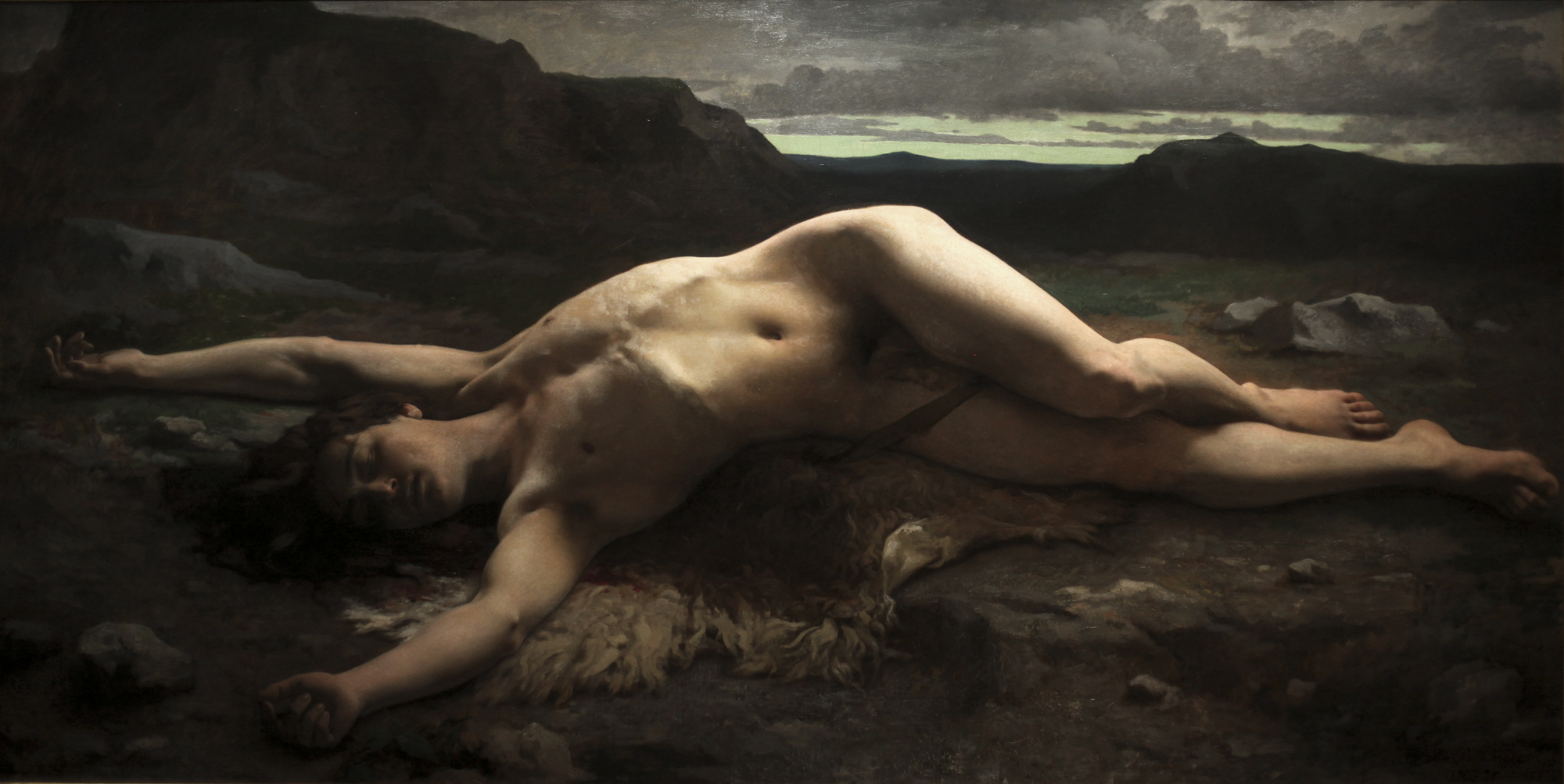
 

Camille Félix Bellanger (French, 1853-1953) 'Abel' 1874-1875


Camille Félix Bellanger (French, 1853-1953)
Abel
1874-1875
Oil on canvas
110.5cm (43.5 in) x 215.4cm (84.8 in)
© Musée d’Orsay


The von Gloeden is stunning and some of the paintings are glorious: the muscularity / blood red colour in Falguière by Lutteurs d’Alexandre (1875, below); the beauty of Ángel Zárraga’s Votive Offering (Saint Sebastian) (1912, below); the sheer nakedness and earthiness of the Freud; and the colour, form and (homo)eroticism of The Bath by Paul Cadmus (1951, below), with their pert buttocks and hands washing suggestively.

But there is nothing too outrageous here. Heaven forbid!

After all, this is the male nude as curatorial commodity.

Dr Marcus Bunyan


Many thankx to the Musée d’Orsay for allowing me to publish the art work in the posting. Please click on the photographs for a larger version of the image.


“The high brow peep show is divided thematically into depictions of religion, mythology, athleticism, homosexuality, and shifting notions of manliness. Wandering the Musee’s grand halls you will see rippling Greco-Roman Apollonian gods, Egon Schiele’s finely rendered, debauched self portraits and David LaChapelle’s 90s macho-kitsch celebs. Edward Munch’s hazy, pastel bathers mingle with Lucian Freud’s grossly erotic fleshy animals and reverent depictions of Christ and Saint Sebastian, showing the many ways to interpret a body sans outerwear.”


Priscilla Frank. “‘Masculine/Masculine’ Explores Male Nude Throughout Art History And We Couldn’t Be Happier (NSFW),” on the Huffpost Arts and Culture website, 26/09/2013 updated 07/12/2017 [Online] Cited 02/01/2021
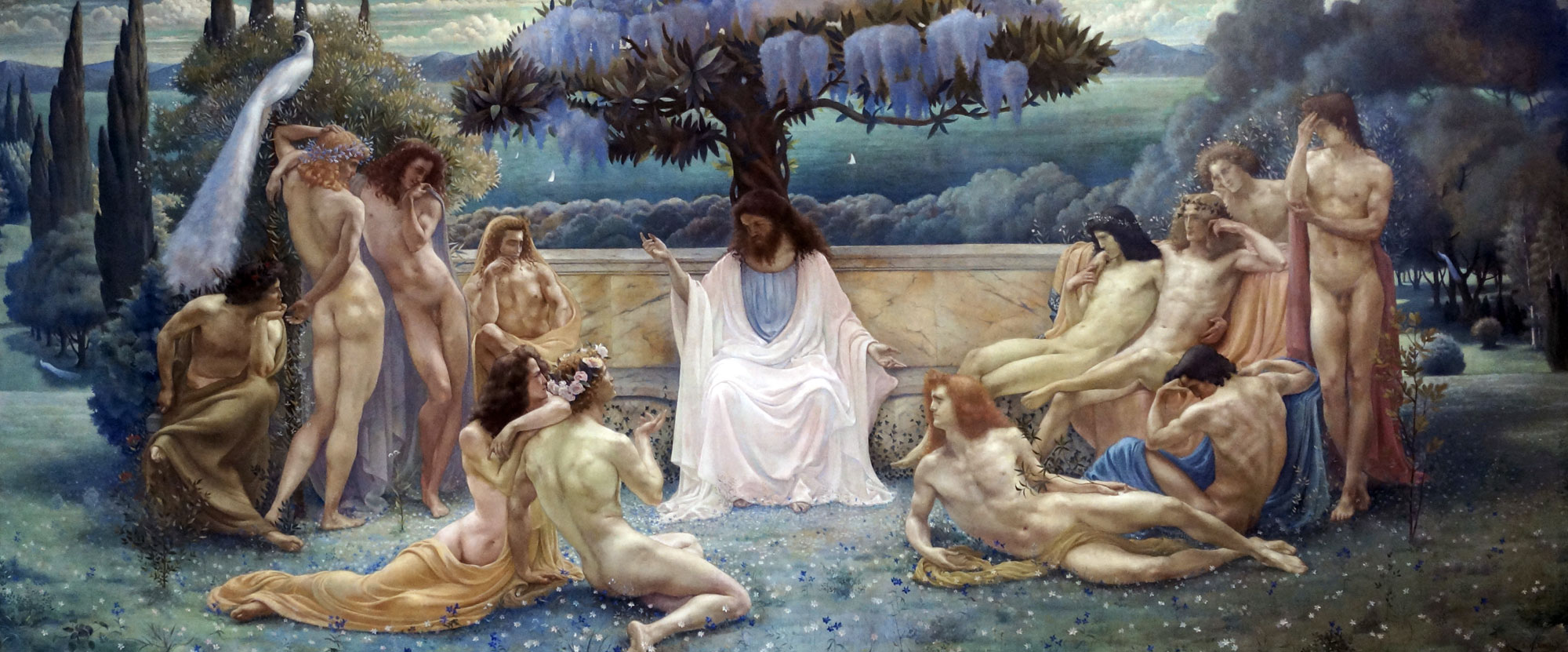


Jean Delville (Belgium, 1867-1953) 'École de Platon' (School of Plato) 1898


Jean Delville (Belgium, 1867-1953)
École de Platon (School of Plato)
1898
Oil on canvas
H. 260; W. 605cm
© RMN (Musée d’Orsay) / Hervé Lewandowski


In the late 19th century, Belgium was one of the great centres of European symbolism. Jean Delville’s paintings and writings expressed the most esoteric side of the movement. In the mid-1880s, Delville’s discovery of the symbolist milieu in Paris and the friendships he made there led him to break with the naturalism inherited from his academic training. Thus his friendship with the Sâr Péladan and his regular attendance at the Salon of the Rose+Croix, testified to his belief in an intellectual art which focused on evocation more than description.

School of Plato, a decoration intended for the Sorbonne but never installed there, is a striking work in many respects. Its monumental size and its ambitious message – an interpretation of classical philosophy seen through the prism of the symbolist ideal – set it apart. The manifesto makes no secret of its references, from Raphael to Puvis de Chavannes, but envelops them in the strange charm of a deliberately unreal colour range. The ambiguity emanating from this fin de siècle Mannerism knowingly blurs the borderline between purity and sensuality.
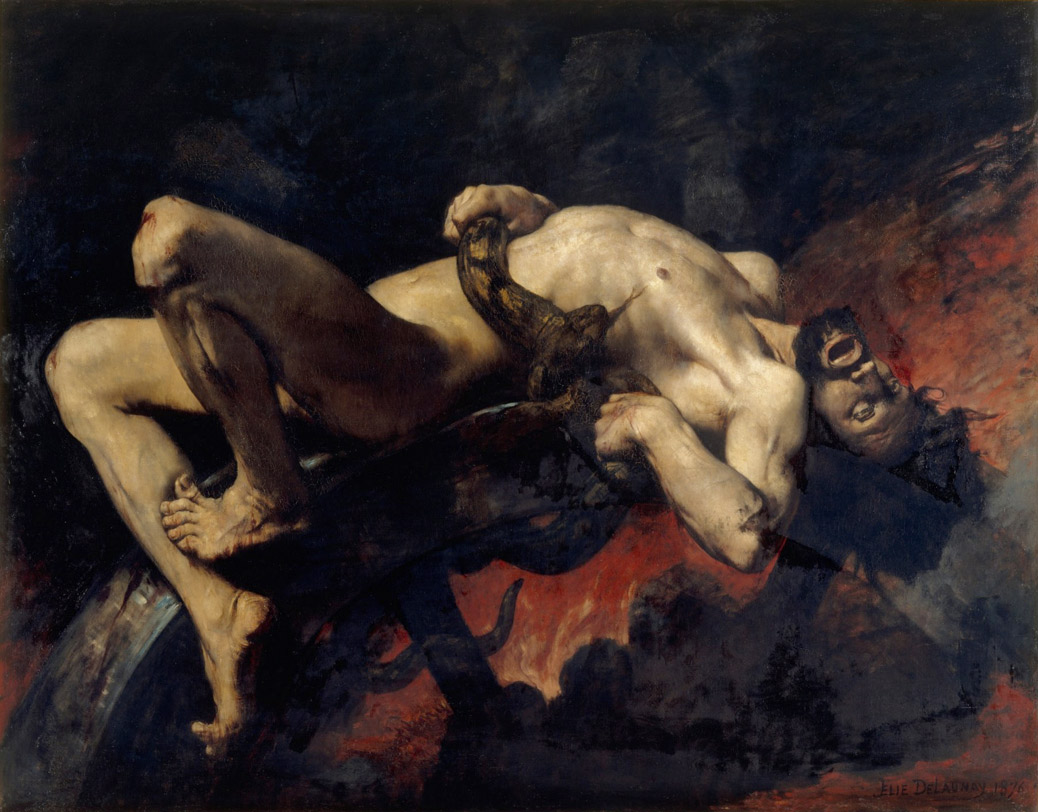
 

Jules-Élie Delaunay (French, 1828-1891) 'Ixion Thrown Into the Flames' 1876


Jules-Élie Delaunay (French, 1828-1891)
Ixion Thrown Into the Flames
1876
© RMN-Grand Palais / Gérard Blot
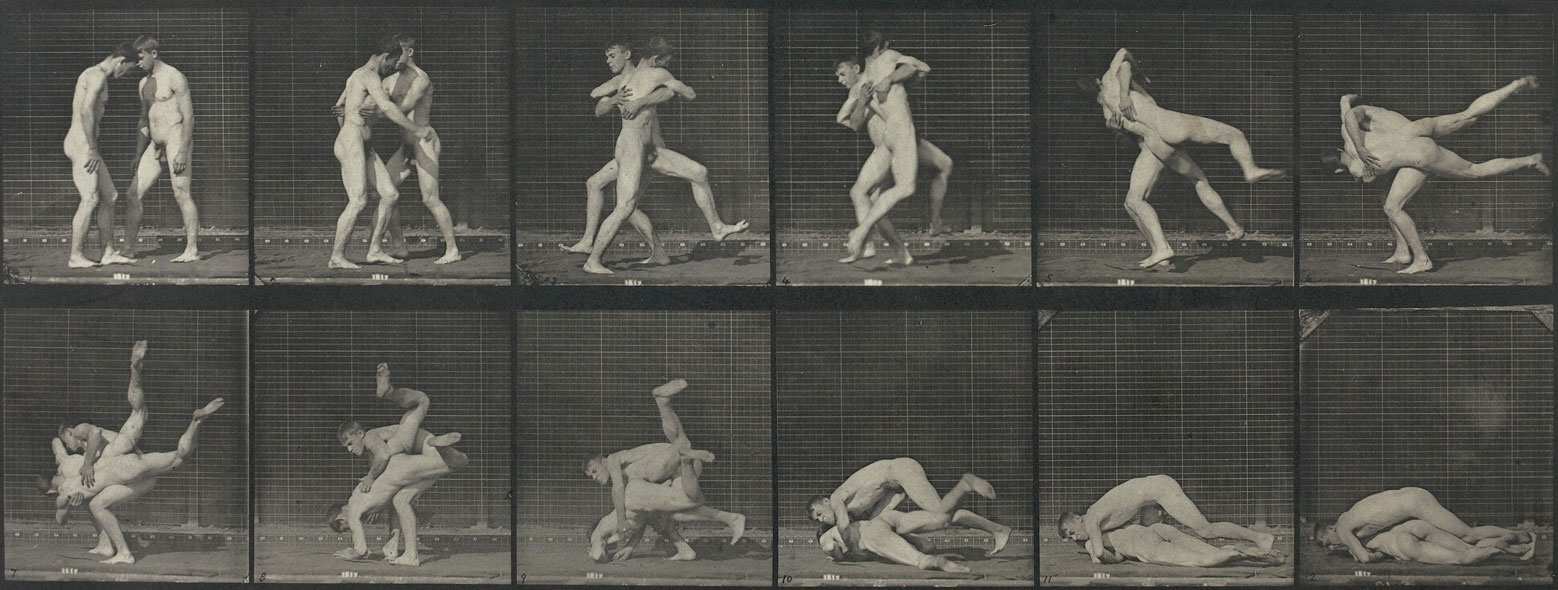
 

Eadweard Muybridge (British, 1830-1904) 'Motion Study (Men wrestling)' 1887


Eadweard Muybridge (British, 1830-1904)
Motion Study (Men wrestling)
1887
Plate 332 from Animal Locomotion
Collotype plate 1872-1885
© Musée d’Orsay, dist. RMN / Alexis Brandt
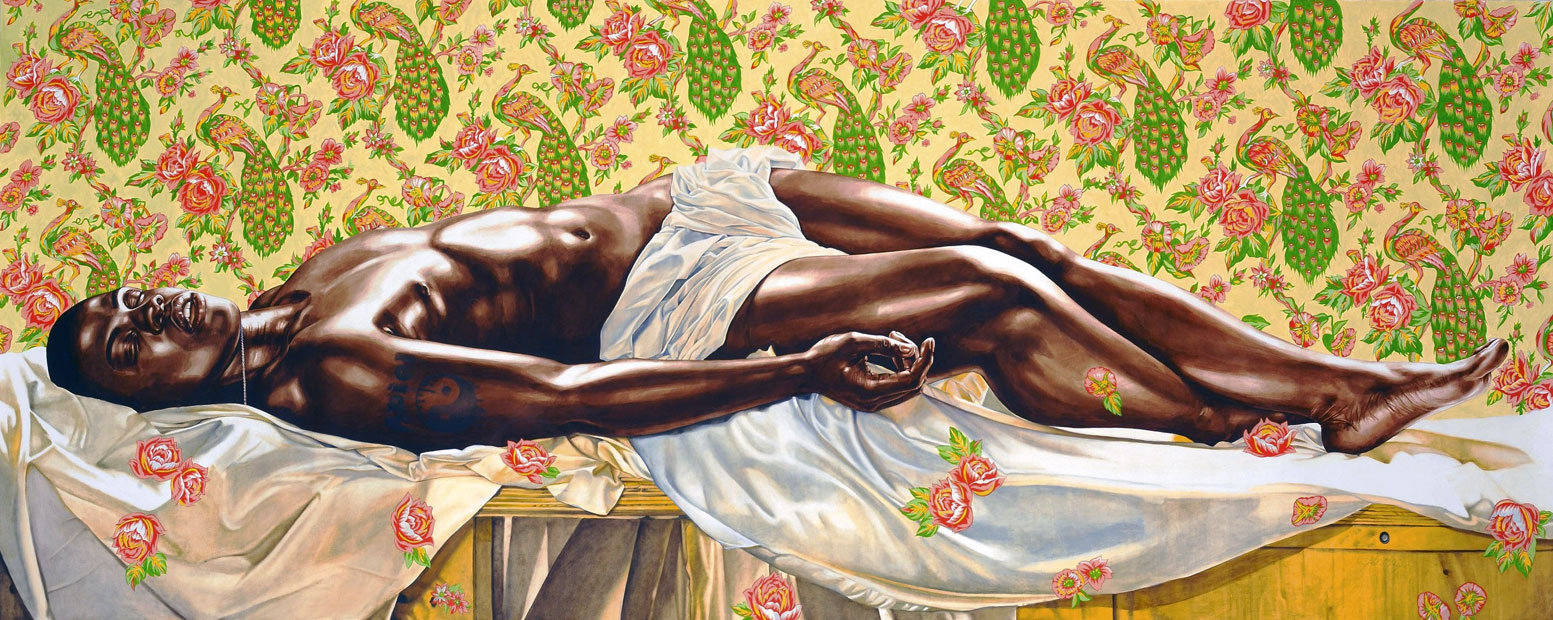
 

Kehinde Wiley (American, b. 1977) 'Death of Abel Study' 2008


Kehinde Wiley (American, b. 1977)
Death of Abel Study
2008
© Kehinde Wiley, Courtesy Roberts & Tilton, Culver City, CA & Galerie Daniel Templon, Paris
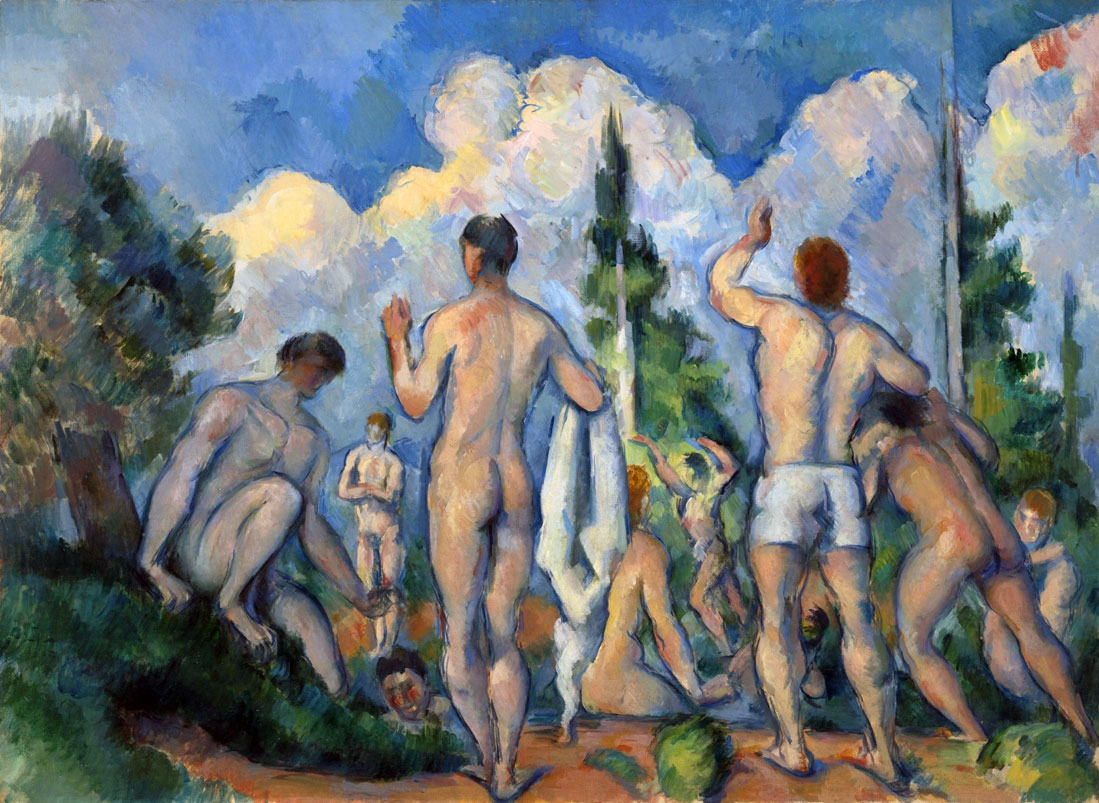
 

Paul Cézanne (French, 1839-1906) 'Baigneurs' (Bathers) 1890


Paul Cézanne (French, 1839-1906)
Baigneurs (Bathers)
1890
Oil on canvas
60.0 x 82.0cm
Musée d’Orsay, Paris, Gift of Baroness Eva Gebhard-Gourgaud 1965
© RMN (Musée d’Orsay) / Hervé Lewandowski


In this work the arrangement of the bathers is brilliantly orchestrated – a complex grouping of foregrounded figures is contrapuntally arranged against another group occupying the middle ground. There is a strong classical echo to the triangular, pedimental architecture of these four foregrounded figures, anchoring the work compositionally. The effect is to create an architecturally interlocking circle of figures surrounding a group of bathers in the water or sitting on the banks. The corporeal presence of the foregrounded figures and the luminosity of their skin tones are echoed in the volumetric forms of the cumulus clouds that loom in the background. We see Cézanne’s technical confidence in the way the terrain has been flattened and the treescape simplified. He uses trees here not for their anecdotal fidelity, but to anchor the composition at key points.

There is an undeniable sense of ritual in this work. Some commentators interpret the scene as baptismal – Cézanne became a devout catholic in 1890 – with the figure at left pouring water over the head of a partially submerged bather to his right. But it is also clear here that Cézanne mixes the sacred with the profane. There is a celebratory, Arcadian purity which finds its mirror in the compositional structure as a whole, whether it be the way in which light reflects off the facets of the bodies or in which it is refracted off the looming cloud masses. A paganistic, sensual exuberance informs the way in which the figures circle the bathers in the water, which Henri Matisse’s famous The dance 1910 will later recall. (Matisse was a great admirer of Cézanne’s work and owned a number of his paintings.) And it is probably no coincidence that the ‘attendant’ holds a luminous, vulva-shaped towel at the very centre of the composition. Grammatically, the title Baigneurs does not preclude the possibility that some of the participants may be female – the seated figure who is, significantly, adjacent to the towel, appears to be clearly female, for example. Bathers, then, is redolent with meaning. This is a powerfully multivalent work, and along with the later The large bathers paintings of 1894-1905 and 1900-1905, is considered to be one of Cézanne’s great masterpieces.

Mark Henshaw

Text from the National Gallery of Canberra website [Online] Cited 02/01/2021
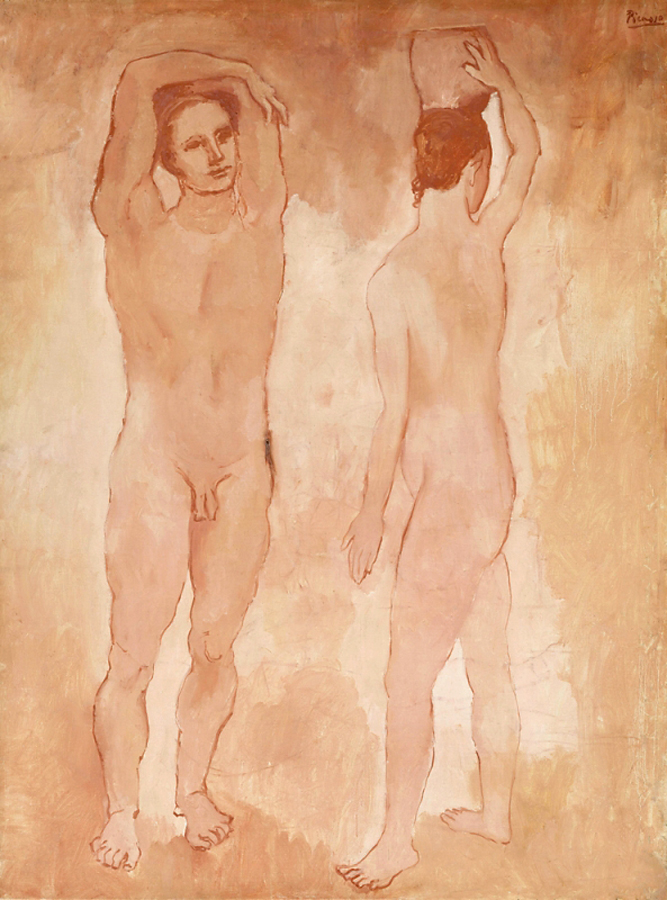
 

Pablo Picasso (Spanish, 1881-1973) 'Les adolescents' (Teenagers) 1906


Pablo Picasso (Spanish, 1881-1973)
Les adolescents (Teenagers)
1906
Oil on canvas
157 x 117cm
© RMN-Grand Palais (musée de l’Orangerie) / Hervé Lewandowski © Succession Picasso 2015


This red/pink monochrome that characterises The Adolescents first appeared after Picasso’s visit to Gosol with his partner Fernande. The earth in this village in the Catalan Pyrenees was done in an unusual ochre colour that Picasso included in his “Rose Period” (1904-1906). Two nude figures, outlined and modelled on a monochrome background, give the image a sculptural and classical character. The poses are hieratic: the young man crosses his arms above his head, while the young woman, or androgynous adolescent, balances a pitcher on her head in a timeless pose. Jean Cassou highlighted the Mediterranean character of this brief phase in Picasso’s art, and its relationship with the art of Maillol (1861-1944). Undulating lines can be made out below the legs of the two figures. This in fact is the sketch from another composition intended to be in horizontal format, but which the artist chose to erase. Paul Guillaume bought this beautiful painting in 1930. It came from the art dealer Ambroise Vollard (1866-1939). The “pink classicism” of this painting seems to anticipate the period after 1906 of the “return to order”, which characterised Picasso’s work in the 1920s, and which corresponds with other paintings in the Orangerie like the large Bathers of the 1920s.

Provenance: Ambroise Vollard, Paris; Paul Guillaume (1930); Domenica Walter

Text from the Musée de l’Orangerie website [Online] Cited 08/01/2021


Auguste Rodin (French, 1840-1917) 'The Age of Bronze' 1875-1876


Auguste Rodin (French, 1840-1917)
The Age of Bronze
1875-1876
Bronze
H. 180.5cm ; W. 68.5cm ; D. 54.5cm


Made in Brussels, this figure, one of Rodin’s most famous works, attests to the sculptor’s masterly skill and his attention to living nature that informs the pose and the modelling.A young Belgian soldier, Auguste Ney,was the model for this statue devoid of any element that would shed light on the subject’s identity. The untitled work was exhibited at the Cercle Artistique, Brussels, in 1877, then, entitled The Age of Bronze, at the Salon in Paris, where it caused a scandal.

Also known as The Awakening Man or The Vanquished One, the statue recalls one of the early ages of mankind. There was originally a spear in the left hand, as is shown in a photograph by Gaudenzio Marconi, but Rodin decided to suppress the weapon so as to free the arm of any attribute and infuse the gesture with a new liberality.

Accused of having used a life cast of his sitter, when the statue was shown in Paris, Rodin had to prove that the quality of his sculpture’s modelling came from a thorough study of profiles, not from a life cast. His critics eventually recognised that the sculptor was innocent of any trickery. The scandal, however, did draw attention to Rodin and earned him the commission for The Gates of Hell in 1880.

Text from the Musée Rodin website [Online] Cited 08/01/2020


While it has been quite natural for the female nude to be regularly exhibited, the male nude has not been accorded the same treatment. It is highly significant that until the show at the Leopold Museum in Vienna in the autumn of 2012, no exhibition had opted to take a fresh approach, over a long historical perspective, to the representation of the male nude. However, male nudity was for a long time, from the 17th to 19th centuries, the basis of traditional Academic art training and a key element in Western creative art. Therefore when presenting the exhibition Masculine / Masculine, the Musée d’Orsay, drawing on the wealth of its own collections (with several hitherto unknown sculptures) and on other French public collections, aims to take an interpretive, playful, sociological and philosophical approach to exploring all aspects and meanings of the male nude in art. Given that the 19th century took its inspiration from 18th century classical art, and that this influence still resonates today, the Musée d’Orsay is extending its traditional historical range in order to draw a continuous arc of creation through two centuries down to the present day. The exhibition will include the whole range of techniques: painting, sculpture, graphic arts and, of course, photography, which will have an equal place in the exhibition.

To convey the specifically masculine nature of the body, the exhibition, in preference to a dull chronological presentation, takes the visitor on a journey through a succession of thematic focuses, including the aesthetic canons inherited from Antiquity, their reinterpretation in the Neo-Classical, Symbolist and contemporary eras where the hero is increasingly glorified, the Realist fascination for truthful representation of the body, nudity as the body’s natural state, the suffering of the body and the expression of pain, and finally its eroticisation. The aim is to establish a genuine dialogue between different eras in order to reveal how certain artists have been prompted to reinterpret earlier works. In the mid 18th century, Winckelmann examined the legacy of the divine proporzioni of the body inherited from Antiquity, which, in spite of radical challenges, still apply today having mysteriously come down through the history of art as the accepted definition of beauty. From Jacques-Louis David to George Platt-Lynes, LaChapelle and Pierre et Gilles, and including Gustave Moreau, a whole series of connections is revealed, based around issues of power, censorship, modesty, the boundaries of public expectation and changes in social mores.

Winckelmann’s glorification of Greek beauty reveals an implicit carnal desire, relating to men as well as women, which certainly comes down through two centuries from the “Barbus” group and from David’s studio, to David Hockney and the film director James Bidgood. This sensibility also permeates the turn of the 19th and 20th centuries as it questions its own identity, as we see in the extraordinary painting École de Platon [School of Plato], inexplicably purchased by the French state in 1912 from the Belgian artist Delville. Similarly, the exhibition will reveal other visual and intellectual relationships through the works of artists as renowned as Georges de La Tour, Pierre Puget, Abilgaard, Paul Flandrin, Bouguereau, Hodler, Schiele, Munch, Picasso, Bacon, Mapplethorpe, Freud and Mueck, while lining up some surprises like the Mexican Angel Zarraga’s Saint Sébastien (Saint Sebastian), De Chirico’s Les Bains mystérieux (Mysterious Baths) and the erotica of Americans Charles Demuth and Paul Cadmus.

This autumn therefore, the Musée d’Orsay will invite the visitor to an exhibition that challenges the continuity of a theme that has always interested artists, through unexpected yet productive confrontations between the various revivals of the nude man in art.”

Press release from the Musée d’Orsay website
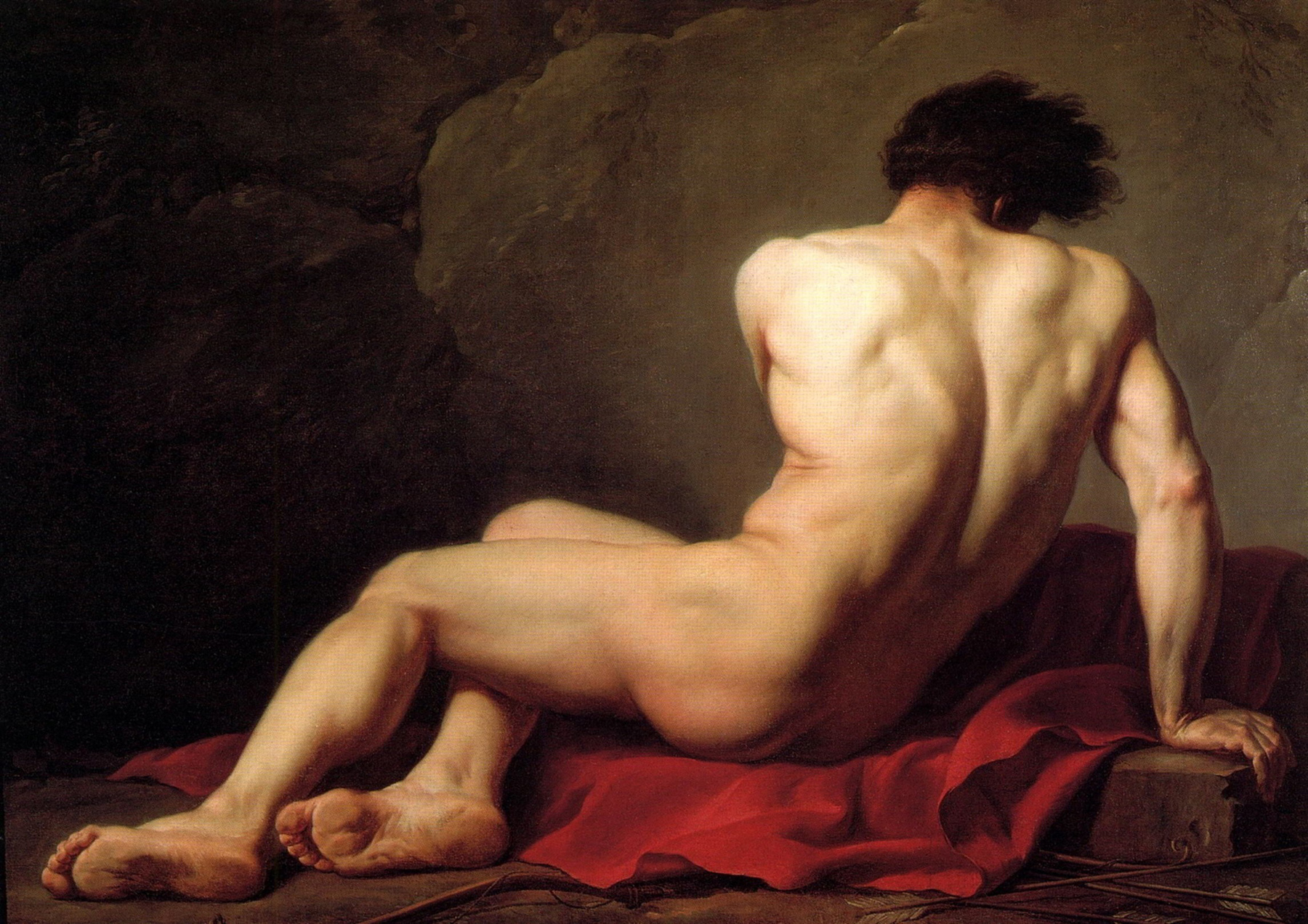
 

Jacques Louis David (French, 1748-1825) 'Academy Drawing of a Man, said to be Patroclu' 1778


Jacques Louis David (French, 1748-1825)
Academy Drawing of a Man, said to be Patroclu
1778
Oil on canvas
H. 122; W. 170cm
Cherbourg, musée Thomas-Henry
© Cherbourg, musée Thomas-Henry


Masculine / Masculine

Why had there never been an exhibition dedicated to the male nude until Nackte Männer at the Leopold Museum in Vienna last year? In order to answer this question, the exhibition sets out to compare works of different eras and techniques, around great themes that have shaped the image of the male body for over two centuries.

We must distinguish above all between nudity and the nude: a body simply without clothes, that causes embarrassment with its lack of modesty, is different from the radiant vision of a body restructured and idealised by the artist. Although this distinction can be qualified, it highlights the positive, uninhibited approach to the nude in western art since the Classical Period.

Today, the nude essentially brings to mind a female body, the legacy of a 19th century that established it as an absolute and as the accepted object of male desire. Prior to this, however, the female body was regarded less favourably than its more structured, more muscular male counterpart. Since the Renaissance, the male nude had been accorded more importance: the man as a universal being became a synonym for Mankind, and his body was established as the ideal human form, as was already the case in Greco-Roman art. Examples of this interpretation abound in the Judeo-Christian cultural heritage: Adam existed before Eve, who was no more than his copy and the origin of sin. Most artists being male, they found an “ideal me” in the male nude, a magnified, narcissistic reflection of themselves. And yet, until the middle of the 20th century, the sexual organ was the source of a certain embarrassment, whether shrunken or well hidden beneath strategically placed drapery, thong or scabbard.
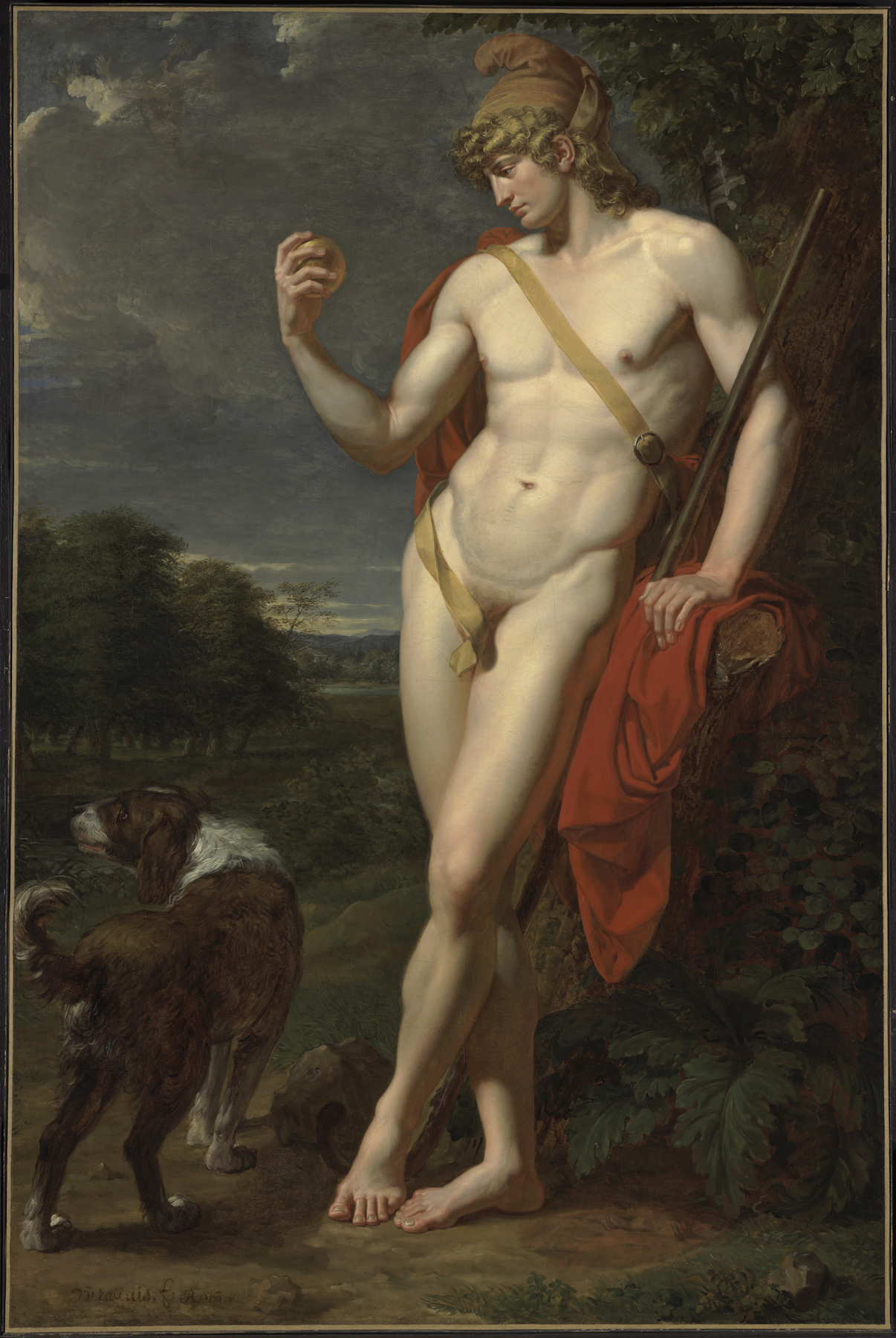
 

Jean-Baptiste Frédéric Desmarais (French, 1756-1813) 'Le Berger Pâris' (The Shepherd, Paris) 1787


Jean-Baptiste Frédéric Desmarais (French, 1756-1813)
Le Berger Pâris (The Shepherd, Paris)
1787
Oil on canvas
H. 177 ; L. 118cm
Musée des beaux-arts du Canada, Ottawa
© Photo: MBAC


The Classic Ideal

From the 17th century, training of the highest standard was organised for the most privileged artists. In sculpture and in history painting, the ultimate aim of this teaching was to master the representation of the male nude: this was central to the creative process, as the preparatory studies had to capture the articulation of the body as closely as possible, whether clothed or not, in the finished composition.

In France, pupils studied at the Académie Royale then at the Académie des Beaux-Arts, working from drawings, engravings, sculptures “in the round” and life models. Right up until the late 20th century, these models were exclusively male, for reasons of social morality, but also because the man was considered to have the archetypal human form. In order to be noble and worthy of artistic representation, and to appeal to all, this could not be the body of an ordinary man: the distinctive features of the model had to be tempered in order to elevate the subject.

Above all, the artists of Antiquity and of the Renaissance were considered to have established an ideal synthesis of the human body without being distracted by individual characteristics. For Winckelmann, the German 18th century aesthete, the ideal beauty of Greek statues could only be embodied by the male nude. But although it inspired numerous artists, the “noble simplicity and quiet grandeur” of Winckelmann’s gods was undermined by other interpretations of Classical art: the torment of Laocoon, a work from late Antiquity, can be seen in the work of the Danish painter Abildgaard, while David advocated a much more Roman masculinity. Even when challenged, reinterpreted and renewed by the 20th century avant-garde, the Classical male nude and its rich legacy remains an object of fascination right up to the inter-war years and up to the present day.
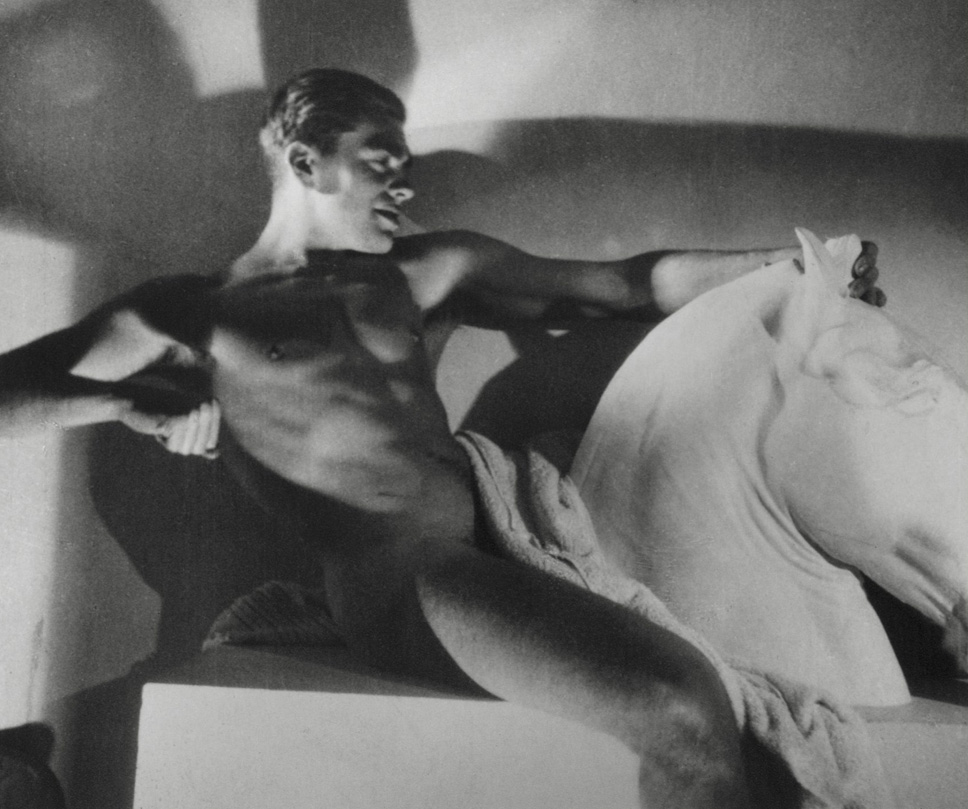
 

George Hoyningen-Huene (American born Russia, 1900-1968) 'Horst P. Horst, Photographie' 1932


George Hoyningen-Huene (American born Russia, 1900-1968)
Horst P. Horst, Photographie
1932
Tirage argentique
H. 19 x L. 22.7cm
Hambourg, FC Gundlach
© Droits réservés


The Heroic Nude

The concept and the word “hero” itself come from ancient Greece: whether a demigod or simply a mortal transcending his human condition to become an exemplum virtutis, he embodies an ideal. The admiration for Classical art and culture explains the ubiquity of the hero in Academic painting, particularly in subjects given to candidates of the Prix de Rome: great history painting thrived on the exploits of supermen in the most perfect bodies.

This connection between anatomy and heroic virtue, conveying noble and universal values, goes back to the Neo-Platonic concept linking beauty and goodness. The hero’s nudity has been so self-evident that the “heroic nude” has become the subject of a recurrent debate about the representation of great men, past or present, no matter how incongruous the result may appear.

Heroism is not a state, rather a means by which the strength of character of an exceptional being man is revealed: although Hercules’ strength is inseparable from his exploits, it was David’s cunning that overcame the powerful Goliath. In both cases they are endowed with a warrior’s strength, which was particularly valued by a 19th century thirsting for virility and patriotic assertion: more than ever, this was the ideal to be attained. We had to wait for the 20th century crisis of masculinity before we could see the renewal of the status of the increasingly contemporary hero, and the diversification of his physical characteristics. However, whether a star or a designer like Yves Saint-Laurent, or even the young men on the streets of Harlem painted by the American Kehinde Wiley, the evocative power of nudity remains.
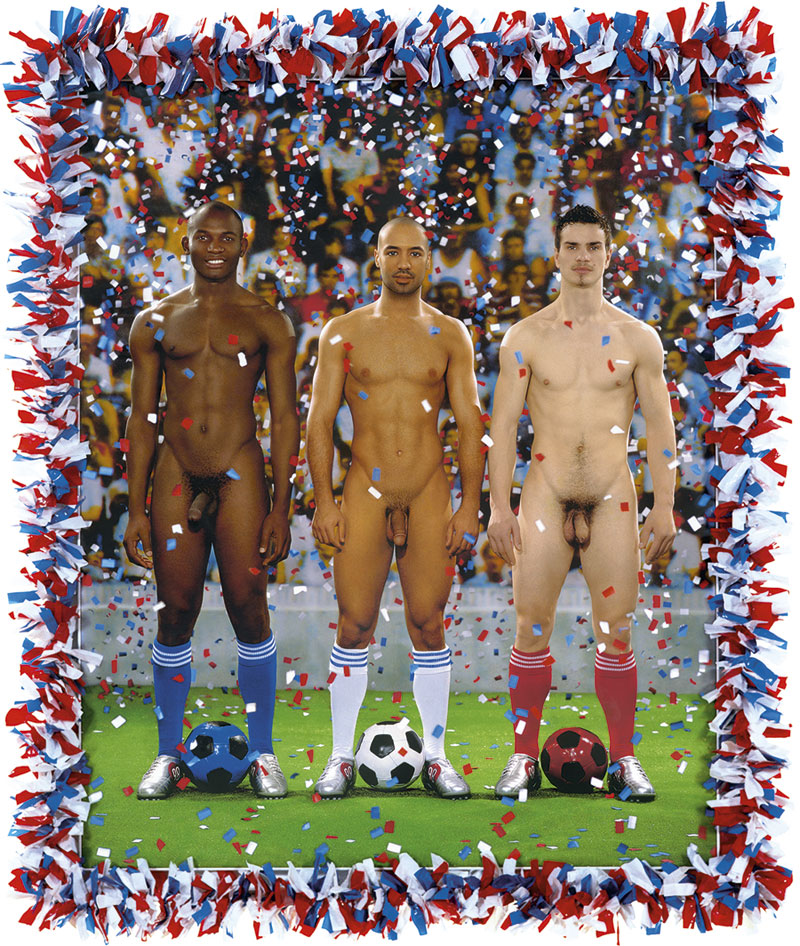
 

Pierre et Gilles (Pierre Commoy, French, b. 1950 and Gilles Blanchard, French, b. 1953) 'Vive la France' 2006


Pierre et Gilles (Pierre Commoy, French, b. 1950 and Gilles Blanchard, French, b. 1953)
Vive la France
2006
(Models: Serge, Moussa and Robert)
Painted photograph, unique piece
H. 125 x W. 101cm
© Pierre et Gilles


The Gods of the Stadium

The 20th century witnessed the start of a new way of looking at the human body where the focus was on medical aspects and hygiene, and this had a considerable impact on the concept of the artistic nude. Numerous physical education movements and gymnasia appeared. People were captivated by the figure of the “sportsman” and, as in the work of the painter Eugene Jansson, came to admire and covet the virile power of his body in action. This concept is realised in culturalism, the narcissistic admiration of a body that has become an object to be fashioned like an artwork in its own right. Modern man with his athletic morphology has become a new potential ideal: he embodies a beauty that invites comparison with Greco-Roman art.

Linked with the affirmation of national identity, the athlete has come to personify the brute force of the nation and an ability to defend the country in times of war. During the 1930s in the United States, the image of the athlete evolved in a distinctive way, highlighting the ordinary man as a mixture of physical strength and bravery. Totalitarian regimes, however, perverted the cult of the athlete in order to promote their own ideology: Germany linked it in a demiurgic way with the made-up concept of the “Aryan” race, while Mussolini’s government erected marble idols on the Stadio dei Marmi.
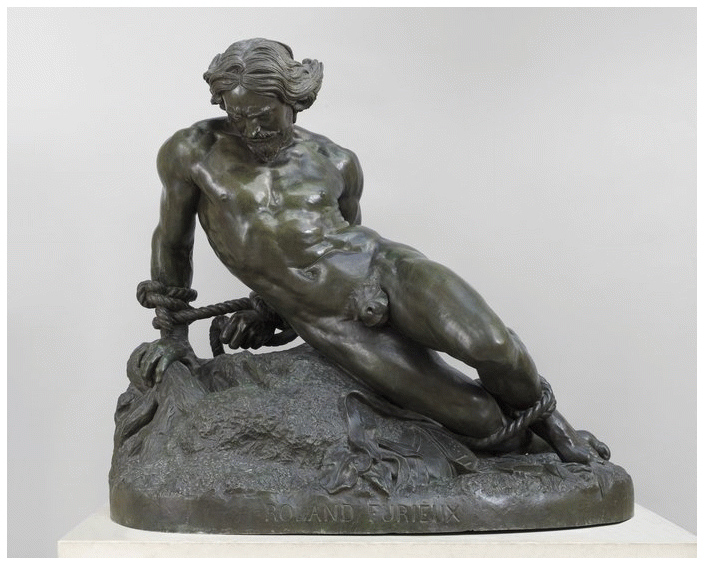
 

Jean-Bernard Duseigneur (French, 1808-1866) 'Orlando Furioso' 1867


Jean-Bernard Duseigneur (French, 1808-1866)
Orlando Furioso
1867
Cast in bronze
H. 130; W. 146; D. 90cm
Paris, Musée du Louvre
© Musée du Louvre, Dist. RMN-Grand Palais / Thierry Ollivier


It’s tough being a Hero

As he moves outside the established order, the mythological hero risks the anger of the gods and the jealousy of men. Although his passions, his moral shortcomings and occasionally his frailties stem from his human condition, he is happy to possess the perfect form of the gods: thus the artist and the spectator find expression of a perfect self. The great dramatic destinies thus give character to the compositions, and enable them to interpret a whole range of emotions from determination to despair, from hostility to eternal rest.

Although it is a platitude to say that feelings are expressed most accurately in the face – from the theorised and institutional drawings of Charles Le Brun to the “tête d’expression” competition at the Ecole des Beaux-Arts – one must not underestimate the key role of the body and the anatomy as vehicles for expressing emotion: certain formal choices even led to generally accepted conventions.

Mythology and the Homeric epic abound with stories of the ill-fated destinies and destructive passions of heroes, whose nudity is justified by its origins in ancient Greece: Joseph-Désiré Court displays the broken body of the ill-fated Hippolytus, a premonition of the transposition in the ancient world of Mort pour la patrie [Dying for The Fatherland] of Lecomte du Nouÿ.

Nude Veritas

The Realist aesthetic, which came to the fore in western art during the 19th century, had a dramatic effect on the representation of male nudity. The human body, represented as nature intended, was no longer seen from the decorous distance that characterised the idealised image of the nude, a goal to be achieved through Academic drawing exercises. In this context, where revealing the body was an affront to modesty – in the male-dominated society of the 19th century, the unclothed male appeared even more obscene and shocking than the unclothed female – the male nude gradually became less common as female figures proliferated.

This reversal did not mean, however, that naked men disappeared altogether: scientific study of the male nude, aided by new techniques such as the decomposition of movement through a series of photographs taken in rapid succession – chronophotography – brought advances in the study of anatomy and transformed the teaching of art students. From then on, it was less a case, for the most avant-garde artists, of striving to reproduce a canon of beauty inherited from the past, than of representing a body that retained the harmony of the model’s true characteristics.

The evocative power of the nude inspired artists like the Austrian Schiele to produce nude self portraits that revealed the existential torments of the artist. Invested at times with a Christ-like dimension, these depictions, moving beyond realism into introspection, continued to be produced right up to the 21st century, especially in photography.
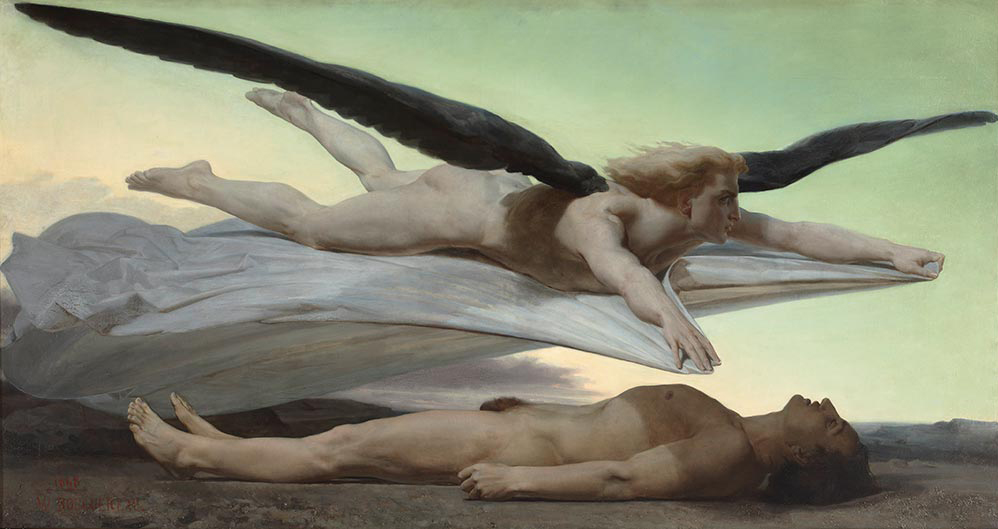
 

William Bouguereau (French, 1825-1905) 'Equality before Death' 1848


William Bouguereau (French, 1825-1905)
Equality before Death
1848
Oil on Canvas
H. 141; W. 269cm
Paris, Musée d’Orsay
© Musée d’Orsay, dist. RMN-Grand Palais / Patrice Schmidt


Without compromise

The fascination for reality established in artistic circles in the mid 19th century prompted a thorough renewal of religious painting. Although resorting to the classical idealisation of the body seemed to be consistent with religious dogma, artists like Bonnat breathed fresh life into the genre by depicting the harsh truth of the physical condition of biblical figures.

This principle was already at work in Egalité devant la mort (Equality before Death), by Bouguereau, who, in his early work, in the final days of Romanticism, exploited the power of the image of an ordinary corpse. Rodin, far from enhancing the appearance of the novelist that he was invited to celebrate, sought to render Balzac’s corpulent physique with implacable accuracy, without diminishing his grandeur in any way.

The question is thus raised of art’s relationship to reality, a question Ron Mueck tackles in his work. And the strange effect brought about by a change of scale gives an intensity to the dead body of his father that echoes the dead figure in Bouguereau’s painting.
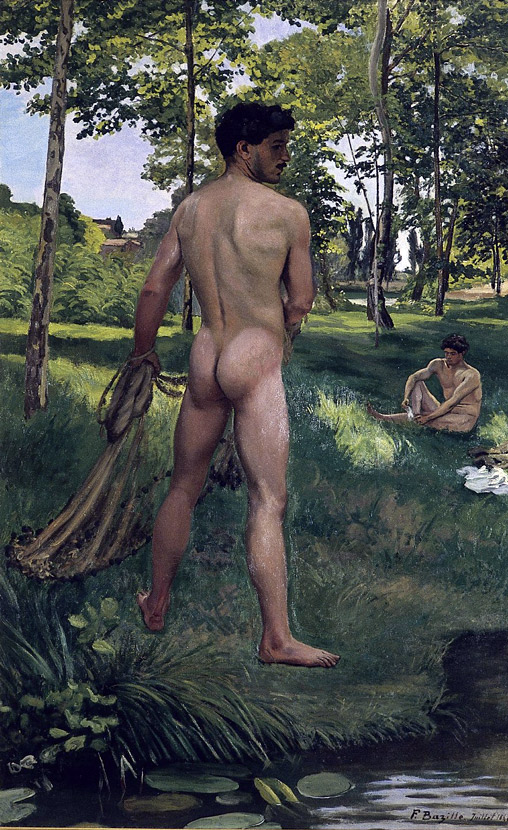
 

Frédéric Bazille (French, 1841-1870) 'Fisherman with a Net' 1868


Frédéric Bazille (French, 1841-1870)
Fisherman with a Net
1868
Oil on canvas
H. 134; W. 83cm
Zurich, Rau Foundation for the Third World
© Lylho / Leemage
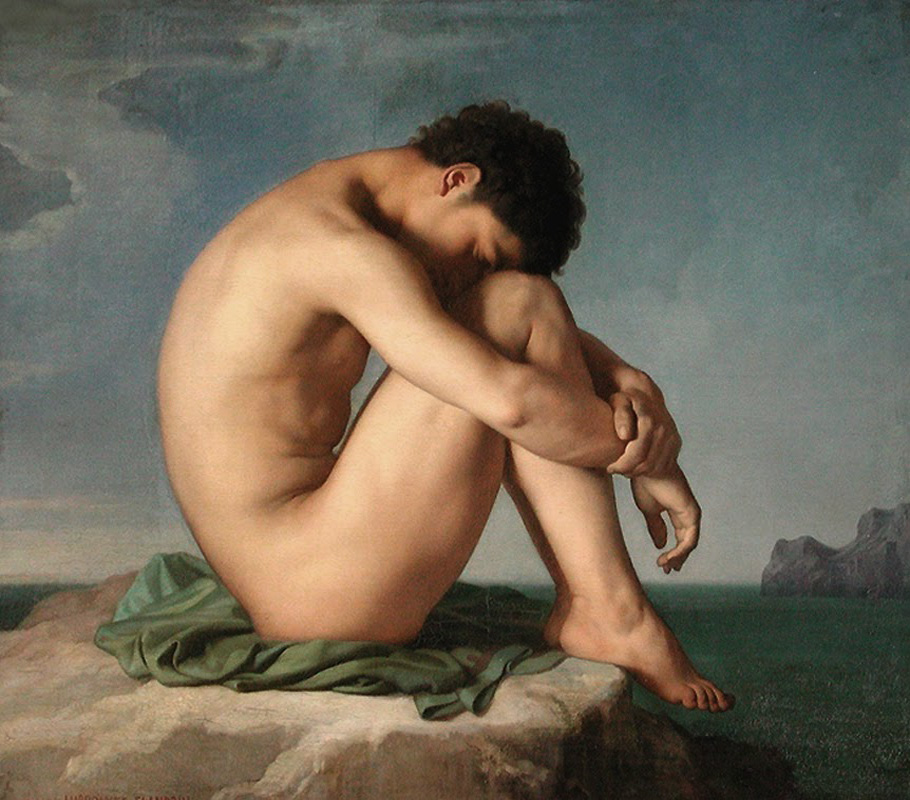
 

Hippolyte Flandrin (French, 1809-1864) 'Nude Youth Sitting by the Sea, Study' 1836


Hippolyte Flandrin (French, 1809-1864)
Nude Youth Sitting by the Sea, Study
1836
Oil on canvas
H. 98; W. 124cm
Paris, Musée du Louvre
© Musée du Louvre, Dist. RMN-Grand Palais / Angèle Dequier
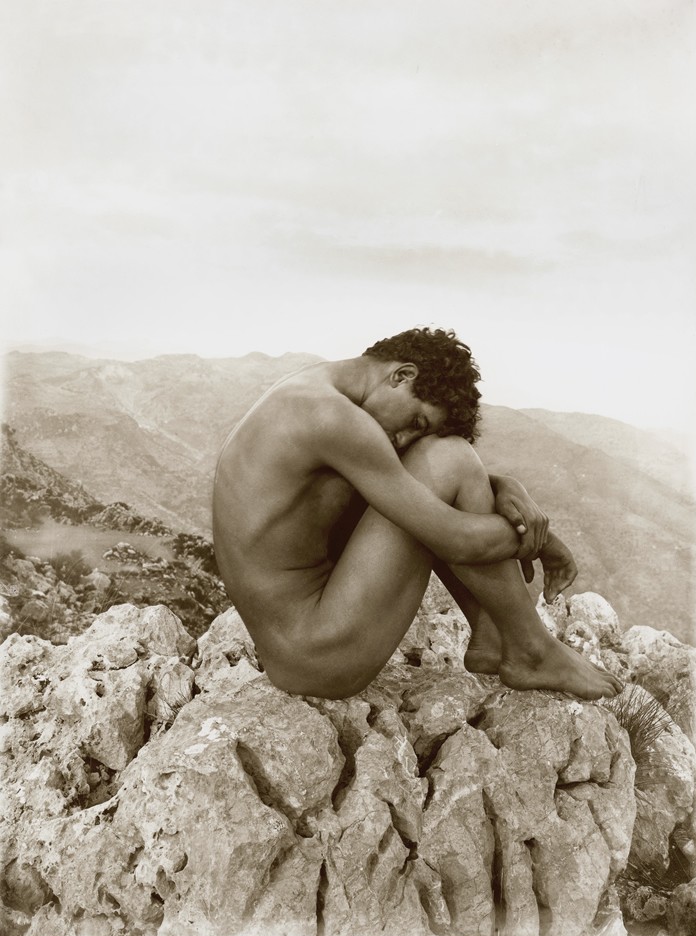
 

Wilhelm von Gloeden (German, 1856-1931) 'Cain, Taormine, Sicile' 1911


Wilhelm von Gloeden (German, 1856-1931)
Cain, Taormine, Sicile
1911
© Westlicht, Musée de la Photographie, Vienna


In Nature

Including the naked body in a landscape was not a new challenge for 19th century artists. In many aspects, this was recurrent in large-scale history painting, and a demanding artistic exercise by which a painter’s technical mastery was judged. It was about making the relationship between the naked body and its setting as accurate as possible in terms of proportion, depth and light. Although Bazille’s Pêcheur à l’épervier [Fisherman with a Net] is one of the most successful attempts – in a contemporary context – at depicting a naked man in an atmospheric light that the Impressionists later took for their own, he nevertheless observed the principles of academic construction.

Masculine nudity in nature took another meaning as society was transformed through technical advances and urbanisation. Man was now seeking a communion with nature, that could reconcile him with the excesses and the sense of dislocation created by the modern world, while still conforming to the theories of good health advocating physical exercise and fresh air.

In pain

In allowing themselves to deviate from the classical norms, artists opened up new possibilities for a more expressive representation of a body in the throes of torment or pain. The decline of the Academic nude and of classical restraint explains this predilection for ordeals: Ixion’s for example, condemned by Zeus to be bound to an eternally spinning wheel of fire.

The writhing body can also express torment of a more psychological nature. The pain experienced by the male body naturally relates to the issues of power between men and women in contemporary society: the naked body can be demeaning and, in certain circumstances, likely to call into question virility and male domination. In this respect, Louise Bourgeois’ choice of a male figure for her Arch of Hysteria was not a random one.

The martyr can, nevertheless, inspire compositions other than the tortured body: the death of Abel, killed by his brother Cain in the Book of Genesis, seems, on the contrary, to have inspired the pose of a totally relaxed body at the point of death. This abandon, however, conveyed a certain ambivalence that artists were determined to exploit: the body, often magnified and in state of morbid ecstasy, was in fact there for the spectator to relish. In these cases, suffering was merely a device to justify fetishising the body once again. In contrast with this seductive treatment, photographers engaged in experiments to divide the body into individual parts, in an aesthetic or even playful approach.
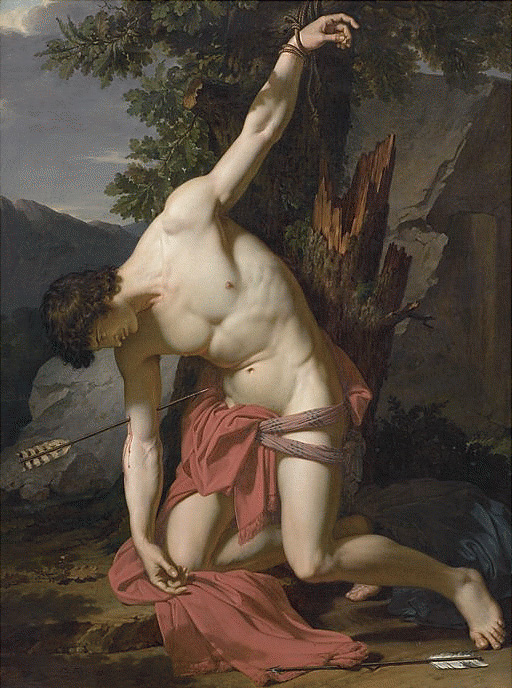
 

François-Xavier Fabre (French, 1766-1837) 'The Dying Saint Sebastian' 1789


François-Xavier Fabre (French, 1766-1837)
The Dying Saint Sebastian
1789
Oil on canvas
H. 196; W. 147cm
Montpellier, Musée Fabre de Montpellier Agglomération
© Musée Fabre de Montpellier Agglomération – cliché Frédéric Jaulmes
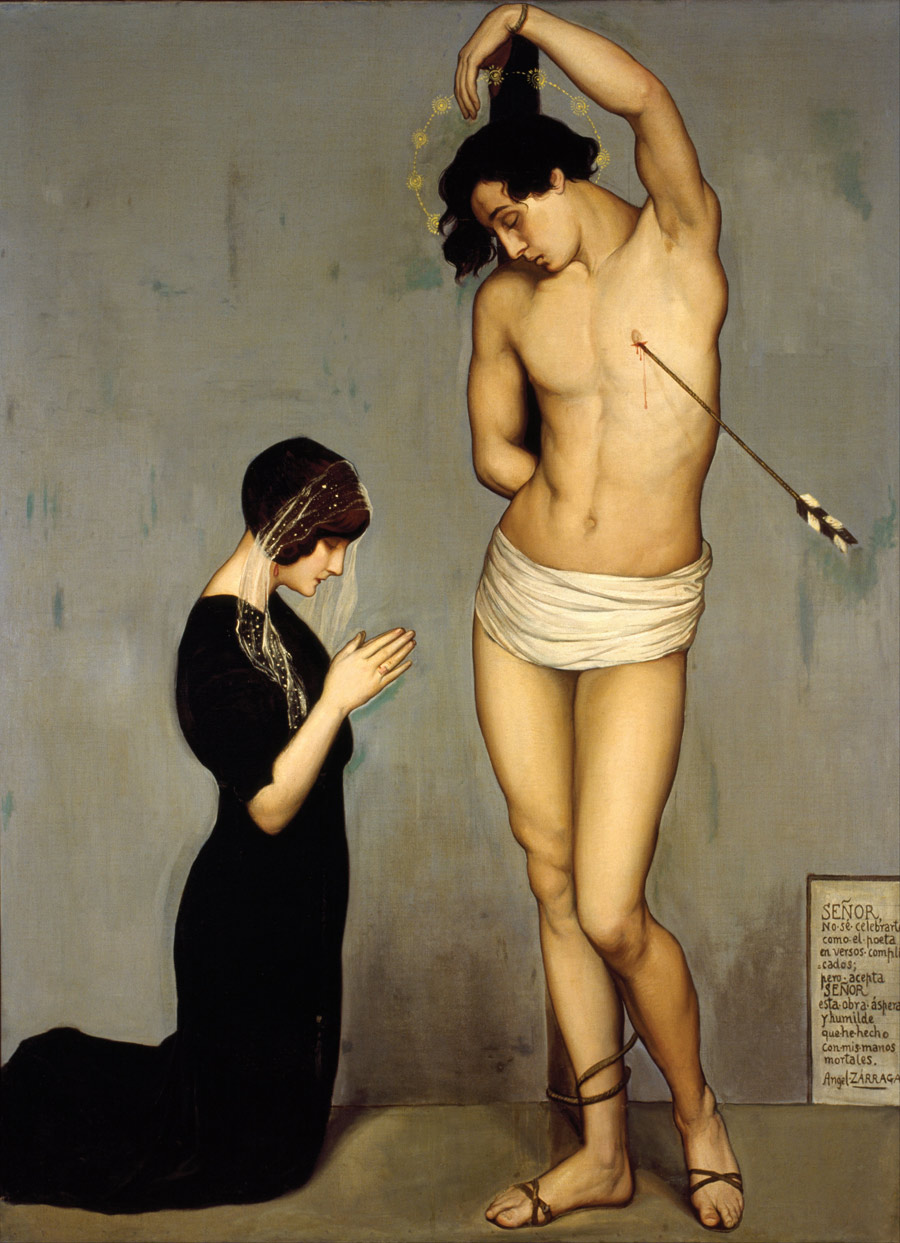
 

Ángel Zárraga (Mexican, 1886-1946) 'Votive Offering (Saint Sebastian)' 1912


Ángel Zárraga (Mexican, 1886-1946)
Votive Offering (Saint Sebastian)
1912
Oil on canvas
© Museo Nacional de Arte, Mexico


The Glorious body

Judeo-Christian culture has undeniably influenced the representation of the naked man since the beginning of modern art. However, the Catholic concept of the body has been at variance with nudity since Paleochristian times: the body is merely the corporeal envelope from which the soul is freed on death. Influenced by theologians advocating the union of the sensory and the spiritual, nudity gradually became accepted for important figures such as Christ and Saint Sebastian. Their martyred bodies, transcended by suffering endured through faith, paradoxically allowed the human soul to come close to God.

For the Catholic church, the vulnerability of Christ’s body, subjected to suffering and bearing the stigmata, is evidence of his humanity, while his divinity is revealed in his inspired expression and his idealised body, a legacy of the underlying classical models. The figure of Saint Sebastian is especially complex: this popular saint, the epitome of the martyr who survives his first ordeal, embodies the victory of life over death. This life force is no doubt related to his youthful beauty and his naked body, both of which made their appearance in the 17th century. This being the case, his representation gradually moves away from Catholic dogma, and acquires an unprecedented freedom and life of its own: his sensuality is more and more obvious, whereas his suffering is at times impossible to detect. In this quest for sensual pleasure, and until the 20th century, the only taboo was to reveal the penis.
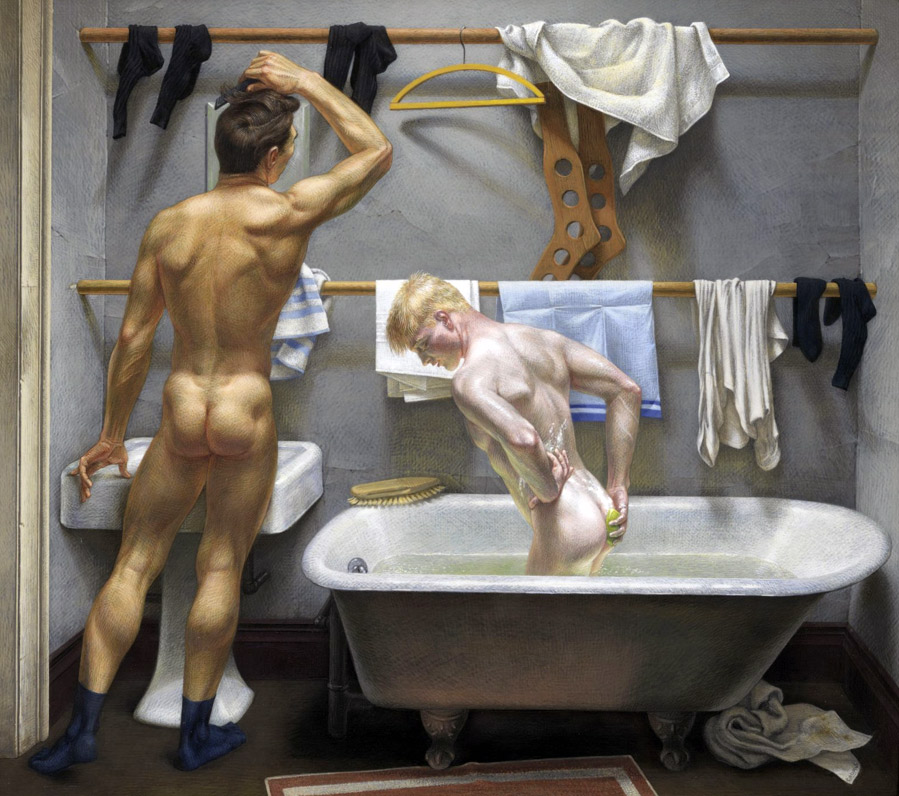
 

Paul Cadmus (American, 1904-1999) 'The Bath' 1951


Paul Cadmus (American, 1904-1999)
The Bath
1951
Tempera on card
H. 36.4; W. 41.4cm
New York, Whitney Museum of American Art
Anonymous gift
© Whitney Museum of American Art, NY – Art
© Jon F. Anderson, Estate of Paul Cadmus / ADAGP, Paris 2013
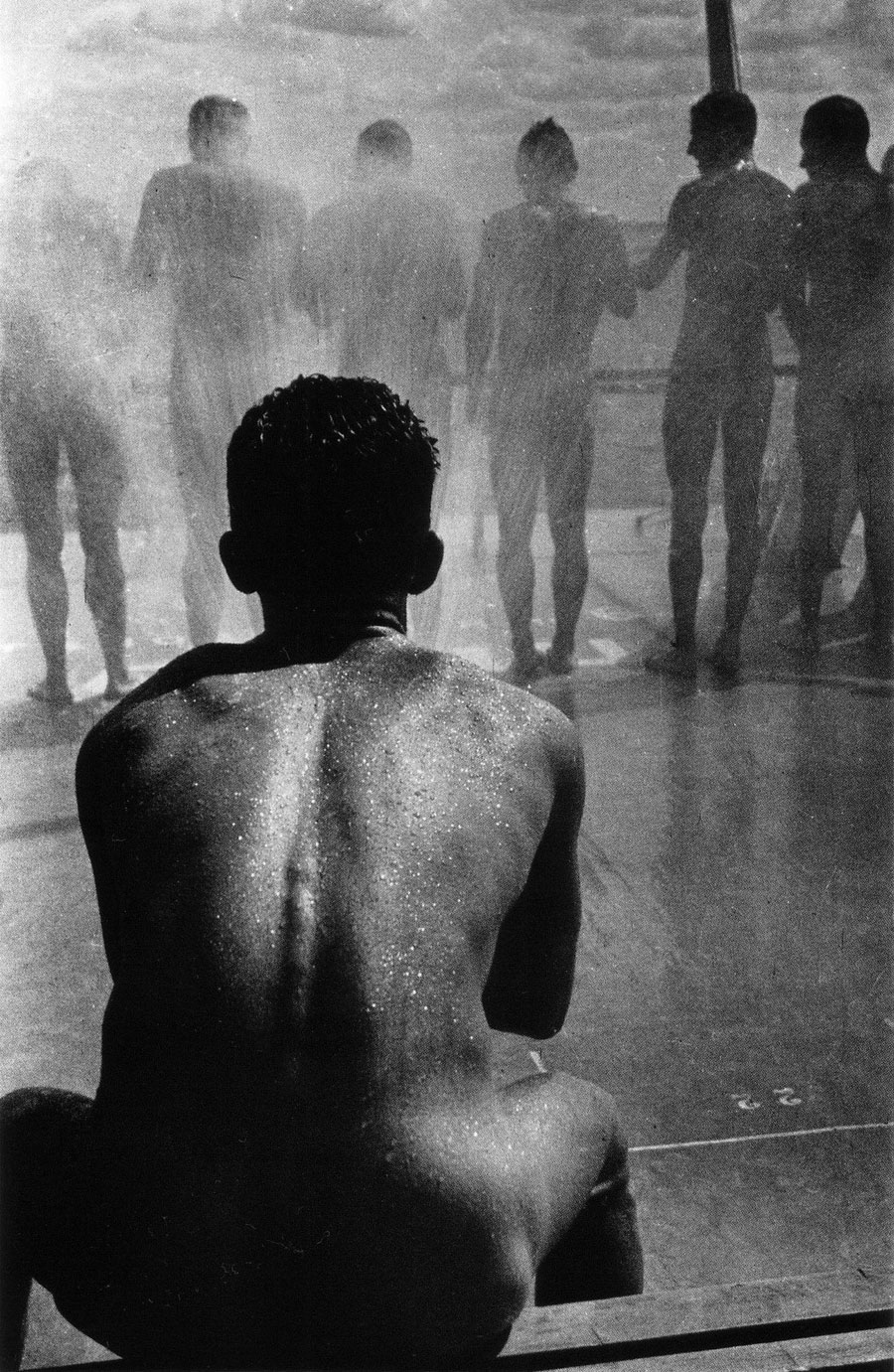
 

Boris Ignatovitch (Russian, 1899-1976) 'Douche (Shower)' 1932


Boris Ignatovitch (Russian, 1899-1976)
Douche (Shower)
1932
Silver gelatin photograph


In Shower, a group of young athletes enjoys a therapeutic water massage; in the foreground is the back of a young man, whose stately figure takes up almost the entire frame. The masterful light and airiness of the image have a stunning aesthetic effect, illuminating the drops of water that are sprinkled across the spine and muscles of his tanned back. Aleksandr Deineka (1899-1969) was so captivated by the powerful composition of Shower that he recreated the scene in his painting After the Battle (1937-1942, below).

Text from the Nailya Alexander Gallery website [Online] Cited 10/01/2021
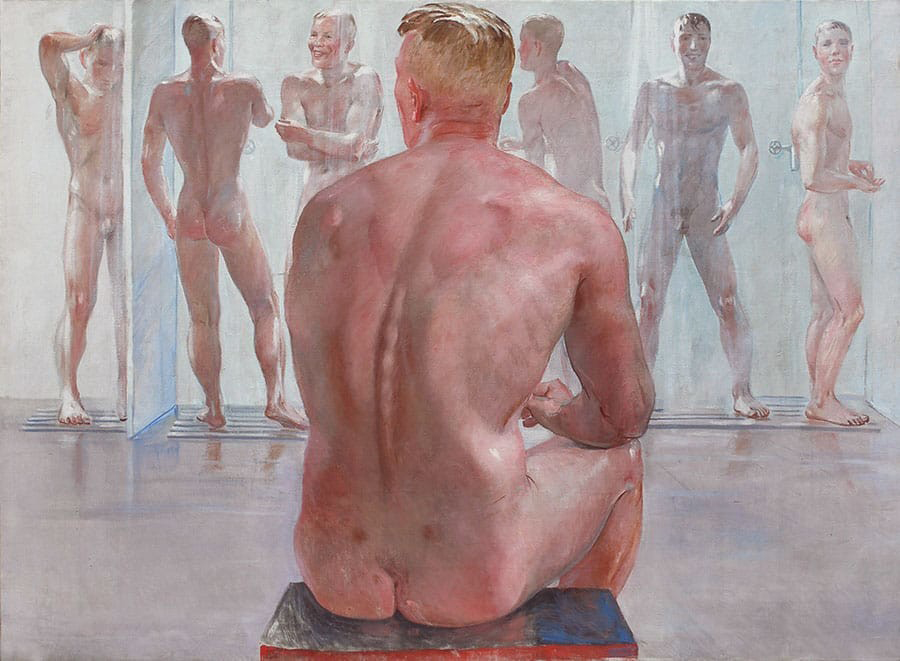
 

Aleksandr Deyneka (Russian, 1899-1969) 'After the Battle' 1937-1942


Aleksandr Deyneka (Russian, 1899-1969)
After the Battle
1937-1942
Oil on canvas
Kursk State Art Gallery


This painting was inspired by a photograph by legendary Soviet photographer Boris Ignatovich that he had presented to Deyneka (above). The artist thought the composition with an athlete in the foreground was perfection itself. However, he had difficulty transferring it to the canvas, and the painting took five years to complete. Deyneka finished it at the height of World War II, which is why the athletes in the title had turned into soldiers.

Anonymous text from the Russia Beyond website December 2019 [Online] Cited 10/01/2021


“This male homoeroticism maintains close ties with the revolutionary project to destroy the family and traditional marriage and the construction of new types of social relations based on collective values ​​above all, with the idea that the bonds of friendship and camaraderie between men (homosociality, “male bonding”) are equally or more important than heterosexual bonding. It is mainly in the period from the Revolution to the 1930s the values ​​of friendship and camaraderie seem particularly highlighted the detriment of the bonds of love, very devalued as “petty-bourgeois”, but even more later, with the Stalinist project of “restoration” of the family, it can be assumed that the emotional and romantic in the heterosexual couple have never been a pervasive and rewarding cultural representation of magnitude of that which may be known in the West. [11] The researcher Lilya Kaganovsky, analysing the Soviet visual culture (especially cult films of the 1930s and 1940s), speaks of “heterosexual panic” in response to the concept of “homosexual panic” coined by Eve K. Segdwick: according Kaganovsky, Soviet cultural works largely reflects the idea that the relations of friendship, especially homosocial, particularly between men, is a moral value than heterosexual relationships. [12] In such a cosmology, heterosexual relationships could be perceived from within oneself and risk jeopardising the homosocial relationships of camaraderie and friendship, and the same social and national cohesion, thought to be based on collective values that conflicts with the value of exclusivity in the couple, “cozy comforts of home” [13].”

Mona. “Représenter le corps socialiste : l’exemple du peintre A. Deïneka (1899-1969),” on the Genre, politique et sexualités website, 16th April 2012 (translation by Google translate). No longer available online


The Temptation of the male

An acknowledged desire for the male body, and the liberalisation of social conventions gave rise to some daring works from the mid 20th century onwards. In the United States, in spite of its puritan outlook since the Second World War, Paul Cadmus did not balk at depicting a pick up scene between men in a most unlikely Finistère. While the physical attraction of the body remained confined for a long time to the secrecy of private interiors, it was increasingly evident in public, in exclusively masculine social situations like communal showers or in the guise of a reconstructed Platonic Antiquity.

Eroticism is even presented quite crudely by Cocteau, whose influence on the young Warhol is undeniable. Beauty and seduction part company when the ideal transmitted by references to the past takes root in idiosyncratic practices and contemporary culture, as Hockney has expressed so accurately in his painting.
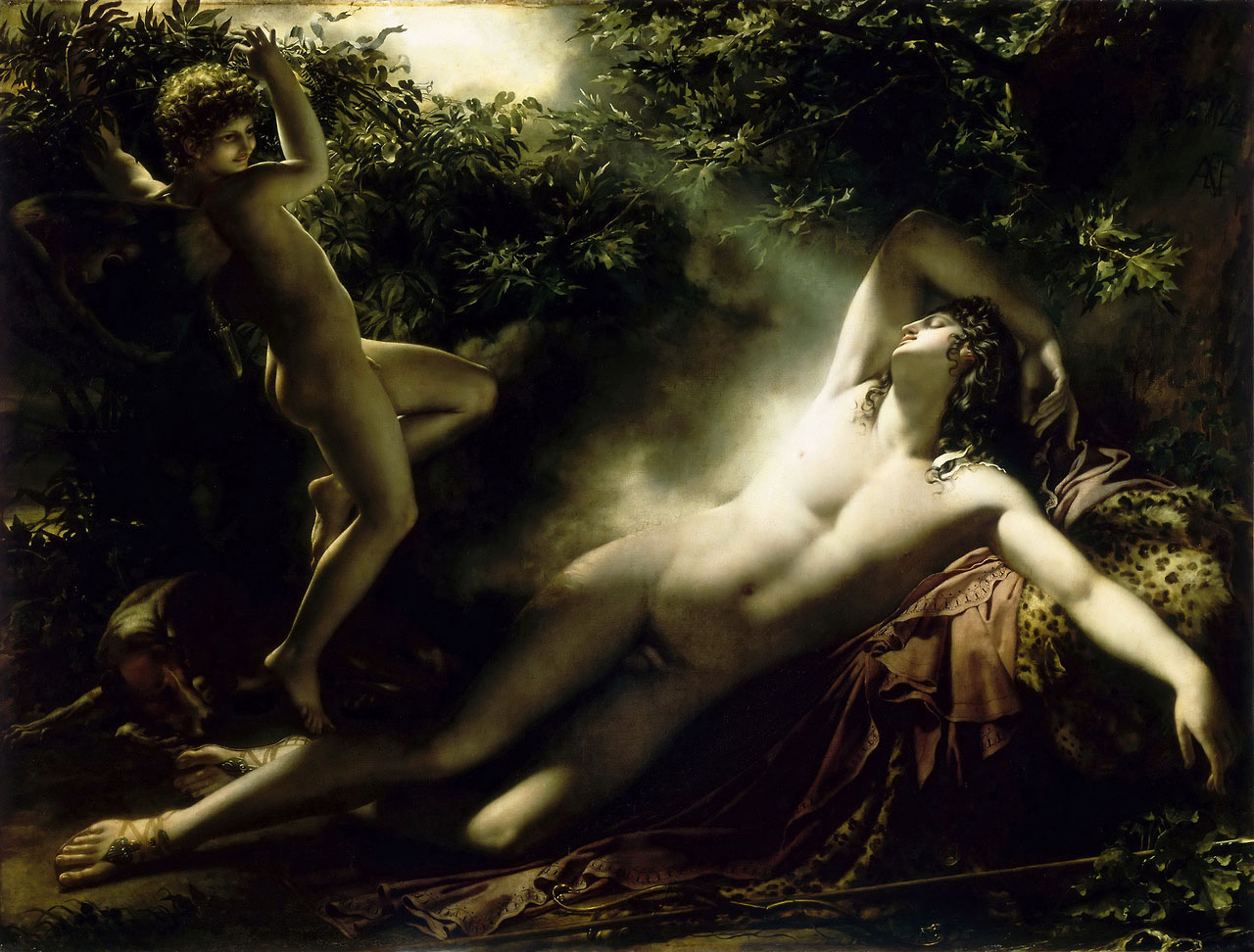
 

Anne-Louis Girodet-Trioson (French, 1767-1824) 'The Sleep of Endymion' 1791


Anne-Louis Girodet-Trioson (French, 1767-1824)
The Sleep of Endymion
1791
Oil on canvas
H. 90; W. 117.5cm
Montargis, Musée Girodet
© Cliché J. Faujour/musée Girodet, Montargis
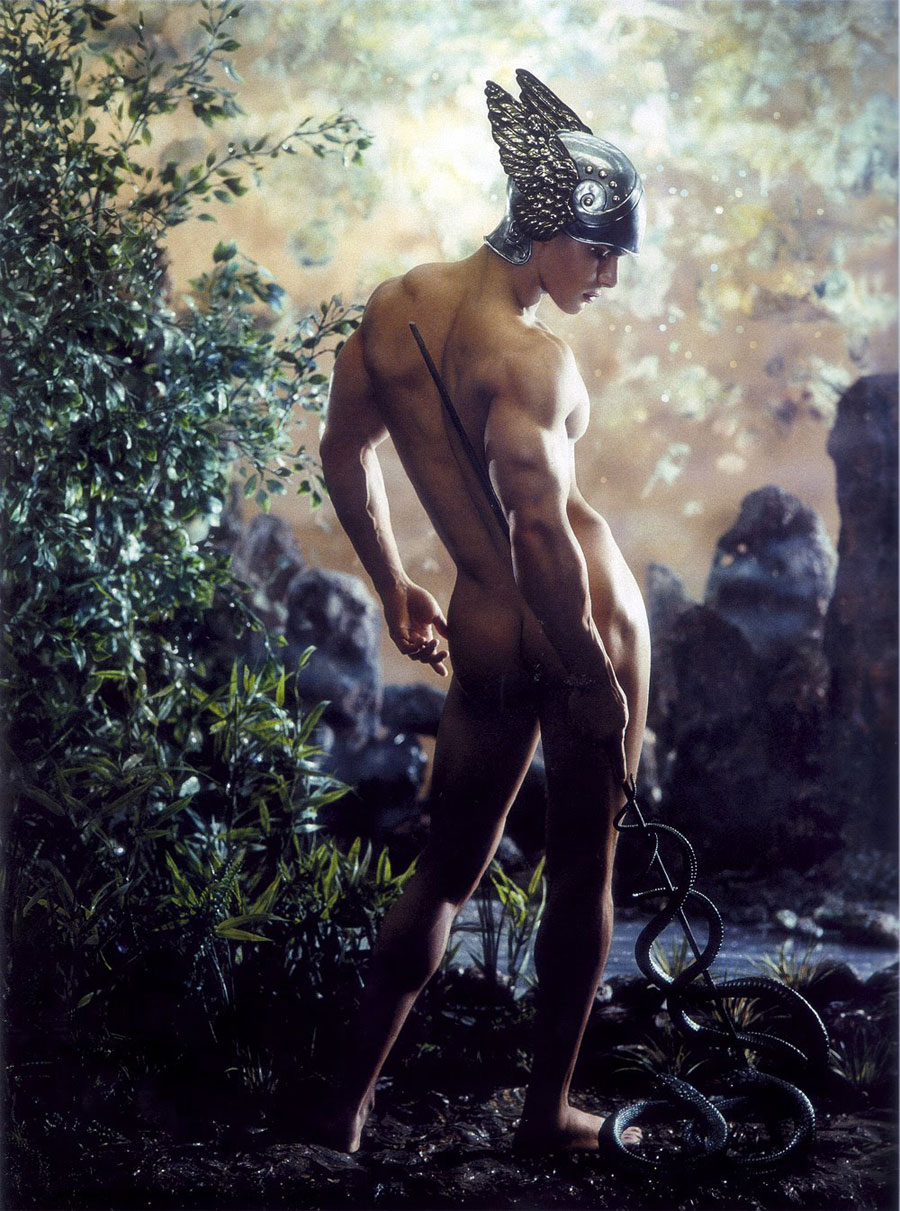
 

Pierre et Gilles (Pierre Commoy, French b. 1950 and Gilles Blanchard, French b. 1953) 'Mercury' 2001


Pierre et Gilles (Pierre Commoy, French b. 1950 and Gilles Blanchard, French b. 1953)
Mercury
2001
© Pierre et Gilles


The Object of desire

For many years, the male body in art had been the subject of “objectification”. The unrestrained admiration for the perfection of the Greco-Roman nudes, a purely intellectual reconstruction of a body that had become the canon of beauty, meant that no interpretation of the nude was considered improper, even Winckelmann’s, with its powerful erotic charge.

Although Academic circles naturally encouraged the nude in great history paintings, certain subjects retained elements of sensuality and ambiguity. At the turn of the 19th century, discussion of the characteristics of the two sexes and their respective boundaries aroused interest in the bisexual amours of Jupiter and Apollo, while the formula of the young hero dying in the arms of his male lover was met with particular interest.

Girodet’s Endymion is depicted as an ephebe, his body caressed sensuously by the rays of the moon goddess, inspiring numerous homoerotic interpretations. With the Symbolists, as with Gustave Moreau, the difference between the sexes results in the downfall of a vulnerable man overcome by an inexorable and destructive force that is seen as feminine. However, at the other extreme, and in a less dramatic way, Hodler depicts the awakening of adolescent love between a self-obsessed young man and a girl who is captivated by his charm.

The sensuality and acknowledged eroticisation considered to be appropriate to the female body during the 19th century struck a serious blow against the traditional virility of the male nude: this blow was not fatal however, as the male nude was still very visible in the 20th century. Sexual liberation expressed, loud and clear, a feeling of voluptuousness and, often with few reservations, endowed the male body with a sexual charge. The model was usually identified, an assertive sign as a statement of the individuality: with Pierre and Gilles, where mythology and the contemporary portrait become one.

Text from the Musée d’Orsay website
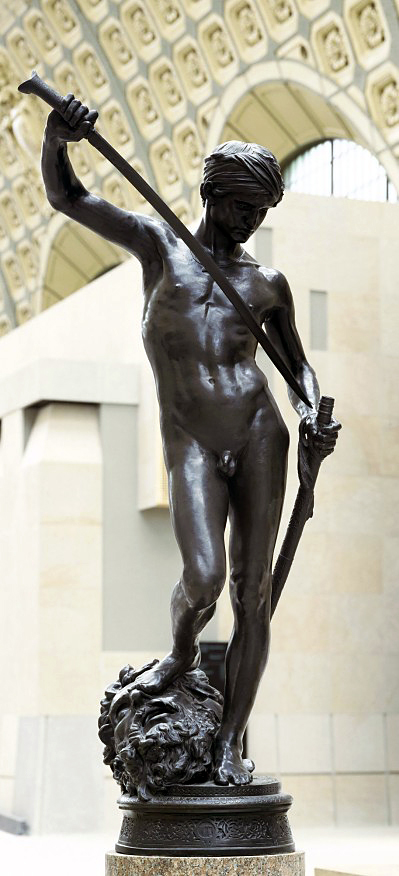
 

Antonin Mercié (French, 1845-1916) 'David' 1872


Antonin Mercié (French, 1845-1916)
David
1872
Bronze
© Musée d’Orsay, Paris
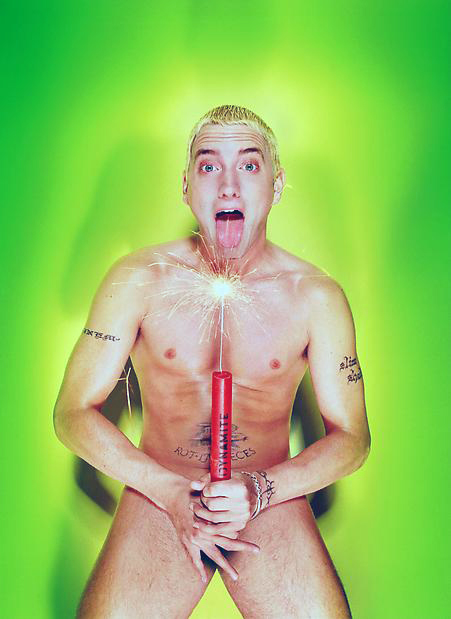
 

David LaChapelle (American, b. 1963) 'Eminem - About to Blow' 1999


David LaChapelle (American, b. 1963)
Eminem – About to Blow
1999
Chromogenic Print
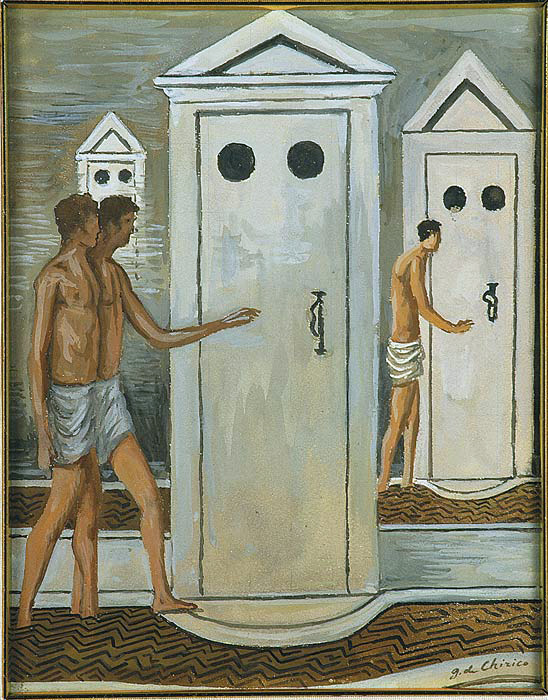
 

Giorgio de Chirico (Italian, 1883-1966) 'Les bains mystérieux' (Mysterious Baths) c. 1934-36


Giorgio de Chirico (Italian, 1883-1966)
Les bains mystérieux (Mysterious Baths)
c. 1934-36
Tempera on card
39 x 31cm
© Musei Civici Fiorentini – Raccolta Alberto Della Ragione
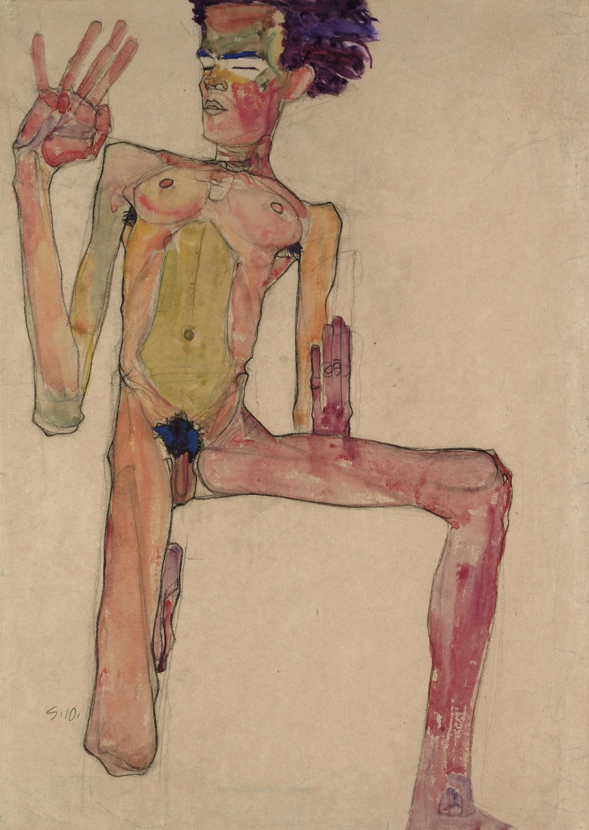
 

Egon Schiele (Austrian, 1890-1918) 'Self-Portrait, Kneeling' 1910


Egon Schiele (Austrian, 1890-1918)
Self-Portrait, Kneeling
1910
© Leopold Museum / Manfred Thumberger
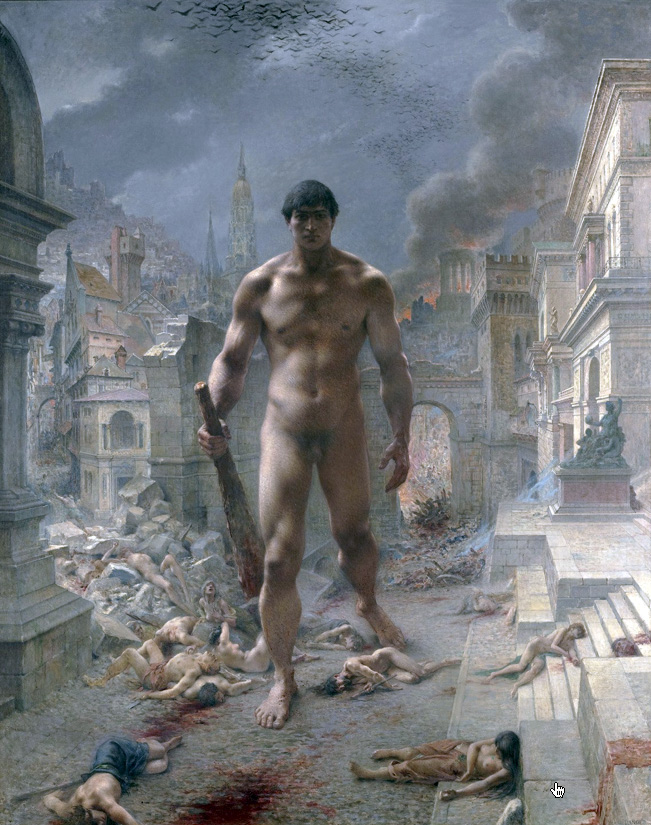
 

Henri Camille Danger (French, 1857-1937) 'Fléau! (Scourge!)' 1901


Henri Camille Danger (French, 1857-1937)
Fléau! (Scourge!)
1901
© Musée d’Orsay, Paris
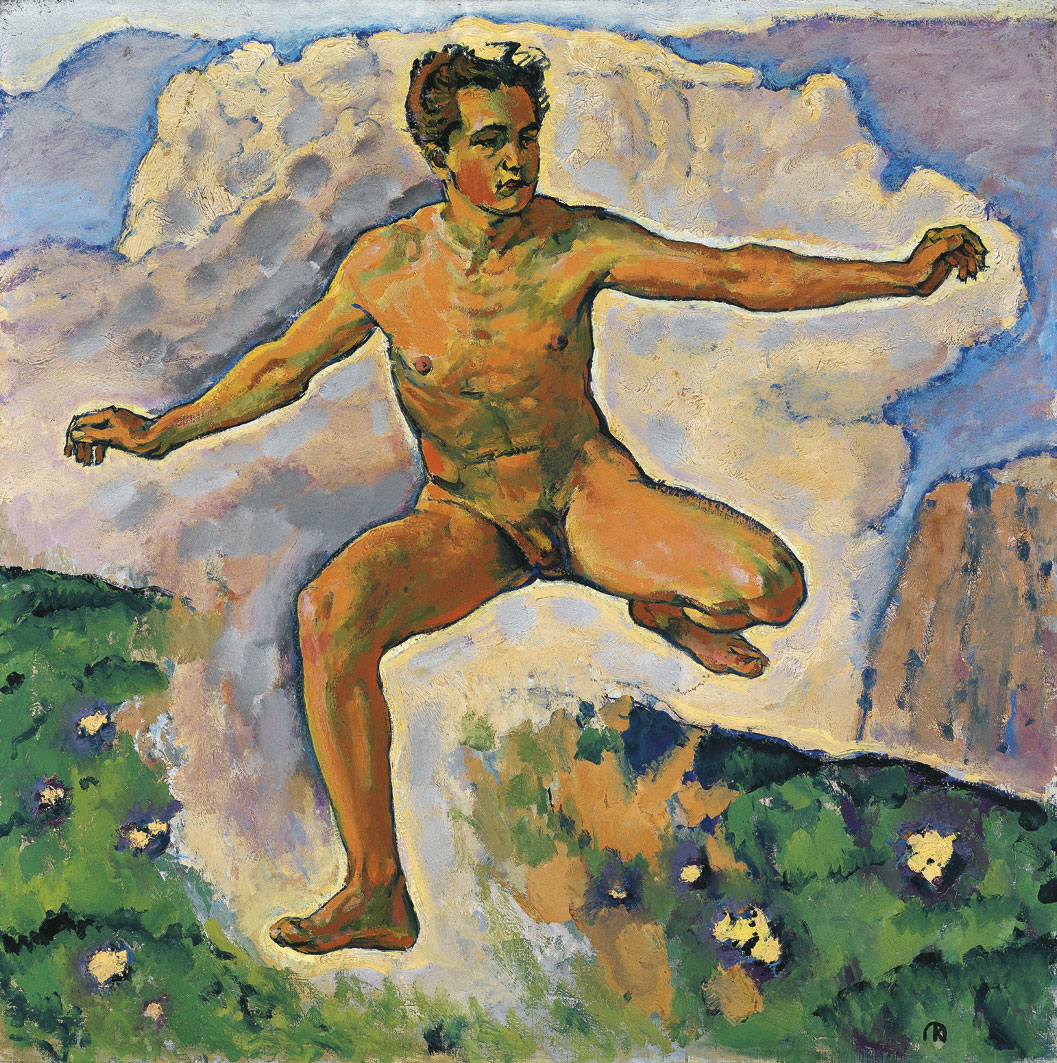
 

Koloman Moser (Austrian, 1868-1918) 'Le Printemps' (Spring) c. 1900


Koloman Moser (Austrian, 1868-1918)
Le Printemps (Spring)
c. 1900
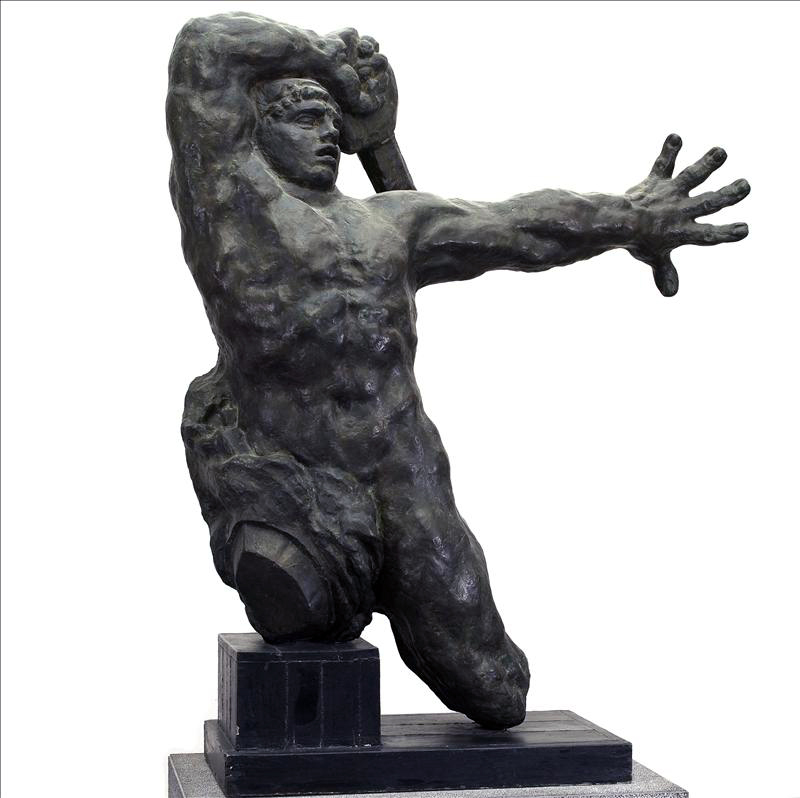
 

Antoine Bourdelle (French, 1861-1929) 'Grand Guerrier avec Jambe' 1893-1902


Antoine Bourdelle (French, 1861-1929)
Grand Guerrier avec Jambe
1893-1902
Bronze
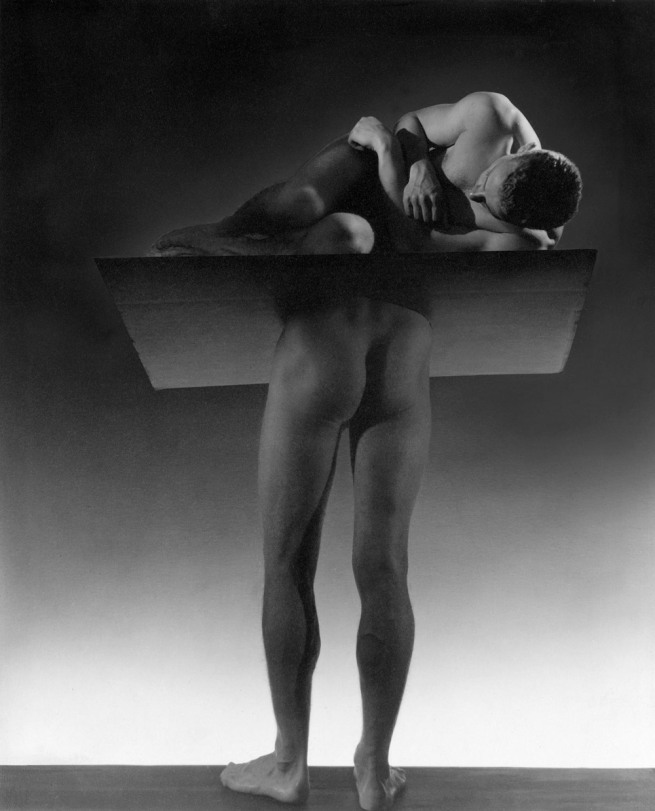
 

George Platt Lynes (American, 1907-1955) 'Le Somnambule (The Sleepwalker)' 1935


George Platt Lynes (American, 1907-1955)
Le Somnambule (The Sleepwalker)
1935
Gelatin silver print
© Christoph Irrgang, Hamburg
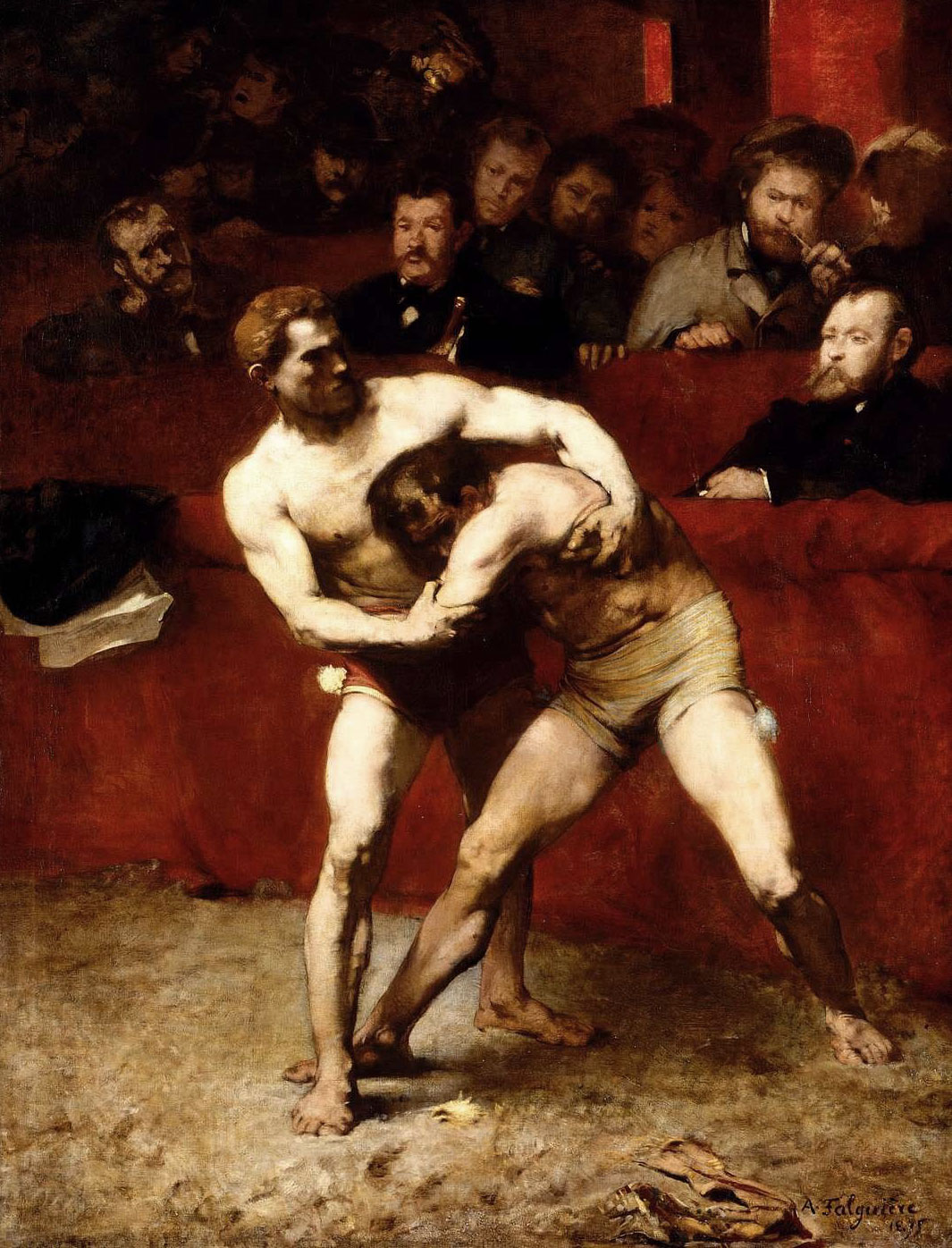
 

Lutteurs d'Alexandre (French, 1851-1900) 'Falguière' 1875


Lutteurs d’Alexandre (French, 1851-1900)
Falguière
1875
Oil on canvas
H. 240; W. 191cm
© RMN-Grand Palais (Musée d’Orsay) / Hervé Lewandowski


From the 1870s, Alexandre Falguière worked simultaneously as a painter and sculptor. Wrestlers, which was his first large painting, caught the critics’ eye and won him a second-class medal at the Salon in 1875. The theme of modern wrestling, fashionable in the Romantic period, had enjoyed a revival in the 1850s. After the Franco-Prussian War of 1870, the figure of the wrestler took on another meaning: his courage was held up as an example to develop the young citizens’ fighting spirit.

Critics were divided between those who scorned “the painting of a sculptor” and the larger group of those who recognised that Falguière had the talent of a true painter. The discussion also focused on the painting’s realism. Some commentators, who preferred the antique, slated the triviality of the theme, seeing nothing more than banal fairground wrestlers. Defenders of realism, on the other hand, enthused over the modernity of the subject and the lack of idealisation.

From 1876, Falguière nonetheless forsook modern subjects in his painting and turned to historical, mythological, literary or religious themes. If Castagnary is to be believed, the painting “was no more than a response to a dare by a painter faintly infatuated with himself and his talent.” Falguière perhaps produced The Wrestlers to prove that he was also a painter.

Text from the Musée d’Orsay website [Online] Cited 06/01/2021
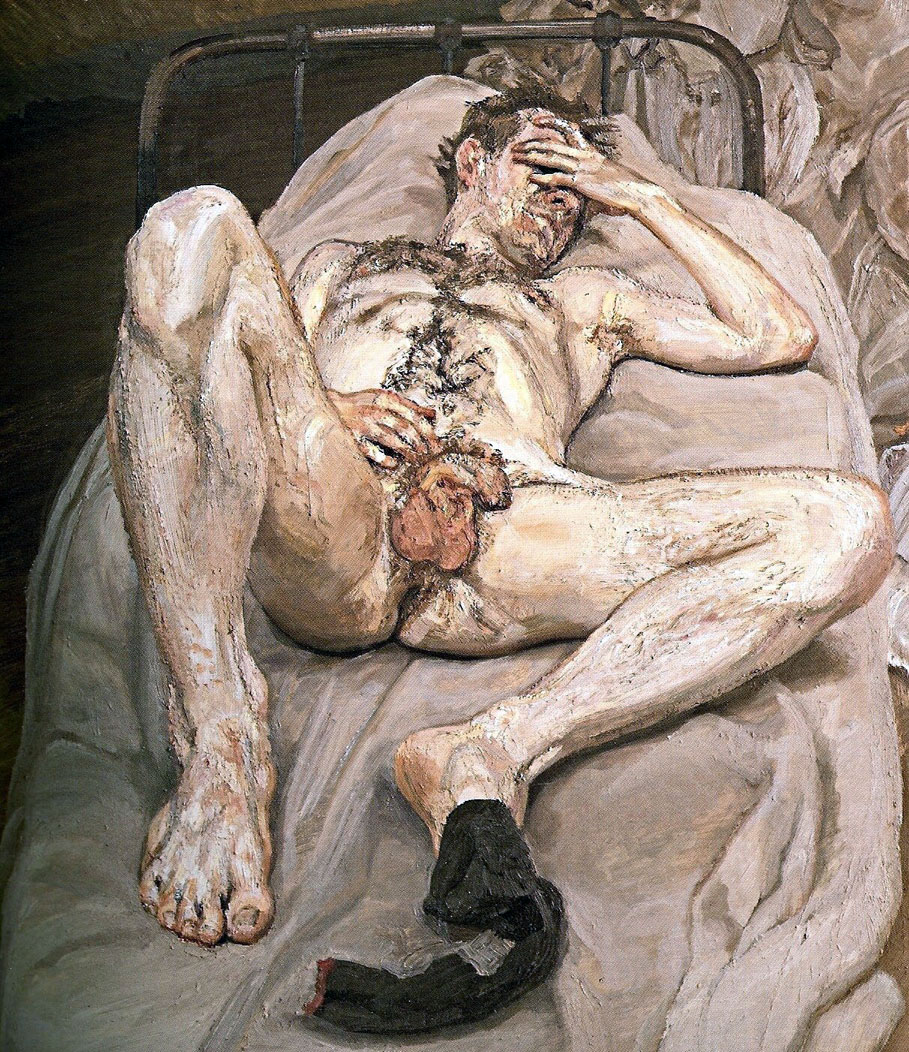
 

Lucian Freud (British, 1922-2011) 'Naked Man on Bed' 1989


Lucian Freud (British, 1922-2011)
Naked Man on Bed
1989
Oil on canvas
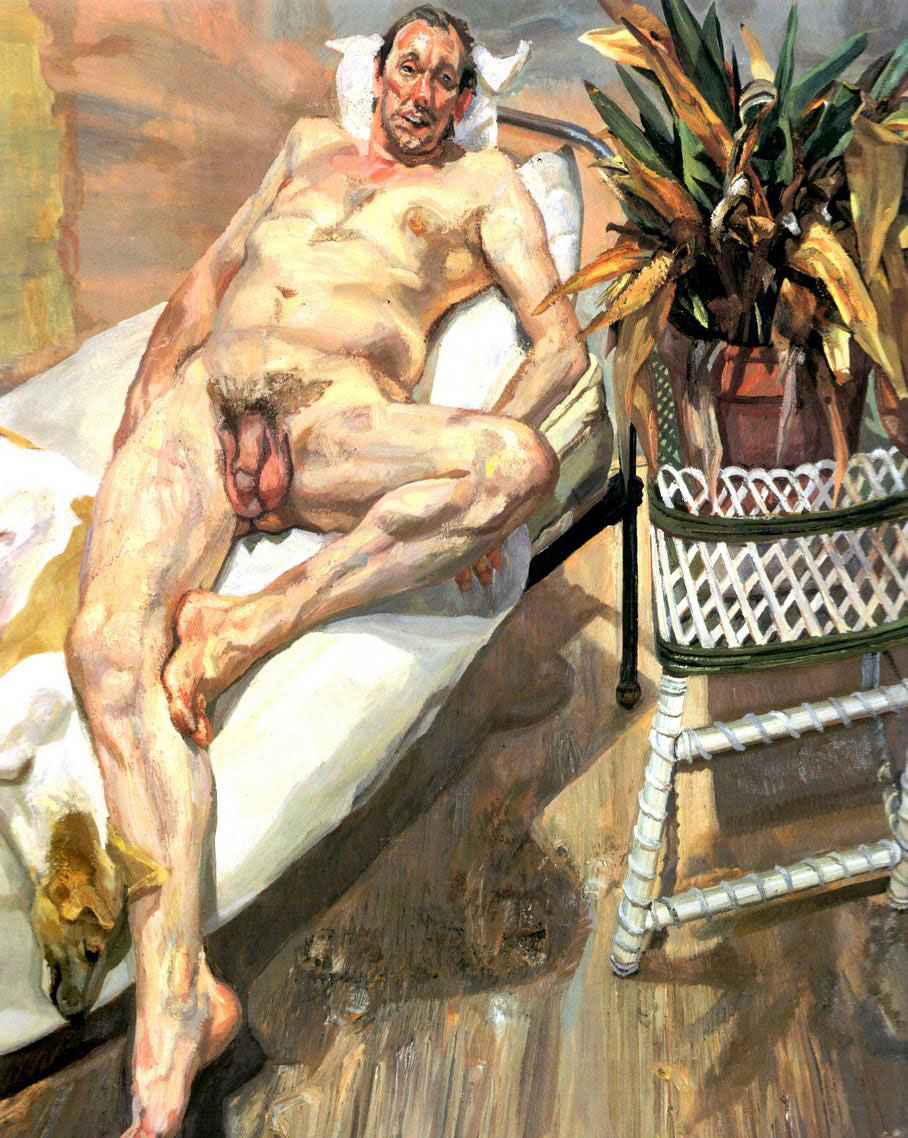
 

Lucian Freud (British, 1922-2011) 'David and Eli' 2004


Lucian Freud (British, 1922-2011)
David and Eli
2004
Oil on canvas


Masculin / Masculin – La video on YouTube


Musée d’Orsay
62, rue de Lille
75343 Paris Cedex 07
France

Opening hours:
Tuesday – Sunday 9.30am – 6pm
Closed on Mondays

Musée d’Orsay website

LIKE ART BLART ON FACEBOOK

Back to top

Text: ‘Transgressive Topographies, Subversive Photographies, Cultural Policies’ Dr Marcus Bunyan

October 2013


Upsetting the court of public opinion…

A very interesting article, Covering their arts by John Elder (Sydney Morning Herald, October 13, 2013), examined the controversy over Bill Henson’s images of children sparked an age of censorship that is still spooking artists and galleries in Australia. At the end of the article Chris McAuliffe, ex-director of the Ian Potter Museum of Art, states that “There’s an assumption that the avant-garde tradition is a natural law as opposed to a constructed space.”

Almost everything (from the landscape to identity) is a constructed space, but that does not mean that the avant-garde cannot be deliberately transgressive, subversive, and break taboos. Artists should make art without fear nor favour, without looking over the shoulder worrying about the court of public opinion. McAuliffe’s statement may be logical but it certainly isn’t pro artist’s standing up to critique things that they see wrong in the world or expose different points of view that challenge traditional hegemonies.
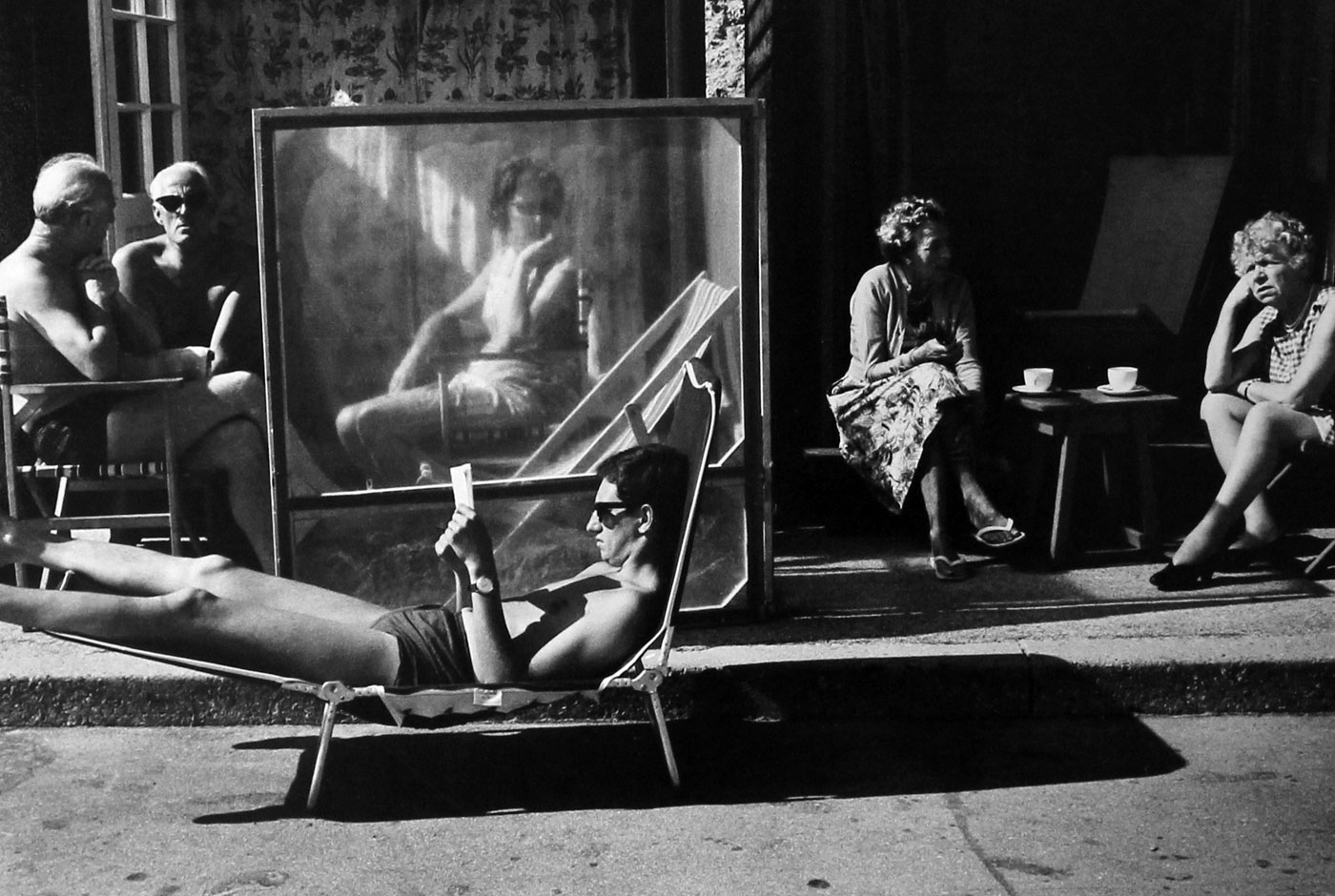
While artists may not stand outside the law, if they believe in something strongly enough to challenge the status quo they must have the courage of their convictions… and just go for it.

The essay below, written in October 2010 and revised in September 2012 and published here for the first time, examines similar topics, investigating the use of photography as subversive image of reality. Download the full paper (2Mb pdf)


Transgressive Topographies, Subversive Photographies, Cultural Policies

Dr Marcus Bunyan

September 2012

Abstract

This research paper investigates the use of photography as subversive image of reality. The paper seeks to understand how photography has been used to destabilise notions of identity, body and place in order to upset normative mores and sensibilities. The paper asks what rules are in place to govern these transgressive potentialities in local, national and international arts policy and argues that prohibitions on the display of such transgressive acts are difficult to enforce.

Keywords

Topography, photography, mapping, transgression, identity, space, time, body, place, arts policy, culture, obscenity, blasphemy, defamation, nudity, shock art, transgressive art, law, censorship, free speech, morality, subversion, freedom of speech, Social Conservatism, taboo, Other.


“Through their power, institutions (such as the Arts Council of Australia) produce rituals of truth and we as artists can and must challenge this perceived truth through the use of transgressive texuality. This texuality “can become a mode of agential resistance capable of fragmenting and releasing the subject, and thereby producing a zone of invisibility where knowledge/power is no longer able ‘find its target’.”44

Only through resistance can transgressive art, including subversive photography, challenge the status quo of a conservative worldview.”


Dr Marcus Bunyan September 2012


Thomas J. Nevin (Australian, 1842-1923) 'Hugh Cowan, aged 62 yrs' 1878


Thomas J. Nevin (Australian, 1842-1923)
Hugh Cowan, aged 62 yrs
1878
Detail of criminal register, Sheriff’s Office, Hobart Gaol to 1890, page 120, GD6719 TAHO
Used for literary criticism under fair use, fair dealing


Thomas J. Nevin produced large numbers of stereographs and cartes within his commercial practice, and prisoner ID photographs on government contract and in civil service. He was one of the first photographers to work with the police in Australia, along with Charles Nettleton (Victoria) and Frazer Crawford (South Australia). His Tasmanian prisoner vignettes (“mugshots”) are the earliest to survive in public collections.

Found guilty of wilful murder in early April 1878, Hugh Cowan’s sentence of death by hanging was commuted to life imprisonment. The negative was taken and printed in the oblong format in late April 1878, and was pasted to the prisoner’s revised criminal sheet after commutation, held at the Hobart Gaol, per notes appearing on the sheet. More information can be found on the “Two mugshots of convict Hugh COHEN or Cowen / Cowan 1878” page on the Thomas J. Nevin: Tasmanian Photographer blog, Wednesday, September 11, 2013.


Andre-Adolphe Eugene Disderi (French, 1819-1889) 'Communards in Their Coffins' c. 1871


Andre-Adolphe Eugene Disderi (French, 1819-1889)
Communards in Their Coffins
c. 1871
Used for literary criticism under fair use, fair dealing


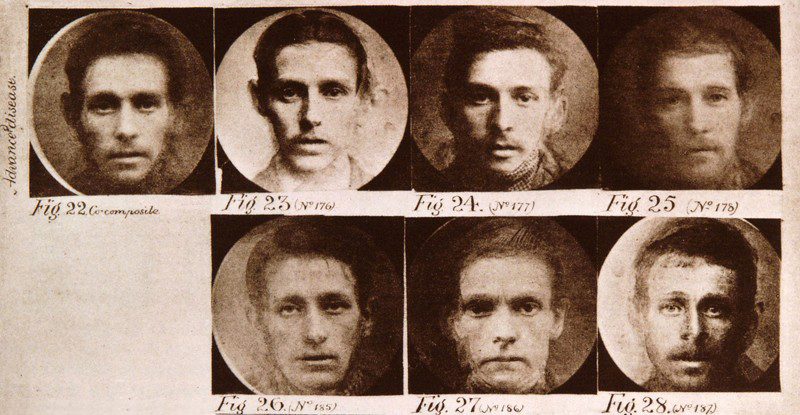
Francis Galton (British, 1822-1911) 'Composite portraits of Advanced Disease' 1883


Francis Galton (British, 1822-1911)
Composite portraits of Advanced Disease
1883
From Inquiries into Human Faculty and its Development 1883
Used for literary criticism under fair use, fair dealing


Anonymous photographer. 'Crowds lined up to visit Entartete Kunst (Degenerate Art), Schulausstellungsgebaude, Hamburg' November - December 1938


Anonymous photographer
Crowds lined up to visit Entartete Kunst (Degenerate Art), Schulausstellungsgebaude, Hamburg
November – December 1938
Used for literary criticism under fair use, fair dealing


Anonymous photographer. 'Entartete Kunst (Degenerate Art) exhibition' 1936


Anonymous photographer
Entartete Kunst (Degenerate Art) exhibition
1936
Used for literary criticism under fair use, fair dealing


Introduction


“The artist is also the mainstay of a whole social milieu – called a “scene” – which allows him to exist and which he keeps alive. A very special ecosystem: agents, press attachés, art directors, marketing agents, critics, collectors, patrons, art gallery managers, cultural mediators, consumers… birds of prey sponge off artists in the joyous horror of showbiz. A scene with its codes, norms, outcasts, favourites, ministry, exploiters and exploited, profiteers and admirers. A scene which has the monopoly on good taste, exerting aesthetic terrorism upon all that which is not profitable, or upon all that which doesn’t come from a very specific mentality within which subversion must only be superficial, of course at the risk of subverting. A milieu which is named Culture. Each regime has its official art just as each regime has its Entartete Kuntz (‘Degenerate art’).”1


Throughout its history photography has been used to record and document the world that surrounds us, producing an image of a verifiable truth that visually maps identity, body and place. This is the topography of the essay title: literally, the photographic mapping of the world, whether it be the mapping of the Earth, the mapping of the body or the visualisation of identities as distinct from one person to another, one nation or ethnic group to another. At the very beginning of the history of photography the first photographs astounded viewers by showing the world that surrounded them. This ability of photography to map a visual truth was used in the mid-Victorian period by the law to document the faces of criminals (such as in the “mugshot” by Tasmanian photographer Thomas J. Nevin, above): “Photography became a modern tool of criminal investigation in the late nineteenth century, allowing police to identify repeat offenders,”2 and through the pseudo-science of physiognomy to identify born criminals solely from photographs of their faces (see the “composite” photograph Francis Galton, above), this topography used by the Nazis in their particular form of eugenics.3 In the Victorian era photography was also used by science to document medical conditions4 and by governments to document civil unrest (such as the death of the Communards in Paris, above).5

Paradoxically, photography always lies for the photograph only depicts one version of reality, one version of a truth depending on what the camera is pointed at, what it excludes, who is pointing the camera and for what reasons, the context of the event or person being photographed (which is fluid from moment to moment) and the place and reason for displaying the photograph. In other words all photographs are, by the very nature, transgressive because they have only one visual perspective, only one line of sight – they exclude as much as they document and this exclusion can be seen as a volition (a choice of the photographer) and a violation of a visual ordering of the world (in the sense of the taxonomy of the subject, an upsetting of the normal order or hierarchy of the subject).6 Of course this line of sight may be interpreted in many ways and photography problematises the notion of a definitive reading of the image due to different contexts and the “possibilities of dislocation in time and space.”7 As Brian Wallis has observed, “The notion of an autonomous image is a fiction”8 as the photograph can be displaced from its original context and assimilated into other contexts where they can be exploited to various ends. In a sense this is also a form of autonomy because a photograph can be assimilated into an infinite number of contexts. “This de and re-contextualisation is itself transgressive of any “integrity” the photograph itself may have as a contextualised artefact.”9 As John Schwartz has insightfully noted, “[Photographs] carry important social consequences and that the facts they transmit in visual form must be understood in social space and real time,”10 “facts” that are constructions of reality that are interpreted differently by each viewer in each context of viewing.

Early examples of the break down of the indexical nature of photography (the link between referent and photograph as a form of ‘truth’) – the subversion of the order of photography – are the Victorian photographs of children at the Dr Barnados’ homes (in this case to support the authority of an institution, not to undermine it as in the case of subverting cultural hegemony – see next section). “In the 1870s Dr. Barnardo had photographs taken that showed rough, dirty, and dishevelled children arriving at his homes, and then paired them with photographs of the same children bright as a new pin, happy and working in the homes afterwards. These photographs were used to sell the story of children saved from poverty and oppression and happy in the homes; they appeared on cards which were sold to raise money to support the work of these homes. Dr. Barnardo was taken to court when one such pair of photographs was found to be a fabrication, an ‘artistic fiction’.”11

Here the photographs offered one interpretation of the image (that of the happy child) that supports the authority of Dr Barnardo, the power of his institution in the pantheon of cultural forces. The power of truth that is vested in these photographs is validated because people know the key to interpret the coded ‘sign’ language, the semiotic language through which photographs, and indeed all images, speak. But these photographs only portray one supposed form of ‘truth’ as viewed from one perspective, not the many subjective and objective truths viewed from many positions. Conversely, two examples can be cited of the use of photography to undermine dominant hegemonic cultural power – one while being officially accepted because of references to classical Greek antiquity, the other seemingly innocuous photographic documentary reportage of the genetic makeup of the German people being rejected as subversive by the Nazis because it did not represent their view of what the idealised Aryan race should look like.

Baron von Gloeden’s photographs of nude Sicilian ephebes (males between boy and man) in the late 19th and early 20th century were legitimised by the use of classically inspired props such as statues, columns, vases and togas. “The photographs were collected by some people for their chaste and idyllic nature but for others, such as homosexual men, there is a subtext of latent homo-eroticism present in the positioning and presentation of the youthful male body. The imagery of the penis and the male rump can be seen as totally innocent, but to homosexual men desire can be aroused by the depiction of such erogenous zones within these photographs.”12 Such photographs were distributed through what was known as the “postcard trade” that reached its zenith between the years 1900-1925.13

August Sander’s 1929 photo-book Face of Our Time (part of a larger unpublished project to be called Menschen des 20. Jahrhunderts (People of the Twentieth Century) “included sixty portraits representing a broad cross-section of German classes, generations, and professions. Shot in an un-retouched documentary style and arranged by social groups, the portraits reflected Sander’s desire to categorise society according to social and professional types in an era when class, gender, and social boundaries had become increasingly indistinguishable.”14 Liberal critics such as Walter Benjamin and photographer Walker Evans hailed Sander as a master photographer and a documenter of human types but with the rise of National Socialism in the mid-1930s “the Reichskulturkammer ordered the destruction of Face of Our Time‘s printing plates and all remaining published copies. Various explanations for this action have been offered. Most cast Sander in the flattering role of an outspoken resistor to the regime … While it is certainly plausible that the book’s destruction was a kind of punishment for the photographer’s “subversive” activities, it is more likely that the members of the new regime disagreed with Sander’s inclusion of Jews, communists, and the unemployed.”15 After this time his work and personal life were greatly curtailed under the Nazi regime. In an excellent article by Rose-Carol Washton Long recently, the author argues that Sander’s ‘The Persecuted’ and ‘Political Prisoners’ portfolios from People of the Twentieth Century counter the characterisation that his work was politically neutral.16


Wilhelm von Gloeden (German, 1856-1931) 'Two Male Youths Holding Palm Fronds' c. 1885-1905


Wilhelm von Gloeden (German, 1856-1931)
Two Male Youths Holding Palm Fronds
c. 1885-1905
Albumen silver
233mm (9.17 in) x 175mm (6.89 in)
The J. Paul Getty Museum
This work is in the public domain


Wilhelm von Gloeden (German, 1856-1931) 'Bacchanal' c. 1890s


Wilhelm von Gloeden (German, 1856-1931)
Bacchanal
c. 1890s
Catalogue number: 135 (or 74)
Gaetano Saglimbeni, Album Taormina, Flaccovio 2001, p. 18
This work is in the public domain


August Sander (German, 1876-1964) 'Unemployed Man in Winter Coat, Hat in Hand' 1920


August Sander (German, 1876-1964)
Unemployed Man in Winter Coat, Hat in Hand
1920
Silver gelatin photograph mounted on paper
Used for literary criticism under fair use, fair dealing


August Sander (German, 1876-1964) 'Victim of Persecution' 1938, printed 1990


August Sander (German, 1876-1964)
Victim of Persecution
1938, printed 1990
Photograph, gelatin silver print on paper
ARTIST ROOMS Tate and National Galleries of Scotland
Lent by Anthony d’Offay 2010
© Die Photographische Sammlung/SK Stiftung Kultur – August Sander Archiv, Cologne; DACS, London, 2013
Used for literary criticism under fair use, fair dealing


August Sander (German, 1876-1964) 'Victim of Persecution' c. 1938


August Sander (German, 1876-1964)
Victim of Persecution
c. 1938
ARTIST ROOMS Tate and National Galleries of Scotland
Lent by Anthony d’Offay 2010
© Die Photographische Sammlung/SK Stiftung Kultur – August Sander Archiv, Cologne; DACS, London, 2013
Used for literary criticism under fair use, fair dealing


August Sander (German, 1876-1964) 'Political Prisoner [Erich Sander]' 1943, printed 1990


August Sander (German, 1876-1964)
Political Prisoner [Erich Sander]
1943, printed 1990
Photograph, gelatin silver print on paper
ARTIST ROOMS Tate and National Galleries of Scotland
Lent by Anthony d’Offay 2010
© Die Photographische Sammlung/SK Stiftung Kultur – August Sander Archiv, Cologne; DACS, London, 2013
Used for literary criticism under fair use, fair dealing


The conditions of photography leave open spaces of interpretation and transgression, in-between spaces that allow artists to subvert the normative mapping of reality. While the term ‘transgressive art’ may have only been coined in the 1980s it is my belief that photography has, to some extent, always been transgressive because of the conditions of photography: its contexts and half-truths. Photography has always opened up to artists the possibility of offering the viewer images open to interpretation, where the constructed personal narratives of the viewer are mediated through mappings of identity, body and place that challenge how the viewer sees the world and the belief systems that sustain that view. Here photography can subvert, can undertake a more surreptitious eroding of the basis of belief in the status quo. Photography can address the idea of subjective and objective truths, were there is never a single truth but many truths, many different perspectives and lines of sight, never one definitive ‘correct’ interpretation. As David Smail rightly notes of subjective and objective truths,

“Where objective knowing is passive, subjective knowing is active – rather than giving allegiance to a set of methodological rules which are designed to deliver up truth through some kind of automatic process [in this case the image], the subjective knower takes a personal risk in entering into the meaning of the phenomena to be known… Those who have some time for the validity of subjective experience but intellectual qualms about any kind of ‘truth’ which is not ‘objective’, are apt to solve their problem by appealing to some kind of relativity. For example, it might be felt that we all have our own versions of the truth about which we must tolerantly agree to differ. While in some ways this kind of approach represents an advance on the brute domination of ‘objective truth’, it in fact undercuts and betrays the reality of the world given to our subjectivity. Subjective truth has to be actively struggled for: we need the courage to differ until we can agree. Though the truth is not just a matter of personal perspective, neither is it fixed and certain, objectively ‘out there’ and independent of human knowing. ‘The truth’ changes according to, among other things, developments and alterations in our values and understandings… the ‘non-finality’ of truth is not to be confused with a simple relativity of ‘truths’.”17

The truth changes due to alterations of our values and understandings; “truth” is perhaps even constructed by our values and understandings. What an important statement this is with regard to the potential subversive nature of photography.


The Subversion of Cultural Hegemony: Cultural Policy, Photography and Problems of Interpretation

Some of the most common themes that transgressive art may address are the power of institutions (such as governments), the portrayal of sex as art (which may address the notion of when is pornography art and not obscenity),18 issues of faith, religion and belief, of nationalism, war, of death, of gender, of drug use, of culturally suppressed minorities, ‘Others’ that have been socially excluded (see definition of ‘Other’ above). Conversely, art that lies (another form of transgression) can be used to uphold institutions that wish to reinforce the perception of their social position through the verification of truth in reality. An example of this are photographs which purport to tell the ‘truth’ about an event but are in fact constructions of reality, emphasising the link between the referent and the photograph that is the basis of photography while subverting it (through faking it, through manipulation of the image) to the benefit of the ruling social class.19

Transgressive art that subverts cultural hegemony (the philosophical and sociological concept whereby a culturally-diverse society can be ruled or dominated by one of its social classes)20 by upsetting predominant cultural forces such as patriarchy,21 individualism (which promotes individual moral choice),22 family values,23 and resisting social norms24 (institutions, practices, beliefs) that impose universal (if sometimes hidden) public moral25 and ethical26 values, has, seemingly, free rein in terms of local and centralised art policy in Australia because the responsibility for the outcomes of transgression rests in the hands of the artists and the galleries that display this art. This is in itself a cultural policy statement, a statement by abrogation rather than action. The statement below on the Australia Council for the Arts website, the Australian Government’s arts funding and advisory body is, believe it or not, the only statement giving advice to artists about defamation and obscenity laws in Australia. The website then refers artists to the Arts Law Centre of Australia Online for more information, of which there is very little, about issues such as defamation, obscenity, blasphemy, sedition and the morals and ethics of producing and exhibiting art that challenges dominant cultural stereotypes, images and beliefs.

“Defamation and obscenity laws in Australia can be very tough and vary substantially from state to state. If you have any doubts discuss them with others and try and assess the level of risk involved. Unfortunately, these are highly subjective areas and obscenity laws are driven by current community standards that are constantly shifting. Defaming someone in Australia can be a very serious offence. Don’t think that just because your project is small it won’t be noticed. Sometimes controversy can bring a project to public attention. (Not that that’s necessarily a bad thing!) And just because your project is small, this does not protect you from potential prosecution in the courts. Although not advised, if you do take risks in these areas make sure your project team are all equally aware of them and all in favour of doing so.”27

While challenging the dominant paradigm (through the use of shock art28 for example) might raise the profile of the artist and gallery concerned, the risks can be high. Even when artistic work is seemingly innocuous (for example the media and family values furore over the work of Australian artist Bill Henson29 that eventually led the Australia Council for the Arts to issue protocols for working with children in art,)30 – forces opposed to the relaxing of social and political morals and ethics (such as governments, religious authorities and family groups) can ramp up public sentiment against provocative and, what is in their opinion, licentious art (art that lacks moral discipline) because they believe that it is art that is not “in the public interest” or is considered offensive to a “common sense of decency.” The ideology of social conservatism31 is ever present in our society but this ideology is never fixed and is forever changing; the same can be said of what is deemed to be transgressive as the above quotation by the Australia Council notes. For example George Platt Lynes photographs of homosexual men associating together taken in the 1940s were never shown in his lifetime in a gallery for fear of the moral backlash  and the damage this would cause his career as a fashion photographer in America. Some of these photographs now reside in The Kinsey Institute (see my research into these images on my PhD website).32 Today these photographs would not even raise a whisper of condemnation such is their chaste imagery.33

.
During my research I have been unable to find a definition of the theoretical role of arts policy in dealing with transgression in art. Perhaps this is acceptable for surely the purpose of an arts policy is primarily to facilitate artistic activity of any variety, whether is be transgressive or not, as long as that artistic activity challenges people to look at the world in a new light. The various effects, or impacts, of the arts and artistic activities can include, “social impacts, social effects, value, benefits, participation, social cohesion, social capital, social exclusion or inclusion, community development, quality of life, and well-being. There are two main discernable approaches in this research. Some tackle the issues ‘top-down’, by exploring the social impacts of the arts, where ‘social’ means non-economic impacts, or impacts that relate to social policies. Others, and in the USA in particular, approach effects from the ‘bottom up’, by exploring individual motivations for and experiences of arts participation, and evaluating the impacts of particular arts programs.”34

Personally I believe that the purpose of a cultural arts policy is to promote open artistic inquiry into topics that challenge the notion of self and the formation of national and personal identity. Whether this inquiry fits in with the socio-political imperative of nation building or the economic rationalism of arts as a cultural industry and how censorship and free speech fit in with this economic modelling is an interesting topic for research. Berys Gaut questions what role, if any, “ought the state to play in the regulation and promotion of art? The spectre of censorship has cast a long shadow over the debate … And wherever charges of film’s and popular music’s ethically corrupting tendencies are heard, calls for censorship or self-restraint are generally not far behind. Such a position is in a way the converse side of the humanistic tradition’s espousal of state subsidies for art, because of art’s purported powers to enhance the enjoyment of life and promote the spread of civilisation.”35

In terms of art and ethics the immoralist approach, “has as its most enduring motivation the idea of art as transgression. It acknowledges that ethical merits or demerits of works do condition their aesthetic value.”36 Often the definition of the ethical merits or demerits of an artwork come down to the contextualisation of the work of art: who is looking and from what perspective. “When you look at the history of censorship, it becomes clear that what is regarded as obscene in one era is often regarded as culturally valuable in another. Whether something is pornography or art, in other words, depends a lot on who’s looking, and the cultural and historical viewing point from which they’re looking.”37

The ideal political system of arts policy is an arms length policy free from political interference; the reality may be something entirely different for bureaucracy may seek to control an artist’s freedom of expression through censorship and control of economic stimulus while preserving bureaucracy itself as a self-referential self-reproducing system:

“The balance of power between the different systems of rationalities in a given society in a given historical is decisive for which forms of rationality will be dominating. For example, the rationality of the economic market forces, the political media and bureaucracies, the intrinsic values of the aesthetic rationality and of the anthropological conceptualisation of culture are all different rationalities in play in the cultural field … in a broader sense cultural policy, however, is also about the clash of ideas, institutional struggles and power relations in the production, dissemination and reception of arts and symbolic meaning in society.

In democratic societies governed by law, cultural policy according to this argumentation is the outcome of the debate about which values (forms of recognition) are considered important for the individuals and collectives a given society. Is it the instrumental rationality of the economic and political medias or the communicative rationality of art and culture, which shall be dominating in society?”38


This is an ongoing debate. In the United States of America grants from the National Endowment for the Arts (NEA) to artists including Robert Mapplethorpe and Andres Serrano led to the culture wars of the 1990s. Their work was described as indecent and in 1998 the Supreme Court determined that the statute mandating the NEA to consider “general standards of decency and respect for the diverse beliefs and values of the American public” in awarding grants was constitutional.39 In Australia there was the furore over the presentation of the photograph “Piss Christ” by Andres Serrano at the National Gallery of Victoria in 1997 that led to it’s attack by a vandal and the closing of the exhibition of which it was a part, as well as other incidents of cultural vandalism.40 In consideration of these culture wars, it would be an interesting research project to analyse the grants received by artists from the Australia Council for the Arts and Arts Victoria, for example, to see how many artists receive grants for transgressive art projects. My belief would be that, while the ideal is for the “arms length” principle of art funding, very few transgressive art projects that challenge the norm of cultural sensibilities and mores in Australia would achieve a level of funding. Australia is at heart a very conservative country and arts funding policies, while not specifically stating this, still support the status quo and their self-referential position within this system of power and control.


George Platt Lynes (American, 1907-1955) 'Tex Smutley and Buddy Stanley [no title (two sleeping boys)]' 1941


George Platt Lynes (American, 1907-1955)
Tex Smutley and Buddy Stanley [no title (two sleeping boys)]
1941
Gelatin silver photograph
19.2 x 24.4cm
Collection of the National Gallery of Australia
Used for literary criticism under fair use, fair dealing


George Platt Lynes (American, 1907-1955) 'Untitled' date unknown (probably early 1950s)


George Platt Lynes (American, 1907-1955)
Untitled
Date unknown (probably early 1950s)
Vintage gelatin silver print
9 x 7 1/2 in. (22.9 x 19.1cm)
Collection of Steven Kasher Gallery
Used for literary criticism under fair use, fair dealing


Robert Mapplethorpe (American, 1946-1989) 'Joe' 1978


Robert Mapplethorpe (American, 1946-1989)
Joe
1978
Silver gelatin photograph
© Robert Mapplethorpe Foundation
Used for literary criticism under fair use, fair dealing


Robert Mapplethorpe (American, 1946-1989) 'Brian Ridley and Lyle Heeter' 1979


Robert Mapplethorpe (American, 1946-1989)
Brian Ridley and Lyle Heeter
1979
Silver gelatin photograph
© Robert Mapplethorpe Foundation
Used for literary criticism under fair use, fair dealing


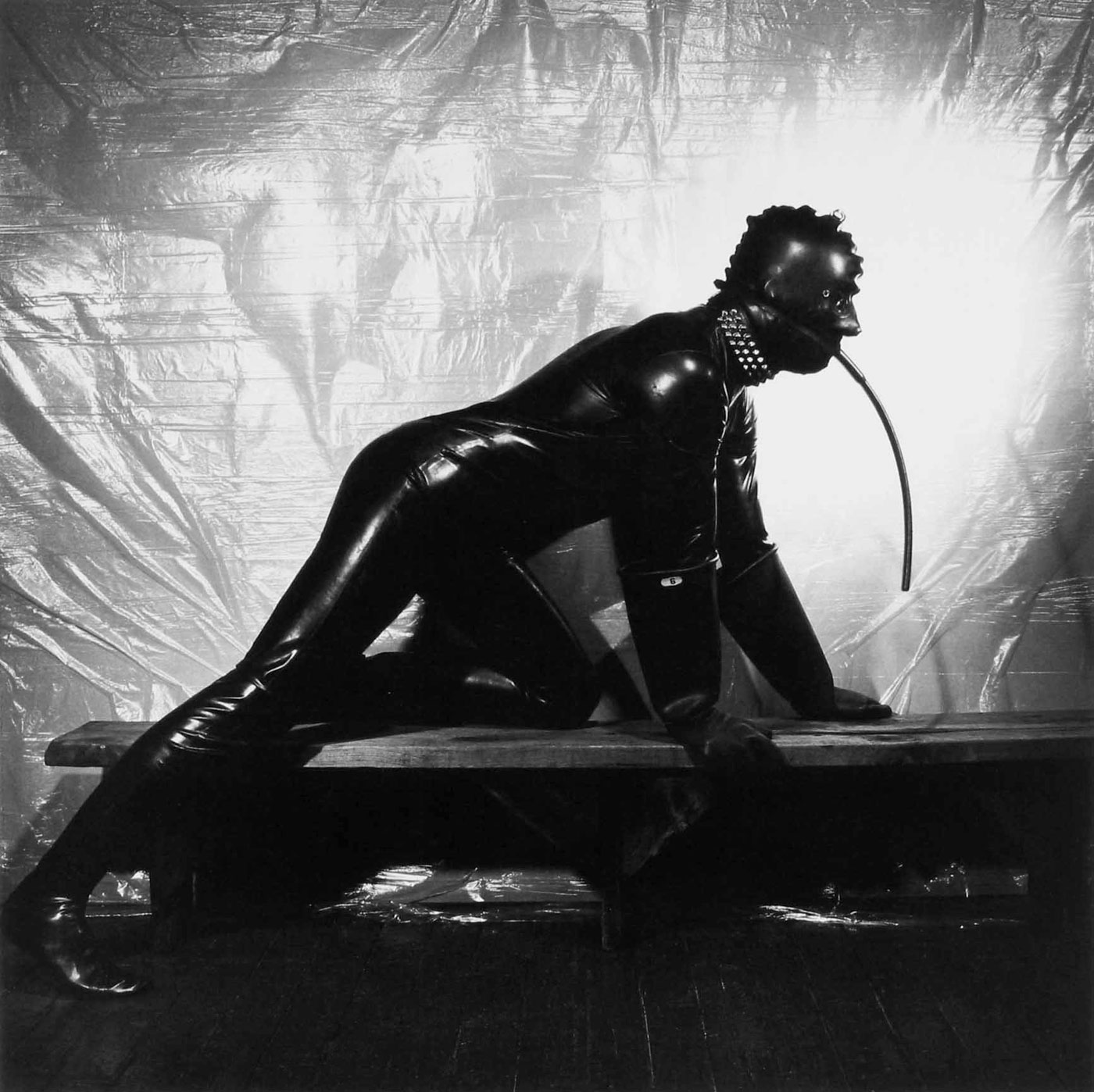
Mapplethorpe’s photos of gay and leather subcultures were at the center of a controversy over NEA funding at the end of the ’80s. Sen. Jesse Helms proposed banning grants for any work treating “homoerotic” or “sado-masochistic” themes. When Helms showed the photos to his colleagues, he asked “all the pages and all the ladies to leave the floor.”


Bill Henson (Australian, b. 1955) 'Untitled #8' 2007/08


Bill Henson (Australian, b. 1955)
Untitled #8
2007/08
Type C photograph
127 × 180cm
Edition of 5 + 2 A/Ps
© Bill Henson/Roslyn Oxley9 Gallery
Used for literary criticism under fair use, fair dealing


Andres Serrano (American, b. 1950) 'Immersion (Piss Christ)' 1987


Andres Serrano (American, b. 1950)
Immersion (Piss Christ)
1987
Cibachrome print
60 x 40 in.
© Andres Serrano
Used for literary criticism under fair use, fair dealing


Conclusion

“Policy in Australia aspires to achieve a high-level of consistency – if not to say universality – and so struggles with concepts as amorphous as mores, norms or sensibilities.”41 Hence there is no local or centralised public arts policy with regard to photography, or any art form, that transgresses and violates basic mores and sensibilities, usually associated with social conservatism. Implementing national guidelines for transgressive art would be impossible because of the number of artists producing work, the number of galleries showing that work, the number of exhibitions that take place every week throughout Australia (including artist and gallery online web presences) and the commensurate task of enforcing and policing such guidelines. These guidelines would also be impossible to establish due to a lack of agreement in the definition of what transgressive art is for the meaning of transgressive art, or any art for that matter, depends on who is looking, at what time and place, from what perspective and in what context. Photography opens up to artists the possibility of offering the viewer personal narratives and constructions of worlds that they have never seen before, transgressive text(ur)al mappings of identity, body and place that challenge how the viewer sees the world and the belief systems that sustain that view and that is at it should be. Art should challenge human beings to be more open, to see further up the road without the fear of a cultural arts policy or any institutional policy for that matter dictating what can or cannot be said.

Brain Long has suggested that arts policy is primarily to facilitate artistic activity and questions of public morality are best left to the legal system with its juries, judges, checks and balances42 but I believe that this position is only partially correct. I believe that it is not just the legal system but the hidden agendas of committees that decide grants and the hypocritical workings of the institutions that enforce a prejudiced world view that govern censorship and free speech in Australia. Freedom of expression in Australia is not just governed by the laws of defamation, obscenity and blasphemy that vary from state to state but by hidden disciplinary forces, systems of control that seek to create a reality of their own making.

“To reiterate the point, it should be clear that when Foucault examines power he is not just examining a negative force operating through a series of prohibitions… We must cease once and for all to describe the effects of power in negative terms – as exclusion, censorship, concealment, eradication. In fact, power produces. It produces reality. It produces domains of objects, institutions of language, rituals of truth.”43

Through their power, institutions (such as the Arts Council of Australia) produce rituals of truth and we as artists can and must challenge this perceived truth through the use of transgressive texuality. This texuality “can become a mode of agential resistance capable of fragmenting and releasing the subject, and thereby producing a zone of invisibility where knowledge/power is no longer able ‘find its target’.”44

Only through resistance can transgressive art, including subversive photography, challenge the status quo of a conservative worldview.

Dr Marcus Bunyan
September 2013

Word count: 3,933


Glossary of terms

Transgressive art refers to art forms that aim to transgress; ie. to outrage or violate basic mores and sensibilities. The term transgressive was first used by American filmmaker Nick Zedd and his Cinema of Transgression in 1985.45

Subversion refers to an attempt to overthrow the established order of a society, its structures of power, authority, exploitation, servitude, and hierarchy… The term has taken over from ‘sedition’ as the name for illicit rebellion, though the connotations of the two words are rather different, sedition suggesting overt attacks on institutions, subversion something much more surreptitious, such as eroding the basis of belief in the status quo or setting people against each other.46.

Blasphemy is irreverence toward holy personages, religious artefacts, customs, and beliefs.47 The Commonwealth of Australia does not recognise blasphemy as an offence although someone who is offended by someone else’s attitude toward religion or toward one religion can seek redress under legislation which prohibits hate speech.48.

Defamation – also called calumny, vilification, slander (for transitory statements), and libel (for written, broadcast, or otherwise published words) – is the communication of a statement that makes a claim, expressly stated or implied to be factual, that may give an individual, business, product, group, government, or nation a negative image. In common law jurisdictions, slander refers to a malicious, false and defamatory spoken statement or report, while libel refers to any other form of communication such as written words or images… Defamation laws may come into tension with freedom of speech, leading to censorship.49

An obscenity is any statement or act which strongly offends the prevalent morality of the time, is a profanity, or is otherwise taboo, indecent, abhorrent, or disgusting, or is especially inauspicious. The term is also applied to an object that incorporates such a statement or displays such an act. In a legal context, the term obscenity is most often used to describe expressions (words, images, actions) of an explicitly sexual nature.50

Freedom of speech is the freedom to speak freely without censorship or limitation, or both. The synonymous term freedom of expression is sometimes used to indicate not only freedom of verbal speech but any act of seeking, receiving and imparting information or ideas, regardless of the medium used. In practice, the right to freedom of speech is not absolute in any country and the right is commonly subject to limitations, such as on “hate speech”… Freedom of speech is understood as a multi-faceted right that includes not only the right to express, or disseminate, information and ideas, but three further distinct aspects:

~ the right to seek information and ideas
~ the right to receive information and ideas
~ the right to impart information and ideas51

Censorship is the suppression of speech or other communication which may be considered objectionable, harmful, sensitive, or inconvenient to the general body of people as determined by a government, media outlet, or other controlling body.

~ Moral censorship is the removal of materials that are obscene or otherwise considered morally questionable52

taboo is a strong social prohibition (or ban) relating to any area of human activity or social custom that is sacred and forbidden based on moral judgment and sometimes even religious beliefs. Breaking the taboo is usually considered objectionable or abhorrent by society… Some taboo activities or customs are prohibited under law and transgressions may lead to severe penalties… Although critics and/or dissenters may oppose taboos, they are put into place to avoid disrespect to any given authority, be it legal, moral and/or religious.53

Topography as the study of place, distinguished… by focusing not on the physical shape of the surface, but on all details that distinguish a place. It includes both textual and graphic descriptions… New Topography, [is] a movement in photographic art in which the landscape is depicted complete with the alterations of humans54 … New Topographics: Photographs of a Man-Altered Landscape was an exhibition that epitomised a key moment in American landscape photography at the International Museum of Photography at the George Eastman House in January 1975.55

Morality is a sense of behavioural conduct that differentiates intentions, decisions, and actions between those that are good (or right) and bad (or wrong)… Morality has two principal meanings:

~ In its “descriptive” sense, morality refers to personal or cultural values, codes of conduct or social mores that distinguish between right and wrong in the human society. Describing morality in this way is not making a claim about what is objectively right or wrong, but only referring to what is considered right or wrong by people
~ In its “normative” sense, morality refers directly to what is right and wrong, regardless of what specific individuals think… It is often challenged by a moral skepticism, in which the unchanging existence of a rigid, universal, objective moral “truth” is rejected…”56

Other: A person’s definition of the ‘Other’ is part of what defines or even constitutes the self and other phenomena and cultural units. It has been used in social science to understand the processes by which societies and groups exclude ‘Others’ whom they want to subordinate or who do not fit into their society… Othering is imperative to national identities, where practices of admittance and segregation can form and sustain boundaries and national character. Othering helps distinguish between home and away, the uncertain or certain. It often involves the demonisation and dehumanisation of groups, which further justifies attempts to civilise and exploit these ‘inferior’ others.
De Beauvoir calls the Other the minority, the least favoured one and often a woman, when compared to a man… Edward Said applied the feminist notion of the Other to colonised peoples.57


Endnotes

1/ Anon. “Escapism has its price, The artist has his income,” on Non Fides website. [Online] Cited 28/09/2012. No longer available online
2/ Editors note in Lombroso, Cesare, Gibson, Mary and Rafter, Nicole Hahn. “Photographs of Born Criminals,” chapter in Criminal man. Durham: Duke University Press, 2006, p. 203
3/ See Maxwell, Anne. Picture Imperfect: Photography and Eugenics, 1870-1940. Sussex Academic Press, 2010
“The book looks at eugenics from the standpoint of its most significant cultural data – racial-type photography, investigating the techniques, media forms, and styles of photography used by eugenicists, and relating these to their racial theories and their social policies and goals. It demonstrates how the visual archive was crucially constitutive of eugenic racial science because it helped make many of its concepts appear both intuitive as well as scientifically legitimate.”
4/ See Mifflin, Jeffrey. “Visual Archives in Perspective: Enlarging on Historical Medical Photographs,” in The American Archivist Vol. 70, No. 1 Spring/Summer 2007, pp. 32-69 [Online] 17/09/2012.
5/ See Anon. “Andre Adolphe Eugene Disderi: Dead Communards,” on History of Art: History of Photography website [Online] Cited 17/09/2012. www.all-art.org/history658_photography13-8.html
6/ Anon. “Taxonomy,” on Wikipedia website. [Online] Cited 17/09/2012. en.wikipedia.org/wiki/Taxonomy
7/ Mifflin, Jeffrey p. 35
8/ Wallis, Brian. “Black Bodies, White Science,” in American Art 9 (Summer 1995), p. 40 quoted in Mifflin, Jeffrey p. 35. He goes on to explain that photographs that once circulated out of family albums, desk drawers, etc., have often been “displaced” to the “unifying context of the art museum.”
9/ Long, Brian. Notes on marking of short transgressive essay. 31/10/2010
10/ Schwartz, Joan M. “Negotiating the Visual Turn: New Perspectives on Images and Archives,” in American Archivist 67 (Spring/Summer 2004), p. 110 quoted in Mifflin, Jeffrey p. 35
11/ Bunyan, Marcus. “Science, Body and Photography,” in Bench Press chapter of Pressing the Flesh: Sex, Body Image and the Gay Male. Melbourne: RMIT University, 2001 [Online] Cited 17/09/2013. No longer available online
See also Tagg, John. The Burden of Representation: Essays on Photographies and Histories. Basingstoke: Macmillan, 1988, p. 85
12/ Bunyan, Marcus. “Baron von Gloeden,” in ‘Historical Pressings’ chapter of Pressing the Flesh: Sex, Body Image and the Gay Male. Melbourne: RMIT University, 2001 [Online] Cited 02/09/2012.
13/ Smalls, James. The homoerotic photography of Carl Van Vechten: public face, private thoughts. Philadeplhia: Temple University Press, 2006, p.32
14/ Rittelmann, Leesa. “Facing Off: Photography, Physiognomy, and National Identity in the Modern German Photobook,” in Radical History Review Issue 106 (Winter 2010), p. 148
15/ Ibid., p. 155
16/ Long, Rose-Carol Washton. “August Sander’s Portraits of Persecuted Jews,” on the Tate website, 4 April 2013 [Online] Cited 26/10/2013. https://www.tate.org.uk/research/tate-papers/19/august-sanders-portraits-of-persecuted-jews
17/ Smail, David. Illusion and Reality: The Meaning of Anxiety. London: J.M. Dent & Sons, 1984, pp. 152-153
18/ Manchester, Colin. “Obscenity, Pornography and Art,” on Media & Arts Law Review website [Online] Cited 21/09/2012.
19/ Hall, Alan. “Famous Hitler photograph declared a fake,” on The Age newspaper website. October 20th, 2010 [Online] Cited 21/09/2012. www.theage.com.au/world/famous-hitler-photograph-declared-a-fake-20101019-16sfv.html
“A historian claims the Nazi Party doctored a photo to drum up support. Allan Hall reports from Berlin.
It is one of the most iconic photographs of all time, the image that showed a monster-in-waiting clamouring with his countrymen for glory in the war meant to end all wars. Adolf Hitler waving his straw boater with the masses in Munich the day before Germany declared war on France in August 1914 is world famous… and now declared to be a fake.

A prominent historian in Germany says the Nazi Party doctored the image shortly before a pivotal election to show the Führer was a patriot. Gerd Krumeich, recognised as Germany’s greatest authority on World War I, says he has spent years studying the photo and has come to the conclusion that the man who took it – Heinrich Hoffmann – was also the man who doctored it. The photograph first appeared on the pages of the German Illustrated Observer on March 12, 1932 – the day before the crucial election of the German president.

“Adolf Hitler, the German patriot is seen in the middle of the crowd. He stands with blazing eyes – Adolf Hitler,” was the breathless caption. Professor Krumeich found different versions of Hitler as he appeared in the Odeonsplatz photo in the Hoffmann archive held by the Bavarian state. He told a German newspaper:

“The lock of hair over his forehead in some looked different. Furthermore, I searched in archives of the same rally and looked at numerous different photos from different angles at the spot where Hitler was supposed to have been. And I cannot find Hitler in any of them. It is my judgement that the photo is a falsification.”

Professor Krumeich’s doubt caused curators at the groundbreaking new exhibition in Berlin about the cult of Hitler to insert a notice by the photo saying they could not verify its authenticity.”
20/ Anon. “Cultural Hegemony,” on Wikipedia website. [Online] Cited 22/09/2012. en.wikipedia.org/wiki/Cultural_hegemony. See the work of Antonio Gramsci and his theory of cultural hegemony.
21/ Anon. “Patriarchy,” on Wikipedia website. [Online] Cited 22/09/2012. en.wikipedia.org/wiki/Patriarchy
22/ Anon. “Individualism,” on Wikipedia website. [Online] Cited 22/09/2012. en.wikipedia.org/wiki/Individualism
23/ Anon. “Family values,” on Wikipedia website. [Online] Cited 22/09/2012. en.wikipedia.org/wiki/Family_values
“Family values are political and social beliefs that hold the nuclear family to be the essential ethical and moral unit of society.”
24/ Anon. “Norm (sociology),” on Wikipedia website. [Online] Cited 22/09/2012. en.wikipedia.org/wiki/Norm_(sociology)
“Social norms are the behaviours and cues within a society or group. This sociological term has been defined as “the rules that a group uses for appropriate and inappropriate values, beliefs, attitudes and behaviours. These rules may be explicit or implicit. Failure to follow the rules can result in severe punishments, including exclusion from the group.””
25/ See Anon. “Morality,” on Wikipedia website. [Online] Cited 22/09/2012. en.wikipedia.org/wiki/Morality
26/ See Anon. “Ethics,” on Wikipedia website. [Online] Cited 22/09/2012. en.wikipedia.org/wiki/Ethics
27/ Anon. “Part Four: More Legal Issues in Creative Projects,” in How2Where2. Australia Council for the Arts website [Online] Cited 17/09/2012.
28/ See Anon. “Shock art,” on Wikipedia website. [Online] Cited 22/09/2012. en.wikipedia.org/wiki/Shock_art
29/ Anon. “More harm in sport than nudes: Henson,” on 9 News website. Posted 02/08/2010. [Online] Cited 22/10/2010. No longer available.
See also AAP. “Stars back controversial photographer Bill Henson,” on News.com.au website. Posted 27/05/2008. [Online] Cited 22/09/2012. No longer available online. A good summary of the events can be found at the Slackbastard blog with attendant links to newspaper articles. Anon. “Bill Henson: Art or pornography?” on Slackbastard blog. Posted 25/08/2010. [Online] Cited 22/09/2012. slackbastard.anarchobase.com/?p=1174
More recently see Hunt, Nigel. “Bill Henson pulls controversial exhibition at Art Gallery after call from detective to Jay Weatherill,” on The Advertiser website September 18, 2013 [Online] Cited 22/10/2013.
www.adelaidenow.com.au/entertainment/arts/bill-henson-pulls-controversial-exhibition-at-art-gallery-after-call-from-detective-to-jay-weatherill/news-story/e34f5e45bdd4b8d3aac9bc7cc0edf0b6
30/ Australia Council for the Arts. “Protocols for working with children in art,” on the Australia Council for the Arts website. [Online] Cited 22/09/2012.
31/ See Anon. “Social Conservatism,” on Wikipedia website. [Online] Cited 22/09/2012.
en.wikipedia.org/wiki/Social_conservatism
“Social conservatism is a political or moral ideology that believes government and/or society have a role in encouraging or enforcing what they consider traditional values or behaviours… Social conservatives in many countries generally: favor the pro-life position in the abortion controversy; oppose all forms of and wish to ban embryonic stem cell research; oppose both Eugenics (inheritable genetic modification) and human enhancement (Transhumanism) while supporting Bioconservatism; support a traditional definition of marriage as being one man and one woman; view the nuclear family model as society’s foundational unit; oppose expansion of civil marriage and child adoption rights to couples in same-sex relationships; promote public morality and traditional family values; oppose secularism and privatisation of religious belief; support the prohibition of drugs, prostitution, premarital sex, non-marital sex and euthanasia; and support the censorship of pornography and what they consider to be obscenity or indecency.”
32/ Bunyan, Marcus. “Research notes on George Platt Lynes Photographs from the Collection at the Kinsey Institute, Bloomington, Indiana,” in Pressing the Flesh: Sex, Body Image and the Gay Male. Melbourne: RMIT University, 2001 [Online] Cited 02/09/2012. No longer available online
33/ “It seems hard to believe now, in 2009, that many of these images were once considered vulgar and obscene, and a violation of common decency. Even more difficult to wrap our heads around is the fact that people went to jail for merely possessing them, rather than producing them. One thinks of the noted critic Newton Arvin, a professor at Smith College, and lover of Truman Capote’s, who was disgraced when a collection of relatively innocent physique photography was found in his apartment. Today he’d be on Charlie Rose talking about the joys of the art form. We’ve come a long way. But perhaps not far enough. I’m not able to post some of the more explicit images from this book here on my blog without risking its being banished to the adult section of Google’s blog services.”
Peters, Brook. “Renaissance Men,” on An Open Book blog, June 19th 2009. [Online] Cited 05/11/2010. No longer available online
34/ International Federation of Arts Councils and Culture Agencies (IFACCA). “Statistical Indicators for Arts Policy,” on the IFACCA website, Sydney, 2005, p. 7 [Online] Cited 05/11/2010. No longer available
35/ Gaut, Berys. Art, emotion and ethics. Oxford: Oxford University Press, Chapter 1 The Long Debate, 2007, p. 7
36/ Ibid., p. 11
37/ Anon. “Is it art or is it porn?” in The Australian. February 23rd 2008 [Online] Cited 07/09/2012.
38/ Duelund, Peter. “The rationalities of cultural policy: Approach to a critical model of analysing cultural policy,” in Nordic Cultural Institute Papers 2005 [Online] Cited 05/09/2012.
39/ Johnson, Denise. “Politics,” on Slide Projector website [Online] Cited 05/11/2010. No longer available
40/ Gilchrist, Kate. “God does not live in Victoria,” on ‘Does Blasphemy Exist?’ web page of the Arts Law Centre of Australia Online website [Online] Cited 06/10/2010. No longer available
41/ Long, Brian. Notes on marking of short transgressive essay. 31/10/2010
42/ Long, Brian. Notes on marking of short transgressive essay. 31/10/2010
43/ Tagg, John. The Burden of Representation: Essays on Photographies and Histories. Basingstoke: Macmillan, 1988, p. 87
44/ Hayles, Katherine. How We Became Posthuman: Virtual Bodies in Cybernetics, Literature, and Informatics. Chicago: University of Chicago Press, 1999, pp. 30-33
45/ Anon. “Transgressive Art,” on Wikipedia website. [Online] Cited 11/09/2012. en.wikipedia.org/wiki/Transgressive_art
46/ Anon. “Subversion,” on Wikipedia website. [Online] Cited 11/09/2012. /en.wikipedia.org/wiki/Subversion
47/ Anon. “Blasphemy,” on Wikipedia website. [Online] Cited 11/09/2012. en.wikipedia.org/wiki/Blasphemy
48/ Anon. “Blasphemy law in Australia,” on Wikipedia website. [Online] Cited 11/09/2012.
en.wikipedia.org/wiki/Blasphemy_law_in_Australia
49/ Anon. “Defamation,” on Wikipedia website. [Online] Cited 11/09/2012. en.wikipedia.org/wiki/Defamation
50/ Anon. “Obscenity,” on Wikipedia website. [Online] Cited 11/09/2012. en.wikipedia.org/wiki/Obscenity
51/ Anon. “Freedom of Speech,” on Wikipedia website. [Online] Cited 11/09/2012.
en.wikipedia.org/wiki/Freedom_of_speech
52/ Anon. “Censorship,” on Wikipedia website. [Online] Cited 11/09/2012. en.wikipedia.org/wiki/Censorship
53/ Anon. “Taboo,” on Wikipedia website. [Online] Cited 11/09/2012. en.wikipedia.org/wiki/Taboo
54/ Anon. “Topography (disambiguation),” on Wikipedia website. [Online] Cited 11/09/2012.
en.wikipedia.org/wiki/Topography_(disambiguation)
55/ Anon. “New Topographics,” on Wikipedia website. [Online] Cited 11/09/2012.
en.wikipedia.org/wiki/New_Topography
56/ Anon. “Morality,” on Wikipedia website. [Online] Cited 11/09/2012. en.wikipedia.org/wiki/Morality
57/ Anon. “Other,” on Wikipedia website. [Online] Cited 11/09/2012. en.wikipedia.org/wiki/Other


LIKE ART BLART ON FACBEOOK

Back to top

Exhibition: ‘The Gender Show’ at George Eastman House, Rochester, New York

Exhibition dates: 15th June – 13th October 2013


Vincent Cianni (American, b. 1952) 'Anthony hitting on Giselle, Vivien waiting, Lorimer Street, Williamsburg, Brooklyn' From the series 'We Skate Hardcore' 1996


Vincent Cianni (American, b. 1952)
Anthony hitting on Giselle, Vivien waiting, Lorimer Street, Williamsburg, Brooklyn
1996
From the series We Skate Hardcore
Gelatin silver print
Purchased with funds from Mary Cianni
© Vincent Cianni


I am so sick of museums and art galleries not allowing me to publish photographs that I collect freely available elsewhere on the web to illustrate their exhibitions.

1/ I am promoting the exhibition free for them to over 9,000 people over 3 days
2/ The images are freely available elsewhere on the web
3/ I am promoting artists so that the work is more widely known, and that can only be a positive for the artist (and the price of their art through greater recognition)
4/ The images are 72dpi jpg – what do they think, that people are going to rip them off. They are such low quality anyway who cares!


If artist’s are so precious about their work, even when someone is trying to promote it, then perhaps they should stop making art. Or perhaps it’s the archives and institutions, the patriarchies, that are just too protective of their precious mother-load.

Photography and photographs are ubiquitous. They are taken in the world and live in that world, not stuffed in some curators drawer or surrounded by a circle under the letter ©


This exhibition seems to have a finger in every gender pie without going hard core or in depth at anything. There seems to be no rhyme or reason, no catalogue to the exhibition (as far as I can ascertain), and no indication on how the exhibition is structured, even in the press release. How you would hope to cover such a broad topic in one exhibition is beyond me. That given, there are some fascinating photographs from the exhibition in this posting. My personal favourites in the posting are:

~ Donald York, Jr. standing beside his father’s wrecker, Millerton, New York by Mark Goodman (1974, below). Ah, the jouissance of youth (jouissance means enjoyment, in terms both of rights and property, and of sexual orgasm). Here “junior” is possessing the masculinity of his father’s truck while at the same time emphasising his youthful sexuality with short shorts, naked body, tilt of the hips, pose of the arm and slight cock of the head replete with hair falling over the eyes. There is a certain prepossession about this Donald York, a sexual knowing as he flirts with the camera. Beautiful image

~ Greta Garbo by Edward Steichen (1928, below). My god, how would you be as a photographer looking in the ground glass to see this visage staring back at you. Strength of character, vulnerability and eyes that seem to bore right through you. Face framed with black surmounted by pensive hands. A masterpiece

~ Ophelia Study No. 2 by Julia Margaret Cameron (1867, below). What an impression. Wistful, delicate, a ghostly slightly mad presence with hardly an existence but oh so memorable (Ophelia is a fictional character in the play Hamlet by William Shakespeare that suffers from “erotomania, a malady conceived in biological and emotional terms which is a type of delusion in which the affected person believes that another person, usually a stranger, high-status or famous person, is in love with him or her.”(Wikipedia)) Madness and sexuality. The divine Miss Julia does it again…

Dr Marcus Bunyan


Please click on the photographs for a larger version of the image.


Mark Goodman (American b. 1946) 'Donald York, Jr. standing beside his father's wrecker, Millerton, New York' 1974


Mark Goodman (American, b. 1946)
Donald York, Jr. standing beside his father’s wrecker, Millerton, New York
1974
Gelatin silver print
Gift of Dr and Mrs Maurice Miller
© Mark Goodman


Elias Goldensky (American born Russia, 1867-1943) 'Head and shoulders study' c. 1920


Elias Goldensky (American born Russia, 1867-1943)
Head and shoulders study
c. 1920
Gelatin silver print
Gift of 3M Company
Ex-collection of Louis Walton Sipley


Lewis W. Hine (American, 1874-1940) 'Greek Wrestling Club' c. 1910


Lewis W. Hine (American, 1874-1940)
Greek Wrestling Club
c. 1910
From the series Hull House, Chicago
Gelatin silver print
Transfer from Photo League Lewis Hine Memorial Committee; ex-collection of Corydon Hine


Nickolas Muray (American born Hungary, 1892-1965) 'Douglas Fairbanks, Jr. & Joan Crawford' c. 1930


Nickolas Muray (American born Hungary, 1892-1965)
Douglas Fairbanks, Jr. & Joan Crawford
c. 1930
Gelatin silver print
Gift of Mrs. Nickolas Muray
© Nickolas Muray Archives


Victor Keppler (American, 1904-1987) 'First Hair Cut' 1943


Victor Keppler (American, 1904-1987)
First Hair Cut
1943
Gelatin silver print
Gift of the photographer


Unidentified Photographer. 'Two women fencing' June 16, 1891


Unidentified Photographer
Two women fencing
June 16, 1891
Tintype
Museum Collection


Lewis W. Hine (American, 1874-1940) 'The boys learn to cook' c. 1935


Lewis W. Hine (American, 1874-1940)
The boys learn to cook
c. 1935
From the series The Ethical Culture Schools NYC
Gelatin silver print
Transfer from Photo League Lewis Hine Memorial Committee
Ex-collection of Corydon Hine


Mary Ellen Mark (American, 1940-2015) 'Hispanic Girl with Her Brother, Dallas, Texas' 1987


Mary Ellen Mark (American, 1940-2015)
Hispanic Girl with Her Brother, Dallas, Texas
1987, print c. 1991 by Sarah Jenkins
From the series Urban Poverty
Gelatin silver print
Gift of the photographer
© Mary Ellen Mark


In common use, the word gender may refer to biological sex, self-identity, perceived identity, or imposed identity. Gender can be both fluid and ambiguous. Many of the ways we express and identify gender are based on visual clues. George Eastman House is proud to present The Gender Show, an exhibition that explores ways gender has been presented in photographs, ranging from archetypal to non-traditional to subversive representations, with a special emphasis on the performances that photography can encourage or capture.

With a collection that spans over 170 years of photography, Eastman House is uniquely able to thoughtfully examine our changing cultural and social landscape, in which evolving ideas of gender are framed as photographic images. The Gender Show offers the opportunity to see important photographs from our collection in a new context. The Gender Show sets the stage for a lively discussion of both photographic and cultural conventions and can be enjoyed by a variety of audiences for both its subject matter and content. Those interested in material, visual, and popular culture; gender, identity, and equality; and photographic history will find this exhibition captivating.

George Eastman House’s exhibition The Gender Show will explore how photographs, from the mid-19th century to today, have portrayed gender – from archetypal to non-traditional to subversive representations – with a special emphasis on the performances that the act of photographing or being photographed can encourage or capture. The Gender Show, presenting over 200 works, draws primarily from the Eastman House collection, which spans more than 170 years, and also features contemporary art photographs and videos on loan from artists and private collectors. The exhibition will be on view from June 15 through October 13, 2013.

The Gender Show is the first major Eastman House exhibition organised under the direction of Dr. Bruce Barnes, who assumed the role of Ron and Donna Fielding Director last October. “This exhibition is an extraordinary survey of how photographers and their subjects have presented gender over the course of more than 150 years,” said Barnes. “George Eastman House is uniquely able to review the ever-changing cultural and social landscape through depictions of gender ranging from innocent assertion to elaborate masquerade.”

From the Eastman House collection are photographs by many of the biggest names in the history of the medium – including Julia Margaret Cameron, August Sander, Edward Steichen, Nickolas Muray, Brassaï, Robert Frank, Andy Warhol, Barbara Norfleet, Mary Ellen Mark, Cindy Sherman, and Chuck Samuels – as well as rarely seen vernacular photographs, in the form of cabinet cards depicting early vaudeville and music-hall stars. The exhibition will also present works by contemporary artists, including photographs by Janine Antoni, Rineke Dijkstra, Debbie Grossman, Catherine Opie, and Gillian Wearing, and videos by artists Jen DeNike, Kalup Linzy, and Martha Rosler.

“Since before Duchamp photographed Rrose Sélavy, his female alter-ego, artists have used photography to explore issues of identity, sex and gender,” said Barnes. “In recent decades, the artist’s identity and gender have been an increasingly prominent theme within photography. This exhibition offers a unique opportunity to see works by leading contemporary artists in the context of photographs from our world-class collection.”

Included in The Gender Show are tintypes and daguerreotypes by unknown artists; advertising images; self-portraits by artists, sometimes in disguise; and portraits of celebrities who in their time were a paragon of their own gender or of androgyny. Subjects include Sarah Bernhardt, Joan Crawford and Douglas Fairbanks Jr., Marlene Dietrich, Greta Garbo, Marilyn Monroe, Paul Newman, and Arnold Schwarzenegger. Additional famous subjects presented in the show include Frida Kahlo, Auguste Rodin, Franklin Roosevelt with Winston Churchill and Joseph Stalin, and Andy Warhol.

Press release from the George Eastman House website


B. J. Falk (American, 1853-1925) 'Verona Jarbeau' c. 1885


B. J. Falk (American, 1853-1925)
Verona Jarbeau
c. 1885
Albumen print
Museum Collection


Cabinet card of 19th century burlesque artist Verona Jarbeau. Comedienne Verona Jarbeau dressed in masculine costume, and carrying a big stick.


Nickolas Muray (American born Hungary, 1892-1965) 'Gloria De Haven' 1947


Nickolas Muray (American born Hungary, 1892-1965)
Gloria De Haven
1947
Carbro print
Gift of Mrs. Nickolas Muray
© Nickolas Muray Archives


Nickolas Muray (American born Hungary, 1892-1965) 'Torso' c. 1927


Nickolas Muray (American born Hungary, 1892-1965)
Torso
c. 1927
Descriptive Title: Torso, Hubert Julian Stowitts
Gelatin silver print
Gift of Mrs. Nickolas Muray
© Nickolas Muray Archives


Lewis W. Hine (American, 1874-1940) 'Guiding a beam' From the series 'Empire State building' c. 1931


Lewis W. Hine (American, 1874-1940)
Guiding a beam
From the series Empire State building
c. 1931
Gelatin silver print
Transfer from Photo League Lewis Hine Memorial Committee
Ex-collection of Corydon Hine


Debbie Grossman (American, b. 1977) 'Jessie Evans-Whinery, homesteader, with her wife Edith Evans-Whinery and their baby' From the series 'My Pie Town'


Debbie Grossman (American, b. 1977)
Jessie Evans-Whinery, homesteader, with her wife Edith Evans-Whinery and their baby
Nd
From the series My Pie Town
Collection of the Artist, courtesy of Julie Saul Gallery
© Debbie Grossman


Debbie Grossman’s series My Pie Town reworks and re-imagines a body of images of Pie Town, New Mexico, originally photographed by Russell Lee for the United States Farm Security Administration in 1940. Using Photoshop to modify Lee’s pictures, Debbie Grossman has created an imaginary, parallel world – a Pie Town populated exclusively by women.


Jessica Todd Harper (American, b. 1976) 'Self-Portrait With Christopher and My Future In-Laws' 2001, print 2013


Jessica Todd Harper (American, b. 1976)
Self-Portrait With Christopher and My Future In-Laws
2001, print 2013
Inkjet print
Gift of the photographer
© Jessica Todd Harper


Lejaren à Hiller (American, 1880-1969) 'Men posed in front of backdrop with ship' c. 1950


Lejaren à Hiller (American, 1880-1969)
Men posed in front of backdrop with ship
c. 1950
Carbro print
Gift of 3M Company, ex-collection Louis Walton Sipley
© Visual Studies Workshop


Melissa Ann Pinney (American, b. 1953) 'Bat Mitzvah Dance, Knickerbocker Hotel, Chicago' 1991, print 2003


Melissa Ann Pinney (American, b. 1953)
Bat Mitzvah Dance, Knickerbocker Hotel, Chicago
1991, print 2003
Chromogenic print
Gift of Richard S. Press
© Melissa Ann Pinney


Cig Harvey (British, b. 1973) 'Gingham Dress with Apple' c. 2003


Cig Harvey (British, b. 1973)
Gingham Dress with Apple
c. 2003
Chromogenic print
Gift of the photographer
© Cig Harvey


Victor Keppler (American, 1904-1987) 'Housewife in Kitchen' 1939


Victor Keppler (American, 1904-1987)
Housewife in Kitchen
1939
Digital Inkjet reproduction, 2012


Julia Margaret Cameron (British, 1815-1879) 'Ophelia Study No. 2' 1867


Julia Margaret Cameron (British, 1815-1879)
Ophelia Study No. 2
1867
Albumen print
Gift of Eastman Kodak Company
Ex-collection Gabriel Cromer


James Jowers (American, 1938-2009) 'New Orleans' 1970


James Jowers (American, 1938-2009)
New Orleans
1970
Gelatin silver print
Gift of the photographer
© George Eastman House


William Mortensen (American, 1897-1965) 'Preparing for the Sabbot' c. 1926


William Mortensen (American, 1897-1965)
Preparing for the Sabbot
c. 1926
Gelatin silver print
Gift of Dr. C.E.K. Mees


B. J. Falk (American, 1853-1925) 'Sandow' c. 1895


B. J. Falk (American, 1853-1925)
Sandow
c. 1895
Albumen print
Gift of Charles Carruth


Baron Wilhelm von Gloeden (German, 1856-1931) 'Youth with wreath on head' c. 1900


Baron Wilhelm von Gloeden (German, 1856-1931)
Youth with wreath on head
c. 1900
Albumen print
Anonymous gift


William Mortensen (American, 1897-1965) 'The Kiss' From the portfolio 'Pictorial Photography' c. 1930


William Mortensen (American, 1897-1965)
The Kiss
c. 1930
From the portfolio Pictorial Photography
Gelatin silver print
Gift of Dr. C.E.K. Mees


Anne Noggle (American, 1922-2005) 'Lois Hollingsworth Zilner, Woman Air force Service Pilot, WWII' 1984, print 1986


Anne Noggle (American, 1922-2005)
Lois Hollingsworth Zilner, Woman Air force Service Pilot, WWII
1984, print 1986
Gelatin silver print
Purchased with funds from Charina Foundation
© Anne Noggle


Edward Steichen (American born Luxembourg, 1879-1973) 'Marlene Dietrich, The Teuton Siren' 1931


Edward Steichen (American born Luxembourg, 1879-1973)
Marlene Dietrich, The Teuton Siren
1931
Gelatin silver contact print
Bequest of Edward Steichen by direction of Joanna T. Steichen
© Estate of Edward Steichen


Nickolas Muray (American born Hungary, 1892-1965) 'Marilyn Monroe .... Actress' 1952


Nickolas Muray (American born Hungary, 1892-1965)
Marilyn Monroe … Actress
1952
Carbro print
Gift of Michael Brooke Muray, Nickolas Christopher Muray, and Gustav Schwab
© Nickolas Muray Archives


George Eastman House
900 East Avenue
Rochester, NY 14607

Opening hours:
Tues – Sat 10am – 5pm
Sunday 11am – 5pm
Closed Mondays

George Eastman House website

LIKE ART BLART ON FACEBOOK

Back to top

Exhibition: ‘Another Country: Vintage Photographs of British Life by Tony Ray-Jones’ at James Hyman, London

Exhibition dates: 11th September – 11th October 2013


Tony Ray-Jones (British, 1941-1972) 'Lady's Day' c. 1967


Tony Ray-Jones (British, 1941-1972)
Lady’s Day
c. 1967
Vintage Gelatin Silver Print
12 x 20cm (5 x 8 inches)


What a loss to the world when this photographer died aged just thirty. His eye was magnificent. He seems to have instinctively known how to capture the quintessential British at work, rest and play in all that societies class-ridden glory – the fag hanging out of the mouth in Lady’s Day (c. 1967) combining beautifully with the aura of the patterned dresses; the isolation of the figures and their stop-frame movement in Day at the Races (c. 1967), a wonderfully balanced composition caught in the moment; and the orchestral ensemble that is the cast of Bacup, Lancashire, 1968 (1968), each figure playing its part in the overall tension of the picture plane: the brothers at right in matching duffle coats, the boy walking forward down the incline with head thrown sideways balanced at rear by another boy with hands in pockets tossing his head into the wind. Magical.

Just to see this image, to visualise it and have the camera ready to capture its “nature”, its undeniable presence for that one split second, then to develop and find this image on a proof sheet, what joy this would have been for the artist. Equally illustrious is the feeling of Bournemouth, 1969 (1969) with the nuanced use of shadow and light, the occlusion of the figure behind the screen with the turn of the head, and the placement of the two white tea cups at right. Ray-Jones wasn’t afraid to place figures in the foreground of his compositions either as can be seen in Brighton Beach, 1967 (1967) to great effect, framing the mise en scène behind.

These photographs take me way back to my childhood in the 1960s in England, going to Butlin’s Clacton-on-Sea and Bournemouth for our family holidays. Even the name says it all: Clacton “on sea” as though they have to remind people visiting that they are actually at the sea. The photographs perfectly capture the mood of the country in this utilitarian era where holidays at a seaside resort were often dour affairs, punctuated by stony beaches, bad weather and regulated activities. The freedom of the 1970s had yet to arrive and us kids went whether we liked it or not: Mablethorpe, 1967 (1967) perfectly epitomises such an environment, with the long days of pleasure / torture stretching off into the distance much as the sea wall in Ray-Jones’ photo.

Dr Marcus Bunyan


Many thankx to James Hyman for allowing me to publish these magnificent photographs. Please click on the photographs for a larger version of the image.


Tony Ray-Jones (British, 1941-1972) 'Day at the Races' c. 1967


Tony Ray-Jones (British, 1941-1972)
Day at the Races
c. 1967
Vintage Gelatin Silver Print
13 x 20cm (5 x 8 inches)


Tony Ray-Jones (British, 1941-1972) 'A Day at Richmond Park' c. 1967


Tony Ray-Jones (British, 1941-1972)
A Day at Richmond Park
c. 1967
Vintage Gelatin Silver Print
17.5 x 25.6cm (7 x 10 inches)


Tony Ray-Jones (British, 1941-1972) 'Chatham May Queen, 1968' 1968


Tony Ray-Jones (British, 1941-1972)
Chatham May Queen, 1968
1968
Vintage Gelatin Silver Print
17.5 x 26.2cm (7 x 10 inches)


Tony Ray-Jones (British, 1941-1972) 'Bacup, Lancashire, 1968' 1968


Tony Ray-Jones (British, 1941-1972)
Bacup, Lancashire, 1968
1968
Vintage Gelatin Silver Print
17.5 x 26.5cm (7 x 10 inches)


James Hyman is delighted to stage an exhibition of rare, vintage photographs by Tony Ray-Jones to coincide with the opening exhibition of the Science Museum Media Space, Only in England, Photographs by Tony Ray-Jones and Martin Parr, in September 2013.

Tony Ray-Jones had a short life. He died in 1972 aged just thirty. But the pictures that he left behind are some of the most powerful British photographs of the twentieth century. His work of the late 1960s and early 1970s documents English culture and identity and brilliantly captures this period in English public life. Inspired by what he learnt in America in the mid-1960s, from photographers such as Lee Friedlander and Joel Meyerowitz, Ray-Jones was keen to make ‘new’ photographs of English life, which did not read simply as documentary, but also as art objects. As he explained in Creative Camera in 1968: “the spirit and the mentality of the English, their habits, and the way they do things, partly through tradition and the nature of their environment and mentality.”

The acclaim that Ray-Jones received after his death, especially from other photographers, testifies to the respect of his elders and his contemporaries. Bill Brandt praised the “very pronounced style all of his own” and lamented that “his death, at such a young age, is a terrible loss to British photography.” Jacques Henri-Lartigue praised Tony Ray-Jones as a “fantaisiste”: “young, free and whimsical with, in addition, a very sound technique and a vision of fire that was full of humour, truth and a sense of poetry” and Paul Strand praised his “remarkable formal organisation” and declared: “I found the photographs of Tony Ray-Jones very outstanding. In them I find that rather rare concurrence when an artist clearly attaining mastery of his medium, also develops a remarkable way of looking at the life around him, with warmth and understanding.”

These tributes are to be found in the most important book of Tony Ray-Jones work, A Day Off. An English Journal, published in 1974. They are included in a beautiful essay in which Ainslie Ellis, one of the photographer’s earliest champions, addresses not only the photographs but also Ray-Jones’s photographic process. Ellis stresses that what mattered to Ray-Jones was not just taking the picture, but also the creative process of deciding which pictures on a contact strip to print, and then making a master-print, from which all subsequent prints would be matched. We are, therefore, delighted that this exhibition should include many of the pictures reproduced in this celebrated book and that it present exclusively vintage prints, which, in a number of identifiable cases, are the actual photographs that Tony Ray-Jones exhibited in his lifetime.

Often playful and sometimes despondent, what Ray-Jones produced was unlike anything which came before, and was the catalyst for a generation of New British Photographers.

Press release from the James Hyman website


Tony Ray-Jones (British, 1941-1972) 'Bournemouth, 1969' 1969


Tony Ray-Jones (British, 1941-1972)
Bournemouth, 1969
1969
Vintage Gelatin Silver Print
16 x 25cm (6 x 10 inches)


Tony Ray-Jones (British, 1941-1972) 'Brighton Beach, 1967' 1967


Tony Ray-Jones (British, 1941-1972)
Brighton Beach, 1967
1967
Vintage Gelatin Silver Print
17.5 x 26.5cm (7 x 10 inches)


Tony Ray-Jones (British, 1941-1972) 'Mablethorpe, 1967' 1967


Tony Ray-Jones (British, 1941-1972)
Mablethorpe, 1967
1967
Vintage Gelatin Silver Print
14 x 21cm (6 x 8 inches)


Tony Ray-Jones (British, 1941-1972) 'Waxworks, Eastbourne, 1968' 1968


Tony Ray-Jones (British, 1941-1972)
Waxworks, Eastbourne, 1968
1968
Vintage Gelatin Silver Print
14 x 21cm (6 x 8 inches)


Tony Ray-Jones (British, 1941-1972) 'Durham Miners' Gala' 1969


Tony Ray-Jones (British, 1941-1972)
Durham Miners’ Gala
1969
Vintage Gelatin Silver Print
14 x 22.5cm (6 x 9 inches)


Tony Ray-Jones (British, 1941-1972) 'Sunday Best' c. 1967


Tony Ray-Jones (British, 1941-1972)
Sunday Best
c. 1967
Vintage Gelatin Silver Print
30.5 x 20cm (12 x 8 inches)


Tony Ray-Jones (British, 1941-1972) 'Blackpool, 1968' 1968


Tony Ray-Jones (British, 1941-1972)
Blackpool, 1968
1968
Vintage Gelatin Silver Print
21 x 14.5cm (8.25 x 5.70 ins)


James Hyman Gallery
16 Savile Row
London W1S 3PL
Phone: 020 7494 3857

Opening hours:
By appointment

James Hyman Gallery website

LIKE ART BLART ON FACEBOOK

Back to top

Exhibition: ‘Lifelike’ at The Blanton Museum of Art, Austin, Texas

Exhibition dates: 23rd June – 22nd September 2013


Daniel Douke (American, b. 1943) 'Ace' 1979


Daniel Douke (American, b. 1943)
Ace
1979
Acrylic on masonite
8 x 8 x 12 1/4 in.
Courtesy Minnesota Museum of American Art, Saint Paul


Life (like).


“For the French theorist Jean Baudrillard, this consciousness of construction finds its most powerful expression in the concept of hyperreality. To appreciate Baudrillard’s view, recall the treatment of literary deconstruction… Deconstruction theorists propose that words gain their meaning through their reference to other words; literary works gain their significance by the way they are related to other writings. Thus language does not derive its character from reality, but from other language. Now consider the media – newspapers, television, the movies, radio. For Baudrillard, media portrayals of the world are not driven by the way the world “is,” but by the steadily emerging histories of portrayal itself. As these histories unfold, each new lamination is influenced by the preceding, accounts are layered upon accounts, and reality is transformed into hyperreality. For example, Baudrillard asks, what is the reality of the “Holocaust”? One cannot deny that certain events took place, but as time goes on these events become subject to myriad re-presentations. Diaries become subject to redefinition by television and movies; biographies influence the writing of historical novels; narrated history is transformed into plays, and each “telling” lays the experiential groundwork for subsequent retellings. Realities accumulate, accentuate, interpenetrate, and ultimately create the world of hyperreality – itself in continuous evolution into the future. We feel we possess an intimate acquaintance of the events in themselves; they are sharply etched in our consciousness. For Baudrillard, however, this consciousness moves increasingly toward hyperreality.

And thus the culture opens to the possibility of selves as artifacts of hyperreality. As political events, health and illness, and world history slip from the realm of the concrete into the domain of representation, so a commitment to obdurate selves becomes increasingly difficult to maintain. What, after all, is the reality of our motives, intentions, thoughts, attitudes, and the like? …

As we find, the current texts of the self are built upon those of preceding eras, and they in turn upon more distant forms of discourse. In the end we have no way of “getting down to the self as it is.” And thus we edge toward the more unsettling question: On what grounds can we assume that beneath the layers of accumulated understandings there is, in fact, an obdurate “self” to be located? The object of understanding has been absorbed into the world of representations.”

Gergen, Kenneth. The Saturated Self: Dilemmas of Identity in Contemporary Life. New York: Harper Collins, 1991, pp. 121-122.


Many thankx to The Blanton Museum of Art for allowing me to publish the artwork in this posting. Please click on the photographs for a larger version of the art.


Evan Penny (South African, b. 1953) '(Old) No One – in Particular #6, Series 2' 2005


Evan Penny (South African, b. 1953)
(Old) No One – in Particular #6, Series 2
2005
Silicone, pigment, hair, aluminium
40 x 32 x 7 1/2 in.
© Evan Penny
Courtesy Sperone Westwater, New York


Vija Celmins (Latvian American, b. 1938) 'Eraser' 1967


Vija Celmins (Latvian American, b. 1938)
Eraser
1967
Acrylic on balsa wood
6 5/8 x 20 x 3 1/8 in.
Collection Orange County Museum of Art, Newport Beach, CA
Gift of Avco Financial Services, Newport Beach


Maurizio Cattelan (Italian, b. 1960) 'Untitled' 2001


Maurizio Cattelan (Italian, b. 1960)
Untitled
2001
Stainless steel, composition wood, electric motor, electric light, electric bell, computer
23 1/2 x 33 5/8 x 18 5/8 in.
Courtesy the artist and Marian Goodman Gallery, New York


Keith Edmier (American, b. 1967) 'Bremen Towne' 2008


Keith Edmier (American, b. 1967)
Bremen Towne
2008
Installation dimensions variable
Courtesy of the artist and Friedrich Petzel Gallery


Bremen Towne was an idea I’d been thinking about prior to [my 2008] show at Bard College. It had been floating in my head for a number of years based on the sales brochure of my parents’ home I had obtained around 1999 off of eBay. It was just one of these things I had around… I didn’t really have the idea of constructing this house back then… As it turned out, the interior dimensions of my parents’ home from the original blueprints fit directly into one of the galleries at the museum. At that point I started considering it more as an art object, or as a sculpture more than an installation… The main visual references were family photographs, mostly taken during critical events or holidays or birthday parties. My process involved going through the photo album – everything. They were all pictures of people posing, so I started looking at the spaces [in the background]… I ended up buying the whole decade of both Sears and JCPenney catalogues up until that time, the early ’70s. Through that I was able to identify some products based on visual descriptions or in the family photographs… I initially went to a place that has all kinds of wallpapers and floorings from other periods, used a lot for movies and things like that. I heard they had thousands of wallpapers. It turned out I couldn’t find the exact wallpaper that was in the house. I guess at that point I started thinking it was more interesting for me to remake it, and to remake it more or less new. I wanted to represent the time element, the moment before the day of the family moving into the new house. It wasn’t supposed to look lived in.

I think I was initially interested in doing that to have some kind of separation from taking a real object that was loaded with personal history or some sentimental thing. It was a way of moving from a subjective to an objective position… [I was interested] in just thinking about the whole interior of the house itself as a cast, or this negative space. I thought about how the house is essentially the space that shapes us, that shapes oneself… I think that my reason to make it, or to make almost anything, went beyond just the visual aspects of it, or the idea of re-creating an illusion of the thing. I’ve always been more interested in a certain level of representation or pictorial literalness… I like words or descriptions like “actual” or “actual scale.” I like the idea of “what is real?”

Keith Edmier

Siri Engberg. “Unconventionally Real: Nine Artists Discuss Their Work in Lifelike,” on the Walker Art Center website Mar 1, 2012 [Online] Cited 20/12/2020


The exhibition Lifelike, on view at the Blanton Museum of Art at The University of Texas at Austin June 23 to September 22, 2013, invites a close examination of artworks based on commonplace objects and situations, which are startlingly realistic, but often made of unusual materials in unexpected sizes.

Organized by the Walker Art Center in Minneapolis, this international, multigenerational group exhibition features 75 works from the 1960s to the present by leading figures in contemporary art, such as Andy Warhol, Gerhard Richter, James Casebere, Vija Celmins, Keith Edmier, Robert Gober, Ron Mueck, Mungo Thomson, and Ai Weiwei, and illuminates artists’ enduring fascination with realism.

Avoiding the flashiness embraced by 1960s Pop Artists and the slick urban scenes introduced at that time by the Photorealists, the contemporary artists in Lifelike investigate often overlooked items and moments as subject matter: a paper bag, an eraser, an apple core, a waiting roo, an afternoon nap. Favouring a handmade, labour intensive practice rather than technological enhancements, the works in the exhibition – including painting, sculpture, photography, drawing and video – transform the seemingly ordinary into something beguiling, loaded with narrative and metaphor.

The exhibition explores the many ways artists have pursued realism through a range of media. Some artists featured, such as Vija Celmins, Chuck Close, and Peter Rostovsky, paint from photographs, creating works that exhibit an astonishing degree of likeness and detail. Others work in sculpture often fashioning objects from materials that belie the pedestrian nature of the subject – Ai Weiwei’s jar of hundreds of sunflower seeds, hand painted on to cast porcelain, or Tom Friedman’s bee, made out of clay, plastic, and paint. In photography, artists including James Casebere and Isaac Layman play with the hyperreal, through fabricated scenes or clever layering of images. In video, artists including Thomas Demand and Jeon Joonho create moving images that at first seem familiar, but deceive us through sly use of animation.

Conspicuously absent in most of the works in Lifelike is a reliance on technological intervention. Instead, in seemingly inverse proportion to the ease of producing goods for the marketplace, many artists are slowing and complicating their own working methods, remaking banal things into objects of fixation and desire: Catherine Murphy’s details of textured fabric on the seat of a chair, or Ron Mueck’s strikingly “real” sculpture – down to the last hair and pore – of human subjects. Frequently these artists work from photographs, but just as often, their inspiration is the observed world, and the notion that a tangible, perhaps ephemeral object or moment can somehow be brought back to life æ reinterpreted through the artist’s hand as re-made readymades.

To address the nuances of this subject, the exhibition presents several key conceptual sections:

Common Objects gathers a group of late 1960s and early 1970s works that borrowed strategies from Pop, but rejected that movement’s brand-name emphasis in favour of conceptual, more process-oriented approaches to subject matter.

Another section presents the notion of  The Uncanny, which features work by a generation of artists in the 1980s and 1990s who inflected realism with a psychologically-laden, surreal sensibility, such as Robert Gober’s child-sized chair and flower-covered box of tissues, resting mysteriously atop a floor drain; or Charles Ray’s disarming photograph of himself as a mannequin.

A third section entitled Realism into Abstraction presents a range of works by artists such as Peter Rostovsky, Catherine Murphy and Tauba Auerbach, in which lushly painted surfaces such as velvet curtains, the seat of a chair, and other ordinary items are cropped in such a way that they resemble abstract paintings, their original sources difficult to discern.

Handmade Sleight of Hand, the fourth section, presents work by artists who make objects that are indistinguishable from their real-life counterparts, but made with the traditional techniques of painting, sculpture, or drawing. Highlights include Jud Nelson’s trash bag carved from Carrara marble and Susan Collis’s checkered plastic shopping bag painstakingly rendered in ballpoint pen on paper.

A fifth section, Special Effects: The Real as Spectacle, presents artists making work that engages an instant response – be it astonishment, fear, confusion, or delight – through their surprising size or unusual installation.

Press release from The Blanton Museum of Art website


Peter Rostovsky (Russian, b. 1970) 'Curtain' 2010


Peter Rostovsky (Russian, b. 1970)
Curtain
2010
Oil on linen
72 x 48 in.
Courtesy of the artist


What does it mean in Warholian fashion to “want to be a machine,” to long for a kind of inhumanity that has to be constantly performed and repeated? Is this not a radical disavowal of an all too human vulnerability? Can we not read in the mechanical appeals of photorealism a kind of excessive sentimentality, a naïve expressionism that uses the camera and the photograph as a shield against trauma?

And likewise in expressionism’s hyperbolic restatement of its humanity, is there not a silent concession to its opposite, a founding anxiety about inauthenticity, a mortal dread regarding the total triumph of simulation and technology?

However, it is important to stress that these are unfulfilled desires. No photorealist painting completely fools the viewer into the fact that it is machine-made; it entertains the fantasy, much like electronic music. And each autonomous artwork is only a temporary escape, a utopian space, “an orchid in the land of technology,” to borrow a phrase that Walter Benjamin applied to the illusion of reality in film.

What these two positions in fact represent are two negative theologies that stand as sentinels, forever pointing to and away from a traumatically unresolved subject position – a position of the never sufficiently technological, and the never completely human. They are both Romantic positions and should be read as such: as positions of longing and disavowal, not of identity.

Why would this be important to emphasise? Because it answers the familiar question asked to every painter painting photographs. It’s not about the ends, it’s about the means. It’s about the performance of painting that re-states the position, not the photo-like product that it yields. In other words, it’s about trying and failing to be a machine. Therein resides the futility and poetic nature of the practice. The failure marks the fragility and evanescence of the subject negatively, knowing that the alternative is to misname, to misrepresent, to conjure the opposite. This poetic is more latent, and seldom acknowledged in art that aspires toward indifference and inhumanity, but I hope that I have shown that every tin man has a heart, just like every photorealist hides an abstract painter.

Peter Rostovsky

Siri Engberg. “Unconventionally Real: Nine Artists Discuss Their Work in Lifelike,” on the Walker Art Center website Mar 1, 2012 [Online] Cited 20/12/2020


Matt Johnson (American, b. 1978) 'American Spirit' 2010


Matt Johnson (American, b. 1978)
American Spirit
2010
Paper, plastic, foam, paint, and magnets
1 x 3 1/2 x 2 1/4 in.
Edition of 3
Courtesy of the artist and Blum & Poe, Los Angeles
Photo credit: Joshua White
© Matt Johnson


Ron Mueck (Australian, b. 1958) 'Untitled (Seated Woman)' 1999


Ron Mueck (Australian, b. 1958)
Untitled (Seated Woman)
1999
Silicone, acrylic, polyurethane foam and fabric
25 1/4 x 17 x 16 1/2 in.
Collection of the Modern Art Museum of Fort Worth


Alex Hay (American, b. 1930) 'Paper Bag' 1968


Alex Hay (American, b. 1930)
Paper Bag
1968
Fiberglass, epoxy, paint, and paper
59 1/4 x 29 x 18 in.
Whitney Museum of American Art, New York
© Alex Hay
Courtesy of the artist and Peter Freeman, Inc., New York Photograph by Jerry L. Thompson


Jonathan Seliger (American, b. 1955) 'Heartland' 2010


Jonathan Seliger (American, b. 1955)
Heartland
2010
Enamel on bronze
103 x 29 x 29 in.
Courtesy of the artist and Jack Shainman Gallery, NY


Yoshihiro Suda (Japanese, b. 1969) 'Weeds' 2008


Yoshihiro Suda (Japanese, b. 1969)
Weeds
2008
Painted on wood
Size varied according to site
© Yoshihiro Suda
Courtesy of Gallery Koyanagi, Tokyo


The Blanton Museum of Art
200 E. Martin Luther King Jr. Blvd.
Austin, TX 78712

Opening hours:
Wednesday – Saturday 10am – 5pm
Sunday 1pm – 5pm
Closed Mondays and Tuesdays

The Blanton Museum of Art website

LIKE ART BLART ON FACEBOOK

Back to top

Exhibition: ‘Bill Brandt: Shadow and Light’ at The Museum of Modern Art, New York

Exhibition dates: 6th March – 12th August 2013


Bill Brandt (British born Germany, 1904-1983) 'Parlourmaid Preparing a Bath before Dinner' c. 1936


Bill Brandt (British born Germany, 1904-1983)
Parlourmaid Preparing a Bath before Dinner
c. 1936
Gelatin silver print
9 1/16 x 7 11/16″ (23 x 19.5cm)
The Museum of Modern Art. Horace W. Goldsmith Fund through Robert B. Menschel
© 2012 Bill Brandt Archive Ltd.


“Brandt ranks among the visionaries who, in the diversity of their approach, established the creative potential of photography based on observation of the world around them. Brandt’s distinctive vision – his ability to present the mundane world as fresh and strange – emerged in London in the 1930s, and drew from his time in the Paris studio of Man Ray. His visual explorations of the society, landscape, and literature of England are indispensable to any understanding of photographic history and, arguably, to our understanding of life in Britain during the middle of the 20th century.”


Text from the press release


Along with Julia Margaret Cameron, Bill Brandt is the greatest British photographer of all time.

Why is it so?

1/ There is the diversity of his approach over decades of artistic endeavour, from social documentary, portrait and landscape photography to nudes.

2/ There is a consistency to this enquiry. He is concerned with the same ideas in the 1930s as the 1960s, only expressed in a different form.

3/ There is a subtle ambiguity to all his work, no doubt influenced by his time in the Paris studio of Man Ray. For example, in the portrait of Northumbrian Miner at His Evening Meal (1937, below), there is an odd sense of surrealism to the mise-en-scène.

Notice the placement of the objects on the table, the positioning of both people’s heads with the jardiniere between, and the askance attitude of the satchel and framed image covered by drying, hanging clothes on the wall behind. And then, just to emphasise this pictorial disjunction, we notice that the miner is leaning one way and, in the framed image, another man with a tie is leaning the other, peering around  the edge of the drying clothes. The man and wife and the framed man for a triangle within the pictorial plane

4/ There is his understanding of light. Look at any of the images in this posting – Bombed Regency Staircase, Upper Brook Street, Mayfair (c. 1942, below), Evening in Kenwood (c. 1934, below) etc… and marvel at Brandt’s “ability to present the mundane world as fresh and strange.” Looking at the light of the world with a sense of wonder!

5/ And his understanding of “perspective”.

Brandt is not afraid of the out of focus photograph as long as it gives him the “feeling” that he wants from the image. For example, see Losing at the Horse Races, Auteuil, Paris (c. 1932, below), shot from below, quickly, to capture the pensiveness of loosing money.

Brandt is not afraid of foreshortening as in the photographs Evening in Kenwood (c. 1934, below) or A Snicket in Halifax (1937, below), where the use of this device leads the viewers eye into the body of the image. Brandt is also not afraid of a shallow depth of field or of placing objects or people right in the forefront of the image in order to create a complex picture plane. For example, in Kensington Children’s Party (c. 1934, below) the two children at bottom right are completely out of focus but hold up that corner of the image and give the image the stability and energy it needs to lead the eye into the small, frontal boy and the suspended balloons.

Notice the really shallow depth of field, as only the girl at extreme right and a small number of balloons are in focus. Another later and more extreme example is the photograph Seaford, East Sussex Coast (1957, below) and the distortions in his book Perspective of Nudes (1961) – “a series that is both personal and universal, sensual and strange… rendering what might otherwise have been hopelessly clichéd aspects of the female form unfamiliar and surprising.


Brandt’s skewed perspectives are not only literal but also have psychological undertones. His work challenges traditional ideas of identity, place and time and makes the mundane seem fresh and strange. Over and over again. These photographs remain as fresh today as the day they were taken BECAUSE OF THE COMPLEXITY OF THOUGHT THAT LIES BEHIND EACH IMAGE.

Many a photographer could do no better than study the work of this incredible artist. I see so many images in Melbourne and from around the world that really say nothing and go nowhere, because of a lack of understanding of what is POSSIBLE when making a photograph, when telling a story. Rules are there to be broken, out of focus, shallow depth of field, complex pictures, complex thoughts succinctly and elegantly told. For Brandt in any photograph, the artifice necessary to make a work was irrelevant so long as he felt the picture rang true. That does not mean lazy story telling, poor conceptualisation, bland visual construction.

As a good friend of mine artist Joyce Evans is fond of saying, “There is no excuse for bad photography.”

Dr Marcus Bunyan


Many thankx to the Museum of Modern Art for allowing me to publish the photographs in the posting. Please click on the photographs for a larger version of the image.


Bill Brandt (British born Germany, 1904-1983) 'Northumbrian Miner at His Evening Meal' 1937


Bill Brandt (British born Germany, 1904-1983)
Northumbrian Miner at His Evening Meal
1937
Gelatin silver print
8 3/4 x 7 3/8″ (22.2 x 18.8cm)
The Museum of Modern Art. John Parkinson III Fund
© 2012 Bill Brandt Archive Ltd.


Analysis of Brandt's visual exploration in 'Northumbrian Miner at His Evening Meal' (1937)


Analysis of Brandt's visual exploration in 'Northumbrian Miner at His Evening Meal' (1937)


Analysis of Brandt’s visual exploration in Northumbrian Miner at His Evening Meal (1937)


Bill Brandt (British born Germany, 1904-1983) 'Packaging Post for the War' c. 1942


Bill Brandt (British born Germany, 1904-1983)
Packaging Post for the War
c. 1942
Gelatin silver print
8 3/16 x 7 13/16″ (20.8 x 19.9cm)
Acquired through the generosity of Mark Levine
© 2013 Estate of Bill Brandt


Bill Brandt (British born Germany, 1904-1983) 'Liverpool Street Underground Station Shelter' 1940


Bill Brandt (British born Germany, 1904-1983)
Liverpool Street Underground Station Shelter
1940
Gelatin silver print
11 11/16 x 9 11/16″ (29.7 x 24.6cm)
© 2013 Estate of Bill Brandt


Bill Brandt (British born Germany, 1904-1983) 'Kensington Children's Party' c. 1934


Bill Brandt (British born Germany, 1904-1983)
Kensington Children’s Party
c. 1934
Gelatin silver print
8 5/8 x 7 3/16″ (21.9 x 18.3cm)
The Museum of Modern Art. Gift of David Dechman and Michel Mercure
© 2012 Estate of Bill Brandt


Bill Brandt (British born Germany, 1904-1983) 'Evening in Kenwood' c. 1934


Bill Brandt (British born Germany, 1904-1983)
Evening in Kenwood
c. 1934
Gelatin silver print
9 x 7 3/4″ (22.9 x 19.7cm)
The Museum of Modern Art. Acquired through the generosity of David Dechman and Michel Mercure and the Committee on Photography Fund.
© 2012 Bill Brandt Archive Ltd.


The Museum of Modern Art presents Bill Brandt: Shadow and Light, a major critical reevaluation of the heralded career of Bill Brandt (British born Germany, 1904-1983) from March 6 to August 12, 2013. A founding figure in photography’s modernist traditions, Brandt ranks among the visionaries who, in the diversity of their approach, established the creative potential of photography based on observation of the world around them. Brandt’s distinctive vision – his ability to present the mundane world as fresh and strange – emerged in London in the 1930s, and drew from his time in the Paris studio of Man Ray. His visual explorations of the society, landscape, and literature of England are indispensable to any understanding of photographic history and, arguably, to our understanding of life in Britain during the middle of the 20th century. Bill Brandt: Shadow and Light is organised by Sarah Meister, Curator, with Drew Sawyer, Beaumont and Nancy Newhall Curatorial Fellow, Department of Photography.

The impressive breadth of Brandt’s career, which suggests his restless experimental impulse, and the dramatic transformations of his printing style have often confounded those seeking to understand the link between the highly celebrated and seemingly unrelated chapters of his oeuvre. The exhibition brings together more than 150 works divided into six sections, each corresponding with a distinct aspect of Brandt’s achievement: London in the Thirties; Northern England; World War II; Portraits; Landscapes; and Nudes. Beginning with a highly selective display of albums and prints made around the European continent as Brandt was forming his artistic identity, the exhibition presents an opportunity to understand Brandt in a new light: one that establishes a chronological trajectory of his career, with an expanded consideration of his activity during World War II. In addition, a closer look at his printing methods with the finest known prints from across the range of Brandt’s career will clarify how the artist, whose early work is characterised by the muted, wistful portrait of a young housewife scrubbing the threshold to her home (East End Morning, 1937), would come to create a bold and unpredictable series of nudes on the rocky English coast (East Sussex Coast, 1957).

Brandt established his reputation before the Second World War with the publication of The English at Home (1936) and A Night in London (1938), books that distilled his early photographic studies of life in Britain. Noted works from this period on view include: Parlourmaid Preparing a Bath before Dinner (c. 1936); Soho Bedroom (1934); Street Scene, London (1936); and Losing at the Horse Races, Auteuil, Paris (c. 1932), which Brandt later re-titled Racegoers in Sandown Park in order to present it in the context of his English pictures, an expression of his disdain for slavish adherence to facts.

During this same period, Brandt ventured to several industrial towns in northern England to witness firsthand the impact of the Depression. Striking images from this group, including Snicket in Halifax (1937), Coal-Searcher Coming Home from Jarrow (1937), and Northumbrian Miner at His Evening Meal (1937), bear unequivocal witness to the devastating unemployment that plagued the region at the time, but there is a subtle ambiguity to many of these images that suggests Brandt found the artistic potential of these soot-blackened structures and faces competing for his attention.

Brandt’s activity during the Second World War – long distilled by Brandt and others to a handful of now-iconic pictures of moonlit London during the Blackout and improvised shelters during the Blitz – are presented for the first time in the context of his assignments for the leading illustrated magazines of his day, establishing a key link between his pre- and postwar work. In addition to photographs such as Liverpool Street Underground Station Shelter (1940) and Deserted Street in Bloomsbury (1942), this section includes lesser-known works from the period such as: Bombed Regency Staircase, Upper Brook Street, Mayfair (c. 1942); Packaging Post for the War (c. 1942); and a suite of extraordinary wartime portraits.

Brandt’s assignments for Picture Post and Lilliput magazines, as well as Harper’s Bazaar (UK and US), led variously into extended investigations of portraiture and landscape photography, with a strong emphasis on contemporary literary figures in Britain and the country’s rich literary heritage. A solemn, vaguely distracted expression became a hallmark of Brandt’s portraiture, and notable examples on view include Dylan Thomas, Norman Douglas, Evelyn Waugh, Reg Butler, Harold Pinter, Martin Amis, Tom Stoppard, Vanessa Redgrave, Barbara Hepworth, Henry Moore, and Francis Bacon.

Brandt’s crowning artistic achievement – published as Perspective of Nudes in 1961 – is a series that is both personal and universal, sensual and strange, collectively exemplifying the “sense of wonder”, to quote Brandt, that is paramount in his photographs. His extended investigation of the female nude remains his most original and memorable work, defying preconceived notions of the genre with his choice of settings (inhospitably barren seashores or prim Victorian interiors that conflated the domestic and the sexual in lieu of sterile, but safe, studios), as well as the extreme exaggeration of his distortions, cropping, and printing styles, rendering what might otherwise have been hopelessly clichéd aspects of the female form unfamiliar and surprising. On view are over 40 photographs from this period, including four prints of his iconic London (1952), which together suggest Brandt’s willingness to reinterpret even the most supremely resolved images in his oeuvre.

Through a rigorous analysis of each chapter of Brandt’s career across a half century of work, the exhibition clarifies the achievement of this towering figure in photography’s modernist tradition.

Press release from the MoMA website


Bill Brandt (British born Germany, 1904-1983) 'Bombed Regency Staircase, Upper Brook Street, Mayfair' c. 1942


Bill Brandt (British born Germany, 1904-1983)
Bombed Regency Staircase, Upper Brook Street, Mayfair
c. 1942
Gelatin silver print
9 x 7 5/8″ (22.8 x 19.4cm)
The Museum of Modern Art. Acquired through the generosity of Clarissa A. Bronfman
© 2012 Bill Brandt Archive Ltd.


Bill Brandt (British born Germany, 1904-1983) 'A Snicket in Halifax' 1937


Bill Brandt (British born Germany, 1904-1983)
A Snicket in Halifax
1937
Gelatin silver print
9 x 7 11/16″ (22.9 x 19.6cm)
Carl Jacobs Fund
© 2013 Estate of Bill Brandt


Bill Brandt (British born Germany, 1904-1983) 'Street Scene, London' 1936


Bill Brandt (British born Germany, 1904-1983)
Street Scene, London
1936
Gelatin silver print
9 1/16 x 7 11/16″ (23 x 19.6cm)
© 2013 Estate of Bill Brandt


This picture, first published in Brandt’s book A Night in London in 1938, recalls the work of the Hungarian-born photographer Brassaï, who had a particular talent for capturing illicit, marginalised, or unconventional activity in the lamplit streets of Paris. Many of Brandt’s pictures, however, feature his family members playing roles. Here he placed his brother and sister-in-law, Rolf and Esther Brandt, in front of a large poster. Using a nearby streetlight or perhaps his own floodlight, Brandt cast Rolf’s profile in melodramatic shadow. The artifice necessary to make a work was irrelevant for Brandt so long as he felt the picture rang true.

Text from MoMA website


Bill Brandt (British born Germany, 1904-1983) 'Soho Bedroom' 1934


Bill Brandt (British born Germany, 1904-1983)
Soho Bedroom
1934
Gelatin silver print
8 3/4 x 7 9/16″ (22.2 x 19.2cm)
Acquired through the generosity of Michèle Gerber Klein
© 2013 Estate of Bill Brandt


Bill Brandt (British born Germany, 1904-1983) 'Haworth Churchyard' 1945


Bill Brandt (British born Germany, 1904-1983)
Haworth Churchyard
1945
Gelatin silver print
8 15/16 x 7 11/16″ (22.7 x 19.5cm)
The Museum of Modern Art. Acquired through the generosity of Jon L. Stryker
© 2012 Bill Brandt Archive Ltd.


Bill Brandt (British born Germany, 1904-1983) 'Losing at the Horse Races, Auteuil, Paris' c. 1932


Bill Brandt (British born Germany, 1904-1983)
Losing at the Horse Races, Auteuil, Paris
c. 1932
Gelatin silver print
8 3/8 x 6 15/16″ (21.3 x 17.6cm)
The Museum of Modern Art. Gift of Edwynn Houk
© 2012 Bill Brandt Archive Ltd.


Bill Brandt (British born Germany, 1904-1983) 'Jean Dubuffet' 1960


Bill Brandt (British born Germany, 1904-1983)
Jean Dubuffet
1960
Gelatin silver print
8 3/8 x 7 1/4″ (21.3 x 18.4cm)
The Museum of Modern Art. John Parkinson III Fund
© 2012 Bill Brandt Archive Ltd.


Bill Brandt (British born Germany, 1904-1983) 'London' 1954


Bill Brandt (British born Germany, 1904-1983)
London
1954
Gelatin silver print
9 1/8 x 7 3/4″ (23.1 x 19.7cm)
The Museum of Modern Art. Acquired through the generosity of Clarissa Alcock Bronfman and Richard E. Salomon
© 2012 Bill Brandt Archive Ltd.


Bill Brandt A Perspective of Nudes 1961

A book that looks back to Kertesz’s Distortions and forward to the psychedelia of the late 60s. As Vince Aletti writes in The Book of 101 Books, Brandt “conjure[d] a dream world of skewed perspectives in which his nude female subjects appeared to float unanchored or loom like giants.” Parr and Badger writing in The Photobook: A History, vol. 1, assert that these images “rewrote the language of nude photography in not one, but several quarters… [they are] as interesting for their psychological undertones as for the wealth of unexpected forms he conjured… Brandt pictured a world of faded grandeur, of Edwardian bourgeois homes metamorphosing into 1940s bedsit land – cavernous refuges for European émigrés or bohemian nonconformists.”


Bill Brandt (British born Germany, 1904-1983) 'Seaford, East Sussex Coast' 1957


Bill Brandt (British born Germany, 1904-1983)
Seaford, East Sussex Coast
1957
Gelatin silver print
9 x 7 11/16″ (22.9 x 19.5cm)
The Museum of Modern Art. Gift of David Dechman and Michel Mercure
© 2012 Bill Brandt Archive Ltd.


The Museum of Modern Art
11 West 53 Street
New York, NY 10019
Phone: (212) 708-9400

Opening hours:
10.30am – 5.30pm daily

MOMA website

LIKE ART BLART ON FACEBOOK

Back to top

Exhibition: ‘Gilbert & George – London Pictures’ at MKM Museum Küppersmühle für Moderne Kunst, Duisburg

Exhibition dates: 20th March 20 – 30th June 2013


Gilbert & George (Gilbert Prousch) (English born Italy, b. 1943) and (George Passmore) (English, b. 1943) 'Dog' 2011


Gilbert & George (Gilbert Prousch) (English born Italy, b. 1943) and (George Passmore) (English, b. 1943)
Dog
2011
© Gilbert & George / Courtesy of the Artist and White Cube Gallery


I used to think that Gilbert & George’s work was inventive and relevant, that it had something important to say about contemporary culture. These days I am not so sure. It seems all to easy to rip headlines from the tabloid newspapers. Who cares about dog, death, money, school, cute kids, etc… as commented on by these pulp editions. Gilbert & George seem to have become a pastiche of themselves, cartoon cut-outs hovering in contextless backgrounds with staring eyes and gormless faces. “I am contextless, unhappily spinning in the vacuum of my own indolence,” the work seems to be saying. We already know that we are becoming a society of shortened, fractured words and sentences on mobile phones and in newspaper headlines, of absence/presence where people absent themselves from their surroundings while on mobile devices, we know that already… I don’t think it takes mediocre art to point it out. It’s not very insightful (as Gilbert & George used to be).

I think they need a good boot up the bum to get them back to making work that takes the viewer somewhere, that actually challenges people’s belief systems, not some pulp driven comment on contemporary culture. Take a look at their early work if you don’t believe what I am saying: look at how alive the pictures were, how much vitality and energy they had, and how challenging the work was!

Dr Marcus Bunyan


Many thankx to the Museum Küppersmühle für Moderne Kunst for allowing me to publish the photographs in the posting. Please click on the photographs for a larger version of the image.


Gilbert & George (Gilbert Prousch) (English born Italy, b. 1943) and (George Passmore) (English, b. 1943) 'Lick' 1977


Gilbert & George (Gilbert Prousch) (English born Italy, b. 1943) and (George Passmore) (English, b. 1943)
Lick
1977


Gilbert & George (Gilbert Prousch) (English born Italy, b. 1943) and (George Passmore) (English, b. 1943) 'Queer' 1977


Gilbert & George (Gilbert Prousch) (English born Italy, b. 1943) and (George Passmore) (English, b. 1943)
Queer
1977


Gilbert & George (Gilbert Prousch) (English born Italy, b. 1943) and (George Passmore) (English, b. 1943) 'Money' 2011


Gilbert & George (Gilbert Prousch) (English born Italy, b. 1943) and (George Passmore) (English, b. 1943)
Money
2011
© Gilbert & George


Gilbert & George (Gilbert Prousch) (English born Italy, b. 1943) and (George Passmore) (English, b. 1943) 'School Straight' 2011


Gilbert & George (Gilbert Prousch) (English born Italy, b. 1943) and (George Passmore) (English, b. 1943)
School Straight
2011
© Gilbert & George / Courtesy of the Artist and White Cube Gallery


Gilbert & George (Gilbert Prousch) (English born Italy, b. 1943) and (George Passmore) (English, b. 1943) 'Death' 2011


Gilbert & George (Gilbert Prousch) (English born Italy, b. 1943) and (George Passmore) (English, b. 1943)
Death
2011
© Gilbert & George


Completed in 2011, “London Pictures” is the title of the cycle created by the London-based artists Gilbert & George, to which the eponymous exhibition in the MKM from March 20, 2013, is dedicated. Taking as their theme the countless newsagent posters collected by the artists themselves over a period of six years, the artists compile a detailed inventory of quotidian human behaviour, which they then submit to their hallmark humanistic gaze, and in so doing, furnish their own perspective on the psycho-social condition of our Western societies. What emerges is an extensive series of images from which the MKM is, for the first time, showcasing 70 individual pictures and affording visitors the opportunity to intensively explore this new phase from the oeuvre of Gilbert & George.

In their “London Pictures” Gilbert & George have collated the newspaper posters, which, not only in London, but across England, garnish the sales stands of the newspaper dealers. Their explicit allusions to the most titillating, violent and bizarre stories of the day are designed to entice potential customers to buy the newspapers. These simple statements of facts promise tales of love and sex, violence and death, wealth and power -themes, which have fascinated humanity since time immemorial, and which expose our endless appetite for sensation, disaster and excess. Gilbert & George have taken 3712 images of these advertising posters, processed the material, arranged it according to themes and fashioned it into 292 carefully-created pictures. Not only are the artists documenting a commonly-used device within the marketing strategies of the Western press, they are also exploring its impact on both the individual and society as a whole, and applying artistic means to articulate their own response to, and perception of, this social phenomenon. “The “London Pictures” should not in the first instance be read as a critique of the media, but perhaps as a critique of ourselves”, explains MKM Director Walter Smerling, adding that: “Gilbert & George borrow the language of the media, place it in a different context and in so doing transform these newspapers posters into a new entity vested with an entirely new content. The careful collation and arrangement of hundreds of headlines (…) forges a platform for reflection which casts the spotlight on to our own complicity, intrigues and problems of existence.”

“The artists of course feature in their pictures: in the background as a pair of quizzical, piercing eyes or as a ubiquitous, immaculately besuited presence, appearing” (…) “as though the artists were psychic manifestations of the city itself, its sense of place and history. The “London Pictures” comprise both a directory of quotidian urban human behaviour – revealing and shocking and violent, in all its sluggish or volatile momentum – and as such the city’s moral portrait: an unflinching audit of modern western society’s relationship to itself, stripped of rhetoric or intellectual disguise.” (Michael Bracewell, author of the catalogue). Yet beyond focussing on the city of London itself, Gilbert & George also cast themselves directly as integral constituents of our society’s media landscape and its psychic condition. Their unrelenting gaze interrogates not only the message of the posters, but is trained at the observer who also becomes an essential part of each and every picture.

Gilbert & George are seeking to portray the “grandeur, mystery and drama” of our Western world. From competitions to find the cutest child to gruesome tales of murder and mayhem – the whole gamut of human experience is represented here and exercises an equally ineluctable fascination on readers in Germany: For as the artists themselves remark, the “London Pictures” and “London Problems” could just as easily be “Duisburg Pictures” and “Duisburg Problems”.

Biography

Gilbert (born in 1943 in St. Martin in Thurn, Italy) studied at the Wolkenstein School of Art in South Tyrol, the Hallein School of Art in Austria, and the Munich Academy of Fine Arts, before attending St. Martin’s School of Art in London. There, in 1967, he met George (born in 1942 in Plymouth, UK), who had previously been a student at Dartington Hall College of Art and Oxford Art School. During the 1960s, Gilbert & George expanded the concept of sculpture by making themselves the materials for their art, as Living Sculptures. They declared everyday activities to be art, and provoked opposition by using faeces, urine and sperm as principal motifs in their picture series. They were awarded the 1986 Turner Prize, exhibited in the British Pavilion at the 2005 Venice Biennale, and has held exhibitions in venues ranging from the Stedelijk Museum in Amsterdam (1971 and 1996) to Guggenheim Museum, New York (1985), Musee d’Art Moderne de la Ville, Paris (1997) and London’s Tate Modern (2007). Other major public exhibitions have been mounted in Russia (1990) and China (1993).

Press release from the MKM Museum Küppersmühle für Moderne Kunst website


Gilbert & George (Gilbert Prousch) (English born Italy, b. 1943) and (George Passmore) (English, b. 1943) 'Kills' 2011


Gilbert & George (Gilbert Prousch) (English born Italy, b. 1943) and (George Passmore) (English, b. 1943)
Kills
2011
© Gilbert & George


Gilbert & George (Gilbert Prousch) (English born Italy, b. 1943) and (George Passmore) (English, b. 1943) 'Woman' 2011


Gilbert & George (Gilbert Prousch) (English born Italy, b. 1943) and (George Passmore) (English, b. 1943)
Woman
2011
© Gilbert & George


Gilbert & George (Gilbert Prousch) (English born Italy, b. 1943) and (George Passmore) (English, b. 1943) 'Cute Kids' 2011


Gilbert & George (Gilbert Prousch) (English born Italy, b. 1943) and (George Passmore) (English, b. 1943)
Cute Kids
2011
© Gilbert & George


Gilbert & George (Gilbert Prousch) (English born Italy, b. 1943) and (George Passmore) (English, b. 1943) 'Stabbings' 2011


Gilbert & George (Gilbert Prousch) (English born Italy, b. 1943) and (George Passmore) (English, b. 1943)
Stabbings
2011
© Gilbert & George


Gilbert & George (Gilbert Prousch) (English born Italy, b. 1943) and (George Passmore) (English, b. 1943) 'Sex Pest' 2011


Gilbert & George (Gilbert Prousch) (English born Italy, b. 1943) and (George Passmore) (English, b. 1943)
Sex Pest
2011
151 x 127 cm
© Gilbert & George / Courtesy Galerie Thaddaeus Ropac Salzburg, Paris


The British artists George Passmore (L) and Gilbert Prousch (R) pass in front of one of their art work 'London Pictures'


The British artists George Passmore (L) and Gilbert Prousch (R) pass in front of one of their art work ‘London Pictures’ as they arrive for a press conference at the museum Kueppersmuehle in Duisburg, western Germany, on March 14, 2013. AFP PHOTO / CAROLINE SEIDEL


MKM Museum Küppersmühle für Moderne Kunst
Philosophenweg 55, 47051 Duisburg
Germany
Phone: +49 (0)203 30 19 48 -10/-11

Opening hours:
Wed 2.00pm – 6.00pm
Thurs – Sun 11.00am – 6.00pm
Bank Holidays 11.00am – 6.00pm
Closed Mondays and Tuesdays

MKM Museum Küppersmühle für Moderne Kunst website

LIKE ART BLART ON FACEBOOK

Back to top

Exhibition: ‘Tim Hetherington / Doug Rickard’ at Stills Gallery, Sydney

Exhibition dates: 22nd May to 22nd June 2013

In association with Yossi Milo Gallery and Head On Photo Festival


Tim Hetherington (British, 1970-2011) 'Alcantara, Korengal Valley, Kunar Province, Afghanistan' 2008


Tim Hetherington (British, 1970-2011)
Alcantara, Korengal Valley, Kunar Province, Afghanistan
2008
from Sleeping Soldiers, 2008
Digital C-prints
76.2 x 114.3cm
Editions of 18 + 4AP


“Our generation is not attached to this myth of photography as objective reporting because we know it’s not. And so he and I had been kind of playing with the idea of, so where is that line? What does that mean? Are we, by definition, objective? Is there something else that can be reported about war that can be more about the experience? That touches on what it’s like to be there, on the individual conflict of what it means to be there? That’s what that particular work is about.”


Chris Anderson


The intimacy of war

Both of these series depict human bodies under surveillance. In one (Tim Hetherington) the subject is un/aware. Having given the photographer prior consent to be photographed while they were sleeping the American servicemen remain blissfully unaware of the result of the camera “snapping” them. Just as they seem to be on the very verge of snapping in the video Sleeping Soldiers_single screen (2009, below). The psychological scars of war don’t differentiate between awake and asleep, aware and unaware:

“The photographer wanted to reveal the soldiers how they must seem to their mothers: innocent, vulnerable. Still it is a portrait of the scars of war because, as Hetherington said, their sleep was often helped along by drugs… That a soldier allowed Hetherington to capture him while asleep illustrates the photographer’s dedication and connection to the platoon.” (Philip Brookman, Corcoran chief curator on the Washington Post website [Online] Cited 12/06/2013)


Hetherington spent 15 months in Afghanistan between 2007-2008 following the members of a 15-strong platoon of US paratroopers at one of the most remote and dangerous outposts in the war zone. He went on to make the award winning film Restrepo (2010) with the footage that he shot during his year-long engagement with the spaces of war. In repose, the US soldiers seem angelic, contemplative, or vulnerable: in the photographs posted here I see Adonis (Alcantara), foetal (Kelso), corpse (Lizama) and death mask (Richardson). As Michael Fried comments on the 1930s Walker Evans subway photographs were he took pictures of commuters with a hidden camera, “the notion that persons who are unaware of being photographed who at the limit are unaware of being beheld manifest the inner truth of their meaning on their faces.” This way of capturing an inner truth is rare in the history of art. While there are plenty of individual paintings that depict sleeping men in art I could find no body of work that depicts men sleeping in photography.

Although the exhibition is of the still photographs, what I find most chilling however is how Hetherington melds the sleeping bodies with action footage in the video. The overlaying of the sound of helicopters onto images of the sleeping soldiers, the blending of bodies and machines, the reverberation of voices with the rat tat tat of heavy weapons fire is particularly disturbing. The look in the soldier’s eyes as he freaks out when one of his compatriots is shot at 3.24 – 3.38 of the video is frightening. The grief, the fear, palpable – and then to end the video with the corpse-like body of Lizama… THIS is the horror of war. Kill or be killed, boredom, nightmares, as if fighting and sleeping in a dream. Hetherington lays it all on the line for the viewer.

“For me, it’s kind of the closest thing I’ve seen, in any form, that actually shows what it must feel like to be in combat. You’re right there with the soldiers, and they’re not heroic; they’re really just struggling to come to terms with what is going on around them. That’s really what this is. So instead of showing them just being honourable, he’s showing this stuff, the scenes of them being in combat, as a kind of dream.” (Philip Brookman, Corcoran chief curator)

Dr Marcus Bunyan


Many thankx to Stills Gallery for allowing me to publish the photographs in the posting. Please click on the photographs for a larger version of the image.


Tim Hetherington (British, 1970-2011) 'Donoho, Korengal Valley, Kunar Province, Afghanistan' 2008


Tim Hetherington (British, 1970-2011)
Donoho, Korengal Valley, Kunar Province, Afghanistan
2008
from Sleeping Soldiers, 2008
Digital C-prints
76.2 x 114.3cm
Editions of 18 + 4AP


Tim Hetherington (British, 1970-2011) 'Kelso, Korengal Valley, Kunar Province, Afghanistan' 2008


Tim Hetherington (British, 1970-2011)
Kelso, Korengal Valley, Kunar Province, Afghanistan
2008
from Sleeping Soldiers, 2008
Digital C-prints
76.2 x 114.3cm
Editions of 18 + 4AP


“The book and film are about the intimacy of war,” explains Hetherington. “And that’s what I see when I see the photographs of these guys sleeping. We are used to seeing soldiers as cardboard cut-outs. We dehumanise them, but war is a very intimate act. All of those soldiers would die for each other. We’re not talking about friendship. We’re talking about brotherhood.”

“You can get bored of taking pictures of fighting,” he says. “I got more interested in the relationship between the soldiers. That’s where the shots of them sleeping came from. If you go to these places you can sometimes get all your media oxygen sucked up by the fighting; we were lucky to have time to explore other things.”

“In America, soldiers are used by the right wing as a symbol of patriotic duty, but the truth is they are all individuals,” he concludes. “And the Left want a moral condemnation of the war. What I say is that if we have a full understanding of what the soldiers can and can’t do out there, it is a good starting point for peace-building. The heart of the war machine is in fact taking a group of young men and putting them on the side of a mountain. We need to understand that experience. Certainly if we have any hope of properly reintegrating them into society.”

Rob Sharp. “Combat fatigue: Tim Hetherington’s intimate portraits of US soldiers at rest reveal the other side of Afghanistan,” on The Independent website, 11th September 2010 [Online] Cited 19/09/2022


Tim Hetherington (British, 1970-2011) 'Kelso, Korengal Valley, Kunar Province, Afghanistan' 2008


Tim Hetherington (British, 1970-2011)
Kelso, Korengal Valley, Kunar Province, Afghanistan
2008
from Sleeping Soldiers, 2008
Digital C-prints
76.2 x 114.3cm
Editions of 18 + 4AP


Tim Hetherington (British, 1970-2011) 'Kim, Korengal Valley, Kunar Province, Afghanistan' 2008


Tim Hetherington (British, 1970-2011)
Kim, Korengal Valley, Kunar Province, Afghanistan
2008
from Sleeping Soldiers, 2008
Digital C-prints
76.2 x 114.3cm
Editions of 18 + 4AP


Tim Hetherington (British, 1970-2011) 'Lizama, Korengal Valley, Kunar Province, Afghanistan' 2008


Tim Hetherington (British, 1970-2011)
Lizama, Korengal Valley, Kunar Province, Afghanistan
2008
from Sleeping Soldiers, 2008
Digital C-prints
76.2 x 114.3cm
Editions of 18 + 4AP


Tim Hetherington (British, 1970-2011) 'Nevalla, Korengal Valley, Kunar Province, Afghanistan' 2008


Tim Hetherington (British, 1970-2011)
Nevalla, Korengal Valley, Kunar Province, Afghanistan
2008
from Sleeping Soldiers, 2008
Digital C-prints
76.2 x 114.3cm
Editions of 18 + 4AP


Tim Hetherington (British, 1970-2011) 'Richardson, Korengal Valley, Kunar Province, Afghanistan' 2008


Tim Hetherington (British, 1970-2011)
Richardson, Korengal Valley, Kunar Province, Afghanistan
2008
from Sleeping Soldiers, 2008
Digital C-prints
76.2 x 114.3cm
Editions of 18 + 4AP


Sleeping Soldiers_single screen (2009) from Tim Hetherington.


In association with Head On Photo Festival, Stills Gallery is delighted to host compelling works by two internationally acclaimed artists, Tim Hetherington and Doug Rickard, brought to Australian audiences from Yossi Milo Gallery, New York.

Without the guns and artillery of war, or the armor of bravado and aggression, Tim Hetherington’s images of sleeping American soldiers are disarmingly peaceful and childlike in their vulnerability. Hetherington observed this active-duty battalion while they were stationed in Afghanistan’s Korengal Valley during 2007-08, capturing beneath the camouflage the most intimate of moments, which are seemingly at odds with common reportage images of adrenaline-fuelled and stony-faced soldiers. Through his photographs, writing and films, Tim Hetherington gave us new ways to look at and think about human suffering. Tim was tragically killed on April 20, 2011, while photographing and filming the conflict in Libya.

Doug Rickard’s A New American Picture depicts American street scenes, located using the internet platform Google Street View. Over a four-year period, Rickard virtually explored the roads of America looking for forgotten, economically devastated, and largely abandoned places. After locating and composing scenes of urban and rural decay, Rickard re-photographed the images on his computer screen, freeing the image from its technological origins and re-presenting them on a new documentary plane. Rickard’s work evokes a connection to the tradition of American street photography. He both follows and advances that tradition, with a documentary strategy that acknowledges an increasingly technological world. Collectively, these images present a photographic portrait of the socially disenfranchised and economically powerless, those living an inversion of the American Dream.

Both artists are highly regarded for their contributions to contemporary photographic and film practices. Before his untimely death Hetherington received numerous accolades for his documentation of conflict zones, including the 2007 World Press Photo of the Year, the Rory Peck Award for Features (2008), an Alfred I. duPont Award (2009), and an Academy Award nomination for Restrepo (2011). His work has posthumously become part of the Magnum Photo Archive. Doug Rickard is founder of American Suburb X and These Americans, and his work has been widely exhibited including in New Photography 2011 at MOMA, New York, Le Bal, Paris, and the 42nd edition of Les Rencontres d’Arles. A monograph of A New American Picture was first published in 2010 and was rereleased in 2012.This is the first opportunity for Australian audiences to see many of these works, and it is also a new collaboration with the prestigious Yossi Milo Gallery, established in 2000, and focused on the representation of artists specialising in photo-based art, video and works on paper.

Text from the Stills Gallery website


Doug Rickard (American, b. 1968) '#32.700542, Dallas, TX (2009)' 2011


Doug Rickard (American, b. 1968)
#32.700542, Dallas, TX (2009)
2011
from A New American Picture
Archival pigment prints
66.04 x 105.41cm
Editions of 5 + 3AP

.

Doug Rickard (American, b. 1968) '#34.546147, Helena-West Helena, AR (2008)' 2010


Doug Rickard (American, b. 1968)
#34.546147, Helena-West Helena, AR (2008)
2010
from A New American Picture
Archival pigment prints
66.04 x 105.41cm
Editions of 5 + 3AP


Doug Rickard (American, b. 1968) '#40.700776, Jersey City, NJ (2007)' 2011


Doug Rickard (American, b. 1968)
#40.700776, Jersey City, NJ (2007)
2011
from A New American Picture
Archival pigment prints
66.04 x 105.41cm
Editions of 5 + 3AP


Doug Rickard (American, b. 1968) '#40.805716, Bronx, NY (2007)' 2011


Doug Rickard (American, b. 1968)
#40.805716, Bronx, NY (2007)
2011
from A New American Picture
Archival pigment prints
66.04 x 105.41cm
Editions of 5 + 3AP


Doug Rickard (American, b. 1968) '#82.948842, Detroit, MI (2009)' 2010


Doug Rickard (American, b. 1968)
#82.948842, Detroit, MI (2009)
2010
from A New American Picture
Archival pigment prints
101.6 x 162.56cm
Edition of 5 + 3AP


Doug Rickard (American, b. 1968) '#114.196622, Lennox, CA (2007)' 2012


Doug Rickard (American, b. 1968)
#114.196622, Lennox, CA (2007)
2012
from A New American Picture
Archival pigment prints
66.04 x 105.41cm
Editions of 5 + 3AP


Stills Gallery

This gallery has now closed.

Stills Gallery website

LIKE ART BLART ON FACEBOOK

Back to top

Exhibition: ‘Treasures of the Alfred Stieglitz Center: Photographs from the Permanent Collection’ at the Philadelphia Museum of Art

Exhibition dates: 22nd December 2012 – 7th April 2013


Many thankx to the Philadelphia Museum of Art for allowing me to publish the photographs in the posting. Please click on the photographs for a larger version of the image.


William Henry Fox Talbot (British, 1800-1877) 'Group of Persons Selling Fruit and Flowers' 1845


William Henry Fox Talbot (British, 1800-1877)
Group of Persons Selling Fruit and Flowers
1845
Salted paper print from a paper negative
6 11/16 x 8 1/4 inches (17 x 21cm)
Philadelphia Museum of Art, Purchased with the Robert A. Hauslohner Fund, 1967


Felice Beato (English born Italy, 1825-1913) 'Confucius, Canton, April 1860 April' 1860


Felice Beato (English born Italy, 1825-1913)
Confucius, Canton, April 1860
April 1860
Albumen silver print
10 x 12 inches (25.4 x 30.5cm)
Philadelphia Museum of Art, Purchased with funds contributed by Dr. Chaoying Fang, Harvey S. Shipley Miller and J. Randall Plummer, and with the Alice Newton Osborn Fund, 1978


Dorothy Norman (American, 1905-1997) 'Harbor II, (Osterville), Cape Cod' 1930s


Dorothy Norman (American, 1905-1997)
Harbor II, (Osterville), Cape Cod
1930s
Gelatin silver print
Sheet: 2 7/8 x 3 7/8 inches (7.3 x 9.8cm)
Philadelphia Museum of Art, From the Collection of Dorothy Norman, 1980


Edward Weston (American, 1886-1958) 'Dunes, Oceano' 1936


Edward Weston (American, 1886-1958)
Dunes, Oceano
1936
Gelatin silver print
Philadelphia Museum of Art


Louise Lawler (American, b. 1947) 'Living Room Corner Arranged by Mr. and Mrs. Burton Tremaine, Sr.,' 1984


Louise Lawler (American, b. 1947)
Living Room Corner Arranged by Mr. and Mrs. Burton Tremaine, Sr.,
1984
Dye destruction print
Sheet: 18 1/4 x 23 3/4 inches (46.4 x 60.3cm)
Philadelphia Museum of Art, Gift of Henry S. McNeil, Jr., 1988


Richard Misrach (American, b. 1949) 'Pink Lightning, Salton Sea' 1985


Richard Misrach (American, b. 1949)
Pink Lightning, Salton Sea
1985
Chromogenic print
18 5/16 x 23 1/16 inches (46.5 x 58.6cm)
Philadelphia Museum of Art, Gift of the Friends of the Philadelphia Museum of Art, 1986


Joachim Koester (Danish active United States, b. 1962) 'Room of Nightmares #1' 2005


Joachim Koester (Danish active United States, b. 1962)
Room of Nightmares #1
2005
Chromogenic print
18 7/8 x 23 7/8 inches (47.9 x 60.6cm)
Philadelphia Museum of Art, Gift of Lynne and Harold Honickman


This exhibition presents a survey of photographs from the permanent collection and includes an important group of works by Dorothy Norman and her mentor Alfred Stieglitz, one of the greatest figures in twentieth-century American art. There are also early masterworks by Gustave Le Gray, whose images of light and motion inspired the Impressionists; Edward Weston; Julia Margaret Cameron; and Charles Aubry. These striking images are complemented by an array of modern and contemporary works that trace the medium’s history as a visual art form, including recent acquisitions by artists such as Florence Henri, Roy DeCarava, and Hiroh Kikai, many on view for the first time in Philadelphia.

The mainly black-and-white photographs reflect the strengths of the Museum’s photography collection, ranging from the 1840s to 2005. Nineteenth-century photographs include works by William Henry Fox Talbot, an early inventor of photography; a group of views from Felice Beato’s 1860 album China; and Rue des Prêtres SaintÉtienne, de la rue Descartes by Charles Marville, who documented the narrow quarters of nineteenth-century Paris.

Post-World War II American and Japanese photography is seen through a number of works by Robert Frank including Jehovah’s Witness, Los Angeles (1955), Diane Arbus’s Untitled (6) (1970-71), and Masahisa Fukase’s Untitled (1976). The exhibition continues with contemporary photography by a broad range of international artists, including Joachim Koester’s Room of Nightmares #1 (2005) and Gerhard Richter’s Guildenstern (Rhombus II) (1998), a cunning investigation of the shared terrain between painting and photography.

The works by Norman and Stieglitz were made during the years of their creative exchange, from 1929 until Stieglitz’s death in 1946. These include a number of portraits, such as Norman’s cropped close-up Alfred Stieglitz IX, New York (1933); cityscapes and landscapes, as seen in Stieglitz’s New York from the Shelton (1935), showing the interplay of light and shadow on the skyscrapers of a changing New York skyline; and Norman’s Harbor II, Osterville, Cape Cod (1930s), a study in line and composition. These images are complemented by photographs made by their contemporaries, including Man Ray’s surrealist Marquise Casati (1922) and Florence Henri’s Portrait (c. 1930).

Press release from the Philadelphia Museum of Art website


Charles Marville (French, 1816-1879) 'Rue des Prêtres Saint-Étienne, de la rue Descartes' c. 1865


Charles Marville (French, 1816-1879)
Rue des Prêtres Saint-Étienne, de la rue Descartes
c. 1865
Albumen silver print
Image and sheet: 12 13/16 x 10 3/8 inches (32.5 x 26.4cm)
Philadelphia Museum of Art, Purchased with the Lola Downin Peck Fund, 2009


Man Ray (American, 1890-1976) 'Marquise Casati' 1922


Man Ray (American, 1890-1976)
Marquise Casati
1922
Gelatin silver print
Image and sheet: 8 1/2 x 6 9/16 inches (21.6 x 16.7cm)
Philadelphia Museum of Art, Gift of Carl Van Vechten, 1949
© Man Ray Trust / Artists Rights Society (ARS), New York / ADAGP, Paris


Dorothy Norman (American, 1905-1997) 'Alfred Stieglitz IX, New York' 1933


Dorothy Norman (American, 1905-1997)
Alfred Stieglitz IX, New York
1933
Gelatin silver print
Sheet: 2 5/8 x 2 11/16 inches (6.7 x 6.8cm)
Philadelphia Museum of Art, From the Collection of Dorothy Norman, 1968


Alfred Stieglitz (American, 1864-1946) 'New York from the Shelton' 1935


Alfred Stieglitz (American, 1864-1946)
New York from the Shelton
1935
Gelatin silver print
Image and sheet: 9 5/8 x 7 9/16 inches (24.4 x 19.2cm)
Philadelphia Museum of Art, From the Collection of Dorothy Norman, 1997
© The Georgia O’Keeffe Foundation / Artists Rights Society (ARS), New York


Robert Frank (American, 1924-2019) 'Jehovah's Witness. Los Angeles' 1955


Robert Frank (American, 1924-2019)
Jehovah’s Witness, Los Angeles
1955
Gelatin silver print
Philadelphia Museum of Art


Diane Arbus (American, 1923-1971 'Untitled (6)' 1970-1971


Diane Arbus (American, 1923-1971
Untitled (6)
1970-71
Gelatin silver print
Philadelphia Museum of Art


Philadelphia Museum of Art
26th Street and the Benjamin Franklin Parkway
Philadelphia, PA 19130

Opening hours:
Tuesday through Sunday: 10am – 5pm

Philadelphia Museum of Art website

LIKE ART BLART ON FACEBOOK

Back to top

Exhibition: ‘WAR/PHOTOGRAPHY: Images of Armed Conflict and Its Aftermath’ at the Museum of Fine Arts, Houston – Posting Part 4

Exhibition dates: 11th November 2012 – 3rd February 2013


Anonymous photographer. 'Under blue & gray – Gettysburg' July 1913


Anonymous photographer
Under blue & gray – Gettysburg
July 1913
Photo shows the Gettysburg Reunion (the Great Reunion) of July 1913, which commemorated the 50th anniversary of the Battle of Gettysburg
Library of Congress Prints and Photographs Division Washington, D.C.


Part 4 of the biggest posting on one exhibition that I have ever undertaken on Art Blart!

As befits the gravity of the subject matter this posting is so humongous that I have had to split it into 4 separate postings. This is how to research and stage a contemporary photography exhibition that fully explores its theme. The curators reviewed more than one million photographs in 17 countries, locating pictures in archives, military libraries, museums, private collections, historical societies and news agencies; in the personal files of photographers and service personnel; and at two annual photojournalism festivals producing an exhibition that features 26 sections (an inspired and thoughtful selection) that includes nearly 500 objects that illuminate all aspects of WAR / PHOTOGRAPHY.

I have spent hours researching and finding photographs on the Internet to support the posting. It has been a great learning experience and my admiration for photographers of all types has increased. I have discovered the photographs and stories of new image makers that I did not know and some enlightenment along the way. I despise war, I detest the state and the military that propagate it and I surely hate the power, the money and the ethics of big business that support such a disciplinarian structure for their own ends. I hope you meditate on the images in this monster posting, an exhibition on a subject matter that should be consigned to the history books of human evolution.

**Please be aware that there are graphic photographs in all of these postings.** Part 1Part 2Part 3

Dr Marcus Bunyan


Many thankx to the Museum of Fine Arts, Houston for allowing me to publish some of the photographs in the posting. Please click on the photographs for a larger version of the image.


Memorials

25. Photographs in the “Memorials” section range from the tomb of an unknown World War I soldier in England, by Horace Nicholls; and a landscape of black German crosses throughout a World War II burial site, by Bertrand Carrière; to an anonymous photograph of a reunion scene in Gettysburg of the opposing sides in the Civil War; and Joel Sternfeld’s picture of a woman and her daughter at the Vietnam Veterans Memorial in Washington, DC, in 1986. (8 images)


Horace Nicholls (English, 1867-1941) 'The Unknown Warrior at Westminster Abbey, London, November 1920' 1920


Horace Nicholls (English, 1867-1941)
The Unknown Warrior at Westminster Abbey, London, November 1920
1920
Silver gelatin print
© IWM (Q 31514)


In order to commemorate the many soldiers with no known grave, it was decided to bury an ‘Unknown Warrior’ with all due ceremony in Westminster Abbey on Armistice Day in 1920. The photograph shows the coffin resting on a cloth in the nave of Westminster Abbey before the ceremony at the Cenotaph and its final burial.


Bertrand Carrière (Canadian, b. 1957) 'Untitled' 2005-2009


Bertrand Carrière (Canadian, b. 1957)
Untitled
2005-2009
From the series Lieux Mêmes [Same Places]


Joel Sternfeld (American, b. 1944) 'Vietnam Veterans Memorial, Washington, D.C.,' May 1986


Joel Sternfeld (American, b. 1944)
Vietnam Veterans Memorial, Washington, D.C.,
May 1986
Chromogenic print, ed. #1/25 (printed October 1986)
The Museum of Fine Arts, Houston, the Target Collection of American Photography, gift of the artist
© 1986 Joel Sternfeld


Remembrance

26. The last gallery in the exhibition is “Remembrance.” Most of these images were taken by artists seeking to come to terms with a conflict after fighting had ceased. Included are Richard Avedon’s picture of a Vietnamese napalm victim; a survivor of a machete attack in a Rwandan death camp, by James Nachtwey; a 1986 portrait of a hero who rescued Jews during the Holocaust, by Houston native Gay Block; and Suzanne Opton’s 2004 portrait of a soldier who survived the Iraq War and returned to the United States to work as a police officer, only to be murdered on duty by a fellow veteran. The final wall features photographs by Simon Norfolk of sunrises at the five D-Day beaches in 2004. The only reference to war is the title of the series: The Normandy Beaches: We Are Making a New World(33 images)


Richard Avedon (American, 1923-2004) 'Napalm Victim #1, Saigon, South Vietnam, April 29, 1971' 1971


Richard Avedon (American, 1923-2004)
Napalm Victim #1, Saigon, South Vietnam, April 29, 1971
1971
Silver gelatin print
© Richard Avedon


Gay Block (American, b.1942) 'Zofia Baniecka, Poland' 1986


Gay Block (American, b. 1942)
Zofia Baniecka, Poland
1986
From the series Rescuers: Portraits of Moral Courage in the Holocaust, a record of non-Jewish citizens from European countries who risked their lives helping to hide Jews from the Nazis
Chromogenic print, printed 1994
Courtesy of Museum of Fine Arts, Houston, gift of Clinton T. Wilour in honour of Eve France


Zofia Baniecka (born 1917 in Warsaw – 1993) was a Polish member of the Resistance during World War II. In addition to relaying guns and other materials to resistance fighters, Baniecka and her mother rescued over 50 Jews in their home between 1941 and 1944.


James Nachtwey (American, b. 1948) 'A Hutu man who did not support the genocide had been imprisoned in the concentration camp, was starved and attacked with machetes. He managed to survive after he was freed and was placed in the care of the Red Cross, Rwanda, 1994' 1994


James Nachtwey (American, b. 1948)
A Hutu man who did not support the genocide had been imprisoned in the concentration camp, was starved and attacked with machetes. He managed to survive after he was freed and was placed in the care of the Red Cross, Rwanda, 1994
1994
Silver gelatin print
© James Nachtwey / TIME

World Press Photo of the Year, prize singles


A Hutu man at a Red Cross hospital in Nyanza, Rwanda. His face was mutilated by the Hutu ‘Interahamwe’ militia, who suspected him of sympathising with the Tutsi rebels.

Liberated from a nearby Hutu camp, where mainly Tutsis were incarcerated, starved, beaten, and killed, this man did not support the genocide and was thus subjected to the same treatment. Starved and attacked with machetes, he had managed to survive, though he was unable to speak and could barely walk or swallow when this photo was made.

Jibran Abbasi. “Mutilated By The Hutu ‘Interahamwe’ by James Nachtwey,” on the Business Recorder website April 5, 2017 [Online] Cited 27/07/2024


Simon Norfolk (British, b. Nigeria, 1963) 'Sword Beach' 2004


Simon Norfolk (British born Nigeria, b. 1963)
Sword Beach
2004
From the series The Normandy Beaches: We Are Making a New World
Chromogenic print, ed. #1/10 (printed 2006)
The Museum of Fine Arts, Houston
Gift of Bari and David Fishel, Brooke and Dan Feather and Hayley Herzstein in honor of Max Herzstein and a partial gift of the artist and Gallery Luisotti, Santa Monica
© Simon Norfolk / Gallery Luisotti


WAR/PHOTOGRAPHY Extended Info


Other photographs from the exhibition


Alexander Gardner (1821-1882) 'Scouts and Guides to the Army of the Potomac, Berlin, MD, October, 1862' October 1862 (detail)


Alexander Gardner (American, 1821-1882)
Scouts and Guides to the Army of the Potomac, Berlin, MD, October, 1862
October 1862
Albumen silver print
Photograph by Alexander Gardner, from “Incidents of the War. Guide to the Army of the Potomac,” from Gardner’s Photographic Sketch Book of the War, Washington
Records of the War Department General and Special Staffs, Record Group 165, National Archives Still Picture Branch, College Park, Maryland


Alexander Gardner (American, 1821-1882) ‘The Home of a Rebel Sharpshooter, Gettysburg, Pennsylvania’. Albumen paper print


Alexander Gardner (American, 1821-1882)
The Home of a Rebel Sharpshooter / Dead Confederate soldier in the devil’s den, Gettysburg, Pennsylvania
July 1863
Albumen paper print copied from glass, wet collodion negative
Library of Congress, Prints and Photographs Division


Josiah Barnes (Australian, 1858-1921) 'Embarkation of HMAT Ajana, Melbourne, July 8, 1916' 1916


Josiah Barnes (Australian, 1858-1921)
Embarkation of HMAT Ajana, Melbourne, July 8, 1916
1916
Gelatin silver print from original glass half-plate negative (printed 2012)
On loan from the Australian War Memorial


Wesley D. Archer (American, d. 1952) 'Just as he left the burning plane' 1933


Wesley D. Archer (American, d. 1952)
Just as he left the burning plane
1933
From the publication Death in the Air: The War Diary and Photographs of a Flying Corps Pilot


The typewritten script of a First World War pilot’s diary with a large number of photographs was submitted to the publishers William Heinemann and published by them in 1933. Heinemann stated on the book’s jacket that the diary contained no names, dates, or anything that could reveal the identity of the writer or the squadron in which he served. The publishers understood that the diarist was killed in action in 1918 and that it was in deference to the wishes of those who were close to him that his diary should be published.

So remarkable were the photographs that their veracity was immediately questioned, but no proof of their authenticity or otherwise could be ascertained. It was not until 1983 that a collection of documents, photographs and artifacts was presented to the Smithsonian’s National Air and Space Museum. Some of the photographs were recognized as being those of the mystery diarist and the truth was soon revealed.

The author was Wesley Archer, an American with Canadian parents who served with the RFC in the First World War, and the photographs and diary had been faked.

Text from the Google Books website

For more information on the faked photographs see the article “How dramatic images of WWI dogfights in the skies of Europe were FAKED by a conman who was just looking to make some money”.


August Sander (German, 1876-1964) 'Soldier' c. 1940


August Sander (German, 1876-1964)
Soldier
c. 1940
Gelatin silver print, printed by Gunther Sander, 1960s
The Museum of Fine Arts, Houston
Gift of John S. and Nancy Nolan Parsley in honour of the 65th birthday of Anne Wilkes Tucker
© Die Photographische Sammlung/SK StiftungKultur – August Sander Archiv, Cologne; DACS, London 2012


Arkady Shaikhet (Soviet, 1898-1959) 'Partisan Girl' 1942


Arkady Shaikhet (Soviet, 1898-1959)
Partisan Girl
1942
Gelatin silver print
Gift of Marion Mundy
© Arkady Shaikhet Estate, Moscow


Anonymous photographer / U.S. Department of Defense. 'US Coast Guard crew of cutter Spencer watched as a depth charge exploded near U-175, North Atlantic, 500nm WSW of Ireland, 17 Apr 1943'


Anonymous photographer
U.S. Department of Defense
US Coast Guard crew of cutter Spencer watched as a depth charge exploded near U-175, North Atlantic, 500nm WSW of Ireland, 17 Apr 1943
17 April 1943
Public domain


W. Eugene Smith (American, 1918-1978) 'Wounded, dying infant found by American soldier in Saipan Mountains' June 1944


W. Eugene Smith (American, 1918-1978)
Wounded, dying infant found by American soldier in Saipan Mountains
June 1944
Gelatin silver print
© W. Eugene Smith


W. Eugene Smith (American, 1918-1978) 'World War II. The Pacific Campaign. The Battle of Iwo Jima (Japanese island). US Marine demolition team blasting out a cave on Hill 382. Iwo Jima. February, 1945' 1945


W. Eugene Smith (American, 1918-1978)
World War II. The Pacific Campaign. The Battle of Iwo Jima (Japanese island). US Marine demolition team blasting out a cave on Hill 382. Iwo Jima. February, 1945
1945
Gelatin silver print
© W. Eugene Smith


Joseph Schwartz (American, 1913–2013) 'Hold the Phone - Two Marine wiremen on Iwo Jima race across an open field, under heavy enemy fire to establish field telephone contact with the front lines' February 19, 1945, printed early 1950s


Joseph Schwartz (American, 1913–2013)
Hold the Phone – Two Marine wiremen on Iwo Jima race across an open field, under heavy enemy fire to establish field telephone contact with the front lines
February 19, 1945, printed early 1950s
Gelatin silver print mounted on board
18 13/16 × 14 15/16 in. (47.8 × 37.9cm)
The Museum of Fine Arts, Houston
Museum purchase funded by Knox Nunnally at “One Great Night in November, 2009,” in honor of Houston trial lawyer Joe Reynolds, a U.S. Marine who fought on Iwo Jima


Anonymous photographer. U.S. Department of Defense / USMC Official Photograph 'PLASMA WARD – Navy doctors and corpsmen administer to wounded Marines at an aid station established in a gully on Iwo Jima. The high casualty rate in this operation required the use of gallons of plasma and whole blood sent by air from the West Coast' 1945


Anonymous photographer
U.S. Department of Defense / USMC Official Photograph
PLASMA WARD – Navy doctors and corpsmen administer to wounded Marines at an aid station established in a gully on Iwo Jima. The high casualty rate in this operation required the use of gallons of plasma and whole blood sent by air from the West Coast
1945
Gelatin silver print
Creative Commons Attribution 2.0 Generic


U.S. Navy Photographic Team. 'U.S. and British Warships Anchored in Sagami Wan, Outside of Tokyo Bay, Japan, on the Day the Allied Ships Entered Japanese Waters' 27th August 1945


U.S. Navy Photographic Team
U.S. and British Warships Anchored in Sagami Wan, Outside of Tokyo Bay, Japan, on the Day the Allied Ships Entered Japanese Waters
27th August 1945
Gelatin silver print
The Museum of Fine Arts, Houston, museum purchase funded by Laura and Tony Visage in honor and memory of William A. Visage and his fellow soldiers in Battery “E” of the 2nd Battalion, 131st Field Artillery, U.S. Army Air Corps


Matsumoto Eiichi (Japanese, 1915-2004) 'Shadow of a soldier remaining on the wooden wall of the Nagasaki military headquarters (Minami-Yamate machi, 4.5km from Ground Zero)' 1945


Matsumoto Eiichi (Japanese, 1915-2004)
Shadow of a soldier remaining on the wooden wall of the Nagasaki military headquarters (Minami-Yamate machi, 4.5km from Ground Zero)
1945
Gelatin silver print
Collection of the Tokyo Metropolitan Museum of Photography
© Matsumoto Eiichi


Unknown photographer. 'A pair of M-40 155mm Gun Motor Carriages of Battery B, 937th Field Artillery Battalion, providing fire support to U.S. Army 25th Infantry Division, Munema, Korea' 26 November 1951


Unknown photographer
A pair of M-40 155mm Gun Motor Carriages of Battery B, 937th Field Artillery Battalion, providing fire support to U.S. Army 25th Infantry Division, Munema, Korea
26 November 1951
Gelatin silver print
U.S. Department of Defense


Cathy LeRoy (French, 1944-2006) 'Corpsman In Anguish' 1967


Cathy LeRoy (French, 1944-2006)
Corpsman In Anguish
1967
Gelatin silver print


Her pictures from Vietnam were stunning. Her photos from Battle of Hill 881 evoked “ghosts of Iwo Jima and Pork Chop Hill,” Time magazine wrote in May 1967. Her photos of corpsman Vernon Wike during the battle was a triptych of an all-too-familiar scene: in the first, Wike has two hands on his friend’s chest, trying to staunch the wound; in the second, he tries to find a heartbeat; in the third frame, “Corpsman In Anguish”, he realised the man is dead.

LeRoy herself came very close to death two weeks later. Her Nikon barely stopped a piece of mortar shrapnel that ripped open her chest. She said that she thought the last words she would ever hear were, “I think she’s dead, sarge.” During the Tet offensive in 1968, LeRoy was briefly captured by the North Vietnamese during the battle for Hue. LeRoy’s photos of her captivity later made the cover of Life, ‘A Remarkable Day in Hue: the Enemy Lets Me Take His Picture’. She was the first person to take photos of North Vietnamese Army Regulars behind their lines.

Anonymous. “Corpsman In Anguish | Cathy LeRoy,” on the Iconic Photos website January 13, 2014 [Online] Cited 27/07/2024


A licensed parachutist, Leroy jumped with the U.S. 173rd Airborne Brigade into combat during Operation Junction City in February of 1967. It was in this action, the battle for Hill 881, that Leroy photographed U.S. Navy Corpsman Vernon Wike as he rushed to the aid of a fallen comrade. “Corpsman in anguish” is the third frame of a series that Leroy shot, capturing the unimaginable grief of war. Later, in an interview for the documentary “The Hill Fights”, Wike recounted the moment that Leroy photographed.

“I know there was chaos going on around me, but there was no sound,” she says. “… I knew he didn’t have a chance, but I still got p—–d off when he died.” Leroy describes the aftermath as the corpsman “lost in this nightmare landscape” grabbed the fallen marine’s M16 and charged a Viet bunker alone in a hail of obscenities. The fallen marine was a man called “Rock”, a New Yorker from Puerto Rico. Earlier that day he had told Wike that he only had 60 days left “in country” – his deployment in Vietnam.

Anonymous. “Giving War a Face: Catherine Leroy,” on the Dismal Nitch website September 04, 2020 [Online] Cited 27/07/2024


Arkady Shaikhet (Soviet, 1898-1959) 'Partisan Girl' 1942


Philip Jones Griffiths (Welsh, 1936-2008)
​Called “Little Tiger” for killing two “Viet Cong women cadre” – his mother and teacher, it was rumored, Vietnam​
1968
Gelatin silver print
The Philip Jones Griffiths Foundation, courtesy of Howard Greenberg Gallery
© Philip Jones Griffiths / Magnum Photos


Gilles Caron (French, 1939-1970) 'Young Catholic demonstrator on Londonderry Wall, Northern Ireland' 1969


Gilles Caron (French, 1939-1970)
Young Catholic demonstrator on Londonderry Wall, Northern Ireland
1969
Gelatin silver print
Courtesy of Foundation Gilles Caron and Contact Press Images
© Gilles Caron


Rafael Wollmann (Argentinian, b. 1958) 'British Marines surrender to Argentinean troops in Malvinas/Falklands' April 2, 1982, printed 2012


Rafael Wollmann (Argentinian, b. 1958)
British Marines surrender to Argentinean troops in Malvinas/Falklands
April 2, 1982, printed 2012
Inkjet print
15 7/8 × 20 in. (40.4 × 50.8cm)
The Museum of Fine Arts, Houston
Gift of Rafael Wollmann


David Leeson (American, b. 1957) 'Death of a Soldier, Iraq' March 24, 2003


David Leeson (American, b. 1957)
Death of a Soldier, Iraq
March 24, 2003
Inkjet print, printed 2012
Courtesy of the artist


Ziv Koren (Israeli, b. 1970) 'A sniper’s-eye view of Rafah, in the Southern Gaza strip, during an Israeli military sweep' 2006


Ziv Koren (Israeli, b. 1970)
A sniper’s-eye view of Rafah, in the Southern Gaza strip, during an Israeli military sweep
2006
Inkjet print, printed 2012
© Ziv Koren/Polaris Images


Goran Tomasevic (Serbian, b. 1959) /Reuters. 'SHOOTING. Sgt. William Olas Bee, a US Marine from the 24th Marine Expeditionary Unit, has a close call after Taliban fighters opened fire near Garmser in Helmand Province of Afghanistan May 18, 2008. The Marine was not injured.' 2008


Goran Tomasevic (Serbian, b. 1959) /Reuters
SHOOTING. Sgt. William Olas Bee, a US Marine from the 24th Marine Expeditionary Unit, has a close call after Taliban fighters opened fire near Garmser in Helmand Province of Afghanistan May 18, 2008. The Marine was not injured.
2008


Tomašević began photographing the war that followed the breakup of Yugoslavia from 1991 for daily newspaper Politika. In 1996 he joined the world’s largest news agency, Reuters, covering the simmering political tensions in Kosovo and the anti-Milošević demonstrations in his hometown of Belgrade since mid-1990s. During three-month NATO bombing of Yugoslavia in 1999, Tomašević was the only photographer working for foreign press to spend the duration of the conflict in Kosovo.

Tomašević moved to Jerusalem in 2002, covering the second Palestinian intifada. During the U.S. led invasions of Iraq in 2003, his picture of a U.S. Marine watching the toppling of a Saddam Hussein statue became one of the most memorable images of the war. He often returned to Iraq as sectarian violence escalated and regularly photographed America’s other war in Afghanistan. His sequence of photographs of U.S. Marine Sergeant Bee narrowly escaping Taliban bullets became an iconic image in U.S. war history.

Tomašević moved to Cairo in 2006 and was at the heart of Reuters’ coverage of the Arab Springs. In Libya, his image of a fireball that spewed up after an air strike on pro-Gaddafi fighters became an iconic image of the Libyan war, gracing the front pages of more than 100 newspapers around the globe. He stayed in Cairo until 2012. His raw pictures of rebel fighters battling pro-Assad forces among the ruins of Aleppo and Damascus during the Syrian Civil War have won international acclaim, as did his coverage of the bloody siege on a Nairobi shopping mall in Kenya. Tomašević worked for Reuters until 2022.

Text from the Wikipedia website


Museum of Fine Arts, Houston
1001 Bissonnet Street
Houston, TX 77005

Opening hours:
Wednesday 11am – 5pm
Thursday 11am – 9pm
Friday 11am – 6pm
Saturday 11am – 6pm
Sunday 12.30pm – 6pm
Closed Monday and Tuesday, except Monday holidays
Closed Thanksgiving Day and Christmas Day

Museum of Fine Arts, Boston website

LIKE ART BLART ON FACEBOOK

Back to top