Exhibition: ‘Typologien: Photography in 20th-century Germany’ at Fondazione Prada, Milan

Exhibition dates: 3rd April – 14th July, 2025

Curator: Susanne Pfeffer


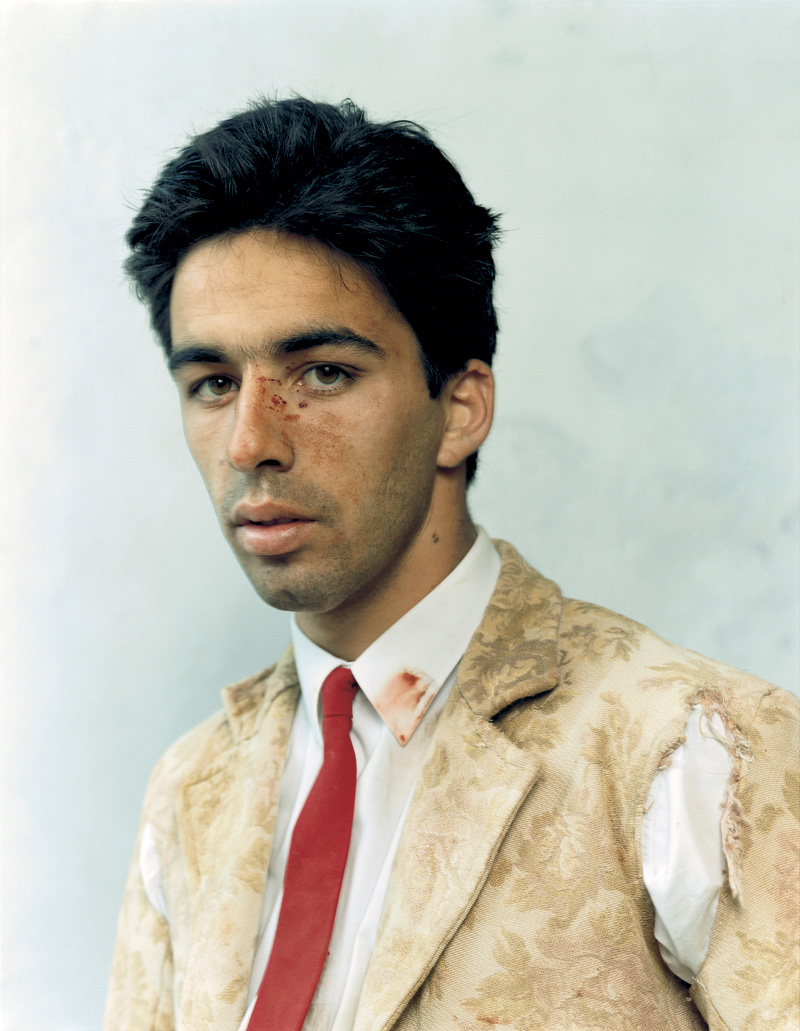
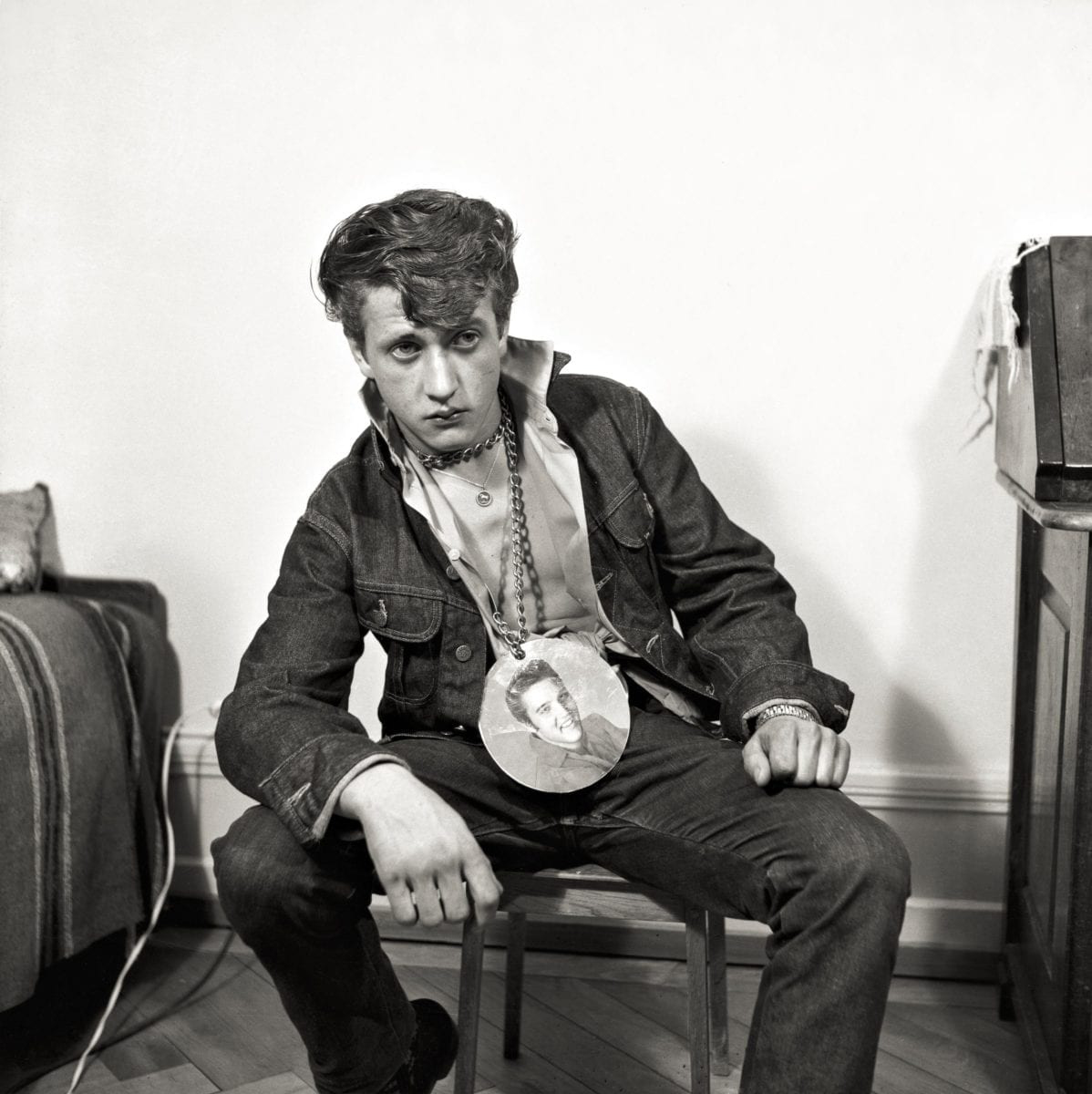
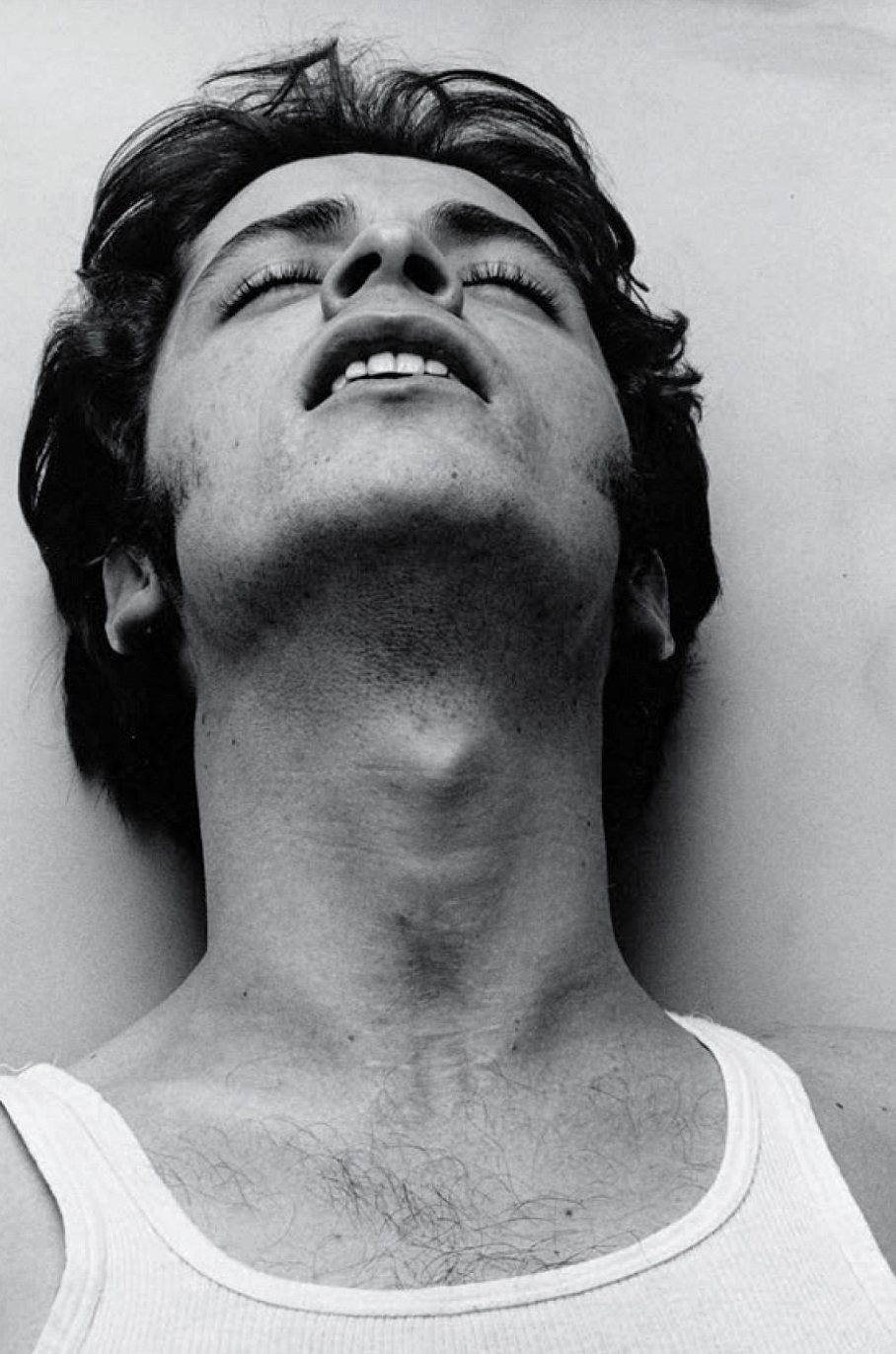
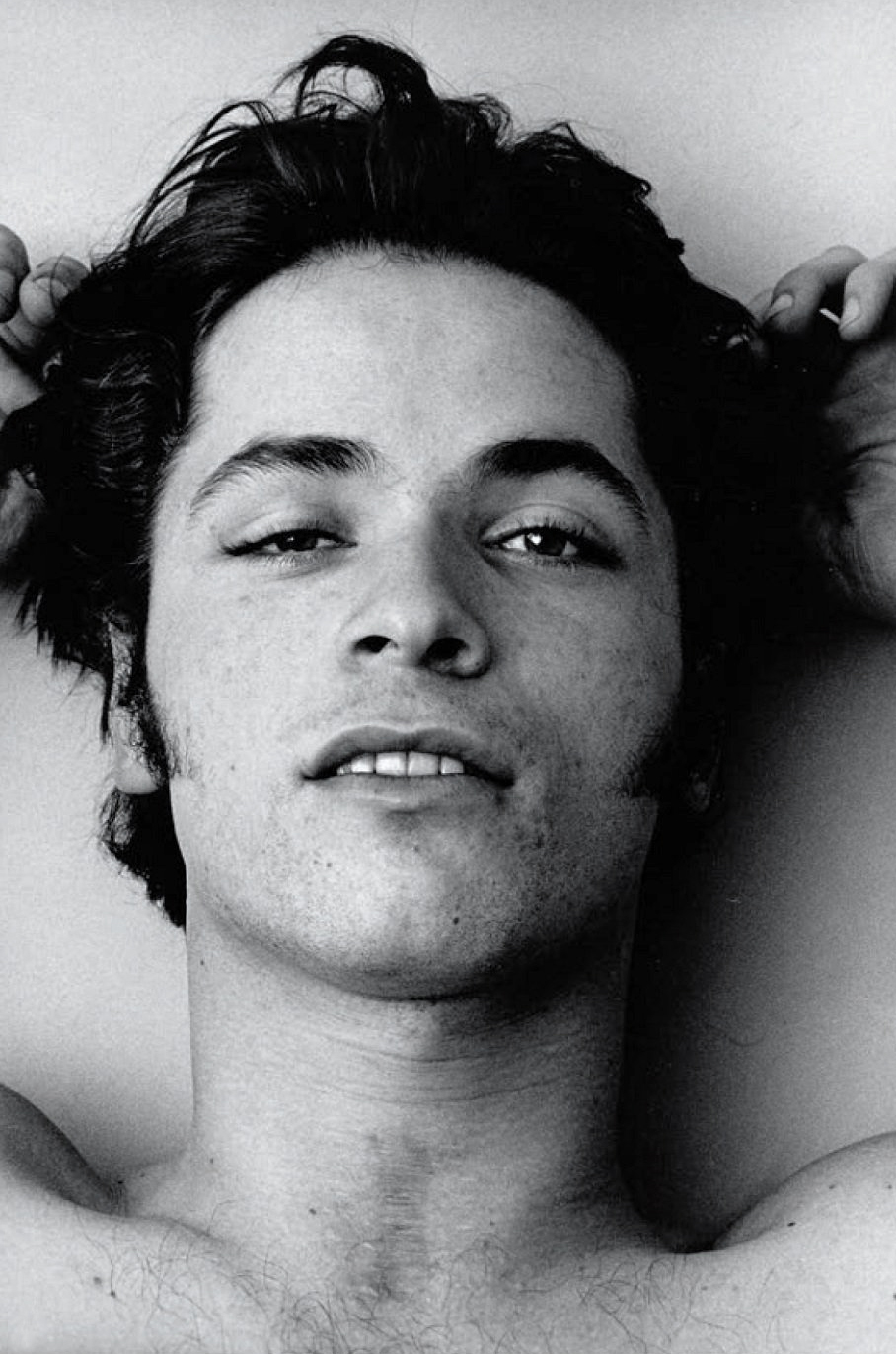
Heinrich Riebesehl (German, 1938-2010) 'Menschen Im Fahrstuhl, 20.11.1969' [People in the Elevator, 20.11.1969] 1969 from the exhibition 'Typologien: Photography in 20th-century Germany' at Fondazione Prada, Milan, April - July, 2025


Heinrich Riebesehl (German, 1938-2010)
Menschen Im Fahrstuhl, 20.11.1969 [People in the Elevator, 20.11.1969]
1969
Gelatin silver print, printed 2007
Kicken Berlin
© Heinrich Riebesehl, by SIAE 2025


Once more, with feeling

“Typology remains a highly challenging and complex notion. It operates in a paradoxical regime: on the one hand, this approach can lead to a systematic recording of people and objects based on extreme objectivity; on the other hand, typology corresponds to an individual and arbitrary choice, revealing itself as a disturbing and potentially subversive act.” (Press release)

Objective / subjective
Pattern / randomness
Isolation / extinction
Morphology / mutation
Specific / anonymous
Repetition / difference
Same / other
Structure / creativity
Orientation / disorientation
Universal / individual
Reality / imagination
Documentation / disruption
Omnipresent / unique
Exact / imprecise
Composed / emotional
Staged / snapshot
Concept / feeling
Formal / intuitive
Ritual / subversion
Collaboration / resistance

Et cetera, et cetera…

Inherent in one is the other.

Every photo within a Becher grid contains its own difference.

Dr Marcus Bunyan


Many thankx to the Fondazione Prada for allowing me to publish the photographs in the posting. Please click on the photographs for a larger version of the image.


Let’s not beat around the bush. Despite protestations to the contrary (appeals to the objectivity of the image, eschewing entirely the aspects of beauty, emotion and opinion; the rigorous frontality of the individual images giving them the simplicity of diagrams, while their density of detail offers encyclopaedic richness) these are subjective images for all their objective desire. The paradox is the more a photographer strives for objectivity, the more ego drops away, the more the work becomes their own: subjective, beautiful, emotive.


Marcus Bunyan commenting on the exhibition Bernd and Hilla Becher: Mines and Mills – Industrial Landscapes at Fotomuseum Winterthur, Zurich, February, 2012


“What happens in the case of mutation? Consider the example of the genetic code. Mutation normally occurs when some random event (for example, a burst of radiation or a coding error) disrupts an existing pattern and something else is put in its place instead. Although mutation disrupts pattern, it also presupposes a morphological standard against which it can be measured and understood as mutation. We have seen that in electronic textuality, the possibility for mutation within the text are enhanced and heightened by long coding chains. We can now understand mutation in more fundamental terms. Mutation is critical because it names the bifurcation point at which the interplay between pattern and randomness causes the system to evolve in a new direction. It reveals the productive potential of randomness that is also recognized within information theory when uncertainty is seen as both antagonistic and intrinsic to information.

We are now in a position to understand mutation as a decisive event in the psycholinguistics of information. Mutation is the catastrophe in the pattern / randomness dialectic analogous to castration in the presence / absence dialectic. It marks a rupture of pattern so extreme that the expectation of continuous replication can in longer be sustained. But as with castration, this only appears to be a disruption located at a specific moment. The randomness to which mutation testifies is implicit in the very idea of pattern, for only against the background of nonpattern can pattern emerge. Randomness is the contrasting term that allows pattern to be understood as such.”


Hayles, Katherine. How We Became Posthuman: Virtual Bodies in Cybernetics, Literature, and Informatics. Chicago: University of Chicago Press, 1999, pp. 30-33


Heinrich Riebesehl (German, 1938-2010) 'Menschen Im Fahrstuhl, 20.11.1969' [People in the Elevator, 20.11.1969] 1969


Heinrich Riebesehl (German, 1938-2010)
Menschen Im Fahrstuhl, 20.11.1969 [People in the Elevator, 20.11.1969]
1969
Gelatin silver print, printed 2007
Kicken Berlin
© Heinrich Riebesehl, by SIAE 2025


In the series Menschen Im Fahrstuhl, 20.11.1969 (People in the elevator, 20.11.1969) shot in 1969, Heinrich Riebesehl conceptualised his interest in the photographic portrait. The portraits of the workers of the Hannoversche Presse (a daily newspaper in Hanover) – taken inside an elevator with a remotely operated small-format camera – are dated and numbered in sequential order: Riebesehl dispensed with a title or a more detailed description of the subjects portrayed. By omitting distinctive elements from the images, such as the profession or age of the subjects, he made the situation the key factor in the shots. In fact, the images are studies of the behaviors of people in that particular space, their body languages and gazes. Riebesehl knew that environment very well, because he had worked for a long time as a photojournalist, before turning to conceptual art photography.

Exhibition text from the Fondazione Prada by Cord Riechelmann
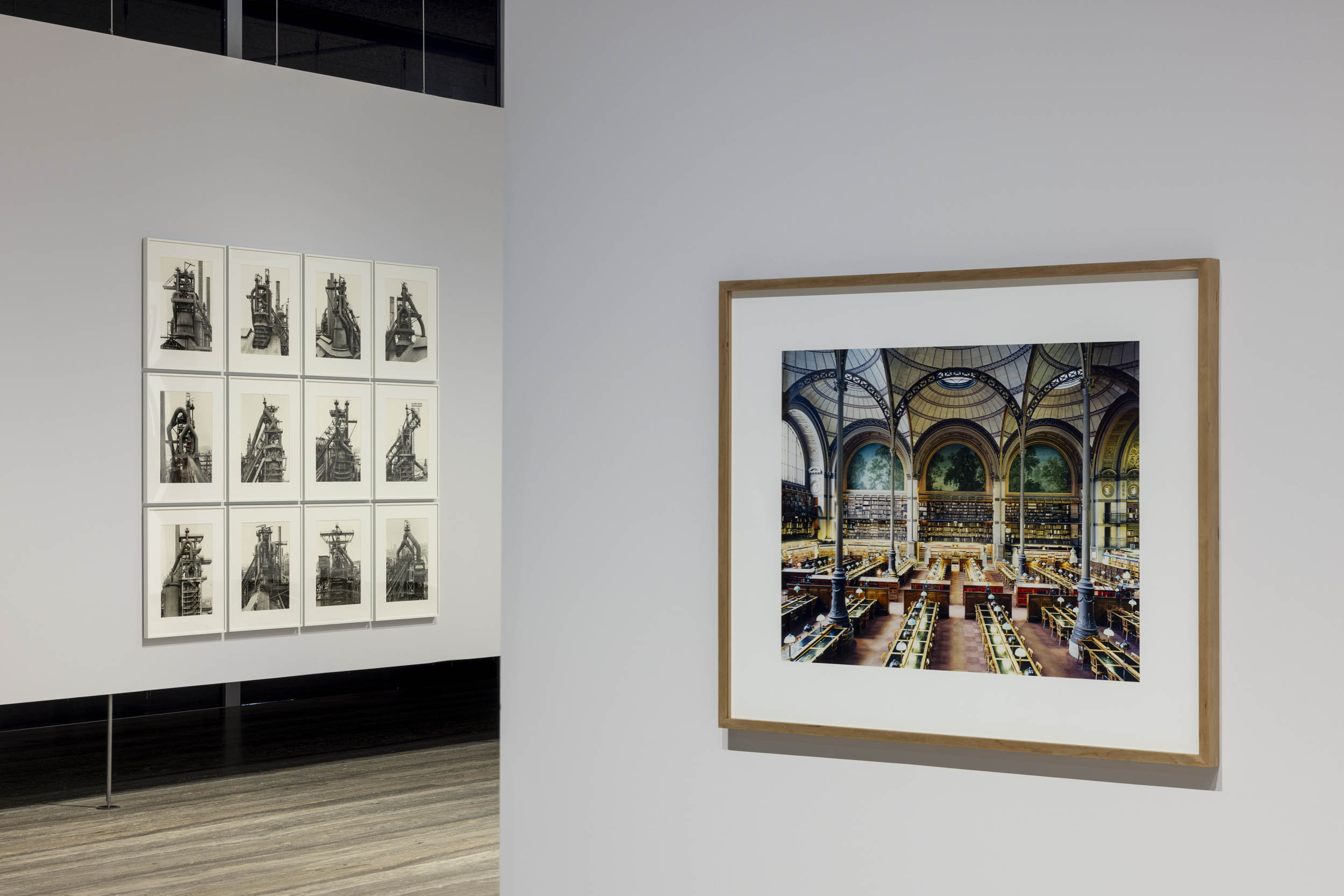
 

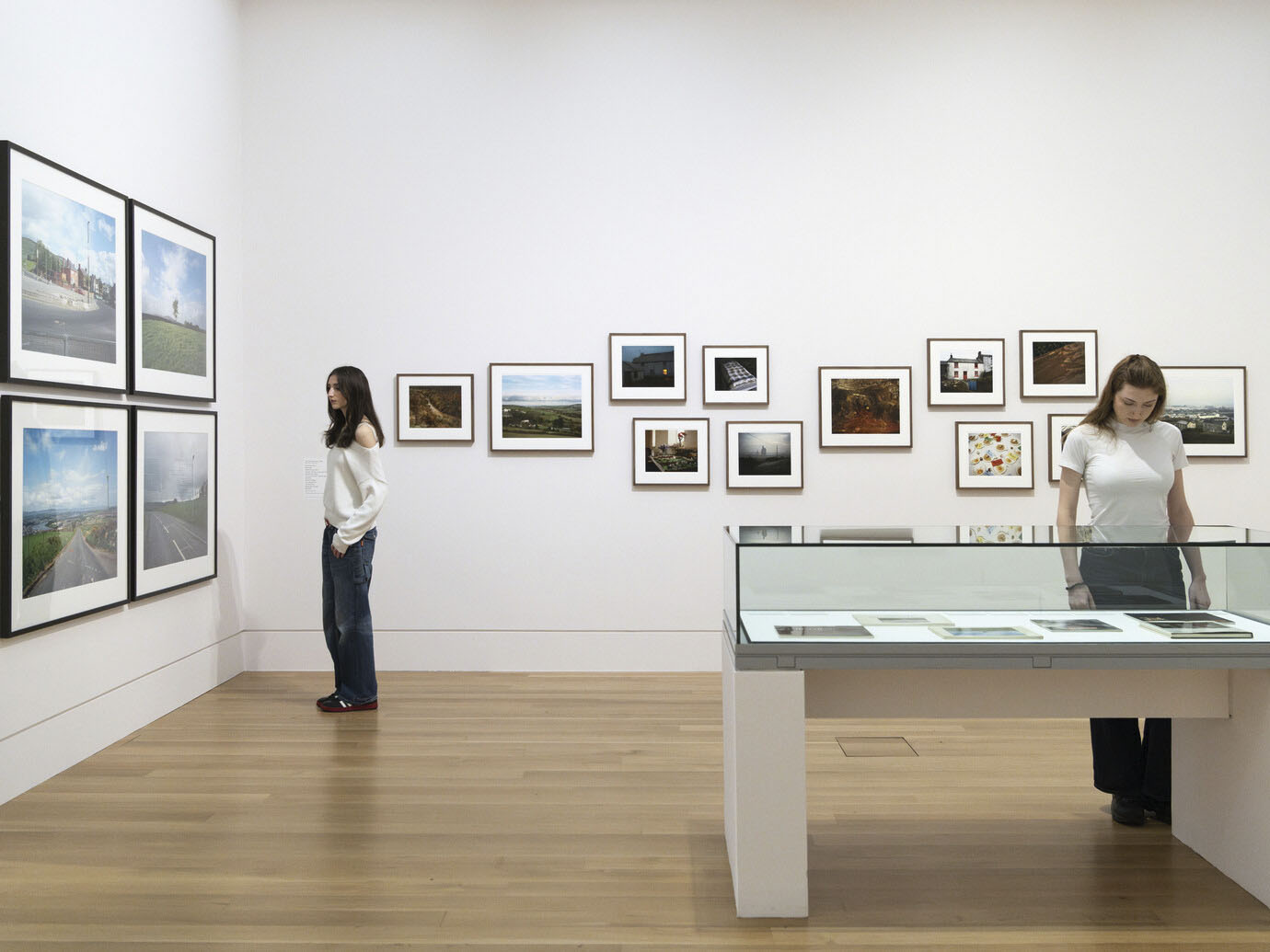
Installation view of the exhibition 'Typologien: Photography in 20th-century Germany' at Fondazione Prada, Milan showing at left Bernd and Hiller Becher's 'Hochöfen' (Blast furnaces) 1970-1989; and at right, Candida Höfer's 'Bibliotheque Nationale de France XXIII' 1997


Installation view of the exhibition Typologien: Photography in 20th-century Germany at Fondazione Prada, Milan showing at left Bernd and Hiller Becher’s Hochöfen (Blast furnaces) 1970-1989; and at right, Candida Höfer’s Bibliotheque Nationale de France XXIII 1997
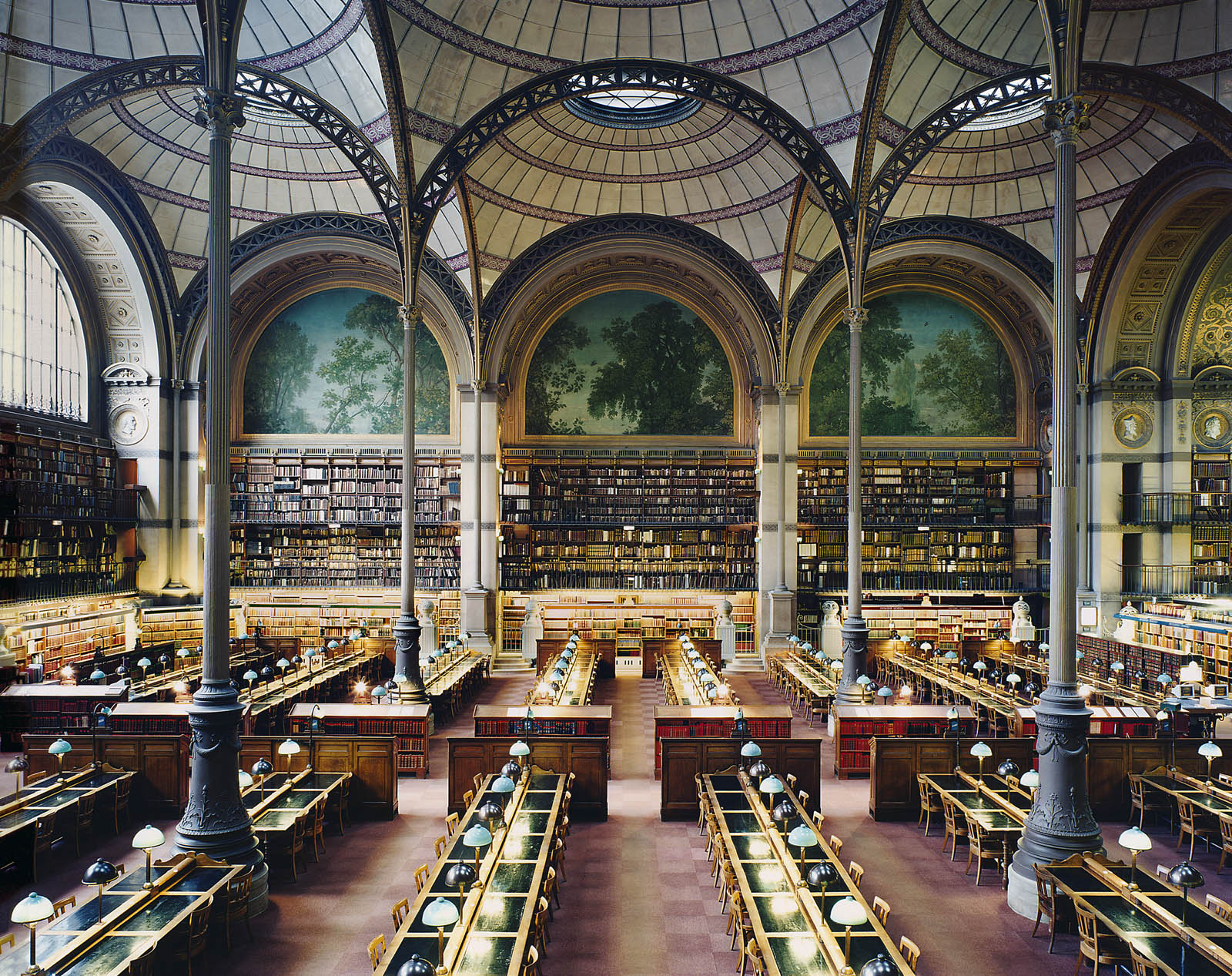
 

Candida Höfer (German, b. 1944) 'Bibliotheque Nationale de France XXIII' 1997 from the exhibition 'Typologien: Photography in 20th-century Germany' at Fondazione Prada, Milan, April - July, 2025


Candida Höfer (German, b. 1944)
Bibliotheque Nationale de France XXIII
1997
Inkjet print
© Candida Höfer, Cologne


In the photographs of libraries in London, Paris, and New York, which at first glance appear to be technically scientific records, Candida Höfer manages to capture something that is not visible: ingenuity. The libraries’ rooms have high ceilings, and the rows of seats are neatly arranged. In their impressiveness, they reflect the architecture of the 19th-century conception of knowledge and science, typical of the dominant nations of the time because of their commercial and colonial power. The objective nature of the deserted spaces, precisely in how they seem to be neutral to the individual needs of the students, suggests something in the image that could hardly be less objective: the possibility for intellectual exchange that these spaces promise and deliver in Höfer’s photographs.

Exhibition text from the Fondazione Prada by Cord Riechelmann


Candida Höfer (German, b. 1944) 'Zoologischer Garten Washington DC IV' 1992


Candida Höfer (German, b. 1944)
Zoologischer Garten Washington DC IV
1992
Inkjet print
© Candida Höfer, by SIAE 2025/VG BildKunst, Bonn 2025


In Candida Höfer’s photographs shot in zoos, the animals document a specific form of loneliness in modern times. In these images, the lines of development of two disciplines collide. Not only in the photographs, but also in reality, they function independently of each other: modern architecture and behavioural research. Modern architecture has become established in zoological gardens but has never considered the animal and its needs. Based on the knowledge gained from behavioural research, by choosing to portray iconic large mammals such as giraffes, lions, and polar bears, Höfer has represented the dilemma of a world in which entire species are threatened with extinction and in which zoos see themselves as a kind of ‘Noah’s Ark.’

Exhibition text from the Fondazione Prada by Cord Riechelmann
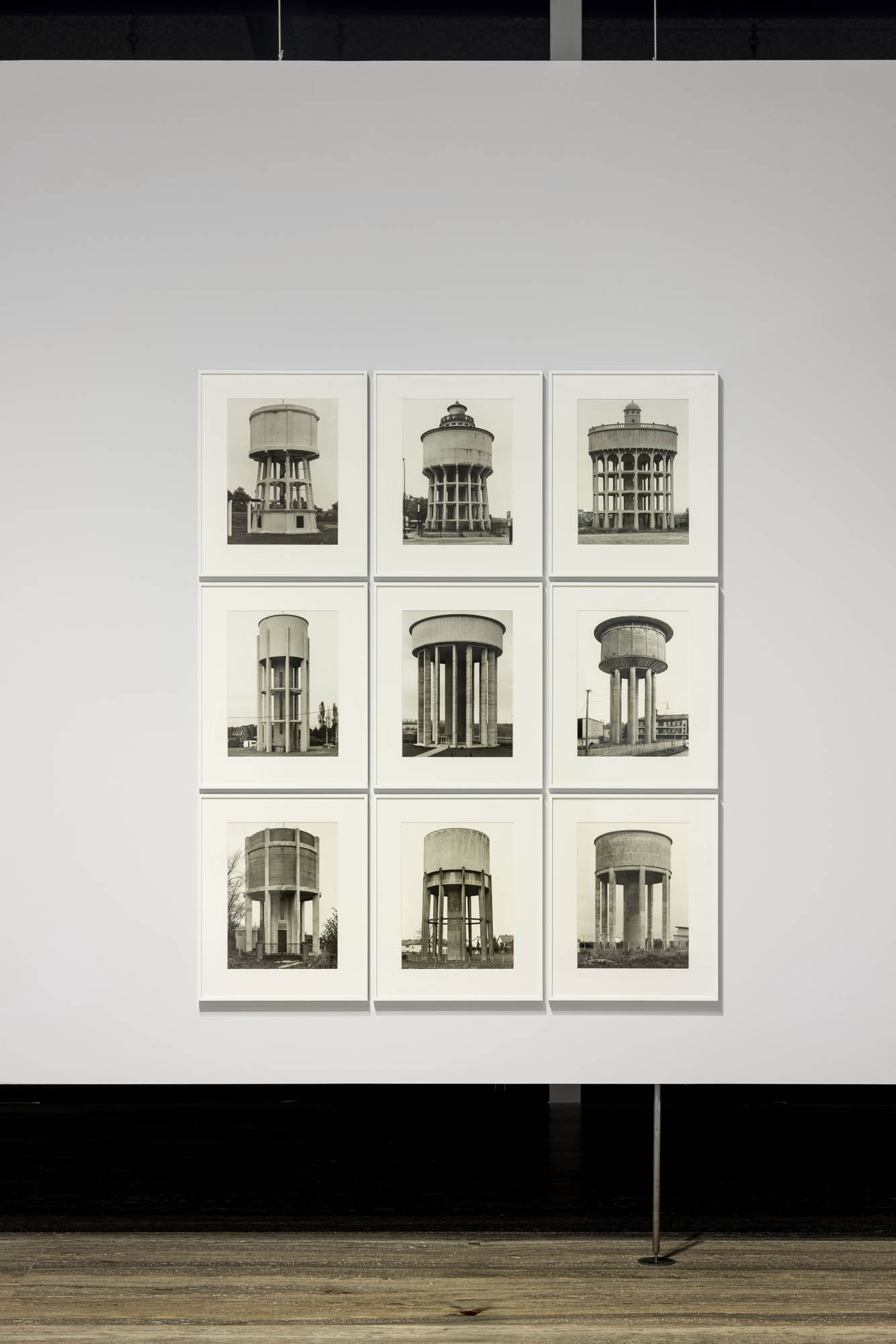
 

Installation view of the exhibition 'Typologien: Photography in 20th-century Germany' at Fondazione Prada, Milan showing Bernd and Hilla Becher's 'Wassertürme (Water towers)' 1966-1986


Installation view of the exhibition Typologien: Photography in 20th-century Germany at Fondazione Prada, Milan showing Bernd and Hilla Becher’s Wassertürme (Water towers) 1966-1986


Bernd and Hilla Becher (German) Bernd Becher (German, 1931-2007) Hilla Becher (German, 1934-2015) 'Wassertürme (Water towers)' 1966-1986 from the exhibition 'Typologien: Photography in 20th-century Germany' at Fondazione Prada, Milan, April - July, 2025


Bernd and Hilla Becher (German)
Bernd Becher (German, 1931-2007)
Hilla Becher (German, 1934-2015)
Wassertürme (Water towers)
1966-1986
Leeds, GB, 1966
Hasselt, B, 1985
Newton le Willows, GB, 1966
Beaufays/Liège, B, 1979
Kwaadmechelen, B, 1971
Padova, I, 1986
Outreau/Boulogne, F, 1973
Primasens, Saarland, D, 1980
Mesnil-Val, F, 1972
9 gelatin silver prints
© Estate Bernd & Hilla Becher, represented by Max Becher, courtesy of Die Photographische Sammlung/SK Stiftung Kultur – Bernd & Hilla Becher Archive, Cologne, 2025


Installation view of the exhibition 'Typologien: Photography in 20th-century Germany' at Fondazione Prada, Milan showing the work of Thomas Struth


Installation view of the exhibition Typologien: Photography in 20th-century Germany at Fondazione Prada, Milan showing the work of Thomas Struth
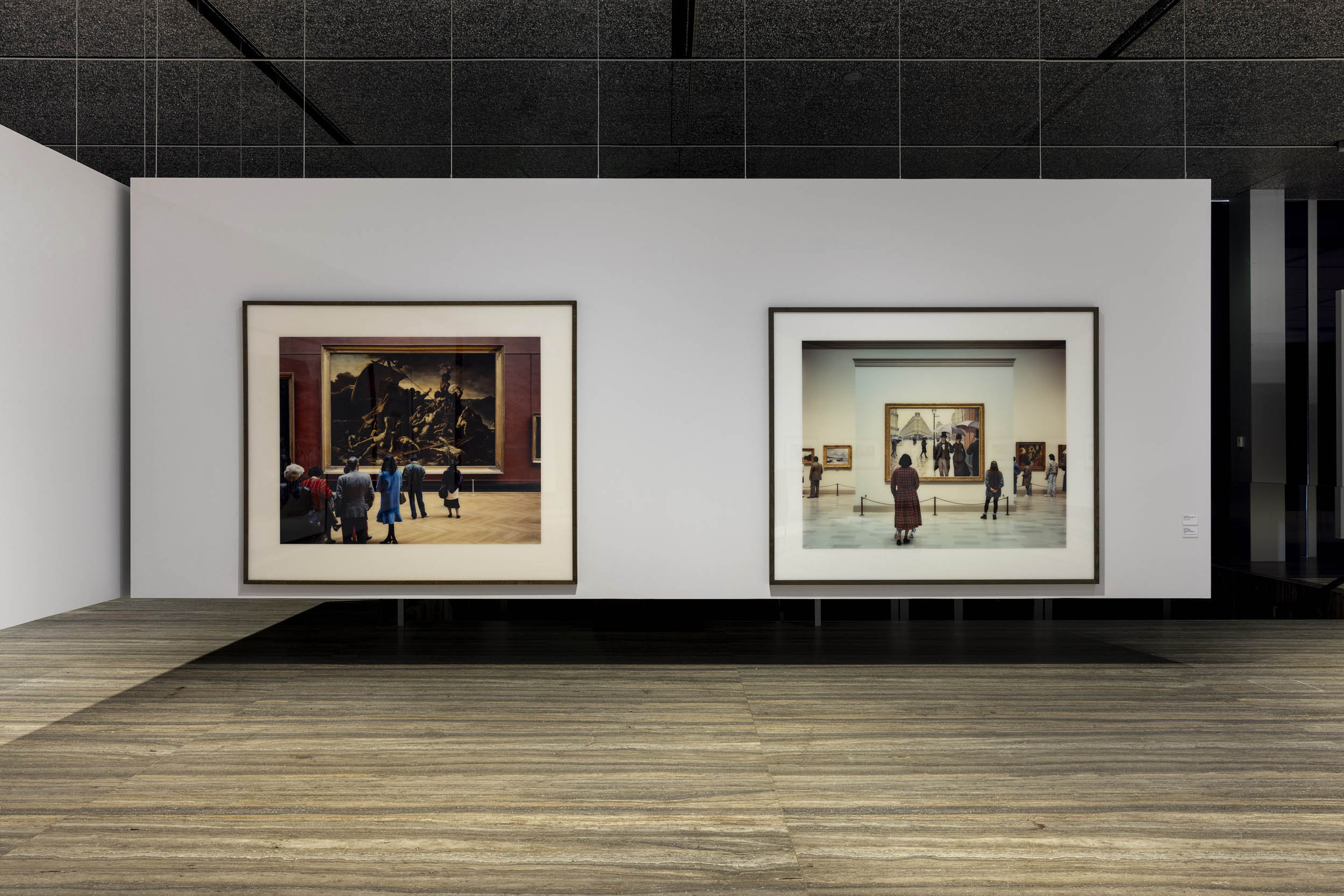
 

Installation view of the exhibition 'Typologien: Photography in 20th-century Germany' at Fondazione Prada, Milan showing the work of Thomas Struth with at left, 'Musée du Louvre IV' Paris, 1989


Installation view of the exhibition Typologien: Photography in 20th-century Germany at Fondazione Prada, Milan showing the work of Thomas Struth with at left, Musée du Louvre IV Paris, 1989
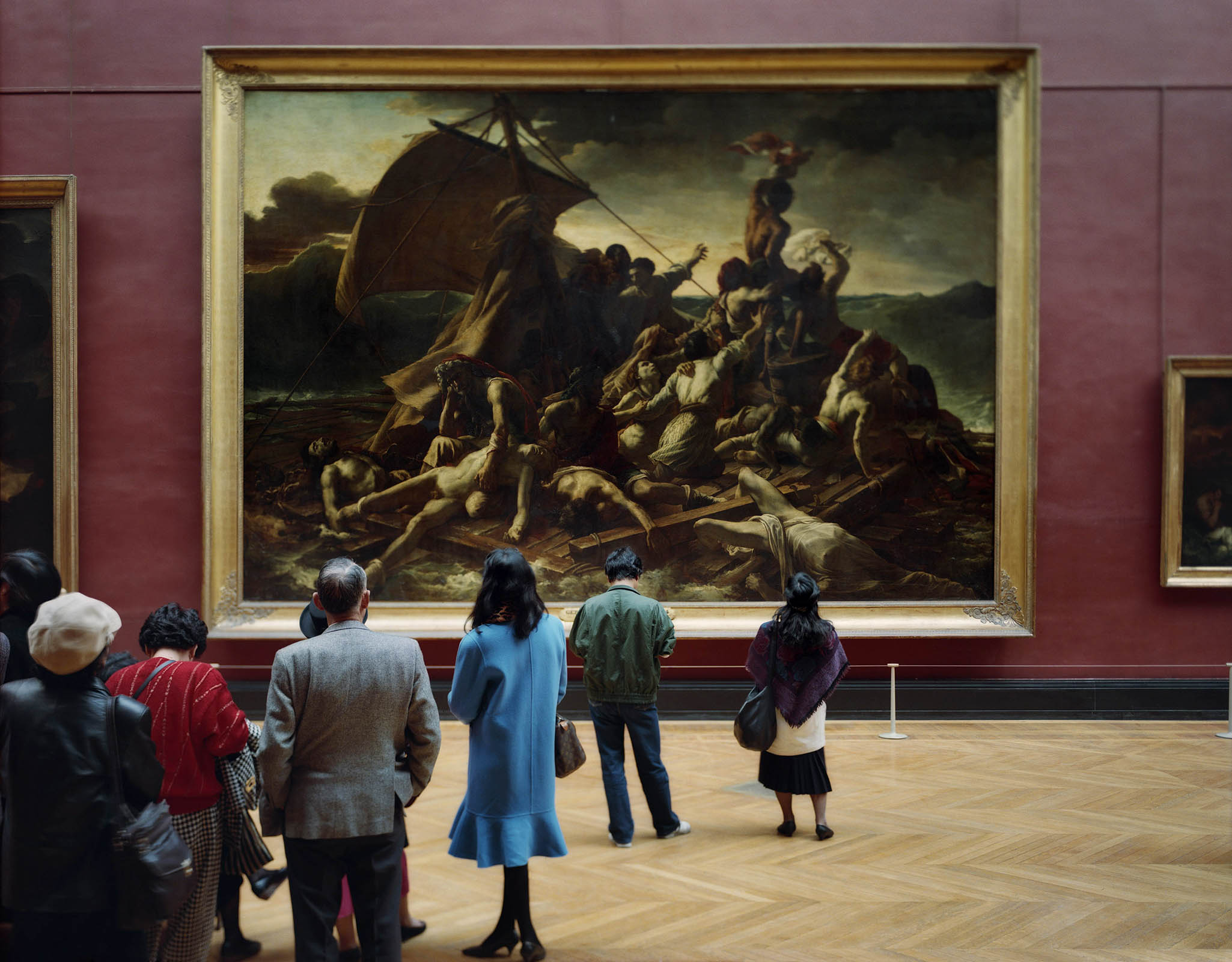
 

Thomas Struth (German, b. 1954) 'Musée du Louvre IV' Paris, 1989


Thomas Struth (German, b. 1954)
Musée du Louvre IV
Paris, 1989
Colour photograph on C-print
© Thomas Struth / Courtesy ZKM | Center for Art and Media Karlsruhe, Karlsruhe


In his practice, Thomas Struth demonstrates meticulous attention to the architectural environment, as well as to people and objects. In his large-format colour series Museum Photographs (1989-1992), Struth captures anonymous individuals and crowds gazing at artworks in museums. A significant example is Louvre 4, Paris 1989, in which the artist photographs from behind a group of viewers standing in front of Théodore Géricault’s The Raft of the Medusa (1819). Often made with a large-format camera, his images reflect what Struth calls “exact vision”: the framing must not conceal anything or suggest secret content, thus resulting in an enigmatic outcome.

Exhibition text from the Fondazione Prada by Cord Riechelmann


Installation view of the exhibition 'Typologien: Photography in 20th-century Germany' at Fondazione Prada, Milan showing Andreas Gursky's 'Paris, Montparnasse' 1993


Installation view of the exhibition Typologien: Photography in 20th-century Germany at Fondazione Prada, Milan showing Andreas Gursky’s Paris, Montparnasse 1993


Andreas Gursky’s large-format work, Paris, Montparnasse (1993) has become an iconic example of his work. It depicts the Maine-Montparnasse II block of flats, located on Rue Commandant-Mouchotte in Paris and built between 1959 and 1964 on a design by French architect Jean Dubuisson. This is one of the first images that Gursky created using digital post-production. In real life, the building does not look the way it appears in the image: using a digital editing process, Gursky transformed the façade into a game of differences and repetitions by processing the windows. In fact, by reiterating forms that are always identical, he produced a seemingly infinite number of them, with colour variations that are activated by a calculated dynamic.

Exhibition text from the Fondazione Prada by Cord Riechelmann
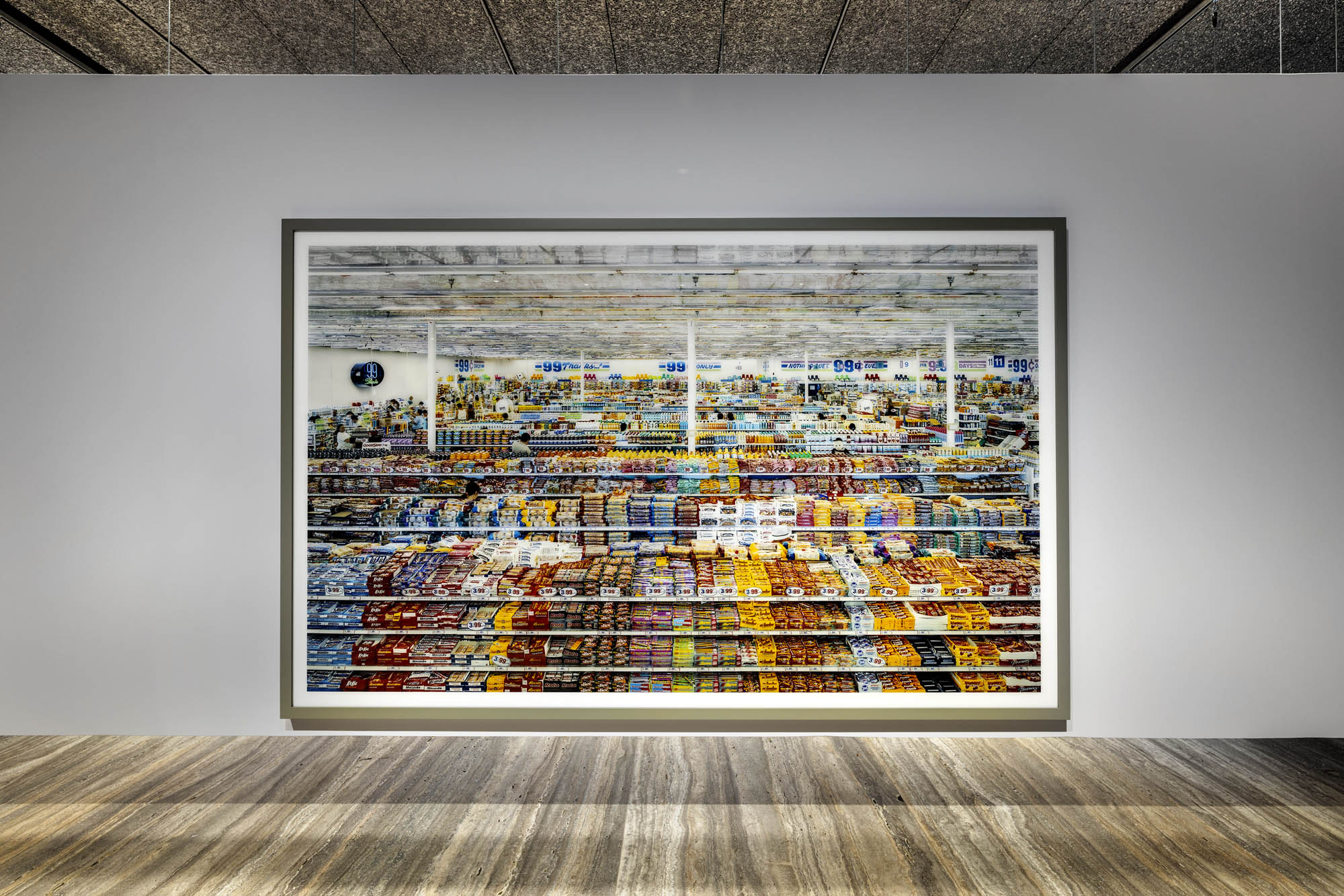
 

Installation view of the exhibition 'Typologien: Photography in 20th-century Germany' at Fondazione Prada, Milan showing Andreas Gursky's '99 Cent' 1999


Installation view of the exhibition Typologien: Photography in 20th-century Germany at Fondazione Prada, Milan showing Andreas Gursky’s 99 Cent 1999


In 99 Cent (1999), Andreas Gursky photographed supermarket shelves using the same formal scheme used in Paris, Montparnasse (1993). The shelves crammed with everyday products such as detergents represent the inexhaustible flow of goods in the global system of production and distribution. Gursky’s work conveys a feeling of disorientation generated by the excessive stimuli and details typical of a shelf in a hypermarket.

Exhibition text from the Fondazione Prada by Cord Riechelmann
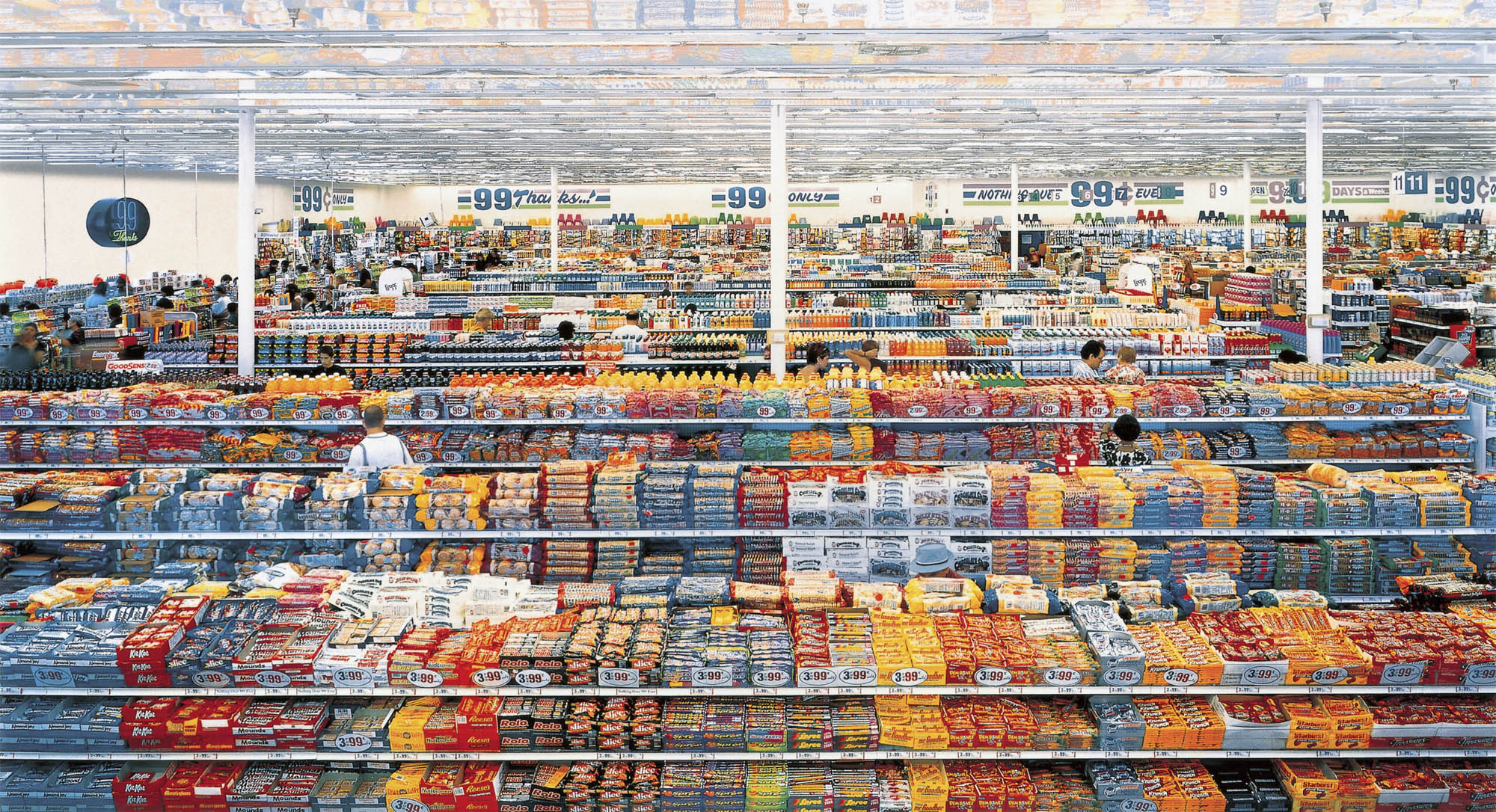
 

Andreas Gursky (German, b. 1955) '99 Cent' 1999


Andreas Gursky (German, b. 1955)
99 Cent
1999 (remastered 2009)
Inkjet print


“Typologien” is an extensive study dedicated to 20th-century German photography. The exhibition, hosted within Podium, the central building of the Milan headquarters, is curated by Susanne Pfeffer, art historian and director of the MUSEUM MMK FÜR MODERNE KUNST, Frankfurt. 

The project attempts to apply the principle of “typology,” which originated in 17th- and 18th-century botany to categorise and study plants, and appeared in photography in the early 1900s, affirming itself in Germany throughout the 20th century. Paradoxically, the given formal principle allows for unexpected convergences of German artists spanning different generations and the manifestation of their individual approaches. 

The exhibition path will follow a typological rather than a chronological order, bringing together more than 600 photographic works by 25 established and lesser-known artists essential for recounting a century of German photography, including Bernd and Hilla Becher, Sibylle Bergemann, Karl Blossfeldt, Ursula Böhmer, Christian Borchert, Margit Emmrich, Hans-Peter Feldmann, Isa Genzken, Andreas Gursky, Candida Höfer, Lotte Jacobi, Jochen Lempert, Simone Nieweg, Sigmar Polke, Gerhard Richter, Heinrich Riebesehl, Thomas Ruff, August Sander, Ursula Schulz-Dornburg, Thomas Struth, Wolfgang Tillmans, Rosemarie Trockel, Umbo (Otto Umbehr), and Marianne Wex. A system of suspended walls will create geometric partitions in the exhibition space, forming unexpected connections between artistic practices that differ from each other, but are united by a common principle or intention of classification.

As stated by Susanne Pfeffer, “Only through juxtaposition and direct comparison is it possible to find out what is individual and what is universal, what is normative or real. Differences are evidence of the abundance of nature and the imagination of humans: the fern, the cow, the human being, the ear; the bus stop, the water tower, the stereo system, the museum. The typological comparison allows differences and similarities to emerge and the specifics to be grasped. Unknown or previously unperceived things about nature, the animal, or the object, about place and time become visible and recognisable.”

In photography, employing typologies means affirming an equivalence between images and the absence of hierarchies in terms of represented subjects, motifs, genres, and sources. Despite this, typology remains a highly challenging and complex notion. It operates in a paradoxical regime: on the one hand, this approach can lead to a systematic recording of people and objects based on extreme objectivity; on the other hand, typology corresponds to an individual and arbitrary choice, revealing itself as a disturbing and potentially subversive act.

The hypothesis that photography plays a key role not only in fixing distinctive phenomena but also in organising and classifying a plurality of visible manifestations remains a vital force in today’s artistic efforts to navigate the complexity of our social and cultural realities. With the spread of digital imagery and practices, the concept of typology continues to be questioned and re-defined by contemporary photographers and artists. 

As underlined by Susanne Pfeffer, “The unique, the individual, seems to have been absorbed into a global mass, the universality of things is omnipresent. The Internet allows typologies to be created in a matter of seconds. And yet this is precisely when it seems important – to artists – to take a closer look.” As further explained by Pfeffer, “When the present seems to have abandoned the future, we need to observe the past more closely. When everything seems to be shouting at you and becoming increasingly brutal, it is important to take a quiet pause and use the silence to see and think clearly. When differences are not seen as something other, but turned into something that divides us, it is crucial to notice what we have in common. Typologies allow us to identify remarkable similarities and subtle differences.”

Text from the Fondazione Prada website


Typologien | Fondazione Prada Milano

An extensive study dedicated to 20th-century German photography. “Typologien” attempts to apply the principle of “typology,” which originated in 17th- and 18th-century botany to categorise and study plants, and appeared in photography in the early 1900s, affirming itself in Germany throughout the 20th century.

The exhibition, hosted within Podium, the central building of the Milan headquarters, is curated by Susanne Pfeffer, art historian and director of the MUSEUM MMK FÜR MODERNE KUNST, Frankfurt.
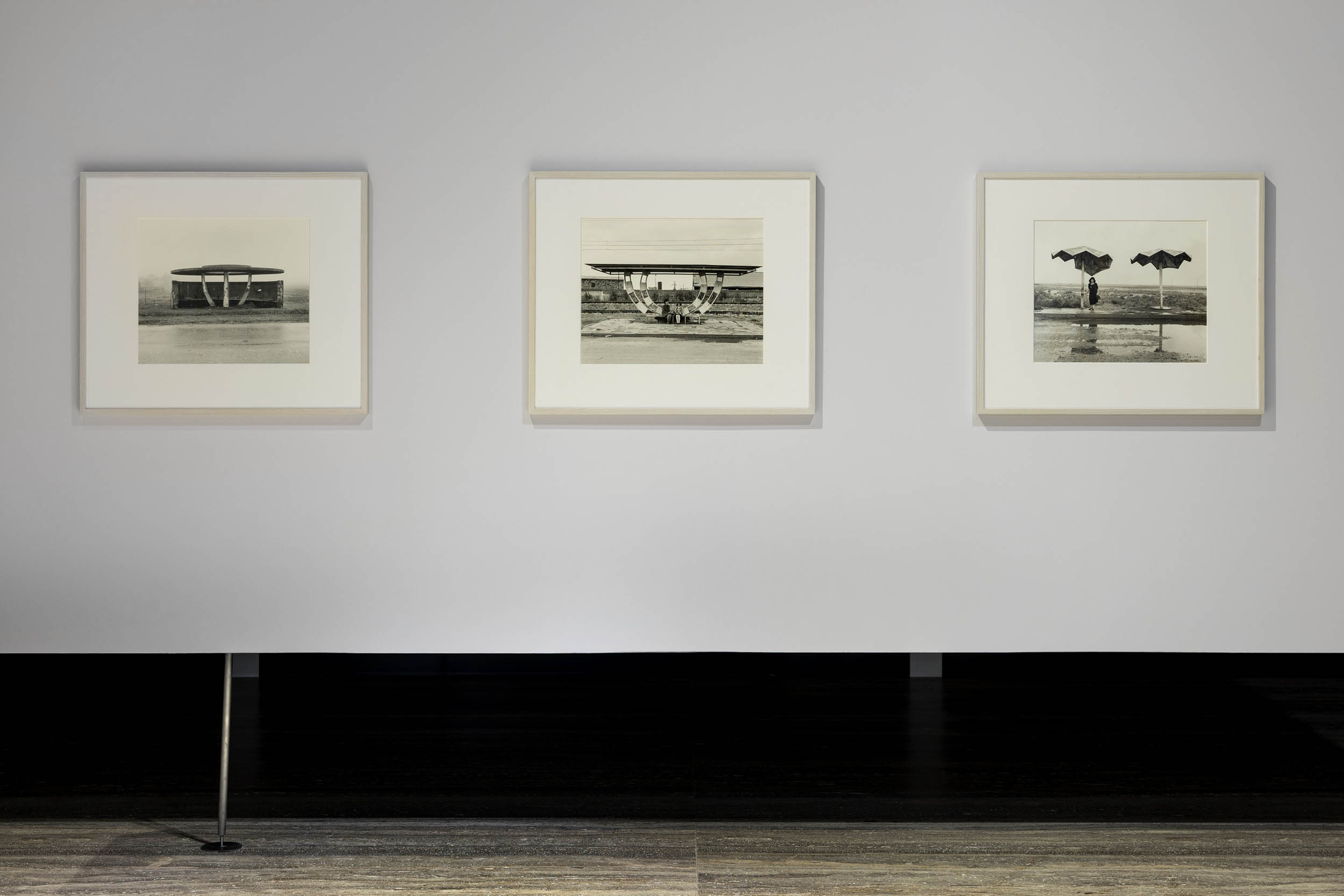
 

Installation view of the exhibition 'Typologien: Photography in 20th-century Germany' at Fondazione Prada, Milan showing the work of Ursula Schulz-Dornburg


Installation view of the exhibition Typologien: Photography in 20th-century Germany at Fondazione Prada, Milan showing the work of Ursula Schulz-Dornburg
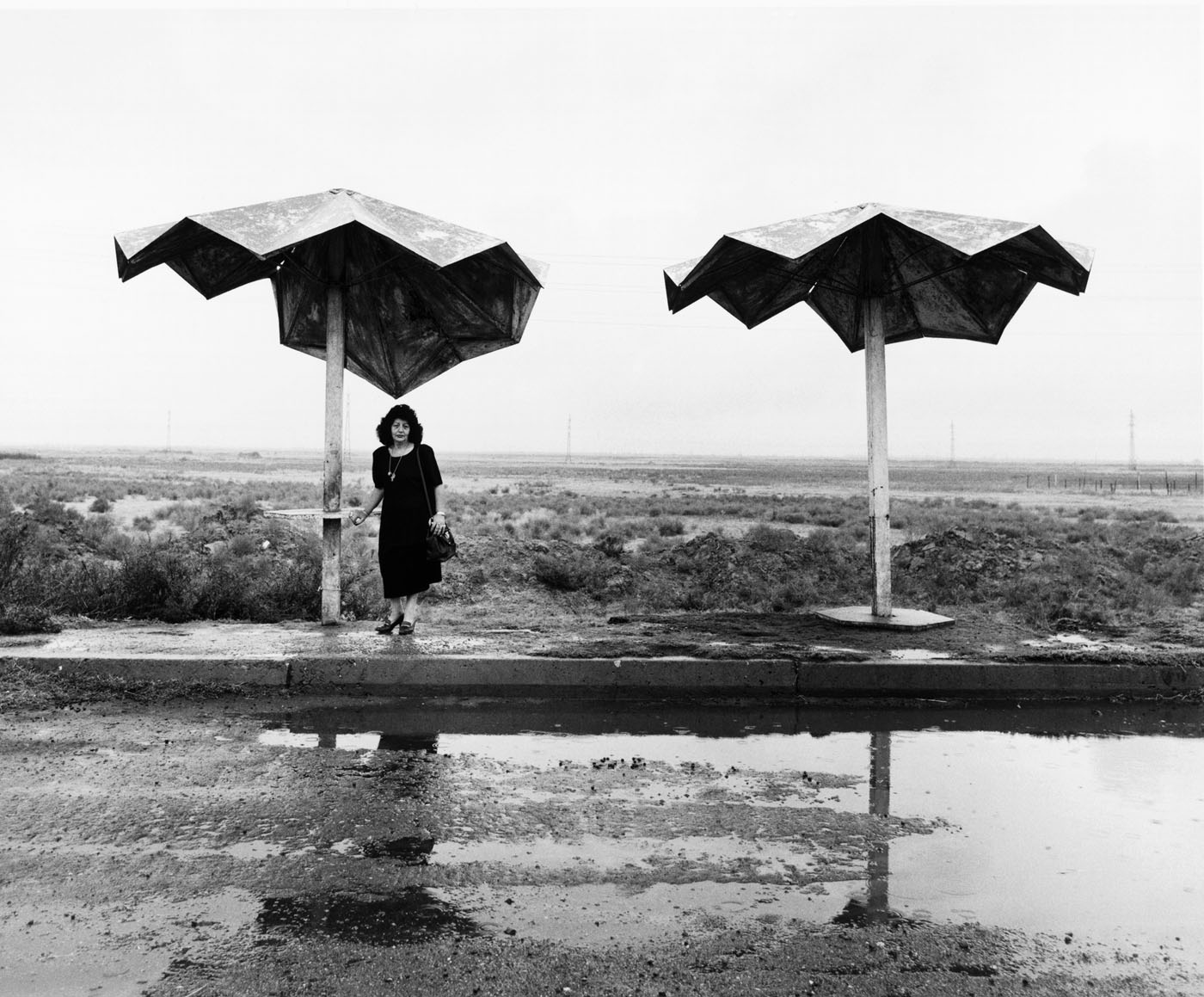
 

Ursula Schulz-Dornburg (German, b. 1938) 'Transit Sites-Armenia-Erevan-Ararat' 2001


Ursula Schulz-Dornburg (German, b. 1938)
Transit Sites-Armenia-Erevan-Ararat
2001
Gelatin silver print on Forte paper
© Ursula Schulz-Dornburg


Ursula Schulz-Dornburg was visiting convents and monasteries in Armenia when she happened to come across one of these unique bus stops, partly futuristic and partly surreal. From 1997 to 2011, she portrayed numerous bus stops, often in very remote locations. In a country that was experiencing a dramatic transition, from being part of the Soviet Union to its new status as an independent republic, these bus stops look like the remnants of a utopian socialism, which in Schulz-Dornburg’s images are kept alive mainly by women and children. The photographer said she was so impressed by the dignity of those women waiting at the bus stop, who even in the most extreme poverty looked as though they were on their way to the Opera, that she asked their permission to photograph them. What emerged was a document of a quiet life that manages with dignity to deal with even the harshest adversity.

Exhibition text from the Fondazione Prada by Cord Riechelmann
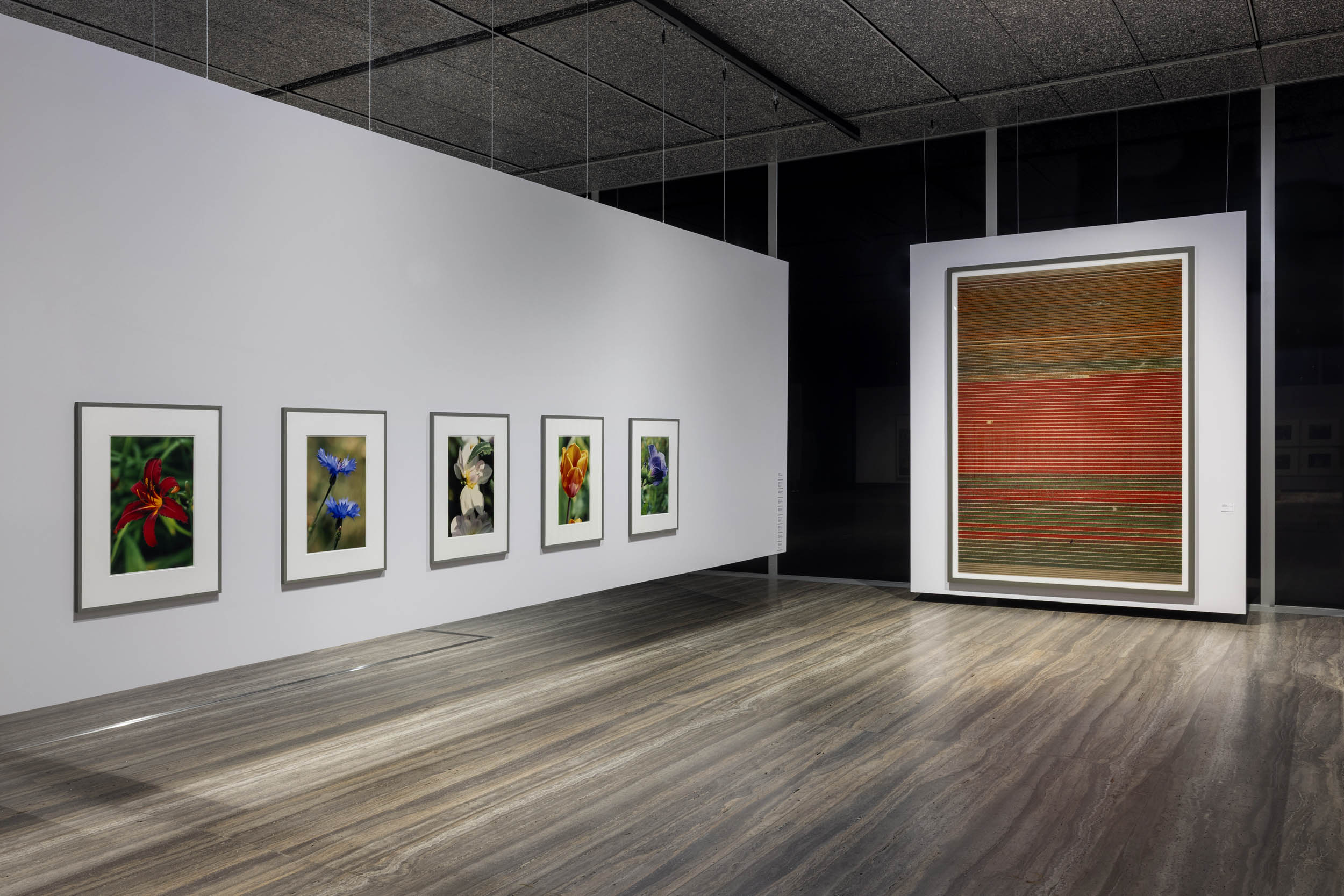
 

Installation view of the exhibition 'Typologien: Photography in 20th-century Germany' at Fondazione Prada, Milan showing at left, flower photographs by Thomas Struth; and at right, Andreas Gursky's 'Untitled XVIII' 2015


Installation view of the exhibition ‘Typologien: Photography in 20th-century Germany’ at Fondazione Prada, Milan showing at left, flower photographs by Thomas Struth; and at right, Andreas Gursky’s Untitled XVIII 2015 (below)
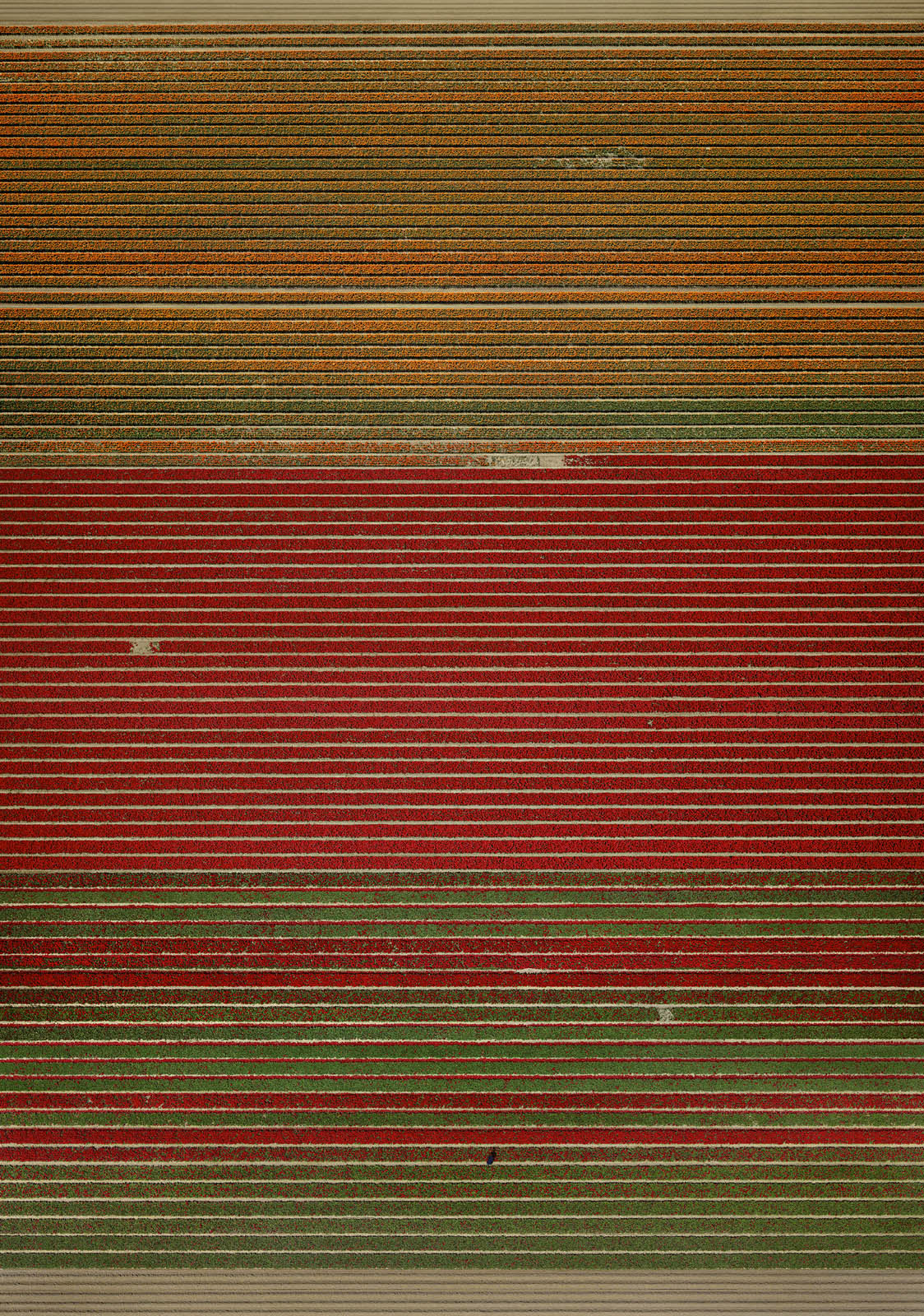
 

Andreas Gursky (German, b. 1955) 'Untitled XVIII' 2015


Andreas Gursky (German, b. 1955)
Untitled XVIII
2015
Inkjet print
Atelier Andreas Gursky


Unlike works such as Paris, Montparnasse (1993), in the Untitled series he produced between 2015 and 2016, Andreas Gursky depicted rows of tulips without providing a title or location for the pictures. Viewed from a distance, the photographs are reminiscent of Abstract Expressionist paintings, but even looking at them at close range, the lushly blooming flowers are undiscernible. Living in Düsseldorf, close to the Dutch border, Gursky is familiar with the intensively cultivated Dutch tulip crops, where no unwanted insect or worm would possibly be allowed to spoil the bulbs. The sterility of industrial flower production, far from being harmless and healthy, is captured by Gursky in images that, in turn, are neither reassuring nor pleasant.

Exhibition text from the Fondazione Prada by Cord Riechelmann


Installation view of the exhibition 'Typologien: Photography in 20th-century Germany' at Fondazione Prada, Milan showing the flower photographs of Thomas Struth with at left, 'Small Closed Sunflower, No. 18, Winterthur'
1992; and at third left, 'Single Red Lily - No. 51, Düsseldorf (Botanischer Garten)' 1993


Installation view of the exhibition Typologien: Photography in 20th-century Germany at Fondazione Prada, Milan showing the flower photographs of Thomas Struth with at left, Small Closed Sunflower, No. 18, Winterthur 1992 (below); and at third left, Single Red Lily – No. 51, Düsseldorf (Botanischer Garten) 1993 (below)
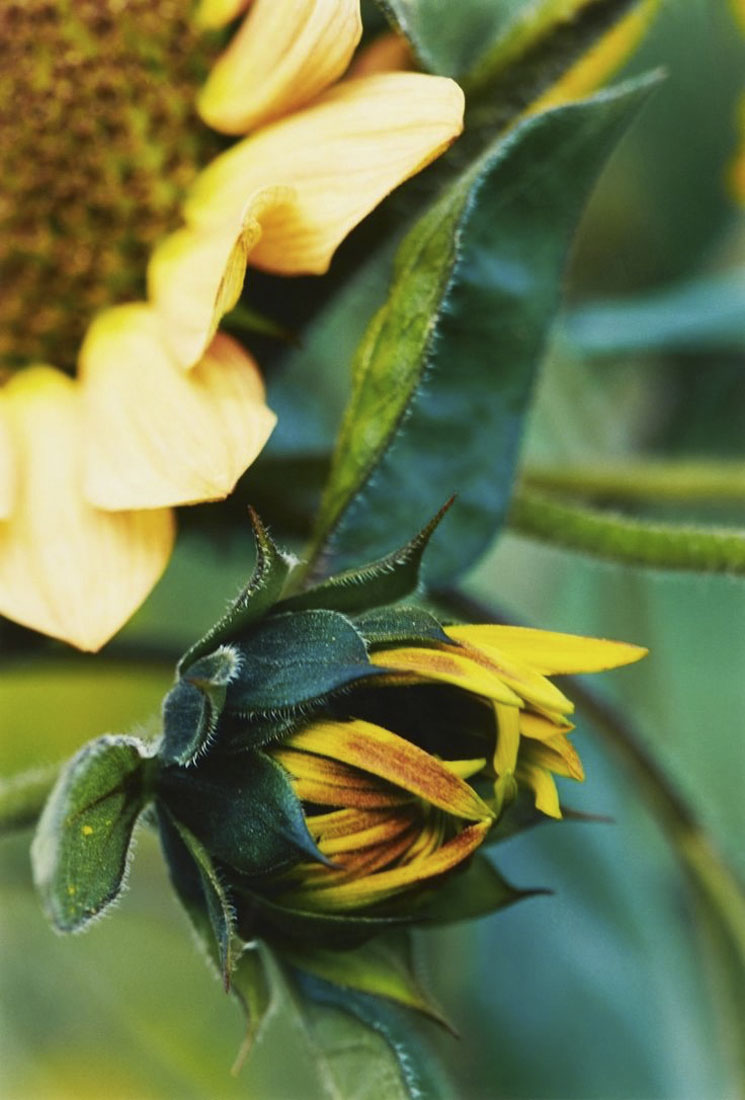
 

Thomas Struth (German, b. 1954) 'Small Closed Sunflower, No. 18, Winterthur' 1992


Thomas Struth (German, b. 1954)
Small Closed Sunflower, No. 18, Winterthur
1992
Colour photograph on C-print
© Thomas Struth / Courtesy ZKM | Center for Art and Media Karlsruhe, Karlsruhe
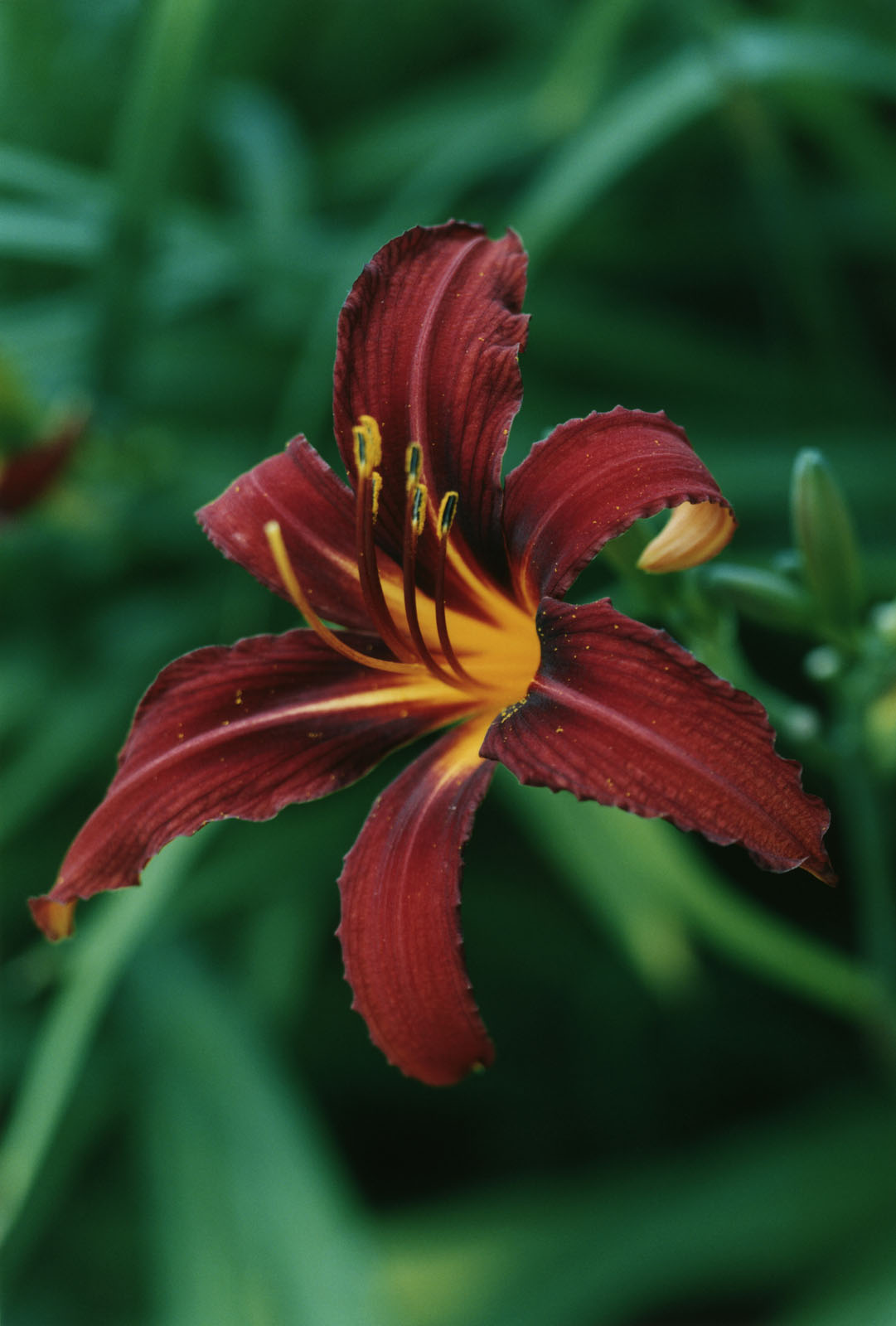
 

Thomas Struth (German, b. 1954) 'Single Red Lily - No. 51, Düsseldorf (Botanischer Garten)' 1993


Thomas Struth (German, b. 1954)
Single Red Lily – No. 51, Düsseldorf (Botanischer Garten)
1993
C-print
Viehof Collection
© Thomas Struth / Courtesy Viehof Collection, Mönchengladbach


A student of the artist Gerhard Richter and later of the photographer Bernd Becher at the Art Düsseldorf Academy from 1973 to 1980, Thomas Struth habitually works in thematic cycles centered around museums, flowers, and portraits of families and passers-by. The “exact vision” – the intention underpinning Struth’s photography – can be seen in both the portraits of two cornflowers shoot in Düsseldorf and the image of a red lily in the city’s Botanical Garden. Struth notes down the name or address of the site where he took the photograph, as in the case of the flower of a hollyhock portrayed in Düsseldorf’s Nordpark. This is to evoke the poetry of the place and provide an exact account of the plants’ origin, preserving the authenticity of the shots without digitally altering them.

Exhibition text from the Fondazione Prada by Cord Riechelmann
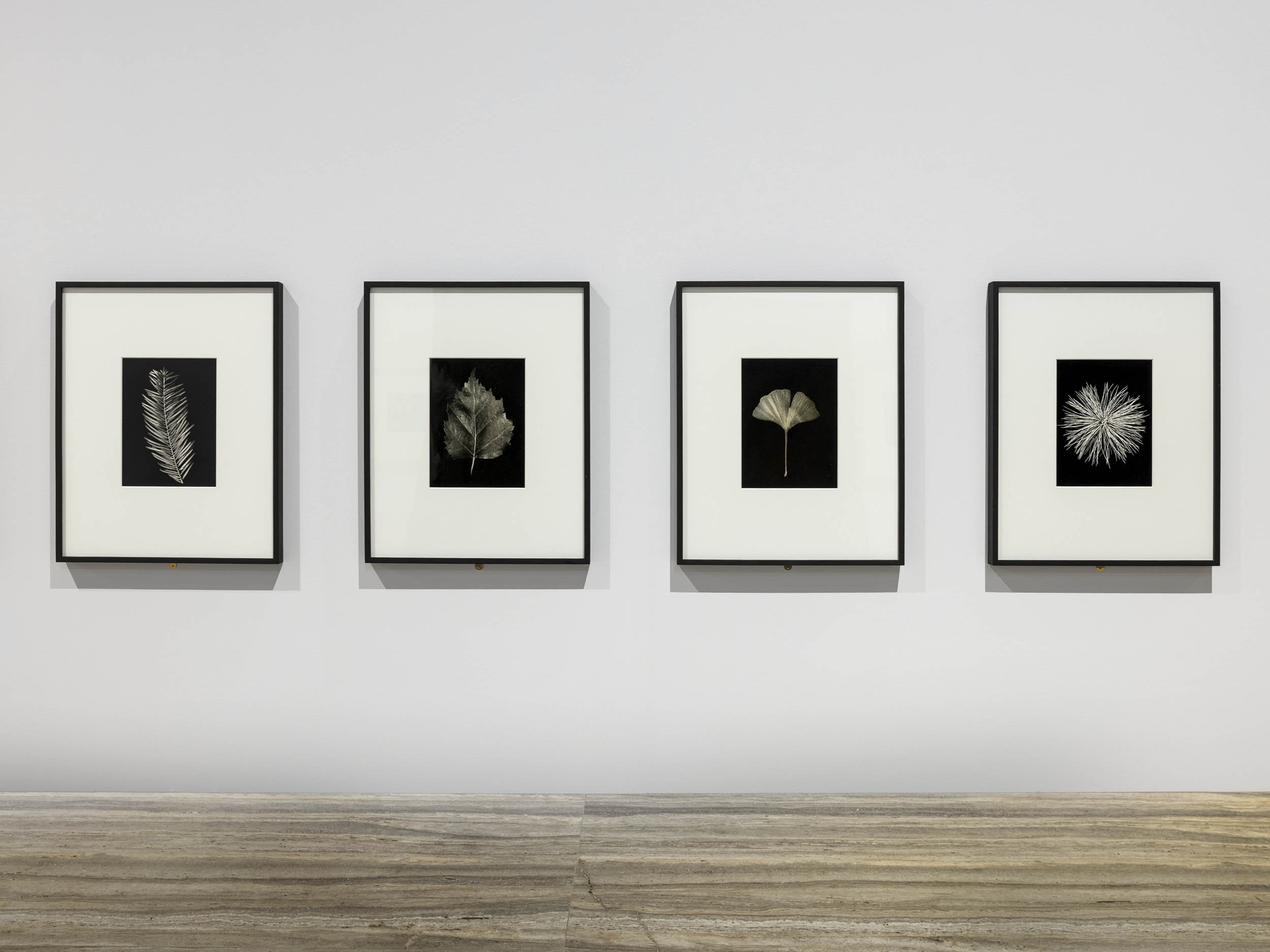
 

Installation view of the exhibition 'Typologien: Photography in 20th-century Germany' at Fondazione Prada, Milan showing the work of Hiller Becher


Installation view of the exhibition Typologien: Photography in 20th-century Germany at Fondazione Prada, Milan showing the work of Hiller Becher


Hilla Becher (German, 1934-2015) 'Eichenblatt [Oak Leaf]' 1965


Hilla Becher (German, 1934-2015)
Eichenblatt [Oak Leaf]
1965
Gelatin silver print
© Estate Bernd & Hilla Becher, represented by Max Becher, courtesy Die Photographische Sammlung/SK Stiftung Kultur – Bernd & Hilla Becher Archive, Cologne, 2025


In terms of the objectivity of the approach, Hilla Becher’s 1965 photographic studies of an oak leaf, a cypress branch, and a ginkgo leaf are in keeping with the series on types of industrial buildings that she made with her husband Bernd Becher. Thematically, however, these studies represent a sort of return to the studies of branches and shoots made years earlier by Karl Blossfeldt. Unlike Blossfeldt’s images, the leaves, particularly the poplar leaves, are not uniformly lit. The shadowy areas cannot be clearly seen with the naked eye even on close and objective observation. One could say that nature has penetrated the technique, disappearing.

Exhibition text from the Fondazione Prada by Cord Riechelmann
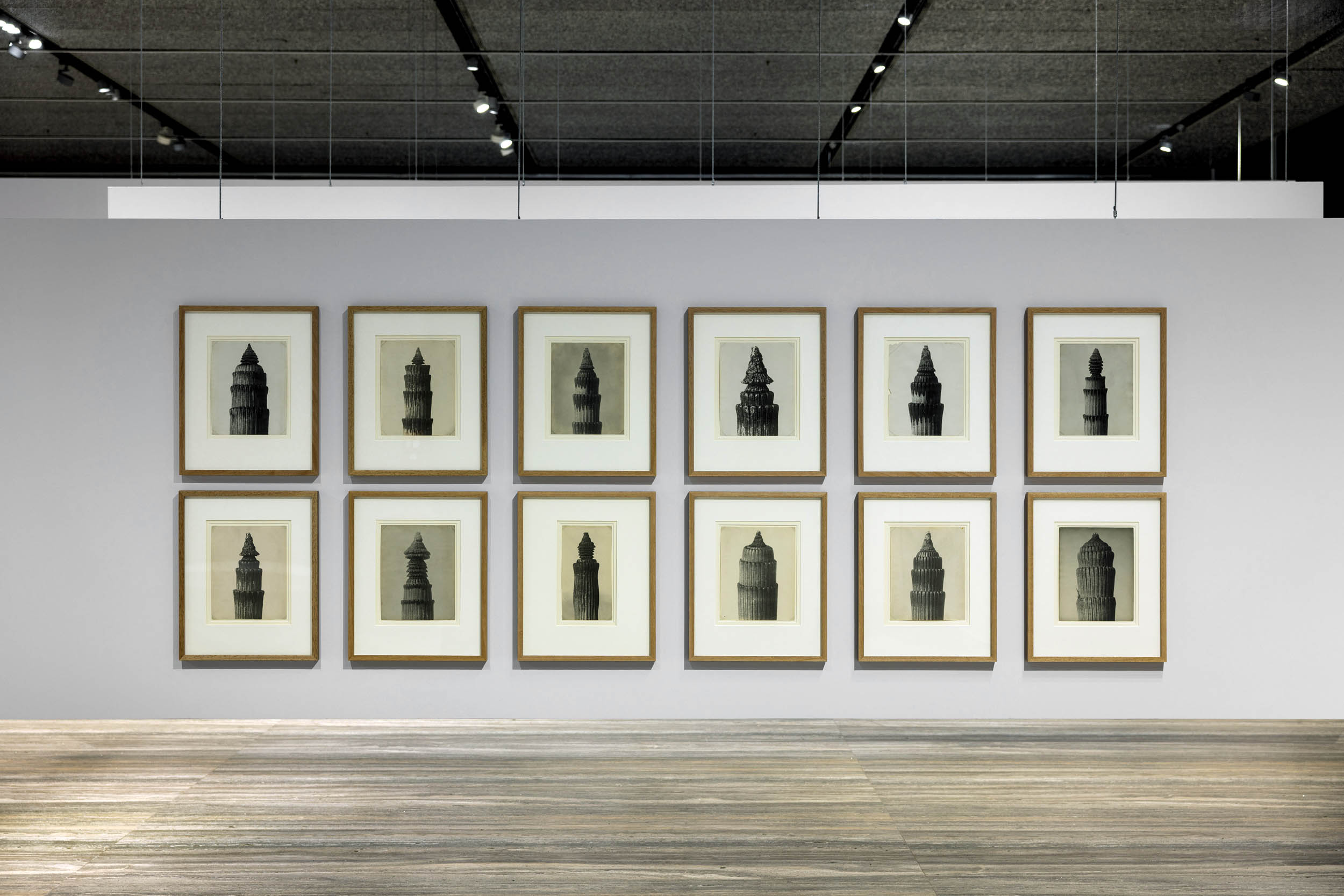
  

Installation view of the exhibition 'Typologien: Photography in 20th-century Germany' at Fondazione Prada, Milan showing the work of Karl Blossfeldt


Installation view of the exhibition Typologien: Photography in 20th-century Germany at Fondazione Prada, Milan showing the work of Karl Blossfeldt


Karl Blossfeldt (German, 1865-1932) 'Adiantum pedatum, haarfarn, junge, noch eingerollte Wedel' [Maidenhair fern, young, still curled fronds] Nd


Karl Blossfeldt (German, 1865-1932)
Adiantum pedatum, haarfarn, junge, noch eingerollte Wedel [Maidenhair fern, young, still curled fronds]
Nd
Gelatin silver print
Courtesy Berlin University of Arts, Archive – Karl Blossfeldt Collection in cooperation with Die Photographische Sammlung/SK Stiftung Kultur, Cologne


The young, still curling fronds of an ‘Unspecified fern’ are a kind of introduction to the themes that Karl Blossfeldt explored, and his working methods. Faced with a seemingly infinite variety of natural forms, the photographer tried to find an order by using tools borrowed from scientific botany. Blossfeldt collected plant samples tirelessly in and around Berlin, dried them, and enlarged those details not visible to the naked eye. However, the photographer was seeking something different from the aims of botanical research. This is already revealed by the title of the first volume, a publication of his photographs of plants – Urformen der Kunst (Art Forms in Plants, 1928). Right from the title, he explicitly refers to the model he used for the book’s conception: Ernst Haeckel’s Kunstformen in der Natur (Art Forms in Nature), published in 1924 and now a classic. Therefore, Blossfeldt sought archetypal formal models in nature, such as the fronds of the fern.

In his search for a primal form of nature that could then be shaped into art according to the natural model – as in the case of the curled fronds of
the fern – Karl Blossfeldt applied the systematic method specific to botany with a kind of exterior mimicry. He moved from the frond of an unidentified fern, in other words, not yet classified according to an order, to a fern that could at least be identified within a botanical classification. The frond of the order Polypodiales certainly has typological similarities to all the fronds photographed by Blossfeldt, but it remains a case apart in that it cannot be classified in any of the orders in which the other ferns are classified. However, this level of identification is a relevant indication: these very diverse plants in fact number about 9000 known species, and probably many more yet to be identified. Moreover, identifying their species is often only possible for a few specialists, and is even more difficult given the variety of forms that ferns take during their development.

The curled fronds of some ferns from the Osmundaceae family, royal ferns, with their botanical classification, confirm one of the fundamental intentions of Karl Blossfeldt’s studies: only by carefully analyzing the structure of a plant can one fully understand its natural form. He developed his approach opposite to that of the Jugendstil, the artistic movement – a variation of French Art Nouveau and Italian Liberty – that stylized plant forms and conceived of them primarily as ornamental elements. Blossfeldt was not interested in criticism or rejection of the ornamental, but in a radical reconfiguration of it. This could only be achieved by thoroughly studying natural forms.

Three still-curled fronds of a specimen of bracken fern – scientific name Hypolepidaceae – on the one hand, appear denaturalised, because Karl Blossfeldt focused his lens on the detail, leaving out the natural context. But on the other hand, they reveal a scrupulous observation of the plant world. By nature, in fact, fronds develop according to a strict formal principle – no natural form is purely random – and yet they eventually differ from one another. The fronds of ferns could appear as decalcomanias, given that in Blossfeldt’s representation they take on an almost mechanical quality for the observer. The emphasis on differences in resemblance, which Blossfeldt achieved more or less consciously by repeating the leaf motif in differently shaped ferns, can be considered one of the main aesthetic innovations of his photography.

Exhibition text from the Fondazione Prada by Cord Riechelmann


Installation view of the exhibition 'Typologien: Photography in 20th-century Germany' at Fondazione Prada, Milan showing the work of Marianne Wex with at left, 'Let's Take Back Our Space: 'Female' and 'Male' Body Language as a Result of Patriarchal Structures' 1977-2018; and at right, 'Arm and Leg Positions, Lying on the Ground' 1977/2018


Installation view of the exhibition Typologien: Photography in 20th-century Germany at Fondazione Prada, Milan showing the work of Marianne Wex with at left, Let’s Take Back Our Space: ‘Female’ and ‘Male’ Body Language as a Result of Patriarchal Structures 1977-2018 (below); and at right, Arm and Leg Positions, Lying on the Ground 1977/2018


With the photographic project Let’s Take Back our Space, which resulted in a book published in 1979 with the subtitle “‘Female’ and ‘Male’ Body Language as a Result of Patriarchal Structures,” Marianne Wex produced one of the seminal works in 1970s feminist art studies. Starting with a scrupulous observation of the body influenced by the method of structuralism, a scientific approach that studies a whole by breaking it down into elements and units, Wex took hundreds of photographs arranged in specific thematic sections devoted, for example, to specific leg and arm positions. Wex succeeded in showing how apparently natural body postures are actually the result of centuries of social and cultural structures, not a ‘natural’ or genetic predisposition. Her photographs capture movements, postures, and gestures, documenting habits of the body that have been taught and passed down for generations, shaping the behaviour of men and women according to patriarchal expectations.

Exhibition text from the Fondazione Prada by Cord Riechelmann


Marianne Wex (German, 1937-2020) 'Let's Take Back Our Space: 'Female' and 'Male' Body Language as a Result of Patriarchal Structures'
1977-2018


Marianne Wex (German, 1937-2020)
Let’s Take Back Our Space: ‘Female’ and ‘Male’ Body Language as a Result of Patriarchal Structures
1977-2018
Inkjet print
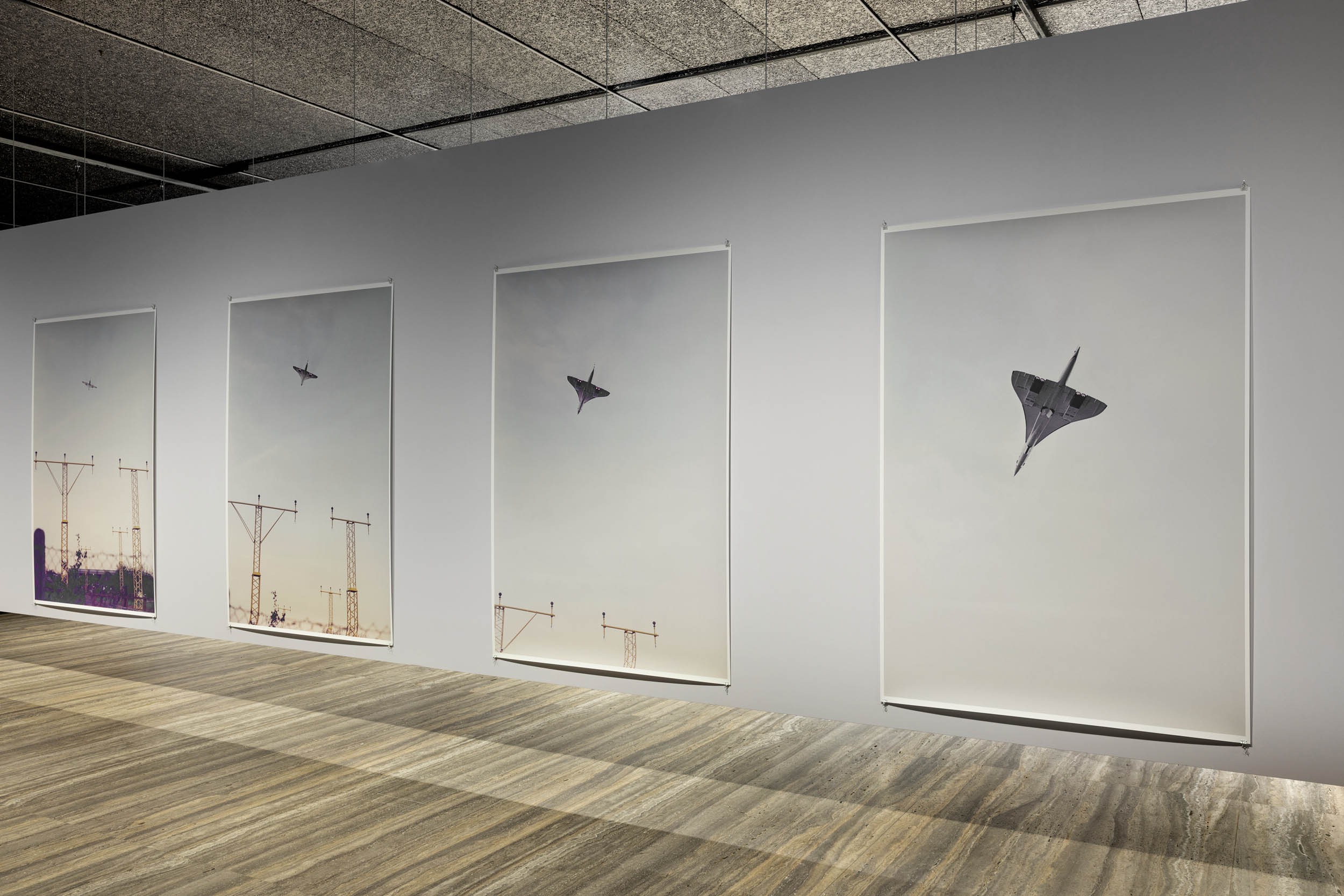
 

Installation view of the exhibition 'Typologien: Photography in 20th-century Germany' at Fondazione Prada, Milan showing photographs from Wolfgang Tillmans' series 'Concorde' 1997


Installation view of the exhibition Typologien: Photography in 20th-century Germany at Fondazione Prada, Milan showing photographs from Wolfgang Tillmans’ series Concorde 1997


In 1997, Wolfgang Tillmans photographed the Concorde, a supersonic passenger plane, in flight during landing and take-off. For him, the plane represented one of the last remaining inventions of the 1960s technological utopia. With its futuristic shape, supersonic speed, and the formidable roar it made during take-off and landing, the plane fascinated generations of technology enthusiasts. Today, the Concorde is a thing of the past and, together with the Titanic, epitomises more of a technological shock than a promise in the history of technology. These photographs reveal one of the aspects that Tillmans wants to highlight: they are symbols of “a super-modern anachronism” that ultimately left nothing behind but air pollution and environmental destruction.

Exhibition text from the Fondazione Prada by Cord Riechelmann
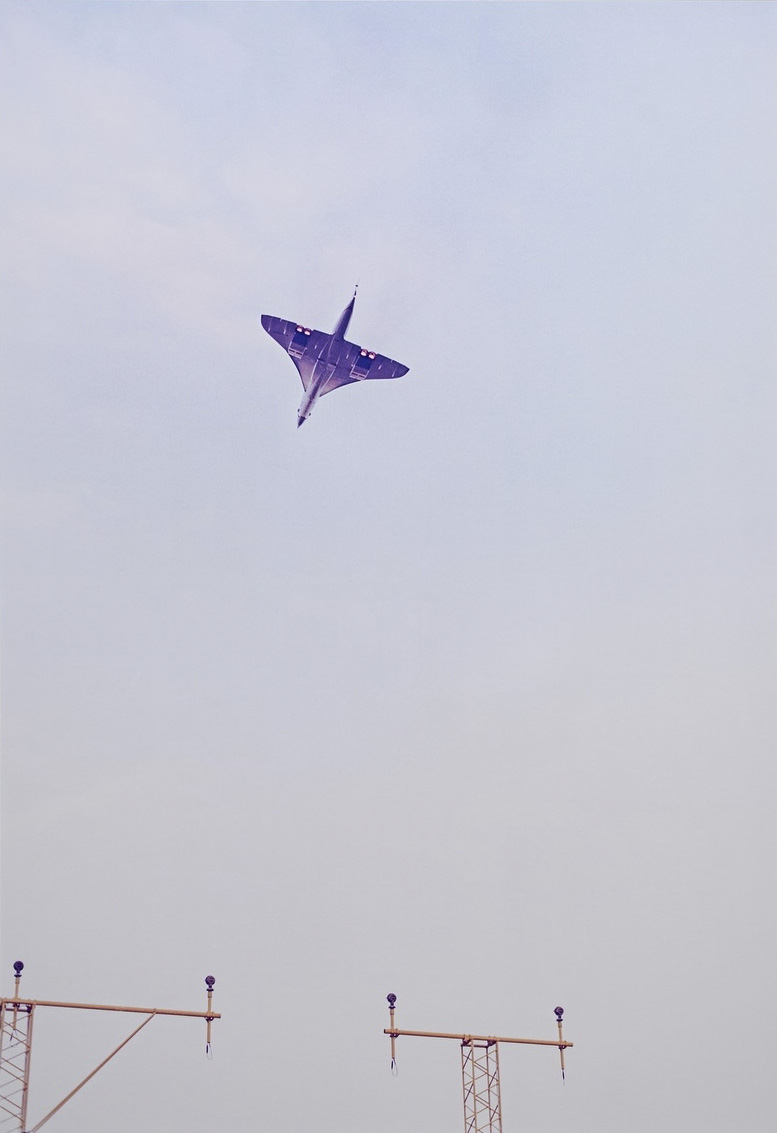
 

Wolfgang Tillmans (German, b. 1968) 'Concorde L449-21' 1997


Wolfgang Tillmans (German, b. 1968)
Concorde L449-21
1997
Inkjet print
Courtesy of Galerie Buchholz


Fondazione Prada presents Typologien: Photography in 20th-century Germany, an extensive study dedicated to 20-century German photography, at its Milan venue from 3 April to 14 July 2025. The exhibition, hosted within Podium, the central building of the Milan headquarters, is curated by Susanne Pfeffer, art historian and director of the MUSEUM MMK FÜR MODERNE KUNST, Frankfurt.

The exhibition attempts to apply the principle of “typology,” which originated in 17th- and 18th-century botany to categorise and study plants, and appeared in photography in the early 1900s, affirming itself in Germany throughout the 20th century. Paradoxically, the given formal principle allows for unexpected convergences of German artists spanning different generations and the manifestation of their individual approaches.

The exhibition path follows a typological rather than a chronological order, bringing together more than 600 photographic works by 25 artists essential for recounting over a century of German photography. The exhibition features photographs by Bernd and Hilla Becher, Sibylle Bergemann, Karl Blossfeldt, Ursula Böhmer, Christian Borchert, Margit Emmrich, Hans-Peter Feldmann, Isa Genzken, Andreas Gursky, Candida Höfer, Lotte Jacobi, Jochen Lempert, Simone Nieweg, Sigmar Polke, Gerhard Richter, Heinrich Riebesehl, Thomas Ruff, August Sander, Ursula Schulz-Dornburg, Thomas Struth, Wolfgang Tillmans, Rosemarie Trockel, Umbo (Otto Umbehr), and Marianne Wex. The project forms unexpected connections between artistic practices that differ from each other but are united by a common principle or intention of classification.

As stated by Susanne Pfeffer, “Only through juxtaposition and direct comparison is it possible to find out what is individual and what is universal, what is normative or real. Differences are evidence of the abundance of nature and the imagination of humans: the fern, the cow, the human being, the ear; the bus stop, the water tower, the stereo system, the museum. The typological comparison allows differences and similarities to emerge and the specifics to be grasped. Unknown or previously unperceived things about nature, the animal, or the object, about place and time become visible and recognizable.”

In photography, employing typologies means affirming an equivalence between images and the absence of hierarchies in terms of represented subjects, motifs, genres, and sources.

Despite this, typology remains a highly challenging and complex notion. It operates in a paradoxical regime: on the one hand, this approach can lead to a systematic recording of people and objects based on extreme objectivity; on the other hand, typology corresponds to an individual and arbitrary choice, revealing itself as a disturbing and potentially subversive act.

The hypothesis that photography plays a key role not only in fixing distinctive phenomena but also in organizing and classifying a plurality of visible manifestations remains a vital force in today’s artistic efforts to navigate the complexity of our social and cultural realities. With the spread of digital imagery and practices, the concept of typology continues to be questioned and re-defined by contemporary photographers and artists.

As underlined by Susanne Pfeffer, “The unique, the individual, seems to have been absorbed into a global mass, the universality of things is omnipresent. The Internet allows typologies to be created in a matter of seconds. In this very precise moment – it seems even more important to follow the artists’ gaze and look closely.” As further explained by Pfeffer, “When the present seems to have abandoned the future, we need to look closer at the past. When everything seems to be shouting at you and becoming increasingly brutal, it is important to take a quiet pause and use the silence to see and think clearly. When differences are no longer perceived seen as something other but are transformed into elements of division, we have to recognize what we have in common. Typologies allow us to identify undeniable similarities and subtle differences.”

In the early 20th century, Karl Blossfeldt (1865-1932) was one of the first artists to transfer the classification system used in botanical studies to photography. His vast and detailed plant atlas represented a foundational moment for German Neue Sachlichkeit (New Objectivity). This artistic and photographic movement emerged in the 1920s during the Weimar Republic and promoted the importance of categories and distinctions and the remarkable ability of photography as a medium to explore the very idea of typology.

Another pioneering figure was August Sander (1876-1964), who published his photo book Antlitz der Zeit (Face of Our Time) in 1929, at the time excerpted from his landmark project Menschen des 20. Jahrhunderts (People of the 20th Century). Described by Walter Benjamin as a “training atlas” of physiognomic perception, Antlitz der Zeit was an ambitious attempt to portray the diversity and the structure of German society using class, gender, age, occupation, and social background as distinct categories of a rigid and neutral classification system.

Both Karl Blossfeldt’s and August Sander’s typologies were fundamental for Bernd Becher (1931-2007) and Hilla Becher (1934-2015) when, at the end of the fifties, they began an enormous and lifelong documentation and preservation project of industrial architecture. In 1971, they described the “industrial constructions” as “objects, not motifs”. They stated that “the information we want to provide is only created through the sequence, through the juxtaposition of similar or different objects with the same function”. Their black-and-white monuments, or “anonymous sculptures”, isolated against a monochromatic sky, centered, framed in the same format and arranged in a block, became an essential reference for American and European Post-Minimalist and Conceptual artists. They also represented a rich heritage for younger generations of German artists and photographers, such as Andreas Gursky (b. 1955), Candida Höfer (b. 1944), Simone Nieweg (b. 1962), Thomas Ruff (b. 1958) and Thomas Struth (b. 1954), who studied at the Academy in Düsseldorf in the class led by Bernd and Hilla Becher from 1976.

Hans-Peter Feldmann (1941-2023), internationally recognised for his fundamental contribution to conceptual art, traced a complementary trajectory in German photography. In his works, he documented everyday objects and historical events and combined deadpan humor with a systematic approach to accumulating, cataloguing, and rearranging elements of contemporary visual culture. In his series, he invented personal yet very political typologies and adopted a deliberate snapshot approach with a commercial aesthetic. For his work Alle Kleider einer Frau (All the Clothes of a Woman, 1975), he took 35mm-format photographs of underwear, hosiery, T-shirts, dresses, trousers, skirts, socks, and shoes, all hanging on hangers on the wall or laid on dark fabric. With his project Die Toten 1967-1993 (The Dead 1967-1993, 1996-1998), he paid homage to individuals murdered in the context of the political and terroristic movements in Post-War Germany. As pointed out by Susanne Pfeffer, “With his typologies, he emphasised the equal value of all photographs, their image sources and motifs, and underscored the de-hierarchisation inherent in every typology.”

In his apparently random collection of found, personal or pornographic images, press clippings, and historical photos of Nazi concentration camps, the Red Army Faction and German reunification, a “private album” named Atlas (1962 – present), Gerhard Richter (b. 1932) seemed to deny or challenge the very idea of typology. Instead, he took the principle of equivalence between images and their trivialization process to the limits, creating a jarring contrast and an acute awareness of a repressed collective memory.

In the seventies and eighties, in a dialectic relationship with the artistic lessons of the Bechers, Gursky, Höfer, Ruff, and Struth progressively abandoned the radicalism and black- and-white purism of their professors. They explored the colorful dominance of banality in their series of individual or family portraits, monumental and detailed city views, and spectacular documentation of cultural or tourist sites, generating a plethora of contemporary and conflicting typologies.

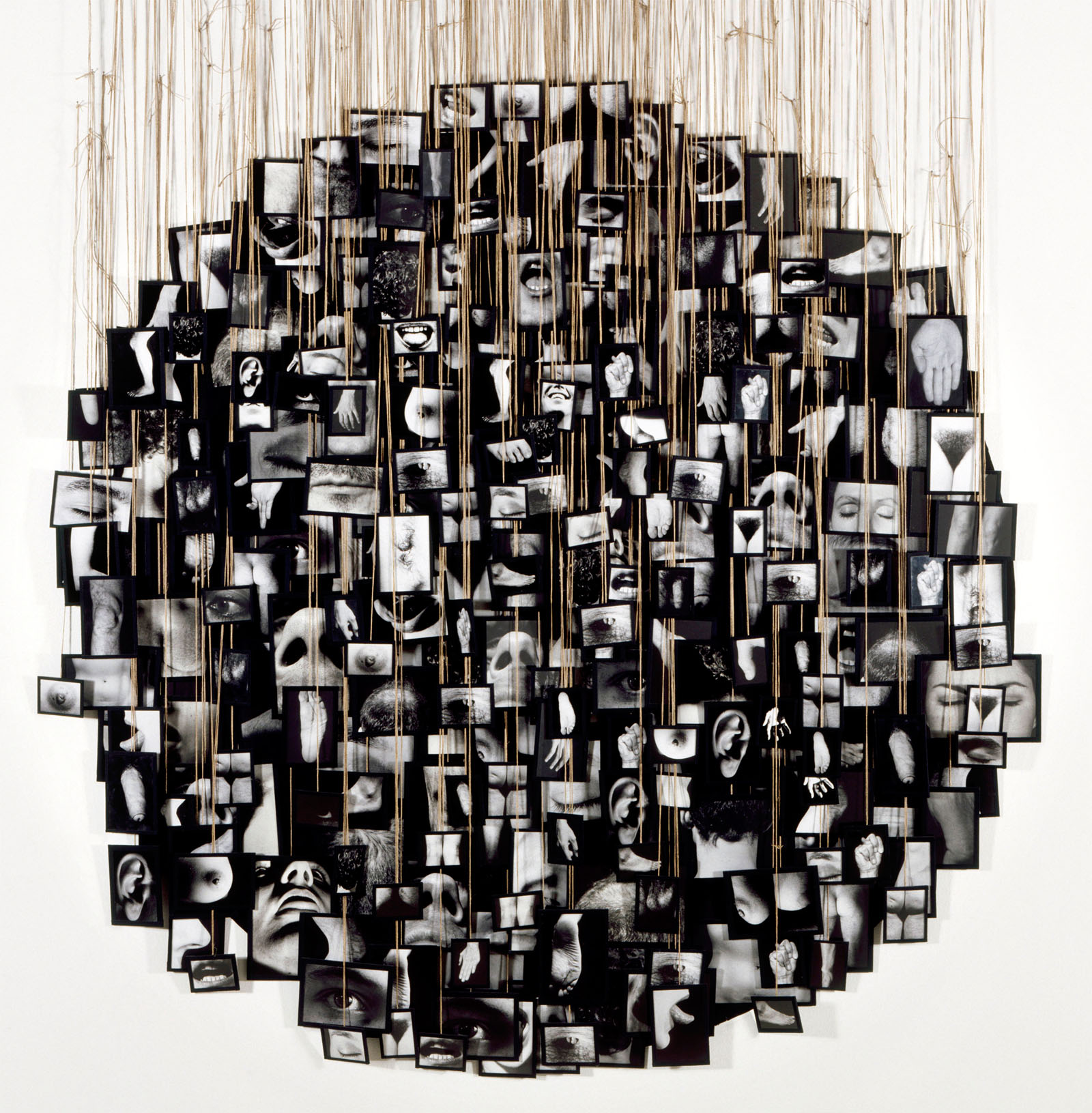
In the late seventies and early eighties, multimedia artist Isa Genzken (b. 1948) engaged in a direct dialogue with the photographic medium. In 1979, she created a series entitled Hi-Fi that featured advertisements of avant-garde Japanese stereo equipment, organising them in an imaginary commercial catalog. The second series entitled Ohr (Ear) (1980) depicted, in large-scale colour close-ups, the ears of random women Genzken photographed on the streets of New York City. She transferred the traditional portrait genre to physiognomic detail and ironically investigating the absolute singularity and infinite individual differentiation the photographic portrait can record.

An illustrated book, published by Fondazione Prada and designed by Zak Group, accompanies the exhibition “Typologien: Photography in 20th-century Germany”. It includes an introduction by Miuccia Prada, President and Director of Fondazione Prada, a text by the exhibition curator Susanne Pfeffer and three essays by renowned international art historians and curators Benjamin Buchloh, Tom Holert, and Renée Mussai.

Press release from Fondazione Prada
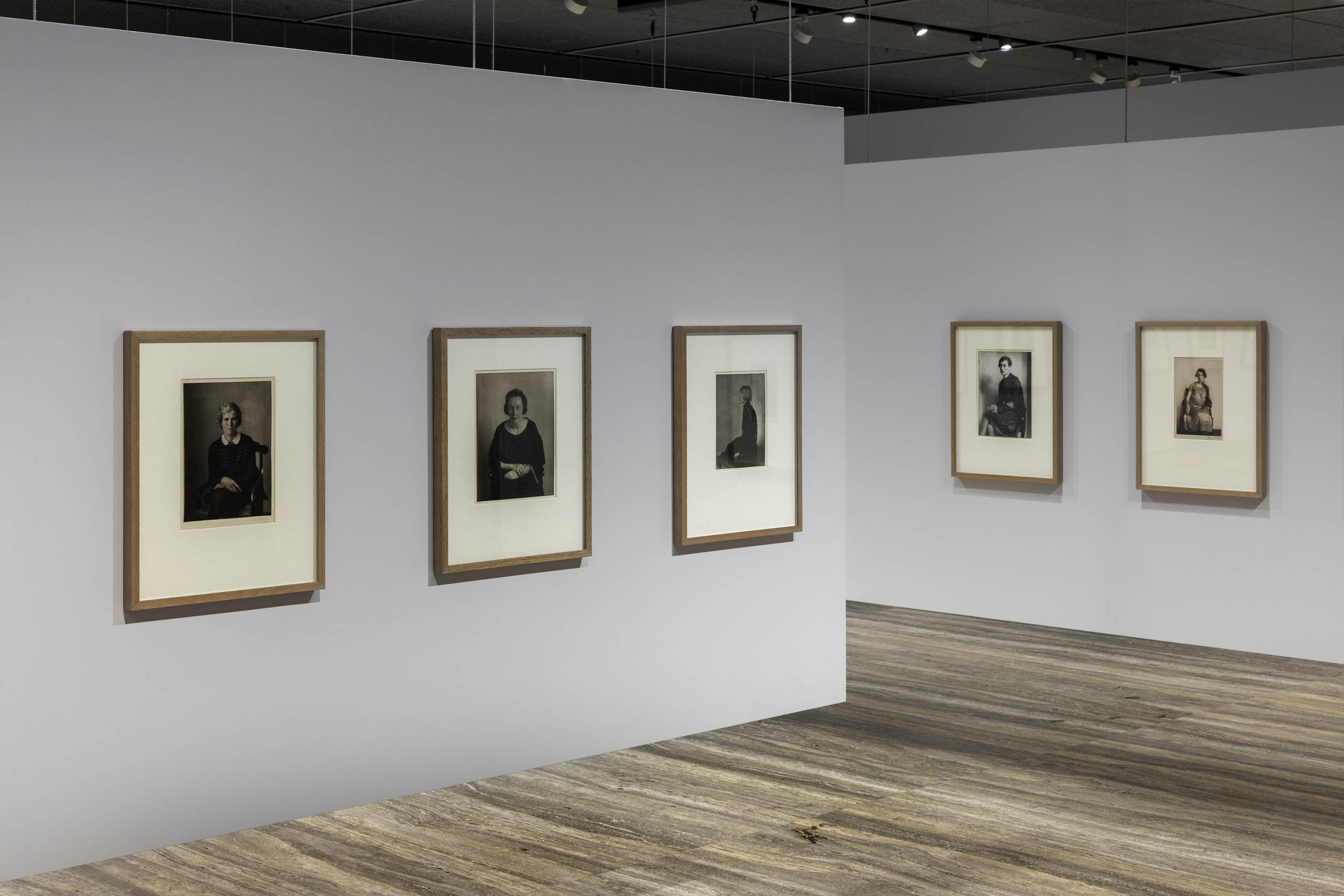
 

Installation view of the exhibition 'Typologien: Photography in 20th-century Germany' at Fondazione Prada, Milan showing the work of August Sander


Installation view of the exhibition Typologien: Photography in 20th-century Germany at Fondazione Prada, Milan showing the work of August Sander


August Sander (German, 1876-1964) 'Sekretärin beim Westdeutschen Rundfunk in Köln' [Secretary at West German Radio in Cologne] 1931-1950s


August Sander (German, 1876-1964)
Sekretärin beim Westdeutschen Rundfunk in Köln [Secretary at West German Radio in Cologne]
1931-1950s
Gelatin silver print
Die Photographische Sammlung/SK Stiftung Kultur, Cologne
© Die Photographische Sammlung/SK Stiftung Kultur – August Sander Archive, Cologne; SIAE, Roma, 2025


The series that August Sander dedicated to women is perhaps where the idea of categorising an archetype or social type shows the cracks most visibly. Whether it is an architect’s companion, an industrialist’s wife, or a high society lady, in Sander’s images the individuality of the female subject, in dress and posture, always prevails over type. And even when the subjects display characteristics that could be traced back to their class, origin, or occupation – such as the secretary who smokes – all the women depicted, from the sculptor to the photographer or the gym teacher, express ‘their own’ individuality. This is most evident when comparing the portraits of women with those of civil servants, whose gazes already show a serial uniformity associated with their positions.

Exhibition text from the Fondazione Prada by Cord Riechelmann


Erich Sander for August Sander's studio. 'Politischer Häftling' [Political Prisoner] 1941-1944 (print date late 1940s)


Erich Sander for August Sander’s studio
Politischer Häftling [Political Prisoner]
1941-1944 (print date late 1940s)
Menschen des 20. Jahrhunderts, 44a Politische Gefangene. [44a Political prisoners]
Gelatin silver print
Die Photographische Sammlung/SK Stiftung Kultur, Cologne
© Die Photographische Sammlung/SK Stiftung Kultur, Cologne – August Sander Archive, Cologne; SIAE, Roma, 2025


In 1935, Erich Sander, August Sander’s son, was sensationally put on trial and sentenced to ten years’ imprisonment for subversive activities. He served most of his sentence in Siegburg Prison, where he worked as the prison’s photographer. Determined to continue his resistance activities even in prison, he did not limit himself to taking ‘official’ photographs. He convinced his fellow prisoners to show him the scars of torture and have their portraits taken. Those photographs seemed to him to be in line with his father’s work. He had learned his trade from his father and worked with him before his imprisonment. He stayed in close contact with his parents during his ten years of imprisonment, and through them, managed to get many of those images out of the prison, leaving a valuable record of Nazi atrocities. Due to a misdiagnosis and lack of medical treatment during his imprisonment, Erich Sander died in 1944, six months before the end of his sentence.

Exhibition text from the Fondazione Prada by Cord Riechelmann
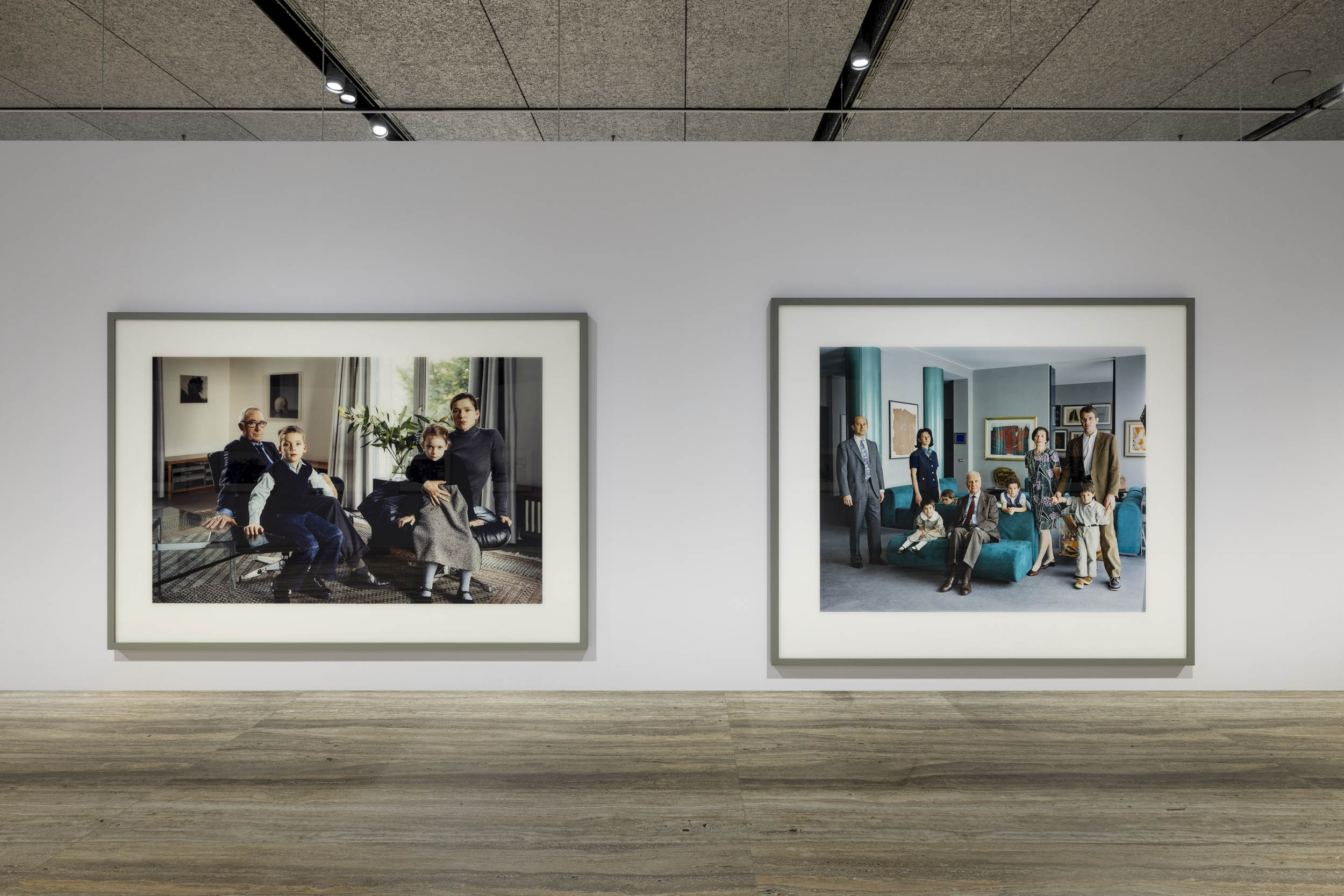
 

Installation view of the exhibition 'Typologien: Photography in 20th-century Germany' at Fondazione Prada, Milan showing photographs by Thomas Struth with at left, 'The Richter Family 1, Cologne' 2002; and at right, 'The Consolandi Family, Milan' 1996


Installation view of the exhibition Typologien: Photography in 20th-century Germany at Fondazione Prada, Milan showing photographs by Thomas Struth with at left, The Richter Family 1, Cologne 2002; and at right, The Consolandi Family, Milan 1996


Thomas Struth (German, b. 1954) 'The Richter Family 1, Cologne' 2002 (installation view)


Thomas Struth (German, b. 1954)
The Richter Family 1, Cologne (installation view)
2002
C-print
Courtesy of the artist
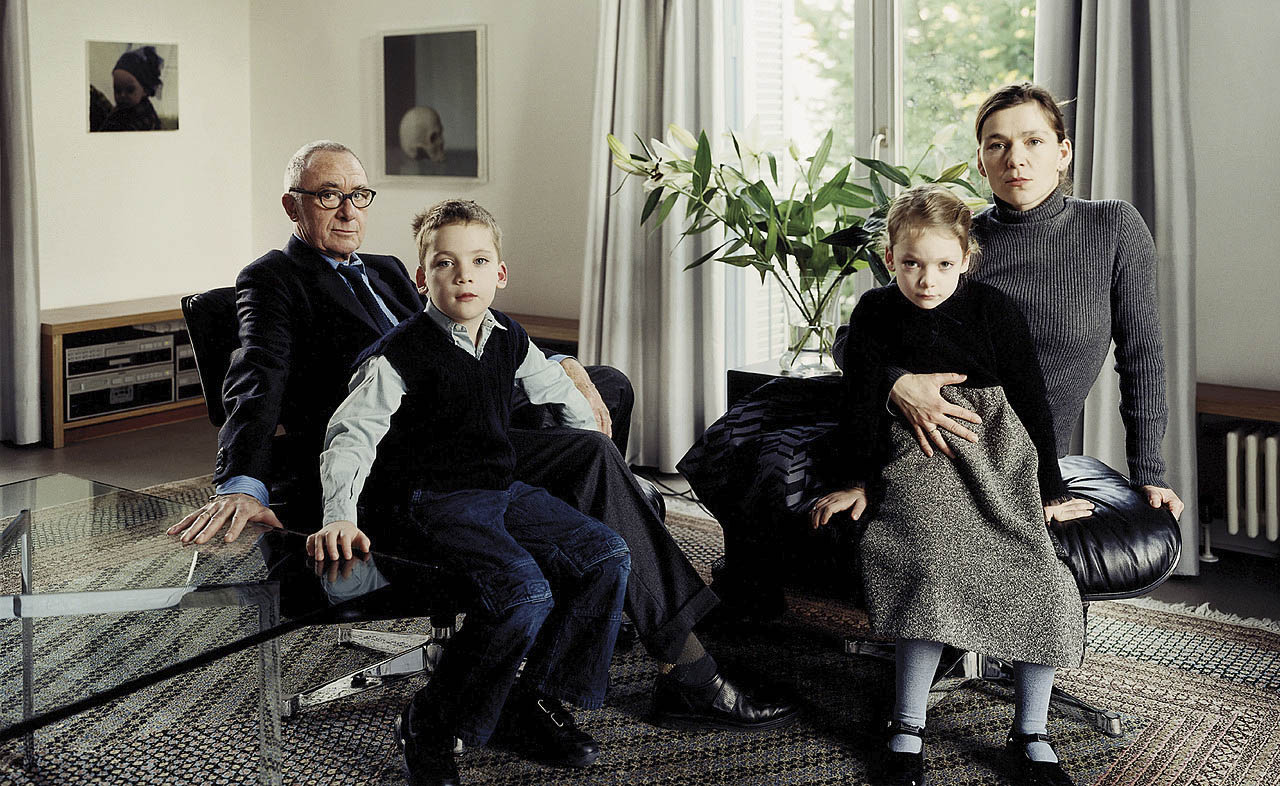
 

Thomas Struth (German, b. 1954) 'The Richter Family 1, Cologne' 2002


Thomas Struth (German, b. 1954)
The Richter Family 1, Cologne
2002
C-print
Courtesy of the artist
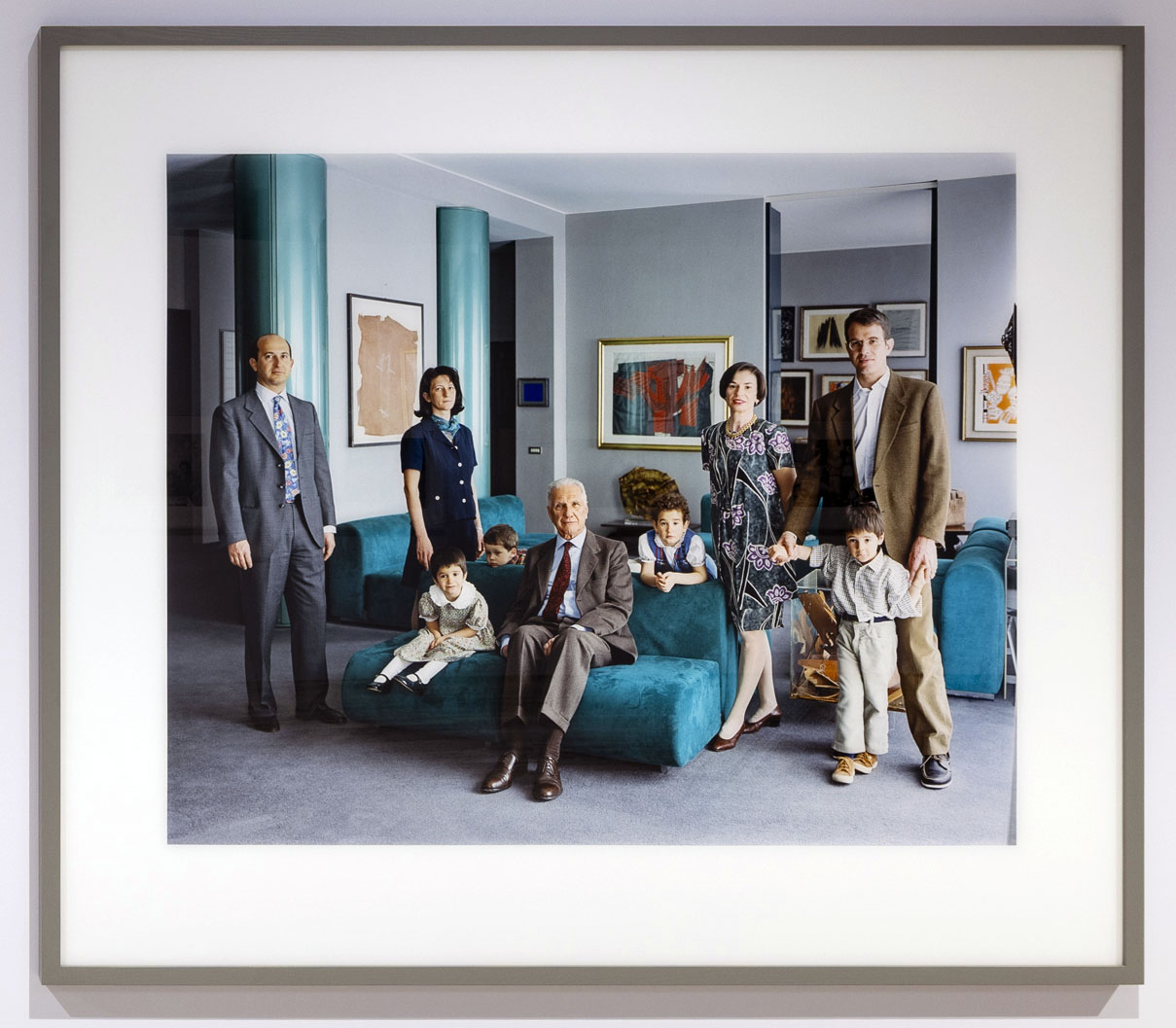
 

Thomas Struth (German, b. 1954) 'The Consolandi Family, Milan'  1996 (installation view)


Thomas Struth (German, b. 1954)
The Consolandi Family, Milan (installation view)
1996
C-print
Courtesy of the artist
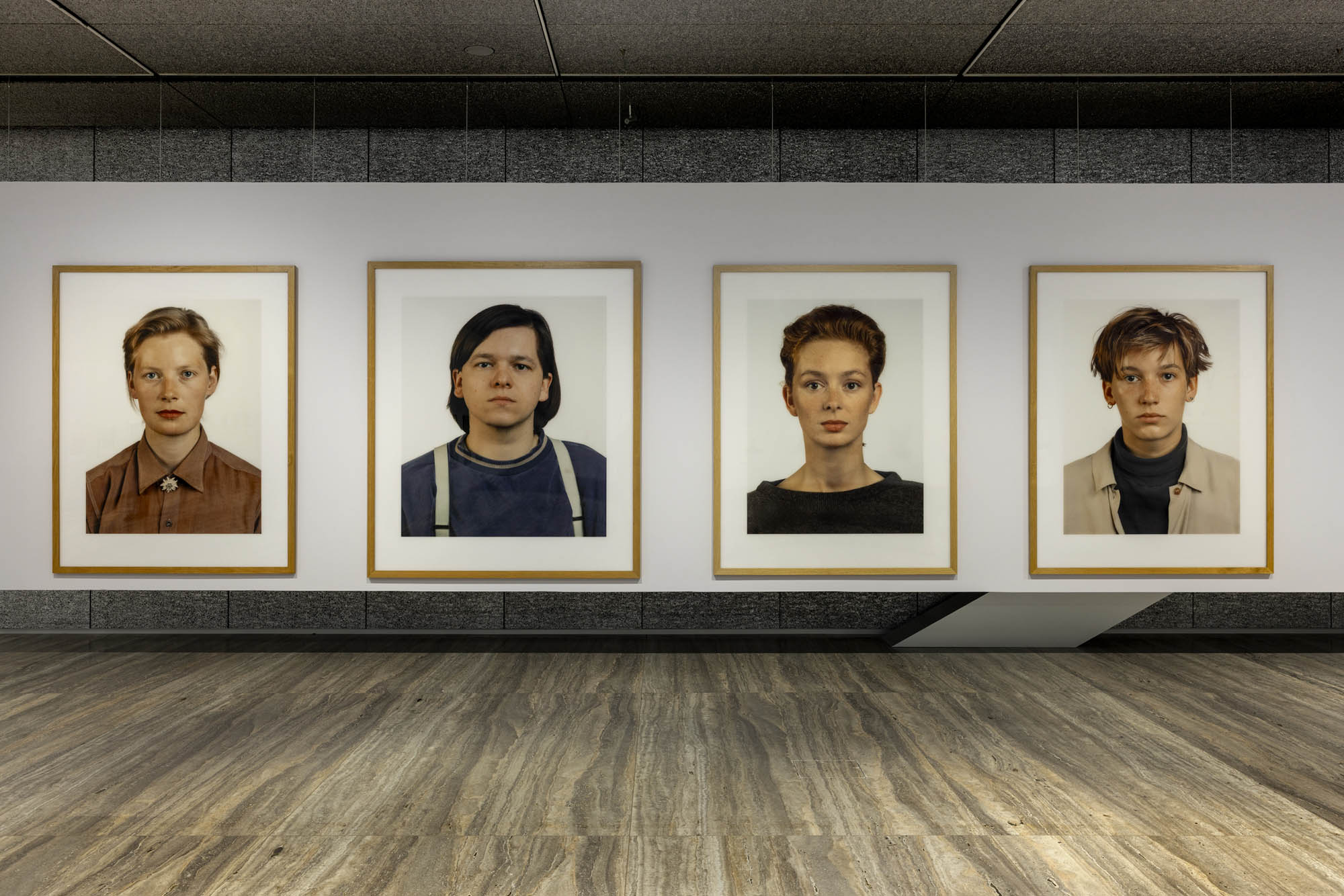
 

Installation view of the exhibition 'Typologien: Photography in 20th-century Germany' at Fondazione Prada, Milan showing Thomas Ruff portraits


Installation view of the exhibition Typologien: Photography in 20th-century Germany at Fondazione Prada, Milan showing Thomas Ruff portraits
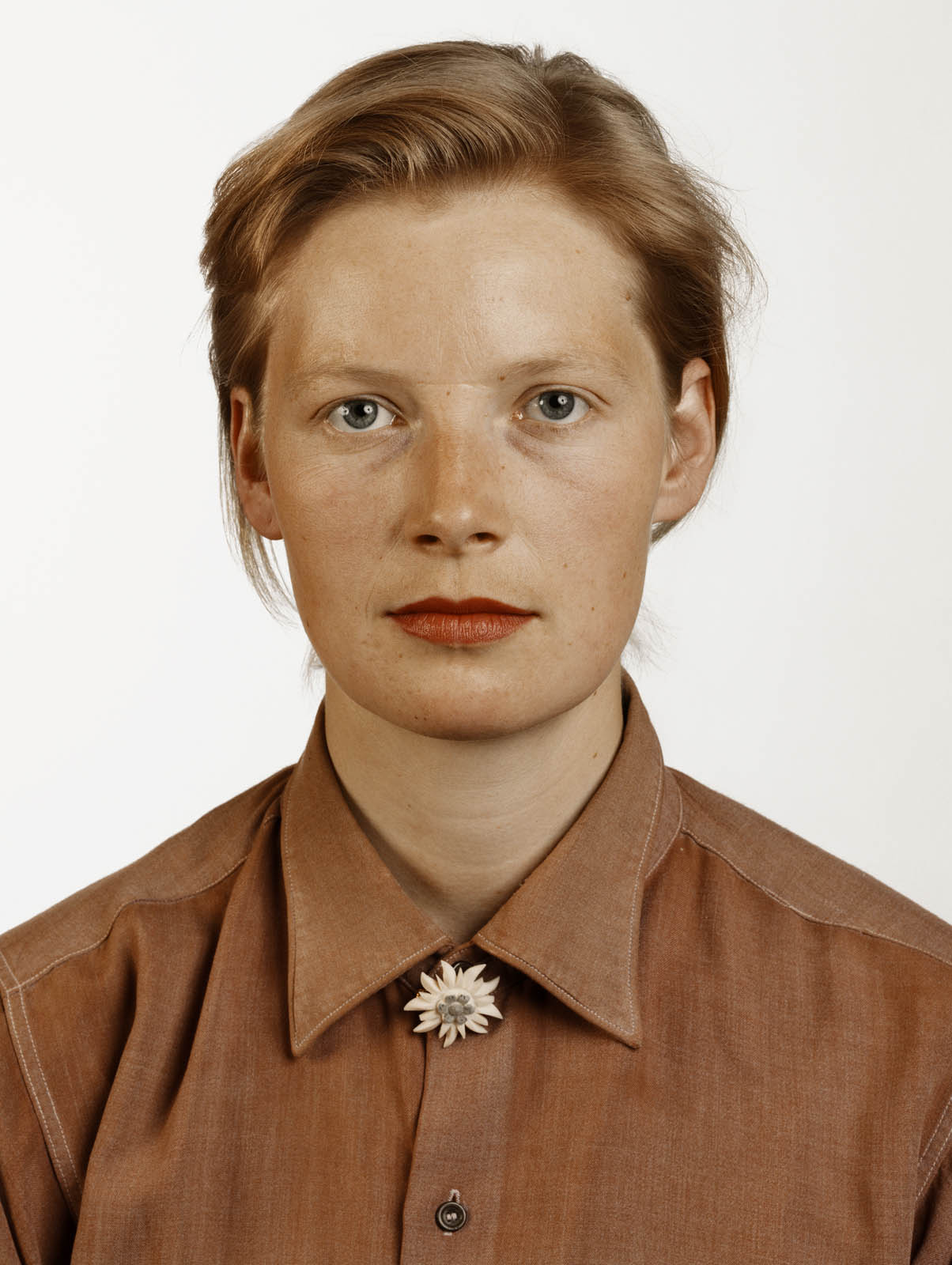
 

Thomas Ruff (German, b. 1958) 'Porträt (Pia Stadtbäumer)' 1988


Thomas Ruff (German, b. 1958)
Porträt (Pia Stadtbäumer)
1988
C-print laminated on acrylic glass
MUSEUM MMK FÜR MODERNE KUNST, Frankfurt
© Thomas Ruff, by SIAE 2025 Photo by Axel Schneider, Frankfurt am Main


Between 1977 and 1985, Thomas Ruff studied with Bernd Becher at the Art Academy in Düsseldorf, where he himself has been teaching photography since 2000. During the 1980s, he photographed people from his circle of acquaintances in a series of identically framed shots. With the subjects portrayed in a half-length pose against a neutral background, the images are striking for their unusually large size. Every detail, every pore, and every imperfection in the skin is visible in the faces of the subjects, whose names Ruff also provides. The strictness of the composition, the uniform lighting, and the impassive gaze of the people portrayed give the images an objective and neutral atmosphere. What formally appears detached and unemotional immediately raises questions about the subject portrayed: who is this person? What does he or she do in life? With this series, Ruff challenges the conventions of the traditional portrait, encouraging the viewer to question not only the identity of the subject, but also the role of the photographer and the meaning of the portrait itself.

Exhibition text from the Fondazione Prada by Cord Riechelmann


Thomas Ruff (German, b. 1958) 'Porträt (Simone Buch)' 1988


Thomas Ruff (German, b. 1958)
Porträt (Simone Buch)
1988
C-print laminated on acrylic glass
MUSEUM MMK FÜR MODERNE KUNST, Frankfurt
© Thomas Ruff, by SIAE 2025 Photo by Axel Schneider, Frankfurt am Main
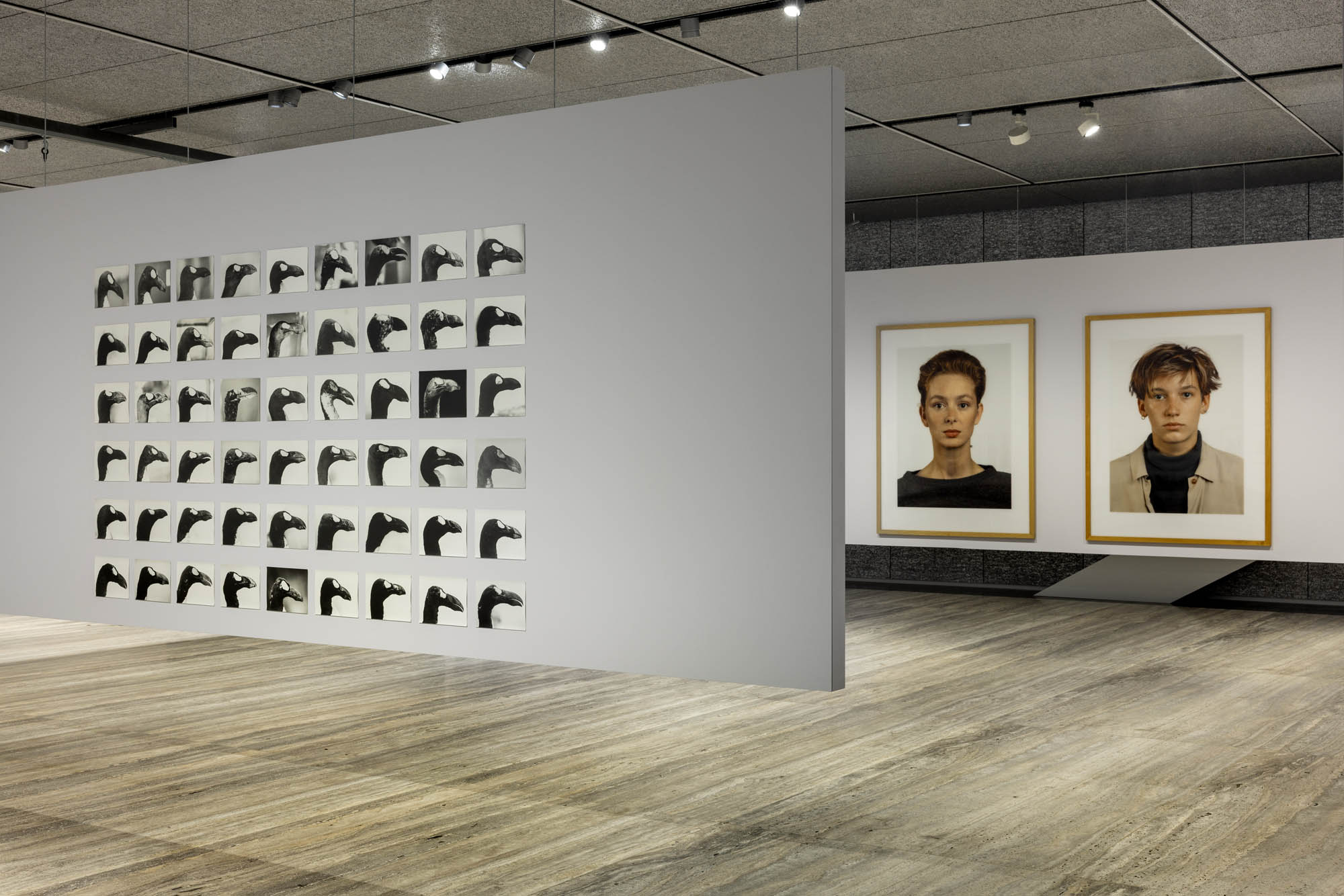
 

Installation view of the exhibition 'Typologien: Photography in 20th-century Germany' at Fondazione Prada, Milan showing at left, Jochen Lempert's 'The Skins of Alca Impennis' 1992-2022; and at right, Thomas Ruff's 'Portrait of Pia Stadtbäumer' and 'Portrait of Simone Buch' both 1988


Installation view of the exhibition Typologien: Photography in 20th-century Germany at Fondazione Prada, Milan showing at left, Jochen Lempert’s The Skins of Alca Impennis 1992-2022; and at right, Thomas Ruff’s Portrait of Pia Stadtbäumer and Portrait of Simone Buch both 1988
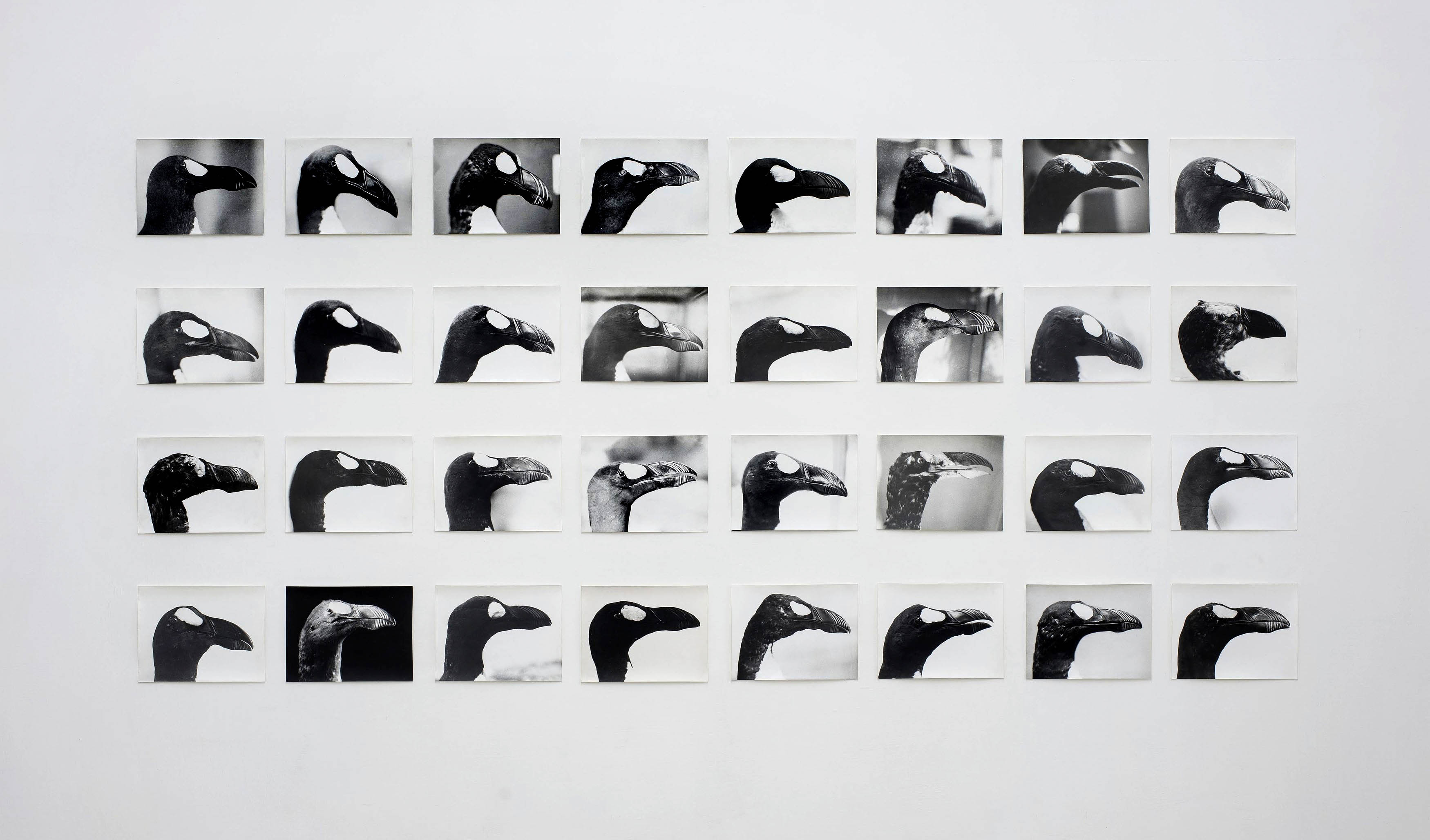
 

Jochen Lempert (German, b. 1958) 'The Skins of Alca Impennis' 1992-2022 (detail)


Jochen Lempert (German, b. 1958)
The Skins of Alca Impennis (detail)
1992-2022
Gelatin silver prints on Bartya paper
54 parts
Courtesy of Jochen Lempert, BQ, Berlin, and ProjecteSD, Barcelona


The fifty-four profiles of the Alca impennis (the great auk), a large flightless bird that became extinct after its last sighting in 1852, are part of a project that took Jochen Lempert more than a decade to complete. Using the same methods, Lempert photographed the profiles of many of the seventy-eight specimens of the Alca impennis preserved in natural history collections. Having become increasingly rare due to hunting, the Alca impennis was increasingly coveted by collectors, so the skins of this species fetched very high prices. The presence of such a large number of stuffed specimens in collections was therefore one of the causes of this species’ extinction.

Lempert’s portraits also hint at a more significant phenomenon. Very marked individual variations can be found in the appearance of individual specimens of a species, testifying to the great degree of differentiation within the species. Therefore, the concept of species, or its depiction in a scientific classification book, provides something akin to an ‘ideal type,’ rather than a true representation of the actual variety found in real life.

Exhibition text from the Fondazione Prada by Cord Riechelmann


Installation view of the exhibition 'Typologien: Photography in 20th-century Germany' at Fondazione Prada, Milan showing the work of Rosemarie Trockel, 'Elena I & II', 1993/2025, 'Maculata I & II', 1993/2025, 'Mela I & II', 1993/2025


Installation view of the exhibition Typologien: Photography in 20th-century Germany at Fondazione Prada, Milan showing the work of Rosemarie Trockel, Elena I & II, 1993/2025, Maculata I & II, 1993/2025, Mela I & II, 1993/2025


The portraits of the dogs Mela, Elena, and Maculata grew out of Rosemarie Trockel’s interest in animals and the relationship between animals and humans, a subject she has been working with for a long time. From the drawings of monkeys, which represent a kind of monument to the profound melancholy of primates kept in captivity by humans, to A House for Pigs and People / Ein Haus føur Schweine und Menschen created with Carsten Höller for documenta X in 1997, Trockel’s exploration of the relationship between humans and animals involves various forms of expression and themes. However, in this case, the double portraits of the three dogs, photographed frontally and in profile, indicate a further correlation. If “every animal is an artist,” as Trockel has stated, these portraits seem to call these roles into question: who directs and who stages who? Does the artist portray the dogs or do the dogs direct the artist?

Exhibition text from the Fondazione Prada by Cord Riechelmann
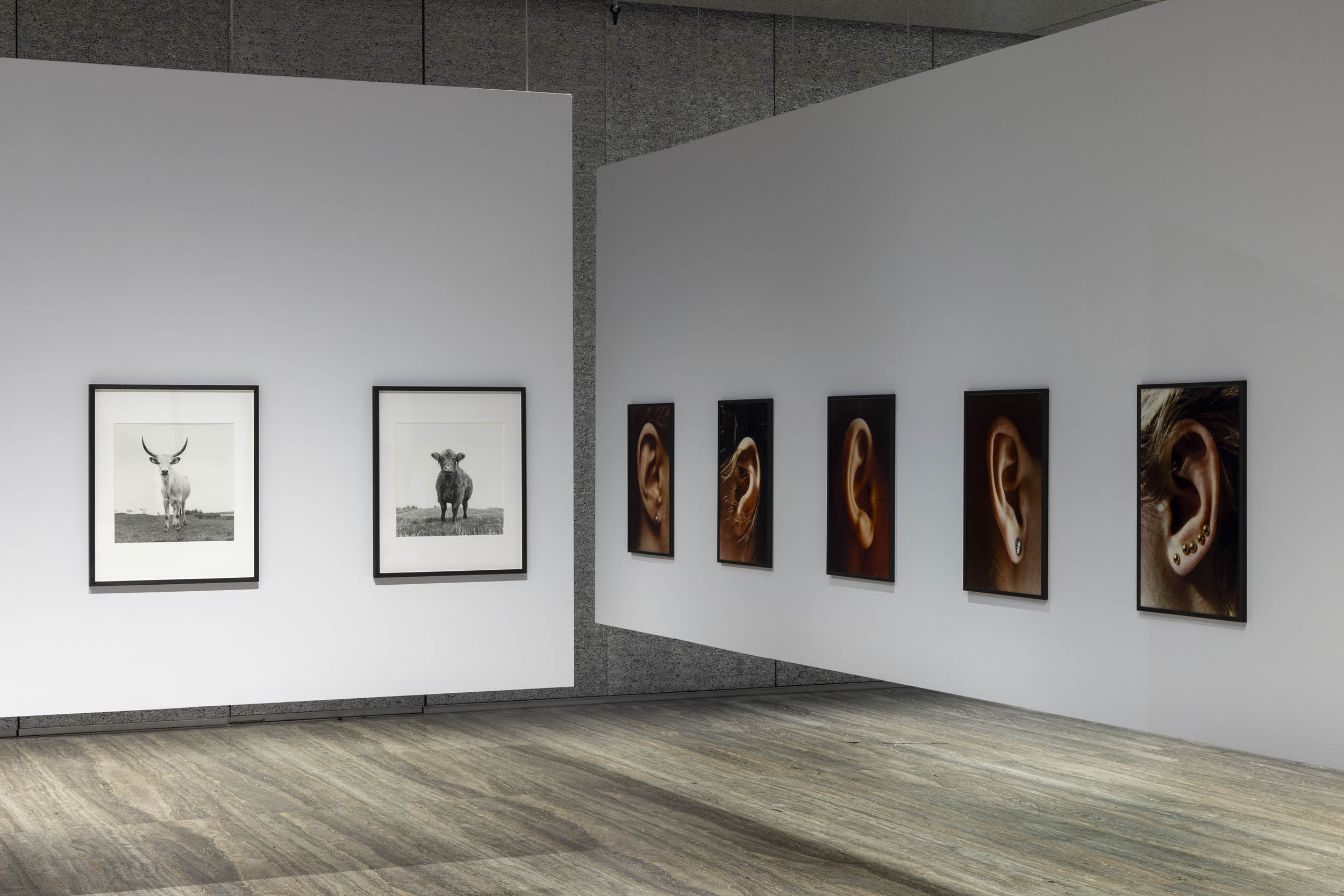
 

Installation view of the exhibition 'Typologien: Photography in 20th-century Germany' at Fondazione Prada, Milan showing at left, the work of Ursula Böhmer and her series 'All Ladies – Cows in Europe', 1998-2011; and at right, the work of Isa Genzken and her series 'Ohr', 1980


Installation view of the exhibition Typologien: Photography in 20th-century Germany at Fondazione Prada, Milan showing at left, the work of Ursula Böhmer and her series All Ladies – Cows in Europe, 1998-2011; and at right, the work of Isa Genzken and her series Ohr, 1980


Ursula Böhmer (German, b. 1965) 'Highland Grampians / Scotland [All Ladies – Cows in Europe]' 2011


Ursula Böhmer (German, b. 1965)
Highland Grampians / Scotland
2011
From the series All Ladies – Cows in Europe, 1998-2011
Gelatin silver print on Baryta paper
© Ursula Böhmer


Getting a cow to stand still in a frontal pose and look towards the camera, as Ursula Böhmer managed to do with a Highlander in the Grampian Mountains, is certainly not an easy task, but one that requires patience and trust, one of the prerequisites for this project. Between 1998 and 2011, Böhmer visited 25 European countries to photograph specimens of cattle breeds in the places where their breeding history began. These breeds, many of them at risk of extinction, had to be portrayed in their own environments in order to illustrate how these environments had influenced their appearance. What emerged was a series of images of docile animals portrayed in often harsh landscapes, which at the same time document the ongoing conditioning by the environment on the forms of life also in breeding conditions.

Exhibition text from the Fondazione Prada by Cord Riechelmann
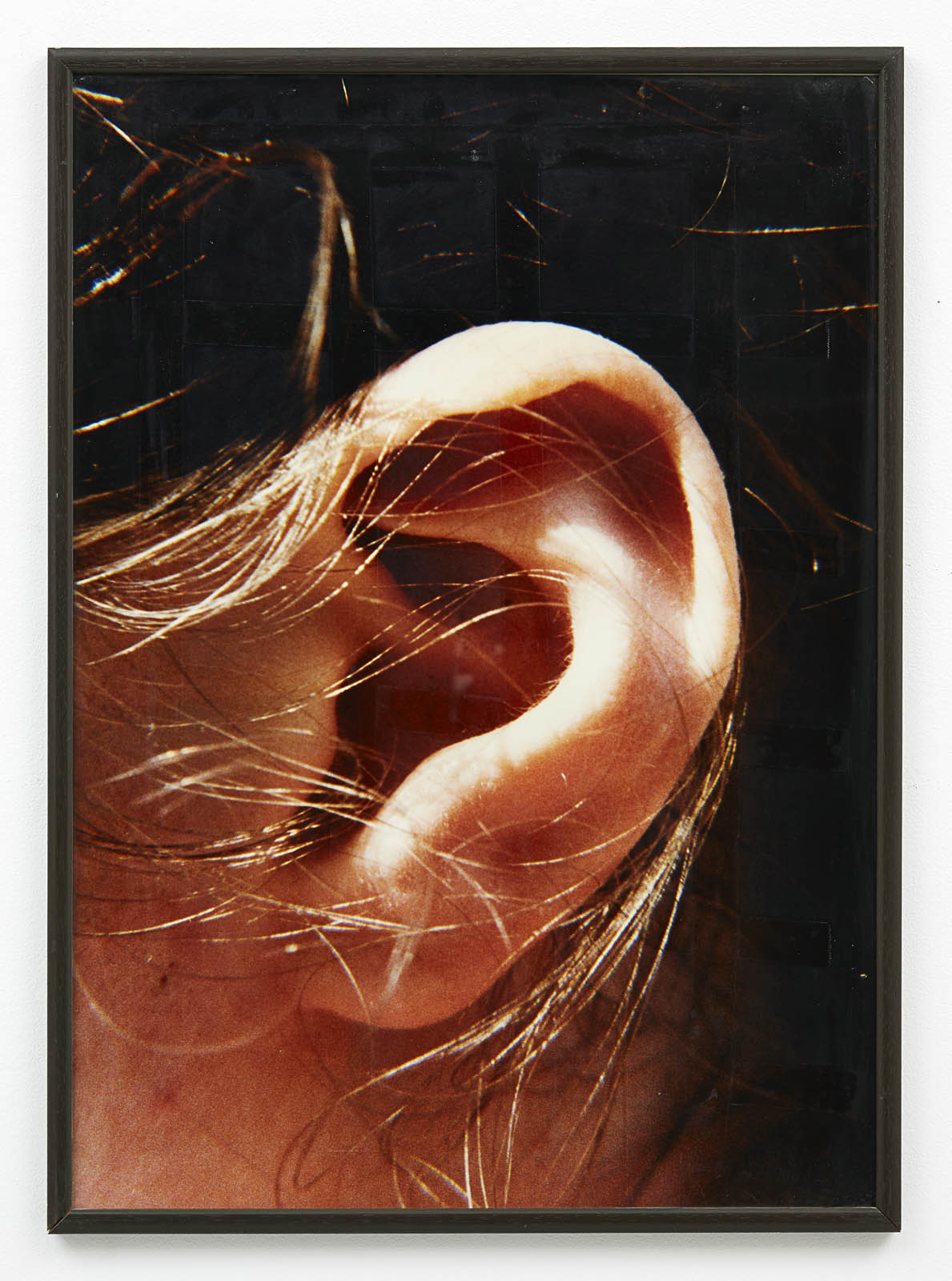
 

Isa Genzken (German, b. 1948) 'Ohr' 1980


Isa Genzken (German, b. 1948)
Ohr
1980
Colour C-print in artist’s frame
Galerie Buchholz Courtesy the artist and Galerie Buchholz
© Isa Genzken, by SIAE 2025


In 1980, Isa Genzken took a series of close-ups of the ears of women she encountered on the streets of New York. The typical portraiture approach used in the photographs exalts and enhances the characteristics of the represented subject, on the one hand, but at the same time, with the anonymity of the immortalized figure, creates a contrast. In the course of the evolution of the human species, the ear has lost its value in terms of expressive power. While in many animal species ears still play an important role in expressing emotions, in the human being they are stiffly positioned at the sides of the head and no longer react to emotional states along with the facial muscles. Georg Simmel, a sociologist of the senses, sees the ear as merely a passive appendage in the human appearance. For Simmel, the ear is the selfish organ par excellence, which simply takes without giving. Genzken contradicts this verdict, because the ears she photographs, with all the ornaments attached, eloquently express individual differences.

Exhibition text from the Fondazione Prada by Cord Riechelmann
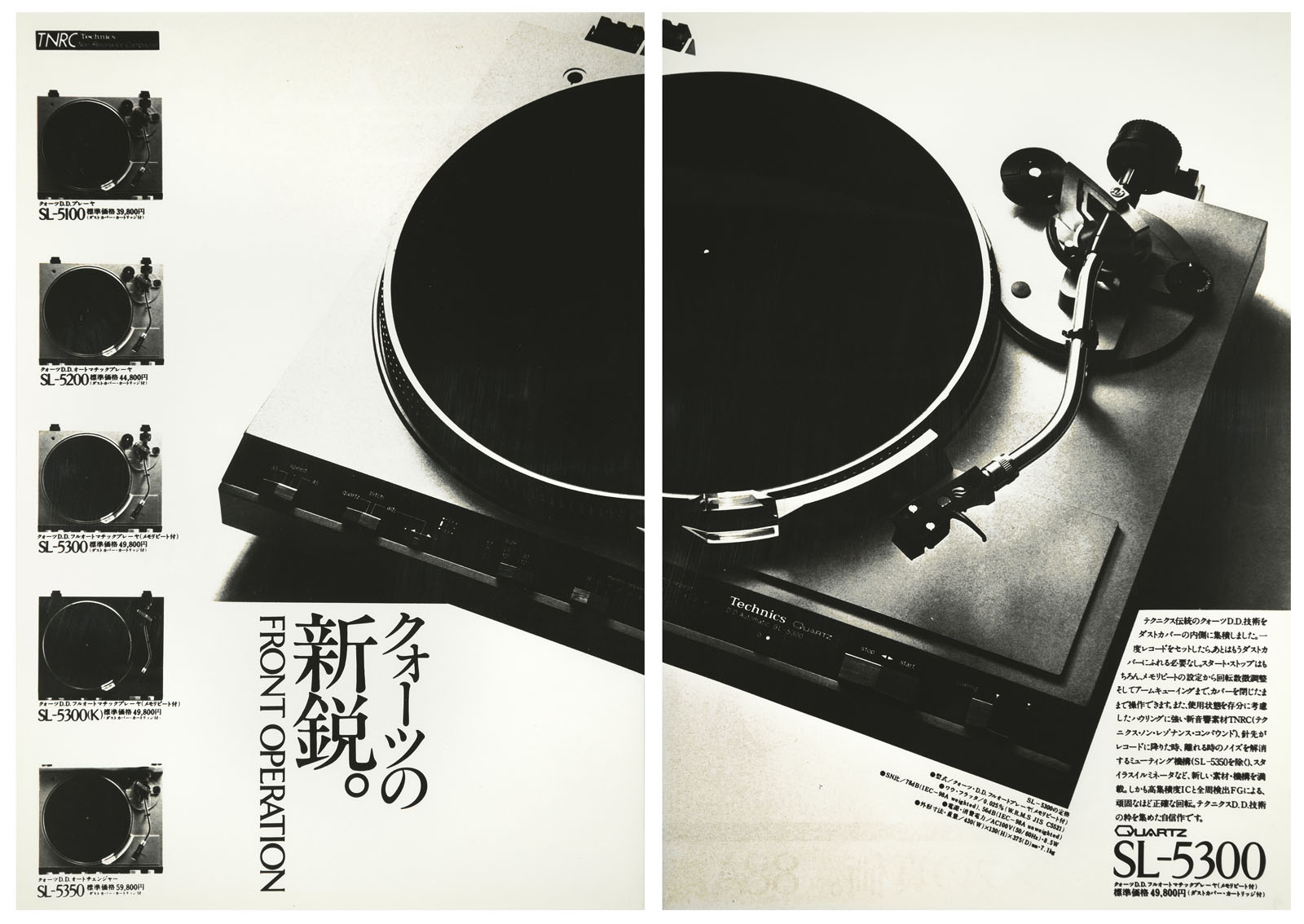
 

Isa Genzken (German, b. 1948) 'Front Operation' 1979


Isa Genzken (German, b. 1948)
Front Operation
1979
B/w photograph
Generali Foundation Collection – Permanent Loan to the Museum der Moderne Salzburg
© Generali Foundation / Isa Genzken, by SIAE 2025


In her first institutional exhibition, presented at the Museum Haus Lange in Krefeld in 1979, alongside sculptures and drawings, Isa Genzken exhibited a photography series dedicated to the latest and most expensive Hi-Fi systems. She created it by cutting out ads for turntables and amplifiers from international magazines and then photographing them. As she told photographer Wolfgang Tillmans in an interview, those advertisements showcased some of the most advanced technology of the time, highlighting cutting-edge design. Genzken also stated that a sculpture should be at least as modern as those devices. Her photography series dedicated to Hi-Fi systems can therefore be interpreted as a conceptual and aesthetic investigation of whether or not her sculptures and works could be compared to the everyday beauty of a stereo system.

Exhibition text from the Fondazione Prada by Cord Riechelmann
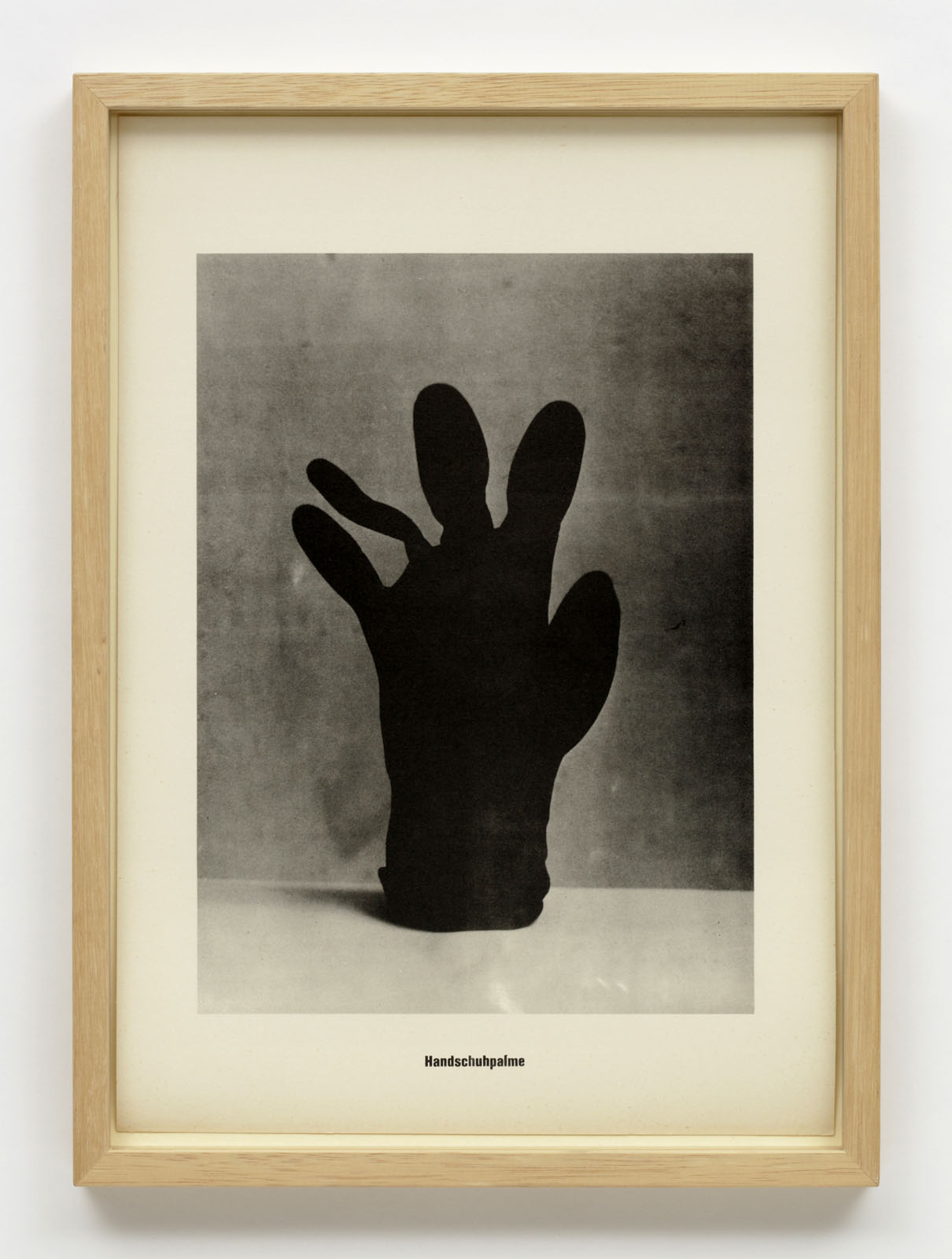
 

Sigmar Polke (German, 1941-2010) 'Handschuhpalme (Glove palm tree)' 1966


Sigmar Polke (German, 1941-2010)
Handschuhpalme (Glove palm tree)
1966
From the series … Höhere Wesen Befehlen, 1968 (… Higher beings Command, 1968)
13 stampe offset su carta artistica / 13 offset prints on art paper
MUSEUM MMK FÜR MODERNE KUNST, Frankfurt am Main


Lotte Jacobi (American born Poland, 1896-1990) 'Folkwang-Auriga-Verlag, Orch 152. Neottia nidus avis. Vogel-Nestwurz, einzelne Blüte' [Bird's-nest orchid, single flower] c. 1930


Lotte Jacobi (American born Poland, 1896-1990)
Folkwang-Auriga-Verlag, Orch 152. Neottia nidus avis. Vogel-Nestwurz, einzelne Blüte [Bird’s-nest orchid, single flower]
c. 1930
Gelatin silver print
Berlinische Galerie – Museum of Modern Art, Photography and Architecture
© Lotte Jacobi


Lotte Jacobi, known for her portraits of intellectuals including Martin Buber and W.E.B du Bois, artists such as Marc Chagall, and poets including Robert Frost and Vladimir Mayakovsky, created a series of plant portraits in 1930. Apart from the individual flowers of the Orchis latifolia, the broad-leaved helleborine or orchid, and Neottia nidus avis, the bird’s nest, she photographed an orchid in its entirety. The names of the plants, which Jacobi, like Karl Blossfeldt, makes explicit in the titles of the photographs, are an integral part of the unique poetics of the subjects. With her plant portraits, Jacobi followed in the tradition of the 1920s workers’ movement’s vision of nature. In fact, Jacobi was a member of the Vereinigung der Arbeiterfotografen Deutschlands (Union of German Labor Photographers), an organisation of photographers who documented the social life and struggles of the German working class.

Exhibition text from the Fondazione Prada by Cord Riechelmann
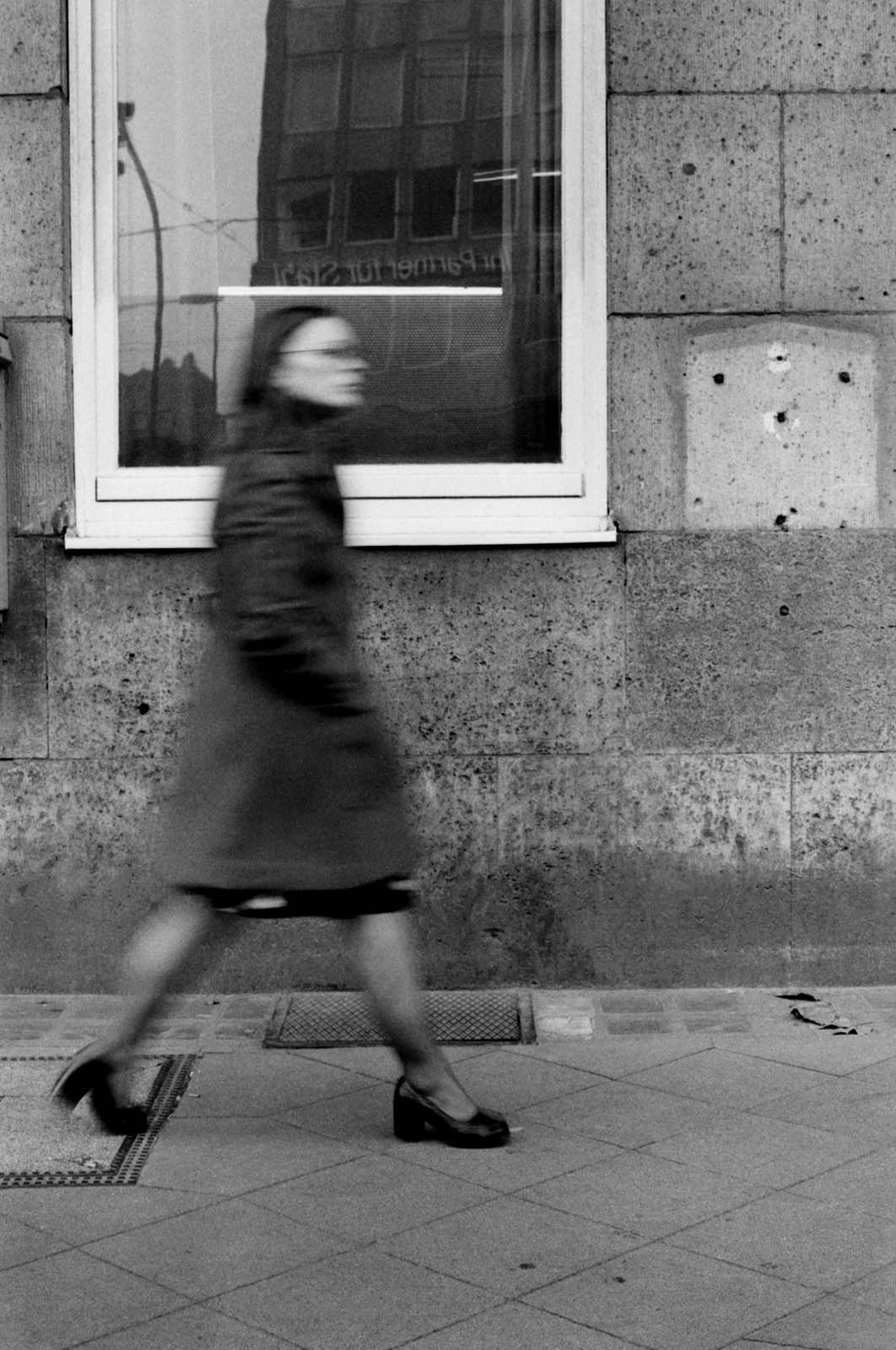
 

Thomas Struth (German, b. 1954) 'People on the Street, Düsseldorf 1974-78' 1974-1978


Thomas Struth (German, b. 1954)
People on the Street, Düsseldorf 1974-78
1974-1978
Gelatin silver print
Atelier Thomas Struth, Berlin
© Thomas Struth


In his photography, Thomas Struth has always been interested in the streets, squares, and houses of cities that consciously or unconsciously shape our experience, as well as that of the passers-by who walk through them. The study People on the Street, Düsseldorf 1974-78 explores the movements and figures of individuals passing in front of the camera lens. The subjects are never shot at close range. While some facial features are blurred in movement, others are clearly visible. Even if they are differentiated by their jackets, coats, or bags, all the subjects have a directional gait in common. No one is simply ‘here’: they all have an intention, which each person pursues in their own way.

Exhibition text from the Fondazione Prada by Cord Riechelmann
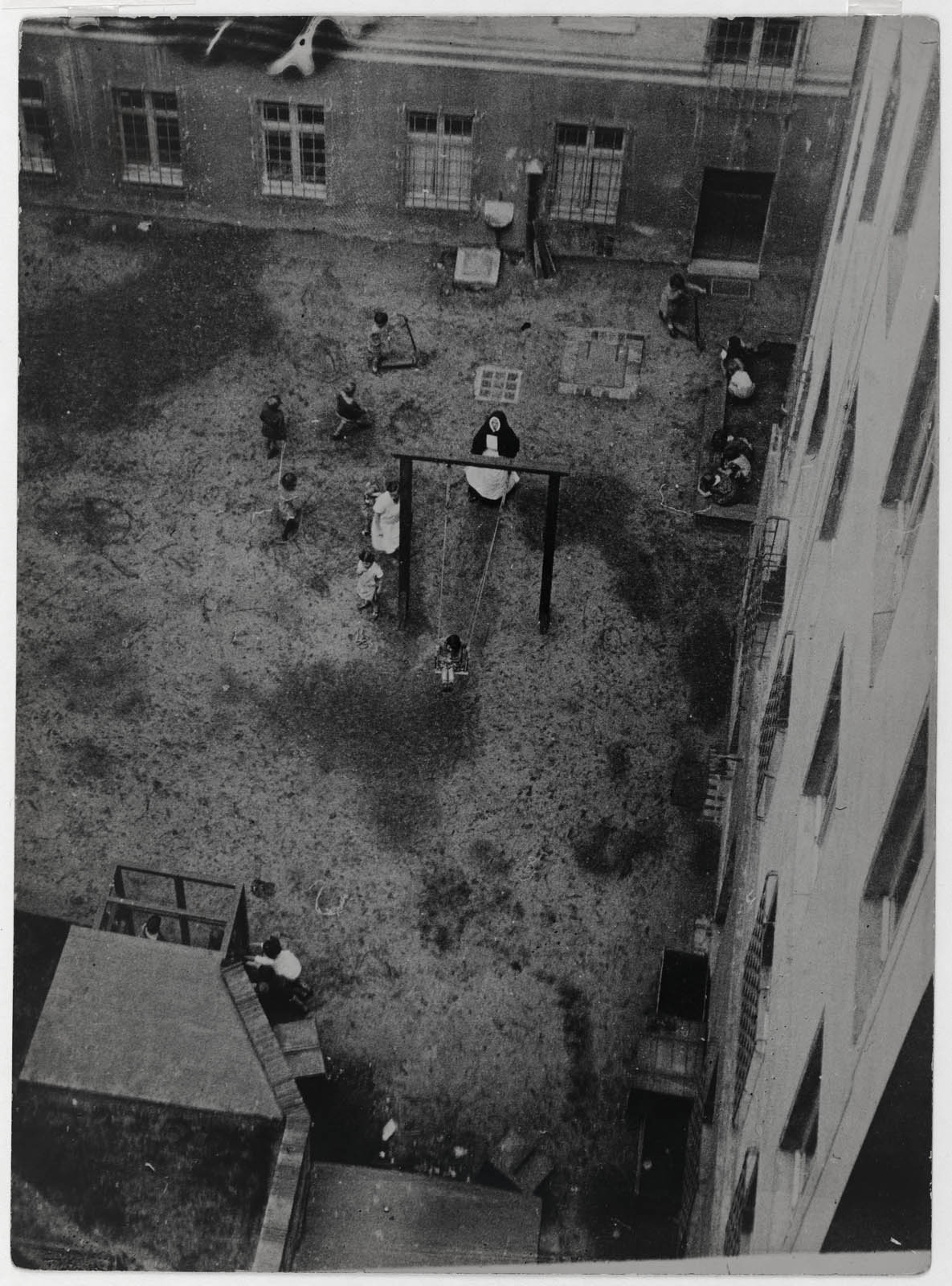
 

Umbo (Otto Umbehr) (German, 1902-1980) 'Untitled (Kindergarten)' 1928


Umbo (Otto Umbehr) (German, 1902-1980)
Untitled (Kindergarten)
1928
Gelatin silver print
Berlinische Galerie – Museum of Modern Art, Photography and Architecture, Berlin
Permanent loan from the Federal Republic of Germany represented by the Government Commissioner for Culture and the Media


Umbo – born Otto Umbehr – found his expressive tool in the camera in 1926. In the early 1920s he studied at the Bauhaus with the intention of becoming a painter, until Walter Gropius, the director of the Institute, expelled him from the school for improper conduct. He then found in photography the medium that allowed him to work with his distinctive play of light and shadow. Photographs such as Unheimliche Straße (Eerie Street, 1928), Am Strand (auch Strandleben) (On the beach [also beach life], 1930) and Ohne Titel (Kindergarten) (Untitled [Kindergarten], 1930) epitomize his artistic innovations. There is nothing random in these images: everything has been composed. Umbo’s photographs are the opposite of snapshots or shots that capture the emotion of a moment; they express a formal intent without overpowering reality. Therefore, with all their poetry, they retain an abstract component. What clearly surfaces in this primacy of composition is his connection to the Bauhaus philosophy, which emphasised design and structure over emotion or spontaneity.

Exhibition text from the Fondazione Prada by Cord Riechelmann


Fondazione Prada Milan
Largo Isarco 2, within the Podium spaces
20139 MILAN
Phone: +39 02 5666 2611

Opening hours:
Mon-Sun, 10am – 7pm

Fondazione Prada Milan website

LIKE ART BLART ON FACEBOOK

Back to top

Exhibition: ‘The 80s: Photographing Britain’ at Tate Britain, London

Exhibition dates: 21st November, 2024 – 5th May, 2025

Curators: Yasufumi Nakamori, former Senior Curator of International Art (Photography) Tate Modern, Helen Little, Curator, British Art, Tate Britain and Jasmine Chohan, Assistant Curator, Contemporary British Art, Tate Britain with additional curatorial support from Bilal Akkouche, Assistant Curator, International Art, Tate Modern; Sade Sarumi, Curatorial Assistant, Contemporary British Art, Tate Britain and Bethany Husband, Exhibitions Assistant, Tate Britain

List of artists: Keith Arnatt; Zarina Bhimji; Derek Bishton; Sutapa Biswas; Tessa Boffin; Marc Boothe; Victor Burgin; Vanley Burke; Pogus Caesar; Thomas Joshua Cooper; John Davies; Poulomi Desai; Al-An deSouza; Willie Doherty; Jason Evans; Rotimi Fani-Kayode; Anna Fox; Simon Foxton; Armet Francis; Peter Fraser; Melanie Friend; Paul Graham; Ken Grant; Joy Gregory; Sunil Gupta; John Harris; Lyle Ashton Harris; David Hoffman; Brian Homer; Colin Jones; Mumtaz Karimjee; Roshini Kempadoo; Peter Kennard; Chris Killip; Karen Knorr; Sirkka-Liisa Konttinen; Grace Lau; Dave Lewis; Markéta Luskačová; David Mansell; Jenny Matthews; Don McCullin; Roy Mehta; Peter Mitchell; Dennis Morris; Maggie Murray; Tish Murtha; Joanne O’Brien; Zak Ové; Martin Parr; Ingrid Pollard; Brenda Prince; Samena Rana; John Reardon; Paul Reas; Olivier Richon; Suzanne Roden; Franklyn Rodgers; Paul Seawright; Syd Shelton; Jem Southam; Jo Spence; John Sturrock; Maud Sulter; Homer Sykes; Mitra Tabrizian; Wolfgang Tillmans; Paul Trevor; Maxine Walker; Albert Watson; Tom Wood; Ajamu X.


Jason Evans (Welsh, b. 1968) and Simon Foxton (British, b. 1961) 'Untitled' 1991 From the series 'Strictly' from the exhibition 'The 80s: Photographing Britain' at Tate Britain, London, Nov 2024 - May 2025


Jason Evans (Welsh, b. 1968) and Simon Foxton (British, b. 1961)
Untitled
1991
From the series Strictly
Tate
© Jason Evans


A humungous posting that, much like the exhibition itself, cannot do justice to the photographs and issues of an entire decade – the flow on effects of which are still being felt today.

From distant Australia and having not seen the exhibition myself, I cannot do justice – now there is an apposite word for the decade – to the flow of the exhibition, the many included or neglected artists involved or not, the bodies of work displayed or their commentary on the many disparate, competing and complex political, economic and social cataclysms (def: a sudden violent political or social upheaval) of the decade: including but not limited to, race, gender, identity, representation, activism, neoliberalism, Thatcher, The Miners’ Strike, Clause 28, HIV/AIDS, feminism, racism, class, patriarchy, money, greed, hedonism, humanism, subcultures, unemployment, strikes, poverty, luxury, consumer culture, war (Falklands) and riots, for example the Brixton riots of 1981.

I lived those years in the UK before emigrating to Australia in 1986. What I remember is the terrible weather, the cold and the damp, the vile Thatcher, and the poor quality of living. I lived in Stockwell (or Saint Ockwell as we used to call it) near Brixton in the early 80s before moving to Shepherd’s Bush were all the Mods gathered on their scooters on the roundabout as part of the mod revival.

I worked at a fish and chip restaurant called Geales just off Notting Hill Gate working double shifts, 10.30 – 3pm, 5.30 – 12, five days a week. The restaurant served fish and chips with French champagne and wines. The mostly gay floor staff were paid a pittance but we earnt our money off the tips we received from the celebrities that inhabited the place, people such as Bill Connolly, John Cleese, Divine and Kenny Everett. They loved us gay boys.

We worked hard and partied harder, often going out from Friday night to Sunday night to the clubs with a rest day on Monday. We were young. We ran from place to place living at a hundred miles an hour, not realising the ruts in London are very deep and you were spending as much as you made just to pay the rent, to eat at dive cafe (I lived on Mars bars, fish and chips, braised heart, mashed potatoes and bullet peas to name a few and I was as thin as a rake), and to go out partying, to have fun, visiting the alternative clubs in Kings Cross, Vauxhall, Brixton and the East End.

And then there was the spectre of HIV/AIDS raising its ugly head. I had my first HIV test in 1983. I had my blood taken and I went back 2 weeks later for the result. I sat outside the doctor’s room and if they called you in and said you had it, you were dead. To look death in the face at 25. The was no treatment. I survived but many of my friends, both here and in Australia, didn’t. We partied harder.


There are so many perspectives on the 80s that it is an impossible task for one exhibition to cover all of the issues. Reviews have noted that the exhibition is “a meandering look at pomp, protest” (Guardian); “exhaustive and exhausting… [the exhibition] makes for a dogged viewing experience that confuses as much as it enlightens” (Guardian); “a sense of fatigue and depletion as it went on and on … it could have been more engaging, more pleasurable” (1000 Words); and “the critical reception of the show has been rather lukewarm” (The Brooklyn Rail).

Most writer’s observe that the exhibition illuminates the way photography shifts “from monochrome to colour, from photojournalism to a more detached style of documentary” featuring “constructed, studio-based and appropriationist work.” The exhibition distils “the curatorial thrust of this sprawling exhibition, which, as its subtitle suggests, is more about photography’s often conceptually based responses to the 1980s than the turbulent nature of the decade itself.”1

Further, Bartolomeo Sala observes that the meandering view of the 1980s is consistent with the curatorial approach to the exhibition, “that is, to present eighties Britain not as a ossified relic but rather a container of multitudes, a country animated by competing, clashing energies and defying coherent description in a way that feels very reminiscent of today. A neoliberal hellhole, a nightmare of petit bourgeois conformity and cheapness, and at the same time an increasingly tolerant, multicultural, and open society, which finds its motor and pride in diversity and the endless project of self-fashioning.”2

Forty plus years on we are still paying the price for Thatcher’s neoliberal hellhole, with the loss of community, and the lack of compassion and empathy for others. I often think it was a more vibrant, more alive time in the 1980s despite all of its inherent problems. While we may have become a more tolerant, multicultural society, fascism and the right, disenfranchisement and loss of rights lurk ever closer to the surface. While we have pride we also have arrogance and self-aggrandisement, self-entitlement. While then we seemingly had freedom and love we now have surveillance and control. In some ways then I disagree with today being a more “open” society.

What social documentary and conceptual photography pictured so strongly and conscientiously in 1980s Britain was the vibrant madness of the age. The passions and the prejudices. Half your luck that you go and see this exhibition in London, that you have a chance to breathe in these photographs, for in Australia the chance of seeing such an exhibition of photographs from the 1980s by a state or national gallery would be zero.

I wouldn’t complain too much!

Dr Marcus Bunyan


1/ Sean O’Hagan. “The 80s: Photographing Britain review – in your face and to the barricades,” on The Guardian website, Sun 24 Nov 2024 [Online] Cited 02/05/2025

2/ Bartolomeo Sala. “The 80s: Photographing Britain,” on The Brooklyn Rail website March 2025 [Online] Cited 03/04/2025


Many thankx to Tate Britain for allowing me to publish the photographs in the posting. Please click on the photographs for a larger version of the image.


Installation view of the exhibition 'The 80s: Photographing Britain' at Tate Britain, London showing at left, the work of Jason Evans and Simon Foxton from the series 'Strictly' 1991; and at centre left top, Wolfgang Tillmans' 'Love (Hands in Air)' 1989


Installation view of the exhibition The 80s: Photographing Britain at Tate Britain, London showing at left, the work of Jason Evans and Simon Foxton from the series Strictly 1991 (below); and at centre left top, Wolfgang Tillmans’ Love (Hands in Air) 1989 (below)
Courtesy of Tate Britain


Installation view of the exhibition 'The 80s: Photographing Britain' at Tate Britain, London showing at rear, photographs from Maud Sulter's series 'Zabat' 1989


Installation view of the exhibition The 80s: Photographing Britain at Tate Britain, London showing at rear, photographs from Maud Sulter’s series Zabat 1989
Courtesy of Tate Britain


Maud Sulter produced the Zabat series for Rochdale Art Gallery in 1989, the 150th anniversary of the invention of photography. It was a direct response to the lack of a black presence at other celebratory events and exhibitions. Here we see the conventions of Victorian portrait photography under the command of a black woman photographer. The backdrop, props and pose are all retained but the image is transformed with African clothes, non-European objects and, most importantly, by the resolute black woman at its centre.

The title ‘Zabat’ also signifies Maud Sulter’s call for a repositioning of black women in the history of photography: the word describes an ancient ritual dance performed by women on occasions of power.

Text from the V&A website


Installation view of the exhibition 'The 80s: Photographing Britain' at Tate Britain, London showing at left the work of Paul Graham


Installation view of the exhibition The 80s: Photographing Britain at Tate Britain, London showing at left the work of Paul Graham
Courtesy of Tate Britain


Installation view of the exhibition 'The 80s: Photographing Britain' at Tate Britain, London


Installation view of the exhibition The 80s: Photographing Britain at Tate Britain, London
Courtesy of Tate Britain


Wolfgang Tillmans (German, b. 1968) 'Love (Hands in Air)' 1989


Wolfgang Tillmans (German, b. 1968)
Love (Hands in Air)
1989


“Depending on where you stood in terms of race, gender, or class, the 1980s would seem a time of unprecedented economic expansion, an era defined by the triumph of consumerism and a particularly brass form of hedonism, or else an era of widening disparities, rising unemployment, and generalized economic crisis; a time defined by the booming of the housing market or the return of homelessness; a time of general disaffection and disillusionment toward the prospects of organized politics or an era defined by political activism and struggle, often hyperlocal in nature, as well as successive waves of discontent that at different points rocked the nation. …

In general, the critical reception of the show has been rather lukewarm. Many broadsheet commentators have lamented the meandering nature of the exhibition, while one critic noted the programmatic downplaying of the decade’s heavy-hitters. (Don McCullin and Chris Killip get a handful of photographs each, while virtuoso of political photomontage Peter Kennard is relegated to display cases.) Such assessments feel a little unfair and condescending to the excellent artists who do get a good showing, and in any case this curatorial approach is consistent with the intention of the exhibition – that is, to present eighties Britain not as a ossified relic but rather a container of multitudes, a country animated by competing, clashing energies and defying coherent description in a way that feels very reminiscent of today. A neoliberal hellhole, a nightmare of petit bourgeois conformity and cheapness, and at the same time an increasingly tolerant, multicultural, and open society, which finds its motor and pride in diversity and the endless project of self-fashioning.”


Bartolomeo Sala. “The 80s: Photographing Britain,” on The Brooklyn Rail website March 2025 [Online] Cited 03/04/2025


Derek Bishton, Brian Homer and John Reardon. 'Ting A Ling, Handsworth Self Portraits project' 1979 from the exhibition 'The 80s: Photographing Britain' at Tate Britain, London, Nov 2024 - May 2025


Derek Bishton, Brian Homer and John Reardon
Ting A Ling, Handsworth Self Portraits project
1979
© Derek Bishton, Brian Homer & John Reardon


Syd Shelton (British, b. 1947) 'Skinheads, Petticoat Lane, East London' 1979, printed 2012


Syd Shelton (British, b. 1947)
Skinheads, Petticoat Lane, East London
1979, printed 2012
Gelatin silver print on paper
417 x 281 mm
Tate
Gift Eric and Louise Franck London Collection 2016


Skinheads, known for their shaved heads and heavy boots, emerged as a working-class subculture in the 1960s. Initially non-political, some became associated with extreme nationalism. Others took an anti-racist position aligned with two-tone, a musical movement blending Jamaican ska and British punk. One of Syd Shelton’s photographs shows two members of Skins Against the Nazis proudly displaying a Rock Against Racism badge. The other was taken after an argument about racism. ‘I saw the guy at the front clenching his fists’, notes Shelton, ‘so I took the shot, said thanks and legged it as fast as I could.’

Wall text from the exhibition


Syd Shelton (British, b. 1947) 'Anti-racist Skinheads, Hackney, London' 1979, printed 2012


Syd Shelton (British, b. 1947)
Anti-racist Skinheads, Hackney, London
1979, printed 2012
Gelatin silver print on paper
417 x 282 mm
Tate
Gift Eric and Louise Franck London Collection 2016


In 1977, 500 National Front (NF) members attempted to march through Lewisham, an area in southeast London with a significant Black population. Thousands ignored a police blockade to hold a peaceful counter-demonstration that led to the NF abandoning their march. Protestors clashed with police and were met by riot shields, baton charges and mounted officers. The events became known as the Battle of Lewisham. Shelton’s photographs contrast the chaos of the streets with the resolve of the protestors. ‘Politics was one of the reasons that I became a photographer’, notes Shelton, ‘the idea of the objective photographer is nonsense.’

Wall text from the exhibition


Syd Shelton (British, b. 1947) 'Darcus Howe addressing the anti-racist demonstrators, Lewisham, 13 August 1977' Dated 1977, printed 2020 from the exhibition 'The 80s: Photographing Britain' at Tate Britain, London, Nov 2024 - May 2025


Syd Shelton (British, b. 1947)
Darcus Howe addressing the anti-racist demonstrators, Lewisham, 13 August 1977
Dated 1977, printed 2020
Tate
Presented by the artist 2021
© Syd Shelton


Explore one of the UK’s most critical decades, the 1980s. This exhibition traces the work of a diverse community of photographers, collectives and publications – creating radical responses to the turbulent Thatcher years. Set against the backdrop of race uprisings, the miner strikes, section 28, the AIDS pandemic and gentrification – be inspired by stories of protest and change.

At the time, photography was used as a tool for social change, political activism, and artistic and photographic experiments. See powerful images that gave voice and visibility to underrepresented groups in society. This includes work depicting the Black arts movement, queer experience, South Asian diaspora and the representation of women in photography.

This exhibition examines how photography collectives and publications highlighted these often-unseen stories, featured in innovative photography journals such as Ten.8 and Cameraworks. It will also look at the development of Autograph ABP, Half Moon Photography Workshop, and Hackney Flashers.

Visitors will go behind the lens to trace the remarkable transformation of photography in Britain and its impact on art and the world.

Text from the Tate Britain website


The 80s: Photographing Britain

David Preshaah and Helen Little curator of The 80s: Photographing Britain at Tate Britian discuss the show running 21st November, 2024 – 5th May, 2025. See powerful images that gave voice and visibility to underrepresented groups in society. This includes work depicting the Black arts movement, queer experience, South Asian diaspora and the representation of women in photography


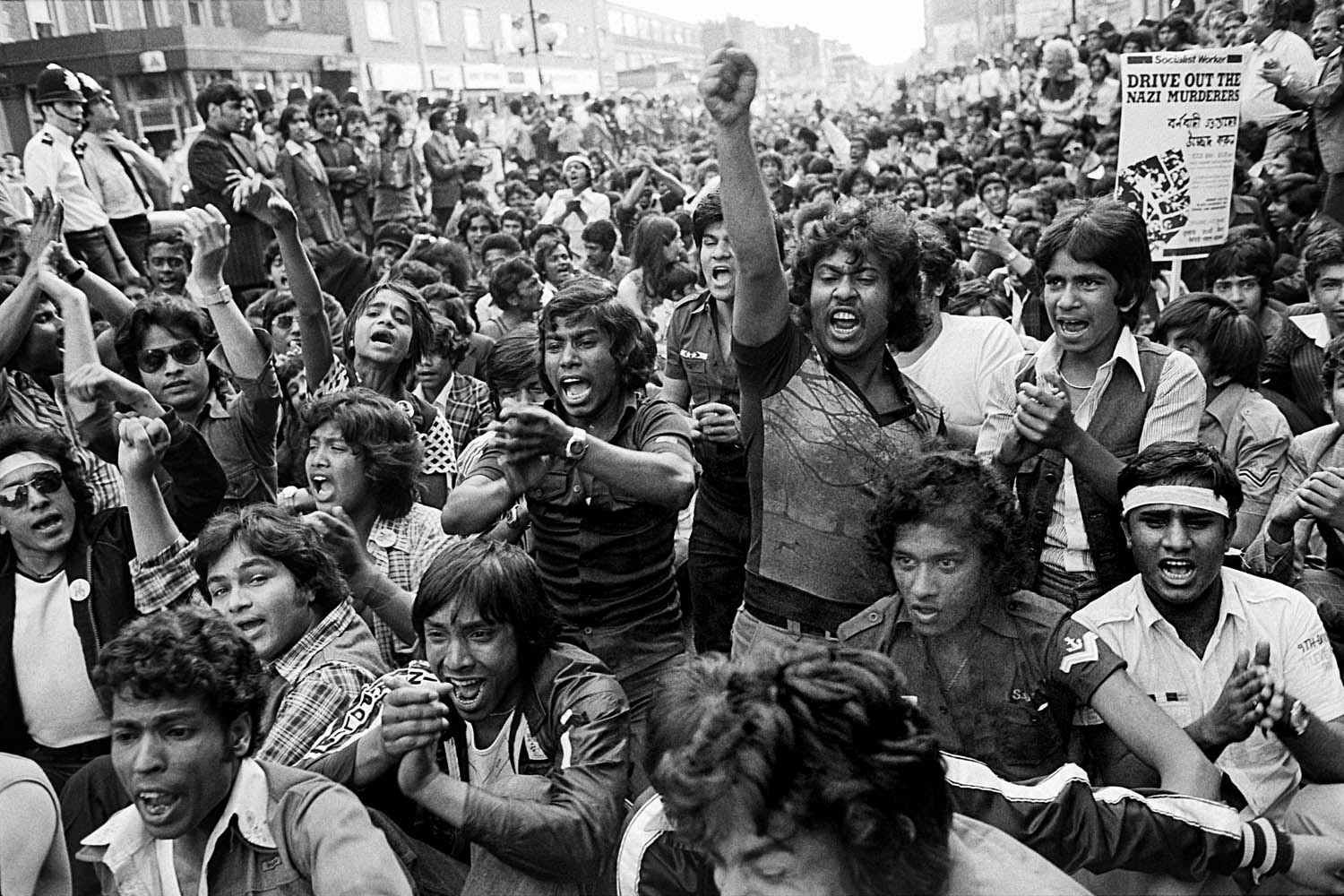
Paul Trevor (British, b. 1947) 'Outside police station, Bethnal Green Road, London E2, 17 July 1978. Sit down protest' 1978


Paul Trevor (British, b. 1947)
Outside police station, Bethnal Green Road, London E2, 17 July 1978. Sit down protest
1978

Paul Trevor © 2023


On 4 May 1978, Altab Ali, a 24-year-old Bangladeshi textile worker, was murdered in a racially motivated attack. During police interviews, the three teenagers responsible casually described the regularity of their racist violence. The Bangladeshi community in east London mobilised in response. 7,000 people marched from Bethnal Green’s Brick Lane to Downing Street, following a vehicle carrying Ali’s coffin. Protestors rallied in Hyde Park chanting, ‘Who killed Altab Ali? Racism, racism!’

Paul Trevor was a member of Half Moon Photography Workshop and helped produce Camerawork magazine. He contributed to an issue on the 1978 Battle of Lewisham in southeast London. While photographing the violent clashes between police and anti-fascist protestors, Trevor recalls, ‘A woman – appealing for help – shouted at me in desperation “What are you taking pictures for?” Good question, impossible to answer in that melee.’ The special issue of Camerawork, ‘What are you taking pictures for?’ was devoted to that question.

Wall text from the exhibition


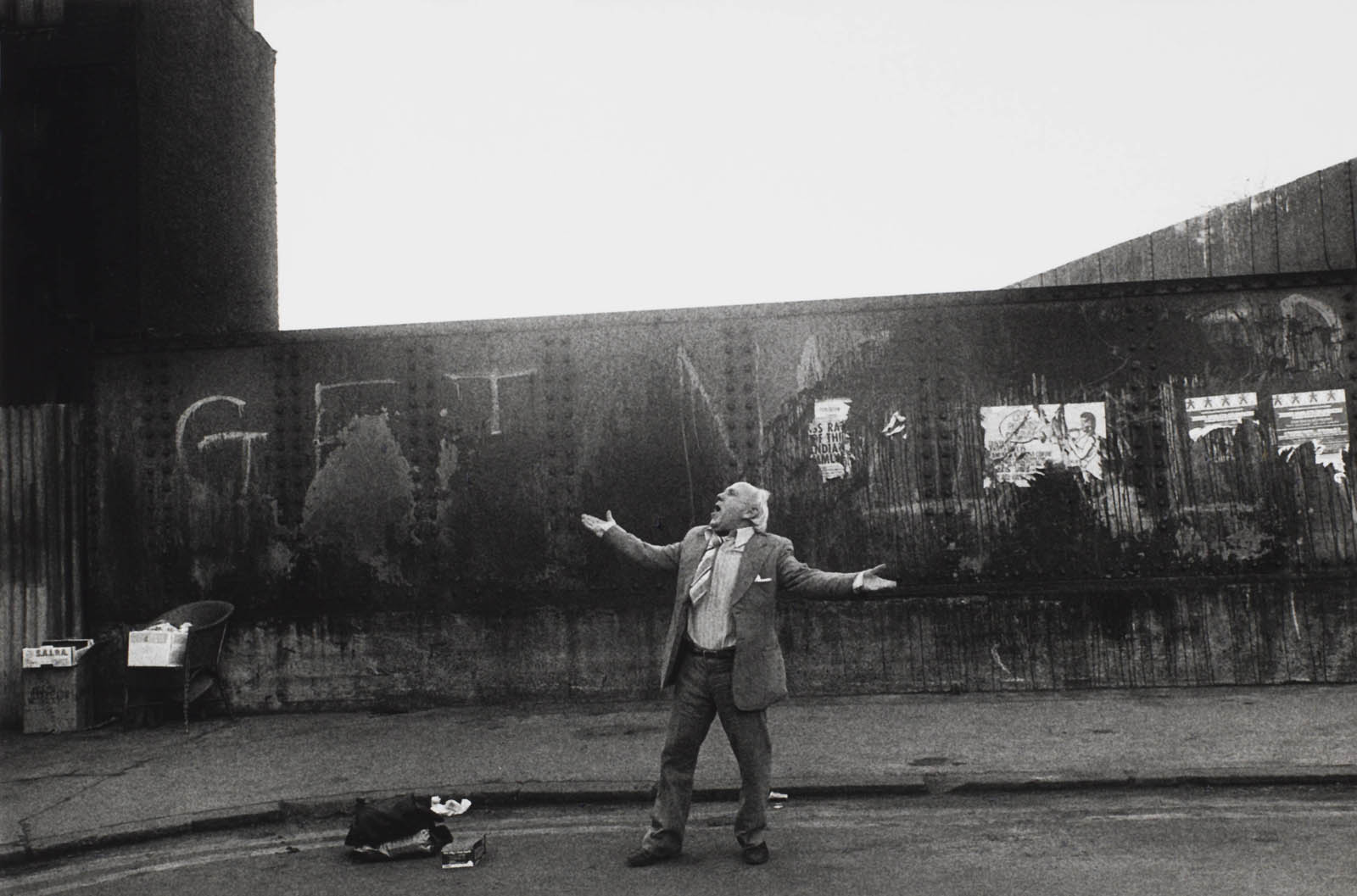
Don McCullin (British, b. 1935) 'Jean, Whitechapel, London' Late 1970s


Don McCullin (British, b. 1935)
Jean, Whitechapel, London
Late 1970s
Gelatin silver print
Tate
Gift Eric and Louise Franck London Collection 2011


Photojournalist and war photographer Don McCullin spent nearly twenty years photographing people living on the streets of Aldgate and Whitechapel in east London. He documented people living at the edge of the city’s wealthy financial centre. In the late 1970s, unprofitable psychiatric institutions in the area had begun to close, leaving many residents homeless. These photographs of Jean show how closely McCullin worked with the people he photographed. Of his British social documentary work, McCullin notes: ‘Many people send me letters in England saying “I want to be a war photographer”, and I say, go out into the community you live in. There’s wars going on out there, you don’t have to go halfway around the world.’

Wall text from the exhibition


This autumn, Tate Britain will present The 80s: Photographing Britain, a landmark survey which will consider the decade as a pivotal moment for the medium of photography. Bringing together nearly 350 images and archive materials from the period, the exhibition will explore how photographers used the camera to respond to the seismic social, political, and economic shifts around them. Through their lenses, the show will consider how the medium became a tool for social representation, cultural celebration and artistic expression throughout this significant and highly creative period for photography.

This exhibition will be the largest to survey photography’s development in the UK in the 1980s to date. Featuring over 70 lens-based artists and collectives, it will spotlight a generation who engaged with new ideas of photographic practice, from well-known names to those whose work is increasingly being recognised, including Maud Sulter, Mumtaz Karimjee and Mitra Tabrizian. It will feature images taken across the UK, from John Davies’ post-industrial Welsh landscape to Tish Murtha’s portraits of youth unemployment in Newcastle. Important developments will be explored, from technical advancements in colour photography to the impact of cultural theory by scholars like Stuart Hall and Victor Burgin, and influential publications like Ten.8 and Camerawork in which new debates about photography emerged.

The 80s will introduce Thatcher’s Britain through documentary photography illustrating some of the tumultuous political events of the decade. History will be brought to life with powerful images of the miners’ strikes by John Harris and Brenda Prince; anti-racism demonstrations by Syd Shelton and Paul Trevor; images of Greenham Common by Format Photographers and projects responding to the conflict in Northern Ireland by Willie Doherty and Paul Seawright. Photography recording a changing Britain and its widening disparities will also be presented through Anna Fox’s images of corporate excess, Paul Graham’s observations of social security offices, and Martin Parr’s absurdist depictions of Middle England, displayed alongside Markéta Luskačová and Don McCullin’s portraits of London’s disappearing East End and Chris Killip’s transient ‘sea-coalers’ in Northumberland.

A series of thematic displays will explore how photography became a compelling tool for representation. For Roy Mehta and Vanley Burke, who portray their multicultural communities, photography offers a voice to the people around them, whilst John Reardon, Derek Bishton and Brian Homer’s Handsworth Self Portrait Project 1979, gives a community a joyous space to express themselves. Many Black and South Asian photographers use portraiture to overcome marginalisation against a backdrop of discrimination. The exhibition will spotlight lens-based artists including Roshini Kempadoo, Sutapa Biswas and Al-An deSouza who experiment with images to think about diasporic identities, and the likes of Joy Gregory and Maxine Walker who employ self-portraiture to celebrate ideas of Black beauty and femininity.

Against the backdrop of Section 28 and the AIDS epidemic, photographers also employ the camera to assert the presence and visibility of the LGBTQ+ community. Tessa Boffin subversively reimagines literary characters as lesbians, whilst Sunil Gupta’s ‘Pretended’ Family Relationships 1988, juxtaposes portraits of queer couples with the legislative wording of Section 28. For some, their work reclaims sex-positivity during a period of fear. The exhibition will spotlight photographers Ajamu X, Lyle Ashton Harris and Rotimi Fani-Kayode who each centre Black queer experiences and contest stereotypes through powerful nude studies and intimate portraits. It will also reveal how photographers from outside the queer community including Grace Lau were invited to portray them. Known for documenting fetishist sub-cultures, Lau’s series Him and Her at Home 1986 and Series Interiors 1986, tenderly records this underground community defiantly continuing to exist.

The exhibition will close with a series of works that celebrate countercultural movements throughout the 80s, such as Ingrid Pollard and Franklyn Rodgers’s energetic documentation of underground performances and club culture. The show will spotlight the emergence of i-D magazine and its impact on a new generation of photographers like Wolfgang Tillmans and Jason Evans, who with stylist Simon Foxton pioneer a cutting-edge style of fashion photography inspired by this alternative and exciting wave of youth culture, reflective of a new vision of Britain at the dawn of the 1990s.

Press release from Tate Britain


Markéta Luskačová (Czech, b. 1944) 'Man singing on Brick Lane, London' 1982


Markéta Luskačová (Czech, b. 1944)
Man singing on Brick Lane, London
1982
Gelatin silver print
Tate
© Markéta Luskačová


Markéta Luskačová’s London Street Musicians series includes photographs taken between 1975 and 1990. They document the lives of street musicians performing at London markets. Her photographs reveal the humanity and resilience of these often-solitary musicians. ‘The street musicians themselves were often quite lonely men, yet their music lessened the loneliness of the street, the people in it and my own loneliness’, she recalls. For Luskačová, photography is ‘a tool for trying to understand life … to remember the people and things that I photograph. I want them to be remembered.’

Wall text from the exhibition


Chris Killip (Manx, 1946-2020) ''Critch' and Sean' 1982


Chris Killip (Manx, 1946-2020)
‘Critch’ and Sean
1982
Tate
© Chris Killip


Chris Killip first visited the seacoaling community at Lynemouth Beach in Northumberland in 1976. ‘The beach beneath me was full of activity with horses and carts backed into the sea’, Killip recalls. ‘Men were standing in the sea next to the carts, using small wire nets attached to poles to fish out the coal from the water beneath them. The place confounded time.’ In 1982, Killip started photographing the community, living alongside them from 1983 to 1984. ‘I wasn’t getting close enough, so I bought a caravan and moved into the place and that made a very big difference.’

Killip used a large format plate camera to capture his subjects. ‘It’s not a casual thing’, he notes. ‘I think it works to your advantage. They know this is going to live after this moment. It’s not ephemeral.’

Wall text from the exhibition


Jo Spence (British, 1934-1992) and Terry Dennett (British, 1938-2018)
'Remodelling Photo History: Revisualization' 1981-1982


Jo Spence (British, 1934-1992) and Terry Dennett (British, 1938-2018)
Remodelling Photo History: Revisualization
1981-1982
Tate
Presented by Tate Patrons 2014
© The Jo Spence Memorial Archive


These images are from Remodelling Photo History, a collaboration between Jo Spence and Terry Dennett. The work was originally published as a sequence of 13 photographs in which Spence and Dennett both act as photographer and photographic subject. The series was devised as a critique of standard histories of photography and particularly the depiction of women in art. It employs a practice Spence called ‘photo-theatre’. Each photograph emphasises its staging and construction in order to challenge and ‘make strange’ the assumed ‘naturalism’ of photography. Spence commented ‘it is obvious that a vast amount of work still needs to be done on the so-called history of photography, and on the practices, institutions and apparatuses of photography itself, and the function they have had in constructing and encouraging particular ways of viewing and telling about the world.’

Wall text from the exhibition


Joy Gregory (British, b. 1969) 'Magenta Dress with Pink Tulips' 1984


Joy Gregory (British, b. 1969)
Magenta Dress with Pink Tulips
1984
Courtesy of the artist
© Joy Gregory. All rights reserved, DACS


Joy Gregory’s early interest in colour photography began as student at Manchester Polytechnic. The university was known for its emphasis on the technical and chemical aspects of photography. Gregory’s education taught her the craft of commercial photography but she set out to use these skills like a painter. Her early experiments informed an ongoing interest in stillness, space and light. This series of colour transparencies presents models and still lifes in a painted studio interior. By using multiple exposures and layering images, Gregory suggests a spectral presence in the works. Her focus on the painterly qualities of colour and light here are typical of her practice. She employs languages of beauty and seduction in small textured prints that invite close inspection.

Wall text from the exhibition


John Harris (British, b. 1958) 'Mounted Policeman attacking Lesley Boulton at the Battle of Orgreave'
1984, printed 2024


John Harris (British, b. 1958)
Mounted Policeman attacking Lesley Boulton at the Battle of Orgreave
1984, printed 2024


John Harris’s photographs from the 1984 Battle of Orgreave challenged government portrayals of miners as aggressors. In 1984, the National Union of Miners identified Orgreave coking plant in South Yorkshire as a key site for picketing. From May to June, strikers attempting to disrupt deliveries were met by growing police presence. Tensions came to a head on 22 June when an estimated 6,000 officers clashed with pickets. One of Harris’s images captures Lesley Boulton cowering beneath the truncheon of a mounted officer. It became an emblem of the strike, appearing on badges, banners and posters.

Wall text from the exhibition


Paul Graham (British, b. 1956) 'Union Jack Flag in Tree, Country Tyrone' 1985


Paul Graham (British, b. 1956)
Union Jack Flag in Tree, Country Tyrone
1985
C-print on paper
Tate
Presented by Tate Members 2007
© Paul Graham


From 1984 to 1986, Paul Graham documented Northern Irish locations featured in news reports of the Troubles. During his first visit, Graham was stopped by a British military patrol suspicious of his camera. As they left, he took a shot with his camera hanging from his neck. The photograph became a ‘gateway’ for Graham’s Troubled Land series. He felt his other images of rioting, murals and destruction, ‘weakly echoed what I saw in the newspapers. This one image did not’. ‘There were people walking to shops and driving cars – simply going about their day, but then there was a soldier in full camouflage, running across the roundabout.’ For Graham, the image ‘reintegrated the conflict into the landscape … it was a conflict photograph masquerading as a landscape photograph.’

Wall text from the exhibition


Pogus Caesar (British born St. Kitts, b. 1953) 'Handsworth Riots: Birmingham, United Kingdom September' 1985, printed 2020


Pogus Caesar (British born St. Kitts, b. 1953)
Handsworth Riots: Birmingham, United Kingdom
September 1985, printed 2020
Gelatin silver print
Martin Parr Foundation Collection


These photographs capture two days of uprisings in Handsworth, Birmingham, following the arrest of a Black man over a parking violation and a police raid on a pub on the Lozells Road. The photographer, Handsworth resident Pogus Caesar, notes: ‘Where possible it was vital to document.’ He explains: ‘The media has a way of portraying these type of events, I needed to document my truth.’ Caesar’s insider perspective allowed him to capture a range of images, such as artist John Akomfrah reading a sensationalist newspaper account of the two days of violence between the police and local communities.

Wall text from the exhibition


Melanie Friend (British, b. 1957)
'Greenham Common, 14 December 1985' 1985, reprinted 2023


Melanie Friend (British, b. 1957)
Greenham Common, 14 December 1985
1985, reprinted 2023
© Melanie Friend, Format Photographers Archive, Bishopsgate Institute


Exhibition guide

The 80s: Photographing Britain explores a critical decade for photography in the UK. It highlights the work of artists who were radically reconsidering the possibilities of the medium and its role in society.

The exhibition traces developments in photographic art from 1976 to 1993. It follows artists working against a backdrop of high unemployment, industrial action and civil rights activism. Many were part of local photographic communities that developed around key photography schools and collectives. Yet, through innovative publications and independent galleries, they reached national and international audiences.

The artists included in the exhibition expanded photographic practice in Britain. They often collaborated, shared ideas and debated theory. Some were inspired by the activism of the period’s protest movements, using their cameras to provide new ways of looking at society. Others embraced technical developments to push the boundaries of fine art photography. Their work highlights the medium’s range, from landscapes to self-portraiture, and social documentary to conceptual photography.

The 80s: Photographing Britain invites us to reflect on photography’s political and artistic potential. It acknowledges that the diversity of contemporary photographic practice is indebted to the groundbreaking photographers of the 1980s.

Room 1

Documenting the decade

This room documents a period of significant social and political upheaval in the UK. It features protests, uprisings and acts of violence photographed through an activist lens. These photographers challenged dominant narratives and amplified marginalised voices. Some photographed their own communities, giving them access an outsider might not be granted. Others, free from the violence and oppression their subjects faced, turned to photography as an act of solidarity.

The exhibition begins in 1976, the year Jayaben Desai walked out of Grunwick Film Processing Laboratories in London, starting a two-year strike for the right to union representation. The Grunwick dispute typifies the events explored in this room. It was led by an activist whose intersecting identities were the root of her cause. When thousands took to the streets in solidarity it revealed the power of collective action. But it is also an example of failed industrial action, hardline policing and racist media coverage.

In 1979, following months of industrial disputes during the so-called ‘Winter of Discontent’, James Callaghan’s Labour government lost the general election. When Conservative prime minister Margaret Thatcher took office, she promised to reverse the country’s ‘decline’. The answer, she argued, was free markets, traditional values and British nationalism. Her political philosophy became known as Thatcherism. It helped UK financial markets thrive but led to growing class division and inequalities.

Within this context, socially engaged photographers joined the fight for change. They documented protests and the hardline police tactics designed to silence them. Their images reveal a range of documentary practices and photography’s ability to uncover events that might otherwise remain hidden.

Anti-racist movements

The 1948 British Nationality Act allowed everyone born in Britain or its Empire to become a ‘Citizen of the United Kingdom and Colonies’. The act encouraged people from Britain’s current and former colonies to move to the UK to address labour shortages, help facilitate post-war reconstruction and build the welfare state. Yet, on arrival, citizens of colour faced hostility and racial discrimination. It marked the beginning of decades of racist rhetoric, rioting and civil rights activism.

In 1968, Conservative MP Enoch Powell delivered his ‘Rivers of Blood’ speech in Birmingham, criticising immigration and emboldening the far-right. That same year, writer Obi Egbuna founded the British Black Panthers to defend Black communities against racism and discrimination. By the mid-1970s, the far-right, anti-immigration National Front was England’s fourth largest political party. They capitalised on the perception that white workers were losing jobs to immigrants rather than government failures to address unemployment levels. Their far-right ideology was opposed by anti-fascist and anti-racist campaign groups whose members vastly outnumbered the National Front. Throughout the 1980s, high-profile uprisings in Bristol, Leeds, London, Manchester, Liverpool and Birmingham revealed the strength of anti-racist feeling across the country.

The Miners’ Strike

Following the First World War, there were 1 million miners in the UK. By the beginning of the 1980s, there were 200,000. In March 1984, the National Coal Board announced plans to close 20 collieries, putting 20,000 jobs at risk. The National Union of Mineworkers, led by Arthur Scargill, responded with a series of year-long strikes. Observed across England, Scotland and Wales, the strikes were a national issue.

Determined to disable labour movements across the UK, Margaret Thatcher took steps to break the miners’ union and limit their power. The government stockpiled coal, mobilised police forces, brought legal challenges, and made media statements heavily criticising the union and striking workers.

Journalists challenged the government’s portrayal of miners as aggressors and agitators. Photographers helped evidence instances of excessive and often unprovoked violence by law enforcement. But the government’s plans to take down miners, one of the strongest unionised workforces in the country, had worked. On 3 March 1985, after 362 days, the National Union of Mineworkers accepted defeat. Union members voted to end the strike. The strike put industrial issues and workers’ rights on the national agenda and had a profound impact on the politics of the period.

Brenda Prince was a member of Format Photographers Agency. Started by Maggie Murray and Val Wilmer in 1983, Format was set up as an agency for women. Prince joined in 1984. ‘We were all documentary photographers’, Prince notes. ‘We would work on our own stories and my miners’ strike images came out of that.’ ‘The miners’ strike gave me the opportunity to document working class people who were really struggling to keep their jobs and keep their communities alive’, Prince explains. She spent eighteen months in Nottinghamshire’s mining communities. Her works highlight the vital role women played in sustaining the strike.

(For more information on the miners’ strike please see the posting on the exhibition ONE YEAR! Photographs from the Miners Strike 1984-85 at Four Corners, London, Sept – October, 2024)

Greenham Common

On 5 September 1981, a group of women marched from Cardiff to the Royal Air Force base at Greenham Common in Berkshire. The site was common land, loaned to the US Air Force by the British Government during the Second World War and never returned. The group called themselves Women for Life on Earth. They were challenging the decision to house 96 nuclear missiles at the site. On arrival, they delivered a letter to the base commander stating: ‘We fear for the future of all our children and for the future of the living world which is the basis of all life.’ When their request for a debate was ignored, they set up camp. Others joined and the site became a women-only space.

Over the next 19 years, Greenham Common Women’s Peace Camp became a site of protest and home to thousands of women. Some stayed for months, others for years, and many visited multiple times. Greenham women saw their anti-nuclear position as a feminist one. They used their identities as mothers and carers to fight for the protection of future generations and inspired protest movements across the world.

In 1987, Soviet President Mikhail Gorbachev and US President Ronald Reagan signed a treaty which paved the way for the removal of cruise missiles from Greenham. Gorbachev has since paid tribute to the role ‘Greenham women and peace movements’ played in this historic agreement. By 1992, all missiles sited at Greenham had been removed and the US Air Force had left the base. The Peace Camp remained until 2000 as a protest against nuclear weapons.

Format Photographers Agency (1983-2003), featuring Maggie Murray, Melanie Friend, Brenda Prince and Jenny Matthews, played a crucial role in documenting social movements. Their photographs of the Greenham Common Women’s Peace Camp capture this landmark protest against nuclear missiles. They record the activism, daily life and personal stories of the women involved, highlighting their strength and creativity. They also reveal contrast between the women’s camp and their non-violent resistance and the militarised environment they were protesting.

The Gay Rights Movement

In 1967, the Sexual Offences Act partially decriminalised sexual acts between two men. It was the result of decades of campaigning but the act did nothing to address the discrimination LGBTQ+ communities faced. In 1970, the first meeting of the Gay Liberation Front took place. They wrote a manifesto outlining how gay people were oppressed and mapped out a route to liberation through activism and consciousness-raising. In the 1980s, the Gay Rights movement continued to grow. Queer communities came together in opposition to homophobia fuelled by Conservative ‘family values’ campaigns and fear of the HIV/ AIDS epidemic.

The first cases of Gay-Related Immune Deficiency (GRID) in the UK were identified in 1981. In 1982, GRID was renamed Acquired Immune Deficiency Syndrome (AIDS) and Britain saw its first deaths from the disease. By 1987, AIDS was a worldwide epidemic, with around 1,000 recorded cases in the UK. The public focus was largely on gay men, who were being infected in much greater numbers, fuelling anti-gay rhetoric in politics and the press.

In 1988, the government passed Section (formerly Clause) 28 of the Local Government Act. The legislation stated local authorities ‘shall not intentionally promote homosexuality’ or ‘promote the teaching in any maintained school of the acceptability of homosexuality as a pretended family relationship’. Section 28 forced many LGBT groups to disband and saw literature depicting gay life removed from schools and libraries. But it also galvanised the Gay Rights movement. People took to the streets in a series of marches and protests, and set up organisations to lobby for change.

Poll Tax

The community charge, commonly known as the ‘poll tax’, was introduced by Margaret Thatcher’s Conservative government in 1989 in Scotland, and 1990 in England and Wales. This flat-rate tax on every adult replaced previous taxation based on property value. The tax was accused of benefitting the rich and unfairly targeting the poor.

The national anti-poll tax movement began on the streets of Glasgow and led to a series of anti-poll tax actions across the UK. Many demonstrations saw clashes between police and protestors, and resulted in rioting. The fallout from the tax triggered leadership challenges against the prime minister and, in 1990, Thatcher resigned. In 1991, following vehement national opposition, John Major’s Conservative government announced the poll tax would be replaced by council tax.

The Troubles

The Troubles was a 30-year conflict in Northern Ireland between Protestant Ulster loyalists, who believe Northern Ireland should remain part of the United Kingdom, and Catholic Irish republicans, who believe in an independent united Ireland. The roots of the conflict date back to the twelfth century, when English settlers displaced Irish landholders and colonised areas of Ireland. In the seventeenth century, in an attempt strengthen British rule over the Catholic population, Britain moved protestants from Scotland and England to the north of Ireland. This caused sectarian divisions that continue to this day.

During the 1920 Irish War of Independence against British rule, a treaty was signed dividing the island into two self-governing areas. The majority Catholic counties, primarily in the south, formed the Irish Free State. The six majority Protestant counties in the north became a region of the United Kingdom. Catholics living in Northern Ireland faced discrimination and police harassment and, in the late 1960s, they organised civil rights marches challenging their treatment. Activists were met by counter-demonstrators and violent suppression by the almost exclusively Protestant police force. Riots ensued and the Troubles began. In 1969, the British Army was deployed to restore order in the region, but instead violence escalated. Paramilitary organisations on both sides took up arms and employed guerrilla tactics. More than 3,500 people had been killed by the time the Good Friday Agreement was signed in 1998, ending 30 years of violence.

Room 2

The cost of living

These photographs spotlight UK class dynamics in the 1980s. Images of social security waiting rooms and people living on the streets, sit alongside office workers, Conservative Party functions and gallery private views.

Margaret Thatcher believed, ‘whatever your background, you have a chance to climb to the top’. She presented social mobility as the reward for those who worked hard enough. The government encouraged people to become part of the property-owning middle classes. The 1980 Housing Act gave 5 million council house tenants the right to buy at discounted prices. But Thatcherism also advocated for limited government controls, privatisation of industry, low taxes and free markets. Conservative economic philosophy made the wealthiest in society richer. While young urban professional ‘yuppies’ in financial centres thrived, the gap between classes increased.

In the 1970s, a global economic recession and increased mechanisation had led to deindustrialisation. By the 1980s, working-class communities centred around heavy industries were greatly affected. Specialised machines replaced workers and manufacturing moved to countries where wages were lower. The government introduced legislation to limit the influence of trade unions and allow employers to sack striking workers. Thousands were left unemployed. The foundations of working-class identity were being eroded while the prospect of middle-class affluence remained out of reach for many.

The photographers in this room produced work that highlights these class dynamics. Some revealed the human stories behind the policies and statistics, others helped cement stereotypes.

Room 3

Landscape

The photographs in this room highlight different political and social narratives embedded in the landscape of the British Isles. They reveal the impact of human endeavour on the land and the effect of the land and its borders on people.

While these photographs depict a particular part of the world, they also explore how landscapes are constructed in our imaginations. As artist Jem Southam notes, ‘When we look at a photograph of a landscape, we’re looking as much at a projection of the cultural, social, historical, literary connections we have with that place, as we are with an actual physical landscape.’ Southam describes his work as ‘a description of a culture, and of a place, but also an investigation of how we carry imagery in our minds’.

Some of the featured photographers drew on the history of British landscape painting to produce nostalgic images of sublime natural vistas. Others parodied or subverted the romantic notion of a green and pleasant land, revealing British landscapes as sites of decay, conflict, deindustrialisation and racism. Several artists produced photographs that immerse us in their chosen scenes, treating industrial ruins with the same careful attention as natural phenomena. Those working with large format cameras and slow exposure times gave their chosen scenes a painterly quality. Others utilised photography’s ability to record the everyday. They embraced a medium some didn’t consider high art to capture landscapes many didn’t consider worthy of documenting.

Room 4

Image and text

Conceptual art prioritises the idea (or concept) behind an artwork. The photographs in this room focus on photography’s ability to carry ideas. They challenge the notion of the photograph as a window on the world and use text to complicate the medium’s relationship with reality.

Artist and academic, Victor Burgin wrote that our most common encounters with photographs – in advertisements, newspapers and magazines – are all mediated by text. Informed by semiotics, the study of signs and symbols, Burgin highlighted our reliance on existing systems of codes and social meanings to ‘read’ photographs. By making work that combines image and text he was ‘turning away from concerns inherited from “art” and towards everyday life and its languages, which are invariably composed of image/text relations’. Burgin used image and text to ‘dismantle existing communication codes’ and ‘generate new pictures of the world.’

Burgin’s art and ideas influenced the photographers in this room, several of whom he taught. They used text borrowed from literature, film, parliamentary speeches and journalism to expose hidden meanings, heighten emotion and confuse. The resulting artworks expanded contemporary photographic practice while offering new ways of viewing the world.

Room 5

Remodelling history

The personal and intimate photographs of Jo Spence and Maud Sulter remodel the history of representation. Their artworks and writings challenge photography’s sexist and colonial past, and its relationship to class politics. Rather than using the camera to stereotype, categorise, objectify or commodify, they used it to reclaim agency.

For both artists, their collaborative approach to image-making was key to the politics of their practice. Sulter and Spence worked closely with other artists and their subjects. Through collaboration, they discovered new ways of seeing and being seen.

For Spence, this meant ‘putting myself in the picture’. She recognised the power of having control over her representation and, together with artist Rosy Martin, developed photo-therapy. Spence noted: ‘I began to use the camera to explore links that I had never approached before, links between myself, my identity, the body, history and memory’. Known for her unflinching gaze and use of satire, Spence challenged social expectations. She questioned common visual representations of beauty, health and womanhood, as well as women’s place in society.

Sulter’s photography explores absence and presence. She was interested in the ways that ‘Black women’s experience and Black women’s contribution to culture is so often erased and marginalised’. Whether rephotographing personal family photographs or producing portraits, Sulter ‘put Black women back in the centre of the frame – both literally within the photographic image, but also within the cultural institutions where our work operates’. Sulter saw her practice as a contribution to ‘archival permanence’. As she noted: ‘Survival is visibility.’

Room 6

Reflections on the Black experience

This room examines the influence of Reflections of the Black Experience, which opened at Brixton Art Gallery in south London in 1986. The exhibition was organised by the Greater London Council’s Race Equality Unit. It invited artists ‘from a diversity of cultural/political backgrounds’ to collectively ‘challenge the existing and inadequate visual histories of the black experience’. In the 1980s, the term ‘political blackness’ was used as an organising tool to encourage people of colour to come together in the fight against racism. Reviews noted the range of practices on display and that the exhibition set ‘a new agenda where black people can begin to trace a history of representation of ourselves by ourselves’. Yet they also warned: ‘If seen as definitive representations / reflections in photographic imagery the exhibition becomes very limited.’

D-MAX: A Photographic Exhibition was a response to this possible containment of Black photographic practice. Three of the photographers featured had exhibited work in Reflections of the Black Experience. The exhibition opened at Watershed in Bristol in 1987 and toured to the Photographers’ Gallery in London and Chapter Arts Centre in Cardiff. It attempted to free Black photographers from the burden of representation and the restrictions of documentary practice.

Both exhibitions played an important role in the development of the Association of Black Photographers, now Autograph ABP. Established in 1988, its mission was to advocate for the inclusion of historically marginalised photographic practices. Working from a small office in Brixton, the agency delivered an ambitious programme of exhibitions, publications and events. Autograph ABP developed alternative models of producing and sharing photography without defining Black photographic practice or the Black experience.

Although the focus of Reflections of the Black Experience was on young photographers, the exhibition also included a tribute to Armet Francis, who was already well-established. Francis’s photographs focus on the areas of Notting Hill and Brent in west London, documenting the lives of people in the African and Caribbean diasporas. His images capture elements of everyday life, like school and church, as well as shining a light on Black community activism. Francis provided a crucial early articulation of Black identity and political presence in British photography.

Room 7

Self-portraiture

Whether putting themselves in the frame or handing the shutter release to their subjects, the photographers in this room understood the importance of people of colour having control over their image.

In the nineteenth century, photography was a valuable tool for colonial powers. Ethnographic images of Indigenous Peoples and landscapes were distributed through postcards and magazines. They ‘othered’ subjects and created racist stereotypes that legitimised the mission of empire. The photographs on display here challenge this colonial gaze. They present nuanced, multi-dimensional representations of Black and Asian British selfhood.

These artists used different photographic and post-production techniques to complicate the idea of representation and identity. The diversity of their images enhances our understanding of what it means to capture the ‘self’. By adding text, highlighting objects and layering images through projection and photomontage, they remind us that identity isn’t a fixed entity.

Three of the photographers shown here took part in Autoportraits, Autograph ABP’s first exhibition, held at Camerawork in east London in 1990. The exhibition took self-portraiture as its theme. Cultural theorist, Stuart Hall, wrote an essay for the catalogue. In ‘Black Narcissus’, he defended the use of ‘self-images’ by contemporary Black photographers. Far from ‘a narcissistic retreat to the safe zone of an already constituted “self”‘, Hall notes that self-portraiture presents a ‘strategy … of putting the self-image, as it were, for the first time, “in the frame”, on the line, up for grabs. This is a significant move in the politics and strategies of black representation.’

Room 8

Community

The photographs in this room are contributions to a people’s history. They focus on communities whose stories were often absent from the visual arts of the period. To tell these stories with integrity, photographers attempted to document communities from within. Some formed collectives, brought together by shared interests and common goals. They encouraged photographers to move to live alongside their subjects and to build relationships with local people to better represent them. Others documented their own lives and those of their local communities. Their images challenged prevailing narratives and aimed to bring about social change.

Here, photographs of everyday life are presented through a different lens. By the 1970s, most people expected to be photographed in colour, using roll film in point-and-shoot cameras. By producing black-and-white prints, these photographers appear to reference fine art and documentary practice. They invite us to view their subjects as part of the history of photography.

These photographers recorded different social pressures: inadequate housing, disproportionate unemployment, aggressive policing and stereotypical framing in the media. They also highlighted the joy, pride and humour within these communities. By working with their subjects and photographing their own experiences, they produced works that provide insight, build connections and encourage empathy.

Room 9

Colour

These photographers challenged the expectation that ‘art’ photography had to be black and white. At a time when the market for colour photography was still young, they subverted and appropriated colour’s associations with the commercial worlds of fashion and snapshot photography. They used burgeoning colour technologies to create a new visual language that became emblematic of the period. Their images offered new ways of seeing British life and culture.

Britain’s first exhibition of photography taken on colour film was Peter Mitchell’s 1979 show at Impressions Gallery in York. By this time, colour had almost entirely replaced black-and-white film in amateur photography. But many professional photographers were looking for greater nuance than the saturated results of commercially available film stock.

Across the decade, small technical leaps allowed for greater creativity in colour image-making. Kodachrome, the first commercially available colour negative film, was the most commonly used of the period. It provided rich and naturalistic colours, remarkable contrast and extraordinary sharpness. New papers such as Cibachrome II allowed artists to produce high-quality colour prints with greater permanence. Around 1984, Fuji introduced a new colour negative film offering even punchier, brighter saturation. Used with new cameras such as the Plaubel Makina 67 and daytime flash, photographers could produce detailed images in vivid colour.

Photographers exploited these technical advances. They used the camera like a painter, highlighted the garish excesses of consumer society and invented new forms of documentary. By December 1985, Creative Camera journal had announced ‘from today, black and white is dead’.

Room 10

Black Bodyscapes

The photographs of Rotimi Fani-KayodeAjamu X and Lyle Ashton Harris explore masculinity, sexuality and Blackness. Their staged portraits highlight the artists’ technical skills while challenging essentialist ideas of identity.

Fani-Kayode was described by Ajamu X as ‘the most visible, out, Black, queer photographer’ of the 1980s. His photographs interrogate a perceived tension between his heritage, spirituality and gay identity. Fani-Kayode commented: ‘On three counts I am an outsider: in terms of sexuality; in terms of geographical and cultural dislocation; and in the sense of not having become the sort of respectably married professional my parents might have hoped for.’ For Fani-Kayode the position of ‘outsider’ produced ‘a sense of freedom’ that he felt opened up ‘areas of creative enquiry which might otherwise have remained forbidden’.

Ajamu X’s desire to document ‘the whole of Black queer Britain’ has been dubbed ‘Pleasure Activism’. ‘There is a reluctance to talk about sex and pleasure’, he notes. ‘To me, the act of pleasure has to … be part of the conversation around making work.’ For Ajamu X, the materiality of his photography is as important as his subject. ‘I still get excited by the magic alchemy of being in the darkroom’, he reflects. ‘Process is key to my practice – in some cases, much more than the photographic image itself.’

Harris, a US photographer, was included in Autograph ABP’s first exhibition, 1990’s Autoportraits. He describes his photographs as a celebration of ‘Black beauty and sensuality’. Harris notes: ‘I think it’s important to understand that my work is not so much about trying to unpack identity as it is about relationally exploring my positionality to what has gone before and to what is unfolding in our present day lives, as a way to imagine a future to come.’

Room 11

Celebrating subculture

By the end of the decade, previous distinctions between commercial and art photography had begun to break down. Launched in 1980, popular magazines like The Face and i-D brought together fashion, art and advertising. They employed cutting-edge photographers to capture the youth movements that set trends and defined contemporary culture.

Many of the photographs in this final room of the exhibition document subcultures. They feature young people resisting dominant values and beliefs, and challenging the policies and rhetoric that informed them. Section 28 of the Local Government Act was one such policy. Passed in 1988, it prohibited local authorities from ‘promoting homosexuality’. Schools and libraries banned literature, plays and films referencing same-sex relationships and arts organisations faced censorship. Yet, in the face of discrimination, gay and lesbian communities mobilised. The government had put queer culture in the spotlight and, with great courage, many gay and lesbian photographers produced work that changed public discourse.

These artists embraced a range of photographic practices. They combined street photography with saturated colour to challenge stereotypes. They produced highly staged portraits exploring social justice issues, and they captured underground club scenes using the principles of community photography.

The photographs in this room offered a new vision of the UK. One that is both politically engaged and celebratory. They highlight the importance of self-expression, give agency to the photographic subject and make overlooked perspectives visible. Across style, format and subject, these artists asserted photography’s role in society: to document, interrogate and celebrate.

Text from the Tate Britain exhibition guide


Martin Parr (British, 1952-2025) 'New Brighton, England, 1983-85' From the series 'The Last Resort'


Martin Parr (British, 1952-2025)
New Brighton, England, 1983-85
From the series The Last Resort
1983-1985
C-type print
© Martin Parr / Magnum Photos


Martin Parr took his first colour photographs as a student at Manchester Polytechnic in 1971 and has worked exclusively in colour since 1982. These photographs are from his series The Last Resort. They document the Merseyside seaside resort of New Brighton at a time of economic decline. The series features Parr’s characteristic use of daytime flash and saturated colour to produce satirical images exploring leisure and consumption. Parr was ‘interested in showing how British society is decaying; how this once great society is falling apart.’ Of the series’ reception, Parr notes, ‘People thought it was exploitation, you know – middle-class guy photographing a working-class community, that sort of stuff. The thing is, it was shown first in Liverpool and no one batted an eyelid … middle-class people [in London] don’t know what the north of England’s like.’

Wall text from the exhibition


Paul Reas (British, b. 1955) 'Hand of Pork, Caerphilly, South Wales' 1985-1988


Paul Reas (British, b. 1955)
Hand of Pork, Caerphilly, South Wales
1985-1988
C-print on paper
© Paul Reas/Martin Parr Foundation


“Deregulation of the banking system meant credit was easy to come by and consumer spending rose fast. Shopping malls were the new cathedrals of consumption and retail parks with supermarkets and furniture stores the parish churches. Shopping became leisure”

~ Paul Reas


Inspired by the use of colour in advertising, Paul Reas dedicated his first series of colour photographs to the post- industrial consumer boom in the UK in the 1980s. These works, taken with a medium-format camera and a large flashgun, present everyday scenes at US-style retail parks, supermarkets and the new housing estates fast becoming a feature of British towns and villages. Reas’s images consider the impact of these ‘new cathedrals of consumption’. Reas has described how Margaret Thatcher’s belief in a free-market economy and individualism moved British society from a ‘we’ to a ‘me’ mentality. As he explains: ‘Although I was photographing people, I never really think about my photographs as being totally about people. They’re about the systems that we’re all subjected to.’

Wall text from the exhibition


Paul Reas (British, b. 1955) 'Army Wallpaper, B&Q Store, Newport South Wales' c. 1987


Paul Reas (British, b. 1955)
Army Wallpaper, B&Q Store, Newport South Wales
c. 1987
C-print on paper
© Paul Reas/Martin Parr Foundation


Anna Fox (British, b. 1961) 'Independent Video Production Company' 1988 from the series 'Work Stations'


Anna Fox (British, b. 1961)
Independent Video Production Company
1988
From the series Work Stations
The Hyman Collection
Courtesy of the Centre for British Photography
© Anna Fox


“Thatcher was a powermonger and her favourite phrase, ‘there is no such thing as society, just individuals’ saw the end of a culture of community support and a rise in the pursuit of wealth for individuals – primarily white men. Compared to now, things in some ways were more straightforward, and as artists we knew what we were making work about – there was a positive sense that we could change things; we criticised society with hope fueling us…

I made two key bodies of work in this period, including Work Stations – a study of London office life with found texts, creating satirical commentary on a very conservative Britain. I was interested in how consumerism was sweeping the floor with us and how money ruled. There were hardly any documentary images made of office life, it wasn’t considered a valid subject and this interested me. All documentary images change as time passes – design and style become more fascinating as they age – and I am so pleased these images have stayed in people’s imagination. They are a significant record of a particular time and they bring up a lot of memories of what it was like to live and work in it.”

Zoe Whitfield. “The story of 80s Britain, as seen by 7 notable photographers,” on the Dazed website, November 22, 2024 [Online] Cited 03/04/2025


Anna Fox (British, b. 1961) 'Salesperson, Cafe, the City' 1988


Anna Fox (British, b. 1961)
Salesperson, Cafe, the City
1988
From the series Work Stations
Inkjet print on paper
The Hyman Collection
Courtesy of the Centre for British Photography
© Anna Fox


In her Work Stations series, Anna Fox captures London office life in the late 1980s. ‘I was attracted to it because it’s such an ordinary subject and hardly anyone had ever photographed office life’, she says. The photographs combine colour, on-camera flash and snapshot style compositions to create hard shadows and emphasise the immediacy of each scene. The unusual framing and off-kilter camera angles give them a spontaneous and humorous feel. Fox repurposed text from business articles and magazines to loosely pair with each image in the series. They reveal the intense competition, stress and absurdities of corporate culture in Thatcher-era Britain.

Wall text from the exhibition


Anna Fox (British, b. 1961) 'Friendly Fire, target (Margaret Thatcher) / Margaret Thatcher Target' 1989


Anna Fox (British, b. 1961)
Friendly Fire, target (Margaret Thatcher) / Margaret Thatcher Target
1989
Inkjet print on paper
The Hyman Collection
Courtesy of the Centre for British Photography
© Anna Fox


While working on her 1987-1988 series Work Stations exploring office life, Anna Fox came across the phenomenon of paintballing. Learning that corporate sales teams often took part in outdoor paintball games to encourage team spirit and competitiveness, she wanted to capture these ‘weekend wargames’ in action. In her series Friendly Fire, Fox plays the role of war photographer just as the participants play at being soldiers. This image depicts a paint-splattered cardboard cutout of Margaret Thatcher used for target practice. Taken in the aftermath of the Falklands War, Fox’s work explores the connections and contrasts between these sites of simulated conflict and the experiences of military personnel.

Wall text from the exhibition


Grace Lau (British-Chinese, b. 1939)
'Interiors series' 1986


Grace Lau (British-Chinese, b. 1939)
Interiors series
1986
Colour transparency
Lent by the artist
© Grace Lau 1986


Grace Lau employs colour to explore fetish subcultures from a feminist perspective. This series was produced following an invitation to document a London cross-dressing community. Lau’s portraits are often set in private, domestic spaces where fantasies and alternative lifestyles could be acted out more openly. As the artist explains: ‘When I started making portraits of cross-dressers, many projected their alter-identities with such joyous style that I felt black-and-white could not do justice to their vibrant characters. Colour seemed to express their proud desire to project subliminal identities and these images with their saturated, bright colours, reflect my subjects’ multi-layered personalities; their bright red lipstick, glamorous dresses and jewellery blazing into life in colour transparency film.’

Wall text from the exhibition


Brenda Prince (British, b. 1950)
'Anti-Clause 28 demo in Whitehall, London' 9 June 1988


Brenda Prince (British, b. 1950)
Anti-Clause 28 demo in Whitehall, London
9 June 1988
Format Photographers Archive, Bishopsgate Institute
© Brenda Price


Did the 80s really last from 1976-94? This exhibition thinks it did – resulting in a show replete with gems, but in need of a tight edit…

The exhibition starts out along thematic lines. The opening room is dedicated to protest, from the Grunwick strike led by British/South Asian workers in Brent, through clashes between pickets and the police at the Orgreave coking plant, and marches opposing the homophobic Section 28 legislation. In a gallery dedicated to money and the growing divide between haves and have-nots, Paul Graham’s grimly atmospheric pictures of DHSS waiting rooms face off against Martin Parr’s snarky snaps of garden parties and gallery openings. In the next section, the lens is turned on the landscape, and the transformations wrought both by industry and its removal. …

The closing section Celebrating Subcultures bypasses those usually associated with the 1980s (punks, goths, rude boys, new age travellers) but includes an entire wall of 1990s photographs by Wolfgang Tillmans, most of which were shot in Germany and Greece…

The art world of the 1980s speaks strongly to our own, in particular, the shared interest in identity and representation. In short supply here is the punky irreverence of an era in which taking the piss was practically a national hobby.

Hettie Judah. “The 80s: Photographing Britain review – a meandering look at pomp, protest – and pork,” on The Guardian website Wed 20 Nov 2024 [Online] Cited 02/05/2025


For all that, I left this show feeling slightly beleaguered by the overload of images and attendant theory. The foregrounding of emerging visual strategies, from activist reportage to nascent conceptualism to identity-driven self-portraiture, is brave but often bewildering rather than enlightening. The final room, Celebrating Subculture, is a case in point, being a cursory nod to a decade that saw the emergence of the style-conscious youth culture that echoes through fashion, music and indeed everyday life until this day.

If your image of the 80s is predicated on memories of The Face magazine, or the blossoming of extravagant tribal subcultures such as goths and New Romantics in clubs such as the Batcave and Blitz, you may be as baffled as I was not to encounter a single image by the likes of Juergen Teller, Nigel Shafran or Derek Ridgers. Instead, there are four street portraits of stylish young men by Jason Evans and a recreation of Wolfgang Tillmans’s first photo installation, which mainly comprises images first published in i-D magazine. A portrait of the 80s, then, but one that at times seems determinedly out of focus.

Sean O’Hagan. “The 80s: Photographing Britain review – in your face and to the barricades,” on The Guardian website, Sun 24 Nov 2024 [Online] Cited 02/05/2025


Roy Mehta (British, b. 1968) From the series 'Revival, London' 1989-1993


Roy Mehta (British, b. 1968)
From the series Revival, London
1989-1993
C-print on paper
Courtesy of the artist and LA


Roy Mehta’s Revival, London, series focusses on Caribbean and Irish communities in Brent northwest London, where he lived in the 1980s. Much of Mehta’s practice engages with the complexity of identity and belonging.

Mehta invites us ‘to share in the atmosphere of the subject’s internal world by illustrating the gentle essence of our shared humanity through images of empathy, faith and tenderness’. He notes: ‘I wanted the work to depict compassion and solidarity, along with reflections of the everyday. I felt these were absent from some mainstream representations of diasporic identities at that time in the 1980s.’

Wall text from the exhibition


David Hoffman (British) 'Nidge & Laurence Kissing, taken at a poll tax protest in London' 1990


David Hoffman (British)
Nidge & Laurence Kissing, taken at a poll tax protest in London
1990
© David Hoffman


Ajamu X (British, b. 1963) 'Body Builder in Bra' 1990


Ajamu X (British, b. 1963)
Body Builder in Bra
1990
Gelatin silver print on paper
Tate
Presented by Tate Members 2020


When asked about the photoshoot for this image, Ajamu said: ‘we went to the local market here in Brixton, bought a bra and played around with it. This was one of the first shots.’ This spontaneity is contrasted with the carefully framed close-up of the sitter’s back. Bodybuilding has long been an area of interest for Ajamu. Although it represents ‘an archetypal image of the male body’, he describes how his practice is ‘a consistent attempt to subvert, re-think, play with these limited modes of representations around particular bodies in a multi-dimensional way.’

Wall text from the exhibition


Jason Evans (Welsh, b. 1968) and Simon Foxton (British, b. 1961) 'Untitled' 1991 From the series 'Strictly'


Jason Evans (Welsh, b. 1968) and Simon Foxton (British, b. 1961)
Untitled
1991
From the series Strictly
Tate
© Jason Evans


“This work was made in collaboration with Simon Foxton. It takes the head-to-toe ‘straight up’ documentary approach to street style as a point of departure, however they’re entirely constructed. We saw fashion photography as a political space where we could create something that pushed back at the media stereotypes of young Black men. This is a Trojan horse exercise, intended to disrupt the white supremacist media project. For many, it may be hard to imagine how racist the UK felt then, which, especially with hindsight, makes today’s politics all the harder to witness.”

Zoe Whitfield. “The story of 80s Britain, as seen by 7 notable photographers,” on the Dazed website, November 22, 2024 [Online] Cited 03/04/2025


Al-An deSouza (Kenyan, b. 1958) 'Junglee, Indian Aphorisms series'
1992/2024


Al-An deSouza (Kenyan, b. 1958)
Junglee, Indian Aphorisms series
1992/2024
Courtesy Al-An deSouza and Talwar Gallery, New York and New Delhi


In Indian Aphorisms, Al-An deSouza combines self-portraits with introspective reflections. Through the series, the artist attempts to reclaim and redefine their identity. Each work portrays the tension between public perception and private reality, illustrating the ways in which personal identity is continually negotiated and reshaped. DeSouza’s photographs reveal their struggle to separate reality from yearning and imagining. ‘I don’t know which of my memories are my own remembrance, which are tales whispered to me secretly as I lay in my bed, or which are ghostly after images, effigies petrified between the tissue leaves of photo albums’, the artist explains.

Wall text from the exhibition


'The 80s: Photographing Britain' book cover


Related publications

The 80s: Photographing Britain

Edited by Yasufumi Nakamori, Helen Little and Jasmine Chohan

Featuring contributions by Bilal Akkouche, Geoffrey Batchen, Derek Bishton, Jasmine Chohan, Taous Dahmani, Helen Little, Yasufumi Nakamori, Mark Sealy, Noni Stacey

Published November 2024, hardback £40

Available on the Amazon website


Tate Britain
Millbank, London
SW1P 4RG

Open daily 10.00 – 18.00

Tate Britain website

LIKE ART BLART ON FACEBOOK

Back to top

Exhibition: ‘TO BE SEEN: Queer Lives 1900-1950’ at the Munich Documentation Center for the History of National Socialism

Exhibition dates: 7th October, 2022 – 21st May, 2023

Head Curator: Karolina Kühn
Curators: Juliane Bischoff, Angela Hermann, Sebastian Huber, Anna Straetmans, Ulla-Britta Vollhardt


'TO BE SEEN: Queer Lives 1900-1950' promo poster


Wer’e here, we’re queer, we’re not going anywhere.

Despite years of persecution, death and inequality, the presence of queer identity, diversity and creativity remains undimmed.

There are some fabulous, groundbreaking human beings who are “being seen” in this posting. Equally, there are some fabulous art works that illuminate the(ir) human condition.

Let’s celebrate their existence.

Dr Marcus Bunyan


Many thankx to the Munich Documentation Center for the History of National Socialism for allowing me to publish the photographs in the posting. Please click on the photographs for a larger version of the image.


About the exhibition

TO BE SEEN is an exhibition devoted to the stories of LGBTQI+ in Germany in the first half of the twentieth century. Through historical testimony and artistic positions from then and now, it traces queer lives and networks, the areas of freedom enjoyed by LGBTQI+, and the persecution they suffered.

The exhibition takes an intimate look at a variety of genders, bodies, and identities. It shows how queer life became ever more visible during the 1920s, giving rise to a more open treatment of role models and of desire. During this period, homosexual, trans, and non-binary people achieved their first successes in their fight for equal rights and social acceptance. They organised, fought for scientific and legal recognition of their gender identity, and carved out their own spaces.

But as recognition and visibility in art and culture, science, politics, and society increased, so did resistance. After the Nazis came to power, the LGBTQI+ subculture was largely destroyed. After 1945, their stories and fates were scarcely archived or remembered.

Text from the Munich Documentation Center for the History of National Socialism website


“When a right is withheld from you, you must fight and not give in; that is a moral duty.”


Joseph Schedel opened the first meeting of the Scientific-Humanitarian Committee of Munich on September 24, 1902


Exterior view of the NS Documentation Center in Munich showing a work in the exhibition TO BE SEEN: Queer Lives 1900-1950 – Maximiliane Baumgartner's '"You look at us – we look at you": Rubbing against the architecture of the executive gaze (Based on a paper by Anita Augspurg 'Mißgriffe der Polizei' / 'Abuses by the Police', 1902)' 2021


Exterior view of the NS Documentation Center in Munich showing a work in the exhibition TO BE SEEN: Queer Lives 1900-1950 – Maximiliane Baumgartner’s “You look at us – we look at you”: Rubbing against the architecture of the executive gaze (Based on a paper by Anita Augspurg ‘Mißgriffe der Polizei’ / ‘Abuses by the Police’, 1902) 2021
Photo: Connolly Weber Photography/NS-Dokumentationszentrum München


Installation view of the exhibition 'TO BE SEEN: Queer Lives 1900-1950' at the Munich Documentation Center for the History of National Socialism


Installation view of the exhibition TO BE SEEN: Queer Lives 1900-1950 at the Munich Documentation Center for the History of National Socialism
Photo: Connolly Weber Photography/NS-Dokumentationszentrum München


TO BE SEEN | Trailer

The exhibition TO BE SEEN: Queer Lives 1900-1950 is dedicated to the stories of LGBTIQ* in Germany in the first half of the 20th century from October 7th, 2022 to May 21st, 2023 at the Munich Documentation Center. With historical testimonies and artistic positions from then to the present, the exhibition traces queer life plans and networks, freedom and persecution.

The exhibition takes an intimate look at diverse genders, bodies and identities. It shows how queer life became more and more visible in the 1920s and how role models and desires were dealt with more openly. Homosexual, trans* and non-binary people achieved their first successes in their fight for equal rights and social acceptance: they organised themselves, fought for scientific and legal recognition of their gender identity and conquered their own spaces.

In addition to recognition and visibility in art and culture, science, politics and society, resistance also increased. After the National Socialists came to power, the LGBTIQ* subculture was largely destroyed. After 1945 their stories and fates were hardly archived or remembered.


Unknown photographer. 'Lili, Paris' 1926


Unknown photographer
Lili, Paris
1926
From N. Hoyer (ed.). Man into Woman. An Authentic Record of a Change of Sex. The true story of the miraculous transformation of the Danish painter Einar Wegener (Andreas Sparre). London: Jarrolds, 1933, 1926, opp. p. 40.
Attribution 4.0 International (CC BY 4.0)


Lili Elbe, a transgender woman who underwent sex reassignment surgery in Berlin in the 1930s.


Around 1900, queer people in Germany began gaining more and more visibility in public life – in art, culture, science, and politics. Existing role models for men and women were being questioned. Homosexual women and men as well as trans* and non-binary people achieved initial successes in their struggle for equal rights and acceptance: they organised and fought for scientific and legal recognition of their sexual and gender identity.

They met in public places, founded clubs and associations, and started magazines. New terms were coined to describe their identities and create a sense of belonging. Urning, lesbian, girlfriend, Bubi, homosexual: more than a hundred years ago there were already many expressions for what we call queer today. But as their visibility grew, so did the social and political backlash. The Nazi takeover in 1933 was a defining moment for queer people – their subculture was largely destroyed. In the postwar years, discrimination continued.

Even decades later, LGBTQI+ history is still hardly remembered or preserved in archives. Through historical testimonies and artistic positions from then and now, TO BE SEEN traces queer lives and networks, the spaces of freedom enjoyed by LGBTQI+ people, and the persecution they suffered.

Text from Stories of the exhibition TO BE SEEN: Queer Lives 1900-1950


Unknown photographer. 'Police photo of Liddy Bacroff' 1933


Unknown photographer
Police photo of Liddy Bacroff
1933
Gelatin silver print
© Staatsarchiv Hamburg


Police photo of Liddy Bacroff, taken after an arrest, 1933. Barcoff described themself as a “homosexual transvestite”, lived from sex work, and was convicted several times. In 1943, they was murdered in the Mauthausen concentration camp.


Liddy Bacroff, a transgender woman initially from Ludwigshafen, who moved to Hamburg and lived for the majority of her life publicly presenting herself as a woman. She did not perceive herself to be a man (and, indeed, in papers she left after having been imprisoned, she determined what her name would be while also conspicuously referring to herself as “Liddy Bacroff, Transvestit”). But this was effectively her own form of self-ID. Certainly the authorities didn’t see her as such — her records remain filed under her deadname and identify her as a homosexual man – and, though she’d have been given a Transvestitenschein in Berlin, she wasn’t IN Berlin. Having not visited Hirschfeld and his Institut, it’s a marvel she uses the term “Transvestit”; elsewhere she does refer to herself as a “Mann-Weib” (a “male woman”), and frequently as a girl or a woman. The authorities, again, call her a man or, occasionally, a “Zwitter.” (NB. “Zwitter” means “hermaphrodite” and is here not meant literally but rather as an epithet recorded in the official files – an insult to her.) So the language that is used to describe trans people is inconsistent and, often, absent (depending on the sources). Reading between the lines is necessary, especially in the official records, which view trans women (regardless their lived circumstances or their appearance) only as homosexual men, and charge them as such. And while Hirschfeld was conscientious, the police were… not. This is especially true as the 1930s unfolded and the country Nazified. I wrote a very long thread a while back about “Heinrich Bode”, who was assigned male at birth but frequently presented as a woman. I used that thread to highlight difficulties of definition because Bode denounced their appearance as a woman in court filings and personal testimony, but at the same time also hinted that there was something much deeper than “just” dressing as a woman. But as they were subjected to prosecution by the Nazified judiciary and security state, they were under duress. So, do we assume that Bode was trans, and denied it because of the threat of punishment? Or was their presentation simply playing with the conventions of gender?

Dr. Bodie A. Ashton Historiker, Universität Erfurt. Text from his Twitter account


Unknown photographer. 'Police photo of Liddy Bacroff' 1933


Unknown photographer
Police photo of Liddy Bacroff
1933
Gelatin silver print
© Staatsarchiv Hamburg


Unknown photographer. 'Police photo of Liddy Bacroff' 1933


Unknown photographer
Police photo of Liddy Bacroff
1933
Gelatin silver print
© Staatsarchiv Hamburg


Alexander Sacharoff (Russian, 1886-1963) 'Pavane Fantastique' c. 1916/1917


Alexander Sacharoff (Russian, 1886-1963)
Pavane Fantastique
c. 1916/1917
© Städtische Galerie im Lenbachhaus und Kunstbau München


Unknown photographer. 'Alexander Sacharoff' c. 1914


Unknown photographer
Alexander Sacharoff
c. 1914
© Deutsches Theatermuseum München


The androgynous dancer created new body images and developed the swapping of clothes into a stage genre of its own.


Installation view of the exhibition 'TO BE SEEN: Queer Lives 1900-1950' at the Munich Documentation Center for the History of National Socialism


Installation view of the exhibition TO BE SEEN: Queer Lives 1900-1950 at the Munich Documentation Center for the History of National Socialism
Photo: Connolly Weber Photography/NS-Dokumentationszentrum München


Queer

“Queer” originally referred to anything that did not fit into the usual categories. In English the word queer (meaning strange, other, suspicious), was used earlier as a derogative term for homosexuals. Since the 1990s, however, the term has been adopted by many non heterosexual and non-binary people as a positive self-designation. Within the exhibition, queer is used as a catch-all term for a variety of sexual and gender identities and practices that deviate from heterosexual ideas. The term primarily, but not only, refers to LGBTQI+ – in other words lesbian, gay, bisexual, trans and intersexual persons. Furthermore, “queering” can be understood as a practice of combating various forms of discrimination and exclusion. Applied to gender, sexuality, and identity issues, it means casting a critical gaze at the worldview that regards a heterosexual relationship between two persons as the social norm. The rigid binary division of gender into man and woman and the associated role models are thrown into question. In the exhibition, historical self-designations are used where they can be traced through sources.

Self empowerment

In the German Empire, politics, the economy, and society were dominated by men. The gender order, which was maintained over centuries by state and church, was strictly divided into two parts: men and women were assigned clear roles within which they must operate. People who did not conform to these role models and lived gender and sexual identities outside the normative order were ostracised. They were considered immoral, criminal, or ill. According to Paragraph 175 of the Imperial Criminal Code of 1871, sexual acts between men were forbidden and punishable by imprisonment. In Austria, sex between women was also punishable.

But there were individuals who rebelled against the prevailing gender order and fought for a more open society. They opposed the outlawing of homosexuality and transsexuality, advocated a change in criminal law, and assertively engaged in the recognition of their identities. New alliances and self-images emerged. Many of these pioneers paid a high price for their rebellion: they lost their jobs, their families, and their friendships, and were socially isolated.

Text from Stories of the exhibition TO BE SEEN: Queer Lives 1900-1950


Emil Orlík (European born Prague, 1870-1932) 'Claire Waldoff' c. 1930


Emil Orlík (European born Prague, 1870-1932)
Claire Waldoff
c. 1930
© bpk | Stiftung Deutsches Historisches Museum


In TO BE SEEN #QueerLives we present individuals and movements who rebelled against the gender order that prevailed around 1900 and advocated a more open society. In their fight for equal rights and acceptance, they showed solidarity with each other, organised themselves in clubs, founded magazines, coined new terms and met in bars and clubs.

One of them was the chansonnière and cabaret artist Claire Waldoff (1884-1957). Born as Clara Wortmann in Gelsenkirchen, she is a central figure in the Berlin cultural scene of the 1920s. Her songs are known throughout Germany. She lives openly with her partner Olga (Olly) von Roeder and shapes the city’s lesbian scene.


Emil Orlik (European born Prague, 1870-1932)

Emil Orlik (21 July 1870 – 28 September 1932) was a painter, etcher and lithographer. He was born in Prague, which was at that time part of the Austro-Hungarian Empire, and lived and worked in Prague, Austria and Germany.

Emil Orlik was born the son of a tailor on July 21, 1870, in Prague, then the capital of a province within the Austro-Hungarian empire. He first studied art at the private art school of Heinrich Knirr, where one of his fellow pupils was Paul Klee. Other friends at this time included Franz Kafka, Max Brod, and Rainer Maria Rilke.

Starting in 1891, Orlik studied at the Munich Academy under Wilhelm Lindenschmit. He later learned engraving from Johann Leonhard Raab and proceeded to experiment with various printmaking processes, including woodcut, which he and his friend, Bernard Pankok, experimented with in 1896.

Orlik left the Academy in 1893. He performed his military service for a year before returning to Prague in 1894. He relocated to Munich in 1896, where he worked for the magazine Jugend (Youth). He spent most of 1898 travelling through Europe, visiting the Netherlands, Great Britain, Belgium, and Paris.

Emil Orlik’s prints and techniques went through extensive changes as he traveled internationally, learning new methods wherever he went. Known for his portraits of a wide variety of well-known individuals including Josephine Baker, Albert Einstein, and Marc Chagall, Orlik was an artistic chameleon, never sticking to one genre or style but studying many. His prints catalog his travels, creating a kind of pictorial diary of the years 1892 to 1900 in particular. Many of his works, often produced in color, appeared in the European periodical PAN, along with the work of Toulouse-Lautrec, Kathe Kollwitz, and Max Klinger.

Japanese art and culture fascinated Orlik. He was aware of the impact Japanese art was having on European art and decided to visit Japan. In 1900, he traveled to Japan and spent a year studying Japanese woodblock cutting and printing. His studies of the Japanese culture led him to the art of Utamaro and Hiroshige. Orlik studied the language before his departure and within four months of his arrival he was proficient enough in Japanese to converse with the artisans whose work he admired and under whom he studied.

Orlik never limited himself to popular subject matter. He studied any scene that inspired him, major events or everyday life. He produced fourteen lithographs of the trial of Arthur Schnitzler and his fellow actors; reenactment of the banned play, “Aus dem Reigin,” for which Orlik was a defence witness. After the trial, Orlik began working for the theatre as a designer of costumes, stage sets, and posters.

He kept all his early woodblocks and, in 1920, he published his celebrated portfolio Kleine Holzschnitte (Small woodcuts) in an edition of 100, which also contained the text of his descriptions of each of the prints. The portfolio contained thirty-four woodcuts, eighteen of which were printed in colours. The complete portfolio is now very rarely found. It included such delightful items as Aus London and the superb colour woodcut Schneiderwerkstatt bei Orlik in Prag (the Orlik tailoring workshop in Prague), which depicts his father and colleague’s busy sewing.

Orlik was also commissioned to design colour posters for the Best-Litovsk Peace Conference at which Russia and Germany ended their conflict. He produced seventy-two lithographs, including a number portraits of Leon Trotsky. Around this time he also began to study photography, and by the mid-1920s was photographing celebrities such as Marlene Dietrich and Albert Eintstein.

Emil Orlik died of a heart attack on September 28, 1932. His brother Hugo was willed the estate, and with it the numerous works of art Orlik had collected throughout the years. Hugo Orlik and his family perished in WWII at the hands of the Nazis, and the only survivor was an aunt who regained what little was left of Emil’s effects. To this day Orlik’s work is still exhibited throughout the world.

Anonymous. “Emil Orlik Biography” on The Annex Galleries website Nd [Online] Cited 17/04/2023. Used under fair use conditions for the purposes of education and research


Installation view of the exhibition 'TO BE SEEN: Queer Lives 1900-1950' at the Munich Documentation Center for the History of National Socialism

Installation view of the exhibition 'TO BE SEEN: Queer Lives 1900-1950' at the Munich Documentation Center for the History of National Socialism


Installation views of the exhibition TO BE SEEN: Queer Lives 1900-1950 at the Munich Documentation Center for the History of National Socialism
Photo: Connolly Weber Photography/NS-Dokumentationszentrum München


Unknown photographer. 'Trans* people in the Eldorado in Berlin' 1926


Unknown photographer
Trans* people in the Eldorado in Berlin
1926
© bpk / Kunstbibliothek, SMB


Meeting, moving – forging bonds

Bars and clubs, magazines, organisations, private or public places: queer subcultures and networks emerged in Germany beginning at the turn of the century and especially in the 1920s. Political goals were formulated together. People communicated using their own codes, ciphers, and symbols.

The public sphere continued to be reserved primarily for men – heterosexual, white, and Christian men. But the experience of conquering one’s own spaces against all social opposition, of joining forces and stepping into the public sphere together, led to a growing self-confidence in the queer scenes. In the process, they not only fought for their own interests; political bonds were forged and coalitions formed that bridged differences.

Visions for a society with equal rights for all people were drafted, and existing structures of power were questioned. But internal conflicts emerged as well, and not all queer groups pulled together.

§ 175 des Reichsstrafgesetzbuchs

Trancript: “Paragraph 175: Perverse fornication committed between persons of the male sex or by persons with animals is punishable by imprisonment; loss of civil rights may also be imposed.”

According to Paragraph 175 of the Imperial Criminal Code, sexual intercourse between men was punishable. This provision originated in the Prussian Criminal Code and was introduced throughout Germany with the founding of the German Empire in 1871. Prior to this, homosexuality was exempt from punishment in some German states, such as Bavaria, Württemberg, and Baden, following the example of France. The paragraph was controversial from the beginning: ecclesiastical conservatives and extreme right-wing parties demanded it be made more severe; liberals, social democrats, and communists called for its abolition.

Organisations and the conquest of public space

At the end of the nineteenth century, gay men joined forces to fight against persecution based on Paragraph 175. They founded clubs and associations and sought supporters to achieve their vision of a more open society. Berlin became the hub of this movement and developed into a leading centre of attraction for queer people. It was in Berlin that, in 1897, the Scientific-Humanitarian Committee was founded, which aimed to achieve legal and social equality for homosexual and trans* people.

Some activists from the women’s movements joined this struggle, especially when the extension of Paragraph 175 to encompass women was debated in 1909. Their goal was far-reaching sexual and social reform: a woman’s right to sexual self-determination, abortion, extramarital relations, and independence from her husband. Some leading women’s rights activists lived with another woman, but only few openly identified as lesbian.

Queer subcultures flourished in the Weimar Republic. A diverse landscape of organisations emerged that represented the interests of gays, lesbians, and trans* persons. However, the struggle against Paragraph 175 was not always synonymous with advocacy for an open society. Among gay activists there were also those who paid homage to a homoerotic male cult. They excluded – in addition to women – all those who did not conform to their heroic, in some cases also racist ideas of masculinity.

Text from Stories of the exhibition TO BE SEEN: Queer Lives 1900-1950


Der Eigene (The Unique), 1925


Adolf Brand (publisher)
Der Eigene (The Unique)
1926


Founded in 1896 by Adolf Brand, “Der Eigene” was the longest-running homosexual journal. With its literary-artistic contributions it evoked the image of heroic masculinity.


Struggle against Paragraph 175: the Scientific-Humanitarian Committee

The physician Magnus Hirschfeld (1868-1935) came from a liberal Jewish family and began actively campaigning for the abolition of Paragraph 175 at the end of the nineteenth century. His actions were motivated by the persecution to which gay men were subjected. As a sexual reformer and founder of the Scientific-Humanitarian Committee, he fought against the prevailing rigid sexual morality and contributed significantly to the visibility of queer people.

Magnus Hirschfeld utilised modern means in his educational activities. The silent film drama was shot in 1919 with his active participation. It is considered the first film to deal openly with Anders als die Andern (Different from the Others) the subject of homosexuality. Heavily attacked by conservative and right-wing extremists, and by some with anti-Semitic motives, the film was used as an opportunity to curtail the artistic freedom introduced after the 1918 revolution. After being screened publicly for a full year, the film was banned by censors in 1920 and almost all copies were destroyed.

“Anders als die Andern” is about a homosexual musician who is subject to blackmail. When he no longer knows what to do and files charges, not only is the blackmailer convicted, but he himself is also sentenced – for violating Paragraph 175. He is shattered by the verdict and takes his own life.

Text from Stories of the exhibition TO BE SEEN: Queer Lives 1900-1950


Excerpt from Different from the Others | © UCLA Film & Television Archive

Excerpts from Different From the Others (Anders als die Andern) (Germany, 1919), which was preserved by UCLA Film & Television Archive as part of the Outfest UCLA Legacy Project. Funding provided by The Andrew J. Kuehn Jr. Foundation and the members of Outfest.

Synopsis

The concert violinist Paul Koerner takes a student under his wing, much to the worry of the boy’s parents. Koerner is meanwhile being blackmailed by a former lover, since in Germany any homosexual relations at that time were punishable under the law, codified in Article 175, which was not removed from the books until the 1960s. The German film, Different From the Others is, as far as we know, the first fiction feature film to address a specifically gay audience. Fortunately, even though more than 90% of all German silent films have disappeared, this film exists today in at least half its original length. When the film was first shown in 1919, gay and lesbian audiences must have been amazed that a mainstream fiction feature film would portray their situation as a fact of nature, rather than a perversion. Today, this film celebrates the brief opening of that door, before it slammed shut for another 50 years.

The film was produced and directed by Richard Oswald, at that time one of Germany’s most prolific independents, who made films cheaply and premiered them in a Berlin cinema he owned, where his wife would often handle the office box. Oswald had earned a fortune in 1917 / 1918 with a number of “educational” feature films about sexually transmitted diseases, which were approved by the censorship authorities, simply because syphilis was rampant in the trenches. Oswald would continue to produce controversial films, like his acknowledged masterpiece, The Captain from Koepenick (1931) based on Carl Zuckmayer’s anti-authoritarian play. The Nazis never forgave Oswald for Anders als die Andern or Koepenick, forcing Oswald into exile and eventually to Hollywood, where he directed several films and televisions shows. Although long under appreciated in Germany, recent critical reappraisals have valued his in-your-face aesthetic and modern subject matter.

Only a severely truncated version of the film has survived, with Ukrainian titles, as Gosfilmofond in Russia. It was restored previously to a semblance of the original 1919 release by the Munich Film Museum. The UCLA restoration is based on that Munich reconstruction, with some changes and additions made.

Credits

Richard-Oswald-Produktion. Screenwriters: Magnus Hirschfeld and Richard Oswald. Cinematographer: Max Fassbender. With: Conrad Veidt, Leo Connard, Ilse von Tasso-Lind, Alexandra Willegh, Ernst Pittschau, Fritz Schulz.


Different From Others: A Legacy Preserved (2012)

Featurette about the restoration of German silent film Different From Others (1919). Produced for the Outfest Legacy Project and the UCLA Film & Television Archive.


On October 6 the exhibition TO BE SEEN: Queer lives 1900-1950 opens at the Munich Documentation Center for the History of National Socialism. TO BE SEEN is devoted to the stories of LGBTQI+ in Germany in the first half of the 20th century. Through historical testimony and artistic positions from then and now, it traces queer lives and networks, the areas of freedom enjoyed by LGBTQI+, and the persecution they suffered.

The exhibition takes an intimate look at a variety of genders, bodies, and identities. It shows how queer life became ever more visible during the 1920s, giving rise to a more open treatment of role models and of desire. During this period, homosexual, trans, and non-binary people achieved their first successes in their fight for equal rights and social acceptance. They organised, fought for scientific and legal recognition of their gender identity, and carved out their own spaces.

But as recognition and visibility in art and culture, science, politics, and society increased, so did resistance. After the Nazis came to power, the LGBTQI+ subculture was largely destroyed. After 1945, their stories and fates were scarcely archived or remembered.

Participating artists

Katharina Aigner, Maximiliane Baumgartner, Pauline Boudry & Renate Lorenz, Claude Cahun, Zackary Drucker & Marval Rex, Nicholas Grafia, Philipp Gufler, Richard Grune, Lena Rosa Händle, Hannah Höch, Paul Hoecker, Nina Jirsíková, Germaine Krull, Elisar von Kupffer, Zoltán Lesi & Ricardo Portilho, Herbert List, Heinz Loew, Jeanne Mammen, Michaela Melián, Henrik Olesen, Emil Orlik, Max Peiffer Watenphul, Jonathan Penca, Lil Picard, Karol Radziszewski, Alexander Sacharoff, Gertrude Sandmann, Christian Schad, Renée Sintenis, Mikołaj Sobczak, Wolfgang Tillmans and others.

TO BE SEEN will be accompanied by an extensive program of events and outreach on topics such as the persecution of LGBTQI+ persons under National Socialism, the queer history of Munich, intersectionality and drag, as well as queer identity in literature and film. All information and updates can be found at nsdoku.de/tobeseen.

The accompanying publication features a collection of texts and artworks from the exhibition as well as essays by key voices that shed light on past and present queer lives from an academic and social perspective. The book in German and English will be published in December 2022 by Hirmer Verlag. It features contributions by, among others, Gürsoy Doğtaş, Michaela Dudley, Sander L. Gilman, Dagmar Herzog, Ulrike Klöppel, Ben Miller, Cara Schweitzer, Sebastien Tremblay.

TO BE SEEN: Queer lives 1900-1950 takes place under the patronage of Claudia Roth, Minister of State for Culture and Media. The exhibition was funded by the German Federal Cultural Foundation and the German Federal Government Commissioner for Culture and the Media.

Director: Mirjam Zadoff
Head Curator: Karolina Kühn
Curators: Juliane Bischoff, Angela Hermann, Sebastian Huber, Anna Straetmans, Ulla-Britta Vollhardt
Project Management: Karolina Kühn, Anna Straetmans, Sebastian Huber

Press release from the Munich Documentation Center for the History of National Socialism


Film still from 'The Mystery of Gender' Austria 1933


Film still from The Mystery of Gender
Austria 1933
© Filmarchiv Austria


In April 1933, the film “The Mystery of the Gender” ran in Viennese cinemas for about two weeks before it was banned. The film is a mixture of romance and medical educational film, including close-ups of the women’s genitals. Among the protagonists are – without mentioning their names – Toni Ebel, Charlotte Charlaque and Dora Richter. You can find an excerpt of the film in our storytelling http://www.tobeseen.nsdoku.de

Toni Ebel converted to Judaism in early 1933, but reversed the conversion as the pressure of persecution increased. After 1945 she was recognised in the GDR as a victim of fascism. Ebel was able to start a new life as a painter.

Charlotte Charlaque and Toni Ebel remained in correspondence after their forced separation in 1942. In 1946 Charlaque told her friend about her loneliness, her arrival as a refugee in New York and the difficulties in getting her female name recognised.

Dora Richter became known as one of the first trans* women to undergo gender reassignment surgery. Since it was difficult for trans* people to find work, she took a job as a housemaid at the Institute for Sexology, which was looted by National Socialist groups in 1933. Nothing is known of Richter’s fate after 1933.

Text from the Munich Documentation Center for the History of National Socialism Instagram page


Installation view of the exhibition 'TO BE SEEN: Queer Lives 1900-1950' at the Munich Documentation Center for the History of National Socialism showing at rear, an enlargement of an image by an unknown photographer of the Eldorado in the Motzstrasse (1932); and at left centre in the display cabinet, an image by an unknown photographer Trans* people in the Eldorado in Berlin (1926)


Installation view of the exhibition TO BE SEEN: Queer Lives 1900-1950 at the Munich Documentation Center for the History of National Socialism showing at rear, an enlargement of an image by an unknown photographer of the Eldorado in the Motzstrasse (1932, below); and at left centre in the display cabinet, an image by an unknown photographer Trans* people in the Eldorado in Berlin (1926, above)
Photo: Connolly Weber Photography/NS-Dokumentationszentrum München


The Eldorado on Lutherstraße was one of the city’s infamous cabaret bars.

The Eldorado was the name of multiple nightclubs and performance venues in Berlin before the Nazi Era and World War II. The name of the cabaret Eldorado has become an integral part of the popular iconography of what has come to be seen as the culture of the period in German history often referred to as the “Weimar Republic”. …

Eldorado was a gay cabaret in that along with gay, lesbian, bisexual, trans* patrons, a heterosexual-identifying audience (artists, authors, celebrities, tourists) would have been present as well. “Cross-dressing” was tolerated on the premises, though for the most part legally prohibited and / or sharply regulated in public (and to an extent in private) at the time. This exception to everyday life attracted not only male patrons who wished to dress in the “clothing of the opposite sex”, and their admirers, but also to no small extent women who wished to do the same, and their admirers. Wealthy lookers-on were encouraged to come and drink and watch as so-called “Zechenmacher” (tab payers). The practice was particularly common in so-called “Lesbian bars” or at so-called “Lesbian balls” in the neighbourhood at the time and up the 1960s in places like the Nationalhof at nearby Bülowstraße 37. As women’s incomes were on average much lower than men’s then as now, male spectators with money to spend were explicitly welcome, and it was not uncommon that there were sex-workers present to offer their services. Eldorado also included what have come to be called drag shows as a regular part of the cabaret performances.

Text from the Wikipedia website


The Eldorado, which opened in 1926 on Lutherstrasse in Berlin-Schoeneberg, was – along with its counterpart, the “new Eldorado” on Motzstrasse – one of the internationally most well-known trendy bars of its time. Magnus Hirschfeld, Claire Waldoff, Anita Berber and Marlene Dietrich often and happily visited the Eldorado, as did the prominent National Socialist Ernst Röhm. With its shows, it attracted a wealthy audience, which soon consisted not only of homosexuals and trans* people, but above all of onlookers heterosexuals. Guests could purchase tokens that could be exchanged for a dance with the Eldorado’s “transvestite” staff.


'Token from the Eldorado with same-sex dancing couples on the front and back' c. 1930


Token from the Eldorado with same-sex dancing couples on the front and back
c. 1930
© Gay Museum, Berlin


Dance monocle in original bag


Dance monocle in original bag
© dhmberlin


A popular accessory for lesbian women in the 1920s was the “dance monocle”

Short hair, ties, tails, and top hats were other identifying marks within part of the lesbian scene – and soon to be common among modern heterosexual women as well. The “New Woman” of the 1920s broke away from traditional gender images and appropriated new things and spaces that had previously been occupied by men.

In the Berlin scene, but also in other cities, numerous gay and lesbian clubs that rented premises, called for social activities, but also explicitly pursued political and emancipatory goals. One of the largest “women’s clubs” was the Violetta Ladies’ Club, founded in Berlin in 1926.

The founder of the women’s club Violetta was the lesbian activist Lotte Hahm (1890-1967), who also wrote for “The Girlfriend”. Together with her Jewish partner Käthe Fleischmann (1899-1967) she ran the lesbian bar Monokel-Diele in Berlin. After 1933, both initially tried to maintain lesbian networks and meeting places under cover names. Fleischmann, persecuted as a Jew, survived the Nazi era in various hiding places.

Text from the Munich Documentation Center for the History of National Socialism Instagram page


Invitations to monocle parties of the Violetta women's club in Berlin

Invitations to monocle parties of the Violetta women’s club in Berlin and the women’s association “Geselligkeit” in Chemnitz
In Garçonne 1931/1939
© forummuenchenev


Unknown photographer. 'The Eldorado in the Motzstrasse, corner of Kalckreuthstrasse' 1932


Unknown photographer
The Eldorado in the Motzstrasse, corner of Kalckreuthstrasse
1932
© nsdoku


Meeting places

A lively scene for homosexuals and trans* persons emerged in Germany during the 1920s. Especially in major cities, a number of clubhouses, bars, and clubs functioned as meeting places. The undisputed centre of queer life was Berlin. Police authorities there followed a more liberal course than elsewhere after the end of the nineteenth century. Nearly two hundred subcultural venues are documented in the imperial capital between 1919 and 1933, about eighty of them for lesbian women.

In conservative Munich, as in smaller cities and rural areas, fewer venues existed. Homosexual men had to resort to informal meeting places, due to the ongoing criminal persecution. They used public parks and toilets as “pick-up spots” to socialise or have sex. In doing so, they always ran the risk of being denounced or stopped by the police.

Magazines and informal networks

Magazines were an important means of communication for queer subcultures. They listed relevant clubs and bars, bookstores, and associations, and served as contact exchanges. These references and opportunities were essential particularly for queer people in rural areas, where there were no functioning networks. However, the publishers had to reckon with the banning of their print products at any time. It was not uncommon for entire print runs or volumes to be labeled as “trash texts” and confiscated.

In order to avoid police persecution and social exclusion, the scene employed its own linguistic codes. Camouflage terms such as “friend”, “girlfriend”, “ideal friendship”, “friendly exchange of ideas”, or “ideal-minded” were used to refer to lesbian and gay connections. Lonely hearts ads in relevant magazines were often the only way to find like-minded people, especially in smaller towns and in the countryside.

Text from Stories of the exhibition TO BE SEEN: Queer Lives 1900-1950


Installation view of the exhibition 'TO BE SEEN: Queer Lives 1900-1950' at the Munich Documentation Center for the History of National Socialism


Installation view of the exhibition TO BE SEEN: Queer Lives 1900-1950 at the Munich Documentation Center for the History of National Socialism showing historical magazines


In TO BE SEEN you can leaf through historical magazines. They were an important means of communication for queer subcultures.

Magazines such as “Die Freundsblatt”, “DasFreundschaftsblatt” or “Frauenliebe” referred to relevant pubs, bookstores and associations and served as contact exchanges. Especially for queer people in rural areas, where there were no functioning networks, these tips and opportunities were essential. However, the publishers had to expect their printed products to be banned at any time. It is not uncommon for entire editions or volumes to be marked as “trash and dirty writing” and confiscated.

“The Girlfriend” (subtitle “The Ideal Friendship Journal”, later “Weekly Journal for Ideal Female Friendship”) was a magazine for lesbian women from 1924 to 1933 in Berlin during the Weimar Republic. It is considered the first lesbian magazine and was first published monthly, then every two weeks, and later even weekly.

The editor was Friedrich Radzuweit (1876-1932), chairman of the Federation for Human Rights. The content focuses on information on lesbian life and meeting places for lesbians, political topics, short stories, serialised novels and classifieds. Although “The Girlfriend” was primarily aimed at a lesbian readership, there are also numerous articles that deal with topics such as ‘transvestism’ or transgender. It was discontinued a few weeks after the National Socialists seized power in January 1933: the last issue appeared on March 15, 1933, a week before the Enabling Act was passed.


Die Freundin (The Girlfriend), September 1932, and Liebende Frauen (Women in Love), 1929


Covers from Die Freundin (The Girlfriend), September 1932, and Liebende Frauen (Women in Love), 1929


Cover of "Die Freundin" (The Girlfriend) 26. December 1927


Cover of “Die Freundin” (The Girlfriend)
26. December 1927
© Forum Queeres Archiv München


Unknown photographer. 'Magnus Hirschfeld' c. 1900


Unknown photographer
Magnus Hirschfeld
c. 1900
© Staatsbibliothek zu Berlin – Preußischer Kulturbesitz


Unknown photographer. "Zwischenstufenwand" (sexual transitions wall) c. 1925-1930


Unknown photographer
“Zwischenstufenwand” (sexual transitions wall)
c. 1925-1930
Bildarchiv Preussischer Kulturbesitz


The “Zwischenstufenwand” (sexual transitions wall) in the Institute for Sexology illustrated Hirschfeld’s theory that all people have male and female qualities in them.

The famous picture wall, illustrating Hirschfeld’s sex and gender theories. It was first exhibited in Leipzig (1922) on occasion of the German Natural Scientists’ and Physicians’ centenary and then in Vienna (1930) at the World League for Sexual Reform’s congress. The picture wall (2×1 m by 4×5 m) always had a prominent place in the Institute and was used to explain sexual theories to visitors.


Installation view of the exhibition 'TO BE SEEN: Queer Lives 1900-1950' at the Munich Documentation Center for the History of National Socialism


Installation view of the exhibition TO BE SEEN: Queer Lives 1900-1950 at the Munich Documentation Center for the History of National Socialism


Knowledge, diagnosis, control

Scientific interest in sexuality and gender was expanding around the turn of the century. The amount of sexological research and number of publications increased. Most writings described homosexuality or trans* identities as “pathological” conditions. This assumption has since been scientifically refuted. At the same time, groundbreaking theories emerged, for example Magnus Hirschfeld’s model of “sexual intermediates.” In it, the sexologist anticipated the later realisation that numerous other gender identities besides man and woman exist.

Yet, then as now, knowledge also meant power and control. People were examined, described, classified, and judged as patients. Some sexologists incorporated ideas in their research that drew on biologism and eugenics. These were spread throughout society and later played a central role for the Nazis: their conception of so-called “racial hygiene” distinguished between “valuable” and “unworthy” life.

The driving forces in the German-speaking world from the 1860s on were the lawyer and physician Karl Heinrich Ulrichs and the physician Richard von Krafft-Ebing. Ulrichs in particular fought for the decriminalisation and recognition of homosexuality. His insights into the diversity of sexuality and gender are still essential today. Other scientists understood the “third sex” as a pathological phenomenon and wanted to effect the “re-education” and “healing” of their patients with methods that were sometimes questionable. The result was often physical or psychological trauma.

The Institute for Sexology and its patients

Magnus Hirschfeld was the best-known representative of sexology in the German-speaking world. He combined a pursuit for emancipation and a scientific perspective, was a champion of decriminalisation and a physician at the same time. His Institute for Sexology, founded in Berlin in 1919, became the centre of the liberal-leftist sexual reform movement of the Weimar Republic. In addition to research and medical consulting, the institute operated a library, an archive, and a museum. Unlike conservative sexologists, Hirschfeld and his staff worked towards the self-acceptance of homosexuals and trans* persons.

This “adaptation therapy” or “milieu therapy” aimed to help people adapt to the queer milieu that suited them, instead of repressing their identity. Many important people from the gay community, such as Lili Elbe, were treated here. Homosexual writers such as André Gide and Christopher Isherwood visited the institute. People who today would be considered intersex were also counselled. From the beginning, the Nazis were disturbed by liberal sexology, Hirschfeld, and his institute. Many of the institute’s employees were, like Hirschfeld himself, Jewish. In 1933, Nazi students and SA members demolished the institute; Hirschfeld was on a world tour at the time and remained in exile in France.

The institute grew to become a refuge for “transvestites”. This is how people who we understand today as trans* persons were called at the time. Some of them lived in the institute and earned their living there. They were particularly dependent on it. Despite the institute’s great merits, the relationship between doctors and “patients” was not unproblematic from today’s point of view.

By mediating between queer people and state power, Hirschfeld and his colleagues were able to protect their patients and fight for more rights and freedom for them. But in order to do so, they cooperated with the police and the courts, thus providing the state institutions with access and control. Then as now, intersex and trans* people were rarely perceived as experts on themselves, making them dependent on the recognition bestowed by medicine and the justice system. This was accompanied by a scientific and state-regulatory view of their bodies that pushed them into the role of patients, externally controlled subjects, instead of granting them autonomy over their bodies as well as their own voice.

Text from Stories of the exhibition TO BE SEEN: Queer Lives 1900-1950


Hirschfeld’s medical practices are controversial today

However, Magnus Hirschfeld also referred those male homosexuals who, based on his biological research, assumed that homosexuality could also be treated, to other doctors. They castrated the patients and implanted heterosexual testicles in them.

Not only Magnus Hirschfeld’s medical practices, but also his scientific approach is controversial today. His absolute belief in biology leaned towards social Darwinism and eugenics. He founded a “Medical Society for Sexology and Eugenics”. He thus promoted “sexual selection” in order to improve the “mental fitness of the offspring”. He was thus at the same time far away and entirely in line with the National Socialists.

The National Socialists saw Hirschfeld as a security risk, a threat to the population growth of the “Aryan race” and not only in him. Tens of thousands of gay men are sentenced to prison, jail, and concentration camps, the gay civil rights movement is crushed, gay hangouts are closed, magazines are banned, and then, on May 6, 1933, the Institute for Sex Research is looted and its library burned.

Gabi Schlag and Benno Wenz. “Magnus Hirschfeld – pioneer of sex research,” on the SWR website 29.7.2021 [Online] Cited 12/04/2023. Used under fair use conditions for the purposes of education and research.


Unknown photographer. 'First Congress for Sexual Reform on a Sexological Basis' 1921


Unknown photographer
First Congress for Sexual Reform on a Sexological Basis
1921
From Magnus Hirschfeld, Sexology, vol. 4, plates
© Forum Queeres Archiv München


Session of the “International Conference for Sex Reform on a Sexological Basis”, organised by Hirschfeld 1921 in Berlin at the Langenbeck-Virchow-Haus. (Hirschfeld, leaning forward, is seated just beneath the lectern.) This was the first sexological congress held anywhere, and it laid the groundwork for the Copenhagen congress of 1928.


Willy Römer (German, 1887-1979) 'Transvestites in Front of the Institute of Sexology' 1921


Willy Römer (German, 1887-1979)
Transvestites in Front of the Institute of Sexology
1921
Gelatin silver print
© bpk / Kunstbibliothek, SMB, Photothek Willy Römer


Titled “Transvestites in Front of the Institute of Sexology” this photograph was taken on the occasion of the First International Congress for Sexual Reform on the Basis of Sexology in Berlin, 1921.

Willy Römer (December 31 , 1887 in Berlin – October 26, 1979 in West Berlin ) was a press photographer. His picture agency was one of the ten most important of the Weimar period. The pictures mainly illustrate life in Berlin from 1905 to 1935. It is thanks to a rare stroke of luck that his extensive picture archive survived the Second World War almost unscathed.


'"Transvestite Certificate" for Gerd Katter' 1928


“Transvestite Certificate” for Gerd Katter
1928
© Archiv der Magnus-Hirschfeld-Gesellschaft


Starting in 1900, “Transvestite Certificates” were issued by a doctor, that officially certified that a person was known to be “wearing men’s clothing” or “wearing women’s clothing”.

In TO BE SEEN #QueerLives we also show Gerd Katter’s “Transvestite License”. From 1900, “transvestite certificates” were issued in some cities. It is a medically certified official confirmation that a person is known as “wearing men’s clothing” or “wearing women’s clothing”. The authorities refrain from making an arrest if you show them during checks. However, those affected are thus registered with the police and can be monitored more easily.

Gerd Katter (1910-1995) came to the Institute for Sexology at the age of 16 – at that time still with a female birth name. Barred from having his breasts amputated because of his youth, Katter tries to operate on himself, which requires an emergency amputation. Katter is one of many people who receive concrete, albeit unconventional, help at the institute. So he is prescribed to visit bars where “transvestites” meet. According to the adaptation therapy pursued at the institute, those seeking advice should be brought into contact with like-minded people. This is how they should learn to accept themselves.

Magnus Hirschfeld repeatedly invited Gerd Katter to the institute to show his guests a medical case study – a practice of displaying people and their bodies that was common at the time, but which is problematic from today’s medical-ethical point of view. Gerd Katter later completed an apprenticeship as a carpenter and lived in the GDR.

Text from the Munich Documentation Center for the History of National Socialism Instagram page


Charlotte Wolff (German-British, 1897-1986) 'Bisexuality' German edition from 1981


Charlotte Wolff (German-British, 1897-1986)
Bisexuality
German edition from 1981
© NS-Dokumentationszentrum München


Charlotte Wolff – Sexology in Exile

Female homosexuality and bisexuality received little attention in the male-dominated field of sexology. An exception was the research of Charlotte Wolff (1897-1986). The physician situated precisely these topics at the centre of her work. After 1933, left-wing, Jewish, and openly lesbian women in Germany were increasingly targeted by the Nazis. Being Jewish, she emigrated to Paris in 1933, and to London in 1936. Her research on lesbian sexuality and bisexuality earned her international recognition beginning in the 1960s.

Feeling Bodies, Seeing Images

At the same time as the advancements in sexology, new notions of the body, gender, and intimacy were finding expression in art and culture. Literature, theatre, film, and the visual arts offered an opportunity to question gender stereotypes and to create new roles and body images. These served as the basis for imagining freer ways of living and to lay the foundation for what we perceive today as queer aesthetics.

While Article 142 of the Weimar Constitution promised extensive artistic freedom, censorship was simultaneously introduced for the new medium of film. Munich in particular had numerous bans on film and theatre performances deemed offensive.

Text from Stories of the exhibition TO BE SEEN: Queer Lives 1900-1950


Unknown photographer. 'Anita Berber' c. 1925


Unknown photographer
Anita Berber
c. 1925
© Stiftung Stadtmuseum Berlin – Archive German State Opera


New images of the body

In the first half of the twentieth century, artists experimented with new representations of the human body. They conceived of a wide spectrum of possible identities and sexualities situated outside the dominant categories. Artists subverted binary notions of gender, whether through ambiguities, gender-neutral codes, or playing with androgynous body images.

In 1933, the Nazis put an end to this diversity. Avant-garde works by artists such as Hannah Höch or Jeanne Mammen were denounced as “degenerate” and confiscated, banned, or destroyed. The regime instead honoured artists such as Arno Breker, Leni Riefenstahl, and Josef Thorak, who immortalised traditional gender images in monumental depictions. Such images supported the Nazi regime’s racial ideals, and endured well into the postwar period.

Text from Stories of the exhibition TO BE SEEN: Queer Lives 1900-1950


Claude Cahun (French, 1894-1954) 'Que me veux tu?' 1929


Claude Cahun (French, 1894-1954)
Que me veux-tu?
1929
Gelatin silver print
Paris Musees, musée d’Art moderne


Hannah Höch (German, 1889-1978) 'Untitled (Hannah Höch at her easel, The Hague; self-portrait (double exposure) with the painting Symbolic Landscape III)' 1930


Hannah Höch (German, 1889-1978)
Untitled (Hannah Höch at her easel, The Hague; self-portrait (double exposure) with the painting Symbolic Landscape III)
1930
Gelatin silver print
© VG Bild-Kunst, Bonn 2022


Hannah Höch worked with clichés and role models in her art and was a significant influence on the Dada movement.


Hannah Höch (German, 1889-1878)

Hannah Höch (German: [hœç]; 1 November 1889 – 31 May 1978) was a German Dada artist. She is best known for her work of the Weimar period, when she was one of the originators of photomontage. Photomontage, or fotomontage, is a type of collage in which the pasted items are actual photographs, or photographic reproductions pulled from the press and other widely produced media.

Höch’s work was intended to dismantle the fable and dichotomy that existed in the concept of the “New Woman”: an energetic, professional, and androgynous woman, who is ready to take her place as man’s equal. Her interest in the topic was in how the dichotomy was structured, as well as in who structures social roles.

Other key themes in Höch’s works were androgyny, political discourse, and shifting gender roles. These themes all interacted to create a feminist discourse surrounding Höch’s works, which encouraged the liberation and agency of women during the Weimar Republic (1919-1933) and continuing through to today.

Text from the Wikipedia website


Installation view of the exhibition 'TO BE SEEN: Queer Lives 1900-1950' at the Munich Documentation Center for the History of National Socialism


Installation view of the exhibition TO BE SEEN: Queer Lives 1900-1950 at the Munich Documentation Center for the History of National Socialism
Photo: Connolly Weber Photography/NS-Dokumentationszentrum München


Lovers

The works gathered here show homosexual couples and their intimate relationship with each other. At a time when gay and lesbian love could almost solely take place in secret, capturing queer intimacy within art became a political statement. The images represent an act of self-assertion within a discriminatory environment. They propose utopias and alternative realities that make togetherness possible – partly with recourse to antiquity, partly with a visionary view of future forms of loving and being.

Text from Stories of the exhibition TO BE SEEN: Queer Lives 1900-1950


Gertrude Sandmann (German, 1893-1981) 'Rosa Nachthemd und schwarzer Pyjama' (Pink nightgown and black pyjamas) 1928


Gertrude Sandmann (German, 1893-1981)
Rosa Nachthemd und schwarzer Pyjama (Pink nightgown and black pyjamas)
1928
© Anja Elisabeth Witte/Berlinische Galerie


Gertrude Sandmann (16 November 1893 – 6 January 1981) was a German artist and Holocaust survivor. Born into a wealthy German-Jewish family, Sandmann studied at the Verein der Berliner Künstlerinnen and had private tutelage from Käthe Kollwitz. In 1935 she was banned from practicing her profession due to the Nuremberg Laws. Given a deportation order in 1942, she ignored it, faked her own suicide, and hid with friends in Berlin until the end of the war. She lived in an apartment in Berlin-Schöneberg until the end of her life. She was a lesbian and, after the war, worked to improve the rights and visibility of LGBT people. Much of her oeuvre is held by the Potsdam Museum.

Text from the Wikipedia website


Gertrude Sandmann (1893-1981), who trained in Berlin and Munich, took private lessons from Käthe Kollwitz in the 1920s. She and the older artist remained lifelong friends. Unlike Kollwitz, however, Sandmann was less focused on social critique. A committed feminist, women were her favourite theme, as they were for her colleague Jeanne Mammen, who was about the same age.


Installation view of the exhibition 'TO BE SEEN: Queer Lives 1900-1950' at the Munich Documentation Center for the History of National Socialism


Installation view of the exhibition TO BE SEEN: Queer Lives 1900-1950 at the Munich Documentation Center for the History of National Socialism showing at centre, Dora Kallmus’ photograph The trapeze artist Barbette (Nd, below)
Photo: Connolly Weber Photography/NS-Dokumentationszentrum München


The stage as site of utopias

In the Weimar Republic, vaudevilles, theatres, and nightclubs emerged in many major cities, on whose stages a freer treatment of sexuality and gender identities was allowed. Stage celebrities became role models for alternative gender roles, with drag performances developing into a genre in its own right.

The 1920s, often referred to as “golden” years, were by no means characterised by prosperity for most citizens, even though more and more people gained access to entertainment culture. War trauma and economic hardship stimulated the need to escape the worries of everyday life.

For many people, the bars and clubs of this period were places where they came into contact with alternative gender images and homosexuality, as well as where social debates were sparked.

Text from Stories of the exhibition TO BE SEEN: Queer Lives 1900-1950


Dora Kallmus (Austrian, 1881-1963) 'The vaudeville and trapeze artist Barbette' Nd


Dora Kallmus (Atelier d’Ora) (Austrian, 1881-1963)
The vaudeville and trapeze artist Barbette
Nd
© Estate of Madame d’Ora, MK&G ~ Museum für Kunst und Gewerbe Hamburg


The trapeze artist Barbette (real name Vander Clyde, 1899-1973) celebrated great success in Europe from the mid-1920s. Barbette performed, among other things, in the Berlin Varieté Wintergarten. The sensational productions of the “female impersonators” became increasingly known to a mass audience – and thus also helped the male and female impersonators of the Berlin scene to gain acceptance.


Dora Philippine Kallmus (Madame D’Ora) (Austrian, 1881-1963)

Dora Philippine Kallmus (20 March 1881 – 28 October 1963), also known as Madame D’Ora or Madame d’Ora, was an Austrian fashion and portrait photographer.

Early life

Dora Philippine Kallmus was born in Vienna, Austria, in 1881 to a Jewish family. Her father was a lawyer. Her sister, Anna, was born in 1878 and deported in 1941 during the Holocaust. Although her mother, Malvine (née Sonnenberg), died when she was young, her family remained an important source of emotional and financial support throughout her career.

She and her sister, Anna, were both “well-educated,” spoke English and French, and played the piano. They had also traveled throughout Europe.

She became interested in the photography field while assisting the son of the painter Hans Makart, and in 1905 she was the first woman to be admitted to theory courses at the Graphische Lehr- und Versuchsanstalt (Graphic Training Institute). That same year she became a member of the Association of Austrian photographers. At that time she was also the first woman allowed to study theory at the Graphischen Lehr- und Versuchsanstalt, which in 1908 granted women access to other courses in photography.

Career

In 1907, she established her own studio with Arthur Benda in Vienna called the Atelier d’Ora or Madame D’Ora-Benda. The name was based on the pseudonym “Madame d’Ora”, which she used professionally. D’ora and Benda operated a summer studio from 1921 to 1926 in Karlsbad, Germany, and opened another gallery in Paris in 1925. The Karlsbad gallery allowed D’Ora to cater to the “international elite vacationers.” These same clients later convinced her to open her Paris studio.

Between 1917 and 1927, D’Ora’s studio “produced” photographs for Ludwig Zwieback & Bruder, a Viennese department store. She was represented by Schostal Photo Agency (Agentur Schostal) and it was her intervention that saved the agency’s owner after his arrest by the Nazis, enabling him to flee to Paris from Vienna.

Her subjects included Josephine Baker, Coco Chanel, Tamara de Lempicka, Alban Berg, Maurice Chevalier, Colette, and other dancers, actors, painters, and writers.

Text from the Wikipedia website


Dora Kallmus (Austrian, 1881-1963) 'The vaudeville and trapeze artist Barbette' Nd (detail)


Dora Kallmus (Austrian, 1881-1963)
The vaudeville and trapeze artist Barbette (detail)
Nd
© Museum für Kunst und Gewerbe Hamburg


Unknown photographer. 'Dance study of Alexander Sakharoff' 1912


Unknown photographer
Dance study of Alexander Sakharoff
1912
Deutsche Kunst und Dekoration: illustr. Monatshefte für moderne Malerei, Plastik, Architektur, Wohnungskunst u. künstlerisches Frauen-Arbeiten – 30.1912


Installation view of the exhibition 'TO BE SEEN: Queer Lives 1900-1950' at the Munich Documentation Center for the History of National Socialism


Installation view of the exhibition TO BE SEEN: Queer Lives 1900-1950 at the Munich Documentation Center for the History of National Socialism
Photo: Connolly Weber Photography/NS-Dokumentationszentrum München


Life under dictatorship

After the Nazis took power in 1933, every form of queer life was threatened and continued to exist only in private spaces or secret locations. Hopes for a tacit tolerance of homosexuality by the Nazis were finally dashed after the murder of Ernst Röhm, chief of- staff of the SA (Storm Troopers). The period of open persecution had begun.

During the first major Nazi raids against homosexuals on October 20, 1934, 145 men were arrested in Munich alone. Paragraph 175 of the penal code was made more severe in June 1935: any act between men bearing sexual suggestion was now punishable.

About 57,000 homosexual men were sentenced to prison, and between 6,000 and 10,000 of them were deported to concentration camps, of whom at least half were murdered.

Female homosexuality was not prosecuted in the dictatorship, but was socially ostracised. If lesbian women and persons who did not conform to their gender were denounced, they were threatened with police investigations, house searches, and interrogations. If political opposition, social deviance, or racial persecution additionally occurred, they faced repression or even internment in a concentration camp.

The graphic artist Richard Grune (1903-1983) was imprisoned almost continuously from 1934 to 1945 because of his homosexuality. After his liberation from the concentration camp, he processed what he had experienced through art.

Text from Stories of the exhibition TO BE SEEN: Queer Lives 1900-1950


Richard Grune (German, 1903-1983) 'Solidarity: Prisoner Supports His Exhausted Comrade' 1945-1947


Richard Grune (German, 1903-1983)
Solidarity: Prisoner Supports His Exhausted Comrade
1945-1947
Lithograph
© Wien Museum


“Solidarity,” a lithograph of one prisoner supporting another, by German artist Richard Grune, who spent eight years in Nazi concentration camps after being convicted for homosexuality.


Trained as an artist and graphic designer, 29-year-old Richard Grune moved to Berlin the same month that the police began forcing these establishments to shut down. Although prominent nightclubs like the Eldorado faced closure, members of these communities still found ways to continue gathering more privately. For example, Grune hosted two parties for friends in his studio in fall 1934. He was denounced afterward – along with dozens of others – by a private citizen who often passed information to police. Grune was then arrested for alleged violations of Paragraph 175, the statute of the German criminal code that criminalised sexual relations between men. He was imprisoned for several months before being convicted and sentenced to a year in prison.

After serving his sentence, Grune was arrested again by the Gestapo and held indefinitely in what was misleadingly referred to as “protective custody” (“Schutzhaft”) – an experience shared by many convicted of violating Paragraph 175 under the Nazi regime.5 Grune spent the next decade in concentration camps, including Sachsenhausen and Flossenbürg. He escaped from Flossenbürg in April 1945 as American forces approached and camp authorities evacuated the prisoners.

Grune created the featured lithograph6 – “Solidarity: Prisoner Supports His Exhausted Comrade” – in 1945 as part of a series of images inspired by his experiences as a prisoner in the Nazi camp system. These lithographs were reproduced in two published portfolios in 1947.7 Grune’s artwork reflects many of his own experiences, but it does not reference his persecution as a gay man in any specific way. Instead, his lithographs seem to suggest the idea of shared suffering among all concentration camp prisoners. Because sexual relations between men remained criminalised for decades in Germany after the end of World War II, many people convicted under Paragraph 175 chose to conceal the details of their past persecution under the Nazi regime.8

After the war, Grune chose to portray himself as a political prisoner of Nazism, but he was not able to obtain official recognition or compensation for his suffering. Although his lithographs are among the most important artistic representations of concentration camp experiences created immediately after the war, Grune could not support himself as an artist. He did occasionally find design and illustration work, but he made his living by working as a bricklayer. Grune died in obscurity in Kiel, Germany in 1983.

Anonymous. “Lithograph by Richard Grune,” on the Holocaust Sources in Context website Nd [Online] Cited 10/04/2023. Used under fair use conditions for the purposes of education and research.


"This is how the Führer cleaned up!" Front page of the extra issue of the 'Völkischer Beobachter', June 30, 1934, Berlin edition


“This is how the Führer cleaned up!”
Front page of the extra issue of the Völkischer Beobachter, June 30, 1934, Berlin edition
Public domain


Homosexuality in Nazi organisations and in the military

The proscription of homosexuality was used by various sides in the political struggle. In 1931 / 1932, the Social Democrats utilised Ernst Röhm’s homosexuality to harm the Nazi Party. The Röhm case served the notion of “gay Nazis” gathering together in male associations, a phenomenon that did exist. Beginning in the mid-1930s, the Nazi regime increasingly cracked down on homosexual activity in the army, police, and Nazi associations. Intimacy between men was now punished particularly severely in party organisations and the police. Nazi propaganda labeled homosexual men as “enemies of the state” to legitimise this persecution. Nevertheless, clandestine homosexual encounters continued to occur.

Adapting to survive

After the dismantling of gay and lesbian subcultures across the entire state and the harshening of criminal law, homosexual contact took place almost exclusively in private spaces. Fear of denunciation and persecution drove most homosexuals to hide their sexuality and conform.

This also applied to lesbian women and trans* persons, who were not prosecuted per se. They could remain unhampered as long as they did not attract attention. Marriages of convenience were one of many survival strategies. Certain prominent artists were tolerated by the Nazi regime despite their widely known homosexuality. The regime, which needed these stars for its propaganda, held off on persecution, and demanded that they conform in their way of living.

Persecution and imprisonment

The Nazi regime’s treatment of homosexuals and trans* persons was not uniform. Initially, most of the men convicted under Paragraph 175 were released after serving their prison sentences. Especially since 1940 many were transferred to concentration camps. Lesbian women and trans* persons were sometimes charged with other crimes, such as prostitution or indecent behaviour. Others were persecuted for political, social, or racist reasons.

The Nazi regime’s treatment of homosexuals and trans* persons was not uniform. Initially, most of the men convicted under Paragraph 175 were released after serving their prison sentences. Especially since 1940 many were transferred to concentration camps. Lesbian women and trans* persons were sometimes charged with other crimes, such as prostitution or indecent behaviour. Others were persecuted for political, social, or racist reasons.

Text from Stories of the exhibition TO BE SEEN: Queer Lives 1900-1950


Unknown photographer. 'Photographs from Elisabeth (Lilly) Wust's diary entry on the deportation of her Jewish partner Felice Schragenheim to the Theresienstadt concentration camp' August 21, 1944


Unknown photographer
Photographs from Elisabeth (Lilly) Wust’s diary entry on the deportation of her Jewish partner Felice Schragenheim to the Theresienstadt concentration camp
August 21, 1944
© Jewish Museum Berlin


Part of the diary entry by Elisabeth (Lilly) Wust on the deportation of her Jewish partner Felice Schragenheim to the Theresienstadt concentration camp, August 21, 1944


Elisabeth (Lilly) Wust (1913-2006) and Felice Schragenheim (1922-1945) met in Berlin in 1942, shortly after Schragenheim went into hiding as a Jew. They moved in together a little later and promised to marry in June 1944. On August 21, 1944, Felice Schragenheim was discovered and taken to a Berlin collection point for Jews. Lilly Wust visited her there several times before the deportation to the Theresienstadt ghetto. In the hope of being able to help her beloved, Lilly Wust travelled to Theresienstadt herself in the fall of 1944.

Felice was deported to Auschwitz a little later. She died in early 1945, probably in the Bergen-Belsen concentration camp. Lilly Wust searched for her for years.

The love story of Lily Wust and Felice Schragenheim gained notoriety in the 1990s through the book “Aimée & Jaguar” and the feature film of the same name. However, there is another version of the story: Elenai Predski-Kramer, a former girlfriend of Felice Schragenheim, tells her perspective on the love story after the book was published and expresses the suspicion that Lilly Wust herself might have betrayed Felice Schragenheim. However, there is no evidence for this.

Text from the Munich Documentation Center for the History of National Socialism Instagram page


Unknown photographer. 'Photograph from Elisabeth (Lilly) Wust's diary entry on the deportation of her Jewish partner Felice Schragenheim to the Theresienstadt concentration camp' August 21, 1944 (detail)


Unknown photographer
Photograph from Elisabeth (Lilly) Wust’s diary entry on the deportation of her Jewish partner Felice Schragenheim to the Theresienstadt concentration camp (detail)
August 21, 1944
© Jewish Museum Berlin


Exile and resistance

Only a few homosexual and trans* people succeeded in escaping Nazi persecution through emigration. This option was usually only open to the wealthy or those who had international contacts and could find work abroad thanks to their education and language skills. Leaving Nazi Germany was made more difficult by the measures against capital transfer, which were tightened in 1934. The “Reich Flight Tax” reduced assets by 25 percent upon departure, the export of foreign currency was prohibited, and the transfer of bank or securities assets was made almost impossible.

Individual homosexual or transgender people decided to actively resist the Nazi regime, also in the territories occupied by Germany. They documented the crimes of the Nazi regime, called for resistance, carried out sabotage, committed attacks, or fought as partisans or members of foreign troops against Hitler’s Germany.

Text from Stories of the exhibition TO BE SEEN: Queer Lives 1900-1950


Claude Cahun. 'Self-portrait (with Nazi badge between her teeth)' 1945


Claude Cahun (French, 1894-1954)
Self Portrait (with Nazi badge between her teeth)
1945
Gelatin silver print
© Jersey Heritage Collection


Jewish-French author and photographer Claude Cahun (French, 1894-1954) and her partner Marcel Moore (French, 1892-1972)  put up resistance against the Nazi regime.


After four years of subversive activity, the pair were arrested by the Germans in 1944. Initially, the Nazi authorities couldn’t believe that the women carried it out by themselves. “They believed that there must be somebody else involved, there must be a man involved,” says Downie.

While waiting to be questioned, Cahun and Moore attempted suicide. They both took pills – barbiturates – which put them into a coma. Once they were well enough, they were sentenced to death for undermining the German forces. But the Bailiff of Jersey and the French Consul pleaded on their behalf – by that time, the Normandy landings had happened and Saint-Malo (the main connecting port) had been liberated, so they could no longer be deported to camps in Europe – and their sentence was commuted.

Although their lives had been saved, Moore and Cahun were not pleased. “They wanted to be martyrs for their cause,” says Downie. “To them, that would’ve been the realisation of their life of resistance, to be a martyr for freedom.”

At 3.40pm on May 9, 1945, the swastika was lowered from Fort Regent, a 19th-century fortification in St Helier, and the Union Jack was hoisted, signalling the official end of the occupation. Then the celebrations began. Cahun joined the crowds in Royal Square cheering, flag-waving, and holding a sailor aloft. Despite ill health from their time in prison, they kept on creating work after the war. In the same month, a photograph shows them gripping a Nazi eagle badge brazenly between their teeth, a silk scarf tied around their head, their hands dug into their coat pockets, their eyes staring defiantly at the camera.

Jessie Williams. “Claude Cahun: Jersey’s queer, anti-Nazi freedom fighter,” on the Huck website 14th May, 2020 [Online] Cited 17/04/2023. Used under fair use conditions for the purposes of education and research.


After 1945

Queer history was hardly remembered or archived after 1945. To this day, we know only some of the pioneers of the queer emancipation movement. We know even less about the life of those who were persecuted, driven into exile, murdered – or simply remained invisible.

After the end of the war, queer people continued to be marginalised. Gay men in particular continued to suffer in large numbers under Paragraph 175, many of whom did not go free but were transferred from concentration camps directly to prisons.

The ongoing discrimination by state and society changed only slowly. In 1969, Paragraph 175 was reformed and criminal law liberalised. Beginning in the 1970s, new social movements emerged, including a homosexual emancipation movement. Various groups reclaimed the “pink triangle” as a symbol to stand up for the rights of queer people.

Lesbian and feminist groups also gained popularity during the 1970s. Although lesbian sexuality was not directly persecuted by the state, many suffered from the misogynistic legal situation. The legal preferential treatment of men made it difficult to live out lesbian relationships, due to discrimination in labor and marriage laws.

The emergence of HIV in the 1980s affected many gay men and trans* people: thousands became infected, developed AIDS, and died. The state did not help, but instead relied on stigmatising measures and an aggressive rhetoric of exclusion, especially in Bavaria. For those affected, this recalled the previous period of open persecution.

Thanks to the efforts of activists, the health, political, and social situation of LGBTQI+ persons has improved since the 1990s. Today, queer people in Germany can celebrate some achievements and are also represented in politics. However, much remains to be done for LGBTQI+ equality. In many places around the world the situation is increasingly deteriorating. Trans* people in particular continue to face great discrimination.

Therefore, the commitment to queer self-determination is not over, but more relevant than ever. Because in the end, it not only ensures the preservation of LGBTIQ* human rights, but creates a more just society for all.

Text from Stories of the exhibition TO BE SEEN: Queer Lives 1900-1950


Paul Hoecker (German, 1854-1910)


Installation view of the exhibition 'TO BE SEEN: Queer Lives 1900-1950' at the Munich Documentation Center for the History of National Socialism

Installation view of the exhibition 'TO BE SEEN: Queer Lives 1900-1950' at the Munich Documentation Center for the History of National Socialism showing at left on the wall, Paul Hoecker's painting 'Head of a youth / Portrait of a boy' (1901); and at right on the wall, Paul Hoecker's painting 'Pierrot' (Nd)


Installation view of the exhibition TO BE SEEN: Queer Lives 1900-1950 at the Munich Documentation Center for the History of National Socialism showing in the bottom image at left on the wall, Paul Hoecker’s painting Head of a youth / Portrait of a boy (1901); and at right on the wall, Paul Hoecker’s painting Pierrot (Nd)
Photo: Connolly Weber Photography/NS-Dokumentationszentrum München


Paul Hoecker (German, 1854-1910) 'Young Man's Head' Cover of 'Jugen' magazine, volume 44, 1901


Paul Hoecker (German, 1854-1910)
Young Man’s Head
Cover of Jugend magazine, volume 44, 1901
Public domain


A chapter of TO BE SEEN #QueerLives is dedicated to the artist Paul Hoecker (1854-1910). It was created in collaboration with @forummuenchenev, which researches Hoecker’s story to honor and commemorate his life and work.

Paul Hoecker shaped the Munich art scene in the late 19th century. After his homosexuality became known, the artist was excluded and fell into oblivion. As a professor at the Munich Academy of Fine Arts, Hoecker had a great deal of influence during his lifetime: almost all the painters in the artist group “Die Scholle” and many illustrators for the magazines “Simplicissimus” and “Die Jugend” were among his students. The co-founder of the Munich Secession also received great recognition for his artistic work.

Hoecker privately exchanged views with the sexologist Magnus Hirschfeld about the fact that he has “contrasexual tendencies”, i.e. is gay. When a sex worker was recognised in the model of his acclaimed work “Ave Maria”, he was involuntarily outed. Paul Hoecker forestalled a scandal by resigning from his professorship. In this way he was able to avoid having to take a public position on his sexuality. He withdrew first to Italy and later to his home in Silesia, Oberlangenau.

Text from the Munich Documentation Center for the History of National Socialism Instagram page


Paul Hoecker (German, 1854-1910)

Paul Hoecker (11 August 1854, Oberlangenau – 13 January 1910, Munich) was a German painter of the Munich School and founding member of the Munich Secession…

The Munich Academy

In 1891, at the young age of 36, he was appointed to the Munich Academy, where he replaced Friedrich August von Kaulbach, who had resigned suddenly. He was the first teacher at the academy to take his students on field trips, which often lasted two weeks. He was also one of the first “modern” teachers there, exposing his students to impressionism and the latest developments from the Barbizon School. His studio was often referred to as the “Geniekasten” (Genius Box).

Due to the pervasive influence of Franz von Lenbach, very little exhibition space was available for any art that was considered modern. In 1892, shortly after being appointed a professor, this problem motivated Hoecker to become one of the founding members of the Munich Secession, acting as its secretary. The Secession ultimately inspired similar movements in Berlin and other cities.

Scandal

In 1897, a scandal broke out when it was rumoured that Hoecker had used a male prostitute as a model for a painting of the Madonna. Eventually, the scandal became more personal in nature, and he chose to resign from the academy. He then travelled to Capri, where he stayed at the Villa Lysis, home of industrialist and poet Jacques d’Adelswärd-Fersen, who had left Paris in the wake of his own scandal. While there, Hoecker painted several portraits of Fersen’s lover, Nino Cesarini, a professional model. Though the Jugend magazine published one of his Nino portraits in 1904 – a fully clothed version. By 1901 he returned to Oberlangenau. In 1910, he died of what was diagnosed as “Roman Malaria”.

Posthumous recognition

Despite his important role for the Munich art scene of the late 19th century, Paul Hoecker is hardly known today. This is probably due to the fact that he left the professorship in connection with his homosexuality. In October 2019 a research group was formed at the Forum Queeres Archiv München to investigate the life and work of the painter. Part of the family owned estate of Paul Hoecker has found its way into the archive of the Forum Queeres Archiv München and was digitalised.

Text from the Wikipedia website


Elisar von Kupffer (German, 1872-1942) 'Dove Sei? / Where Are You?' 1914/1918


Elisar von Kupffer (German, 1872-1942)
Dove Sei? / Where Are You?
1914/1918
© Comune di Minusio – Centro Elisarion


Elisar von Kupffer (German, 1872-1942)

Elisàr August Emanuel von Kupffer (20 February 1872 – 31 October 1942) was a Baltic German artist, anthologist, poet, historian, translator, and playwright. He used the pseudonym “Elisarion” for most of his writings…

Career

In 1895 he published Leben und Liebe (Life and Love), a book of poetry. In autumn of that year he moved to Berlin to study at the Berlin Art Academy and moved in with Von Mayer. The following year, he left Agnes and wrote the dramas Der Herr der Welt (Master of the World), and Irrlichter (Wisps) as well as three one-act plays. In 1897 he published the anthology Ehrlos (Infamous, or Dishonorable).

Von Mayer graduated in 1897 and they travelled throughout Italy, Sicily, Southern France and Geneva before returning to Berlin. They spent the summer in Thuringia and Heiligendamm and went back to Italy in 1899. Early next year, Adolf Brand published Von Kupffer’s influential anthology of homoerotic literature, Lieblingminne und Freundesliebe in der Weltliteratur (roughly, “Love of Favourites and Love Between Friends in World Literature”. Lieblingminne is a neologism created by Von Kupffer). The anthology was researched and created, in part, as a protest against the imprisonment of Oscar Wilde in England. It was reprinted in 1995.

In 1908 he published a book on Il Sodoma, the Renaissance artist. In 1911, he and Von Mayer founded the publishing house Klaristische Verlag Akropolis in Munich and Von Kupffer published three major works: a play, Aino und Tio, Hymnen der heiligen Burg (Hymns of the Holy Castle) and Ein neuer Flug und eine heilige Burg (A New Flight and a Holy Castle). His work was also published and reviewed in the gay magazine Akademos, published by Jacques d’Adelswärd-Fersen. That same year, he and Von Meyer announced the creation of a “new religion”, Klarismus (Clarity), and established a community in Weimar. The following year he published a book on Klarismus called Der unbekannte Gott (The Unknown God). In 1913, the Brogi Gallery in Florence hosted his first art exhibition. Later that year, a Klarist community was established in Zürich.

Later life and death

In 1915, with World War I in progress and growing animosity towards Germans, they left Italy and moved to Ticino, where Von Kupffer established himself as a painter and muralist in Locarno, Switzerland. They were granted Swiss citizenship in 1922. From 1925 to 1929 they transformed their villa in Minusio, near Lake Maggiore, into an opulent collection of art, the “Sanctuarium Artis Elisarion”. He was also a photographer, making photographic studies of boys for use in the creation of his paintings, but most of his works featured a youthful version of himself. The Klarist “Elisarion Community” was founded at Minusio in 1926. During the 1930s, the number of visitors increased, then sharply decreased; stopping altogether just before the onset of World War II.

As his health declined, he became reclusive and died on 31 October 1942. Since 1981 the “Sanctuarium Artis Elisarion” has been a Museum dedicated to Von Kupffer’s work. The villa was willed to the municipality of Minusio, and his ashes are interred inside, together with Von Meyer’s. The Elisarion Community was satirically referenced as the “Polysadrion” (roughly; Place of Many Idiots), in the 1931 novel Schloss Gripsholm by Kurt Tucholsky.

Text from the Wikipedia website


Germaine Krull. 'Nude' Nd

Germaine Krull (1897-1985, photographer) From the portfolio 'Les amies' c. 1924


Germaine Krull (European, 1897-1985)
Les Amies
1924
From the portfolio Nudes
© Staatsgalerie Stuttgart


Germaine Luise Krull (20 November 1897 – 31 July 1985) was a photographer, political activist, and hotel owner. Her nationality has been categorised as German, French, and Dutch, but she spent years in Brazil, Republic of the Congo, Thailand, and India. Described as “an especially outspoken example” of a group of early 20th-century female photographers who “could lead lives free from convention”, she is best known for photographically illustrated books such as her 1928 portfolio Métal.


Heinz Loew (German, 1903-1981) 'Doppelportrait Heinz Loew und Hermann Trinkaus im Atelier, Bauhaus Dessau, Doppelbelichtung' (Double portrait of Heinz Loew and Hermann Trinkaus in the studio, Bauhaus Dessau, double exposure) 1927


Heinz Loew (German, 1903-1981)
Doppelportrait Heinz Loew und Hermann Trinkaus im Atelier, Bauhaus Dessau, Doppelbelichtung (Double portrait of Heinz Loew and Hermann Trinkaus in the studio, Bauhaus Dessau, double exposure)
1927
Gelatin silver print
3 1/2 x 4 1/4″ (9 x 12cm)
© Bauhaus-Archiv Berlin


Christian Schad (German, 1894-1982) 'Boys in Love' (Liebende Knaben), 1929


Christian Schad (German, 1894-1982)
Boys in Love (Liebende Knaben)
1929
© Museen der Stadt Aschaffenburg / VG Bild-Kunst, Bonn 2022


Max Peiffer Watenphul (German, 1896-1976) 'Stillleben mit Mimosen' (Still Life with Mimosas) 1932


Max Peiffer Watenphul (German, 1896-1976)
Stillleben mit Mimosen (Still Life with Mimosas)
1932


Max Peiffer Watenphul (1896 – 13 July 1976) was a German artist. Described as a “lyric poet of painting”, he belongs to a “tradition of German painters for whom the Italian landscape represented Arcadia.” In addition to Mediterranean scenes, he regularly depicted Salzburg and painted many still lifes of flowers. As well as oil paintings, his extensive body of work encompasses watercolours, drawings, enamel, textiles, graphic art, and photographs.


Gerda Wegener (Danish, 1885-1940). 'Lili with a Feather Fan' 1920


Gerda Wegener (Danish, 1885-1940)
Lili with a Feather Fan
1920


Gerda Wegener (Danish, 1885-1940). 'Lili Elbe' c. 1928


Gerda Wegener (Danish, 1885-1940)
Lili Elbe
c. 1928


Gerda Wegener (Danish, 1885-1940). 'At the mirror' 1931-1936


Gerda Wegener (Danish, 1885-1940)
At the mirror
1931-1936


'Advertisement by the Hella Knabe tailoring studio' 1932


Advertisement by the Hella Knabe tailoring studio
In Die Freund, December 31, 1932
© forummuenchenev


On December 31, 1932 … this advertisement for Hella Knabe’s tailoring studio appeared in “Die Freund”. In the 1920s, a separate infrastructure was also created for “transvestites” – people who preferred the clothing of the opposite sex, including trans* people. Hella Knabe’s made-to-measure studio became a nationwide attraction. The hairdresser and seamstress, whose husband was a “transvestite” himself, advertised not only in scene magazines, but also in national magazines such as Jugend and Simplicissimus.

Hella Knabe made women’s underwear, artificial busts, corsets and chastity belts for her customers and ran a mail order business. In addition, she received boarders, clothed them, applied make-up and enabled them to live in the opposite sex for a short time. She continued to offer her services after 1933 and kept in touch with her clients through her own magazine with subcultural content. In 1938 she was therefore fined for distributing “lewd literature”.

Text from the Munich Documentation Center for the History of National Socialism Instagram page


Jeanne Mammen (German, 1890-1976) 'Damenbar' (Lesbian Bar) c. 1930-1932


Jeanne Mammen (German, 1890-1976)
Damenbar (Lesbian Bar)
c. 1930-1932
Lithograph


Jeanne Mammen (German, 1890-1976) 'Siesta' c. 1930-1932


Jeanne Mammen (German, 1890-1976)
Siesta
c. 1930-1932


Jeanne Mammen (German, 1890-1976) 'Hermaphrodite' c. 1945


Jeanne Mammen (German, 1890-1976)
Hermaphrodite
c. 1945
© Stadtmuseum Berlin / VG Bild-Kunst, Bonn 2022


Jeanne Mammen (German, 1890-1976)

Jeanne Mammen (21 November 1890 – 22 April 1976) was a German painter and illustrator of the Weimar period. Her work is associated with the New Objectivity and Symbolism movements. She is best known for her depictions of strong, sensual women and Berlin city life.

Jeanne Mammen was born in Berlin, the daughter of a successful German merchant. She and her family moved to Paris when she was five years old. She studied art in Paris, Brussels and Rome from 1906-1911. Her early work, influenced by Symbolism, Art Nouveau, and the Decadent movement, was exhibited in Brussels and Paris in 1912 and 1913.

In 1916 Mammen and her family fled Paris to avoid internment during World War I. While her parents moved to Amsterdam, Mammen chose instead to return to Berlin. She was now financially on her own for the first time, as the French government had confiscated all of her family’s property. For several years Mammen struggled to make ends meet, taking any work she could find, and spending time with people from different class backgrounds. These experiences and newfound sympathies are reflected in her artwork from the period.

In time Mammen was able to find work as a commercial artist, producing fashion plates, movie posters, and caricatures for satirical journals such as Simplicissimus, Ulk, and Jugend. In the mid-1920s she became known for her illustrations evoking the urban atmosphere of Berlin. Much of her artwork depicted women. These women subjects often included haughty socialites, fashionable middle-class shop girls, street singers, and prostitutes. Her drawings were often compared to those of George Grosz and Otto Dix. Throughout the late 1920s and early 1930s she worked mainly in pencil with watercolour washes, and in pen and ink.

In 1921, Mammen moved into an apartment with her sister in Berlin. This apartment was a former photographer’s studio which she lived in until her death. Aside from Art throughout her life Mammen also was interested in science. She was close friends with Max Delbrück who left Europe and took some of her artwork with him and exhibited them in California. In addition to bringing these art works to be exhibited he also sent Mammen care packages from the United States with art supplies.

In 1930 she had a major exhibition in the Fritz Gurlitt gallery. Over the next two years, at Gurlitt’s suggestion, she created one of her most important works: a series of eight lithographs illustrating Les Chansons de Bilitis, a collection of lesbian love poems by Pierre Louÿs.

In 1933, following Mammen’s inclusion in an exhibition of female artists in Berlin, the Nazi authorities denounced her motifs and subjects as “Jewish”, and banned her lithographs for Les Chansons de Bilitis. The Nazis were also opposed to her blatant disregard to for apparent ‘appropriate’ female submissiveness in her expressions of her subjects. Much of her work also includes imagery of lesbians. The Nazis shut down most of the journals she had worked for, and she refused to work for those that complied with their cultural policies. Until the end of the war she practiced a kind of “inner emigration”. She stopped exhibiting her work and focused on advertising. For a time she also peddled second-hand books from a handcart.

In the 1940s, in a show of solidarity, Mammen began experimenting with Cubism and expressionism, a risky move given the Nazis’ condemnation of abstract art as “degenerate”. After the war she took to collecting wires, string, and other materials from the streets of bombed-out Berlin to create reliefs. In the late 1940s she began exhibiting her work again, as well as designing sets for the Die Badewanne cabaret. She created abstract collages from various materials, including candy wrappers. In the 1950s she adopted a new style, combining thick layers of oil paint with a few fine marks on the surface.

In the 1970s there was a resurgence of interest in Mammen’s early work as German art historians, as well as art historians of the women’s movement, rediscovered her paintings and illustrations from the Weimar period. In 2013 her later, more abstract work was featured in “Painting Forever!”, a large-scale exhibition held during Berlin Art Week. In 2017-2018, the Berlinische Galerie mounted a major exhibition of Mammen’s work, titled, “Jeanne Mammen: Die Beobachterin: Retrospektive 1910-1975” (Jeanne Mammen: The Observer: Retrospective 1910-1975), which included more than 170 works in various media, covering the period from the 1920s to her late work in the 1960s and beyond. The show was conceived as an update to a show mounted by the Galerie at the Martin Gropius Bau in 1997, which featured primarily works from the 1920s. In 2010 the Des Moines Art Center exhibited 13 water colour paintings done by Mammen which were inspired by Berlin in the Weimer era.

Text from the Wikipedia website


Herbert List (German, 1903-1975) 'Beachcomber, Baltic Sea' 1933


Herbert List (German, 1903-1975)
Beachcomber, Baltic Sea
1933
Gelatin silver print


Renée Sintenis (German born Poland, 1888-1965) 'Zwei stehende Rehe' (Two Standing Deer) 1948


Renée Sintenis (German born Poland, 1888-1965)
Zwei stehende Rehe (Two Standing Deer)
1948
Etching
22.3 x 15.2cm
© Georg Kolbe Museum, Berlin


Renée Sintenis (German born Poland, 1888-1965)

Renée Sintenis, née Renate Alice Sintenis (20 March 1888 – 22 April 1965), also known as Frau Emil R. Weiss, was a German sculptor, medallist, and graphic artist who worked in Berlin. She created mainly small-sized animal sculptures, female nudes, portraits, and sports statuettes. She is especially known for her Berlin Bear sculptures, which was used as the design for the Berlinale’s top film award, the Golden Bear…

Career

When Renée Sintenis (as she called herself from then on) met the sculptor Georg Kolbe in 1910, she became his model. She modelled for a now lost life-sized statue.

Inspired by this activity, she began creating in sculpture female nudes, expressive heads like those of André Gide and Joachim Ringelnatz, athletes like the Finnish runner Paavo Nurmi, and self-portraits in drawings, sculptures (in terracotta) and etchings.

After 1915, the concise animal figures emerged, which became the subject of her artistic life. Since she rejected monumentality in sculpture, she mainly created small-format sculptures. These small works of art such as horses, deers, donkeys and dogs, enjoyed great popularity with the public because they were cheaper, suitable as gifts and could be placed in small rooms.

From attending Kolbe’s studio, a long-term friendship developed, which he accompanied artistically. In the 1913 Berlin autumn exhibition, the first major exhibition of the Free Secession, Sintenis took part (as in the following years) with small-format plaster sculptures.

From 1913 on, she had her works cast in the Hermann Noack fine art foundry, which she attended artistically for decades.

In 1917 she married the type artist, book designer, painter and illustrator Emil Rudolf Weiß, whom she had met years earlier as her teacher and was also and then as a fatherly friend. He supported her and introduced her to numerous other artists. Their collaboration was limited to a few joint projects, of which the edition of the 22 Songs of the poems by Sappho, for which she created the etchings and Weiß made the font designs, achieved particular fame.

From 1913 she exhibited her sculptures regularly and was highly valued by her colleagues from the Free Secession, the most important Berlin artists’ association, among others, by Max Liebermann, Max Beckmann, and Karl Schmidt-Rottluff. The opening of a gallery in Berlin in 1922 made her the most important protagonist of the well-known Flechtheim art circle in those years. The art-interested public was infatuated with her athletic figures, portraits of friends and the small-format self-portraits.

In addition, due to her body size, slim figure, charisma, her self-confident, fashionable demeanor and androgynous beauty, she was often portrayed by artists like her husband, Emil Rudolf Weiß and Georg Kolbe, and by photographers, like Hugo Erfurth, Fritz Eschen and Frieda Riess. She embodied perfectly the type of the ‘new woman’ of the 1920s, even if she appeared rather reserved.

During the Weimar Republic, Renée Sintenis became an internationally recognised artist, with exhibitions in the Berlin Nationalgalerie, in Berlin, in Paris, the Tate Gallery, in London, the Museum of Modern Art, in New York, Glasgow and Rotterdam. Her small-sized depictions of athletes (boxers, footballers, runners) and portrait busts of their circle of friends were found in public and private collections around the world.

In 1928 Sintenis won the bronze medal in the sculpture section of the art competition for the Summer Olympics in Amsterdam, for her “Footballeur”. She is thought to be the first LGBTQ+ Olympic medallist. Renée Sintenis took part in the 1929 exhibition of the German Association of Artists in the Cologne State House, with five small-format animal sculptures. In 1930 she met the French sculptor Aristide Maillol in Berlin. In 1931 she was appointed as the first sculptor, and second woman after Käthe Kollwitz, together with 13 other artists, to join the Berlin Academy of the Arts – Fine Arts section, although the National Socialists forced her to leave in 1934.

In 1932, she created a statue of the Berlin Bear, a bear standing on its hind legs with its arms raised, based on the Coat of arms of Berlin. The design was popular, and she sold many 15 cm (5.9 in) statues of the bear, which brought wealth and was taken up again in later life.

Third Reich

Emil Rudolf Weiß was dismissed from his university post on 1 April 1933, because of an angry statement against the Nazi regime and the law to reintroduce the civil service. Sintenis herself was excluded from the Academy of the Arts in 1934 because of her Jewish origins – her maternal grandmother was Jewish before her conversion. Nevertheless, she was able to stay in the Reich Chamber of Culture, even if her works were removed from public collections by the National Socialists.

During the Third Reich, Renée Sintenis and her husband Emil Rudolf Weiß lived with considerable restrictions. She continued to exhibit, although one of her self-portraits was shown in the Degenerate Art exhibition in Munich in 1934. Since she was not banned from exhibiting, she was represented in Düsseldorf by the art dealer Alex Vömel, Flechtheim’s successor. In contrast to the 1920s, she was not doing well financially, which was reinforced by the bronze casting ban of 1941.

Until the forced dissolution of the Deutscher Künstlerbund in 1936, Sintenis remained a member of the German Association of Artists. That she was sponsored by the NSDAP propagandist Hans Hinkel, as it was later claimed, has not been proven and is highly unlikely.

Her husband died unexpectedly on 7 November 1942 in Meersburg on the Lake Constance. His death plunged Sintenis into a deep crisis. As a result, she took over his studio in the Künstlerhaus on Kurfürstenstrasse, where Max Pechstein also worked. His family took temporarily on her when her studio house was destroyed by arson and several Allied bombings in 1945. Sintenis lost almost all of her possessions; all papers and parts of her work were lost. While most of the cast models were preserved, the plaster frames of most of the portrait heads were also destroyed. In a self-portrait mask from 1944, the hardships of the war years are visible in her features.

Post-war career

After the war, Sintenis and her partner Magdalena Goldmann moved into an apartment on Innsbrucker Strasse in 1945, where they both lived until their deaths. In 1948, Sintenis received the art prize of the city of Berlin and was appointed by Karl Hofer to the Berlin University of Fine Arts. She was appointed full professor in 1955, although she gave up teaching the same year. She was also appointed to the newly founded Academy of the Arts of Berlin (West) in 1955.

In the 1950s, she became very successful once again. She stayed true to her artistic focus and motifs, which she called “making animals”.

Text from the Wikipedia website


Lena Rosa Händle (German, b. 1976) 'Girl Under Trees' 2016


Lena Rosa Händle (German, b. 1976)
Girl Under Trees
2016
Courtesy the artist
Photo: @frau_orla


In “These hands – a world without equal” (2022, below), the artist Lena Rosa Händle explores the continuation of hidden lesbian codes from the 1920s to the present day. Händle refers to the dancer Tilly Losch, the painter Mariette Lydis and the artist Claude Cahun and focuses on the motif of the hands as a gesture and code of lesbian people. In her photographs, @lenarosahaendle, together with DJane and curator @tonicahunter, reinterprets traditional gestures and is reminiscent of the first female photo studios of the 1920s.

For her work “Girls under Trees” (2016, above), Händle draws on the motif of a tapestry that schoolgirls painstakingly embroidered in 1941 in needlework classes, which were compulsory for girls at the time. Händle adds two personal ads from the newsreel published in Vienna in 1942 to the motif: “Miss is looking for correspondence with a girlfriend under modern” and “Lady wants a girlfriend for the purpose of cinema and theatre”. Advertisements like these are testimonies to the few coded signs of lesbian subculture during the Nazi era. Terms such as “Miss”, “Girlfriend” and “Lady” served as lesbian identification codes, as did the colours lilac and violet. In doing so, the artist sensitively refers to issues such as political power structures, socially enforced expectations and the resulting subtlety of lesbian aesthetics.

Text from the Munich Documentation Center for the History of National Socialism Instagram page


Lena Rosa Händle (German, b. 1976) 'These hands – a world without equal' 2022

Lena Rosa Händle (German, b. 1976) 'These hands – a world without equal' 2022


Lena Rosa Händle (German, b. 1976)
These hands – a world without equal
2022
Courtesy the artist


Installation view of the exhibition 'TO BE SEEN: Queer Lives 1900-1950' at the Munich Documentation Center for the History of National Socialism showing Wolfgang Tillmans's photograph 'The Cock (Kiss)' (2002)


Installation view of the exhibition TO BE SEEN: Queer Lives 1900-1950 at the Munich Documentation Center for the History of National Socialism showing Wolfgang Tillmans’s photograph The Cock (Kiss) (2002, below)
Photo: Connolly Weber Photography/NS-Dokumentationszentrum München


Wolfgang Tillmans (German, born 1968) 'The Cock (Kiss)' 2002


Wolfgang Tillmans (German, b. 1968)
The Cock (Kiss)
2002
Courtesy Galerie Buchholz


El Palomar. 'Schreber is a Woman' 2020


El Palomar
Schreber is a Woman
2020
Film still
© El Palomar


In their audiovisual piece Schreber is a Woman, the Barcelona-based artists’ collective El Palomar delves into the mind of Daniel Paul Schreber, a German lawyer (1842-1911) who became famous for his reports from a psychiatric clinic that later inspired Freud. In his Memoirs of My Nervous Illness from 1903 Schreber recounts feeling like a woman, among other experiences. The book influenced Sigmund Freud to elaborate his theories on paranoia and schizophrenia. Relevant to Schreber’s story is the fact that his father, Dr. Moritz Schreber, authored several books that proposed strict authoritarian models for the physical and moral education of children, which were very popular in Germany and other parts of Europe at the turn of the nineteenth century.

El Palomar uncover and reinterpret the writings of Schreber from a transfeminist perspective to deconstruct the Freudian link between Schreber and schizoprenic paranoia trough a queer viewpoint. Focusing on the images and sounds that Schreber describes in his memoirs, the film offers a rereading of the case as rooted in a period when gender identities were restricted to classical binary archetypes. Schreber is a Woman subverts the original circumstances of queer lineage, recontextualizing gender and pleasure in the present.

Anonymous. “Schreber is a Woman – Video Art on Queer and Trans History,” on the Munich Documentation Center for the History of National Socialism website Oct 7, 2022 [Online] Cited 10/04/2023. Used under fair use conditions for the purposes of education and research.


Installation view of the exhibition 'TO BE SEEN: Queer Lives 1900-1950' at the Munich Documentation Center for the History of National Socialism showing work from Philipp Gufler's series 'Quilts'

Installation view of the exhibition 'TO BE SEEN: Queer Lives 1900-1950' at the Munich Documentation Center for the History of National Socialism showing work from Philipp Gufler's series 'Quilts', with the work 'Quilt #43 (Sophia Goudstikker)' (2021)


Installation view of the exhibition TO BE SEEN: Queer Lives 1900-1950 at the Munich Documentation Center for the History of National Socialism showing work from Philipp Gufler’s series Quilts, in the bottom image Quilt #43 (Sophia Goudstikker) (2021)
Photo: Connolly Weber Photography/NS-Dokumentationszentrum München


Philipp Gufler (German, b. 1989) 'Quilt #50 (Lil Picard)' 2022


Philipp Gufler (German, b. 1989)
Quilt #50 (Lil Picard)
2022
Screenprint on fabric
Courtesy the artist and Galerie Françoise Heitsch
Photo: @frau_orla


In his quilts Philipp Gufler references queer artists, scholars, and places of queer life that have found little or no place in written memories and the historical canon. The series thus becomes an alternative archive that generates a form of intergenerational memory through the technique of “quilting.” In this technique the textiles left behind by deceased people are reassembled and contextualised. The fine materiality of the fabrics stands in direct contrast to the often massive, solid stone monuments of Western historiography. By reusing a variety of historical relics, he creates diverse personal and ancestral forms of memory of different origins. The choice of materials in the works is just as important as the choice of motifs and the associated stories that are told.

Text from the Munich Documentation Center for the History of National Socialism Instagram page


Zoltán Lesi (Hungarian, b. 1982) and Ricardo Portilho (Brazilian) In Frauenkleidung (In Women's Clothing) 2019


Zoltán Lesi (Hungarian, b. 1982) and Ricardo Portilho (Brazilian)
In Frauenkleidung (In Women’s Clothing)
2019
Courtesy the artists and Edition Mosaik Salzburg
Foto: @frau_orla


The poetry collection “In Frauenkleidung” (In Women’s Clothing, above) is a joint work by the lyricist Zoltán Lesi and the designer Ricardo Portilho and is dedicated to the lives of intergender athletes in the early 1930s. In their book, both artists combine documentary language with historical photographs and newspaper clippings drawn from Lesi’s image archive, which has been in the making since 2017. The resulting surrealistic collage uses historical distance to question facts, construction, and truth in a humorous yet sensitive way.

Parallel to the publication, they have created the audio installation “Ein Sprung und der Hummer” (A Jump and the Lobster, below) which, in the form of a Dadaist assemblage inspired by Joseph Cornell, blurs the line between fiction and the documentation of the biographies of the athletes, contributing another layer to the narrative level of the book of poems.

Text from the Munich Documentation Center for the History of National Socialism Instagram page


Zoltán Lesi (Hungarian, b. 1982) and Ricardo Portilho (Brazilian) 'Ein Sprung und der Hummer' (A Jump and the Lobster) 2018/2022 (installation view)


Zoltán Lesi (Hungarian, b. 1982) and Ricardo Portilho (Brazilian)
Ein Sprung und der Hummer (A Jump and the Lobster) (installation view)
2018/2022
Courtesy the artists
Foto: @frau_orla


Zoltán Lesi (Hungarian, b. 1982) and Ricardo Portilho (Brazilian) 'Ein Sprung und der Hummer' (A Jump and The Lobster) 2018/2022

Zoltán Lesi (Hungarian, b. 1982) and Ricardo Portilho (Brazilian) 'Ein Sprung und der Hummer' (A Jump and The Lobster) 2018/2022


Zoltán Lesi (Hungarian, b. 1982) and Ricardo Portilho (Brazilian)
Ein Sprung und der Hummer (A Jump and The Lobster) (installation view)
2018/2022
Courtesy the artists
Foto: @frau_orla


Munich Documentation Center for the History of National Socialism
Max-Mannheimer-Platz 1
80333 Munich
Phone: +49 (0)89 233-67000

Opening hours:
Tuesday – Sunday 10am – 7pm

Munich Documentation Center for the History of National Socialism website

LIKE ART BLART ON FACEBOOK

Back to top

Exhibition: ‘Wolfgang Tillmans: To look without fear’ at the Museum of Modern Art (MoMA), New York

Exhibition dates: 12th September, 2022 – 1st January, 2023


Installation view of 'Wolfgang Tillmans: To look without fear', on view at The Museum of Modern Art, New York from September 12, 2022 - January 1, 2023


Installation view of Wolfgang Tillmans: To look without fear, on view at The Museum of Modern Art, New York from September 12, 2022 – January 1, 2023 Photo: Emile Askey


There are so many exhibitions that finish before mid-January 2023 that I am going to post at odd times over the festive season and New Year so that I can fit them all in.

Another exhibition by this superb artist, this time his first museum survey in New York. ‘The decisive logic of his practice is a visual democracy, best summarised by his phrase “If one thing matters, everything matters.”‘

This relationship to the world, of living and loving in the world, of being an aware social and political artist, reminds me of a wonderful quote by that magical Irish poet Thomas Heaney:

“The watergaw, the faint rainbow glimmering in chittering light, provides a sort of epiphany, and MacDiarmid connects the shimmer and weakness and possible revelation in the light behind the drizzle with the indecipherable look he received from his father on his deathbed … Each expression, each cadence, each rhyme is as surely and reliably in place as a stone on a hillside.” ~ Seamus Heaney1

Each of Tillmans’ individual images offer the possibility of an epiphany … collectively, they propose a sure and reliable nonhierarchical nexus of relationships that is revelatory.

Dr Marcus Bunyan


1/ Heaney, Seamus. The Redress of Poetry. London: Faber and Faber, 1995, pp. 107-108.


Many thankx to the Museum of Modern Art for allowing me to publish the photographs in the posting. Please click on the photographs for a larger version of the image.

Download the Wolfgang Tillmans exhibition brochure (2.4Mb pdf)


Installation view of 'Wolfgang Tillmans: To look without fear', on view at The Museum of Modern Art, New York from September 12, 2022 - January 1, 2023


Installation view of Wolfgang Tillmans: To look without fear, on view at The Museum of Modern Art, New York from September 12, 2022 – January 1, 2023 shwoing at left, Tillmans Victoria Park (2007, below)
Photo: Emile Askey


The Museum of Modern Art will present Wolfgang Tillmans: To look without fear, the artist’s first museum survey in New York, from September 12, 2022 through January 1, 2023, in the Steven and Alexandra Cohen Center for Special Exhibitions. Unique groupings of approximately 350 of Tillmans’s photographs, videos, and multimedia installations will be displayed according to a loose chronology throughout the Museum’s sixth floor. Informed by new scholarship and eight years of dialogue with the artist, the exhibition will highlight how Tillmans’s profoundly inventive, philosophical, and creative approach is both informed by and designed to highlight the social and political causes for which he has been an advocate throughout his career.

From the outset of his career, Wolfgang Tillmans (b. 1968, Germany) has revolutionised the prevailing conventions of photographic presentation, making connections between his pictures in response to a given context and activating the space of the exhibition by hanging photographs in a corner, above a doorframe, on a free-standing column, or next to a fire extinguisher. In developing his own language for these overall installations, Tillmans’s practice verges into a sculptural dimension. The decisive logic of his practice is a visual democracy, best summarised by his phrase “If one thing matters, everything matters.”


Wolfgang Tillmans (German, b. 1968) 'Victoria Park' 2007 from the exhibition 'Wolfgang Tillmans: To look without fear' at the Museum of Modern Art (MoMA), New York, Sept 2022 - Jan 2023


Wolfgang Tillmans (German, b. 1968)
Victoria Park
2007
Image courtesy of the artist, David Zwirner, New York / Hong Kong, Galerie Buchholz, Berlin / Cologne, Maureen Paley, London


Installation view of 'Wolfgang Tillmans: To look without fear', on view at The Museum of Modern Art, New York from September 12, 2022 - January 1, 2023 showing at top left, Tillmans 'Lacanau (self)' (1986)


Installation view of Wolfgang Tillmans: To look without fear, on view at The Museum of Modern Art, New York from September 12, 2022 – January 1, 2023 showing at top left, Tillmans Lacanau (self) (1986, below)
Photo: Emile Askey


Wolfgang Tillmans (German, b. 1968) 'Lacanau (self)' 1986 from the exhibition 'Wolfgang Tillmans: To look without fear' at the Museum of Modern Art (MoMA), New York, Sept 2022 - Jan 2023


Wolfgang Tillmans (German, b. 1968)
Lacanau (self)
1986
Image courtesy of the artist, David Zwirner, New York / Hong Kong, Galerie Buchholz, Berlin / Cologne, Maureen Paley, London


Installation view of 'Wolfgang Tillmans: To look without fear', on view at The Museum of Modern Art, New York from September 12, 2022 - January 1, 2023

Installation view of 'Wolfgang Tillmans: To look without fear', on view at The Museum of Modern Art, New York from September 12, 2022 - January 1, 2023

Installation view of 'Wolfgang Tillmans: To look without fear', on view at The Museum of Modern Art, New York from September 12, 2022 - January 1, 2023

Installation view of 'Wolfgang Tillmans: To look without fear', on view at The Museum of Modern Art, New York from September 12, 2022 - January 1, 2023

Installation view of 'Wolfgang Tillmans: To look without fear', on view at The Museum of Modern Art, New York from September 12, 2022 - January 1, 2023 showing at right 'Smokin' Jo' (1995)


Installation views of Wolfgang Tillmans: To look without fear, on view at The Museum of Modern Art, New York from September 12, 2022 – January 1, 2023 showing in the bottom image at right, Smokin’ Jo (1995, below)
Photo: Emile Askey


Wolfgang Tillmans (German, b. 1968) 'Smokin' Jo' 1995


Wolfgang Tillmans (German, b. 1968)
Smokin’ Jo
1995
Image courtesy of the artist, David Zwirner, New York / Hong Kong, Galerie Buchholz, Berlin / Cologne, Maureen Paley, London


Wolfgang Tillmans. 'Arkadia I' 1996


Wolfgang Tillmans (German, b. 1968)
Arkadia I
1996


Installation view of 'Wolfgang Tillmans: To look without fear', on view at The Museum of Modern Art, New York from September 12, 2022 - January 1, 2023 showing at top right 'Arkadia I' (1996)

Installation view of 'Wolfgang Tillmans: To look without fear', on view at The Museum of Modern Art, New York from September 12, 2022 - January 1, 2023 showing at right Tillmans work 'Concorde Grid' (1997), a series of 56 colour photographs of equal dimensions


Installation views of Wolfgang Tillmans: To look without fear, on view at The Museum of Modern Art, New York from September 12, 2022 – January 1, 2023 showing at top right in the top image, Arkadia I (1996, above); and at right in the bottom image, Tillmans work Concorde Grid (1997), a series of 56 colour photographs of equal dimensions
Photos: Emile Askey


A series of fifty-six colour photographs of equal dimensions arranged in a grid four rows high and fourteen columns wide. The series was created in an edition of ten plus one artist’s proof. Tate’s copy is number four. The photographs were taken as part of a commission for the Chisenhale Gallery, London on the occasion of I Didn’t Inhale, Tillmans’ solo exhibition there in 1997. An artist’s book consisting of sixty-two Concorde images was produced to accompany the exhibition. It was published by Walther König, Cologne. Fifty-four of the images in the photographic edition are reproduced in the book. The photographs were taken at a number of sites in and around London, including close to the perimeter fence at Heathrow airport. Several photographs of the airplane landing and taking off from the airport were taken looking through the security fence, which is included in the image as a blurred outline. In another sequence, the jet is viewed taking off dramatically over an expanse of brilliant green grass, suggesting that the artist may have pushed his camera lens between the gaps in the fence so as not to include it in the frame. Further photographs were taken from such vantage points as suburban railway tracks, roads close to the airport, a yard containing parked trucks and an open common. The airplane is depicted in varying scales viewed from a wide variety of angles. At times it resembles a bird, at others (when it flies directly above the camera at close range) an air-borne sting-ray. In several images it is barely visible in the haze of distance and the afterburn of its engines. Tillmans’ project has the flavour of a birdwatcher’s obsessive tracking and recording. He has written:

“Concorde is perhaps the last example of a techno-utopian invention from the sixties still to be operating and fully functioning today. Its futuristic shape, speed and ear-numbing thunder grabs people’s imagination today as much as it did when it first took off in 1969. It’s an environmental nightmare conceived in 1962 when technology and progress was the answer to everything and the sky was no longer a limit … For the chosen few, flying Concorde is apparently a glamorous but cramped and slightly boring routine whilst to watch it in the air, landing or taking-off is a strange and free spectacle, a super modern anachronism and an image of the desire to overcome time and distance through technology.”

(Quoted on the inner sleeve of Concorde)

Elizabeth Manchester. “Concorde Grid,” on the Tate website January 2003 [Online] Cited November 2022


Installation view of 'Wolfgang Tillmans: To look without fear', on view at The Museum of Modern Art, New York from September 12, 2022 - January 1, 2023 showing at left Tillmans work 'Aufsicht (yellow)' (1999)

Installation view of 'Wolfgang Tillmans: To look without fear', on view at The Museum of Modern Art, New York from September 12, 2022 - January 1, 2023

Installation view of 'Wolfgang Tillmans: To look without fear', on view at The Museum of Modern Art, New York from September 12, 2022 - January 1, 2023 showing at right 'Icestorm' (2001)


Installation views of Wolfgang Tillmans: To look without fear, on view at The Museum of Modern Art, New York from September 12, 2022 – January 1, 2023 showing in the top image at left Tillmans work Aufsicht (yellow) (1999, below); and at right in the bottom image, Icestorm (2001, below)
Photos: Emile Askey


Wolfgang Tillmans (German, b. 1968) 'Aufsicht (yellow)' (View from Above [yellow]) 1999


Wolfgang Tillmans (German, b. 1968)
Aufsicht (yellow) (View from Above [yellow])
1999
Image courtesy of the artist, David Zwirner, New York/Hong Kong, Galerie Buchholz, Berlin/Cologne, Maureen Paley, London


Wolfgang Tillmans (German, b. 1968) 'Icestorm' 2001


Wolfgang Tillmans (German, b. 1968)
Icestorm
2001
Image courtesy of the artist, David Zwirner, New York / Hong Kong, Galerie Buchholz, Berlin / Cologne, Maureen Paley, London


Installation view of 'Wolfgang Tillmans: To look without fear', on view at The Museum of Modern Art, New York from September 12, 2022 - January 1, 2023

Installation view of 'Wolfgang Tillmans: To look without fear', on view at The Museum of Modern Art, New York from September 12, 2022 - January 1, 2023


Installation views of Wolfgang Tillmans: To look without fear, on view at The Museum of Modern Art, New York from September 12, 2022 – January 1, 2023
Photos: Emile Askey


“The viewer… should enter my work through their own eyes, and their own lives,” the photographer Wolfgang Tillmans has said. An incisive observer and a creator of dazzling pictures, Tillmans has experimented for over three decades with what it means to engage the world through photography. Presenting the full breadth and depth of the artist’s career, Wolfgang Tillmans: To look without fear invites us to experience the artist’s vision of what it feels like to live today.

From ecstatic images of nightlife to abstract images made without a camera, sensitive portraits to architectural slide projections, documents of social movements to windowsill still lifes, astronomical phenomena to intimate nudes, Tillmans has explored seemingly every imaginable genre of photography, continually experimenting with how to make new pictures. He considers the role of the artist to be that of “an amplifier” of social and political causes, and his approach is animated by a concern with the possibilities of forging connections and the idea of togetherness.

Tillmans has rejected the prevailing conventions of photographic presentation, continuously developing connections between his pictures and the social space of the exhibition. In his installations, unframed prints are taped to the walls or clipped and hung from pins, and framed photographs appear alongside magazine pages. Constellations of images are grouped on walls and tabletops as photocopies, colour or black-and-white photographs, and video projections, exemplifying the artist’s idea of visual democracy in action. “I see my installations as a reflection of the way I see, the way I perceive or want to perceive my environment,” Tillmans has said. “They’re also always a world that I want to live in.”

Following its presentation at MoMA, the exhibition will travel to the Art Gallery of Ontario and the San Francisco Museum of Modern Art.

Organised by Roxana Marcoci, The David Dechman Senior Curator, with Caitlin Ryan, Curatorial Assistant, and Phil Taylor, former Curatorial Assistant, Department of Photography.

Text from the MoMA website


Installation view of 'Wolfgang Tillmans: To look without fear', on view at The Museum of Modern Art, New York from September 12, 2022 - January 1, 2023

Installation view of 'Wolfgang Tillmans: To look without fear', on view at The Museum of Modern Art, New York from September 12, 2022 - January 1, 2023 showing at third left 'Venus, transit' (2004)

Installation view of 'Wolfgang Tillmans: To look without fear', on view at The Museum of Modern Art, New York from September 12, 2022 - January 1, 2023 showing at right Tillmans 'Freischwimmer 230' (Free Swimmer 230) (2012)


Installation views of Wolfgang Tillmans: To look without fear, on view at The Museum of Modern Art, New York from September 12, 2022 – January 1, 2023 showing at third left in the second image, Venus, transit (2004, below); and at right in the bottom image, Tillmans Freischwimmer 230 (Free Swimmer 230) (2012, below)
Photos: Emile Askey


Installation view of 'Wolfgang Tillmans: To look without fear', on view at The Museum of Modern Art, New York from September 12, 2022 - January 1, 2023 showing at left, 'Freischwimmer 230' (Free Swimmer 230) (2012)


Installation view of Wolfgang Tillmans: To look without fear, on view at The Museum of Modern Art, New York from September 12, 2022 – January 1, 2023 showing at left, Freischwimmer 230 (Free Swimmer 230) (2012, below)
Photo: Emile Askey


Wolfgang Tillmans. 'Venus, transit' 2004


Wolfgang Tillmans (German, b. 1968)
Venus transit
2004
Image courtesy of the artist, David Zwirner, New York / Hong Kong, Galerie Buchholz, Berlin / Cologne, Maureen Paley, London


Wolfgang Tillmans (German, b. 1968) 'Freischwimmer 230' (Free Swimmer 230) 2012


Wolfgang Tillmans (German, b. 1968)
Freischwimmer 230 (Free Swimmer 230)
2012
Image courtesy of the artist, David Zwirner, New York / Hong Kong, Galerie Buchholz, Berlin / Cologne, Maureen Paley, London


The Museum of Modern Art will present Wolfgang Tillmans: To look without fear, the artist’s first museum survey in New York, from September 12, 2022, through January 1, 2023, in the Steven and Alexandra Cohen Center for Special Exhibitions. Unique groupings of approximately 350 of Tillmans’s photographs, videos, and multimedia installations will be displayed according to a loose chronology throughout the Museum’s entire sixth floor. Shaped by new scholarship and eight years of dialogue with the artist, the exhibition will highlight how Tillmans’s profoundly inventive, philosophical, and creative approach is both informed by and designed to highlight the poetic possibilities and social and political causes for which he has been an advocate throughout his career. Wolfgang Tillmans: To look without fear is organised by Roxana Marcoci, The David Dechman Senior Curator of Photography, with Caitlin Ryan, Curatorial Assistant, and Phil Taylor, former Curatorial Assistant, Department of Photography.

Wolfgang Tillmans (b. 1968, Germany) has explored seemingly every genre of photography imaginable, continually experimenting with how to make pictures meaningful. Since the beginning of his career, Tillmans has revolutionised the prevailing conventions of photographic presentation, making connections between his pictures in response to a given context and activating the space of the exhibition. Spanning the artist’s production from the 1980s to the present, this survey will present iconic photographs alongside his rarely seen significant bodies of work, foregrounding the ways in which Tillmans’s concern with social themes, lived experiences, and the idea of togetherness are inextricable from this ongoing investigation of the medium.

“Social themes form a rich vein throughout his practice,” said Roxana Marcoci. “They motivate Tillmans’s exploration of the questions of how to see and how to communicate seeing.” His approach to art making emphasises the ideas of human connections, with his work reflecting a deep care for his subjects. Tillmans has pictured survival and loss amid the AIDS crisis, mined the media’s aestheticisation of military forces, given voice to LGBTQ+ communities around the world, and tracked the diffusion of globalism. To look without fear will present several different bodies of work and will reflect Tillmans’s distinct strategies of display. In his installations, unframed prints are taped to the walls or hung with clips, and framed photographs appear alongside magazine pages. Constellations of images – colour and black-and-white photographs and photocopies – grouped on walls and tabletops alongside video projections and sonic installations exemplify the artist’s idea of visual democracy in action. “I see my installations as a reflection of the way I see, the way I perceive or want to perceive my environment,” Tillmans has said.

The works that will be installed at the entrance to the exhibition exemplify Tillmans’s engagement with new forms of technology, which is traceable to his childhood passion for astronomy. It was through his early trials with the telescope, and later with the photocopier and video camera, that he ultimately arrived at his photographic practice. Victoria Park (2007), depicting two friends lounging in a park in East London, reflects his long-standing engagement with the laser photocopier, which he first happened upon as a teenager in a local print shop in 1986. Often enlarging images up to 400 percent, Tillmans aspired to expand the limits of photographic materials and techniques, an ambition that aligned with his near-contemporaneous experiments with electronic music. In the 2017 video untitled (leg), a single bare leg rotates slowly in rhythm, recalling 19th-century pre-cinematic motion studies, while its vertical aspect ratio evokes a 21st century-format: the smartphone screen.

In the exhibition’s first gallery, Tillmans’s early photocopies will be installed alongside images that brought him to prominence as a chronicler of youth subculture and nightlife, including Lutz & Alex sitting in the tree (1992) and Chemistry Squares (1992), which were both published in the British alternative magazine i-D in the early 1990s. The persistent presence of magazines in his exhibitions is indicative of how Tillmans harnesses the capacity of his pictures to amplify ideas when they are distributed across media platforms.

The second gallery will include early photographs that foreground Tillmans’s abiding interest in music and performance. His portrait, made for Interview magazine in 1995, of the legendary DJ Joanne Joseph – better known by her stage name, Smokin’ Jo – will be installed near wall of speakers (1992), made on a trip to Kingston, Jamaica, where Tillmans photographed the local ragga music scene. This photograph captures an outdoor festival’s precariously stacked sound system, depicting the structure as both a sculptural object and a means of experimentation capable of producing thunderous bass sounds.

The following gallery will include works that speak to Tillmans’s subversion of traditional art-historical subjects and genres. In the photographs he calls Faltenwurf (German for “drapery”), clothes hang drying on radiators, are crumpled into balls, or lie in heaps, alluding to drawn and painted studies of fabric. Beginning in the late 1990s, Tillmans became increasingly invested in the possibilities afforded by darkroom abstraction, experimenting with new techniques, such as applying coloured tints and using flashlights to manipulate a negative while it developed. In his monumental I don’t want to get over you (2000), a title inspired by the lyrics of a song by the Magnetic Fields, gestural green streaks and dark, thread-like lines fuse with the image of a vast, barren-looking, otherworldly landscape.

Tillmans’s video work – an under-recognised facet of his practice – brings together movement, electronic music, ambient sound, technology, and quotidian imagery. The fourth gallery will feature two such video works. Lights (Body) (2000-2002) focuses on the flashing lights in a busy nightclub, revealing the specks of dust rising off the ravers’ clothes and skin, accompanied by the hypnotic dance beat of Air’s “Don’t Be Light (The Hacker Remix).” Peas (2003), a three-minute study of a pot of boiling peas in close-up, shot in Tillmans’s former East London studio, depicts the mutual rhythm of the vegetables over audible sounds from a Pentecostal church across the street.

A fifth gallery is dedicated to Soldiers: The Nineties (1999), an installation of enlarged newspaper photographs exploring the geopolitical implications of visual culture. Throughout the 1990s, as Cold War tensions eased, the front pages of newspapers often featured images of soldiers engaged in acts of leisure, such as smoking, casually sitting, or playing chess, as thousands of military personnel were deployed to conflict-ridden nations to participate in peacekeeping missions sponsored by the United Nations. Tillmans was intrigued by the erotic undertones of these photographs of anonymous, occasionally bare-chested servicemen, informed by his previous attention to the ways that queer and techno subcultures had adopted camouflage and utility wear.

Gallery six will explore Tillmans’s work at the threshold of abstraction and representation, as well as his deep interest in the materiality of photographic paper. Tillmans first created a body of work called paper drops after he acquired an industrial-sized printer in 2001 and began experimenting with the optical effects of gravity, which allowed the paper to freely bend and curl. “For me, the photo has always been an object,” Tillmans has said. The manipulated colour fields of the Lighter (ongoing since 2005) works expand upon this dynamic. Made without a camera, the photographic paper is either folded in the darkroom or exposed to evoke the effects of folding, and then framed in plexiglass. The Silvers (ongoing since 1992) are also cameraless works made by feeding photographic paper through a developer that Tillmans has purposely not cleaned, allowing interferences of dirt and traces of silver salts be visible.

The centre space of the exhibition will include an iteration of Tillmans’s Truth Study Center, a type of structure first presented by Tillmans in 2005, in which unpretentious wooden tabletops serve as the display architecture for a mix of his own photographs, clippings, and printouts of newspaper and magazine articles. Tillmans introduced this tactic to question notions of absolutism – whether it be the Bush Administration’s claims of weapons of mass destruction to justify the war in Iraq, or religious dogma in any form – while also acknowledging the universal human desire to search for truth. Half of the tables in this room contain material from the early 2000s installations while the other half has been composed specifically for the MoMA exhibition using recent material.

Between 2008 and 2012, Tillmans embarked on a major new project that coincided with his adoption of the digital camera. Comprising portraiture, still life, landscape, street photography, and architectural studies, Neue Welt (“New World”) observes the flows of finance, commodities, and people around the world. Alongside these works, gallery seven will feature documents of social movements that bring to the fore the ethics of care at the heart of Tillmans’s practice. One such exemplary work is a 2014 photograph of dancing figures at one of St. Petersburg’s few gay clubs, the Blue Oyster Bar, taken a year after Vladimir Putin signed a bill outlawing the dissemination of “propaganda for non-traditional sexual relations.” Another notable example is Black Lives Matter protest, Union Square, b (2014), depicting an outstretched hand at a Black Lives Matter protest in the wake of widely publicised police killings of African Americans.

A highlight of To look without fear will be the first US museum presentation of an audiovisual listening room for Tillmans’s first full-length album, Moon in Earthlight (2021), a quintessential example of his unique style of “audio photography” As a musician and documentarian of music, Tillmans has long engaged with music, its cultural significance, and the shared experience of listening – from images of raves, clubs, and dance parties to videos of the artist himself dancing. Produced primarily during the pandemic, the 53-minute album incorporates spoken word, ambient field recordings, and pulsating electronic beats, emphasising the performative nature of music and its status as a preeminent force that brings people together.

This comprehensive exhibition will conclude with recent and never-before-seen portraits, landscape, and astrophotography, alongside older works. The platform just outside the sixth-floor exhibition space will feature Tillmans monumental collaboration with German sculptor Isa Genzken, Science Fiction / Hier und jetzt zufrieden sein (2001), a dizzying environment comprised of two irregularly gridded mirrored structures by Genzken and wake, the largest photograph Tillmans has ever made, depicting the aftermath of a party bidding farewell to his London studio. The installation’s title is partially drawn from the German phrase meaning “happy in the here and now,” evoking a contemplative mindfulness as visitors depart the exhibition.

Press release from MoMA


Installation view of 'Wolfgang Tillmans: To look without fear', on view at The Museum of Modern Art, New York from September 12, 2022 - January 1, 2023 showing at second right, 'The Spectrum Dagger' (2016); and at right, 'Sendeschluss / End of Broadcast I' (2014)


Installation view of Wolfgang Tillmans: To look without fear, on view at The Museum of Modern Art, New York from September 12, 2022 – January 1, 2023 showing at second right, The Spectrum Dagger (2016, below); and at right, Sendeschluss / End of Broadcast I (2014, below)
Photo: Emile Askey


Wolfgang Tillmans (German, born 1968) 'The Spectrum Dagger' 2016


Wolfgang Tillmans (German, b. 1968)
The Spectrum Dagger
2016


Wolfgang Tillmans (German, born 1968) 'Sendeschluss / End of Broadcast I' 2014


Wolfgang Tillmans (German, b. 1968)
Sendeschluss / End of Broadcast I
2014


Installation view of 'Wolfgang Tillmans: To look without fear', on view at The Museum of Modern Art, New York from September 12, 2022 - January 1, 2023

Installation view of 'Wolfgang Tillmans: To look without fear', on view at The Museum of Modern Art, New York from September 12, 2022 - January 1, 2023 showing at second left, Tillmans 'Lutz & Alex sitting in the trees' (1992)


Installation views of Wolfgang Tillmans: To look without fear, on view at The Museum of Modern Art, New York from September 12, 2022 – January 1, 2023 showing in the bottom image at second left, Tillmans Lutz & Alex sitting in the trees (1992, below)
Photos: Emile Askey


Wolfgang Tillmans (German, b. 1968) 'Lutz & Alex sitting in the trees' 1992


Wolfgang Tillmans (German, b. 1968)
Lutz & Alex sitting in the trees
1992
Image courtesy of the artist, David Zwirner, New York / Hong Kong, Galerie Buchholz, Berlin / Cologne, Maureen Paley, London


The Wandering Image

Roxana Marcoci
Sep 8, 2022

The potential of the “wandering image” – the migrant, incessantly decentralized image, which moves and performs across communication platforms – has been critical to Wolfgang Tillmans since the beginning of his artistic practice.1 The unfettered circulation of images plays an important role in his embrace of mobility, diversity, and the variety and mutability of sexual identity in the world. By transmitting, sharing, and setting images free, by multiplying their lives, he proposes a fully democratized experience of art.

Such a notion of photography’s potential role is not entirely new. As early as the mid-1930s, writer and politician André Malraux praised the medium’s capacity to encompass the globe (a forecast of the digital age). For Malraux, furthermore, photography offered a way to understand the human condition, enabled cross-cultural analysis, and democratized the experience of art by freeing original objects from their contexts and relocating them “closer” to the viewer. In his 1947 book Le musée imaginaire, he advocated for a pancultural “museum without walls,” postulating that art history has in fact become “the history of that which can be photographed.”2 His thesis, forward-thinking as it was, has been challenged recently by scholars who note that Malraux (a player in France’s political sphere in the 1950s and ’60s) indiscriminately brought together works of art from all periods and regions, ruthlessly deracinating them from their history and heritage and repurposing them in service to the ideological interests of colonialism.3

In his practice, Tillmans offers an alternative, even inverse proposition: he links the wandering image to a politics of equality and historical consciousness. The photograph’s reproducibility, its ubiquity across media, counters the aura attributed to the original – and to the ideals of uniqueness and specificity. Photography actualizes art’s potential itinerancy and multiplicity. Indeed, Tillmans’s work raises a number of questions: Might the mediated image at times be more impactful or enduring than a direct experience of the work? Might it be equally significant, even if different? How to see and how to communicate seeing are at the crux of photography’s capacity to articulate the world in relational terms – decentered, nonhierarchical, open to differences. Making connections between images seen for the first time or images looked at again in new configurations or across a spectrum of platforms as if for the first time – all this constitutes the evolving knowledge of the visible.

Tillmans has distributed his photographs and ideas across the pages of magazines and books, postcards and newspaper inserts, music videos and records, posters, billboards, nightclubs, architectural contexts, and the theatrical stage. “His various tactics of distribution,” critic Johanna Burton notes, “enable various permeations, recognizing that there are multiple kinds of cultural repositories, all with different logics and dimensions.”4 Yet each context also invests Tillmans’s peripatetic images with additional meanings. And – paradoxically, but perhaps inevitably – the artist brings light to these meanings through his attentive engagement with the singular image within each singular installation.

The most often used of his platforms is the gallery installation, but even in a familiar space such as this his unorthodox display strategies defamiliarize viewing habits. Sidestepping museological conventions of material, scale, and subject matter, he organizes his installations in relational montages inspired by the aesthetics of cinema and magazine layouts, eschewing a uniformly linear display logic. He activates the images’ latent effects through nonverbal yet resonant associations. Large inkjet prints, attached to the wall with binder clips, bowing slightly along the edges, are juxtaposed with postcard-sized images, photocopies, magazine pages, and glossy chromogenic prints fastened with Scotch Magic Tape. Tillmans organizes each part of the wall almost as though it were a page layout and makes full use of the architecture of the room, hanging photographs in a corner, above a doorframe in the vicinity of the exit sign, on a freestanding column, next to a fire extinguisher. There are also table-based configurations, and crumpled or folded monochrome pictures whose sculptural volumes are encased in acrylic frames. The decisive logic of his practice is the visual democracy he brings to each installation, best summarized by his phrase “If one thing matters, everything matters.”5

Entangled with humanist ideas, Tillmans’s value system revolves around some central questions: What can pictures make visible? What can one know at all? Who deserves attention? How can one connect with other people? How might we foster solidarity? In what do art’s political potential and its ethical worth reside? As he notes: “For me art was the area where I could oppose. Express difference.”6 This desire to observe the world with intention is matched by an empirical openness to nontraditional formats and alternative venues. Operating on the basic premise that all motifs and platforms are worth investigating, Tillmans subjects his own photographic vision to perpetual recontextualization.

This openness to a range of forms and spaces can be seen in his very earliest efforts. In February 1988 Tillmans had his first show, at Café Gnosa in Hamburg. There he presented Approaches (1987-1988), a group of photocopied triptychs made with a Canon laser photocopier, which he utilized like a stationary camera. His exercises with enlarging xerographic images up to 400 percent demonstrate his aspiration to expand the limits of materials and techniques used in making works, and are in a sense aligned with his near contemporaneous experiments with mechanically produced electronic music.

In September 1988 a second exhibition of Tillmans’s work took place, at the Fabrik Fotoforum in Hamburg, where he showed a new selection of Approaches: a sequence of progressive enlargements of vacation shots and newspaper images, together with photographs of video stills of closeup self-portraits he had made with a portable VHS camera. This body of work was featured again, later in the same year, at the Stadtteilbücherei RemscheidLennep.

Tillmans’s intensive observation and engagement with technology can be traced back to his childhood passion for astronomy. His earliest photographs (from 1978, when he was 10 years old) were of celestial bodies, captured by holding his father’s camera up to the eyepiece of his first telescope. Through these incipient trials with the telescope, and later the photocopier and video camera, he ultimately settled on photography. His route there took him through diverse modes of expression, from writing song lyrics to making clothes to painting and drawing to scientific studies and explorations.

In November 1992 Tillmans presented a large picture printed on fabric, Lutz & Alex sitting in the trees, at Maureen Paley’s Interim Art stand at the UnFair in Cologne, an event organized by young galleries in a disused factory an alternative to the city’s official art fair. In the same month, Lutz & Alex was published as part of an eight-page photo spread titled “like brother like sister” in i-D – a British magazine covering anti–high fashion, music, and youth culture – to which he had recently started contributing.7 Two months later, in early 1993, he had his first gallery exhibition, at Daniel Buchholz’s two spaces in Cologne. In the back of an antique bookshop run by Buchholz and his father, Tillmans mounted a completely nonhierarchical installation, interspersing handprinted chromogenic prints, magazine pages, and laser photocopies. Large-scale inkjet prints mounted on fabric were appended directly to the walls in Buchholz’s second space. In the bookshop itself he showed photocopies pegged on clotheslines among the antiquarian prints that were already hanging. The exhibition also included a display case holding four magazines from different countries, all featuring the same photograph by Tillmans, of two men kissing at a EuroPride rally in London, each printed with a slightly different tonality. In the shop window he stuck a grid of techno club pictures from 1991, made in Ghent, London, and Frankfurt, which had been published that year in i-D.

The wide ambit of Tillmans’s installations was thus established in his first exhibitions. As artist and curator Julie Ault observes: “Taken together the installations reflect the artist’s parallel tracks of interest in the singular self-sufficient image and in relationships between images and production types.”8 They also highlight Tillmans’s wide-eyed interest in image networks and the potentials of spatial dynamics. A pioneer of the photographic exhibition itself as spatial medium, he created the conditions with which to communicate his ideas about social and political realities while intensifying visitors’ viewing and sensory experiences.9

As we consider the many platforms, media, and display strategies Tillmans has engaged to articulate his work, the larger principles of his worldview become clear. His relationship to reality is, he points out, always “above all, more ethical than technical, or purely aesthetic.”10

Wolfgang Tillmans: To look without fear, organized by Roxana Marcoci, The David Dechman Senior Curator, with Caitlin Ryan, Curatorial Assistant, and Phil Taylor, former Curatorial Assistant, Department of Photography, is on view September 12, 2022 – January 1, 2023.


1/ The phrase “wandering image” is Tillmans’s own. See Wolfgang Tillmans, interview with Hans Ulrich Obrist, The Conversation Series, no. 6 (Cologne: Walther König, 2007), p. 76. See WT Reader, p. 138.

2/ André Malraux, Le musée imaginaire (1947); in English as Museum without Walls (London: Zwemmer, 1949). This was the first volume of a three-part compendium, La psychologie de l’art (The Psychology of Art), which Malraux subsequently expanded and reissued in a single book as Les voix du silence (The Voices of Silence, 1951).

3/ Scholar Hannah Feldman critiques Malraux’s “amnesiac aesthetics,” noting that his cultural policies before and during the time he served as France’s first Minister of Cultural Affairs (1959-1969), under President Charles de Gaulle, coincided with the country’s colonial wars first in Indochina and then in Algeria. See Feldman, From a Nation Torn: Decolonizing Art and Representation in France, 1945-1962 (Durham, NC: Duke University Press, 2014), p. 11.

4/ Johanna Burton, “Pictures in the Present Tense,” in Wolfgang Tillmans (London: Phaidon, exp. ed. 2014), p. 190. See also Mark Godfrey, “Worldview,” in Wolfgang Tillmans, ed. Chris Dercon and Helen Sainsbury with Wolfgang Tillmans (London: Tate Publishing, 2017).

5/ This was the title of Tillmans’s retrospective exhibition at Tate Britain (June 6 – September 4, 2003).

6/ Wolfgang Tillmans, interview with Shirley Read, “Oral History of British Photography,” British Library Sound & Moving Image Catalogue (Recording 4, May 4, 2015, 00:17:16, digital file name: 021AC0459X0220XX0004MO.mp3).

7/ Wolfgang Tillmans, “like brother like sister,” i-D, no. 110 (November 1992), pp. 80-87.

8/ Julie Ault, “The Subject Is Exhibition (2008): Installations as Possibility in the Practice of Wolfgang Tillmans,” in Wolfgang Tillmans: Lighter, ed. Daniel Birnbaum, Julie Ault, and Joachim Jäger (Ostfildern, Germany: Hatje Cantz, 2008), p. 15.

9/ In the 1920s and 1930s groundwork was laid for experimentation with spaces and media technologies in exhibition installations. Notable among these efforts: El Lissitzky’s psychoperceptual Demonstrationsräume (Demonstration Spaces), which marked the emergence of exhibition theory and the exhibition as a medium; Friedrich Kiesler’s exploratory Raumbühne (Space Stage, 1924), by which he proposed dispensing with the old proscenium frame of classical theaters and cinema houses and merging auditorium and stage into an interactive arena; Herbert Bayer’s 1935 spatial scheme for extending the viewing experience – a post-Bauhaus diagram consisting of rings of image panels installed at 360 degrees around the viewer to enhance sensorial agency; and László Moholy-Nagy and Lucia Moholy’s synthesis of typography, photography, sound recording, and film into a generative intermedia experience, in “ProduktionReproduktion,” De Stijl 5, no. 7 (July 1922), pp. 97-101.

10/ Wolfgang Tillmans, interview with Beatrix Ruf, “New World/Life Is Astronomical,” in Tillmans, Neue Welt (Cologne: Taschen, 2012), n.p. See WT Reader, p. 188.


Installation view of 'Wolfgang Tillmans: To look without fear', on view at The Museum of Modern Art, New York from September 12, 2022 - January 1, 2023 showing at second left top, Tillmans 'The Cock (kiss)' (2002); and at centre, 'Anders pulling splinter from his foot' (2004)


Installation view of Wolfgang Tillmans: To look without fear, on view at The Museum of Modern Art, New York from September 12, 2022 – January 1, 2023 showing at second left top, Tillmans The Cock (kiss) (2002, below); and at centre, Anders pulling splinter from his foot (2004, below)
Photo: Emile Askey


Wolfgang Tillmans (German, born 1968) 'The Cock (Kiss)' 2002


Wolfgang Tillmans (German, b. 1968)
The Cock (kiss)
2002
Image courtesy of the artist, David Zwirner, New York / Hong Kong, Galerie Buchholz, Berlin / Cologne, Maureen Paley, London


Wolfgang Tillmans. 'Anders pulling splinter from his foot' 2004


Wolfgang Tillmans (German, b. 1968)
Anders pulling splinter from his foot
2004


Installation view of 'Wolfgang Tillmans: To look without fear', on view at The Museum of Modern Art, New York from September 12, 2022 - January 1, 2023


Installation view of Wolfgang Tillmans: To look without fear, on view at The Museum of Modern Art, New York from September 12, 2022 – January 1, 2023
Photo: Emile Askey


Installation view of 'Wolfgang Tillmans: To look without fear', on view at The Museum of Modern Art, New York from September 12, 2022 - January 1, 2023 showing at centre, 'The Blue Oyster Bar, Saint Petersburg' (2014)

Installation view of 'Wolfgang Tillmans: To look without fear', on view at The Museum of Modern Art, New York from September 12, 2022 - January 1, 2023 showing at top right inner, 'NICE HERE but ever been to KRYGYZSTAN free Gender Expression WORLDWIDE' (2006); and at right, 'The Spectrum Dagger' (2016)


Installation views of Wolfgang Tillmans: To look without fear, on view at The Museum of Modern Art, New York from September 12, 2022 – January 1, 2023 showing in the top image at centre, The Blue Oyster Bar, Saint Petersburg (2014, below); in the bottom image at top right inner, NICE HERE but ever been to KRYGYZSTAN free Gender Expression WORLDWIDE (2006, below); and at right, The Spectrum Dagger (2016, above)
Photos: Emile Askey


Wolfgang Tillmans (German, born 1968) 'The Blue Oyster Bar, Saint Petersburg' 2014


Wolfgang Tillmans (German, b. 1968)
The Blue Oyster Bar, Saint Petersburg
2014


Wolfgang Tillmans (German, born 1968) 'NICE HERE but ever been to KRYGYZSTAN free Gender Expression WORLDWIDE' 2006


Wolfgang Tillmans (German, b. 1968)
NICE HERE but ever been to KRYGYZSTAN free Gender Expression WORLDWIDE
2006


Installation view of 'Wolfgang Tillmans: To look without fear', on view at The Museum of Modern Art, New York from September 12, 2022 - January 1, 2023

Installation view of 'Wolfgang Tillmans: To look without fear', on view at The Museum of Modern Art, New York from September 12, 2022 - January 1, 2023 showing at third left, 'Tukan' (2010); and at right, 'Headlight (f)' (2012); and at right, 'Weed' (2014)


Installation views of Wolfgang Tillmans: To look without fear, on view at The Museum of Modern Art, New York from September 12, 2022 – January 1, 2023 showing in the bottom image at third left, Tukan (2010, below); and at right, Headlight (f) (2012, below); and at right, Weed (2014, below)
Photos: Emile Askey


Wolfgang Tillmans (German, b. 1968) 'Tukan' (Toucan) 2010


Wolfgang Tillmans (German, b. 1968)
Tukan (Toucan)
2010
Image courtesy of the artist, David Zwirner, New York / Hong Kong, Galerie Buchholz, Berlin / Cologne, Maureen Paley, London


Wolfgang Tillmans (German, born 1968) 'Headlight (f)' 2012


Wolfgang Tillmans (German, b. 1968)
Headlight (f)
2012


Wolfgang Tillmans (German, born 1968) 'Weed' 2014


Wolfgang Tillmans (German, b. 1968)
Weed
2014


Wolfgang Tillmans: On the Limits of Seeing in a High-Definition World

Aimee Lin
Jan 11, 2022

Edited by Roxana Marcoci and Phil Taylor, the just-released Wolfgang Tillmans: A Reader (2021) is the first publication to present the artist’s contributions as a thinker and writer in a systematic manner, illuminating the breadth of his engagement with audiences across diverse platforms. The interview excerpt below is included in the reader.

Aimee Lin: In the catalogue [DZHK Book 2018] for your Hong Kong exhibition [at David Zwirner] you have reproduced an email conversation with a printing company you contacted in response to a spam email. How did that dialogue start?

Wolfgang Tillmans: It was just by chance. The email caught my eye because it was so unsophisticated and innocent. I thought that, rather than malicious phishers, these might be real people. So I wrote back, and their response was quite touching. They explained they were young and sending out random emails to find customers for their printing business. We think of it as spam, but it is no different from a leaflet through the letter-box. They really were trying to find clients, but I naturally assumed that it was some terrible virus or phishing scam.

Aimee Lin: Why did you want to include this in the catalogue? It’s a very beautiful story, very funny, even flirty.

Wolfgang Tillmans: I see this catalogue as an artist’s book. I like to explore different materialities in books, different ways of thinking. It’s not just a representation of images, it’s a book of poetry. When I was laying out the book, I thought of it as writing. I can’t tell you the story in words, but I feel it in the sequence of pictures. The book is about language, but not necessarily a verbal or literary language. Text is included in my recent pictures, including the works exhibited in this show. And I considered this exchange with the printer “Klaus” as a kind of concrete poetry.

Aimee Lin: The conversation reminded me of Manuel Puig’s 1976 novel Kiss of the Spider Woman. It’s about two inmates, a political prisoner and a thief, and in each chapter one of the guys tells the story of a film they’ve seen.

Wolfgang Tillmans: I never understood myself as speaking only through photography. I feel like I can say almost everything I want to with photography, and I still haven’t gotten tired of it, but on the other hand it is only one medium. More and more, I realize that language is something I care about and have developed as a medium in the shape of interviews and lectures. The lectures are like eighty-minute performances, with language, pictures, and silence. This performative element moved into video and finally back into music. Music is a lot about words being spoken and sung.

Aimee Lin: The exhibition at David Zwirner’s Hong Kong space will include images of Shenzhen, Macau, and Hong Kong, all of which are political and geographical borders inside China. I’m curious about why you chose to photograph those places.

Wolfgang Tillmans: The Macau picture is from 1993, which is the first time I was in Macau and the last time I was in Hong Kong, so there’s been twenty-five years between my two visits. Back then I wanted to see the border with China. I’m interested in understanding the difference across a border when the earth – the ground, the matter – is the same. I never took borders for granted, and I don’t necessarily want to tear them down, but I do want to understand them in their material reality. To feel them. Clothes also interest me, this thin layer of fabric that conceals plain human bodies that are pretty much the same. The putting on of clothes changes so much. A uniform creates authority and distance, which is in a way ridiculous, because it’s just a piece of fabric, it’s nothing. A pair of ripped jeans is seen by a parent as something that should be thrown away, and by a teenager as the most beloved piece of clothing.

Aimee Lin: Clothes are an artificial border against your natural body.

Wolfgang Tillmans: Yes. I acknowledge that there are borders between people, languages, and races. But I think that by looking at them, touching them, smelling them, feeling them, you can also see them for what they are. Strangely, that’s the visible medium of photography. It’s not a scientific way of looking deeper, but it does put me into situations where I can explore those limits, whether that’s being at a border or looking through an extremely large telescope. I spent a weekend in Chile at an observatory, looking at the border of the visible.

Aimee Lin: The far end of the universe.

Wolfgang Tillmans: Astronomy is located at the limit. Can I see something there? Is that a detail or is it just noise in the camera sensor? By going to the limits, to the borders, I find comfort in being in-between. I always felt held in-between the infinite smallness of subatomic space and the infinite largeness of the cosmos. It gives me comfort to feel infinity.

Aimee Lin: How does that experience, that feeling, relate to your high-resolution digital photographs, which are printed at a very large scale? Those images are so massive, contain so much detailed visual information, that they are overwhelming.

Wolfgang Tillmans: I wasn’t originally interested in super-sharp, large-format film, because I wanted my photographs to describe how it feels to look through my eyes. For that, 100 ASA [ISO] 35mm film is close enough to how I feel things look. But since 1995 I have also shown very large photographs, the largest of which is called wake (2001), recently shown at the Hamburger Bahnhof in Berlin. Those pictures were made with 35mm negatives, but in 2009 I started to work with a high-resolution digital camera. Suddenly I found myself with an instrument in my hand that was as powerful as a large-format camera. It took me three years to learn how to speak with this new language. By 2012, the whole world had become high-definition. Being able to zoom in on a huge print, and still see detail after detail, is how the world feels now, through my eyes. I’m grateful that I was able to make that development from film to high-resolution digital photography, because it opened up a new language in the history of art. One of the pictures, included in the Hong Kong exhibition, showing the texture of wood and an onion [Sections (2017)], is of such shocking clarity that you find yourself facing an idea of infinity. These pictures contain more information than you can ever remember. Only these large-format prints are able to display the full range of detail, color, and scale, and so digital has actually made the objects almost more unique. The object can only be experienced in the full depth of its presence and its material reality in that room at that time.

Aimee Lin: This material reality is only accessible through the picture. The eyes can’t process so much information in one go.

Wolfgang Tillmans: I find that miraculous. There’s something deeply philosophical in having to learn to let go of information. It’s an analogy for the information age, and the challenge of valuing things at the same time as being prepared to let them go. To understand everything as the same, and yet to decide that some things are more valuable than others. I choose to value certain things, and at the same time to understand that everything is materially equal, if we accept that things are infinite. That’s a strange opposition.

The full article was originally published as “Wolfgang Tillmans: On the Limits of Seeing in a High-Definition World,” by Aimee Lin. ArtReview Asia, Spring 2018, 64-65. Courtesy Aimee Lin and ArtReview Asia.


Installation view of 'Wolfgang Tillmans: To look without fear', on view at The Museum of Modern Art, New York from September 12, 2022 - January 1, 2023 showing at centre, 'Frank, in the shower' (2015); and at second right, 'blue self–portrait shadow' (2020)


Installation views of Wolfgang Tillmans: To look without fear, on view at The Museum of Modern Art, New York from September 12, 2022 – January 1, 2023 showing at centre, Frank, in the shower (2015, below); and at second right, blue self–portrait shadow (2020, below)
Photos: Emile Askey


Wolfgang Tillmans (German, b. 1968) 'Frank, in the shower' 2015


Wolfgang Tillmans (German, b. 1968)
Frank, in the shower
2015
Image courtesy of the artist, David Zwirner, New York / Hong Kong, Galerie Buchholz, Berlin / Cologne, Maureen Paley, London


Wolfgang Tillmans (German, b. 1968) 'blue self–portrait shadow' 2020


Wolfgang Tillmans (German, b. 1968)
blue self–portrait shadow
2020
Image courtesy of the artist, David Zwirner, New York / Hong Kong, Galerie Buchholz, Berlin / Cologne, Maureen Paley, London


Installation view of 'Wolfgang Tillmans: To look without fear', on view at The Museum of Modern Art, New York from September 12, 2022 - January 1, 2023 showing at second right, 'blue self–portrait shadow' (2020); and at right, 'Concrete Column III' (2021)

Installation view of 'Wolfgang Tillmans: To look without fear', on view at The Museum of Modern Art, New York from September 12, 2022 - January 1, 2023 showing at second right, 'blue self–portrait shadow' (2020); and at right, 'Concrete Column III' (2021)


Installation views of Wolfgang Tillmans: To look without fear, on view at The Museum of Modern Art, New York from September 12, 2022 – January 1, 2023 showing at second right, blue self–portrait shadow (2020, above); and at right, Concrete Column III (2021, below)
Photos: Emile Askey


Wolfgang Tillmans (German, b. 1968) 'Concrete Column III' 2021


Wolfgang Tillmans (German, b. 1968)
Concrete Column III
2021
Image courtesy of the artist, David Zwirner, New York / Hong Kong, Galerie Buchholz, Berlin / Cologne, Maureen Paley, London


Page spreads from "like brother like sister" 'i-D', no. 110 (November 1992)

Page spreads from "like brother like sister" 'i-D', no. 110 (November 1992)


Page spreads from “like brother like sister”
i-D, no. 110 (November 1992)
layout designed by Tillmans


Wolfgang Tillmans (German, b. 1968) 'still life, New York' 2001


Wolfgang Tillmans (German, b. 1968)
still life, New York
2001
Image courtesy of the artist, David Zwirner, New York / Hong Kong, Galerie Buchholz, Berlin / Cologne, Maureen Paley, London


Wolfgang Tillmans (German, b. 1968) 'wake' 2001


Wolfgang Tillmans (German, b. 1968)
wake
2001
Image courtesy of the artist, David Zwirner, New York / Hong Kong, Galerie Buchholz, Berlin / Cologne, Maureen Paley, London


Wolfgang Tillmans (German, b. 1968) 'Installation view, Panorama Bar, Berghain, Berlin' 2004


Wolfgang Tillmans (German, b. 1968)
Installation view, Panorama Bar, Berghain, Berlin
2004
Image courtesy of the artist, David Zwirner, New York/Hong Kong, Galerie Buchholz, Berlin/Cologne, Maureen Paley, London


Wolfgang Tillmans (German, b. 1968) 'August self portrait' 2005


Wolfgang Tillmans (German, b. 1968)
August self portrait
2005
Image courtesy of the artist, David Zwirner, New York / Hong Kong, Galerie Buchholz, Berlin / Cologne, Maureen Paley, London


Wolfgang Tillmans (German, b. 1968) 'Faltenwurf (skylight)' 2009


Wolfgang Tillmans (German, b. 1968)
Faltenwurf (skylight)
2009
Image courtesy of the artist, David Zwirner, New York / Hong Kong, Galerie Buchholz, Berlin / Cologne, Maureen Paley, London


Wolfgang Tillmans (German, b. 1968) 'Lighter, white convex I' 2009


Wolfgang Tillmans (German, b. 1968)
Lighter, white convex I
2009
Chromogenic print in acrylic hood
25 1/4 x 21 1/16 x 2 3/8″ (64.2 x 54.2 x 6cm)
Image courtesy of the artist, David Zwirner, New York / Hong Kong, Galerie Buchholz, Berlin / Cologne, Maureen Paley, London


Wolfgang Tillmans (German, b. 1968) 'in flight astro ii' 2010


Wolfgang Tillmans (German, b. 1968)
in flight astro ii
2010
© Wolfgang Tillmans, and courtesy the artist; David Zwirner, New York and Hong Kong; Galerie Buchholz, Berlin and Cologne; Maureen Paley, London


Wolfgang Tillmans (German, b. 1968) 'sensor flaws and dead pixels, ESO' 2012


Wolfgang Tillmans (German, b. 1968)
sensor flaws and dead pixels, ESO
2012
© Wolfgang Tillmans, and courtesy the artist; David Zwirner, New York and Hong Kong; Galerie Buchholz, Berlin and Cologne; Maureen Paley, London


Wolfgang Tillmans (German, b. 1968) 'Silver 152' 2013


Wolfgang Tillmans (German, b. 1968)
Silver 152
2013
Chromogenic print
21 5/16 × 25 1/4″ (54.2 × 64.2cm)
Image courtesy of the artist, David Zwirner, New York / Hong Kong, Galerie Buchholz, Berlin / Cologne, Maureen Paley, London


Wolfgang Tillmans (German, b. 1968) 'Playing cards, Hong Kong' 2018


Wolfgang Tillmans (German, b. 1968)
Playing cards, Hong Kong
2018
© Wolfgang Tillmans, and courtesy the artist; David Zwirner, New York and Hong Kong; Galerie Buchholz, Berlin and Cologne; Maureen Paley, London


'Wolfgang Tillmans: Fragile' Installation view, Contemporary Art Gallery, Yaoundé, Cameroon, 2019


Wolfgang Tillmans: Fragile
Installation view, Contemporary Art Gallery, Yaoundé, Cameroon, 2019
Image courtesy of the artist, David Zwirner, New York / Hong Kong, Galerie Buchholz, Berlin / Cologne, Maureen Paley, London


Wolfgang Tillmans (German, b. 1968) 'Lüneburg (self)' 2020


Wolfgang Tillmans (German, b. 1968)
Lüneburg (self)
2020
Image courtesy of the artist, David Zwirner, New York / Hong Kong, Galerie Buchholz, Berlin / Cologne, Maureen Paley, London


The Museum of Modern Art
11 West 53 Street
New York, NY 10019
Phone: (212) 708-9400

Opening hours:
10.30am – 5.30pm
Open seven days a week

MoMA website

LIKE ART BLART ON FACEBOOK

Back to top

Exhibition: ‘Masculinities: Liberation through Photography’ at the Barbican Art Gallery, London

Exhibition dates: 20th February – 17th May 2020? Coronavirus

Participating artists: Bas Jan Ader, Laurie Anderson, Kenneth Anger, Knut Åsdam, Richard Avedon, Aneta Bartos, Richard Billingham, Cassils, Sam Contis, John Coplans, Jeremy Deller, Rienke Dijkstra, George Dureau, Thomas Dworzak, Hans Eijkelboom, Fouad Elkoury, Rotimi Fani-Kayode, Hal Fischer, Samuel Fosso, Anna Fox, Masahisa Fukase, Sunil Gupta, Peter Hujar, Liz Johnson Artur, Isaac Julien, Kiluanji Kia Henda, Karen Knorr, Deana Lawson, Hilary Lloyd, Robert Mapplethrope, Peter Marlow, Ana Mendieta, Anenette Messager, Duane Michals, Tracey Moffat, Andrew Moisey, Richard Mosse, Adi Nes, Catherine Opie, Elle Pérez, Herb Ritts, Kalen Na’il Roach, Collier Schorr, Paul Mpagi Sepuya, Clarie Strand, Michael Subotzky, Larry Sultan, Hank Willis Thomas, Wolfgang Tillmans, Piotr Uklański, Andy Warhol, Karlheinz Weinberger, Marianne Wex, David Wojnarowicz, Akram Zaatari.


Sunil Gupta (Indian, b. 1953) 'Untitled #22' 1976 from the exhibition 'Masculinities: Liberation through Photography' at the Barbican Art Gallery, London, Feb - May, 2020


Sunil Gupta (Indian, b. 1953)
Untitled #22
1976
From the series Christopher Street
Courtesy the artist and Hales Gallery
© Sunil Gupta. All Rights Reserved, DACS 2019


“As a writer Berger recognised that experience – whether it be personal, historical or aesthetic – will never conform to theories and systems. To read him today is to accept his failures and detours as a unique willingness to take risks.”


John MacDonald. “John Berger,” in the Sydney Morning Herald, 6 June, 2020


D-Construction: deliberate masculinities in a discontinuous world

Reviewers of this exhibition (see quotations below) have noted the preponderance of images of “traditional masculinity” – defined as “idealised, dominant (and) heterosexual” – and the paucity of images that show men as working, intelligent, sensitive human beings, “that men ever earned a living, cooked a meal or read a book… scarcely anything about the heart or intellect. Men are represented here almost entirely in terms of their bodies, sexuality or supposed type.” I need make no further comment. What I will say is that I believe the title of the exhibition to be a misnomer: a person cannot be “liberated” through photography, for photography is only a tool of a personal liberation. Liberation comes through an internal struggle of acceptance (thence liberation), one that is foremost FELT (for example, the double life one leads before you acknowledge that you are gay; or experiencing discrimination aimed at others and by proxy, yourself) and SEEN (the bashing of a mother as seen by a small child). Photographs picture the outcomes of this struggle for liberation, are a tool of that process not, I would argue, liberation itself.

What I can say is that I believe in masculinities, plural. Fluid, shifting, challenging, loving, working, intimate, spiritual masculinities that challenge normalcy and hegemonic masculinity, which is defined as “a practice that legitimises men’s dominant position in society and justifies the subordination of the common male population and women, and other marginalised ways of being a man.”

What I don’t believe in is masculinities, plural, that seek to fit into this [dis]continuous world (for we are born and then die) through the stability of their outward appearance, conforming to theories and systems – personal, historical or aesthetic – without reference to subversion, small intimacies, the toil of work, love and the passion of sexual bodies. In other words, masculinities that are not afraid to push the boundaries of being and becoming. To take risks, to experience, to feel.

While I was overjoyed at the “YES” vote on gay marriage that took place in December 2017 in Australia because I felt it was a victory for love, and equality… another part of me rejected as anathema the concept of a gay person buying into a historically patriarchal, heterosexual and monogamous institution such as marriage – too honour and obey. This is an untenable concept for a person who wants to be liberated. Coming out as I did in 1975, only 6 short years after the Stonewall Riots, the last thing I EVER wanted to be, was to be the same as a “straight” person. I was different. I fought for my difference and still believe in it.

Of course, in 2020 it’s another world. Today we all mix in together. But there is still something about “masculinities”, which in some varieties, have a sense of privilege and entitlement. Of power and control over others; of violence towards women, trans, other men and anyone who threatens their little ego, who leaves them, or jilts them. Their jealousy, their ego, bruised – they are so insecure, so insular, that they can only see their own world, their own minuscule problems (but massive in their eyes), and enforce their will on others.

My advice to “masculinities’, in fact any human being, is to go out, get yourself informed, experience, accept, and be the person that nobody thinks you can be. Be a human being. Examine your inner self, look at your dark side, your other side, your empathetic side, and try and understand the journey that you are on. Then, and only then, you might begin on that great path of personal enlightenment, that golden path on which there is no turning back.

Below I discuss some of these ideas with my good friend Nicholas Henderson, curator and archivist at the Australian Lesbian and Gay Archives.


Dr Marcus Bunyan


Many thankx to the Barbican Art Gallery for allowing me to publish the photographs in the posting. Please click on the photographs for a larger version of the image.


Masculinities: Liberation through Photography is a major group exhibition that explores how masculinity is experienced, performed, coded and socially constructed as expressed and documented through photography and film from the 1960s to the present day.

Through the medium of film and photography, this major exhibition considers how masculinity has been coded, performed, and socially constructed from the 1960s to the present day. Examining depictions of masculinity from behind the lens, the Barbican brings together the work of over 50 international artists, photographers and filmmakers including Laurie Anderson, Sunil Gupta, Rotimi Fani-Kayode, Isaac Julien and Catherine Opie.

In the wake of #MeToo the image of masculinity has come into sharper focus, with ideas of toxic and fragile masculinity permeating today’s society. This exhibition charts the often complex and sometimes contradictory representations of masculinities, and how they have developed and evolved over time. Touching on themes including power, patriarchy, queer identity, female perceptions of men, hypermasculine stereotypes, tenderness and the family, the exhibition shows how central photography and film have been to the way masculinities are imagined and understood in contemporary culture.


In fact, while there are a few gender-fluid figures here, they’re vastly outnumbered by manifestations of “traditional masculinity” – defined as “idealised, dominant (and) heterosexual”. Lebanese militiamen (in Fouad Elkoury’s perky full-length portraits from 1980), US marines (in Wolfgang Tillmans’ epic montage Soldiers – The Nineties), Taliban fighters, SS generals, Israel Defence Force grunts, footballers, cowboys and bullfighters fairly spring out of the walls from every direction. And what’s evident from the outset isn’t so much their diversity, as a unifying demeanour: a threatening intentness that comes wherever men are asked to perform their masculinity, but also a childlike vulnerability.  …

Masculinity, the viewer is made to feel, criminalises men (Mikhael Subotzky’s images of South African gangsters on morgue slabs); isolates them (Larry Sultan’s poignant image of his elderly father practising his golf swing in his sitting room); renders them stupid (Richard Billingham’s excruciating, but now classic photo essay on his alcoholic father, ‘Ray’s a Laugh’). To be a man, it seems, is to be condemned to endlessly act out archetypal “masculine” behaviour, whether you’re an elderly drunk in a Birmingham high-rise or the elite American students taking part in the shouting competition staged by Irish photographer Richard Mosse.


Mark Hudson. “Does the Barbican’s Masculinities exhibition have important things to say about men?” on the Independent website Friday 21 February 2020 [Online] Cited 03/03/2020


There is not much here about work – unless you count the wall of Hollywood actors playing Nazis. You would never think, from this show, that men ever earned a living, cooked a meal or read a book (though there is a sententious vitrine of ‘Men Only’ magazines). Beyond the exceptions given, there is scarcely anything about the heart or intellect. Men are represented here almost entirely in terms of their bodies, sexuality or supposed type.


Laura Cumming. “Masculinities: Liberation Through Photography review – men as types,” on the Guardian website Sun 23 Feb 2020 [Online] Cited 03/03/2020


“The body can be taken as a reflection of the self because it can and should be treated as something to be worked upon … in order to produce it as a commodity. Overweight, slovenliness and even unfashionability, for example, are now moral disorders,” notes Don Slater

“The state of the body is seen as a reflection of the state of its owner, who is responsible for it and could refashion it. The body can be taken as a reflection of the self because it can and should be treated as something to be worked upon, and generally worked upon using commodities, for example intensively regulated, self-disciplined, scrutinized through diets, fitness regimes, fashion, self-help books and advice, in order to produce it as a commodity. Overweight, slovenliness, and even unfashionability, for example, are now moral disorders; even acute illnesses such as cancer reflect the inadequacy of the self and indeed of its consumption. One gets ill because one has consumed the wrong (unnatural) things and failed to consume the correct (‘natural’) ones: self, body, goods and environment constitute a system of moral choice.”


Slater, Don. Consumer Culture and Modernity. London: Polity Press, 1997, p. 92.


Installation view of 'Masculinities: Liberation through Photography' at Barbican Art Gallery on February 19, 2020 in London, England showing John Coplans' work 'Self-portrait, Frieze No 2, Four Panels' 1994

Installation view of 'Masculinities: Liberation through Photography' at Barbican Art Gallery on February 19, 2020 in London, England showing John Coplans' work 'Self-portrait, Frieze No 2, Four Panels' 1994


Installation view of Masculinities: Liberation through Photography at Barbican Art Gallery on February 19, 2020 in London, England showing John Coplans’ work Self-portrait, Frieze No 2, Four Panels 1994
Photo: Tristan Fewings/Getty Images for Barbican Art Gallery


John Coplans (British, emigrated America 1960, 1920-2003) 'Self-portrait, Frieze No 2, Four Panels' 1994 from the exhibition 'Masculinities: Liberation through Photography' at the Barbican Art Gallery, London, Feb - May, 2020


John Coplans (British, emigrated America 1960, 1920-2003)
Self-portrait, Frieze No 2, Four Panels
1994
Tate
Presented by the American Fund for the Tate Gallery 2001
Photograph: © John Coplans Trust


Masculinities: Liberation through Photography


Plan of the 'Masculinities: Liberation through Photography' exhibition spaces


Plan of the Masculinities: Liberation through Photography exhibition spaces


Introduction

Masculinities: Liberation through Photography explores the diverse ways masculinity has been experienced, performed, coded and socially constructed in photography and film from the 1960s to the present day.

Simone de Beauvoir’s famous declaration that ‘one is not born a woman, but rather becomes one’ provides a helpful springboard for considering what it means to be a male in today’s world, as well as the place of photography and film in shaping masculinity. What we have thought of as ‘masculine’ has changed considerably throughout history and within different cultures. The traditional social dominance of the male has determined a gender hierarchy which continues to underpin societies around the world.

In Europe and North America, the characteristics and power dynamics of the dominant masculine figure – historically defined by physical size and strength, assertiveness and aggression – though still pervasive today, began to be challenged and transformed in the 1960s. Amid a climate of sexual revolution, struggle for civil rights and raised class consciousness, the growth of the gay rights movement, the period’s counterculture and opposition to the Vietnam War, large sections of society argued for a loosening of the straitjacket of narrow gender definitions.

Set against the backdrop of the #MeToo movement, when manhood is under increasing scrutiny and terms such as ‘toxic’ and ‘fragile’ masculinity fill endless column inches, an investigation of this expansive subject is particularly timely, especially given current global politics characterised by male world leaders shaping their image as ‘strong’ men.

Touching on queer identity, race, power and patriarchy, men as seen by women, stereotypes of dominant masculinity as well as the family, the exhibition presents masculinity in all its myriad forms, rife with contradictions and complexities. Embracing the idea of multiple ‘masculinities’ and rejecting the notion of a singular ‘ideal man’, the exhibition argues for an understanding of masculinity liberated from societal expectations and gender norms.

Room 1-4

Disrupting the Archetype

Over the last six decades, artists have consistently sought to destabilise the narrow definitions of gender that determine our social structures in order to encourage new ways of thinking about identity, gender and sexuality. ‘Disrupting the Archetype’ explores the representation of conventional and at times clichéd masculine subjects such as soldiers, cowboys, athletes, bullfighters, body builders and wrestlers. By reconfiguring the representation of traditional masculinity – loosely defined as an idealised, dominant heterosexual masculinity – the artists presented here challenge our ideas of these hypermasculine stereotypes.

Across different cultures and spaces, the military has been central to the construction of masculine identities – which has been explored through the work of Wolfgang Tillmans (below) and Adi Nes (below) among others, while Collier Schorr (below) and Sam Contis’s powerful works (below) address the dominant and enduring representation of the lone cowboy. Athleticism, often perceived as a proxy for strength which is associated with masculinity, is called into question by Catherine Opie’s and Rineke Dijkstra’s tender portraits (below). The male body, a cornerstone for artists such as John Coplans (above), Robert Mapplethorpe and Cassils (below), is meanwhile exposed as a fleshy canvas, constantly in flux.

Historically, the non-western male body has undergone a complex process of subjectification through the Western gaze – invariably presented as either warlike or sexually charged. Viewed against this context, the work of Fouad Elkoury and Akram Zaatari, as well as the found photographs of Taliban fighters that Thomas Dworzak discovered in Afghanistan (below), can be read as deconstructing the Orientalist gaze.


Installation view of 'Masculinities: Liberation through Photography' at Barbican Art Gallery on February 19, 2020 in London, England showing a detail from Wolfgang Tillmans' epic montage 'Soldiers – The Nineties'


Installation view of Masculinities: Liberation through Photography at Barbican Art Gallery on February 19, 2020 in London, England showing a detail from Wolfgang Tillmans’ epic montage Soldiers – The Nineties
Photo: Tristan Fewings/Getty Images for Barbican Art Gallery


Installation view of 'Masculinities: Liberation through Photography' at Barbican Art Gallery on February 19, 2020 in London, England showing a detail from trans masculine artist Cassils' series 'Time Lapse' 2011


Installation view of Masculinities: Liberation through Photography at Barbican Art Gallery on February 19, 2020 in London, England showing a detail from trans masculine artist Cassils’ series Time Lapse, 2011
Photo: Tristan Fewings/Getty Images for Barbican Art Gallery


Installation view of 'Masculinities: Liberation through Photography' at Barbican Art Gallery on February 19, 2020 in London, England showing at left a detail from trans masculine artist Cassils' series 'Time Lapse' 2011, and at right the work of Rineke Dijkstra


Installation view of Masculinities: Liberation through Photography at Barbican Art Gallery on February 19, 2020 in London, England showing at left a detail from trans masculine artist Cassils’ series Time Lapse, 2011, and at right the work of Rineke Dijkstra
Photo: Tristan Fewings/Getty Images for Barbican Art Gallery


Rineke Dijkstra (Dutch, b. 1959) 'Montemor, Portugal, May 1, 1994' 1994


Rineke Dijkstra (Dutch, b. 1959)
Montemor, Portugal, May 1, 1994
1994
Chromogenic print
90 x 72cm
© Rineke Dijkstra


Rineke Dijkstra (Dutch, b. 1959) 'Vila Franca de Xira, Portugal, May 8, 1994' 1994


Rineke Dijkstra (Dutch, b. 1959)
Vila Franca de Xira, Portugal, May 8, 1994
1994
Chromogenic print
90 x 72cm
© Rineke Dijkstra


Installation view of 'Masculinities: Liberation through Photography' at Barbican Art Gallery on February 19, 2020 in London, England showing photographs from Adi Nes' series 'Soldiers' 1999


Installation views of Masculinities: Liberation through Photography at Barbican Art Gallery on February 19, 2020 in London, England showing photographs from Adi Nes’ series Soldiers, 1999
Photo: Tristan Fewings/Getty Images for Barbican Art Gallery


Adi Nes (Israeli, b. 1966) 'Untitled' 2000


Adi Nes (Israeli, b. 1966)
Untitled
2000
From the series Soldiers
Courtesy Adi Nes & Praz-Delavallade Paris, Los Angeles


Adi Nes (Israeli, b. 1966) 'Untitled' 1999


Adi Nes (Israeli, b. 1966)
Untitled
1999
From the series Soldiers
Courtesy Adi Nes & Praz-Delavallade Paris, Los Angeles


Adi Nes was born in Kiryat Gat. His parents are Jewish immigrants from Iran. He is openly gay. Nes is notable for series “Soldiers”, in which he mixes masculinity and homoerotic sexuality, depicting Israeli soldiers in a fragile way.

Nes creates cinematic images that reference war, sexuality, life, and death with the kind of stylised polish you might expect from a photographer whose images have appeared in the pages of Vogue Hommes. His partially autobiographical work is deliberate and staged in an attempt to raise questions about sexuality, masculinity and identity in Israeli culture. “The beginning point of my art is who I am,” he says. “Since I’m a man and I’m an Israeli, I deal with issues of identity with ‘Israeli-ness’ and masculinity, but my photographs are multi-layered.”

“The challenge of the photographer is to catch the viewer for more than one second in front of the picture,” says Nes, explaining his provocative images. “If you catch the viewer in front of the picture, it can touch the viewer.”

Anonymous text “Adi Nes on masculinity, sexuality and war,” from the Phaidon website 2012 [Online] Cited 07/03/2020


Thomas Dworzak (Germany, b. 1972) 'Taliban portraits' 2002

Thomas Dworzak (Germany, b. 1972) 'Taliban portraits' 2002


Thomas Dworzak (Germany, b. 1972)
Taliban portraits
2002
Kandahar, Afghanistan


While covering the US invasion of Afghanistan in 2001, Magnum photographer Thomas Dworzak came across a handful of photo studios in Kandahar which despite the Taliban’s ban on photography had been authorised to remain open, for the sole purpose of taking identity photos. Complicating the conventional image of the hypermasculine soldier, the colour portraits Dworzak found in the back rooms of these studios depict Taliban fighters variously posing in front of scenic backdrops, holding hands, using guns or flowers as props or enveloped in a halo of vibrant colours, their eyes heavily made up with black kohl. These stylised photographs directly contradict the public image of the soldier in this overwhelmingly male-dominated patriarchal society.


Sam Contis (American, b. 1982) 'Untitled (Neck)' 2015


Sam Contis (American, b. 1982)
Untitled (Neck)
2015
© Sam Contis


'Masculinities: Liberation through Photography' catalogue cover


Masculinities: Liberation through Photography catalogue cover


Installation view of 'Masculinities: Liberation through Photography' at Barbican Art Gallery on February 19, 2020 in London, England showing photographs from Catherine Opie's series 'High School Football' 2007-2009


Installation view of Masculinities: Liberation through Photography at Barbican Art Gallery on February 19, 2020 in London, England showing photographs from Catherine Opie’s series High School Football, 2007-2009
Photo: Tristan Fewings/Getty Images for Barbican Art Gallery


Catherine Opie (American, b. 1961) 'Stephen' 2009


Catherine Opie (American, b. 1961)
Stephen
2009
From the series High School Football, 2007-2009
Courtesy Regen Projects, Los Angeles, and Thomas Dane Gallery, London
© Catherine Opie


Catherine Opie (American, b. 1961) 'Rusty' 2008


Catherine Opie (American, b. 1961)
Rusty
2008
From the series High School Football, 2007-2009
Courtesy Regen Projects, Los Angeles and Thomas Dane Gallery, London
© Catherine Opie


Catherine Opie (American, b. 1961) 'Football Landscape #17 (Waianae vs. Leilehua, Waianae, HI)' 2009


Catherine Opie (American, b. 1961)
Football Landscape #17 (Waianae vs. Leilehua, Waianae, HI)
2009
From the series High School Football, 2007-2009
Courtesy Regen Projects, Los Angeles, and Thomas Dane Gallery, London
© Catherine Opie


Kenneth Anger (American, b. 1927)
Kustom Kar Kommandos
1965
3 mins 22 secs


Collier Schorr (American, b. 1963) 'Americans #3' 2012


Collier Schorr (American, b. 1963)
Americans #3
2012
© Collier Schorr, courtesy 303 Gallery, New York


Room 5-6

Male Order: Power, Patriarchy and Space

‘Male Order’ invites the viewer to reflect on the construction of male power, gender and class. The artists gathered here have all variously attempted to expose and subvert how certain types of masculine behaviour have created inequalities both between and within gender identities. Two ambitious, multi-part works, Richard Avedon’s The Family, 1976, and Karen Knorr’s Gentlemen, 1981-1983, focus on typically besuited white men who occupy the corridors of power, while foregrounding the historic exclusion not only of women but also of other marginalised masculinities.

Male-only organisations, such as the military, private members’ clubs and college fraternities, have often served as an arena for the performance of ‘toxic’ masculinity, as chronicled in Andrew Moisey’s The American Fraternity: An Illustrated Ritual Manual, 2018. This startling book charts the misdemeanours of fraternity members alongside an indexical image bank of US Presidents, alongside leaders of government and industry who have belonged at one time or another to these fraternities. Richard Mosse’s film, Fraternity, 2007, takes a different tack by painting a portrait of male rage that is both playful and alarming.


Installation view of 'Masculinities: Liberation through Photography' at Barbican Art Gallery on February 19, 2020 in London, England showing photographs from Richard Avedon's series 'The Family' (1976)

Installation view of 'Masculinities: Liberation through Photography' at Barbican Art Gallery on February 19, 2020 in London, England showing photographs from Richard Avedon's series 'The Family' (1976)


Installation view of Masculinities: Liberation through Photography at Barbican Art Gallery on February 19, 2020 in London, England showing photographs from Richard Avedon’s series The Family (1976)
Photo: Tristan Fewings/Getty Images for Barbican Art Gallery


Early  in 1976, with both the post-Watergate political atmosphere and the approaching bicentennial celebration in mind, Rolling Stone asked Richard Avedon to cover the presidential primaries and the campaign trail. Avedon counter-proposed a grander idea – he had always wanted to photograph the men and women he believed to have constituted political, media and corporate elite of the United States.

For the next several months, Avedon traversed the country from migrant grape fields of California to NFL headquarters in Park Avenue and returned with an amazing portfolio of soldiers, spooks, potentates, and ambassadors that was too late for the bicentennial but published in Rolling Stone’s Oct. 21, 1976, just in time for the November elections.

Sixty-nine black-and-white portraits … were in Avedon’s signature style – formal, intimate, bold, and minimalistic. Appearing in them are President Ford and his three immediate successors – Carter, Reagan, and Bush. Other familiars of the American polity such as Kennedys and Rockefellers are here, and as are giants who held up the nation’s Fourth Pillar during that challenging decade: A. M. Rosenthal of the New York Times who decided to publish the Pentagon Papers, and Katharine Graham who led Woodward and Bernstein at Washington Post.

Alex Selwyn-Holmes. “The Family, 1976; Richard Avedon” on the Iconphotos website May 18, 2012 [Online] Cited 03/03/2020


Installation view of 'Masculinities: Liberation through Photography' at Barbican Art Gallery on February 19, 2020 in London, England showing at left photographs from Karen Knorr's series 'Gentlemen' 1981-1983; and at right, Piotr Uklanski's 'Untitled (The Nazis)' 1998, a collage of actors dressed as Nazis

Installation view of 'Masculinities: Liberation through Photography' at Barbican Art Gallery on February 19, 2020 in London, England showing photographs from Karen Knorr's series 'Gentlemen' 1981-1983

Installation view of 'Masculinities: Liberation through Photography' at Barbican Art Gallery on February 19, 2020 in London, England showing photographs from Karen Knorr's series 'Gentlemen' 1981-1983


Installation views of Masculinities: Liberation through Photography at Barbican Art Gallery on February 19, 2020 in London, England showing photographs from Karen Knorr’s series Gentlemen, 1981-1983
Photo: Tristan Fewings/Getty Images for Barbican Art Gallery


Karen Knorr (American, born Germany 1954) 'Newspapers are no longer ironed, Coins no longer boiled So far have Standards fallen' 1981-1983


Karen Knorr (American born Germany, b. 1954)
Newspapers are no longer ironed, Coins no longer boiled So far have Standards fallen
1981-1983
From the series Gentlemen
Tate: Gift Eric and Louise Franck London Collection 2013
© Karen Knorr


Installation view of 'Masculinities: Liberation through Photography' at Barbican Art Gallery on February 19, 2020 in London, England showing Piotr Uklanski's 'Untitled (The Nazis)' 1998, a collage of actors dressed as Nazis, courtesy of Massimo De Carlo

Installation view of 'Masculinities: Liberation through Photography' at Barbican Art Gallery on February 19, 2020 in London, England showing Piotr Uklanski's 'Untitled (The Nazis)' 1998, a collage of actors dressed as Nazis, courtesy of Massimo De Carlo

Installation view of 'Masculinities: Liberation through Photography' at Barbican Art Gallery on February 19, 2020 in London, England showing Piotr Uklanski's 'Untitled (The Nazis)' 1998, a collage of actors dressed as Nazis, courtesy of Massimo De Carlo


Installation view of Masculinities: Liberation through Photography at Barbican Art Gallery on February 19, 2020 in London, England showing Piotr Uklanski’s Untitled (The Nazis), 1998, a collage of actors dressed as Nazis, courtesy of Massimo De Carlo
Photo: Tristan Fewings/Getty Images for Barbican Art Gallery


Room 7-8

Too Close to Home: Family and Fatherhood

Since its invention photography has been a powerful vehicle for the construction and documentation of family narratives. In contrast to the conventions of the traditional family portrait, the artists gathered here deliberately set out to record the ‘messiness’ of life, reflecting on misogyny, violence, sexuality, mortality, intimacy and unfolding family dramas, presenting a more complex and not always comfortable vision of fatherhood and masculinity.

Loss and the ageing male figure are central to the work of both Masahisa Fukase and Larry Sultan (both below). Their respective projects marked a new departure in the way men photographed each other, serving as a commentary on how old age engenders a loss of masculinity. An examination of everyday life, Richard Billingham’s tender yet bleak portraits of his father, as chronicled in Ray’s a Laugh, cast a brutally honest eye on his alcoholic father Ray against a backdrop of social decline (below).

Anna Fox’s disturbing autobiographical work undermines expectations of the traditional family album while revealing the mechanics of paternalistic power. Meanwhile, the father-daughter relationship is brought into sharp focus in Aneta Bartos’s sexually charged series Family Portrait which unsettles traditional family boundaries (below).


Masahisa Fukase (Japan, 1934-2012) 'Masahisa and Sukezo' 1972


Masahisa Fukase (Japan, 1934-2012)
Masahisa and Sukezo
1972
From the series Family, 1971-1990
© Masahisa Fukase Archives


Masahisa Fukase (Japan, 1934-2012) 'Upper row, from left to right: A, a model; Toshiteru, Sukezo, Masahisa. Middle row, from left to right: Akiko, Mitsue, Hisashi Daikoji. Bottom row, from left to right: Gaku, Kyoko, Kanako, and a memorial portrait of Miyako' 1985


Masahisa Fukase (Japan, 1934-2012)
Upper row, from left to right: A, a model; Toshiteru, Sukezo, Masahisa. Middle row, from left to right: Akiko, Mitsue, Hisashi Daikoji. Bottom row, from left to right: Gaku, Kyoko, Kanako, and a memorial portrait of Miyako
1985
From the series Family, 1971-1990
© Masahisa Fukase Archives


Masahisa Fukase (Japan, 1934-2012) 'Masahisa and Sukezo' 1985


Masahisa Fukase (Japan, 1934-2012)
Masahisa and Sukezo
1985
From the series Family, 1971-1990
© Masahisa Fukase Archives


‘A magnificent memorial to paternal love’.


Installation view of 'Masculinities: Liberation through Photography' at Barbican Art Gallery on February 19, 2020 in London, England showing the photographs of Larry Sultan from the series 'Pictures from Home'

Installation view of 'Masculinities: Liberation through Photography' at Barbican Art Gallery on February 19, 2020 in London, England showing the photographs of Larry Sultan from the series 'Pictures from Home'


Installation view of Masculinities: Liberation through Photography at Barbican Art Gallery on February 19, 2020 in London, England showing the photographs of Larry Sultan from the series Pictures from Home
Photo: Tristan Fewings/Getty Images for Barbican Art Gallery


Larry Sultan (American, 1946-2009) 'Dad on Bed' 1984


Larry Sultan (American, 1946-2009)
Dad on Bed
1984
From the series Pictures from Home
Chromogenic print
Courtesy the Estate of Larry Sultan, Yancey Richardson, Casemore Kirkeby, and Galerie Thomas Zander
© Estate of Larry Sultan


Larry Sultan (American, 1946-2009) 'Practicing Golf Swing' 1986


Larry Sultan (American, 1946-2009)
Practicing Golf Swing
1986
From the series Pictures from Home
Chromogenic print
Courtesy the Estate of Larry Sultan, Yancey Richardson, Casemore Kirkeby, and Galerie Thomas Zander
© Estate of Larry Sultan


Installation view of 'Masculinities: Liberation through Photography' at Barbican Art Gallery on February 19, 2020 in London, England showing Richard Billingham's photographs from the series 'Ray's a Laugh'


Installation view of Masculinities: Liberation through Photography at Barbican Art Gallery on February 19, 2020 in London, England showing Richard Billingham’s photographs from the series Ray’s a Laugh
Photo: Tristan Fewings/Getty Images for Barbican Art Gallery


Installation view of 'Masculinities: Liberation through Photography' at Barbican Art Gallery on February 19, 2020 in London, England showing the photographs of Aneta Bartos's sexually charged series 'Family Portrait'

Installation view of 'Masculinities: Liberation through Photography' at Barbican Art Gallery on February 19, 2020 in London, England showing the photographs of Aneta Bartos's sexually charged series 'Family Portrait'


Installation view of Masculinities: Liberation through Photography at Barbican Art Gallery on February 19, 2020 in London, England showing the photographs of Aneta Bartos’s sexually charged series Family Portrait
Photo: Tristan Fewings/Getty Images for Barbican Art Gallery


Aneta Bartos (Born Poland, lives New York) 'Mirror' 2015


Aneta Bartos (Born Poland, lives New York)
Mirror
2015
From the series Family Portrait
Archival inkjet print
30 x 30.65 inches


Aneta Bartos (Born Poland, lives New York) 'Apple' 2015


Aneta Bartos (Born Poland, lives New York)
Apple
2015
From the series Family Portrait
Archival inkjet print
30 x 30.65 inches


Since 2013 New York based artist Aneta Bartos has been traveling back to her hometown Tomaszów Mazowiecki, where she was raised by her father as a single parent from the age of eight until fourteen. Then 68 years old, and having spent a lifetime as a competitive body builder, Bartos’ father asked her to take a few shots documenting his physique before it degenerated and inevitably ran its course. The original request of her father inspired Bartos to transform his idea into a long-term project called Dad. A few summers later Dad developed into a new series of portraits, titled Family Portrait, exploring the complex dynamics between father and daughter.

Text from the Antwerp Art website [Online] Cited 01/03/2020


“The pastoral setting is a romanticised portal to Bartos’s past. Her father’s poses are often heroic; at times the pictures are playful and flirty, almost seductive. Seen together, they display the sadness of a man who knows he is ageing, with the subtext of his waning sexuality. They are bittersweet, images of time passing and memories being preserved.”

Elisabeth Biondi quoted on the Postmasters website 2017 [Online] Cited 01/03/2020


Installation view of 'Masculinities: Liberation through Photography' at Barbican Art Gallery on February 19, 2020 in London, England showing photographs from Peter Hujar's series 'Orgasmic Man' 1969

Installation view of 'Masculinities: Liberation through Photography' at Barbican Art Gallery on February 19, 2020 in London, England showing photographs from Peter Hujar's series 'Orgasmic Man' 1969


Installation views of Masculinities: Liberation through Photography at Barbican Art Gallery on February 19, 2020 in London, England showing photographs from Peter Hujar’s series Orgasmic Man 1969 (see below)
Photo: Tristan Fewings/Getty Images for Barbican Art Gallery


Room 9-12

Queer Masculinity

In defiance of the prejudice and legal constraints against homosexuality in Europe, the United States and beyond over the last century, the works presented in ‘Queering Masculinity’ highlight how artists from the 1960s onwards have forged a new politically charged queer aesthetic.

In the 1970s, artists such as Peter Hujar (below), David Wojnarowicz, Sunil Gupta (below) and Hal Fischer (below) photographed gay lifestyles in New York and San Francisco in a bid to claim public visibility and therefore legitimacy at a time when homosexuality was still a criminal offence. Reflecting on their own queer experience and creating sensual bodies of work, artists such as Rotimi Fani-Kayode (below) and Isaac Julien (below) portrayed black gay desire while Catherine Opie’s seminal work Being and Having, 1991 (below), documented members of the dyke, butch and BDSM communities in San Francisco playing with the physical attributes associated with hypermasculinity in order to overturn traditional binary understandings of gender.


Installation view of 'Masculinities: Liberation through Photography' at Barbican Art Gallery on February 19, 2020 in London, England showing photographs by Karlheinz Weinberger


Installation views of Masculinities: Liberation through Photography at Barbican Art Gallery on February 19, 2020 in London, England showing photographs by Karlheinz Weinberger
Photo: Tristan Fewings/Getty Images for Barbican Art Gallery


Karlheinz Weinberger (Swiss, 1921-2006) 'Horseshoe buckle' 1962


Karlheinz Weinberger (Swiss, 1921-2006)
Horseshoe buckle
1962
Courtesy Galerie Esther Woerdehoff
© Karlheinz Weinberger


Karlheinz Weinberger (Swiss, 1921-2006) 'Sitting boy with elvis necklace in KHW studio, Zurich' 1961


Karlheinz Weinberger (Swiss, 1921-2006)
Sitting Boy with Elvis Necklace in KHW studio, Zurich
1961
Courtesy Galerie Esther Woerdehoff
© Karlheinz Weinberger


Peter Hujar. 'Orgasmic Man' 1969


Peter Hujar (American, 1934-1987)
Orgasmic Man
1969
Gelatin silver print


Peter Hujar (American, 1934-1987) 'Orgasmic Man (I)' 1969


Peter Hujar (American, 1934-1987)
Orgasmic Man (I)
1969
Gelatin silver print


Peter Hujar. 'Orgasmic Man (II)' 1969


Peter Hujar (American, 1934-1987)
Orgasmic Man (II)
1969
Gelatin silver print


Peter Hujar (American, 1934-1987) 'David Brintzenhofe Applying Makeup (II)' 1982


Peter Hujar (American, 1934-1987)
David Brintzenhofe Applying Makeup (II)
1982
Courtesy Pace/MacGill Gallery, New York, and Fraenkel Gallery, San Francisco
© 1987 The Peter Hujar Archive LLC


Installation view of 'Masculinities: Liberation through Photography' at Barbican Art Gallery on February 19, 2020 in London, England showing photographs from Sunil Gupta's series 'Christopher Street' 1976


Installation view of Masculinities: Liberation through Photography at Barbican Art Gallery on February 19, 2020 in London, England showing photographs from Sunil Gupta’s series Christopher Street 1976
Photo: Tristan Fewings/Getty Images for Barbican Art Gallery


Sunil Gupta (Indian, b. 1953) 'Untitled #21' 1976


Sunil Gupta (Indian, b. 1953)
Untitled #21
1976
From the series Christopher Street
Courtesy the artist and Hales Gallery
© Sunil Gupta. All Rights Reserved, DACS 2019


Gupta went on to study under Lisette Model at the New School and take his place among the most accomplished photographers, editors, and curators of his generation, exploring the way identities flower under various sexual, geographical, and historical conditions. But Christopher Street is where it all began. His subjects are engaged in an unprecedented moment in which it seemed possible to build a world of their own. He shows inner lives, barely concealed within the downturned face of a mustachioed man with his hands in his pockets, and outer ones as well, as other men cruise the lens right back, or laugh with each other, unbothered by the stranger with the camera. They were often just engaged in the everyday and extraordinary act of simply existing as gay. In each photograph, Gupta somehow projects a protective and versatile desire: to remember and be remembered at once.

Extract from Jesse Dorris. “Christopher Street Revisited,” on the Aperture website May 30th, 2019 [Online] Cited 29/02/2020


Sunil Gupta (Indian, b. 1953) 'Untitled #56' 1976


Sunil Gupta (Indian, b. 1953)
Untitled #56
1976
From the series Christopher Street
Courtesy the artist and Hales Gallery
© Sunil Gupta. All Rights Reserved, DACS 2019


The 1976 Christopher Street series marks the first set of photographs Gupta made as a practicing artist, using the camera as a tool for open expression. His decision to use black and white film was partly aesthetic, yet also practical, as he was developing the prints in his bathroom. Although he uses a documentarian style, Gupta was by no means an impartial observer behind the camera, he was a participant, enthralled by his subjects.

The series … captures a specific moment in history – a cross section of a thriving community in one of New York’s most dynamic areas – Manhattan’s Christopher Street. Dressed in the latest fashions, moving confidently and relaxing on street corners, their visible presence is a signifier of a specific period of public consciousness. Un-staged and spontaneous, most of the artist’s subjects are unaware of the camera and are simply going about their day. Now, with hindsight, Gupta is struck by the routineness of the images, stating:

‘There is a poignancy they never had at the time… A few years later, the AIDS crisis took hold. The public nature of gay life was forced back into the shadows. Thousands of men died. New York shut down its bathhouses, gay parties became private, and this whole world became hidden again.’

Fusing the public with the personal, the Christopher Street series reflects the openness of the gay liberation movement, as well as Gupta’s own “coming out” as an artist. More than a nostalgic time capsule, the photographs reveal a community that shaped Gupta as a person and cemented his lifelong dedication to portraying people who have been denied a space to be themselves.

Extract from Anonymous. “Sunil Gupta: Christopher Street,” on the Monovisions website 24 May 2019 [Online] Cited 29/02/2020


Hal Fischer (American, b. 1950) 'Handkerchiefs' 1977


Hal Fischer (American, b. 1950)
Handkerchiefs
1977
From the series Gay Semiotics
Gelatin silver print


Hal Fischer (American, b. 1950) 'Street Fashion Jock' 1977


Hal Fischer (American, b. 1950)
Street Fashion Jock
1977
From the series Gay Semiotics
Gelatin silver print


Rotimi Fani-Kayode (Nigerian, 1955-1989) 'Untitled' c. 1985


Rotimi Fani-Kayode (Nigerian, 1955-1989)
Untitled
c. 1985
Courtesy of Autograph, London
© Rotimi Fani-Kayode


Installation view of 'Masculinities: Liberation through Photography' at Barbican Art Gallery on February 19, 2020 in London, England showing at left, photographs from Isaac Julien's series 'After Mazatlàn' 1999/2000


Installation view of Masculinities: Liberation through Photography at Barbican Art Gallery on February 19, 2020 in London, England showing at left, photographs from Isaac Julien’s series After Mazatlàn, 1999/2000
Photo: Tristan Fewings/Getty Images for Barbican Art Gallery


Isaac Julien (British, b. 1960) From 'After Mazatlàn III - VI' 1999/2000


Isaac Julien (British, b. 1960)
From After Mazatlàn III – VI
1999/2000
Colour photogravures
33 x 43.2cm; 13 x 17 in
Courtesy the artist and Victoria Miro, London/Venice
© Isaac Julien


Installation view of 'Masculinities: Liberation through Photography' at Barbican Art Gallery on February 19, 2020 in London, England showing Catherine Opie's series 'Being and Having' 1991


Installation view of Masculinities: Liberation through Photography at Barbican Art Gallery on February 19, 2020 in London, England showing Catherine Opie’s series Being and Having 1991
Photo: Tristan Fewings/Getty Images for Barbican Art Gallery


Catherine Opie (American, b. 1961) 'Bo from "Being and Having"' 1991


Catherine Opie (American, b. 1961)
Bo from “Being and Having”
1991
Collection of Gregory R. Miller and Michael Wiener
© Catherine Opie, Courtesy Regen Projects, Los Angeles; Thomas Dane Gallery, London; and Solomon R. Guggenheim Museum, New York


The exhibition brings together over 300 works by over 50 pioneering international artists, photographers and filmmakers such as Richard Avedon, Peter Hujar, Isaac Julien, Rotimi Fani-Kayode, Robert Mapplethorpe, Annette Messager and Catherine Opie to show how photography and film have been central to the way masculinities are imagined and understood in contemporary culture. The show also highlights lesser-known and younger artists – some of whom have never exhibited in the UK – including Cassils, Sam Contis, George Dureau, Elle Pérez, Paul Mpagi Sepuya, Hank Willis Thomas, Karlheinz Weinberger and Marianne Wex amongst many others. Masculinities: Liberation through Photography is part of the Barbican’s 2020 season, Inside Out, which explores the relationship between our inner lives and creativity.

Jane Alison, Head of Visual Arts, Barbican, said: ‘Masculinities: Liberation through Photography continues our commitment to presenting leading twentieth century figures in the field of photography while also supporting younger contemporary artists working in the medium today. In the wake of the #MeToo movement and the resurgence of feminist and men’s rights activism, traditional notions of masculinity has become a subject of fierce debate. This exhibition could not be more relevant and will certainly spark conversations surrounding our understanding of masculinity.’

With ideas around masculinity undergoing a global crisis and terms such as ‘toxic’ and ‘fragile’ masculinity filling endless column inches, the exhibition surveys the representation of masculinity in all its myriad forms, rife with contradiction and complexity. Presented across six sections by over 50 international artists to explore the expansive nature of the subject, the exhibition touches on themes of queer identity, the black body, power and patriarchy, female perceptions of men, heteronormative hypermasculine stereotypes, fatherhood and family. The works in the show present masculinity as an unfixed performative identity shaped by cultural and social forces.

Seeking to disrupt and destabilise the myths surrounding modern masculinity, highlights include the work of artists who have consistently challenged stereotypical representations of hegemonic masculinity, including Collier Schorr, Adi Nes, Akram Zaatari and Sam Contis, whose series Deep Springs, 2018 draws on the mythology of the American West and the rugged cowboy. Contis spent four years immersed in an all-male liberal arts college north of Death Valley meditating on the intimacy and violence that coexists in male-only spaces. Complicating the conventional image of the fighter, Thomas Dworzak‘s acclaimed series Taliban consists of portraits found in photographic studios in Kandahar following the US invasion of Afghanistan in 2001, these vibrant portraits depict Taliban fighters posing hand in hand in front of painted backdrops, using guns and flowers as props with kohl carefully applied to their eyes. Trans masculine artist Cassils‘ series Time Lapse, 2011, documents the radical transformation of their body through the use of steroids and a rigorous training programme reflecting on ideas of masculinity without men. Elsewhere, artists Jeremy Deller, Robert Mapplethorpe and Rineke Dijkstra dismantle preconceptions of subjects such as the wrestler, the bodybuilder and the athlete and offer an alternative view of these hyper-masculinised stereotypes.

The exhibition examines patriarchy and the unequal power relations between gender, class and race. Karen Knorr‘s series Gentlemen, 1981-83, comprised of 26 black and white photographs taken inside men-only private members’ clubs in central London and accompanied by texts drawn from snatched conversations, parliamentary records and contemporary news reports, invites viewers to reflect on notions of class, race and the exclusion of women from spaces of power during Margaret Thatcher’s premiership. Toxic masculinity is further explored in Andrew Moisey‘s 2018 photobook The American Fraternity: An Illustrated Ritual Manual which weaves together archival photographs of former US Presidents and Supreme Court Justices who all belonged to the fraternity system, alongside images depicting the initiation ceremonies and parties that characterise these male-only organisations.

With the rise of the Gay Liberation Movement through the 1960s followed by the AIDS epidemic in the early 1980s, the exhibition showcases artists such as Peter Hujar and David Wojnarowiz, who increasingly began to disrupt traditional representations of gender and sexuality. Hal Fischer‘s critical photo-text series Gay Semiotics, 1977, classified styles and types of gay men in San Francisco and Sunil Gupta’s street photographs captured the performance of gay public life as played out on New York’s Christopher Street, the site of the 1969 Stonewall Uprising. Other artists exploring the performative aspects of queer identity include Catherine Opie‘s seminal series Being and Having, 1991, showing her close friends in the West Coast’s LGBTQ+ community sporting false moustaches, tattoos and other stereotypical masculine accessories. Elle Pérez‘s luminous and tender photographs explore the representation of gender non-conformity and vulnerability, whilst Paul Mpagi Sepuya‘s fragmented portraits explore the studio as a site of homoerotic desire.

During the 1970s women artists from the second wave feminist movement objectified male sexuality in a bid to subvert and expose the invasive and uncomfortable nature of the male gaze. In the exhibition, Laurie Anderson‘s seminal work Fully Automated Nikon (Object/Objection/Objectivity), 1973, documents the men who cat-called her as she walked through New York’s Lower East Side while Annette Messager‘s series The Approaches, 1972, covertly captures men’s trousered crotches with a long-lens camera. German artist Marianne Wex‘s encyclopaedic project Let’s Take Back Our Space: ‘Female’ and ‘Male’ Body Language as a Result of Patriarchal Structures, 1977, presents a detailed analysis of male and female body language and Australian indigenous artist Tracey Moffatt‘s awkwardly humorous film Heaven, 1997, portrays male surfers changing in and out of their wet suits.

Further highlights include New York based artist Hank Willis Thomas, whose photographic practice examines the complexities of the black male experience; celebrated Japanese photographer Masahisa Fukase‘s The Family, 1971-1989, chronicles the life and death of his family with a particular emphasis on his father; and Kenneth Anger‘s technicolour experimental underground film Kustom Kar Kommandos, 1965, explores the fetishist role of hot rod cars amongst young American men.

Press release from the Barbican Art Gallery


Installation view of 'Masculinities: Liberation through Photography' at Barbican Art Gallery on February 19, 2020 in London, England showing Hank Willis Thomas' series 'Unbranded: Reflections in Black by Corporate America 1968-2008' 2005-2008


Installation view of Masculinities: Liberation through Photography at Barbican Art Gallery on February 19, 2020 in London, England showing Hank Willis Thomas’ series Unbranded: Reflections in Black by Corporate America 1968-2008 2005-2008 (below)
Photo: Tristan Fewings/Getty Images for Barbican Art Gallery


Room 13-14

Reclaiming the Black Body

Giving visual form to the complexity of the black male experience, this section foregrounds artists who over the last five decades have consciously subverted expectations of race, gender and the white gaze by reclaiming the power to fashion their own identities.

From Samuel Fosso’s playfully staged self-portraits, taken in his studio, in which he performs to the camera sporting flares and platforms boots or flirtatiously revealing his youthful male physique (below) to Kiluanji Kia Henda’s fictional scenarios in which he adopts the troubled personas of African men of power, the works presented here reflect on how black masculinity challenges the status quo (below).

The representation of black masculinity in the US is born out of a violent history of slavery and prejudice. Unbranded: Reflections in Black by Corporate America 1968-2008 by Hank Willis Thomas (below) draws attention to the ways in which corporate America has commodified the African American male experience while simultaneously perpetuating and reinforcing cultural stereotypes. Similarly, Deana Lawson’s powerful work Sons of Cush, 2016, highlights how the black male figure is often ‘idealised (in their physical beauty) and pathologised by the culture (as symbols of violence or fear)’.


Hank Willis Thomas (American, b. 1976) 'The Johnson Family' 1981/2006


Hank Willis Thomas (American, b. 1976)
The Johnson Family
1981/2006
From the series Unbranded: Reflections in Black by Corporate America 1968-2008
2005-08


Concerned with the literal and figural objectifications of the African American male body, in his complex series Unbranded Hank Willis Thomas redeploys magazine adverts featuring African Americans made between 1968 – a pivotal moment in the struggle for civil rights – and 2008, which witnessed the accession of Barack Obama to the US presidency. By digitally stripping the ads of all text, branding and logos, Thomas draws attention to the ways in which corporate America has commodified the African American experience while simultaneously perpetuating and reinforcing cultural stereotypes.


Hank Willis Thomas (American, b. 1976) 'It's the Real Thing!' 1978/2008


Hank Willis Thomas (American, b. 1976)
It’s the Real Thing!
1978/2008
From the series Unbranded: Reflections in Black by Corporate America 1968-2008
2005-2008


Samuel Fosso (Cameroonian, b. 1962) 'Self-portrait' 1975-1977


Samuel Fosso (Cameroonian, b. 1962)
Self-portrait
1975-1977
From the series 70s lifestyle
Courtesy Jean Marc Patras, Paris
© Samuel Fosso


Installation view of 'Masculinities: Liberation through Photography' at Barbican Art Gallery on February 19, 2020 in London, England showing a photograph from Kiluanji Kia Henda's series 'The Last Journey of the Dictator Mussunda Nzombo Before the Great Extinction Act I'


Installation view of Masculinities: Liberation through Photography at Barbican Art Gallery on February 19, 2020 in London, England showing a photograph from Kiluanji Kia Henda’s series The Last Journey of the Dictator Mussunda Nzombo Before the Great Extinction Act I
Photo: Tristan Fewings/Getty Images for Barbican Art Gallery


Hilary Lloyd (British, b. 1964) 'Colin #2' 1999


Hilary Lloyd (British, b. 1964)
Colin #2
1999
Courtesy Galerie Neu, Berlin; Sadie Coles HQ, London; Greene Naftali, New York
© Hilary Lloyd


Installation view of 'Masculinities: Liberation through Photography' at Barbican Art Gallery on February 19, 2020 in London, England showing part of Marianne Wex's encyclopaedic project 'Let's Take Back Our Space: 'Female' and 'Male' Body Language as a Result of Patriarchal Structures' 1977


Installation view of Masculinities: Liberation through Photography at Barbican Art Gallery on February 19, 2020 in London, England showing part of Marianne Wex’s encyclopaedic project Let’s Take Back Our Space: ‘Female’ and ‘Male’ Body Language as a Result of Patriarchal Structures, 1977
Photo: Tristan Fewings/Getty Images for Barbican Art Gallery


Room 15-16

Women on Men: Reversing the Male Gaze

As the second-wave feminist movement gained momentum through the 1960s and ’70s, female activists sought to expose and critique entrenched ideas about masculinity and to articulate alternative perspectives on gender and representation. Against this background, or motivated by its legacy, the artists gathered here have made men their subject with the radical intention of subverting their power, calling into question the notion that men are active and women passive.

In the early 1970s pioneers of feminist art such as Laurie Anderson (below) and Annette Messager consciously objectified the male body in a bid to expose the uncomfortable nature of the dominant male gaze. In contrast, filmmakers such as Tracey Moffatt (below) and Hilary Lloyd (above) turn the tables on male representations of desire to foreground the power of the female gaze.

In his humorous series The Ideal Man, 1978 (below), Hans Eijkelboom invited ten women to fashion him into their image of the ‘ideal’ man. Through this act Eijkelboom reverses the male to female power dynamic and inverts the traditional gender hierarchy.


Laurie Anderson (American, b. 1947) 'Man with a Cigarette' 1973


Laurie Anderson (American, b. 1947)
Man with a Cigarette
1973
From the series Fully Automated Nikon (Object/Objection/Objectivity)


Laurie Anderson (American, b. 1947) 'Two men in a car' 1973


Laurie Anderson (American, b. 1947)
Two men in a car
1973
From the series Fully Automated Nikon (Object/Objection/Objectivity)


Anderson photographed men who called to her or whistled her on the street.  In her artist statement she writes about one experience,

“As I walked along Houston Street with my fully automated Nikon. I felt armed, ready. I passed a man who muttered ‘Wanna fuck?’ This was standard technique: the female passes and the male strikes at the last possible moment forcing the woman to backtrack if she should dare to object. I wheeled around, furious. ‘Did you say that?’ He looked around surprised, then defiant ‘Yeah, so what the fuck if I did?’ I raised my Nikon, took aim began to focus. His eyes darted back and forth, an undercover cop? CLICK.

As it turned out, most of the men I shot that day had the opposite reaction. When i confronted them, the acted innocent, then offended, like some nasty invisible ventriloquist had ticked them into saying dirty words against their will. By the time I took their pictures they were posing, like taking their picture was the least I could do.”

“I decided to shoot pictures of men who made comments to me on the street. I had always hated this invasion of my privacy and now I had the means of my revenge. As I walked along Houston Street with my fully automated Nikon, I felt armed, ready. I passed a man who muttered ‘Wanna fuck?’ This was standard technique: the female passes and the male strikes at the last possible moment forcing the woman to backtrack if she should dare to object. I wheeled around, furious. ‘Did you say that?’ He looked around surprised, then defiant. ‘Yeah, so what the fuck if I did?’ I raised my Nikon, took aim, began to focus. His eyes darted back and forth, an undercover cop? CLICK.”

Anderson takes the power from her male pursuers, allowing them nothing more than the momentary fear that their depravity has just been captured in a picture.


Tracey Moffatt (Australian, b. 1960) 'Heaven' (still) 1997


Tracey Moffatt (Australian, b. 1960)
Heaven (still)
1997
Video tape (28 minutes)
© Tracey Moffatt / DACS Courtesy of the artist and Roslyn Oxley9 Gallery, Sydney, Australia


“A playful video that glories in the female gaze and objectification of men. It zeros in on the Australian national sport, surfing, and in particular on several dozen good-looking muscular men changing into or out of their swimming trunks. This ritual is usually conducted in parking lots or on sidewalks, always near cars and sometimes inside them; it usually but not always involves a beach towel wound carefully around the torso. Ms Moffatt begins by shooting her subject unseen from inside a house and gradually moves closer and closer, engaging some in conversations that are never heard. The soundtrack alternates between the ocean surf and the sounds of drumming and chanting, male rituals of another, more authentic Australian culture. By the tape’s end, the artist’s voyeurism has shifted to participation; the camera shows her free hand, the one not holding the camera, darting into view, trying to undo the towel of the last surfer.”

New York Times


Installation view of 'Masculinities: Liberation through Photography' at Barbican Art Gallery on February 19, 2020 in London, England showing part of Hans Eijkelboom's series 'The Ideal Man' 1978


Installation view of Masculinities: Liberation through Photography at Barbican Art Gallery on February 19, 2020 in London, England showing part of Hans Eijkelboom’s series The Ideal Man, 1978


Glossary of Terms by CN Lester

Homosociality: Typically non-romantic and/or non-sexual same-sex relationships and social groupings – may sometimes include elements of homoeroticism, as they are frequently interdependent phenomena.

Normativity: The process by which some groups of people, forms of expression and types of behaviour are classified according to a perceived standard of what is ‘normal’, ‘natural’, desirable and permissible in society. Inevitably, this process designates people, expressions and behaviours that do not fit these norms as abnormal, unnatural, undesirable and impermissible.

Hegemonic Masculinity: ‘Hegemonic’ means ‘ruling’ or ‘commanding’ – hegemonic masculinity, therefore, indicates male dominance and the forms of masculinity occupying and perpetuating this dominant position. The term was coined in the 1980s by the scholar R. W. Connell, drawing on the Marxist philosopher Antonio Gramsci’s notion of cultural hegemony.

Hierarchy: Across many cultures throughout history, and continuing into the present moment throughout large parts of the world, gender functions as a hierarchy: some gender categories and gender expressions are granted higher value and more power than others. Men are often higher up the gender hierarchy than women, but the gender hierarchy is affected by racism, disablism, ageism, transphobia and other factors; in the West, men in their thirties are likely to be considered higher up the gender hierarchy than men in their eighties, for example.

Gender roles: Specific cultural roles defined by the weight of gendered ideas, restrictions and traditions. Men and women are often expected, sometimes forced, to occupy oppositional gender roles: aggressor versus victim, protector versus nurturer and so on. Many gender roles are specific to intersections of race, class, sexuality, religion and disabled status – examples of these types of gender roles can be seen in the stereotypes of the Jezebel or the Dragon Lady.

Patriarchy: Literally ‘the rule of the father’, a patriarchy is a society or structure centred around male dominance and in which women (and those of other genders) are not treated as or considered equal.

Queer: A slur, a term of reclamation and a specific and radical site of community and activism in solidarity with many kinds of difference, and specifically opposed to heteronormativity and cisnormativity. Queer studies and queer theory are important emerging fields of study.

Gender identity: Identity refers to what, who, and how someone or something is, both in the way this is understood as selfhood by an individual, and also the self as it is shaped and positioned by the world. Gender identity can be a surprisingly difficult term to pin down and is perhaps best understood as the stated truth of a person’s gender (or lack of gender), which is in itself the sum of many different factors.

Fetishisation: To turn the subject into a fetish, sexually or otherwise. Fetishisation in terms of gender and desire frequently occurs in conjunction with objectification and power. Men and women of colour are frequently fetishised by white people, in society and in artistic practice, through different stereotypes and limitations. Trans and disabled people are also subject to fetishisation, particularly in bodily terms. Kobena Mercer’s critical essay on Robert Mapplethorpe, ‘Reading Radical Fetishism’,1 and David Henry Hwang’s play and afterword to M. Butterfly (1988) both explore the notion of fetishisation.

1/ Kobena Mercer, ‘Reading Racial Fetishism: The Photographs of Robert Mapplethorpe’, in Emily Apter and William Pietz, eds, Fetishism as Cultural Discourse (Ithaca, NY: Cornell University Press, 1993), pp. 307-29.

Critical race theory: A branch of scholarship emerging from the application of critical theory to the study of law in the 1980s, critical race theory (CRT) is now taken as an approach and theoretical foundation across both academic and popular discourse. CRT names, examines and challenges the social constructions and functions of race and racism. Rejecting the idea of race as a ‘natural’ category, CRT looks instead to the cultural, structural and legal creation and maintenance of difference and oppression. Scholars working in this field include Kimberlé Williams Crenshaw, Eduardo Bonilla-Silva and Patricia Williams.

Me Too movement: ‘#MeToo is a movement that was founded in 2006 to support survivors of sexual violence, in particular black and brown girls, who were in the program that we were running. It has grown since then to include supporting grown people, women, and men, and other survivors, as well as helping people to understand what community action looks like in the fight to end sexual violence’ – Tarana Burke, founder of the Me Too movement.

Male gaze: A term coined by film critic Laura Mulvey, the notion of the male gaze develops Jean-Paul Sartre’s concept of le regard (the gaze) to take into account the power differentials and gender stereotyping inherent in ways of looking within patriarchal, sexist culture. The male gaze refers to how the world – and women in particular – are looked at and presented from a cisgender, straight, frequently white male perspective. In visual art the male gaze can be understood in multiple ways, from the male creator of the work, to men within the work viewing women or the world around them, to the (assumed) male viewer of the work itself. Many women artists have countered the male gaze through deconstruction and through the creation and promotion of works that centre the ‘female gaze’.


Installation view of 'Masculinities: Liberation through Photography' at Barbican Art Gallery on February 19, 2020 in London, England

Installation view of 'Masculinities: Liberation through Photography' at Barbican Art Gallery on February 19, 2020 in London, England


Installation views of Masculinities: Liberation through Photography at Barbican Art Gallery on February 19, 2020 in London, England
Photo: Tristan Fewings/Getty Images for Barbican Art Gallery


Barbican Art Gallery
Silk Street, London
EC2Y 8DS

Opening hours:
Mon – Tue 12 noon – 6pm
Wed – Fri 12 noon – 9pm
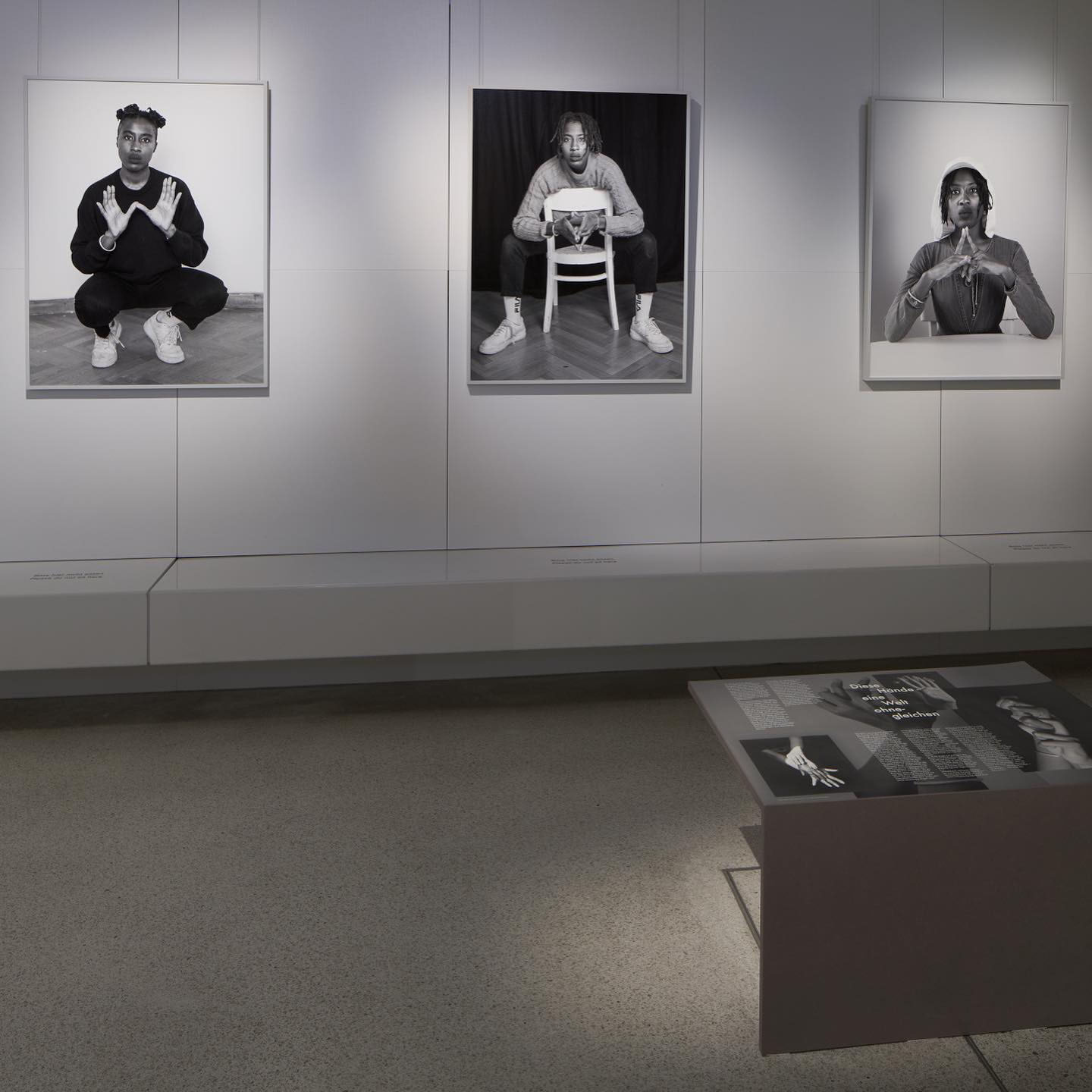
Sat 10am – 9pm
Sun 10am – 6pm

Barbican Art Gallery website

LIKE ART BLART ON FACEBOOK

Back to top

Exhibition: ‘Wolfgang Tillmans: 2017’ at Tate Modern, London

Exhibition dates: 15th February – 11th June, 2017

 Co-curators: Chris Dercon and Helen Sainsbury, Head of Programme Realisation, Tate Modern with Emma Lewis, Assistant Curator, Tate Modern


Wolfgang Tillmans (German, b. 1968) 'The State We're In, A' 2015 from the exhibition 'Wolfgang Tillmans: 2017' at Tate Modern, London, Feb - June, 2017
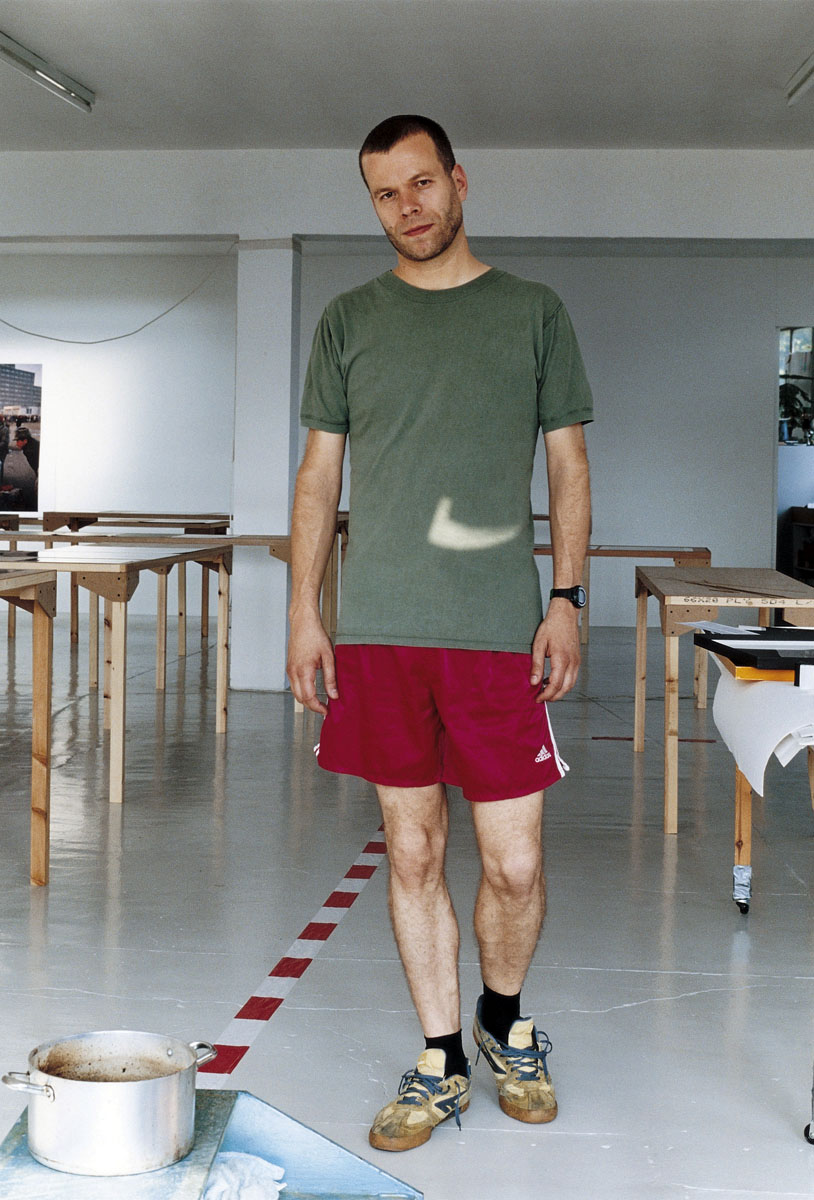
 

Wolfgang Tillmans (German, b. 1968)
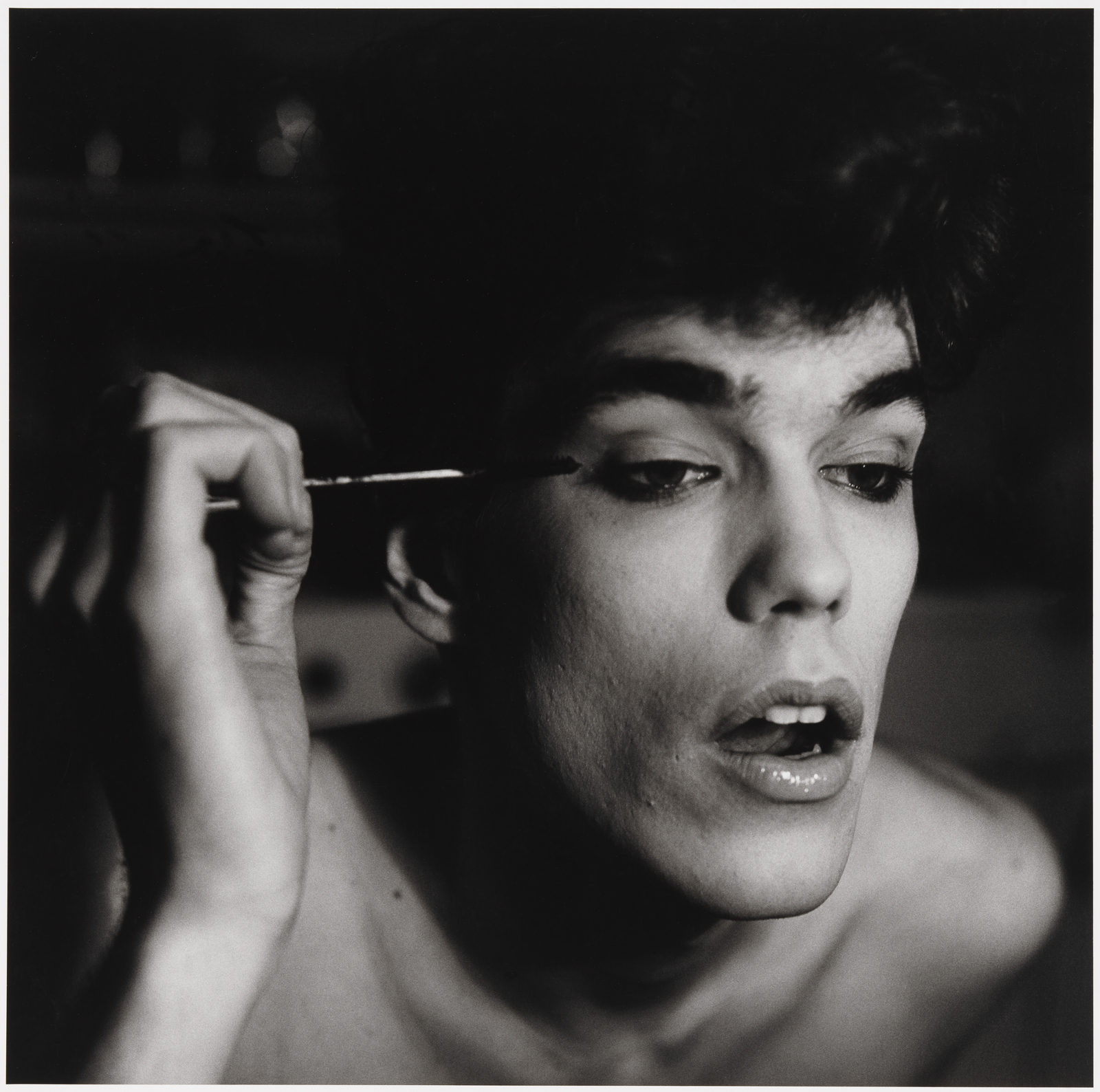
The State We’re In, A (Room 14)
2015
Ink-jet print
Dimensions variable
© Wolfgang Tillmans


Wolfgang Tillmans (German, b. 1968) 'The Cock (Kiss)' 2002 from the exhibition 'Wolfgang Tillmans: 2017' at Tate Modern, London, Feb - June, 2017


Wolfgang Tillmans (German, b. 1968)
The Cock (Kiss)
2002
Ink-jet print
Dimensions variable
© Wolfgang Tillmans


If one thing matters, everything matters (A love letter to Wolfgang Tillmans)

I believe that Wolfgang Tillmans is the number one photo-media artist working today. I know it’s a big call, but that’s how I see it.

His whole body of work is akin to a working archive – of memories, places, contexts, identities, landscapes (both physical and imagined) and people. He experiments, engages, and imagines all different possibilities in and through art. As Adrian Searle observes in his review of the exhibition, “Tillmans’ work is all a kind of evidence – a sifting through material to find meaning.” And that meaning varies depending on the point of view one comes from, or adopts, in relation to the art. The viewer is allowed to make their own mind up, to dis/assemble or deepen relationships between things as they would like, or require, or not as the case may be. Tillmans is not didactic, but guides the viewer on that journey through intersections and nodal points of existence. The nexus of life.

Much as I admire the writing of art critic John McDonald, I disagree with his assessment of the work of Wolfgang Tillmans at Tate Modern (see quotation below). Personally, I find that there are many memorable photographs in this exhibition … as valuable and as valid a way of seeing the world in a contemporary sense, as Eggleston’s photographs are in a historic visualisation. I can recall Tillmans’ images just an intimately as I can Eggleston’s. But they are of a different nature, and this is where McDonald’s analysis is like comparing apples and pears. Eggleston’s classical modernist photographs depend on the centrality of composition where his images are perfectly self-contained, whether he is photographing a woman in a blue dress sitting on a kerb or an all green bathroom. They are of their time. Times have changed, and how we view the world has changed.

For Tillmans no subject matter is trivial (If One Thing Matters, Everything Matters – the title of a 2003 exhibition at Tate Britain), and how he approaches the subject is totally different from Eggleston. As he says of his work, his images are “calls to attentiveness.” What does he mean by this? Influenced by the work of the philosopher Jiddu Krishnamurti whom I have also studied, a call to attentiveness is a way of being open and responsive to the world around you, to its infinite inflections, and to not walk around as if in a dream, letting the world pass you by. To be open and receptive to the energies and connections of the world spirit by seeing clearly.

Krishnamurti insightfully observed that we do not need to make images out of every word, out of every vision and desire. We must be attentive to the clarity of not making images – of desire, of prejudice, of flattery – and then we might become aware of the world that surrounds us, just for what it is and nothing more.1 Then there would be less need for the absenting of self into the technological ether or the day dreams of foreign lands or the desire for a better life. But being aware is not enough, we must be attentive of that awareness and not make images just because we can or must. This is a very contemporary way of looking at the world. As Krishnamurti says,

“Now with that same attention I’m going to see that when you flatter me, or insult me, there is no image, because I’m tremendously attentive … I listen because the mind wants to find out if it is creating an image out of every word, out of every contact. I’m tremendously awake, therefore I find in myself a person who is inattentive, asleep, dull, who makes images and gets hurt – not an intelligent man. Have you understood it at least verbally? Now apply it. Then you are sensitive to every occasion, it brings its own right action. And if anybody says something to you, you are tremendously attentive, not to any prejudices, but you are attentive to your conditioning. Therefore you have established a relationship with him, which is entirely different from his relationship with you. Because if he is prejudiced, you are not; if he is unaware, you are aware. Therefore you will never create an image about him. You see the difference?”2


Then you are sensitive to every occasion, it brings its own right action. You are attentive and tremendously awake.

This is the essence of Tillmans work. He is tremendously attentive to the images he is making (“a representation of an unprivileged gaze or view” as he puts it) and to the associations that are possible between images, that we make as human beings. He is open and receptive to his conditioning and offers that gift to us through his art, if we recognise it and accept it for what it is. If you really look and understand what the artist is doing, these images are music, poetry and beauty – are time, place, belonging, voyeurism, affection, sex. They are archaic and shapeless and fluid and joy and magic and love…

They are the air between everything.

Dr Marcus Bunyan


1/ Krishnamurti. Beginnings of Learning. London: Penguin, 1975, p. 131
2/ Ibid., pp. 130-131


Many thankx to the Tate Modern for allowing me to publish the art work in the posting. Please click on the photographs for a larger version of the image.


“To look at Eggleston alongside those he has inspire [Wolfgang Tillmans and Juergen Teller for example] is to see a surprisingly old-fashioned artist. No matter how instinctive his approach or how trivial his subjects, Eggleston believes in the centrality of composition. His images are perfectly self-contained. They don’t depend on a splashy, messy installation or a political stance. …

In the current survey of Tillmans’s work at Tate Modern photos of every description are plastered across the walls in the most anarchic manner, with hardly a memorable composition. Yet this shapeless stuff is no longer reviled by the critics – it’s the height of fashion.”


John McDonald for The Sydney Morning Herald column. “William Eggleston: Portraits” on the John McDonald website June 1, 2017 [Online] Cited 17/12/2021


“For a long time in Britain, there was a deep suspicion of my work. People saw me as a commercial artist trying to get into the art world, and the work was dismissed as shallow or somehow lightweight. There are still many misconceptions about what I do – that my images are random and everyday, when they are actually neither. They are, in fact, the opposite. They are calls to attentiveness.”


Wolfgang Tillmans quoted in Sean O’Hagan. “Wolfgang Tillmans: ‘I was hit by a realisation – all I believed in was threatened’,” on The Guardian website Monday 13 February 2017 [Online] Cited 17/12/2021


Installation view of room 4 (detail) from the exhibition 'Wolfgang Tillmans: 2017', which includes the latest iteration of the 'truth study centre' project


Installation view of room 4 (detail), which includes the latest iteration of the truth study centre project, with
Image © Tate Modern showing Wolfgang Tillmans: 2017 at Tate Modern 15 February – 11 June


The Tate show includes a room full of his “truth study centres”, which comprise often contradictory newspaper cuttings as well as photographs and pamphlets that aim to show how news is manipulated according to the political loyalties of those who produce it. As activists go, though, Tillmans is defiantly centre ground. “This is about strengthening the centre. I can understand left-wing politics from a passionate, idealistic point of view, but I do not think it is the solution to where we are now. The solution is good governance, moderation, agreement. Post-Brexit, post-Trump, the voices of reason need to be heard more than ever.”

Wolfgang Tillmans quoted in Sean O’Hagan. “Wolfgang Tillmans: ‘I was hit by a realisation – all I believed in was threatened’,” on The Guardian website Monday 13 February 2017 [Online] Cited 17/12/2021


Installation view of room 13 (detail) from the exhibition 'Wolfgang Tillmans: 2017' at Tate Modern


Installation view of room 13 (detail), which focuses in on Tillmans’ portraiture with Eleanor / Lutz, a (2016) at right
Image © Tate Modern showing Wolfgang Tillmans: 2017 at Tate Modern 15 February – 11 June


Wolfgang Tillmans (German, b. 1968) 'Eleanor / Lutz, a' 2016


Wolfgang Tillmans (German, b. 1968)
Eleanor / Lutz, a
2016
Ink-jet print
Dimensions variable
© Wolfgang Tillmans


Portrait of Wolfgang Tillmans, Tate Modern Boiler House, Level 3, 14/02/2017 in front of his works, 'Transient 2', 2015 and 'Tag/Nacht II', 2010


Portrait of Wolfgang Tillmans, Tate Modern Boiler House, Level 3, 14/02/2017 in front of his works, Transient 2, 2015 and Tag/Nacht II, 2010


Wolfgang Tillmans (German, b. 1968) 'Tag/Nacht II' 2010


Wolfgang Tillmans (German, b. 1968)
Tag/Nacht II
2010
Ink-jet print
Dimensions variable
© Wolfgang Tillmans


The State We’re In, A, is part of Neue Welt [New World], the loose family of pictures I began at the end of the last decade. These had two points of departure: “What does the outside world look like to me 20 years after I began photographing?” and “What does it look like in particular with a new photographic medium?”


Wolfgang Tillmans


“This exhibition is not about politics, it’s about poetry, it’s about installation art. It’s about thinking about the world. I’ve never felt that l can be separated, because the political is only the accumulation of many people’s private lives, which constitute the body politics…”

“My work has always been motivated by talking about society, by talking about how we live together, by how we feel in our bodies. Sexuality, like beauty, is never un-political, because they relate to what’s accepted in society. Two men kissing, is that acceptable? These are all questions to do with beauty.”


Wolfgang Tillmans quoted in Lorena Muñoz-Alonso. “Inside Wolfgang Tillmans’s Superb Tate Modern Survey,” on the artnet website February 15, 2017 [Online] Cited 17/12/2021


“There is music. There is dancing. Bewilderment is part of the pleasure, as we move between images and photographic abstractions. Tillmans’ asks us to make connections of all kinds – formal, thematic, spatial, political. He asks what the limits of photography are. There are questions here about time, place, belonging, voyeurism, affection, sex. After a while it all starts to tumble through me.”


Adrian Searle. “Wolfgang Tillmans review – a rollercoaster ride around the world,” on The Guardian website Wednesday 15 February 2017 [Online] Cited 17/12/2021


What are we to make of the world in which we find ourselves today? Contemporary artist Wolfgang Tillmans offers plenty of food for thought.

This is Wolfgang Tillmans’s first ever exhibition at Tate Modern and brings together works in an exciting variety of media – photographs, of course, but also video, digital slide projections, publications, curatorial projects and recorded music – all staged by the artist in characteristically innovative style. Alongside portraiture, landscape and intimate still lifes, Tillmans pushes the boundaries of the photographic form in abstract artworks that range from the sculptural to the immersive.

The year 2003 is the exhibition’s point of departure, representing for Tillmans the moment the world changed, with the invasion of Iraq and anti-war demonstrations. The social and political form a rich vein throughout the artist’s work. German-born, international in outlook and exhibited around the world, Tillmans spent many years in the UK and is currently based in Berlin. In 2000, he was the first photographer and first non-British artist to receive the Turner Prize.

Room one

Static interference typically appears on a television screen when an analogue signal is switched off. This can occur when a station’s official programme finishes for the night or if a broadcast is censored. In Tillmans’s Sendeschluss / End of Broadcast 2014 it represents the coexistence of two different generations of technology. The chaotic analogue static was displayed on a digital television, which allowed Tillmans’s high-resolution digital camera to record the pattern as it really appeared, something that would not have been possible with a traditional cathode ray tube television. This work shows Tillmans’s interest in questioning what we believe to be true: the seemingly black-and-white image turns out to be extremely colourful when viewed very close up.

Other works in this room reflect on digital printmaking and photography today. For example, the technical ability to photograph a nightscape from a moving vehicle without blurring, as in these images of Sunset Boulevard, is unprecedented. Itself the subject of many famous art photographs, this iconic roadway appears here littered with large format inkjet prints in the form of advertising billboards. In Double Exposure 2012-2013 Tillmans juxtaposes images of two trade fairs – one for digital printers, the other for fruit and vegetables. Encounter 2014 shows a different photo-sensitive process. A pot had been left on top of a planter preventing light from reaching the sprouts underneath and leaving them white, while the surrounding growths that caught the daylight turned green.


Wolfgang Tillmans (German, b. 1968) 'Sendeschluss / End of Broadcast I' 2014


Wolfgang Tillmans (German, b. 1968)
Sendeschluss / End of Broadcast I
2014
Pigmented inkjet print
107 1/2 × 161 1/2″ (273.1 × 410.2cm)
© Wolfgang Tillmans


Television white noise that the artist photographed while in Russia. For Tillmans, the image signifies resistance on his part to making clear images, but without the text its ostensibly radical nature would not be known.


Installation view of room 1 (detail), with 'Sendeschluss / End of Broadcast I' 2014, at left


Installation view of room 1 (detail), with Sendeschluss / End of Broadcast I, 2014, at left


Wolfgang Tillmans (German, b. 1968) 'Double Exposure' 2012-2013


Wolfgang Tillmans (German, b. 1968)
Double Exposure
2012-2013
Pigmented inkjet print
© Wolfgang Tillmans


Room two

Tillmans spends much of his time in the studio, yet he only occasionally uses it as a set for taking portraits. Instead, it is where prints are made and exhibitions are planned in architectural models, and where he collects materials and generates ideas. Over the years this environment has become a subject for his photographs, presenting a radically different view of the artist’s studio to the more traditional depictions seen in paintings over the centuries.

These works made around the studio demonstrate Tillmans’s concern with the physical process of making photographs, from chemical darkroom processes and their potential to create abstract pictures without the camera, to digital technology that is vital to the production of contemporary images, and the paper onto which they are printed. Tillmans’s understanding of the material qualities of paper is fundamental to his work, and photographs can take on a sculptural quality in series such as Lighter, 2005-ongoing and paper drop, 2001-ongoing, seen later in the exhibition.

In CLC 800, dismantled 2011 Tillmans uses photography to record a temporary installation, the result of unfastening every single screw in his defunct colour photocopier. He prefers to photograph his three-dimensional staged scenarios rather than actually displaying them as sculptures. He has often described the core of his work as ‘translating the three dimensional world into two dimensional pictures’.


Wolfgang Tillmans (German, b. 1968) 'paper drop' 2014


Wolfgang Tillmans (German, b. 1968)
paper drop Prinzessinnenstrasse
2014
Pigmented inkjet print
© Wolfgang Tillmans


Perhaps as a continuation of his more textural photographs – depicting fabrics and still lifes so close up they become difficult to read – experiments in abstraction followed suit, many of them featuring what is perhaps his favourite motif: the fold, which, as the exhibition’s curator Chris Dercon kindly reminded us, was considered by the philosopher Leibniz as one of the most accurate ways to depict the complexities of the human soul.

Lorena Muñoz-Alonso. “Inside Wolfgang Tillmans’s Superb Tate Modern Survey,” on the artnet website February 15, 2017 [Online] Cited 17/12/2021


Wolfgang Tillmans (German, b. 1968) 'CLC 800, dismantled' 2011


Wolfgang Tillmans (German, b. 1968)
CLC 800, dismantled
2011
Pigmented inkjet print
© Wolfgang Tillmans


Room three

Having spent the preceding decade working largely on conceptual and abstract photographs, in 2009 Tillmans embarked on the four-year project Neue Welt. Looking at the world with fresh eyes, he aimed to depict how it has changed since he first took up the camera in 1988. He travelled to five continents to find places unknown to him and visited familiar places as if experiencing them for the first time. Interested in the surface of things as they appeared in those lucid first days of being in a new environment, he immersed himself in each location for just a brief period. Now using a high resolution digital camera, Tillmans captured images in a depth of detail that is immediately compelling, but also suggests the excess of information that is often described as a condition of contemporary life.

Communal spaces, people, animals, and still-life studies of nature or food are just some of the subjects that feature in Neue Welt. Seen together, these images offer a deliberately fragmented view. Rather than making an overarching statement about the changing character of modern life, Tillmans sought only to record, and to create a more empathetic understanding of the world. Over the course of the project, however, some shrewd observations about contemporary worldviews did emerge. One related to the changing shape of car headlights, which he noted are now very angular in shape, giving them a predatory appearance that might reflect a more competitive climate.


Wolfgang Tillmans (German, b. 1968) 'astro crusto, a' 2012


Wolfgang Tillmans (German, b. 1968)
astro crusto, a
2012
Pigmented inkjet print
© Wolfgang Tillmans


Installation shot of room 3 from the exhibition 'Wolfgang Tillmans: 2017' at Tate Modern showing 'Headlight (f)' 2012, at left; and 'Munuwata sky', 2011 at right


Installation view of room 3 (detail), with Headlight (f) 2012, at left; and Munuwata sky, 2011 at right
Image © Tate Modern showing Wolfgang Tillmans: 2017 at Tate Modern 15 February – 11 June


Wolfgang Tillmans (German, b. 1968) 'Headlight (f)' 2012


Wolfgang Tillmans (German, b. 1968)
Headlight (f)
2012
Pigmented inkjet print
© Wolfgang Tillmans


Wolfgang Tillmans (German, b. 1968) 'Munuwata sky' 2011


Wolfgang Tillmans (German, b. 1968)
Munuwata sky
2011
Pigmented inkjet print
© Wolfgang Tillmans


Room four

In the mid-2000s, prompted by global events, such as the claim that Iraq had weapons of mass destruction, Tillmans became interested in the assertions made by individuals, groups or organisations around the world that their viewpoint represented the absolute truth about a number of political and ethical questions.

He began his wryly-named truth study center project in 2005. Photographs, clippings from newspapers and magazines, objects, drawings, and copies of his own images are laid out in deliberate – and often provocative – juxtapositions. These arrangements reflect the presentation of information by news outlets in print and online. They also draw attention to gaps in knowledge, or areas where there is room for doubt. For each installation, the material presented in the truth study centers is selected according to its topical and geographic context. In 2017, the subject of truth and fake news is at the heart of political discourse across the world. This iteration of the project focuses in particular on how constructions of truth work on a psychological and physiological level.

The Silver 1998-ongoing prints connect to reality in a different way. Made by passing monochromatically exposed photographic paper through a dirty photo-developing machine, they collect particles and residue from the rollers and liquids. This makes them, in effect, a record of the chemical and mechanical process from which they originate.


Wolfgang Tillmans (German, b. 1968) 'truth study center' 2017


Wolfgang Tillmans (German, b. 1968)
truth study center
2017
Pigmented inkjet print
© Wolfgang Tillmans


Room five

Tillmans has described how, as a photographer, he feels increasingly less obligated to reflect solely on the outside world through documentary images. In his abstract works, he looks inwards: exploring the rudiments of photographic processes and their potential to be used as a form of self-expression.

Like the Silver works in the previous room, the abstract Greifbar 2014-2015 images are made without a camera. Working in the darkroom, Tillmans traces light directly onto photographic paper. The vast swathes of colour are a record of the physical gestures involved in their construction, but also suggest aspects of the body such as hair, or pigmentation of the skin. This reference to the figurative is reflected in the title, which translates as ‘tangible’.

Tillmans has observed that even though these works are made by the artist’s hand, they look as though they could be ‘scientific’ evidence of natural processes. For him, this interpretation is important, because it disassociates the works from the traditional gestural technique of painting. That the image is read as a photographic record, and not the result of the artist’s brushstroke, is essential to its conceptual meaning.


Wolfgang Tillmans (German, b. 1968) 'Greifbar 29' 2014


Wolfgang Tillmans (German, b. 1968)
Greifbar 29
2014
Ink-jet print
© Wolfgang Tillmans


Room six

Tillmans is interested in social life in its broadest sense, encompassing our participation in society. His photographs of individuals and groups are underpinned by his conviction that we are all vulnerable, and that our well-being depends upon knowing that we are not alone in the world.

Tillmans has observed that although cultural attitudes towards race, gender and sexuality have become more open over the three decades since he began his artistic practice, there is also greater policing of nightlife, and urban social spaces are closing down. His photographs taken in clubs, for example, testify to the importance of places where people can go today to feel safe, included, and free.

This concern with freedom also extends to the ways in which people organise themselves to make their voices heard. Images of political marches and protests draw attention to the cause for which they are fighting. They also form part of a wider study of what Tillmans describes as the recent ‘re-emergence’ of activism.


Wolfgang Tillmans (German, b. 1968) 'The Blue Oyster Bar, Saint Petersburg' 2014


Wolfgang Tillmans (German, b. 1968)
The Blue Oyster Bar, Saint Petersburg
2014
Ink-jet print
© Wolfgang Tillmans


Wolfgang Tillmans (German, b. 1968) 'NICE HERE but ever been to KRYGYZSTAN free Gender Expression WORLDWIDE' 2006


Wolfgang Tillmans (German, b. 1968)
NICE HERE but ever been to KRYGYZSTAN free Gender Expression WORLDWIDE
2006
Ink-jet print
© Wolfgang Tillmans


Room seven

Playback Room is a space designed for listening to recorded music. The project first ran at Between Bridges, the non-profit exhibition space Tillmans opened in London in 2006 and has since transferred to Berlin. In three exhibition (‘Colourbox’, ‘American Producers’ ‘Bring Your Own’) that took place between September 2014 and February 2015, he invited visitors to come and listen to music at almost the same quality at which it was originally mastered.

Whereas live music can be enjoyed in concert halls and stadiums, and visual art can be enjoyed in museums, no comparable space exists for appreciating studio music. Musicians and producers spend months recording tracks at optimal quality, yet we often listen to the results through audio equipment and personal devices that are not fit for perfect sound reproduction. Playback Room is a response to this. An example of Tillmans’s curatorial practice, he has chosen to include it here to encourage others to think about how recorded music can be given prominence within the museum setting.

The three tracks you hear in this room are by Colourbox, an English band who were active between 1982 and 1987. Tillmans, a long-term fan of the band, chose their music for Playback Room because they never performed live, thus emphasising the importance of the studio recordings.

Room eight

Tillmans began experimenting with abstraction while in high school, using the powerful enlargement function of an early digital photocopier to copy and degrade his own photographs as well as those cut from newspapers. He describes the coexistence of chance and control involved in this process as an essential ingredient in most of his work.

Ever since then, he has found ways to resist the idea that the photograph is solely a direct record of reality. In 2011, this area of his practice was compiled for the first time in his book Abstract Pictures. For a special edition of 176 copies Tillmans manipulated the printing press, for example by running it without plates or pouring ink into the wrong compartments, to create random effects and overprinted pages.

Some of his abstract photographs are made with a camera and others without, through the manipulation of chemicals, light, or the paper itself. Importantly, however, Tillmans does not distinguish between the abstract and the representational. He is more interested in what they have in common. The relationship between photography, sculpture and the body, for example, is expressed in abstract photographs made by crumpling a sheet of photographic paper, but also in close-ups of draped and wrinkled clothing such as Faltenwurf (Pines) a, 2016 in Room 9.


Wolfgang Tillmans (German, b. 1968) 'Concorde L433-11' 1997


Wolfgang Tillmans (German, b. 1968)
Concorde L433-11
1997
Ink-jet print
Tate
© Wolfgang Tillmans, courtesy Maureen Paley, London


Room nine

Artist books, exhibition catalogues, newspaper supplements and magazine spreads, posters and leaflets are an integral part of Tillmans’s output. These various formats and the ways in which they are distributed or made visible in the public space allow him to present work and engage audiences in a completely different manner to exhibitions. For him the printed page is as valid a venue for artistic creation as the walls of a museum. Many such projects are vital platforms on which he can speak out about a political topic, or express his continued interest in subjects such as musicians, or portraiture in general.

Recently, the print layout has enabled Tillmans to share a more personal aspect of his visual archive. Originally designed as a sixty-six page spread for the Winter 2015/Spring 2016 edition of Arena Homme +, this grid of images looks back at Fragile, the name he gave as a teenager to his creative alter-ego. Spanning 1983 to 1989 – the year before he moved to England to study – the photographs and illustrations provide a sensitive insight into a formative period in Tillmans’s life, predating the time when he chose photography as his main medium of expression.

The layout is also an example of the intricate collaging technique that he has employed in printed matter since 2011, deliberately obscuring some images by overlapping others on top of them


Wolfgang Tillmans (German, b. 1968) 'Faltenwurf (Pines), a' 2016


Wolfgang Tillmans (German, b. 1968)
Faltenwurf (Pines), a
2016
Ink-jet print
© Wolfgang Tillmans


Wolfgang Tillmans (German, b. 1968) 'Tukan' 2010


Wolfgang Tillmans (German, b. 1968)
Tukan
2010
Ink-jet print
© Wolfgang Tillmans


Room ten

An acute awareness of fragility endures across Tillmans’s practice in all of its different forms. Often this is expressed in his attentiveness to textures and surfaces. Collum 2011 is taken from Central Nervous System 2008-2013, a group of portraits featuring only one subject, where the focus on intimate details, such as the nape of the neck or the soft skin of the outer ear, both emphasises and celebrates the frailty of the human body.

Weed 2014, a four-metre tall photograph taken in the garden of the artist’s London home, invites us to consider the beauty and complexity of a plant usually seen as a nuisance. The dead leaf of a nearby fig tree appears as both a sculptural form and a memento mori. Dusty Vehicle 2012, photographed in Jeddah, Saudi Arabia, is highly specific in its depiction of texture, yet the reasons leading to this roadside arrangement remain a mystery.

The focus on a very few works in this room serves as an example of Tillmans’s varied approaches to exhibiting his prints. Though best known for installations comprising many pictures, he always places emphasis on the strength of the individual image. By pinning and taping work to the wall, as well as using frames, Tillmans draws attention to the edges of the print, encouraging the viewer to interact with the photograph as an object, rather than a conduit for an image.


Wolfgang Tillmans (German, b. 1968) 'Dusty Vehicle' 2012


Wolfgang Tillmans (German, b. 1968)
Dusty Vehicle
2012
Ink-jet print
© Wolfgang Tillmans


Wolfgang Tillmans (German, b. 1968) 'Collum' 2011


Wolfgang Tillmans (German, b. 1968)
Collum
2011
Ink-jet print
© Wolfgang Tillmans


Wolfgang Tillmans (German, b. 1968) 'Weed' 2014


Wolfgang Tillmans (German, b. 1968)
Weed
2014
Photograph, inkjet print on paper
© Wolfgang Tillmans


Room eleven

In this room Tillmans highlights the coexistence of the personal, private, public, and political spheres in our lives. The simultaneity of a life lived as a sexual being as well as a political being, or in Tillmans’s case as a conceptual artist as well as a visually curious individual, plays out through the installation.

The entirely white view taken from the inside of a cloud, a word charged with multiple meanings, is presented alongside the close-up and matter-of-fact view of male buttocks and testicles. Like nackt, 2 2014, the small photograph The Air Between 2016 is the result of a lifelong interest in visually describing what it feels like to live in our bodies. Here the attention lies in photographing the air, the empty space between our skin and our clothes.

In still life, Calle Real II 2013, a severed agave chunk is placed on a German newspaper article describing the online depiction of atrocities by Islamic State. The image is as startling in its depiction of the finest green hues as it is in capturing how, simultaneously, we take in world events alongside details of our personal environment.

This room, which Tillmans considers as one work or installation in its entirety, is an example of his innovative use of different photographic prints and formats to reflect upon how we experience vastly different aspects of the world at the same time.


Wolfgang Tillmans (German, b. 1968) 'The Air Between' 2016


Wolfgang Tillmans (German, b. 1968)
The Air Between
2016
Ink-jet print
© Wolfgang Tillmans


Wolfgang Tillmans (German, b. 1968) 'Still life, Calle Real II' 2013


Wolfgang Tillmans (German, b. 1968)
Still life, Calle Real II
2013
Ink-jet print
© Wolfgang Tillmans


Wolfgang Tillmans (German, b. 1968) 'Nackt, 2 (nude, 2)' 2014


Wolfgang Tillmans (German, b. 1968)
Nackt, 2 (nude, 2)
2014
Ink-jet print
© Wolfgang Tillmans


Room twelve

Tillmans has always been sensitive to the public side of his role as an artist, acknowledging that putting images out in the public world unavoidably places himself in the picture as well. His participation in activities such as lectures and interviews has been a platform for his voice from the beginning of his career.

Since 2014 he has also allowed performance to become a more prominent strand of his practice. Filmed in a hotel room in Los Angeles and an apartment in Tehran, Instrument 2015 is the first time that Tillmans has put himself in front of the camera for a video piece. Across a split screen, we see two separate occasions on which he has filmed himself dancing. The accompanying soundtrack was created by distorting the sound of his feet hitting the floor. In the absence of any other music, his body becomes an instrument.

On one side of the screen we see his body, on the other only his shadow. Referring to the shadow, New York Times critic Roberta Smith commented that:

“Disconcertingly, this insubstantial body is slightly out of sync with the fleshly one. It is a ghost, a shade, the specter that drives us all. The ease with which we want to believe that the two images are connected, even though they were filmed separately, might also act as a reminder to question what we assume to be true.”

Room thirteen

Portraiture has been central to Tillmans’s practice for three decades. For him, it is a collaborative act that he has described as ‘a good levelling instrument’. No matter who the sitter – a stranger or someone close to him, a public figure, an unknown individual, or even the artist himself – the process is characterised by the same dynamics: of vulnerability, exposure, honesty and always, to some extent, self-consciousness. Tillmans sees every portrait as resulting from the expectations and hopes of both sitter and photographer.

The portrait’s ability to highlight the relationship between appearance and identity is a recurring point of interest. In 2016, at HM Prison Reading, Tillmans took a distorted self-portrait in a damaged mirror once used by inmates. The disfigured result is the artist’s expression of the effects on the soul wrought by physical and psychological confinement and also censorship. Whoever looked into the reflective surface would gain a completely inaccurate impression of what they looked like, and how they are perceived by others.


Wolfgang Tillmans (German, b. 1968) 'Separate System, Reading Prison' 2016


Wolfgang Tillmans (German, b. 1968)
Separate System, Reading Prison
2016
Ink-jet print
© Wolfgang Tillmans


Wolfgang Tillmans (German, b. 1968) 'Anders pulling splinter from his foot' 2004


Wolfgang Tillmans (German, b. 1968)
Anders pulling splinter from his foot
2004
Ink-jet print
© Wolfgang Tillmans


“The image’s reference to both Dorian Gray and Francis Bacon is evident. This catapults a new association: perhaps Bacon was painting Gray all along. Insistently, fearlessly, longingly.

As with much of Bacon’s oeuvre, and the very particular picture of Dorian Gray, a distorted, forward-facing male figure intimidates the viewer with his unmade face. However, Tillsman’s piece is not a picture, it is a photograph. Here, the artist (as was the case with Bacon/Wilde) is not the one dissembling what’s inside the frame, subjecting it with his brush. No. In Tillsman’s image, a piece of thick glass distorts the artist. Here, the artist is no longer the lens that is able to affect his surroundings. Here, the surroundings distort the artist.

The message Tillsman delivers is clear: things have changed. The world disfigures the subject while the artist is trapped, forced to stand there and watch.”

Text by Ana Maria Caballero on The Drugstore Notebook website [Online] Cited 07/06/2017. No longer available online


Room fourteen

Symbol and allegory are artistic strategies Tillmans is usually keen to avoid. The State We’re In, A 2015 is a departure from this stance: the work’s title is a direct reference to current global political tensions. Depicting the Atlantic Ocean, a vast area that crosses time zones and national frontiers, it records the sea energised by opposing forces, but not yet breaking into waves. Differing energies collide, about to erupt into conflict.

The photographs in this room deal with borders and how they seem clear-cut but are actually fluid. In these images, borders are made tangible in the vapour between clouds, the horizon itself or the folds in the two Lighter photo-objects. The shipwreck left behind by refugees on the Italian island of Lampedusa, depicted in this photograph from 2008, is a reminder that borders, represented elsewhere in more poetic delineations, can mean a question of life and death.

The text and tables sculpture Time Mirrored 3 2017 represents Tillmans’s interest in connecting the time in which we live to a broader historical context. He always understands the ‘Now’ as the history of the future. Events perceived as having happened over a vast gulf of time between us and the past, become tangible when ‘mathematically mirrored’ and connected to more recent periods of time in our living memory.

In contrast to the epic themes of sea and time, the pictures of an apple tree outside the artist’s London front door, a subject he has photographed since 2002, suggest a day-to-day positive outlook.


Wolfgang Tillmans (German, b. 1968) 'Italian Coastal Guard Flying Rescue Mission off Lampedusa' 2008


Wolfgang Tillmans (German, b. 1968)
Italian Coastal Guard Flying Rescue Mission off Lampedusa
2008
Ink-jet print
© Wolfgang Tillmans


Wolfgang Tillmans (German, b. 1968) 'Lampedusa' 2008


Wolfgang Tillmans (German, b. 1968)
Lampedusa
2008
Ink-jet print
© Wolfgang Tillmans


Installation view of room 14 (detail), featuring at left, pictures of an apple tree outside the artist's London front door and at right, 'La Palma' 2014


Installation view of room 14 (detail), featuring at left, pictures of an apple tree outside the artist’s London front door and at right, La Palma 2014


Wolfgang Tillmans (German, b. 1968) 'La Palma' 2014


Wolfgang Tillmans (German, b. 1968)
La Palma
2014
Ink-jet print
© Wolfgang Tillmans


Wolfgang Tillmans (German, b. 1968) 'Apple tree' 2007


Wolfgang Tillmans (German, b. 1968)
Apple tree
2007
Ink-jet print
© Wolfgang Tillmans


Wolfgang Tillmans (German, b. 1968) 'Apple tree' Various dates


Wolfgang Tillmans (German, b. 1968)
Apple tree
Various dates
Ink-jet prints
© Wolfgang Tillmans


Book for Architects

Book for Architects 2014 is the culmination of Tillmans’s longstanding fascination with architecture. First presented at Rem Koolhaas’s 14th International Architecture Exhibition, Venice, 2013, it explores the contrast between the rationality and utopianism that inform design and the reality of how buildings and streets come to be constructed and inhabited.

In 450 images taken in 37 countries, across 5 continents, Tillmans hones in on the resourceful and ingenious ways in which people adapt their surroundings to fit their needs. These are individual and uncoordinated decisions that were not anticipated in architects’ plans, but still impact the contemporary built environment.

Across the double projection, we see examples of how buildings come to sit within a city plan, the ad-hoc ways in which they are modified, and the supposed ‘weaknesses’ of a space such as the corners where there are service doors, fire escapes, or alarm systems.


Wolfgang Tillmans (German, b. 1968) 'Shit buildings going up left, right and centre' 2014


Wolfgang Tillmans (German, b. 1968)
Shit buildings going up left, right and centre
2014
Book for Architects Plate 083 2014
© Wolfgang Tillmans


Wolfgang Tillmans (German, b. 1968) 'Untitled' 2012


Wolfgang Tillmans (German, b. 1968)
Untitled
2012
Book for Architects 2014
© Wolfgang Tillmans


“He has said of his photographs that “they are a representation of an unprivileged gaze or view … In photography I like to assume exactly the unprivileged position, the position that everybody can take, that chooses to sit at an airplane window or chooses to climb a tower.”


Wolfgang Tillmans quoted in Peter Halley, Midori Matsui, Jan Verwoert, Wolfgang Tillmans, London 2002, p. 136


Wolfgang Tillmans has earned recognition as one of the most exciting and innovative artists working today. Tate Modern presents an exhibition concentrating on his production across different media since 2003. First rising to prominence in the 1990s for his photographs of everyday life and contemporary culture, Tillmans has gone on to work in an ever greater variety of media and has taken an increasingly innovative approach to staging exhibitions. Tate Modern brings this variety to the fore, offering a new focus on his photographs, video, digital slide projections, publications, curatorial projects and recorded music.

Social and political themes form a rich vein throughout Tillmans’s work. The destabilisation of the world has arisen as a recurring concern for the artist since 2003, an important year when he felt the world changed with the invasion of Iraq and anti-war demonstrations. In 2017, at a moment when the subject of truth and fake news is at the heart of political discourse, Tillmans presents a new configuration of his tabletop installation truth study center 2005-ongoing. This ongoing project uses an assembly of printed matter from pamphlets to newspaper cuttings to his own works on paper to highlight Tillmans’s continued interest in word events and how they are communicated in the media.

Wolfgang Tillmans: 2017 will particularly highlight the artist’s deeper engagement with abstraction, beginning with the important work Sendeschluss / End of Broadcast I 2014. Based on images the artist took of an analogue TV losing signal, this work combines two opposing technologies – the digital and the analogue. Other works such as the series Blushes 2000-ongoing, made without a camera by manipulating the effects of light directly on photographic paper, show how the artist’s work with abstraction continues to push the boundaries and definitions of the photographic form.

The exhibition includes portraiture, landscape and still lives. A nightclub scene might record the joy of a safe social space for people to be themselves, while large-scale images of the sea such as La Palma 2014 or The State We’re In, A 2015 document places where borders intersect and margins are ever shifting. At the same time, intimate portraits like Collum 2011 focus on the delicacy, fragility and beauty of the human body. In 2009, Tillmans began using digital photography and was struck by the expanded opportunities the technology offered him. He began to travel more extensively to capture images of the commonplace and the extraordinary, photographing people and places across the world for the series Neue Welt 2009-2012.

The importance of Tillmans’s interdisciplinary practice is showcased throughout the exhibition. His Playback Room project, first shown at his Berlin exhibition space Between Bridges, provides a space within the museum for visitors to experience popular music by Colourbox at the best possible quality. The video installation Instrument 2015 shows Tillmans dancing to a soundtrack made by manipulating the sound of his own footsteps, while in the Tanks Studio his slide projection Book for Architects 2014 is being shown for the first time in the UK. Featuring thirty-seven countries and five continents, it reveals the tension between architectural form and function. In March, Tillmans will also take over Tate Modern’s south Tank for ten days with a specially-commissioned installation featuring live music events.

Wolfgang Tillmans: 2017 is co-curated by Chris Dercon and Helen Sainsbury, Head of Programme Realisation, Tate Modern with Emma Lewis, Assistant Curator, Tate Modern. The exhibition is accompanied by a catalogue from Tate Publishing designed by Wolfgang Tillmans and a programme of talks and events in the gallery.

Press release from Tate Modern


Images from the exhibition


Installation view of the exhibition 'Wolfgang Tillmans: 2017' with at left, 'Sunset night drive' (2014) and at centre right, 'Young Man, Jeddah' (2012)


Installation view of the exhibition Wolfgang Tillmans: 2017 with at left, Sunset night drive (2014) and at centre right, Young Man, Jeddah (2012)


Wolfgang Tillmans (German, b. 1968) 'Sunset night drive' 2014


Wolfgang Tillmans (German, b. 1968)
Sunset night drive
2014
Ink-jet print
© Wolfgang Tillmans


Wolfgang Tillmans (German, b. 1968) 'Young Man, Jeddah' 2012


Wolfgang Tillmans (German, b. 1968)
Young Man, Jeddah
2012
Ink-jet print
© Wolfgang Tillmans


Wolfgang Tillmans (German, b. 1968) 'Young Man, Jeddah (B)' 2012


Wolfgang Tillmans (German, b. 1968)
Young Man, Jeddah (B)
2012
Ink-jet print
© Wolfgang Tillmans


Wolfgang Tillmans (German, b. 1968) '17 Years Supply' 2014


Wolfgang Tillmans (German, b. 1968)
17 Years Supply
2014
Ink-jet print
© Wolfgang Tillmans


“Now the camera is staring into a big cardboard box, half-filled with pharmacist’s tubs and packages, 17 years’ supply of antiretroviral and other medications to treat HIV/AIDS. I imagine the sound that box would make if you shook it, what that sound might say about a human life, its vulnerability and value.”

Adrian Searle. “Wolfgang Tillmans review – a rollercoaster ride around the world,” on The Guardian website Wednesday 15 February 2017 [Online] Cited 17/12/2021


Wolfgang Tillmans (German, b. 1968) 'Market I' 2012


Wolfgang Tillmans (German, b. 1968)
Market I
2012
Ink-jet print
© Wolfgang Tillmans


Wolfgang Tillmans (German, b. 1968) 'Studio still life, c' 2014


Wolfgang Tillmans (German, b. 1968)
Studio still life, c
2014
Ink-jet print
© Wolfgang Tillmans


Wolfgang Tillmans (German, b. 1968) 'Juan Pablo & Karl Chingaza' 2012


Wolfgang Tillmans (German, b. 1968)
Juan Pablo & Karl Chingaza
2012
Ink-jet print
© Wolfgang Tillmans


Wolfgang Tillmans (German, b. 1968) 'Iguazu' 2010


Wolfgang Tillmans (German, b. 1968)
Iguazu
2010
Ink-jet print
© Wolfgang Tillmans


Wolfgang Tillmans (German, b. 1968) 'Oscar Niemeyer' 2010


Wolfgang Tillmans (German, b. 1968)
Oscar Niemeyer
2010
Ink-jet print
© Wolfgang Tillmans


Wolfgang Tillmans (German, b. 1968) 'Tube escalator joint' 2009


Wolfgang Tillmans (German, b. 1968)
Tube escalator joint
2009
Ink-jet print
© Wolfgang Tillmans


Wolfgang Tillmans (German, b. 1968) 'JAL' 1997


Wolfgang Tillmans (German, b. 1968)
JAL
1997
Ink-jet print
© Wolfgang Tillmans


Wolfgang Tillmans (German, b. 1968) 'Port-au-Prince' 2010


Wolfgang Tillmans (German, b. 1968)
Port-au-Prince
2010
Ink-jet print
© Wolfgang Tillmans


Wolfgang Tillmans (German, b. 1968) 'London Olympics' 2012


Wolfgang Tillmans (German, b. 1968)
London Olympics
2012
Ink-jet print
© Wolfgang Tillmans


Wolfgang Tillmans (German, b. 1968) 'Fespa Car' 2012


Wolfgang Tillmans (German, b. 1968)
Fespa Car
2012
Ink-jet print
© Wolfgang Tillmans


Wolfgang Tillmans (German, b. 1968) 'The Spectrum Dagger' 2016


Wolfgang Tillmans (German, b. 1968)
The Spectrum Dagger
2016
Ink-jet print
© Wolfgang Tillmans


Wolfgang Tillmans (German, b. 1968) 'Gaza Wall' 2009


Wolfgang Tillmans (German, b. 1968)
Gaza Wall
2009
Ink-jet print
© Wolfgang Tillmans


Wolfgang Tillmans (German, b. 1968) 'Simon, Sebastian Street' 2013


Wolfgang Tillmans (German, b. 1968)
Simon, Sebastian Street
2013
Ink-jet print
© Wolfgang Tillmans


Wolfgang Tillmans (German, b. 1968) 'Arms and Legs' 2014


Wolfgang Tillmans (German, b. 1968)
Arms and Legs
2014
Ink-jet print
© Wolfgang Tillmans


Tate Modern
Bankside
London SE1 9TG
United Kingdom

Opening hours:
Daily 10.00 – 18.00

Tate Modern website

LIKE ART BLART ON FACEBOOK

Back to top

Exhibition: ‘A History: Contemporary Art from the Centre Pompidou’ at the Haus der Kunst, Munich

Exhibition dates: 25th March – 4th September, 2016

Curator: Christine Macel

Artists include: Pawel Althamer/ Maja Bajević / Yto Barrada / Jean-Michel Basquiat / Taysir Batniji / Christian Boltanski / Erik Boulatov / Mohammed Bourouissa / Frédéric Bruly Bouabré / Sophie Calle and Greg Shephard / Mircea Cantor / Chen Zhen / Hassan Darsi / Destroy All Monsters / Atul Dodiya / Marlene Dumas / Ayşe Erkmen / Fang Lijun / Harun Farocki and Andrei Ujica / Samuel Fosso / Michel François / Coco Fusco und Paula Heredia / Regina José Galindo / Kendell Geers / Liam Gillick / Fernanda Gomes / Dominique Gonzalez-Foerster / Felix Gonzalez-Torres / Renée Green / Subodh Gupta / Andreas Gursky / Hans Haacke / Petrit Halilaj / Edi Hila / Gregor Hildebrandt / Thomas Hirschhorn / Nicholas Hlobo / Carsten Höller / Pierre Huyghe / Fabrice Hyber / Isaac Julien / Oleg Kulik / Glenn Ligon / Robert Longo / Sarah Lucas / Gonçalo Mabunda / David Maljković / Chris Marker / Ahmed Mater / Mike Kelley and Paul McCarthy / Annette Messager / Rabih Mroué / Zanele Muholi / Jun Nguyen-Hatsushiba / Roman Ondák / Gabriel Orozco / Damián Ortega / Philippe Parreno / Nira Pereg / Dan Perjovschi / Wilfredo Prieto / Tobias Putrih / Walid Raad / Sara Rahbar / Tobias Rehberger / Nick Relph und Oliver Payne / Pipilotti Rist / Chéri Samba / Anne-Marie Schneider / Santiago Sierra / Mladen Stilinović / Georges Tony Stoll / Wolfgang Tillmans / Rirkrit Tiravanija / Danh Vo / Marie Voignier / Akram Zaatari / Zhang Huan


Thomas Hirschhorn (Swiss, b. 1957) 'Outgrowth' 2005 from the exhibition 'A History: Contemporary Art from the Centre Pompidou' at the Haus der Kunst, Munich, March - Sept, 2016


Thomas Hirschhorn (Swiss, b. 1957)
Outgrowth
2005
Wood, plastic, newspaper clipping, tape, metal, bubble wrap
Installation: 374 x 644 x 46cm
Minimum dimensions of the rail: 400 x 670cm
Achat en 2006, Ankauf / Purchase
Collection Centre Pompidou, Paris
Musée national d’art moderne – Centre de création industrielle
Crédit photographique: © Centre Pompidou, MNAM-CCI/Georges Meguerditchian/Dist. RMN-GP
Copyright de l’oeuvre: © VG Bild-Kunst, Bonn 2016


Take your pick: some interesting, some not. My favourite: Annette Messager Mes voeux (1989, below) … such a strong, creative and inspiring artist.

I’m not writing so much as I have bad RSI in my left wrist at the moment.

Dr Marcus Bunyan


Many thankx to Haus der Kunst for allowing me to publish the art work in the posting. Please click on the photographs for a larger version of the image.


In 2016, two prominent exhibition projects explore the pressing question of which factors remain relevant to the writing of art history. While “Postwar – Art between the Pacific and Atlantic, 1945-1965” concentrates on the time immediately after World War II, “A History: Contemporary Art from the Centre Pompidou” provides an overview of contemporary art since the 1980s with 160 works by more than 100 artists.

The year 1989 marked a break with the past and the start of a new era. The fall of the Berlin Wall toppled divisions in the world of European art, while the events of Tiananmen Square focused attention on a new China. The ongoing globalisation allows for an unprecedented mobility. The static understanding of identity, once based on origin and nationality, has since given way to a more transnational and variable narrative. Contemporary artistic proposals, which arise from the new “decolonised subjectivity”, are also based on a new understanding of site-specificity. For example, in the 1960s and 1970s the protagonists of Land Art still understood landscapes primarily as post-industrial ruins. In contemporary artistic practice, however, space is defined above all socially and politically – by traumatic historical events, home country, exile, diaspora and hybrid identities, such as African-American, Latino, Turkish-German, African-Brazilian, and so forth. The new presentation of the Centre Pompidou contemporary collections at Haus der Kunst focuses particularly on this altered geography, notably the former Eastern Europe, China, Lebanon, and various Middle Eastern countries, India, Africa, and Latin America. This is the first time such a large-scale view of the Centre Pompidou collection has been presented outside France.


Lijun Fang (Chinese, b. 1963) 'Sans titre' 2003 from the exhibition 'A History: Contemporary Art from the Centre Pompidou' at the Haus der Kunst, Munich, March - Sept, 2016


Lijun Fang (Chinese, b. 1963)
Sans titre
2003
Woodcut on paper
400 x 854cm
Each panel: 400 x 120cm
Achat en 2004, Ankauf / Purchase
Collection Centre Pompidou, Paris
Musée national d’art moderne – Centre de création industrielle


Marlene Dumas (South African, b. 1953) 'The Missionary' (Le Missionnaire) 2002-2004


Marlene Dumas (South African, b. 1953)
The Missionary (Le Missionnaire)
2002-2004
Oil on canvas
60 x 230cm
Don de la Clarence Westbury Foundation, 2005
Collection Centre Pompidou, Paris
Musée national d’art moderne – Centre de création industrielle
Crédit photographique: © Centre Pompidou, MNAM-CCI/Philippe Migeat/Dist. RMN-GP
Copyright de l’oeuvre: © Marlene Dumas


Jean-Michel Basquiat (American, 1960-1988) 'Slave Auction (Vente aux enchères d’esclaves)' 1982


Jean-Michel Basquiat (American, 1960-1988)
Slave Auction (Vente aux enchères d’esclaves)
1982
Acrylic paint, oil pastel and collages
Collage of crumpled papers, oil pastel and acrylic paint on canvas
183 x 305.5cm
Don de la Société des Amis du Musée national d’art moderne, 1993
Collection Centre Pompidou, Paris
Musée national d’art moderne – Centre de création industrielle
Crédit photographique: © Centre Pompidou, MNAM-CCI/Philippe Migeat/Dist. RMN-GP
Copyright de l’oeuvre: © The estate of Jean-Michel Basquiat / VG Bild-Kunst, Bonn 2016


Fabrice Hyber (French, b. 1961) 'Peinture homéopathique n° 10 (Guerre désirée)' (Homeopathic painting n° 10 (Desired war)) 1983-1996


Fabrice Hyber (French, b. 1961)
Peinture homéopathique n° 10 (Guerre désirée) (Homeopathic painting n° 10 (Desired war))
1983-1996
Mixed media on canvas
Graphite lead, charcoal, coloured pencil, resin, gouache, India ink, acrylic, pastel, watercolour, felt-tip pen, adhesive tape, on paper, photocopy, photographs and tissue paper pasted on canvas
225 x 450cm
Each panel: 225 x 225cm
Achat en 1996, Ankauf / Purchase
Collection Centre Pompidou, Paris
Musée national d’art moderne – Centre de création industrielle
Crédit photographique: © Centre Pompidou, MNAM-CCI/Jacques Faujour/Dist. RMN-GP
Copyright de l’oeuvre: © Adagp, Paris


Hans Haacke (German, b. 1936) 'MetroMobiltan' 1985


Hans Haacke (German, b. 1936)
MetroMobiltan
1985
Fibreglass, photography, hardboard, polyester fabric, aluminum, acrylic paint
Fibreglass pediment, 1 fibreglass plate with English text, 1 black and white photograph in 5 parts laminated on hardboard, 3 banners in synthetic polyester fabric each mounted on 2 aluminium tubes: on the left and on the right 2 banners blue with English text (letters in cut and sewn white polyester fabric), in the centre 1 brown banner with photographic enlargement in cut and sewn fabric and English text), platform in 8 elements of acrylic painted fibreglass
Installation: 355.6 x 609.6 x 152.4cm
Achat en 1988, Ankauf / Purchase
Collection Centre Pompidou, Paris
Musée national d’art moderne – Centre de création industrielle
Crédit photographique: © Centre Pompidou, MNAM-CCI/Georges Meguerditchian/Dist. RMN-GP
Copyright de l’oeuvre: © VG Bild-Kunst, Bonn 2016


Chéri Samba (Democratic Republic of Congo, b. 1956) 'Marche de soutien à la campagne sur le SIDA' 1988


Chéri Samba (Democratic Republic of Congo, b. 1956)
Marche de soutien à la campagne sur le SIDA
1988
Oil and glitter on prepared canvas
134.5 x 200cm
Purchase in 1990
Collection Centre Pompidou, Paris Musée national d’art moderne – Centre de création industrielle
© Chéri Samba, photo © Centre Pompidou, MNAM-CCI/Philippe Migeat/Dist. RMN-GP


Haus der Kunst is pleased to present A History: Contemporary Art from Centre Pompidou, an exhibition originally curated by Christine Macel at the Centre Pompidou, Paris. With approximately 160 works by more than 100 artists from across the world, “A History: Contemporary Art from the Centre Pompidou” provides an incisive overview of artistic positions since the 1980s in painting, sculpture, installation, video, photography, and performance.

The Centre Pompidou’s collection of contemporary art has rarely been presented so comprehensively outside France. The selected works on view date from the 1980s to the present raising two significant questions: What factors are relevant for ensuring that art history is written in a specific way, and what does an ever changing understanding of the term ‘contemporary’ mean for public museums and their collections? Still, the concentration on Euro- American domains, which many museums formerly pursued in the acquisition of works for their collections, can hardly be sustained today and is no longer the aspiration of most museums. Globalisation, with its expanded narratives, has recently become too determining for the position of contemporary art to ignore. Curator Christine Macel defines her intention accordingly: to present ‘one’ among many possible histories of contemporary art.

With the progression of globalisation – understood here as the consolidation of economic, technological and financial systems, but also the questioning of linear history, and hegemonic cultural narratives – our perception of identity has changed. Since the first globally-oriented biennial in Havana in 1986, exhibition organisers and larger museums in Europe and North America have strived to display art created beyond the Western artistic circuit. The static understanding of identity as something based in origins and a “home base” has largely given way to a transnational and variable one.

The turning point for Centre Pompidou was its 1989 exhibition “Les Magiciens de la Terre”, in which curator Jean-Hubert Martin aimed to confront the problematic phenomenon of “one hundred percent of exhibitions that ignore eighty percent of the world.” Half the participating artists came from non-Western countries, while the other half came from the West. In addition, all exhibiting artists were – without exception – still active, making the presentation truly contemporary. Since then, the Centre Pompidou, like many large museums, has had to confront the reality of the expanded circuits of contemporary art. Over the years the museum gradually changed its acquisition practices and has increasingly opened its focus toward Eastern Europe, China, Lebanon, the Middle East, India, Congo, Nigeria, South Africa, Cameroon, Mexico and Brazil.

Meanwhile, our understanding of the term “origins” has continued to evolve. Consequently, the definition of “site-specific” has also changed. In the 1960s and 70s, artists of the Land Art movement still essentially regarded landscapes as post-industrial ruins. By contrast, Okwui Enwezor, director of Haus der Kunst believes that, in today’s artistic practice, space is defined by impermanence, by the mutability of politically and socially grounded positions, by aesthetic pluralism, and by cultural differences. Furthermore, colonial and postcolonial experiences shaped by traumatic historical events, home, exile, diaspora produced hybrid identities – such as African-American, Euro- American, Latino, Turkish-German, French-Arabic, African-Brazilian, etc. Consequently new forms of cosmopolitanism and provincialism jostle next to one another. It is no coincidence that the exhibition practice of today can already look back on a number of shows that focused on borders and issues of migration.

Against this backdrop of dynamism and permanent transition the exhibition is divided into seven chapters:

The Artist as Historian

An interest in the historical document and a more general obsession with the past, have led to the nostalgic excavation and re-enactments of existing works of art. Artists from the Arab speaking world are increasingly present in the art world; having borne witness to the Gulf War in 1991, these artists have developed new practices around the examination of history.

The Artist as Archivist

A passion for the archive initially led to a demand for completeness and later to an acceptance of the fragmentary, resulting on the one hand in concurrence of taxonomic efforts and endless accumulation, and, on the other, in an insight into the accelerated loss of memory. On a higher level, both coincide: Archives are especially useful in helping to identify and address wounds in the collective memory.

Sonic Boom

Trying to capture the sensation of listening to music in an image has a long tradition. Yet, even for artists who take their works to the edge of physical dissolution, listening often moves to the fore. Further, changes in the music industry and music production have reinforced the permeability of art and composition.

The Artist as Producer: The “Traffic” Generation

The concept of artwork is transformed through its dematerialisation. An awareness of temporality, volatility, and process shifts to the foreground. Artists develop new forms of collaboration and collective creation, and make aesthetic use of clips, sampling, and film narrative (which is also regarded as an exhibition platform). As a result, copyright as an object of reflection has come into focus.

The Artist as Documentarist: As Close as Possible to the Real

The proliferation of the Internet in the context of a market economy and consumer society has led to a greater interest in the real, in the status quo of the observer and the reporter and generally in an engagement with all areas of human life. The artist takes on the role of a witness who accepts the subjectivity of his observations.

Artist and Object

Between 1980 and 1990, artists turned to an exploration of the everyday and the object; the 1990’s can be considered as the ultimate epoch of the aesthetic of the mundane. The now-famous video, “The Way Things Go” by Fischli and Weiss (1986-87) sings this song of songs to the everyday. No less iconic is Gabriel Orozco’s modified Citroën (La DS, 1993). The confrontation with consumer society is manifested in photography in detailed and richly coloured compositions like Gursky’s 99 Cent (1999), and in sculpture with the integration of found objects. The common denominator is the attention artists pay to excessive consumption – as an opportunity or as a fact.

The Artist and the Body

Video and photography seem to be particularly fitting mediums for artists whose works include a performative element. The theme of the human body – wounded or damaged by oppression – returns as a theme with a vengeance. Many works with erotic and sexual overtones emerge. New technical possibilities, either through plastic surgery or image manipulation, bring the grotesque into the fold.

Press release from Haus der Kunst


Fischli and Weiss
The Way Things Go
1986-1987


Erik Boulatov (Russian, b. 1933) 'Printemps dans une maison de repos des travailleurs' 1988


Erik Boulatov (Russian, 1933-2025)
Printemps dans une maison de repos des travailleurs
1988
Oil on canvas
169.2 x 239 x 4cm
Purchased in 1989
Collection Centre Pompidou, Paris Musée national d’art moderne – Centre de création industrielle
© VG Bild-Kunst, Bonn 2016,
Photo © Centre Pompidou, MNAM-CCI/Philippe Migeat/Dist. RMN-GP


Michel François (Belgian, b. 1956) 'Affiche Cactus' 1997


Michel François (Belgian, b. 1956)
Affiche Cactus
1997
Print on paper
120 x 178cm
Don de l’artiste en 2003
Collection Centre Pompidou
Paris Musée national d’art moderne – Centre de création industrielle
© VG Bild-Kunst, Bonn 2016
Photo © Centre Pompidou, MNAM-CCI/Philippe Migeat/Dist. RMN-GP


Pawel Althamer (Polish, b. 1967) 'Tecza' (Rainbow) 2004


Pawel Althamer (Polish, b. 1967)
Tecza (Rainbow)
2004
Metal, cotton, felt, rubber, cork, plastic
120 x 185 x 57cm
Purchased in 2006
Collection Centre Pompidou, Paris Musée national d’art moderne – Centre de création industrielle
© Pawel Althamer
Photo © Centre Pompidou, MNAM-CCI/Service de la documentation photographique du MNAM/Dist. RMN-GP


Samuel Fosso (Nigerian born Cameroon, b. 1962) 'La Femme américaine libérée des années 70' 1997


Samuel Fosso (Nigerian born Cameroon, b. 1962)
La Femme américaine libérée des années 70
1997
Chromogenic print
127 x 101cm
Crédit photographique: © Centre Pompidou, MNAM-CCI/Philippe Migeat/Dist. RMN-GP
Copyright de l’oeuvre: © Samuel Fosso, courtesy J.M. Patras, Paris
Achat en 2004, Ankauf / Purchase
Collection Centre Pompidou, Paris
Musée national d’art moderne – Centre de création industrielle


Atul Dodiya (Indian, b. 1959) 'Charu' 2004


Atul Dodiya (Indian, b. 1959)
Charu
2004
Enamel paint and synthetic varnish on plywood
183 x 122cm
Don de la Société des Amis du Musée national d’art moderne, 2013
Collection Centre Pompidou, Paris
Musée national d’art moderne – Centre de création industrielle
Crédit photographique: © Centre Pompidou, MNAM-CCI/Philippe Migeat/Dist. RMN-GP
Copyright de l’oeuvre: © Atul Dodiya


Huan Zhang (Chinese, b. 1966) 'Family Tree' 2000


Huan Zhang (Chinese, b. 1966)
Family Tree
2000
9 chromogenic prints
396 x 318cm
Each print 132 x 106cm
Montage of the nine prints
Collection Centre Pompidou, Paris
Musée national d’art moderne – Centre de création industrielle,
Purchased in 2004
© droits réservés, photo © Centre Pompidou, MNAM-CCI/Philippe Migeat/Dist. RMN-GP


Huan Zhang (Chinese, b. 1966) 'Family Tree' 2000 (detail)

Huan Zhang (Chinese, b. 1966) 'Family Tree' 2000 (detail) 'Family Tree' 2000 (detail)


Huan Zhang (Chinese, b. 1966)
Family Tree (details)
2000
9 chromogenic prints
396 x 318cm
Each print 132 x 106cm
Montage of the nine prints
Musée national d’art moderne – Centre de création industrielle,
Achat en 2004
© droits réservés, photo
© Centre Pompidou, MNAM-CCI/Philippe Migeat/Dist. RMN-GP


Andreas Gursky (German, b. 1955) 'Madonna I' 2001


Andreas Gursky (German, b. 1955)
Madonna I
2001
Chromogenic print
282 x 213 x 6.5cm
Achat en 2003, Ankauf / Purchase
Collection Centre Pompidou, Paris
Musée national d’art moderne – Centre de création industrielle
Crédit photographique: © Centre Pompidou, MNAM-CCI/Georges Meguerditchian/Dist. RMN-GP
Copyright de l’oeuvre: © Courtesy: Monika Sprüth Galerie, Cologne / VG Bild-Kunst, Bonn 2016


Ahmed Mater (Saudi, b. 1979) 'From the Real to the Symbolic City' 2012


Ahmed Mater (Saudi, b. 1979)
From the Real to the Symbolic City
2012
Digital proof
292 x 245cm
Don de Athr Gallery, avec le soutien de Sara Binladin et Zahid Zahid, Sara Alireza et Faisal Tamer, Abdullah Al-Turki, 2013
Collection Centre Pompidou, Paris
Musée national d’art moderne – Centre de création industrielle
Crédit photographique: © Centre Pompidou, MNAM-CCI/Georges Meguerditchian/Dist. RMN-GP
Copyright de l’oeuvre: © droits réservés


Annette Messager (French, b. 1943) 'Mes voeux' 1989


Annette Messager (French, b. 1943)
Mes voeux
1989
263 gelatin silver prints framed under glass held in place by black adhesive paper and hung on the wall by long strings
Overall dimensions: 320 x 160cm
1 épreuve 24 x 17cm, 50 épreuves 20 x 14cm, 57 épreuves 15 x 11cm, 49 épreuves 13 x 9cm, 106 épreuves 8 x 6cm
Collection Centre Pompidou, Paris
Musée national d’art moderne – Centre de création industrielle
Achat en 1990
© VG Bild-Kunst, Bonn 2016, photo Centre Pompidou, MNAM-CCI/Philippe Migeat/Dist. RMN-GP


Annette Messager (French, b. 1943) 'Mes voeux' 1989 (detail)


Annette Messager (French, b. 1943)
Mes voeux (detail)
1989
263 gelatin silver prints framed under glass held in place by black adhesive paper and hung on the wall by long strings
Overall dimensions: 320 x 160cm
1 épreuve 24 x 17cm, 50 épreuves 20 x 14cm, 57 épreuves 15 x 11cm, 49 épreuves 13 x 9cm, 106 épreuves 8 x 6cm
Collection Centre Pompidou, Paris
Musée national d’art moderne – Centre de création industrielle
Achat en 1990
© VG Bild-Kunst, Bonn 2016, photo Centre Pompidou, MNAM-CCI/Philippe Migeat/Dist. RMN-GP


Ayse Erkmen (Turkish, b. 1949) 'Netz' 2006


Ayse Erkmen (Turkish, b. 1949)
Netz
2006
Cotton garment labels, nails
Installation: 220 x 60 x 20cm
Purchased in 2012
Collection Centre Pompidou, Paris
Musée national d’art moderne – Centre de création industrielle
© Ayse Erkmen
Photo © Centre Pompidou, MNAM-CCI/Georges Meguerditchian/Dist. RMN-GP


Wolfgang Tillmans (German, b. 1968) 'Suzanne & Lutz, white dress, army skirt' 1993


Wolfgang Tillmans (German, b. 1968)
Suzanne & Lutz, white dress, army skirt
1993
Chromogenic print
99 x 66 x 2cm
Donation de la Caisse des Dépôts en 2006
Collection Centre Pompidou, Paris
Musée national d’art moderne – Centre de création industrielle
© Wolfgang Tillmans
Photo © Centre Pompidou, MNAM-CCI/Philippe Migeat/Dist. RMN-GP


Gabriel Orozco (Mexican, b. 1962) 'La D.S.' 1992

Gabriel Orozco (Mexican, b. 1962) 'La D.S.' 1992 'La D.S.' 1992


Gabriel Orozco (Mexican, b. 1962)
La D.S.
1992
Centre national des arts plastiques, FNAC 94003
© Gabriel Orozco/CNAP, courtesy photo Galerie Crousel-Robelin-Bama


Gonçalo Mabunda (Mozambique, b. 1975) 'O trono de um mundo sem revoltas (Le trône d’un monde sans révolte)' 2011


Gonçalo Mabunda (Mozambique, b. 1975)
O trono de um mundo sem revoltas (Le trône d’un monde sans révolte) (The throne of the world without revolt)
2011
Recycled iron, weapons of the civil war in Mozambique
79 x 88 x 49cm
Don de la Société des Amis du Musée national d’art moderne, 2012. Projet pour l’art contemporain 2011, avec le soutien de Nathalie Quentin-Mauroy
Collection Centre Pompidou, Paris
Musée national d’art moderne – Centre de création industrielle
Crédit photographique: © Centre Pompidou, MNAM-CCI/Georges Meguerditchian/Dist. RMN-GP
Copyright de l’oeuvre: © Gonçalo Mabunda


Chen Zhen (Chinese-French, 1955-2000) 'Paris Round Table' 1995


Chen Zhen (Chinese-French, 1955-2000)
Paris Round Table
1995
Wood, metal
180cm, diameter 550cm
Purchased in 2002
Dépôt du Centre national des arts plastiques, 2002
Collection Centre Pompidou, Paris
Musée national d’art moderne – Centre de création industrielle
© VG Bild-Kunst, Bonn 2016, Présentation dans “Extra Large”, Grimaldi Forum, Monaco, juillet 2012
Photo © Centre Pompidou, MNAM-CCI/Philippe Migeat/Dist. RMN-GP


Yto Barrada (Franco-Moroccan, b. 1971) 'Sans titre' 1998-2004


Yto Barrada (Franco-Moroccan, b. 1971)
Sans titre
1998-2004
Chromogenic print
73 x 73cm
Donation de la Caisse des Dépôts en 2006
Collection Centre Pompidou, Paris
Musée national d’art moderne – Centre de création industrielle
© Yto Barrada
Photo © Centre Pompidou, MNAM-CCI/Georges Meguerditchian/Dist. RMN-GP


Haus der Kunst
Prinzregentenstraße 1
80538 Munich
Germany
Phone: +49 89 21127 113

Opening hours:
Mon | Wed | Fri | Sat | Sun 10am – 8pm
Thurs 10am – 10pm
Tues closed

Haus der Kunst website

LIKE ART BLART ON FACEBOOK

Back to top

Exhibition: ‘Wolfgang Tillmans’ at Moderna Museet Stockholm

Exhibition dates: 6th October 2012 – 20th January 2013


This slideshow requires JavaScript.


Installation photographs of various rooms of the exhibition Wolfgang Tillmans at Moderna Museet Stockholm, including Venus transit (2004) and Man pissing on chair (1997)
Photographs © Carmen Brunner


In this bumper posting, a big call: in my opinion, the greatest photography based image maker in the world today.

Tillmans challenges the way we think and feel about photography. As Tom Holert in his excellent catalogue essay The Unforeseen notes, Tillmans problematises and reconfigures narration and visualisation, experimenting with a sensory experiential backdrop against and within which the photographs are produced. Modes of perception and the regimes of emotion are inducted into the aesthetics of production and meaning so that, “the pictures communicate with each other in a way that is not bound to the pattern of a closed narrative or any particular line of argument. Instead they create a form of aesthetic and thematic interaction that Tillmans sees as ‘a language of personal associations and “thought-maps.”” The mobilisation and reversal of value and meaning are central strategies in Tillmans’ praxis.

In this way Tillmans opens up spaces for research, “in which learning and unlearning, resonance and interference, a new affective solidarity and real experimentation might be possible before the onset of all sorts of methods, all forms of governance, all kinds of discipline and doxa [common belief or popular opinion].

This form of experimentation does not lead to benchmark research results; nothing is ever proved or illustrated, regardless of what is in the images or what they may purport to show. Ever engaging in experiment Tillmans roams through the reality of materials, forms, affects and gives us tangible access to these unportrayble, unreferential realities. Tillmans engages his emotions when he is working, also and specifically when he is photographing people, or plants, machines and cities. Individual emotions separate off from the representation of living beings and objects and form nodes of emotion in the viewer’s mind.”

Through these rhizomic tendencies (a la Delueze and Guittari A Thousand Plateaus) Tillmans images generate emotion and affect, “rhythmically resonating between pictures, from wall to wall, from room to room, from side to side,” so that in each instance, in each publication or exhibition, he can “modify and modulate anew the relations between picture and picture support, representation and presentation, motif and materiality.”

Nothing is ever fixed in linear time. The work is presented as an infinitely variable, spatial and emotional relationship – an orthogonal performativity where the ritual of production and meaning is never fully predetermined at any stage of production and reception.

Tom Holert’s excellent catalogue essay The Unforeseen. On the Production of the New, and Other Movements in the Work of Wolfgang Tillmans includes information on Jacques Rancière’s concept of “‘aisthesis’ for the way in which very different things have been registered as ‘art’ for the last two hundred years or so. As he points out, “this is not about the ‘reception’ of works of art, but about the sensory experiential backdrop against and within which they come about. These are completely material conditions – places of performance or exhibition, forms of circulation and reproduction – but also modes of perception and the regimes of emotion, the categories that identify them and the patterns of thought that classify and interpret them.'” A thought provoking text (extracts below to accompany the photographs).

Dr Marcus Bunyan


Many thankx to the Moderna Museet for allowing me to publish the photographs and the text in the posting. Please click on the photographs for a larger version of the image.


Wolfgang Tillmans (German, b. 1968) 'Arkadia_I' 1996


Wolfgang Tillmans (German, b. 1968)
Arkadia_I
1996
© Wolfgang Tillmans. Courtesy Galerie Buchholz, Cologne/Berlin


Wolfgang Tillmans (German, b. 1968) 'New Family' 2001


Wolfgang Tillmans (German, b. 1968)
New Family
2001
© Wolfgang Tillmans. Courtesy Galerie Buchholz, Cologne/Berlin


Wolfgang Tillmans (German, b. 1968) 'Paper drop (window)' 2006


Wolfgang Tillmans (German, b. 1968)
Paper drop (window)
2006
© Wolfgang Tillmans. Courtesy Galerie Buchholz, Cologne/Berlin


Wolfgang Tillmans is one of the leading artists of his generation and is constantly in the public eye, with exhibitions all over the world. The exhibition at Moderna Museet is Tillmans’ first major show in Sweden and brings nearly twenty years of picture-making to a new audience. Moderna Museet is delighted to welcome Wolfgang Tillmans – an artist who has extended the boundaries of photography and redefined the medium of photography as an artform.

Wolfgang Tillmans (b. 1968) first attracted attention at the beginning of the 1990s, with his apparently mundane pictures of subjects taken from his own surroundings. After studying in Britain, he published photographs in prominent publications such as i-D, Spex and Interview. Today, these pictures are considered trendsetting for the young generation of the 1990s, and raise questions about subcultures and sexual identities. By turning everyday situations into almost monumental images, Tillmans very strikingly captured the spirit of the times. It soon became evident that his pictures renegotiate photographic conventions and reflect contemporary currents related to culture and identity. Since then, Tillmans has continued his in-depth investigations, expanding the the realm of photography and redefining the very medium as an artform.

“Wolfgang Tillmans moves freely between images of the club scene in Berlin, political manifestations, and skyscrapers in Hong Kong; all with the same direct tonality. At the same time, all of his pictures explore photography itself – as a medium, but also as a material, convention and process,” says Curator Jo Widoff.

Recently Tillmans’ art has taken a number of different directions, revolving around various issues, everything from still lifes and modern landscapes to his lifelong interest in astronomy and the night sky. He has also taken his in-depth exploration of abstract photography even further. Tillmans’ abstract images are more closely related to the painterly tradition and he researches photography as a self-reflexive medium. Abstract images, such as Freischwimmer and Silver, are made in the darkroom, striking a balance between the deliberate and chance. Since 1995, Tillmans has been working actively and strategically with the exhibition space, so as to reveal the possibilities and limitations of the space in interplay with the photographs. His installations display a bewildering variety of formats and sizes, ways of composing the hanging of the pictures, and contexts. The exhibition at Moderna Museet should thus be seen as a site-specific installation. In recent years, Tillmans has been travelling the world taking photographs with the general title Neue Welt. These pictures relate to the new world of markets and trade, to politics and economics, and to the hypermodern. The title also refers to the new digital camera that Wolfgang used to take these pictures, which captures and documents more detail than we can perceive with the naked eye.

“Wolfgang Tillmans is one of today’s most prominent artists. Despite its visual complexity, his pictorial language is immediately recognisable. He captures the explosive energy in social situations and crosses boundaries between different artforms. He is able to use photographic means to create a kind of abstract painting,” says Museum Director Daniel Birnbaum.

Press release from the Moderna Museet website


Wolfgang Tillmans (German, b. 1968) 'Lux' 2009


Wolfgang Tillmans (German, b. 1968)
Lux
2009
© Wolfgang Tillmans. Courtesy Galerie Buchholz, Cologne/Berlin


Wolfgang Tillmans (German, b. 1968) 'Iguazu' 2010


Wolfgang Tillmans (German, b. 1968)
Iguazu
2010
© Wolfgang Tillmans. Courtesy Galerie Buchholz, Cologne/Berlin


Wolfgang Tillmans (German, b. 1968) 'Paper drop (Roma)' 2007


Wolfgang Tillmans (German, b. 1968)
Paper drop (Roma)
2007
C-type print
30.5 x 40.6cm
Courtesy the artist and Maureen Paley, London


Wolfgang Tillmans (German, b. 1968) 'Freischwimmer 93' 2004


Wolfgang Tillmans (German, b. 1968)
Freischwimmer 93
2004
© Wolfgang Tillmans. Courtesy Galerie Buchholz, Cologne/Berlin


The Freischwimmer series – Free Swimmer is the most basic Lifesaving level in Germany and Switzerland – is an excellent example of Tillmans’s more experimental works. On one hand, the huge photographic papers were affixed to the wall with simple adhesive tape or paper clips; on the other, the images eluded all description and eschewed portraiture, landscape, still life or other subject matters he had centred on up to then.

The creative process of Freischwimmer, ongoing to the present, seems to speak to pure photography, divested of any form of intervention either in shooting or in enlargement, or indeed optical devices of any kind. We can almost imagine the artist in front of a large tray with reagents, performing some kind of alchemical ritual at the origin of these vaporous images, images containing a refinement that exceeds any human intention, just pure representations of themselves, of a unique and absolutely unrepeatable process. Of their reality.”

José Manuel Costa. “Swimming to Freedom 38,” on the CA2M Centro de Arte Dos de Mayo website [Online] Cited 12/10/2013 no longer available online


The Freischwimmer, which Tillmans started to produce in the early 2000s, form a group or family of images that are not made using a camera lens. As the results of gestural and chemical operations in the dark room, these originals on medium-sized photo paper, which are subsequently scanned and enlarged both as ink-jet prints and as light-jet prints on photo paper, are unrepeatable one-offs. It has been said that these images, which include ensembles such as Peaches, Blushes and Urgency, call to mind microscopically detailed images of biolog­ical processes, hirsute epidermises, highly erogenous zones, and that their aura fills the whole space – above all when they are presented in such large formats as in Warsaw or yet larger still, as in the case of the two monumental Ostgut Freischwimmer (2004) that used to grace the walls of the Panorama Bar at Berghain in Berlin. The Freischwimmer and their kin can be read as diagrams of sexualised atmospheres in private or semi-public spaces, in boudoirs or clubs, as highly non-representational images that both suspend and supplement conventional depic­tions of sex.

Extract from Tom Holert. The Unforeseen. On the Production of the New, and Other Movements in the Work of Wolfgang Tillmans. [Online] Cited 12/10/2013 no longer available online


Wolfgang Tillmans (German, b. 1968) 'Nanbei Hu' 2009


Wolfgang Tillmans (German, b. 1968)
Nanbei Hu
2009
Inkjet print
207 x 138cm
Courtesy the artist and Maureen Paley, London


Wolfgang Tillmans (German, b. 1968) 'Anders pulling splinter from his foot' 2004


Wolfgang Tillmans (German, b. 1968)
Anders pulling splinter from his foot
2004
© Wolfgang Tillmans. Courtesy Galerie Buchholz, Cologne/Berlin


Wolfgang Tillmans (German, b. 1968) 'Onion' 2010


Wolfgang Tillmans (German, b. 1968)
Onion
2010
© Wolfgang Tillmans. Courtesy Galerie Buchholz, Cologne/Berlin


Wolfgang Tillmans (German, b. 1968) 'Venus transit' 2004


Wolfgang Tillmans (German, b. 1968)
Venus transit
2004
© Wolfgang Tillmans. Courtesy Galerie Buchholz, Cologne/Berlin


Wolfgang Tillmans (German, b. 1968) 'Heptathlon' 2009


Wolfgang Tillmans (German, b. 1968)
Heptathlon
2009
Inkjet print
208.5 x 138cm
Courtesy the artist and Maureen Paley, London


Wolfgang Tillmans (German, b. 1968) 'Headlight (a)' 2012


Wolfgang Tillmans (German, b. 1968)
Headlight (a)
2012
© Wolfgang Tillmans. Courtesy Galerie Buchholz, Cologne/Berlin


Wolfgang Tillmans (German, b. 1968) 'Ushuaia Lupine (a)' 2010


Wolfgang Tillmans (German, b. 1968)
Ushuaia Lupine (a)
2010
© Wolfgang Tillmans. Courtesy Galerie Buchholz, Cologne/Berlin


Wolfgang Tillmans (German, b. 1968) 'Tukan' 2010


Wolfgang Tillmans (German, b. 1968)
Tukan
2010
Inkjet print on paper, clips


Wolfgang Tillmans (German, b. 1968) 'Photocopy' 1994


Wolfgang Tillmans (German, b. 1968)
Photocopy
1994
© Wolfgang Tillmans, Courtesy Galerie Daniel Buchholz, Köln


Extracts from Tom Holert. The Unforeseen. On the Production of the New, and Other Movements in the Work of Wolfgang Tillmans. [Online] Cited 12/10/2013. No longer available online

Parallelism – Subjectivism – Objectivism

This all means that the decorative unity of wall and image, which the hanging of the Freischwimmer initially promises, is not only thwarted by the shift in dimensions, the infringement of symmetrical order and the (supposed) discontinuity of abstraction and figuration, and by the fact that the different types of image and their configuration on this wall require the viewer to move around in the space and to continually readjust his or her gaze, bearing in mind that in the corner of one’s eye or following a slight turn of the body more pictures are constantly looming into view, mostly unframed, very small (postcard-sized), very large, hung very low down, but also very high up, portraits and still lifes, gestural abstractions, a close-up of a vagina, a picture of a modern Boy with Thorn, street scenes, an air-conditioning system. It also means that the pictures communicate with each other in a way that is not bound to the pattern of a closed narrative or any particular line of argument. Instead they create a form of aesthetic and thematic interaction that Tillmans sees as ‘a language of personal associations and “thought-maps”‘,1 as ‘… a pattern of parallelism as opposed to one linear stream of thought’,2 and which the critic Jan Verwoert has aptly described as a ‘performative experiment’ with the viewer.3

With all their variability and flexibility – underpinned by an invisible rectilinear grid yet fundamentally open in their interconnections – these installations serve Tillmans as reflections of his own way of perceiving the world, as externalisations of his thinking and feeling, and as a chance to fashion a utopian world according to his own ideas and fantasies.4 However, this Romantic subjectivism of self-expression or externalisation has to be seen in light of a radical objectivism (Tillmans attaches great importance to this) that specifically draws attention not only to the expressive potential arising from the ageing process, from evidence of wear and other precariousnesses in the materials of photography (paper, camera techniques, chemicals, developing equipment etc.) but also to the remarkable resistance and persistence of these same materials.

Amongst the phenomena that inform this objectivism there are those instances of loss of control that can arise during the mechanical production processes of analogue photography or from coding errors, glitches, in digital images. Temporality, finity, brevity come into play here – a certain melancholy that activates rather than paralyses.

Over the years Tillmans has constantly found new ways to explore, to interpret and to stage this dialectic of intention and contingency. His repertoire and means of aesthetic production have multiplied. And this expansion has not been without consequences for the presentation of his work. Tillmans himself feels that the character of his installations has changed since 2006/07, in other words, when different versions of a solo exhibition of his work toured to three museums in the United States. It was during this exhibition tour that Tillmans started to see the benefit of placing greater weight on individual groups of works in the various rooms of larger exhibitions. In so doing he gave visitors the chance to engage in a different kind of concentration, without the pressure of constantly having to deal with the ‘full spectrum’ (Tillmans) of his oeuvre.5

Value Theory, Value Praxis

The visitor to an exhibition of the work of Wolfgang Tillmans in the year 2012, in this case the author of these lines, arrives in expectation of a particular, clearly defined type of art and image experience. A sense (however fragmentary) of the artist’s past exhibitions and publications is always present in any encounter with his work. And this includes the need to see the ‘abstract pictures’ in the context of an oeuvre where realistic and abstract elements have never intentionally been separated from each other. On the contrary, abstraction is always co-present with figurative and representational elements. There is no contradiction between forms and matter free of meaning – that is to say, visual moments that on the face of it neither represent nor illustrate anything – and Tillmans’ photographs of people, animals, objects and landscapes; in fact there is an unbroken connection, a continuum. This applies both to individual images as much as to the internal, dynamic relationalism of his oeuvre as a whole. And it also applies to each individual, concrete manifestation of multiplicity, as in the case of the installation in the first room of the exhibition in Warsaw.

Both aesthetic theory and the institution of art itself provide decisive grounds for discussing photography and visual art in such a way that images are not solely considered in terms of documentary functions or ornamental aspects nor are they reduced to the question as to whether their contents are stage-managed or authentic, but that attention is paid instead to the material nature of the pictures and objects in the space, to their sculptural qualities. Having decided early on against a career as a commercial photographer and in favour of a life in art, there was no need for Tillmans to seek to justify the interest he had already felt in his youth in a non-hierarchical, queer approach to various forms and genres in the visual arts. For the young Wolfgang Tillmans the cover artwork for a New Order LP, a portrait of Barbara Klemm (in-house photographer at the Frankfurter Allgemeine Zeitung), or a screenprint collage of Robert Rauschenberg in Kunstsammlung Nordrhein-Westfalen were all ‘equally important’ images’.7 The mobilisation and reversal of value and meaning are central strategies in his praxis. He questions the ‘language of importance’8 in photography and alters valencies of the visual by, for instance – in a ‘transformation of value’9 – producing C-prints from the supposedly impoverished or inadequate visuality of old black-and-white copies or wrongly developed images and thus raising them to the status of museum art. However much he may set store by refinement and precision, he avoids conventional forms of presentation, that is to say, ‘the signifiers that give immediate value to something, such as the picture frame’.10

Conditions: Subject – Work – Mediation

If we take the line proposed by the philosopher Jacques Rancière, then the ‘aesthetic regime’ of the modern era, which – following the introduction of a modern concept of art and aesthetics – abandoned the regulatory aesthetic canon of the classical age in the nineteenth century, is distinguished by the fact that under its auspices the traditional hierarchies separating the high from the popular branches of narration and visualisation were problematised and reconfigured in such a way that a new politics of aesthetics and a ‘distribution of the sensible’ in the name of art ensued. Rancière has recently proposed the term ‘aisthesis’ for the way in which very different things have been registered as ‘art’ for the last two hundred years or so. As he points out, this is not about the ‘reception’ of works of art, but about the sensory experiential backdrop against and within which they come about. ‘These are completely material conditions – places of performance or exhibition, forms of circulation and reproduction – but also modes of perception and the regimes of emotion, the categories that identify them and the patterns of thought that classify and interpret them.’12

In order to understand why the work of Wolfgang Tillmans – so seemingly casual, so heterogeneous and so wide-ranging – is not only extremely successful, but has, for over twenty years, been intelligible and influential both within and outside the field of art, with the result that by now his praxis seems like a universal, subtly normative style of perception and image-making, it is essential to consider the ‘conditions’ alluded to by Rancière. For these are fundamental to the specific visibility and speakability of this oeuvre and to its legitimacy as art…

The Production of the New

Tillmans thus also makes his contribution to an answer to the question posed by the philosopher John Rajchman (in response to Gilles Deleuze and Michel Foucault and their deliberations on the production of the new and on the creative act in present-day, control-obsessed societies). Rajchman asked how, in and with the arts and their institutions, spaces for open searches and researches could be devised, in which learning and unlearning, resonance and interference, a new affective solidarity and real experimentation might be possible before the onset of all sorts of methods, all forms of governance, all kinds of discipline and doxa.18

This form of experimentation does not lead to benchmark research results; nothing is ever proved or illustrated, regardless of what is in the images or what they may purport to show. Ever engaging in experiment Tillmans roams through the reality of materials, forms, affects and gives us tangible access to these unportrayble, unreferential realities. Tillmans engages his emotions when he is working, also and specifically when he is photographing people, or plants, machines and cities. Individual emotions separate off from the representation of living beings and objects and form nodes of emotion in the viewer’s mind. ‘Artists are presenters of affects, the inventors and creators of affects’, as Gilles Deleuze and Félix Guattari put it in What is Philosophy?, ‘they draw us into the compound’.19 And indeed Tillmans’ laboratories are places where emotion and affect are generated and presented, rhythmically resonating between pictures, from wall to wall, from room to room, from side to side. The dog asleep on the stones, its breathing body warmed by the sun (in the video Cuma, 2011), Susanne’s lowered gaze (in Susanne, No Bra, 2006), with the line of her hair encircling her head like an incomplete figure of eight, but also the disturbed, interrupted, lurking monochromaticism of the Lighter and Silver works – they all open up the longer you look at them, the longer you are with them, to a perceiving in terms of forces and affects. They alert us to the fact that all images are fabricated.

Assimilating Photography into the Paradox

By virtue of the portability and variability of his works, with every print, with every exhibition, with every publication Tillmans can modify and modulate anew the relations between picture and picture support, representation and presentation, motif and materiality. In the two decades that have elapsed since his entry into the art business his praxis has continuously expanded. From the outset photography was his springboard for both integrative and eccentric acts. And even though this oeuvre may create the impression that the medium of photography knows no limits, photography – as discourse, as technique, as history, as convention – has remained the constant point of reference for all of Tillmans’ complex operations. It could also be said that he is immensely faithful to his chosen medium, although – or precisely because – that medium is not always recognisable as such. To quote an older essay on photography and painting by Richard Hamilton (whom Tillmans once photographed), his work is about ‘assimilating photography into the domain of paradox, incorporating it into the philosophical contradictions of art…’30 Since Tillmans’ experiments with a laser copier in the 1980s, he has produced hundreds of images that may be beholden to the etymology of photography (light drawing) but that also constantly undermine or overuse the social and epistemological functions of photography as a means to depict reality, as proof, as an aide mémoire, as documentation or as a form of aesthetic expression. The discourse on photography, with all its ‘post-photographic’ exaggerations, the debate on the status of the photographic image – none of these have been concluded; on the contrary, Tillmans is continuously advancing them on his own terms. His praxis forms the backdrop for experimentation and adventures in perception that are closely intertwined with the past and the present of photography and theories of photography; yet the specific logic of this oeuvre creates a realm of its own in which archive and presentation interlock in such a way that photography still plays an important part as historic and discursive formation, but the problems and paradoxes of fine art have now taken over the key functions.

The contagious impact of the epistemological problems of art has opened up new options for the medium of photography, new contexts of reception. And in this connection it is apparent, as Julie Ault has put it, that ‘Tillmans enacts his right to complex mediation’.31 In other words, photography provides a means for him to engage with a whole range of interactions with the viewer. In his eyes and hands photography becomes a realm of potential, where a never-ending series of constellations and juxtapositions of materialities, dimensions and motifs of the ‘unforeseen’ can come about. Photography thus regains a dimension of experimentation, an openness that is not constrained by aesthetic formats and technical formatting but that does arise from a precise knowledge and understanding of the history of the medium.”

Extracts from Tom Holert. The Unforeseen. On the Production of the New, and Other Movements in the Work of Wolfgang Tillmans. [Online] Cited 12/10/2013 no longer available online


Footnotes from extracts

1/ “Peter Halley in Conversation with Wolfgang Tillmans,” in Jan Verwoert, Peter Halley and Midori Matsui, Wolfgang Tillmans (London: Phaidon, 2002), 8-33 at 29

2/ Steve Slocombe, “Wolfgang Tillmans – The All-Seeing Eye,” in Flash Art, vol. 32, no. 209, November – December 1999, 92-95 at 95

3/ Jan Verwoert, “Survey: Picture Possible Lives: The Work of Wolfgang Tillmans,” in Verwoert et. al., Wolfgang Tillmans, 36-89 at 72

4/ See Slocombe, “Wolfgang Tillmans – The All-Seeing Eye” (see note 2), 95

5/ See Julia Peyton-Jones and Hans Ulrich Obrist, “Interview with Wolfgang Tillmans,” in Wolfgang Tillmans (London: Serpentine Gallery / Koenig Books, 2010), 21-27 at 24

7/ Wolfgang Tillmans, email of 12 May 2012.

8/ Julie Ault, “Das Thema lautet Ausstellen Installations as Possibility in the Practice of Wolfgang Tillmans,” in Wolfgang Tillmans. Lighter (Stuttgart/Berlin: Hatje Cantz/SMB), Nationalgalerie Staatliche Museen zu Berlin, 2008, 27

9/ See Hans Ulrich Obrist, Wolfgang Tillmans (Cologne: Verlag der Buchhandlung Walther König, 2007 = The Conversation Series, 6), 41

10/ Gil Blank, “The Portraiture of Wolfgang Tillmans,” in Influence, 2, autumn 2004, 110-21 at 117

12/ Jacques Rancière, Aisthesis. Scènes du régime esthétique de l’art (Paris: Galilée, 2011), 10

18/ Zepke (ed.), Deleuze, Guattari and the Production of the New (London: Continuum, 2008), 80-90 at 89

19/ See Deleuze and Guattari, What Is Philosophy?, trans. Hugh Tomlinson and Graham Burchell (New York: Columbia University Press, 1994), 175

30/ Richard Hamilton, “Photography and Painting,” in Studio International, vol. 177, no. 909, March 1969, 120-25 at 125

31/ Julie Ault, “The Subject Is Exhibition” (see note 8), 15


Wolfgang Tillmans (German, b. 1968) 'Alex Lutz back' 1992


Wolfgang Tillmans (German, b. 1968)
Alex Lutz back
1992
© Wolfgang Tillmans. Courtesy Galerie Buchholz, Cologne/Berlin


Wolfgang Tillmans (German, b. 1968) 'Smokin Jo' 1995


Wolfgang Tillmans (German, b. 1968)
Smokin Jo
1995
© Wolfgang Tillmans. Courtesy Galerie Buchholz, Cologne/Berlin


Wolfgang Tillmans (German, b. 1968) 'Lutz & Alex sitting in the trees' 1992


Wolfgang Tillmans (German, b. 1968)
Lutz & Alex sitting in the trees
1992
Inkjet print on paper, clips
208 × 138 cm


Moderna Museet, Stockholm

Moderna Museet is ten minutes away from Kungsträdgården, and twenty minutes from T-Centralen or Gamla Stan. Walk past Grand Hotel and Nationalmuseum on Blasieholmen, opposite the Royal Palace. After crossing the bridge to Skeppsholmen, continue up the hill. The entrance to Moderna Museet and Arkitekturmuseet is on the left-hand side.

Opening hours:
Tuesday – Sunday 11 – 18
Monday closed

Moderna Museet website

LIKE ART BLART ON FACEBOOK

Back to top

Exhibition: ‘Painting in Photography. Strategies of Appropriation’ at the Städel Museum, Frankfurt

Exhibition dates: 27th June – 23rd September 2012


Installation view of the exhibition 'Painting in Photography. Strategies of Appropriation' at the Städel Museum, Frankfurt showing Victor Burgin's 'Office at Night (Red)' 1985


Installation view of the exhibition Painting in Photography. Strategies of Appropriation at the Städel Museum, Frankfurt showing Victor Burgin’s Office at Night (Red), 1985 (below)


“To understand the production of art at the end of tradition, which in our lifetime means art at the end of modernism, requires, as the postmodern debate has shown, a careful consideration of the idea of history and the notion of ending. Rather than just thinking ending as the arrival of the finality of a fixed chronological moment, it can also be thought as a slow and indecisive process of internal decomposition that leaves in place numerous deposits of us, in us and with us – all with a considerable and complex afterlife. In this context all figuration is prefigured. This is to say that the design element of the production of a work of art, the compositional, now exists prior to the management of form of, and on, the picture plane. Techniques of assemblage, like montage and collage – which not only juxtaposed different aesthetics but also different historical moments, were the precursors of what is now the general condition of production.”


“Art Byting the Dust” Tony Fry 1990 1


They said that photography would be the death of painting. It never happened. Recently they thought that digital photography would be the death of analogue photography. It hasn’t happened for there are people who care enough about analogue photography to keep it going, no matter what. As the quotation astutely observes, the digital age has changed the conditions of production updating the techniques of montage and collage for the 21st century. Now through assemblage the composition may be prefigured but that does not mean that there are not echoes, traces and deposits of other technologies, other processes that are not evidenced in contemporary photography.

As photography influenced painting when it first appeared and vice versa (photography went through a period known as Pictorialism where where it imitated Impressionist painting), this exhibition highlights the influence of painting on later photography. Whatever process it takes photography has always been about painting with light – through a pinhole, through a microscope, through a camera lens; using light directly onto photographic paper, using the light of the scanner or the computer screen. As Paul Virilio observes, no longer is there a horizon line but the horizon square of the computer screen, still a picture plane that evidences the history of art and life. Vestiges of time and technology are somehow always present not matter what medium an artist chooses. They always have a complex afterlife and afterimage.

Dr Marcus Bunyan

PS. I really don’t think it is a decomposition, more like a re/composition or reanimation.
PPS. Notice how Otto Steinert’s Luminogramm (1952, below), is eerily similar to some of Pierre Soulages paintings.


1/ Fry, Tony. “Art Byting the Dust,” in Hayward, Phillip. Culture, Technology and Creativity in the Late Twentieth Century. London: John Libbey and Company, 1990, pp. 169-170

Many thankx to the Städel Musuem for allowing me to publish the photographs in the posting. Please click on the photographs for a larger version of the image.


Victor Burgin (British, b. 1941) 'Office at Night (Red)' 1985


Victor Burgin (British, b. 1941)
Office at Night (Red)
1985


In a conceptual, analytical visual language, Burgin, who originally started out as a painter, refers to Edward Hopper’s painting “Office at Night” from 1940. It shows a New York office at night, in which the boss and secretary are still at work and alone. Burgin’s picture is part of a series about this depiction of a couple by Hopper (and the special role of the female motif in his work). Burgin’s picture consists of three panels, each of which uses a fictional register: letters (word), color (red is traditionally the color for lust and love) and photographic image (secretary).

Anonymous. “Victor Burgin” in the pdf “WONDERFULLY FEMININE! Interrogations of the feminine,” on the Kunst Stiftung DZ Bank website 2009 [Online] Cited 11/09/2024. Translated from the German by Google Translate


Installation view of the exhibition 'Painting in Photography. Strategies of Appropriation' at the Städel Museum, Frankfurt showing at left, Thomas Ruff's 'Substrat 10' (2002)


Installation view of the exhibition Painting in Photography. Strategies of Appropriation at the Städel Museum, Frankfurt showing at left, Thomas Ruff’s Substrat 10 (2002, below)


Thomas Ruff (German, b. 1958) 'Substrat 10' 2002


Thomas Ruff (German, b. 1958)
Substrat 10
2002
C-type print
186 x 238cm
DZ BANK Kunstsammlung
© VG Bild-Kunst, Bonn 2012


Installation view of the exhibition 'Painting in Photography. Strategies of Appropriation' at the Städel Museum, Frankfurt showing at centre, Wolfgang Tillmans 'Paper drop (window)' (2006)


Installation view of the exhibition Painting in Photography. Strategies of Appropriation at the Städel Museum, Frankfurt showing at centre, Wolfgang Tillmans Paper drop (window) (2006, below)


Wolfgang Tillmans (German, b. 1968) 'Paper drop (window)' 2006


Wolfgang Tillmans (German, b. 1968)
paper drop (window)
2006
C-type print in artists frame
145 x 200cm
Property of Städelscher Museums-Verein e.V.
© Courtesy Galerie Buchholz, Köln / Berlin
Städel Museum, Frankfurt am Main
Acquired in 2008 with funds from the Städelkomitee 21. Jahrhundert


Otto Steinert (German, 1915-1978) 'Ein-Fuß-Gänger' 1950


Otto Steinert (German, 1915-1978)
Ein-Fuß-Gänger
1950
Gelatin silver print
28.5 x 39cm
Courtesy Galerie Kicken Berlin
© Nachlass Otto Steinert, Museum Folkwang, Essen


Laszlo Moholy-Nagy (Hungarian, 1895-1946) 'Photogram' c. 1923-1925


Laszlo Moholy-Nagy (Hungarian, 1895-1946)
Photogram
c. 1923-1925
Unique photogram, toned printing-out paper
12.6 x 17.6cm
Courtesy Galerie Kicken Berlin
© Hattula Moholy-Nagy / VG Bild-Kunst, Bonn


Robert Rauschenberg (American, 1925-2008) '10-80-C-17 (NYC)' 1980


Robert Rauschenberg (American, 1925-2008)
10-80-C-17 (NYC)
1980
From the series: In + Out of City Limits: New York / Boston
Gelatin silver print on fibre-based paper
58 x 73cm
DZ BANK Kunstsammlung at the Städel Museum
© Estate of Robert Rauschenberg / VG Bild-Kunst, Bonn 2012


Hiroshi Sugimoto (Japanese, b. 1948) 'Sam Eric, Pennsylvania' 1978


Hiroshi Sugimoto (Japanese, b. 1948)
Sam Eric, Pennsylvania
1978
Gelatin silver print
42.5 x 54.5cm
Private collection, Frankfurt
© Hiroshi Sugimoto / Courtesy The Pace Gallery


Otto Steinert (German, 1915-1978) 'Luminogramm' 1952


Otto Steinert (German, 1915-1978)
Luminogramm
1952, printed c. 1952
Gelatin silver print
41.5 x 60cm
Courtesy Galerie Kicken Berlin
© Nachlass Otto Steinert, Museum Folkwang, Essen


From 27 June to 23 September 2012, the Städel Museum will show the exhibition “Painting in Photography. Strategies of Appropriation.” The comprehensive presentation will highlight the influence of painting on the imagery produced by contemporary photographic art. Based on the museum’s own collection and including important loans from the DZ Bank Kunstsammlung as well as international private collections and galleries, the exhibition at the Städel will centre on about 60 examples, among them major works by László Moholy-Nagy, Hiroshi Sugimoto, Wolfgang Tillmans, Thomas Ruff, Jeff Wall, and Amelie von Wulffen. Whereas the influence of the medium of photography on the “classic genres of art” has already been the subject of analysis in numerous exhibitions and publications, less attention has been paid to the impact of painting on contemporary photography to date. The show at the Städel explores the reflection of painting in the photographic image by pursuing various artistic strategies of appropriation which have one thing in common: they reject the general expectation held about photography that it will document reality in an authentic way.

The key significance of photography within contemporary art and its incorporation into the collection of the Städel Museum offer an occasion to fathom the relationship between painting and photography in an exhibition. While painting dealt with the use of photography in the mass media in the 1960s, today’s photographic art shows itself seriously concerned with the conditions of painting. Again and again, photography reflects, thematises, or represents the traditional pictorial medium, maintaining an ambivalent relationship between appropriation and detachment.

Numerous works presented in the Städel’s exhibition return to the painterly abstractions of the prewar and postwar avant-gardes, translate them into the medium of photography, and thus avoid a reproduction of reality. Early examples for the adaption of techniques of painting in photography are László Moholy-Nagy’s (1895-1946) photograms dating from the 1920s. For his photographs shot without a camera, the Hungarian artist and Bauhaus teacher arranged objects on a sensitised paper; these objects left concrete marks as supposedly abstract forms under the influence of direct sunlight. In Otto Steinert’s (1915-1978) non-representational light drawings or “luminigrams,” the photographer’s movement inscribed itself directly into the sensitised film. The pictures correlate with the gestural painting of Jackson Pollock’s Abstract Expressionism. A product of random operations during the exposure and development of the photographic paper, Wolfgang Tillmans’ (b. 1968) work “Freischwimmer 54” (2004) is equally far from representing the external world. It is the pictures’ fictitious depth, transparency, and dynamics that lend Thomas Ruff’s photographic series “Substrat” its extraordinary painterly quality recalling colour field paintings or Informel works. For his series “Seascapes” the Japanese artist Hiroshi Sugimoto (b. 1948) seems to have “emptied” the motif through a long exposure time: the sublime pictures of the surface of the sea and the sky – which either blur or are set off against each other – seem to transcend time and space.

In addition to the photographs mentioned, the exhibition “Painting in Photography” includes works by artists who directly draw on the history of painting in their choice of motifs. The mise-en-scène piece “Picture for Women” (1979) by the Canadian photo artist Jeff Wall (b. 1946), which relates to Édouard Manet’s famous painting “Un Bar aux Folies-Bergère” from 1882, may be cited as an example for this approach. The camera positioned in the centre of the picture reveals the mirrored scene and turns into the eye of the beholder. The fictitious landscape pictures by Beate Gütschow (b. 1970), which consist of digitally assembled fragments, recall ideal Arcadian sceneries of the seventeenth and eighteenth centuries. The photographs taken by Italian Luigi Ghirri (1943-1992) in the studio of Giorgio Morandi (1890-1964) “copy” Morandi’s still lifes by representing the real objects in the painter’s studio instead of his paintings.

Another appropriative strategy sees the artist actually becoming active as a painter, transforming either the object he has photographed or its photographic representation. Oliver Boberg’s, Richard Hamilton’s, Georges Rousse’s and Amelie von Wulffen’s works rank in this category. For her series “Stadtcollagen” (1998-1999) Amelie von Wulffen (b. 1966) assembled drawing, photography, and painting to arrive at the montage of a new reality. The artist’s recollections merge with imaginary spaces offering the viewer’s fantasy an opportunity for his or her own associations.

The exhibition also encompasses positions of photography for which painting is the object represented in the picture. The most prominent examples in this section come from Sherrie Levine (b. 1947) and Louise Lawler (b. 1947), both representatives of US Appropriation Art. From the late 1970s on, Levine and Lawler have photographically appropriated originals from art history. Levine uses reproductions of paintings from a catalogue published in the 1920s: she photographs them and makes lithographs of her pictures. Lawler photographs works of art in private rooms, museums, and galleries and thus rather elucidates the works’ art world context than the works as such.

Press release from the Städel Museum website


Sherrie Levine (American, b. 1947) 'After Edgar Degas' 1987 (detail)


Sherrie Levine (American, b. 1947)
After Edgar Degas (detail)
1987
5 lithographs on hand-made paper
69 x 56cm
DZ BANK Kunstsammlung im Städel Museum, Frankfurt
© Sherrie Levine / Courtesy Jablonka Galerie, Köln


Beate Gütschow (German, b. 1970) 'PN #1' 2000


Beate Gütschow (German, b. 1970)
PN #1
2000
C-Print, mounted on aluminium dibond
Acquired in 2013, property of Städelscher Museums-Verein e.V.
Städel Museum, Frankfurt am Main, Eigentum des Städelschen Museums-Vereins e.V.


… these images do not evoke a sense of the sublime. On closer inspection, not only is the virginity of nature lost forever, but the innocence of perception is also denied. The natural realms presented here are simply too beautiful to be true. The beauty, wildness, and potentially threatening aspects of nature have been skillfully merged into a decorative whole, as they were in landscape painting from the 17th through to the 19th century. Beate Gütschow’s photographic works reproduce traditional patterns of depiction, incorporating landscape elements that recall compositions by Nicolas Poussin (1594-1665), Jacob van Ruisdael (1628-1682), Claude Lorrain (1600-1682), John Constable (1776-1837), and Philipp Otto Runge (1777-1810). The subjects portrayed by these landscape painters were based on an idealised worldview, the construction of which reflected the dominant philosophical ethos of their time. The artists themselves, however, presented this ideal in a manner bordering on the absolute. …

Beate Gütschow photographs landscapes with a medium-format analog camera, then converts the images into digital files. From this archived material she then constructs new landscapes in Photoshop, basing their spatial arrangements and compositional structures on the principles of landscape painting. As part of this subsequent editing process, she adjusts the light and colours in the images, applying lighting techniques from the realm of painting to her photographs. Because Gütschow uses only the retouching tool and other traditional darkroom techniques offered by Photoshop, not its painting tools, the photographic surface is preserved and the joins between the component parts are not immediately visible. These digital tools make it possible to employ a painterly method without the resulting picture being a painting. The viewer is given the impression that this is a completely normal photograph. When, however, an ideal landscape is presented in the form of a photograph, it appears more unnatural than the painted version of the same view. In this way, Gütschow’s work explores concepts of representation, colour, and light – the formal attributes of painting and photography – as well as the distinctions between documentation and staging.

Extract from Gebbers, Anna-Catharina. “Larger than Life,” in Beate Gütschow: ZISLS. Heidelberg, 2016, pp. 8-17. Translated by Jacqueline Todd [Online] Cited 23/08/2022


Luigi Ghirri (Italian, 1943-1992) 'L'atelier de Giorgio Morandi, Bologne' 1989


Luigi Ghirri (Italian, 1943-1992)
L’atelier de Giorgio Morandi, Bologne
1989


Luigi Ghirri (5 January 1943 – 14 February 1992) was an Italian artist and photographer who gained a far-reaching reputation as a pioneer and master of contemporary photography, with particular reference to its relationship between fiction and reality.


Amelie von Wulffen (German, b. 1966) 'Untitled (City Collages, VIII)' 1998


Amelie von Wulffen (German, b. 1966)
Untitled (City Collages, VIII)
1998
Oil paint, photographs on paper
42 x 59.7cm
Acquired in 2009 with funds from the Städelkomitee 21. Jahrhundert, property of Städelscher Museums-Verein e.V.
Städel Museum, Frankfurt am Main, Eigentum des Städelschen Museums-Vereins e.V.


The starting point for Amelie von Wulffen’s city collages is the urban architecture which she has photographed herself. These photographs are affixed to a surface and then processed pictorially: the artist alienates the perspective, adds abstract patterns and confronts the scene with quirky objects. The painted forms and unreal connections intervene in the relationship to reality of the supposedly objective photograph. The combination of photograph and painting is accompanied by a reflection on the characteristics of the medium concerned. The photographic reproduction of a situation which has been experienced may adequately record the place but not necessarily the memory. With this in mind, the artist sees painting as a suitable medium to equip photography with an authentic means of expression. During the chemical process of photography, real objects are registered on the light-sensitive material, just as the mood of the place and the memory of the artist are translated into the painting process. With regard to form, Wulffen reveals a wealth of references to Constructivism, Surrealism and Dadaism.

Text from the Städel Museum website


Art after 1945: Amelie von Wulffen

In our “Art after 1945” series, artists introduce their artworks in the Städel collection. In this episode Amelie von Wulffen explains her series “Stadtcollagen”.


Jeff Wall (Canadian, b. 1946) 'Picture for Women' 1979


Jeff Wall (Canadian, b. 1946)
Picture for Women
1979
Cibachrome transparency in lightbox
204.5 × 142.5cm (80.5 in × 56.1 in)


Picture for Women is a photographic work by Canadian artist Jeff Wall. Produced in 1979, Picture for Women is a key early work in Wall’s career and exemplifies a number of conceptual, material and visual concerns found in his art throughout the 1980s and 1990s. An influential photographic work, Picture for Women is a response to Édouard Manet’s Un bar aux Folies Bergère and is a key photograph in the shift from small-scale black and white photographs to large-scale colour that took place in the 1980s in art photography and museum exhibitions. …

Picture for Women is a 142.5 by 204.5 cm Cibachrome transparency mounted on a lightbox. Along with The Destroyed Room (1978), Wall considers Picture for Women to be his first success in challenging photographic tradition. According to Tate Modern, this success allows Wall to reference “both popular culture (the illuminated signs of cinema and advertising hoardings) and the sense of scale he admires in classical painting. As three-dimensional objects, the lightboxes take on a sculptural presence, impacting on the viewer’s physical sense of orientation in relationship to the work.”

Text from the Wikipedia website


Louise Lawler (American, b. 1947) 'It Could Be Elvis' 1994


Louise Lawler (American, b. 1947)
It Could Be Elvis
1994
Cibachrome, varnished with shellac
74.5 x 91cm
DZ BANK Kunstsammlung at the Städel Museum
© Courtesy of the artist and Metro Pictures, New York


Oliver Boberg (German, b. 1965) 'Unterführung' [Underpass] 1997


Oliver Boberg (German, b. 1965)
Unterführung [Underpass]
1997
C-type print
75 x 84cm
DZ BANK Kunstsammlung
© Oliver Boberg / Courtesy L.A. Galerie – Lothar Albrecht, Frankfurt


Richard Hamilton (English, 1922-2011) 'Eight-Self-Portraits' 1994 (detail)


Richard Hamilton (English, 1922-2011)
Eight-Self-Portraits (detail)
1994
Thermal dye sublimation prints
40 x 35cm
DZ BANK Kunstsammlung
© VG Bild-Kunst, Bonn 2012


Wolfgang Tillmans (German, b. 1968) 'Freischwimmer 54' 2004


Wolfgang Tillmans (German, b. 1968)
Freischwimmer 54
2004
C-type in artists frame
237 x 181 x 6cm
Städel Museum, Frankfurt am Main
© Courtesy Galerie Buchholz, Köln / Berlin
Acquired in 2008 with funds from the Städelkomitee 21. Jahrhundert
Property of Städelscher Museums-Verein e.V.


Städel Museum
Schaumainkai 63
60596 Frankfurt

Opening hours:
Tuesday – Sunday 10am – 6pm
Closed Mondays

Städel Museum website

LIKE ART BLART ON FACEBOOK

Back to top

Exhibition: ‘After the Gold Rush: Contemporary Photographs from the Collection’ at The Metropolitan Museum of Art, New York

Exhibition dates: 22nd March, 2011 – 2nd January, 2012


Many thankx to The Metropolitan Museum of Art, New York for allowing me to publish the photographs in the posting. Please click on the photographs for a larger version of the image.


Hans Haacke (German, born 1936). 'Thank You, Paine Webber' 1979


Hans Haacke (German, b. 1936)
Thank You, Paine Webber
1979
Gelatin silver print and chromogenic print
The Metropolitan Museum of Art
Purchase, Vital Projects Fund Inc. Gift, through Joyce and Robert Menschel, 2010
© Hans Haacke


Since the early 1970s Haacke has taken on the intertwined political and corporate forces that use cultural patronage as a smokescreen to advance interests that are often antithetical to the vitality of free speech and expression in democracies. Haacke made this work just as the strategy of appropriation – lifting an image out of its original context and re-presenting it in critical fashion – began to make waves in the New York art world of the late 1970s. Like all effective appropriation, it exposes a prior instance of borrowing – in this case, how the investment firm Paine Webber used a documentary photograph to give its annual report the veneer of social concern. The artist then pointedly contrasted it with an image from the same annual report of a beaming trio of executives in a painting-lined gallery. As a counterpoint to the protestor’s signboard, Haacke dropped in text from a different Paine Webber ad campaign to show on whose backs the “risk management” is taking place – a biting indictment, the relevance of which has only increased since the recent economic downturn.

Wall text


Jeff Wall (Canadian, born 1946). 'The Storyteller' 1986


Jeff Wall (Canadian, b. 1946)
The Storyteller
1986
Silver dye bleach transparency in light box
The Metropolitan Museum of Art
Purchase, Charlene and David Howe, Henry Nias Foundation Inc., Jennifer and Robert Yaffa, Harriet Ames Charitable Trust, and Gary and Sarah Wolkowitz Gifts, 2006
Image courtesy of the artist
© Jeff Wall


Wall’s staged tableaux straddle the worlds of the museum and the street. His subjects are scenes of urban and suburban disarray that he witnessed firsthand – the kinds of things anyone might see while wandering around a city and its outskirts. Working like a movie director, he restages the scene using nonprofessionals as actors and presents his photographs as colour transparencies in light boxes such as those of large-scale public advertisements found at airports and bus stops. The scale and ambition of his pictures – scenes of everyday life shot through with larger intimations of political struggle – equally evoke the Salon paintings of nineteenth century French painters such as Gustave Courbet and Édouard Manet, which were themselves brazen combinations of canonical and contemporary subjects.

The Storyteller is set in a barren, leftover slice of land next to a highway overpass in Vancouver, where the artist lives. Various groupings of modern urban castaways – perhaps descendants of the Native Americans who occupied the land before the arrival of Europeans – are dispersed around the hillside, a mini-catalogue of art-historical reference. Like the upside-down, half-submerged figure of Icarus in the background of Brueghel’s Landscape with the Fall of Icarus, the woman speaking and gesticulating to the two men listening at the lower left becomes the key to unifying the fractured and alienating environment from which Wall’s picture is constructed.

Wall text


Laurie Simmons (American, b. 1949). 'Walking Gun' 1991


Laurie Simmons (American, b. 1949)
Walking Gun
1991
Gelatin silver print
The Metropolitan Museum of Art
Purchase, Anonymous Gift, 1998
© Laurie Simmons


The early 1990s marked the last moment when a wide swath of women artists responded to the sexism they saw as pervasive in the culture – from the rape trial of William Kennedy Smith to the Supreme Court nomination hearings for Clarence Thomas. A pioneer of set-up photography, Simmons dramatically expanded the scale of her constructed tableaux for a series of spotlighted puppet-like objects perched atop doll legs: revolvers, houses, cameras, and cakes. This armed and dangerous example refers to the old-movie cliché where a man carrying a gun is shown in shadow profile. Here, Simmons offers instead the death-dealing seductress – also familiar from film noir – in monumental miniature, a doll capable of turning on its master at a moment’s notice.

Wall text


Philip-Lorca diCorcia (American, b. 1953). 'Todd M. Brooks, 22 Years Old, from Denver, Colorado, $40' 1991


Philip-Lorca diCorcia (American, b. 1953)
Todd M. Brooks, 22 Years Old, from Denver, Colorado, $40
1991
Chromogenic print
The Metropolitan Museum of Art
Purchase, The Horace W. Goldsmith Foundation Gift, through Joyce and Robert Menschel, 1991
Image courtesy the artist and David Zwirner, New York
© Philip-Lorca diCorcia


In the middle of the 1990’s, diCorcia gained international recognition for his large color photographs of street scenes and passersby. For an earlier series, he traveled to Los Angeles on a fellowship from the National Endowment for the Arts, and worked on a part of Santa Monica Boulevard frequented by male prostitutes and drug addicts. For each picture he made there, he carefully composed his setting, then asked young men to pose for him, giving them a small fee (from twenty to fifty dollars) that was negotiated each time.

At that time, NEA support of artists such as Robert Mapplethorpe was highly controversial, and diCorcia had to sign a document stating that he would not produce any “obscene” work while on his fellowship. He set up the whole negotiating procedure as a symbolic way of sharing his grant with people whose behavior would surely have been condemned by the censors. The titles always mention the name, the age and the origin of the model, as well as the amount paid. The staged situation interacts with the raw reality of the exchange of money, blurring the boundaries between documentary and fiction, yet preserving an authentic emotional charge.

Text from The Metropolitan Museum of Art website


Philip-Lorca diCorcia (American, b. 1953) 'Eddie Anderson, 21 Years Old, from Houston, Texas, $20' 1991


Philip-Lorca diCorcia (American, b. 1953)
Eddie Anderson, 21 Years Old, from Houston, Texas, $20
1991
Chromogenic print
Image: 39.2 x 57.8 cm (15 7/16 x 22 3/4 in.)
The Metropolitan Museum of Art
Purchase, The Horace W. Goldsmith Foundation Gift, through Joyce and Robert Menschel, 1991
Image courtesy the artist and David Zwirner, New York
© Philip-Lorca diCorcia


The Metropolitan Museum of Art will present After the Gold Rush: Contemporary Photographs from the Collection from March 22, 2011, through January 2, 2012, in the Joyce and Robert Menschel Hall for Modern Photography. Drawn entirely from the Museum’s permanent collection, the exhibition features 25 photographs dating from 1979 to the present by 15 contemporary artists.

The exhibition’s title, After the Gold Rush, is taken from a classic 1970 song by Neil Young, whose verses contrast a romanticised past with a present of squandered plenty and an uncertain future. Inspired by the recent political and economic upheavals in America and abroad, this selection juxtaposes new photographs that take the long view of the world’s current condition with prescient works from the 1980s and 1990s that remain startlingly relevant today.

This is the first occasion for the Museum to present recently acquired works by: Gretchen Bender, James Casebere, Moyra Davey, Katy Grannan, Hans Haacke, An-My Lê, Curtis Mann, Trevor Paglen, and Wolfgang Tillmans. Also featured are photographs by: Philip-Lorca diCorcia, Robert Gober, Adrian Piper, Laurie Simmons, Jeff Wall, and Christopher Williams.

After the Gold Rush begins with Hans Haacke’s Thank You, Paine Webber (1979) – the first work by this legendary provocateur of Conceptual art to enter the Metropolitan’s collection. Haacke’s biting photo-diptych is so pertinent to the recent economic downturn that it seems as if it could have been made yesterday. In this work, the artist appropriated images from the investment firm’s annual report to convey his viewpoint that big business provides a veneer of social concern to mask the brutal effects of the “risk management” they offer their clients.

Other works in After the Gold Rush use varying degrees of artifice and photographic realism to reflect on marginalised and repressed voices. Measuring over 14 feet long and presented as a backlit transparency in a light box, The Storyteller (1986) is Jeff Wall’s signature image and is typical of his method. Working from memory, the artist uses nonprofessional actors and real locations to meticulously restage a scene of urban blight that he witnessed in his native Vancouver. Wall plays this photographic verisimilitude against compositions and figural poses indebted to French painters such as Gustave Courbet, Edouard Manet, and Georges Seurat. A comparison of Wall’s Storyteller with Courbet’s Young Ladies of the Village (1852), on view in the Museum’s galleries for Nineteenth and Early Twentieth-Century European Paintings and Sculpture, reveals parallels: in both, a keenly observed moment of telling social interaction taking place on a sloping landscape. Each artist has combined a daringly modern subject with references to earlier art.

Philip-Lorca diCorcia is another key figure in the development of staged photography. In the early 1990s, the artist created a series of works in response to the political attacks on gays and federal funding of the arts in the U.S. DiCorcia hired male hustlers to pose for their portraits out on the streets – and paid them with grant money he received from the National Endowment for the Arts. At the same moment, a wide swath of women artists addressed issues of sexism and racism: examples of this politically pointed art are represented by Laurie Simmons’ Walking Gun (1991) – a spotlighted puppet of doll legs and a revolver that seems capable of turning on its master at a moment’s notice – and Adrian Piper’s 1992 work Decide Who You Are #24 (A Moving Target), which includes a childhood image of Anita Hill as part of a blistering meditation in word and image on racial politics. Such works are missives from a time not so long ago when artists regularly commented on present-day politics and culture through their art. (Because of light sensitivity, this work by Adrian Piper will be on view through Sunday, September 26.)

Although the recently made photographs in After the Gold Rush seem at first glance to be less overtly political than their predecessors, they nevertheless address vital issues about contemporary society. James Casebere’s epic vision of America, Landscape with Houses (Dutchess County, NY) #1, (2009), is based on a tabletop model that the artist spent 18 months building. The photograph shows a suburban subdivision of the kind recently ravaged by the foreclosure crisis, and its sunny sense of “Morning in America” comments ironically on the country’s future prospects. An-My Lê’s similarly sweeping five-part photographic piece Suez Canal Transit, USS Dwight Eisenhower, Egypt (2009) will also be featured. Lê is interested in the way in which U.S. armed forces come into contact with the rest of the world. This major new work – which seems at first to be a straightforward panorama of military might overseas – subtly undercuts the viewer’s expectations to question the current position of the U.S. on the global stage.

Trevor Paglen is a young artist whose works plot the “black world” of covert military operations, from telephoto images of predator drones taken from miles away, to software that follows planes used for the extraordinary rendition of suspected terrorists. Paglen’s 2008 photograph KEYHOLE IMPROVED CRYSTAL from Glacier Point (Optical Reconnaissance Satellite; USA 186) shows the ghostly white streak of an American reconnaissance satellite bisecting star trails above Yosemite’s Half Dome, a rock formation photographed in the 1860s by artists including Carleton Watkins. To make these and other photographs, Paglen collaborated with amateur astronomers who were originally trained by the U.S. government to look out for Soviet satellites during the Cold War, but turned their attention to American surveillance in recent years.

The final piece in After the Gold Rush is a suite of five recently acquired photographs from 2007-2009 by the celebrated photographer Wolfgang Tillmans. The grouping shifts focus from macro to micro: from expansive aerial views of Shanghai and Dubai to close ups that suggest the smallest increments of sustenance and regeneration. Taken together, they evoke the interconnectedness of all things and a grounding of the political in the personal as a way for an engaged yet expressive art.

Press release from The Metropolitan Museum of Art website


Moyra Davey (American born Canada, b. 1958) 'Copperhead Grid' 1990 (detail)


Moyra Davey (American born Canada, b. 1958)
Copperhead Grid (detail)
1990
Chromogenic prints
Image: 8 3/4 in. × 6 in. (22.3 × 15.3cm) each
Sheet: 10 × 8 in. (25.4 × 20.3cm) each
The Metropolitan Museum of Art
Purchase, Vital Projects Fund Inc. Gift, through Joyce and Robert Menschel, 2011
© Moyra Davey


It was in 1990 – at the height of a worldwide economic recession that also marked the end of the 1980s art bubble – that Davey began photographing the scratched, worn-away surfaces of pennies, the most devalued and lowest form of currency. Her accumulation of one hundred micro-photographic specimens is constructed around the readymade patterns of decay that countless anonymous owners have unconsciously wrought upon their surfaces; their base materiality is incisively contrasted with the most elevated of national symbols. As with all of Davey’s work, there is a melancholic sense of loss that connects subject and form: like pennies, photographs are objects of exchange imprinted by contact with the world around them.

Text from The Metropolitan Museum of Art website


Adrian Piper (American, born 1948). 'Decide Who You Are #24: A Moving Target' 1992


Adrian Piper (American, b. 1948)
Decide Who You Are #24: A Moving Target
1992
Photo-mechanical processes on three panels
The Metropolitan Museum of Art
Gift of Peter Norton Family Foundation, 1994
© Adrian Piper


Piper is an artist and a philosophy professor who works in a variety of media, including performance, video, sound pieces, photography, drawing, and writing. She often explores issues of autobiography, racism, and stereotyping. For her 1992 series Decide Who You Are, the artist used a triptych format in which a different appropriated photograph is flanked by an image of the “three wise monkeys” maxim advocating “See No Evil, Speak No Evil, Hear No Evil” at left, and at right a photograph of a young girl who, though not identified, is Anita Hill – who had recently been thrust into the spotlight for accusing then-nominee for Supreme Court Justice Clarence Thomas of sexual harassment. The verse in the left panel changes in each individual work in the series, while that on the right is unchanging – what the artist once described as “a comprehensive, textbook compendium of commonly invoked litanies of denial and intimidation, from the bland to the vaguely menacing” and “a must for novices and aspiring leaders in business, politics, and culture.”

Wall text


Christopher Williams (American, b. 1956). '3 White (DG's Mr. Postman) Fourth Race, Phoenix Greyhound Park, Phoenix, Arizona, August 22, 1994' 1994


Christopher Williams (American, b. 1956)
3 White (DG’s Mr. Postman) Fourth Race, Phoenix Greyhound Park, Phoenix, Arizona, August 22, 1994
1994
Gelatin silver print
The Metropolitan Museum of Art
Purchase, Charina Foundation Inc. and Jennifer and Joseph Duke Gifts, 2003
© Christopher Williams


Robert Gober (American, b. 1954) 'Page 12 / Untitled (Detail from 1978-2000)' 1978-2000


Robert Gober (American, b. 1954)
Page 12 / Untitled (Detail from 1978-2000)
1978-2000
Gelatin silver print
40.6 x 50.8cm (16 x 20 in.)
The Metropolitan Museum of Art
Purchase, Charina Foundation Inc. Gift, 2002
© Robert Gober


Robert Gober works primarily in sculpture, installations, and photography. He is perhaps best known for his delicate, ghostly hand crafted versions of domestic fixtures, such as drains, beds, doors, and sinks. Through these uncanny replicas, Gober invests mass produced objects with personal meaning – the private, unruly desires and memories of the individual. This image appeared in the book (his first in the genre) that Gober created to accompany his installation representing the United States at the 2000 Venice Biennale. In it, the artist interweaves his own journey to New York in 1978 as a young gay man with the toxic fallout of homophobic recrimination that accompanied the murder of the Wyoming college student Matthew Shepard twenty years later.

Text from The Metropolitan Museum of Art website


Robert Gober superimposes a man’s hand between two newspaper articles, clipped neatly and placed on a shell-strewn beach. Below his hand, the article refers to Matthew Shepard’s death. Above it, a letter to the editor argues that “Orthodox Jews, conservative Christians and others have a right to speak out against homosexuality without being placed in the category of thuggery.” While the piece obviously precedes Jonathan Rauch’s provocative and important piece in the December issue of the Advocate arguing that gay people should tolerate a certain amount of anti-gay sentiment as a sign that they’re legally and socially secure enough to practice tolerance, it’s a useful encapsulation of the dilemma behind that argument. It’s hard to cast off past threats if you’re not entirely sure they’re past.

Alyssa Rosenberg. “Gay Americans, Censorship, And ‘After The Gold Rush’ At The Metropolitan Museum Of Art,” on the Think Progress website November 28, 2011 [Online] Cited 11/12/2024


Robert Gober (American, b. 1954). 'Untitled (Detail from "1978-2000")' 2000


Robert Gober (American, b. 1954)
Untitled (Detail from “1978-2000”)
2000
Gelatin silver print
The Metropolitan Museum of Art
Purchase, Jennifer and Joseph Duke Gift, 2002
© Robert Gober


James Casebere (American, b. 1953). 'Landscape with Houses (Dutchess County, NY) #1' 2009


James Casebere (American, b. 1953)
Landscape with Houses (Dutchess County, NY) #1
2009
Chromogenic print
The Metropolitan Museum of Art
Purchase, Alfred Stieglitz Society Gifts, 2011
© James Casebere


Trevor Paglen (American, b. 1974) 'KEYHOLE IMPROVED CRYSTAL from Glacier Point (Optical Reconnaissance Satelltte; USA 186)' 2008


Trevor Paglen (American, b. 1974)
KEYHOLE IMPROVED CRYSTAL from Glacier Point (Optical Reconnaissance Satelltte; USA 186)
2008
Chromogenic print
Image: 95.3 x 76.2cm (37 1/2 x 30 in.)
Frame: 96.5 × 77.5cm (38 × 30 1/2 in.)
The Metropolitan Museum of Art
Purchase, Vital Projects Fund Inc. Gift, through Joyce and Robert Menschel, 2011
© Trevor Paglen


Trained as a geographer, Paglen is an artist who plots the topography of a new global and celestial space – the “black world” of covert military operations. Examples of his subjects include the supposed sites used for the extraordinary rendition of prisoners, which he shoots with specially designed cameras from up to forty miles away, and the network of private planes used to transport them under the radar. This image shows the ghostly white streak of an American reconnaissance satellite bisecting star trails above Yosemite’s Half Dome, a rock formation photographed in the 1860s by the photographer Carleton Watkins when the West was still being explored. In order to track such spacecraft, Paglen uses a database created by amateur astronomers who were trained by the U.S. government to search the skies for Soviet sputniks but continued their hobby after the end of the Cold War by tracking our own satellites. In this work, the artist brings into one composition two historically disparate moments in geographic and celestial colonisation.

Text from The Metropolitan Museum of Art website


Wolfgang Tillmans (German, b. 1968).' Oriental Pearl' 2009


Wolfgang Tillmans (German, b. 1968)
Oriental Pearl
2009
Inkjet print
The Metropolitan Museum of Art
Purchase, Vital Projects Fund Inc. Gift, through Joyce and Robert Menschel, 2010
Image courtesy the artist and Andrea Rosen Gallery, New York
© Wolfgang Tillmans


The Metropolitan Museum of Art
1000 Fifth Avenue at 82nd Street
New York, New York 10028-0198
Phone: 212-535-7710

Opening hours:
Sunday – Tuesday and Thursday: 10am – 5pm
Friday and Saturday: 10am – 9pm
Closed Wednesday

The Metropolitan Museum of Art website

LIKE ART BLART ON FACEBOOK

Back to top