“Warning. Watch your step while gazing at distant view.”
Sign at entrance to the exhibition
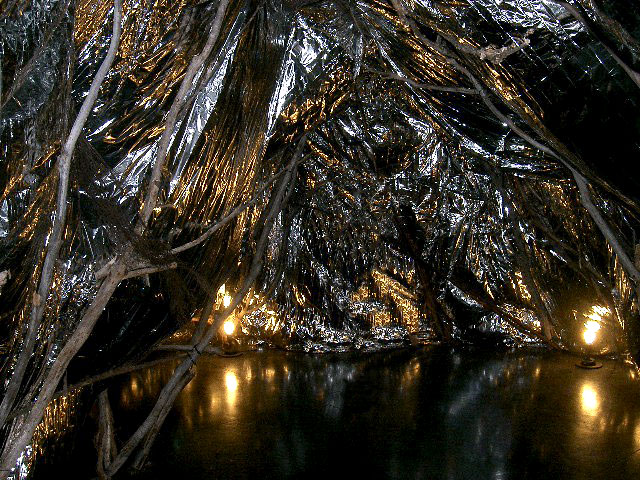
Gerda Steiner (Swiss, b. 1967) and Jorg Lenzlinger (Swiss, b. 1964) Entrance to The Water Hole exhibition at ACCA, Melbourne 2009 Photo: Marcus Bunyan
A cave like entrance presents itself to the visitor as they enter the exhibition leading to a long winding tunnel that is lined with silver insulation foil and tree branches, lit by floor mounted electric light bulbs. The foil moves with the natural movement of air causing not a rustling of leaves but of artificial surfaces.
At the end of the tunnel the viewer enters a large installation space, confronted with a effusive pop art Garden of Eden, a Magic Forest.
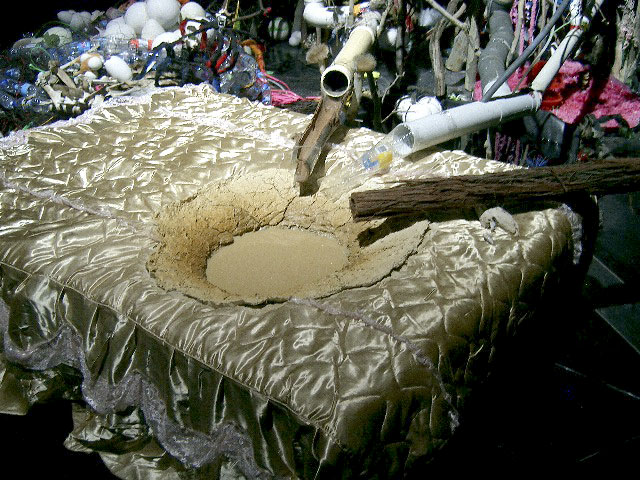
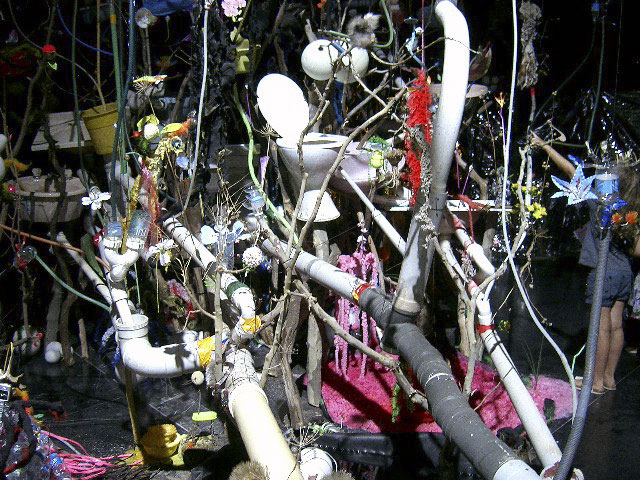
It takes a while to work out what is going on, there are so many elements to the sculptural piece. The main elements are buckets, toilets, basins and drainage pipes, plumbing fittings that all lead to a bed with a drying dam in the centre of a satin bedspread: the ‘waterhole’ of the exhibition title. The waterhole is fed by water dripping from a medical bag suspended high in the air above the dam, a nice touch. The rest of the forest and pipes are dry. The installation comments on our water supplies and the ‘technologies of production’ (Foucault) that permit us to produce, transform or manipulate things. We might install rainwater tanks to catch water but if there is no water to catch in the first place then we are in trouble: we make our bed and have to lie in it, the empty basins like our catchment areas, dry and bleak.
Other elements of the forest have an environmental theme, the installation developed by the artists in response to the extensive drought most of Australia (and it particular Melbourne) is experiencing. Here are spiders with hairy legs and mobile phones for bodies infesting the installation, plumbing fittings with natural seeds sprouting from their ends, brightly coloured crystal forms fed each day with water by gallery staff so that they grow. An upside down umbrella with Polar bear images printed on it’s material has imaginary water draining down a bamboo pipe into a bucket; empty water bottles form a large nest with broken eggs inside; artificial plants, bones, crabs, seaweed and flying stuffed owls are form some of the other elements in the installation.
Climbing a few steps we enter a ‘bird’ watching gallery replete with binoculars to observe the humans in the forest as much as the forest itself. A water cooler sits incongruously in this watching space, silent and somehow complicit in its ironical presence.
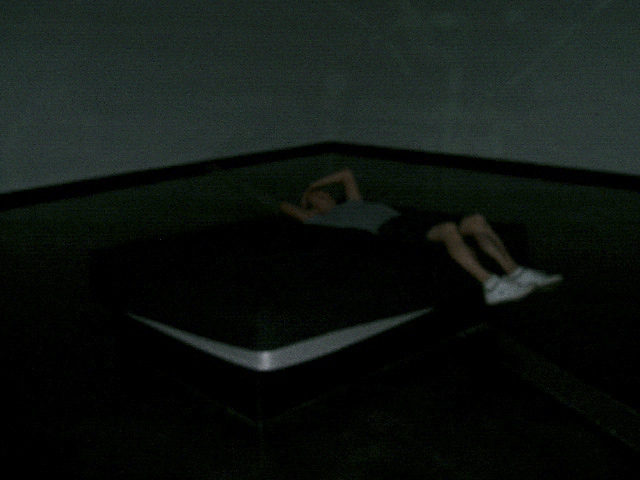
The viewer then moves to another room. Four video projectors display another water themed installation on the gallery walls, the videos meeting in the middle of the walls and reflecting each other. Ambient music accompanies images of rain!, spurting water, owls and plastic pipes, plastic flowers and plastic horses as the viewer relaxes on a waterbed in the middle of the space. The effect of the music and images is quite meditative when combined with the gentle rocking of the waterbed, the projections of the video forming kaleidoscopic ‘Northern lights’ on the ceiling of the gallery. This room is an extension of the themes of the large installation.
Moving forward the viewer enters another room – the meditation room. This room is most effective in encouraging contemplation of the different planes of our existence and our orientation in (environmental) space. Three beds are present, one suspended from the ceiling by four metal rods. Climbing onto this bed the movement from side to side caused by your weight makes you feel seasick and slightly disorientated. Above the second table is a wonderful mobile made of twigs, branches, dried leaves, plastic flowers, beads, plastic bags, baby dummies and jewellery moving gently in the breeze. Lying on the table with the mobile about a foot above your head things drift in and out of view as you change the focus of your eyes – close, mid, far and then onto the moving shadows on the ceiling.
The most effective bed has a small meteorite suspended in a net bag above it. The viewer slides underneath the ‘rock’ placing the meteorite about a foot or so above your face. The meteorite is brown, dark and heavy, swinging slightly above your ‘third eye’. You feel its weight pressing down on your energy, on your life force and you feel how old this object is, how far it has traveled, how fragile and mortal you are. It is a sobering and enlightening experience but what an experience it is!
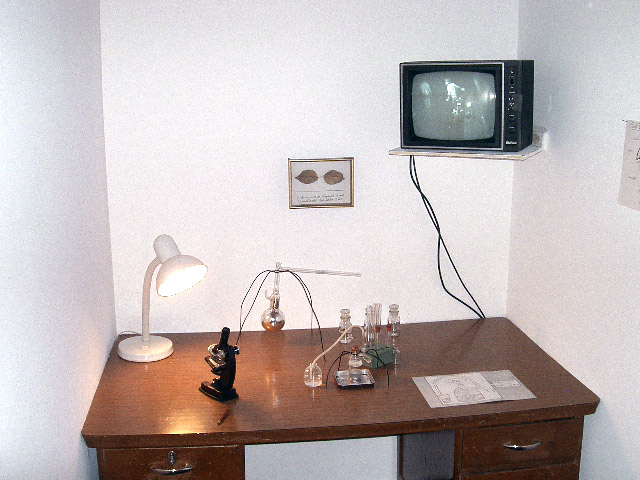
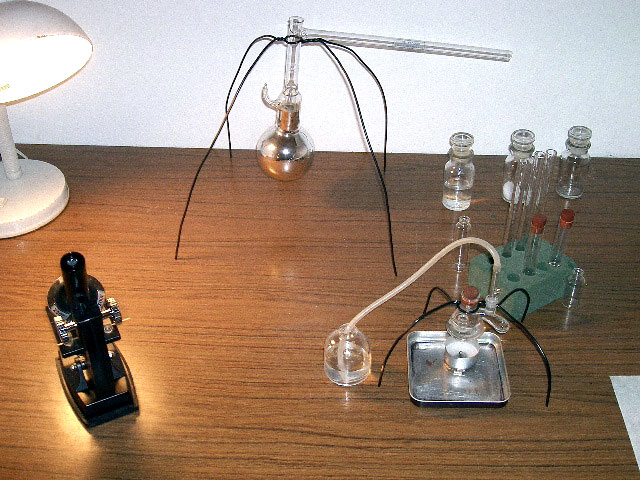
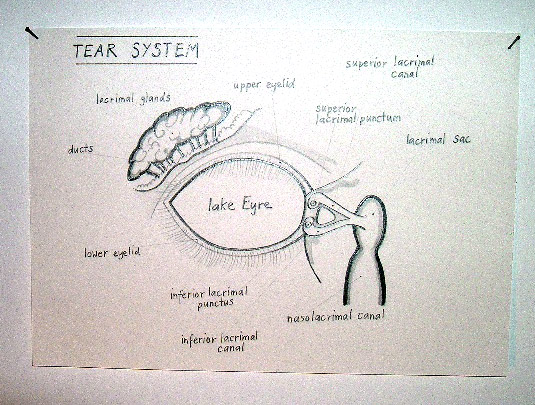
Entering the final room small colour photos of people being hugged from behind and lifted into the air, laughing, line the gallery walls. These are the weakest elements of the exhibition and seem to bear no relation to all that has passed before. Running off of this gallery is an alcove that is a dead end, a full stop to the exhibition with an installation Desalination plant for tears. A cheap Formica desk sits at the end of the space. Perched above the desk is a tv showing live black and white images of the earlier bird watching gallery – the watcher now the watched. On the desk itself is a microscope (with slide of human tears), pencil, a candle for heat under a glass flask of water (looking like a spider from the large installation!) and various glass test tubes and vials. A diagram explains the working of a Desalination plant for tears, an analogous reference to the desalination plant earmarked for Wonthaggi, south-east of Melbourne. Irony is present (again) in the 2 leaves grown at Singapore Airport by desalinated water (2008), two framed, brown dead leaves, and in the Tear system diagram where glands have turned into forests and the eye into a lake (see below).
This is a magical and poignant exhibition that is a joy for children and adults alike. Children love it running around exploring the environments. Adults love it for it’s magical, witty and intelligent response to the problems facing our planet and our lives. Go and enjoy this interplanetary collision. Highly recommended!
Gerda Steiner (Swiss, b. 1967) and Jorg Lenzlinger (Swiss, b. 1964) The Water Hole (detail) 2009 Photo: Marcus Bunyan
Gerda Steiner (Swiss, b. 1967) and Jorg Lenzlinger (Swiss, b. 1964) The Water Hole (detail) 2009 Photo: Marcus Bunyan
Gerda Steiner (Swiss, b. 1967) and Jorg Lenzlinger (Swiss, b. 1964) The Water Hole (detail) 2009 Photo: Marcus Bunyan
Gerda Steiner (Swiss, b. 1967) and Jorg Lenzlinger (Swiss, b. 1964) Installation view of waterbed at The Water Hole exhibition at ACCA, Melbourne 2009 Photo: Marcus Bunyan
Gerda Steiner (Swiss, b. 1967) and Jorg Lenzlinger (Swiss, b. 1964) Installation view details of Desalination plant for tears from The Water Hole exhibition at ACCA, Melbourne 2009 Photos: Marcus Bunyan
The end of 2008 saw the launch of The Water Hole, a major installation by renowned Swiss artists Steiner and Lenzlinger. The artists created a fantasia of ecology in ACCA’s large hall. In the side galleries a flow out of projects including meteors suspended over beds, a crystal room and a desalination laboratory. The Water Hole, devised specifically for ACCA, referenced Australia’s acute climate challenges as well as the pressure of global waste. The project created a story of place, a fable if you like. And in the tradition of the fable, the artists employed animals, plants and inanimate objects to tell a story that has moral and ethical dimensions.
The Water Hole was a big story – filled with pleasurable things but also with the message of peril. The artists created environments that enabled the visitor to consider and sense our place in history, and our attention to striking a balance between our consumptive desiring and nature.
Text from the ACCA website
Gerda Steiner (Swiss, b. 1967) and Jorg Lenzlinger (Swiss, b. 1964) Diagram from Desalination plant for tears from the exhibition The Water Hole at ACCA, Melbourne 2009 Photo: Marcus Bunyan
Australian Centre for Contemporary Art (ACCA) 111 Sturt Street Southbank Victoria 3006 Australia
Opening hours: Tuesday to Friday 10am – 5pm Weekends and Public Holidays 11am – 5pm Monday by appointment Open all public holidays except Christmas Day and Good Friday
“Here was a golden opportunity to try something fresh in terms of war as conflict – both in photography and painting – to frame the discourse in an eloquent, innovative manner.” Dr Marcus Bunyan
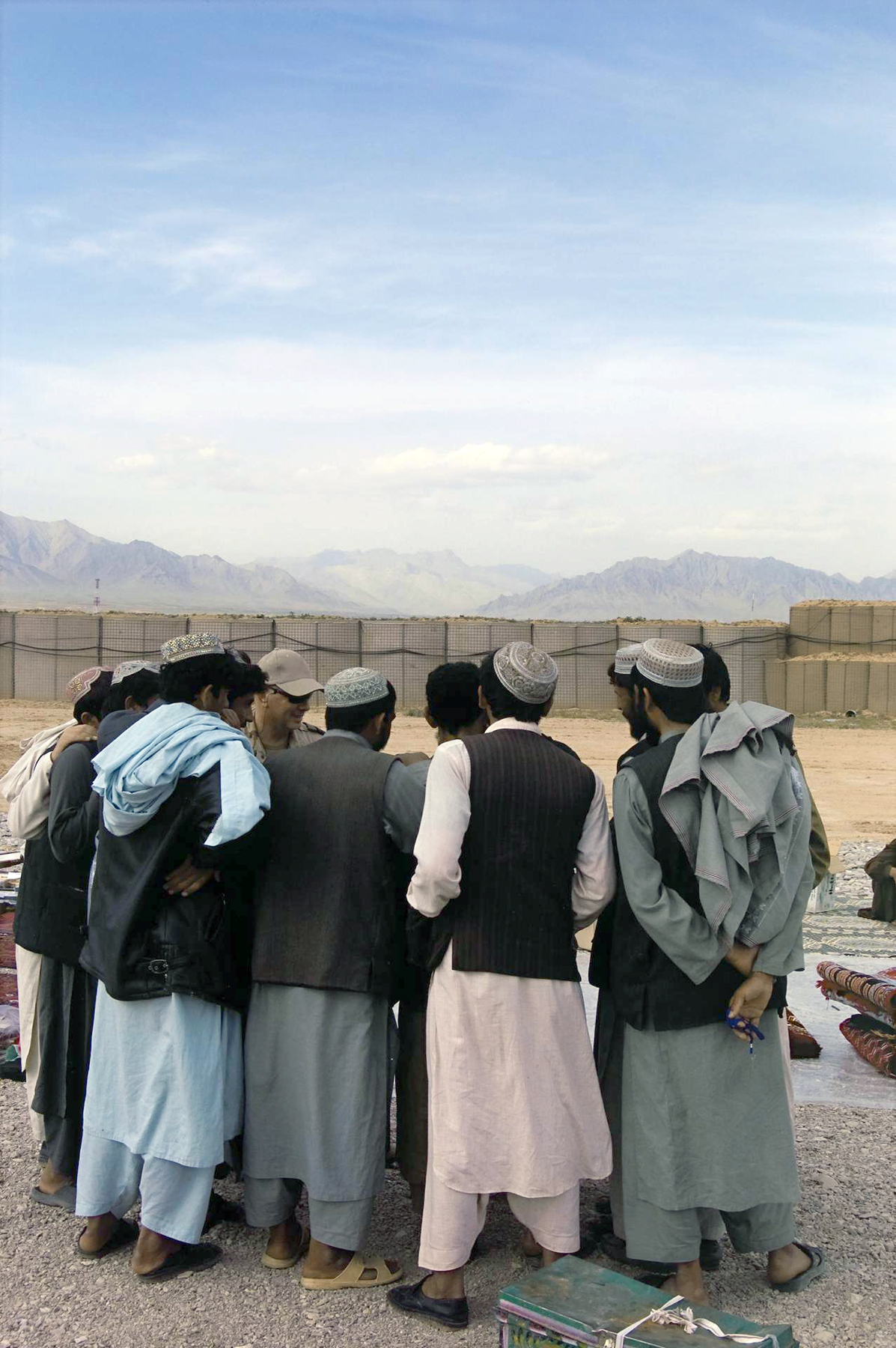
Lyndell Brown (Australian, b. 1961) and Charles Green (Australian, b. 1953) Afghan traders with soldiers, market, Tarin Kowt base, Uruzgan province, Afghanistan 2007-2008 From The approaching storm series 2007-2009 Digital colour inkjet photograph 155 x 107.5cm
Despite one brilliant photograph and some interesting small painted canvases this exhibition is a disappointment. No use beating around the figurative bush in the landscape so to speak, talking plainly will suffice.
Firstly, let’s examine the photographs. Thirteen large format colour photographs are presented in the exhibition out of an archive of “thousands of photographs Brown and Green created on tour”1 from which the paintings are derived.
Most of the photographs are inconsequential and need not have been taken. Relying on the usual trope of painters who take photographs they are shot at night, dusk or dawn when the shadows are long, the colours lush supposedly adding ‘mystique’ to the scene being portrayed. In some cases they are more like paintings than the paintings themselves. Perhaps this was the artist’s plan, the reverse marriage of photography and painting where one becomes the other, but this does little to advance photography as art.
There is nothing new or interesting here: sure, some of the photographs are beautiful in the formal representation of a vast and fractured landscape but the pre-visualisation is weak: bland responses to the machines, industry, people and places of the conflict. Go look at the Andreas Gursky photographs at the National Gallery of Victoria to see world-class photography taking reality to the limit, head on.
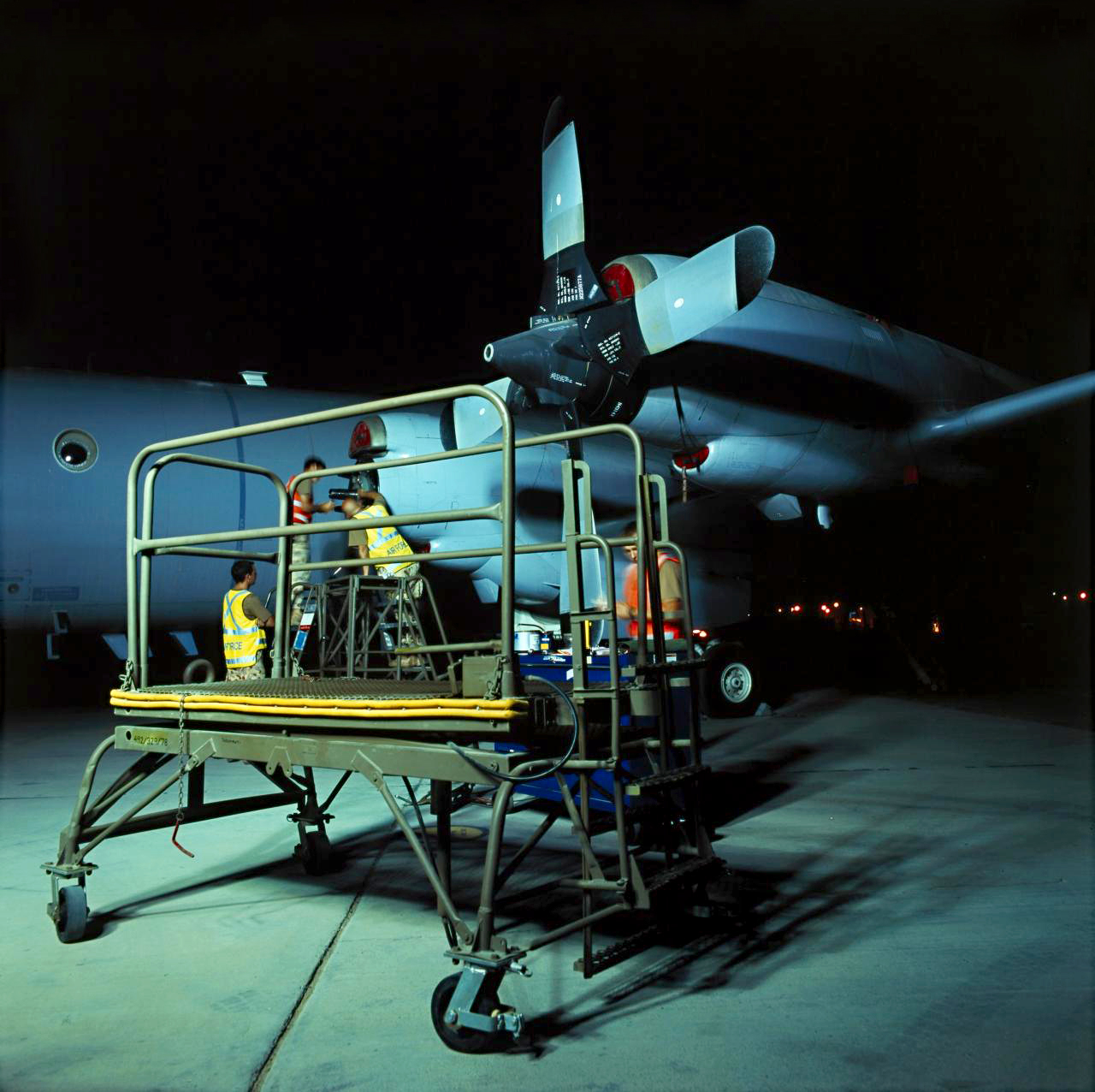
Too often in these thirteen images the same image is repeated with variants – three images of the an aircraft having it’s propeller changed show a lack of ideas or artefacts to photograph – presented out of the thousands taken seems incongruous. The fact that only one photograph is reproduced in the catalogue is also instructive.
Some images are just unsuccessful. For example the photograph Dusk, ship’s bridge with two sailors, northern Gulf is of a formulaic geometry that neither holds the viewers attention nor gives a deeper insight into their lives aboard ship and begs the question why was the photograph taken in the first place? The dark space has little physical or metaphysical illumination and seems purely to be an exercise in formalism. The photograph Dusk, ships’ bridge with sailor, northern Gulf is more successful in the use of light and shade as they play across the form of a sailor, his head resting pensively in his hand, red life vests adding a splash of colour to the bottom right of the photograph.
The brilliant photograph of the group is View from Chinook, Helmand province, Afghanistan. This really is a monstrous photograph. With the large black mass of the helicopter in the foreground of the image containing little detail, the eye is drawn upwards to the windscreen through which a mountain range rises, with spines like the back of a Stegosaurus. To the right a road, guarded by a desolate looking pillbox and yellow barrier, meanders into the distance. Dead flies on the windscreen look like small bullet holes until you realise what they are. This is the image that finally evidences a disquieting beauty present in the vast and ancient landscape.
Turning to the paintings we can say that some of the small 31cm x 31cm paintings work well. From an ‘original’ photograph the artist selects and crops a final image that they work up into a highly detailed oil painting. Distilled (as the artist’s like to put it) from the ‘original’ photographs, the paintings become a “merging of a contemporary sense of composition – borrowed from photography, film and video – with the textures and processes of traditional oil painting.”2
“These works were developed by the artists to be something akin to “Hitchcockian clues” which create the sense of looking out at a scene but being distanced from the action. To some degree the entire suite of small pictures participate in developing this intrigue, by showing an array of ambiguous scenes in which direct action is never present, or is obscured by limited perspectives … The artists noted that the war zones they witnessed were low in action but high in tension”3
To an extent this tension builds in some of the small paintings: the small size lends an intimate, intense quality and forces the viewer to engage with highly detailed renditions of textures of clothing, material, skin and hair and the distorted scale of the ships and aeroplanes portrayed. In these intense visions the painting seems less like a photograph and more like a new way of seeing. However, this occurs only occasionally within the group of small paintings.
If we think of a photograph in the traditional sense as a portrayal of reality, then a distillation of that photograph (the removal of impurities from, an increase in the concentration of) must mean that these paintings are a double truth, a concentrated essence of the ‘original’ photograph that changes that essence into something new. Unfortunately most of these small canvases show limited viewpoints of distilled landscapes that do not lead to ambiguous enigmas, but to the screen of the camera overlaid by a skein of paint, a patina of posing.
This feeling is only amplified in the three large ‘History’ paintings. The three paintings seem static, lifeless, over fussy and lacking insight into the condition of the ‘machine’ that they are attempting to portray. It’s a bit like the ‘Emperors New Clothes’, the lack of substance in the paintings overlaid with the semantics of History painting (“a traditional genre that focused on mythological, biblical, historical and military subjects”) used to confirm their existence and supposed insight into the doubled, framed reality. As Robert Nelson noted in his review of 2008 art in Melbourne in The Age newspaper it would seem that painting is sliding into terminal decline. These paintings only seem to confirm that view.
Here was a golden opportunity to try something fresh in terms of war as conflict – both in photography and painting – to frame the discourse in an eloquent, innovative manner.
Most of this work is not interesting because it does not seem to be showing, or being discursive about anything beyond a personal whim. Because an artist can talk about some things, doesn’t mean that he can make comments about other things that have any value. Although the artist was looking to portray landscapes of globalisation and entropy, there are more interesting ways of doing this, rather than the nature of the transcription used here.
“It is very good to copy what one sees: it is much better to draw what you can’t see any more but in your memory. It is a transformation in which imagination and memory work together. You only reproduce what struck you, that is to say, the necessary. That way your memory and your fantasy are freed from the tyranny of nature.”4
No thinking but the putting away of intellect and the reliance on memory and imagination, memory and fantasy to ‘distil’ the essence.
This is what needed to happen both in the photographs and paintings – leaving posturing aside (perhaps an ‘unofficial war artist’ would have had more success!) – to uncover the transformation of landscape that the theatre of this environment richly deserved.
Dr Marcus Bunyan
Footnotes
1/ Heywood, Warwick. Framing Conflict: Iraq and Afghanistan exhibition catalogue. Canberra: Australian War Memorial, 2008, p. 6 2/ Heywood, Warwick. Framing Conflict: Iraq and Afghanistan exhibition catalogue. Canberra: Australian War Memorial, 2008, p. 6 3/ Heywood, Warwick. Framing Conflict: Iraq and Afghanistan exhibition catalogue. Canberra: Australian War Memorial, 2008, p. 11 4/ Degas, Edgar quoted in Halligan, Marion. “Between the brushstrokes,” in A2 section, The Saturday Age newspaper, January 17th 2008, p. 18
Many thankx to The Ian Potter Museum of Art for allowing me to publish the photographs in the posting. Please click on the photographs for a larger version of the image.
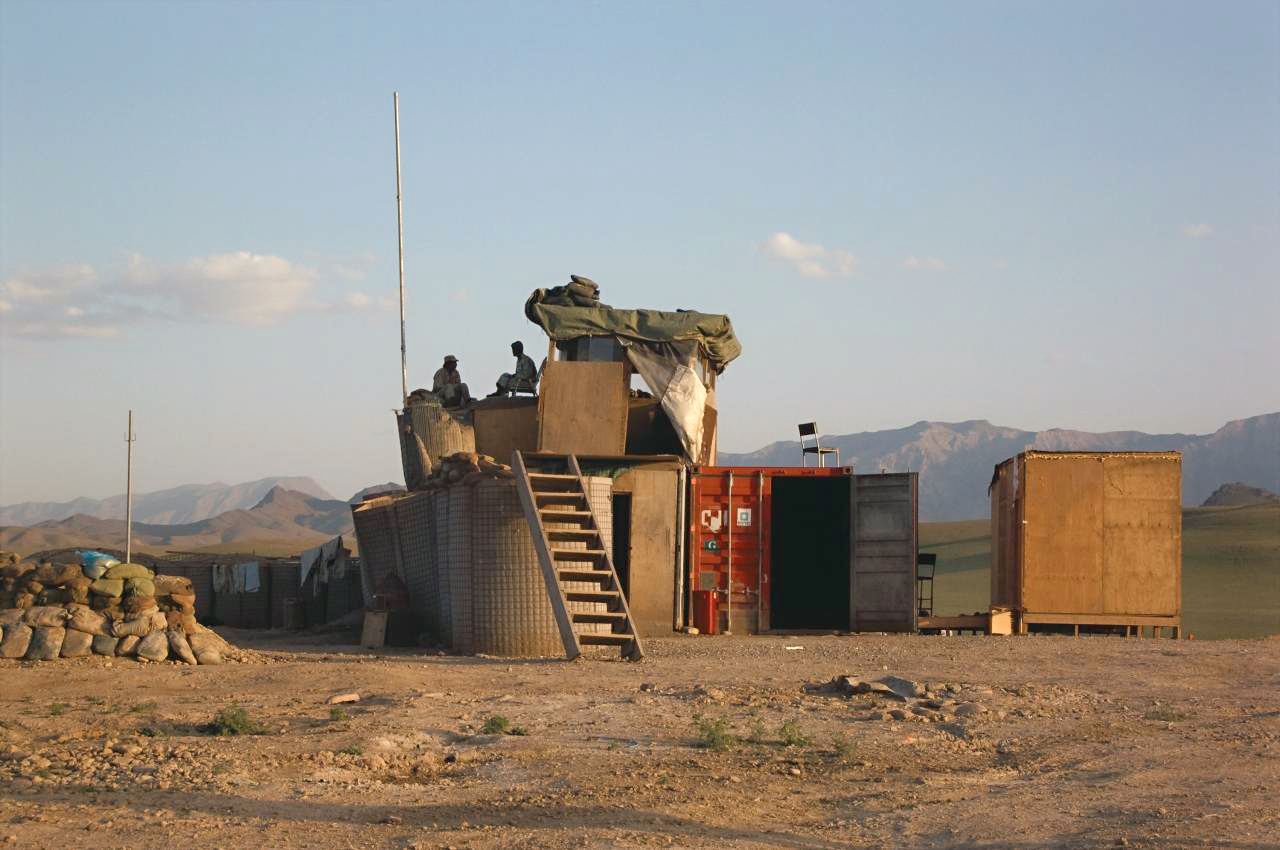
Lyndell Brown (Australian, b. 1961) and Charles Green (Australian, b. 1953) Afghan National Army perimeter post with chair, Tarin Kowt base, Uruzgan province, Afghanistan 2007-2008 From The approaching storm series 2007-2009 Digital colour inkjet photograph 111.5 x 151.5cm
Lyndell Brown (Australian, b. 1961) and Charles Green (Australian, b. 1953) Dusk, ship’s bridge with two sailors, northern Gulf 2007-2008 Digital colour inkjet photograph
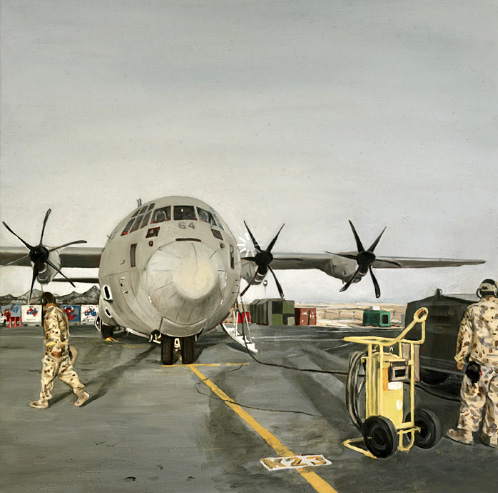
Lyndell Brown (Australian, b. 1961) and Charles Green (Australian, b. 1953) Late afternoon, flight line, military installation, Middle East 2007 Oil on linen
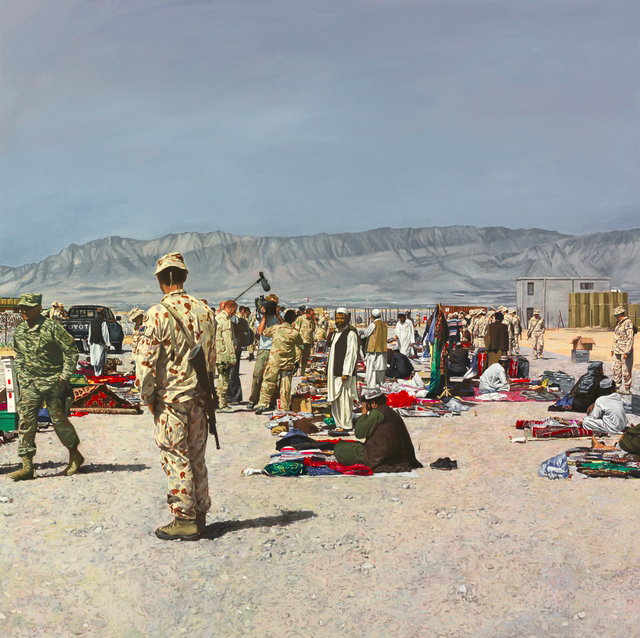
Lyndell Brown (Australian, b. 1961) and Charles Green (Australian, b. 1953) Market, Camp Holland, Tarin Kowt, Uruzgan province, Afghanistan 2007 Oil on linen
Lyndell Brown (Australian, b. 1961) and Charles Green (Australian, b. 1953) View from Chinook, Helmand province, Afghanistan 2007-2008 From The approaching storm series 2007-2009 Digital colour inkjet photograph 111.5 × 151.5cm
Lyndell Brown (Australian, b. 1961) and Charles Green (Australian, b. 1953) View from Chinook, Helmand province, Afghanistan 2007 Oil on linen
Lyndell Brown (Australian, b. 1961) and Charles Green (Australian, b. 1953) Trolley, propeller change, on flightline at night, military installation, Gulf 2007-2008 From The approaching storm series 2007-2009 Digital colour inkjet photograph 87.0 x 87.4cm
Lyndell Brown (Australian, b. 1961) and Charles Green (Australian, b. 1953) History painting: market, Tarin Kowt, Uruzgan province, Afghanistan 2007 Oil on linen
Installation view of photographs from the exhibition Framing Conflict at The Ian Potter Museum of Art, The University of Melbourne 2009
Installation view of paintings from the exhibition Framing Conflict at The Ian Potter Museum of Art, The University of Melbourne 2009
The Ian Potter Museum of Art The University of Melbourne, Corner Swanston Street and Masson Road Parkville, Victoria 3010
Link pasted the plane into the negative at a later stage
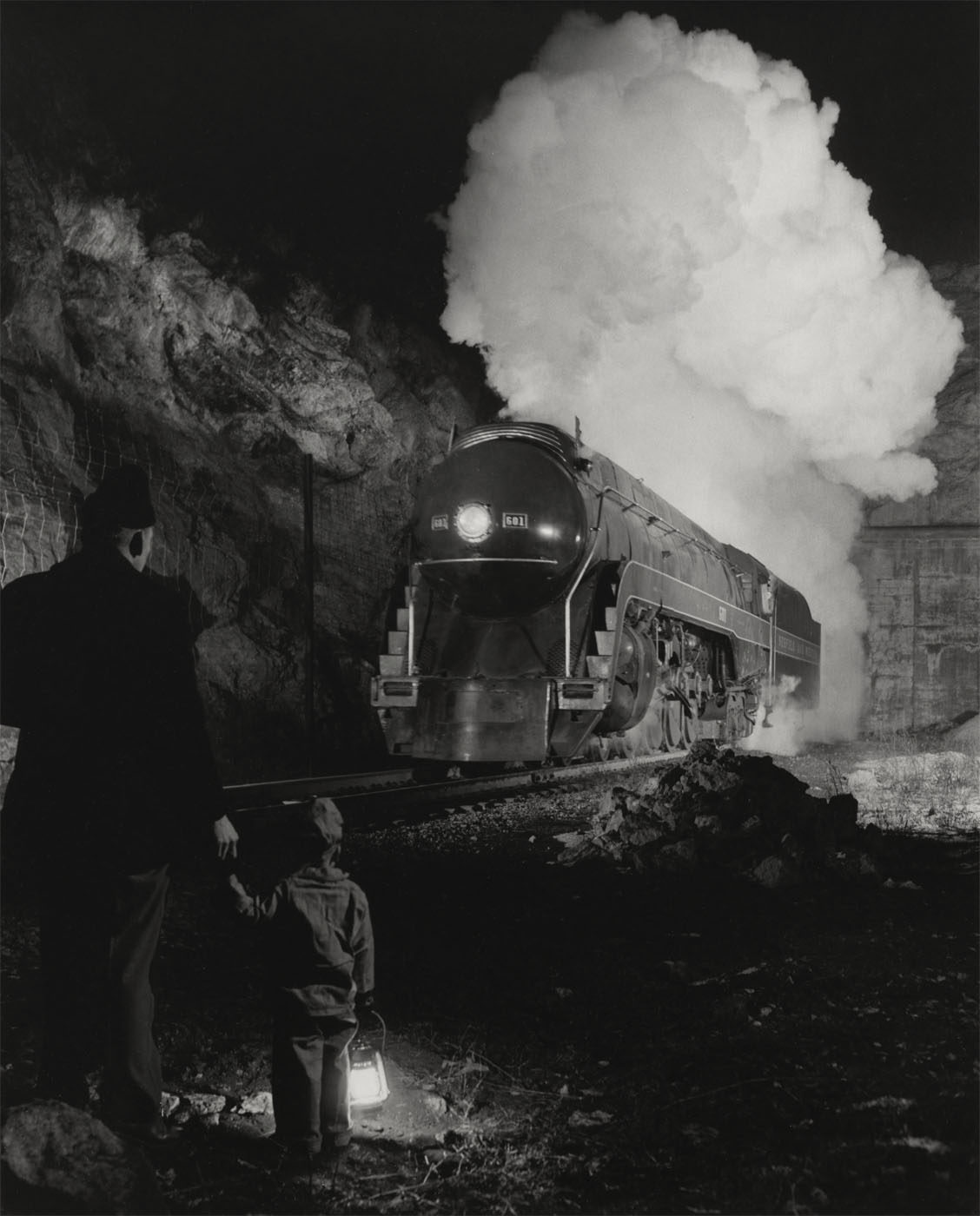
I have to admit to a very large amount of admiration for this photographer. He is brilliant, simply the best photographer of trains and their cultural surrounds that the world has ever seen. He persevered within his photographic projects through thick and thin. I feel a special affinity toward this man as I love trains, planes, ships and trucks (although I am yet to use trains in my work).
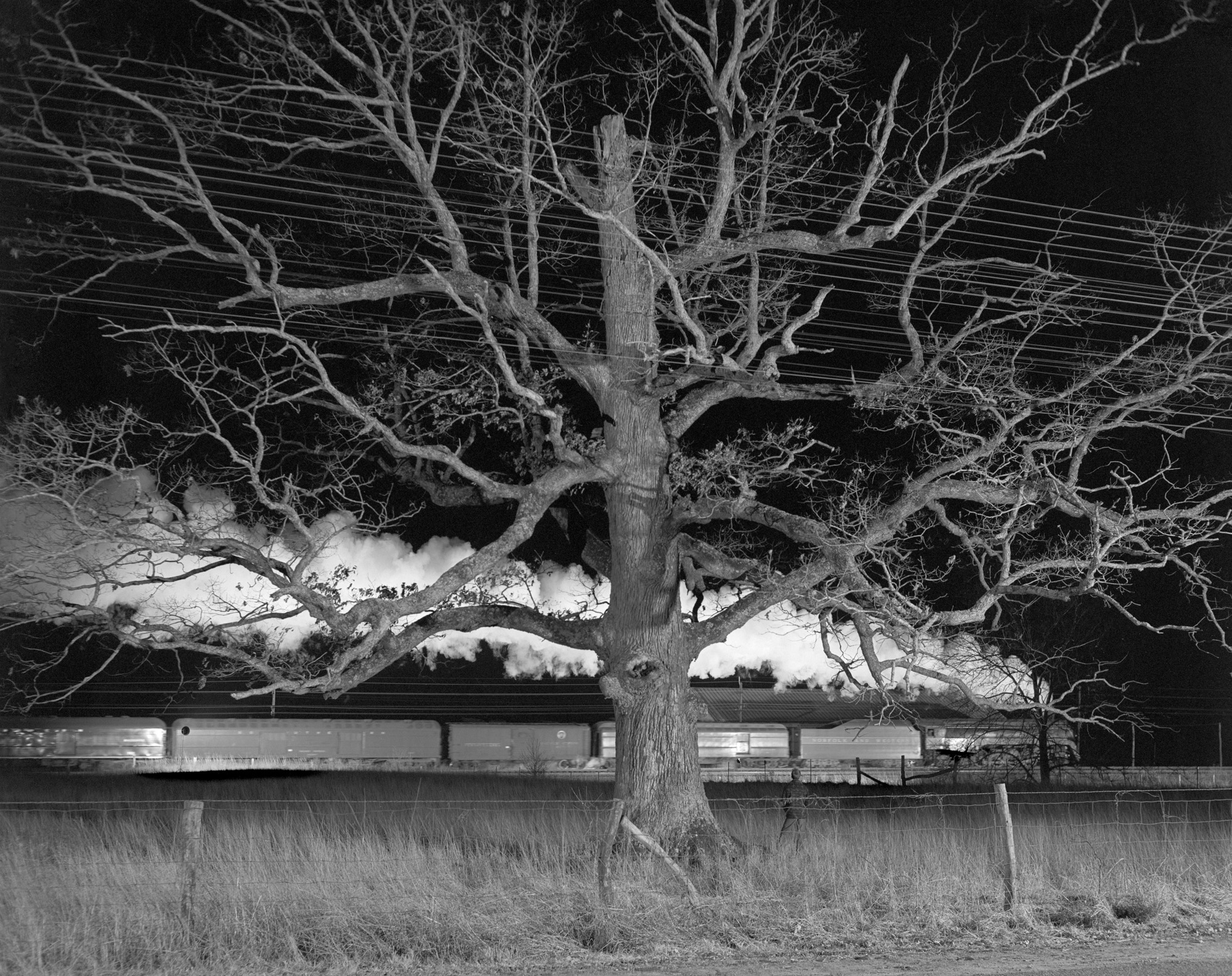
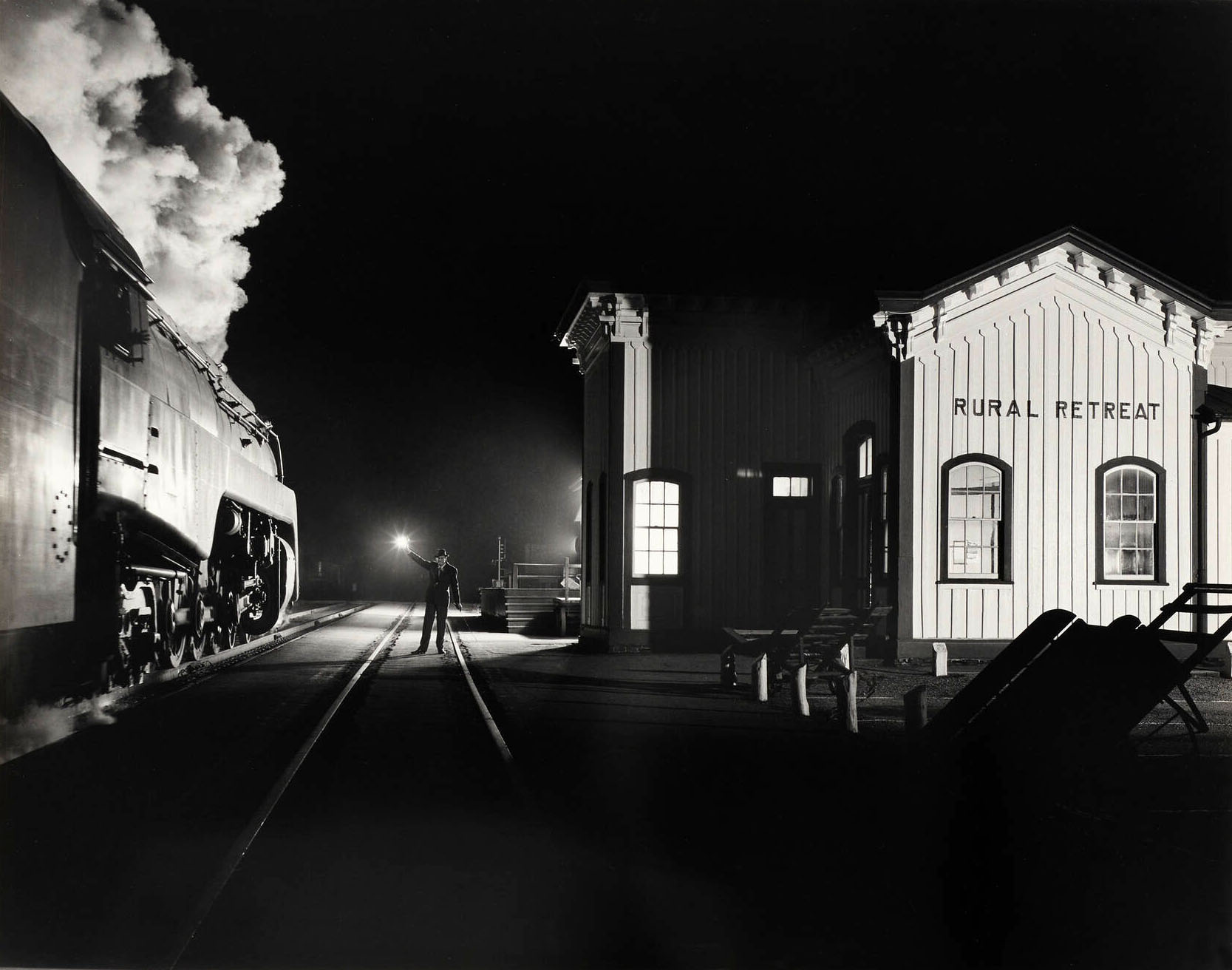
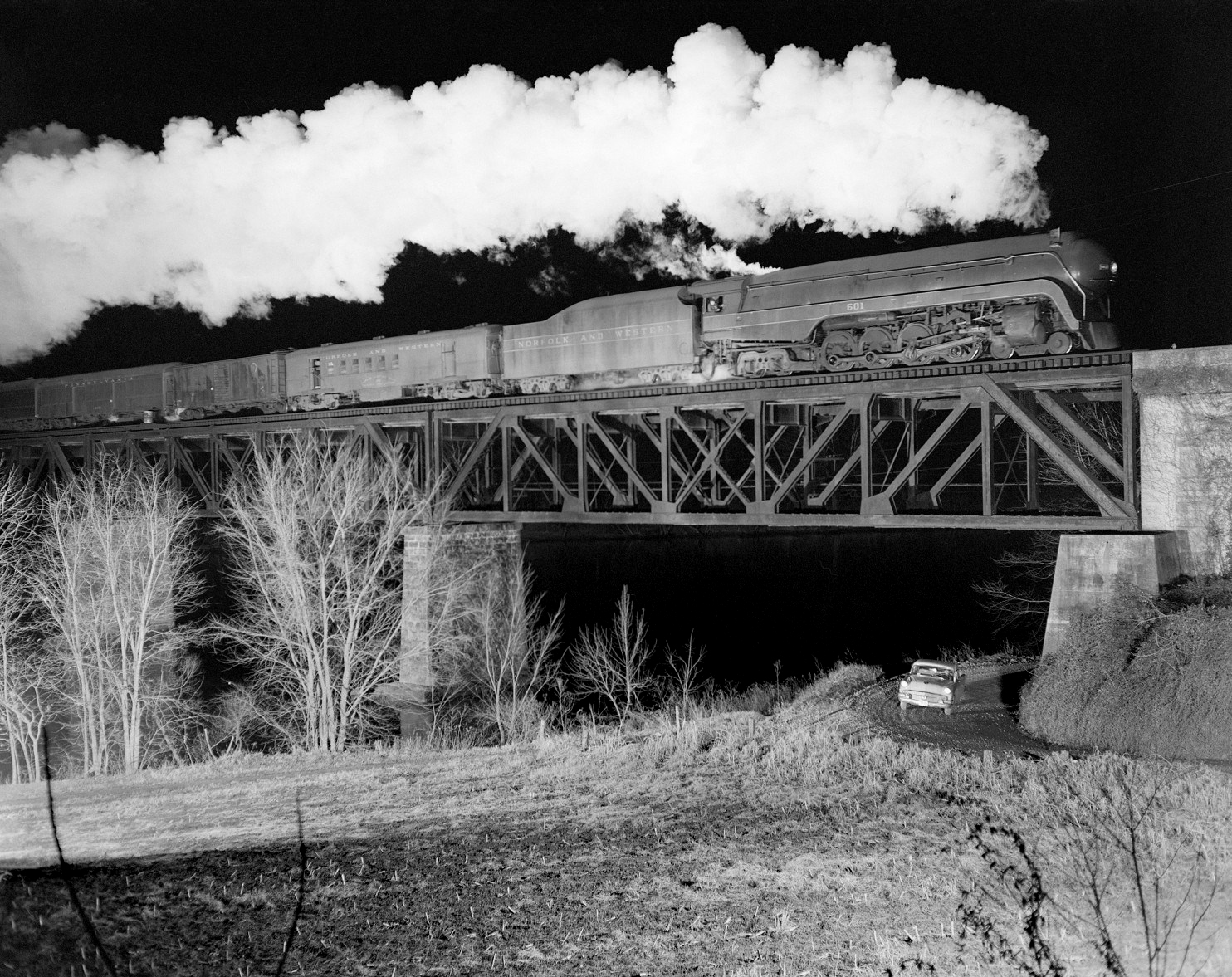
As with all great photographers he pursued his goals with passion, a unique eye and the ability to produce a ‘signature’ photograph that could only be his. His photographs are timeless remembrances of the history and culture of the era. The above image combines all the elements of 1950s America – the drive in, the couple, the speed, the convertible car, night and the ambiguous slightly sinister rocket like plane. Planes, trains and automobiles are the stuff of legend for me, a child of the 1950s. The lighting of the train is incredible, with rows of flash set off at just the right moment. The precision and skill to do this and the resulting tableaux have few equals. When I first saw this image I was amazed and still am today!
O. Winston Link had a deep respect for the people and machines he was photographing – capturing a vanishing world before it all but disappeared. Thank god there was someone with vision and foresight to accomplish this task so that these incredible and indelible images will forever transcend the time in which they were taken, to give joy to the people that look at them.
Dr Marcus Bunyan
Many thankx to the George Eastman Museum for allowing me to publish the photographs in the posting. Please click on the photographs for a larger version of the image.
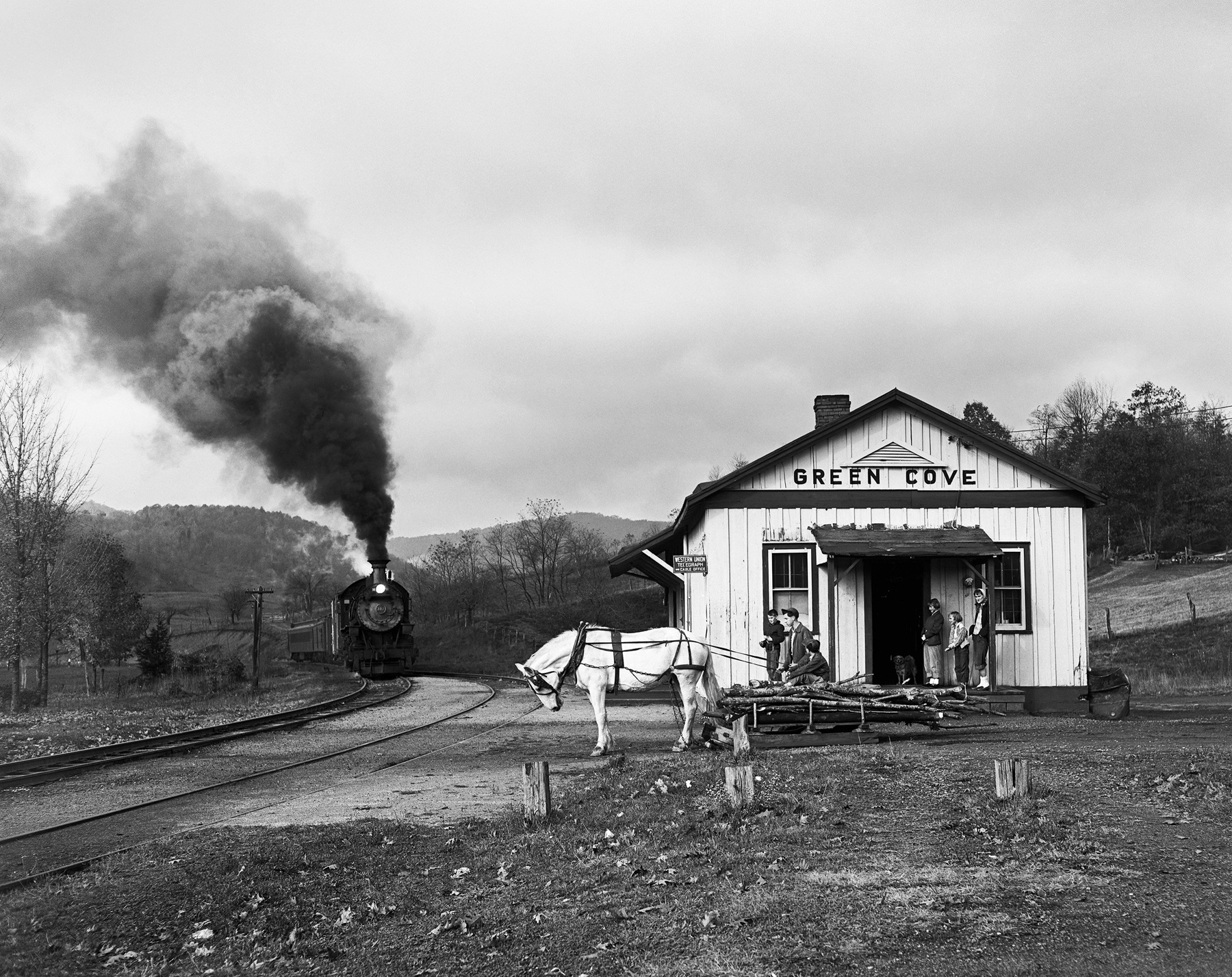
The Abingdon Branch of the N&W led Link to another approach in his documentation of the railroad. Since the trains did not run at night, all of the images had to be made in daylight, making this branch the source of many of his genre scenes and colour images. The branch was short but steep, including the highest point of any passenger train in the east. With top speeds of 25 mph, it earned the nickname “Virginia Creeper.”
Link found the slow pace and setting the most bucolic of the entire N&W system. He wrote, “There was beauty at every curve and every bridge.” The line crept by cascading waterways and across high wooden trestles. Although the entire branch was abandoned in 1978, the railbed has since become a hiking trail, with Green Cove the only station remaining and restored to the look of this photograph.
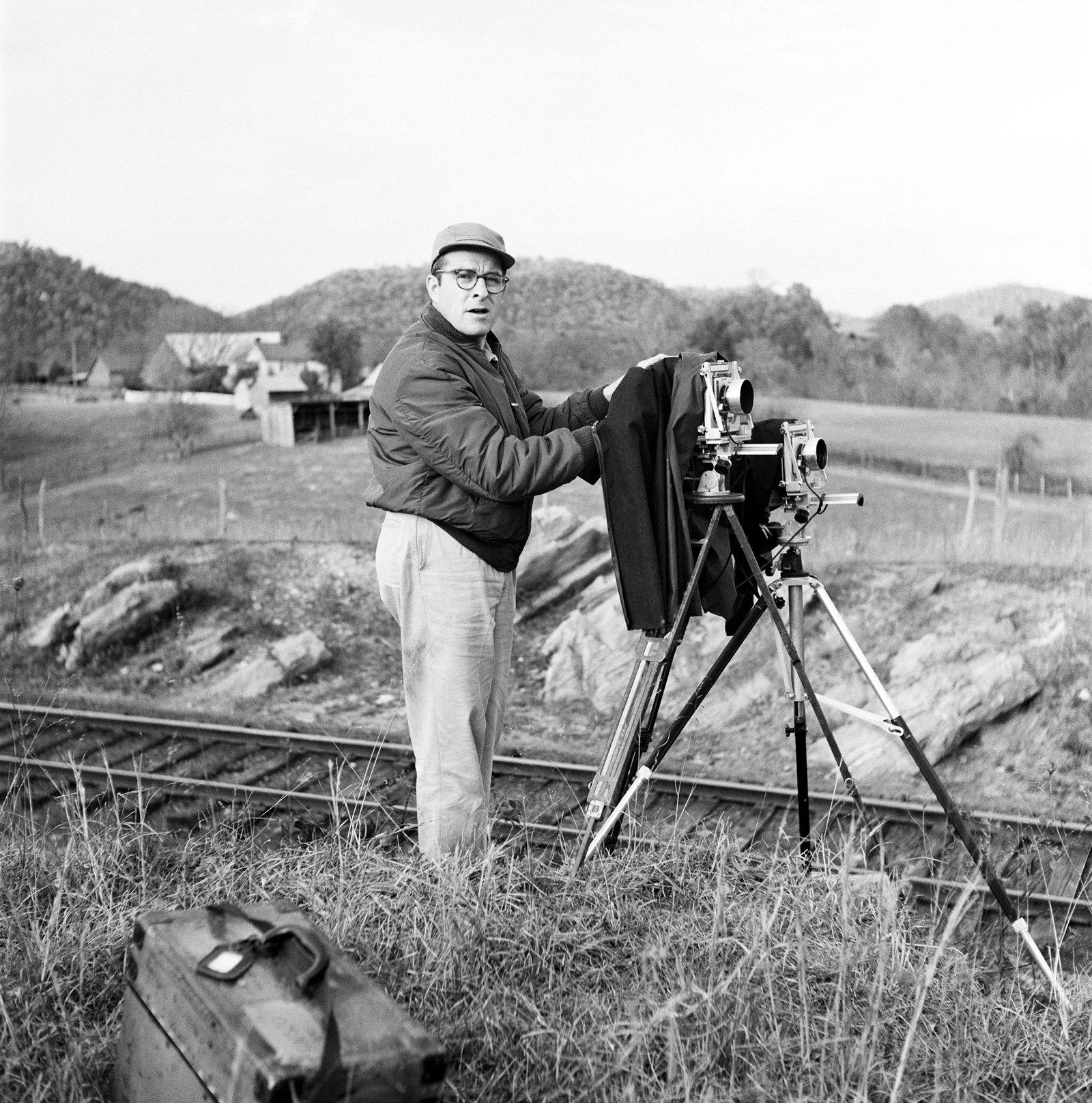
Ogle Winston Link, known commonly as O. Winston Link, has been revered by many as the most important railroad photographer of all time. He is best known for his black-and-white photography and sound recordings of the last days of steam locomotive railroading in the United States in the late 1950s. A true American master, Link produced night-time photographs of the railroad over a five-year period that ended when the last steam locomotive of the Norfolk & Western Railway was taken out of service in May 1960.
This exhibition features more than 100 framed photographs as well as Link’s actual photographic and lighting equipment, plus his personal notebooks detailing set-ups, formulas, and exposure details.
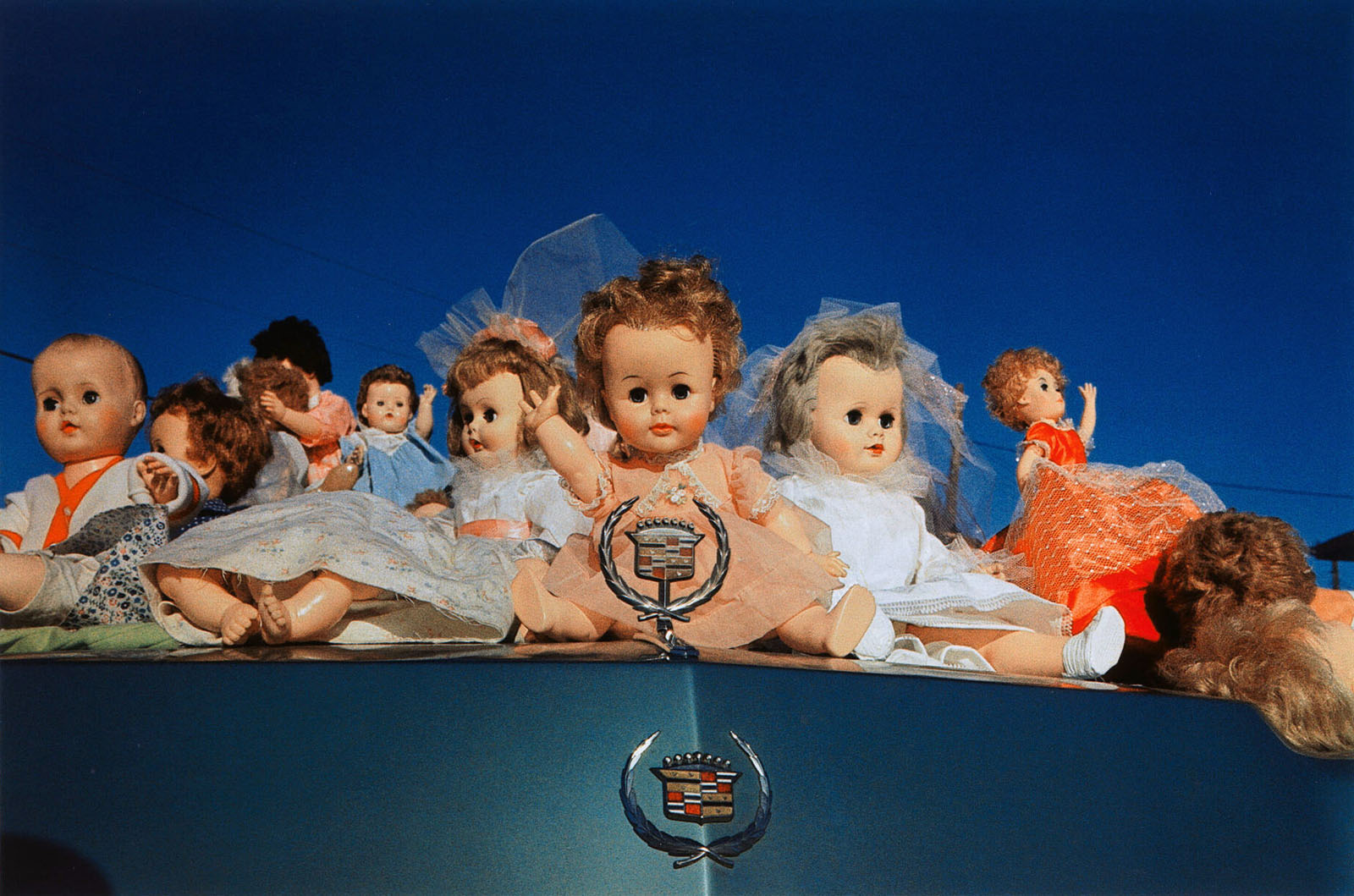
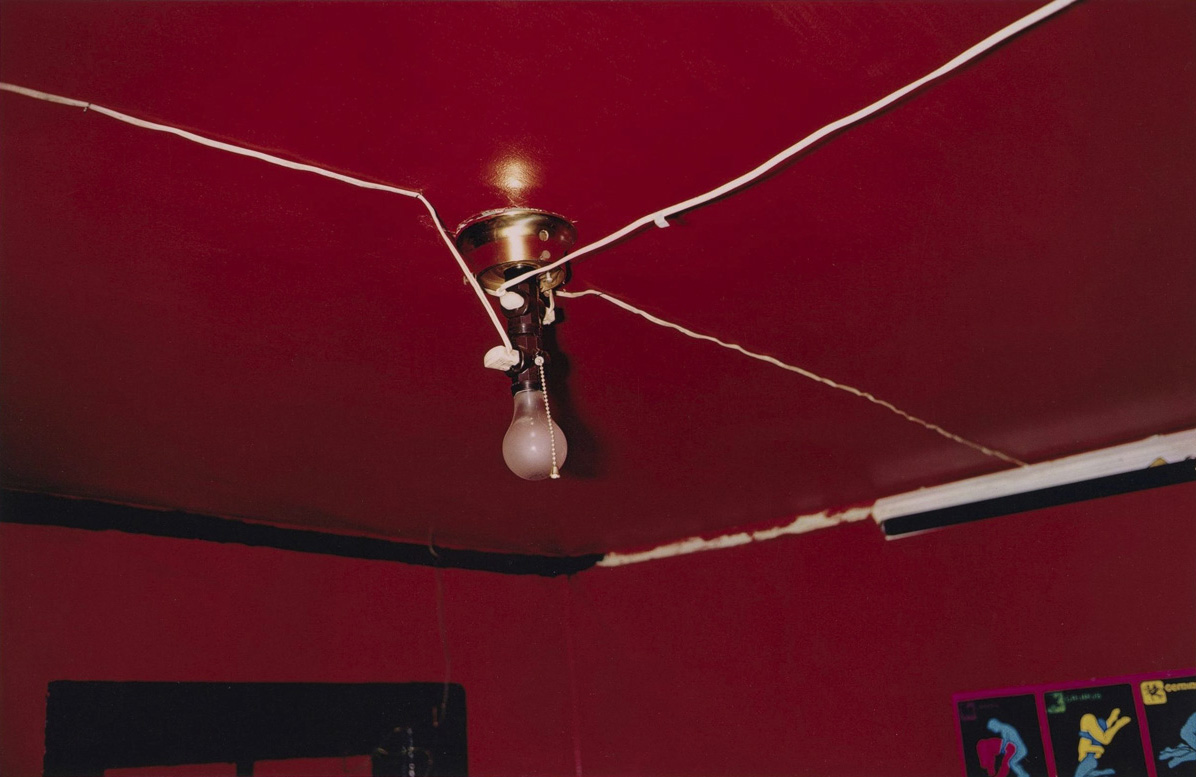
One of the most influential photographers of the last half-century, William Eggleston has defined the history of colour photography. This exhibition is the artist’s first retrospective in the United States and includes both his colour and black-and-white photographs as well as Stranded in Canton, the artist’s video work from the early 1970s.
William Eggleston’s great achievement in photography can be described in a straightforward way: he captures everyday moments and transforms them into indelible images. William Eggleston: Democratic Camera, Photographs and Video, 1961-2008 presents a comprehensive selection from nearly fifty years of image-making.
Born in 1939 in Sumner, Mississippi, a small town in the Delta region, Eggleston showed an early interest in cameras and audio technology. While studying at various colleges in the South, he purchased his first camera and came across a copy of Henri Cartier-Bresson’s book The Decisive Moment (1952). In the early 1960s, Eggleston married and moved to Memphis, where he has lived ever since. He first worked in black-and-white, but by the end of the decade began photographing primarily in colour. Internationally acclaimed and widely traveled, Eggleston has spent the past four decades photographing all around the world, conveying intuitive responses to fleeting configurations of cultural signs and moods as specific expressions of local colour. Psychologically complex and casually refined, bordering on kitsch and never conventionally beautiful, these photographs speak principally to the expanse of Eggleston’s imagination and have had a pervasive influence on all aspects of visual culture. By not censoring, rarely editing, and always photographing, Eggleston convinces us of the idea of the democratic camera.
This exhibition was organised by the Whitney Museum of American Art, New York, in association with Haus der Kunst, Munich.
Text from the Whitney Museum of American Art website
Many thankx to the Whitney Museum of American Art for allowing me to publish the photographs in the posting. Please click on the photographs for a larger version of the image.
“This candid interview with photographer William Eggleston was conducted by film director Michael Almereyda on the occasion of the opening of Eggleston’s retrospective William Eggleston: Democratic Camera, Photographs and Video, 1961-2008 at the Whitney Museum of American Art. A key figure in American photography, Eggleston is credited almost single-handedly with ushering in the era of colour photography. Eggleston discusses his shift from black and white to colour photography in this video as, “it never was a conscious thing. I had wanted to see a lot of things in colour because the world is in colour”. Also included in this video are Eggleston’s remarks about his personal relationships with the subjects of many of his photographs.”
William Eggleston claiming Dr. T.C. Boring was murdered with an ax in Stranded in Canton
In 1973, photographer William Eggleston picked up a Sony PortaPak and took to documenting the soul of Memphis and New Orleans. Transvestites, geek men biting off chicken heads, classy blues musicians, and crazed men with guns form the backbone of this documentary look at the “Southern Hipsters” of Louisiana and Mississippi.
Stranded in Canton
In 1973, photographer William Eggleston picked up a Sony PortaPak and took to documenting the soul of Memphis and New Orleans.
“These were the Merry Prankster and “Easy Rider” years, when road trips and craziness were cool, and Mr. Eggleston set out on some hard-drinking picture-taking excursions. He also embarked on repeated shorter expeditions closer to home in the form of epic bar crawls, which resulted in the legendary video “Stranded in Canton.”
Originally existing as countless hours of unedited film and recently pared down by the filmmaker Robert Gordon to a manageable 76 minutes, it was shot in various places in 1973 and 1974. (The new version is in the retrospective.) Mr. Eggleston would show up with friends at favourite bars, turn on his Sony Portapak, push the camera into people’s faces and encourage them to carry on.
And they did. Apart from brief shots of his children and documentary-style filming of musicians, the result is like some extreme form of reality television. Your first thought is: Why do people let themselves be seen like this? Do they know what they look like? You wonder if Mr. Eggleston is deliberately shaping some tragicomic Lower Depths drama or just doing his customary shoot-what’s-there thing, the what’s-there in this case being chemical lunacy. For all the film’s fringy charge there’s something truly creepy and deadly going on, as there is in much of Mr. Eggleston’s art. You might label it Southern Gothic; but whatever it is, it surfaces when a lot of his work is brought together.”
Holland Cotter. “Old South Meets New, in Living Color,” on The New York Times website Nov 6, 2008. Used under fair use conditions for the purposes of education and research
Unknown maker, American, Attributed to Carleton Watkins (American, 1829-1916) The Plaza, Lima, Peru About 1852 Daguerreotype Plate: 10.8 x 14cm (4 1/4 x 5 1/2 in.) J. Paul Getty Museum Collection
Watkins could have made this study of the Lima Cathedral on his return to California from New York via South America in 1852.
Carleton Watkins was a master photographer, craftsman, technician and, above all, a refined artist. The structural cadences of his compositions, like the best music, are superb. Within his photographs he creates a visual dialogue that sustains pertinent inquiry by the viewer – the look! see! – that has lasted centuries, as all great art does. Today his photographs are as clearly seen, as incisive of mind, as when they were first produced. They delight.
From the documentary photographs of mining settlements to the images of Yosemite; from the stereographs of cities to the gardens of the rich and famous; from the photographs of untouched interior America to the images of the Monterey Peninsula Watkins photographs are sharply observed renditions of a reality placed before the lens of his giant plate camera.
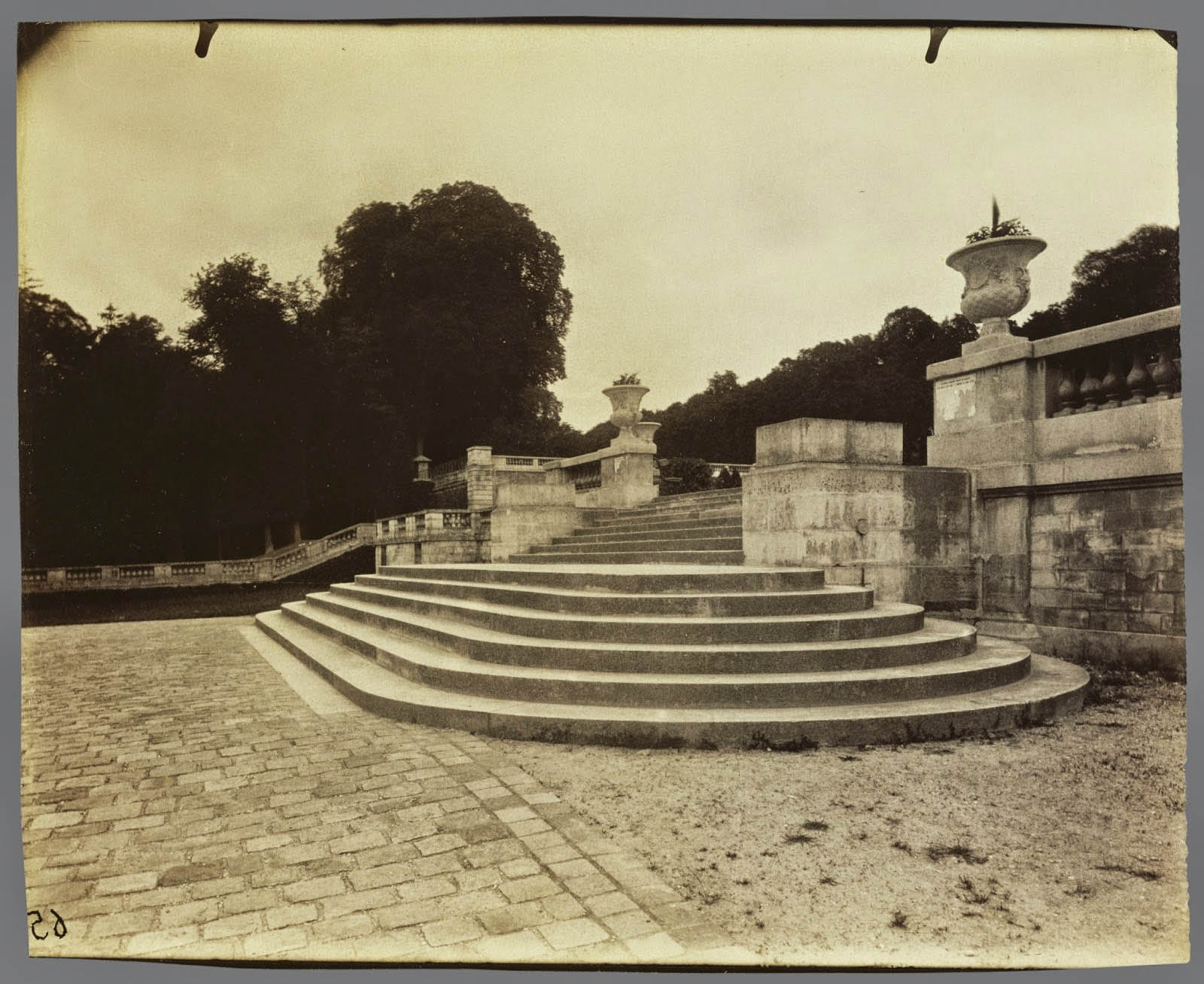
Like all great artists his eye is unique. His use angle, height and placement of the camera is reinforced by his understanding of the balance of light and shade, the construction of planes within the image and the spatial relationships that could be achieved within the frame (at the same time we note that the artist Cezanne was also investigating the deconstruction of traditional landscape perspectives within the image frame). His work reminds me of the photographs of the great French photographer Eugene Atget: both men understood how best to place the camera to achieve the outcome they wanted so that the photographs became imprinted with their signature, images that nobody else could have taken. Today we recognise both men as masters of photography for this very fact. The images they took raise them above the rank and file photographer because of the care and understanding they took in the decisions they made in the exposure of the negative.
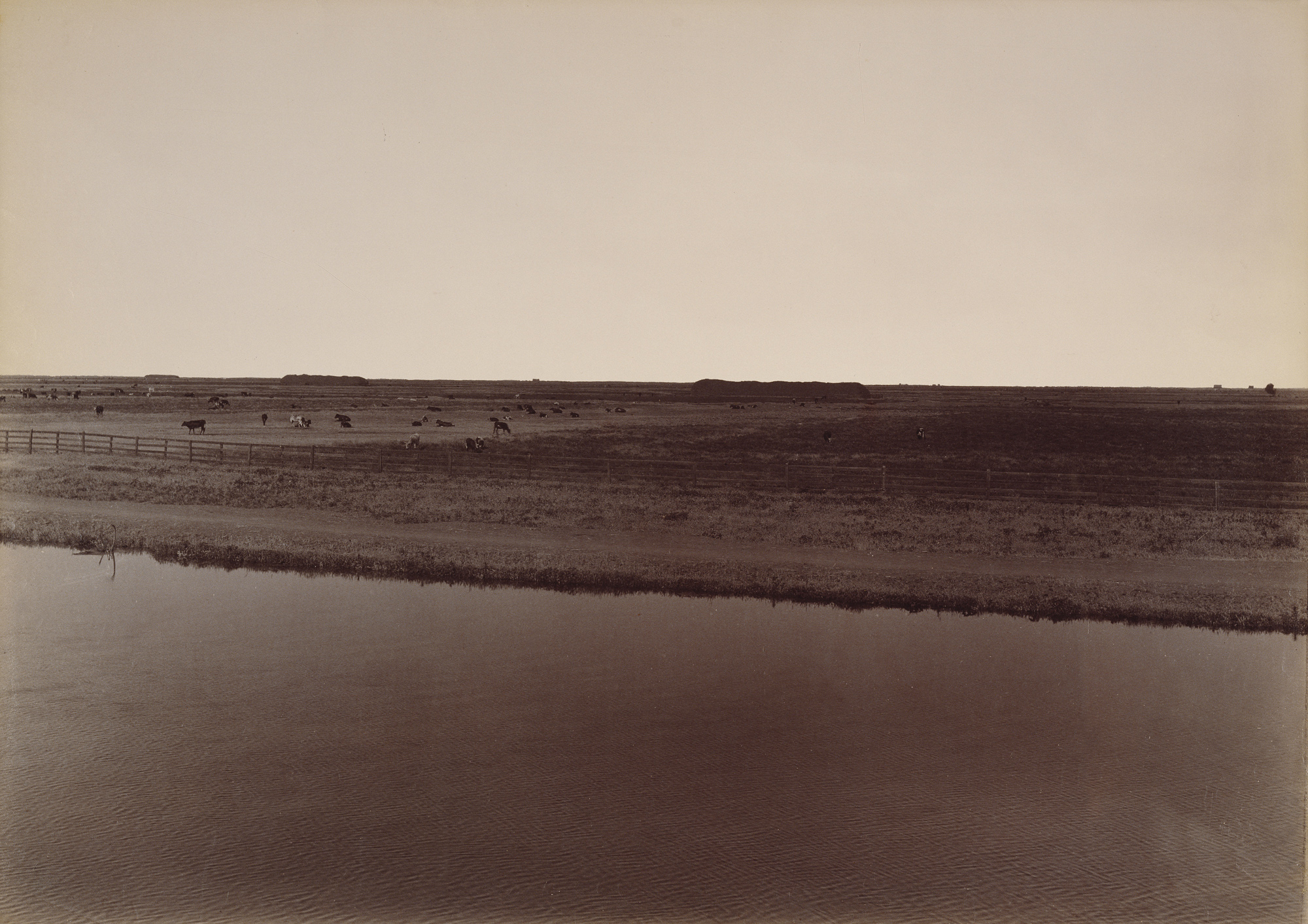
As a precursor to modernism in photography Watkins does not have peer at this time. His photographs preempt the 20th century modernist work of Paul Strand and Alfred Stieglitz, his Monterey and Yosemite photographs the work of Edward Weston and Ansel Adams, and in his Japanese influences the work of Minor White. Even today at the exhibition by Andreas Gursky at the National Gallery of Victoria, Melbourne there is a colour work of a body of water (see below: Rhein 1996) that closely reflects the structure of Watkins View on the Calloway Canal, near Poso Creek, Kern County 1887, even though the subject matter of Gursky’s image is a simulacra of an implied reality, whereas Watkins work “served as evidence in a water rights lawsuit that eventually resulted in a decisive court ruling that prevented newcomers from diverting water from existing landowners.”1
Watkins cadence as a sentient being will endure in the choices he made in the photographs he exposed. His tempo, his innate ability to place the camera, his understanding of the light and shade, texture, environment, depth of field and feeling make this artist one that all aspiring artists – no, all human beings – should study.
Dr Marcus Bunyan
1/ For more information about this image please see the J. Paul Getty Museum web page.
Many thankx to the J. Paul Getty Museum for allowing me to publish the photographs in the posting. Please click on the photographs for a larger version of the image.
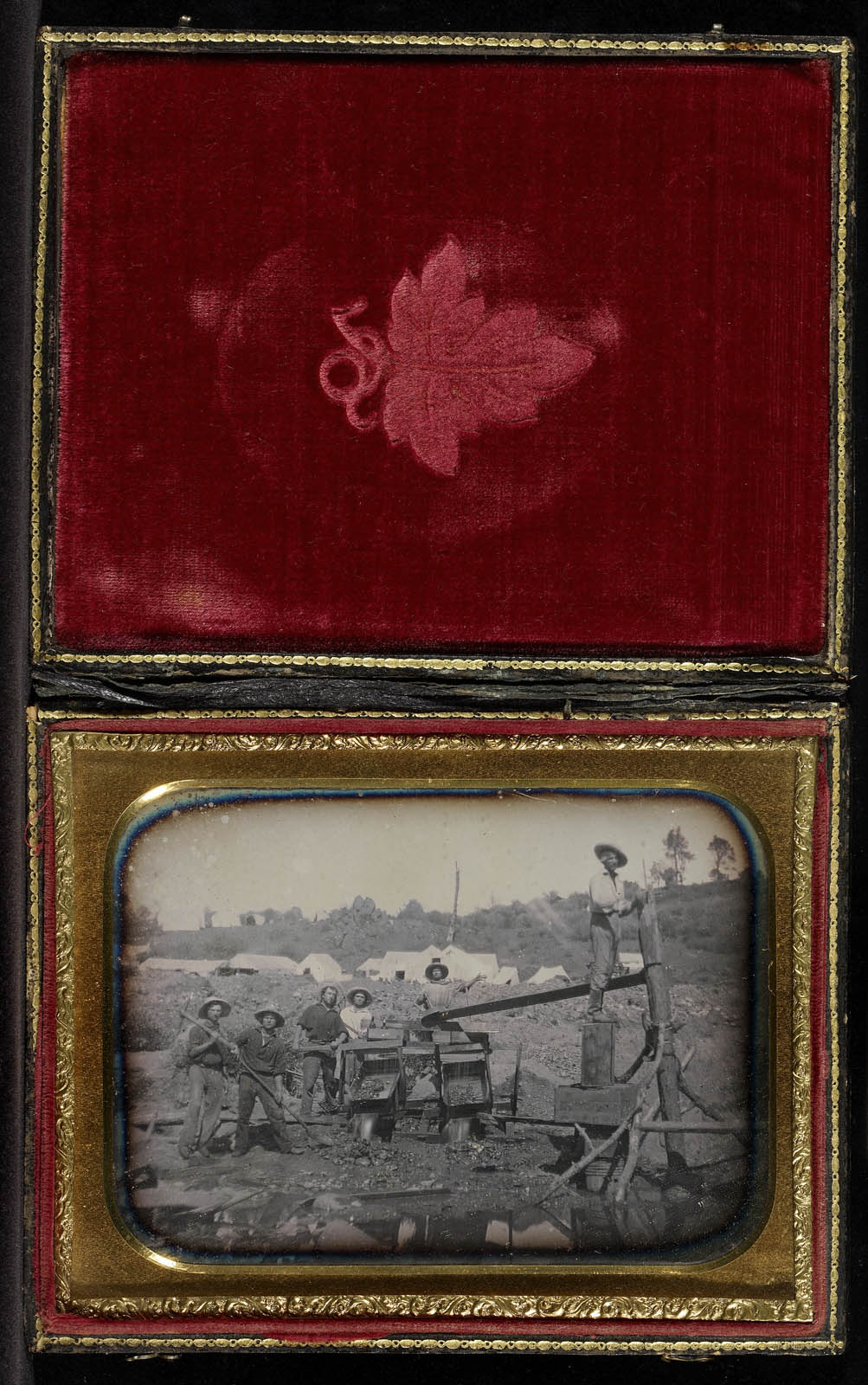
Carleton Watkins (American, 1829-1916) (attributed) Placer Mining Scene c. 1852-1855 Half-plate daguerreotype 4 x 5 in. (10.2 x 12.7cm) J. Paul Getty Museum Collection
Watkins was persistently interested in the technical details of mining operations. Here a primitive Spanish ore mill is used to pulverise gold-bearing rock. Throughout his career Watkins earned income-producing photographs that were used as sources for engraved illustrations, as this one was.
Unknown maker, American, Attributed to Carleton Watkins (American, 1829-1916) Engineering Camp, Copiapo, Chile About 1852-1855 Daguerreotype Plate: 10.8 x 14cm (4 1/4 x 5 1/2 in.) J. Paul Getty Museum Collection
In 1852 Watkins went to New York, then returned to California the following spring aboard the SS Michael Angelo, which was loaded with tons of supplies destined for mining camps on the Pacific Coast of the Americas. The vessel proceeded to the port of Caldera, Chile, where goods destined for the mines at Copiapó were unloaded. Miners and their various forms of shelter, such as the tent shown here in the landscape, were among Watkins’s favourite subjects.
Carleton Watkins (American, 1829-1916), Robert H. Vance (American, 1825-1876) Street Scene in La Rancheria, California 1853-1855 Daguerreotype, hand-coloured 8.3 x 11.4cm (3 1/4 x 4 1/2 in.) J. Paul Getty Museum Collection
The mining camp of La Rancherie was located near the fabled Sutter’s Mill in California, where gold was discovered in 1849. In the volatile gold-rush environment of prospectors, get-rich-quick dreams, and fly-by-night towns, an assembly of men in the foreground stood for the camera to immortalise their roles in the historical moment. La Rancherie stood out for its stability: it could boast a few buildings made of clapboard and some that were even painted. The illustrated hotel sign at upper left indicates a clientele that was not entirely literate and might rely on pictures to identify potential lodgings.
Carleton Watkins (American, 1829-1916) [Section Grizzly Giant, Mariposa Grove] 1861 Albumen silver print 43.2 x 52.1cm (17 x 20 1/2 in.) J. Paul Getty Museum Collection
Galen Clark, the figure in this photograph, was designated as the guardian of the Mariposa Grove of giant sequoia about the time Abraham Lincoln ceded it to California in 1864. When this picture was made, Clark lived in a cabin (not pictured) nearby and maintained a rustic way station for visitors traveling to Yosemite Valley via the Mariposa Trail, which was developed in 1859.
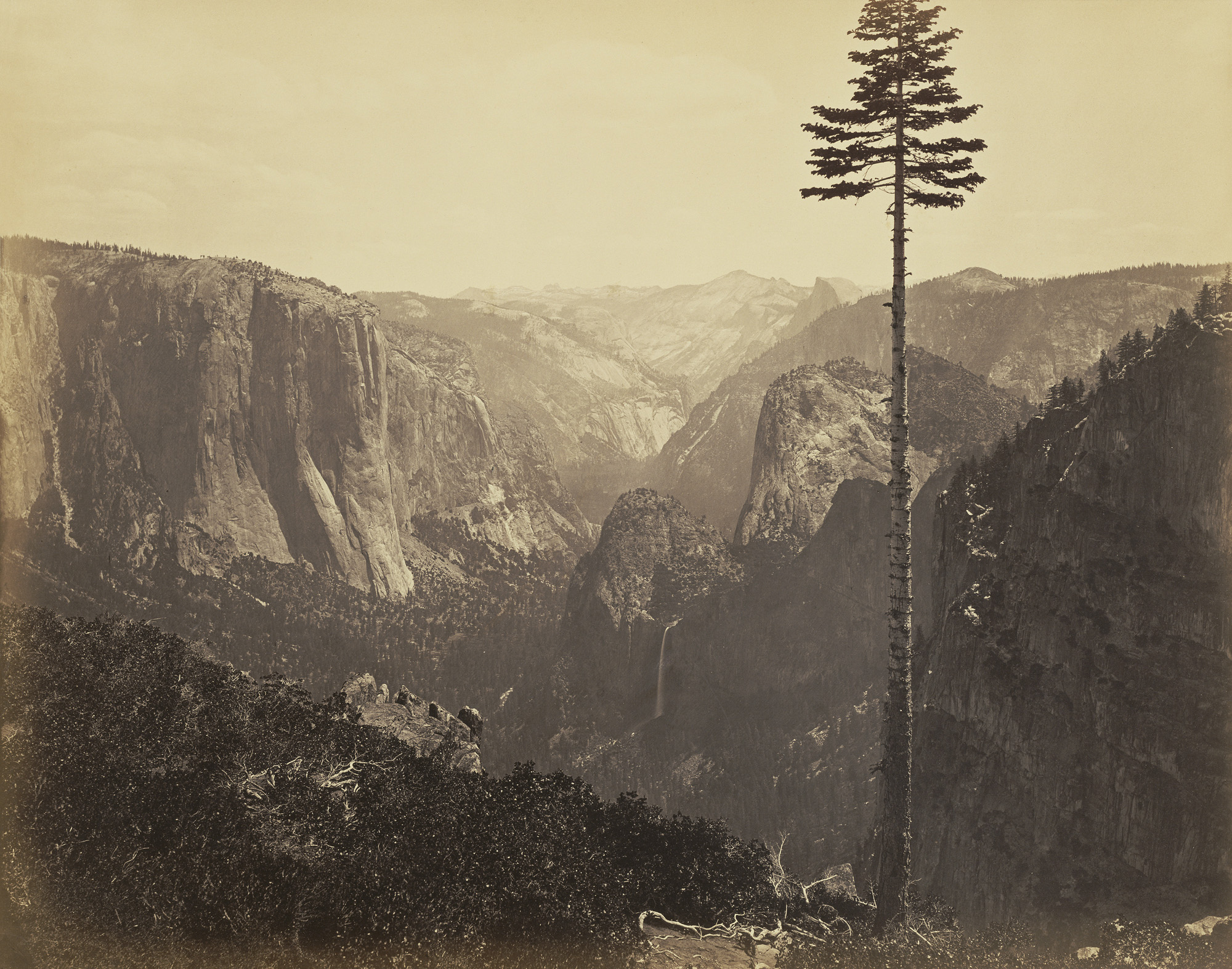
Carleton Watkins (American, 1829-1916) Yosemite Valley from the Best General View No.2 1866 Albumen silver print 41 x 52.2cm (16 1/8 x 20 9/16 in.) J. Paul Getty Museum Collection
Carleton Watkins had the ability to photograph a subject from the viewpoint that allowed the most information to be revealed about its contents. In this image, he captured what he considered the best features of Yosemite Valley: Bridalveil Falls, Cathedral Rock, Half Dome, and El Capitan. By positioning the camera so that the base of the slender tree appears to grow from the bottom edge of the picture, Watkins composed the photograph so that the canyon rim and the open space beyond it seem to intersect. Although he sacrificed the top of the tree, he was able to place the miniaturised Yosemite Falls at the visual centre of the picture. To alleviate the monotony of an empty sky, he added the clouds from a second negative. This image was taken while Watkins was working for the California Geological Survey. His two thousand pounds of equipment for the expedition, which included enough glass for over a hundred negatives, required a train of six mules.
Carleton Watkins (American, 1829-1916) Further Up the Valley. The Three Brothers, the highest, 3,830 ft. 1866 Albumen silver print 39.2 x 53.5cm (15 7/16 x 21 1/16 in.) J. Paul Getty Museum Collection
In 1850, at the age of 20, Carleton Watkins is believed to have arrived in California from New York via South America. He embarked on a life in photography that began auspiciously during the gold rush (which started in 1849) and ended abruptly with the 1906 San Francisco earthquake and fire that destroyed his negatives. In between those historic moments, Watkins witnessed an era in which a recurring theme was the enormity of all things in the West. He photographed the expansive western landscape with its miles of coastline, vast natural resources, colossal trees, and the monoliths of the Yosemite Valley using an oversize mammoth-plate camera.
In the 1860s Watkins’s Yosemite photographs brought him fame from as far away as Paris, but a decade later he experienced a painful financial reversal. In the end, he died a pauper in 1916 after a life that brought him into dialogue with the many “giants” of his era. The photographs he left behind provide a unique personal vision of the birth and growth of California.
Mining Scenes and Daguerreotypes
After arriving in Sacramento in 1850, Watkins worked delivering supplies to the mines during the gold rush. As he traveled throughout the region, he applied his new photography skills by making daguerreotypes (an early photographic technique using silver-coated, polished copper plates). In 1852, he is believed to have taken up photography full time, making daguerreotypes as a freelance “outdoor man” for established studios in Sacramento, Marysville, and San Francisco.
Among the most important photographs created in California before about 1855 are more than 100 daguerreotypes of buildings and landscapes, the majority of which have not been attributed. Many represent the San Francisco Bay Area and the mother lode regions northeast of Sacramento, where Watkins lived from 1850 to 1853 – a fact that geographically positions him in the right place at the right time to have been their maker. This exhibition compares select daguerreotypes by unknown makers with securely identified photographs by Watkins. On the basis of style and other circumstantial evidence, it is possible that Watkins may have made many of the daguerreotypes.
Yosemite
Watkins first visited Yosemite Valley in the late 1850s and then returned to Yosemite several times in the 1860s and 1870s with a new mammoth-plate camera designed to expose collodion-on-glass negatives that were 18-by-22 inches in size. With this equipment, he created the pictures that soon brought him international fame.
Watkins was not the only photographer who made images of Yosemite. Charles L. Weed and Eadweard Muybridge both followed Watkins into Yosemite, and the photographers often re-created one another’s views. This exhibition explores the visual dialogue in Yosemite between Watkins, Weed, Muybridge, and the unidentified camera operator for Thomas Houseworth and Company, who may have actually been Watkins.
Pacific Coast
Watkins was best known for his photographs of Yosemite, but he also took his camera to the silver mines of Nevada and Arizona, and up and down the Pacific coast. Throughout his career he applied his understanding of the elements of landscape as art. His early work with mining subjects proved to be excellent training for his eventual vision of landscape as a powerful counterbalance to the fragility of human existence. He harnessed the elements of visual form – line, shape, mass, outline, perspective, viewpoint, and light – to enliven often static motifs in nature.
Watkins photographed the Monterey Peninsula in the 1880s, recording the scenery in a continuously unfolding progression along Seventeen-Mile Drive, which began and ended at the Hotel Del Monte. Near the hotel, Watkins created this image of a native cypress – windblown and with its roots exposed – clinging to the side of a rocky cliff. Many distinguished photographers, among them Edward Weston and Ansel Adams, followed Watkins over the years along this same stretch of coast, photographing similar subjects.
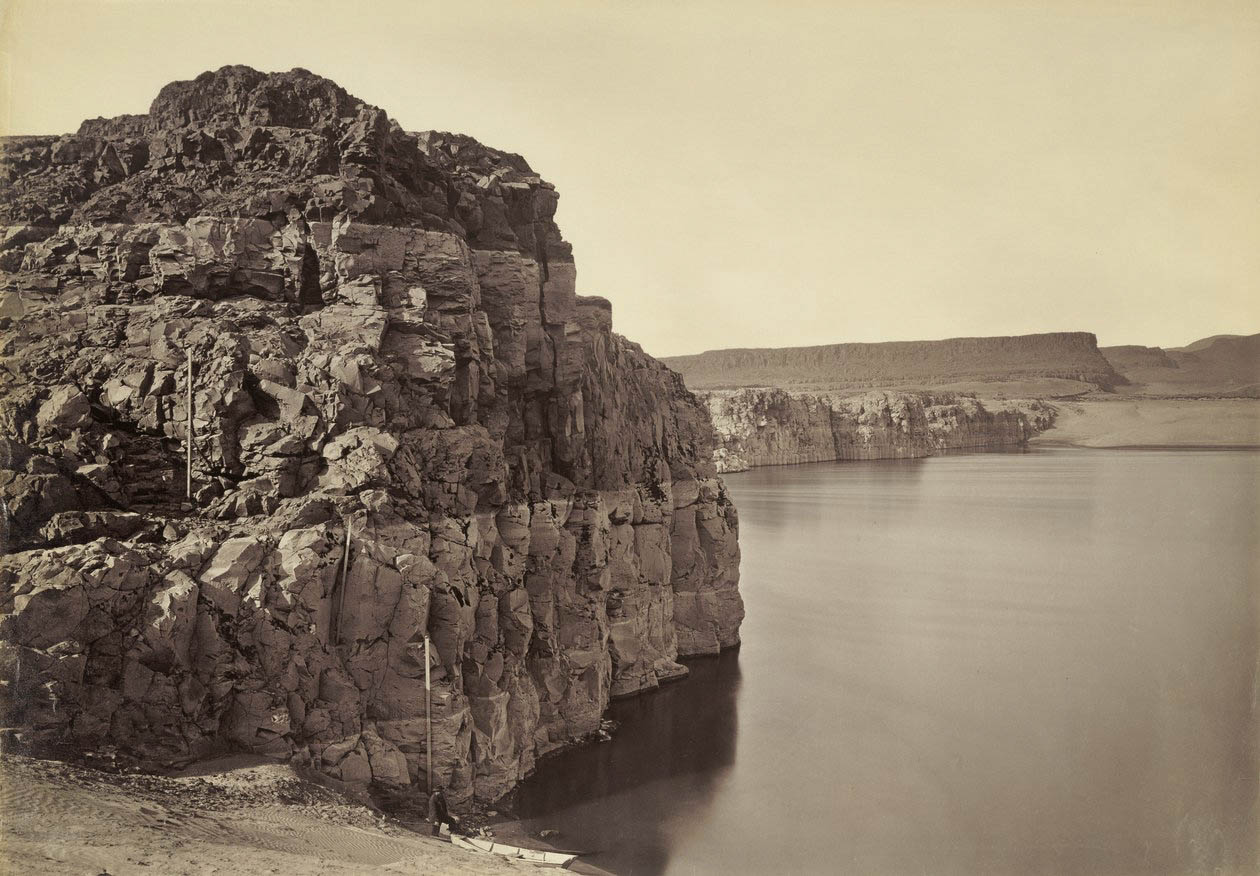
Carleton Watkins (American, 1829-1916) Cape Horn, Columbia River, Oregon Negative 1867; print about 1881-1883 Albumen silver print 40.5 x 52.3cm (15 15/16 x 20 9/16 in.) J. Paul Getty Museum Collection
In 1867 Carleton Watkins made an expedition to Oregon to obtain photographs of its geology, including the chain of extinct volcanic mountains that cap the coastal range. This view was made from the Washington side of the Columbia River. Even the evidence of a solitary boatman and his cargo does not disturb the landscape’s profound serenity, nor does his presence reveal the fact that cultivated farmland and an apple orchard existed nearby. Watkins’s image nonetheless portrays a man facing nature at its most grand and overwhelming. The man’s boat appears ready to launch into the still, glassy river, an act that will make an indelible imprint on the water’s pristine, boundless surface.
Carleton Watkins (American, 1829-1916) [Sugarloaf Islands at Fisherman’s Bay, Farallon Islands] About 1869 Albumen silver print 41 x 54.3cm (16 1/8 x 21 3/8 in.) J. Paul Getty Museum Collection
Craggy rocks rise from a swirling, misty sea. Two seagulls punctuate the foreground, giving the scene a sense of scale. The uninhabited Sugarloaf Islands, part of the Farallon Island group, are located just north of San Francisco in the Pacific Ocean; in this photograph, they loom in the surf offshore like mysterious, petrified sea creatures. The length of the exposure softened the waves’ swirl into mist, adding to the impression of ancient, craggy mountaintops breaking through vaporous clouds.
Carleton Watkins frequently photographed the Farallon Islands. This particular area, the Gulf of the Farallones National Marine Sanctuary, includes 1,235 square miles of nearshore and offshore waters ranging from wetlands to deep-sea communities.
Carleton Watkins (American, 1829-1916) View on Lake Tahoe 1877 Albumen silver print 40.3 x 52.7cm (15 7/8 x 20 3/4 in.) J. Paul Getty Museum Collection
Standing between two sets of rails, Carleton Watkins photographed a busy pair of tracks above Carson Valley, Nevada. His shadow and that of his mammoth-plate camera indicate his precarious position on the steep grade in the foreground. A single engineer stands near the empty track curving around a mountain on the left, having already observed the train that heads away from the trestle on the right. Beneath these tracks, another steam engine pulling lumber on multiple flatbed cars makes its way around a sharp curve. The wood carried by these trains was an essential material for building the railroad and for operating steam engines. Lumber served as ties beneath the iron rails, telegraph poles lining the route, and fuel for wood-burning steam engines.
Carleton Watkins (American, 1829-1916) Agassiz Rock and the Yosemite Falls, from Union Point about 1878 Albumen silver print 54.4 x 39.2cm (21 7/16 x 15 7/16 in.) J. Paul Getty Museum Collection
Carleton Watkins (American, 1829-1916) [Thompson’s Seedless Grapes] 1880 Albumen silver print 37.6 x 55.7cm (14 13/16 x 21 15/16 in.) J. Paul Getty Museum Collection
In this image celebrating Kern County’s agricultural bounty, Carleton Watkins clearly defined each fresh grape, tooth-edged leaf, and woody twig. Real estate developers successfully used photographs of lush fields, ripe produce, and plentiful harvests as a means of advertising to boost Southern California’s economy. The grape bunches hanging from the tendrils of this vine represent the earliest cultivation of seedless grapes.
Carleton Watkins (American, 1829-1916) The Dalles, Extremes of High & Low Water, 92 ft 1883 Albumen silver print J. Paul Getty Museum Collection
At twenty, Carleton Watkins headed out to California to make his fortune. After working as a daguerreotype operator in San Jose, he established his own practice and soon made his first visit to the Yosemite Valley. There he made thirty mammoth plate and one hundred stereograph views that were among the first photographs of Yosemite seen in the East. Partly on the strength of Watkins’s photographs, President Abraham Lincoln signed the 1864 bill that declared the valley inviolable, thus paving the way for the National Parks system.
In 1865 Watkins became official photographer for the California State Geological Survey. He opened his own Yosemite Art Gallery in San Francisco two years later. The walls were lined with 18 x 22-inch prints in black walnut frames with gilt-edged mats. Such elegant presentation did not come cheap, and Watkins was accused of charging exorbitant prices. A poor businessman, he declared bankruptcy in 1874 and his negatives and gallery were sold to photographer Isaiah Taber, who began to publish Watkins’s images under his own name. Watkins, however, continued to photograph, and seven years later became manager of the Yosemite Art Gallery, then under different ownership. The San Francisco earthquake and fire of 1906 destroyed the contents of his studio, which he had intended to preserve at Stanford University.
Eugène Atget (French, 1857-1927) Saint Cloud 1904 Albumen silver print
Carleton Watkins (American, 1829-1916) Cypress Tree at Point Lobos, Monterey County 1883-1885 Albumen silver print J. Paul Getty Museum Collection
Carleton Watkins (American, 1829-1916) View on the Calloway Canal, near Poso Creek, Kern County 1887 Albumen silver print 37.5 x 53cm (14 3/4 x 20 7/8 in.) J. Paul Getty Museum Collection
The first photographs Watkins made along the Kern River served as evidence in a water rights lawsuit that eventually resulted in a decisive court ruling that prevented newcomers from diverting water from existing landowners. James Ben Ali Haggin, the defendant and Watkins’s client, had a series of irrigation canals that raised the price of land in Kern County. In this spare composition, made where present-day Poso Road crosses the Calloway Canal, Watkins devoted almost equal proportions to sky, land, and water.
Curator: Keith F. Davis, senior curator of photography at The Nelson-Atkins Museum of Art
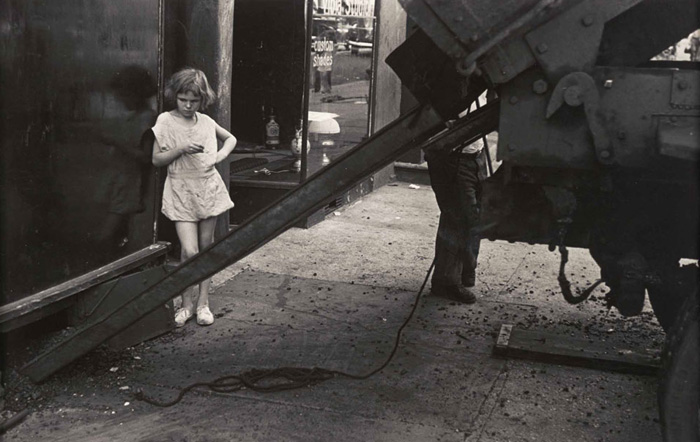
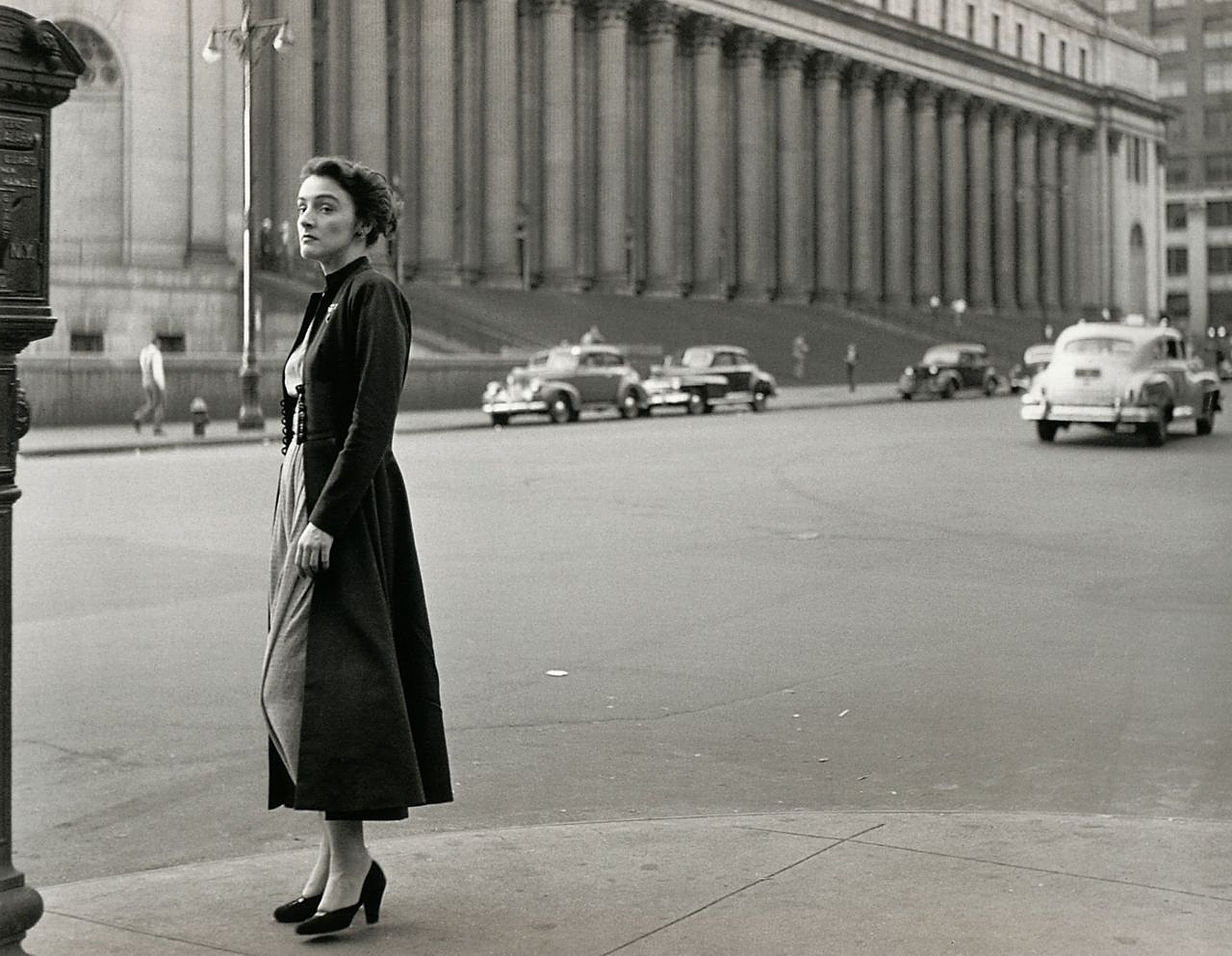
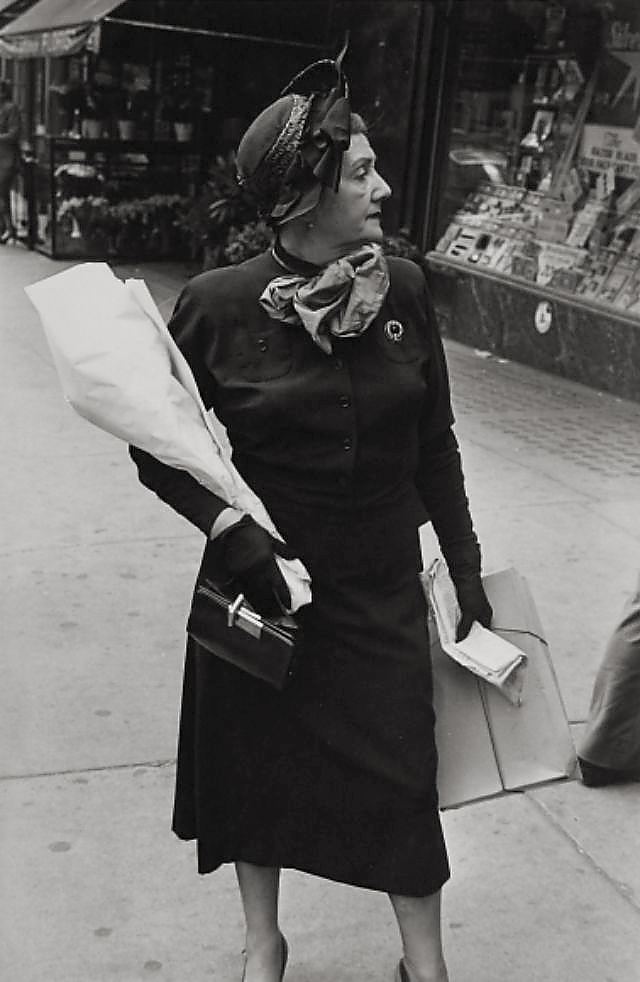
Homer Page (American, 1918-1985) New York, August 11, 1949 (girl and coal chute) 1949 Gelatin silver print
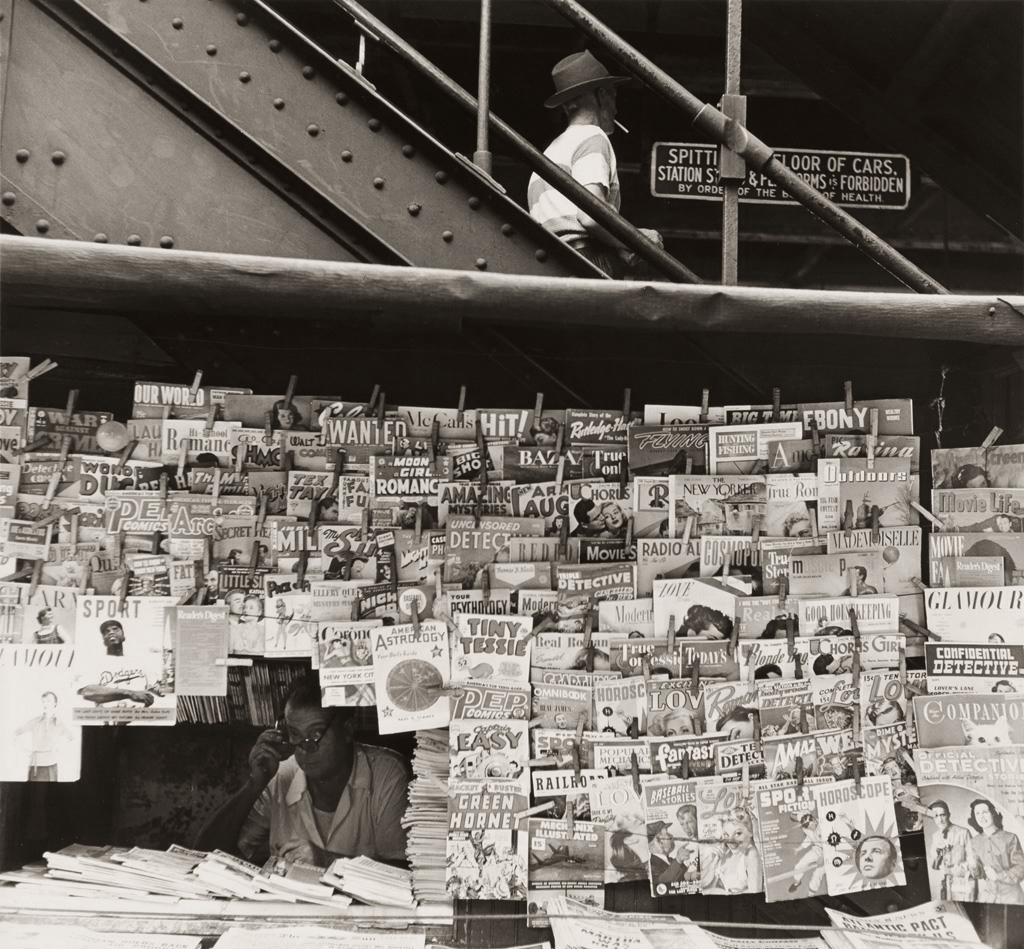
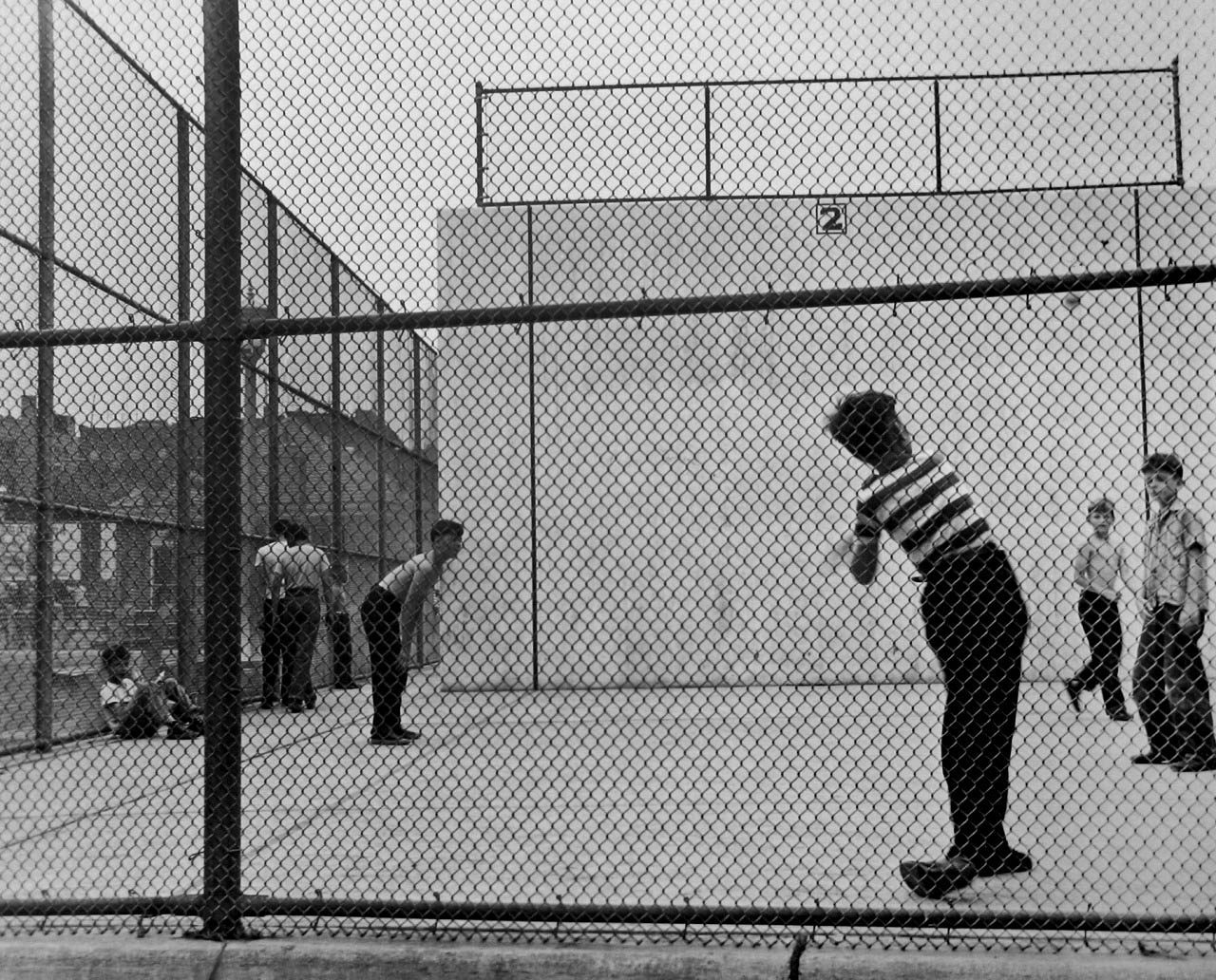
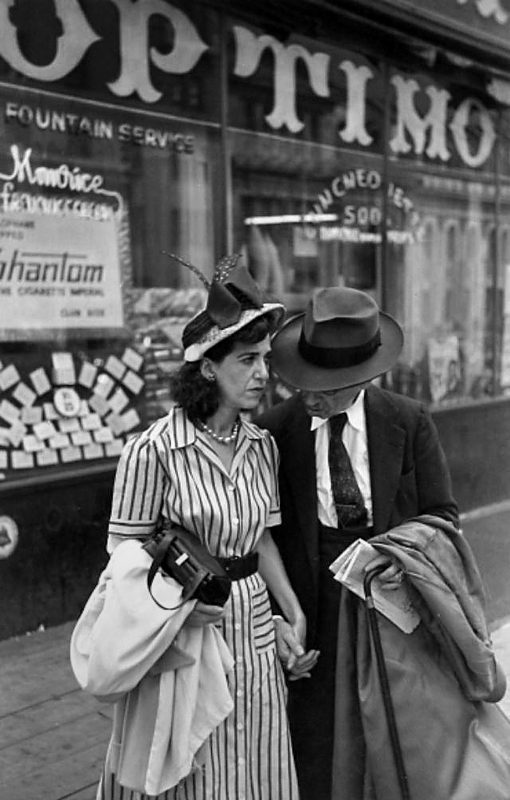
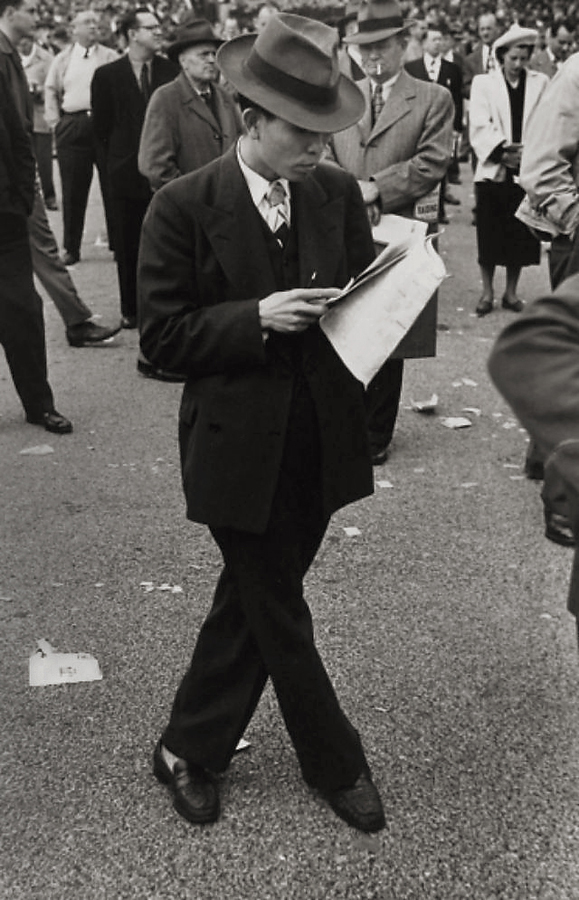
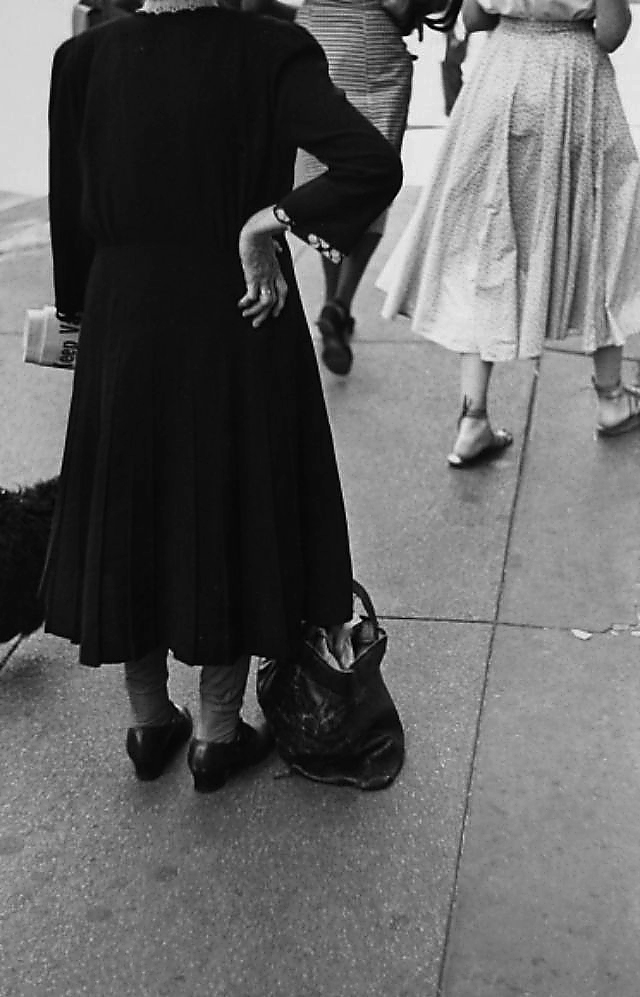
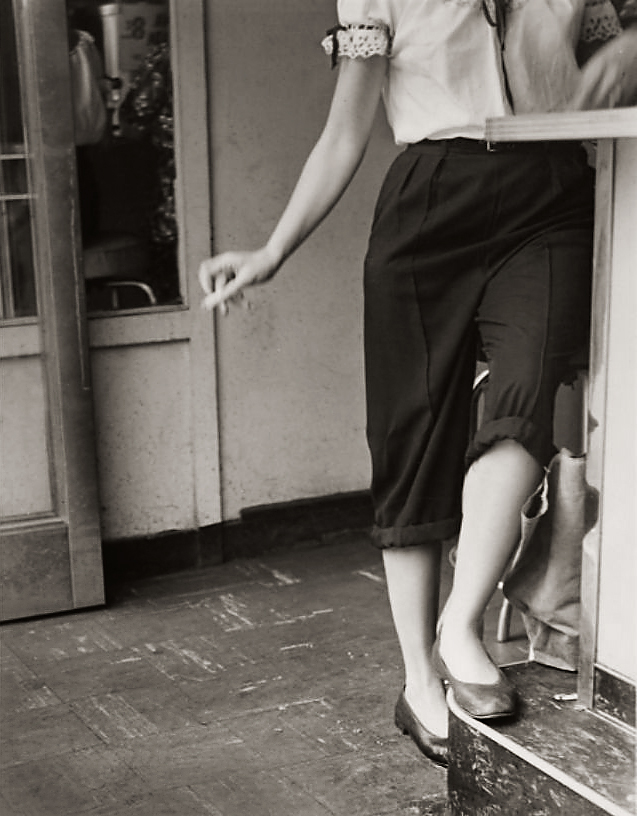
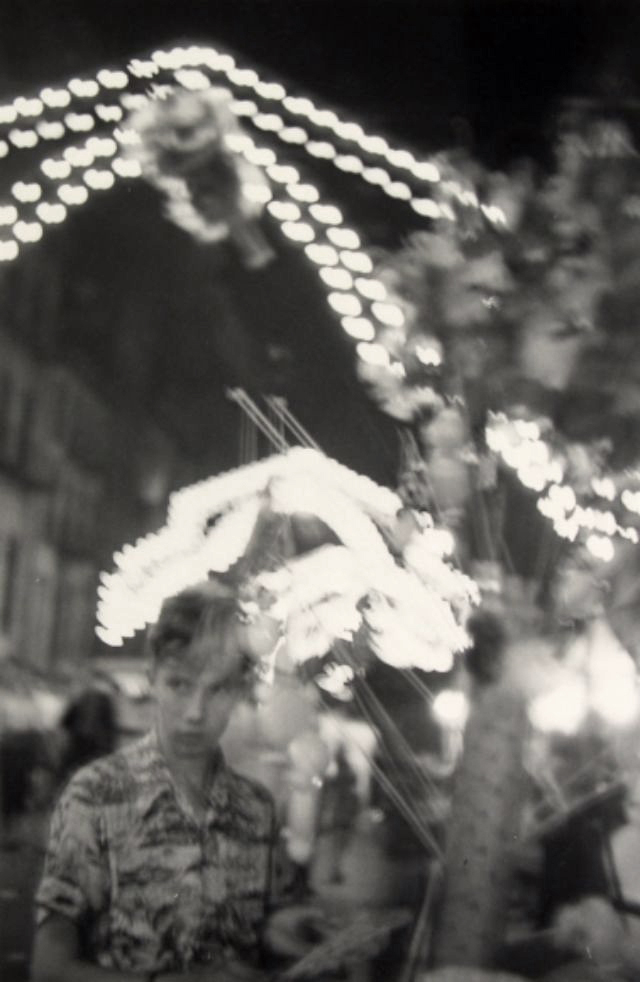
A brilliant but under appreciated American photographer, Homer Page used a Guggenheim fellowship in 1949-1950 to photograph New York City. Included in the 2006 Hallmark Photographic Collection gift to the Nelson-Atkins were some 100 of his vintage black-and-white prints. The Museum is thus in a unique position to celebrate his remarkable artistic achievement: his vision, at once gritty and lyrical, of the face of metropolitan America at mid-century. In recording the city so intently, Page had a larger goal in mind: to suggest nothing less than the emotional tenor of life at that time and place.
From an artistic standpoint, Page’s work represents a “missing link” between the warm, humanistic, and socially motivated documentary photographs of the 1930s and early 1940s in the works of Dorothea Lange, and the tougher, grittier and more existential work of the later 1950s as seen in the images of Robert Frank.
Text from The Nelson-Aitkens Museum of Art website
Many thankx to The Nelson-Atkins Museum of Art for allowing me to publish the photographs in the posting. Please click on the photographs for a larger version of the image.
Homer Page (American, 1918-1985) The El at 86th, New York 1949-1950 Gelatin silver print
Homer Page (American, 1918-1985) New York (boys and manikin) 1949 Gelatin silver print Gift of Hallmark Cards, Inc.,
Homer Page (American, 1918-1985) New York City 1949 Gelatin silver print
Homer Page (American, 1918-1985) New York, June 19, 1949 1949 Gelatin silver print
“Page captured both the facts and the feeling of life in post-war New York: commuters in transit to and from their offices, the signs of commercial and consumer culture, leisure pursuits and night life, psychological vignettes of the lonely and dispossessed. His work provides a rich and original vision of 1949 America.
Page was devoted to the visible facts of his world, but his real goal was something much deeper: the emotional tenor of life at that time and that place. This is a body of work of great passion, intelligence, and artistic integrity – one that is all the more important for having remained essentially unknown to the present day,” Davis (former Hallmark Fine Art Programs Director) said.
Text from the ArtDaily.org website
Homer Page (American, 1918-1985) New York City 1949 Gelatin silver print
Homer Page (American, 1918-1985) New York City 1949 Gelatin silver print
Homer Page (American, 1918-1985) New York City 1949 Gelatin silver print
Homer Page (American, 1918-1985) New York City 1949 Gelatin silver print
Homer Page (American, 1918-1985) New York City 1949 Gelatin silver print
Homer Page (American, 1918-1985) New York City 1949 Gelatin silver print
Homer Page (American, 1918-1985) New York City 1949 Gelatin silver print
Homer Page (American, 1918-1985) New York City 1949 Gelatin silver print
Homer Page (American, 1918-1985) New York City 1949 Gelatin silver print
Homer Page (American, 1918-1985) New York City 1949 Gelatin silver print
Homer Page (American, 1918-1985) New York City 1949 Gelatin silver print
Homer Page (American, 1918-1985) New York, June 16, 1949 1949 Gelatin silver print
The Nelson-Atkins Museum of Art 4525 Oak Street Kansas City, MO 64111 Phone: 816-751-1278
Exhibition dates: 15th November – 23rd December, 2008
Cindy Sherman (American, b. 1954) Untitled #466 2008 Chromogenic print 254.3 x 174.6cm
The artist Cindy Sherman is a multifaceted evocation of human identity standing in glorious and subversive Technicolor before the blank canvas of her imagination. Poststructuralist in her physical appearance (there being no one Cindy Sherman, perhaps no Sherman at all) and post-photographic in her placement in constructed environments, Sherman challenges the ritualised notions of the performative act – and destabilises perceived notions of self, status, image and place.
The viewer is left with a sense of displacement when looking at these tableaux. The absence / presence of the artist leads the viewer to the binary opposite of rational / emotional – knowing these personae and places are constructions, distortions of a perceived reality yet emotionally attached to every wrinkle, every fold of the body at once repulsive yet seductive.
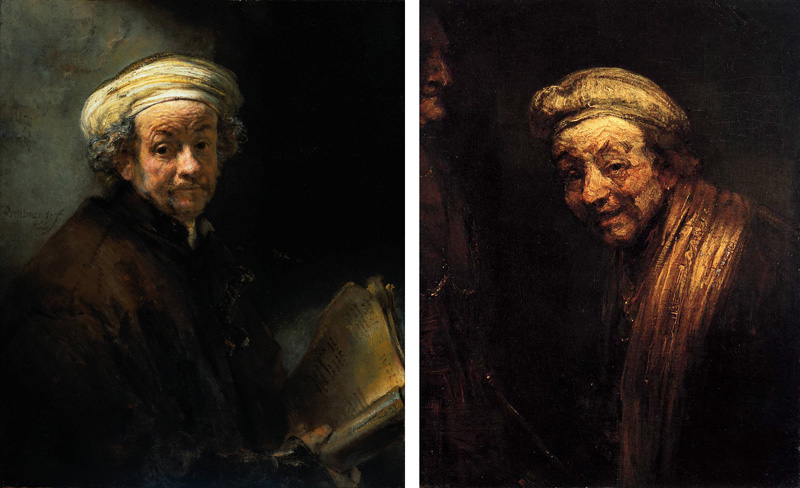
They are masterworks in the manner of Rembrandt’s self portraits – deeply personal images that he painted over many years that examined the many identities of his psyche – yet somehow different. Sherman investigates the same territories of the mind and body but with no true author, no authoritative meaning and no one subject at their beating heart. Her goal is subversive.
As Roy Boyne has observed, “The movement from the self as arcanum to the citational self, has, effectively, been welcomed, particularly in the work of Judith Butler, but also in the archetypal sociology of Pierre Bourdieu. There is a powerful logic behind this approbation. When self-identity is no longer seen as, even minimally, a fixed essence, this does not mean that the forces of identity formation can therefore be easily resisted, but it does mean that the necessity for incessant repetition of identity formation by the forces of a disciplinary society creates major opportunities for subversion and appropriation. In the repeated semi-permanences of the citational self, there is more than a little scope for counter-performances marked, for example, by irony and contempt.”1
Counter performances are what Sherman achieves magnificently. She challenges a regularised and constrained repetition of norms and as she becomes her camera (“her extraordinary relationship with her camera”) she subverts its masculine disembodied gaze, the camera’s power to produce normative, powerful bodies.2 As the viewer slips ‘in the frame’ of the photograph they take on a mental process of elision much as Sherman has done when making the images – deviating from the moral rules that are impressed from without3 by living and breathing through every fold, every fingernail, every sequin of their constructed being.
Dr Marcus Bunyan
1/ Boyne, Roy. “Citation and Subjectivity: Towards a Return of the Embodied Will,” in Featherstone, Mike (ed.,). Body Modification. London: Sage, 2000, p. 212
2/ “To the extent that the camera figures tacitly as an instrument of transubstantiation, it assumes the place of the phallus, as that which controls the field of signification. The camera thus trades on the masculine privilege of the disembodied gaze, the gaze that has the power to produce bodies, but which itself has no body.” Butler, Judith. Bodies That Matter. New York: Routledge, 1993, p. 136
3/ “Universal human nature is not a very human thing. By acquiring it, the person becomes a kind of construct, built up not from inner psychic propensities but from moral rules that are impressed upon him from without.” Goffman, Erving. Interaction Ritual: Essays on Face-to-Face Behaviour. London: Allen Lane, The Penguin Press, 1972, pp. 44-45
Many thankx to Metro Pictures Gallery for allowing me to publish the photographs in the posting. Please click on the photographs for a larger version of the image.
Rembrandt van Rijn (Dutch, 1606-1669) Self-portrait as the apostle Paul (left) 1661 Self-portrait as Zeuxis laughing (right) 1662
Cindy Sherman (American, b. 1954) Untitled #464 2008 Chromogenic print 214.3 x 152.4cm
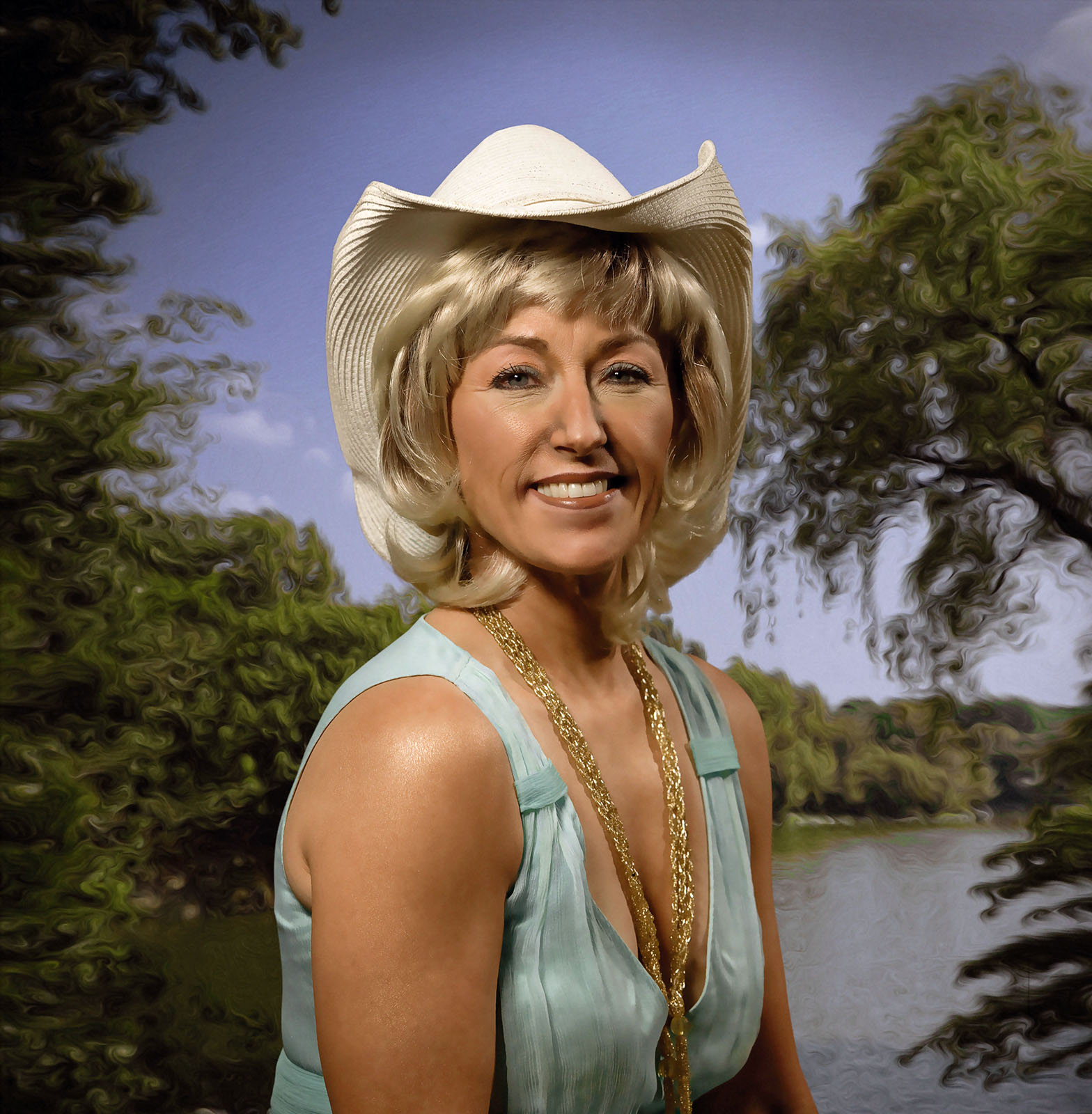
For her first exhibition of new work since 2004, Cindy Sherman will show a series of colour photographs that continues her investigation into distorted ideas of beauty, self-image and ageing. Typical of Sherman, these works are at once alarming and amusing, distasteful and poignant.
Working as her own model for more than 30 years, Sherman has developed an extraordinary relationship with her camera. A remarkable performer, subtle distortions of her face and body are captured on camera and leave the artist unrecognisable to the audience. Her ability to drastically manipulate her age or weight, or coax the most delicate expressions from her face, is uncanny. Each image is overloaded with detail, every nuance caught by the artist’s eye. No prosthetic nose or breast, fake fingernail, sequin, wrinkle or bulge goes unnoticed by Sherman.
Sherman shoots alone in her studio acting as author, director, actor, make-up artist, hairstylist and wardrobe mistress. Each character is shot in front of a “green screen” then digitally inserted onto backgrounds shot separately. Adding to the complexity, Sherman leaves details slightly askew at each point in the process, undermining the narrative and forcing the viewer to confront the staged aspect of the work.
Press release at Metro Pictures Gallery
Installation view of Cindy Sherman exhibition at Metro Pictures Gallery, New York, 2008
Cindy Sherman (American, b. 1954) Untitled 2008 Chromogenic print 148.6 x 146.7cm
Cindy Sherman (American, b. 1954) Untitled 2008 Chromogenic print 177.8 x 161.3cm
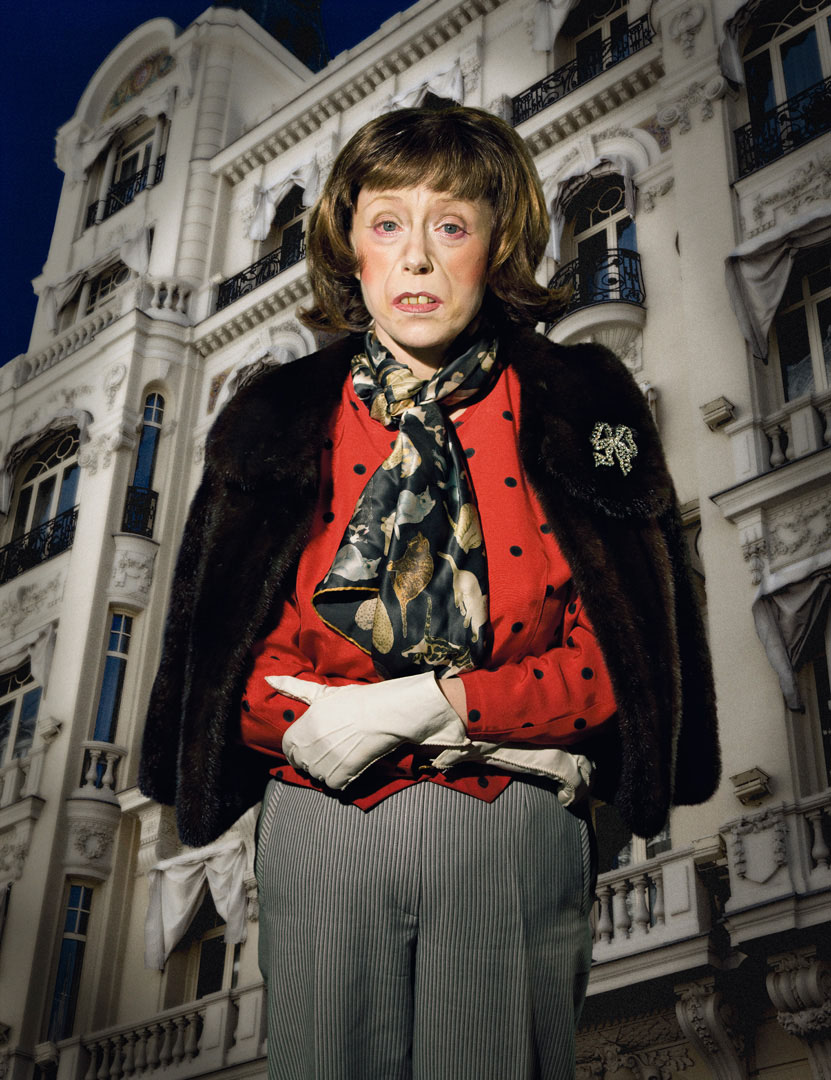
Cindy Sherman (American, b. 1954) Untitled #468 2008 Chromogenic colour print 191.8 x 151.1cm
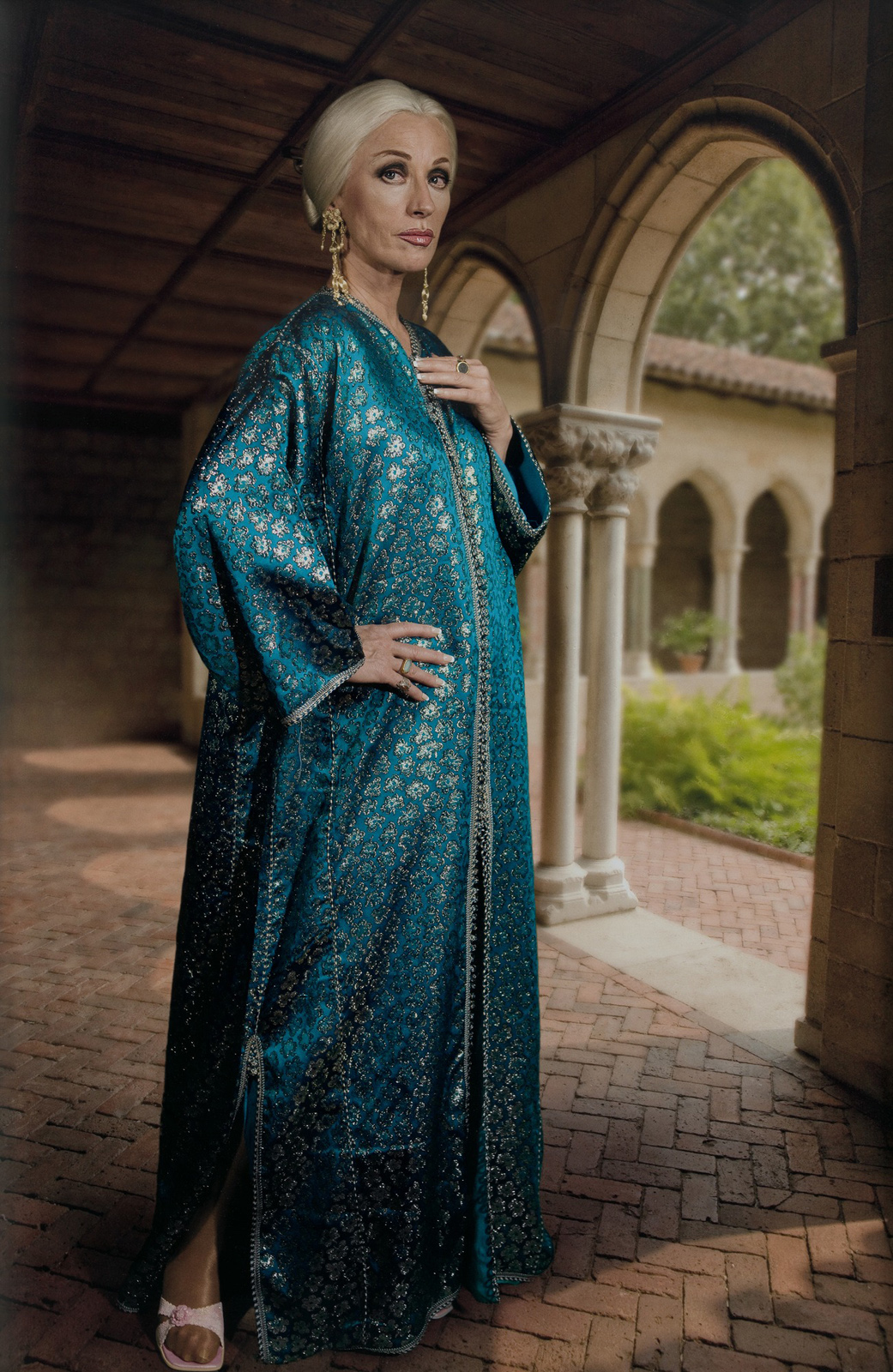
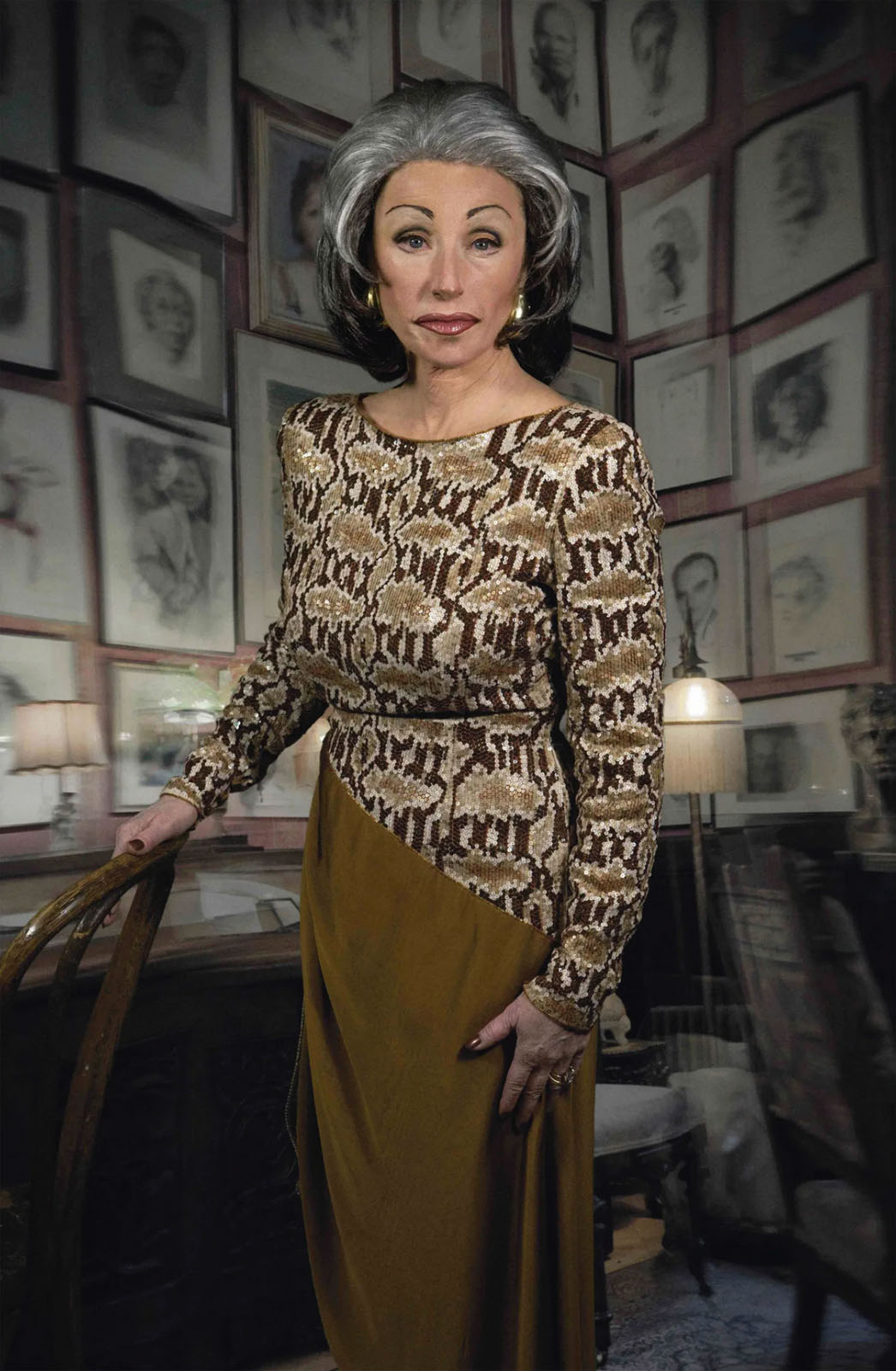
The society portraits made in 2008 portray older women in opulent settings wearing expensive clothes, their faces stretched and enhanced unnaturally, showing signs of cosmetic surgery. These markers point to cultural standards of beauty and wealth, and here signal the failed aspiration to sustained youth. Printed large, presented in decorative and often gilded frames, and depicting figures in formal poses, these works are reminiscent of Sherman’s history portraits and classical portraiture in general. In this way, they remind the viewer that representation is not a new phenomenon, and the cultural implications in all images are tied to long and complex histories. In Untitled #468 the figure stands stoically with arms crossed and mouth slightly agape, wearing a fur, silk scarf, and white gloves, which the artist found at thrift shops. In the background, an ornate building mirrors the elaborate dress of the woman.
The perspective of the building does not align with that of the figure, blatantly breaking the illusion of reality and recalling Sherman’s 1980 series of rear-screen projections. This clear and deliberate artificiality indicates that images, characters, and even our own selves are constructed, not fixed.
Anonymous text. “Untitled #468,” on The Broad website Nd [Online] Cited 09/06/2022. Used under fair use conditions for the purposes of education and research
Cindy Sherman (American, b. 1954) Untitled 2008 Chromogenic print 244.5 x 165.7cm
Heide Museum of Modern Art has brought together nearly 100 pieces of work by the Australian artist Les Kossatz in an eclectic survey show, appropriately titled The Art of Existence. Featuring sculpture, painting and mixed media from the 1960s to the present the exhibition is appropriately titled because Kossatz’s work addresses certain archetypal themes that affect human existence:
“His life-long fascination with the natural world and desire to understand both its human and animal inhabitants; exploration of the systems of knowledge and codes of behaviour that structure individual and communal life; and his critical and playful reflections on contemporary behaviour and the mysteries of existence.”1
Strong symbolic paintings are the focus of the work in the 1960s, paintings that address the shocking brutality of war and its aftermath, when soldiers return home. To the observation that these are of the ‘pop-style’ school of painting suggested by the Heide website I feel these works are also influenced by the collage of Cubism, the boxes of Joseph Cornell and the dismembered bodies of Francis Bacon. They engage with the symbolism of war and remembrance: memory, myth, and the banality of heroism and sacrifice.
The key work in this series is the painting Diggers throne (1966). This is a powerful disturbing image, effervescent and unnerving at the same time. It features a disembodied arm on the hand of a throne, surrounded by a wonderful kaleidoscopic assemblage of pictorial planes, artefacts and memories – an English flag, the flag of St George, a crown, medals and the words RSL. The arm reminds me of the Francis Bacon painting Study after Velázquez’s Portrait of Pope Innocent X (1953) as it rests, roughly drawn in pencil on the arm of the throne, drawing the eye back up into nothingness.
The Diggers throne painting also features these prophetic words:
“throne slow to rot and twisted the memory becomes sacred. Bloody was the truth And this a chair.”
All other work in this period seems to flow through this painting – the other large paintings, the small canvases featuring individual medals and the less successful hanging banners. But it is to this work we return again and again as a viewer, trying to decipher and reconcile our inner conflicts about the painting.
As we move into the 1970s the work changes focus and direction. There emerges a concern with the desecration of the Australian landscape investigated in a series of large paintings and sculptures. In Packaged landscape 1 (1976) a steel suitcase with leather straps, slightly ajar, fulminates with artificial gum leaves trying to escape the strictures of the trap. In Caged landscape (1972) nature is again trapped behind steel wire, weighed in the balance on a set of miniature scales. The paintings feature trees that are surrounded by concrete and the rabbit becomes a powerful symbol for Kossatz – a suffering beast, strung up on fences, a plague in a pitted landscape of chopped down trees, erosion and empty holes.
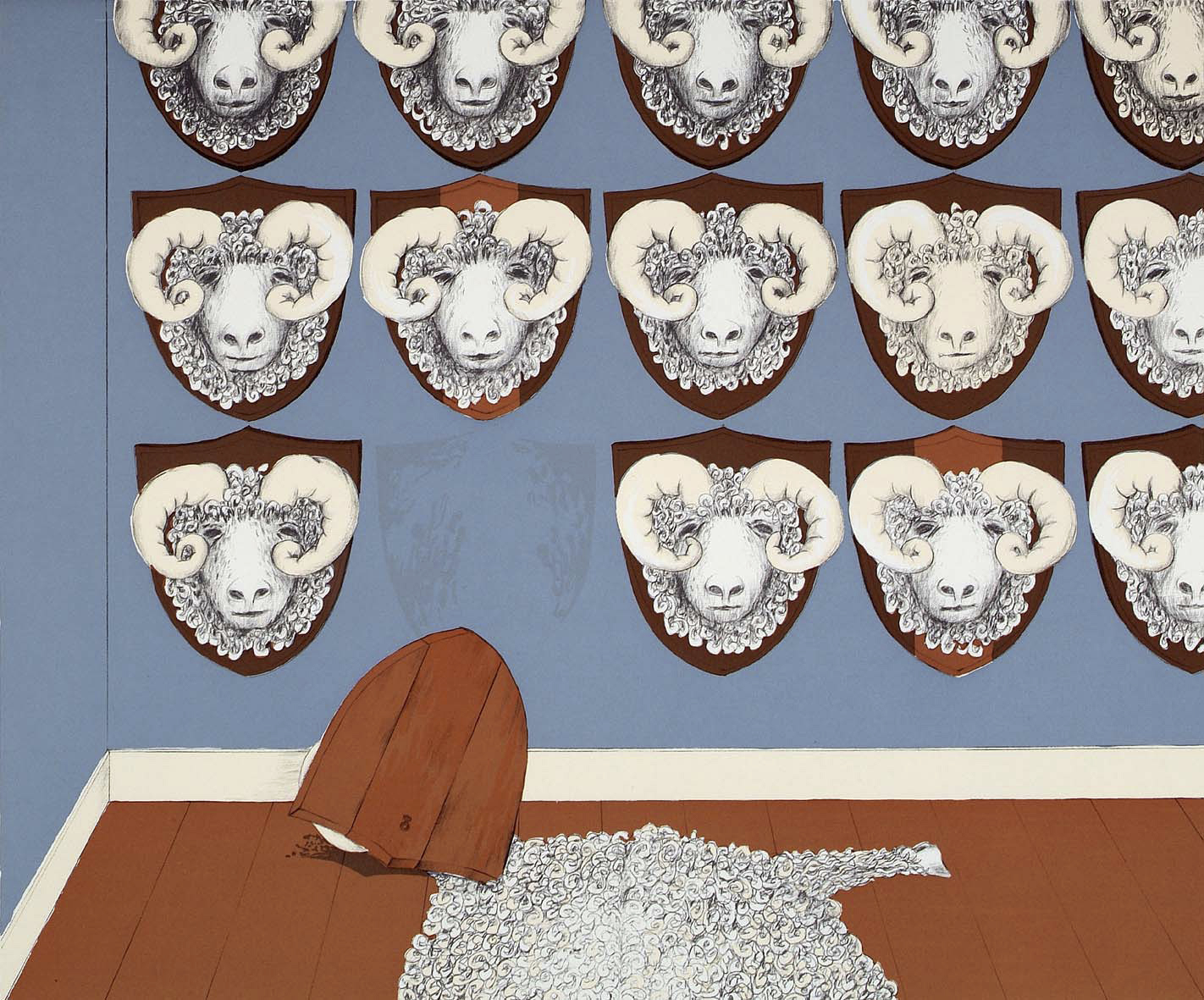
Into this vernacular emerges the key symbol of the artist’s oeuvre – the sheep. In 1972 Kossatz began a series of sculptures of sheep, “initially inspired by the experience of nursing an injured ram.” For Kossatz “the sheep represent the hardship of pioneer existence, the grazing industries prosperity, environmental concerns and the sheep act as narrative devices, potent metaphors for human behaviour.”2
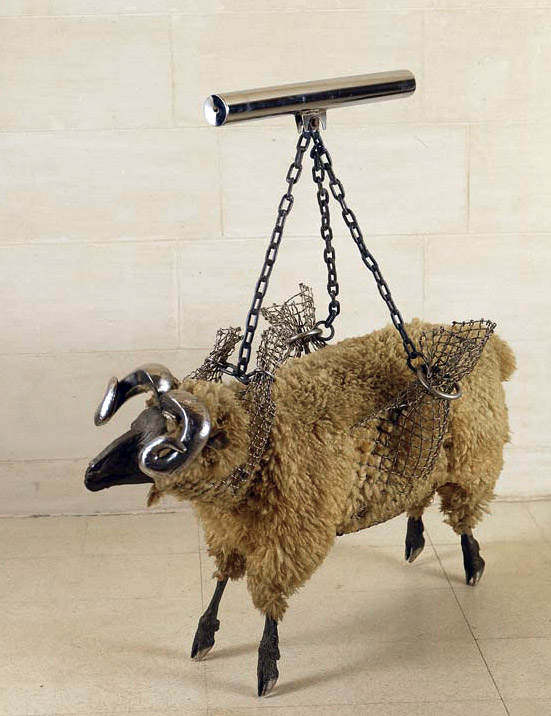
The first sheep presented ‘in show’ is Ram in Sling (1973, below). In this sculpture a metal bar is suspended in mid-air and from this bar heavy wire mesh drops to support the fleecy stomach and neck of the ram almost seeming to strangle it in the process, it’s metal feet just touching the ground. Again the scales of justice seem to weigh nature in the balance.
The themes life and death, order and chaos are further developed in the work Hard slide (1980, below) where a sheep emerges mid-air from a trapdoor, two more tumble down a wooden slide end over end and another disappears into the ground through a wooden trapdoor opening. Sacrifice seems to be a consistent theme with both the earlier paintings and the metallised sheep:
“The completed life cycle, down the trapdoor, down the chute, after sacrifice by shearing.” ~ Daniel Thomas 1994
Further sculptures of sheep, both small maquettes and large sculptures follow in the next room of the exhibition. This is the artist is full flow, featuring the inventive taking of 2D things into the round, investigating the key themes of his work: the contrast between nature and artifice, or humanity.
The small maquettes of sheep feature races, gantries, sluices, pens, trapdoors and paddocks. Sheep tumble in a cataclysmic maelstrom, falling with flailing legs into the darkness of the holding pen below. These are my favourite works – small, intimate, detailed, dark bronzes of serious intensity – the sheep becoming a theatre of the absurd, suspended, weighed and balancing in the performance of ritualised acts, a cacophony of flesh at once both intricate and unsettling. Their skins lay flayed and lifeless disappearing into the ‘unearth’ of the slated wooden floor of the shearing shed. The sheep “can be viewed metaphorically as a commentary of the existential situation of the individual and collective behaviour.”3 As Kossatz himself has noted, “It is hard to bring a piece of landscape inside and give it a living animated form. The sheep somehow gives me this quality of landscape.”
But we must also remember that this strictly a white man’s view of the Australian landscape. Nowhere does this work comment on the disenfranchisement of the native people’s of this land – the destruction of native habitats that the sheep brought about, the starvation that they caused to Aboriginal people just as they bought riches to the pastoralists and the country that mined the land with this amorphous mass of flesh.
Recent work in the exhibition returns to the earlier social themes of memory, war, remembrance, religion, shrines, atomic clouds and temples but it is the work of the late 1970s-1980s that is the most cogent. As Kossatz ponders the nature of existence on this planet he does not see a definitive answer but emphasises the journey we take, not the arrival. Here is something that we should all ponder, giving time to the nature of our personal journey in this life, on this earth.
Here also is an exhibition worthy our time and attention as part of that journey. Go visit!
Dr Marcus Bunyan
Word count: 1,074
1/ From the Heide website 2/ From wall notes to the exhibition 3/ From wall notes to the exhibition
Many thankx to Heide Museum of Modern Art for allowing me to publish the photographs in the posting. Please click on the photographs for a larger version of the image.
Postscript 2018
The late Les Kossatz (1943-2011) was a well known Melbourne-based artist and academic whose work is represented in many regional and state galleries and the National Gallery of Australia. He studied art at the Melbourne Teachers’ College and the RMIT, and went on to teach at the RMIT and Monash University. Kossatz’s first significant commission was for the stained glass windows at the Monash University Chapel in Melbourne. Later commissions included works for the Australian War Memorial, the High Court, the Ian Potter Foundation at the National Gallery of Victoria and the Darling Harbour Authority, Sydney. His sculpture, Ainslie’s Sheep, commissioned by Arts ACT in 2000, is a popular national capital landmark in the centre of Civic. A major retrospective of Kossatz’s work was held in 2009 at the Heide Park and Art Gallery, Melbourne.
Text from the High Court of Australia website [Online] Cited 10/12/2018. No longer available online
Francis Bacon (British born Ireland, 1909-1992) Study after Velázquez’s Portrait of Pope Innocent X 1953 Oil on canvas
The art of existence is the first exhibition to review Les Kossatz’s contribution to Australian art in a career that spans the 1960s to today. Kossatz’s consistently experimental approach to media and techniques is revealed in works that display a lifelong fascination with humanity and the interaction of man and nature. His paintings, sculptures and works on paper stimulate a questioning and exploration of such concerns, which form the basis of this artist’s practice.
Les Kossatz’s early works of the 1960s draw on his training and ability to work across a diversity of media, including painting, drawing, printmaking and glass. Early paintings and etchings on the theme of the emptiness of memorials to the Australian ‘digger’ or soldiers were succeeded by images and objects offering impressions of the world around the artist – the rural domain and interior life of St Andrews in Victoria where Kossatz lived and worked. Such works demonstrated his determination to pursue a figurative practice at a time when abstract art had been imported to Australia and was considered the avant garde.
Remaining a staunchly independent artist, at the start of the 1970s Kossatz painted images of rabbits and sheep from St Andrews. In addition, the practice of working in three dimensions was to become more significant. Kossatz continued to develop familiar themes in the creation of installations and cast objects. Although he has produced drawings and prints across his career, working with sculpture has, since the early 1970s, been his primary mode of art-making. Large scale cast and assembled objects show Kossatz pursuing related themes of caged and packaged landscapes, shrines to the harvest and the still life.
The art of existence surveys Kossatz’s monumental life-sized sheep sculptures, which he began making in 1972 from casts of animal parts, and for which he is best known. These include Hard slide (1980), his prize-winning commission in the collection of the National Gallery of Victoria. Kossatz has won numerous commissions for outdoor sculptures that employ the sheep as literal and metaphorical beings. Kossatz’s work across three decades reveals a number of ongoing engagements, such as his observations of human behaviour and at times its similar manifestation in animals; the beliefs that sustain individuals and communities (such as religion, music and politics); and the forms of the landscape and our understanding of these relationships.
Introduction to the exhibition written by Zara Stanhope, Guest Curator, Heide Museum of Modern Art, 2008
Les Kossatz (Australian, 1943-2011) Hard slide 1980 Sheepskins, aluminium, Douglas-fir (Pseudotsuga sp.), leather, steel 372.0 x 100.0 x 304.0cm (installation)
Les Kossatz (Australian, 1943-2011) Guggenheim spiral 1983
Heide Museum of Modern Art 7 Templestowe Road Bulleen Victoria 3105 Australia Phone: +61 3 9850 1500
Opening hours: (Heide II and Heide III) Tuesday to Sunday and public holidays, 10am – 5pm
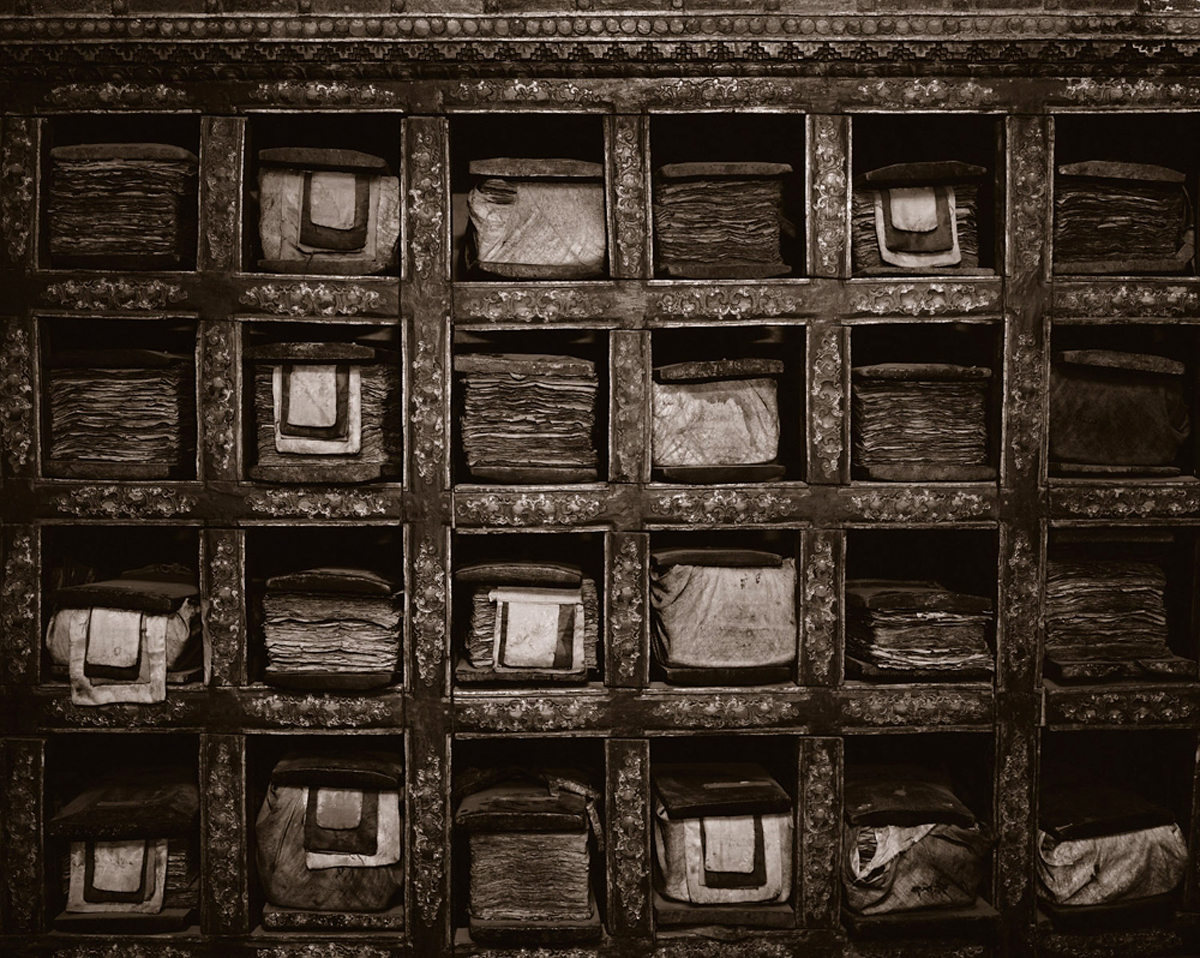
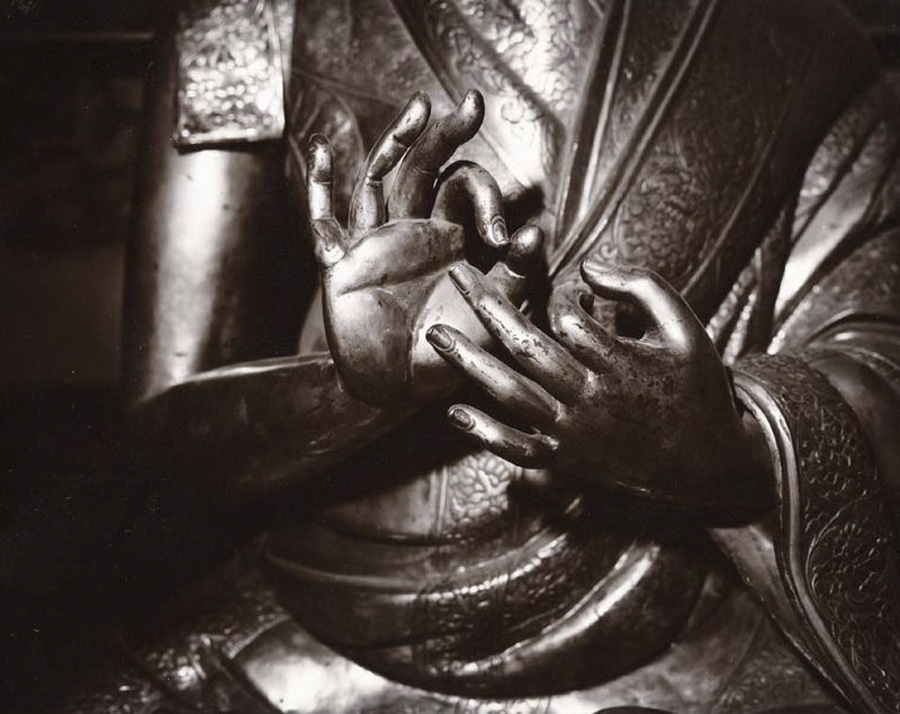
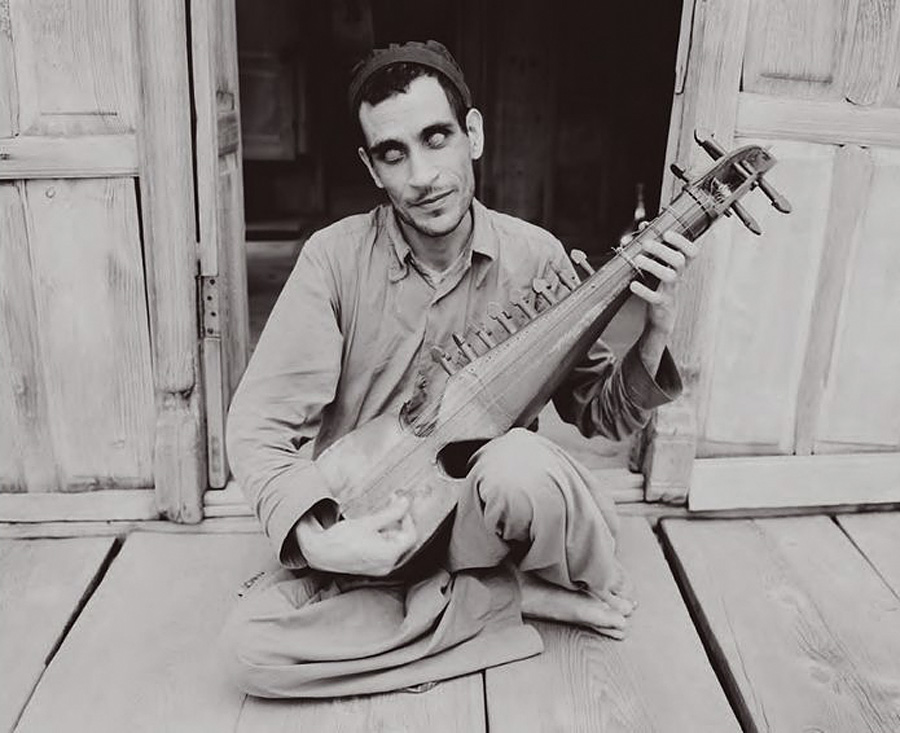
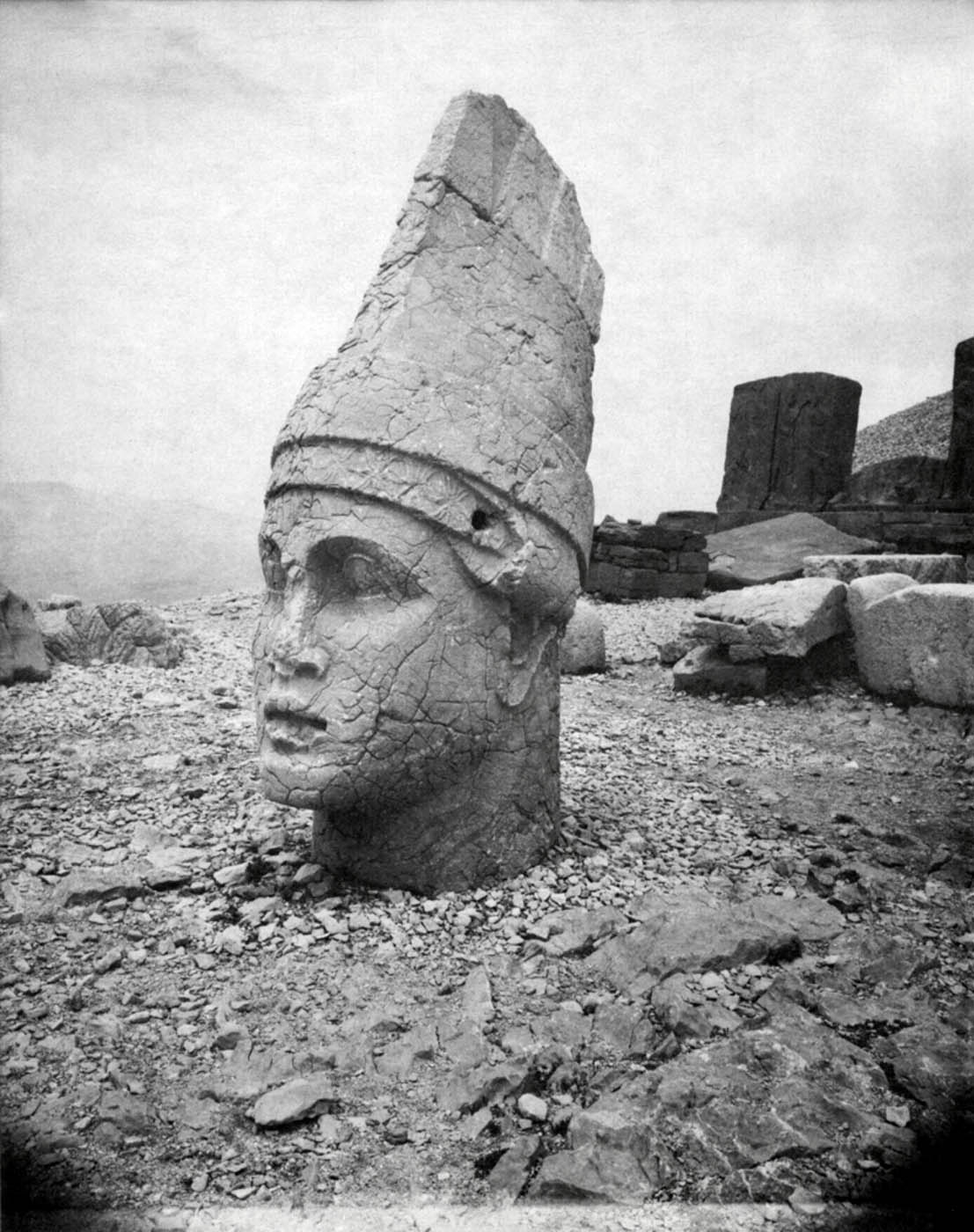
Curator: Rebecca Senf, Norton Family Assistant Curator of Photograph at the at Phoenix Art Museum
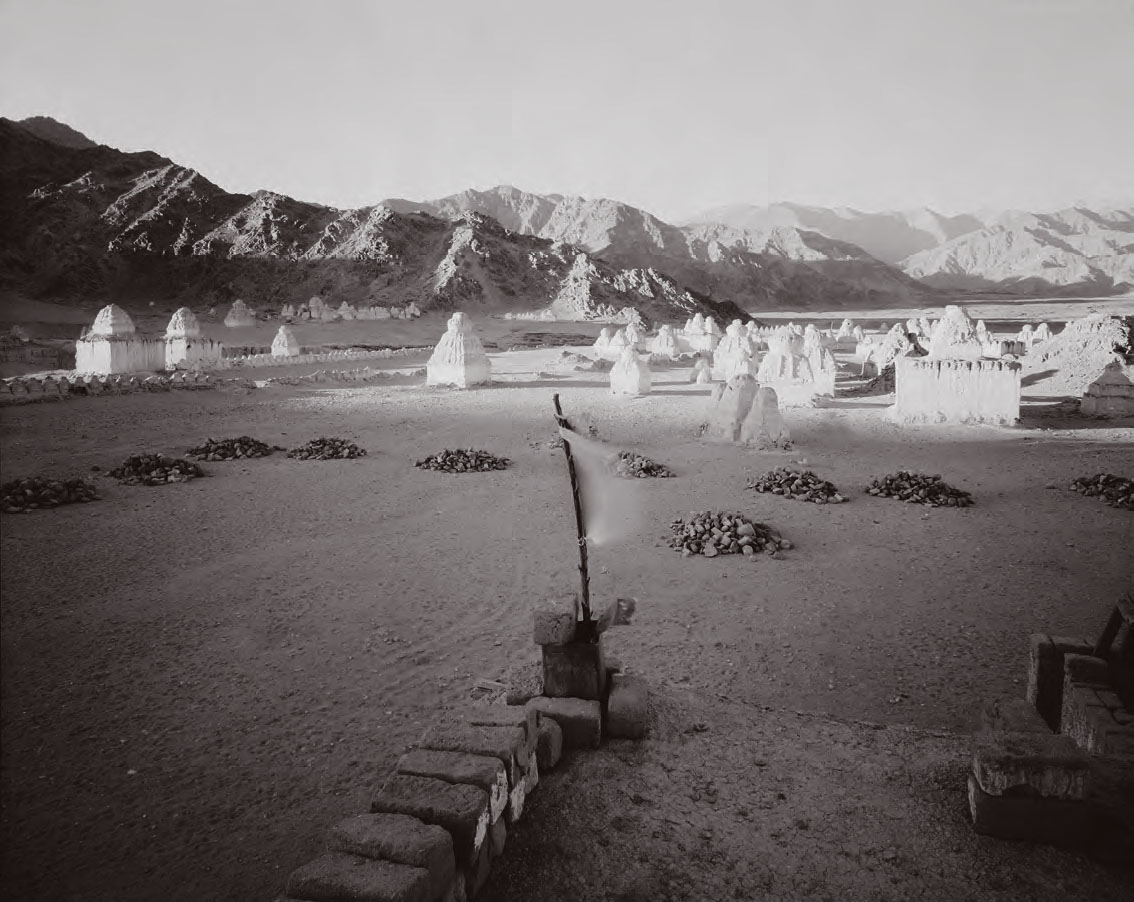
Linda Connor (American, b. 1944) Prayer Flag and Chortens, Ladakh, India 1988 1988 Silver gelatin print
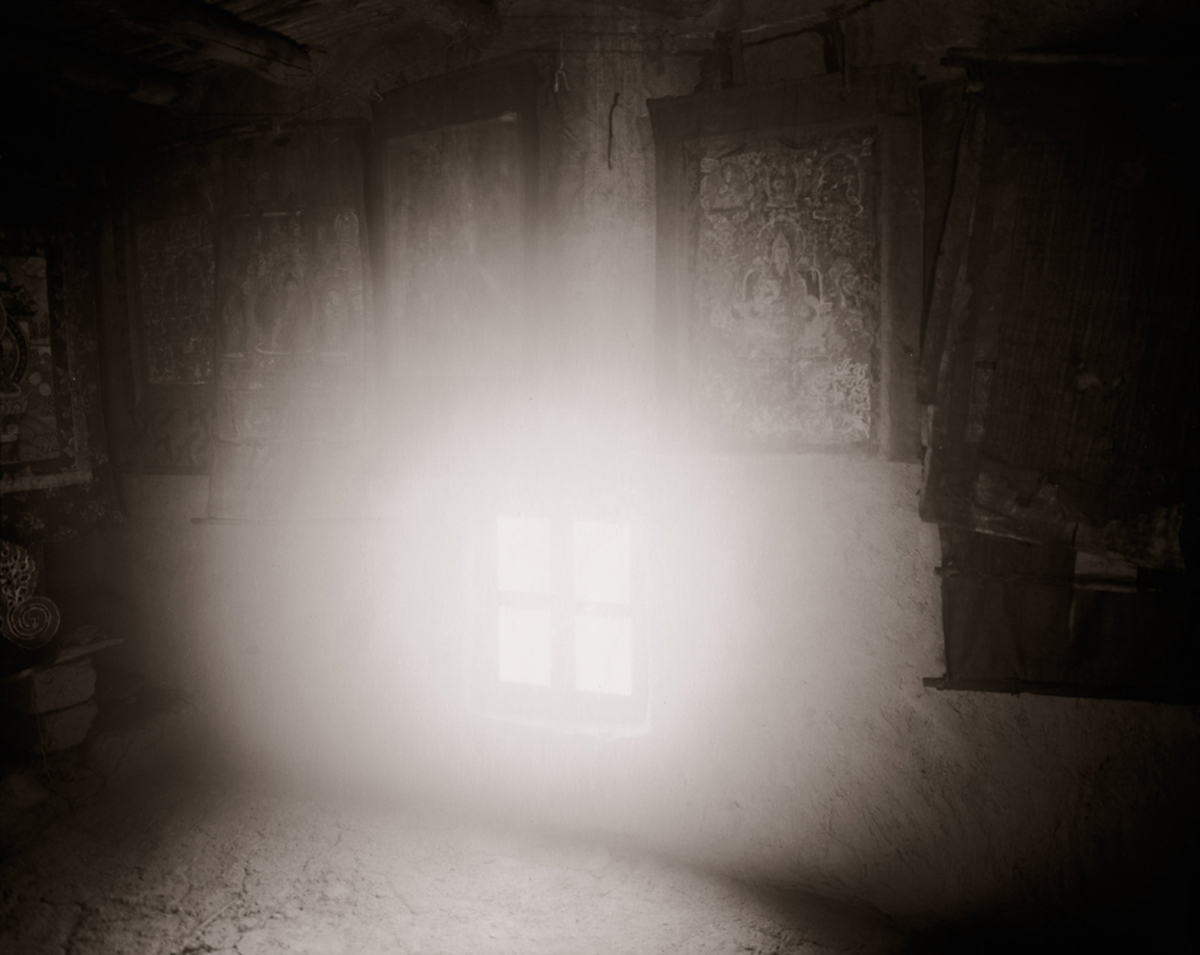
Connor’s photographs reveal the essence of her subjects, yielding a sense of timelessness while visually evoking the intangible. She uses a distinctive technique. A large-format view camera allows her to achieve remarkable clarity and rich detail. Her prints are created by direct contact of the 8 x 10-inch negative on printing out paper, exposed and developed using sunlight …
Connor embraces a wide range of subject matter, connecting the physical and the spiritual world. Just as sacred art evokes deep meaning even without an explicit understanding, Connor hopes her photographs serve a similar metaphorical function. Upon entering Chartres Cathedral, for example, one feels transported into another realm, regardless of religious beliefs. Connor’s images share this transformative nature as they transcend the boundaries of subject, culture, and time. She brings an equal amount of attention to a rock in the desert as she does when she photographs a temple.
Text from the Phoenix Art Museum website
Many thankx to the Phoenix Art Museum for allowing me to publish the photographs in the posting. Please click on the photographs for a larger version of the image.
Linda Connor (American, b. 1944) Windows and Thangkas, Ladakh 1988 Silver gelatin print
Linda Connor (American, b. 1944) Library of Prayer Books, Ladakh, India 1988 Silver gelatin print
Linda Connor is an American photographer who photographs spiritual and exotic locations including India, Mexico, Thailand, Ireland, Peru, and Nepal. Her photographs appear in a number of books, including Spiral Journey, a catalog of her exhibition at the Museum of Contemporary Photography in 1990 and Odyssey: Photographs by Linda Connor, published by Chronicle Books in 2008. Connor was awarded a National Endowment for the Arts grant in 1976 and 1988 and received a Guggenheim Fellowship in 1979. Connor’s work is included in the collections of the Art Institute of Chicago, Museum of Modern Art, San Francisco Museum of Modern Art, and the Victoria & Albert Museum in London.
Linda Connor (American, b. 1944) Portal Figures, Chartres Cathedral, France 1989 Silver gelatin print
Linda Connor (American, b. 1944) Mudra, Mindroling Monastery, Tibet 1993 Silver gelatin print
Linda Connor (American, b. 1944) Blind Musician, Kashmir, India 1985 Silver gelatin print
Linda Connor (American, b. 1944) Apollo, Mt. Nemrut, Turkey 1992 Silver gelatin print
Doris and John Norton Gallery for the Center for Creative Photography, Phoenix Art Museum 1625 N Central Ave, Phoenix, AZ 85004, USA
“The exhibition exudes a certain melancholia and is troubling in many aspects: loneliness, separation, desire for intimacy, desire for love all being expressed through the presented works.” Dr Marcus Bunyan
Exhibition dates: 7th October – 30th November, 2008
Curator: Anna MacDonald
The exhibition includes works by Louise Bourgeois, Nan Goldin, Steve McQueen, Sophie Calle, Mariele Neudecker, Jesper Just, Gabrielle de Vietri, Felix Gonzalez-Torres, Mutlu Çerkez, Amikam Toren, Margaret Salmon and Annika Ström
Sophie Calle (French, b. 1953) Doleur exquise 1984/1999
Set up by Frank Gehry and Edwin Chan Exhibition view at Rotonde1, Luxembourg, 2007
An eclectic mix of mixed media, photography and video work is presented in this exhibition, work which examines concepts of intimacy – staged performances, stories of the city, of men, women, families and children; the artists “contemplate passion, love and longing, as well as feelings of disquiet, loss, and loneliness that embody intimate human relations.”
The exhibition exudes a certain melancholia and is troubling in many aspects: loneliness, separation, desire for intimacy, desire for love all being expressed through the presented works.
Some of the works are strong but others left me cold and uninterested. Few are joyous renditions of the closeness of intimate relations and most works ponder the dangers and disillusionment of failed intimacies that involve feelings of vulnerability (intimate acts often involve a degree of self-disclosure where intimates show something of themselves that may make them feel vulnerable), ambiguity (intimate acts are often an ambiguous and incomplete shared and often idiosyncratic view of the world) and secrecy (intimate acts are private: they are often constructed, by their participants, to be hidden from the view of others).1
The large work by English artist Steve McQueen features two naked black wrestlers shot in slow motion in grainy black and white video. The wrestlers are photographed from the waist down, images of moving legs, or from below, bodies clinging together, faces grimacing in a hyperreal performance of some hypnotic intimate dance – an acted out state of being.
Amikan Torren’s 2008 video work is by comparison is about the improbabilities of life’s daily encounters: in Downstairs over a video image of 3 steps outside a London railway station the narrator tells of a man, a stockbroker who after an accident sometimes needs help descending steps; in Blind the narrator comments on a person helping a blind man across the street; and in Carrots, over a video image of a London street the narrator tells a story about an adolescent and fresh carrots! The musings on the synchronicity and serendipity of everyday encounters are very effective.
Jesper Just’s two video works No Man Is An island II (2004) and The Lonely Villa (2004) were very effective and moving. In the first lonely men in a pub sing the Roy Orbison song Crying with pictures of naked ladies behind them – it is funny and sad at the same time. In the second men in the shadows sit or stand with telephones in front of them: two men sing to each other the song I Don’t Want To Set The World On Fire with close-ups of their lips singing into the telephone: songs of loss, longing and remembrance.
The two most interesting pieces are not video works, nor are they the overrated photographs of Nan Goldin featuring photographs of a family hugging and lying on a bed, but the work of two women: Sophie Calle and Louise Bourgeois.
In Doleur exquise (exquisite pain) Calle revisits fifteen years later the breakup of a relationship and the aftermath of that event: the distress and pain, the experiences of her friends in such circumstances and turns them into brilliant insightful art. A selection of the whole work is presented here that features colour photographs (multiples of a red telephone, abandoned car with it’s doors open, washbasins and empty bedrooms) above text woven onto linen – black on white, grey on grey. The texts are both painful and repetitive (Calle’s on the left) and others heartbreaking accounts of pain (on the right): “6 days ago, the man I love left me …”
(For an insightful analysis of this work see Can Pain Be Exquisite? Autofictional Stagings of Douleur exquise by Sophie Calle, Forced Entertainment and Frank Gehry and Edwin Chan by Anneleen Masschelein. “On the one hand, it deals with the most intense, acute experiences of pain in a human life. On the other hand, these moments are unique and “localised”, that is, they are connected to a concrete time and space, of which the details are forever inscribed in memory.”)
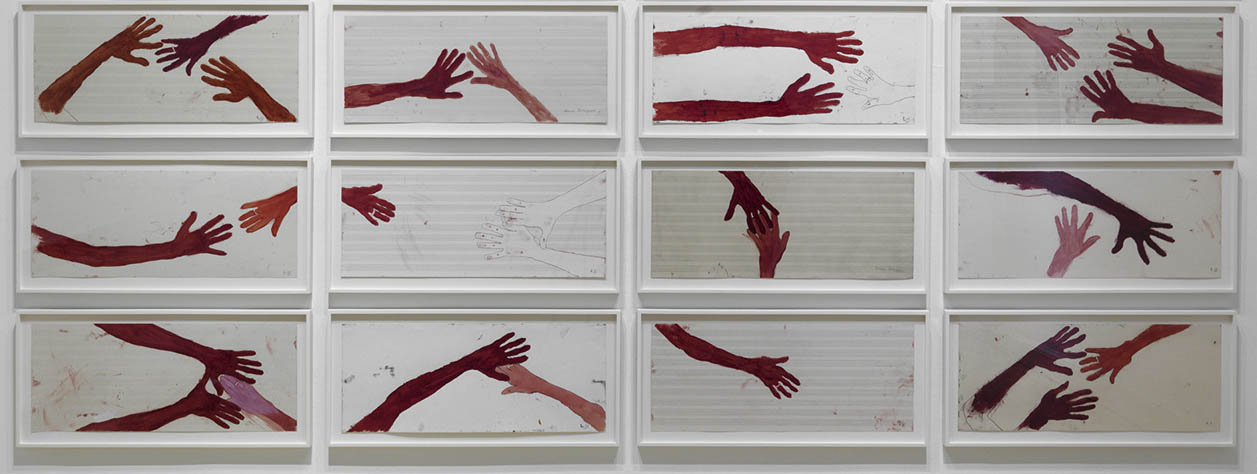
My favourite work from the show is Louise Bourgeois 10AM IS WHEN YOU COME TO ME (2006) – drawings on music paper of mainly red hands, the key a drawing of a 10am clock with a man the big hand with hands extended drawing towards him (or is it tethered to him) an armless woman, the small hand. Some have seen these as “ambiguous images of a hermetic cosmos, as acts of violence or love” but they represent “both Bourgeois’s hands and those of her friend and muse Jerry Gorovoy” and how he helps her and arrives at her studio at this, the designated hour.
To me they are joyous, liberating, spontaneous expressions of love and intimacy, fingerprints on the page, hands intertwining together. They made me feel the intimate expression of humanity: holding a babies hand, so small and vulnerable and feeling them grasp your hand. That connection is what Bourgeois achieves with this work and I thought it was wonderful.
This exhibition is no easy ride but is well worth the contemplation necessary to tease out the themes and feelings that the work investigates.
Dr Marcus Bunyan
1/ Steve Howard, Frank Vetere, Martin Gibbs, Jesper Kjeldskov, Sonja Pedell, Karen Mecoles, Marcus Bunyan, and John Murphy. Mediating Intimacy: Digital Kisses and Cut and Paste Hugs. 2004.
Sophie Calle (French, b. 1953) Doleur exquise (detail) 1984/1999
Louise Bourgeois (French-American, 1911-2010) TEN AM IS WHEN YOU COME TO ME (detail) 2006
Louise Bourgeois (French-American, 1911-2010) TEN AM IS WHEN YOU COME TO ME (detail) 2006
Louise Bourgeois (French-American, 1911-2010) TEN AM IS WHEN YOU COME TO ME 2006
Australian Centre for Contemporary Art 111 Sturt Street, Southbank Victoria 3006, Australia Phone: 03 9697 9999
Opening hours: Tuesday – Friday 10am – 5pm Saturday – Sunday 11am – 5pm Monday Closed Open all public holidays except Christmas Day and Good Friday
















![Carleton Watkins (American, 1829-1916) '[Section Grizzly Giant, Mariposa Grove]' 1861](https://artblart.com/wp-content/uploads/2009/01/watkins-section-grizzly-giant.jpg "Carleton Watkins (American, 1829-1916) '[Section Grizzly Giant, Mariposa Grove]' 1861")


![Carleton Watkins (American, 1829-1916) '[Sugarloaf Islands at Fisherman's Bay, Farallon Islands]' About 1869](https://artblart.com/wp-content/uploads/2009/01/watkins-sugarloaf-islands-at-fishermans-bay-farallon-islands.jpg "Carleton Watkins (American, 1829-1916) '[Sugarloaf Islands at Fisherman's Bay, Farallon Islands]' About 1869")


![Carleton Watkins (American, 1829-1916) '[Thompson's Seedless Grapes]' 1880](https://artblart.com/wp-content/uploads/2009/01/watkins-thompsons-seedless-grapes.jpg "Carleton Watkins (American, 1829-1916) '[Thompson's Seedless Grapes]' 1880")



















You must be logged in to post a comment.