Exhibition: ‘Melbourne Now’ at the National Gallery of Victoria, Melbourne, Part 2

Exhibition dates: 22nd November – 23rd March 2014
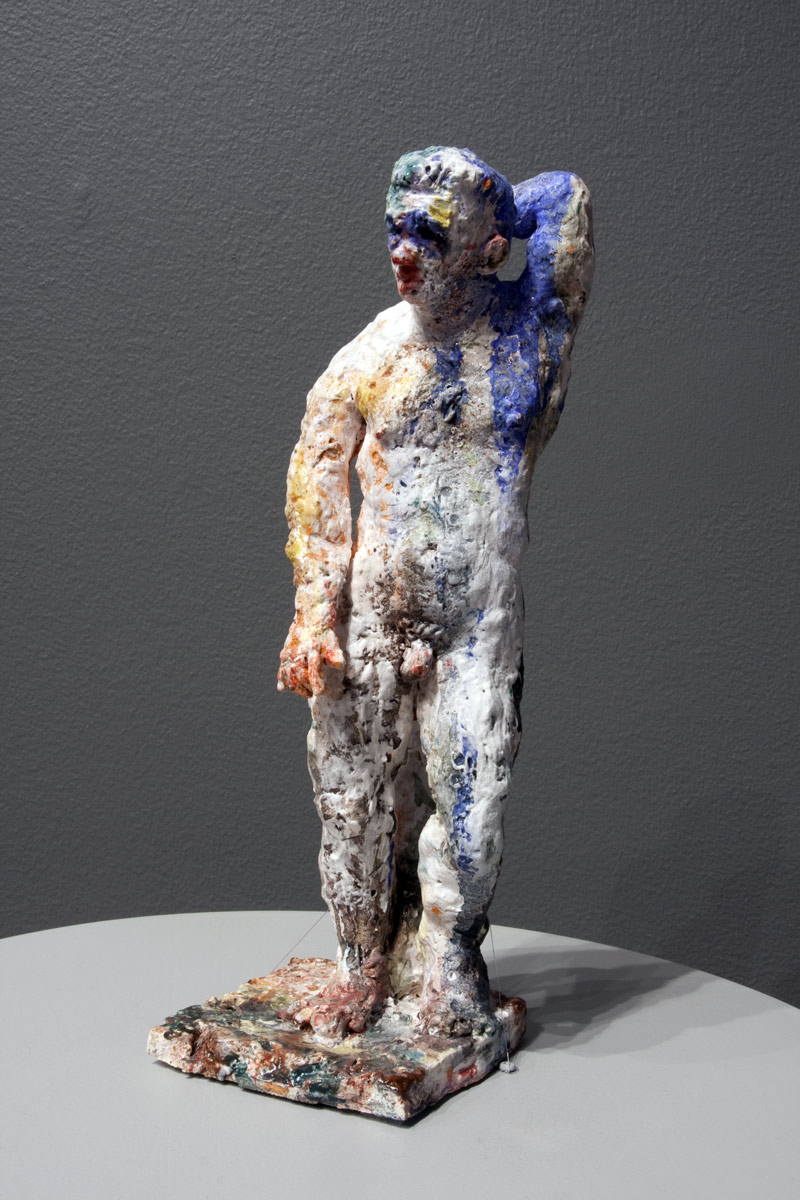
 

Stephen Benwell (Australian, b. 1953) 'Statue' 2012 (installation view)


Stephen Benwell (Australian, b. 1953)
Statue (installation view)
2012
Photo: Marcus Bunyan


Throughout his career a major preoccupation of Benwell’s work has been the depiction of the male figure. In 2006 he commenced a series of figurative sculptural works that explore issues relating to masculinity, naked beauty and sensuality. These works, initially inspired by eighteenth century figurines and Greco-Roman statuary, have become a significant aspect of Benwell’s recent practice. The artist contributes a group of these evocative male figures for Melbourne Now.


This is the second of a two-part posting on the huge Melbourne Now exhibition at the National Gallery of Victoria, Melbourne. The photographs in this posting are from NGV Australia at Federation Square. The first part of the posting featured work from NGV International venue in St Kilda Road. Melbourne Now celebrates the latest art, architecture, design, performance and cultural practice to reflect the complex cultural landscape of creative Melbourne.

Dr Marcus Bunyan


Many thankx to the NGV for allowing me to publish the photographs in the posting. All photographs © Dr Marcus Bunyan unless otherwise stated. Please click on the photographs for a larger version of the image. Please note: All text below the images is from the guide book.


“Melbourne is a microcosm of the global art world. This is evident not only in its possession of world-class infrastructure, but also in the multitude of tendencies, styles and modes of practice that circulate in its midst. I doubt that there is an underlying formal unity, or even a hierarchy of movements, that holds together and directs the global art world. This then begs the question: does the teeming multitude of art forms in Melbourne suggest that the local scene is an isomorph [a substance or organism that exactly corresponds in form with another] of global chaos, or a unique fragment that coexists with other entities?

The answer is paradoxical. It is our haunted and resistant sense of place that allows for both a form of belonging that is forever seeking to be elsewhere, and a unique aesthetic that anticipates the many returns of a repressed past.”


Nikos Papastergiadis. “As Melbourne in the world.” 2013


“What the show delivers in spades is a sense of the city as a place of immense creativity and subtle exploration. While non-Melburnians might be tempted to see this as an especially large example of the city’s enduring fascination with itself, when the theme is the city, the inclusion of architecture and design makes sense.

And the result is anything but narcissistic; a turn round the exhibition reveals that although Melbourne features strongly in some works, it is also curiously incidental; at the heart of the show is an examination of urban and suburban, and what it feels like to live in a rapidly changing world where old certainties no longer apply.”


Anonymous. “Melbourne Now: this exhibition changes the city’s arts landscape,” on The Guardian Australia Culture Blog, Thurs 28 November 2013 [Online] Cited 25/11/2013


Polixeni Papapetrou (Australian, 1960-2018) 'Ocean Man' 2013


Polixeni Papapetrou (Australian, 1960-2018)
Ocean Man
2013
From the series The Ghillies 2013
Pigment print
120 x 120cm
National Gallery of Victoria, Melbourne
Purchased NGV Foundation, 2013
© Polixeni Papapetrou/Administered by VISCOPY, Sydney
Photo: © National Gallery of Victoria


Papapetrou’s contribution to Melbourne Now comprises three photographs from her 2013 series The Ghillies. Working with her children as models and using the extreme camouflage costumes that are employed by the military, Papapetrou reflects on the passing of childhood and the moment when children separate themselves from their mothers. Young men often assume the costumes and identities of masculine stereotypes, hiding themselves, and their true identity, from plain sight in the process.


Michelle Hamer (Australia, b. 1975) 'Can't' 2013


Michelle Hamer (Australia, b. 1975)
Can’t
2013
Wool, plastic
52 x 67cm
Collection of the artist
© Michelle Hamer, courtesy Fehily Contemporary, Melbourne
Photo: © National Gallery of Victoria


Hamer’s contribution to Melbourne Now pairs works referencing local signage, Blame and punish the individual, 2013, and Can’t, 2013, with three earlier tapestries from her American series I Send Mixed Messages, 2013. While the contrasting palettes and particular nuances of typography, built architecture and native vegetation point to specific times and places, when amplified and dislocated Hamer’s chosen texts suggest a more universal narrative of perplexity and turmoil. The artist describes these powerful distillations as ‘revealing the small in-between moments that characterise everyday life’.
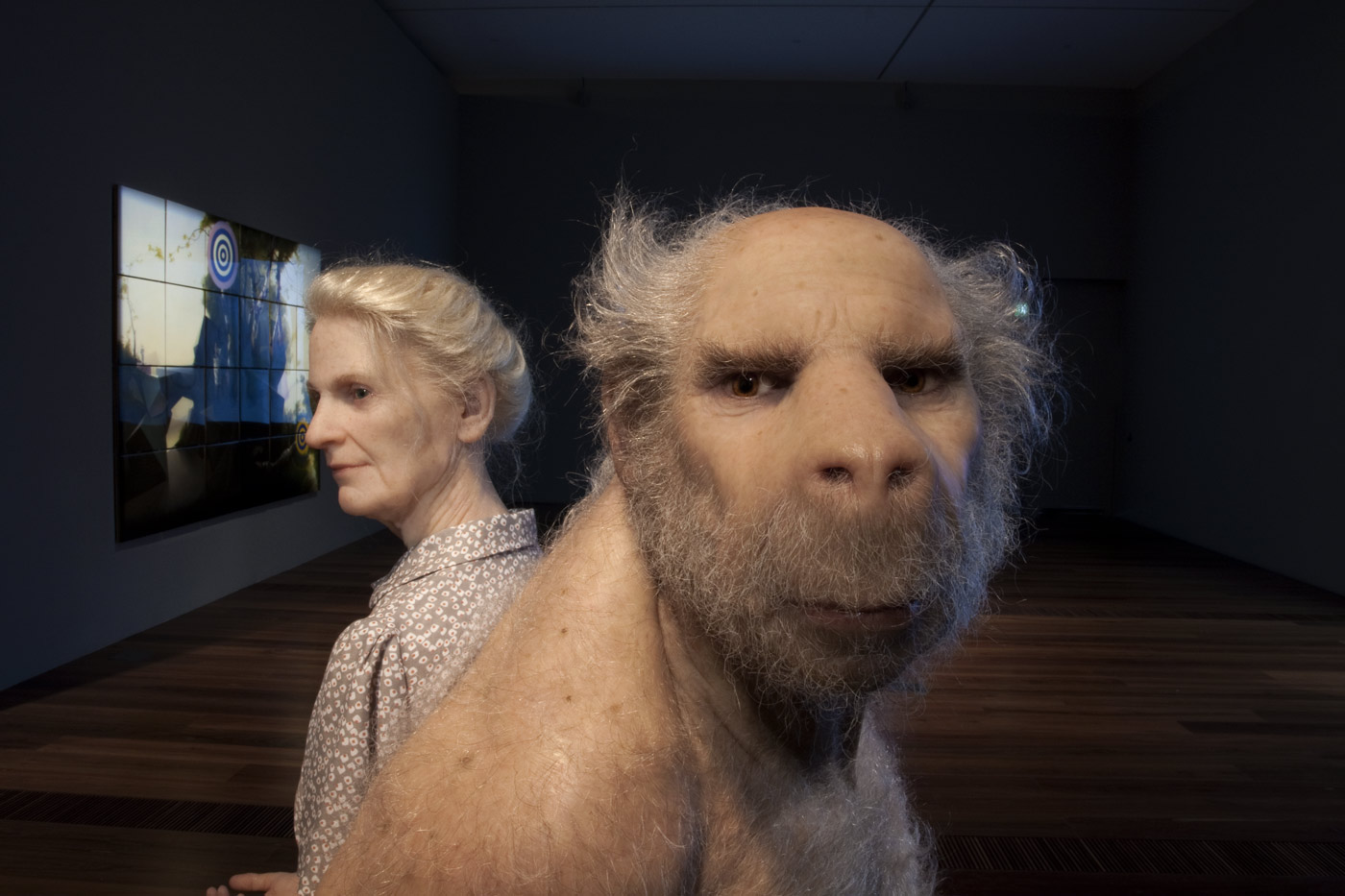
 

Patricia Piccinini (born Sierra Leone 1965, lived in Italy 1968-1972, arrived Australia 1972) 'The carrier' 2012 (installation view detail)


Patricia Piccinini (born Sierra Leone 1965, lived in Italy 1968-1972, arrived Australia 1972)
The carrier (installation view detail)
2012
Silicone, fibreglass, human and animal hair, clothing
170 x 115 x 75cm
Collection of Corbett Lyon and Yueji Lyon, Lyon Housemuseum, Melbourne, proposed gift
© Patricia Piccinini, courtesy Tolarno Galleries, Melbourne
Supported by Corbett and Yueji Lyon
Photo: © Marcus Bunyan


Piccinini’s work for Melbourne Now is The carrier, 2012, a hyper-real sculpture of a bear-like figure holding an elderly woman. With his massive, hirsute and muscular physique, the creature is almost human; there is warmth and intimacy between the mismatched couple. The figures’ relationship is ambiguous. Are they mistress and servant, or simply unlikely friends, embarked on a journey together? It is nice to believe the latter, but hard to forget that humans rarely treat other animals equitably. The carrier investigates what we want from our creations, and wonders about unexpected emotional connections that might arise between us and them.
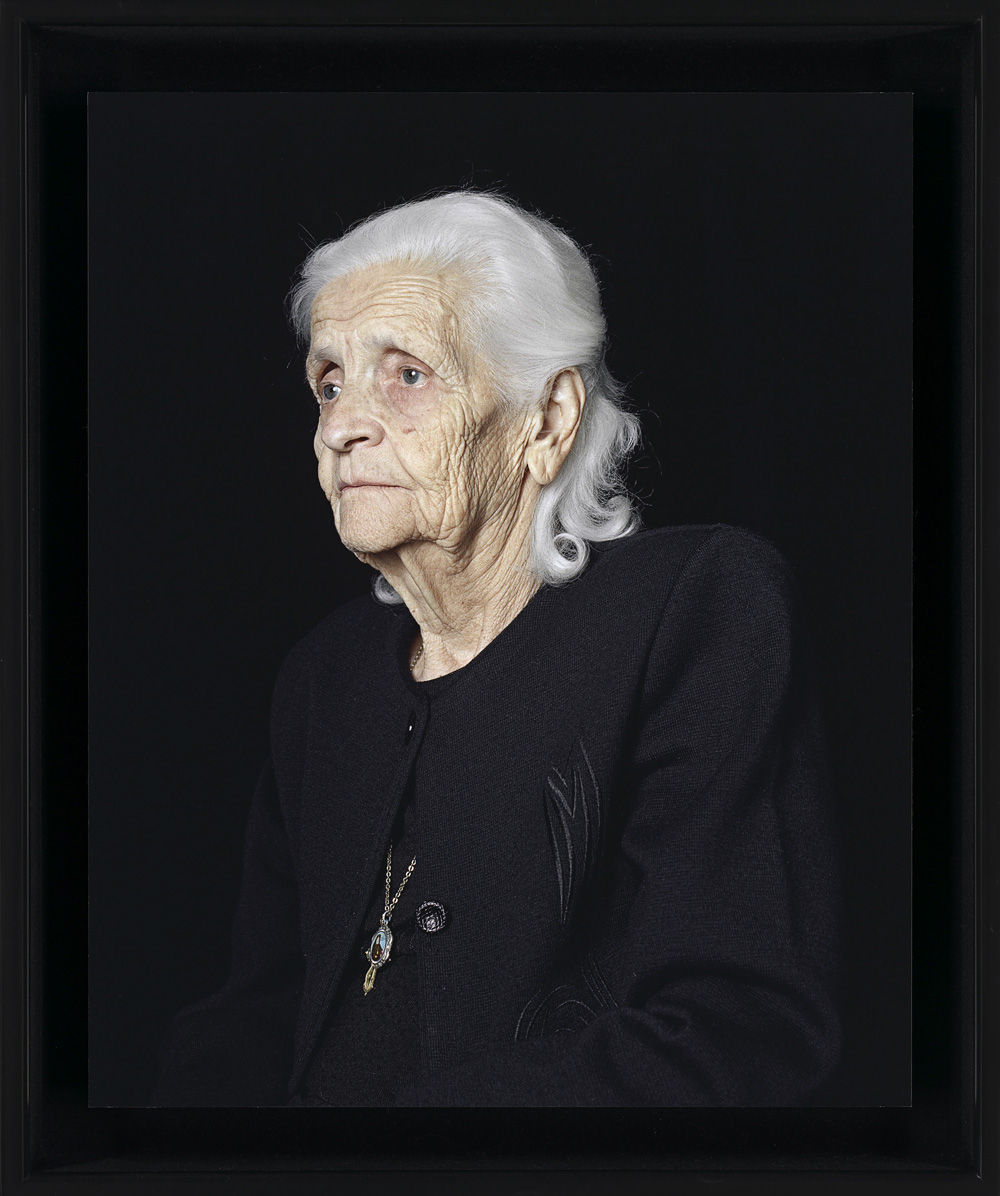
 

Georgia Metaxas (Australia, b. 1974) 'Untitled 28' 2011


Georgia Metaxas (Australia, b. 1974)
Untitled 28
2011
From The Mourners series 2011
Type C photograph
60 x 50 x 7cm
Collection of the artist
© Georgia Metaxas, courtesy of Fehily Contemporary, Melbourne
Photo: © National Gallery of Victoria


Metaxas’s contribution to Melbourne Now comprises five photographs from The Mourners series, 2011, which was first exhibited at the Centre for Contemporary Photography, Melbourne, in 2011. These stately portraits show women who have adopted the traditional practice of wearing black, symbolising perpetual mourning, following the death of their husbands. Photographed against plain black backdrops, dressed in their widows’ weeds, these women form an austere and mournful frieze.
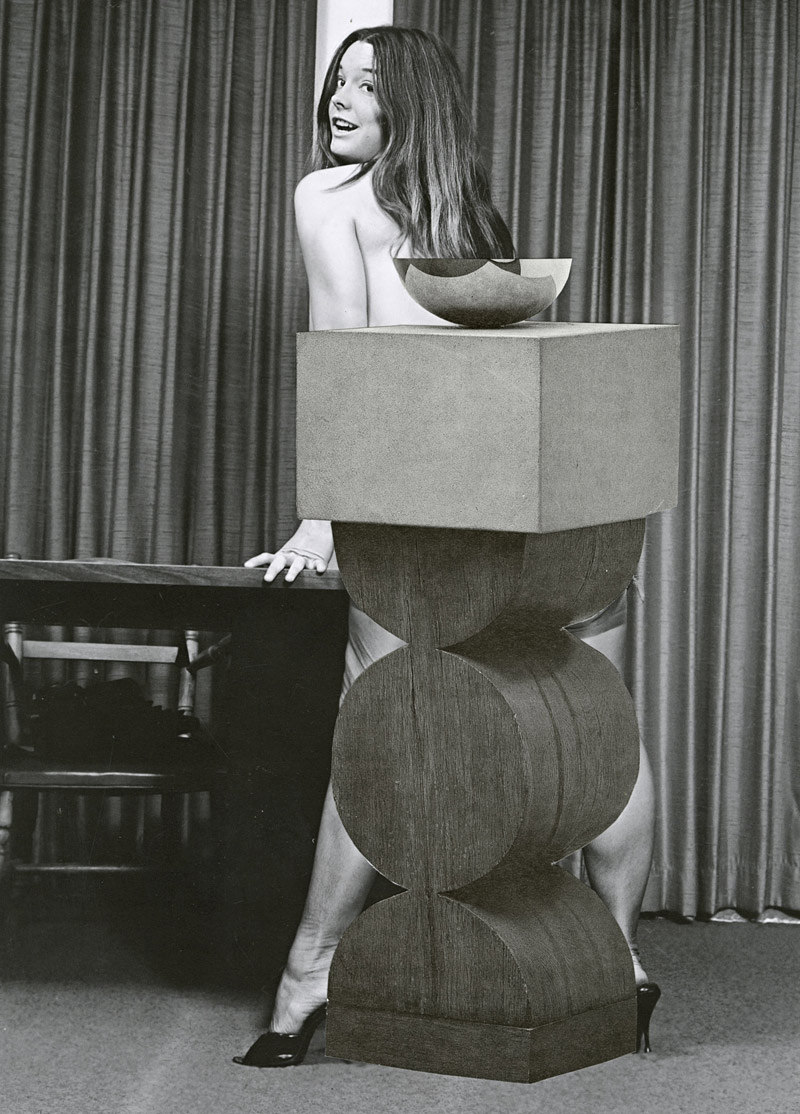
 

Stuart Ringholt (Australia, b. 1971) 'Nudes' 2013


Stuart Ringholt (Australia, b. 1971)
Nudes
2013
Collage (1-52)
29 x 30cm (each)
Collection of the artist
© Stuart Ringholt, courtesy Milani Gallery, Brisbane
Photo: © National Gallery of Victoria


Expanding the artist’s greater naturist project, Nudes, 2013, is a series of collages featuring images of twentieth-century modernist art objects and nudes taken from soft porn references. In these works, Ringholt complicates the original function of the images as the spectator considers the relationship between the nude and the work of art. Interested in how images can be transformed by simple interventions, Ringholt opens possibilities for new narratives to emerge between the nude, the object and the audience.
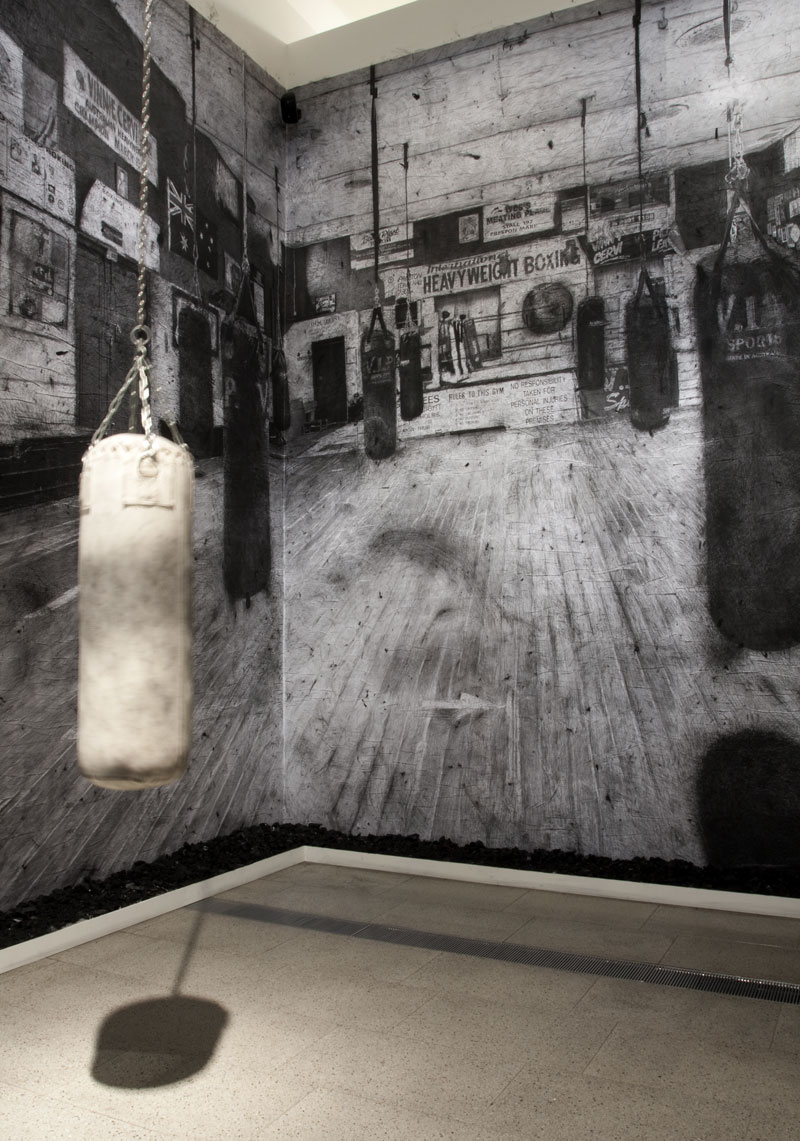
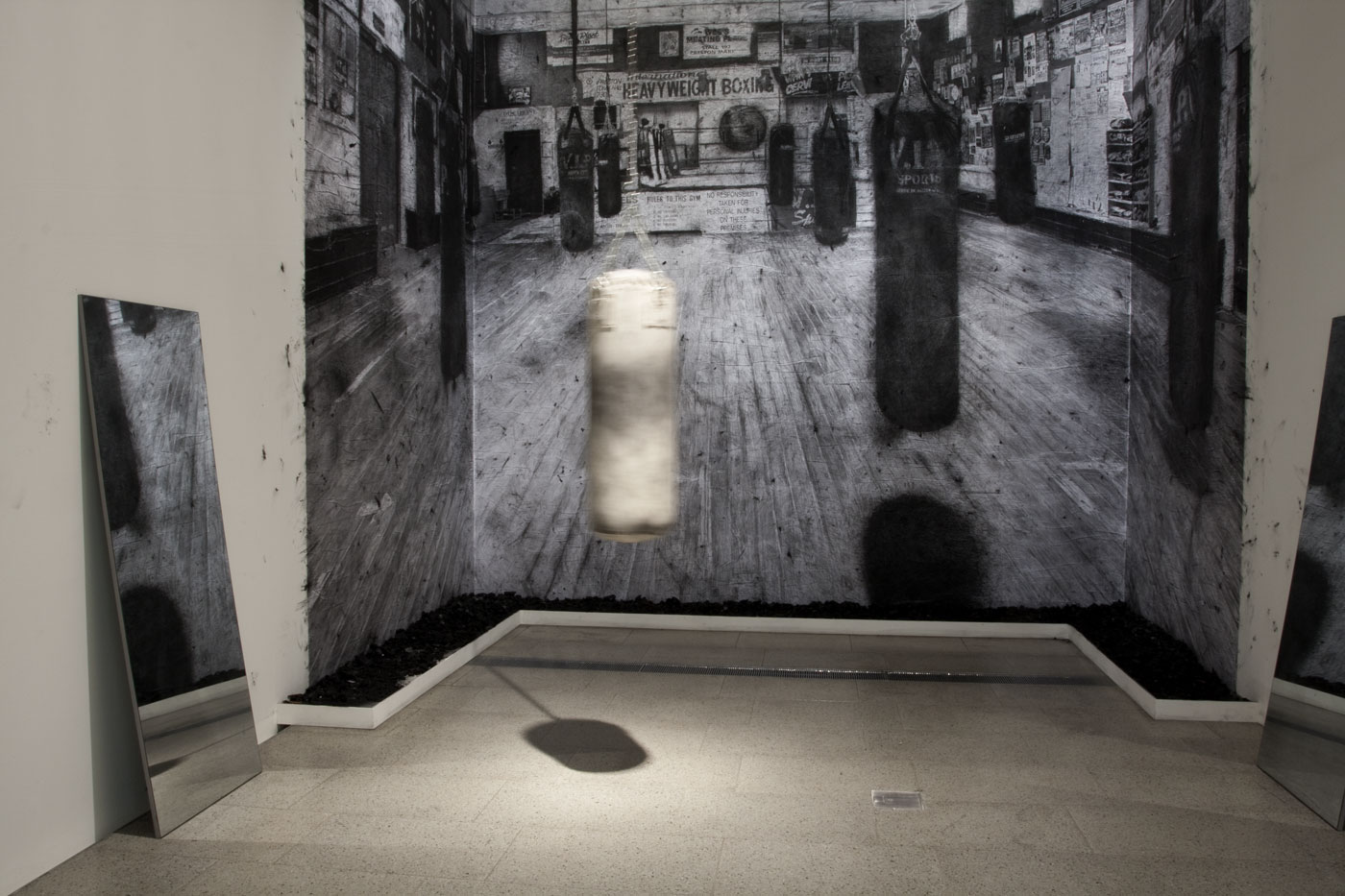
 

Richard Lewer (born New Zealand 1970, arrived Australia 2000) 'Northside Boxing Gym' 2013 (installation view detail)

Richard Lewer (born New Zealand 1970, arrived Australia 2000) 'Northside Boxing Gym' 2013 (installation view detail)


Richard Lewer (born New Zealand 1970, arrived Australia 2000)
Northside Boxing Gym (installation view details)
2013
Charcoal on existing wall, boxing bag, 5.1 sound system
550 x 480 x 480cm (installation)
Collection of the artist
© Richard Lewer, courtesy Hugo Michell Gallery, Adelaide
Photos: © Marcus Bunyan


Since challenging fellow artist Luke Sinclair to a boxing match at Melbourne’s Northside Boxing Gym in 2001 (as a performance), Lewer has remained interested in the site, training there regularly and making art about it. For Melbourne Now Lewer presents an immersive recreation of the gymnasium, featuring a large-scale charcoal wall-drawing accompanied by mirrors, sound and a sweaty boxing bag.


Hotham Street Ladies (Australia, est. 2007) 'At home with the Hotham Street Ladies' 2013 (installation view)


Hotham Street Ladies (Australia, est. 2007)
At home with the Hotham Street Ladies (installation view)
2013
Royal and buttercream icing, modelling paste, confectionary, furniture, plinths, pot plants, colour DVD, television, light fittings, heater, icing, video, chandelier, lampshade, fireplace, furniture, television, crockery, cutlery, glassware, fabric dimensions variable (installation)
NGV commission Supported by Melbourne Now Champions the Dewhurst Family
Photo: © National Gallery of Victoria


The collective’s members are Cassandra Chilton, Molly O’Shaughnessy, Sarah Parkes, Caroline Price and Lyndal Walker. Their practice embraces themes of home life, feminism and craft and explores how collaborative participation in, and contemporising of, these activities creates a distinct cultural community. Their work’s innovative combination of humour and contemporary critique with nostalgic or familiar elements makes it appealing to a wide audience. Often thought of in terms of dysfunction, the share house in their hands becomes a site of creativity, cooperation and overindulgence.

Food is a constant presence in HSL’s work, from recipe swap meets, street art and public art commissions to controversial cake entries in the Royal Melbourne Show. For Melbourne Now the group take baking and icing to a whole new level. Their installation At home with the Hotham Street Ladies, 2013, transforms the foyer of The Ian Potter Centre: NGV Australia into an icing-bombed domestic wonderland. Their commission for kids invites children and families to photograph themselves within one of the scenes from HSL’s icing- and lolly encrusted share house.
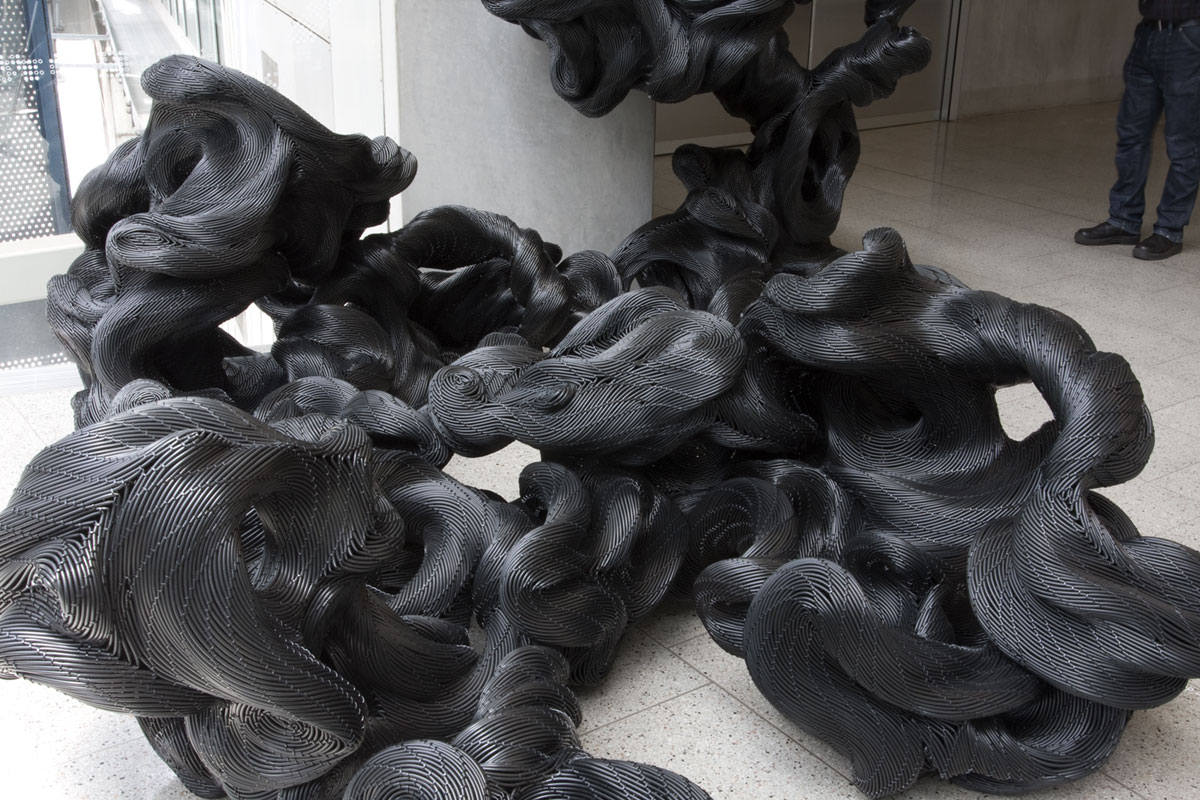
 

Lucy Irvine (Australian born Scotland, b. 1980) 'Before the after' 2013 (installation view)


Lucy Irvine (Australian born Scotland, b. 1980)
Before the after (installation view)
2013
Photo: © Marcus Bunyan


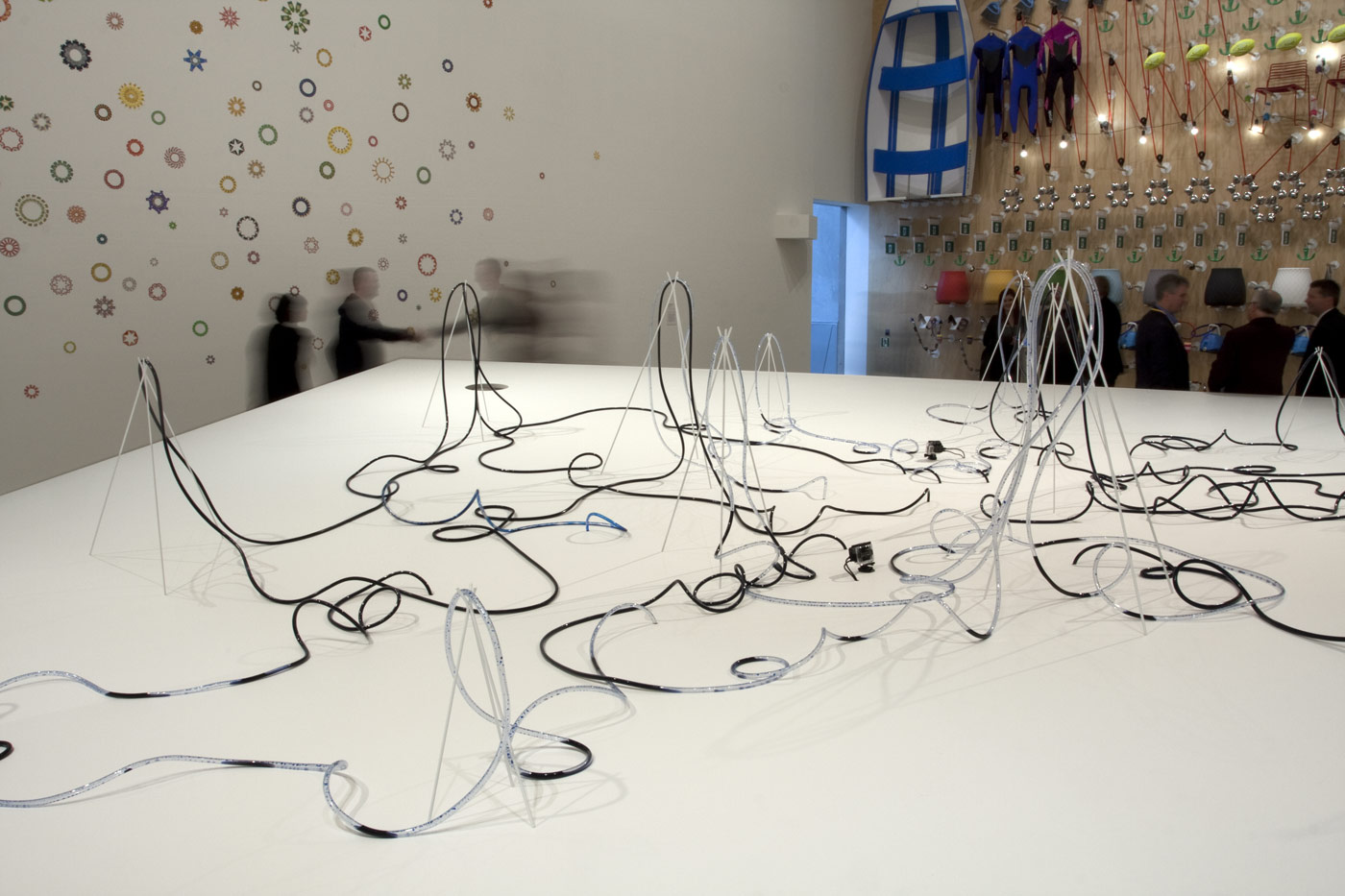
For Melbourne Now Irvine has constructed a large site-specific work at The Ian Potter Centre: NGV Australia, Before the after, 2013, which establishes a dialogue with the gallery building, its architecture and the temporality of the exhibition. Spilling out across the floor, the serpentine form is an interruption of the order of things, a writhing obsidian mass that clings to the interior of the building. At the same time the work is a nuanced meditation on the nature of surfaces and skin. Irvine’s iterative practice argues for value in the gestural, and proposes the act of making as a form of knowledge.
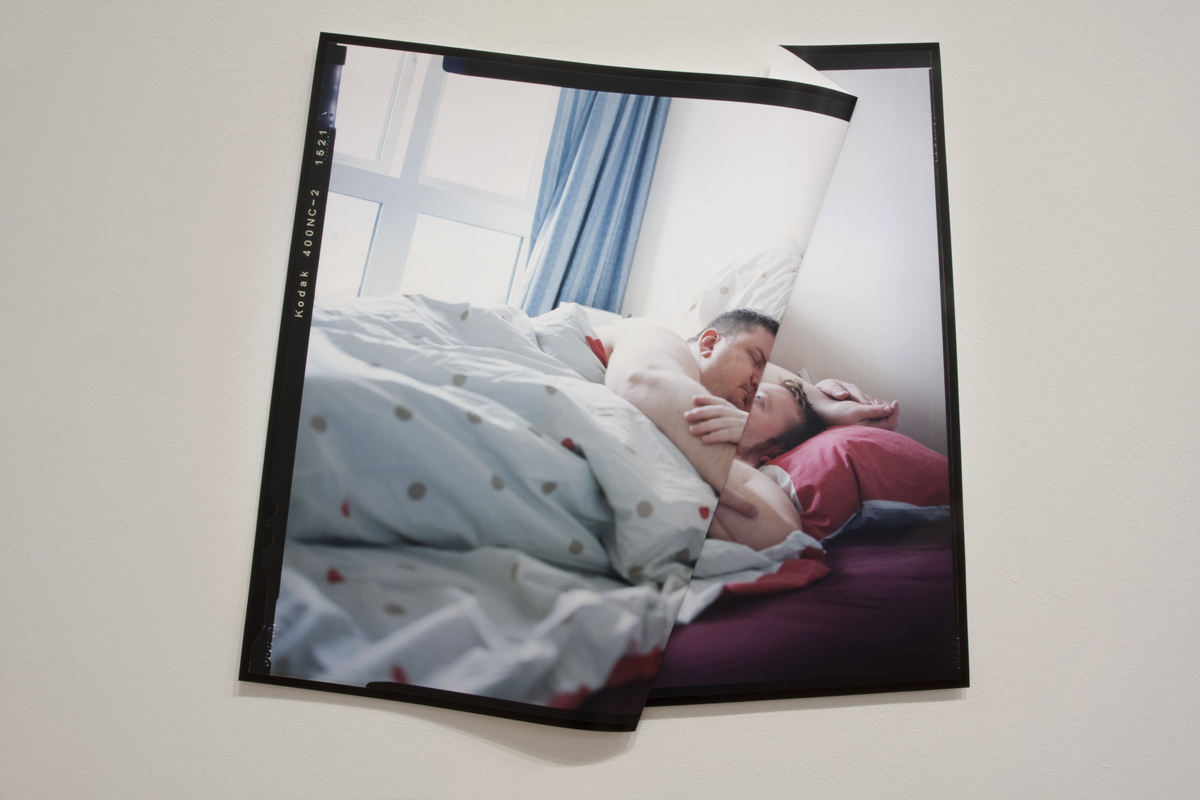
 

Paul Knight (Australian, b. 1976) 'Untitled' 2012


Paul Knight (Australian, b. 1976)
Untitled
2012
National Gallery of Victoria, Melbourne
Photo: © Marcus Bunyan
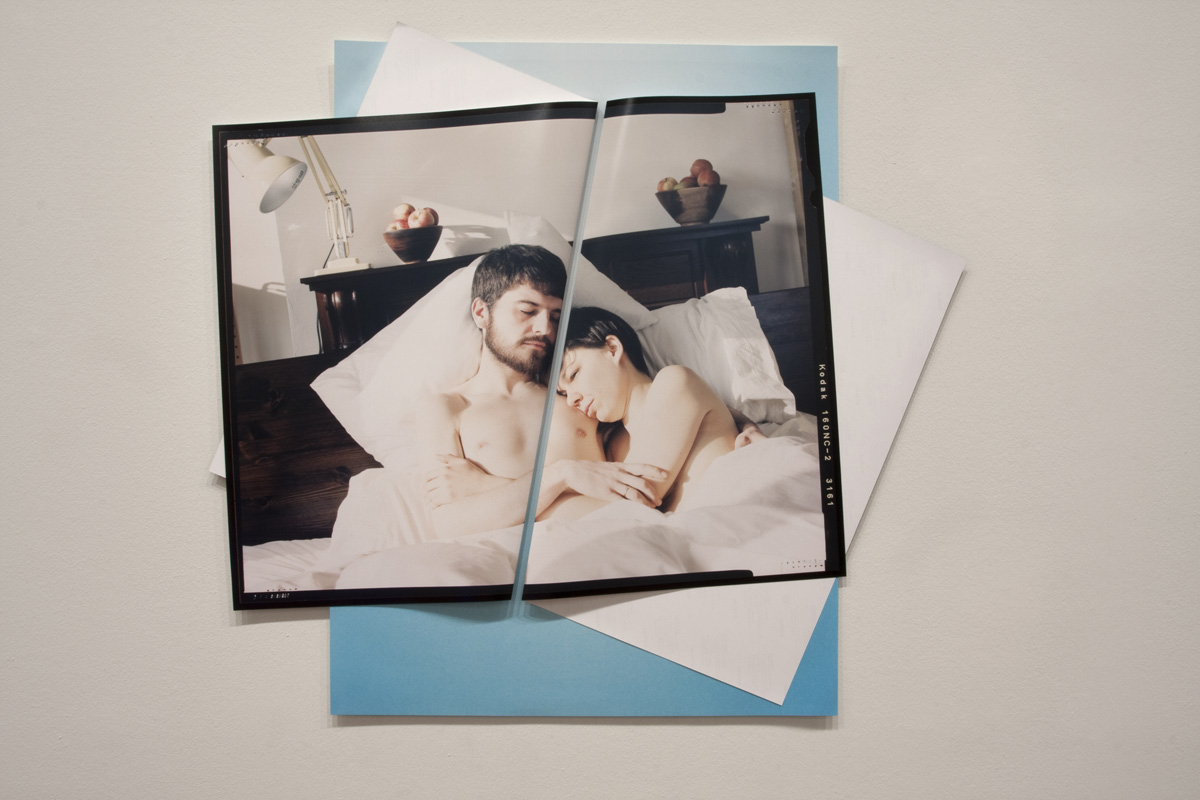
 

Paul Knight (Australian, b. 1976) 'Untitled' 2012


Paul Knight (Australian, b. 1976)
Untitled
2012
National Gallery of Victoria, Melbourne
Photo: © Marcus Bunyan


Knight’s recent folded photographic works extend his interest in notions of authorship, photographic agency, the relationships between observer and observed, and ideas of intimacy and love. Each scene captures a couple lying together, bodies entwined, in bed – the artist privy to an intense, personal scene of absorption. There is an evident trust between Knight and his subjects, who sleep gently, seemingly unaware of, or perhaps complicit in, his presence. The illusion is ruptured by the folding of the photographic print, which has the effect of sometimes forcing the couples closer together, other times slicing them apart. The fold intensifies the sense of intimacy and draws attention to the physical state of the photograph.


Installation view of the series 'Milk Bars of Melbourne', 2010-2013 by David Wadelton at the exhibition 'Melbourne Now'


Installation view of the series Milk Bars of Melbourne, 2010-2013 by David Wadelton at the exhibition Melbourne Now
Photo: © David Wadelton


David Wadelton (Australian, b. 1955) 'Milk Bar, Jenkens Avenue Frankston North' 2012


David Wadelton (Australian, b. 1955)
Milk Bar, Jenkens Avenue Frankston North
2012
From the series Milk Bars of Melbourne, 2010-13
Photo: © David Wadelton
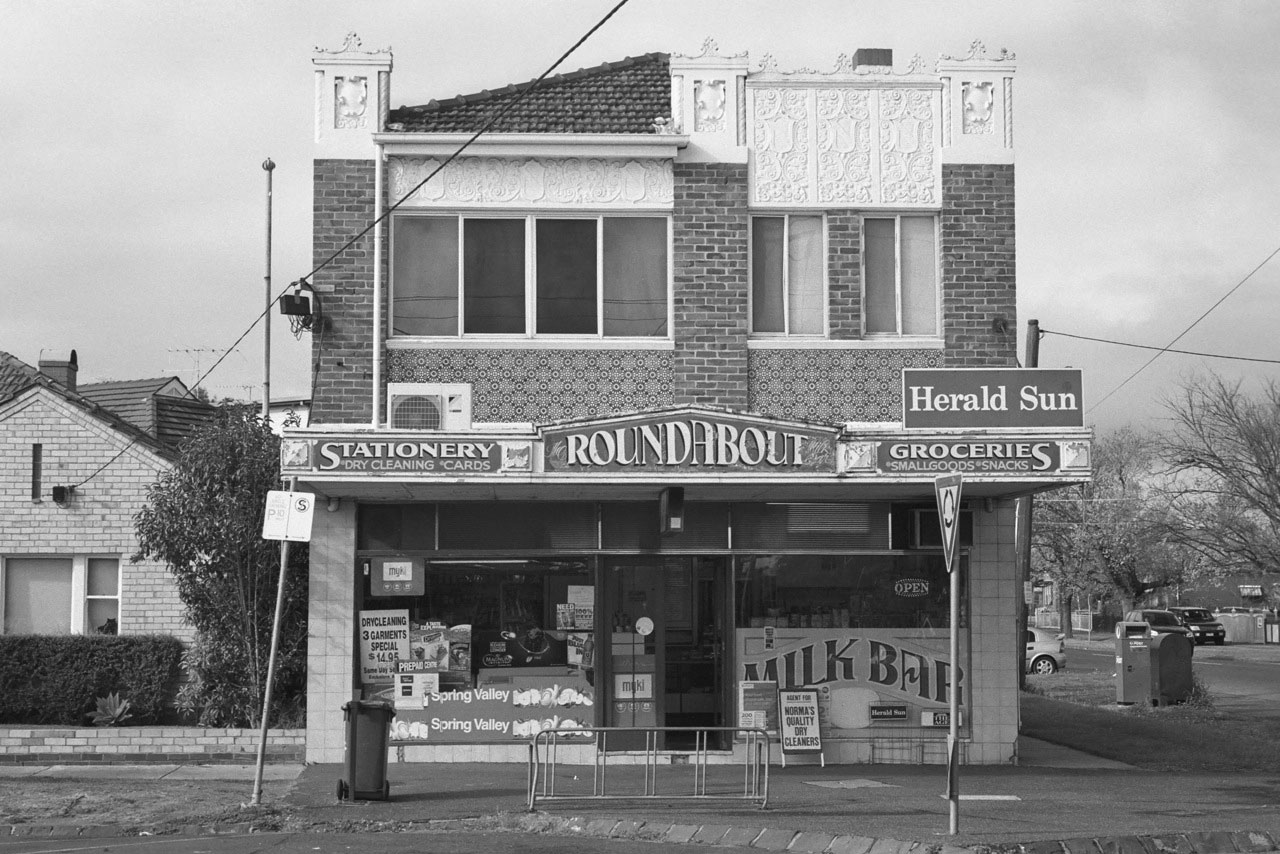
 

David Wadelton (Australian, b. 1955) 'Milk Bar, Napier Street, Essendon' 2012


David Wadelton (Australian, b. 1955)
Milk Bar, Napier Street, Essendon
2012
From the series Milk Bars of Melbourne, 2010-13
Photo: © David Wadelton


For Melbourne Now, Wadelton contributes a series of recent photographs of suburban milk bars selected from his vast personal cache. Whereas these shots of corner-store facades – windows jammed with ice-cream, soft drink and newspaper logos, hand-painted typography and scrawled graffiti – echo the Pop paintings that made his name, insofar as they combine ready-made commercial symbols on the same flat, pictorial plane, the photographs’ grey-scale palette and documentary presentation differ from the futuristic aesthetic of Wadelton’s canvases. While the paintings delight in global commercial imagery, Milk Bars of Melbourne, 2010-2013, shows a local culture in terminal decline.
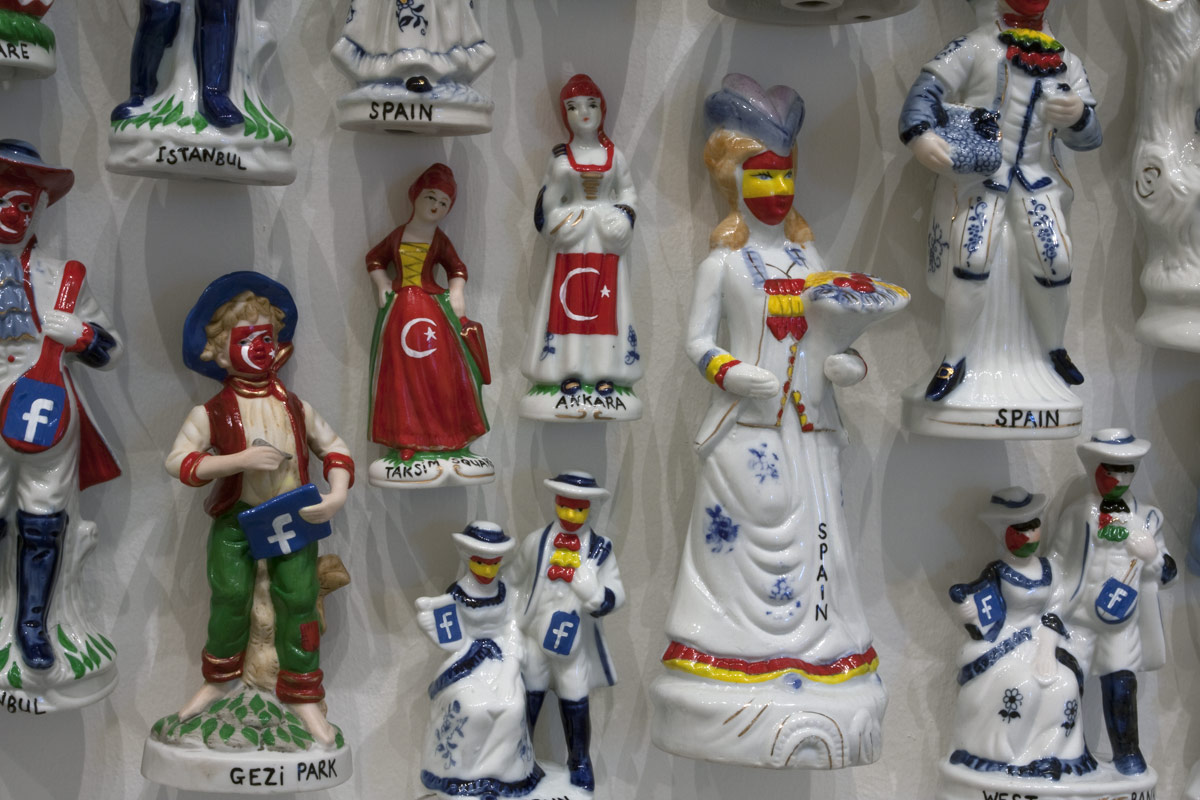
 

Penny Byrne (Australian, b. 1965) 'iProtest' 2012-13 (installation view details)

Penny Byrne (Australian, b. 1965) 'iProtest' 2012-13 (installation view details)


Penny Byrne (Australian, b. 1965)
iProtest (installation view details)
2012-2013
Photos: © Marcus Bunyan


While at first iProtest, 2012-2013, resembles a display of endearing souvenir-style figurines hanging on a wall, its potency is revealed on closer inspection. Each figurine is personalised with details relating to one of the many conflicts driven by mass protests around the world. Nationalism is referenced by faces painted with flags; acts of violence leave bodies dismembered and bloodied; and the cutest figurines are in fact riot police, wielding guns and dressed as clowns. The omnipresent symbol of Facebook is also ingeniously added to the work. Byrne’s crowd of modified figurines explores the way social media has become a significant tool for coordinating protests around the world.

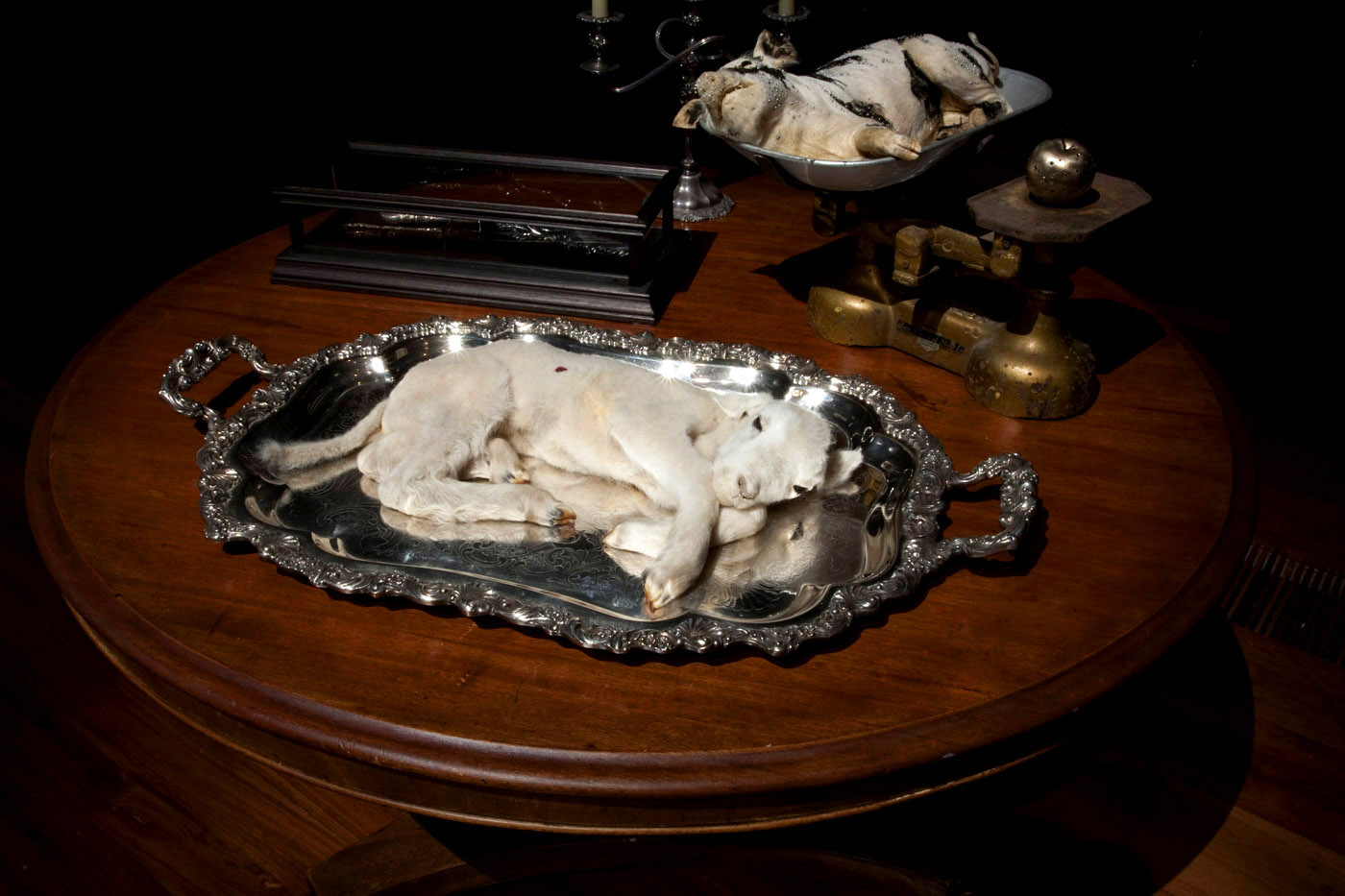
 

Julia deVille (Australian, b. 1982) 'Degustation' 2013 (installation view detail)

Julia deVille (Australian, b. 1982) 'Degustation' 2013 (installation view detail)

Julia deVille (Australian, b. 1982) 'Degustation' 2013 (installation view detail)


Julia deVille (Australian, b. 1982)
Degustation (installation view details)
2013
Photos: © Marcus Bunyan


Informed by a fascination with death, memento mori and Victorian jewellery design, deVille’s work relies on traditional techniques and involves a broad range of animals, precious and semiprecious metals and gems. The artist is a vegan and passionate advocate for the fair and just treatment of animals, and only uses animals that have died of natural causes in her work. By examining death in this distinctive way, deVille urges us to consider our own mortality and the beauty of death and remembrance. For Melbourne Now she has created an installation titled Degustation, 2013, which evokes an ornate Victorian-style dining room, filled with her sculptural pieces and works from the NGV collection.
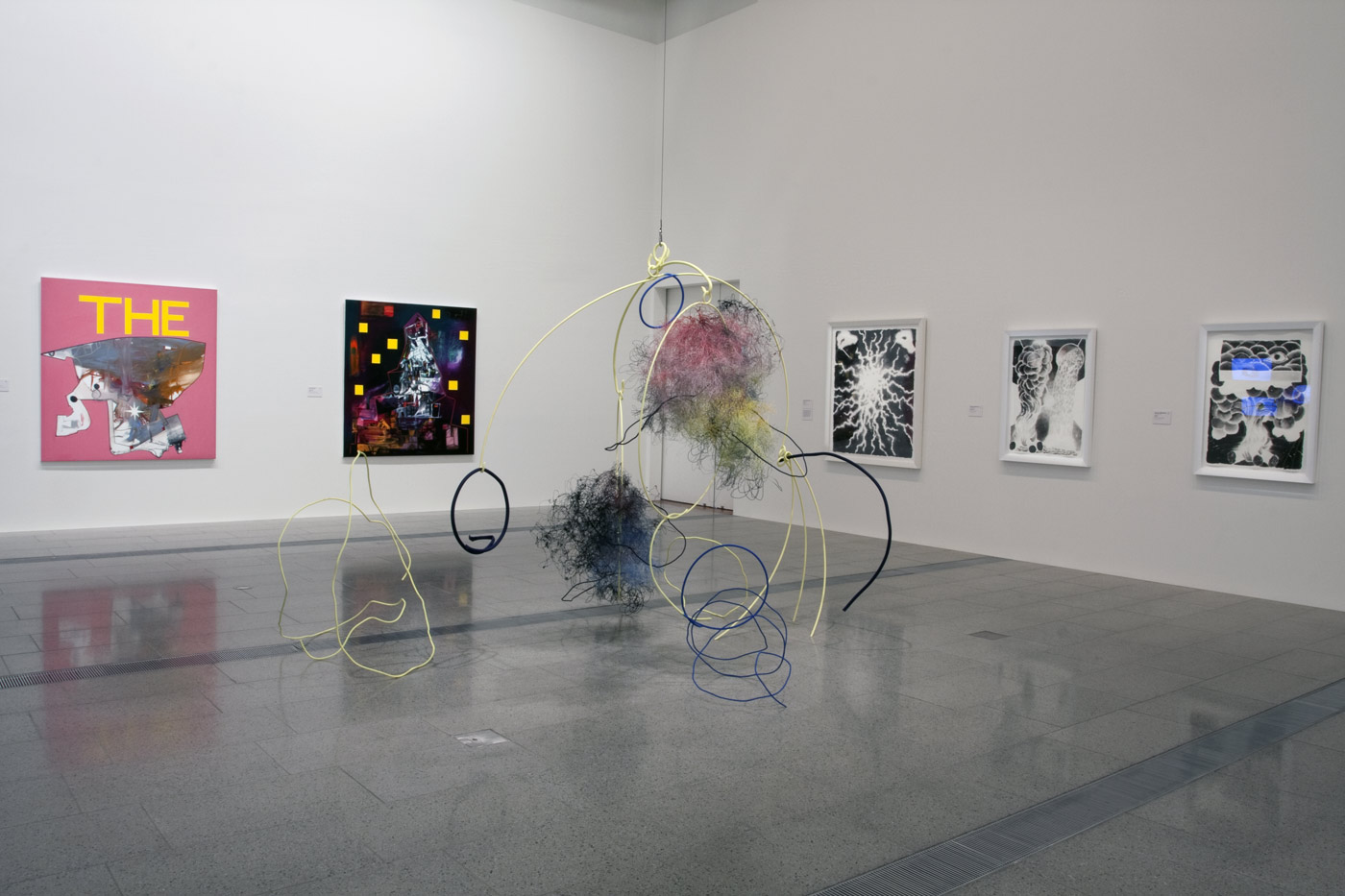
 

Mira Gojak (Australian, b. 1963) 'Transfer station 2' 2011 (installation view)


Mira Gojak (Australian, b. 1963)
Transfer station 2 (foreground) (installation view)
2011
Photo: © Marcus Bunyan


With Transfer station 2, 2011, Gojak creates a sculptural work of unfurling, freewheeling loops, shaky erratic lines and clusters of blossoming tangles that appears like a drawing suspended in space. A high-keyed palette of cobalt blues, soft pinks and fluorescent yellows activates heavier blackened thickets that punctuate perspectives of uninterrupted space. Suspended from the ceiling by a single line, Gojak’s sculpture is a not-quite-settled upon Venn diagram. Its openness is held still in a moment, together with all the scribbled-out mistakes, digressions and exclusions, stalling or directing the movement and exchange circulating around the forms.
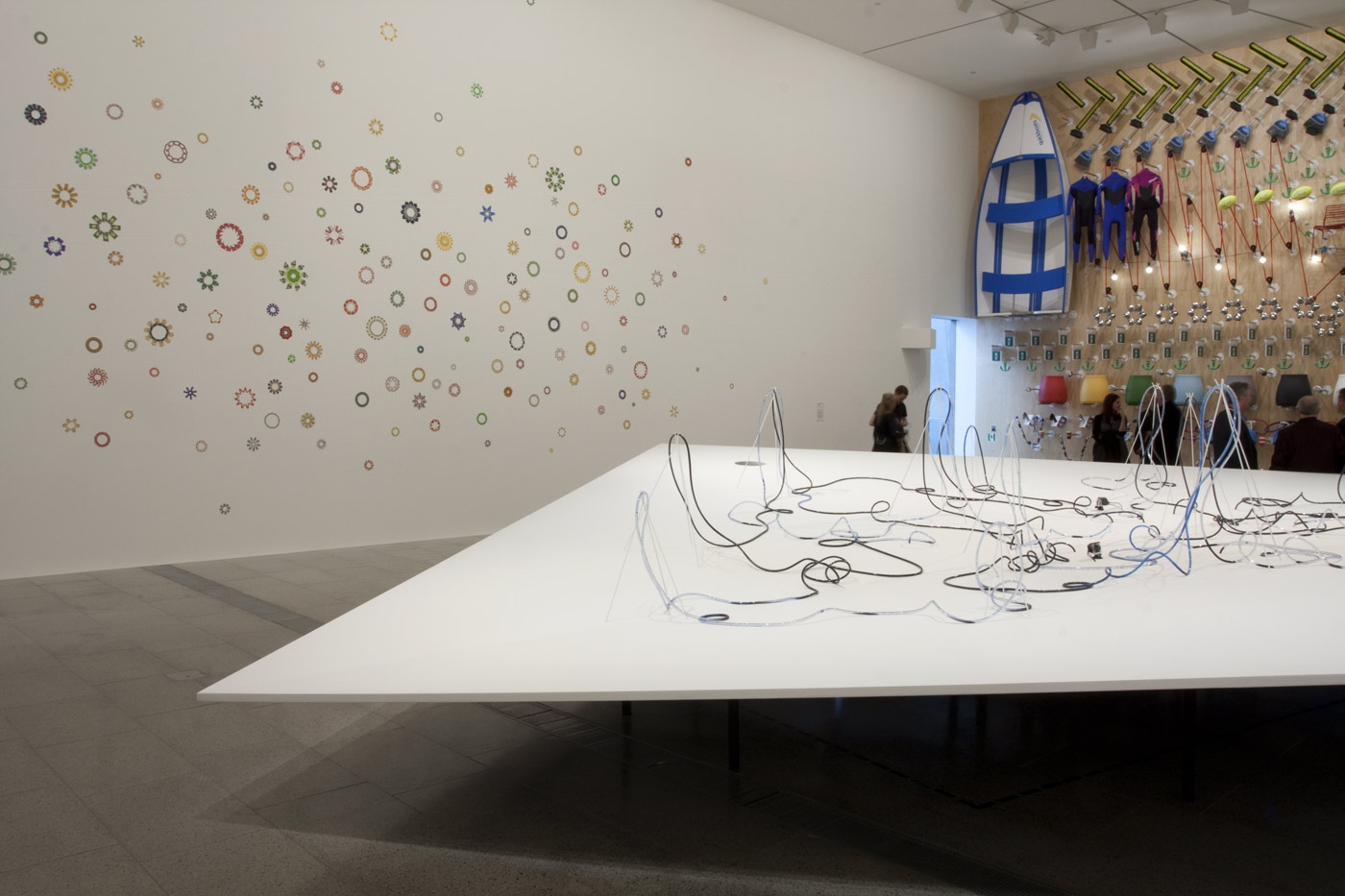
 

Daniel von Sturmer. 'Paradise park' 2013 (installation view detail) with Elizabeth Gower's '150 rotations' 2013 on the wall at left behind


Installation view of Daniel von Sturmer’s Paradise park 2013 (detail, foreground) with Elizabeth Gower’s 150 rotations 2013 on the wall behind (detail, left)
Photo: © Marcus Bunyan


The first version of 150 rotations was displayed recently in an exhibition, curated by Gower, that explored the appropriation and use of urban detritus as a visual art strategy by a variety of Melbourne artists. Further developed for Melbourne Now, Gower’s contribution now comprises 150 circular components, each made up of tea-bag tags, price tags and elements cut from junk mail catalogues, which colonise the wall like a galaxy of vibrant constellations. Akin to the light from long-dead stars, the familiar ephemera, which is usually thrown out, recycled or composted, now serves a new purpose and takes on a mesmeric, formal beauty.


Daniel von Sturmer (Australian, b. 1972) 'Paradise park' 2013 (installation view)

Daniel von Sturmer (Australian, b. 1972) 'Paradise park' 2013 (installation view)

Daniel von Sturmer (Australian, b. 1972) 'Paradise park' 2013 (detail)


Daniel von Sturmer (Australian, b. 1972)
Paradise park (installation views)
2013
Photos: © Marcus Bunyan


Von Sturmer’s Melbourne Now commission for kids, Paradox park, 2013, creates a space for enquiry and interaction with art, conceived with a child’s innate sense of curiosity and wonder. Paradox park comprises a large tilted plane with small circular apertures through which a child (or adventurous adult) can push their head in order to view small projections of animated objects atop and below the surface. By placing the viewer’s point of reference inside the work, von Sturmer posits experience itself as a creative act – a unique interplay between viewer and viewed.
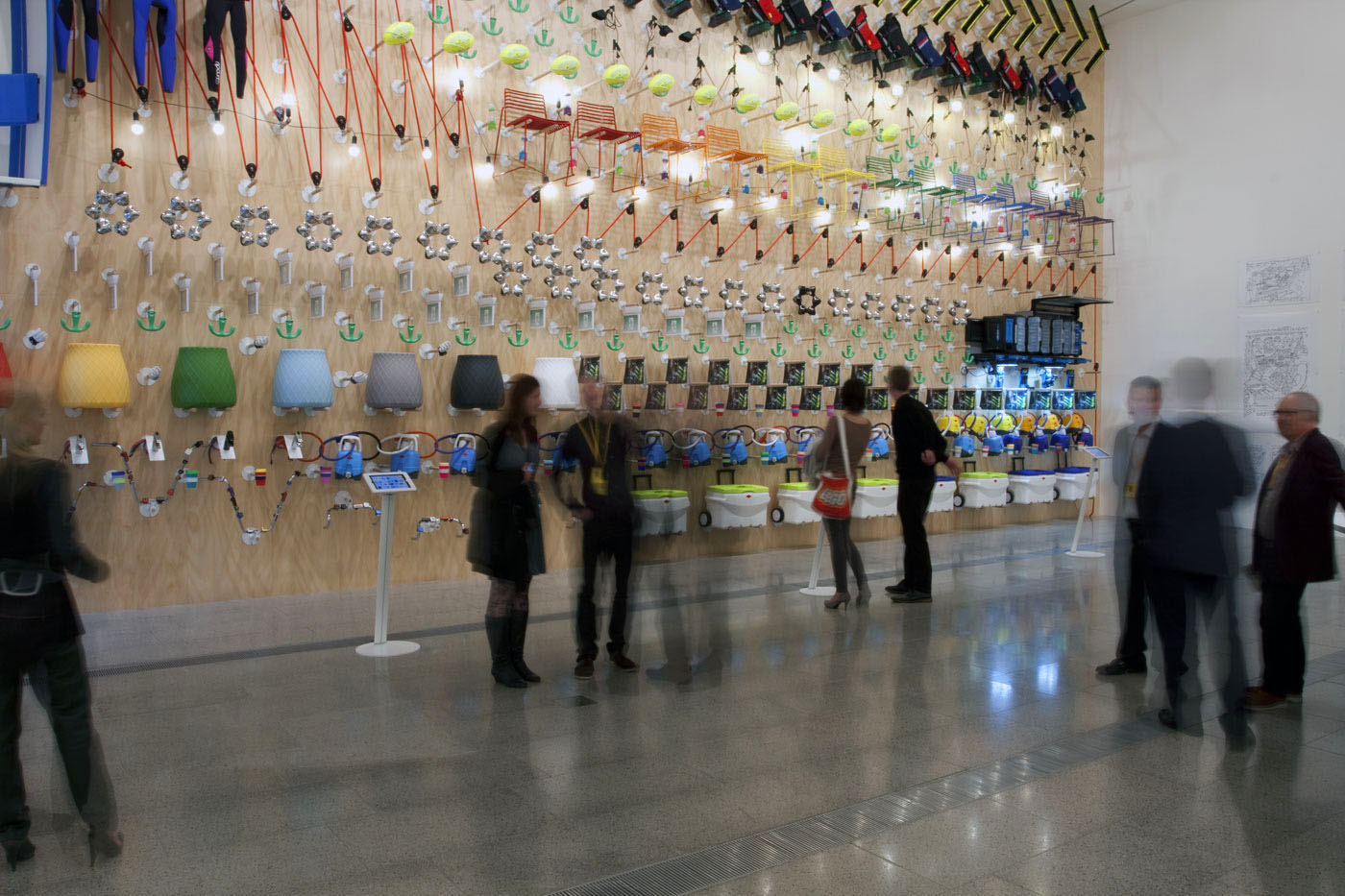
 

Melbourne Design Now. Simone LeAmon (curator, exhibition designer) (Australia, b. 1971) Edmund Carter (exhibition designer) (Australia, b. 1983) 'Design in everyday life' 2013 (installation view)


Melbourne Design Now
Simone LeAmon (curator, exhibition designer) (Australia, b. 1971)
Edmund Carter (exhibition designer) (Australia, b. 1983)
Design in everyday life (installation view)
2013
Supported by The Hugh D. T Williamson Foundation
Photo: © Marcus Bunyan


Melbourne Design Now is the first design exhibition of its kind to be shown at the National Gallery of Victoria. A presentation of localised creative intelligence in the fields of industrial, product, furniture and object design, this project comprises more than ninety design projects from forty designers, design studios and companies. Melbourne Design Now celebrates design’s relationship to everyday life and how contemporary designers are embedding unique and serial design production with ideas, meaning and emotion to resonate with the city of Melbourne.

The breadth of design projects in this ‘exhibition within the exhibition’ intends to communicate to the public that the work of Melbourne designers is influencing discourses, future scenarios and markets both at home and around the world. Ranging from cinema cameras by Blackmagic Design to the Bolwell EDGE caravan, eco-design education tools by Leyla Acaroglu to Monash Vision Group’s direct-to-brain bionic eye, and furniture made with ancient Australian timber by Damien Wright to biodegradable lampshades by LAB DE STU, these design projects consolidate Melbourne as one of the great design cities in the world today.
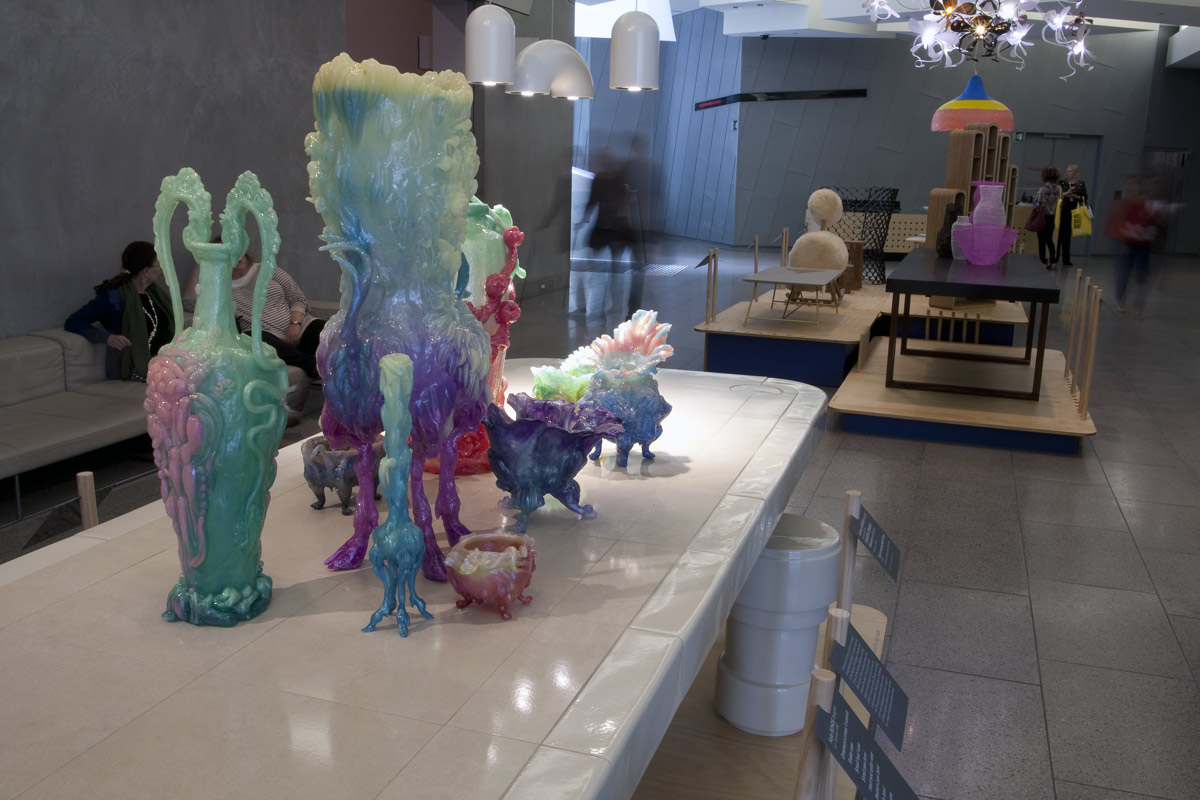
 

Melbourne Design Now. Gregory Bonasera 'Palace table' 'Derby pendant light' 2013 Kate Rohde 'Ornament is Crime vessels' 2013 (installation view)

Melbourne Design Now. Gregory Bonasera 'Palace table' 'Derby pendant light' 2013 Kate Rohde 'Ornament is Crime vessels' 2013 (installation view)


Melbourne Design Now
Gregory Bonasera (Australian, b. 1965)
Palace table
Derby pendant light
2013
Kate Rohde (Australian, b. 1980)
Ornament is Crime vessels
2013
Photos: © Marcus Bunyan


Gregory Bonasera is a ceramicist with an in depth understanding of the processes utilised in the production of ceramics; a methodical thinker who works more like an industrial designer than a potter to realise his creations and to advise and collaborate with other designers on their projects. Consistently adding new works to his range of innovative functional and sculptural ceramic wares, Gregory casts his creations in fine porcelain and bone china employing a hybrid of state of the art CAD technology with traditional 270 year old ceramic production methods. His works are strongly influenced by natural forms, science, biology, botany and geometry.

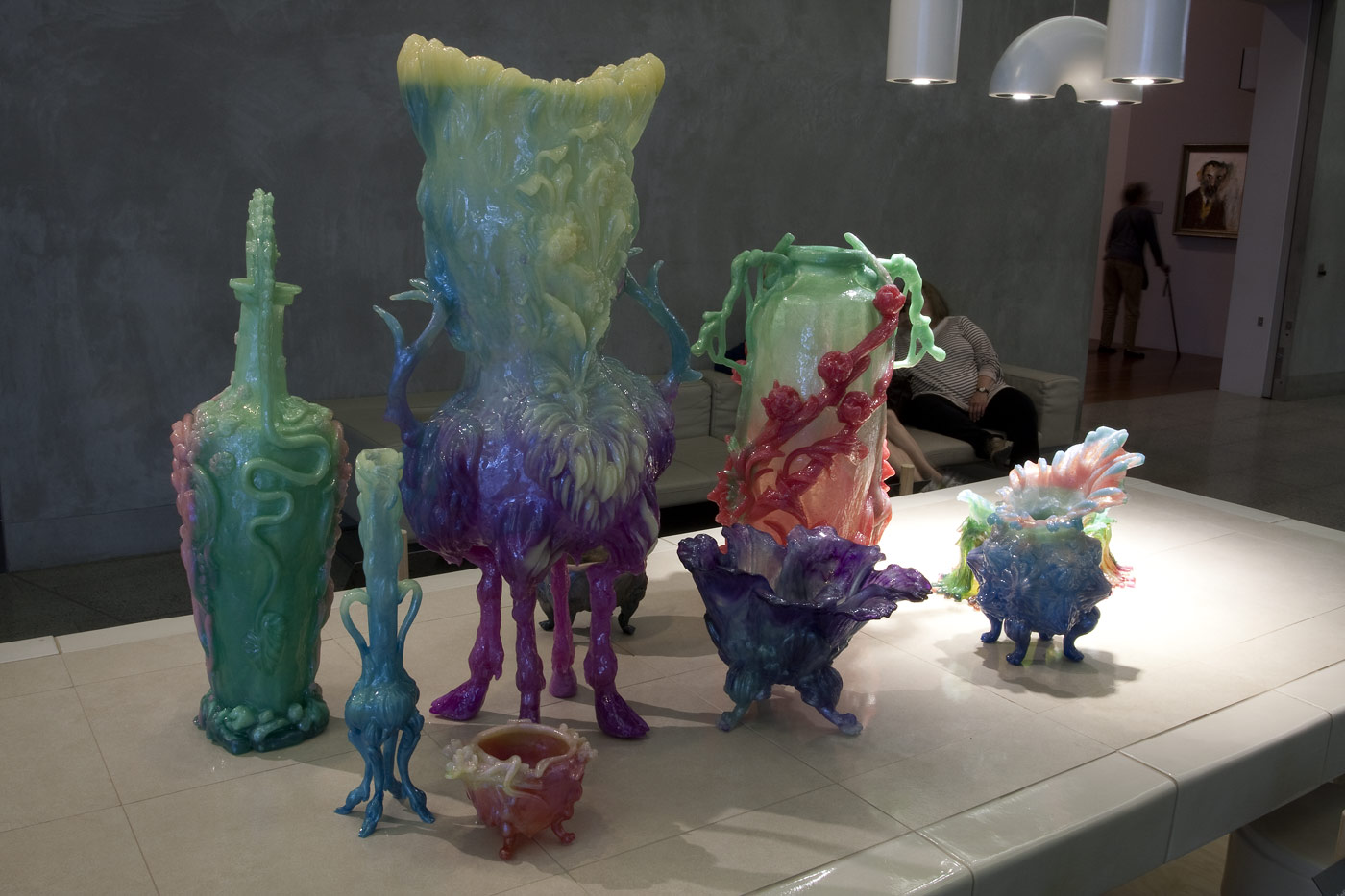
Kate Rohde’s jewellery and vessels are created in resin, a signature material that features extensively in her visual art practice. These pieces take a playful, decorative approach, often incorporating elements typical of Baroque and Rococo style, drawing particularly on the decorative arts and interior design of this era. The highly ornate nature reveals, on closer inspection, that much of the patterning is drawn from flora and fauna sources. The combination of the two intersecting interests creates a psychedelic supernature.

Text from the Pieces of Eight Gallery website [Online] Cited 25/11/2013


Installation view of Jess Johnson Various titles 2013 (installation view)

Installation view of Jess Johnson Various titles 2013 (installation view)


Installation views of Jess Johnson Various titles 2013
Photos: © Marcus Bunyan


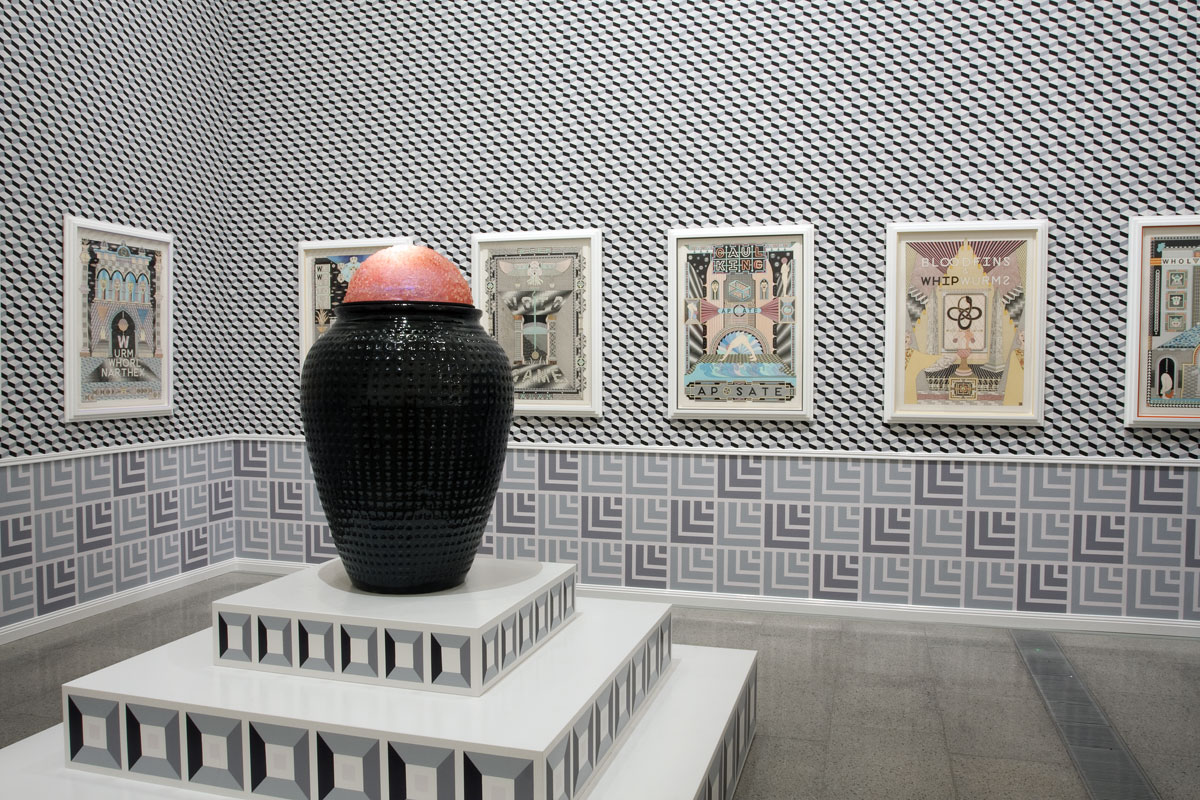
Johnson creates fantastic worlds in images that combine densely layered patterns, objects and figures within architectural settings. Cryptic words and phrases are part of her unique and idiosyncratic iconography. The artist’s drawing and installation practice is inspired by science fiction, mythological cosmology and comic books, and reflects a diverse interest in art, ranging from illuminated manuscripts to folk art traditions such as quilt making. Her contribution to Melbourne Now includes ten new drawings that depict the imagined formation of a future civilisation. These are displayed within a constructed environment featuring a raised podium, painted walls and patterned floor which, together with the drawings, offers an immersive experience.

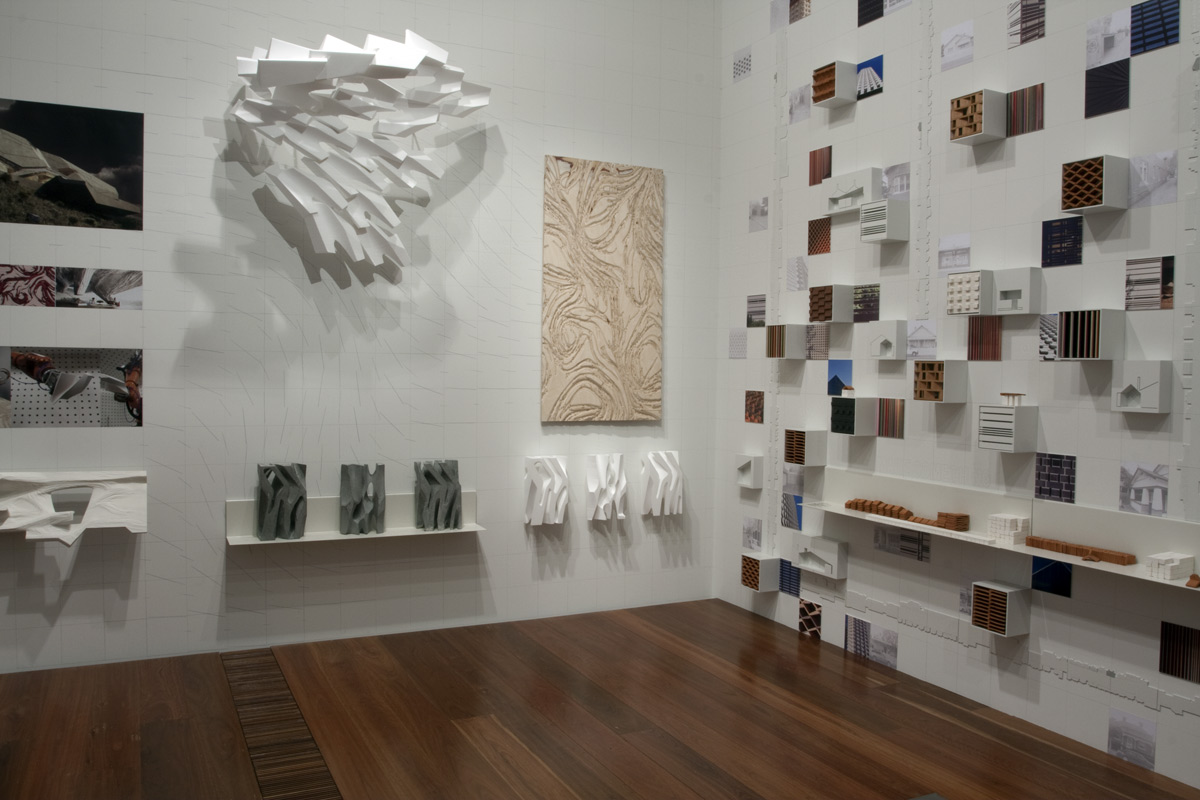
 

'Sampling the City: Architecture in Melbourne Now' (installation view)

'Sampling the City: Architecture in Melbourne Now' (installation view)

'Sampling the City: Architecture in Melbourne Now' (installation view)


Installation views of Sampling the City: Architecture in Melbourne Now
Photos: © Marcus Bunyan


Sampling the City: Architecture in Melbourne Now reveals the complex web of personalities, factions and trajectories that make up Melbourne’s vibrant contemporary architectural culture. This project asks: What are the ideas and themes that inform Melbourne’s design culture? Who are its agitators and protagonists? How are emerging architects driving new ways of thinking? The project is in four parts:

~ A ‘super graphic’ introduction sampling Melbourne’s contemporary architectural culture

~ A projection space with architectural imagery curated to five themes: representation and the city; craftsmanship and materiality; art-engaged practice; stitching the city; and bio-futures/advanced architecture

~ An incubator/studio environment providing insight into the processes of six leading Melbourne architects: Cassandra Fahey, Make Architecture, March Studio, Muir Mendes, Studio Bird and Studio Roland Snooks

~ An intimate screening room with a video artwork by Matthew Sleeth

Sampling the City is curated by Fleur Watson, with exhibition design by Amy Muir and Stuart Geddes, projection and soundscape design by Keith Deverall, introductory narrative by Watson and Michael Spooner and built environment imagery by Peter Bennetts.
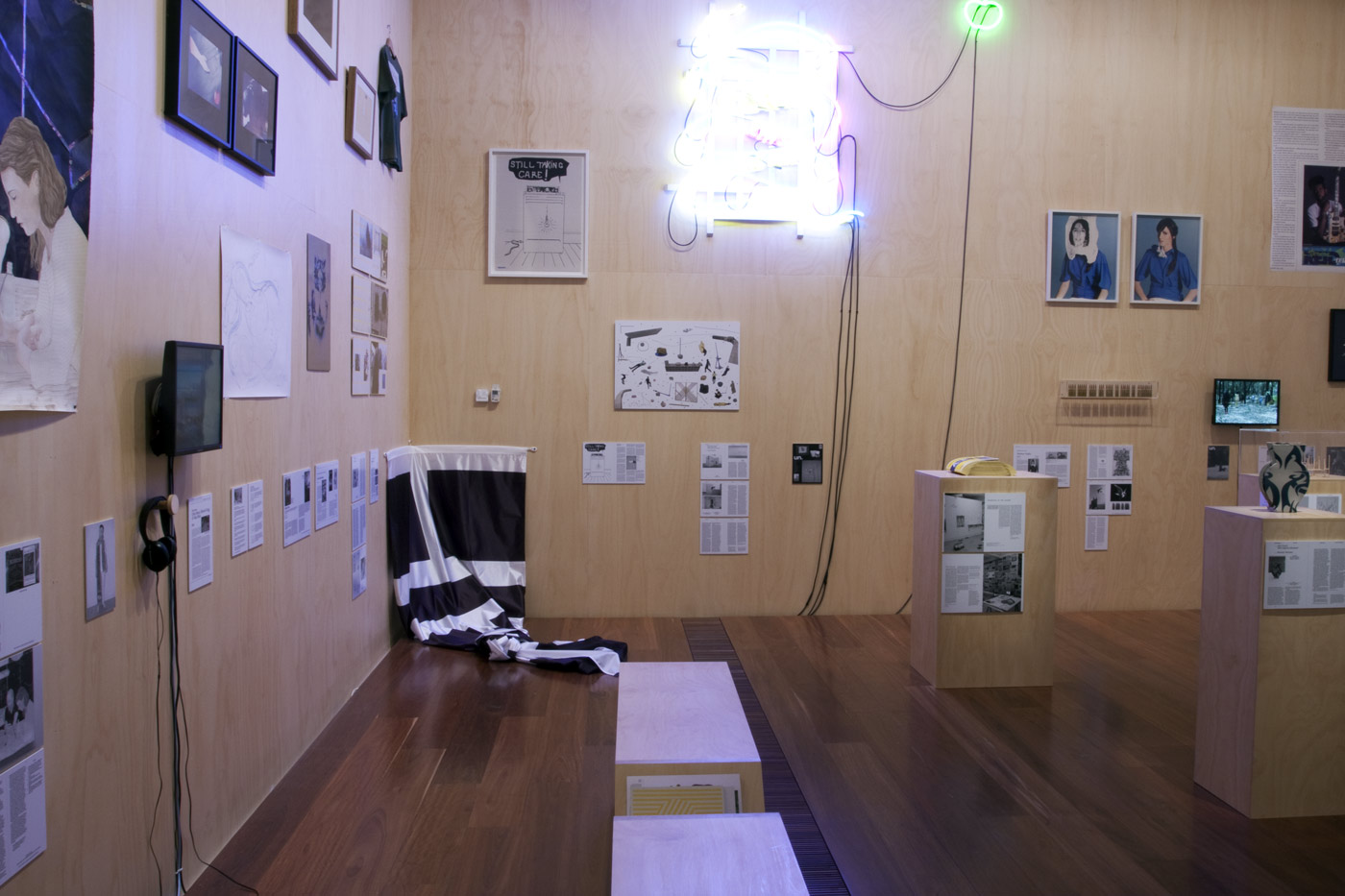
 

un Magazine. 'un Retrospective' 2013 (installation view)


un Magazine
un Retrospective (installation view)
2013
Photo: © Marcus Bunyan


For Melbourne Now, un Magazine presents un Retrospective – a selective history of artists, writers and art practice in Melbourne since 2004, as featured in the back catalogue of the magazine. Taking inspiration and content from past issues, un Retrospective assembles recent local works of art alongside correlating text – whether original essay, review or interview – from the pages of un Magazine, highlighting the relationships between criticism and practice, writers and artists, that have been fostered in the publication. un Retrospective celebrates ten years of un Magazine and contemporary art in Melbourne while providing a point of historical context within the newness of Melbourne Now.


Slave Pianos. 'Gamelan sisters' 2013 (installation view)


Slave Pianos
Gamelan sisters (installation view)
2013
Photo: © Marcus Bunyan


Slave Pianos – a collaboration between artists, composers and musicians Rohan Drape, Neil Kelly, Danius Kesminas, Michael Stevenson and Dave Nelson – make historically grounded, research-based installations and performances utilising humour, immediacy and the conflation of ‘high’ and ‘low’ idioms to suggest connections and interrelations between the largely discrete fields of music, art and architecture.

For Melbourne Now Slave Pianos present Gamelan sisters, 2013, a self-governing electromechanical ‘slave’ gamelan, which allows audience members to select pieces from a repertoire of compositions arranged by Slave Pianos via a wall-mounted console alongside related scores. The Gamelan sisters instrument features in Slave Pianos’ space opera The Lepidopters, to be performed in Indonesia and Australia in 2014, which is based on a three part science fiction story set in Indonesia commissioned from American writer and art critic Mark von Schlegell. A comic depicting the first two parts of The Lepidopters, drawn by Yogyakarta-based artist ‘Iwank’ Erwan Hersi Susanto – a member, with Kesminas, of the Indonesian art-rock collective Punkasila – is also presented in the Melbourne Now Reading Room.


The Ian Potter Centre: NGV Australia
Federation Square
Corner of Russell and 
Flinders Streets, Melbourne

Opening hours:
Daily 10am – 5pm

National Gallery of Victoria website

LIKE ART BLART ON FACEBOOK

Back to top
Three exhibitions: ‘Henri van Noordenburg / Efface’; ‘Amber McCaig / Imagined Histories’ and ‘Greg Elms / What Remains’ at Edmund Pearce Gallery, Melbourne

Exhibition dates: 6th – 23rd November 2013


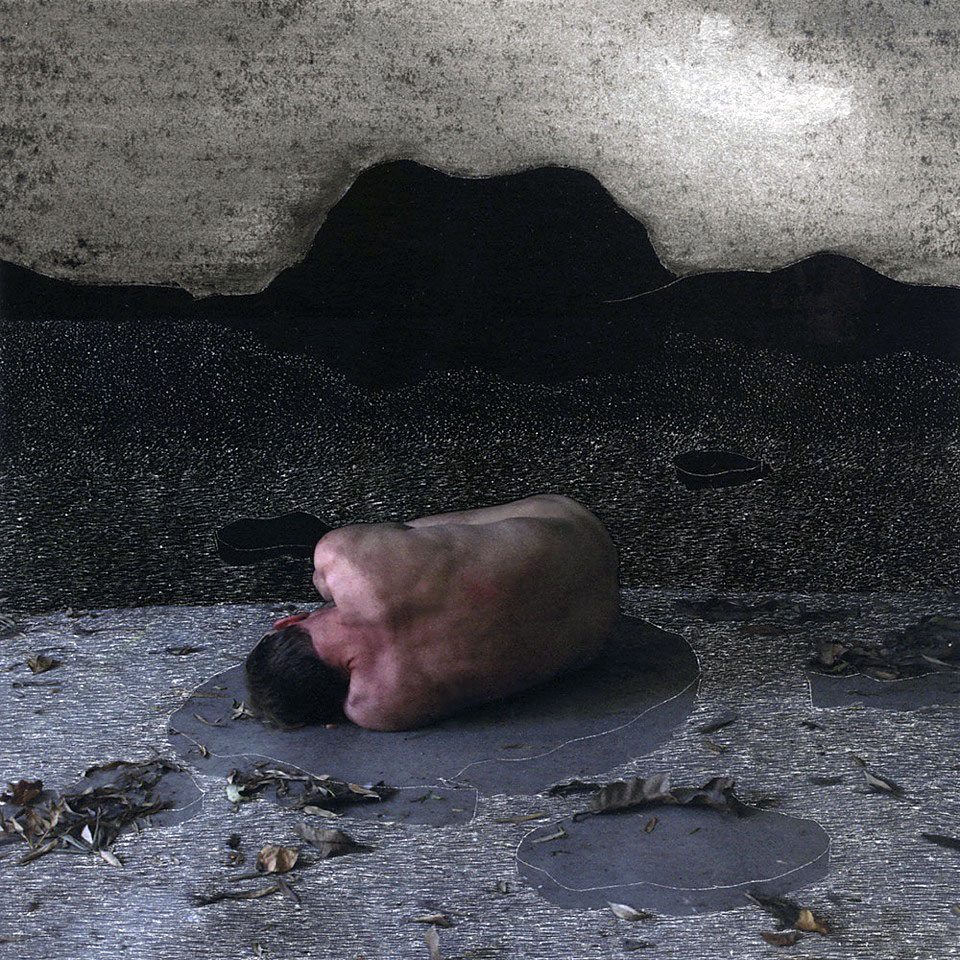
Henri van Noordenburg (Australian born Netherlands, b. 1967) 'Composition XXI' 2013


Henri van Noordenburg (Australian born Netherlands, b. 1967)
Composition XXI
2013
Hand carved archival pigment print
30 x 30cm


Three solid exhibitions at Edmund Pearce Gallery. All three have interesting elements and strong images. All three have their positives and negatives.

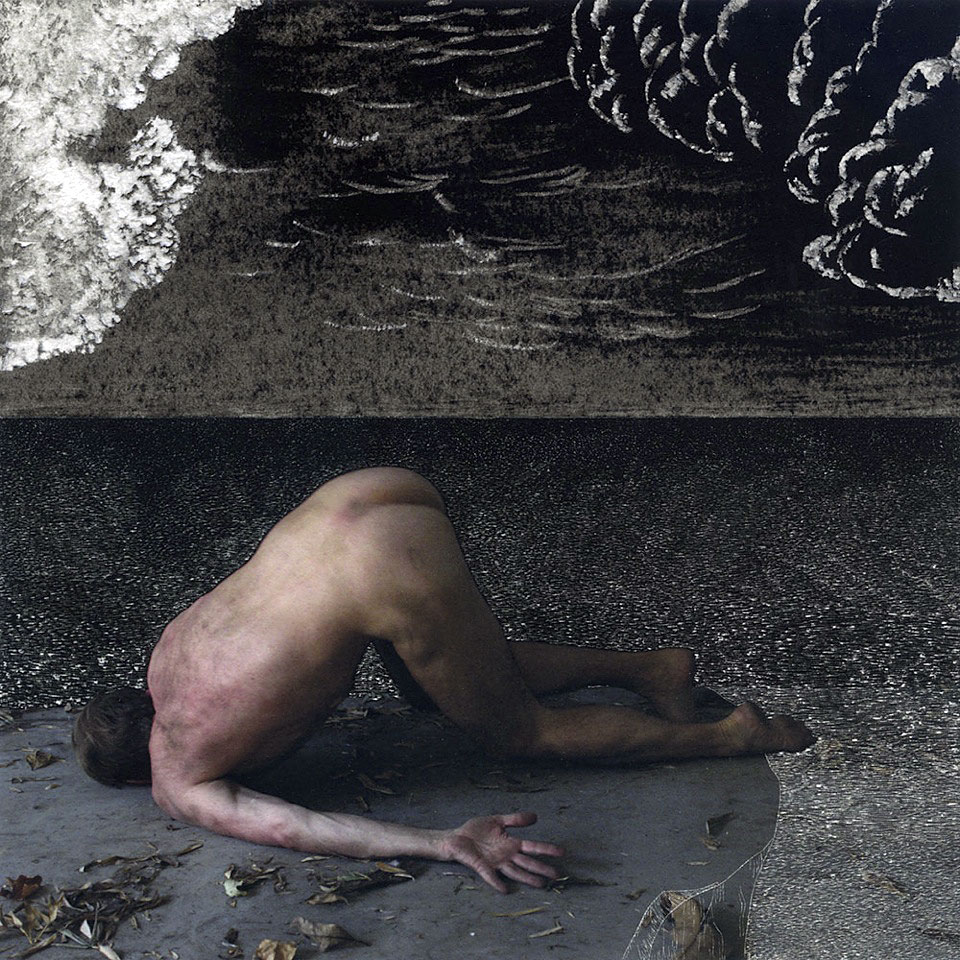
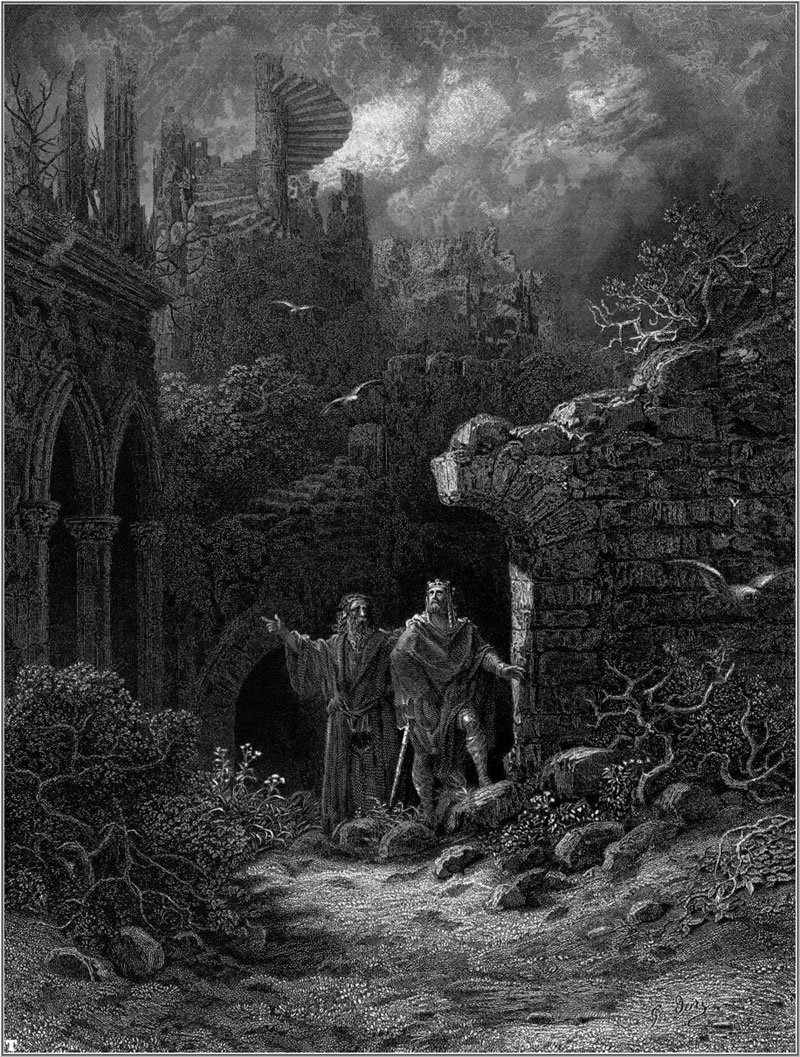
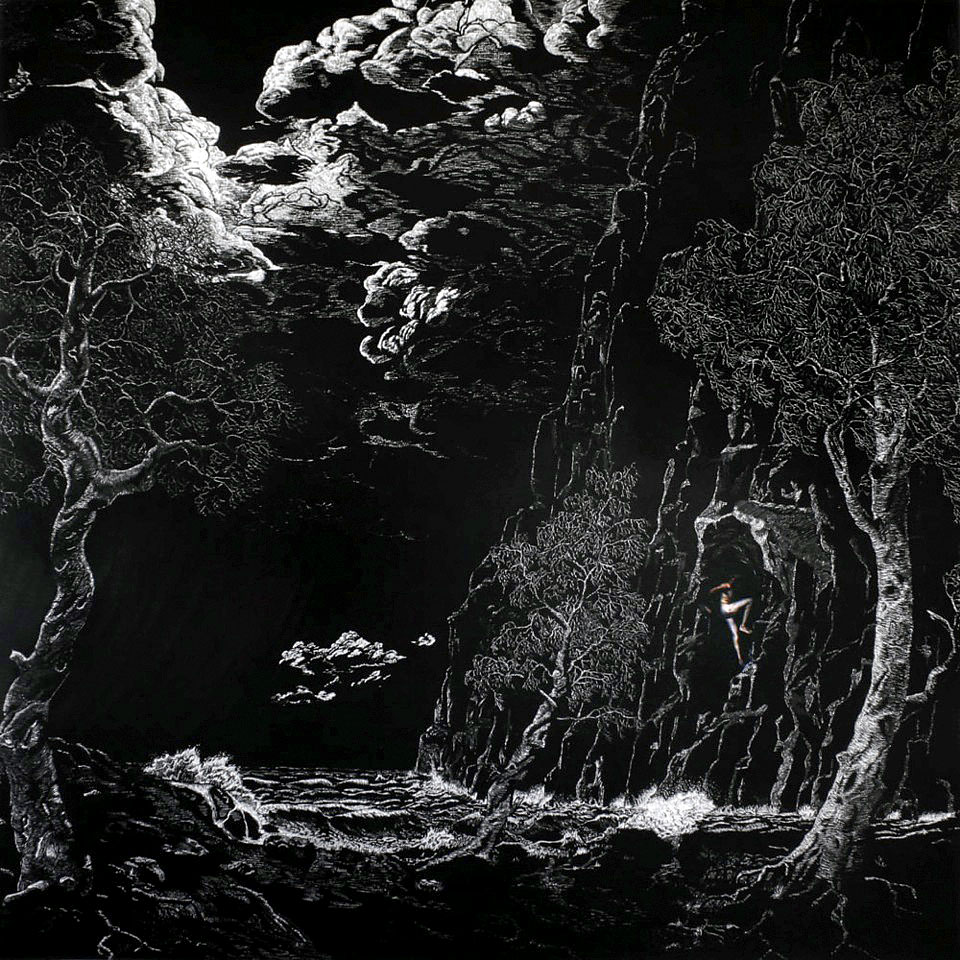
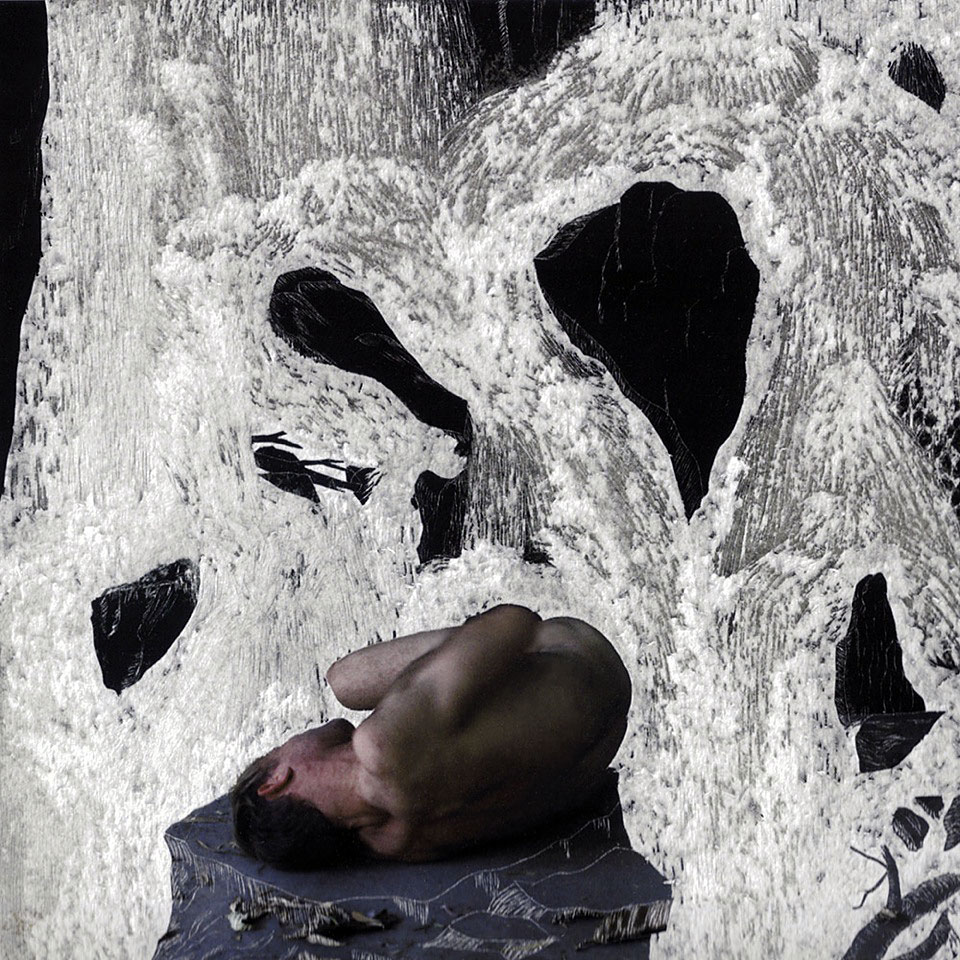
Henri van Noordenburg presents us with a European, colonialist take on the Australian landscape in his new series Efface, similar in their vernacular to early Australian painters visions of their new homeland, with their longing for an “original” home many leagues away over the sea. Except Noordenburg’s interventions look nothing like any Australian landscape I know, heavily influenced as they are by the work of French artist and engraver Gustav Doré (1832-1883) and Japanese wood block prints. His dark, brooding, subterranean art works – in which the artist photographs himself naked and bruised, prints this image on a large sheet of black photographic paper, then hand carves the landscape with a scalpel back into the paper base, isolating but at the same time surrounding the vulnerable, exposed body – image a gothic, melancholy vision of man lost in the wilderness. Here the body (self) is helpless before various forces, but these forces must still be engaged before some progress (pilgrims progress?) can be made.

The technique is truly extraordinary and the artist sets up a “perceptible tension” between technique and form, etching and photograph, body and bulimic (as in excessive), landscape. These ‘synthetic landscapes’ whose form is produced by spatial reorganisation and topographical interventions, man-made spaces, serve as background for what the artist wants us to see as our collective existence.1 Unfortunately, the conceptualisation of the work seems, well, a little confused. And perhaps that is the point. Noordenburg, with his Dutch heritage, is apparently still unsure of his place in a multicultural Australia, even after a few decades living here. But, I feel his point of departure for this work still remains uncertain. And this leads to uncertain outcomes for the viewer.

This uncertainty in the point of departure makes it difficult for the viewer to empathise with the stylistic inclinations of the landscape or the work as a whole. Somehow, it all seems so remote from too much. We can all sympathise with the “humanity” of the work, its anguish and sense of dislocation and wish it well, but I was left a little non-plussed by the visual evidence presented to me. If the exhibition was about wildness (not wilderness) and craziness (not a form of identity dislocation), then it would have been spot on:

“God against man. Man against God. Man against nature. Nature against man. Nature against God. God against nature. Very funny religion!”

D.T. Suzuki (1870-1966)

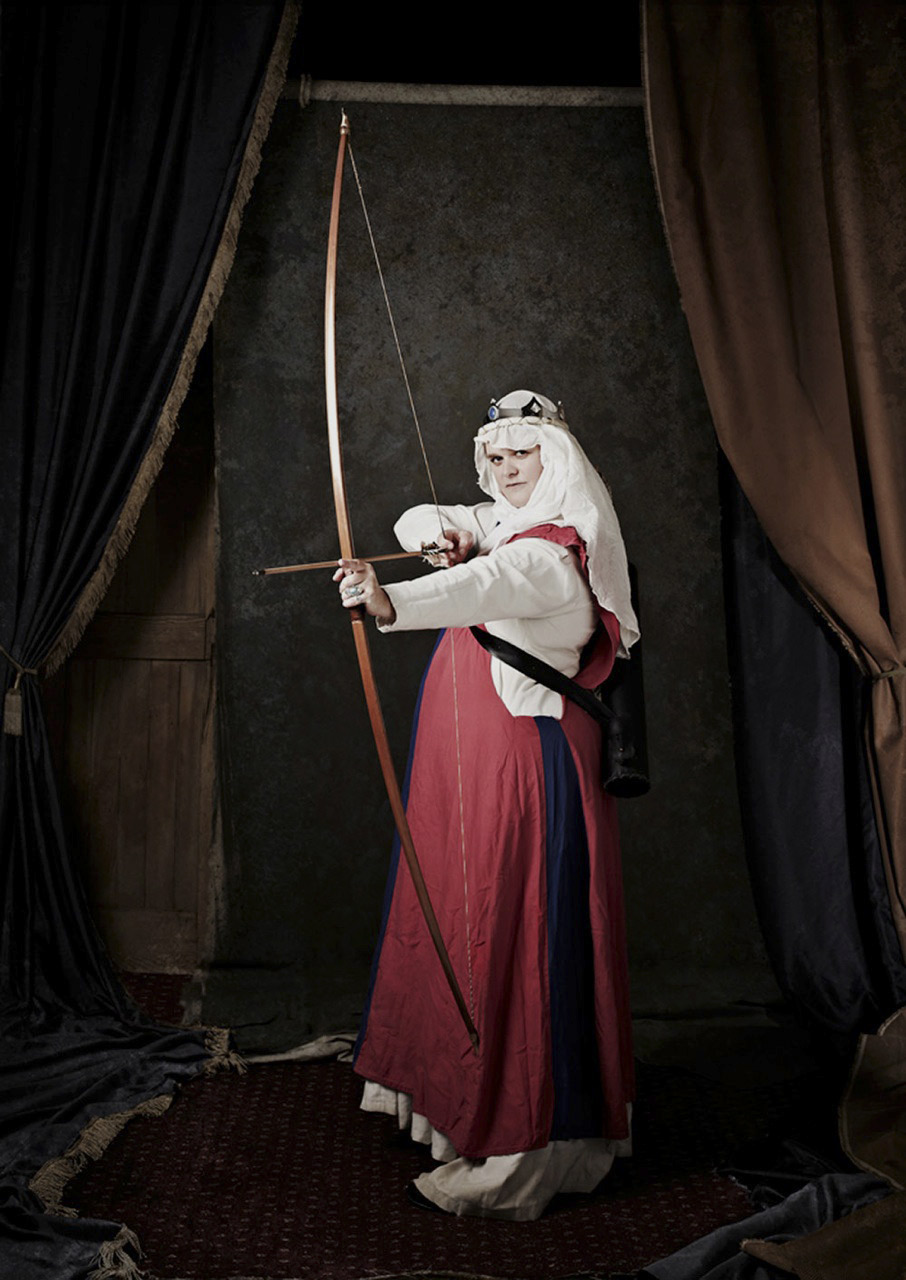
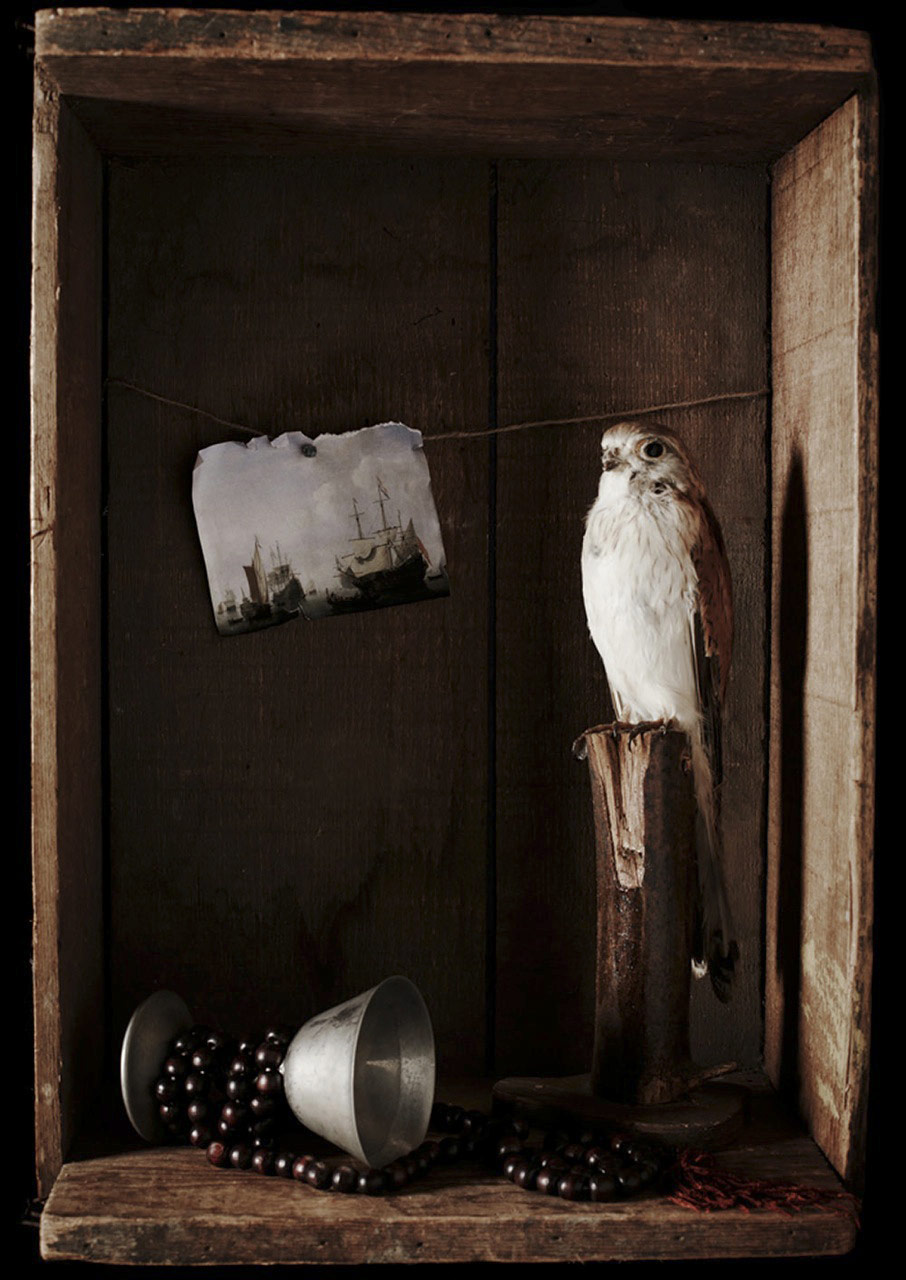
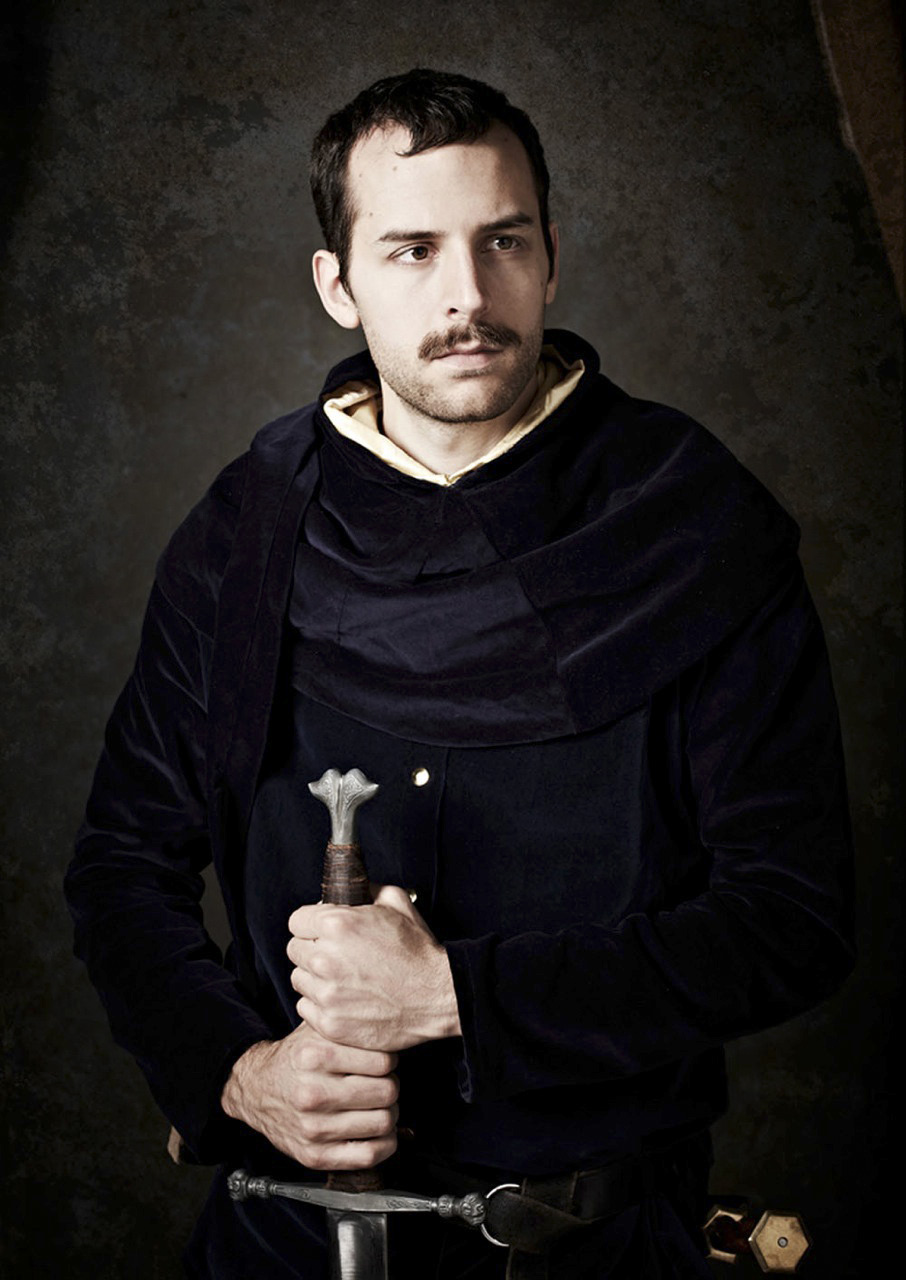
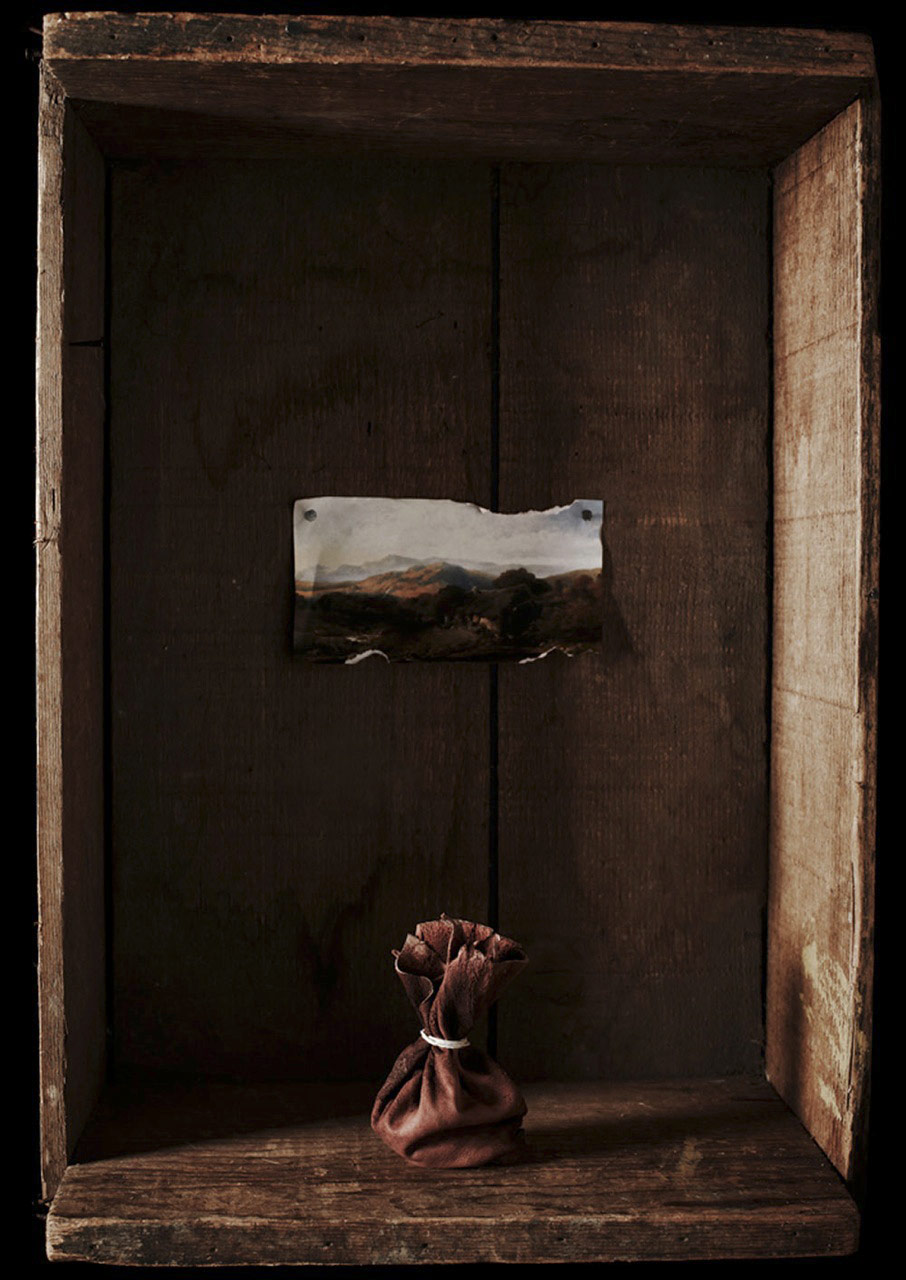
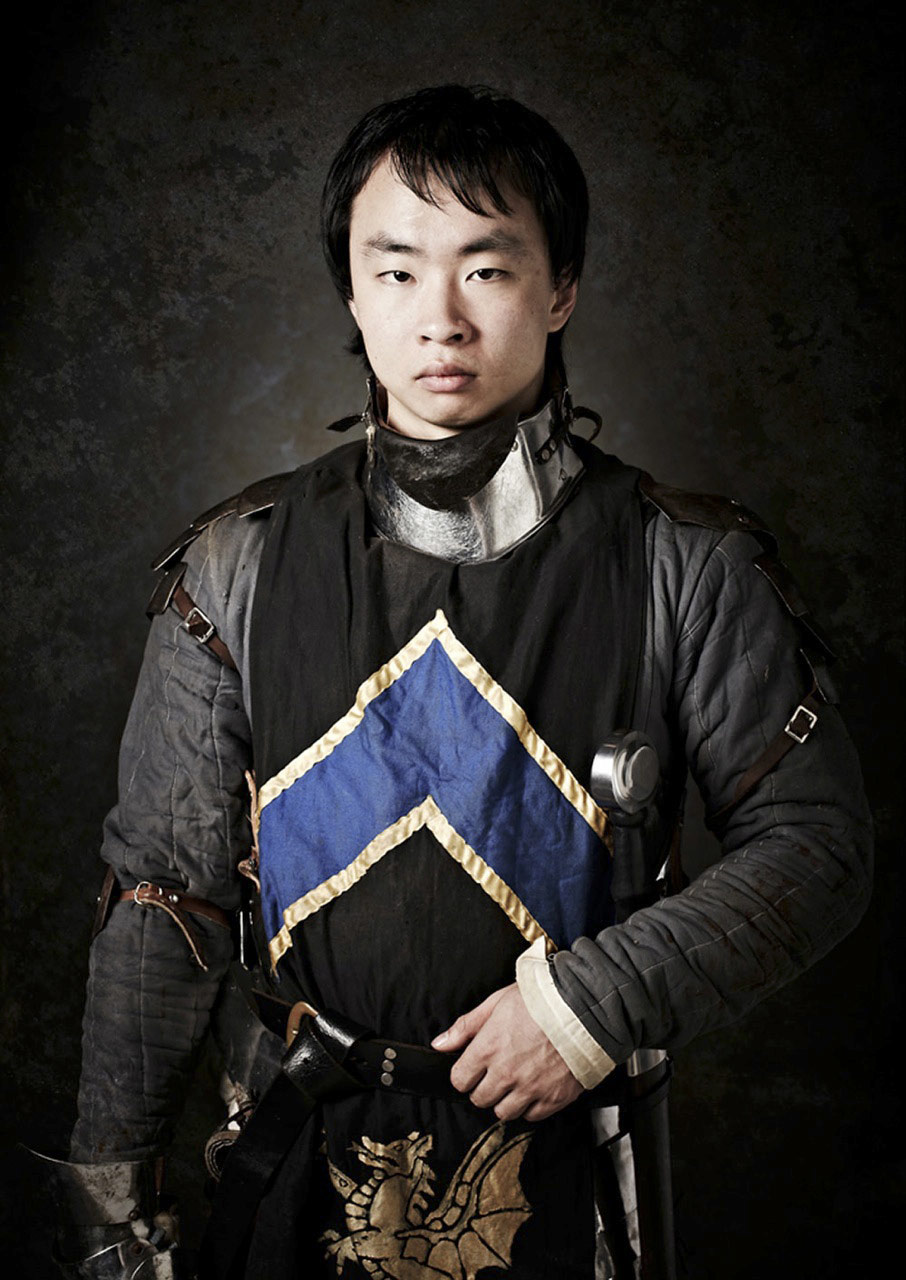
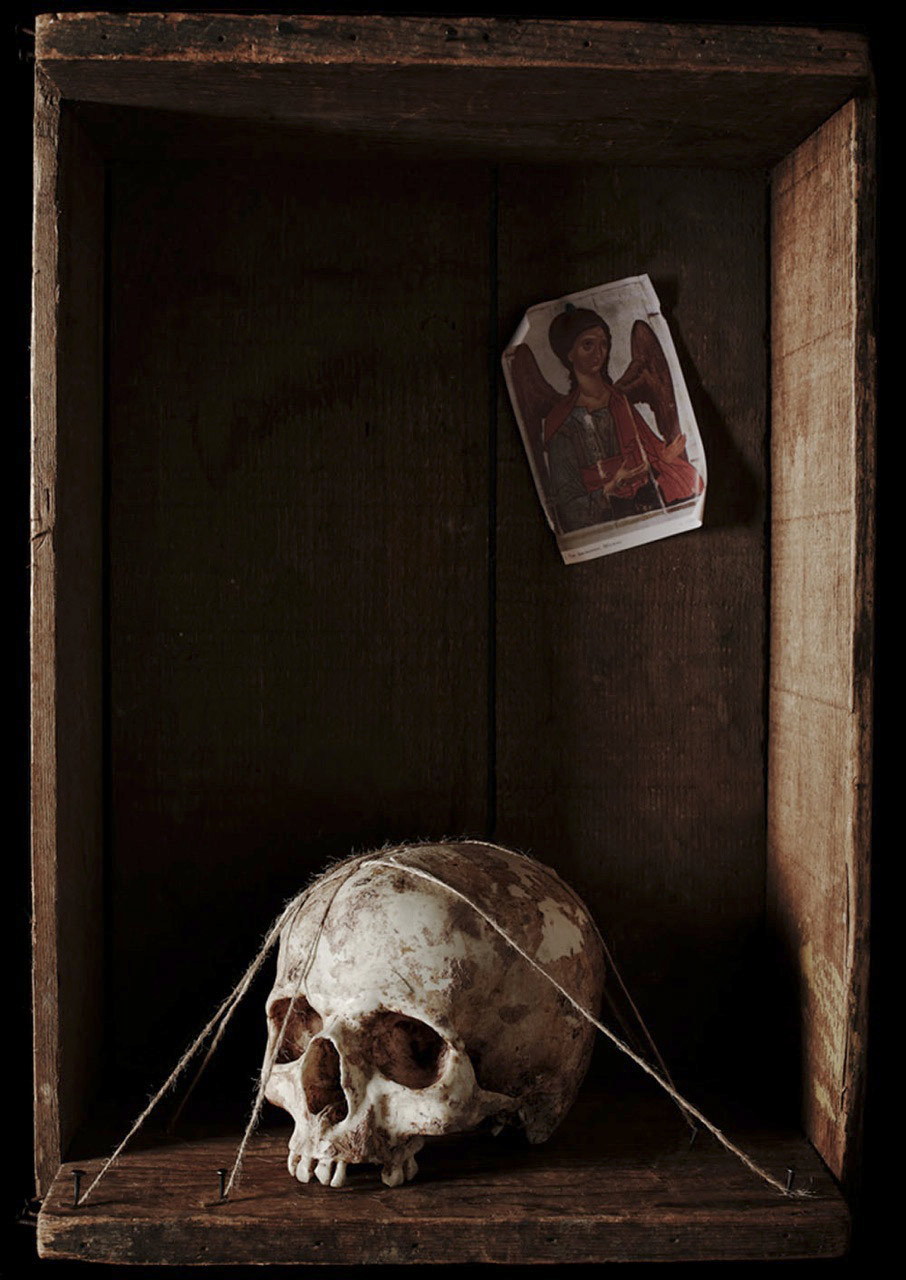
Amber McCaig‘s series Imagined Histories image “contemporary people captured by a sharp technology… [as they] aspire to join the consciousness of another epoch” (Robert Nelson). Small, intense prints, hung in pairs, re-present figures dressed in renaissance costume acting out the fantasy of living in a romantic, historical era. The portraits are paired with still life of wooden boxes filled with allegorical objects full of symbolic representation. The portraits are strong (the incongruity of an Asian knight is particularly effective), and the relationship between portrait and still life is ambiguous and nuanced. However, the still life become repetitive with the constant placement of images at the back of the box coupled with objects situated towards the front of the box. A study of the magical boxes of the artist Joseph Cornell would have been beneficial in this regard.

I feel that there needs to be more layering in the construction of the individual photographs and between the works in the series as a whole, not just the pairs of images. While the work is a little one dimensional in this imagined time, this is a good beginning to an ongoing investigation.

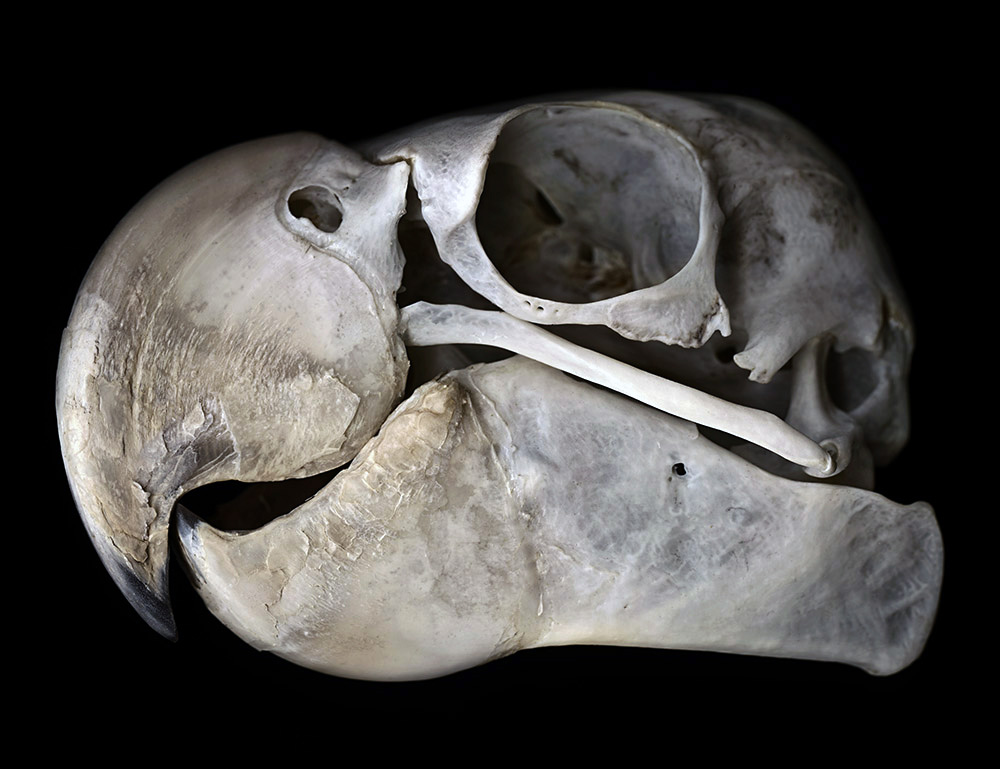
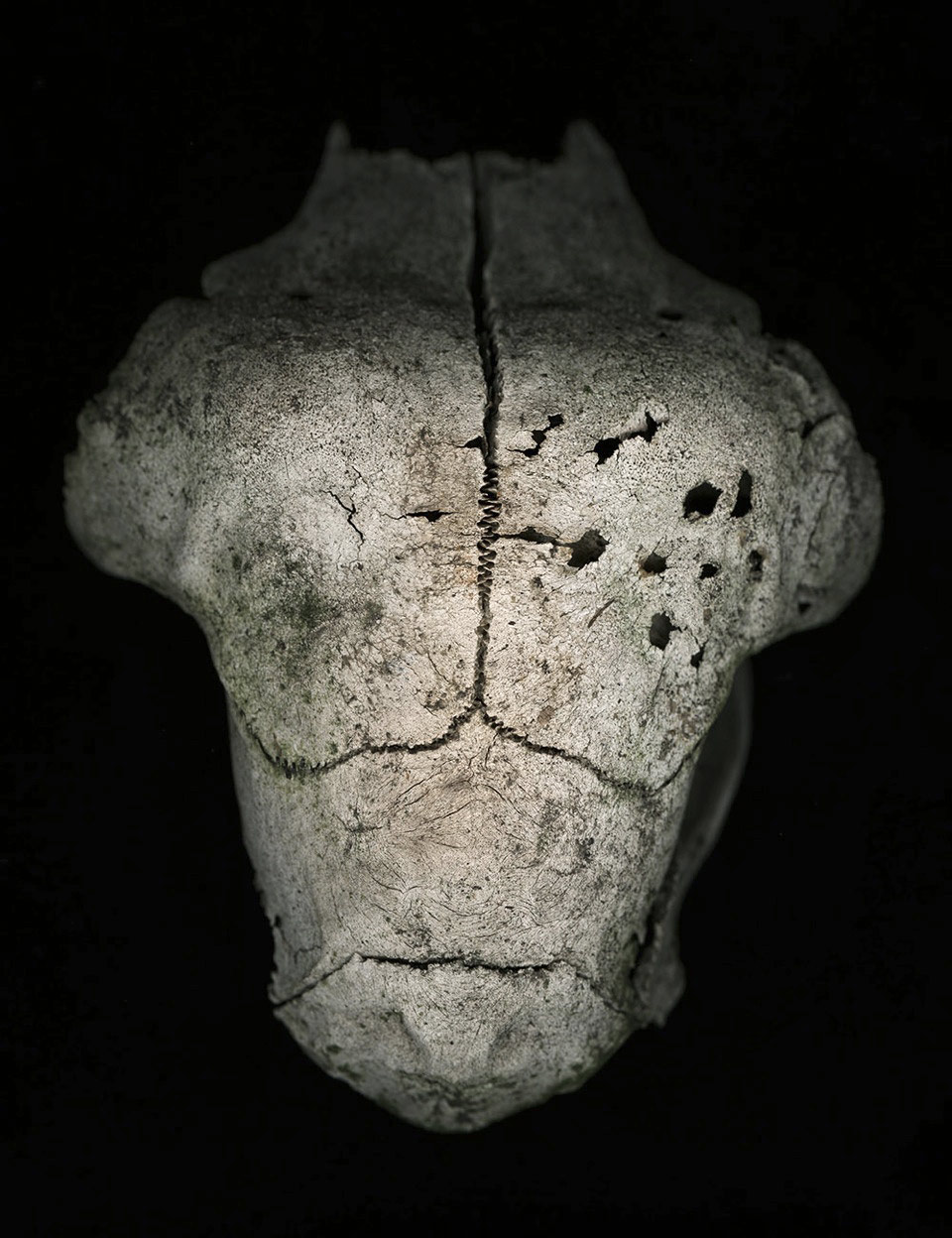
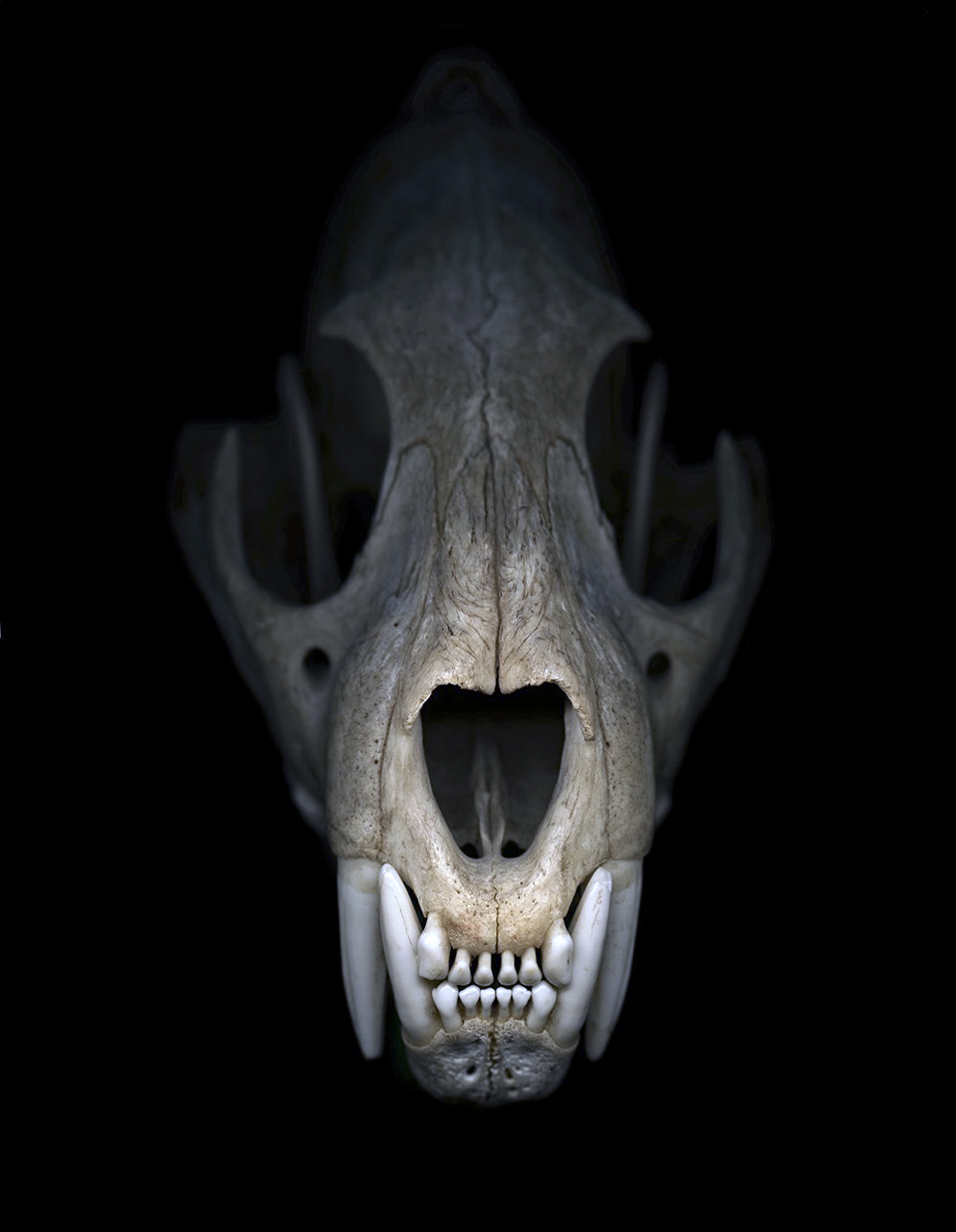
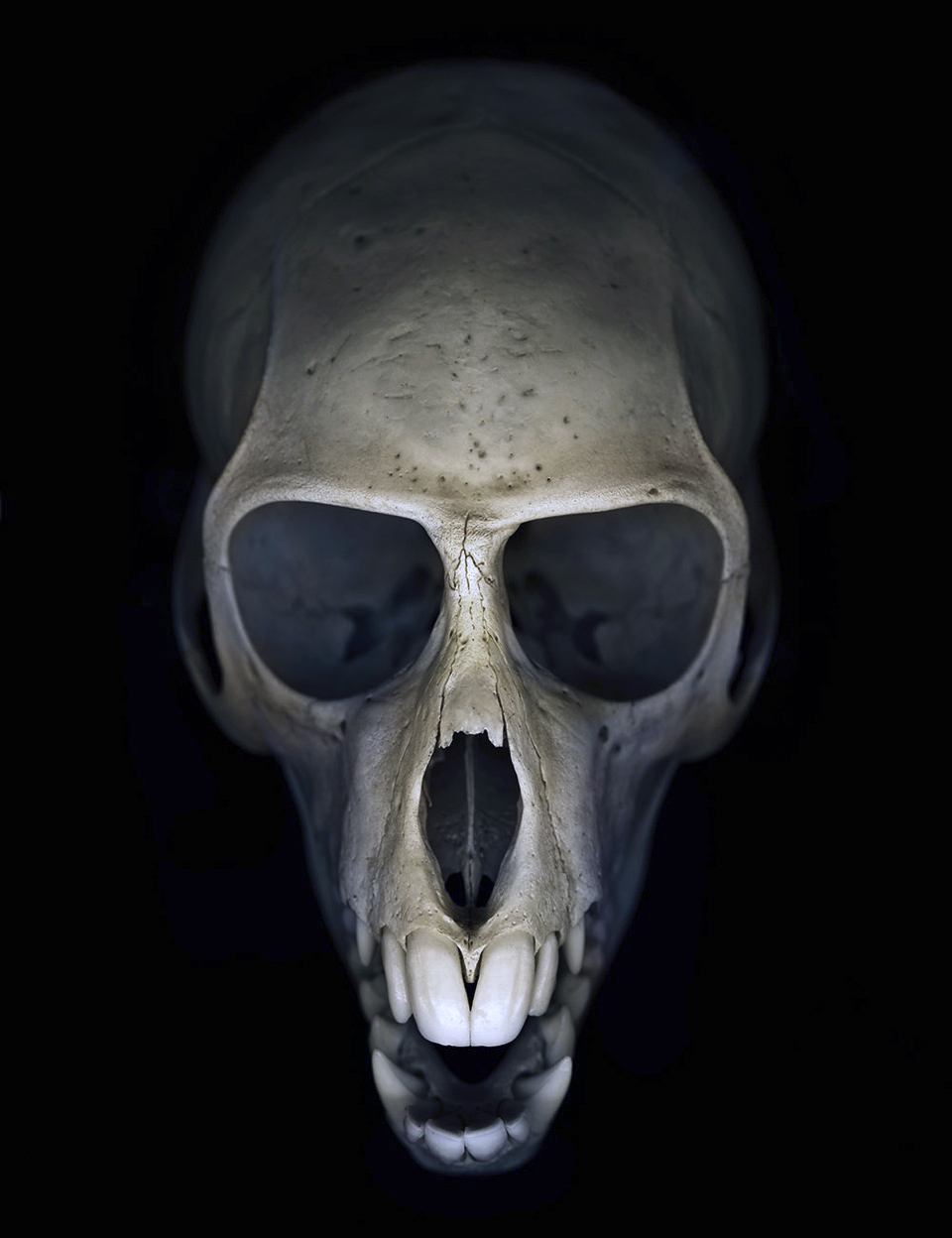
While Sally Mann’s body of work What Remains is the rolled-gold standard for this kind of work, Greg Elms series What Remains offers an interesting forensic amplification of skeletal “nature”. These animalistic portraits of nature mort are eloquent, strong and forthright. Some work better than others. The Cheetah skull, the Vervet monkey skull (with Rayban Aviator sunglass eyes) and best of them all, the magnificent, constructivist Black cockatoo skull – are all haunting in their deathly presence. Some of the smaller skulls lack these works muscularity, especially when they are printed horizontally on a vertical piece of photographic paper, which simply does not work.

Whether the series needed the ironic commentary of the titles, or the trope of hanging the conceptualisation of the series on the back of global warming, is also debatable. I think the best images are strong enough, and the conviction of the artist obvious enough over numerous bodies of work, that the viewer does not need to be spoon fed this rationalisation.

Dr Marcus Bunyan


1/ Jackson, J. B. Discovering the Vernacular Landscape. New Haven: Yale University Press, 1984, p. 8 quoted in Goldswain, Phillip. “Surveying the Field, Picturing the Grid: John Joseph Dwyer’s Urban Industrial Landscapes,” in Goldswain, Phillip and Taylor, William (eds.,). An Everyday Transience: The Urban Imaginary of Goldfields Photographer John Joseph Dwyer. Crawley, WA: University of Western Australia Publishing, 2010, p. 75.


Many thankx to Edmund Pearce Gallery for allowing me to publish the photographs in the posting. Please click on the photographs for a larger version of the image.


Gustave Doré (French, 1832-1883) llustration of Lord Alfred Tennyson's 'Idylls of the King' 1868


Gustave Doré (French, 1832-1883)
llustration of Lord Alfred Tennyson’s Idylls of the King
1868


Henri van Noordenburg (Australian born Netherlands, b. 1967) 'Composition X' 2012


Henri van Noordenburg (Australian born Netherlands, b. 1967)
Composition X
2012
Hand carved archival pigment print
106 x 106cm


Abstracted within the landscape, the artist features as the protagonist facing the threats of a seemingly hostile bush. Efface references The Expulsion from the Garden of Eden with a focus on the overlaying of a European aesthetic on the physical and intellectual landscape. Starting with self portraits set amid a featureless black background, the photographic surface is hand etched to reveal the landscape.

Van Noordenburg describes the process of self-nude photography as an “incredible mix between strength and weakness, frustration and containment a feeling of euphoria and adrenaline”. Feelings, which mirror van Noordenburg’s attempts to assimilate within a dominant culture.

Text from the Edmund Pearce Gallery website


Henri van Noordenburg (Australian born Netherlands, b. 1967) 'Composition XXII' 2013


Henri van Noordenburg (Australian born Netherlands, b. 1967)
Composition XXII
2013
Hand carved archival pigment print
30 x 30cm


Henri van Noordenburg (Australian born Netherlands, b. 1967) 'Composition XXIII' 2013


Henri van Noordenburg (Australian born Netherlands, b. 1967)
Composition XXIII
2013
Hand carved archival pigment print
30 x 30cm


Between Here and There

The figure that haunts these images is far from a signifier of passivity and calm. Dwarfed and subjugated by that which surrounds, his naked form seems deep in the throes the landscape’s implicit bewilderment and assault. His pallid, naked flesh is scarred and reddened and soiled, the reproach of this eerie land leaving an acrid evidence.

The work of Henri van Noordenburg veers towards the anxieties of juncture, displacement and exodus – art history, religious mythology, the socio-cultural tropes of migration and dislocation and the tensions of the photographic medium underlie his visual and allegorical language.

Indeed, the sensibilities and narratives that punctuate the Dutch-born artist’s new series, Efface, are significant on several levels. The immediately perceptible tension is that of technique and form. Beginning their lives as nude photographic self-portraits (the body set against a vast, featureless, black backdrop), van Noordenburg’s renderings of the Australian landscape and wilderness are in fact painstakingly realised hand-etchings. The photographic surface is an amalgam, the physicality of the photographic object unmistakable. In an era of fluctuation and change for the now ubiquitous digital form, van Noordenburg attempts to reengage, reinterpret and gain further understanding of the photograph’s physical roots.

The formal and stylistic inclinations that the artist achieves via such a process offers another intriguing layer. Resting upon the myth of the Expulsion from the Garden of Eden, this loaded series operates in the shadows of art history, forging a Romantic European imagining of the landscape and broaching its loaded colonialist underpinnings. Just as van Noordenburg’s photographic visage wanders a landscape created via the hand and the imagination, the European man stalks the myth of the non-European landscape as a base, inhospitable threat. Allegories and references double back on one another; themes of movement, displacement, exile and expulsion break bread with the iconography of the colonialist gaze.

That it is van Noordenburg’s own image that haunts these works – his body writhing, crouched or prone amid the bush – proves telling. Though living in Australia for the best part of two decades, the artist is an outsider in a nation that remains in acute denial of the extent of its immigrant foundations. Whether white, black, yellow or brown, the great myth of a quintessential Australianness – one that exists on a plane distinct from the cultural melange that marks the Australian reality – threatens to dislocate all who fail to blindly buy in.

In the suite of works that populate Efface, van Noordenburg sets himself adrift, haunted by his own place in history, mythology and the wider Australian scheme. Though we live in an increasingly borderless and post-national world, some things tend not to change.

Dan Rule


Amber McCaig (Australian) 'Ute von Tangermunde' 2013


Amber McCaig (Australian)
Ute von Tangermunde
2013
Archival pigment print
48 x 33cm


Amber McCaig (Australian) 'Untitled VII' 2013


Amber McCaig (Australian)
Untitled VII
2013
Archival pigment print
48 x 33cm


“Using a combination of portraits and still life elements, Amber recreates an exploration into the idea of identity and imagination, providing an insight into what it is like to live out fantasies in everyday life. Laden with armour, treasure chests, maps and lore, these fantasies show the power of our imagination and what is possible if we dare to dream.”

Text from the Edmund Pearce Gallery website


Amber McCaig (Australian) 'The Knight Errant' 2013


Amber McCaig (Australian)
The Knight Errant
2013
Archival pigment print
60 x 42cm


Amber McCaig (Australian) 'Untitled IV' 2013


Amber McCaig (Australian)
Untitled IV
2013
Archival pigment print
60 x 42cm


Amber McCaig (Australian) 'The Knight' 2013


Amber McCaig (Australian)
The Knight
2013
Archival pigment print
60 x 42cm


Amber McCaig (Australian) 'Untitled III' 2013


Amber McCaig (Australian)
Untitled III
2013
Archival pigment print
60 x 42cm


Greg Elms (Australian, b. 1960) 'We knew it was serious, but we were kind of busy (Black cockatoo skull)' 2013


Greg Elms (Australian, b. 1960)
We knew it was serious, but we were kind of busy (Black cockatoo skull)
2013
Archival pigment print
85 x 110cm


“This taxonomy series of large-scale prints, which acts as an amplification of its forensic nature, is an examination of where our relationships with animals are headed. Whilst those with vested interests may deride climate change, it is beyond dispute that there is a decline in many species of fauna (and flora). In 21st century life, where the distractions are numerous and social media pervasive, 24-hour news counteracts important issues amidst a blur of information overload… Elms work investigates the natural world exploring themes of reality, mortality and the sublime.”

Text from the Edmund Pearce Gallery website


Greg Elms (Australian, b. 1960) 'It got overrun by other news (Wombat skull, aerial view)' 2013


Greg Elms (Australian, b. 1960)
It got overrun by other news (Wombat skull, aerial view)
2013
Archival pigment print
70 X 55cm


Respice post te!

There is something incredibly human about Greg Elms’ latest suite of works. Something uncannily and immediately recognisable in these gaping eyes and grimacing teeth. What links each of the ‘individuals’ here is very simple. It is not just death, it is the cause of death. These are forensic portraits of homicide victims, genocidal talismans for the perpetrator. Enjoy them, for it is we who must plead futile innocence.

Stripped of fur and flesh, they were beforehand stripped of the flora and fauna that sustained them, they were humiliated, out-numbered and out equipped and we? Well it’s simple. We needed more coffee plantations, more timber, more cultivation, more food for our yapping pets.

I’m not suggesting here that Elms is some kind of tree-hugging animal lover. But I am saying that, like the best forensic analysts, he has identified his victims well.

Elms himself gives away much of the story behind this cruelly grinning menagerie. Think of how many times in recent decades you have read the kinds of commentary that Elms utilises here as titles; “We knew it was serious, but we were kind of busy,” “Lobbyists were employed to dispute the facts,” “It got overrun by other news,” “We felt like we were helpless,” “It would’ve been fine if Newscorp was onside.”

These are everyday, generic comments. All too much so. think: Global Warming, human genocide, animal extinctions. Just everyday comments accompanied by a shrug of the shoulders. One could add “too late now.” Elms himself adds: “Everything comes and goes…”

But if there is beauty in Apocalypse then Elms has found it. There is an elegance alongside a silence in these animalistic portraits of nature mort. These un-furred memento mori.

The Latin phrase, memento mori, translates essentially as “Remember that you must die.” Another translation of the term reads Respice post te! Hominem te esse memento – Look behind you! Remember that you are but a man! But here in Elms’ portraits it is the Vervet Monkey, the Black Cockatoo, the Cheetah. Indeed, the only thing missing is the skull of the human.

But there is time enough for that…

Ashley Crawford


Greg Elms (Australian, b. 1960) 'We felt sort of helpless to stop the extinction (Cheetah skull)' 2012


Greg Elms (Australian, b. 1960)
We felt sort of helpless to stop the extinction (Cheetah skull)
2012
Archival pigment print
110 x 85cm


Greg Elms (Australian, b. 1960) 'You won’t get away with this for much longer (Vervet monkey skull)' 2011


Greg Elms (Australian, b. 1960)
You won’t get away with this for much longer (Vervet monkey skull)
2011
Archival pigment print
110 x 85cm


Edmund Pearce Gallery

This gallery has now closed.

LIKE ART BLART ON FACEBOOK

Back to top
Video: Installation of Erika Diettes ‘Sudarios (Shrouds) at the Ballarat International Foto Biennale 2013

Exhibition dates: 17th August – 15th September 2013


http://www.youtube.com/watch?v=9_Oa_QNHGpE


Installation video of Erika Diettes Sudarios (Shrouds) at the Ballarat International Foto Biennale 2013
© Dr Marcus Bunyan


“Erika Diettes travelled to different cities in the department of Antioquia (Colombia) to interview women who had been present at the torture and murder of their loved ones. Diettes photographed the women, closely cropped in black and white, at a moment of great vulnerability – all but one with their eyes closed. The resultant twenty photographs were printed on seven feet tall silk panels and form the work Sudarios (shrouds are a burial cloak, a cloth that shrouds the body of the deceased). The artist always intended for these images to be printed on silk and had the installation in mind before she took the photographs: in other words previsualisation was strong. The work is usually displayed in sacred spaces such as churches and convents with a sound track of a barely audible, sighing female voice; here in Ballarat the work is hung in the former Mining Exchange building, a seat of colonial power and wealth which can be read as appropriate for the presentation of this work, for torture is always about the power of one person over another.”

From the catalogue essay Intimations of Mor(t)ality: Sudarios (Shrouds) by Erika Diettes by Dr Marcus Bunyan.


Ballarat International Foto Biennale
12 Lydiard St North, Ballarat 3350

Ballarat International Foto Biennale website

Erika Diettes website

LIKE ART BLART ON FACEBOOK

Back to top
Exhibition: ‘WAR/PHOTOGRAPHY: Images of Armed Conflict and Its Aftermath’ at the Museum of Fine Arts, Houston – Posting Part 4

Exhibition dates: 11th November 2012 – 3rd February 2013


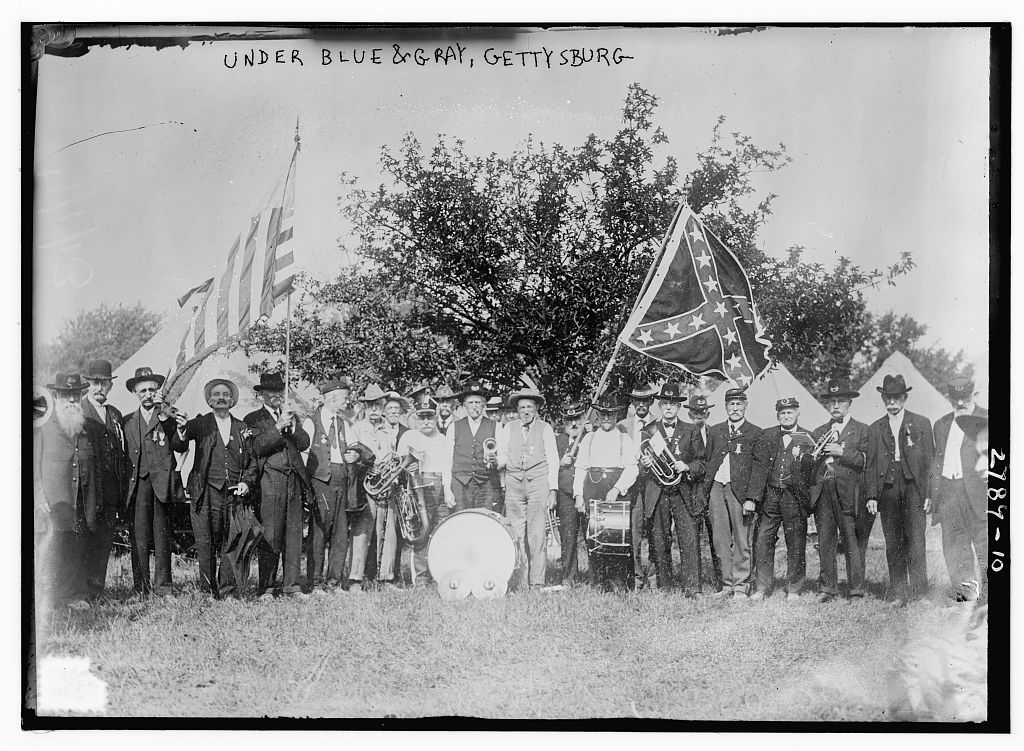
Anonymous photographer. 'Under blue & gray – Gettysburg' July 1913


Anonymous photographer
Under blue & gray – Gettysburg
July 1913
Photo shows the Gettysburg Reunion (the Great Reunion) of July 1913, which commemorated the 50th anniversary of the Battle of Gettysburg
Library of Congress Prints and Photographs Division Washington, D.C.


Part 4 of the biggest posting on one exhibition that I have ever undertaken on Art Blart!

As befits the gravity of the subject matter this posting is so humongous that I have had to split it into 4 separate postings. This is how to research and stage a contemporary photography exhibition that fully explores its theme. The curators reviewed more than one million photographs in 17 countries, locating pictures in archives, military libraries, museums, private collections, historical societies and news agencies; in the personal files of photographers and service personnel; and at two annual photojournalism festivals producing an exhibition that features 26 sections (an inspired and thoughtful selection) that includes nearly 500 objects that illuminate all aspects of WAR / PHOTOGRAPHY.

I have spent hours researching and finding photographs on the Internet to support the posting. It has been a great learning experience and my admiration for photographers of all types has increased. I have discovered the photographs and stories of new image makers that I did not know and some enlightenment along the way. I despise war, I detest the state and the military that propagate it and I surely hate the power, the money and the ethics of big business that support such a disciplinarian structure for their own ends. I hope you meditate on the images in this monster posting, an exhibition on a subject matter that should be consigned to the history books of human evolution.

**Please be aware that there are graphic photographs in all of these postings.** Part 1Part 2Part 3

Dr Marcus Bunyan


Many thankx to the Museum of Fine Arts, Houston for allowing me to publish some of the photographs in the posting. Please click on the photographs for a larger version of the image.


Memorials

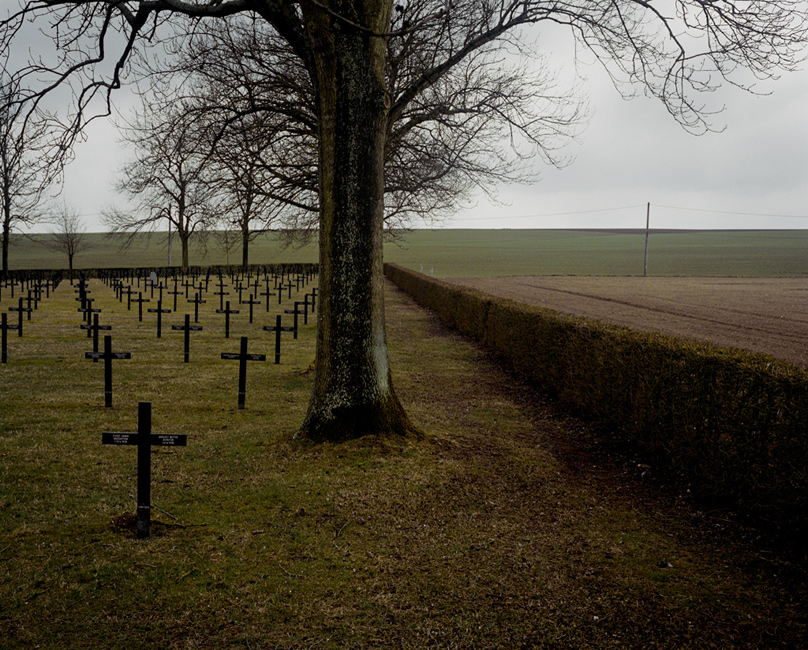
25. Photographs in the “Memorials” section range from the tomb of an unknown World War I soldier in England, by Horace Nicholls; and a landscape of black German crosses throughout a World War II burial site, by Bertrand Carrière; to an anonymous photograph of a reunion scene in Gettysburg of the opposing sides in the Civil War; and Joel Sternfeld’s picture of a woman and her daughter at the Vietnam Veterans Memorial in Washington, DC, in 1986. (8 images)


Horace Nicholls (English, 1867-1941) 'The Unknown Warrior at Westminster Abbey, London, November 1920' 1920


Horace Nicholls (English, 1867-1941)
The Unknown Warrior at Westminster Abbey, London, November 1920
1920
Silver gelatin print
© IWM (Q 31514)


In order to commemorate the many soldiers with no known grave, it was decided to bury an ‘Unknown Warrior’ with all due ceremony in Westminster Abbey on Armistice Day in 1920. The photograph shows the coffin resting on a cloth in the nave of Westminster Abbey before the ceremony at the Cenotaph and its final burial.


Bertrand Carrière (Canadian, b. 1957) 'Untitled' 2005-2009


Bertrand Carrière (Canadian, b. 1957)
Untitled
2005-2009
From the series Lieux Mêmes [Same Places]


Joel Sternfeld (American, b. 1944) 'Vietnam Veterans Memorial, Washington, D.C.,' May 1986


Joel Sternfeld (American, b. 1944)
Vietnam Veterans Memorial, Washington, D.C.,
May 1986
Chromogenic print, ed. #1/25 (printed October 1986)
The Museum of Fine Arts, Houston, the Target Collection of American Photography, gift of the artist
© 1986 Joel Sternfeld


Remembrance

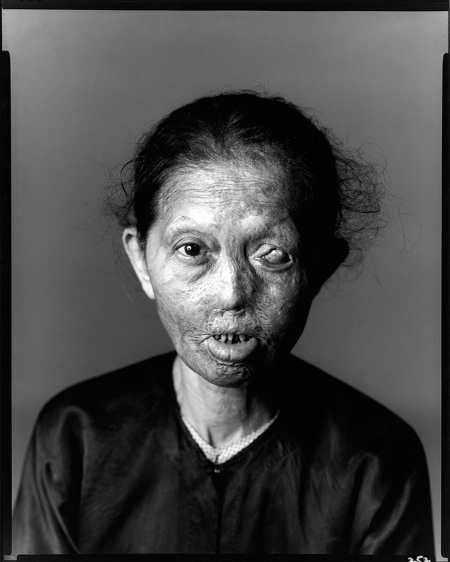
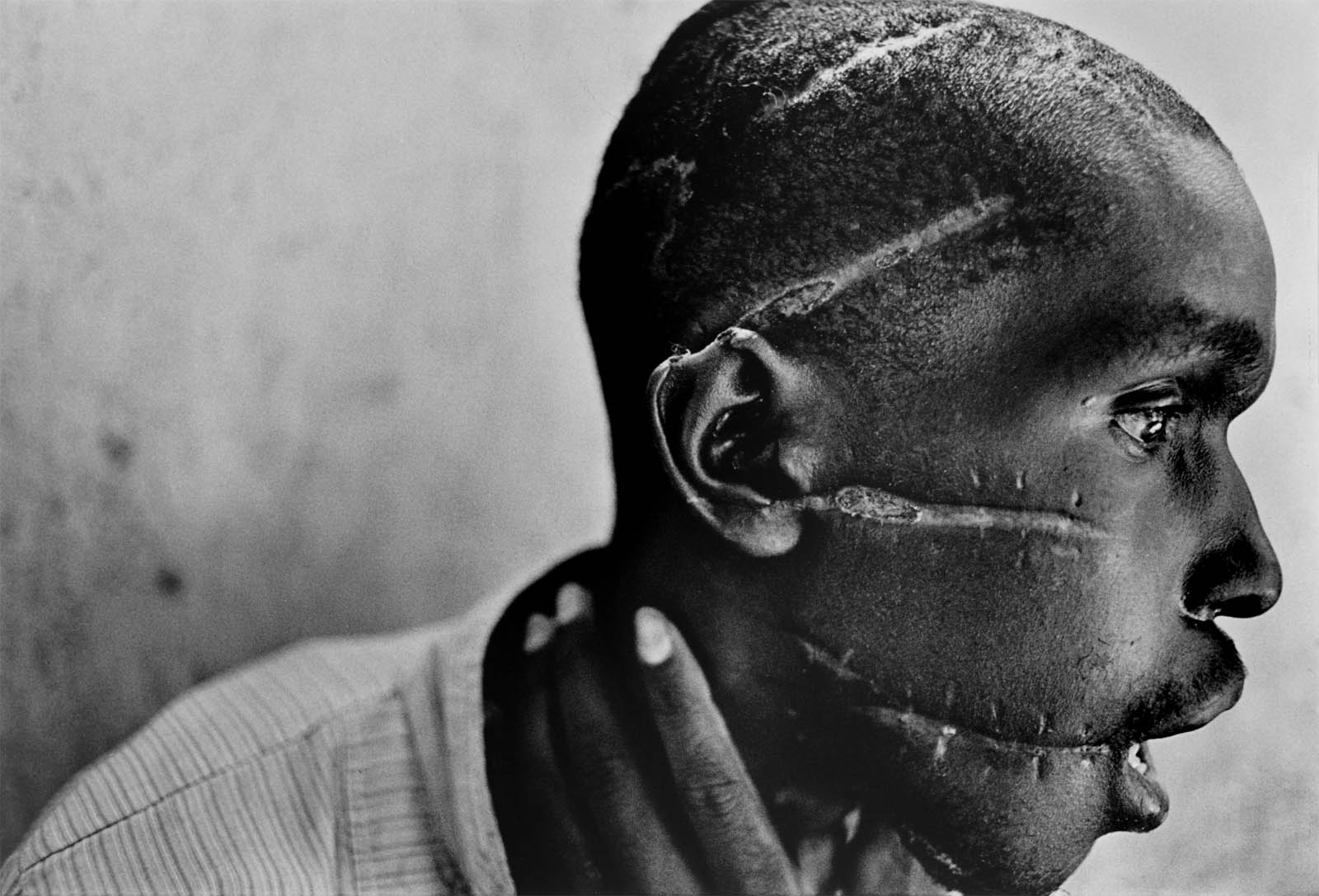
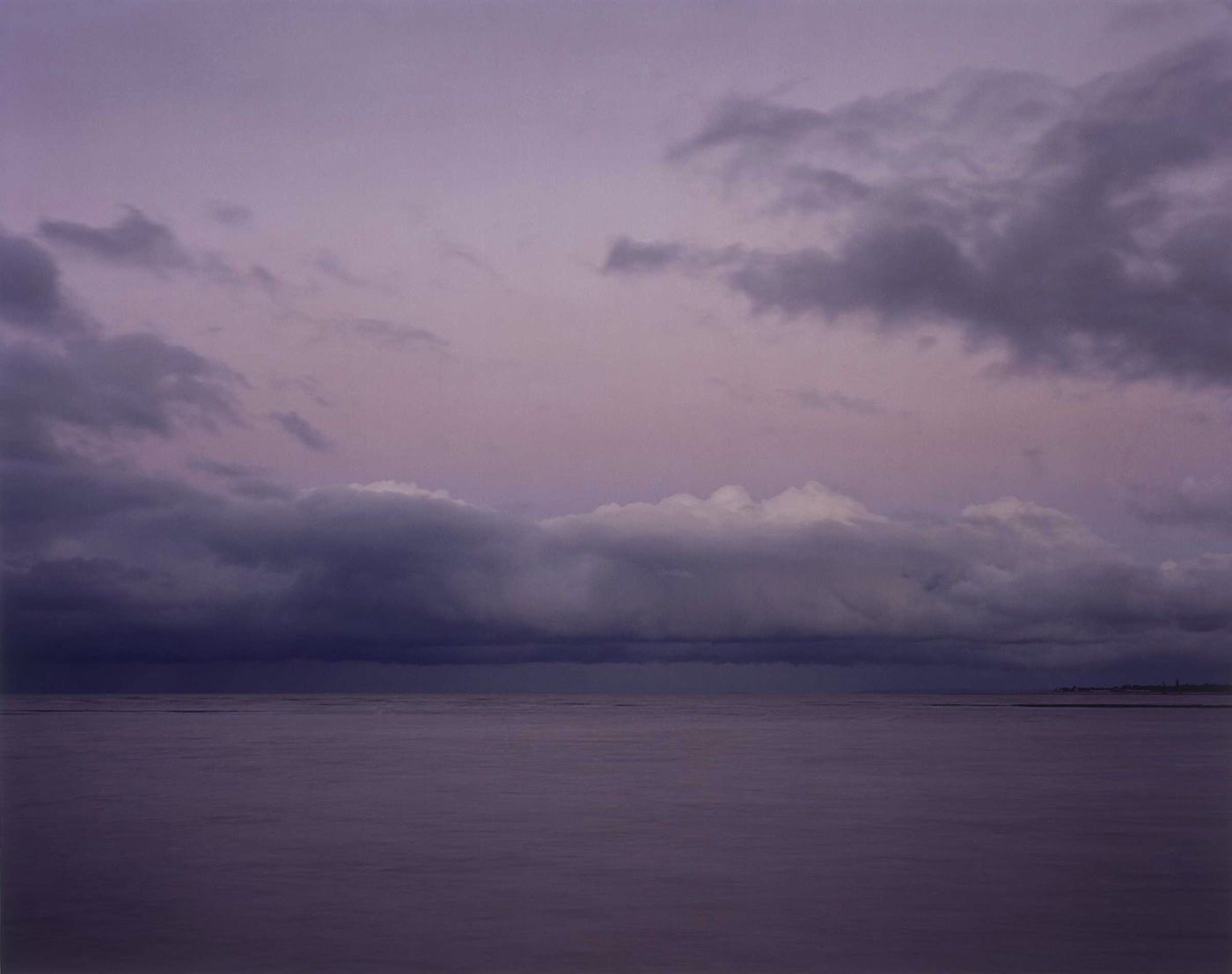
26. The last gallery in the exhibition is “Remembrance.” Most of these images were taken by artists seeking to come to terms with a conflict after fighting had ceased. Included are Richard Avedon’s picture of a Vietnamese napalm victim; a survivor of a machete attack in a Rwandan death camp, by James Nachtwey; a 1986 portrait of a hero who rescued Jews during the Holocaust, by Houston native Gay Block; and Suzanne Opton’s 2004 portrait of a soldier who survived the Iraq War and returned to the United States to work as a police officer, only to be murdered on duty by a fellow veteran. The final wall features photographs by Simon Norfolk of sunrises at the five D-Day beaches in 2004. The only reference to war is the title of the series: The Normandy Beaches: We Are Making a New World(33 images)


Richard Avedon (American, 1923-2004) 'Napalm Victim #1, Saigon, South Vietnam, April 29, 1971' 1971


Richard Avedon (American, 1923-2004)
Napalm Victim #1, Saigon, South Vietnam, April 29, 1971
1971
Silver gelatin print
© Richard Avedon


Gay Block (American, b.1942) 'Zofia Baniecka, Poland' 1986


Gay Block (American, b. 1942)
Zofia Baniecka, Poland
1986
From the series Rescuers: Portraits of Moral Courage in the Holocaust, a record of non-Jewish citizens from European countries who risked their lives helping to hide Jews from the Nazis
Chromogenic print, printed 1994
Courtesy of Museum of Fine Arts, Houston, gift of Clinton T. Wilour in honour of Eve France


Zofia Baniecka (born 1917 in Warsaw – 1993) was a Polish member of the Resistance during World War II. In addition to relaying guns and other materials to resistance fighters, Baniecka and her mother rescued over 50 Jews in their home between 1941 and 1944.


James Nachtwey (American, b. 1948) 'A Hutu man who did not support the genocide had been imprisoned in the concentration camp, was starved and attacked with machetes. He managed to survive after he was freed and was placed in the care of the Red Cross, Rwanda, 1994' 1994


James Nachtwey (American, b. 1948)
A Hutu man who did not support the genocide had been imprisoned in the concentration camp, was starved and attacked with machetes. He managed to survive after he was freed and was placed in the care of the Red Cross, Rwanda, 1994
1994
Silver gelatin print
© James Nachtwey / TIME

World Press Photo of the Year, prize singles


A Hutu man at a Red Cross hospital in Nyanza, Rwanda. His face was mutilated by the Hutu ‘Interahamwe’ militia, who suspected him of sympathising with the Tutsi rebels.

Liberated from a nearby Hutu camp, where mainly Tutsis were incarcerated, starved, beaten, and killed, this man did not support the genocide and was thus subjected to the same treatment. Starved and attacked with machetes, he had managed to survive, though he was unable to speak and could barely walk or swallow when this photo was made.

Jibran Abbasi. “Mutilated By The Hutu ‘Interahamwe’ by James Nachtwey,” on the Business Recorder website April 5, 2017 [Online] Cited 27/07/2024


Simon Norfolk (British, b. Nigeria, 1963) 'Sword Beach' 2004


Simon Norfolk (British born Nigeria, b. 1963)
Sword Beach
2004
From the series The Normandy Beaches: We Are Making a New World
Chromogenic print, ed. #1/10 (printed 2006)
The Museum of Fine Arts, Houston
Gift of Bari and David Fishel, Brooke and Dan Feather and Hayley Herzstein in honor of Max Herzstein and a partial gift of the artist and Gallery Luisotti, Santa Monica
© Simon Norfolk / Gallery Luisotti


WAR/PHOTOGRAPHY Extended Info


Other photographs from the exhibition


Alexander Gardner (1821-1882) 'Scouts and Guides to the Army of the Potomac, Berlin, MD, October, 1862' October 1862 (detail)


Alexander Gardner (American, 1821-1882)
Scouts and Guides to the Army of the Potomac, Berlin, MD, October, 1862
October 1862
Albumen silver print
Photograph by Alexander Gardner, from “Incidents of the War. Guide to the Army of the Potomac,” from Gardner’s Photographic Sketch Book of the War, Washington
Records of the War Department General and Special Staffs, Record Group 165, National Archives Still Picture Branch, College Park, Maryland


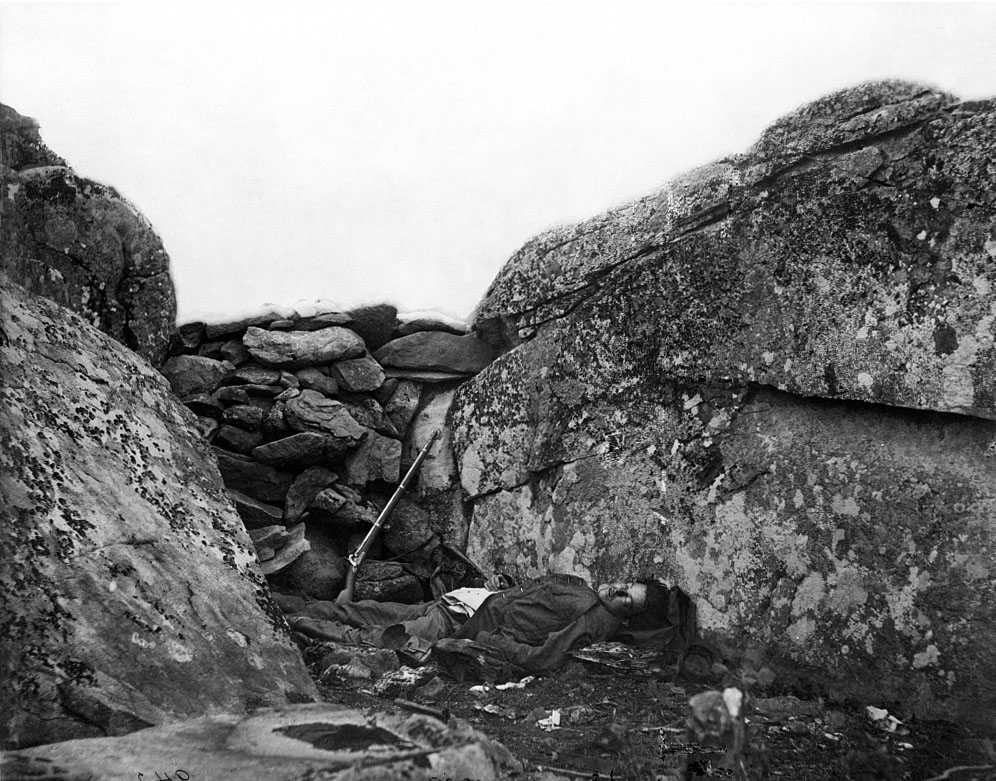
Alexander Gardner (American, 1821-1882) ‘The Home of a Rebel Sharpshooter, Gettysburg, Pennsylvania’. Albumen paper print


Alexander Gardner (American, 1821-1882)
The Home of a Rebel Sharpshooter / Dead Confederate soldier in the devil’s den, Gettysburg, Pennsylvania
July 1863
Albumen paper print copied from glass, wet collodion negative
Library of Congress, Prints and Photographs Division


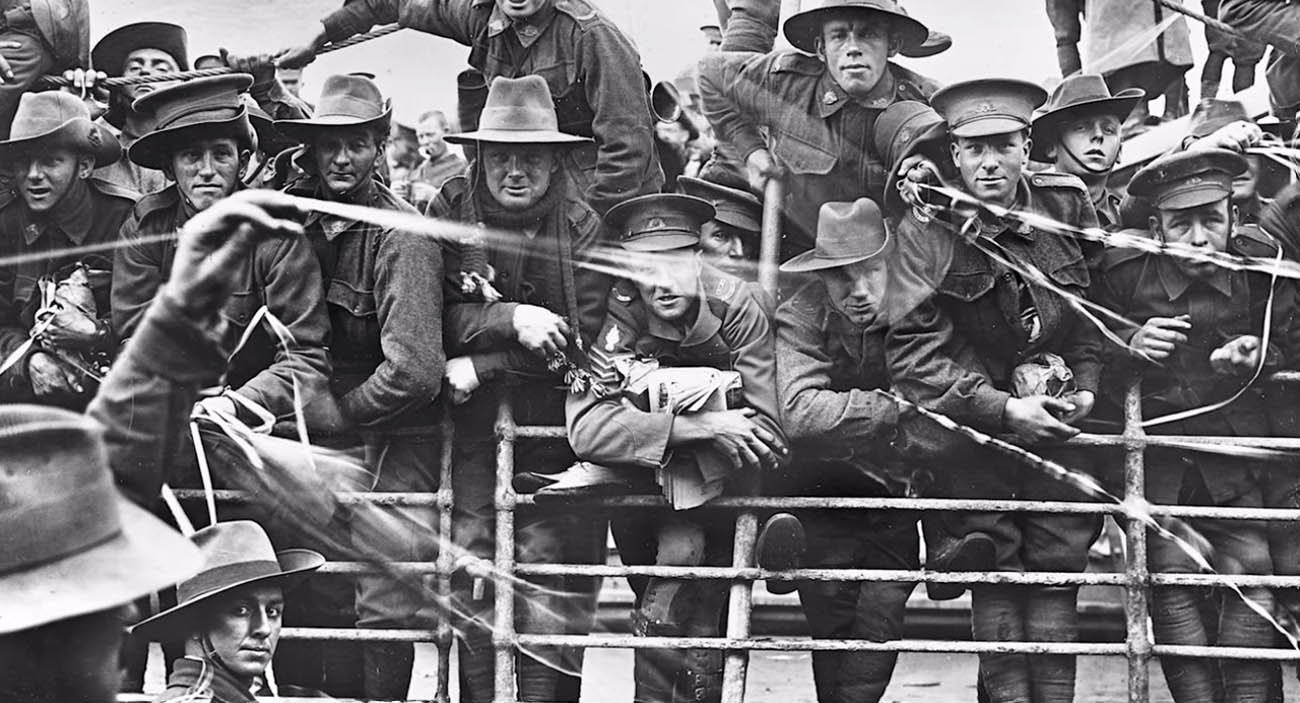
Josiah Barnes (Australian, 1858-1921) 'Embarkation of HMAT Ajana, Melbourne, July 8, 1916' 1916


Josiah Barnes (Australian, 1858-1921)
Embarkation of HMAT Ajana, Melbourne, July 8, 1916
1916
Gelatin silver print from original glass half-plate negative (printed 2012)
On loan from the Australian War Memorial


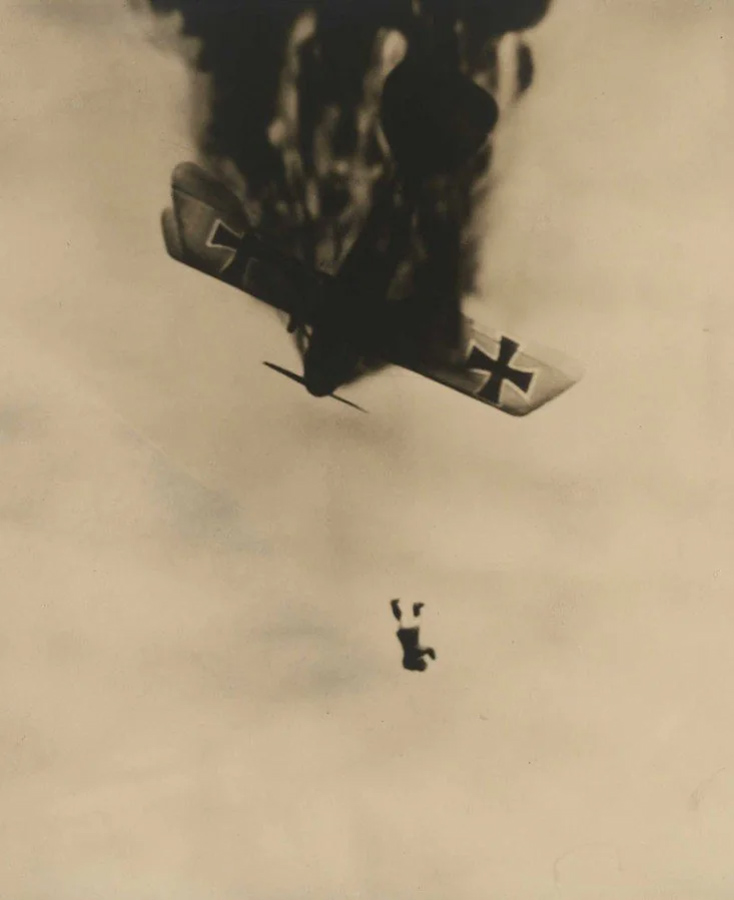
Wesley D. Archer (American, d. 1952) 'Just as he left the burning plane' 1933


Wesley D. Archer (American, d. 1952)
Just as he left the burning plane
1933
From the publication Death in the Air: The War Diary and Photographs of a Flying Corps Pilot


The typewritten script of a First World War pilot’s diary with a large number of photographs was submitted to the publishers William Heinemann and published by them in 1933. Heinemann stated on the book’s jacket that the diary contained no names, dates, or anything that could reveal the identity of the writer or the squadron in which he served. The publishers understood that the diarist was killed in action in 1918 and that it was in deference to the wishes of those who were close to him that his diary should be published.

So remarkable were the photographs that their veracity was immediately questioned, but no proof of their authenticity or otherwise could be ascertained. It was not until 1983 that a collection of documents, photographs and artifacts was presented to the Smithsonian’s National Air and Space Museum. Some of the photographs were recognized as being those of the mystery diarist and the truth was soon revealed.

The author was Wesley Archer, an American with Canadian parents who served with the RFC in the First World War, and the photographs and diary had been faked.

Text from the Google Books website

For more information on the faked photographs see the article “How dramatic images of WWI dogfights in the skies of Europe were FAKED by a conman who was just looking to make some money”.


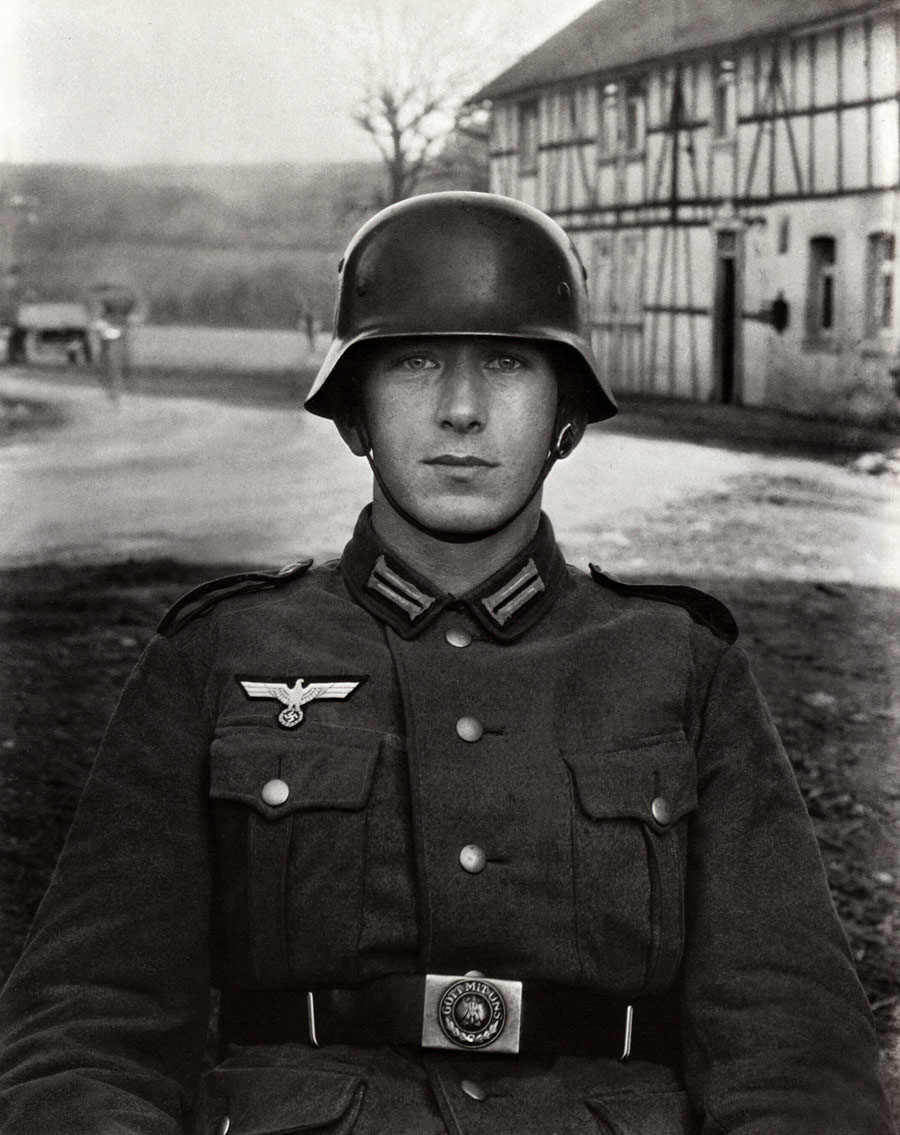
August Sander (German, 1876-1964) 'Soldier' c. 1940


August Sander (German, 1876-1964)
Soldier
c. 1940
Gelatin silver print, printed by Gunther Sander, 1960s
The Museum of Fine Arts, Houston
Gift of John S. and Nancy Nolan Parsley in honour of the 65th birthday of Anne Wilkes Tucker
© Die Photographische Sammlung/SK StiftungKultur – August Sander Archiv, Cologne; DACS, London 2012


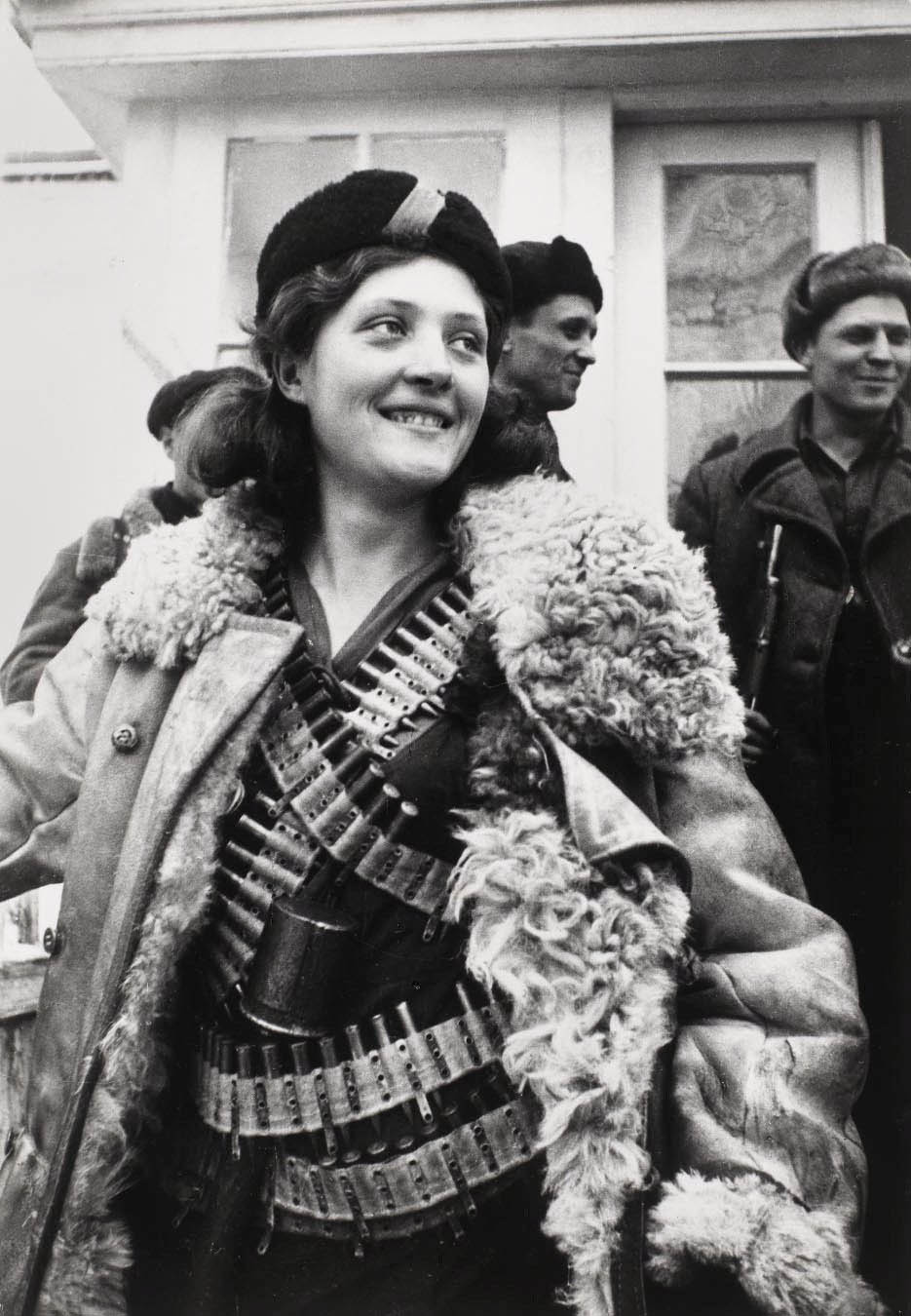
Arkady Shaikhet (Soviet, 1898-1959) 'Partisan Girl' 1942


Arkady Shaikhet (Soviet, 1898-1959)
Partisan Girl
1942
Gelatin silver print
Gift of Marion Mundy
© Arkady Shaikhet Estate, Moscow


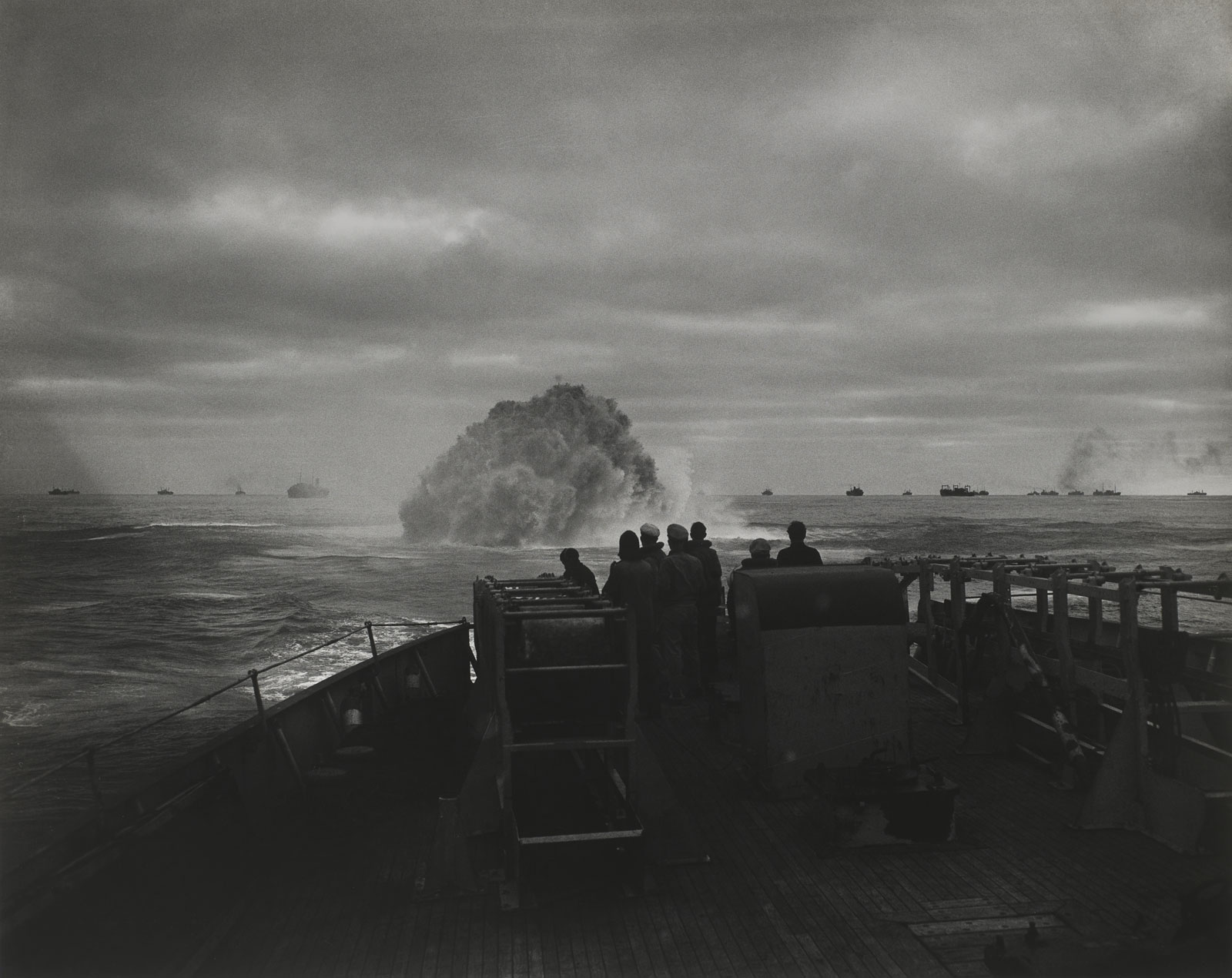
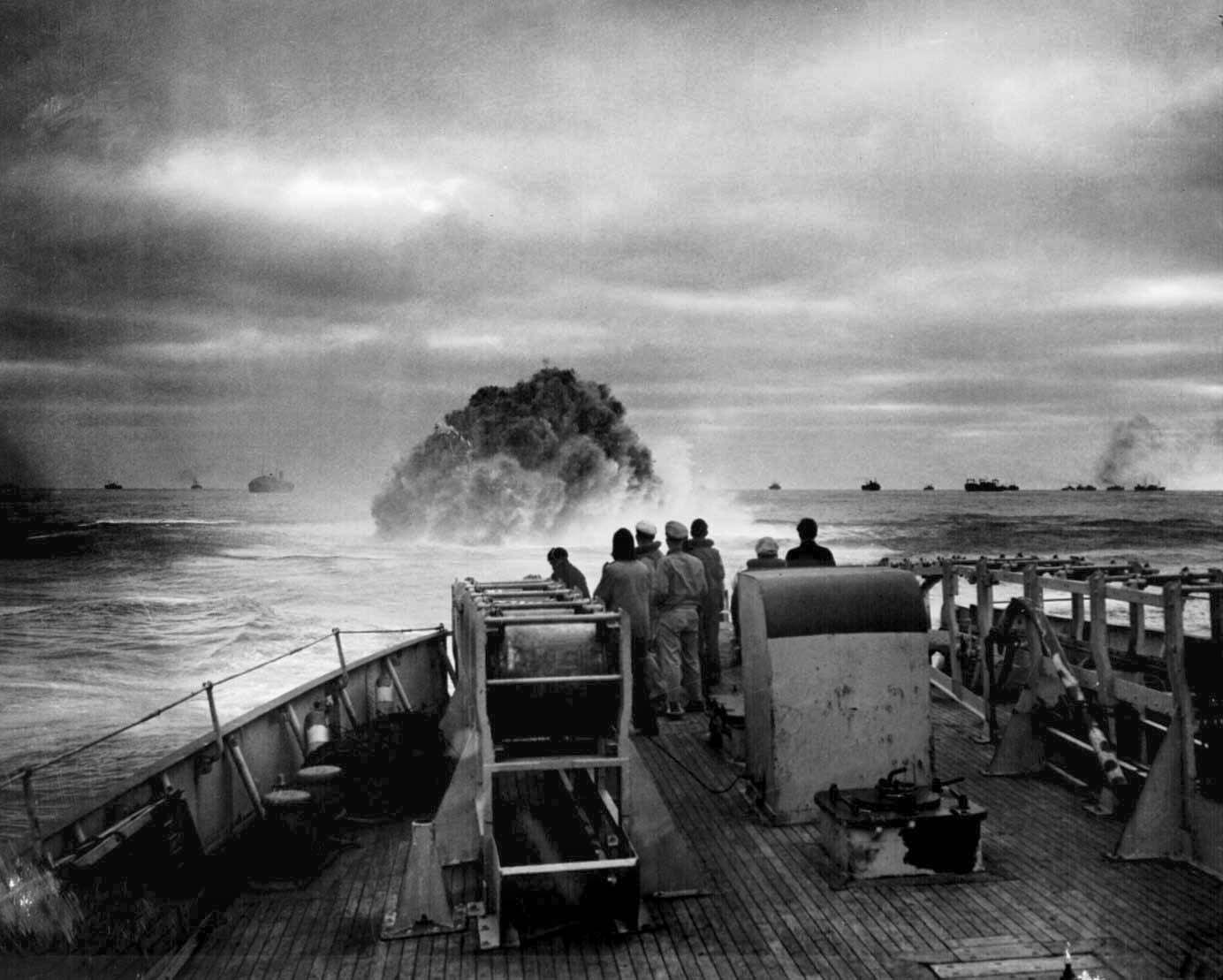
Anonymous photographer / U.S. Department of Defense. 'US Coast Guard crew of cutter Spencer watched as a depth charge exploded near U-175, North Atlantic, 500nm WSW of Ireland, 17 Apr 1943'


Anonymous photographer
U.S. Department of Defense
US Coast Guard crew of cutter Spencer watched as a depth charge exploded near U-175, North Atlantic, 500nm WSW of Ireland, 17 Apr 1943
17 April 1943
Public domain


W. Eugene Smith (American, 1918-1978) 'Wounded, dying infant found by American soldier in Saipan Mountains' June 1944


W. Eugene Smith (American, 1918-1978)
Wounded, dying infant found by American soldier in Saipan Mountains
June 1944
Gelatin silver print
© W. Eugene Smith


W. Eugene Smith (American, 1918-1978) 'World War II. The Pacific Campaign. The Battle of Iwo Jima (Japanese island). US Marine demolition team blasting out a cave on Hill 382. Iwo Jima. February, 1945' 1945


W. Eugene Smith (American, 1918-1978)
World War II. The Pacific Campaign. The Battle of Iwo Jima (Japanese island). US Marine demolition team blasting out a cave on Hill 382. Iwo Jima. February, 1945
1945
Gelatin silver print
© W. Eugene Smith


Joseph Schwartz (American, 1913–2013) 'Hold the Phone - Two Marine wiremen on Iwo Jima race across an open field, under heavy enemy fire to establish field telephone contact with the front lines' February 19, 1945, printed early 1950s


Joseph Schwartz (American, 1913–2013)
Hold the Phone – Two Marine wiremen on Iwo Jima race across an open field, under heavy enemy fire to establish field telephone contact with the front lines
February 19, 1945, printed early 1950s
Gelatin silver print mounted on board
18 13/16 × 14 15/16 in. (47.8 × 37.9cm)
The Museum of Fine Arts, Houston
Museum purchase funded by Knox Nunnally at “One Great Night in November, 2009,” in honor of Houston trial lawyer Joe Reynolds, a U.S. Marine who fought on Iwo Jima


Anonymous photographer. U.S. Department of Defense / USMC Official Photograph 'PLASMA WARD – Navy doctors and corpsmen administer to wounded Marines at an aid station established in a gully on Iwo Jima. The high casualty rate in this operation required the use of gallons of plasma and whole blood sent by air from the West Coast' 1945


Anonymous photographer
U.S. Department of Defense / USMC Official Photograph
PLASMA WARD – Navy doctors and corpsmen administer to wounded Marines at an aid station established in a gully on Iwo Jima. The high casualty rate in this operation required the use of gallons of plasma and whole blood sent by air from the West Coast
1945
Gelatin silver print
Creative Commons Attribution 2.0 Generic


U.S. Navy Photographic Team. 'U.S. and British Warships Anchored in Sagami Wan, Outside of Tokyo Bay, Japan, on the Day the Allied Ships Entered Japanese Waters' 27th August 1945


U.S. Navy Photographic Team
U.S. and British Warships Anchored in Sagami Wan, Outside of Tokyo Bay, Japan, on the Day the Allied Ships Entered Japanese Waters
27th August 1945
Gelatin silver print
The Museum of Fine Arts, Houston, museum purchase funded by Laura and Tony Visage in honor and memory of William A. Visage and his fellow soldiers in Battery “E” of the 2nd Battalion, 131st Field Artillery, U.S. Army Air Corps


Matsumoto Eiichi (Japanese, 1915-2004) 'Shadow of a soldier remaining on the wooden wall of the Nagasaki military headquarters (Minami-Yamate machi, 4.5km from Ground Zero)' 1945


Matsumoto Eiichi (Japanese, 1915-2004)
Shadow of a soldier remaining on the wooden wall of the Nagasaki military headquarters (Minami-Yamate machi, 4.5km from Ground Zero)
1945
Gelatin silver print
Collection of the Tokyo Metropolitan Museum of Photography
© Matsumoto Eiichi


Unknown photographer. 'A pair of M-40 155mm Gun Motor Carriages of Battery B, 937th Field Artillery Battalion, providing fire support to U.S. Army 25th Infantry Division, Munema, Korea' 26 November 1951


Unknown photographer
A pair of M-40 155mm Gun Motor Carriages of Battery B, 937th Field Artillery Battalion, providing fire support to U.S. Army 25th Infantry Division, Munema, Korea
26 November 1951
Gelatin silver print
U.S. Department of Defense


Cathy LeRoy (French, 1944-2006) 'Corpsman In Anguish' 1967


Cathy LeRoy (French, 1944-2006)
Corpsman In Anguish
1967
Gelatin silver print


Her pictures from Vietnam were stunning. Her photos from Battle of Hill 881 evoked “ghosts of Iwo Jima and Pork Chop Hill,” Time magazine wrote in May 1967. Her photos of corpsman Vernon Wike during the battle was a triptych of an all-too-familiar scene: in the first, Wike has two hands on his friend’s chest, trying to staunch the wound; in the second, he tries to find a heartbeat; in the third frame, “Corpsman In Anguish”, he realised the man is dead.

LeRoy herself came very close to death two weeks later. Her Nikon barely stopped a piece of mortar shrapnel that ripped open her chest. She said that she thought the last words she would ever hear were, “I think she’s dead, sarge.” During the Tet offensive in 1968, LeRoy was briefly captured by the North Vietnamese during the battle for Hue. LeRoy’s photos of her captivity later made the cover of Life, ‘A Remarkable Day in Hue: the Enemy Lets Me Take His Picture’. She was the first person to take photos of North Vietnamese Army Regulars behind their lines.

Anonymous. “Corpsman In Anguish | Cathy LeRoy,” on the Iconic Photos website January 13, 2014 [Online] Cited 27/07/2024


A licensed parachutist, Leroy jumped with the U.S. 173rd Airborne Brigade into combat during Operation Junction City in February of 1967. It was in this action, the battle for Hill 881, that Leroy photographed U.S. Navy Corpsman Vernon Wike as he rushed to the aid of a fallen comrade. “Corpsman in anguish” is the third frame of a series that Leroy shot, capturing the unimaginable grief of war. Later, in an interview for the documentary “The Hill Fights”, Wike recounted the moment that Leroy photographed.

“I know there was chaos going on around me, but there was no sound,” she says. “… I knew he didn’t have a chance, but I still got p—–d off when he died.” Leroy describes the aftermath as the corpsman “lost in this nightmare landscape” grabbed the fallen marine’s M16 and charged a Viet bunker alone in a hail of obscenities. The fallen marine was a man called “Rock”, a New Yorker from Puerto Rico. Earlier that day he had told Wike that he only had 60 days left “in country” – his deployment in Vietnam.

Anonymous. “Giving War a Face: Catherine Leroy,” on the Dismal Nitch website September 04, 2020 [Online] Cited 27/07/2024


Arkady Shaikhet (Soviet, 1898-1959) 'Partisan Girl' 1942


Philip Jones Griffiths (Welsh, 1936-2008)
​Called “Little Tiger” for killing two “Viet Cong women cadre” – his mother and teacher, it was rumored, Vietnam​
1968
Gelatin silver print
The Philip Jones Griffiths Foundation, courtesy of Howard Greenberg Gallery
© Philip Jones Griffiths / Magnum Photos


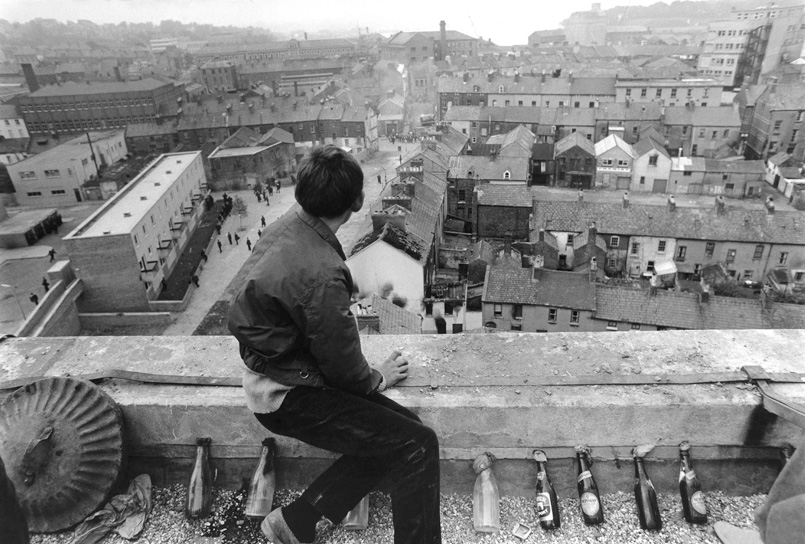
Gilles Caron (French, 1939-1970) 'Young Catholic demonstrator on Londonderry Wall, Northern Ireland' 1969


Gilles Caron (French, 1939-1970)
Young Catholic demonstrator on Londonderry Wall, Northern Ireland
1969
Gelatin silver print
Courtesy of Foundation Gilles Caron and Contact Press Images
© Gilles Caron


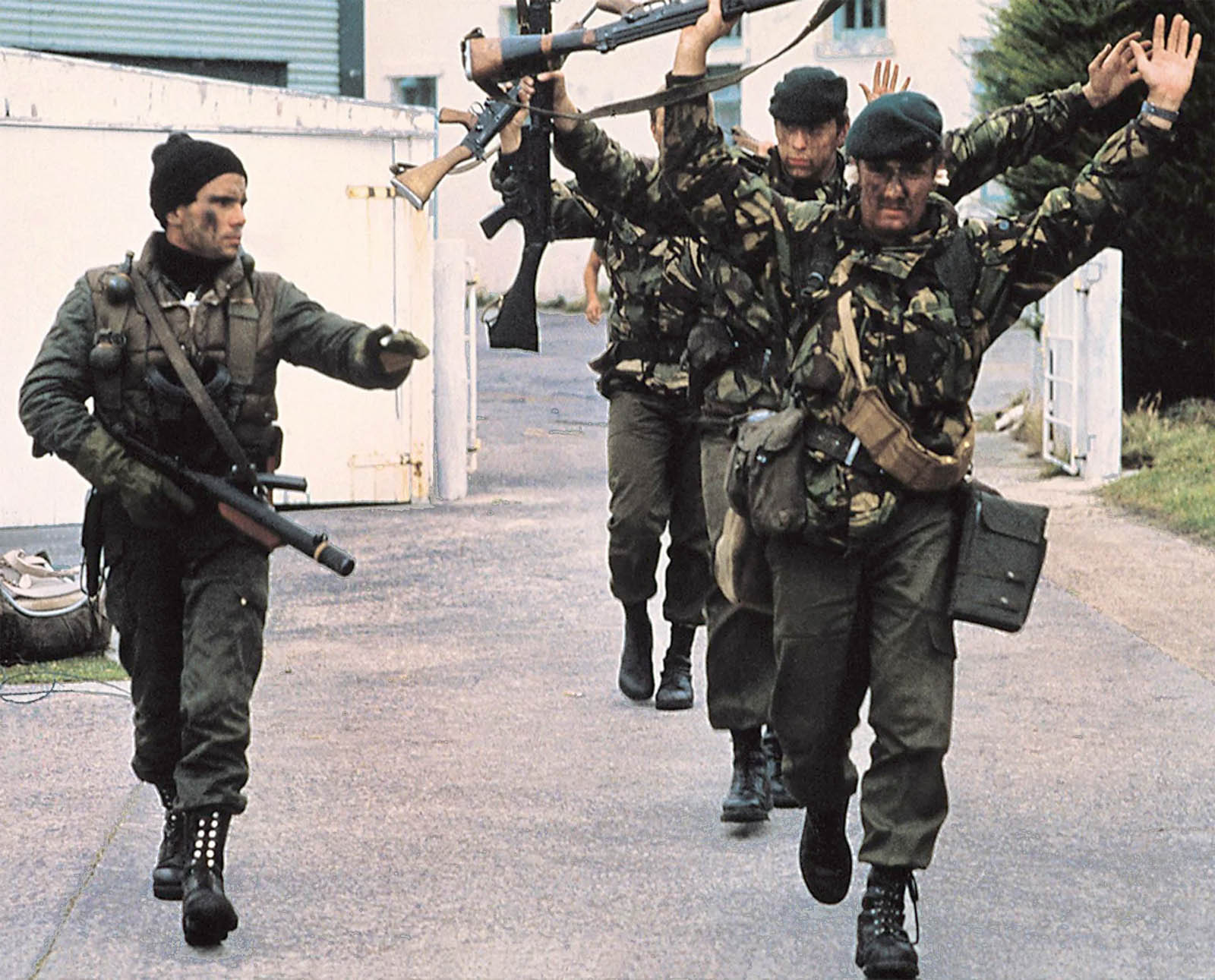
Rafael Wollmann (Argentinian, b. 1958) 'British Marines surrender to Argentinean troops in Malvinas/Falklands' April 2, 1982, printed 2012


Rafael Wollmann (Argentinian, b. 1958)
British Marines surrender to Argentinean troops in Malvinas/Falklands
April 2, 1982, printed 2012
Inkjet print
15 7/8 × 20 in. (40.4 × 50.8cm)
The Museum of Fine Arts, Houston
Gift of Rafael Wollmann


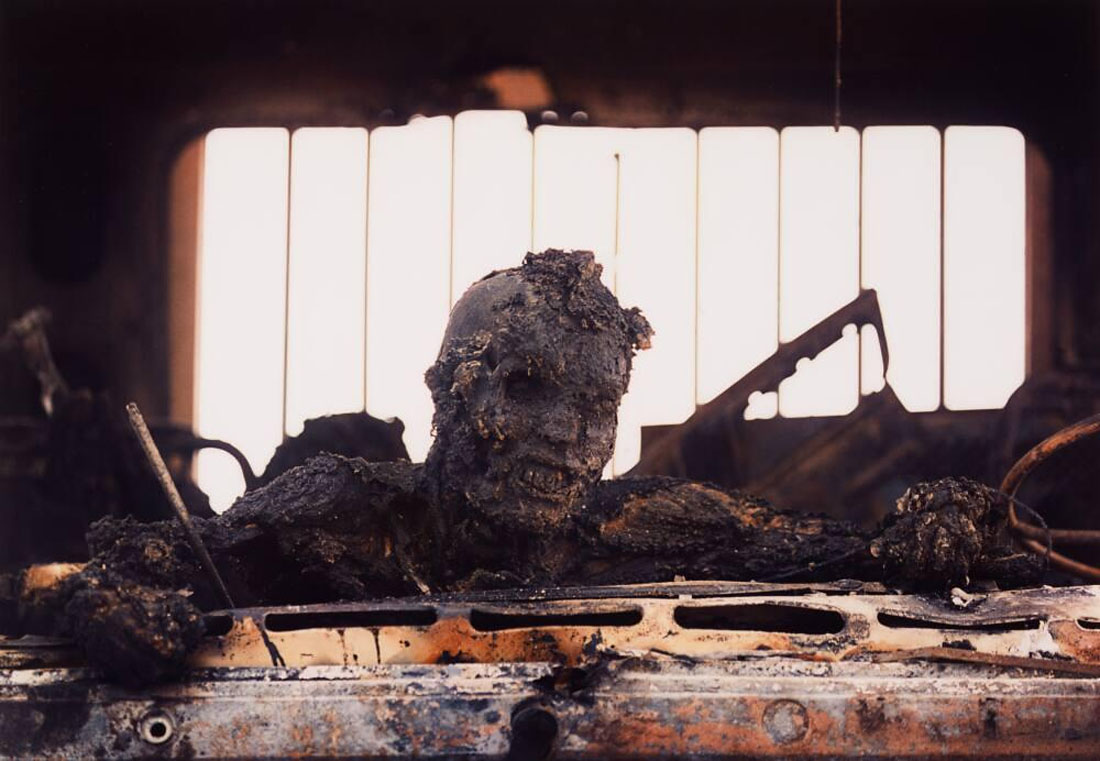
David Leeson (American, b. 1957) 'Death of a Soldier, Iraq' March 24, 2003


David Leeson (American, b. 1957)
Death of a Soldier, Iraq
March 24, 2003
Inkjet print, printed 2012
Courtesy of the artist


Ziv Koren (Israeli, b. 1970) 'A sniper’s-eye view of Rafah, in the Southern Gaza strip, during an Israeli military sweep' 2006


Ziv Koren (Israeli, b. 1970)
A sniper’s-eye view of Rafah, in the Southern Gaza strip, during an Israeli military sweep
2006
Inkjet print, printed 2012
© Ziv Koren/Polaris Images


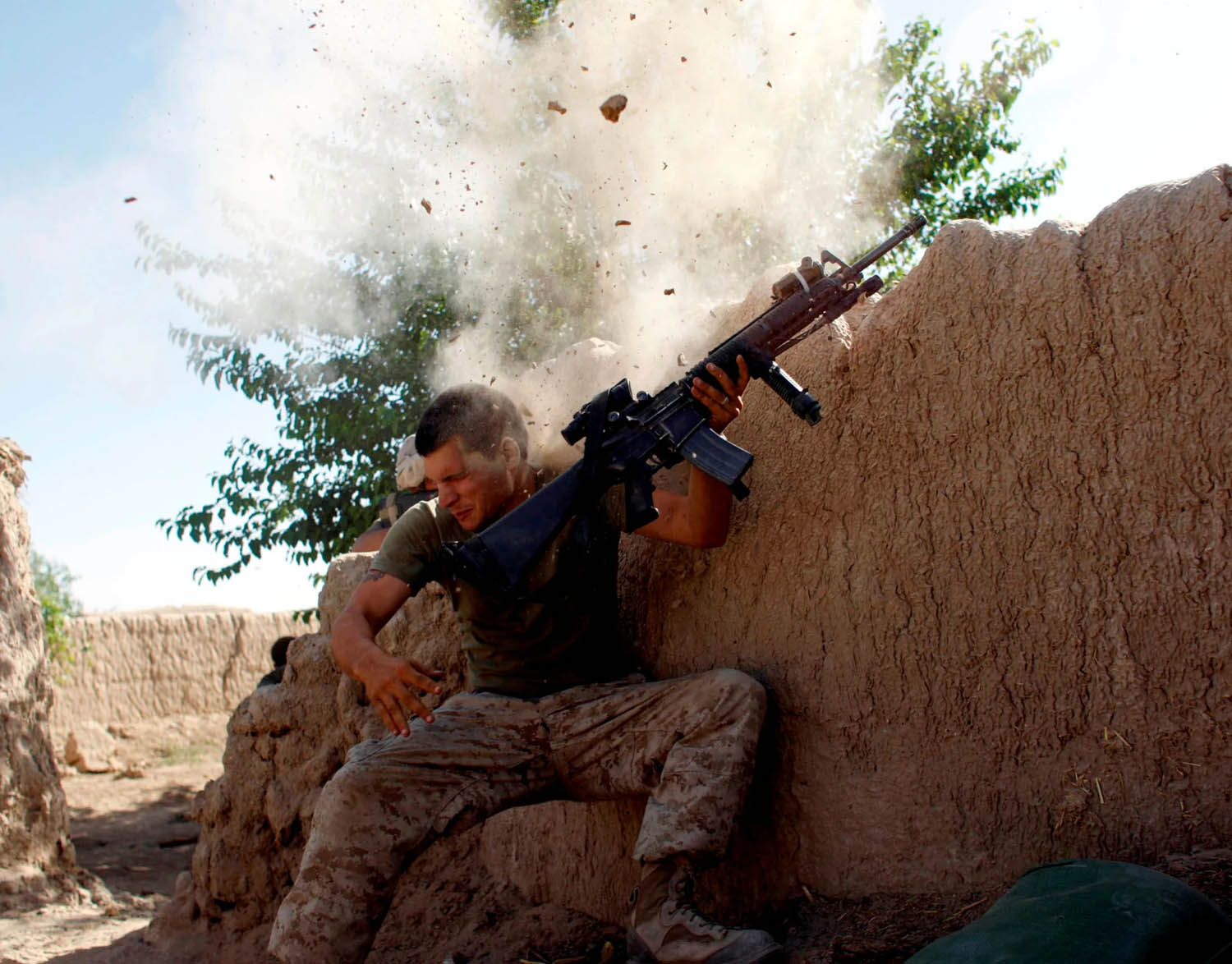
Goran Tomasevic (Serbian, b. 1959) /Reuters. 'SHOOTING. Sgt. William Olas Bee, a US Marine from the 24th Marine Expeditionary Unit, has a close call after Taliban fighters opened fire near Garmser in Helmand Province of Afghanistan May 18, 2008. The Marine was not injured.' 2008


Goran Tomasevic (Serbian, b. 1959) /Reuters
SHOOTING. Sgt. William Olas Bee, a US Marine from the 24th Marine Expeditionary Unit, has a close call after Taliban fighters opened fire near Garmser in Helmand Province of Afghanistan May 18, 2008. The Marine was not injured.
2008


Tomašević began photographing the war that followed the breakup of Yugoslavia from 1991 for daily newspaper Politika. In 1996 he joined the world’s largest news agency, Reuters, covering the simmering political tensions in Kosovo and the anti-Milošević demonstrations in his hometown of Belgrade since mid-1990s. During three-month NATO bombing of Yugoslavia in 1999, Tomašević was the only photographer working for foreign press to spend the duration of the conflict in Kosovo.

Tomašević moved to Jerusalem in 2002, covering the second Palestinian intifada. During the U.S. led invasions of Iraq in 2003, his picture of a U.S. Marine watching the toppling of a Saddam Hussein statue became one of the most memorable images of the war. He often returned to Iraq as sectarian violence escalated and regularly photographed America’s other war in Afghanistan. His sequence of photographs of U.S. Marine Sergeant Bee narrowly escaping Taliban bullets became an iconic image in U.S. war history.

Tomašević moved to Cairo in 2006 and was at the heart of Reuters’ coverage of the Arab Springs. In Libya, his image of a fireball that spewed up after an air strike on pro-Gaddafi fighters became an iconic image of the Libyan war, gracing the front pages of more than 100 newspapers around the globe. He stayed in Cairo until 2012. His raw pictures of rebel fighters battling pro-Assad forces among the ruins of Aleppo and Damascus during the Syrian Civil War have won international acclaim, as did his coverage of the bloody siege on a Nairobi shopping mall in Kenya. Tomašević worked for Reuters until 2022.

Text from the Wikipedia website


Museum of Fine Arts, Houston
1001 Bissonnet Street
Houston, TX 77005

Opening hours:
Wednesday 11am – 5pm
Thursday 11am – 9pm
Friday 11am – 6pm
Saturday 11am – 6pm
Sunday 12.30pm – 6pm
Closed Monday and Tuesday, except Monday holidays
Closed Thanksgiving Day and Christmas Day

Museum of Fine Arts, Boston website

LIKE ART BLART ON FACEBOOK

Back to top

Exhibition: ‘WAR/PHOTOGRAPHY: Images of Armed Conflict and Its Aftermath’ at the Museum of Fine Arts, Houston – Posting Part 3

Exhibition dates: 11th November 2012 – 3rd February 2013


Walter Astrada, (Argentinean, b. 1974) 'Congolese women fleeing to Goma' 2008


Walter Astrada, (Argentinean, b. 1974)
Congolese women fleeing to Goma
2008
From the series Violence against women in Congo, Rape as weapon of war in DRC
Chromogenic print (printed 2010)
The Museum of Fine Arts, Houston, museum purchase with funds provided by Photo Forum 2010
© Walter Astrada


“War is, above all, grief.”

Dmitri Baltermants


“Violence is the last refuge of the incompetent”


Salvor Hardin in Isaac Asimov’s ‘Foundation’ series


Part three of the biggest posting on one exhibition that I have ever undertaken on Art Blart!

As befits the gravity of the subject matter this posting is so humongous that I have had to split it into 4 separate postings. This is how to research and stage a contemporary photography exhibition that fully explores its theme. The curators reviewed more than one million photographs in 17 countries, locating pictures in archives, military libraries, museums, private collections, historical societies and news agencies; in the personal files of photographers and service personnel; and at two annual photojournalism festivals producing an exhibition that features 26 sections (an inspired and thoughtful selection) that includes nearly 500 objects that illuminate all aspects of WAR/PHOTOGRAPHY.

I have spent hours researching and finding photographs on the Internet to support the posting. It has been a great learning experience and my admiration for photographers of all types has increased. I have discovered the photographs and stories of new image makers that I did not know and some enlightenment along the way. I despise war, I detest the state and the military that propagate it and I surely hate the power, the money and the ethics of big business that support such a disciplinarian structure for their own ends. I hope you meditate on the images in this monster posting, an exhibition on a subject matter that should be consigned to the history books of human evolution.

**Please be aware that there are graphic photographs in all of these postings.** Part 1Part 2Part 4

Dr Marcus Bunyan


Many thankx to the Museum of Fine Arts, Houston for allowing me to publish some of the photographs in the posting. Please click on the photographs for a larger version of the image.


Civilians

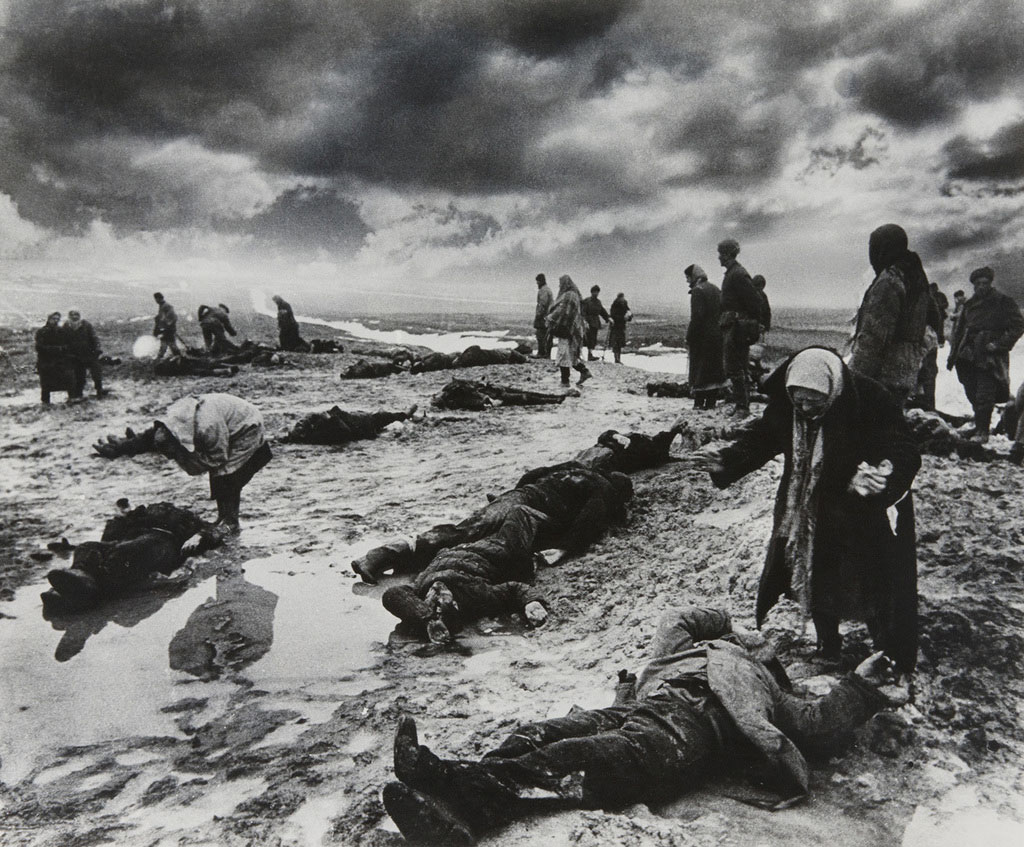
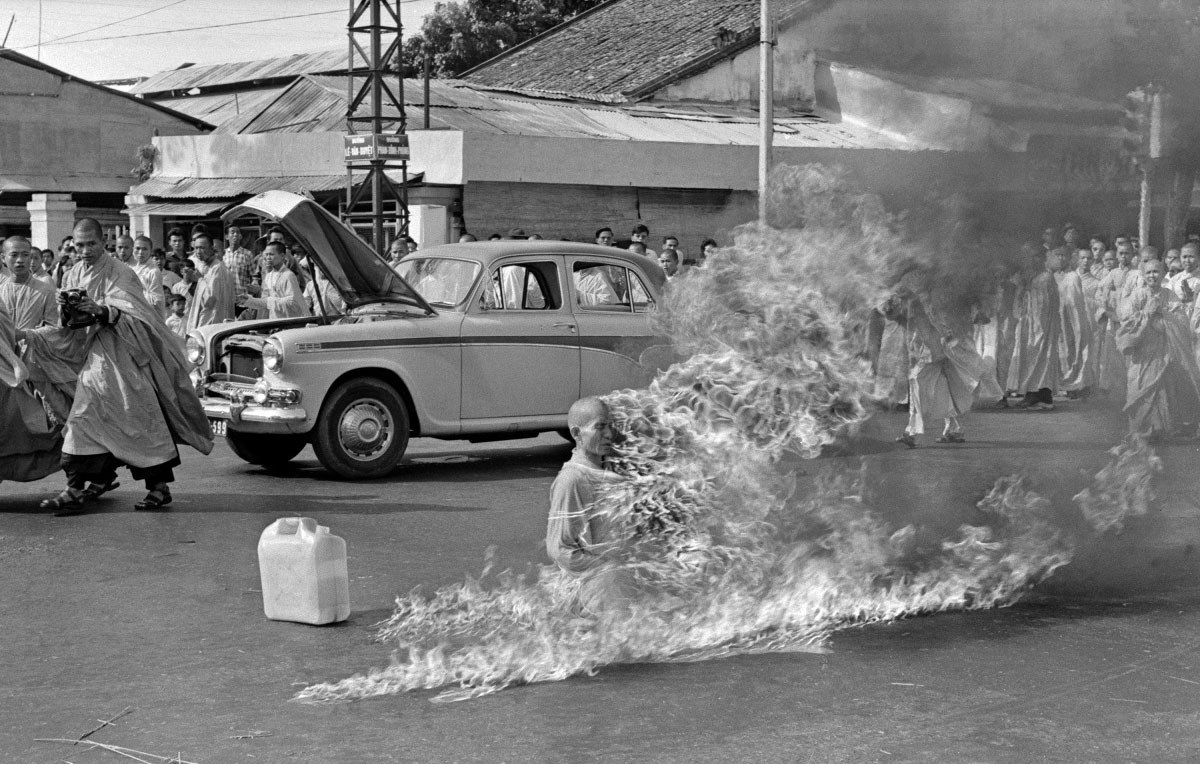
21. Civilians spans World War II through 2008. The subsection “Dead and Wounded” includes Grief, Kerch, Crimea, by Dmitri Baltermants, of civilians in 1942 searching the bodies of Russian Jewish family members who had been executed by Germans soldiers as they retreated. A 2003 photograph, taken by Ahmed Jadallah for the news agency Reuters while he lay wounded from shrapnel, shows bodies in the street in the largest refugee camp in the Gaza Strip. “Daily Life” shows a Congolese woman breastfeeding as a tank rolls by, in a 2008 image by Walter Astrada; Londoners sleeping in an underground train station in 1940, by Bill Brandt; a woman eating bread in Amsterdam during the Hongerwinter famine of 1944, by Cas Oorthuys; a 1940/1941 meeting in New York of members of the Bund, an American Nazi party, by Otto Hagel; a monk burning himself in Saigon in 1963, in protest against alleged religious persecution by the South Vietnamese government, by Malcolm Browne; and a man uncovering an anti-personnel land mine in Angola in 2004, by Sean Sutton. Pictures of civilian “Grief” are common, and the images here include a woman in Tehran inspecting photographs of the missing, by Gilles Peress; a man at an airport, grieving alone and holding a folded American flag, by Harry Benson; a father digging a grave for his daughter in a soccer field in Somalia, by Howard Castleberry; and a woman mourning in Afghanistan in 1996, at the grave of her brother who was killed by a Taliban rocket, by James Nachtwey. (46 images)


Otto Hagel (American born Germany, 1909-1973) 'German-Americans at a meeting in New Jersey of the Deutsche Bund' 1940-41


Otto Hagel (American born Germany, 1909-1973)
German-Americans at a meeting in New Jersey of the Deutsche Bund
1940-1941
Silver gelatin print


Dmitri Baltermants (Russian born Poland, 1912-1990) 'Grief, Kerch, Crimea' Spring 1942


Dmitri Baltermants (Russian born Poland, 1912-1990)
Grief, Kerch, Crimea
Spring 1942
Silver gelatin print


“War, is, above all, grief. I photographed non-stop for years and I know that in all that time I produced only five or six real photographs. War is not for photography. If, heaven forbid, I had to photograph war again, I would do it quite differently. I agonise now at the thought of all the things that I did not photograph.”

Dmitri Baltermants quoted in “The Russian War, 1941-1945” (J. Cape, London, 1978)


Cas Oorthuys (Dutch, 1908-1975) 'Portrait of starving woman in the hunger winter, Amsterdam' 1944-1945


Cas Oorthuys (Dutch, 1908-1975)
Portrait of starving woman in the hunger winter, Amsterdam
1944-1945
Silver gelatin print


Malcolm Browne (American, 1931-2012) 'Burning Monk - The Self-Immolation' 1963


Malcolm Browne (American, 1931-2012)
Burning Monk – The Self-Immolation
1963
Gelatin silver print


Harry Benson (Scottish, b. 1929) 'Grieving man, holding flag' 1971


Harry Benson (Scottish, b. 1929)
Grieving man, holding flag
1971
Gelatin silver print


Children

22. Children have been consistently photographed during wartime as both victims and soldiers. Images in this section include Sir Cecil Beaton’s Three-year-old Eileen Dunne in Hospital for Sick Children, England (1940); children viewing the bodies of other children who were hanged as collaborators in Russia in the 1940s, by Mark Redkin; Philip Jones Griffiths’ image of a young boy, Called “Little Tiger” for killing two “Vietcong women cadre” – his mother and teacher, it was rumored (1968); children playing “execution” in Italy, by Enzo Sellerio; two orphaned boys smoking cigarettes in post-World War II Japan, by Hayashi Tadahiko; a father home on leave reading the newspaper with his son, who wears his dad’s helmet, by Andrea Bruce; and the 2005 photograph, by Chris Hondros, of a blood-splattered Iraqi girl whose family was mistakenly ambushed by U.S. troops. (13 images) 


Cecil Beaton (British, 1904-1980) 'Eileen Dunne, aged three, sits in bed with her doll at Great Ormond Street Hospital for Sick Children, after being injured during an air raid on London in September 1940' 1940


Cecil Beaton (British, 1904-1980)
Eileen Dunne, aged three, sits in bed with her doll at Great Ormond Street Hospital for Sick Children, after being injured during an air raid on London in September 1940
1940
Gelatin silver print
© IWM (MH 26395)


Philip Jones Griffiths (Welsh, 1936-2008) 'Called "Little Tiger” for killing two "Vietcong women cadre” - his mother and teacher, it was rumored, Vietnam' 1968


Philip Jones Griffiths (Welsh, 1936-2008)
Called “Little Tiger” for killing two “Vietcong women cadre” – his mother and teacher, it was rumored, Vietnam
1968
Gelatin silver print
The Philip Jones Griffiths Foundation, courtesy of Howard Greenberg Gallery
© Philip Jones Griffiths / Magnum Photos


Andrea Bruce (American, b. 1973) 'Untitled [A father home on leave reading the newspaper with his son, who wears his dad’s helmet]' 2006


Andrea Bruce (American, b. 1973)
Untitled [A father home on leave reading the newspaper with his son, who wears his dad’s helmet]
2006
From the series When the War Comes Home
Gelatin silver print


Portraits

23. Portraits are the most common type of photograph made during conflicts. Dispersed throughout the exhibition, lining the main walkway through the galleries, are the faces of leaders, the enlisted, heroes and war criminals, as well as group portraits. One of the earliest prints in the exhibition is a daguerreotype from the Mexican-American War of a high-ranking officer. Matthew Brady, one of the most famous photographers of the 19th century, was renowned for coverage of the Civil War; his MajorGeneral Joseph Hooker, c. 1863, is on view. Among the most recent is a self-portrait by American Cpl. Reynaldo Leal USMC. Leal – who was born and grew up in Edinburg, Texas, and now lives in El Paso – served in Iraq conducting combat patrols through the villages along the Euphrates. (40 images)


Matthew B. Brady (American, 1823-1896) 'Colonel William Gates, believed to have been taken upon his return from the Mexican War' c. 1848


Matthew B. Brady (American, 1823-1896)
Colonel William Gates, believed to have been taken upon his return from the Mexican War
c. 1848
Half plate daguerreotype, gold toned
Library of Congress


Mathew B. Brady (American, 1823-1896) 'Major-General Joseph Hooker' c. 1863


Mathew B. Brady (American, 1823-1896)
Major-General Joseph Hooker
c. 1863
Salted paper print, hand coloured
The Museum of Fine Arts, Houston, museum purchase with funds provided by the S. I. Morris Photography Endowment


Corporal Reynaldo Leal USMC (American, b. 1983) 'Self‑portrait after a Patrol' c. 2004-2006


Corporal Reynaldo Leal USMC (American, b. 1983)
Self‑portrait after a Patrol
c. 2004-2006
Inkjet print
13 1/2 × 9 in. (34.3 × 22.9cm)
The Museum of Fine Arts, Houston
Museum purchase with funds provided by Will Michels and Clinton T. Willour
© Reynaldo Leal


War’s End

24. War’s End is identifiable at the moment a photograph is taken. The subsection “Victory/Defeat” is the visual manifest of the outcome of war, from the Japanese signing peace documents on board the USS Missouri, by Carl Mydans; to German generals discussing terms of surrender in the woods just four days after Adolf Hitler committed suicide in 1945, by E. G. Malindine; and the raising of the Hammer and Sickle over the Reichstag in Berlin in 1945, by Evgeny Khaldey. Also included is Simon Norfolk’s Victory arch built by the Northern Alliance at the entrance to a local commander’s headquarters in Bamiyan. The empty niche housed the smaller of the two Buddhas, destroyed by the Taliban in 2001, from the series Afghanistan: Chronotopia. “Retribution” contains a 1945 image, by Lee Miller, of a concentration-camp guard who was beaten by prisoners after their liberation; and a photograph by Robert Capa of a Frenchwoman who had been impregnated by a German soldier, as she walks through a jeering crowd with her head shaved in punishment and carrying her baby. The photographs in “Homecoming” establish an emotive connection: a family reunion on the tarmac at an Air Force base in California in 1973, by Sal Veder; a mother and son embracing at the Ben-Gurion Airport in Israel in 1976, by Micha Bar-Am; and a man who has returned from duty in Bosnia in 1995 to discover that his home and everyone in it is gone, by Ron Haviv. (23 images)


Robert Capa (Hungarian-American, 1913-1954) 'Collaborator woman who had a German soldier's child, Chartres, 18 August 1944' 1944


Robert Capa (Hungarian-American, 1913-1954)
Collaborator woman who had a German soldier’s child, Chartres, 18 August 1944
1944
Gelatin silver print
33 x 49cm


Evgeny Khaldey (Russian, 1917-1997) 'The Flag of Victory' 1945


Evgeny Khaldey (Russian, 1917-1997)
The Flag of Victory
1945
Gelatin silver print


E. G. Malindine (British, 1906-1970) 'German Military Forces Seek Surrender Terms, May 1945'


E. G. Malindine (British, 1906-1970)
No 5 Army Film & Photographic Unit, Malindine E G (Capt), Morris (Sgt)
German Military Forces Seek Surrender Terms, May 1945
1945
Gelatin silver print
Public domain


Field Marshal Sir Bernard Montgomery with the German delegates outside his headquarters at 21st Army Group


Carl Mydans (American, 1907-2004) 'Japanese signing peace documents on board the USS Missouri' 1945


Carl Mydans (American, 1907-2004)
Japanese signing peace documents on board the ‘USS Missouri’
1945
Gelatin silver print


Sal Velder (American, b. 1926) 'Released prisoner of war Lt. Col. Robert L. Stirm is greeted by his family at Travis Air Force Base in Fairfield, California on March 17, 1973, as he returns home from the Vietnam War' 1973


Sal Velder (American, b. 1926)
Released prisoner of war Lt. Col. Robert L. Stirm is greeted by his family at Travis Air Force Base in Fairfield, California on March 17, 1973, as he returns home from the Vietnam War
1973
Silver gelatin print
© Sal Velder


Micha Bar-Am (Israeli born Germany, 1930-2022) 'The return from Entebbe, Ben-Gurion Airport, Israel' 1976


Micha Bar-Am (Israeli born Germany, 1930)
The return from Entebbe, Ben-Gurion Airport, Israel
1976
From the series Promised Land
Inkjet print
Courtesy of the artist and Andrea Meislin Gallery, New York
© Micha Bar-Am / Magnum Photos


Ron Haviv (American, b.1965) 'A Bosnian soldier stands on what is believed to be a mass grave outside his destroyed home. He was the sole survivor of 69 people' 1995


Ron Haviv (American, b. 1965)
A Bosnian soldier stands on what is believed to be a mass grave outside his destroyed home. He was the sole survivor of 69 people
1995
Inkjet print
Courtesy of Ron Haviv/VII
© Ron Haviv


Simon Norfolk (British born Nigeria, b. 1963)
'Victory arch built by the Northern Alliance at the entrance to a local commander’s headquarters in Bamiyan. The empty niche housed the smaller of the two Buddhas, destroyed by the Taliban in 2001' 2001


Simon Norfolk (British born Nigeria, b. 1963)
Victory arch built by the Northern Alliance at the entrance to a local commander’s headquarters in Bamiyan. The empty niche housed the smaller of the two Buddhas, destroyed by the Taliban in 2001
2001
From the series Afghanistan: Chronotopia


Museum of Fine Arts, Houston
1001 Bissonnet Street
Houston, TX 77005

Opening hours:
Wednesday 11am – 5pm
Thursday 11am – 9pm
Friday 11am – 6pm
Saturday 11am – 6pm
Sunday 12.30pm – 6pm
Monday Closed
Tuesday Closed

Museum of Fine Arts, Boston website

LIKE ART BLART ON FACEBOOK

Back to top
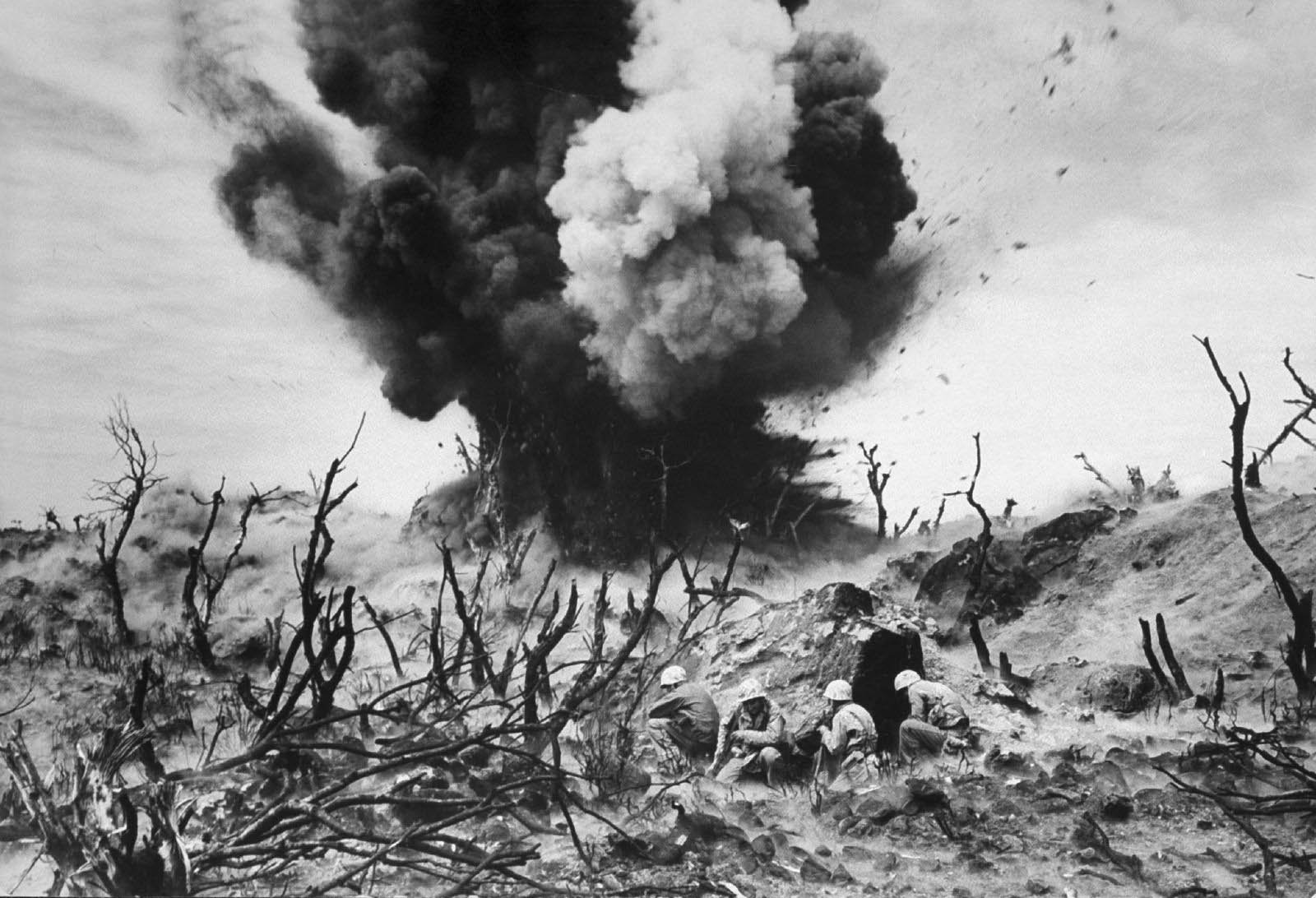
Exhibition: ‘WAR/PHOTOGRAPHY: Images of Armed Conflict and Its Aftermath’ at the Museum of Fine Arts, Houston, Part 1

Exhibition dates: 11th November 2012 – 3rd February 2013

Curators: Anne Tucker, Natalie Zelt and Will Michels


Roger Fenton (British, 1819-1869) 'The Valley of the Shadow of Death' 1855


Roger Fenton (British, 1819-1869)
The Valley of the Shadow of Death
1855


This is the biggest posting on one exhibition that I have ever undertaken on Art Blart!

As befits the gravity of the subject matter this posting is so humongous that I have had to split it into 4 separate postings. This is how to research and stage a contemporary photography exhibition that fully explores its theme (NGV please note!). The curators reviewed more than one million photographs in 17 countries, locating pictures in archives, military libraries, museums, private collections, historical societies and news agencies; in the personal files of photographers and service personnel; and at two annual photojournalism festivals producing an exhibition that features 26 sections (an inspired and thoughtful selection) that includes nearly 500 objects that illuminate all aspects of WAR/PHOTOGRAPHY.

I have spent hours researching and finding photographs on the Internet to support the posting. It has been a great learning experience and my admiration for photographers of all types has increased. I have discovered the photographs and stories of new image makers that I did not know and some hidden treasures along the way. I hope you enjoy this monster posting on a subject matter that should be consigned to the history books of human evolution.

**Please be aware that there are graphic photographs in all of these postings.** Part 2Part 3Part 4

Dr Marcus Bunyan


Many thankx to the Museum of Fine Arts, Houston for allowing me to publish some of the photographs in the posting. Please click on the photographs for a larger version of the image.


On November 11, 2012, the Museum of Fine Arts, Houston, debuts an unprecedented exhibition exploring the experience of war through the eyes of photographers. WAR / PHOTOGRAPHY: Images of Armed Conflict and Its Aftermath features nearly 500 objects, including photographs, books, magazines, albums and photographic equipment. The photographs were made by more than 280 photographers, from 28 nations, who have covered conflict on six continents over 165 years, from the Mexican-American War of 1846 through present-day conflicts. The exhibition takes a critical look at the relationship between war and photography, exploring what types of photographs are, and are not, made, and by whom and for whom. Rather than a chronological survey of wartime photographs or a survey of “greatest hits,” the exhibition presents types of photographs repeatedly made during the many phases of war – regardless of the size or cause of the conflict, the photographers’ or subjects’ culture or the era in which the pictures were recorded. The images in the exhibition are organised according to the progression of war: from the acts that instigate armed conflict, to “the fight,” to victory and defeat, and images that memorialise a war, its combatants and its victims. Both iconic images and previously unknown images are on view, taken by military photographers, commercial photographers (portrait and photojournalist), amateurs and artists.

“‘WAR/PHOTOGRAPHY’ promises to be another pioneering exhibition, following other landmark MFAH photography exhibitions such as ‘Czech Modernism: 1900-1945’ (1989) and ‘The History of Japanese Photography’ (2003),” said Gary Tinterow, MFAH director. “Anne Tucker, along with her co-curators, Natalie Zelt and Will Michels, has spent a decade preparing this unprecedented exploration of the complex and profound relationship between war and photography.” “Photographs serve the public as a collective memory of the experience of war, yet most presentations that deal with the material are organised chronologically,” commented Tucker. “We believe ‘WAR / PHOTOGRAPHY’ is unique in its scope, exploring conflict and its consequences across the globe and over time, analysing this complex and unrelenting phenomenon.”

The earliest work in the exhibition is from 1847, taken from the first photographed conflict: the Mexican-American War. Other early examples include photographs from the Crimean War, such as Roger Fenton’s iconic The Valley of the Shadow of Death (1855) and Felice Beato’s photograph of the devastated interior of Fort Taku in China during the Second Opium War (1860). Among the most recent images is a 2008 photograph of the Battle Company of the 173rd Airborne Brigade in the remote Korengal Valley of Eastern Afghanistan by Tim Hetherington, who was killed in April 2011 while covering the civil war in Libya. Also represented with two photographs in the exhibition is Chris Hondros, who was killed with Hetherington. While the exhibition is organised according to the phases of war, portraits of servicemen, military and political leaders and civilians are a consistent presence throughout, including Yousuf Karsh’s classic 1941 image of Winston Churchill, and the Marlboro Marine (2004), taken by embedded Los Angeles Times photographer Luis Sinco of soldier James Blake Miller after an assault in Fallujah, Iraq. Sinco’s image was published worldwide on the cover of 150 publications and became a 2005 Pulitzer Prize finalist.

The exhibition was initiated in 2002, when the MFAH acquired what is purported to be the first print made from Joe Rosenthal’s negative of Old Glory Goes Up on Mount Suribachi, Iwo Jima (1945). From this initial acquisition, the curators decided to organise an exhibition that would focus on war photography as a genre. During the evolution of the project, the museum acquired more than a third of the prints in the exhibition. The curators reviewed more than one million photographs in 17 countries, locating pictures in archives, military libraries, museums, private collections, historical societies and news agencies; in the personal files of photographers and service personnel; and at two annual photojournalism festivals: World Press Photo (Amsterdam) and Visa pour l’Image (Perpignan, France). The curators based their appraisals on the clarity of the photographers’ observation and capacity to make memorable and striking pictures that have lasting relevance. The pictures were recorded by some of the most celebrated conflict photographers, as well as by many who remain anonymous. Almost every photographic process is included, ranging from daguerreotypes to inkjet prints, digital captures and cell-phone shots.

Press release from the Museum of Fine Arts, Houston


Yousuf Karsh (Armenian-Canadian, 1908-2002) 'Winston Churchill' 1941


Yousuf Karsh (Armenian-Canadian, 1908-2002)
Winston Churchill
1941
Gelatin silver print


WAR/PHOTOGRAPHY: Images of Armed Conflict and Its Aftermath is organised into 26 sections, which unfold in the sequence that typifies the stages of war, from the advent of conflict through the fight, aftermath and remembrance. Each section showcases images appropriate to that category while cutting across cultures, time and place. Outside of this chronological approach are focused galleries for “Media Coverage and Dissemination” (with an emphasis on technology); “Iwo Jima” (a case study); and “Photographic Essays” (excerpts from two landmark photojournalism essays, by Larry Burrows and Todd Heisler).

Media Coverage and Dissemination

1. Media Coverage and Dissemination provides an overview of how technology has profoundly affected the ways that pictures from the front reach the public: from Roger Fenton and his horse-drawn photography van (commissioned by the British government to document the Crimean War), to Joe Rosenthal’s 1940s Anniversary Speed Graphic (4 x 5) camera, to pictures taken with the Hipstamatic app of an iPhone by photojournalist Michael Christopher Brown in Egypt during the protests and clashes of the Arab Spring. (22 images / objects)


Roger Fenton (English, 1819-1869) 'The artist's van [Marcus Sparling, full-length portrait, seated on Roger Fenton's photographic van]' 1855


Roger Fenton (British, 1819-1869)
The artist’s van [Marcus Sparling, full-length portrait, seated on Roger Fenton’s photographic van]
1855
Salted paper print
17.5 × 16.5cm
Library of Congress, Prints & Photographs Division


Manufactured by Graflex, active 1912-1973. 'Anniversary Speed Graphic (4 x 5), "Scott S. Wigle camera" (First American-made D-Day picture)' c. 1940


Manufactured by Graflex, active 1912-1973
Anniversary Speed Graphic (4 x 5), “Scott S. Wigle camera” (First American-made D-Day picture)
c. 1940
Camera
Collection of George Eastman House (Gift of Graflex, Inc.)


An Advent of War

2. The photographs in An Advent of War depict the catalytic events of war. These moments of instigation are rarely captured, as photographers are not always present at the initial attack or provocation. Photographs that Robert Clark took on the morning of September 11, 2001, and the aerial view of torpedoes approaching Battleship Row during the Pearl Harbor attack, taken by an unknown Japanese airman on December 7, 1941, both convey with clarity the concept of war’s advent. (11 images).


Unknown photographer (Japanese) 'War in Hawaiian Water. Japanese Torpedoes Attack Battleship Row, Pearl Harbor' December 7, 1941


Unknown photographer (Japanese)
War in Hawaiian Water. Japanese Torpedoes Attack Battleship Row, Pearl Harbor
December 7, 1941
Gelatin silver print
The Museum of Fine Arts, Houston, gift of Will Michels


Recruitment & Embarkation

3. Recruitment & Embarkation shows mobilisation: the movement toward the front. Mikhail Trakhman captures a Russian mother kissing her son goodbye in Kolkhoz farmer M. Nikolaïeva bids her son Ivan goodbye before he joins the partisans (1942), while a 1916 photograph by Josiah Barnes, known as the “Embarkation Photographer,” shows an archetypal moment: young Australian soldiers waving goodbye from a ship as they depart their home country to fight in World War I. (7 images)


Josiah Barnes (Australian, 1858-1921) 'Embarkation of HMAT Ajana, Melbourne' July 8, 1916


Josiah Barnes (Australian, 1858-1921)
Embarkation of HMAT Ajana, Melbourne
July 8, 1916
Gelatin silver print (printed 2012)
On loan from the Australian War Memorial


Known as “the embarkation photographer”, the Kew, Melbourne photographer Josiah Barnes took an interest in photographing Australian troopships as they departed for war from Melbourne. He had two sons, “Norm and Victor, who left for war in 1916 (both returned to Australia after their service),” which may have fuelled his interest.


Mikhail Trakhman (Russian, 1918-1976) 'Kolkhoz farmer M. Nikolaïeva bids her son Ivan goodbye before he joins the partisans' 1942


Mikhail Trakhman (Russian, 1918-1976)
Kolkhoz farmer M. Nikolaïeva bids her son Ivan goodbye before he joins the partisans
1942
Gelatin silver print


A kolkhoz was a form of collective farm in the Soviet Union which, alongside sovkhoz (state farm), formed the main components of the socialised farm sector which emerged after the October Revolution of 1917 as an antithesis to feudalism, aristocratic landlords, serfdom and individual farming.

Mikhail Trakhman

Mikhail Trakhman was born in Moscow in 1918. After graduating from school, he began working at the newsreel studio and at the same time studying for courses in the field of assistant operator. From 1938 he became the photo reporter of the Uchitelskaya Gazeta, and in 1939 he was drafted into the army and participated in the Soviet-Finnish war. During the Great Patriotic War, Mikhail Trakhman worked as a press photographer for the Soviet Information Bureau. His main instrument was the famous “Leica” camera, but often military weapons fell into his hands. He shot in besieged Leningrad, in Pskov and in Belarus, participated in the liberation of Poland and Hungary. The most famous are his photographs from the partisan series taken in the rear of the German troops. In his diaries, he wrote: “I take a lot of things, although I know that 80% of the shot will go to the basket, but I need to shoot it, since such things happen once in a lifetime.” Thanks to these photos, he entered the history of war reporting. Mikhail Trakhman was awarded the Order of the Red Star and the medal “For the Defense of Leningrad” and “Partisan Medal”, which he especially valued.

Anonymous. “Mikhail Trakhman,” on the Lumiere Brothers Gallery website [Online] Cited 06/09/2020


Training

4. Training explores photographs of soldiers in boot camp or more-advanced phases of instruction and exercise. World War II Royal Navy officers gather around a desk to study different types of aircraft in a photograph by Sir Cecil Beaton. Also included is the iconic Vietnam-era photograph of a U.S. Marine drill sergeant reprimanding a recruit in South Carolina, from Thomas Hoepker’s series US Marine Corps boot camp, 1970. In one photograph, shot by a Japanese soldier and published in 1938 by Look magazine, Japanese soldiers use living Chinese prisoners in bayonet practice. (13 images) 


Thomas Hoepker (German, 1936-2024) 'A US Marine drill sergeant delivers a severe reprimand to a recruit, Parris Island, South Carolina' 1970


Thomas Hoepker (German, 1936-2024)
A US Marine drill sergeant delivers a severe reprimand to a recruit, Parris Island, South Carolina
1970
From the series US Marine Corps boot camp, 1970
Inkjet print
Thomas Hoepker / Magnum Photos
© Thomas Hoepker / Magnum Photos


Daily Routine

5. Daily Routine features moments of boredom, routine and playfulness. A member of the U.S. Army Signal Corps wears a gas mask as he peels onions. A 1942 photograph by Sir Cecil Beaton catches the off-guard expression of a Royal Navy man at a sewing machine, mending a signal flag. (13 images)


Anonymous photographer. 'Soldiers trying out their gas masks in every possible way. Putting the respirator to good use while peeling onions. 40th Division, Camp Kearny, San Diego, California' 1918


Anonymous photographer
Soldiers trying out their gas masks in every possible way. Putting the respirator to good use while peeling onions. 40th Division, Camp Kearny, San Diego, California
1918
National Archives and Records Administration


Cecil Beaton (English, 1904-1980) 'A Royal Navy sailor on board HMS Alcantara uses a portable sewing machine to repair a signal flag during a voyage to Sierra Leone' March 1942


Cecil Beaton (English, 1904-1980)
A Royal Navy sailor on board HMS Alcantara uses a portable sewing machine to repair a signal flag during a voyage to Sierra Leone
March 1942
Gelatin silver print, printed 2012
The Museum of Fine Arts, Houston
Gift of the Phillip and Edith Leonian Foundation
© The Imperial War Museums (neg. #CBM 1049)


HMS Alcantara

HMS Alcatara was an RML passenger liner of 22,209 tons and 19 knots launched in 1926, and taken up by the Royal Navy for conversion to an armed merchant cruiser to counter the threat posed by German surface raiders against shipping. When Jim Hingston joined her as an ordinary seaman at Freetown she was still largely in merchant dress, with wood panelling throughout. Much to the regret of her crew this was removed during their stay at Simonstown – the wisdom of that was apparent to them only too soon.

There were some 53 such ships in all, poorly armed, in Alcantara‘s case with eight 6 inch and two 3 inch guns, the former having a range of some 14,200 yards (13,000 metres). Such armament could not be much more than defensive, the intention being that the AMCs should radio the position of the German ship and not only give merchant shipping a chance to escape but delay the commerce raider long enough to allow regular RN warships to get to the scene.

Alcantara‘s opponent, the Thor, was laid down in 1938 as a freighter of 9,200 tons displacement and a speed of 18 knots, but commissioned as a commerce raider on 14 March 1940. Though she had only 6 150 mm guns they had a much greater range, at 20,000 yards, than Alcantara and other British AMCs. She also carried a scout floatplane. During the engagement with Alcantara on 28 July 1940 the Thor inflicted significant damage but the Alcantara successfully closed, and after being hit the Thor withdrew in order to avoid the risk of being crippled or being forced to abort her mission. In later encounters with AMCs the Thor severely damaged the Carnarvon Castle and sank Voltaire.

HMS Alcantara later had her 6 in armament upgraded and was equipped with a seaplane, but as the threat of surface raiders receded she was converted to her more natural role of troopship in 1943.


Reconnaissance, Resistance and Sabotage

6. Images of Reconnaissance, Resistance and Sabotage are scarce by nature, as they reveal spies in the act and could be used against those depicted or their families. A U.S. soldier on night watch sits atop a mountain in Afghanistan, wrapped in a blanket and peering into night-vision equipment, in a photograph by Adam Ferguson. A photograph by T. E. Lawrence (known as Lawrence of Arabia) documents the bombing of the Hejaz Railway during the Arab Revolt. Cas Oorthuys’ photograph Under German Occupation (Dutch Worker’s Front), Amsterdam (c. 1940-1945), taken with a camera hidden in his jacket, shows the back of a fellow countryman who is helping to conceal the photographer, with German troops in the distance. Also included is Arkady Shaikhet’s 1942 photograph Partisan Girl depicting Olga Mekheda, who was renowned for her ability to get through German roadblocks – even while pregnant. (10 images)


T.E. Lawrence. 'Untitled [A Tulip bomb explodes on the railway Hejaz Railway, near Deraa, Hejaz, Ottoman Empire]' 1918


T.E. Lawrence (British, 1888-1935)
Untitled [A Tulip bomb explodes on the railway Hejaz Railway, near Deraa, Hejaz, Ottoman Empire]
1918
Collection of the MFA Houston


Cas Oorthuys (Dutch, 1908-1975) 'Under German Occupation (Dutch Worker's Front), Amsterdam' c. 1940-1945


Cas Oorthuys (Dutch, 1908-1975)
Under German Occupation (Dutch Worker’s Front), Amsterdam
c. 1940-1945
Gelatin silver print
13 7/8 × 11 5/8 in. (35.2 × 29.5cm)
Museum of Fine Arts, Houston
Museum purchase funded by Anne Wilkes Tucker in honor of the 50th wedding anniversary of Max and Isabell Smith Herzstein


Adam Ferguson (Australian, b. 1978) 'September 4, Tangi valley, Wardak province, Afghanistan, a soldier of the U.S. Army 10th Mountain Division was attentively monitoring a highway' September 4, 2009


Adam Ferguson (Australian, b. 1978)
September 4, Tangi valley, Wardak province, Afghanistan, a soldier of the U.S. Army 10th Mountain Division was  attentively monitoring a highway
September 4, 2009


“To me, this picture epitomises the abstract idea of the ‘enemy’ that exists within the U.S. led war in Afghanistan: a young infantryman watches a road with a long-range acquisition sight surveying for insurgents planting Improvised Explosive Devices. U.S. Army Infantrymen rarely knowingly come face to face with their enemy, combat is fleeting and fought like cat and mouse, and the most decisive blows are determined by intelligence gathering, and then delivered through technology that maintains a safe distance, just like a video game.”

~ Adam Ferguson


Arkady Shaikhet (Russian, 1898-1959) 'Partisan Girl' 1942


Arkady Shaikhet (Russian, 1898-1959)
Partisan Girl
1942
Gelatin silver print
The Museum of Fine Arts, Houston, gift of Marion Mundy
© Arkady Shaikhet Estate, Moscow, courtesy Nailya Alexander Gallery, NYC


Patrol & Troop Movement

7. Patrol & Troop Movement conveys the mass movements of peoples and personnel by land, sea and air, from the movement of troops and supplies to patrols by all five divisions of military service: Army, Navy, Marine Corps, Coast Guard and Air Force. Combat patrols are detachments of forces sent into hostile terrain for a range of missions, and they – as well as the photographers accompanying them – face considerable danger. João Silva’s three sequenced frames show, through his eyes, the tilted earth just after he was felled by an IED while on patrol in Afghanistan in 2010; he lost both legs in the incident. A tranquil, 1917 image by Australian James Frank Hurley depicts silhouetted soldiers walking in a line, their reflections captured in a body of water. A 1943 photograph by American Warrant Photographer Jess W. January USCGR shows members of the U.S. Coast Guard observing a depth-charge explosion hitting a German submarine that stalked their convoy. (14 images)

.

João Silva (South African born Portugal, b. 1966) 'Soldiers of Charlie Company, 1st Battalion, 66th Armored Regiment, 4th Infantry Division react to photographer Joao Silva stepping on a mine in the Arghandab district of Kandahar Province, Afghanistan, on Oct. 23, 2010'


João Silva (South African born Portugal, b. 1966)
Soldiers of Charlie Company, 1st Battalion, 66th Armored Regiment, 4th Infantry Division react to photographer Joao Silva stepping on a mine in the Arghandab district of Kandahar Province, Afghanistan, on Oct. 23, 2010, in a three-photo combination. For American troops in heavily-mined Afghan villages, steering clear of improvised explosive devices is the most difficult task
October 23, 2010
© João Silva / The New York Times via Redux


Frank Hurley (Australian, 1885-1962) 'Supporting troops of the 1st Australian Division walking on a duckboard track' 1917


Frank Hurley (Australian, 1885-1962)
Supporting troops of the 1st Australian Division walking on a duckboard track
1917


Warrant Photographer Jess W. January USCGR, American USCG. 'Cutter Spencer destroys Nazi sub' April 17, 1943


Warrant Photographer Jess W. January USCGR, American
USCG Cutter Spencer destroys Nazi sub
April 17, 1943
Gelatin silver print
The Museum of Fine Arts, Houston


The Wait

8. The Wait depicts a common situation of wartime. Susan Meiselas captures a tense moment during a 1978 street fight in Nicaragua, when muchachos with Molotov cocktails line up in an alleyway, ready to initiate an attack on the National Guard. Robert Capa shows two female French ambulance drivers in Italy during World War II, leaning against their vehicle, knitting, as they wait to be called. (8 images)


Robert Capa (American-Hungarian, 1913-1954) 'Drivers from the French ambulance corps near the front, waiting to be called' Italy, 1944


Robert Capa (American-Hungarian, 1913-1954)
Drivers from the French ambulance corps near the front, waiting to be called
Italy, 1944
Original album – Italy. Cassino Campaign. W.W.II.
© 2001 By Cornell Capa, Agentur Magnum


Susan Meiselas (American, b. 1948) 'Muchachos Await Counter Attack by The National Guard, Matagalpa, Nicaragua' 1978


Susan Meiselas (American, b. 1948)
Muchachos Await Counter Attack by The National Guard, Matagalpa, Nicaragua
1978
Chromogenic print (printed 2006)
The Museum of Fine Arts, Houston, museum purchase with funds provided by Photo Forum 2006
© Susan Meiselas / Magnum Photos


The Fight

9. The Fight is one of the most extensive sections in the exhibition. Dmitri Baltermants shot Attack – Eastern Front WWII (cover image of the exhibition catalogue) in 1941 from the trench, as men charged over him. Sky Over Sevastopol (1944), by Evgeny Khaldey, is an aerial photograph of planes on their way to a bombing raid of the strategically important naval point. Joe Rosenthal’s Over the Top – American Troops Move onto the Beach at Iwo Jima (1945) pictures infantrymen emerging from the protection of their landing craft into enemy fire. Staged photographs, presented as authentic documents, tend to proliferate during wartime, and several examples are included here. In 1942 the Public Relations Department of the War issued an assignment to photographers to create “representative” images of combat in North Africa for more dynamic images; official British photographer Len Chetwyn staged an Australian officer leading the charging line in the battle of El Alamein, using smoke in the background from the cookhouse to create a lively image. (21 images)


Len Chetwyn (English, 1909-1980) 'Australians approached the strong point, ready to rush in from different sides' November 3, 1942


Len Chetwyn (English, 1909-1980)
Australians approached the strong point, ready to rush in from different sides
November 3, 1942
Silver gelatin photograph


Joe Rosenthal (American, 1911-2006) 'Over the Top – American Troops Move onto the Beach at Iwo Jima' 1945

Joe Rosenthal (American, 1911-2006) 'Over the Top - American Troops Move onto the Beach at Iwo Jima' February 19, 1945


Joe Rosenthal (American, 1911-2006)
Over the Top – American Troops Move onto the Beach at Iwo Jima
February 19, 1945 (printed February 23, 1945)
Gelatin silver print with applied ink
The Museum of Fine Arts, Houston, gift of Richard S. and Dodie Otey Jackson in honor of Ira J. Jackson, M.D., and his service in the Pacific Theater during World War II
© AP / Wide World Photos


Dmitri Baltermants (Russian, 1912-1990) 'Attack – Eastern Front WWII' 1941


Dmitri Baltermants (Russian, 1912-1990)
Attack – Eastern Front WWII
1941
Silver gelatin photograph


The Wait and Rescue

10. The Wait and Rescue bookend The Fight. Among the photographs in Rescue are Ambush of the 173rd AB, South Vietnam (1965), by Tim Page, showing soldiers immediately combing through a battleground to assist the wounded; American Lt. Wayne Miller’s image of a wounded gunner being lifted from the turret of a torpedo bomber; and Life magazine photographer W. Eugene Smith’s 1944 photograph of an American soldier rescuing a dying Japanese infant. Smith wrote about that moment, stating “hands trained for killing gently… extricated the infant” to be transported to medical care. (8 images) 


Lt. Wayne Miller. 'Crewmen lifting Kenneth Bratton out of turret of TBF on the USS SARATOGA after raid on Rabaul' November 1943


Lt. Wayne Miller (American, 1918-2013)
Crewmen lifting Kenneth Bratton out of turret of TBF on the USS SARATOGA after raid on Rabaul
November 1943
Silver gelatin photograph


More information: Kenneth C. Bratton – Mississippi (WWII vet). He was born in Pontotoc, MS, December 17, 1918. He passed away April 15, 1982. Lt. Bratton won a purple heart for his bravery during the attack on Rabaul November 11, 1943.


Wayne Forest Miller (September 19, 1918 – May 22, 2013) was an American photographer known for his series of photographs The Way of Life of the Northern Negro. Active as a photographer from 1942 until 1975, he was a contributor to Magnum Photos beginning in 1958. …

War photographer

Miller then served as a lieutenant in the U.S. Navy where he was assigned to Edward Steichen’s World War II Naval Aviation Photographic Unit. He was among the first Western photographers to document the destruction at Hiroshima.

Text from the Wikipedia website


The Grumman TBF Avenger (designated TBM for aircraft manufactured by General Motors) is an American World War II-era torpedo bomber developed initially for the United States Navy and Marine Corps, and eventually used by several air and naval aviation services around the world.

The Avenger entered U.S. service in 1942, and first saw action during the Battle of Midway. Despite the loss of five of the six Avengers on its combat debut, it survived in service to become the most effective and widely-used torpedo bomber of World War II, sharing credit for sinking the super-battleships Yamato and Musashi (the only ships of that type sunk exclusively by American aircraft while under way) and being credited for sinking 30 submarines. Greatly modified after the war, it remained in use until the 1960s.

Text from the Wikipedia website


W. Eugene Smith (American, 1918-1978) 'Dying Infant Found by American Soldiers in Saipan' June 1944


W. Eugene Smith (American, 1918-1978)
Dying Infant Found by American Soldiers in Saipan
June 1944
Gelatin silver print
The Museum of Fine Arts, Houston, gift of Will Michels in honor of Anne Wilkes Tucker
© Estate of W. Eugene Smith / Black Star


Aftermath

11. Aftermath, with four subsections, features photographs taken after the battle has ended. “Death” on the battlefield is one of the earliest types of war images: Felice Beato photographed the dead in the interior of Fort Taku in the Second Opium War (1860). George Strock’s Dead GIs on Buna Beach, New Guinea (1943), which ran in Life magazine with personal details about the casualties, was the first published photograph from any conflict of American dead in World War II. In 1966, Associated Press photographer Henri Huet documented an American paratrooper, who was killed in action, being raised to an evacuation helicopter. Incinerated Iraqi, Gulf War, Iraq, taken by Kenneth Jarecke, was published in Europe, but the American Associated Press editors withheld it in the United States. “Shell Shock and Exhaustion” shows impenetrable exhaustion after battle. In Don McCullin’s Shell-shocked soldier awaiting transportation away from the front line, Hué, Vietnam (1968), the man looks forward with the “thousand-yard stare.” Robert Attebury photographed Marines so exhausted after a 2005 battle in Iraq that lasted 17 hours that they fell asleep where they had been standing, amid the rubble of a destroyed building. “Grief and Battlefield Burial” were taken at the site of the conflict, including David Turnley’s 1991 picture of a weeping soldier who has just learned that the remains in a nearby body bag are those of a close friend. “Destruction of Property” shows collateral damage from war. Christophe Agou, for instance, photographed the smouldering steel remains of the twin towers of the World Trade Center in 2001. (39 images)


George Strock (American, 1911-1977) 'Dead GIs on Buna Beach, New Guinea' January 1943


George Strock (American, 1911-1977)
Dead GIs on Buna Beach, New Guinea
January 1943
© George Strock / LIFE


Henri Huet (French, 1927-1971) 'The body of an American paratrooper killed in action in the jungle near the Cambodian border is raised up to an evacuation helicopter, Vietnam' 1966


Henri Huet (French, 1927-1971)
The body of an American paratrooper killed in action in the jungle near the Cambodian border is raised up to an evacuation helicopter, Vietnam
1966
Gelatin silver print (printed 2004)
The Museum of Fine Arts, Houston, museum purchase
© AP / Wide World Photos


Kenneth Jarecke (American, b. 1963) 'Gulf War: Incinerated Iraqi soldier in personnel carrier'
Nasiriyah, Iraq, March 1991


Kenneth Jarecke (American, b. 1963)
Gulf War: Incinerated Iraqi soldier in personnel carrier
Nasiriyah, Iraq, March 1991


Felice Beato (Italian-British, 1832-1909) 'Angle of North Taku Fort at which the French entered' August 21-22, 1860


Felice Beato (Italian-British, 1832-1909)
Angle of North Taku Fort at which the French entered
August 21-22, 1860


Don McCullin (British, b. 1935) 'Shell-shocked US soldier awaiting transportation away from the front line' Hue, Vietnam, 1968


Don McCullin (British, b. 1935)
Shell-shocked US soldier awaiting transportation away from the front line
Hue, Vietnam, 1968
© Don McCullin


David Turnley (American, b. 1955) 'American Soldier Grieving for Comrade' Iraq, 1991


David Turnley (American, b. 1955)
American Soldier Grieving for Comrade
Iraq, 1991


Ken Kozakiewicz (left) breaks down in an evacuation helicopter after hearing that his friend, the driver of his Bradley Fighting Vehicle, was killed in a “friendly fire” incident that he himself survived. Michael Tsangarakis (centre) suffers severe burns from ammunition rounds that blew up inside the vehicle during the incident. All of the soldiers were exposed to depleted uranium as a result of the explosion. They and the body of the dead man are on their way to a MASH (Mobile Army Surgical Hospital).


Prisoners of War (Civilian and Military)/Interrogation

12. Prisoners of War (Civilian and Military)/Interrogation is a frequently photographed subject because such pictures can be made outside an area of conflict. Moreover, the people in control often documented their prisoners as a show of power. The photographs in this section include the official recording of a prisoner of war before his execution by the Khmer Rouge, taken by Nhem Ein. (14 images)


Nhem Ein (Cambodian, b. 1959) 'Untitled (prisoner #389 of the Khmer Rouge; man)' 1975-79


Nhem Ein (Cambodian, b. 1959)
Untitled (prisoner #389 of the Khmer Rouge; man)
1975-1979
Gelatin silver print (printed 1994)
Courtesy of Museum of Modern Art
Arthur M. Bullowa Fund and Geraldine Murphy Fund
Digital image © The Museum of Modern Art / Licensed by SCALA Art Resource, NY. Used with permission of Photo Archive Group


Iwo Jima

13. Iwo Jima is a case study within the exhibition that presents the complete thematic narrative in photographs from a specific battle. Included in this section is the inspiration for the exhibition: Joe Rosenthal’s iconic, Pulitzer Prize-winning Old Glory Goes Up on Mount Suribachi, Iwo Jima, a photograph he took as an Associated Press photographer in World War II showing U.S. Marines and one Navy medic raising the American flag on the remote Pacific island. (25 images)


Joe Rosenthal (American, 1911-2006) 'Old Glory Goes Up on Mount Suribachi, Iwo Jima' February 23, 1945


Joe Rosenthal (American, 1911-2006)
Old Glory Goes Up on Mount Suribachi, Iwo Jima
February 23, 1945
Gelatin silver print
The Museum of Fine Arts, Houston, The Manfred Heiting Collection, gift of the Kevin and Lesley Lilly Family
© AP / Wide World Photos


Exhibition posting continued in Part 2…


Museum of Fine Arts, Houston
1001 Bissonnet Street
Houston, TX 77005

Opening hours:
Wednesday 11am – 5pm
Thursday 11am – 9pm
Friday, Saturday 11am – 6pm
Sunday 12.30 – 6pm
Closed Monday and Tuesday

Museum of Fine Arts, Boston website

LIKE ART BLART ON FACEBOOK

Back to top
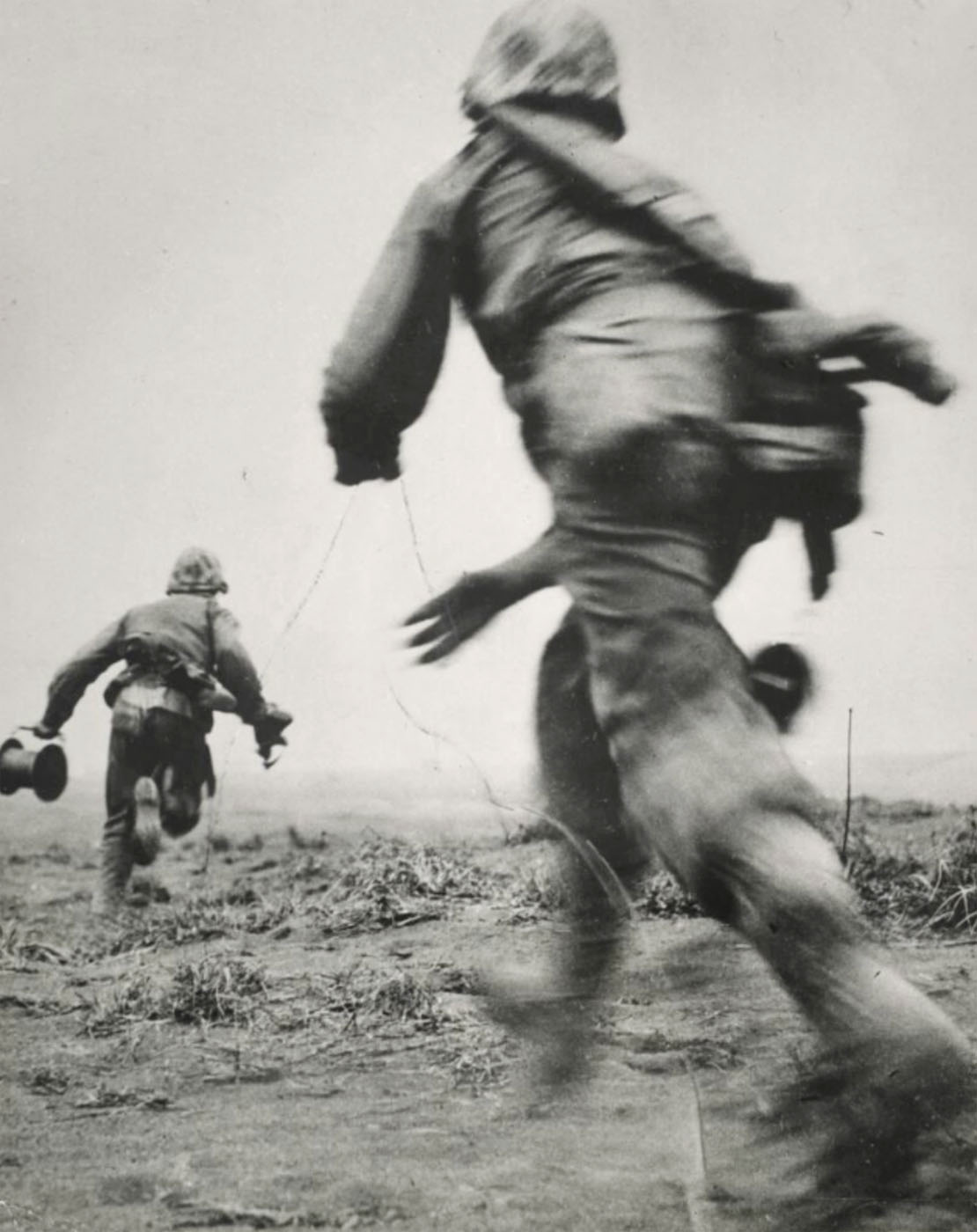
Exhibition: ‘Weegee: Murder Is My Business’ at the International Center of Photography, New York

Exhibition dates: 20th January – 2nd September 2012


Weegee (Arthur Fellig) (American, 1899-1968) 'Untitled [Anthony Esposito, booked on suspicion of killing a policeman, New York]' January 16, 1941


Weegee (Arthur Fellig) (American, 1899-1968)
Untitled [Anthony Esposito, booked on suspicion of killing a policeman, New York]
January 16, 1941
Silver gelatin photograph
© Weegee/International Center of Photography


If you want a good read about the life and times of Weegee then Mark Svetov’s ‘Life and Death (Mostly Death) in the Streets’ (2010) on American Suburb X website is the way to go. I can’t really add much to this excellent piece of writing in terms of the history of the man and the social milieu in which he surrounded himself. What I can comment on are my personal feelings about his photographs.

Weegee’s photographs are no masterpiece of fine art printing, they are rough and direct, and I love them all the more for this quality. Their roughness – all sellotaped over, edges cut at odd angles, drawn and written on – only adds to their power and immediacy. If you can call photographs of dead bodies in the street vibrant and alive, then these photographs are just that. Svetov sees Weegee as the quintessential noir photographer; I see him not so much as that but as a sensitive, formalist photographer, a wonderful collagist and an artist who is a precursor to the pop art of the mid-late 1950s (think Warhol’s screen prints of the electric chair, or his mangled car crash series).

In the installation photographs of the exhibition Weegee: Murder Is My Business at the Photo League, New York (1941, see below) you get a sense of this master of assemblage, the animator and promoter (another pop trait!) at work. The large prints are casually pinned to the back board, surrounded by drawings of guns with smoke emanating from their barrels, cause of death certificates, photographs of Weegee himself “On the Spot”, Weegee’s press pass, newspaper clippings about the man and his work (including a photograph of his tiny bedroom) where Weegee “introduces” himself to his audience. The photographs flow around the room, from Faces, to Murder and Society. People are drawn into the aura of these photographs, you can see them leaning forward to take in every detail. They peer intently at the them trying to decipher every nuance of the narrative being told (the frequent hats lying about, the discarded pistols, the hand emerging from underneath the draped sheet).

As Svetov notes, Weegee’s news pictures were never haphazard snapshots, for they always seem perfectly arranged. Underneath the spontaneity and the humanism imparted by the artist is that fact that Weegee is a master of formalism. He knows exactly how to structure the picture plane as a classical pianist knows how to bring alive the themes of a Mozart sonata. Usually arriving before any other photographer because he lived opposite the police station and had a police radio in his car, Weegee “cased the joint” as I would put it, prowling quickly around the scene to get the best angle, the best shot before other photographers arrived or the scene was closed off by police. This instinctive framing only comes through having a good eye and training that eye so that what to shoot and how to crop the scene “in camera” becomes second nature.

Evidence of the formal structure implicit in Weegee’s photographs can be seen in my analysis of two photographs Line-Up for Night Court (c. 1941, below) and Police officer and assistant removing body of Reception Hospital ambulance driver Morris Linker from East River, New York (August 24, 1943, below). In the first image the epicentre (or the enigma if you like) of the photograph is the dance of hands at the lower centre of the image, formed by two triangles and emphasised by two radial diagonals. The top points of the upper triangle are anchored by the men and women at both windows (see detail photographs), the patriarchal men in suit and tie at one window – a detective, a chief of police? – separated from the woman at another. Weegee’s splits this triangle with his frieze of faces showing the depths of human despair, despondency and ambivalence.

The second image has a much more complicated structure. In the first analysis we observe the different horizontal, vertical and diagonal planes as they march up the photograph. The “heart” of this image, where the yellow lines cross, is actually a point of absence. Look at the real photograph: it is the heart shaped empty space between the man’s outstretched hands that form the emotional centre of the image. In the second analysis we can simplify this down into a zigzagging line that passes directly through this point. To see this, to assess this and visualise the flowing movement in a split second is in any visual language outstanding. Weegee wasn’t averse to manipulating his images to achieve the desired result. The photograph Hold up man killed (November 24, 1941, below) shows his notations over the top of the image, the crop he envisaged and the words “Take out hat” and “Make sock black” so that he achieved the desired dynamic within the photograph.

Weegee was a master of flash and the use of foreshortening – to create atmosphere in the first instance and used as a visual entre into the photographs in the second. Sometimes he combines both. The policeman at left in Line-Up for Night Court is both out of focus and the highlights (his face) are blown out by the flash. Does this matter: not one iota, for the policeman “grounds” the whole left hand side of the image. Again, in Murder (c. 1940, below) the backside of the policeman is blown out by the flash but this only leads the eye of the viewer to the foreshortened body of the murder victim nestled in the crook of his knee and then onto the starkly lit pram, beyond. Finally, in Hold up man killed (November 24, 1941, below) the feet of the hold up man actually lead the viewer into the space between the two policeman’s shoes were the Surgeon from Gouverneur Hospital crouches over the body. Weegee also loved to weave detail into his images, so that even though the story is about human content, as Svetov observes, it is just as much about human materiality as well: notice the reflection of people in the car bonnet in At an East Side Murder (1943, below) at lower left and then the procession of worn shoes and the bagginess of the trousers – I didn’t realised they wore their trousers so baggy in the 1940s!

Svetlov sees Weegee’s photographs as containing an almost sacred squalor, a brash but anguished cry in an endless nightscape with nothing judgemental or distanced about them. I concur with the last part for Weegee was a man of the people whom he photographed. On the other points I am less sure: to me they are about light not darkness. They are about the aftermath of atrocity, of living, human beings dealing with death and its consequences. I see nothing sacred about this squalor. The photographs are about shining a light into darkness, the darkness that every human being must confront: the fact that we all have to die, somewhere, sometime, in the end.

Dr Marcus Bunyan


Many thankx to the International Center of Photography for allowing me to publish the photographs in the posting. Please click on the photographs for a larger version of the image.


“People are so wonderful that a photographer has only to wait for that breathless moment to capture what he wants on film… and when that split second of time is gone, it’s dead and can never be brought back.”

“For the pictures… I was on the scene; sometimes drawn there by some power I can’t explain, and I caught the New Yorkers with their masks off… not afraid to Laugh, Cry, or Make Love. What I felt I photographed, laughing and crying with them.”


Arthur Fellig (aka Weegee, 1899-1968)


“Weegee’s work is connected by an umbilical cord to darkness; his images emerged from Gotham City’s nocturnal penumbra, spectrally streaked by streetlights, lit brightly only where there was a human focus, a tabloid John Alton at work.

Weegee called it his “Rembrandt light” as he caught the human protagonists in the white glare of his photo flash, the scene otherwise enveloped in darkness. Weegee’s news pictures were never haphazard snapshots, albeit they were taken by a man who had happenstance and chance as his helpmates; he and his camera, with its flash, seem to have a fateful meeting with his human subjects; pictures seem perfectly arranged, and what we focus on is their human content. Weegee is the quintessential noir photographer.”


Mark Svetov. “Life and Death (Mostly Death) in the Streets (2010)” on American Suburb X website May 2012 [Online] Cited 28/08/2012


Weegee (Arthur Fellig) (American, 1899-1968) 'The dead man's wife arrived... and then she collapsed' c. 1940


Weegee (Arthur Fellig) (American, 1899-1968)
The dead man’s wife arrived… and then she collapsed
c. 1940
Silver gelatin photograph
© Weegee/International Center of Photography


Weegee (Arthur Fellig) (American, 1899-1968) 'Girl jumped out of car, and was killed, on Park Ave.,' c. 1938


Weegee (Arthur Fellig) (American, 1899-1968)
Girl jumped out of car, and was killed, on Park Ave.,
c. 1938
Silver gelatin photograph
© Weegee/International Center of Photography


Weegee (Arthur Fellig) (American, 1899-1968) 'Untitled [Installation view of "Weegee: Murder Is My Business" at the Photo League, New York]' 1941

Weegee (Arthur Fellig) (American, 1899-1968) 'Untitled [Installation view of "Weegee: Murder Is My Business" at the Photo League, New York]' 1941

Weegee (Arthur Fellig) (American, 1899-1968) 'Untitled [Installation view of "Weegee: Murder Is My Business" at the Photo League, New York]' 1941

Weegee (Arthur Fellig) (American, 1899-1968) 'Untitled [Installation view of "Weegee: Murder Is My Business" at the Photo League, New York]' 1941


Weegee (Arthur Fellig) (American, 1899-1968)
Untitled [Installation view of “Weegee: Murder Is My Business” at the Photo League, New York]
1941
Silver gelatin photographs
© Weegee/International Center of Photography


Text and captions from the original Murder Is My Business exhibition:

~ “Introducing Weegee”
~ “Due to an increase in MURDERS The Photo League presents 2nd Edition of “MURDER IS MY BUSNESS” by Weegee”
~ “Weegee Lives For His Work And Thinks Before Shooting” (newspaper headline on the “Weegee” board at left)
~ “This space reserved for the latest muders”
~ “MURDER Manhattan bloodbath”
~ “Arthur Fellig Photographer / Do not disturbe / Except in case of Fire, Murder or Snow Storm” (caption underneath photograph)
~ “Why did you kill your Sweetie”?  (caption underneath photograph)
~ “HUMAN BODY MINUS HEAD FOUND ON STREET” (caption underneath photograph)
~ “Cop & human head in package” (caption underneath photograph)
~ “Killed her husband after drinking brawl” (caption underneath photograph)
~ “Just a cheap murder” (caption underneath photograph)
~ “My man” (caption underneath photograph)
~ “Who done that” (caption underneath photograph)


“Weegee’s captions provided a visceral vernacular for the almost-sacred squalor of his imagery (see “Weegee’s Words” for a sampling). Taken together, they packed more than a mere punch; they were a brash but anguished cry in an endless nightscape. More than mere documents of a violent era, they also exuded a humanity that could only come from the photographer himself. There was nothing judgmental or distanced in Weegee’s work; he was the antithesis of the “slickers” who worked for glossy magazines. He remained a man essentially from the same New York working-class as the people he chose to photograph.”


Mark Svetov. “Life and Death (Mostly Death) in the Streets (2010)” on American Suburb X website May 2012 [Online] Cited 28/08/2012


Weegee (Arthur Fellig) (American, 1899-1968) 'Untitled ["Ruth Snyder Murder" wax display, Eden Musée, Coney Island, New York]' c. 1941


Weegee (Arthur Fellig) (American, 1899-1968)
Untitled [“Ruth Snyder Murder” wax display, Eden Musée, Coney Island, New York]
c. 1941
Silver gelatin photograph
© Weegee/International Center of Photography


Unidentified Photographer. 'On the Spot' December 9, 1939


Unidentified Photographer
On the Spot
December 9, 1939
© Weegee/International Center of Photography


Weegee (Arthur Fellig) (American, 1899-1968) 'Line-Up for Night Court' c. 1941


Weegee (Arthur Fellig) (American, 1899-1968)
Line-Up for Night Court
c. 1941
Silver gelatin photograph
© Weegee/International Center of Photography


Construction of the pictorial plane in 'Line-Up for Night Court'


Construction of the pictorial plane in Line-Up for Night Court


Weegee (Arthur Fellig) (American, 1899-1968) 'Line-Up for Night Court' c. 1941 (detail)

Weegee (Arthur Fellig) (American, 1899-1968) 'Line-Up for Night Court' c. 1941 (detail)


Weegee (Arthur Fellig) (American, 1899-1968)
Line-Up for Night Court (details)
c. 1941
Silver gelatin photograph
© Weegee/International Center of Photography


Weegee (Arthur Fellig) (American, 1899-1968) 'At an East Side Murder' 1943


Weegee (Arthur Fellig) (American, 1899-1968)
At an East Side Murder
1943
Silver gelatin photograph
© Weegee/International Center of Photography


Weegee (Arthur Fellig) (American, 1899-1968) 'At an East Side Murder' 1943 (detail)

Weegee (Arthur Fellig) (American, 1899-1968) 'At an East Side Murder' 1943 (detail)

Weegee (Arthur Fellig) (American, 1899-1968) 'At an East Side Murder' 1943 (detail)


Weegee (Arthur Fellig) (American, 1899-1968)
At an East Side Murder (details)
1943
Silver gelatin photograph
© Weegee/International Center of Photography


Weegee (Arthur Fellig) (American, 1899-1968) 'Untitled [Hats in a pool room, Mulberry Street, New York]' c. 1943


Weegee (Arthur Fellig) (American, 1899-1968)
Untitled [Hats in a pool room, Mulberry Street, New York]
c. 1943
© Weegee/International Center of Photography


Gangland murders, gruesome car crashes, and perilous tenement fires were for the photographer Weegee (1899-1968) the staples of his flashlit black-and-white work as a freelance photojournalist in the mid­-1930s. Such graphically dramatic and sometimes sensationalistic photographs of New York crimes and news events set the standard for what has since become known as tabloid journalism. In fact, for one intense decade, between 1935 and 1946, Weegee was perhaps the most relentlessly inventive figure in American photography. A surprising new exhibition at the International Center of Photography (1133 Avenue of the Americas at 43rd Street), titled Weegee: Murder Is My Business and organised by ICP Chief Curator Brian Wallis, will present some rare examples of Weegee’s most famous and iconic images, and will consider his early work in the context of its original presentation in historical newspapers and exhibitions, as well as Weegee’s own books and films.

Taking its title from Weegee’s self-curated exhibition at the Photo League in 1941, Murder Is My Business looks at the urban violence and mayhem that was the focus of his early work. As a freelance photographer at a time when New York City had at least eight daily newspapers and when wire services were just beginning to handle photos, Weegee was challenged to capture unique images of newsworthy events and distribute them quickly. He worked almost exclusively at night, setting out from his small apartment across from police headquarters when news of a new crime came chattering across his police-band radio receiver. Often arriving before the police themselves, Weegee carefully cased each scene to discover the best angle. Murders, he claimed, were the easiest to photograph because the subjects never moved or got temperamental.

Weegee’s rising career as a news photographer in the 1930s coincided with the heyday of Murder Inc., the Jewish gang from Brownsville who served as paid hitmen for The Syndicate, a confederation of mostly Italian crime bosses in New York. As a wave of governmental and legal crackdowns swept the city between 1935 and 1941, the rate of organised murders of small-time wiseguys and potential stool pigeons increased dramatically. Weegee often worked closely with the police but also befriended high-profile criminals like Bugsy Siegel, Lucky Luciano, and Legs Diamond. Weegee called himself the “official photographer for Murder Inc.” and claimed to have covered 5,000 murders, a count that is perhaps only slightly exaggerated. In asserting the true nature of his business, Weegee proudly displayed his check stub from LIFE magazine that paid him $35 for two murders, slightly more, he said, for the one that used more bullets.

Selling his photographs to a variety of New York newspapers in the 1930s, and later working as a stringer for the short-lived daily newspaper PM (1940-1948), Weegee established a highly subjective approach to both photographs and texts that was distinctly different from that promoted in most dailies and picture magazines. Utilising other distribution venues, Weegee also wrote extensively (including his autobiographical Naked City, published in 1945) and organised his own exhibitions at the Photo League, the influential photographic organisation that promoted politically committed pictures, particularly of the working classes. In 1941, Weegee installed two back-to-back exhibitions in the League’s headquarters. This visibility helped promote Weegee’s growing reputation as a news photographer, and he began stamping his prints “Weegee the Famous.” The general acceptance of his punchy photographic style, which did not shy away from lower-class subjects and humanistic narratives, led to the acquisition of his work by the Museum of Modern Art and inclusion in two group shows there, in 1943 and 1945.

“Weegee has often been dismissed as an aberration or as a naive photographer, but he was in fact one of the most original and enterprising photojournalists of the 1930s and ’40s. His best photographs combine wit, daring, and surprisingly original points of view, particularly when considered in light of contemporaneous press photos and documentary photography. He favoured unabashedly low-culture or tabloid subjects and approaches, but his Depression-era New York photographs need to be considered seriously alongside other key documentarians of the thirties, such as Dorothea Lange, Robert Capa, Walker Evans, and Berenice Abbott,” said Wallis.

The exhibition will feature over 100 original photographs, drawn primarily from the comprehensive Weegee Archive of over 20,000 prints at ICP, as well as period newspapers, magazines, and films. It will also include partial reconstructions of Weegee’s studio and his Photo League exhibition. The four galleries will each feature a touch-screen monitor allowing visitors to explore further details regarding the images and artefacts in that room.

Press release from the ICP


Weegee (Arthur Fellig) (American, 1899-1968) 'Untitled [Body of Dominick Didato, Elizabeth Street, New York]' August 7, 1936


Weegee (Arthur Fellig) (American, 1899-1968)
Untitled [Body of Dominick Didato, Elizabeth Street, New York]
August 7, 1936
Silver gelatin photograph
© Weegee/International Center of Photography


Weegee (Arthur Fellig) (American, 1899-1968) 'Murder' c. 1940


Weegee (Arthur Fellig) (American, 1899-1968)
Murder
c. 1940
Silver gelatin photograph
© Weegee/International Center of Photography


Weegee (Arthur Fellig) (American, 1899-1968) 'Untitled [Police officer and lodge member looking at blanket-covered body of woman trampled to death in excursion-ship stampede, New York]' August 18, 1941


Weegee (Arthur Fellig) (American, 1899-1968)
Untitled [Police officer and lodge member looking at blanket-covered body of woman trampled to death in excursion-ship stampede, New York]
August 18, 1941
Silver gelatin photograph
© Weegee/International Center of Photography


Weegee (Arthur Fellig) (American, 1899-1968) 'Hold up man killed' November 24, 1941


Weegee (Arthur Fellig) (American, 1899-1968)
Hold up man killed
November 24, 1941
Silver gelatin photograph
© Weegee/International Center of Photography


Weegee (Arthur Fellig) (American, 1899-1968) 'Untitled [Police officer and assistant removing body of Reception Hospital ambulance driver Morris Linker from East River, New York]' August 24, 1943


Weegee (Arthur Fellig) (American, 1899-1968)
Untitled [Police officer and assistant removing body of Reception Hospital ambulance driver Morris Linker from East River, New York]
August 24, 1943
Silver gelatin photograph
© Weegee/International Center of Photography


Pictorial construction of Police officer and assistant removing body of Reception Hospital ambulance driver Morris

Pictorial construction of Police officer and assistant removing body of Reception Hospital ambulance driver Morris


Pictorial construction of Police officer and assistant removing body of Reception Hospital ambulance driver Morris


International Center of Photography
79 Essex Street, New York, NY 10002
between Delancey Street and Broome Street

Opening hours:
Wednesday – Monday 11am – 7pm
Tuesday closed

International Center of Photography website

LIKE ART BLART ON FACEBOOK

Back to top
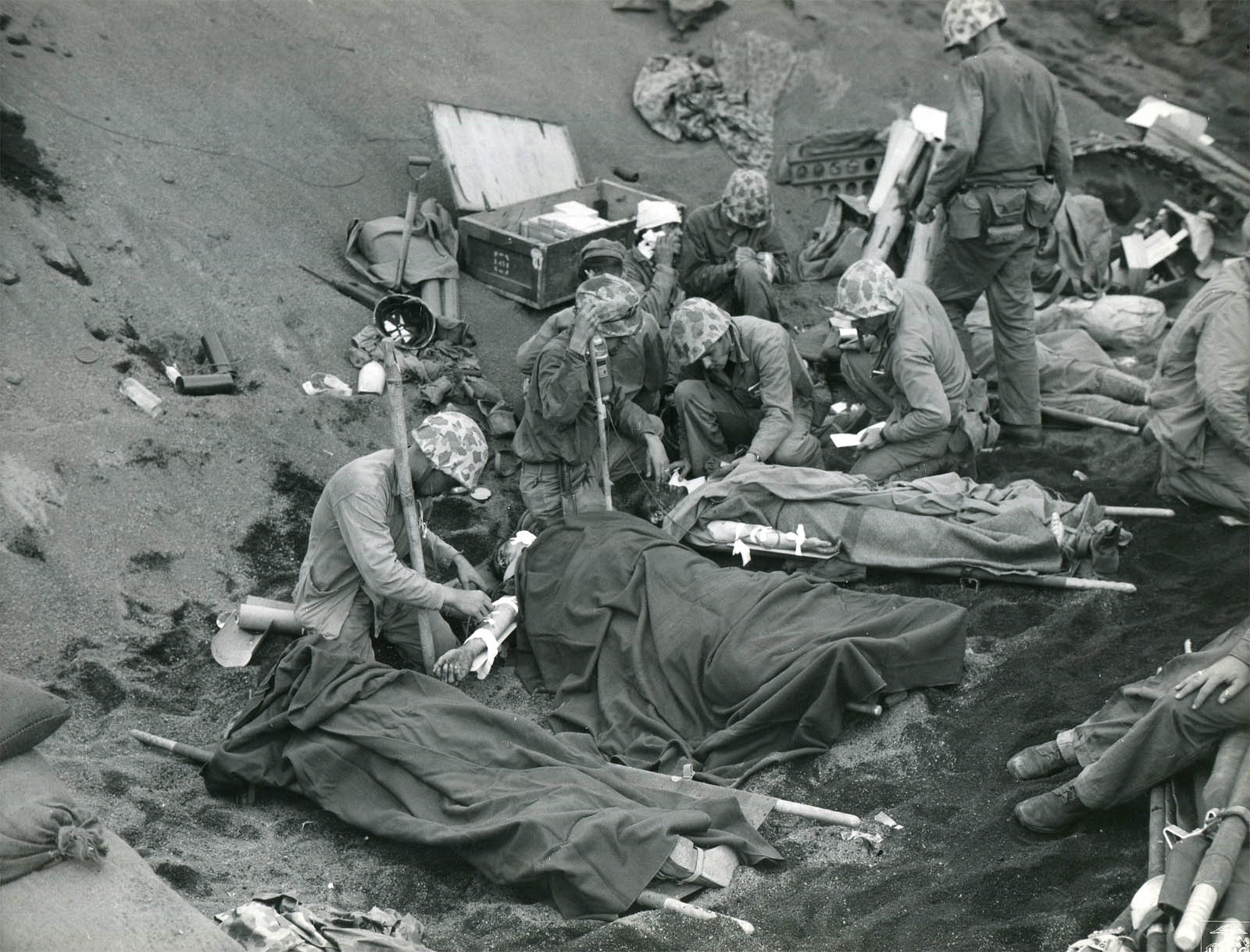
Review: ‘Lost & Found: Family Photos Swept away by the 3.11 East Japan Tsunami’ at the Centre for Contemporary Photography (CCP), Fitzroy, Melbourne

Exhibition dates: 1st June – 15th July 2012


'Untitled' from 'Lost and Found' 2011


This is a profound exhibition of photographs that have been lost then found. Too damaged to be returned to the families of their missing owners after the 3.11 East Japan Tsunami they have been cleaned, dried, digitally catalogued and put on display. As remnants of disaster they have taken on an ethereal, abstract expressionist beauty.

Like Atget’s photographs (his “documents for artists”) they were never meant to be “art”, but through morphogenesis (‘beginning of the shape’) these snapshots of places, family and friends reveal their inherent form. This beginning of form has been exposed through displacement, washing and erasure. Through this process of erasure these anonymous images reveal their underlying structure with its link to alchemy, as the image dis/appears from view; they have become unfixed (as in the fixer that stabilises the image in the analogue darkroom) from reality. In this process they have become art.


The images are incredibly beautiful.

They hid secrets (of ownership, names, families and places, of time and space).

Something (energy, spirit?) emerges when you least expect it.


Photographs are coded, but usually so as to appear uncoded but here the link to the indexicality of the image – the idea of the visible as evidence of truth – has been broken. These photographs, taken out of their original context, have lost their specific use value in the particular time and place of their consumption. The fragmentation of this use value, together with the dissolution of their formal characteristics, means that they are freed of the conditions that limit and determine their meaning.1 As Annette Kuhn has written in The Power of the Image, “Meanings do not reside in images, then: they are circulated between representation, spectator and social function.”2 And in these images all three things have changed.

Further, the link between the image and its referent, the photograph and the thing being photographed has been irreversibly broken. As the French critic Maurice Blanchot has written, “The image has nothing to do with signification, meaning, as implied by the existence of the world, the effort of truth, the law and the brightness of the day. Not only is the image of an object not the meaning of that object and of no help in comprehending it, but it tends to withdraw it from its meaning by maintaining it in the immobility of a resemblance that it has nothing to resemble.”3 In other words (and especially in these photographs) it is this severance of meaning and its object, this resemblance of nothing.

But think about this idea:

THINK ABOUT THE IDEA OF RE(AS)SEMBLANCE!

DOES THE PHOTOGRAPH REASSEMBLE A SIGNIFICATION, A MEANING WHOLLY ITS OWN, OR IS THAT RE(AS)SEMBLANCE PART OF THE ORIGINAL MEANING OF THE OBJECT PHOTOGRAPHED?


In these photographs there is an obfuscation of reality in which the usually coded photographs now appear to be uncoded in some visceral sense. In fact there is a double obfuscation, a double effacement, as the images are displayed on the wall like a series of bathroom tiles in plastic sleeves, here not at one remove but at two (the clouding of the image and the clouding through the plastic). What emerges from this alchemical miasma is the ghost of the meaning of the object, where we acknowledge that the essence of these people did really exist. The recognition of their presence, this partial reassemblance of the context and meaning of the object originally photographed, is the strength of these images: our acknowledgment of some form of existence in the trace of the photograph, where seeing is subconsciously believing.

What we are left with in these images are vestiges of presence, remnants or traces of people that have passed on. In a kind of divine intervention, these photographs ask the viewer questions about the one fact that we cannot avoid in our lives, our own mortality, and what remains after we pass on. We can never know these people and places, just as we can never know the place and time of our death – when our “time” is up – but these photographs awaken in us a subconscious remembering: that we may be found (in life), then lost (through death), then found again in the gaze of the viewer looking at the photographs in the future present. We are (dis)continuous beings.

There is no one single reading of these photographs for “there are only competing narratives and interpretations of a world that cannot be wholly, accurately described.”4 These indescribable photographs impinge on our consciousness calling on us to remember even as the speed of contemporary life asks us to forget. This ethical act of looking, of mourning and remembering, of paying homage to presence acknowledges that we choose not to let pass into the dark night of the soul these traces of our forebears, for each emanation is deeply embedded within individual and cultural memory.

These photographs are a contemporary form of Western ‘dreaming’ in which we feel a link to the collective human experience. In this reification, we bear witness to the (re)assemblance of life, the abstract made (subconsciously) concrete, as material thing. These images of absent presence certainly reached out and touched my soul.

Vividly, I choose to remember rather than to forget.

Dr Marcus Bunyan


Footnotes

1/ Kuhn, Annette. The Power of the Image: Essays on Representation and Sexuality. London: Routledge and Kegan Paul, 1985, p. 6

2/ Ibid.,

3/ Blanchot, Maurice. The Gaze of Orpheus. New York: Barrytown, 1981, p. 85

4/ Townsend, Chris. Vile Bodies: Photography and the Crisis of Looking. Munich: Prestel, 1998, p. 10


Many thankx to Munemasa Takahashi, Kristian Haggblom and Karra Rees for their help and the CCP for allowing me to publish the photographs in the posting. Please click on the photographs to view a larger version of the image.


'Untitled' from 'Lost and Found' 2011


Opening of the 'Lost & Found' exhibition at the Centre for Contemporary Photography


Opening of the Lost & Found exhibition at the Centre for Contemporary Photography, Melbourne


'Untitled' from 'Lost and Found' 2011


'Untitled' from 'Lost and Found' 2011


'Untitled' from 'Lost and Found' 2011


Lost & Found is a profoundly moving exhibition of collected photographs recovered from the devastation following the earthquake and tsunami and subsequent nuclear catastrophe that took place in the Tohoku region in 2011. 

The tsunami not only swept the harbour away, but also houses, cars, trains; and many people lost their lives. Although no longer in the media, people in this region are still in great need. These photographs remind us of their presence and make us aware of their silent voices. The exhibition also gives us an opportunity to think about the relationship people have with their photographs.

The Lost & Found project is attempting to return pictures from the collection to their owners by cleaning, cataloguing and creating a digital database of the photographs. Many images were too badly damaged and can not be returned; rather than discard them, the project team decided to exhibit the imagery and give people the opportunity to see these photographs in the belief that they carry powerful messages. 

This project was initiated by Munemasa Takahashi and Hiroshi Hatate in Japan and Kristian Haggblom from Wallflower Photomedia Gallery in Australia. Funds raised will go directly to the people of Yamamoto-cho.

Text from the CCP website


'Untitled' from 'Lost and Found' 2011


'Untitled' from 'Lost and Found' 2011


'Untitled' from 'Lost and Found' 2011


'Untitled' from 'Lost and Found' 2011


'Untitled' from 'Lost and Found' 2011


All photographs are from the exhibition Lost & Found


Centre for Contemporary Photography

No permanent exhibition space at the moment

Centre for Contemporary Photography website

LIKE ART BLART ON FACEBOOK

Back to top
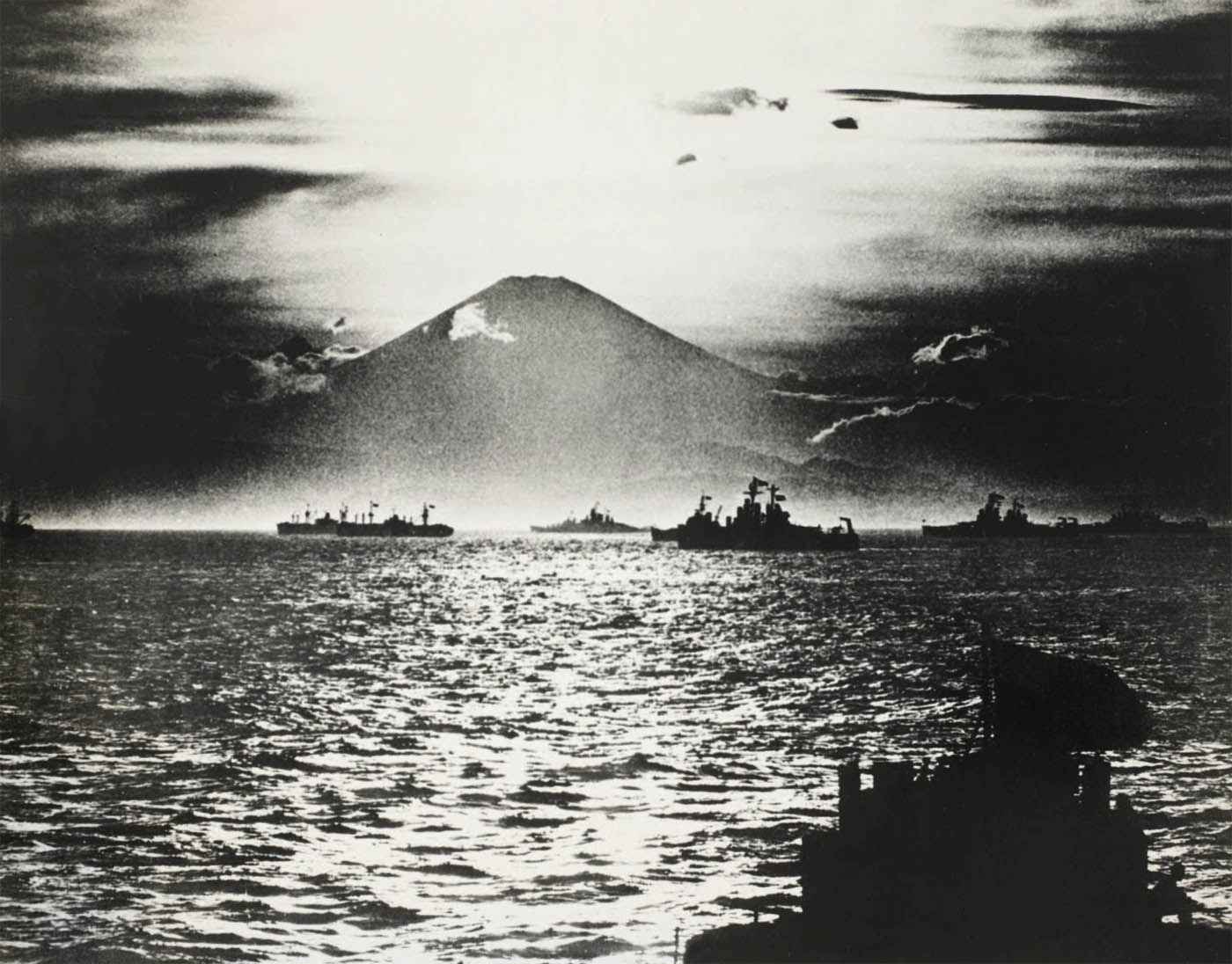
Exhibition: ‘Memory Remains: 9/11 Artifacts at Hangar 17 by Francesc Torres’ at the Imperial War Museum, London

Exhibition dates: 26th August 2011 – 26th February 2012


Many thankx to the Imperial War Museum, London for allowing me to publish the photographs in the posting. Please click on the photographs for a larger version of the image.


Francesc Torres (Spanish, b. 1948) 'Steel beams taken from ground zero for storage at John F. Kennedy International Airport's Hangar 17' 2009


Francesc Torres (Spanish, b. 1948)
Steel beams taken from ground zero for storage at John F. Kennedy International Airport’s Hangar 17
2009
© Francesc Torres


“Having watched the graphic destruction from my apartment, only two blocks from the Twin Towers, when I entered Hangar 17 at JFK International Airport for the first time in 2006, I was immediately hit by the deep sense that the objects I was confronted with, from large shards of rusted and burnt steel to bikes left forever by their owners, were the symbolic substitutes of the victims. Their overwhelming presence stood for all the people that lost their lives that late summer day a decade ago.”


Francesc Torres


Francesc Torres (Spanish, b. 1948) 'Twisted steel beams from ground zero dominate the space in JFK International Airport's Hangar 17, where 9/11 artifacts were housed for study and safekeeping' 2009


Francesc Torres (Spanish, b. 1948)
Twisted steel beams from ground zero dominate the space in JFK International Airport’s Hangar 17, where 9/11 artifacts were housed for study and safekeeping
2009
© Francesc Torres


Francesc Torres (Spanish, b. 1948) 'View through a portion of the broadcast antenna that fell from the top of the north tower. A number of fragments of the 360-foot antenna were kept at Hangar 17' 2009
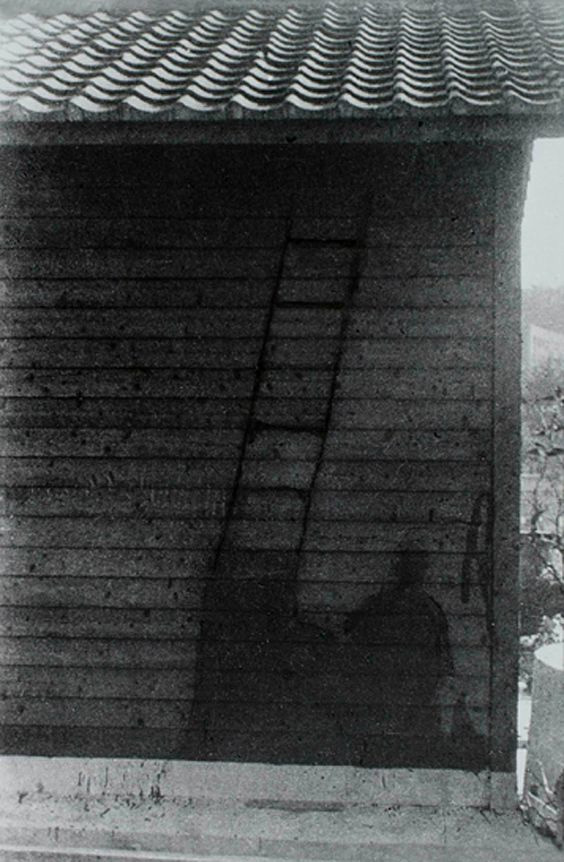
 

Francesc Torres (Spanish, b. 1948)
View through a portion of the broadcast antenna that fell from the top of the north tower. A number of fragments of the 360-foot antenna were kept at Hangar 17
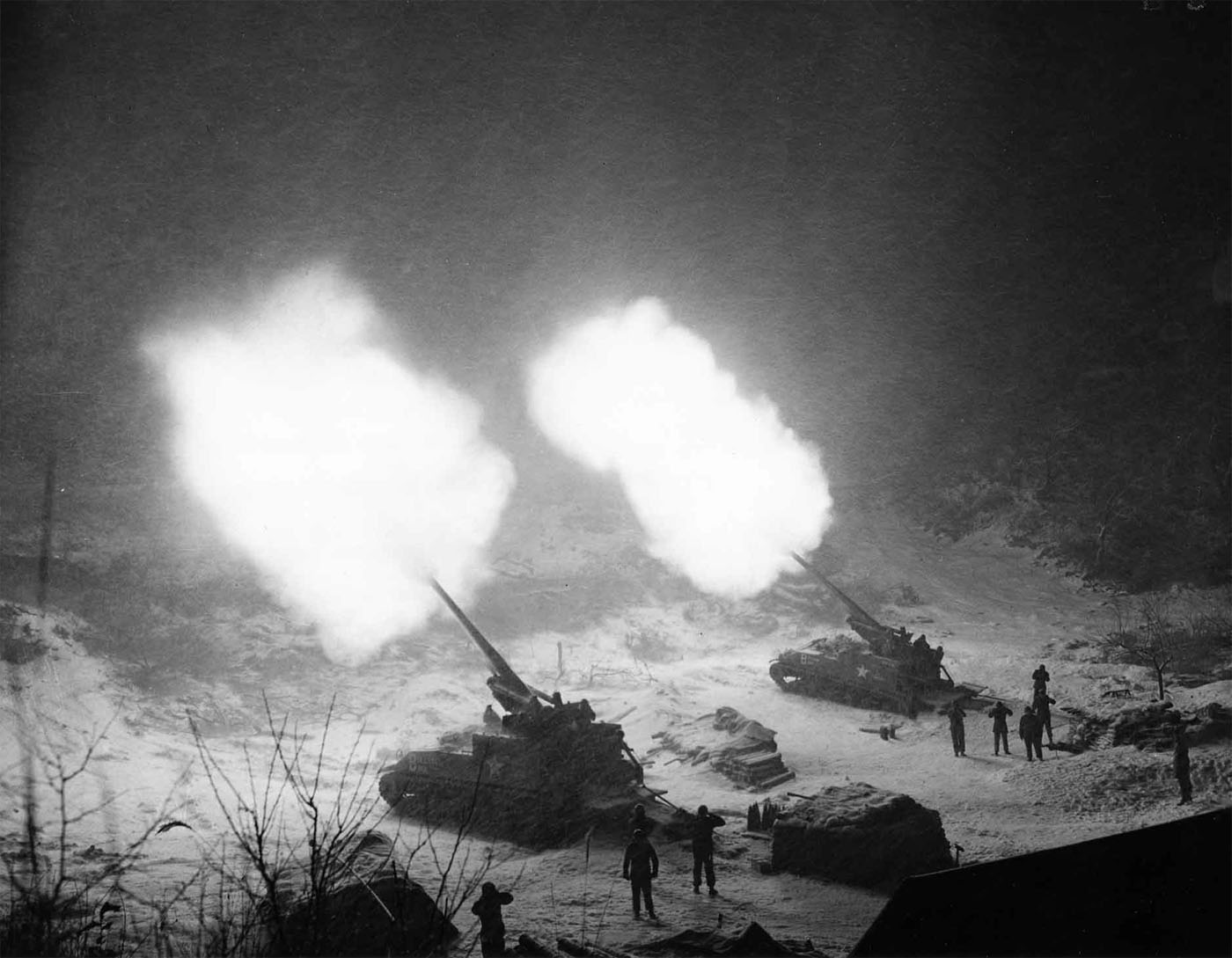
2009
© Francesc Torres


Francesc Torres (Spanish, b. 1948) 'The collapse of the twin towers created a series of iconic objects...' 2009


Francesc Torres (Spanish, b. 1948)
The collapse of the twin towers created a series of iconic objects, transformed by force and fire from their daily uses into artifacts that tell a story. At Hangar 17, tented enclosures were built for artifacts of various kinds that, in the view of curators and conservators, needed the added protection of humidity control and stillness. Perhaps the most dramatic example of this transformation could be found inside the vehicle tent, where trucks and cars, normally left outside in all conditions, were given shelter
2009
© Francesc Torres


Francesc Torres (Spanish, b. 1948) 'Because the Last Column had inscriptions and attachments on all sides' 2009


Francesc Torres (Spanish, b. 1948)
Because the Last Column had inscriptions and attachments on all sides, it was raised onto a specially constructed steel cradle at Hangar 17 so conservators had enough clearance to work. A mirror provides a glimpse of tributes on the underside of the column. Visible on the facing side are the taped-on memorials for Firefighter Christian Regenhard, 28, and Deputy Battalion Chief Dennis Cross, 60
2009
© Francesc Torres


The empty shell of Hangar 17 at JFK Airport became a storehouse of memories when it was filled with the material cleared from the World Trade Center site following the September 11 attacks on New York City.

Marking the tenth anniversary of 9/11, Francesc Torres’s work features over 150 projected images which explore inside the hangar and reflect on the emotional power of what remained, from personal belongings to steel girders distorted by the force of the attacks. Alongside the photographs is a section of raw rusted steel over two metres in length from the ruins of the World Trade Center. As well as larger piece (over 1 tonne) that is due to go on display at IWM North in October, these objects are the first pieces of steel from Ground Zero to go on display in the UK. The exhibition will also be on display at the International Centre for Photography in New York and at the Centre de Cultura Contemporània de Barcelona.

Throughout his career, Spanish-American artist Francesc Torres has reflected on the diverse manifestations of culture, politics, memory and power. His latest exhibition at the Imperial War Museum, Memory Remains, is a bold and haunting amalgam of all four.

In 2009, Torres was granted rare access to Hangar 17 at John F Kennedy International Airport, a gaping space of over 80,000-square-feet. Within the hangar lie the remnants deemed worth preserving from the September 11 attacks, taken from the 1.8 million tonnes of debris from Ground Zero. For five weeks Torres daily confronted the legacy of terror and the ghosts of that fateful late-summer day, capturing images of objects that stand as symbolic substitutes to the victims.

“Look at it this way”, says Torres, relaying his experience, “it’s a hanger constructed to house a plane, which was transformed into a weapon used for the attack on the towers and now the sediment of that attack is here. With the sound of planes constantly flying overhead it was absolutely surreal.”

According to the photographer, the experience of walking around the hanger after the first day was so emotionally draining that he slept from four o’clock in the afternoon through to ten o’clock the next morning.

“I was absolutely exhausted; physically and emotionally… every single iota of energy I had was gone.”

His efforts have produced some exceptional results, however, displayed on a rolling slideshow in a small room near the entrance of the museum. Among the objects photographed are large shards of rusted, burnt steel, crumpled filing cabinets and a plethora of flattened Port Authority vehicles. Some unexpected pieces of detritus were also found, including a nine-foot, three-dimensional Bugs Bunny, made completely bizarre when juxtaposed by a sign whose letters read chillingly: “That’s All Folks!”

Prior to the Hangar 17 project, Torres documented the excavation of a mass Spanish Civil War grave that he said drew certain comparisons with the material at JFK.

“The clothing is something that just grabs you,” he says, “it’s very uncanny that nothing changes with the victims as historical subjects. The clothing [in Hangar 17] was exactly the same as the clothing I’ve seen in Spain or in the former Yugoslavia; it all has the same patina. The victim becomes universal… the remains have that quality.”

Along with the photographs, the museum has also acquired a section of steel from the structure of the World Trade Center, displayed outside the projection room. It is the first section of raw rusted steel from the ruins at Ground Zero – thought to be the box section from one of windows – to be displayed in the UK.

For the past year, pieces from the hangar have made their way to be placed in memorials in each of the 50 American states, as well as seven other countries across the globe. Some, but not all, of the remaining pieces will be housed in the 9/11 Memorial Museum near the site of the attack, which is something that concerns Torres.

“We have to preserve the hanger as a container. It’s an unbelievable narrative apparatus that had been created almost on the run,” he says.

With a lifelong interest in questions of human memory and meaning, Torres’ work is based on the concept that it is through the remains of history that memory remains. His latest show is an unforgettable testament to those horrendous attacks that capped the 20th century almost a decade ago.”

Text from the Imperial War Museum


Francesc Torres (Spanish, b. 1948) 'These three panels, offering a view of the Statue of Liberty from 1977, were salvaged from the Cortlandt Street subway station under the World Trade Center' 2009


Francesc Torres (Spanish, b. 1948)
These three panels, offering a view of the Statue of Liberty from 1977, were salvaged from the Cortlandt Street subway station under the World Trade Center. The spray-painted markings indicate that the area nearby had been searched by rescue workers for survivors or victims
2009
© Francesc Torres


Francesc Torres (Spanish, b. 1948) '9/11, as seen live on television in Barcelona, Spain' 2009


Francesc Torres (Spanish, b. 1948)
9/11, as seen live on television in Barcelona, Spain. Photographed at roughly 3 p.m. local time by Maria Iturrioz de Torres, Francesc Torres’ mother, while they spoke by phone
2009
© Francesc Torres


Francesc Torres (Spanish, b. 1948) 'Though most of the vehicles at Hangar 17 came from first responders' 2009


Francesc Torres (Spanish, b. 1948)
Though most of the vehicles at Hangar 17 came from first responders, this taxi, an emblem of daily life in New York, was also preserved. At left, the tags hanging from the frame indicate its Port Authority inventory number (white) and mark its selection for inclusion in the permanent collection of the Memorial Museum (yellow)
2009
© Francesc Torres


Francesc Torres (Spanish, b. 1948) 'During the recovery at the site, some ironworkers would cut religious or other symbols out of pieces of steel...' 2009


Francesc Torres (Spanish, b. 1948)
During the recovery at the site, some ironworkers would cut religious or other symbols out of pieces of steel from the World Trade Center and give them as keepsakes to family members or other visitors
2009
© Francesc Torres


Imperial War Museum, London
Lambeth Road
London SE1 6HZ
United Kingdom
Phone: 020 7416 5000

Opening hours:
Daily from 10am – 6pm

Imperial War Museum, London website

LIKE ART BLART ON FACEBOOK

Back to top

Exhibition: ‘Stanley Greene – Black Passport’ at Foam, Amsterdam

Exhibition dates: 16th December 2011 – 5th February 2012


Many thankx to FOAM for allowing me to publish the photographs in the posting. Please click on the photographs for a larger version of the image. All photographs: Black Passport © Stanley Greene / NOOR


Stanley Greene (American, 1949-2017) 'Madman, Afghanistan' 2008


Stanley Greene (American, 1949-2017)
Madman, Afghanistan
2008
Black Passport © Stanley Greene / NOOR


Black Passport © Stanley Greene / NOOR

Black Passport © Stanley Greene / NOOR


Foam presents Black Passport, a project by and about the American conflict photographer Stanley Greene (New York, 1949-2017). Black Passport shows photos of conflicts and disasters combined with photos of Greene’s  private life. The result is a revealing portrait of a photographer who is addicted to the adrenaline rush of being on the move, but at the same time realises the sacrifices he makes in his personal life. Stanley Greene has photographed in regions such as Chechnya, Iraq, Rwanda and Sudan and is one of the founders of the international photo agency NOOR.

Every day, newspapers and magazines are filled with photos of war, oppression and violence. The photographer that enables us to watch what is happening in the rest of the world from the safety of our own homes, however, usually remains invisible. This is not the case in Black Passport, the biography of war photographer Stanley Greene, which appeared in book form in 2009 and will be exhibited in Foam starting on 16 December. Photos of conflict and disaster regions such as Rwanda, Sudan, Chechnya and Iraq are alternated with photos from the private life of Stanley Greene: photos of Paris and many women. Slide shows will also be presented, interspersed with texts from the book. Greene’s voice resounds through the exhibition space – he is disconcertingly frank: ‘I think you can only keep positive for eight years. If you stay at it longer than that, you turn. And not into a beautiful butterfly.’
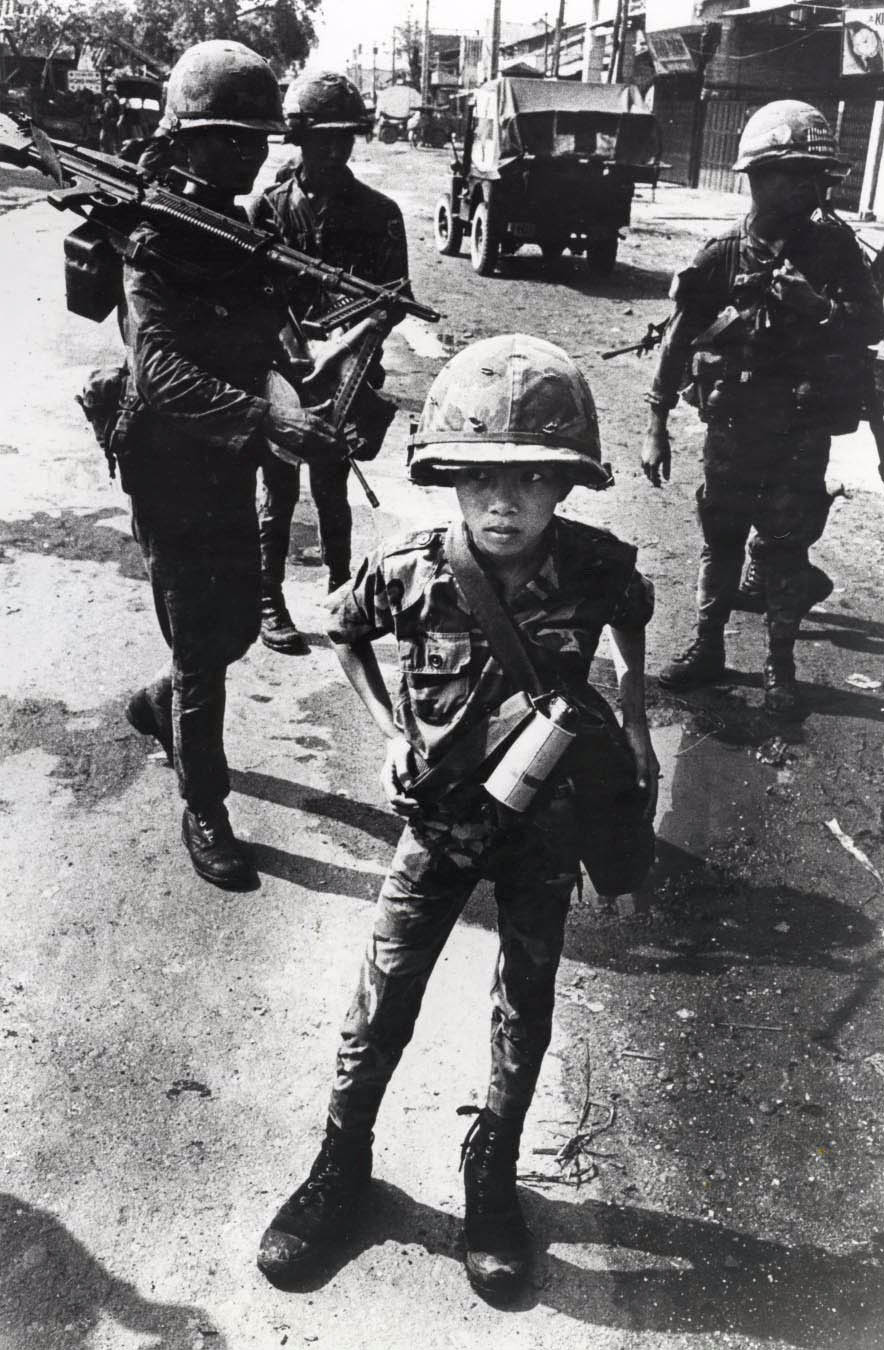
Just as Stanley Greene, visitors to the exhibition are poised between the safety of Western life and the horrors of foreign wars. And it is precisely this juxtaposition that causes these photos to stir us more than the stream of bad-news images that inundate us daily. In addition, Black Passport is a fascinating story about what it is like to be a war photographer. Why does someone choose to be continually confronted with death and misery? Is it an escape from everyday reality and a craving for adventure?

Short Biography

Stanley Greene has photographed in the former Soviet Union, Central America, Asia and the Middle East. His work has appeared in publications including Newsweek, The New York Times Magazine, Stern and Paris Match. He has won various World Press Awards and in 2004 the W. Eugene Smith Award. Open Wound: Chechnya 1994-2003 was published in 2004 and his book Black Passport in 2009. Greene is one of the founders of the Amsterdam-based international photo agency NOOR.

Press release from the Foam website


Black Passport © Stanley Greene / NOOR


Stanley Greene (American, 1949-2017)
Iraq, 2004, Road side explosion, Northern Iraq
2004
Black Passport © Stanley Greene / NOOR


“I think you can only do this for eight years. For eight years you can still keep the positive. If you stay at it longer than eight years, you turn. And not into a beautiful butterfly. You really turn. I see it in myself, I see it in all my friends and colleagues. I mean they are all victims of post trauma. We’re not the beautiful butterflies anymore. We become moths. We’re like moths flying to the flame.You know, sometimes your wings get singed or you just burn up. Get killed. Or you burn up inside.The drugs and the alcohol and the party and all of this is to push it away, push it away.”

“I’m an observer, I’m not an objective observer though, but I’m an observer. I feel it’s very important for journalists to go to these hell holes and photograph or write or do radio or whatever because I still believe that the public wants to know.”


Stanley Greene


Stanley Greene (February 14, 1949 – May 19, 2017) was an American photojournalist.

Greene was born to middle class parents in Brooklyn. Both his parents were actors. His father, who was born in Harlem, was a union organiser, one of the first African Americans elected as an officer in the Screen Actors Guild,and belonged to the Harlem Renaissance movement. Greene’s father was blacklisted as a Communist in the 1950s and forced to take uncredited parts in movies. Greene’s parents gave him his first camera when he was eleven years old.

Greene began his art career as a painter, but started taking photos as a means of cataloging material for his paintings. In 1971, when Greene was a member of the anti-Vietnam War movement and the Black Panther Party, his friend photographer W. Eugene Smith offered him space in his studio and encouraged him to study photography at the School of Visual Arts in New York and the San Francisco Art Institute.

Greene held various jobs as a photographer, including taking pictures of rock bands and working at Newsday. In 1986, he shot fashion photographs in Paris. He called himself a “dilettante, sitting in cafes, taking pictures of girls and doing heroin”. After a friend died of AIDS, Greene kicked his drug habit and began to seriously pursue a photography career.

He began photojournalism in 1989, when his image (“Kisses to All, Berlin Wall”) of a tutu-clad girl with a champagne bottle became a symbol of the fall of the Berlin Wall. While working for the Paris-based photo agency Agence Vu in October 1993, Greene was trapped and almost killed in the White House in Moscow during a stand-off between President Boris Yeltsin and the parliament. He covered the war-torn countries Azerbaijan, Bosnia and Herzegovina, Georgia, Iraq, Somalia, Croatia, Kashmir, and Lebanon. He took pictures of the genocide in Rwanda in 1994 and the US Gulf Coast in the aftermath of Hurricane Katrina in 2005.

After 1994, Greene was best known for his documentation of the conflict in Chechnya, between rebels and the Russian Armed Forces, which was compiled in his 2004 book, Open Wound. These photos drew attention to the “suffering that has marked the latest surge in Chechnya’s centuries-long struggle for independence from Russia”.

In 2008, Greene revealed that he had hepatitis C, which he believed he had contracted from a contaminated razor while working in Chad in 2007. After controlling the disease with medication, he traveled to Afghanistan and photographed a story about “the crisis of drug abuse and infectious disease”.

Stanley Greene co-founded NOOR Agency with Kadir van Lohuizen in 2007. They launched their agency with their colleagues on the 7th of September 2007 at Visa Pour L’Image. Greene died in Paris, at the age of 68. He had been undergoing treatment for liver cancer.

Text from the Wikipedia website


Black Passport is the biography of war photographer Stanley Greene, compiled out of hours of interviews by Teun van der Heijden. It shows Stanley’s war images alternated with private images.

Teun van der Heijden:Black Passport started as any other photo book project. At the beginning Stanley did let me know that he was up for ‘something completely different’. While working on the project we had a lot of conversations in which I discovered that there were a lot of similarities between Stanley and me. What is it then that one person becomes a designer, living happily with the same woman for 25 years, being a father of two daughters and the other person becomes a war photographer. This question was the beginning of a series of interviews. Out of the interviews came Black Passport. Black Passport is nominated several times. Some people believe it is the most important photo book of 2010.

Text from the YouTube website


Stanley Greene (American, 1949-2017) 'Fireflies, Paris, France' 2006


Stanley Greene (American, 1949-2017)
Fireflies, Paris, France
2006
Black Passport © Stanley Greene / NOOR


Stanley Greene (American, 1949-2017) 'Black & White Ball, Paris, France' 2006


Stanley Greene (American, 1949-2017)
Black & White Ball, Paris, France
2006
Black Passport © Stanley Greene / NOOR


Stanley Greene (American, 1949-2017) 'On the MKAD, on the way to the airport, Moscow, Russia' 2003


Stanley Greene (American, 1949-2017)
On the MKAD, on the way to the airport, Moscow, Russia
2003
Gelatin silver print
Black Passport © Stanley Greene / NOOR


Stanley Greene (American, 1949-2017) 'Kaboul, Afghanistan' 2008


Stanley Greene (American, 1949-2017)
Kaboul, Afghanistan
2008
Gelatin silver print
Black Passport © Stanley Greene / NOOR


Stanley Greene (American, 1949-2017) 'Scene 3. '89. East Berlin'


Stanley Greene (American, 1949-2017)
Scene 3. ’89. East Berlin
From Black Passport © Stanley Greene / NOOR


Stanley Greene (American, 1949-2017) 'Scene 7. '93. Moscow. Inside the White House'


Stanley Greene (American, 1949-2017)
Scene 7. ’93. Moscow. Inside the White House
From Black Passport © Stanley Greene / NOOR


Black Passport © Stanley Greene / NOOR


All photographs: Black Passport © Stanley Greene / NOOR


Foam
Keizersgracht 609
1017 DS Amsterdam
The Netherlands
Phone: + 31 20 5516500

Opening hours:
Mon – Wed 10.00 – 18.00 hrs
Thu – Fri 10.00 – 21.00 hrs
Sat – Sun 10.00 – 18.00 hrs

Foam website

LIKE ART BLART ON FACEBOOK

Back to top