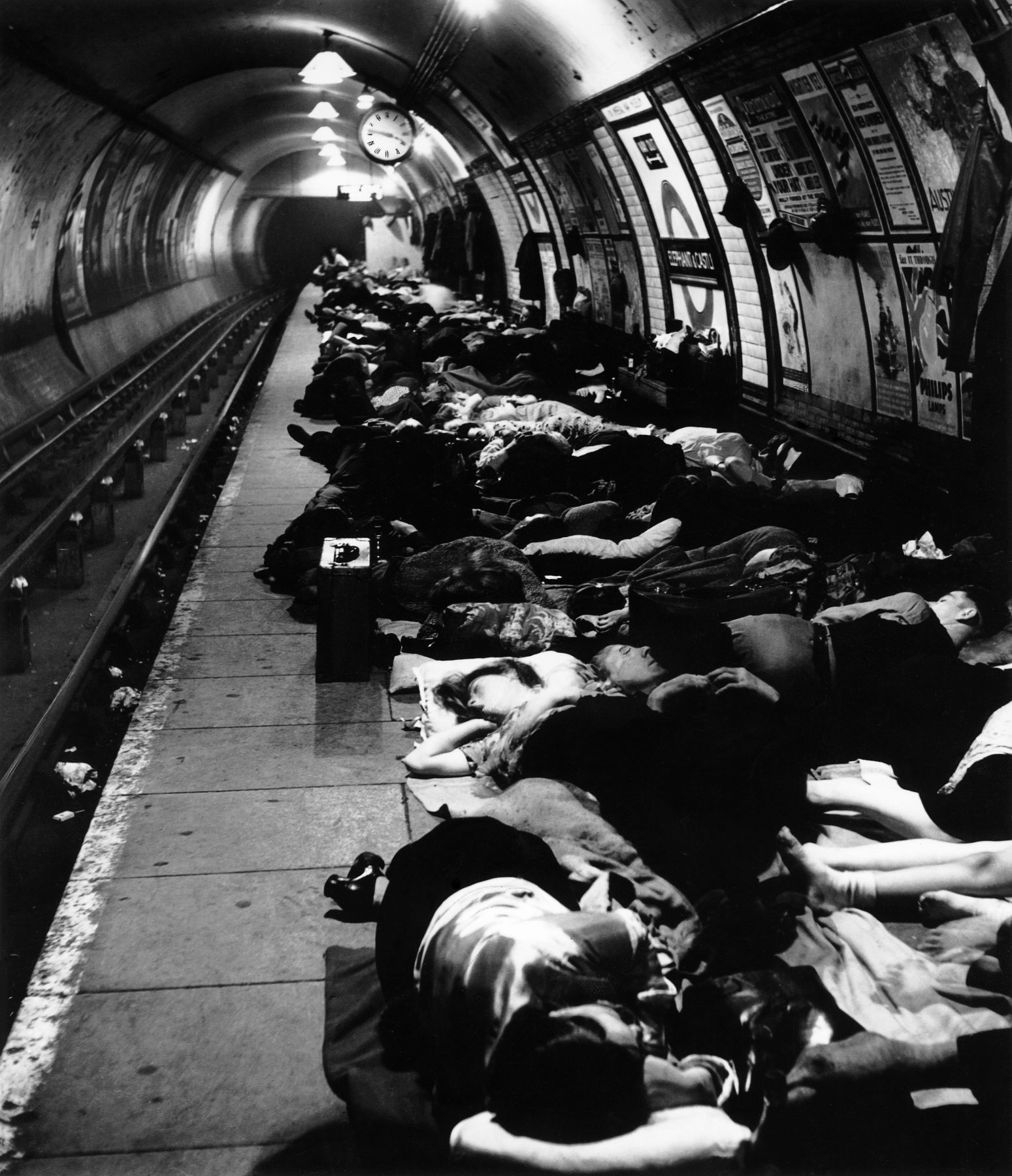
Exhibition: ‘ONE YEAR! Photographs from the Miners’ Strike 1984-85′ at Four Corners, London

Exhibition dates: 20th September – 19th October, 2024

Curator: Isaac Blease


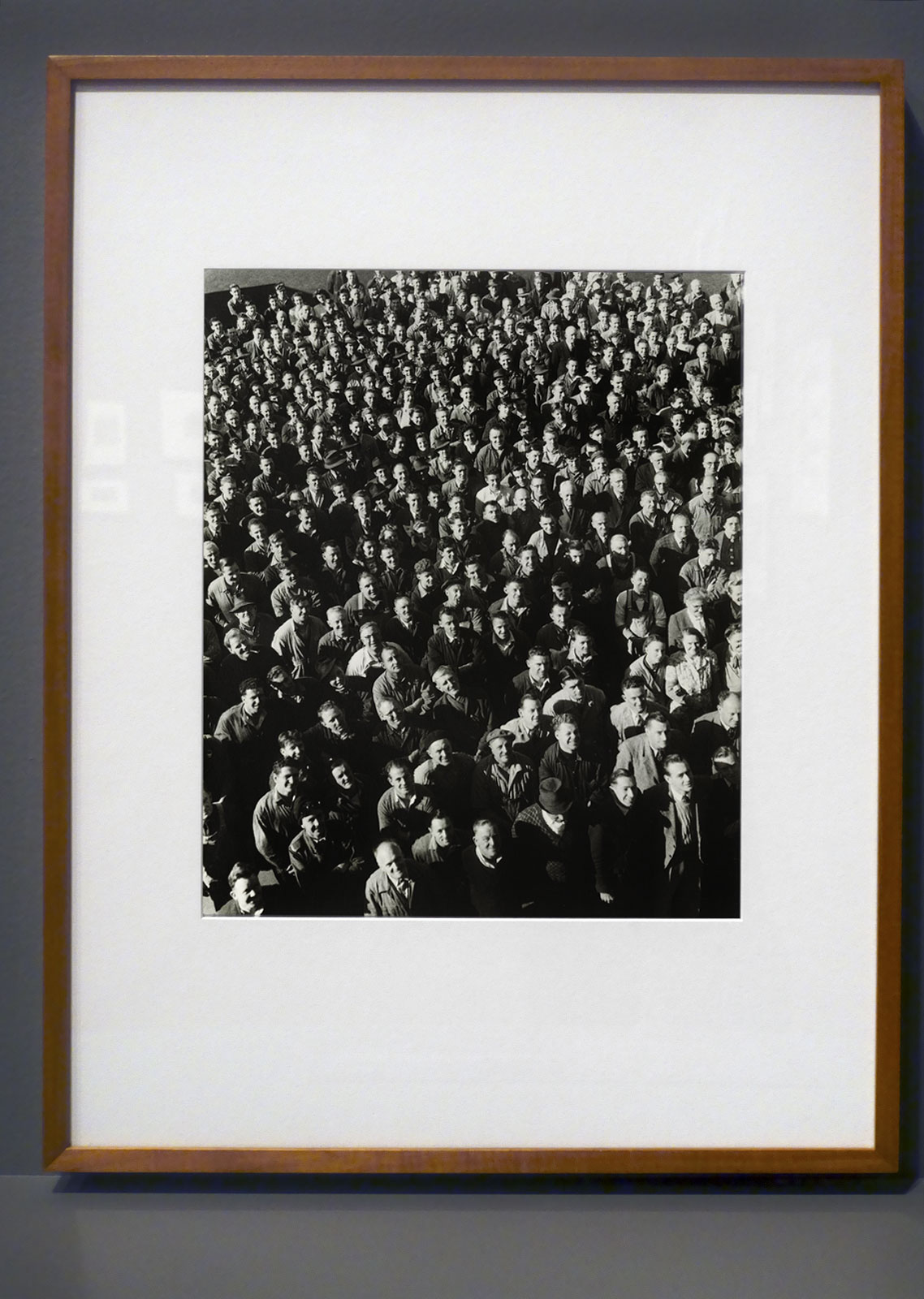
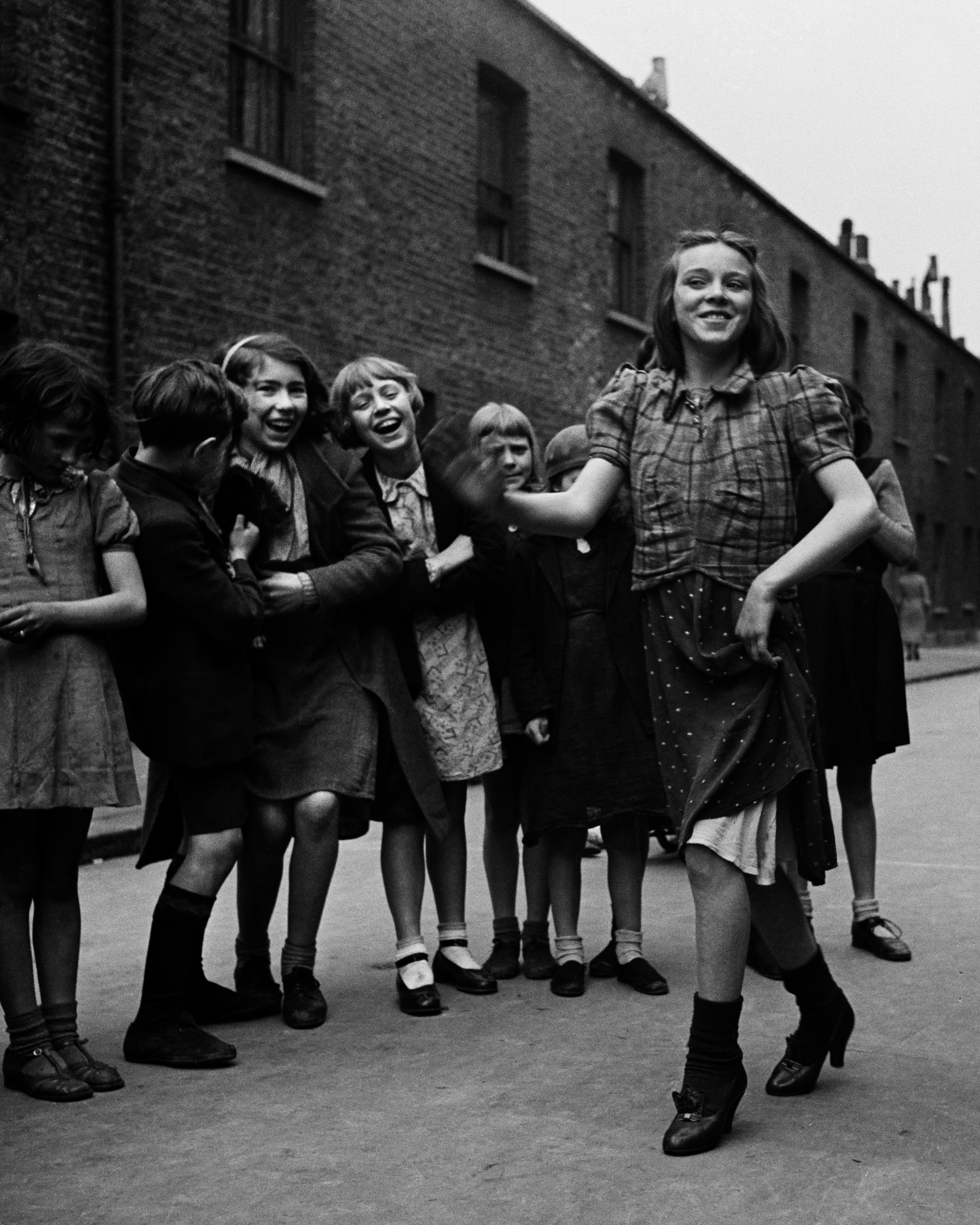
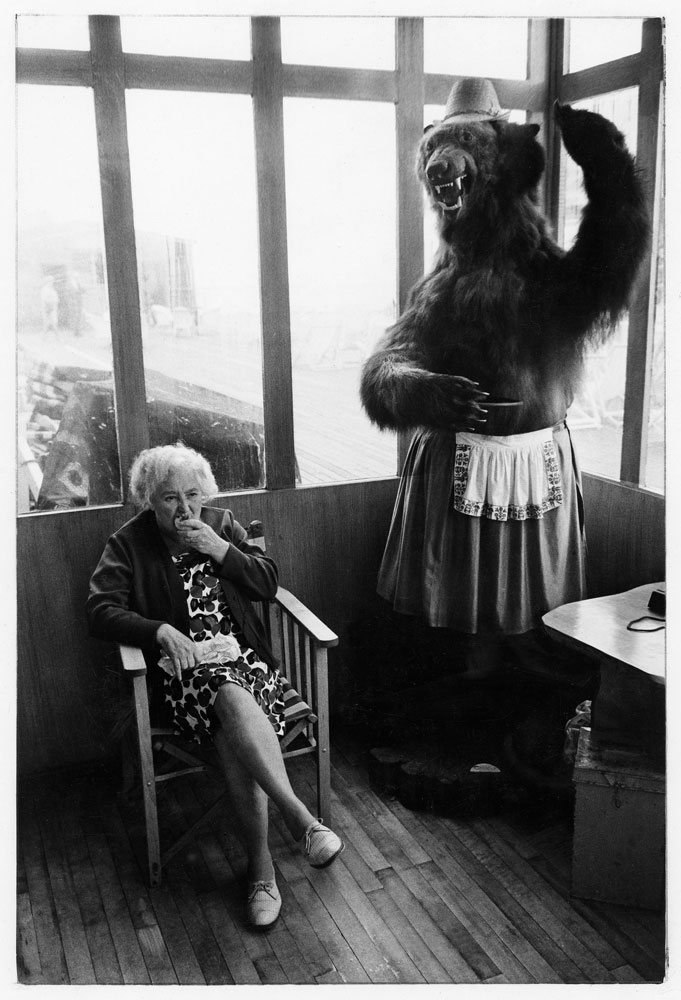
Chris Killip (British, 1946-2020) 'Durham Miners' Gala' 1984


Chris Killip (British, 1946-2020)
Durham Miners’ Gala
1984
Gelatin silver print
© Chris Killip Photography Trust – Magnum Photos


This is another excellent exhibition with a social conscience from Four Corners, ably supported by the Martin Parr Foundation.


THE LEGACY: “The strike was lost, Scargill defeated. But the greatest losers were not just the miners, but the whole labour movement which soon found itself trampled by the global restructuring of business by Thatcher and her successors on both sides of the Atlantic.

Workers in Britain and the world would soon awake to the reality of the new Thatcher – and Reagan – industrial revolution; a huge rise in ‘compensation’ for a few executives, and gutted workplaces, leading to low-paying McJobs for the rest.”


Audsley Edwards


Losers and losers

Pardon my language but, in a guttural English accent, I declare Thatcher and her minions, police and media, bastards … bloody bastards!

Her name still sends shivers down my spine. Vindictive, unbending, inhuman.

Class warfare has never been far from the surface in British society. Upstairs downstairs, the haves and the have nots. New wealth devolved from the British Industrial Revolution 1750-1900 (which produced machine-made, mass produced goods) used man power and child power – in the factories, down the pits.

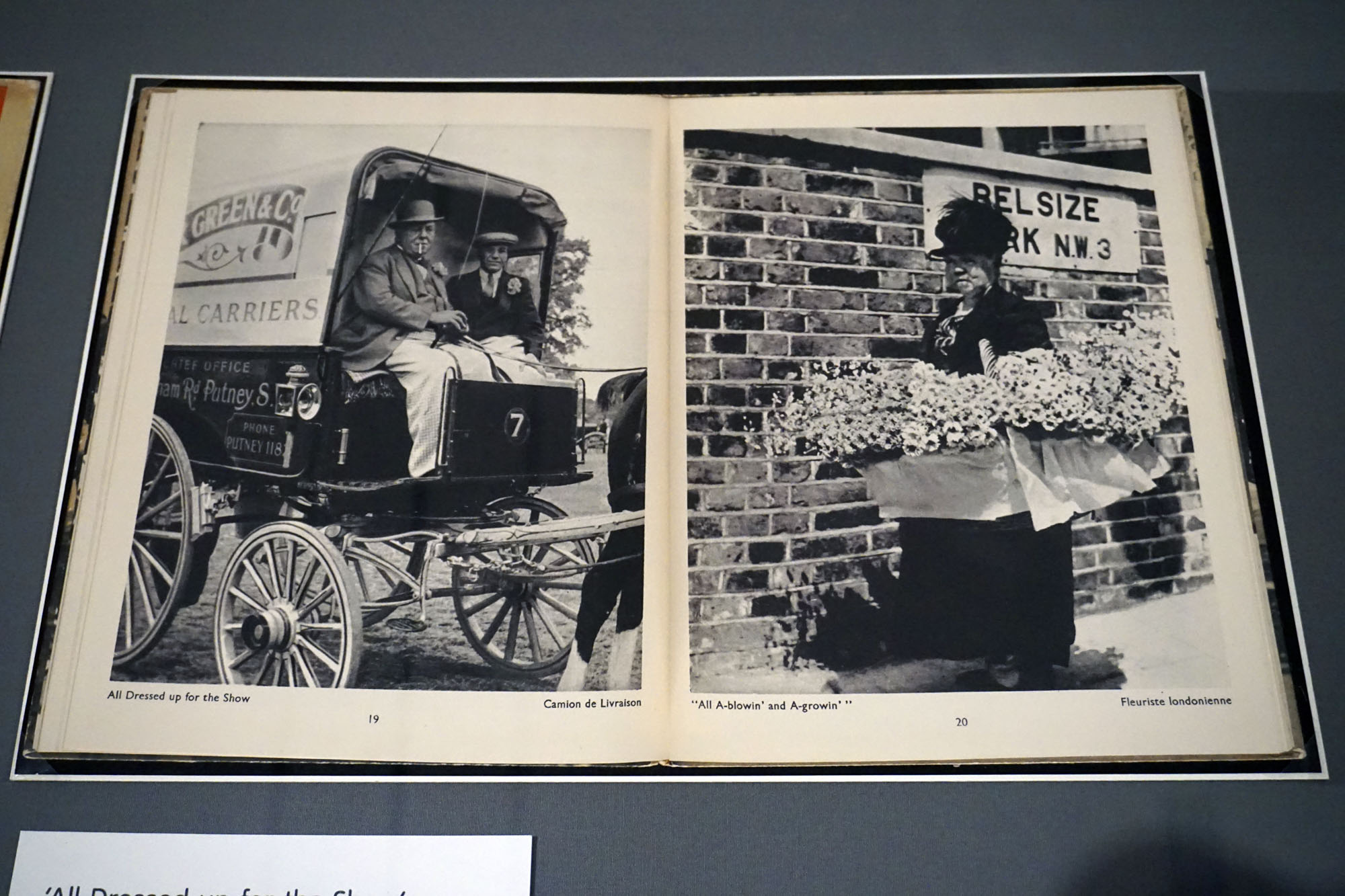
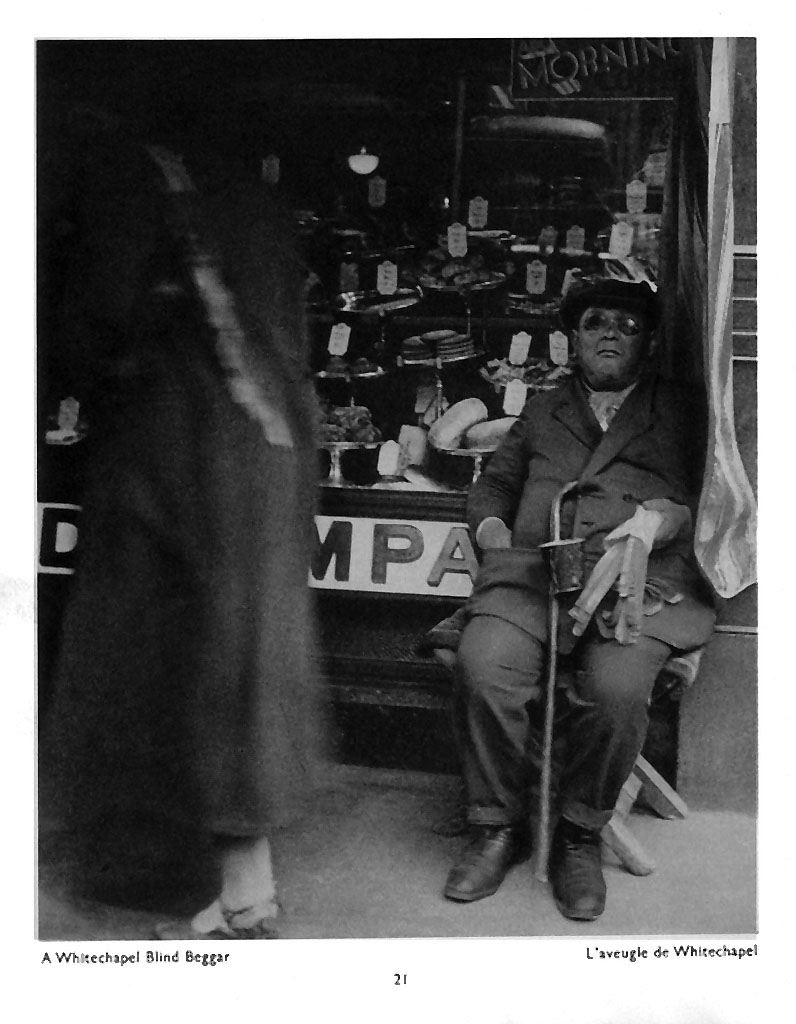
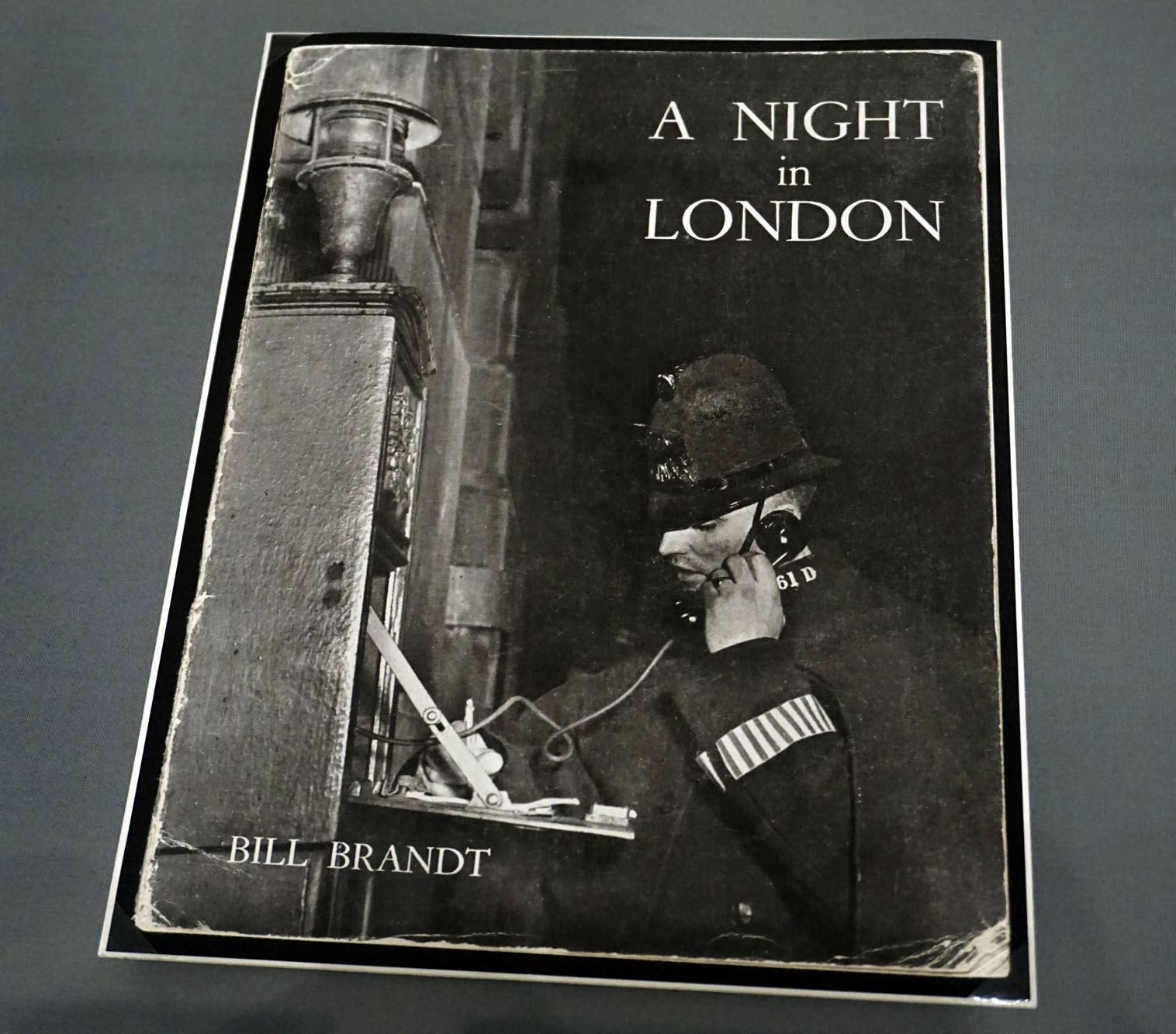
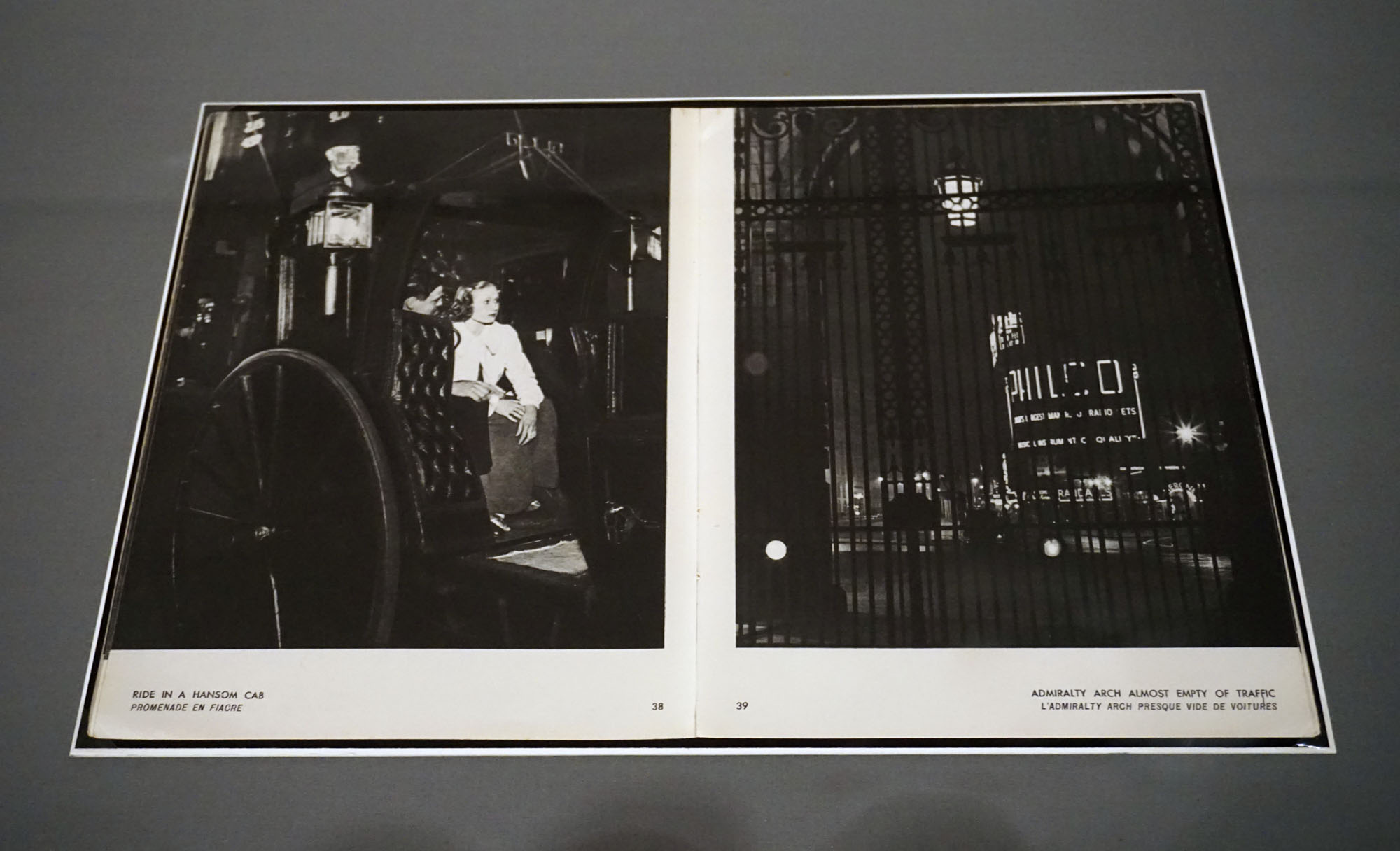
Trade unions were legalised in 1871 in the UK and sought to reform socio-economic conditions for people in British industries. They were especially strong in the coal mining industry. Coal mining in the UK has a long history dating back to Roman times and this history has long been celebrated, as can be seen in Bill Brandt’s photographs of the tough life of miners and their families (1937, below) and the ACKTON HALL COLLIERY commemorative plate (1985, below).

After the Second World War, “All the coal mines in Britain were purchased by the government in 1947 and put under the control of the National Coal Board (NCB).”1 Pit closures became a regular occurrence in many areas. “Between 1947 and 1994, some 950 mines were closed by UK governments.”1 “In early 1984, the Conservative government of Margaret Thatcher announced plans to close 20 coal pits which led to the year-long miners’ strike which ended in March 1985.”2

“A strike was called by the Yorkshire region of the NUM in protest against proposed pit closures, invoking a regional ballot result from 1981. The National Executive Committee, led by Arthur Scargill, chose not to hold a national ballot on a national strike, as was conventional, but to declare the strike to be a matter for each region of the NUM to enforce. Scargill defied public opinion, a trait Prime Minister Thatcher exploited when she used the Ridley Plan, drafted in 1977, to defeat the strike. Subsequently, over several decades, almost all the mines were shut down.”3

“Scargill stated, “The policies of this government are clear – to destroy the coal industry and the NUM.” … This was denied by the government at the time, although papers released in 2014 under the thirty-year rule suggest that Scargill was right.”4

In the era of anti-Apartheid (in June 1984 Thatcher received a visit from P. W. Botha the South African premier), anti-war, pro abortion, nuclear disarmament, Gay Liberation, Women’s Liberation, Clause 28, anti-fascist marches and student protests – in the era of Thatcherism (“deregulation, privatisation of key national industries, maintaining a flexible labour market, marginalising the trade unions and centralising power from local authorities to central government”),5 Thatcher saw strong trade unions as an obstacle to economic growth through the implementation of neoliberal economic policies.

“Neoliberalism sees competition as the defining characteristic of human relations. It redefines citizens as consumers, whose democratic choices are best exercised by buying and selling, a process that rewards merit and punishes inefficiency…. The organisation of labour and collective bargaining by trade unions are portrayed as market distortions that impede the formation of a natural hierarchy of winners and losers.”5

The losers from the Miners’ Strike were the working class communities and people of the mining villages… and the power of the unions. Thatcher wanted to destroy their power more than anything else and bugger the cost to communities and human beings. Their side of this conflict is portrayed in this exhibition through artefacts and photographs using photography as a tool of resistance.6

The photographs depict the miners struggle for existence through nuance, context and detail and set out to portray the essence of the mining communities identity under duress. There is a wonderful sense of empathy from the photographers towards the people they are photographing, a warts and all approach documenting their class struggle. But we must also be aware that photographs were used by the government and the media to portray the miners as the villains of the conflict, for photography is situated ‘within the reproduction of certain forms of power that can reorganise, map, and penetrate the body’.7 This power is then used in exploitative and controlling ways… as in when the “BBC reversed footage on the Six O’Clock News to suggest the miners had attacked the police, and that the police had simply retaliated. [Despite an Independent Police Complaints Commission report in 2015 confirming the reversal, the BBC has never officially accepted this.]”8 Other examples of the exploitative use of photographs and biased reporting to denigrate the fight and plight of the miners appeared in the tabloid press with newspapers facing allegations that the coverage of the strike amounted to a “propaganda assault on the miners.”9

Photography and film, then, was used to reorganise the truth, map the conflict on tv and in the media, and penetrate the political and social “body” of the United Kingdom, used by the powers that be in controlling and exploitative ways to demonise the miners’ cause in the eyes of the British public.

Susanna Viljanen perceptively, directly and sadly observes that,

“While technically Thatcher was right – most of the mines were unprofitable, many worked at loss and each tonne of coal produced negative cash flow – the aftermath was sad. Thatcher was not only a crank, she was utterly vindictive. The Unions had brought down Edward Heath’s cabinet 1974, and now the Conservatives extracted revenge on the Unions – and on the British working class. Many of the former mine towns fell into bankruptcy, poverty and despair.

It also turned out that her theory of self-correctiveness of the market economy was simply wrong. New businesses did not emerge and the miners did not get relocated on job markets, but mass unemployment ensued. The aftermath also destroyed the social fabric and the networks of the mining towns and the working class, exacerbating the situation even worse. The destruction wasn’t creative, it was merely destructive.”


While I realise the coal mining industry would have eventually closed with the move to renewables (the United Kingdom has just become the first major country to announce the closure of all coal fired power stations ending its 142-year reliance on the fossil fuel) – there is still a double loss from the British state’s abuse of power and the outcome of the Miners’ Strike, the results of which are still being felt today – namely that Britain lost any form of empathy for the working man, and it lost the history of its working people, its culture and social community.

Men had to move away to find jobs as new industries did not emerge where old ones were closed. Country towns and mining towns were depopulated and became even more impoverished than they were before. Colliery bands and choirs vanished, a sense of community was eviscerated and with the closure of the pits the life energy of the villages was destroyed. Bankruptcy, poverty and despair ensued. A social history that stretched back centuries had been disembowelled, obliterated.

This is the great sadness of those times. This cold, freezing winter of our discontent.

Dr Marcus Bunyan


Footnotes

1/ “History of coal miners,” on the Wikipedia website

2/ “Coal mining in the United Kingdom,” on the Wikipedia website

3/ “History of trade unions in the United Kingdom,” on the Wikipedia website

4/ “Arthur Scargill,” on the Wikipedia website

5/ George Monbiot. “Neoliberalism – the ideology at the root of all our problems,” on The Guardian website 15 April 2016 [Online] Cited 23/09/2024

6/ “Photography has long been associated with acts of resistance. It is used to document action, share ideas, inspire change, tell stories, gather evidence and fight against injustice.”

Text from the exhibition Acts of Resistance: Photography, Feminisms and the Art of Protest, 2024 on the South London Gallery website [Online] Cited 29/09/2024

7/ Michael Hayes. “Photography and the Emergence of the Pacific Cruise: Rethinking the representational crisis in colonial photography,” in Eleanor M. Hight and Gary D. Sampson (eds.,). Colonialist Photography: Imag(in)ing Race and Place. Routledge, 2002, pp. 172-87.

8/ Lesley Boulton quoted in Adrian Tempany. “‘A policeman took a full swipe at my head’: Lesley Boulton at the Battle of Orgreave, 1984,” on The Guardian website 17 December 2016 [Online] Cited 23/09/2024

“The miners always said the police had brutally attacked them without justifiable provocation, and that the attack felt preplanned. They complained that the BBC had reversed footage, to show miners who threw missiles seemingly before the police charge rather than in retaliation for it…

Far less publicised, a year later, was the unravelling of the police case. Officers had arrested and charged 95 miners with riot, an offence of collective violence carrying a potential life sentence. Yet in July 1985 the prosecution withdrew and all the miners were were acquitted after the evidence of some police officers, including those in command, had been discredited under cross-examination.

In 1991 South Yorkshire police paid £425,000 compensation to 39 miners who had sued the force for assault, unlawful arrest and malicious prosecution. But still the police did not admit any fault, and not a single police officer was ever disciplined or prosecuted.”

David Conn. “We were fed lies about the violence at Orgreave. Now we need the truth,” on The Guardian website 22nd July 2015 [Online] Cited 03/10/2024

9/ “My recent research, which involved analysis of both news language and press photographs of the time, shows that this year-long strike was portrayed by newspapers – on all sides – as a metaphorical war between the government and the National Union of Mineworkers.

It shows how the media used “war framing” words, phrases and photographs while reporting the strike – often drawing on iconic texts and images associated with World War I. This framing presented the miners as “the enemy”, while at the same time, it justified the actions of the government and the police as necessary and even noble.”

Christopher Hart. “War on the picket line: how the British press made a battle out of the miners’ strike,” on The Conversation website June 8, 2016 [Online] Cited 03/10/2024

“The 1984-1985 miners’ strike was a defining moment in British industrial relations. Shafted, edited by Yorkshire freelance Granville Williams and published by the Campaign for Press and Broadcasting Freedom (CPBF), to which the NUJ is affiliated, has been published to commemorate the 25th anniversary of the start of the strike. It bravely explores the ways in which the media covered the strike and looks into the devastating impact of the pit closure programme on mining communities.

It analyses the pressures on journalists who reported the strike, with accounts from prominent reporters, among them Pete Lazenby of the Yorkshire Evening Post, Nick Jones of the BBC, and Paul Routledge of The Times. But the book also looks at the important contribution from the alternative media and the coverage of the long conflict by freelance photographers and filmmakers.”

Julio Etchart. “Shafted,” on the Freelance website May 2009 [Online] Cited 03/10/2024

10/ Susanna Viljanen. “Why didn’t Thatcher realize the mining towns would become much poorer without the mines?,” on the Quora website Nd [Online] Cited 29/09/2024


Many thankx to Zena Howard for her help, and to the Martin Parr Foundation and Four Corners for allowing me to publish the photographs and art work in the posting. Please click on the photographs for a larger version of the image.


“We face not an employer, but a government aided and abetted by the judiciary, the police and you people in the media.”


Arthur Scargill


“For those who have lived through this strike, its enormity cannot be underestimated. We have brought together some of the best-known photographs – including John Harris’s image of a policeman with a truncheon held from a horse swinging at a cowering woman, and John Sturrock’s photograph of the confrontation between mass pickets and police lines at Bilston Glen – to rarely seen snapshots taken by Philip Winnard, a striking miner himself.”


Martin Parr


“The exhibition is an attempt to commemorate and reflect on the miners’ strike of 1984-85, a seismic, yet often overlooked event in the recent history of Britain. By focusing on the complex role photographs played during the year-long struggle we hope for the show to transcend the purely historical or nostalgic and take the visitor on a journey through a series of timeless images that show the resilience, camaraderie and violence of the strike, to reconnect and consider it again in relation to the present. The ephemera materials show the urgent use of images and the creativity that was deployed in support of the striking miners. Together, the works tell a story of the battle against Margaret Thatcher and the National Coal Board’s pit closures, but what ultimately shines through is the unity and imagination of people coming together in defence of their communities and the basic rights to work and to survive.”


Isaac Blease, Exhibition Curator


ONE YEAR! Photographs from the Miners’ Strike 1984-85 explores the vital role that photography played during this bitter industrial dispute. To commemorate the 40th anniversary of the miners’ strike, Four Corners is delighted to tour this exhibition from the Martin Parr Foundation. One of Britain’s longest and most violent disputes, the repercussions of the miners’ strike continue to be felt today across the country.

The exhibition looks at the central role photographs played during the year-long struggle against pit closures, with many materials drawn from the Martin Parr Foundation collection. Posters, vinyl records, plates, badges and publications are placed in dialogue with images by photographers, investigating the power and the contradictions inherent in using photography as a tool of resistance. They include photographs by Brenda Prince, John Sturrock, John Harris, Jenny Matthews, Roger Tiley, Imogen Young and Chris Killip, as well as Philip Winnard who was himself a striking miner.

The photographs show some familiar imagery – the lines of police and the violence – but also depict the remarkable community support from groups such as Women Against Pit Closures and the Lesbians and Gays Support the Miners. Photography was used both to sway public opinion and to document this transformative period in British history.

The catalyst for the miners’ strike was an attempt to prevent colliery closures through industrial action in 1984-85. The industrial action, which began in Yorkshire, was led by the National Union of Mineworkers (NUM) and its President, Arthur Scargill, against the National Coal Board (NCB). The Conservative government under Margaret Thatcher opposed the strikes and aimed to reduce the power of the trade unions. The dispute was characterised by violence between the flying pickets and the police, most notably at the Battle of Orgreave. The miners’ strike was the largest since the General Strike of 1926 and ended in victory for the government with the closure of a majority of the UK’s collieries.

Text from the Four Corners website


Neoliberalism

Neoliberalism sees competition as the defining characteristic of human relations. It redefines citizens as consumers, whose democratic choices are best exercised by buying and selling, a process that rewards merit and punishes inefficiency. It maintains that “the market” delivers benefits that could never be achieved by planning.

Attempts to limit competition are treated as inimical to liberty. Tax and regulation should be minimised, public services should be privatised. The organisation of labour and collective bargaining by trade unions are portrayed as market distortions that impede the formation of a natural hierarchy of winners and losers. Inequality is recast as virtuous: a reward for utility and a generator of wealth, which trickles down to enrich everyone. Efforts to create a more equal society are both counterproductive and morally corrosive. The market ensures that everyone gets what they deserve.

George Monbiot. “Neoliberalism – the ideology at the root of all our problems,” on The Guardian website 15 April 2016 [Online] Cited 23/09/2024


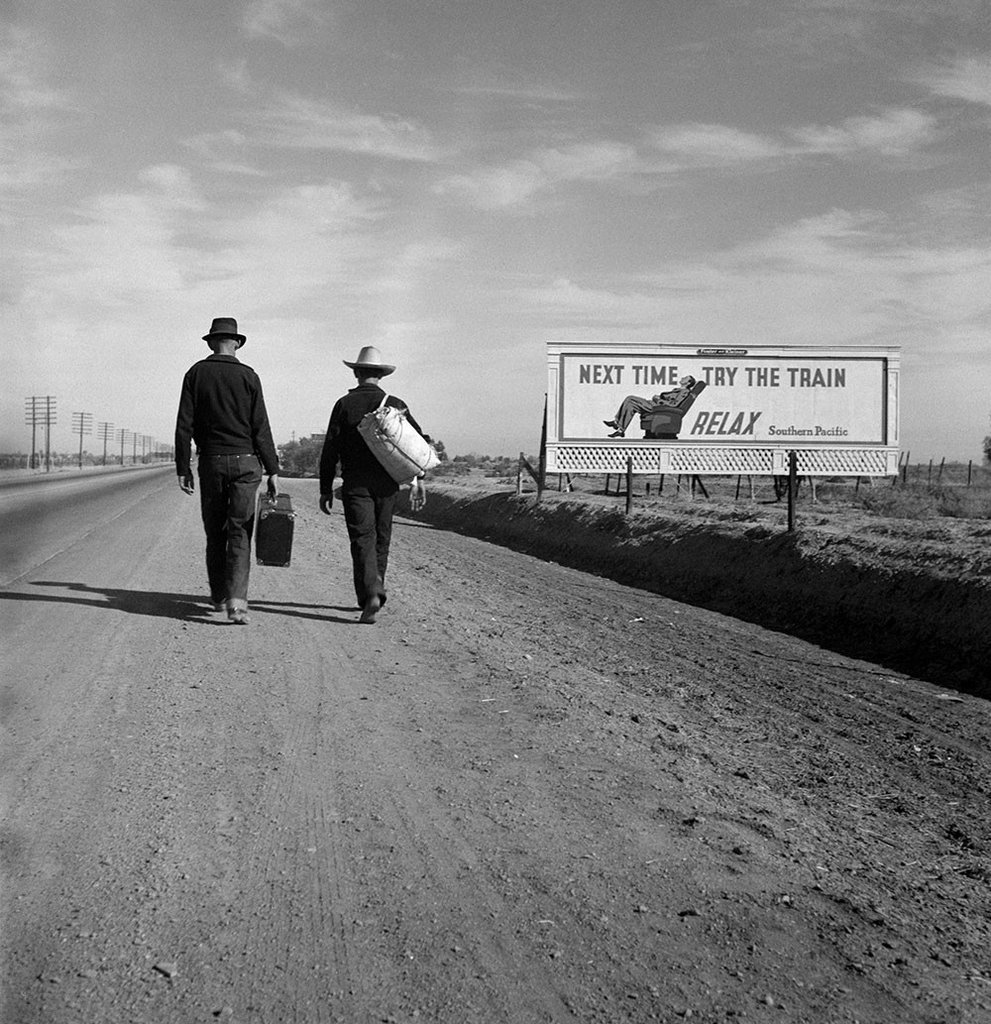
Bill Brandt (British, born Germany 1904-1983) 'Unemployed miner returning home from Jarrow' 1937


Bill Brandt (British, born Germany 1904-1983)
Unemployed miner returning home from Jarrow
1937
Gelatin silver print

Used under fair use conditions for the purposes of education and research


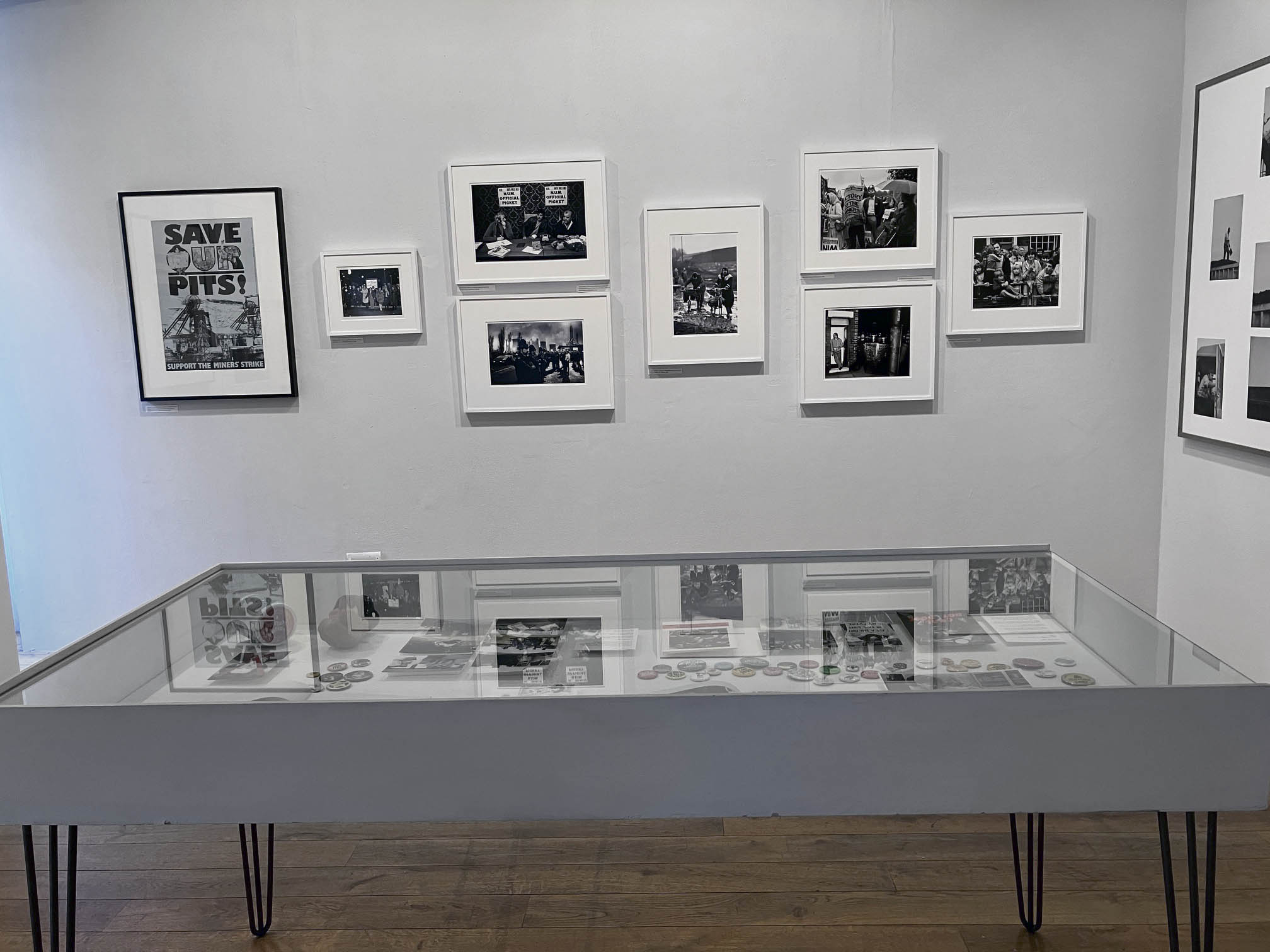
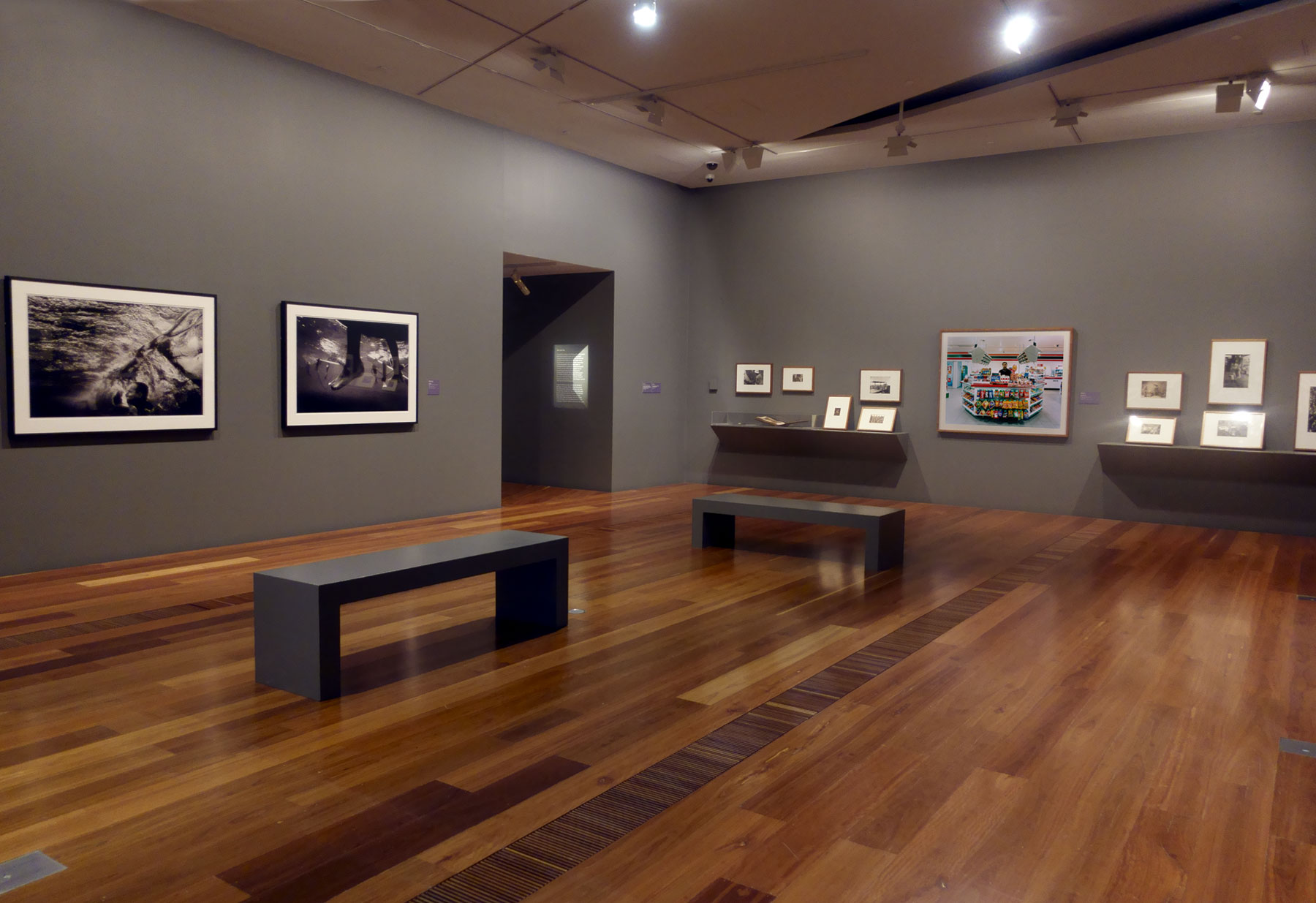
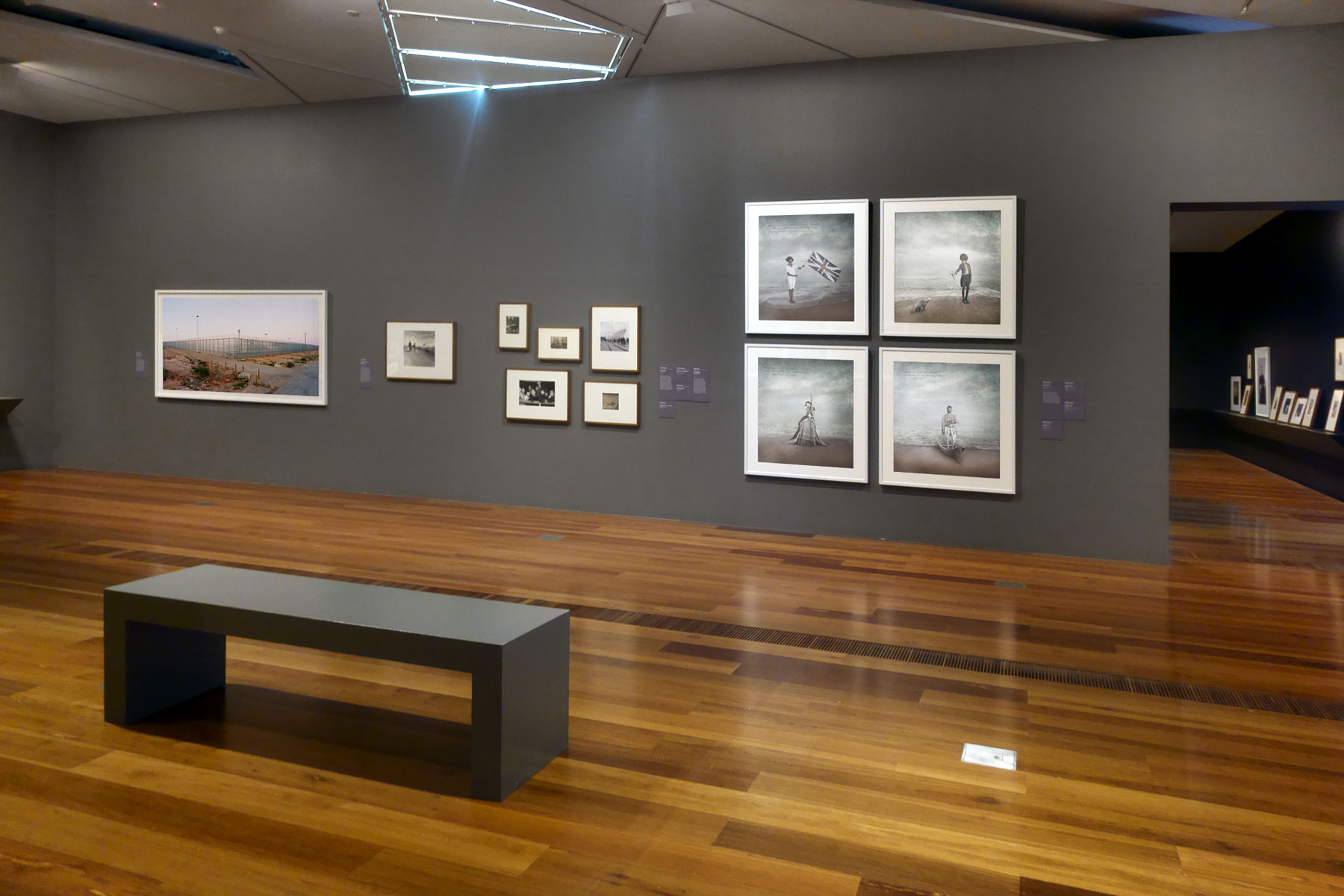
Installation view of the exhibition ONE YEAR! Photographs from the Miners' Strike 1984-85 at Four Corners, London


Installation view of the exhibition ONE YEAR! Photographs from the Miners’ Strike 1984-85 at Four Corners, London showing:

At top left

Unknown maker (British)
Dartboard with Margaret Thatcher photograph
Nd
Martin Parr Foundation Collection

At left,

John Sturrock (British)
In the wake of an earthmoving machine, men search for small lumps of coal on an old colliery tip at South Kirby
13th December, 1984

At second left,

Unknown maker (British)
When They Close A Pit They Kill A Community
Welsh Congress in Support of Mining Communities 1984-1985
1985
Poster


Bill Brandt (British, born Germany 1904-1983) 'Coal-Miner's Bath, Chester-le-Street, Durham' 1937


Bill Brandt (British, born Germany 1904-1983)
Coal-Miner’s Bath, Chester-le-Street, Durham
1937
Gelatin silver print

Used under fair use conditions for the purposes of education and research
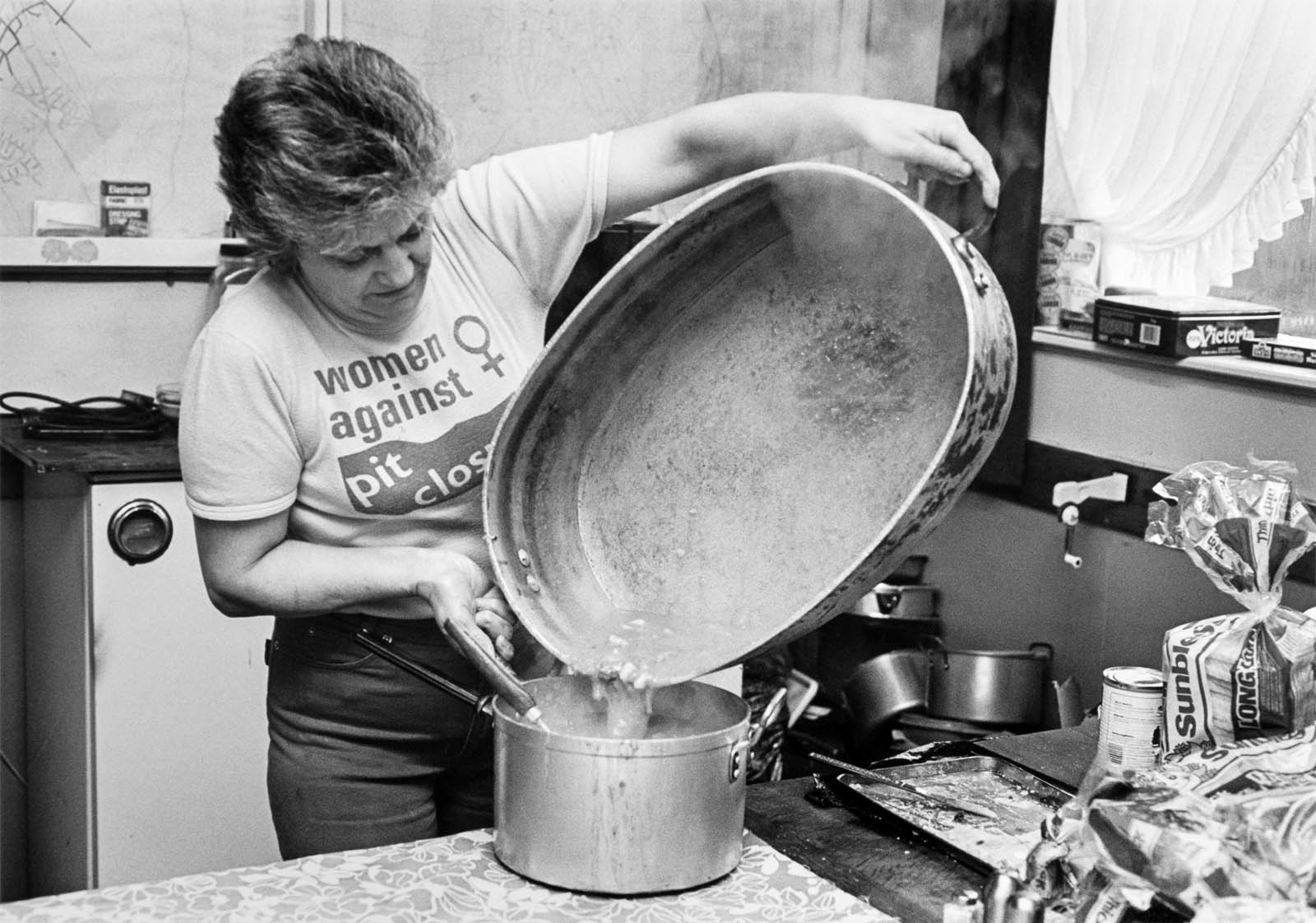
 

Brenda Prince (British, b. 1950) 'Dot Hickling on strike from N.C.B canteen at Linby Colliery helped organise and turn the miners kitchen in Hucknall for a year during strike. Son & son-in-law also on strike, Nottingham' 1984/1985


Brenda Prince (British, b. 1950)
Dot Hickling on strike from N.C.B canteen at Linby Colliery helped organise and turn the miners kitchen in Hucknall for a year during strike. Son & son-in-law also on strike, Nottingham
1984/85
© Brenda Prince


Bill Brandt (British born Germany, 1904-1983) 'Northumbrian Miner at His Evening Meal' 1937


Bill Brandt (British born Germany, 1904-1983)
Northumbrian Miner at His Evening Meal
1937
Gelatin silver print

Used under fair use conditions for the purposes of education and research
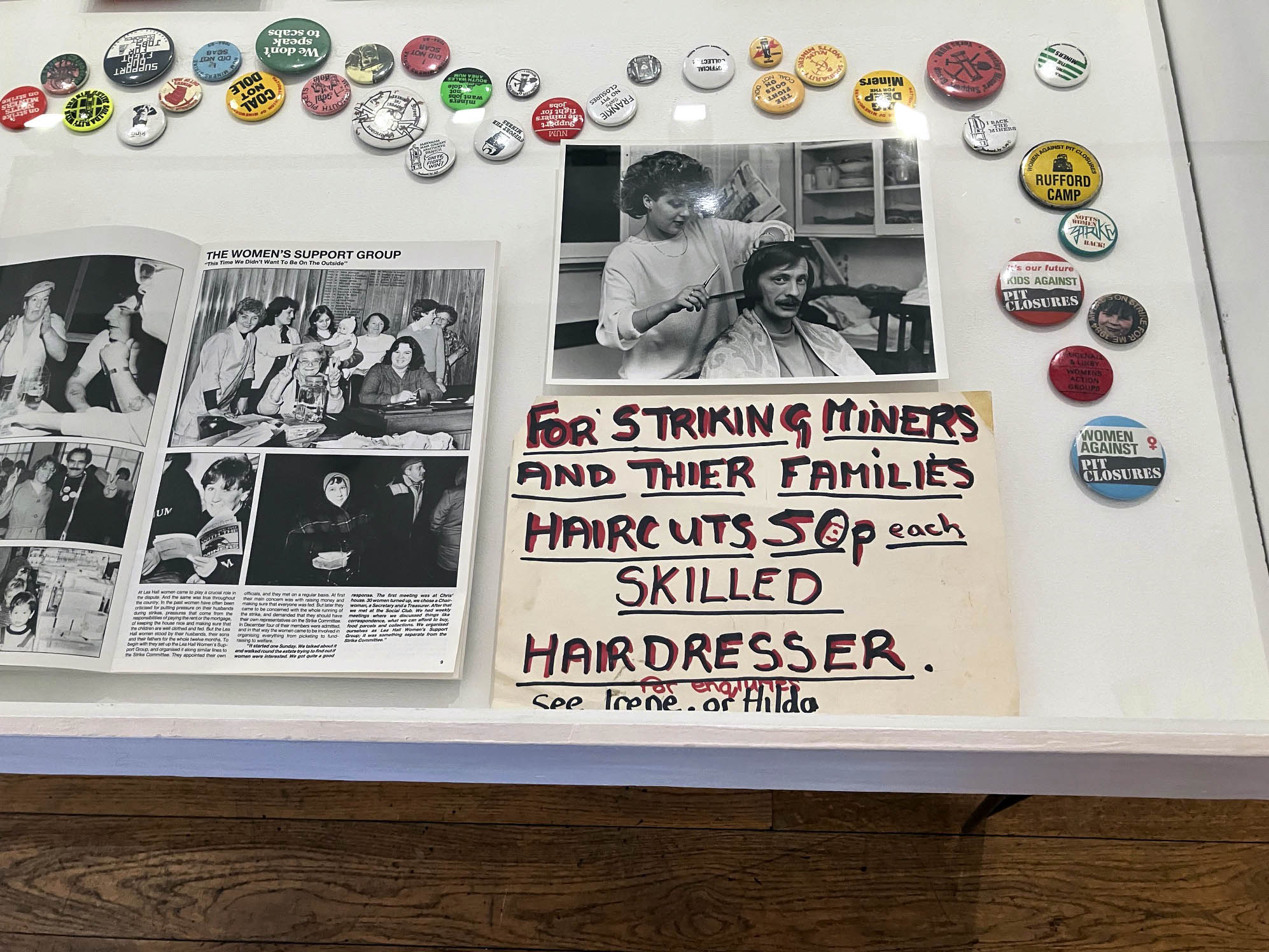
 

Installation view of the exhibition ONE YEAR! Photographs from the Miners' Strike 1984-85 at Four Corners, London


Installation view of the exhibition ONE YEAR! Photographs from the Miners’ Strike 1984-85 at Four Corners, London showing below the text from the magazine at left:

The Women’s Support Group

“This Time We Didn’t Want To Be On The Outside”

At Lea Hall women came to play a crucial role in the dispute. And the same was true throughout the country. In the past women have often been criticised for putting pressure on their husbands during strikes, pressures that come from the responsibilities of paying the rent or the mortgage, of keeping the house nice and making sure that the children are well clothed and fed. But the Lea Hall women stood by their husbands, their sons and their fathers for the whole twelve months. To being with they set up the Lea Hall Women’s support Group, and organised it along similar lines to the Strike Committee. They appointed their own officials, and they met on a regular basis. At first their main concern was with raising money and making sure that everyone was fed. But later they came to be concerned with the whole running of the strike, and demanded that they should have their own representatives on the Strike Committee. In December four of their members were admitted, and in that way the women came to be unbolted in organising everything from picketing to fundraising to welfare.

“It started one Sunday. We talked about it and walked around the estate trying to find out if women were interested. We got quite a good response. The first meeting was at Chris’ house, 30 women turned up, we chose a Chairwoman, a Secretary and a Treasurer. After that we met at the Social Club. We had weekly meetings where we discussed things like correspondence, what we can afford to buy, food parcels and collections. We organised ourselves as Lea Hall Women’s Support Group; it was something separate from the Strike Committee.”
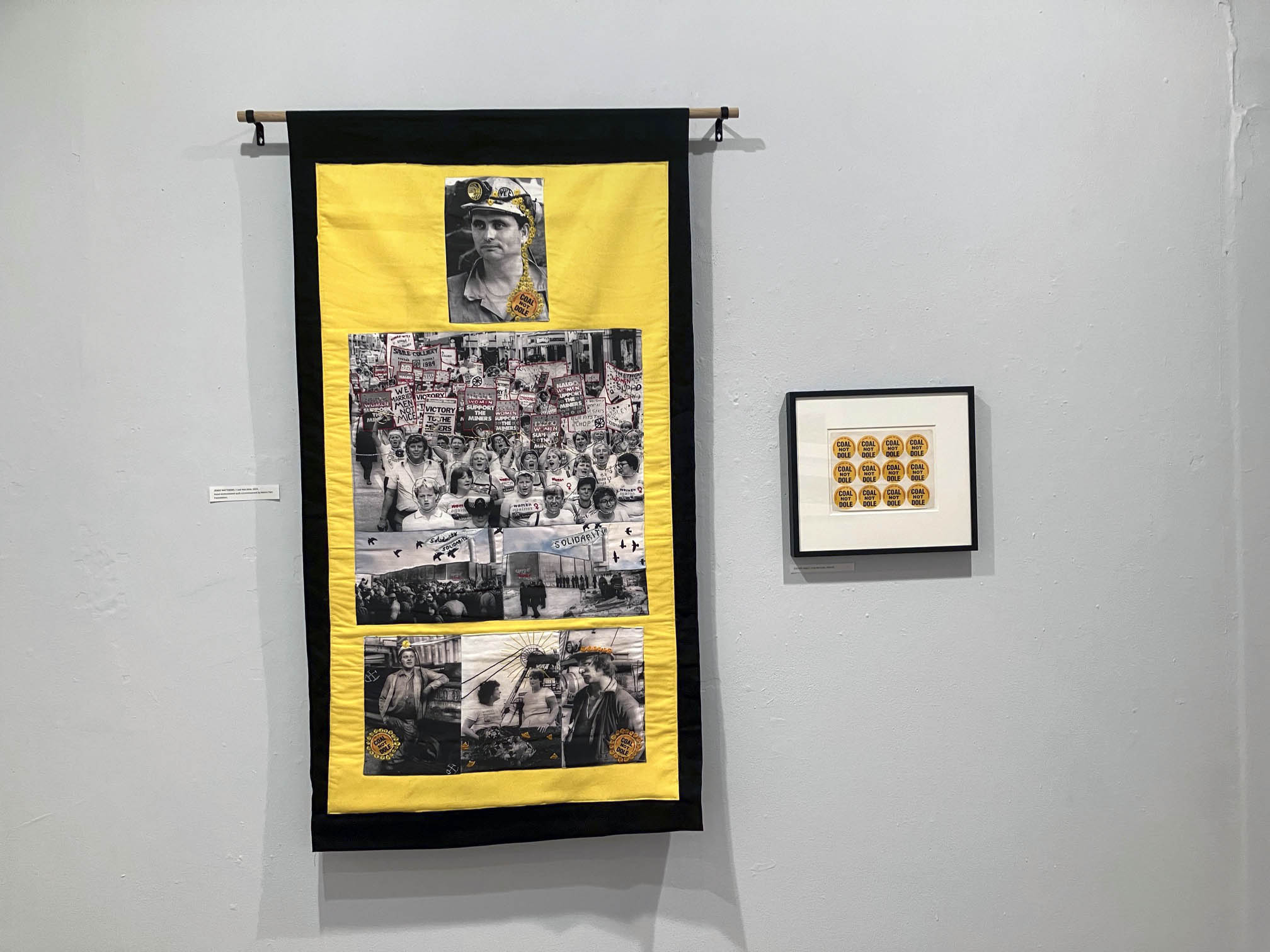
 

Installation view of the exhibition 'ONE YEAR! Photographs from the Miners' Strike 1984-85' at Four Corners, London


Installation view of the exhibition ONE YEAR! Photographs from the Miners’ Strike 1984-85 at Four Corners, London showing at left, Jenny Matthews’ quilt commissioned by the Martin Parr Foundation to mark the 40th anniversary of the miners’ strike
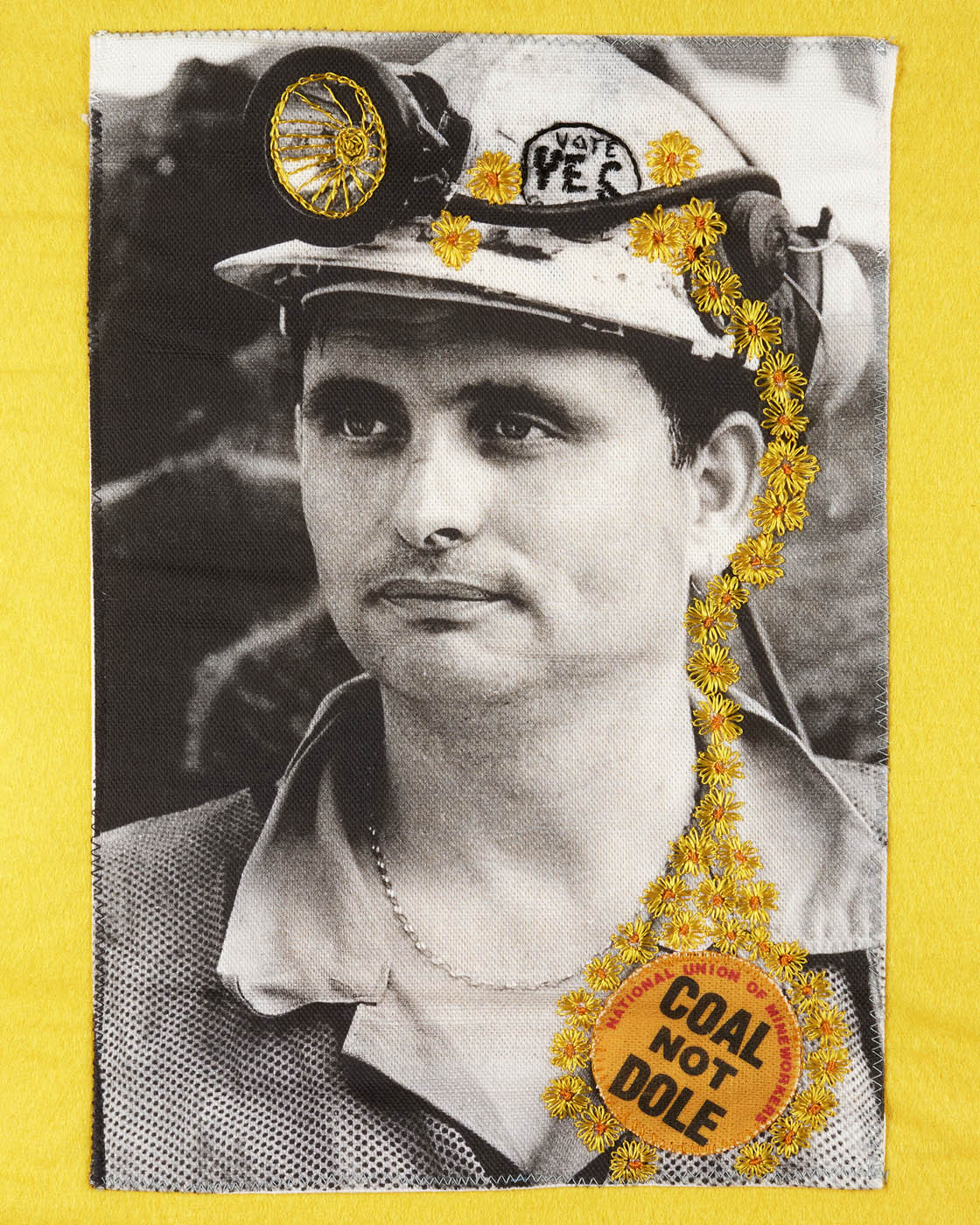
 

Jenny Matthews (British) 'Cole Not Dole' Nd


Jenny Matthews (British)
Cole Not Dole
Nd
© Jenny Matthews


Detail from a quilt commissioned by the Martin Parr Foundation to mark the 40th anniversary of the miners’ strike.


Installation view of the exhibition ONE YEAR! Photographs from the Miners' Strike 1984-85 at Four Corners, London


Installation view of the exhibition ONE YEAR! Photographs from the Miners’ Strike 1984-85 at Four Corners, London showing at left the wall text below; in the four photographs from top left clockwise, John Sturrock’s Miners’ Strike 1984 mass picket confronting police lines, Bilston Glen. Norman Strike at the front of a mass picket, Scotland, unknown photographer Carcroft NCB Central Store 1984, Howard Sooley’s Rossington Main Colliery 1984, Roger Tiley’s ‘Scabs’ returning to work, Newbridge, South Wales, 1984-1985; and at right, the poster VICTORY TO THE MINERS, VICTORY TO THE WORKING CLASS (below)


To mark the 40th anniversary of the 1984-85 miners’ strike, Four Corners is delighted to present this exhibition from the Martin Parr Foundation, which looks at the vital role that photographs played during the year-long struggle against pit closures.

The miners’ strike was one of Britain’s longest and most bitter industrial disputes, the repercussions of which continue to be felt throughout the country today. This industrial action was led by the National Union of Mineworkers and its president, Arthur Scargill, against planned colliery closures by the National Coal Board which threatened 20,000 job losses.

Margaret Thatcher’s Conservative government strongly opposed the strike and aimed to reduce the power of the trade unions. It was a dispute characterised by weaponised news coverage and visual media created sway public opinion against the strike. Photographs documenting the events in 1984-85 are exhibited here in dialogue with selected ephemera created in support of the miners – including posters, vinyl records, plates, badges and publications.

The exhibited works cover a variety of approaches, from photo-journalism to photo-montage, as well as vernacular photographs taken by Philip Winnard, himself a striking miner. They include some iconic imagery of the lines of police and picket violence – most notably at the infamous Battle of Orgreave. But they also depict the remarkable community solidarity from groups including Women Against Pit Closures and Lesbians and Gays Support the Miners.

The strike ended in defeat for the miners on the 3rd March 1985, with most of Britain’s coal mines shut down. It was a running point in British society, leading to weakened trade unions and loss of workers’ rights, the privatisation of nationalised industries, and today’s insecure jobs market. Forty yeas on, ex-mining communities face a legacy of mass unemployment and social inequality. This exhibition offers a unique account of the strike, but also a space to reflect on power, community and the relationship between photography and societal change.

The exhibition features work by John Harris, Chris Fillip, Jenny Matthews, Brenda Prince, Neville Pyne, Howard Sooley, John Sturrock, Roger Tiley, Philip Winnard, Imogen Young and uncredited photographers of original press prints. It includes many materials drawn from the Martin Parr Foundation collection. The original exhibition was curated by Isaac Blease at Martin Parr Foundation. A book to accompany the exhibition is published by Bluecoat Press.

This exhibition is made possible with the generous support of Alex Sainsbury, Foyle Foundation, Hallett Independent, National union of Mineworkers and the Society for the Study of Labour History. With many thanks to the Martin Parr Foundation, Mary Halpenny-Killip, Matthew Fillip, Ceri Thompson, National Museum of Wales, Craig Oldham, Graham Smith, Bluecoat Press, British Journal of Photography, Isaac Blease, Tom Booth Woodger, Mick Moore and Safia Mirzai.

Wall text from the exhibition
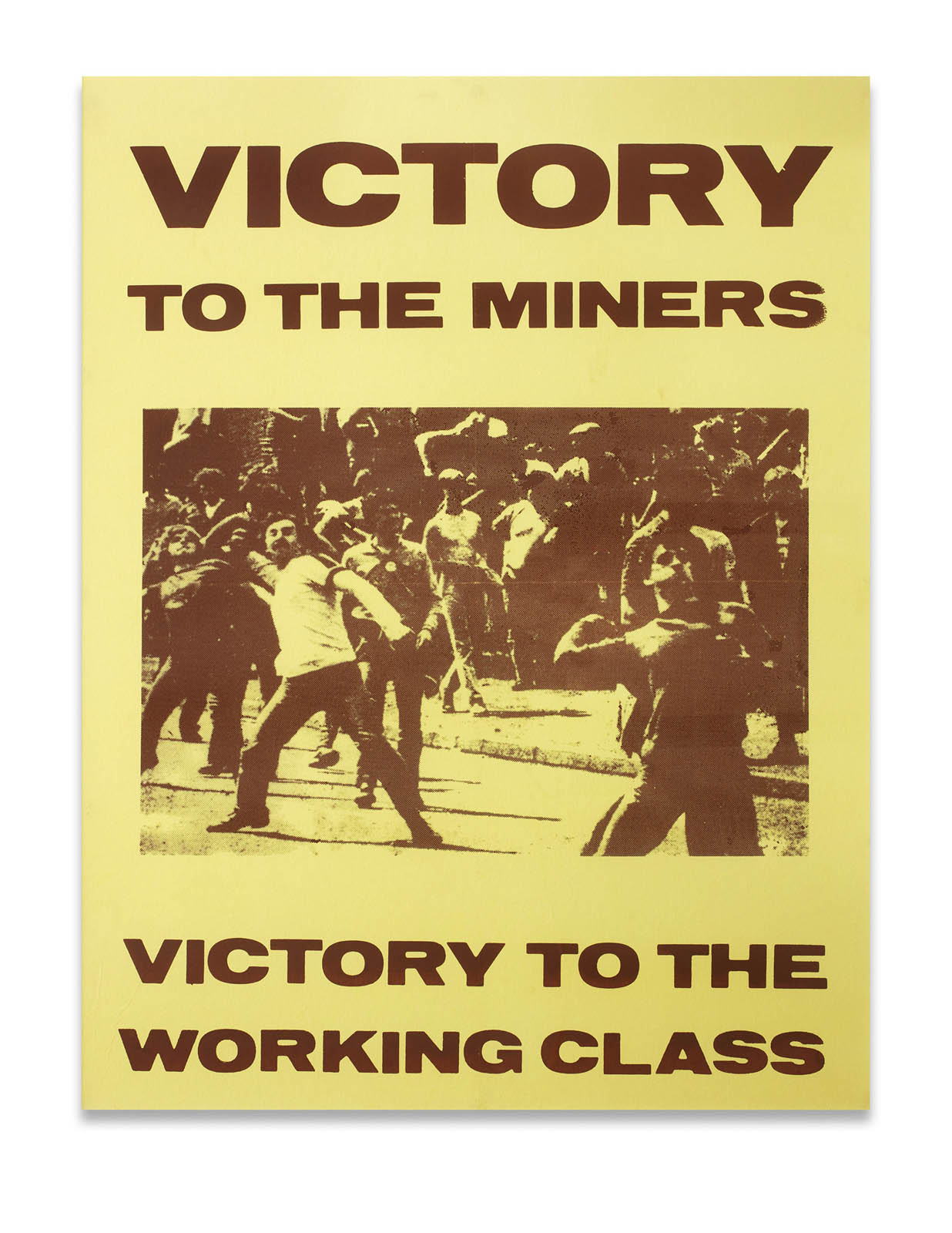
 

Unknown maker (British) 'VICTORY TO THE MINERS, VICTORY TO THE WORKING CLASS' Nd


Unknown maker (British)
VICTORY TO THE MINERS, VICTORY TO THE WORKING CLASS
Nd
Poster
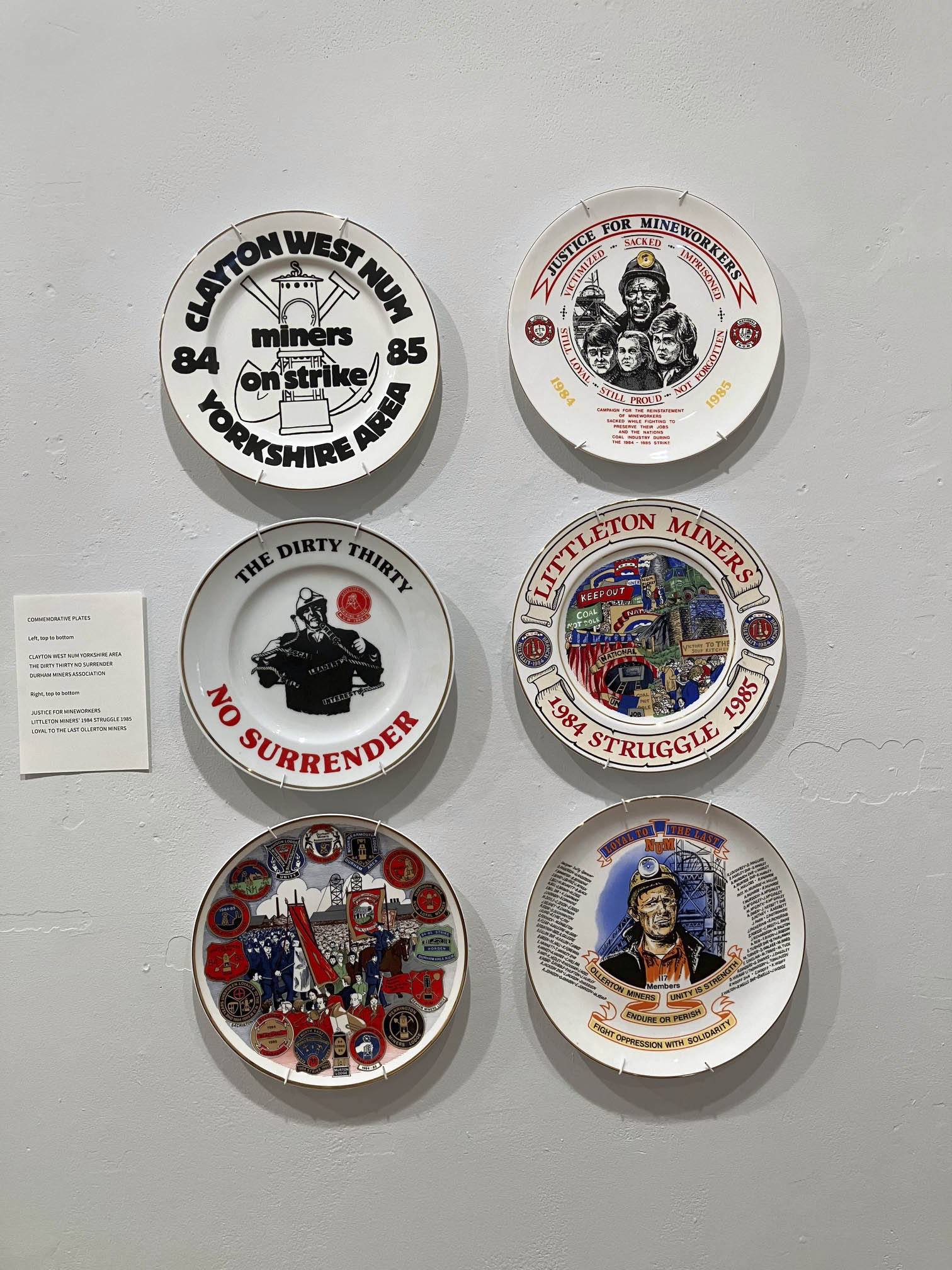
 

Installation view of the exhibition ONE YEAR! Photographs from the Miners' Strike 1984-85 at Four Corners, London showing closed colliery commemorative plates


Installation view of the exhibition ONE YEAR! Photographs from the Miners’ Strike 1984-85 at Four Corners, London showing closed colliery commemorative plates:

Commemorative Plates

Left, top to bottom

Clayton West NUM Yorkshire Area
The Dirty Thirty No Surrender
Durham Miners Association

Right, top to bottom

Justice for Mineworkers
Littleton Miners’ 1984 Struggle 1985
Loyal to the Last Ollerton Miners
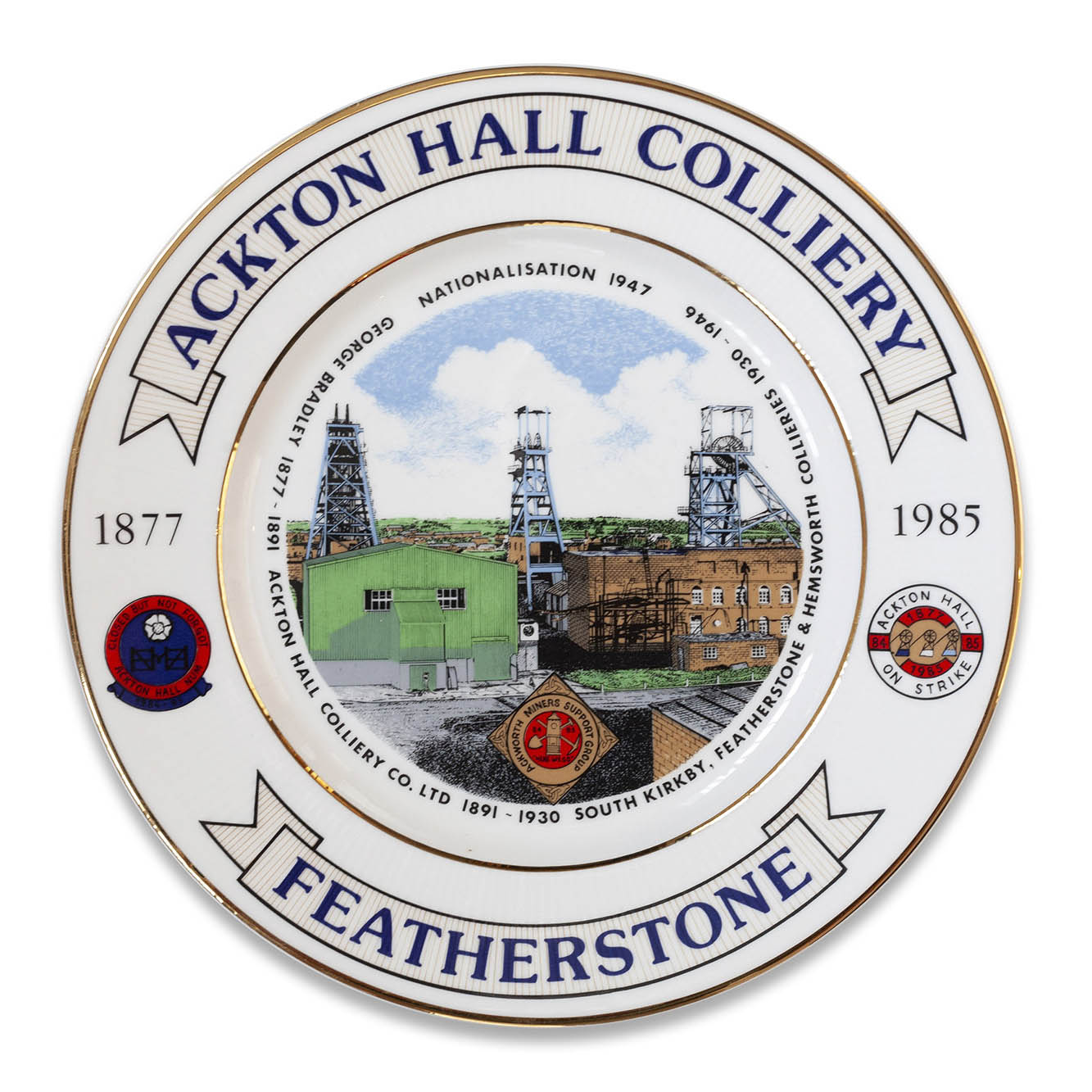
 

Unknown maker (British) 'ACKTON HALL COLLIERY commemorative plate' 1985


Unknown maker (British)
ACKTON HALL COLLIERY commemorative plate
1985


A series of commemorative plates was made for closed collieries. As shaft sinking began in 1873 the year 1877 may indicate when coal production began.
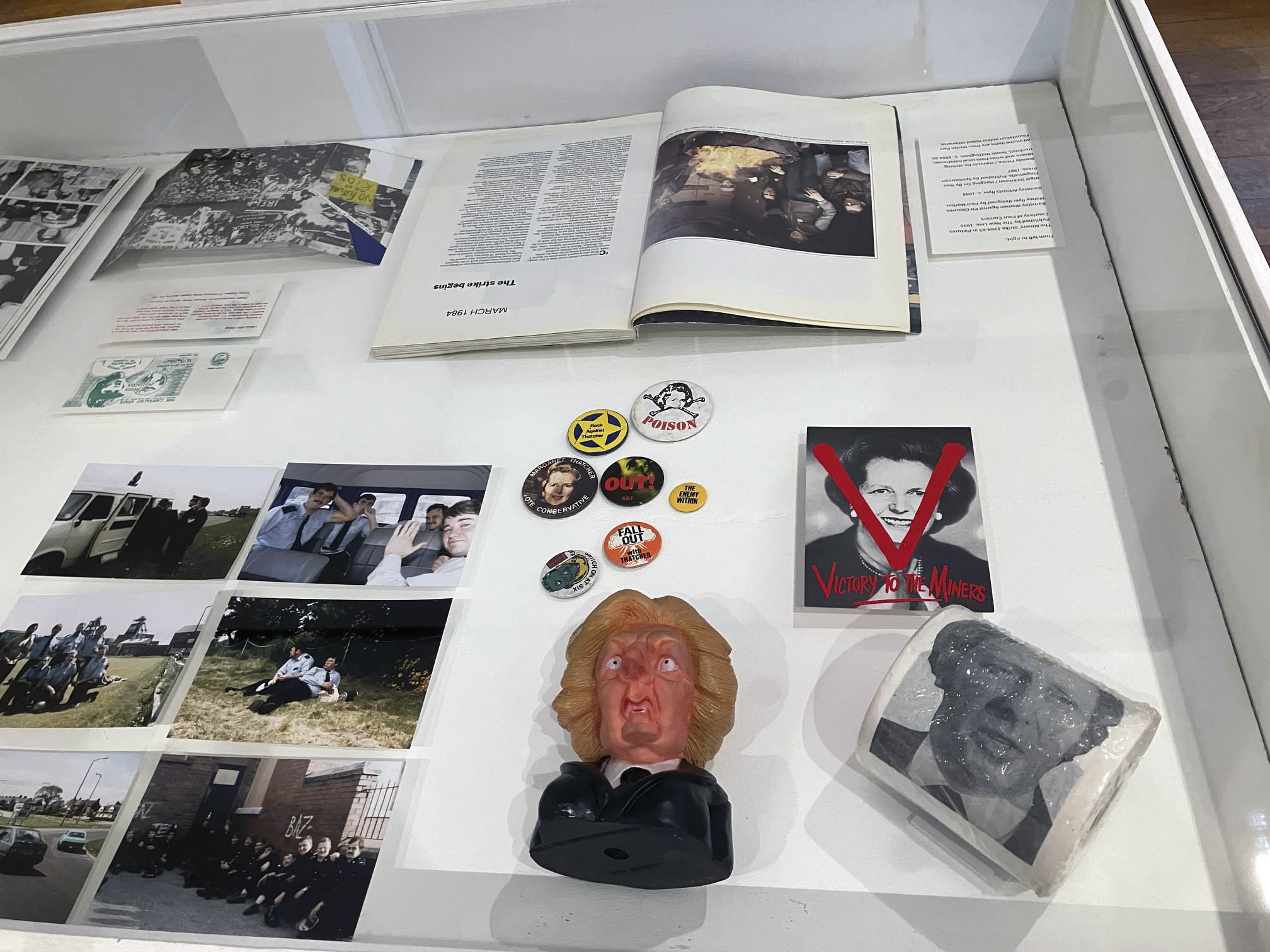
 

Installation view of the exhibition 'ONE YEAR! Photographs from the Miners' Strike 1984-85' at Four Corners, London

Installation view of the exhibition ONE YEAR! Photographs from the Miners' Strike 1984-85 at Four Corners, London

Installation view of the exhibition ONE YEAR! Photographs from the Miners' Strike 1984-85 at Four Corners, London


Installation view of the exhibition ONE YEAR! Photographs from the Miners’ Strike 1984-85 at Four Corners, London showing at second left in the bottom image, Brenda Prince’s photograph Women’s’ picket at Bevercotes Colliery, night shift, 11pm. Nottingham, February 1985 (below); and at third right top, Roger Tiley’s photograph NUM union officials, Maerdy Miners’ Hall, Rhondda Fach, South Wales, 1984-1985
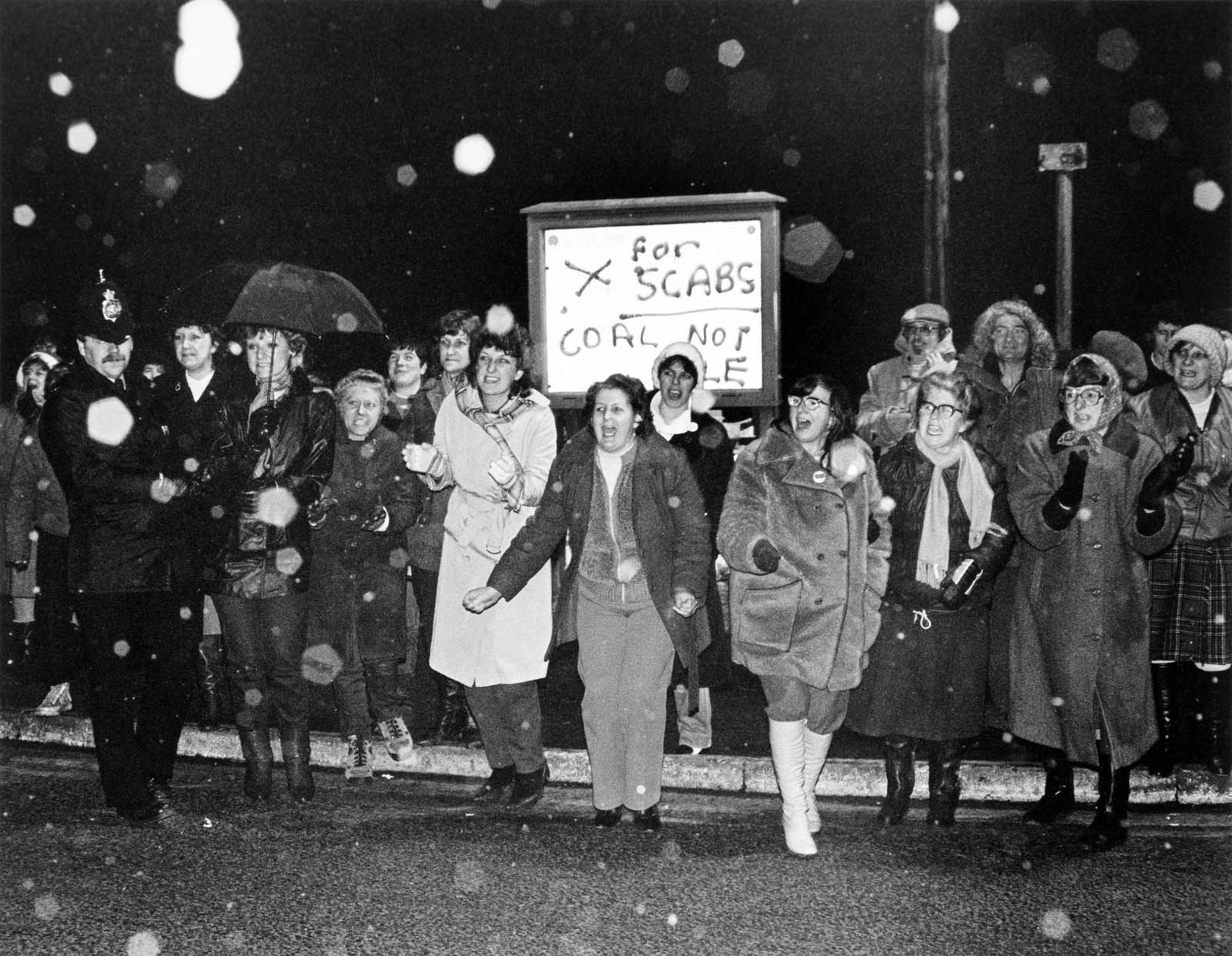
 

Brenda Prince (British, b. 1950) 'Women's' picket at Bevercotes Colliery, night shift, 11pm. Nottingham' February 1985


Brenda Prince (British, b. 1950)
Women’s’ picket at Bevercotes Colliery, night shift, 11pm. Nottingham
February 1985
Gelatin silver print
© Brenda Prince


We were all documentary photographers who had our own
projects and interests. We would work on our own stories and
my miners’ strike images came out of that. As a working class
woman, I became aware of the inequalities in society; not just
between men and women but also relating to race, class,
people with disabilities and sexuality. The miners’ strike gave
me the opportunity to document working class people who were
really struggling to keep their jobs and keep their communities
alive.

…on starting to document the miners’ strike

My brother lived in Calverton, a small pit village so I was able to
stay with him. I got in touch with Women’s action groups in the
area (Hucknall & Linby, Ollerton) and they put me in touch with
others (Clipstone, Blidworth). I began by photographing the
striking miners’ communal kitchens or soup kitchens and they
gradually got to know me. I was accepted by the men because
they knew I was on their side and perhaps because I was a
woman, they didn’t take me seriously as a ‘Press’
photographer. The more I went up there the more I got to know
people. They’d say, ‘oh you should come with us to so and so’.
I think that’s how I heard about the night pickets at Blidworth.

…on covering the role played by women in the miners’
strike:

There was so much the women were doing. What I found
important about the miners’ strike and women getting involved,
is that up till then many hadn’t taken so much interest in what
was happening in this country politically, but the strike
politicised them – they began to take note and watch the news
and realise that a lot of politicians are hypocrites, and you can’t
trust them and you still can’t.

Women became more confident as a result of the strike, which I
thought was great. It was good for other women and young girls
to see their Mums and daughters speaking out at the meetings,
doing things they wouldn’t have done before, eg. picketing.
Most of them would have been typical mothers and wives,
cleaning, cooking, shopping, looking after their children instead
of going on the picket line, visiting and supporting other
collieries, getting together with other women and planning days
of action, e.g., Women Against Pit Closures.

After the strike, as told to me and recorded in interviews about
the strike, they saw things differently, so it was a positive
experience for some women despite the hardship but hard for
the men who lost their jobs.

Extract from ONE YEAR interview with Brenda Prince on the Martin Parr Foundation website [Online] Cited 24/09/2024
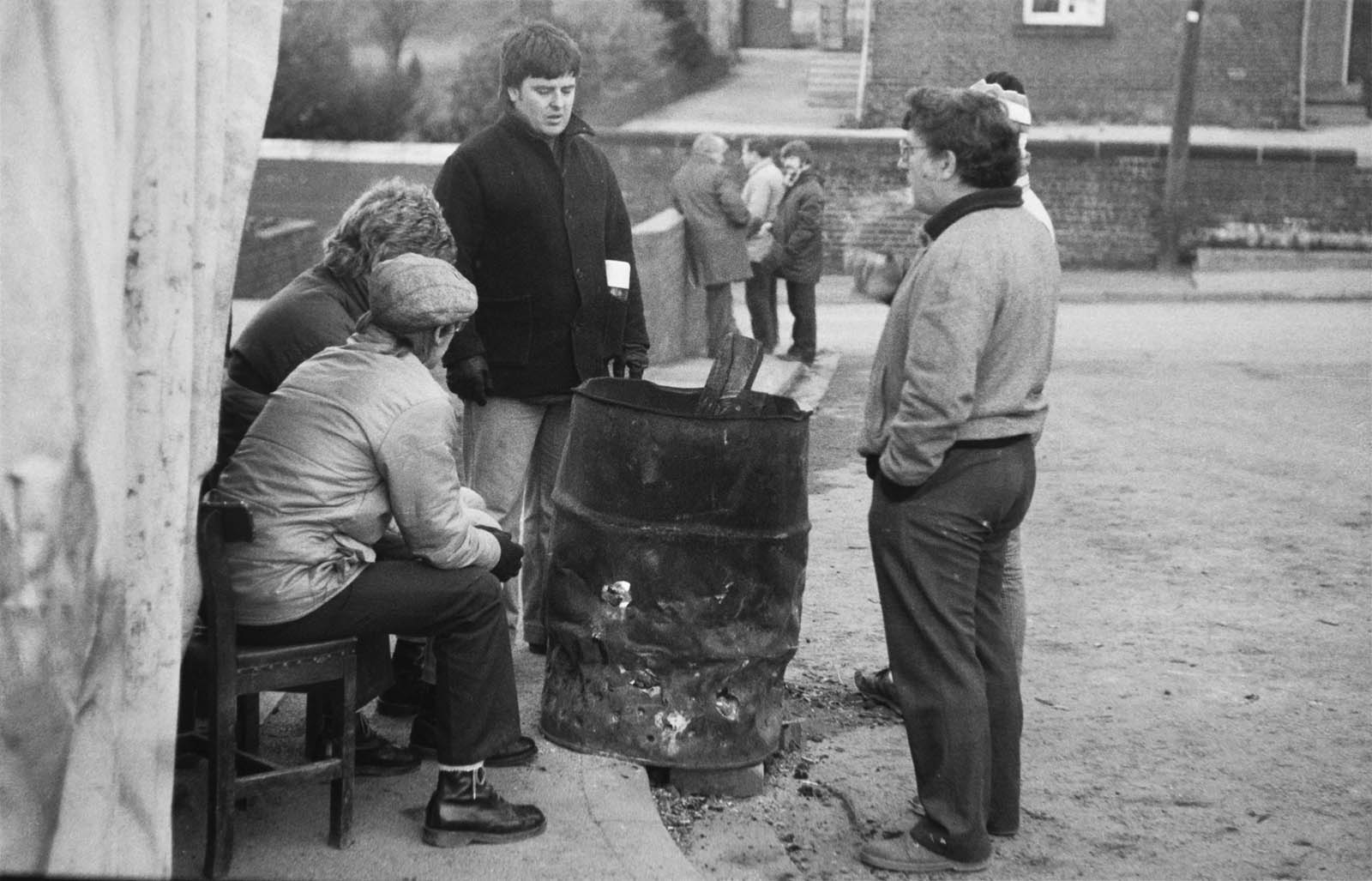
 

Philip Winnard (British) 'Houghton Main' 1984


Philip Winnard (British)
Houghton Main
1984
© Philip Winnard
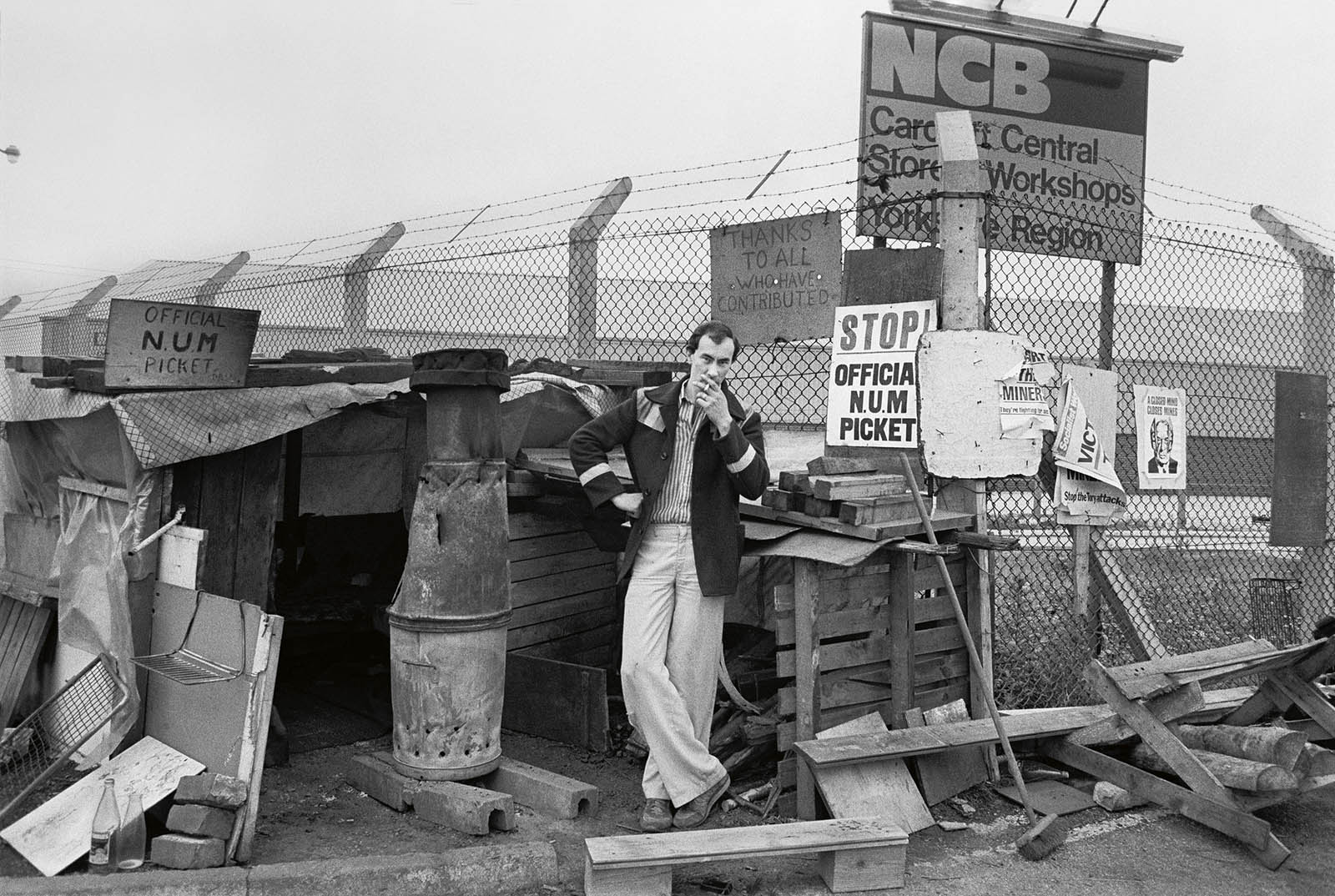
 

Howard Sooley (British) 'Carcroft NCB Central Store' 1984


Howard Sooley (British)
Carcroft NCB Central Store
1984
© Howard Sooley
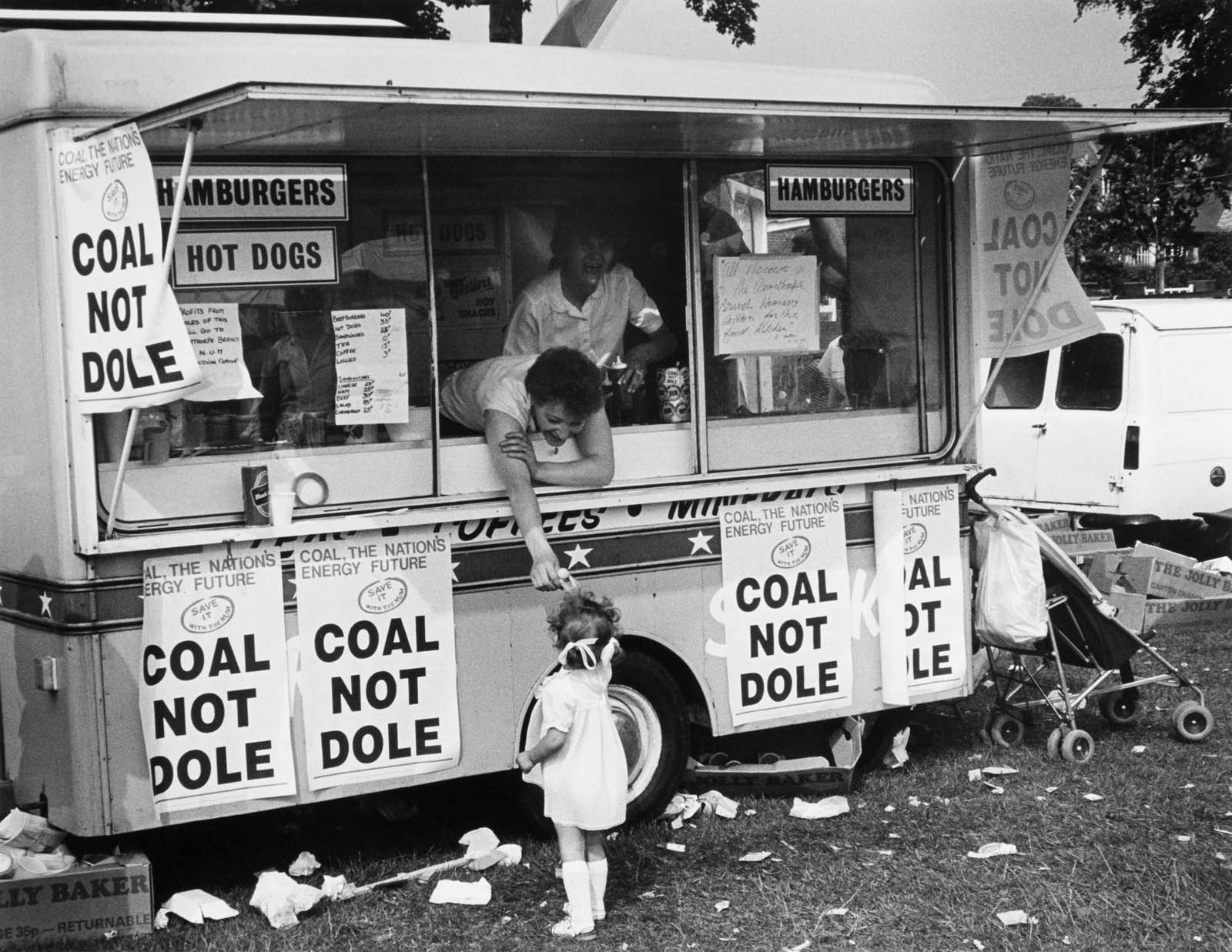
 

Brenda Prince (British, b. 1950) 'Buying an ice cream at Yorkshire Miners' Gala. June' 1984


Brenda Prince (British, b. 1950)
Buying an ice cream at Yorkshire Miners’ Gala. June
1984
© Brenda Prince


Photographer uncredited. 'Three coaches used to take miners to Hem Heath Colliery, burning fiercely at a depot at Trentham near Stoke-on-Trent' 1984


Photographer uncredited
Three coaches used to take miners to Hem Heath Colliery, burning fiercely at a depot at Trentham near Stoke-on-Trent
1984
Press print
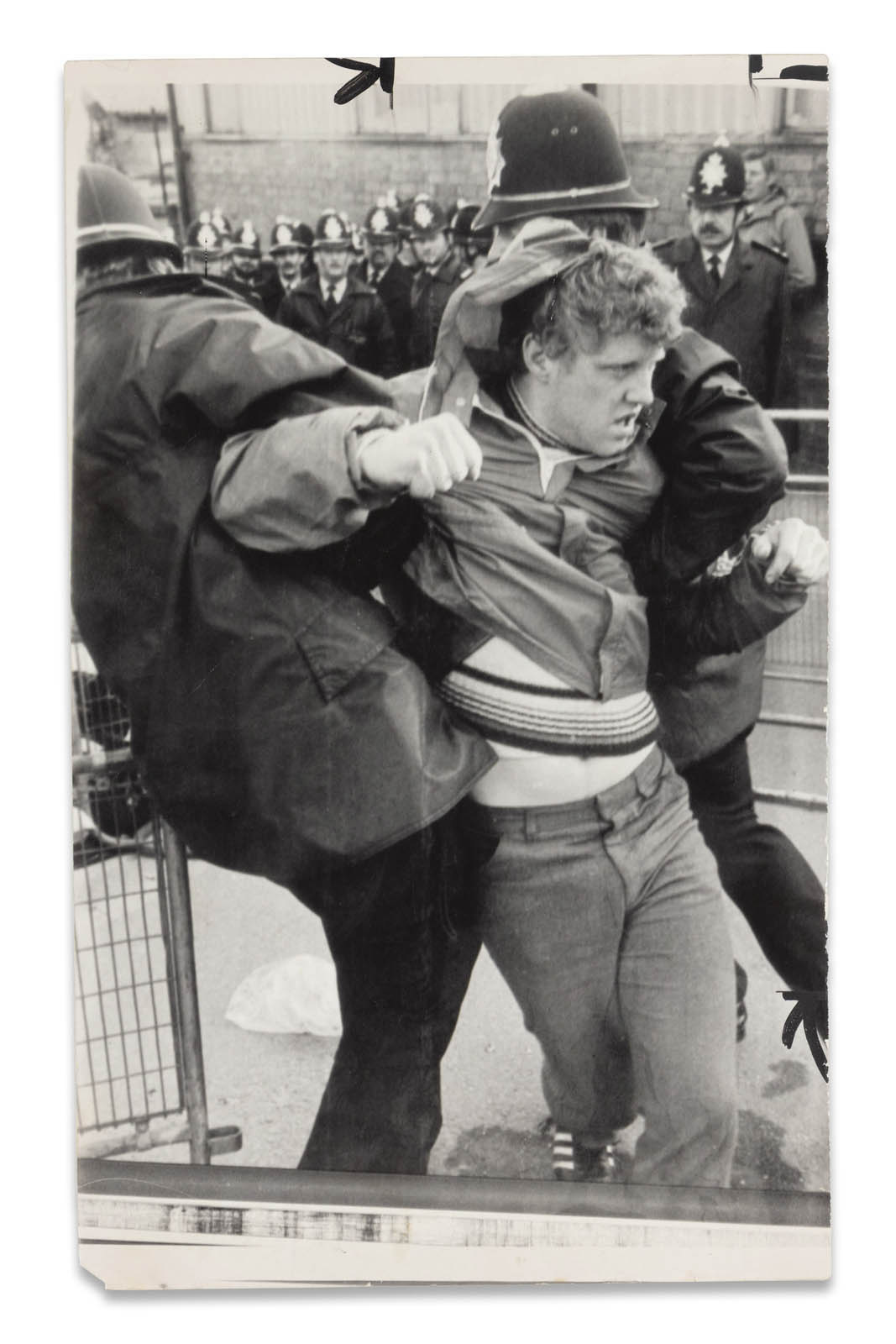
 

Neville Pyne (British) 'A policeman getting to grips with a picket' 1984


Neville Pyne (British)
A policeman getting to grips with a picket
1984
Press print
© Neville Pyne
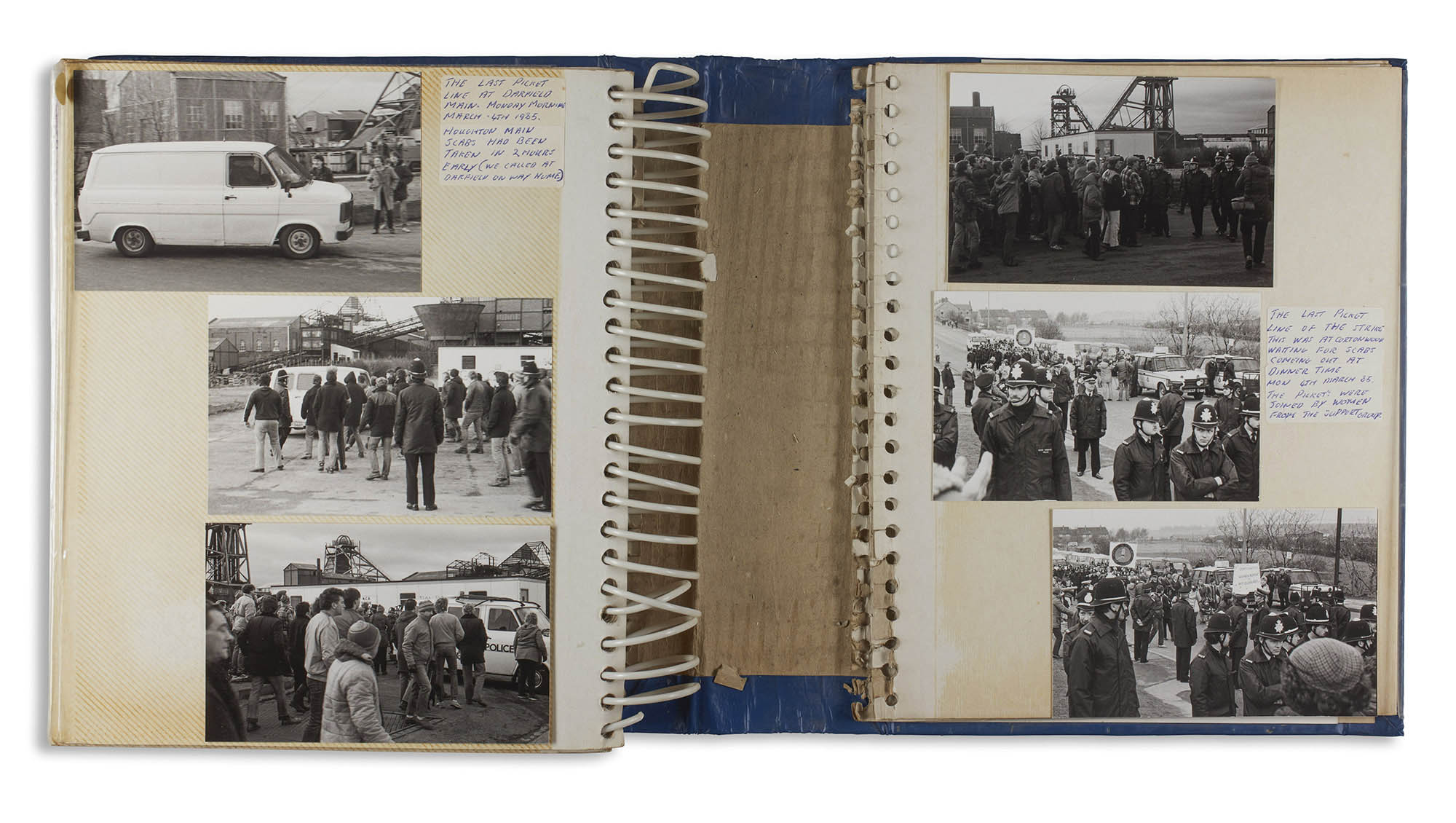
 

Philip Winnard (British) 'Spread from photo album NUM Strike, 12th March 1984, TILL WE WIN' 1984


Philip Winnard (British)
Spread from photo album NUM Strike, 12th March 1984, TILL WE WIN
1984
Photo album
© Philip Winnard


The last picket line at Darfield Main. Monday morning March 4th 1985.
Houghton Main scabs had been taken in 2 hours early (we called at Darfield on way home)

The last picket line of the strike. This was at Corton Wood waiting for scabs comeing out at dinner time. Mont 4th March 85. The Picket’s were joined by Women from the Support Group.

Text from the photo album pages above


“The media was a very important aspect of the miners’ strike – the photographs were used against the miners in terms of demonising them,” Blease explains. “Images were used to illustrate violence and chaos in quite demonising and weaponised ways, but then on the other hand photographs were used to debase that media bias – through posters, photojournalists working for left-wing and union press, and people like Sturrock, John Harris, Prince and Imogen Young who were photographing the strike in a more holistic way.” …

Many of the photographers featured were part of the communities that they were documenting. Philip Winnard was one such example, as he was on strike himself from the Barnsley Main Colliery. “When he went on strike, he took his camera along and started recording his experiences when he was picketing,” Blease says. “We wanted to focus on how photographs were used in different ways and shared with friends and colleagues. He compiled these really amazing photo albums and they follow the strike chronologically, starting with the first picket lines and finishing with the return to work marches a year later.”

“They feel like family albums and spare no punches in how they record the strike,” he continues. “There’s violence, the intimidation of strike breakers, fundraising community activities, newslettering – there’s everything, and it gives an intimate familiarity with the event.”

Women also feature heavily throughout the exhibition, highlighting the oft-overlooked role they played in supporting – from those making food in the striking miners’ kitchens to all female picket lines at the collieries. Photographers such as Brenda Prince, who was a member of women’s only photography agency Format, documented this.

“Prince was focusing a lot on women’s roles in the strike,” Blease says. “So miners’ wives, community work, fundraising, picketing themselves, gathering food packages, and they played a very important role. These photographers were not just focusing on the sensational battle that was going on, they were showing how communities were coming together, but also how communities were being destroyed by the dispute, and photography was the medium that was catching this.”

Isaac Muk. “In Photos: The miners’ strike, 40 years on,” on the Huck website 6th March, 2024 [Online] Cited 24/09/2024
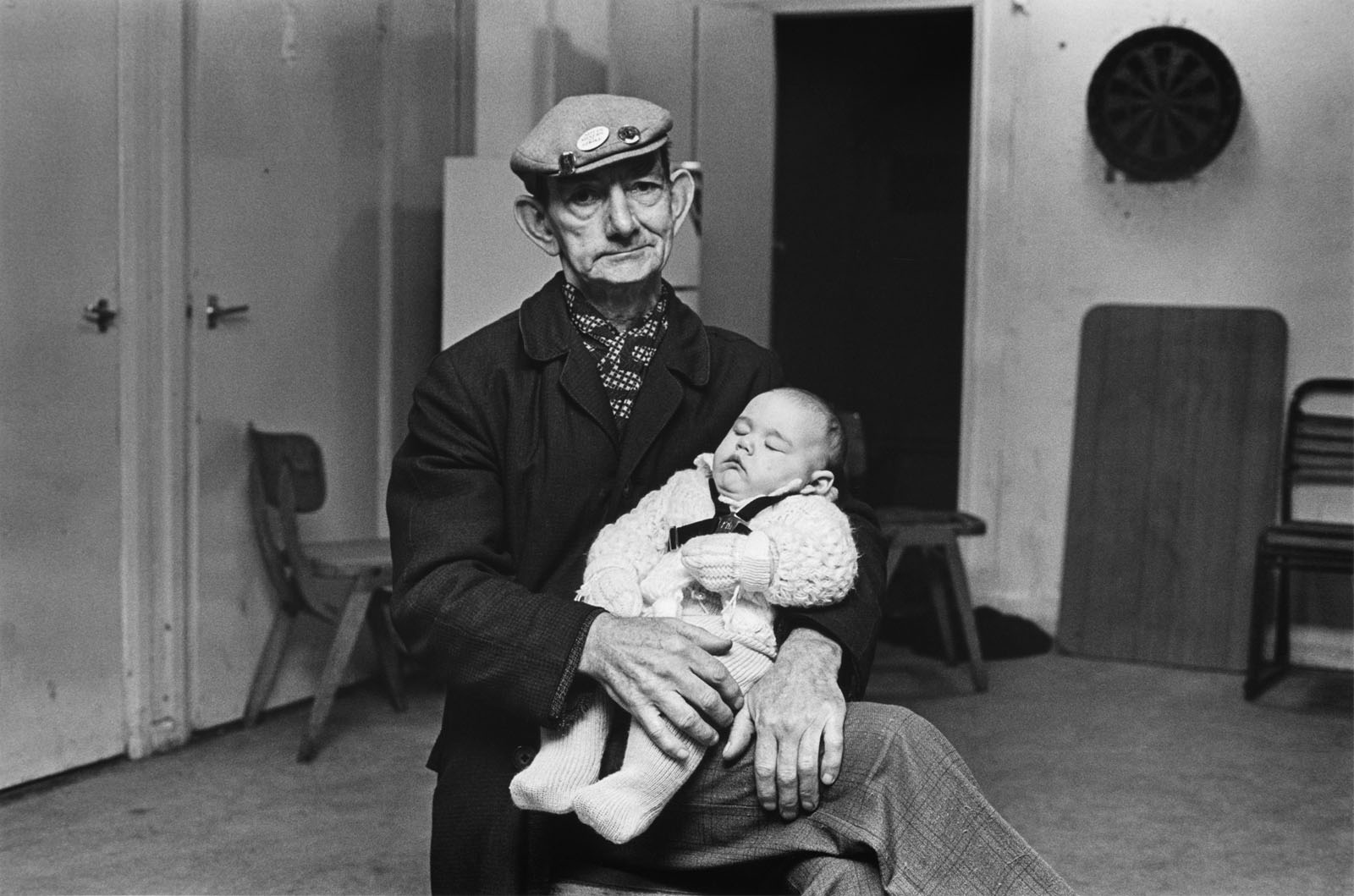
 

Brenda Prince (British, b. 1950) 'Sidney Richmond, retired Pit Deputy, babysitting Sean (3 months old) – first strike baby in the village. Clipstone Colliery, Nottingham' 1984-1985


Brenda Prince (British, b. 1950)
Sidney Richmond, retired Pit Deputy, babysitting Sean (3 months old) – first strike baby in the village. Clipstone Colliery, Nottingham
1984-1985
© Brenda Prince
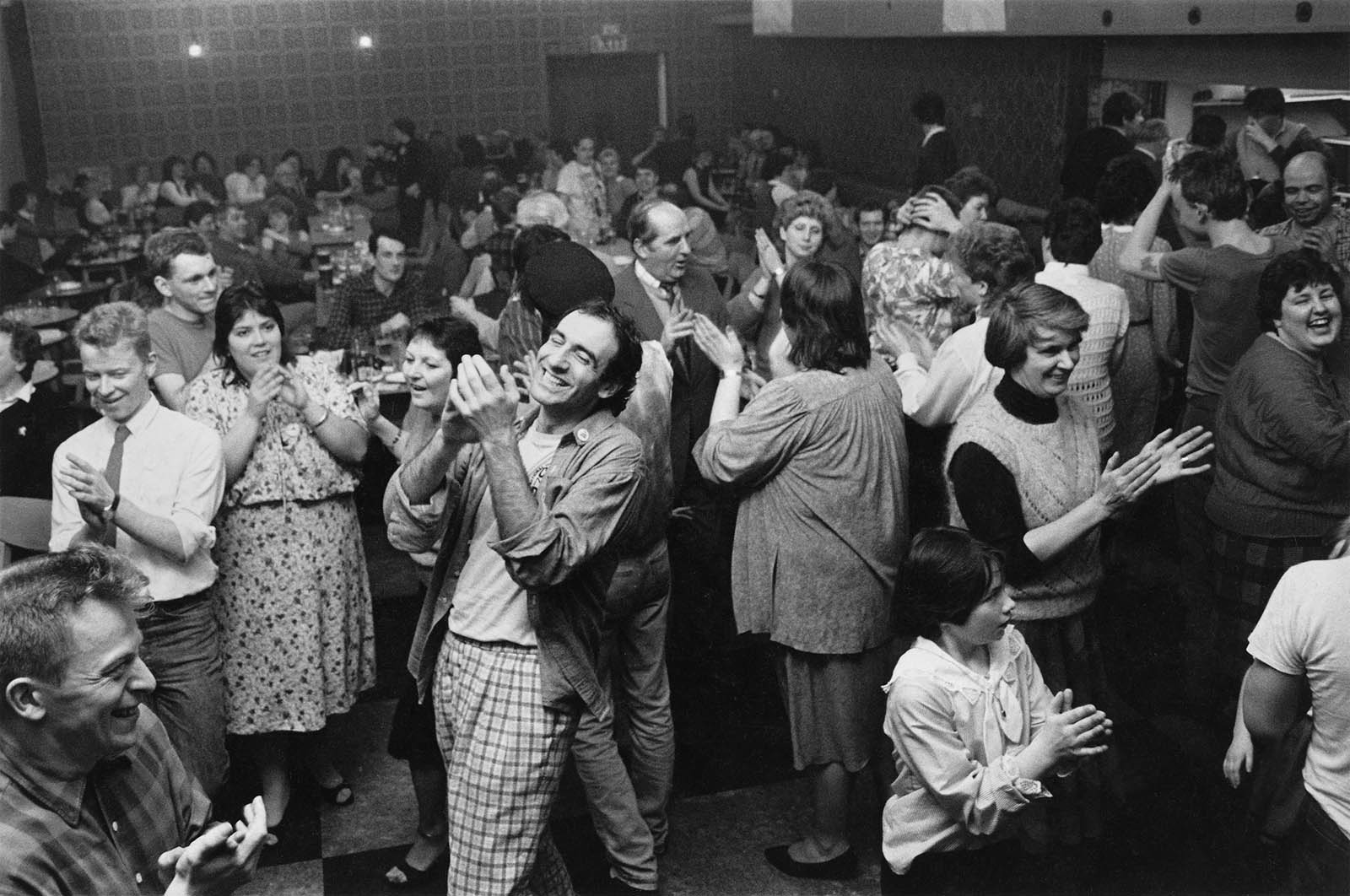
 

Imogen Young (British) 'London's Lesbian and Gay 'Support the Miners' Group take part in David's Day celebration in Neath Colbren Club' 2 March 1985


Imogen Young (British)
London’s Lesbian and Gay ‘Support the Miners’ Group take part in David’s Day celebration in Neath Colbren Club
2 March 1985
© Imogen Young


ONE YEAR! Photographs from the Miners’ Strike 1984-85 explores the vital role that photography played during this bitter industrial dispute.

To commemorate the 40th anniversary of the miners’ strike, Four Corners is delighted to tour this exhibition from the Martin Parr Foundation. One of Britain’s longest and most violent disputes, the repercussions of the miners’ strike continue to be felt today across the country.

The exhibition looks at the central role photographs played during the year-long struggle against pit closures, with many materials drawn from the Martin Parr Foundation collection. Posters, vinyl records, plates, badges and publications are placed in dialogue with images by photographers, investigating the power and the contradictions inherent in using photography as a tool of resistance. They include photographs by Brenda Prince, John Sturrock, John Harris, Jenny Matthews, Roger Tiley, Imogen Young and Chris Killip, as well as Philip Winnard who was himself a striking miner.

The photographs show some familiar imagery – the lines of police and the violence – but also depict the remarkable community support from groups such as Women Against Pit Closures and the Lesbians and Gays Support the Miners. Photography was used both to sway public opinion and to document this transformative period in British history.

The catalyst for the miners’ strike was an attempt to prevent colliery closures through industrial action in 1984-85. The industrial action, which began in Yorkshire, was led by the National Union of Mineworkers (NUM) and its President, Arthur Scargill, against the National Coal Board (NCB). The Conservative government under Margaret Thatcher opposed the strikes and aimed to reduce the power of the trade unions. The dispute was characterised by violence between the flying pickets and the police, most notably at the Battle of Orgreave. The miners’ strike was the largest since the General Strike of 1926 and ended in victory for the government with the closure of a majority of the UK’s collieries.

Press release from Four Corners


John Harris (British) 'Lesley Boulton at the Battle of Orgreave' 1984


John Harris (British)
Lesley Boulton at the Battle of Orgreave
1984
Gelatin silver print
© John Harris/reportdigital.co.uk

Used under fair use conditions for the purposes of education and research

Photographer Lesley Boulton is attacked by a truncheon-wielding policeman at Orgreave. The picture was published by only one of 17 national newspapers in Britain.


On 18 June, miners came from all over the country to picket the coking plant outside Orgreave village, near Rotherham. I arrived at about 9.15am, with my camera – I was documenting life on the picket line. It was a glorious day: miners were sitting in the sun, or playing football, when suddenly police horses charged out in small groups. They did this twice, then there was a massive charge and they started attacking people. I didn’t see any trigger for this.

People tried to escape across the railway line, which led to a lot of injuries. And there were policemen on foot with short shields, laying about people with truncheons. I was numb with shock. This was violence far in excess of anything I’d ever witnessed: they were whacking people about the head and body with impunity. Some men tried to defend themselves. We couldn’t believe it when the BBC reversed footage on the Six O’Clock News to suggest the miners had attacked the police, and that the police had simply retaliated. [Despite an Independent Police Complaints Commission report in 2015 confirming the reversal, the BBC has never officially accepted this.]

It was chaos. I ran back to the village and hid in a car repair yard. After a few minutes, I came out and photographed one man pinned to a car bonnet, being beaten terribly. At the bus stop, a man was lying on the ground with a chest injury. I was calling to a policeman standing in the road, asking him to get an ambulance, when these two mounted police bore down on me. A man pulled me out of the way just as one of them took a full swipe at my head with his truncheon, and missed.

When I look at this photograph, I wonder what was going through his mind. The police claimed the image was doctored; when I tried to press charges for assault, the director of public prosecutions’ office told me there wasn’t enough evidence. How much did they need?

I don’t take this image personally, because it’s not about me; it’s about something much bigger: an expression of arbitrary power, and what can happen when our masters decide to put us in our place. Besides, I didn’t suffer the way the miners and their families did.

Lesley Boulton quoted in Adrian Tempany. “‘A policeman took a full swipe at my head’: Lesley Boulton at the Battle of Orgreave, 1984,” on The Guardian website 17 December 2016 [Online] Cited 23/09/2024


Philip Winnard (British) 'Spread from photo album NUM Strike, 12th March 1984, TILL WE WIN' 1984


Philip Winnard (British)
Spread from photo album NUM Strike, 12th March 1984, TILL WE WIN
1984
Photo album
© Philip Winnard


Showing photographs from the Battle of Orgreave


Battle of Orgreave

The Battle of Orgreave was a violent confrontation on 18 June 1984 between pickets and officers of the South Yorkshire Police (SYP) and other police forces, including the Metropolitan Police, at a British Steel Corporation (BSC) coking plant at Orgreave, in Rotherham, South Yorkshire, England. It was a pivotal event in the 1984–1985 UK miners’ strike, and one of the most violent clashes in British industrial history.

Journalist Alastair Stewart has characterised it as “a defining and ghastly moment” that “changed, forever, the conduct of industrial relations and how this country functions as an economy and as a democracy”. Most media reports at the time depicted it as “an act of self-defence by police who had come under attack”. In 2015, the Independent Police Complaints Commission (IPCC) reported that there was “evidence of excessive violence by police officers, a false narrative from police exaggerating violence by miners, perjury by officers giving evidence to prosecute the arrested men, and an apparent cover-up of that perjury by senior officers”.

Historian Tristram Hunt has described the confrontation as “almost medieval in its choreography … at various stages a siege, a battle, a chase, a rout and, finally, a brutal example of legalised state violence”.

71 picketers were charged with riot and 24 with violent disorder. At the time, riot was punishable by life imprisonment. The trials collapsed when the evidence given by the police was deemed “unreliable”. Gareth Peirce, who acted as solicitor for some of the pickets, said that the charge of riot had been used “to make a public example of people, as a device to assist in breaking the strike”, while Michael Mansfield called it “the worst example of a mass frame-up in this country this century”.

In June 1991, the SYP paid £425,000 in compensation to 39 miners for assault, wrongful arrest, unlawful detention and malicious prosecution.

Text from the Wikipedia website


Poster for the exhibition 'ONE YEAR! Photographs from the Miners' Strike 1984-85' at Four Corners, London showing in the background, Brenda Prince's photograph 'Riot police await orders in fields surrounding Orgreave coke works, S. Yorkshire, Miners' dispute, 1984


Poster for the exhibition ONE YEAR! Photographs from the Miners’ Strike 1984-85 at Four Corners, London showing in the background, Brenda Prince’s photograph Riot police await orders in fields surrounding Orgreave coke works, S. Yorkshire, Miners’ dispute, 1984
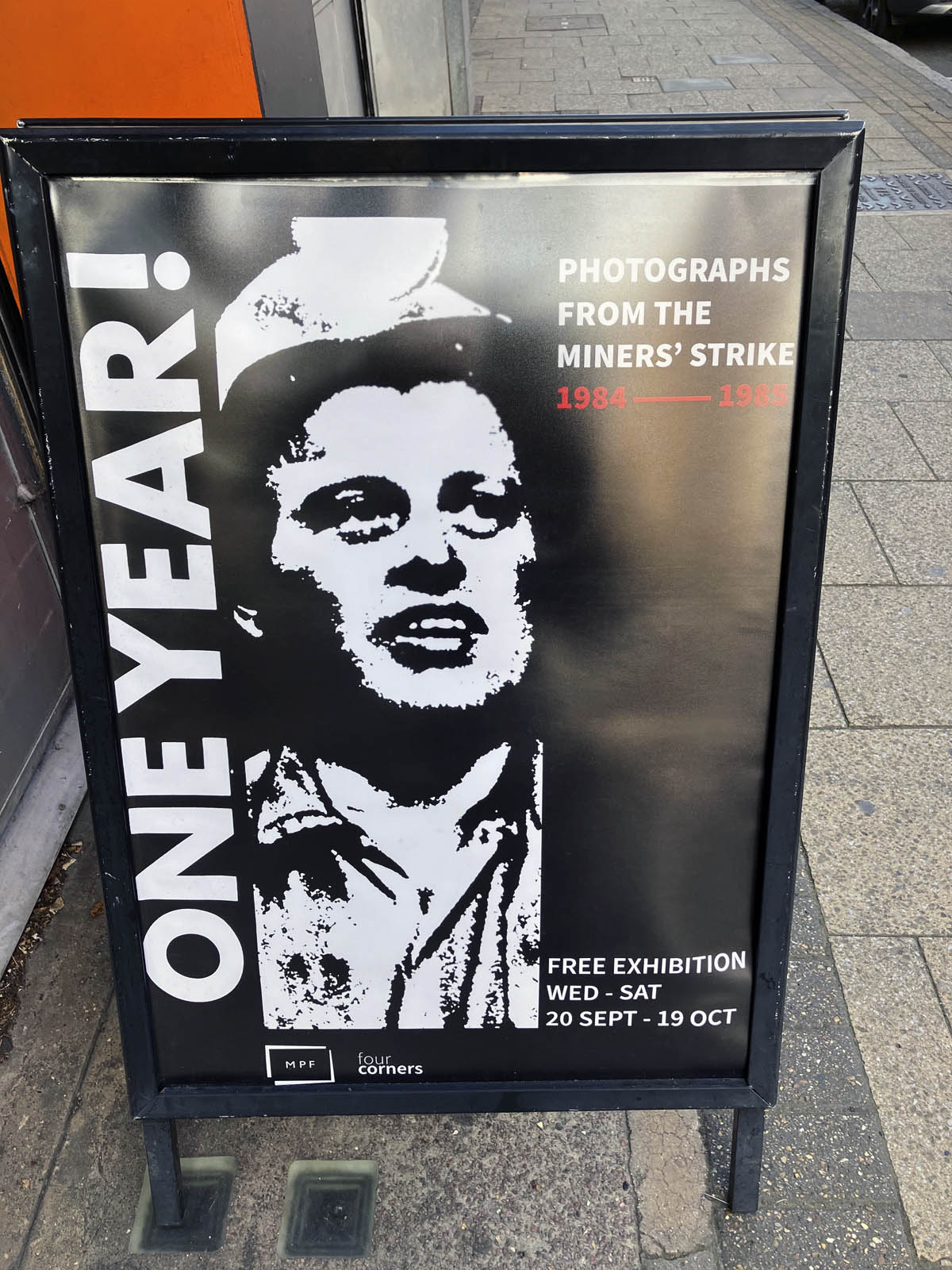
 

Poster for the exhibition 'ONE YEAR! Photographs from the Miners' Strike 1984-85' outside of Four Corners, London


Poster for the exhibition ONE YEAR! Photographs from the Miners’ Strike 1984-85 outside of Four Corners, London


BUY THE BOOK FROM BLUECOAT PRESS

Martin Parr Foundation

Martin Parr Foundation supports emerging, established and overlooked photographers who have made and continue to make work focused on Britain and Ireland. We preserve a growing collection of significant photographic works and strive to make photography engaging and accessible for all. We are committed to making the Martin Parr Foundation a place for everyone and to reflect the diversity of British and Irish culture.

Four Corners

Four Corners centre for film and photography has been based in East London for 50 years. We champion creative expression for social change, connecting communities and image-makers to learn skills and create new work. Drawing on our radical history, our exhibitions explore how photography and film can tell stories from the margins, looking to the past to inspire the future.

Four Corners
121 Roman Road, Bethnal Green,
London E2 0QN
Nearest tube: Bethnal Green, Central Line

Opening hours:
Tuesday to Saturday 11am – 6pm
Thursday 11am – 8pm (July and on 31 Aug)
Four Corners website

Martin Parr Foundation website

LIKE ART BLART ON FACEBOOK

Back to top

Exhibition: ‘Photography: Real & Imagined’ at The Ian Potter Centre: NGV Australia, Melbourne Part 1

Exhibition dates: 13th October 2023 – 4th February 2024

Warning: Aboriginal and Torres Strait Islander readers should be aware that this posting contains images and names of people who may have since passed away.


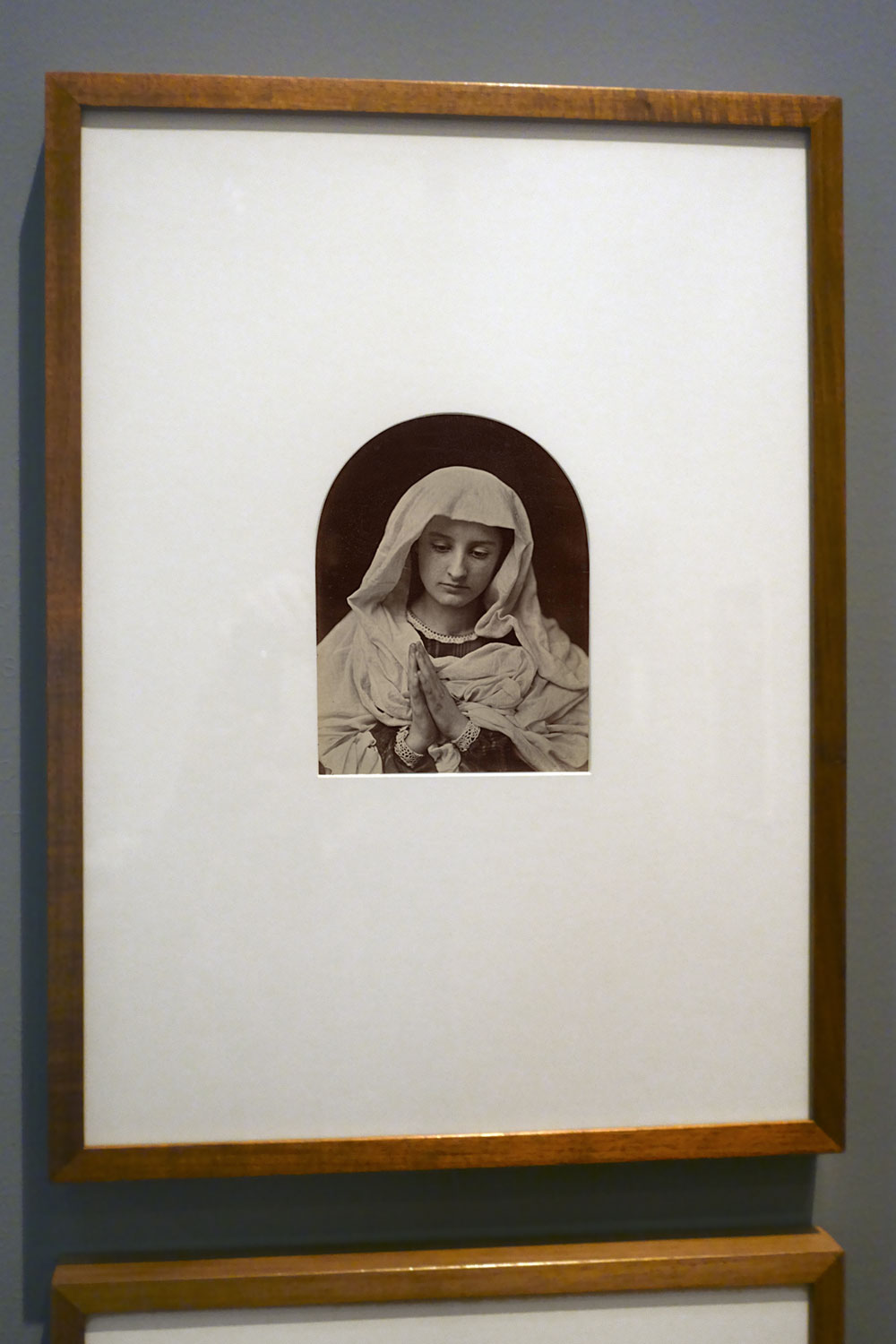
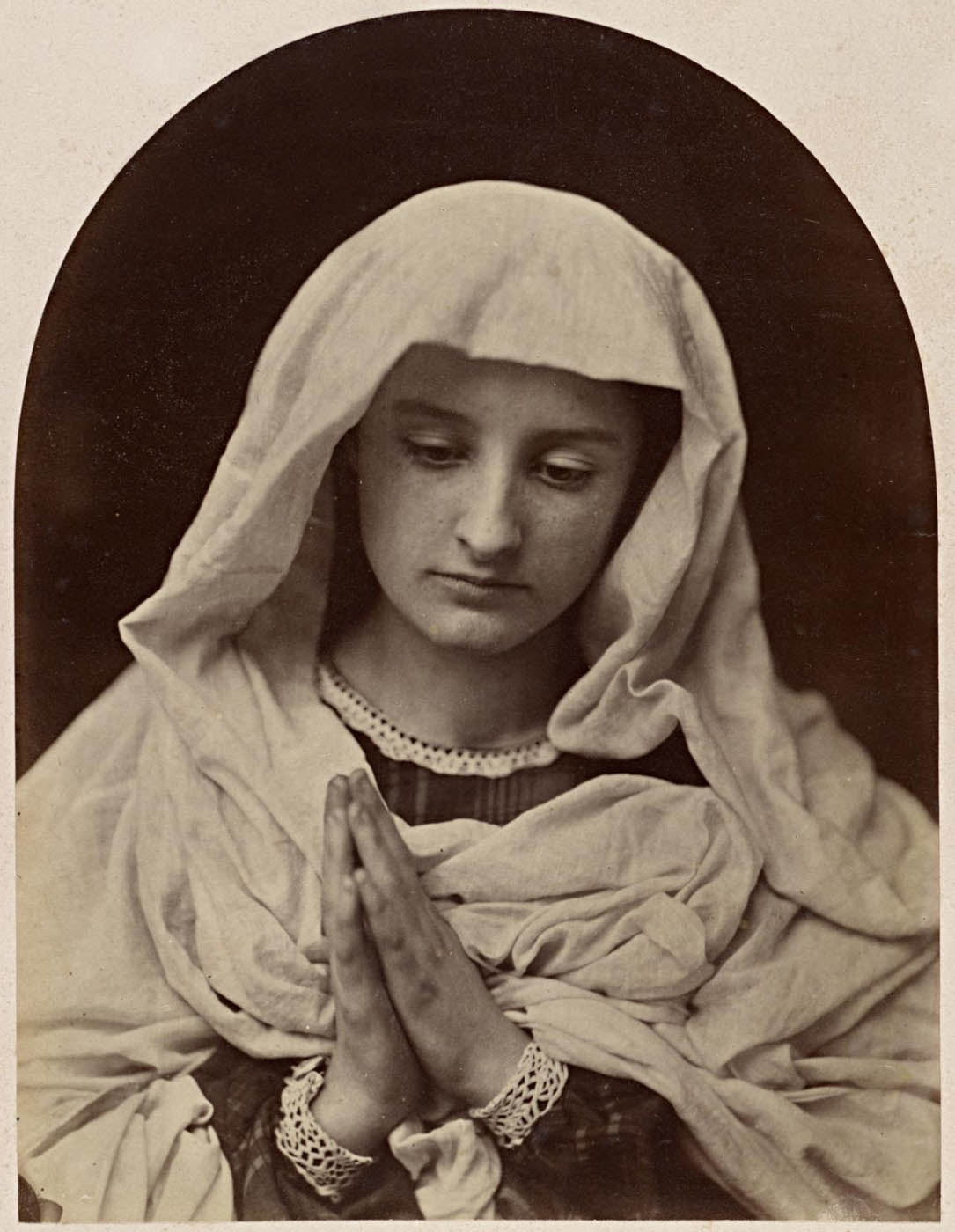
O. G. Rejlander (British born Sweden, 1813-1875) No title (The Virgin in prayer) c. 1858-1860


O. G. Rejlander (British born Sweden, 1813-1875)
No title (The Virgin in prayer)
c. 1858-1860
Albumen silver photograph
20.2 × 15.4cm irreg. (image and sheet)
National Gallery of Victoria, Melbourne
Purchased, 2002
Public domain


This is an ambitious, complex but flawed exhibition of photographic works from the NGV Collection. Further comment in Part 2 of the posting…

Dr Marcus Bunyan


Many thankx to the NGV for allowing me to publish the media images in the posting. Other photographs in the posting are public domain. All installation images are by Marcus Bunyan.


Photography: Real and Imagined examines two perspectives on photography; photography grounded in the real world, as a record, a document, a reflection of the world around us; and photography as the product of imagination, storytelling and illusion. On occasion, photography operates in both realms of the real and the imagined.

Highlighting major photographic works from the NGV Collection, including recent acquisitions on display for the very first time, Photography: Real and Imagined examines the complex, engaging and sometimes contradictory nature, of all things photographic. The NGV’s largest survey of the photography collection, the exhibition includes more than 300 works by Australian and international photographers and artists working with photo-media from the nineteenth, twentieth and twenty-first centuries.

Text from the NGV website


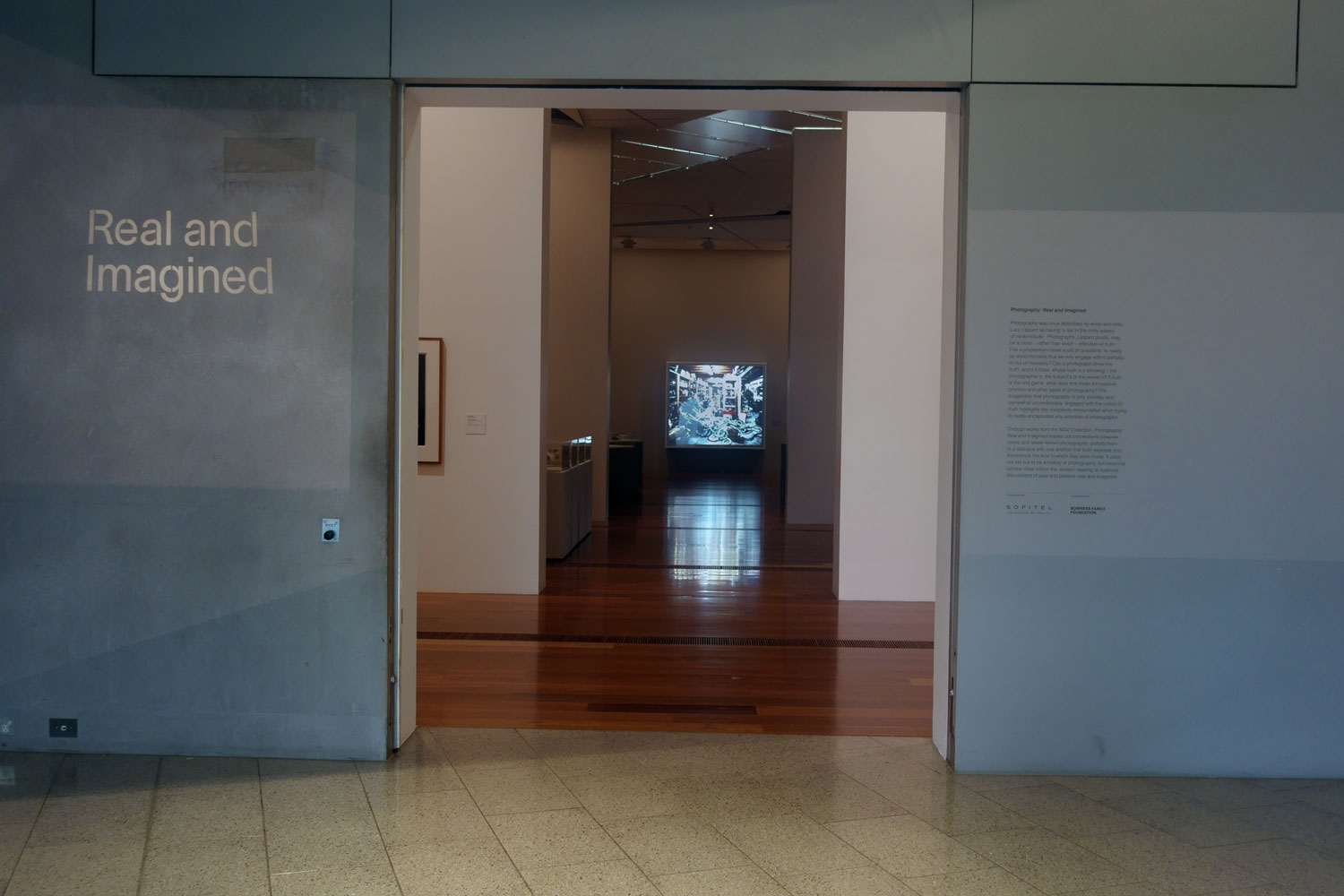
Installation view of the entrance to the exhibition 'Photography: Real & Imagined' at The Ian Potter Centre: NGV Australia, Melbourne


Installation view of the entrance to the exhibition Photography: Real & Imagined at The Ian Potter Centre: NGV Australia, Melbourne with introduction wall text to the right
Photo: Marcus Bunyan


Introduction

Photography was once described by writer and critic Lucy Lippard as having ‘a toe in the chilly waters of verisimilitude’. Photographs, Lippard posits, may be a close – rather than exact – reflection of truth. This proposition raises a raft of questions. Is reality so uncomfortable that we only engage with it partially, or out of necessity? Can a photograph show the truth, and if it does, whose truth is it showing – the photographer’s, the subject’s or the viewer’s? If truth is the end game, what does this mean for creative practice and other types of photography? The suggestion that photography is only partially, and somewhat uncomfortably, engaged with the notion of truth highlights the complexity encountered when trying to nearly encapsulate any selection of photographs.

Through works from the NGV Collection, Photography: Real and Imagined teases out connections between iconic and lesser known photographs, putting them in a dialogue with one another that both explores and transcends the time in which they were made. It dos not set out to be a history of photography, but historical context does inform the content, leading to nuanced discussions of past and present, real and imagined.

Introductory wall text from the exhibition


Installation view of the exhibition 'Photography: Real & Imagined' at The Ian Potter Centre: NGV Australia, Melbourne showing at right, Mike and Doug Starn's 'Invictus' (1992)


Installation view of the exhibition Photography: Real & Imagined at The Ian Potter Centre: NGV Australia, Melbourne showing at right, Mike and Doug Starn’s Invictus (1992); and at left works by John Kauffmann, Norman Deck and Edward Steichen (see below)
Photo: Marcus Bunyan


The sun was the light source that enabled the earliest photographs to be made in the 1830s. More than 150 years later the sun is the subject of this photographic sculpture by Mike and Doug Starn that embraces the possibilities of light and its potential effects on photography, in terms of both producing an image and as a force contributing to its irreparable damage. In the centre of their installation, the circular form of a sun seems to pulse and leach out of the layers of exposed orthographic film, which is stretched and layered across steel beams and held with pipe clamps and tape.

Wall text from the exhibition


Installation view of the exhibition 'Photography: Real & Imagined' at The Ian Potter Centre: NGV Australia, Melbourne


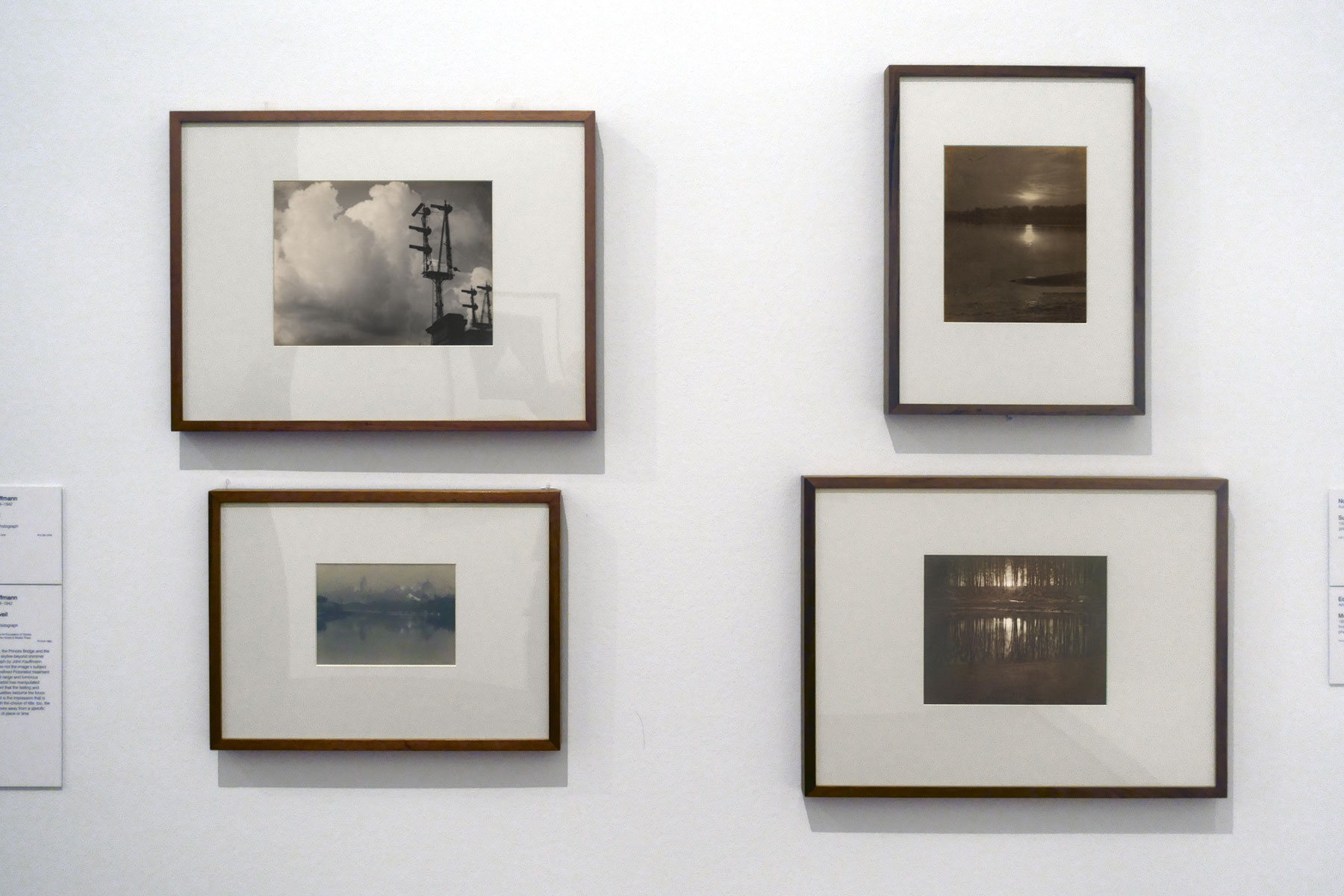
Installation view of the exhibition Photography: Real & Imagined at The Ian Potter Centre: NGV Australia, Melbourne showing at top left, John Kauffmann’s The Cloud (c. 1905, below); at bottom left, Kauffmann’s The grey veil c. 1919; at top right, Norman Deck’s Sunset, Parramatta River (1909); and a bottom right, Edward Steichen’s Moonrise (1904)
Photo: Marcus Bunyan


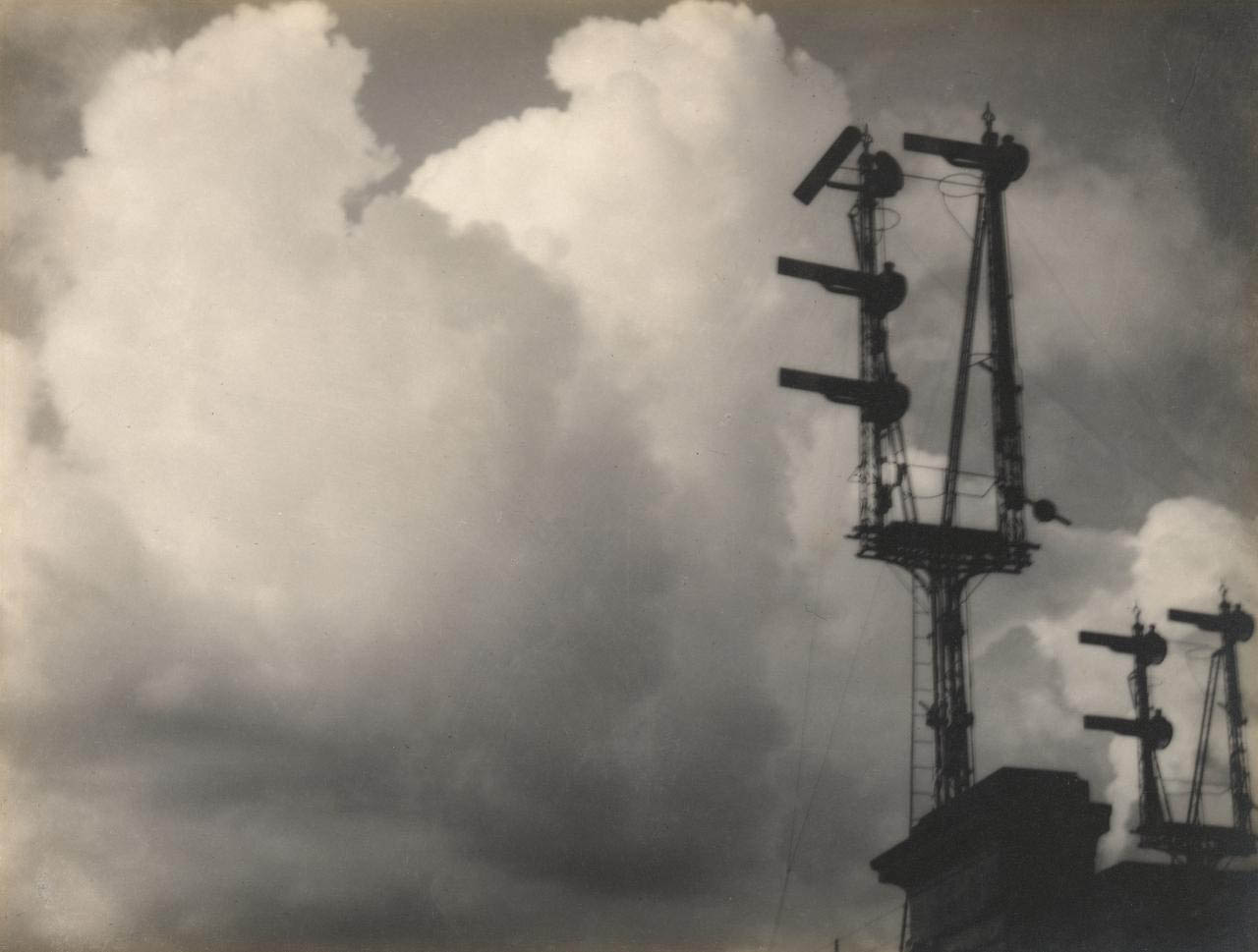
John Kauffmann (Australian, 1864-1942) 'The cloud' c. 1905


John Kauffmann (Australian, 1864-1942)
The cloud
c. 1905
Gelatin silver photograph
28.2 × 37.2cm
National Gallery of Victoria, Melbourne
Gift of Mr John Bilney, 1976
Public domain


John Kauffmann (Australian, 1864–1942) 'The grey veil' c. 1919


John Kauffmann (Australian, 1864-1942)
The grey veil
c. 1919
Gelatin silver photograph
National Gallery of Victoria, Melbourne
Purchased through The Art Foundation of Victoria with the assistance of the Herald & Weekly Times Limited, Fellow, 1990
Public domain


The Yarra River, the Princes Bridge and the Melbourne city skyline beyond shimmer in this photograph by John Kauffmann. And yet, they are not the image’s subject. Using a highly refined Pictorialist treatment, a reduced tonal range and luminous mid tones, the artist has manipulated light to the extent that the feeling and atmospheric qualities become the focus of the image – it is the impression that is paramount. With the choice of title, too, the photograph moves away from a specific documentation of place or time.

Wall text from the exhibition


Norman Deck (Australian 1882-1980) 'Sunset, Parramatta River' 1909


Norman Deck (Australian 1882-1980)
Sunset, Parramatta River
1909
Gelatin silver photograph
30.5 × 24.9cm
National Gallery of Victoria, Melbourne
Gift of Joyce Evans, 1993
Public domain


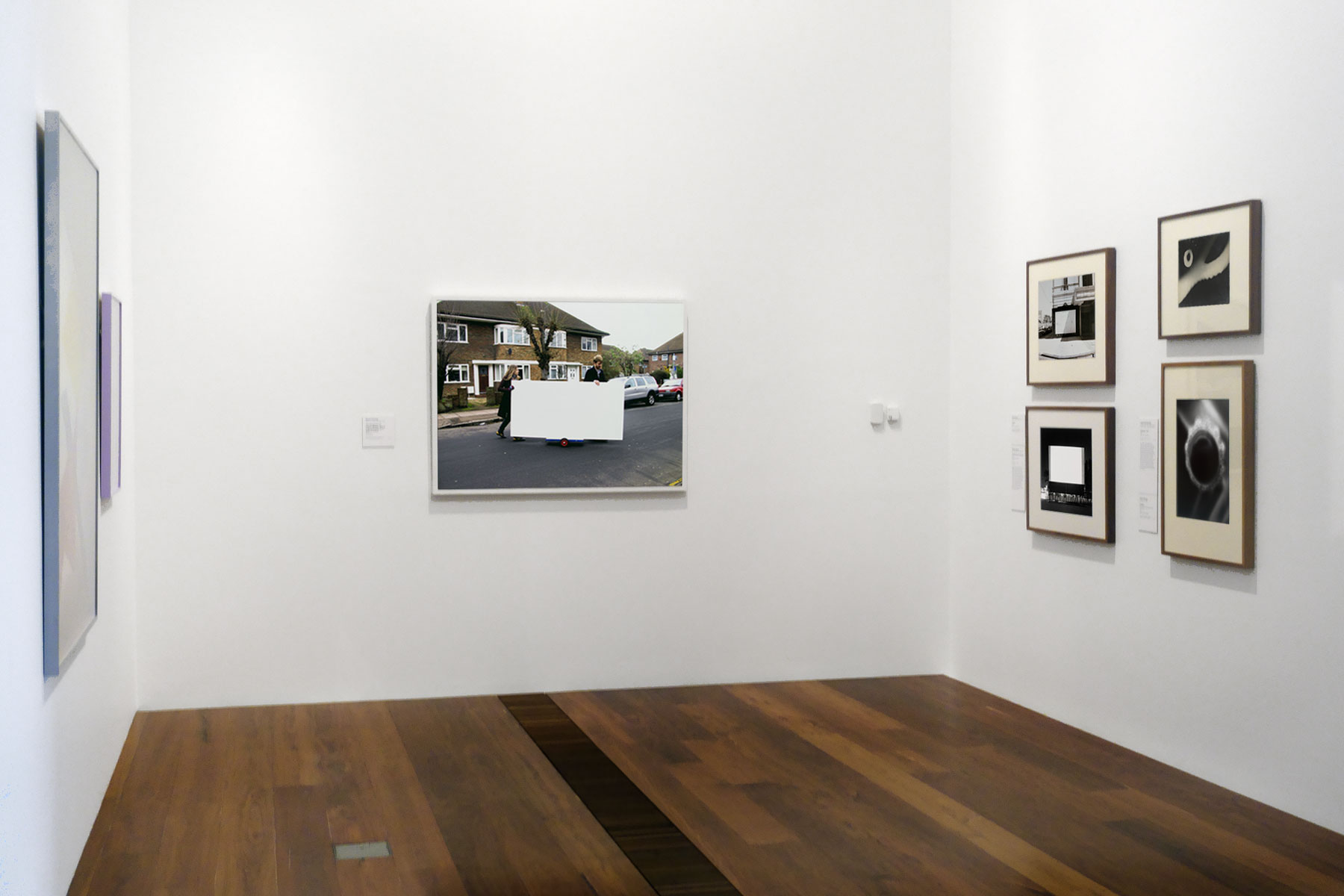
Installation view of the exhibition 'Photography: Real & Imagined' at The Ian Potter Centre: NGV Australia, Melbourne showing at centre, David Thomas' 'The Movement of Colour (White), Taking a Monochrome for a Walk (London)' (2010-2011)


Installation view of the exhibition Photography: Real & Imagined at The Ian Potter Centre: NGV Australia, Melbourne showing at centre, David Thomas’ The Movement of Colour (White), Taking a Monochrome for a Walk (London) (2010-2011), with at right works by David Noonan, Hiroshi Sugimoto, László Moholy-Nagy and Susan Fereday (see below)
Photo: Marcus Bunyan


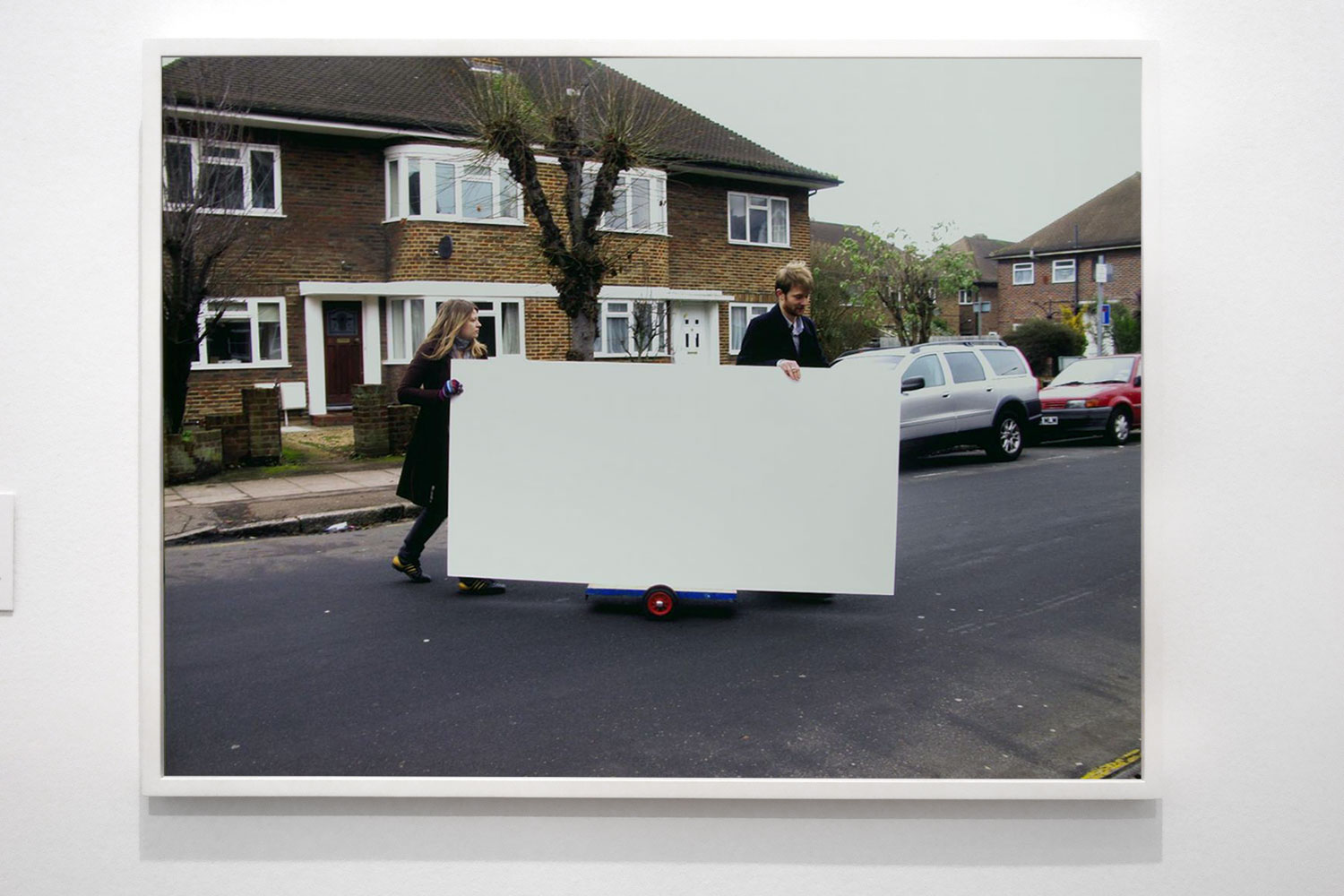
David Thomas (British, b. 1951, Australia 1958- ) 'The Movement of Colour (White), Taking a Monochrome for a Walk (London)' 2010-2011 (installation view)


David Thomas (British, b. 1951, Australia 1958- )
The Movement of Colour (White), Taking a Monochrome for a Walk (London) (installation view)
2010-2011
National Gallery of Victoria, Melbourne
Gift of an anonymous donor through the Australian Government’s Cultural Gifts Program 2015
Photo: Marcus Bunyan


“It was made during a residency at the Centre for Drawing Research at Wimbledon School of Art University of the Arts London… and plays on Paul Klee’s definition of drawing as taking a line for a walk on a page… this is taking a monochrome for a walk in the world where the monochrome becomes a key for seeing other colours… an interval in the world. It also suggests the ideas of movement in time and feelings of impermanence.”

~ David Thomas


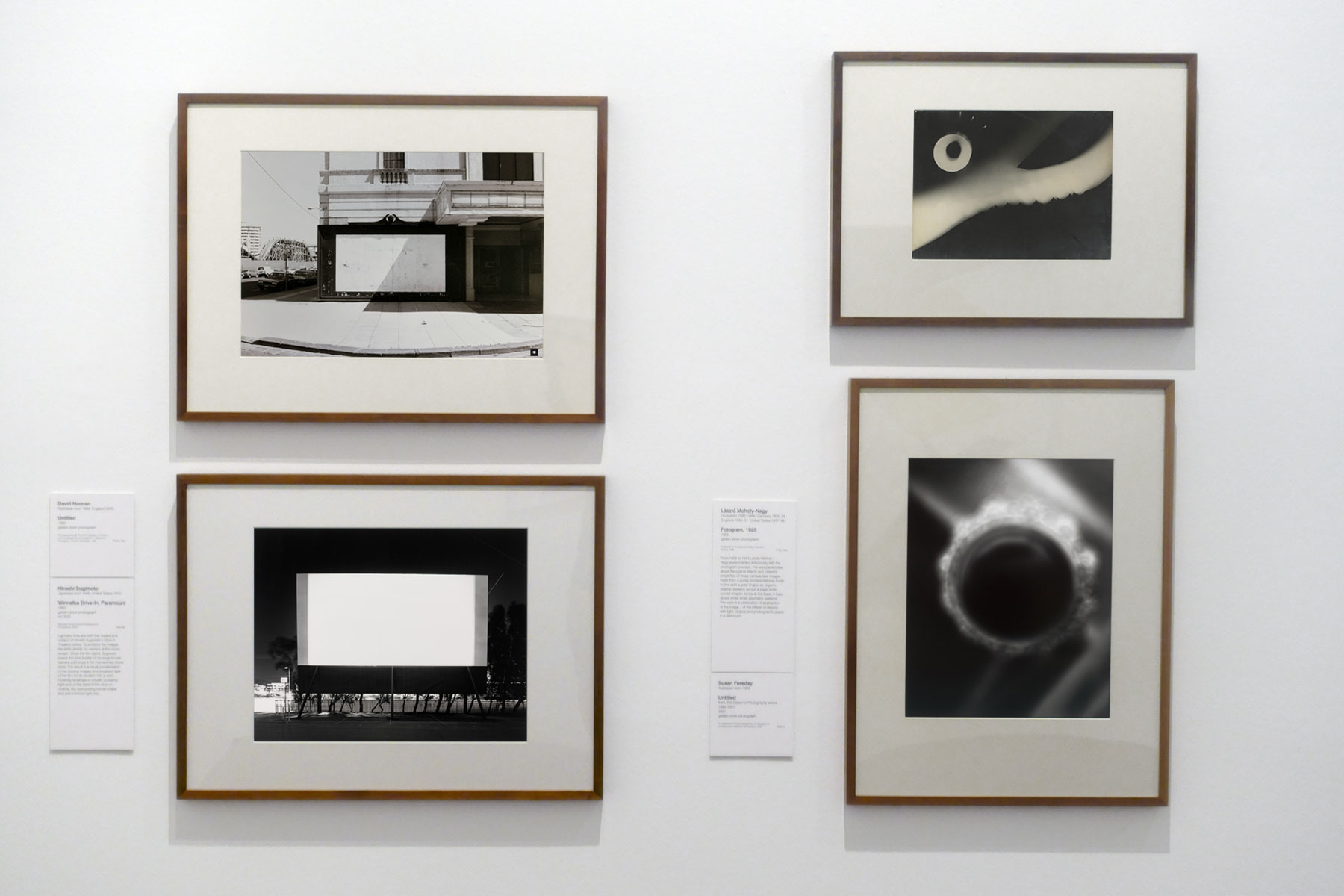
Installation view of the exhibition 'Photography: Real & Imagined' at The Ian Potter Centre: NGV Australia, Melbourne showing works by David Noonan, Hiroshi Sugimoto, Laslo Moholy-Nagy and Susan Fereday


Installation view of the exhibition Photography: Real & Imagined at The Ian Potter Centre: NGV Australia, Melbourne showing at top right, David Noonan’s Untitled (1992); at bottom left, Hiroshi Sugimoto’s Winnetka Drive-In, Paramount (1993); at top right, László Moholy-Nagy’s Fotogram, 1925 (1925); and at bottom right, Susan Fereday’s Untitled (2001)
Photo: Marcus Bunyan


Light and time are both the means and subject of Hiroshi Sugimoto’s Drive-In Theaters series. To produce the images, the artist directs his camera at the movie screen. Once the film starts, Sugimoto opens the lens shutter of his large-format camera and shuts it the moment the movie ends. The result is a visual condensation of the moving images and projected light of the film for its duration into a vivid, hovering rectangle of virtually pulsating light and, in the case of this drive-in cinema, the surrounding human-made and astronomical light, too.

Wall text from the exhibition


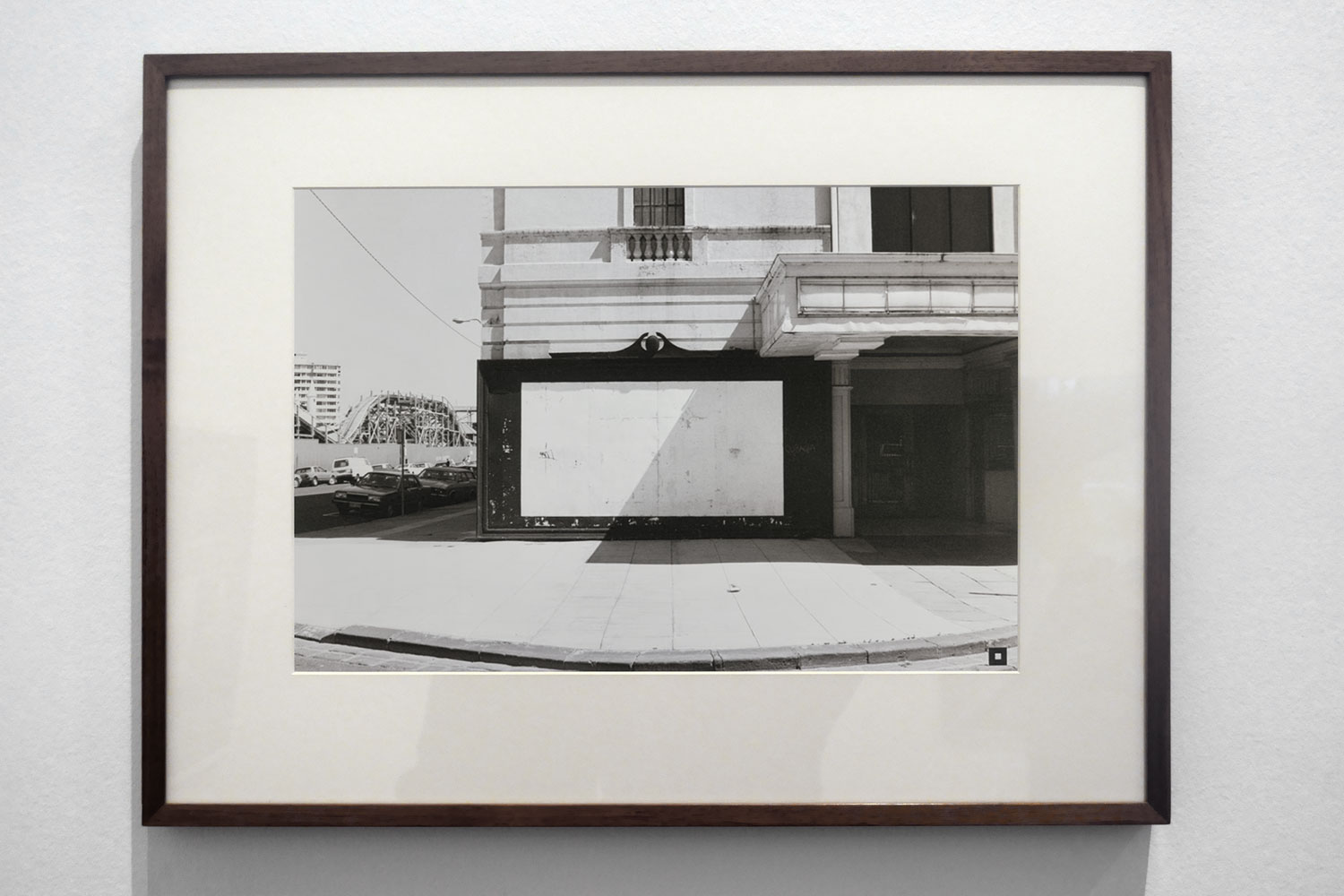
Installation view of the exhibition 'Photography: Real & Imagined' at The Ian Potter Centre: NGV Australia, Melbourne showing David Noonan's 'Untitled' (1992)


Installation view of the exhibition Photography: Real & Imagined at The Ian Potter Centre: NGV Australia, Melbourne showing David Noonan’s Untitled (1992)
Photo: Marcus Bunyan


László Moholy-Nagy (Hungarian 1895-1946, Germany 1920-1934, England 1935-1937, United States 1937-1946) 'Fotogram, 1925' 1925


László Moholy-Nagy (Hungarian 1895-1946, Germany 1920-1934, England 1935-1937, United States 1937-1946)
Fotogram, 1925
1925
Gelatin silver photograph
National Gallery of Victoria, Melbourne
Presented by the National Gallery Society of Victoria, 1985
Public domain


From 1922 to 1943 László Moholy-Nagy experimented extensively with the photogram process – he was passionate about the optical effects and inherent properties of these camera-less images freed from a purely representational mode. In this work a pale shape, an organic swathe, streams across a page while curved shapes dance at the base. A halo above emits small geometric patterns. The work is a celebration of abstraction of the image – of the effects of playing with light, objects and photographic paper in a darkroom.

Wall text from the exhibition


Installation view of the exhibition Photography: Real & Imagined at The Ian Potter Centre: NGV Australia, Melbourne showing at left, Barbara Kasten's Composition 8T (2018); and at right, Lydia Wegner's Purple square (2017)


Installation view of the exhibition Photography: Real & Imagined at The Ian Potter Centre: NGV Australia, Melbourne showing at left, Barbara Kasten’s Composition 8T (2018, below); and at right, Lydia Wegner’s Purple square (2017, below)
Photo: Marcus Bunyan


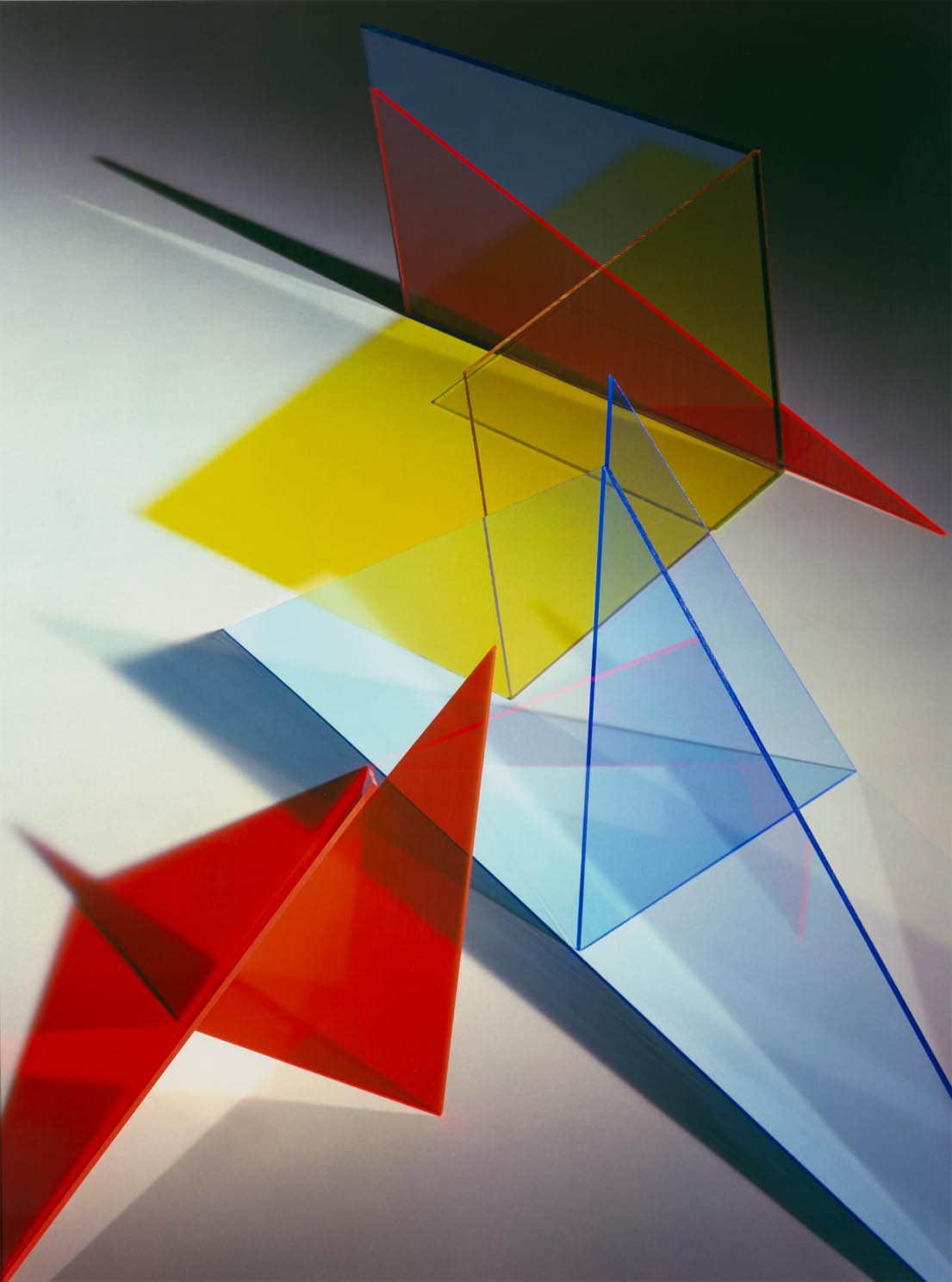
Barbara Kasten (American, b. 1936) 'Composition 8T' 2018


Barbara Kasten (American, b. 1936)
Composition 8T
2018
Digital type C print
160.0 x 121.9cm (image and sheet)
ed. 1/1
National Gallery of Victoria, Melbourne
Purchased NGV Foundation, 2018
© Barbara Kasten, courtesy Kadel Willborn, Düsseldorf


This photograph from Barbara Kasten’s Collisions/Compositions series continues her practice of creating architectural spaces in the studio using a range of materials, such as plexiglas and mirrors, which she lights and photographs at close range. Influenced by Constructivism and the teachings of the Bauhaus, specifically the work of László Moholy-Nagy, Kasten has experimented with the parameters of abstract photography for around five decades. She has written of her ongoing fascination with light in the creation and conceptual development of her photographs, saying, ‘The interdependency of shadow and light is the essence of photographic exploration and an inescapable part of the photographic process’.

Wall text from the exhibition


Installation view of the exhibition Photography: Real & Imagined at The Ian Potter Centre: NGV Australia, Melbourne showing Lydia Wegner's 'Purple square' (2017)


Installation view of the exhibition Photography: Real & Imagined at The Ian Potter Centre: NGV Australia, Melbourne showing Lydia Wegner’s Purple square (2017)
Photo: Marcus Bunyan


Installation view of the exhibition 'Photography: Real & Imagined' at The Ian Potter Centre: NGV Australia, Melbourne showing at left, Todd McMillan's 'Equivalent VIII' (2014); and at right, Sue Pedley's 'Sound of lotus 1' (2000)


Installation view of the exhibition Photography: Real & Imagined at The Ian Potter Centre: NGV Australia, Melbourne showing at left, Todd McMillan’s Equivalent VIII (2014); and at right, Sue Pedley’s Sound of lotus 1 (2000)
Photo: Marcus Bunyan


Installation view of the exhibition 'Photography: Real & Imagined' at The Ian Potter Centre: NGV Australia, Melbourne


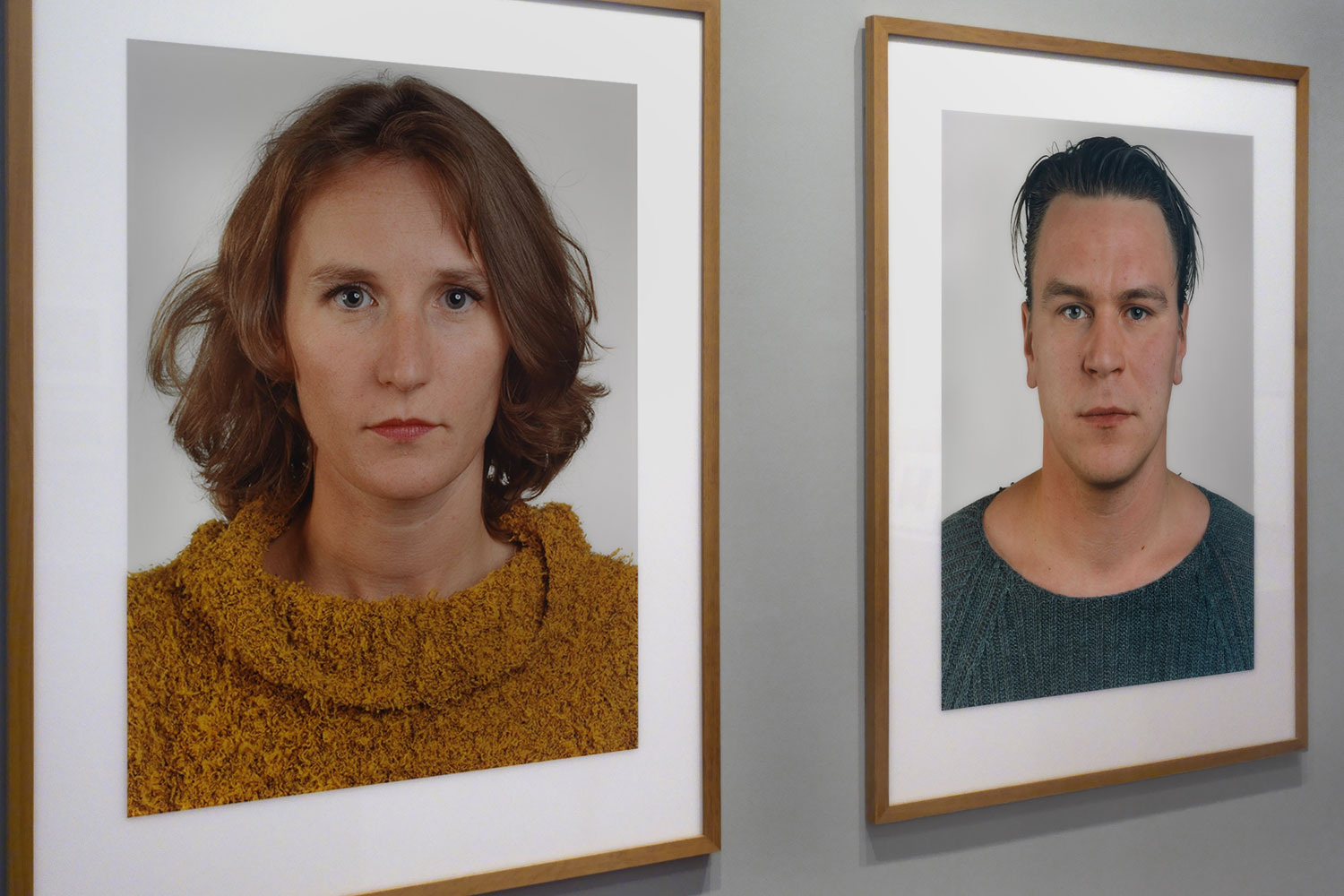
Installation view of the exhibition Photography: Real & Imagined at The Ian Potter Centre: NGV Australia, Melbourne showing at back left, Thomas Ruff’s Portrait (V. Liebermann D) (1999); and at back second left, Ruff’s Portrait (A. Koschkarow) (2000)
Photo: Marcus Bunyan


Installation view of the exhibition Photography: Real & Imagined at The Ian Potter Centre: NGV Australia, Melbourne showing at left, Thomas Ruff’s 'Portrait (V. Liebermann D)' (1999); and at right, Ruff's 'Portrait (A. Koschkarow)' (2000)


Installation view of the exhibition Photography: Real & Imagined at The Ian Potter Centre: NGV Australia, Melbourne showing at left, Thomas Ruff’s Portrait (V. Liebermann D) (1999); and at right, Ruff’s Portrait (A. Koschkarow) (2000)
Photo: Marcus Bunyan


The earnest gazes of the man and woman in these two monumental photographs by Thomas Ruff are so calm and serene that they bely the intense experience of viewing their enlarged faces. Applying a standardised approach – similar to a generic passport photograph – these portraits have a timeless quality that invites you to attempt to ‘read’ their faces and to search for clues as to the inner state of the person. Ruff, however, lets nothing slip. The faces are known to the artist but remain anonymous to the viewer.

Wall text from the exhibition


Installation view of the exhibition 'Photography: Real & Imagined' at The Ian Potter Centre: NGV Australia, Melbourne showing Robert Rooney's 'AM-PM: 2 Dec 1973-28 Feb 1974' (1973-1974) (detail)


Installation view of the exhibition Photography: Real & Imagined at The Ian Potter Centre: NGV Australia, Melbourne showing Robert Rooney’s AM-PM: 2 Dec 1973-28 Feb 1974 (1973-1974) (detail)
Photo: Marcus Bunyan


Featuring some of the most iconic photographs ever created alongside contemporary approaches to the photographic medium, Photography: Real & Imagined is the largest survey of the NGV’s Photography collection in the institution’s history and features more than 270 photographs by Australian and international practitioners.

Four years in the making, this landmark exhibition features photographs from across the 200-year period since the invention of photography in the 19th century, including work by leading international photographers including Man Ray, Cindy Sherman, Wolfgang Tillmans, Gilbert & George and Nan Goldin, alongside Australian photographers Max Dupain, Olive Cotton, Mervyn Bishop, Polly Borland, Destiny Deacon and Darren Sylvester.

Through twenty-one thematic sections, this large-scale exhibition explores the proposition that a photograph can be grounded in the real world, recording, documenting and reflecting the world around us; or be the product of imagination, storytelling and illusion; and on occasion operate in both realms. The thematic sections explore subject matter such as light, place and environment, consumption, conflict, community, and death.

Exhibition highlights include Mervyn Bishop’s important photograph of former Prime Minister of Australia, Gough Whitlam, pouring sand into the open palm of Gurindji Elder Vincent Lingiari. The 1975 image captures the historic meeting between these two figures where Lingiari received the crown lease of his ancestral lands. Also on display is Joe Rosenthal’s World War II photograph Raising the flag on Iwo Jima, 1945, in which American marines raise their country’s flag over the Japanese Island. Both Bishop and Rosenthal’s photographs were staged, or re-constructed for better pictorial effect, illustrating the fluid space between the real and imagined.

The exhibition also presents fashion and advertising photography, including key examples by Lilian Bassman, Athol Smith, Horst P. Horst and Dora Maar. These images showcase a world of designer fashion and high-end products, which set a standard in advertising that continues today. Ilse Bing’s Surrealist inspired photograph commissioned by Elsa Schiaparelli to launch her new perfume Salut in 1934 is a highlight of the exhibition.

Highlighting an area of focused collecting for the NGV, the exhibition recognises the work of women practicing in the early 20th century, including Barbara Morgan whose acclaimed photo montage City shell, 1938, shows an unexpected view of the then recently completed Empire State Building.

Through to the current day, Photography: Real & Imagined presents contemporary photographers of the 21st century including Zanele Muholi, Richard Mosse and Alex Prager. Highlights include Cindy Sherman’s celebrated self-portrait in the guise of Renaissance aristocrat. Also on display will be the oldest photographic work in the NGV Collection, an early 19th century portrait by Englishman William Henry Fox Talbot, one of the inventors of the medium, as well as examples of daguerreotypes, unique images on silver plated copper sheets that are amongst the earliest forms of photography.

The exhibition is accompanied by a major publication – the most ambitious book published on the NGV Photography Collection, generously supported by the Bowness Family Foundation. The publication comprises essays from NGV Senior Curator of Photography, Susan van Wyk, Susan Bright and David Campany; alongside texts by Curator of Photography, Maggie Finch and external authors from Australia, Europe, North America and Southeast Asia.

Regular introductory talks for students are held on weekdays during term times, and free drop-by guided tours each Thursday and Sunday at 10.30am during the exhibition period.

Tony Ellwood AM, Director, NGV, said: ‘This exhibition celebrates the collections and achievements of the NGV’s photography department, which has presented more than 180 exhibitions in its 55-year history. The exhibition is a testament to the strength of the NGV Collection, with so many key examples of the history of photography represented, from the earliest examples from the 19th century, through to contemporary images being produced right now in the twenty-first century. We are grateful for the support of the many donors and philanthropists, such as the Bowness Family Foundation, who have helped to grow and strengthen the NGV’s photography collection.’

Press release from the NGV


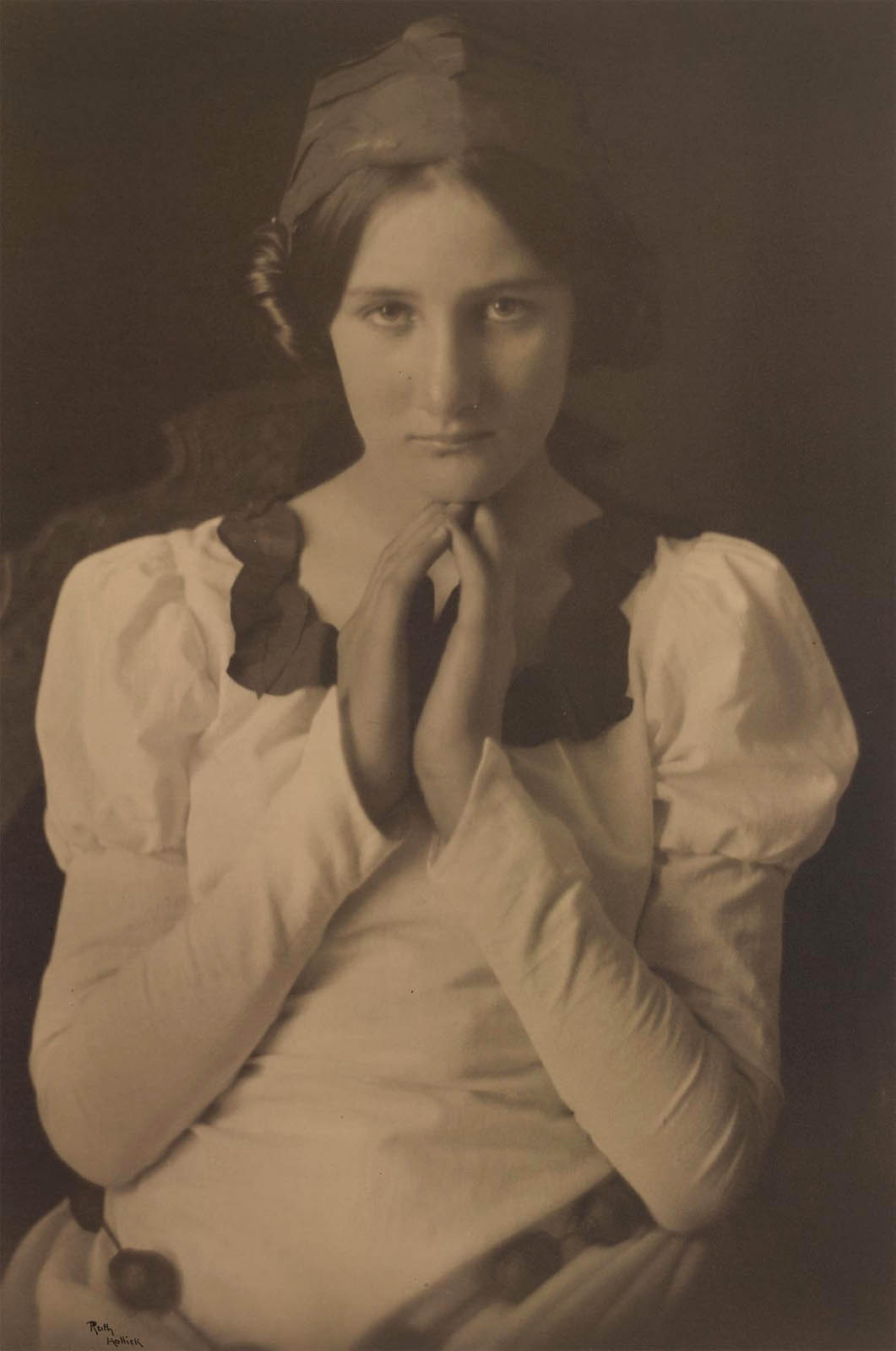
Installation view of the exhibition 'Photography: Real & Imagined' at The Ian Potter Centre: NGV Australia, Melbourne at top left, O. G. Rejlander's 'The Virgin in prayer' (c. 1858-1860); at bottom left, Henry Peach Robinson's 'Elaine watching the shield of Lancelot' (1859); at centre, Ruth Hollick's 'Thought' (1921); and at right Cindy Sherman's 'Untitled' (1988) from the 'History Portraits' series (1988-1990)


Installation view of the exhibition Photography: Real & Imagined at The Ian Potter Centre: NGV Australia, Melbourne at top left, O. G. Rejlander’s The Virgin in prayer (c. 1858-1860, below); at bottom left, Henry Peach Robinson’s Elaine watching the shield of Lancelot (1859); at centre, Ruth Hollick’s Thought (1921); and at right Cindy Sherman’s Untitled (1988) from the History Portraits series 1988-1990
Photo: Marcus Bunyan


Describing the complex conundrum presented by Cindy Sherman in this photograph, photographer and curator Patrick Pound once wrote: ‘Fake chested and with a face like a mask, here Cindy Sherman is costumed to the max. She stares out like a disapproving Renaissance figure who has just walked off set from a Peter Greenaway extravaganza. Here we have a photographer looking like a painting that walked out of a film. Sherman’s photographs speak of the fragilities of the visage in an image-saturated world where information and construction slip into foreplay. In Sherman’s photographic world gender and identity is a compilation album. There is a toughness to the excess that is all her own’.

Wall text from the exhibition


Installation view of the exhibition Photography: Real & Imagined at The Ian Potter Centre: NGV Australia, Melbourne showing O. G. Rejlander's 'The Virgin in prayer' (c. 1858-1860)


Installation view of the exhibition Photography: Real & Imagined at The Ian Potter Centre: NGV Australia, Melbourne showing O. G. Rejlander’s The Virgin in prayer (c. 1858-1860, below)
Photo: Marcus Bunyan


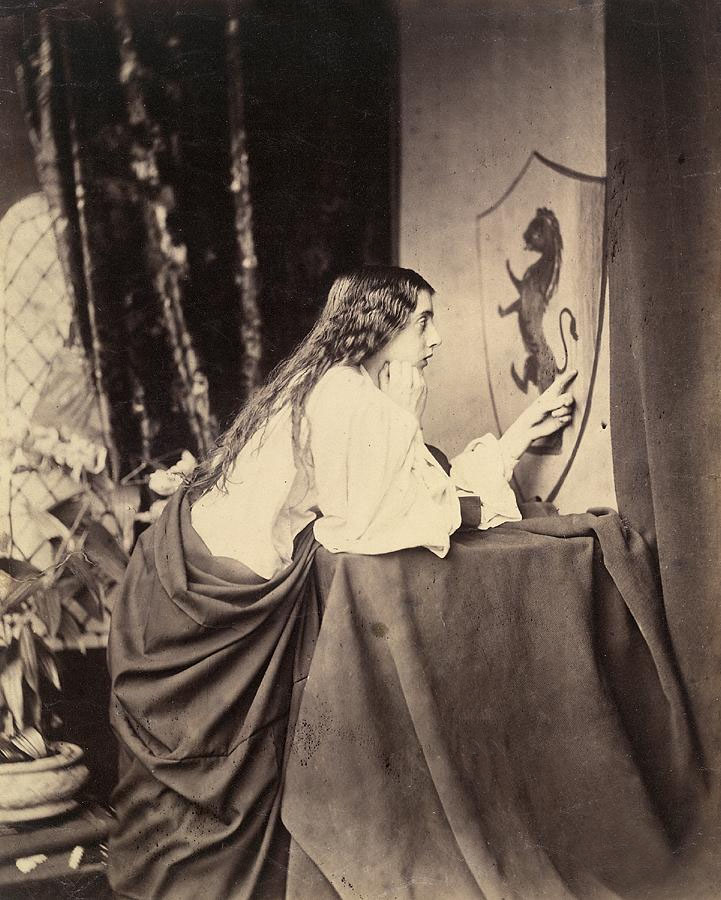
Henry Peach Robinson (English, 1830-1901) 'Elaine watching the shield of Lancelot' 1859


Henry Peach Robinson (English, 1830-1901)
Elaine watching the shield of Lancelot
1859
Albumen silver photograph
24.3 × 19.3cm (image and sheet)
National Gallery of Victoria, Melbourne
Purchased from Admission Funds, 1988
Public domain


In the 1850s Henry Peach Robinson was renowned for producing elaborately staged narrative images based on scenes from popular literary sources. He was particularly interested in Arthurian legends and drew upon these stories as inspiration for some of his most admired photographs. Elaine watching the shield of Lancelot is based on Alfred Tennyson’s version of the story of Lancelot and Elaine. Peach Robinson has recreated the scene in which the lovelorn Elaine gazes dreamily at the shield of Lancelot. She is shown as a woman who has shunned reason and propriety and abandoned herself to the intensity of her emotions, making this photograph both a tragic love story and a cautionary narrative.

Wall text from the exhibition


Ruth Hollick (Australian, 1883-1977) 'Thought' 1921


Ruth Hollick (Australian, 1883-1977)
Thought
1921
Gelatin silver photograph
37.4 × 25.3cm
National Gallery of Victoria, Melbourne
Presented through The Art Foundation of Victoria by Mrs Lucy Crosbie Morrison, Member, 1993
Public domain


Installation view of the exhibition 'Photography: Real & Imagined' at The Ian Potter Centre: NGV Australia, Melbourne


Installation view of the exhibition Photography: Real & Imagined at The Ian Potter Centre: NGV Australia, Melbourne
Photo: Marcus Bunyan


Installation view of the exhibition 'Photography: Real & Imagined' at The Ian Potter Centre: NGV Australia, Melbourne


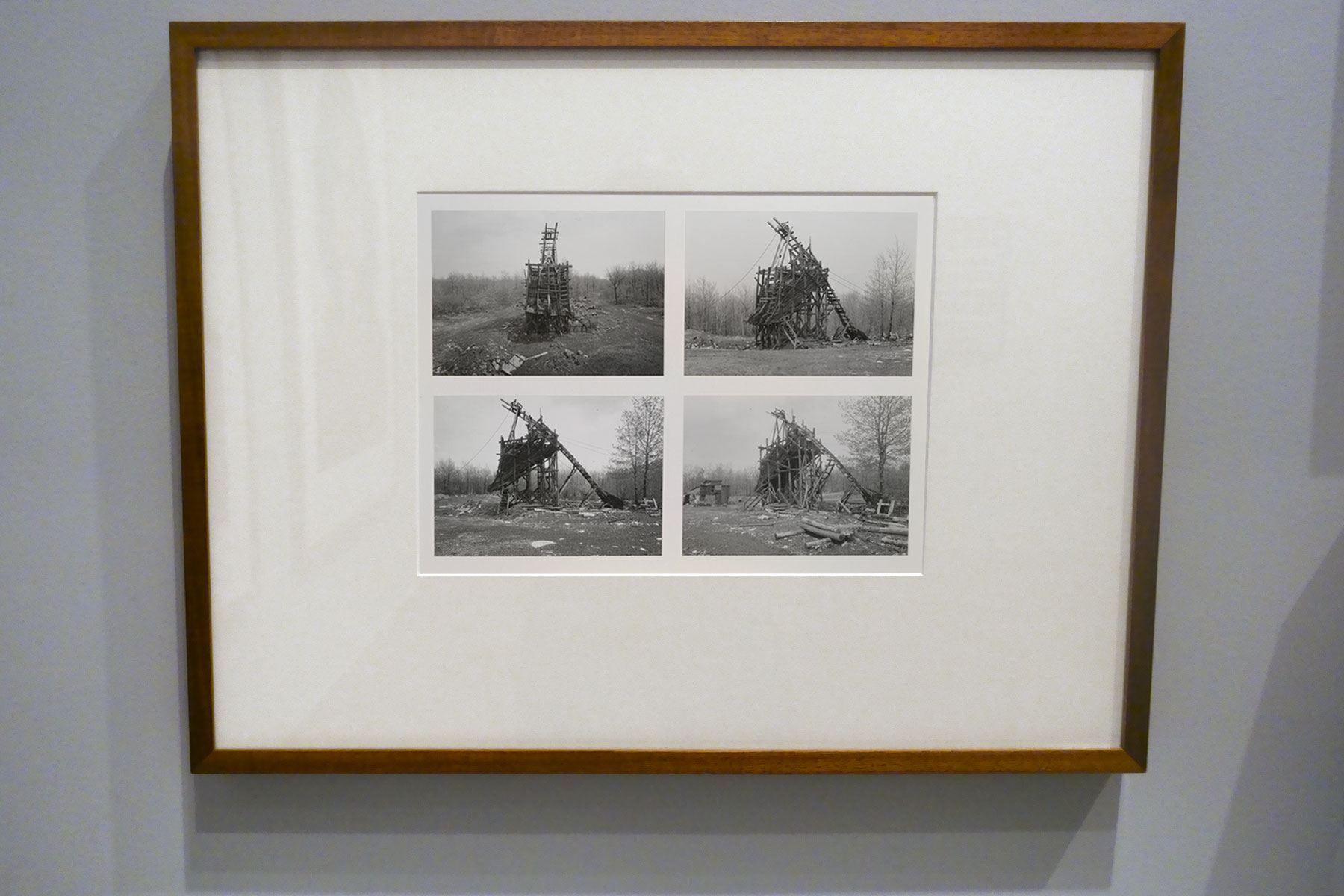
Installation view of the exhibition Photography: Real & Imagined at The Ian Potter Centre: NGV Australia, Melbourne showing Bernd and Hilla Becher’s Coal tipple, Goodspring, Pennsylvania 1975 from the Artists and Photographs folio 1975
Photo: Marcus Bunyan


In 1959, German-born artists Bernd and Hilla Becher began travelling throughout Europe to create photographic typologies of vanishing industrial architecture (a practice they continued for more than four decades). While predominantly documenting German structures and landscapes, they occasionally worked overseas. This image, four views of a coal tipple, was taken on their first trip to North America in the mid 1970s. The Bechers constructed a system for comparing structures: photographed from a consistent angle, with virtually identical lighting conditions, printed at the same size and often displayed in grids.

Wall text from the exhibition


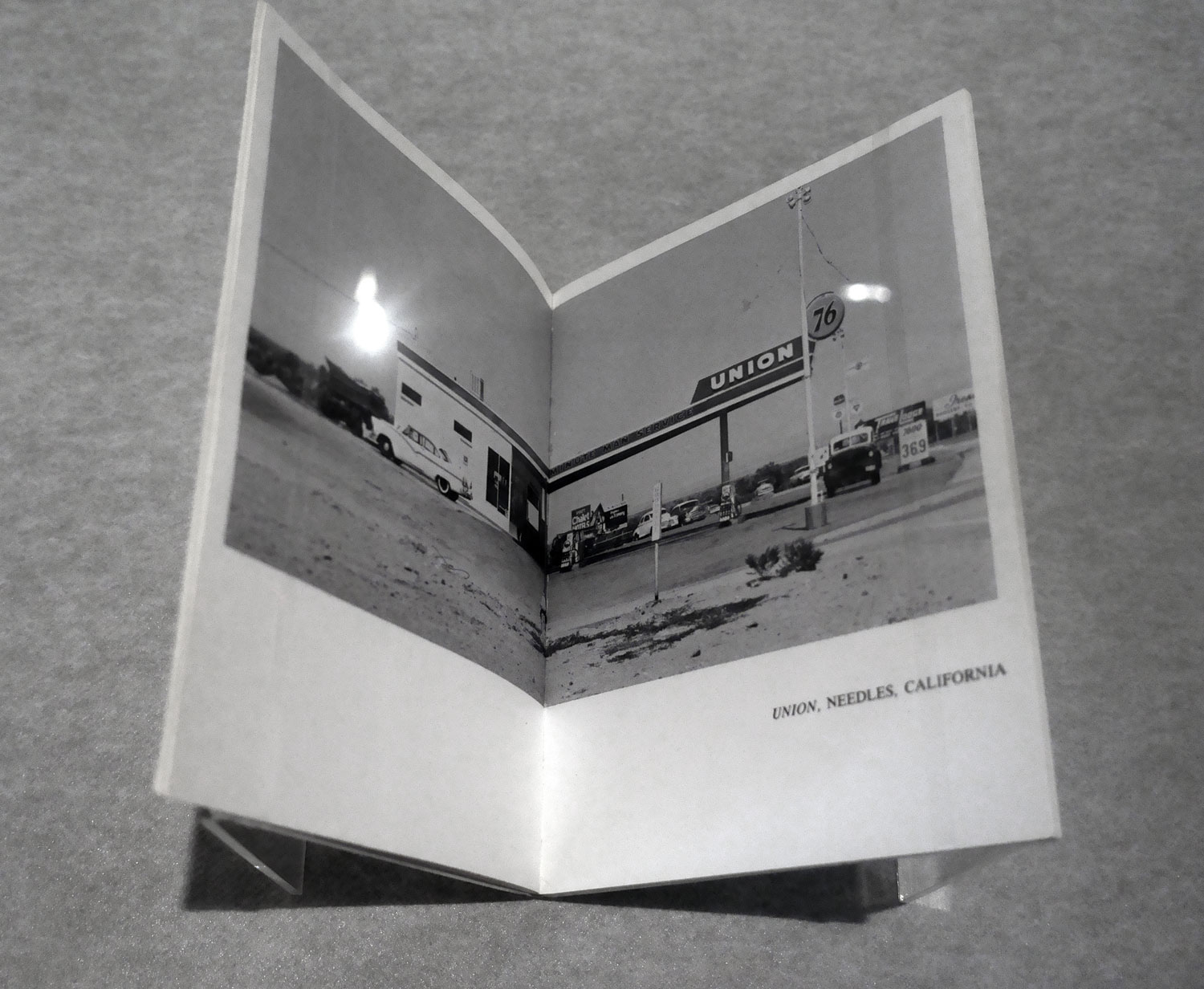
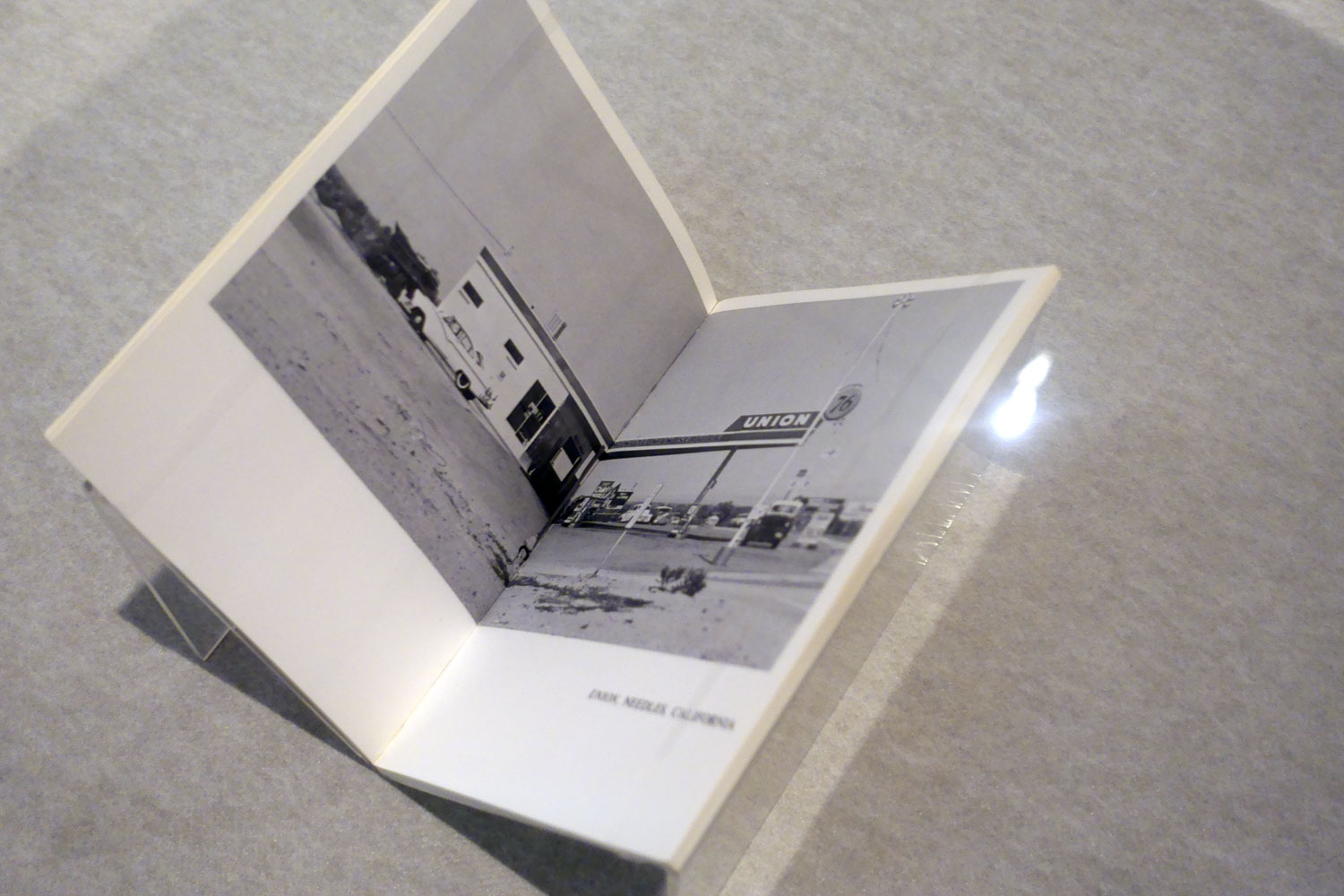
Edward Ruscha (American, b. 1937) 'Twentysix Gasoline Stations' 1963, published 1967 (installation view)

Edward Ruscha (American, b. 1937) 'Twentysix Gasoline Stations' 1963, published 1967 (installation view)


Edward Ruscha (American, b. 1937)
Twentysix Gasoline Stations (installation view)
1963, published 1967
Artist’s book: photo-offset lithograph and printed text, 48 pages, printed cover, glued binding
National Gallery of Victoria, Melbourne
Gift of Robert Rooney through the Australian Government’s Cultural Gifts Program, 2009
Photos: Marcus Bunyan


With the first publication of Twentysix Gasoline Stations, and his subsequent artist books, Edward Ruscha’s work was influential in initiating the widespread interest in photographic book publishing that continues today. Ruscha’s use of photographs as a means of recording – a seemingly unemotional, detached cataloguing of the world – and simply as a ‘device to complete the idea’ influenced the interest in serial imaging adopted by many conceptual artists. Ruscha’s use of the book format was also crucial, providing a transportable way of presenting art in varied contexts that existed as a type of ‘map’ to be read and interpreted, with the subject matter becoming less important than the documentation as a whole.

Wall text from the exhibition


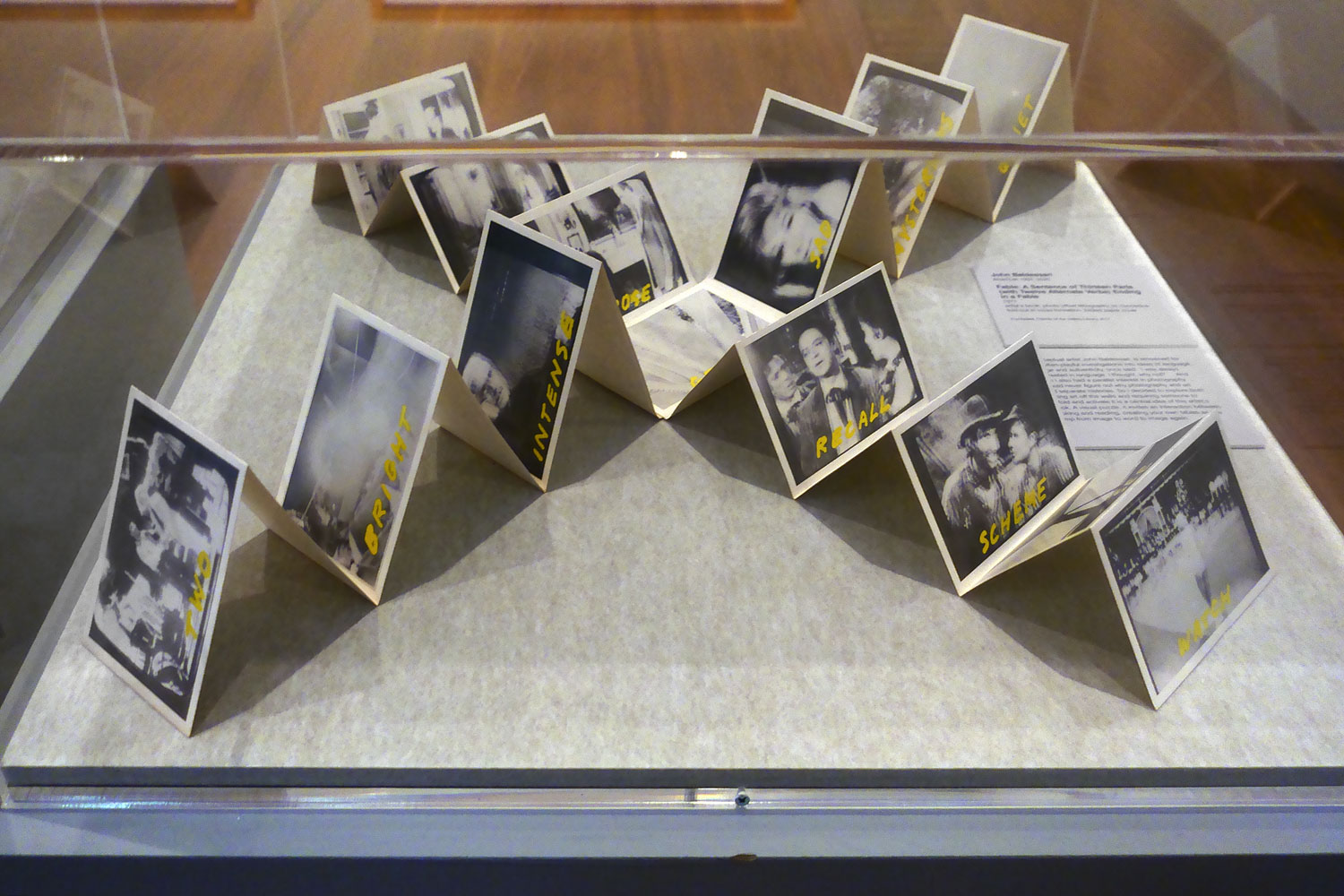
John Baldessari (American 1931-2020) ‘Fable: A Sentence of Thirteen Parts (with Twelve Alternate Verbs) Ending in a Fable’ 1977 (installation view)

John Baldessari (American 1931-2020) ‘Fable: A Sentence of Thirteen Parts (with Twelve Alternate Verbs) Ending in a Fable’ 1977 (installation view)


John Baldessari (American 1931-2020)
Fable: A Sentence of Thirteen Parts (with Twelve Alternate Verbs) Ending in a Fable (installation views)
1977
Artist’s book: photo-offset lithography on concertina fold-out in cross formation, folded paper cover
9.8 × 14.0 × 1.8cm (closed) 70.0 × 126.5cm approx. (overall, opened)
National Gallery of Victoria, Melbourne
Purchased, Friends of the Gallery Library, 2017
Photos: Marcus Bunyan


Conceptual artist John Baldessari, is renowned for his often-playful investigations into ideas of language, image and authenticity, once said: ‘I was always interested in language. I thought, why not? … And then I also had a parallel interest in photography … I could never figure out why photography and art had separate histories. So I decided to explore both’. Taking art off the walls and requiring someone to unfold and activate it is a central idea of this artist’s book. A visual puzzle, it invites an interaction between looking and reading, creating your own fables as you jump from image to word to image again.

Wall text from the exhibition


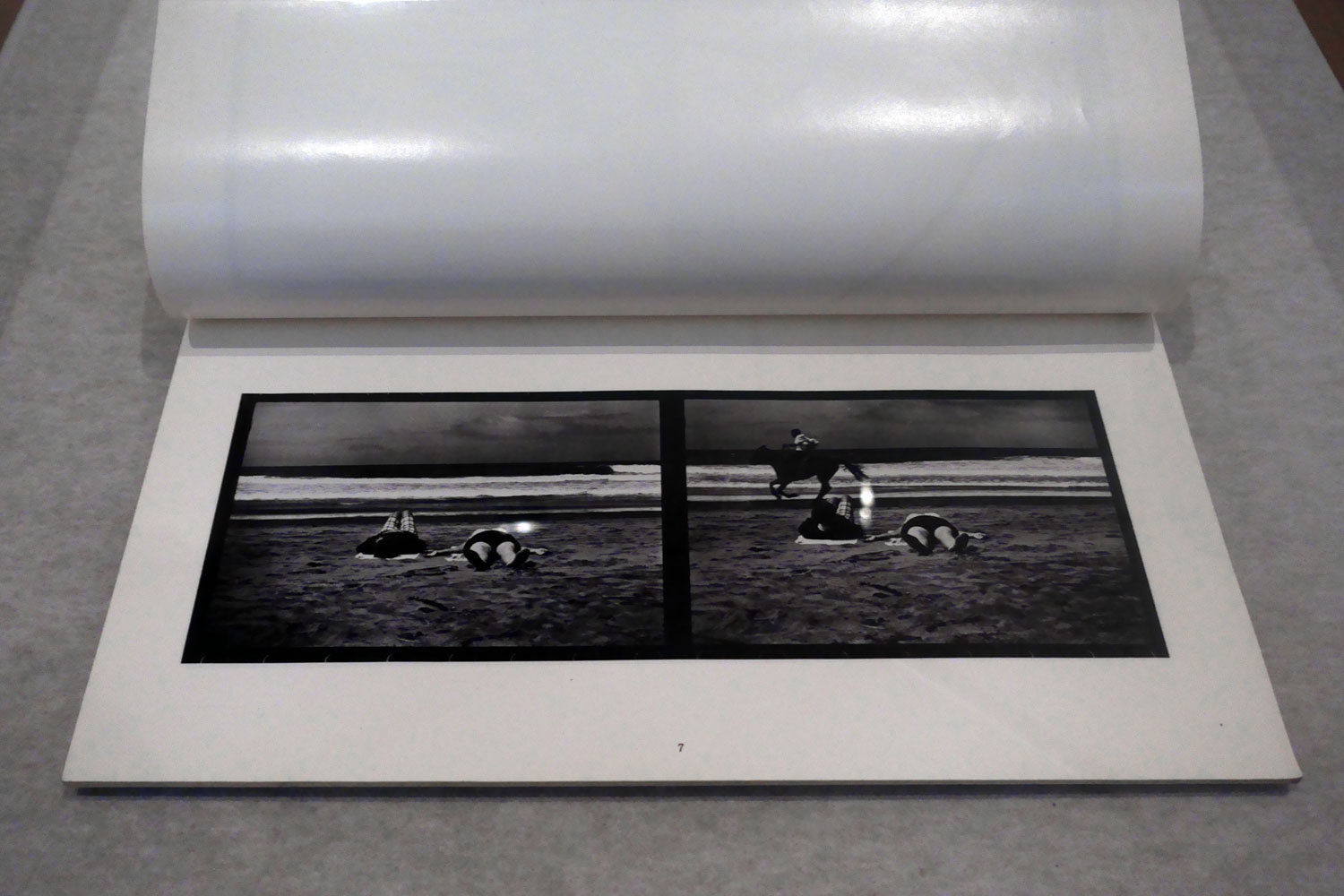
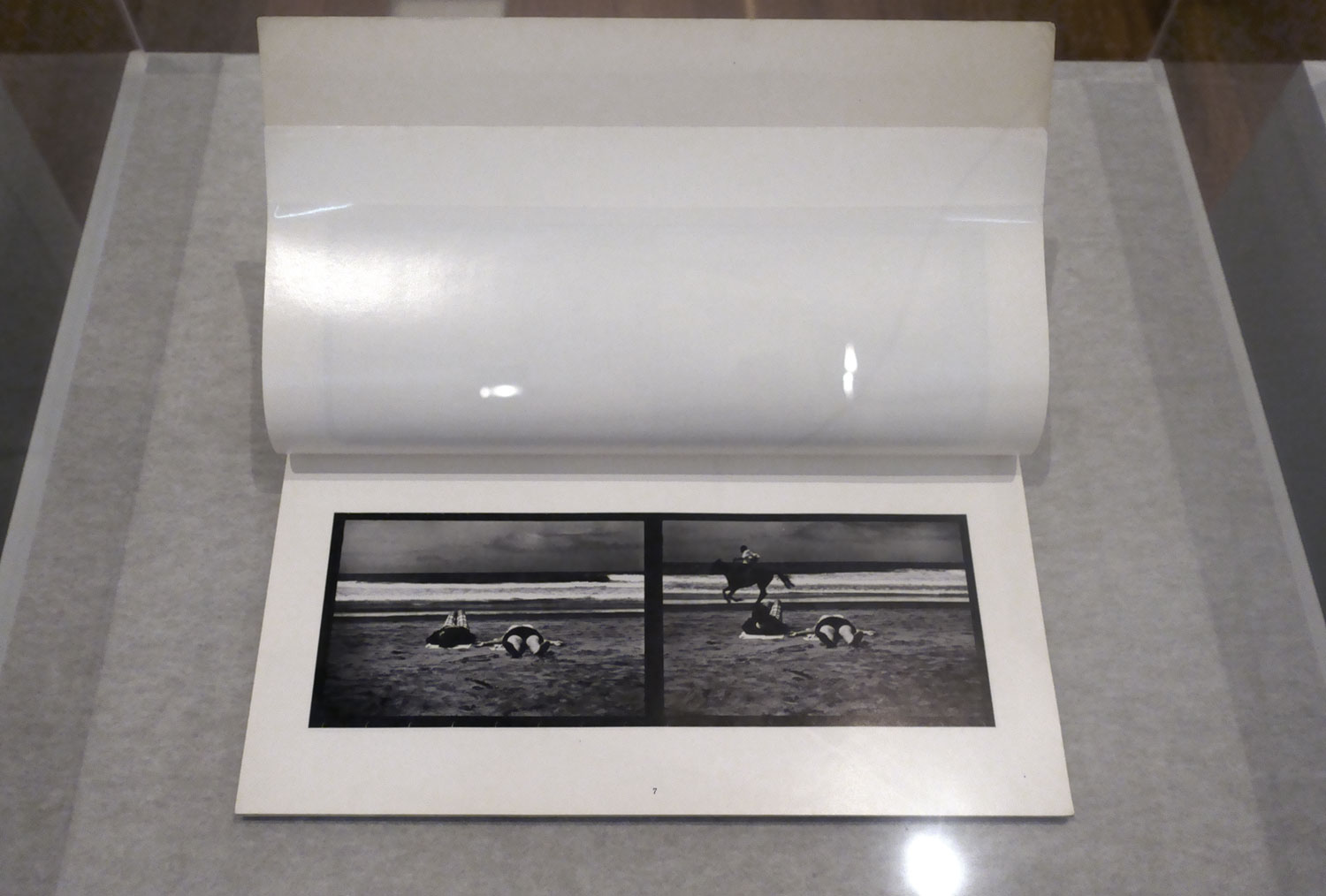
Eve Sonneman (American, b. 1946) 'Real time' 1968-1974 (installation view)

Eve Sonneman (American, b. 1946) 'Real time' 1968-1974 (installation view)


Eve Sonneman (American, b. 1946)
Real time (installation view)
1968-1974, published 1976
Artist’s book: photo-offset lithograph and printed text, 46 folios, printed paper cover, glued binding
National Gallery of Victoria, Melbourne
Purchased NGV Supporters of Photography, 2021
Photos: Marcus Bunyan


Eve Sonneman’s photobook Real time includes paired photographs, each separated by a black line border. The diptychs allow for the occurrence of movement and gestures and changes between the artist’s camera clicks. The ordered presentation, however, takes the images away from a straight documentary reading and to a consideration of their ‘objectness’. After first showing the photographs at MoMA, New York, then photography curator, John Szarkowski, set up a mentorship for Sonneman with the photographer Diane Arbus. As Sonneman recalled: ‘[Arbus] loved my pictures and we got along great. For two years she helped me edit’. Sonneman then published the images through the newly established Printed Matter in New York in 1976.

Wall text from the exhibition


Installation view of the exhibition 'Photography: Real & Imagined' at The Ian Potter Centre: NGV Australia, Melbourne showing at top left, Carol Jerrems and Virginia Fraser's book 'A Book About Australian Women' (1974);  at top centre, Nan Goldin's book 'The Ballad of Sexual Dependency' (1986); and at bottom left, Tracey Emin's 'Exploration of the Soul' (1994) 


Installation view of the exhibition Photography: Real & Imagined at The Ian Potter Centre: NGV Australia, Melbourne showing at top left, Carol Jerrems and Virginia Fraser’s book A Book About Australian Women (published 1974);  at top centre, Nan Goldin’s book The Ballad of Sexual Dependency (published 1986); and at bottom left, Tracey Emin’s Exploration of the Soul (published 1994)
Photo: Marcus Bunyan


Installation view of the exhibition 'Photography: Real & Imagined' at The Ian Potter Centre: NGV Australia, Melbourne showing at bottom left, Harold Cazneaux's book 'The Bridge Book' (published 1930); and at top right, Lee Friedlander's 'The American Monument' (published 1976)


Installation view of the exhibition Photography: Real & Imagined at The Ian Potter Centre: NGV Australia, Melbourne showing at bottom left, Harold Cazneaux’s book The Bridge Book (published 1930); and at top right, Lee Friedlander’s book The American Monument (published 1976)
Photo: Marcus Bunyan


Lee Friedlander (American, b. 1934) 'The American Monument' Published by The Eakins Press Foundation, New York, 1976 (installation view)


Lee Friedlander (American, b. 1934)
The American Monument (installation view)
Published by The Eakins Press Foundation, New York, 1976
Half-tone plate
Shaw Research Library, National Gallery of Victoria
Photo: Marcus Bunyan


Berenice Abbott (American 1898-1991, worked in France 1921-1929) 'Changing New York' Published by E. P. Dutton & Co, New York, 1939 (installation view)


Berenice Abbott (American 1898-1991, worked in France 1921-1929)
Changing New York (installation view)
Published by E. P. Dutton & Co, New York, 1939
Half-tone plate and letterpress text
National Gallery of Victoria, Melbourne
Purchased NGV Foundation, 2022
Photo: Marcus Bunyan


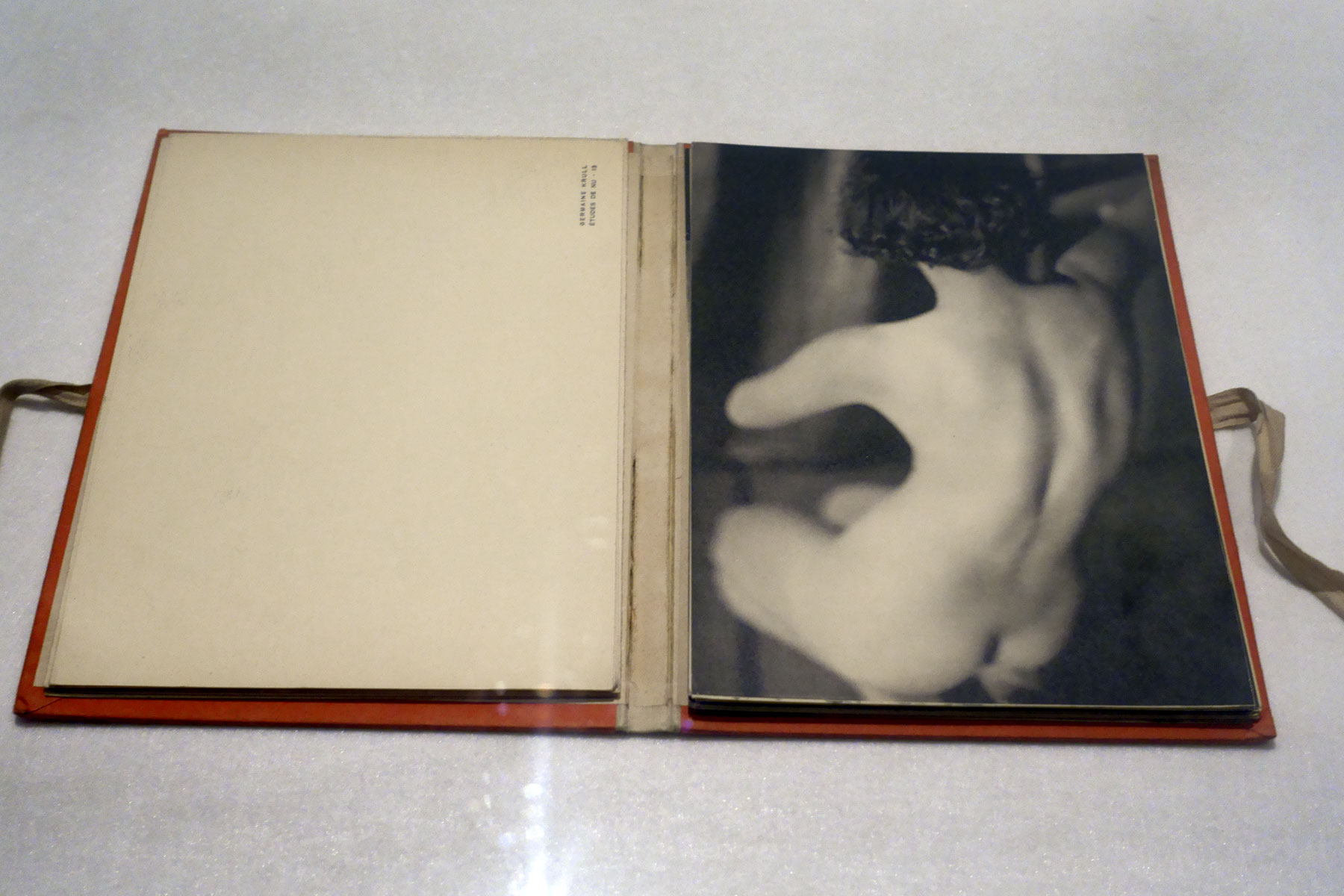
Installation view of the exhibition 'Photography: Real & Imagined' at The Ian Potter Centre: NGV Australia, Melbourne showing at top left, Man Ray's book 'Photographs by Man Ray Paris 1920-1934' (published 1934); at bottom left, Claude Cahun and Marcel Moore's book 'Aveux non Avenus' (Disavowals or Cancelled Confessions) (published 1930); at top right, Bill Brandt's book 'Perspective of Nudes' (published 1961); and at bottom right, Germaine Krull's book 'Nude studies' (Études de nu) (published 1930)


Installation view of the exhibition Photography: Real & Imagined at The Ian Potter Centre: NGV Australia, Melbourne showing at top left, Man Ray’s book Photographs by Man Ray Paris 1920-1934 (published 1934); at bottom left, Claude Cahun and Marcel Moore’s book Aveux non Avenus (Disavowals or Cancelled Confessions) (published 1930); at top right, Bill Brandt’s book Perspective of Nudes (published 1961); and at bottom right, Germaine Krull’s book Nude studies (Études de nu) (published 1930)
Photo: Marcus Bunyan


Photographs today are often viewed in galleries in frames, hung on walls. Many photographs, however, were originally created for display in combination with text and graphic design; to be laid out on a page and reproduced in different formats; to be held, worn on the body, published, and shared.

With recognition of these expanded histories of photography, and the contemporary resurgence in publishing, this exhibition includes artist books, magazines and photobooks that use the photographic image in print, publishing and design. These two cases include examples that show the influence of Surrealism, the New Objectivity and Constructivist graphic design in dynamic modern publications.

Artist and author Martin Parr has described the photobook as the ‘supreme platform’ for photographers to share the work with a broad audience. The 1920s to the 1970s were arguably the most important period for the publication of photobooks. These two cases include examples that show the influence of modernist, humanist and documentary photography traditions in innovative publications from this time. These include exhibition catalogues, examples of first edition books, publications published in larger un-editioned print runs and coveted collectable limited-edition books and portfolios.

Wall text from the exhibition


Installation view of the exhibition 'Photography: Real & Imagined' at The Ian Potter Centre: NGV Australia, Melbourne showing Man Ray’s book 'Photographs by Man Ray Paris 1920-1934' published 1934


Installation view of the exhibition Photography: Real & Imagined at The Ian Potter Centre: NGV Australia, Melbourne showing Man Ray’s book Photographs by Man Ray Paris 1920-1934 (published 1934) with at right, Man Ray’s Anatomies (1930, below)
Photo: Marcus Bunyan


Man Ray (1890-1976) 'Anatomies' 1930


Man Ray (Emmanuel Radnitzky) (American, 1890-1976)
Anatomies
1930
Gelatin silver photograph

Please note: this photograph is not in the exhibition


Claude Cahun (French, 1894-1954) Marcel Moore (French, 1892-1972) 'Aveux non Avenus' (Disavowals or Cancelled Confessions) Published by Éditions du Carrefour, Paris, 1930 (installation view)

Claude Cahun (French, 1894-1954) Marcel Moore (French, 1892-1972) 'Aveux non Avenus' (Disavowals or Cancelled Confessions) Published by Éditions du Carrefour, Paris, 1930 (installation view)


Claude Cahun (French, 1894-1954) Marcel Moore (French, 1892-1972)
Aveux non Avenus (Disavowals or Cancelled Confessions) (installation view)
Published by Éditions du Carrefour, Paris, 1930
Illustrated book: photogravure, letterpress text, 237 pages, 10 leaves of plates, paper cover, stitched binding
National Gallery of Victoria, Melbourne
Shaw Research Library, acquired through the Friends of the Gallery Library endowment, 2017
Photos: Marcus Bunyan


Aveux non Avenus, by the celebrated poet, writer, sculptor and photographer Claude Cahun, was published in 1930 by Éditions du Carrefour, Paris, in an edition of five hundred. The book comprises a series of texts in French: poems, literary aphorisms, recollections of dream sequences and philosophical thoughts, ideas and meanderings. Pierre Mac Orlan, a French novelist who wrote the preface to the book, described Mademoiselle Claude Cahun’s text as ‘de poèmes-essais et d’essais-poèmes’, or ‘poem-essays and essay-poems’, and said that overall ‘the book is virtually entirely dedicated to the word adventure’

The alliterative title presents a conundrum for English translation – ‘aveux’ meaning ‘avowals’ or ‘confessions’, and ‘non avenus’ meaning ‘voided’ – and is variously translated as Disavowals, Denials, and Unavowed confessions, among other things. Curator Jennifer Mundy has written that the title suggests ‘an affirmative expression immediately followed by some form of negation or retraction’.

Ambiguities around the title aside, there is a strong visual aspect to the book too. The texts are each demarcated with a complex and fantastical photogravure created by Cahun’s partner, Marcel Moore. These photogravure (where an image from the negative of a photograph is etched into a metal plate, similar to printmaking) are collages made up of photographic images of, and by, Cahun. Throughout the book, graphic devices of stars, eyes and lips are also used to separate sections of text. Aveux non Avenus, which has been described as an anti-realist or surrealist-autobiography of the multi-disciplinary Cahun, exists as a potential critique of the autobiography format altogether, is wonderfully irreducible.

Maggie Finch and Isobel Crombie. “Claude Cahun,” in the 2019 July/August edition of NGV Magazine on the NGV website 9th April 2020 [Online] Cited 28/01/2024


Claude Cahun (French, 1894-1954) and Marcel Moore (French, 1892-1972) 'Untitled' 1930
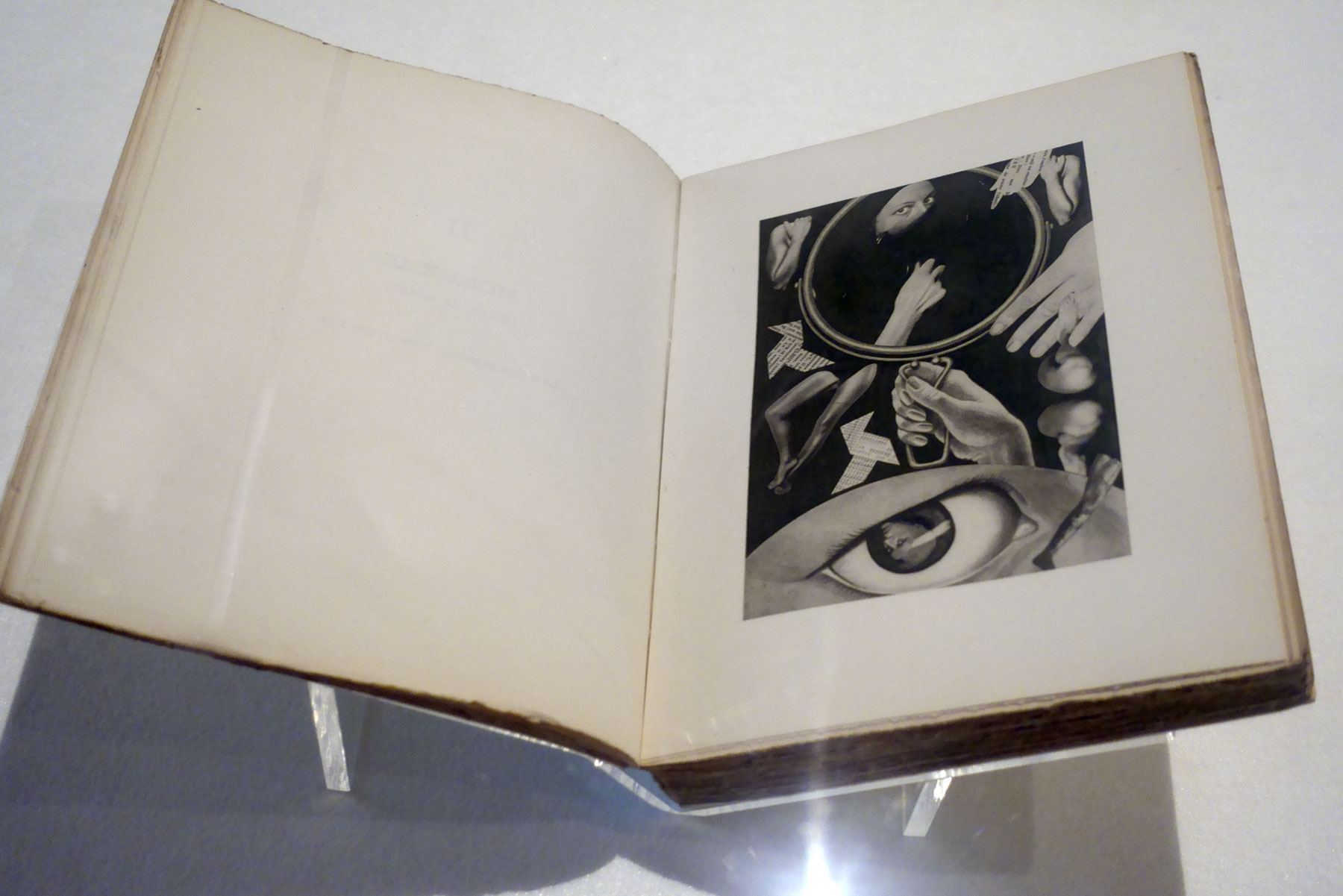
 

Claude Cahun (French, 1894-1954) and Marcel Moore (French, 1892-1972)
Untitled
1930
In Aveux non avenus 1930
published by Éditions du Carrefour, Paris
illustrated book: heliographs
National Gallery of Victoria, Melbourne
Shaw Research Library, acquired through the Friends of the Gallery Library endowment, 2017


Germaine Krull (German, 1897-1985) 'Nude Studies' (Études de Nu) Published by Librarie des arts décoratifs, Paris, 1930 (installation view)


Germaine Krull (German, 1897-1985)
Nude Studies (Études de Nu) (installation view)
Published by Librarie des arts décoratifs, Paris, 1930
24 photogravures, letterpress on paper, white cloth-backed orange paper-covered board portfolio with ribbons
National Gallery of Victoria
Purchased, NGV Foundation, 2022
Photo: Marcus Bunyan


Bill Brandt (English born Germany, 1904-1983) 'Perspective of Nudes' Published Bodley Head, London, 1961 (installation view)


Bill Brandt (English born Germany, 1904-1983)
Perspective of Nudes (installation view)
Published Bodley Head, London, 1961
Half-tone plate
Shaw Research Library, National Gallery of Victoria
Photo: Marcus Bunyan


Karl Blossfeldt (German, 1865-1932) 'Art Forms in Nature: Examples from the Plant World Photographed Direct from Nature' Published by A. Zwemmer, London, 1929 (installation view)


Karl Blossfeldt (German, 1865-1932)
Art Forms in Nature: Examples from the Plant World Photographed Direct from Nature (installation view)
Published by A. Zwemmer, London, 1929
Half-tone plate
Shaw Research Library, National Gallery of Victoria
Photo: Marcus Bunyan


Karel Teige typographer (Czechoslovakia 1900-1951) Karel Paspa photographer (Czechoslovakia 1862-1936) 'ABECEDA (Alphabet)' Published by J. Otto, Prague, 1926 (installation view)


Karel Teige typographer (Czechoslovakia 1900-1951)
Karel Paspa photographer (Czechoslovakia 1862-1936)
ABECEDA (Alphabet) (installation view)
Published by J. Otto, Prague, 1926
Photomontage
National Gallery of Victoria
Shaw Research Library, acquired through the Friends of the Gallery Library endowment, 2017
Photo: Marcus Bunyan


Aleksandr Rodchenko (Russian, 1891-1958) Varvara Stepanova (Russian, 1894-1958) 'USSR in Construction, no. 12 (Parachute issue)' (URSS en Construction) 1935


Aleksandr Rodchenko (Russian, 1891-1958) and Varvara Stepanova (Russian, 1894-1958)
USSR in Construction, no. 12 (Parachute issue) (URSS en Construction) (installation view)
1935
Illustrated journal: colour rotogravure, 22 pages with fold-out inserts, lithographic cover
National Gallery of Victoria
Purchased, NGV Supporters of Prints and Drawings, 2019
Photo: Marcus Bunyan


Installation view of the exhibition 'Photography: Real & Imagined' at The Ian Potter Centre: NGV Australia, Melbourne showing at top left, Eliza Hutchinson's 'No. 9' (2010); at bottom left, Ewa Narkiewicz's 'Copper flax #4' (1999); at centre top, Harry Nankin's 'The first wave: fragment 2' (1996); at centre bottom, Peter Peryer's 'Seeing' (1989); and at right, Aaron Siskind's 'New York' (1950)


Installation view of the exhibition Photography: Real & Imagined at The Ian Potter Centre: NGV Australia, Melbourne showing at top left, Eliza Hutchinson’s No. 9 (2010); at bottom left, Ewa Narkiewicz’s Copper flax #4 (1999); at centre top, Harry Nankin’s The first wave: fragment 2 (1996); at centre bottom, Peter Peryer’s Seeing (1989); and at right, Aaron Siskind’s New York (1950)
Photo: Marcus Bunyan


In much the same way that tactile writing systems such as braille are impenetrable to those with vision, a photograph printed in two dimensions can be incomprehensible for people with vision impairment. Each system presents a conversion – of letters, texts and illustration – into raised dots on a page; of visible wavelengths of light into an image on a light-sensitive surface. Each relies on an irreversible alteration of the surface. Seeing, the title of this Peter Peryer photograph, infers an action – seeing something. Yet the conversion into a photographic image draws attention to the impenetrability of both acts.

Wall text from the exhibition


Installation view of the exhibition 'Photography: Real & Imagined' at The Ian Potter Centre: NGV Australia, Melbourne showing at left, Gregory Crewdson's 'Untitled' (1999) from the Twilight series (1998-2002); at centre, Malerie Marder's 'Untitled' (2001); and at right, Anne Zahalka's 'Sunday, 2:09pm' (1995) 


Installation view of the exhibition Photography: Real & Imagined at The Ian Potter Centre: NGV Australia, Melbourne showing at left, Gregory Crewdson’s Untitled (1999) from the Twilight series (1998-2002); at centre, Malerie Marder’s Untitled (2001); and at right, Anne Zahalka’s Sunday, 2:09pm (1995)
Photo: Marcus Bunyan


Gregory Crewdson (American, b. 1962) 'Untitled' 1999 (installation view)


Gregory Crewdson (American, b. 1962)
Untitled (installation view)
1999
From the Twilight series 1998-2002
Type C photograph
121.9 × 152.4cm
National Gallery of Victoria, Melbourne
Kaiser Bequest, 2000
Photo: Marcus Bunyan


Anne Zahalka (Australian, b. 1957) 'Sunday, 2:09pm' 1995, printed 2019 (installation view)


Anne Zahalka (Australian, b. 1957)
Sunday, 2:09pm
1995, printed 2019
From the Open House series 1995
Colour cibachrome transparency, light box
121.7 × 161.4cm
National Gallery of Victoria, Melbourne
Purchased, Victorian Foundation for Living Australian Artists, 2019
Photo: Marcus Bunyan


Installation view of the exhibition 'Photography: Real & Imagined' at The Ian Potter Centre: NGV Australia, Melbourne showing at left, Polly Borland's 'Untitled' (2018); and at right, Anne Zahalka's 'Sunday, 2:09pm' (1995)


Installation view of the exhibition Photography: Real & Imagined at The Ian Potter Centre: NGV Australia, Melbourne showing at left, Polly Borland’s Untitled (2018); and at right, Anne Zahalka’s Sunday, 2:09pm (1995)
Photo: Marcus Bunyan


Installation view of the exhibition 'Photography: Real & Imagined' at The Ian Potter Centre: NGV Australia, Melbourne showing at rear from left to right, Gregory Crewdson's 'Untitled' (1999) from the 'Twilight' series (1998-2002); at second left, Malerie Marder's 'Untitled' (2001); and centre, Anne Zahalka's 'Sunday, 2:09pm' (1995); and at right, Alex Prager's 'Crowd #11 (Cedar and Broad Street)' (2013)


Installation view of the exhibition Photography: Real & Imagined at The Ian Potter Centre: NGV Australia, Melbourne showing at rear from left to right, Gregory Crewdson’s Untitled (1999) from the Twilight series (1998-2002); at second left, Malerie Marder’s Untitled (2001); and centre, Anne Zahalka’s Sunday, 2:09pm (1995); and at right, Alex Prager’s Crowd #11 (Cedar and Broad Street) (2013, below)
Photo: Marcus Bunyan


Installation view of the exhibition Photography: Real & Imagined at The Ian Potter Centre: NGV Australia, Melbourne showing Alex Prager's 'Crowd #11 (Cedar and Broad Street)' (2013)


Installation view of the exhibition Photography: Real & Imagined at The Ian Potter Centre: NGV Australia, Melbourne showing Alex Prager’s Crowd #11 (Cedar and Broad Street) (2013, below)
Photos: Marcus Bunyan


Alex Prager (American, b. 1979) 'Crowd #11 (Cedar and Broad Street)' 2013


Alex Prager (American, b. 1979)
Crowd #11 (Cedar and Broad Street)
2013
Inkjet print
149.7 × 142.0cm (image and sheet)
National Gallery of Victoria, Melbourne
Bowness Family Fund for Contemporary Photography, 2014


Alex Prager’s staged photographs openly reference the aesthetics of mid-twentieth century American cinema, fashion photography and the photographs of Cindy Sherman. Her images resemble film stills and are packed with emotion and human melodrama. Working with actors, directing their placement and interaction to create a hyperreal dramatisation of crowd behaviour, Prager’s narrative tableaux pair the banal and fantastic, the everyday and the theatrical, real life and cinematic representation. In this image we have a bird’s eye view of a mass of people crossing the road. We can see the patterns of movement, contact and avoidance and a suggestion of the narrative possibilities of the interacting crowd.

Wall text from the exhibition


Installation view of the exhibition 'Photography: Real & Imagined' at The Ian Potter Centre: NGV Australia, Melbourne showing at second right, Pat Brassington's 'Rosa' (2014); and at right, Yvonne Todd's 'Werta' (2005)


Installation view of the exhibition Photography: Real & Imagined at The Ian Potter Centre: NGV Australia, Melbourne showing at second right, Pat Brassington’s Rosa (2014); and at right, Yvonne Todd’s Werta (2005)
Photo: Marcus Bunyan


Zoë Croggon (Australian, b. 1989) 'Fonteyn' 2012 (installation view)


Zoë Croggon (Australian, b. 1989)
Fonteyn (installation view)
2012
Digital type C print
102.8 × 99.9cm
Purchased with funds arranged by Loti Smorgon for Contemporary Australian Photography, 2013
Photo: Marcus Bunyan


Installation view of the exhibition 'Photography: Real & Imagined' at The Ian Potter Centre: NGV Australia, Melbourne showing Loretta Lux's 'The Drummer' (2004)


Installation view of the exhibition Photography: Real & Imagined at The Ian Potter Centre: NGV Australia, Melbourne showing Loretta Lux’s The Drummer (2004, below)
Photo: Marcus Bunyan


Loretta Lux (German, b. 1969) 'The drummer' 2004


Loretta Lux (German, b. 1969)
The drummer
2004
Cibachrome photograph
45.0 x 37.7cm
National Gallery of Victoria, Melbourne
Purchased, NGV Foundation, 2006
© Loretta Lux. VG Bild-Kunst/Copyright Agency, 2023


Loretta Lux is known for her eerie, hyperreal photographs of children. The luminous pallor of the boy’s skin and the subtle tonal range throughout the photograph is achieved through Lux’s delicate use of digital manipulation to reduce the palette in her image. Lux’s history as a painter informs photographs such as this, which seem to owe as much of a debt to Old Master paintings as modern technology. Her skilful combination of photographic reality and painterly effect gives the image a profoundly disconcerting quality that is reminiscent of the fantastical (and disturbing) character of Oskar, the little drummer boy, in the Günter Grass novel The Tin Drum (1959).

Wall text from the exhibition


Installation view of the exhibition 'Photography: Real & Imagined' at The Ian Potter Centre: NGV Australia, Melbourne showing at bottom left, Raoul Ubac's 'Penthésilée' (c. 1938, below); at top centre, André Kertész's Satiric Dancer, Paris (1926, below); and at right, Max Dupain's 'Impassioned clay' (1936, below)


Installation view of the exhibition Photography: Real & Imagined at The Ian Potter Centre: NGV Australia, Melbourne showing at bottom left, Raoul Ubac’s Penthésilée (c. 1938, below); at top centre, André Kertész’s Satiric Dancer, Paris (1926, below); and at right, Max Dupain’s Impassioned clay (1936, below)
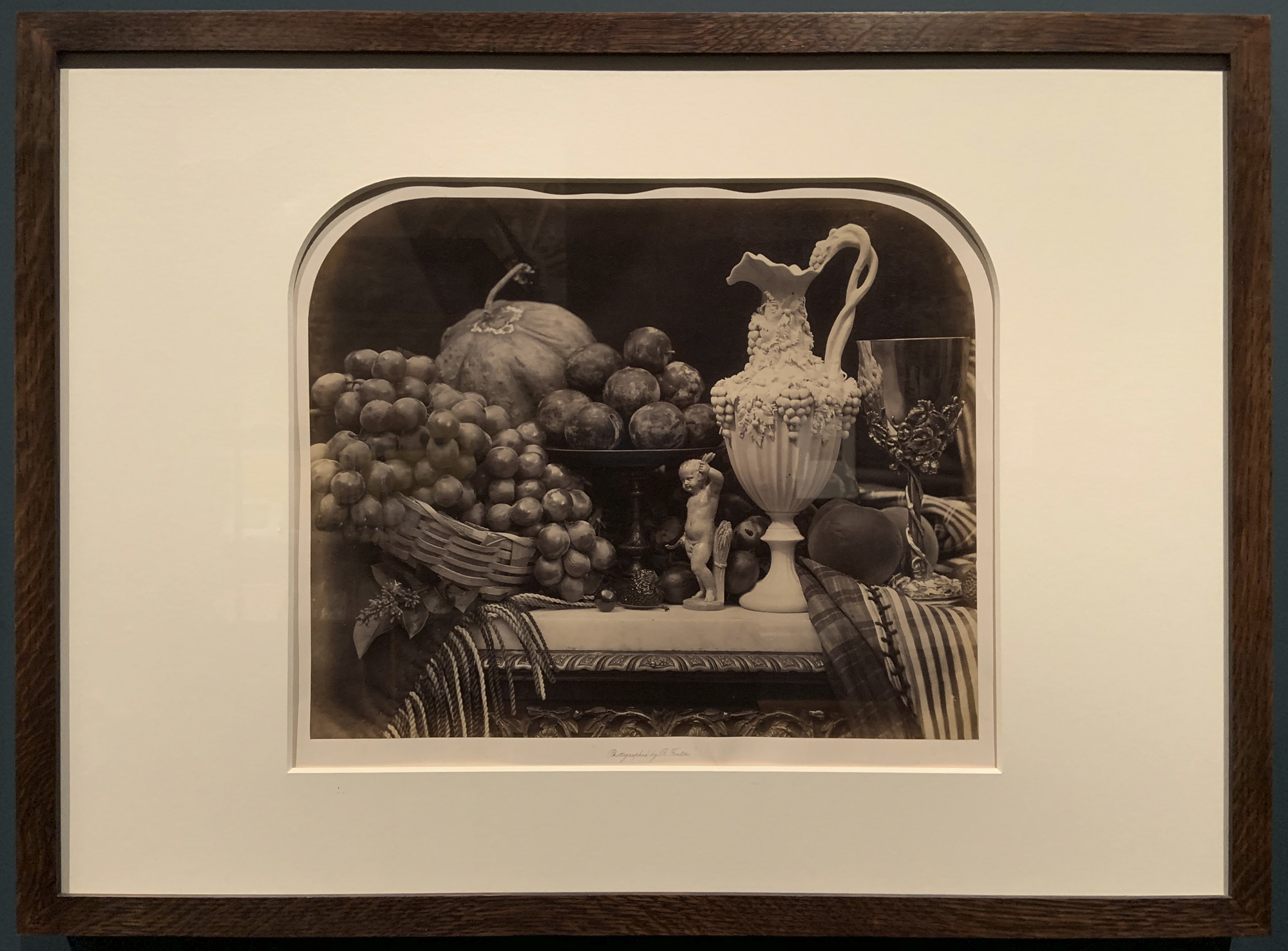
Photo: Marcus Bunyan


Raoul Ubac (Belgian, 1909-1985) 'Penthésilée' c. 1938
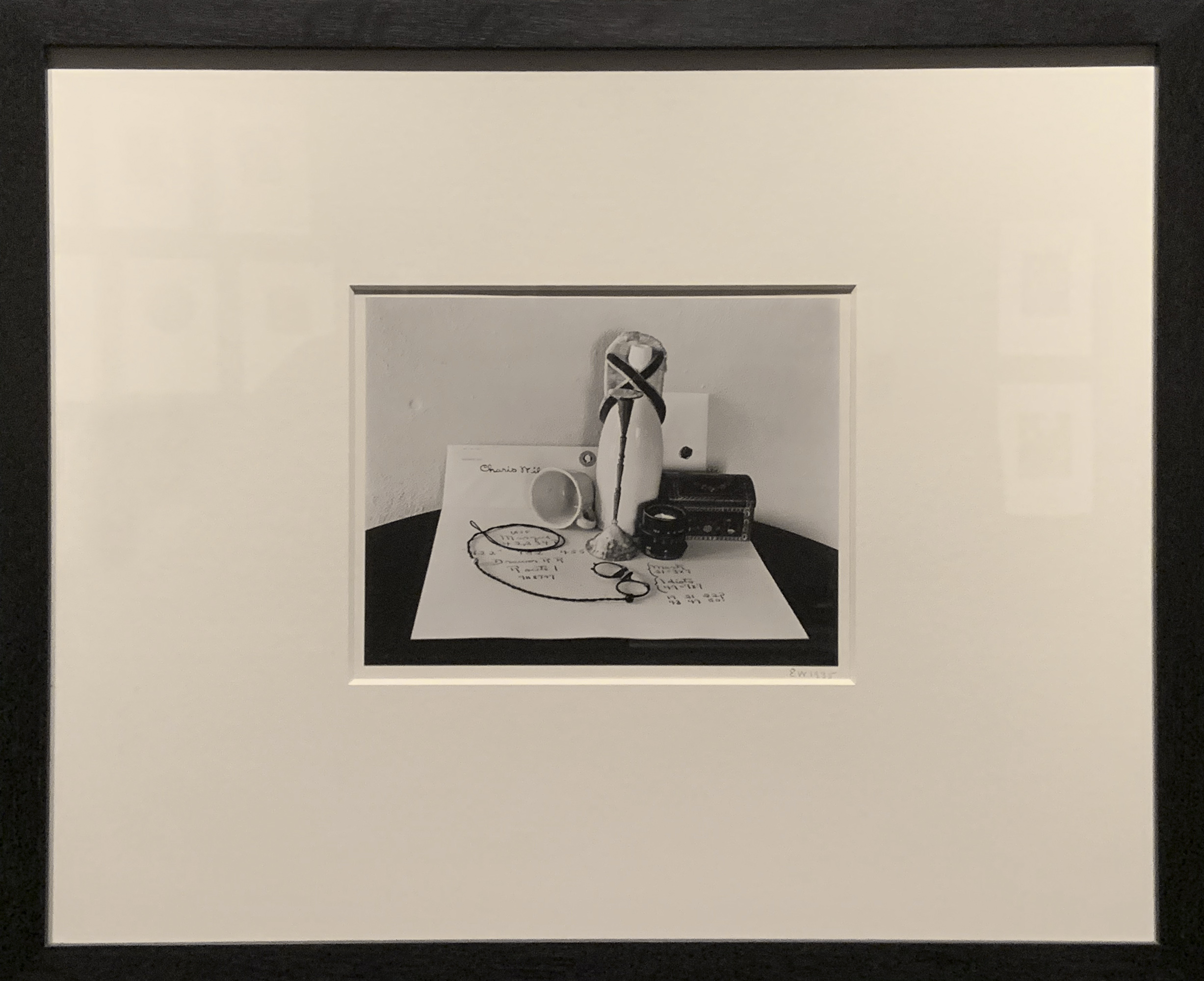
 

Raoul Ubac (Belgian, 1909-1985)
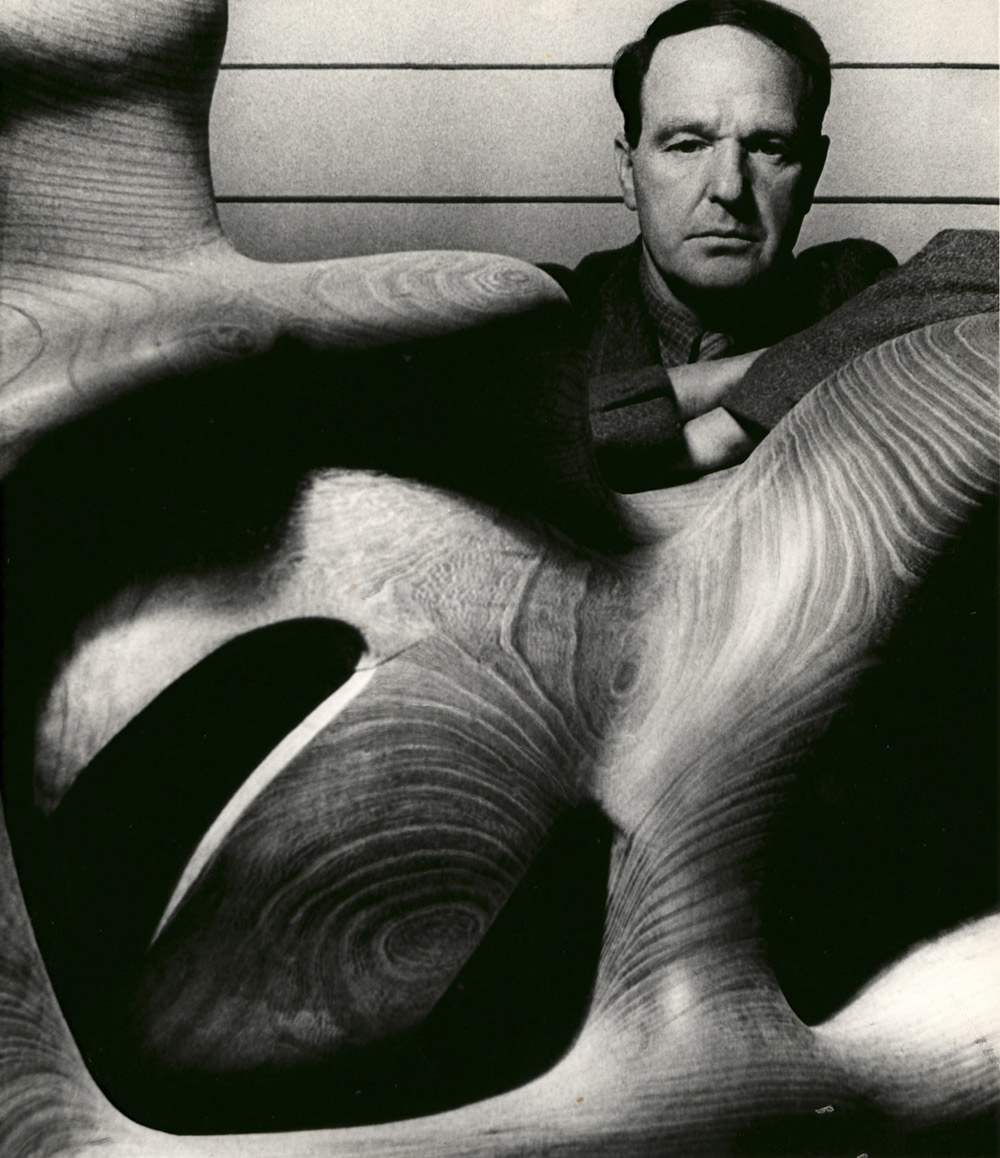
Penthésilée
c. 1938
Gelatin silver photograph
31.0 × 41.5cm
National Gallery of Victoria, Melbourne
Purchased NGV Foundation, 2013


From the mid 1930s onwards Surrealist photographer Raoul Ubac experimented with collage, photomontage and solarisation. These processes disrupted the surface of his photographs, enabling him to create new and fantastic realities and introducing an element of chance into his image making. Penthésilée is from his most important series of photographs. The image is based on the story of Penthesilea, queen of the Amazons, who was killed by Achilles while fighting alongside the Trojans. To represent this mythic battle Ubac created this complex photomontage by cutting up, collaging, rephotographing and solarising photographs of nude female figures. The resulting image has an uncanny sense of movement suggesting the height of battle.

Wall text from the exhibition


André Kertész. 'Satiric Dancer' 1926


André Kertész (Hungarian 1894-1985, France 1925-1936, United States 1936-1985)
Satiric Dancer, Paris
1926, printed c. 1972
Gelatin silver photograph
Purchased, 1973


Installation view of the exhibition 'Photography: Real & Imagined' at The Ian Potter Centre: NGV Australia, Melbourne showing Max Dupain's 'Impassioned clay' (1936)


Installation view of the exhibition Photography: Real & Imagined at The Ian Potter Centre: NGV Australia, Melbourne showing Max Dupain’s Impassioned clay (1936, below)
Photo: Marcus Bunyan


Max Dupain (Australian 1911-1992) 'Impassioned clay' 1936


Max Dupain (Australian 1911-1992)
Impassioned clay
1936
Gelatin silver photograph
50.4 × 36.7cm irreg.
National Gallery of Victoria, Melbourne
William Kimpton Bequest, 2016
Public domain


Installation view of the exhibition 'Photography: Real & Imagined' at The Ian Potter Centre: NGV Australia, Melbourne showing at left, Pat Brassington's 'Rosa' (2014); and at right, Yvonne Todd's 'Werta' (2005)


Installation view of the exhibition Photography: Real & Imagined at The Ian Potter Centre: NGV Australia, Melbourne showing at left, Pat Brassington’s Rosa (2014); and at right, Yvonne Todd’s Werta (2005)
Photo: Marcus Bunyan


Yvonne Todd selects her subjects, most often young women, from ‘call outs’ seeking certain types, people encountered on the street, or modelling agencies where she invariably chooses those with little or no industry experience. In her studio Todd uses costumes, heavy make-up and wigs to style her models. Costuming is an important aspect of Todd’s practice; her interest lies in in what she describes as, ‘the way they carry character and narrative connotations’. Todd’s finished photographs are heavily reworked using Photoshop so that they appear obviously artificial. This overt use of artifice shifts her images from simply being nostalgic recreations to being strangely familiar and undeniably creepy.

Wall text from the exhibition


Installation view of the exhibition 'Photography: Real & Imagined' at The Ian Potter Centre: NGV Australia, Melbourne showing at back left, Robyn Stacey's 'Nothing to see here' (2019) and at back centre, Polly Borland's 'Untitled' (2018)


Installation view of the exhibition Photography: Real & Imagined at The Ian Potter Centre: NGV Australia, Melbourne showing at back left, Robyn Stacey’s Nothing to see here (2019) and at back centre, Polly Borland’s Untitled (2018)
Photo: Marcus Bunyan


Robyn Stacey (Australian, b. 1952) 'Nothing to see here' 2019


Robyn Stacey (Australian, b. 1952)
Nothing to see here
2019
From the Nothing to See Here series 2019
Lenticular image
155.5 × 119cm
National Gallery of Victoria, Melbourne
Purchased, Victorian Foundation for Living Australian Artists, 2020


This large-scale lenticular photograph shows the face of a woman projected onto a curtain. The curtain suggests a hidden cinema screen; however, Robyn Stacey’s curtains cannot be pulled back. From one viewpoint a beautiful face with eyes softly closed as if in sleep appears, but as you move past the image you can only see the curtain. The curtain becomes what the artist described as ‘a membrane between reality and allegory’ and acts as the screen as the portrait appears and disappears.

Wall text from the exhibition


Installation view of the exhibition 'Photography: Real & Imagined' at The Ian Potter Centre: NGV Australia, Melbourne showing Polly Borland's lenticular photograph 'Untitled' (2018)

Installation view of the exhibition 'Photography: Real & Imagined' at The Ian Potter Centre: NGV Australia, Melbourne showing Polly Borland's lenticular photograph 'Untitled' (2018)

Installation view of the exhibition 'Photography: Real & Imagined' at The Ian Potter Centre: NGV Australia, Melbourne showing Polly Borland's lenticular photograph 'Untitled' (2018)


Installation views of the exhibition Photography: Real & Imagined at The Ian Potter Centre: NGV Australia, Melbourne showing Polly Borland’s lenticular photograph Untitled (2018) from the MORPH series
Photos: Marcus Bunyan


Polly Borland (Australia, b. 1959) 'Untitled' 2018


Polly Borland (Australia, b. 1959)
Untitled
2018
From MORPH series 2018
Inkjet print on rice paper on lenticular cardboard
216.0 × 172.7 × 13.0cm
National Gallery of Victoria, Melbourne
Purchased, Victorian Foundation for Living Australian Artists, 2019
© Polly Borland


Installation view of the exhibition Photography: Real & Imagined at The Ian Potter Centre: NGV Australia, Melbourne showing at left, Narelle Autio's two photographs 'Untitled' from 'The Seventh Wave' series (1999-2000); and at right, Selina Ou's 'Convenience' (2001)


Installation view of the exhibition Photography: Real & Imagined at The Ian Potter Centre: NGV Australia, Melbourne showing at left, Narelle Autio’s two photographs Untitled from The Seventh Wave series (1999-2000); and at centre right, Selina Ou’s Convenience (2001)
Photo: Marcus Bunyan


Installation view of the exhibition Photography: Real & Imagined at The Ian Potter Centre: NGV Australia, Melbourne showing Narelle Autio's two photographs 'Untitled' from 'The Seventh Wave' series (1999-2000)


Installation view of the exhibition Photography: Real & Imagined at The Ian Potter Centre: NGV Australia, Melbourne showing Narelle Autio’s two photographs Untitled from The Seventh Wave series (1999-2000)
Photo: Marcus Bunyan


Narelle Autio (Australian, b. 1969) 'Untitled' 2000 (installation view)


Narelle Autio (Australian, b. 1969)
Untitled (installation view)
2000
From The Seventh Wave series 1999-2000
Gelatin silver photograph
90.0 × 134.1cm
National Gallery of Victoria, Melbourne
Purchased with funds arranged by Loti Smorgon for Contemporary Australian Photography, 2001
Photo: Marcus Bunyan


Installation view of the exhibition Photography: Real & Imagined at The Ian Potter Centre: NGV Australia, Melbourne showing at back centre, Selina Ou’s Convenience (2001); and at right, Rosemary Laing’s welcome to Australia (2004)
Photo: Marcus Bunyan


Installation view of the exhibition 'Photography: Real & Imagined' at The Ian Potter Centre: NGV Australia, Melbourne showing at back left, Ben Shahn's 'Young cotton picker, Pulaski County, Arkansas. Schools for coloured children do not open until January 1st so as not to interfere with cotton picking' 1935; and back right, Lewis Hine's 'Finishing garments, 10 Hanover Ave., Boston, Massachusetts' 1912; and at right in the cabinet, Kusakabe Kimbei's album '(Landscape and portraits)' (1880s-1910s) 


Installation view of the exhibition Photography: Real & Imagined at The Ian Potter Centre: NGV Australia, Melbourne showing at back left, Ben Shahn’s Young cotton picker, Pulaski County, Arkansas. Schools for coloured children do not open until January 1st so as not to interfere with cotton picking 1935; and back right, Lewis Hine’s Finishing garments, 10 Hanover Ave., Boston, Massachusetts 1912; and at right in the cabinet, Kusakabe Kimbei’s album (Landscape and portraits) (1880s-1910s)
Photo: Marcus Bunyan


Ben Shahn (Lithuanian 1898-1969, United States c. 1925-1969) 'Young cotton picker, Pulaski County, Arkansas. Schools for coloured children do not open until January 1st so as not to interfere with cotton picking' 1935, printed c. 1975 (installation view)


Ben Shahn (Lithuanian 1898-1969, United States c. 1925-1969)
Young cotton picker, Pulaski County, Arkansas. Schools for coloured children do not open until January 1st so as not to interfere with cotton picking (installation view)
1935, printed c. 1975
Gelatin silver photograph
21.7 × 32.8cm
National Gallery of Victoria, Melbourne
Purchased, 1975
Photo: Marcus Bunyan


Lewis Hine (American, 1874-1940) 'Finishing garments, 10 Hanover Ave., Boston, Massachusetts' 1912


Lewis Hine (American, 1874-1940)
Finishing garments, 10 Hanover Ave., Boston, Massachusetts
1912
Gelatin silver photograph
11.4 × 16.4cm
National Gallery of Victoria, Melbourne
Purchased, 1980
Public domain


Installation view of the exhibition Photography: Real & Imagined at The Ian Potter Centre: NGV Australia, Melbourne showing Kusakabe Kimbei's album '(Landscape and portraits)' (1880s-1910s) 


Installation view of the exhibition Photography: Real & Imagined at The Ian Potter Centre: NGV Australia, Melbourne showing Kusakabe Kimbei’s album (Landscape and portraits) (1880s-1910s)
Photo: Marcus Bunyan


Installation view of the exhibition 'Photography: Real & Imagined' at The Ian Potter Centre: NGV Australia, Melbourne showing  at left, John Thomson's 'The crawlers' (1876-1877, below); at top right, Heather George's 'Stockyards, stockmen in distance. Wave Hill Station, Northern Territory' (1952); and at bottom right, Fred Kruger's 'Group of Aborigines in hop gardens, Coranderrk' (1876, below)


Installation view of the exhibition Photography: Real & Imagined at The Ian Potter Centre: NGV Australia, Melbourne showing  at left, John Thomson’s The crawlers (1876-1877, below); at top right, Heather George’s Stockyards, stockmen in distance. Wave Hill Station, Northern Territory (1952); and at bottom right, Fred Kruger’s Group of Aborigines in hop gardens, Coranderrk (1876, below)
Photo: Marcus Bunyan


Installation view of the exhibition 'Photography: Real & Imagined' at The Ian Potter Centre: NGV Australia, Melbourne showing John Thomson's 'The crawlers' (1876-1877)


Installation view of the exhibition Photography: Real & Imagined at The Ian Potter Centre: NGV Australia, Melbourne showing John Thomson’s The crawlers (1876-1877, below)
Photo: Marcus Bunyan


John Thomson (Scottish 1837-1921) 'The crawlers' 1876-1877


John Thomson (Scottish 1837-1921)
The crawlers
1876-1877
From the Street Life in London series 1877
Woodbury type
11.5 × 8.7cm (image and sheet)
National Gallery of Victoria, Melbourne
Felton Bequest, 1977
Public Domain


Heather George (Australian 1907-1983) 'Stockyards, stockmen in distance. Wave Hill Station, Northern Territory' 1952, printed 1978 (installation view)


Heather George (Australian 1907-1983)
Stockyards, stockmen in distance. Wave Hill Station, Northern Territory (installation view)
1952, printed 1978
From the Northern Territory series 1952
Gelatin silver photograph
Purchased, 1980
Photo: Marcus Bunyan


In 1952 the Australian magazine Walkabout included a series of images made by photojournalist Heather George at Wave Hill Station in the Northern Territory. The vast pastoral lease on the lands of the dispossessed Gurindji people would later become famous as a turning point in the recognition of land rights for Australia’s First Nations peoples, but when George visited, it was a place of entrenched, officially sanctioned discrimination. In George’s photograph, the Gurindji stockmen appear overshadowed by the stockyards in the foreground, perhaps reflecting the attitude of pastoralists who, having been granted leases, took advantage of people living on Country, exploiting them as an unpaid workforce.

Wall text from the exhibition


Fred Kruger (German 1831-1888, Australia 1860-1888) 'Group of Aborigines in hop gardens, Coranderrk' 1876


Fred Kruger (German 1831-1888, Australia 1860-1888)
Group of Aborigines in hop gardens, Coranderrk
1876
Albumen silver photograph
13.3 × 20.2cm
National Gallery of Victoria, Melbourne
Gift of Mrs Beryl M. Curl, 1979
Public domain


In 1876 Fred Kruger was commissioned to produce two series of photographs at Coranderrk, a settlement and working farm established to rehouse dispossessed people of the Kulin Nation. One of the many subjects he photographed was the productive farmland and the activities of the community working the land. Kruger’s photograph shows a multigenerational group of people in the lush Arcadian setting of the hop garden, but what it obscures is the reality of exploitation and poverty that afflicted First Nations people in this place. Kruger’s photographs met a brief to promote the so-called ‘civilising’ work of colonial authorities but in doing so represented a largely imagined reality and created an effective form of propaganda.

Wall text from the exhibition


Selina Ou (Australian, b. 1977) 'Convenience' 2001 (installation view)


Selina Ou (Australian, b. 1977)
Convenience (installation view)
2001
From the Serving You Better series 2001
Type C photograph
National Gallery of Victoria, Melbourne
Purchased with funds arranged by Loti Smorgon for Contemporary Australian Photography, 2005
Photo: Marcus Bunyan


Installation view of the exhibition 'Photography: Real & Imagined' at The Ian Potter Centre: NGV Australia, Melbourne showing at top left, Kusakabe Kimbei's 'Vegetable peddler' (1880s, below); at bottom left, David Wadelton's 'Richmond hairdresser' (1979, below); at top centre, Rennie Ellis' 'Between strips, Kings Cross' (1970-1971, below); at bottom centre, Brassai's 'Washing up in a brothel, Rue Quincampoix (La Toilette, rue Quincampoix (Bidet))' (1932, below); and at right, Wolfgang Sievers' 'Shiftchange at Kelly and Lewis engineering works, Springvale, Melbourne' (1949, below)


Installation view of the exhibition Photography: Real & Imagined at The Ian Potter Centre: NGV Australia, Melbourne showing at top left, Kusakabe Kimbei’s Vegetable peddler (1880s, below); at bottom left, David Wadelton’s Richmond hairdresser (1979, below); at top centre, Rennie Ellis’ Between strips, Kings Cross (1970-1971, below); at bottom centre, Brassai’s Washing up in a brothel, Rue Quincampoix (La Toilette, rue Quincampoix (Bidet)) (1932, below); and at right, Wolfgang Sievers’ Shiftchange at Kelly and Lewis engineering works, Springvale, Melbourne (1949, below)
Photo: Marcus Bunyan


Kusakabe Kimbei (Japanese, 1841-1934) 'Vegetable peddler' 1880s


Kusakabe Kimbei (Japanese, 1841-1934)
Vegetable peddler
1880s
Albumen silver photograph, colour dyes
20.6 × 26.3cm (image and sheet)
National Gallery of Victoria, Melbourne
Gerstl Bequest, 2000
Public domain


Japanese photographer Kusakabe Kimbei established his studio in 1881, making photographs for the domestic and tourist markets. Most of the photographs in this elaborate album are conventional, staged domestic scenes; picturesque views of popular tourist attractions; and street scenes. This image, however, stands alone in the album as an unusual view of contemporary life. Despite the women weavers wearing traditional dress and working hand-operated looms, the factory in which they are working is lit by electric lights and they are supervised by men wearing European-style dress. Unlike its companion works in Kimbei’s album, this photograph speaks to the industrialisation that was part of the Meiji-era modernisation in Japan.

Wall text from the exhibition


Kusakabe Kimbei (Japanese, 1841-1934)

Kusakabe Kimbei (日下部 金兵衛; 1841-1934) was a Japanese photographer. He usually went by his given name, Kimbei, because his clientele, mostly non-Japanese-speaking foreign residents and visitors, found it easier to pronounce than his family name

Kusakabe Kimbei worked with Felice Beato and Baron Raimund von Stillfried as a photographic colourist and assistant. In 1881, Kimbei opened his own workshop in Yokohama, in the Benten-dōri quarter. From 1889, the studio operated in the Honmachi quarter. By 1893, his was one of the leading Japanese studios supplying art to Western customers. Many of the photographs in the studio’s catalogue featured depictions of Japanese women, which were popular with tourists of the time.  Kimbei preferred to portray female subjects in a traditional bijinga style, and hired geisha to pose for the photographs. Many of his albums are mounted in accordion fashion.

Around 1885, Kimbei acquired the negatives of Felice Beato and of Stillfried, as well as those of Uchida Kuichi. Kusakabe also acquired some of Ueno Hikoma’s negatives of Nagasaki. Kimbei retired as a photographer in 1914.

Text from the Wikipedia website


Installation view of the exhibition Photography: Real & Imagined at The Ian Potter Centre: NGV Australia, Melbourne showing David Wadelton's 'Richmond hairdresser' (1979) (installation view)


Installation view of the exhibition Photography: Real & Imagined at The Ian Potter Centre: NGV Australia, Melbourne showing David Wadelton’s Richmond hairdresser (1979, below)
Photo: Marcus Bunyan


David Wadelton (Australian, b. 1955) 'Richmond hairdresser' 1979


David Wadelton (Australian, b. 1955)
Richmond hairdresser
1979
Gelatin silver photograph
13.4 × 20.2cm
National Gallery of Victoria, Melbourne
Gift of David Wadelton through the Australian Government’s Cultural Gifts Program, 2015
© David Wadelton


Rennie Ellis (Australian, 1940-2003) 'Between strips, Kings Cross' 1970-1971


Rennie Ellis (Australian, 1940-2003)
Between strips, Kings Cross
1970-1971; 2000 {printed}
from the Kings Cross series 1971
gelatin silver photograph
37.1 x 24.1 cm (image) 40.3 x 30.4 cm (sheet)
National Gallery of Victoria, Melbourne
Purchased, 2005
© Rennie Ellis Photographic Archive


Installation view of the exhibition 'Photography: Real & Imagined' at The Ian Potter Centre: NGV Australia, Melbourne showing Brassaï's 'Washing up in a brothel, Rue Quincampoix (La Toilette, rue Quincampoix (Bidet))' (1932)


Installation view of the exhibition Photography: Real & Imagined at The Ian Potter Centre: NGV Australia, Melbourne showing Brassaï’s Washing up in a brothel, Rue Quincampoix (La Toilette, rue Quincampoix (Bidet)) (1932, below)
Photo: Marcus Bunyan


Brassaï (Hungarian-French, 1899-1984) 'Washing up in a brothel, Rue Quincampoix' (La Toilette, rue Quincampoix (Bidet)) 1932; printed c. 1979


Brassaï (Hungarian-French, 1899-1984)
Washing up in a brothel, Rue Quincampoix
(La Toilette, rue Quincampoix (Bidet))
1932; printed c. 1979
from The secret of Paris in the 30s series 1931–1935
Gelatin silver photograph
20.5 × 29.2cm (image and sheet)
National Gallery of Victoria, Melbourne
Purchased, 1980
Public Domain


In the 1930s Brassaï became well-known for his photographs of the nightlife of Paris, but it was the sex workers, along with other characters of the city’s underbelly, who excited his imagination. Reflecting on this time, he wrote, ‘Rightly or wrongly, I felt at that time that this underground world represented Paris at its least cosmopolitan, at its most alive, its most authentic, that in these colourful faces of its underworld there had been preserved, from age to age, almost without alteration, the folklore of its remote past’. This photograph presents a matter-of-fact view – there is nothing exotic or erotic about the woman washing herself as her client ties his shoes and prepares to leave.

Wall text from the exhibition


Installation view of the exhibition Photography: Real & Imagined at The Ian Potter Centre: NGV Australia, Melbourne showing Wolfgang Sievers' 'Shiftchange at Kelly and Lewis engineering works, Springvale, Melbourne' (1949)


Installation view of the exhibition Photography: Real & Imagined at The Ian Potter Centre: NGV Australia, Melbourne showing Wolfgang Sievers’ Shiftchange at Kelly and Lewis engineering works, Springvale, Melbourne (1949, below)
Photo: Marcus Bunyan


Wolfgang Sievers (Australian born Germany, 1913-2007) 'Shiftchange at Kelly and Lewis engineering works, Springvale, Melbourne' 1949; printed 1986


Wolfgang Sievers (Australian born Germany, 1913-2007)
Shiftchange at Kelly and Lewis engineering works, Springvale, Melbourne
1949; printed 1986
Gelatin silver photograph
49.4 × 40.5cm
National Gallery of Victoria, Melbourne
Purchased, 1986
© National Library of Australia


Wolfgang Sievers arrived in Australia in 1938, bringing photographic equipment, rigorous training in modernist photography, a firmly held belief in the union of art and industry, left-leaning political views, and the self-declared desire to ‘assist this country through my knowledge as thanks for the freedom I can enjoy here’. The human face of industrial Australia is captured in Sievers’s celebrated photograph of the change of shift at a Melbourne engineering works, showing a sea of men and women surging into work. The upturned, smiling faces of the masses speaking to Sievers’s firmly held belief in the dignity of work.

Wall text from the exhibition


Rosemary Laing (Australian, 1959-2024) 'welcome to Australia' 2004 (installation view)


Rosemary Laing (Australian, 1959-2024)
welcome to Australia (installation view)
2004
Type C photograph
110.8 × 224.4cm
National Gallery of Victoria, Melbourne
Purchased with funds from the Victorian Foundation for Living Australian Artists, 2005
Photo: Marcus Bunyan


This photograph by Rosemary Laing makes an obviously ironic statement, as curator Kyla MacFarlane notes: ‘The title and compositional beauty of this photograph … purposefully jar against its subject matter – the remote Woomera Immigration Detention and Processing Centre in South Australia. Photographing the site while the sun sits low in the sky, Laing observes the Centre’s mechanisms of containment and surveillance – a violent presence on the red dirt and gravel road, and sun-tinged, cloudless sky of its remote location’. The photograph’s formal emptiness reflects the lack of freedom imposed on those seeking asylum and the loss of their civil liberties once detained.

Wall text from the exhibition


Installation view of the exhibition 'Photography: Real & Imagined' at The Ian Potter Centre: NGV Australia, Melbourne showing at left, Rosemary Laing's 'welcome to Australia' (2004, above); and at right, four photographs from Michael Cook's 'Civilised' series (2012)


Installation view of the exhibition Photography: Real & Imagined at The Ian Potter Centre: NGV Australia, Melbourne showing at left, Rosemary Laing’s welcome to Australia (2004, above); and at right, four photographs from Michael Cook’s Civilised series (2012)
Photo: Marcus Bunyan


Installation view of the exhibition 'Photography: Real & Imagined' at The Ian Potter Centre: NGV Australia, Melbourne showing Dorothea Lange's 'Towards Los Angeles, California' (1936)


Installation view of the exhibition Photography: Real & Imagined at The Ian Potter Centre: NGV Australia, Melbourne showing Dorothea Lange’s Towards Los Angeles, California (1936, below)
Photo: Marcus Bunyan


Dorothea Lange (United States 1895-1965) 'Towards Los Angeles, California' 1936, printed c. 1975


Dorothea Lange (United States 1895-1965)
Towards Los Angeles, California
1936; c. 1975 {printed}
Gelatin silver photograph
39.6 x 39.1cm
National Gallery of Victoria, Melbourne
Purchased, 1975


In this photograph Dorothea Lange has ironically juxtaposed the aspiration of clean, comfortable train travel with the exhausting reality of the unemployed traversing America in search of work in the 1930s. Renowned for making photographs that combine empathy and clear-eyed observation, Lange also believed that photographs and text should be presented together to amplify the messages carried in both mediums. She understood that captions ‘fortified’ her photographs and that they should ‘not only (carry) factual information, but also add clues to attitudes, relationships and meanings’. Although it doesn’t have a caption, the opportunistic combination of image and text in this image highlights the gulf between the haves and have nots.

Wall text from the exhibition


Installation view of the exhibition 'Photography: Real & Imagined' at The Ian Potter Centre: NGV Australia, Melbourne showing at top left, Alfred Stiegliz's 'The steerage' (1907); at bottom left, David Moore's 'Migrants arriving in Sydney' (1966); at centre, Charles Nettleton's 'Hobsons Bay railway pier' (1870s); at top right, Maggie Diaz's 'The Canberra, Port Melbourne' (1961-1967); and at bottom right, Paul Haviland's 'Passing steamer' (1910)


Installation view of the exhibition Photography: Real & Imagined at The Ian Potter Centre: NGV Australia, Melbourne showing at top left, Alfred Stiegliz’s The steerage (1907, below); at bottom left, David Moore’s Migrants arriving in Sydney (1966, below); at centre, Charles Nettleton’s Hobsons Bay railway pier (1870s, below); at top right, Maggie Diaz’s The Canberra, Port Melbourne (1961-1967); and at bottom right, Paul Haviland’s Passing steamer (1910)
Photo: Marcus Bunyan


Alfred Stiegitz (American, 1864-1946) 'The Steerage' 1907


Alfred Stieglitz (American 1864-1946, Germany 1881-1990)
The steerage
1907, printed 1911
Photogravure
National Gallery of Victoria, Melbourne
Purchased, 1979
Public domain


Alfred Stieglitz was a pioneering photographer, publisher and gallery director. The steerage, arguably his most important photograph, is regarded as his first great modernist work. The composition, with its compressed space, apparent lack of horizon and striking diagonal lines, is suggestive of avant-garde painting of the time. Showing the densely packed lower decks of the of the transatlantic steamer Kaiser Wilhelm II, Stieglitz’s oblique reference to the return movement of unsuccessful immigrants to America offers an insight into the social outcomes and complexities of mass global migration in the early twentieth century.

Wall text from the exhibition


David Moore (Australia, 1927-2003) 'Migrants arriving in Sydney' 1966


David Moore (Australia, 1927-2003)
Migrants arriving in Sydney
1966
Gelatin silver photograph
26.7 × 40.4cm
National Gallery of Victoria, Melbourne
Purchased, 1991
© Estate of David Moore


David Moore was Australia’s pre-eminent photojournalist of the 1960s. His work was regularly seen in leading local and international magazines. Moore’s Migrants arriving in Sydney, was commissioned and published by National Geographic in 1966. This now iconic image shows the climactic moment when a ship carrying migrants to Australia docks at Sydney harbour. The tightly framed photograph reveals a range of emotions on the faces of a group of people about to disembark and begin a new life. “We must do more than record the sensational, the bizarre, and the tragic. The lens of the camera must probe, with absolute sincerity, deep into the lives of ordinary men and women and show how we work and play.” David Moore, 1953

Text from the National Gallery of Victoria website

THIS IS NOT CORRECT NGV!

In 2015, Judy Annear [Head of Photography at the Art Gallery of New South Wales] said of this famous photograph: “It’s great to consider that it’s not actually what it seems.” Years after the photo was published, it emerged that four of the passengers in it were not migrants but Sydneysiders returning home from holiday.


Charles Nettleton (English 1825-1902, Australia 1854-1902) 'Hobsons Bay railway pier' 1870s


Charles Nettleton (English 1825-1902, Australia 1854-1902)
Hobsons Bay railway pier
1870s
Albumen silver photograph
12.8 × 19.2cm
National Gallery of Victoria, Melbourne
Purchased, 1992
Public domain


Maggie Diaz (American, 1925-2016, Australia 1961-2016) 'The Canberra, Port Melbourne' 1961-1967, printed 2014


Maggie Diaz (American, 1925-2016, Australia 1961-2016)
The Canberra, Port Melbourne
1961-1967, printed 2014
Pigment print
National Gallery of Victoria, Melbourne
Purchased, Victorian Foundation for Living Australian Artists, 2015


As a young woman, Maggie Diaz had been fascinated by the work of French photographer Henri Cartier-Bresson. Her photographs are a ‘slice of life’ offering similar insights into the everyday experiences of people wherever she encountered them. The ship she photographed at Melbourne’s Station Pier in the 1960s was The Canberra, the largest of the passenger ships sailing between Britain and Australia at that time. Often bringing British migrants on assisted passages, the ship also held personal significance for Diaz: as a migrant from the United States, she travelled one-way from the US to Australia on The Canberra’s maiden voyage in 1961.

Wall text from the exhibition


Installation view of the exhibition 'Photography: Real & Imagined' at The Ian Potter Centre: NGV Australia, Melbourne showing four photographs from Michael Cook's 'Civilised' series (2012)


Installation view of the exhibition Photography: Real & Imagined at The Ian Potter Centre: NGV Australia, Melbourne showing four photographs from Michael Cook’s Civilised series (2012)
Photo: Marcus Bunyan


Michael Cook (Australian / Bidjara, b. 1968) 'Civilised #11' 2012


Michael Cook (Australian / Bidjara, b. 1968)
Civilised #11
2012
From the Civilised series 2012
Inkjet print
100.0 x 87.5cm
ed. 3/8
National Gallery of Victoria, Melbourne
Purchased NGV Foundation, 2013
© Michael Cook and Michael Reid Sydney + Berlin


Bidjara artist Michael Cook poses a question in his Civilised series: ‘What makes a person civilised?’ In these photographs he represents the ways Europeans – English, French, Portuguese and Spanish colonists – responded to First Nations people when they arrived on these shores. The artist asserts that his Civilised series ‘suggests how different history might have been if those Europeans had realised that the Aborigines were indeed civilised’.

Wall text from the exhibition


Installation view of the exhibition 'Photography: Real & Imagined' at The Ian Potter Centre: NGV Australia, Melbourne showing at right, Narelle Autio's two photographs 'Untitled' from 'The Seventh Wave' series (1999-2000)


Installation view of the exhibition Photography: Real & Imagined at The Ian Potter Centre: NGV Australia, Melbourne showing at right, Narelle Autio’s two photographs Untitled from The Seventh Wave series (1999-2000)
Photo: Marcus Bunyan


Installation view of the exhibition 'Photography: Real & Imagined' at The Ian Potter Centre: NGV Australia, Melbourne showing at third left bottom, Henri Cartier-Bresson's 'Sunday on the banks of the Marne' (1938, below); at fourth left top, Gabriel de Rumine’s 'Caryatid porch of Erechtheum, Acropolis, Athens' (1859, below); at fourth left bottom, Lee Friedlander's 'Mount Rushmore' (1969, below); at centre top, John Williams' 'Clovelly Beach, Sydney' (1969, below); at top right, Eugène Atget's 'The roller coaster, Invalides funfair (Montagnes russes, fête des Invalides)' (1898, below); and at bottom right, Roger Scott's 'Ghost train, Sydney Royal Easter Show' (1972? 1975? below)


Installation view of the exhibition Photography: Real & Imagined at The Ian Potter Centre: NGV Australia, Melbourne showing at third left bottom, Henri Cartier-Bresson’s Sunday on the banks of the Marne (1938, below); at fourth left top, Gabriel de Rumine’s Caryatid porch of Erechtheum, Acropolis, Athens (1859, below); at fourth left bottom, Lee Friedlander’s Mount Rushmore (1969, below); at centre top, John Williams’ Clovelly Beach, Sydney (1969, below); at top right, Eugène Atget’s The roller coaster, Invalides funfair (Montagnes russes, fête des Invalides) (1898, below); and at bottom right, Roger Scott’s Ghost train, Sydney Royal Easter Show (1972? 1975? below)
Photo: Marcus Bunyan


Installation view of the exhibition 'Photography: Real & Imagined' at The Ian Potter Centre: NGV Australia, Melbourne showing David Goldblatt's 'The playing fields of Tladi, Soweto, Johannesburg, August 1972'


Installation view of the exhibition Photography: Real & Imagined at The Ian Potter Centre: NGV Australia, Melbourne showing David Goldblatt’s The playing fields of Tladi, Soweto, Johannesburg, August 1972
Photo: Marcus Bunyan


Harold Cazneaux (Australian born New Zealand, 1878-1953) 'Fairy Lane steps' 1910


Harold Cazneaux (Australian born New Zealand, 1878-1953)
Fairy Lane steps
1910
Bromoil print
24.8 × 18.5cm
National Gallery of Victoria, Melbourne
Purchased, 1979
© The Cazneaux family


Harold Cazneaux was one of the most important and influential Australian photographers of the early twentieth century. He had a great love of the natural world but early in his career also found a rich subject in the inner-city streets of Sydney. Cazneaux made photographs that appear lively and spontaneous, although given the limitations of the equipment at the time they are almost certain to have been staged to a degree. His charming studies of children at play in city streets transformed the bleak, impoverished urban environments of inner-city Sydney into a wonderful playground.

Wall text from the exhibition


Installation view of the exhibition 'Photography: Real & Imagined' at The Ian Potter Centre: NGV Australia, Melbourne showing Helen Levitt's 'New York (Boys fighting on a pediment)' c. 1940


Installation view of the exhibition Photography: Real & Imagined at The Ian Potter Centre: NGV Australia, Melbourne showing Helen Levitt’s New York (Boys fighting on a pediment) c. 1940
Photo: Marcus Bunyan


Helen Levitt (American, 1913-2009) 'New York (Boys fighting on a pediment)' c. 1940


Helen Levitt (American, 1913-2009)
New York (Boys fighting on a pediment)
c. 1940
Gelatin silver print
31.8 × 21.1cm
National Gallery of Victoria, Melbourne
Bowness Family Fund for Photography, 2022
Public domain


Francis Bedford (attributed to) (English, 1815-1894) 'Fairy Glen, Betws-y-Coed' (Ffos Noddyn, Betws-y-Coed) c. 1860


Francis Bedford (attributed to) (English, 1815-1894)
Fairy Glen, Betws-y-Coed
(Ffos Noddyn, Betws-y-Coed)
c. 1860
from the No title (Stephen Thompson album) (1859 – c. 1868)
Albumen silver photograph
13.7 × 17.8cm (image and sheet)
National Gallery of Victoria, Melbourne
Purchased from Admission Funds, 1988
Public domain


Henri Cartier-Bresson (French, 1908-2004) 'Sunday on the banks of the Marne, Juvisy, France' 1938


Henri Cartier-Bresson (French, 1908-2004)
Sunday on the banks of the Marne, Juvisy, France
1938; (1990s) {printed}
Gelatin silver photograph
29.1 x 43.9 cm (image)
National Gallery of Victoria, Melbourne
Purchased NGV Foundation, 2015
2015.566
© Fondation Henri Cartier-Bresson/Magnum Photos


In 1938 Henri Cartier-Bresson photographed a group of people picnicking on the banks of the river Marne. It is a celebratory image showing a quintessential aspect of everyday life in France: long Sunday lunches. But it also reveals something of the revolutionary politics of the period and their profound influence on Cartier-Bresson in the 1930s. In 1938 the left-wing Popular Front swept into power in France and the newly elected government mandated two weeks paid leave for all workers. At the time, Cartier-Bresson worked for the Paris-based communist press and was commissioned by Regards magazine to photograph an extended series that looked at the social impact of this initiative.

Wall text from the exhibition


Gabriel de Rumine (European, 1841-1871) 'No title (Caryatid porch of Erechtheum, Acropolis, Athens)' 1859


Gabriel de Rumine (European, 1841-1871)
No title (Caryatid porch of Erechtheum, Acropolis, Athens)
1859
Albumen silver photograph
25.7 × 35.8cm irreg. (image and sheet)
National Gallery of Victoria, Melbourne
Presented by the National Gallery Women’s Association, 1995
Public domain


Installation view of the exhibition 'Photography: Real & Imagined' at The Ian Potter Centre: NGV Australia, Melbourne showing Lee Friedlander's 'Mount Rushmore' (1969)


Installation view of the exhibition Photography: Real & Imagined at The Ian Potter Centre: NGV Australia, Melbourne showing Lee Friedlander’s Mount Rushmore (1969, below)
Photo: Marcus Bunyan


Lee Friedlander (United States, b.  1934) 'Mount Rushmore' 1969, printed c. 1977


Lee Friedlander (United States, b.  1934)
Mount Rushmore
1969; printed c. 1977
Gelatin silver print
18.3 × 27.5cm
National Gallery of Victoria, Melbourne
Purchased, 1977
© Lee Friedlander, courtesy Fraenkel Gallery, San Francisco and Luhring Augustine, New York


Installation view of the exhibition 'Photography: Real & Imagined' at The Ian Potter Centre: NGV Australia, Melbourne showing John Williams' 'Clovelly Beach, Sydney' (1969)

Installation view of the exhibition 'Photography: Real & Imagined' at The Ian Potter Centre: NGV Australia, Melbourne showing John Williams' 'Clovelly Beach, Sydney' (1969)


Installation views of the exhibition Photography: Real & Imagined at The Ian Potter Centre: NGV Australia, Melbourne showing John Williams’ Clovelly Beach, Sydney (1969, below)
Photos: Marcus Bunyan


John Williams (1933- 2016) 'Clovelly Beach' 1964


John Williams (Australian, 1933-2016)
Clovelly Beach, Sydney
1969; printed 1988
Gelatin silver photograph
25.6 × 25.4cm
National Gallery of Victoria, Melbourne
Purchased, 1989
© John Williams


Eugène Atget (French, 1857-1927) 'The roller coaster, Invalides funfair (Montagnes russes, fête des Invalides)' 1898


Eugène Atget (French, 1857-1927)
The roller coaster, Invalides funfair (Montagnes russes, fête des Invalides)
1898
From the Festivals and Fairs series in the Art in Old Paris series 1898-1927
Albumen silver photograph
National Gallery of Victoria, Melbourne
Gift of Patrick Pound through the Australian Government’s Cultural Gifts Program, 2020
Public domain


Roger Scott. 'Ghost train, Sydney Royal Easter Show' 1972? 1975?


Roger Scott (Australian, b. 1944)
Ghost train, Sydney Royal Easter Show
1972? 1975?
Gelatin silver print
30.4 × 45.6cm
National Gallery of Victoria, Melbourne
Gift of Mr James Mollison, 1994
© Roger Scott


The Ian Potter Centre: NGV Australia
Federation Square
Corner of Russell and 
Flinders Streets, Melbourne

Opening hours:
Daily 10am – 5pm

National Gallery of Victoria website

LIKE ART BLART ON FACEBOOK

Back to top

Exhibition: ‘Bill Brandt: Inside the Mirror’ at Tate Britain, London

Exhibition dates: 17th October, 2022 – 15th January, 2023

Curators: Bill Brandt: Inside the Mirror is curated by Carol Jacobi, Curator of British Art 1850-1915 and James Finch, Assistant Curator of 19th Century British Art at Tate Britain, supported by Yasufumi Nakamori, Senior Curator of International Art (Photography), Tate Modern.


Bill Brandt (British born Germany, 1904-1983) 'Woman Swimming' Nd from the exhibition 'Bill Brandt: Inside the Mirror' at Tate Britain, London, Oct, 2022 - Jan, 2023


Bill Brandt (British born Germany, 1904-1983)
Woman Swimming
Nd
Tate
Accepted by HM Government in lieu of inheritance tax from the Estate of Barbara Lloyd and allocated to Tate 2009
© The Estate of Bill Brandt


The swimmer is Moran Scott, who knew Brandt in Varengeville-sur-mer.


I have written about the German-British photographer Bill Brandt in other postings on Art Blart: Bill Brandt at the Fundación Mapfre, Madrid in 2021; and Bill Brandt: Shadow and Light at the Museum of Modern Art, New York in 2013. After viewing installation photographs of this exhibition at Tate Britain it seems a particularly sparse and limited representation of the great artists work.

Of interest are cabinets where we can see Brandt’s many photobooks and magazine spreads and observe the pairing of the images and their compositional rhymes, but some of these are facsimiles. We also notice the different cropping of the image Toppers (below) from the same image with a different title seen earlier, Hatter’s window, Bond Street (c. 1931-1935, below).

For me, the most exciting experience is seeing the double page magazine spread ‘The Perfect Parlourmaid’ from Picture Post magazine 29 July 1939 featuring photographs from Brandt’s book The English at Home (1936). I have never seen this before, nor many of the images the spread contains. It shows how the editors and photographer constructed the story they wanted to tell.

Dr Marcus Bunyan


Many thankx to Tate Britain for the four press images. Installation images are courtesy of my friend and artist Drager Meurtant who took them at my request. Many thankx to him for his effort.


British photographer Bill Brandt (1904-1983) was a leading photographer in the mid-20th century. This period of experimentation and rapid growth saw photography displayed in art galleries and seen by millions in illustrated magazines.

Brandt’s images of daily life merged documentary with art. He was inspired by many sources, from books such as Alice in Wonderland to the sculpture of Henry Moore and the film Citizen Kane.

This exhibition of works in Tate’s collection reveals how Brandt changed his practice throughout his career and crafted each photograph to capture the surreal beauty he saw in the everyday.


Installation view of the exhibition 'Bill Brandt: Inside the Mirror' at Tate Britain, London, October 2022 - January 2023


Installation view of the exhibition Bill Brandt: Inside the Mirror at Tate Britain, London, October 2022 – January 2023 showing at centre, Brandt’s Woman Swimming (modern mural enlargement, above)
Photo: Drager Meurtant


‘The photographer has to wait until something between dreaming and action occurs in the expression of the face.’


Bill Brandt


Installation view of the exhibition 'Bill Brandt: Inside the Mirror' at Tate Britain, London, October 2022 - January 2023 showing from left to right, Brandt's photographs 'Louise Nevelson's Eye' (1963); 'Pablo Picasso at "La Californie"' (1955); 'Georges Braque on the beach at Varengeville, Normandy' (1955); and 'Glenda Jackson' (1971)


Installation view of the exhibition Bill Brandt: Inside the Mirror at Tate Britain, London, October 2022 – January 2023 showing from left to right, Brandt’s photographs Louise Nevelson’s Eye (1963, below); Pablo Picasso at “La Californie” (1955, below); Georges Braque on the beach at Varengeville, Normandy (1955, below); and Glenda Jackson (1971, below)
Photo: Drager Meurtant


Installation view of the exhibition 'Bill Brandt: Inside the Mirror' at Tate Britain, London, October 2022 - January 2023 showing Brandt's photograph 'Louise Nevelson's Eye' (1963)


Installation view of the exhibition Bill Brandt: Inside the Mirror at Tate Britain, London, October 2022 – January 2023 showing Brandt’s photograph Louise Nevelson’s Eye (1963, below)
Photo: Drager Meurtant


Bill Brandt (British born Germany, 1904-1983) 'Louise Nevelson's Eye' 1963 from the exhibition 'Bill Brandt: Inside the Mirror' at Tate Britain, London, Oct, 2022 - Jan, 2023


Bill Brandt (British born Germany, 1904-1983)
Louise Nevelson’s Eye
1963
Gelatin silver print on paper, later print
© The Estate of Bill Brandt


Brandt’s first job as a photographer was in the studio of Grete Kolliner, in Vienna. Greta taught Brandt to compose and light the scene and modify the image in the darkroom to create the desired effect. in the studio of Man Ray in Paris, he learned the surreal potential of manipulating and distorting these techniques.

In the 1950s and 60s Brandt represented artists by their eyes, including the sculptor Louise Nevelson. Her gaze avoids us, suggesting inner thought. The extreme close-up makes her features unfamiliar and strange; their textures and reflections take on the vastness of a landscape.

Wall text


Bill Brandt (British born Germany, 1904-1983) 'Pablo Picasso at "La Californie"' 1955 from the exhibition 'Bill Brandt: Inside the Mirror' at Tate Britain, London, Oct, 2022 - Jan, 2023


Bill Brandt (British born Germany, 1904-1983)
Pablo Picasso at “La Californie”
1955
Gelatin silver print on paper, later print
© The Estate of Bill Brandt


Installation view of the exhibition 'Bill Brandt: Inside the Mirror' at Tate Britain, London, October 2022 - January 2023 showing Brandt's photograph 'Georges Braque on the beach at Varengeville, Normandy' (1955)


Installation view of the exhibition Bill Brandt: Inside the Mirror at Tate Britain, London, October 2022 – January 2023 showing Brandt’s photograph Georges Braque on the beach at Varengeville, Normandy (1955, below)
Photo: Drager Meurtant


Bill Brandt (British born Germany, 1904-1983) 'Georges Braque on the beach at Varengeville, Normandy' 1955


Bill Brandt (British born Germany, 1904-1983)
Georges Braque on the beach at Varengeville, Normandy
1955
Gelatin silver print on paper, later print
© The Estate of Bill Brandt


After the Second World War, Brandt could travel again and he spent time on the north and south French coast. He photographed artists Pablo Picasso and Georges Braque.

Picasso was 74 when Brandt photographed him in his villa on the Cote d’Azur, for the American magazine Harper’s Bazaar. Brandt wrote a self-deprecating account of Picasso avoiding the sitting. The portrait turned out relatively conventionally, the close-up head and preoccupied gaze sharp against the soft-focus complexities of the cluttered room.

Accepted by HM Government in Lieu of inheritance Tax and allocated to Tate 2019

Wall text


Bill Brandt (British born Germany, 1904-1983) 'Glenda Jackson' 1971


Bill Brandt (British born Germany, 1904-1983)
Glenda Jackson
1971
Tate
Gift Eric and Louise Franck London Collection 2013
© The Estate of Bill Brandt


Installation view of the exhibition 'Bill Brandt: Inside the Mirror' at Tate Britain, London, October 2022 - January 2023 showing from left to right, Brandt's photograph 'Louise Nevelson's Eye' (1963); 'Pablo Picasso at "La Californie"' (1955); 'Georges Braque on the beach at Varengeville, Normandy' (1955)


Installation view of the exhibition Bill Brandt: Inside the Mirror at Tate Britain, London, October 2022 – January 2023 showing from left to right, Brandt’s photograph Louise Nevelson’s Eye (1963, above); Pablo Picasso at “La Californie” (1955, above); Georges Braque on the beach at Varengeville, Normandy (1955, above)
Photo: Drager Meurtant


Installation view of the exhibition 'Bill Brandt: Inside the Mirror' at Tate Britain, London, October 2022 - January 2023

Installation view of the exhibition 'Bill Brandt: Inside the Mirror' at Tate Britain, London, October 2022 - January 2023 showing at left in the bottom image, Brandt's photograph 'Glenda Jackson' (1971) next to a modern mural enlargement


Installation views of the exhibition Bill Brandt: Inside the Mirror at Tate Britain, London, October 2022 – January 2023 showing at left in the bottom image, Brandt’s photograph Glenda Jackson (1971, above) next to a modern mural enlargement
Photos: Drager Meurtant


Installation view of the exhibition 'Bill Brandt: Inside the Mirror' at Tate Britain, London, October 2022 - January 2023 showing at right, Brandt's photograph 'Portrait of a Young Girl, Eaton Place' (1955) next to a modern mural enlargement

Installation view of the exhibition 'Bill Brandt: Inside the Mirror' at Tate Britain, London, October 2022 - January 2023 showing at right, Brandt's photograph 'Portrait of a Young Girl, Eaton Place' (1955) next to a modern mural enlargement


Installation views of the exhibition Bill Brandt: Inside the Mirror at Tate Britain, London, October 2022 – January 2023 showing at right, Brandt’s photograph Portrait of a Young Girl, Eaton Place (1955, below) next to a modern mural enlargement
Photos: Drager Meurtant


Citizen Kane

Brandt saw Orson Welles revolutionary film Citizen Kane many times after its release in 1941. Its style was openly artificial. Theatrical lighting, deep focus and wide angles distorted figures, making familiar settings appear strange and surreal.

‘I’d never seen a film in which real rooms were used and you could see everything, the ceiling, the terrific perspective. I was very much inspired by it and I thought I must make photographs like that.’

In 1944, Brandt bought a simpler camera, the Kodak Wide Angle. This type of camera was used by auctioneers or the police for recording merchandise and evidence, because it could capture a whole room. He began a series of experimental interiors that changed his photographic style.

Wall text


Bill Brandt (British born Germany, 1904-1983) 'Portrait of a Young Girl, Eaton Place' 1955


Bill Brandt (British born Germany, 1904-1983)
Portrait of a Young Girl, Eaton Place
1955
Tate
Gift Eric and Louise Franck London Collection 2013
© The Estate of Bill Brandt


Brandt photographed people in rooms with a Kodak Wide Angle camera. The lens was fixed and kept everything beyond four feet away in focus. Her profile is enlarged in contrast to the small, distant windows that appear sharp in the background.

Judith looms like Alice in Wonderland. Her pose creates a dreamlike effect and her eyes are in shadow. The formal interior recalls the beginning of Alice’s adventure. The empty chair adds to the uncanny atmosphere. A similar button-backed, seat featured in Alice Through the Looking Glass. It was a prop in many of Brandt’s photographs.

Gift of Eric and Louise Franck London Collection 2013

Wall text


Kodak wide angle view camera / Bill Brandt. The camera is equipped with a Carl Zeiss Protar 1:18 8.5cm lens. This very rare Kodak wide angle view camera is very slim, and does not have bellows. The front accepts interchangeable panels should the user wish to fit other suitable lenses. There is a spring-back with a ground glass, two plate holders and a transport case. Bill Brandt used one of these cameras for photographs in his book “Wide Angle Nudes”. Format 6.5 x 8.5 inches (16.5 x 21.5cm) The wide angle lens has a very large depth of field, and the aperture of f45 eliminates the need to focus. The field of view is 110° or the equivalent to a rectilinear lens of 14 or 15 mm on a 35 mm camera.

Anonymous text. “Wide angle KODAK View Camera / Bill Brandt,” on the Antiq Photo website [Online] Cited 05/11/2022


What Brandt had bought was a rare Kodak Wide Angle Camera with Zeiss Protar Lens, used by police for recording crime scenes. The wide angle lens captured the whole scene while the small f45 aperture gave full depth-of-field. Essentially it was a fixed focus box camera allowing untrained coppers to get the shot on the generous full plate film. The lens was a Carl Zeiss Jena f18 Protar of 85mm focal length, giving a very wide 110 degree angle of view, equivalent to 15mm lens on 35mm format.

These cameras are extremely rare, perhaps only made for the police force, but John Rushton’s website has one and you can see all the details. It is an original design, as the pictures show, with curious features such as the small “feet” on the back which allows you to lay it on the ground to shoot vertically up.

Greg Neville. “Bill Brandt’s camera,” on the Greg Neville photography blog October 26, 2015 [Online] Cited 05/11/2022. No longer available online


Wide-angle Kodak View camera


Wide-angle Kodak View camera


Today Tate Britain opens a free exhibition dedicated to celebrated British photographer Bill Brandt (1904-1983). 44 original photographs from across his career are displayed alongside the magazines and photobooks in which these images were most often seen. Entitled Bill Brandt: Inside the Mirror, this is Tate’s first Brandt exhibition. It reveals the secrets of his artistry and the fascinating ways he staged and refined his photographs. Drawn from Tate’s collection, the show includes many recent acquisitions which reflect Tate’s ongoing commitment to strengthening its holdings of photography.

Bill Brandt was first known as a photojournalist, renowned in the 1930s for his observations of British life and later for his landscapes, portraits and nudes. But his images were always carefully crafted to ‘enter the mirror’, as he put it, employing formal experimentation and artistic interventions to evoke the surreal beauty he saw in everyday life. This exhibition celebrates his theatrical direction of people and setting, his mastery of composition and abstraction, and his dialogues with the work of other artists.

Although Brandt’s images can appear candid and spontaneous, he did not capture people unaware. He worked closely with those he photographed, directing and lighting them to cast ‘the spell that charges the commonplace with beauty’. He sometimes waited for hours to capture effects at specific times of day – as in Woman Swimming – and some of his most mysterious scenes were taken at night. Brandt developed his own film and printed his own photographs, giving him further opportunities to rebalance light and dark, and change the composition through cropping and enlarging. He even used ink and pencil to alter prints, for example introducing plumes of smoke onto Hail, Hell & Halifax. The series of Brandt’s nudes shown in the exhibition include some of his best-known and most evocative works, which further explore his interest in altered perspectives, surreal effects and abstract compositions.

As well as being an artist in his own right, Brandt took inspiration from many other artists and art forms. The exhibition explores some of these conversations between his photographs and other imagery, from Gustave Doré’s engravings of London to Henry Moore’s air raid shelter drawings to Orson Welles’ 1941 movie Citizen Kane. Brandt’s handmade photobook ‘A Dream’ – which is being exhibited for the first time – reveals further influences, such as John Tenniel’s surreal illustrations to Alice in Wonderland and the dramatic shadows of Expressionist cinema. Brandt also became famous for his portraits of artists, such as the actor Glenda Jackson at home in the early 1970s, and an arresting close-up of sculptor Louise Nevelson’s eye.

The exhibition at Tate Britain coincides with a group of newly opened photography displays at Tate Modern. These include a room of recently acquired photographs by Martha Rosler, two photographic series by Laura Aguilar and Lyle Ashton Harris, and a selection of photobooks documenting the war in Bosnia. There is also a display of images from Liz Johnson Artur’s series Time don’t run here, depicting the Black Lives Matter protests in London over the summer of 2020, which is accompanied by a new book about Artur from Tate Publishing.

Press release from the Tate Museum


Installation view of the exhibition 'Bill Brandt: Inside the Mirror' at Tate Britain, London, October 2022 - January 2023 showing Brandt's photograph 'Race Goers, Auteuil Races, Paris' (1931)


Installation view of the exhibition : Inside the Mirror at Tate Britain, London, October 2022 – January 2023 showing Brandt’s photograph Race Goers, Auteuil Races, Paris (1931, below)
Photo: Drager Meurtant


Bill Brandt (British born Germany, 1904-1983) 'Race Goers, Auteuil Races, Paris' 1931


Bill Brandt (British born Germany, 1904-1983)
Race Goers, Auteuil Races, Paris
1931
Gelatin silver print on paper, later print
© The Estate of Bill Brandt


Brandt often photographed the spectacle of horse races. These racegoers are dressed in fashionable clothing of the time – Brandt mischievously mischievously twins their ties, collars and bowler hats. The sophisticated air is further subverted by their anxious matching gestures as they watch the race.

The softly focused natural setting contrasts with the sharply suited figures. Brandt enhanced this by brightening details such as the pocket handkerchief, scratched away to expose white paper. This print has been rephotographed from an earlier print.

Accepted by HM Government in Lieu of inheritance Tax and allocated to Tate 2019

Wall text


Installation view of the exhibition 'Bill Brandt: Inside the Mirror' at Tate Britain, London, October 2022 - January 2023

Installation view of the exhibition 'Bill Brandt: Inside the Mirror' at Tate Britain, London, October 2022 - January 2023 showing at left, Brandt's photograph 'Butcher in Notting Hill Gate' (1930); and at right, 'Regency Houses, Park Lane, Mayfair' (c. 1930-1939)


Installation view of the exhibition Bill Brandt: Inside the Mirror at Tate Britain, London, October 2022 – January 2023 showing at left, Brandt’s photograph Butcher in Notting Hill Gate (1930); and at right, Regency Houses, Park Lane, Mayfair (c. 1930-1939, below)
Photos: Drager Meurtant


Bill Brandt (British born Germany, 1904-1983) 'Regency Houses, Park Lane, Mayfair' c. 1930-1939


Bill Brandt (British born Germany, 1904-1983)
Regency Houses, Park Lane, Mayfair
c. 1930-1939
Gelatin silver print on paper, later print
© The Estate of Bill Brandt


A lorry, bus and carriage pass prosperous old houses whose blank windows give nothing away. This later exhibition print is larger then the version in The English At Home, with greater contrast to stress shape and pattern. The traffic is cropped to divert less attention from the rhythm of the railings. Shadows have been added to the curved facades so they stand out adjacent the flat ones.

Wall text


Installation view of the exhibition 'Bill Brandt: Inside the Mirror' at Tate Britain, London, October 2022 - January 2023 showing at centre, Brandt's photograph 'Hatter's window, Bond Street' (c. 1931-1935)


Installation view of the exhibition Bill Brandt: Inside the Mirror at Tate Britain, London, October 2022 – January 2023 showing at centre, Brandt’s photograph Hatter’s window, Bond Street (c. 1931-1935, below)
Photo: Drager Meurtant


Bill Brandt (British born Germany, 1904-1983) 'Hatter's window, Bond Street' c. 1931-1935


Bill Brandt (British born Germany, 1904-1983)
Hatter’s window, Bond Street
c. 1931-1935
Gelatin silver print on paper, later print
© The Estate of Bill Brandt


Staging

Like many photographers in Britain in the 1930s, Brandt made his name documenting contemporary society for illustrated magazines. Inspired by the success of the book Paris by Night (1933) by Hungarian-French photographer Brassaï, who was an early influence, Brandt published groundbreaking photobooks The English At Home (1936) and A Night in London (1937).

Brandt did not seek to capture people unaware or catch a decisive moment, as Henri Cartier-Bresson called it. He felt he could attempt a more meaningful kind of realism by engaging and gaining cooperation with those he photographed. The people in this room posed for him or were played by friends and family like a drawing he planned and sketched, staged and directed…

Wall text


Installation view of the exhibition 'Bill Brandt: Inside the Mirror' at Tate Britain, London, October 2022 - January 2023 showing at rear right, Brandt's photograph 'A Billingsgate Porter' (c. 1934)


Installation view of the exhibition Bill Brandt: Inside the Mirror at Tate Britain, London, October 2022 – January 2023 showing at rear right, Brandt’s photograph A Billingsgate Porter (c. 1934)
Photo: Drager Meurtant


Installation view of the exhibition 'Bill Brandt: Inside the Mirror' at Tate Britain, London, October 2022 - January 2023 showing Brandt's photograph 'Flowerseller in Hampstead, All a blowin' and a growin'' (1936)


Installation view of the exhibition Bill Brandt: Inside the Mirror at Tate Britain, London, October 2022 – January 2023 showing Brandt’s photograph Flowerseller in Hampstead, All a blowin’ and a growin’ (1936, below)
Photo: Drager Meurtant


Bill Brandt (British born Germany, 1904-1983) 'Flowerseller in Hampstead, All a blowin' and a growin'' 1936


Bill Brandt (British born Germany, 1904-1983)
Flowerseller in Hampstead, All a blowin’ and a growin’
1936
Gelatin silver print on paper, later print
© The Estate of Bill Brandt


Flower sellers were well-known figures from London life and literature during the Victorian and Edwardian eras (1837-1910), most famously Eliza Doolittle in George Bernard Shaw’s play, Pygmalion (1913). The bright noon day sun casts strong shadows on the flower seller’s face and feet. The black dress and had, perhaps strengthened in the printing, give her a solid silhouette. Her feathered hat stands out against the white sign.


Installation view of the exhibition 'Bill Brandt: Inside the Mirror' at Tate Britain, London, October 2022 - January 2023 showing Brandt's photograph 'Housewife, Bethnal Green' (1937)


Installation view of the exhibition Bill Brandt: Inside the Mirror at Tate Britain, London, October 2022 – January 2023 showing Brandt’s photograph Housewife, Bethnal Green (1937, below)
Photo: Drager Meurtant


Bill Brandt (British born Germany, 1904-1983) 'Housewife, Bethnal Green' 1937


Bill Brandt (British born Germany, 1904-1983)
Housewife, Bethnal Green
1937
Gelatin silver print on paper, later print
Gift of Eric and Louise Franck London Collection 2013
© The Estate of Bill Brandt


This young woman posed from Brandt at her work, but like many people he photographed, her name was not recorded. Brandt retouched the print to enhance stains on the apron and the pavement, playing into some stereotypes about the hardship of working-class life in Bethnal Green, a lower income area. The title and location tell us that she is cleaning her own step and is not a domestic worker. Brandt has enhanced the gleam of her wedding ring, suggesting this is her married home.

Wall text


Installation views of the exhibition 'Bill Brandt: Inside the Mirror' at Tate Britain, London, October 2022 - January 2023 showing the cover and pages from Brandt's photobook 'The English At Home' (1936)

Installation views of the exhibition 'Bill Brandt: Inside the Mirror' at Tate Britain, London, October 2022 - January 2023 showing the cover and pages from Brandt's photobook 'The English At Home' (1936)


Installation views of the exhibition Bill Brandt: Inside the Mirror at Tate Britain, London, October 2022 – January 2023 showing the cover and pages from Brandt’s photobook The English At Home (1936)
Photos: Drager Meurtant


The pictures of Brandt’s photobooks were carefully paired. He wrote that although he found the social contrast of the thirties ‘visually exciting… I never intended them for political propaganda.’ The 63 photographs in The English At Home were arranged to prompt visual and human comparisons, rather than political ones.

Cabinet text


Installation view of the exhibition 'Bill Brandt: Inside the Mirror' at Tate Britain, London, October 2022 - January 2023 showing 'All Dressed up for the Show' and 'All a blowin' and a growin'' from 'The English At Home' (1936)


All Dressed up for the Show
All a blowin’ and a growin’
From The English At Home (1936)
Photo: Drager Meurtant


Brandt’s titles often draw attention to conservations between the images; the men are ‘dressed up’ in buttonholes like those the flower seller trades. There are also compositional rhymes; the street sign in All a blowing’ and a growin’ mirrors he sign in All Dressed up for the Show.

Cabinet text


Bill Brandt. 'All Dressed up for the Show' From 'The English At Home' (1936)


All Dressed up for the Show
From The English At Home (1936)


Installation view of the exhibition 'Bill Brandt: Inside the Mirror' at Tate Britain, London, October 2022 - January 2023 showing Brandt's 'A Whitechapel Blind Beggar' and 'A Billingsgate Porter' from 'The English At Home' (1936)


A Whitechapel Blind Beggar
A Billingsgate Porter
From The English At Home (1936)
Photo: Drager Meurtant


As an immigrant to Britain, Brandt was interested in other incomers to the city. In this pair, the Italian porter, Ernie Delmonte faces a street vendor whose name is not recorded. Many sailors and dockworkers from countries that Britain had colonised lived in Whitechapel. This man may have been a veteran of the First World War.

The vendor is selling lottery tickets. Brandt’s title refers to the name of a Whitechapel pub, commemorating Henry de Montfort, a medieval aristocrat who lost his sight in battle and lived as a poor man in the area. It chimes with the vendor’s imperious presence, despite the shabby suit.

Cabinet text


Bill Brandt. 'A Whitechapel Blind Beggar' From 'The English At Home' (1936)


A Whitechapel Blind Beggar
From The English At Home (1936)


Bill Brandt. 'A Billingsgate Porter' From 'The English At Home' (1936)


A Billingsgate Porter
From The English At Home (1936)


Installation view of the exhibition 'Bill Brandt: Inside the Mirror' at Tate Britain, London, October 2022 - January 2023 showing 'Middle-class Tailors' and 'Toppers' from 'The English At Home' (1936)


Middle-class Tailors
Toppers
From The English At Home (1936)
Photo: Drager Meurtant


This pairing explores Brandt’s fascination with the language of clothes. Both photographs set high status garments in the working world of the trade. The untidy backgrounds of shop and workshop make visual and thematic connections. The ripple of silk in the jacket rhymes with the reflection in the vitrine. The dark and light heads of the tailors provide a surreally humorous echo of the dark and light top hats.

Cabinet text

NB. Notice the different cropping of the image Toppers from the same image with a different title seen earlier, Hatter’s window, Bond Street (c. 1931-1935, above) ~ Marcus


Bill Brandt. 'Toppers' From 'The English At Home' (1936)


Toppers
From The English At Home (1936)


Installation view of the exhibition 'Bill Brandt: Inside the Mirror' at Tate Britain, London, October 2022 - January 2023 showing 'Brighton Beach' and 'Brighton Belle' from 'The English At Home' (1936)


Brighton Beach
Brighton Belle
From The English At Home (1936)
Photo: Drager Meurtant


Bill Brandt. 'Brighton Beach' From 'The English At Home' (1936)


Brighton Beach
From The English At Home (1936)


Bill Brandt. 'Brighton Belle' From 'The English At Home' (1936)


Brighton Belle
From The English At Home (1936)


Installation view of the exhibition 'Bill Brandt: Inside the Mirror' at Tate Britain, London, October 2022 - January 2023 showing 'The Perfect Parlourmaid' from 'Picture Post' magazine 29 July 1939


‘The Perfect Parlourmaid’
Picture Post magazine 29 July 1939
Photo: Drager Meurtant


Installation view of the exhibition 'Bill Brandt: Inside the Mirror' at Tate Britain, London, October 2022 - January 2023 showing a double page magazine spread 'The Perfect Parlourmaid' from 'Picture Post' magazine 29 July 1939 featuring photographs from 'The English at Home' (1936)


Double page magazine spread ‘The Perfect Parlourmaid’ from Picture Post magazine 29 July 1939 featuring photographs from The English at Home (1936)
Photo: Drager Meurtant


In Brandt’s first book, The English at Home (1936), he juxtaposed the privileged and working classes, frequently using his friends and family as subjects. Pratt, the stern parlourmaid in the country house of one of the photographer’s wealthy uncles, was a particular favourite of Brandt’s, perhaps because she so thoroughly inhabited her role.

Text from the Metropolitan Museum of Art website


Installation view of the cover of Bill Brandt's photobook 'A Night in London' (1937) from the exhibition 'Bill Brandt: Inside the Mirror' at Tate Britain, London, October 2022 - January 2023


Installation view of the cover of Bill Brandt’s photobook A Night in London (1937)
Photo: Drager Meurtant


Installation view of the exhibition 'Bill Brandt: Inside the Mirror' at Tate Britain, London, October 2022 - January 2023 showing 'Homeless Girl' and 'Footsteps Coming Closer' from 'A Night in London' (1937)


Homeless Girl
Footsteps Coming Closer
From A Night in London (1937)
Photo: Drager Meurtant


Installation view of the exhibition 'Bill Brandt: Inside the Mirror' at Tate Britain, London, October 2022 - January 2023 showing 'Ride In A Handsom Cab' and 'Admiralty Arch Almost Empty Of Traffic' from 'A Night in London' (1937)


Ride In A Handsom Cab
Admiralty Arch Almost Empty Of Traffic
From A Night in London (1937)
Photo: Drager Meurtant


Installation view of the exhibition 'Bill Brandt: Inside the Mirror' at Tate Britain, London, October 2022 - January 2023 showing 'Unchanging London' which is Brandt's 'Tooting Broadway Tube Station' (1938)


(at right)

Unchanging London

which is

Bill Brandt (British born Germany, 1904-1983)
Tooting Broadway Tube Station
1938
Photo: Drager Meurtant


Installation view of the exhibition 'Bill Brandt: Inside the Mirror' at Tate Britain, London, October 2022 - January 2023 showing Brandt nudes from the 1950s


Installation view of the exhibition Bill Brandt: Inside the Mirror at Tate Britain, London, October 2022 – January 2023 showing Brandt nudes from the 1950s
Photo: Drager Meurtant


Installation view of the exhibition 'Bill Brandt: Inside the Mirror' at Tate Britain, London, October 2022 - January 2023 showing Brandt nudes from the 1950s


Installation view of the exhibition Bill Brandt: Inside the Mirror at Tate Britain, London, October 2022 – January 2023 showing Brandt’s nudes from the 1950s
Photo: Drager Meurtant


Installation view of the exhibition 'Bill Brandt: Inside the Mirror' at Tate Britain, London, October 2022 - January 2023 showing a 1950s Brandt nude


Installation view of the exhibition Bill Brandt: Inside the Mirror at Tate Britain, London, October 2022 – January 2023 showing a 1950s Brandt nude
Photo: Drager Meurtant


Bill Brandt (British born Germany, 1904-1983) 'Nude' 1954


Bill Brandt (British born Germany, 1904-1983)
Nude, London
1954
Gelatin silver print on paper, later print
© The Estate of Bill Brandt


Bill Brandt (British born Germany, 1904-1983) 'Nude, Camden Hill, London' 1956


Bill Brandt (British born Germany, 1904-1983)
Nude, Camden Hill, London
1956
Gelatin silver print on paper, later print
© The Estate of Bill Brandt


Interactive film of section 6 of Perspective of Nudes

Brandt’s book, Perspective of Nudes, published in 1961 (in the display case nearby) was divided into six sections. Throughout the book, images were paired so their compositions complemented each other. The last section can be viewed on this screen.


Installation view of the exhibition 'Bill Brandt: Inside the Mirror' at Tate Britain, London, October 2022 - January 2023

Installation view of the exhibition 'Bill Brandt: Inside the Mirror' at Tate Britain, London, October 2022 - January 2023


Bill Brandt (British born Germany, 1904-1983) 'Nude, Taxo d'Aval, France' 1957, later print


Bill Brandt (British born Germany, 1904-1983)
Nude, Taxo d’Aval, France
1957, later print
Tate
Accepted by HM Government in Lieu of Inheritance Tax and allocated to Tate 2019
© The Estate of Bill Brandt


Bill Brandt (British born Germany, 1904-1983) 'Nude, St. John's Wood, London' 1955 (installation view)


Bill Brandt (British born Germany, 1904-1983)
Nude, St. John’s Wood, London (installation view)
1955
Gelatin silver print on paper, later print
Accepted by HM Government in Lieu of inheritance Tax and allocated to Tate 2019
Photo: Drager Meurtant


In the 1950s, Brandt photographed in a more modern studio. The geometry of the paintings of his brother [in the background], Rolf, compliments the abstraction of the nudes. He experimented with distorting effects that were not dependent on the camera.

Wall text


Bill Brandt (British born Germany, 1904-1983) 'Nude, London' 1952 (installation view)


Bill Brandt (British born Germany, 1904-1983)
Nude, London (installation view)
1952
Gelatin silver print on paper, later print
Photo: Drager Meurtant


One of Brandt’s best-known nudes is unusual in its intimacy and focus on the sitter’s face. This later variation removes grey and the figure is flattened into black and white shapes. These contrast with touches of texture around the nipple and eyebrow, and three dimensionality at the curves of the eyes, lips and breast.

Wall text


Bill Brandt (British, born Germany 1904-1983) 'Nude, London' 1952


Bill Brandt (British born Germany, 1904-1983)
Nude, London
1952
Gelatin silver print on paper, later print
© The Estate of Bill Brandt


Tate Britain
Millbank, London SW1P 4RG
United Kingdom
Phone: +44 20 7887 8888

Opening hours:
10.00am – 18.00pm daily

Tate Britain website

LIKE ART BLART ON FACEBOOK

Back to top

Exhibition: ‘PLEASE SEND TO REAL LIFE: Ray Johnson Photographs’ at the Morgan Library & Museum, New York

Exhibition dates: 17th June – 2nd October, 2022


Ray Johnson (American, 1927-1995) 'Untitled (Eight photo booth self-portraits)' Nd from the exhibition 'PLEASE SEND TO REAL LIFE: Ray Johnson Photographs' at the Morgan Library & Museum, New York, June - Oct, 2022


Ray Johnson (American, 1927-1995)
Untitled (Eight photo booth self-portraits)
Nd
Gelatin silver prints on whiteboard
Sheet: 8 × 9 1/2 in. (20.32 × 24.13 cm)
Courtesy of the Ray Johnson Estate


Ray Johnson was an American artist “known primarily as a collagist and correspondence artist, he was a seminal figure in the history of Neo-Dada and early Pop art…” He absorbed from his teachers Josef Albers, Alvin Lustig, and Robert Motherwell and “entered into Zen kinship with two teachers, John Cage and Merce Cunningham, and into romantic partnership with another, the sculptor Richard Lippold.” And then he burnt all the early paintings in his possession and took the path less trodden. He developed his own artistic language “through the creation of slight, irregular-shaped, frame-resistant (but mailable) collages he called “moticos”.” (The name was an anagram of the word “osmotic”)

After moving from New York to Locust Valley, Long Island in 1968, Johnson continued to make art but only had two more solo exhibitions, the last one in 1991. “Johnson was forever constructing miniature sets for his own delirious theatre of the absurd: puzzles within puzzles. The sensibility is not unlike Joseph Cornell’s [whose work was a major influence], minus the romance and period nostalgia. Johnson worked in another sort of outsider vernacular – at once banal, vulgar, campy, and deeply sophisticated.”1 The curator Joel Smith refers to “the low-key but constant thrum of odd motivation” behind all of the artist’s work.

Towards the end of his life Johnson took up photography and became a master of the throwaway camera, using the machine to create intimate, staged actions “which served the artist as a form of citation: as a way to “reference,” rather than “represent,” his subjects. The hands-off nature of the medium gave Johnson a way to bring topics up yet keep his viewer (his recipient, his reader) focused on something he cared about more: the messaging process itself.”

Each person, each artist has a different reason to communicate. But what are they communicating? In Johnson’s case I think he was expressing his inner alternate reality, a different point of view of the world communicated through a new and fantastical visual language. Inhabited by bunnies and pop stars, Johnson’s work was a collage of the unclassifiable, bizarre, wired, wonderful, pop, performance, licked, action, nothings, dreams, concept, sexual, stamped, eccentric and enigmatic moticos… osmotic and fluidly subversive observational images, staged interventions, obsessive, witty and weird constructions. As Loring Knoblauch observes, “these pictures find new pathways of physical intervention, creating staged installations that combine Johnson’s restless collage combinations and the quirks of photographic vision into something cleverly unexpected.”2

Revelling in his insider-outsider status, Johnson was a naive draftsman / Navy draftsman (he loved a good play on words). There is a “distinctive wit – and the evident delight of discovery – that runs through these photographs.” But it is a dark witticism, as dark one of my favourite movies, Donnie Darko (full of bunnies). His is art as performance… of nothings, of everything, moving everything, setting everything in motion. We follow his in/actions whether it be documenting a flopped stranger wearing a bunny cutout, six Movie Stars in the back of a car, or his prescient undated Eight photo booth self-portraits (above) in which he acts out and obscures different personas.

In his last performance this creative man of nothing (real life) “was seen jumping from a bridge in Sag Harbor… [and] appeared to be doing a backstroke toward the open Atlantic.” He could not swim. As he said of one of his early performances, it (he) “went off into the void in some marvellous fashion…”

Dr Marcus Bunyan


1/ Vince Aletti. “A Trove of Snapshots from a Sly Master of Collage,” on The New Yorker website July 22, 2022 [Online] Cited 26/09/2022

2/ Loring Knoblauch. “PLEASE SEND TO REAL LIFE: Ray Johnson Photographs @Morgan Library,” on the Collector Daily website September 7, 2022 [Online] Cited 26/09/2022


Many thankx to the Morgan Library & Museum for allowing me to publish the photographs in the posting. Please click on the photographs for a larger version of the image.


Johnson, however, was a prankster. Like the bunny head he adopted as his trademark – a cartoonish line drawing that appeared in much of his work, often bearing the name of a key figure in 20th-century art – he hopped lightly, merrily across this playing field. Revelling in puns and irreverence (an untitled 1973 collage known as “Jackson Pollock Fillets” includes cut-out recipes for Pollock Fillets Amandine and Barbecued Pollock Burgers), conducting his life as a nonstop performance, he revived the Dada tradition embodied by his hero Marcel Duchamp. In contrast to the grandiosity of Minimal art, land art, Pop Art and other macho midcentury movements, he offered something much humbler: collages or drawings of portable size and wry wit. … Johnson created some of the earliest works of Pop Art and was an early influence on conceptual art. …

The contents of Johnson’s pictures fall into several categories. At times, he chopped up the photos and used them to form a collage. Usually, though, and more interestingly, he found or created a collage-like pattern within the photographic frame. He made corrugated cardboard pieces that he called movie stars, and carried them to places where he could photograph them. Sometimes they incorporated images of celebrities: Marilyn Monroe, Jack Kerouac, Johns. Often they were renditions of his signature creation, a bunny with long, erect ears and a pendulous nose that, like a “Kilroy was here” graffiti drawing from World War II, feels both childlike and sexualized. He would inscribe a bunny with a name, thereby transforming it into a standardized personal portrait. And then he would drive his movie stars to a picturesque setting and shoot them with his camera.


Arthur Lubow. “An Elusive Artist’s Trove of Never-Before-Seen Images,” on The New York Times website March 23, 2021 [Online] Cited 26/09/2022


As a body of work, these photographs by Johnson absolutely feel unfinished, in an open-ended and unwieldy way, as though he was grasping for new ways to communicate. Seen together, there is both dogged teach-yourself inventiveness and a hint of loneliness on display, with a nostalgia for stars of the past and his own younger face percolating through his iterative reworkings. At their best, these pictures find new pathways of physical intervention, creating staged installations that combine Johnson’s restless collage combinations and the quirks of photographic vision into something cleverly unexpected. At the end of his life, Johnson was actually becoming an interesting photographer, and these unearthed leavings provide tantalizing glimpses of what might have been.


Loring Knoblauch. “PLEASE SEND TO REAL LIFE: Ray Johnson Photographs @Morgan Library,” on the Collector Daily website September 7, 2022 [Online] Cited 26/09/2022


Overview

Dubbed “New York’s most famous unknown artist” by the New York Times, Ray Johnson (1927-1995) was a widely connected downtown figure, Pop art innovator, and pioneer of collage and mail art. After moving from Manhattan to suburban Long Island in 1968, Johnson selectively distanced himself from the mainstream art world, holding only two exhibitions after 1978. Yet even after his last show, in 1991, he remained a prolific and unpredictable artist.

Johnson used photographs in his work for decades, but it was only with his purchase of a single-use, point-and-shoot camera in January 1992 that he embarked on his own “career as a photographer.” By the end of December 1994 he had used 137 disposable cameras. His most frequent subjects were what he called his Movie Stars: meter-high collages on cardboard, often featuring the bunny head that served as his artistic signature. They became ensemble players in the curious tableaux he staged in everyday locales near his Locust Valley home.

At his death by suicide in January 1995, Johnson left a vast archive of art in boxes stacked throughout his house, including over five thousand colour photographs, still in the envelopes from the developer’s shop. This body of work, virtually unseen until now, comprised his final major art project, the last act in a romance with photography that had begun some forty years earlier.


PLEASE SEND TO REAL LIFE: Ray Johnson Photographs

A widely connected pioneer of Pop and mail art, Ray Johnson (1927-1995) was described as “New York’s most famous unknown artist.” Best known for his multimedia collages, he stopped exhibiting in 1991, but his output did not diminish. In 1992-1994, he used 137 disposable cameras to create a large body of work that is coming to light only now. Staging his collages in settings near his home in Locust Valley, Long Island – parking lots, sidewalks, beaches, cemeteries – he made photographs that pull the world of everyday “real life” into his art. In his “new career as a photographer,” Johnson began making collages in a new, larger format that made them more effective players in his camera tableaux. The vast archive he left behind at his death included over three thousand of the late photographs. Now, his final project makes its debut alongside earlier photo-based collages and works of mail art: fruits of a romance with the camera that spans the four decades of the artist’s career.


Hazel Larsen Archer (American, 1921-2001) 'Ray Johnson at Black Mountain College' 1948 from the exhibition 'PLEASE SEND TO REAL LIFE: Ray Johnson Photographs' at the Morgan Library & Museum, New York, June - Oct, 2022


Hazel Larsen Archer (American, 1921-2001)
Ray Johnson at Black Mountain College
1948
Gelatin silver print
13 3/4 × 9 7/8 inches
The Morgan Library & Museum
Purchased as the gift of David Dechman and Michel Mercure
© Estate of Hazel Larsen Archer


As a student at North Carolina’s Black Mountain College from 1945 to 1948, Johnson thrived under the rigorous tutelage of his foundation-course teacher Josef Albers (1888-1976). Johnson also modelled for Archer, a fellow student who would go on to teach photography at the school. This portrait – lush, faceless, and sexually ambiguous – foreshadows the complexity of Johnson’s use of photography throughout his career. Though attracted by the camera’s peerless ability to bestow glamour, he often tried to undercut its role as a transparent conveyor of facts.


Ray Johnson (American, 1927-1995) 'RJ silhouette and wood, Stehli Beach' Autumn 1992 from the exhibition 'PLEASE SEND TO REAL LIFE: Ray Johnson Photographs' at the Morgan Library & Museum, New York, June - Oct, 2022


Ray Johnson (American, 1927-1995)
RJ silhouette and wood, Stehli Beach
Autumn 1992
Commercially processed chromogenic print
4 × 6 inches
The Morgan Library & Museum
Gift of the Ray Johnson Estate, courtesy of Frances Beatty
© Ray Johnson / Artists Rights Society (ARS), New York


As an artist, Johnson was a master hunter-recycler, constantly revisiting and reinterpreting images from his past. On a visit to the beach at nearby Oyster Bay in 1992, he brought along a camera and a cardboard cutout of his head. Propping the board against a piece of driftwood log, he created a visual pun: the log’s central rings evoke the swirl of hair that Hazel Archer had once photographed on his (now long-bald) head.


Ray Johnson (American, 1927-1995) 'Untitled (Moticos with KAFKAYLLA)' c. 1953-1954


Ray Johnson (American, 1927-1995)
Untitled (Moticos with KAFKAYLLA)
c. 1953-1954
Collage on illustration board
13 × 5 in. (33.02 × 12.7cm)
The Ray Johnson Estate
© Ray Johnson / Artists Rights Society (ARS), New York


Johnson applied one all-purpose noun, “moticos” (both singular and plural), to his short writings, his collages, and the glyph-like shapes he drew. He and his friend Norman Solomon coined the term by reshuffling the word “osmotic,” chosen out of the dictionary. On this moticos made from a flattened box, Johnson paired a photograph of a pigeon with its strange twin: a sort of photo-bird, composed of cookie cutters and a checkerboard. Johnson proposes a second unlikely duo by combining the names of the author Franz Kafka (1883-1924) and the photographer Ylla (Camilla Koffler, 1911-1955), known for her images of animals.


Moticos

In the autumn of 1955, artist Ray Johnson walked through the streets of New York City with a slip of paper, asking strangers if they could define the word he’d written on it: “motico.” People gamely racked their brains: “‘Gee, I wish to hell I knew,’ said one. A nun asked, ‘Isn’t it a kind of colour?'” Johnson recalled these encounters in a story that ran that year in the very first issue of The Village Voice, when he was 27 years old and living in Manhattan, and working primarily in painting and collage.

The word was one Johnson had invented. An anagram of osmotic (a word allegedly chosen at random from a book), “moticos” could refer to several different things. Johnson called the small collage panels he made “moticos” but he also used the word to refer to textual representations too. Johnson would paint and transform the cardboard pieces that came with his laundry into parts of his collages, transforming them into silhouettes and then glyphs, new moticos.

Rebecca Bengal. “Photo Dump: Digging into the 5,000 Photographs Ray Johnson Left Behind,” on the Elephant Art website 20 Jul 2022 [Online] Cited 25/09/2022


Ray Johnson (American, 1927-1995) 'Untitled (James Dean in the Rain)' c. 1953-1959


Ray Johnson (American, 1927-1995)
Untitled (James Dean in the Rain)
c. 1953-1959
Collage on illustration board
15 1/2 × 11 3/4 in. (39.37 × 29.85cm)
The Ray Johnson Estate
© Ray Johnson / Artists Rights Society (ARS), New York


From the early 1950s, Johnson embraced photocollage as a way to inject Hollywood glamour into the cloistered world of avant-garde art. He was appropriating mass-media imagery years before Andy Warhol began populating monumental canvases with celebrity portraits. Here Johnson worked directly upon Dennis Stock’s iconic Life magazine photograph of James Dean walking alone through Times Square, which was published a few months before Dean died in a 1955 car crash. Whether Johnson made this work before or after Dean’s death is unknown. In the 1990s, he would again incorporate the actor’s silhouette in collages and photographs.


Elisabeth Novick. 'Untitled (Moticos on floor)' c. 1955


Elisabeth Novick
Untitled (Moticos on floor)
c. 1955
Gelatin silver print
8 3/4 × 13 1/4 inches
The Morgan Library & Museum
Gift of the Ray Johnson Estate, courtesy of Frances Beatty
Elisabeth Loewenstein / ArenaPAL
© Elisabeth Loewenstein


For a short feature in the first issue of the Village Voice (26 October 1955), a reporter walked with Johnson as he approached strangers in Grand Central Terminal and asked them whether they knew what a “moticos” was. As seen here, Johnson also literally took moticos to the streets, staging crowds of them for the camera in disused spaces in downtown Manhattan. Few early moticos have survived intact: over the next several decades, in a practice he called Chop art, Johnson continually disassembled his work and used the fragments to create new pieces.


Elisabeth Novick. 'Untitled (Ray Johnson and Suzi Gablik)' 1955

Ray Johnson (American, 1927-1995) '1955 moticos photographs from ladder' January 1992


Elisabeth Novick
Untitled (Ray Johnson and Suzi Gablik)
1955
Gelatin silver print
11 × 14 inches
The Morgan Library & Museum
Gift of the Ray Johnson Estate, courtesy of Frances Beatty
Elisabeth Loewenstein / ArenaPAL
© Elisabeth Loewenstein

Ray Johnson (American, 1927-1995)
1955 moticos photographs from ladder
January 1992
Commercially processed chromogenic print
4 × 6 inches
The Morgan Library & Museum
Gift of the Ray Johnson Estate, courtesy of Frances Beatty
© Ray Johnson / Artists Rights Society (ARS), New York


In 1955 Johnson asked his friend Elisabeth Loewenstein (later Novick) to bring a camera along on a walk with their mutual friend Suzi Gablik (1934-2022). Novick’s photographs record the impromptu performance that ensued, in which Johnson draped moticos on Gablik’s face and body. A fellow Black Mountain College alum, Gablik would become an influential critic; in her 1969 book on Pop art, she described improvised actions such as this one as the first “informal happenings” – ephemeral events conceived as works of art – in the postwar era.

Johnson preserved the photographs Novick made that day. Nearly forty years later, in one of his earliest experiments with a “throwaway camera,” he laid out the prints in a grid on his driveway and photographed them from atop a ladder.


Ray Johnson (American, 1927-1995) 'Correspondence to Frances X. Profumo' Undated


Ray Johnson (American, 1927-1995)
Correspondence to Frances X. Profumo
Undated
Typewritten text on paper, newspaper clippings
The Ray Johnson Estate
© Ray Johnson / Artists Rights Society (ARS), New York


In the mid-1950s, Johnson simultaneously shifted from oil painting to small-scale collage and from gallery exhibitions to the mail as a way of putting his art before an individual viewer. An envelope from Johnson often contained enigmatic clippings from books and magazines, including photographic illustrations drawn from the same stockpile that fuelled his collages. These are items Johnson sent in the 1950s to Frances X. Profumo, whom he befriended when he was a student and she an employee at Black Mountain College. The many visual and textual Xs invoke both Profumo’s distinctive middle initial and the convention of signing a fond letter “with kisses” (XXX).


Ray Johnson (American, 1927-1995) 'Untitled (Nothing with Brancusi)' Undated

Ray Johnson (American, 1927-1995) 'Untitled (Mapplethorpe with moticos)' Undated

Ray Johnson (American, 1927-1995) 'Untitled (book page with umbrella as splint)' Undated


Ray Johnson (American, 1927-1995)
Untitled (Nothing with Brancusi)
Undated
Ink on book page
9 1/2 × 7 1/2 in. (24.13 × 19.05cm)
The Ray Johnson Estate
© Ray Johnson / Artists Rights Society (ARS), New York

Ray Johnson (American, 1927-1995)
Untitled (Mapplethorpe with moticos)
Undated
Ink on magazine page
Image: 7 × 7 in. (17.78 × 17.78cm)
The Ray Johnson Estate
The Morgan Library & Museum. Gift of the Ray Johnson Estate, courtesy of Frances Beatty.

Ray Johnson (American, 1927-1995)
Untitled (book page with umbrella as splint)
Undated
Ink on paper
Image: 9 1/2 × 7 in. (24.13 × 17.78cm)
The Ray Johnson Estate
© Ray Johnson / Artists Rights Society (ARS), New York


Over the years, Johnson inducted hundreds or thousands of recipients into what he called the New York Correspondence School by mailing them oblique yet personalised messages. These altered book and magazine pages were among the unmailed works found in his house after his death.


Ray Johnson (American, 1927-1995) 'Offset printing plate (Ara Ignatius portrait)' c. 1964

Ray Johnson (American, 1927-1995) 'Untitled (Ara Ignatius portrait with a photograph of lips)' Undated

Ray Johnson (American, 1927-1995) 'Untitled (Ara Ignatius portrait with bunnyheads)' Undated


Ray Johnson (American, 1927-1995)
Offset printing plate (Ara Ignatius portrait)
c. 1964
Metal
Image: 15 1/2 × 10 in. (39.37 × 25.4cm)
The Ray Johnson Estate
© Ray Johnson / Artists Rights Society (ARS), New York

Ray Johnson (American, 1927-1995)
Untitled (Ara Ignatius portrait with a photograph of lips)
Undated
Cut paper on paper
Image: 11 × 8 1/2 in. (27.94 × 21.59cm)
The Ray Johnson Estate
© Ray Johnson / Artists Rights Society (ARS), New York

Ray Johnson (American, 1927-1995)
Untitled (Ara Ignatius portrait with bunnyheads)
Undated
Ink on paper
Image: 11 × 8 1/2 in. (27.94 × 21.59cm)
The Ray Johnson Estate
© Ray Johnson / Artists Rights Society (ARS), New York


Johnson favoured likenesses that masked as much about him as they revealed. He repeatedly used a headshot that his friend Ara Ignatius made around 1963. It is an unnerving image, lacking the conceit of intimacy that characterises most formal portraits; instead it “stands for” Johnson, in the artless manner of a government-issued ID.

Many pieces of mail art that look like photocopies are in fact products of offset printing – a means of transferring photographs and other images to the page from reusable metal plates. The medium allowed Johnson to return to an image repeatedly, imposing variations that reflected his ever-changing purposes.


Ray Johnson (American, 1927-1995) 'Untitled ("I shot an arrow into the air..." with Shirley Temple and Vikki Dougan)' c. 1970-1972


Ray Johnson (American, 1927-1995)
Untitled (“I shot an arrow into the air…” with Shirley Temple and Vikki Dougan)
c. 1970-1972
Ink, wash, collage, vintage photograph on illustration board
18 × 15 in. (45.72 × 38.1cm)
The Ray Johnson Estate
© Ray Johnson / Artists Rights Society (ARS), New York


In this photocollage, two movie actors meet: Vikki Dougan (b. 1929), who became a sex symbol in the 1950s by publicly appearing in backless dresses, and the quintessentially innocent child star Shirley Temple (1928-2014). Temple’s rendering as a blacked-out, moticos-like figure may allude to her adult married name, Shirley Temple Black. Across the bottom of the image, a line from Henry Wadsworth Longfellow’s 1845 poem “The Arrow and the Song” is altered to refer to Johnson’s forerunner in collage and assemblage art, Joseph Cornell (1903-1972), who lived in Flushing, Queens.


Ray Johnson (American, 1927-1995) 'David Hockney's Mother's Potato Masher' 1972-80-88-94


Ray Johnson (American, 1927-1995)
David Hockney’s Mother’s Potato Masher
1972-80-88-94
Collage on cardboard panel
20 3/8 × 15 1/4 in. (51.75 × 38.74cm)
The Morgan Library & Museum
Gift of Frances Beatty, Alexander Adler, and the Ray Johnson Estate
© Ray Johnson / Artists Rights Society (ARS), New York


The title of each collage in the Potato Masher series begins with a notable artist’s or celebrity’s name. The titles then take an abrupt turn away from stardom by alluding first to the famed figure’s mother, and then to her potato masher. Here, Johnson included his own likeness in the form of a headshot, made around 1963 by the photographer Ara Ignatius. His face is covered by black moticos and cut-up fragments of his earlier artworks. Johnson created his collages over a span of weeks, months, or even years, dating each element in pencil as it joined the composition.


The Morgan Library & Museum presents PLEASE SEND TO REAL LIFE: Ray Johnson Photographs, opening June 17 and running through October 2, 2022. This exhibition explores the previously unknown camera work of the widely connected downtown New York figure, Pop art innovator, and pioneer of collage and mail art. At his death on 13 January 1995, Ray Johnson (1927-1995) left behind a vast archive of art in his house, including over five thousand colour photographs made in his last three years. Small prints, neatly stored in their envelopes from the developer’s shop, the photographs remained virtually unexamined for three decades. Now they can be seen as the last act in a romance with photography that had begun in Johnson’s art some forty years earlier. After retracing the story of Johnson’s use of photography throughout his career, PLEASE SEND TO REAL LIFE offers an in-depth look at the late work the artist called “my career in photography.”

After moving from Manhattan to suburban Long Island in 1968, Johnson selectively distanced himself from the mainstream art world, holding only two exhibitions after 1978. Yet even after his last show, in 1991, he remained a prolific and unpredictable artist. With his purchase of a single-use, point-and-shoot camera in January 1992, he embarked on an entirely fresh creative enterprise. By the end of December 1994, he had used 137 disposable cameras. His most frequent subjects were what he referred to as his Movie Stars: meter-high collages on cardboard, often featuring the bunny head that served as his artistic signature. They became ensemble players in the curious tableaux he staged in everyday locales near his Locust Valley home.

As an artist, Johnson was a master hunter-recycler, constantly revisiting and reinterpreting images from his past. He appears to have first used a disposable camera for a practical purpose: documenting his enormous backlog of unused collage fragments. He performed that work in his driveway and on the back steps of his house, but soon he was carrying a pocket-size camera on daily outings to nearby beaches, parks, and cemeteries. Johnson’s photographs exhibit a collagist’s instinct for insertion, layering, and surprise: most of them are centred on objects that he placed between himself and a scene as he found it. In his photographs as in his pun-filled writing and his densely worked collages, Johnson used juxtaposition to suggest that everything finds correspondence in something else. The point-and-shoot habit gave him a way to create an image almost as quickly as he could think of it. As curator Joel Smith writes in the book that accompanies the exhibition, “Nowhere in Johnson’s art does he look more intensely engaged by the present tense, more thrilled to be immersed in real life, than in the inventions of his throwaway camera.”

PLEASE SEND TO REAL LIFE offers a rare chance to examine photographs taken by Ray Johnson, an artist known primarily for his brilliant work in collage,” said Colin B. Bailey, Director of the Morgan Library & Museum. “The images, most of which have gone unexplored until now, are truly innovative and ahead of their time. The exhibition also celebrates a significant gift of Johnson’s work, generously made by Ray Johnson estate, courtesy of Frances Beatty.”

“These photographs show that in his last years, Ray Johnson remained irrepressibly, explosively creative,” said Smith, the Richard L. Menschel Curator of Photography at the Morgan. “It’s his last great body of work, and its very casualness is prophetic: ten years later, smart phones and social media turned daily life into a constant exchange of personal photographs and commentary. Johnson was still making collages right up to the end – but now he made them in a camera, and the ‘real life’ all around him was his medium.”

PLEASE SEND TO REAL LIFE: Ray Johnson Photographs is accompanied by a book with the same title published by Mack Books, which includes an essay by the exhibition’s curator, Joel Smith.

Press release from the Morgan Library & Museum


Ray Johnson (American, 1927-1995) 'Untitled (Photo Booth Collage)' 1972


Ray Johnson (American, 1927-1995)
Untitled (Photo Booth Collage)
1972
Collage on illustration board
12 7/8 × 19 in. (32.7 × 48.26cm)
The Morgan Library & Museum
Gift of Frances Beatty, Alexander Adler, and the Ray Johnson Estate
© Ray Johnson / Artists Rights Society (ARS), New York


Here, Johnson (visible at top left) employs a booth as an affordable studio for documenting works from his Potato Masher series. Sitting in the photo booth, he simply held up one collage after another for the automatic camera. The resulting sequence of vertical photo strips combines the qualities of a crude performance document and an art gallery’s inventory sheet. David Hockney’s Mother’s Potato Masher appears, not yet finished, fourth from the left in the bottom row.


Ray Johnson (American, 1927-1995) 'Untitled (Tab Hunter William Burroughs)' c. 1976-1981

Ray Johnson (American, 1927-1995) 'William S. Burroughs silhouette and kingfisher' Winter 1992


Ray Johnson (American, 1927-1995)
William S. Burroughs silhouette and kingfisher
Winter 1992
Commercially processed chromogenic print
4 × 6 in.
The Morgan Library & Museum
Gifts of the Ray Johnson Estate, courtesy of Frances Beatty
© Ray Johnson / Artists Rights Society (ARS), New York

Ray Johnson (American, 1927-1995)
Untitled (Tab Hunter William Burroughs)
c. 1976-1981
Collage on cardboard panel
12 × 12 1/2 in. (30.48 × 31.75cm)
The Morgan Library & Museum
Gift of Frances Beatty, Allen Adler, Alexander Adler, and the Ray Johnson Estate
© Ray Johnson / Artists Rights Society (ARS), New York


In 1976 Johnson began asking friends, art-world figures, and celebrities to sit and have their silhouettes traced onto paper. He thus built a library of nearly three hundred profile templates he could use and reuse. As a portrait form, the silhouette reduces its subject to a graphic shape, identifiable but resistant to psychological interpretation. In this example, Johnson overlapped the profiles of 1950s movie heartthrob Tab Hunter (1931-2018) and avant-garde writer William S. Burroughs (1914-1997).

In the 1990s Johnson photographed one of his stock props, a stuffed kingfisher, in combination with Burroughs’s silhouette. The beak of the bird extends the author’s prominent nose: a bill replacing the bill of a Bill.


Even when Johnson avoided direct self-portraiture, his quirky fixations were always evident. (In an essay for the exhibition catalogue, the curator Joel Smith refers to “the low-key but constant thrum of odd motivation” behind all of the artist’s work.) In one of the collages on display, William Burroughs’s profile nearly eclipses that of the nineteen-fifties movie star turned gay icon Tab Hunter, and both are all but obscured by a swarm of pebble-like fragments and bits of collage. Johnson was forever constructing miniature sets for his own delirious theatre of the absurd: puzzles within puzzles. The sensibility is not unlike Joseph Cornell’s, minus the romance and period nostalgia. Johnson worked in another sort of outsider vernacular – at once banal, vulgar, campy, and deeply sophisticated. Like John Baldessari, he favored artless lettering and crisp graphic design. The cardboard slats, especially, might be mistaken for portable Baldessaris.

Vince Aletti. “A Trove of Snapshots from a Sly Master of Collage,” on The New Yorker website July 22, 2022 [Online] Cited 26/09/2022


Ray Johnson (American, 1927-1995) 'Untitled (Elvis with Bunny Ears)' 1987


Ray Johnson (American, 1927-1995)
Untitled (Elvis with Bunny Ears)
1987
Collage with acrylic and ink on canvasboard
16 × 8 in. (40.64 × 20.32cm)
The Morgan Library & Museum
Gift of the Ray Johnson Estate, courtesy of Frances Beatty.
© Ray Johnson / Artists Rights Society (ARS), New York


Beginning in the 1950s, Johnson made artistic use of photographs of the twentieth-century cultural icon Elvis Presley (1935-1977). Johnson’s most emblematic motif, a stylised bunny face, first appeared beside the artist’s name in 1964. Bunny ears would serve both as a kind of trademark and as a way of turning anyone – Elvis, in this case – into a Ray Johnson character. The enlarged halftone dots that compose Elvis’s image confirm its status as a mass-market photographic reproduction.


Ray Johnson (American, 1927-1995) 'Rubble and photo credit' Summer 1992

Ray Johnson (American, 1927-1995) 'Andy Warhol life dates on flowers' July 1992

Ray Johnson (American, 1927-1995) 'Shadow and manhole' Spring 1992


Ray Johnson (American, 1927-1995)
Rubble and photo credit
Summer 1992
Commercially processed chromogenic print
4 × 6 in.
The Morgan Library & Museum
Gift of the Ray Johnson Estate, courtesy of Frances Beatty
© Ray Johnson / Artists Rights Society (ARS), New York

Ray Johnson (American, 1927-1995)
Andy Warhol life dates on flowers
July 1992
Commercially processed chromogenic print
4 × 6 in.
The Morgan Library & Museum
Gift of the Ray Johnson Estate, courtesy of Frances Beatty
© Ray Johnson / Artists Rights Society (ARS), New York

Ray Johnson (American, 1927-1995)
Shadow and manhole
Spring 1992
Commercially processed chromogenic print
4 × 6 in.
The Morgan Library & Museum
Gift of the Ray Johnson Estate, courtesy of Frances Beatty
© Ray Johnson / Artists Rights Society (ARS), New York


Johnson appears to have first used a disposable camera for a practical purpose: documenting his backlog of unused collage fragments. But in January 1992, he told curator Clive Phillpot, “I’m pursuing my career as a photographer,” and in March he added, “I’m having fun with my throw-away camera.” Always faithful to the rapidity of his own thinking, Johnson found in the “throwaway” Fuji Quicksnap a way to give graphic form to ideas as they occurred to him.


Ray Johnson (American, 1927-1995) 'Path of headshots and back steps' Spring 1992

Ray Johnson (American, 1927-1995) 'Joseph Cornell silhouette and payphone' Spring 1992

Ray Johnson (American, 1927-1995) 'Bills, Stehli Beach' Summer 1992


Ray Johnson (American, 1927-1995)
Path of headshots and back steps
Spring 1992
Commercially processed chromogenic print
4 × 6 in.
The Morgan Library & Museum
Gift of the Ray Johnson Estate, courtesy of Frances Beatty
© Ray Johnson / Artists Rights Society (ARS), New York

Ray Johnson (American, 1927-1995)
Joseph Cornell silhouette and payphone
Spring 1992
Commercially processed chromogenic print
4 × 6 in.
The Morgan Library & Museum
Gift of the Ray Johnson Estate, courtesy of Frances Beatty
© Ray Johnson / Artists Rights Society (ARS), New York

Ray Johnson (American, 1927-1995)
Bills, Stehli Beach
Summer 1992
Commercially processed chromogenic print
4 × 6
The Morgan Library & Museum. Gift of the Ray Johnson Estate, courtesy of Frances Beatty; 2022.2:11
© Ray Johnson / Artists Rights Society (ARS), New York


Johnson’s first photography studios were the driveway and back steps of his house, but soon he was carrying a pocket-size camera on his daily outings to nearby beaches, parks, and cemeteries. In spring 1992, he threaded a cutout silhouette of Joseph Cornell over the cord of a payphone, then photographed it with one hand while holding the receiver with the other – acting as operator of a hotline to the collage-art pioneer.


Ray Johnson (American, 1927-1995) 'One-legged figure beside back steps' Spring 1992


Ray Johnson (American, 1927-1995)
One-legged figure beside back steps
Spring 1992
Commercially processed chromogenic print
4 × 6 in.
The Morgan Library & Museum
Gift of the Ray Johnson Estate, courtesy of Frances Beatty
© Ray Johnson / Artists Rights Society (ARS), New York


Ray Johnson (American, 1927-1995) 'Mondrian's grave and playing card, Mount Lebanon Cemetery, Queens' spring 1992

Ray Johnson (American, 1927-1995) 'Billboard' Summer 1992


Ray Johnson (American, 1927-1995)
Mondrian’s grave and playing card, Mount Lebanon Cemetery, Queens
spring 1992
Commercially processed chromogenic print
4 × 6 in.
The Morgan Library & Museum
Gift of the Ray Johnson Estate, courtesy of Frances Beatty
© Ray Johnson / Artists Rights Society (ARS), New York

Ray Johnson (American, 1927-1995)
Billboard
Summer 1992
Commercially processed chromogenic print
4 × 6 in.
The Morgan Library & Museum
Gift of the Ray Johnson Estate, courtesy of Frances Beatty
© Ray Johnson / Artists Rights Society (ARS), New York


Even in his photography, Johnson exhibits a collagist’s instinct for insertion and layering. Most of his photographs are centred on objects that he placed between himself and a scene as he found it. On occasion, though, he used the camera in a conventional way, simply collecting views of sights that drew his interest, such as a billboard advertising nothing or the word HELP on the underside of a boat. Photographs such as these are the field notes of a minutely attentive observer.


PLEASE SEND TO REAL LIFE

Joel Smith

In January 1992, a few weeks after his last lifetime exhibition closed at Moore College in Philadelphia, the artist Ray Johnson began photographing in and around his house in Locust Valley, Long Island, using what he called “my throwaway camera”: a single-use point-and-shoot, preloaded with daylight color film. Thirty-five months and 137 throwaways later, he photographed views through the storefront window of an even-more-final exhibition called Ray Johnson: Nothing. It was up during the Christmas week lull of 1994 in a gallery on the main street of Sea Cliff, a few minutes’ drive from Johnson’s house, and around the corner from that of his friend and frequent mail-art partner, Sheila Sporer. Then, one Friday a couple of weeks into 1995, a man was seen jumping from a bridge in Sag Harbor, an hour and a half’s drive east. Witnesses reported that Johnson – the body, when recovered, proved to be his – appeared to be doing a backstroke toward the open Atlantic. (He could not swim.) Johnson’s presumed suicide is often described as the final work of a career in which art and life had long been inseparable.

In his last three years Johnson made and mailed art incessantly, went out for a drive most days, and ran through about one camera a week. When he finished a twenty-four-frame roll, he would drop off the camera – he used a couple of Kodaks at first and then, consistently, Fujicolor Quicksnaps – at Living Color, a shop in Glen Cove, for developing and printing. After turning sixty-five in October 1992, he often took advantage of a senior discount and ordered duplicate prints. For some forty years his art practice had consisted mainly of collage, relief assemblages, and correspondence art. Though photographs had figured in all three channels of work, they were not photographs made by Johnson himself, but portraits of him by others, or images he cut out of books or magazines. Now, in what he called his new “career as a photographer,” Johnson incorporated a few of his own photographs in modest little collages. He also mailed his photographs to correspondents, usually in the form of photocopies. But in the season after his death, among the dozens of boxes of art and effects Johnson left packed up in every room of his house, over five thousand of the color photos were found, still filed with their negatives and receipts in Living Color envelopes. To say the photographs were found needs qualifying: their existence was recorded, but years would pass before photography registered as a central creative pursuit of his final years.

It is not surprising that this work evaded scrutiny. Physically, these are plain, consumer-grade four-by-six-inch color snapshots, indistinguishable from those anyone would take home from the processor’s – whereas Johnson’s art more often took the form of distinctly, peculiarly altered public imagery. After the rise and canonization of Pop art in the 1960s, his work of a few years earlier, notably his addition of dripping red tears to a fan-magazine photo of Elvis Presley (1956-1957), looked prescient. Johnson, like Andy Warhol and Roy Lichtenstein, took mass-market imagery for his muse – but, instead of enlarging it to grandiose scale, his instinct was to bestow the status of an artistic “original” upon ordinary, available-to-everyone printed matter itself. His collages, in that sense, define an antipode to Pop painting’s monumentalised appropriations. His prototype, you could say, was the sardonic teenager he had been not long before, scribbling mustaches onto Marilyns in magazines.

Spend time with the color photographs, and Johnson’s playful, punky persona becomes evident – not in anything he did to the pictures, but in their contents. The straight-men in these images are the streets, beachfronts, and parking lots of bucolic, smalltown northern Long Island: Locust Valley, Sea Cliff, Roslyn, Lattingtown, Glen Cove, Bayville. The scribbled mustaches are the dramatis personae Johnson introduces to those spaces. Within a few months of starting his photo-work, he began making, and photographing, collages on what were, for him, large (thirty-two-by-eight-inch) pieces of corrugated cardboard (62). (The cardboard often bears Fuji brand info; it, too, comes from the camera shop, or out of its dumpster.) In a letter to art critic David Bourdon in summer 1993, Johnson introduces ninety-three of these collages by name (Bobby Short, Greta Garbo …) and calls them his Movie Stars (or Move Stars). Indeed, despite their rectilinear format, they read as figures: paper-doll play-actors for his photo-tableaux. They have faces – most frequently Johnson’s signature pop-eyed, schlong-nosed bunny, inscribed with a name or phrase. (Many of those are rendered in mirror letters, correctly sequenced but laterally FLOPPED, as if in a misbegotten effort to address a reader on the other side of a steamy window.) As he did with his collages generally, Johnson would glue new elements onto these figures over time, dating each newly added bit in pencil. As the weeks of photo-shoots roll by, you can watch as a figure that starts as mostly naked cardboard fills up with information. I picture Johnson exiting his little grey house (he described its color as “grey with an e,” but named it The Pink House) with a freshly worked batch of Movie Stars under his arm, loading them into the back of his Volkswagen Golf, and taking them out on a drive, camera in pocket.

About a decade after these photographs were made, smart phones came into use, and everyone began having a camera on their person all the time. In 1992, making a photograph still required deciding and preparing to do so, and not simply asking oneself (or not even asking), “Why don’t I?” Buying the camera, noting how close to frame zero it was getting, dropping it off, returning to pick up the prints: making these pictures called for effort, on a par with the effort of crafting the Movie Stars. The whole enterprise reflects the low-key but constant thrum of odd motivation that drives all of Johnson’s work. The art he made was irreducibly personal, if gnomic, and he went to lengths to maintain control over how his collages, punning defacements, paradoxes, and near-nothings would make their way into the world. Johnson’s New York Correspondence School – the vast network he invented for circulating mail art – existed mainly in his head, but this, from his angle, made it no less real than the art world.

In the art-historical fairy tale of postwar New York City, young Ray Johnson must have looked, for a few years, like an avant-garde heir apparent. Born in 1927, the only child of loving working-class parents, he grew up in Detroit and, from 1945 to 1948, attended North Carolina’s Black Mountain College, crucible of every far-seeing artistic impulse of that moment. He was shy and hard-working and he devoured all he could from instructors who included Josef Albers, Alvin Lustig, and Robert Motherwell. He left BMC having entered into Zen kinship with two teachers, John Cage and Merce Cunningham, and into romantic partnership with another, the sculptor Richard Lippold. The four of them took up residence in a building in the deep reaches of downtown Manhattan. Johnson earned money working in Ad Reinhardt’s studio and at the Orientalia bookstore. He showed his Albers-sized, minutely rendered geometric paintings as a member of the American Abstract Artists group. In short, he seemed destined for middling highbrow success.

Instead, he became Ray Johnson. Between 1954 and 1956, he ditched his qualifications by burning all the early paintings still in his possession and redirecting his creative effort onto the slight, irregular-shaped, frame-resistant (but mailable) collages he called “moticos.” His move to print-media-based figural collage came at an historical moment far too late to boast a Dada-Surrealist pedigree and too early to get swept neatly up into Pop. The concerted wrongness of this switch makes it, in retrospect, quietly brilliant, and it points to the singularity that doomed Johnson’s crown-prince prospects. (Two of his successors and friends at BMC, Jasper Johns and Robert Rauschenberg, picked up those prospects and put them to good use.)

Johnson hung onto a number of photographs that documented his fateful conversion. At age sixty-four he arranged twenty of them in a grid on the drive behind his house, then scaled a ladder to re-photograph them (26). In most of these old photographs, moticos in profusion can be seen arrayed in two real-world sites, a pallet on a sidewalk and a large industrial interior. In others – which were made in the street by a friend of Ray’s, the future fashion photographer Elisabeth Novick (then Loewenstein) – you can see Johnson draping moticos all over another friend (and fellow BMC alum), Suzi Gablik. These are, in effect, performance records; Gablik even came to describe Johnson’s moticos-stagings as perhaps the first Happenings in art—a notion that arguably proceeds from their having been photographed. Interviewed in 2015, Novick emphasized how casually this came about. Not long before, she had been given her first camera, and one day, Ray simply asked her to bring it along on a walk. “Suzi just sat there,” Novick said, “and he just threw the things on top of her.” She explains: “He was a very lighthearted sort of whimsical person. […] He wasn’t intense. It was the opposite of intense. If I could look up the opposite word of intense, I would say that was him.”

The “opposite-of-intense” mode of hardly-work Johnson was auditioning that day led him to an art based on play, exchange, and movement; on remaining light-footed enough to follow any association that came to mind, be it ever so slight, silly, or hermetic. Perhaps for just that reason, Johnson’s art found its ideal helpmate in the camera, with its knack for lending graphic form to the ephemeral. In any event, the 1955 documents turn up repeatedly in his color photographs of forty years later (44, 102).

Even more prevalent in these images is the infinitely malleable bunny head (64) that Johnson described as “a sort of self-portrait.” Its partner, equally ever-present, is a headshot of Johnson made by Ara Ignatius around 1963. (Johnson kept on hand an offset plate of this image, from which he could order new printings by the hundreds whenever he needed them.) In one early-1992 photograph, nineteen headshots are laid down in a path leading to Johnson’s backdoor stairs, where he would be staging many more photographs (20). In the summer of 1993, four headshots stare in through the windshield of his car, like a posse of avid fans (126). The headshot rides shotgun with Elvis (108) and, reduced to a pair of eyes, lends consciousness to a mob of moticos on camelback (98).

Johnson’s longtime collector, advocate, and chief interpreter, William Wilson, observed that photographs served the artist as a form of citation: as a way to “reference,” rather than “represent,” his subjects. The hands-off nature of the medium gave Johnson a way to bring topics up yet keep his viewer (his recipient, his reader) focused on something he cared about more: the messaging process itself. Using another photography adjacent tool, the silhouette, Johnson could convert the people he knew into references-to-themselves. Starting in 1976, he used pencil and paper to trace the profile shadows of some 284 sitters. He filed these in two big template binders, ready for use in the studio. Most of his profile subjects were writers, artists, and actors, whose shared characteristic is their publicly traded names.

Some of the silhouettes appear in the colour photographs, as do various celebrity portraits – but many more people show up as bunny faces inscribed with their names. Johnson wrote to Bourdon that seventy-two of his Movie Stars were going to appear in a “RAY JOHNSON OUTDOOR MOVIE SHOW” (see 110, 122, and 124 for variant stagings) that would stand “45 feet in length if ever actually placed next to each other and the wind didn’t blow them down.” In the meantime, he posed individual Movie Stars in the company of obliging strangers (54) or leaned them against the occasional dog (222).

The photographs include some one-offs, such as the shadow cast by Johnson’s mailbox (2) and a tar seam in a parking lot (176). Many of the subjects, though, are ones he revisited dozens of times, such as local beaches, cemeteries, and storefronts, a bathtub he found in a field (106, 107), and himself as a shadow, encountering a manhole cover (4).

Most of the photographs work in a collage-like way: they record Johnson’s alteration of a real-world setting through the addition of some flat thing he has made or chosen, such as one of his grimly cartoony black-on-white graphic characters, hiding amid spiky succulents (18), or an ace of clubs, leaning against Piet Mondrian’s grave marker (42).

At other times he works like a conventional photographer, observing but not intervening, as when he captures the horizon across Long Island Sound (230), a faceless billboard (41), the snapped arrow of a rooftop weathervane (16), or a palm frond splayed on beach sand (92).

Still other images define a mode between these two options, as Johnson finds some noteworthy thing to photograph (dragon’s teeth icicles [6], a mortuary angel [8]), then props up beside it a sign that emblazons the view like a maker’s logo or a graffitist’s tag: “PHOTO BY RAY JOHNSON”; “RAY JOHNSON THE PARIS CORRESPONDENCE SCHOOL.”

Here are a few of the subjects that kept Johnson and his 137 cameras coming back most often:

Inside. When Johnson photographed inside his house, the daylight-exposure film in his pre-loaded cameras restricted his work area to patches of direct sunlight. In late afternoon, the window in his front door cast a scalloped picture frame, or spotlight, around whatever he photographed on the floor (132, 168). The window’s shape in turn became a player, alone or in tandem with its mirror image (45).

Telephones. Johnson was as tireless a phone-caller as he was a mailer. Once, while at home, he held the phone for a bunny labeled EAR MUFS, posing between a 1955 photo and a clutch of moticos glyphs (28). Out driving around, he staged momentary installations in payphone boxes (65, 232). He unhooked one phone’s receiver and threaded over its cord a cardboard cutout silhouette of the artist Joseph Cornell, whom he used to visit in Flushing, Queens (12). The cutout void of Cornell’s head frames the telephone’s number-pad, turning Johnson into the operator of a Cornell-box hotline: camera in one hand, receiver in the other, plugged into the head of the master collagist.

Doubles. In Johnson’s universe, doubleness – correspondence – is the norm. No surprise, then, that he should photograph twins, replicas (48, 50), and those spellbinding autocopies, twin-initialed celebrities (Marilyn Monroe, Mickey Mouse [160]). He gives dualism a distinctly photographic turn by pairing things with their reflections or shadows. When photographed, these light-borne modes of doubling assume a concrete presence: they make reality look Johnsonian. A reflection echoes its original, but the two are non-identical. The reflection – being laterally flopped, like Johnson’s mirror letters – is the original’s opposite (52, 172). As for the shadow, it is a flat, graphic version of its original (70), an incorporeal counterpart to reality (136).

Recycling. A collagist traffics in the reincarnation of materials and images. The beginnings of Johnson’s photographs look like an effort to document his vast inventory of “chop art” – his term for the densely-reworked chunks of assemblage he had been building up and cutting apart again for decades (30-33). He abandoned this cataloguing, but his photographs remain as full of junk (130, 131) as his house (228); “WHAT A DUMP.” His movie-reel memory encompassed everything from Bette Davis films to a porn video made famous in the confirmation hearings of Supreme Court nominee Clarence Thomas [150]). He created a deadpan cardboard memorial to his old associate, arch-recycler Andy Warhol, and laid it atop a raked pile of cemetery flowers (142), and, two years later, atop a scattering of donated clothes (144).

Bills. Scavenged out of those clothing drops, most likely, were the many baseball cap visors Johnson photographed. He held them up before the camera, always in C formation, with deep spaces behind them: the sky, or receding railway tracks (34, 78). He arrayed them on Stehli Beach like a school of migrating horseshoe crabs (94). He cut the bill’s crescent-moon shape out of his headshot (33). If they stand for a name, “Bill,” perhaps he is William Wilson. Or the writer William S. Burroughs, who sat for his silhouette in 1976. Johnson laid a cutout of Burroughs down on cardboard, then extended Bill’s prominent nose with the bill of a kingfisher (96).

Photographers. The photographs feature many images drawn from photography’s historical canon, making Johnson-collaborators of, among others, Walker Evans (via Sherrie Levine) (136), Dennis Stock (158), and Félix González-Torres (186). Some Movie Star bunnies are given the names of photographers, including Horst, Duane Michals (154, 170), and Lord Snowdon (snowed-in / snowed-N [236]). The crane in Bill Brandt’s famous photograph of Kew Gardens provides the top half of an awkward composite figure (159, 174). Johnson perched Michals’s book of portraits on the front bumper of his car, making a third headlight of its cyclopean eye (138). He turned Richard Avedon’s An Autobiography face-down to reveal its author photo and dressed the portraitist in a hat (163) that channels Marianne Moore, who is portrayed in that book wearing her signature tricorn (a moticos-like garment that fascinated Johnson). Late one dusk, Johnson photographed the legs of his shadow spanning a copy of Lee Friedlander’s book Like a One-Eyed Cat, laid down open to its frontispiece, one of Friedlander’s many self-portraits in shadow (80).

Please Send. Between July and December 1994, over twenty wrapped packages appear in Johnson’s photographs. They are addressed to or from his mail-art correspondents, most frequently his local friend Sheila Sporer (158, 242). (The ones Sheila opened – those not marked “DO NOT OPEN” – turned out to be stuffed with plain craft paper.) Often the packages are pictured in the midst of what look like obscure rituals. One stands in Johnson’s driveway, tethered to a helium bunny balloon, ready to begin its physically impossible ascent (206). Others he positioned inside the gallery show-window of his late December 1994 un-show, Ray Johnson: Nothing, and then photographed them from out on the sidewalk (169). (He never ventured inside.) A few days later, he posed two packages, tourist-like, at the end of a pier at sunset (214); distressingly, one of them is next seen drifting in the water below (216).

In late December 1994, Johnson photographed himself in a shop window mirror, holding up a bunny inscribed PLEASE SEND TO REAL LIFE (246). (On the collage, this bunny bears the date December 21; below it, on December 30, Johnson added ONLY YOU [244].) REAL LIFE refers, at one level, to the New York-based art magazine REALLIFE (1979-1994): since late November, Johnson had been urging Sporer to pitch its editor, Thomas Lawson, an article about their three years of collaborative correspondence art.

But the message can mean something else, too – something like: “Here, Life, take this thing I’ve made; I’m going to the other place.” For decades death had been a resolute presence in Johnson’s work, taking such forms as Nothing, pitch-black humor, and a fixation on life dates. Is death palpably present in the photographs of his last three years? It would be silly to deny that it is. And yet it would be trivial to hunt through this large, complex, often comical, always personal body of work for nothing more than a rebus suicide note. Ray Johnson never made himself that easily readable. And nowhere in his art does he look more intensely engaged by the present tense, more thrilled to be immersed in Real Life, than in the inventions of his throwaway camera.

Joel Smith. “PLEASE SEND TO REAL LIFE,” in PLEASE SEND TO REAL LIFE: Ray Johnson Photographs. Mack Books, 2022, pp. 188-195


Ray Johnson (American, 1927-1995) 'Outdoor Movie Show on RJ's car' February 1993

Ray Johnson (American, 1927-1995) 'Outdoor Movie Show in RJ's backyard' 1 June 1993


Ray Johnson (American, 1927-1995)
Outdoor Movie Show on RJ’s car
February 1993
Commercially processed chromogenic print
4 × 6 in.
The Morgan Library & Museum
Gift of the Ray Johnson Estate, courtesy of Frances Beatty
© Ray Johnson / Artists Rights Society (ARS), New York

Ray Johnson (American, 1927-1995)
Outdoor Movie Show in RJ’s backyard
1 June 1993
Commercially processed chromogenic print
4 × 6 in.
The Morgan Library & Museum
Gift of the Ray Johnson Estate, courtesy of Frances Beatty
© Ray Johnson / Artists Rights Society (ARS), New York


The photographs Johnson made between January 1992 and December 1994 feature several dozen collages in a large, vertical format he had never used before. He referred to these works as Movie Stars (or Move Stars), writing that “if the wind didn’t knock them down,” he planned to cast them in a “Ray Johnson Outdoor Movie Show,” lined up like dancers in a musical revue. In the end, still photography was the nearest he came to filmmaking.


In the same way that Johnson burned his early paintings, renouncing the most reliable route to a successful art career in mid-20th-century New York, he exited the fray of Manhattan. In 1968 he moved to Locust Valley, Long Island, and after 1978 he had only two solo exhibitions – the last one in 1991. He continued to make art, though, and looked to artists like Joseph Cornell, famous for his box assemblages, who lived on Utopia Parkway in Queens. Many of Johnson’s works take Cornell’s idea of the display box filled with quirky objects and expands it to tableaus staged for the camera, using the suburban environment, the woods or the seashore as found theatrical sets. …

Johnson’s presence in many of the photos could be called self-portraiture – but the photos also feel very much like ancestors to the ubiquitous cellphone selfie. The photo “RJ with Please Send to Real Life and camera in mirror” (1994) is an obvious selfie precursor. It includes a number of conceptual twists, however: Johnson appears in a mirror, holding a disposable camera and one of his cardboard signs with an alter-ego bunny and the words “Please Send to Real Life” partially printed in reverse – a reminder of how the camera doesn’t merely document reality, but shapes and potentially distorts it. (This photo might also be a reference to his mail-art practice or the New York art magazine Real Life, published from 1979 to 1994.) …

What is art? What is real? Does the image document reality or create it? “Please Send to Real Life” raises some of these questions and shows how Johnson predicted the growing fuzziness between the realms of photography and IRL (in real life) – from snapshots to social media – suggesting that the relationship between them is porous but also ripe for creative intervention.

Anonymous. “Ray Johnson’s Camera Was Disposable. The Photos Are Unforgettable,” on The New York Times website 24th August 2022 [Online] Cited 28/08/2022


Ray Johnson (American, 1927-1995) 'Untitled (JOSEF ALBERS with cat)' 1993


Ray Johnson (American, 1927-1995) 'Untitled (six blue Rays in Rolls)' Undated


Ray Johnson (American, 1927-1995)
Untitled (yellow DUANE MICHALS bunny)
1993
Collage on corrugated cardboard
13 3/4 × 4 1/2 in. (34.93 × 11.43cm)
The Morgan Library & Museum
Gift of the Ray Johnson Estate, courtesy of Frances Beatty
© Ray Johnson / Artists Rights Society (ARS), New York

Ray Johnson (American, 1927-1995)
Untitled (JOSEF ALBERS with cat)
1993
Collage on corrugated cardboard
17 3/8 × 7 1/2 in. (44.13 × 19.05cm)
© Ray Johnson / Artists Rights Society (ARS), New York

Ray Johnson (American, 1927-1995)
Untitled (six blue Rays in Rolls)
Undated
Collage on corrugated cardboard
21 × 8 1/2 in. (53.34 × 21.59cm)
© Ray Johnson / Artists Rights Society (ARS), New York


Movie Stars

Overhead are some of the several dozen collages that appear in photographs Johnson made between January 1992 and December 1994. He referred to these large, vertical pieces as Movie Stars (or Move Stars), writing that “if the wind didn’t knock them down,” he planned to cast them in a “Ray Johnson Outdoor Movie Show,” lined up like dancers in a musical revue. In the end, still photography was the nearest he came to filmmaking. Were the Movie Stars made to be photographed? Or are the photographs mere documents of the Movie Stars? Perhaps the two bodies of work are best understood as complementary parts of a continuous creative cycle. Many of the Movie Stars are made on cardboard that bears photographic product information, suggesting that it was scavenged from the dumpster of the shop where Johnson bought his cameras and turned them in for developing.


Ray Johnson (American, 1927-1995) 'Cage and Satie with Orpheus and Eurydice, Planting Fields Arboretum' February 1993

Ray Johnson (American, 1927-1995) 'Jasper John' February 1993

Ray Johnson (American, 1927-1995) 'WIGART grave and Movie Star of RJ between David Bs' April 1993


Ray Johnson (American, 1927-1995)
Cage and Satie with Orpheus and Eurydice, Planting Fields Arboretum
February 1993
Commercially processed chromogenic print
4 × 6 in.
The Morgan Library & Museum
Gift of the Ray Johnson Estate, courtesy of Frances Beatty
© Ray Johnson / Artists Rights Society (ARS), New York

Ray Johnson (American, 1927-1995)
Jasper John
February 1993
Commercially processed chromogenic print
4 × 6 in.
The Morgan Library & Museum
Gift of the Ray Johnson Estate, courtesy of Frances Beatty
© Ray Johnson / Artists Rights Society (ARS), New York

Ray Johnson (American, 1927-1995)
WIGART grave and Movie Star of RJ between David Bs
April 1993
Commercially processed chromogenic print
4 × 6 in.
The Morgan Library & Museum
Gift of the Ray Johnson Estate, courtesy of Frances Beatty
© Ray Johnson / Artists Rights Society (ARS), New York


The Movie Stars feature a roll call of celebrity faces and names that is, in composite, unique to Johnson’s imagination. By photographing the collages, Johnson animated his personal pantheon in the familiar settings of his daily life. Composers Erik Satie and John Cage rest in the arms of a statue of Orpheus, the prophetic music-maker of Greek myth. Artist Jasper Johns punningly marks the door of an outhouse-like wooden structure. Johnson himself rides shotgun in his Volkswagen Golf while Elvis takes the wheel. And art critic David Bourdon and rock star David Bowie (embodiments, in different ways, of Pop’s legacy) join Johnson at the grave of “Wig art.” Once Johnson even photographed the Movie Stars in their staging area at home, ready to be loaded into the car and taken out for a day’s work.


Ray Johnson (American, 1927-1995) 'Headshot and Elvises in RJ's car' February 1993

Ray Johnson (American, 1927-1995) 'Outdoor Movie Show on dumpster' 18 May 1993

Ray Johnson (American, 1927-1995) 'Four Movie Stars, Locust Valley Cemetery' 31 March 1993


Ray Johnson (American, 1927-1995)
Headshot and Elvises in RJ’s car
February 1993
Commercially processed chromogenic print
4 × 6 in.
The Morgan Library & Museum
Gift of the Ray Johnson Estate, courtesy of Frances Beatty
© Ray Johnson / Artists Rights Society (ARS), New York

Ray Johnson (American, 1927-1995)
Outdoor Movie Show on dumpster
18 May 1993
Commercially processed chromogenic print
4 × 6 in.
The Morgan Library & Museum
Gift of the Ray Johnson Estate, courtesy of Frances Beatty
© Ray Johnson / Artists Rights Society (ARS), New York

Ray Johnson (American, 1927-1995)
Four Movie Stars, Locust Valley Cemetery
31 March 1993
Commercially processed chromogenic print
4 × 6 in.
The Morgan Library & Museum
Gift of the Ray Johnson Estate, courtesy of Frances Beatty
© Ray Johnson / Artists Rights Society (ARS), New York


Ray Johnson (American, 1927-1995) 'Silhouette version of RJ portrait by Joan Harrison, Lattingtown Beach' Autumn 1992


Ray Johnson (American, 1927-1995)
Silhouette version of RJ portrait by Joan Harrison, Lattingtown Beach
Autumn 1992
Commercially processed chromogenic print
4 × 6 in.
The Morgan Library & Museum
Gift of the Ray Johnson Estate, courtesy of Frances Beatty
© Ray Johnson / Artists Rights Society (ARS), New York


To create this picture-within-a-picture, Johnson returned to the site of a much-reproduced portrait of him that photographer Joan Harrison made in the early 1980s. In the spot where he once sat, knees raised and arms outstretched, Johnson leaned a card that features a black silhouette of his symmetrical pose. As so often occurs in his photographs, Johnson here strikes an unsettling balance between absence and presence, erasure and memorialisation.


Ray Johnson (American, 1927-1995) 'Untitled (Bill and Railroad Tracks)' Spring 1992)

Ray Johnson (American, 1927-1995) 'Bill and Long Island Sound' Winter 1992


Ray Johnson (American, 1927-1995)
Untitled (Bill and Railroad Tracks)
Spring 1992)
Commercially processed chromogenic print
4 × 6 in.
The Morgan Library & Museum
Gift of the Ray Johnson Estate, courtesy of Frances Beatty
© Ray Johnson / Artists Rights Society (ARS), New York

Ray Johnson (American, 1927-1995)
Bill and Long Island Sound
Winter 1992
Commercially processed chromogenic print
4 × 6 in.
The Morgan Library & Museum
Gift of the Ray Johnson Estate, courtesy of Frances Beatty
© Ray Johnson / Artists Rights Society (ARS), New York


Johnson held up the sky-blue bill of a baseball cap over a railroad crossing and photographed it. When he holds it over the ocean in another image, it resembles a crescent moon. With his “throwaway” camera he photographed arrangements of photographs and photobooks by Walker Evans, Lord Snowden, Richard Avedon, Bill Brandt, and Lee Friedlander. Friedlander-like, Johnson photographed his own shadow, interacting with the places of his solitary visits.

He photographed his own works in infinite arrangements and continuous correspondence: two bunnyheads sitting up conversationally in tall chairs. He photographed his headshot, affixed to the passenger seat of a car, next to a double photo of Elvis, in the driver’s seat. He photographed a blank billboard in a field; he photographed a pier; he photographed the ocean. He photographed a picture of himself in his shadow cast across a mailbox, a bunny head peeking out. The unearthed photographs become the last note sent.

Rrebecca Bengal. “Photo Dump: Digging into the 5,000 Photographs Ray Johnson Left Behind,” on the Elephant Art website 20 Jul 2022 [Online] Cited 25/09/2022


Ray Johnson (American, 1927-1995) 'RJ reflected in ice truck and split Duane Michals Movie Star' 11 May 1993

Ray Johnson (American, 1927-1995) 'Back steps and moticos' Spring 1992


Ray Johnson (American, 1927-1995)
RJ reflected in ice truck and split Duane Michals Movie Star
11 May 1993
Commercially processed chromogenic print
4 × 6 in.
The Morgan Library & Museum
Gift of the Ray Johnson Estate, courtesy of Frances Beatty
© Ray Johnson / Artists Rights Society (ARS), New York

Ray Johnson (American, 1927-1995)
Back steps and moticos
Spring 1992
Commercially processed chromogenic print
4 × 6 in.
The Morgan Library & Museum
Gift of the Ray Johnson Estate, courtesy of Frances Beatty
© Ray Johnson / Artists Rights Society (ARS), New York


Twins

In his writing and visual art, Johnson used juxtapositions and puns to suggest that nothing stands alone: everything finds correspondence in something else. Photography’s optical literalness gave him new ways to explore reality’s doubleness. Twins – and photocopied photographs – are nearly alike yet insistently distinct. Mirrors give back a faithful, yet laterally reversed, image of nature. The shadow of a thing echoes its original, but (like a moticos) it is flat and empty of internal detail.


Ray Johnson (American, 1927-1995) 'Bunny drawn on Felix Gonzalez-Torres's "Untitled"' 2 January 1994

Ray Johnson (American, 1927-1995) 'Long Dong Silver, Lattingtown Beach' 16 November 1993

Ray Johnson (American, 1927-1995) 'Six Movie Stars in RJ's car' April 1993


Ray Johnson (American, 1927-1995)
Bunny drawn on Felix Gonzalez-Torres’s “Untitled”
2 January 1994
Commercially processed chromogenic print
4 × 6 in.
The Morgan Library & Museum
Gift of the Ray Johnson Estate, courtesy of Frances Beatty
© Ray Johnson / Artists Rights Society (ARS), New York

Ray Johnson (American, 1927-1995)
Long Dong Silver, Lattingtown Beach
16 November 1993
Commercially processed chromogenic print
4 × 6 in.
The Morgan Library & Museum
Gift of the Ray Johnson Estate, courtesy of Frances Beatty
© Ray Johnson / Artists Rights Society (ARS), New York

Ray Johnson (American, 1927-1995)
Six Movie Stars in RJ’s car
April 1993
Commercially processed chromogenic print
4 × 6 in.
The Morgan Library & Museum
Gift of the Ray Johnson Estate, courtesy of Frances Beatty
© Ray Johnson / Artists Rights Society (ARS), New York


Bunnies

A round-eyed, long-nosed bunny head functioned as Johnson’s signature and, as he said, “a kind of self-portrait.” Despite the bunny’s blank expression, context can render it comical, hapless, sinister, or obscene. Johnson altered Felix Gonzalez-Torres’s photograph of a rumpled empty bed – an iconic image of gay mourning during the AIDS crisis – by resting a lone bunny’s head on one of the two pillows. Johnson cut a face-sized hole out of one bunny, then photographed the view outside his front window through the gap. He gave the same bunny to passersby to wear and, once, laid it suggestively atop his toilet bowl. When a large old tree next door was being chainsawed apart, Johnson found in its branching form a gaunt, eyeless bunny’s face.


Ray Johnson (American, 1927-1995) 'Harpo Marx bunny, headshot, and payphone' February 1994

Ray Johnson (American, 1927-1995) 'Bunny tree in backyard' 17 April 1993

Ray Johnson (American, 1927-1995) 'Untitled (red bunny NOTHING)' 1993

Ray Johnson (American, 1927-1995) 'Untitled (Ad Rein Hardt Bunny)' 1993

Ray Johnson (American, 1927-1995) 'Flopped stranger wearing cutout bunny' Spring 1992


Ray Johnson (American, 1927-1995)
Harpo Marx bunny, headshot, and payphone
February 1994
Commercially processed chromogenic print
The Morgan Library & Museum
Gift of the Ray Johnson Estate, courtesy of Frances Beatty
© Ray Johnson / Artists Rights Society (ARS), New York

Ray Johnson (American, 1927-1995)
Bunny tree in backyard
17 April 1993
Commercially processed chromogenic print
The Morgan Library & Museum
Gift of the Ray Johnson Estate, courtesy of Frances Beatty
© Ray Johnson / Artists Rights Society (ARS), New York

Ray Johnson (American, 1927-1995)
Untitled (red bunny NOTHING)
1993
Collage on corrugated cardboard
12 1/2 × 7 1/2 in. (31.75 × 19.05cm)
The Morgan Library & Museum
Gift of the Ray Johnson Estate, courtesy of Frances Beatty
© Ray Johnson / Artists Rights Society (ARS), New York

Ray Johnson (American, 1927-1995)
Untitled (Ad Rein Hardt Bunny)
1993
Collage on corrugated cardboard
12 1/2 × 7 5/8 in. (31.75 × 19.37cm)
The Morgan Library & Museum
Gift of the Ray Johnson Estate, courtesy of Frances Beatty
© Ray Johnson / Artists Rights Society (ARS), New York

Ray Johnson (American, 1927-1995)
Flopped stranger wearing cutout bunny
Spring 1992
The Morgan Library & Museum
Gift of the Ray Johnson Estate, courtesy of Frances Beatty
© Ray Johnson / Artists Rights Society (ARS), New York


What did Johnson intend to do with the thousands of photographs he made between 1992 and 1994? There are few solid indications. He mailed some to correspondents, either in the form of original prints or as photocopies. He also incorporated a handful of his photographs into collages that differ markedly in scale and sensibility from the larger, contemporaneous Movie Stars. In one collage, a photograph of five Movie Stars – arranged like sequential ads beside a road – is punningly combined with a bunny head bearing the name of abstract painter Ad Reinhardt (1913-1967), a friend and employer of Johnson’s in his early New York years.


Ray Johnson (American, 1927-1995) 'Shadow of RJ's mailbox' March 1994

Ray Johnson (American, 1927-1995) 'RJ with PLEASE SEND TO REAL LIFE and camera in mirror' 23 December 1994


Ray Johnson (American, 1927-1995)
Shadow of RJ’s mailbox
March 1994
Commercially processed chromogenic print
The Morgan Library & Museum
Gift of the Ray Johnson Estate, courtesy of Frances Beatty
© Ray Johnson / Artists Rights Society (ARS), New York

Ray Johnson (American, 1927-1995)
RJ with PLEASE SEND TO REAL LIFE and camera in mirror
23 December 1994
Commercially processed chromogenic print
4 × 6 in.
The Morgan Library & Museum
Gift of the Ray Johnson Estate, courtesy of Frances Beatty
© Ray Johnson / Artists Rights Society (ARS), New York


This self-portrait appears on a roll of film Johnson turned in for developing about three weeks before his suicide by drowning on 13 January 1995. The flopped lettering on the Movie Star in his hand undergoes a further reversal in the mirror. On a literal level, the words “REAL LIFE” refer to the New York-based art magazine REALLIFE (1979-1994), which Johnson hoped would soon publish an article about his years-long collaboration with a friend, Sheila Sporer. But the message unmistakably announces, too, that the artist was soon to venture beyond the reach of “real life.”


The Morgan Library & Museum
225 Madison Avenue at 36th Street, New York, NY
Phone: (212) 685-0008

Opening hours:
Tuesday – Thursday, Saturday – Sunday: 10.30am – 5pm
Friday: 10.30am – 7pm
Closed Mondays

The Morgan Library & Museum website

LIKE ART BLART ON FACEBOOK

Back to top

Exhibition: ‘Bill Brandt’ at the Fundación Mapfre, Madrid

Exhibition dates: 3rd June – 29th August, 2021

Curator: Ramón Esparza (University of the Basque Country)


Bill Brandt (British born Germany, 1904-1983) 'St. Paul's Cathedral in the moonlight' 1942 from the exhibition 'Bill Brandt' at the Fundación Mapfre, Madrid, June - August, 2021


Bill Brandt (British born Germany, 1904-1983)
St. Paul’s Cathedral in the moonlight
1942
25.72 x 20.32cm
Private collection
Courtesy Bill Brandt Archive and Edwynn Houk Gallery
© Bill Brandt / Bill Brandt Archive Ltd.


Bill Brandt: master of photography, master of reinvention

“I’m 70% sure this was a reality not a dream”

In 12 years of writing this archive, this is the first chance I have had to assemble a posting and really think about the work of Bill Brandt, one of the most significant and inventive photographers of the 20th century. Brandt exhibitions are few and far between.

Son of a British father and German mother, Bill Brandt was born in Hamburg in 1904. As an adolescent he contracted tuberculosis and spent much of his youth in a sanatorium in Davos, Switzerland. In 1927 he travelled to Vienna, “to see a lung specialist and then decided to stay and find work in a photography studio. There, in 1928, he met and made a successful portrait of the poet Ezra Pound, who subsequently introduced Brandt to the American-born, Paris-based photographer Man Ray. Brandt arrived in Paris to begin three months of study as an apprentice at the Man Ray Studio in 1929 … his work from this time shows the influence of André Kertész and Eugène Atget, as well as Man Ray and the Surrealists.”1

“For any young photographer at that time, Paris was the centre of the world. Those were the exciting early days when the French poets and surrealists recognised the possibilities of photography.” ~ Bill Brandt


Having visited London in 1928, upon his return to London, in 1931, Brandt was well versed in the language of photographic modernism. In 1933 Brandt settled permanently in North London with his wife. With the rise of Nazism in Germany, Brandt Anglicised his name and disowned his German background and would claim he was born in South London. “He adopted Britain as his home and it became the subject of his greatest photographs.” Here is his first reinvention: the obfuscation of his German heritage, but he could not hide that heritage in his photographs.

As a photojournalist working for magazines such as News Chronicle, Weekly Illustrated, Lilliput, Harper’s Bazaar and Picture Post, Brandt documented all levels of British society. In his first book, The English at Home (1936), “comprising sixty-three photographs, Brandt traversed the country to make a pictorial survey of sorts, moving across the social classes, and between rural life and the urban city.”2 In the book Brandt pairs upper and lower class photographs across double page spreads, mixing joy (girl dancing in the street) with sobriety (the parlourmaids). As David Campany observes in his excellent writing on the artist, “There is nothing overtly angry or revolutionary in the generally restrained tone of Brandt’s book. However it was unusual in bringing different classes into one volume, leaving the viewer to reconcile the social contradictions and inequities.”3

“The extreme social contrast, during those years before the war, was, visually, very inspiring for me. I started by photographing in London, the West End, the suburbs, the slums.” ~ Bill Brandt


The book was not a success. Much like Robert Frank’s The Americans (published in France in 1958), another book by an émigré photographing as an outsider a foreign country, the British did not understand the book and probably did not like the mirror that was being held up to their society – much as the Americans hated Frank’s book for the pointed insights its probing images revealed of their fractured society, which had never been shown to them before. Campany notes, “In the 1930s Brandt was drawn to the rituals and customs of daily life, with what he saw as the deeply unconscious ways people inhabit their social roles and class positions. For him, to photograph these minutiae was not simply to document but to estrange through a heightened sense of atmosphere, theatrical artifice and a dreamlike sensibility. As an outsider he seemed to see English behaviour as bordering on passive automatism.”4

In the midst of the Great Depression of the 1930s, the photographs would have made the English feel very uncomfortable. Through their social commentary and poetic resonance, through their direct, modernist gaze and Surrealist dances (the women washing the blackened coal miner, a man sheltering in a coffin), Brandt squeezes (conflates?) documentary and art together, seeing the familiar and unfamiliar at the same time. Through reinvention he recasts the very nature of his characters, finding out what else is essential in the photographs, challenging the viewer to understand the complexities of the image as it moves across time and from documentary to art. Often this left the viewer perplexed and grasping at the mystery, the unknown.

Other bodies of work and books followed. In 1937, Brandt visited the North of England for the first time, photographing the desperate plight of the poor scavenging for coal on the slag-heaps. In 1938 Brandt published A Night in London which was based on Paris de Nuit (1936) by Brassaï, photographing pubs, common lodging houses at night, theatres, Turkish baths, prisons and people in their bedrooms. By 1939, he was back in London, photographing the blackout and people sheltering from the Blitz in the London Underground.

“In 1939, at the beginning of the war, I was back in London photographing the blackout. The darkened town, lit only by moonlight, looked more beautiful than before or since.” ~ Bill Brandt


And so it went, on through Literary Britain (1951) which combined brooding, atmospheric landscapes and photographs of William Wordsworth’s room at Dove Cottage, Shaw’s Corner, Glamis Castle from Macbeth, and the scene of Oscar Wilde’s imprisonment at Reading Gaol opposite British poetry and prose; from the 1940s onwards, portraits of the notable and creative, made during the 1960s using a wide-angle lens; and perspectives on nudes made from 1944 onwards using a 1931 Kodak mahogany and brass camera with a wide-angle lens used by the police for crime scene records, which allowed him to see, he said, ‘like a mouse, a fish or a fly’.

“The nudes reveal Brandt’s intimate knowledge of the École de Paris – particularly Man Ray, Picasso, Matisse and Arp – together with his admiration for Henry Moore. He published Perspective of Nudes in 1961. It featured nudes in domestic interiors and studios, and on the beaches of East Sussex and northern and southern France. He used a Superwide Hasselblad for the beach photographs. In 1977-1978 Brandt added further nudes, published in Nudes, 1945-1980.”5

Through all of this there is the reinvention… reinvention of the portrait where the sitter is now part of the whole scenario (the surroundings), reinvention of the landscape where the landscape emerges from chthonic darkness, and reinvention of the nude where Brandt transplants Brassai’s Distortions into domestic interiors and exterior beaches – where the Surrealist, distorted, enigmatic fragment, like an ear or a big toe, comes to stand for the whole embedded in an alien landscape. Finally, there was the big reinvention in the 1960s, where Brandt began to reprint his earlier photojournalist images with a much harsher contrast (see various comparison images in this posting) in order to enhance their (Surrealist) art credentials and keep them relevant in an Abstract Expressionist, Pop Art world.

As David Campany states, “In the 1960s there were two major changes in his work and its reception. Both were related to his emerging position in art photography. He began to print his negatives much more harshly, sacrificing the mid-tones for more modish graphic blocks of black and white. The rich descriptive information in his negatives would be subsumed, even obliterated in his new aesthetic… While his latest photography was pursued more openly as art, notably his nudes (published as a book in 1960), his expressionism was released anew upon his earlier work. His books from the 1960s are printed with graphic extremes of black and white.”6

These are the images that are now famous, these graphic reinventions of the work and the Self. The reinvention of the old into the new. Through rethinking, recalculating and reimagining his old photographs and how they looked (“the way in which the artist interpreted a single negative had changed over time”), Brandt opened up his way of seeing and opened up new matter… ‘in rerum natura‘: in the nature of things; in the realm of actuality; in existence. Perhaps never before in the history of photography had the negative just been a step in the production of an ever changing image.

It was in the totality of this new work that his eloquent eye emerged. To me Brandt is like a Zen master. Whether it be socio-documentary, portrait, landscape or nude, it was his ability to focus on a particular subject at any one time – to concentrate on seeing subjects and ideas clearly – that became a hallmark of his later artistic creation. Through bodies of work that mix reality and dream the artist challenges straight photographic seeing in order for us to understand that enigmatic fragments can stand alone from each other while at the same time combining to make the whole. While A snicket in Halifax (1937, below) may not be present in Unemployed miner returning home from Jarrow (1937, below), it is when they combine that the circle is closed. It is in the entirety of his imaged (imagined) world, in the entirety of his vision, when all fragments combine, that Brandt emphasises that the whole of anything is greater than its parts.

Dr Marcus Bunyan


Footnotes

1/ “Bill Brandt.” Introduction by Mitra Abbaspour, Associate Curator, Department of Photography, 2014 on the MoMA website Nd [Online] Cited 22/08/2021

2/ David Campany. “The Career of a Photographer, the Career of a Photograph – Bill Brandt’s Art of the Document,” on the David Company website [Online] Cited 10/06/2021. First published in the Tate Liverpool exhibition catalogue ‘Making History: Art and documentary in Britain from 1929-Now’, 2006

3/ Ibid.,

4/ Ibid.,

5/ Anonymous. “Bill Brandt Biography,” archived from the original on the V&A website Nd [Online] Cited 22/08/2021

6/ Campany, op cit.,


Many thankx to Fundación Mapfre for allowing me to publish the photographs in the posting. Please click on the photographs for a larger version of the image.


Fundación MAPFRE is presenting the first retrospective in Spain on Bill Brandt (1904-1983), considered one of the most influential British artists of the 20th century. The exhibition brings together 186 photographs developed by Brandt himself who, over the course of five decades, made use of almost all the photographic genres: social documentary, portraiture, the nude and landscape.


“Each of Brandt’s well-known images aims for a tight formal organisation, its content given dramatic charge and dense psychological resonance. As documents they aim unapologetically to exceed visual description. In this sense what served him ill as a photojournalist was just what predisposed his images toward posterity via art. …

In the 1950s he continued to work professionally but concentrated on the more established genres of portraiture and landscape. In the 1960s there were two major changes in his work and its reception. Both were related to his emerging position in art photography. He began to print his negatives much more harshly, sacrificing the mid-tones for more modish graphic blocks of black and white. The rich descriptive information in his negatives would be subsumed, even obliterated in his new aesthetic. It was a technique that looked backward through German expressionist cinema to art photography’s Pictorialist preference for deep shadows and chiaroscuro, but it also connected with the emerging Pop sensibility.

While his latest photography was pursued more openly as art, notably his nudes (published as a book in 1960), his expressionism was released anew upon his earlier work. His books from the 1960s are printed with graphic extremes of black and white. …

The reprinting of Parlourmaid and under-parlourmaid ready to serve dinner was never too harsh. Brandt knew well that the force of this photograph resided in its details as much as its bold graphic organisation. Shadow of Light even improved on its past reproductions allowing new layers of meaning to emerge. …

While some meanings of Brandt’s photograph have been buried as the image has moved across time and from documentary to art, new meanings have come to the surface, meanings entirely dependent on art’s demand for superior qualities of reproduction.

As with many photographers who were discovered by a wider audience later in life, Brandt found himself regarded as a ‘figure from the past’ and as a contemporary artist at the same time. Layered on top of this was what looked like a shift from documentarist to artist. The reality, as always, was more complicated. At his best Brandt was a ‘documentary artist’ with all the paradoxes and interpretative difficulties that entails. There could never be any simple distinction between his artistry and his documentary description. The two are inextricable and give us no clear answers. And in the end these tensions are at the heart of his work and its success.”


David Campany. Extract from “The Career of a Photographer, the Career of a Photograph – Bill Brandt’s Art of the Document,” on the David Company website [Online] Cited 10/06/2021. First published in the Tate Liverpool exhibition catalogue ‘Making History: Art and documentary in Britain from 1929-Now’, 2006


Bill Brandt (British born Germany, 1904-1983) 'Death and the industrialist, Barcelona' 1932 from the exhibition 'Bill Brandt' at the Fundación Mapfre, Madrid, June - August, 2021


Bill Brandt (British born Germany, 1904-1983)
Death and the industrialist, Barcelona
1932
25.40 x 20.32cm
Private collection
Courtesy Bill Brandt Archive and Edwynn Houk Gallery
© Bill Brandt / Bill Brandt Archive Ltd.


An apprentice in the studio of Man Ray and influenced in his origins by artists such as Brassaï, André Kertész or Eugène Atget, Bill Brandt (Hamburg, 1904 – London, 1983), one of the founders of modern photography, conceives the photographic language as a powerful means of contemplation and understanding of reality, but always from a primacy of aesthetic considerations over documentaries. Published in the press or in books, some of his photographs quickly became iconic pieces, indispensable to understanding mid-century English society.

His work also expresses a permanent attraction for the strange , for that which causes as much attraction as it is strange and causes unease. His aesthetics are thus close to the concept of “the sinister”, understood as something opposite to the idea of ​​the familiar, of the usual. This element will act as a plot line for a professional and artistic production that, at first, seems erratic and dispersed.

His late work shows a more experimental facet, a search for innovation through cropping and framing, present above all in nude images.

The exhibition brings together 186 photographs made by Bill Brandt himself, who throughout the almost five decades of his career did not stop addressing any of the great genres of the photographic discipline: social reporting, portraiture, nude and landscape .

The tour, divided into six sections (“First photographs”, “Up and down”, “Portraits”, “Described landscapes”, “Nudes” and “In Praise of imperfection”), tries to show how all these aspects – in the that identity and the concept of “the sinister” become protagonists – they come together in the work of this eclectic artist who was considered, above all, a flâneur, a “stroller” in terms similar to those of his admired Eugene Atget, whom he always considered one of his teachers. One hundred and eighty-six photographs that are complemented by writings, some of his cameras and various documentation (among which the interview he gave to the BBC shortly before his death stands out), as well as illustrated publications of the time. All thanks to the courtesy of the Bill Brandt Archive in London and the Edwynn Houk Gallery in New York.

Four keys

Surrealist beginnings

After starting his foray into photography in Vienna, where he made the famous portrait of the poet Ezra Pound in 1928, Bill Brandt went to Paris to enter as an assistant, for a short period of time, in the studio of Man Ray, which prompted him to blend in with the surrealist atmosphere of the French capital, which will permeate all of his work from then on. This influence, together with that of his admiration for Eugène Atget, the photographer who documented “old Paris” and for whom Fundación MAPFRE also organised an exhibition in 2011, led to images where the disturbing was already making an appearance: street scenes and Parisian nights are some of the most frequent motifs in the artist’s images during this period.

Concealment of German heritage

Together with his partner and future wife, Eva Boros, he also made numerous trips to the Hungarian steppe, to his native Hamburg and to Spain, where they visited Madrid and Barcelona, ​​before moving to London in 1934. It was in this city when Brandt got rid of his German roots, eliminating all reference to them, a concealment due to the growing animosity towards Germany that followed the rise of Nazism. Brandt invented a British birth, creating an artistic corpus in which the United Kingdom that is at the core of his identity.

The portrait

After having made several portraits in the early days of his career, starting in the 1940s – a period in which he worked for magazines such as Picture Post, Liliput and Harper’s Bazaar – Bill Brandt approached this genre in a professional way. Some of the portraits represented a break with tradition, such as those that appeared in the aforementioned Lilliput in 1941, illustrating the article “Young Poets of Democracy”, which included some of the most representative faces of the writers and poets of the Auden Generation.

In Praise of Imperfection

In his introduction to Camera in London, the book on the British capital published in 1948, Bill Brandt noted: ‘I consider it essential that the photographer make his own copies and enlargements. The final effect of the image depends to a large extent on these operations, and only the photographer knows what he intends. For the artist, work in the laboratory was essential and, at the beginning of his career, he learned a whole range of artisan techniques: from magnification to enlargement, the use of brushes, scrapers or other tools.’ This manual retouching sometimes gave his photographs that somewhat crude aspect that can be associated with the aforementioned Freudian concept of the “unheimlich”: the sinister.

Text from the Fundación Mapfre website translated from the Spanish by Google Translate


Bill Brandt (British born Germany, 1904-1983) 'Bond Street hatter's show-case' 1934


Bill Brandt (British born Germany, 1904-1983)
Bond Street hatter’s show-case
1934
30.48 x 23.50cm
Private collection
Courtesy Bill Brandt Archive and Edwynn Houk Gallery
© Bill Brandt / Bill Brandt Archive Ltd.


Born Hermann Wilhelm Brandt in Hamburg in 1904 to a wealthy family of Russian origin, after a period living in Vienna and Paris Brandt decided to settle in London in 1934. Within the context of growing hostility to all things German due to the rise of Nazism, he attempted to erase all traces of his origins to the point of stating that he was British by nationality. This concealment and the creation of a new personality enveloped Brandt’s life in an aura of mystery and conflict that is directly reflected in his works.

This aspect combines with the photographer’s interest in psychoanalysis, which he underwent during his youth in Vienna. A few years earlier, in 1919, Sigmund Freud had published the essay Das Unheimliche in which he analysed this term, which is generally translated as “the uncanny” in the sense of something that produces unease. Almost all Brandt’s photographs, both the pre-war social documentary type and those from his subsequent more “artistic” phase, possess a powerful poetic charge as well as that very typical aura of strangeness and mystery in which, as in his own life, reality and fiction are always mixed.

The structure of the exhibition, which is divided into six sections, reveals how all these qualities – in which identity and the concept of “the uncanny” become the principal ones – blend together in the work of this eclectic artist. Above all Brandt was considered a flâneur or stroller in a way comparable to his admired Eugène Atget, whom he always considered one of his masters. The exhibition also reveals the relationship between Brandt’s images and Dada and Surrealism. This interest is reflected in clear references to psychoanalytical issues, expressed through increasingly sombre tones and an obsession with collecting found objects.

The exhibition is completed with a range of documentation, a number of Brandt’s cameras and examples of the illustrated press of the period that published some of his most iconic images. All this has been made possible courtesy of the Bill Brandt Archive in London and the Edwynn Houk Gallery in New York.

Press release from the Fundación Mapfre website


Bill Brandt (British born Germany, 1904-1983) 'East Durham coal-searchers' 1937


Bill Brandt (British born Germany, 1904-1983)
East Durham coal-searchers
1937
25.24 x 20.16cm
Private collection
Courtesy Bill Brandt Archive and Edwynn Houk Gallery
© Bill Brandt / Bill Brandt Archive Ltd.


East Durham coal-searchers near Henworth, 1937. Coal searchers on slag heap searching for bits of coal 1940s.


Bill Brandt (British born Germany, 1904-1983) 'Coal-Miner's Bath, Chester-le-Street, Durham' 1937


Bill Brandt (British born Germany, 1904-1983)
Coal-Miner’s Bath, Chester-le-Street, Durham
1937
© Bill Brandt / Bill Brandt Archive Ltd.


Bill Brandt

Considered one of the most influential British photographers of the 20th century and one of the artists who, together with Brassaï, Henri Cartier-Bresson and others, laid the foundations of modern photography, Bill Brandt’s oeuvre can be considered an eclectic one, reflecting a career of nearly five decades during which he encompassed almost all the photographic genres: social documentary, portraiture, the nude and landscape.

Born Hermann Wilhelm Brandt in Hamburg in 1904 to a wealthy family of Russian origin, after a period living in Vienna and Paris Brandt decided to settle in London in 1934. Within the context of growing hostility to all things German due to the rise of Nazism, he attempted to erase all traces of his origins to the point of stating that he was British by nationality. This concealment and the creation of a new personality enveloped Brandt’s life in an aura of mystery and conflict that was directly reflected in his work. His images aim to construct a vision of the country that he embraced as his own, although not of the real country but rather of the idea that he had created of it during his childhood through reading and from stories told by relatives.

Brandt had tuberculosis as a child and it was seemingly in the Swiss sanatoriums at Agra and Davos where his family sent him to convalesce that he first became interested in photography. After some years in Switzerland he moved to Vienna to undergo an innovative treatment for tuberculosis based on psychoanalysis. Imbued with a post-Romantic air, Brandt’s photography always seems to be located on the edge, provoking simultaneous attraction and rejection. It can be related to the concept of unheimlich, a term first used by Sigmund Freud in 1919. The adjective unheimlich – generally translated as “the uncanny”, “the sinister” or “the disturbing”, and which according to Eugenio Trías “constitutes the condition and limit of the beautiful” – is one of the characteristic traits that remains present throughout Brandt’s career. Psychoanalytical theories were among the fundamental pillars of Surrealism and their influence extended to the entire Parisian cultural scene in the 1930s. Brandt and his first partner, Eva Boros, moved to the French capital in 1930 where he worked as an assistant in Man Ray’s studio. It was at this point that he assimilated the ideas circulating in a city filled with young artists, many of them immigrants looking to make their way in the professional art world. His images of this initial period suggest a catalogue of psychoanalytical “themes”, clearly reflecting the influence of Surrealism on him even though he never actively participated in any of the historic avant-garde groups.

Almost all Brandt’s images, both the pre-war social documentary type and those from his subsequent more “artistic” phase, possess a powerful poetic charge as well as that very typical aura of strangeness and mystery in which, as in his own life, reality and fiction are always combined.

Bill Brandt died in London in 1983.

Ramón Esparza, curator


Early photographs

Following his apprenticeship as a photographer in Vienna, Brandt left for Paris in order to work for a brief period as an assistant in Man Ray’s studio, an activity that allowed him to move in the city’s Surrealist circles. Nonetheless, his photographs of this period are closer to those of his admired Eugène Atget. Brandt followed Atget, becoming a stroller or flâneur whose images of Parisian nightlife and street scenes anticipate his subsequent work and possess an already palpable sense of unease.

Brandt and his partner Eva Boros travelled on numerous occasions to the Hungarian steppes, to his native Hamburg and to Spain, where they visited Madrid and Barcelona among other cities and with the plan of spending their holidays in Majorca before moving to London in 1934. It was in London that Brandt shed his German origins and created a body of work in which the United Kingdom – a country marked by significant social inequality at that time – established itself as the core of his identity.


Bill Brandt (British born Germany, 1904-1983) 'Dressmaker's dummy, Paris' 1929


Bill Brandt (British born Germany, 1904-1983)
Dressmaker’s dummy, Paris
1929
© Bill Brandt / Bill Brandt Archive Ltd


During his years in Paris Brandt established connections with the Surrealist circle and with groups of photographers who aimed to make the camera both a means of expression and of earning a living. He never followed the principal trends and focused his attention on the daily life of the suburbs rather than on events of the day. Brandt’s photographs of this period reveal how he increasingly assimilated Surrealist concepts into his way of seeing. This dressmaker’s dummy found on the street is a metaphor for the idea of the double. Other images from these years, such as the hot air balloon flying over the skies of Paris, allow his early work to be seen as a type of catalogue of the principal themes of Surrealism.

Upstairs downstairs

The growing antipathy on the part of the British towards Nazi Germany meant that many immigrants who had arrived from the latter country changed their name. Brandt went even further than this as he completely concealed his origins and for more than twenty-five years passed himself off as a British citizen.

The 1930s was the decade of the great social protest movements and of strikes over working conditions following the 1929 financial crash. It was within this context that in 1936 Brandt published his first book, The English at Home, produced in a wide, album format. He employed a design particularly favoured by Central European graphic publications based on the combination of opposites in order to achieve a significant contrast between each pair of photographs. With these double-page spreads Brandt aimed to juxtapose two opposing social social classes, thus generating two parallel narrative discourses without mixing them together.

Following the outbreak of World War II Brandt started to work for the Ministry of Information. It was at this point that he produced two of his most famous series of images: his photographs of Londoners sleeping in Underground stations converted into improvised shelters; and his images of the city at ground level, showing a ghostly London lit only by the moon as protection against the air raids. Brandt abandoned the class differences that he had previously portrayed in favour of other types of scenes which denounced the effects of the war on the civilian population.


Bill Brandt (British born Germany, 1904-1983) 'Couple in Peckham' 1936


Bill Brandt (British born Germany, 1904-1983)
Couple in Peckham
1936
© Bill Brandt / Bill Brandt Archive Ltd


Following in the wake of Brassaï and the success of his book Paris de nuit (1932), Brandt began to elaborate his own version of London at night. To do this he made regular use of friends and relatives who posed for him to create the scene he wished to photograph. In this case the “accosted” woman is his sister-in-law Ester Brandt and the man in the hat is his brother Rolf. The image allows for different interpretations but the reference to the genre of crime thrillers or simply to prostitution is clear.


Bill Brandt (British born Germany, 1904-1983) 'Unemployed miner returning home from Jarrow' 1937


Bill Brandt (British born Germany, 1904-1983)
Unemployed miner returning home from Jarrow
1937
© Bill Brandt / Bill Brandt Archive Ltd


The 1930s were economically harsh and politically turbulent years in Europe. The 1929 financial crash led the United Kingdom to close its mines and steelworks, resulting in unemployment rising to more than 2.5 million people. Activities such as collecting pieces of coal from mining waste on the beach became a way of life for many families. Brandt’s photograph shows one of these former miners, exhausted after an unproductive day’s labour and pushing his bicycle loaded with a sack of coal, the result of his efforts.


Bill Brandt (British born Germany, 1904-1983) 'Parlourmaid and Under-parlourmaid ready to serve dinner' 1936


Bill Brandt (British born Germany, 1904-1983)
Parlourmaid and Under-parlourmaid ready to serve dinner
1933 printed later
23.81 x 20.32cm
Private collection
Courtesy Bill Brandt Archive and Edwynn Houk Gallery
© Bill Brandt / Bill Brandt Archive Ltd.


This photograph was taken for a reportage published in Picture Post on 29 July 1939 with the title “The Perfect Parlourmaid” [but it never appeared in the Picture Post photo story of that name in July 1939]. Following his habitual practice, Brandt turned to his own family, in this case making use of his uncle Henry’s house. Pratt the parlourmaid waits in the dining room for the family members and their guests to be seated for dinner before starting to serve the food and attend the diners. This could be a classic image of social documentary photography except for the fact that Brandt very probably sat down at the table with the rest of the family after taking his shot. The image, however, reveals far more. The faces and poses of the two maids convey the difference between the gaze of the senior parlourmaid, which suggests both experience and assimilation of her social role, and that of her assistant, which seems to wander vaguely around the room.


“In his marvellous photograph the two house parlourmaids, prepared to wait at table, have eyes loaded like blunderbusses. Their starched caps and cuffs, their poker backs, mirror the terrible rectitude of learned attitudes. They have the same irritated loathing in defence of caste that shows in portraits of Evelyn Waugh.”

Mark Haworth-Booth cites Henderson in his introduction to the second edition of Brandt’s book Shadow of Light, Gordon Fraser, London 1977, p. 17.


Bill Brandt (British born Germany, 1904-1983) 'Parlourmaid and Under-parlourmaid ready to serve dinner' 1933


Bill Brandt (British born Germany, 1904-1983)
Parlourmaid and Under-parlourmaid ready to serve dinner
1933
© Bill Brandt / Bill Brandt Archive Ltd.


“… Brandt’s parlourmaids image is unusual in that something of those social contrasts is at play within its frame and so the image doesn’t lend itself to juxtaposition in the same way.

We see a dressed dinner table of a well-to-do household and the attendant women. The head parlourmaid seems at first glance to express a stern resentment mixed with weariness and professional discipline, but there is a kind of blankness about her too. Her junior has the vacant expression of an adolescent, not yet able to grasp the social forces that will shape her, perhaps. A reading of the image made by the photographer Nigel Henderson is similar but more pointed:

“In his marvellous photograph the two house parlourmaids, prepared to wait at table, have eyes loaded like blunderbusses. Their starched caps and cuffs, their poker backs, mirror the terrible rectitude of learned attitudes. They have the same irritated loathing in defence of caste that shows in portraits of Evelyn Waugh.”

Rhetorically, this is an image of doubles and differences. Its economy of form and content forces us to see in opposites, tapping into and reinforcing a general understanding of the social structures of class and service. It is as barbed as The English at Home gets. There is nothing overtly angry or revolutionary in the generally restrained tone of Brandt’s book. However it was unusual in bringing different classes into one volume, leaving the viewer to reconcile the social contradictions and inequities.”

David Campany. Extract from “The Career of a Photographer, the Career of a Photograph – Bill Brandt’s Art of the Document,” on the David Company website [Online] Cited 10/06/2021. First published in the Tate Liverpool exhibition catalogue Making History: Art and documentary in Britain from 1929-Now, 2006


Bill Brandt (British born Germany, 1904-1983) 'Sheltering in a Spitalfields crypt' 1940


Bill Brandt (British born Germany, 1904-1983)
Sheltering in a Spitalfields crypt
1940
© Bill Brandt / Bill Brandt Archive Ltd


Isidore Ducasse, who used the grandiloquent nom de plume of “the Comte de Lautréamont” for his poetic output, wrote one of the most frequently quoted definitions of Surrealist beauty: “As beautiful as the chance meeting, on a dissecting table, of a sewing machine and an umbrella.” Locating incongruence and transforming it into a work of art was one of Surrealism’s key strategies. By adding a dash of well-developed humour to this formula Brandt brought off the recipe with aplomb. At the height of the war, with German bombing raids nightly assailing a London whose inhabitants took shelter in the Underground and in basements, Bill Brandt photographed this man. Poor and working-class, to judge from his appearance, he is seen peacefully asleep in an open tomb in a crypt in clear defiance of death itself and of the terror it supposedly arouses.

Portraits

As a portraitist, a genre to which he devoted himself professionally from 1943, Bill Brandt considered that the photographer’s aim should be that of capturing a “suspended” moment rather than just the appearance: “I think a good portrait ought to tell something about a subject’s past and suggest something about their future”; in other words, achieving an image that asks questions and raises issues about both the sitter and the viewer. Some of Brandt’s portraits mark a break from tradition, such as the ones published in the magazine Lilliput in 1941 to accompany the article “Young Poets of Democracy”, which includes images of some of the leading names of the Auden generation.

Brandt subsequently began to distort the space in his portraits, for example Francis Bacon on Primrose Hill, London (1963). He also produced a new series of portraits of eyes of clearly Surrealist inspiration. The eyes of Henry Moore, Georges Braque and Antoni Tàpies are among the examples of gazes that transformed the way of seeing and representing the world.


“I always take portraits in my sitter’s own surroundings. I concentrate very much on the picture as a whole and leave the sitter rather to himself. I hardly talk and barely look at him.” ~ Bill Brandt


Bill Brandt (British born Germany, 1904-1983) 'Francis Bacon on Primrose Hill, London' 1963


Bill Brandt (British born Germany, 1904-1983)
Francis Bacon on Primrose Hill, London
1963
25.40 x 20.32cm
Private collection
Courtesy Bill Brandt Archive and Edwynn Houk Gallery
© Bill Brandt / Bill Brandt Archive Ltd.


Brandt’s portraits evolved over time. Some mark a break with tradition, such as the images published in Lilliput in 1941 to accompany the article “Young Poets of Democracy”, which included some of the most famous faces of the writers and poets of the Auden generation. He subsequently began to distort the space in his images, as evident in Francis Bacon on Primrose Hill, London (1963), and also produced a new series of portraits of eyes of clearly Surrealist inspiration. The eyes of Henry Moore, Georges Braque and Antoni Tàpies are among the examples of gazes that transformed the way of seeing and representing the world.

One of several portraits of Francis Bacon by Brandt, here the photographer used the camera he had bought for his nudes on the beach. The notably wide angle lens, which produces a sense of space distorted in depth, and the chosen moment, just after sunset with the last light of day blending with the artificial light, give the scene a strange “atmosphere” (a term Brandt considered fundamental in his images). The familiar setting of an English park becomes disturbing with the dark sky, the curiously small and bent street light and Bacon, either indifferent or engaged, who turns his back on it all.


Bill Brandt (British born Germany, 1904-1983) 'Henry Moore in his studio at Much Hadham, Hertfordshire' 1946


Bill Brandt (British born Germany, 1904-1983)
Henry Moore in his studio at Much Hadham, Hertfordshire
1946
© Bill Brandt / Bill Brandt Archive Ltd


The friendship and professional relations between Bill Brandt and the sculptors Henry Moore and Barbara Hepworth was a lifelong one and they frequently collaborated. Moore accompanied Brandt on his visits to the night shelters in the London Underground and drew while his friend took photographs. Their work is being exhibited at The Hepworth Wakefield in 2020. The mutual influence between the two artists is evident in this portrait of Moore alongside one of his sculptures. The biomorphic forms that Moore has created from the wood recall those of Brandt’s nudes.


Bill Brandt (British born Germany, 1904-1983) 'Graham Greene in his flat, St James's Street, London' 1948


Bill Brandt (British born Germany, 1904-1983)
Graham Greene in his flat, St James’s Street, London
1948
© Bill Brandt / Bill Brandt Archive Ltd


The writer Graham Greene appears in this photograph next to a window which gives onto the interior courtyard of his London flat. Brandt, however, transformed a view of a simple courtyard into a type of labyrinth of lines in which it is difficult to discern what belongs to the window, what to the triangular shape located immediately next to Greene and what to the construction in the background. This confusion, the repetition of triangles and the mixture of lines can be seen as mimicking the author’s complex plots in his novels, while the harsh light that illuminates his face, falling from the upper right downwards, imbues his figure with a theatrical aura of mystery.


Bill Brandt (British born Germany, 1904-1983) 'Georges Braque' 1960


Bill Brandt (British born Germany, 1904-1983)
Georges Braque
1960
© Bill Brandt / Bill Brandt Archive Ltd


The eye of…

In the early 1960s Brandt embarked on a photographic series in which he reduced the sitter’s face to a foreground shot of one of the eyes. The subjects photographed in this manner were some of the leading visual artists of the day: Ernst, Braque, Vasarely, Moore, Tàpies, Arp, Dubuffet and Giacometti. The series aims to make the viewer reflect on the role of the gaze in art. Once the imperative of resemblance is rejected, what makes a painting powerful and interesting is the artist’s gaze, the way he or she has to look at and represent reality, or simply to produce a visible reality that does not refer to any other, as in the case of Victor Vasarely and Jean Arp. The camera, that glass eye which reflected the world in the 20th century, is used here to depict the instrument through which artists have seen and interpreted that world. To be exact, however, it should be acknowledged that both the camera and the eye are mere tools and that the essence of the process takes place “further back”, in the mind.


Bill Brandt (British born Germany, 1904-1983) 'Jean Dubuffet' 1960


Bill Brandt (British born Germany, 1904-1983)
Jean Dubuffet
1960
© Bill Brandt / Bill Brandt Archive Ltd


This closely cropped eye belongs to the artist Jean Dubuffet. Brandt made ten photographs of notable visual artists; a few seem to have been taken at the same session as a published portrait, although none appear to be enlargements from other known works. They are striking departures from Brandt’s typical practice, mysterious despite their clarity of description, and they underscore the photographer’s experimental impulse, even late in his career. There is no record of their ever being published in a magazine.

MoMA gallery label from Bill Brandt: Shadow and Light, March 6 – August 12, 2013.


Landscapes described

Following his engagement with portraiture Brandt introduced landscape into his repertoire, thus encompassing all the categories traditionally considered to constitute the classic artistic genres. In his landscapes he aimed to introduce an atmosphere that connects with the viewer in order to provoke an emotional response from contemplation of the work. In this sense it would seem that Brandt did not merely aim to represent a place but to capture its very essence in a single image, as in Halifax; “Hail Hell & Halifax” (1937) and Cuckmere River (1963). When these landscapes started to include stone constructions such as tombs and crosses Brandt considered that he had achieved his aim: “Thus it was I found atmosphere to be the spell that charged the commonplace with beauty. … I only know it is a combination of elements … which reveals the subject as familiar and yet strange.”

It should be remembered that for Brandt the concept of landscape was deeply rooted in painting and the photographic tradition but also in literature. Literary Britain, which was published in 1951, makes this relationship clear. Brandt used images already published in other weekly magazines as well as photographs specially taken for this book, accompanying them with extracts from works by British authors.


Bill Brandt (British born Germany, 1904-1983) Halifax; 'Hail, Hell and Halifax' 1937


Bill Brandt (British born Germany, 1904-1983)
Halifax; ‘Hail, Hell and Halifax’
1937
23.50 x 20.32cm
Bill Brandt Archive
© Bill Brandt / Bill Brandt Archive Ltd.


In the social portrait that Brandt created of England in the 1930s the northern industrial cities made an inevitable appearance. Coal mining and steel production, both affected by a major crisis during this period, gave cities like Halifax and Newcastle a dark, sombre appearance which Brandt masterfully conveyed in his images. The photograph’s title refers to a verse from a popular 17th century poem by John Taylor: “From Hell, Hull and Halifax, Good Lord, deliver us!”, referring to the harshness of justice in those two cities.


The reputation of the great British documentary photographer Bill Brandt rests in large part on his capacity to manage the tension between black and white in a photograph. For Brandt, strong tonal contrast came to represent the social and cultural experience of Britain between the wars – a place of vast contrasts between rich and poor, worker and elite, urban and rural. But strong tonal contrast, and blackness in particular, carried other, more metaphysical associations. For Brandt, blackness represented the forces and mysteries at work in the world, a place of power and tragedy. Blackness in a photograph also introduced ‘a new beauty’ to the subject, one that intensified the visual and emotional experience of it.

Text © National Gallery of Australia, Canberra


Bill Brandt (British born Germany, 1904-1983) 'Gull's nest, midsummer evening, Skye' 1947


Bill Brandt (British born Germany, 1904-1983)
Gull’s nest, midsummer evening, Skye
1947
© Bill Brandt / Bill Brandt Archive Ltd


Brandt saw this gull’s nest on a sunny afternoon during his trip to photograph northern Scotland. The light was too flat so he decided to return later. This was close to the time of year of the midnight sun. As Brandt wrote: “When I approached the nest on an isolated outpost of rocks, an enormously large gull which had been sitting on the eggs flew off and circled low around my head, barking like a dog. It was windstill, the mountains of the Scottish mainland were reflected in the sea – the light was now just right for the picture.”


Bill Brandt (British born Germany, 1904-1983) 'Nude, London' 1952


Bill Brandt (British born Germany, 1904-1983)
Nude, London
1952
22.86 x 19.37cm
Private collection
Courtesy Bill Brandt Archive and Edwynn Houk Gallery
© Bill Brandt / Bill Brandt Archive Ltd.


Nudes

In 1944 Brandt returned to the theme of the nude. For the artist, documentary photography had become a widely extended fashion while the old Great Britain with its marked class divisions was now something of the past. It should also be remembered that the nude is one of the traditional themes of painting and as such signals Brandt’s evolution from documentary photography to the social status of “artist”.

In the 1950s he visited the French Channel Coast beaches in order to make a series of portraits of the painter Georges Braque. Seeing those pebble beaches led to a change of direction and he started to photograph stones and parts of the female body as if they were stones themselves. He combined flesh and rock, heat and cold, hardness and softness in a single formal discourse.

The distortions are often so pronounced that the parts of the body have lost any reference point but they nonetheless produce sensations that are more poetic or profound. It may be that for Brandt these “fragments” of the human body in comparison or communion with natural forms represented primordial forms of some type through which we can perceive “the totality of the world”, as with the Urformen of the Gestalt School and its theory of perception.

Brandt’s nudes of the late 1970s bear no relation to his earlier ones. They transmit a certain sense of violence which reveals the alienation of an artist who no longer felt himself part of the world in which he lived.


“Instead of photographing what I saw, I photographed what the camera was seeing. I interfered very little, and the lens produced anatomical images and shapes which my eyes had never observed.” ~ Bill Brandt


Bill Brandt (British born Germany, 1904-1983) 'Nude, Campden Hill, London' 1947


Bill Brandt (British born Germany, 1904-1983)
Nude, Campden Hill, London
1947
© Bill Brandt / Bill Brandt Archive Ltd


The Kodak camera that Brandt found in a second-hand shop near Covent Garden was designed to produce a clear image of an interior space without any major technical complications. It offered an unusual vision of the motif, creating a space that evokes a dreamlike mood. Most of Brandt’s photographs of nudes in interiors were taken with this old wooden camera which imbues the scene with a sensation of both beauty and disquiet. The repetition of specific visual elements such as windows, which are always in the background of the scene, half-open doors and different pieces of furniture, including the two chairs in this image, suggests issues such as absence, the desire to escape or a complex representation of desire stripped of the object (equivalent to reducing it to its most primary sense).


Bill Brandt (British born Germany, 1904-1983) 'Nude, East Sussex coast' 1959


Bill Brandt (British born Germany, 1904-1983)
Nude, East Sussex coast
1959
© Bill Brandt / Bill Brandt Archive Ltd


Bill Brandt (British born Germany, 1904-1983) 'Nude, East Sussex coast' 1977


Bill Brandt (British born Germany, 1904-1983)
Nude, East Sussex coast
1977
© Bill Brandt / Bill Brandt Archive Ltd


While walking on the Channel Coast beaches, Brandt’s attention was caught by the rounded forms of the rocks on the beach and their resemblance to some forms of the human body. This idea gave rise to his series of nudes photographed outdoors. For this project he abandoned his old Kodak plate camera in favour of a Hasselblad with a wide angle lens and his much used Rolleiflex. The formal interplay that he began to develop in this photograph is closely related to the constructivist nature of what the theoreticians of the Gestalt school (the German psychology movement which began to analyse the bases of human perception in the early 20th century) called Urformen or primordial forms. The combination of both elements, rock and flesh, hard and soft, produces a series of relationships that can be associated with Henry Moore and Barbara Hepworth’s sculpture.

In Praise of Imperfection

In the introduction to Camera in London, his book on that city published in 1948, Brandt wrote: “I consider it essential that the photographer should do his own printing and enlarging. The final effect of the finished print depends so much on these operations. And only the photographer himself knows the effect he wants.”

For the artist, hands-on work in the photographic lab was essential for ensuring control over the final image, which in most cases was the stage prior to the publishing process when the image appeared in a book or magazine. At the outset of his career Brandt had learned a wide range of traditional techniques, including blow-up, enlarging and the use of brushes, scrapers and other tools.

These manual retouchings sometimes gave his photographs that rather crude look which can be associated with the above-mentioned Freudian concept of unheimlich or “sinister”. Many of them clearly show brushstrokes of black wash on the surface, for example At Charlie Brown’s, Limehouse (1946), displayed in this section of the exhibition.


Bill Brandt (British born Germany, 1904-1983) 'At Charlie Brown's, Limehouse' 1945/1946


Bill Brandt (British born Germany, 1904-1983)
At Charlie Brown’s, Limehouse
1945/1946
© Bill Brandt / Bill Brandt Archive Ltd


Bill Brandt (British born Germany, 1904-1983) 'At Charlie Brown's, Limehouse' 1945/1946


Bill Brandt (British born Germany, 1904-1983)
At Charlie Brown’s, Limehouse
1945/1946
© Bill Brandt / Bill Brandt Archive Ltd


In the background of this image, taken in one of London’s East End pubs, is another one: a poster issued by the military Red Cross and referring to that organisation’s work on the battlefields during World War I. It is not known why, in the second version of the image, Brandt partly obscured the poster with black wash, the medium he most commonly used to retouch his photographs.


Bill Brandt (British born Germany, 1904-1983) 'A snicket in Halifax' 1937


Bill Brandt (British born Germany, 1904-1983)
A snicket in Halifax
1937
25.40 x 20.50cm
Private collection
Courtesy Bill Brandt Archive and Edwynn Houk Gallery
© Bill Brandt / Bill Brandt Archive Ltd.


Bill Brandt (British born Germany, 1904-1983) 'A snicket in Halifax' 1937


Bill Brandt (British born Germany, 1904-1983)
A snicket in Halifax
1937, printed later
25.40 x 20.50cm
Private collection
Courtesy Bill Brandt Archive and Edwynn Houk Gallery
© Bill Brandt / Bill Brandt Archive Ltd.


In 1951 Brandt started to develop his photographs using a high contrast paper in order to obtain very dark and light zones in the same image. This led him to develop some of his best known images again, including A snicket in Halifax. In contrast to the earlier prints of that photograph, in which the details of the façade of the building on the left are perfectly visible, he now reinterpreted the image with the façade totally blackened and thus strongly contrasting with the glint on the ramp’s cobblestones while adding a plume of black smoke in the sky.

As early as 1997 Nigel Warburton, an art historian who has undertaken some of the best work on Brandt, questioned the concept of authenticity in this photograph in one of his texts, reflecting on the changes that Brandt had introduced in the prints of his images. Warburton asked which is the most “authentic”, emphasising the fact that the way in which the artist interpreted a single negative had changed over time and rejecting the idea that the simple distinction between what are known as “vintage” prints and later reprints resolves this issue.


Bill Brandt (British born Germany, 1904-1983) 'Nude, Vasterival, Normandy' 1954


Bill Brandt (British born Germany, 1904-1983)
Nude, Vasterival, Normandy
1954
© Bill Brandt / Bill Brandt Archive Ltd


Bill Brandt (British born Germany, 1904-1983) 'Nude, Vasterival, Normandy' 1954


Bill Brandt (British born Germany, 1904-1983)
Nude, Vasterival, Normandy
1954
© Bill Brandt / Bill Brandt Archive Ltd.


In contrast to photographic purists such as Edward Weston, Brandt had no objection to retouching his images, cropping them or reversing the negative in accordance with his preferences or to meet the requirements of its layout on the printed page. Here we see two versions of the same image with the negative flipped in the enlarger. This is not a unique case and there are other examples in the exhibition: Policeman in a dockland alley, Bermondsey was published in two versions, while Behind the restaurant is a photograph that was always printed in reverse, as evident from the lettering on the boxes.


Bill Brandt (British born Germany, 1904-1983) 'Policeman in a Dockland Alley, Bermondsey' 1934


Bill Brandt (British born Germany, 1904-1983)
Policeman in a Dockland Alley, Bermondsey
1934
© Bill Brandt / Bill Brandt Archive Ltd.


Bill Brandt (British born Germany, 1904-1983) 'Top Withens, West Riding, Yorkshire' 1944-1945


Bill Brandt (British born Germany, 1904-1983)
Top Withens, West Riding, Yorkshire
1944-1945
© Bill Brandt / Bill Brandt Archive Ltd


This photograph was included in Brandt’s book Literary Britain (1951) and he recalled how he visited the place various times in order to take it, considering it one of the settings that best conveyed the world of Emily Brontë’s works. The farm, now a ruin, is supposedly the place that inspired her novel Wuthering Heights.

For the painter David Hockney, a great admirer of Brandt, this was one of his favourite photographs but he was extremely disappointed to discover that it is in fact a composite image and that the storm filled clouds, which descend almost to the ground, were taken from another negative and added in the photography lab. The other photograph, taken from higher up on the hill, provides the reverse shot on a foggy winter day.


Bill Brandt (British born Germany, 1904-1983) 'Top Withens, West Riding, Yorkshire' 1944-1945


Bill Brandt (British born Germany, 1904-1983)
Top Withens, West Riding, Yorkshire
1944-1945
© Bill Brandt / Bill Brandt Archive Ltd


Bill Brandt (British born Germany, 1904-1983) 'Barmaid at the Crooked Billet, Tower Hill' March 1939


Bill Brandt (British born Germany, 1904-1983)
Barmaid at the Crooked Billet, Tower Hill
March 1939
© Bill Brandt / Bill Brandt Archive Ltd


Bill Brandt employed a wide range of retouching techniques on his prints, which was common practice in analogue photography, in which tiny scratches on the negative or specks of dust that cannot be completely removed leave marks on the photographic paper. In addition, Brandt often attempted to conceal imperfections in the individuals or objects photographed. The most widely used materials for this were watercolour, Conté crayon and even lead pencil. Brandt, however, also frequently used a scraper and Indian ink.

In this photograph the outline of the barmaid’s face, her eye and eyebrows have been reinforced with a metal point to define the lines, while the use of watercolour and Conté crayon allows various imperfections in the area of the left arm to be concealed.

Bill Brandt

Born Hermann Wilhelm Brandt in Hamburg in 1904 to a wealthy family of Russian origin, after a period living in Vienna and Paris in 1934 Brandt decided to settle in London. Within the context of growing hostility to all things German due to the rise of Nazism, he attempted to erase all traces of his origins to the point of stating that he was British by nationality. This concealment and the creation of a new personality enveloped Brandt’s life in an aura of mystery and conflict that was directly reflected in his work. His images aim to construct a vision of the country that he embraced as his own, although not of the real country but rather of the idea that he had created of it during his childhood through reading and from stories told by relatives.

Brandt had tuberculosis as a child and it was seemingly in the Swiss sanatoriums at Agra and Davos where his family sent him to convalesce that he first became interested in photography and where he made many of his literary discoveries: Fyodor Dostoyevsky, Gustave Flaubert, Franz Kafka, Guy de Maupassant, Ernest Hemingway and Charles Dickens. After some years in Switzerland he moved to Vienna to undergo an innovative treatment for tuberculosis based on psychoanalysis. Imbued with a post-Romantic air, Brandt’s photographs always seems to be located on the edge, provoking simultaneous attraction and rejection.

As the exhibition’s curator Ramón Esparza has noted, they can be related to the concept of unheimlich, a term first used by Sigmund Freud in 1919. The adjective unheimlich – generally translated as “the uncanny”, “the sinister” or “the disturbing”, and which according to Eugenio Trías “constitutes the condition and limit of the beautiful” – is one of the characteristic traits that remains present throughout Brandt’s career. Psychoanalytical theories were one of the fundamental pillars of Surrealism and their influence extended to the entire Parisian cultural scene in the 1930s. Brandt and his first partner, Eva Boros, moved to the French capital in 1930 where he worked as an assistant in Man Ray’s studio. Without ever actively participating in any of the historic avant-garde movements, he undoubtedly assimilated the ideas that circulated in a city filled with young artists, many of them immigrants looking to make their way in the professional art world. Brandt’s images of this period suggest a catalogue of psychoanalytical “themes”, clearly reflecting the influence of Surrealism on him.

Almost all Brandt’s images, both the pre-war social documentary type and those from his subsequent more “artistic” phase, possess a powerful poetic charge as well as that very typical aura of strangeness and mystery in which, as in his own life, reality and fiction are always mixed.

The exhibition

Fundación MAPFRE is delighted to be presenting the first retrospective in Spain on Bill Brandt (Hamburg 1904 – London, 1983), considered one of the most influential British photographers of the 20th century. The exhibition, together with Paul Strand. Fundación MAPFRE Collections, inaugurates the KBr Fundación MAPFRE, our new Photography Centre in Barcelona.

The exhibition presents 186 photographs developed by Brandt himself who, over the course of nearly five decades of professional activity, encompassed almost all the principal photographic genres: reportage, portraiture, the nude and landscape, as noted by his biographer Paul Delany in Bill Brandt. A Life, 2004.

The structure of the exhibition, which is divided into six sections, reveals how all these qualities – in which identity and the concept of “the uncanny” become the principal ones – blend together in the work of this eclectic artist. Above all Brandt was considered a flâneur or stroller in a way comparable to his admired Eugène Atget, whom he always considered one of his masters.

The early photographs

After initiating his activities as a photographer in Vienna, where he produced the famous and widely praised portrait of the poet Ezra Pound in 1928, Bill Brandt left for Paris in order to work for a short period as an assistant in Man Ray’s studio. In the French capital Brandt encountered Surrealism, which would influence his work from that point onwards. Some of his images, such as Balloon flying over the northern suburbs of Paris (1929), can be related to the psychoanalytical theories of Freud, who considered a hot air balloon in a dream to be a symbol of the masculine. Brandt’s photographs of this period are also closely related to the earlier work of his admired Eugène Atget; like him, Brandt photographed street scenes and Parisian nightlife (images that precede his subsequent, better known work) in which the above-mentioned notion of the disturbing makes its appearance.


Bill Brandt (British born Germany, 1904-1983) 'Evening in Kew Gardens' 1932


Bill Brandt (British born Germany, 1904-1983)
Evening in Kew Gardens
1932
25.24 x 20.48cm
Private collection
Courtesy Bill Brandt Archive and Edwynn Houk Gallery
© Bill Brandt / Bill Brandt Archive Ltd.


Brandt and his partner Eva Boros (another of Man Ray’s students who had previously studied with André Kertész) travelled on numerous occasions to the Hungarian steppes, to his native Hamburg and to Spain, where they visited Madrid and Barcelona among other cities and with the plan of spending their holidays in Majorca before moving to London in 1934. It was at this point that Brandt shed his German origins, even to the point of inventing British nationality for himself and creating a body of work in which the United Kingdom – a country marked by significant social inequality at that time – established itself as the core of his identity.

Upstairs, downstairs

“Bill Brandt was a man who loved secrets, and needed them. The face he presented to the world was that of an English-born gentleman, someone who could easily blend in with the racegoers at Ascot whom he liked to photograph. [A] façade which he would defend with outright lies if he had to […]. Today, many people are eager to discover their roots and make an identity from them. Brandt did the exact opposite: he buried his true origins and presented himself as a completely different person from the one he had been, in reality, for the first twenty-five years of his life.”

Paul Delany starts his biography of Bill Brandt with these lines. According to that author, Brandt not only wanted to live in England but to become English, which was understandable in the context of the growing British antipathy to Nazi Germany and to the events that followed Hitler’s rise to power and the outbreak of World War II. In the London art world it was habitual practice for emigrants arriving from Germany to change their name. Among those who had done so were Stefan Lorant, a Hungarian who had been the editor-in-chief of the Münchner Illustrierte Presse, and two of his photographers, Hans Baumann and Kurt Hübschmann, who anglicised their names to Felix Man and Kurt Hutton, just as Brandt changed his first name to Bill.


Bill Brandt (British born Germany, 1904-1983) 'East End girl dancing the 'Lambeth Walk'' March 1939


Bill Brandt (British born Germany, 1904-1983)
East End girl dancing the ‘Lambeth Walk’
March 1939
22.86 x 19.68cm
Private collection
Courtesy Bill Brandt Archive and Edwynn Houk Gallery
© Bill Brandt / Bill Brandt Archive Ltd.


In February 1936, two years after his arrival in London, Brandt published his first book, The English at Home. Despite their natural, spontaneous appearance, the scenes reproduced in the book were carefully prepared in advance. For this first book Brandt opted for a wide, album format and made use of one of the design formats most commonly employed in Central European graphic publications: the combination of opposites in order to create a significant contrast between each pair of photographs. Brandt aimed to juxtapose and counterbalance two different social classes on each double-page spread, developing two parallel narrative discourses but without mixing them together. We thus see family scenes of the upper classes out strolling or dining, followed by the same activities undertaken by working-class and mining families. Two years after the publication of The English at Home Brandt published A Night in London, which represents a type of replica of a work by Brassaï, one of the photographers he most admired, whose book Paris de nuit had appeared in France six years earlier. A Night in London can be seen as Brandt’s contribution to the photographic and cinematographic genre that some art historians have termed “the symphony of the metropolis.”


Bill Brandt (British born Germany, 1904-1983) 'Elephant & Castle Underground' 1940


Bill Brandt (British born Germany, 1904-1983)
Elephant & Castle Underground
1940
25.72 x 20.32cm
Private collection
Courtesy Bill Brandt Archive and Edwynn Houk Gallery
© Bill Brandt / Bill Brandt Archive Ltd.


Elephant and Castle underground station during WWII. 1942. Deep underground at Elephant and Castle Underground station, Bill Brandt photographed many hundreds sleeping as they sought shelter from the Blitz overhead.

Following the outbreak of World War II, Brandt started to work for the Ministry of Information, producing two of his most celebrated series. The first comprises photographs of hundreds of Londoners sleeping in Underground stations converted into improvised shelters, while the second portrays the city on the surface; a ghostly London lit only by moonlight as a safety precaution due to the air raids. The United Kingdom had become a single country united against the enemy. Brandt abandoned the class differences that he had previously portrayed in favour of other types of scenes which denounced the effects of the war on the civilian population.

Portraits

While Brandt produced photographs on an independent basis that he would subsequently group together for his different books, much of his output appeared in publications and magazines such as Picture Post, as well as in Lilliput and in the American edition of Harper’s Bazaar, for which he started to work in 1943. It was at this point that he turned to portraiture as a professional activity. His first reference to his portraits, of which more than 400 are known, was published in Lilliput in 1948. In Brandt’s words: “André Breton once said that a portrait should not only be an image but an oracle one questions, and that the photographer’s aim should be a profound likeness, which physically and morally predicts the subject’s entire future. […] The photographer has to wait until something between dreaming and action occurs in the expression of a face.”


Bill Brandt (British born Germany, 1904-1983) 'Francis Bacon' c. 1951


Bill Brandt (British born Germany, 1904-1983)
Francis Bacon
c. 1951
© Bill Brandt / Bill Brandt Archive Ltd.


Brandt’s portraits evolved over time. Some mark a break with tradition, such as the images published in Lilliput in 1941 to accompany the article “Young Poets of Democracy”, which included some of the most famous faces of the writers and poets of the Auden generation. He subsequently began to distort the space in his images, as evident in Francis Bacon on Primrose Hill, London (1963), and also produced a new series of portraits of eyes of clearly Surrealist inspiration. The eyes of Henry Moore, Georges Braque and Antoni Tàpies are among the examples of gazes that transformed the way of seeing and representing the world.

Landscape described

Following his focus on portraiture, Brandt introduced landscape into his repertoire, thus encompassing all the categories traditionally considered to constitute the classic artistic genres. In his landscapes he aimed to introduce an atmosphere – a term that for Brandt seems to involve an entire series of aesthetic references associated with both the pictorial and the literary traditions – which connects with the viewer in order to provoke an emotional response from contemplation of the image. In this sense it would seem that Brandt did not aim to merely represent a place but to capture its very essence in a single image, as in Halifax; “Hail Hell & Halifax” (1937) and Cuckmere River (1963). When these landscapes started to include stone constructions such as tombs and crosses Brandt considered that he had achieved his aim of capturing the atmosphere.


Bill Brandt (British born Germany, 1904-1983) 'Cuckmere River' (Río Cuckmere) 1963


Bill Brandt (British born Germany, 1904-1983)
Cuckmere River (Río Cuckmere)
1963
20 x 24.13cm
Private collection
Courtesy Bill Brandt Archive and Edwynn Houk Gallery
© Bill Brandt / Bill Brandt Archive Ltd.


It should be remembered that for Brandt the concept of landscape was deeply rooted in painting and the photographic tradition but also in literature. Literary Britain, which was published in 1951, makes this relationship clear. Using images already published in other weekly magazines as well as photographs specially taken for this book, Brandt accompanied his photographs with extracts from works by British authors. It is here that an explanation of his somewhat imprecise concept of “atmosphere” can be found: the moment when the different elements that make up the landscape (nature, light, viewpoint, weather conditions) converge in an aesthetic canon rooted in a cultural tradition.

Nudes

When Brandt focused again on the theme of the nude in 1944 he seemed to feel the need to return to a more poetic type of image. For the artist, documentary photography had become a widely extended fashion while the old Great Britain with its marked class divisions was now something of the past. It should also be remembered that the nude is one of the traditional themes of painting and as such signals Brandt’s evolution from documentary photography to the social status of “artist”. For this transition he made use of an old plate camera with a lens that produced an effect of broad spatiality and depth, transforming the everyday space of a room into a dreamlike setting.


Bill Brandt (British born Germany, 1904-1983) 'Nude, Baie des Anges, France' 1959


Bill Brandt (British born Germany, 1904-1983)
Nude, Baie des Anges, France (Desnudo, Baie de Anges, Francia)
1959
25.24 x 20.32cm
Private collection
Courtesy Bill Brandt Archive and Edwynn Houk Gallery
© Bill Brandt / Bill Brandt Archive Ltd.


In the 1950s Brandt visited the beaches of Normandy in order to make a series of portraits of the painter Georges Braque. Seeing those pebble beaches led to a change of direction and he started to photograph stones and parts of the female body as if they were stones themselves. He combined flesh and rock, heat and cold, hardness and softness in a single formal discourse. The distortions are often so pronounced that the parts of the body have lost any reference point but they nonetheless produce sensations that are more poetic or profound. It may be that for Brandt these “fragments” of the human body in comparison or communion with natural forms represented primordial forms of some type through which we can perceive “the totality of the world”, as with the Urformen of the Gestalt School and its theory of perception.

In the late 1970s Brandt again returned to the theme of the nude but these images bear no relation to his earlier ones. They transmit a certain sense of violence which reveals the alienation of an artist who no longer felt himself part of the world in which he lived.

In Praise of Imperfection

In the introduction to Camera in London, his book on that city published in 1948, Brandt wrote: “I consider it essential that the photographer should do his own printing and enlarging. The final effect of the finished print depends so much on these operations. And only the photographer himself knows the effect he wants.” Brandt was far more concerned than many other photographs with the actual developing of his analogue photographs. He considered working in the photographic lab to be essential and he could spend hours there in order to ensure complete control over the final image, which in most cases was the stage prior to the publishing process when the image appeared in a book or magazine. At the outset of his career he had learned a wide range of traditional techniques, including blow-up, enlarging and the use of brushes, scrapers and other tools, as can be seen in the works displayed in the case in this room, which include various prints of the same image retouched in different ways. These manual retouchings sometimes gave his photographs that rather crude look which can be seen in the context of the above-mentioned Freudian concept of unheimlich or “the uncanny”. A large number of these images clearly show brushstrokes of black wash on the surface. Another example is Top Withens, West Riding, Yorkshire of 1945, an image taken for Brandt’s book Literary Britain. It includes clear signs that the stormy sky which gives the landscape a more threatening appearance was added later in the lab.

The catalogue

The catalogue that accompanies the exhibition includes reproductions of all the works on display, in addition to a principal essay by the project’s curator, Ramón Esparza, doctor of Communication Sciences and professor of Audiovisual Communication at the Universidad del País Vasco, and another by Maud de la Forterie, doctor in Art History at the Sorbonne, whose doctoral thesis was devoted to the work of Bill Brandt. The catalogue also features an essay by Nigel Warburton on the artist, originally published in 1993 and revised for the present edition, and Bill Brandt’s text “A Statement” which was published in the magazine Album in March 1970.


FUNDACIÓN MAPFRE – Instituto de Cultura
Paseo de Recoletos, 23
28004 Madrid, Spain
Phone: +34 915 81 61 00

Opening hours:
Monday (except holidays) from 2.00pm – 8.00pm
Tuesday to Saturday from 11am – 8pm
Sundays and holidays from 11am – 7pm

Fundación Mapfre website

LIKE ART BLART ON FACEBOOK

Back to top

Exhibition: ‘Photography’s Last Century: The Ann Tenenbaum and Thomas H. Lee Collection’ at the Metropolitan Museum of Art, New York

Exhibition dates: 10th March – 30th November, 2020

Curator: Jeff L. Rosenheim, Joyce Frank Menschel Curator in Charge of the Department of Photographs


André Kertész (Hungarian, 1894-1985) 'Underwater Swimmer, Esztergom, Hungary' 1917 from the exhibition 'Photography's Last Century: The Ann Tenenbaum and Thomas H. Lee Collection' at the Metropolitan Museum of Art, New York, March - Nov, 2020


André Kertész (Hungarian, 1894-1985)
Underwater Swimmer, Esztergom, Hungary
1917
Gelatin silver print
1 1/2 in. × 2 in. (3.8 × 5.1cm)
Promised Gift of Ann Tenenbaum and Thomas H. Lee, in celebration of the Museum’s 150th Anniversary
The Metropolitan Museum of Art
© 2020 Estate of André Kertész/Higher Pictures


This tiny but iconic masterpiece of twentieth-century photography is the second earliest work in the exhibition, and a gem in the Tenenbaum and Lee collection. Made while André Kertész was convalescing from a gunshot wound received while serving in the Austro-Hungarian army during World War I, it prefigures by some fifteen years his renowned mirror distortions produced in Paris. Displaying both Cubist and Surrealist influences, the photograph reveals the artist’s commitment to the spontaneous yet analytic observation of fleeting commonplace occurrences – one of the essential and most idiosyncratic qualities of the medium.


It’s a mystery

There are some eclectic photographs in this posting, many of which have remained un/seen to me before.

I have never seen the above version of Kertész’s Underwater Swimmer, Esztergom, Hungary (1917), with wall, decoration and water flowing into the pool at left. The usual image crops these features out, focusing on the distortion of the body in the water, and the lengthening of the figure diagonally across the picture frame. That both images are from the same negative can be affirmed if one looks at the patterning of the water. Even as the exhibition of Kertész’s work at Jeu de Paume at the Château de Tours that I saw last year stated that their version was a contact original… this is not possible unless the image has been cropped.

Other images by Alfred Stieglitz, Paul Outerbridge Jr., Eugène Atget, Walker Evans, Pierre Dubreuil, Ilse Bing, Bill Brandt, Dora Maar, Joseph Cornell, Nan Goldin, Laurie Simmons, Robert Gober, Rachel Whiteread, Zanele Muholi have eluded my consciousness until now.

What I can say after viewing them is this.

I am forever amazed at how deep the spirit, and the medium, of photography is… if you give the photograph a chance. A friend asked me the other day whether photographs had any meaning anymore, as people glance for a nano-second at images on Instagram, and pass on. We live in a world of instant gratification was my answer to him. But the choice is yours if you take / time with a photograph, if it possesses the POSSIBILITY of a meditation from its being. If it intrigues or excites, or stimulates, makes you reflect, cry – that is when the photographs pre/essence, its embedded spirit, can make us attest to the experience of its will, its language, its desire. In our presence.

The more I learn about photography, the less I find I know. The lake (archive) is deep – full of serendipity, full of memories, stagings, concepts and realities. Full of nuances and light, crevices and dark passages. To understand photography is a life-long study. To an inquiring mind, even then, you may only – scratch the surface to reveal – a sort of epiphany, a revelation, unknown to others. Every viewing is unique, every interpretation different, every context unknowable (possible).

Dr Marcus Bunyan

PS. When Minor White was asked, what about photography when he dies? When he is no longer there to influence it? And he simply says – photography will do what it wants to do. This is a magnificent statement, and it shows an egoless freedom on Minor White’s part. It is profound knowledge about photography, about its freedom to change.


Many thankx to the Metropolitan Museum of Art for allowing me to publish the photographs in the posting. Please click on the photographs for a larger version of the image.


This exhibition will celebrate the remarkable ascendancy of photography in the last century, and Ann Tenenbaum and Thomas H. Lee’s magnificent promised gift of over sixty extraordinary photographs in honour of The Met’s 150th anniversary in 2020. The exhibition will include masterpieces by the medium’s greatest practitioners, including works by Paul Strand, Dora Maar, Man Ray, and László Moholy-Nagy; Edward Weston, Walker Evans, and Joseph Cornell; Diane Arbus, Andy Warhol, Sigmar Polke, and Cindy Sherman.

The collection is particularly notable for its breadth and depth of works by women artists, its sustained interest in the nude, and its focus on artists’ beginnings. Strand’s 1916 view from the viaduct confirms his break with the Pictorialist past and establishes the artist’s way forward as a cutting-edge modernist; Walker Evans’s shadow self-portraits from 1927 mark the first inkling of a young writer’s commitment to visual culture; and Cindy Sherman’s intimate nine-part portrait series from 1976 predates her renowned series of “film stills” and confirms her striking ambition and stunning mastery of the medium at the age of twenty-two.

Text from the Metropolitan Museum of Art website


Alfred Stieglitz (American, 1864-1946) 'Georgia O'Keeffe' 1918 from the exhibition 'Photography's Last Century: The Ann Tenenbaum and Thomas H. Lee Collection' at the Metropolitan Museum of Art, New York, March - Nov, 2020


Alfred Stieglitz (American, 1864-1946)
Georgia O’Keeffe
1918
Platinum print
9 1/2 × 7 1/2 in. (24.1 × 19.1cm)
Ann Tenenbaum and Thomas H. Lee Collection
The Metropolitan Museum of Art


This photograph marks the beginning of the romantic relationship between Alfred Stieglitz and Georgia O’Keeffe, which transformed each of their lives and the story of American art. The two met when Stieglitz included O’Keeffe, a then-unknown painter, in her first group show at his gallery 291 in May 1916. A year later, O’Keeffe had her first solo show at the gallery and exhibited her abstract charcoal No. 15 Special, seen in the background here. In the coming months and years, O’Keeffe collaborated with Stieglitz on some three hundred portrait studies. In its physical scope, primal sensuality, and psychological power, Stieglitz’s serial portrait of O’Keeffe has no equal in American art.


Paul Outerbridge Jr. (American, 1896-1958) 'Telephone' 1922 from the exhibition 'Photography's Last Century: The Ann Tenenbaum and Thomas H. Lee Collection' at the Metropolitan Museum of Art, New York, March - Nov, 2020


Paul Outerbridge Jr. (American, 1896-1958)
Telephone
1922
Platinum print
4 1/2 × 3 3/8 in. (11.4 × 8.5cm)
Promised Gift of Ann Tenenbaum and Thomas H. Lee, in celebration of the Museum’s 150th Anniversary
The Metropolitan Museum of Art


A well-paid advertising photographer working in New York in the 1930s, Paul Outerbridge Jr. was trained as a painter and set designer. Highly influenced by Cubism, he was a devoted advocate of the platinum-print process, which he used to create nearly abstract still lifes of commonplace subjects such as cracker boxes, wine glasses, and men’s collars. With their extended mid-tones and velvety blacks, platinum papers were relatively expensive and primarily used by fine-art photographers like Paul Strand, Edward Steichen, and Alfred Stieglitz. This modernist study of a Western Electric “candlestick” telephone attests to Outerbridge’s talent for transforming banal, utilitarian objects into small, but powerful sculptures with formal rigour and startling beauty.


Edward Weston. 'Anita ("Pear-Shaped Nude")' 1925


Edward Weston (American, 1886-1958)
Nude
1925, printed 1930s
Gelatin silver print
8 1/2 × 7 1/2 in. (21.6 × 19cm)
Promised Gift of Ann Tenenbaum and Thomas H. Lee, in celebration of the Museum’s 150th Anniversary
The Metropolitan Museum of Art
© Center for Creative Photography, Arizona Board of Regents


Edward Weston moved from Los Angeles to Mexico City in 1923 with Tina Modotti, an Italian actress and nascent photographer. They were each influenced by, and in turn helped shape, the larger community of artists among whom they lived and worked, which included Diego Rivera, Jean Charlot, and many other members of the Mexican Renaissance. In fall 1925 Weston made a remarkable series of nudes of the art critic, journalist, and historian Anita Brenner. Depicting her body as a pear-like shape floating in a dark void, the photographs evoke the hermetic simplicity of a sculpture by Constantin Brancusi. Brenner’s form becomes elemental, female and male, embryonic, tightly furled but ready to blossom.


Eugène Atget (French, 1857-1927) 'Boulevard de Strasbourg' 1926


Eugène Atget (French, 1857-1927)
Boulevard de Strasbourg
1926
Gelatin silver print
8 7/8 in. × 7 in. (22.5 × 17.8cm)
Ann Tenenbaum and Thomas H. Lee Collection
The Metropolitan Museum of Art


Eugène Atget became the darling of the French Surrealists in the mid-1920s courtesy of Man Ray, his neighbour in Paris, who admired the older artist’s seemingly straight forward documentation of the city. Another American photographer, Walker Evans, also credited Atget with inspiring his earliest experiments with the camera. A talented writer, Evans penned a famous critique of his progenitor in 1930: “[Atget’s] general note is a lyrical understanding of the street, trained observation of it, special feeling for patina, eye for revealing detail, over all of which is thrown a poetry which is not ‘the poetry of the street’ or ‘the poetry of Paris,’ but the projection of Atget’s person.”


Walker Evans (American, 1903-1975) 'Self-portrait, Juan-les-Pins, France, January 1927' 1927


Walker Evans (American, 1903-1975)
Self-portrait, Juan-les-Pins, France, January 1927
1927
Promised Gift of Ann Tenenbaum and Thomas H. Lee, in celebration of the Museum’s 150th Anniversary
The Metropolitan Museum of Art


Walker Evans (American, 1903-1975) 'Shadow, Self-Portrait (Right Profile, Wearing Hat), Juan-les-Pins, France, January 1927' 1927


Walker Evans (American, 1903-1975)
Shadow, Self-Portrait (Right Profile, Wearing Hat), Juan-les-Pins, France, January 1927
1927
Film negative
Promised Gift of Ann Tenenbaum and Thomas H. Lee, in celebration of the Museum’s 150th Anniversary
The Metropolitan Museum of Art, New York


Pierre Dubreuil (French, 1872-1944) 'The Woman Driver' 1928


Pierre Dubreuil (French, 1872-1944)
The Woman Driver
1928
Bromoil print
9 7/16 × 7 5/8 in. (24 × 19.3cm)
Promised Gift of Ann Tenenbaum and Thomas H. Lee, in celebration of the Museum’s 150th Anniversary
The Metropolitan Museum of Art
© 2019 Artists Rights Society (ARS), New York / ADAGP, Paris


Like many other European and American photographers, Pierre Dubreuil was indifferent to the industrialisation of photography that followed the invention and immediate global success of the Kodak camera in the late 1880s. A wealthy member of an international community of photographers loosely known as Pictorialists, he spurned most aspects of modernism. Instead, he advocated painterly effects such as those offered by the bromoil printing process seen here. What makes this photograph exceptional, however, is the modern subject and the work’s title, The Woman Driver. Dubreuil’s wife, Josephine Vanassche, grasps the steering wheel of their open-air car and stares straight ahead, ignoring the attention of her conservative husband and his intrusive camera.


Florence Henri (French, born America 1893-1982) 'Windows' 1929


Florence Henri (French, born America 1893-1982)
Windows
1929
Gelatin silver print
14 1/2 × 10 1/4 in. (36.8 × 26cm)
Promised Gift of Ann Tenenbaum and Thomas H. Lee, in celebration of the Museum’s 150th Anniversary
The Metropolitan Museum of Art


A peripatetic French American painter and photographer, Florence Henri studied with László Moholy-Nagy at the Bauhaus in Germany in summer 1927. Impressed by her natural talent, he wrote a glowing commentary on the artist for a small Amsterdam journal: “With Florence Henri’s photos, photographic practice enters a new phase, the scope of which would have been unimaginable before today… Reflections and spatial relationships, superposition and intersections are just some of the areas explored from a totally new perspective and viewpoint.” Despite the high regard for her paintings and photographs in the 1920s, Henri remains largely under appreciated.


Ilse Bing (German, 1899-1998) '[Rue de Valois, Paris]' 1932


Ilse Bing (German, 1899-1998)
[Rue de Valois, Paris]
1932
Gelatin silver print
11 1/8 × 8 3/4 in. (28.3 × 22.2cm)
Ann Tenenbaum and Thomas H. Lee Collection
The Metropolitan Museum of Art
© Estate of Ilse Bing


Ilse Bing trained as an art historian in Germany and learned photography in 1928 to make illustrations for her dissertation on neoclassical architecture. In 1930 she moved to Paris, supporting herself as a freelance photographer for French and German newspapers and fashion magazines. Known in the early 1930s as the “Queen of the Leica” due to her mastery of the handheld 35 mm camera, Bing found the old cobblestone streets of Paris a rich subject to explore, often from eccentric perspectives as seen here. She moved to New York in 1941 after the German occupation of Paris and remained here until her death at age ninety-eight.


Bill Brandt (British, 1904-1983) 'Soho Bedroom' 1932


Bill Brandt (British, 1904-1983)
Soho Bedroom
1932
Gelatin silver print
8 7/16 × 7 5/16 in. (21.4 × 18.5cm)
Ann Tenenbaum and Thomas H. Lee Collection
The Metropolitan Museum of Art


Bill Brandt challenged the standard tenets of documentary practice by frequently staging scenes for the camera and recruiting family and friends as models. In this intimate study of a couple embracing, the male figure is believed to be either a friend or the artist’s younger brother; the female figure is an acquaintance, “Bird,” known for her beautiful hands. The photograph appears with a different title, Top Floor, along with sixty-three others in Brandt’s second book, A Night in London (1938). After the book’s publication, Brandt changed the work’s title to Soho Bedroom to reference London’s notorious Red Light district and add a hint of salaciousness to the kiss.


Dora Maar (French, 1907-1997) '[Woman and Child in Window, Barcelona]' 1932-1934


Dora Maar (French, 1907-1997)
[Woman and Child in Window, Barcelona]
1932-1934
Gelatin silver print
11 1/8 × 8 3/8 in. (28.2 × 21.2cm)
Promised Gift of Ann Tenenbaum and Thomas H. Lee, in celebration of the Museum’s 150th Anniversary
The Metropolitan Museum of Art
© 2020 Artists Rights Society (ARS), New York / ADAGP, Paris


When Dora Maar first traveled to Barcelona in 1932 to record the effects of the global economic crisis, she was twenty-five and still finding her footing as a photographer. To sustain her practice, she opened a joint studio with the film designer Pierre Kéfer. Working out of his parents’ villa in a Parisian suburb, he and Maar produced mostly commercial photographs for fashion and advertising – projects that funded Maar’s travel to Spain. With an empathetic eye, she documents a mother and her child peering out of a makeshift shelter. Adapting an avant-garde strategy, she chose a lateral angle to monumentalise her subjects.


Edward Weston (American, 1886-1958) 'Nude' 1934


Edward Weston (American, 1886-1958)
Nude
1934
Gelatin silver print
3 5/8 in. (9.2cm)
Promised Gift of Ann Tenenbaum and Thomas H. Lee, in celebration of the Museum’s 150th Anniversary
The Metropolitan Museum of Art
© Center for Creative Photography, Arizona Board of Regents


The nude as a subject for the camera would occupy Edward Weston’s attention for four decades, and it is a defining characteristic of his achievement and legacy. This physically small but forceful, closely cropped photograph is a study of the writer Charis Wilson. Although presented headless and legless, Wilson tightly crosses her arms in a bold power pose. Weston was so stunned by Wilson when they first met that he ceased writing in his diary the day after he made this photograph: “April 22 [1934], a day to always remember. I knew now what was coming; eyes don’t lie and she wore no mask… I was lost and have been ever since.” Wilson and Weston immediately moved in together and married five years later.


The exhibition Photography’s Last Century: The Ann Tenenbaum and Thomas H. Lee Collection celebrates the remarkable ascendancy of photography in the last hundred years through the magnificent promised gift to The Met of more than 60 extraordinary photographs from Museum Trustee Ann Tenenbaum and her husband, Thomas H. Lee, in honour of the Museum’s 150th anniversary in 2020. The exhibition will feature masterpieces by a wide range of the medium’s greatest practitioners, including Diane Arbus, Richard Avedon, Ilse Bing, Joseph Cornell, Walker Evans, Robert Frank, Andreas Gursky, Helen Levitt, Dora Maar, László Moholy-Nagy, Jack Pierson, Sigmar Polke, Man Ray, Laurie Simmons, Alfred Stieglitz, Paul Strand, Cindy Sherman, Andy Warhol, Edward Weston, and Rachel Whiteread.

The exhibition is made possible by Joyce Frank Menschel and the Alfred Stieglitz Society.

Max Hollein, Director of The Met, said, “Ann Tenenbaum brilliantly assembled an outstanding and very personal collection of 20th-century photographs, and this extraordinary gift will bring a hugely important group of works to The Met’s holdings and to the public’s eye. From works by celebrated masters to lesser-known artists, this collection encourages a deeper understanding of the formative years of photography, and significantly enhances our holdings of key works by women, broadening the stories we can tell in our galleries and allowing us to celebrate a whole range of crucial artists at The Met. We are extremely grateful to Ann and Tom for their generosity in making this promised gift to The Met, especially as we celebrate the Museum’s 150th anniversary. It will be an honour to share these remarkable works with our visitors.”

“Early on, Ann recognised the camera as one of the most creative and democratic instruments of contemporary human expression,” said Jeff Rosenheim, Joyce Frank Menschel Curator in Charge of the Department of Photographs. “Her collecting journey through the last century of picture-making has been guided by her versatility and open-mindedness, and the result is a collection that is both personal and dynamic.”

The Tenenbaum Collection is particularly notable for its focus on artists’ beginnings, for a sustained interest in the nude, and for the breadth and depth of works by women artists. Paul Strand’s 1916 view from the viaduct confirms his break with the Pictorialist past and establishes the artist’s way forward as a cutting-edge modernist; Walker Evans’s shadow self-portraits from 1927 mark the first inkling of a young writer’s commitment to visual culture; and Cindy Sherman’s intimate nine-part portrait series from 1976 predates her renowned series of “film stills” and confirms her striking ambition and stunning mastery of the medium at the age of 22.

Ms. Tenenbaum commented, “Photographs are mirrors and windows not only onto the world but also into deeply personal experience. Tom and I are proud to support the Museum’s Department of Photographs and thrilled to be able to share our collection with the public.”

The exhibition will feature a diverse range of styles and photographic practices, combining small-scale and large-format works in both black and white and colour. The presentation will integrate early modernist photographs, including superb examples by avant-garde American and European artists, together with work from the postwar period, the 1960s, and the medium’s boom in the late 1970s and early 1980s, and extend up to the present moment.

Photography’s Last Century: The Ann Tenenbaum and Thomas H. Lee Collection is curated by The Met’s Jeff L. Rosenheim, Joyce Frank Menschel Curator in Charge of the Department of Photographs.

Press release from the Metropolitan Museum of Art


Joseph Cornell (American, 1903-1972) 'Tamara Toumanova (Daguerreotype-Object)' October 1941


Joseph Cornell (American, 1903-1972)
Tamara Toumanova (Daguerreotype-Object)
October 1941
Construction with photomechanical reproduction, mirror, rhinestones or sequins, and tinted glass in artist’s frame
Dimensions: 5 1/8 × 4 3/16 in. (13 × 10.6cm)
Frame: 9 3/4 × 8 3/4 × 1 7/8 in. (24.8 × 22.2 × 4.8cm)
Promised Gift of Ann Tenenbaum and Thomas H. Lee, in celebration of the Museum’s 150th Anniversary
The Metropolitan Museum of Art
© 2020 The Joseph and Robert Cornell Memorial Foundation / Licensed by VAGA at Artists Rights Society (ARS), NY


Joseph Cornell is celebrated for his meticulously constructed, magical shadow boxes that teem with celestial charts, ballet stars, parrots, mirrors, and marbles. Into these tiny theatres he decanted his dreams, obsessions, and unfulfilled desires. Here, his subject is the Russian prima ballerina Tamara Toumanova. Known for her virtuosity and beauty, the dancer captivated Cornell, who met her backstage at the Metropolitan Opera and thereafter saw her as his personal Snow Queen and muse.


Tamara Toumanova (Georgian 2 March 1919 – 29 May 1996) was a Georgian-American prima ballerina and actress. A child of exiles in Paris after the Russian Revolution of 1917, she made her debut at the age of 10 at the children’s ballet of the Paris Opera.

She became known internationally as one of the Baby Ballerinas of the Ballet Russe de Monte Carlo after being discovered by her fellow émigré, balletmaster and choreographer George Balanchine. She was featured in numerous ballets in Europe. Balanchine featured her in his productions at Ballet Theatre, New York, making her the star of his performances in the United States. While most of Toumanova’s career was dedicated to ballet, she appeared as a ballet dancer in several films, beginning in 1944. She became a naturalised United States citizen in 1943 in Los Angeles, California.

Text from the Wikipedia website


Richard Avedon (American, 1923-2004) 'Noto, Sicily, September 5, 1947' September 5, 1947


Richard Avedon (American, 1923-2004)
Noto, Sicily, September 5, 1947
September 5, 1947
Gelatin silver print
6 × 6 in. (15.2 × 15.2cm)
Promised Gift of Ann Tenenbaum and Thomas H. Lee, in celebration of the Museum’s 150th Anniversary
The Metropolitan Museum of Art


Richard Avedon believed this early street portrait of a young boy in Sicily was the genesis of his long fashion and portrait career. On the occasion of The Met’s groundbreaking 2002 exhibition on the artist, curators Maria Morris Hambourg and Mia Fineman described the work as “a kind of projected self-portrait” in which “a boy stands there, pushing forward to the front of the picture. … He is smiling wildly, ready to race into the future. And there, hovering behind him like a mushroom cloud, is the past in the form of a single, strange tree – a reminder of the horror that split the century into a before and after, a symbol of destruction but also of regeneration.”


Lee Friedlander (American, b. 1934) 'Philadelphia' 1961


Lee Friedlander (American, b. 1934)
Philadelphia
1961
Gelatin silver print
12 1/16 × 17 15/16 in. (30.7 × 45.5cm)
Promised Gift of Ann Tenenbaum and Thomas H. Lee, in celebration of the Museum’s 150th Anniversary
The Metropolitan Museum of Art


Philadelphia is the earliest dated photograph from a celebrated series of television sets beaming images into seemingly empty rooms that Lee Friedlander made between 1961 and 1970. The pictures provided a prophetic commentary on the new medium to which Americans had quickly become addicted. Walker Evans published a suite of Friedlander’s TV photographs in Harper’s Bazaar in 1963 and noted: “The pictures on these pages are in effect deft, witty, spanking little poems of hate… Taken out of context as they are here, that baby might be selling skin rash, the careful, good-looking woman might be categorically unselling marriage and the home and total daintiness. Here, then, from an expert-hand, is a pictorial account of what TV-screen light does to rooms and to the things in them.”


Edward Ruscha (American, b. 1937) 'Self-Service – Milan, New Mexico' 1962


Edward Ruscha (American, b. 1937)
Self-Service – Milan, New Mexico
1962
Gelatin silver print
4 11/16 × 4 11/16 in. (11.9 × 11.9cm)
Promised Gift of Ann Tenenbaum and Thomas H. Lee, in celebration of the Museum’s 150th Anniversary
The Metropolitan Museum of Art
© Ed Ruscha


This intentionally mundane work by the Los Angeles–based painter and printmaker, Ed Ruscha, appears in Twentysix Gasoline Stations (1963), the first of sixteen landmark photographic books he published between 1963 and 1978. The volume established the artist’s reputation as a conceptual minimalist with a mastery of typography, an appreciation for seriality and documentary practice, and a deadpan sense of humour. Early on, he was influenced by the photographs of Walker Evans. “What I was after,” said Ruscha, “was no-style or a non-statement with a no-style.”


Nan Goldin (American, b. 1953) 'Ivy in the Boston Garden: Back' 1973


Nan Goldin (American, b. 1953)
Ivy in the Boston Garden: Back
1973
Gelatin silver print
Sheet: 20 × 16 in. (50.8 × 40.6cm)
Ann Tenenbaum and Thomas H. Lee Collection
The Metropolitan Museum of Art
Courtesy of the artist and Marian Goodman Gallery
© Nan Goldin


While still in college, Nan Goldin spent two years recording performers at the Other Side, a Boston drag bar that hosted beauty pageants on Monday nights. This black-and-white study of Ivy, Goldin’s friend from the bar, walking alone through the Boston Common is one of the artist’s earliest photographs. The portrait evokes the glamorous world of fashion photography and hints at its loneliness. In all of her photographs, Goldin explores the natural twinning of fantasy and reality; it is the source of their pathos and rhythmic emotional beat. A decade after this elegiac photograph, she conceived the first iteration of her 1985 breakthrough colour series, The Ballad of Sexual Dependency, which was presented as an ever-changing visual diary using a slide projector and synchronised music.


Laurie Simmons (American, b. 1949) 'Woman/Interior I' 1976


Laurie Simmons (American, b. 1949)
Woman/Interior I
1976
Gelatin silver print
5 3/4 × 7 1/2 in. (14.6 × 19.1cm)
Promised Gift of Ann Tenenbaum and Thomas H. Lee, in celebration of the Museum’s 150th Anniversary
The Metropolitan Museum of Art
© 2020 Laurie Simmons
Courtesy of the artist and Salon 94, New York


Laurie Simmons began her career in 1976 with a series of enchantingly melancholic photographs of toy dolls set up in her apartment. The accessible mix of desire and anxiety in these early photographs resonates with, and provides a useful counterpoint to, Cindy Sherman’s contemporaneous “film stills” such as Untitled Film Still #48 seen nearby. Simmons and Sherman were foundational members of one of the most vibrant and productive communities of artists to emerge in the late twentieth century. Although they did not all see themselves as feminists or even as a unified group of “women artists,” each used the camera to examine the prescribed roles of women, especially in the workplace, and in advertising, politics, literature, and film.


Cindy Sherman (American, b. 1954) 'Untitled Film Still #48' 1979


Cindy Sherman (American, b. 1954)
Untitled Film Still #48
1979
Gelatin silver print
6 15/16 × 9 3/8 in. (17.6 × 23.8cm)
Promised Gift of Ann Tenenbaum and Thomas H. Lee, in celebration of the Museum’s 150th Anniversary
The Metropolitan Museum of Art


A lone woman on an empty highway peers around the corner of a rocky outcrop. She waits and waits below the dramatic sky. Is it fear or self-reliance that challenges the unnamed traveler? Does she dread the future, the past, or just the present? So thorough and sophisticated is Cindy Sherman’s capacity for filmic detail and nuance that many viewers (encouraged by the titles) mistakenly believe that the photographs in the series are reenactments of films. Rather, they are an unsettling yet deeply satisfying synthesis of film and narrative painting, a shrewdly composed remaking not of the “real” world but of the mediated landscape.


Robert Mapplethorpe (American, 1946 - 1989) 'Coral Sea' 1983


Robert Mapplethorpe (American, 1946-1989)
Coral Sea
1983
Platinum print
23 1/8 × 19 1/2 in. (58.8 × 49.5cm)
Promised Gift of Ann Tenenbaum and Thomas H. Lee, in celebration of the Museum’s 150th Anniversary
The Metropolitan Museum of Art


This study of a Midway-class aircraft carrier shows a massive warship not actually floating on the ocean’s surface but seemingly sunken beneath it. The rather minimal photograph is among the rarest and least representative works by Robert Mapplethorpe, who is known mostly for his uncompromising sexual portraits and saturated flower studies, as well as for his mastery of the photographic print tradition. Here, he chose platinum materials to explore the subtle beauty of the medium’s extended mid-grey tones. By rendering prints using the more tactile platinum process, Mapplethorpe hoped to transcend the medium; as he said it is “no longer a photograph first, [but] firstly a statement that happens to be a photograph.”


Robert Gober (American, b. 1954) 'Untitled' 1988 (detail)


Robert Gober (American, b. 1954)
Untitled (detail)
1988
Gelatin silver print
6 1/2 × 9 7/16 in. (16.5 × 24cm)
Promised Gift of Ann Tenenbaum and Thomas H. Lee, in celebration of the Museum’s 150th Anniversary
The Metropolitan Museum of Art
© Robert Gober, Courtesy Matthew Marks Gallery


Although Robert Gober is not often thought of as a photographer, his conceptual practice has long depended on a camera. From the time of his first solo show in 1984 Gober has documented temporal projects in hundreds of photographs, and today many of his site-specific installations survive as images. His photography resists classification, seeming to split the difference between archival record and independent artwork. Here, across three frames, flimsy white dresses advance and recede into a deserted wood. Gober sewed the garments from fabric printed by the painter Christopher Wool in the course of a related collaboration. Seen together, Gober’s staged photographs record an ephemeral intervention in an unwelcoming, almost fairy-tale landscape.


Hiroshi Sugimoto (Japanese, b. 1948) 'Imperial Montreal' 1995


Hiroshi Sugimoto (Japanese, b. 1948)
Imperial Montreal
1995
Gelatin silver print
20 × 24 in. (50.8 × 61cm)
Ann Tenenbaum and Thomas H. Lee Collection
The Metropolitan Museum of Art


A self-taught expert on the history of photography and Zen Buddhism, Hiroshi Sugimoto posed a question to himself in 1976: what would be the effect on a single sheet of film if it was exposed to all 172,800 photographic frames in a feature-length movie? To visualise the answer, he hid a large-format camera in the last row of seats at St. Marks Cinema in Manhattan’s East Village and opened the shutter when the film started; an hour and a half later, when the movie ended, he closed it. The series (now forty years in the making) of ethereal photographs of darkened rooms filled with gleaming white screens presents a perfect example of yin and yang, the classic concept of opposites in ancient Chinese philosophy.


Andreas Gursky (German, b. 1955) 'Prada II' 1996


Andreas Gursky (German, b. 1955)
Prada II
1996
Chromogenic print
65 in. × 10 ft. 4 13/16 in. (165.1 × 317cm)
Promised Gift of Ann Tenenbaum and Thomas H. Lee, in celebration of the Museum’s 150th Anniversary
The Metropolitan Museum of Art
© Andreas Gursky / Courtesy Sprüth Magers / Artists Rights Society (ARS), New York


To produce this quasi-architectural study of a barren luxury store display, Andreas Gursky used newly available software both to artificially stretch the underlying chemical image and to digitally generate the billboard-size print. At ten feet wide, the work is a Frankensteinian glimpse of what would transform the medium of photography over the next two decades. Gursky seems to have fully understood the Pandora’s box he had opened by using digital tools to manipulate his pictures, which put into question their essential realism: “I have a weakness for paradox. For me… the photogenic allows a picture to develop a life of its own, on a two-dimensional surface, which doesn’t exactly reflect the real object.”


Rachel Whiteread (English, b. 1963) 'Watertower Project' 1998


Rachel Whiteread (English, b. 1963)
Watertower Project
1998
Screenprint with applied acrylic resin and graphite
20 in. × 15 15/16 in. (50.8 × 40.5cm)
Promised Gift of Ann Tenenbaum and Thomas H. Lee, in celebration of the Museum’s 150th Anniversary
The Metropolitan Museum of Art
© Rachel Whiteread


How might one solidify water other than by freezing it? In New York in June 1998, a translucent 12 x 9-foot, 4 1/2-ton sculpture created by Rachel Whiteread landed like a UFO atop a roof at the corner of West Broadway and Grand Street. The artist described the work – a resin cast of the interior of one of the city’s landmark wooden water tanks – as a “jewel in the Manhattan skyline.” This print is a poetic trace of the massive sculpture, which was commissioned by the Public Art Fund. The original work of art holds and refracts light just like the acrylic resin applied to the surface of this print.


Gregory Crewdson (American, b. 1962) 'Untitled' 2005


Gregory Crewdson (American, b. 1962)
Untitled
2005
Chromogenic print
57 × 88 in. (144.8 × 223.5cm)
Promised Gift of Ann Tenenbaum and Thomas H. Lee, in celebration of the Museum’s 150th Anniversary
The Metropolitan Museum of Art


Gregory Crewdson describes his highly scripted photographs as single-frame movies; to produce them, he engages teams of riggers, grips, lighting specialists, and actors. The story lines in most of his photographs centre on suburban anxiety, disorientation, fear, loss, and longing, but the final meaning almost always remains elusive, the narrative unfinished. In this photograph something terrible has happened, is happening, and will likely happen again. A woman in a nightgown sits in crisis on the edge of her bed with the remains of a rosebush on the sheets beside her. The journey from the garden was not an easy one, as evidenced by the trail of petals, thorns, and dirt. Even so, the protagonist cradles the plant’s roots with tender regard.


Catherine Opie (American, b. 1961) 'Football Landscape #8 (Crenshaw vs. Jefferson, Los Angeles, CA)' 2007


Catherine Opie (American, b. 1961)
Football Landscape #8 (Crenshaw vs. Jefferson, Los Angeles, CA)
2007
Chromogenic print
48 × 64 in. (121.9 × 162.6cm)
Ann Tenenbaum and Thomas H. Lee Collection
The Metropolitan Museum of Art


High school football is not a conventional subject for contemporary artists in any medium. Neither are freeways nor surfers, each of which are series by the artist Catherine Opie. A professor of photography at the University of California, Los Angeles, Opie spent several years traveling across the United States making close-up portraits of adolescent gladiators as well as seductive, large-scale landscape views of the game itself. Poignant studies of group behaviour and American masculinity on the cusp of adulthood, the photographs can be seen as an extension of the artist’s diverse body of work related to gender performance in the queer communities in Los Angeles and San Francisco.


Zanele Muholi (South African, b. 1972) 'Vukani II (Paris)' 2014


Zanele Muholi (South African, b. 1972)
Vukani II (Paris)
2014
Gelatin silver print
23 1/2 in. × 13 in. (59.7 × 33cm)
Promised Gift of Ann Tenenbaum and Thomas H. Lee, in celebration of the Museum’s 150th Anniversary
The Metropolitan Museum of Art


The South African photographer Zanele Muholi is a self-described visual activist and cultural archivist. In the artist’s hands, the camera is a potent tool of self-representation and self-definition for communities at risk of violence. Muholi has chosen the nearly archaic black-and-white process for most of their portraits “to create a sense of timelessness – a sense that we’ve been here before, but we’re looking at human beings who have never before had an opportunity to be seen.” Challenging the immateriality of our digital age, Muholi has restated the importance of the physical print and connected their work to that of their progenitors. In this recent self-portrait, Muholi sits on a bed, sharing a quiet moment of reflection and self-observation. The title, in the artist’s native Zulu, translates loosely as “wake up.”


The Metropolitan Museum of Art
1000 Fifth Avenue at 82nd Street
New York, New York 10028-0198
Phone: 212-535-7710

Opening hours:
Thursday – Tuesday 10am – 5pm
Closed Wednesday

The Metropolitan Museum of Art website

LIKE ART BLART ON FACEBOOK

Back to top

European photographic research tour: V&A Photography Centre, London

Visited October 2019 posted May 2020


Unknown photographer. 'Photograph of Allied War exhibition, Serbian Section, V&A' 1917 (installation view)


Unknown photographer
Photograph of Allied War exhibition, Serbian Section, V&A (installation view)
1917
Gelatin silver print
The Royal Photographic Society Collection at the V&A Museum
Photo: Marcus Bunyan


The older I grow, the more exponentially I appreciate and love these early photographs. Imagine having a collection like this!

Wonderful to see Edward Steichen’s Portrait – Lady H (1908, below) as I have a copy of Camera Work 22 in my collection.

Dr Marcus Bunyan


All iPhone images © Dr Marcus Bunyan. Please click on the photographs for a larger version of the image.


The V&A has been collecting photographs since 1856, the year the Museum was founded, and it was one of the first museums to present photography exhibitions. Since then the collection has grown to be one of the largest and most important in the world, comprising around 500,000 images. The V&A is now honoured to have added the Royal Photographic Society (RPS) collection to its holdings, which contains around 270,000 photographs, an extensive library, and 6,000 cameras and pieces of equipment associated with leading artists and photographic pioneers.

Take a behind-the-scenes look at our world class photography collection following the transfer of the Royal Photographic Society (RPS) Collection, which has enabled a dramatic reimagining of the way photography is presented at the V&A. The photographs curators introduce a series of five highlights that are on display in the new Photography Centre, which opened on 12th October 2018. The first phase of the centre will more than double the space dedicated to photography at the Museum.

Text from the V&A and YouTube websites


Unknown photographer. 'Photograph of Allied War exhibition, Serbian Section, V&A' 1917


Unknown photographer
Photograph of Allied War exhibition, Serbian Section, V&A (installation view)
1917
Gelatin silver print
The Royal Photographic Society Collection at the V&A Museum
Photo: Marcus Bunyan


The V&A has been collecting and exhibiting photographs since the 1850s. This image shows part o a photographic exhibition held over 100 years ago in the same galleries you are standing in today. The exhibition presented a densely packed display of images depicting the Allied Powers during the First World War.


Installation view of the V&A Photography Centre, London

Installation view of the V&A Photography Centre, London

Installation view of the V&A Photography Centre, London

Installation view of the V&A Photography Centre, London

Wall text from the V&A Photography Centre, London

Installation view of the V&A Photography Centre, London


Installation views of the V&A Photography Centre, London
Photos: Marcus Bunyan


Joseph Nicéphore Niépce (French, 1765-1833) 'Christ Carrying his Cross' 1827 (installation view)

Joseph Nicéphore Niépce (French, 1765-1833) 'Christ Carrying his Cross' 1827 (installation view)


Joseph Nicéphore Niépce (French, 1765-1833)
Christ Carrying his Cross (installation views)
1827
Heliograph on pewter plate
The Royal Photographic Society Collection at the V&A Museum
Photos: Marcus Bunyan


The French inventor Niépce made the earliest surviving photographic images, which he called ‘heliographs’ or ‘sun-writing’. Only 16 are thought to still exist. Although Niépce experimented with light-sensitive plates inside a camera, he made most of his images, including this one, by placing engravings of works by other artists directly onto a metal plate. He would probably have had the resulting heliographs coated in ink and printed.


Joseph Nicéphore Niépce (French, 1765-1833) 'Christ Carrying his Cross' 1827 (installation view)


Joseph Nicéphore Niépce (French, 1765-1833)
Christ Carrying his Cross (installation view)
1827
Heliograph on pewter plate
The Royal Photographic Society Collection at the V&A Museum
Photo: Marcus Bunyan


David Octavius Hill (Scottish, 1802-70) and Robert Adamson (Scottish, 1821-48) 'The Adamson Family' 1843-1845 (installation view)


David Octavius Hill (Scottish, 1802-1870) and Robert Adamson (Scottish, 1821-1848)
The Adamson Family (installation view)
1843-1845
Salted paper print
The Royal Photographic Society Collection at the V&A Museum
Photo: Marcus Bunyan


The partnership between Scottish painter Hill and chemist Adamson merged the art and science of photography. The pair initially intended to create preliminary studies for Hill’s paintings, but soon recognised photography’s artistic potential. With Hill’s knowledge of composition and lighting, and Adamson’s considerable sensitivity and dexterity in handling the camera, together they produced some of the most accomplished photographic portraits of their time.


William Henry Fox Talbot (British, 1800-77) 'The Haystack' 1844 from  the V&A Photography Centre, London 2019


William Henry Fox Talbot (British, 1800-1877)
The Haystack
1844
From The Pencil of Nature
Salted paper print
The Royal Photographic Society Collection at the V&A Museum


Benjamin Brecknell Turner (British, 1815-94) 'Hedgerow Trees, Clerkenleap' 1852-1854 (installation view)

Benjamin Brecknell Turner (British, 1815-94) 'Hedgerow Trees, Clerkenleap' 1852-1854 (installation view)


Benjamin Brecknell Turner (British, 1815-1894)
Hedgerow Trees, Clerkenleap (installation views)
1852-1854
Albumen print; Calotype negative
The Royal Photographic Society Collection at the V&A Museum
Photos: Marcus Bunyan


Turner took out a licence to practice ‘calotype’ photography from Talbot in 1848. He contact-printed positive images from paper negatives. The negative (below) and its corresponding positive (above) are reunited here to illustrate this process, but the pairing as you see them would not have been the photographer’s original intention for display. Although unique negatives were sometimes exhibited in their own right, only showing positive prints was the norm.


Benjamin Brecknell Turner (British, 1815-94) 'Hedgerow Trees, Clerkenleap' 1852-1854 (installation view)


Benjamin Brecknell Turner (British, 1815-1894)
Hedgerow Trees, Clerkenleap (installation view)
1852-1854
Albumen print; Calotype negative
The Royal Photographic Society Collection at the V&A Museum
Photo: Marcus Bunyan


Gustave Le Gray (French, 1820-84) 'The Road to Chailly, Forest of Fontainebleau' 1852 (installation view)


Gustave Le Gray (French, 1820-1884)
The Road to Chailly, Forest of Fontainebleau (installation view)
1852
Albumen print from a collodion glass negative
Bequeathed to the V&A by Chauncey Hare Townshend
Photo: Marcus Bunyan


Installation view of the V&A Photography Centre, London

Installation view of the V&A Photography Centre, London

Wall text from the V&A Photography Centre, London


Installation views of the V&A Photography Centre, London
Photos: Marcus Bunyan


Gustave Le Gray (French, 1820-84) 'The Marseillaise (The Departure of the Volunteers of 1792), by Francois Rude, 1833-35, Arc de Triomphe de l’Etoile, Paris' 1852 (installation view)


Gustave Le Gray (French, 1820-1884)
The Marseillaise (The Departure of the Volunteers of 1792), by Francois Rude, 1833-35, Arc de Triomphe de l’Etoile, Paris (installation view)
1852
Albumen print
Bequeathed to the V&A by Chauncey Hare Townshend
Photo: Marcus Bunyan


Gustave Le Gray (French, 1820-1884) 'The Marseillaise (The Departure of the Volunteers of 1792), by Francois Rude, 1833-1835, Arc de Triomphe de l’Etoile, Paris' 1852 (installation view)


Gustave Le Gray (French, 1820-1884)
The Marseillaise (The Departure of the Volunteers of 1792), by Francois Rude, 1833-35, Arc de Triomphe de l’Etoile, Paris (installation view)
1852
Albumen print
Bequeathed to the V&A by Chauncey Hare Townshend
Photo: Marcus Bunyan


Roger Fenton (British, 1819-1869) 'Parian Vase, Grapes and Silver Cup' 1860 (installation view)


Roger Fenton (British, 1819-1869)
Parian Vase, Grapes and Silver Cup (installation view)
1860
Albumen print
The Royal Photographic Society Collection at the V&A Museum
Photo: Marcus Bunyan


Fenton was one of the most versatile and technically brilliant photographers of the 19th century. He excelled at many subjects, including war photography, portraiture, architecture and landscape. He also made a series of lush still lives. Here, grapes, plums and peaches are rendered in exquisite detail, and the silver cup on the right reflects a camera tripod.


Roger Fenton (British, 1819-1869) 'Parian Vase, Grapes and Silver Cup' 1860 (installation view)


Roger Fenton (British, 1819-1869)
Parian Vase, Grapes and Silver Cup (installation view)
1860
Albumen print
The Royal Photographic Society Collection at the V&A Museum
Photo: Marcus Bunyan


Roger Fenton (British, 1819-1869) 'Parian Vase, Grapes and Silver Cup' 1860 (installation view)


Roger Fenton (British, 1819-1869)
Parian Vase, Grapes and Silver Cup (installation view)
1860
Albumen print
The Royal Photographic Society Collection at the V&A Museum
Photo: Marcus Bunyan


Roger Fenton (British, 1819-1869) 'Parian Vase, Grapes and Silver Cup' 1860 (installation view detail)


Roger Fenton (British, 1819-1869)
Parian Vase, Grapes and Silver Cup (installation view detail)
1860
Albumen print
The Royal Photographic Society Collection at the V&A Museum
Photo: Marcus Bunyan


Roger Fenton (British, 1819-1869) 'Still Life with Fruit and Decanter' 1860 from the V&A Photography Centre, London 2019


Roger Fenton (British, 1819-1869)
Still Life with Fruit and Decanter
1860
Albumen print
The Royal Photographic Society Collection at the V&A Museum


Oscar Gustaf Rejlander (British born Sweden, 1813-1875) 'Head of St John the Baptist on a Charger' c. 1856 (installation view)


Oscar Gustaf Rejlander (British born Sweden, 1813-1875)
Head of St John the Baptist on a Charger (installation view)
c. 1856
Albumen print
The Royal Photographic Society Collection at the V&A Museum
Photo: Marcus Bunyan


Rejlander probably intended this photograph to be part of a larger composition telling the biblical story of Salome, in which the severed head of John the Baptist was presented to her on a plate. Rejlander never made the full picture, however, and instead produced multiple prints of the head alone.


Oscar Gustaf Rejlander (British born Sweden, 1813-75) 'Head of St John the Baptist on a Charger' c. 1856 (installation view)


Oscar Gustaf Rejlander (British born Sweden, 1813-1875)
Head of St John the Baptist on a Charger (installation view)
c. 1856
Albumen print
The Royal Photographic Society Collection at the V&A Museum


Francis Frith (British, 1822-1898) 'Th', from Egypt, Sinai, and Jerusalem: A Series of Twenty Photographic Views by Francis Frith 1858 (published 1860 or 1862) (installation view)


Francis Frith (British, 1822-1898)
The Pyramids of Dahshoor [Dahshur], from the East, from Egypt, Sinai, and Jerusalem: A Series of Twenty Photographic Views by Francis Frith (installation view)
1858 (published 1860 or 1862)
Albumen print
The Royal Photographic Society Collection at the V&A Museum
Photo: Marcus Bunyan


Frith’s photographs were popular and circulated widely, both because of their architectural interest and because they often featured sites mentioned in the Bible. Photographs of places described in biblical stories brought a new level of realism to a Christian Victorian audience, previously only available through the interpretations of a painter or illustrator.


Francis Frith (British, 1822-1898) 'Th', from Egypt, Sinai, and Jerusalem: A Series of Twenty Photographic Views by Francis Frith 1858 (published 1860 or 1862) (installation view)


Francis Frith (British, 1822-1898)
The Pyramids of Dahshoor [Dahshur], from the East, from Egypt, Sinai, and Jerusalem: A Series of Twenty Photographic Views by Francis Frith (installation view)
1858 (published 1860 or 1862)
Albumen print
The Royal Photographic Society Collection at the V&A Museum
Photo: Marcus Bunyan


Francis Frith (British, 1822-98) 'The Pyramids of Dahshoor [Dahshur], from the East, from Egypt, Sinai, and Jerusalem: A Series of Twenty Photographic Views by Francis Frith' 1858 (published 1860 or 1862) from the V&A Photography Centre, London 2019


Francis Frith (British, 1822-1898)
The Pyramids of Dahshoor [Dahshur], from the East, from Egypt, Sinai, and Jerusalem: A Series of Twenty Photographic Views by Francis Frith
1858 (published 1860 or 1862)
Albumen print
The Royal Photographic Society Collection at the V&A Museum
Photo: Marcus Bunyan


Installation view of the V&A Photography Centre, London


Installation view of the V&A Photography Centre, London
Photo: Marcus Bunyan


Gustave Le Gray (French, 1820-1884) 'Solar Effect in the Clouds – Ocean' 1856-1859 (installation view)


Gustave Le Gray (French, 1820-1884)
Solar Effect in the Clouds – Ocean (installation view)
1856-1859
Albumen Print
Bequeathed to the V&A by Chauncey Hare Townshend
Photo: Marcus Bunyan


Gustave Le Gray (French, 1820-1884) 'Solar Effect in the Clouds – Ocean' 1856-1859


Gustave Le Gray (French, 1820-1884)
Solar Effect in the Clouds – Ocean
1856-1859
Albumen Print
Art Institute of Chicago
Creative Commons Zero (CC0)


Gustave Le Gray (French, 1820-1884) 'The Imperial Yacht, La Reine Hortense, Le Havre' 1856-1857 (installation view)


Gustave Le Gray (French, 1820-1884)
The Imperial Yacht, La Reine Hortense, Le Havre (installation view)
1856-1857
Albumen print
Bequeathed to the V&A by Chauncey Hare Townshend
Photo: Marcus Bunyan


Gustave Le Gray (French, 1820-1884) 'The Imperial Yacht, La Reine Hortense, Le Havre' 1856-1857 (installation view)


Gustave Le Gray (French, 1820-1884)
The Imperial Yacht, La Reine Hortense, Le Havre (installation view)
1856-1857
Albumen print
Bequeathed to the V&A by Chauncey Hare Townshend
Photo: Marcus Bunyan


Gustave Le Gray (French, 1820-1884) 'The Imperial Yacht, La Reine Hortense, Le Havre' 1856-1857


Gustave Le Gray (French, 1820-1884)
The Imperial Yacht, La Reine Hortense, Le Havre
1856-1857
Albumen print
The Metropolitan Museum of Art
Public domain


Gustave Le Gray (French, 1820-1884) 'Pavilion Richelieu, Louvre, Paris' 1857-1859 (installation view)


Gustave Le Gray (French, 1820-1884)
Pavilion Richelieu, Louvre, Paris (installation view)
1857-1859
Albumen print
Bequeathed to the V&A by Chauncey Hare Townshend
Photo: Marcus Bunyan


Gustave Le Gray (French, 1820-1884) 'Pavilion Richelieu, Louvre, Paris' 1857-1859 (installation view)


Gustave Le Gray (French, 1820-1884)
Pavilion Richelieu, Louvre, Paris (installation view)
1857-1859
Albumen print
Bequeathed to the V&A by Chauncey Hare Townshend
Photo: Marcus Bunyan


Roger Fenton (British, 1819-1869) 'Balaclava from Guard’s Hill, the Crimea' 1855 (installation view)


Roger Fenton (British, 1819-1869)
Balaclava from Guard’s Hill, the Crimea (installation view)
1855
Albumen print
Bequeathed to the V&A by Chauncey Hare Townshend
Photo: Marcus Bunyan


Roger Fenton (British, 1819-1869) 'Balaclava from Guard’s Hill, the Crimea' 1855 (installation view)


Roger Fenton (British, 1819-69)
Balaclava from Guard’s Hill, the Crimea (installation view)
1855
Albumen print
Bequeathed to the V&A by Chauncey Hare Townshend
Photo: Marcus Bunyan


Julia Margaret Cameron (British born India, 1815-1879) 'Lucia' 1864-1865 (installation view)


Julia Margaret Cameron (British, born India, 1815-1879)
Lucia (installation view)
1864-1865
Albumen print
The Royal Photographic Society Collection at the V&A Museum
Photo: Marcus Bunyan


Charles Lutwide Dodgson (also known as Lewis Carroll)(British, 1832-1898) 'Tea Merchant (On Duty)' and 'Tea Merchant (Off Duty)' 1873 (installation view)


Charles Lutwide Dodgson (also known as Lewis Carroll)(British, 1832-1898)
Tea Merchant (On Duty) and Tea Merchant (Off Duty) (installation view)
1873
Albumen prints
The Royal Photographic Society Collection at the V&A Museum
Photo: Marcus Bunyan


Lewis Carroll is best known as the author of Alice’s Adventures in Wonderland, but he was also an accomplished amateur photographer. Approximately half of his photographs are portraits of children, sometimes wearing foreign costumes or acting out scenes. Here, Alexandra ‘Xie’ Kitchen, his most frequent child sitter, poses in Chinese dress on a stack of tea chests.


Charles Lutwide Dodgson (also known as Lewis Carroll)(British, 1832-1898) 'Tea Merchant (On Duty)' 1873 (installation view)


Charles Lutwide Dodgson (also known as Lewis Carroll)(British, 1832-1898)
Tea Merchant (On Duty) (installation view)
1873
Albumen prints
The Royal Photographic Society Collection at the V&A Museum
Photo: Marcus Bunyan


Charles Lutwide Dodgson (also known as Lewis Carroll)(British, 1832-1898) 'Tea Merchant (Off Duty)' 1873 (installation view)


Charles Lutwide Dodgson (also known as Lewis Carroll)(British, 1832-1898)
Tea Merchant (Off Duty) (installation view)
1873
Albumen prints
The Royal Photographic Society Collection at the V&A Museum
Photo: Marcus Bunyan


Julia Margaret Cameron (British, born India, 1815-1879) 'Pomona' 1887 (installation view)


Julia Margaret Cameron (British, born India, 1815-1879)
Pomona (installation view)
1887
Albumen print
The Royal Photographic Society Collection at the V&A Museum
Photo: Marcus Bunyan


The South Kensington museum (now the V&A) was the only museum to collect and exhibit Julia Margaret Cameron’s during her lifetime. This is one of several studies she made of Alice Liddell, who as a child had modelled for the author and photographer Lewis Carroll and inspired his novel Alice’s Adventures in Wonderland. Cameron, Carroll and Liddell moved in overlapping artistic and intellectual circles. Here, surrounded by foliage, a grown-up Alice poses as the Roman goddess of orchards and gardens.


Julia Margaret Cameron (British, born India, 1815-1879) 'Pomona' 1887 (installation view)


Julia Margaret Cameron (British, born India, 1815-1879)
Pomona (installation view)
1887
Albumen print
The Royal Photographic Society Collection at the V&A Museum
Photo: Marcus Bunyan


Installation view of the V&A Photography Centre, London


Installation view of the V&A Photography Centre, London
Photo: Marcus Bunyan


Alvin Langdon Coburn (American 1882-1966) 'Frederick Holland Day' 1900 (installation view)


Alvin Langdon Coburn (American 1882-1966)
Frederick Holland Day (installation view)
1900
Gum platinum print
The Royal Photographic Society Collection at the V&A Museum
Photo: Marcus Bunyan


The British-American photographer Alvin Langdon Coburn enjoyed success on both sides of the Atlantic. Active in the early 20th century, he gained recognition from a young age as a talented photographer. His style ranged from the painterly softness of Pictorialism to the unusual vantage points and abstraction of Modernism. As well as being a practising photographer, Coburn was an avid collector. In 1930 he donated over 600 photographs to the Royal Photographic Society. The gift included examples of Coburn’s own work alongside that of his contemporaries, many of whom are now considered to be the most influential of their generation. Coburn also collected historic photographs, and was among the first in his time to rediscover and appreciate the work of 19th-century masters like Julia Margaret Cameron and Hill and Adamson.


Fredrick Holland Day (American, 1864-1933) 'Head of a Girl, Hampton, Virginia' 1905 (installation view)


Fredrick Holland Day (American, 1864-1933)
Head of a Girl, Hampton, Virginia (installation view)
1905
Gum platinum print
The Royal Photographic Society Collection at the V&A Museum
Photo: Marcus Bunyan


Day made this portrait when he visited the Hampton Institute in Virginia, which was founded after the American Civil War as a teacher-training school for freed slaves. The institute’s camera club invited Day to visit the school and critique the work of its students. Day’s friend and fellow photographer, Frederick Evans, donated this strikingly modern composition to the Royal Photographic Society in 1937.


Fredrick Holland Day (American, 1864-1933) 'Head of a Girl, Hampton, Virginia' 1905 (installation view)


Fredrick Holland Day (American, 1864-1933)
Head of a Girl, Hampton, Virginia (installation view)
1905
Gum platinum print
The Royal Photographic Society Collection at the V&A Museum
Photo: Marcus Bunyan


Fredrick Holland Day (American, 1864-1933) 'Head of a Girl, Hampton, Virginia' 1905 (installation view)


Fredrick Holland Day (American, 1864-1933)
Head of a Girl, Hampton, Virginia (installation view)
1905
Gum platinum print
The Royal Photographic Society Collection at the V&A Museum
Photo: Marcus Bunyan


Fredrick Holland Day (American, 1864-1933) 'Head of a Girl, Hampton, Virginia' 1905


Fredrick Holland Day (American, 1864-1933)
Head of a Girl, Hampton, Virginia
1905
Gum platinum print
The Royal Photographic Society Collection at the V&A Museum


Gertrude Käsebier (American, 1852-1934) 'The Letter' 1906


Gertrude Käsebier (American, 1852-1934)
The Letter
1906
Platinum print
The Royal Photographic Society Collection at the V&A Museum


Käsebier studied painting before opening a photography studio in New York. Her Pictorialist photographs often combine soft focus with experimental printing techniques. These sisters were dressed in historic costume for a ball, but their pose transforms a society portrait into a narrative picture. In a variant image, they turn to look at the framed silhouette on the wall.


Installation view of the V&A Photography Centre, London

Wall text from the V&A Photography Centre, London


Installation views of the V&A Photography Centre, London
Photo: Marcus Bunyan


Francis James Mortimer (British, 1874-1944) 'Alvin Langdon Coburn at the Opening of His One-Man Exhibition the Royal Photographic Society, London' 1906 (installation view)


Francis James Mortimer (British, 1874-1944)
Alvin Langdon Coburn at the Opening of His One-Man Exhibition the Royal Photographic Society, London (installation view)
1906
Carbon print
The Royal Photographic Society Collection at the V&A Museum
Photo: Marcus Bunyan


Annie Wardrope Brigman (American, 1869-1950) 'The Spirit of Photography' c. 1908


Annie Wardrope Brigman (American, 1869-1950)
The Spirit of Photography
c. 1908
Platinum print
The Royal Photographic Society Collection at the V&A Museum


Alvin Langdon Coburn (American 1882-1966) 'Kensington Gardens' 1910 (installation view)


Alvin Langdon Coburn (American 1882-1966)
Kensington Gardens (installation view)
1910
Platinum print
The Royal Photographic Society Collection at the V&A Museum
Photo: Marcus Bunyan


Cover of 'Camera Work'


Cover of Camera Work Number XXVI (installation view)
Photo: Marcus Bunyan


Edward Steichen (American, 1879-1973) 'Portrait – Lady H' 1908 from 'Camerwork 22'


Edward Steichen (American, 1879-1973)
Portrait – Lady H (installation view)
1908
Camera Work 22
1908
Photogravure
The Royal Photographic Society Collection at the V&A Museum
Photo: Marcus Bunyan


Edward Steichen (American, 1879-1973) 'Portrait – Lady H' 1908 from 'Camerwork 22'


Edward Steichen (American, 1879-1973)
Portrait – Lady H
1908
Camera Work 22
1908
Photogravure
The Royal Photographic Society Collection at the V&A Museum


Paul Strand (American, 1890-1976) 'New York' 1916 from 'Camerwork 48' (installation view)


Paul Strand (American, 1890-1976)
New York (installation view)
1916
Camera Work 48
1916
Photogravure
The Royal Photographic Society Collection at the V&A Museum
Photo: Marcus Bunyan


Alfred Stieglitz (American, 1864-1946) was an American photographer, publisher, writer and gallery owner. From 1903-1917, he published the quarterly journal Camera Work, which featured portfolios of exquisitely printed photogravures (a type of photograph printed in ink), alongside essays and reviews. Camera Work promoted photography as an art form, publishing the work of Pictorialist photographers who drew inspiration from painting, and reproducing 19th-century photographs. It also helped to introduce modern art to American audiences, including works by radical European painters such as Matisse and Picasso.


Alvin Langdon Coburn (American 1882-1966) 'Vortograph' 1917 (installation view)


Alvin Langdon Coburn (American 1882-1966)
Vortograph (installation view)
1917
Bromide print
The Royal Photographic Society Collection at the V&A Museum
Photo: Marcus Bunyan


Rudolph Koppitz. 'Movement Study' 1925


Rudolph Koppitz (American, 1884-1936)
Bewegungsstudie (Movement Study)
1926
Carbon print
The Royal Photographic Society Collection at the V&A Museum


Koppitz was a leading art photographer in Vienna between the two World Wars, as well as a master of complex printing processes, including the pigment, gum and broccoli process of transfer printing. Tis dynamic and sensual composition captures dancers from the Vienna State Opera Ballet frozen mid-movement.


Herbert Bayer (Austrian American, 1900-1985) 'Shortly Before Dawn' 1932-1939 (installation view)


Herbert Bayer (Austrian American, 1900-85)
Shortly Before Dawn (installation view)
1932-39
Gelatin silver print
The Royal Photographic Society Collection at the V&A Museum
Photo: Marcus Bunyan


Bayer had a varied and influential career as a designer, painter, photographer, sculptor, art director and architect. He taught at the Bauhaus school in Dessau, Germany, and later began to use photomontage, both in his artistic and advertising work. Using this process, he combined his photographs with found imagery, producing surreal or dreamlike pictures.


Herbert Bayer (Austrian American, 1900-1985) 'Shortly Before Dawn' 1932-1939 (installation view)


Herbert Bayer (Austrian American, 1900-85)
Shortly Before Dawn (installation view)
1932-39
Gelatin silver print
The Royal Photographic Society Collection at the V&A Museum
Photo: Marcus Bunyan


Bernard Eilers (Dutch, 1878-1951) 'Reguliersbreestraat, Amsterdam' 1934 (installation view)


Bernard Eilers (Dutch, 1878-1951)
Reguliersbreestraat, Amsterdam (installation view)
1934
Foto-choma Eilers
Given by Joan Luckhurst Eilers
Photo: Marcus Bunyan


In the 1930s, the Dutch photographer Bernard Eilers developed an experimental new photographic colour separation process known as ‘Foto-chroma Eilers’. Although the process was short-lived, Eilers successfully used this technique to produce prints like this of great intensity and depth of colour. Here, the misty reflections and neon lights create an atmospheric but modern view of a rain-soaked Amsterdam at night.


Bernard Eilers (Dutch, 1878-1951) 'Reguliersbreestraat, Amsterdam' 1934 (installation view)


Bernard Eilers (Dutch, 1878-1951)
Reguliersbreestraat, Amsterdam (installation view)
1934
Foto-choma Eilers
Given by Joan Luckhurst Eilers
Photo: Marcus Bunyan


Edward Weston (American, 1886-1958) 'Valentine to Charis' 1935 (installation view)


Edward Weston (American, 1886-1958)
Valentine to Charis (installation view)
1935
Gelatin silver print
The Royal Photographic Society Collection at the V&A Museum
Photo: Marcus Bunyan


When Weston met the model and writer Charis Wilson in 1934, he was immediately besotted. This valentine to her contains a cluster of objects arranged as a still life, including the photographer’s camera lens and spectacles. Some of the objects seem to hold a special significance that only the lovers could understand. The numbers on the right possibly refer to their ages – there were almost thirty years between them.


Horst P. Horst (German-American, 1906-1999) 'Portrait of Gabrielle ('Coco') Chanel' 1937 (installation view)


Horst P. Horst (German-American, 1906-1999)
Portrait of Gabrielle (‘Coco’) Chanel
1937
Gelatin silver print
The Royal Photographic Society Collection at the V&A Museum

Variant, American Vogue, 1 December 1937, p. 86: ‘Fashion: Mid-Season Prophecies’

Caption reads: Chanel in her fitted, three-quarters coat / Mademoiselle Chanel, in one of her new coats that are making the news – a three quarters coat buttoned tightly and trimmed with astrakham like her cap. 01/12/1937


Nickolas Muray (American, 1892-1965) 'Women with headscarf, 'McCall’s' Cover, July 1938' 1938 (installation view)


Nickolas Muray (American, 1892-1965)
Women with headscarf, McCall’s Cover, July 1938 (installation view)
1938
Tricolour carbro print
The Royal Photographic Society Collection at the V&A Museum


Berenice Abbott (American, 1898-1991) 'Hardware Store' 1938 (installation view)


Berenice Abbott (American, 1898-1991)
Hardware Store (installation view)
1938
Gelatin silver print
The Royal Photographic Society Collection at the V&A Museum
Photo: Marcus Bunyan


Between 1935 and 1939, the Federal Art Project emptied Abbott to make a series of photographs entitled Changing New York, documenting the rapid development and urban transformation of the city. This picture shows the facade of a downtown hardware store, its wares arranged in a densely-packed window display with extend onto the pavement.


Berenice Abbott (American, 1898-1991) 'Hardware Store' 1938 (installation view)


Berenice Abbott (American, 1898-1991)
Hardware Store (installation view)
1938
Gelatin silver print
The Royal Photographic Society Collection at the V&A Museum
Photo: Marcus Bunyan


Berenice Abbott (American, 1898-1991) 'Hardware Store' 1938


Berenice Abbott (American, 1898-1991)
Hardware Store
1938
Gelatin silver print
The Royal Photographic Society Collection at the V&A Museum


Walker Evans (American, 1903-1975) 'Photographs of African masks, from an exhibition entitled African Negro Art at the Museum of Modern Art, New York' 1935 (installation view)


Walker Evans (American, 1903-75)
Photographs of African masks, from an exhibition entitled African Negro Art at the Museum of Modern Art, New York (installation view)
1935
Gelatin silver prints
The Royal Photographic Society Collection at the V&A Museum
Photo: Marcus Bunyan


In 1935, the Museum of Modern Art commissioned Evans to photograph objects in its major exhibition of African art. Using his 8 x 10 inch view camera, he highlighted the artistry and detail of the objects, alternating between front, side and rear views. In total, Evans produced 477 images, and 17 complete sets of them were printed. Several of these sets were donated to colleges and libraries in America, and the V&A bought one set in 1936 to better represent African art in its collection.

The term ‘negro’ is given here in its original historical context.


Walker Evans (American, 1903-1975) 'Photograph of African mask, from an exhibition entitled African Negro Art at the Museum of Modern Art, New York' 1935 (installation view)


Walker Evans (American, 1903-75)
Photograph of African mask, from an exhibition entitled African Negro Art at the Museum of Modern Art, New York (installation view)
1935
Gelatin silver prints
The Royal Photographic Society Collection at the V&A Museum
Photo: Marcus Bunyan


Walker Evans (American, 1903-1975) 'Photograph of African mask, from an exhibition entitled African Negro Art at the Museum of Modern Art, New York' 1935 (installation view)


Walker Evans (American, 1903-75)
Photograph of African mask, from an exhibition entitled African Negro Art at the Museum of Modern Art, New York (installation view)
1935
Gelatin silver prints
The Royal Photographic Society Collection at the V&A Museum
Photo: Marcus Bunyan


Walker Evans (American, 1903-1975) 'Photograph of African mask, from an exhibition entitled African Negro Art at the Museum of Modern Art, New York' 1935 (installation view)


Walker Evans (American, 1903-75)
Photograph of African mask, from an exhibition entitled African Negro Art at the Museum of Modern Art, New York (installation view)
1935
Gelatin silver prints
The Royal Photographic Society Collection at the V&A Museum
Photo: Marcus Bunyan


Bill Brandt (British, 1904-1983) 'Dubuffet’s Right Eye, Alberto Giacometti’s Left Eye, Louise Nevelson’s Eye, Max Ernst’s Left Eye' 1960-1963 (installation view)


Bill Brandt (British, 1904-1983)
Dubuffet’s Right Eye
Alberto Giacometti’s Left Eye
Louise Nevelson’s Eye
Max Ernst’s Left Eye (installation view)
1960-1963
Gelatin silver print
The Royal Photographic Society Collection at the V&A Museum
Photo: Marcus Bunyan


Bill Brandt (British, 1904-1983) 'Dubuffet’s Right Eye' 1960-1963 (installation view)


Bill Brandt (British, 1904-83)
Dubuffet’s Right Eye (installation view)
1960-1963
Gelatin silver print
The Royal Photographic Society Collection at the V&A Museum
Photo: Marcus Bunyan


German-born Brandt moved to London in the 1930s. In his long and varied career, he made many compelling portraits of people including Ezra Pound, Dylan Thomas, the Sitwell family, Robert Graves and E.M. Forster. For this series he photographed the eyes of well-known artists over several years, creating a substantial collection of intense and unique portraits. The pictures play upon ideas of artistic vision and the camera lens, which acts as a photographer’s ‘mechanical eye’.


Josef Sudek (Czech, 1896-1976) 'Simple Still Life, Egg' 1950 (installation view)


Josef Sudek (Czech, 1896-1976)
Simple Still Life, Egg (installation view)
1950
Gelatin silver print
The Royal Photographic Society Collection at the V&A Museum
Photo: Marcus Bunyan


Throughout his career, Sudek used various photographic styles but always conveyed an intensely lyrical vision of the world. Here, his formal approach to a simple still life presents a poetic statement, and evokes an atmosphere of contemplation. Sudek’s motto and advice to his students – ‘hurry slowly’ – encapsulates his legendary patience and the sense of meditative stillness in his photographs.


Otto Steiner (German, 1915-1978) 'Luminogram' 1952 (installation view)


Otto Steiner (German, 1915-1978)
Luminogram (installation view)
1952
Gelatin silver print
The Royal Photographic Society Collection at the V&A Museum
Photo: Marcus Bunyan


Otto Steiner (German, 1915-1978) 'Luminogram' 1952 (installation view)


Otto Steiner (German, 1915-1978)
Luminogram (installation view)
1952
Gelatin silver print
The Royal Photographic Society Collection at the V&A Museum
Photo: Marcus Bunyan


Mark Cohen (American, b. 1943) 'True Color' 1974-1987 (installation view)

Mark Cohen (American, b. 1943) 'True Color' 1974-1987 (installation view)


Mark Cohen (American, b. 1943)
True Color (installation views)
1974-1987
Portfolio of thirty dye transfer prints, printed in 2007
American Friends of the V&A through the generosity of The Michael G. and C. Jane Wilson 2007 Trust
Photos: Marcus Bunyan


Known for his dynamic street photography, Cohen’s work presents a fragmented, sensory image of his hometown of Wiles-Barre, Pennsylvania. This set of pictures was taken at a time when colour photography was just beginning to be recognised as a fine art. Until the 1970s, colour had largely been associated with other advertising or family snapshots, and was not thought of as a legitimate medium for artists. Cohen and other photographers like William Eggleston transferred this perception using the dye-transfer printing process. Although complicated and time-consuming, the technique results in vibrant and high quality colour prints.


Mark Cohen (American, b. 1943) 'True Color' 1974-1987 (installation view detail)


Mark Cohen (American, b. 1943)
True Color (installation view detail)
1974-1987
Portfolio of thirty dye transfer prints, printed in 2007
American Friends of the V&A through the generosity of The Michael G. and C. Jane Wilson 2007 Trust
Photo: Marcus Bunyan


Mark Cohen (American, b. 1943) 'True Color' 1974-1987 (installation view detail)


Mark Cohen (American, b. 1943)
True Color (installation view detail)
1974-1987
Portfolio of thirty dye transfer prints, printed in 2007
American Friends of the V&A through the generosity of The Michael G. and C. Jane Wilson 2007 Trust
Photo: Marcus Bunyan


Graham Smith (British, b. 1947) 'What she wanted & who she got' 1982  (installation view)


Graham Smith (British, b. 1947)
What she wanted & who she got (installation view)
1982
Gelatin silver print
The Royal Photographic Society Collection at the V&A Museum
Photo: Marcus Bunyan


Since the 1980s, Graham Smith has been photographing his hometown of South Bank near Middlesbrough. His images convey his deep sensitivity towards the effects of changing working conditions on the former industrial north-east. In this photograph, despite the suggested humour of the title, we are left wondering who the couple are and what the nature of their relationship might be.


Jan Kempenaers (b. 1968) 'Spomenik #3' 2006


Jan Kempenaers (Belgian, b. 1968)
Spomenik #3
2006
C-type print


The Kosmaj monument in Serbia is dedicated to soldiers of the Kosmaj Partisan detachment from World War II.


Jan Kempenaers (b. 1968) 'Spomenik #4' 2007


Jan Kempenaers (Belgian, b. 1968)
Spomenik #4
2007
C-type print


This monument, authored by sculptor Miodrag Živković, commemorates the Battle of Sutjeska, one of the bloodiest battles of World War II in the former Yugoslavia.


Kempenaers toured the balkans photographing ‘Spomeniks’ – monuments built in former Yugoslavia in the 1960s and ’70s on the sites of Second World War battles and concentration camps. Some have been vandalised in outpourings of anger against the former regime, while others are well maintained. In Kempenaers’ photographs, the monuments appear otherworldly, as if dropped from outer space into a pristine landscape.


Installation view of the V&A Photography Centre, London


Installation view of the V&A Photography Centre, London
Photo: Marcus Bunyan


Victoria and Albert Museum
Cromwell Road
London
SW7 2RL
Phone: +44 (0)20 7942 2000

Opening hours:
Daily 10.00 – 17.45
Friday 10.00 – 22.00

V&A website

V&A Photography Centre website

LIKE ART BLART ON FACEBOOK

Back to top

Exhibition: ‘One and One Is Four: The Bauhaus Photocollages of Josef Albers’ at The Museum of Modern Art (MoMA), New York

Exhibition dates: 23rd November, 2016 – 2nd April, 2017

Curators: Sarah Hermanson Meister, Curator in the Department of Photography and Nancy Newhall Curatorial Fellow, Department of Photography


Josef Albers (American born Germany, 1888-1976) 'El Lissitzky, Dessau' 1930/1932 from the exhibition 'One and One Is Four: The Bauhaus Photocollages of Josef Albers' at The Museum of Modern Art (MoMA), New York, Nov 2016 - April 2017


Josef Albers (American born Germany, 1888-1976)
El Lissitzky, Dessau
1930/1932
Gelatin silver prints mounted to board
11 5/8 × 16 3/8″ (29.5 × 41.6cm) overall
The Museum of Modern Art, New York
Acquired through the generosity of Jo Carole and Ronald S. Lauder, and Jon L. Stryker
© 2016 The Josef and Anni Albers Foundation / Artists Rights Society (ARS), New York
Photo: John Wronn


NEARLY A WEEK SINCE MY LAST POSTING SO LET’S MAKE THIS A GOOD ONE…

A fabulous posting on the photocollages of that most excellent of artists, Josef Albers, where the selection of images and their pairings “take on questions of duality, time, and narrative…” – to which I might add, questions of perspective and context. These photocollages are a revelation to me.

The complex photo narratives move image across time and space. This can be seen in the photomontage Untitled (Bullfight, San Sebastian) (1930/1932, below) where the multitude of photographs of a bullfight in San Sebastien, “can be read as a short story or experimental film, where we as viewers recognise that we are being transported to a distant time and place…”

Here the visual plane is fragmented, the scale mixed, shape, direction and space / time continuity confused. Structures are repeated; time is overlaid; perspective is shifted; narrative is multiplied. This is complex, New Vision image making, not just the downwards or upward looking objectivity of Russian constructivism, but a more nuanced splicing of time and space. The bullfight is magnificent in its “in the round” picturing … the splitting of the arena in the central images confuses direction, scale and circularity.

There are further “in the round” elements (mimicking Renaissance triple portrait painting such as Triple Portrait of Cardinal de Richelieu (1642) in the National Gallery of Art, London), seen in the work Amédée Ozenfant, summer 1931 (below) which, while objectifying the human countenance, contains that nugget of truth: that portraiture is an expression of humanism. Other photocollages, for example Road, Paznauntal, July 1930; Hotel staircases, Geneva, 1929 (with its Escher-like construction); Flooded trees and forest; and Dessau, end of winter, 1931 (all below), challenge our orientation in the world both physically and spiritually.

These photocollages, 70 of which were made between 1928 and 1932, were never discovered until after Albers was dead. No one ever knew he took photographs, but it was obviously important to him that he did so. Would he be able to say whether he was being serious, or he was having fun? Probably both. What a shame that they are often mutually exclusive in the last 30 -40 years.

It’s all very well to be able to say you are having fun – but what about being in this state (i.e. Albers state when he was compositing the photographs) and not even knowing … not even thinking of the question. Perhaps his was a private form of meditation on the nature of vision.

Dr Marcus Bunyan

(Written using dictation software, the rest all cut and paste)


Many thankx to MoMA for allowing me to publish the photographs in the posting. Please click on the photographs for a larger version of the image.


“Beginning at the Bauhaus in 1928, Albers made hundreds, perhaps thousands, of photographs with his handheld Leica camera, and he made thousands more, mostly while traveling, in the decades following his emigration to the United States in 1933. But we concern ourselves here with a group of seventy photocollages mounted to A3 boards, established as a standard size in Germany in 1922 at 29.7 by 42 centimetres (11 3/4 by 16 1/2 inches). No record exists of Albers ever having exhibited these collages in his lifetime, nor does he appear to have spoken of them. Yet in their rigorous construction and allusive potential, they represent a singularly creative body of work. The images Albers used to make these collages fall rather neatly into four categories – portraits, mannequins, the natural world, and the built environment – and Albers attends to a remarkably narrow subsection within each of these: The portraits feature only people Albers knew well – fellow Bauhäusler, family, and friends. The primary urban motif is the mannequin, which was also featured in the photographs of contemporaries such as Eugène Atget, Bill Brandt, Manuel Álvarez Bravo, Horacio Coppola, and scores of others who were attentive to the figures’ Surrealist echoes. His images of nature consist of mostly waves, some trees, and a few mountains, and there are only a handful of man-made structures. Albers’s limited range of subjects achieves new significance in his collages, where their selection and pairings take on questions of duality, time, and narrative, topics that resist being infused into single images of similar subjects.”


Sarah Hermanson Meister. “Josef Albers: An Open Mind for the Newer and Nearer,” from One and One Is Four: The Bauhaus Photocollages of Josef Albers, Museum of Modern Art, New York, 2016, pp. 11-12.


“The abstract language that Albers adopted for the great majority of his oeuvre precludes temporal specificity, which makes the close study of a number of his photocollages all the more compelling, specifically in Albers’s attentiveness to the complexity engendered by incorporating multiple photographs – each captured in a fraction of a second, but inevitably across time – into a single work.”


Sarah Hermanson Meister. “Josef Albers: An Open Mind for the Newer and Nearer,” from One and One Is Four: The Bauhaus Photocollages of Josef Albers, Museum of Modern Art, New York, 2016, p. 15.


“The image on the left shows Lissitzky smiling warmly, almost conspiratorially, at Albers. The background divides neatly into three tones – black, white, and gray – each of which corresponds loosely to Lissitzky’s (black) tie, (white) shirt, and the middle shades of the photographic spectrum that echo Lissitzky’s tanned complexion and balding pate. The horizontal image on the right is the same width but half the height of the vertical image, and in it we see Lissitzky almost in profile, looking toward his other likeness. This time the asymmetry of his placement within the frame is even more pronounced: his nose is cropped by the left edge, his forehead by the top, but the right half of the image is virtually empty. While we feel confident that these photographs were captured at the same meeting, the darker background in the right-hand image and the differentiation between Lissitzky’s shirt and collar (which, on the left, seem identical) remind the viewer of the variability of photographic representation. Albers mounted these prints with their top edges roughly aligned and with nearly equivalent space between their outside edges and the sides of the board: there is no evident rhyme or reason in the interstitial spaces. This irregularity draws the viewer’s attention to the geometric forms within each image and to the prints themselves, which might be construed as Albers’s nod to the dynamic geometric vocabulary that Lissitzky employed in his own art and design.”

Sarah Hermanson Meister. “Josef Albers: An Open Mind for the Newer and Nearer,” from One and One Is Four: The Bauhaus Photocollages of Josef Albers, Museum of Modern Art, New York, 2016, pp. 13-14.


Josef Albers (American born Germany, 1888-1976) 'El Lissitzky, Dessau' 1930/1932 (detail)


Josef Albers (American born Germany, 1888-1976)
El Lissitzky, Dessau (detail)
1930/1932
Gelatin silver prints mounted to board
11 5/8 × 16 3/8″ (29.5 × 41.6cm) overall
The Museum of Modern Art, New York
Acquired through the generosity of Jo Carole and Ronald S. Lauder, and Jon L. Stryker
© 2016 The Josef and Anni Albers Foundation / Artists Rights Society (ARS), New York
Photo: John Wronn


Josef Albers (American born Germany, 1888-1976) 'Untitled (Bullfight, San Sebastian)' 1930/1932 from the exhibition 'One and One Is Four: The Bauhaus Photocollages of Josef Albers' at The Museum of Modern Art (MoMA), New York, Nov 2016 - April 2017


Josef Albers (American born Germany, 1888-1976)
Untitled (Bullfight, San Sebastian)
1930/1932
Gelatin silver prints mounted to board
11 5/8 × 16 3/8″ (29.5 × 41.6cm) overall
The Museum of Modern Art, New York
Acquired through the generosity of Jo Carole and Ronald S. Lauder, and Jon L. Stryker
© 2016 The Josef and Anni Albers Foundation / Artists Rights Society (ARS), New York
Photo: John Wronn


“Nowhere does Albers change the rules of the game more profoundly than in his collages that feature a multitude of photographs. His collage of a bullfight in San Sebastian can be read as a short story or experimental film, where we as viewers recognise that we are being transported to a distant time and place, no less enchanting for its impossibility.

At the centre we find the nominal subject: a procession of banderilleros, picadors, and matadors. Surrounding this are three views of the arena filled with crowds, whose choreographed disjunction evokes the rhythm of the event they are gathered to see. The sweep of the arcade is plainly elevated in the central view, with a nearly symmetrical relationship to those architectural forms on the left and right, whereas the cropped edge of the ring awkwardly intersects its corresponding form, an oblique allusion, perhaps, to the impossibility of predicting the outcome of this highly ritualised event. The two images that anchor the bottom of the collage show more dramatic vantage points. A plethora of boater hats, caps, and a scattering of bare heads, each precisely described, is juxtaposed against a mass of automobiles presumably parked outside. These horizonless seas of repeated forms were common motifs for avant-garde photographers of the period. It is the tightly woven – but not flawless – relationships between these individual components, akin to cuts in a film, that reward our reconsideration of these elements with respect to the whole.”

Sarah Hermanson Meister. “Josef Albers: An Open Mind for the Newer and Nearer,” from One and One Is Four: The Bauhaus Photocollages of Josef Albers, Museum of Modern Art, New York, 2016, pp. 14-15.


Josef Albers (American born Germany, 1888-1976) 'Untitled (Bullfight, San Sebastian)' 1930/1932 (detail)

Josef Albers (American born Germany, 1888-1976) 'Untitled (Bullfight, San Sebastian)' 1930/1932 (detail)


Josef Albers (American born Germany, 1888-1976)
Untitled (Bullfight, San Sebastian) (details)
1930/1932
Gelatin silver prints mounted to board
11 5/8 × 16 3/8″ (29.5 × 41.6cm) overall
The Museum of Modern Art, New York
Acquired through the generosity of Jo Carole and Ronald S. Lauder, and Jon L. Stryker
© 2016 The Josef and Anni Albers Foundation / Artists Rights Society (ARS), New York
Photo: John Wronn


Josef Albers (American born Germany, 1888-1976) 'Paris, Eiffel Tower' 1929/1932


Josef Albers (American born Germany, 1888-1976)
Paris, Eiffel Tower
1929/1932
Gelatin silver prints mounted to board
11 5/8 × 16 3/8″ (29.5 × 41.6cm) overall
The Museum of Modern Art, New York
Acquired through the generosity of Jo Carole and Ronald S. Lauder, and Jon L. Stryker
© 2016 The Josef and Anni Albers Foundation / Artists Rights Society (ARS), New York
Photo: John Wronn


“Of the seventy photocollages Albers made at this time, more than half feature but two photographic prints: their placement reveals both formal innovation and a sensitivity to the unique characteristics of the individual photographs. Albers’s photographs of the Eiffel Tower, made during a summer break from teaching, suggest his attentiveness to the range of possibilities offered by his Leica, and the close relationship between his work and that of his contemporaries. Both images in his collage feature plunging perspectives; the sunlight and shadow in the image on the left draw our attention to the diminutive figures below. Albers was not a particularly fastidious printer, yet he was surely attuned to the fact that every tone in the photograph on the right exists on the continuum of tones between the highlights and shadows on the left. Lest the viewer suspect that these are purely mechanical byproducts of the process, Albers trims each image with a subtly but noticeably irregular hand, underscoring the artist’s creative agency. This marriage of industry and craft was a hallmark of the Bauhaus. To further emphasise the aesthetic, non-documentary function of these photographs, Albers anchors them at the top left of his board, pointedly shifting the viewer’s perspective.”

Sarah Hermanson Meister. “Josef Albers: An Open Mind for the Newer and Nearer,” from One and One Is Four: The Bauhaus Photocollages of Josef Albers, Museum of Modern Art, New York, 2016, p. 14.


Josef Albers (American born Germany, 1888-1976) 'Paris, Eiffel Tower' 1929/1932 (detail)


Josef Albers (American born Germany, 1888-1976)
Paris, Eiffel Tower (detail)
1929/1932
Gelatin silver prints mounted to board
11 5/8 × 16 3/8″ (29.5 × 41.6cm) overall
The Museum of Modern Art, New York
Acquired through the generosity of Jo Carole and Ronald S. Lauder, and Jon L. Stryker
© 2016 The Josef and Anni Albers Foundation / Artists Rights Society (ARS), New York
Photo: John Wronn


Josef Albers (American born Germany, 1888-1976) 'Paul Klee in his studio, Dessau, November 1929'


Josef Albers (American born Germany, 1888-1976)
Paul Klee in his studio, Dessau, November 1929
November 1929
Gelatin silver prints mounted to board
11 5/8 × 16 3/8″ (29.5 × 41.6cm) overall
The Museum of Modern Art, New York
Acquired through the generosity of Jo Carole and Ronald S. Lauder, and Jon L. Stryker, 2015
© 2016 The Josef and Anni Albers Foundation / Artists Rights Society (ARS), New York
Photo: John Wronn


Josef Albers (American born Germany, 1888-1976). 'Paul Klee, Dessau, November 1929' 1929/1932


Josef Albers (American born Germany, 1888-1976)
Paul Klee, Dessau, November 1929
1929/1932
Gelatin silver prints mounted to board
11 11/16 x 16 7/16″ (29.7 x 41.8cm) overall
The Museum of Modern Art, New York
Gift of The Josef and Anni Albers Foundation
© 2016 The Josef and Anni Albers Foundation / Artists Rights Society (ARS), New York
Photo: John Wronn


Josef Albers (American born Germany, 1888-1976). 'Paul Klee, Dessau' 1929/1932 (detail)


Josef Albers (American born Germany, 1888-1976)
Paul Klee, Dessau, November 1929 (detail)
1929/1932
Gelatin silver prints mounted to board
11 11/16 x 16 7/16″ (29.7 x 41.8cm) overall
The Museum of Modern Art, New York
Gift of The Josef and Anni Albers Foundation
© 2016 The Josef and Anni Albers Foundation / Artists Rights Society (ARS), New York
Photo: John Wronn


Josef Albers (American born Germany, 1888-1976) 'Amédée Ozenfant, summer 1931'


Josef Albers (American born Germany, 1888-1976)
Amédée Ozenfant, summer 1931
1931
Gelatin silver prints mounted to board
11 5/8 × 16 3/8″ (29.5 × 41.6cm) overall
The Museum of Modern Art, New York
© 2016 The Josef and Anni Albers Foundation / Artists Rights Society (ARS), New York
Photo: John Wronn


Josef Albers (American born Germany, 1888-1976) 'Vasily Kandinsky, master on the terrace at Hannes Meyer’s, spring 1929; May 1930'


Josef Albers (American born Germany, 1888-1976)
Vasily Kandinsky, master on the terrace at Hannes Meyer’s, spring 1929; May 1930
1929/1930
Gelatin silver prints mounted to board
11 5/8 × 16 3/8″ (29.5 × 41.6cm) overall
The Museum of Modern Art, New York
© 2016 The Josef and Anni Albers Foundation / Artists Rights Society (ARS), New York
Photo: John Wronn


Josef Albers (American born Germany, 1888-1976). 'Marli Heimann, All During an Hour' 1931/1932


Josef Albers (American born Germany, 1888-1976)
Marli Heimann, All During an Hour
1931/1932
Gelatin silver prints mounted to board
11 11/16 x 16 7/16″ (29.7 x 41.8cm) overall
The Museum of Modern Art, New York
Gift of The Josef and Anni Albers Foundation, 1988
© 2016 The Josef and Anni Albers Foundation / Artists Rights Society (ARS), New York
Photo: John Wronn


Josef Albers (American born Germany, 1888-1976) 'Oskar Schlemmer, April 1929; Schlemmer in the Bauhaus Masters' Council, 1928; Schlemmer with Hans Wittwer, Ernst Kállai, and Marianne Brandt, Preliminary Course Exhibition, 1927/28; Schlemmer and Tut, summer 1928; Schlemmer, April 1930; Schlemmer, 1928' 1927/1929


Josef Albers (American born Germany, 1888-1976)
Oskar Schlemmer, April 1929; Schlemmer in the Bauhaus Masters’ Council, 1928; Schlemmer with Hans Wittwer, Ernst Kállai, and Marianne Brandt, Preliminary Course Exhibition, 1927/28; Schlemmer and Tut, summer 1928; Schlemmer, April 1930; Schlemmer, 1928
1927/1929
Gelatin silver prints mounted on board
11 5/8 × 16 3/8″ (29.5 × 41.6cm) overall
Acquired through the generosity of Jo Carole and Ronald S. Lauder, and Jon L. Stryker
© 2016 The Josef and Anni Albers Foundation / Artists Rights Society (ARS), New York
Photo: John Wronn


Josef Albers (American born Germany, 1888-1976) 'Oskar Schlemmer, April 1929; Schlemmer in the Bauhaus Masters' Council, 1928; Schlemmer with Hans Wittwer, Ernst Kállai, and Marianne Brandt, Preliminary Course Exhibition, 1927/28; Schlemmer and Tut, summer 1928; Schlemmer, April 1930; Schlemmer, 1928' 1927/1929 (detail)


Josef Albers (American born Germany, 1888-1976)
Oskar Schlemmer, April 1929; Schlemmer in the Bauhaus Masters’ Council, 1928; Schlemmer with Hans Wittwer, Ernst Kállai, and Marianne Brandt, Preliminary Course Exhibition, 1927/28; Schlemmer and Tut, summer 1928; Schlemmer, April 1930; Schlemmer, 1928 (detail)
1927/1929
Gelatin silver prints mounted on board
11 5/8 × 16 3/8″ (29.5 × 41.6cm) overall
Acquired through the generosity of Jo Carole and Ronald S. Lauder, and Jon L. Stryker
© 2016 The Josef and Anni Albers Foundation / Artists Rights Society (ARS), New York
Photo: John Wronn


Josef Albers (American, born Germany, 1888-1976) is a central figure in 20th-century art, both as a practitioner and as a teacher at the Bauhaus, Black Mountain College, and Yale University. Best known for his iconic series Homages to the Square, Albers made paintings, drawings, and prints and designed furniture and typography. The least familiar aspect of his extraordinary career is his inventive engagement with photography, which was only discovered after his death. The highlight of this work is undoubtedly the photocollages featuring photographs he made at the Bauhaus between 1928 and 1932. At once expansive and restrained, this remarkable body of work anticipates concerns that Albers would pursue throughout his career: seriality, perception, and the relationship between handcraft and mechanical production.

The first serious exploration of Albers’s photographic practice occurred in a modest exhibition at MoMA in 1988, The Photographs of Josef Albers. In 2015, the Museum acquired 10 photocollages by Albers – adding to the two donated by the Josef and Anni Albers Foundation almost three decades ago – making its collection the most significant anywhere outside the Foundation. This installation celebrates both this landmark acquisition and the publication of One and One Is Four: The Bauhaus Photocollages of Josef Albers, which focuses exclusively on this deeply personal and inventive aspect of Albers’s work and makes many of these photocollages available for the first time.

Book

The Museum of Modern Art announces the release of One and One Is Four: The Bauhaus Photocollages of Josef Albers, the first publication to reproduce all 70 photocollages created by Josef Albers at the Bauhaus using photographs he made between 1928 and 1932. Hailed in his own lifetime as among the most important figures of 20th-century art, both as a practitioner and as a teacher at the Bauhaus, Black Mountain College, and Yale University, Albers (1888-1976) achieved widespread acclaim across a range of mediums, from glassworks and furniture design to printmaking and painting. Yet Albers’s engagement with modernist photography remained largely hidden until after his death, and it is only now that the entire series of unique photocollages the artist produced at the famed art school – before he and his wife fled Nazi Germany for the US – has been published together, many for the first time. At once expansive and restrained, this remarkable body of work anticipates concerns that Albers would pursue throughout his career: seriality, perception, and the relationship between handcraft and mechanical production.

One and One Is Four reveals an Albers at once familiar and unexpected – playful yet disciplined, personal yet enigmatic – through a body of work whose genius becomes fully apparent when considered as a whole. “Albers’s photocollages stand as remarkable contributions to the medium in their own right,” explains Sarah Hermanson Meister, Curator in the Department of Photography and the author of the book, “while they anticipate in important ways key concerns that would animate the artist’s work throughout his career, including his iconic Homages to the Square.” An essay by art historian and Bauhaus scholar Elizabeth Otto underscores the originality of Albers’s achievement through a survey of photocollages by Albers’s fellow Bauhäusler, and a contribution by MoMA conservator Lee Ann Daffner examines the artist’s materials to suggest new insights into these works, the discovery of which has been celebrated as one of the great art finds of the past century. The publication also includes a transcription of a lecture delivered by Albers at Black Mountain College in February 1943 titled “Photos as Photography and Photos as Art” – Albers’s sole public statement about the medium – and a preface by Nicholas Fox Weber, Executive Director of The Josef and Anni Albers Foundation.

The first serious exploration of Albers’s photographic practice occurred in a modest exhibition of 38 photographs organised by John Szarkowski at MoMA in 1988, The Photographs of Josef Albers. At the time, the Josef and Anni Albers Foundation donated two photocollages to the Museum. In 2015, the Museum acquired 10 additional photocollages by Albers, making its collection the most significant anywhere outside the Foundation. A new installation featuring 16 photocollages, on view from November 23, 2016, through April 2, 2017, in the Museum’s fifth-floor galleries, celebrates both the publication and this landmark acquisition. The exhibition is organised by Sarah Meister with Kristen Gaylord, Beaumont and Nancy Newhall Curatorial Fellow, Department of Photography. The exhibition is supported by the Annual Exhibition Fund.

Press release from MoMA


Josef Albers (American born Germany, 1888-1976) 'Mannequins' c. 1930


Josef Albers (American born Germany, 1888-1976)
Mannequins
c. 1930
Gelatin silver prints mounted to board
16 3/8 x 11 5/8″ (41.6 x 29.5cm) overall
The Museum of Modern Art, New York
© 2016 The Josef and Anni Albers Foundation / Artists Rights Society (ARS), New York
Photo: John Wronn


Josef Albers (American born Germany, 1888-1976) 'Walter Gropius and Schifra Canavesi, Ascona August 1930'


Josef Albers (American born Germany, 1888-1976)
Walter Gropius and Schifra Canavesi, Ascona, August 1930
August 1930
Gelatin silver prints mounted to board
16 3/8 x 11 5/8″ (41.6 x 29.5cm) overall
The Museum of Modern Art, New York
© 2016 The Josef and Anni Albers Foundation / Artists Rights Society (ARS), New York
Photo: John Wronn


Josef Albers (American born Germany, 1888-1976) 'Susanne, Biarritz, August 1929'


Josef Albers (American born Germany, 1888-1976)
Susanne, Biarritz, August 1929
August 1929
Gelatin silver prints mounted to board
16 3/8 x 11 5/8″ (41.6 x 29.5cm) overall
The Museum of Modern Art, New York
© 2016 The Josef and Anni Albers Foundation / Artists Rights Society (ARS), New York
Photo: John Wronn


Josef Albers (American born Germany, 1888-1976) 'Mrs. Lewandowski of Munich, Ascona, August 1930'


Josef Albers (American born Germany, 1888-1976)
Mrs. Lewandowski of Munich, Ascona, August 1930
August 1930
Gelatin silver prints mounted to board
16 3/8 x 11 5/8″ (41.6 x 29.5cm) overall
The Museum of Modern Art, New York
© 2016 The Josef and Anni Albers Foundation / Artists Rights Society (ARS), New York
Photo: John Wronn


Josef Albers (American born Germany, 1888-1976) 'Road, Paznauntal, July 1930'


Josef Albers (American born Germany, 1888-1976)
Road, Paznauntal, July 1930
July 1930
Gelatin silver prints mounted to board
16 3/8 x 11 5/8″ (41.6 x 29.5cm) overall
The Museum of Modern Art, New York
© 2016 The Josef and Anni Albers Foundation / Artists Rights Society (ARS), New York
Photo: John Wronn


Josef Albers (American born Germany, 1888-1976) 'Hotel staircases, Geneva, 1929'


Josef Albers (American born Germany, 1888-1976)
Hotel staircases, Geneva, 1929
1929
Gelatin silver prints mounted to board
11 5/8 × 16 3/8″ (29.5 × 41.6cm) overall
The Museum of Modern Art, New York
Acquired through the generosity of Jo Carole and Ronald S. Lauder, and Jon L. Stryker, 2015
© 2016 The Josef and Anni Albers Foundation / Artists Rights Society (ARS), New York
Photo: John Wronn


Josef Albers (American born Germany, 1888-1976) 'Flooded trees and forest' c. 1931


Josef Albers (American born Germany, 1888-1976)
Flooded trees and forest
c. 1931
Gelatin silver prints mounted to board
11 5/8 × 16 3/8″ (29.5 × 41.6cm) overall
The Museum of Modern Art, New York
© 2016 The Josef and Anni Albers Foundation / Artists Rights Society (ARS), New York
Photo: John Wronn


Josef Albers (American born Germany, 1888-1976) 'Dessau, end of winter, 1931'


Josef Albers (American born Germany, 1888-1976)
Dessau, end of winter, 1931
1931
Gelatin silver prints mounted to board
11 5/8 × 16 3/8″ (29.5 × 41.6cm) overall
The Museum of Modern Art, New York
Acquired through the generosity of Jo Carole and Ronald S. Lauder, and Jon L. Stryker, 2015
© 2016 The Josef and Anni Albers Foundation / Artists Rights Society (ARS), New York
Photo: John Wronn


Josef Albers (American born Germany, 1888-1976) 'Brackish water, Biarritz, August 1929'


Josef Albers (American born Germany, 1888-1976)
Brackish water, Biarritz, August 1929
August 1929
Gelatin silver prints mounted to board
11 5/8 × 16 3/8″ (29.5 × 41.6cm) overall
The Museum of Modern Art, New York
© 2016 The Josef and Anni Albers Foundation / Artists Rights Society (ARS), New York
Photo: John Wronn


Josef Albers (American born Germany, 1888-1976) 'Biarritz, August 1929'


Josef Albers (American born Germany, 1888-1976)
Biarritz, August 1929
August 1929
Gelatin silver prints mounted to board
11 5/8 × 16 3/8″ (29.5 × 41.6cm) overall
The Museum of Modern Art, New York
Acquired through the generosity of Jo Carole and Ronald S. Lauder, and Jon L. Stryker, 2015
© 2016 The Josef and Anni Albers Foundation / Artists Rights Society (ARS), New York
Photo: John Wronn


The Museum of Modern Art
11 West 53 Street
New York, NY 10019
Phone: (212) 708-9400

Opening hours:
10.30am – 5.30pm
Open seven days a week

MoMA website

LIKE ART BLART ON FACEBOOK

Back to top

Exhibition: ‘Francis Bacon & Henry Moore: Terror and Beauty’ at the Art Gallery of Ontario (AGO), Toronto

Exhibition dates: 5th April – 20th July 2014


Francis Bacon (British, 1909-1992) 'Second Version of Triptych 1944' 1988


Francis Bacon (British, 1909-1992)
Second Version of Triptych 1944
1988
Oil and alkyds on canvas
Each panel 198 x 147.5cm (each panel)
Tate Modern, London
© Estate of Francis Bacon / SODRAC (2013)


Like the my earlier posting on the exhibition ‘Caravaggio – Bacon’ at Gallery Borghese, Rome, what an inspired curatorial decision this is. I would have never have thought to have brought Bacon and Moore together, but the synergy between the two artists work is undeniable.

Personally, I don’t think that Moore is as immobile and measurable as Radoslaw Kudlinski states in the quotation below: while rooted in anthropological concerns his anthropomorphic “nightmares” have a heft and gravitas that move you, not physically, but in the pit of your stomach. Look at the open mouth of Reclining Figure (1951, below) and tell me you are not drawn down into the bowls of the soul through the pointed tit of mother earth. Tactile, yes. Immobile and measurable, NO!

Moore moves you from within. His roots are from an ancient and emotional landscape, one of decay, time and change. His works are like embryonic sacs, pushing out at you from different points. The holes in his work are like looking into a black hole. The spaces he creates with his sculptures DENY a perfect formal economy, for they are really awkward images that impinge on a space. Never stationary, his sculptures move you from within in the most powerful way. A perfect counterbalance to the external, cinematic rambunctiousness of Bacon.

Dr Marcus Bunyan


Many thankx to the Art Gallery of Ontario for allowing me to publish the photographs in the posting. Please click on the photographs for a larger version of the image.


Francis Bacon (British, 1909-1992) 'Second Version of Triptych 1944' 1988 (detail)


Francis Bacon (British, 1909-1992)
Second Version of Triptych 1944 (detail)
1988
Oil and alkyds on canvas
Each panel 198 x 147.5cm (each panel)
Tate Modern, London
© Estate of Francis Bacon / SODRAC (2013)


Francis Bacon (British, 1909-1992) 'Second Version of Triptych 1944' 1988 (detail)


Francis Bacon (British, 1909-1992)
Second Version of Triptych 1944 (detail)
1988
Oil and alkyds on canvas
Each panel 198 x 147.5cm (each panel)
Tate Modern, London
© Estate of Francis Bacon / SODRAC (2013)


“While Moore’s figures are sustaining themselves entirely from within, Bacon’s are disengaged fugitives from history. Bacon is already “after” when Moore is still “before.”

And while Moore’s nightmares are still rooted in anthropological concerns – corporeal and measurable – Bacon’s subject is a phantom without a name, without a past, because a collectivised subject is only and always an abstract fragment of a person.

But we need Moore’s confrontation with Bacon. Moore is a guardian of our sanity. His forms are stationary – despite the refined movement of all their structural lines, and their impeccable pronunciation of architectural tempo, as well as their perfect formal economy, they are going nowhere.

And because of Moore’s immobility, tactility and measurability, I welcome his presence with relief. He defends us from Bacon’s radical, cinematic mobility, forever escaping our grasp.

Bacon’s state of convulsive stasis is an illusion, because looking at his canvas you have an impression that between the two or three takes, there are more frames, as in a movie, trapped in the same space. There is also a sense that this trapping of multiplicity is not a conscious choice, but the consequence of there being nowhere else to go.

Bacon is the scandal of the flesh, the existential strip-tease – even a post-flesh, post-body concept of a person. He is a fugitive, and his natural state is motion, appearance and disappearance. He belongs to non-materiality, to cyberspace – and this is his paradox, because together with the sensuality of his pictorial matter, the materiality of subject is gone. That’s why Bacon is so relevant today.”

Radoslaw Kudlinski. “Serious Scary: Francis Bacon and Henry Moore in Toronto,” on the Canadian Art website, May 7, 2014 [Online] Cited 05/07/2014. No longer available online


Bill Brandt (German-British, 1904-1983) 'Francis Bacon' Nd


Bill Brandt (German-British, 1904-1983)
Francis Bacon
Nd
Gelatin silver print
20.9 x 18.7cm
© The Bill Brandt Archive, London / Courtesy Edwynn Houk Gallery, New York / Zürich


Francis Bacon (British, 1909-1992) 'Study for Portrait VI' 1953


Francis Bacon (British, 1909-1992)
Study for Portrait VI
1953 
Oil on canvas
152 x 117cm
The Minneapolis Institute of Arts,
The Miscellaneous Works of Art Purchase Fund © Estate of Francis Bacon / SODRAC (2013)


Francis Bacon (British, 1909-1992) 'Study for Portrait II (After the life mask of William Blake)' 1955


Francis Bacon (British, 1909-1992)
Study for Portrait II (After the life mask of William Blake)
1955
Oil on canvas
61 x 51cm
Tate Modern, London © Estate of Francis Bacon / SODRAC (2013)


Francis Bacon (British, 1909-1992) 'Two Figures in a Room' 1959


Francis Bacon (British, 1909-1992)
Two Figures in a Room 
1959
Oil on canvas
198 x 140.5cm
Robert & Lisa Sainsbury Collection, Sainsbury Centre for Visual Arts, University of East Anglia, UK
© Estate of Francis Bacon / SODRAC (2013)


Francis Bacon (British, 1909-1992) 'Study for Portrait on Folding Bed' 1963


Francis Bacon (British, 1909-1992)
Study for Portrait on Folding Bed
1963
Oil on canvas
198.1 x 147.3cm
Tate Britain, London
© Estate of Francis Bacon / SODRAC (2013)


Francis Bacon (British, 1909-1992) 'Portrait of Isabel Rawsthorne' 1966


Francis Bacon (British, 1909-1992)
Portrait of Isabel Rawsthorne
1966
Oil on canvas
81 x 69cm
Tate Modern, London
© Estate of Francis Bacon / SODRAC (2013)


Francis Bacon (British, 1909-1992) 'Lying Figure in a Mirror' 1971


Francis Bacon (British, 1909-1992)
Lying Figure in a Mirror
1971
Oil on canvas
198.5 x 147.5cm
Museo de Bellas Artes Bilbao
© Estate of Francis Bacon / SODRAC (2013)


Francis Bacon (British, 1909-1992) 'Three Figures and a Portrait, 1975' 1975


Francis Bacon (British, 1909-1992)
Three Figures and a Portrait, 1975
1975
Oil and acrylic on canvas
198.1 x 147.3cm
Tate Britain, London
© Estate of Francis Bacon / SODRAC (2013)


Francis Bacon (British, 1909-1992) 'Untitled (Kneeling Figure)' 1982


Francis Bacon (British, 1909-1992)
Untitled (Kneeling Figure)
1982
Oil on canvas
212 x 161cm
The Estate of Francis Bacon
© Estate of Francis Bacon / SODRAC (2013)


The tortured British painter Francis Bacon, whose triptych recently set a new record for the most expensive artwork ever sold at auction, makes his Canadian debut this spring at the Art Gallery of Ontario (AGO) alongside rarely-seen works by the British sculptor Henry Moore in the exhibition Francis Bacon & Henry Moore: Terror and Beauty. Featuring more than 130 artworks, including paintings, sculptures, drawings, photographs and archival materials, the exhibition explores the two artists’ shared fascination with the human form in relation to the violence of the Second World War and other key events of the 20th century.

Although they were neither friends nor collaborators, Bacon (b. 1909) and Moore (b. 1898) were contemporaries who shared an obsession with expressing themes of violence, trauma and conflict, both social and personal. Drawing on the artists’ personal experiences during the London Blitz and other conflicts, the exhibition examines how confinement and angst fostered their extraordinary creativity and unique visions. Bacon, whose dark depictions of human torment have inspired several characters in popular culture, including the appearance of Heath Ledger’s Joker in The Dark Knight, was a sado-masochist who sought to process the trials of humanity through his canvases. Moore, a British war artist, was one of the most renowned sculptors of his time. His works evoke endurance and stability, but when considered in light of his wartime experience, they read as an effort to rebuild and redeem the fragile human psyche and body.

Curated for the AGO by Dan Adler, associate professor of art history at York University, Francis Bacon and Henry Moore: Terror and Beauty is the first Canadian exhibition of Bacon’s work and includes rarely seen Moore pieces, from both the AGO collection and elsewhere. Moore’s works are a cornerstone of the AGO collection, and pairing them with those by Francis Bacon sets them in a new light. The exhibition also presents more than 30 archival photographs by acclaimed German-born British photographer Bill Brandt. Loans for the exhibition have also been secured from several institutions, including MoMA, Tate Britain and the Museum of Contemporary Art, Chicago.

Press release from the AGO website


Henry Moore (English, 1898-1986) 'Spanish Prisoner' 1939


Henry Moore (English, 1898-1986)
Spanish Prisoner
1939
Lithograph on paper
36.5 x 30.5cm
Art Gallery of Ontario, Toronto
© The Henry Moore Foundation. All Rights Reserved, DACS / SODRAC (2013)


Bill Brandt (German-British, 1904-1983) 'Henry Moore in his Studio at Much Hadham, Hertfordshire' 1940


Bill Brandt (German-British, 1904-1983)
Henry Moore in his Studio at Much Hadham, Hertfordshire
1940
Gelatin silver print
22.8 x 19.6cm
© The Bill Brandt Archive, London / Courtesy Edwynn Houk Gallery, New York / Zürich


Henry Moore (English, 1898-1986) 'Sleeping Positions' 1940-1941


Henry Moore (English, 1898-1986)
Sleeping Positions
1940-1941
Mixed media on wove paper
20.4 x 16.5cm
The Henry Moore Foundation
© The Henry Moore Foundation. All Rights Reserved, DACS / SODRAC (2013)


Henry Moore (English, 1898-1986) 'Three Fates' 1941


Henry Moore (English, 1898-1986)
Three Fates
1941
Watercolour
29.7 x 19.9cm
Royal Pavilion and Museums, Brighton & Hove
© The Henry Moore Foundation. All Rights Reserved, DACS / SODRAC (2013)


Henry Moore (English, 1898-1986) 'Maquette for Strapwork Head' 1950


Henry Moore (English, 1898-1986)
Maquette for Strapwork Head
1950
Bronze edition of 9
10cm high (excluding base)
The Henry Moore Foundation
© The Henry Moore Foundation. All Rights Reserved, DACS / SODRAC (2013)


Henry Moore (English, 1898-1986) 'Reclining Figure' 1951


Henry Moore (English, 1898-1986)
Reclining Figure
1951
Plaster cast
Length: 228.5cm
Art Gallery of Ontario, Toronto
Courtesy Craig Boyko, AGO
© The Henry Moore Foundation. All Rights Reserved, DACS / SODRAC (2013)


Henry Moore (English, 1898-1986) 'Helmet Head and Shoulders' 1952


Henry Moore (English, 1898-1986)
Helmet Head and Shoulders
1952 
Bronze
19 x 20.5 x 15cm
Tate Modern, London
© The Henry Moore Foundation. All Rights Reserved, DACS / SODRAC (2013)


Henry Moore (English, 1898-1986) 'Mother and Child' 1953


Henry Moore (English, 1898-1986)
Mother and Child
1953
Plaster
Art Gallery of Ontario, Toronto
© The Henry Moore Foundation. All Rights Reserved, DACS / SODRAC (2013)


Henry Moore (English, 1898-1986) 'Falling Warrior' 1956-1957


Henry Moore (English, 1898-1986)
Falling Warrior
1956-1957
Bronze
65 x 154 x 85cm
Tate Modern, London
© The Henry Moore Foundation. All Rights Reserved, DACS / SODRAC (2013)


Art Gallery of Ontario
Musée des beaux-arts de l’Ontario

317 Dundas Street West
Toronto Ontario Canada M5T 1G4

Opening hours:
Tuesday – Sunday 10.30am – 5.30pm
Closed Mondays

Art Gallery of Ontario website

LIKE ART BLART ON FACEBOOK

Back to top

Exhibition: ‘Only in England: Photographs by Tony Ray-Jones and Martin Parr’ at Media Space at Science Museum, London

Exhibition dates: 21st September 2013 – 16th March 2014


Tony Ray-Jones (English, 1941-1972) 'Beachy Head Tripper Boat, 1967' 1967


Tony Ray-Jones (English, 1941-1972)
Beachy Head Tripper Boat, 1967
1967
© National Media Museum


“Be more aware of composition

Don’t take boring pictures

Get in closer

Watch camera shake

Don’t shoot too much”


Tony Ray-Jones from his diaries


Growing up in the 1960s we used to get taken to Butlins holiday camps (Billy Butlin founded the company, a chain of large holiday camps in the United Kingdom, to provide affordable holidays for ordinary British families). It was a great treat to be away from the farm, to be by the sea, even if the beach was made of stones. Looking back on it now you realise how seedy it was, how working class… but as a kid it was oh, so much fun!

Tony Ray-Jones photographed these environments (mainly the British at play by the sea) and their opposites – afternoon tea taken at Glyndebourne opera festival for example (Glyndebourne, 1967, below) – drawing on the tradition of great British social documentary photography by artists such as Bill Brandt. TRJ even pays homage to Brandt in one of his photographs, Dickens Festival, Broadstairs, c. 1967 (below) which echoes Brandt’s famous photograph Parlourmaid and Under-parlourmaid Ready to Serve Dinner, 1933 by changing “point of view” from up close, personal, oppressive and interior to distance, isolation, leisure/work and exterior.

Through his photographs Ray-Jones adds his own style and humour, using “a new conception of photography as a means of expression, over and above its accepted role as a recorder.” He does it all as an intimate expression of his own personality, his maverick, outsider, non-conformist self. I feel – and that is the key word with his art – that he had a real empathy with his subject matter. There is a twinkle in his eye that becomes embedded in his photographs. There is an honesty, integrity and respect for the people he is photographing, coupled with a wicked sense of humour and the most amazing photographic eye. What an eye he had!

To be able to sum up a scene in a split second, to previsualise (think), intuitively compose, frame and shoot in that twinkle of an eye, and to balance the images as he does is truly the most incredible gift, the quintessential British “decisive moment”. Look at the structural analysis of Location unknown, possibly Worthing (1967-1968, below) that I have presented in a slide show. This will give you a good idea of the visual complexity of Ray-Jones’ images… and yet he makes the sum of all components seem grounded (in this case by the man’s feet) and effortless. Devon Caranicas has observed that TRJ possessed a quick wit and adeptness for reducing a complex narrative into a single frame, the photographed subjects transformed into social actors of supreme stereotypes. The first part is insightful, but social actors of supreme stereotypes? I think not, because these people are not acting, this is their life, their humanity, their time out from the hum-drum of everyday working class life. They do not pose for TRJ, it’s just how they are. Look at the musicality of the first five images in the posting – how the line rises and falls, moves towards you and away from you. Only a great artist can do that, instinctively.

I cannot express to you enough the utmost admiration I have for this man’s art. In my opinion he is one of greatest British photographers that has ever lived (Julia Margaret Cameron, William Henry Fox Talbot, Roger Fenton, Francis Bedford, Frederick H. Evans, Cecil Beaton, Peter Henry Emerson and Herbert Ponting would be but a few others that spring to mind). He photographed British customs and values at a time of change and pictured a real affection for the lives of ordinary working class people. Being one of the them, he will always hold a special place in my heart.

Dr Marcus Bunyan


Many thankx to Media Space at Science Museum for allowing me to publish the photographs in the posting. Please click on the photographs for a larger version of the image.


“Although the entirety of the images from Only in England were shot throughout the politically and socially turbulent late 60’s and early 70’s both artists shy away from depicting the culture clashes that so often visually defined this period. Instead, they each opted to turn their lens onto the quintessential country side, and in doing so, pay homage to a traditional type of English life that was becoming a sort of sub-culture in itself – a way of living that was not yet touched by the encroaching globalisation, or “americanisation,” of the UK.”

Anonymous text on the ART WEDNESDAY website September 26th, 2013 [Online] Cited 05/03/2014. No longer available online


“Ray-Jones printed his black and white pictures small, in a dark register of tonally very dense prints. The National Media Museum has lots of these, and perhaps to devote the cavernous new space only to such small pictures would have been a mistake. Even backed up with a mass of supporting material, including the fascinating pages from Ray-Jones’ diaries, the prints would struggle to fill the space. So only the first section is devoted to about 50 beautiful little Ray-Jones vintage prints. Two whole sections have been added to the exhibition to flesh it out…

[Parr] has unfortunately chosen to print them [Ray-Jones prints] in a way quite alien to anything Ray-Jones ever made: they are printed in Parr’s own way, as larger, paler, more diffuse things in mid-tones that Ray-Jones would never have countenanced. They are printed, inevitably, by digital process…

Sadly, these Ray-Jones by Parr prints add up to an appropriation of the former by the latter: they are Martin Parr pictures taken from Tony-Ray Jones negatives, and it would have been better not to have shown them so. They are fine images, but they should have been seen in some other way: on digital screens, perhaps, or as modern post-cards. Anything to make quite explicit the clear break with Ray-Jones’ own prints. That the images they contain are very fine is not in doubt. But I take leave to question whether they “present a new way of thinking through creative use of the collections”. They are well labelled and for specialists there will be no difficulty in knowing that they are not by Ray-Jones. But for the public I am not so sure. Suddenly two-thirds of the show are in this larger, modern, digitally printed form, either by Parr himself or by Ray-Jones-through-Parr. It looks as if that is the dominant group…”

Extract from Francis Hodgson. “Two Exhibitions of Tony Ray-Jones – Two Ways of Giving Context to Photographs,” on the Photomonitor website, September 2013 Cited 05/03/2014 no longer available online


Tony Ray-Jones (English, 1941-1972) 'Beauty contestants, Southport, Merseyside, 1967' 1967


Tony Ray-Jones (English, 1941-1972)
Beauty contestants, Southport, Merseyside, 1967 
1967
© National Media Museum


Tony Ray-Jones (English, 1941-1972) 'Brighton Beach, West Sussex, 1966' 1966


Tony Ray-Jones (English, 1941-1972)
Brighton Beach, West Sussex, 1966
1966
© National Media Museum


Tony Ray-Jones (English, 1941-1972) 'Eastbourne Carnival, 1967' 1967


Tony Ray-Jones (English, 1941-1972)
Eastbourne Carnival, 1967
1967
© National Media Museum


Tony Ray-Jones (English, 1941-1972) 'Blackpool, 1968' 1968


Tony Ray-Jones (English, 1941-1972)
Blackpool, 1968
1968
© National Media Museum


Tony Ray-Jones (English, 1941-1972) 'Location unknown, possibly Worthing' 1967-1968


Tony Ray-Jones (English, 1941-1972)
Location unknown, possibly Worthing
1967-1968
© National Media Museum


This slideshow requires JavaScript.


Tony Ray-Jones Location unknown, possibly Worthing (1967-68) picture analysis by Dr Marcus Bunyan


Fascinated by the eccentricities of English social customs, Tony Ray-Jones spent the latter half of the 1960s travelling across England, photographing what he saw as a disappearing way of life. Humorous yet melancholy, these works had a profound influence on photographer Martin Parr, who has now made a new selection including over 50 previously unseen works from the National Media Museum’s Ray-Jones archive. Shown alongside The Non-Conformists, Parr’s rarely seen work from the 1970s, this selection forms a major new exhibition which demonstrates the close relationships between the work of these two important photographers.

The first ever major London exhibition of work by British Photographer, Tony Ray-Jones (1941-1972) will open at Media Space on 21 September 2013. The exhibition will feature over 100 works drawn from the Tony Ray-Jones archive at the National Media Museum alongside 50 rarely seen early black and white photographs, The Non-Conformists, by Martin Parr (1952).

Between 1966 and 1969 Tony Ray-Jones created a body of photographic work documenting English customs and identity. Humorous yet melancholy, these photographs were a departure from anything else being produced at the time. They quickly attracted the attention of the Institute of Contemporary Arts (ICA), London where they were exhibited in 1969. Tragically, in 1972, Ray-Jones died from Leukaemia aged just 30. However, his short but prolific career had a lasting influence on the development of British photography from the 1970s through to the present.

In 1970, Martin Parr, a photography student at Manchester Polytechnic, had been introduced to Ray-Jones. Inspired by him, Parr produced The Non-Conformists, shot in black and white in Hebden Bridge and the surrounding Calder Valley. This project started within two years of Ray-Jones death and demonstrates his legacy and influence.

The exhibition will draw from the Tony Ray-Jones archive, held by the National Media Museum.  Around 50 vintage prints will be on display alongside an equal number of photographs which have never previously been printed. Martin Parr has been invited to select these new works from the 2700 contact sheets and negatives in the archive. Shown alongside these are Parr’s early black and white work, unfamiliar to many, which has only ever previously been exhibited in Hebden Bridge itself and at Camerawork Gallery, London in 1981.

Tony Ray-Jones was born in Somerset in 1941. He studied graphic design at the London School of Printing before leaving the UK in 1961 to study on a scholarship at Yale University in Connecticut, US. He followed this with a year long stay in New York during which he attended classes by the influential art director Alexey Brodovitch, and became friends with photographers Joel Meyerowitz and Garry Winogrand. In 1966 he returned to find a Britain still divided by class and tradition. A Day Off – An English Journal, a collection of photographs he took between 1967-1970 was published posthumously in 1974 and in 2004 the National Media Museum held a major exhibition, A Gentle Madness: The Photographs of Tony Ray-Jones.

Martin Parr was born in Epsom, Surry in 1952. He graduated from Manchester Polytechnic in 1974 and moved to Hebden Bridge in West Yorkshire, where he established the ‘Albert Street Workshop’, a hub for artistic activity in the town. Fascinated by the variety of non-conformist chapels and the communities he encountered in the town he produced The Non-Conformists. In 1984 Parr began to work in colour and his breakthrough publication The Last Resort was published in 1986. A Magnum photographer, Parr is now an internationally renowned photographer, filmmaker, collector and curator, best-known for his highly saturated colour photographs critiquing modern life.

Only in England: Photographs by Tony Ray-Jones and Martin Parr will run at Media Space, Science Museum from 21 September 2013 – 16 March 2014. The exhibition will then be on display at the National Media Museum from 22 March – 29 June 2014. The exhibition is curated by Greg Hobson, curator of Photographs at the National Media Museum, and Martin Parr has been invited to select works from the Tony Ray-Jones archives.

Greg Hobson, curator of Photographs at the National Media Museum says, “The combination of Martin Parr and Tony Ray-Jones’ work will allow the viewer to trace an important trajectory through the history of British photography, and present new ways of thinking about photographic histories through creative use of our collections.” Martin Parr says, “Tony Ray-Jones’ pictures were about England. They had that contrast, that seedy eccentricity, but they showed it in a very subtle way. They have an ambiguity, a visual anarchy. They showed me what was possible.”

The Tony Ray-Jones archive comprises of approximately 700 photographic prints, 1700 negative sheets, 2700 contact sheets, 600 boxes of Ektachrome / Kodachrome transparencies. It also includes ephemera such as notebooks, diary pages, and a maquette of England by the Sea made by Tony Ray-Jones.

Media Space is a collaboration between the Science Museum (London) and the National Media Museum (Bradford). Media Space will showcase the National Photography Collection of the National Media Museum through a series of exhibitions. Alongside this, photographers, artists and the creative industries will respond to the wider collections of the Science Museum Group to explore visual media, technology and science.

Press release from the Science Museum website


Tony Ray-Jones (English, 1941-1972) 'Bacup coconut dancers, 1968' 1968


Tony Ray-Jones (English, 1941-1972)
Bacup coconut dancers, 1968
1968
© National Media Museum


Tony Ray-Jones (English, 1941-1972) 'Bournemouth, 1969' 1969


Tony Ray-Jones (English, 1941-1972)
Bournemouth, 1969
1969
Vintage Gelatin Silver Print
16 x 25cm (6 x 10 inches)
© National Media Museum


Tony Ray-Jones (English, 1941-1972) 'Location unknown, possible Morecambe, 1967-68' 1967-1968


Tony Ray-Jones (English, 1941-1972)
Location unknown, possible Morecambe, 1967-68
1967-1968
© National Media Museum


Tony Ray-Jones (English, 1941-1972) 'Mablethorpe, 1967' 1967


Tony Ray-Jones (English, 1941-1972)
Mablethorpe, 1967
1967
Vintage Gelatin Silver Print
14 x 21cm (6 x 8 inches)
© National Media Museum


Tony Ray-Jones (English, 1941-1972) 'Ramsgate, 1967' 1967


Tony Ray-Jones (English, 1941-1972)
Ramsgate, 1967
1967
© National Media Museum


Tony Ray-Jones (English, 1941-1972) 'Mankinholes Methodist Chapel, Todmorden' 1975


Tony Ray-Jones (English, 1941-1972)
Mankinholes Methodist Chapel, Todmorden
1975
© Martin Parr/ Magnum


Tony Ray-Jones (English, 1941-1972) 'Cruft's Dog Show, London, 1966' 1966


Tony Ray-Jones (English, 1941-1972)
Cruft’s Dog Show, London, 1966
1966
© National Media Museum


Tony Ray-Jones (English, 1941-1972) 'Dickens Festival, Broadstairs, c. 1967' c. 1967


Tony Ray-Jones (English, 1941-1972)
Dickens Festival, Broadstairs, c. 1967
c. 1967
© National Media Museum


Tony Ray-Jones (English, 1941-1972) 'Dickens Festival, Broadstairs, c. 1967' c. 1967


Tony Ray-Jones (English, 1941-1972)
Dickens Festival, Broadstairs, c. 1967
c. 1967
© National Media Museum


Tony Ray-Jones (English, 1941-1972) 'Wormwood Scrubs Fair, London, 1967' 1967


Tony Ray-Jones (English, 1941-1972)
Wormwood Scrubs Fair, London, 1967
1967
© National Media Museum


Tony Ray-Jones (English, 1941-1972) 'Untitled' 1960s


Tony Ray-Jones (English, 1941-1972)
Untitled
1960s
© National Media Museum


Tony Ray-Jones (English, 1941-1972) 'Trooping the Colour, London, 1967' 1967


Tony Ray-Jones (English, 1941-1972)
Trooping the Colour, London, 1967
1967
© National Media Museum


Tony Ray-Jones (English, 1941-1972) 'Untitled' 1960s


Tony Ray-Jones (English, 1941-1972)
Untitled
1960s
© National Media Museum


Tony Ray-Jones (English, 1941-1972) 'Glyndebourne, 1967' 1967


Tony Ray-Jones (English, 1941-1972)
Glyndebourne, 1967
1967
© National Media Museum


Tony Ray-Jones (English, 1941-1972) 'Elderly woman eating pie seated in a pier shelter next to a stuffed bear, 1969' 1969


Tony Ray-Jones (English, 1941-1972)
Elderly woman eating pie seated in a pier shelter next to a stuffed bear, 1969
1969
© National Media Museum


Tony Ray-Jones (English, 1941-1972) 'Blackpool, 1968' 1968


Tony Ray-Jones (English, 1941-1972)
Blackpool, 1968
1968
Vintage Gelatin Silver Print
21 x 14.5cm (8.25 x 5.70 ins)


Tony Ray-Jones (English, 1941-1972) 'Tom Greenwood cleaning' 1976


Tony Ray-Jones (English, 1941-1972)
Tom Greenwood cleaning
1976
© Martin Parr/ Magnum


Media Space at Science Museum
Exhibition Road, South Kensington,
London SW7 2DD

Opening hours:
Open seven days a week, 10.00 – 18.00

Media Space at Science Museum website

LIKE ART BLART ON FACEBOOK

Back to top