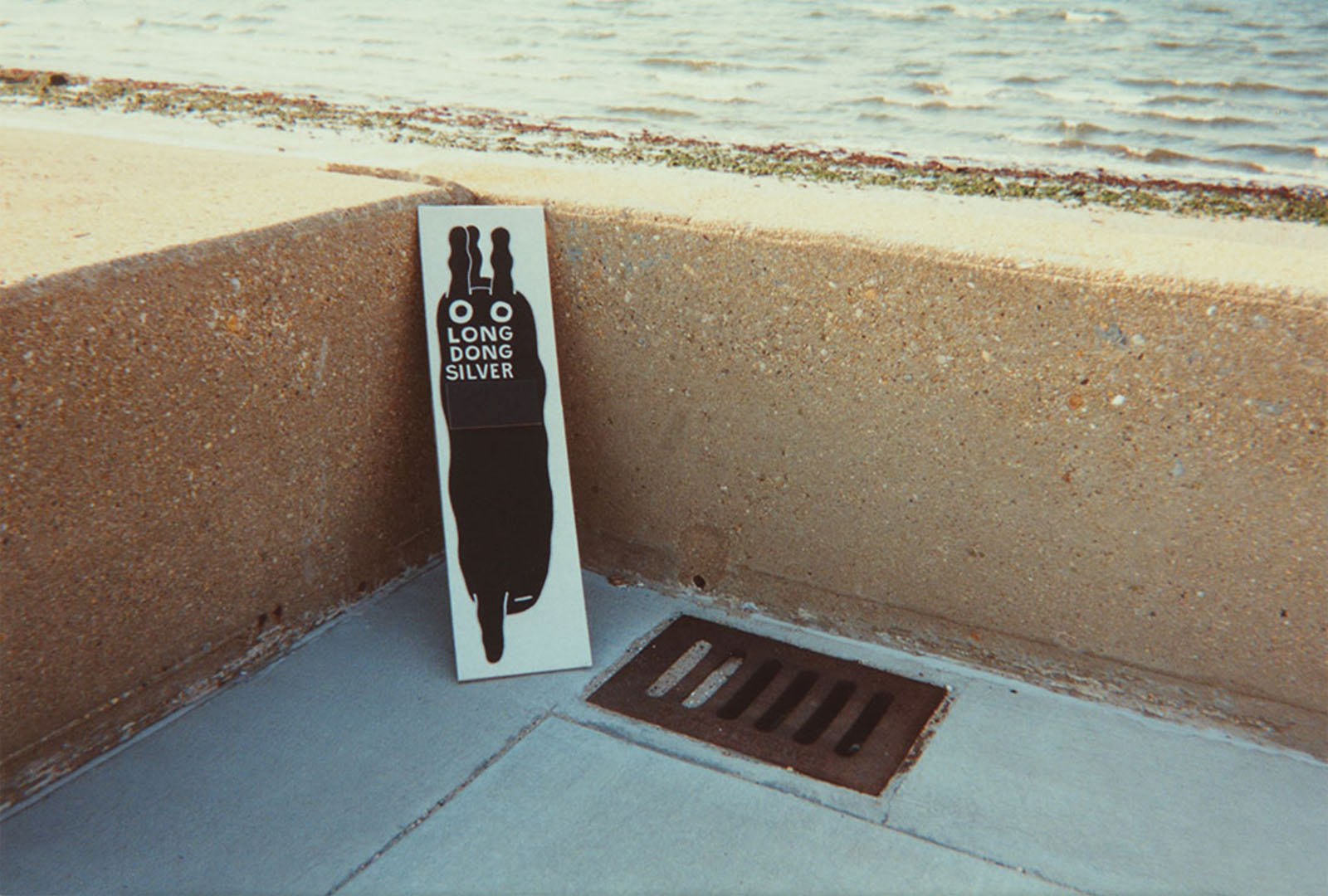
Exhibition: ‘Ruth Asawa: Retrospective’ at the Guggenheim Museum Bilbao

Exhibition dates: 9th March – 13th September, 2026

Curators: Janet Bishop, Thomas Weisel Family Chief Curator, SFMOMA, and Cara Manes, Associate Curator, Department of Painting and Sculpture, MoMA, in collaboration with Geaninne Gutiérrez-Guimarães, Curator, Guggenheim Museum Bilbao
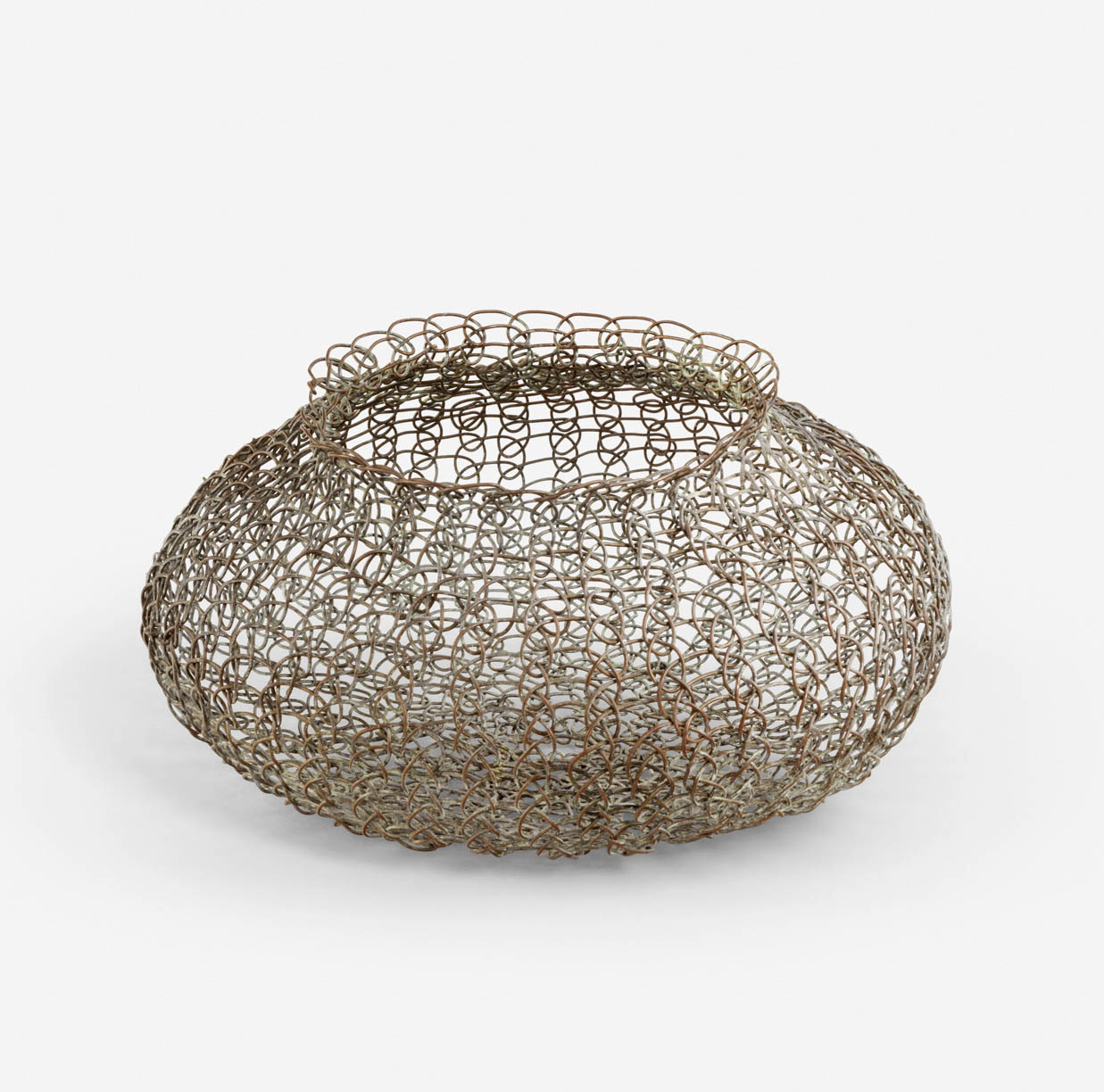
 

Ruth Asawa (American, 1926-2013) 'Untitled' (S.363, Freestanding Basket) c. 1948


Ruth Asawa (American, 1926-2013)
Untitled (S.363, Freestanding Basket)
c. 1948
Copper wire
4 1/2 x 7 1/2 x 7 3/4 in. (11.4 x 19.1 x 19.7cm)
Asheville Art Museum, North Carolina. Black Mountain College Collection
Museum purchase with funds provided by 2010 Collectors’ Circle with additional funds provided by Frances Myers
© 2026 Ruth Asawa Lanier, Inc., courtesy David Zwirner
Photo courtesy Christie’s


I have always admired Ruth Asawa’s work.

There are some beautiful photographs of her wire sculptures on display in various exhibitions; of Asawa in her home with her work. Imagine living in such a home surrounded by your creations, continuous form within a form within the home as her studio. A nest of creativity, comfort and production.

What beauty and natural energy emanates from the soul of this work, work which contains ideas of transparency, continuity, and space. For the artist a way of growing and being as one with the energy of the world.

“Everything is connected, continuous.”

Dr Marcus Bunyan


Many thankx to the Guggenheim Museum Bilbao for allowing me to publish the photographs in the posting. Please click on the photographs for a larger version of the image.


“An artist is an ordinary person who can take ordinary things and make them special.”


“I was interested in wire because of the economy of a line, making something in space, enclosing it without blocking it out. It’s still transparent. I realised that if I was going to make these forms, which interlock and interweave, it can only be done with a line because a line can go anywhere.”


“My curiosity was aroused by the idea of giving structural form to the images in my drawings. These forms come from observing plants, the spiral shell of a snail, seeing light through insect wings, watching spiders repair their webs in the early morning, and seeing the sun through the droplets of water suspended from the tips of pine needles while watering my garden.”


Ruth Asawa


“What’s exceptional about Asawa’s practice is the multiplicity of her artistic pursuits and the marvellous ability to turn the simplest things into subjects of lifelong creative contemplation. The exhibition aims to offer multiple points of entry into her work, reflecting what Asawa described as the ‘total act’ of artmaking.”


Cara Manes, curator of Ruth Asawa: A Retrospective
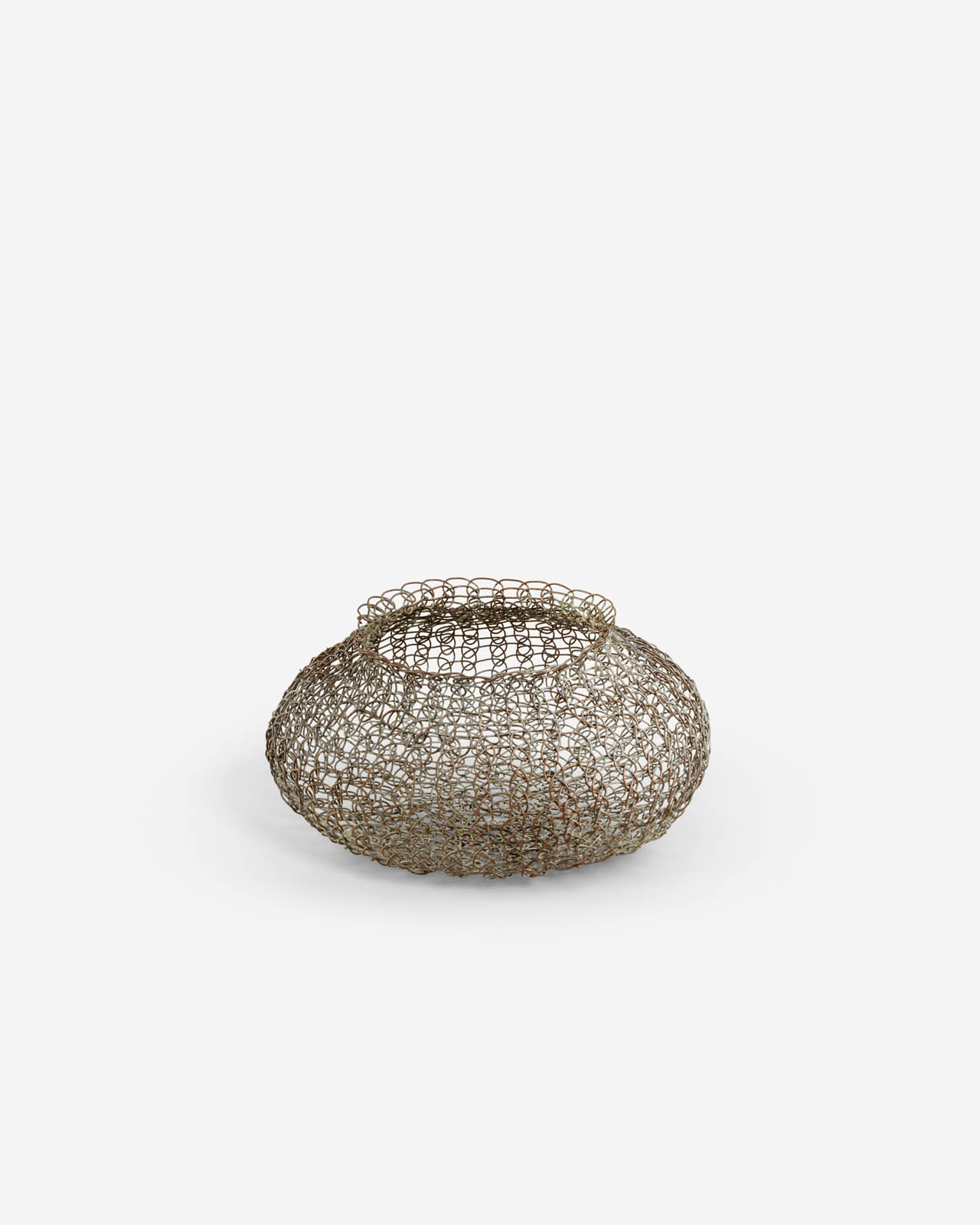


Ruth Asawa (American, 1926-2013) 'Untitled' (S.363, Freestanding Basket) c. 1948


Ruth Asawa (American, 1926-2013)
Untitled (S.363, Freestanding Basket)
c. 1948
Copper wire
4 1/2 x 7 1/2 x 7 3/4 in. (11.4 x 19.1 x 19.7cm)
Asheville Art Museum, North Carolina. Black Mountain College Collection
Museum purchase with funds provided by 2010 Collectors’ Circle with additional funds provided by Frances Myers
© 2026 Ruth Asawa Lanier, Inc., courtesy David Zwirner
Photo courtesy Christie’s


Across mediums and all stages of her practice, Asawa explored continuity, transparency, and the interchangeability of seemingly contradictory concepts like figure and ground, and abstraction and representation. She first articulated these core ideas at Black Mountain College (BMC), a multidisciplinary school with a sensory- and materials-based curriculum that she attended in 1946-49. There, Asawa took courses in mathematics, philosophy, music, and dance. She studied art under Josef Albers, among others, from whom she learned “how to see,” as she later put it.

Asawa’s early drawings, paintings, and wire works in this section took inspiration from natural forms and mathematical patterns, among other sources. A formative trip to Mexico in 1947 introduced Asawa to wire baskets and weaving techniques, which was a major turning point in her own work. By the time she left BMC in 1949, she had made an important discovery. “I continued one basket into a closed form and slowly, while learning to control the medium, began to realize the exciting potential in this way of making sculpture.”
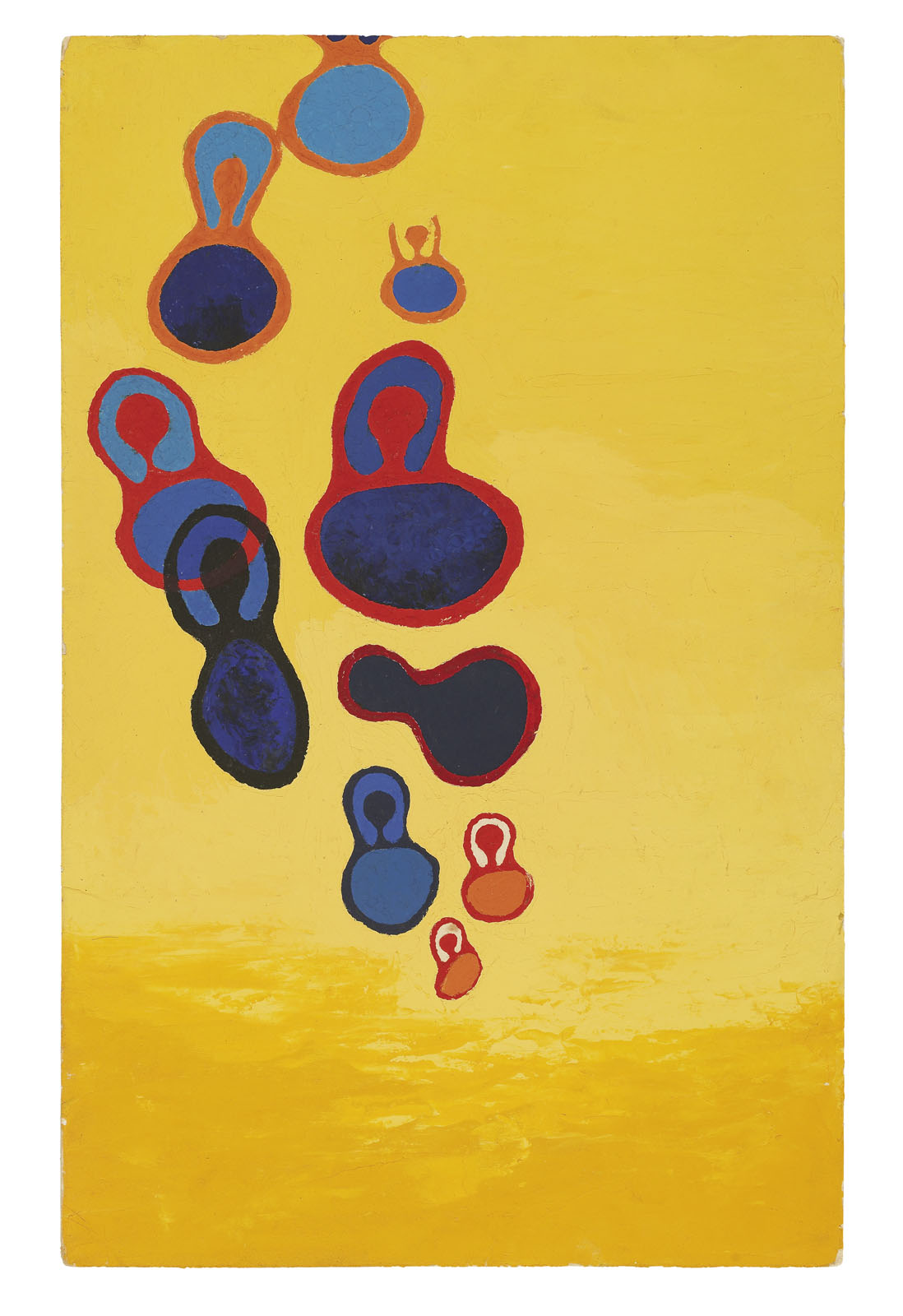
 

Ruth Asawa (American, 1926-2013) 'Untitled' (BMC.52, Dancers) c. 1948-49


Ruth Asawa (American, 1926-2013)
Untitled (BMC.52, Dancers)
c. 1948-49
Oil on paper
48.3 x 30.5cm
Private collection
© 2026 Ruth Asawa Lanier, Inc., courtesy David Zwirner
Photo courtesy Fine Arts Museums of San Francisco
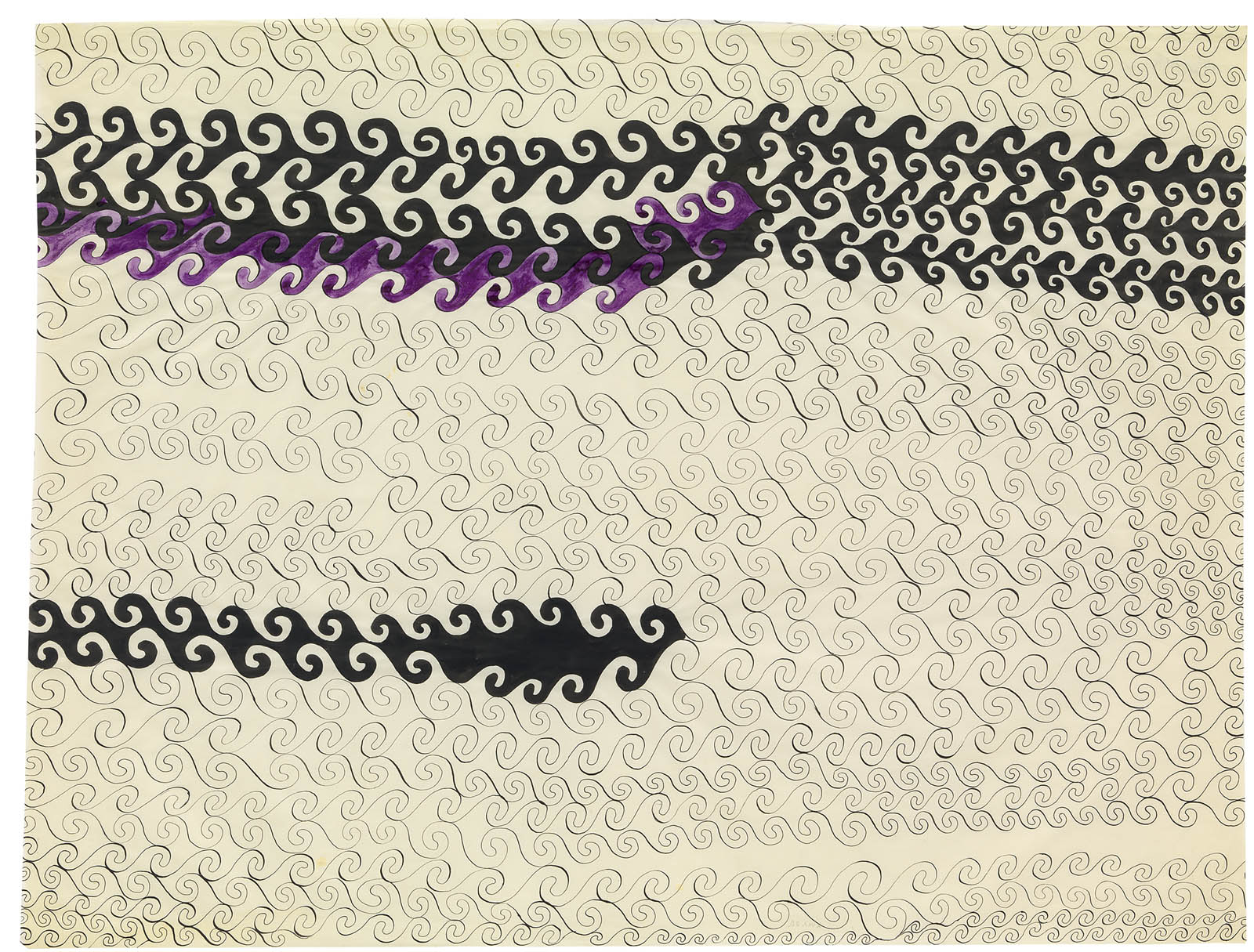
 

Ruth Asawa (American, 1926-2013) 'Untitled' (BMC.58, Meander – Curved Lines) c. 1948


Ruth Asawa (American, 1926-2013)
Untitled (BMC.58, Meander – Curved Lines)
c. 1948
Ink on paper
41.9 x 55.9cm
Private collection
© 2026 Ruth Asawa Lanier, Inc., courtesy David Zwirner; photo courtesy Fine Arts Museums of San Francisco
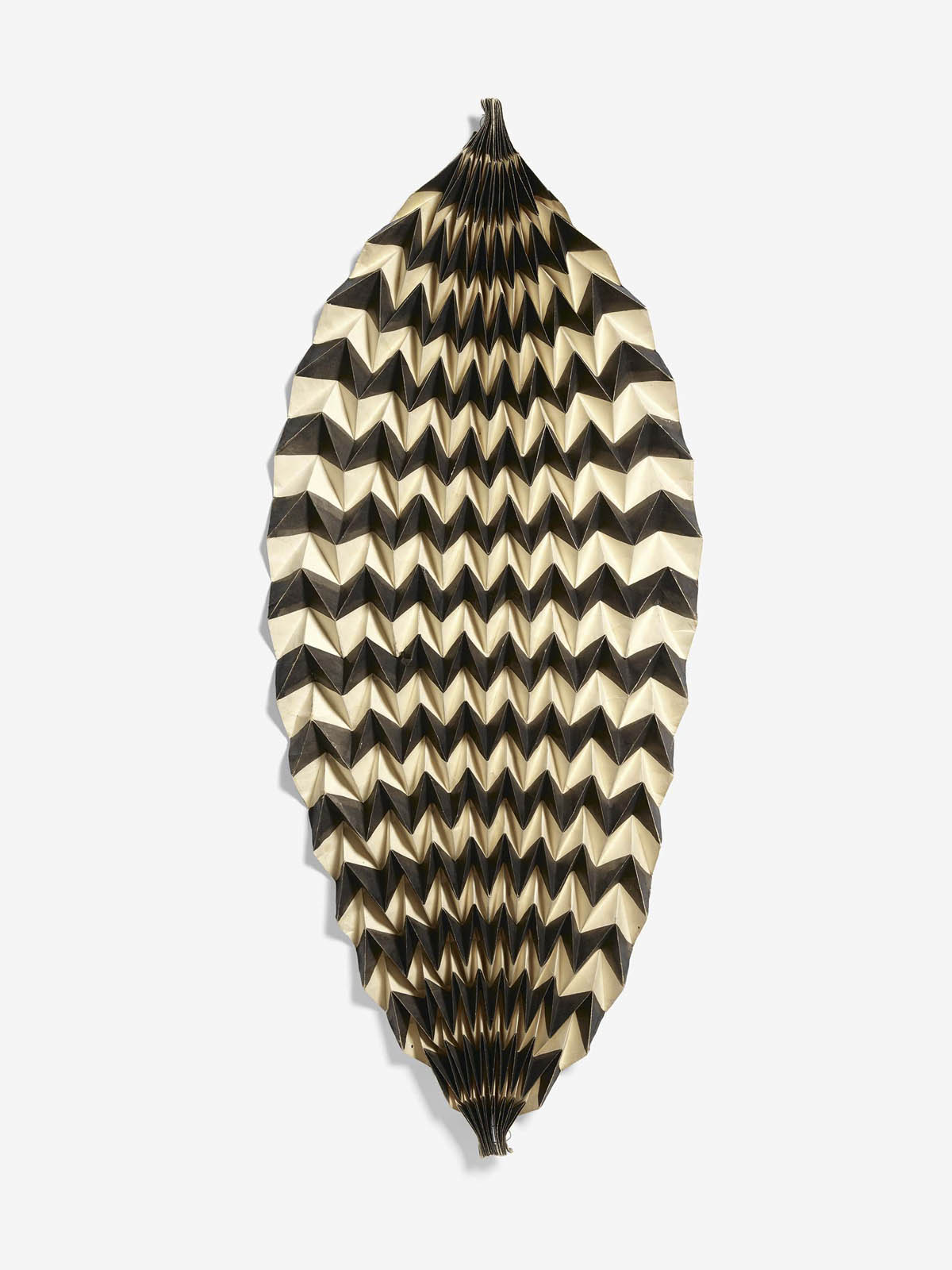
 

Ruth Asawa (American, 1926-2013) 'Untitled' (S.691, Wall-Mounted Paperfold with Horizontal Stripes) 1951


Ruth Asawa (American, 1926-2013)
Untitled (S.691, Wall-Mounted Paperfold with Horizontal Stripes)
1951
Ink on paper
176.5 x 73.7 x 5.7cm
Whitney Museum of American Art, New York
Gift of the Cuneo Family
© 2026 Ruth Asawa Lanier, Inc., courtesy David Zwirner


In the early 1950s Asawa took classes in dance, commercial design, lettering, screenprinting, and painting at San Francisco State College (now San Francisco State University). In these years her work continued to gain local and national attention through exhibitions at the San Francisco and New York showrooms of the interior design company Laverne Originals, and in publications including Vogue.

During this period Asawa made a range of designs for commercial work, including plastic panels based on her paperfolds and wallpaper and textile patterns incorporating logarithmic spiral forms, the Black Mountain College (BMC) laundry stamp, and the footprints of her young children. Although Laverne Originals invited Asawa to mass-produce her looped-wire baskets as home decor, she declined. She explained: “I am interested in producing to sell, but the more I work the more ideas I get and I want to experiment, but experimenting is not producing, since there are always many flops.”
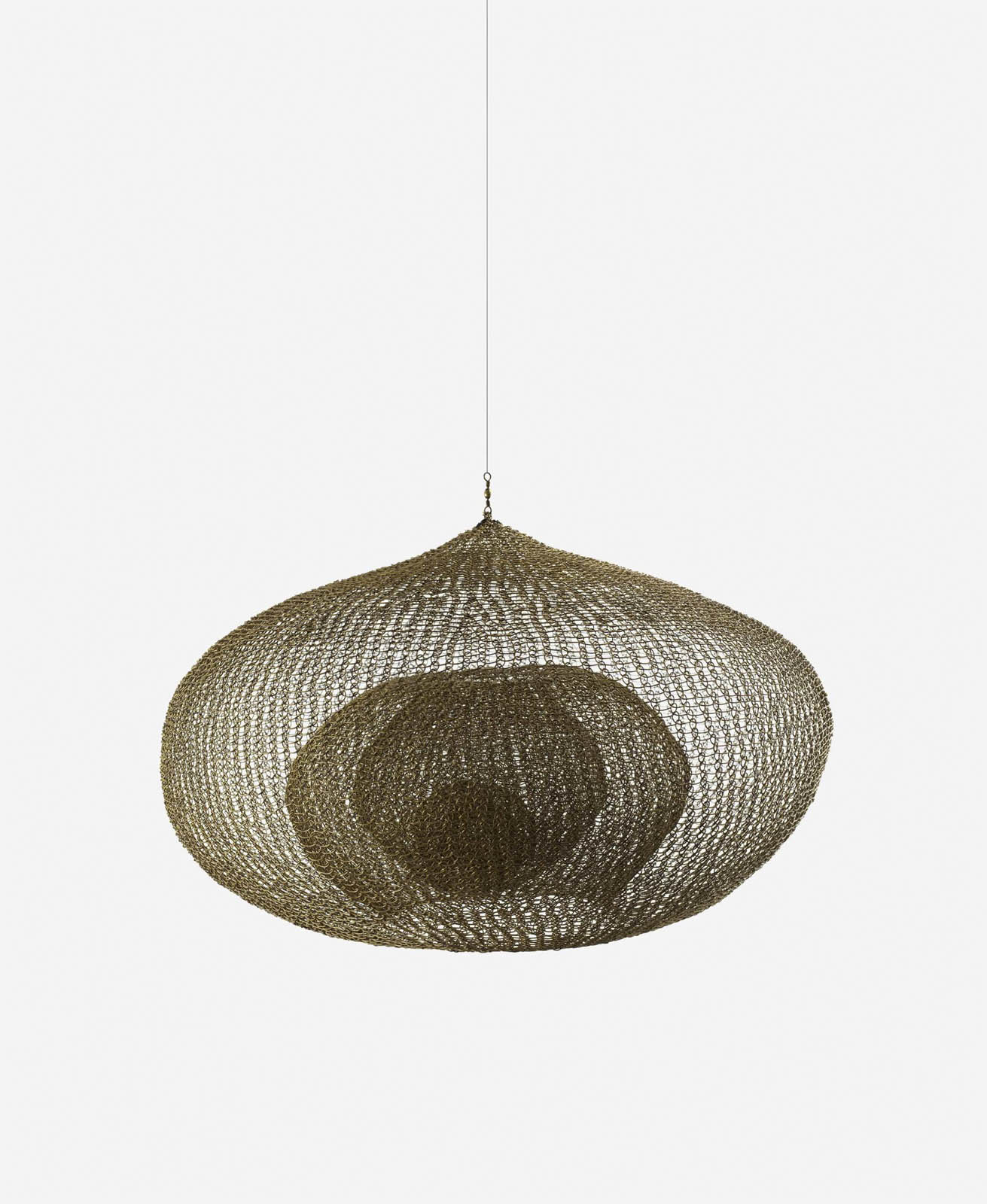
 

Ruth Asawa (American, 1926-2013) 'Untitled' (S.427, Hanging Single-Lobed, Five-Layered Continuous Form within a Form) 1953


Ruth Asawa (American, 1926-2013)
Untitled (S.427, Hanging Single-Lobed, Five-Layered Continuous Form within a Form)
1953
Brass wire
18 x 28 x 28 in. (45.7 x 71.1 x 71.1 cm)
Collection Don Kaul and Barbara Bluhm-Kaul, Chicago
© 2026 Ruth Asawa Lanier, Inc., courtesy David Zwirner
Photo: Maris Hutchinson, courtesy David Zwirner


“These sculptures are made of a continuous wire … enclosing volumes transparently … and producing forms within forms. … The wire must be continuous and the hollow shapes can only be shapes that grow this way.”

~ Ruth Asawa


In 1949 Asawa moved to San Francisco, which became her permanent home. Following California’s repeal of laws prohibiting interracial marriage, she married architect and fellow Black Mountain alumnus, Albert Lanier, and together they started a family. In tandem Asawa began building her art career, dedicating herself full-time to experiments with form building both in space with her looped-wire sculptures and on a flat plane in drawings and prints.

Asawa’s unyielding search for new possibilities within her chosen processes resulted in her signature sculptural motif: a “continuous form within a form,” which she described as “a shape that was inside and outside at the same time.” In a single lobe, a sequence of spheres encloses one another, creating one uninterrupted surface. Asawa would continue to elaborate on this motif for decades to come, foregrounding continuity as a through line for her work. “You can show inside and outside, and inside and outside are connected,” she said. “Everything is connected, continuous.”
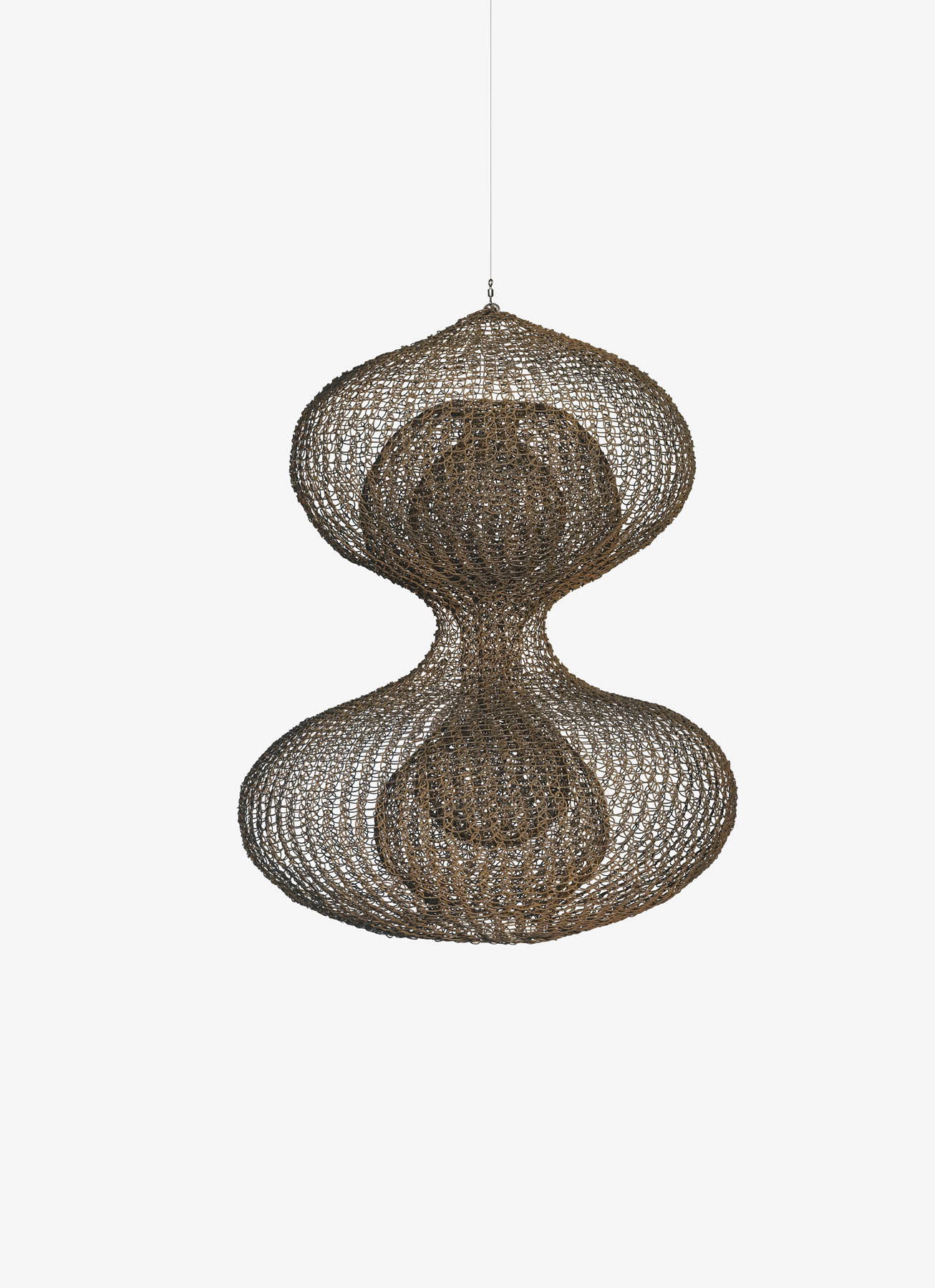
 

Ruth Asawa (American, 1926-2013) 'Untitled' (S.797, Hanging Two-Lobed, Three-Layered Continuous Form within a Form) c. 1954


Ruth Asawa (American, 1926-2013)
Untitled (S.797, Hanging Two-Lobed, Three-Layered Continuous Form within a Form)
c. 1954
Steel wire
49.5 x 38.7 x 38.7cm
Private collection
© 2026 Ruth Asawa Lanier, Inc., courtesy David Zwirner
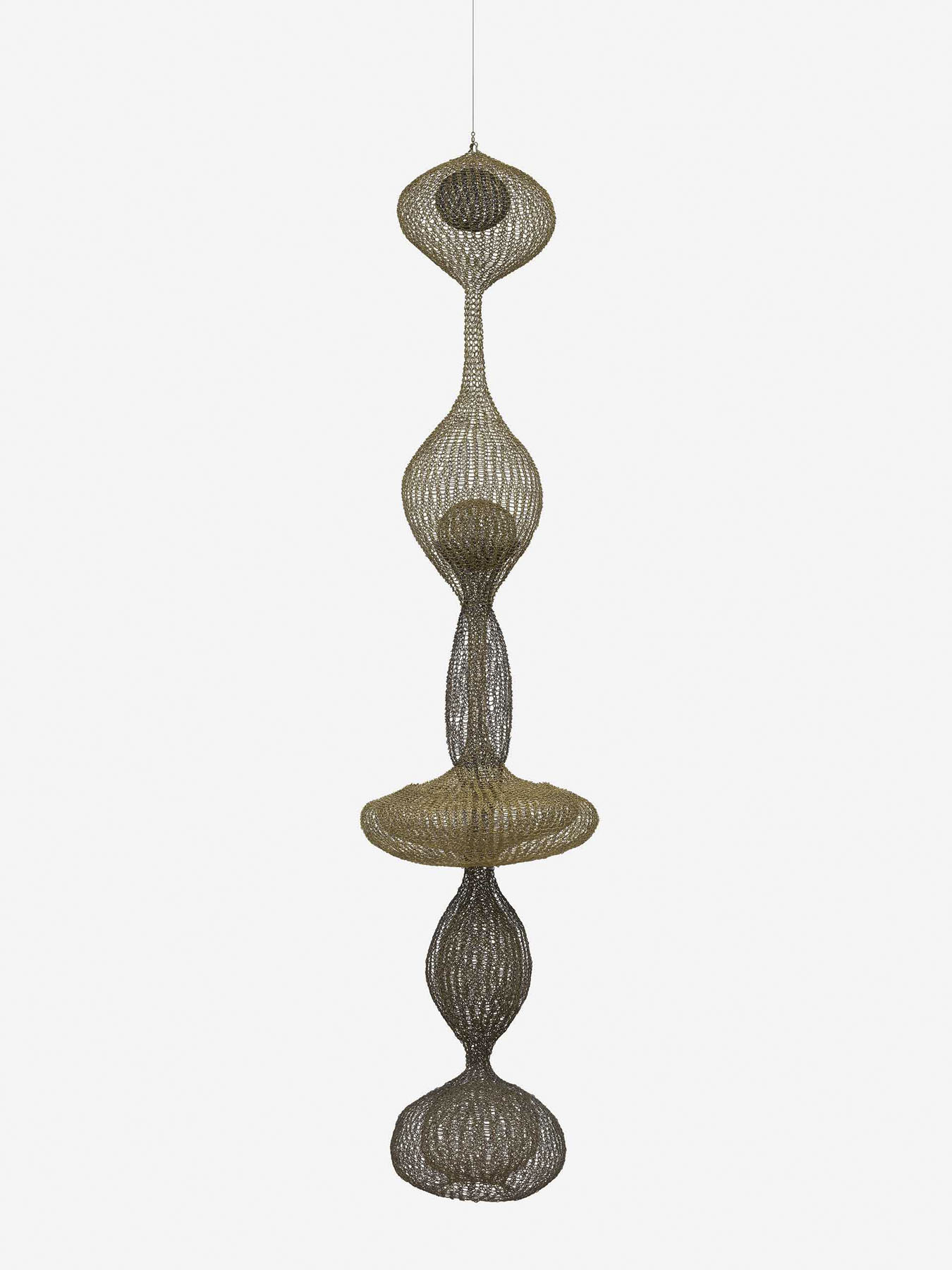
 

Ruth Asawa (American, 1926-2013) 'Untitled' (S.270, Hanging Six-Lobed, Interlocking Continuous Form within a Form with Spheres in the First and Second Lobes) 1955, refabricated 1957-58


Ruth Asawa (American, 1926-2013)
Untitled (S.270, Hanging Six-Lobed, Interlocking Continuous Form within a Form with Spheres in the First and Second Lobes)
1955, refabricated 1957-58
Brass and steel wire
162.2 x 37.9 x 37.9cm
Whitney Museum of American Art, New York
Gift of Howard Lipman
© 2026 Ruth Asawa Lanier, Inc., courtesy David Zwirner
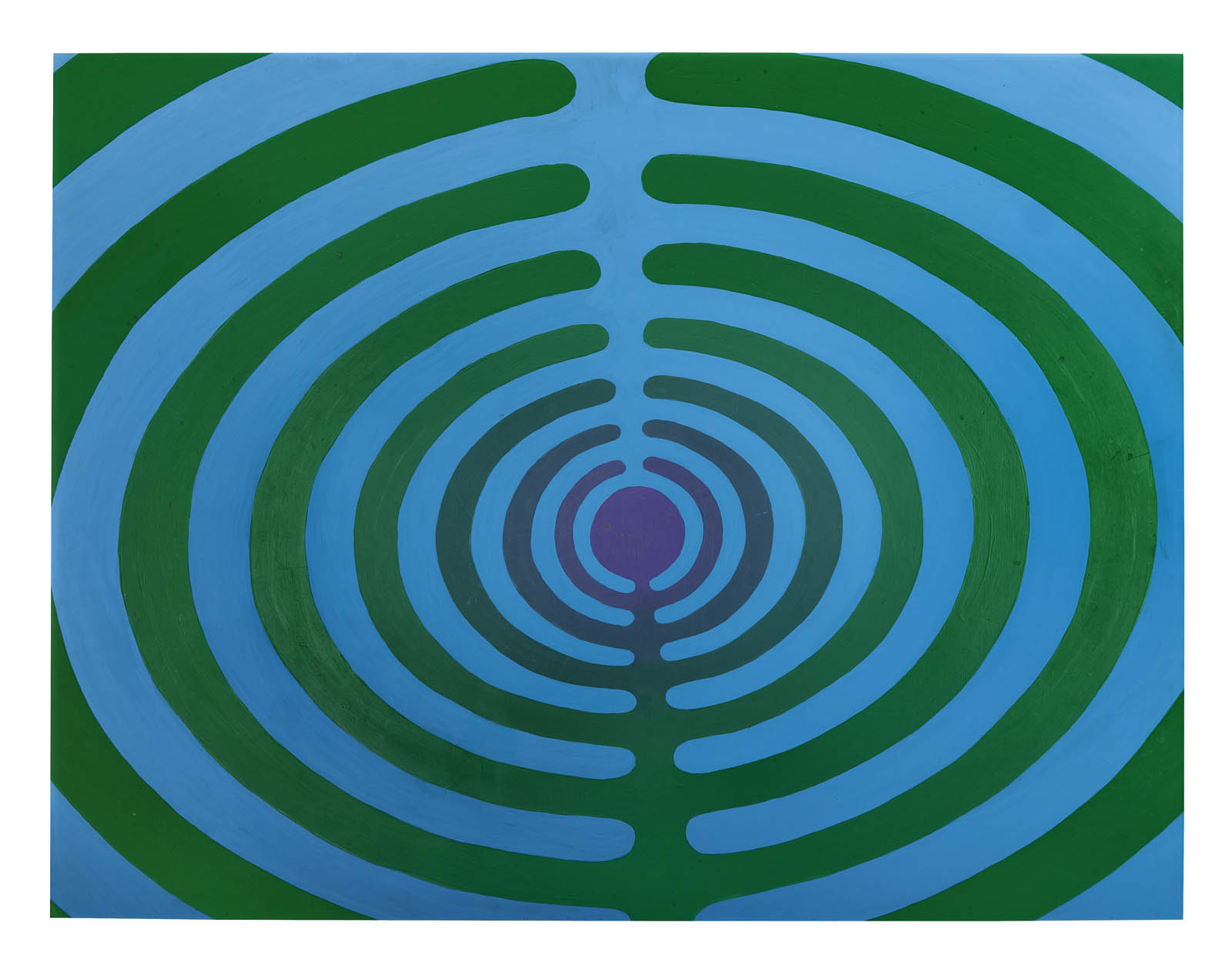
 

Ruth Asawa (American, 1926-2013) 'Untitled' (AB.029, Continuous Form Within a Form) 1956


Ruth Asawa (American, 1926-2013)
Untitled (AB.029, Continuous Form Within a Form)
1956
Acrylic on Masonite
83.8 x 109.2cm
Private collection
© 2026 Ruth Asawa Lanier, Inc., courtesy David Zwirner
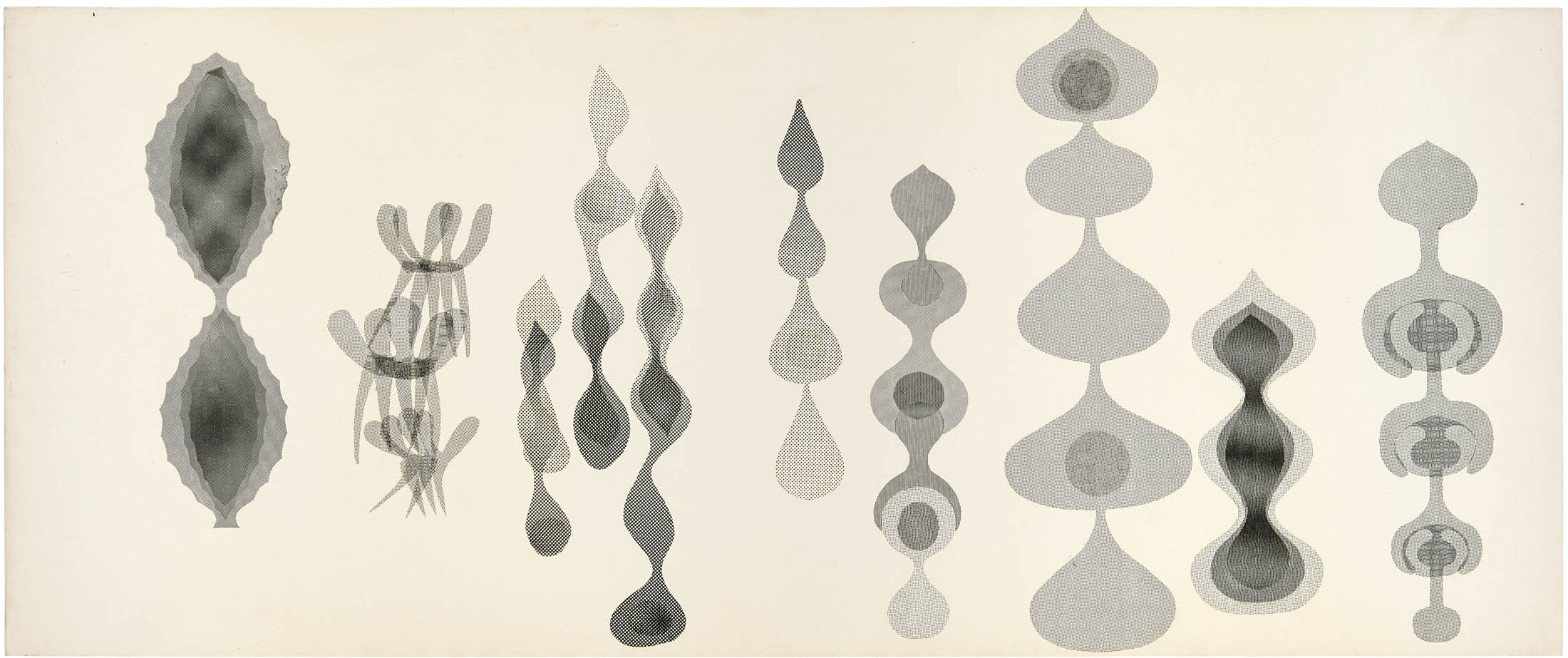
 

Ruth Asawa (American, 1926-2013) 'Untitled' (ZP.16B, Twelve Looped-Wire Sculptural Forms) mid- to late 1950s


Ruth Asawa (American, 1926-2013)
Untitled (ZP.16B, Twelve Looped-Wire Sculptural Forms)
mid- to late 1950s
Screentone on mat board
25.4 x 61cm
Private collection
© 2026 Ruth Asawa Lanier, Inc., courtesy David Zwirner
Photo: James Paonessa
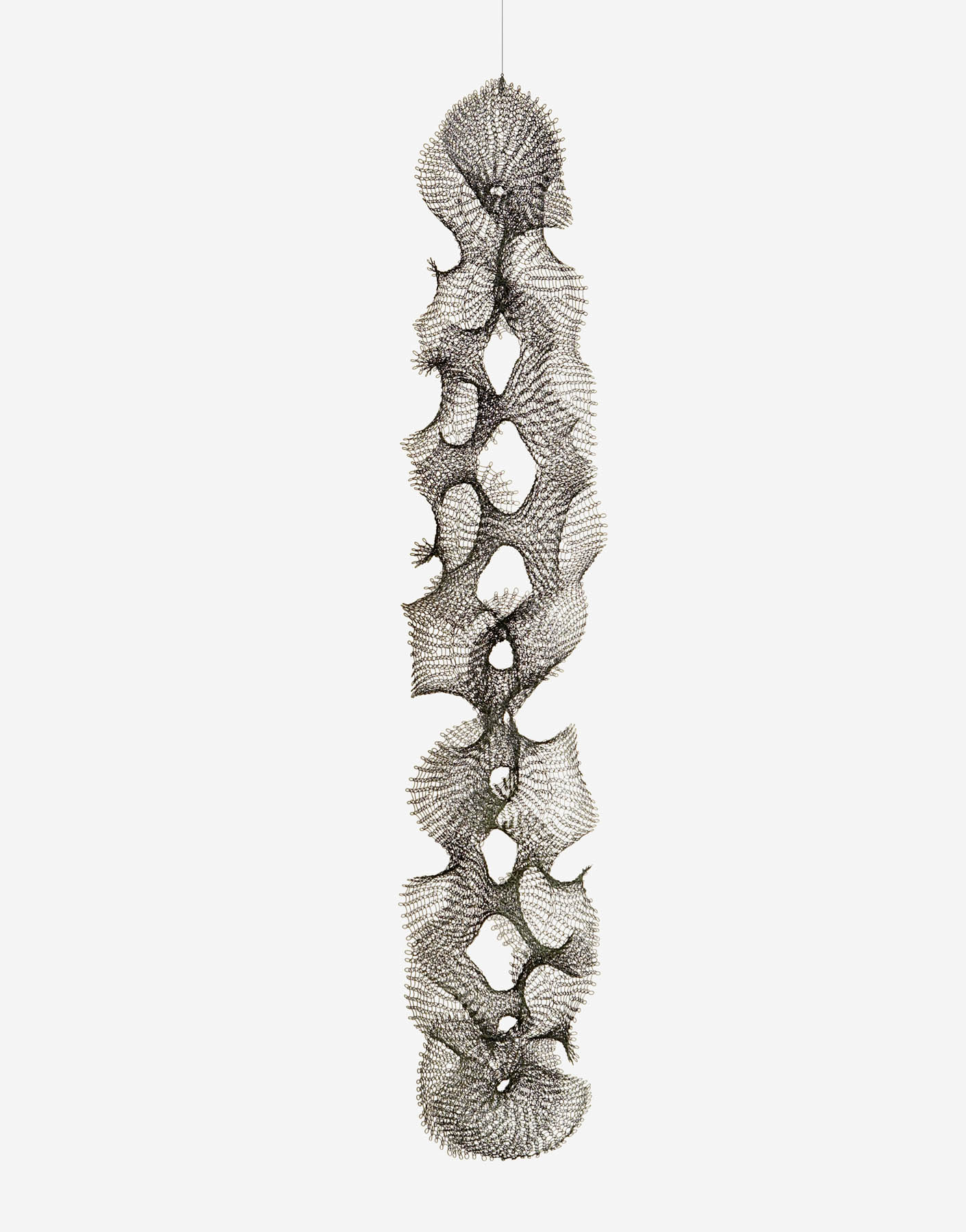
 

Ruth Asawa (American, 1926-2013) 'Untitled' (S.433, Hanging Nine Open Hyperbolic Shapes Joined Laterally) c. 1958


Ruth Asawa (American, 1926-2013)
Untitled (S.433, Hanging Nine Open Hyperbolic Shapes Joined Laterally)
c. 1958
Copper wire
193 x 38.1 x 38.1cm
William Roth Estate
© 2026 Ruth Asawa Lanier, Inc., courtesy David Zwirner
Photo: Laurence Cuneo
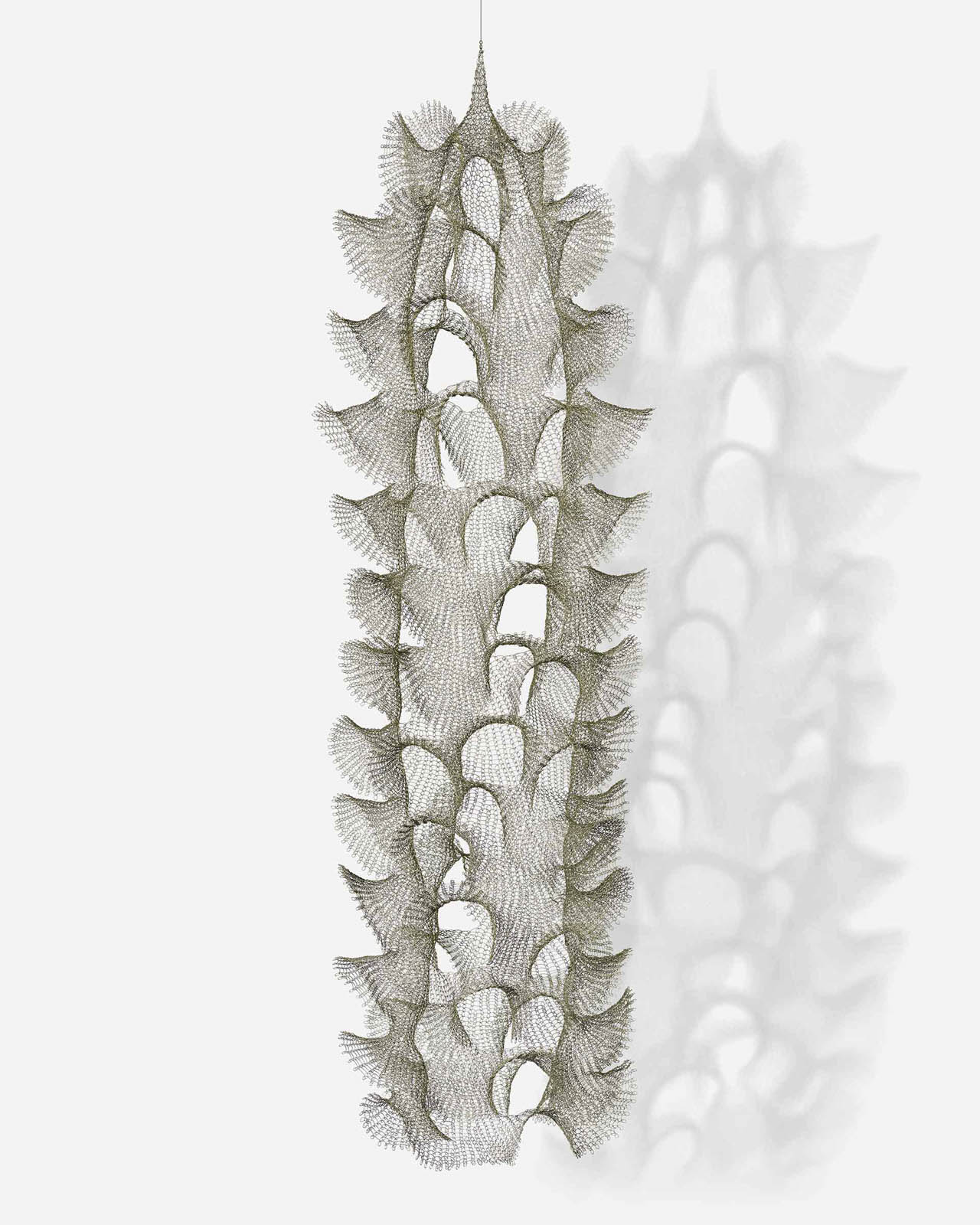
 

Ruth Asawa (American, 1926-2013) 'Untitled' (S.039, Hanging Five Spiraling Columns of Open Windows) c. 1959-1960


Ruth Asawa (American, 1926-2013)
Untitled (S.039, Hanging Five Spiraling Columns of Open Windows)
c. 1959-1960
Monel wire
213.4 x 61 x 61cm
de Young Museum, Fine Arts Museums of San Francisco
Gift of the artist
Artwork © 2026 Ruth Asawa Lanier, Inc., Courtesy David Zwirner
Photo: Laurence Cuneo


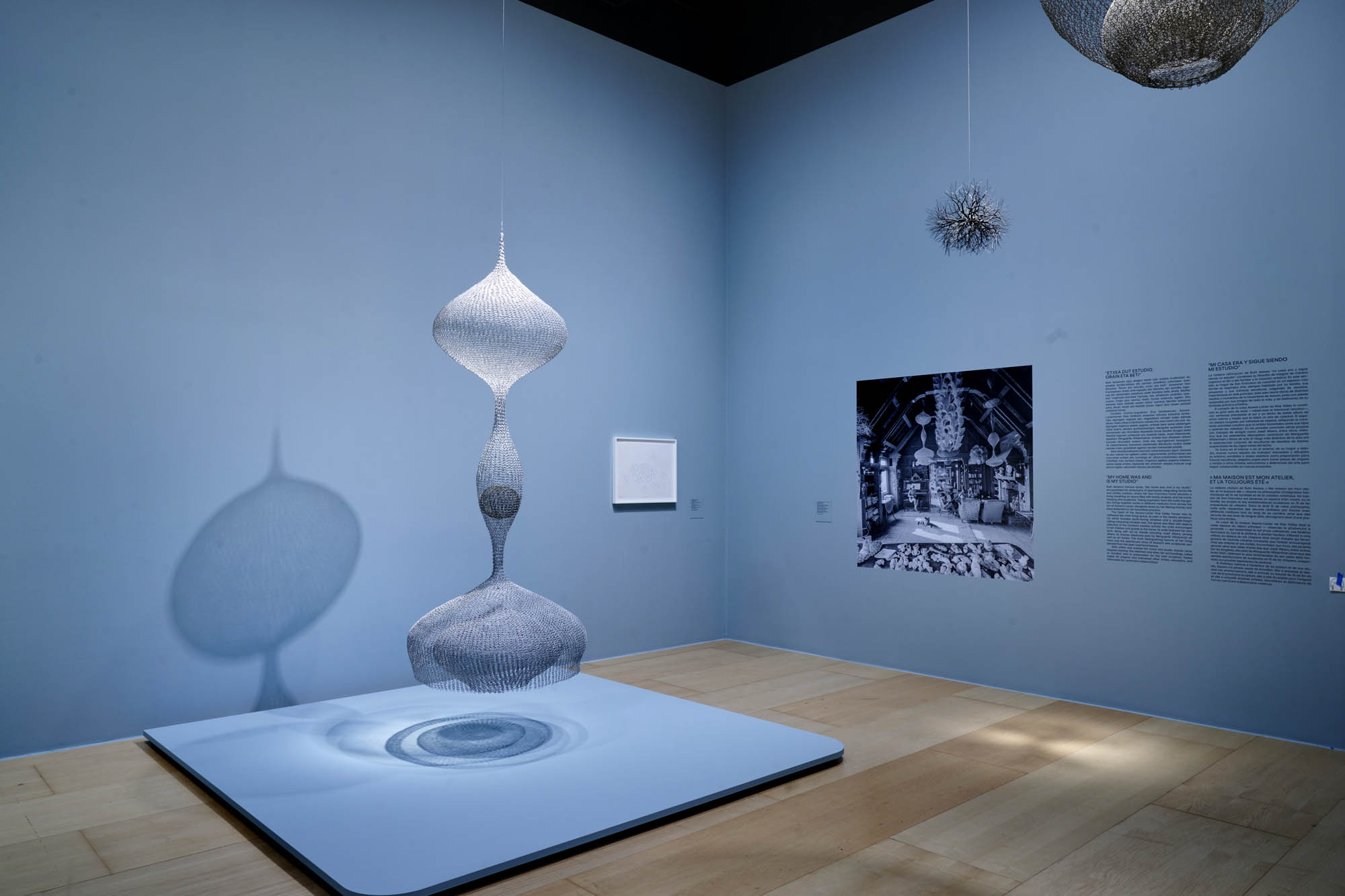
Asawa’s famous quote, “My home was and is my studio,” encapsulates her philosophy of seamlessly integrating family life and artistic creation, where her San Francisco home became a living, breathing art space filled with family, projects, and her iconic hanging wire sculptures. Taking inspiration from this motif, this gallery brings together works in different mediums from across the arc of Asawa’s career, alongside works by her lifelong friends, and pays testament to her boundless practice.

The heart of the Asawa-Lanier Noe Valley house was its cathedral-like main living space, which boasted south-facing windows and a double-height ceiling measuring over five meters tall. The space was filled with objects reflective of the constant creative activity the artist encouraged in her children and guests to the home. Its walls featured her own work along with art by friends including Josef Albers, among others. Its shelves displayed pots by Marguerite Wildenhain as well as art books. The most distinguishing feature of her living room was the spectacular array of Asawa’s wire sculptures suspended from the open overhead beams.

Both within and outside her home and studio, Asawa never stopped working: She sketched and drew her surroundings, coiled or bundled wire in preparation for the next sculpture, folded paper for origami, and welcomed other artists, educators, and advocates for continued collaborations.
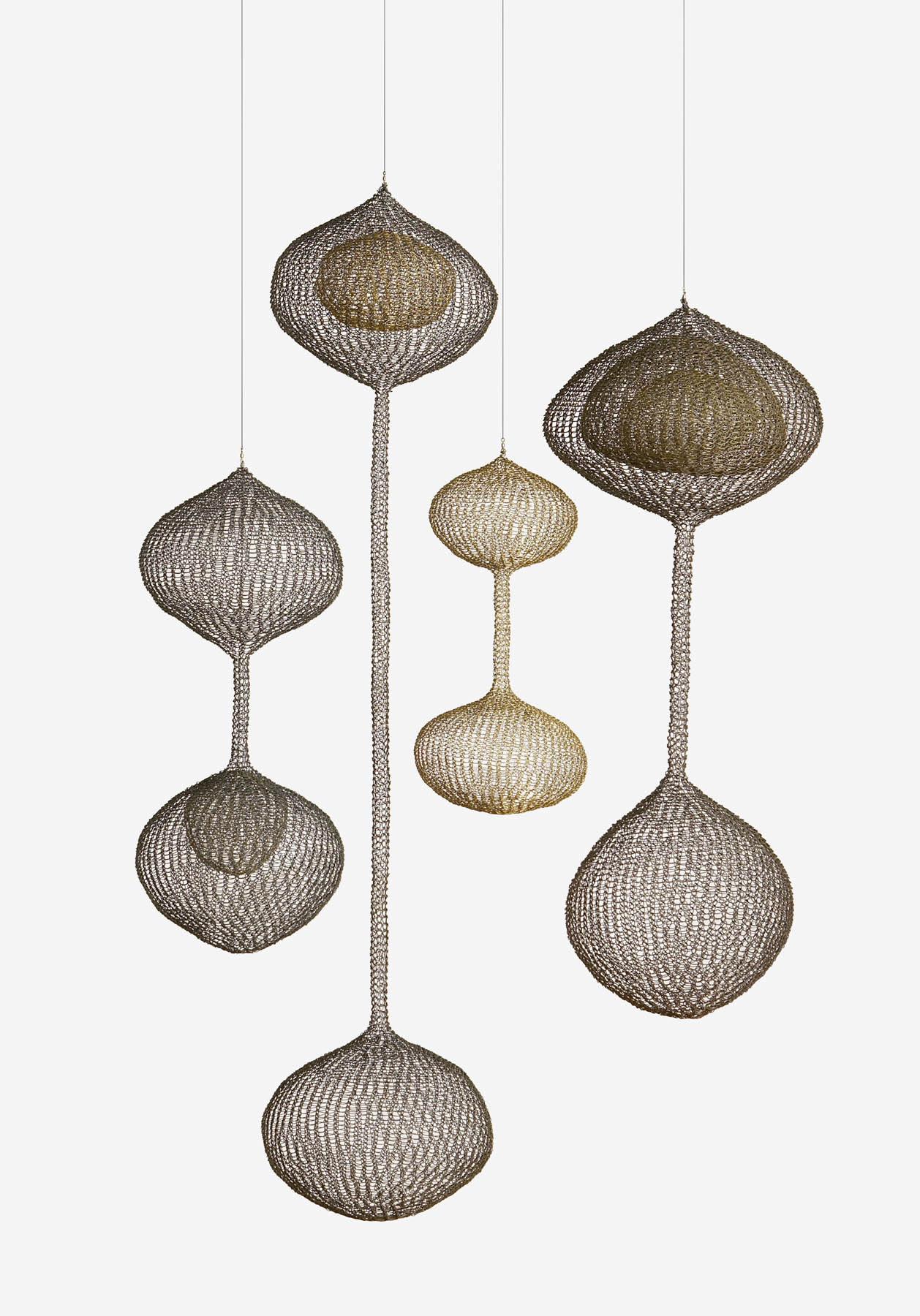
 

Ruth Asawa (American, 1926-2013) 'Untitled' (S.046a-d, Hanging Group of Four, Two-Lobed Forms) 1961


Ruth Asawa (American, 1926-2013)
Untitled (S.046a-d, Hanging Group of Four, Two-Lobed Forms)
1961
Copper and brass wire
(a): 152.4 x 43.2 x 17.8cm
(b): 53.3 x 30.5 x 30.5cm
(c): 81.3 x 33 x 33cm
(d): 104.1 x 40.6 x 40.6cm
Collection of Diana Nelson and John Atwater
Promised gift to the San Francisco Museum of Modern Art
© 2026 Ruth Asawa Lanier, Inc., courtesy David Zwirner
Photo: Laurence Cuneo
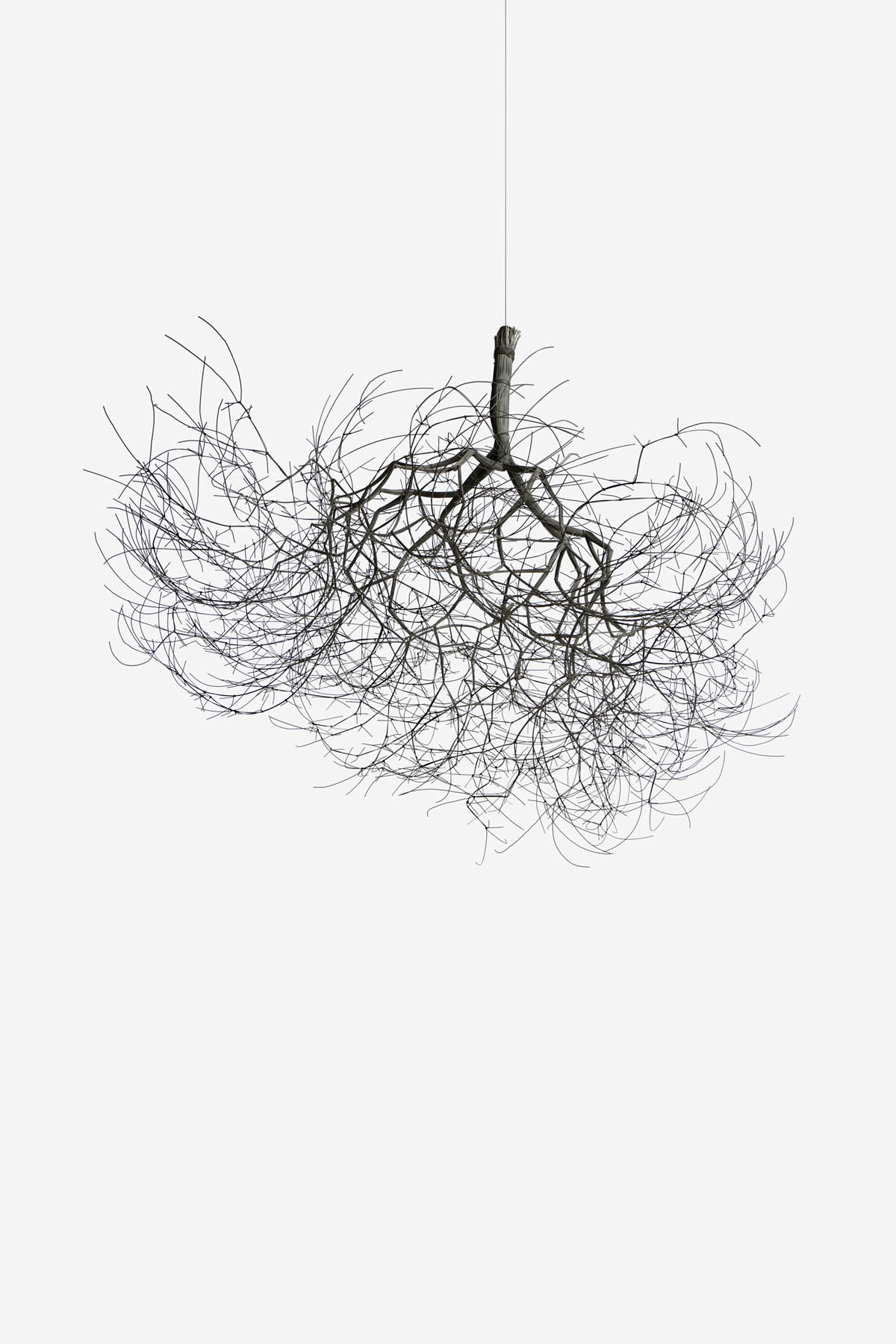
 

Ruth Asawa (American, 1926-2013) 'Untitled' (S.184, Hanging Tied-Wire, Single-Stem, Multi-Branched Form Based on Nature) c. 1962


Ruth Asawa (American, 1926-2013)
Untitled (S.184, Hanging Tied-Wire, Single-Stem, Multi-Branched Form Based on Nature)
c. 1962
Galvanized steel wire
76.2 x 101.6 x 101.6cm
Collection of Diana Nelson and John Atwater
© 2026 Ruth Asawa Lanier, Inc., courtesy David Zwirner
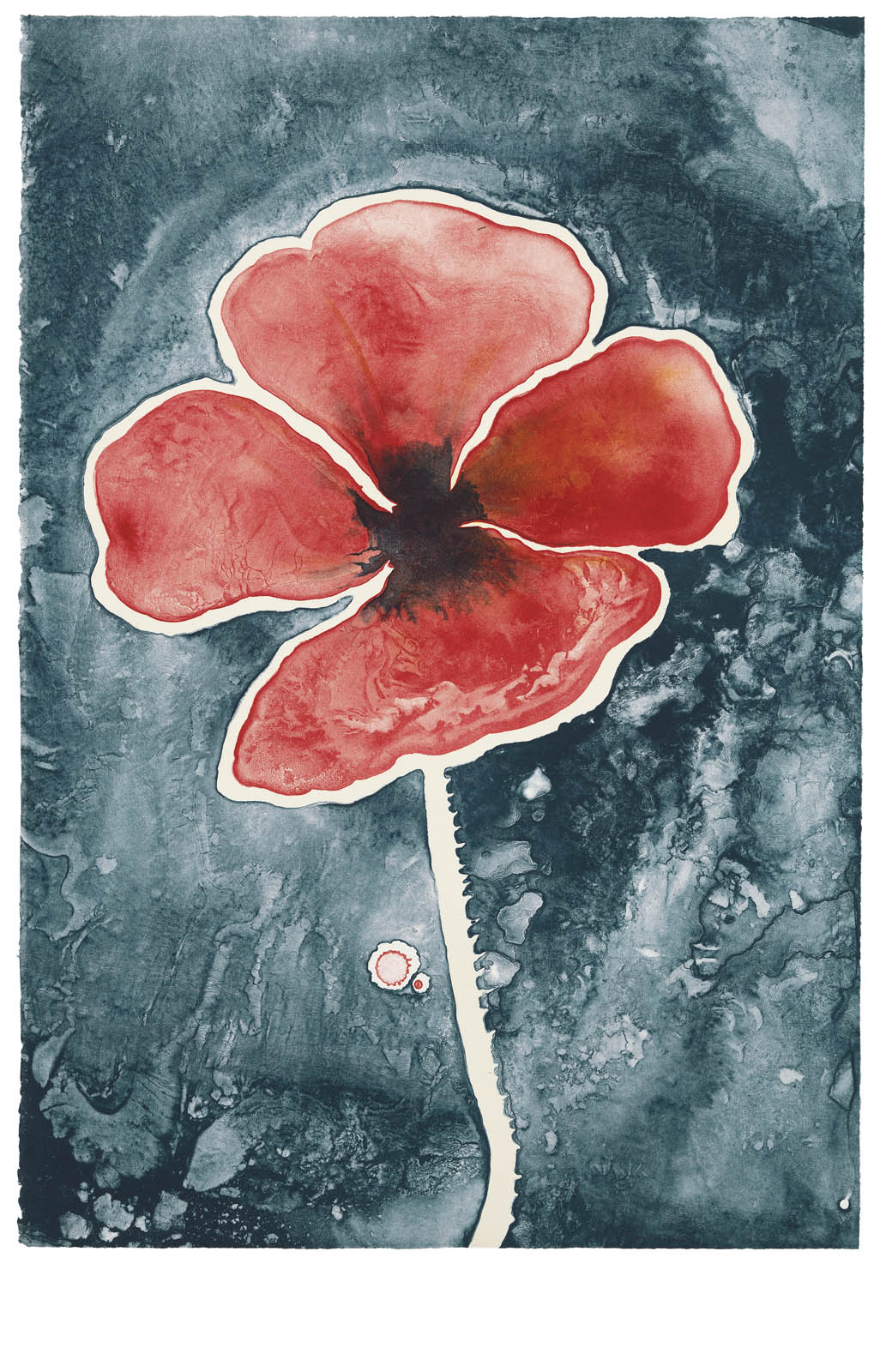
 

Ruth Asawa (American, 1926-2013) 'Poppy' (TAM.1479) 1965


Ruth Asawa (American, 1926-2013)
Poppy (TAM.1479)
1965
Lithograph
76.4 x 52.2cm
The Museum of Modern Art, New York
Gift of Kleiner, Bell & Co
© 2026 Ruth Asawa Lanier, Inc., courtesy David Zwirner
Photo: © 2015 MoMA, NY
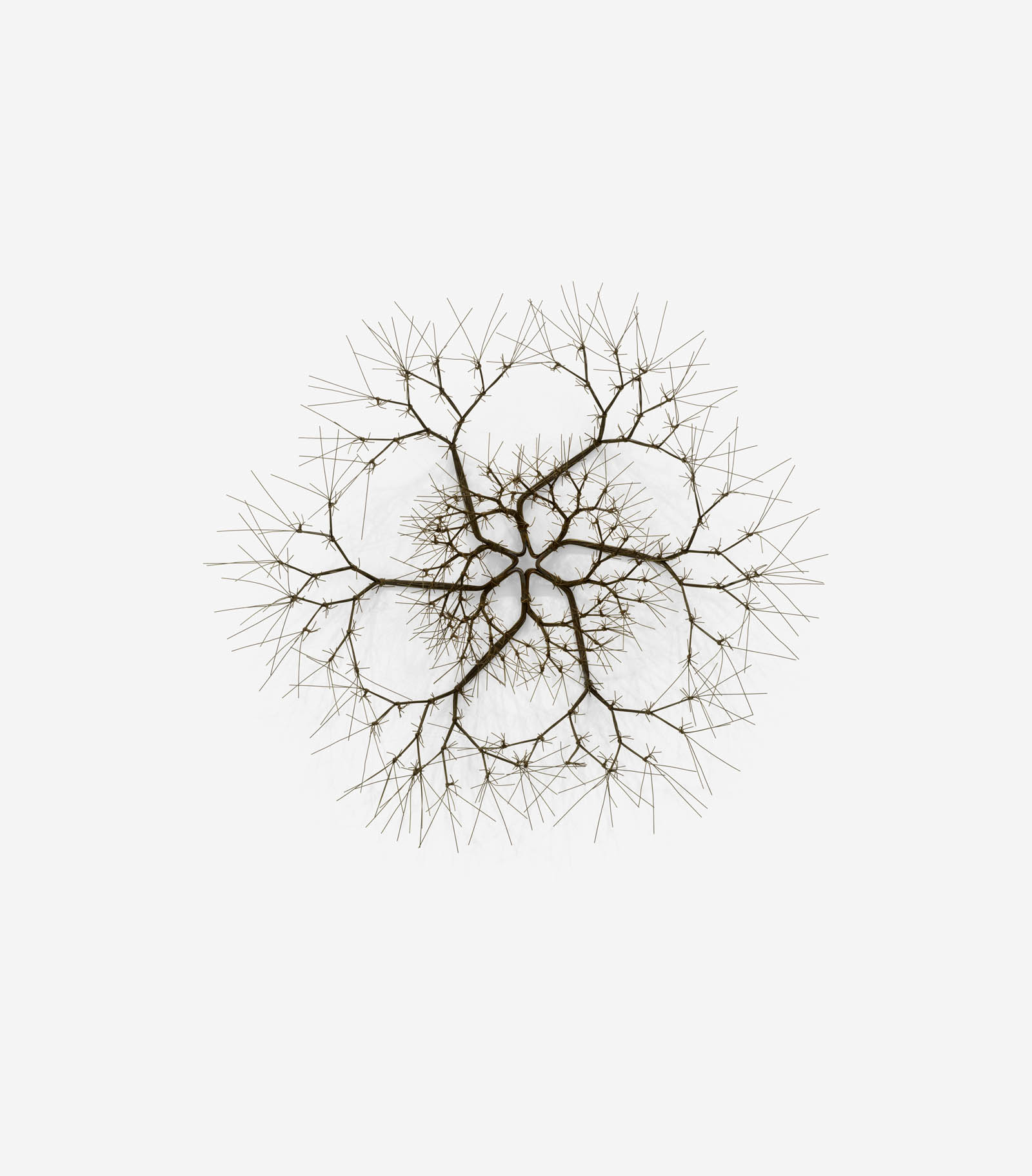
 

Ruth Asawa (American, 1926-2013) 'Untitled' (S.451, Wall-Mounted Tied-Wire, Open-Center, Six-Branched Form Based on Nature) c. 1965


Ruth Asawa (American, 1926-2013)
Untitled (S.451, Wall-Mounted Tied-Wire, Open-Center, Six-Branched Form Based on Nature)
c. 1965
Brass and copper wire
63.5 x 73.7 x 19.1cm
Private collection
© 2026 Ruth Asawa Lanier, Inc., courtesy David Zwirner
Photo: Dan Bradica, courtesy David Zwirner
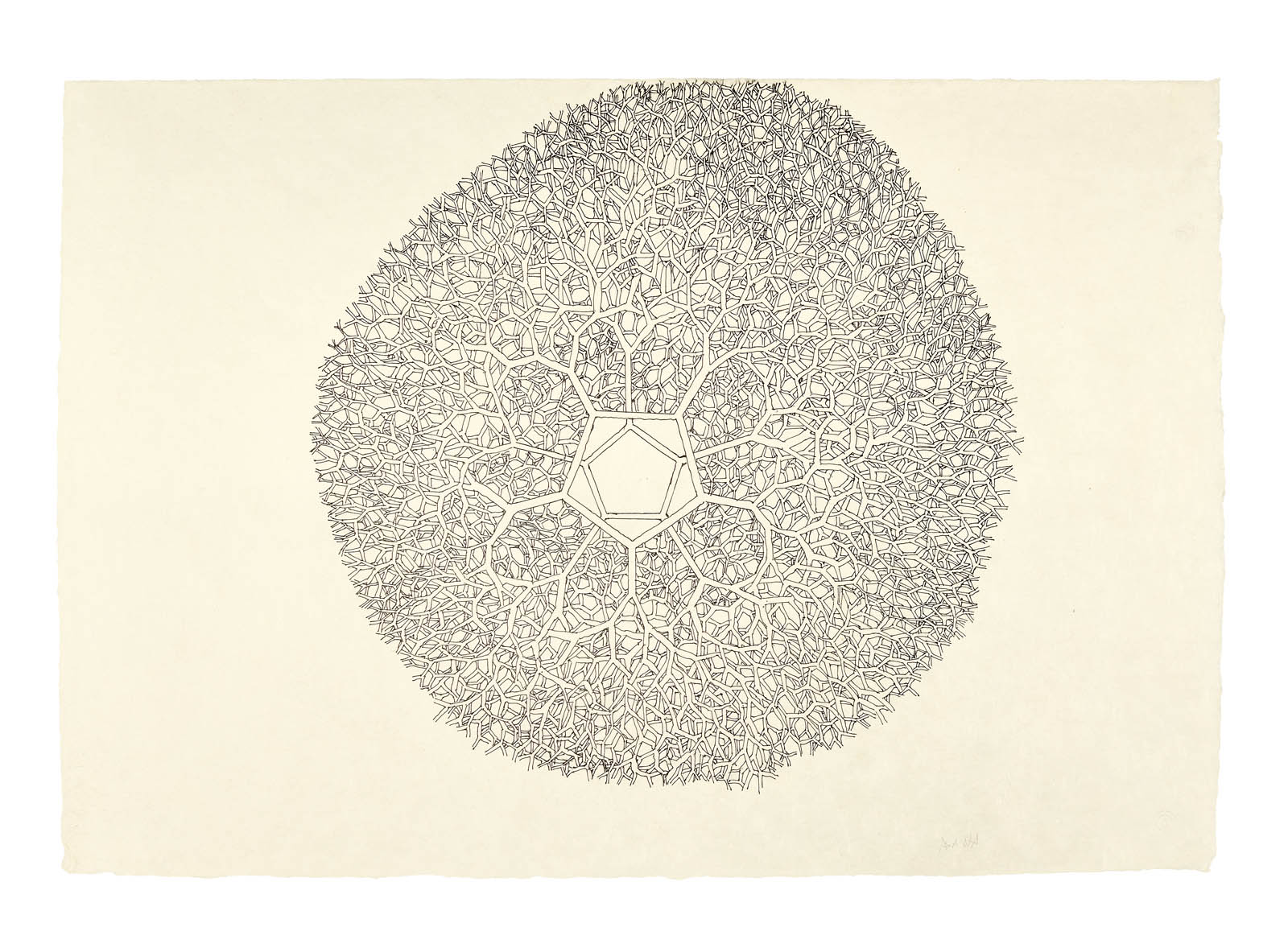
 

Ruth Asawa (American, 1926-2013) 'Untitled' (SD.017, Tied-Wire Sculpture Drawing with Open Pentagon in Center) 1980s to mid-1990s


Ruth Asawa (American, 1926-2013)
Untitled (SD.017, Tied-Wire Sculpture Drawing with Open Pentagon in Center)
1980s to mid-1990s
Ink on paper
46.4 x 66cm
Private collection
© 2026 Ruth Asawa Lanier, Inc., courtesy David Zwirner
Photo: James Paonessa
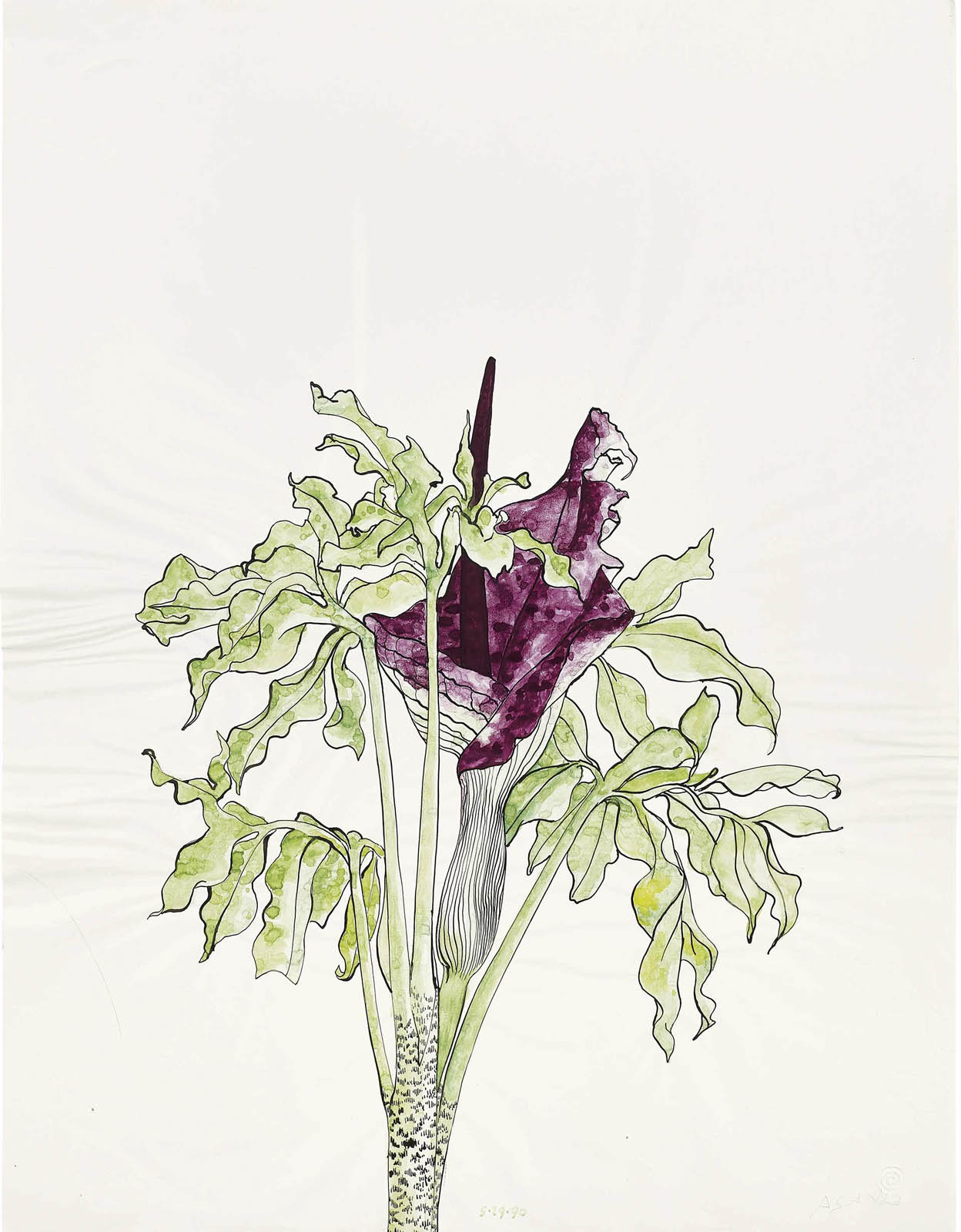
 

Ruth Asawa (American, 1926-2013) 'Untitled' (WC.090, Voodoo Lily) 1990


Ruth Asawa (American, 1926-2013)
Untitled (WC.090, Voodoo Lily)
1990
Ink and watercolour on paper
63.5 x 48.26cm
Private collection
© 2026 Ruth Asawa Lanier, Inc., courtesy David Zwirner


Over the course of her career, Asawa tirelessly returned to depicting plants and flowers, tracing the shapes of irises, hydrangeas, chrysanthemums, and other flora from her garden in sketchbooks and works on paper. For Asawa, drawing from life was more than simple observation; it became a value and mode of engaging with the world and present moment. “Life draws,” she once wrote, expressing how the events and objects around her defined her work.

In 1985 Asawa was diagnosed with lupus and for nearly a year her physical capacity was significantly reduced, but her creative spirit remained undiminished. In the last decades of her career, she concentrated her creative output on botanical drawings, some of which are gathered in this section. These intimate works, at times extremely realistic, at others abstract, often began with a gesture of generosity: gifts of plants from the artist’s friends and family, after whom many works are titled – such as Albert’s Bouquet from the Garden (1999) or Valentine Bouquet from Adam (1991), referring to her son who often tended his parents’ flowering plants during their later years. Through the daily routine of recording the natural world around her, Asawa documented the extended community she shared it with, as well as the passage of time.
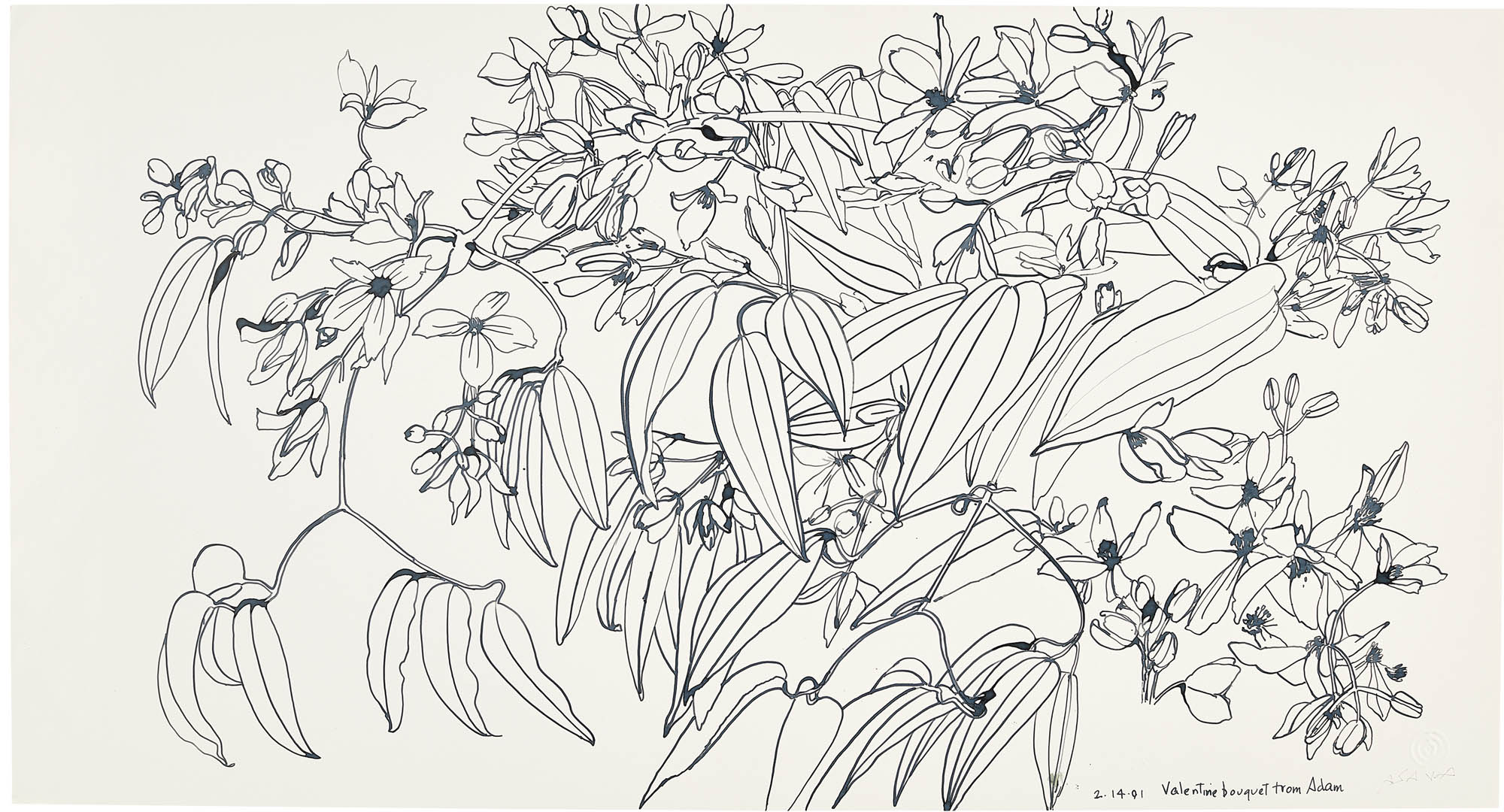
 

Ruth Asawa (American, 1926-2013) 'Valentine Bouquet from Adam' (PF.555) 1991


Ruth Asawa (American, 1926-2013)
Valentine Bouquet from Adam (PF.555)
1991
Ink on paper
31.8 x 58.4cm
Private collection
© 2026 Ruth Asawa Lanier, Inc., courtesy David Zwirner
Photo: James Paonessa


Unfolding across ten sections that span the arc of a six decade-long career, this exhibition traces the full breadth and depth of the innovative practice of an iconic artist. Ruth Aiko Asawa (b. 1926, Norwalk, California, USA; d. 2013, San Francisco, USA) integrated her creative work with all aspects of her life as an artist, educator and arts advocate. This interconnectedness is illuminated in photographs and ephemera presented alongside and in response to the works featured here, from the suspended looped-wire sculptures for which she is best known to nature-inspired tied-wire pieces, clay and bronze casts, paperfolds, paintings, drawings, sketchbooks, and prints. Challenging distinctions between abstraction and representation, figure and ground, and negative and positive space, her work invites us to contemplate how disparate elements interact in a composition, which in turn engages with its surroundings.

Asawa was the fourth of seven children of Japanese immigrant farmers. During World War II, she and her family were forcibly incarcerated by the United States government because of their Japanese ancestry. In 1946, after being denied an art teaching degree because of anti Japanese prejudice, she enrolled at the progressive Black Mountain College in North Carolina. In the school’s democratic environment, she forged a creative path grounded in experimentation and an ethos of hard, continuous work. From her time at Black Mountain through the end of her life in San Francisco, where she moved in 1949, Asawa situated her artistic practice within set parameters to investigate ideas of transparency, continuity, and space. In the 1960s, she also expanded her life’s work to directly engage her community through public commissions, arts education, and civic advocacy.

Taking its cue from the artist’s multifaceted work, this retrospective charts Asawa’s career and legacy, highlighting her ceaseless experimentation with material and form evident in her radical innovations.

Ruth Asawa: Retrospective is an exhibition partnership between the San Francisco Museum of Modern Art (SFMOMA) and the Museum of Modern Art, New York (MoMA). This presentation was developed in collaboration with the Guggenheim Museum Bilbao.

The exhibition is co-curated by Janet Bishop, Thomas Weisel Family Chief Curator, SFMOMA, and Cara Manes, Associate Curator, Department of Painting and Sculpture, MoMA, in collaboration with Geaninne Gutiérrez-Guimarães, Curator, Guggenheim Museum Bilbao.

Text from the Guggenheim Museum Bilbao website
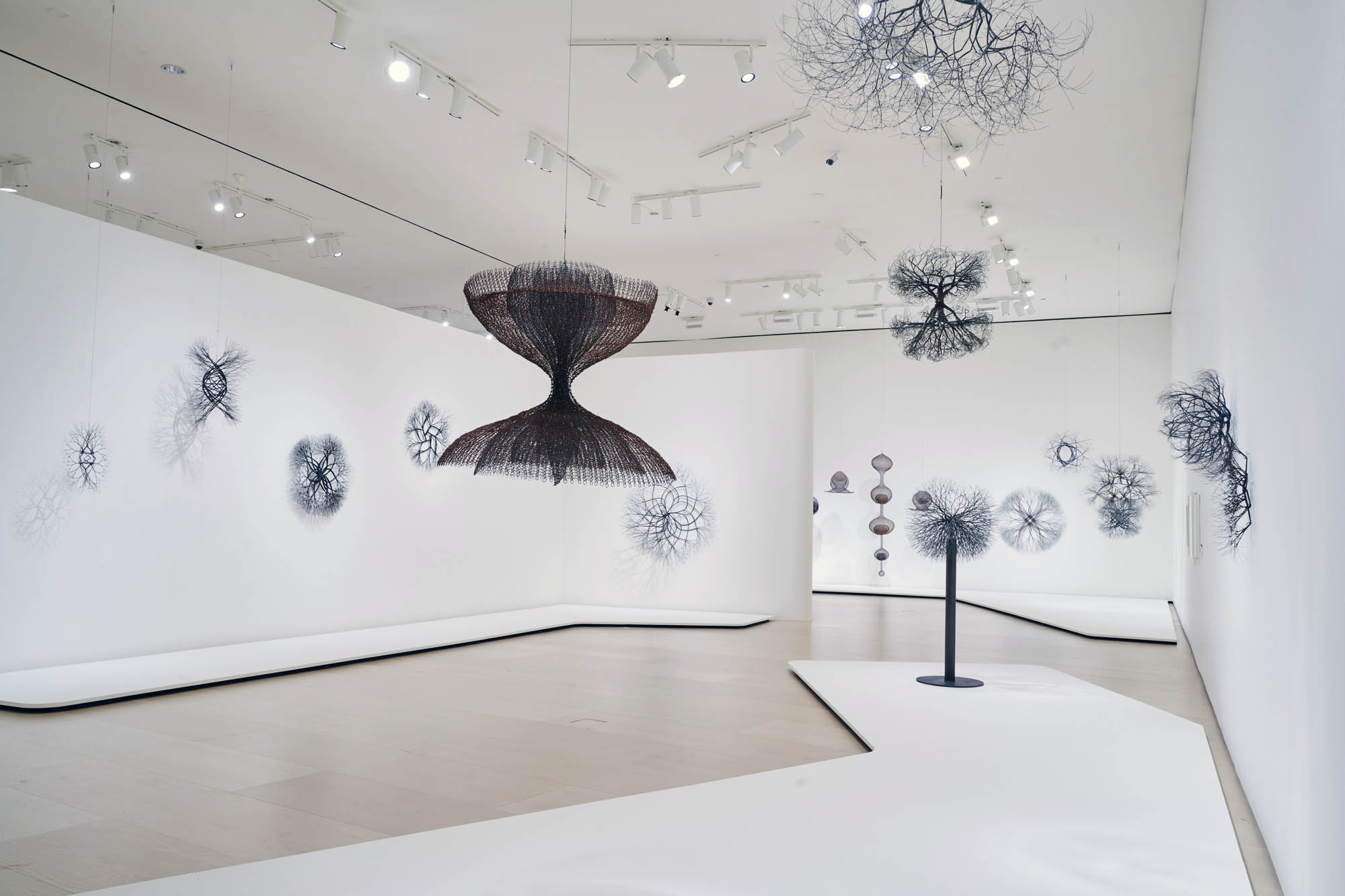
 

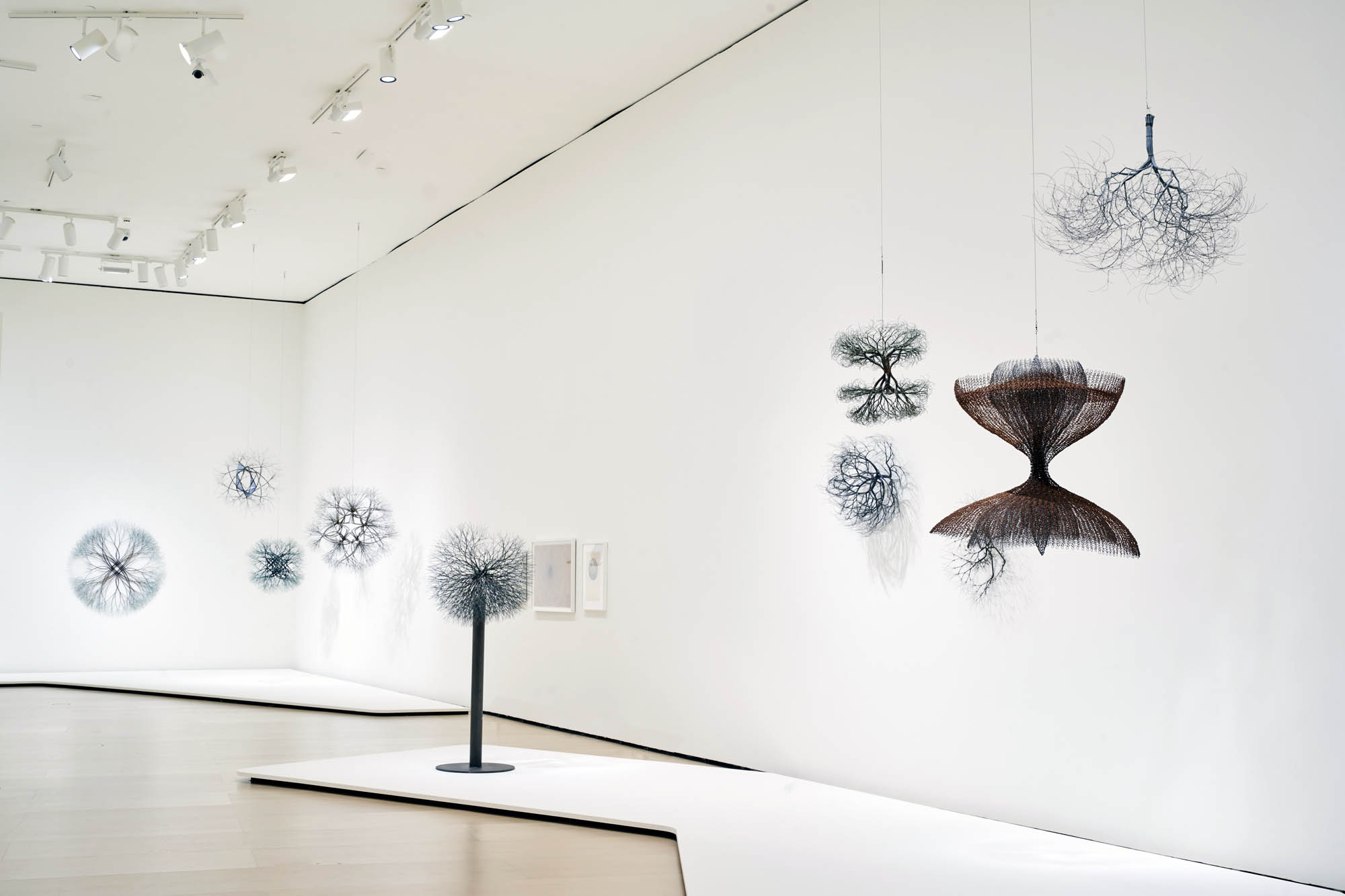
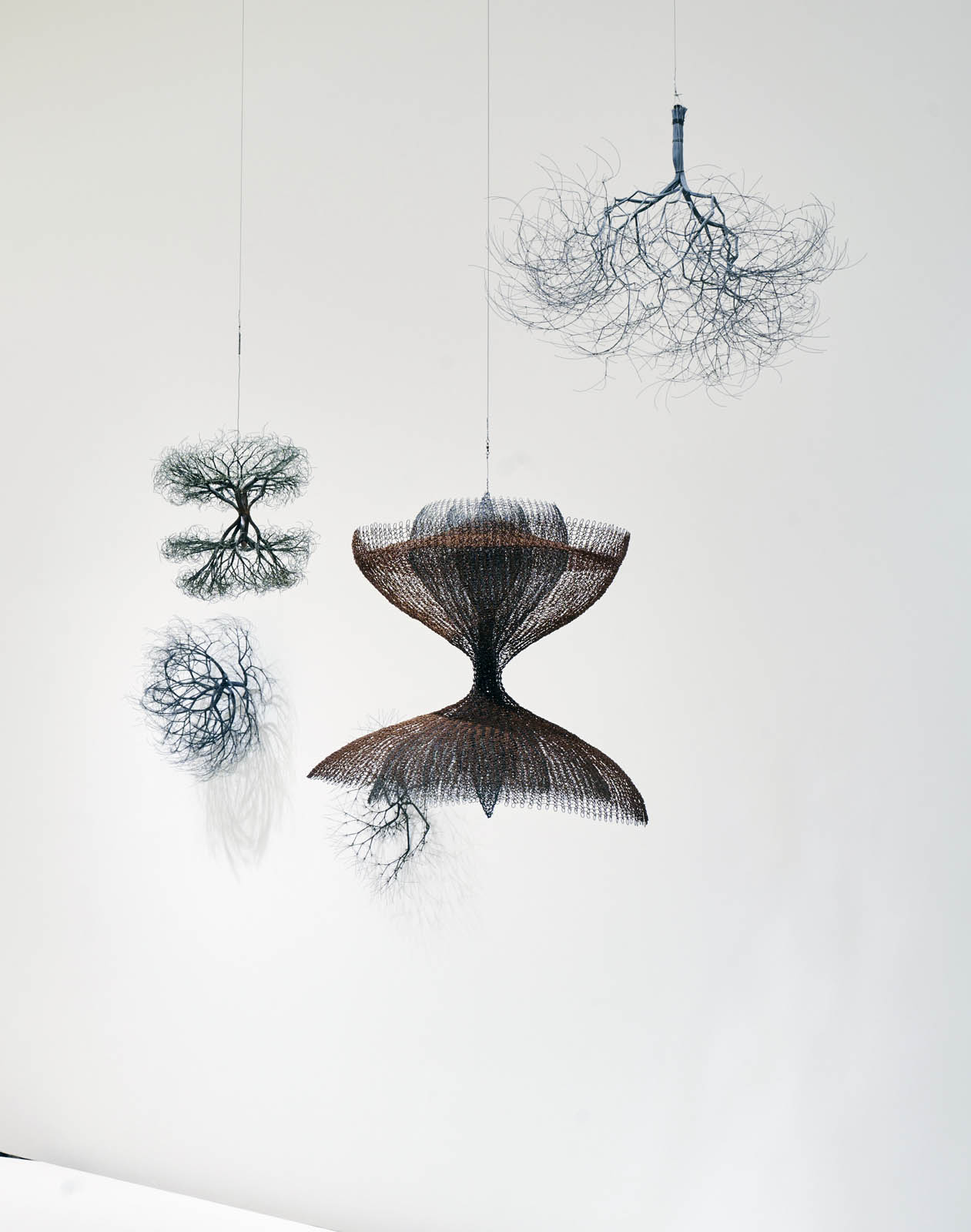
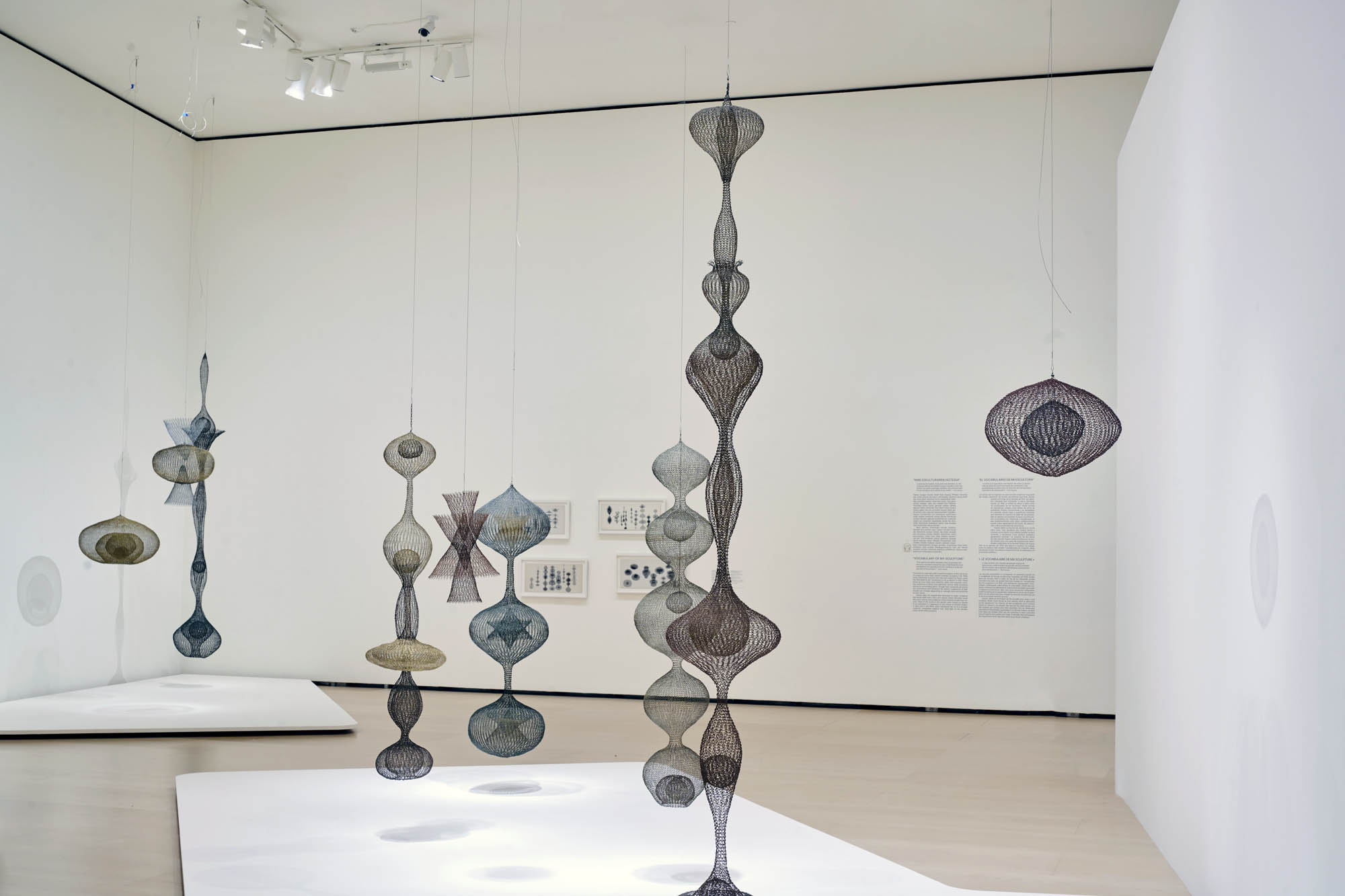
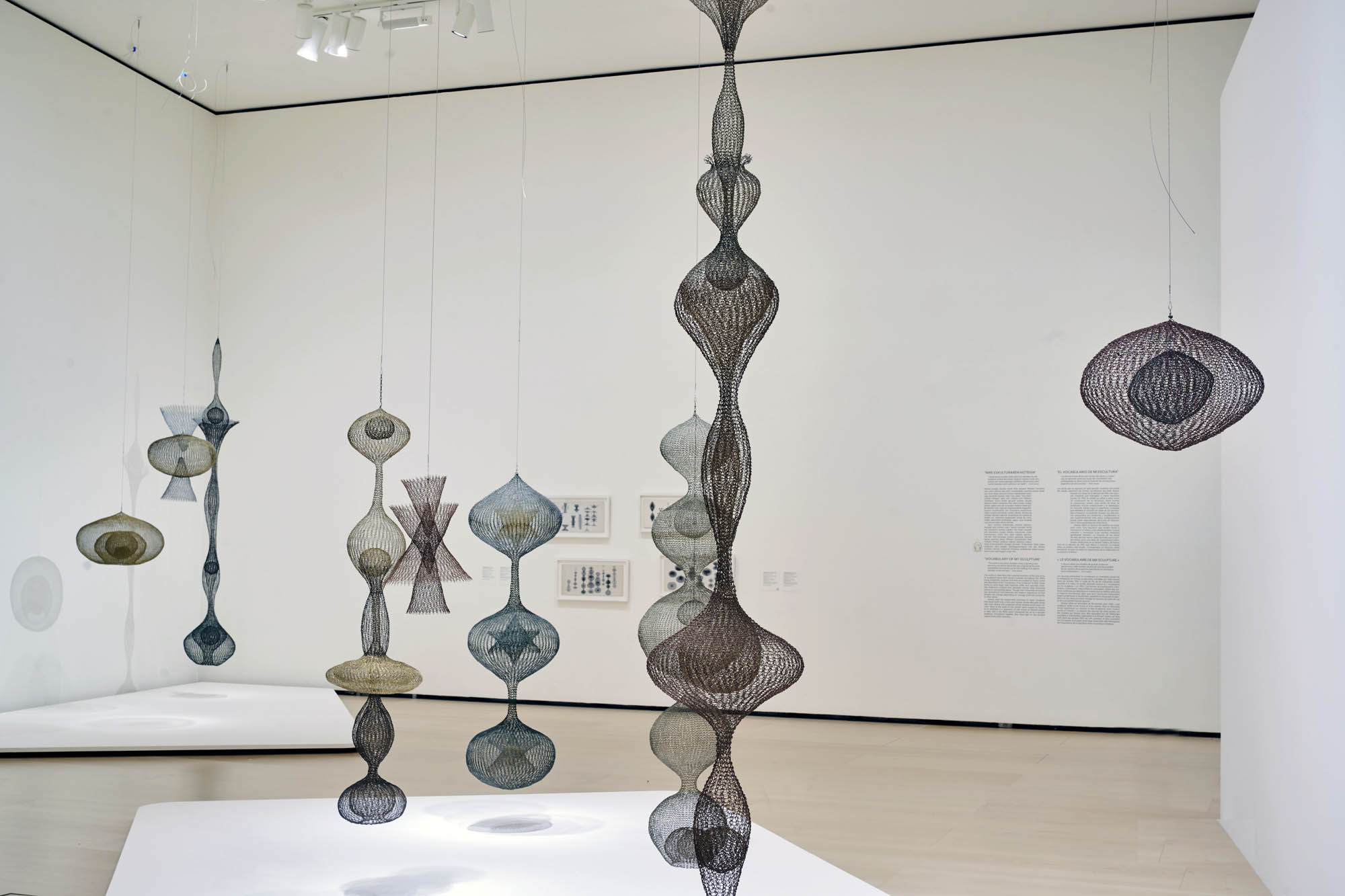
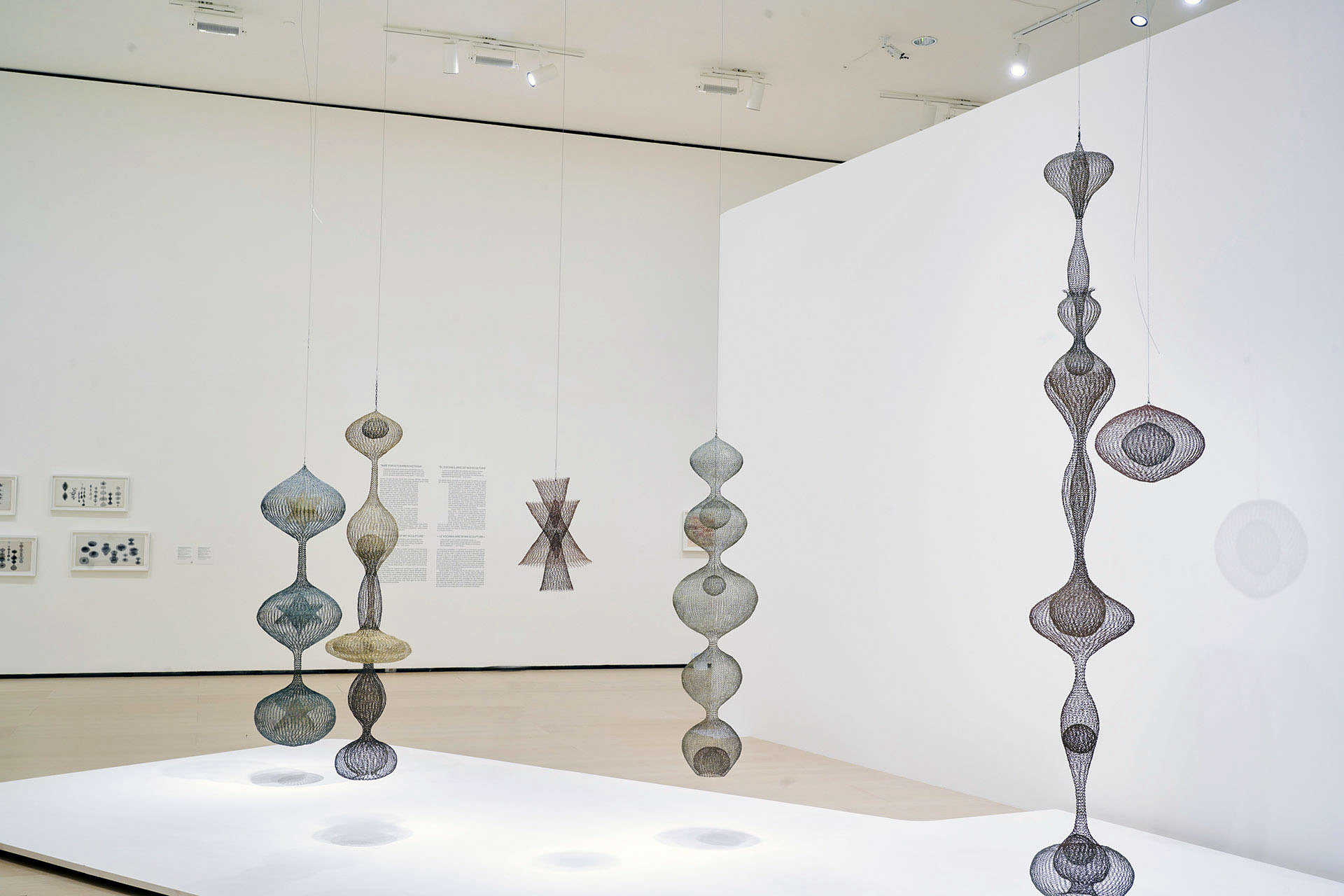
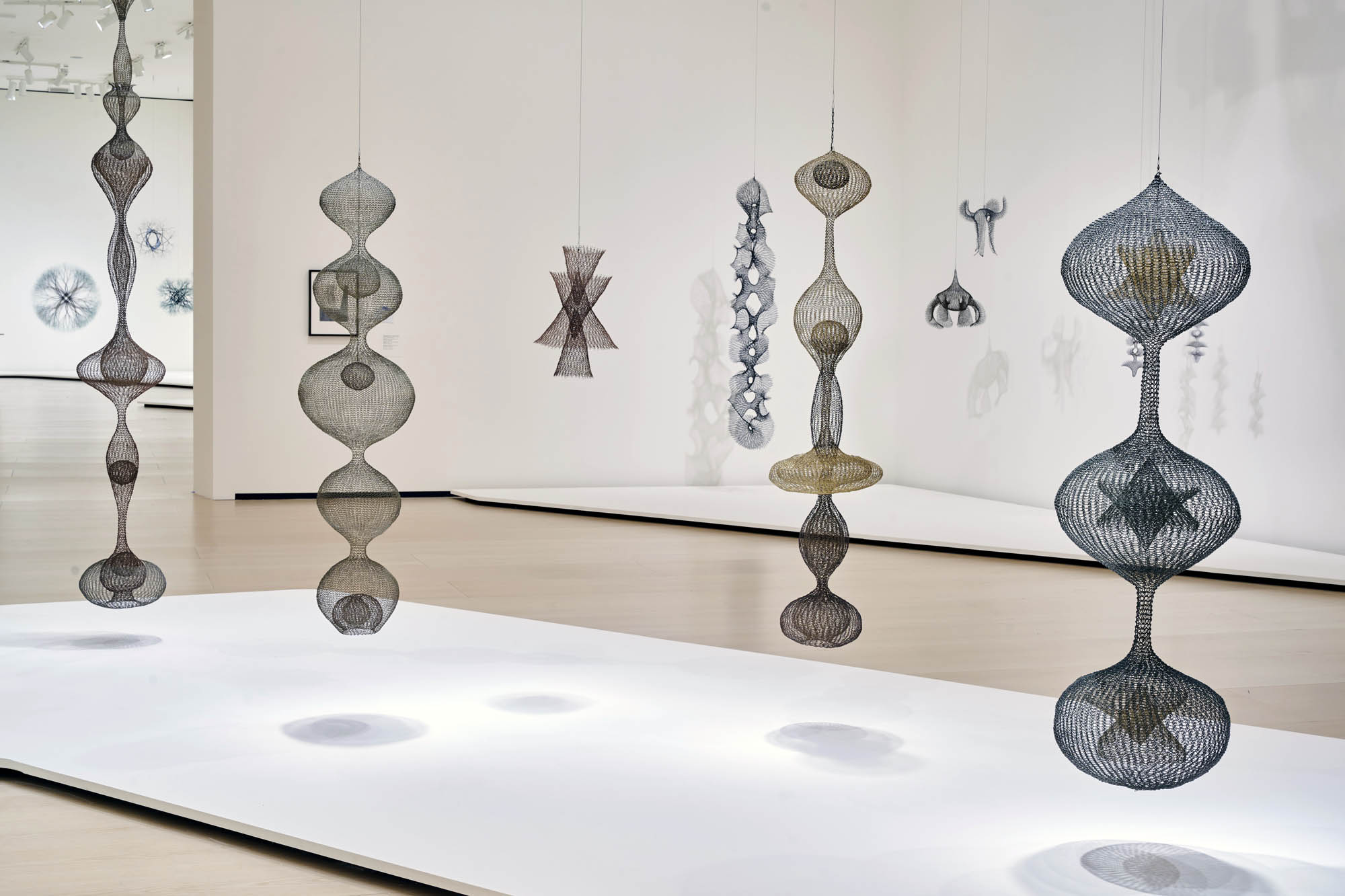
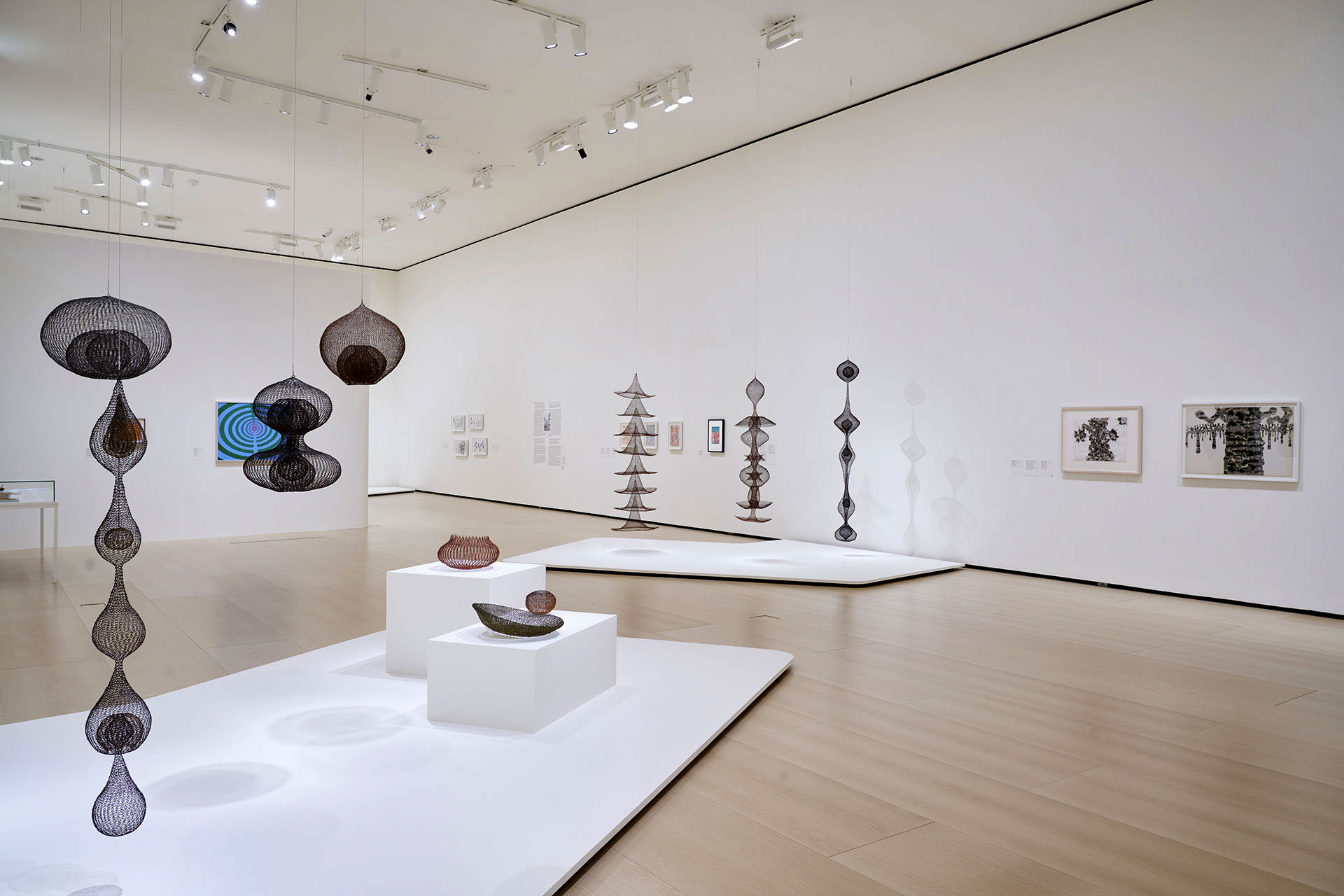
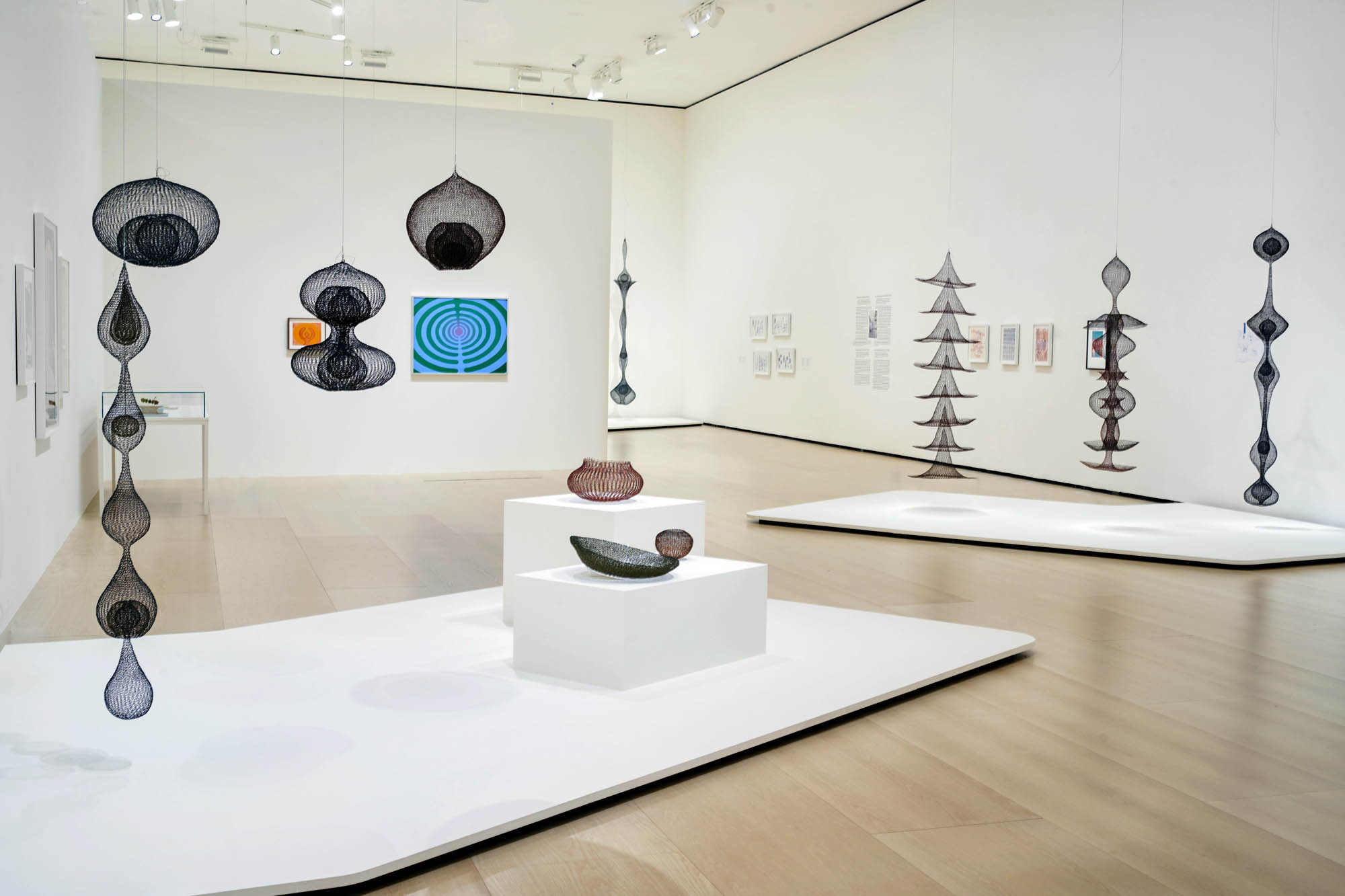
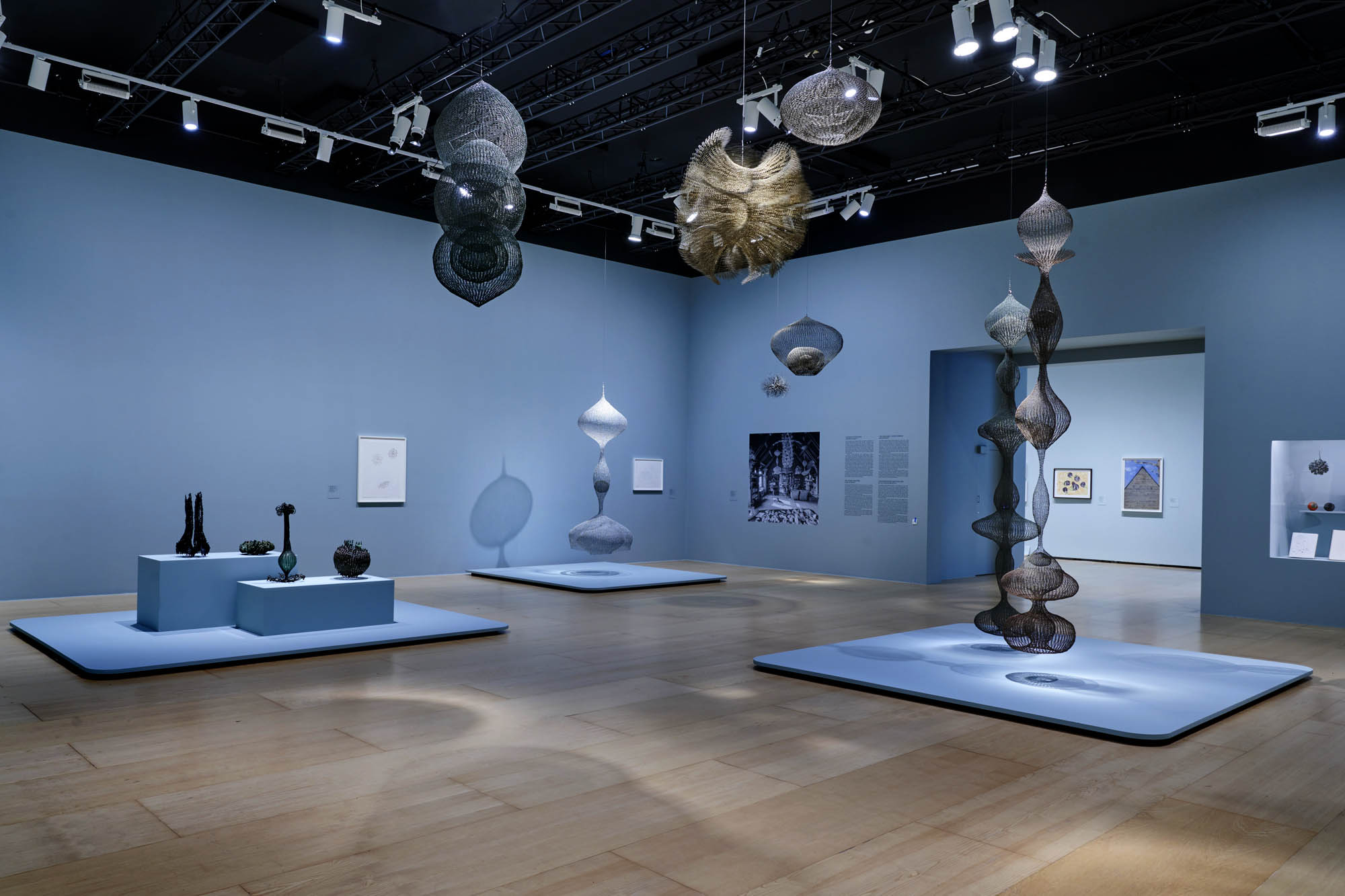
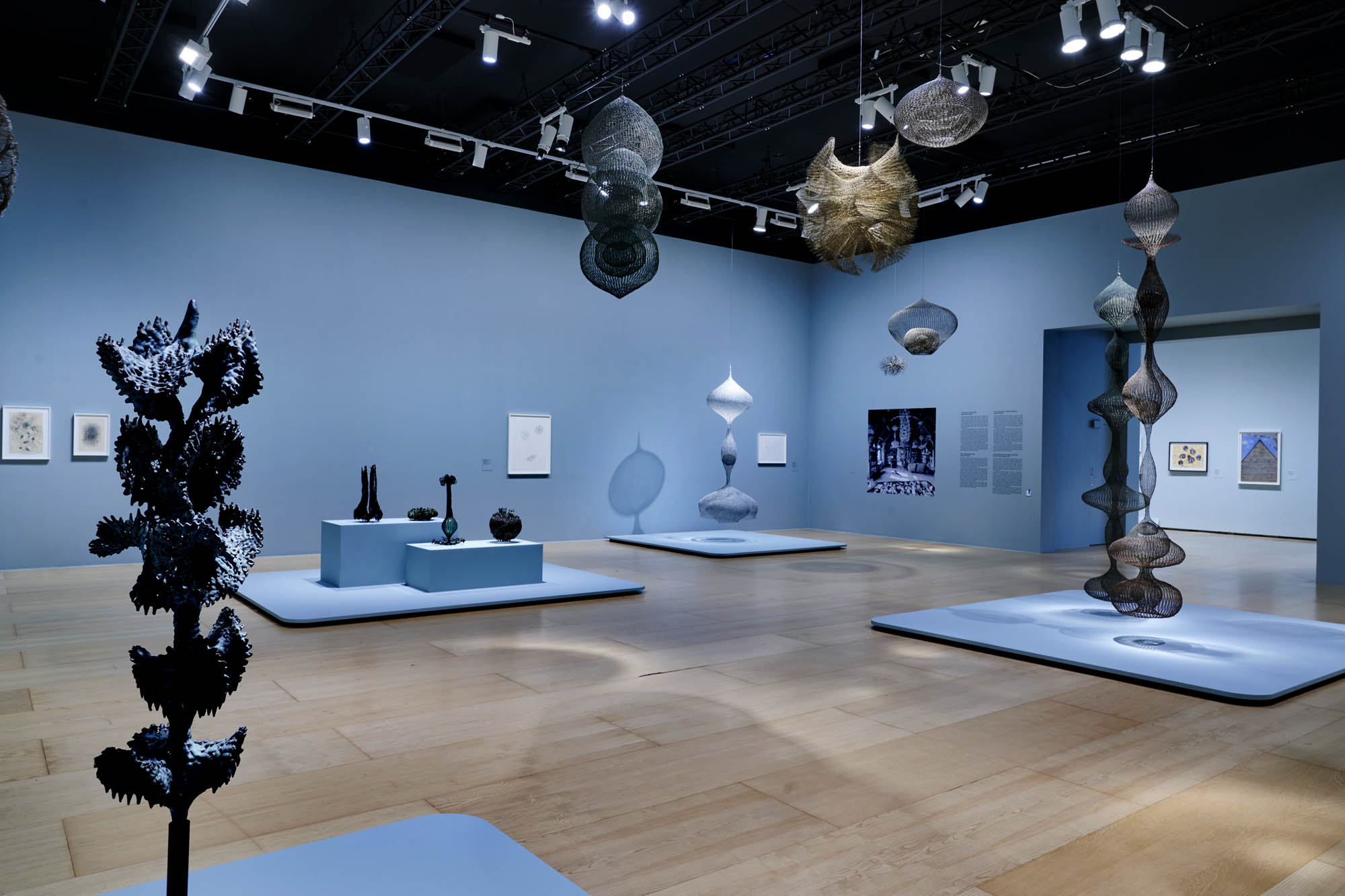
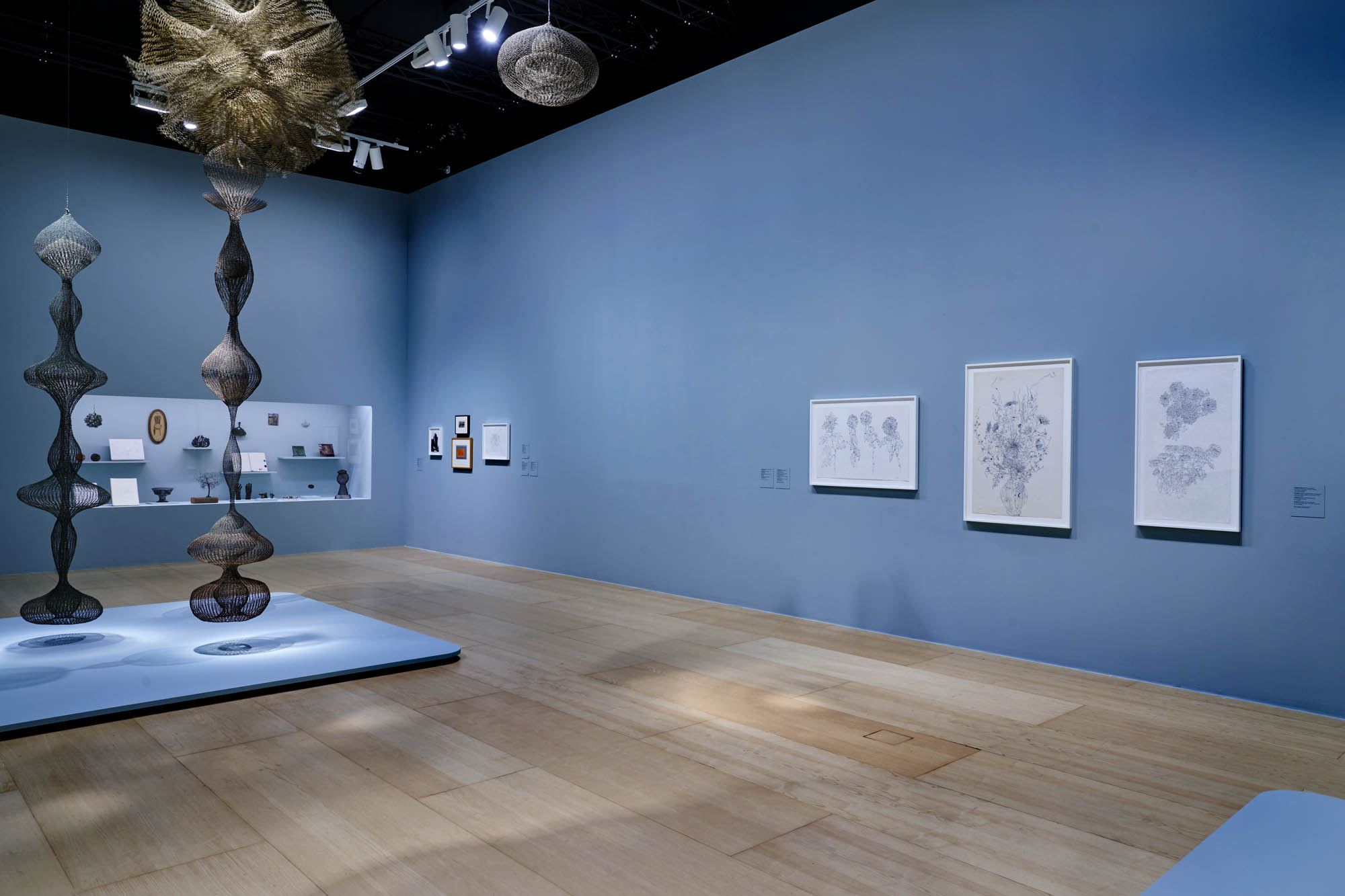
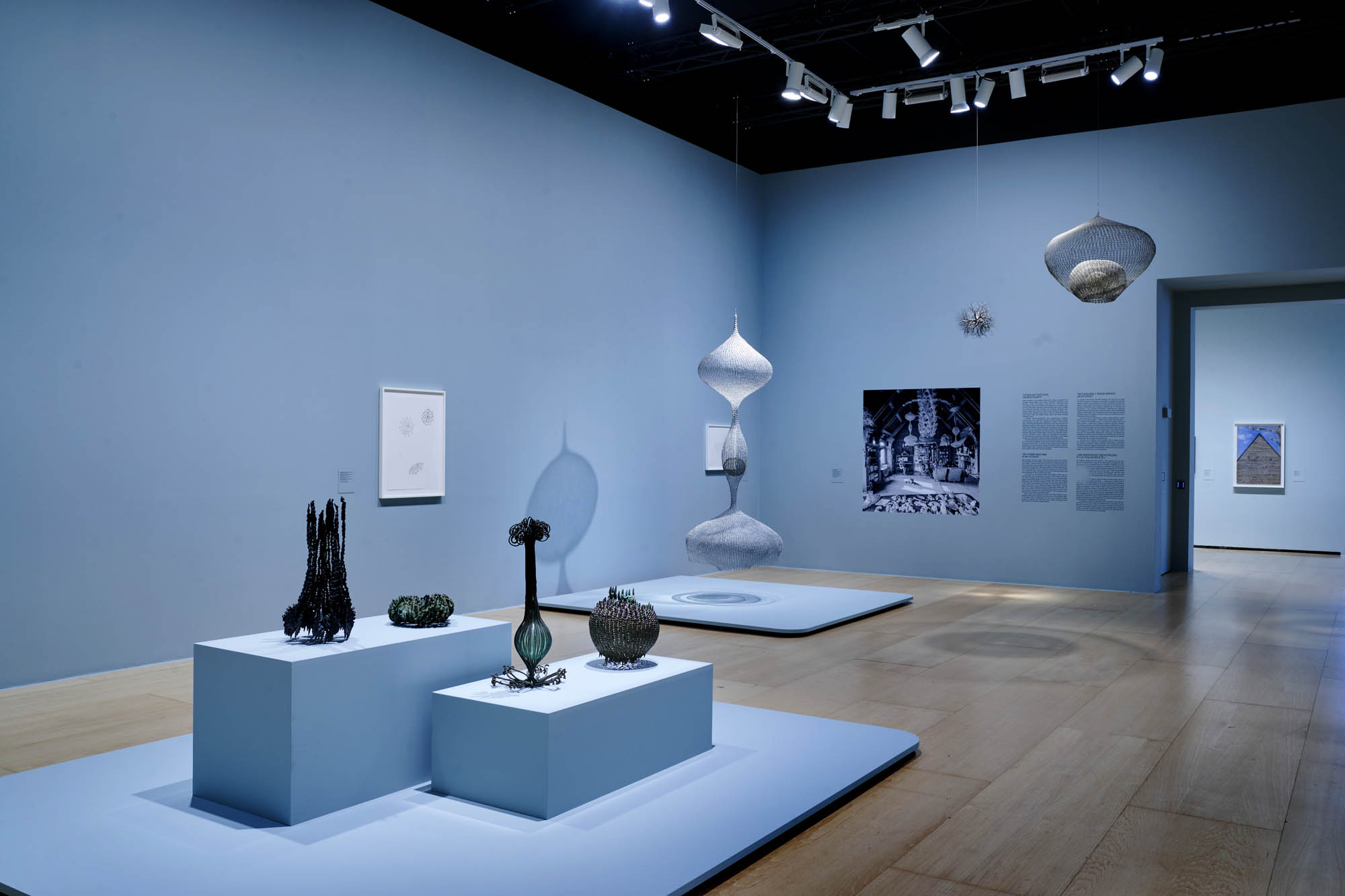
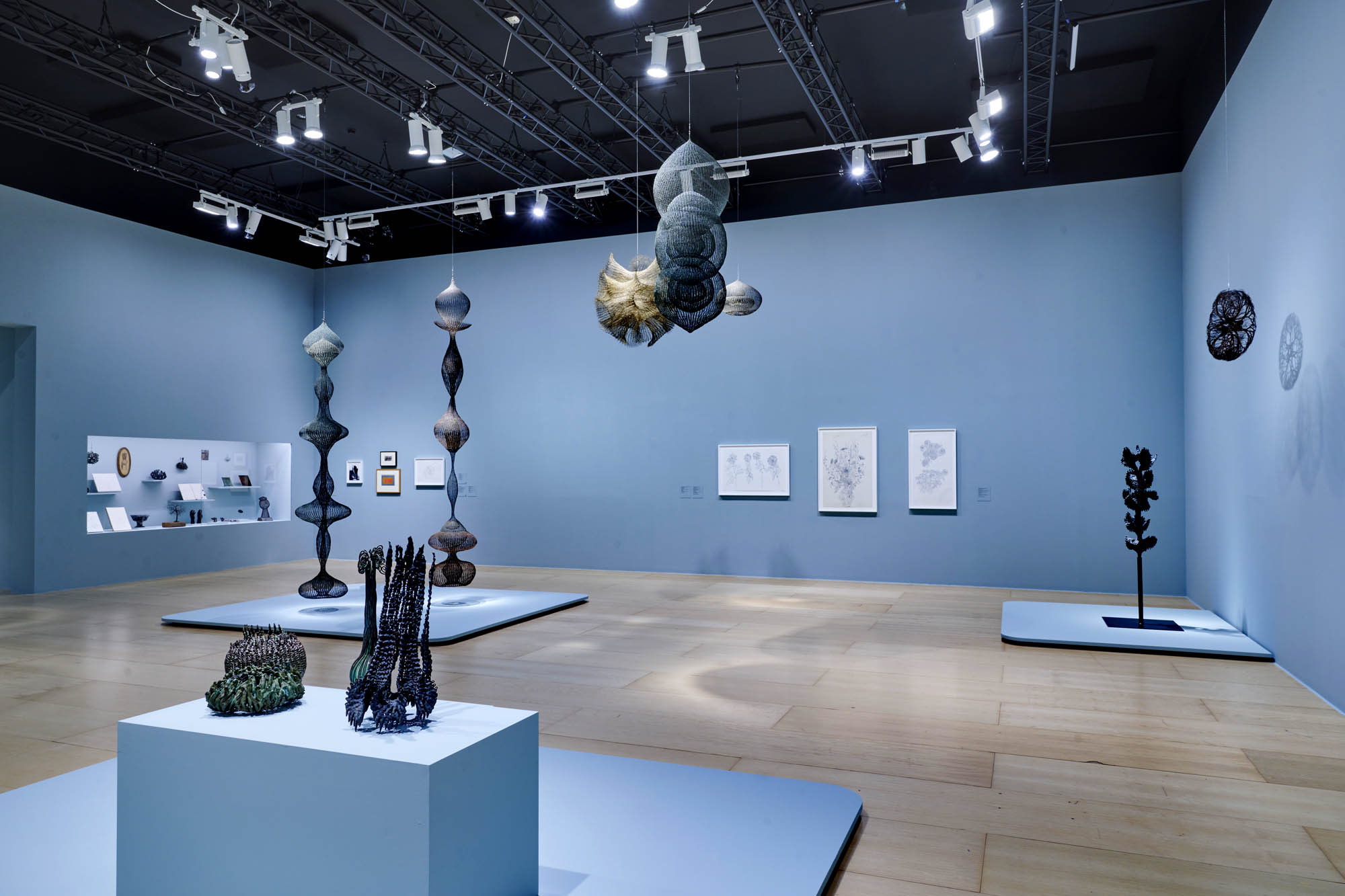
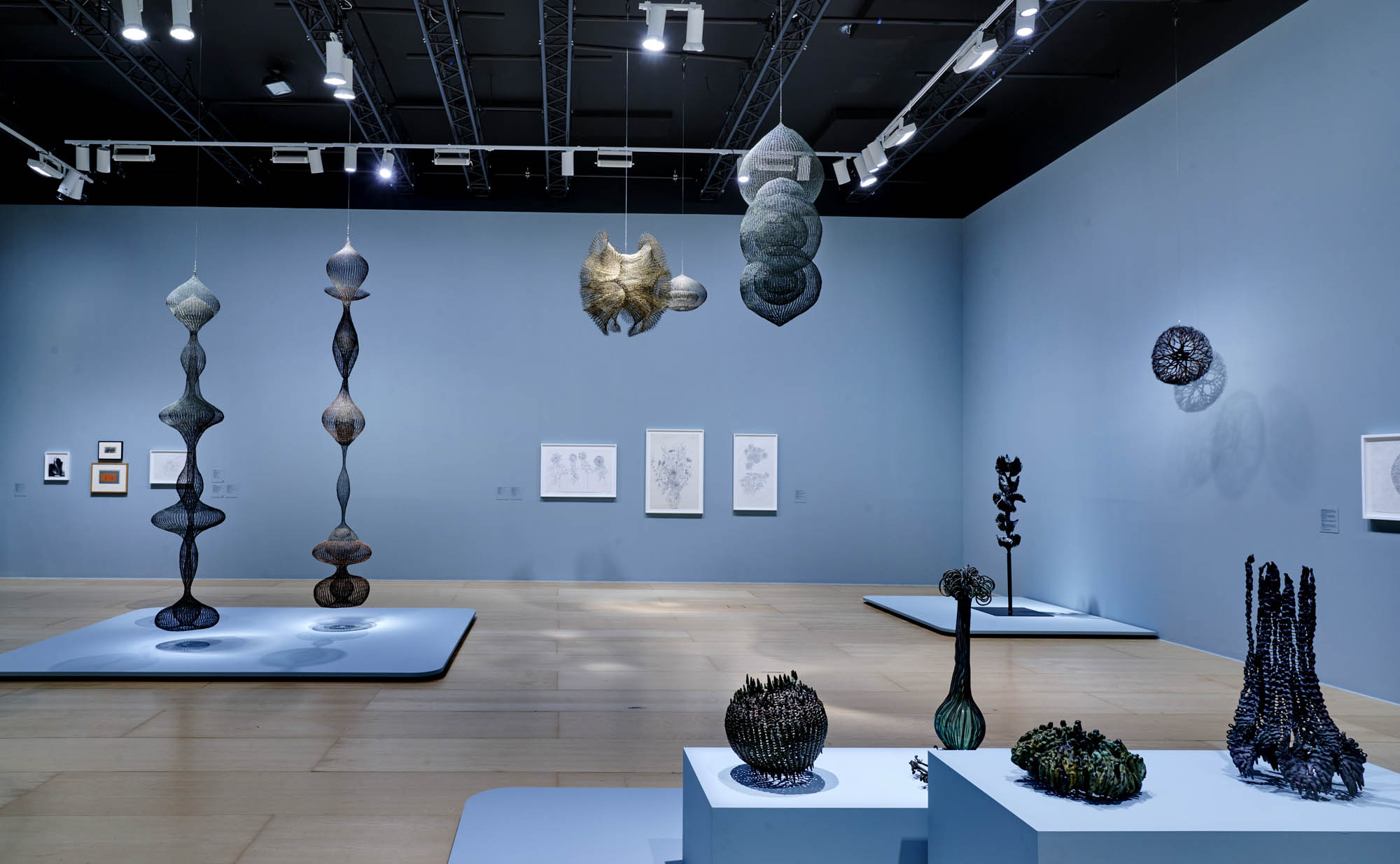
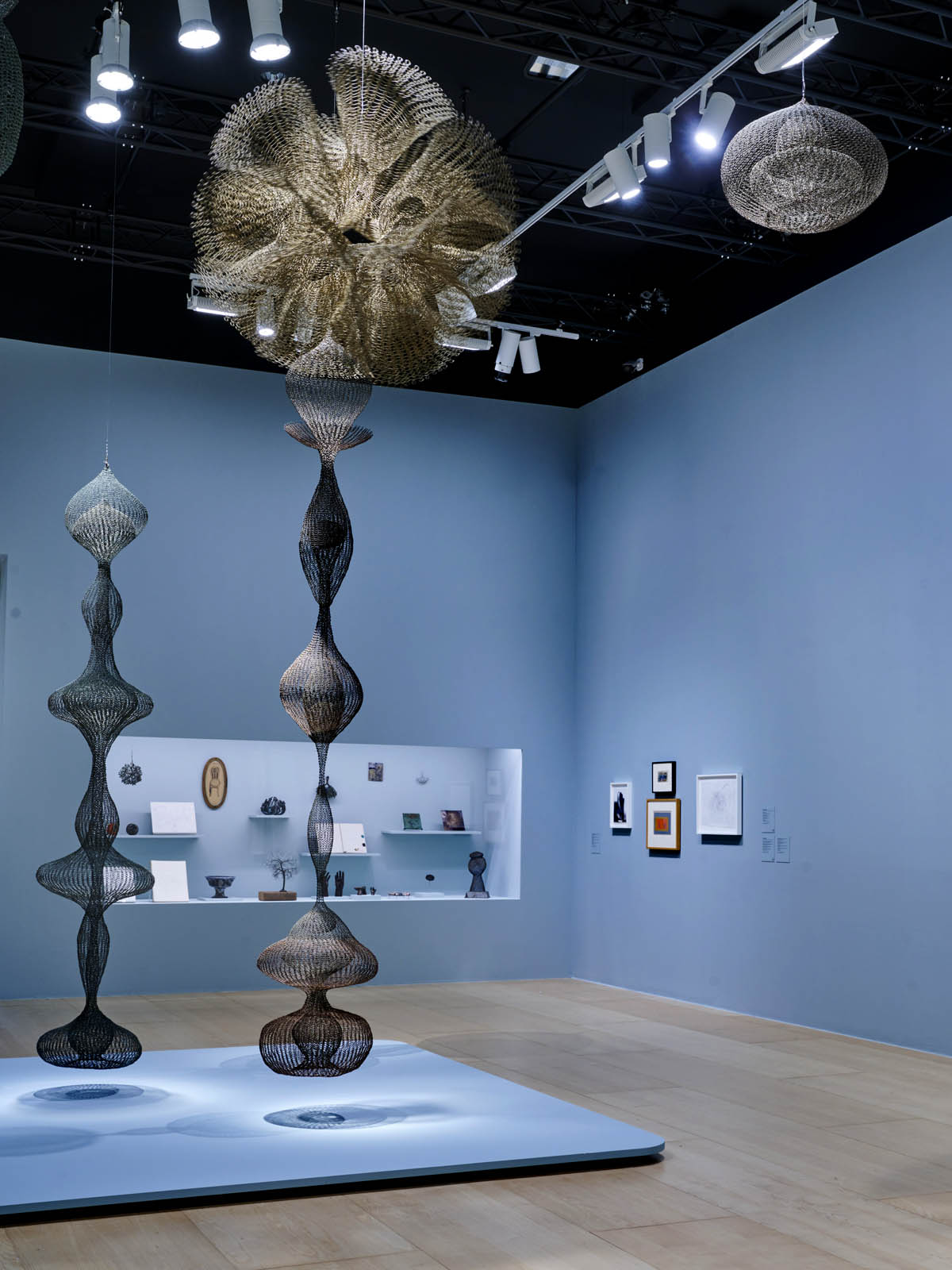
Installation view of the exhibition 'Ruth Asawa: Retrospective' at the Guggenheim Museum Bilbao, March - September, 2026


Installation views of the exhibition Ruth Asawa: Retrospective at the Guggenheim Museum Bilbao, March – September, 2026


The Guggenheim Museum Bilbao proudly presents Ruth Asawa: Retrospective, an ambitious exhibition devoted to an iconic artist, Ruth Aiko Asawa (born Norwalk, California, 1926 ; died San Francisco, California, 2013) in the year that would have been her 100th birthday.

Asawa was one of the most uniquely gifted and productive artists to emerge in the postwar era in the United States. While the appreciation of her work has grown exponentially in the last decade, this international retrospective is the first major museum exhibition to fully consider every aspect of the artist’s exquisite, varied, and groundbreaking practice.

Unfolding across ten sections that span the arc of a six-decade-long career, this exhibition traces the full breadth and depth of the innovative practice of Ruth Asawa, who integrated her creative work with all aspects of her life as an artist, educator and arts advocate. This interconnectedness is illuminated in photographs and ephemera presented alongside and in response to the works featured in this exhibition, from the suspended looped-wire sculptures for which she is best known to nature-inspired tied-wire pieces, clay and bronze casts, paperfolds, paintings, drawings, sketchbooks, and prints.

Challenging distinctions between abstraction and representation, figure and ground, and negative and positive space, her work invites us to contemplate how disparate elements interact in a composition, which in turn engages with its surroundings.

Asawa was the fourth of seven children of Japanese immigrant farmers. During World War II, she and her family were forcibly incarcerated by the United States government because of their Japanese ancestry. In 1946, after being denied an art teaching degree because of anti-Japanese prejudice, she enrolled at the progressive Black Mountain College in North Carolina. In the school’s democratic environment, she forged a creative path grounded in experimentation and an ethos of hard work. From her time at Black Mountain through the end of her life in San Francisco , where she moved in 1949, Asawa situated her artistic practice within set parameters to investigate ideas of transparency, continuity, and space. In the 1960s, she also expanded her life’s work to directly engage her community through public commissions, arts education, and civic advocacy.

Ruth Asawa: Retrospective is an exhibition partnership between the San Francisco Museum of Modern Art (SFMoMA) and the Museum of Modern Art, New York (MoMA). This presentation was developed in collaboration with the Guggenheim Museum Bilbao. Following its presentation at SFMOMA, MoMA, and the Guggenheim Museum Bilbao, the exhibition will then travel to Fondation Beyeler, Riehen/Basel, Switzerland. International exhibition tour supported by The Henry Luce Foundation.

Press release continued below…


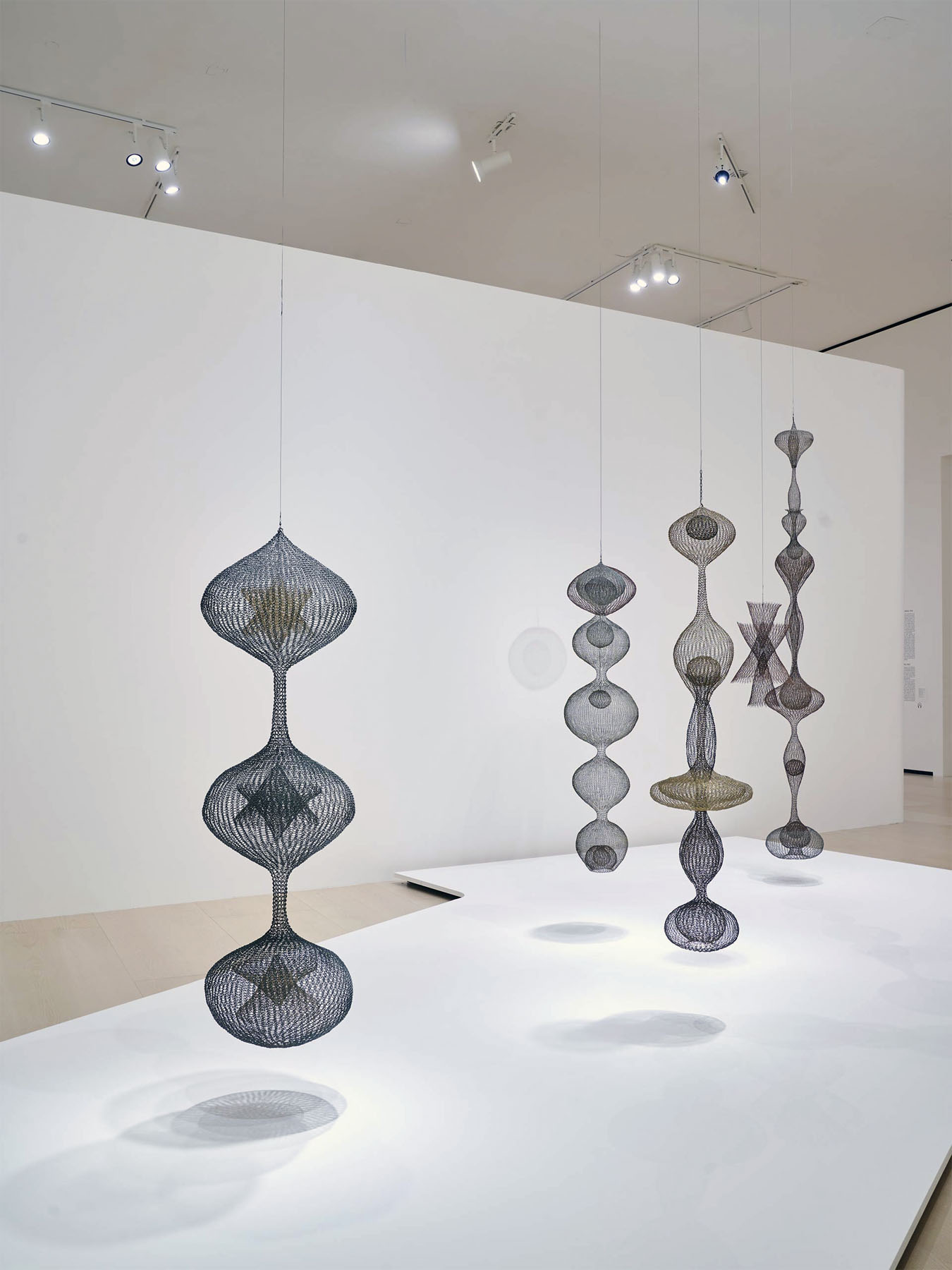
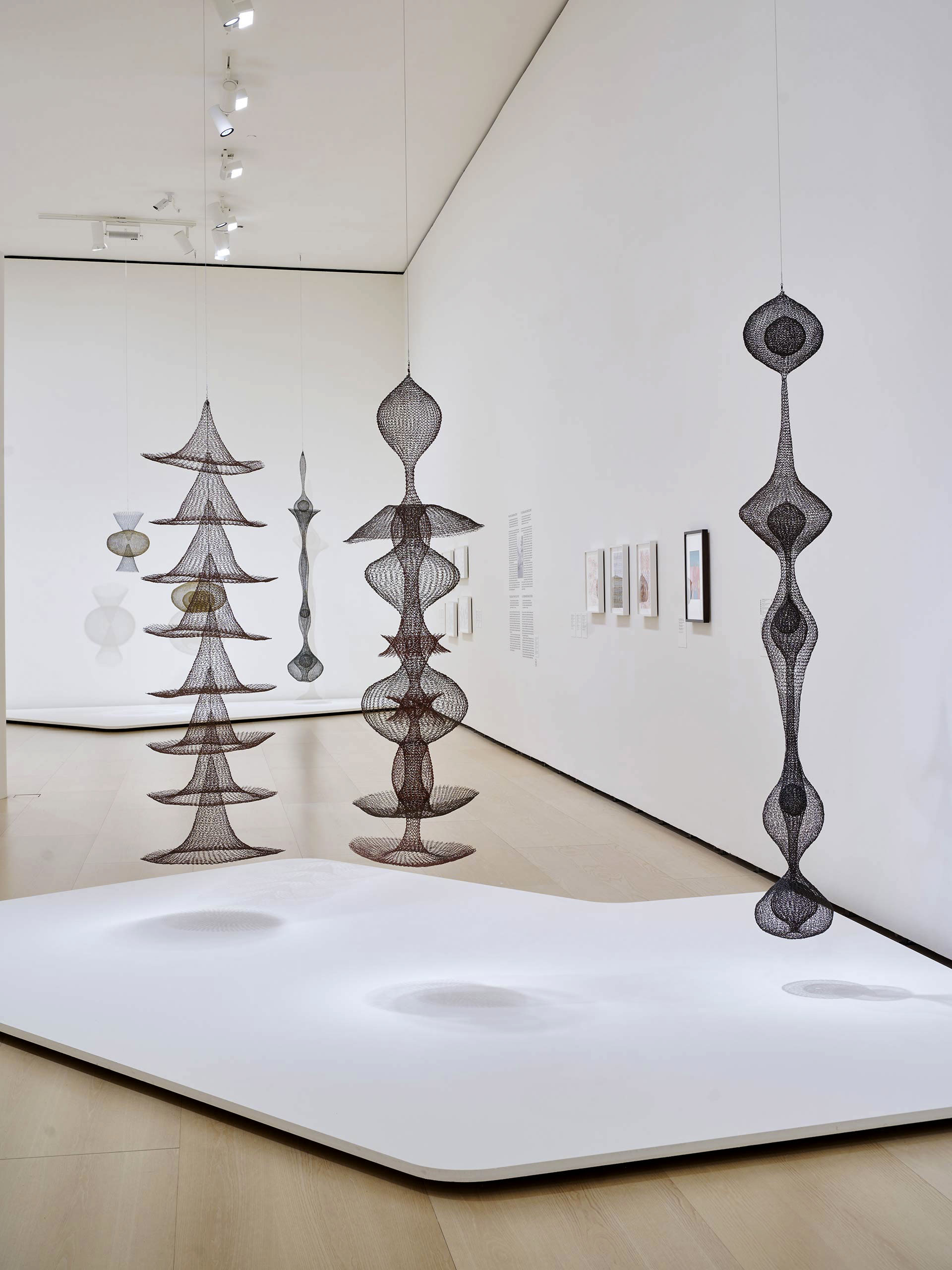
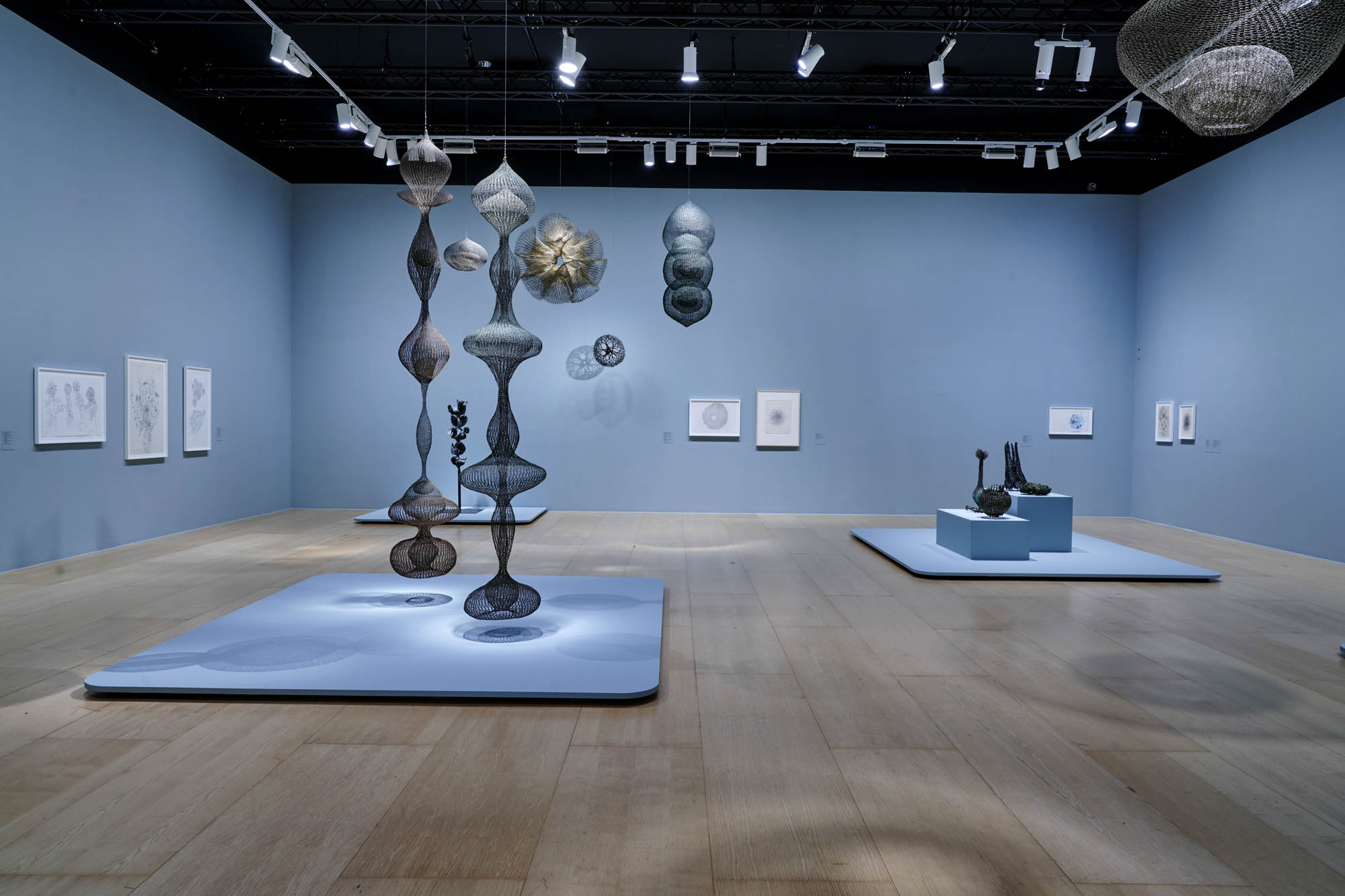
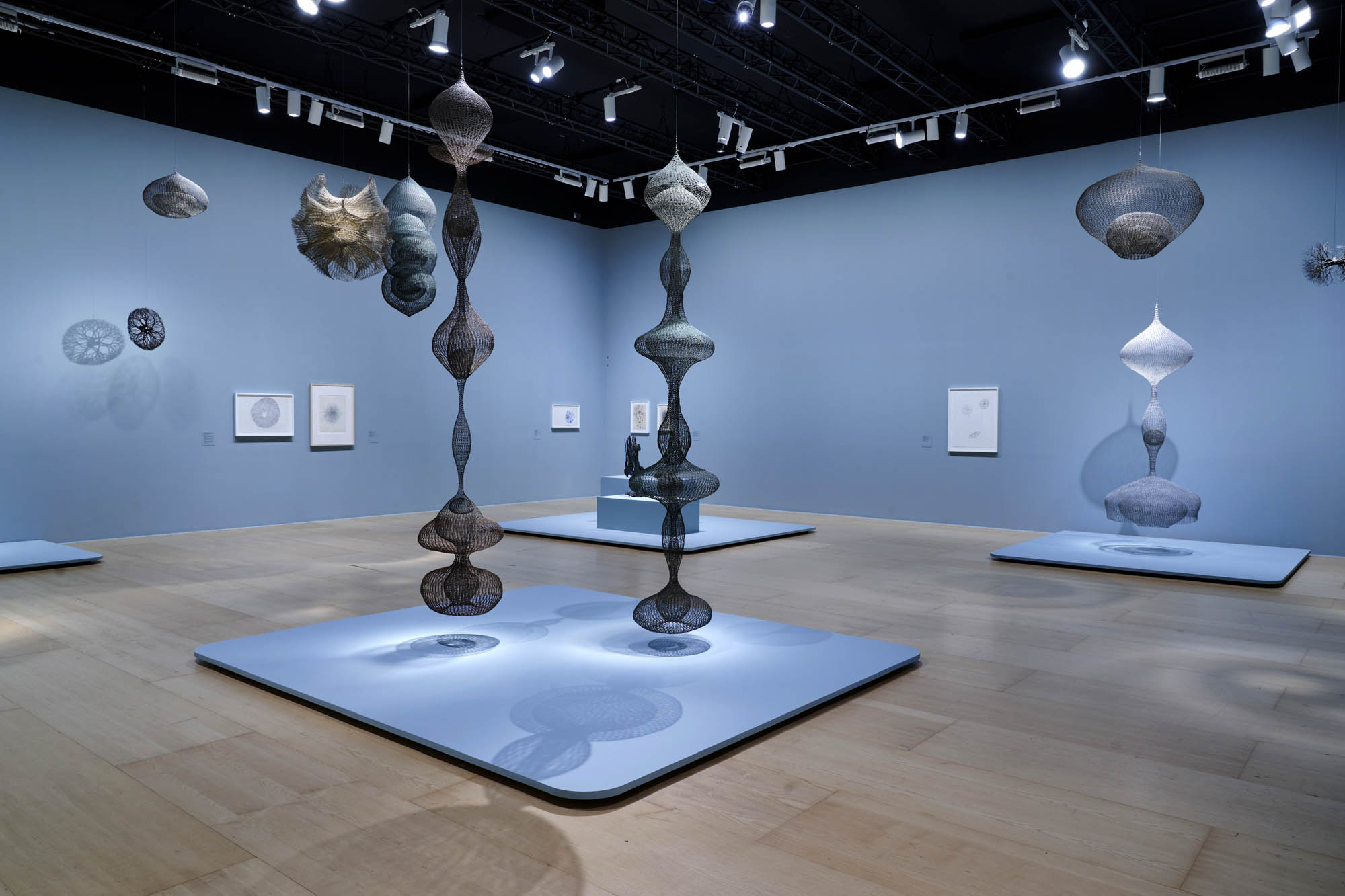
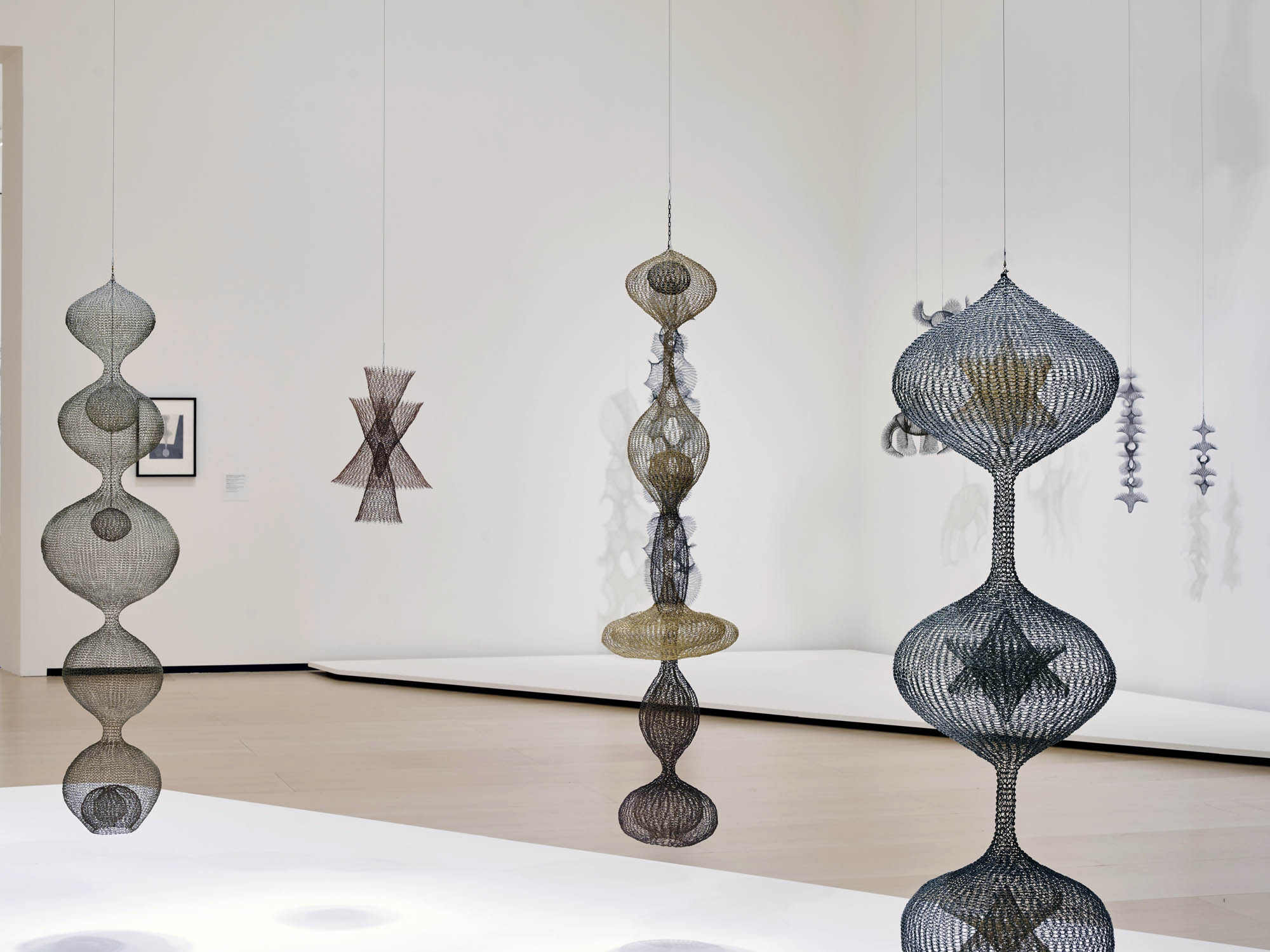
Installation view of the exhibition 'Ruth Asawa: Retrospective' at the Guggenheim Museum Bilbao, March - September, 2026


Installation views of the exhibition Ruth Asawa: Retrospective at the Guggenheim Museum Bilbao, March – September, 2026


Exhibition overview

“How To See”: Black Mountain College, 1940s

Across mediums and all stages of her practice, Ruth Asawa explored continuity, transparency, and the interchangeability of seemingly contradictory concepts like figure and ground, and abstraction and representation. She first articulated these core ideas at Black Mountain College (BMC), a multidisciplinary school with a sensory – and materials – based curriculum that she attended in 1946-49. There, Asawa took courses in mathematics, philosophy, music, and dance. She studied art under Josef Albers, among others, from whom she learned “how to see,” as she later put it.

Untitled (BMC.52, Dancers), c. 1948-49, features abstract dancing figures inspired by dance classes that Asawa took from Merce Cunningham and with Elizabeth Schmitt Jennerjahn in her final year at BMC. The work is composed of layered rounded forms on a yellow ground, and it was a precursor to the artist’s wire sculptures of the 1950s. Moreover, a formative trip to Mexico in 1947 introduced Asawa to wire baskets and weaving techniques, which was a major turning point in her own work. By the time she left BMC in 1949, she had made an important discovery: “I continued one basket into a closed form and slowly, while learning to control the medium, began to realise the exciting potential in this way of making sculpture.”

Commercial Designs, early 1950s

In the early 1950s Ruth Asawa took classes in dance, commercial design, lettering, screenprinting, and painting at San Francisco State College (now San Francisco State University). In these years her work continued to gain local and national attention through exhibitions at the San Francisco and New York showrooms of the interior design company Laverne Originals, and in publications including Vogue. During this period Asawa made a range of designs for commercial work, including plastic panels based on her paperfolds and wallpaper and textile patterns incorporating logarithmic spiral forms, the Black Mountain College (BMC) laundry stamp, and the footprints of her young children. Although Laverne Originals invited Asawa to mass produce her looped-wire baskets as home decor, she declined. She explained: “I am interested in producing to sell, but the more I work the more ideas I get and I want to experiment, but experimenting is not producing, since there are always many flops.”

“Everything is connected”: Forms within Forms, 1950s

“These sculptures are made of a continuous wire … enclosing volumes transparently … and producing forms within forms. … The wire must be continuous and the hollow shapes can only be shapes that grow this way.”

~ Ruth Asawa


In 1949 Ruth Asawa moved to San Francisco, which became her permanent home. Following California’s repeal of laws prohibiting interracial marriage, she married architect and fellow Black Mountain alumnus, Albert Lanier, and together they started a family. In tandem Asawa began building her art career, dedicating herself full-time to experiments with form building both in space with her looped-wire sculptures and on a flat plane in drawings and prints.

Asawa’s unyielding search for new possibilities within her chosen processes resulted in her signature sculptural motif: a “continuous form within a form,” which she described as “a shape that was inside and outside at the same time.” In a single lobe, a sequence of spheres encloses one another, creating one uninterrupted surface. Among those examples featured in this section include Untitled (S.427, Hanging Single-Lobed, Five-Layered Continuous Form within a Form), 1953; and Untitled (S.797, Hanging Two-Lobed, Three-Layered Continuous Form within a Form), c. 1954. Asawa continued to elaborate on this motif for decades to come, foregrounding continuity as a thorough line for her work. “You can show inside and outside, and inside and outside are connected,” she said. “Everything is connected, continuous.”

“Vocabulary of My Sculpture”

“The work is one which dictates a way of growing and the more one learns about this way of growing the more possibilities are opened up for the creating of sculpture peculiar to the process.”

~ Ruth Asawa


The works on view in this section offer a partial inventory of the vast array of sculptural forms Ruth Asawa invented throughout the 1950s using industrially sourced, wire that she looped by hand – what she described in 1955 as the “vocabulary of my sculpture.” These forms by turns layer, nest, interlock, ruffle, and cascade, creating continuous surfaces that delineate volume while remaining porous to surrounding space. Though their composite structures are symmetrical and balanced, the viewer’s experience of their shapes can change depending on the vantage point and proximity to other works.

Asawa used her looped-wire technique to make “sculpture that would itself have a form and volume, whose silhouette would also have volume, and sculptures whose shadow would have volume.” Most of the works in this section were chosen by Asawa to be exhibited in a sequence of solo shows at Peridot Gallery in New York in the 1950s, which introduced her art to a broader audience. Considered together, they shed light on the iterative nature of the artist’s practice. Among those works featured is Untitled (S.270, Hanging Six-Lobed, Interlocking Continuous Form within a Form with Spheres in the First and Second Lobes), 1955, re-fabricated in 1957-58, which contains multiple connected lobes that form long sculptural silhouettes while the interior elements, such as the scones or spheres, create overlapping layers.

The Tamarind Prints, 1965

The Tamarind Lithography Workshop was founded by June Wayne in Los Angeles in 1960 and vastly expanded the possibilities of fine art lithography in the United States. At the suggestion of her former teacher Josef Albers, who had previously printed there himself, Asawa was invited to do a residency for two months in 1965. During her short time there, she worked closely with seven printers to produce fifty-four radically experimental prints.

Asawa’s unique prints featured family members, flowers, plane trees, and chairs, as well as abstractions, of which some are on view in this section, including Poppy (TAM.1479), 1965, a virtuoso depiction of California’s delicate state flower. While never again focusing as intensively on printmaking as she did during her time at Tamarind, Asawa remained convinced of the merits of the medium, resisting “the myth that the crafts and printmaking are less important than painting and sculpture. A good piece is important regardless of category.”

Nature, Tied Wire and Later Sculpture, 1960s-1990s

“Nature is my teacher, and I have used materials that are a product of our twentieth century to study her growth patterns.”

~ Ruth Asawa


In 1962 a gift of a dried desert plant from Death Valley given to Ruth Asawa inspired her to pursue a new direction in her sculpture. Drawing the plant, she found “its intricacy … made it impossible,” and instead turned to wire, working with bundles and spools that she manipulated into complex branches and other botanical forms, as seen in Untitled (S.184, Hanging Tied-Wire, Single-Stem, Multi-Branched Form Based on Nature), c. 1962. Asawa went on to make “tied-wire” sculptures over the course of the decade and beyond. As she described, these works “take an impersonal material like wire, which is very hard, and then make it into a gentle thing that’s natural looking so that you can take an abstract piece of wire and turn it into a plant. And I like the transition from hard to soft.”

Asawa’s tied-wire works often began with a floral, starlike, or geometric centre, as seen in Untitled (S.451, Wall-Mounted Tied-Wire, Open-Center, Six-Branched Form Based on Nature), c. 1965. As she worked, and the form grew progressively outward, she both responded to the properties of her medium in following “what the wire dictates” and mirrored patterns in the natural world. Her hanging and wall-mounted sculpture also reinvigorated her drawing, which like her works in wire explored new possibilities in geometric designs, airy blooms, and branching tree-like patterns, as seen in Untitled (SD.017, Tied-Wire Sculpture Drawing with Open Pentagon in Center), 1980s to mid-1990s.

Throughout the 1970s and beyond, Asawa continued “to explore the limits of materials, growth, and form by making sculpture with wire.” As she created new variations of looped- and tied-wire compositions, some closed and some open, some suspended from above and others wall-mounted, she also furthered her material exploration of resin and experimented with coloured glass.

Public Art and Public Commissions, 1960s-1990s

In 1968 Ruth Asawa began advocating for the role of art in society through her tenures on the San Francisco Arts Commission, California Arts Council, and the National Endowment for the Arts. She also expanded her art practice into San Francisco’s civic life through public artworks and commissions “to make a sculpture that could be enjoyed by everyone.” These works, often collaborative in nature, became places where communities could gather for moments of remembrance and celebration. This section explores Asawa’s expanded engagement with her community through art, arts education and civic advocacy, drawing on artwork, video, photographs, archival documentation and other ephemera.

Her first outdoor commission was the bronze fountain Andrea (1968) in San Francisco’s Ghirardelli Square. Responding to the waterfront location, she delivered a sculpture of two mermaids, one of whom holds an infant, surrounded by frogs and turtles.

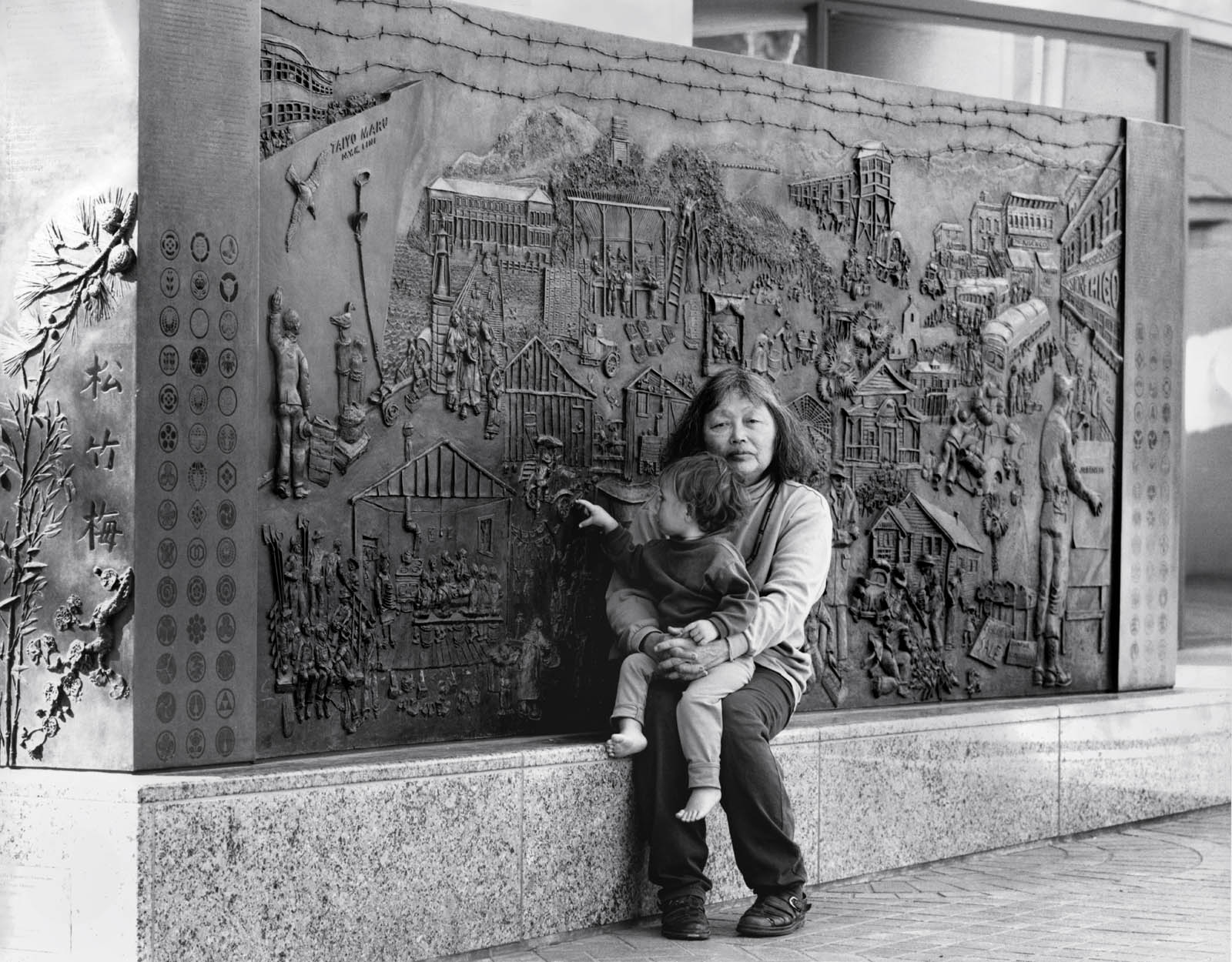
Other large-scale works include her Origami Fountains (1975-76) at San Francisco’s Nihonmachi Pedestrian Mall, which explore her long interest in origami and paper folding. In 1994, Asawa debuted her monumental Japanese American Internment Memorial, commissioned by the City of San José. Created in collaboration with her artist-son Paul Lanier and artist Nancy Thompson, this sculpture more directly addressed personal and shared stories of the unlawful incarceration of people of Japanese descent during World War II.

“Life Draws”: From the Garden, 1980s-2000s

Over the course of her career, Ruth Asawa tirelessly returned to depicting plants and flowers, tracing the shapes of irises, hydrangeas, chrysanthemums, and other flora from her garden in sketchbooks and works on paper. For Asawa, drawing from life was more than simple observation; it became a value and mode of engaging with the world and present moment. “Life draws,” she once wrote, expressing how the events and objects around her defined her work.

In 1985 Asawa was diagnosed with lupus and for nearly a year her physical capacity was significantly reduced, but her creative spirit remained undiminished. In the last decades of her career, she concentrated her creative output on botanical drawings, some of which are gathered in this section. These intimate works, at times extremely realistic, at others abstract, often began with a gesture of generosity: gifts of plants from the artist’s friends and family, after whom many works are titled – such as Valentine Bouquet from Adam, 1991, referring to her son who often tended his parents’ flowering plants during their later years. Through the daily routine of recording the natural world around her, Asawa documented the extended community she shared it with, as well as the passage of time.

Noe Valley, 1960s-2000s

By 1960, Ruth Asawa, Albert Lanier, and their six children – Xavier, Aiko, Hudson, Adam, Addie, and Paul – had outgrown three San Francisco residences. Later that year she and Lanier purchased a large house in Noe Valley. The house from 1908 was designed by Walter Ratcliff and Alfred Jacobs in the spirit of Bernard Maybeck, the legendary professor at the University of California, Berkeley, who fuelled the region’s Arts and Crafts movement at the turn of the twentieth century. The cedar-shingled exterior blended with its site, while a deck off the kitchen made for a fluid relationship between indoor and outdoor spaces.

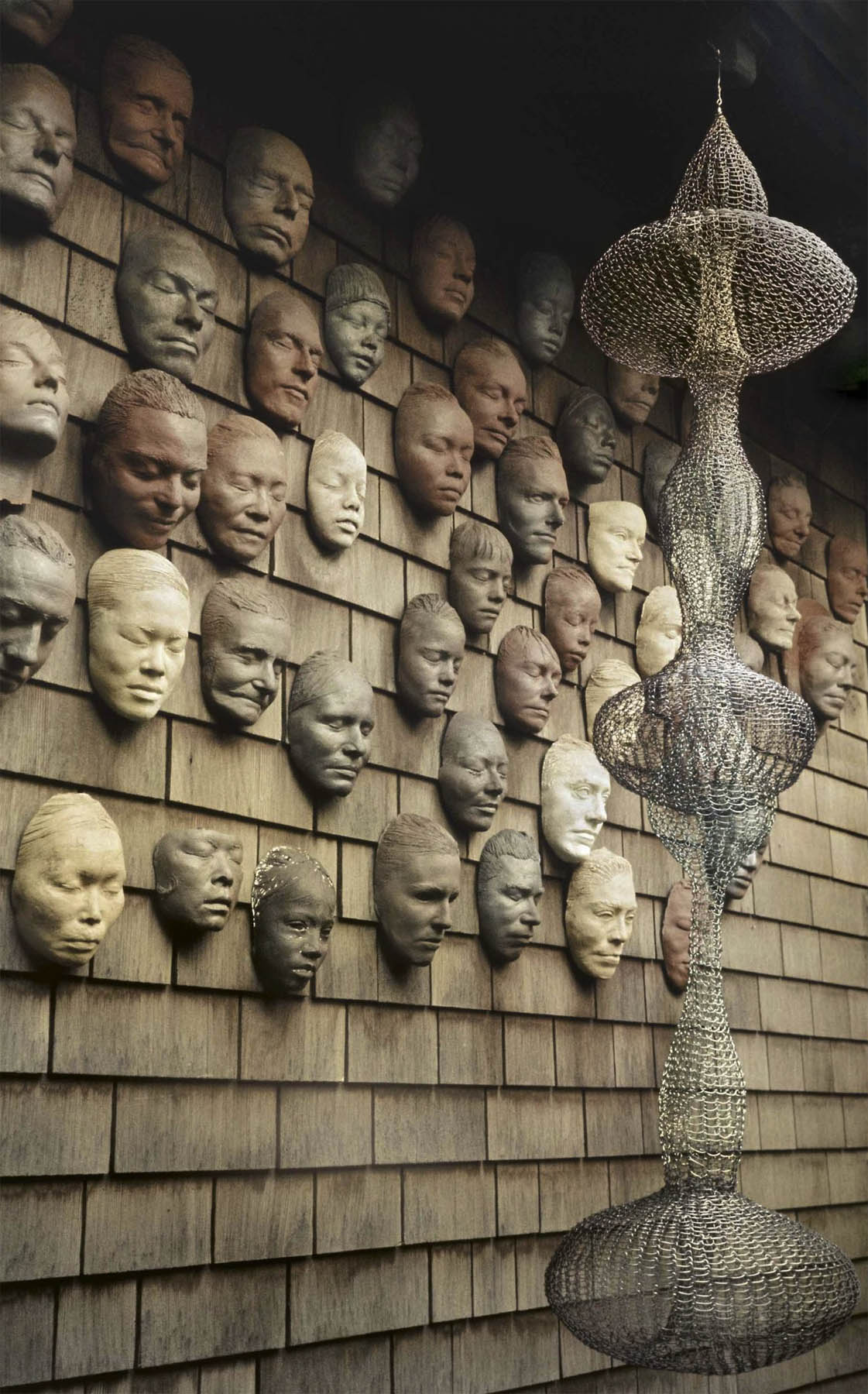
Overall, the design of the house evoked a casual ease of living. Lanier spent a year renovating – including excavating to create a studio for Asawa and additional bedrooms – before the family moved in during the fall of 1961. Asawa designed monumental new front doors, on view in this section, and the family went on to build walkways from cobblestones scavenged from San Francisco beaches, planting beds for flowers, herbs, and vegetables that would prove to be an enduring source of inspiration for her drawings. Additionally, the artist created hundreds of unique face casts of family, friends, and colleagues between 1966 and 2000, some of which are on view here, resulting in a veritable index of the comings and goings at the Noe Valley house.

“My Home was and is My Studio”

Ruth Asawa’s famous quote, “My home was and is my studio,” encapsulates her philosophy of seamlessly integrating family life and artistic creation, where her San Francisco home became a living, breathing art space filled with family, projects, and her iconic hanging wire sculptures. Taking inspiration from this motif, this gallery brings together works in different mediums from across the arc of Asawa’s career, alongside works by her lifelong friends, and pays testament to her boundless practice.

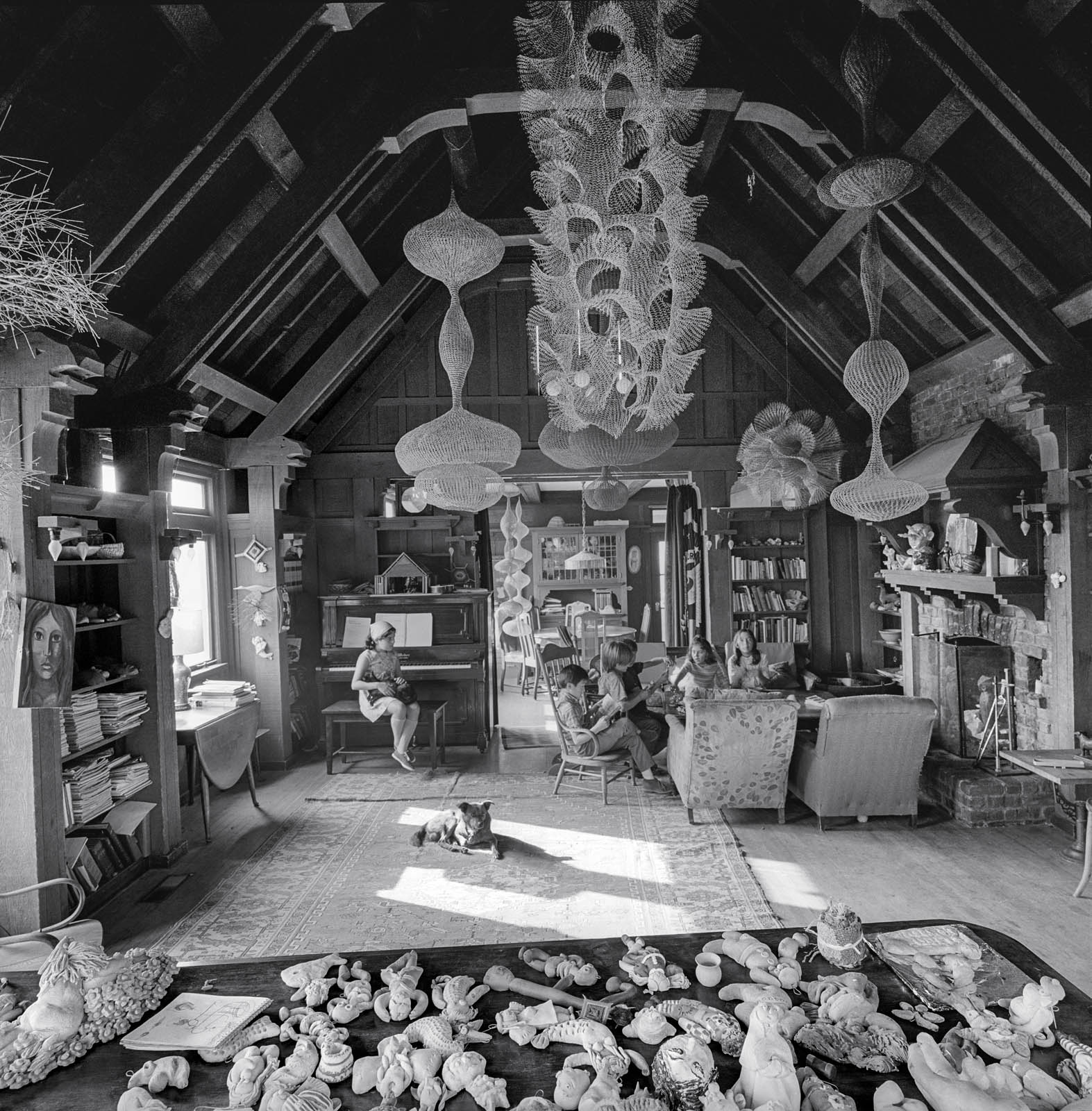
The heart of the Asawa-Lanier Noe Valley house was its cathedral-like main living space, which boasted south-facing windows and a double-height ceiling measuring more than five meters tall. The space was filled with objects reflective of the constant creative activity the artist encouraged in her children and guests to the home. Its walls featured her own work along with art by friends including Josef Albers, among others. Its shelves displayed pots by Marguerite Wildenhain as well as art books. The most distinguishing feature of her living room was the spectacular array of Asawa’s wire sculptures suspended from the open overhead beams. Both within and outside her home and studio, Asawa never stopped working: She sketched and drew her surroundings, coiled or bundled wire in preparation for the next sculpture, folded paper for origami, and welcomed other artists, educators, and advocates for continued collaborations.

Catalogue

The exhibition will be accompanied by a fully illustrated catalogue with essays by exhibition curators Janet Bishop, Cara Manes, and Geaninne Gutiérrez-Guimarães, as well as a chronology by Dominika Tylcz, all shedding light on Ruth Asawa’s six-decade career, her unyielding search for new possibilities, and her unique artistic vocabulary.

 Press release from the Guggenheim Museum Bilbao


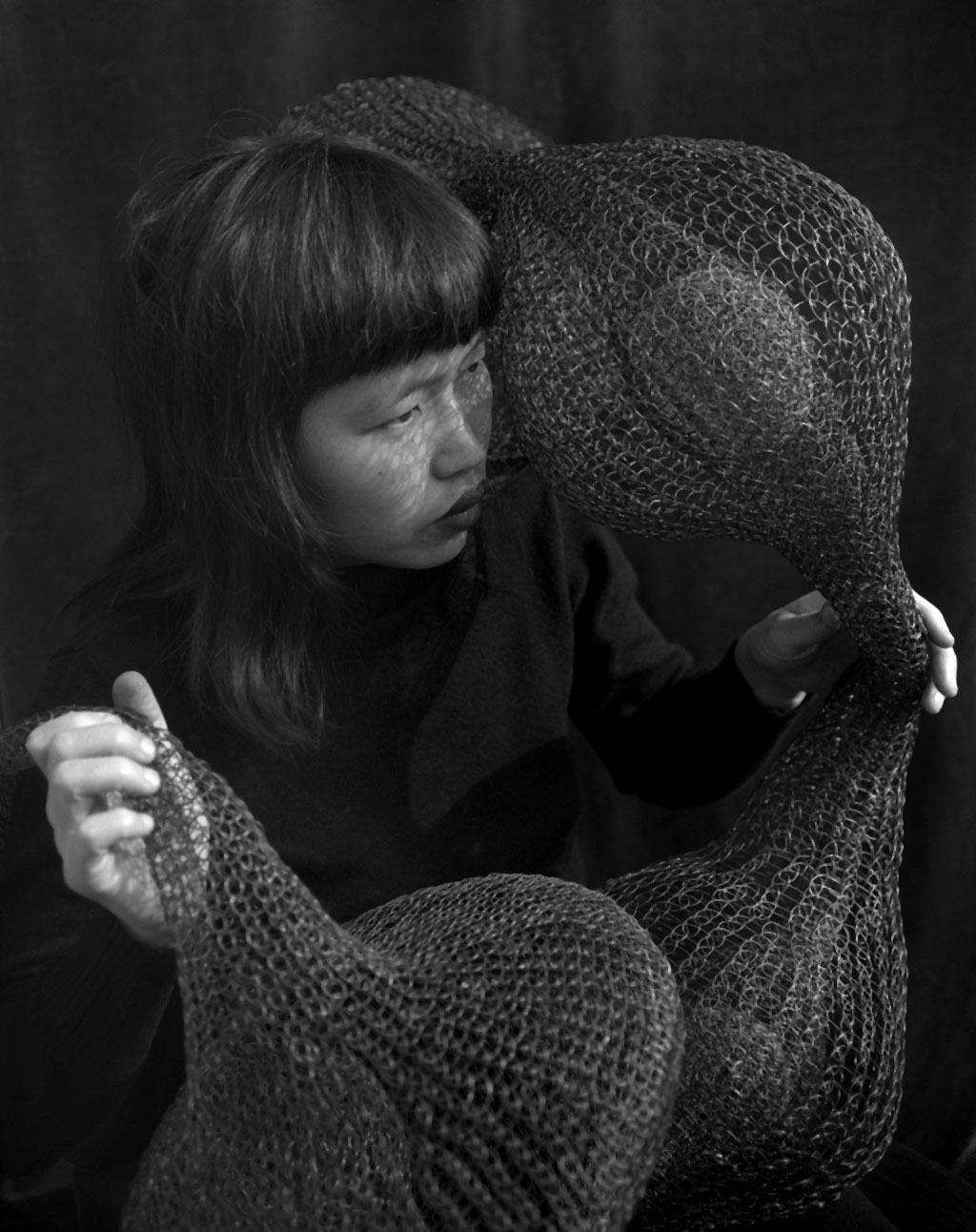
Imogen Cunningham (American, 1883-1976) 'Holding a form-within-a-form sculpture' 1951


Imogen Cunningham (American, 1883-1976)
Holding a form-within-a-form sculpture
1951
Gelatin silver print
Photo © 2026 Imogen Cunningham Trust / http://www.ImogenCunningham.com
Artwork © 2026 Ruth Asawa Lanier, Inc., courtesy David Zwirner


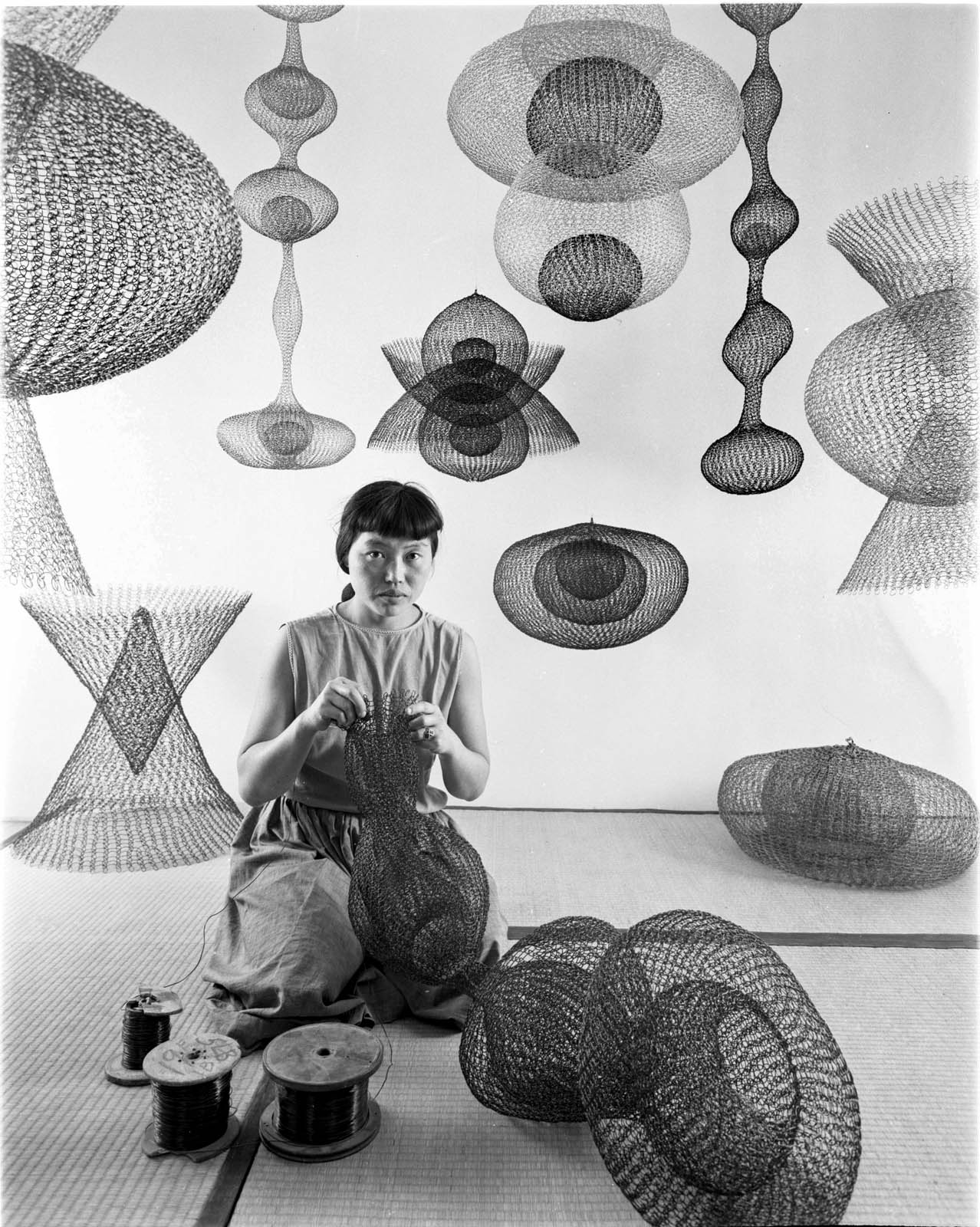
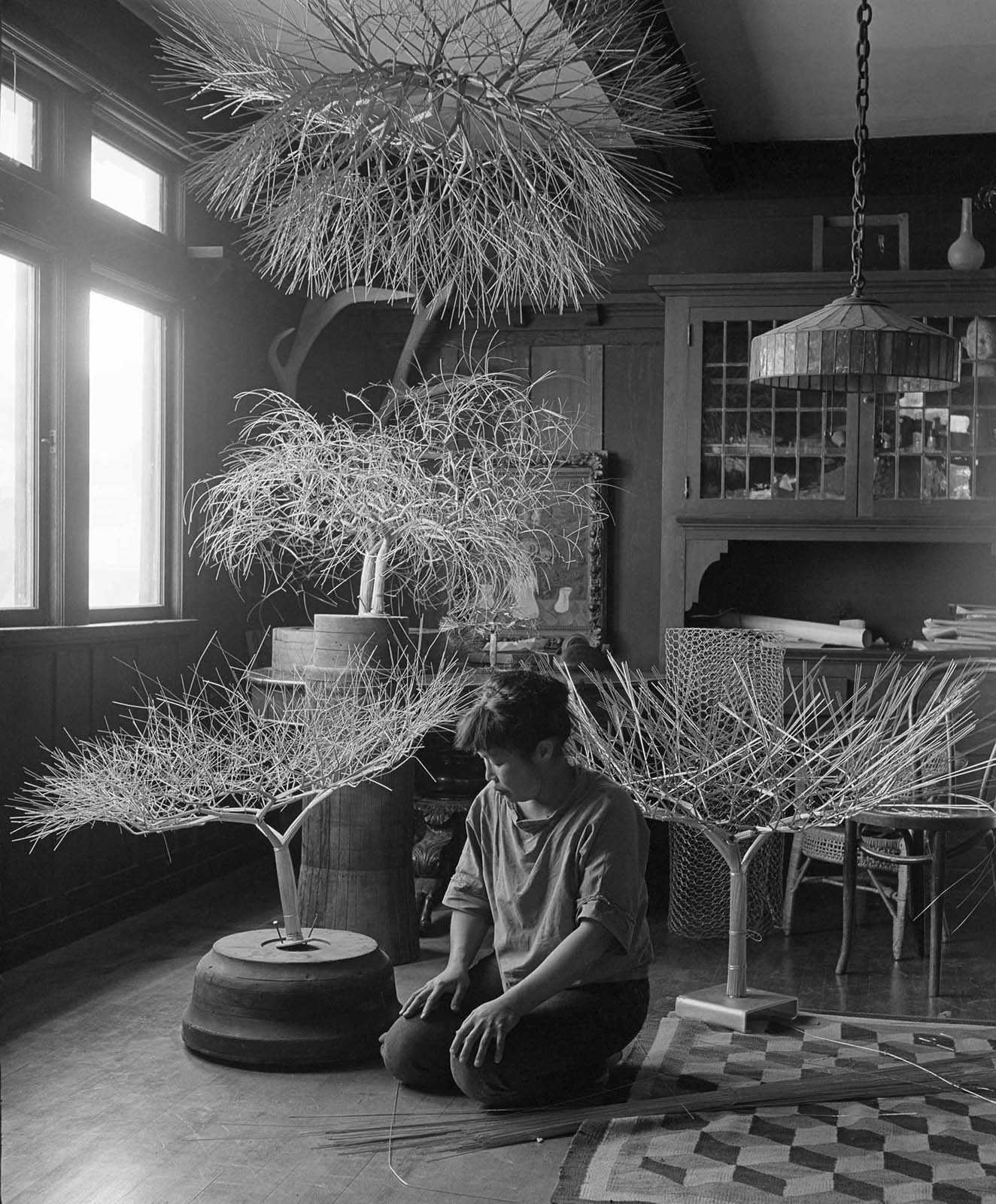
Nat Farbman (American born Poland, 1907-1988) 'Artist Ruth Asawa making wire sculptures, California, United States' November 1954


Nat Farbman (American born Poland, 1907-1988)
Artist Ruth Asawa making wire sculptures, California, United States
November 1954
Image: Nat Farbman/The LIFE Picture Collection/Shutterstock
Artwork: © 2026 Ruth Asawa Lanier, Inc., courtesy David Zwirner


Nat Farbman immigrated to United States 1911, was a photographer for LIFE magazine from 1946 to 1961.


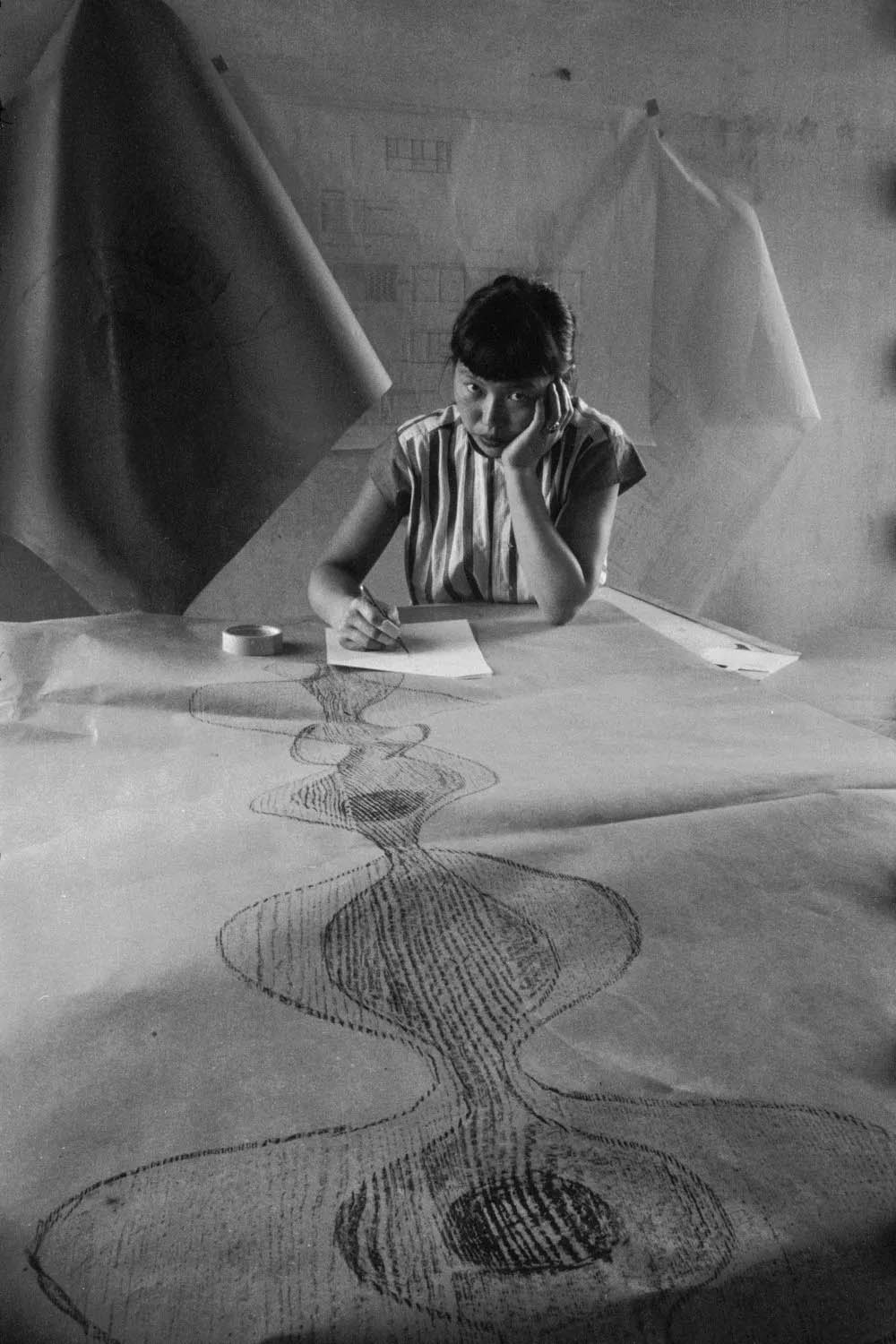
Nat Farbman (American born Poland, 1907-1988) 'Portrait of Japanese American artist sculptor Ruth Asawa as she sketches a design' 1954


Nat Farbman (American born Poland, 1907-1988)
Portrait of Japanese American artist sculptor Ruth Asawa as she sketches a design
1954
Image: Nat Farbman/The LIFE Picture Collection/Shutterstock
Artwork: © 2026 Ruth Asawa Lanier, Inc., courtesy David Zwirner


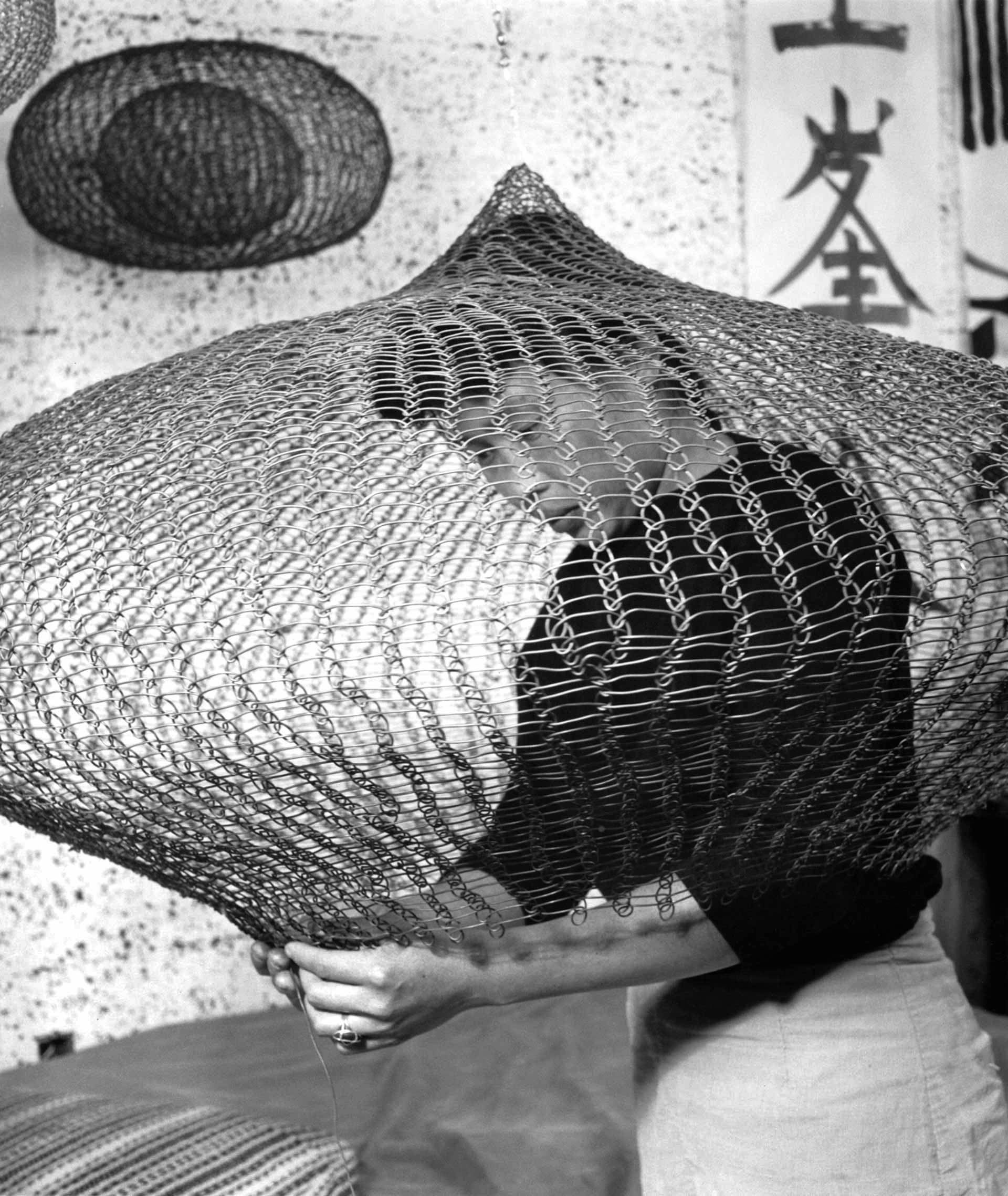
Imogen Cunningham (American, 1883-1976) 'Ruth Asawa' 1957


Imogen Cunningham (American, 1883-1976)
Ruth Asawa
1957
Photo © 2026 Imogen Cunningham Trust / http://www.ImogenCunningham.com
Artwork © 2026 Ruth Asawa Lanier, Inc., courtesy David Zwirner


Imogen Cunningham (American, 1883-1976) 'Ruth Asawa in Her Dining Room with Tied-Wire Sculptures' 1963


Imogen Cunningham (American, 1883-1976)
Ruth Asawa in Her Dining Room with Tied-Wire Sculptures
1963
Gelatin silver print
Photo © 2026 Imogen Cunningham Trust / http://www.ImogenCunningham.com
Artwork © 2026 Ruth Asawa Lanier, Inc., courtesy David Zwirner


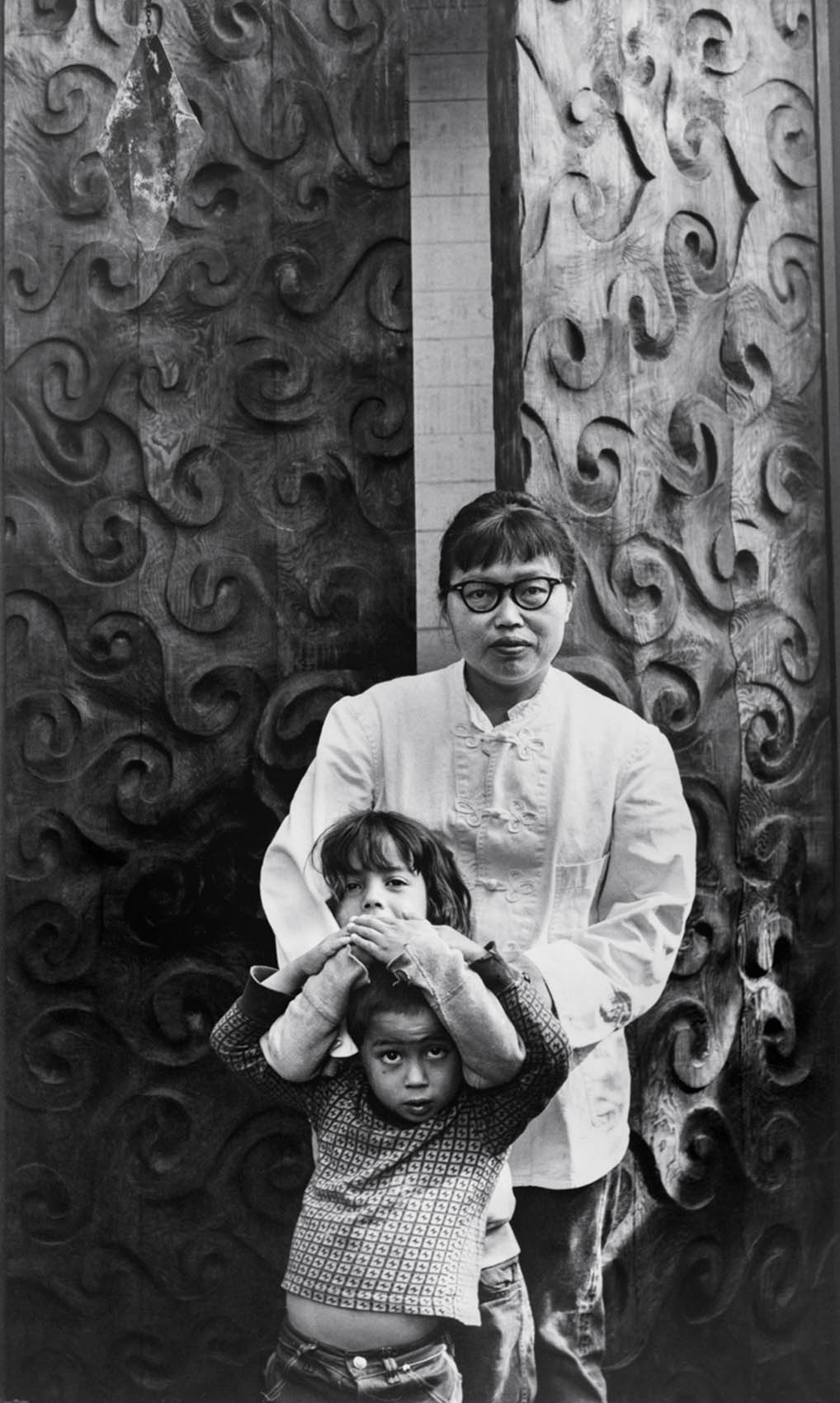
Joan Pearson Watkins (American, 1924-2013) 'Ruth Asawa with her children Addie and Paul in front of Doors (S.528, Carved Redwood Doors for Ruth Asawa’s Home), at her home in San Francisco' c. 1965


Joan Pearson Watkins (American, 1924-2013)
Ruth Asawa with her children Addie and Paul in front of Doors (S.528, Carved Redwood Doors for Ruth Asawa’s Home), at her home in San Francisco
c. 1965
© 2026 Ruth Asawa Lanier, Inc., courtesy David Zwirner


Joan Pearson Watkins (also known as Joan Jockwig Pearson Watkins) was an American ceramist, museum curator, and photographer.

Joan Pearson Watkins’ archival photography serves as a vital historical record of the mid-20th century art scene, capturing intimate moments of iconic American artists in their creative spaces. Rather than staging rigid portraits, her camera documented the organic, daily environments where famous mid-century modernism was actively being built.

Her most famous body of photographic work documents the iconic Japanese-American sculptor Ruth Asawa. Watkins captured crucial archival images of Asawa’s life and environment including photos showing how Asawa lived alongside her intricate, hanging looped-wire sculptures, serving as an invaluable visual record for modern museum retrospectives


Rondal Partridge (American, 1917-2015) 'Living room of Ruth Asawa's home in San Francisco’s Noe Valley neighbourhood' 1969


Rondal Partridge (American, 1917-2015)
Living room of Ruth Asawa’s home in San Francisco’s Noe Valley neighbourhood
1969
Photo © 2026 Rondal Partridge Archives
© 2026 Ruth Asawa Lanier, Inc., courtesy David Zwirner


Rondal Partridge (September 4, 1917 – June 19, 2015) was an American photographer. After working as an assistant to well-known photographers Dorothea Lange and Ansel Adams in his youth, he went on to a long career as a photographer and filmmaker. …

Career as a photographer

In 1940, he got a job with a New Deal agency called the National Youth Administration, documenting the problems faced by young people in the final years of the Great Depression.

In contrast to Adams, whose work focused on the beauty of the natural landscape, Partridge documented the human built infrastructure of Yosemite, as well as changes to the built environment of the San Francisco Bay Area. An example of such work is his mid 1960s photograph Pave It and Paint It Green. The photo shows iconic Yosemite peak Half Dome in the background, while the foreground consists of a parking lot filled with cars. In the photo, “the distinction between city and wilderness has disappeared”. Partridge also made a documentary film of the same name, which was shown on television. Adams, who did not appreciate irony or social commentary in photography, disapproved of Partridge’s 1960s work in Yosemite, although he later called Partridge a “fine photographer” in his autobiography.

Partridge has taken portraits of ordinary working people, as well as many notable people including Odetta, Ruth Asawa, Judy Dater, Peter Scott Lewis, John Carl Warnecke, Dorothea Lange, Ansel Adams and Diego Rivera as well as his mother, Imogen Cunningham.

Text from the Wikipedia website


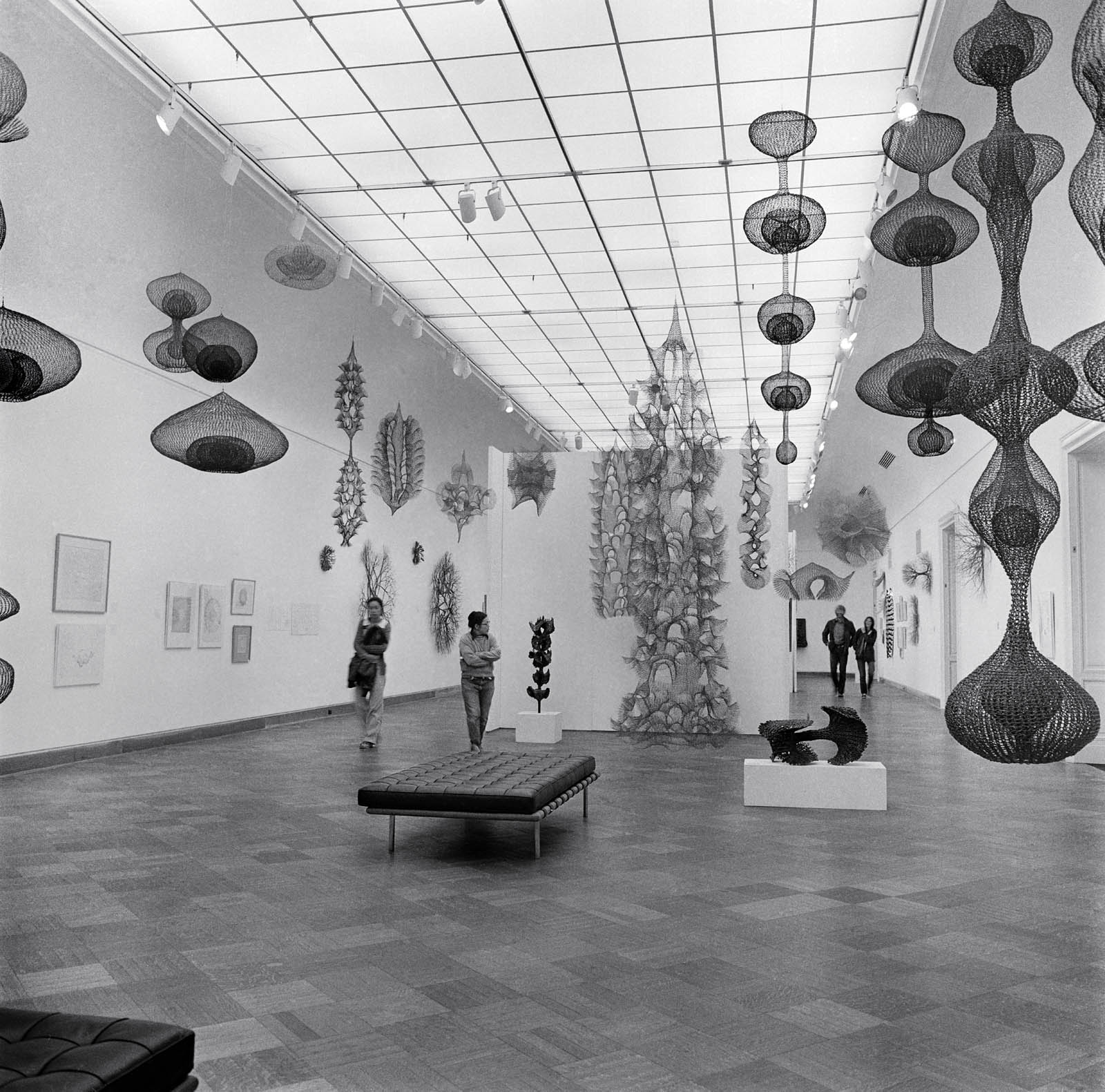
Laurence Cuneo (American) 'Ruth Asawa (second from left) with visitors to her exhibition Ruth Asawa: A Retrospective View, San Francisco Museum of Art (now SFMOMA)' 1973


Laurence Cuneo (American)
Ruth Asawa (second from left) with visitors to her exhibition Ruth Asawa: A Retrospective View, San Francisco Museum of Art (now SFMOMA)
1973
© 2026 Ruth Asawa Lanier, Inc., courtesy David Zwirner


Laurence Cuneo (American) 'Ruth Asawa's Untitled (S.540, Hanging Seven-Lobed, Interlocking Continuous Form within a Form) hanging in front of the artist's Wall of Masks (LC.012) on the exterior of her home in San Francisco' c. 1973


Laurence Cuneo (American)
Ruth Asawa’s Untitled (S.540, Hanging Seven-Lobed, Interlocking Continuous Form within a Form) hanging in front of the artist’s Wall of Masks (LC.012) on the exterior of her home in San Francisco
c. 1973
Artwork © 2026 Ruth Asawa Lanier, Inc., courtesy David Zwirner


By 1960, Asawa, Albert Lanier, and their six children – Xavier, Aiko, Hudson, Adam, Addie, and Paul – had outgrown three San Francisco residences. Later that year she and Lanier purchased a large house in Noe Valley. Lanier spent a year renovating – including excavating to create a studio for Asawa and additional bedrooms – before the family moved in during the fall of 1961.

Asawa designed monumental new front doors, on view in this section and titled Doors (S.528, Carved Redwood Doors for Ruth Asawa’s Home), 1961, which were featured prominently in her new home. She used a durable wood native to the West Coast and drew an allover pattern of interlocking waves that joined across the two doors when closed. Her older children also helped her to carve and finish the surface, using mallets and chisels to carve shallow, raised patterns across both sides of the doors, and smoothing the surface with a blowtorch and wire brushes. The family went on to build walkways from cobblestones scavenged from San Francisco beaches, planting beds for flowers, herbs, and vegetables that would prove to be an enduring source of inspiration for Asawa’s drawings.

Additionally, the artist created hundreds of unique face casts of family, friends, and colleagues between 1966 and 2000, some of which are on view in this section as well, resulting in a veritable index of the comings and goings at the Noe Valley house.


Laurence Cuneo (American) 'Ruth Asawa and her granddaughter with Japanese American Internment Memorial (PC.011)' 1990-1994


Laurence Cuneo (American)
Ruth Asawa and her granddaughter with Japanese American Internment Memorial (PC.011)
1990-1994
Commissioned by the City of San José; 300 South First Street, San José
© 2026 Ruth Asawa Lanier, Inc., courtesy David Zwirner


Guggenheim Museum Bilbao
Abandoibarra Etorb., 2, Abando,
48009 Bilbao, Bizkaia, Spain

Opening hours:
Tuesday – Sunday, 10am – 7pm

Guggenheim Museum Bilbao website
LIKE ART BLART ON FACEBOOK

Back to top

Exhibition: ‘PLEASE SEND TO REAL LIFE: Ray Johnson Photographs’ at the Morgan Library & Museum, New York

Exhibition dates: 17th June – 2nd October, 2022

Curator: Joel Smith, Richard L. Menschel Curator of Photography at the Morgan Library & Museum


Ray Johnson (American, 1927-1995) 'Untitled (Eight photo booth self-portraits)' Nd from the exhibition 'PLEASE SEND TO REAL LIFE: Ray Johnson Photographs' at the Morgan Library & Museum, New York, June - Oct, 2022


Ray Johnson (American, 1927-1995)
Untitled (Eight photo booth self-portraits)
Nd
Gelatin silver prints on whiteboard
Sheet: 8 x 9 1/2 in. (20.32 x 24.13cm)
Courtesy of the Ray Johnson Estate


Ray Johnson was an American artist “known primarily as a collagist and correspondence artist, he was a seminal figure in the history of Neo-Dada and early Pop art…” He absorbed from his teachers Josef Albers, Alvin Lustig, and Robert Motherwell and “entered into Zen kinship with two teachers, John Cage and Merce Cunningham, and into romantic partnership with another, the sculptor Richard Lippold.”

And then he burnt all the early paintings in his possession and took the path less trodden. He developed his own artistic language “through the creation of slight, irregular-shaped, frame-resistant (but mailable) collages he called “moticos”.” (The name was an anagram of the word “osmotic”)

After moving from New York to Locust Valley, Long Island in 1968, Johnson continued to make art but only had two more solo exhibitions, the last one in 1991. “Johnson was forever constructing miniature sets for his own delirious theatre of the absurd: puzzles within puzzles. The sensibility is not unlike Joseph Cornell’s [whose work was a major influence], minus the romance and period nostalgia. Johnson worked in another sort of outsider vernacular – at once banal, vulgar, campy, and deeply sophisticated.”1

The curator Joel Smith refers to “the low-key but constant thrum of odd motivation” behind all of the artist’s work.

Towards the end of his life Johnson took up photography and became a master of the throwaway camera, using the machine to create intimate, staged actions “which served the artist as a form of citation: as a way to “reference,” rather than “represent,” his subjects. The hands-off nature of the medium gave Johnson a way to bring topics up yet keep his viewer (his recipient, his reader) focused on something he cared about more: the messaging process itself.”

Each person, each artist has a different reason to communicate. But what are they communicating?

In Johnson’s case I think he was expressing his inner alternate reality, a different point of view of the world communicated through a new and fantastical visual language. Inhabited by bunnies and pop stars, Johnson’s work was a collage of the unclassifiable, bizarre, wired, wonderful, pop, performance, licked, action, nothings, dreams, concept, sexual, stamped, eccentric and enigmatic moticos… osmotic and fluidly subversive observational images, staged interventions, obsessive, witty and weird constructions.

As Loring Knoblauch observes, “these pictures find new pathways of physical intervention, creating staged installations that combine Johnson’s restless collage combinations and the quirks of photographic vision into something cleverly unexpected.”2

Revelling in his insider-outsider status, Johnson was a naive draftsman / Navy draftsman (he loved a good play on words). There is a “distinctive wit – and the evident delight of discovery – that runs through these photographs.” But it is a dark witticism, as dark one of my favourite movies, Donnie Darko (full of bunnies). His is art as performance… of nothings, of everything, moving everything, setting everything in motion. We follow his in/actions whether it be documenting a flopped stranger wearing a bunny cutout, six Movie Stars in the back of a car, or his prescient undated Eight photo booth self-portraits (above) in which he acts out and obscures different personas.

In his last performance this creative man of nothing (real life) “was seen jumping from a bridge in Sag Harbor… [and] appeared to be doing a backstroke toward the open Atlantic.” He could not swim. As he said of one of his early performances, it (he) “went off into the void in some marvellous fashion…”

Dr Marcus Bunyan


1/ Vince Aletti. “A Trove of Snapshots from a Sly Master of Collage,” on The New Yorker website July 22, 2022 [Online] Cited 26/09/2022

2/ Loring Knoblauch. “PLEASE SEND TO REAL LIFE: Ray Johnson Photographs @Morgan Library,” on the Collector Daily website September 7, 2022 [Online] Cited 26/09/2022


Many thankx to the Morgan Library & Museum for allowing me to publish the photographs in the posting. Please click on the photographs for a larger version of the image.


Johnson, however, was a prankster. Like the bunny head he adopted as his trademark – a cartoonish line drawing that appeared in much of his work, often bearing the name of a key figure in 20th-century art – he hopped lightly, merrily across this playing field. Revelling in puns and irreverence (an untitled 1973 collage known as “Jackson Pollock Fillets” includes cut-out recipes for Pollock Fillets Amandine and Barbecued Pollock Burgers), conducting his life as a nonstop performance, he revived the Dada tradition embodied by his hero Marcel Duchamp. In contrast to the grandiosity of Minimal art, land art, Pop Art and other macho midcentury movements, he offered something much humbler: collages or drawings of portable size and wry wit. … Johnson created some of the earliest works of Pop Art and was an early influence on conceptual art. …

The contents of Johnson’s pictures fall into several categories. At times, he chopped up the photos and used them to form a collage. Usually, though, and more interestingly, he found or created a collage-like pattern within the photographic frame. He made corrugated cardboard pieces that he called movie stars, and carried them to places where he could photograph them. Sometimes they incorporated images of celebrities: Marilyn Monroe, Jack Kerouac, Johns. Often they were renditions of his signature creation, a bunny with long, erect ears and a pendulous nose that, like a “Kilroy was here” graffiti drawing from World War II, feels both childlike and sexualized. He would inscribe a bunny with a name, thereby transforming it into a standardized personal portrait. And then he would drive his movie stars to a picturesque setting and shoot them with his camera.


Arthur Lubow. “An Elusive Artist’s Trove of Never-Before-Seen Images,” on The New York Times website March 23, 2021 [Online] Cited 26/09/2022. Used under fair use conditions for the purposes of education and research


As a body of work, these photographs by Johnson absolutely feel unfinished, in an open-ended and unwieldy way, as though he was grasping for new ways to communicate. Seen together, there is both dogged teach-yourself inventiveness and a hint of loneliness on display, with a nostalgia for stars of the past and his own younger face percolating through his iterative reworkings. At their best, these pictures find new pathways of physical intervention, creating staged installations that combine Johnson’s restless collage combinations and the quirks of photographic vision into something cleverly unexpected. At the end of his life, Johnson was actually becoming an interesting photographer, and these unearthed leavings provide tantalizing glimpses of what might have been.


Loring Knoblauch. “PLEASE SEND TO REAL LIFE: Ray Johnson Photographs @Morgan Library,” on the Collector Daily website September 7, 2022 [Online] Cited 26/09/2022. Used under fair use conditions for the purposes of education and research


Overview

Dubbed “New York’s most famous unknown artist” by the New York Times, Ray Johnson (1927-1995) was a widely connected downtown figure, Pop art innovator, and pioneer of collage and mail art. After moving from Manhattan to suburban Long Island in 1968, Johnson selectively distanced himself from the mainstream art world, holding only two exhibitions after 1978. Yet even after his last show, in 1991, he remained a prolific and unpredictable artist.

Johnson used photographs in his work for decades, but it was only with his purchase of a single-use, point-and-shoot camera in January 1992 that he embarked on his own “career as a photographer.” By the end of December 1994 he had used 137 disposable cameras. His most frequent subjects were what he called his Movie Stars: meter-high collages on cardboard, often featuring the bunny head that served as his artistic signature. They became ensemble players in the curious tableaux he staged in everyday locales near his Locust Valley home.

At his death by suicide in January 1995, Johnson left a vast archive of art in boxes stacked throughout his house, including over five thousand colour photographs, still in the envelopes from the developer’s shop. This body of work, virtually unseen until now, comprised his final major art project, the last act in a romance with photography that had begun some forty years earlier.


PLEASE SEND TO REAL LIFE: Ray Johnson Photographs

A widely connected pioneer of Pop and mail art, Ray Johnson (1927-1995) was described as “New York’s most famous unknown artist.” Best known for his multimedia collages, he stopped exhibiting in 1991, but his output did not diminish. In 1992-1994, he used 137 disposable cameras to create a large body of work that is coming to light only now. Staging his collages in settings near his home in Locust Valley, Long Island – parking lots, sidewalks, beaches, cemeteries – he made photographs that pull the world of everyday “real life” into his art. In his “new career as a photographer,” Johnson began making collages in a new, larger format that made them more effective players in his camera tableaux. The vast archive he left behind at his death included over three thousand of the late photographs. Now, his final project makes its debut alongside earlier photo-based collages and works of mail art: fruits of a romance with the camera that spans the four decades of the artist’s career.


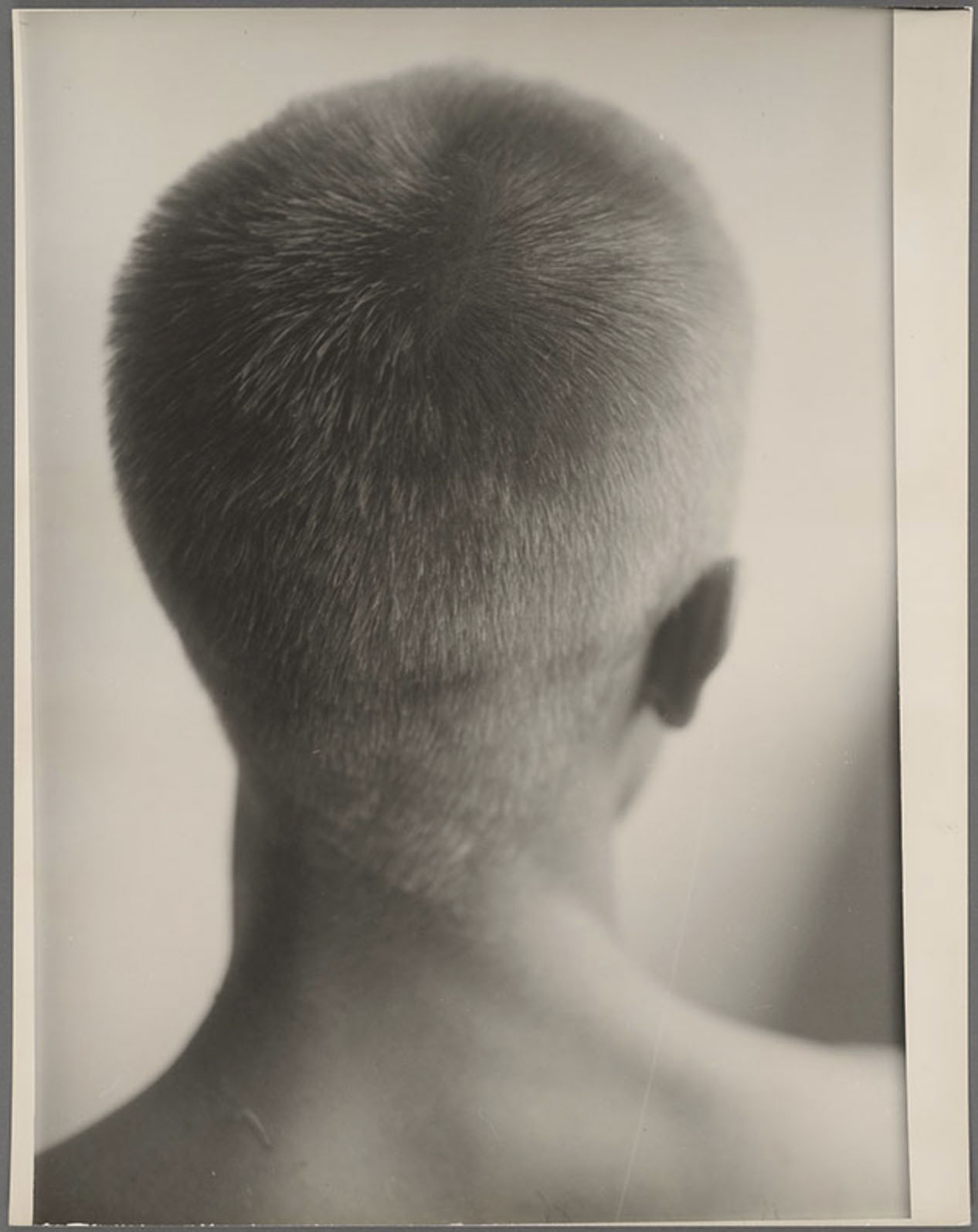
Hazel Larsen Archer (American, 1921-2001) 'Ray Johnson at Black Mountain College' 1948 from the exhibition 'PLEASE SEND TO REAL LIFE: Ray Johnson Photographs' at the Morgan Library & Museum, New York, June - Oct, 2022


Hazel Larsen Archer (American, 1921-2001)
Ray Johnson at Black Mountain College
1948
Gelatin silver print
13 3/4 x 9 7/8 inches
The Morgan Library & Museum
Purchased as the gift of David Dechman and Michel Mercure
© Estate of Hazel Larsen Archer


As a student at North Carolina’s Black Mountain College from 1945 to 1948, Johnson thrived under the rigorous tutelage of his foundation-course teacher Josef Albers (1888-1976). Johnson also modelled for Archer, a fellow student who would go on to teach photography at the school. This portrait – lush, faceless, and sexually ambiguous – foreshadows the complexity of Johnson’s use of photography throughout his career. Though attracted by the camera’s peerless ability to bestow glamour, he often tried to undercut its role as a transparent conveyor of facts.


Ray Johnson (American, 1927-1995) 'RJ silhouette and wood, Stehli Beach' Autumn 1992 from the exhibition 'PLEASE SEND TO REAL LIFE: Ray Johnson Photographs' at the Morgan Library & Museum, New York, June - Oct, 2022


Ray Johnson (American, 1927-1995)
RJ silhouette and wood, Stehli Beach
Autumn 1992
Commercially processed chromogenic print
4 x 6 inches
The Morgan Library & Museum
Gift of the Ray Johnson Estate, courtesy of Frances Beatty
© Ray Johnson / Artists Rights Society (ARS), New York


As an artist, Johnson was a master hunter-recycler, constantly revisiting and reinterpreting images from his past. On a visit to the beach at nearby Oyster Bay in 1992, he brought along a camera and a cardboard cutout of his head. Propping the board against a piece of driftwood log, he created a visual pun: the log’s central rings evoke the swirl of hair that Hazel Archer had once photographed on his (now long-bald) head.


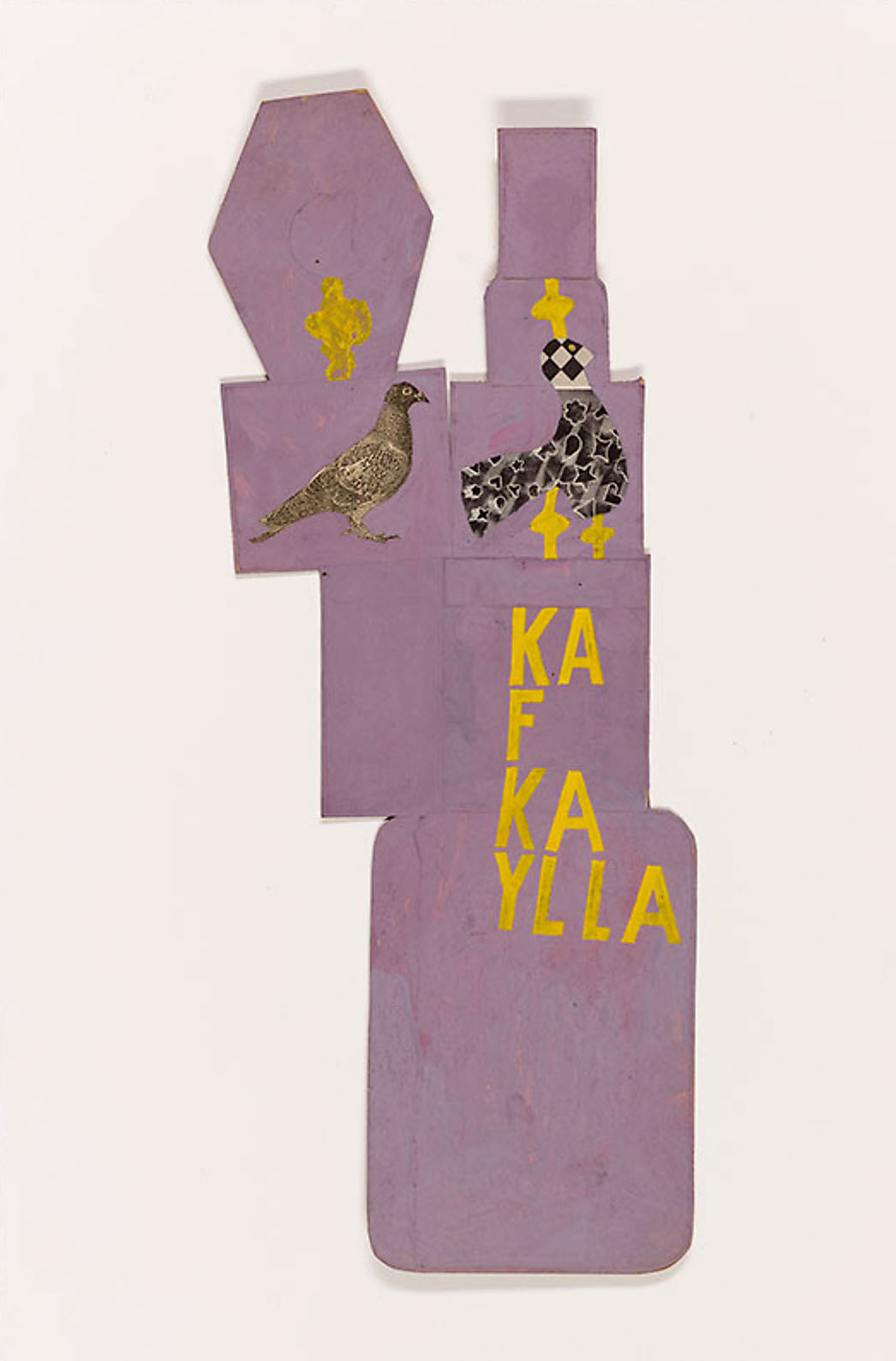
Ray Johnson (American, 1927-1995) 'Untitled (Moticos with KAFKAYLLA)' c. 1953-1954


Ray Johnson (American, 1927-1995)
Untitled (Moticos with KAFKAYLLA)
c. 1953-1954
Collage on illustration board
13 x 5 in. (33.02 x 12.7cm)
The Ray Johnson Estate
© Ray Johnson / Artists Rights Society (ARS), New York


Johnson applied one all-purpose noun, “moticos” (both singular and plural), to his short writings, his collages, and the glyph-like shapes he drew. He and his friend Norman Solomon coined the term by reshuffling the word “osmotic,” chosen out of the dictionary. On this moticos made from a flattened box, Johnson paired a photograph of a pigeon with its strange twin: a sort of photo-bird, composed of cookie cutters and a checkerboard. Johnson proposes a second unlikely duo by combining the names of the author Franz Kafka (1883-1924) and the photographer Ylla (Camilla Koffler, 1911-1955), known for her images of animals.


Moticos

In the autumn of 1955, artist Ray Johnson walked through the streets of New York City with a slip of paper, asking strangers if they could define the word he’d written on it: “motico.” People gamely racked their brains: “‘Gee, I wish to hell I knew,’ said one. A nun asked, ‘Isn’t it a kind of colour?'” Johnson recalled these encounters in a story that ran that year in the very first issue of The Village Voice, when he was 27 years old and living in Manhattan, and working primarily in painting and collage.

The word was one Johnson had invented. An anagram of osmotic (a word allegedly chosen at random from a book), “moticos” could refer to several different things. Johnson called the small collage panels he made “moticos” but he also used the word to refer to textual representations too. Johnson would paint and transform the cardboard pieces that came with his laundry into parts of his collages, transforming them into silhouettes and then glyphs, new moticos.

Rebecca Bengal. “Photo Dump: Digging into the 5,000 Photographs Ray Johnson Left Behind,” on the Elephant Art website 20 Jul 2022 [Online] Cited 25/09/2022. Used under fair use conditions for the purposes of education and research


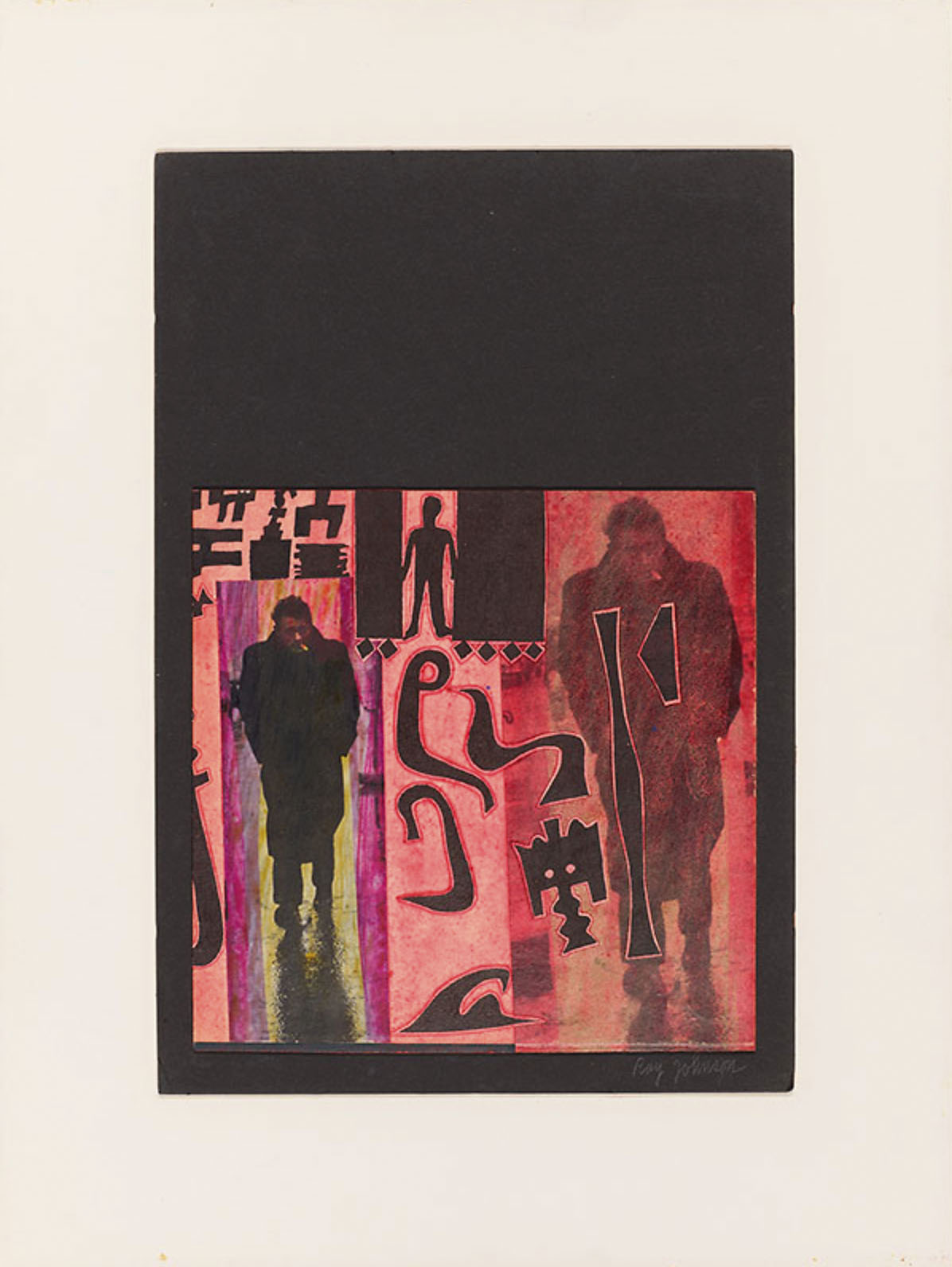
Ray Johnson (American, 1927-1995) 'Untitled (James Dean in the Rain)' c. 1953-1959


Ray Johnson (American, 1927-1995)
Untitled (James Dean in the Rain)
c. 1953-1959
Collage on illustration board
15 1/2 x 11 3/4 in. (39.37 x 29.85cm)
The Ray Johnson Estate
© Ray Johnson / Artists Rights Society (ARS), New York


From the early 1950s, Johnson embraced photocollage as a way to inject Hollywood glamour into the cloistered world of avant-garde art. He was appropriating mass-media imagery years before Andy Warhol began populating monumental canvases with celebrity portraits. Here Johnson worked directly upon Dennis Stock’s iconic Life magazine photograph of James Dean walking alone through Times Square, which was published a few months before Dean died in a 1955 car crash. Whether Johnson made this work before or after Dean’s death is unknown. In the 1990s, he would again incorporate the actor’s silhouette in collages and photographs.


Elisabeth Novick. 'Untitled (Moticos on floor)' c. 1955


Elisabeth Novick
Untitled (Moticos on floor)
c. 1955
Gelatin silver print
8 3/4 x 13 1/4 inches
The Morgan Library & Museum
Gift of the Ray Johnson Estate, courtesy of Frances Beatty
Elisabeth Loewenstein / ArenaPAL
© Elisabeth Loewenstein


For a short feature in the first issue of the Village Voice (26 October 1955), a reporter walked with Johnson as he approached strangers in Grand Central Terminal and asked them whether they knew what a “moticos” was. As seen here, Johnson also literally took moticos to the streets, staging crowds of them for the camera in disused spaces in downtown Manhattan. Few early moticos have survived intact: over the next several decades, in a practice he called Chop art, Johnson continually disassembled his work and used the fragments to create new pieces.


Elisabeth Novick. 'Untitled (Ray Johnson and Suzi Gablik)' 1955

Ray Johnson (American, 1927-1995) '1955 moticos photographs from ladder' January 1992


Elisabeth Novick
Untitled (Ray Johnson and Suzi Gablik)
1955
Gelatin silver print
11 x 14 inches
The Morgan Library & Museum
Gift of the Ray Johnson Estate, courtesy of Frances Beatty
Elisabeth Loewenstein / ArenaPAL
© Elisabeth Loewenstein

Ray Johnson (American, 1927-1995)
1955 moticos photographs from ladder
January 1992
Commercially processed chromogenic print
4 x 6 inches
The Morgan Library & Museum
Gift of the Ray Johnson Estate, courtesy of Frances Beatty
© Ray Johnson / Artists Rights Society (ARS), New York


In 1955 Johnson asked his friend Elisabeth Loewenstein (later Novick) to bring a camera along on a walk with their mutual friend Suzi Gablik (1934-2022). Novick’s photographs record the impromptu performance that ensued, in which Johnson draped moticos on Gablik’s face and body. A fellow Black Mountain College alum, Gablik would become an influential critic; in her 1969 book on Pop art, she described improvised actions such as this one as the first “informal happenings” – ephemeral events conceived as works of art – in the postwar era.

Johnson preserved the photographs Novick made that day. Nearly forty years later, in one of his earliest experiments with a “throwaway camera,” he laid out the prints in a grid on his driveway and photographed them from atop a ladder.


Ray Johnson (American, 1927-1995) 'Correspondence to Frances X. Profumo' Undated


Ray Johnson (American, 1927-1995)
Correspondence to Frances X. Profumo
Undated
Typewritten text on paper, newspaper clippings
The Ray Johnson Estate
© Ray Johnson / Artists Rights Society (ARS), New York


In the mid-1950s, Johnson simultaneously shifted from oil painting to small-scale collage and from gallery exhibitions to the mail as a way of putting his art before an individual viewer. An envelope from Johnson often contained enigmatic clippings from books and magazines, including photographic illustrations drawn from the same stockpile that fuelled his collages. These are items Johnson sent in the 1950s to Frances X. Profumo, whom he befriended when he was a student and she an employee at Black Mountain College. The many visual and textual Xs invoke both Profumo’s distinctive middle initial and the convention of signing a fond letter “with kisses” (XXX).


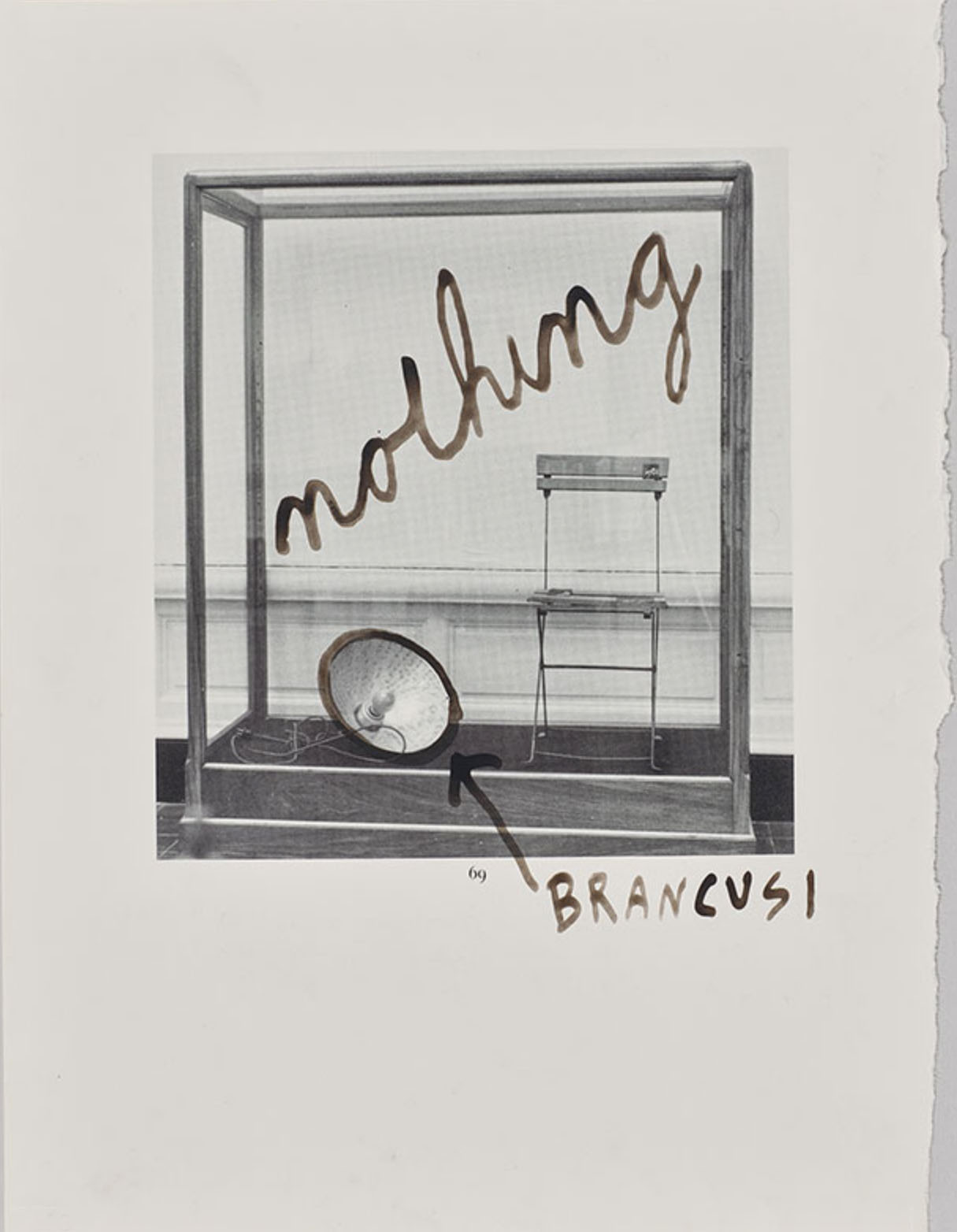
Ray Johnson (American, 1927-1995) 'Untitled (Nothing with Brancusi)' Undated

Ray Johnson (American, 1927-1995) 'Untitled (Mapplethorpe with moticos)' Undated

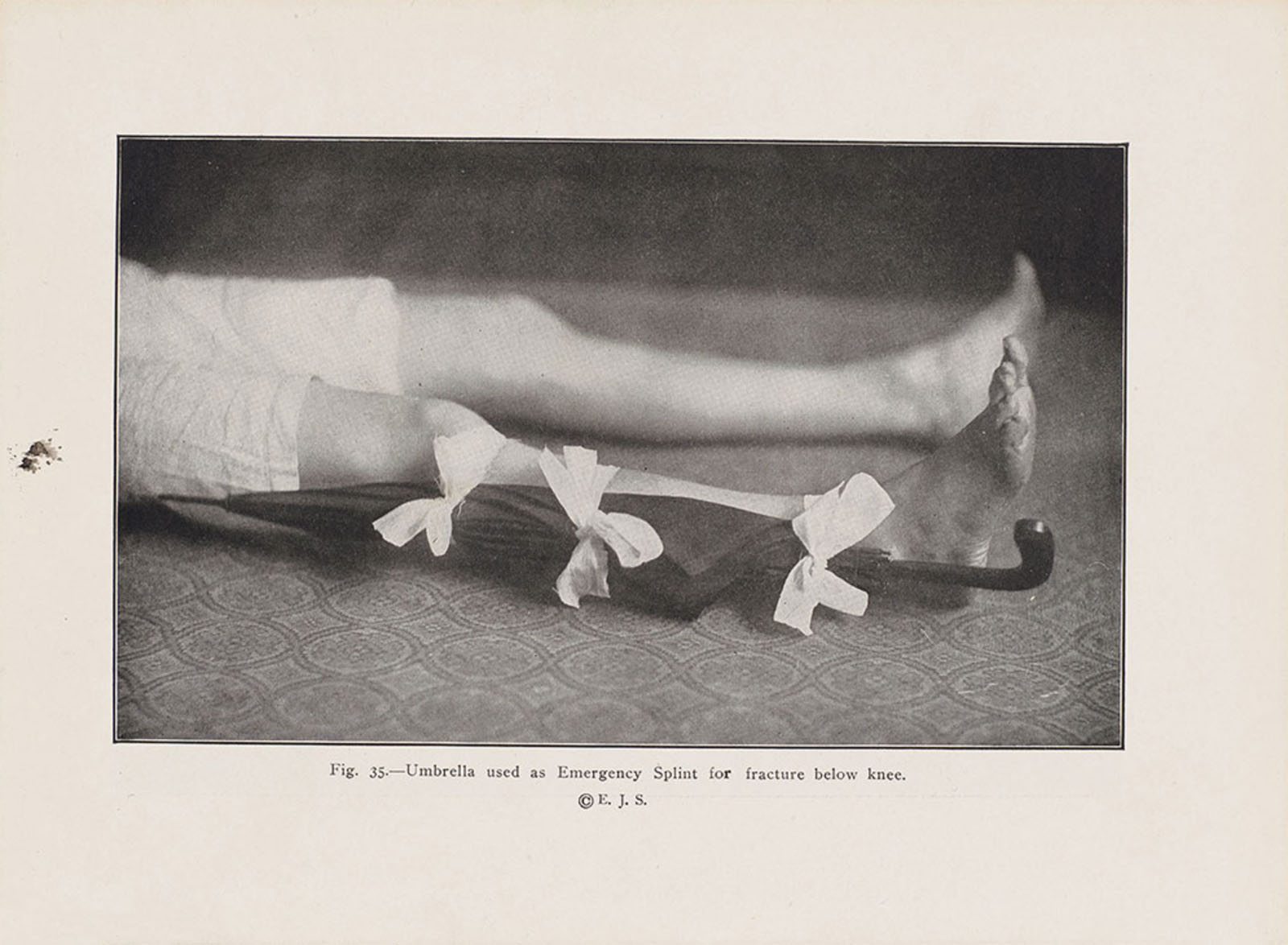
Ray Johnson (American, 1927-1995) 'Untitled (book page with umbrella as splint)' Undated


Ray Johnson (American, 1927-1995)
Untitled (Nothing with Brancusi)
Undated
Ink on book page
9 1/2 x 7 1/2 in. (24.13 x 19.05cm)
The Ray Johnson Estate
© Ray Johnson / Artists Rights Society (ARS), New York

Ray Johnson (American, 1927-1995)
Untitled (Mapplethorpe with moticos)
Undated
Ink on magazine page
Image: 7 x 7 in. (17.78 x 17.78cm)
The Ray Johnson Estate
The Morgan Library & Museum. Gift of the Ray Johnson Estate, courtesy of Frances Beatty.

Ray Johnson (American, 1927-1995)
Untitled (book page with umbrella as splint)
Undated
Ink on paper
Image: 9 1/2 x 7 in. (24.13 x 17.78cm)
The Ray Johnson Estate
© Ray Johnson / Artists Rights Society (ARS), New York


Over the years, Johnson inducted hundreds or thousands of recipients into what he called the New York Correspondence School by mailing them oblique yet personalised messages. These altered book and magazine pages were among the unmailed works found in his house after his death.


Ray Johnson (American, 1927-1995) 'Offset printing plate (Ara Ignatius portrait)' c. 1964

Ray Johnson (American, 1927-1995) 'Untitled (Ara Ignatius portrait with a photograph of lips)' Undated

Ray Johnson (American, 1927-1995) 'Untitled (Ara Ignatius portrait with bunnyheads)' Undated


Ray Johnson (American, 1927-1995)
Offset printing plate (Ara Ignatius portrait)
c. 1964
Metal
Image: 15 1/2 x 10 in. (39.37 x 25.4cm)
The Ray Johnson Estate
© Ray Johnson / Artists Rights Society (ARS), New York

Ray Johnson (American, 1927-1995)
Untitled (Ara Ignatius portrait with a photograph of lips)
Undated
Cut paper on paper
Image: 11 x 8 1/2 in. (27.94 x 21.59cm)
The Ray Johnson Estate
© Ray Johnson / Artists Rights Society (ARS), New York

Ray Johnson (American, 1927-1995)
Untitled (Ara Ignatius portrait with bunnyheads)
Undated
Ink on paper
Image: 11 x 8 1/2 in. (27.94 x 21.59cm)
The Ray Johnson Estate
© Ray Johnson / Artists Rights Society (ARS), New York


Johnson favoured likenesses that masked as much about him as they revealed. He repeatedly used a headshot that his friend Ara Ignatius made around 1963. It is an unnerving image, lacking the conceit of intimacy that characterises most formal portraits; instead it “stands for” Johnson, in the artless manner of a government-issued ID.

Many pieces of mail art that look like photocopies are in fact products of offset printing – a means of transferring photographs and other images to the page from reusable metal plates. The medium allowed Johnson to return to an image repeatedly, imposing variations that reflected his ever-changing purposes.


Ray Johnson (American, 1927-1995) 'Untitled ("I shot an arrow into the air..." with Shirley Temple and Vikki Dougan)' c. 1970-1972


Ray Johnson (American, 1927-1995)
Untitled (“I shot an arrow into the air…” with Shirley Temple and Vikki Dougan)
c. 1970-1972
Ink, wash, collage, vintage photograph on illustration board
18 x 15 in. (45.72 x 38.1cm)
The Ray Johnson Estate
© Ray Johnson / Artists Rights Society (ARS), New York


In this photocollage, two movie actors meet: Vikki Dougan (b. 1929), who became a sex symbol in the 1950s by publicly appearing in backless dresses, and the quintessentially innocent child star Shirley Temple (1928-2014). Temple’s rendering as a blacked-out, moticos-like figure may allude to her adult married name, Shirley Temple Black. Across the bottom of the image, a line from Henry Wadsworth Longfellow’s 1845 poem “The Arrow and the Song” is altered to refer to Johnson’s forerunner in collage and assemblage art, Joseph Cornell (1903-1972), who lived in Flushing, Queens.


Ray Johnson (American, 1927-1995) 'David Hockney's Mother's Potato Masher' 1972-80-88-94


Ray Johnson (American, 1927-1995)
David Hockney’s Mother’s Potato Masher
1972-80-88-94
Collage on cardboard panel
20 3/8 x 15 1/4 in. (51.75 x 38.74cm)
The Morgan Library & Museum
Gift of Frances Beatty, Alexander Adler, and the Ray Johnson Estate
© Ray Johnson / Artists Rights Society (ARS), New York


The title of each collage in the Potato Masher series begins with a notable artist’s or celebrity’s name. The titles then take an abrupt turn away from stardom by alluding first to the famed figure’s mother, and then to her potato masher. Here, Johnson included his own likeness in the form of a headshot, made around 1963 by the photographer Ara Ignatius. His face is covered by black moticos and cut-up fragments of his earlier artworks. Johnson created his collages over a span of weeks, months, or even years, dating each element in pencil as it joined the composition.


The Morgan Library & Museum presents PLEASE SEND TO REAL LIFE: Ray Johnson Photographs, opening June 17 and running through October 2, 2022. This exhibition explores the previously unknown camera work of the widely connected downtown New York figure, Pop art innovator, and pioneer of collage and mail art. At his death on 13 January 1995, Ray Johnson (1927-1995) left behind a vast archive of art in his house, including over five thousand colour photographs made in his last three years. Small prints, neatly stored in their envelopes from the developer’s shop, the photographs remained virtually unexamined for three decades. Now they can be seen as the last act in a romance with photography that had begun in Johnson’s art some forty years earlier. After retracing the story of Johnson’s use of photography throughout his career, PLEASE SEND TO REAL LIFE offers an in-depth look at the late work the artist called “my career in photography.”

After moving from Manhattan to suburban Long Island in 1968, Johnson selectively distanced himself from the mainstream art world, holding only two exhibitions after 1978. Yet even after his last show, in 1991, he remained a prolific and unpredictable artist. With his purchase of a single-use, point-and-shoot camera in January 1992, he embarked on an entirely fresh creative enterprise. By the end of December 1994, he had used 137 disposable cameras. His most frequent subjects were what he referred to as his Movie Stars: meter-high collages on cardboard, often featuring the bunny head that served as his artistic signature. They became ensemble players in the curious tableaux he staged in everyday locales near his Locust Valley home.

As an artist, Johnson was a master hunter-recycler, constantly revisiting and reinterpreting images from his past. He appears to have first used a disposable camera for a practical purpose: documenting his enormous backlog of unused collage fragments. He performed that work in his driveway and on the back steps of his house, but soon he was carrying a pocket-size camera on daily outings to nearby beaches, parks, and cemeteries. Johnson’s photographs exhibit a collagist’s instinct for insertion, layering, and surprise: most of them are centred on objects that he placed between himself and a scene as he found it. In his photographs as in his pun-filled writing and his densely worked collages, Johnson used juxtaposition to suggest that everything finds correspondence in something else. The point-and-shoot habit gave him a way to create an image almost as quickly as he could think of it. As curator Joel Smith writes in the book that accompanies the exhibition, “Nowhere in Johnson’s art does he look more intensely engaged by the present tense, more thrilled to be immersed in real life, than in the inventions of his throwaway camera.”

“PLEASE SEND TO REAL LIFE offers a rare chance to examine photographs taken by Ray Johnson, an artist known primarily for his brilliant work in collage,” said Colin B. Bailey, Director of the Morgan Library & Museum. “The images, most of which have gone unexplored until now, are truly innovative and ahead of their time. The exhibition also celebrates a significant gift of Johnson’s work, generously made by Ray Johnson estate, courtesy of Frances Beatty.”

“These photographs show that in his last years, Ray Johnson remained irrepressibly, explosively creative,” said Smith, the Richard L. Menschel Curator of Photography at the Morgan. “It’s his last great body of work, and its very casualness is prophetic: ten years later, smart phones and social media turned daily life into a constant exchange of personal photographs and commentary. Johnson was still making collages right up to the end – but now he made them in a camera, and the ‘real life’ all around him was his medium.”

PLEASE SEND TO REAL LIFE: Ray Johnson Photographs is accompanied by a book with the same title published by Mack Books, which includes an essay by the exhibition’s curator, Joel Smith.

Press release from the Morgan Library & Museum


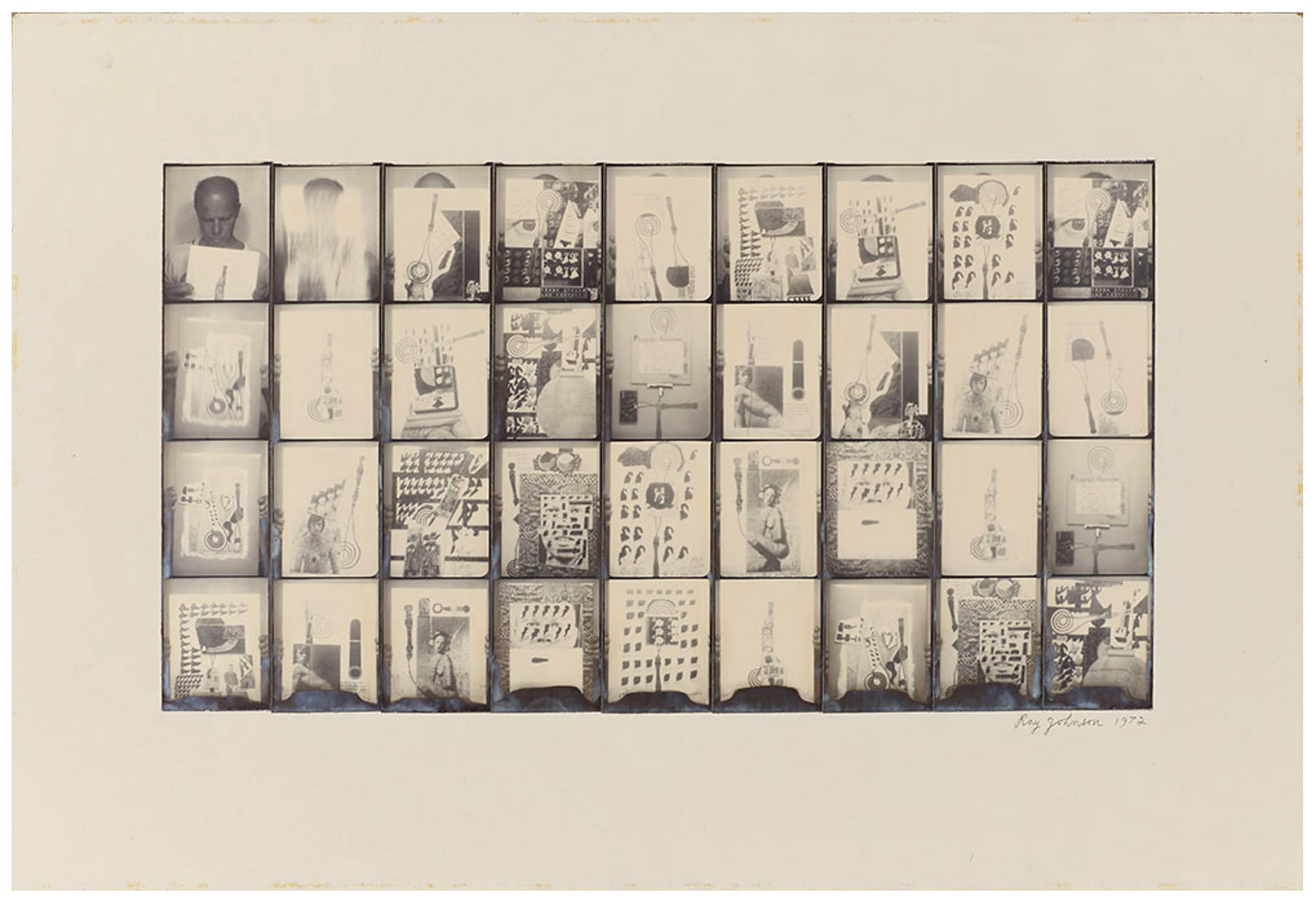
Ray Johnson (American, 1927-1995) 'Untitled (Photo Booth Collage)' 1972


Ray Johnson (American, 1927-1995)
Untitled (Photo Booth Collage)
1972
Collage on illustration board
12 7/8 x 19 in. (32.7 x 48.26cm)
The Morgan Library & Museum
Gift of Frances Beatty, Alexander Adler, and the Ray Johnson Estate
© Ray Johnson / Artists Rights Society (ARS), New York


Here, Johnson (visible at top left) employs a booth as an affordable studio for documenting works from his Potato Masher series. Sitting in the photo booth, he simply held up one collage after another for the automatic camera. The resulting sequence of vertical photo strips combines the qualities of a crude performance document and an art gallery’s inventory sheet. David Hockney’s Mother’s Potato Masher appears, not yet finished, fourth from the left in the bottom row.


Ray Johnson (American, 1927-1995) 'Untitled (Tab Hunter William Burroughs)' c. 1976-1981

Ray Johnson (American, 1927-1995) 'William S. Burroughs silhouette and kingfisher' Winter 1992


Ray Johnson (American, 1927-1995)
William S. Burroughs silhouette and kingfisher
Winter 1992
Commercially processed chromogenic print
4 x 6 in.
The Morgan Library & Museum
Gifts of the Ray Johnson Estate, courtesy of Frances Beatty
© Ray Johnson / Artists Rights Society (ARS), New York

Ray Johnson (American, 1927-1995)
Untitled (Tab Hunter William Burroughs)
c. 1976-1981
Collage on cardboard panel
12 x 12 1/2 in. (30.48 x 31.75cm)
The Morgan Library & Museum
Gift of Frances Beatty, Allen Adler, Alexander Adler, and the Ray Johnson Estate
© Ray Johnson / Artists Rights Society (ARS), New York


In 1976 Johnson began asking friends, art-world figures, and celebrities to sit and have their silhouettes traced onto paper. He thus built a library of nearly three hundred profile templates he could use and reuse. As a portrait form, the silhouette reduces its subject to a graphic shape, identifiable but resistant to psychological interpretation. In this example, Johnson overlapped the profiles of 1950s movie heartthrob Tab Hunter (1931-2018) and avant-garde writer William S. Burroughs (1914-1997).

In the 1990s Johnson photographed one of his stock props, a stuffed kingfisher, in combination with Burroughs’s silhouette. The beak of the bird extends the author’s prominent nose: a bill replacing the bill of a Bill.


Even when Johnson avoided direct self-portraiture, his quirky fixations were always evident. (In an essay for the exhibition catalogue, the curator Joel Smith refers to “the low-key but constant thrum of odd motivation” behind all of the artist’s work.) In one of the collages on display, William Burroughs’s profile nearly eclipses that of the nineteen-fifties movie star turned gay icon Tab Hunter, and both are all but obscured by a swarm of pebble-like fragments and bits of collage. Johnson was forever constructing miniature sets for his own delirious theatre of the absurd: puzzles within puzzles. The sensibility is not unlike Joseph Cornell’s, minus the romance and period nostalgia. Johnson worked in another sort of outsider vernacular – at once banal, vulgar, campy, and deeply sophisticated. Like John Baldessari, he favored artless lettering and crisp graphic design. The cardboard slats, especially, might be mistaken for portable Baldessaris.

Vince Aletti. “A Trove of Snapshots from a Sly Master of Collage,” on The New Yorker website July 22, 2022 [Online] Cited 26/09/2022. Used under fair use conditions for the purposes of education and research


Ray Johnson (American, 1927-1995) 'Untitled (Elvis with Bunny Ears)' 1987


Ray Johnson (American, 1927-1995)
Untitled (Elvis with Bunny Ears)
1987
Collage with acrylic and ink on canvasboard
16 x 8 in. (40.64 x 20.32cm)
The Morgan Library & Museum
Gift of the Ray Johnson Estate, courtesy of Frances Beatty.
© Ray Johnson / Artists Rights Society (ARS), New York


Beginning in the 1950s, Johnson made artistic use of photographs of the twentieth-century cultural icon Elvis Presley (1935-1977). Johnson’s most emblematic motif, a stylised bunny face, first appeared beside the artist’s name in 1964. Bunny ears would serve both as a kind of trademark and as a way of turning anyone – Elvis, in this case – into a Ray Johnson character. The enlarged halftone dots that compose Elvis’s image confirm its status as a mass-market photographic reproduction.


Ray Johnson (American, 1927-1995) 'Rubble and photo credit' Summer 1992

Ray Johnson (American, 1927-1995) 'Andy Warhol life dates on flowers' July 1992

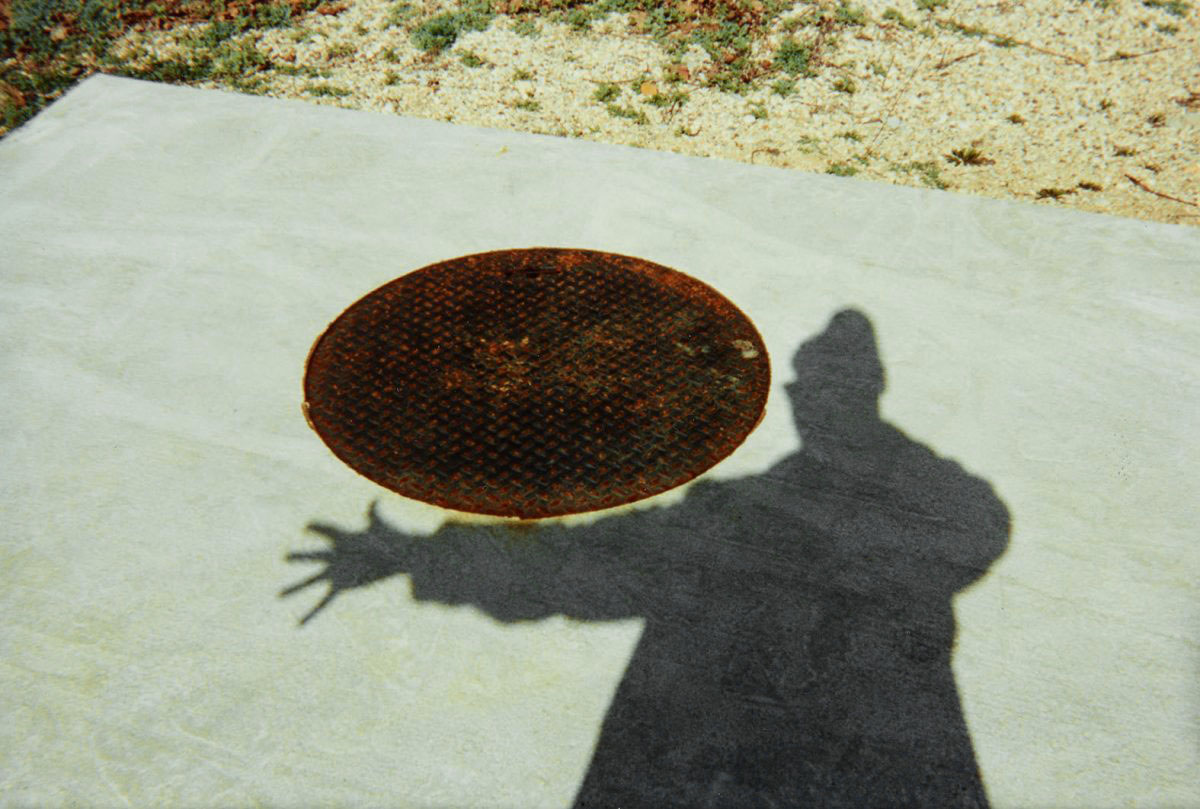
Ray Johnson (American, 1927-1995) 'Shadow and manhole' Spring 1992


Ray Johnson (American, 1927-1995)
Rubble and photo credit
Summer 1992
Commercially processed chromogenic print
4 x 6 in.
The Morgan Library & Museum
Gift of the Ray Johnson Estate, courtesy of Frances Beatty
© Ray Johnson / Artists Rights Society (ARS), New York

Ray Johnson (American, 1927-1995)
Andy Warhol life dates on flowers
July 1992
Commercially processed chromogenic print
4 x 6 in.
The Morgan Library & Museum
Gift of the Ray Johnson Estate, courtesy of Frances Beatty
© Ray Johnson / Artists Rights Society (ARS), New York

Ray Johnson (American, 1927-1995)
Shadow and manhole
Spring 1992
Commercially processed chromogenic print
4 x 6 in.
The Morgan Library & Museum
Gift of the Ray Johnson Estate, courtesy of Frances Beatty
© Ray Johnson / Artists Rights Society (ARS), New York


Johnson appears to have first used a disposable camera for a practical purpose: documenting his backlog of unused collage fragments. But in January 1992, he told curator Clive Phillpot, “I’m pursuing my career as a photographer,” and in March he added, “I’m having fun with my throw-away camera.” Always faithful to the rapidity of his own thinking, Johnson found in the “throwaway” Fuji Quicksnap a way to give graphic form to ideas as they occurred to him.


Ray Johnson (American, 1927-1995) 'Path of headshots and back steps' Spring 1992

Ray Johnson (American, 1927-1995) 'Joseph Cornell silhouette and payphone' Spring 1992

Ray Johnson (American, 1927-1995) 'Bills, Stehli Beach' Summer 1992


Ray Johnson (American, 1927-1995)
Path of headshots and back steps
Spring 1992
Commercially processed chromogenic print
4 x 6 in.
The Morgan Library & Museum
Gift of the Ray Johnson Estate, courtesy of Frances Beatty
© Ray Johnson / Artists Rights Society (ARS), New York

Ray Johnson (American, 1927-1995)
Joseph Cornell silhouette and payphone
Spring 1992
Commercially processed chromogenic print
4 x 6 in.
The Morgan Library & Museum
Gift of the Ray Johnson Estate, courtesy of Frances Beatty
© Ray Johnson / Artists Rights Society (ARS), New York

Ray Johnson (American, 1927-1995)
Bills, Stehli Beach
Summer 1992
Commercially processed chromogenic print
4 x 6
The Morgan Library & Museum. Gift of the Ray Johnson Estate, courtesy of Frances Beatty; 2022.2:11
© Ray Johnson / Artists Rights Society (ARS), New York


Johnson’s first photography studios were the driveway and back steps of his house, but soon he was carrying a pocket-size camera on his daily outings to nearby beaches, parks, and cemeteries. In spring 1992, he threaded a cutout silhouette of Joseph Cornell over the cord of a payphone, then photographed it with one hand while holding the receiver with the other – acting as operator of a hotline to the collage-art pioneer.


Ray Johnson (American, 1927-1995) 'One-legged figure beside back steps' Spring 1992


Ray Johnson (American, 1927-1995)
One-legged figure beside back steps
Spring 1992
Commercially processed chromogenic print
4 x 6 in.
The Morgan Library & Museum
Gift of the Ray Johnson Estate, courtesy of Frances Beatty
© Ray Johnson / Artists Rights Society (ARS), New York


Ray Johnson (American, 1927-1995) 'Mondrian's grave and playing card, Mount Lebanon Cemetery, Queens' spring 1992

Ray Johnson (American, 1927-1995) 'Billboard' Summer 1992


Ray Johnson (American, 1927-1995)
Mondrian’s grave and playing card, Mount Lebanon Cemetery, Queens
spring 1992
Commercially processed chromogenic print
4 x 6 in.
The Morgan Library & Museum
Gift of the Ray Johnson Estate, courtesy of Frances Beatty
© Ray Johnson / Artists Rights Society (ARS), New York

Ray Johnson (American, 1927-1995)
Billboard
Summer 1992
Commercially processed chromogenic print
4 x 6 in.
The Morgan Library & Museum
Gift of the Ray Johnson Estate, courtesy of Frances Beatty
© Ray Johnson / Artists Rights Society (ARS), New York


Even in his photography, Johnson exhibits a collagist’s instinct for insertion and layering. Most of his photographs are centred on objects that he placed between himself and a scene as he found it. On occasion, though, he used the camera in a conventional way, simply collecting views of sights that drew his interest, such as a billboard advertising nothing or the word HELP on the underside of a boat. Photographs such as these are the field notes of a minutely attentive observer.


PLEASE SEND TO REAL LIFE

Joel Smith

In January 1992, a few weeks after his last lifetime exhibition closed at Moore College in Philadelphia, the artist Ray Johnson began photographing in and around his house in Locust Valley, Long Island, using what he called “my throwaway camera”: a single-use point-and-shoot, preloaded with daylight color film. Thirty-five months and 137 throwaways later, he photographed views through the storefront window of an even-more-final exhibition called Ray Johnson: Nothing. It was up during the Christmas week lull of 1994 in a gallery on the main street of Sea Cliff, a few minutes’ drive from Johnson’s house, and around the corner from that of his friend and frequent mail-art partner, Sheila Sporer. Then, one Friday a couple of weeks into 1995, a man was seen jumping from a bridge in Sag Harbor, an hour and a half’s drive east. Witnesses reported that Johnson – the body, when recovered, proved to be his – appeared to be doing a backstroke toward the open Atlantic. (He could not swim.) Johnson’s presumed suicide is often described as the final work of a career in which art and life had long been inseparable.

In his last three years Johnson made and mailed art incessantly, went out for a drive most days, and ran through about one camera a week. When he finished a twenty-four-frame roll, he would drop off the camera – he used a couple of Kodaks at first and then, consistently, Fujicolor Quicksnaps – at Living Color, a shop in Glen Cove, for developing and printing. After turning sixty-five in October 1992, he often took advantage of a senior discount and ordered duplicate prints. For some forty years his art practice had consisted mainly of collage, relief assemblages, and correspondence art. Though photographs had figured in all three channels of work, they were not photographs made by Johnson himself, but portraits of him by others, or images he cut out of books or magazines. Now, in what he called his new “career as a photographer,” Johnson incorporated a few of his own photographs in modest little collages. He also mailed his photographs to correspondents, usually in the form of photocopies. But in the season after his death, among the dozens of boxes of art and effects Johnson left packed up in every room of his house, over five thousand of the color photos were found, still filed with their negatives and receipts in Living Color envelopes. To say the photographs were found needs qualifying: their existence was recorded, but years would pass before photography registered as a central creative pursuit of his final years.

It is not surprising that this work evaded scrutiny. Physically, these are plain, consumer-grade four-by-six-inch color snapshots, indistinguishable from those anyone would take home from the processor’s – whereas Johnson’s art more often took the form of distinctly, peculiarly altered public imagery. After the rise and canonization of Pop art in the 1960s, his work of a few years earlier, notably his addition of dripping red tears to a fan-magazine photo of Elvis Presley (1956-1957), looked prescient. Johnson, like Andy Warhol and Roy Lichtenstein, took mass-market imagery for his muse – but, instead of enlarging it to grandiose scale, his instinct was to bestow the status of an artistic “original” upon ordinary, available-to-everyone printed matter itself. His collages, in that sense, define an antipode to Pop painting’s monumentalised appropriations. His prototype, you could say, was the sardonic teenager he had been not long before, scribbling mustaches onto Marilyns in magazines.

Spend time with the color photographs, and Johnson’s playful, punky persona becomes evident – not in anything he did to the pictures, but in their contents. The straight-men in these images are the streets, beachfronts, and parking lots of bucolic, smalltown northern Long Island: Locust Valley, Sea Cliff, Roslyn, Lattingtown, Glen Cove, Bayville. The scribbled mustaches are the dramatis personae Johnson introduces to those spaces. Within a few months of starting his photo-work, he began making, and photographing, collages on what were, for him, large (thirty-two-by-eight-inch) pieces of corrugated cardboard (62). (The cardboard often bears Fuji brand info; it, too, comes from the camera shop, or out of its dumpster.) In a letter to art critic David Bourdon in summer 1993, Johnson introduces ninety-three of these collages by name (Bobby Short, Greta Garbo …) and calls them his Movie Stars (or Move Stars). Indeed, despite their rectilinear format, they read as figures: paper-doll play-actors for his photo-tableaux. They have faces – most frequently Johnson’s signature pop-eyed, schlong-nosed bunny, inscribed with a name or phrase. (Many of those are rendered in mirror letters, correctly sequenced but laterally FLOPPED, as if in a misbegotten effort to address a reader on the other side of a steamy window.) As he did with his collages generally, Johnson would glue new elements onto these figures over time, dating each newly added bit in pencil. As the weeks of photo-shoots roll by, you can watch as a figure that starts as mostly naked cardboard fills up with information. I picture Johnson exiting his little grey house (he described its color as “grey with an e,” but named it The Pink House) with a freshly worked batch of Movie Stars under his arm, loading them into the back of his Volkswagen Golf, and taking them out on a drive, camera in pocket.

About a decade after these photographs were made, smart phones came into use, and everyone began having a camera on their person all the time. In 1992, making a photograph still required deciding and preparing to do so, and not simply asking oneself (or not even asking), “Why don’t I?” Buying the camera, noting how close to frame zero it was getting, dropping it off, returning to pick up the prints: making these pictures called for effort, on a par with the effort of crafting the Movie Stars. The whole enterprise reflects the low-key but constant thrum of odd motivation that drives all of Johnson’s work. The art he made was irreducibly personal, if gnomic, and he went to lengths to maintain control over how his collages, punning defacements, paradoxes, and near-nothings would make their way into the world. Johnson’s New York Correspondence School – the vast network he invented for circulating mail art – existed mainly in his head, but this, from his angle, made it no less real than the art world.

In the art-historical fairy tale of postwar New York City, young Ray Johnson must have looked, for a few years, like an avant-garde heir apparent. Born in 1927, the only child of loving working-class parents, he grew up in Detroit and, from 1945 to 1948, attended North Carolina’s Black Mountain College, crucible of every far-seeing artistic impulse of that moment. He was shy and hard-working and he devoured all he could from instructors who included Josef Albers, Alvin Lustig, and Robert Motherwell. He left BMC having entered into Zen kinship with two teachers, John Cage and Merce Cunningham, and into romantic partnership with another, the sculptor Richard Lippold. The four of them took up residence in a building in the deep reaches of downtown Manhattan. Johnson earned money working in Ad Reinhardt’s studio and at the Orientalia bookstore. He showed his Albers-sized, minutely rendered geometric paintings as a member of the American Abstract Artists group. In short, he seemed destined for middling highbrow success.

Instead, he became Ray Johnson. Between 1954 and 1956, he ditched his qualifications by burning all the early paintings still in his possession and redirecting his creative effort onto the slight, irregular-shaped, frame-resistant (but mailable) collages he called “moticos.” His move to print-media-based figural collage came at an historical moment far too late to boast a Dada-Surrealist pedigree and too early to get swept neatly up into Pop. The concerted wrongness of this switch makes it, in retrospect, quietly brilliant, and it points to the singularity that doomed Johnson’s crown-prince prospects. (Two of his successors and friends at BMC, Jasper Johns and Robert Rauschenberg, picked up those prospects and put them to good use.)

Johnson hung onto a number of photographs that documented his fateful conversion. At age sixty-four he arranged twenty of them in a grid on the drive behind his house, then scaled a ladder to re-photograph them (26). In most of these old photographs, moticos in profusion can be seen arrayed in two real-world sites, a pallet on a sidewalk and a large industrial interior. In others – which were made in the street by a friend of Ray’s, the future fashion photographer Elisabeth Novick (then Loewenstein) – you can see Johnson draping moticos all over another friend (and fellow BMC alum), Suzi Gablik. These are, in effect, performance records; Gablik even came to describe Johnson’s moticos-stagings as perhaps the first Happenings in art—a notion that arguably proceeds from their having been photographed. Interviewed in 2015, Novick emphasized how casually this came about. Not long before, she had been given her first camera, and one day, Ray simply asked her to bring it along on a walk. “Suzi just sat there,” Novick said, “and he just threw the things on top of her.” She explains: “He was a very lighthearted sort of whimsical person. […] He wasn’t intense. It was the opposite of intense. If I could look up the opposite word of intense, I would say that was him.”

The “opposite-of-intense” mode of hardly-work Johnson was auditioning that day led him to an art based on play, exchange, and movement; on remaining light-footed enough to follow any association that came to mind, be it ever so slight, silly, or hermetic. Perhaps for just that reason, Johnson’s art found its ideal helpmate in the camera, with its knack for lending graphic form to the ephemeral. In any event, the 1955 documents turn up repeatedly in his color photographs of forty years later (44, 102).

Even more prevalent in these images is the infinitely malleable bunny head (64) that Johnson described as “a sort of self-portrait.” Its partner, equally ever-present, is a headshot of Johnson made by Ara Ignatius around 1963. (Johnson kept on hand an offset plate of this image, from which he could order new printings by the hundreds whenever he needed them.) In one early-1992 photograph, nineteen headshots are laid down in a path leading to Johnson’s backdoor stairs, where he would be staging many more photographs (20). In the summer of 1993, four headshots stare in through the windshield of his car, like a posse of avid fans (126). The headshot rides shotgun with Elvis (108) and, reduced to a pair of eyes, lends consciousness to a mob of moticos on camelback (98).

Johnson’s longtime collector, advocate, and chief interpreter, William Wilson, observed that photographs served the artist as a form of citation: as a way to “reference,” rather than “represent,” his subjects. The hands-off nature of the medium gave Johnson a way to bring topics up yet keep his viewer (his recipient, his reader) focused on something he cared about more: the messaging process itself. Using another photography adjacent tool, the silhouette, Johnson could convert the people he knew into references-to-themselves. Starting in 1976, he used pencil and paper to trace the profile shadows of some 284 sitters. He filed these in two big template binders, ready for use in the studio. Most of his profile subjects were writers, artists, and actors, whose shared characteristic is their publicly traded names.

Some of the silhouettes appear in the colour photographs, as do various celebrity portraits – but many more people show up as bunny faces inscribed with their names. Johnson wrote to Bourdon that seventy-two of his Movie Stars were going to appear in a “RAY JOHNSON OUTDOOR MOVIE SHOW” (see 110, 122, and 124 for variant stagings) that would stand “45 feet in length if ever actually placed next to each other and the wind didn’t blow them down.” In the meantime, he posed individual Movie Stars in the company of obliging strangers (54) or leaned them against the occasional dog (222).

The photographs include some one-offs, such as the shadow cast by Johnson’s mailbox (2) and a tar seam in a parking lot (176). Many of the subjects, though, are ones he revisited dozens of times, such as local beaches, cemeteries, and storefronts, a bathtub he found in a field (106, 107), and himself as a shadow, encountering a manhole cover (4).

Most of the photographs work in a collage-like way: they record Johnson’s alteration of a real-world setting through the addition of some flat thing he has made or chosen, such as one of his grimly cartoony black-on-white graphic characters, hiding amid spiky succulents (18), or an ace of clubs, leaning against Piet Mondrian’s grave marker (42).

At other times he works like a conventional photographer, observing but not intervening, as when he captures the horizon across Long Island Sound (230), a faceless billboard (41), the snapped arrow of a rooftop weathervane (16), or a palm frond splayed on beach sand (92).

Still other images define a mode between these two options, as Johnson finds some noteworthy thing to photograph (dragon’s teeth icicles [6], a mortuary angel [8]), then props up beside it a sign that emblazons the view like a maker’s logo or a graffitist’s tag: “PHOTO BY RAY JOHNSON”; “RAY JOHNSON THE PARIS CORRESPONDENCE SCHOOL.”

Here are a few of the subjects that kept Johnson and his 137 cameras coming back most often:

Inside. When Johnson photographed inside his house, the daylight-exposure film in his pre-loaded cameras restricted his work area to patches of direct sunlight. In late afternoon, the window in his front door cast a scalloped picture frame, or spotlight, around whatever he photographed on the floor (132, 168). The window’s shape in turn became a player, alone or in tandem with its mirror image (45).

Telephones. Johnson was as tireless a phone-caller as he was a mailer. Once, while at home, he held the phone for a bunny labeled EAR MUFS, posing between a 1955 photo and a clutch of moticos glyphs (28). Out driving around, he staged momentary installations in payphone boxes (65, 232). He unhooked one phone’s receiver and threaded over its cord a cardboard cutout silhouette of the artist Joseph Cornell, whom he used to visit in Flushing, Queens (12). The cutout void of Cornell’s head frames the telephone’s number-pad, turning Johnson into the operator of a Cornell-box hotline: camera in one hand, receiver in the other, plugged into the head of the master collagist.

Doubles. In Johnson’s universe, doubleness – correspondence – is the norm. No surprise, then, that he should photograph twins, replicas (48, 50), and those spellbinding autocopies, twin-initialed celebrities (Marilyn Monroe, Mickey Mouse [160]). He gives dualism a distinctly photographic turn by pairing things with their reflections or shadows. When photographed, these light-borne modes of doubling assume a concrete presence: they make reality look Johnsonian. A reflection echoes its original, but the two are non-identical. The reflection – being laterally flopped, like Johnson’s mirror letters – is the original’s opposite (52, 172). As for the shadow, it is a flat, graphic version of its original (70), an incorporeal counterpart to reality (136).

Recycling. A collagist traffics in the reincarnation of materials and images. The beginnings of Johnson’s photographs look like an effort to document his vast inventory of “chop art” – his term for the densely-reworked chunks of assemblage he had been building up and cutting apart again for decades (30-33). He abandoned this cataloguing, but his photographs remain as full of junk (130, 131) as his house (228); “WHAT A DUMP.” His movie-reel memory encompassed everything from Bette Davis films to a porn video made famous in the confirmation hearings of Supreme Court nominee Clarence Thomas [150]). He created a deadpan cardboard memorial to his old associate, arch-recycler Andy Warhol, and laid it atop a raked pile of cemetery flowers (142), and, two years later, atop a scattering of donated clothes (144).

Bills. Scavenged out of those clothing drops, most likely, were the many baseball cap visors Johnson photographed. He held them up before the camera, always in C formation, with deep spaces behind them: the sky, or receding railway tracks (34, 78). He arrayed them on Stehli Beach like a school of migrating horseshoe crabs (94). He cut the bill’s crescent-moon shape out of his headshot (33). If they stand for a name, “Bill,” perhaps he is William Wilson. Or the writer William S. Burroughs, who sat for his silhouette in 1976. Johnson laid a cutout of Burroughs down on cardboard, then extended Bill’s prominent nose with the bill of a kingfisher (96).

Photographers. The photographs feature many images drawn from photography’s historical canon, making Johnson-collaborators of, among others, Walker Evans (via Sherrie Levine) (136), Dennis Stock (158), and Félix González-Torres (186). Some Movie Star bunnies are given the names of photographers, including Horst, Duane Michals (154, 170), and Lord Snowdon (snowed-in / snowed-N [236]). The crane in Bill Brandt’s famous photograph of Kew Gardens provides the top half of an awkward composite figure (159, 174). Johnson perched Michals’s book of portraits on the front bumper of his car, making a third headlight of its cyclopean eye (138). He turned Richard Avedon’s An Autobiography face-down to reveal its author photo and dressed the portraitist in a hat (163) that channels Marianne Moore, who is portrayed in that book wearing her signature tricorn (a moticos-like garment that fascinated Johnson). Late one dusk, Johnson photographed the legs of his shadow spanning a copy of Lee Friedlander’s book Like a One-Eyed Cat, laid down open to its frontispiece, one of Friedlander’s many self-portraits in shadow (80).

Please Send. Between July and December 1994, over twenty wrapped packages appear in Johnson’s photographs. They are addressed to or from his mail-art correspondents, most frequently his local friend Sheila Sporer (158, 242). (The ones Sheila opened – those not marked “DO NOT OPEN” – turned out to be stuffed with plain craft paper.) Often the packages are pictured in the midst of what look like obscure rituals. One stands in Johnson’s driveway, tethered to a helium bunny balloon, ready to begin its physically impossible ascent (206). Others he positioned inside the gallery show-window of his late December 1994 un-show, Ray Johnson: Nothing, and then photographed them from out on the sidewalk (169). (He never ventured inside.) A few days later, he posed two packages, tourist-like, at the end of a pier at sunset (214); distressingly, one of them is next seen drifting in the water below (216).

In late December 1994, Johnson photographed himself in a shop window mirror, holding up a bunny inscribed PLEASE SEND TO REAL LIFE (246). (On the collage, this bunny bears the date December 21; below it, on December 30, Johnson added ONLY YOU [244].) REAL LIFE refers, at one level, to the New York-based art magazine REALLIFE (1979-1994): since late November, Johnson had been urging Sporer to pitch its editor, Thomas Lawson, an article about their three years of collaborative correspondence art.

But the message can mean something else, too – something like: “Here, Life, take this thing I’ve made; I’m going to the other place.” For decades death had been a resolute presence in Johnson’s work, taking such forms as Nothing, pitch-black humor, and a fixation on life dates. Is death palpably present in the photographs of his last three years? It would be silly to deny that it is. And yet it would be trivial to hunt through this large, complex, often comical, always personal body of work for nothing more than a rebus suicide note. Ray Johnson never made himself that easily readable. And nowhere in his art does he look more intensely engaged by the present tense, more thrilled to be immersed in Real Life, than in the inventions of his throwaway camera.

Joel Smith. “PLEASE SEND TO REAL LIFE,” in PLEASE SEND TO REAL LIFE: Ray Johnson Photographs. Mack Books, 2022, pp. 188-195


Ray Johnson (American, 1927-1995) 'Outdoor Movie Show on RJ's car' February 1993

Ray Johnson (American, 1927-1995) 'Outdoor Movie Show in RJ's backyard' 1 June 1993


Ray Johnson (American, 1927-1995)
Outdoor Movie Show on RJ’s car
February 1993
Commercially processed chromogenic print
4 x 6 in.
The Morgan Library & Museum
Gift of the Ray Johnson Estate, courtesy of Frances Beatty
© Ray Johnson / Artists Rights Society (ARS), New York

Ray Johnson (American, 1927-1995)
Outdoor Movie Show in RJ’s backyard
1 June 1993
Commercially processed chromogenic print
4 x 6 in.
The Morgan Library & Museum
Gift of the Ray Johnson Estate, courtesy of Frances Beatty
© Ray Johnson / Artists Rights Society (ARS), New York


The photographs Johnson made between January 1992 and December 1994 feature several dozen collages in a large, vertical format he had never used before. He referred to these works as Movie Stars (or Move Stars), writing that “if the wind didn’t knock them down,” he planned to cast them in a “Ray Johnson Outdoor Movie Show,” lined up like dancers in a musical revue. In the end, still photography was the nearest he came to filmmaking.


In the same way that Johnson burned his early paintings, renouncing the most reliable route to a successful art career in mid-20th-century New York, he exited the fray of Manhattan. In 1968 he moved to Locust Valley, Long Island, and after 1978 he had only two solo exhibitions – the last one in 1991. He continued to make art, though, and looked to artists like Joseph Cornell, famous for his box assemblages, who lived on Utopia Parkway in Queens. Many of Johnson’s works take Cornell’s idea of the display box filled with quirky objects and expands it to tableaus staged for the camera, using the suburban environment, the woods or the seashore as found theatrical sets. …

Johnson’s presence in many of the photos could be called self-portraiture – but the photos also feel very much like ancestors to the ubiquitous cellphone selfie. The photo “RJ with Please Send to Real Life and camera in mirror” (1994) is an obvious selfie precursor. It includes a number of conceptual twists, however: Johnson appears in a mirror, holding a disposable camera and one of his cardboard signs with an alter-ego bunny and the words “Please Send to Real Life” partially printed in reverse – a reminder of how the camera doesn’t merely document reality, but shapes and potentially distorts it. (This photo might also be a reference to his mail-art practice or the New York art magazine Real Life, published from 1979 to 1994.) …

What is art? What is real? Does the image document reality or create it? “Please Send to Real Life” raises some of these questions and shows how Johnson predicted the growing fuzziness between the realms of photography and IRL (in real life) – from snapshots to social media – suggesting that the relationship between them is porous but also ripe for creative intervention.

Anonymous. “Ray Johnson’s Camera Was Disposable. The Photos Are Unforgettable,” on The New York Times website 24th August 2022 [Online] Cited 28/08/2022. Used under fair use conditions for the purposes of education and research


Ray Johnson (American, 1927-1995) 'Untitled (JOSEF ALBERS with cat)' 1993


Ray Johnson (American, 1927-1995) 'Untitled (six blue Rays in Rolls)' Undated


Ray Johnson (American, 1927-1995)
Untitled (yellow DUANE MICHALS bunny)
1993
Collage on corrugated cardboard
13 3/4 x 4 1/2 in. (34.93 x 11.43cm)
The Morgan Library & Museum
Gift of the Ray Johnson Estate, courtesy of Frances Beatty
© Ray Johnson / Artists Rights Society (ARS), New York

Ray Johnson (American, 1927-1995)
Untitled (JOSEF ALBERS with cat)
1993
Collage on corrugated cardboard
17 3/8 × 7 1/2 in. (44.13 × 19.05cm)
© Ray Johnson / Artists Rights Society (ARS), New York

Ray Johnson (American, 1927-1995)
Untitled (six blue Rays in Rolls)
Undated
Collage on corrugated cardboard
21 x 8 1/2 in. (53.34 x 21.59cm)
© Ray Johnson / Artists Rights Society (ARS), New York


Movie Stars

Overhead are some of the several dozen collages that appear in photographs Johnson made between January 1992 and December 1994. He referred to these large, vertical pieces as Movie Stars (or Move Stars), writing that “if the wind didn’t knock them down,” he planned to cast them in a “Ray Johnson Outdoor Movie Show,” lined up like dancers in a musical revue. In the end, still photography was the nearest he came to filmmaking. Were the Movie Stars made to be photographed? Or are the photographs mere documents of the Movie Stars? Perhaps the two bodies of work are best understood as complementary parts of a continuous creative cycle. Many of the Movie Stars are made on cardboard that bears photographic product information, suggesting that it was scavenged from the dumpster of the shop where Johnson bought his cameras and turned them in for developing.


Ray Johnson (American, 1927-1995) 'Cage and Satie with Orpheus and Eurydice, Planting Fields Arboretum' February 1993

Ray Johnson (American, 1927-1995) 'Jasper John' February 1993

Ray Johnson (American, 1927-1995) 'WIGART grave and Movie Star of RJ between David Bs' April 1993


Ray Johnson (American, 1927-1995)
Cage and Satie with Orpheus and Eurydice, Planting Fields Arboretum
February 1993
Commercially processed chromogenic print
4 x 6 in.
The Morgan Library & Museum
Gift of the Ray Johnson Estate, courtesy of Frances Beatty
© Ray Johnson / Artists Rights Society (ARS), New York

Ray Johnson (American, 1927-1995)
Jasper John
February 1993
Commercially processed chromogenic print
4 x 6 in.
The Morgan Library & Museum
Gift of the Ray Johnson Estate, courtesy of Frances Beatty
© Ray Johnson / Artists Rights Society (ARS), New York

Ray Johnson (American, 1927-1995)
WIGART grave and Movie Star of RJ between David Bs
April 1993
Commercially processed chromogenic print
4 x 6 in.
The Morgan Library & Museum
Gift of the Ray Johnson Estate, courtesy of Frances Beatty
© Ray Johnson / Artists Rights Society (ARS), New York


The Movie Stars feature a roll call of celebrity faces and names that is, in composite, unique to Johnson’s imagination. By photographing the collages, Johnson animated his personal pantheon in the familiar settings of his daily life. Composers Erik Satie and John Cage rest in the arms of a statue of Orpheus, the prophetic music-maker of Greek myth. Artist Jasper Johns punningly marks the door of an outhouse-like wooden structure. Johnson himself rides shotgun in his Volkswagen Golf while Elvis takes the wheel. And art critic David Bourdon and rock star David Bowie (embodiments, in different ways, of Pop’s legacy) join Johnson at the grave of “Wig art.” Once Johnson even photographed the Movie Stars in their staging area at home, ready to be loaded into the car and taken out for a day’s work.


Ray Johnson (American, 1927-1995) 'Headshot and Elvises in RJ's car' February 1993

Ray Johnson (American, 1927-1995) 'Outdoor Movie Show on dumpster' 18 May 1993

Ray Johnson (American, 1927-1995) 'Four Movie Stars, Locust Valley Cemetery' 31 March 1993


Ray Johnson (American, 1927-1995)
Headshot and Elvises in RJ’s car
February 1993
Commercially processed chromogenic print
4 x 6 in.
The Morgan Library & Museum
Gift of the Ray Johnson Estate, courtesy of Frances Beatty
© Ray Johnson / Artists Rights Society (ARS), New York

Ray Johnson (American, 1927-1995)
Outdoor Movie Show on dumpster
18 May 1993
Commercially processed chromogenic print
4 x 6 in.
The Morgan Library & Museum
Gift of the Ray Johnson Estate, courtesy of Frances Beatty
© Ray Johnson / Artists Rights Society (ARS), New York

Ray Johnson (American, 1927-1995)
Four Movie Stars, Locust Valley Cemetery
31 March 1993
Commercially processed chromogenic print
4 x 6 in.
The Morgan Library & Museum
Gift of the Ray Johnson Estate, courtesy of Frances Beatty
© Ray Johnson / Artists Rights Society (ARS), New York


Ray Johnson (American, 1927-1995) 'Silhouette version of RJ portrait by Joan Harrison, Lattingtown Beach' Autumn 1992


Ray Johnson (American, 1927-1995)
Silhouette version of RJ portrait by Joan Harrison, Lattingtown Beach
Autumn 1992
Commercially processed chromogenic print
4 x 6 in.
The Morgan Library & Museum
Gift of the Ray Johnson Estate, courtesy of Frances Beatty
© Ray Johnson / Artists Rights Society (ARS), New York


To create this picture-within-a-picture, Johnson returned to the site of a much-reproduced portrait of him that photographer Joan Harrison made in the early 1980s. In the spot where he once sat, knees raised and arms outstretched, Johnson leaned a card that features a black silhouette of his symmetrical pose. As so often occurs in his photographs, Johnson here strikes an unsettling balance between absence and presence, erasure and memorialisation.


Ray Johnson (American, 1927-1995) 'Untitled (Bill and Railroad Tracks)' Spring 1992)

Ray Johnson (American, 1927-1995) 'Bill and Long Island Sound' Winter 1992


Ray Johnson (American, 1927-1995)
Untitled (Bill and Railroad Tracks)
Spring 1992)
Commercially processed chromogenic print
4 x 6 in.
The Morgan Library & Museum
Gift of the Ray Johnson Estate, courtesy of Frances Beatty
© Ray Johnson / Artists Rights Society (ARS), New York

Ray Johnson (American, 1927-1995)
Bill and Long Island Sound
Winter 1992
Commercially processed chromogenic print
4 x 6 in.
The Morgan Library & Museum
Gift of the Ray Johnson Estate, courtesy of Frances Beatty
© Ray Johnson / Artists Rights Society (ARS), New York


Johnson held up the sky-blue bill of a baseball cap over a railroad crossing and photographed it. When he holds it over the ocean in another image, it resembles a crescent moon. With his “throwaway” camera he photographed arrangements of photographs and photobooks by Walker Evans, Lord Snowden, Richard Avedon, Bill Brandt, and Lee Friedlander. Friedlander-like, Johnson photographed his own shadow, interacting with the places of his solitary visits.

He photographed his own works in infinite arrangements and continuous correspondence: two bunnyheads sitting up conversationally in tall chairs. He photographed his headshot, affixed to the passenger seat of a car, next to a double photo of Elvis, in the driver’s seat. He photographed a blank billboard in a field; he photographed a pier; he photographed the ocean. He photographed a picture of himself in his shadow cast across a mailbox, a bunny head peeking out. The unearthed photographs become the last note sent.

Rrebecca Bengal. “Photo Dump: Digging into the 5,000 Photographs Ray Johnson Left Behind,” on the Elephant Art website 20 Jul 2022 [Online] Cited 25/09/2022. Used under fair use conditions for the purposes of education and research


Ray Johnson (American, 1927-1995) 'RJ reflected in ice truck and split Duane Michals Movie Star' 11 May 1993

Ray Johnson (American, 1927-1995) 'Back steps and moticos' Spring 1992


Ray Johnson (American, 1927-1995)
RJ reflected in ice truck and split Duane Michals Movie Star
11 May 1993
Commercially processed chromogenic print
4 x 6 in.
The Morgan Library & Museum
Gift of the Ray Johnson Estate, courtesy of Frances Beatty
© Ray Johnson / Artists Rights Society (ARS), New York

Ray Johnson (American, 1927-1995)
Back steps and moticos
Spring 1992
Commercially processed chromogenic print
4 x 6 in.
The Morgan Library & Museum
Gift of the Ray Johnson Estate, courtesy of Frances Beatty
© Ray Johnson / Artists Rights Society (ARS), New York


Twins

In his writing and visual art, Johnson used juxtapositions and puns to suggest that nothing stands alone: everything finds correspondence in something else. Photography’s optical literalness gave him new ways to explore reality’s doubleness. Twins – and photocopied photographs – are nearly alike yet insistently distinct. Mirrors give back a faithful, yet laterally reversed, image of nature. The shadow of a thing echoes its original, but (like a moticos) it is flat and empty of internal detail.


Ray Johnson (American, 1927-1995) 'Bunny drawn on Felix Gonzalez-Torres's "Untitled"' 2 January 1994

Ray Johnson (American, 1927-1995) 'Long Dong Silver, Lattingtown Beach' 16 November 1993

Ray Johnson (American, 1927-1995) 'Six Movie Stars in RJ's car' April 1993


Ray Johnson (American, 1927-1995)
Bunny drawn on Felix Gonzalez-Torres’s “Untitled”
2 January 1994
Commercially processed chromogenic print
4 x 6 in.
The Morgan Library & Museum
Gift of the Ray Johnson Estate, courtesy of Frances Beatty
© Ray Johnson / Artists Rights Society (ARS), New York

Ray Johnson (American, 1927-1995)
Long Dong Silver, Lattingtown Beach
16 November 1993
Commercially processed chromogenic print
4 x 6 in.
The Morgan Library & Museum
Gift of the Ray Johnson Estate, courtesy of Frances Beatty
© Ray Johnson / Artists Rights Society (ARS), New York

Ray Johnson (American, 1927-1995)
Six Movie Stars in RJ’s car
April 1993
Commercially processed chromogenic print
4 x 6 in.
The Morgan Library & Museum
Gift of the Ray Johnson Estate, courtesy of Frances Beatty
© Ray Johnson / Artists Rights Society (ARS), New York


Bunnies

A round-eyed, long-nosed bunny head functioned as Johnson’s signature and, as he said, “a kind of self-portrait.” Despite the bunny’s blank expression, context can render it comical, hapless, sinister, or obscene. Johnson altered Felix Gonzalez-Torres’s photograph of a rumpled empty bed – an iconic image of gay mourning during the AIDS crisis – by resting a lone bunny’s head on one of the two pillows. Johnson cut a face-sized hole out of one bunny, then photographed the view outside his front window through the gap. He gave the same bunny to passersby to wear and, once, laid it suggestively atop his toilet bowl. When a large old tree next door was being chainsawed apart, Johnson found in its branching form a gaunt, eyeless bunny’s face.


Ray Johnson (American, 1927-1995) 'Harpo Marx bunny, headshot, and payphone' February 1994

Ray Johnson (American, 1927-1995) 'Bunny tree in backyard' 17 April 1993

Ray Johnson (American, 1927-1995) 'Untitled (red bunny NOTHING)' 1993

Ray Johnson (American, 1927-1995) 'Untitled (Ad Rein Hardt Bunny)' 1993

Ray Johnson (American, 1927-1995) 'Flopped stranger wearing cutout bunny' Spring 1992


Ray Johnson (American, 1927-1995)
Harpo Marx bunny, headshot, and payphone
February 1994
Commercially processed chromogenic print
The Morgan Library & Museum
Gift of the Ray Johnson Estate, courtesy of Frances Beatty
© Ray Johnson / Artists Rights Society (ARS), New York

Ray Johnson (American, 1927-1995)
Bunny tree in backyard
17 April 1993
Commercially processed chromogenic print
The Morgan Library & Museum
Gift of the Ray Johnson Estate, courtesy of Frances Beatty
© Ray Johnson / Artists Rights Society (ARS), New York

Ray Johnson (American, 1927-1995)
Untitled (red bunny NOTHING)
1993
Collage on corrugated cardboard
12 1/2 x 7 1/2 in. (31.75 x 19.05cm)
The Morgan Library & Museum
Gift of the Ray Johnson Estate, courtesy of Frances Beatty
© Ray Johnson / Artists Rights Society (ARS), New York

Ray Johnson (American, 1927-1995)
Untitled (Ad Rein Hardt Bunny)
1993
Collage on corrugated cardboard
12 1/2 x 7 5/8 in. (31.75 x 19.37cm)
The Morgan Library & Museum
Gift of the Ray Johnson Estate, courtesy of Frances Beatty
© Ray Johnson / Artists Rights Society (ARS), New York

Ray Johnson (American, 1927-1995)
Flopped stranger wearing cutout bunny
Spring 1992
The Morgan Library & Museum
Gift of the Ray Johnson Estate, courtesy of Frances Beatty
© Ray Johnson / Artists Rights Society (ARS), New York


What did Johnson intend to do with the thousands of photographs he made between 1992 and 1994? There are few solid indications. He mailed some to correspondents, either in the form of original prints or as photocopies. He also incorporated a handful of his photographs into collages that differ markedly in scale and sensibility from the larger, contemporaneous Movie Stars. In one collage, a photograph of five Movie Stars – arranged like sequential ads beside a road – is punningly combined with a bunny head bearing the name of abstract painter Ad Reinhardt (1913-1967), a friend and employer of Johnson’s in his early New York years.


Ray Johnson (American, 1927-1995) 'Shadow of RJ's mailbox' March 1994

Ray Johnson (American, 1927-1995) 'RJ with PLEASE SEND TO REAL LIFE and camera in mirror' 23 December 1994


Ray Johnson (American, 1927-1995)
Shadow of RJ’s mailbox
March 1994
Commercially processed chromogenic print
The Morgan Library & Museum
Gift of the Ray Johnson Estate, courtesy of Frances Beatty
© Ray Johnson / Artists Rights Society (ARS), New York

Ray Johnson (American, 1927-1995)
RJ with PLEASE SEND TO REAL LIFE and camera in mirror
23 December 1994
Commercially processed chromogenic print
4 x 6 in.
The Morgan Library & Museum
Gift of the Ray Johnson Estate, courtesy of Frances Beatty
© Ray Johnson / Artists Rights Society (ARS), New York


This self-portrait appears on a roll of film Johnson turned in for developing about three weeks before his suicide by drowning on 13 January 1995. The flopped lettering on the Movie Star in his hand undergoes a further reversal in the mirror. On a literal level, the words “REAL LIFE” refer to the New York-based art magazine REALLIFE (1979-1994), which Johnson hoped would soon publish an article about his years-long collaboration with a friend, Sheila Sporer. But the message unmistakably announces, too, that the artist was soon to venture beyond the reach of “real life.”


The Morgan Library & Museum
225 Madison Avenue at 36th Street, New York, NY
Phone: (212) 685-0008

Opening hours:
Tuesday – Thursday, Saturday – Sunday: 10.30am – 5pm
Friday: 10.30am – 7pm
Closed Mondays

The Morgan Library & Museum website
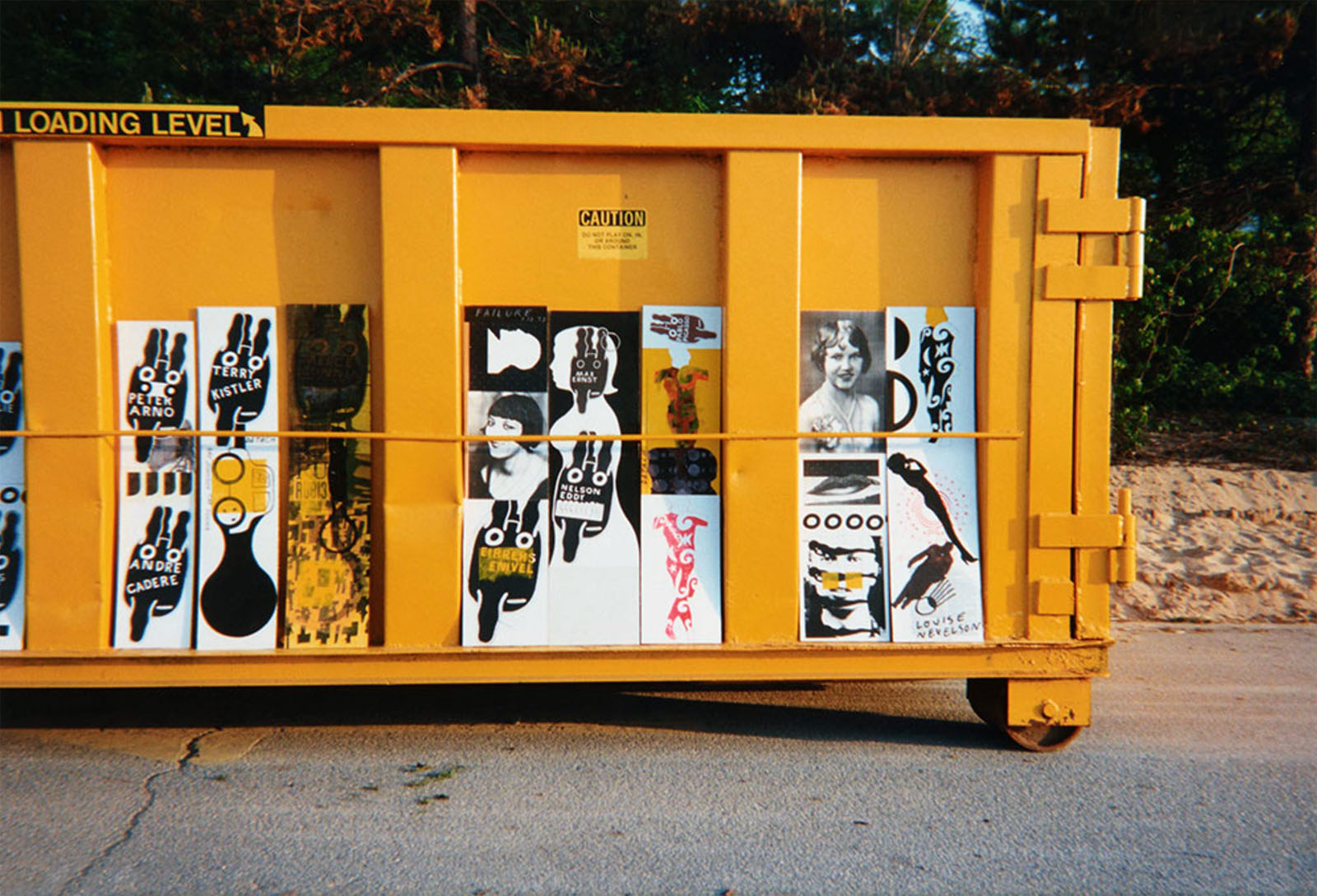
LIKE ART BLART ON FACEBOOK

Back to top