Exhibition: ‘Lichtbilder. Photography at the Städel Museum from the Beginnings to 1960’ at the Städel Museum, Frankfurt

Exhibition dates: 9th July – 5th October 2014

Curators: Felicity Grobien, curatorial assistant, Modern Art Department, Städel Museum; Dr Felix Krämer, head of the Modern Art Department at the Städel Museum
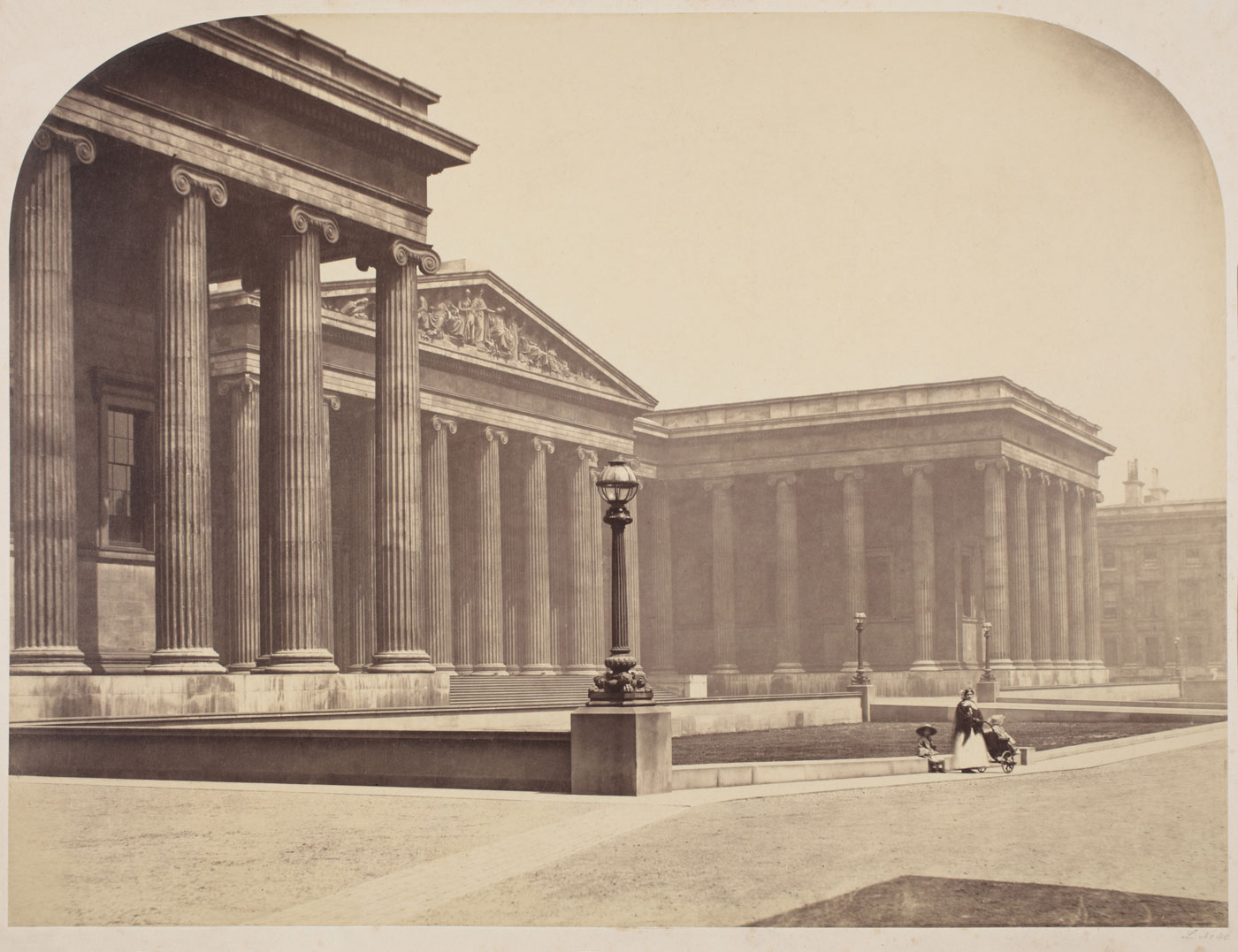
 

Roger Fenton (British, 1819-1869) 'London: The British Museum' 1857


Roger Fenton (British, 1819-1869)
London: The British Museum
1857
Albumen print mounted on cardboard
32.2 x 43cm
Städel Museum, Frankfurt am Main
Photo: Städel Museum – ARTOTHEK


There are some absolutely stunning images in this posting. It has been a great pleasure to put the posting together, allowing me the chance to sequence Roger Fenton’s elegiac London: The British Museum (1857, below) next to Werner Mantz’s minimalist masterpiece Cologne: Bridge (c. 1927, below), followed by Carlo Naya’s serene Venice: View of the Marciana Library (c. 1875, below) and Albert Renger-Patzsch’s sublime but disturbing (because of the association of the place) Buchenwald in November (c. 1954, below). What four images to put together – where else would I get the chance to do that? And then to follow it up with the visual association of the Royal Prussian Institute of Survey Photography’s Cologne: Cathedral (1889, below) with Otto Steinert’s Luminogram (1952, below). This is the stuff that you dream of!

The more I study photography, the more I am impressed by the depth of relatively unknown Eastern European photographers from countries such as Hungary, Romania, Czechoslovakia, Poland, Bulgaria and Turkey. In this posting I have included what details I could find on the artists Václav Jíru, Václav Chochola and the well known Czech photographer František Drtikol. The reproduction of his image Crucified (before 1914. below) is the best that you will find of this image on the web.

I would love to do more specific postings on these East European photographers if any museum has collections that they would like to advertise more widely.

Dr Marcus Bunyan

PS. Lichtbilder = light images.


Many thankx to the Städel Museum for allowing me to publish the photographs in the posting. Please click on the photographs for a larger version of the image.


Installation view of the exhibition 'Lichtbilder. Photography at the Städel Museum from the Beginnings to 1960'


Installation view of the exhibition Lichtbilder. Photography at the Städel Museum from the Beginnings to 1960 at the Städel Museum, Frankfurt


Installation view of the exhibition 'Lichtbilder. Photography at the Städel Museum from the Beginnings to 1960' showing Felix Nadar's 'George Sand' 1864


Installation view of the exhibition Lichtbilder. Photography at the Städel Museum from the Beginnings to 1960 at the Städel Museum, Frankfurt showing Nadar’s George Sand (1864, below)


Nadar [Gaspard Félix Tournachon] (French, 1820-1910) 'George Sand (Amandine-Aurore-Lucile Dupin)' c. 1864


Nadar [Gaspard Félix Tournachon] (French, 1820-1910)
George Sand (Amandine-Aurore-Lucile Dupin)
c. 1864


Installation view of the exhibition 'Lichtbilder. Photography at the Städel Museum from the Beginnings to 1960' showing at left, August Sander's 'Country girls' 1925; and at right, August Sander's 'Portrait of Anton Räderscheidt' 1927


Installation view of the exhibition Lichtbilder. Photography at the Städel Museum from the Beginnings to 1960 at the Städel Museum, Frankfurt showing

(left)

August Sander (German, 1876-1964)
Country girls
1925

(right)

August Sander (German, 1876-1964)
Portrait of Anton Räderscheidt
1927


August Sander (German, 1876-1964) 'Country Girls' 1925 (print 1980 von by Gunther Sander)


August Sander (German, 1876-1964)
Country Girls
1925 (print 1980 von by Gunther Sander)
Gelatin silver print
27.4 x 20cm
Städel Museum, Frankfurt am Main
Photo: Städel Museum – ARTOTHEK
© VG Bild-Kunst, Bonn 2014
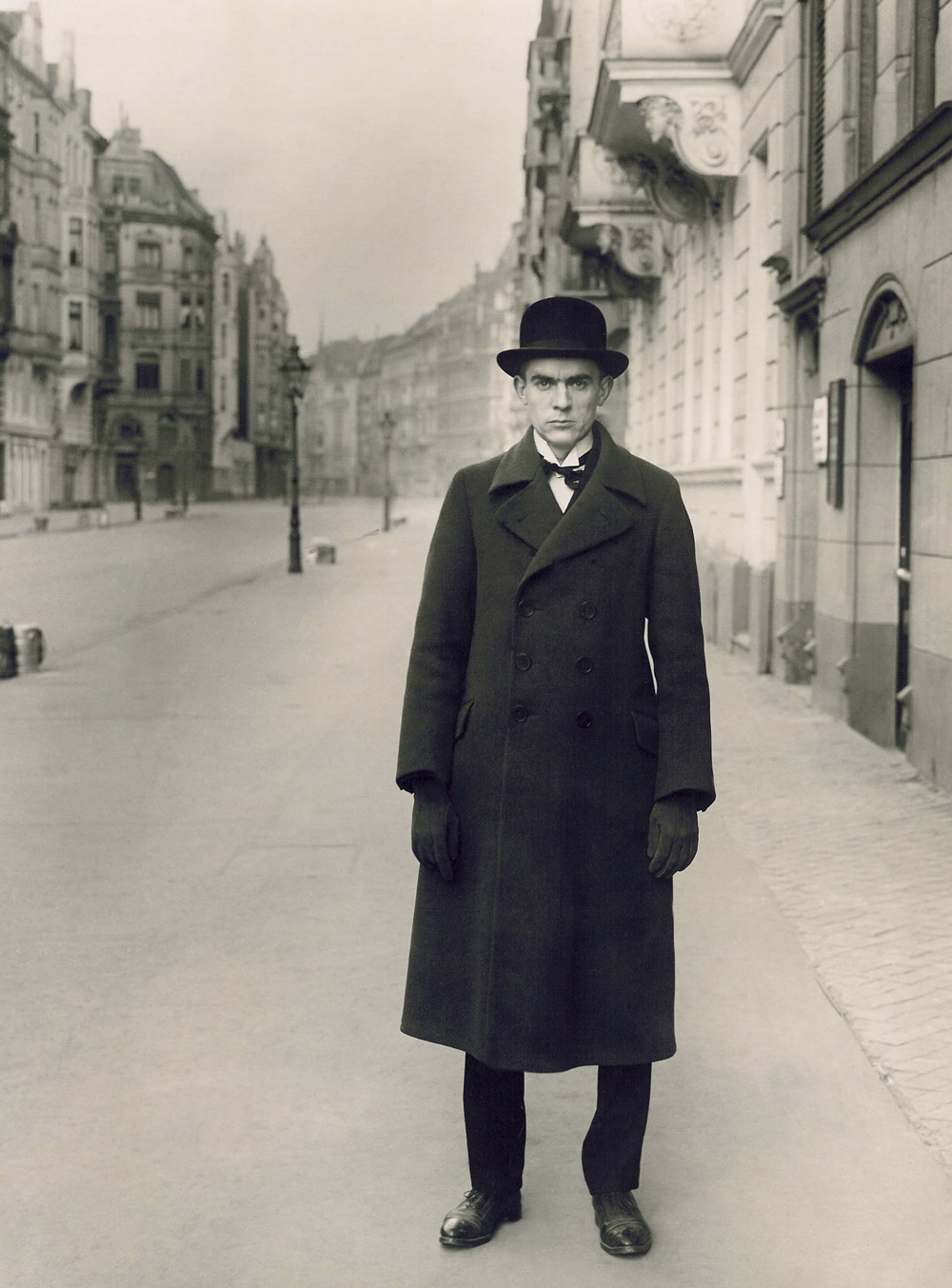
 

August Sander (German, 1876-1964) 'Der Maler Anton Räderscheidt' (Painter Anton Räderscheidt) 1926


August Sander (German, 1876-1964)
Der Maler Anton Räderscheidt (Painter Anton Räderscheidt)
1926
Gelatin silver print
Städel Museum, Frankfurt am Main
Photo: Städel Museum – ARTOTHEK
© VG Bild-Kunst, Bonn 2014


Installation view of the exhibition 'Lichtbilder. Photography at the Städel Museum from the Beginnings to 1960' showing Dora Maar's 'Mannequin With Perm' 1925


Dora Maar (France, 1907-1997)
Mannequin With Perm (installation view)
1935


Dora Maar (French, 1907-1997) 'Mannequin With Perm' 1935


Dora Maar (French, 1907-1997)
Mannequin With Perm
1935
Gelatin silver print on baryta paper mounted on cardboard
23.4 x 17.7cm
Städel Museum, Frankfurt am Main
Photo: Städel Museum – ARTOTHEK
© VG Bild-Kunst, Bonn 2014


Installation view of the exhibition 'Lichtbilder. Photography at the Städel Museum from the Beginnings to 1960' showing Otto Steinert's 'Ein-Fuß-Gänger' 1950


Otto Steinert (1915-1978)
Ein-Fuß-Gänger (installation view)
1950


The Subjective Gaze

After the Second World War a young generation took an innovative approach to the medium of photography. Distancing themselves from the propaganda and heroic photography of the National Socialist era, they looked at the avant grade photography of the 1900s. Among those innovators were the six photographers who founded the fotoform group in 1949: Peter Keetman, Siegfried Lauterwasser, Wolfgang Reisewitz, Toni Schneiders, Otto Steinert and Ludwig Windstosser. Emphasising formal issues they focused on the artist potential of photography and a free and experimental way of working. Abstract and minimal images as well as de-familiarised and dreamlike compositions were the results.

Otto Steinert, who taught art photography initially in Saarbrücken and later in Essen, was soon perceived as the key figure of the movement. In the years to come his exhibitions and publications stood for ‘subjective photography’. He underlined the photographer’s role as artist. By arguing that the camera is inevitably handled by a subjective and calculating author, Steinert weakened the notion of photographic objectivity.

Wall text from the exhibition
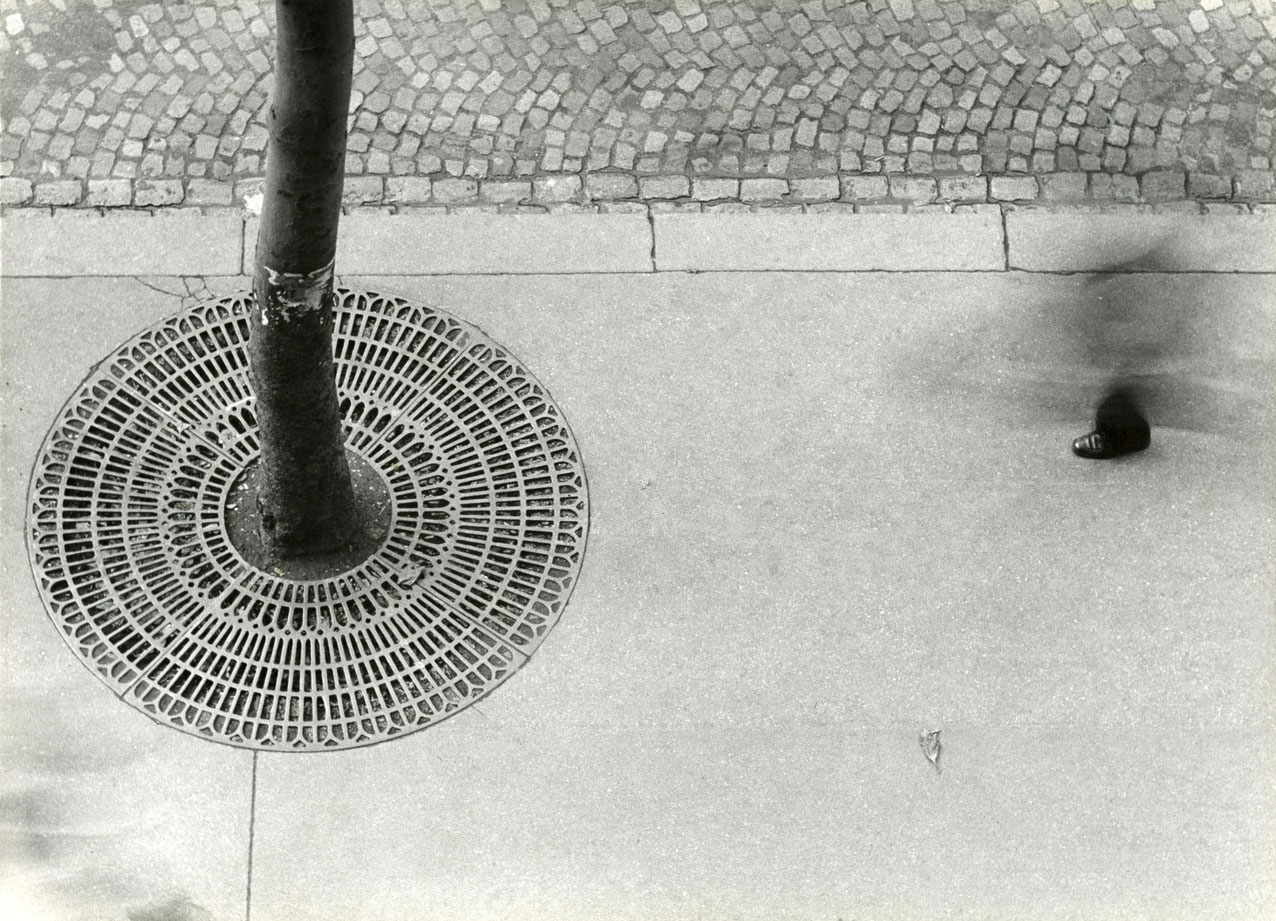
 

Otto Steinert (German, 1915-1978) 'Ein-Fuß-Gänger' 1950


Otto Steinert (German, 1915-1978)
Ein-Fuß-Gänger
1950
Gelatin silver print
28.5 × 39cm
Städel Museum, Frankfurt am Main
Photo: Städel Museum – ARTOTHEK


Installation view of the exhibition 'Lichtbilder. Photography at the Städel Museum from the Beginnings to 1960'


Installation view of the exhibition Lichtbilder. Photography at the Städel Museum from the Beginnings to 1960 at the Städel Museum, Frankfurt


Rudolf Koppitz (Austrian, 1884-1936) 'Head of a Man with Helmet' c. 1929 (installation view)


Rudolf Koppitz (Austrian, 1884-1936)
Head of a Man with Helmet (installation view)
c. 1929
Carbon print, printed c. 1929
49.8 × 48.4cm
Städel Museum, Frankfurt a. M., donated by Annette and Rudolf Kicken 2013


Installation view of the exhibition 'Lichtbilder. Photography at the Städel Museum from the Beginnings to 1960'


Installation view of the exhibition Lichtbilder. Photography at the Städel Museum from the Beginnings to 1960 at the Städel Museum, Frankfurt showing at right, Otto Steinert’s La Comtesse de Fleury (1952, below)


Otto Steinert (1915-1978) 'La Comtesse de Fleury' 1952


Otto Steinert (German, 1915-1978)
La Comtesse de Fleury
1952
Gelatin silver print on baryta paper mounted on hardboard
39.2 x 29.1cm
Städel Museum, Frankfurt am Main
Photo: Städel Museum – ARTOTHEK
© Nachlass Otto Steinert, Museum Folkwang, Essen


In 1845, the Frankfurt Städel was the first art museum in the world to exhibit photographic works. The invention of the new medium had been announced in Paris just six years earlier, making 2014 the 175th anniversary of that momentous event. In keeping with the tradition it thus established, the Städel is now devoting a comprehensive special exhibition to European photo art – Lichtbilder. Photography at the Städel Museum from the Beginnings to 1960 – presenting the photographic holdings of the museum’s Modern Art Department, which have recently undergone significant expansion. From 9 July to 5 October 2014, in addition to such pioneers as Nadar, Gustave Le Gray, Roger Fenton and Julia Margaret Cameron, the show will feature photography heroes of the twentieth century such as August Sander, Albert Renger-Patzsch, Man Ray, Dora Maar or Otto Steinert, while moreover highlighting virtually forgotten members of the profession. While giving an overview of the Städel’s early photographic holdings and the acquisitions of the past years, the exhibition will also shed light on the history of the medium from its beginnings to 1960.

“Even if we think of the presentation of artistic photography in an art museum as something still relatively new, the Städel already began staging photo exhibitions in the mid 1840s. We take special pleasure in drawing attention to this pioneering feat and – with the Lichtbilder exhibition – now, for the first time, providing insight into our collection of early photography, which has been decisively expanded over the past years through new purchases and generous gifts,” comments Städel director Max Hollein. Felix Krämer, one of the show’s curators, explains: “With Lichtbilder we would like to stimulate a more intensive exploration of the multifaceted history of a medium which, even today, is often still underestimated.”

The first mention of a photo exhibition at the Städel Museum dates from all the way back to 1845, when the Frankfurt Intelligenz Blatt – the official city bulletin – ran an ad. This is the earliest known announcement of a photography show in an art museum worldwide. The 1845 exhibition featured portraits by the photographer Sigismund Gerothwohl of Frankfurt, the proprietor of one of the city’s first photo studios who has meanwhile all but fallen into oblivion. Like many other institutions at the time, the Städel Museum had a study collection which also included photographs: then Städel director Johann David Passavant began collecting photos for the museum in the 1850s. In addition to reproductions of artworks, the photographic holdings comprised genre scenes, landscapes and cityscapes by such well-known pioneers in the medium as Maxime Du Camp, Wilhelm Hammerschmidt, Carl Friedrich Mylius or Giorgio Sommer. An 1852 exhibition showcasing views of Venice launched a tradition of presentations of photographic works from the Städel’s own collection.

Whereas the photos exhibited in the Städel in the nineteenth century were contemporary works, the show Lichtbilder will focus on the development of artistic photography. The point of departure will be the museum’s own photographic holdings, which were significantly expanded through major acquisitions from the collections of Uta and Wilfried Wiegand in 2011 and Annette and Rudolf Kicken in 2013, and which continue to grow today through new purchases. The exhibition’s nine chronologically ordered sections will span the history of the medium from the beginnings of paper photography in the 1840s to the photographic experiments of the fotoform Group in the 1950s.

In the entrance area to the show, the visitor will be greeted by a selection of Raphael reproductions presented by the Städel in exhibitions in 1859 and 1860. They feature full views and details of the cartoons executed by Raphael to serve as reference images for the Sistine Chapel tapestries. The art admirer was no longer compelled to travel to London to marvel at the Raphael cartoons at Hampton Court, but could now examine these masterworks in large-scale photographs right at the Städel. The following exhibition room is devoted to the pioneers of photography of the 1840s to ’60s. No sooner had the invention of the new medium been announced in 1839 than enthusiasts set about conquering the world with the photographic image. The aspiration of the bourgeoisie for self-representation in accordance with aristocratic conventions soon rendered photographic portraiture a lucrative business; to keep up with the growing demand, the number of photo studios in the European metropolises steadily increased. Works of architecture and historical monuments, art treasures and celebrities were all recorded on film and made available to the public. Quite a few photographers – for example Édouard Baldus, the Bisson brothers, Frances Frith, Wilhelm Hammerschmidt and Charles Marville – set out on travels to take pictures of the cultural-historical sites of Europe and the Near East, and thus to capture these testimonies to the past on film.

Among the most successful exponents of this genre was Georg Sommer, a native of Frankfurt who emigrated to Italy in 1856 and made a name for himself there as Giorgio Sommer. The second section of the show will revolve around the image of Italy as a kind of paradise on Earth characterised by the Mediterranean landscape and the legacy of antiquity. That image, however, would not be complete without views of the simple life of the Italian population. These genre scenes – often posed – were popular as souvenirs because they fulfilled the travellers’ expectations of encountering a preindustrial, and thus unspoiled, way of life south of the Alps. Faced with the challenges presented by the climate, the long exposure times and the complex photographic development process, photographers were constantly in search of technical improvements – as illustrated in the third section of the presentation. Léon Vidal and Carlo Naya, for example, experimented with colour photography, Eadweard Muybridge with capturing sequences of movement, and the Royal Prussian Photogrammetric Institute with large-scale “mammoth photographs.”

While the pictorial language of professional photography hardly advanced, increasing emphasis was placed over the years on its technical aspects. The section of the show on artistic photography demonstrates how, at the end of the nineteenth century, enthusiastic amateur photographs worked to develop the medium with regard to aesthetics as well. Whereas until that time, professional photographers had given priority to genre scenes and other motifs popular in painting, the so-called Pictorialists set out to strengthen photography’s value as an artistic medium in its own right. Atmospheric landscapes, fairy-tale scenes and stylised still lifes were captured as subjective impressions. While Julia Margaret Cameron very effectively staged dialogues between sharp and soft focus, Heinrich Kühn employed the gum bichromate and bromoil techniques to create painterly effects.

After World War I, a new generation of photographers emerged who questioned the standards established by the Pictorialists. Their works are highlighted in the following room. Rather than intervening in the photographic development process, the adherents to this new current – who pursued interests analogous to those of the New Objectivity painters – devoted themselves to austere pictorial design and sought to establish a “new way of seeing.” The gaze was no longer to wander yearningly into the distance, but be confronted directly and immediately with the realities of society. The prosaic and rigorous images of August Sander and Hugo Erfurth satisfy the demands of this artistic creed. The exhibition moreover directs its attention to early photojournalism and the development of the mass media. Apart from documentary photographs by the autodidact Erich Salomon, Heinrich Hoffmann’s portraits of Adolf Hitler – purchased for the Städel collection in 2013 – will also be on view. Although it was Hitler himself who had commissioned them, he later prohibited the portraits’ reproduction. For in actuality, Hoffmann’s images expose the hollowness of the dictator’s demeanour. The show devotes a separate room to the work of Albert Renger-Patzsch, whose formally rigorous scenes are distinguished by uncompromising objectiveness in the depiction of nature and technology.

The photographers inspired by Surrealism pursued interests of a wholly different nature, as did the representatives of the Czech photo avant-garde – the focusses of the following two exhibition rooms. In the section on Surrealist photography, the works oscillate between fiction and reality, and photographic experiments unveil the world’s bizarre sides. Employing strange effects or unexpected motif combinations, artists such Brassaï, André Kertész, Dora Maar, Paul Outerbridge and Man Ray sought the unusual in the familiar. The Czech photographers of the interwar period, for their part, explored the possibilities of abstract and constructivist photography. Their works, many of which exhibit a symbolist tendency, are concerned with the aestheticisation of the world.

The final section of the show is dedicated to Otto Steinert and the fotoform Group. It sheds light on how Steinert and the members of the artists’ group took their cues from the experiments of the photographic vanguard of the 1920s, while at the same time dissociating themselves from the propagandistic and heroising use of photography during the National Socialist era. The six photographers who joined to found the fotoform Group in 1949 – Peter Keetman, Siegfried Lauterwasser, Wolfgang Reisewitz, Toni Schneiders, Otto Steinert and Ludwig Windstosser – coined the term “subjective photography” and emphasised the photographer’s individual perspective.

The show augments the joint presentation of photography, painting and sculpture practised at the Städel Museum since its reopening in 2011 and also to be continued during and after Lichtbilder. The aim of this exhibition mode is to convey the decisive role played by photography in art-historical pictorial tradition since the medium’s very beginnings. The presentation is being accompanied by a catalogue which – like the exhibition architecture – foregrounds the specific “palette” of photography as a medium conducted in black and white. The subtle tones of grey are mirrored not only in the works’ reproductions, but also in the colour design of the individual catalogue sections. When the visitor enters the exhibition space, he is surrounded by an architecture that is grey to the core, while at the same time making clear that no one shade of grey is like another. In the words of curator Felicity Grobien: “The exhibition reveals how multi-coloured the prints are, for in them – contrary to what we expect from black-and-white photography – we discover a vast range of subtle colour nuances that emphasise the prints; distinctiveness.

Press release from the Städel Museum


Édouard Baldus (French, 1813-1889) 'Orange: The Wall of the Théâtre antique' 1858


Édouard Baldus (French, 1813-1889)
Orange: The Wall of the Théâtre antique
1858
Albumen print mounted on cardboard
43.4 x 33.4cm
Städel Museum, Frankfurt am Main
Photo: Städel Museum – ARTOTHEK


Werner Mantz (German, 1901-1983) 'Cologne: Bridge' c. 1927


Werner Mantz (German, 1901-1983)
Cologne: Bridge
c. 1927
Gelatin silver print on baryta paper
16.7 x 22.5cm
Städel Museum, Frankfurt am Main
Photo: Städel Museum – ARTOTHEK
© VG Bild-Kunst, Bonn 2014


Werner Mantz began his career as a portrait and advertising photographer, later becoming known for his architectural photographs of the modernist housing projects in Cologne during the 1920s. This portfolio of photographs was selected by the artist towards the end of his life as representative of his finest work. These rare prints reveal Mantz’s mastery in still-life and architecture photography, and are considered some of the most influential works created in the period.

Text from the Tate website


Carlo Naya (Italian, 1816-1882) 'Venice: View of the Marciana Library, the Campanile and the Ducal Palace' c. 1875


Carlo Naya (Italian, 1816-1882)
Venice: View of the Marciana Library, the Campanile and the Ducal Palace
c. 1875
Albumen print mounted on cardboard
41.3 x 54.1cm
Städel Museum, Frankfurt am Main
Photo: Städel Museum – ARTOTHEK


Carlo Naya (1816, Tronzano Vercellese – 1882, Venice) was an Italian photographer known for his pictures of Venice including its works of art and views of the city for a collaborative volume in 1866. He also documented the restoration of Giotto’s frescoes at the Scrovegni Chapel in Padua. Naya was born in Tronzano di Vercelli in 1816 and took law at the University of Pisa. An inheritance allowed him to travel to major cities in Europe, Asia, and northern Africa. He was advertising his services as portrait photographer in Istanbul in 1845, and opened his studio in Venice in 1857. He sold his work through photographer and optician Carlo Ponti. Following Naya’s death in 1882, his studio was run by his wife, then by her second husband. In 1918 it was closed and publisher Osvaldo Böhm bought most of Naya’s archive.

Text from Wikipedia website


Albert Renger-Patzsch (German, 1897-1966) 'Buchenwald in November' c. 1954


Albert Renger-Patzsch (German, 1897-1966)
Buchenwald in November
c. 1954
Gelatin silver print
16.5 x 22.4cm
Städel Museum, Frankfurt am Main
Photo: Städel Museum – ARTOTHEK
© VG Bild-Kunst, Bonn 2014


Royal Prussian Institute of Survey Photography (est. 1885) 'Cologne: Cathedral' 1889


Royal Prussian Institute of Survey Photography (est. 1885)
Cologne: Cathedral
1889
Gelatin silver prints mounted on cardboard
79.8 x 64.5cm
Städel Museum, Frankfurt am Main
Photo: Städel Museum – ARTOTHEK


Otto Steinert (German, 1915-1978) 'Luminogram' 1952


Otto Steinert (German, 1915-1978)
Luminogram
1952
Gelatin silver print on baryta paper mounted on cardboard
41.5 x 59.5cm
Städel Museum, Frankfurt am Main
Photo: Städel Museum – ARTOTHEK
© Nachlass Otto Steinert, Museum Folkwang, Essen


Paul Outerbridge (American, 1896-1958) 'Egg on Block' 1923


Paul Outerbridge (American, 1896-1958)
Egg on Block
1923
Platinum print
11.9 x 9.4cm
Städel Museum, Frankfurt am Main
Photo: Städel Museum – ARTOTHEK
© Paul Outerbridge, Jr., © 2014 G. Ray Hawkins Gallery, Beverly Hills, CA


Albert Renger-Patzsch (German, 1897-1966) 'Untitled (Close-up of a Zip Fastener)' 1928-1933


Albert Renger-Patzsch (German, 1897-1966)
Untitled (Close-up of a Zip Fastener)
1928-1933
Gelatin silver print
23 x 16.9cm
Städel Museum, Frankfurt am Main
Photo: Städel Museum – ARTOTHEK
© VG Bild-Kunst, Bonn 2014


Julia Margaret Cameron (British born India, 1815-1879) 'Mrs Herbert Duckworth' 1867


Julia Margaret Cameron (British born India, 1815-1879)
Mrs Herbert Duckworth
1867
Albumen print mounted on cardboard
35 x 27.1cm
Städel Museum, Frankfurt am Main
Photo: Städel Museum – ARTOTHEK


Giorgio Sommer (European, 1834-1914) 'Naples: Delousing' c. 1870


Giorgio Sommer (European, 1834-1914)
Naples: Delousing
c. 1870
Albumen print mounted on cardboard
25.5 x 20.6cm
Städel Museum, Frankfurt am Main
Photo: Städel Museum – ARTOTHEK


Lewis Carroll (English, 1832-1898) 'Alexandra "Xie" Kitchin as Chinese "Tea-Merchant" (on Duty)' 1873


Lewis Carroll (English, 1832-1898)
Alexandra “Xie” Kitchin as Chinese “Tea-Merchant” (on Duty)
1873
Albumen print
19.8 x 15.2cm
Städel Museum, Frankfurt am Main
Photo: Städel Museum – ARTOTHEK


Additional images


Albert Renger-Patzsch (German, 1897-1966) 'Tropical Orchis, cattleya labiata' c. 1930


Albert Renger-Patzsch (German, 1897-1966)
Tropical Orchis, cattleya labiata
c. 1930
Gelatin silver print, printed c. 1930
Städel Museum, Frankfurt am Main
Photo: Städel Museum – ARTOTHEK


Man Ray (American, 1890-1976) 'Schwarz und Weiß' 1926


Man Ray (American, 1890-1976)
Schwarz und Weiß (Black and white)
1926 (printed 1993 by Pierre Gassmann)
Silver gelatin print
24.8 x 35.3cm
Städel Museum, Frankfurt am Main
Photo: Städel Museum – ARTOTHEK
© VG Bild-Kunst, Bonn 2014


Man Ray (American, 1890-1976) 'Retour à la Raison' 1923


Man Ray (American, 1890-1976)
Retour à la Raison (Return to Reason)
1923 (printed c. 1979 from Pierre Gassmann)
Gelatin silver print
Städel Museum, Frankfurt am Main
Acquired in 2013 as a gift from Annette and Rudolf Kicken
© VG Bild-Kunst, Bonn 2013


Václav Jíru (Czech, 1910-1980) 'Untitled (Sunbath)' 1930s


Václav Jíru (Czech, 1910-1980)
Untitled (Sunbath)
1930s
Gelatin silver print
Städel Museum, Frankfurt am Main
Acquired in 2013 as a gift from Annette and Rudolf Kicken


Jíru started to shoot as an amateur photographer, and since 1926 published photos and articles. He first exhibited in 1933 and collaborated with the Theatre Vlasta Burian, photographed in the Liberated Theatre, was devoted to advertising photography, and became well known in the international press (London News, London Life, Picture Post, Sie und Er, Zeit im Bild).

In 1940 he was arrested by the Gestapo for resistance activities, and sentenced to life in prison by the end of the war. In the book Six Spring, where there are pictures taken shortly after liberation, he described his experience of prison and concentration camps. After the war he became a member of the Union of Czechoslovak Journalists and in 1948 a member of the Association of Czechoslovak Artists. He continued shooting, but also looking for new talented photographers. In 1957, he founded and led four languages ​​photographic Revue Photography. By the end of his life he organised a photographic exhibition and served on the juries of photographic competitions.

The photographs of Václav Jírů, especially in the pre-war stage, was very wide: sports photography, theatrical portrait, landscape, nude, social issues, report. After the war he concentrated on the cycles of nature, landscapes and cities. A frequent theme of his photographs was Prague, which unlike many other photographers he photographed in its unsentimental everyday life (Prague mirrors, walls Poetry Prague, Prague ghosts).

Text translated from Czech Wikipedia website


Werner Mantz (German, 1901-1983) 'Förderturm – Im Auftrag der Staatsmijnen Heerlen/Niederlande' 1937


Werner Mantz (German, 1901-1983)
Förderturm – Im Auftrag der Staatsmijnen Heerlen/Niederlande (Headframe – On behalf of the States Mine Heerlen / Netherlands)
1937
Gelatin silver bromide print
22.6 x 16.7cm
Städel Museum, Frankfurt am Main
© VG Bild-Kunst, Bonn 2013
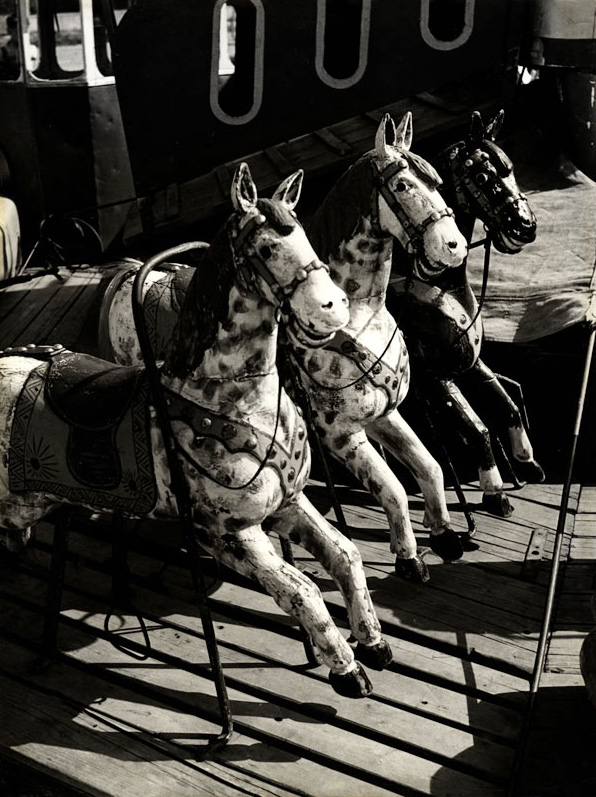
 

Václav Chochola (Czech, 1923-2005) 'Kolotoc-Konieci' (merry-go-round horse) c. 1958


Václav Chochola (Czech, 1923-2005)
Kolotoc-Konieci (merry-go-round horse)
c. 1958
Gelatin silver print
Städel Museum, Frankfurt am Main
Acquired in 2013 as a gift from Annette and Rudolf Kicken


Chochola (January 31, 1923 in Prague – August 27, 2005) was a Czech photographer, known for classic Czech art and portrait photography. He began photography while studying at grammar school in Prague-Karlin. After leaving the photographer taught and studied at the School of Graphic Arts. He was a freelance photographer, photographed at the National Theatre and has collaborated with many other scenes. Chochol created a series of images using non-traditional techniques, creating photograms, photomontage and roláže.

In his extensive work Chochol was devoted to candid photographs, portraits of celebrities (famous for his portrait of Salvador Dali), acts or sports photography. His documentary images from the Prague uprising in May 1945 are invaluable. In 1970 Chochol spent a month in custody for photographing the grave of Jan Palach. He died after a brief serious illness in Motol Hospital in Prague.

Text translated from Czech Wikipedia website


Jde užasle světem, o kterém jako kluk na předměstí snil a od něhož byl vždy oddělen červenou šňůrou, a do něhož má najednou přístup. Skutečnost, že v tomto světě nikdy nebyl úplně doma, dokázal proměnit v nepřehlédnutelnou přednost: zbystřilo mu to oko a zahlédl detaily, které my oslněni jinými cíli ani nevidíme.

He walks in amazement through the world he dreamed of as a boy in the suburbs, and from which he was always separated by a red cord, and to which he suddenly has access. He was able to turn the fact that he was never quite at home in this world into an unmissable advantage: it sharpened his eye and he saw details that we, dazzled by other goals, don’t even see.


Frantisek Drtikol (Czech, 1883-1961) 'Crucified' before 1914


Frantisek Drtikol (Czech, 1883-1961)
Crucified
before 1914 (printed before 1914)
Gelatin silver print
22.7 x 17.3cm
Städel Museum, Frankfurt am Main
Acquired in 2013 as a gift from Annette and Rudolf Kicken
© VG Bild-Kunst, Bonn 2013


František Drtikol (3 March 1883, Příbram – 13 January 1961, Prague) was a Czech photographer of international renown. He is especially known for his characteristically epic photographs, often nudes and portraits.

From 1907 to 1910 he had his own studio, until 1935 he operated an important portrait photostudio in Prague on the fourth floor of one of Prague’s remarkable buildings, a Baroque corner house at 9 Vodičkova, now demolished. Jaroslav Rössler, an important avant-garde photographer, was one of his pupils. Drtikol made many portraits of very important people and nudes which show development from pictorialism and symbolism to modern composite pictures of the nude body with geometric decorations and thrown shadows, where it is possible to find a number of parallels with the avant-garde works of the period. These are reminiscent of Cubism, and at the same time his nudes suggest the kind of movement that was characteristic of the futurism aesthetic.

He began using paper cut-outs in a period he called “photopurism”. These photographs resembled silhouettes of the human form. Later he gave up photography and concentrated on painting. After the studio was sold Drtikol focused mainly on painting, Buddhist religious and philosophical systems. In the final stage of his photographic work Drtikol created compositions of little carved figures, with elongated shapes, symbolically expressing various themes from Buddhism. In the 1920s and 1930s, he received significant awards at international photo salons.

Text from Wikipedia website


Städel Museum
Schaumainkai 63
60596 Frankfurt

Opening hours:
Tuesday – Sunday 10.00am – 6.00pm
Thursday 10.00am – 9.00pm
Closed Mondays

Städel Museum website

LIKE ART BLART ON FACEBOOK

Back to top

Exhibition: ‘Photography at NOMA’ at The New Orleans Museum of Art

Exhibition dates: 10th November 2013 – 19th January 2014


André Kertész (American born Hungary, 1894-1985) 'Leger's Studio' 1926 - 1927


André Kertész (American born Hungary, 1894-1985)
Leger’s Studio
1926-1927
Gelatin silver print
Image: 3 1/8 x 4 1/4in. (8 x 10.8cm)
The New Orleans Museum of Art
Museum purchase, Women’s Volunteer Committee Fund


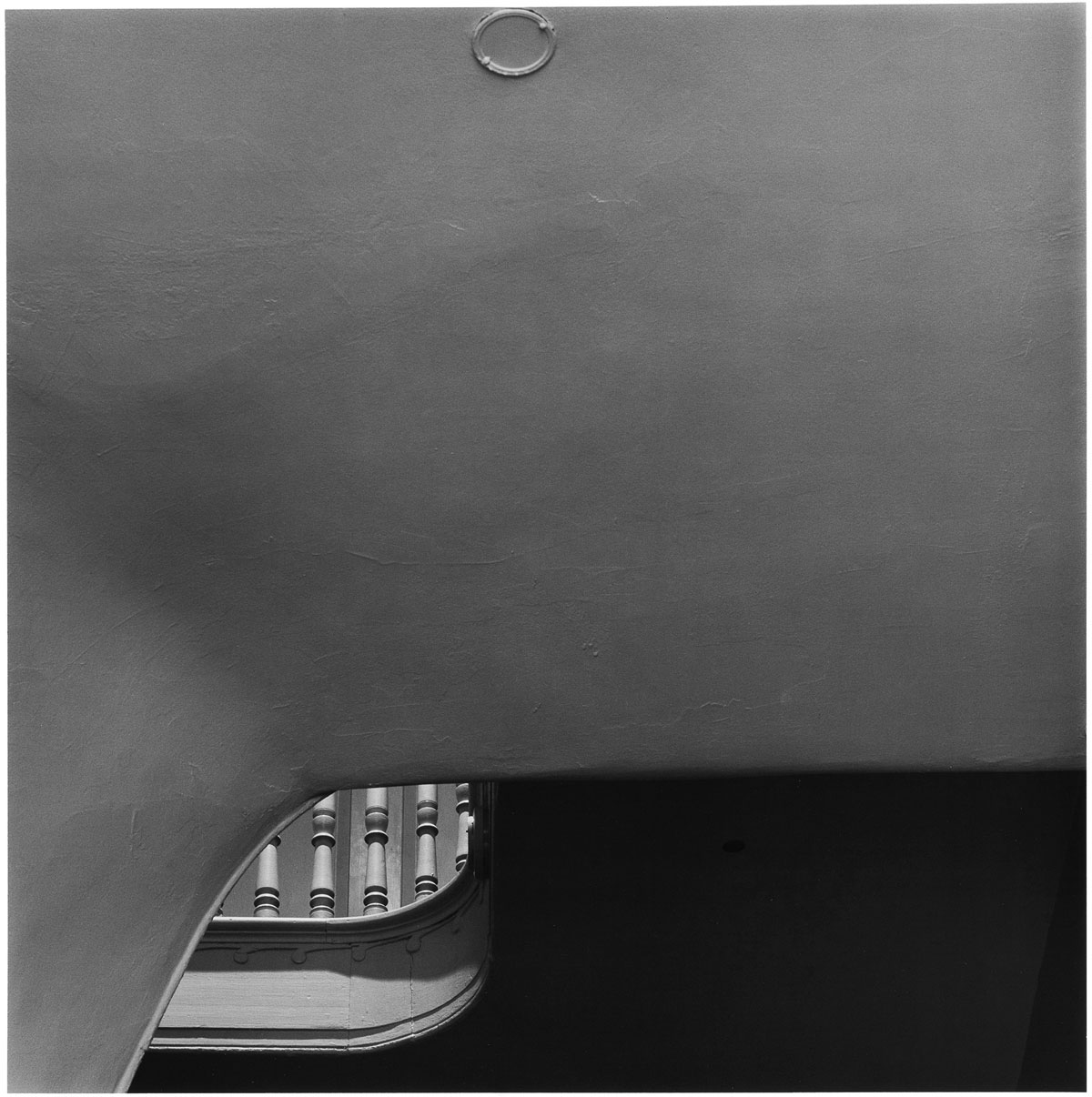
There are some rare and beautiful photographs in this posting. I have never seen the Kertész (Leger’s Studio 1926-1927) with its wonderful structure and tonality nor the unusual Mapplethorpe (Staircase, 1140 Royal 1982). I particularly like the Bellocq (Bedroom Mantel, Storyville c. 1911-1913) with its complex medley of shapes and images.

Marcus


Many thankx to The New Orleans Museum of Art for allowing me to publish the photographs in the posting. Please click on the photographs for a larger version of the image.


Lee Friedlander (American, b. 1934) 'Untitled (Self-Portrait Reflected in Window, New Orleans)' c. 1965


Lee Friedlander (American, b. 1934)
Untitled (Self-Portrait Reflected in Window, New Orleans)
c. 1965
Gelatin silver print
Image: 7 x 10 3/4 in. (17.6 x 27.2cm)
Mount: 11 x 14 in. (27.9 x 35.5cm)
The New Orleans Museum of Art
Museum purchase through the National Endowment for the Arts Grant


Robert Frank (American, 1924-2019) 'Canal Street, New Orleans' 1955


Robert Frank (American, 1924-2019)
Canal Street, New Orleans
1955
Gelatin silver print
Image: 11 x 13 4/5 in. (28 x 35.2cm)
The New Orleans Museum of Art
Museum purchase through the National Endowment for the Arts and Museum Purchase Funds


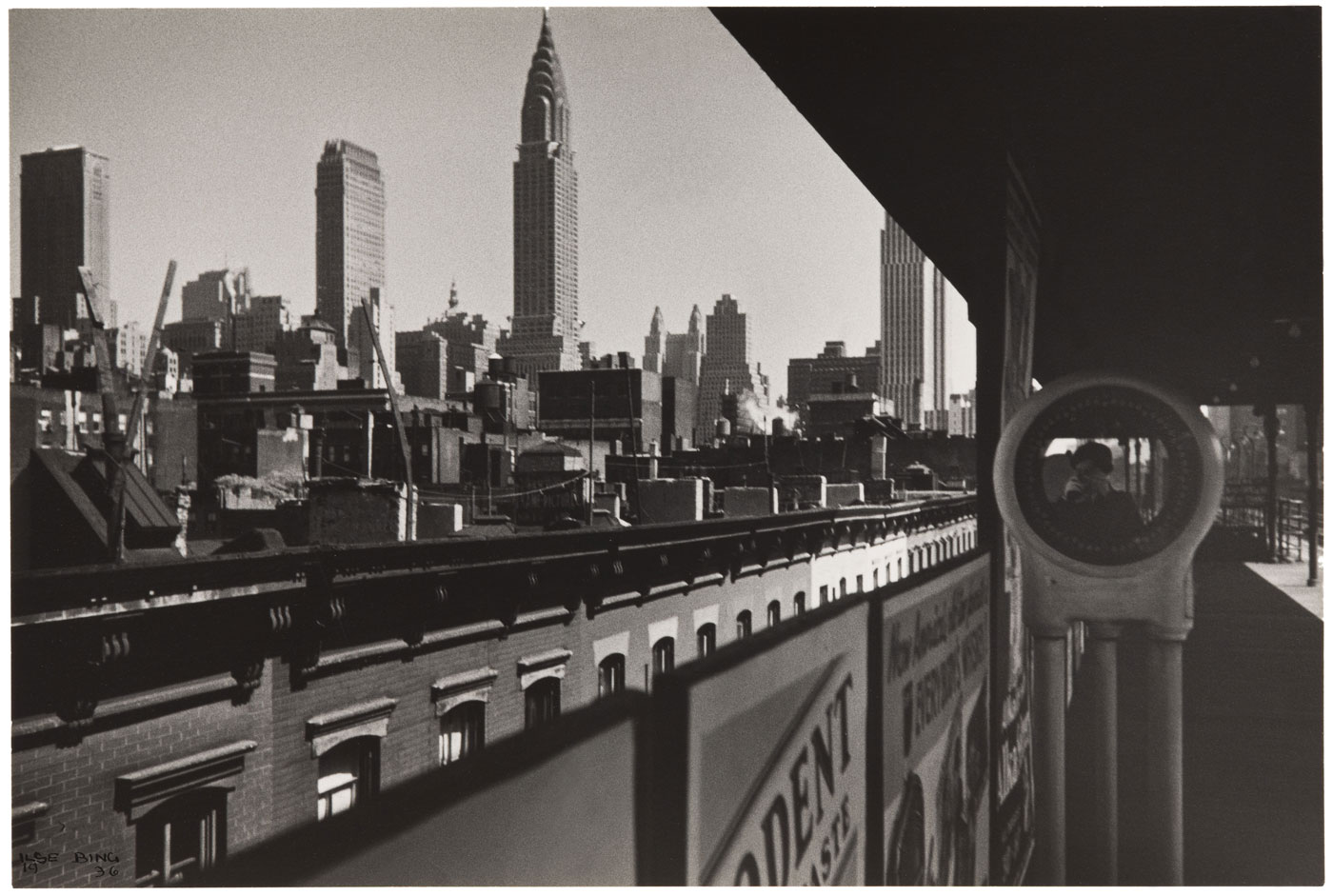
Ilse Bing (American, 1899-1998) 'New York, The Elevated and Me' 1936


Ilse Bing (American, 1899-1998)
New York, The Elevated and Me
1936
Gelatin silver print
Image: 7 15/16 x 11 in. (18.6 x 28cm)
The New Orleans Museum of Art
Museum purchase through the National Endowment for the Arts Matching Grant
© Estate of Ilse Bing


Henri Cartier-Bresson (French, 1908-2004) 'Louisiana' 1947, printed circa 1975


Henri Cartier-Bresson (French, 1908-2004)
Louisiana
1947, printed c. 1975
Gelatin silver print
Image: 9 5/8 x 14 3/16 in. (24.4 x 36cm)
Paper: 12 x 16 in. (30.3 x 40.4cm)
The New Orleans Museum of Art
Museum purchase, General Acquisition Fund


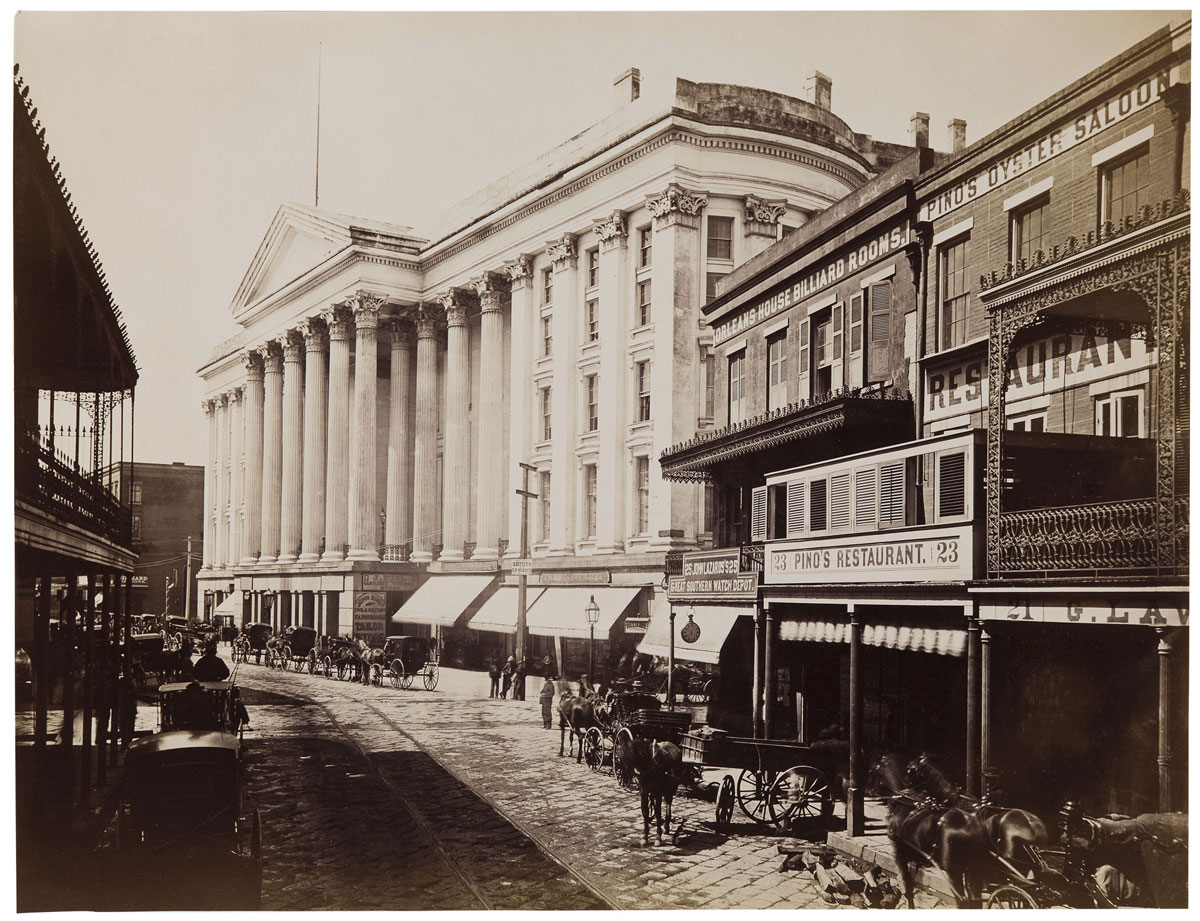
Theodore Lilienthal (American, 1829-1894) 'Charles Hotel, New Orleans' c. 1867


Theodore Lilienthal (American, 1829-1894)
Charles Hotel, New Orleans
c. 1867
Albumen print
Image: 10 3/4 x 13 13/16 in. (27.2 x 35.1cm)
Mount: 17 x 22 1/4 in. (43.3 x 56.6cm)
The New Orleans Museum of Art
Museum Purchase


Featuring masterworks by photographers Edward Weston, William Henry Fox Talbot, André Kertész, Robert Mapplethorpe, and many more, the New Orleans Museum of Art’s upcoming exhibition, Photography at NOMA, explores the Museum’s rich permanent photography collection through a selection of some of its finest works from the early 1840s to the 1980s.

The first comprehensive presentation of works from NOMA’s collection since the 1970s, the exhibition includes over 130 of the most important photographs in the Museum’s collection and presents rare and unusual examples from throughout photography’s history. On view November 10, 2013 through January 19, 2014, the exhibition highlights the tremendous depth and breadth of the Museum’s collection and includes photographs made as works of art as well as advertising images, social documents, and more. The photographers featured in the exhibition range from some of the most recognisable names in the field, including Henri Cartier-Bresson, Robert Frank, and Lewis Hine, to unknown photographers – reflecting the vast spectrum of photographic activity since the medium’s inception in the 19th century.

“NOMA began collecting photographs seriously in the early 1970s when photography was not commonly found in American art museum collections. Today our holdings include nearly 10,000 works, representing a broad range of creative energy and achievement,” said Susan Taylor, NOMA’s Director. “Our collection has strong roots in New Orleans history. Our city has long been an epicentre for the work of established and emerging photographers and we are delighted to share this aspect of New Orleans history with our audiences.”

“Since its origins, photography has infiltrated every aspect of modern life, from art to war, and religion to politics and many of these applications are represented in NOMA’s extensive collection,” said Russell Lord, Freeman Family Curator of Photographs. “Despite the collection’s long history, it remains one of the best kept secrets in this country. Photography at NOMA is an opportunity to re-examine and bring to the fore the diverse range of works found in the collection.”

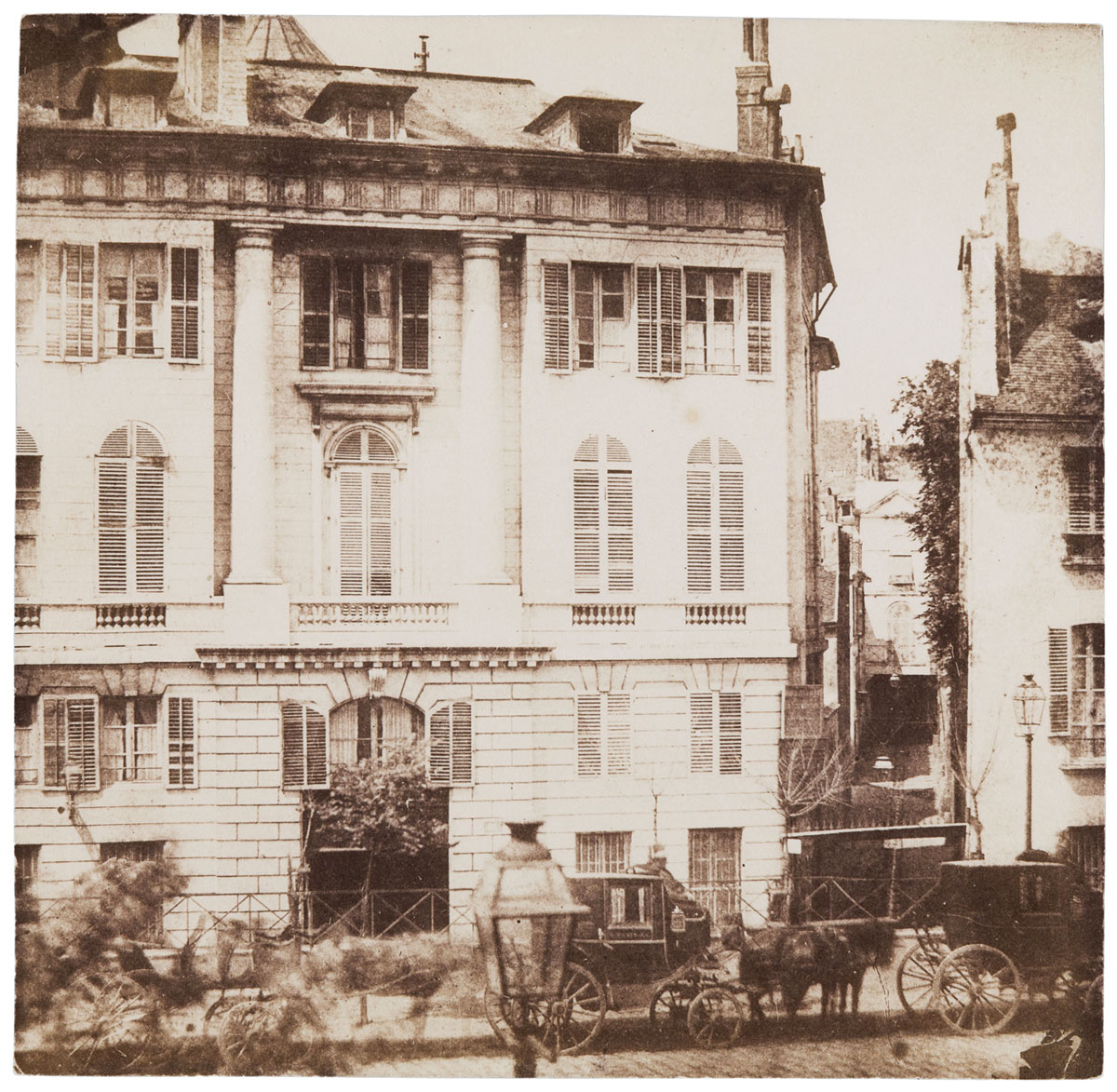
Since the 1970s, NOMA has built an extensive collection of photographs that represents a wide range of achievement in that medium from the 1840s to the present. Today the collection comprises nearly 10,000 works with images by some of the most significant photographic artists including Berenice Abbott, Ansel Adams, Diane Arbus, Ilse Bing, and Edward Steichen, among many others. The collection includes examples that reflect photography’s international scope, from an 1843 view from his hotel window in Paris by William Henry Fox Talbot to a view of Mount Fuji by Kusakabi Kimbei, but it is also strong in photographs made in and around New Orleans by regional and national photographers such as E. J. Bellocq, Walker Evans, Clarence John Laughlin, and Robert Polidori.

Photography at NOMA features works by Berenice Abbott, Ansel Adams, Diane Arbus, Henri Cartier-Bresson, Walker Evans, Robert Frank, Robert Mapplethorpe, William Henry Fox Talbot, and Edward Weston, among many others.

Press release from the NOMA website


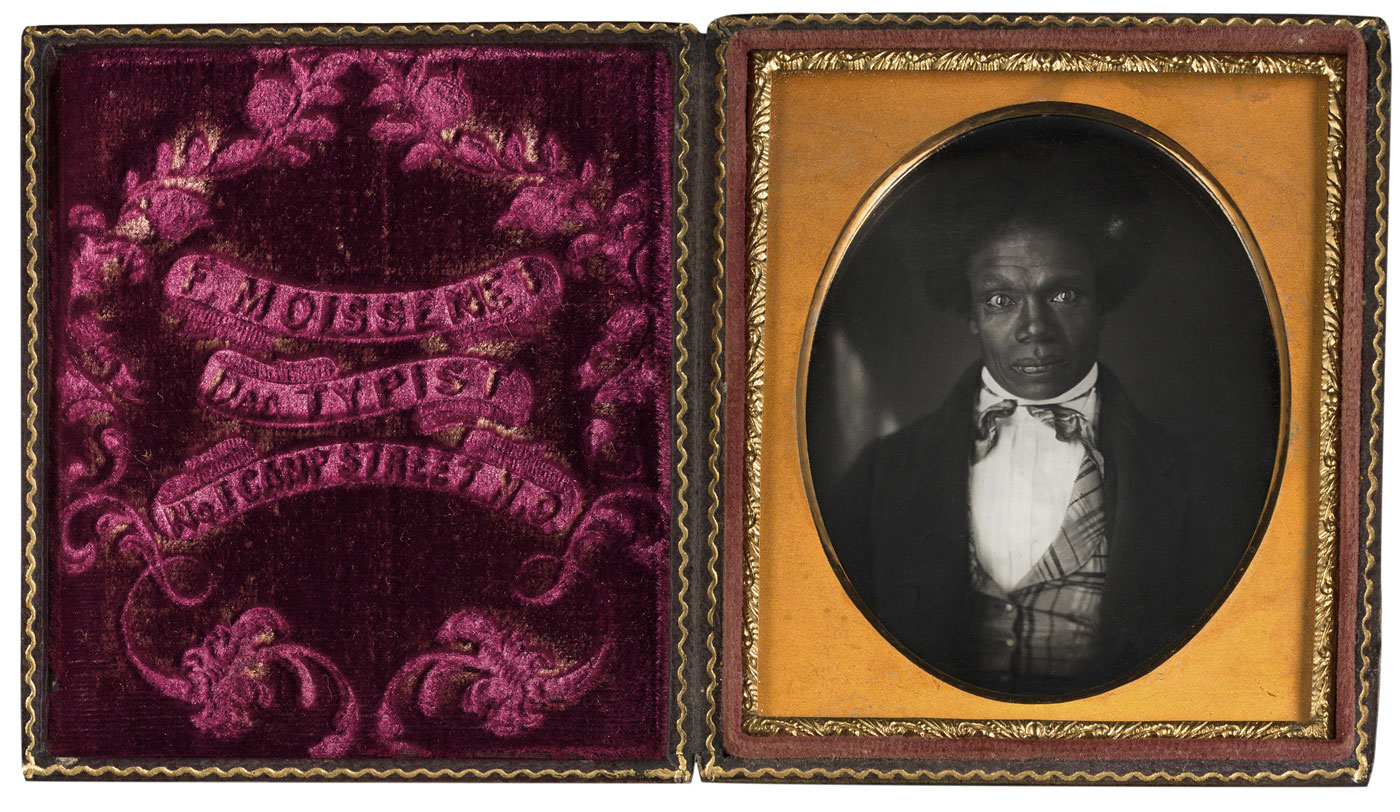
Felix Moissenet (American, b. circa 1814) 'Freeman' c. 1855


Felix Moissenet (American, b. circa 1814)
Freeman
c. 1855
Sixth plate daguerreotype
Image: 3 1/4 x 2 3/4 in. (8 x 6.8cm)
Case (open): 3 5/8 x 6 3/8 in. (9.2 x 16.1cm)
The New Orleans Museum of Art
Museum purchase


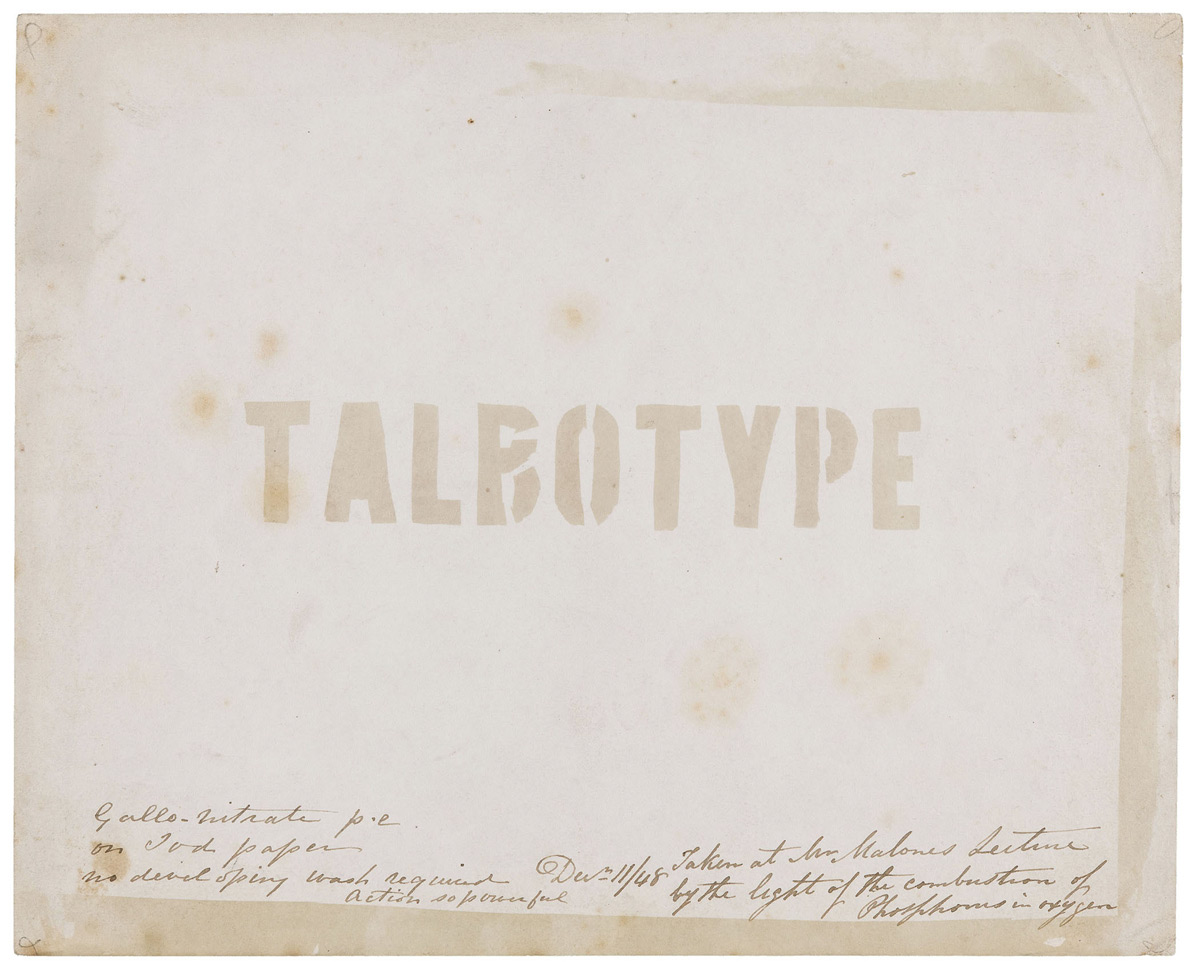
Thomas Augustine Malone (British, 1823-1867) 'Demonstration of the Talbotype' December 11, 1848


Thomas Augustine Malone (British, 1823-1867)
Demonstration of the Talbotype
December 11, 1848
Calotype (Talbotype) negative
7 3/8 x 9 2/16 in. (18.8 x 23.3cm)
The New Orleans Museum of Art
Museum purchase


Robert Mapplethorpe (American, 1946-1989) 'Staircase, 1140 Royal' 1982


Robert Mapplethorpe (American, 1946-1989)
Staircase, 1140 Royal
1982
Gelatin silver print
Image: 15 1/5 x 15 1/5 in. (38.5 x 38.5cm)
Paper: 20 x 16 in. (50.6 x 40.4cm)
The New Orleans Museum of Art
Promised gift from H. Russell Albright, MD


William Henry Fox Talbot (British, 1800-1877) 'View of the Paris Boulevards from the First Floor of the Hôtel de Louvais, Rue de la Paix' 1843


William Henry Fox Talbot (British, 1800-1877)
View of the Paris Boulevards from the First Floor of the Hôtel de Louvais, Rue de la Paix
1843
Salted paper print from a paper negative
Image: 6 3/8 x 6 3/4 in. (16.2 x 17.1cm)
Paper: 7 1/2x 9 in. (19 x 23cm)
The New Orleans Museum of Art
Museum purchase, 1977 Acquisition Fund Drive


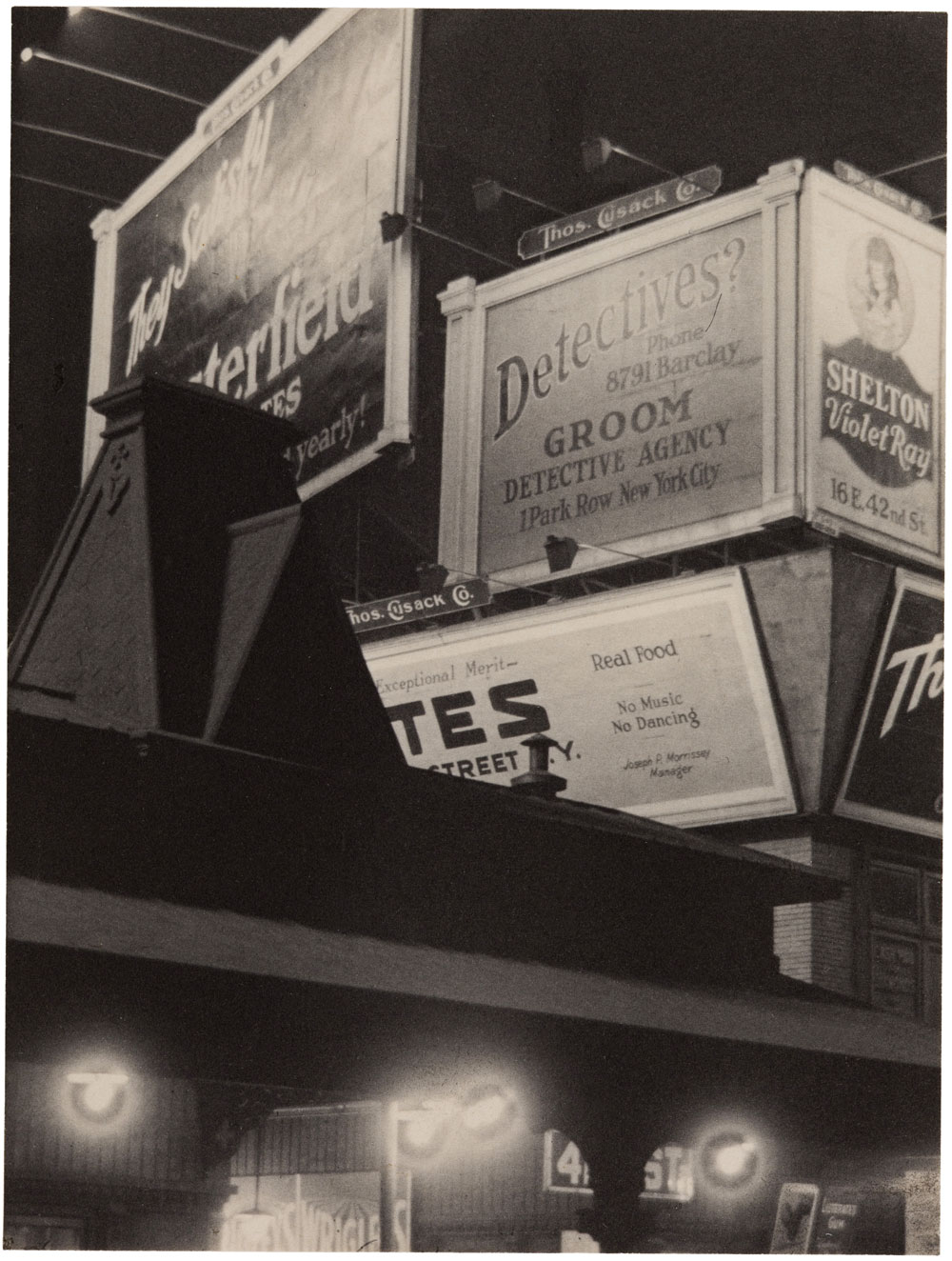
Paul Outerbridge (American, 1896-1958) 'Groom Detective Agency' 1923


Paul Outerbridge (American, 1896-1958)
Groom Detective Agency
1923
Platinum print
Image: 4 1/2 x 3 1/2 in. (11.5 x 9cm)
Paper: 14 x 11 in. (35.5 x 28cm)
Paul Outerbridge, Jr.
© 2013 G. Ray Hawkins Gallery, Beverly Hills, CA


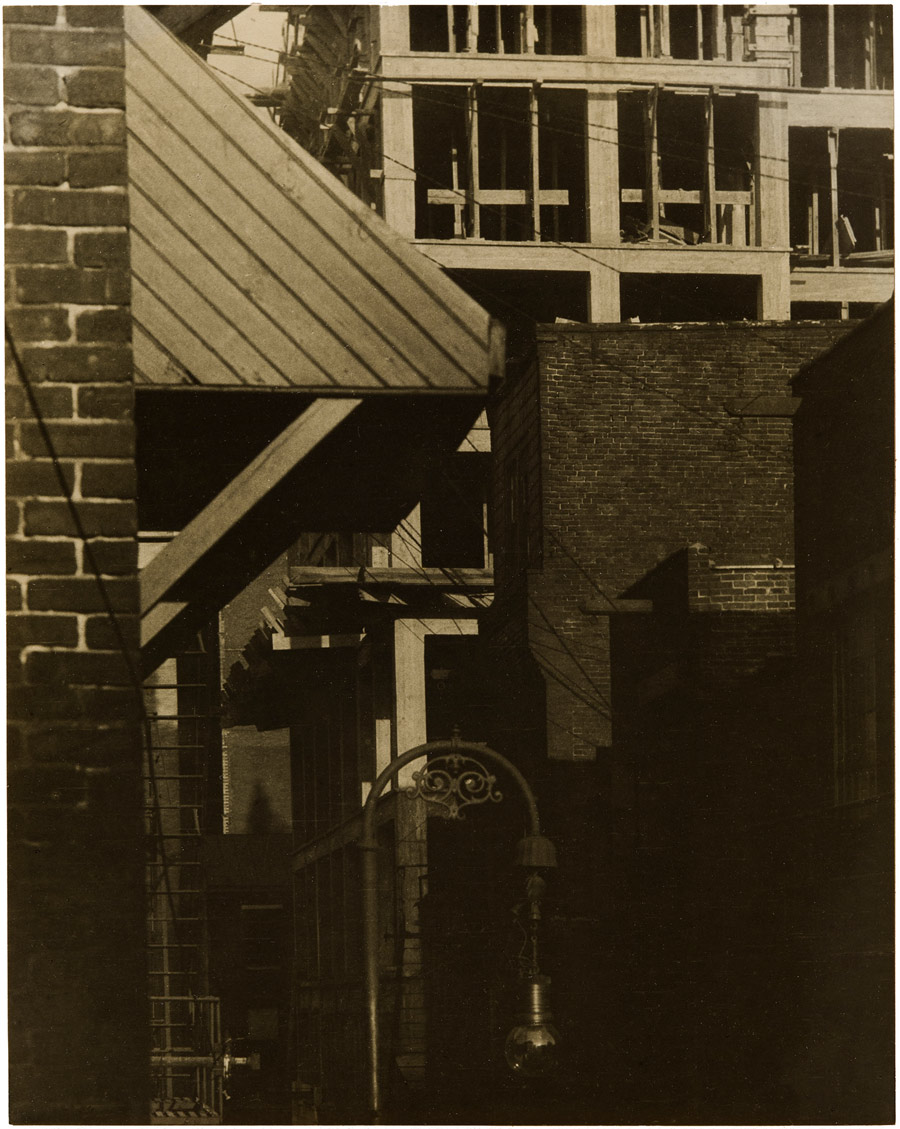
Morton Schamberg (American, 1881-1918) 'Cityscape' 1916


Morton Schamberg (American, 1881-1918)
Cityscape
1916
Gelatin silver print
Image: 9 1/2 x 7 1/2 in. (24 x 19cm)
Mount: 15 3/4 x 13 in. (40 x 33cm)
The New Orleans Museum of Art
Museum purchase, Women’s Volunteer Committee Fund


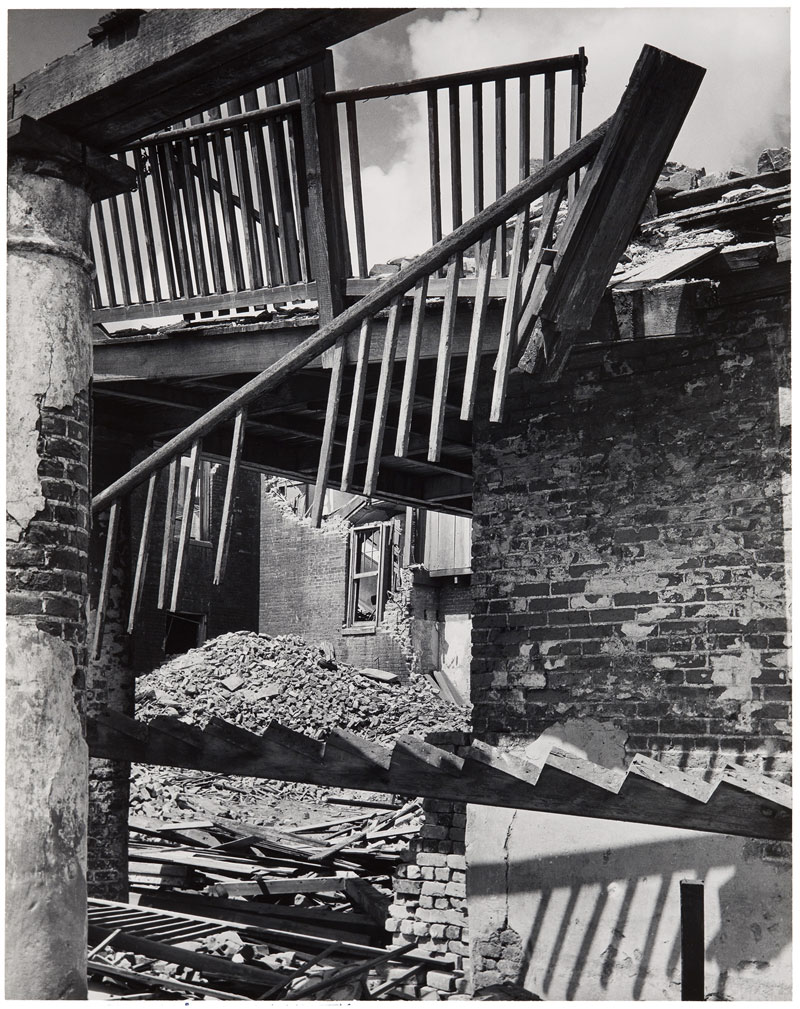
Clarence John Laughlin (American, 1905-1985) 'A Mangled Staircase (No. 2)' 1949


Clarence John Laughlin (American, 1905-1985)
A Mangled Staircase (No. 2)
1949
Gelatin silver print
Image: 13 1/2 x 10 13/16 in. (34.2 x 27.5cm)
Mount: 17 x 14 in. (43 x 35.5cm)
The New Orleans Museum of Art
Bequest of Clarence John Laughlin


E. J. Bellocq (American, 1873-1949) 'Bedroom Mantel, Storyville' c. 1911-1913


E. J. Bellocq (American, 1873-1949)
Bedroom Mantel, Storyville
c. 1911-1913
Glass negative
Plate: 10 x 8 in. (25.2 20.2cm)
Museum purchase


Lewis Hine (American, 1874-1940) '[Mechanic and Steam Pump]' c. 1930


Lewis Hine (American, 1874-1940)
[Mechanic and Steam Pump]
c. 1930
Gelatin silver print
Image: 9 1/2 x 7 in. (24.3 x 17.6cm)
Paper: 10 x 8 in. (25.2 x 20.3cm)
The New Orleans Museum of Art
Museum Purchase


The New Orleans Museum of Art
One Collins Diboll Circle, City Park
New Orleans, LA 70124
Phone: (504) 658-4100

Opening hours:
Tuesday – Sunday: 10am – 5pm
Closed Mondays

The New Orleans Museum of Art website

LIKE ART BLART ON FACEBOOK

Back to top

Exhibition: ‘Naked Before the Camera’ at the Metropolitan Museum of Art, New York

Exhibition dates: 27th March – 9th September 2012

WARNING: this posting contains photographs of nudity. If you do not like please do not look.


Many thankx to the Metropolitan Museum of Art for allowing me to publish the photographs in the posting. Please click on the photographs for a larger version of the image.


Franck-François-Genès Chauvassaignes (French, 1831 - after 1900) 'Untitled [Female Nude in Studio]' 1856-1859


Franck-François-Genès Chauvassaignes (French, 1831 – after 1900)
Untitled [Female Nude in Studio]
1856-1859
Salted paper print from glass negative
19.1 x 15.2cm (7.5 x 6 in.)
Metropolitan Museum of Art
Purchase, The Horace W. Goldsmith Foundation Gift, through Joyce and Robert Menschel, 1998
Public domain


This corner of a painter’s atelier somewhere in France in the middle of the nineteenth century is scarcely tethered to time or place; it could as easily be a loft in New York today or, had photography existed four centuries earlier, a studio in the Italian Renaissance. What is surprising here is the absence of even the thinnest disguise – no swags of drapery, elaborate coiffure, or skeins of beads as are commonly found in the work of other purveyors of “studies for artists.” Here, the model is utterly naked. With her intelligent head and dirty feet, this young woman helped found the matter-of-fact modelling sorority joined a decade later by Édouard Manet’s Olympia.

Text from the Metropolitan Museum of Art website


Félix-Jacques-Antoine Moulin (French, 1800 - after 1875) 'Untitled [Two Standing Female Nudes]' c. 1850


Félix-Jacques-Antoine Moulin (French, 1800 – after 1875)
Untitled [Two Standing Female Nudes]
c. 1850
Daguerreotype
Visible: 14.5 x 11.1cm (5 11/16 x 4 3/8 in.)
Metropolitan Museum of Art
The Rubel Collection, Purchase, Anonymous Gift and Lila Acheson Wallace Gift, 1997
Public domain


Although Moulin was sentenced in 1851 to a month in jail for producing images that, according to court papers, were “so obscene that even to pronounce the titles… would be to commit an indecency,” this daguerreotype seems more allied to art than to erotica. Instead of the boudoir props and provocative poses typical of hand-coloured pornographic daguerreotypes, Moulin depicted these two young women utterly at ease, as unselfconscious in their nudity as Botticelli’s Venus.

Text from the Metropolitan Museum of Art website


Unknown photographer (French) '[Seated Female Nude]' c. 1850


Unknown photographer (French)
[Seated Female Nude]
c. 1850
Daguerreotype
9.1 x 6.9cm (3 9/16 x 2 11/16 in.)
Metropolitan Museum of Art
Credit Line: Gilman Collection, Gift of The Howard Gilman Foundation, 2005
Public domain


This daguerreotype was surely intended to serve artistic purposes, but the odd twist of the body and the strange relationship of the three visible limbs seem to render it inappropriate for artistic emulation. Such tension between an artistic ideal and realistic means – between the classicism of an academic pose and the awkwardness of the camera’s rendering of human movement – seems emblematic of the dilemma faced by the nascent medium striving to be an art.

Text from the Metropolitan Museum of Art website


Julien Vallou de Villeneuve (French, 1795-1866) '[Standing Female Nude]' c. 1853


Julien Vallou de Villeneuve (French, 1795-1866)
[Standing Female Nude]
c. 1853
Salted paper print from paper negative
12 x 16cm (4 3/4 x 6 5/16 in.)
Metropolitan Museum of Art
Purchase, Lila Acheson Wallace Gift, 1993
Public domain


A student of the painter Jean François Millet (1814-1875) and a lithographer of scenes of daily life, costume, and erotica in the 1820s and 1830s, Vallou reportedly took up photography in the early 1840s. Because his early photographs have not been identified, it has been assumed that they depicted naked women, a subject for which it was to improper to acknowledge authorship.

Between 1851 and 1855, Vallou made a series of small-scale paper photographs of female nudes that he marketed (and legally registered) as models for artists. Vallou’s nudes have long been associated with those of Gustave Courbet (1819-1877), who is known to have used photographs in his painting process. Though no absolute one-to-one correspondence can be pointed to, there are some striking similarities in pose, and the heavy, soporific quality of Vallou’s models is very close to Courbet’s concept of the nude.

Text from the Metropolitan Muesum of Art website


Eugène Durieu (French, 1800-1874) 'Untitled [Seated Female Nude]' 1853-1854


Eugène Durieu (French, 1800-1874)
Untitled [Seated Female Nude]
1853-1854
Albumen silver print from glass negative
6 13/16 × 4 11/16 in. (17.3 × 11.9cm)
Metropolitan Museum of Art
Gilman Collection, Purchase, Mr. and Mrs. Henry R. Kravis Gift, 2005
Public domain


Durieu was a lawyer and early advocate and practitioner of photography in France who, in 1853-1854, made a series of photographic studies of nude and costumed figures as models for artists. The French Romantic painter Eugène Delacroix helped him pose the figures and later praised the prints, from which he sketched, as “palpable demonstrations of the free design of nature.” While the painter saw the accurate transcription of reality as a virtue of photography, Durieu knew that a good photograph was not simply the result of the correct use of the medium but, more significantly, an expression of the photographer’s temperament and vision. In an important article he emphasised the interpretative nature of the complex manipulations in photography and explained that the photographer must previsualise his results so as to make a “picture,” not just a “copy.”

This photograph proves Durieu’s point: through the elegant contours of the drapery, the smooth modelling of the flesh, and the grace and restraint of the pose, the picture attains an artistic poise that combines Delacroix’s sensuality with Ingres’s classicism, and rivals both.

Text from the Metropolitan Museum of Art website


Charles Alphonse Marlé (French, 1821 - after 1867) 'Untitled [Standing Male Nude]' c. 1855


Charles Alphonse Marlé (French, 1821 – after 1867)
Untitled [Standing Male Nude]
c. 1855
Salted paper print from paper negative
25.7 x 17.6cm (10 1/8 x 6 15/16 in.)
Metropolitan Museum of Art
Purchase, Ezra Mack Gift and The Horace W. Goldsmith Foundation Gift through Joyce and Robert Menschel, 1991


Marlé’s photograph was probably intended as an aid for painters and sculptors. The jury-rigged arrangement of podium, books, and potted tree, as well as the painting held in the background by a studio assistant, may strike the modern viewer as an incongruous contrast to the heroic gesture of the model. Marlé and those who bought his photograph, however, would have been absorbed by the grand academic pose and likely would have thought the awkward accoutrements of little consequence.

Text from the Metropolitan Museum of Art website


Nadar (French, Paris 1820 - 1910 Paris) '[Standing Female Nude]' 1860-1861


Nadar (French, Paris 1820 – 1910 Paris)
[Standing Female Nude]
1860-1861
20.2 x 13.3cm (7 15/16 x 5 1/4 in.)
Metropolitan Museum of Art
Purchase, The Horace W. Goldsmith Foundation Gift, through Joyce and Robert Menschel, 1991
Public Domain


Famed for his portraits of writers, artists, and left-wing politicians, Nadar is known to have photographed only three female nudes. This one was made at the behest of the painter Jean-Léon Gérôme to assist in the process of painting Phryné before the Areopagus, displayed at the Salon of 1861. Gérôme’s painting depicts the moment when the famous courtesan Phryné, on trial for impiety, is suddenly unveiled by her lawyer; persuaded by Phryné’s divine beauty, the jurors acquit her.

Like Phryné, who is said to have modelled for the ancient Greek painter Apelles and other artists of antiquity, Nadar’s model, Marie-Christine Leroux (1820-1863), was widely sought by artists of her time and was the basis for the character Musette in Henri Murger’s Scènes de la vie de bohème.

Text from the Metropolitan Museum of Art website


Depicting the human body has been among the greatest challenges, preoccupations, and supreme achievements of artists for centuries. The nude – even in generalised or idealised renderings – has triggered impassioned discussions about sin, sexuality, cultural identity, and canons of beauty, especially when the chosen medium is photography, with its inherent accuracy and specificity. Through September 9, 2012, Naked before the Camera, an exhibition of more than 60 photographs selected from the renowned holdings of The Metropolitan Museum of Art, surveys the history of this subject and explores some of the motivations and meanings that underlie photographers’ fascination with the nude.

“In every culture and across time, artists have been captivated by the human figure,” commented Thomas P. Campbell, Director of the Metropolitan. “In Naked before the Camera, we see how photographers have used their medium to explore this age-old subject and create compelling new images.”

The exhibition begins in the 19th century, when photographs often served artists as substitutes for live models. Such “studies for artists” were known to have been used by the French painter Gustave Courbet, whose Woman with a Parrot (1866), for instance, is strikingly similar to photographer Julien Vallou de Villeneuve’s Female Nude of 1853. Even when their stated purpose was to aid artists, however, the best of these 19th-century photographs of the nude were also intended as works of art in their own right. Two recently acquired photographs, made in the mid-1850s by an unknown French artist, are striking examples. Not only are they larger than all other photographic nudes from the time, they stand out due to an extraordinary surface pattern that interrupts the images and suggests a view through gossamer or a photograph printed on finely pleated silk rather than paper. The elegant Female Nude harkens back to an Eve or Venus and is vignetted by the camera lens as if seen through a peephole, while her male counterpart is shown in strict profile in a pose that recalls precedents from antiquity. Each figure draws from the past while being presented in a strikingly modern way, without any equivalent among other 19th-century studies for artists.

Not all photographers of the nude were motivated by artistic desire. The second section of Naked before the Camera includes photographs made for medical and forensic purposes, as ethnographic studies, as tools to analyse anatomy and movement, and – not surprisingly – as erotica. The lines between such categories were not always clearly drawn; some photographers called their images “studies for artists” merely to evade the censors, while viewers of the G. W. Wilson Studio’s Zulu Girls (1892-93) or Paul Wirz’s ethnographic photographs of scantily clad Indonesians from the 1910s and 1920s were undoubtedly titillated by the blending of exoticism and eroticism.

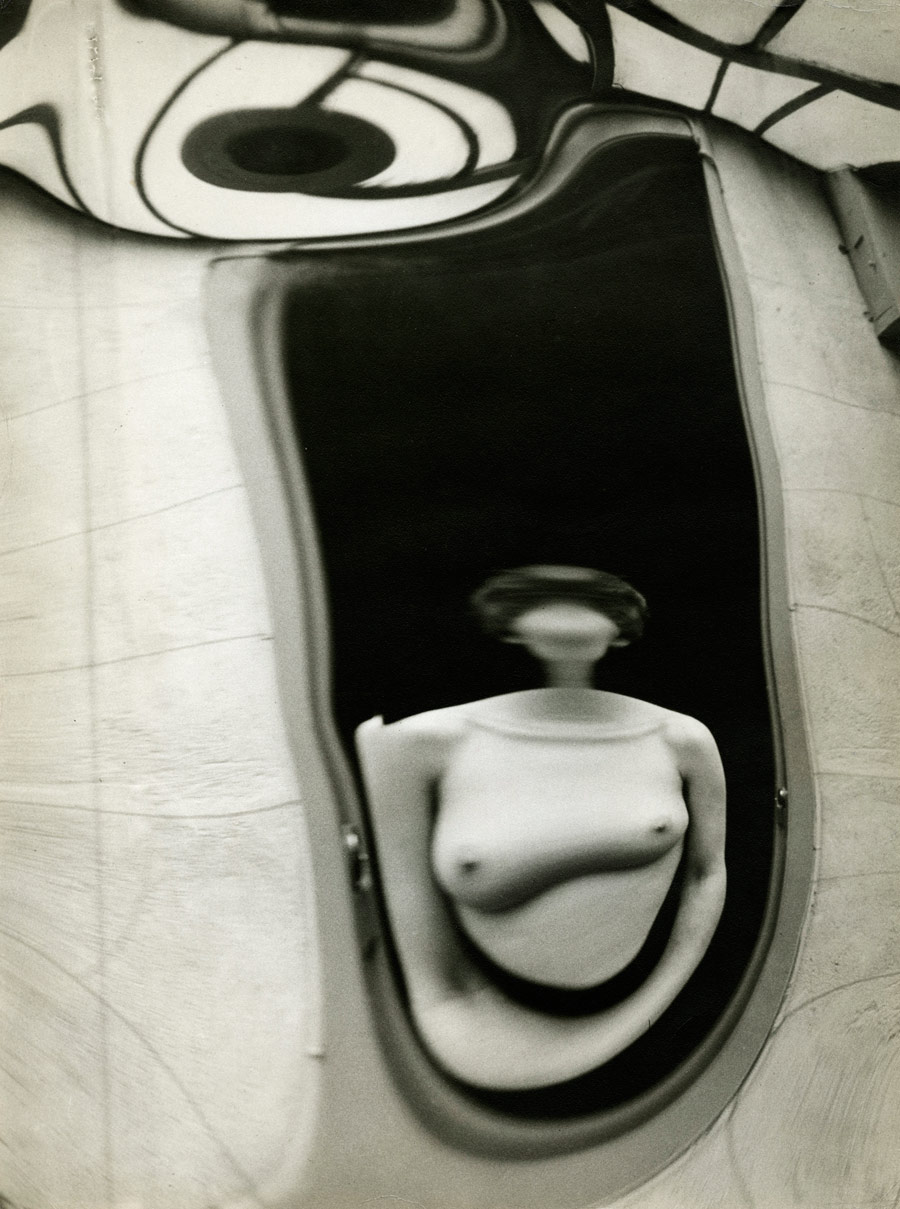
Beginning in the fertile period of modernist experimentation that followed on the heels of World War I, photographers such as Brassaï, Man Ray, Hans Bellmer, André Kertész, and Bill Brandt found in the human body a perfect vehicle for both visual play and psycho-sexual exploration. In Distortion #6 (1932) by André Kertész, a woman’s body is stretched and pulled in the reflections of a fun-house mirror – a figure from a Surrealist dream that stands in stark contrast to the images of perfect feminine beauty by earlier photographers.

In mid-20th-century America, photographers more often communicated an intimate connection with their subjects. Following the example of Alfred Stieglitz’s famed portraits of Georgia O’Keeffe, photographers such as Edward Weston, Harry Callahan, and Emmet Gowin made many nude studies of their wives. Callahan’s photograph of his wife and daughter, Eleanor and Barbara, Chicago (1954), for instance, gives the viewer access to a private, tender moment of intimacy.

In the wake of the sexual revolution of the 1960s and the AIDS crisis that began in the 1980s, artists began to think of the body as a politicised terrain and explored issues of identity, sexuality, and gender. Diane Arbus’s Retired man and his wife at home in a nudist camp one morning, N.J. (1963) and A naked man being a woman, N.Y.C. (1968), Larry Clark’s untitled image (1972-1973) from the series Teenage Lust, and Hannah Wilke’s Snatch Shot with Ray Gun (1978) are among the works featured in the concluding section of the exhibition.

Press release from the Metropolitan Museum of Art website


Unknown photographer (French) '[Nude with Mirror]' c. 1850


Unknown photographer (French)
[Nude with Mirror]
c. 1850
Daguerreotype
Dimensions: visible: 7 x 5.7cm (2 3/4 x 2 1/4 in.)
Metropolitan Museum of Art
The Rubel Collection, Purchase, Lila Acheson Wallace Gift, 1997
Public domain


Julien Vallou de Villeneuve (French, 1795-1866) '[Reclining Female Nude]' c. 1853


Julien Vallou de Villeneuve (French, 1795-1866)
[Reclining Female Nude]
c. 1853
Salted paper print from paper negative
11.8 x 16.0cm (4 5/8 x 6 5/16 in.)
Metropolitan Museum of Art
Purchase, Lila Acheson Wallace Gift, 1993
Public domain


A student of the painter Jean François Millet and a lithographer of scenes of daily life, costume, and erotica in the 1820s and 1830s, Vallou reportedly took up photography in the early 1840s, but his early photographs have not been identified. Perhaps they depicted naked women, a subject for which it was improper to acknowledge authorship.

Between 1851 and 1855, however, Vallou made a series of photographs of female nudes that he marketed (and legally registered) as models for artists. Vallou’s nudes have long been associated with those of Gustave Courbet, who is known to have used photographs in his painting process. Although no absolute one-to-one correspondence can be pointed to, the heavy soporific quality of Vallou’s models is very close to Courbet’s concept of the nude, and the reclining figure displayed here is strikingly similar in pose to the painter’s Woman with a Parrot (1866), on view in the galleries for nineteenth-century painting.

Text from the Metropolitan Museum of Art website


Gustave Le Gray (French, 1820-1884) 'Nu féminin allongé sur un canapé Récamier' (Female nude lying on a Recamier sofa) c. 1856


Gustave Le Gray (French, 1820-1884)
Nu féminin allongé sur un canapé Récamier (Female nude lying on a Recamier sofa)
c. 1856
Albumen silver print from glass negative
21.7 x 32.9cm (8 9/16 x 12 15/16 in.)
Metropolitan Museum of Art
Gilman Collection, Purchase, The Horace W. Goldsmith Foundation Gift, through Joyce and Robert Menschel, 2005
Public domain


The central figure in French photography of the 1850s, Le Gray was a master of many genres including landscape and seascape, architectural photography, and portraiture. Only four nude studies by Le Gray are known, however, each in a single example. In this striking image, the photographer departed from the usual academic treatment of the nude, such as he might have learned from his years in the painting studio of Paul Delaroche, in favor of a more psychologically charged spirit. The daybed’s velvet upholstery, the tassels on the pillow, and the heavy curtain fabric have a reassuring and familiar presence, but the serpentine locks of hair evoke Medusa and hint at strangulation, while the legs and feet cross and tense in the manner of a crucifixion. Withdrawn in sleep – or is it death? – the beautiful young woman reminds one of a drowning victim, an Ophelia freshly recovered from the Seine, a theme favoured by the painters and poets of Paris.

Text from the Metropolitan Museum of Art website


Unknown photographer (French) '[Standing Female Nude]' c. 1856


Unknown photographer (French)
[Standing Female Nude]
c. 1856
Salted paper print from collodion glass negative
43.4 x 28.3cm (17 1/16 x 11 1/8 in.)
Metropolitan Museum of Art
Purchase, Louis V. Bell, Harris Brisbane Dick, Fletcher, and Rogers Funds and Joseph Pulitzer Bequest; Edwynn Houk and Hans P. Kraus Jr., Alfred Stieglitz Society, Robert Mapplethorpe Foundation, Anonymous, Adam R. Rose and Peter R. McQuillan, Joseph M. Cohen, Susan and Thomas Dunn, Kurtz Family Foundation, W. Bruce and Delaney H. Lundberg, Christian Keesee Charitable Trust, and Robert A. Taub Gifts; and Funds from various donors, 2012
Public domain


The original impulse behind these boldly ambitious figure studies may have been to aid a painter or sculptor, but they are nonetheless without parallel in the early history of photography. Enlarged to the size of drawn académies – drawings of the live model that were a standard part of art instruction in France – their scale alone sets them apart from the more modest productions of Vallou de Villeneuve, Durieu, and other artists of the 1850s. More unusually, the images are interrupted by a surface pattern that gives the impression that the photographs are printed on finely pleated silk rather than paper – likely the result of a technical error. Instead of wiping clean his glass-plate negatives and starting over as virtually all other photographers would have done, this artist recognised that the pattern created a veil that, like time or memory, removed the images from their merely utilitarian purpose and elevated them from the mundane to the realm of art.

Just as the eye and mind may be pleasantly torn between bravura brushwork and the ostensible subject of a painting, there is a tension here between the beauty of the subject – the elegant female draped in gossamer; the strict profile and geometric setting of the male – and the visible traces of their creation, such as the flowing surface pattern and the strong vignetting of the female, which suggests a view spied through a peephole.

Text from the Metropolitan Museum of Art website


Unknown photographer (French) '[Standing Male Nude]' c. 1856


Unknown photographer (French)
[Standing Male Nude]
c. 1856
Salted paper print from collodion glass negative
43.4 x 28.4cm (17 1/16 x 11 3/16 in.)
Metropolitan Museum of Art
Purchase, Louis V. Bell, Harris Brisbane Dick, Fletcher, and Rogers Funds and Joseph Pulitzer Bequest; Edwynn Houk and Hans P. Kraus Jr., Alfred Stieglitz Society, Robert Mapplethorpe Foundation, Anonymous, Adam R. Rose and Peter R. McQuillan, Joseph M. Cohen, Susan and Thomas Dunn, Kurtz Family Foundation, W. Bruce and Delaney H. Lundberg, Christian Keesee Charitable Trust, and Robert A. Taub Gifts; and funds from various donors, 2012
Public domain


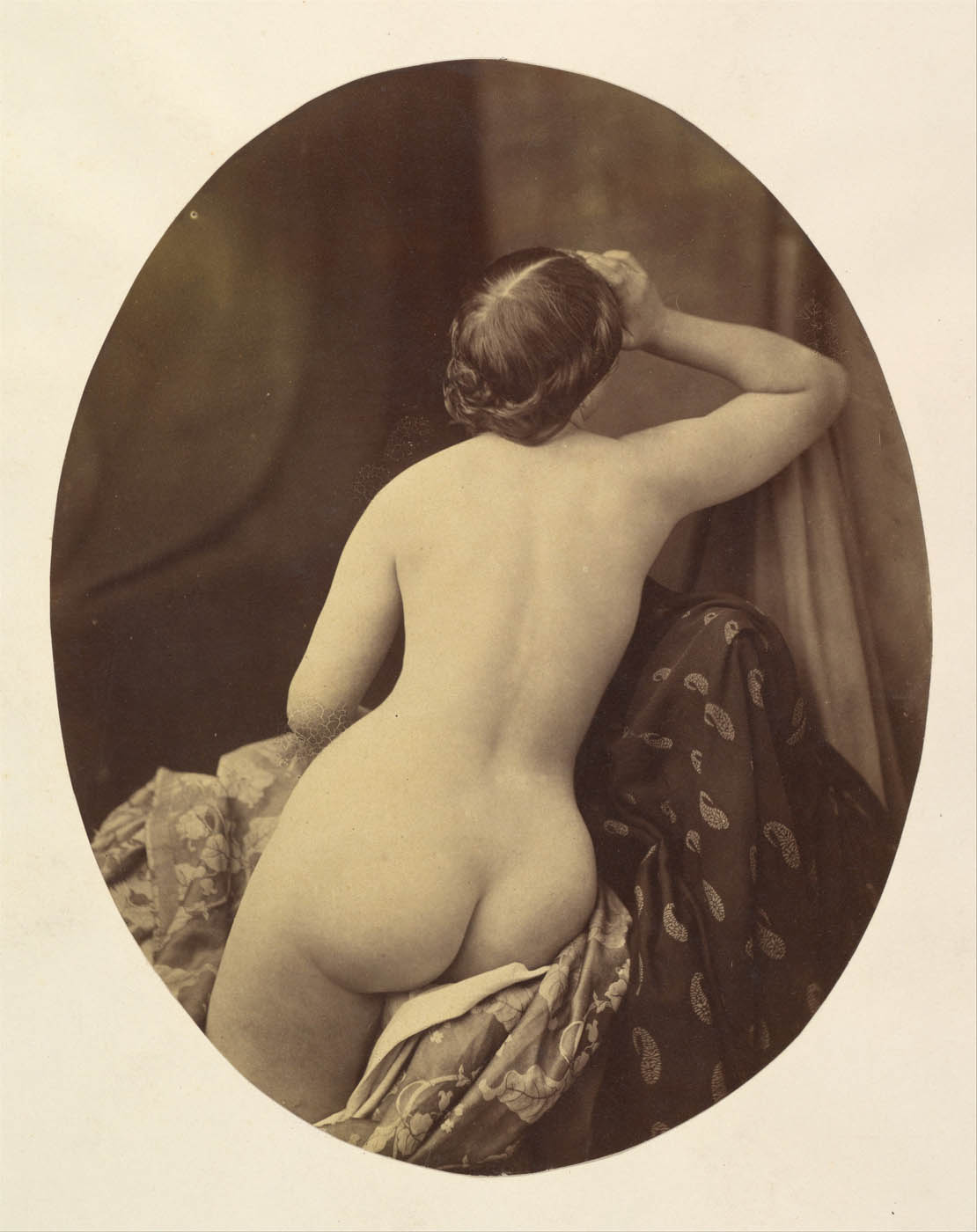
Oscar Gustav Rejlander (British born Sweden, 1813-1875) 'Ariadne' 1857


Oscar Gustav Rejlander (British born Sweden, 1813-1875)
Ariadne
1857
Albumen silver print from glass negative
Mount: 16 1/16 in. × 13 1/16 in. (40.8 × 33.2cm)
Image: 8 1/4 × 6 1/2 in. (21 × 16.5cm); oval
Metropolitan Museum of Art
Gilman Collection, Purchase, The Horace W. Goldsmith Foundation Gift, through Joyce and Robert Menschel, 2005
Public domain


Working in a place – Victorian England – where any photographic nude was considered offensive because the process implied not only the “nastiness” of the artist and vendor, but also “the degradation of the person who serves as model on the occasion,” Rejlander sought to ally his work with that of noted painters. This nude study is one of a series based on figures in the work of Raphael, Titian, Correggio, Rubens, Murillo, and Gainsborough; the precedent here is Titian’s Venus and Adonis, and Rejlander’s intention was to show how the painter adhered to or strayed from the ways a real body can twist and turn. Critic A. H. Wall defended the propriety of Rejlander’s Studies from the Nude, saying, “Refined and ennobled by art, real beauty, palpable flesh and blood, speaks of nothing but its own inherent loveliness.”

Such references to painting did not always afford adequate protection, however. Writing of Rejlander’s famous Two Ways of Life, photographer and critic Thomas Sutton wrote, “There is no impropriety in exhibiting such works of art as Etty’s Bathers Surprised by a Swan or the Judgment of Paris but there is impropriety in allowing the public to see photographs of nude prostitutes, in flesh-and-blood truthfulness and minuteness of detail.”

Text from the Metropolitan Museum of Art website


Unknown photographer (French) '[Female Nude with Mask]' c. 1870


Unknown photographer (French)
[Female Nude with Mask]
c. 1870
Albumen silver print from glass negative
26 x 19.1cm (10 1/4 x 7 1/2 in.)
Metropolitan Museum of Art
Gilman Collection, Gift of The Howard Gilman Foundation, 2005
Public domain


Even as she seems to part her tresses to expose her naked body, the model here masks her face in an effort to conceal her identity. While drawing, painting, and sculpture of the human figure commonly involve elements of transformation, idealisation, or the combination of features from various models, photography usually presents a recognisable image of its subject. It was not uncommon, therefore, for models who routinely posed nude for artists in other media to hide their faces when standing naked before the camera. For the viewer – not always an artist looking for help in figure drawing – the mask added an element of erotic frisson.

Text from the Metropolitan Museum of Art website


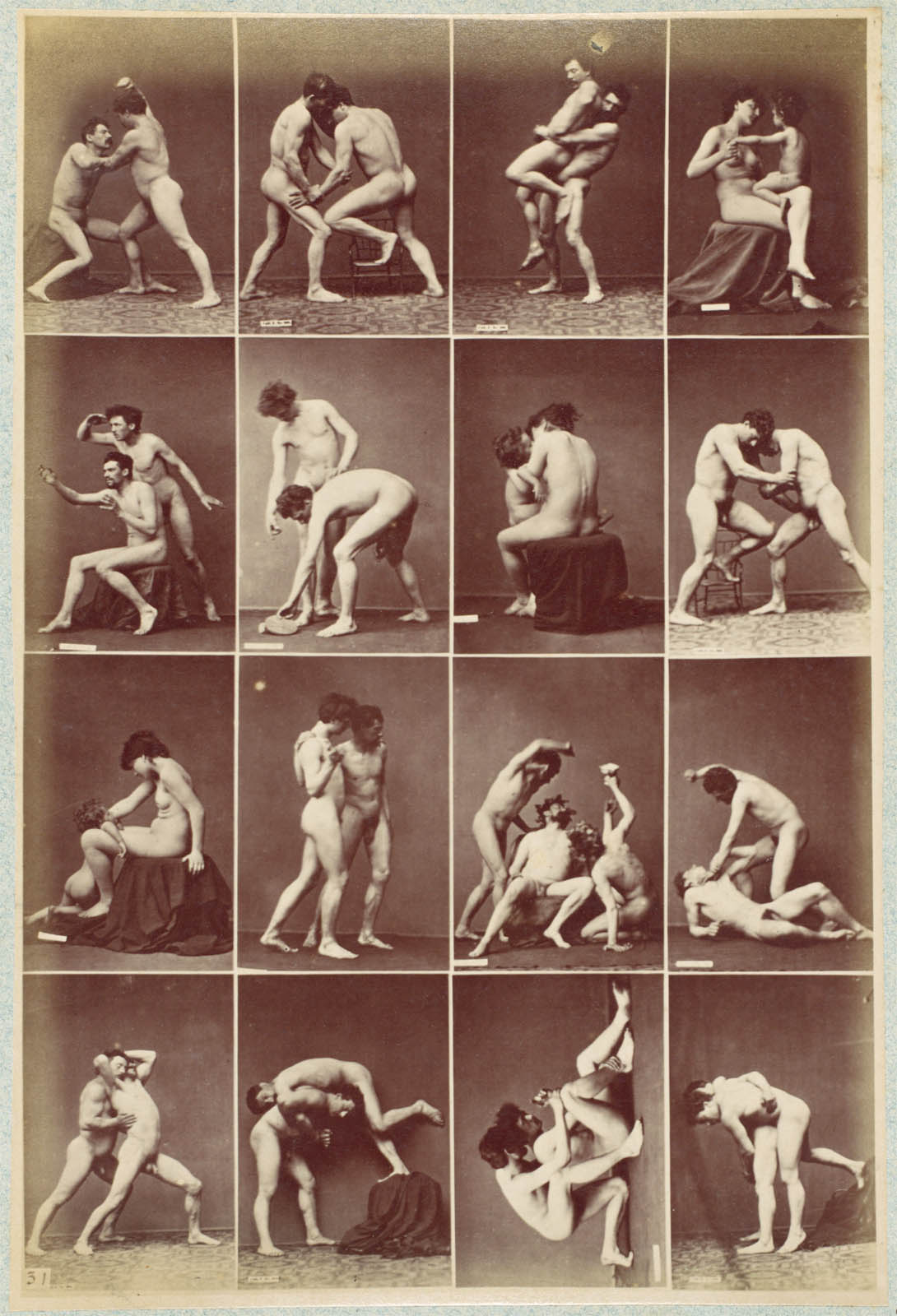
Louis Igout (French, 1837-1881)(Photographer) A. Calavas (French)(Editor) 'Plate from Album d'Études – Poses' c. 1880


Louis Igout (French, 1837-1881)(Photographer)
A. Calavas (French)(Editor)
Plate from Album d’Études – Poses
c. 1880
Albumen silver prints from glass negatives
Metropolitan Museum of Art
Purchase, The Horace W. Goldsmith Foundation Gift, through Joyce and Robert Menschel, 1993
Public domain


This album is an excellent example of the type of photography produced in the nineteenth century as an aid to artists in the study of contour, modelling, and proportion, and as a vocabulary of expression, gesture, and pose sanctioned by the art of antiquity and the Old Masters. Groupings representing Cain and Abel, the Drunken Silenus, Hercules and Antaeus, the Dying Gaul, the Cnidian Aphrodite, and others are recognisable among the photographs. Single prints showing sixteen small images, such as the page shown here, served as a type of stock catalogue, allowing clients to survey a broad range of possible poses and order larger prints of those which best served their needs.

Text from the Metropolitan Museum of Art website


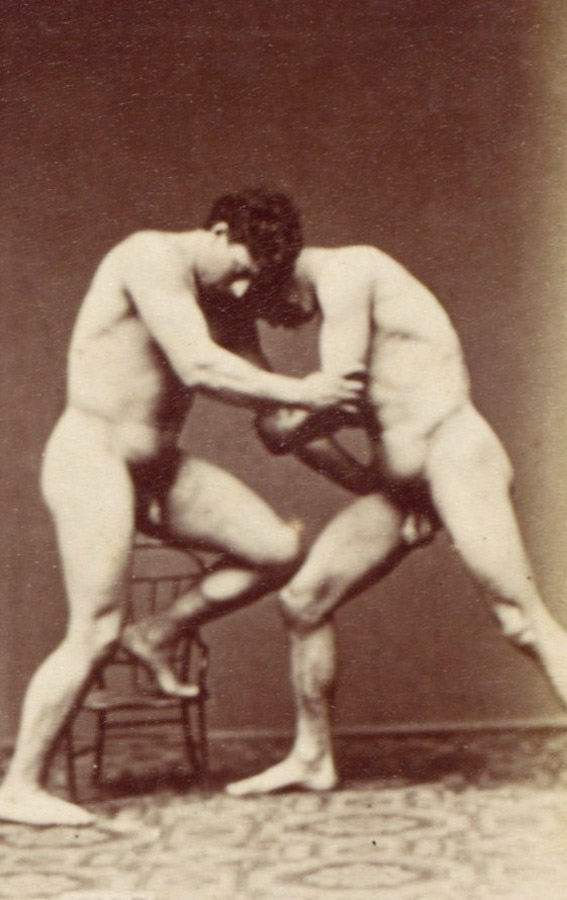
Louis Igout (French, 1837-1881)(Photographer) A. Calavas (French)(Editor) 'Plate from Album d'Études – Poses' c. 1880 (detail)

Louis Igout (French, 1837-1881)(Photographer) A. Calavas (French)(Editor) 'Plate from Album d'Études – Poses' c. 1880 (detail)

Louis Igout (French, 1837-1881)(Photographer) A. Calavas (French)(Editor) 'Plate from Album d'Études – Poses' c. 1880 (detail)


Louis Igout (French, 1837-1881)(Photographer)
A. Calavas (French)(Editor)
Plate from Album d’Études – Poses (details)
c. 1880
Albumen silver prints from glass negatives
Metropolitan Museum of Art
Purchase, The Horace W. Goldsmith Foundation Gift, through Joyce and Robert Menschel, 1993
Public domain


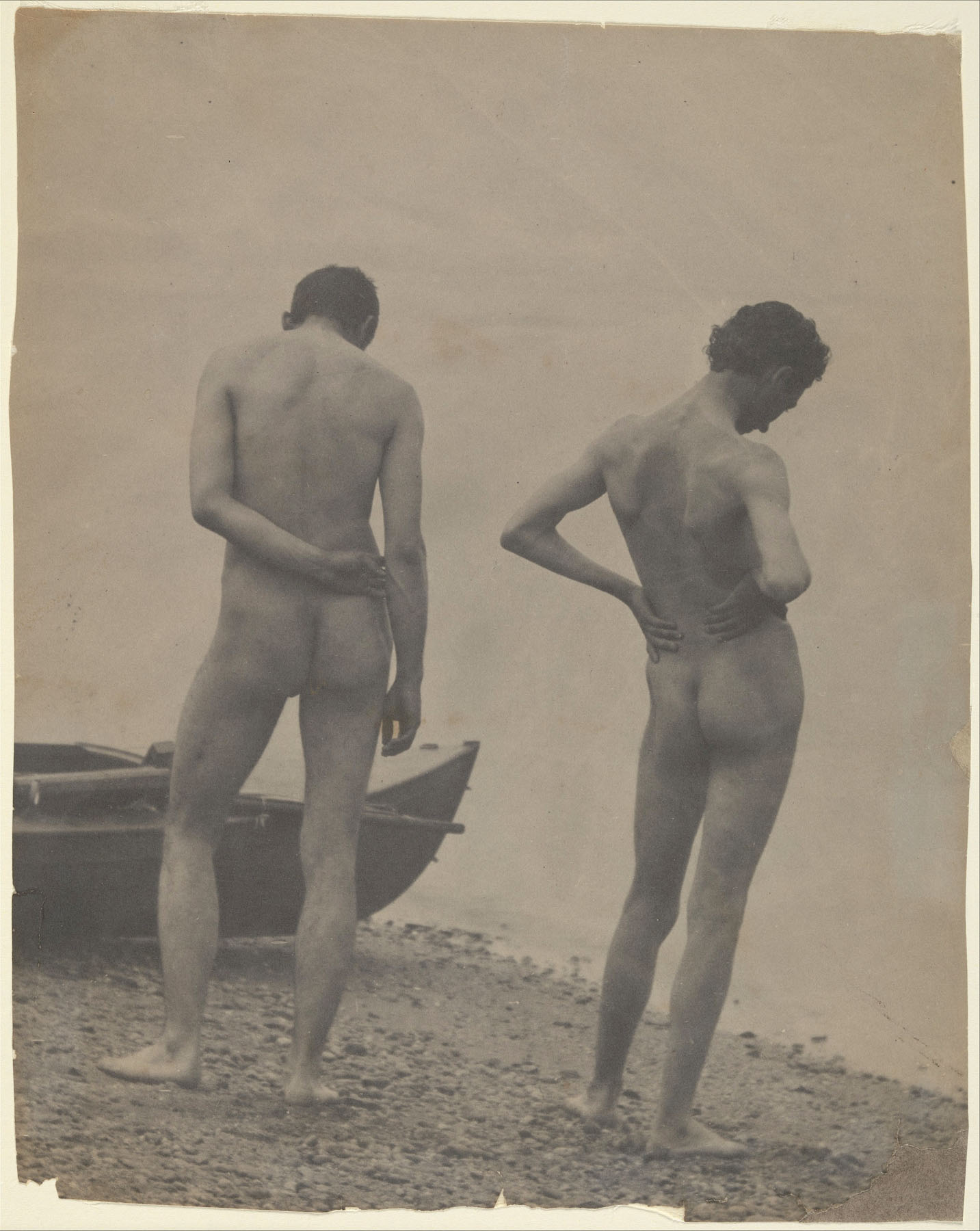
Thomas Eakins (American, 1844-1916) '(Thomas Eakins and John Laurie Wallace on a Beach)' c. 1883


Thomas Eakins (American, Philadelphia, Pennsylvania 1844–1916 Philadelphia, Pennsylvania)
[Thomas Eakins and John Laurie Wallace on a Beach]
c. 1883
Platinum print
25.5 x 20.4cm (10 1/16 x 8 1/16 in.), irregular
Metropolitan Museum of Art
David Hunter McAlpin Fund, 1943
Public domain


The great American painter and photographer Thomas Eakins was devoted to the scientific study of the human form and committed to its truthful representation. While he and his students at the Pennsylvania Academy of the Fine Arts were surrounded by casts of classical sculpture, Eakins declared that he did not like “a long study of casts. … At best they are only imitations, and an imitation of imitations cannot have so much life as an imitation of life itself.” Photography provided an obvious solution.

This photograph, in which Eakins and a student affected the elegant contrapposto stances of classical sculpture, was probably taken during an excursion with students to Manasquan Inlet at Point Pleasant, New Jersey, during the summer of 1883. Valuing his photographs not only as studies for paintings but also for their own sake, Eakins carefully printed the best images on platinum paper. In this case, he went to the additional trouble of enlarging the original, horizontally formatted image and cropping it vertically to better contain the perfectly balanced figures.

Text from the Metropolitan Museum of Art website


Albert Londe (French, 1858-1917) Paul Marie Louis Pierre Richer (French, 1849-1933) '[Male Musculature Study]' c. 1890


Albert Londe (French, 1858-1917)
Paul Marie Louis Pierre Richer (French, 1849-1933)
[Male Musculature Study]
c. 1890
Albumen silver print
Image: 14.9 x 9.6 cm (5 7/8 x 3 3/4 in.)
Mount: 14.9 x 9.9 cm (5 7/8 x 3 7/8 in.)
Metropolitan Museum of Art
Gift of Charles Isaacs and Carol Nigro, 2012


Author of a treatise on the importance of the camera in medical practice, Albert Londe declared, “the photographic plate is the scientist’s true retina.” In collaboration with a laboratory director and professor of anatomy at the École des Beaux-Arts, Londe found that photographs intended for physiological analysis could also serve artistic applications. Their careful portraits of athletes – whether taken with stop-action cameras specially designed by Londe or in static poses such as the example here – were used in scientific texts on musculature and became templates for illustrations to aid artists in rendering ideally proportioned figures.

Text from the Metropolitan Museum of Art website


Guglielmo Plüshow (Italian born Germany, 1852–1930) '[Young Male Nude Seated on Leopard Skin]' 1890s-1900s


Guglielmo Plüshow (Italian born Germany, 1852–1930)
[Young Male Nude Seated on Leopard Skin]
1890s-1900s
Albumen silver print from glass negative
22.2 x 16.2cm (8 3/4 x 6 3/8 in.)
Metropolitan Museum of Art
Museum Accession
Creative Commons CC0 1.0 Universal Public Domain Dedication


Censors have long struggled to keep pace with evolving technology and expanding distribution networks of photographic erotica. In nineteenth-century France, government officials regularly seized thousands of photographs similar to the daguerreotype displayed here, which were deemed lewd.

Male nudity has frequently been subject to stricter control than pornography featuring women. The Arcadian photographs of Plüshow and his cousin and student Wilhelm von Gloeden were avidly collected in the late nineteenth century, but in the 1930s many of their prints and negatives, considered deviant by the Italian Fascist government, were destroyed. For much of the twentieth century, it was illegal in the United States to mail photographs that might be judged prurient, forcing photographers to mask genitalia and pubic hair with strategic props or with overpainting that could be easily removed by purchasers. Sale of erotic male physique magazines and bodybuilder pin-ups, ostensibly circulated to promote fitness, was legalised in a 1962 Supreme Court ruling, which concluded that “portrayals of the male nude cannot fairly be regarded as more objectionable than many portrayals of the female nude that society tolerates.”

Text from the Metropolitan Museum of Art website


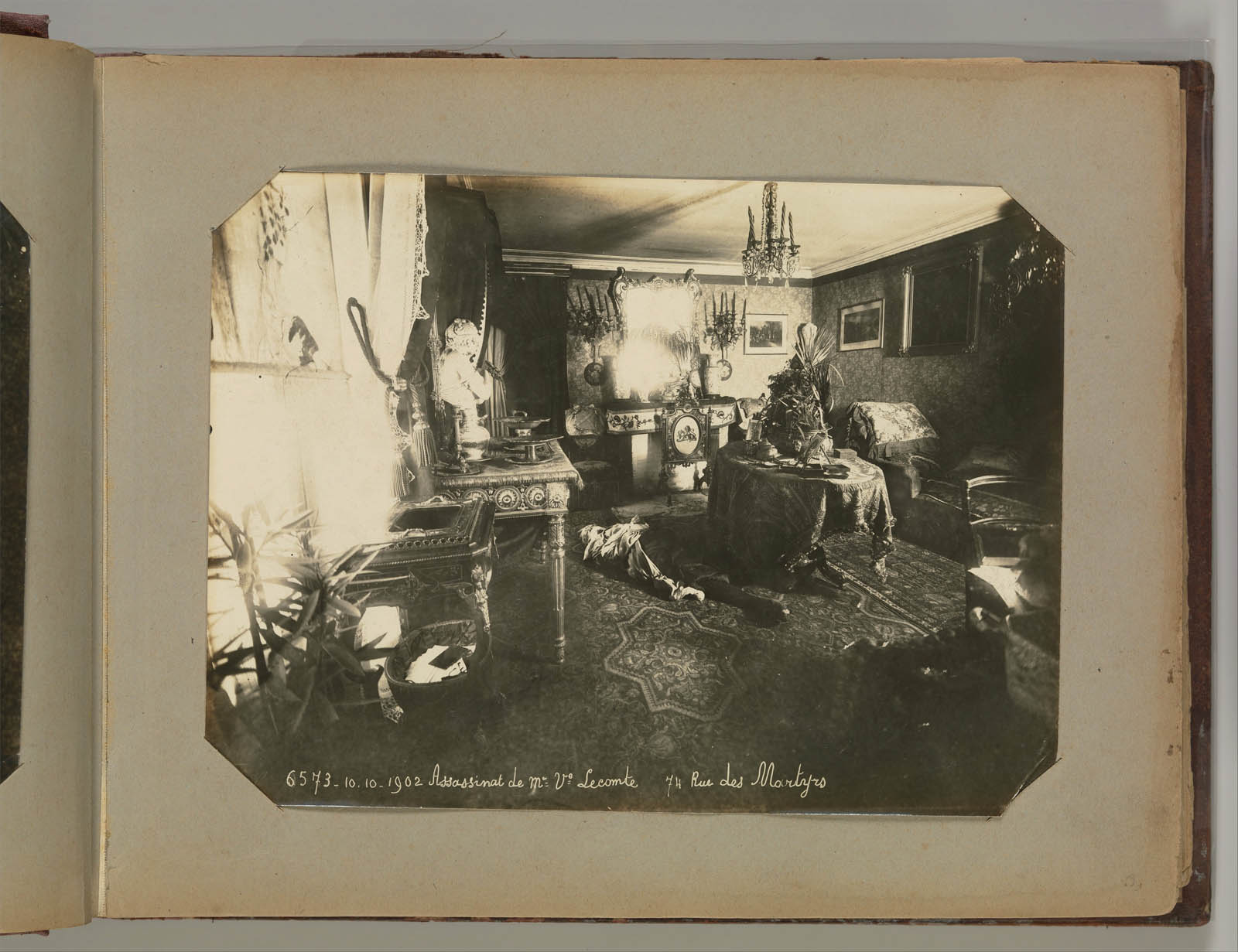
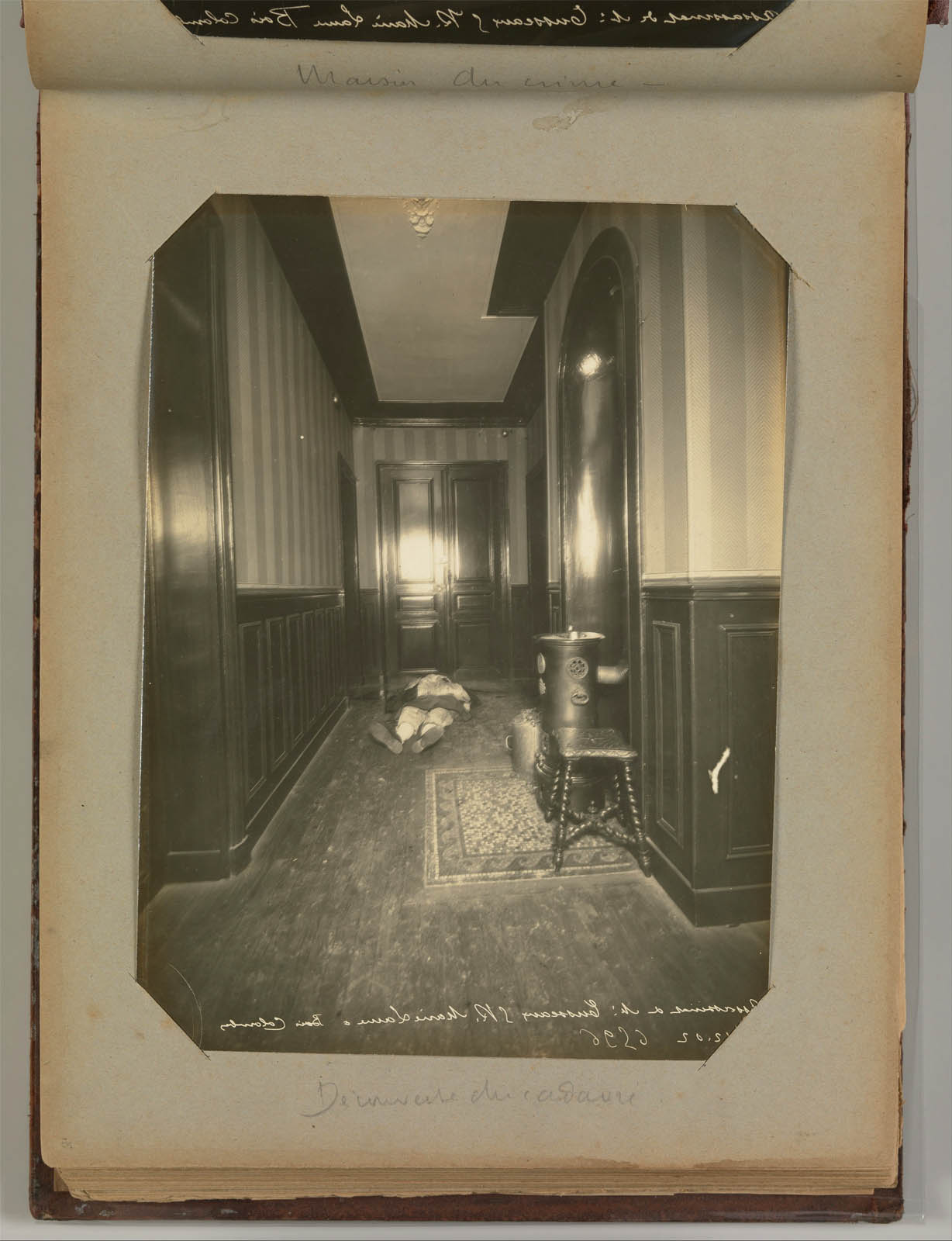
Attributed to Alphonse Bertillon (French, 1853–1914) 'Assasination of C. Lecomte 711 Rue des Martyrs' 1901-1908 From 'Album of Paris Crime Scenes'


Attributed to Alphonse Bertillon (French, 1853–1914)
Assasination of C. Lecomte 711 Rue des Martyrs
1901-1908
From Album of Paris Crime Scenes
Gelatin silver print
Overall: 24.3 x 31cm (9 9/16 x 12 3/16in.)
Page: 23 x 29cm (9 1/16 x 11 7/16 in.)
Metropolitan Museum of Art
Gilman Collection, Purchase, The Howard Gilman Foundation Gift, 2001
Public domain


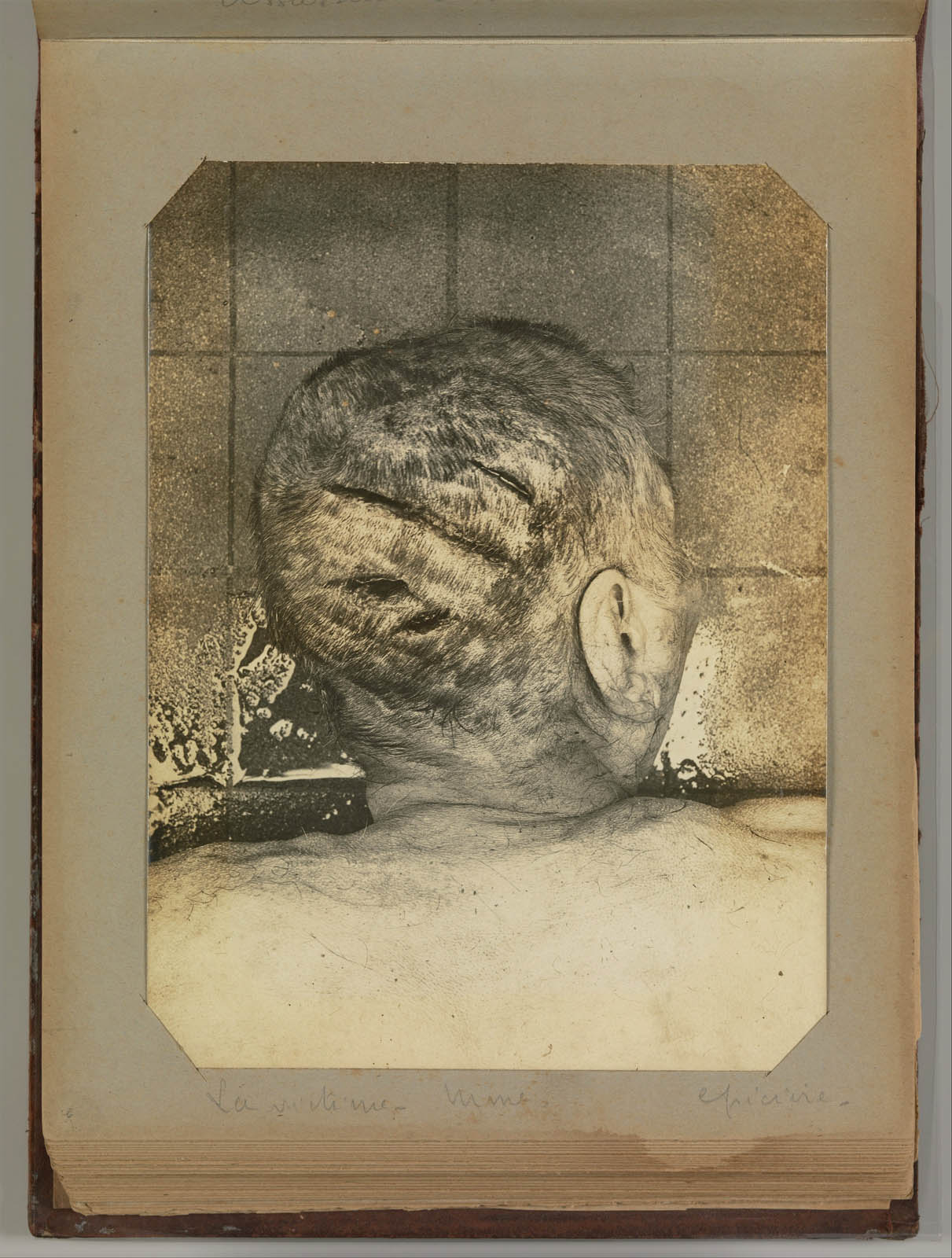
Alphonse Bertillon, the chief of criminal identification for the Paris police department, developed the mug shot format and other photographic procedures used by police to register criminals. Although the images in this extraordinary album of forensic photographs were made by or under the direction of Bertillon, it was probably assembled by a private investigator or secretary who worked at the Paris prefecture. Photographs of the pale bodies of murder victims are assembled with views of the rooms where the murders took place, close-ups of objects that served as clues, and mug shots of criminals and suspects. Made as part of an archive rather than as art, these postmortem portraits, recorded in the deadpan style of a police report, nonetheless retain an unsettling potency.

Text from the Metropolitan Museum of Art website


Attributed to Alphonse Bertillon (French, 1853–1914) 'Untitled' 1901-1908 From 'Album of Paris Crime Scenes'


Attributed to Alphonse Bertillon (French, 1853–1914)
Untitled
1901-1908
From Album of Paris Crime Scenes
Gelatin silver print
Overall: 24.3 x 31cm (9 9/16 x 12 3/16in.)
Page: 23 x 29cm (9 1/16 x 11 7/16 in.)
Metropolitan Museum of Art
Gilman Collection, Purchase, The Howard Gilman Foundation Gift, 2001
Public domain


Attributed to Alphonse Bertillon (French, 1853–1914) 'Untitled' 1901-1908 From 'Album of Paris Crime Scenes'


Attributed to Alphonse Bertillon (French, 1853–1914)
Untitled
1901-1908
From Album of Paris Crime Scenes
Gelatin silver print
Overall: 24.3 x 31cm (9 9/16 x 12 3/16in.)
Page: 23 x 29cm (9 1/16 x 11 7/16 in.)
Metropolitan Museum of Art
Gilman Collection, Purchase, The Howard Gilman Foundation Gift, 2001
Public domain


Lady Ottoline Violet Anne Cavendish-Bentinck Morrell (British, 1873-1938) '[Cavorting by the Pool at Garsington]' c. 1916


Lady Ottoline Violet Anne Cavendish-Bentinck Morrell (British, 1873-1938)
[Cavorting by the Pool at Garsington]
c. 1916
Gelatin silver print
8.8 x 6.3cm (3 7/16 x 2 7/16 in.)
Metropolitan Museum of Art
Gilman Collection, Purchase, The Horace W. Goldsmith Foundation Gift, through Joyce and Robert Menschel, 2005
Creative Commons CC0 1.0 Universal Public Domain Dedication


Rebelling against the narrow values of upper-class Edwardian society, Lady Ottoline Morrell, an eccentric hostess to Bloomsbury, surrounded herself in London and on her estate at Garsington with a large circle of friends including Bertrand Russell, W. B. Yeats, D. H. Lawrence, T. S. Eliot, Virginia Woolf, Aldous Huxley, and E. M. Forster. These images of an improvised dance show Lady Ottoline’s ten-year-old daughter, Julian, and her slightly older companions embroiled in a naked whirl, pagan in its exuberance, that reflects the emancipated attitudes of the photographer’s circle.

Text from the Metropolitan Museum of Art website


Lady Ottoline Violet Anne Cavendish-Bentinck Morrell (British, 1873-1938) '[Cavorting by the Pool at Garsington]' c. 1916


Lady Ottoline Violet Anne Cavendish-Bentinck Morrell (British, 1873-1938)
[Cavorting by the Pool at Garsington]
c. 1916
Gelatin silver print
8.8 x 6.2cm (3 7/16 x 2 7/16 in.)
Metropolitan Museum of Art
Gilman Collection, Purchase, The Horace W. Goldsmith Foundation Gift, through Joyce and Robert Menschel, 2005
Creative Commons CC0 1.0 Universal Public Domain Dedication


Edward Weston (American, Highland Park, Illinois 1886 - 1958 Carmel, California) '[Nude]' 1925


Edward Weston (American, Highland Park, Illinois 1886 – 1958 Carmel, California)
[Nude]
1925
Gelatin silver print
Image: 14.8 x 23.4 cm (5 13/16 x 9 3/16 in.)
Mount: 35.2 x 43.9 cm (13 7/8 x 17 5/16 in.)
Metropolitan Museum of Art
Gilman Collection, Purchase, Ann Tenenbaum and Thomas H. Lee Gift, 2005
© Center for Creative Photography, Arizona Board of Regents
Public domain


In his early attempts to merge the realism of photography with the expressive effect of abstract art, Weston honed in on close-up details of his subjects. That the faces of his models were often cropped or averted served practical as well as aesthetic purposes, enabling the photographs to be read as figure studies rather than as individual portraits while also protecting the privacy of the friends and lovers who served as models.

Text from the Metropolitan Museum of Art website


George Platt Lynes (American, East Orange, New Jersey 1907–1955 New York) '[Male Nude]' 1930s


George Platt Lynes (American, East Orange, New Jersey 1907–1955 New York)
[Male Nude]
1930s
Gelatin silver print
24.5 x 18.9cm (9 5/8 x 7 7/16 in.)
Metropolitan Museum of Art
Ford Motor Company Collection, Gift of Ford Motor Company and John C. Waddell, 1987
© Estate of George Platt Lynes


Brassaï (French born Romania, Brasov 1899 - 1984 Côte d'Azur) 'Nude' 1931-1934


Brassaï (French born Romania, Brasov 1899 – 1984 Côte d’Azur)
Nude
1931-1934
Gelatin silver print
14.1 x 23.5cm (5 9/16 x 9 1/4 in.)
Metropolitan Museum of Art
Twentieth-Century Photography Fund, 2007
© The Estate of Brassai


One of the most radically abstract of Brassaï’s nudes, this image was published in 1933 in the inaugural issue of the avant-garde magazine Minotaure. With the figure’s head and legs cut off by the picture’s edges, the twisting, truncated torso seems to float in space like an apparition – an ambiguous, organic form with an uncanny resemblance to a phallus. This transformation of the female figure into a fetish object is a hallmark of Surrealism that reflects the important influence of Freud’s psychoanalytic theory on European art of the early twentieth century.

Text from the Metropolitan Museum of Art website


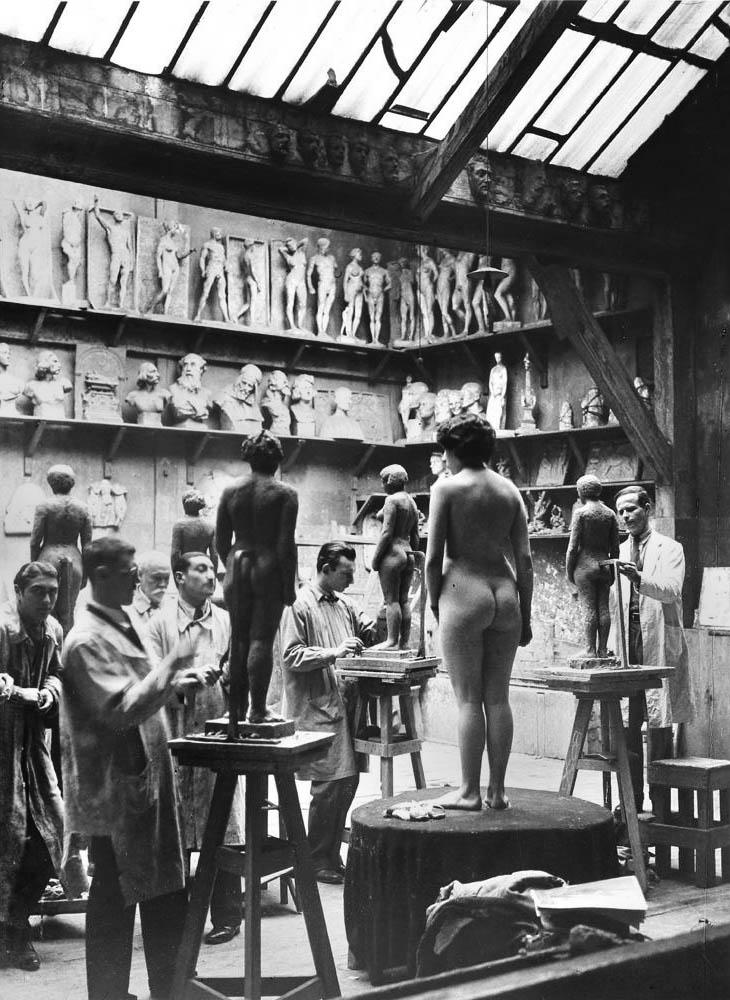
Brassaï (French born Romania, Brasov 1899 - 1984 Côte d'Azur) 'L'Académie Julian' 1931, printed 1950s


Brassaï (French born Romania, Brasov 1899 – 1984 Côte d’Azur)
L’Académie Julian
1931, printed 1950s
Gelatin silver print
29.7 x 23.7cm (11 11/16 x 9 5/16 in.)
Metropolitan Museum of Art
Gilman Collection, Purchase, The Horace W. Goldsmith Foundation Gift, through Joyce and Robert Menschel, 2005
© Estate Brassaï Succession – Paris


Brassaï (French born Romania, Brasov 1899 - 1984 Côte d'Azur) 'Introductions at Suzy's' 1932-1933


Brassaï (French born Romania, Brasov 1899 – 1984 Côte d’Azur)
Introductions at Suzy’s
1932-1933, printed later
Gelatin silver print
23.1 x 16.8cm (9 1/16 x 6 5/8 in.)
Metropolitan Museum of Art
Ford Motor Company Collection, Gift of Ford Motor Company and John C. Waddell, 1987
© Estate Brassaï Succession – Paris


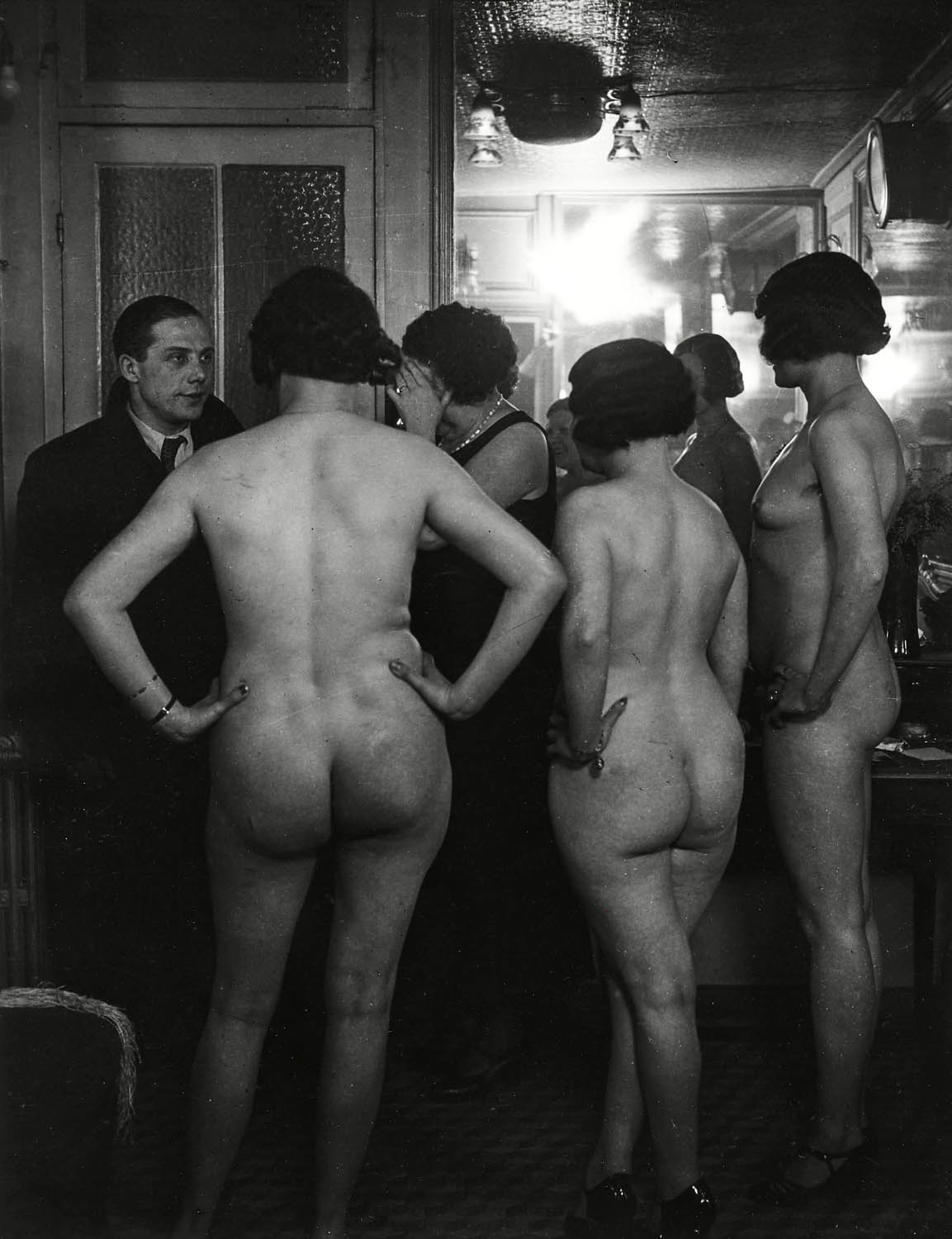
Brassaï made his name as a chronicler of the night, with images that ranged from reflections on wet cobblestones to the denizens of bars and brothels. Like so many of his photographs, Introductions at Suzy’s was not an impromptu scene caught by an undetected observer but rather a carefully constructed tableau meant to highlight the dynamic between buttoned-up bourgeois clients and Suzy’s bevy of prostitutes, naked but for their bracelets and high heels. The “client” was actually Brassaï’s friend and bodyguard; the “girls,” however, were not stand-ins.

Text from the Metropolitan Museum of Art website


Brassaï (French, 1899-1984) 'Chez Suzy / Armoire à glace dans un hôtel de passe, rue Quincampoix' (Mirrored cabinet in a brothel, rue Quincampoix) 1932, printed 1950s


Brassaï (French, 1899-1984)
Chez Suzy / Armoire à glace dans un hôtel de passe, rue Quincampoix (Mirrored cabinet in a brothel, rue Quincampoix)
1932, printed 1950s
Gelatin silver print
23.3 x 16.8cm (9 3/16 x 6 5/8 in.)
Metropolitan Museum of Art
Warner Communications Inc. Purchase Fund, 1980
© Estate Brassaï Succession – Paris


A keen observer of Parisian nightlife in the 1930s, Brassaï was drawn to the visual conundrums and optical innuendos of everyday life. The play of reflections and absences in this image, made in a Paris brothel, suggests the materialization of subconscious impulses. Evoking Freud’s definition of desire as the sensation arising from a perceived absence of remembered pleasure, this blatantly sexual scene suggests but withholds a specific narrative.

Text from the Metropolitan Museum of Art website


André Kertész (American born Hungary, Budapest 1894 - 1985 New York City) 'Distortion #6' 1932


André Kertész (American born Hungary, Budapest 1894 – 1985 New York City)
Distortion #6
1932
Gelatin silver print
23.4 x 17.3cm (9 3/16 x 6 13/16 in.)
Metropolitan Museum of Art
Ford Motor Company Collection, Gift of Ford Motor Company and John C. Waddell, 1987
© The Estate of André Kertész / Higher Pictures


Although Kertesz had long been interested in mirrors, reflections, and the idea of distorting the human figure, he did not seriously investigate their photographic possibilities until 1933, when the risqué French magazine Le Sourire commissioned him to make a series of figure studies. Using a funhouse mirror from a Parisian amusement park, Kertesz, who had never photographed nudes before, spent four weeks making about two hundred negatives.

Kertész accentuated the narrow ribcage and long waist of the ideal contemporary woman by photographing his model in a carnival mirror. If the top half of this beautiful nude resembles those Modigliani painted, the swell of the haunch recalls Mannerist nudes and their nineteenth-century revivals, especially Ingres’ grande odalisque.

Text from the Metropolitan Museum of Art website


Man Ray (American, Philadelphia, Pennsylvania 1890 - 1976 Paris) 'Arm' c. 1935


Man Ray (American, Philadelphia, Pennsylvania 1890 – 1976 Paris)
Arm
c. 1935
Gelatin silver print
29.7 x 23.0cm (11 11/16 x 9 1/16 in.)
Metropolitan Museum of Art
Ford Motor Company Collection, Gift of Ford Motor Company and John C. Waddell, 1987
© 2012 Man Ray Trust / Artists Rights Society (ARS), NY / ADAGP, Paris


Man Ray’s photograph of an arm is cropped so abstractly that it seems to metamorphose into other body parts – a knee, a calf, a thigh – or into some utterly unidentifiable yet heroic form. This image appeared on the cover of Formes Nues (1935), which also included the work of Brassaï, László Moholy-Nagy, Franz Roh, and George Platt Lynes, among others.

In the magazine’s introduction, Man Ray wrote, “were it not for the fact that photography permits me to seize and to possess the human body and face in more than a temporary manner, I should quickly have tired of this medium.”

Text from the Metropolitan Museum of Art website


Paul Outerbridge Jr. (American, New York 1896 - 1959 Laguna Beach, California) 'Nude with Mask and Hat' c. 1936


Paul Outerbridge Jr. (American, New York 1896 – 1959 Laguna Beach, California)
Nude with Mask and Hat
c. 1936
Carbro print
43.3 x 30.0cm (17 1/16 x 11 13/16 in.)
Metropolitan Museum of Art
Warner Communications Inc. Purchase Fund, 1977


Outerbridge was a successful commercial photographer, but although he found such work stimulating, he also made photographs as a means of personal expression throughout his career. Photographing nude models in colour in the 1930s was challenging – not only in the difficulty of correctly capturing skin tones using complicated new processes, but also because finding a venue to publish or exhibit the work was unlikely. Although he began by posing his models in the manner of painted masterpieces, Outerbridge’s compositions became increasingly provocative in the late 1930s. The sexualised charge and commercial palette of works such as this were not in keeping with attitudes of the period and were not shown during the artist’s lifetime.

Text from the Metropolitan Museum of Art website


Hans Bellmer (German born Poland, Katowice 1902–1975 Paris) 'La Poupée' 1936


Hans Bellmer (German born Poland, Katowice 1902–1975 Paris)
La Poupée
1936
Gelatin silver print with applied colour
Mount: 9 5/8 in. × 7 1/2 in. (24.5 × 19cm)
Image: 5 5/16 × 5 9/16 in. (13.5 × 14.1cm)
Metropolitan Museum of Art
Ford Motor Company Collection, Gift of Ford Motor Company and John C. Waddell, 1987
© 2024 Artists Rights Society (ARS), New York


In his nightmarish tableaux of mutilated and reassembled dolls posed in domestic interiors, Bellmer grappled with the base condition of the human body and with the bodily fragment as fetish object. Mannequins and dolls – simultaneously familiar and strange – supplied the material for his primal expressions of terror and awe, which often evoked the innocent violence and latent sexuality of childhood games. Whether they are read as Freudian emblems of the uncanny or as ominous harbingers of Nazi atrocities, Bellmer’s images exemplify the Surrealist view of the female body as the source of simultaneous fascination and revulsion.

Text from the Metropolitan Museum of Art website


Edward Weston (American 1886-1958) 'Nude' 1936, printed c. 1954


Edward Weston (American, Highland Park, Illinois 1886 – 1958 Carmel, California)
Printer: Brett Weston (American, Los Angeles, California 1911-1993 Kona, Hawaii) or Cole Weston (American, 1919-2003)
Nude on Sand, Oceano
1936, printed c. 1954
Gelatin silver print
19.1 x 24.2cm (7 1/2 x 9 1/2 in.)
David Hunter McAlpin Fund, 1957
© Center for Creative Photography, Arizona Board of Regents


Charis Wilson, the model for this series, admitted to being shocked upon seeing Weston’s nudes for the first time, as she had previously known only the romantically retouched photographs of depilated bodies then popular. In studying Weston’s work she found, “I couldn’t get past the simple amazement at how real they were. Then I began to see the rhythmic patterns, the intensely perceived sculptural forms, the subtle modulations of tone, of which these small, perfect images were composed. And I began to appreciate the originality of the viewpoint that had selected just these transitory moments and made them fast against the current of time.”

Text from the Metropolitan Museum of Art website


Irving Penn (American, Plainfield, New Jersey 1917 - 2009 New York City) 'Nude No. 57' 1949-1950


Irving Penn (American, Plainfield, New Jersey 1917 – 2009 New York City)
Nude No. 57
1949-1950
Gelatin silver print
39.4 x 37.5cm (15 1/2 x 14 3/4 in.)
Metropolitan Museum of Art
Gift of the artist, 2002
© 1950-2002 Irving Penn


By 1950, Penn was a well-known Vogue portrait and fashion photographer but had already made, privately, a major series of nudes – a personal but lesser-known body of work. During the week, he photographed models wearing fashionable clothes for the magazine, but weekends and evenings he made studies of female nudes. The women were full-bodied and the photographs unorthodox, recalling the form and spirit of archaic fertility idols.

Text from the Metropolitan Museum of Art website


Harry Callahan (American, 1912-1999) 'Eleanor and Barbara' 1954, printed 1970s


Harry Callahan (American, 1912-1999)
Eleanor and Barbara
1954
Gelatin silver print
22.8 x 22.1cm (9 x 8 11/16 in.)
Metropolitan Museum of Art
Gift of Joyce and Robert Menschel, 1993
© The Estate of Harry Callahan; Courtesy Pace/MacGill Gallery, New York


Muses throughout his career, Callahan’s wife and daughter played, posed, and aged before his lens. With their attention to the physicality of light, however, Callahan’s photographs transcend mere family portraiture by calling attention to the simple beauty of life’s fleeting moments. “He just liked to take the pictures of me,” Eleanor recalled in her nineties. “In every pose. Rain or shine. And whatever I was doing. If I was doing the dishes or if I was half asleep. And he knew that I never, never said no. I was always there for him. Because I knew that Harry would only do the right thing.”

Eleanor Callahan died in February 2012 at the age of ninety-five.

Text from the Metropolitan Museum of Art website


Diane Arbus (American, 1923-1971) 'Retired man and his wife at home in a nudist camp one morning, N.J.' 1963


Diane Arbus (American, 1923-1971)
Retired man and his wife at home in a nudist camp one morning, N.J.
1963
Gelatin silver print
39.9 × 37.9cm (15 11/16 × 14 15/16 in.)
Metropolitan Museum of Art
Purchase, Joyce Frank Menschel, and Ann Tenenbaum and Thomas H. Lee Gifts; Louis V. Bell, Harris Brisbane Dick, Fletcher, and Rogers Funds and Joseph Pulitzer Bequest; and Marlene Nathan Meyerson Family Foundation, Twentieth-Century Photography Fund, Diana Barrett and Robert Vila, Elizabeth S. and Robert J. Fisher, Charlotte and Bill Ford, Lita Annenberg Hazen Charitable Trust and Hazen Polsky Foundation Inc., Jennifer and Joseph Duke, Jennifer and Philip Maritz, Saundra B. Lane, The Jerry and Emily Spiegel Family Foundation and Pamela and Arthur Sanders, Anonymous, and The Judith Rothschild Foundation Gifts, 2007
© The Estate of Diane Arbus


Arbus’s interest in the tension between revelation and concealment comes into starkest focus in the portraits she made at Sunshine Park, a family nudist camp in New Jersey. While nudism might be considered the ultimate form of exposure, it often required a different kind of cover-up. As the artist remarked in an unpublished article written for Esquire magazine in 1966: “For many of these people, their presence here is the darkest secret of their lives, unsuspected by relatives, friends, and employers in the outside world, the disclosure of which might bring disgrace.”

Text from the Metropolitan Museum of Art website


Diane Arbus (American, 1923-1971) 'A naked man being a woman, N.Y.C.' 1968


Diane Arbus (American, 1923-1971)
A naked man being a woman, N.Y.C.
1968
Gelatin silver print
38.2 x 36.2cm
Metropolitan Museum of Art
Purchase, Joyce Frank Menschel, and Ann Tenenbaum and Thomas H. Lee Gifts; Louis V. Bell, Harris Brisbane Dick, Fletcher, and Rogers Funds and Joseph Pulitzer Bequest; and Marlene Nathan Meyerson Family Foundation, Twentieth-Century Photography Fund, Diana Barrett and Robert Vila, Elizabeth S. and Robert J. Fisher, Charlotte and Bill Ford, Lita Annenberg Hazen Charitable Trust and Hazen Polsky Foundation Inc., Jennifer and Joseph Duke, Jennifer and Philip Maritz, Saundra B. Lane, The Jerry and Emily Spiegel Family Foundation and Pamela and Arthur Sanders, Anonymous, and The Judith Rothschild Foundation Gifts, 2007
© The Estate of Diane Arbus


Mark Morrisroe (American, 1959-1989) 'Untitled [Two Men in Silhouette]' c. 1987


Mark Morrisroe (American, 1959-1989)
Untitled [Two Men in Silhouette]
c. 1987
Gelatin silver print
28.4 x 20.8cm (11 3/16 x 8 3/16 in.)
Metropolitan Museum of Art
Twentieth-Century Photography Fund, 2009
© The Estate of Mark Morrisroe (Ringier Collection) at Fotomuseum Winterthur


Sexuality and mortality – which many would say are central preoccupations of humankind – are key to Morrisroe’s biography and art. The son of a drug-addicted mother, a teenage hustler, and a precocious punk queer, Morrisroe carried a bullet (shot by a disgruntled john) in his chest from the age of eighteen and consequently walked with a limp that added one more element to his outsider self-image. Sex and death were persistent themes in his work, with pronounced poignancy after his 1986 AIDS diagnosis. In this work, Morrisroe has taken a page from a gay S&M magazine, cut out the shapes of two naked men, and used the sheet as a negative to print a unique image in which the figures – literally absent – appear as dark silhouettes against a netherworld of sexual activity.

Text from the Metropolitan Museum of Art website


The Metropolitan Museum of Art
1000 Fifth Avenue at 82nd Street
New York, New York 10028-0198
Phone: 212-535-7710

Opening hours:
Thursday – Tuesday 10am – 5pm
Closed Wednesday

The Metropolitan Museum of Art website

LIKE ART BLART ON FACEBOOK

Back to top

Exhibition: ‘In Focus: The Sky’ at the J. Paul Getty Museum, Getty Center, Los Angeles

Exhibition dates: 26th July – 4th December 2011


Col. Henry Stuart Wortley (British, 1832-1890) 'The Day is Done, and the Darkness Falls from the Wings of Night.' about 1862


Col. Henry Stuart Wortley (British, 1832-1890)
The Day is Done, and the Darkness Falls from the Wings of Night.,
about 1862
Albumen silver print
29.5 x 35.2cm (11 5/8 x 13 7/8 in.)
The J. Paul Getty Museum, Los Angeles


Many thankx to Melissa Abraham for her help and to the J. Paul Getty Museum for allowing me to publish the photographs in the posting. Please click on the photographs for a larger version of the image.


With its immensity, immateriality, and variability, the sky has been an enduring subject in art history, fascinating and challenging generations of artists. As soon as the medium of photography was introduced in 1839, photographers attempted to represent the sky and its natural phenomena.

Atmospheric light and its constant mutability have always been hard to capture, but by the 1850s the greater light sensitivity of collodion negatives (compared to the daguerreotype and calotype processes) allowed the spectacles of the sky to be more easily transposed to photography.

With further technical improvements such as the development of instantaneous processes in the 1880s and the advent of Kodachrome colour film around 1935, photographers have continued to explore this theme in diverse and imaginative ways.

Text from the J. Paul Getty Museum website


Gustave Le Gray (French, 1820-1884) 'Cloudy Sky – Mediterranean Sea' 1857


Gustave Le Gray (French, 1820-1884)
Cloudy Sky – Mediterranean Sea
1857
Albumen silver print
12 1/4 x 16 7/16 in.
The J. Paul Getty Museum, Los Angeles


Clouds

The collodion process (in which a syrupy, light-sensitive mixture was applied to glass-plate negatives) was advantageous for its short exposure time and sharpness, but its sensitivity to blue light could also pose a challenge. By the time the camera captured detail in the foreground, the sky was often overexposed and thus printed as blank space.

To create his sweeping seascape, Cloudy Sky – Mediterranean Sea, Gustave Le Gray combined two slightly overlapping negatives: one for the sky and one for the sea.

Text from the J. Paul Getty Museum website


Carleton Watkins (American, 1829-1916) '[Solar Eclipse]' January 1, 1889


Carleton Watkins (American, 1829-1916)
[Solar Eclipse]
January 1, 1889
Albumen silver print
16.5 × 21.6cm (6 1/2 × 8 1/2 in.)
The J. Paul Getty Museum, Los Angeles


Standing atop Mount Santa Lucia in northern California at approximately 3.50 p.m. on January 1, 1889, Carleton Watkins was able to make only one exposure during the instant of complete eclipse. Accompanied by professors from the newly created University of California and the United States Naval Observatory, Watkins waited slightly more than an hour for the moon to begin its movement and assume its temporary position directly in front of the sun. The radiating sun, its brilliance hidden by the black moon, lies suspended over a sea of clouds whose rippling waves dominate the sky. Only the inclusion of the treetops in the foreground serves to ground the image in a familiar reality.

Text from the J. Paul Getty Museum website


The J. Paul Getty Museum presents In Focus: The Sky, a thematically-installed exhibition of permanent collection photographs, on view at the Getty Center from July 26 – December 4, 2011.

“The sky has fascinated and challenged photographers since the invention of the medium,” said Anne Lyden, associate curator, Department of Photographs, the J. Paul Getty Museum, and curator of the exhibition. “This exhibition showcases a wide range of approaches to capturing the many moods and effects of the sky – things we usually take for granted.”

The selection of 22 artworks provides visitors with an opportunity to explore the Getty Museum’s world-renowned photographs collection through the pictorial subject of the sky, with the works loosely organised under four different themes: urban skies, clouds, dark skies, and colourful skies.

The exhibition features photographs by artists such as: Ansel Adams, John Divola, André Kertész, Joel Meyerowitz, Alfred Stieglitz, and Carleton Watkins, among others. The Getty’s collection includes exemplary objects that demonstrate both technological and aesthetic innovations in photography. Among the different processes highlighted are daguerreotypes, albumen silver prints, palladium prints, platinum prints, and more contemporary inkjet prints.

One of the most well-known works in the exhibition is Ansel Adams’ Moonrise, Hernandez, New Mexico, (negative made November 1, 1941; printed December 16, 1948). Traveling by car through New Mexico, Adams was inspired by light from the setting sun illuminating crosses in the graveyard at the side of the road. By carefully considering the composition, visualising the printed image before creating the photograph, understanding the required exposure needed in response to the available light, and exerting a certain degree of control in the printing process so that detail and shadows were retained, Adams succeeded in capturing the fleeting moment when the sun was setting and the bright moon appeared in the darkening sky.

The summer sky of Cape Cod features in Meyerowitz’s photograph Fence, Truro, negative 1976; printed 1992. Having recently acquired a large view camera, Meyerowitz spent two summers recording the structures and light of the coastal area that ultimately resulted in the 1978 book, Cape Light. Noting the shifting shadows as they played across the picket fence, his use of colour aptly describes the very subject of light itself.

Included in the exhibition is a selection from John Divola’s Zuma Beach series. In the fall of 1977, after discovering an abandoned lifeguard headquarters at Zuma Beach, California, Divola began visiting the site mornings and evenings to photograph. Bringing paints, using flash, and depending on the Pacific Ocean and the ever-changing sky for a dramatic backdrop, he created spontaneous scenes in this seaside theatre.

Also on view is a small group of three photographs by Alfred Stieglitz. From 1922 to 1934, Stieglitz photographed clouds and created a series of abstract configurations which reflected the fluctuation of his subjective state. By simply titling each piece Equivalent, he invited an open reading of the images and their content.

In Focus: The Sky is the ninth installation of the ongoing In Focus series of exhibitions, thematic presentations of photographs from the Getty’s permanent collection.

Press release from the J. Paul Getty Museum website


Alfred Stieglitz (American, 1864-1946) 'Songs of the Sky' 1924


Alfred Stieglitz (American, 1864-1946)
Songs of the Sky
1924
Gelatin silver print
11.7 x 9.2cm (4 5/8 x 3 5/8 in.)
The J. Paul Getty Museum, Los Angeles
© J. Paul Getty Trust


Edward Weston (American, 1886-1958) 'Cloud, Mexico' 1926


Edward Weston (American, 1886-1958)
Cloud, Mexico
1926
Palladium print
14.9 × 24cm (5 7/8 × 9 7/16 in.)
© 1981 Arizona Board of Regents, Center for Creative Photography


The first image with artistic intention that Edward Weston made in Mexico was of a cloud. Stopped in the port of Mazatlan on his way to Mexico City in 1923, Weston, for the first time in his career, was moved to photograph the sky, a theme that would occupy him intermittently throughout his entire sojourn in Mexico. Working with his Graflex, which allowed for greater flexibility than his tripod-mounted eight-by-ten-inch camera, he shot clouds spontaneously and maintained a personal collection of prints that he referred to as his “cloud series.” He noted in his daybook, “Next to the recording of a fugitive expression, or revealing the pathology of some human being, is there anything more elusive to capture than cloud forms! And the Mexican clouds are so swift and ephemeral, one can hardly allow the thought, ‘Is this worth doing?’ or, ‘ls this placed well?’ – for an instant of delay and what was, is not!”

The economy of form achieved in this 1926 image through the isolation of a single strip of stratus clouds oriented diagonally within the frame was not new to Weston’s aesthetic; his 1924 picture of Tina Modotti (1896-1942) nude on the roof of their home (see 86.XM.710.8) employs a remarkably similar composition. If Mexico provided Weston the inspiration to explore and expand the range of his oeuvre, adding clouds, still lifes, and landscapes to his repertoire of portraits and nudes, it simultaneously served as the place where his visual approach to the world was honed. His time in Mexico came to an end the same year he made this picture, but many of the principles he developed there would last him throughout his career.

Brett Abbott. Edward Weston, In Focus: Photographs from the J. Paul Getty Museum (Los Angeles: J. Paul Getty Museum, 2005), 48. ©2005, J. Paul Getty Trust


Alfred Stieglitz (American, 1864-1946) 'Equivalent' 1926


Alfred Stieglitz (American, 1864-1946)
Equivalent
1926
Gelatin silver print
11.6 × 9.1cm (4 9/16 × 3 9/16 in.)
The J. Paul Getty Museum, Los Angeles
© Georgia O’Keeffe Museum


Alfred Stieglitz (American, 1864-1946) 'Equivalent' 1926


Alfred Stieglitz (American, 1864-1946)
Equivalent
1926
Gelatin silver print
11.7 × 9.2cm (4 5/8 × 3 5/8 in.)
The J. Paul Getty Museum, Los Angeles


Paul Strand (American, 1890-1976) 'Sangre de Cristo, New Mexico' 1930


Paul Strand (American, 1890-1976)
Sangre de Cristo, New Mexico
1930
Platinum print
9.2 × 11.9cm (3 5/8 × 4 11/16 in.)
© Aperture Foundation


Berenice Abbott (American, 1898-1991) 'Night View, New York City' 1932


Berenice Abbott (American, 1898-1991)
[The West Side, Looking North from the Upper 30s / Nightview]
1932
Gelatin silver print
33.8 × 26.8cm (13 5/16 × 10 9/16 in.)
© Estate of Berenice Abbott


“If [photography] is to be utterly honest and direct, it should be related to the pulse of the times – the pulse of today.” ~ Berenice Abbott

Nowhere is Berenice Abbott’s statement better demonstrated than in this photograph of the pulsating vibrancy of New York City, alive at night with thousands of glittering lights. The flashes of illumination perforate the frame, reflecting the dynamism of the world’s fastest-changing city. Abbott set about documenting New York when she returned there in 1929 after nine years spent in Europe. Abbott made this photograph from a high vantage point in the Empire State Building on Fifth Avenue looking north.

Text from the J. Paul Getty Museum website


André Kertész (American born Hungary, 1894-1985) 'The Lost Cloud, New York' negative 1937; print 1970s


André Kertész (American born Hungary, 1894-1985)
The Lost Cloud, New York
Negative 1937; print 1970s
Gelatin silver print
24.8 x 16.5cm
The J. Paul Getty Museum, Los Angeles
© Estate of André Kertész


Urban Skies

Soon after arriving in New York in October 1936, André Kertész spent time searching the city streets for fresh material, just as he had done in Paris for a decade. One afternoon he observed a solitary white cloud in a vast blue sky, dwarfed by the monolithic presence of the Rockefeller Center. Kertész later recounted that he was “very touched when he saw the cloud, as it “didn’t know which way to go” (Bela Ugrin, Dialogues with Kertész, ” 1978-1985, the Getty Research Institute) – a sentiment he strongly identified with as a new immigrant.

From the lyrical to the abstract, photography has often been an apt medium with which to capture the fleeting nature of skies.

Text from the J. Paul Getty Museum website


The impenetrable façade of Rockefeller Center in New York dominates the frame of this photograph, filling the lower and right sides of the image with its cold, hard, modern lines. The other third of the composition belongs to the sky, in which a lone puff of white cloud hangs isolated like a cotton ball, holding sway against the force of the skyscraper. The brilliant white form is “lost” in this scene that is otherwise devoid of natural, spirited shapes. The cloud possesses an innate impermanence; it will be gone with the next gust of wind, blown along on its path to some other expanse of sky. Andre Kertész’s juxtaposition of the whimsical cloud and unforgiving architecture seems to emphasise his own sense of isolation; the photograph was made soon after he had emigrated from Europe.

Text from the J. Paul Getty Museum website


Ansel Adams (American, 1902-1984) 'Moonrise, Hernandez, New Mexico' 1941


Ansel Adams (American, 1902-1984)
Moonrise, Hernandez, New Mexico
Negative November 1, 1941; print December 16, 1948
Gelatin silver print
34.9 × 44cm (13 3/4 × 17 5/16 in.)
© The Ansel Adams Publishing Rights Trust


Arguably Ansel Adams’s most famous image, this photograph is titled Moonrise rather than Sunset, even though the moon technically does not rise in the sky. As a scholar noted: The factuality and, moreover, the meaning of the setting sun were rejected by him in favour of the expressive symbolism of the rising moon; of the shining luminescence ablaze with greatness in its primal mystery, dramatically isolated in the infinity of darkness.

Instead of making an unmanipulated print from the negative, Adams selectively printed the sky black and the foreground dark in order to achieve a particular illumination and spiritual transcendence. The photographer’s skill and vision transformed the tiny town of Hernandez, dotted with glowing white cemetery and church crosses, into a spectral landscape.

Text from the J. Paul Getty Museum website


William A. Garnett (American, 1916-2006) 'Smog, Los Angeles' 1949


William A. Garnett (American, 1916-2006)
Smog, Los Angeles
1949
Gelatin silver print
25.2 × 34cm (9 15/16 × 13 3/8 in.)
© Estate of William A. Garnett


An ardent conservationist, Garnett became concerned about land use and air pollution in the early 1940s. He made this photograph in an attempt to raise public awareness. Over the years Garnett came to believe that he was more likely to inspire positive change by pointing out nature’s enduring beauty than by showing the ugliness caused by poor choices.

Text from the J. Paul Getty Museum website


Dorothea Lange (American, 1895-1965) 'Full Moon, Southwestern Utah' 1953


Dorothea Lange (American, 1895-1965)
Full Moon, Southwestern Utah
1953
Gelatin silver print
15.6 x 15.3cm (6 1/8 x 6 in.)
The J. Paul Getty Museum, Los Angeles, Gift of the John Dixon Collection
© Oakland Museum of California, the City of Oakland


Dorothea Lange suffered health problems in the late 1940s, but she wanted to travel again and be part of the current documentary effort. Since the federal government was no longer funding such projects, this meant working for the thriving picture magazines. Lange proposed to Life that she and Ansel Adams do a project in Utah. They would travel with her son Daniel, who would write text for the article, and her husband, who had a continuing interest in the survival of utopian communities. Their purpose was to record the landscape, built environment and inhabitants of three towns in southwestern Utah settled in the mid-nineteenth century by Mormons. The grandchildren of some of these pioneers were Lange’s subjects during her visit to Gunlock, Toquerville, and St. George in 1953.

Adapted from Judith Keller, Dorothea Lange, In Focus: Photographs from the J. Paul Getty Museum (Los Angeles: J. Paul Getty Museum, 2002), p. 64. © 2002 J. Paul Getty Trust


Joel Meyerowitz (American, b. 1938) 'Fence, Truro' negative 1976; print 1992


Joel Meyerowitz (American, b. 1938)
Fence, Truro
negative 1976; print 1992
Chromogenic print
59.7 x 47.3cm (23 1/2 x 18 5/8 in.)
The J. Paul Getty Museum, Los Angeles, Gift of Nancy and Bruce Berman
© Joel Meyerowitz, courtesy Edwynn Houk Gallery, NY


John Divola (American, b. 1949) 'Untitled' 1977 From the 'Zuma Beach' series


John Divola (American, b. 1949)
Untitled
From the Zuma Beach series
1977
Chromogenic print
24.8 x 30.4cm (9 3/4 x 11 15/16 in.)
The J. Paul Getty Museum, Los Angeles, Gift of Michael and Jane Wilson
© John Divola


Skies in Color

In the fall of 1977, after discovering an abandoned lifeguard headquarters at Zuma Beach, California, John Divola began visiting the site to photograph. Painting the walls, incorporating props, using flash, and depending on the Pacific Ocean and the sky for a dramatic backdrop, he created a series of makeshift scenes.

Discussing his work in 1980, Divola said, “These photographs are the product of my involvement with an evolving situation. The house evolving in a primarily linear way toward its ultimate disintegration, the ocean and light evolving and changing in a cyclical and regenerative manner.”

Text from the J. Paul Getty Museum website


John Divola (American, b. 1949) 'Untitled' 1977 From the 'Zuma Beach' series


John Divola (American, b. 1949)
Untitled
1977
From the Zuma Series
Chromogenic print
24.6 × 30.5cm (9 11/16 × 12 in.)
The J. Paul Getty Museum, Los Angeles, Gift of Michael and Jane Wilson
© John Divola


Robert Weingarten (American, b. 1941) '6:30 A.M. 10/06/03, #98, Malibu, CA' 2003


Robert Weingarten (American, b. 1941)
6:30 A.M. 10/06/03, #98, Malibu, CA
2003
Inkjet print
76.4 × 76.4cm (30 1/16 × 30 1/16 in.)
© Robert Weingarten
Gift of Alvin and Heidi Toffler


The horizon at dawn, looking southeast over Santa Monica Bay, from the artist’s home in Malibu.


The J. Paul Getty Museum
1200 Getty Center Drive
Los Angeles, California 90049

Opening hours:
Tuesday – Friday, Sunday 10am – 5.30pm
Saturday 10am – 8pm
Monday Closed

The J. Paul Getty Museum website

LIKE ART BLART ON FACEBOOK

Back to top

Exhibition: ‘André Kertész – Retrospective’ at Fotomuseum Winterthur, Zurich

Exhibition dates: 26th February – 15th May 2011


Many thankx to the Fotomuseum Winterthur, Zurich for allowing me to publish the photographs in the posting. Please click on the photographs for a larger version of the image.


André Kertész (Hungarian, 1894-1985) 'Underwater Swimmer, Esztergom' 1917


André Kertész (Hungarian, 1894-1985)
Underwater Swimmer, Esztergom
1917
Gelatin silver print


André Kertész (American born Hungary, 1894-1985) 'Fork' 1928


André Kertész (Hungarian, 1894-1985)
Fork
1928
Gelatin silver print


André Kertész. 
'Elizabeth and I' 1933


André Kertész (Hungarian, 1894-1985)

Elizabeth and I
1933, printed in the 1960s
Gelatin silver print
25.3 x 17.5cm
Collection of Sarah Morthland, New York


André Kertész.
 'Distortion No. 200' 1933


André Kertész (Hungarian, 1894-1985)
Distortion No. 200
1933, printed c. 1938/1939
Gelatin silver print
34.4 x 25.7cm
Courtesy of Klever Holdings


André Kertész is possibly the most photographic of all photographers: he sought out the play of light and shadow; he liked the concentration and overlapping of forms, of moments; and in the everyday, in banality, he recognised poetry, beauty, and even, for all his innate modesty, the “sublime.” Kertész is a photographic poet and seer, for whom it was long difficult to break into the market precisely because of his rich, chiseled iconography.

André Kertész (Budapest 1894 – 1985 New York) supported Brassaï, inspired Henri Cartier-Bresson, is considered one of the founders of photojournalism, and introduced stylistic elements into photography that can still be found in works by contemporary photographers. At heart, he was a photographer and artist in equal measure, poetic, probing, vital, independent in thought and actions. In a word, he was a master of photography, whose long period of production was very influential. Nevertheless, it took a remarkably long time for his special abilities, his poetic experimental version of photography, to find recognition in the history of photography. The three locations where he lived (Budapest, Paris, New York), his freedom, his form of “contemplative photography,” as Roland Barthes characterised it, made quick reception and categorisation of his work impossible. Today, more than twenty-five years after his death, he is recognised and considered to be a central photographer of the twentieth century who crucially enriched the language of photography.

With around 250 photographs and countless magazine contributions, the retrospective at Fotomuseum Winterthur on view until May 15, 2011, allows a comprehensive view of his work. The chronological order and the major themes show what it is that makes up his photographic practice: his unique methods (in photographic postcards, in distortions), his editorial engagement (for example, in the volume Paris vu par Kertész, 1934), his passion for experimentation (with light and shadow), and the evocation of emotions, above all of melancholy and loneliness. Periods that have remained neglected or unexplored until today (his life as a soldier from 1914-1918, for example) are reassessed, and juxtaposed with the development of photojournalism in Paris and the distribution of his pictures in the media, with which he earned his living.

André Kertész liked to characterise himself as an “eternal amateur.” But what a virtuosic “amateur” he was; what virtuosic visual language he employed his entire life to capture the poetry of the everyday! His photographic production was closely connected to his life and psyche. Even when he seemed to be documenting something, he let himself be guided almost exclusively by feeling, by instinct, from his soul. This resulted in a body of work that he liked to compare to a “visual journal”, and about which he said, “I have never just ‘made photos’. I express myself photographically.”

Text from the Fotomuseum Winterthur website


André Kertész. 'Satiric Dancer' 1926


André Kertész (Hungarian, 1894-1985)
Satiric Dancer
1926
Gelatin silver print


André Kertész (Hungarian, 1894-1985) 'Peintre d'ombre, Paris' (Shadow painter, Paris) 1926


André Kertész (Hungarian, 1894-1985)
Peintre d’ombre, Paris (Shadow painter, Paris)
1926
Gelatin silver print
© ministère de la Culture / Médiathèque de l’architecture et du patrimoine / Donation André Kertész


André Kertész (Hungarian, 1894-1985) 'Bastille, Rue de Lappe, Paris' 1926


André Kertész (Hungarian, 1894-1985)
Bastille, Rue de Lappe, Paris
1926
Gelatin silver print
© ministère de la Culture / Médiathèque de l’architecture et du patrimoine / Donation André Kertész


André Kertész. '
Self-Portrait' Paris, 1927


André Kertész (Hungarian, 1894-1985)

Self-Portrait
Paris, 1927, printed in the 1970s
Gelatin silver print
25.4 x 20.3cm
Courtesy of Estate of André Kertész, New York


André Kertész. 
'Arm and Ventilator' 1937


André Kertész (Hungarian, 1894-1985)

Arm and Ventilator
1937, printed in the 1940s-1950s
Gelatin silver print
30.5 x 26.7cm
Collection of Eric Cepotis and David Williams


André Kertész.
 'Washington Square' New York, January 9, 1954


André Kertész (Hungarian, 1894-1985)
Washington Square
New York, January 9, 1954
Vintage gelatin silver print
12.7 x 9.2cm
Collection of Leslie, Judith and Gabrielle Schreyer


André Kertész.
 'July 3, 1979'
 1979


André Kertész (Hungarian, 1894-1985)
July 3, 1979

1979
Polaroid SX-70 original
7.9 x 7.9cm
Courtesy of Stephen Bulger Gallery


Fotomuseum Winterthur
Grüzenstrasse 44 + 45
CH-8400
Winterthur (Zürich)

Opening hours:
Tues – Sun 11am – 6pm
Wed 11am – 8pm
Monday closed

Fotomuseum Winterthur website

LIKE ART BLART ON FACEBOOK

Back to top

Exhibition: ‘André Kertész’ at Jeu de Paume, Paris

Exhibition dates: 28th September 2010 – 6th February 2011

Curators: Michel Frizot and Annie-Laure Wanaverbecq


Many thankx to Jeu de Paume for allowing me to publish the photographs in the posting. Please click on the photographs for a larger version of the image.


André Kertész (Hungarian, 1894-1985) 'Underwater Swimmer, Esztergom' 1917 from the exhibition 'André Kertész' at Jeu de Paume, Paris


André Kertész (Hungarian, 1894-1985)
Underwater Swimmer, Esztergom
1917, printed in the 1980s
Gelatin silver print
Bibliothèque Nationale de France


André Kertész

André Kertész (Budapest, 1894 – New York, 1985) has never seen his work the subject of a real retrospective in Europe, although he donated all his negatives to the French State. However, he is one of the major photographers of the 20th century, both in terms of the richness of his work and the longevity of his career…


André Kertész (Hungarian, 1894-1985) 'Esztergom' 1918 from the exhibition 'André Kertész' at Jeu de Paume, Paris


André Kertész (Hungarian, 1894-1985)
Esztergom
1918
Gelatin silver print


André Kertész (Hungarian, 1894-1985) 'Tisza Szalka' 1924 from the exhibition 'André Kertész' at Jeu de Paume, Paris


André Kertész (Hungarian, 1894-1985)
Tisza Szalka
1924
Vintage gelatin silver contact print
Salgo Trust for Education, New York


André Kertész (Hungarian, 1894-1985) 'Self-portrait, Paris' 1927 from the exhibition 'André Kertész' at Jeu de Paume, Paris


André Kertész (Hungarian, 1894-1985)
Self-portrait, Paris
1927
Gelatin silver print


André Kertész (Hungarian, 1894-1985) 'Plaque cassée, Paris' (Broken Plate, Paris) 1929 from the exhibition 'André Kertész' at Jeu de Paume, Paris


André Kertész (Hungarian, 1894-1985)
Plaque cassée, Paris (Broken Plate, Paris)
1929
Gelatin silver print


André Kertész (Hungarian, 1894-1985) 'Distortion n° 41' 1933 from the exhibition 'André Kertész' at Jeu de Paume, Paris


André Kertész (Hungarian, 1894-1985)
Distortion n° 41
1933
[with André Kertész selportrait]
Gelatin silver print, later print
Collection of the Maison Européenne de la Photographie, Paris


Twenty-five years after his death, André Kertész (1894-1985) is today a world-famous photographer who produced images that will be familiar to everyone, but he has yet to receive full recognition for his personal contribution to the language of photography in the 20th century. His career spanning more than seventy years was chaotic, and his longevity was matched by an unwavering creative acuity that rendered difficult an immediate or retrospective understanding of his work.

This exhibition attempts to provide for the first time a broad and balanced view of Kertéz’s work, presenting new elements and bringing together, for the first time also, a large number of period prints (two thirds of the 300 photographs on show). Both the exhibition and the accompanying catalogue were produced in collaboration with The André and Elizabeth Kertész Foundation (New York) and the Médiathèque de l’Architecture et du Patrimoine (Paris), which holds Kertész’s donation to the ministère de la Culture.

An initial investigation was undertaken during his lifetime as part of preparations for the first retrospective in 1985. The book Ma France (1990) paid tribute to his French donation and celebrated his Parisian periods (1925-1936 and after 1963), and the recent catalogue for the exhibition at the National Gallery of Art (2005), Washington, provided lots of circumstantial information and new analyses. With this retrospective exhibition, which draws extensively on archive documents, we have attempted to present Kertész’s work as a whole in its homogeneity and its continuity, as he himself conceived it, reflecting closely the course of his life.

Adopting a chronological and linear exhibition layout reflecting the various periods of his creative life, punctuated by self-portraits at the entrance to each space, we have created thematic groups in the form of “cells” highlighting the unique aspects of his output: his personal photography (the photographic postcards, the Distortions), his involvement in publishing (the book Paris vu par Kertész, 1934), his recurrent creative experiments (shadows, chimneys), and the more diffuse expression of emotions (solitude). The exhibition sheds light on the importance of previously neglected or unexplored periods (his time as a soldier between 1914 and 1918, the New York period and the Polaroids of his last years). In particular, it highlights the beginnings of photojournalism in Paris in 1928, and the dissemination of his photographs in the press, which had become a professional activity for him. Thus numerous copies of magazines are presented (Vu, Art et Médecine, Paris Magazine), as are the various publications of his photo essay on the Trappist monastery in Soligny, with Kertész’s original shots.

Press release from the Jeu de Paume website


André Kertész (Hungarian, 1894-1985) 'Place de la Concorde' Paris 1928 from the exhibition 'André Kertész' at Jeu de Paume, Paris


André Kertész (Hungarian, 1894-1985)
Place de la Concorde
Paris, 1928, printed in the 1970s
Gelatin silver print
Collection of Robert Gurbo


André Kertész (Hungarian, 1894-1985) 'The Eiffel Tower, Paris' 1933 from the exhibition 'André Kertész' at Jeu de Paume, Paris


André Kertész (Hungarian, 1894-1985)
The Eiffel Tower, Paris
1933
Vintage gelatin silver print
Courtesy Stephen Daiter Gallery


André Kertész (Hungarian, 1894-1985) '
Elizabeth and I' 1933 from the exhibition 'André Kertész' at Jeu de Paume, Paris


André Kertész (Hungarian, 1894-1985)
Elizabeth and I
1933
Gelatin silver print


A Small Journal

André Kertész (1894-1985) is today famous for his extraordinary contribution to the language of photography in the 20th century. This retrospective, which will be traveling to Winterthur, Berlin, and Budapest, marshals a large number of prints and original documents that highlight the exceptional creative acuity of this photographer, from his beginnings in Hungary, his homeland, to Paris, where between 1925 and 1936 he was one of the leading figures in avant-garde photography, to New York, where he lived for nearly fifty years without encountering the success that he expected and deserved. It pays tribute to a photographer whom Cartier-Bresson regarded as one of his masters, and reveals, despite an apparent diversity of periods and situations, themes and styles, the coherence of Kertész’s approach. It emphasises his originality and poetic uniqueness, drawing on new elements to present his oeuvre as the photographer himself conceived it, reflecting as closely as possible the course of his life. It makes full use of archive documents, focusing in particular on an area of his work that is little known (the beginnings of photo-reportage in Paris and the publication of his images in the press and books), and it analyses the circumstances surrounding his late resurgence. By exploring the recurring preoccupations and themes of Kertész’s work, it sheds light on the complex output of this unclassifiable photographer, who defined himself as an “amateur,” and in connection with whom Roland Barthes talked of a photography “that makes us think.”

Hungary 1894-1925: from Andor to André

Kertész’s youth left him with an enduring love of the countryside, animals, leisurely walks, and down-to-earth people. His sentimental nature led him to treat photography as “a little notebook, a sketchbook,” whose principal subjects were his friends, his family, his fiancée Elizabeth, and above all his younger brother, Jenö, with whom he carried out most of his early experiments in photography. Called up during the war, he continued to take photographs, capturing for the most part trivial events in the lives of the soldiers, whose situation he shared, for in spite of the context photography remained for him a way of expressing emotions. André Kertész was very independent at this time – his work diverged radically from the prevailing pictorialism of the time – and he was laying the foundations for a unique innovative photographic language. In 1914, he began photographing at night; in 1917, he took an astonishing photo of an underwater swimmer, and captured his brother “as a scherzo” in 1919. The two persons watching the Circus (1920) and The Blind Musician (1921) immediately emerged as modernist images. André Kertész’s photography was distinguished at this time by its freedom and diversity of approach, as well as its reliance on feelings and emotional bonds for inspiration.

France, 1925-1936: The Garden of André Kertész

Hard up and speaking only Hungarian, André Kertész lived in Paris amid a circle of fellow Hungarian émigrés. It was in the studio of one of them, Étienne Beöthy, that the dancer Magda Förstner, mimicking one of the artist’s sculptures, instigated the famous photograph Satiric Dancer in 1926. In the same year, when taking photographs at Mondrian’s studio, the photographer emerged as the master of a new type of unorthodox “portrait in absence.” Kertész evokes more than he shows, giving life to the inanimate, and creating a poetic language of allusive signs, both poetic and visual. During the early years of his life in Paris, he printed a large number of his images on photographic paper in postcard format (this inexpensive practice occupied a notable place in his work, because he resorted to it so persistently and with such inventiveness).

The street also provided the photographer with micro-events, fleeting associations and multiple signs that became metaphors. The leading representative, along with Man Ray, of international modernity in Paris, he worked for the press, initiating photo-reportage; he took part in several important exhibitions, including “Film und Foto” in Stuttgart in 1929. Kertész nevertheless insisted on retaining his independence, keeping artistic movements, in particular Surrealism, at arm’s length. Nourished by his emotions, surprises, and personal associations, his work, with its mirrored images, reflections, shadows, and doubles, established him as a leading exponent of avant-garde photography. But he nevertheless avoided conventional doctrines and styles. The Fork (1928), for example, a perfect application of the modernist creed that held sway at the time, reveals another distinguishing feature of Kertész’s work: his interest in shadows cast by objects or people. In The Hands of Paul Arma (1928) and the extraordinary Self-Portrait (1927), these play subtly on the alternation between absence and presence, doubling and disappearance.

André Kertész always sought to take advantage of innovations that would enable him to reconfigure reality through unusual images. He very quickly became interested in the optical distortions produced by waves (The Swimmer, 1917), or by the polished surfaces of such objects as silver balls or by car headlights. In 1930, when the magazine VU commissioned him to take a portrait of its new editor, Carlo Rim, Kertész took him to the funhouse at Luna Park to pose in front of the distorting mirrors. Then, in 1933, at the request of the editor of a girlie magazine, Le Sourire, he produced an extraordinary series of female nudes, known as Distortions. He used two models, who posed with two distorting mirrors that, depending on the vantage point chosen, produced grotesque elongations, monstrous protuberances, or the complete disintegration of the body. Following his move to the United States, Kertész hoped to make use of this technique by adapting it to advertising, but he was met with incomprehension (it was not until 1976 that a book devoted to the Distortions was published in American and French editions).

United States, 1936-1962: A Lost Cloud

The offer of a contract from the Keystone agency (which would be broken after one year) prompted Kertész’s to move to New York in October 1936. His reservations about fashion photography, the rejection of his photo essays that “talked too much” according to the editorial board of Life, and the incomprehension that greeted the Distortions series gradually plunged Kertész into depression. The war and the curtailment of the “foreign” photographer’s freedom merely added to his difficulties. In 1947, in order to have a regular income, Kertész was forced to accept a contract from the magazine House & Garden. In 1952, he moved into an apartment overlooking Washington Square, which prompted a change of direction in Kertész’s work. He now watched and witnessed what was taking place on the surrounding terraces and in the square. He used telephoto lenses and zooms to create whimsical series, such as the one featuring chimneys.

André Kertész lived in New York from 1936 to 1985 and he never stopped photographing “in” the city, rather than the city itself. He did not record the life of its neighbourhoods, the picturesque aspects of its various trades, and its often paradoxical architectural environments. For him, New York was a sound box for his thoughts, which the city echoed back to him in the form of photographs. He sought everywhere an antidote to the city’s regularity, in the dilapidated brick walls and the inextricable tangle of shadows, beams, and external staircases, and it is sometimes impossible to recognise specific places in these broken geometries: Kertész’s New York is highly fragmented, but a single photo could reveal the imaginary city.

He remained true to his intuitive, allusive personal style, and used his work to give voice to the sadness that undoubtedly permeated his entire life in New York, rendered most explicitly in The Lost Cloud (1937). Right up until the end of his life, he sought images of solitude, sometimes incorporating pigeons into them. On January 1, 1972, during a trip to Martinique, he caught the fleeting, pensive profile of a man behind a pane of frosted glass: this nebulous vision of a solitary man before the immensity of the sea was the last image in his retrospective collection, Sixty Years of Photography, 1912-1972, providing a very provisional conclusion to his career.

Returns and Renewal, 1963-1985

After his retirement in 1961, Kertész developed a new appetite for life and photography. Following a request from the magazine Camera for a portfolio, he made a sort of inventory of his available work. In 1963 he had one-man exhibitions at the Venice Photography Biennale and the Bibliothèque Nationale de Paris, the latter enabling him to stay in a city that, on an emotional level, he had never left. In addition, he located and took possession of several boxes of negatives that had been entrusted to a friend in 1936, at the time of his departure, which prompted a review of his entire oeuvre and led to new prints, with fresh croppings. These various episodes, which can be seen as part of a general reassessment of the value of photography and its history, had a rejuvenating effect on Kertész (who was seventy at the time). The traveling exhibition “The Concerned Photographer” even presented him as a pioneer of photojournalism.

Kertész continued his never-ending search for images, both in the cities that he visited and from the window of his apartment. His two books J’aime Paris (1974) and Of New York … (1976) express his sense of being torn between two cultures. The death of his wife Elizabeth in 1977, shortly before his one-man show at the Centre Georges Pompidou, led him to develop an interest in Polaroids, which enabled him to adopt a more introspective approach. As always, emotion was the driving force behind his work. Of the fifty-three Polaroids brought together in the small book From My Window, dedicated to Elizabeth, Kertész, always curious about new technology, was in reality capturing the light of his recollections and the distortions of his memory.”

Michel Frizot and Annie-Laure Wanaverbecq, curators of the exhibition


André Kertész (Hungarian, 1894-1985) 'Peintre d'ombre, Paris' (Shadow painter, Paris) 1926 from the exhibition 'André Kertész' at Jeu de Paume, Paris


André Kertész (Hungarian, 1894-1985)
Peintre d’ombre, Paris (Shadow painter, Paris)
1926
Gelatin silver print


André Kertész (Hungarian, 1894-1985) 'Satiric Dancer' 1926 from the exhibition 'André Kertész' at Jeu de Paume, Paris


André Kertész (Hungarian, 1894-1985)
Satiric Dancer
1926, printed in the 1950s
Gelatin silver print
Bibliothèque nationale de France


André Kertész (Hungarian, 1894-1985) 'Melancholic Tulip' New York, 1939 from the exhibition 'André Kertész' at Jeu de Paume, Paris


André Kertész (Hungarian, 1894-1985)
Melancholic Tulip
New York, 1939, printed c. 1980
Gelatin silver print
Courtesy Bruce Silverstein Gallery


André Kertész (Hungarian, 1894-1985) 'Lost Cloud, New York' 1937 from the exhibition 'André Kertész' at Jeu de Paume, Paris


André Kertész (Hungarian, 1894-1985)
Lost Cloud, New York
1937, printed in the 1970s
Gelatin silver print
Courtesy Sarah Morthland Gallery, New York


André Kertész (Hungarian, 1894-1985) 'Washington Square, New York' 1954 from the exhibition 'André Kertész' at Jeu de Paume, Paris


André Kertész (Hungarian, 1894-1985)
Washington Square, New York
1954
Gelatin silver print


André Kertész (Hungarian, 1894-1985) 'July 3, 1979
' from the exhibition 'André Kertész' at Jeu de Paume, Paris


André Kertész (Hungarian, 1894-1985)
July 3, 1979

Polaroid


Jeu de Paume
1, place de la Concorde
75008 Paris
métro Concorde
information: 01 47 03 12 50

Opening hours:
Tuesday – Friday 12 – 8pm
Saturday and Sunday 11am – 7pm
Closed Monday (including public holidays)

Jeu de Paume website

LIKE ART BLART ON FACEBOOK

Back to top

Exhibition: ‘In Focus: Still Life’ at The J. Paul Getty Museum, Los Angeles

Exhibition dates: 14th September 2010 – 23rd January, 2011


Many thankx to The J. Paul Getty Museum for allowing me to publish the photographs in the posting. Please click on the photographs for a larger version of the image.


Thomas Richard Williams (English, 1824-1871) 'The Sands of Time' 1850-1852 from the exhibition 'In Focus: Still Life' at The J. Paul Getty Museum


Thomas Richard Williams (English, 1824-1871)
The Sands of Time
1850-1852
Stereo-daguerreotype
The J. Paul Getty Museum, Los Angeles


This daguerreotype stereograph image by Thomas Richard Williams is a still life memento mori composition. An assemblage of a human skull, an hourglass with the sand running out, an extended compass, and a book abandoned mid-read with eyeglasses placed upside down on the page, the image evokes the temporary nature of mortal life and the inevitability of death. The objects also refer to intellectual pursuits and to the inevitable triumph of the soul over the mind.


Armand-Pierre Séguier (French, 1803-1876) 'Still Life with Plaster Casts' 1839-1842 from the exhibition 'In Focus: Still Life' at The J. Paul Getty Museum


Armand-Pierre Séguier (French, 1803-1876)
Still Life with Plaster Casts
1839-1842
Daguerreotype 8 x 6 in.
The J. Paul Getty Museum, Los Angeles


Baron Séguier was part of a small circle of amateurs that surrounded Jacques-Louis-Mandé Daguerre. Daguerre invented the daguerreotype, the process announced to the world in 1839 that produces highly detailed positive images on silver-coated copper plates. Some of the first successful daguerreotypes depicted arrangements of small-scale plaster copies of sculpture. The exceptionally long exposure times precluded the use of living models, a problem that would not be resolved until about 1841.


Louis-Rémy Robert (French, 1811-1882) '[Still Life with Statuette and Vases]' Negative 1855; print 1870s from the exhibition 'In Focus: Still Life' at The J. Paul Getty Museum


Louis-Rémy Robert (French, 1811-1882)
[Still Life with Statuette and Vases]
Negative 1855; print 1870s
Carbon print
32.4 × 26.2cm (12 3/4 × 10 5/16 in.)
The J. Paul Getty Museum, Los Angeles


Roger Fenton (English, 1819-1869) '[Still Life with Game and Gun]' about 1859 from the exhibition 'In Focus: Still Life' at The J. Paul Getty Museum


Roger Fenton (English, 1819-1869)
[Still Life with Game and Gun]
About 1859
Albumen silver print
19.8 × 17.6cm (7 13/16 × 6 15/16 in)
The J. Paul Getty Museum, Los Angeles


Charles Aubry (French, 1811-1877) '[An Arrangement of Tobacco Leaves and Grass]' about 1864 from the exhibition 'In Focus: Still Life' at The J. Paul Getty Museum


Charles Aubry (French, 1811-1877)
[An Arrangement of Tobacco Leaves and Grass]
about 1864
Albumen silver print
Image: 47 x 37.3cm (18 1/2 x 14 11/16 in.)
The J. Paul Getty Museum, Los Angeles


After working as a designer of patterns for carpets, fabrics, and wallpapers, Aubry formed a company to manufacture plaster casts and make photographs of plants and flowers. His detailed prints of natural forms were intended to replace the lithographs traditionally used by students of industrial design. This close-up of a delicate arrangement of leaves and grasses on a lace-covered background appears as if a slight movement of air could disturb it.


Eadweard J. Muybridge (American born England, 1830-1904) 'The Attitudes of Animals in Motion' Negative 1878-1879; print 1881 from the exhibition 'In Focus: Still Life' at The J. Paul Getty Museum


Eadweard J. Muybridge (American born England, 1830-1904)
The Attitudes of Animals in Motion
Negative 1878-1879; print 1881
Iron salt process
Closed: 19.5 × 24.7 × 3.1cm (7 11/16 × 9 3/4 × 1 1/4 in.)
The J. Paul Getty Museum, Los Angeles


“… A photograph is made by one of the 24 cameras at every 12 inches of progress, made by the animal during a single stride. The length of each stride may be calculated by the line of consecutive numbers arranged parallel with the track, a number being placed every 12 inches of distance.”

~ Eadweard J. Muybridge


The possibility for moving pictures originated from a rich man’s bet: whether or not a galloping horse ever had all four feet off the ground at any time during its stride. Because the unaided eye cannot see such an instantaneous event, Leland Stanford hired Eadweard Muybridge to photograph his racehorse, Occidental. After Muybridge produced the proof to win the bet, he continued his motion experiments and documented them in this album. He wrote the above passage on the album’s first page, describing his methodical approach of rigging twenty-four cameras with electromagnetic shutters – tripped by wires as an animal ran across a track.

Photographs of the cameras show how wires were attached to modified lens shutters; others depict the racetrack, where a long shed with the battery of cameras faced a track with a wall behind to silhouette subjects. Most pages depict animals and humans walking, running, and jumping before the cameras. Muybridge later devised the zoopraxiscope, a rotating device that animated sequences of images.


Frederick H. Hollyer (English, 1837-1933) 'Lilies' about 1885 from the exhibition 'In Focus: Still Life' at The J. Paul Getty Museum


Frederick H. Hollyer (English, 1837-1933)
Lilies
About 1885
Platinum print
33.7 × 19.1cm (13 1/4 × 7 1/2 in)
The J. Paul Getty Museum, Los Angeles


Baron Adolf De Meyer (American, 1868-1949) 'Glass and Shadows' 1905 from the exhibition 'In Focus: Still Life' at The J. Paul Getty Museum


Baron Adolf De Meyer (American, 1868-1949)
Glass and Shadows
1905
Photogravure
Image: 8 3/4 x 6 9/16 in
The J. Paul Getty Museum, Los Angeles


During the first decade of the 20th century, photographers such as De Meyer and Heinrich Kühn helped advance the idea that photography should emulate other forms of art. Here De Meyer photographed several glass objects through a scrim. The thin woven fabric softens the backlit objects, replicating the subtle tonal effects prized in etchings by artists from Rembrandt Harmensz van Rijn to James McNeill Whistler.


Heinrich Kühn (Austrian born Germany, 1866-1944) '[Tea Still-life, Version III]' 1907 from the exhibition 'In Focus: Still Life' at The J. Paul Getty Museum


Heinrich Kühn (Austrian born Germany, 1866-1944)
[Tea Still-life, Version III]
1907
Platinum print
27.5 × 37.8cm (10 13/16 × 14 7/8 in.)
The J. Paul Getty Museum, Los Angeles


The J. Paul Getty Museum presents In Focus: Still Life, a survey of some of the innovative ways photographers have explored and refreshed this traditional genre, on view at the Getty Center in the Center for Photographs from September 14, 2010 – January 23, 2011.

“Still life photography has served as both a conventional and an experimental form during periods of significant aesthetic and technological change,” said Paul Martineau, assistant curator, Department of Photographs, the J. Paul Getty Museum, and curator of the exhibition. “One of our goals for the exhibition was to show how still life photographs can be both traditional and surprising.”

With its roots in antiquity, the term “still life” is derived from the Dutch word stilleven, coined during the 17th century, when painted examples enjoyed immense popularity throughout Europe. The impetus for a new term came as artists created compositions of increasing complexity, bringing together a greater variety of objects to communicate allegorical meanings. Still life featured prominently in the early experiments of the pioneers of the photographic medium and, more than 170 years later, it continues to be a significant motif for contemporary photographers.

Drawn exclusively from the Museum’s collection, the exhibition includes photographs by Charles Aubry, Henry Bailey, Hans Bellmer, Jo Ann Callis, Sharon Core, Baron Adolf De Meyer, Walker Evans, Roger Fenton, Frederick H. Hollyer, Heinrich Kühn, Sigmar Polke, Man Ray, Albert Renger-Patzsch, Paul Outerbridge, Louis-Rémy Robert, Baron Armand-Pierre Séguier, Paul Strand, Josef Sudek, and Thomas R. Williams.

The exhibition is arranged chronologically and includes a broad range of photographic processes, from daguerreotypes and albumen silver prints made in the 19th century to gelatin silver prints, and cibachrome prints made in the 20th century, to digital prints from the 21st century.

Newly acquired works will be on display for the first time: Still Life with Triangle and Red Eraser (1985) by American Irving Penn, Lorikeet with Green Cloth (2006) by Australian Marian Drew, and Blow Up: Untitled 15 (2007) by Israeli Ori Gersht (Gersht loosely based his Blow Up series on traditional floral still life paintings. His arrangements of flowers are frozen and then detonated. The explosion is captured using synchronised digital cameras, with the fragmentary detritus caught in remarkable detail. 

This diptych (pair) belies the notion of still life as something motionless as it explores the relationships among painting and photography, art and science, and creation and destruction.)

For Bowl with Sugar Cubes, photographer André Kertész created a still life out of a simple bowl, spoon, and sugar cubes, demonstrating the photographer’s interest in the compositional possibilities of layering basic geometric forms on top of one another – three rectangles in a circle (sugar cubes and bowl) and a circle in a square (bowl and the cropped printing paper). A visual sophistication is achieved through his adroit use of simple objects and dramatic lighting.

Other selections from In Focus: Still Life include Edward Weston’s Bananas and Orange, which depicts a symmetrical fan of bananas punctuated by one oddly shaped orange, and Frederick Sommer’s The Anatomy of a Chicken, which uses the discarded parts of a chicken to create a visual commentary. Influenced by Surrealism, Sommer embraced unexpected juxtapositions and literary allusions to express his intellectual and philosophical ideas. In Anatomy of a Chicken, a severed head, three sunken eyes, and eviscerated organs glisten on a white board. Evoking biblical imagery, medieval grotesques, and heraldic emblems, Sommer calls on the viewer to consider the endless cycle of birth and death, the cruel reality of the food chain, and man’s role in this violence.

In Focus: Still Life will be the seventh installation of the ongoing In Focus series of exhibitions, thematic presentations of photographs from the Getty’s permanent collection. Previous exhibitions focused on The Nude, The Landscape, The Portrait, Making a Scene (staged photographs), The Worker, and most recently, Tasteful Pictures.

Press release from The J. Paul Getty Museum website


Paul Strand (American, 1890-1976) '[Black Bottle]' negative about 1919; print 1923-1939 from the exhibition 'In Focus: Still Life' at The J. Paul Getty Museum


Paul Strand (American, 1890-1976)
[Black Bottle]
Negative about 1919; print 1923-1939
Gelatin silver, on Cykora paper print
Image (trimmed to mount): 32.7 x 24.8 cm (12 7/8 x 9 3/4 in.)
Sheet: 34.4 x 27.1cm (13 9/16 x 10 11/16 in.)
Mount (irregular): 35.1 x 27.8 cm (13 13/16 x 10 15/16 in.)
The J. Paul Getty Museum, Los Angeles
© Aperture Foundation


“The photographer’s problem is to see clearly the limitations and at the same time the potential qualities of his medium, for it is precisely here that honesty no less than intensity of vision is the prerequisite of a living expression. This means a real respect for the thing in front of him expressed in terms of chiaroscuro… “

So wrote Paul Strand two years before he made this negative of a black bottle sitting in a white sink. Through the manipulation of light and dark tones, Strand transformed this ordinary subject matter. The four overflow drain holes become graphic markings in the upper left, while the muted grey shadow cast by the bottle assumes an almost-human form against the porcelain. The diagonals of light that illuminate the scene appear like radiant beams.


Albert Renger-Patzsch (German, 1897-1966) 'Flatirons for Shoe Manufacture, Fagus Factory' (Bügeleisen für Schuhfabrikation, Fagus-Werk, Alfeld) 1926 from the exhibition 'In Focus: Still Life' at The J. Paul Getty Museum


Albert Renger-Patzsch (German, 1897-1966)
Flatirons for Shoe Manufacture, Fagus Factory (Bügeleisen für Schuhfabrikation, Fagus-Werk, Alfeld)
1926
Gelatin silver print
Sheet: 22.9 × 16.8cm (9 × 6 5/8 in)
© Albert Renger-Patzsch Archiv / Ann u. Jürgen Wilde, Zülpich / Artists Rights Society (ARS), New York


“We still don’t sufficiently appreciate the opportunity to capture the magic of material things. The structure of wood, stone, and metal can be shown with a perfection beyond the means of painting… To do justice to modern technology’s rigid linear structure… only photography is capable of that.”

So wrote Albert Renger-Patzsch in 1927 about the camera’s innate ability to depict the Industrial Age. Here he studied the materials of identically shaped, finished wooden handles and industrially produced steel heads, while also representing the flatirons as an army of tools standing at attention like bowling pins. Renger-Patzsch’s photograph celebrates the beauty of the commonplace object.


Frederick Sommer (American born Italy, 1905-1999) 'The Anatomy of a Chicken' 1939 from the exhibition 'In Focus: Still Life' at The J. Paul Getty Museum


Frederick Sommer (American born Italy, 1905-1999)
The Anatomy of a Chicken
1939
Gelatin silver print
Image: 24.1 x 19.1cm (9 1/2 x 7 1/2 in)
© Frederick and Frances Sommer Foundation
The J. Paul Getty Museum, Los Angeles


Man Ray (Emmanuel Radnitzky) (American, 1890-1976) 'Dead Leaf' 1942 from the exhibition 'In Focus: Still Life' at The J. Paul Getty Museum


Man Ray (Emmanuel Radnitzky) (American, 1890-1976)
Dead Leaf
1942
Gelatin silver print
Image: 9 1/2 x 7 13/16 in
© Man Ray Trust ARS-ADAGP
The J. Paul Getty Museum, Los Angeles


Remarkable for its starkness, this photograph of a brittle castor bean leaf appeared with four others by Man Ray in the October 1943 issue of Minicam Photography. In his caption for the image, Man Ray wrote with uncharacteristic poignancy of the knowledge that “the dying leaf would be completely gone tomorrow.” It is tempting to interpret the melancholy sentiment of the work in terms of the artist’s growing discontent concerning his lack of recognition and financial success in Los Angeles and his fear that the work he left behind in France might be destroyed during the war.

Here, Man Ray applies an avant garde sensibility to the tradition of memento mori.


Marie Cosindas (American, 1923-2017) 'Asparagus Still Life I' 1967 from the exhibition 'In Focus: Still Life' at The J. Paul Getty Museum


Marie Cosindas (American, 1923-2017)
Asparagus Still Life I
1967
Polaroid Polarcolor 58 instant print
8.9 × 11.4cm (3 1/2 × 4 1/2 in)
The J. Paul Getty Museum, Los Angeles
© Marie Cosindas


Cosindas was among the first photographers to embrace the potential of Polaroid colour film during the early 1960s. She varied her use of camera filters, exposure times, lighting temperature, and development times to achieve portraits and still lifes that resemble paintings in their vibrant use of colour.

For Asparagus Still Life I, Cosindas created an elaborate assemblage of fruits, vegetables, flowers, and vessels to evoke the luxurious bounty of 17th-century Dutch banquet paintings.


Irving Penn (American, 1917-2009) 'Still Life with Triangle and Red Eraser, New York, 1985' from the exhibition 'In Focus: Still Life' at The J. Paul Getty Museum


Irving Penn (American, 1917-2009)
Still Life with Triangle and Red Eraser, New York, 1985
1985
Dye-bleach print
Image: 22 3/4 x 18 1/8 in (57.8 x 46cm)
The J. Paul Getty Museum, Los Angeles


Still life derives from the Dutch word stilleven, coined in the 17th century when paintings of objects enjoyed immense popularity throughout Europe. The impetus for this term came as artists created compositions of greater complexity, bringing together a wider variety of objects to communicate allegorical meanings.

Still life has come to serve, like landscape or portraiture, as a category within art. Although it typically refers to depictions of inanimate things, because it incorporates a vast array of influences from different cultures and periods in history, it has always resisted precise definition.

This exhibition presents some of the innovative ways photographers have explored and refreshed this traditional genre. During the 19th century, still life photographs tended to resemble still life paintings, with similar subjects and arrangements. Beginning in the 20th century, still life photographs have mirrored the subjects and styles that have more broadly concerned photographers in their time.

A New Medium

Still life featured prominently in the experiments of photography inventors Jacques-Louis-Mandé Daguerre and William Henry Fox Talbot. They did this in part, for practical reasons: the exceptionally long exposure times of their processes precluded the use of living models.

In the late 1830s, Baron Armand-Pierre Séguier, a close associate of Daguerre, created this elegant daguerreotype that features small-scale copies of famous sculptures in the Louvre and Uffizi museum collections.

In the mid-1800s, Charles Aubry was an accomplished practitioner of still-life photography who came to the medium by way of his professional interest in applied arts and industrial design. After working as a pattern designer for carpets, fabrics, and wallpapers, he formed a company to manufacture plaster casts and make photographs of plants and flowers.

Aubrey’s detailed prints of natural forms – like this close-up of plants on a lace-covered background – were intended to replace lithographs traditionally used by students of industrial design.

Photography as Art

By the first decade of the 20th century, art photographers like Baron Adolf de Meyer employed soft-focus lenses and painterly darkroom techniques to make photographs that resembled drawings and prints. The vogue at the time was to produce images that reflected a handcrafted approach, while asserting photography as an art medium in its own right.

Here, De Meyer photographed an arrangement of objects through a scrim. The pattern of thin, woven fabric softens the backlit objects and helps replicate the subtle tonal effects prized in etchings and aquatints.

Modernism

Several decades into the twentieth-century, the American artist Man Ray emerged as a pioneer of two European art movements, Dada and Surrealism, in which the element of surprise figured prominently. This image seems both unusual for Man Ray in its apparent straight-forward approach, but also typical in its somewhat dark emotional tone.

By selecting a dead leaf with a claw-like appearance and photographing it against a wood-grain board, Man Ray updated the concept of memento mori (“remember that you must die”), a motif popular in centuries-old still-life paintings.

New Directions

In that same vein, the best contemporary still-life photographs recall past styles of art while containing a paradox relevant to today. Contemporary photographer Sharon Core became known for re-creations of painter Wayne Thiebaud’s pop-art dessert tableaux. Her series of still-life compositions, inspired by the 18th-century American painter Raphaelle Peale, followed.

For this series, entitled Early American, Core studied the compositional structure of his paintings, replicated the mood of the lighting, and when she couldn’t find the right vegetables and flowers, grew her own from heirloom seeds.

The stilled lives of objects have served so well as both experimental and conventional forms in the past, that still life may well be the anchor that allows photographers to explore new and yet unimagined depths.

Anonymous. “In Focus: Still Life,” from the J. Paul Getty Museum website [Online] Cited 02/01/2020


Edward Weston (American, 1886 - 1958) 'Bananas and Orange' April 1927 from the exhibition 'In Focus: Still Life' at The J. Paul Getty Museum


Edward Weston (American, 1886-1958)
Bananas and Orange
April 1927
Gelatin silver print
Image: 18.9 x 23.7cm (7 7/16 x 9 5/16 in)
© 1981 Arizona Board of Regents, Center for Creative Photography
The J. Paul Getty Museum, Los Angeles


Simultaneous with his work on shells and nudes, Edward Weston began photographing bananas, gourds, and other still-life subjects. He was staying close to his studio in 1927, partly because he found his growing Los Angeles surroundings unappealing and partly to be available for portrait commissions. But he also realised during this time that art could be modern without depicting industrial themes. As he wrote in his daybook, “Are not shells, bodies, clouds as much of today as machines? Does it make any difference what subject matter is used to express a feeling toward life!.”

In 1928 Weston moved to San Francisco and opened a portrait studio with his son Brett (1911-1993), who had chosen to become a photographer himself. In December of that year the two packed up and moved to Carmel, a small town along the coast with a significant population of artists. It was there that Weston began focusing attention on peppers, which he typically ate after photographing them. Those who followed his output commonly saw sexual content in his still-life compositions, although he repeatedly denied having directly intended such allusions. He resented those who pigeonholed his work in this way, calling them “the sexually unemployed belching gaseous irrelevancies from an undigested Freudian ferment!” He wrote in his daybook that he photographed peppers because “of the endless variety in form manifestations, because of their extraordinary surface texture, because of the power, the force suggested in their amazing convolutions!” At the same time, however, Weston was aware that the simplified, heightened reality of his presentations, whether they be of nudes, vegetables, fruits, or his later dunes, could conjure up other associations. He was keenly interested in the idea that “all basic forms are so closely related as to be visually equivalent!”

Weston’s work during the late 1920s and early 1930s was well received. Arthur Millier, an avant-garde critic, reviewed it frequently in the Los Angeles Times, and it was exhibited in modern art galleries in Los Angeles, San Francisco, and Carmel.

Brett Abbott. Edward Weston, In Focus: Photographs from the J. Paul Getty Museum (Los Angeles: J. Paul Getty Museum, 2005), 56. © 2005, J. Paul Getty Trust.


André Kertész (American born Hungary, 1894-1985) '[Bowl with Sugar Cubes]' 1928 from the exhibition 'In Focus: Still Life' at The J. Paul Getty Museum


André Kertész (American born Hungary, 1894-1985)
[Bowl with Sugar Cubes]
1928
Gelatin silver print
Image: 16.7 x 16.4cm (6 9/16 x 6 1/2 in)
© Estate of André Kertész
The J. Paul Getty Museum, Los Angeles


While living in Paris as a young photographer during the 1920s, Kertész became intrigued by still life, a motif that he continually returned to throughout his long career. Bowl with Sugar Cubes demonstrates his interest in the compositional possibilities of layering basic geometric forms on top of one another – three rectangles in a circle (sugar cubes and a bowl) and a circle in a square (the bowl and the cropped printing paper). Visual sophistication is achieved through his adroit use of simple objects and dramatic lighting.


Jo Ann Callis (American, b. 1940) 'Untitled (Strawberry Pie), #2' 1993 from the exhibition 'In Focus: Still Life' at The J. Paul Getty Museum


Jo Ann Callis (American, b. 1940)
Untitled (Strawberry Pie), #2
1993
Silver-dye bleach print
27.9 × 35.5cm (11 × 14 in)
The J. Paul Getty Museum, Los Angeles
© Jo Ann Callis


Marian Drew (Australian, b. 1960) 'Lorikeet with Green Cloth' 2006 from the exhibition 'In Focus: Still Life' at The J. Paul Getty Museum


Marian Drew (Australian, b. 1960)
Lorikeet with Green Cloth
2006
Digital pigment print
Image: 71.8 x 89.5cm (28 1/4 x 35 1/4 in.)
Sheet: 73 x 90.2cm (28 3/4 x 35 1/2 in.)
© Marian Drew
Purchased with funds provided by the Photographs Council of the J. Paul Getty Museum, Los Angeles


Drew’s tabletop still life compositions feature fruits, vegetables, and dead animals and birds presented as game. While the unusual angles and lustrous colours bring to mind paintings by Paul Cézanne, the richness of the fabrics and dramatic lighting look back to 17th-century examples. Road kill gives Drew’s photographs a dynamic twist that calls into question mankind’s stewardship of the earth and its creatures.


Ori Gersht (Israeli, b. 1967) 'Blow Up No. 15' from 'Time After Time' (2007) from the exhibition 'In Focus: Still Life' at The J. Paul Getty Museum


Ori Gersht (Israeli, b. 1967)
Blow Up: Untitled 15
2007
Digital chromogenic prints
Purchased with funds provided by the Photographs Council of the J. Paul Getty Museum
The J. Paul Getty Museum, Los Angeles
© Ori Gersht


Sharon Core (American, b. 1965) 'Early American - Still Life with Steak' 2008 from the exhibition 'In Focus: Still Life' at The J. Paul Getty Museum


Sharon Core (American, b. 1965)
Early American – Still Life with Steak
2008
Chromogenic print
Image: 17 3/16 x 23 7/16 in
© Sharon Core
Purchased with funds provided by the Photographs Council of the J. Paul Getty Museum
The J. Paul Getty Museum, Los Angeles


Core studied the compositional structure and lighting of still life paintings by Raphaelle Peale for a series of photographs she titled Early American. When she found it difficult to find vegetables that looked like the examples in Peale’s paintings, she grew her own from heirloom seeds. Core’s methodical approach yields compositions that hover between past and present.


The J. Paul Getty Museum
1200 Getty Center Drive
Los Angeles, California 90049

Opening hours:
Tuesday – Friday, Sunday 10am – 5.30pm
Saturday 10am – 8pm
Closed Mondays

The J. Paul Getty Museum website

LIKE ART BLART ON FACEBOOK

Back to top