Curators: Simon Baker, Senior Curator, International Art (Photography) and Shoair Mavlian, Assistant Curator, Tate Modern, with Emmanuelle de l’Ecotais, Curator for Photographs
Pierre Dubreuil (French, 1872-1944) Interpretation Picasso, The Railway 1911 Gelatin silver print on paper 238 x 194mm Centre Pompidou, Paris Musée National d’Art Moderne / Centre de Création Industrielle Purchased, 1987
An interesting premise –
“a premise is an assumption that something is true. In logic, an argument requires a set of (at least) two declarative sentences (or “propositions”) known as the premises or premisses along with another declarative sentence (or “proposition”) known as the conclusion” (Wikipedia)
– that the stories (the declarative sentences) of abstract art and abstract photography are intertwined (the conclusion). The two premises and one conclusion forms the basic argumentative structure of the exhibition.
Unfortunately in this exhibition, the abstract art and abstract photographs (declarations), seem to add up to less than the sum of its parts (conclusion).
Why is this so?
The reason these two bedfellows sit so uncomfortably together is that they are of a completely different order, one to the other.
Take painting for example. There is that ultimate linkage between brain, eye and hand as the artist “reaches out” into the unknown, and conjures an abstract representation from his imagination. This has a quality beyond my recognition. The closest that photography gets to this intuition is the cameraless Photogram, as the artist paints with light, from his imagination, onto the paper surface, the physical presence of the print.
Conversely, we grapple with the dual nature of photography, its relation to reality, to the real, and its interpretation of that reality through a physical, mechanical process – light entering a camera (metal, glass, digital chips, plastic film) to be developed in chemicals or on the computer, stored as a physical piece of paper or in binary code – but then we LOOK and FEEL what else a photograph can be. What it is, and what else it can be.
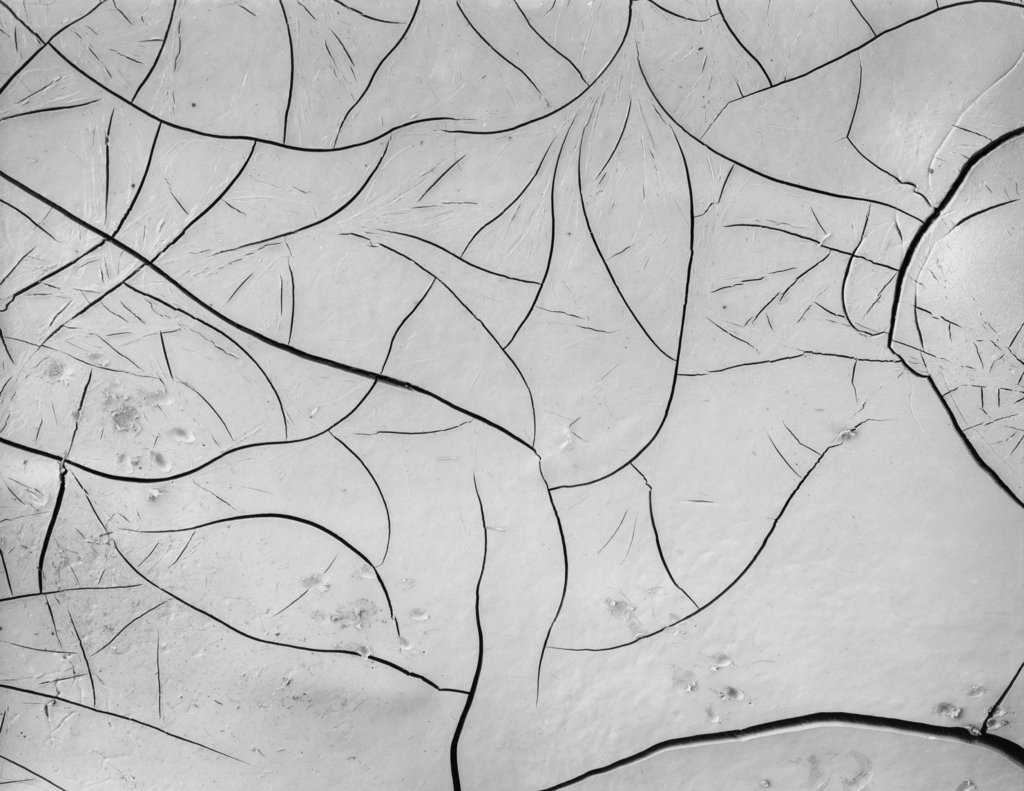
Initially, to take a photograph is to recognise something physical in the world which can then be abstracted. Here is a tree, a Platonic ideal, now here is the bark of the tree, or cracks in dried mud, or Aaron Siskind’s Pleasures and Terrors of Levitation in which, in our imagination, the body is no longer human. This archaeology of photography is a learnt behaviour (from the world, from abstract paintings) where ones learns to turn over the truth to something else, a recognition of something else. Where one digs a clod of earth, inspects it, and then turns it over to see what else it can be.
We can look at something in the world just for what it is and take a photograph of it, but then we can look at the same object for what else it can be (for example, Man Ray’s image Dust Breeding (1920), which is actually dust motes on the top of Duchamp’s Large Glass). Photographers love these possibilities within the physicality of the medium, its processes and outcomes. Photographers love changing scale, perspective, distortion using their intuition to perhaps uncover spiritual truths. Here I are not talking about making doodles – whoopee look what I can make as a photographer! it’s important because I can do it and show it and I said it’s important because I am an artist! the problem with lots of contemporary photography – it is something entirely different. It is the integrity of the emotional and intellectual process.
Not a reaching out through the arm and hand, but an unearthing (a reaching in?) of the possibilities of what else photography can be (other than a recording process). As Stieglitz understood in his Equivalents, and so Minor White espoused through his art and in one of his three canons:
When the image mirrors the man And the man mirrors the subject Something might take over
And that revelation is something completely different from the revelation of abstract art.
Dr Marcus Bunyan
Many thankx to the Tate Modern for allowing me to publish the art work in the posting. Please click on the photographs for a larger version of the image.
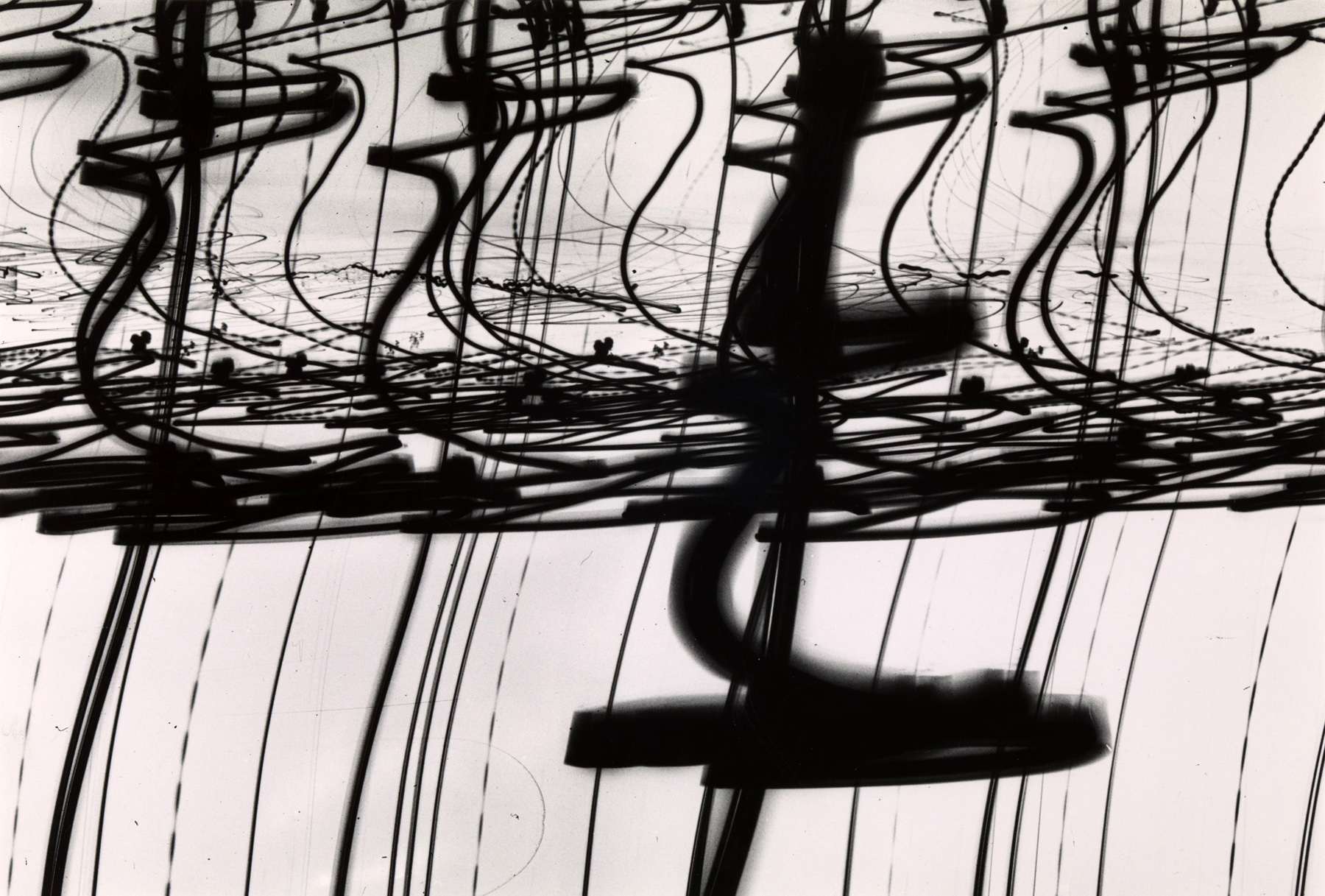
“Despite its roll call of stellar names, the show’s adrenaline soon slumps. A rhythm sets in, as each gallery offers perhaps a single non photographic work and dozens of medium format black and white abstracts arranged on an allied theme: extreme close ups, engineered structures, worms’ and birds’ eye views, moving light, the human body, urban fabric.
Individually each photograph is quite wonderful, but they echo each other so closely in their authors’ attraction to diagonal arrangements, rich surface textures, dramatic shadows, odd perspectives and close cropping, that the same ‘point’ is being made a dozen times with little to distinguish between the variants. …
By the present day, abstract photography has given in to its already Ouroboros-like tendencies, and swallowed itself whole, offering abstract photographs about the process of photography, and the action of light on its materials. This is a gesture I relished in Wolfgang Tillmans’s show in the same space this time last year, when it was broken up by a plethora of other ideas and perspectives on photography. Here it feels like another level of earnest self-absorption with a century-long backstory.”
Hettie Judah. “By halfway round I actually felt faint,” on the iNews website May 5th 2018 [Online] Cited 14/07/2018. No longer available online
For the first time, Tate Modern tells the intertwined stories of photography and abstract art. The birth of abstract art and the invention of photography were both defining moments in modern visual culture, but these two stories are often told separately.
Shape of Light is the first major exhibition to explore the relationship between the two, spanning the century from the 1910s to the present day. It brings to life the innovation and originality of photographers over this period, and shows how they responded and contributed to the development of abstraction.
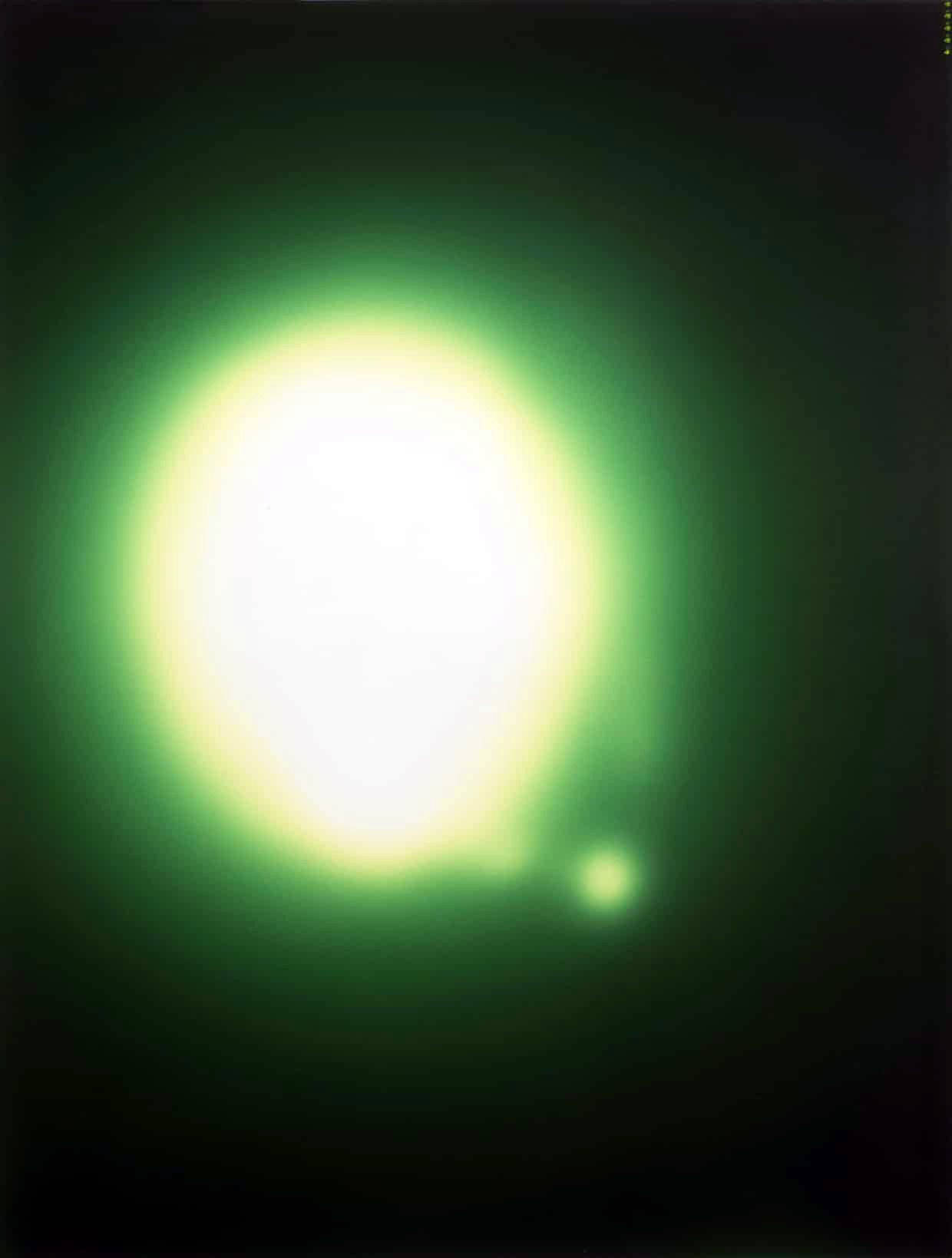
Key photographs are brought together from pioneers including Man Ray and Alfred Stieglitz, major contemporary artists such as Barbara Kasten and Thomas Ruff, right up to exciting new work by Antony Cairns, Maya Rochat and Daisuke Yokota, made especially for the exhibition.
Shape of Light | First Look
Tate Curator, Simon Baker, meets Caroline von Courten from leading photography Magazine, Foam. Together they explore the exhibition Shape of Light: 100 Years of Photography and Abstract Art at Tate Modern.
Exhibition Review – Shape of Light: 100 years of Photography and Abstract Art at Tate Modern
Percy Wyndham Lewis (18 November 1882 – 7 March 1957) was a British writer, painter, and critic. He was a co-founder of the Vorticist movement in art and edited BLAST, the literary magazine of the Vorticists.
His novels include Tarr (1918) and The Human Age trilogy, composed of The Childermass (1928), Monstre Gai (1955) and Malign Fiesta (1955). A fourth volume, titled The Trial of Man, was unfinished at the time of his death. He also wrote two autobiographical volumes: Blasting and Bombardiering (1937) and Rude Assignment: A Narrative of my Career Up-to-Date (1950).
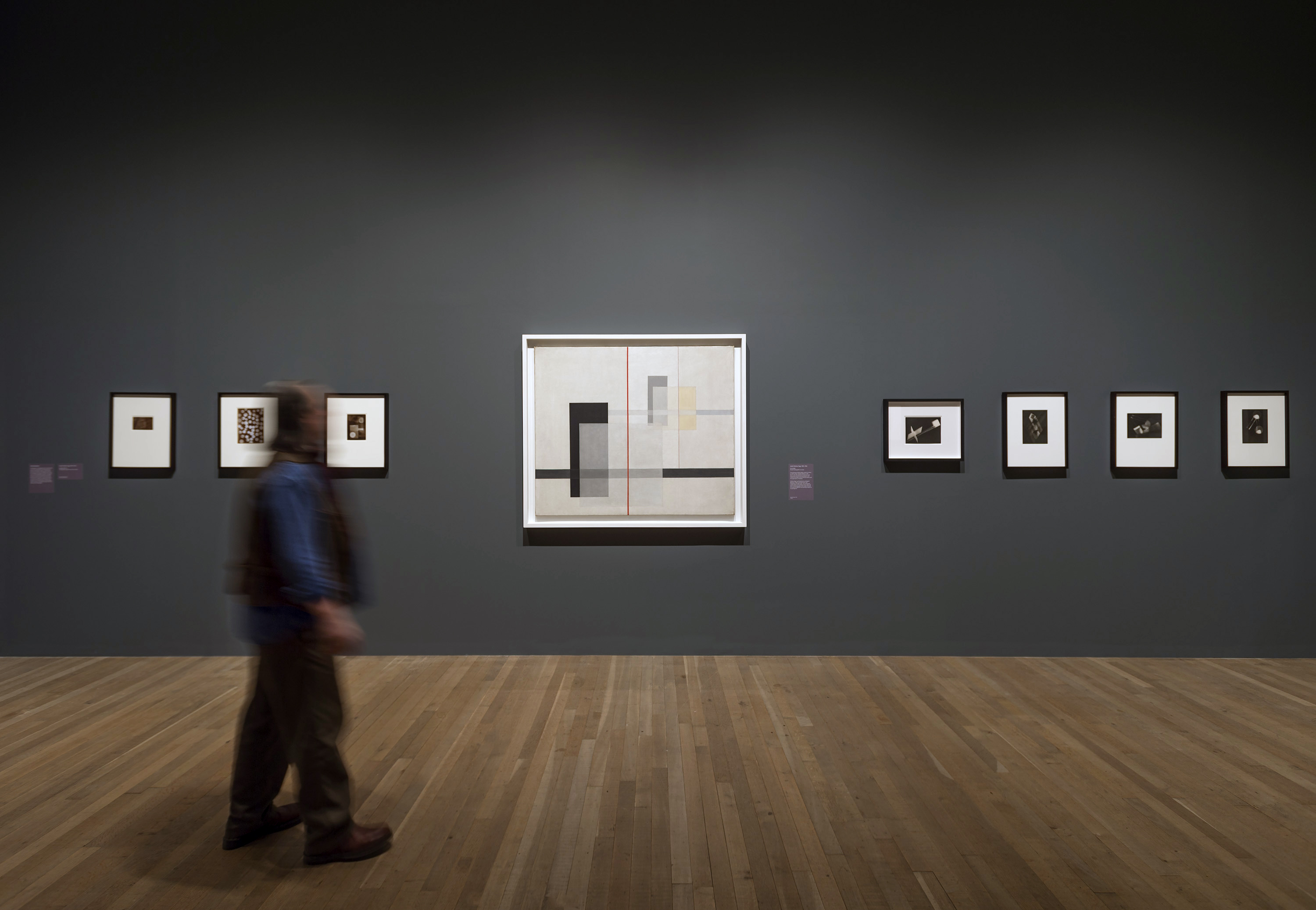
László Moholy-Nagy (Hungarian, 1895-1946) K VII 1922 Oil paint and graphite on canvas Frame: 1308 x 1512 x 80mm Tate Purchased 1961
The ‘K’ in the title of K VII stands for the German word Konstruktion (‘construction’), and the painting’s ordered, geometrical forms are typical of Moholy-Nagy’s technocratic Utopianism. The year after it was painted, he was appointed to teach the one year-preliminary course at the recently founded Bauhaus in Weimar. Moholy-Nagy’s appointment signalled a major shift in the school’s philosophy away from its earlier crafts ethos towards a closer alignment with the demands of modern industry, and a programme of simple design and unadorned functionalism.
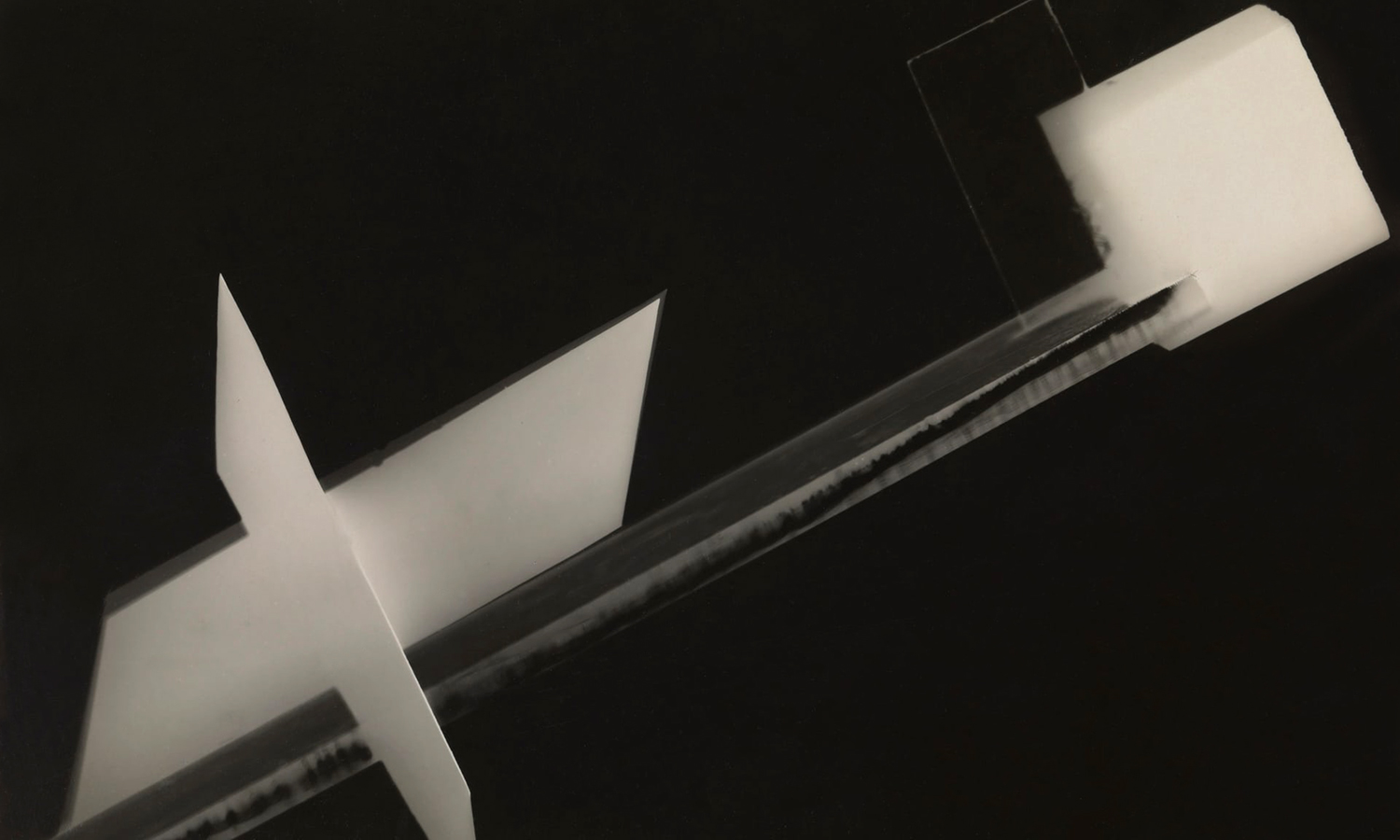
László Moholy-Nagy (Hungarian, 1895-1946) Photogram c. 1925 Gelatin silver print on paper Photo: Jack Kirkland Collection, Nottingham
Wassily Kandinsky (Russian, 1866-1944) Swinging 1925 Oil paint on board 705 x 502mm Tate
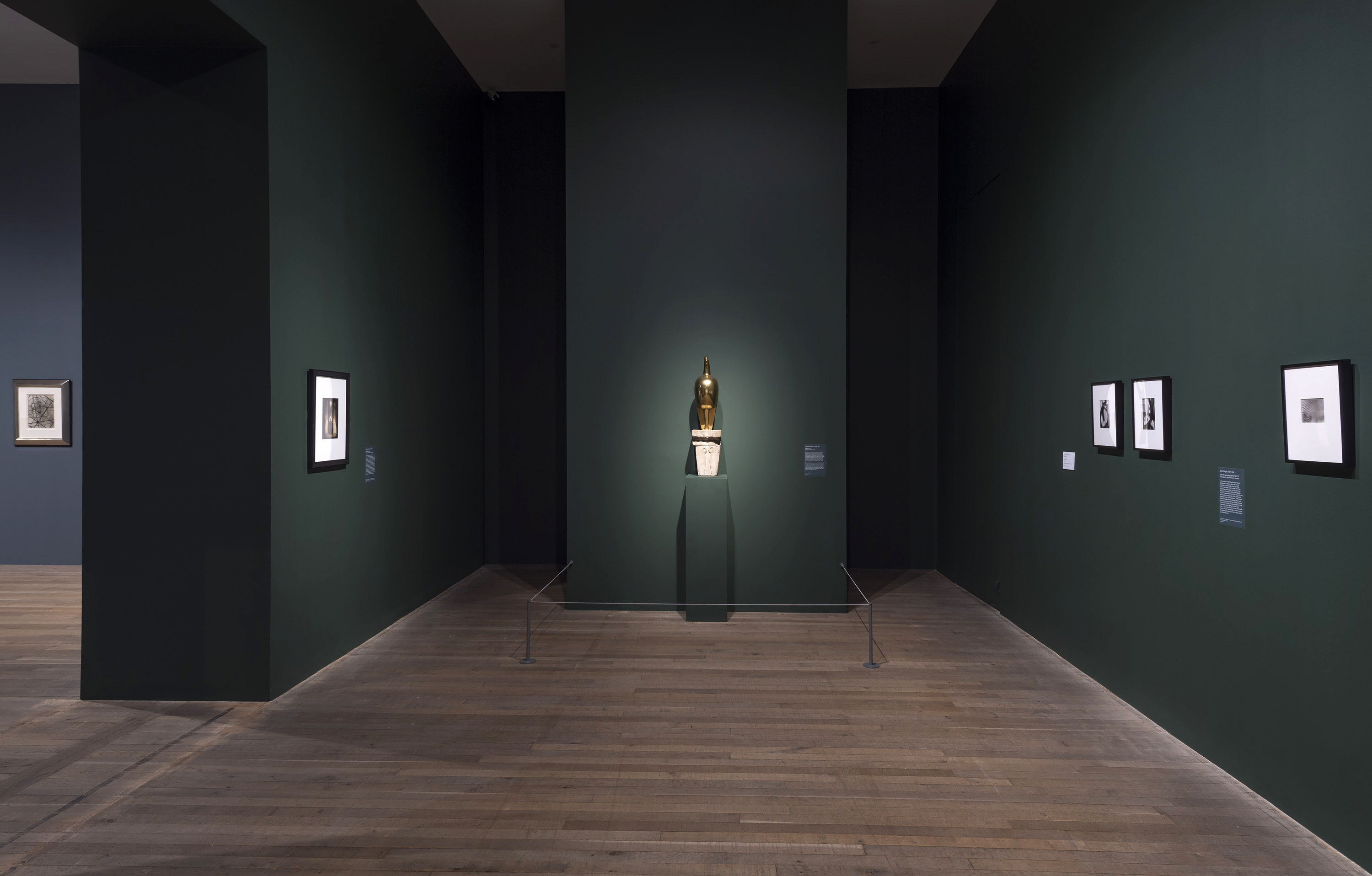
Edward Steichen (American, 1879-1973) Bird in Space (L’Oiseau dans l’espace) 1926 Gelatin silver print on paper 253 x 202mm Bequest of Constantin Brancusi, 1957 Centre Pompidou, Paris Musée National d’Art Moderne / Centre de Création Industrielle
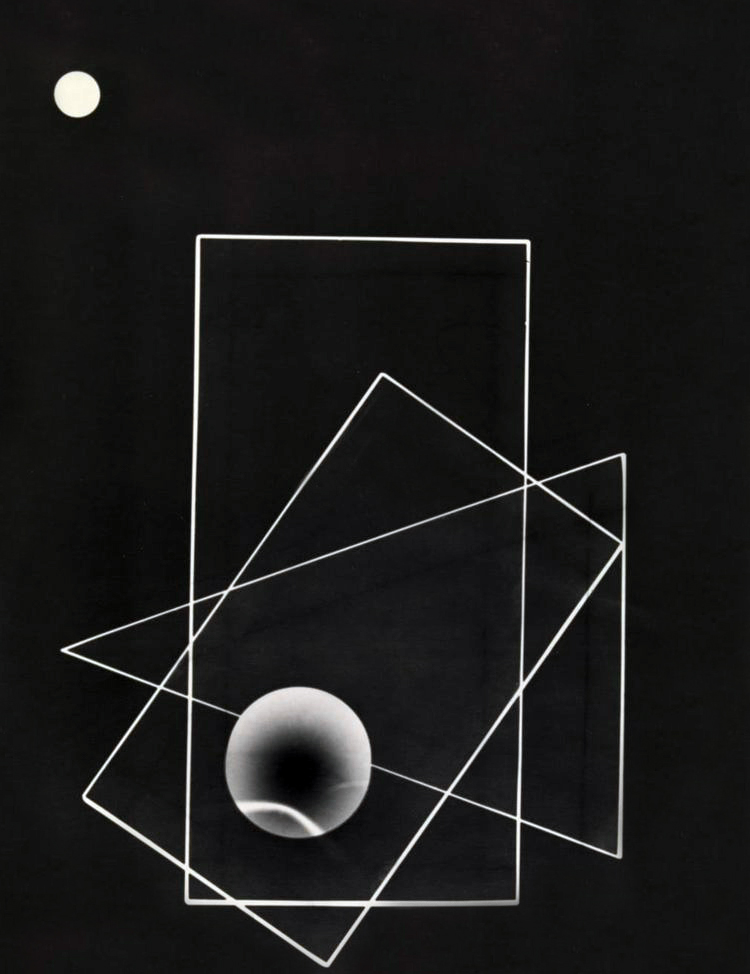
Luigi Veronesi (Italian, 1908-1998) Construction 1938 Gelatin silver print on paper 286 x 388mm Tate Accepted under the Cultural Gifts Scheme by HM Government from Massimo Prelz Oltramonti and allocated to Tate 2015
Luigi Veronesi (Italian, 1908-1998) Photo n.145 1940, printed 1970s Gelatin silver print on paper 310 x 280mm Tate Accepted under the Cultural Gifts Scheme by HM Government from Massimo Prelz Oltramonti and allocated to Tate 2015
Luigi Veronesi (Italian, 1908-1998) Photo n.152 1940, printed 1970s Gelatin silver print on paper 320 x 298mm Tate Accepted under the Cultural Gifts Scheme by HM Government from Massimo Prelz Oltramonti and allocated to Tate 2015
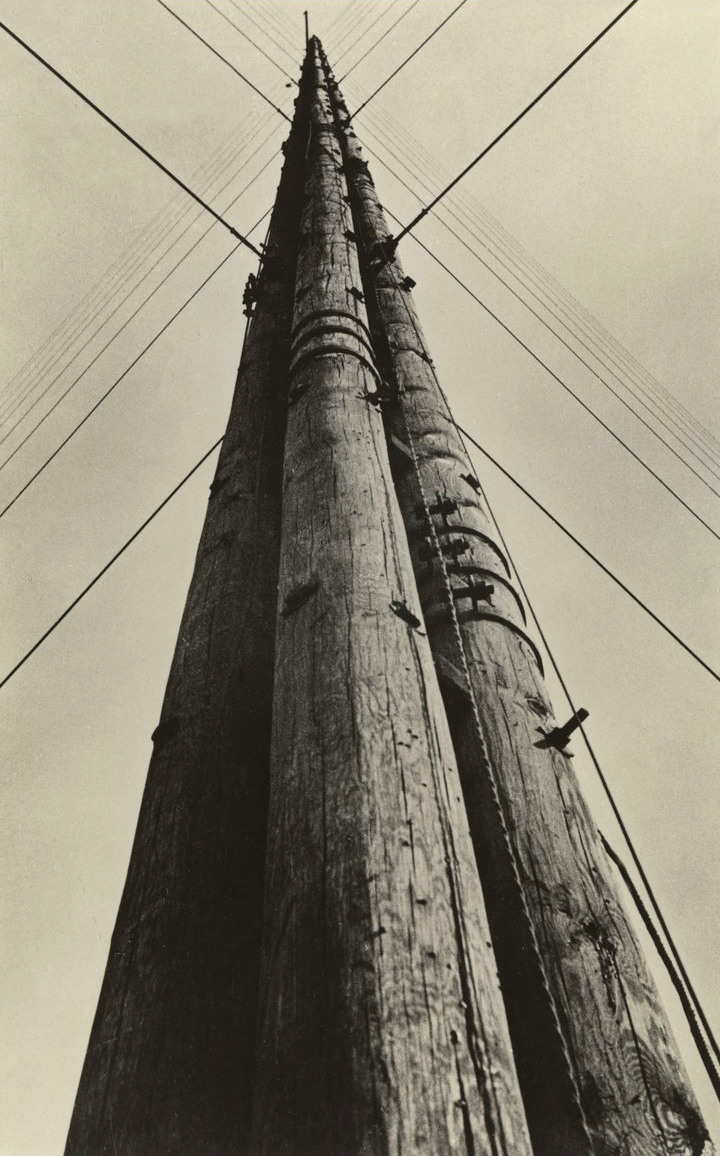
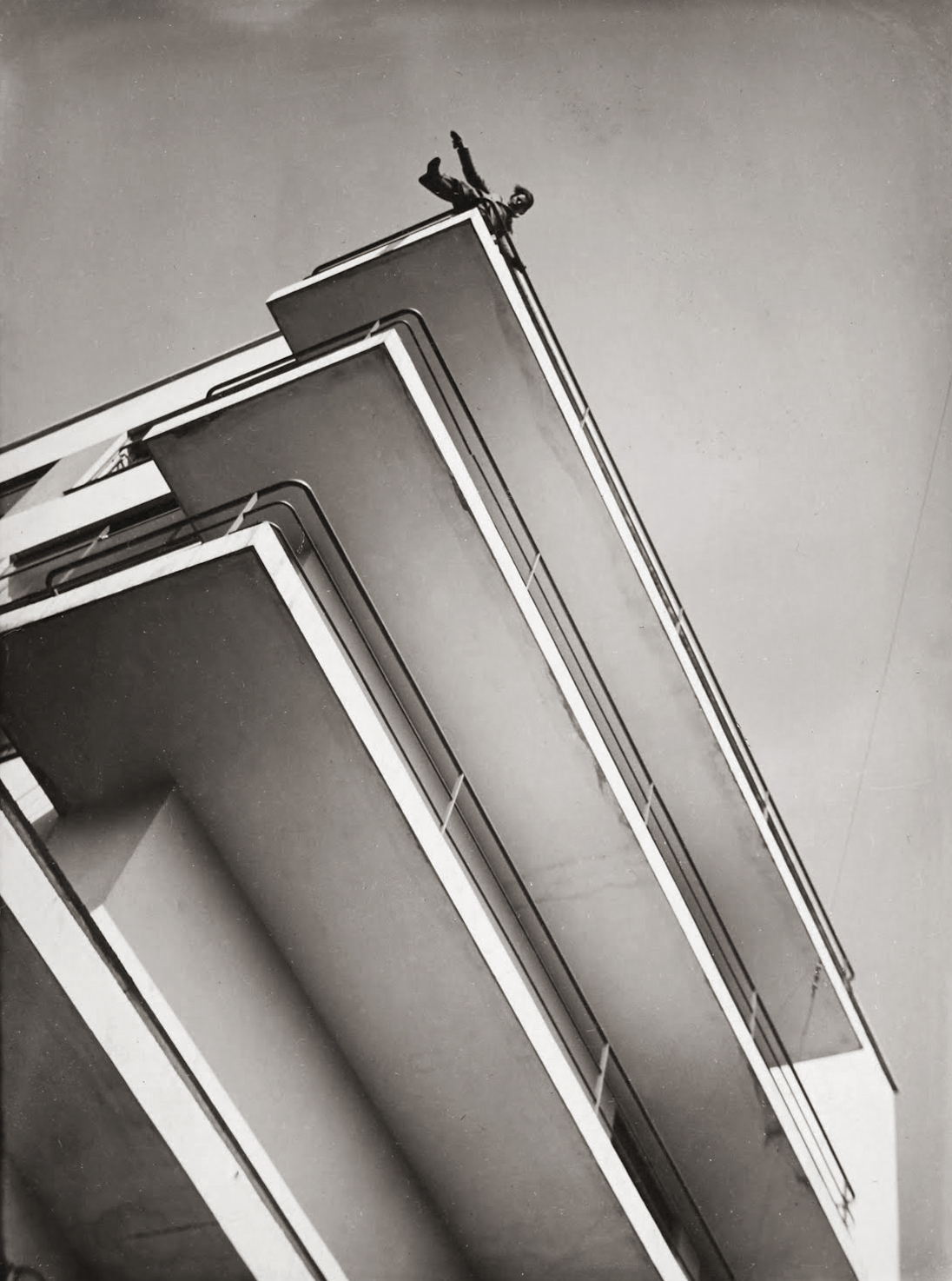
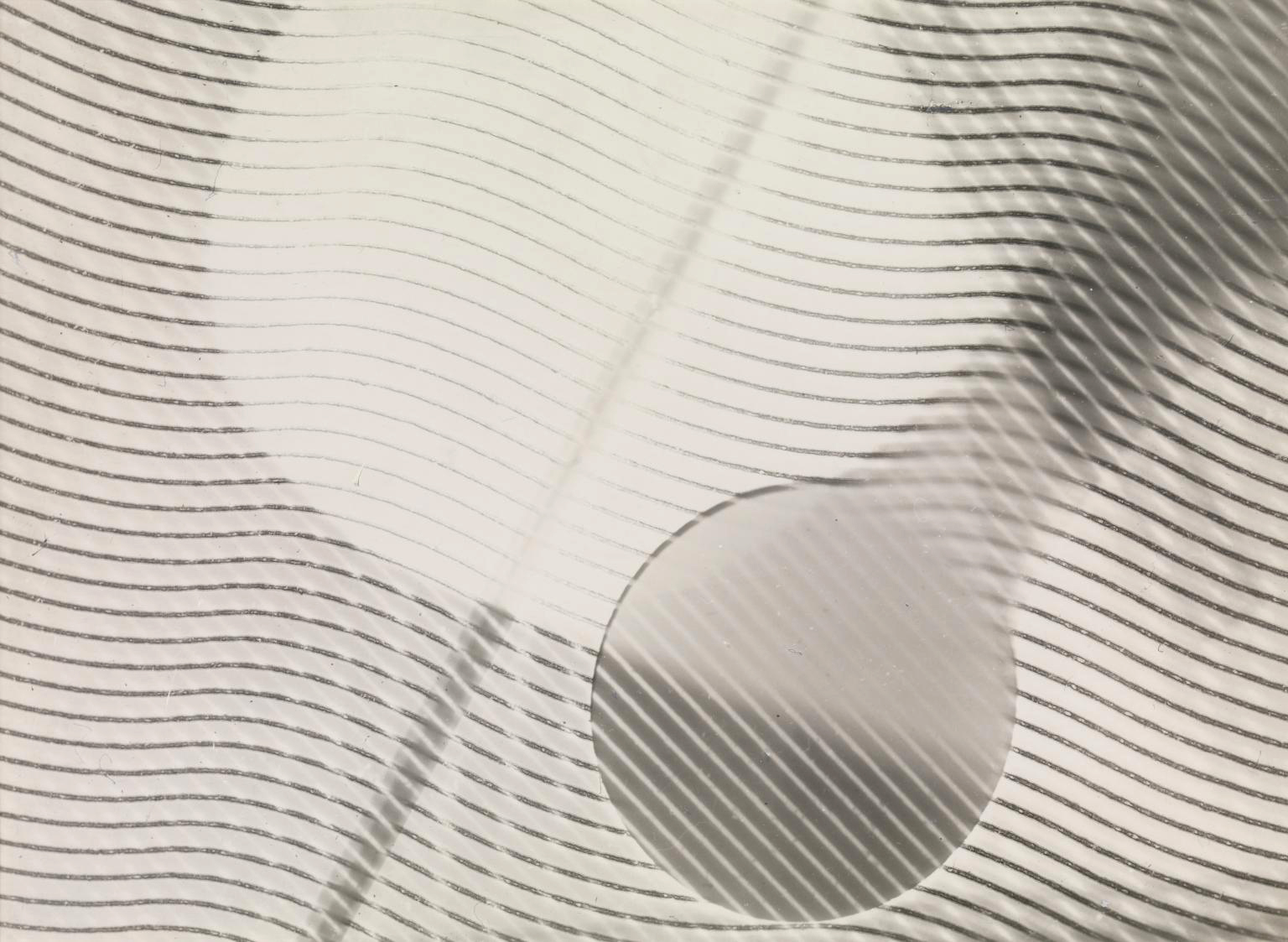
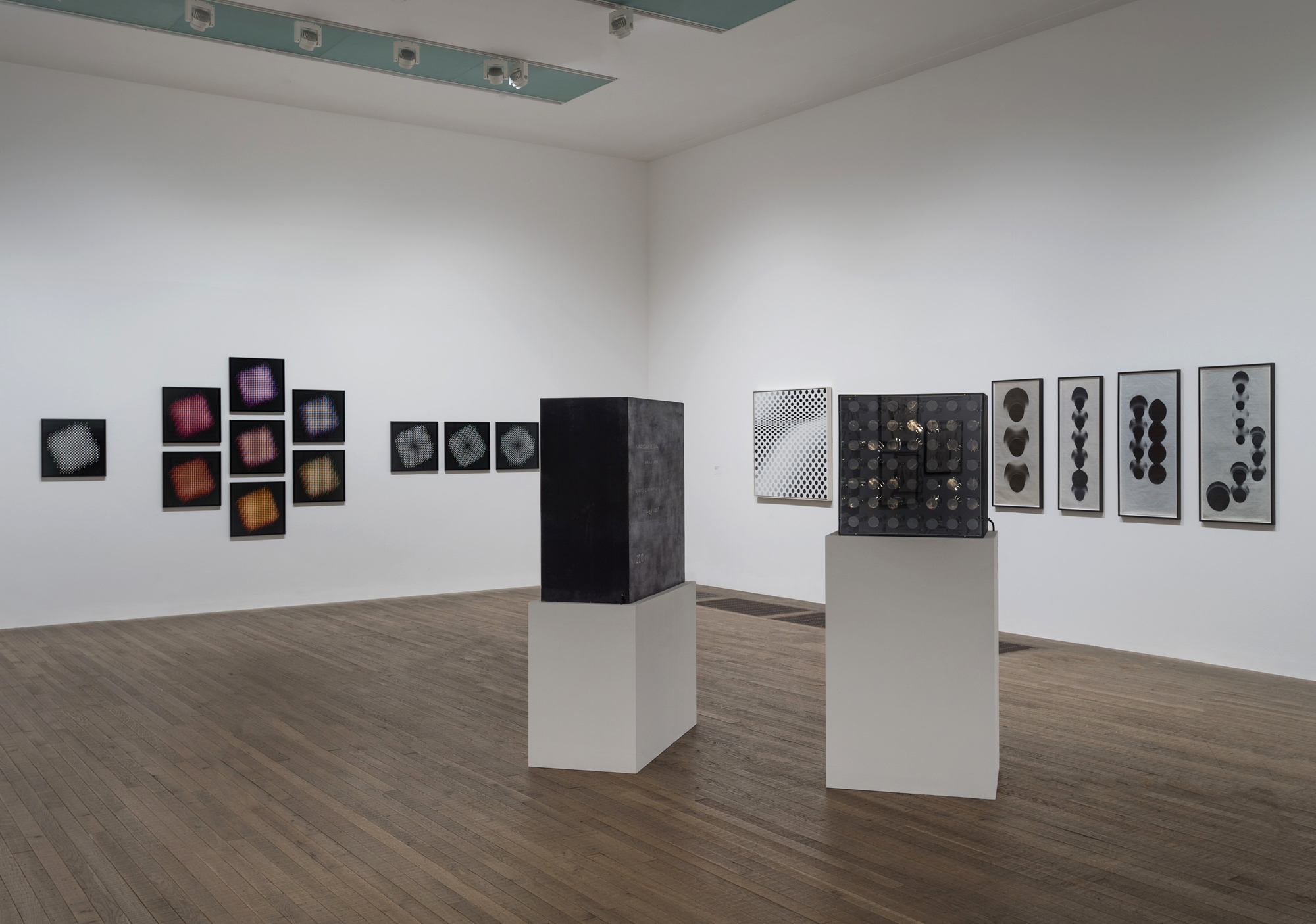
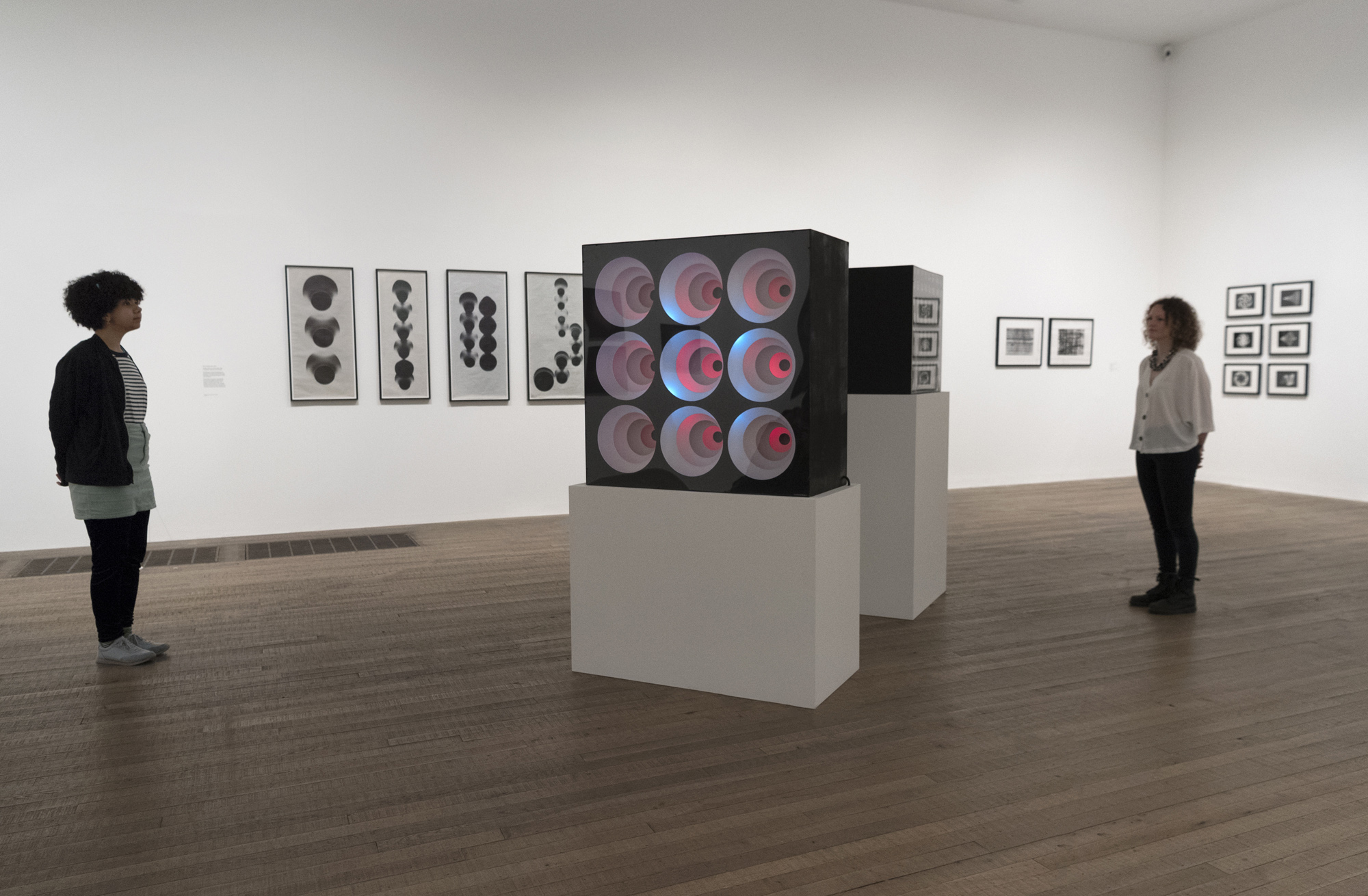
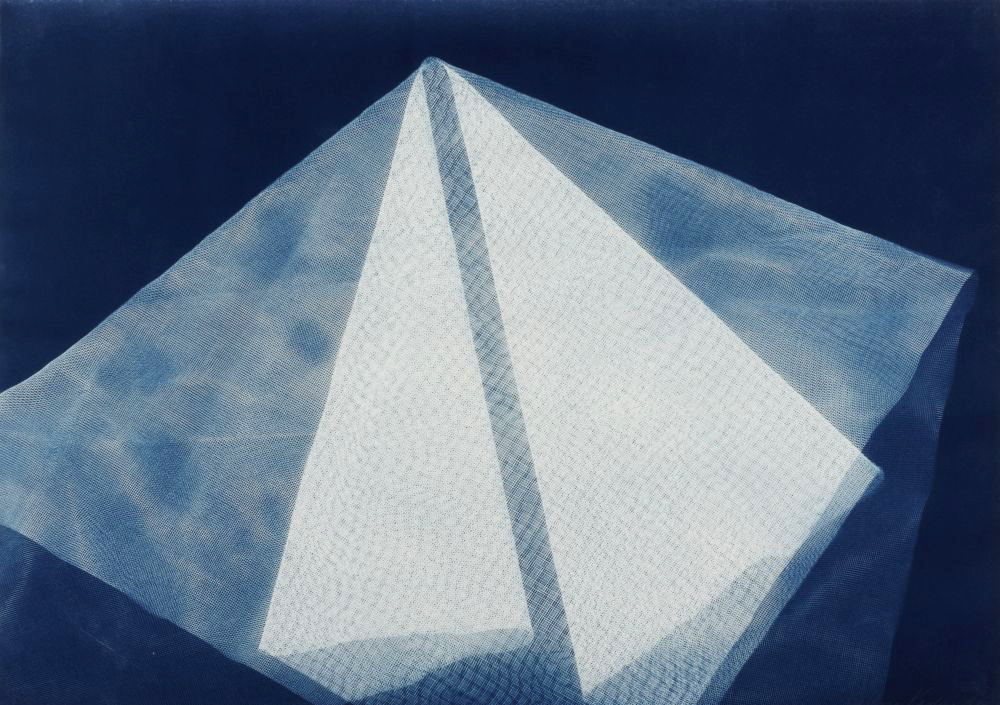
A major new exhibition at Tate Modern will reveal the intertwined stories of photography and abstract art. Shape of Light: 100 Years of Photography and Abstract Art will be the first show of this scale to explore photography in relation to the development of abstraction, from the early experiments of the 1910s to the digital innovations of the 21st century. Featuring over 300 works by more than 100 artists, the exhibition will explore the history of abstract photography side-by-side with iconic paintings and sculptures.
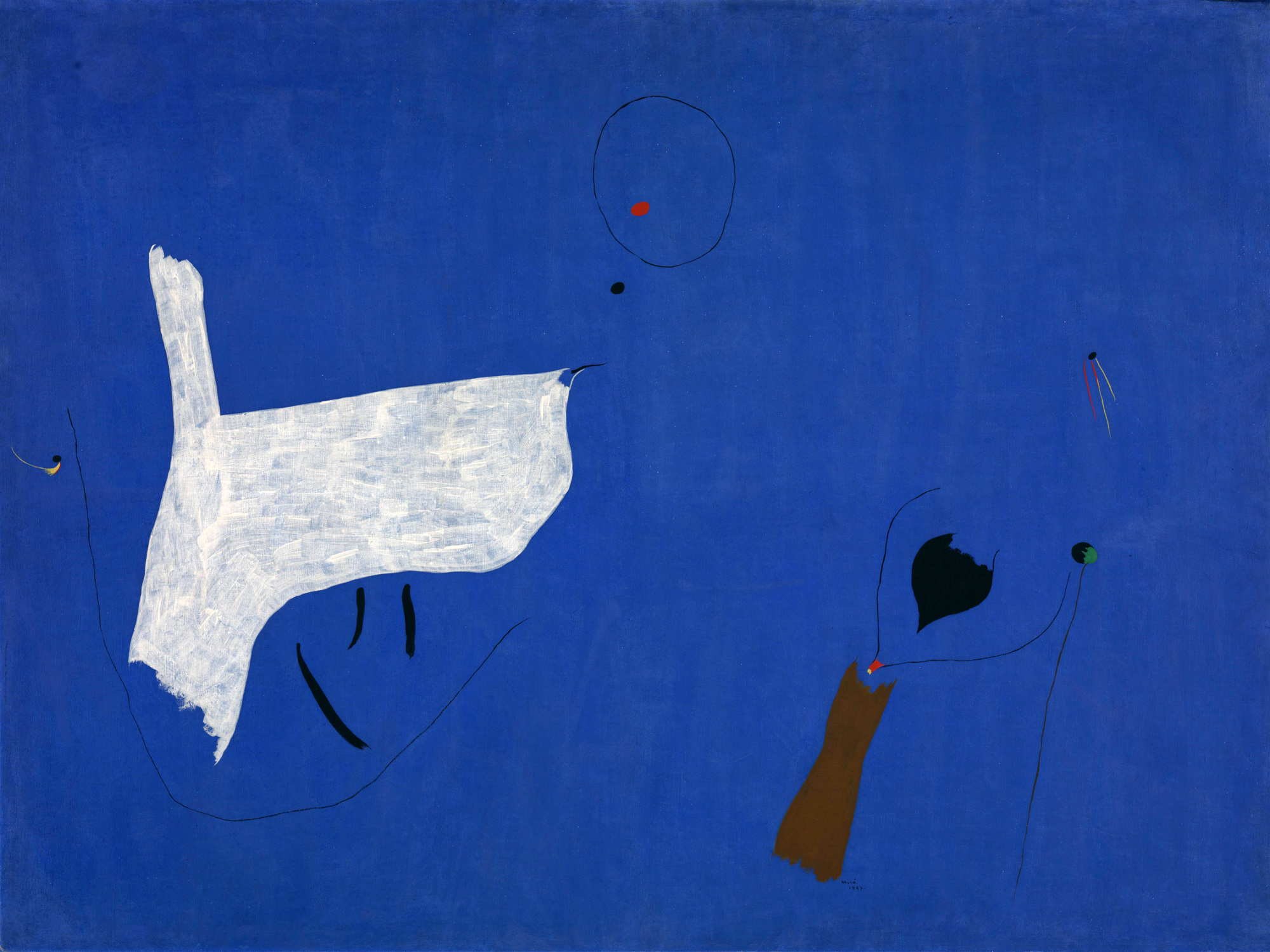
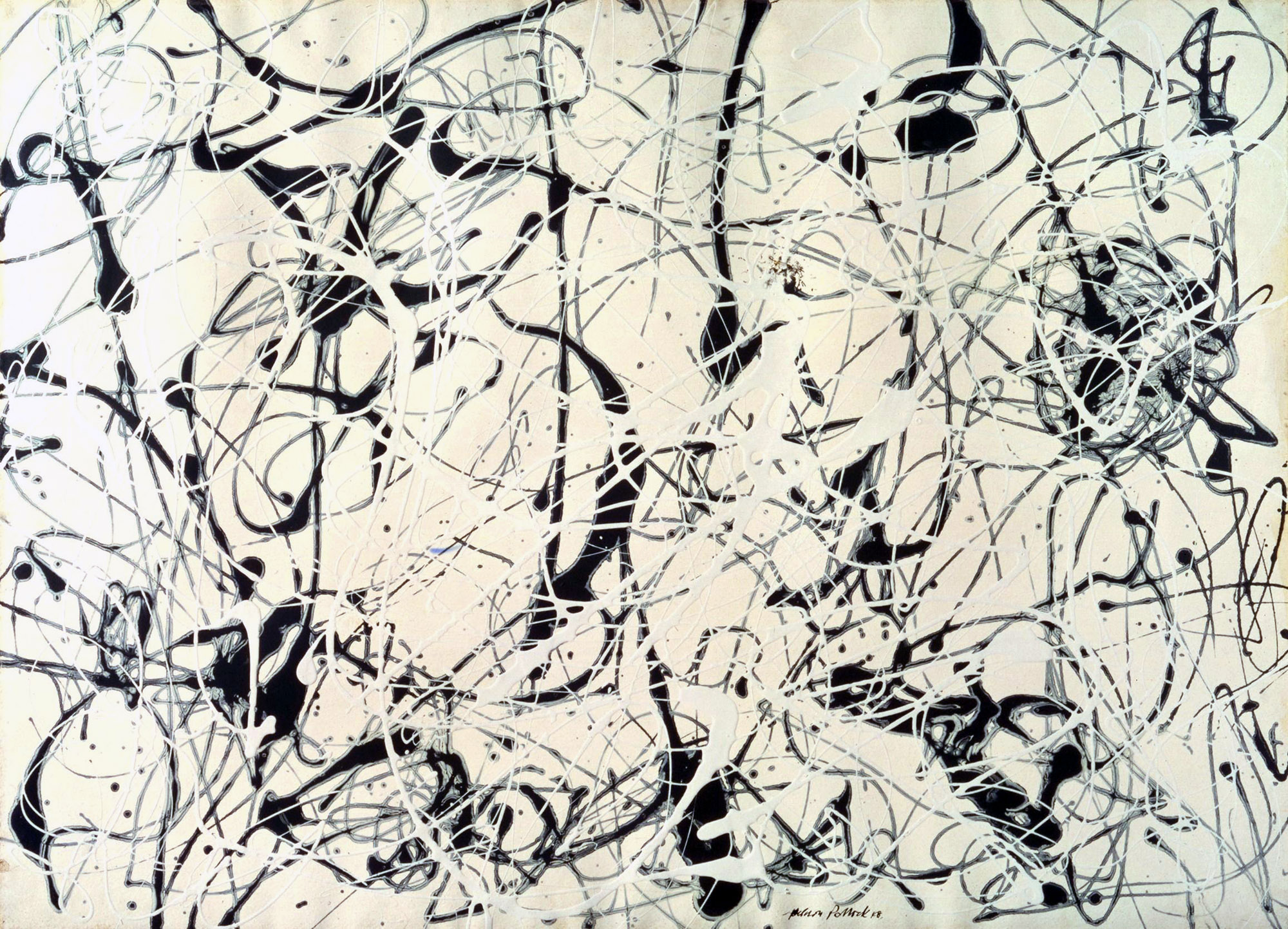
Shape of Light will place moments of radical innovation in photography within the wider context of abstract art, such as Alvin Langdon Coburn’s pioneering ‘vortographs’ from 1917. This relationship between media will be explored through the juxtaposition of works by painters and photographers, such as cubist works by George Braque and Pierre Dubreuil or the abstract expressionism of Jackson Pollock and Otto Steinert’s ‘luminograms’. Abstractions from the human body associated with surrealism will include André Kertesz’s Distorsions, Imogen Cunningham’s Triangles and Bill Brandt’s Baie des Anges, Frances 1958, exhibited together with a major painting by Joan Miró. Elsewhere the focus will be on artists whose practice spans diverse media, such as László Moholy-Nagy and Man Ray.
The exhibition will also acknowledge the impact of MoMA’s landmark photography exhibition of 1960, The Sense of Abstraction. Installation photographs of this pioneering show will be displayed with some of the works originally featured in the exhibition, including important works by Edward Weston, Aaron Siskind and a series by Man Ray that has not been exhibited since the MoMA show, 58 years ago.
The connections between breakthroughs in photography and new techniques in painting will be examined, with rooms devoted to Op Art and Kinetic Art from the 1960s, featuring striking paintings by Bridget Riley and installations of key photographic works from the era by artists including Floris Neussis and Gottfried Jaeger. Rooms will also be dedicated to the minimal and conceptual practices of the 1970s and 80s. The exhibition will culminate in a series of new works by contemporary artists, Tony Cairns, Maya Rochat and Daisuke Yokota, exploring photography and abstraction today.
Shape of Light is curated by Simon Baker, Senior Curator, International Art (Photography) and Shoair Mavlian, Assistant Curator, Tate Modern, with Emmanuelle de l’Ecotais, Curator for Photographs, Musée d’Art Moderne de la Ville de Paris. The exhibition will be accompanied by a fully illustrated catalogue from Tate Publishing and a programme of talks and events in the gallery.
Press release from Tate Modern
Otto Steinert (German, 1915-1978) Composition of Forms 1949 Gelatin silver print on paper 290 x 227mm Jack Kirkland Collection, Nottingham
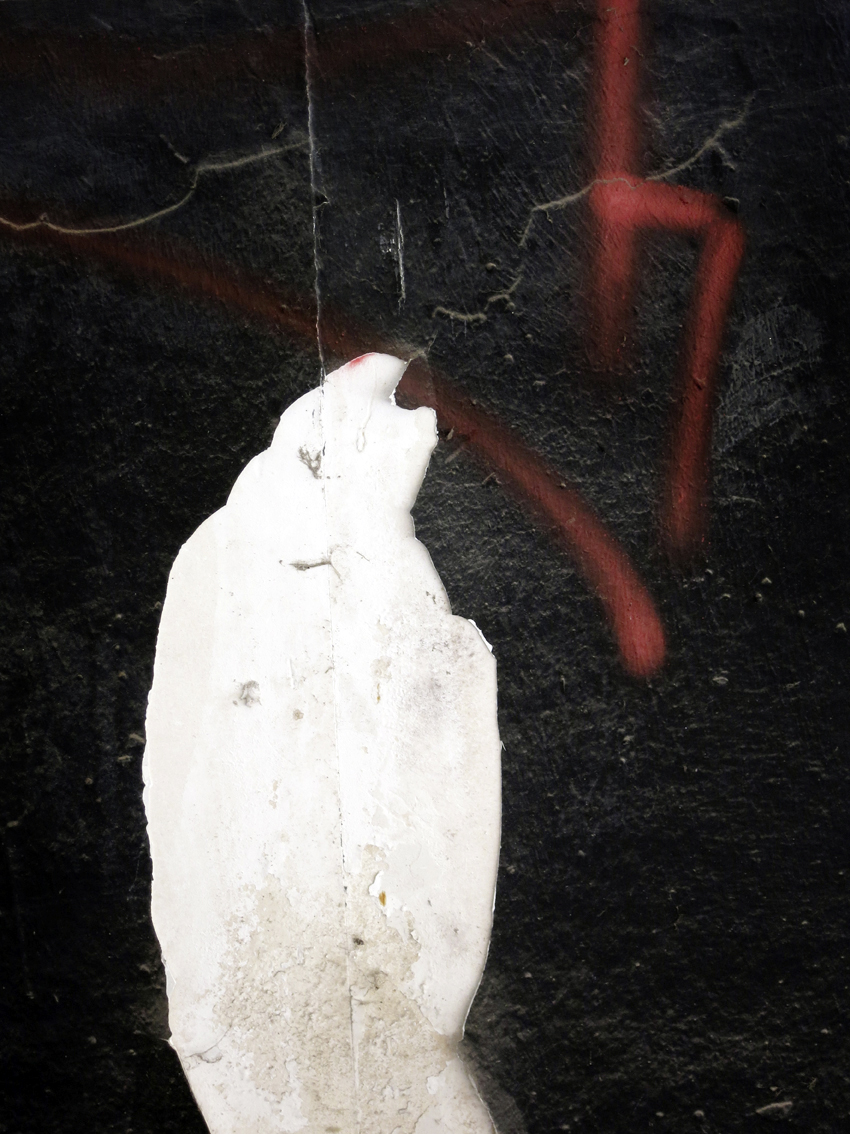
Untitled c.1950s is a black and white photograph by the French photographer Guy Bourdin. The entirety of the frame is taken up by a close-up of peeling paint. The paint sections fragment the image into uneven geometric shapes, which are interrupted by a strip of the dark surface beneath that winds from the top to the bottom of the frame. There is little sense of scale or contextual detail, resulting in a near-abstract composition.
Bourdin is best known for his experimental colour fashion photography produced while working for French Vogue between 1955 and 1977. This photograph belongs to an earlier period of experimentation, before he began to use colour and work in fashion. Taken outside the studio, it shows Bourdin’s sensitivity to the natural world and his attempt to transform the everyday into abstract compositions, bridging the gap between surrealism and subjective photography. Bourdin’s early work was heavily influenced by surrealism, as well as by pioneers of photography as a fine art such as Edward Weston, Paul Strand and Bill Brandt. His surrealist aesthetic can be attributed to his close relationship with Man Ray, who wrote the foreword to the catalogue for Bourdin’s first solo exhibition of black and white photographs at Galerie 29, Paris, in 1952.
This and other early works in Tate’s collection (such as Untitled (Sotteville, Normandy) c. 1950s, Tate P81205, and Solange 1957, Tate P81216) are typical of Subjektive Fotografie (‘subjective photography’), a tendency in the medium in the late 1940s and early 1950s. Led by the German photographer and teacher Otto Steinert, who organised three exhibitions under the title Subjektive Fotografie in 1951, 1954 and 1958, the movement advocated artistic self-expression – in the form of the artist’s creative approach to composition, processing and developing – above factual representation. Subjektive Fotografie’s emphasis on, and encouragement of, individual perspectives invited both the photographer and the viewer to interpret and reflect on the world through images. Bourdin’s interest in this can be seen in his early use of texture and abstraction, evident in close-up studies of cracked paint peeling off an external wall or a piece of torn fabric. These still lives were often dark in subject matter and tone, highlighting Bourdin’s interest in surrealist compositions and the intersection between death and sexuality. The works made use of the photographer’s urban environment, with deep black and high contrast printing techniques employed to create a sombre mood.
This approach was also important for Bourdin’s early portraiture, which anticipated his subsequent work in fashion. The subject of his portraits – often Solange Gèze, to whom the artist was married from 1961 until her death in 1971 – is usually framed subtly, rarely appearing in the centre or as the main focus of the image. In these works the figure is secondary, showing how Bourdin let the natural or urban environment frame the subject and integrate the body into its immediate surroundings. Bourdin was meticulous about the creative process from start to finish, sketching out images on paper and then recreating them in the landscape, using the natural environment as a stage set for his work.
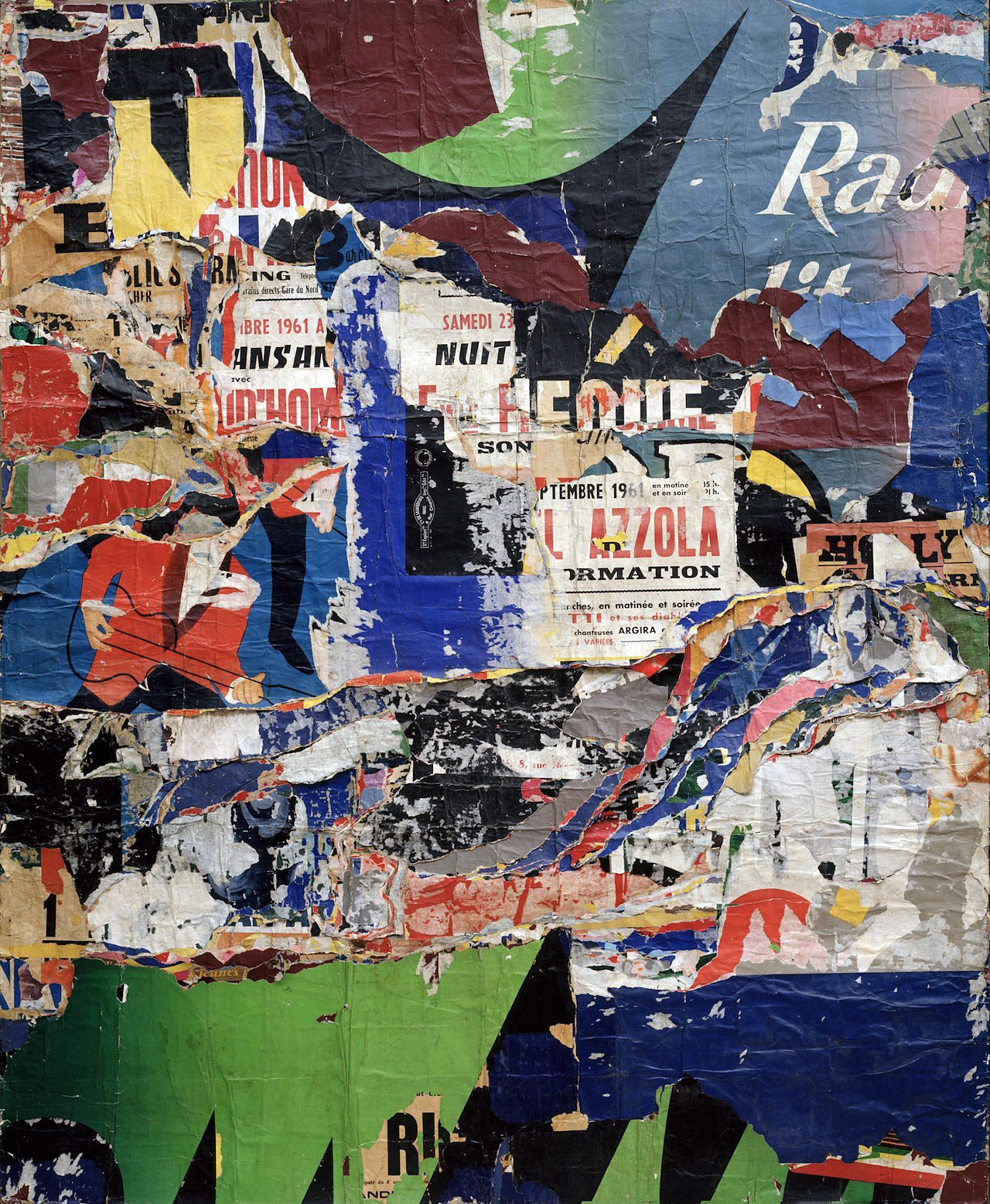
The Jazzmen is a section of what Jacques Villeglé termed affiches lacérées, posters torn down from the walls of Paris. These particular ones were taken on 10 December 1961. Following his established practice, Villeglé removed the section from a billboard and, having mounted it on canvas, presented it as a work of art. In ‘Des Réalités collectives’ of 1958 (‘Collective Realities’, reprinted in 1960: Les Nouveaux Réalistes, pp. 259-60) he acknowledged that he occasionally tore the surface of the posters himself, although he subsequently restricted interventions to repairs during the mounting process. The large blue and green advertisements for Radinola (at the top right and lower left) provide the main visible surface for The Jazzmen. These establish a compositional unity for the accumulated layers. Overlaid are fragmentary music posters and fly-posters, some dated to September 1961, including the images of the red guitarists that lend the work its title. The artist’s records give the source as rue de Tolbiac, a thoroughfare in the 13th arrondissement in south-east Paris. Villeglé usually uses the street as his title, but has suggested (interview with the author, February 2000) that the title The Jazzmen may have been invented for the work’s inclusion in the exhibition L’Art du jazz (Musée Galliera, Paris 1967).
Villeglé worked together with Raymond Hains (b. 1926) in presenting torn posters as works of art. They collaborated on such works as Ach Alma Manetro, 1949 (Musée nationale d’art moderne, Centre Georges Pompidou, Paris), in which typography dominates the composition. They first showed their affiches lacérées in May 1957 at the Galerie Colette Allendy, Paris, in a joint exhibition named Loi du 29 juillet 1881 ou le lyrisme à la sauvette (The Law of 29 July 1881 or Lyricism through Salvage) in reference to the law forbidding fly-posting. Villeglé sees a social complexity in the developments in the style, typography and subject of the source posters. He also considers the processes of the overlaying and the pealing of the posters by passers-by to be a manifestation of a liberated art of the street. Both aspects are implicitly political. As Villeglé points out, anonymity differentiates the torn posters from the collages of the Cubists or of the German artist Kurt Schwitters. In ‘Des Réalités collectives’ Villeglé wrote: ‘To collages, which originate in the interplay of many possible attitudes, the affiches lacérées, as a spontaneous manifestation, oppose their immediate vivacity’. He saw the results as extending the conceptual basis of Marcel Duchamp’s readymades, whereby an object selected by an artist is declared as art. However, this reduction of the artist’s traditional role brought an end to Villeglé’s collaboration with Hains, who held more orthodox views of creative invention.
In 1960 Villeglé, Hains and François Dufrêne (1930-1982), who also used torn posters, joined the Nouveaux Réalistes group gathered by the critic Pierre Restany (b.1930). Distinguished by the use of very disparate materials and techniques, the Nouveaux Réalistes – who also included Arman (b.1928), Yves Klein (1928-1962) and Jean Tinguely (1925-1991) – were united by what Villeglé has called their ‘distance from the act of painting’ as characterised by the dominant abstraction of the period (interview February 2000). In this way, Klein’s monochrome paintings (see Tate T01513) and Villeglé’s affiches lacérées (lacerated posters) conform to the group’s joint declaration of 27 October 1960: ‘The Nouveaux Réalistes have become aware of their collective singularity. Nouveau Réalisme = new perceptual approaches to reality.’ The Jazzmen, of the following year, embodies Villeglé’s understanding of his ‘singularity’ as a conduit for anonymous public expression.
Process is at the core of Yokota’s photographs. For his black-and-white work, such as the series Linger or Site/Cloud, Yokota sifts through an archive of more than 10 years of photographs in his Tokyo apartment. When he finds something that speaks to him – a nude figure, a chair, a building, a grove of trees – he makes a digital image of it, develops it, and rephotographs the image up to 15 times, until it becomes increasingly degraded. He develops the film in ways that are intentionally “incorrect,” allowing light to leak in, or singeing the negatives, using boiling water, or acetic acid. The purported subject fades, and shadows, textures, spots and other sorts of visual noise emerge. For his recent colour work, trippy, sensual abstractions, the process is similar, except that it is cameraless; he doesn’t start with a preexisting image. “I wanted to focus on the emulsion, on the different textures, more than on a subject being photographed,” says Yokota.
IN THE STUDIO Daisuke Yokota By Jean Dykstra
November – December 2015. No longer available online
Curator: Jeff L. Rosenheim, Joyce Frank Menschel Curator in Charge of the Department of Photographs at The Met
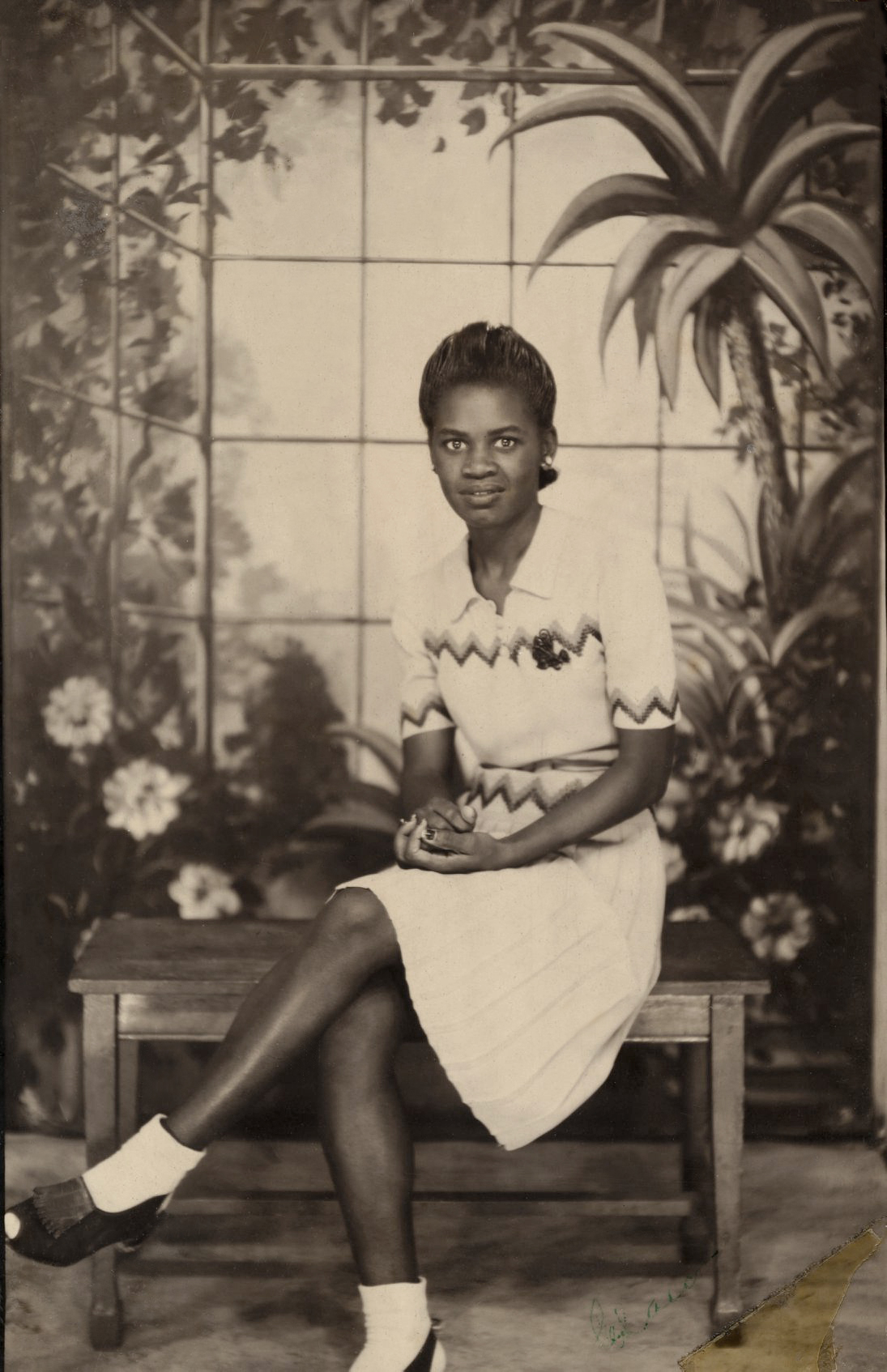
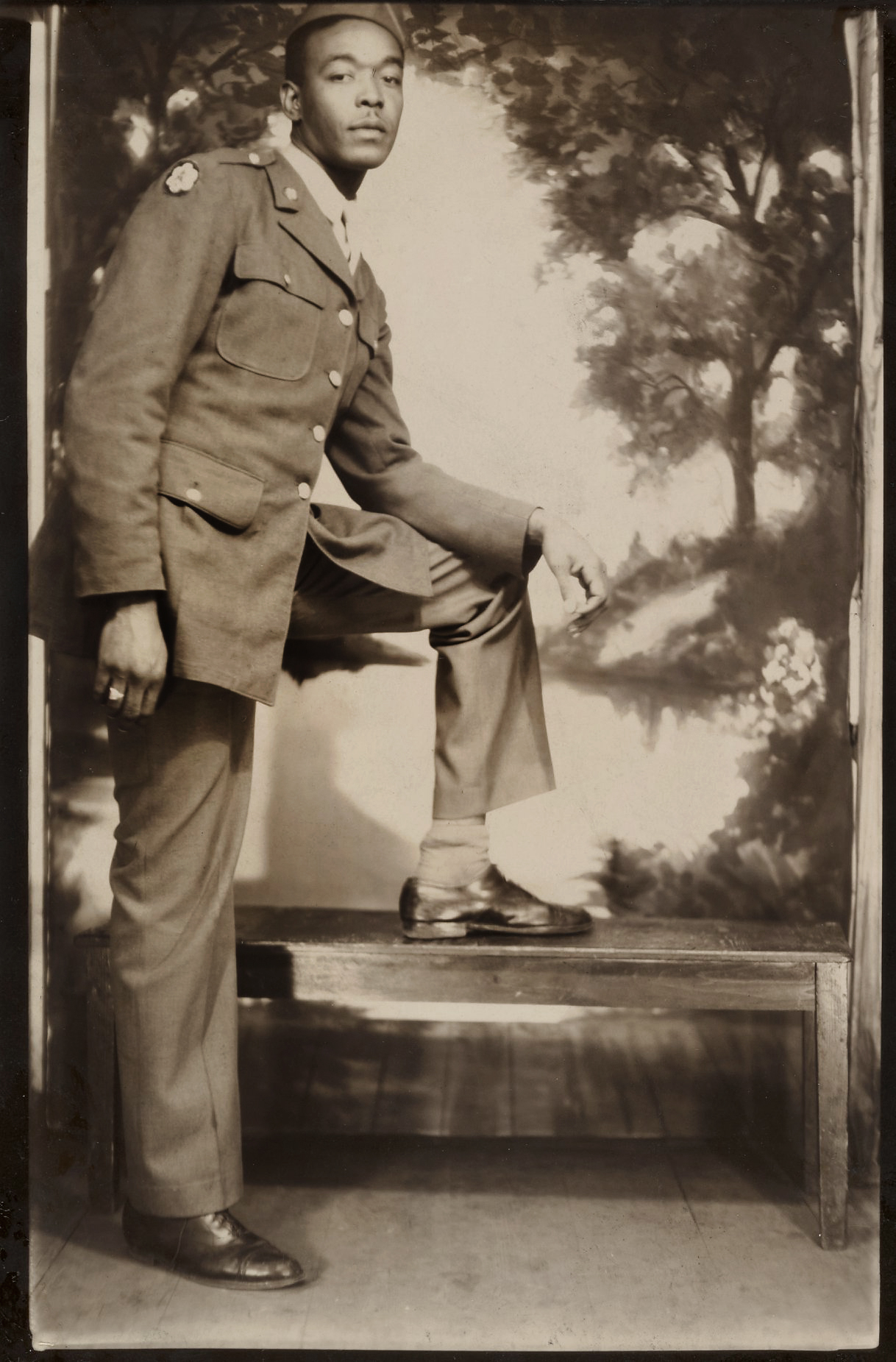
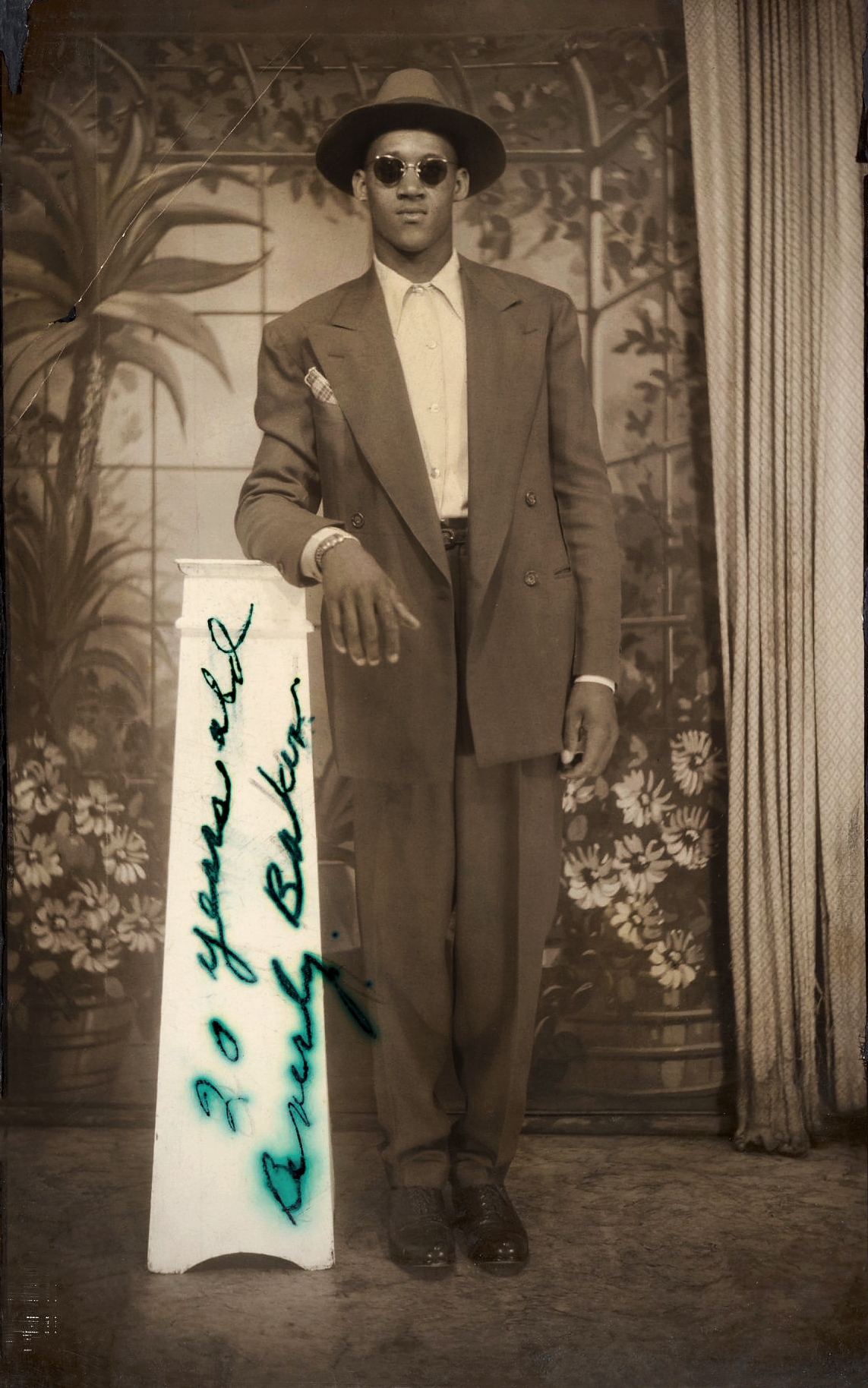
Unknown American photographer Studio Portrait 1940s-1950s Gelatin silver print The Metropolitan Museum of Art, New York, Twentieth-Century Photography Fund, 2015, 2017 Image courtesy The Metropolitan Museum of Art
“To the eye and spirit, pictures are just what poetry and music are to the ear and heart.”
“With the clear perception of things as they are, must stand the faithful rendering of things as they seem. The dead fact is nothing without the living expression.”
Frederick Douglass. “Pictures and Progress”
“True art, when it happens to us, challenges the ‘I’ that we are.”
Jeanette Winterson. “Art Objects,” in Art Objects: Essays on Ecstasy and Effrontery, 1996
Without worry … here ‘I am’
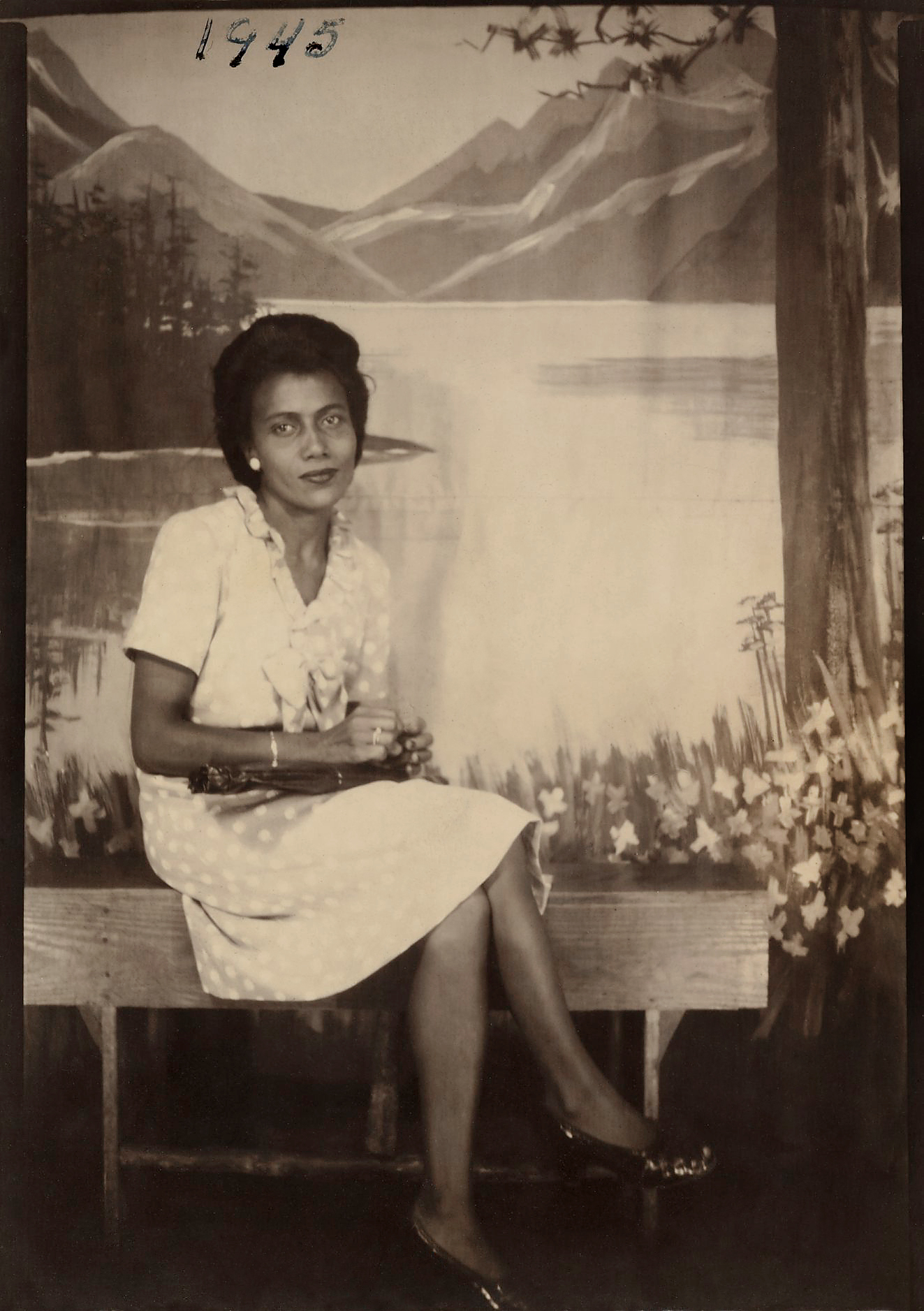
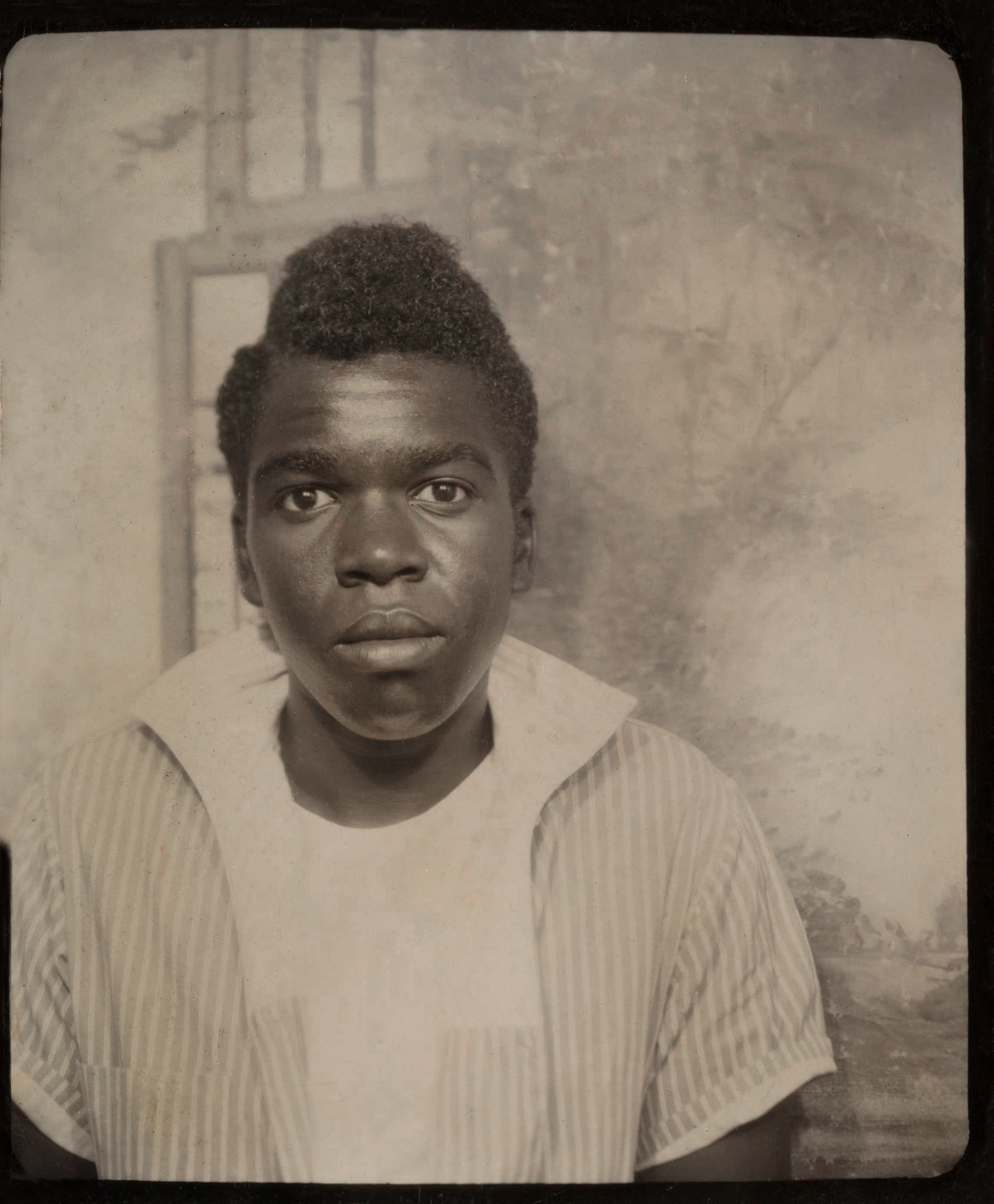
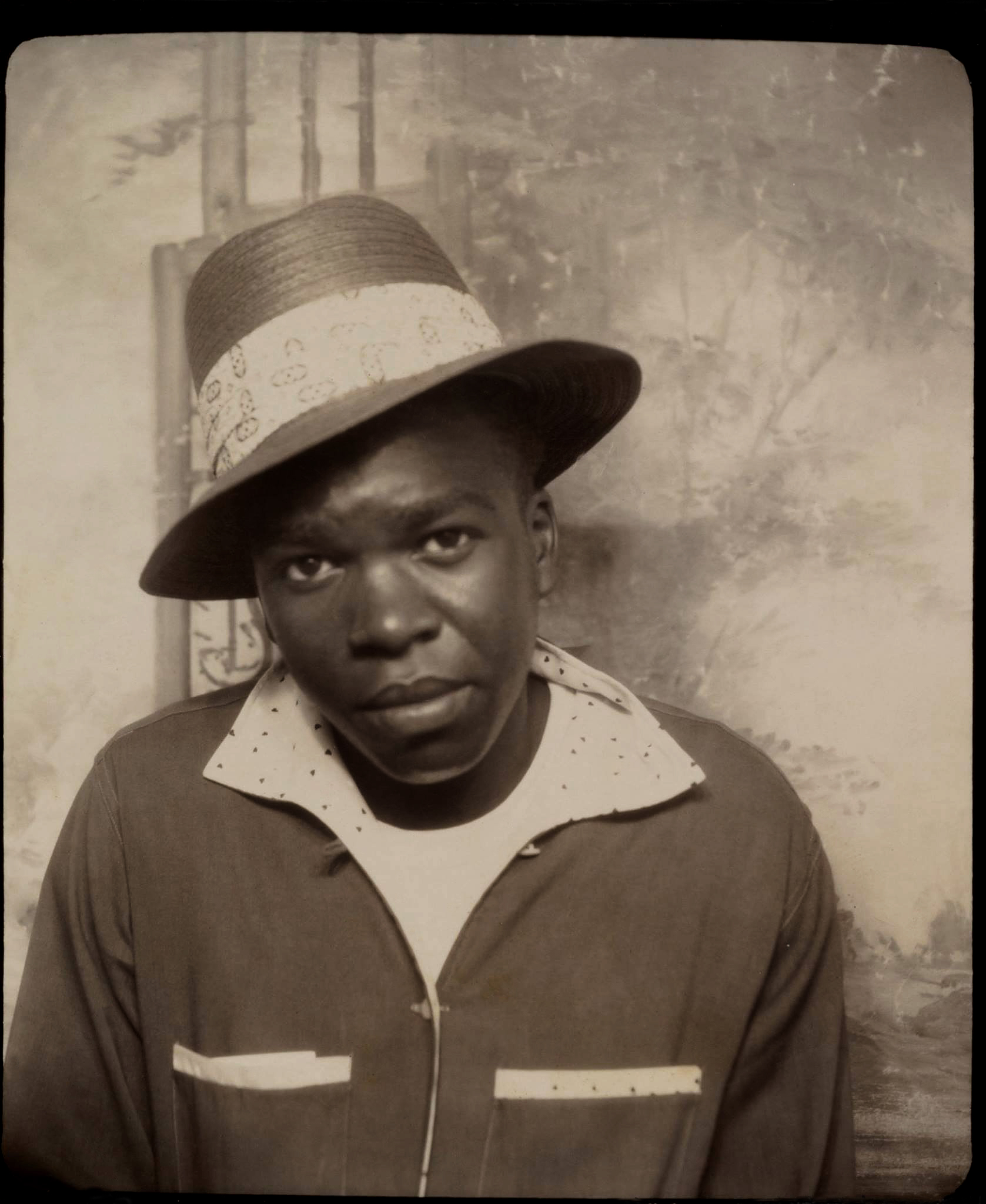
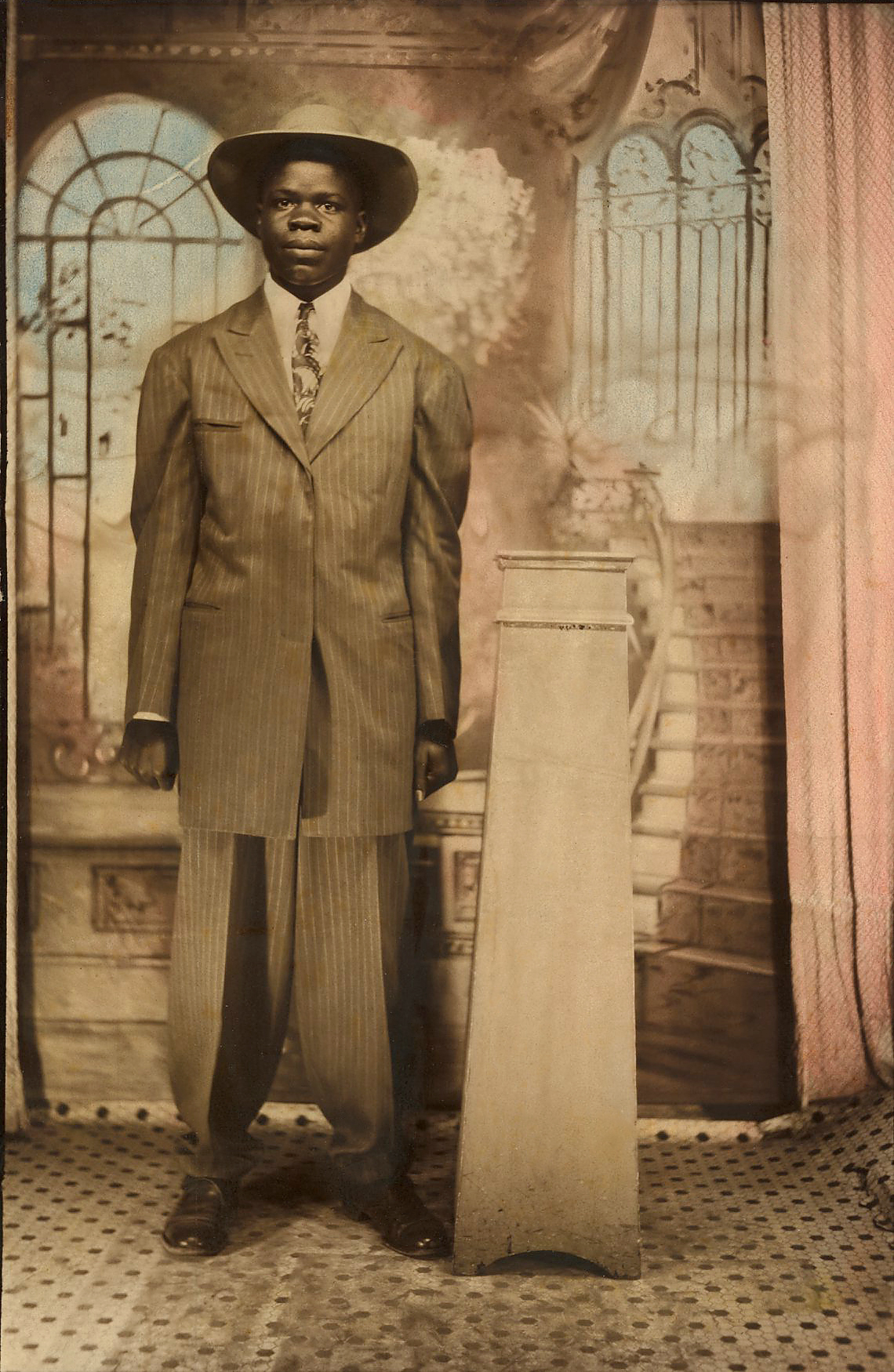
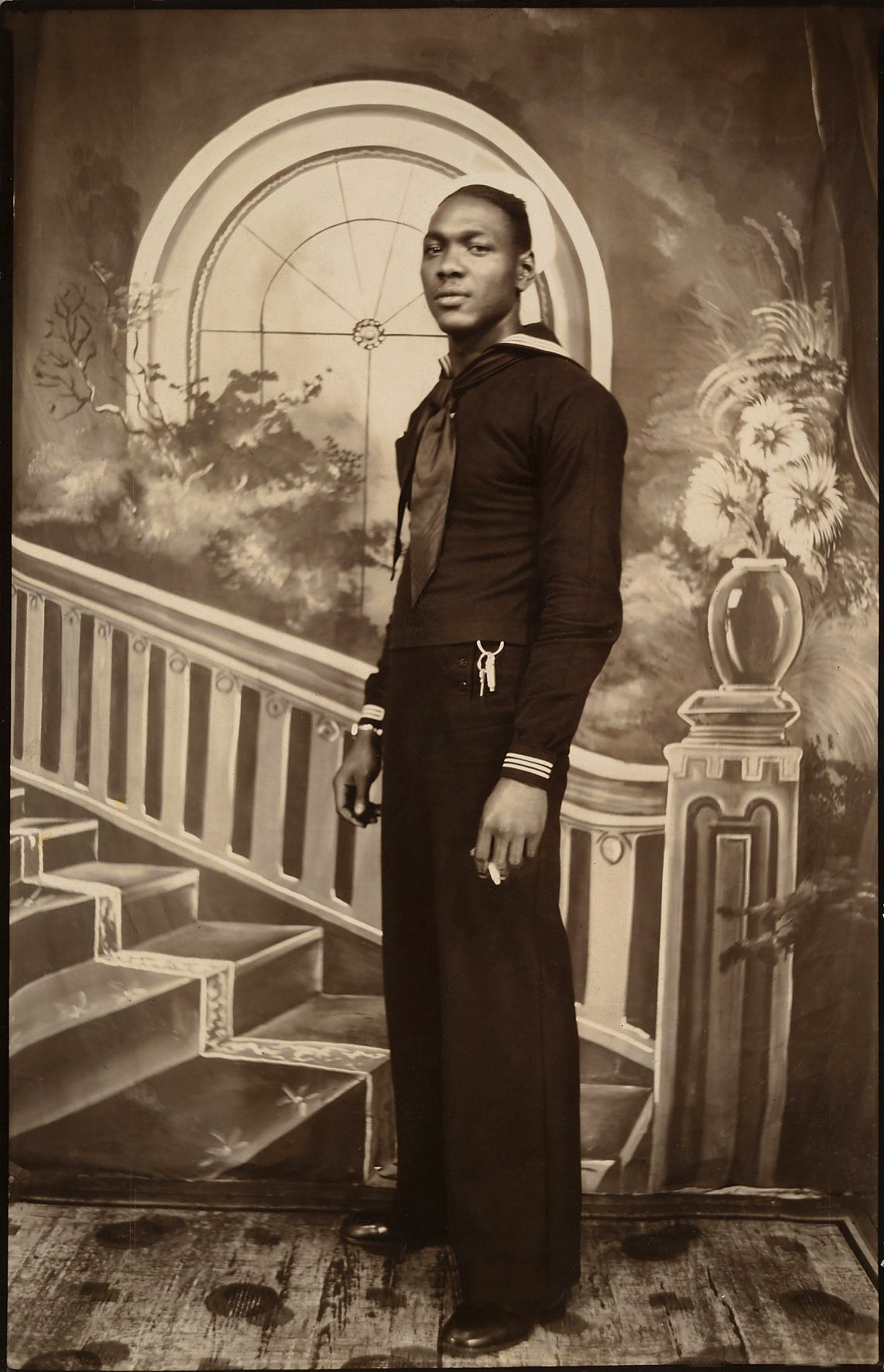
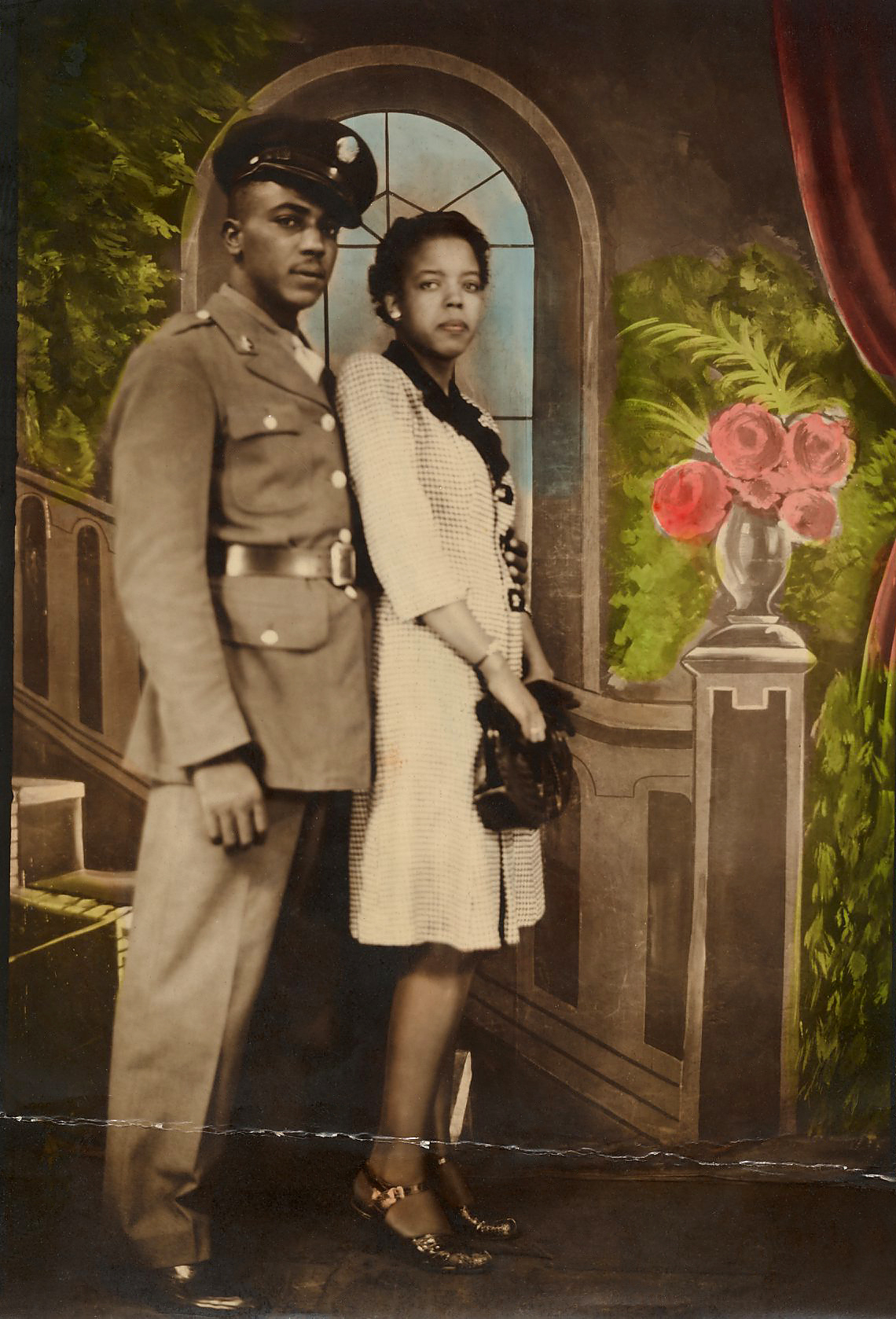
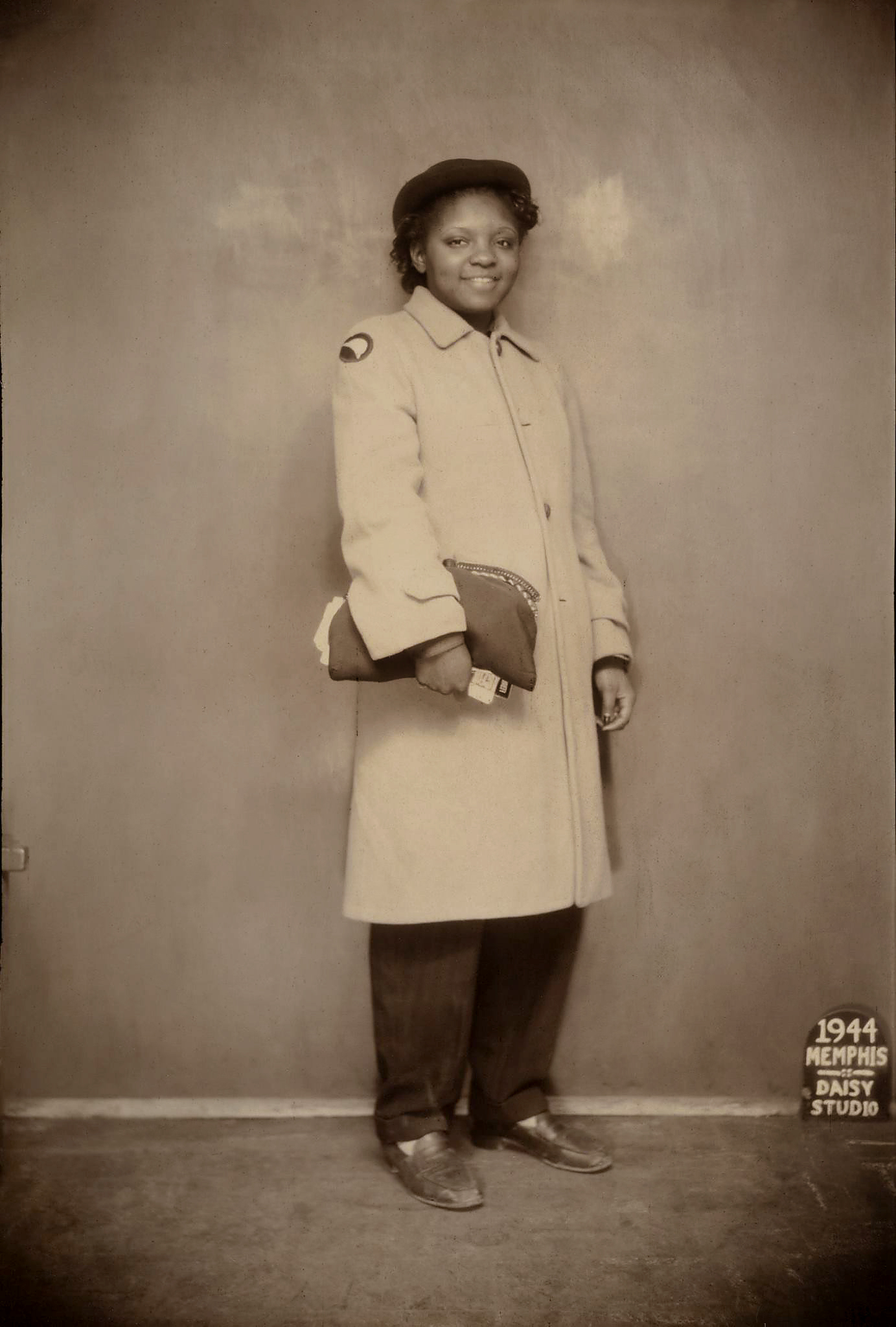
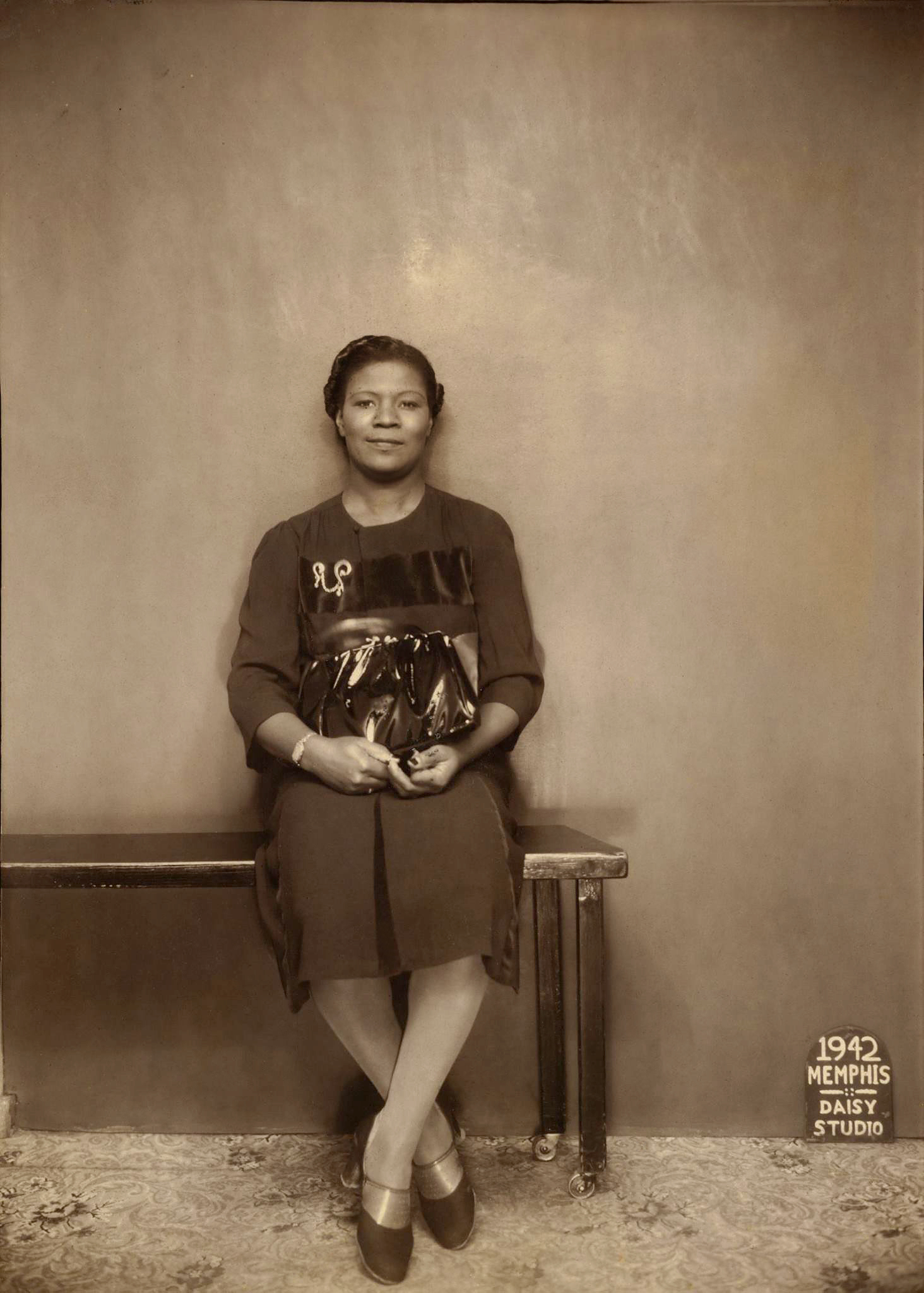
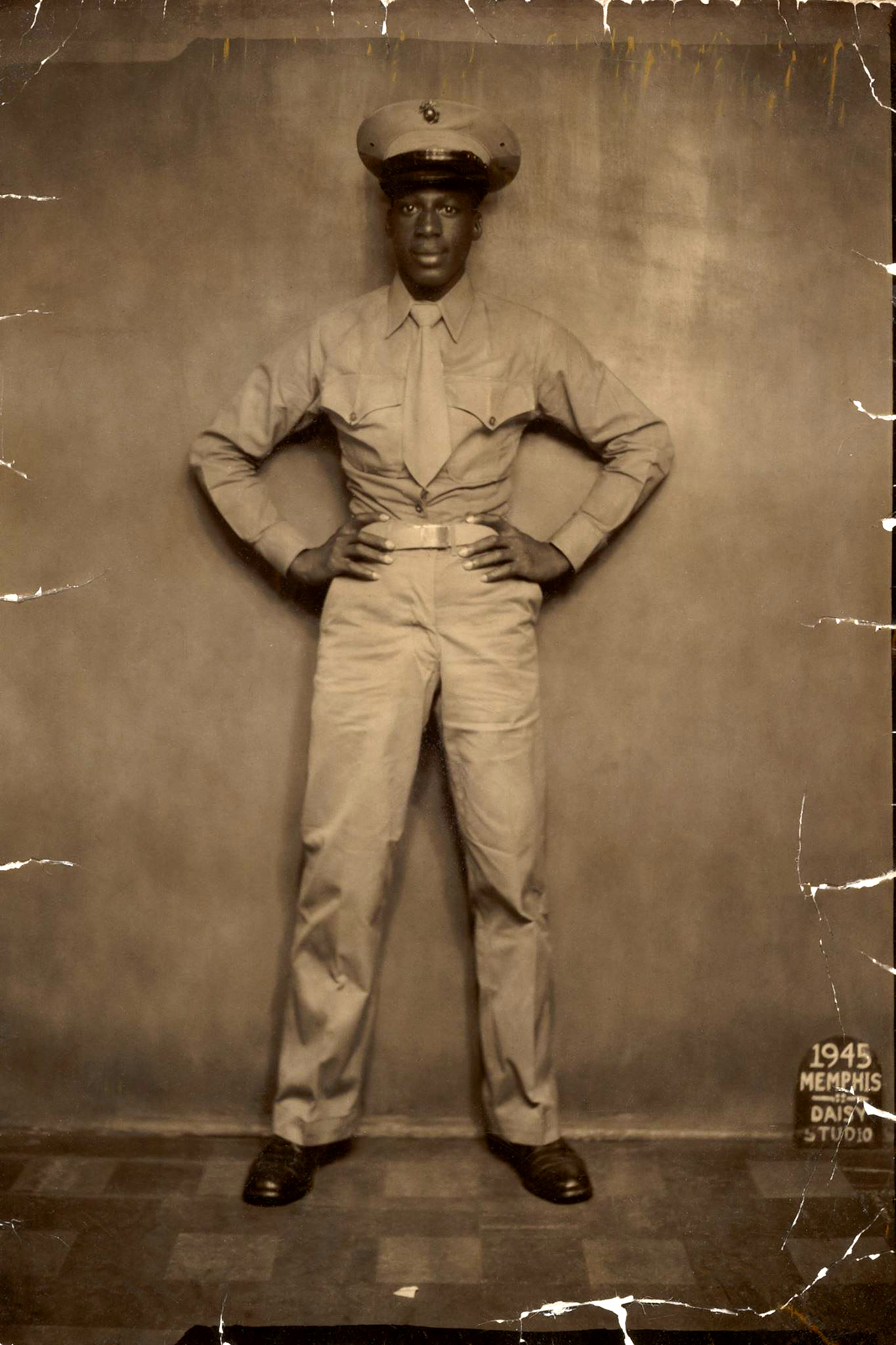
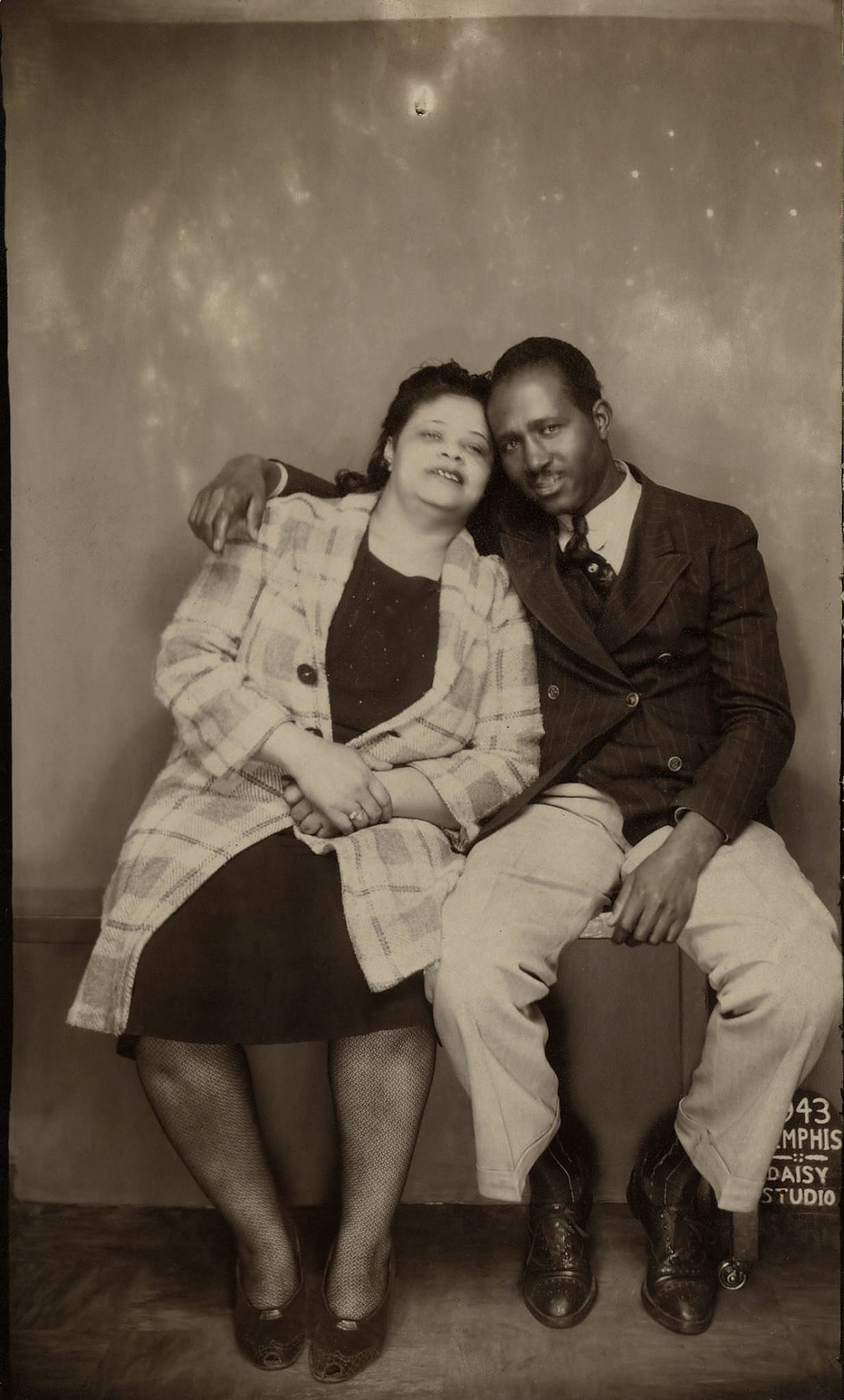
Part 2 of this glorious posting: mainly 1940s, African American “studio” portrait photography. Lets see what we can garner about these “studio” spaces by looking at the photographs. View Part 1 of the posting.
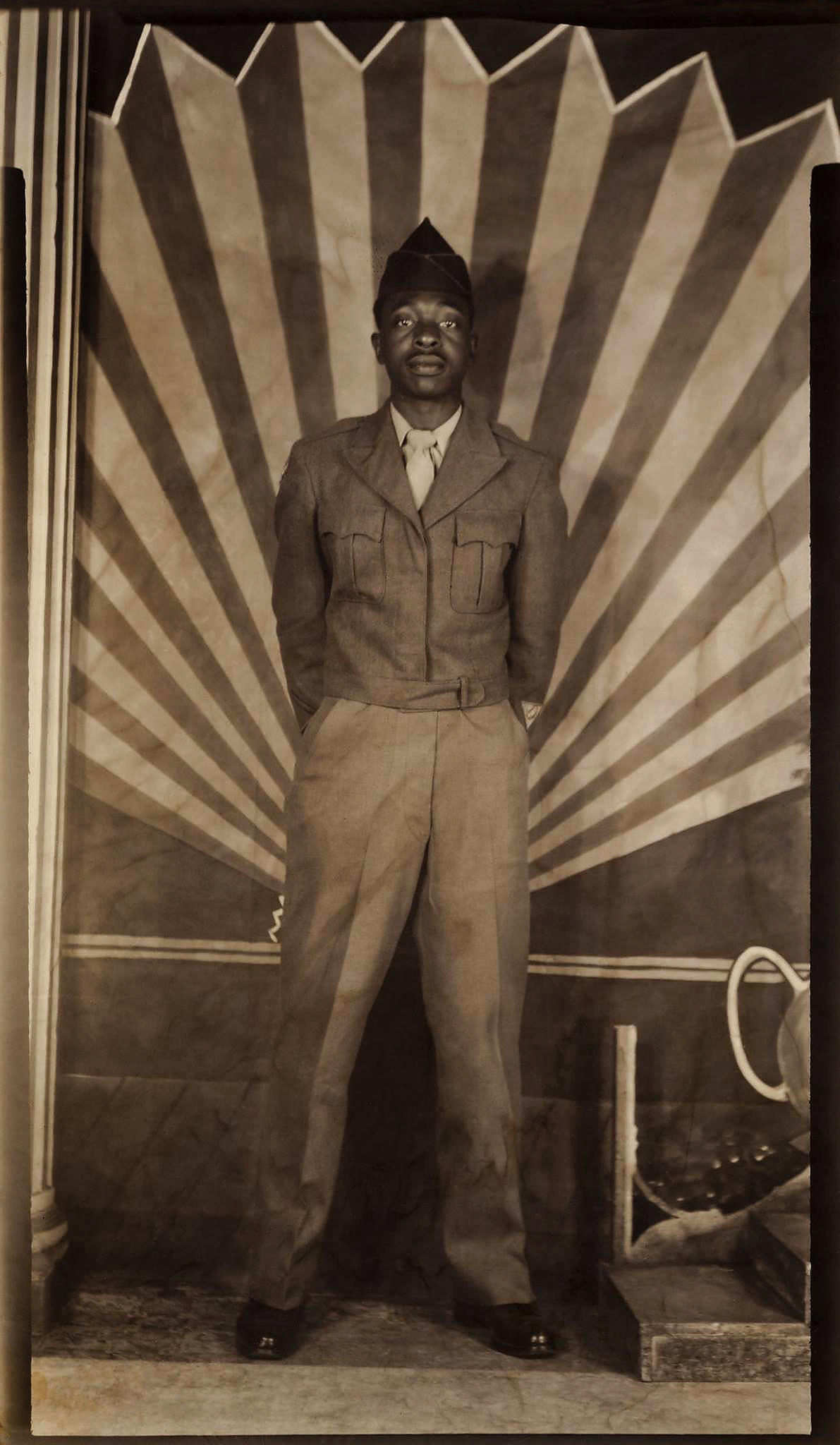
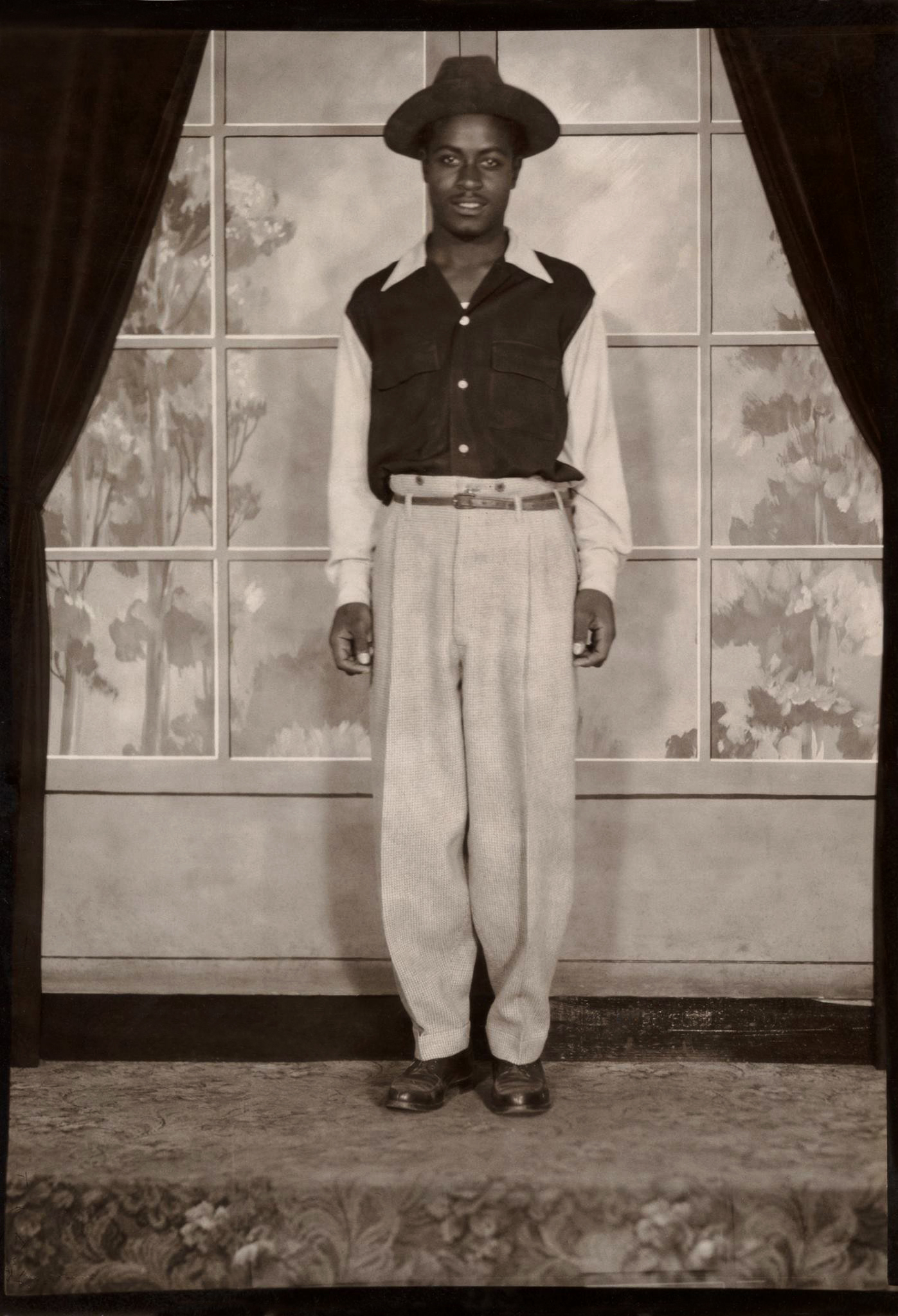
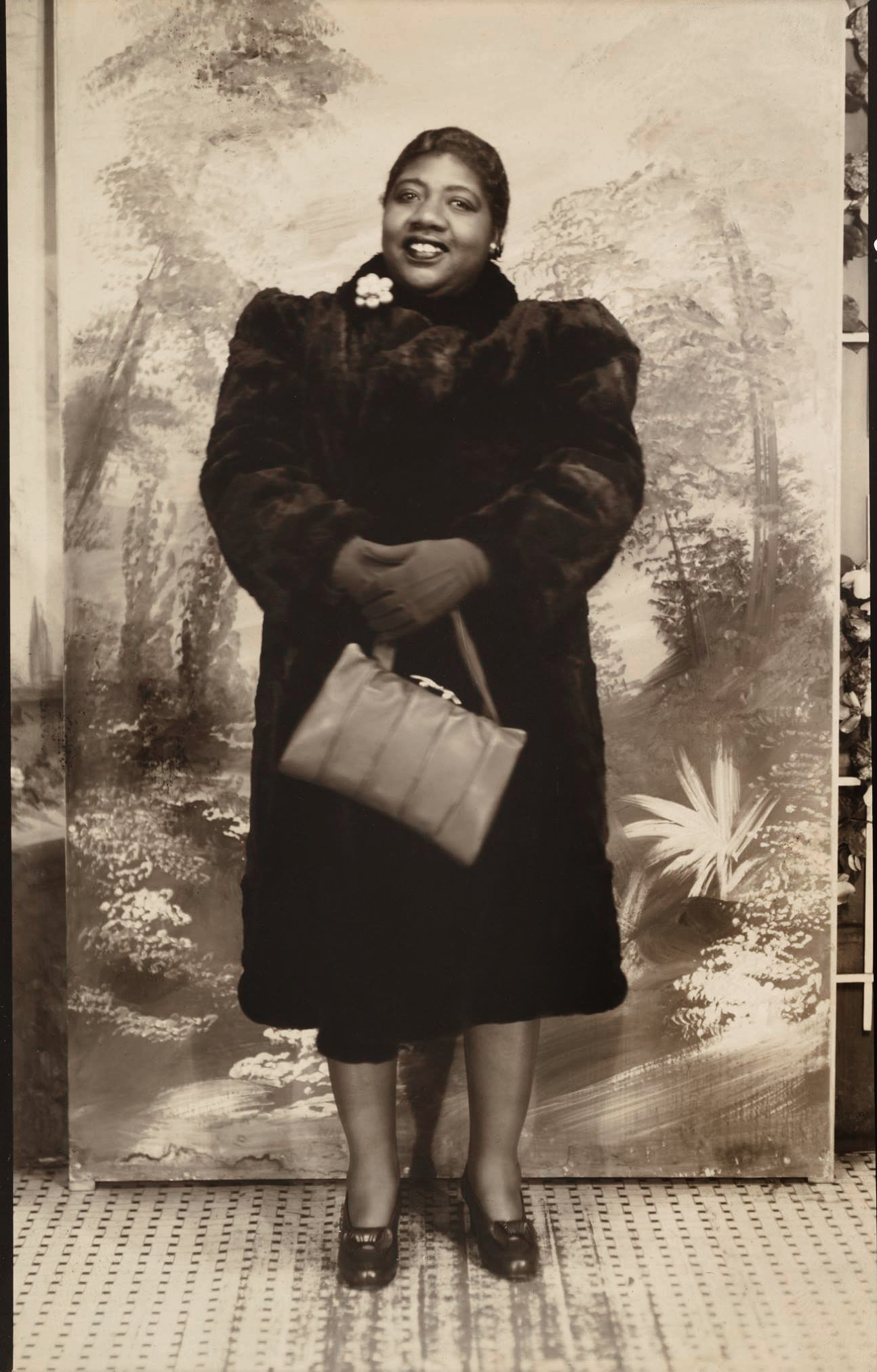
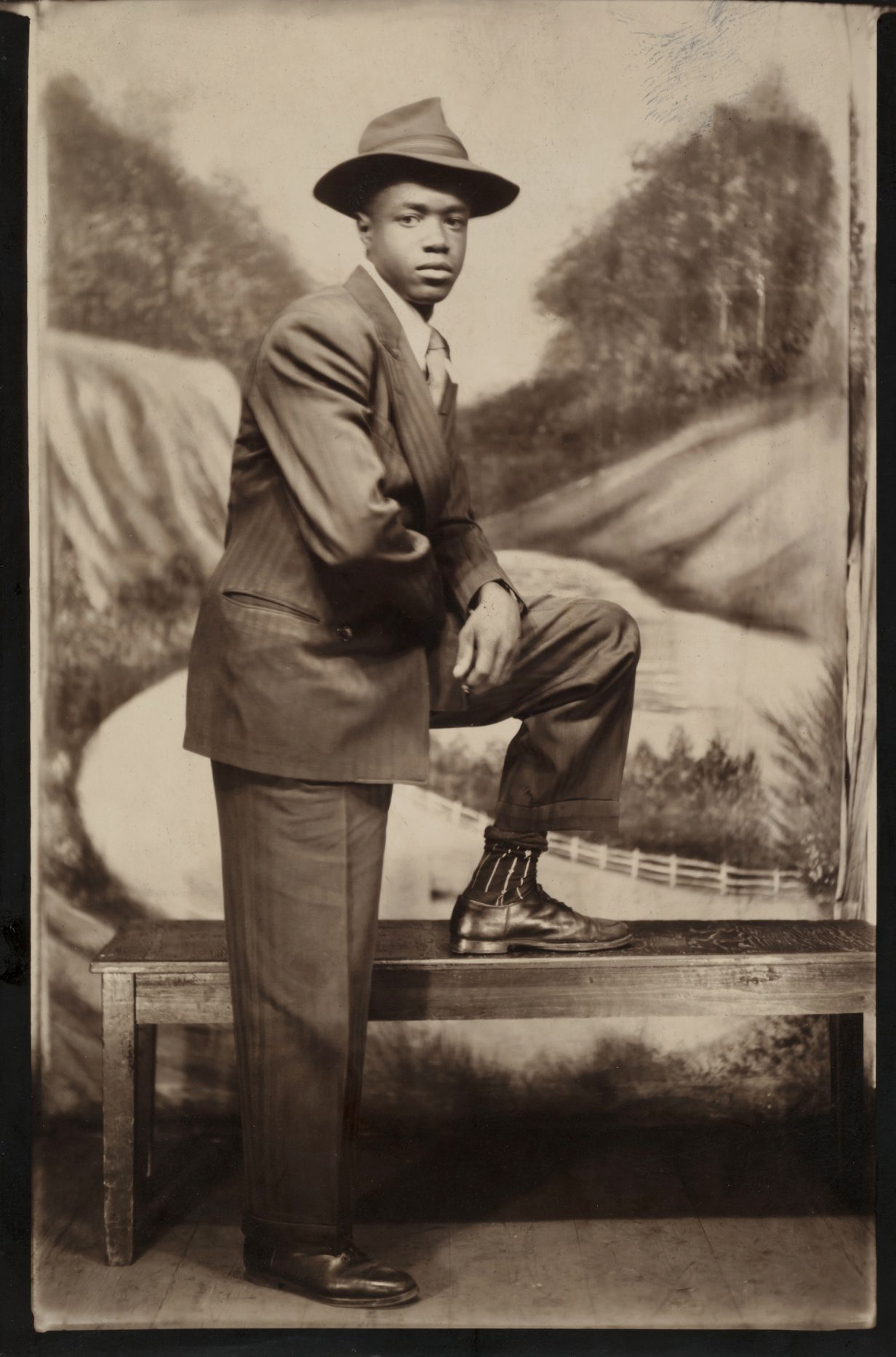
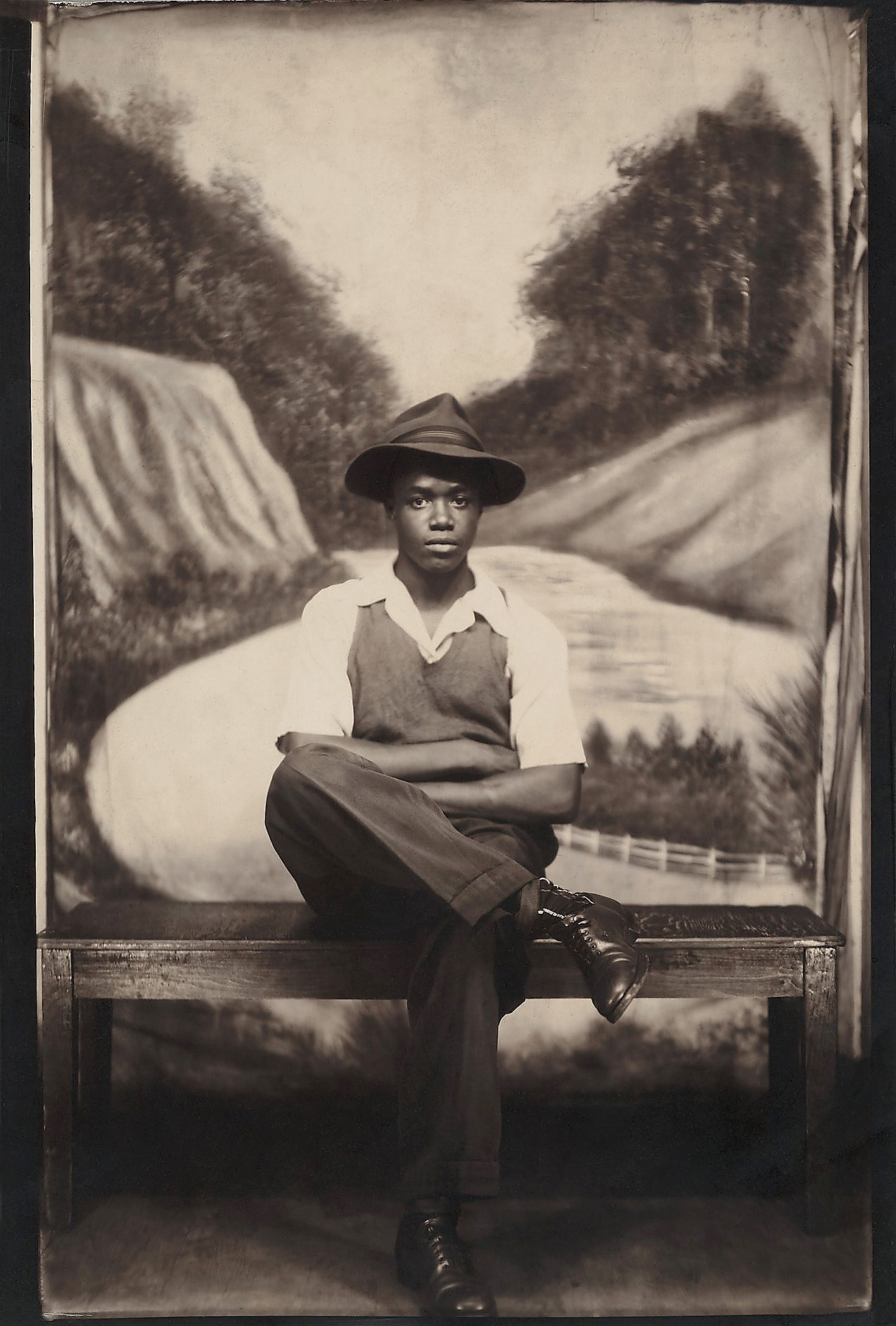
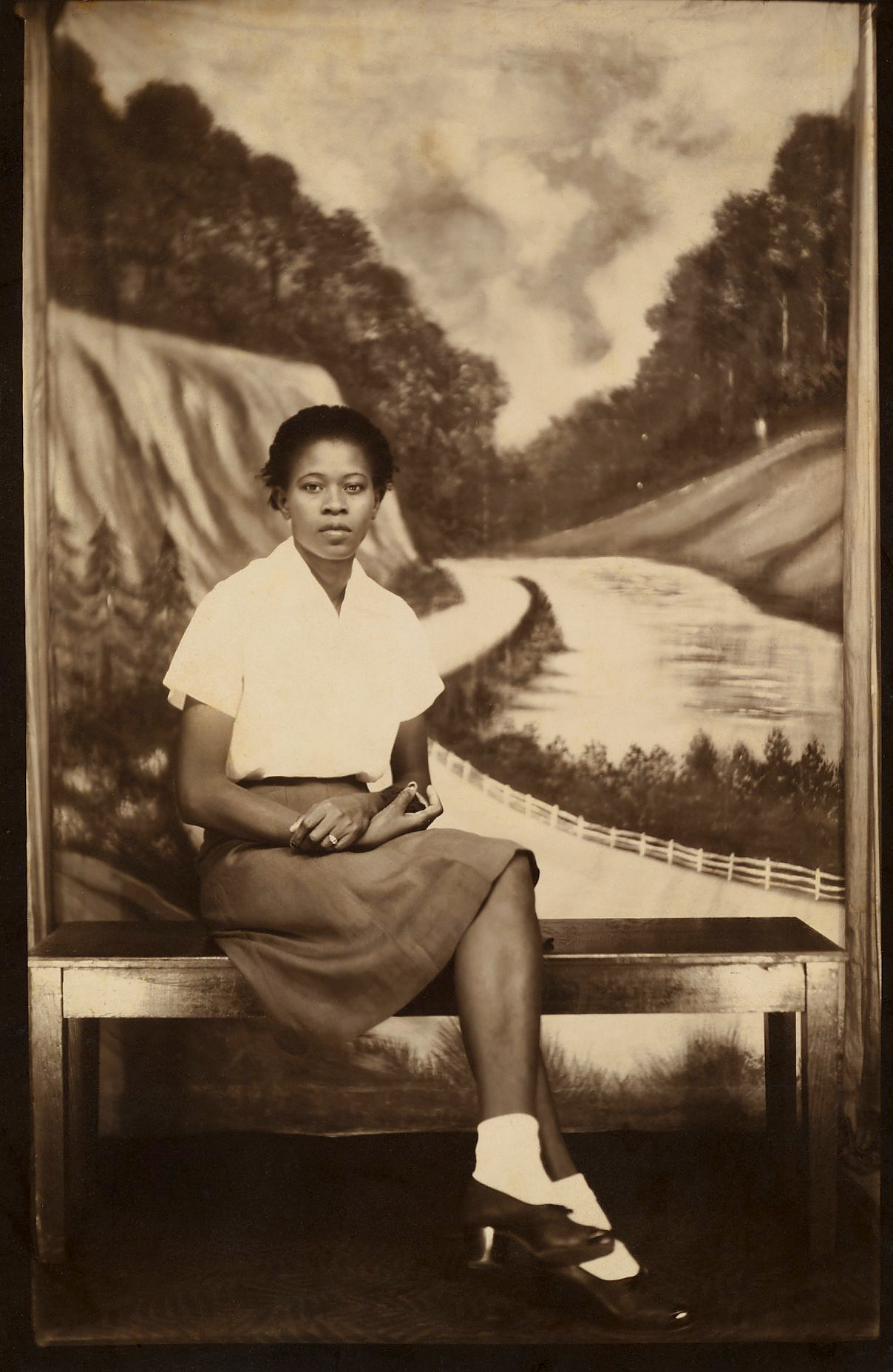
Firstly, they are very small, usually with bare floorboards, carpet or linoleum on the floor. Some (such as the photography of the man holding his child) are literally just big enough to pose and light the subject. As can be seen in the photograph of the lady holding a large handbag, the painted backdrops can be changed in and out, in this instance the scrim placed in front of another painted background. Notice also the worn lino in this photograph, where so many people have walked in an posed in this studio, in this very spot. Historically, painted backdrops have been used since the earliest days of photography, appearing in ambrotypes and tintypes of American Civil War soldiers. It would not surprise me is some of the studios from that time were still going in the 1940s.
Secondly, we can observe the lighting and depth of field. The lighting seems to be either by one or two lights (probably not moved between clients) that sit on axis, meaning there is a horizontal line between the light, the camera and the subject – a nearly horizontal light source. The depth of field is low, the camera probably pre-focused on the table, chair or pedestal within the studio space. Because of the small studio space, the subject placed up tight against the painted backdrop, and the low depth of field… there is a consequent flattening of the subject within the image plane. The photographs are either full figure standing, sitting or cropped closer at the waist.
While the idyllic painted backdrops add context to these studio portraits, it is the pose of the sitters that is so mesmerising in the photographs. These people were living in anxious, dangerous times – the Second World War, the Cold War, and the ever present racism against African Americans were some of the issues that they had to deal with – and yet they pose quite confidently for the camera, seemingly with no hidden agenda or deception. They are choosing to pose for their own reasons. As Jeff Rosenheim, the Met’s photography curator observes, “In these pictures, we see them in reflection of where they are and what their conditions are.”
I think there are a few things happening at once here. These studios give the impression that they are really joyous places. Is it the staff, or the need to document an important occasion like the birth of a child, a marriage, a graduation, or sisters, or is it something more intangible? The studios seem a great place to be. There is this JOY that seems to radiate off of the sitters and then there is a pride that is not referencing being accepted in a white community, but has layers of self containment / their own self, their friends, and something else.
“You live the life you’ve got.” So says a character from one of my favourite British TV series Vera. And that is what these photographs picture – the life they are living, the life they have got. In these photographs there is a direct vision, direct seeing… and looking, which is what makes them so powerful and effective. Unlike contemporary popular portraits, blasted over the airwaves on Instagram, Snapchat, Facebook, etc. there is a direct connection to the lives of these people. While they lived in anxious times, their representation by the camera is clear and focused. Today our anxiety is more prescient, more at the forefront of out consciousness, our identity formation, the way we interact with the world. Who is looking and who is watching, and what is our image. Selfies on sticks or images in front of mirrors step to the front.
When looking at these photographs I have to ask, is there something here that is gone? Something we can remember yet has been sneakily stolen from us?
In contemporary portrait photography what has been stolen from us is the sense of joy, happiness, and intimacy in our own self, and how devolved we have become from the essence of our own being. The “dead pan” looks on people’s faces, the anxiety to get the right shot, the hands in the air with mobile phones to capture anything that is seen as worthwhile (just because you can) has become ubiquitous the world over. We have gone through a recent period of devolution and may need to regain lost ground, for what makes these photographs special – magical in the truest sense sense of the word – is that they just are. No ego from subject or photographer, no prejudice encroaching from the outside world, these people and their photographic trace just capture the essence of their being. Without worry… here ‘I am’.
Dr Marcus Bunyan
Many thankx to the Metropolitan Museum of Art for allowing me to publish the photographs in the posting. Please click on the photographs for a larger version of the image.
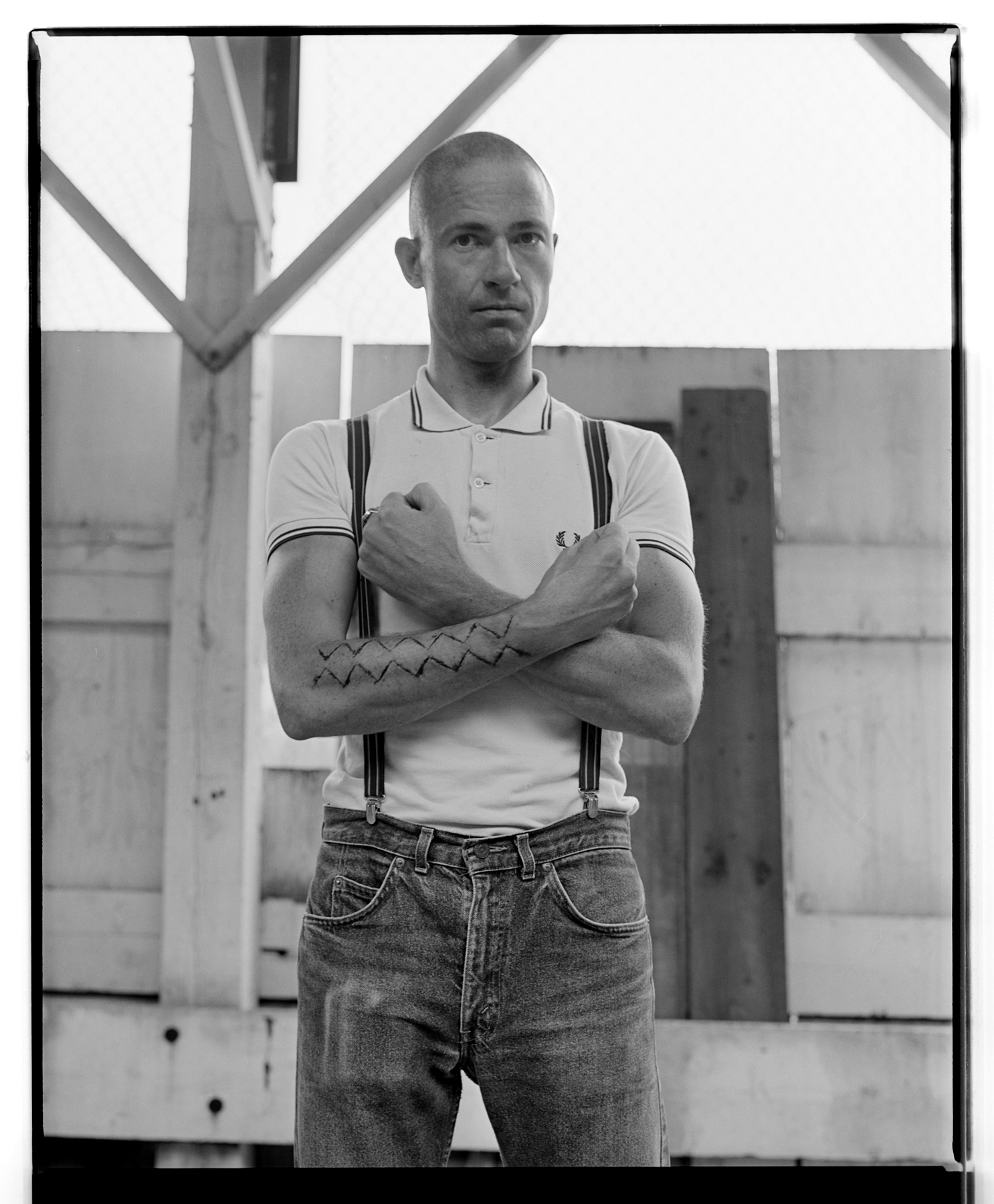
This exhibition will present more than one hundred and fifty studio portraits of African Americans from the mid-twentieth century, part of an important recent acquisition by The Met. Produced by mostly unidentified makers, the photographs are a poignant, collective self portrait of the African American experience during the 1940s and 1950s – a time of war, middle-class growth, and seismic cultural change.
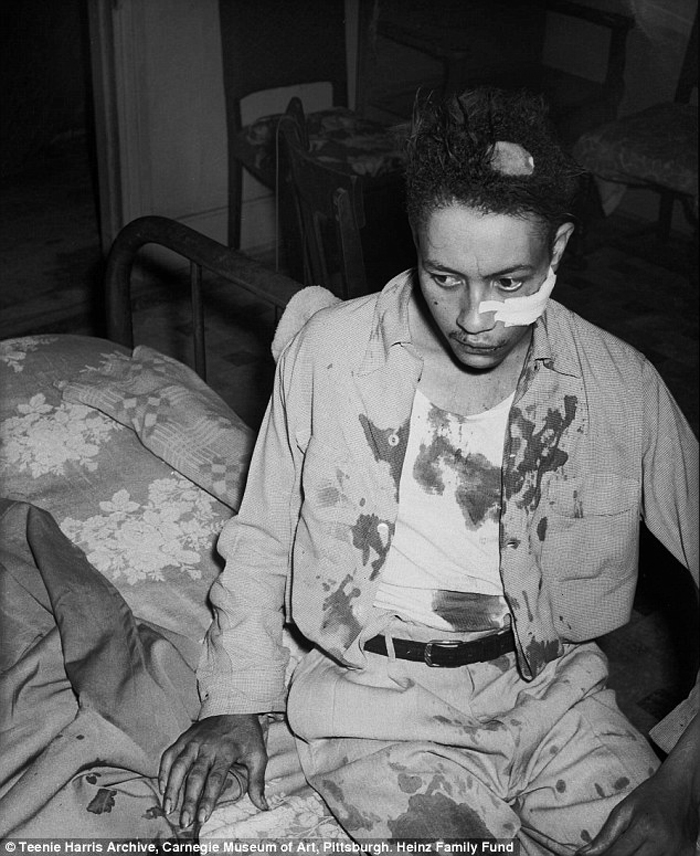
Charles “Teenie” Harris (American, 1908-1998) John Davis after being beaten by police officer Dan McTague, in his home at 1303 Wylie Avenue, Hill District, August 1951 1951 Gelatin silver print
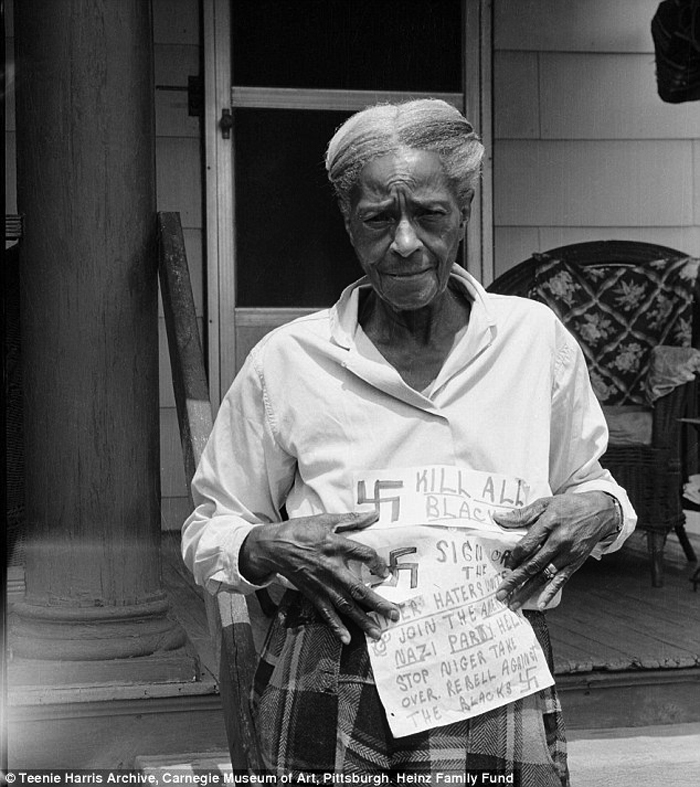
Charles “Teenie” Harris (American, 1908-1998) Mary Reid holding threatening notes with swastikas and American Nazi Party propaganda, in July 1964 1964 Gelatin silver print
Unknown American photographer Studio Portrait 1940s-1950s Gelatin silver print The Metropolitan Museum of Art, New York, Twentieth-Century Photography Fund, 2015, 2017 Image courtesy The Metropolitan Museum of Art
African American Portraits: Photographs from the 1940s and 1950s, on view June 26 through October 8, 2018,will present more than 150 studio portraits from the mid-20th century. The exhibition offers a seldom seen view of the African American experience in the United States during World War II and the following decade – a time of war, middle-class growth, and seismic cultural change. Part of an important acquisition made by The Met in 2015 and 2017, these photographs build on and expand the Museum’s strong holdings in portraiture from the beginning of photography in the 1840s to the present. The exhibition is made possible by the Alfred Stieglitz Society.
The portraits on view generally feature sitters in a frontal pose against a painted backdrop – soldiers and sailors model their uniforms, graduates wear their caps and gowns, lovers embrace, and new parents cradle their infants. Both photographers and subjects remain mostly unidentified.
In the wartime economy, photographic studios became hubs of activity for local and regional communities. Some studios were small and transient, others more established and identifiable, such as the Daisy Studio in Memphis, Tennessee. Using waterproof direct positive paper rather than film, the studios were able to offer their clientele high quality, inexpensive portraits in a matter of minutes. The poignancy of these small photographs lies in the essential respect the camera offers its subjects, who sit for their portraits as an act of self-expression.
African American Portraits: Photographs from the 1940s and 1950s is organised by Jeff L. Rosenheim, Joyce Frank Menschel Curator in Charge of the Department of Photographs at The Met.
Press release from the Metropolitan Museum of Art
SAME STUDIO AND PERSON
Unknown American photographer Studio Portrait 1940s-1950s Gelatin silver print The Metropolitan Museum of Art, New York, Twentieth-Century Photography Fund, 2015, 2017 Image courtesy The Metropolitan Museum of Art
SAME STUDIO, SAME AND DIFFERENT BACKDROPS
You can tell by the legs of the seat.
Unknown American photographer Studio Portrait 1940s-1950s Gelatin silver print The Metropolitan Museum of Art, New York, Twentieth-Century Photography Fund, 2015, 2017 Image courtesy The Metropolitan Museum of Art
SAME STUDIO DIFFERENT BACKDROP
You can tell by the curtain at right, and the pedestal.
Unknown American photographer Studio Portrait 1940s-1950s Gelatin silver print The Metropolitan Museum of Art, New York, Twentieth-Century Photography Fund, 2015, 2017 Image courtesy The Metropolitan Museum of Art
Unknown American photographer Studio Portrait 1940s-1950s Gelatin silver print with hand colouring The Metropolitan Museum of Art, New York, Twentieth-Century Photography Fund, 2015, 2017 Image courtesy The Metropolitan Museum of Art
SAME STUDIO DIFFERENT BACKDROP
You can tell by the style of the painting, the positioning of the flowers, and the decoration on the carpet of the stairs.
Unknown American photographer Studio Portrait 1940s-1950s Gelatin silver print The Metropolitan Museum of Art, New York, Twentieth-Century Photography Fund, 2015, 2017 Image courtesy The Metropolitan Museum of Art
Unknown American photographer Studio Portrait 1940s-1950s Gelatin silver print with hand colouring The Metropolitan Museum of Art, New York, Twentieth-Century Photography Fund, 2015, 2017 Image courtesy The Metropolitan Museum of Art
DAISY STUDIO
Daisy Studio (American, active 1940s) Studio Portrait 1940s-1950s Gelatin silver print The Metropolitan Museum of Art, New York, Twentieth-Century Photography Fund, 2015, 2017 Image courtesy The Metropolitan Museum of Art
The Metropolitan Museum of Art 1000 Fifth Avenue at 82nd Street New York, New York 10028-0198 Phone: 212-535-7710
Opening hours: Sunday – Tuesday and Thursday: 10am – 5pm Friday and Saturday: 10am – 9pm Closed Wednesday
Exhibition dates: 13th July – 30th September, 2018
Curators: This exhibition is co-curated by David Kiehl, Curator Emeritus, and David Breslin, DeMartini Family Curator and Director of the Collection.
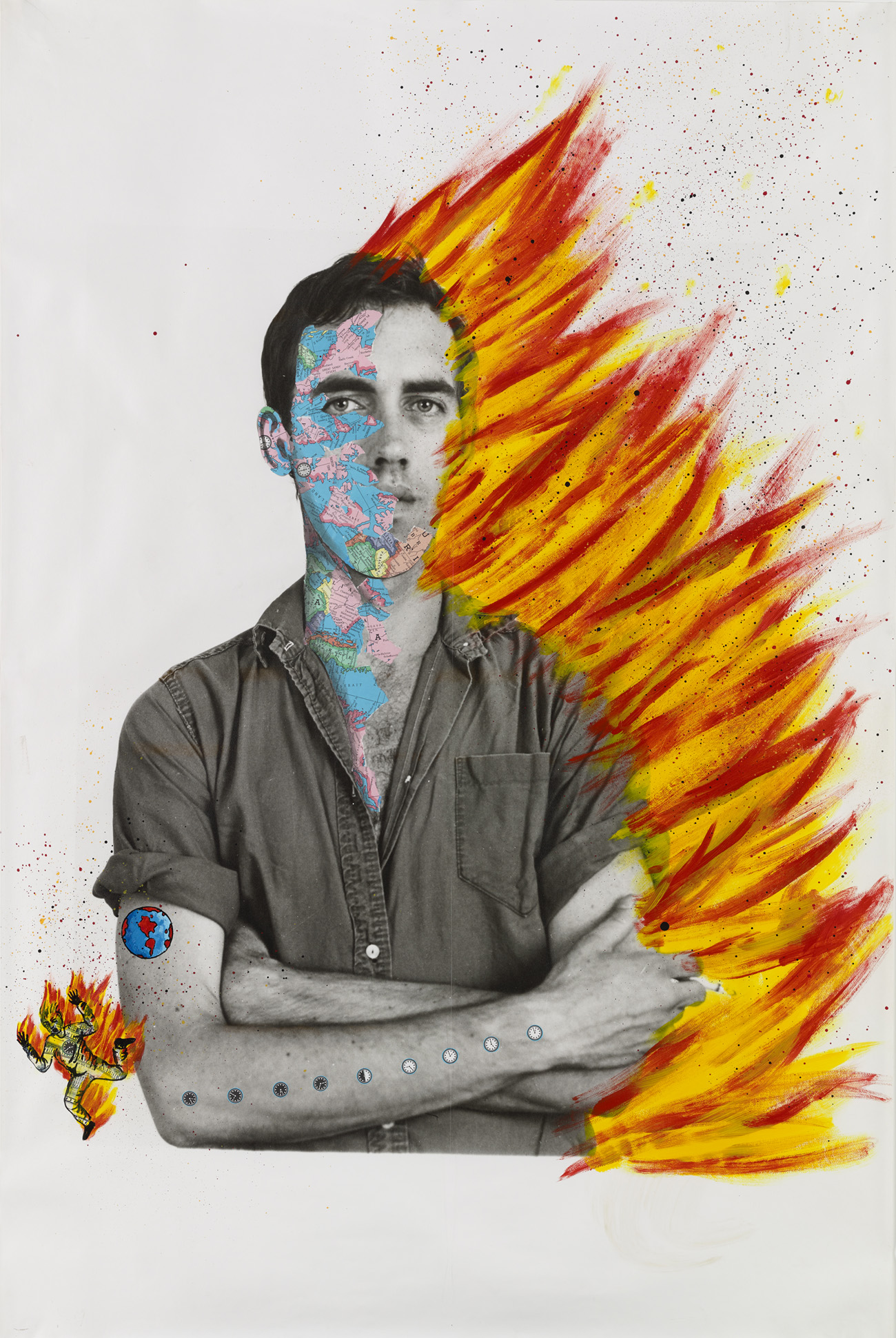
David Wojnarowicz (American, 1954-1992) with Tom Warren Self-Portrait of David Wojnarowicz 1983-1984 Acrylic and collaged paper on gelatin silver print 60 × 40 in. (152.4 × 101.6cm) Collection of Brooke Garber Neidich and Daniel Neidich Photo: Ron Amstutz
Man on fire
… and two important ones I forgot: earth and spirit!
What an unforgettable, socially aware artist.
His work, and the concepts it investigates, have lost none of their relevance. With the rise of the right, Trump, fake news, discrimination and the ongoing bigotry of religion his thoughts and ideas, his writing, and his imagination are as critical as ever to understanding the dynamics of power and oppression. As Olivia Laing observes, ” …the forces he spoke out against are as lively and malevolent as ever.”
Remember: silence is the voice of complicity.
Although in his lifetime he never achieved the grace he desired, through his art the grace of his spirit lives on. Love and respect.
Dr Marcus Bunyan
Many thankx to the Whitney Museum of American Art for allowing me to publish the photographs in the posting. Please click on the photographs for a larger version of the image.
“I want to throw up because we’re supposed to quietly and politely make house in this killing machine called America and pay taxes to support our own slow murder, and I’m amazed that we’re not running amok in the streets and that we can still be capable of gestures of loving after lifetimes of all this.”
“It is exhausting, living in a population where people don’t speak up if what they witness doesn’t directly threaten them…”
“When I was told that I’d contracted this virus it didn’t take me long to realise that I’d contracted a diseased society, as well.”
“I’ve always painted what I see, and what I experience, and what I perceive, so it naturally has a place in the work. I think not all the work I do is about AIDS or deals with AIDS, but I think the threads of it are in the other work as well.”
“I think what I really fear about death is the silencing of my voice… I feel this incredible pressure to leave something of myself behind.”
“To make the private into something public is an action that has terrific ramifications.”
“I’m beginning to believe that one of the last frontiers for radical gesture is the imagination…”
“Smell the flowers while you can.”
“All I want is some kind of grace.”
David Wojnarowicz
The image of Rimbaud as a loner bad boy – shooting up, masturbating, prowling Times Square – embodied Wojnarowicz’s early view of what an artist should be: a guerrilla infiltrator, disrupter of what he called the “pre-invented world” that we’re all told is normal, a world of fake borders, gated hierarchies and controlling insider laws. …
A salon-like central gallery is lined with large-scale pictures from the mid-1980s that are basically the equivalent of the history paintings produced by Nicolas Poussin and Thomas Cole, big-thinking panoramas that addressed contemporary politics in a classical language of mythology and landscape. …
Wojnarowicz unabashedly turned, as he said, “the private into something public.” He collapsed political, cultural and personal history in a way that he hadn’t before. He took his outsider citizenship as a subject and weaponized it. The move was strategically effective: It got a lot of attention, including a barrage of right-wing attacks that have persisted into the near-present.”
“Wojnarowicz, the writer, painter, photographer, poet, printmaker and activist, was gay himself, and in his work addressed same-sex desire, the Aids crisis, the persecution of sexual minorities and the Reagan administration’s refusal to acknowledge their existence. But his work is really about America, a place he had described in his 1991 essay collection ‘Close to the Knives’ as an “illusion”, a “killing machine”, a “tribal nation of zombies … slowly dying beyond our grasp”.
“Long before the word intersectionality was in common currency, Wojnarowicz was alert to people whose experience was erased by what he called “the pre‑invented world” or “the one-tribe nation”. Politicised by his own sexuality, by the violence and deprivation he had been subjected to, he developed a deep empathy with others, a passionate investment in diversity.”
“AIDS is not history. The AIDS crisis did not die with David Wojnarowicz,” reads a mission statement displayed by protesters at the museum. “We are here tonight to honor David’s art and activism by explicitly connecting them to the present day. When we talk about HIV/AIDS without acknowledging that there’s still an epidemic – including in the United States – the crisis goes quietly on and people continue to die… The danger is when you look right now at young people, they think AIDS is over with. They don’t think anyone is living with HIV. They go to the museum and they see it as art – they don’t see AIDS as an urgent problem…”
This exhibition will be the first major, monographic presentation of the work of David Wojnarowicz (1954-1992) in over a decade. Wojnarowicz came to prominence in the East Village art world of the 1980s, actively embracing all media and forging an expansive range of work both fiercely political and highly personal. Although largely self-taught, he worked as an artist and writer to meld a sophisticated combination of found and discarded materials with an uncanny understanding of literary influences. First displayed in raw storefront galleries, his work achieved national prominence at the same moment that the AIDS epidemic was cutting down a generation of artists, himself included. This presentation will draw upon recently-available scholarly resources and the Whitney’s extensive holdings of Wojnarowicz’s work.
David Wojnarowicz’s Untitled (Buffalo) is one of the artist’s best-known works and perhaps one of the most haunting artistic responses to the AIDS crisis of the 1980s. The work depicts a herd of buffalo falling off a cliff to their deaths. The artist provides very little context for why and how the creatures got there. The work is in reality, a photograph of a diorama from a museum in Washington, DC depicting an early Native American hunting technique. Through appropriation of this graphic image, the artist evokes feelings of doom and hopelessness, making the work extremely powerful and provocative. Made in the wake of the artist’s HIV-positive diagnosis, Wojnarowicz’s image draws a parallel between the AIDS crisis and the mass slaughter of buffalo in America in the nineteenth century, reminding viewers of the neglect and marginalisation that characterised the politics of HIV/AIDS at the time.
Anonymous text from the Paddle 8 website Nd [Online] Cited 26/09/2022. No longer available online
Beginning in the late 1970s, David Wojnarowicz (1954-1992) created a body of work that spanned photography, painting, music, film, sculpture, writing, and activism. Largely self-taught, he came to prominence in New York in the 1980s, a period marked by creative energy, financial precariousness, and profound cultural changes. Intersecting movements – graffiti, new and no wave music, conceptual photography, performance, and neo-expressionist painting – made New York a laboratory for innovation. Wojnarowicz refused a signature style, adopting a wide variety of techniques with an attitude of radical possibility. Distrustful of inherited structures – a feeling amplified by the resurgence of conservative politics – he varied his repertoire to better infiltrate the prevailing culture.
Wojnarowicz saw the outsider as his true subject. Queer and later diagnosed as HIV-positive, he became an impassioned advocate for people with AIDS when an inconceivable number of friends, lovers, and strangers were dying due to government inaction. Wojnarowicz’s work documents and illuminates a desperate period of American history: that of the AIDS crisis and culture wars of the late 1980s and early 1990s. But his rightful place is also among the raging and haunting iconoclastic voices, from Walt Whitman to William S. Burroughs, who explore American myths, their perpetuation, their repercussions, and their violence. Like theirs, his work deals directly with the timeless subjects of sex, spirituality, love, and loss. Wojnarowicz, who was thirty-seven when he died from AIDS-related complications, wrote: “To make the private into something public is an action that has terrific ramifications.”
Text from the Whitney Museum of American Art
David Wojnarowicz in 1988
David Wojnarowicz (History Keeps Me Awake at Night) Whitney Museum of American Art
Beginning in the late 1970s, David Wojnarowicz (1954-1992) created a body of work that spanned photography, painting, music, film, sculpture, writing, and activism. Largely self-taught, he came to prominence in New York in the 1980s, a period marked by creative energy, financial precariousness, and profound cultural changes. Intersecting movements – graffiti, new and no wave music, conceptual photography, performance, and neo-expressionist painting – made New York a laboratory for innovation. Wojnarowicz refused a signature style, adopting a wide variety of techniques with an attitude of radical possibility. He saw the outsider as his true subject. Queer and later diagnosed as HIV-positive, he became an impassioned advocate for people with AIDS when an inconceivable number of friends, lovers, and strangers were dying due to government inaction.
Whitney Museum of American Art
This summer, the most complete presentation to date of the work of artist, writer, and activist David Wojnarowicz will be on view in a full-scale retrospective organised by the Whitney Museum of American Art. David Wojnarowicz: History Keeps Me Awake at Night is the first major re-evaluation since 1999 of one of the most fervent and essential voices of his generation.
Beginning in the late 1970s, David Wojnarowicz (1954-1992) created a body of work that spanned photography, painting, music, film, sculpture, writing, performance, and activism. Joining a lineage of iconoclasts, Wojnarowicz (pronounced Voyna-ROW-vich) saw the outsider as his true subject. His mature period began with a series of photographs and collages that honoured – and placed himself among – consummate countercultural figures like Arthur Rimbaud, William Burroughs, and Jean Genet. Even as he became well-known in the East Village art scene for his mythological paintings, Wojnarowicz remained committed to writing personal essays. Queer and HIV-positive, Wojnarowicz became an impassioned advocate for people with AIDS at a time when an inconceivable number of friends, lovers, and strangers – disproportionately gay men – were dying from the disease and from government inaction.
Scott Rothkopf, Deputy Director for Programs and Nancy and Steve Crown Family Chief Curator, remarked, “Since his death more than twenty-five years ago, David Wojnarowicz has become an almost mythic figure, haunting, inspiring, and calling to arms subsequent generations through his inseparable artistic and political examples. This retrospective will enable so many to confront for the first time, or anew, the groundbreaking multidisciplinary body of work on which his legacy actually stands.”
David Breslin noted, “With rage and beauty, David Wojnarowicz made art that questioned power, particularly why some lives are visible and others are hidden. Wojnarowicz wrote, ‘To make the private into something public is an action that has terrific ramifications.’ Present throughout his work and this exhibition is the will to show the desires, dreams, and politics of outsiders – like him – queer, economically marginalised, sick, vulnerable, and vibrantly idiosyncratic.”
Largely self-taught, Wojnarowicz came to prominence in New York in the 1980s, a period marked by great creative energy and profound cultural changes. Intersecting movements – graffiti, new and no wave music, conceptual photography, performance, neo-expressionist painting – made New York a laboratory for innovation. Unlike many artists, Wojnarowicz refused a signature style, adopting a wide variety of techniques with an attitude of radical possibility. Distrustful of inherited structures, a feeling amplified by the resurgence of conservative politics, Wojnarowicz varied his repertoire to better infiltrate the culture.
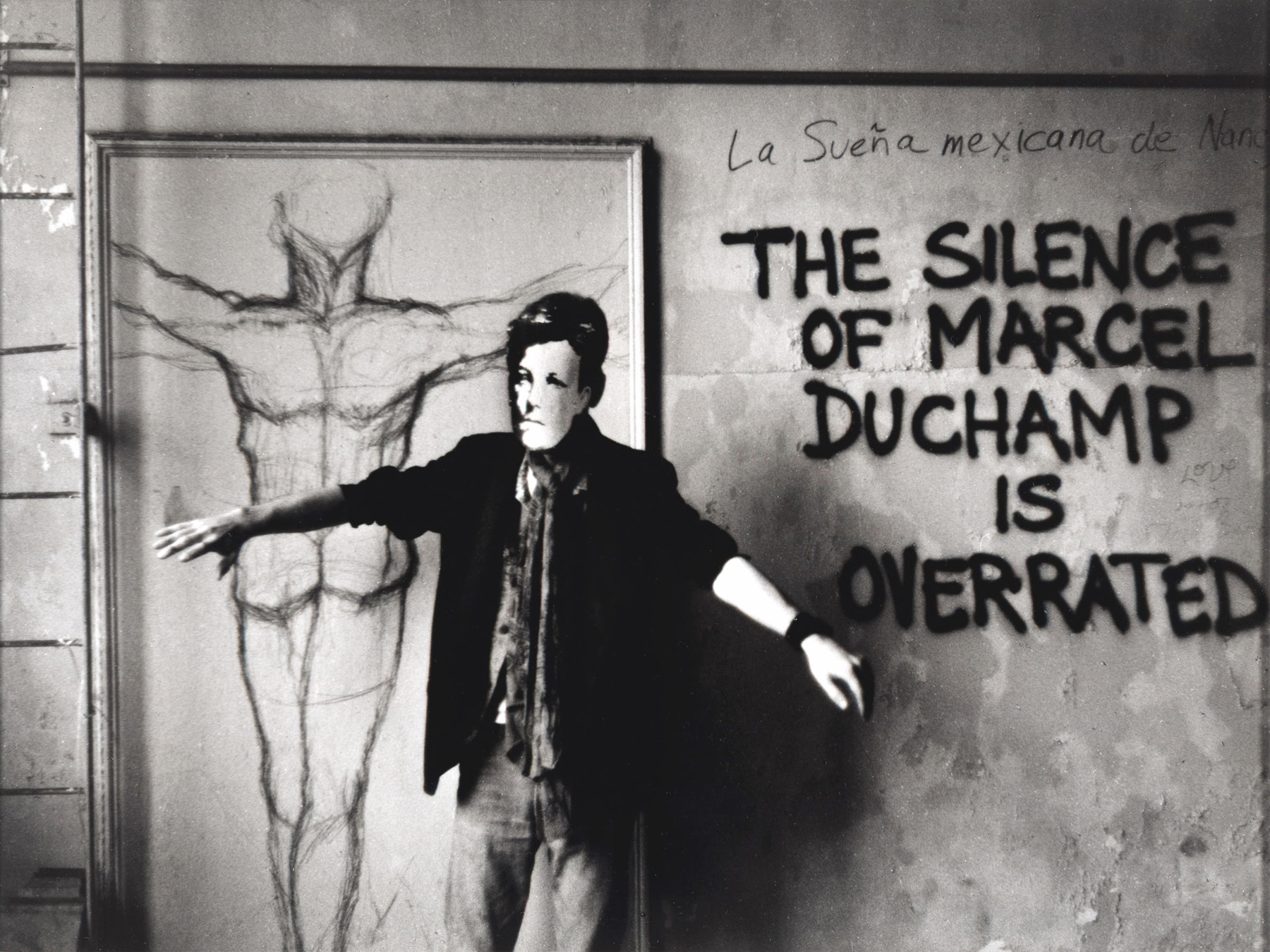
Wojnarowicz was a poet before he was a visual artist. His mature period began with Rimbaud in New York (1978-1979), in which he photographed friends wearing a mask of the nineteenth-century French poet’s face and posing throughout New York City. He became, in the 1980s, a figure in the East Village art scene, showing his paintings, photographs, and installations at galleries like Civilian Warfare, Gracie Mansion, and P.P.O.W. During a time when AIDS was ravaging the artistic community of New York, Wojnarowicz emerged as a powerful activist and advocate for the rights of people with AIDS and the queer community, becoming deeply entangled in the culture wars.
His essay for the catalogue accompanying the exhibition Witnesses: Against Our Vanishing (curated by Nan Goldin at Artists Space in 1989-1990) came under fire for its vitriolic attack on politicians and leaders who were preventing AIDS treatment and awareness. The National Endowment for the Arts (NEA) threatened to defund the exhibition, and Wojnarowicz fought against this and for the first amendment rights of artists.
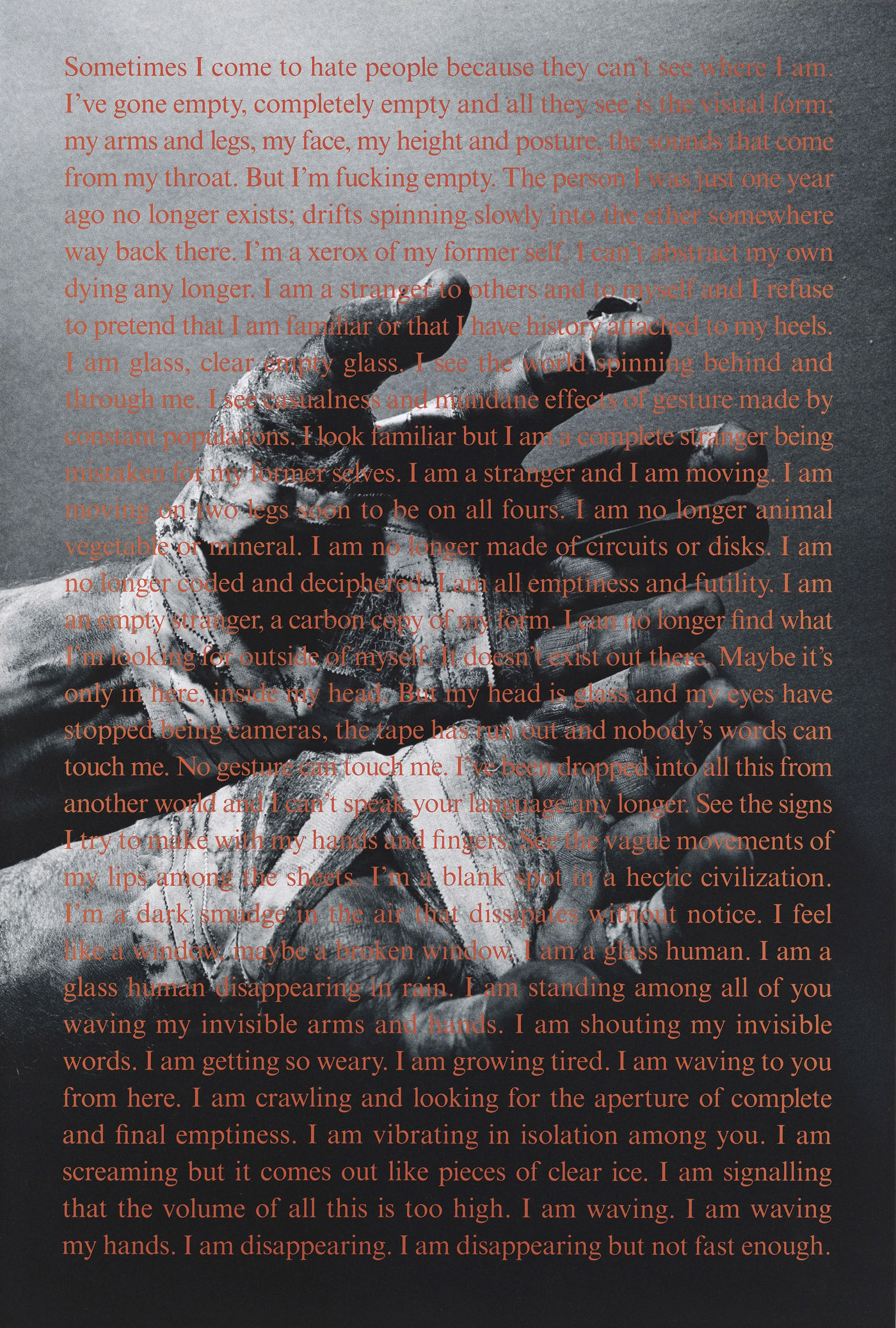
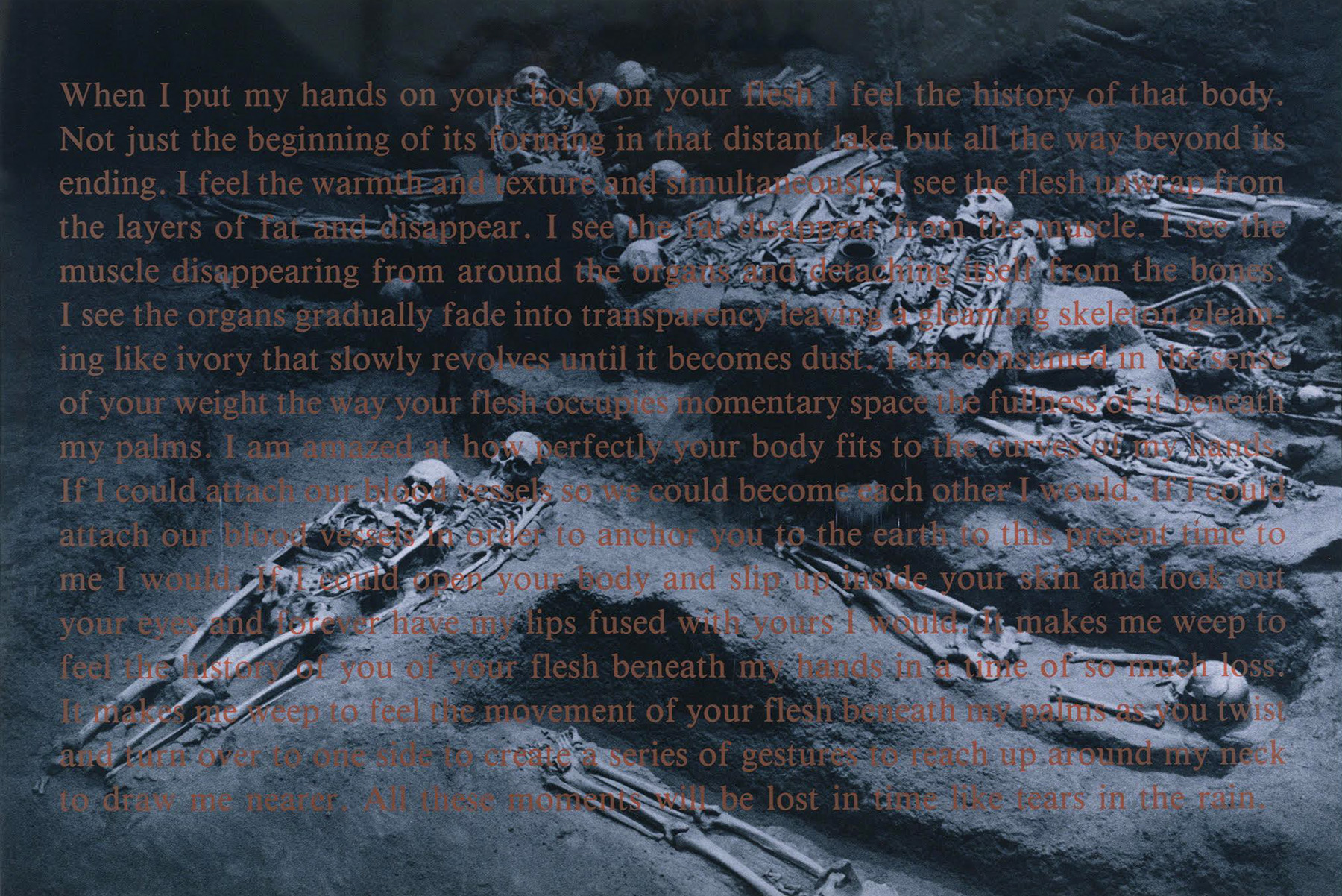
The Whitney retrospective will include an excerpt of footage shot by Phil Zwickler, a filmmaker, fellow activist, and friend of Wojnarowicz who also died of AIDS, in which Wojnarowicz is seen preparing to talk to the press in the wake of the NEA controversy. Important text-photo works from this period, which incorporated writings from Close to the Knives: A Memoir of Disintegration, a collection of essays published a year prior to Wojnarowicz’s death, will also be in the Whitney show, including When I Put My Hands on Your Body (1990), Untitled (One day this kid…) (1989), and the iconic photograph Untitled (Falling Buffalo) (1988-1989).
The Whitney exhibition begins with the artist’s early experiments in collage and photography that were contemporaneous with the Rimbaud in New York series and features three of Wojnarowicz’s original journals that he kept during the time he was living in Paris and conceiving the Rimbaud photographs. Also on view will be the original Rimbaud mask the artist had his friends wear to pose for the photographs.
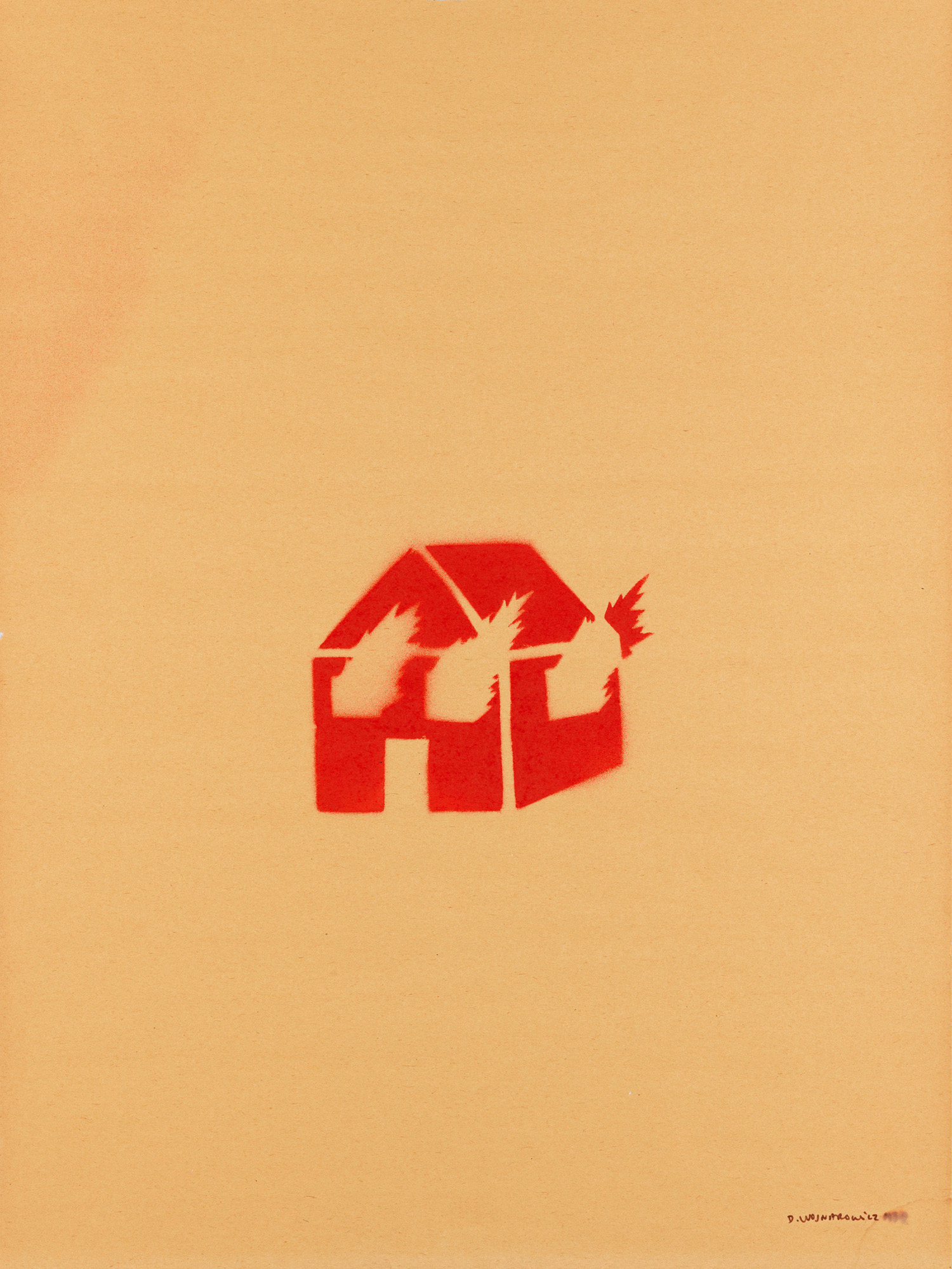
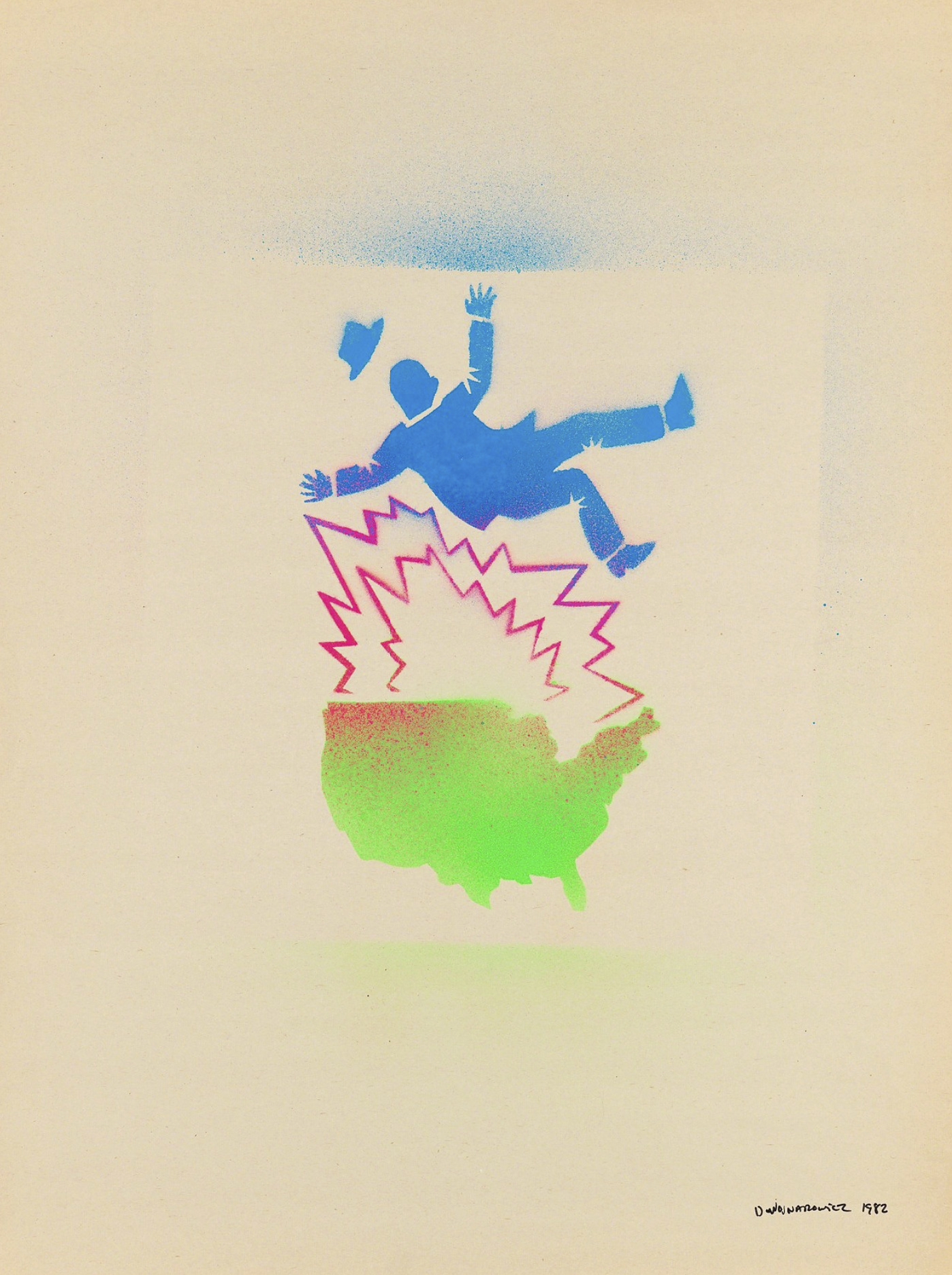
Wojnarowicz’s early stencil works first appeared on the streets of downtown Manhattan. These show him developing an iconographic language that he also used on the walls of the abandoned piers on the Hudson River and would figure in the more complex studio paintings that characterise his art later in the decade. An important group of spray and collage paintings in 1982 focus on an image of the artist Peter Hujar, his great friend and mentor. A group of Hujar’s photographs of Wojnarowicz will be shown in conversation with these paintings. By the mid-1980s, Wojnarowicz’s paintings combined mythological subject matter with elements that explored urbanism, technology, religion, and industry.
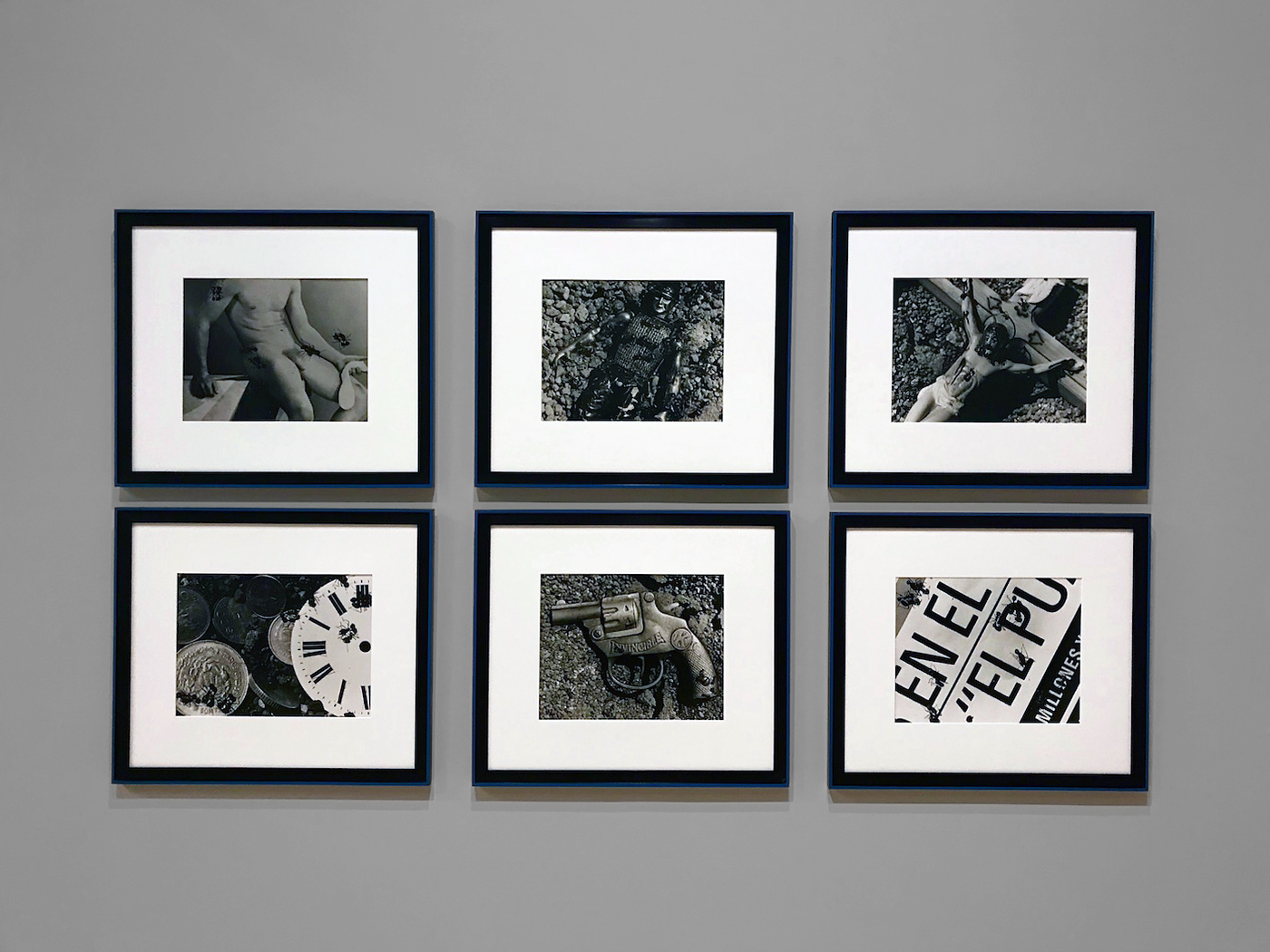
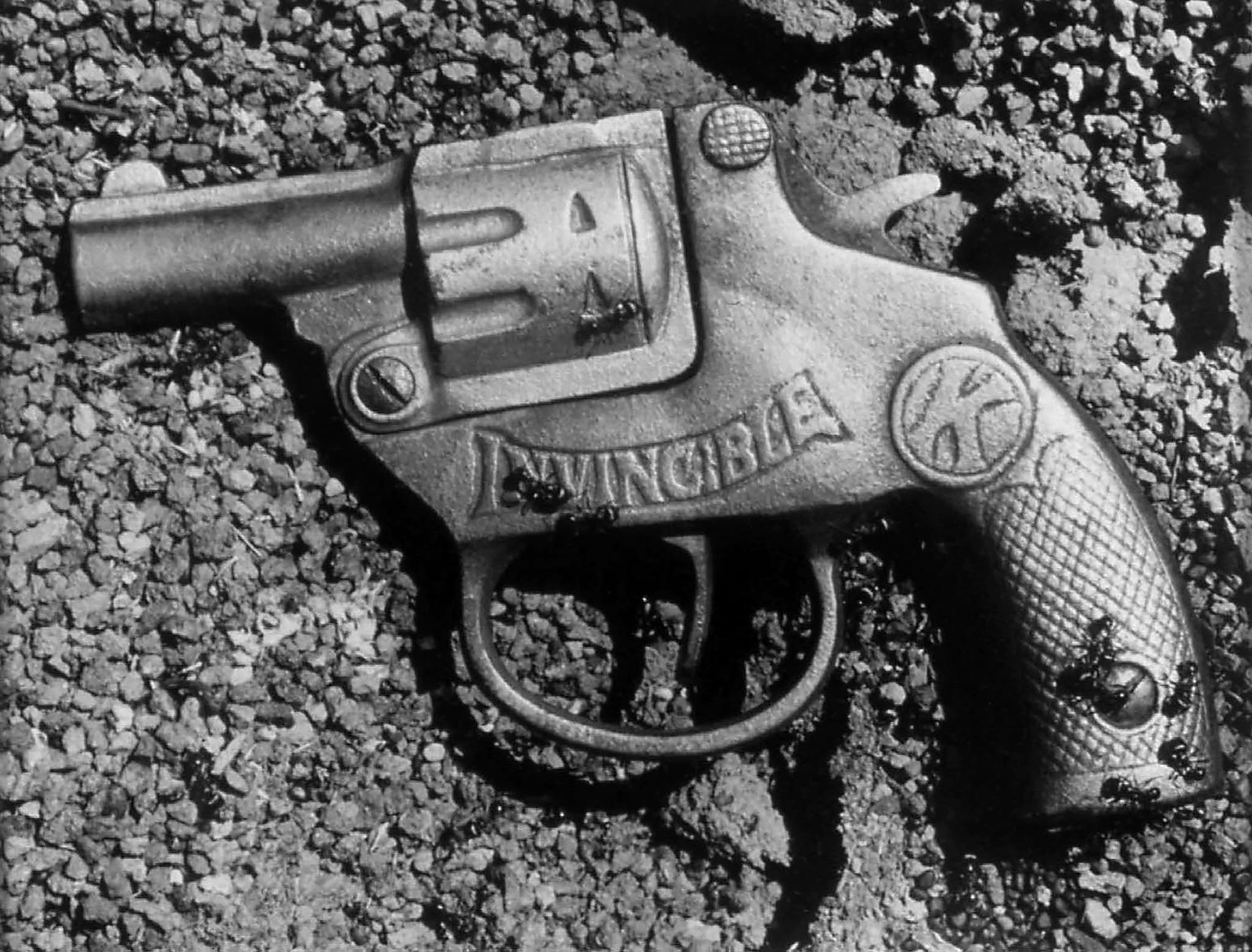
His masterful suite of four paintings from 1987, each named for one of the four elements, will be shown in their own gallery both to emphasise the centrality of painting and image-making during this moment and to mark the beginning of a period of mourning, rage, and action (both aesthetic and activist) marked by the death of Hujar and others to AIDS-related complications. His never-completed film, Fire in My Belly, will be shown among other unfinished film work that later would become the source for much of his photographic work from 1988-89: the Ant Series, The Weight of the World, and Spirituality (for Paul Thek). A gallery will be devoted to a recording of Wojnarowicz reading from his own writings in 1992 at The Drawing Center in Soho.
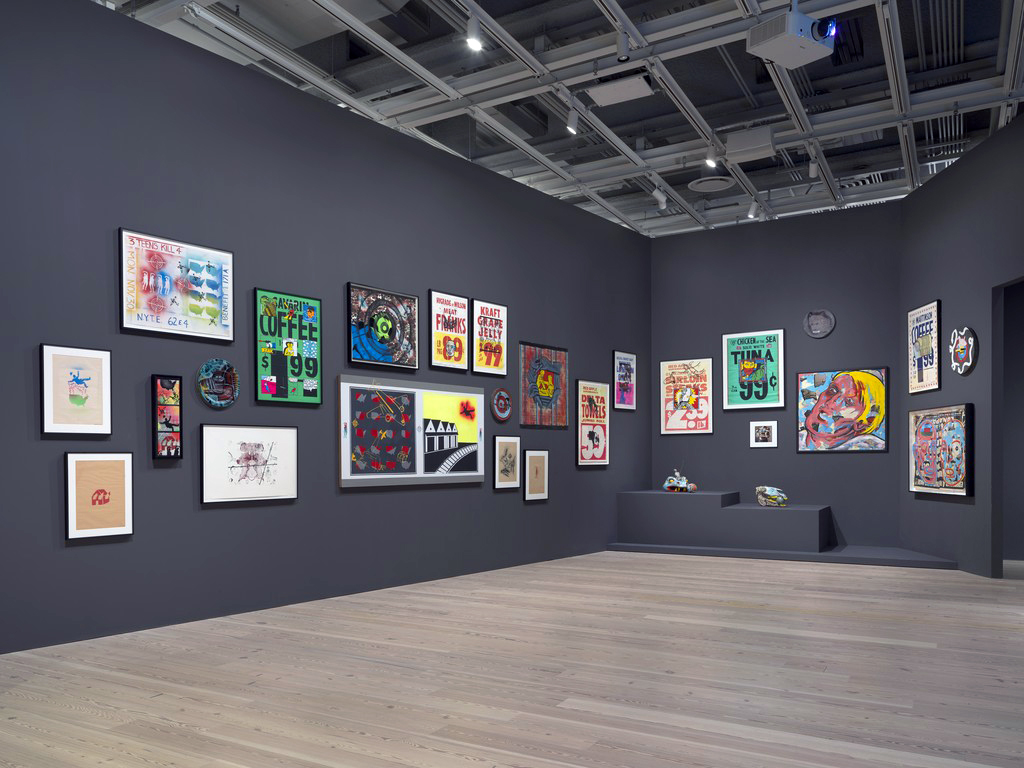
Installation view of David Wojnarowicz: History Keeps Me Awake at Night (Whitney Museum of American Art, New York, July 13-September 30, 2018). Clockwise, from top left: Andreas Sterzing, Something Possible Everywhere: Pier 34, NYC, 1983-1984; David Wojnarowicz, Fuck You Faggot Fucker, 1984; Peter Hujar, Untitled (Pier), 1983; Peter Hujar, Canal Street Piers: Krazy Kat Comic on Wall (by David Wojnarowicz), 1983; David Wojnarowicz, Untitled, 1982; David Wojnarowicz, Untitled (Slam Click), 1983 Photograph by Ron Amstutz
Installation view of David Wojnarowicz: History Keeps Me Awake at Night (Whitney Museum of American Art, New York, July 13-September 30, 2018) Photograph by Ron Amstutz
Installation view of David Wojnarowicz: History Keeps Me Awake at Night (Whitney Museum of American Art, New York, July 13-September 30, 2018)
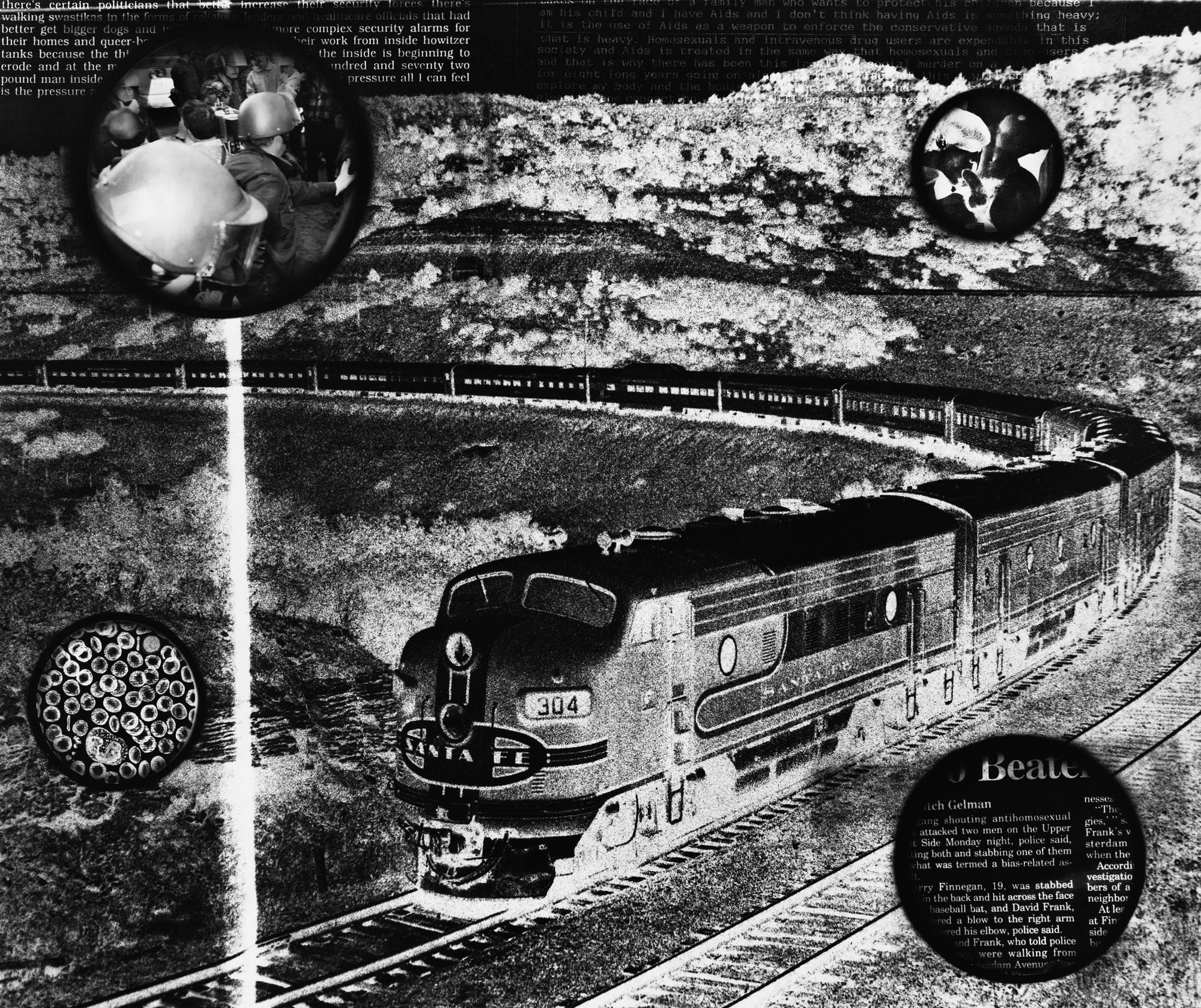
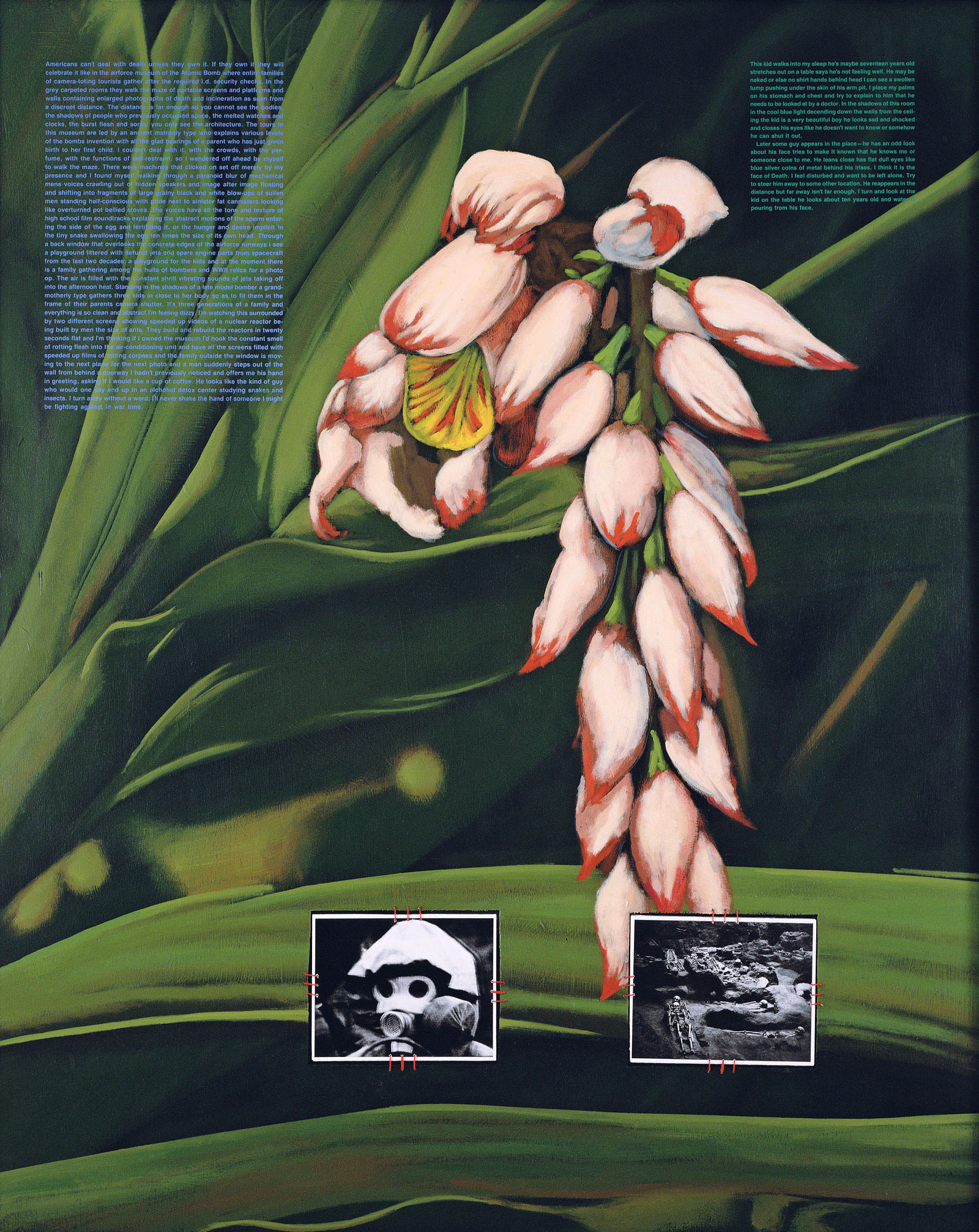
Installation view of David Wojnarowicz: History Keeps Me Awake at Night (Whitney Museum of American Art, New York, July 13-September 30, 2018). From left to right: He Kept Following Me, 1990; I Feel A Vague Nausea, 1990; Americans Can’t Deal with Death, 1990; We Are Born into a Preinvented Existence, 1990. Photograph by Ron Amstutz
About the Artist
After hitchhiking across the U.S. and living for several months in San Francisco, and then in Paris, David Wojnarowicz settled in New York in 1978 and soon after began to exhibit his work in East Village galleries. He was included in the 1985 and 1991 Whitney Biennials, and was shown in numerous museum and gallery exhibitions throughout the United States and Europe. Previous exhibitions to focus on Wojnarowicz include “Tongues of Flame” at the University Galleries of Illinois State University (1990) and “Fever: The Art of David Wojnarowicz” at the New Museum (1999). Wojnarowicz was the author of a number of books, including Close to the Knives: A Memoir of Disintegration (1991). His artwork is in numerous private and public collections including the Whitney Museum of American Art; the Metropolitan Museum of Art; The Museum of Modern Art, New York; The Art Institute of Chicago; the Broad Art Foundation, Los Angeles; and Museo Nacional Centro de Arte Reina Sofía, Madrid, Spain.
Press release from the Whitney Museum of American Art
Gallery 1
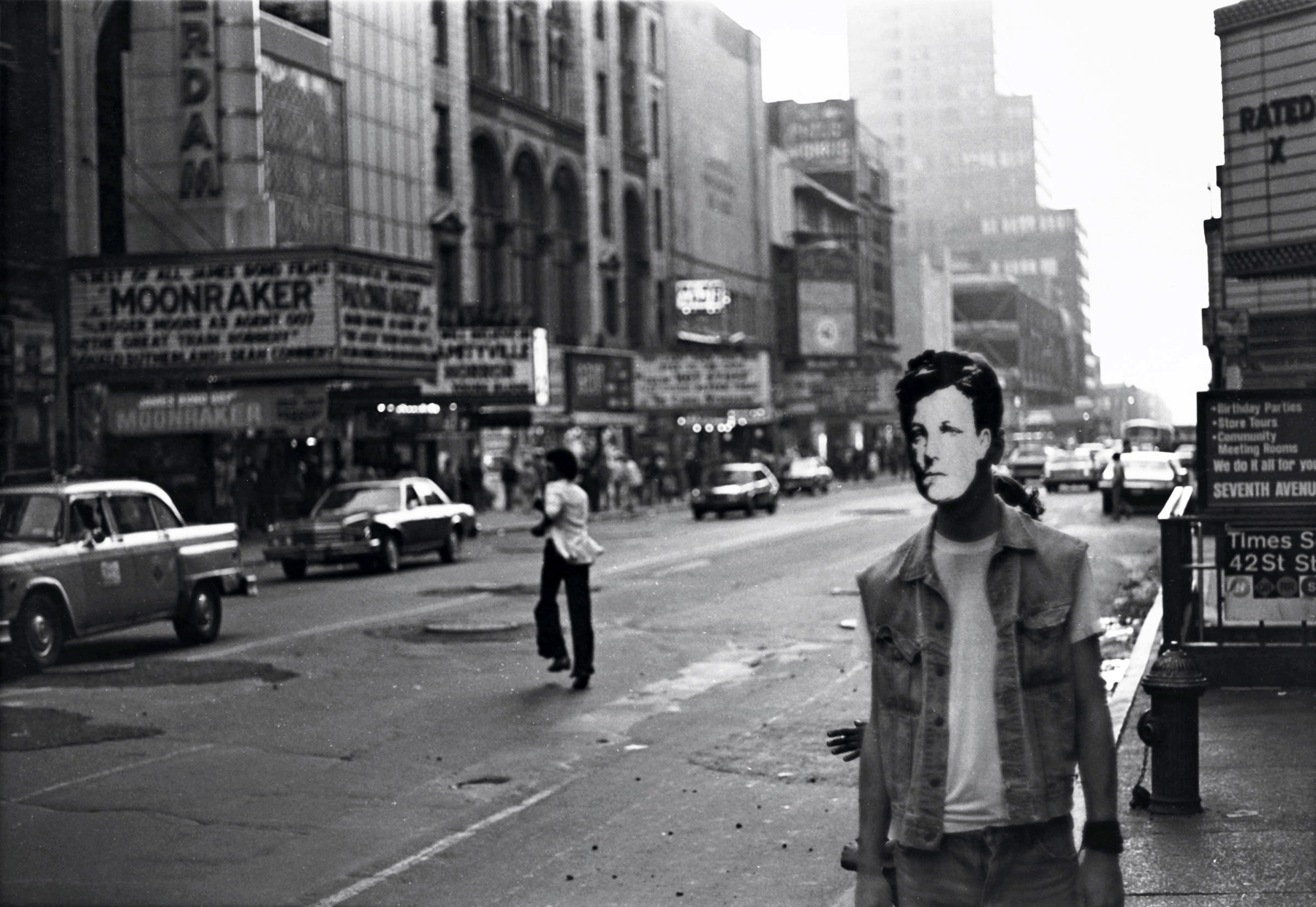
Wojnarowicz, who aspired to be a writer in the 1970s, immersed himself in the work of William S. Burroughs and Jean Genet – two collages here feature them – but he felt a particular kinship to the iconoclastic nineteenth-century French poet Arthur Rimbaud. In the summer of 1979, just back from a stay in Paris with his sister, the twenty-four-year-old Wojnarowicz photographed three of his friends roaming the streets of New York wearing life-size masks of Rimbaud. Using a borrowed camera, Wojnarowicz staged the images in places important to his own story: the subway, Times Square, Coney Island, all-night diners, the Hudson River piers, and the loading docks in the Meatpacking District, just steps away from the Whitney Museum. Born one hundred years, almost to the month, before Wojnarowicz, Rimbaud rejected established categories and wanted to create new and sensuous ways to participate in the world. He, like Wojnarowicz, was the forsaken son of a sailor father, made his queerness a subject of his work, and knowingly acknowledged his status as an outsider (“Je est un autre” – “I is an other” – is perhaps Rimbaud’s most famous formulation).
David Wojnarowicz (American, 1954-1992) Arthur Rimbaud in New York 1978-1979 (printed 1990) Gelatin silver print 8 × 10 in. (20.3 × 25.4cm) Collection of the Estate of David Wojnarowicz Courtesy P.P.O.W, New York
David Wojnarowicz (American, 1954-1992) Arthur Rimbaud in New York (On Subway) 1978-1979 (printed 1990) Gelatin silver print 8 × 10 in. (20.3 × 25.4cm) Collection of the Estate of David Wojnarowicz Courtesy P.P.O.W, New York
David Wojnarowicz (American, 1954-1992) Arthur Rimbaud in New York (Duchamp, Pier) 1978-1979 (printed 2004) Gelatin silver print 10 × 8 in. (25.4 × 20.3cm) Collection of Philip E. Aarons and Shelley Fox Aarons Image courtesy the Estate of David Wojnarowicz and P.P.O.W., New York
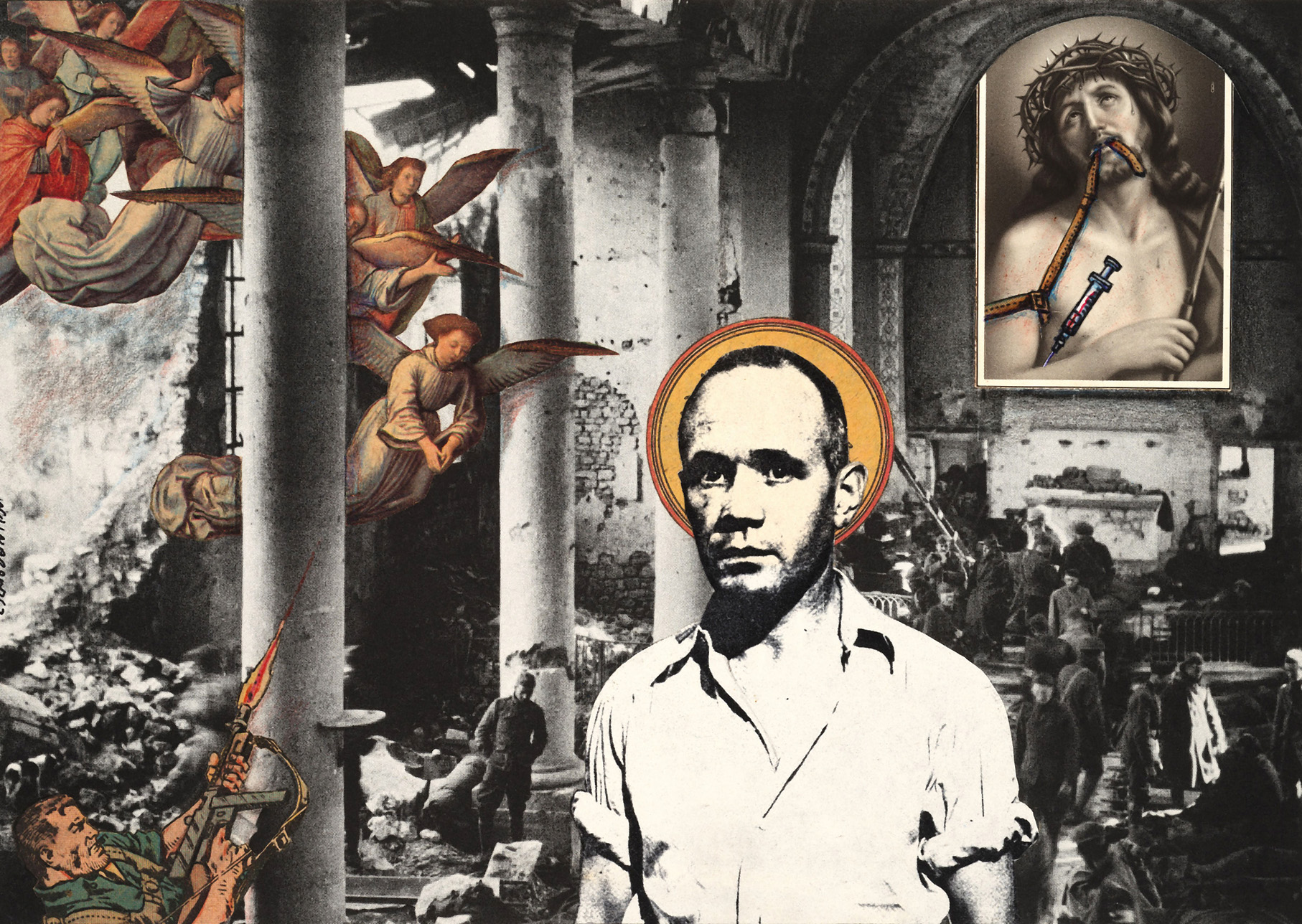
David Wojnarowicz (American, 1954-1992) Untitled (Genet after Brassaï) 1979 Collage of offset-lithographs and coloured pencil 12 × 15 in. (30.5 × 38.1cm) Private collection Photo: Carson Zullinger
At the same time as he conceived the Rimbaud series, Wojnarowicz created homages to other personal heroes, including Jean Genet (1910-1986), the French novelist, poet, and political activist. Genet resonated with Wojnarowicz for his erotic vision of the universe, his embrace of the outsider, and his frank writing on gay sex. For Untitled (Genet after Brassaï), Wojnarowicz transforms the iconoclast writer into a saint; in the background, a Christ figure appears to be shooting up with a syringe. When later criticised by religious conservatives, Wojnarowicz explained that he saw drug addiction as a contemporary struggle that an empathetic Christ would identify with and forgive.
Gallery 2
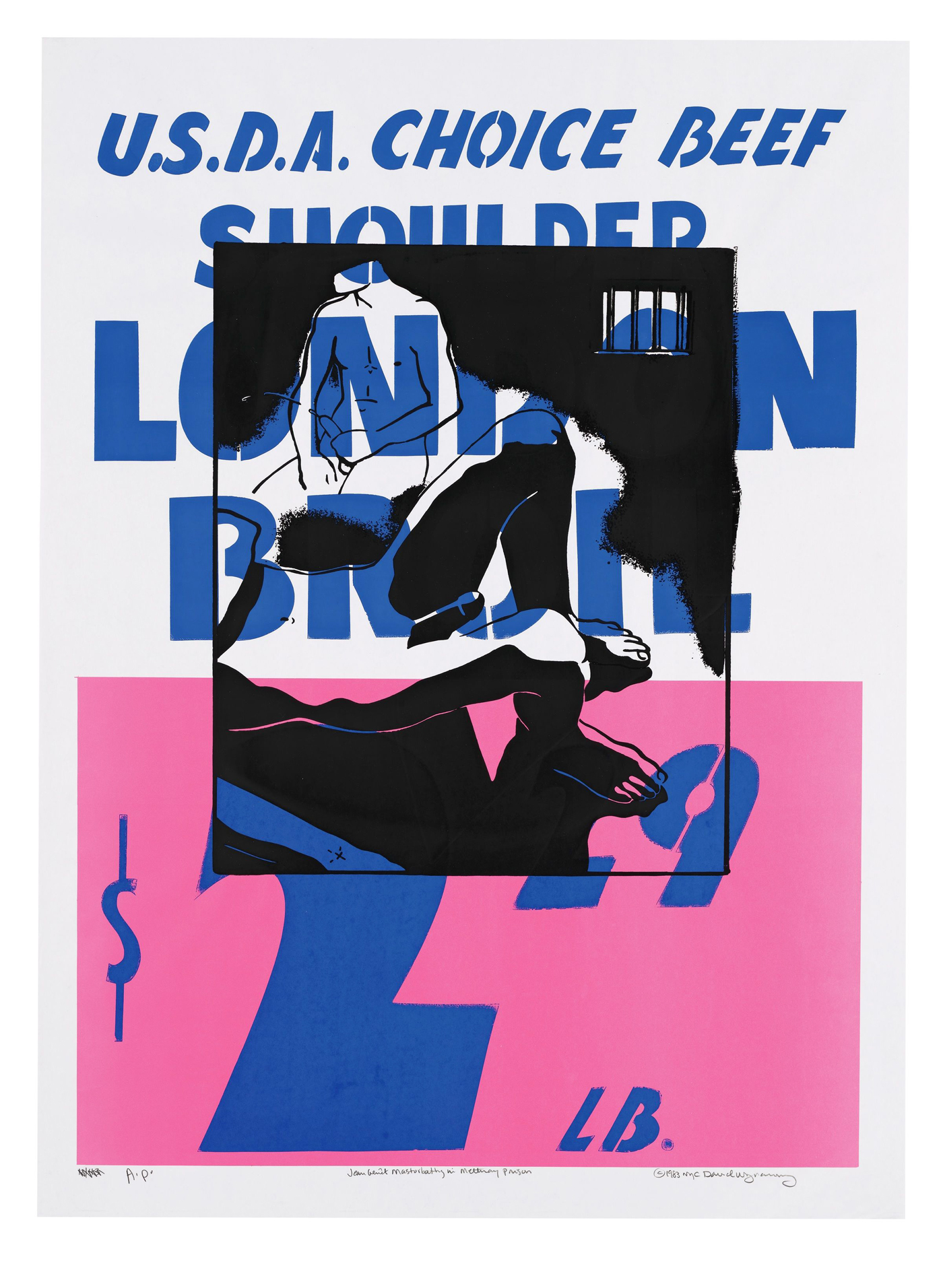
In the early 1980s Wojnarowicz had no real income. He scavenged materials like supermarket posters and trashcan lids as well as cheap printed materials available in his Lower East Side neighbourhood. Incorporating them in his art, Wojnarowicz found radical possibilities in these discarded, forgotten artefacts and in the city itself. He embraced the abandoned piers on the Hudson River, particularly Pier 34 just off Canal Street, for the freedom they offered. He cruised for sex there, and he also wrote and made art on site. He appreciated their proximity to nature and the solitude he could find there.
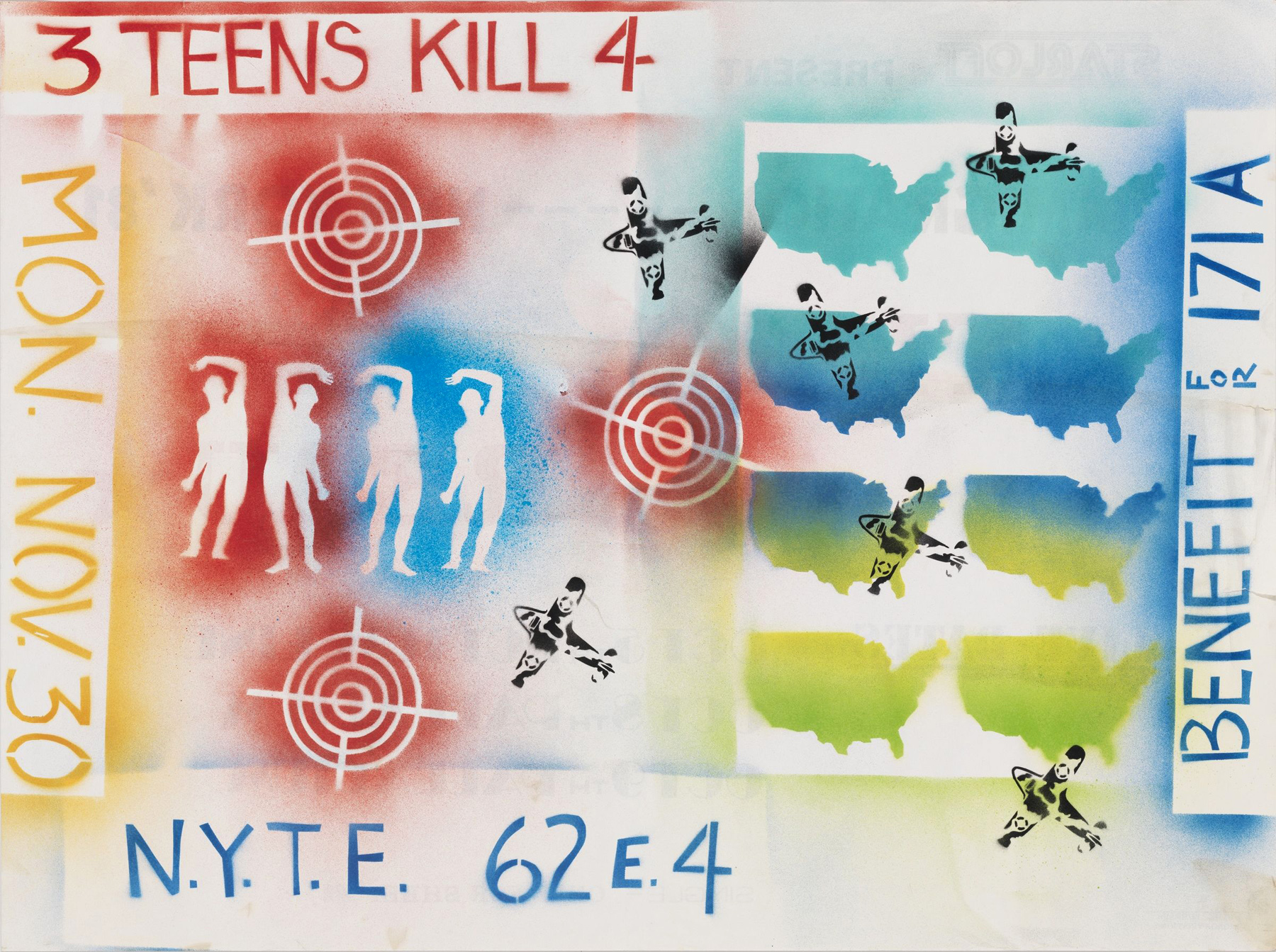
Wojnarowicz began using stencils out of necessity. He was a member of the band, 3 Teens Kill 4, whose album, No Motive, can be played on the website. He produced posters for their shows, and to prevent their removal started making templates to spray-paint his designs on buildings, walls, and sidewalks. These images – the burning house, a falling man, a map outline of the continental United States, a dive-bombing aircraft, a dancing figure – became signature elements in his visual vocabulary, creating an iconography of crisis and vulnerability. Wojnarowicz frequently railed against what he called the “pre-invented world”: a world colonised and corporatised to such an extent that it seems to foreclose any alternatives. For him, using found objects, working at the abandoned piers for an audience of friends and strangers, and creating a language of his own were ways to shatter the illusion of the pre-invented world and make his own reality.
David Wojnarowicz (American, 1954-1992) Diptych II 1982 Spray paint with acrylic on composition board 48 × 96 in. (121.9 × 243.8cm) Collection of Raymond J. Learsy Image courtesy Raymond J. Learsy Photo: Brian Wilcox
David Wojnarowicz (American, 1954-1992) Jean Genet Masturbating in Metteray Prison (London Broil) 1983 Screenprint on supermarket poster 34 × 25 in. (86.4 × 63.5cm) Whitney Museum of American Art, New York Purchase, with funds from the Print Committee Photo: Mark-Woods.com
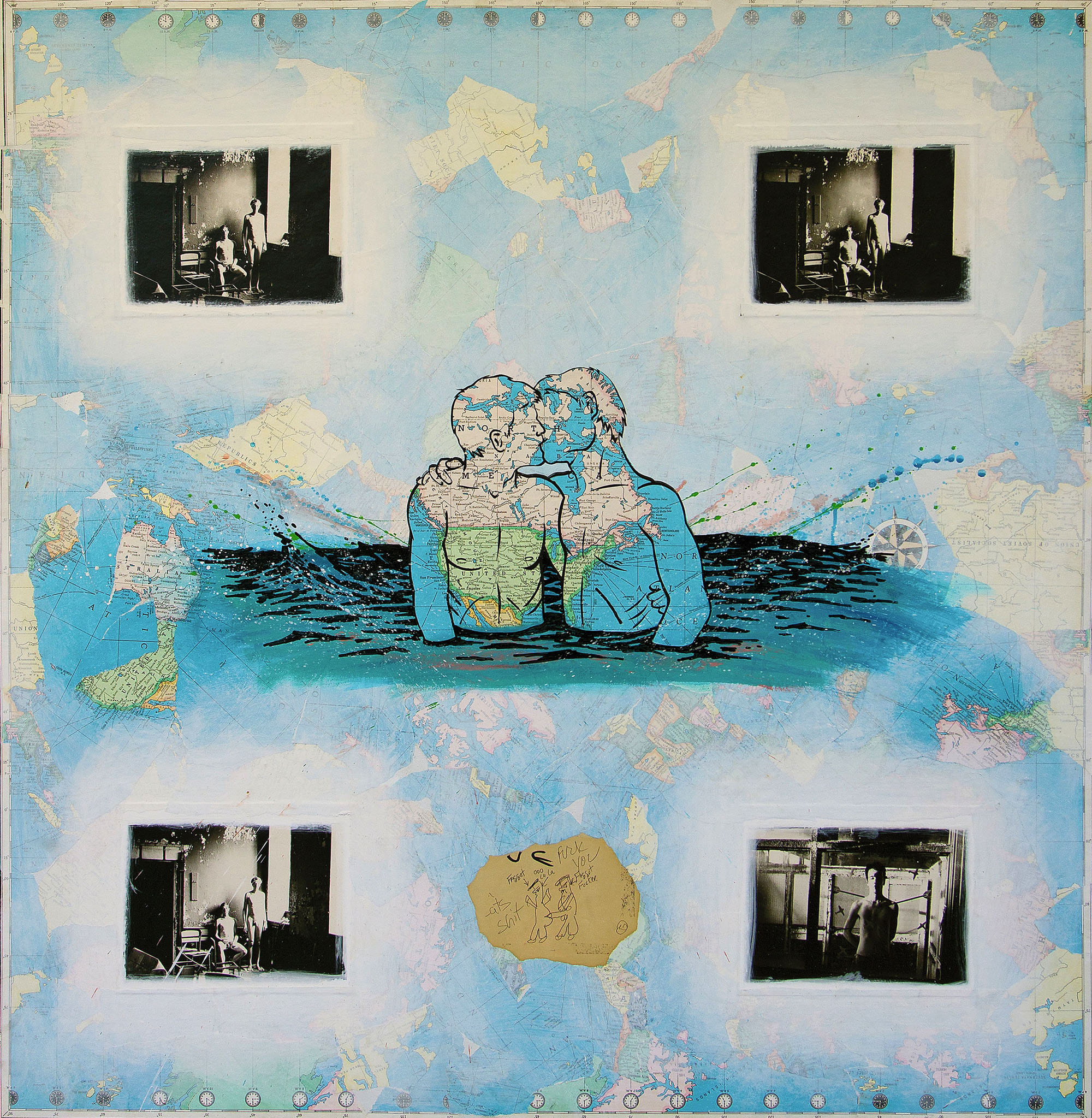
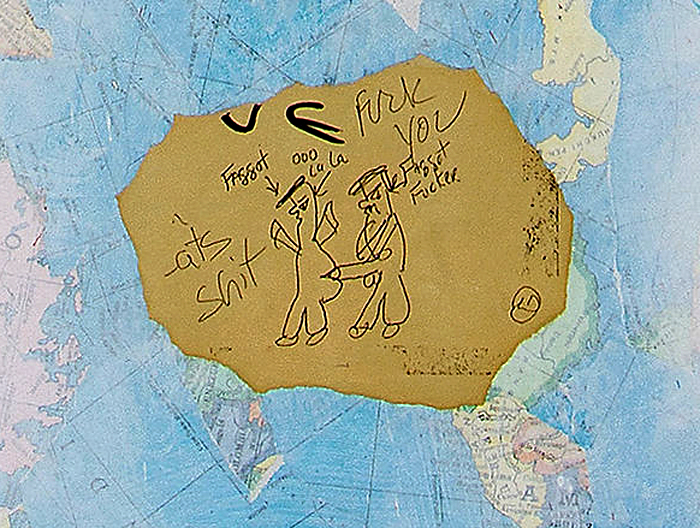
David Wojnarowicz (American, 1954-1992) Fuck You Faggot Fucker 1984 Four black-and-white photographs, acrylic, and collaged paper on Masonite 48 × 48 in. (121.9 × 121.9cm) Collection of Barry Blinderman Image courtesy Barry Blinderman, Normal, Illinois Photo: Jason Judd
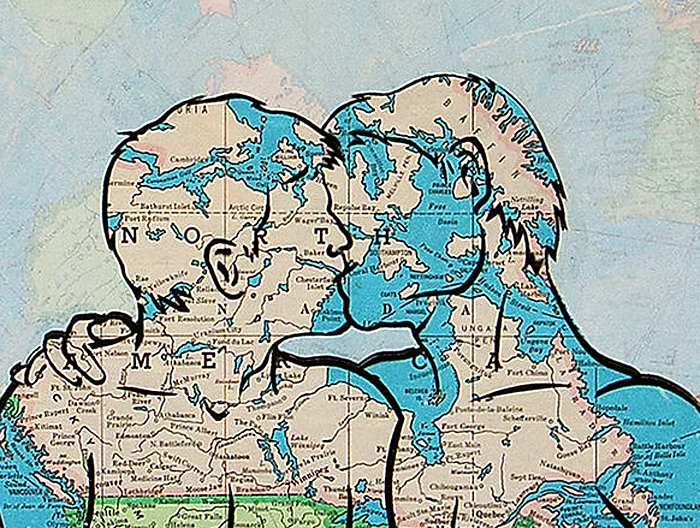
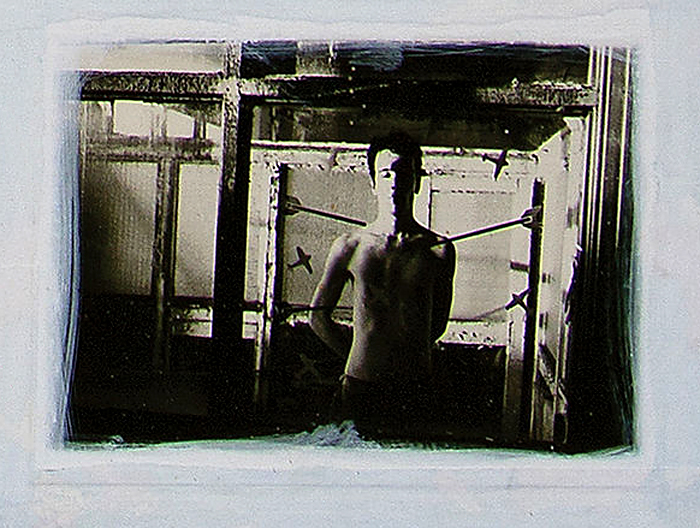
This work was one of Wojnarowicz’s first to directly tackle homophobia and gay bashing and to embrace same-sex love. Its title comes from a scrap of paper containing a homophobic slur that Wojnarowicz found and affixed below the central image of two men kissing. Made with one of his stencils, these anonymous men are archetypes, stand-ins for a multitude of personal stories. Using photographs taken at the piers and in an abandoned building on Avenue B, Wojnarowicz also includes himself and his friends John Hall and Brian Butterick in this constellation. Maps like those in the background here often appear in Wojnarowicz’s work; for him, they represented a version of reality that society deemed orderly and acceptable. He often cut and reconfigured the maps to gesture toward the groundlessness, chaos, and arbitrariness of both man-made borders and the divisions between “civilisation” and nature.
David Wojnarowicz (American, 1954-1992) Fuck You Faggot Fucker (details) 1984 Four black-and-white photographs, acrylic, and collaged paper on Masonite 48 × 48 in. (121.9 × 121.9cm) Collection of Barry Blinderman Image courtesy Barry Blinderman, Normal, Illinois
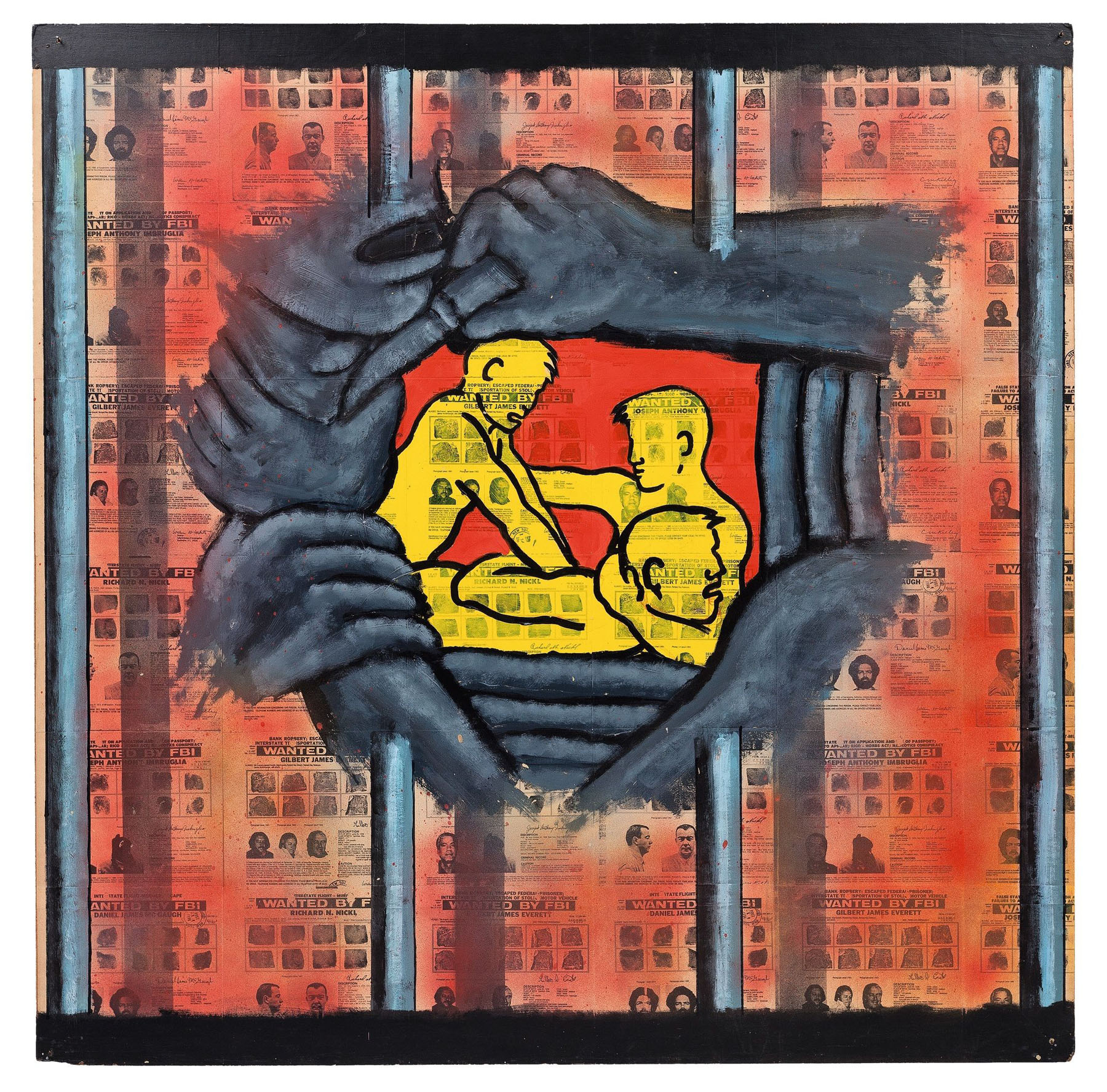
David Wojnarowicz (American, 1954-1992) Prison Rape 1984 Acrylic and spray paint on posters on composition board 48 × 48 in. (121.9 × 121.9cm) Private collection Image courtesy Ted Bonin Photo: Joerg Lohse
Andreas Sterzing Something Possible Everywhere: Pier 34, NYC [Wojnarowicz’s Gagging Cow at the Pier] 1983 Courtesy the artist and Hunter College Art Galleries, New York
“So simple, the appearance of night in a room full of strangers, the maze of hallways wandered as in films, the fracturing of bodies from darkness into light, sounds of plane engines easing into the distance.”
~ David Wojnarowicz
Peter Hujar (American, 1934-1992) Canal Street Piers: Krazy Kat Comic on Wall (by David Wojnarowicz) 1983 Gelatin silver print 8 x 8 inches (20.3 x 20.3cm) Peter Hujar Archive, courtesy Pace/MacGill Gallery, New York, and Fraenkel Gallery, San Francisco
David Wojnarowicz (American, 1954-1992) Untitled (Two Heads) 1984 Acrylic on commercial screenprint poster 41 × 47 1/2 in. (104.1 × 120.7cm) Collection of the Ford Foundation Image courtesy the Fales Library and Special Collections, New York University
David Wojnarowicz (American, 1954-1992) Incident #2 – Government Approved 1984 Acrylic and collaged paper on composition board 51 × 51 × 7/8 in. (129.5 × 129.5 × 2.2cm) framed Collection of Howard Bates Johnson
Gallery 3
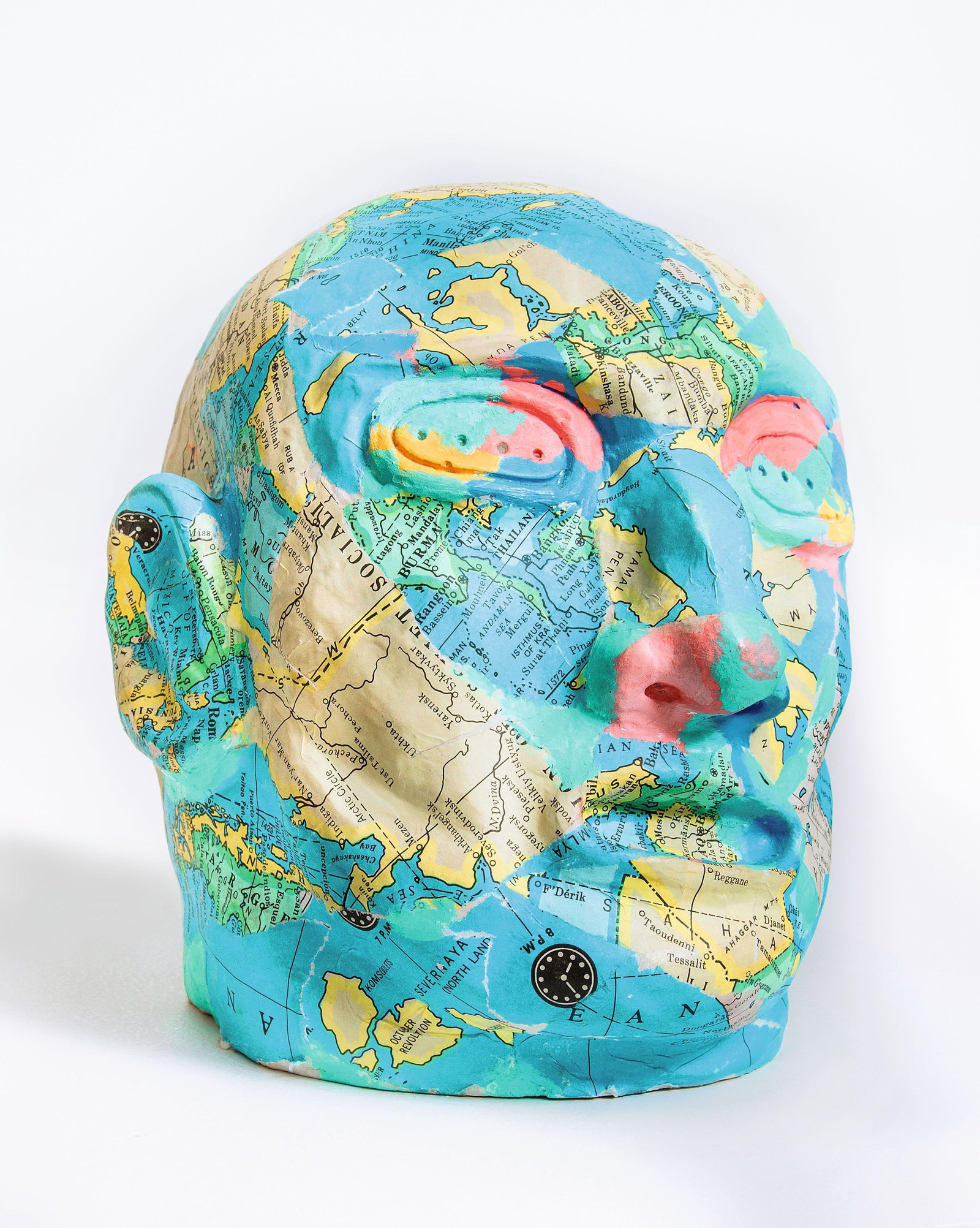
For his exhibition at the East Village gallery Civilian Warfare in May 1984, Wojnarowicz created a group of cast-plaster heads that he individualised by applying torn maps and paint. He made twenty-three of them, a reference to the number of chromosome pairs in human DNA, and explained that the series was about “the evolution of consciousness.” At the gallery, he installed these “alien heads” on long shelves on a wall painted with a bull’s-eye. Suggesting a ring line, the installation evoked the conflicts then ravaging Central and South America, from the Contra War in Nicaragua to the Salvadoran Civil War to the Argentine Dirty War. The spectre of torture, disappearance, and human-rights abuses cast a shadow over all of the Americas.
David Wojnarowicz (American, 1954-1992) Untitled 1984 From the Metamorphosis series Collaged paper and acrylic on plaster 9 1/2 × 9 1/2 × 9 1/2 in. (24.1 × 24.1 × 24.1cm) Collection of Beth Rudin DeWoody Image courtesy Beth Rudin DeWoody Photo: Monica McGivern
Gallery 4
Wojnarowicz met Peter Hujar in 1980. They were briefly lovers, but the relationship soon transitioned and intensified into a friendship that defied categorisation. The two frequently made artworks using the other as subject. Twenty years Wojnarowicz’s senior, Hujar was a photographer and a known figure in the New York art world, esteemed for his achingly beautiful, technically flawless portraits. At the time of their meeting, Wojnarowicz was still finding his way. It was Hujar who convinced him that he was an artist and, specifically, encouraged him to paint – something Wojnarowicz had never done. After Hujar’s death in 1987 due to complications from AIDS, Wojnarowicz would claim him as “my brother, my father, my emotional link to the world.”
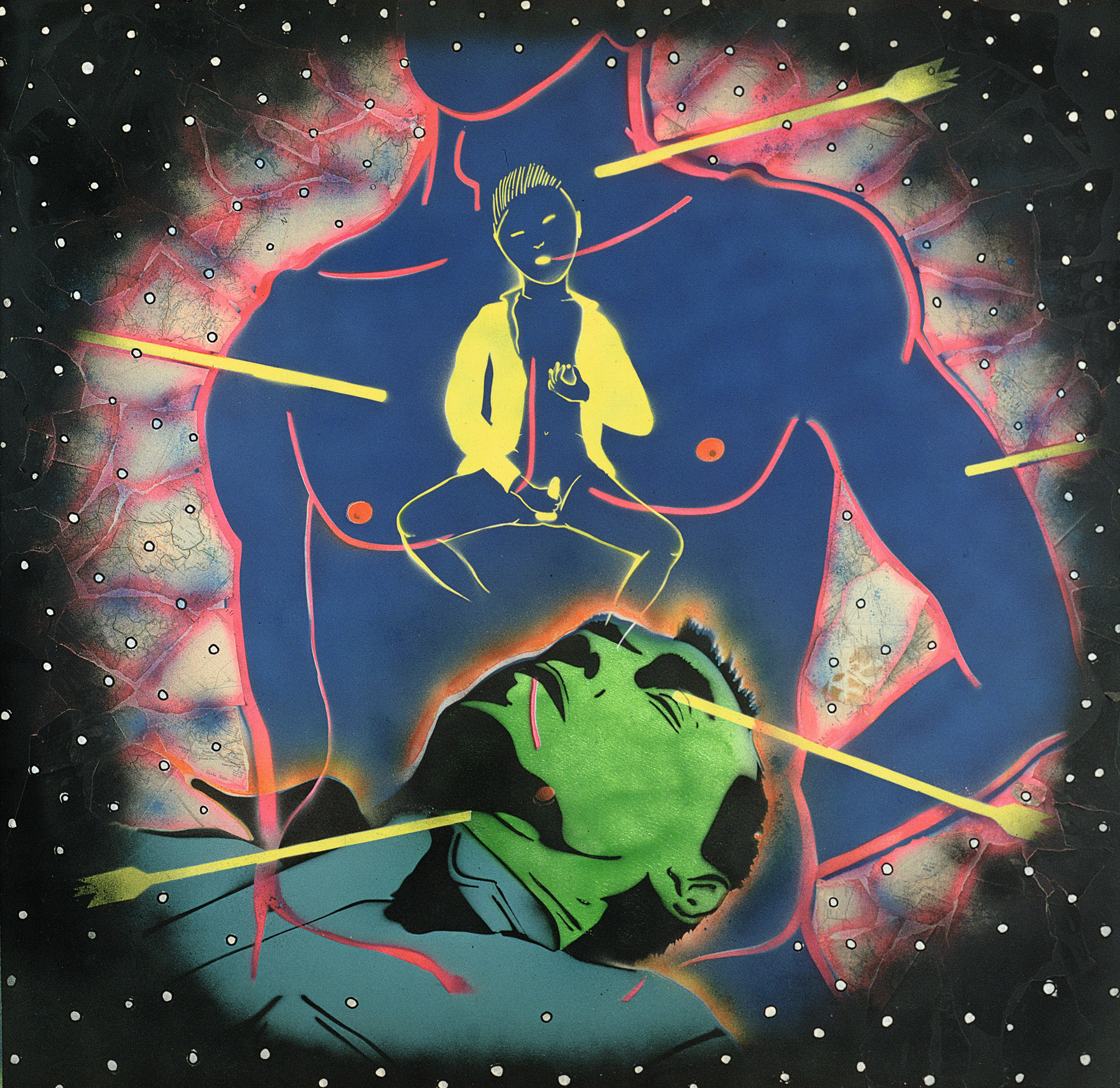
David Wojnarowicz (American, 1954-1992) Peter Hujar Dreaming/Yukio Mishima: Saint Sebastian 1982 Acrylic and spray paint on Masonite 48 × 48 in. (121.9 × 121.9cm) Collection of Matthijs Erdman Image courtesy the Estate of David Wojnarowicz and P.P.O.W, New York
In this painting from 1982, Wojnarowicz composes a meditation on male desire. His friend and mentor Peter Hujar stretches across the bottom, reclining with his eyes closed, apparently dreaming the scene above. An image of the Japanese author Yukio Mishima (1925-1970) masturbating dominates the centre of the composition; it is inspired by the writer’s description of his first masturbatory experience, initiated by a reproduction of a Renaissance painting of Saint Sebastian. The torso of the Christian martyr – young, statuesque, and pierced with arrows – rises above, a glowing aura linking him to the night sky and offering him up as an icon of queerness.
This photograph of Wojnarowicz with his head bowed appeared on the cover of the June 28, 1983, edition of The Village Voice. It accompanied the article “Heartsick: Fear and Loving in the Gay Community” by Richard Goldstein. At the time of publication, very little was known about HIV and AIDS, including how it spread. Goldstein wrote: “If one were to devise a course of action based on incontrovertible evidence alone, there would be no conclusion to draw. Should I screen out numbers who look like they’ve been around? Should I travel to have sex? Should I look for lesions before I leap? How do I know my partner doesn’t have the illness in its (apparently protracted) dormant stage?” By the end of 1983, there were 2,118 reported AIDS-related deaths in the United States.
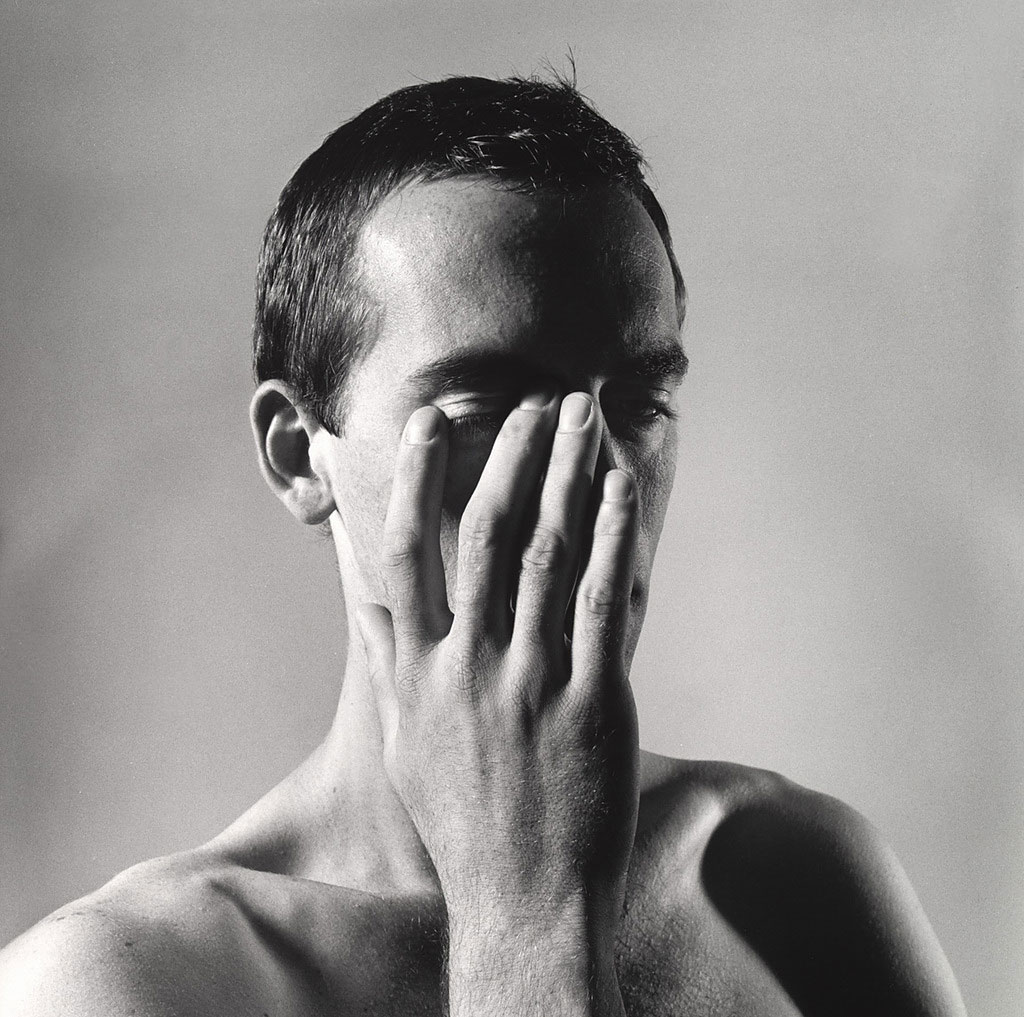
Peter Hujar (American, 1934-1992) David Wojnarowicz with Hand Touching Eye 1981 Gelatin silver print 14 3/4 x 14 3/4″ (37.4 x 37.4cm) The Museum of Modern Art, New York The Fellows of Photography Fund
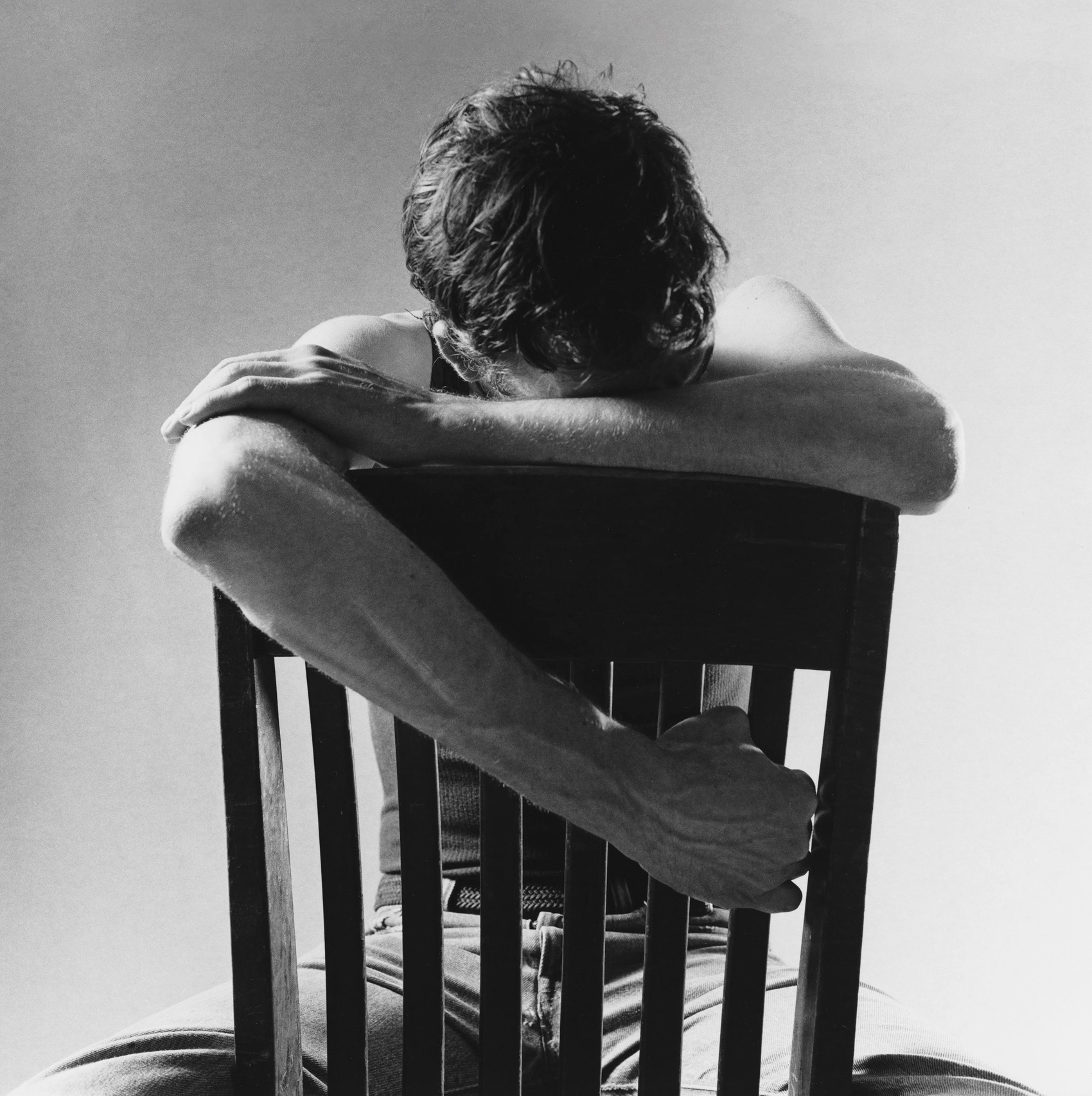
Peter Hujar (American, 1934-1992) David Wojnarowicz Reclining (II) 1981 Gelatin silver print 14 11/16 x 14 13/16 in. (37.3 x 37.6cm) Princeton University Art Museum, Princeton, NJ Gift of Stephen Koch
David Wojnarowicz (American, 1954-1992) Untitled (Green Head) 1982 Acrylic on composition board 48 × 96 in. (121.9 × 243.8cm) Collection of Hal Bromm and Doneley Meris
Gallery 5
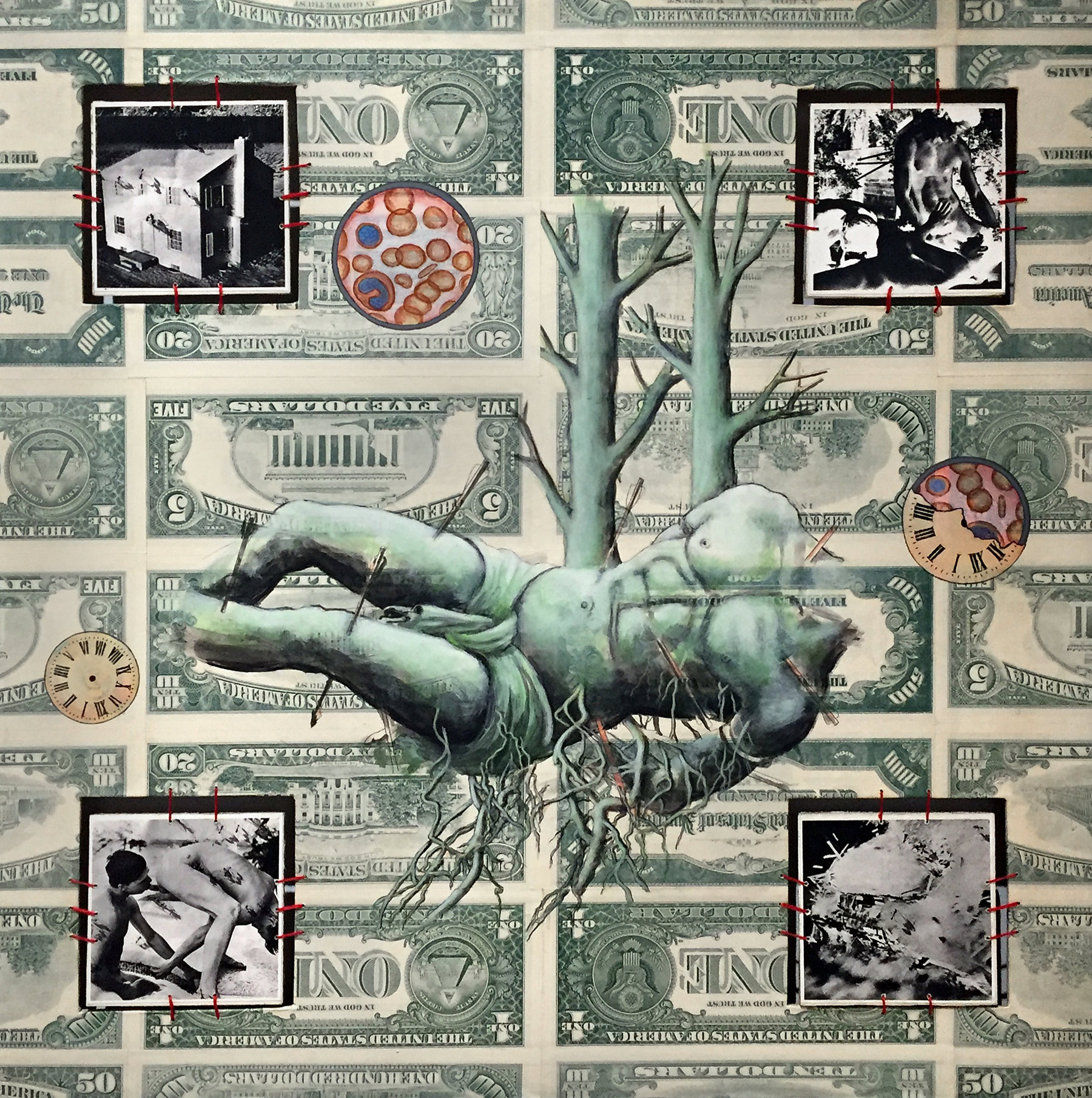
In the mid-1980s Wojnarowicz began to incorporate his disparate signs and symbols into complex paintings. A fierce critic of a society he saw degrading the environment and ostracising the outsider, Wojnarowicz made compositions that were dense with markers of industrial and colonised life. These include railroad tracks and highways, sprawling cities and factory buildings, maps and currency, nuclear power diagrams and crumbling monuments. Interspersed among them are symbols that he connected to fragility, such as blood cells, animals and insects, and the natural world. Wojnarowicz used these depictions as metaphors for a culture that devalues the lives of those on the periphery of mainstream culture. He made these paintings at a time when AIDS was ravaging New York, particularly the gay community. Although AIDS was first identified in 1981, President Ronald Reagan did not mention it publicly until 1985. By the end of that year, in New York alone there already had been 3,766 AIDS-related deaths.
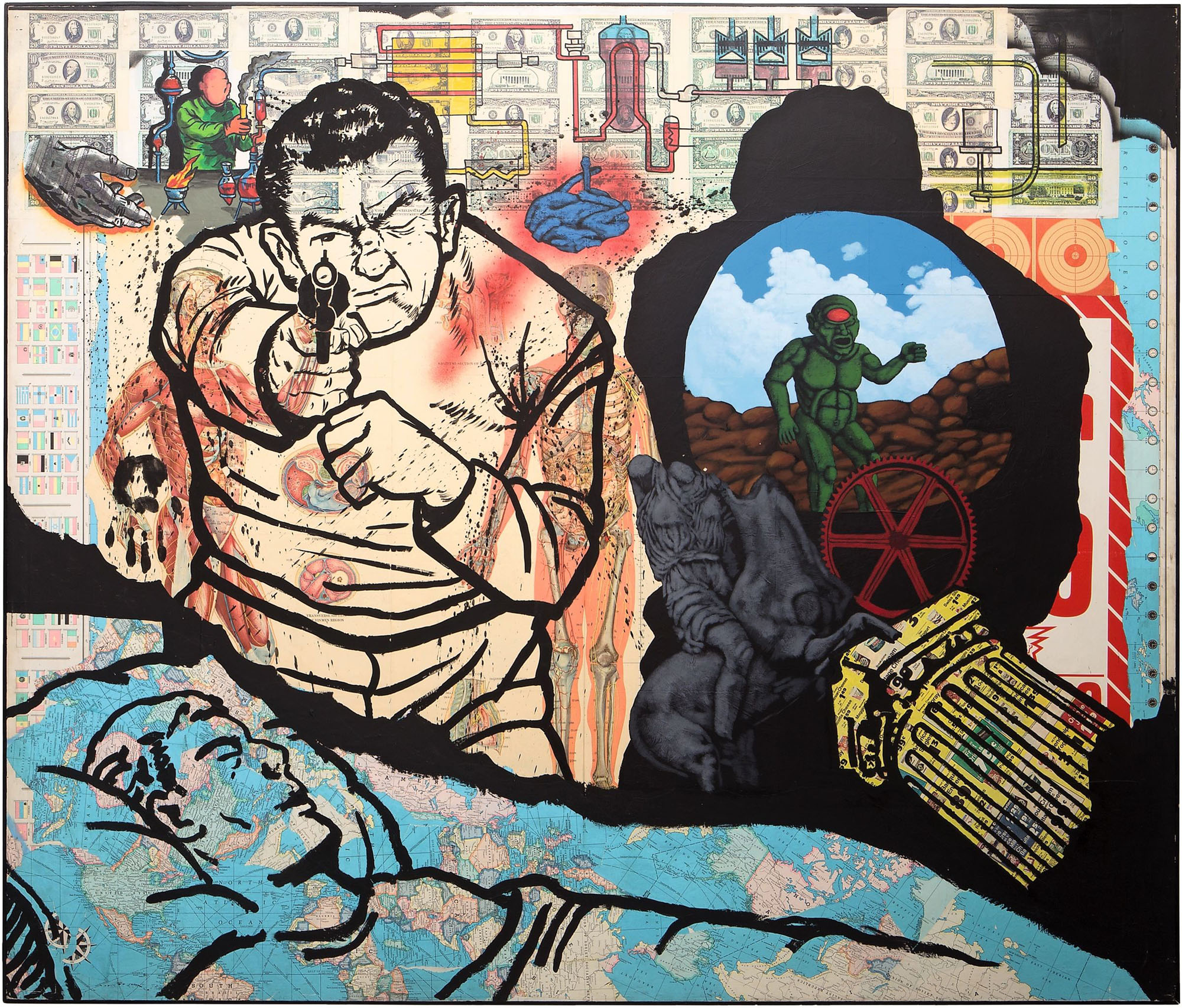
David Wojnarowicz (American, 1954-1992) History Keeps Me Awake at Night (For Rilo Chmielorz) 1986 Acrylic, spray paint, and collaged paper on composition board 72 x 84 in. (170.2 x 200cm) Collection of John P. Axelrod Photo: Ron Cowie
In History Keeps Me Awake at Night (for Rilo Chmielorz) Wojnarowicz presents a dystopic vision of American life. Presenting simulated American currency and bureaucratic emblems alongside symbols of crime, monstrosity, and chaos, the painting’s threatening imagery runs counter to the apparently placid sleep of the man below. If the painting is about fear, perhaps the fear of staring down AIDS, Wojnarowicz presents it as an endemic condition in which new fears are built upon historical ones.
A nightmarish allegory of violence and capitalism, Das Reingold: New York Schism makes reference to Richard Wagner’s opera Das Rheingold (1854), in which the holder of a magical ring will gain the power to rule the world should he renounce love. This narrative assumed particular power at a moment when artists were joining the group ACT UP (AIDS Coalition to Unleash Power) to protest the profiteering of pharmaceutical companies and government mismanagement of the AIDS crisis.
The Death of American Spirituality contains a number of Wojnarowicz’s recurring symbols and imagery densely layered in a single composition. With its radically juxtaposed motifs that suggest different temporalities – from geologic landforms to emblems of the American West and the Industrial Revolution – the mythical tableau depicts destruction proliferating alongside technological advancement and geographic conquest.
David Wojnarowicz (American, 1954-1992) I Use Maps Because I Don’t Know How to Paint 1984 Acrylic and collaged paper on composition board 48 x 48 in. (121.9 x 121.9cm) Rubell Family Collection, Miami
David Wojnarowicz (American, 1954-1992) The Birth of Language II 1986 Acrylic, spray paint, and collaged paper on wood 67 x 79 in. (170.2 x 200.7cm) Collection of Matthijs Erdman
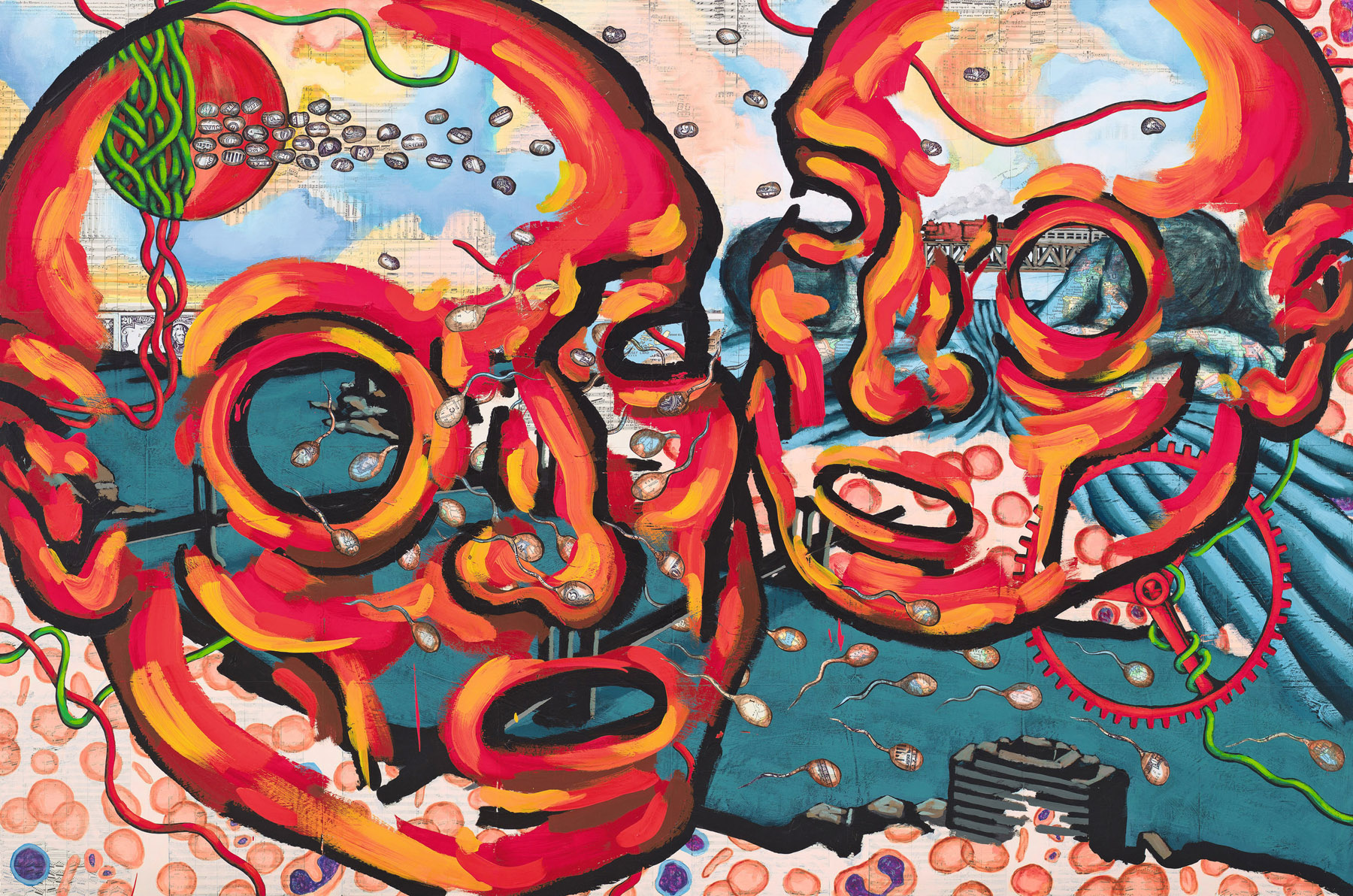
David Wojnarowicz (American, 1954-1992) Earth, Wind, Fire, and Water 1986 Acrylic and spray paint on canvas 78 3/4 in. × 157 1/2 in. (200 × 400cm) Private collection Image courtesy Daniel Buchholz and Christopher Müller, Cologne Photo: Nick Ash
Gallery 6
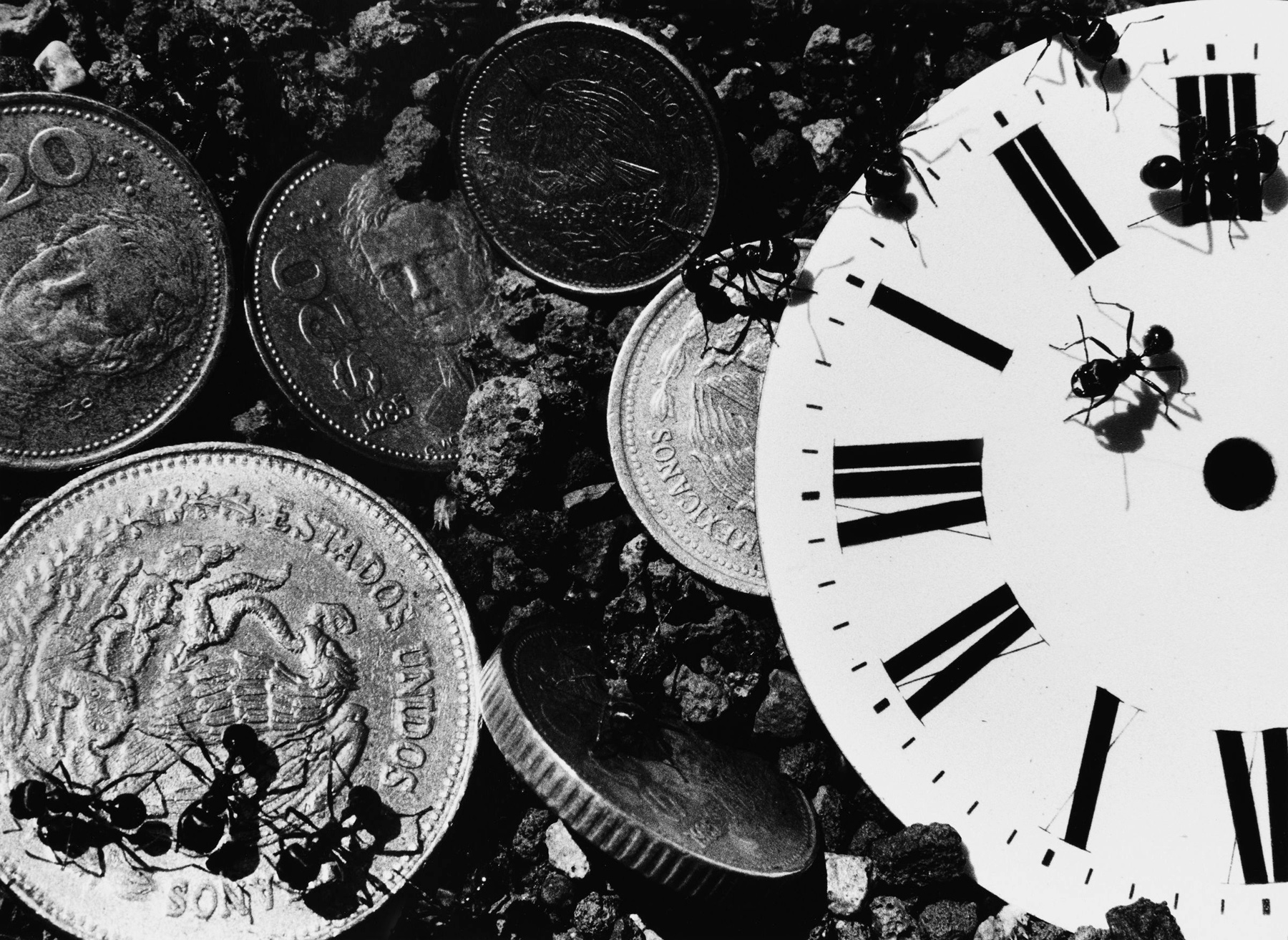
Wojnarowicz filmed constantly during this period, bringing his Super 8 camera with him on his frequent travels. At the end of October 1986, he went to Mexico where he filmed the Day of the Dead festivities and other scenes at Teotihuacán. This footage includes fire ants climbing on objects such as clocks, currency, and a crucifix that Wojnarowicz brought with him. Wojnarowicz, who was raised Roman Catholic, would later speak of Jesus Christ as one who “took on the suffering of all people.” As the AIDS crisis intensified, he sought to find a symbolic language that encapsulated ideas of spirituality, mortality, vulnerability, and violence. He began to edit the Mexican footage into a film entitled A Fire in My Belly, but it was never finished. Ravenous for the world and its offerings, Wojnarowicz used film as form of second sight, a visual notebook, and a record for us to see the world – at least in ashes – as he did.
David Wojnarowicz (American, 1954-1992) Still from an unfinished film Super 8 film, black and white, silent, 3 minutes Courtesy the Fales Library and Special Collections, New York University
David Wojnarowicz (American, 1954-1992) Unfinished Film (A Fire in My Belly) 1986-1987 Super 8 film transferred to digital video, black-and-white and colour, silent; 20:56 min. Fales Library and Special Collections, New York University
Original Silent Version of “A Fire in My Belly” by the late David Wojnarowicz. This film was censored by The National Portrait Gallery in early December, 2010.
Gallery 7
On September 17, 1987, Gracie Mansion Gallery opened an exhibition of Wojnarowicz’s work called The Four Elements. These symbolically and technically dense paintings – allegorical representations of earth, water, fire, and wind – are Wojnarowicz’s take on a theme with a long history in European art. By linking his contemporary moment to a historical subject, he claims a lineage for his work as he suggests the particularity – and particular violence – of his time.
David Wojnarowicz (American, 1954-1992) Water 1987 Acrylic, ink, and collaged paper on composition board 72 × 96 in. (182.9 × 243.8cm) Second Ward Foundation Image courtesy the Estate of David Wojnarowicz and P.P.O.W, New York
David Wojnarowicz (American, 1954-1992) Water (details) 1987 Acrylic, ink, and collaged paper on composition board 72 × 96 in. (182.9 × 243.8cm) Second Ward Foundation Image courtesy the Estate of David Wojnarowicz and P.P.O.W, New York
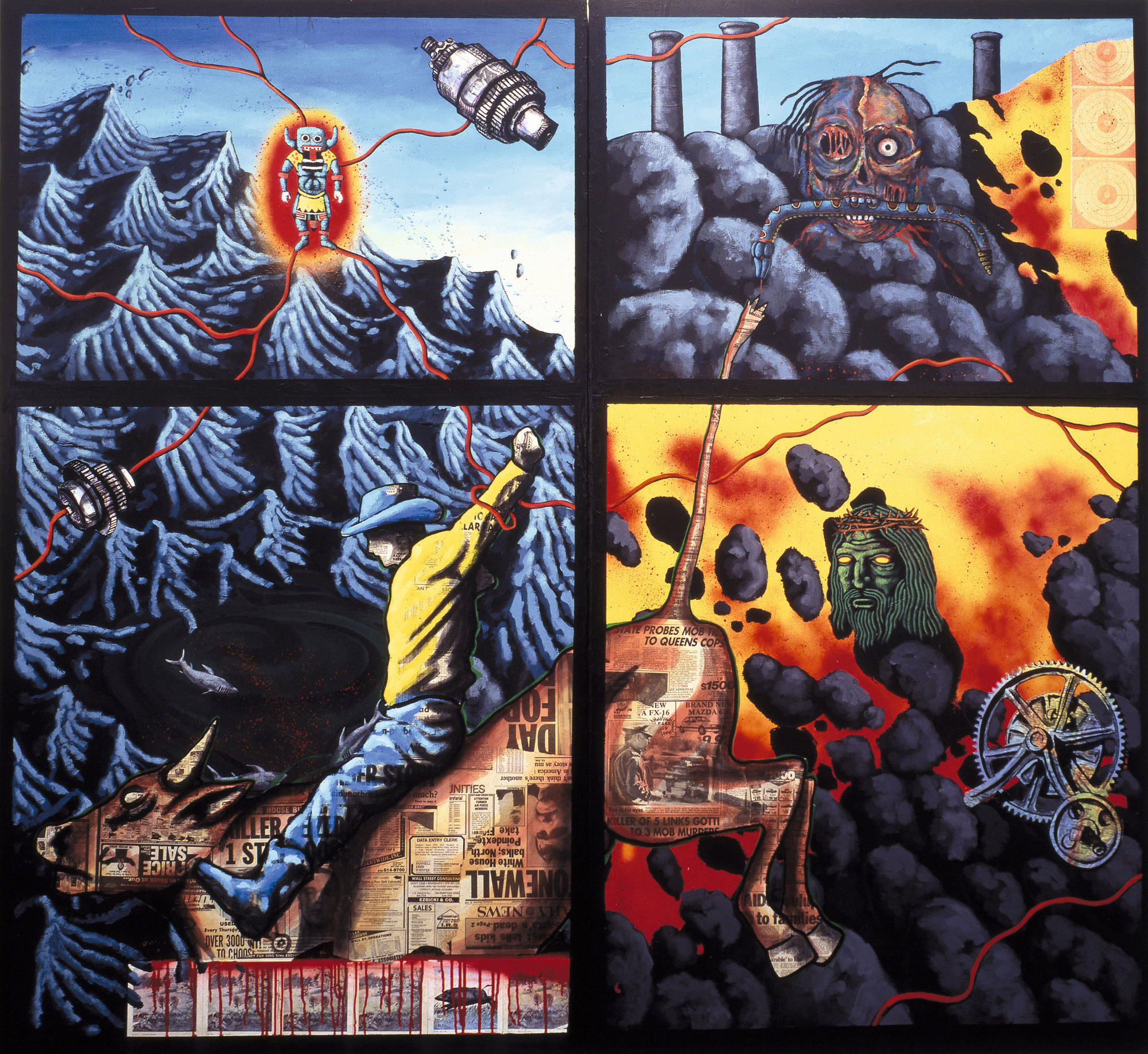
David Wojnarowicz (American, 1954-1992) Earth 1987 Acrylic and collaged paper on wood, two panels 72 × 96 in. (182.9 × 243.8cm) The Museum of Modern Art, New York Gift of Agnes Gund
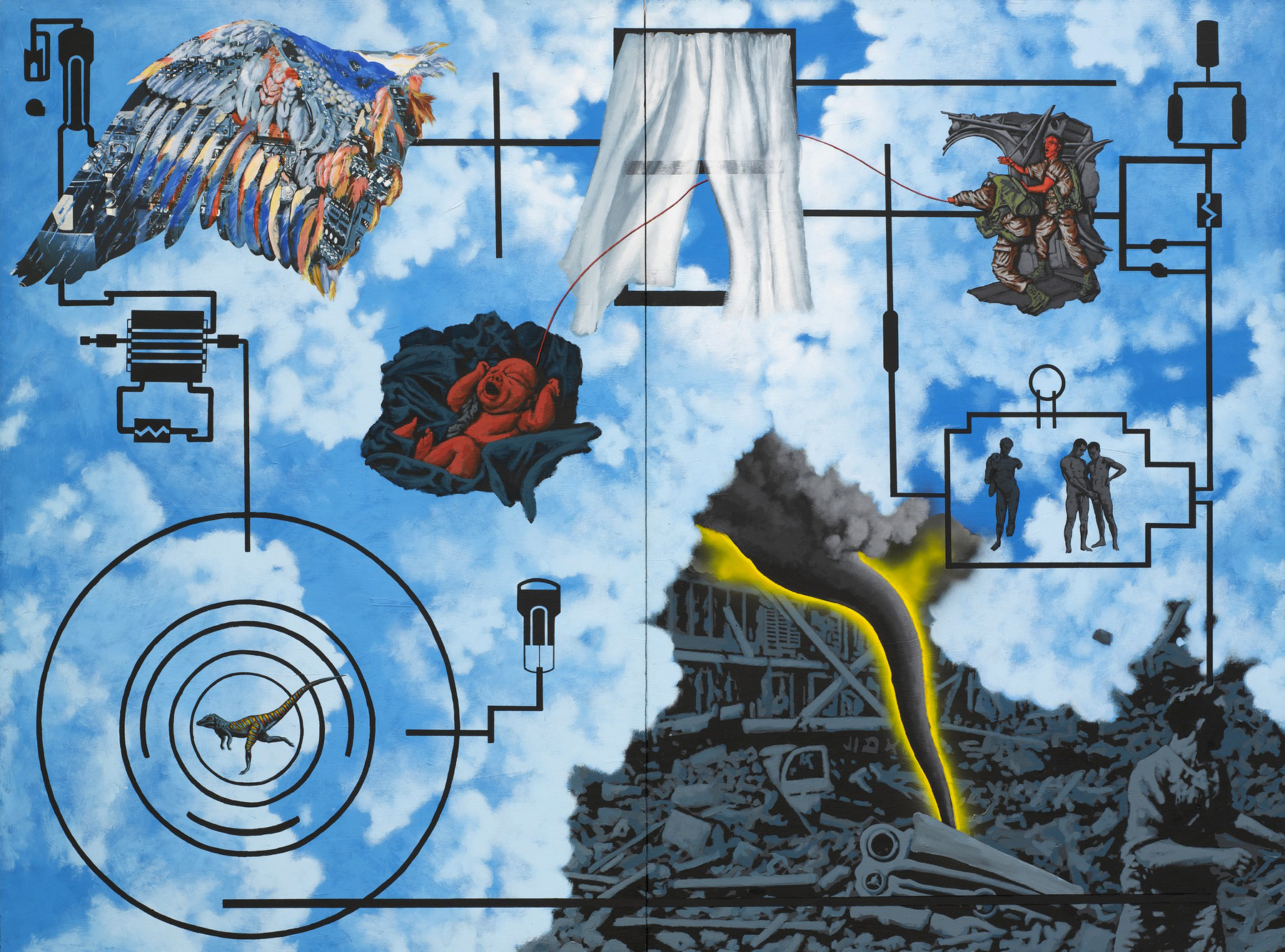
David Wojnarowicz (American, 1954-1992) Wind (For Peter Hujar) 1987 Acrylic and collaged paper on composition board, two panels 72 × 96 in. (182.9 × 243.8cm) Collection of the Second Ward Foundation
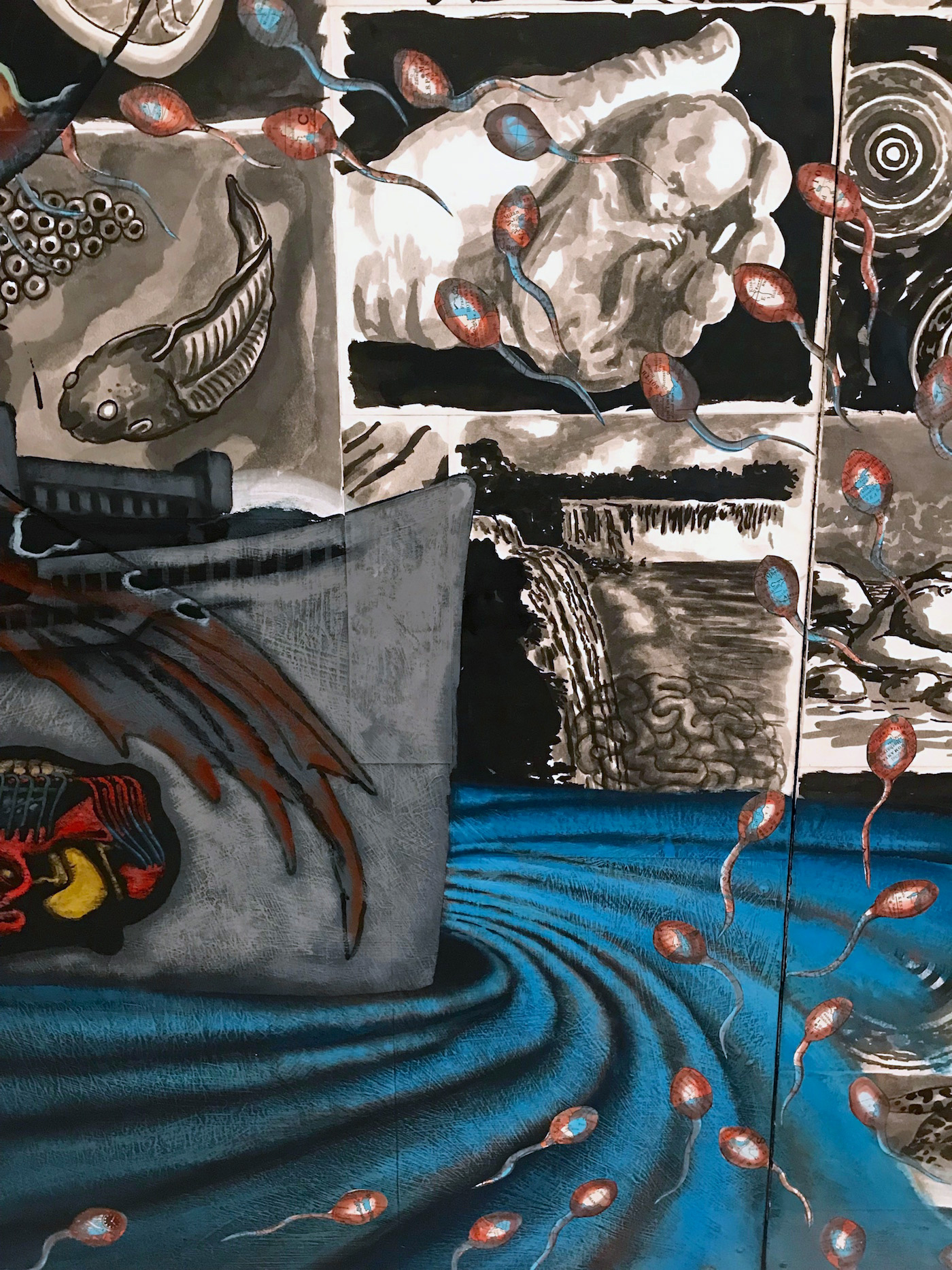
Wind (For Peter Hujar) is the most personal and self-referential of Wojnarowicz’s Four Elements paintings. A red line running through an open window connects a baby – based on a photograph of his brother Steven’s newborn – to a headless paratrooper. Wojnarowicz, in his only painted self-portrait, stands behind. The bird’s wing dominating the upper left quarter of the painting is a copy of one of Hujar’s favorite works – a 1512 drawing by the German artist Albrecht Dürer. Hujar would die less than two months after this painting was first exhibited and Wojnarowicz later had the wing carved into his friend’s tombstone. Three days after Hujar’s death, Wojnarowicz wrote in his journal after visiting his grave: “He sees me, I know he sees me. He’s in the wind in the air all around me.”
David Wojnarowicz (American, 1954-1992) Fire 1987 Acrylic and collaged paper on wood, two panels 72 x 96 in. (182.9 x 243.8cm) The Museum of Modern Art, New York Gift of Agnes Gund and Barbara Jakobson Fund
Gallery 8: Sound Gallery
Writing and engaging in readings was an important part of David Wojnarowicz’s practice. The transcript on the website is text from audio recordings of Wojnarowicz reading his own work in 1992 at the Drawing Center, New York, at a benefit for Needle Exchange. He read excerpts from his books Close to the Knives: A Memoir of Disintegration (1991) and Memories That Smell Like Gasoline (1992); a short work, “Spiral,” which appeared in Artforum in 1992; and another brief piece that begins with the phrase “When I put my hands on your body,” which also appears in one of his photo-based works.
Gallery 9
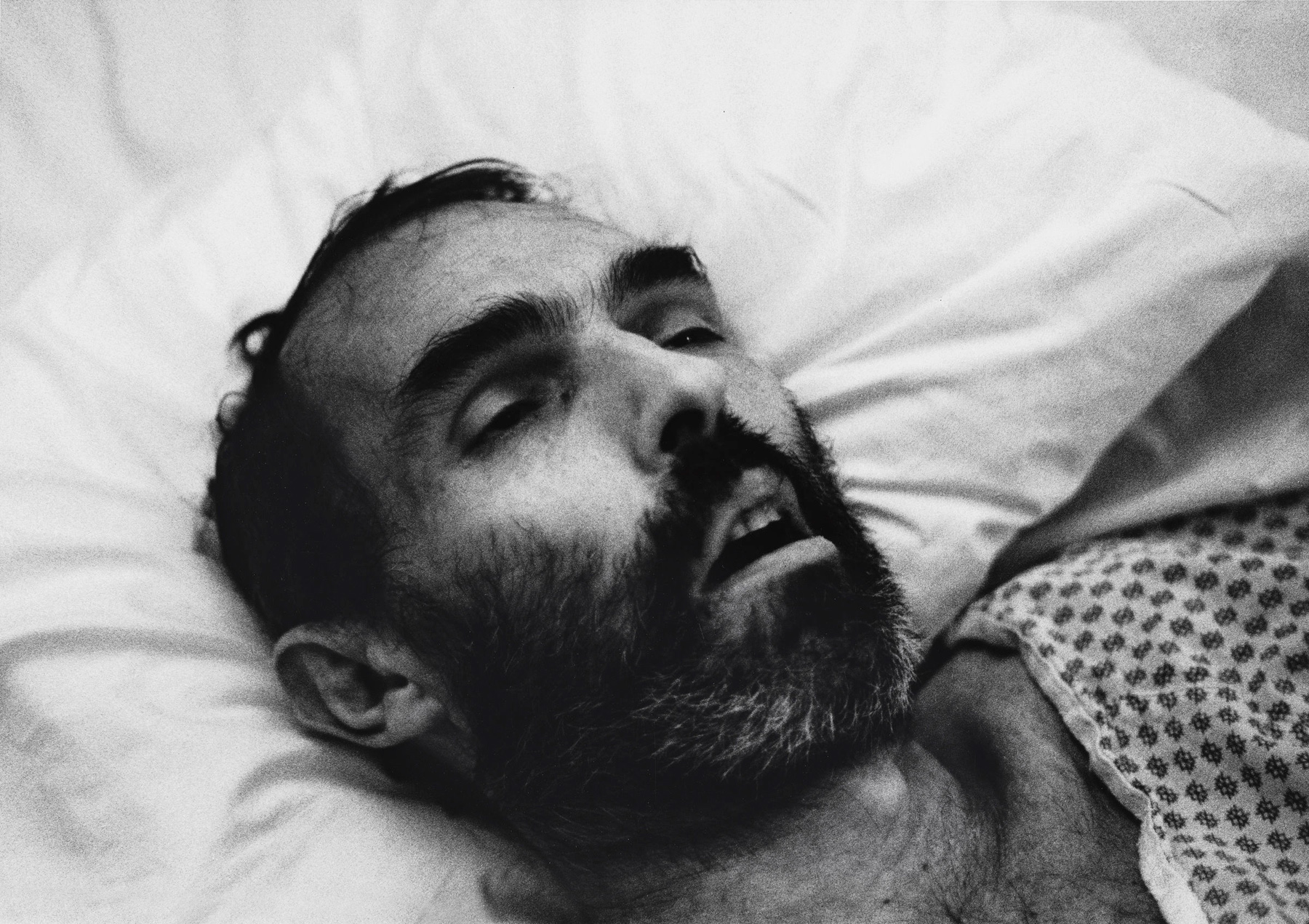
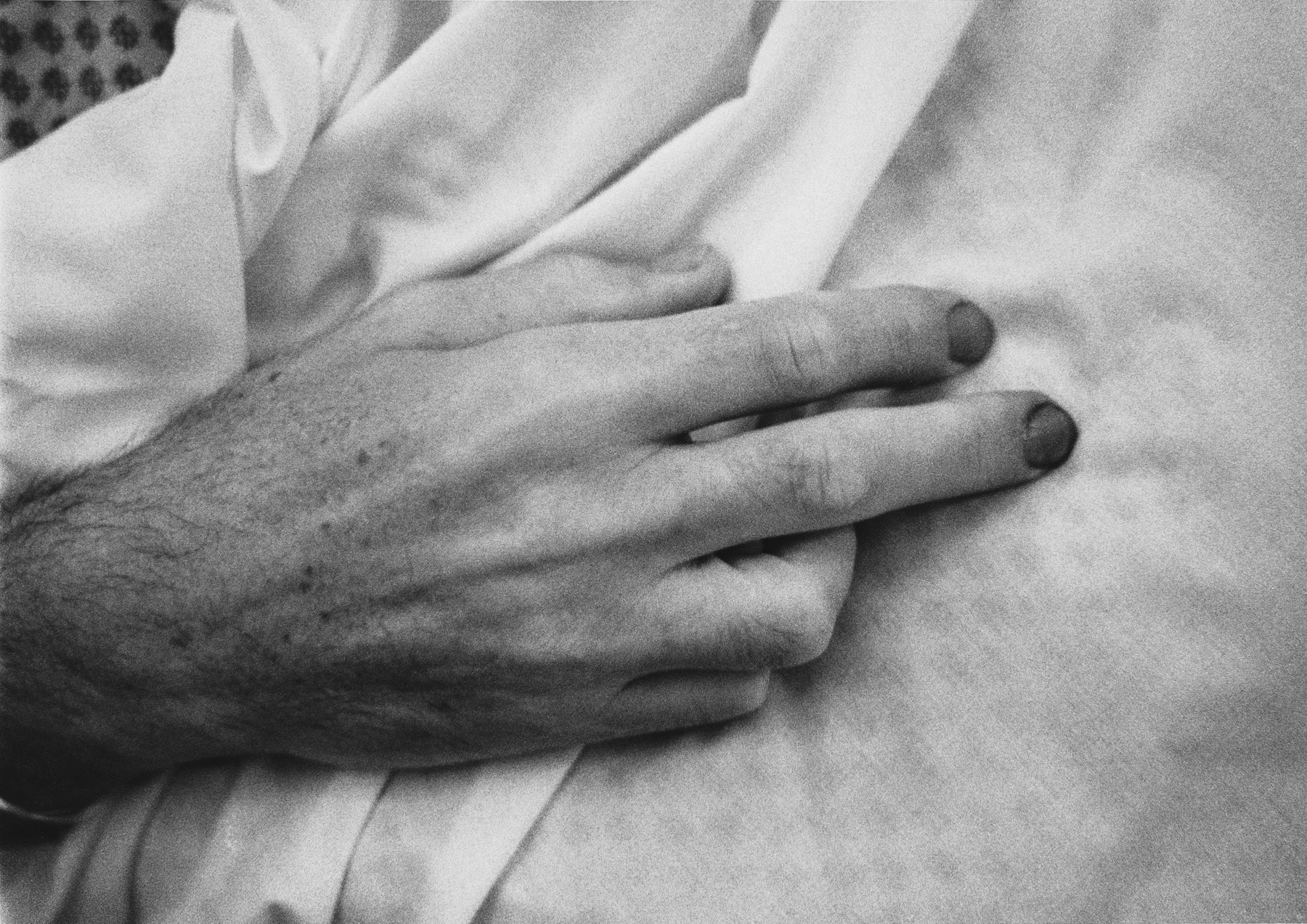
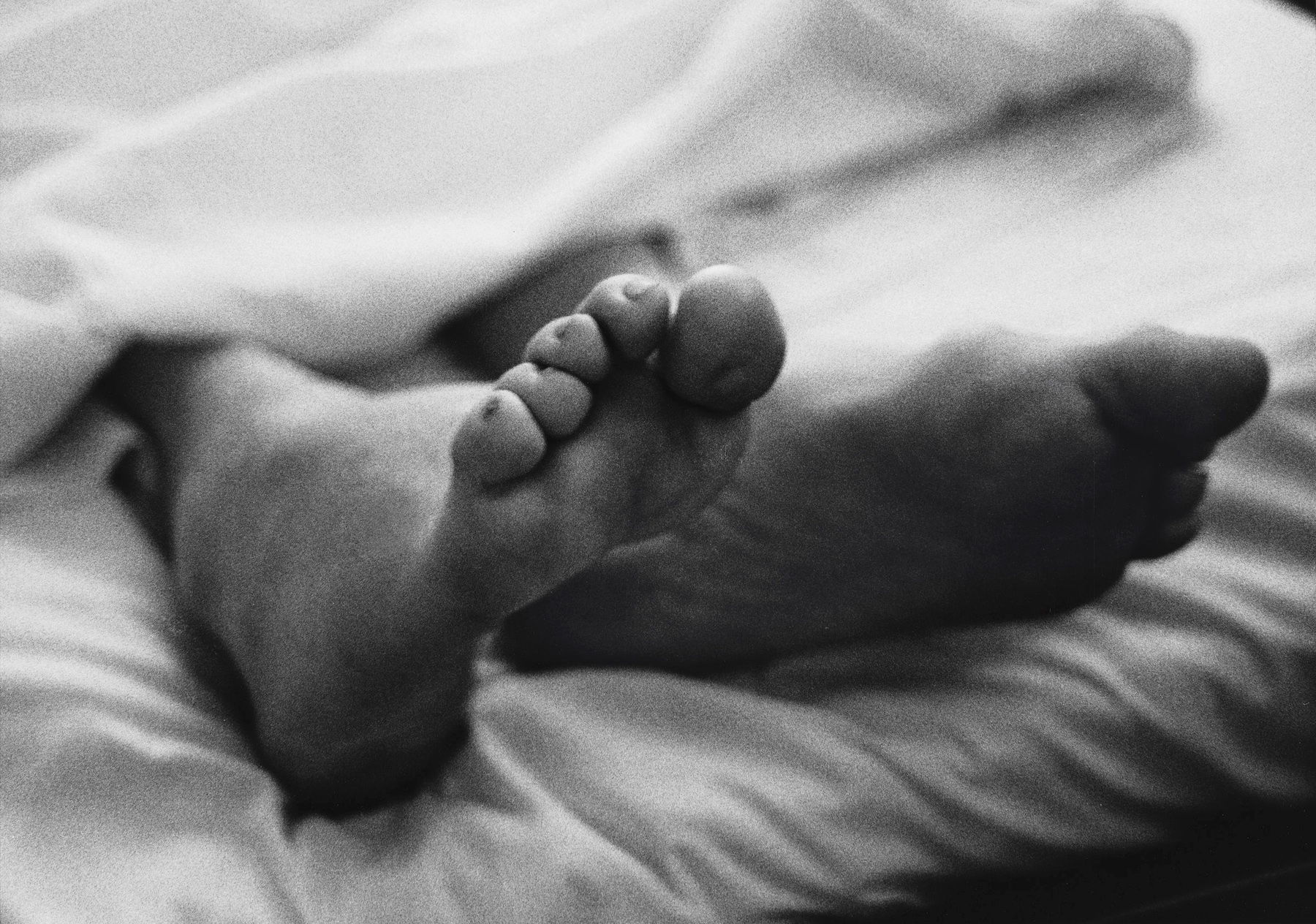
Wojnarowicz was in the hospital room when Peter Hujar died from complications related to AIDS. He asked the others who were there to leave so that he could film and photograph his friend for the last time. The three tender images of Hujar’s head, hands, and feet installed here come from this final encounter. While Wojnarowicz would continue to draw and paint after Hujar’s death, photography and writing would preoccupy him until the end of his life. He moved into Hujar’s loft, which had a darkroom, enabling him to reconsider – and experiment with – the vast number of negatives he had accumulated over the years.
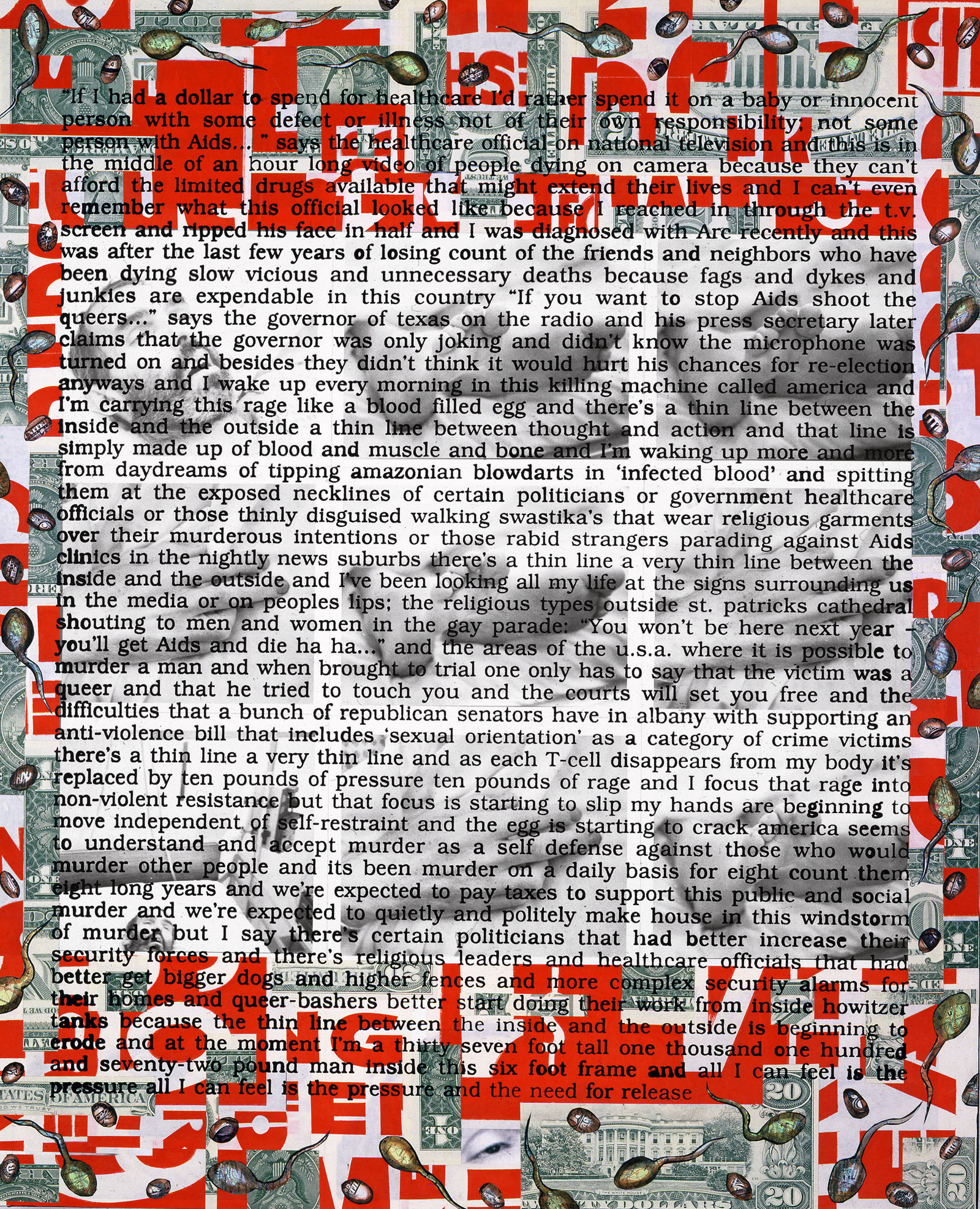
Wojnarowicz found himself at the centre of political debates involving the National Endowment for the Arts (NEA). In a newsletter that the American Family Association distributed to criticise NEA funding of exhibitions with gay content, the religious lobby group excerpted Wojnarowicz’s work out of context. He sued for copyright infringement and won. Wojnarowicz’s hand-edited affdavit and related materials are included here. The searing essay he contributed to the catalogue for Witnesses: Against Our Vanishing, an exhibition curated by artist Nan Goldin in 1989, triggered the NEA to withdraw its funding. In it Wojnarowicz strenuously criticised – and personally demonised conservative policy-makers for failing to halt the spread of AIDS by discouraging education about safe sex practices. One of its most memorable passages is the pronouncement: “WHEN I WAS TOLD THAT I’D CONTRACTED THIS VIRUS IT DIDN’T TAKE ME LONG TO REALIZE THAT I’D CONTRACTED A DISEASED SOCIETY AS WELL.”
David Wojnarowicz (American, 1954-1992) Bad Moon Rising 1989 Four gelatin silver prints, acrylic, string, and collage on composition board 36 3/4 x 36 5/8 x 2 1/4 in. (93.3 x 93 x 5.7cm) Collection of Steven Johnson and Walter Sudol Courtesy Second Ward Foundation
Phil Zwickler (b. 1954; Alexandria, VA; d. 1991; New York, NY) Footage of Wojnarowicz speaking about the National Endowment for the Arts controversy (extract) 1989 Video transferred to digital video, color, sound; 7:23 min. Fales Library and Special Collections, New York University; courtesy the Estate of Phil Zwickler
Artist David Wojnarowicz discusses right-wing backlash against the NEA and arts funding (circa 1989).
This 1989 video by Phil Zwickler, a filmmaker, journalist, and AIDS activist, was shot in Wojnarowicz’s apartment days before the opening of Witnesses: Against Our Vanishing, an exhibition that presented artists’ responses to the AIDS crisis. John Frohnmayer, the chairman of the National Endowment for the Arts (NEA), withdrew the NEA’s $10,000 grant to the exhibition in response to the essay that Wojnarowicz wrote for the catalogue. The grant was later partially reinstated, but with the stipulation that no money was to be used to support the catalogue. Zwickler filmed Wojnarowicz while the controversy was unfolding.
David Wojnarowicz (American, 1954-1992) Untitled (Hujar Dead) 1988-1989 Black-and-white photograph, acrylic, screenprint, and collaged paper on Masonite 39 × 32 in. (99.1 × 81.3cm) Whitney Museum of American Art, New York Gift of Steven Johnson and Walter Sudol in memory of David Wojnarowicz Image courtesy the Estate of David Wojnarowicz and P.P.O.W, New York
This painting presents an urgent condemnation of systemic homophobia and government inattention to people with AIDS – including, by that point, Wojnarowicz himself – and expresses the artist’s extreme anger at being at the mercy of those in power. The nine photographs at the centre of the painting are of Peter Hujar, taken shortly after his death. The painting was included in Witnesses: Against Our Vanishing at New York’s Artists Space from November 16, 1989, to January 6, 1990. Curated by Nan Goldin, the exhibition also included work by other artists responding to the AIDS crisis: David Armstrong, Tom Chesley, Dorit Cypris, Jane Dickson, Philip-Lorca DiCorcia, Darrel Ellis, Allen Frame, Peter Hujar, Greer Lankton, Siobhan Liddel, James Nares, Perico Pastor, Margo Pelletier, Clarence Elie Rivera, Vittorio Scarpati, Jo Shane, Kiki Smith, Janet Stein, Stephen Tashjian, Shellburne Thurber, and Ken Tisa.
David Wojnarowicz (American, 1954-1992) Childhood 1988 Acrylic, watercolour, and collaged paper on canvas 42 × 47 1/2 in. (106.7 × 120.7cm) Collection of Eric Ceputis and David W. Williams Photo: Michael Tropea
David Wojnarowicz (American, 1954-1992) Something from Sleep III (For Tom Rauffenbart) 1989 Acrylic and spray paint on canvas 48 1/2 x 39 x 1 5/8 in. (123.2 x 99.1 x 4.1cm) Collection of Tom Rauffenbart
Installation view of David Wojnarowicz: History Keeps Me Awake at Night at the Whitney Museum of American Art, New York showing some of the Ant series
David Wojnarowicz (American, 1954-1992) Untitled (Time and Money) 1988-1989 From the Ant Series Gelatin silver print 16 × 20 in. (40.6 × 50.8cm) Collection of Steve Johnson and Walter Sudol Courtesy Second Ward Foundation Image courtesy the Estate of David Wojnarowicz and P.P.O.W, New York
David Wojnarowicz (American, 1954-1992) Untitled (Desire) 1988-1989 From the Ant Series Gelatin silver print 16 x 20 in. (40.6 x 50.8cm) Collection of Steven Johnson and Walter Sudol Courtesy Second Ward Foundation
David Wojnarowicz (American, 1954-1992) Untitled (Violence) 1988-1989 From the Ant Series Gelatin silver print 16 x 20 in. (40.6 x 50.8cm) Collection of Steven Johnson and Walter Sudol Courtesy Second Ward Foundation
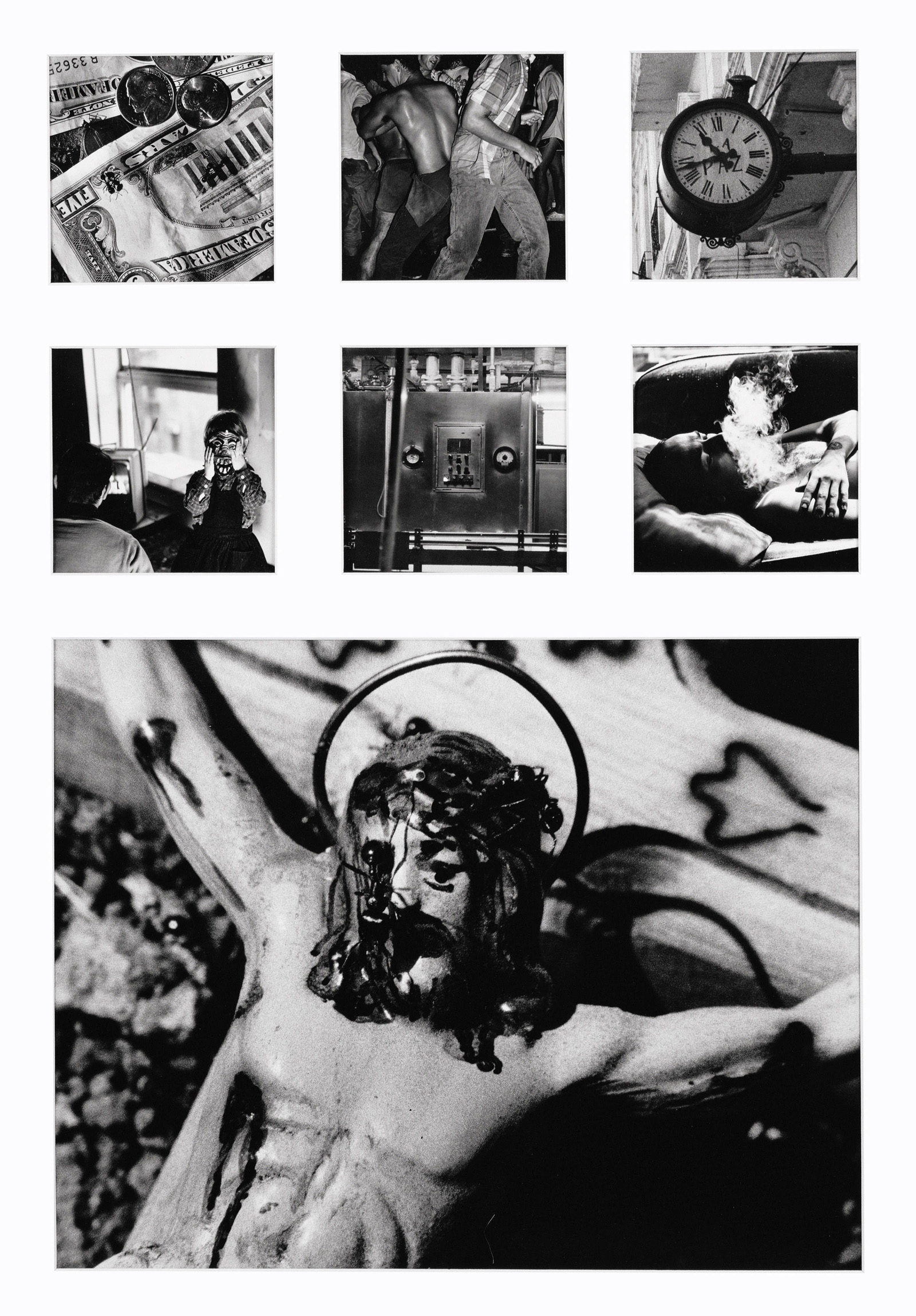
David Wojnarowicz (American, 1954-1992) Spirituality (For Paul Thek) 1988-1989 Gelatin silver prints on museum board 41 × 32 1/2 in. (104.1 × 82.6cm) Collection of Steve Johnson and Walter Sudol Courtesy Second Ward Foundation Image courtesy the Estate of David Wojnarowicz and P.P.O.W, New York
Wojnarowicz often presented a series of photographs as a single composition, as he does with Spirituality (For Paul Thek). This method allows the images to retain their singularity as they merge into one entity, and to serve as potent metaphors for the role – and importance – of the individual in the larger society. The central image of the crucifix was taken while Wojnarwicz was in Teotihuacán, north of Mexico City. He wanted to stage an image that suggested the eternal conflict between nature and man-made culture. Wojnarowicz considered ants to be evolved beings, writing in a 1989 text that they “are the only insects to keep pets, use tools, make war, and capture slaves.” The photograph of the reclining man was taken in 1980 and depicts Wojnarowicz’s friend Iola Carew, then a coworker at the nightclub Danceteria. Carew was the first person Wojnarowicz knew to be diagnosed with AIDS. The work is dedicated to the artist Paul Thek, who died of AIDS-related complications in 1988.
David Wojnarowicz (American, 1954-1992) Spirituality (For Paul Thek) (details) 1988-1989 Gelatin silver prints on museum board 41 × 32 1/2 in. (104.1 × 82.6cm) Collection of Steve Johnson and Walter Sudol Courtesy Second Ward Foundation Image courtesy the Estate of David Wojnarowicz and P.P.O.W, New York
The works in Wojnarowicz’s Sex Series are punctuated with circular insets containing an array of cropped details, including pornographic imagery. For Wojnarowicz, these voyeuristic “peepholes” evoked surveillance photos or objects under a microscope. This was one of his first projects after Hujar’s death and Wojnarowicz’s own diagnosis with HIV. “It came out of loss,” he said. “I mean every time I opened a magazine there was the face of somebody else who died. It was so overwhelming and there was this huge backlash about sex, even within the activist community… And it essentially came out of wanting some sexy images on the wall – for me. To keep me company. To make me feel better.”
The sole survey of Wojnarowicz’s work during his lifetime, David Wojnarowicz: Tongues of Flame, was held in 1990 at Illinois State University in Normal. In the lead-up to the exhibition, he began work on the four large-scale paintings of exotic flowers. Equating the beauty of the body with its very fragility, Wojnarowicz uses the flower as an allusion to the AIDS crisis, his own illness, and a continuum of loss. Importantly, the flower also suggests the possibility and necessity of beauty. The artist Zoe Leonard recalls showing Wojnarowicz, at the height of the AIDS crisis, her small work prints of clouds. Leonard, also an activist, recalls: “I felt guilty and torn. I felt detached – my work was so subtle and abstract, so apolitical on the surface. I remember showing those pictures to David and talking things over with him and he said – I’m paraphrasing – Don’t ever give up beauty. We’re fighting so that we can have things like this, so that we can have beauty again.”
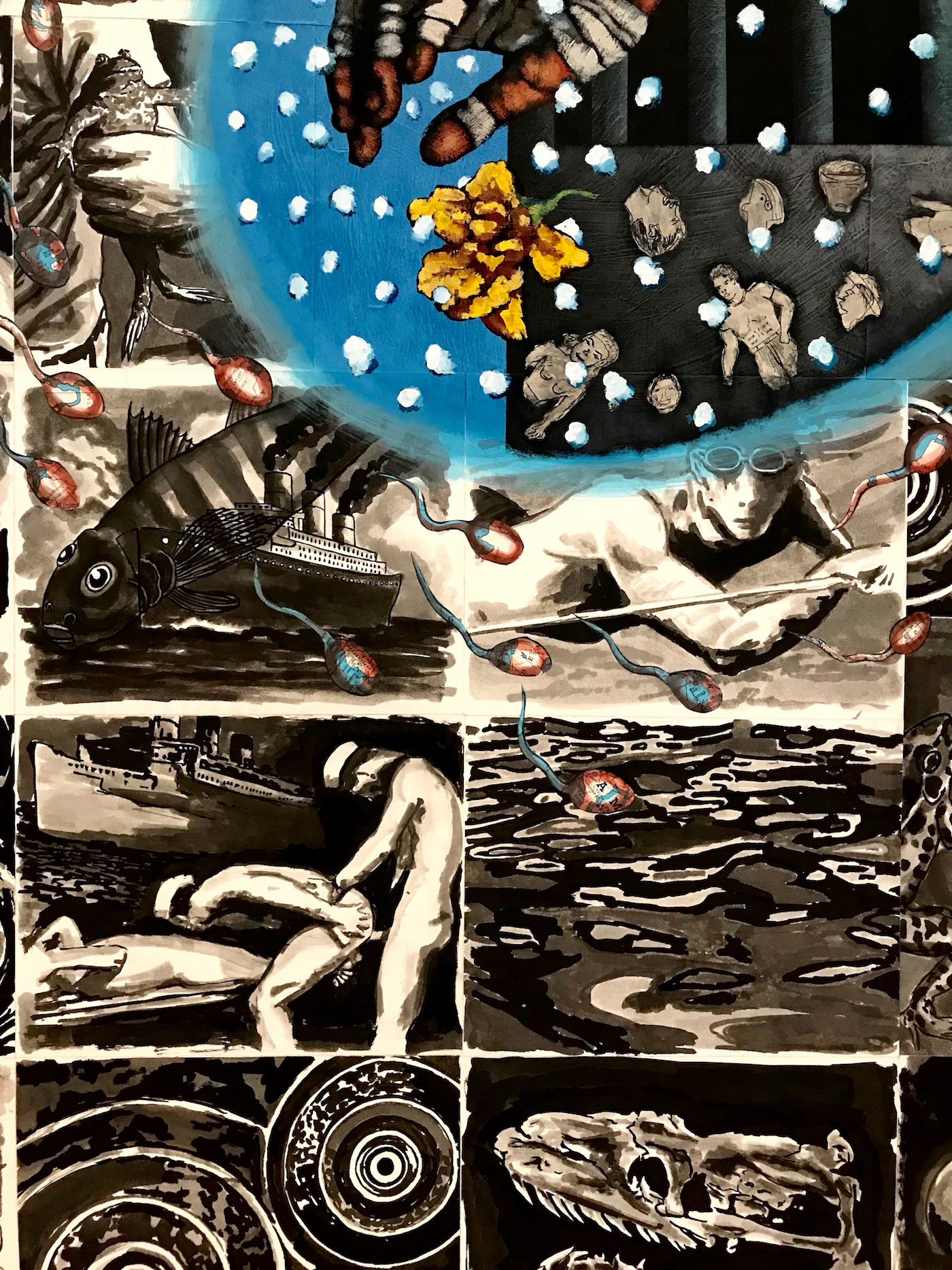
David Wojnarowicz (American, 1954-1992) Weight of the Earth I 1988 Fourteen gelatin silver prints and watercolour on paper on board 39 x 41 1/4 in. (99.1 x 104.8cm) The Museum of Modern Art, New York; The Family of Man Fund
David Wojnarowicz (American, 1954-1992) Weight of the Earth II 1988-1989 Fourteen gelatin silver prints and watercolor on paper on board 39 x 41 1/4 in. (99.1 x 104.8cm) Collection of Dunja Siegel
Through compositions like these Wojnarowicz sought to create a language out of images. To him, the combination of images described something painful but also mysterious about the experience of being alive – “about captivity in all that surrounds us,” in his words, and the “heaviness of the pre-invented experience we are thrust into.”
David Wojnarowicz (American, 1954-1992) Fever 1988-1989 Three gelatin silver prints on museum board 31 × 25 in. (78.7 × 63.5cm) Collection of Michael Hoeh Image courtesy the Estate of David Wojnarowicz and P.P.O.W, New York
David Wojnarowicz (American, 1954-1992) Something from Sleep IV (Dream) 1988-1989 Gelatin silver print, acrylic, and collaged paper on Masonite 16 × 20 1/2 in. (40.6 × 52.1cm) Collection of Luis Cruz Azaceta and Sharon Jacques Image courtesy Luis Cruz Azaceta and Sharon Jacques Photo: by Dylan Cruz Azaceta
David Wojnarowicz (American, 1954-1992) I Feel A Vague Nausea 1990 Five gelatin silver prints, acrylic, string, and screenprint on composition board 62 × 50 × 3 in. (157.5 × 127 × 7.6cm) Collection of Michael Hoeh Image courtesy the Estate of David Wojnarowicz and P.P.O.W, New York
David Wojnarowicz (American, 1954-1992) Americans Can’t Deal with Death 1990 Two black-and-white photographs, acrylic, string, and screenprint on Masonite 60 × 48 in. (152.4 × 121.9cm) Collection of Eric Ceputis and David W. Williams Image courtesy the Estate of David Wojnarowicz and P.P.O.W, New York
“Americans can’t deal with death unless they own it. If they own it they will celebrate it…”
Gallery 11
Wojnarowicz’s work concerns itself with the mechanisms, politics, and manipulations of power that make some lives visible and others not. The will to make bodies present – the compulsion to clear a space for queer representations not commonly seen through language and image – was threaded throughout his work, exacerbated by the AIDS crisis, and crystallised in his work. Untitled (One Day This Kid… ) (1990-1991) is perhaps Wojnarowicz’s best-known work. Black script shapes the boundary of a boy’s body – a boy whom we know, with his high forehead, prominent teeth, and electric eyes, is Wojnarowicz as a child. He sits for what we assume is a school picture, and he’s no older than eight. The text that surrounds him projects the child into a future scarred by abuse and homophobia. This artwork, like many by Wojnarowicz, has rightly come to embody the spirit of protest, struggle, and resistance. Wojnarowicz died on July 22, 1992. By the end of that year, 38,044 others in New York had died from AIDS-related complications. In his essay “Postcards from America: X Rays from Hell,” Wojnarowicz states what is equally true of art and protest: “With enough gestures we can deafen the satellites and lift the curtains surrounding the control room.”
David Wojnarowicz (American, 1954-1992) Sub-Species Helms Senatorius 1990 Silver dye bleach print (Cibachrome) 16 x 20 in. (40.6 x 50.8cm) Whitney Museum of American Art, New York Gift of Steven Johnson and Walter Sudol
In this work, Senator Jesse Helms of North Carolina appears as a spider with a swastika on his back. In 1989, in response to the controversy regarding his essay for the Witnesses: Against Our Vanishing catalogue, Wojnarowicz drafted a press release that included a description of Helms as one of seven particularly bad actors in the fight against AIDS. It read, in part:
‘One of the more dangerous homophobes in the continental United States… Has introduced legislation that denies federal funding for any program that mentions homosexuality… Cut out any and all AIDS education funding that relates to gays and lesbians. Introduced legislation that we must now live with that prevents any HIV-positive people or PWA’s [people with AIDS] from entering any border of the U.S.A. as well as deporting people with green cards forcibly tested and found to be HIV-positive.’
David Wojnarowicz (American, 1954-1992) Bread Sculpture 1988-1989 Bread, string, and needle with newspaper 11 1/2 × 14 1/8 in. × 6 in. (29.2 × 35.9 × 15.2cm) Collection of Gail and Tony Ganz Photo: Ed Glendinning
Wojnarowicz used red string as a material throughout his practice. From his early supermarket posters to the flower paintings, he stitched red string into the surface of his compositions to suggest the seams and irreconcilable breaks in culture. In his unfinished film A Fire in My Belly (1986-1987, see above), Wojnarowicz included footage of the stitching together of a broken loaf of bread. This sculpture is a physical manifestation of that earlier idea. The film also included footage of what appeared to be a man’s lips being sewn together. A version of that image by Andreas Sterzing – picturing Wojnarowicz himself – would become one of the most galvanising images to come out of the AIDS crisis.
David Wojnarowicz (American, 1954-1992) What Is This Little Guy’s Job in the World 1990 Gelatin silver print 13 3/4 × 19 1/8 in. (34.9 × 48.6cm) Collection of Penelope Pilkington Image courtesy the Estate of David Wojnarowicz and P.P.O.W, New York
David Wojnarowicz (American, 1954-1992) Untitled (When I Put My Hands on Your Body) 1990 Gelatin silver print and screenprint on board 26 x 38 in. (66 x 96.5cm) Collection of Eric Ceputis and David W. Williams Promised gift to the Art Institute of Chicago
Wojnarowicz visited Dickson Mounds, a museum on the site of an ancient Indigenous community in Lewistown, Illinois, around the time of his 1989 exhibition at Illinois State University. There, he photographed a burial site displaying skeletons and artefacts that had been excavated in 1927. Wojnarowicz, facing his own mortality and the deaths of many whom he loved, returned to the photograph a few years later and layered it with his own text about loss to create this work. The exhibit at Dickson Mounds closed in 1992 after years of protests by Native American activists and their supporters who objected to the public display of human remains. Activists also were fighting at the national level around this time for legislation affirming Indigenous peoples’ right to protect the graves and remains of their ancestors. Wojnarowicz, who frequently wrote and spoke out in support of those who had been forgotten and disenfranchised due to U.S. policies, including Native Americans, recorded the following in an audio journal from 1989: “If I’m making a painting about the American West and I want to talk about the railroad bringing culture – white culture – across the country and exploiting or destroying Indian culture… I see that there’s a certain amount of information that is totally ignored in this country. That all this is built on blood.”
David Wojnarowicz (American, 1954-1992) Untitled (Face in Dirt) 1991 (printed 1993) Gelatin silver print 19 × 23 in. (48.3 × 58.4cm) Collection of Ted and Maryanne Ellison Simmons Image courtesy the Estate of David Wojnarowicz and P.P.O.W, New York
This photograph was taken in late May 1991 at Chaco Canyon in New Mexico while Wojnarowicz and his friend Marion Scemama took a road trip around the American Southwest. Cynthia Carr, Wojnarowicz’s biographer, describes how the photograph came to be:
‘He had been there before and knew exactly where he wanted to stage this. “We’re going to dig a hole,” he told her, “and I’m going to lie down.” They began digging without saying a word, a hole for his upper body and a bit for the legs. They used their hands. The dirt was loose and dry. He lay down and closed his eyes. Marion put dirt around his face till it was halfway up his cheeks and then stood over him, photographing his half buried face first with his camera and then with hers.’
Whitney Museum of American Art 99 Gansevoort Street New York, NY 10014 Phone: (212) 570-3600
Robert B. Talfor (American born Britain) Nitroglycerine works at station between Raft Nos. 26 and 27. Plate B of the photographic album Photographic Views of Red River Raft (detail) 1873 Hand-coloured albumen print, mounted recto only to pages with a stylised U.S. Corps of Engineers printed border 7 x 9 1/4 inches (17.8 x 23.5cm)
“In May Lieutenant Woodruff’s careful plans for using “tri-nitro-glycerine” to hasten the removal process, were put into operation and proved quite successful. It continued to be used on a half dozen of the rafts the last of May and through the month of June as the main channel of the river was widened.”
Hubert Humphreys. “Photographic Views of the Red River Raft, 1873,” p. 107
One of the great privileges of writing and researching for this website is the ability to pull disparate sources together from all over the world, so that the some of the most valuable information can be stored in one place – a kind of meta-posting, with informed comment, upon the context of place, time, identity and image. This is one such posting.
I had never known of these photographs before, nor of their photographer R.B. Talfor of whom I can find little information. I never knew the story of the Great Raft of the Red River, nor the heroism of Lieutenant Eugene A. Woodruff, in charge of the clearing operations, who sacrificed his life to look after others in the yellow fever epidemic in Shreveport in 1873. These stories deserve to be told, deserve a wider audience, for it is all we have left of this time and place.
The 113 photographic views, hand coloured albumen prints “are remarkable for both their historical narrative and aesthetic integrity.” They document not only the landscape but the lives of the crews working on the river. As Woodruff notes in his report of July 1, 1873, “With the view is a photographic map of the raft region, with location and axis of the camera for each view marked upon it and numbered to correspond with the number on the view. This album full of photographs, affording a complete and truthful panorama of the raft, will give a better idea of the nature of the work performed and of the character of the country than could be obtained form the most elaborate description.”
In other words, the photographs and accompanying map are a scientific and objective ordering of life and nature, “affording a complete and truthful panorama of the raft”, the nature of the work performed and the character of the country. Truth, panorama, nature, character. And yet, when you look at the whole series of photographs, they become something much more than just objective rendition.
Firstly, while Talfor maps out his “points of view” he resists, but for a few occasions, the 19th century axiom of placing a man in the landscape… to give the landscape scale by including a human figure. In their aesthetic integrity he lets the landscape speak for itself. But if you look at the sequencing of the plates in the album you observe that he alternates between photographs of open stretches of river taken in overcast / end of day light, and plates filled with a dark, mysterious, chthonic atmosphere, as though we the viewer are inhabiting a nightmarish underworld. Into this dark romanticism, this American Gothic, he throws great tree stumps being hauled out of the water, wind whipping through the trees (seen in the length of exposure of the images) and men with cable and plunger standing stock still in front of a tent full of NITROGLYCERIN! DANGER! KEEP AWAY!
Secondly, Talfor’s hand colouring of the photographs seems to add to this almost William Blake-esque, melancholy romanticism. While the light of the setting sun and its reflection over water add to the sublime nature of the scene, the clouds, in particular in plates such as XCVL and XXVI (note the tiny man among the logs), seem to roil in the sky, like mysterious wraiths of a shadowy atmosphere. It is as though Talfor was illustrating a poem of extreme complexity, not just an objective, social documentary enterprise of time and place, but a rendition of the light and darkness of nature as seen through the eyes of God. A transcendent liminality inhabits these images, one in which we cross the threshold into a transitional state between one world and the next, where the photographs proffer a ‘releasement toward things’ which, as Heidegger observes, grant us the possibility of dwelling in the world in a totally different way.
Dr Marcus Bunyan
These images are published under fair use on a non-commercial basis for educational and research purposes only. Please click on the photographs for a larger version of the image.
“We stand at once within the realm of that which hides itself from us, and hides itself just in approaching us. That which shows itself and at the same time withdraws is the essential trait of what we call the mystery… Releasement towards things and openness to the mystery belong together. They grant us the possibility of dwelling in the world in a totally different way…”
MartinHeidegger. ‘Discourse on Thinking’. New York: Harper & Row, 1966, pp. 55-56
Photographic Views of the Red River Raft
U.S. Army Corps of Engineers operation to remove obstacles from the Red River in Louisiana, 1873
113 hand coloured photographic views of the Red River made in April and May 1873, under the direction of C. W. Howell, U. S. Capt.; Corps of Engineers, and E. A. Woodruff, 1st Lieut. U. S. Corps of Engineers; to accompany the annual report on operations for the removal of the Raft; during the year ending June 30, 1873. The photographer was Robert B. Talfor. The portion of the Red River affected reached from Natchitoches Parish through north Caddo Parish, Louisiana. Hand-coloured albumen prints, the images measuring 7 x 9 1/4 inches (17.8 x 23.5cm), mounted recto only to pages with a stylised U.S. Corps of Engineers printed border, some with Talfor’s credit and plate number in the negative, and each with his credit again, the series title, and a plate number (I-CVII and A-F) on mount recto.
Only three extant copies are known to exist, with one in the Louisiana State University Libraries (which also, apparently, houses Talfor’s “photographic outfit” and correspondence associated with the Talfor family) and the other at the Library of Congress, Washington, D.C.
An extraordinary photographic record by the British-born Robert B. Talfor, who founded a photography studio in Greenport, New York in 1867. The pictures, which were shot in April and May 1873, are remarkable for both their historical narrative and aesthetic integrity. The photographs depict crews improving waterway navigation. But while these labourers were removing organic matter from the Red River to facilitate riverboat transport, the railroad industry was dominating the commercial landscape, dynamically shrinking geographic distances and improving transportation of goods.
Talfor’s career as a photographer apparently began during the Civil War, when he was a topographic engineer responsible for mapping battlefields. The transition to the Louisiana project is unclear but his prints capture the haunting beauty of the landscape and the pride of labourers.
Text from the Swann Auction Galleries website [Online] Cited 19 September 2018. No longer available online
Cover the photographic album Photographic Views of Red River Raft 1873
Robert B. Talfor U.S. Steamer Aid at work, Raft No. 5, bow view. Plate A of the photographic album Photographic Views of Red River Raft 1873 Hand-coloured albumen print, mounted recto only to pages with a stylised U.S. Corps of Engineers printed border 7 x 9 1/4 inches (17.8 x 23.5cm)
Robert B. Talfor The snagboat U.S. Aid. Plate C of the photographic album Photographic Views of Red River Raft 1873 Hand-coloured albumen print, mounted recto only to pages with a stylised U.S. Corps of Engineers printed border 7 x 9 1/4 inches (17.8 x 23.5cm)
Robert B. Talfor Plate CI of the photographic album Photographic Views of Red River Raft 1873 Hand-coloured albumen print, mounted recto only to pages with a stylised U.S. Corps of Engineers printed border 7 x 9 1/4 inches (17.8 x 23.5cm)
Robert B. Talfor Plate CII of the photographic album Photographic Views of Red River Raft 1873 Hand-coloured albumen print, mounted recto only to pages with a stylised U.S. Corps of Engineers printed border 7 x 9 1/4 inches (17.8 x 23.5cm)
Robert B. Talfor Plate CVII of the photographic album Photographic Views of Red River Raft 1873 Hand-coloured albumen print, mounted recto only to pages with a stylised U.S. Corps of Engineers printed border 7 x 9 1/4 inches (17.8 x 23.5cm)
Plate CVII: Steamer Bryerly entering Red River through Sale & Murphy’s Canal (detail)
On May 16, 1873, R.B. Talfor photographed the R.T. Bryarly as she passed trough the channel opened by Lt. Eugene Woodruff’s crew. The R.T. Bryarly, on that day, became the first steamboat to enter the upper reaches of the Red River unhindered by the Great Raft at any point. For the next several months, until April 1874, the Corps of Engineers continued to work to ensure that the Raft would not re-form. The passage up the river by the the R.T. Bryarly, however, signalled that the work begun by Captain Shreve in 1833 had been successfully completed. The R.T. Bryarly sank at Pecan Point on the Red River on September 19, 1876.
Text from the book Red River Steamboats by Eric J. Brock, Gary Joiner. Charleston, SC: Arcadia Publishing, 1999, p. 22 [Online] Cited 17/09/2018
Robert B. Talfor Plate D of the photographic album Photographic Views of Red River Raft 1873 Hand-coloured albumen print, mounted recto only to pages with a stylised U.S. Corps of Engineers printed border 7 x 9 1/4 inches (17.8 x 23.5cm)
Robert B. Talfor I.N. Kalbaugh on the Red River. Plate E of the photographic album Photographic Views of Red River Raft 1873 Hand-coloured albumen print, mounted recto only to pages with a stylised U.S. Corps of Engineers printed border 7 x 9 1/4 inches (17.8 x 23.5cm)
Plate E: I.N. Kalbaugh on the Red River. Steamer Kalbaugh between Raft Nos. 47 and 48 (detail)
Robert B. Talfor Plate LIV of the photographic album Photographic Views of Red River Raft 1873 Hand-coloured albumen print, mounted recto only to pages with a stylised U.S. Corps of Engineers printed border 7 x 9 1/4 inches (17.8 x 23.5cm)
Robert B. Talfor Plate LXXXVII of the photographic album Photographic Views of Red River Raft 1873 Hand-coloured albumen print, mounted recto only to pages with a stylised U.S. Corps of Engineers printed border 7 x 9 1/4 inches (17.8 x 23.5cm)
Driftwood log jams obstructing the river in Louisiana before their elimination with the aid of nitroglycerine.
Robert B. Talfor Plate LXXXVIII of the photographic album Photographic Views of Red River Raft 1873 Hand-coloured albumen print, mounted recto only to pages with a stylised U.S. Corps of Engineers printed border 7 x 9 1/4 inches (17.8 x 23.5cm)
Robert B. Talfor Plate VII of the photographic album Photographic Views of Red River Raft 1873 Hand-coloured albumen print, mounted recto only to pages with a stylised U.S. Corps of Engineers printed border 7 x 9 1/4 inches (17.8 x 23.5cm)
Foot of Raft No. 2. One of the several shore work parties that were under the direction of the U.S. Corps of Army Engineers.
Robert B. Talfor Plate XCVL of the photographic album Photographic Views of Red River Raft 1873 Hand-coloured albumen print, mounted recto only to pages with a stylised U.S. Corps of Engineers printed border 7 x 9 1/4 inches (17.8 x 23.5cm)
Robert B. Talfor Plate XLV of the photographic album Photographic Views of Red River Raft 1873 Hand-coloured albumen print, mounted recto only to pages with a stylised U.S. Corps of Engineers printed border 7 x 9 1/4 inches (17.8 x 23.5cm)
Plate XLV of the photographic album Photographic Views of Red River Raft 1873 (detail)
Robert B. Talfor U.S. Aid, clearing logjam in the Red River, Louisiana. Plate XV of the photographic album Photographic Views of Red River Raft 1873 Hand-coloured albumen print, mounted recto only to pages with a stylised U.S. Corps of Engineers printed border 7 x 9 1/4 inches (17.8 x 23.5cm)
U.S. Steamer Aid at work. Raft No. 5, side view. Photograph showing the steam snag boat, US Aid, clearing logjam in the Red River, Louisiana
Robert B. Talfor Plate XXIII of the photographic album Photographic Views of Red River Raft 1873 Hand-coloured albumen print, mounted recto only to pages with a stylised U.S. Corps of Engineers printed border 7 x 9 1/4 inches (17.8 x 23.5cm)
Preparation for the work began in August, 1872. On November 25, “the small-pox infection being no longer feared,” the steamboat Aid, with two months provisions and two craneboats in tow, started up Red River. They had been outfitted and supplied in New Orleans. Shore parties had already been organized in Shreveport and work itself begun on December 1, a month before the arrival of the Aid. The details of this work, from the preparation in August to the opening of the upper river in May of the next year, are covered in the report dated July 1, 1873, from Lieutenant Woodruff to Captain Howell. The last page of this report included specific comments on the value of the previously discussed Photographic Views of Red River to Lieutenant Woodruff’s total report. The importance of these photographs in understand in the scope and nature of the raft removal is reflected in the following statement:
To accompany this I have prepared a series of photographic views showing every portion of the raft, parties at work, (etc). With the view is a photographic map of the raft region, with location and axis of the camera for each view marked upon it and numbered to correspond with the number on the view. This album full of photographs, affording a complete and truthful panorama of the raft, will give a better idea of the nature of the work performed and of the character of the country than could be obtained form the most elaborate description. [The map is in the Library of Congress]
Extract from Hubert Humphreys. “Photographic Views of the Red River Raft, 1873,” in Louisiana History: The Journal of the Louisiana Historical Association Vol. 12, No. 2 (Spring, 1971) pp. 101-108 (16 pages with photographs)
Robert B. Talfor Steam saws on flat, foot Raft No. 23. Plate L of the photographic album Photographic Views of Red River Raft (detail) 1873 Hand-coloured albumen print, mounted recto only to pages with a stylised U.S. Corps of Engineers printed border 7 x 9 1/4 inches (17.8 x 23.5cm)
Robert B. Talfor Plate VI of the photographic album Photographic Views of Red River Raft (detail) 1873 Hand-coloured albumen print, mounted recto only to pages with a stylised U.S. Corps of Engineers printed border 7 x 9 1/4 inches (17.8 x 23.5cm)
Robert B. Talfor Raft No. 4 partially removed. Plate X of the photographic album Photographic Views of Red River Raft(detail) 1873 Hand-coloured albumen print, mounted recto only to pages with a stylised U.S. Corps of Engineers printed border 7 x 9 1/4 inches (17.8 x 23.5cm)
Raft No. 4 partially removed. Crane boat at work (removing dead tree)
Robert B. Talfor Plate XVII of the photographic album Photographic Views of Red River Raft (detail) 1873 Hand-coloured albumen print, mounted recto only to pages with a stylised U.S. Corps of Engineers printed border 7 x 9 1/4 inches (17.8 x 23.5cm)
Crane boat at work
Robert B. Talfor Plate XXV of the photographic album Photographic Views of Red River Raft (detail) 1873 Hand-coloured albumen print, mounted recto only to pages with a stylised U.S. Corps of Engineers printed border 7 x 9 1/4 inches (17.8 x 23.5cm)
Robert B. Talfor Plate XXVI of the photographic album Photographic Views of Red River Raft (detail) 1873 Hand-coloured albumen print, mounted recto only to pages with a stylised U.S. Corps of Engineers printed border 7 x 9 1/4 inches (17.8 x 23.5cm)
Robert B. Talfor Plate XXII of the photographic album Photographic Views of Red River Raft (detail) 1873 Hand-coloured albumen print, mounted recto only to pages with a stylised U.S. Corps of Engineers printed border 7 x 9 1/4 inches (17.8 x 23.5cm)
Robert B. Talfor Plate XXVIII of the photographic album Photographic Views of Red River Raft(detail 1873 Hand-coloured albumen print, mounted recto only to pages with a stylised U.S. Corps of Engineers printed border 7 x 9 1/4 inches (17.8 x 23.5 cm)
Red River of the South
Schell and Hogan (illustration) U.S. Snagboat ‘Helliopolis’ Nd Engraving
The Heliopolis raised a one hundred and sixty foot tree in 1829, according to Captain Richard Delafield of the Corps of Engineers. By 1830 Shreve’s Snag Boats, or “Uncle Sam’s Tooth Pullers” as they were called, had improved navigation to the point that only one flatboat was lost on a snag during that year. During the 1830s Shreve set about cutting back trees on the banks of the Mississippi and Ohio Rivers to prevent the recurrence of snags.
“One of Uncle Sam’s Tooth Pullers”
The snag boats operated by the U.S. Army Corps of Engineers were sometimes called “Uncle Sam’s Tooth Pullers,” referring to how the vessels extracted whole trees and logs that hindered navigation. U.S. Snag Boat No. 2 is shown pulling stumps from the river bottom.
From Harper’s Weekly, Nov. 2, 1889
Plan for Henry Shreve’s snag boat. Patent No. 913, September 12, 1838
Shreveport, the Great Raft and Eugene Augustus Woodruff
Shreveport is located on the Red River in northwestern Louisiana, positioned on the first sustainable high ground in the river valley north of the old French settlement of Natchitoches. When the town as incorporated in 1839, it was, for a short period, the westernmost municipality in the United States. Four years prior to this, the settlement began as Shreve Town. Hugging a one-square-mile diamond-shaped bluff and plateau, Shreveport seemed an ideal place for a town. The northern edge of the plateau rested against Cross Bayou. The combined water frontage of the bayou and the Red River afforded the town ample room for commercial growth. However, a major obstacle stood in its way.
Captain Henry Miller Shreve, the man for whom Shreveport is named, received a contract from the U.S. Army to remove a gain logjam known as the “Great Raft.” Shrove was widely acclaimed as the most knowledgeable expert in raft removal… The upstream portion of the raft at times extended in Oklahoma. Since the Red River had many meandering curves, a straight-line mile might have as many as 3 river miles within it. At its largest, the raft closed over 400 miles of river. By the time Shreve examined it, in about 1830, the raft extended about 110 miles.
Shrove bought in large vessels that he modified for the job. Some of these ripped the jam apart with grappling hooks. Others rammed the raft to loosen individual trees. Some of the vessels were built by taking two steamboats and joining them side by side into a catamaran. The captain built a small sawmill on the common deck. The most famous of these hybrid snag boats, as they were called, were the Archimedes and the Heliopolis. His crews consisted of slave labor and Irish immigrants. The work was very difficult and extremely dangerous. …
Shreve’s efforts did not end the problem with the raft. Periodic work was needed to clear the river as the raft formed again. The Civil War interrupted this work, but by 1870, Congress had realised that the rived must be opened. Appropriations were again made, and the U.S. Army Corps of Engineers sent an engineering unit to deal with the issue. The team arrived in late 1871 under the command of First Lieutenant Eugene Augustus Woodruff. Woodruff, his brother, George, and their men set to work. They recorded their actions with maps and photographs. R.B. Talfor was the photographer assigned the duty of recording the work, and this may have been the first instance of an imbedded photographer assigned to a specific unit. Talfor and the Woodruff brothers took over one hundred images of the raft clearing. Today, their records remain the standard chronicle for a project of this type.
The unit’s primary snagboat was the U.S. Aid, a modern version of Henry Shreve’s Archimedes. This elegant stern-wheel vessel was the most advanced of its type in the late nineteenth century. Another technology used as a test bed for river clearing was the newly created explosive nitroglycerin. Because nitroglycerin was extremely dangerous to use and volatile to make, the nitroglycerin lab occasionally blew up – thankfully, with almost no casualties.
The Woodruffs found areas of clear water, appearing as a strong of lakes, and when the broke up the logs around them, the loosened trees and logs would sometimes form snags downstream. One of the unfortunate steamboats was the R.T. Bryarly, photographed by Talfor in 1873. Talker took his photograph from a recently cleared section of the rived. Piles of debris could clearly be seen on both banks as the steam picked its was up the river. The Bryarly plied the rived until September 19, 1876, when it hit a snag and was lost. The use of explosives and the improved snagboats finally conquered the river. …
… In mid-August 1873, an epidemic [of yellow fever] broke out it Shreveport. Everyone who could leave town did, and the population dwindled to about four thousand people before other towns sealed of the roads, railroads and streams to protect their residents. A quarter of the population who remained died within the first two weeks, and another 50 percent contracted yellow fever within the next six weeks. Most of the doctors and nurses died in the first month. …
In early September 1873, the army ordered its raft-clearing engineers out of the city, indicating that they should relocate farther south. Lieutenant Eugene Augustus Woodruff set his men, including his brother, George, to safety. He remained to help care for the residents of Shreveport. With most of the doctors dead or ill, Woodruff and six Roman Catholic priest ministered to the victims. By the end of September, all of these good men had died from yellow fever.
Lt. Eugene A. Woodruff (1843-1873), Red River Hero, died age 31
“He died because too brave to abandon his post even in the face of a fearful pestilence and too humane to let his fellow beings perish without giving all the aid in his power to save them,” wrote Capt. Charles W. Howell, responsible for Corps of Engineers works in Louisiana, in 1873. “His name should be cherished, not only by his many personal friends,” he continued, “but by the Army, as one who lived purely, labored faithfully, and died in the path of duty.”
Captain Howell penned that tribute to his deputy, Lt. Eugene A. Woodruff, a young officer whom Howell sent from New Orleans to the Red River of Louisiana as supervisor of the project to clear the great log raft, a formidable obstruction to navigation. Henry M. Shreve first cleared the Red River raft in the 1830s, but the raft formed again during years of inadequate channel maintenance resulting from meager congressional appropriations and neglect during the Civil War.
Lieutenant Woodruff left his workboats and crew on the Red River in September 1873 to visit Shreveport and recruit a survey party. When he arrived, he found Shreveport in the grip of a yellow-fever epidemic. Fearing he might carry the disease to his workmen if he returned to camp, he elected to stay in Shreveport and tend to the sick. He volunteered his services to the Howard Association, a Louisiana disaster-relief charity, and traveled from house to house in his carriage, delivering food, medicine, and good cheer to the sick and dying. He contracted the disease himself and died in late September, “a martyr,” reported the Shreveport newspaper, “to the blessed cause of charity.”
“His conduct of the great work on which he was engaged at the time of his death,” said the New Orleans District Engineer, “will be a model for all similar undertakings and the completion of the work a monument to his memory.” Captain Howell assigned responsibility for finishing the job on the Red River to Assistant Engineer George Woodruff, brother of the lieutenant.
Woodruff’s selfless actions not only eased the suffering of Shreveport residents, but his decision to remain in the town no doubt lessened the threat to his crew. Spared from the disease, the engineers successfully broke through the raft, clearing the river for navigation on 27 November 1873. An Ohio River snagboat built the following year received the name E. A. Woodruff in recognition of the lieutenant’s sacrifice. The vessel served until 1925. More than a century later the people of Shreveport continue to honor the memory of Lieutenant Woodruff.
Anonymous text and image from “Lt. Eugene A. Woodruff, Red River Hero,” on the U.S. Army Corps of Engineers website 2000 revised July 2021 [Online] Cited 22/02/2022
Unknown photographer Untitled [Members of a Cavalry unit at Fort Grant, A.T. in 1876 showing the variety of both clothing and headgear in use by the Army in the mid-1870s] 1876
Yellow fever
Yellow fever is a viral disease that is transmitted by mosquitoes. Yellow fever can lead to serious illness and even death. It is called ‘yellow fever’ because in serious cases, the skin turns yellow in colour. This is known as ‘jaundice’. Symptoms of yellow fever may take 3 to 6 days to appear. Some infections can be mild but most lead to serious illness characterised by two stages. In the first stage fever, muscle pain, nausea, vomiting, headache and weakness occur. About 15 to 25 per cent of those with yellow fever progress to the second stage also known as the ‘toxic’ stage, of which half die within 10 to 14 days after onset of illness. Visible bleeding, jaundice, kidney and liver failure can occur during the second stage.
Although yellow fever is most prevalent in tropical-like climates, the northern United States were not exempted from the fever. The first outbreak in English-speaking North America occurred in New York City in 1668, and a serious one afflicted Philadelphia in 1793. English colonists in Philadelphia and the French in the Mississippi River Valley recorded major outbreaks in 1669, as well as those occurring later in the 18th and 19th centuries. The southern city of New Orleans was plagued with major epidemics during the 19th century, most notably in 1833 and 1853. Its residents called the disease “yellow jack”…
The yellow fever epidemic of 1793 in Philadelphia, which was then the capital of the United States, resulted in the deaths of several thousand people, more than 9% of the population. The national government fled the city, including President George Washington. Additional yellow fever epidemics struck Philadelphia, Baltimore, and New York City in the 18th and 19th centuries, and traveled along steamboat routes from New Orleans. They caused some 100,000-150,000 deaths in total.
In 1853, Cloutierville, Louisiana, had a late-summer outbreak of yellow fever that quickly killed 68 of the 91 inhabitants. A local doctor concluded that some unspecified infectious agent had arrived in a package from New Orleans. 650 residents of Savannah, Georgia died from yellow fever in 1854. In 1858, St. Matthew’s German Evangelical Lutheran Church in Charleston, South Carolina, suffered 308 yellow fever deaths, reducing the congregation by half. A ship carrying persons infected with the virus arrived in Hampton Roads in southeastern Virginia in June 1855. The disease spread quickly through the community, eventually killing over 3,000 people, mostly residents of Norfolk and Portsmouth. In 1873, Shreveport, Louisiana, lost almost a quarter of its population to yellow fever. In 1878, about 20,000 people died in a widespread epidemic in the Mississippi River Valley. That year, Memphis had an unusually large amount of rain, which led to an increase in the mosquito population. The result was a huge epidemic of yellow fever. The steamship John D. Porter took people fleeing Memphis northward in hopes of escaping the disease, but passengers were not allowed to disembark due to concerns of spreading yellow fever. The ship roamed the Mississippi River for the next two months before unloading her passengers. The last major U.S. outbreak was in 1905 in New Orleans.
In forest ecology, a snag refers to a standing, dead or dying tree, often missing a top or most of the smaller branches. In freshwater ecology it refers to trees, branches, and other pieces of naturally occurring wood found sunken in rivers and streams; it is also known as coarse woody debris. …
Maritime hazard
Also known as deadheads, partially submerged snags posed hazards to early riverboat navigation and commerce. If hit, snags punctured the wooden hulls used in the 19th century and early 20th century. Snags were, in fact, the most commonly encountered hazard, especially in the early years of steamboat travel. In the United States, the U.S. Army Corps of Engineers operated “snagboats” such as the W. T. Preston in the Puget Sound of Washington State and the Montgomery in the rivers of Alabama to pull out and clear snags. Starting in 1824, there were successful efforts to remove snags from the Mississippi and its tributaries. By 1835, a lieutenant reported to the Chief of Engineers that steamboat travel had become much safer, but by the mid-1840s the appropriations for snag removal dried up and snags re-accumulated until after the Civil War.
S.T. (Samuel Tobias) Blessing (American, b. 1830-1897) New Orleans Levee c. 1866-1870 From a stereographic view, on wet or dry plate glass negative
Samuel Tobias Blessing (1830-1897) was a successful daguerreotypist, ambrotypist, photographer, daguerrean, and photographic stock dealer. He was active in La Grange, Texas in 1856, and Galveston, Texas 1856 c.-1861, and in New Orleans 1861-1890s. From 1856, Blessing partnered with Samuel Anderson, operating bi-state studios and stock depots in Trenton Street, Galverston, and at 120 Canal Street, New Orleans, moving to 137 Canal Street in 1856. Their partnership was dissolved in 1863. After the Civil War, Blessing turned his attention to making stereographs, publishing New Orleans in Stereoscope in 1866. Other stereographic series included Views of New Orleans & Vicinity, and Public Buildings in New Orleans.
Text and image from the Steamboat Times website
Unknown photographer New Orleans Levee c. 1867-1868 Wet plate negative on glass, or Tintype positive
Four boats in this New Orleans scene have been positively identified. They are from right to left, B.L. HODGE (No.2), MONSOON, ST. NICHOLAS, and CUBA. The remaining boats, also right to left, are not confirmed but may be the BART ABLE, GEORGE D. PALMER, and the FLICKER.
The B.L. HODGE No.2 was built in 1867, and the MONSOON was lost to a snag on the Red River on Dec. 21, 1868, heavily loaded with cotton. Therefore the photograph was taken sometime during 1867-1868. The PALMER was lost after hitting the Quincy bridge on Oct. 2, 1868, which would further narrow the timeframe for this scene.
Installation view of the exhibition Victor Vasarely. The Birth of Op Art at the Museo Nacional Thyssen-Bornemisza, Madrid showing Vasarely’s Feny (1973, below)
No comment is really necessary. You just have to look at the spirit and inventiveness of the art. A pioneer of light and colour, a genius of plastic grid and form, is at play here!
The installation photographs show just how optically magnetic these works are. How they are holistic, singular works which then play magnificently off each other when placed in close proximity. Like the fugues of J.S. Bach these optical illusions create dazzlingly beautiful, intricate and powerful works, an earthly divination of a ‘planetary folklore’.
As my good friend Elizabeth Gertsakis said of the work of Robert Hunter, “he had the mind of abstract divination for a music of the spheres, of any geometry.”
Visit the VR Microsite for a Virtual Reality walk through of the exhibition.
Dr Marcus Bunyan
Many thankx to the Museo Nacional Thyssen-Bornemisza for allowing me to publish the photographs in the posting. Please click on the photographs for a larger version of the image.
From 7 June to 9 September 2018, the Museo Nacional Thyssen-Bornemisza will be presenting a monographic exhibition devoted to Victor Vasarely (Pécs, 1906 – Paris, 1997), the founding father of Op Art. Comprising works from the Vasarely Museum in Budapest, the Victor Vasarely Museum in Pécs, the Fondation Vasarely in Aix-en- Provence and prominent loans from private collections, the exhibition will aim to offer an overall vision of the life and work of this Hungarian painter whose best output was created in France. The exhibition includes works from all the principal phases of Vasarely’s career in order to present a chronological survey of his artistic evolution. Visitors will thus be able to appreciate the key role played by the artist in the development of geometrical post-war abstraction and to learn about the experiments based on his artistic principles and theoretical reflections which he undertook with the aim of bringing art and society closer together.
Victor Vasarely is a towering figure in the history of abstract geometric art. The results of his experiments with spatially ambiguous, optically dynamic structures and their effects on visual perception burst into public consciousness in the mid-1960s under the name of Op Art, launching a short-lived yet extraordinarily popular wave of fashion.
The exhibition is organised in eight chronological sections and an introductory space devoted to Vega Structures, one of the best-known and most emblematic series produced by Vasarely at the height of his career named after the brightest star in the northern hemisphere’s summer night sky.
1. Vega Structures
Inspired by contemporary news reports about mysterious signals received from distant galaxies, Vasarely named many of his works after stars and constellations. The Vega pictures rely on convex-concave distortions of a grid-like network, a sophisticated combination of the cube and the sphere, symbolically referring to the two-way motion of the light that emanates from pulsating stars, and to the functioning of condensing galaxies and the expanding universe. The common denominator in these works is Vasarely’s realisation that two dimensions can be expanded into three simply by deforming the basic grid, and that, depending on the degree of enlargement or reduction, the elements in the deformed grid can be transformed into rhombuses or ellipses.
Installation view of the exhibition Victor Vasarely. The Birth of Op Art at the Museo Nacional Thyssen-Bornemisza, Madrid
Blessed with exceptional drawing ability, Vasarely studied the basics of graphic design at Műhely (Workshop) from 1929 to 1930. The private school in Budapest was run by Sándor Bortnyik, a painter and graphic designer who had connections with the Bauhaus in Weimar. Through Bortnyik, Vasarely began to take an interest in the formal problems of the kind of art in which composition is based on geometric principles, and as such he adopted Piet Mondrian, Theo van Doesburg, El Lissitzky, Kazimir Malevich and László Moholy-Nagy as his spiritual masters. In the first period of the artist’s career, which lasted until 1939, the imagery had not yet broken away from the primary visual world, that is, it was not entirely abstract, but the paradoxical optical effects produced by his networks of lines and crosses already bore hints of the illusionistic spatiality to come.
Installation view of the exhibition Victor Vasarely. The Birth of Op Art at the Museo Nacional Thyssen-Bornemisza, Madrid showing the works Man in motion. Study of Motion (The Man) 1943 (left) and Material Study-Wood 1939 (right)
In 1951, the Galerie Denise René in Paris held an exhibition titled Formes et couleurs murales (Mural Forms and Colours). It was at this time that the Hungarian-French artist first considered representing the spatial problems of his pictures on a more monumental scale. At this exhibition, Vasarely used photographic methods to blow up his earlier pen-and-ink drawings, which he then arranged in series covering entire walls. These compositions were later rechristened Naissances (Births). The new name came about when the artist swept the photographic negatives of the drawings over one another, and disquieting, randomly arranged patterns emerged. In is Oeuvres profondes cinétiques (deep kinetic works), first exhibited in 1955, which Vasarely created following the same method of image-making, structuring them out of superimposed sheets of glass, acrylic or transparent foil, the sense of spatiality was combined with actual three-dimensional depth. Exploiting the physical laws of refraction and reflection, he produced spatial collages in a constant state of flux generated by the interference of two abstract patterns projected over each other, which were brought alive as the viewer changed position.
In 1947, while spending the summer on Belle Île, an island off the coast of Brittany, he discovered the internal geometry of nature. He took irregularly shaped glass tiles and pebbles polished by the ocean waves and stylised their abstract forms into ellipses. In 1948, he produced delicate pen-and-ink drawings that conjured up the strange meandering patterns of the hairline cracks that pervaded the ceramic tiles covering the Paris metro station named Denfert-Rochereau. From his sketches, which reveal a vivid imagination, he created evocative paintings composed with well unified colours. Those same years also saw the beginning of his Crystal period, which was inspired by the strict geometric structure of the stone houses in Gordes, a medieval town built on a cliff in the South of France. Vasarely strove to transpose reality into the two-dimensional plane with the help of the axonometric approach.
Installation view of the exhibition Victor Vasarely. The Birth of Op Art at the Museo Nacional Thyssen-Bornemisza, Madrid showing from left, the works Lan 2, 1953; Amir (Rima) 1953; and Vessant, 1952
Inspired by Kazimir Malevich’s Suprematist composition, Black and White (1915), which embodies the harmony of spirituality and is widely interpreted as the ‘end point’ of painting, Vasarely conceived of the picture titled Homage to Malevich. Its basic component, a square rotated about its axis so that it appears as a rhombus, became the starting point of his ‘kinetic’ works.
Installation view of the exhibition Victor Vasarely. The Birth of Op Art at the Museo Nacional Thyssen-Bornemisza, Madrid showing from left, the works Doupla, 1970-1975; Kotzka, 1973-1976 and Gixeh, 1955-1962
Installation view of the exhibition Victor Vasarely. The Birth of Op Art at the Museo Nacional Thyssen-Bornemisza, Madrid showing from left, the works Nethe, 1964; Noorum, 1960-1977 and Tlinko-F, 1956-1962
Installation view of the exhibition Victor Vasarely. The Birth of Op Art at the Museo Nacional Thyssen-Bornemisza, Madrid showing from left, the works Afa III, 1957-1973 Nethe, 1964; Noorum, 1960-1977
Installation view of the exhibition Victor Vasarely. The Birth of Op Art at the Museo Nacional Thyssen-Bornemisza, Madrid showing from left, the works Taymir II, 1956 and Afa III, 1957-1973
6. Universal systems built from a plastic alphabet
Vasarely presented the results of his analytical research into the Plastic Unit at an exhibition held in the Musée des Arts Décoratifs in Paris in 1963. His formula for this was built on the structural interplay of form and colour. He regarded colour-forms as the cells or molecules out of which the universe was made. ‘The form-color unit […] is to plasticity what the particle-wave is to nature’, he declared. In pictures based on the mutual association between forms and colours, he claimed to perceive a ‘grammar’ of visual language, with which a set of basic forms making up a composition could be arranged into a system similar to musical notation.
The plastic alphabet
The plastic alphabet is a kind of programmed language with an infinite number of form and colour variations. The basic unit of the alphabet is a coloured square containing smaller basic shapes like squares, triangles, circles and rectangles. Vasarely used these patterns and primary colours plus endless colour permutations as the duplicating and changing elements in his works. In each unit there was a number which determined its colour, tone, form and place in the whole.
Vasarely saw that his plastic alphabet, by enabling serial production, could open the way to countless applications. It could be used as the basis for planning houses and whole environments for cities: it offered countless permutations of form and colour, and the size of the basic unit could be changed or enlarged as required.
Installation view of the exhibition Victor Vasarely. The Birth of Op Art at the Museo Nacional Thyssen-Bornemisza, Madrid showing from centre to right, the works Villog, 1979; Zila, 1981 and Pavo II, 1979
Installation view of the exhibition Victor Vasarely. The Birth of Op Art at the Museo Nacional Thyssen-Bornemisza, Madrid showing from left to right in the bottom image, the works Vonal-Fegn, 1968-1971; Helios, 1964 (multiple) and Villog, 1979
Installation view of the exhibition Victor Vasarely. The Birth of Op Art at the Museo Nacional Thyssen-Bornemisza, Madrid showing from left in the bottom image, Doupla, 1970-1975; Kotzka, 1973-1976 and Vonal-Fegn, 1968-1971
Installation view of the exhibition Victor Vasarely. The Birth of Op Art at the Museo Nacional Thyssen-Bornemisza, Madrid showing from left, Bi-Octans, 1979; Doupla, 1970-1975; Kotzka, 1973-1976; Vonal-Fegn, 1968-1971 and Helios, 1964 (multiple)
Installation view of the exhibition Victor Vasarely. The Birth of Op Art at the Museo Nacional Thyssen-Bornemisza, Madrid showing from left Dirac, 1978 and Bi-Octans, 1979
Vasarely first discussed the necessity for his works to be duplicated and disseminated widely in 1953. Then, in his Yellow Manifesto of 1955 he outlined his ideas on the possibilities of re-creation, multiplication and expansion. He believed that a basic set of corpuscular elements, by virtue of their multiplicability and permutability, could be transformed using a pre-selected algorithm into a virtually infinite number of different compositions. The programmations that would record the picture-composition process onto graph paper assumed that the colours, shades and forms making up each image could be notated numerically, and even fed into an electronic brain to be retrieved at any time. Although Vasarely himself had never worked with computers, his principles led logically to the possibility of creating images with such technology. As conceived by the artist, in future, employing codes of colour and form that were objectively defined using alphanumerical data, his compositions could be recreated at anytime, anywhere in the world, by anybody at all.
Installation view of the exhibition Victor Vasarely. The Birth of Op Art at the Museo Nacional Thyssen-Bornemisza, Madrid showing from left Kekub, 1976-1978; Black Orion, 1970; Marsan-2, 1964-1974 and Eroed-Pre, 1978
Installation view of the exhibition Victor Vasarely. The Birth of Op Art at the Museo Nacional Thyssen-Bornemisza, Madrid showing in the bottom image from left Yllus, 1978; V.P. 102, 1979; Trybox, 1979 and Toro, 1973-1974
Installation view of the exhibition Victor Vasarely. The Birth of Op Art at the Museo Nacional Thyssen-Bornemisza, Madrid showing in the bottom image from left Stri-Oet, 1979; Cheiyt-Stri-F, 1975; Peer-Rouge, 1977; Woo, 1972-1975; Kekub, 1976-1978 and Black Orion, 1970
8. Planetary Folklore
In the early 1960s, Vasarely put forward a proposal for the use of a universal visual language formulated in accordance with the principle of the Plastic Unit, which he called ‘planetary folklore’. He believed that regularly arranged and numbered, homogeneous colours and constant forms, of the kind that could be manufactured industrially, could have meaning attached to them. His intention was for the opportunity of aesthetic pleasure to become part of the everyday environment. As Vasarely argued, artworks not only belonged in museums and galleries, but were also needed in every single segment of urban life. His concept, which built on the ideas of Le Corbusier and Fernand Léger, and which proclaimed a synthesis of the different fields of the arts, was for the building blocks of the cities of the future to consist of mass-produced, monumental ‘plastic’ works that could be extended to any desired size, which would provide limitless possibilities of variation. The first of his architectural integrations was implemented in Venezuela in 1954, on the campus of the Central University of Caracas; this was followed by monumental ‘plastic’ installations on buildings in Bonn, Essen, Paris and Grenoble.
An important part of Vasarely’s art philosophy was his conscious refusal to discriminate between an individual work and its duplicate. He was convinced that an artwork came alive again when multiplied, and that the multiple was the most democratic form of art. His aim was to topple the elitist concept of owning unique and unrepeatable works by replacing it with the notion of making pictures for mass distribution. The artist experimented with the most diverse assortment of materials and techniques, from the most modern to the most ancient. Weaving workshops in Aubusson, following traditions dating back centuries, produced tapestries from his designs. Vasarely was also especially fond of the serigraph. His individually signed and numbered screen prints were commercially available on the art market, as were the multiple objects composed of individually handcoloured or industrially reproduced sheets mounted on wooden or metal backing materials.
When the major exhibition titled The Responsive Eye opened at the New York Museum of Modern Art in 1965, it made Optical Art famous almost overnight. The limelight was stolen by two Europeans: Josef Albers, who continued the legacy of the Bauhaus in his art, and Victor Vasarely. Both men were represented at the show with six works each. But whereas Albers, oft neglected by the critics, was turned into the black sheep of the movement by contemporary art history writing, for Vasarely, who was just reaching the peak of his career, the show served as a launch pad to fame.(…)
The scientific definition of Op Art came soon afterwards, with the first attempt made in 1967 by the German art historian, Max Imdahl. Imdahl interpreted the art of Victor Vasarely as deriving from the Orphism of Robert Delaunay, which ascribed meaning to colour, the Neo-Plasticism of Piet Mondrian, which rested on the symmetry of two-dimensional structures, and the Mechano-Faktura of Henryk Berlewi, which borrowed its aesthetic principles from the schematism of mechanical production. Vasarely, meanwhile, preferred to call his own invention Kineticism, and he was fully justified in doing so, because if we accept the contents of his art philosophical writings, published in chronological order under the title of Notes brutes, then the artist was the first person to consistently use this name for the movement. He coined the phrase ‘kinetic art’ in 1953, basing the term on the description of the movement of gases written by Nicolas Sadi Carnot, the nineteenth-century French engineer who developed thermodynamics. In the light of Vasarely’s consistency of thought, his wide-ranging knowledge and his enthusiasm for science, it would have been the logical outcome of his principles to classify his works under a style or movement of his own construction. Kineticism, however, was regarded by Vasarely as something more than a simple art movement. He not only referred to it in a formal sense, but also accorded it ethical, economic, social and philosophical functions. He believed it to be of greater significance than Cubism, and he was convinced the Kineticism offered, for the first time since the Renaissance, a synthesis of ‘the two creative expressions of man: the arts and the sciences’. The simultaneous representation of movement, space and time had already found expression in Constructivist art in the 1920s, but Vasarely’s Op Art was fundamentally different, in that it aimed to generate a spatial effect through the use of a two-dimensional surface by creating the illusion of motion in macro-time, whereby the image formed on the retina underwent virtual manipulation. Consequently, the name Op Art can be given to any artwork ‘that shifts during the spectator’s act of perception’. (…).
‘Optical’ paintings
(…) Vibrant surfaces created from patterns of geometric figures arranged according to a particular algorithm can be found among the mosaics of Antiquity. The first stage in the history of the autonomisation of retina-based art, however, came at the end of the nineteenth century with Pointillist painting, which relied on the scientific theory of the optical combination of colours, and with the so-called Divisionists, who strove to separate optical effects using an analytical method. Georges Seurat’s ‘optical painting’, however, remained firmly attached to the real spectacle. Primary shapes became a means of generating illusions with the arrival of non-objective, abstract art styles, especially Cubism. Optical games derived from periodic series of geometric elements were incorporated into the repertoire of applied photography in the second half of the 1920s. During his studies in Budapest, Vasarely may have come across such depictions, even in the printed press, such as the photograph of the Hollywood actress, Alice White, in a room of mirrors decorated with abstract patterns.
Yet optical illusion was not enough to bring about Op Art, which also needed the dynamism of kinetics. It became inseparable from the concept of the fourth dimension of motion-time, which tipped the static work out of its fixed position by involving the viewer and turning the eye into the active organ of sight. In this sense, Vasarely’s optical kineticism also posed the question of the dematerialisation of the artwork, for in his works, the actual spectacle is not present on the canvas at rest in front of us, but comes about through interacting with the work and is generated on the retina. Vasarely was never concerned with the type of mechanical movement that brought about the works of Jean Tinguely or Marcel Duchamp. The Hungarian artist’s planar kineticism was in this respect far more closely connected to visual research than to the approach of works that emphasise their industrial nature. (…)
Op Art as Algorithm
(…) When it came to the aesthetic and market values of artworks that existed in multiple copies, opinion was split even among the artists participating in the exhibition. In terms of form, the experiments into perception conducted by Vasarely and Bridget Riley, for example, had much in common, and yet their views on the democratisation and interdisciplinarity of art differed sharply. Unlike Riley, who always insisted on her paintings being one of a kind, Vasarely’s programme of art targeted a re-evaluation of the aesthetic of reproduced, duplicated objects. It was in this regard that Vasarely came closest to Pop Art and to its iconic exponent, Andy Warhol. In spite of this, Vasarely was not in thrall to Pop Art. He spoke appreciatively of its achievements, but he considered it to be a movement outside the realm of painting, a parody or caricature of its own times. Pop Art, meanwhile, suffered greatly from the fact that Op Art ultimately proved far more popular. ‘I am “pop” in the sense that I would like to be popular’, Vasarely wittily replied when one journalist pressed him on his personal position in Op Art, shortly after it had found fame as a fashion phenomenon. A few years later, at a reception held in the Galerie Spiegel in Cologne in September 1971, where a work by Vasarely hung on the wall beside Tom Wesselmann’s Great American Nude, an iconic piece from the rival movement, the Hungarian-born artist was asked his opinion of Pop Art. He could not refrain from commenting that the essence of Pop was exaggeration. He then cast a malicious glance at Wesselmann’s painting before declaring, ‘Art is not about painting gigantic pictures for billionaires’. When it was subsequently suggested that his democratic views were not compatible with the high prices commanded by his works, he replied, ‘The critics compare me to hippies who loathe money but who want to get around by hitchhiking. And at such times it is of no concern to them that they are travelling with the help of General Motors, Shell and other billionaire companies’.
There was, however, a whole group of Pop-Art fans who would never have dreamed of denigrating Kineticism. Warhol, for instance, began to follow Vasarely’s career after seeing his works at the opening of The Responsive Eye. He was present at the artist’s exhibition held in 1965 in the Pace Gallery in New York, and his admiration endured until 1984, when he attended Vasarely’s birthday party, arranged by Yoko Ono. It was probably on this occasion that Warhol was given a handkerchief signed by Vasarely, decorated with a pre-kinetic zebra composition, which the American artist preserved among his relics up until his death. We would find few artists in the twentieth century who achieved more in rethinking the aesthetic of the multiplied artwork than Vasarely and Warhol, so there is a striking contradiction in the fact that the only work by Vasarely in Warhol’s collection was a monochromatic oil painting, titled Onix 107 (1966), which actually represented the counterpoint to the paradigm expressing the latent artistic opportunities in duplication (including the entire spectrum of vibrant and saturated colours). (…)
Artists: Drager Meurtant (assemblages, NL) and Petra Senn (photography, D); Jeanine Keuchenius (paintings, NL) Kelly Elmendorp, Stijn Geutjes, Robert van der Kroft, Drager Meurtant, Winny de Meij, Petra Senn.
Drager Meurtant (Dutch, b. 1951) Green bird day 2017
When the green bird / came to live / we agreed to call / it a day
Accumulating, life
I first had contact with Gerard Rutteman (artist alias Drager Meurtant) when he emailed me about a posting I had done on Art Blart about the Japanese photographer Shomei Tomatsu in 2015. Since then we have become firm friends. In 2017 on a trip to Europe, I caught a high speed train from Paris to the French city of Reims to meet him and his vivacious wife Jeanine. We spent a glorious day wandering the city, taking photographs, talking art, and eating a hearty lunch at a local brasserie. This pair of self-taught artists, creative human beings, are so talented.
While I greatly admire Jeanine’s paintings with their powerful and poetic muscularity (in my mind, I note the influence of artists such as Pierre Soulages, Cy Twombly and Anselm Kiefer) and their use of colour which can be seen in other paintings on her website – and observe the photographs of Petra Senn (I would need to see more to make constructive comment) – it is the work of Drager Meurtant to which I am going to focus my attention in this text.
The path of Drager Meurtant reminds me of that of Australian artist Rosalie Gascoigne.
“Gascoigne worked as a teacher before moving to Australia in 1943 following her marriage to astronomer Ben Gascoigne. She discovered a natural talent for creating assemblages through the ensuing seventeen years spent in relative isolation on the stony terrain of Mount Stromlo, home to Stromlo Observatory, and the wheat belt of Monaro near Canberra, a landscape she designated as the crucible from which her art emerged… Gascoigne’s lifelong passion for collecting and arranging developed initially from the Sogetsu school of ikebana, with its emphasis on form and line rather than colour. Its general principles of valuing immediate response, the experience of materials, process and experiment with variations can be seen as underpinning all of her later work. The collection of discarded materials, such as farm machinery parts, for use as suitable vessels for her arrangements, led her to also make sculptural assemblages… Gascoigne had no formal art training, often asserting that her fifty-year apprenticeship was in looking. She began exhibiting in 1974 at the age of 57.”1
Gascoigne went on to become one of Australia’s most loved and respected artists.
Drager Meurtant spent most of his life as a veterinarian-biomedical researcher. He is an autodidact and, like Gascoigne, his apprenticeship as an artist was one of looking and writing poetry. Only in the last five years has he really been able to fully concentrate on his art practice. To my mind, he has the potential to become a much beloved artist of his country, and an international artist of high repute. I am palpably excited by his art and its development. There is a frisson of expectation every time I see new work; that frisson enhanced by the amplitude of the music he creates and the temperature of the environment that surrounds his work.
In this latest exhibition, there is a wonderful, tensional balance between elements and energy in his constructions. Much of the basic elements are from demolition- / remnant materials (“recycling art”), sometimes called objets trouvés: things coil around, are contained, wire, wood, recycled materials, energy, intimacy. His un/civilised forms of expression create an interplay between the conscious and the unconscious minds.
Drager is true to the integrity of his materials, the inherent qualities of natural and man made materials, and his vision. He incorporates primitive, mythical, spiritual and folkloric elements into his art. And his pleasure is in the layering and painting, in the materials, forms and, finally, in the art itself. Here is humour (The snake kept its mouth shut, 2018 below; the moustache of The Orator, 2016 below), ecology and spirit. A sense of mystery and purpose at one and the same time.
Riffing on Guy Debord’s concept of dérive(“drift” in English) which Debord defines as “a mode of experimental behaviour linked to the conditions of urban society: a technique of rapid passage through varied ambiances”2, I can relate Drager’s art to an unplanned journey through the urban landscape in which he drops his everyday relations and lets himself be drawn by the attractions of the terrain and the encounters he finds there. Drager’s attractions are the refuse of the human race. His encounters lead to the construction of contexts and situations, an artistic practice of “the happening”, which is a structured but unencumbered, expressive approach that encourages us to question our finite place in the world. Who else would paint a mountain on a radiator!
While I believe that some of the most important qualities in this world have their meanings proscribed by their opposite, some of these qualities have to be understood by reference only to themselves – which is very difficult – but must be attempted. A lot of things have been made too simple (taught in art schools?) by constructing fraught dichotomies. In other words, as an artist and as a human being, do not rely on binaries but just “on the thing itself”. Let it reveal itself to you – whether that is through Dada, an enigmatic self, of movement and form – or through some other mechanism. Drager has enough intellect and talent not to fall into the too simple, too easy, trap.
In this small regional gallery in the Netherlands, this visionary of the romantic, otherworldy (definition: devoted to intellectual or imaginative pursuits), utopian / dystopian unification of art and life constructs his paradoxes. I love the poetry that accompanies and informs his work; I love the brown butchers paper that covered “the happenings” before the unveiling; and I love the energy, the concern for the environment, and the construction and conceptualisation of his assemblages. I am challenged, in a good way, by his art.
The next step on the path for my friend is to keep the faith, is to keep making the art for himself and no one else. To keep them free and not contained by unwanted concerns. For, as he said to me, “in the end the path followed will be more interesting than the stakes raised in passing.” But curators please take note… here is a star of the future!
Dr Marcus Bunyan
1/ Anonymous. “Rosalie Gascoigne,” on the Art Gallery of New South Wales website 08/08/2018. No longer available online
2/ Guy Debord (1958) Definitions. Internationale Situationniste #1 (Paris, June 1958). Translated by Ken Knabb.
Many thankx to the artists and Kunstwerk! Liemers Museum for allowing me to publish the art work in the posting. Please click on the photographs for a larger version of the image.
“The creation of art, to me, is not work. The end-result is not seen as a piece, but as a whole. Since it brings me comfort and relieves stress, I call my assemblages ‘art-peaces’.”
“The essence of working with found objects (or scrap material) is that their different natures will enrich the composition as they are expressed in its different layers. This effect is based upon the divergent origins, structures and functions of these elements: wood, metal, glass, stone, cloth, plastic, etc. As a consequence, each bears a different weight and ease for ‘penetrance’ (transparency), that will influence the final form of the composition.”
Drager Meurtant
“Nearly every work of assemblage, in its relational structure, approaches abstract art” [but] “the practice of assemblage raises materials from the level of formal relations to that of associational poetry.”
Seitz, W. C. The Art of Assemblage. New York: Museum of Modern Art, 1961, p. 25, 84.
“It’s not where you take things from, it’s where you take them to.”
Jean-Luc Godard
Before the exhibition Now, the new form of the past opening
Before the opening of the exhibition Now, the new form of the past at Kunstwerk! Liemers Museum, Netherlands
Now, the new form of the past is an exhibition based on international collaboration between Drager Meurtant (assemblages, NL) and Petra Senn (photography, D) with the theme Recycling Art . Both artists place most of the energy in their art and demand attention for its creativity, in the reuse of materials and objects.
Drager uses demolition material and remnants from construction, plus objets trouvés, to make assemblages; while Petra uses weathered matter and the perishableness (transitoriness) of materials in her photographs. Every artwork thus carries echoes from the past within itself. Senses is a parallel exhibition of abstract paintings by Jeanine Keuchenius.
Text from the Kunstwerk! Liemers Museum website
The artists Drager Meurtant and Petra Senn first met on ‘pictify’, a social medium for artists (at present no longer accepting new art submissions.) After an exchange of some ‘faves’ and views, the retrospective The Trauma of Painting by Alberto Burro in the museum K21 in Düsseldorf, Germany, became the place where at the end of June 2016 the three, Petra Senn, Drager Meurtant and his artist-partner Jeanine Keuchenius, met in person. With the overwhelming artistic environment, the basis of a human and artistic interest became established. Thus, when Stijn Geutjes, the curator of Kunstwerk! Liemers Museum asked Drager about willingness to exhibit his art in the museum, the answer came with the suggestion of the theme “Now, the new form of the past”, and introduction of colleague Petra Senn as associate, and Jeanine to come with an addition of the theme “Senses”. After some discussion, and rising interest of Stijn Geutjes in the abstract photographies of Petra Senn, the decision came to exhibit in a collaborative effort, that included partaking in the selection process of works of the curator and the three artists.
Text by Drager Meurtant
Objets trouvés
An objets trouvé is a found object; a natural or discarded object found by chance and held to have aesthetic value; an ordinary object, as a piece of driftwood, a shell, or a manufactured article, that is treated as an object of art by one who finds it aesthetically pleasing.
The term relates directly to Marcel Duchamp’s readymades, Dada and Fluxus art. Art critics have coined the terms arte povera (Italian) and junk art (Anglo-American) to signify art which incorporates said objects.
Arte Povera is basically the legitimate justification for creating art of junk and found objects. Arte Povera was a term coined by the Italian art critic Germano Celant. He used the word to sum up a type of art which combined elements of conceptual art, minimal art and performance art. He conceived the idea of the art movement in reaction to the ever increasing commercialism within the art world. The artists embrace the ideas of using valueless materials such as earth, gravel, rocks or litter in order to create works of art.
Junk art is the flattering name is given to 20th and 21st-century art in which the artist uses refuse, scrap metal, urban waste or just anything viewed as useless or cast of from modern society. Junk art is very much synonymous with American artist Robert Rauschenberg. It is also very much part of the 1960s Italian movement Arte Povera. The movement was the product of Antoni Tàpies, Alberto Burri, Michelangelo Pistoletto, Piero Manzoni, and Lucio Fontana.
Anonymous text. “Objet trouvé art,” on the Xamou website [Online] Cited 17/02/2022. No longer available online
Found object
Found object originates from the French objet trouvé, describing art created from undisguised, but often modified, objects or products that are not normally considered materials from which art is made, often because they already have a non-art function. …
Found objects derive their identity as art from the designation placed upon them by the artist and from the social history that comes with the object. This may be indicated by either its anonymous wear and tear (as in collages of Kurt Schwitters) or by its recognisability as a consumer icon (as in the sculptures of Haim Steinbach). The context into which it is placed is also a highly relevant factor. The idea of dignifying commonplace objects in this way was originally a shocking challenge to the accepted distinction between what was considered art as opposed to not art. …
As an art form, found objects tend to include the artist’s output – at the very least an idea about it, i.e. the artist’s designation of the object as art – which is nearly always reinforced with a title. There is usually some degree of modification of the found object, although not always to the extent that it cannot be recognised, as is the case with ready-mades. Recent critical theory, however, would argue that the mere designation and relocation of any object, ready-mades included, constitutes a modification of the object because it changes our perception of its utility, its lifespan, or its status.
Installation views of the exhibition Now, the new form of the past
Installation views of the exhibition Now, the new form of the past at Kunstwerk! Liemers Museum, Netherlands showing the work of Drager Meurtant and Petra Senn
Installation view of the exhibition Now, the new form of the past at Kunstwerk! Liemers Museum, Netherlands showing Drager Meurtant’s work connection not wireless (2014) top left, and Petra Senn’s Persuasiveness (2012) top right
Installation view of the exhibition Now, the new form of the past at Kunstwerk! Liemers Museum, Netherlands showing Drager Meurtant’s Under way Nd
Installation view of the exhibition Now, the new form of the past at Kunstwerk! Liemers Museum, Netherlands showing Drager Meurtant’s work Swan in essence (2014) at centre, with Petra Senn’s Insubordination (2017) top left and someone from the past I (Nd) top right
Installation view of the exhibition Now, the new form of the past at Kunstwerk! Liemers Museum, Netherlands showing the work of Drager Meurtant and Petra Senn with DM’s The promised land (2016) at right
About Drager Meurtant
In almost four decades since his training as as veterinarian-biomedical researcher, Drager Meurtant (artist alias of Gerard Rutteman) has channeled much creativity towards scientific publications and – in his free time – poetry. In more recent years, through a rapid learning curve, his creations have taken form as sculptures (in particular assemblages), collages, paintings and graphical works.
As autodidact and experienced carpenter, the circle saw, jig-saw, chisel, gouge, hammer are used to handle natural materials (wood, stone) in addition to manufactured (paper, cloth) and construction material (metal, glass, etcetera). Much of the basic elements are from demolition- / remnant materials (“recycling art”), sometimes objets trouvés. The assembly of contrasting elements creates tension, sometimes suspension.
The sculptures made by David Smith and (box) assemblages by Joseph Cornell, but also installations by Dieter Roth inspire Drager, as does the art by Joan Miró and members of CoBrA. The making of photographs is considered complementary to the assemblages, in an attempt to capture the fleeting world in which we live.
Drager Meurtant (Dutch, b. 1951) Movement from within 2016 Three-dimensional sculpture, mixed media Assemblage (relief), wood, paper, paint, sand, image 40 x 50 x 7cm
“When the pieces were seen fit / and fixed in their proper position / the movement was undeniable / as it arose from within”
Drager Meurtant (Dutch, b. 1951) Crawling, again 2018 Three-dimensional sculpture, mixed media 47 x 34 x 20cm
“How to make connections / of elements and the outside world? The answer to my question / came crawling, again”
Drager Meurtant (Dutch, b. 1951) Crawling, again (installation view) 2018 Three-dimensional sculpture, mixed media 47 x 34 x 20cm
Drager Meurtant (Dutch, b. 1951) Number 53 (installation view) 2016 Mixed media sculpture Assemblage, wood, paper, metal, plaster, paint 31 x 36 x 9cm
“In former times / you could buy / petroleum, paraffin and coal / at number 53”
Drager Meurtant (Dutch, b. 1951) The Orator (installation view) 2016 Sculpture, wood, paint
Drager Meurtant (Dutch, b. 1951) Tegut 2018 Collage, paper 11 x 15cm
“The next generation / has more generations / to lean upon”
Drager Meurtant (Dutch, b. 1951) Three of a kind (installation view) 2018 Mixed media 24 x 32 x 1cm
“When presented three figures / of different size / and writing / and colour”
Drager Meurtant (Dutch, b. 1951) Three of a kind 2018 Mixed media 24 x 32 x 1cm
Drager Meurtant (Dutch, b. 1951) Mon Combat 2018 Installation of book, metal 60 x 30 x 5cm
Mon Combat by A. Tempspassé: there is always someone who sees argument to start a battle
Installation view of the exhibition Now, the new form of the past at Kunstwerk! Liemers Museum, Netherlands showing Drager Meurtant’s works the listener (needs protection) (2018) at left, and The Mechanic (2018) at right
Drager Meurtant (Dutch, b. 1951) The Mechanic 2018 Mixed media (wood, iron, paint) 105 x 65 x 65cm
“With good tools / you get everything moving”
Drager Meurtant (Dutch, b. 1951) The snake kept its mouth shut 2018 Mixed media, trash 35 x 25 x 500cm
“Curling, the snake kept its mouth shut”
Drager Meurtant (Dutch, b. 1951) Destiny (installation view) 2018 Painting on discarded radiator with support 60 x 130cm
Drager Meurtant (Dutch, b. 1951) All humans are equal (installation view) 2018 Mixed media 100 x 50 x 200cm
All humans are equal. // To test this assumption / take two / and tilt the angle / and position towards, one another.
Drager Meurtant (Dutch, b. 1951) Rudimentary (installation view) 2016 Mixed media 23 x 13 x 16cm
“Mental metal / rudimentary face / mind you!”
Drager Meurtant (Dutch, b. 1951) The promised land 2016 Box assemblage Mixed media, wood, board, metal, paint 34 x 44 x 10cm
“The promised land / cannot be for outsiders. // They may look / how it is, yonder.”
Drager Meurtant (Dutch, b. 1951) Steep-2 (installation view) 2014 Mixed media, wood partly rotten, metal, paint and glass 35 x 23 x 10cm
Steep-2: The Monte Rotondo / is left behind / it weighs too much / for me. // The climbing rock of Feyr / I leave / to the climbers. // But / this wooden rock / serves as model / of a viewpoint on imagination.
Drager Meurtant (Dutch, b. 1951) The avail of propaganda 2016 Mixed media Assemblage, wood, cloth, metal, paper, paint 43 x 21 x 8cm
“The avail of propaganda / is that you and I / do what / we detest.”
Drager Meurtant (Dutch, b. 1951) Twosome (installation view) Nd Mixed media
Drager Meurtant (Dutch, b. 1951) fact-ohry (installation view) 2013 Mixed media 24 x 32 x 42cm
I said / now I will build a fact-ohry / and that / became factual. // With grabbing and placing / elements that together / took progressively the shape / of a fact-ohry / I became part of it. // Could shape the further design / and steer it at minor extent / but the end-result / was determined / by the starting point. // Voila.
(Note: This Fact-ohry is the only one with guarantee that risks during drilling for shale gas are secured.)
Drager Meurtant (Dutch, b. 1951) Progress (halted) (installation view) 2016 Bronze 26 x 18 x 21cm
“When going forth / from wood to bronze / and grasping the result / I realised progress had halted. // A result stands in the way / of the learning process.”
Drager Meurtant (Dutch, b. 1951) Progress (halted) 2016 Bronze 26 x 18 x 21cm
About Petra Senn
Petra’s work has mostly to do with memories and emotions. Her photos directly respond to the surrounding environment and use everyday experiences from the artist as a starting point. These experiences are often framed instances that would go unnoticed in their original context.
By contesting the division between the realm of memory and the realm of experience, she wants to amplify the astonishment of the spectator by creating compositions or settings that generate tranquil poetic images that leave traces and balances on the edge of recognition and alienation.
Her works appear as dreamlike images in which fiction and reality meet, well-known tropes merge, meanings shift, past and present fuse. Time and memory always play a key role. By applying abstraction, she absorbs the tradition of remembrance art into daily practice. She has a deep inner desire to protect the past from vanishing, both physically and, inevitably, mentally.
In her work Petra takes great care neither to simply reflect reality nor to just make visual statements. There is always left space for the spectators own emotions and opinions. She considers her work as visual stimulus, an invitation to enter ones inner world, knowing well that this process only works if she perceives deeper emotions while taking the pictures herself. Her search is for poetry in almost every item and condition.
Artist statement
Petra Senn Her Lips 2015
Petra Senn Insubordination 2017
Petra Senn Persuasiveness 2012
About Jeanine Keuchenius
Jeanine Keuchenius (1953, Indonesia) is a creative artist, dancer, and performer. Her background is as an art therapist (independent and within psychiatry) and social worker / pastoral worker. In the visual art she is an autodidact (a self-taught person), acquiring some skills at high school (teacher in visual art), she then followed several courses / workshops given by professional artists.
Jeanine’s painting uses paper, linen or panel, with palette filled with gouache, acrylic, oil, ink, with at times addition of tar, sand, and glue. Artists that inspire her are Henri Toulouse-Lautrec, Edvard Munch, Antoni Tapies and Emil Schumacher, but also the medium of modern dance moves her in her work, which is mostly abstract, but at times features more figurative elements. Sometimes echoes from mountain landscapes and abandoned hamlets (e.g. on the island of Corsica) are visualised. Her motto is: “In duet with myself.”
Installation views of the exhibition Senses
Installation views of the exhibition Senses at Kunstwerk! Liemers Museum, Netherlands
Jeanine Keuchenius (Dutch born Indonesia, b. 1953) Amulet (installation view) 2011 Gouache on paper 50 x 65cm
Jeanine Keuchenius (Dutch born Indonesia, b. 1953) Amulet 2011 Gouache on paper 50 x 65cm
Jeanine Keuchenius (Dutch born Indonesia, b. 1953) Pink and grey (installation view) 2012 Gouache on paper 50 x 65cm
Each painting is the reflection of memory or dream.
Jeanine Keuchenius (Dutch born Indonesia, b. 1953) Pink and grey 2012 Gouache on paper 50 x 65cm
Jeanine Keuchenius (Dutch born Indonesia, b. 1953) Lying figure 2 (installation view) 2017 Two-dimensional plaster cut, printed on newspaper 22 x 26cm
Jeanine Keuchenius (Dutch born Indonesia, b. 1953) Beautiful stay (installation view) 2014 Gouache on paper
Jeanine Keuchenius (Dutch born Indonesia, b. 1953) Unchained (installation view) 2016 Mixed media on panel (bitumen, acrylic, sand on panel) 45 x 57cm
Jeanine Keuchenius (Dutch born Indonesia, b. 1953) Memory 1 (installation view) 2018 Mixed media on panel (acrylic, sand, plaster, oil on panel) 60 x 70cm
Jeanine Keuchenius (Dutch born Indonesia, b. 1953) Gribusella 2014 Acrylic on paper 50 x 65cm
Form and colour accompany depth and emotion
Jeanine Keuchenius (Dutch born Indonesia, b. 1953) Senses 2012 Acrylic on paper 50 x 65cm
Jeanine Keuchenius (Dutch born Indonesia, b. 1953) Bwual ènzo 2014 Gouache on paper 50 x 65cm
Both when handling and avoiding themes, you sometimes walk in a circle.
Poster for the exhibitions Now, the new form of the past and Senses
Kunstwerk! Liemers Museum Kerkstraat 16, 6901 AB Zevenaar, Nederland Phone: +31 85 040 9971
Dale Cox (Australian, b. 1969) Usurper Ruminant 2016 Acrylic on gold enamel on board 120cm x 90cm
Clarion call
The sky is blue, the sun is shining and yet, in this era of the Anthropocene, the Earth is in deep shit. Through the activities of a virus, a contagion that infests the planet… that is – the ego, the selfishness of the individual human and, collectively, of the human race – “we are perhaps amongst the first to contemplate not just our own finite existence, but the doomed fate of the Earth itself.”
My friend Dale Cox’s exhibition Inner Logic at Australian Galleries dissects this situation in a most intelligent and imaginative manner. Instead of didactic protest, Cox uses the language of Australian pastoral landscape, iconic edifice and stratigraphic cross section to make ironic comment on popular culture, history and religion. As you dissect the various influences and concepts within the work you chuckle to yourself at the artist’s inventiveness and humour.
Mixing the tight style and formal, classical beauty of Australian colonial painting (with reference in particular to the work of John Glover) with the uncanny sense of reality and precision found in the paintings of Jeffrey Smart, Cox twists his realities and points of view. Shopping trolleys have a strange perspective when filled with Australian colonial landscapes; aircraft stairs seem strangely twisted as they lead to a geological cross-section topped with verdant greenery (a journey through time); clouds in the burning landscape look like that of an atomic bomb; an Uluru-like profile of Elvis in the Australian bush is dotted with tents and encampments; and Australian ute’s of unlikely shape sit at the base of a constructed Elvis edifice, the most prominent thing to my mind in the painting being the four air conditioning units at the base of the construction cabin, sitting in an absolutely barren landscape. The perspicacity of Cox’s (re)marks is exemplary.
My favourite works in the exhibition are the Usurper paintings. Here Cox condenses the customs, traditions and rituals of the human race (colonisation, farming, habitation – power, possession, destruction and modification of the environment and its animals) onto the body of the (b)ovine family, the livestock “genetically modified over time through the artificial selection of desirable traits by humans, with a view to increasing the docility of the animals, their size and productivity, their quality as agricultural products, and other culturally desired features,”1 to serve humans who are substantially dependent on their livestock for sustenance and other purposes. These artificial bodies, these illegitimate usurpers, float on a sea of gold enamel and wood grain form.
Cox’s declamations, his inner logic if you like, document in the most inventive way the liturgy of errors of the human race. His work is a clarion call for humans to be better custodians (for that is what we are) of the Earth. Through his subversive paintings, the artist “challenges the myopic tendency for us humans to fixate on ourselves in a way that bodes poorly for our ability to see the bigger picture and act as stewards for the entire planet rather than as self serving, selfish species.” (Email to the author, 28 July 2018). His humors (basic substances which are in balance when a person, or in this case the Earth, is healthy) add to the raised voices against the naysayers of global warming, the backward looking fossil fuel industry, the power of nations and corporations, and the vested interests of the rich and powerful, mainly men. It’s time for the dreamers, the artists, and the spiritual to confront these dinosaurs of the past, so that they may shape the future. So that the human race can cast aside their shadow and learn to walk on the Earth without leaving tracks.
Dr Marcus Bunyan
Many thankx to Dale Cox for allowing me to publish the text and the photographs in the posting. Please click on the photographs for a larger version of the image.
Shaman
“There are two kinds of people in this world.
There are those who are dreamers and those who are being dreamed.
There comes a time in every mans life when he must encounter his past.
For those that are dreamed, who have no more than a passing acquaintance with power, this moment is usually played out on their death beds as they try to bargain with fate for a few more moments of life time.
But for the dreamer, the person of power, this moment takes place alone, before a fire, when he calls upon the spectres of his personal past to stand before him like witnesses before the court…
I am not speaking of remembering the past. Anyone can remember the past, and in remembering we frame it to serve and justify the present. Remembering is a conscious act and therefore subject to embellishment. Remembering is easy.
The person of power sits alone before the fire and confronts his past. He hears the testimony of these spectres and he dismisses them one by one. He acquits himself of his past. If you comprehend this, the man of power has no past. No history that can claim him. He has cast aside his shadow and learnt to walk in the snow without leaving tracks.”
Dr Alberto Villoldo
Dale Cox (Australian, b. 1969) Usurper Transplant 2016 Acrylic on gold enamel on board 120cm x 90cm
Dale Cox (Australian, b. 1969) Usurper Glover 2016 Acrylic on gold enamel on board 120cm x 90cm
John Glover (England 1767 – Australia 1849, Australia from 1831) The River Nile, Van Diemen’s Land, from Mr Glover’s farm 1837 Oil on canvas 76.4 x 114.6cm National Gallery of Victoria, Melbourne Felton Bequest, 1956
John Glover’s colonial landscapes can be divided into two groups: pastoral scenes of the land surrounding his own property, and pre-contact Aboriginal Arcadias. Although the Aboriginal figures are at times generic, they are shown as active participants in the landscape. Such scenes were, however, entirely imagined, as Glover encountered very few Tasmanian Aboriginal people while in the colony. Glover had not experienced the conflict or witnessed the violence between Tasmanian Aboriginal resistance fighters and white settlers during the 1820s. By the time of his arrival in 1831, the Tasmanian Aboriginal survivors had been forced to leave Country and relocate to Flinders Island.
Dale Cox (Australian, b. 1969) Tract 38 (Burning landscape) 2012 Acrylic on canvas 102 x 152cm
Dale Cox (Australian, b. 1969) Tract 38 (Burning landscape) (detail) 2012 Acrylic on canvas 102 x 152cm
Dale Cox (Australian, b. 1969) Flight SQ2118 to Thailand 2018 Acrylic on board 81 x 122cm
Dale Cox (Australian, b. 1969) Rewilding II 2018 Acrylic on board 81 x 122cm
Dale Cox (Australian, b. 1969) Anticolonial 2018 Acrylic on board 81 x 122cm
Inner Logic 2018
The motifs and elements in this exhibition are all related to our human predicament; to this era of the Anthropocene and our unique capacity amongst living things to contemplate our own mortality. While we have grappled with our impermanence for thousands of years, we are perhaps amongst the first to contemplate not just our own finite existence, but the doomed fate of the Earth itself. A kind of double death.
It’s a lot to take on board.
Perhaps, unsurprisingly, we are well practiced at diversion, denial and a kind of wishful thinking when it comes to our fate. Religion has served us rather well as a kind of ‘soft landing’ into the unknown; furnishing us cradle to grave with a reassuring framework towards a life after death.
It is an intoxicating idea that when we die we go elsewhere. Anything but death seems like a plan. Indeed, many opine that a belief in an afterlife is essential to the very fabric of humanity, that our lives would be meaningless if it simply ended. Perhaps there is an inner logic to this: Is there a point to a life that simply ends?
Our aversion to annihilation runs deep, and in light of some fairly compelling arguments that it is so, humanity is slow to accept the deal. And now that we are facing mounting evidence that we are hurtling towards an environmental collapse of our own making, it seems the all too human ability to simply avert our gaze is once again at play. Desperate times call for desperate measures in collective denial, and so it seems we enter the post-truth era.
There are myriad ways in which we pull off this practised art of self-delusion. Central to it is our unerring fascination with ourselves, our own species. ‘Anthropocentricity’ has served us for millennia as an essential tool of survival by strengthening our ties as family units, tribes, villages and, by extension, nations. The gods we created invariably took a patriarchal form, and we still cling to these heroic manifestations of our own image.
Even our innate altruism appears limited to all things ‘us’. We seem ill-equipped as stewards of the planet of being capable of seeing the bigger picture, of accommodating the survival of all species. All animals are necessarily hardwired to fixate on their own collective survival at the expense of other species, but it is humans alone who can progress that exclusivity to global obliteration.
I generalise, of course. Many manage to stare reality squarely in the face, and many more understand the importance of the broader environment. And it will get harder to remain wilfully ignorant, as the ecological collapse is well underway, overtaking even the gloomiest of predictive models. It is in plain sight and will only become harder to ignore.
The environmental problems we face appear too colossal for individuals to consider; it all seems too overwhelming, too daunting. These are not ‘human-sized’ problems after all. But if we can apply the same collective fervour and inventiveness we applied to bettering our human lot, if we can find a global will to turn our remarkable capacity for enterprise in science, technology and innovation to repairing the planet as a whole, we may have just cause for hope.
Dale Cox
Dale Cox (Australian, b. 1969) The Bungle Bungles 2018 Acrylic on board 122 x 244cm
Dale Cox (Australian, b. 1969) Always on my mind 2018 Acrylic on board 101 x 244cm
Anthropocene definition
Relating to or denoting the current geological age, viewed as the period during which human activity has been the dominant influence on climate and the environment.
Evolutionary psychology definition
Evolutionary psychology is a theoretical approach to psychology that attempts to explain useful mental and psychological traits – such as memory, perception, or language – as adaptations, i.e., as the functional products of natural selection.
The purpose of this approach is to bring the functional way of thinking about biological mechanisms such as the immune system into the field of psychology, and to approach psychological mechanisms in a similar way.
In short, evolutionary psychology is focused on how evolution has shaped the mind and behaviour. Though applicable to any organism with a nervous system, most research in evolutionary psychology focuses on humans.
Evolutionary psychologists argue that much of human behaviour is the output of psychological adaptations that evolved to solve recurrent problems in human ancestral environments…
Evolutionary psychologists hold that behaviours or traits that occur universally in all cultures are good candidates for evolutionary adaptations including the abilities to infer others’ emotions, discern kin from non-kin, identify and prefer healthier mates, and cooperate with others.
A short piece of writing, especially on a religious or political subject, that is intended to influence other people’s opinions; a large area of land; a major passage in the body, large bundle of nerve fibres, or other continuous elongated anatomical structure or region.
Usurper definition
A usurper is an illegitimate or controversial claimant to power, often but not always in a monarchy. In other words, a person who takes the power of a country, city, or established region for themselves without any formal or legal right to claim it as their own. Usurpers are both those who overtake a region by often unexpected physical force, as well as individuals or organisations who overtake a region through political influence and subterfuge – though the word “usurper” denotes a single person; either an individual who acted alone, or the leader of a group which supported their controversial claim.
Dale Cox (Australian, b. 1969) Untitled (Lunar lander of wood) 2012 Acrylic on board 51 x 77cm
Dale Cox (Australian, b. 1969) Cold War Reliquary 2014 Mixed media Wood acrylics gold enamel metal rock glass Dimensions variable Created for the Blake Prize
Cold War Reliquary 2015-2016
A reliquary (also referred to as a shrine or by the French term châsse) is a container for relics. These may be the purported physical remains of saints, such as bones, pieces of clothing, or some object associated with saints or other religious figures. (Wikipedia definition)
. My sculpture is a vessel – a craft, a portal, a reliquary. Like many Religious objects its serves as a nexus, a transport between Earth and Heaven. The Apollo Lunar Module carried the first Human to the Moon landing on July 20 1969. I was 3 months old. Russia had landed an unmanned craft safely on the moon ten years earlier. The ‘Space Race’ was chiefly an assertion of Ideological superiority between Communism and Capitalism, and the most symbolic battlefield of the ‘Cold War’.
I have long thought of mans tentative forays into space as a kind of membrane piercing journey into the Spiritual – the body released of its Earthly mass and transcended into the Heavens. The reference to a Religious Relic and object of Art – a reliquary for the precious moon rock it houses within the glass dome, elevates a Mechanical Machine to the status of a Religious Relic and is intended to supplant and parody the Christian Canon that asserts our ascension to Heaven (or Hell) upon death.
The essential role of Science as the facilitator of Space Exploration is significant, and as such the Spacecraft itself is venerated here as a Religious object.
The use of Quasi Religious painted panels directly references early Christian Art, whilst most of the Latin Inscriptions are direct translations of NASA Radio Transcripts between (Earth) Base Command and the Astronauts during the critical stages of the Moon landing, and the first historic moments upon landing. Buzz Aldrins remark as he first set foot on the moon was “Beautiful, beautiful. Magnificent desolation.” In Latin Magnificus in desertum.
Dale Cox
Cold War Reliquary
The Cold War Reliquary is a vessel – a spacecraft, and a Holy Relic. Like many Religious objects, it serves as a nexus, a transport between Earth and Heaven. I have long thought of man’s forays into space as a kind of membrane piercing journey into the Spiritual – the body released of its Earthly mass and transcended into the Heavens. This reliquary for the precious moon rock it houses within a glass dome, elevates a Mechanical Machine to the status of a Religious Relic and playfully parodies the Space Race as the era in which Science finally transcended Religion.
Inner Logic continues Dale Cox’s insightful and evocative explorations into environmental, spiritual and anthropological themes; investigating the impact of humankind on this planet and our collective search for meaning.
“The motifs and elements within the current exhibition of my paintings all are in some way or another related to our human predicament and this era of the anthropocene and our unique capacity amongst living things to contemplate our own mortality,” says Cox, “We humans have been grappling with our own mortality for thousands of years. Are we today, however amongst the first generations to contemplate not just our own finite existence, but also the doomed fate of the Earth itself? A kind of double death…”
Inner Logic presents a dynamic series of recent paintings in Dale Cox’s highly distinctive visual language, in which elements from the natural world and icons from popular, religious, industrial and historical culture are assembled in precarious, yet harmonious balance upon a backdrop of the vast unknown. Meticulously executed in acrylic paint, these works are visually intricate and conceptually dense, yet the clarity and significance of their message resonates with immediacy and power.
Dale Cox is equally proficient in sculpture as he is in painting and works across a wide range of media. This exhibition presents the artist’s compelling Cold War Reliquary (Finalist in the 64th Blake Prize); a magnificent recreation of the Lunar Lander spacecraft realised as a gilded religious receptacle, “My sculpture is a vessel – a spacecraft, a portal, a reliquary. Like many religious objects its serves as a nexus, a transport between Earth and Heaven. I have long thought of man’s forays into space as a kind of membrane piercing journey into the spiritual – the body released of its Earthly mass and transcended into the Heavens. This reliquary for the precious moon rock it houses within a glass dome, elevates a Mechanical Machine to the status of a Religious Relic and playfully parodies and challenges the Christian Church.” Dale Cox, 2018
Press release from Australian Galleries
Dale Cox (Australian, b. 1969) Art Mart 2018 Acrylic on board 120 x 89cm
Dale Cox (Australian, b. 1969) Albert 2018 Acrylic on board 160 x 122cm
Dale Cox (Australian, b. 1969) The wonder of you 2018 Acrylic on board 120 x 90cm
Dale Cox (Australian, b. 1969) The wonder of you (detail) 2018 Acrylic on board 120 x 90cm
Hermann Kummler (compiler) (Swiss, 1863-1949) (Portrait of Indigenous Brazilian tradeswoman) 1861-1862 From Ethnographic portraits of indigenous women of Pernambuco and Bahia Salt paper print, hand-painted
Art Blart has been mining a rich vein of (anti-)colonial art and photography over the past few months, and the next two posts continue this trend.
Tonight we have Ethnographic portraits of Indigenous women of Pernambuco and Bahia (Brazil, 1861-1862) by unknown local photographers, collected and compiled by the Swiss photographer Hermann Kummler in 1888-1891 into an album. These were vintage prints when he purchased them and already had significant historical interest.
Thus, we have unknown sitters photographed by unknown photographers, removed from their original context(s) – the family, business or photographers album perhaps – to be annotated in a foreign hand, the machinations of (colonial, male) power evidenced through the gaze of the camera. And text. Mulatto; Mestizo; Negress.
The underprivileged of society being punished in their men/iality: servile; submissive: menial attitudes; pertaining to or suitable for domestic servants. Mistress punishing a native child. Teacher with a schoolgirl in Bahia in one picture, becomes Native Brazilian lady-in-waiting and young child attend to a veiled aristocrat in another (note the same background curtain).
None of the sitters look happy. Most scowl at the camera, unsmiling at their lot, probably being forced to have their photograph taken. The hand-coloured photographs are even more absurd, the lurid colours creating caricatures of human beings, cut out figures with all semblance of humanity removed. Rather than reinforcing “the sense of individual style associated with these remarkable figures”, the photographs become pure representation of figurative form. The camera enacts the shaping of disputed, contested identities into a particular figure, a particular palatable form.
Why it is valuable to show these photographs is that we must be ever vigilant in understanding the networks of power, dispossession and enslavement that patriarchal societies use to marginalise the poor, the weak, the different for their gain. For it is men that are looking.
“The category of “masculinity” should be seen as always ambivalent, always complicated, always dependent on the exigencies (necessary conditions and requirements) of personal and institutional power … [masculinity is] an interplay of emotional and intellectual factors – an interplay that directly implicates women as well as men, and is mediated by other social factors, including race, sexuality, nationality, and class … Far from being just about men, the idea of masculinity engages, inflects, and shapes everyone.”1
Dr Marcus Bunyan
PS. “two of the Indigenous women (one of whom wears a cross), simply pose in the studio” – they are not in a studio, a curtain has been drawn over a back wall.
1/ Berger, Maurice; Wallis, Brian and Watson, Simon. Constructing Masculinity. Introduction. New York: Routledge, 1995, pp. 3-7.
These digitally cleaned photographs are published under “fair use” for the purposes of academic research and critical commentary. Please click on the photographs for a larger version of the image.
Overview
Group of 19 ethnographic portraits of Indigenous women of Pernambuco and Bahia that were compiled by the Swiss photographer Hermann (Ermano) Kummler (1863-1949). With subjects of Indian and mixed-race descent, including vendors, wet nurses, maids, mothers and children, and merchants, including a mistress punishing a native child. Salted paper prints with trimmed corners, the images measuring 7 x 3 3/8 to 7 1/4 x 4 1/2 inches (17.8 x 8.4 to 18.4 x 11.4 cm).
7 are hand-coloured with gouache; the original mounts, 9 bright blue or green, 6 double mounted, measuring 9 1/4 x 7 to 8 1/4 x 11 1/4 inches (24.1 x 17.8 to 21 x 29.8 cm), most with Kummler’s caption notations, in ink, and each with his red hand stamp on prints (one) or mounts recto. 1861-1862
Kummler was a Swiss photographer who accompanied Als Kaufmann to Brazil, where they traveled extensively from 1888-91. Kummler apparently purchased vintage prints by local photographers (which he stamped and annotated), and eventually set up his own commercial studio in the town of Aarau. During the three year period he was in Brazil with Kaufmann, Kummler apparently made more than 130 photographs. Their journey was the subject of a monograph entitled Als Kaufmann in Pernambuco, Ein Reisebericht mit Bildern aus Brasiilien von Hermann Kummler (Als Kaufmann in Pernambuco 1888-1891. A travelogue with pictures from Brazil by Hermann Kummler), copiously illustrated with his images.
Tradeswomen are depicted with a teapot on a table, a comb, a basket laden with bottles or wares carefully balanced on their heads; maids hold embroidered cloth and a wet nurse is shown with an infant. A native lady-in-waiting (and a young child) attend to a gorgeously dressed aristocrat, who wears a long veil. The hand-coloured prints reinforce the sense of individual style associated with these remarkable figures; two of the Indigenous women (one of whom wears a cross), simply pose in the studio with trade womens objects.
Text from an auction house website
Pernambuco and Bahia
Pernambuco is a state of Brazil, located in the Northeast region of the country. Bahia is one of the 26 states of Brazil and is located in the Northeastern part of the country on the Atlantic coast.
Charles Darwin visited Bahia in 1832 on his famous voyage on the Beagle. In 1835, Bahia was the site of an urban slave revolt, particularly notable as the only predominately-Muslim slave rebellion in the history of the Americas. Under the Empire, Bahia returned 14 deputies to the general assembly and 7 senators; its own provincial assembly consisted of 36 members. In the 19th century, cotton, coffee, and tobacco plantations joined those for sugarcane and the discovery of diamonds in 1844 led to large influx of “washers” (garimpeiros = an independent prospector for minerals) until the still-larger deposits in South Africa came to light.
Hermann Kummler (compiler) (Swiss, 1863-1949) Mullatin (Portrait of a Indigenous Brazilian woman wearing a cross) 1861-1862 From Ethnographic portraits of indigenous women of Pernambuco and Bahia Salt paper print, hand-painted
Mulatto
Mulatto is a term used to refer to people born of one white parent and one black parent or to people born of a mulatto parent or parents. In English, the term is today generally confined to historical contexts. English speakers of mixed white and black ancestry seldom choose to identify themselves as “mulatto.” …
Mulattoes represent a significant part of the population of various Latin American and Caribbean countries: Brazil (49.1% mixed-race, Gypsy and Black, Mulattoes (20.5%), Mestiços, Mamelucos or Caboclos (21.3%), Blacks (7.1%) and Eurasian (0.2%).
In colonial Latin America, mulato could also refer to an individual of mixed African and Native American ancestry. In the 21st century, persons with indigenous and black African ancestry in Latin America are more frequently called zambos in Spanish or cafuzo in Portuguese.
According to the IBGE 2000 census, 38.5% of Brazilians identified as pardo, i.e. of mixed ancestry. This figure includes mulatto and other multiracial people, such as people who have European and Amerindian ancestry (called caboclos), as well as assimilated, westernised Amerindians, and mestizos with some Asian ancestry. A majority of mixed-race Brazilians have all three ancestries: Amerindian, European, and African. According to the Brazilian Institute of Geography and Statistics census 2006, some 42.6% of Brazilian identify as pardo, an increase over the 2000 census.
Hermann Kummler (compiler) (Swiss, 1863-1949) Mestize (Portrait of a Brazilian woman) 1861-1862 From Ethnographic portraits of indigenous women of Pernambuco and Bahia Salt paper print, hand-painted
Mestizo: (in Latin America) a person of mixed race, especially one having Spanish and American Indian parentage.
Mixed-race Brazilian
Brazilian censuses do not use a “multiracial” category. Instead, the censuses use skin colour categories. Most Brazilians of visibly mixed racial origins self-identify as pardos. However, many white Brazilians have distant non-white ancestry, while the group known as pardos likely contains non-mixed acculturated Amerindians. According to the 2010 census, “pardos” make up 82.277 million people, or 43.13% of Brazil’s population. …
History
Before the arrival of the Portuguese in 1500, Brazil was inhabited by nearly five million Amerindians. The Portuguese colonisation of Brazil started in the sixteenth century. In the first two centuries of colonisation, 100,000 Portuguese arrived in Brazil (around 500 colonists per year). In the eighteenth century, 600,000 Portuguese arrived (6,000 per year). Another race, Blacks, were brought from Africa as slaves, starting around 1550. Many came from Guinea, or from West African countries – by the end of the eighteenth century many had been taken from Congo, Angola and Mozambique (or, in Bahia, from Benin). By the time of the end of the slave trade in 1850, around 3.5 million slaves had been brought to Brazil – 37% of all slave traffic between Africa and the Americas.
In the late nineteenth and early twentieth centuries, a considerable influx of mainly European immigrants arrived in Brazil. According to the Memorial do Imigrante, Brazil attracted nearly 5 million immigrants between 1870 and 1953. Most of the immigrants were from Italy or Portugal, but also significant numbers of Germans, Spaniards, Japanese and Syrian-Lebanese.
The Portuguese settlers were the ones to start the intensive race-mixing process in Brazil. Miscegenation in Brazil… was not a pacific process as some used to believe: it was a form of domination from the Portuguese against the Native Brazilian and African populations. …
White/Amerindian
Most of the first colonists from Portugal who arrived in Brazil were singles or did not bring their wives. For that reason the first interracial marriages in Brazil occurred between Portuguese males and Amerindian females.
In Brazil, people of White/Indian ancestry are historically known as caboclos or mamelucos. They predominated in many regions of Brazil. One example are the Bandeirantes (Brazilian colonial scouts who took part in the Bandeiras, exploration expeditions) who operated out of São Paulo, home base for the most famous bandeirantes.
Indians, mostly free men and mamelucos, predominated in the society of São Paulo in the 16th and early 17th centuries and outnumbered Europeans. The influential families generally bore some Indian blood and provided most of the leaders of the bandeiras, with a few notable exceptions such as Antonio Raposo Tavares (1598-1658), who was European born.
White/Black
According to some historians, Portuguese settlers in Brazil used to prefer to marry Portuguese-born females. If not possible, the second option were Brazilian-born females of recent Portuguese background. The third option were Brazilian-born women of distant Portuguese ancestry. However, the number of White females in Brazil was very low during the Colonial period, causing a large number of interracial relationships in the country.
White/Black relationships in Brazil started as early as the first Africans were brought as slaves in 1550 where many Portuguese men starting marrying black women. The Mulattoes (people of White/Black ancestry) were also enslaved, though some children of rich aristocrats and owners of gold mines were educated and became important people in Colonial Brazil. Probably, the most famous case was Chica da Silva, a mixed-race Brazilian slave who married a rich gold mine owner and became one of the richest people in Brazil.
Other mulattoes largely contributed to Brazil’s culture: Aleijadinho (sculptor and architect), Machado de Assis (writer), Lima Barreto (writer), Chiquinha Gonzaga (composer), etc. In 1835, Blacks would have made up the majority of Brazil’s population, according to a more recent estimate quoted by Thomas Skidmore. In 1872, their number was shown to be much smaller according to the census of that time, outnumbered by pardos and Whites. …
Black/Amerindian
People of Black African and Native Brazilian ancestry are known as Cafuzos and are historically the less numerous group. Most of them have origin in black women who escaped slavery and were welcomed by indigenous communities, where started families with local amerindian men.
Modesto Brocos (Brazilian born Spain, 1853-1936) A Redenção de Cam (Ham’s Redemption) 1895 Oil on canvas 199cm (78.3 in) x 166cm (65.3 in) Public domain / Museu Nacional de Belas Artes
The painting shows a Brazilian family each generation becoming “whiter” (black grandmother, mulatto mother and white baby).
Hermann Kummler (compiler) (Swiss, 1863-1949) (Portrait of Indigenous Brazilian tradeswoman) 1861-1862 From Ethnographic portraits of indigenous women of Pernambuco and Bahia Salt paper print, hand-painted
Hermann Kummler (compiler) (Swiss, 1863-1949) (Portrait of a maid holding an embroidered cloth) 1861-1862 From Ethnographic portraits of indigenous women of Pernambuco and Bahia Salt paper print, hand-painted
Hermann Kummler (compiler) (Swiss, 1863-1949) (Portrait of wet nurse with infant) 1861-1862 From Ethnographic portraits of indigenous women of Pernambuco and Bahia Salt paper print, hand-painted
Indigenous peoples in Brazil
Indigenous peoples in Brazil (Portuguese: povos indígenas no Brasil), or Indigenous Brazilians (Portuguese: indígenas brasileiros), comprise a large number of distinct ethnic groups who have inhabited what is now the country of Brazil since prior to the European contact around 1500. Unlike Christopher Columbus, who thought he had reached the East Indies, the Portuguese, most notably Vasco da Gama, had already reached India via the Indian Ocean route when they reached Brazil.
Nevertheless, the word índios (“Indians”) was by then established to designate the people of the New World and continues to be used today in the Portuguese language to designate these people, while a person from India is called indiano in order to distinguish the two.
At the time of European contact, some of the indigenous people were traditionally mostly semi-nomadic tribes who subsisted on hunting, fishing, gathering, and migrant agriculture. Many of the estimated 2,000 nations and tribes which existed in the 16th century suffered extinction as a consequence of the European settlement, and many were assimilated into the Brazilian population.
The indigenous population was largely killed by European diseases, declining from a pre-Columbian high of millions to some 300,000 (1997), grouped into 200 tribes. However, the number could be much higher if the urban indigenous populations are counted in all the Brazilian cities today. A somewhat dated linguistic survey found 188 living indigenous languages with 155,000 total speakers.
The rubber trade
The 1840s brought trade and wealth to the Amazon. The process for vulcanising rubber was developed, and worldwide demand for the product skyrocketed. The best rubber trees in the world grew in the Amazon, and thousands of rubber tappers began to work the plantations. When the Indians proved to be a difficult labor force, peasants from surrounding areas were brought into the region. In a dynamic that continues to this day, the indigenous population was at constant odds with the peasants, who the Indians felt had invaded their lands in search of treasure.
Urban Rights Movement
The urban rights movement is a recent development in the rights of indigenous peoples. Brazil has one of the highest income inequalities in the world, and much of that population includes indigenous tribes migrating toward urban areas both by choice and by displacement. Beyond the urban rights movement, studies have shown that the suicide risk among the indigenous population is 8.1 times higher than the non-indigenous population.
Many indigenous rights movements have been created through the meeting of many indigenous tribes in urban areas. For example, in Barcelos, an indigenous rights movement arose because of “local migratory circulation.” This is how many alliances form to create a stronger network for mobilisation. Indigenous populations also living in urban areas have struggles regarding work. They are pressured into doing cheap labor. Programs like Oxfam have been used to help indigenous people gain partnerships to begin grassroots movements. Some of their projects overlap with environmental activism as well.
Many Brazilian youths are mobilising through the increased social contact, since some indigenous tribes stay isolated while others adapt to the change. Access to education also affects these youths, and therefore, more groups are mobilising to fight for indigenous rights.
Hermann Kummler (compiler) (Swiss, 1863-1949) (Portrait of Indigenous Brazilian tradeswoman) 1861-1862 From Ethnographic portraits of indigenous women of Pernambuco and Bahia Salt paper print
Hermann Kummler (compiler) (Swiss, 1863-1949) (Kellnerinnen im Grand Hotel / Waitresses in Grand Hotel) 1861-1862 From Ethnographic portraits of indigenous women of Pernambuco and Bahia Salt paper print
Hermann Kummler (compiler) (Swiss, 1863-1949) (Lehrerin mit Schülerin im Bahia / Teacher with a schoolgirl in Bahia) 1861-1862 From Ethnographic portraits of indigenous women of Pernambuco and Bahia Salt paper print
Hermann Kummler (compiler) (Swiss, 1863-1949) (Native Brazilian lady-in-waiting and young child attend to a veiled aristocrat) 1861-1862 From Ethnographic portraits of indigenous women of Pernambuco and Bahia Salt paper print
Hermann Kummler (compiler) (Swiss, 1863-1949) (Negerin mit dem Knaben in schlechter Stimmung / Negress with a boy in a bad mood) 1861-1862 From Ethnographic portraits of indigenous women of Pernambuco and Bahia Salt paper print
Hermann Kummler (compiler) (Swiss, 1863-1949) (Portrait of Brazilian woman servant and child) 1861-1862 From Ethnographic portraits of indigenous women of Pernambuco and Bahia Salt paper print
Hermann Kummler (compiler) (Swiss, 1863-1949) (Portrait of a young Brazilian woman) 1861-1862 From Ethnographic portraits of indigenous women of Pernambuco and Bahia Salt paper print
Hermann Kummler (compiler) (Swiss, 1863-1949) (Portrait of a Brazilian woman) 1861-1862 From Ethnographic portraits of indigenous women of Pernambuco and Bahia Salt paper print
Hermann Kummler (compiler) (Swiss, 1863-1949) (Portrait of a Brazilian woman with two children) 1861-1862 From Ethnographic portraits of indigenous women of Pernambuco and Bahia Salt paper print
Hermann Kummler (compiler) (Swiss, 1863-1949) (Portrait of a Brazilian mother and child) 1861-1862 From Ethnographic portraits of indigenous women of Pernambuco and Bahia Salt paper print
Hermann Kummler (compiler) (Swiss, 1863-1949) (Mistress punishing a native child) 1861-1862 From Ethnographic portraits of indigenous women of Pernambuco and Bahia Salt paper print
Jacqui Stockdale (Australian, b. 1968) The New Pilgrim 2018 C Type Print 130 x 100cm
It’s time…
As I said to Jacqui recently in an email, her images are magnificent – as always. She has knocked the Debil right out of the park.
We are so lucky to have such a talented group of female artist photographers in Australia at the moment.
You would think one of the big galleries, such as the National Gallery of Victoria or the National Gallery of Australia, would curate a large exhibition on the emergence of these artists, whose work mainly revolves around issues of gender, sexuality, identity, and place.
Here is a list of prospective artists that I can already think of: Hoda Afshar, Jane Burton, Pat Brassington, Rosemary Laing, Anne Ferran, Destiny Deacon, Simryn Gill, Katrin Koenning, Jane Brown, Carolyn Lewens, Clare Rae, Claudia Terstappen, Bindi Cole, Elizabeth Gertsakis, Janina Green, Siri Hayes, Joan Ross, Nicola Loder, Tracey Moffatt, Petrina Hicks, Robyn Stacey, Patricia Piccinini, Jacqui Stockdale and the late Polixeni Papapetrou – to name but a few.
What an illuminating exhibition and research it would be, digging around in the backstories of these amazing artists. Never, ever, in Australia have we had such creative talent amassed in one place at one time.
Someone, anyone, now is the time!
Dr Marcus Bunyan
Many thankx to Jacqui Stockdale and This Is No Fantasy for allowing me to publish the photographs in the posting. Please click on the photographs for a larger version of the image.
Installation views of the exhibition Jacqui Stockdale: Ghost Hoovanah at This Is No Fantasy, Melbourne
Jacqui Stockdale (Australian, b. 1968) The Migrant 2018 C Type Print 130 x 100cm
Jacqui Stockdale (Australian, b. 1968) The Donkey Debil 2018 C Type Print 130 x 100cm
Jacqui Stockdale (Australian, b. 1968) The Hoo 2018 C Type Print 130 x 100cm
Jacqui Stockdale (Australian, b. 1968) The L’hybride 2018 C Type Print 130 x 100cm
Hoovanah in the highest: Jacqui Stockdale and the post-colonial lens
Ghost Hoovanah is the title of Jacqui Stockdale’s new exhibition; but neither conventional geography nor modern linguistics will help in its decipherment. Instead, if we are to unpick her cryptic patois, an imaginative leap is required. Hoovanah? The word behooves its sassy Caribbean sister, Havana, that sweaty town of utopias where desires both real and imagined are woven into the fabric of its streets. And what of those spirits that inhabit this Ghost Hoovanah? The articulation of its name conjures a city of the dead; one that slumbers, but where those shouts of fervent praise, hosanna, might awaken the citizen spirits, who in turn come out to play for just one day of the year.
Stockdale is a contemporary Australian artist but her project is the production of a colonial history, albeit one that is conceived and written by all but the colonisers themselves. A classical historian might baulk at the site of a Mexican wrestler at large in the Australian landscape, displaced in time and space even as his status as ‘other’ is entirely suited to the job. This disruption of historical realities has a magical realist quality, but one also that unseats the authority of official histories. After all, how can one know if scenarios such as these were not a part of the local story? And why after all, would their narratives not be important as well?
Stockdale’s take on history – conflated, dark and elliptical – and which already has our attention, is further energised by a palpable sexuality. It pervades much of her imagery. Stockdale’s compositions beckon with sassy visual come-ons and haughty gestures of defiance, rolled together into tightly packed tableaus. This libidinous assertion of figures who are otherwise passively observed, is declarative in its liberating intent. In Stockdale’s photographic piece The Migrant 2018, the upright sitter gazes directly at the viewer, who surveys in turn, the curvaceous female form. The inference: Shove off, for the game is on. But the prerogative, dear viewer, is now mine and not yours, as once you might have thought. This is the crux of the artist’s revisionist position, the reanimation of voices that paternal histories repress. The awakening brings forth mothers, monsters, lovers and the wild folk, known to haunt the colonial scene. Even the tooth fairy is a fiend, as Stockdale reveals in The Donkey Debil 2018, a composition that captures a strange bunyip-like creature that suggests multiple mythic forms.
The question of who speaks for our past depends largely on who is asking the question. In Stockdale’s work that inquiry is the clarion call of the other. Yet in speaking for the past, Stockdale is accounting also for the present, and with it, the presence of those who are new to the local scene. This politicised stance draws strength from the artist’s historical awareness, wherein those who do not fit are simply expunged from the record. In Stockdale’s photograph The New Pilgrim 2018, the first impression is of a Georgian aristocrat set in the saddle, as one might see in a painting by George Stubbs (1724-1806), yet this is eclipsed as our eyes alight on a traditional Burmese skirt. The figure is revealed as a Karen Thai refugee, a friend of the Stockdale family, who arrived most recently on Australia’s distant shores and has now settled in Bendigo, in Northern Victoria.
In Ghost Hoovanah each of Stockdale’s figures is set before a backdrop painted by the artist for the project. The staging is not new to Stockdale, and indeed it is a trope of early studio photography. It enabled that exciting yet gimmicky invention to look like posh old painting. But in Stockdale’s work, the link to painting recalls both her own immersion in the medium and also a self-conscious lineage. It is anchored in the Baroque canvases of Diego Velazquez (1599-1660) and the Romanticised vistas of colonial interloper John Glover (1767-1849). Velazquez confronted his viewers with the unnerving stares of spoilt Spanish Infantas and bilious courtier dwarfs, while Glover, enthralled by his arrival in Tasmania, evoked an idyll where the natives were at one with nature, even as the slaughter was upon them. Flickers of these antecedents emerge in Stockdale’s images and it is not surprising to discover that the scene she chose to paint is a disused gold-mine slag-heap abandoned by Chinese hopefuls who named their promised land as ‘Big Gold Mountain’.
The spectre of failure, as befell those Asian migrants and which dogged almost every colonial adventure, from Captain Cook to Burke and Wills, and our favourite outlaw Ned, is expunged in their unique apotheosis. Raised up as mythic spirits, their inability to triumph is transformed in the telling of their tales. Yet in Stockdale’s work, a subterranean undercurrent, of sub-cultures and those unnamed others who the white-man’s hall of fame passed by, emerge as entirely more enticing as they call us out to play. These are Dionysian dancers, and their haughty disinterest is catnip to our imagination. Even the mule, who appears in L’hybride 2018 seems fresh from Francisco de Goya’s nightmare Los Caprichos etchings. But on an upbeat note, the Sudanese Australian figure who appears in The Rider 2018, sets her eyes on the sky as clouds billow from her mind, as she, like all of Stockdale’s figures take possession of their imaginative space, and refuse in the face of all that surrounds them to be defined in the eyes of another. The promise of Stockdale’s work is the enfoldment of the world and its double, of all that is known and all that is dreamt of, and in that consummation of difference, the emergence of her vision is revealed. For the timid, such scenes may be affronting, but this bestiary is the artist’s presentiment, and in many respects, it is already the world.
Damian Smith, 2018
Dr Damian Smith is a freelance curator, arts writer and academic working in Australia at the University of Melbourne and RMIT, in Asia and Latin America. He is the Director of Words For Art, a member of the International Association of Art Critics and an art historian. He is currently curating Australian participation in the 2019 Bienal de la Habana, Cuba.
Installation views of the exhibition Jacqui Stockdale: Ghost Hoovanah at This Is No Fantasy, Melbourne
Jacqui Stockdale (Australian, b. 1968) The Rider 2018 C Type Print 130 x 100cm
Jacqui Stockdale (Australian, b. 1968) Duel of the Mount (installation view) 2018 Diptych Dimensions variable
Jacqui Stockdale (Australian, b. 1968) Duel of the Mount 1 2018 C Type Print 130 x 100cm
Jacqui Stockdale (Australian, b. 1968) Duel of the Mount 2 2018 C Type Print 130 x 100cm
This Is No Fantasy 108-110 Gertrude St Fitzroy VIC 3065 Australia Phone: +61 3 9417 7172
Presented in conjunction with the exhibition Colony: Frontier Wars (15 March – 2 September 2018) which presents a powerful response to colonisation through a range of historical and contemporary works by Indigenous and non-Indigenous artists dating from pre-contact times to present day.
Warning: Aboriginal and Torres Strait Islander readers should be aware that this posting contains images and names of people who may have since passed away.
” …what the generality of the white population of the Colony consist of, which is of the most debased and vilest dregs of Great Britain and Ireland… they never look on the Blacks in the light of human beings, but, would just as soon shoot them as they would a crow, or hunt them as they would a kangaroo. Indeed in some districts the dogs used to be thought good for nothing unless they could kill a Black as well as a kangaroo, and they used to teach them to do so, by giving them some of the poor Black’s blood.”
James Graham. ‘Overland Letter’ part of the Graham Bros collection at The University of Melbourne archives quoted in Dr Katherine Ellinghaus. “Criss-Cross History Hidden in a Letter,” on the Pursuit website 12 June 2018 [Online] Cited 16/02/2022
“The bad deeds of some leading frontier politicians, administrators and military men have been almost overlooked; many history books – even more modern online popular resources such as the Australian Dictionary of Biography – diminish, attempt to justify or overlook completely their proven excesses against this continent’s Indigenes. …
“On any occasion of seeing or falling in with the Natives, either in Bodies or Singly, they are to be called upon, by your friendly Native Guides, to surrender themselves to you as Prisoners of War. If they refuse to do so, make the least show of resistance, or attempt to run away from you, you will fire upon and compel them to surrender, breaking and destroying the Spears, Clubs and Waddies of all those you take Prisoners. Such natives as happen to be killed on such occasions, if grown up men, are to be hanged up on Trees in Conspicuous Situations, to Strike the Survivors with the greater terror.”
Lachlan Macquarie, fifth governor of New South Wales quoted in Paul Daley, “Heroes, Monuments and History,” in Meanjin, Autumn 2018
Terror incognita
Firstly, let me state that I am no expert in Australian colonial history, culture or photography. These are very specialised fields. But what I can do is use my eyes, my knowledge and my feelings to provide comment on this exhibition.
This magnificent exhibition at NGV Australia at Federation Square is a fascinating interrogation of the early history of the Australian nation, yet at the same time I found it very disturbing and sad. The exhibition more resembles a natural history exhibition than an art exhibition, a cabinet of curiosities, a Wunderkammer, were encyclopaedic collections of objects whose categorical boundaries are yet to be defined are mixed with the first European art made on this continent. The exhibition is a microcosm or theatre of the world, and a memory theatre, for all that has passed since before invasion of this land up until the year 1861. The installation mixes together colonial and Indigenous artefacts from within the allotted time period. There is so much to see that I have visited three times and not got to the bottom of this exhibition it is so dense. Paintings, drawings, sculpture, colonial furniture, clothing, pottery, jewellery, photography, maps, artefacts, etc… are displayed in a melange of techniques, offering a huge range of artists and media. Please see Part 1 of the posting for the installation images of the exhibition.
Some observations can be made. Generally, the paintings and drawings are of a very classical form, very tightly controlled and painted. They set out to document the landscape, firstly the Australian landscape as seen in the European tradition, and then in a more realistic yet romanticised form in later paintings. Early colour aquatints of Aboriginal people depict them climbing trees in an almost reptilian manner while later representations picture “a romantic vision of a vast, silent and forbidding land. Two generic Aboriginal people figures are included in the foreground in the guise of the noble savage.” Of a vanishing race. Other collages (a fictionalised representational technique), such as James Wallis’ View of Awabakal Aboriginal people, with beach and river inlet, and distant Aboriginal group in background (c. 1818), propose “a harmonious relationship between the Awabakal, colonisers and the military. Such a suggestion is at odds with earlier events of April 1816 when Wallis, under the direction of Governor Macquarie, led an armed regiment against Dharawal and Gandangara people south of Sydney, in what is now acknowledged as the first officially sanctioned massacre of Indigenous people in Australia.” (Exhibition text) Further, the romanticised vistas of colonial interloper John Glover (1767-1849) evoke, “an idyll where the natives were at one with nature, even as the slaughter was upon them…” (Damian Smith, 2018). This connection to nature can be seen in Glover’s painting The River Nile, Van Diemen’s Land, from Mr Glover’s farm (1837). But, as the exhibition text notes, “Glover had not experienced the conflict or witnessed the violence between Tasmanian Aboriginal resistance fighters and white settlers during the 1820s. By the time of his arrival in 1831, the Tasmanian Aboriginal survivors had been forced to leave Country and relocate to Flinders Island.” These representations of Aboriginal life are pure fiction constructed in the imagination of the artists and colonisers.
By way of contrast, the portraits of landed gentry, such as Thomas Bock’s four paintings of Captain William Robertson and his family (1830s-1850s), are elegant and flattering. They are portraits executed in the grand Georgian manner fashionable in England and were greatly prized by colonists. Here is a family who has made it, and they want everyone to know about it. The roots of their representation are in the old country, their allegiance there also, to the mother country. Australia is a colony, part of the British Empire, an outpost of all that is right and proper in the world. Imagine just for a second that you are back in the 1850s. No electricity, only candle power. Now imagine arriving at a home with these portraits, or the landscapes of John Glover, lit by candle light. The skin would be luminescent, the golden frames glowing in the light; the trees in the Glover paintings would have writhed, seeming almost alive in the flickering light. A forbidding landscape indeed.
In portraiture, the same disposition can be seen in the early daguerreotype and ambrotype photographs of Aboriginals and colonists.
“Within a decade of the arrival of European colonists in the Port Phillip District a number of professional photographers had established studios in Melbourne, and prominent among these was Douglas Kilburn. Around 1847, Kilburn made a series of portraits [see below] of people thought to be from the Kulin nation. The images testify to the power of photographs to record kin and define identity. They also show Aboriginal people who had experienced a decade of dispossession following the arrival of settlers. It is believed Kilburn’s subjects were among the numbers of First Nations people who had few choices other than to return to Melbourne because they had been driven out of their Country.” (Exhibition text)
If we look at these small, personal, one-off photographs housed in leather cases that can be closed off from the world, when opened to reveal the Aboriginal sitters … we notice how frontal they are, how they face straight on to the camera, how grouped they are, how they fill the picture plane with little negative space around them, how the camera seems to press in on them, as though to capture every last detail of their countenance and clothing. Their visage. The aspect of their being. These are ethnographic documents as much as they are portraits, for they map the condition of the captives. If, as Michael Graham-Stewart states in his book Bitter fruit: Australian photographs to 1963, “photography operates not only as an instrument of oppression, but also as a means of connecting with people of the past,” what do contemporary Indigenous Australians make of these images. Do they find evidence of wrongdoing and suffering but also of resistance, adaptation, and continuity? Are they also angry and sad at what they have lost, as in a thriving and incredibly diverse culture? I would be.
Again, by way of contrast we look at how the colonists viewed themselves in these personal treasures. Here, we must remember that these early photographs would have been relatively expensive for a family to have commissioned them, almost as expensive say, in contemporary terms, as buying a plasma television when they first came out. Only the well-to-do would have been able to afford to have their portrait taken. Two examples of this providence and bounty can be seen in this posting. The portrait of The Lashmar family by William Millington Nixon (1857-58, see below) shows a family who were pioneering pastoralists on Kangaroo Island in the 1850s. “Despite the relative remoteness of their home, and the harshness of the environment, the family evidently prospered. Thomas Young Lashmar not only had the means to travel to Adelaide with his wife and family, but was also able to commission photographic portraits at a time when it was still a relatively expensive exercise.” (Exhibition text) While Aboriginals while forced from their land and massacred, pastoralists were making money and prospering from the confiscated lands.
Nothing better shows the sense of entitlement that the early pastoralists had (and still do today, with their illegal land clearing) towards their possession of the land and their identity that arose from that possession, than the commissioned set of five portraits by daguerreotype portraitist George Goodman of the daughters of prominent local land holder William Lawson II in the town of Bathurst, north-west of Sydney. Dressed in their finest, the young daughters, arms covered, clutch flowers and either look away from the camera or directly at it. The camera is placed directly at eye level, or slightly below it, and the space around the sitter is open and amorphous, a plain background which isolates the figure in space. Unlike the claustrophobic portraits by Douglas Kilburn of the Aboriginals from the Kulin nation, here the sitters seem to possess the space of the photograph, they inhabit and can breathe in the pictorial plane. In particular, the portrait of Susannah Caroline Lawson (1845, below) pictures a young woman with an incredibly determined stare and haughty demeanour. She seems to radiate a perfect sense of entitlement within the physical presence of the photograph.
Other photographs reinforce this vision of the world that the colonists enacted. Thomas Bock’s Portrait of two boys (1848-50, below) “shows that he was a skilled photographer by 1848… Any parent would have been thrilled by such a vivid image of their sons, especially as, like many colonial sons, they might be getting ready to be sent ‘home’ to the United Kingdom for schooling. The image of the boys was a memento for their parents as well as proof for relatives in Britain that colonial society could produce the same well-dressed and well-bred young boys as the old country.” (Gael Newton)
There is the rub. For migrants who were a long way from home, photography was proof that they were alive, successful, flourishing… and could live up to the expectations of their family back home and the standards of the old country. “Photography served several interrelated roles associated with the experience of migration and colonisation. For those European migrants transplanted halfway across the world, often without family or friends, the most immediate and heartfelt use for the camera was portraiture. Some of Australia’s earliest surviving photographs are small, sturdily cased portraits which provided ‘likenesses as if by magic’ of those depicted and were sent back ‘home’, thus providing an emotional connection to family members.” (Exhibition text) An emotional connection for people living in a far off land to those back “home”, and an emotional connection to family in a forbidding land, to remind themselves of their strength and unity in the face of the unknown.
What this exhibition does not show, because they are later photographs, is evidence of the overt oppression of Indigenous peoples that photography documented. While terra nullius is a Latin expression meaning “nobody’s land” usually associated with colonising Australia, the British Government using this term to justify the dispossession of Indigenous people, there is also another term, terra incognita, a term used in cartography for regions that have not been mapped or documented. In many ways the terror that Indigenous people experienced during invasion is still being mapped and explored. Much of it is still not known or is unaccepted, as a terror incognita. Dr Katherine Ellinghaus in her article “Criss-Cross History Hidden in a Letter,” notes that, “Reconciliation Australia’s own biennial survey [2016 Australian Reconciliation Barometer survey 5 September 2016] has found that more than one in three Australians don’t accept that Aboriginal and Torres Strait Islander people were subject to mass killings, incarceration, and forced removal from their lands.”
This is the terror that still exists in the Australian psyche. The terror of cutting ties to the motherland, the terror of an incognita, an “unknown land”, and the hidden terror prescribed and enacted on the cultural body of the Aboriginal, unacknowledged by some even today.
Robert Lyall was a successful Tasmanian publican and businessman whose interests extended to horse racing. In 1851 his prized horse Patience won the New Norfolk Cup and Lyall was the recipient of a handsome silver presentation cup. Not only evidence of his success and standing, the cup was apparently also of great personal significance to Lyall as he included it as a decorative element when this large-scale ambrotype was commissioned. Unlike more intimately scaled cased images, this photograph was framed so that it could be prominently displayed on the wall.
Within a decade of the arrival of European colonists in the Port Phillip District a number of professional photographers had established studios in Melbourne, and prominent among these was Douglas Kilburn. Around 1847, Kilburn made a series of portraits of people thought to be from the Kulin nation. The images testify to the power of photographs to record kin and define identity. They also show Aboriginal people who had experienced a decade of dispossession following the arrival of settlers. It is believed Kilburn’s subjects were among the numbers of First Nations people who had few choices other than to return to Melbourne because they had been driven out of their Country.
Exhibition text
Douglas T. Kilburn (attributed to) (England 1811 – Australia 1871, Australia from 1846) No title (Group of Koori men) c. 1847 Daguerreotype; leather, wood, velvet, brass National Gallery of Victoria, Melbourne Purchased from Admission Funds, 1983
Kulin
The Kulin nation is an alliance of five Indigenous Australian tribes in south central Victoria, Australia. Their collective territory extended around Port Phillip and Western Port, up into the Great Dividing Range and the Loddon and Goulburn River valleys. Before British colonisation, the tribes spoke five related languages. These languages were spoken in two groups: the Eastern Kulin group of Woiwurrung, Boonwurrung, Taungurong and Ngurai-illam-wurrung; and the western language group of just Wathaurung.
The central Victoria area has been inhabited for an estimated 60,000 to 100,000 years before European settlement. At the time of British settlement in the 1830s, the collective populations of the Woiwurrung, Boonwurrung and Wathaurong tribes of the Kulin nation was estimated to be under 20,000. The Kulin lived by fishing, hunting and gathering, and made a sustainable living from the rich food sources of Port Phillip and the surrounding grasslands.
Due to the upheaval and disturbances from British settlement from the 1830s on, there is limited physical evidence of the Kulin peoples’ collective past. However, there is a small number of registered sites of cultural and spiritual significance in the Melbourne area.
Douglas T. Kilburn (attributed to) (England 1811 – Australia 1871, Australia from 1846) No title (South-east Australian Aboriginal man and two younger companions) (installation view) 1847 Daguerreotype National Gallery of Australia, Canberra Purchased 2007
Right
Douglas T. Kilburn (attributed to) (England 1811 – Australia 1871, Australia from 1846) No title (Two Koori women) (installation view) c. 1847 Daguerreotype, brass, glass, gold, velvet National Gallery of Victoria, Melbourne Purchased, 2004
As a way of attracting attention to his newly opened business Douglas Kilburn took at least eight daguerreotypes of Aboriginal people in the lands of the Kulin nation. As a result of the nineteenth-century belief that the Aboriginal people were doomed to annihilation, Kilburn intended the images as ethnographic studies rather than individual portraits; nevertheless, his unnamed sitters project a proud and dignified presence. His photographs were popular with local artists such as Eugene von Guérard and John Skinner Prout, who copied them, and they also reached an international audience when they were used as the basis for wood engravings in William Westgarth’s Australia Felix in 1848, Nordisk Penning-Magazin in 1849 and the Illustrated London News in 1850.
Exhibition text
George Goodman (active in Australia 1842-1851)
Left
Maria Emily Lawson 1845 Daguerreotype Mitchell Library, State Library of New South Wales, Sydney Presented 1993
Middle
Susannah Caroline Lawson 1845 Daguerreotype; leather, velvet Mitchell Library, State Library of New South Wales, Sydney Presented by Sir Kenneth Street, 1960
Right
Eliza Lawson 1845 Daguerreotype, leather, velvet Mitchell Library, State Library of New South Wales, Sydney Presented by Sir Kenneth Street, 1960
Caroline and Thomas James Lawson 1845 Daguerreotype, leather, velvet Mitchell Library, State Library of New South Wales, Sydney Presented 1991
Middle
Sophia Rebecca Lawson 1845 Daguerreotype, leather, velvet Mitchell Library, State Library of New South Wales, Sydney Presented by Sir Kenneth Street, 1960
Right
Sarah Ann Lawson 1845 Daguerreotype, leather, velvet Mitchell Library, State Library of New South Wales, Sydney Presented by Sir Kenneth Street, 1960
George Goodman arrived in Sydney in 1842 and established the first professional photography studio in Australia. Although he is known to have made photographs of Tasmanian street scenes, his stock-in-trade was portraiture. Goodman travelled to regional towns where he advertised his services as a daguerreotype portraitist. In 1845 he visited the town of Bathurst, north-west of Sydney, and was commissioned to photograph the family of prominent local land holder William Lawson II. The resulting series includes five individual portraits of Lawson’s young daughters and a charming, and surprisingly informal, image showing his wife Caroline Lawson and their young son.
Exhibition text
George Goodman (active in Australia 1842-1851) Susannah Caroline Lawson 1845 Daguerreotype; leather, velvet Mitchell Library, State Library of New South Wales, Sydney Presented by Sir Kenneth Street, 1960
George Goodman (active in Australia 1842-1851) Eliza Lawson 1845 Daguerreotype, leather, velvet Mitchell Library, State Library of New South Wales, Sydney Presented by Sir Kenneth Street, 1960
George Goodman (active in Australia 1842-1851) Caroline and Thomas James Lawson 1845 Daguerreotype, leather, velvet Mitchell Library, State Library of New South Wales, Sydney Presented 1991
George Goodman (active in Australia 1842-1851) Sophia Rebecca Lawson 1845 Daguerreotype, leather, velvet Mitchell Library, State Library of New South Wales, Sydney Presented by Sir Kenneth Street, 1960
George Goodman (active in Australia 1842-1851) Sarah Ann Lawson 1845 Daguerreotype, leather, velvet Mitchell Library, State Library of New South Wales, Sydney Presented by Sir Kenneth Street, 1960
Freeman Brothers Studio, Sydney (1854-1900) James Freeman (England 1814 – Australia 1890, Australia from early 1850s) William Freeman (England 1809 – Australia 1895, Australia from early 1850s) No title (Mother and children) 1855-1856 Daguerreotype, oil paint; leather, gold, paint, glass, velvet, metal, wood (case) National Gallery of Victoria, Melbourne Gerstl Bequest, 2001
One of the largest and most celebrated Sydney photographic studios was run by the Freeman Brothers, whose skilful portraits were much admired. This pair of entrepreneurial photographers used the latest processes, building a large, well-appointed studio and actively promoting their work through display in international exhibitions. James Freeman was also extremely well versed in the potential uses of the medium, delivering a comprehensive lecture on the topic to a Sydney society in 1858.
Professor Robert Hall (active in Australia mid 19th century) No title (Portrait of a gentleman with check pants) 1855-1865 Stereo ambrotype, colour dyes 8.8 x 17.1cm (overall) Art Gallery of South Australia, Adelaide R. J. Noye Collection Gift of Douglas and Barbara Mullins, 2004
Right
Thomas Glaister (England 1824 – United States 1904, Australia 1850s) George Coppin c. 1855 Daguerreotype, hand tinted, gilt-matted and glazed 5.2 x 12.7cm Mitchell Library, State Library of New South Wales, Sydney
George Selth Coppin (8 April 1819 – 14 March 1906) was a comic actor, entrepreneur and politician, active in Australia. For more information see the Australian Dictionary of Biography entry.
Meade Brothers Studio, Melbourne (studio active in Australia 1850s) Thomas Glaister (attributed to) (photographer England 1825 – United States 1904) No title (Gentleman) c. 1854 Daguerreotype, colour pigments; gold, leather, velvet, brass, glass (case) National Gallery of Victoria, Melbourne Purchased through the NGV Foundation with the assistance of T. H. Lustig and Moar Families, Governor, 2001
Left
Thomas Bock (attributed to) (England 1790 – Australia 1855, Australia from 1824) William Robertson Jnr. c. 1852 Daguerreotype, hand coloured case: 9.2 x 8.0cm, image: 7.0 x 5.5cm National Portrait Gallery, Canberra Gift of Fiona Turner (nee Robertson) and John Robertson, 2001 Donated through the Australia Government’s Cultural Gifts Program
Right
Thomas Bock (attributed to) (England 1790 – Australia 1855, Australia from 1824) Margaret Robertson c. 1852 Ambrotype, hand coloured case: 9.3 x 8.0cm, image: 7.0 x 6.0cm National Portrait Gallery, Canberra Gift of Fiona Turner (nee Robertson) and John Robertson, 2001 Donated through the Australia Government’s Cultural Gifts Program
News of scientific discoveries reached Australia via the flotillas of ships plying the southern trade routes. The first demonstrations of photography occurred in England and France in 1839. News of this reached Australia that same year and was described in an account in the Tasmanian newspaper The Cornwall Chronicle on 19 October 1839. Former convict Thomas Bock was one of the earliest Tasmanian photographers, first advertising his studio in September 1843. His daguerreotype portraits resemble his paintings and drawings in their composition and use of hand-colouring.
Exhibition text
Thomas Bock (Australian born England, 1790-1855)
Thomas Bock, artist, printmaker and photographer, is believed to have been born at Sutton Coldfield, near Birmingham, in 1790. He completed an apprenticeship as an engraver with Thomas Brandard in Birmingham and in 1814 established his own business there, advertising himself as an ‘Engraver and Miniature Painter’. In April 1823, Bock and a woman named Mary Day Underhill appeared at the Warwickshire Assizes charged with ‘administering concoctions of certain herbs to Ann Yates, with the intent to cause a miscarriage.’ Both were found guilty and sentenced to transportation for fourteen years. At the time of his conviction, Bock was thirty-two, married and father to five children. Bock arrived in Hobart aboard the Asia in January 1824. His convict record stated he had ‘served an apprenticeship to the Engraving Business’ and described him as ‘well connected and very orderly.’ The colonial authorities found immediate use for Bock, some of his earliest Tasmanian works being bank notes engraved for the Bank of Van Diemen’s Land and a drawing of executed cannibal, Alexander Pearce, made in July 1824 at the request of the Colonial Surgeon. Bock worked as a printmaker during the 1820s, engraving stationery along with illustrations for publications such as the Hobart Town Almanack while also producing portraits. He received a conditional pardon in 1832 and free pardon a year later, thereafter establishing a highly successful practice as Hobart’s most sought-after portrait artist. Bock was particularly known for his portrait drawings utilising watercolour, pencil, chalk and pastel (or ‘French crayon’), but his practice was diverse, incorporating printmaking and oil painting as well as photography. On his death in Hobart in March 1855 he was described as ‘an artist of a very high order’ whose works ‘adorned the homes of a number of our old colonists and citizens.’
Thomas Bock (attributed to) (England 1790 – Australia 1855, Australia from 1824) William Robertson Jnr. c. 1852 Daguerreotype, hand coloured case: 9.2 x 8.0cm, image: 7.0 x 5.5cm National Portrait Gallery, Canberra Gift of Fiona Turner (nee Robertson) and John Robertson, 2001 Donated through the Australia Government’s Cultural Gifts Program
William Robertson (Australian, 1839-1892)
William Robertson (1839-1892), barrister and politician, was the third of the seven children of pastoralist William Robertson (1798-1874) and his wife Margaret (née Whyte, 1811-1866). Robertson was born and educated in Hobart and then at Wadham College, Oxford. He is believed to be the first Australian to row in an Oxford eight, his team victorious against Cambridge in the Boat Race of 1861. Robertson graduated with a BA in 1862 and was married and called to the bar the following year. On his return to Australia, Robertson practised law in Hobart before heading to Victoria in 1864. He worked as a barrister in Melbourne and then assisted in the management of the family property, Corangamarah, which he and his three brothers jointly inherited on the death of their father in 1874. Robertson served as a member of the Victorian Legislative Assembly between 1871 and 1874 and again from 1881 to 1886; he was also President of the Colac Shire council in 1880-81. After the dissolution of the partnership with his brothers in 1885, Robertson became sole owner of Corangamarah, later called The Hill, and in retirement enjoyed the lifestyle of an ‘hospitable and sports-loving country gentleman.’
Thomas Bock (attributed to) (England 1790 – Australia 1855, Australia from 1824) Margaret Robertson c. 1852 Ambrotype, hand coloured case: 9.3 x 8.0cm, image: 7.0 x 6.0cm National Portrait Gallery, Canberra Gift of Fiona Turner (nee Robertson) and John Robertson, 2001 Donated through the Australia Government’s Cultural Gifts Program
Margaret Robertson (Australian, 1811-1866)
Margaret Robertson (née Whyte, 1811-1866) was the daughter of settlers George and Jessie Whyte, who emigrated to Van Diemen’s Land from Scotland in 1832. In September 1834, Margaret married Scottish-born entrepreneur and landowner William Robertson (1798-1874), who had arrived in the colony in 1822 and who, in the decade leading up to his marriage, had acquired land nearby to a property owned by Margaret’s family. The first of Margaret and William’s seven children – four sons and three daughters – was born in 1835. The family resided in Hobart until the early 1860s, when Roberston relocated to his Victorian estate, where Margaret died in February 1866.
The daguerreotype was first demonstrated in Australia in Sydney in May 1841. Late the following year, London’s George Goodman set up the first commercial studio in Sydney, claiming to have an exclusive license to use the daguerreotype in the colonies. Goodman was working in Hobart in August 1843, where he came in direct competition with British convict artist Thomas Bock.
Although an engraver by trade, Bock had a keen interest in photography and, in the Hobart Town Advertiser of 29 September 1843, he advertised that ‘in a short time he would be enabled to take photographic likenesses in the first style of the art’. Infuriated, Goodman threatened legal action and Bock promptly withdrew until five years later when he opened a portrait photography studio in Hobart.
Bock’s stepson Alfred assisted him in the photography-side of the studio business. They had seen daguerreotype portraits brought from London by Reverend Francis Russell Nixon in Hobart in June 1843 – before Goodman’s arrival in Tasmania – and had purchased a camera from a Frenchman in Hobart so that they could learn the new art form using photographic formulas published in English magazines. Their lack of proper training, however, shows in Hobart dignitary GTYB Boyes’s records of August 1849, in which he comments, ‘Bock understands the nature of his apparatus but very imperfectly!’ Despite this and other unfavourable remarks between 1849 and 1853, Boyes continued to visit Bock’s studios for daguerreotype portraits.
Bock’s portrait of two freckle-faced boys dressed in matching outfits shows that he was a skilled photographer by 1848 – a year before Boyes’s initial disparaging remark. Any parent would have been thrilled by such a vivid image of their sons, especially as, like many colonial sons, they might be getting ready to be sent ‘home’ to the United Kingdom for schooling. The image of the boys was a memento for their parents as well as proof for relatives in Britain that colonial society could produce the same well-dressed and well-bred young boys as the old country. The sitters are as yet unidentified but the daguerreotype has been dated by comparison with several identified examples of double portraits of children that have survived out of the hundreds of images made by the Bock studio.
Gael Newton Senior Curator, Photography in artonview, issue 61, autumn 2010
Shortly after his arrival in Adelaide in 1855, William Millington Nixon began making daguerreotypes, and quickly become a skilled daguerreotypist. By 1858 he had built a reputation as a portraitist and established a studio in King William Street, Adelaide.
The Lashmar family were pioneering pastoralists on Kangaroo Island in the 1850s. Despite the relative remoteness of their home, and the harshness of the environment, the family evidently prospered. Thomas Young Lashmar not only had the means to travel to Adelaide with his wife and family, but was also able to commission photographic portraits at a time when it was still a relatively expensive exercise.
Jabez Bunting Waterhouse (Australian born England, 1821-1891)
WATERHOUSE BROTHERS: Jabez Bunting (1821-1891), Joseph (1828-1881), and Samuel (1830-1918), Wesleyan ministers, were the fifth, ninth and tenth children of Rev. John Waterhouse (d. 1842) and his wife Jane Beadnell, née Skipsey. In 1838 their father, a prominent Yorkshire Methodist, was appointed general superintendent of the Wesleyan Methodist Mission in Australia and Polynesia with a roving commission. With his wife, seven sons and three daughters, he reached Hobart Town in the James on 1 February 1839.
Jabez was born in London on 19 April 1821, educated at Kingswood School in 1832-35 and apprenticed to a printer. In Hobart, A. Bent’s printing premises were purchased and worked by Jabez. In 1840 he became a local preacher extending his ministry to convict road menders. Received as a probationer in 1842, he returned to England to enter Richmond (Theological) College and in 1845 was appointed to Windsor circuit. After his ordination at the Methodist chapel, Spitalfields, he was sent to Van Diemen’s Land in 1847, and ministered successively in the Hobart, Westbury, Campbell Town and Longford circuits. In 1855 the first conference of the Wesleyan Church in Australia appointed him to South Australia; he served at Kapunda, Willunga and Adelaide, his ministry marked by his business acumen and his role as secretary of the Australasian Conference at Adelaide in 1862.
In 1864 Waterhouse was transferred to New South Wales and was appointed successively to Maitland, Goulburn, Orange, Waverley, Parramatta, Newcastle and Glebe. In 1874-1875 he was secretary of the New South Wales and Queensland Annual Conference and president in 1876; he was elected secretary of the first three general conferences of the Australasian Wesleyan Methodist Church: in Melbourne 1875, Sydney 1878 and Adelaide 1881. In 1882 he retired as a supernumerary, but remained on committees such as those of the Sustentation and Extension Society and the Missionary Society, frequently looking after missionary interests during the absence of George Brown. He supported the Wesleyan Church in Tonga in the dispute with S. W. Baker and published The Secession and the Persecution in Tonga … (Sydney, 1886). Regarded as a gifted preacher by his denomination and as the architect of most of the conference legislation, he died of heart disease and dropsy at Randwick on 18 January 1891 and was buried in the Wesleyan section of Rookwood cemetery. He was survived by his wife Maria Augusta, née Bode, whom he had married at Windsor, England, on 13 August 1847, and by seven sons; his second son John was headmaster of Sydney High School.
Freeman Brothers Studio (Sydney 1854-1900) James Freeman (England 1814 – Australia 1890, Australia from early 1850s) William Freeman (England 1809 – Australia 1895, Australia from early 1850s) Jemima Jane Davis c. 1860 Ambrotype, coloured dyes; wood, leather, velvet, glass and gilt metal (case) National Gallery of Victoria, Melbourne Gift of Warwick Reeder, 1991
Right
Freeman Brothers Studio (Sydney 1854-1900) James Freeman (England 1814 – Australia 1890, Australia from early 1850s) William Freeman (England 1809 – Australia 1895, Australia from early 1850s) Walter Davis c. 1860 Ambrotype, coloured dyes; wood, leather, velvet, glass and gilt metal (case) National Gallery of Victoria, Melbourne Gift of Warwick Reeder, 1991
Freeman Brothers Studio (Sydney 1854-1900) James Freeman (England 1814 – Australia 1890, Australia from early 1850s) William Freeman (England 1809 – Australia 1895, Australia from early 1850s) Jemima Jane Davis c. 1860 Ambrotype, coloured dyes; wood, leather, velvet, glass and gilt metal (case) National Gallery of Victoria, Melbourne Gift of Warwick Reeder, 1991
Freeman Brothers Studio (Sydney 1854-1900) James Freeman (England 1814 – Australia 1890, Australia from early 1850s) William Freeman (England 1809 – Australia 1895, Australia from early 1850s) Walter Davis c. 1860 Ambrotype, coloured dyes; wood, leather, velvet, glass and gilt metal (case) National Gallery of Victoria, Melbourne Gift of Warwick Reeder, 1991
Unknown photographer Jemima, wife of Jacky with William T. Mortlock c. 1860 Daguerreotype Ayers House Museum, National Trust of South Australia, Adelaide
Right
Unknown photographer Jacky, known as Master Mortlock c. 1860-1865 Daguerreotype Ayers House Museum, National Trust of South Australia, Adelaide
The Mortlock family were wealthy pastoralists in South Australia. Along with the daguerreotypes of family members they commissioned around 1860 are two portraits of their domestic servants known as Jemima and Jacky. Each member of the Mortlock family has been named in these images, but the identity of the two Aboriginal sitters has been lost – initially with the assignment of European first names and then the addition of the surname ‘master Mortlock’, which identified them as servants of the pastoralists who employed them.
Unknown photographer Emily Spencer Wills c. 1859 Daguerreotype, coloured dyes; brass, glass, leather, wood 1/6th plate daguerreotype with applied colour in al brass matt (without original leather case) Frame: 8.5 x 7.2cm, sight: 6.6 x 5.4cm National Portrait Gallery, Canberra Gift of T S Wills Cooke 2014 Donated through the Australian Government’s Cultural Gifts Program
Photography served several interrelated roles associated with the experience of migration and colonisation. For those European migrants transplanted halfway across the world, often without family or friends, the most immediate and heartfelt use for the camera was portraiture. Some of Australia’s earliest surviving photographs are small, sturdily cased portraits which provided ‘likenesses as if by magic’ of those depicted and were sent back ‘home’, thus providing an emotional connection to family members.
This group of family portraits shows members of the Wills family, including Thomas Wentworth Wills, who was a prominent sportsman and one of the authors of the rules of the game that later became known as Australian Rules.
Exhibition text
Left
Unknown photographer No title (Group of people in front of a crushing plant on a goldfield) (installation view) 1860s Ambrotype; embossed leather, wood, velvet, brass, gilt metal National Gallery of Victoria, Melbourne Purchased, 2007
Right
Henry King (Australia 1855-1923) Henry Kay (installation view) 1855-1860 Ambrotype, coloured dyes 2 photographs: ambrotypes with hand-colouring ; 8.9 x 6.5cm (oval, sight, f.1) in pinchbeck and gilt brass mount 10.9 x 8.3cm and 9.6 x 7.0cm (oval, sight, f.2) in gilt brass mount 10.9 x 8.2cm, in brown union case 12.0 x 9.4cm Pictures Collection, State Library Victoria, Melbourne Gift of Mrs W.G. Haysom 1964
The discovery of gold in 1851 led to extraordinary change in the colonies as migrants flooded in and previously unknown wealth enabled expansion and development. Across the colony mines were dug and small towns and settlements were established. This ambrotype shows a working mine in central Victoria and also reveals the environmental damage that resulted from the scramble for gold.
The desire to make a fortune on the goldfields brought about significant social change. Migrants such as Henry Kay, who arrived from Penang in the 1850s, came seeking gold but stayed on in various other roles, including that of court interpreter.
Exhibition text
Henry King (Australia 1855-1923) Henry Kay 1855-1860 Ambrotype, coloured dyes 2 photographs: ambrotypes with hand-colouring ; 8.9 x 6.5cm (oval, sight, f.1) in pinchbeck and gilt brass mount 10.9 x 8.3cm and 9.6 x 7.0cm (oval, sight, f.2) in gilt brass mount 10.9 x 8.2cm, in brown union case 12.0 x 9.4cm Pictures Collection, State Library Victoria, Melbourne Gift of Mrs W.G. Haysom 1964
The Ian Potter Centre: NGV Australia
Federation Square Corner of Russell and Flinders Streets, Melbourne
You must be logged in to post a comment.