Exhibition: ‘Designed World: Through the Eyes of Tata Ronkholz (1940-1997)’ at Huis Marseille, Amsterdam

Ontworpen wereld: Door de ogen van Tata Ronkholz (1940–1997)

Exhibition dates: 14th February – 21st June, 2026

Curator: Gabriele Conrath-Scholl, Director of Die Photographische Sammlung/SK Stiftung Kultur in Cologne
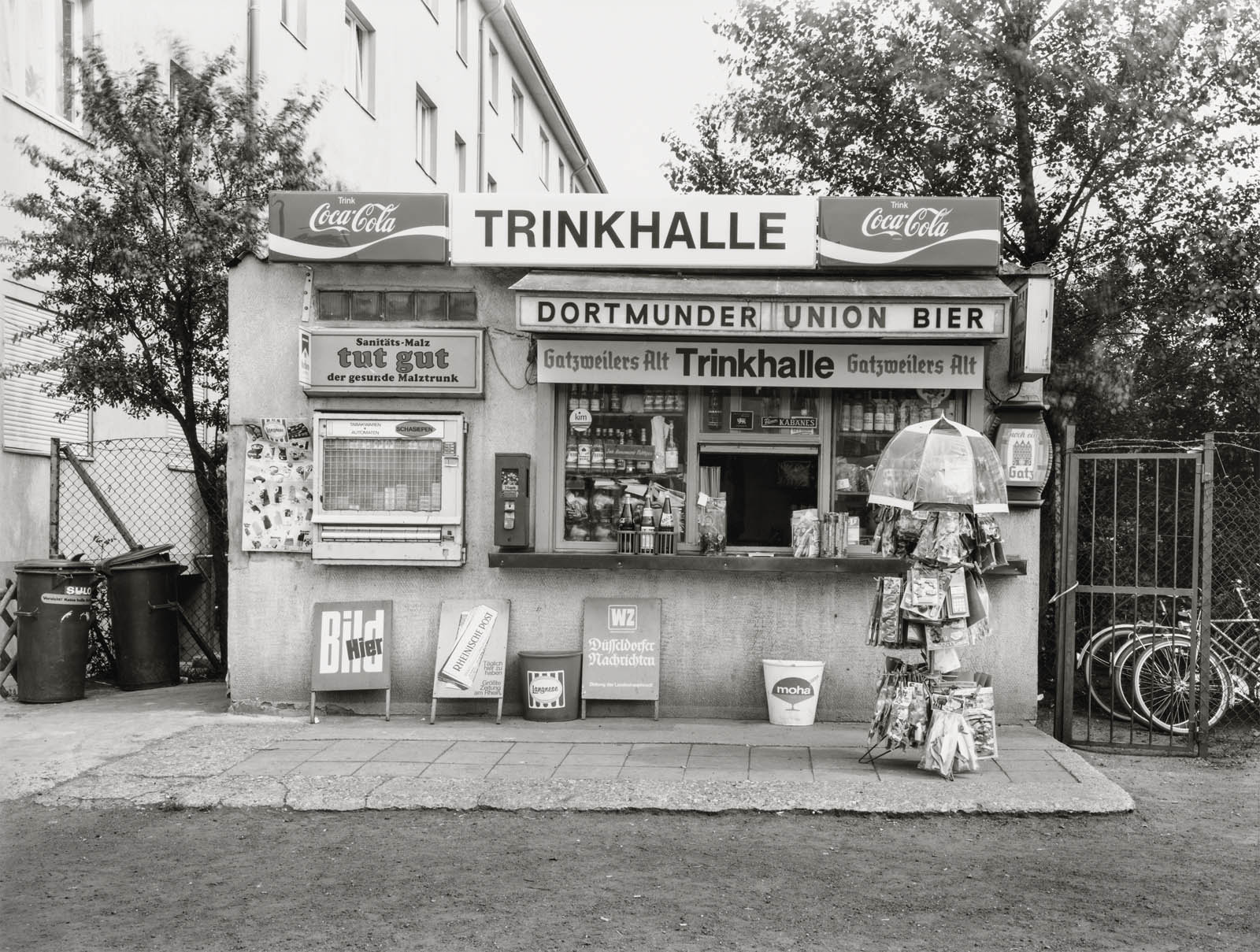
 

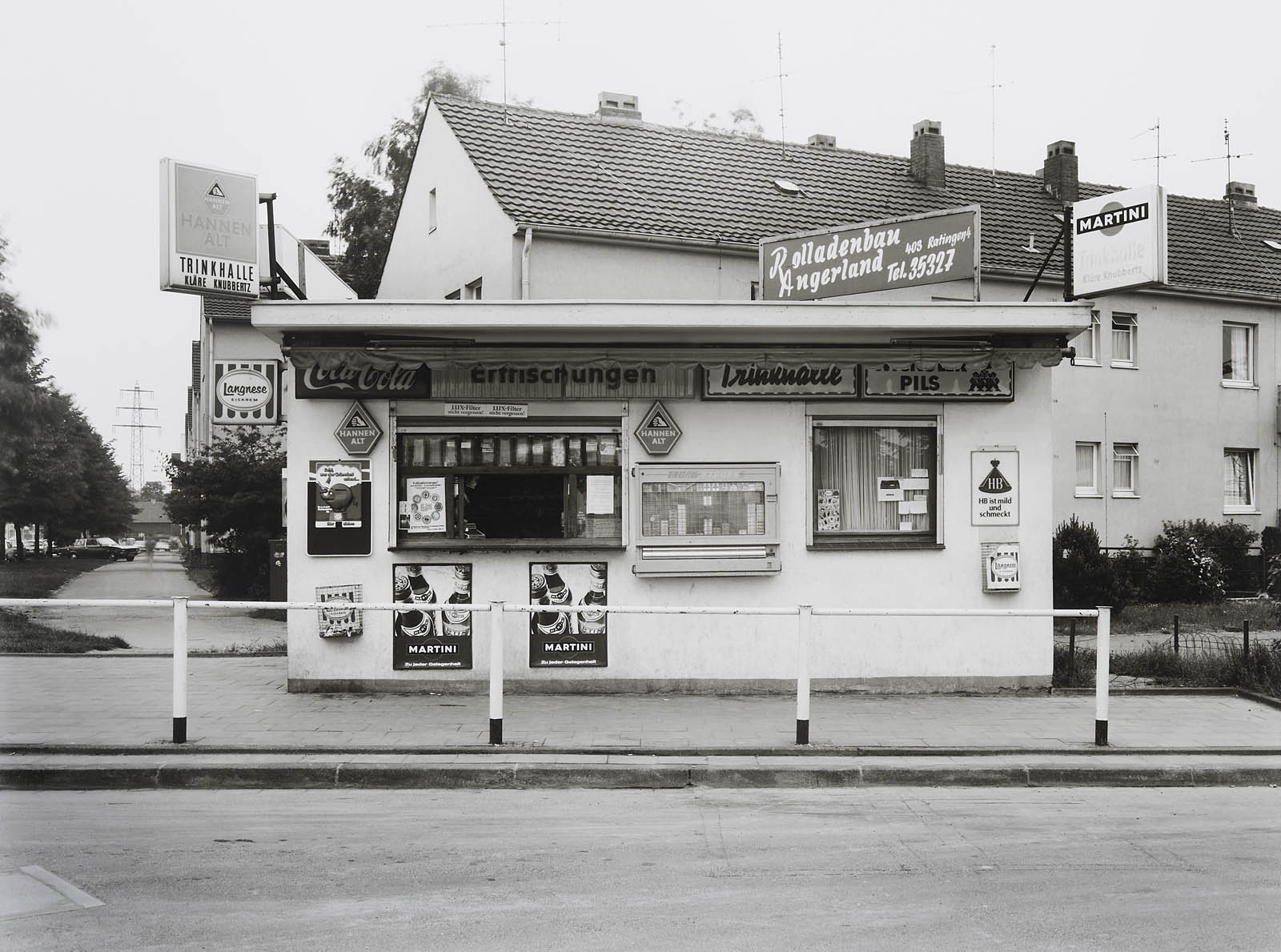
Tata Ronkholz (German, 1940-1997) 'Trinkhalle / Kiosk, Düsseldorf, Sankt-Franziskus-Straße 107' 1977


Tata Ronkholz (German, 1940-1997)
Trinkhalle / Kiosk, Düsseldorf, Sankt-Franziskus-Straße 107
1977
© VAN HAM Art Estate: Tata Ronkholz, 2026


In a nutshell:

Large format camera
Front on, realist, sharply defined objective documentary photographs of architectural structures of the urban landscape
In series

In reality:

Structures cut from the fabric of existence
Isolated by the subjective eye of the photographer and the lens of the camera
What to include or exclude

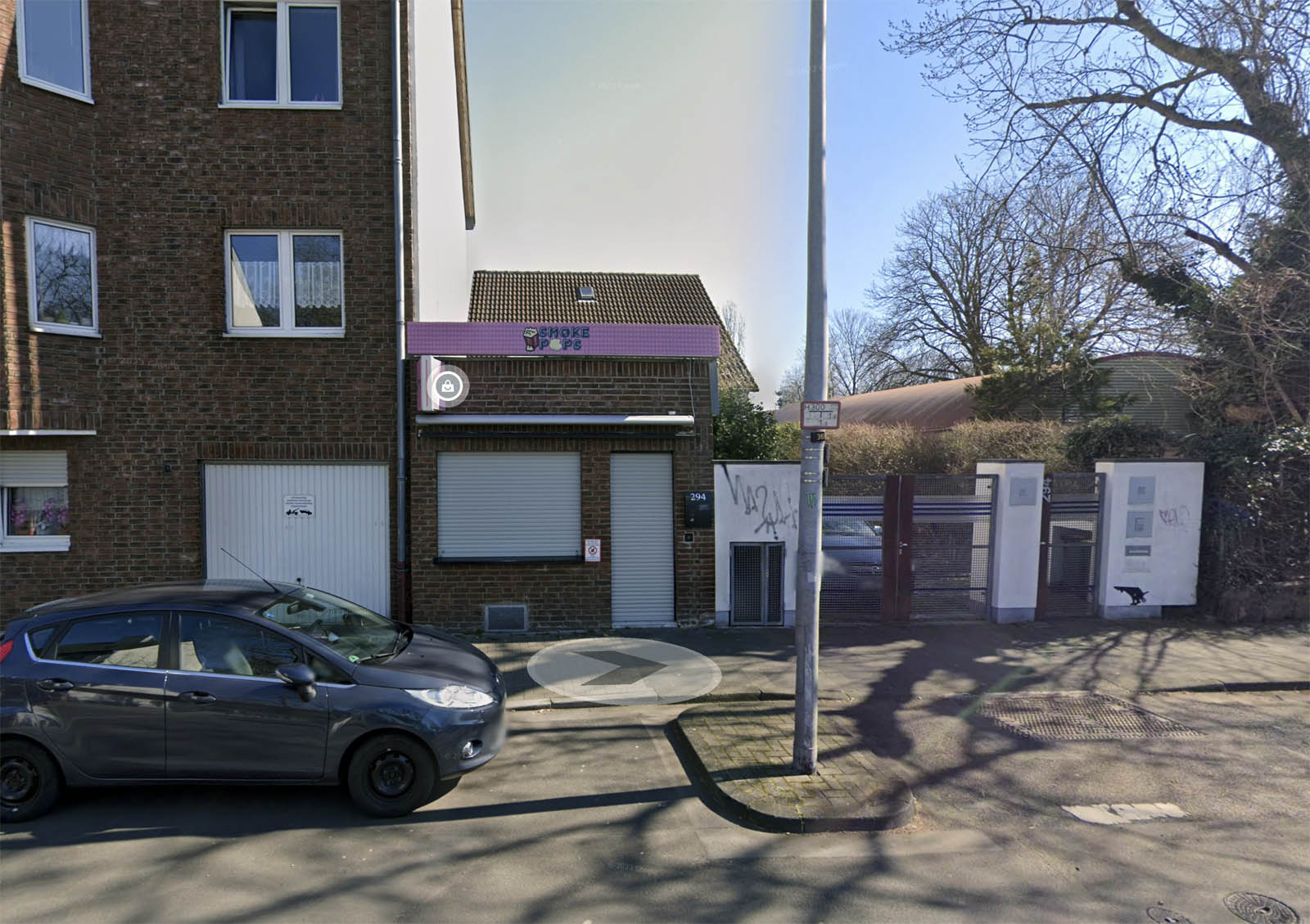
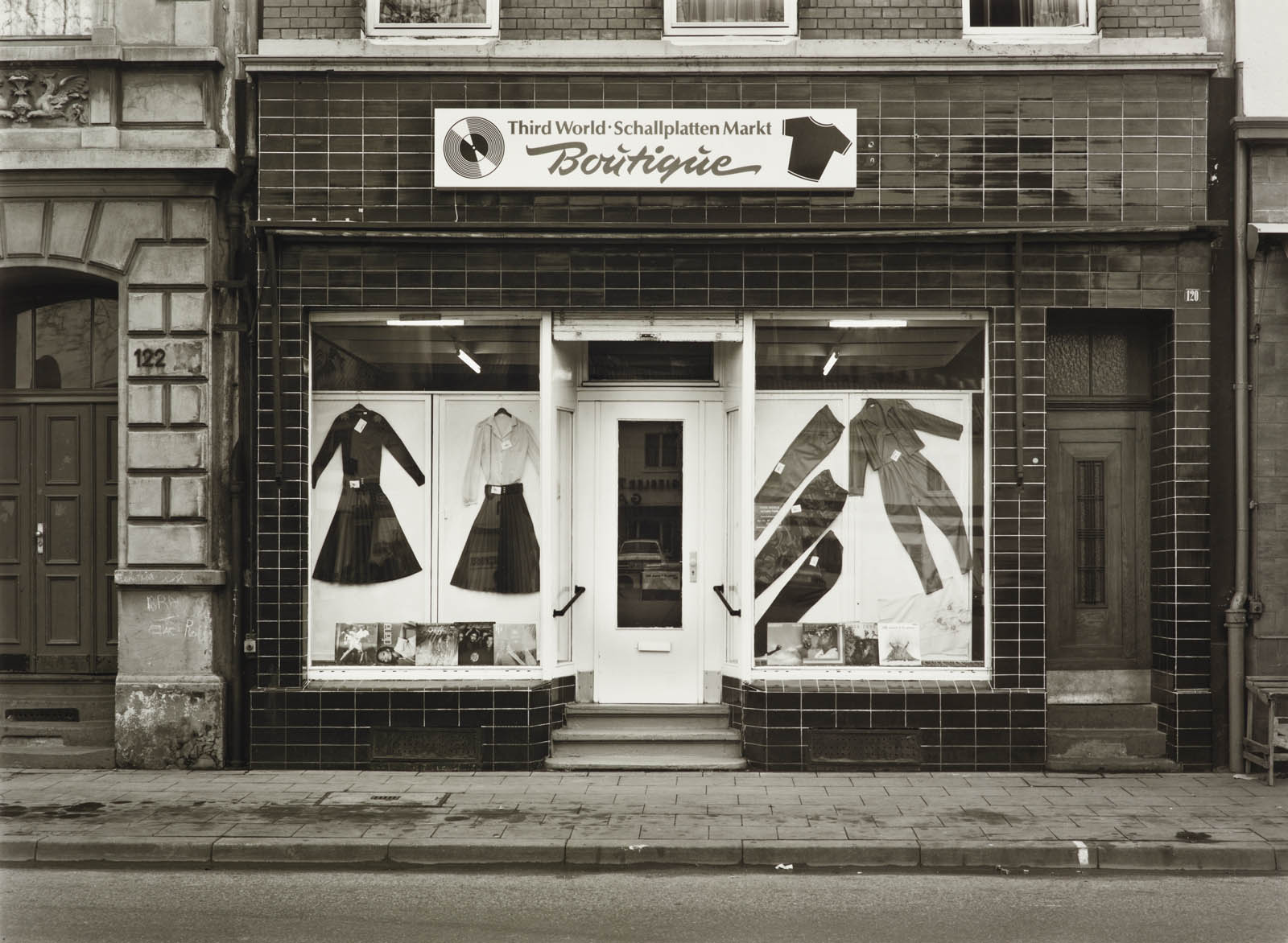
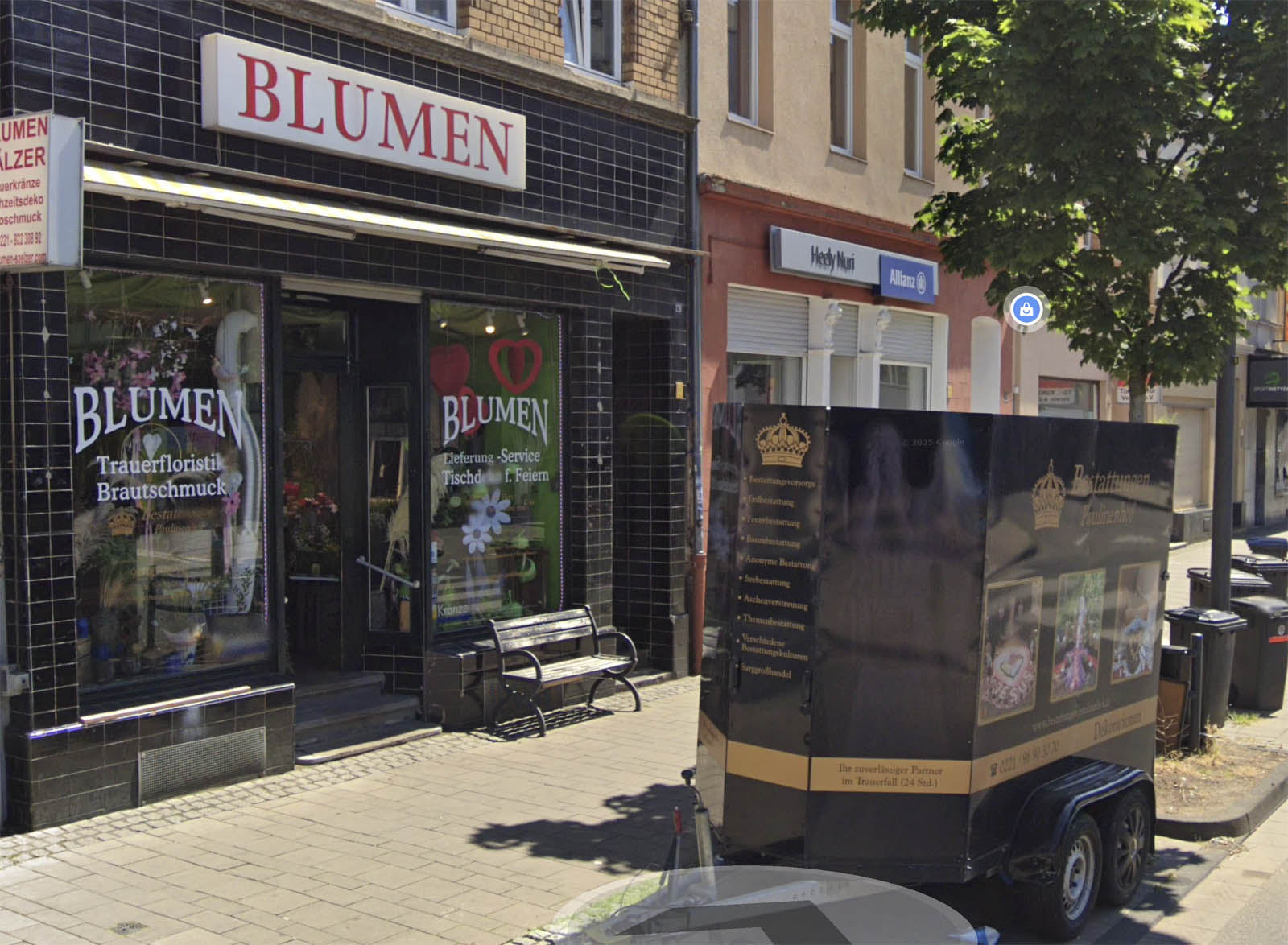
(In the contemporary photographs of the spaces in the posting, the shops are surrounded by trees and vegetation, they have transformed from kiosk to shuttered shop, from boutique to florist: the architecture remains but traces of previous incarnations are visible only in these photographs. Nothing is permanent except change).

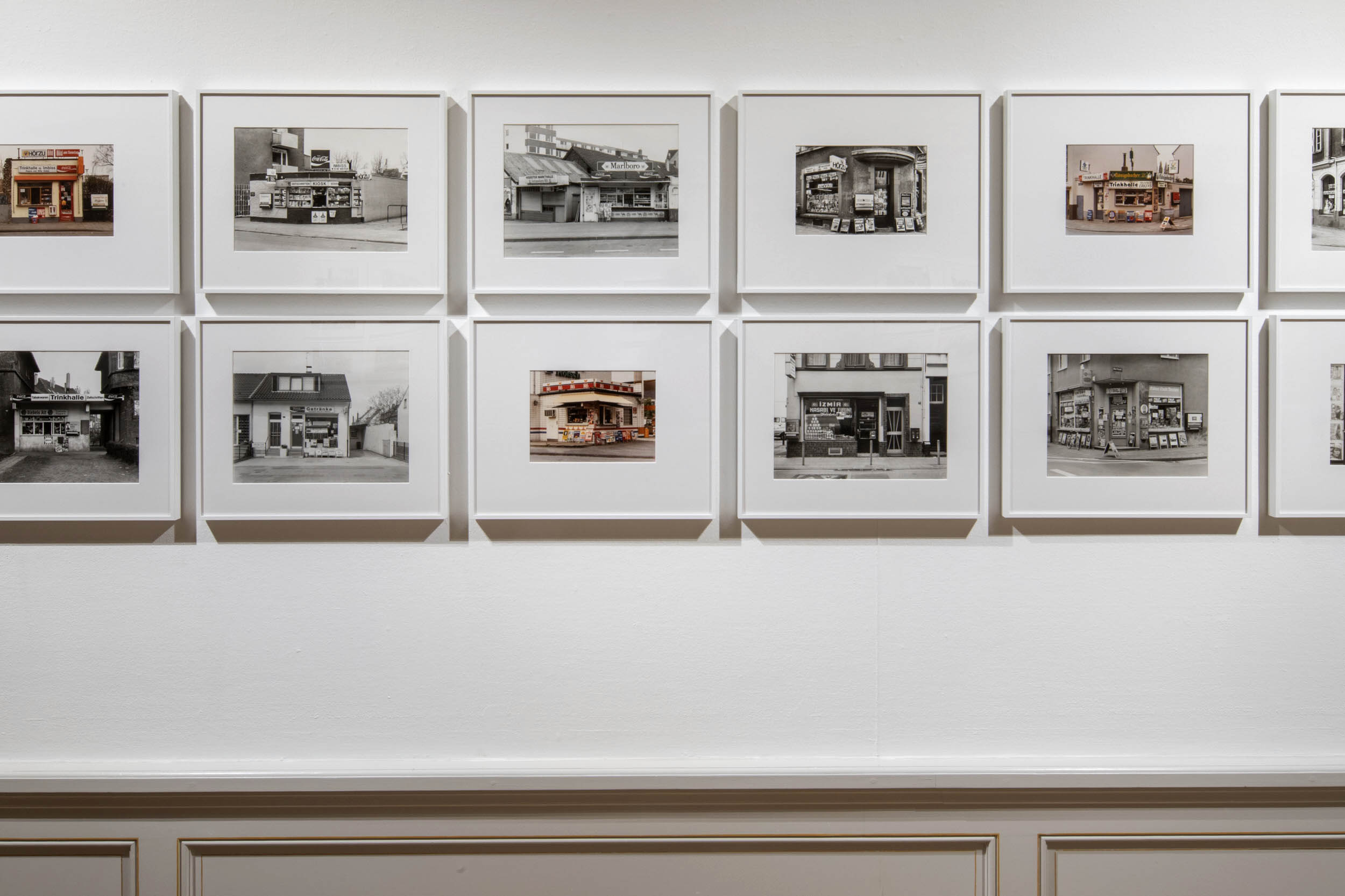
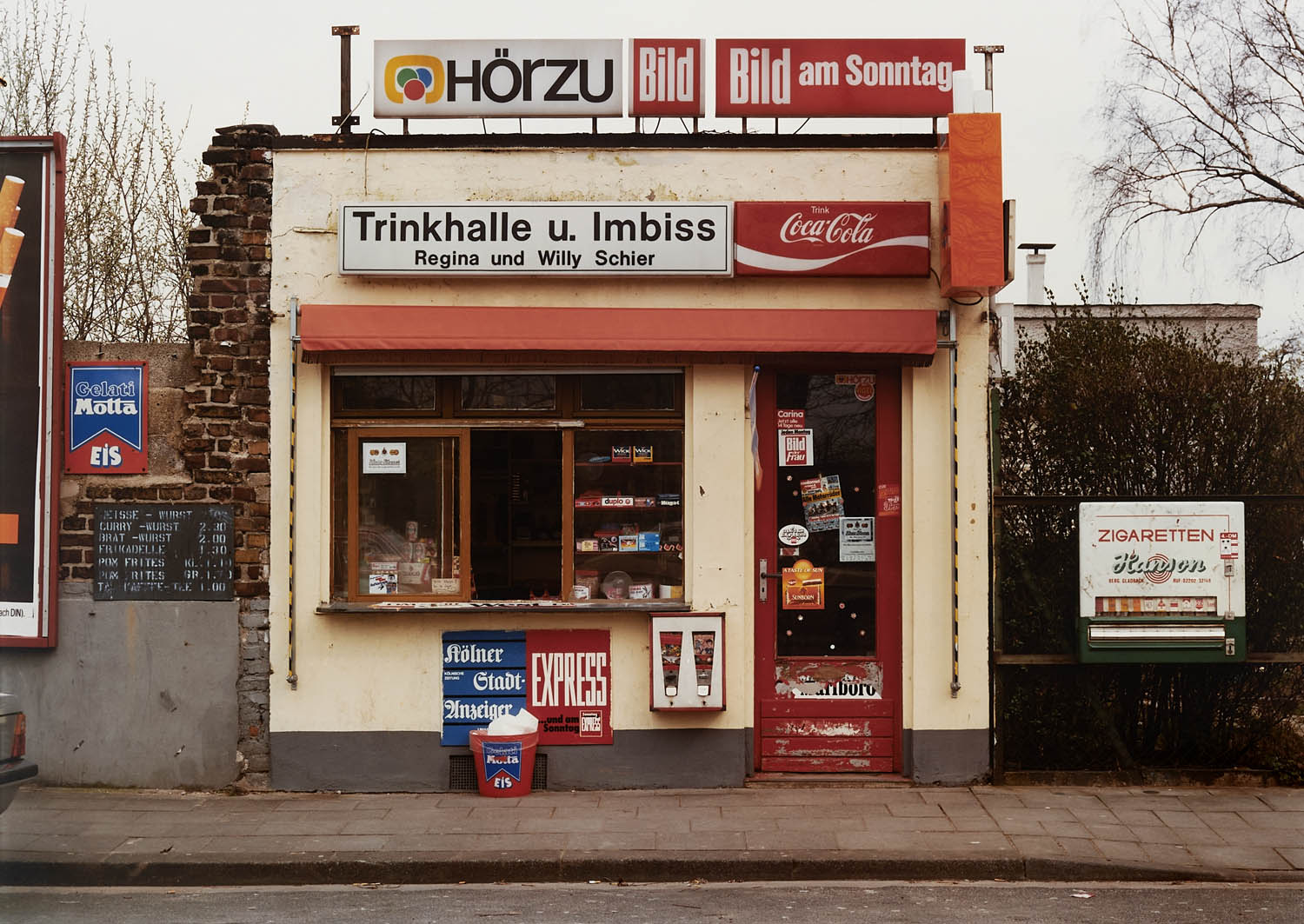
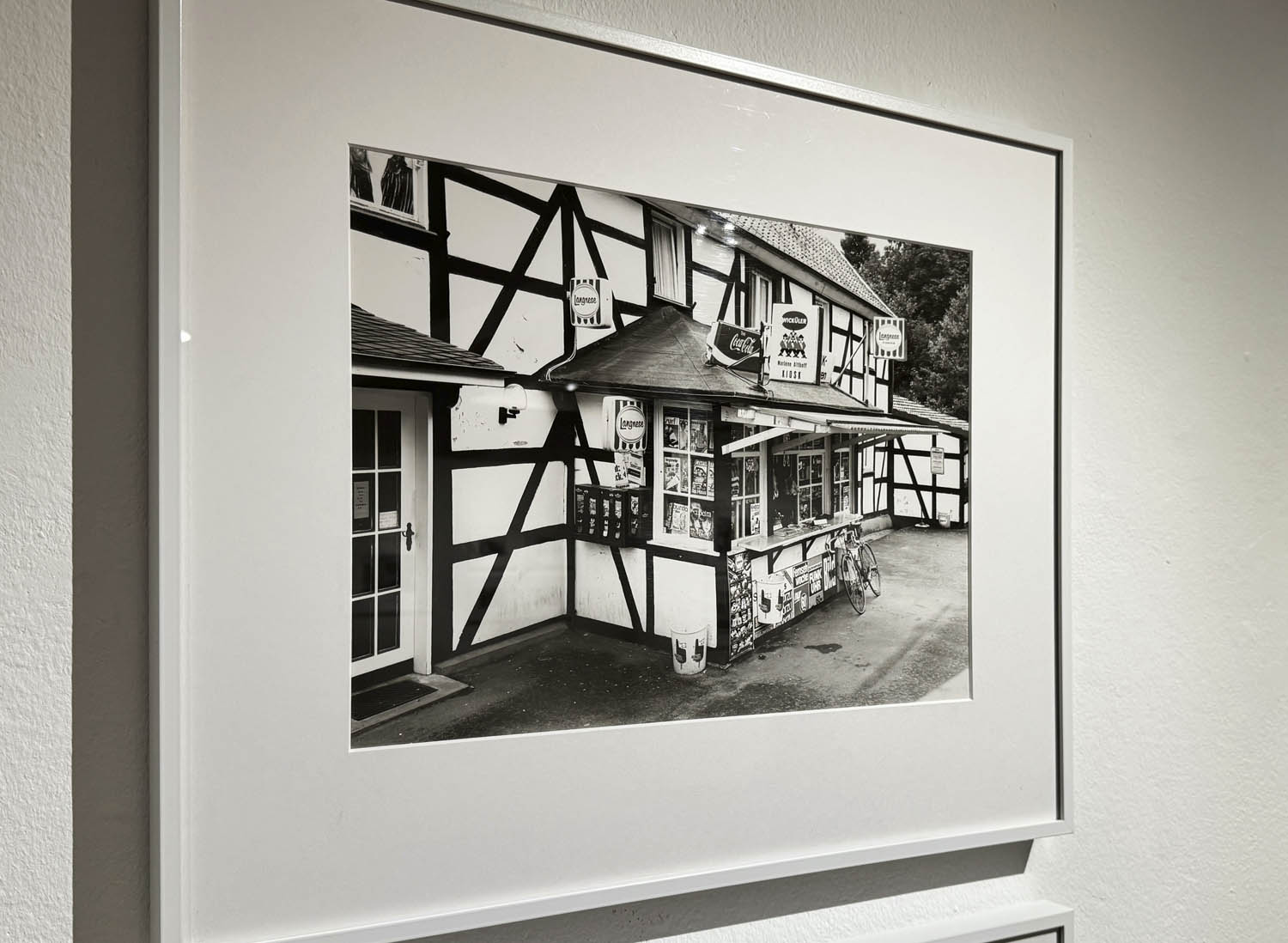
In the photographs of kiosks, corner shops and industrial gates, it is the minutiae of existence (not as mere decoration) that gives these supposedly objective photographs their subjective power. For example, “the photo Trinkhalle, Köln-Nippes – with its ice cream and newspaper advertisements and vending machines for chewing gum and cigarettes” is more than amusing and engaging – it depicts vital, archaeological evidence of the transitory nature of human existence in the pyschogeography of the urbanscape.1

In Ronkholz’ photographs of the terrain (from the Latin terra, earth/land) of the city, her exploration of urban environments emphasises interpersonal connections to places – and testify “to social, cultural, and economic change and shows how people shape the world around them.” (Press release)

This is the fluid boundary that these photographs so beautifully and incisively depict: the interface between architecture and human, between order (form/surface) and chaos (placement of insolent signs), between utopian perfection and dystopian unruliness – the one coexistent with the other.

This confluence of pattern and randomness, objective and subjective, is what gives these photographs of the everyday a lasting significance.

Dr Marcus Bunyan


1/ Guy Debord (November 1956). “Theory of the Dérive”. Les Lèvres Nues (9). Translated by Ken Knabb.


Many thankx to Huis Marseille, Amsterdam for allowing me to publish the photographs in the posting. Please click on the photographs for a larger version of the image.
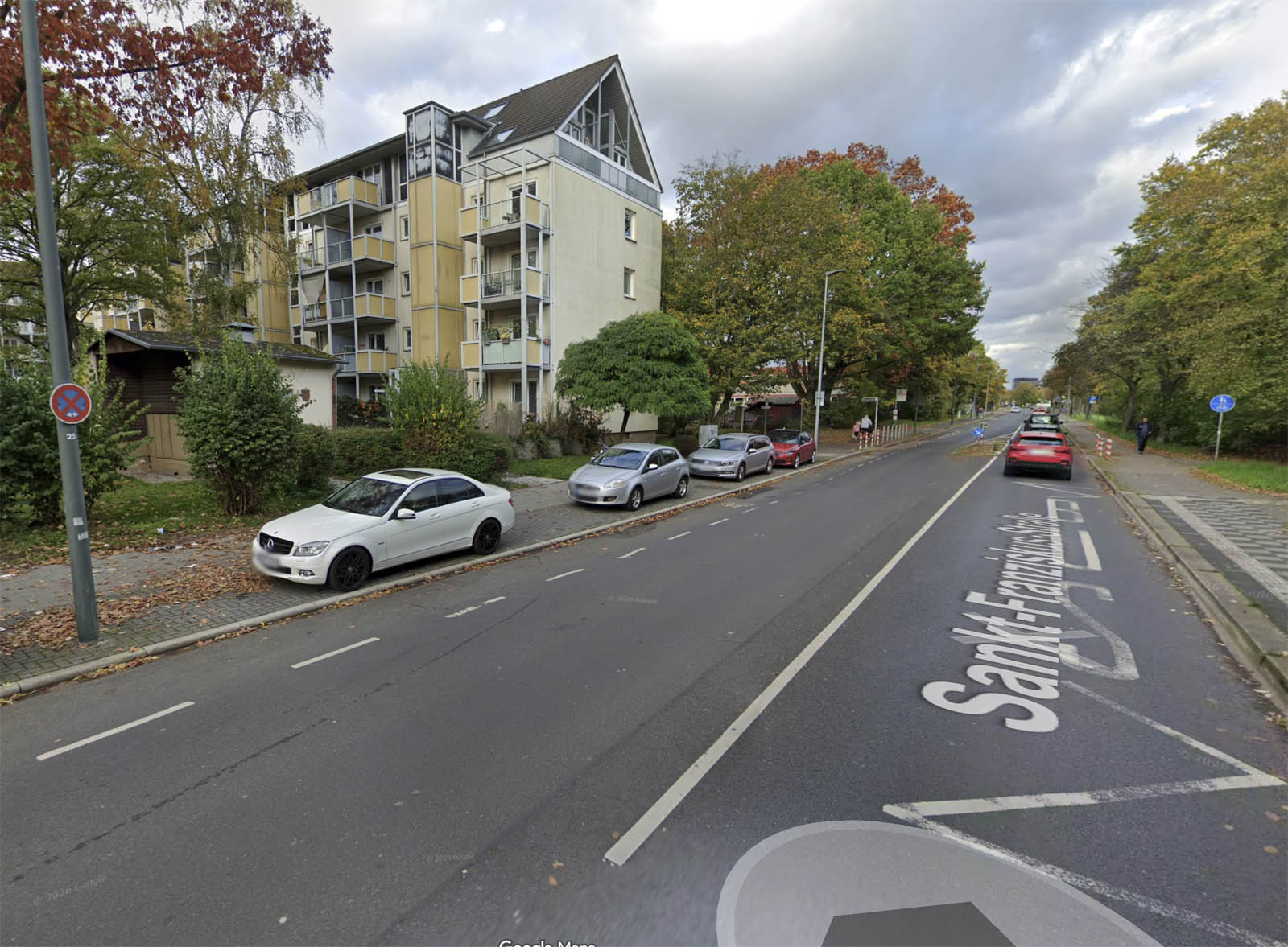


Sankt-Franziskus-Straße 104-107 Düsseldorf
 

Sankt-Franziskus-Straße 104-107 Düsseldorf
 

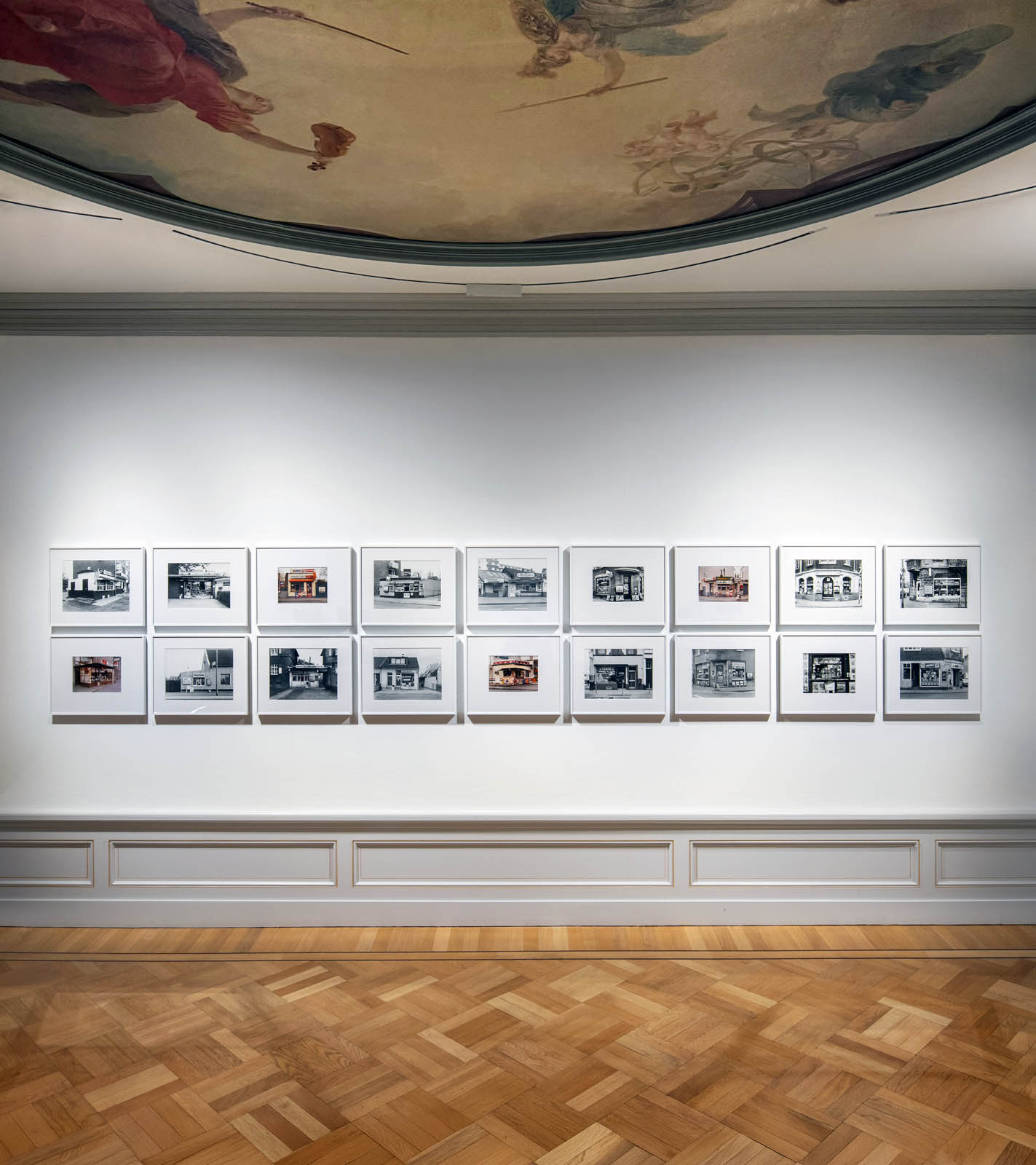
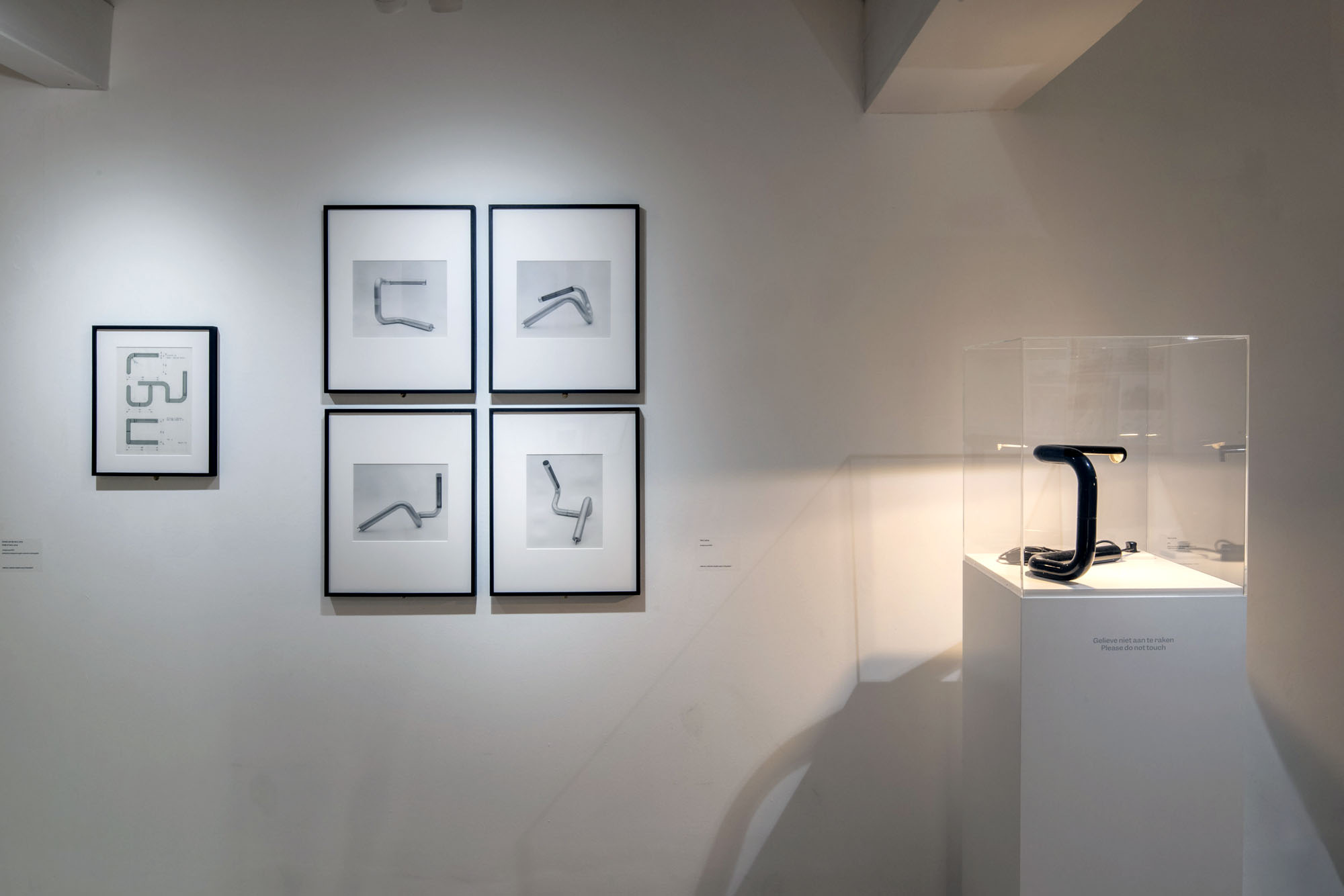
Installation view of the exhibition Designed World: Through the Eyes of Tata Ronkholz (1940-1997) at Huis Marseille, Amsterdam, February - June, 2026
Installation view of the exhibition 'Designed World: Through the Eyes of Tata Ronkholz (1940-1997)' at Huis Marseille, Amsterdam, February - June, 2026


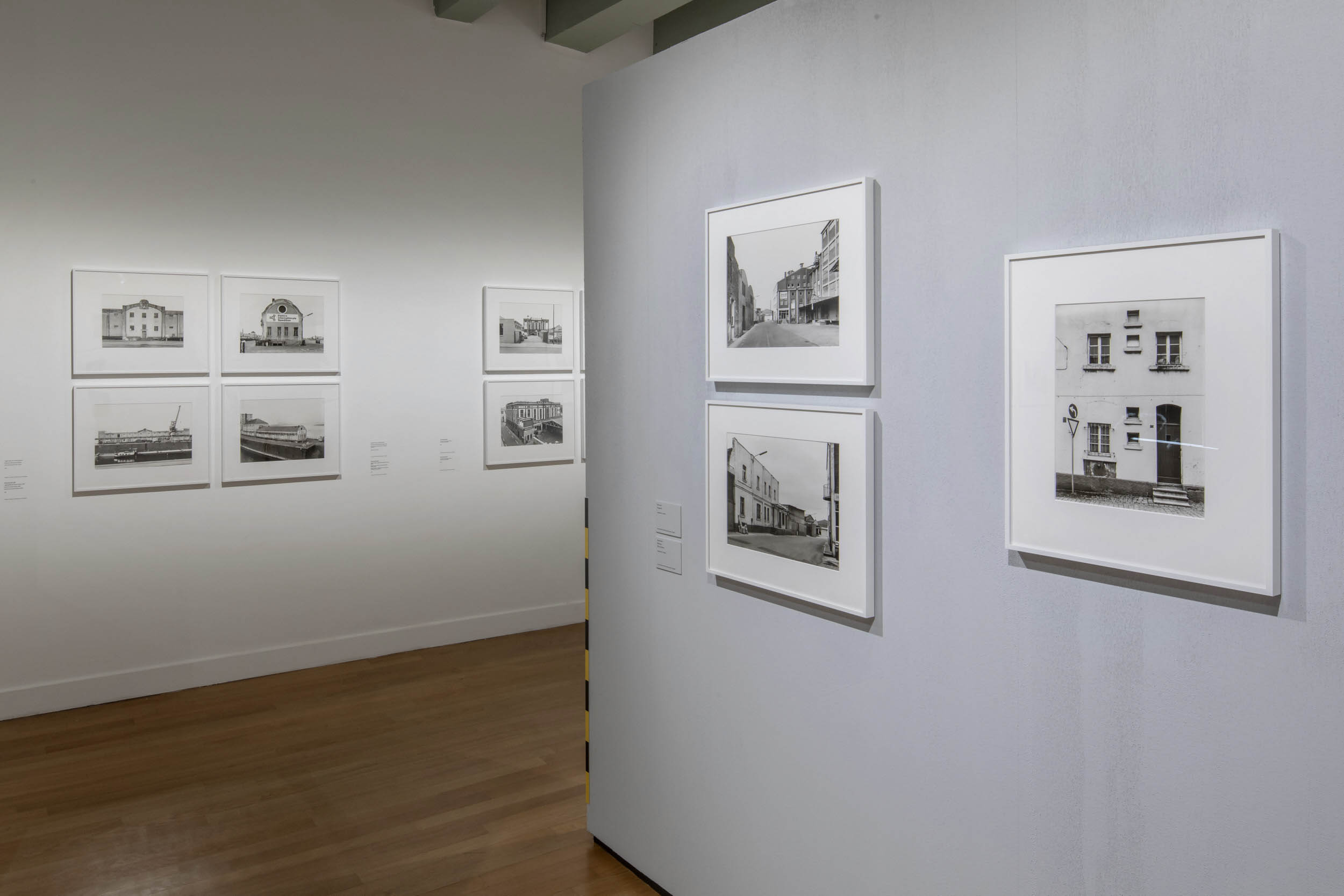
Installation views of the exhibition Designed World: Through the Eyes of Tata Ronkholz (1940-1997) at Huis Marseille, Amsterdam, February – June, 2026
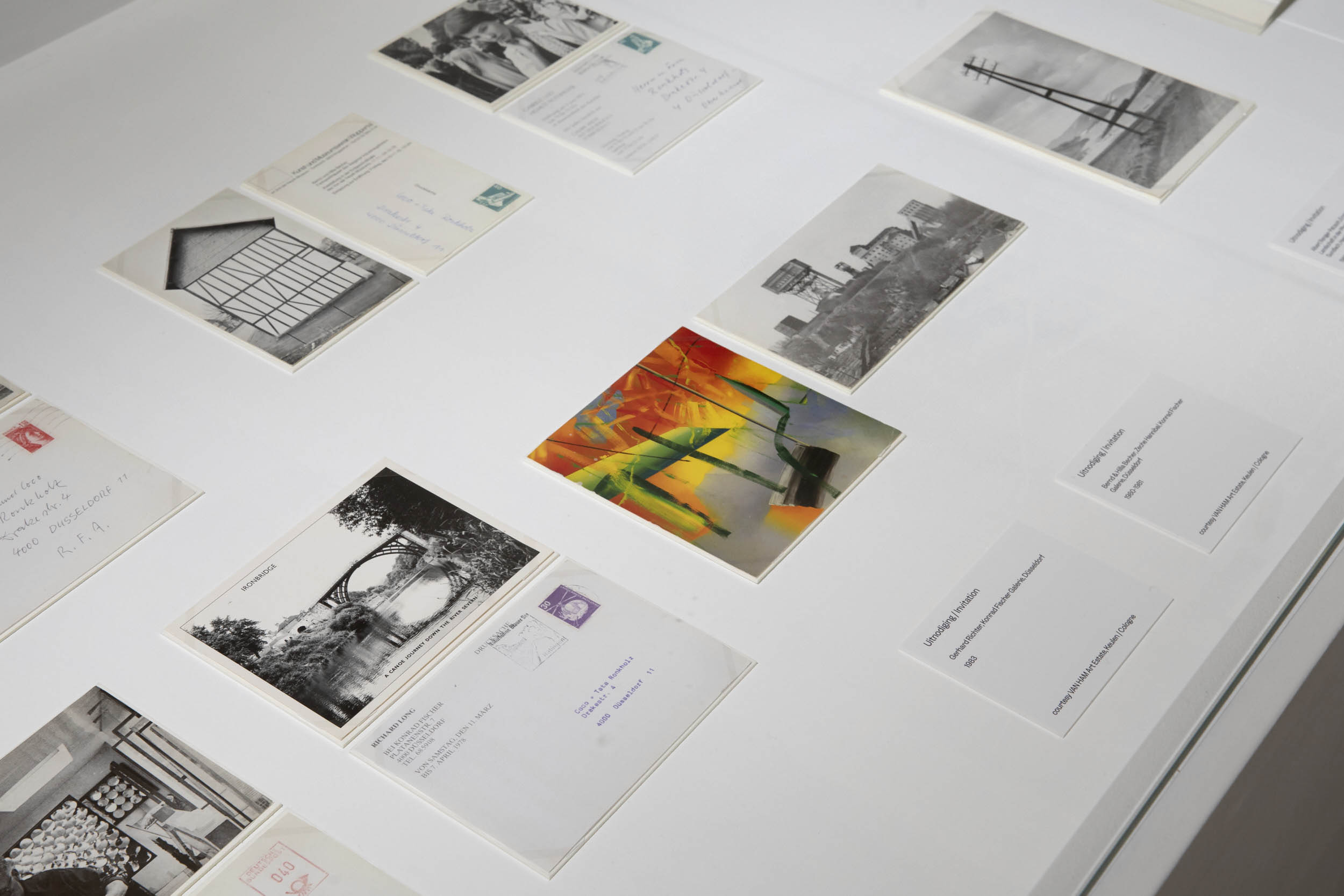
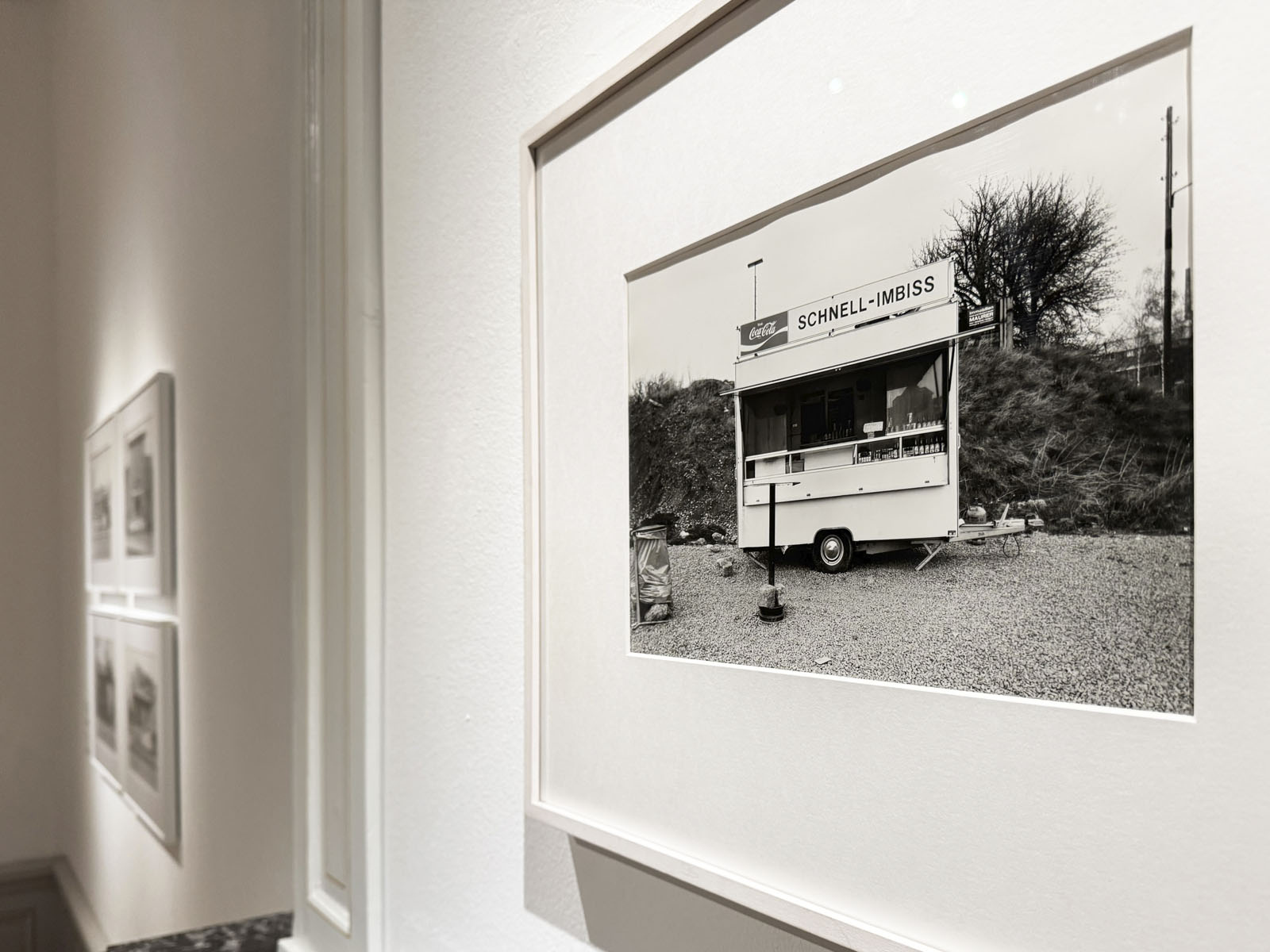
 

Installation view of the exhibition Designed World: Through the Eyes of Tata Ronkholz (1940-1997) at Huis Marseille, Amsterdam, February - June, 2026
Installation view of the exhibition 'Designed World: Through the Eyes of Tata Ronkholz (1940-1997)' at Huis Marseille, Amsterdam, February - June, 2026


Installation views of the exhibition Designed World: Through the Eyes of Tata Ronkholz (1940-1997) at Huis Marseille, Amsterdam, February – June, 2026
 

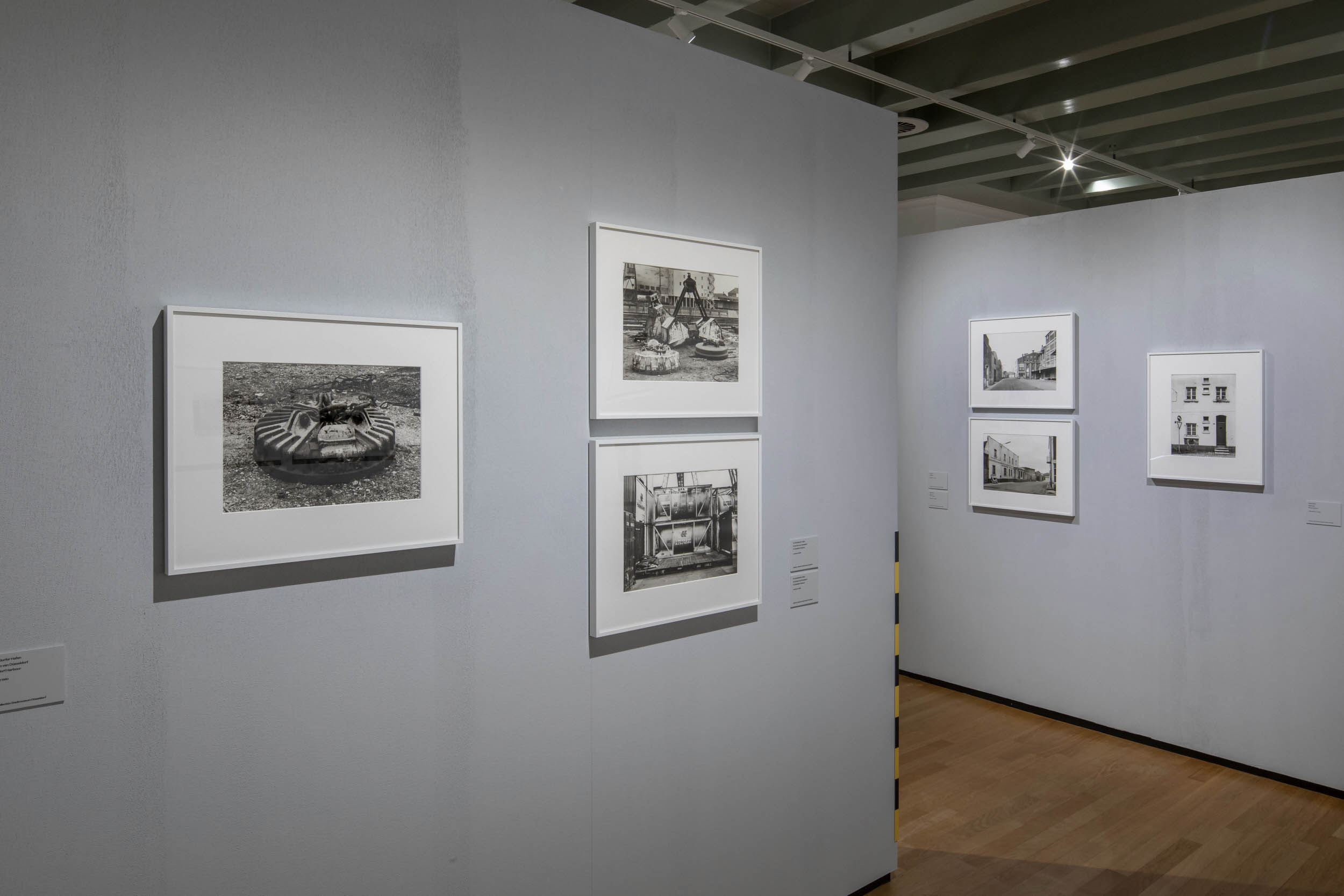
Installation view of the exhibition Designed World: Through the Eyes of Tata Ronkholz (1940-1997) at Huis Marseille, Amsterdam, February - June, 2026 showing at left, Tata Ronkholz's 'Düsseldorf Harbor' (1980)


Installation view of the exhibition Designed World: Through the Eyes of Tata Ronkholz (1940-1997) at Huis Marseille, Amsterdam, February – June, 2026 showing at left, Tata Ronkholz’s Düsseldorf Harbor (1980)


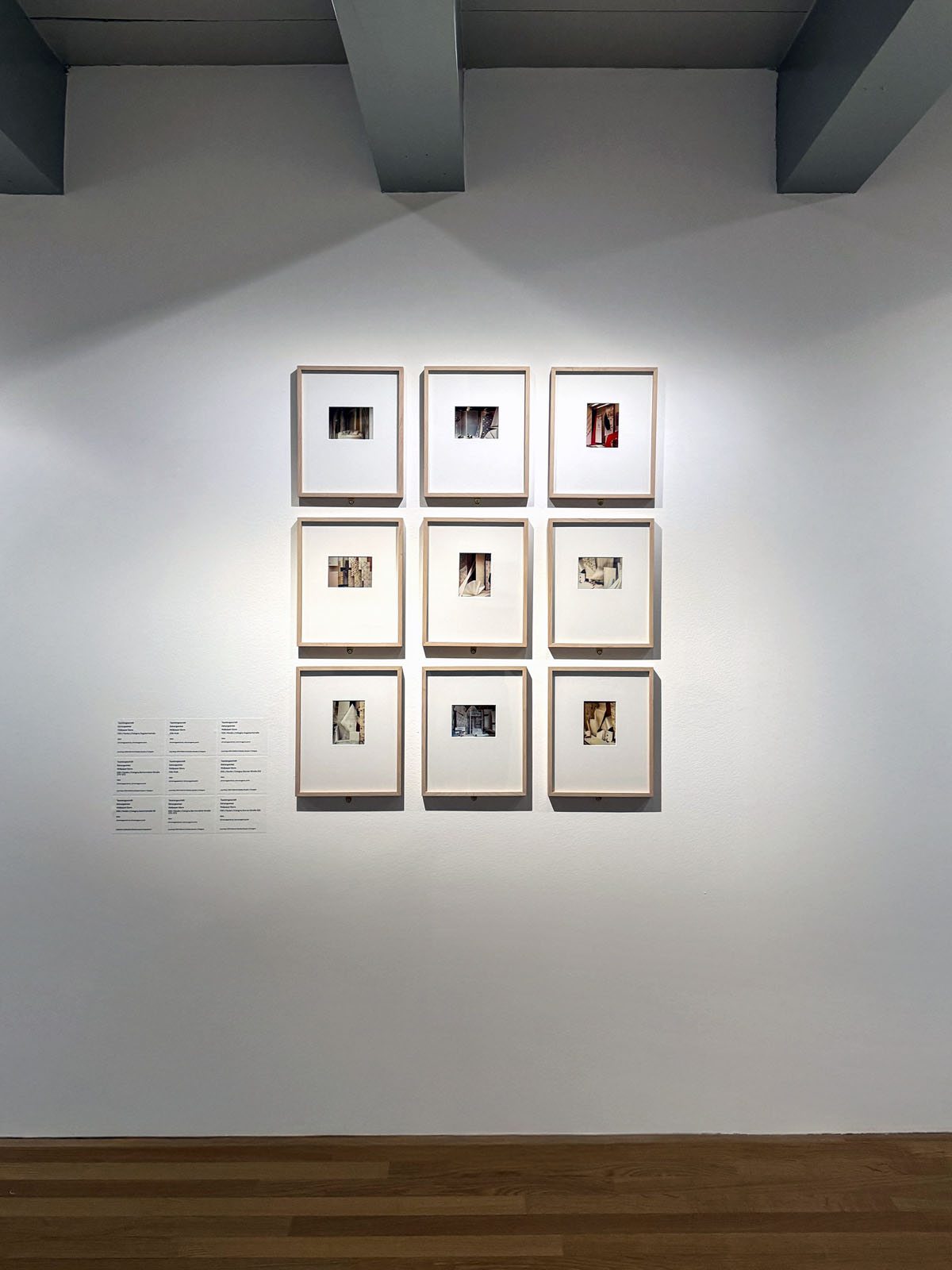
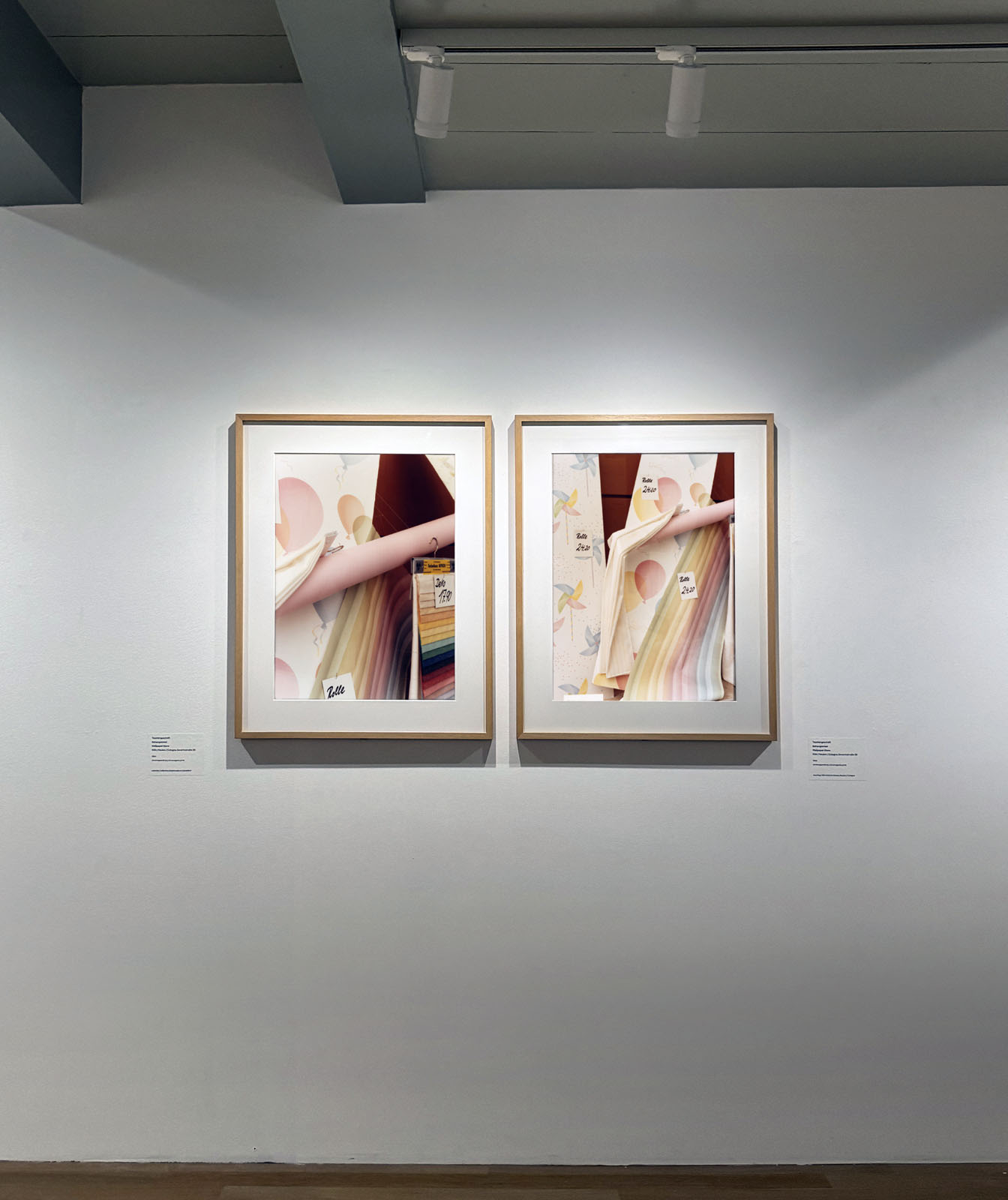
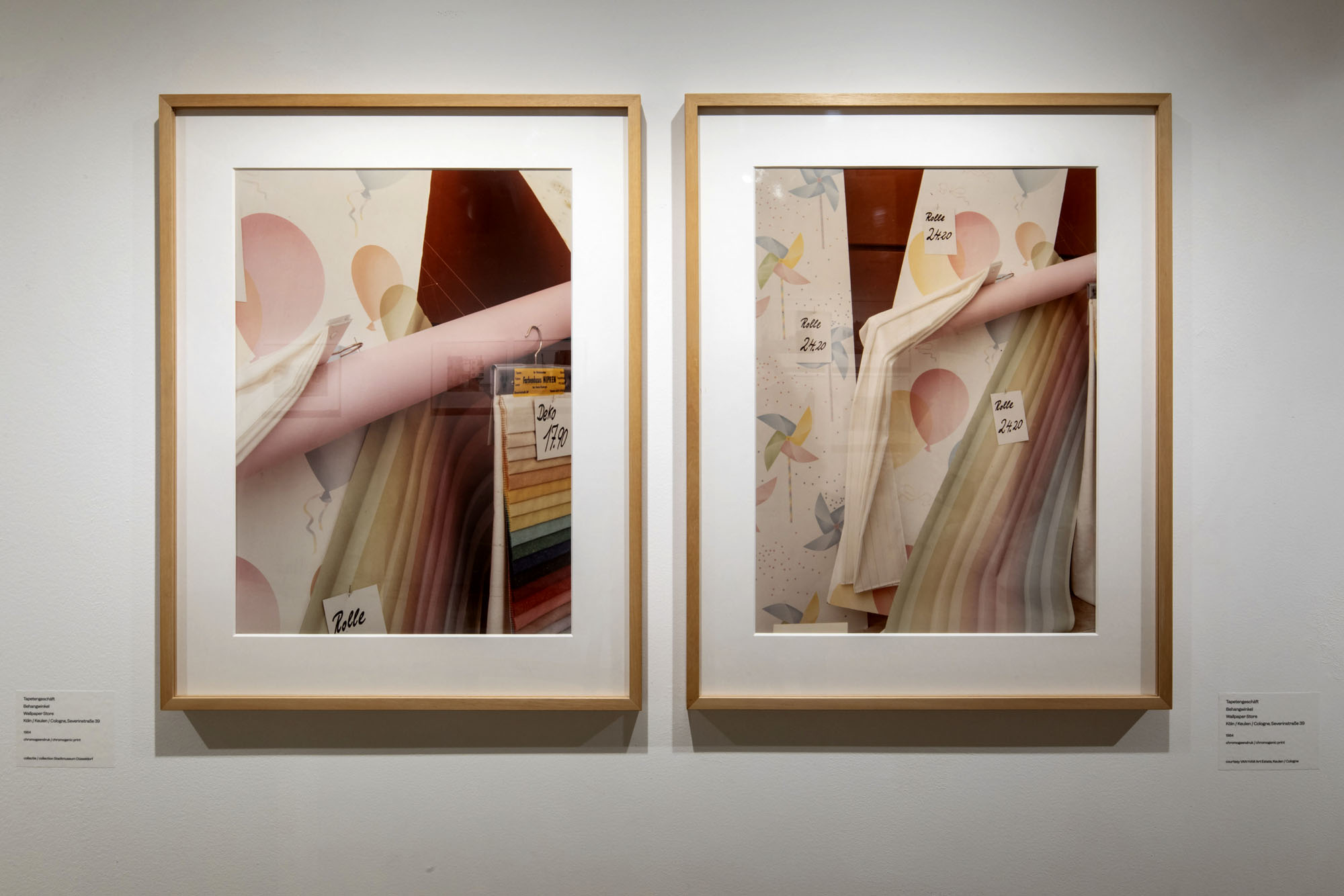
Tata Ronkholz (German, 1940-1997) 'Wallpaper store' 1964 (installation view)


Tata Ronkholz (German, 1940-1997)
Wallpaper store (installation views)
1964
© VAN HAM Art Estate: Tata Ronkholz, 2026


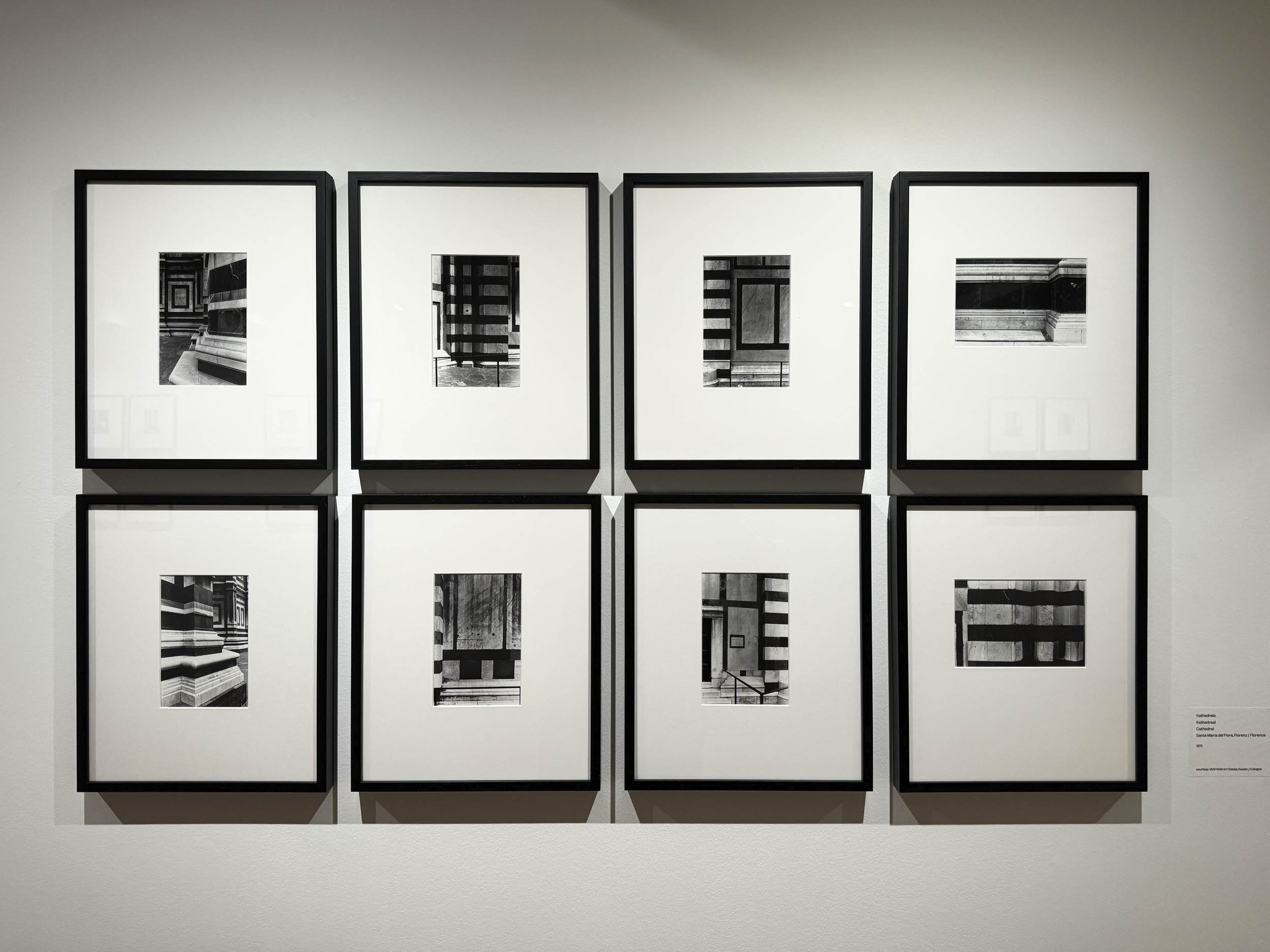
Tata Ronkholz (German, 1940-1997) 'Cathedral, Santa Maria del Fiore, Florence' 1975 (installation view)


Tata Ronkholz (German, 1940-1997)
Cathedral, Santa Maria del Fiore, Florence (installation view)
1975
© VAN HAM Art Estate: Tata Ronkholz, 2026


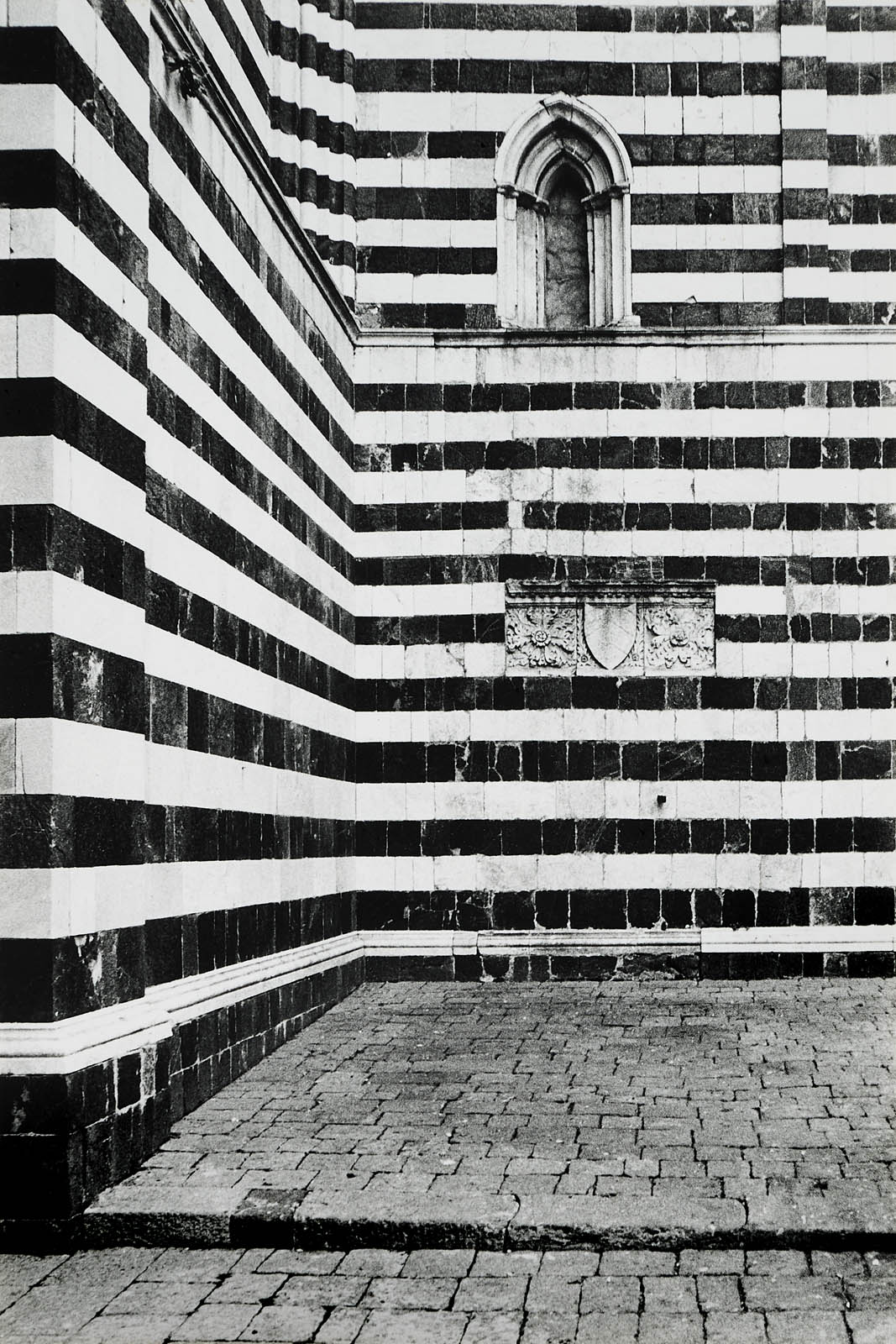
Tata Ronkholz (German, 1940-1997) 'Santa Maria Assunta, Dom / Cathedral, Volterra' 1975


Tata Ronkholz (German, 1940-1997)
Santa Maria Assunta, Dom / Cathedral, Volterra
1975
© VAN HAM Art Estate: Tata Ronkholz, 2026


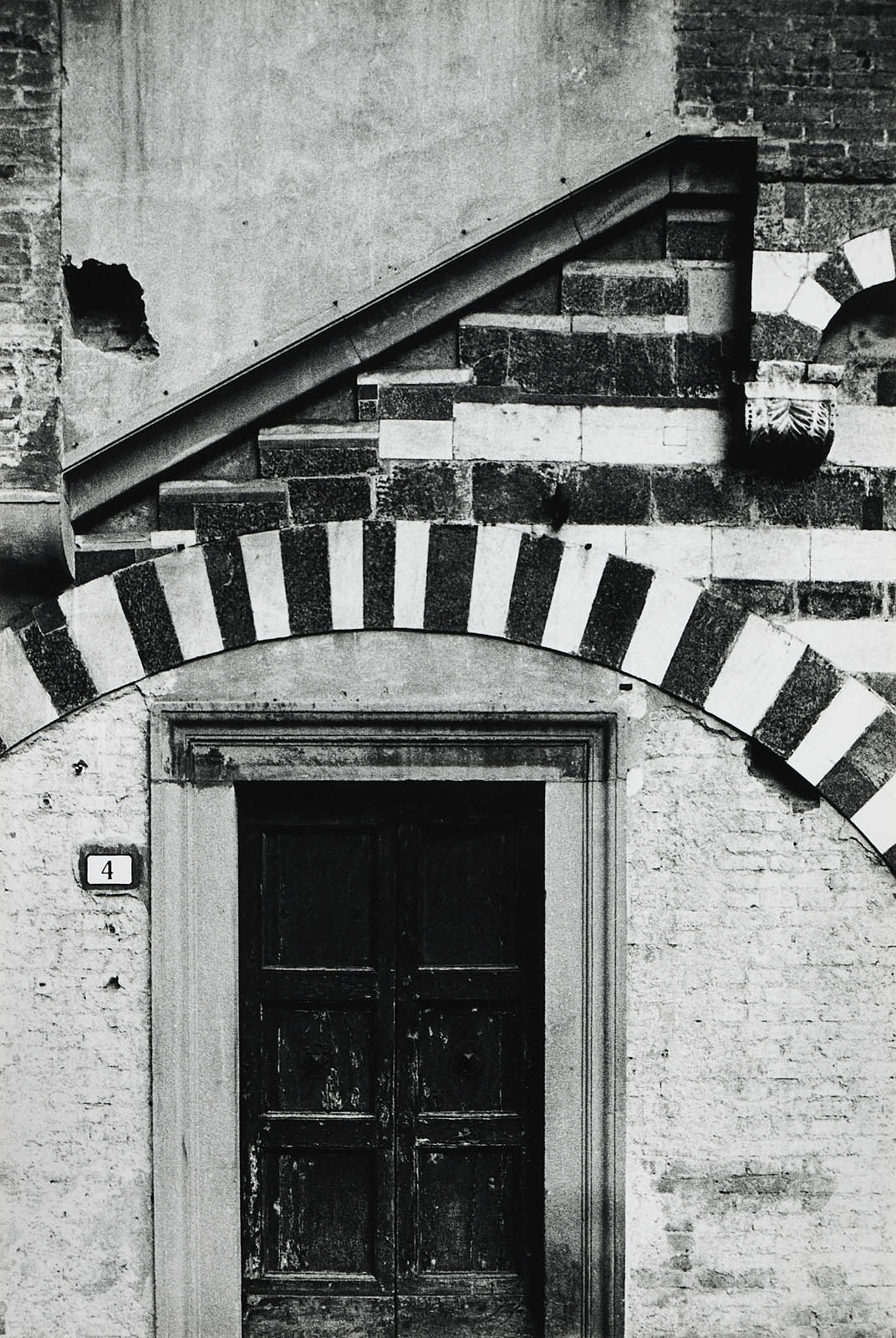
Tata Ronkholz (German, 1940-1997) 'Palazzo dei Vescovi (Museo dell’Antico), Pistoia' 1975


Tata Ronkholz (German, 1940-1997)
Palazzo dei Vescovi (Museo dell’Antico), Pistoia
1975
© VAN HAM Art Estate: Tata Ronkholz, 2026


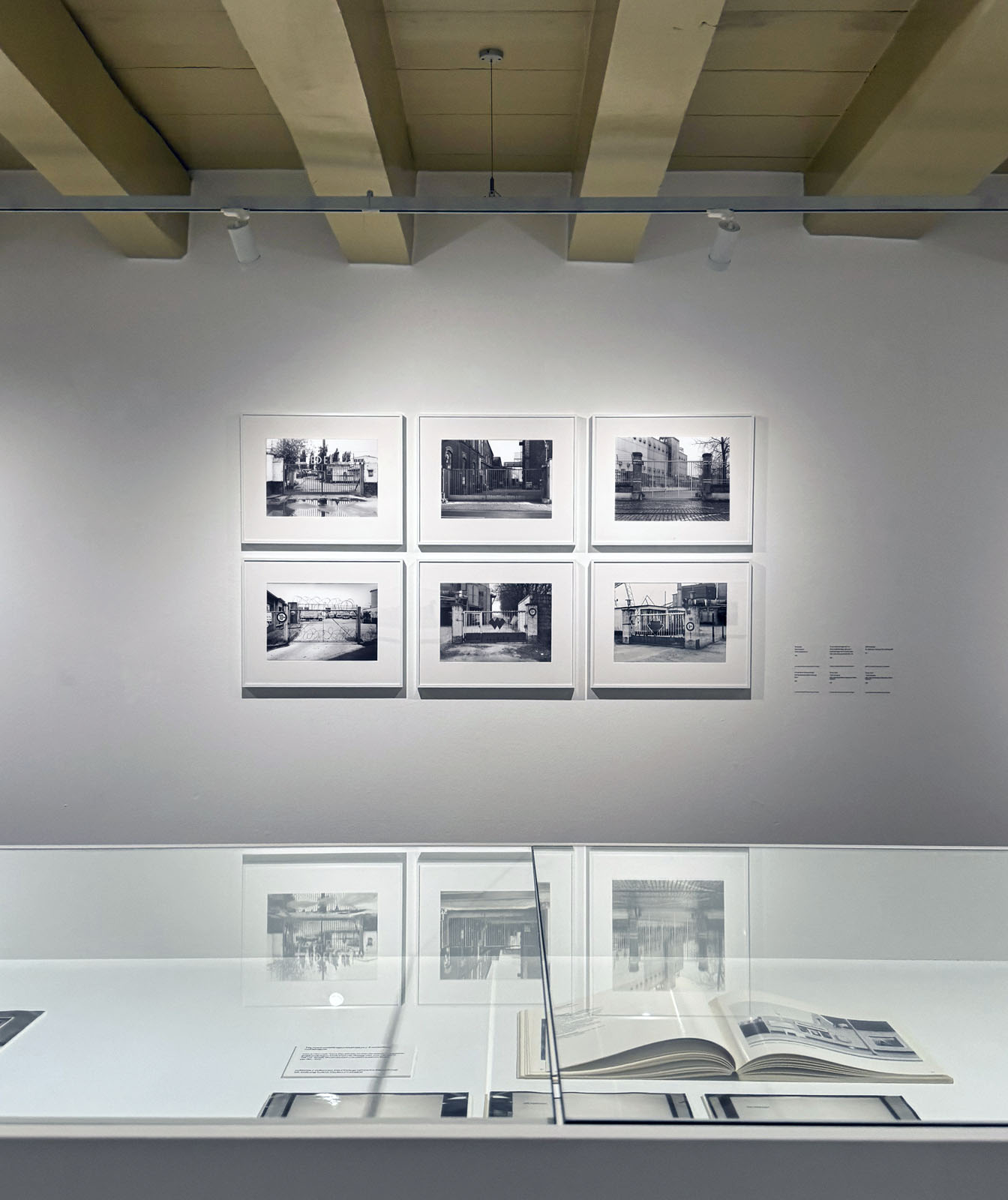
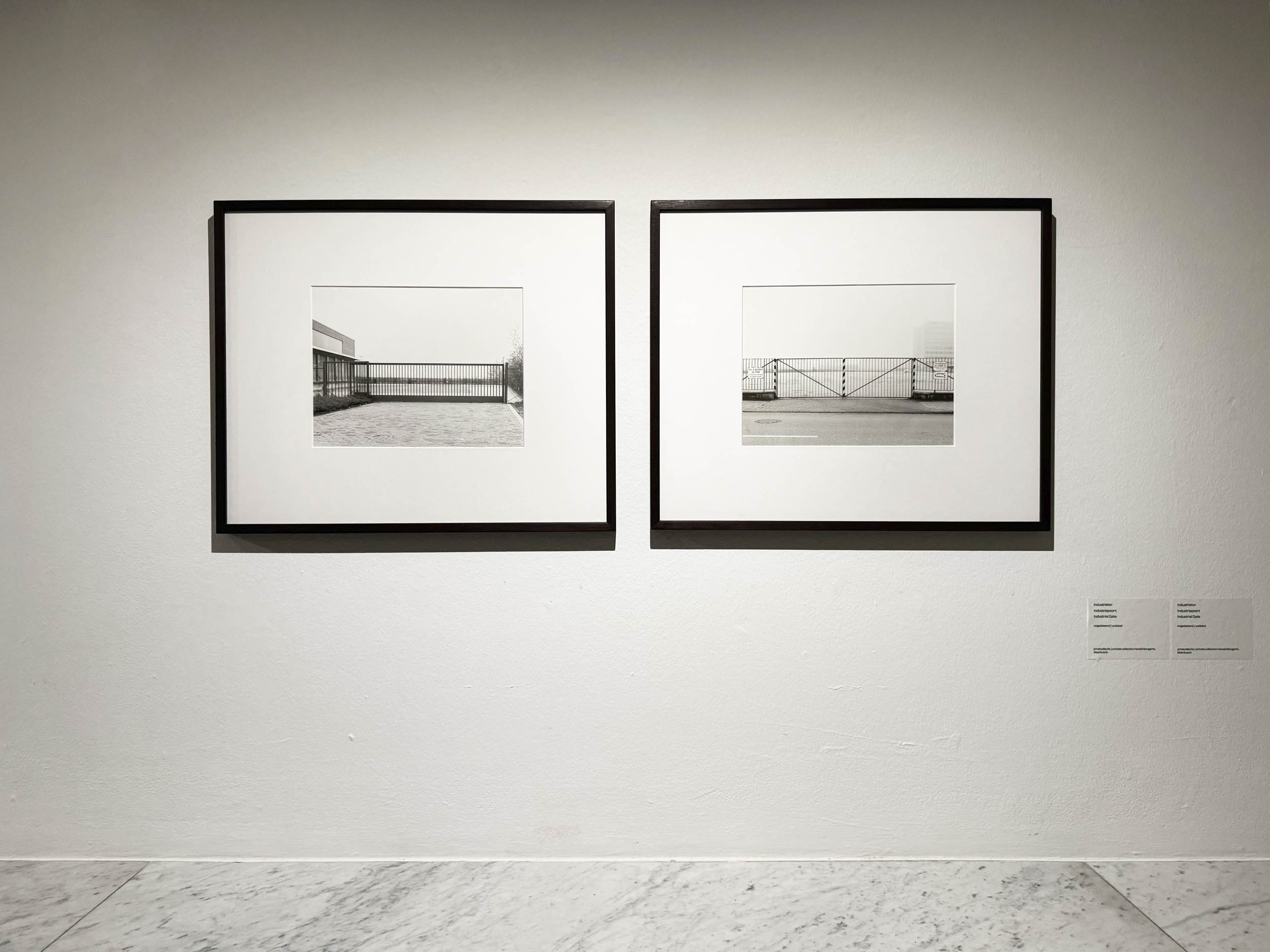
Tata Ronkholz (German, 1940-1997) 'Industrial Gate' Nd (installation view)


Tata Ronkholz (German, 1940-1997)
Industrial Gate (installation view)
Nd
© VAN HAM Art Estate: Tata Ronkholz, 2026


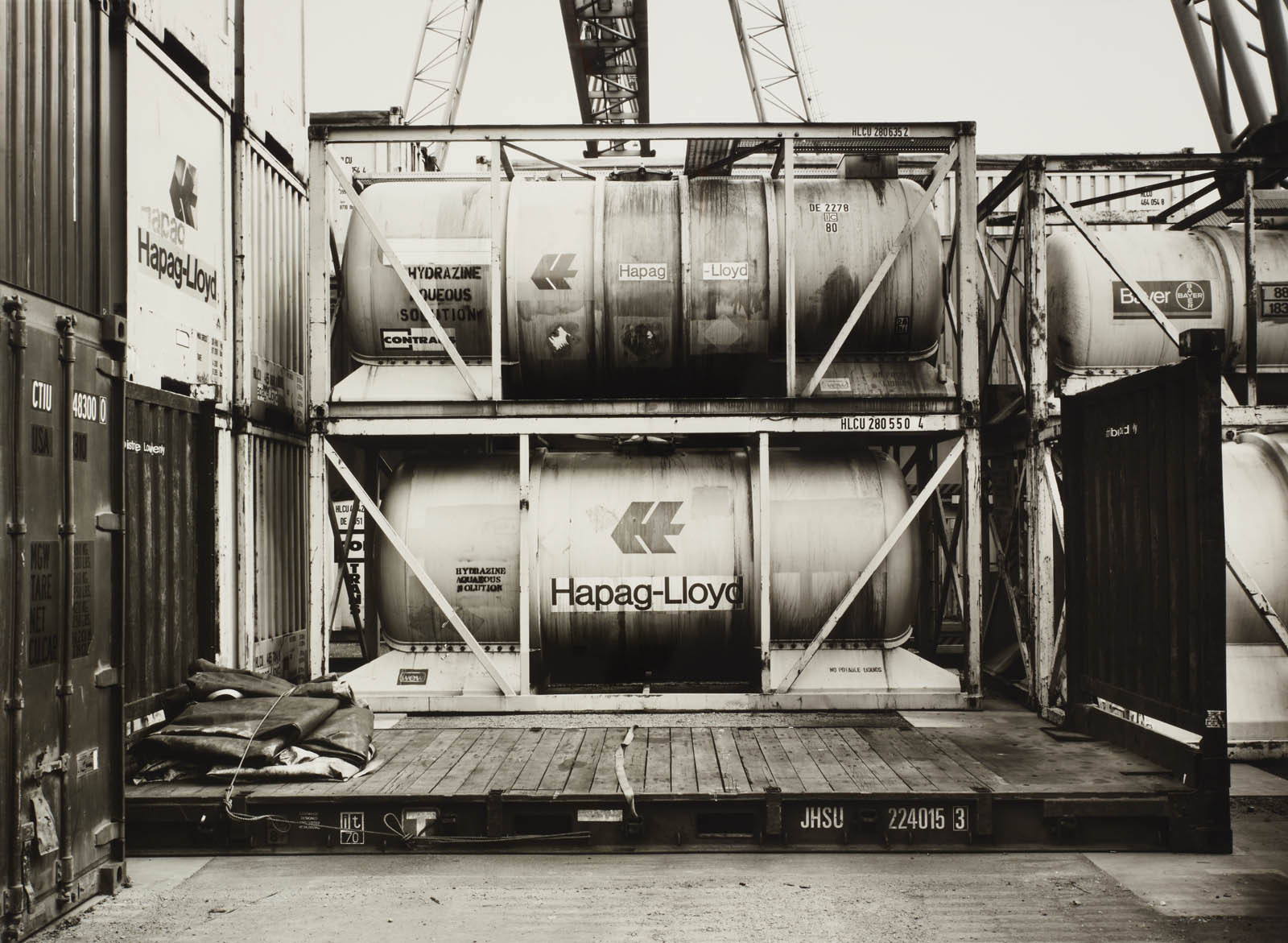
Tata Ronkholz (German, 1940-1997) 'ECT. Rotterdam / Prinses Beatrixhaven, Reeweg' 1977


Tata Ronkholz (German, 1940-1997)
ECT. Rotterdam/Prinses Beatrixhaven, Reeweg
1977
© VAN HAM Art Estate: Tata Ronkholz, 2026


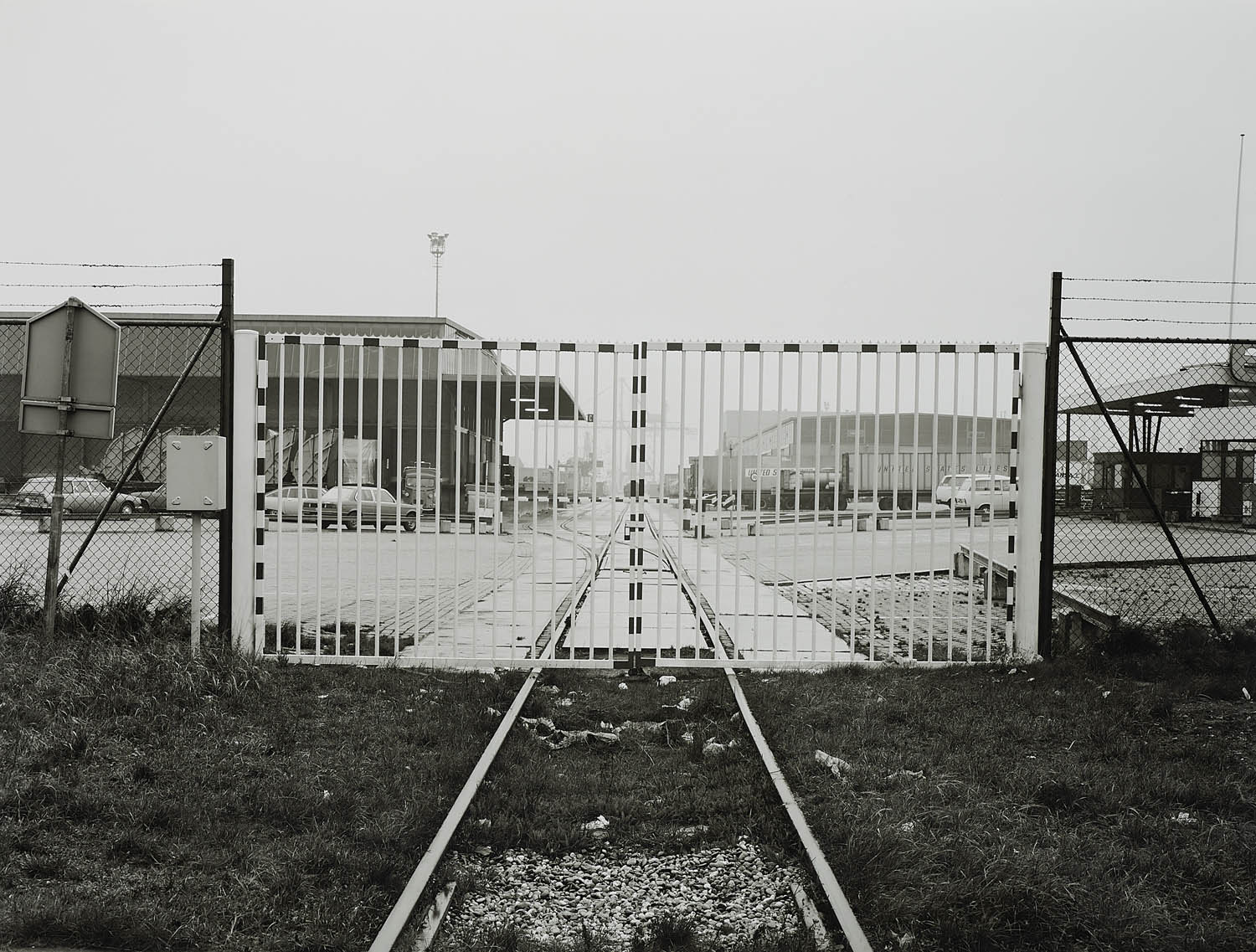
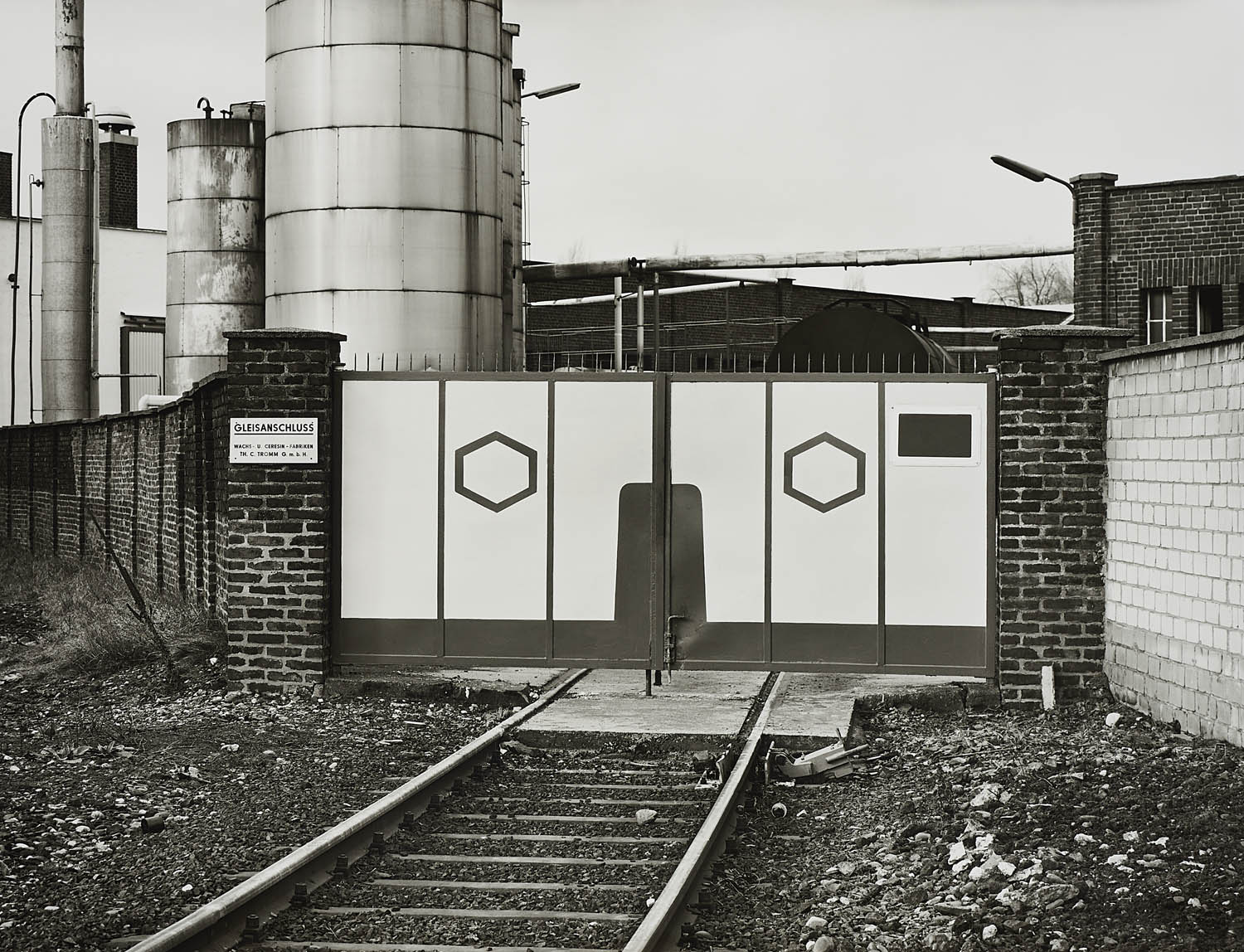
Tata Ronkholz (German, 1940-1997) 'Firma / Company Tromm, Tor Gleisanschluss / Gate railway siding, Köln-Niehl' 1983


Tata Ronkholz (German, 1940-1997)
Firma/Company Tromm, Tor Gleisanschluss/Gate railway siding, Köln-Niehl
1983
© VAN HAM Art Estate: Tata Ronkholz, 2026


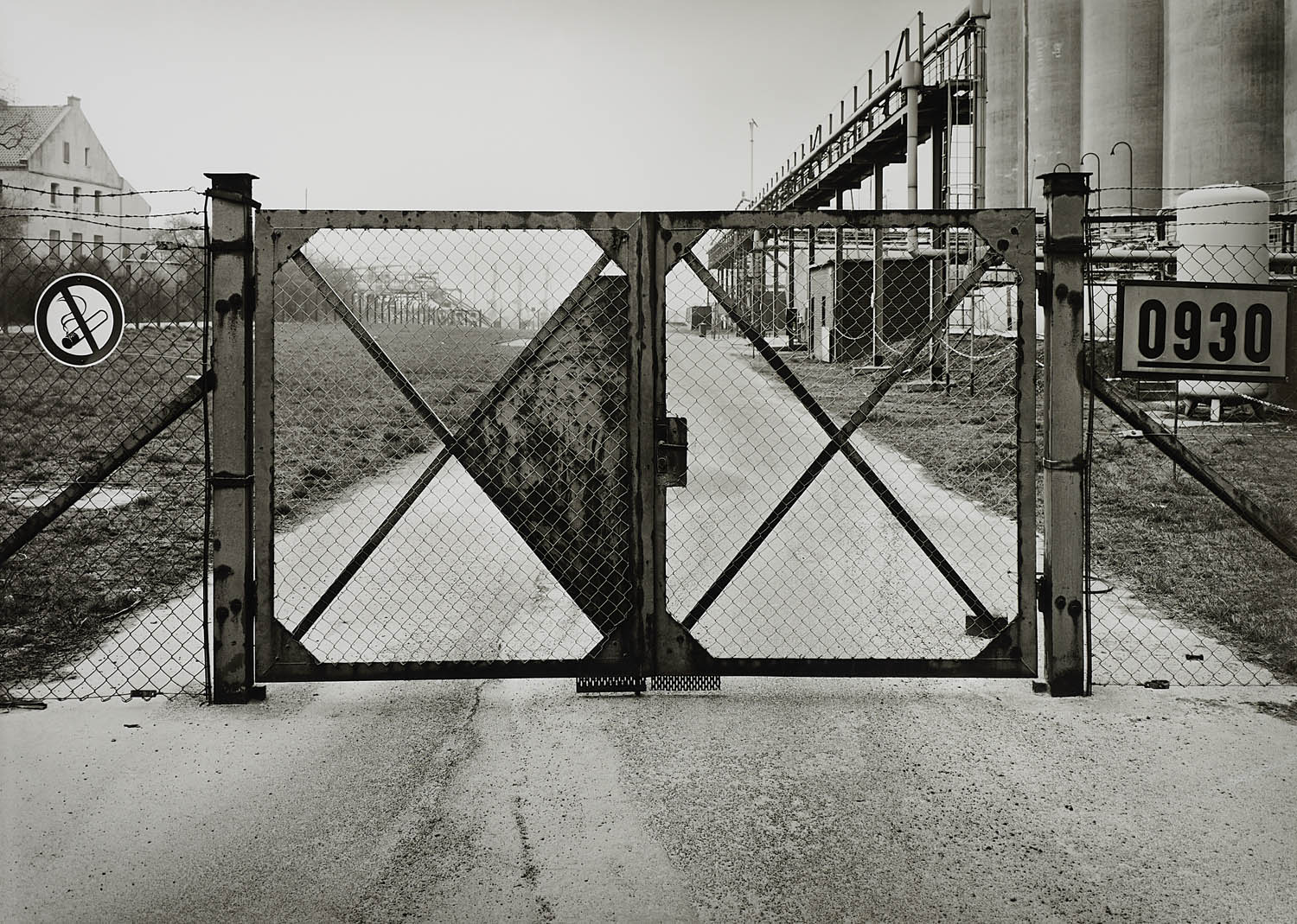
Tata Ronkholz (German, 1940-1997) 'Firma / Company ROW, Hafen, Tor / Gate Nr. 0930, Wesseling-Godorf' 1984


Tata Ronkholz (German, 1940-1997)
Firma/Company ROW, Hafen, Tor/Gate Nr. 0930, Wesseling-Godorf
1984
© VAN HAM Art Estate: Tata Ronkholz, 2026


Tata Ronkholz was one of the first students in Bernd and Hilla Becher’s famous photography class at the Kunstakademie Düsseldorf. Her fellow students included Candida Höfer, Axel Hütte, Thomas Ruff and Thomas Struth, all of whom became artists of world renown. Oddly enough Tata Ronkholz’ work is only now receiving the same international acclaim. The retrospective Designed World: Through the Eyes of Tata Ronkholz (1940-1997), on show at Huis Marseille from 14 February until 21 June 2026, is the first large-scale tribute to this many-sided artist.

Objective-documentary photography

Tata Ronkholz was a photographer, product designer, and interior architect. Her photographic series lie within the tradition of objective, documentary photography, a tradition which was decisively shaped by the artist couple Bernd and Hilla Becher. Like theirs, Ronkholz’ work is characterised by clear compositions, a serial approach, and a documentary focus on architectural structures and everyday architectures. Using a large-format camera she produced sharply defined and realistic photographs in which the subject matter, rather than the individual style of the artist, takes centre stage. Her work is predominantly in black and white, although colour images also appear, demonstrating her ambition to engage with the artistic colour photography that emerged in Germany during the 1970s and ’80s, following the example set by the New Color Photography introduced by the American photographers Stephen Shore and William Eggleston.

Kiosks and corner shops

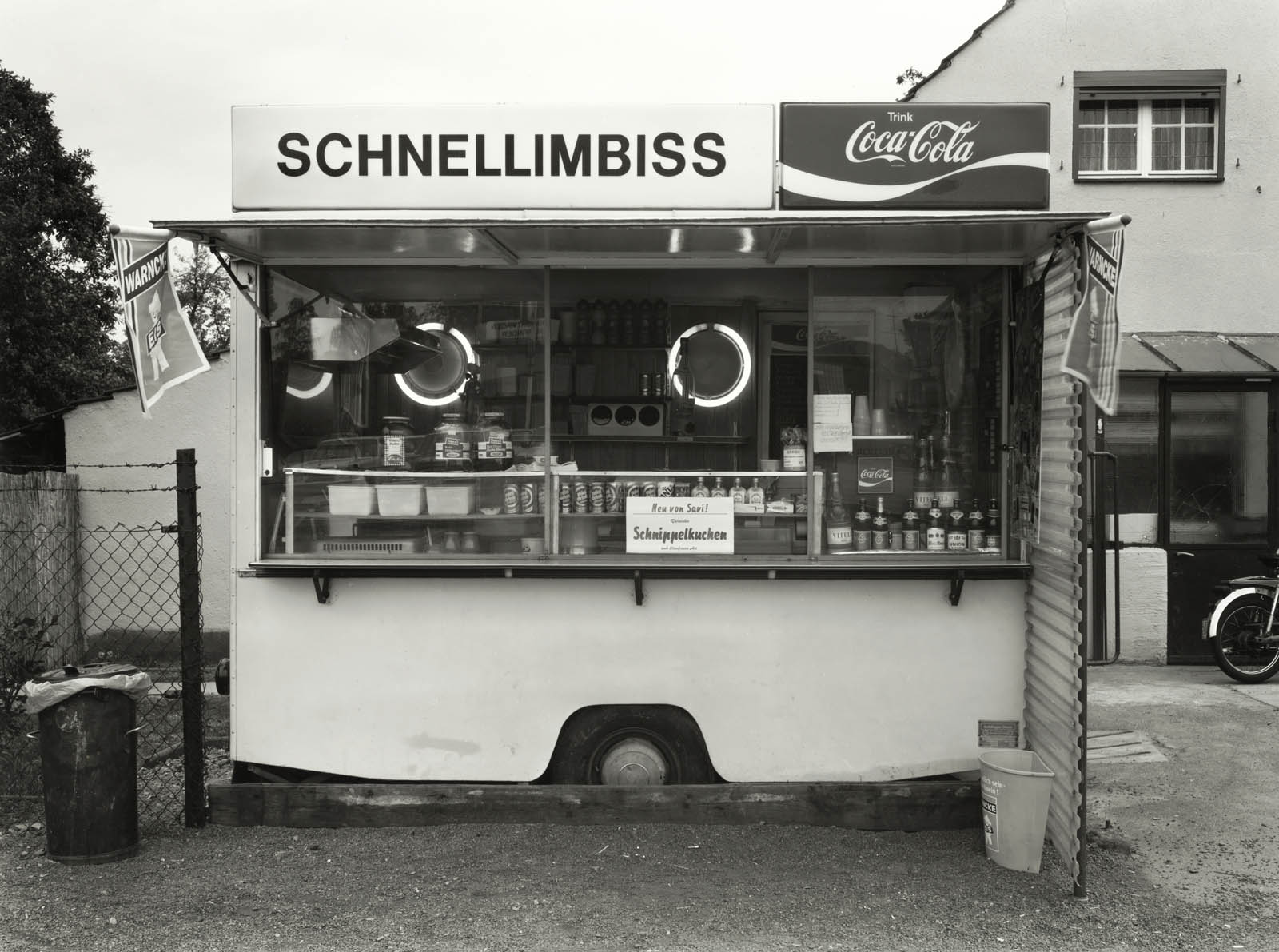
Tata Ronkholz became known for her appealing series of kiosks (Trinkhallen) and small shops that capture typical moments of urban everyday culture. These were photographed between 1977 and 1985, particularly in neighbourhoods of Cologne and Düsseldorf, in the Ruhr area, as well as in Leverkusen and Krefeld. For example, the photo Trinkhalle, Köln-Nippes – with its ice cream and newspaper advertisements and vending machines for chewing gum and cigarettes – is as amusing and engaging as Boutique, Köln-Mülheim in which, according to the store sign, alongside clothing records were also for sale. The photographs illustrate the extent to which product offerings, decoration, and advertising in public spaces has been transformed. Tata Ronkholz’ choice of subject means that her work indirectly testifies to social, cultural, and economic change and shows how people shape the world around them.

Industrial gates

Another significant series is dedicated to industrial gates, photographed between 1977 and 1985. The sober black-and-white images of these gates, with their grids and frameworks, offer glimpses into the interiors of industrial areas. In the photographs the gates function as interfaces between private and public space, between interior and exterior, and between activity and calm. Their aesthetic, reminiscent of abstract artworks, imbues the everyday with a new significance.

Collaboration with Thomas Struth

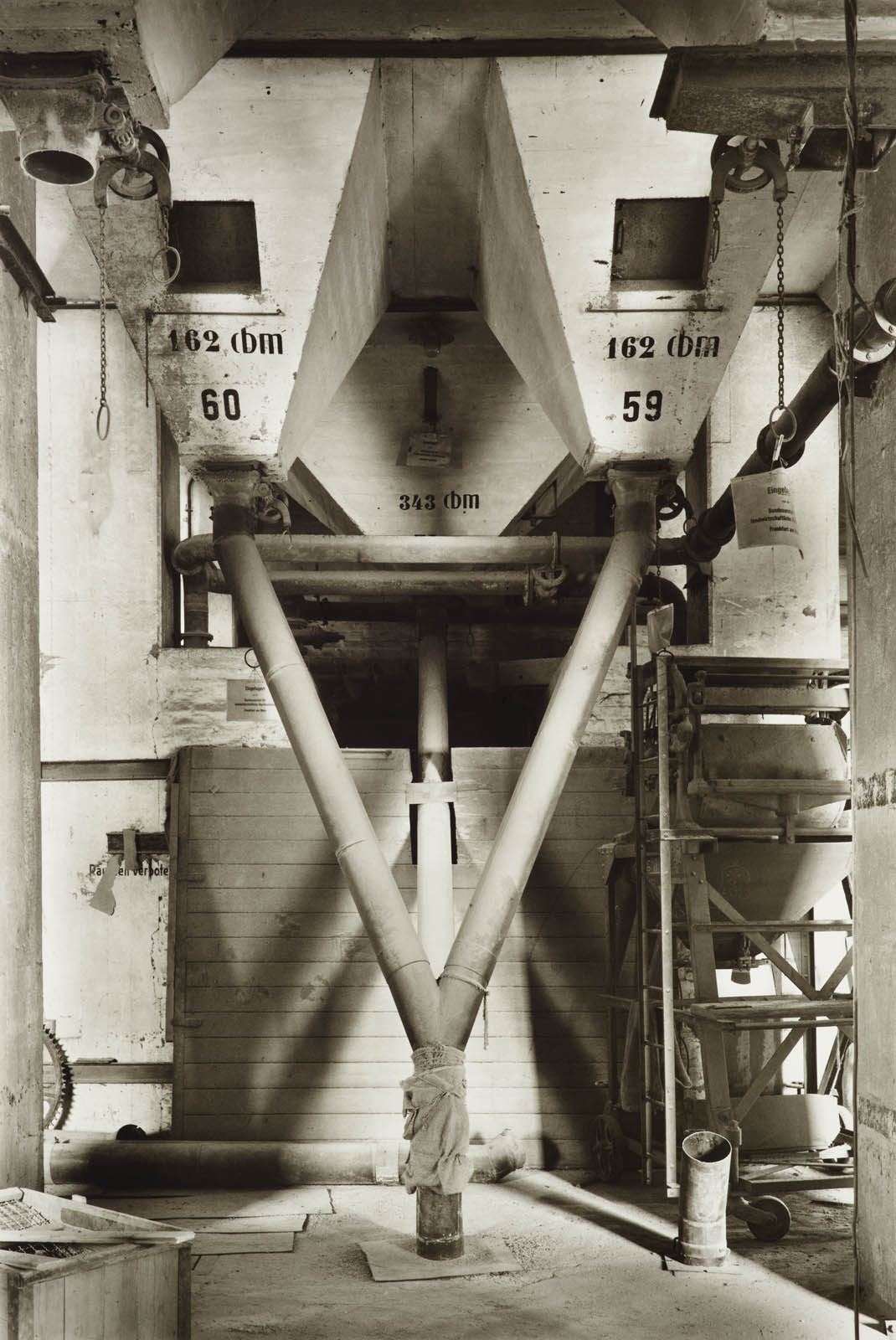
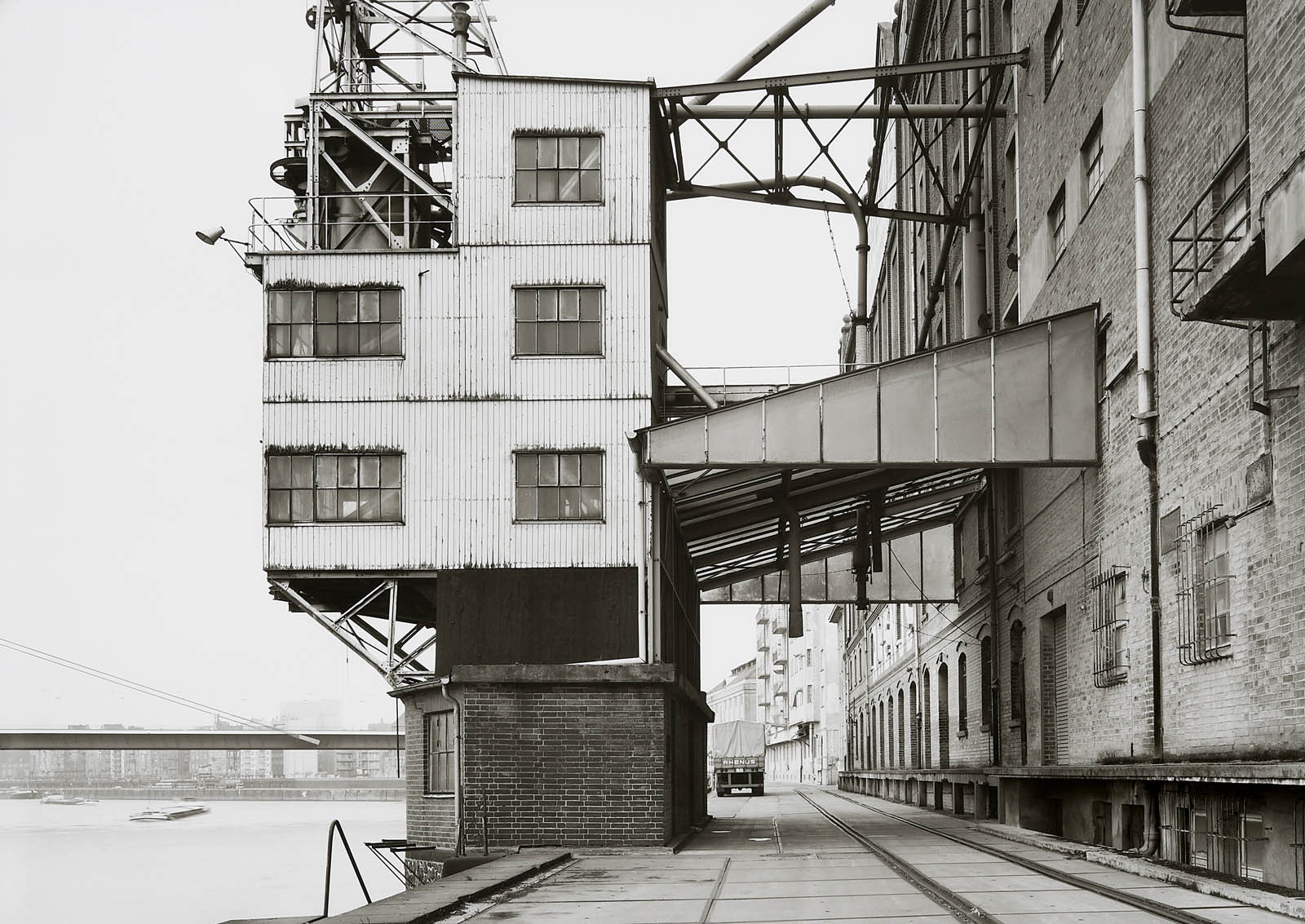
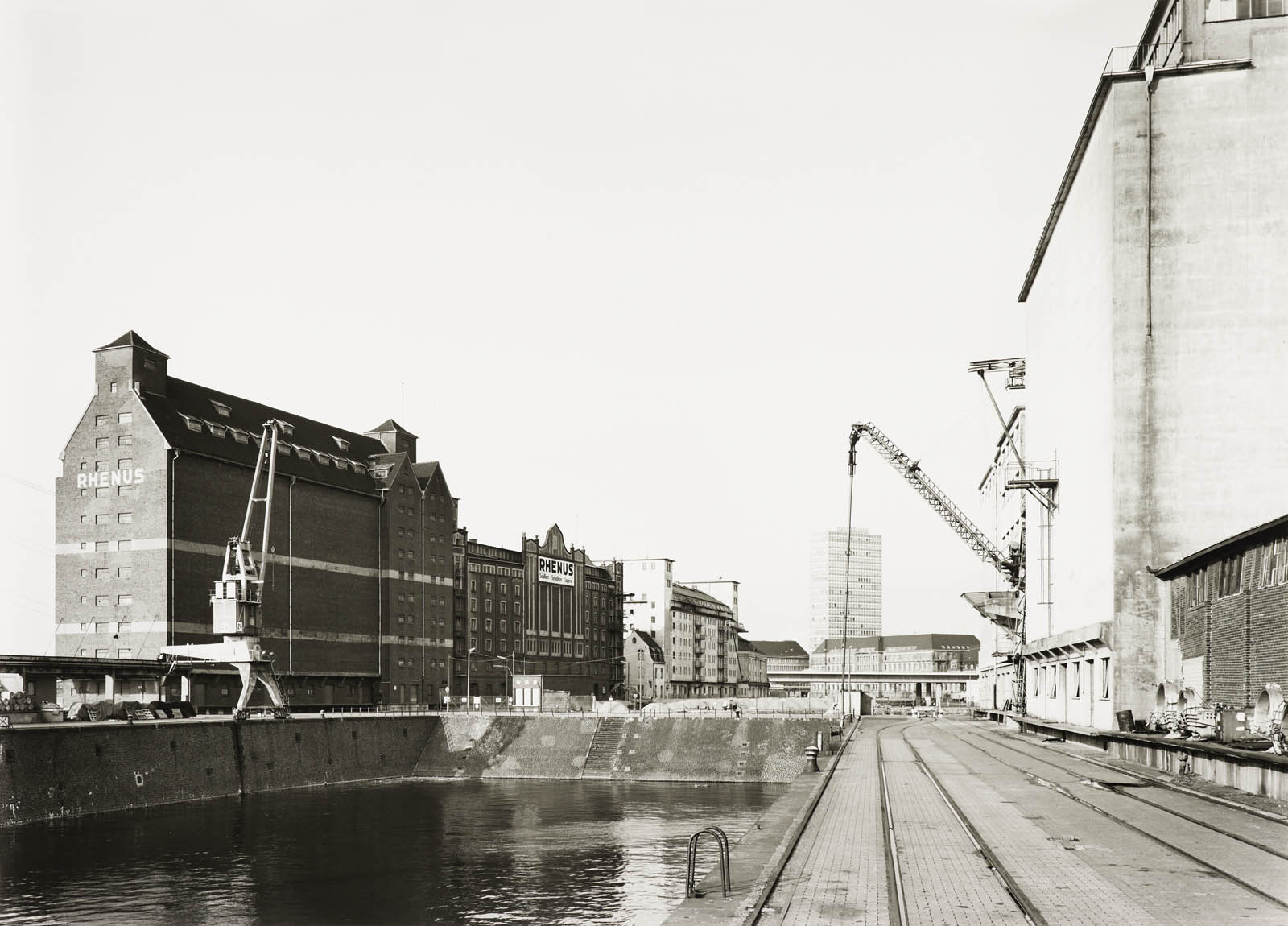
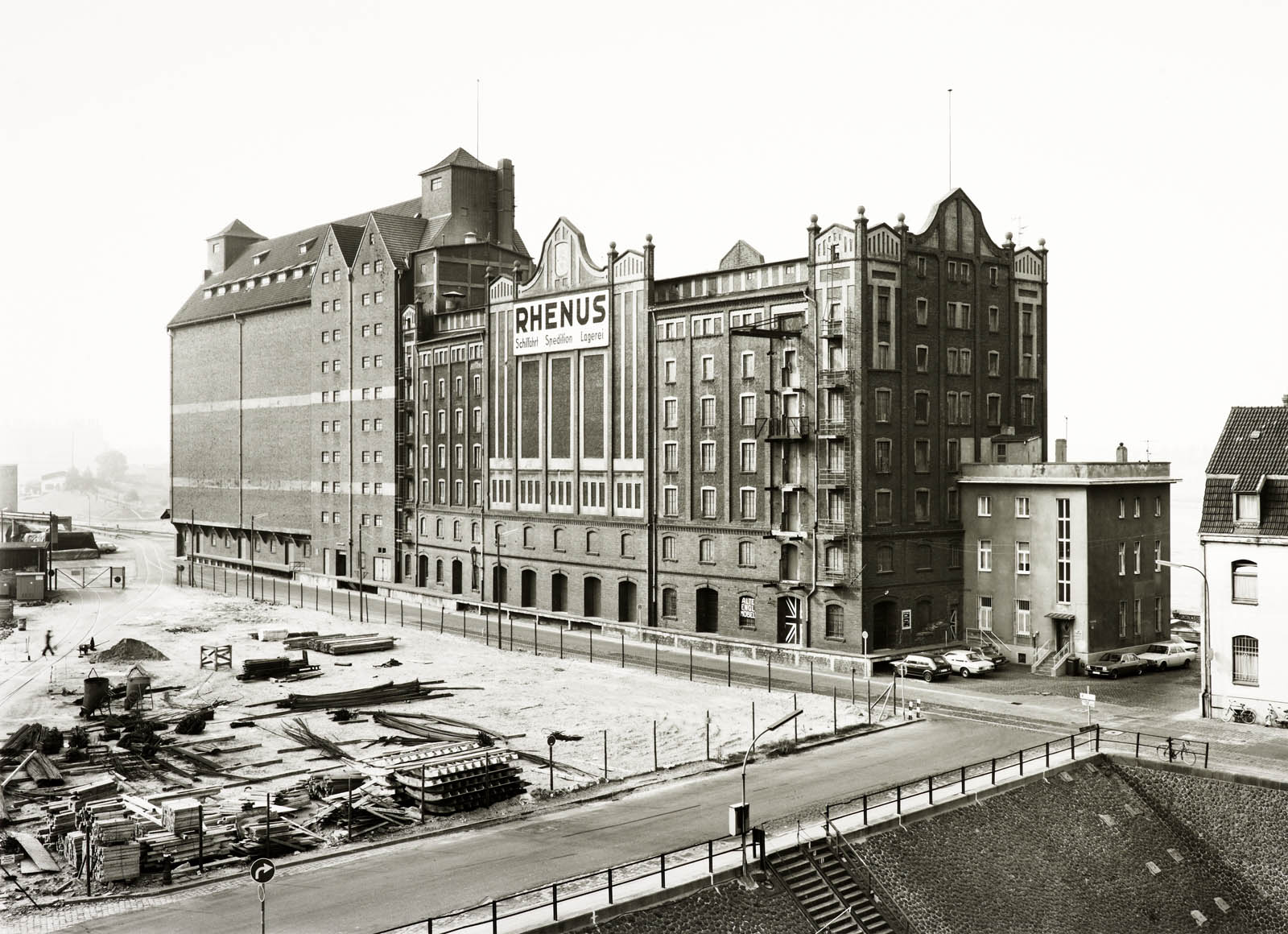
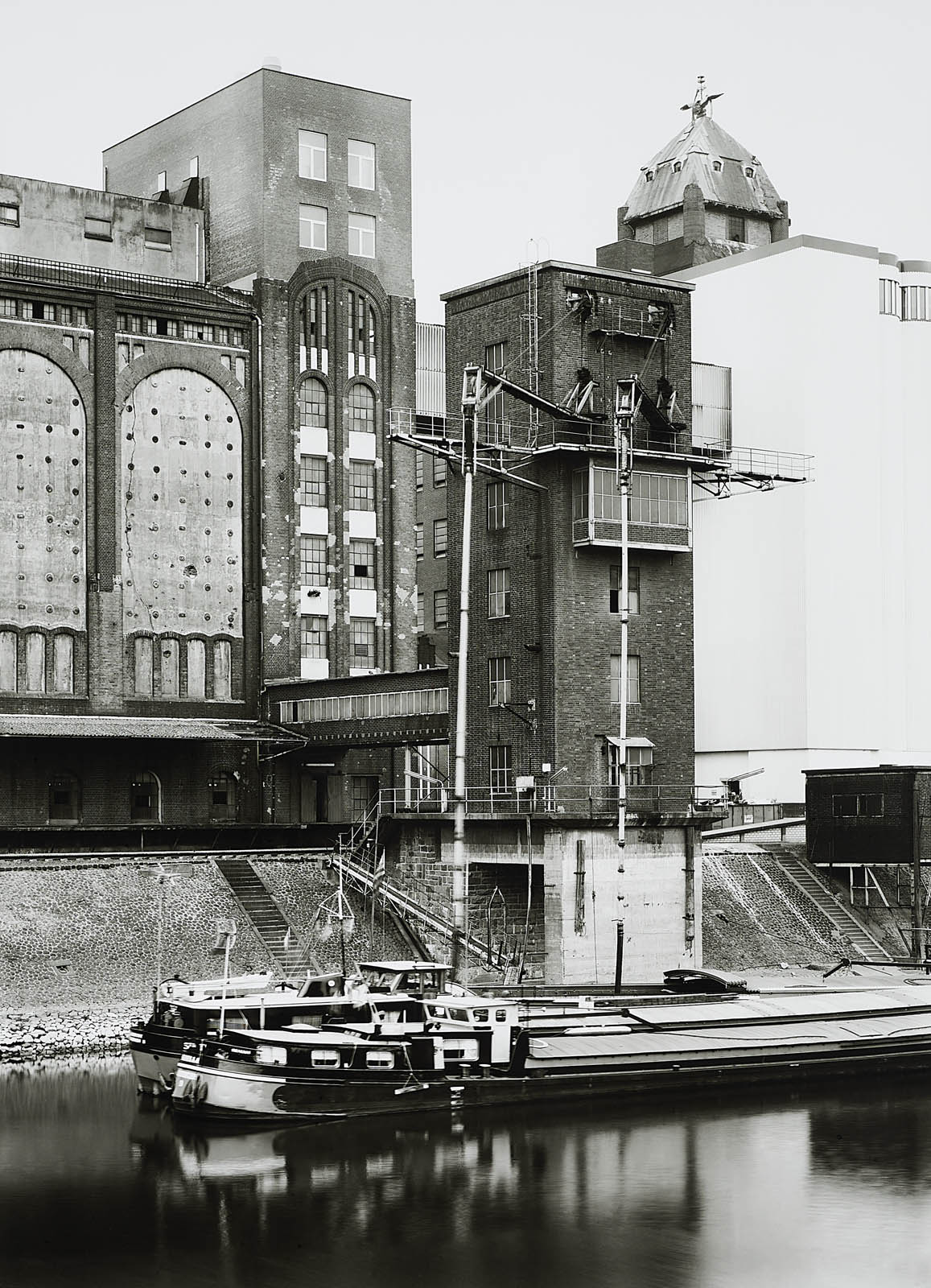
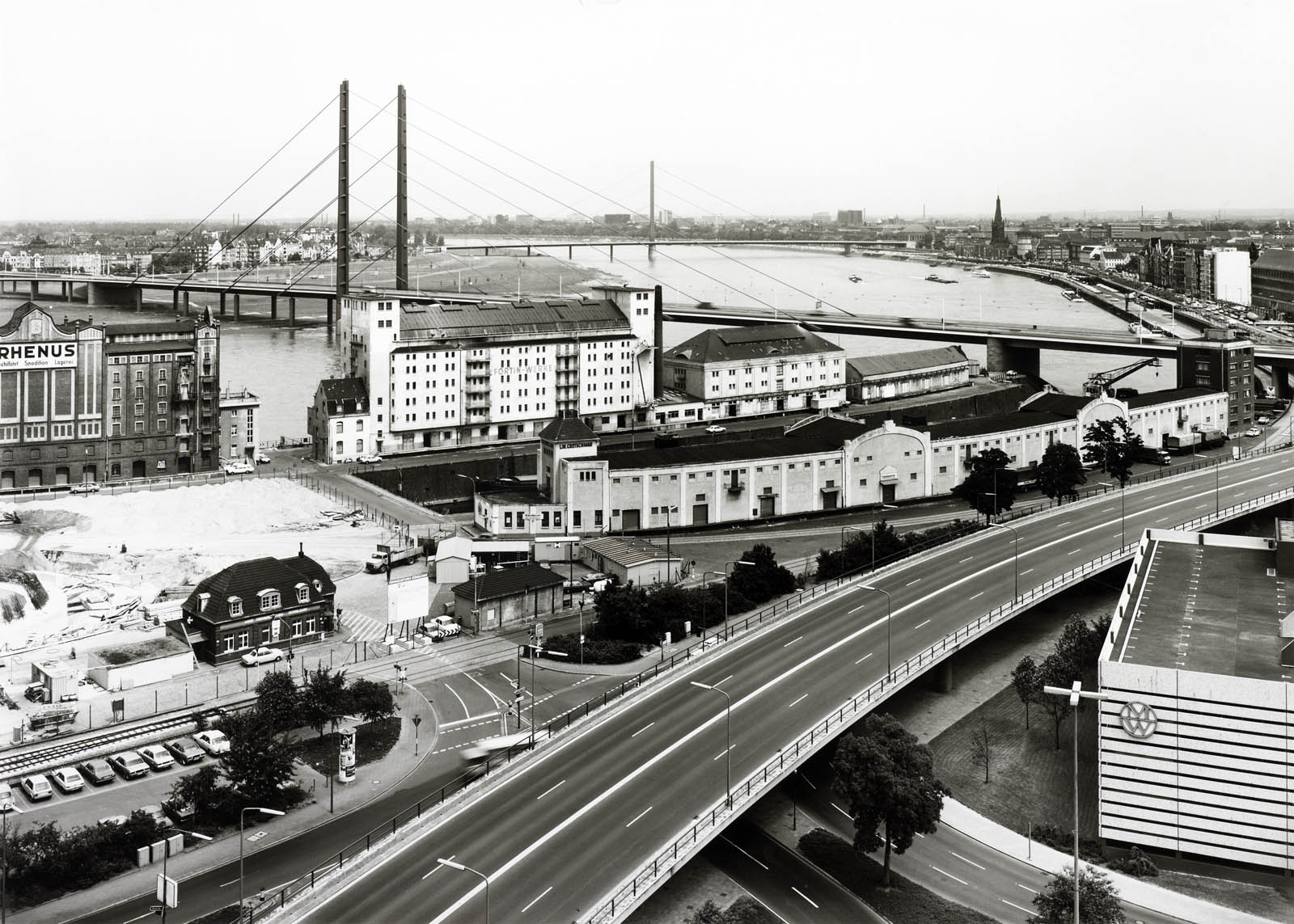
In 1979 Ronkholz, together with her fellow student Thomas Struth, began work on an impressive documentary series on Düsseldorf’s Rheinhafen. The project originated from the planned redevelopment of this historic harbour area – a site that, in its original form, was considered an industrial area of significant urban historical and architectural importance. Together they set out to document the harbour in its entirety, capturing its historic buildings, technical installations, and operational structures. In carefully composed images they recorded façades, interiors, silos, warehouses, crane structures, and harbour basins, before these elements partially disappeared or were fundamentally altered during the restructuring.

Tata Ronkholz as product designer

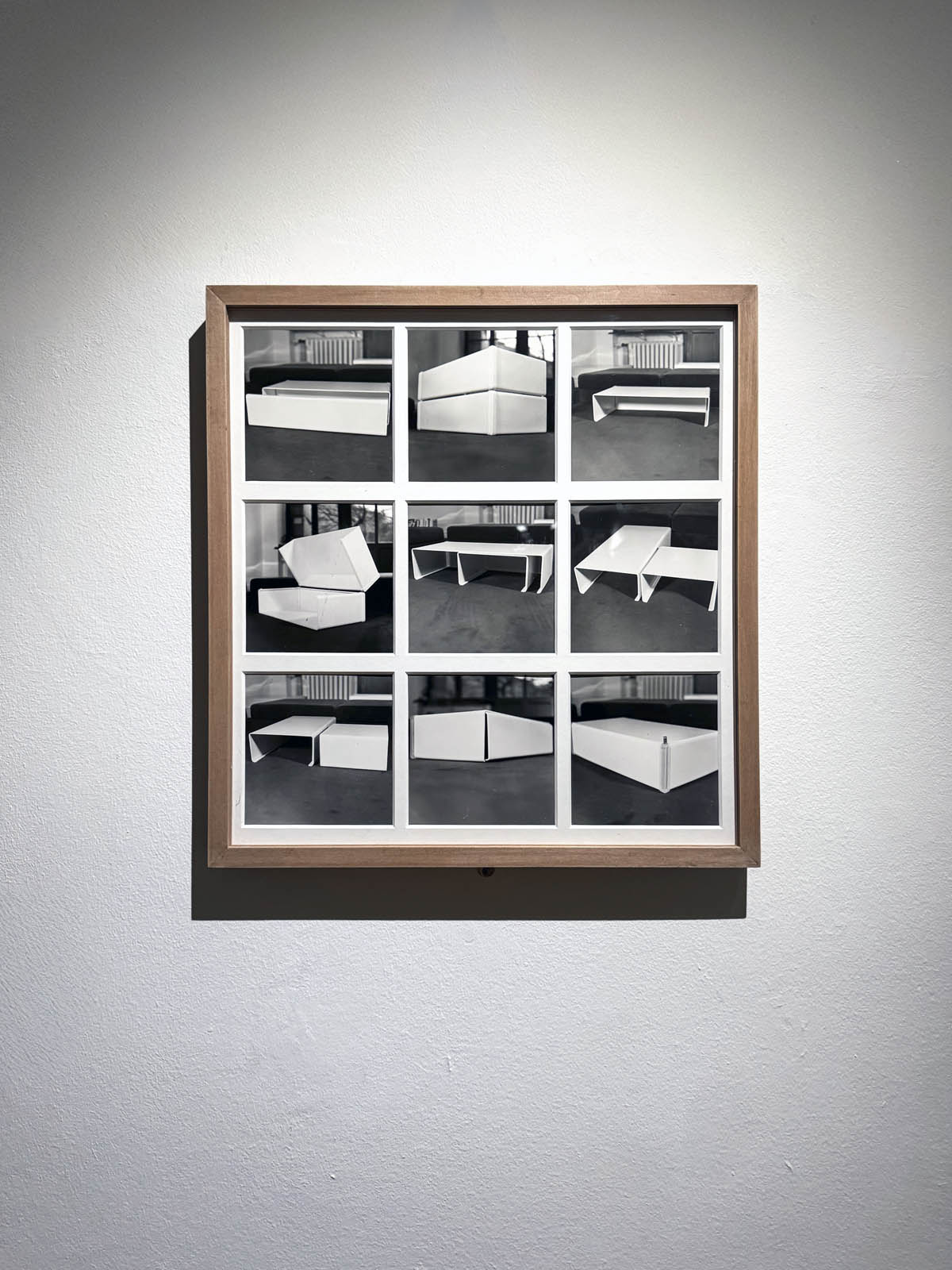
Between 1961 and 1965 Ronkholz studied at the Werkkunstschule Krefeld (an academy of applied art) with a focus on furniture design, and subsequently worked as a freelance designer until 1977. The exhibition also explores this aspect of Ronkholz’ oeuvre, including depictions of geometrically shaped furniture and lighting fixtures as well as designs for office and cafeteria furniture. Ronkholz’ designs are characterised by clear forms and functional elegance. Finally, the retrospective also presents early photographs of architectural forms created in 1975/76 in Italy and France, revealing her strong affinity for aspects of the ‘designed world’ across different areas of life.

Ronkholz’ estate, acquired in 2011 by VAN HAM Art Estate in Cologne, forms the basis of the exhibition alongside the holdings of Stadtmuseum Düsseldorf. Significant contributions have also been made from the in-house collections of Die Photographische Sammlung/SK Stiftung Kultur – who also curated the exhibition – and through loans from private collections.

Book

The exhibition is accompanied by a catalogue, Tata Ronkholz: Gestaltete Welt. Eine Retropektive (2025, Schirmer/Mosel Verlag GmbH), with texts in German and English. It is available from the Huis Marseille museum shop (€49.90).

Text from the Huis Marseille website


Tata Ronkholz (German, 1940-1997) 'Imbissstube / Snack bar, Düsseldorf-Rath, Linienstraße 141' 1977


Tata Ronkholz (German, 1940-1997)
Imbissstube/Snack bar, Düsseldorf-Rath, Linienstraße 141
1977
© VAN HAM Art Estate: Tata Ronkholz, 2026


Tata Ronkholz (German, 1940-1997) 'Trinkhalle / Kiosk, Ratingen, Volkardeyer Straße 25' 1977


Tata Ronkholz (German, 1940-1997)
Trinkhalle/Kiosk, Ratingen, Volkardeyer Straße 25
1977
© VAN HAM Art Estate: Tata Ronkholz, 2026


Tata Ronkholz (German, 1940-1997) 'Trinkhalle / Kiosk, Köln-Nippes, Merheimer Straße 294' 1983


Tata Ronkholz (German, 1940-1997)
Trinkhalle/Kiosk, Köln-Nippes, Merheimer Straße 294
1983
© VAN HAM Art Estate: Tata Ronkholz, 2026


Merheimer Str. 294, Köln-Nippes


Merheimer Str. 294, Köln-Nippes


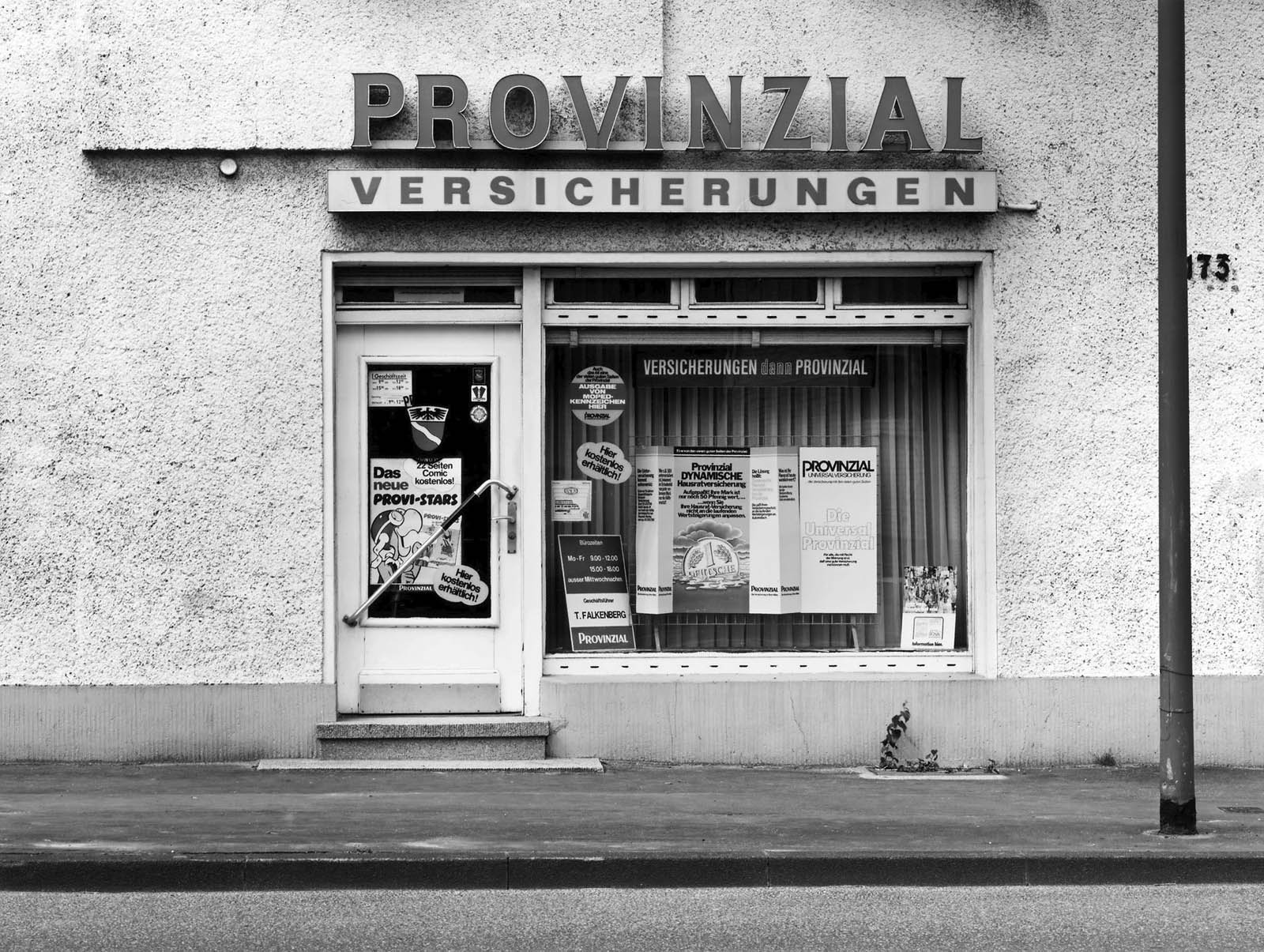
Tata Ronkholz (German, 1940-1997) 'Insurance office, Leverkusen-Schlehbusch' 1970s-1980s


Tata Ronkholz (German, 1940-1997)
Insurance office, Leverkusen-Schlehbusch
1970s-1980s
© VAN HAM Art Estate: Tata Ronkholz, 2026


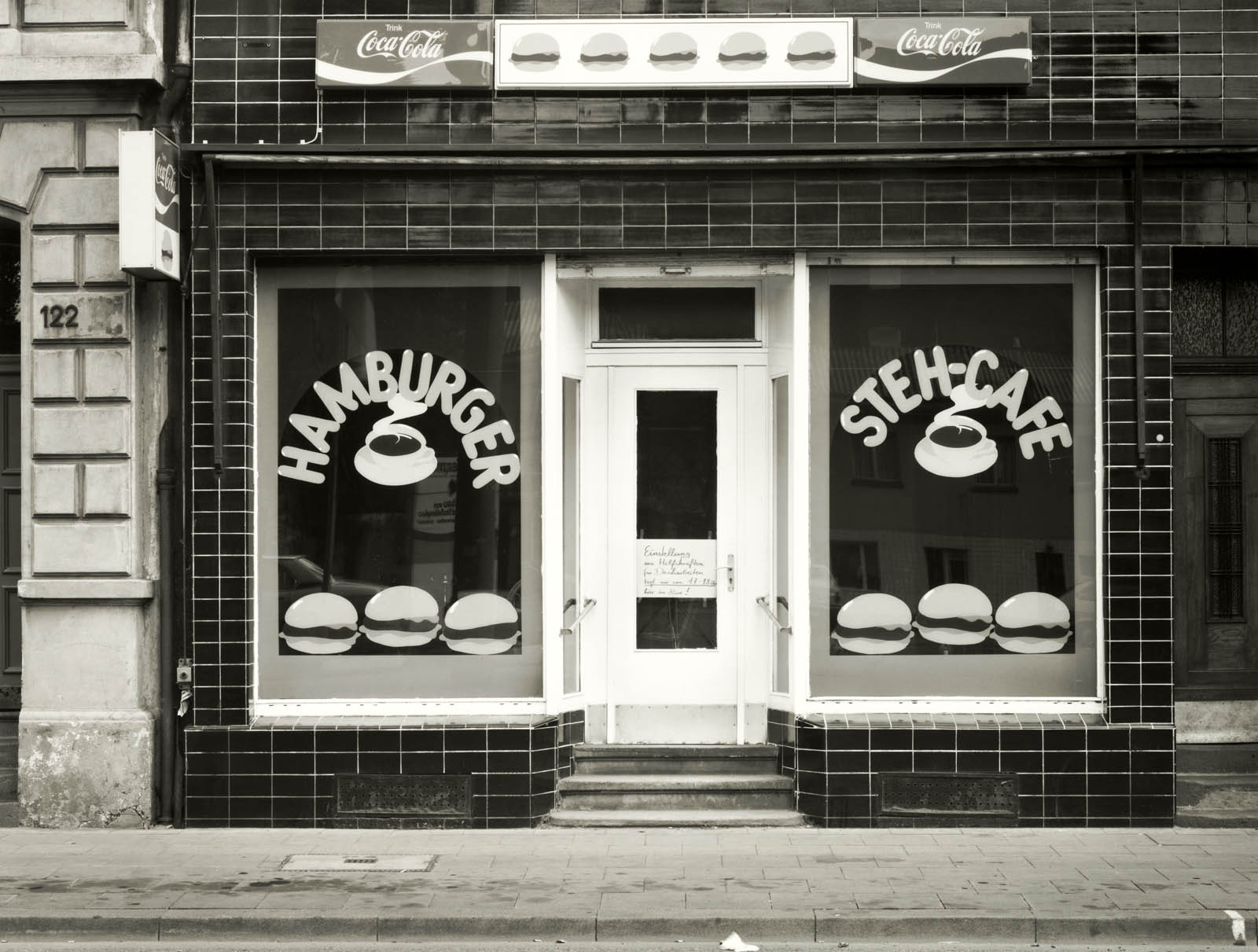
Tata Ronkholz (German, 1940-1997) 'Imbissstube / Snack bar, Köln-Mülheim, Berliner Straße 120' 1979


Tata Ronkholz (German, 1940-1997)
Imbissstube/Snack bar, Köln-Mülheim, Berliner Straße 120
1979
© VAN HAM Art Estate: Tata Ronkholz, 2026


Tata Ronkholz (German, 1940-1997) 'Boutique, Köln-Mülheim, Berliner Straße 120' 1980


Tata Ronkholz (German, 1940-1997)
Boutique, Köln-Mülheim, Berliner Straße 120
1980
© VAN HAM Art Estate: Tata Ronkholz, 2026


Berliner Str. 120, Köln, Germany


Berliner Str. 120, Köln, Germany


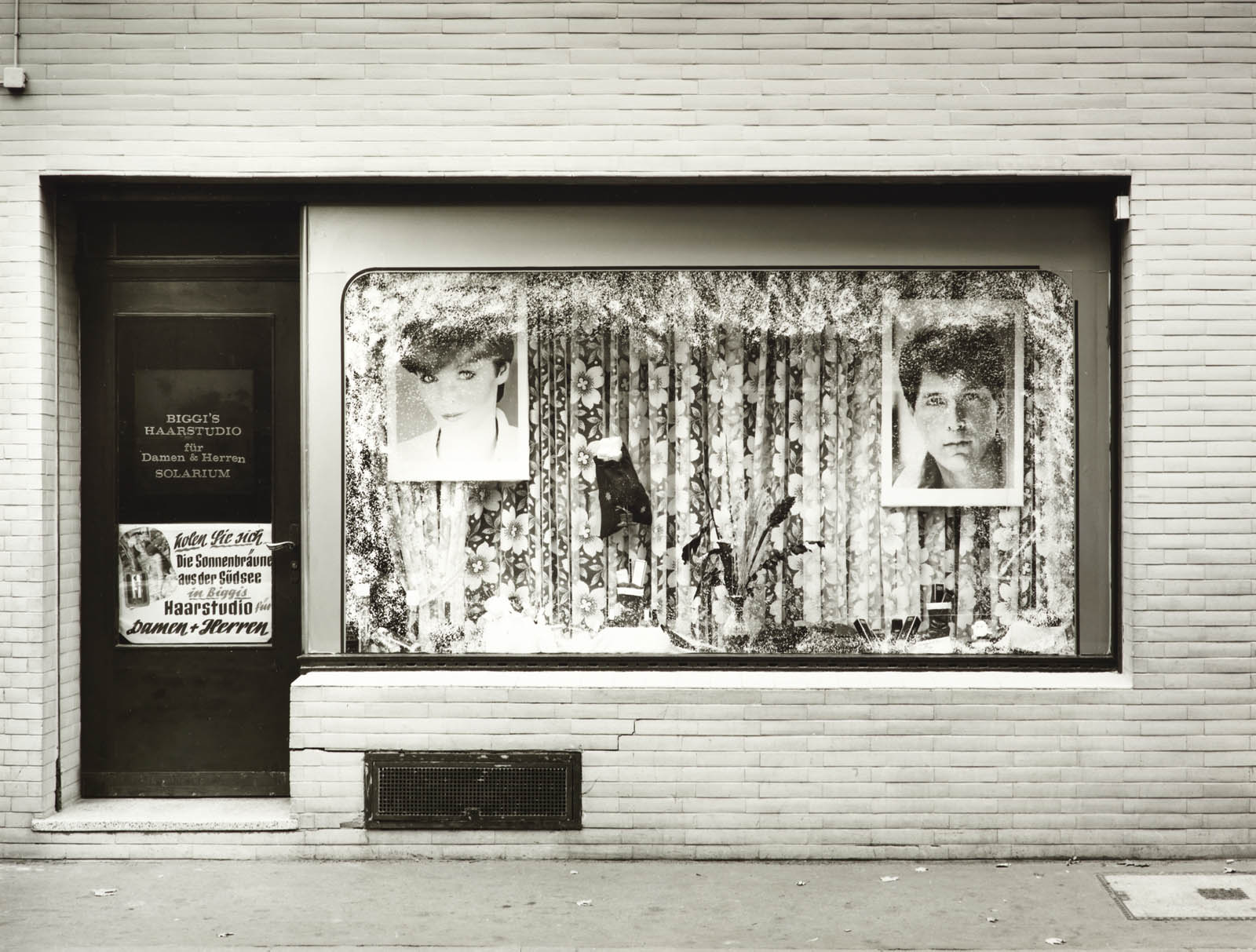
Tata Ronkholz (German, 1940-1997) 'Friseur / Hairdresser, Köln-Ehrenfeld, Philippstraße 30' 1980


Tata Ronkholz (German, 1940-1997)
Friseur/Hairdresser, Köln-Ehrenfeld, Philippstraße 30
1980
© VAN HAM Art Estate: Tata Ronkholz, 2026


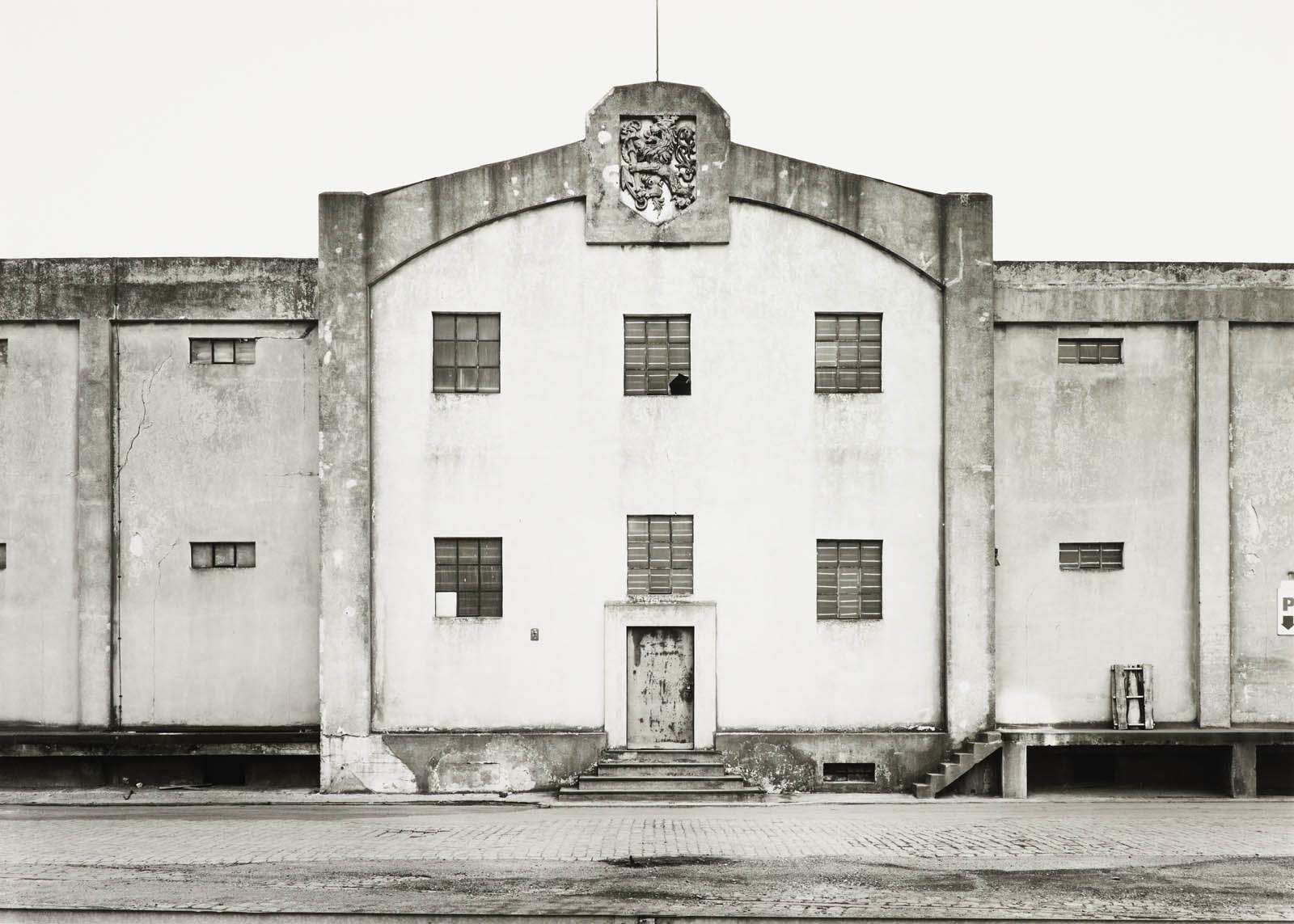
Tata Ronkholz (German, 1940-1997) 'Lagerhalle mit Löwenwappen / Warehouse with lion crest' 1979


Tata Ronkholz (German, 1940-1997)
Lagerhalle mit Löwenwappen/Warehouse with lion crest
1979
From the series Rheinhafen/Rhine harbor Düsseldorf, 1979-1981
© VAN HAM Art Estate: Tata Ronkholz, 2026


Tata Ronkholz (German, 1940-1997) 'Im Düsseldorfer Hafen / In Düsseldorf harbor' around 1980


Tata Ronkholz (German, 1940-1997)
Im Düsseldorfer Hafen / In Düsseldorf harbor
around 1980
From the series Rheinhafen/Rhine harbor Düsseldorf, 1979-1981
© VAN HAM Art Estate: Tata Ronkholz, 2026


Tata Ronkholz (German, 1940-1997) 'Im Düsseldorfer Hafen / In Düsseldorf harbor' around 1980


Tata Ronkholz (German, 1940-1997)
Im Düsseldorfer Hafen/In Düsseldorf harbour
around 1980
From the series Rheinhafen/Rhine harbor Düsseldorf, 1979-1981
© VAN HAM Art Estate: Tata Ronkholz, 2026


Tata Ronkholz (German, 1940-1997) Technik und Kräne / Technology and cranes Nd


Tata Ronkholz (German, 1940-1997)
Technik und Kräne/Technology and cranes
Nd
From the series Rheinhafen/Rhine harbor Düsseldorf, 1979-1981
© VAN HAM Art Estate: Tata Ronkholz, 2026


Thomas Struth (German, b. 1954) 'Zollhafen / Customs harbor' 1979


Thomas Struth (German, b. 1954)
Zollhafen/Customs harbour
1979
From the series Rheinhafen/Rhine harbor Düsseldorf, 1979-1981
© VAN HAM Art Estate: Tata Ronkholz, 2026


Thomas Struth (German, b. 1954) 'Getreidespeicher, Rhenus seitlich / Grain silo, Rhenus lateral' 1979


Thomas Struth (German, b. 1954)
Getreidespeicher, Rhenus seitlich / Grain silo, Rhenus lateral
1979
From the series Rheinhafen/Rhine harbor Düsseldorf, 1979-1981
© VAN HAM Art Estate: Tata Ronkholz, 2026


Tata Ronkholz (German, 1940-1997) 'Technik und Kräne / Technology and cranes' Nd


Tata Ronkholz (German, 1940-1997)
Technik und Kräne / Technology and cranes
Nd
From the series Rheinhafen/Rhine harbor Düsseldorf, 1979-1981
© VAN HAM Art Estate: Tata Ronkholz, 2026


Thomas Struth (German, b. 1954) 'Rheinhafen / Rhine harbor (Berger Hafen v. d. VHS / from Adult education center), Düsseldorf' 1979


Thomas Struth (German, b. 1954)
Rheinhafen/Rhine harbor (Berger Hafen v. d. VHS/from Adult education center), Düsseldorf
1979
From the series Rheinhafen/Rhine harbor Düsseldorf, 1979-1981
© VAN HAM Art Estate: Tata Ronkholz, 2026


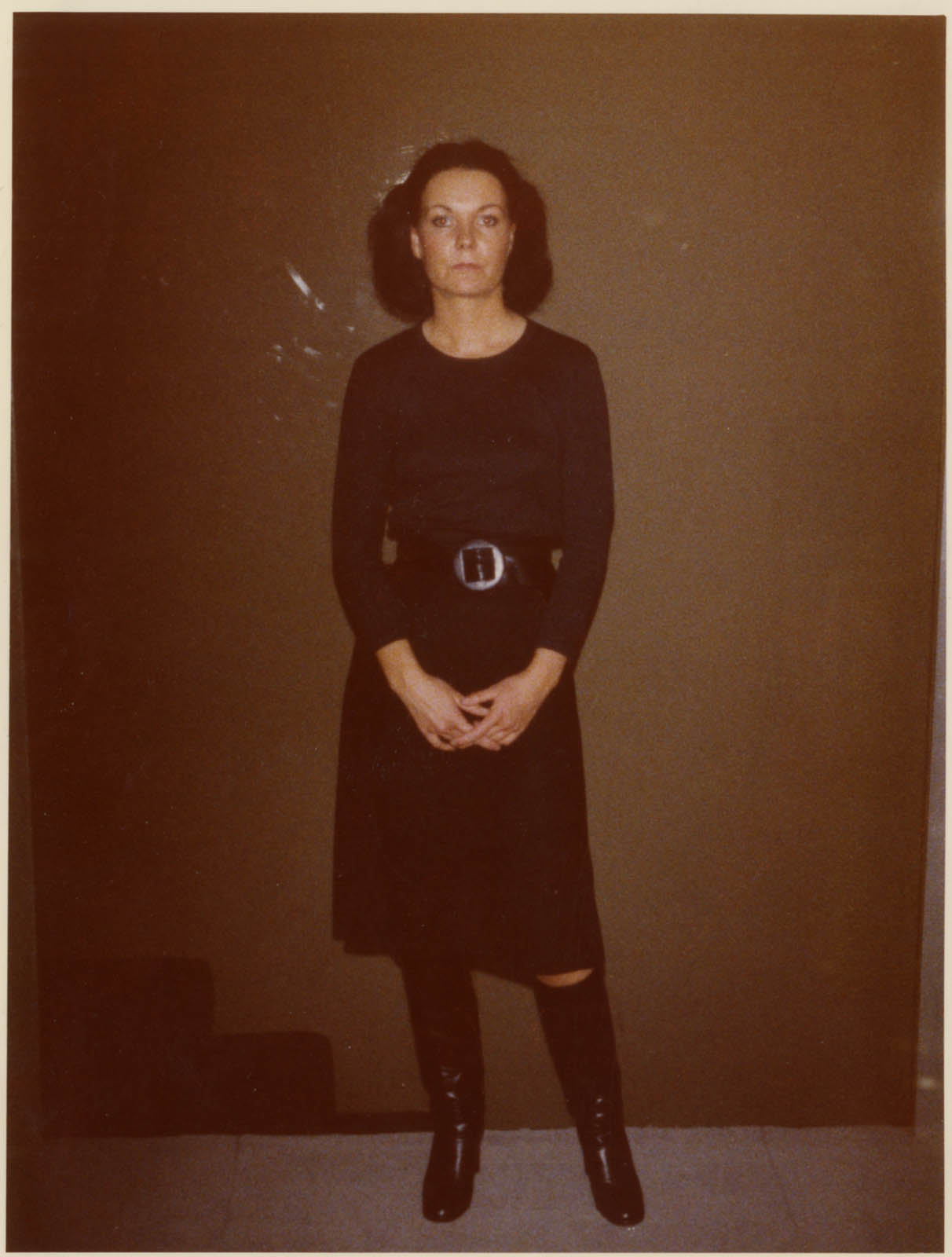
Charles Wilp (German, 1932-2005) 'Tata Ronkholz' c. 1979


Charles Wilp (German, 1932-2005)
Tata Ronkholz
c. 1979


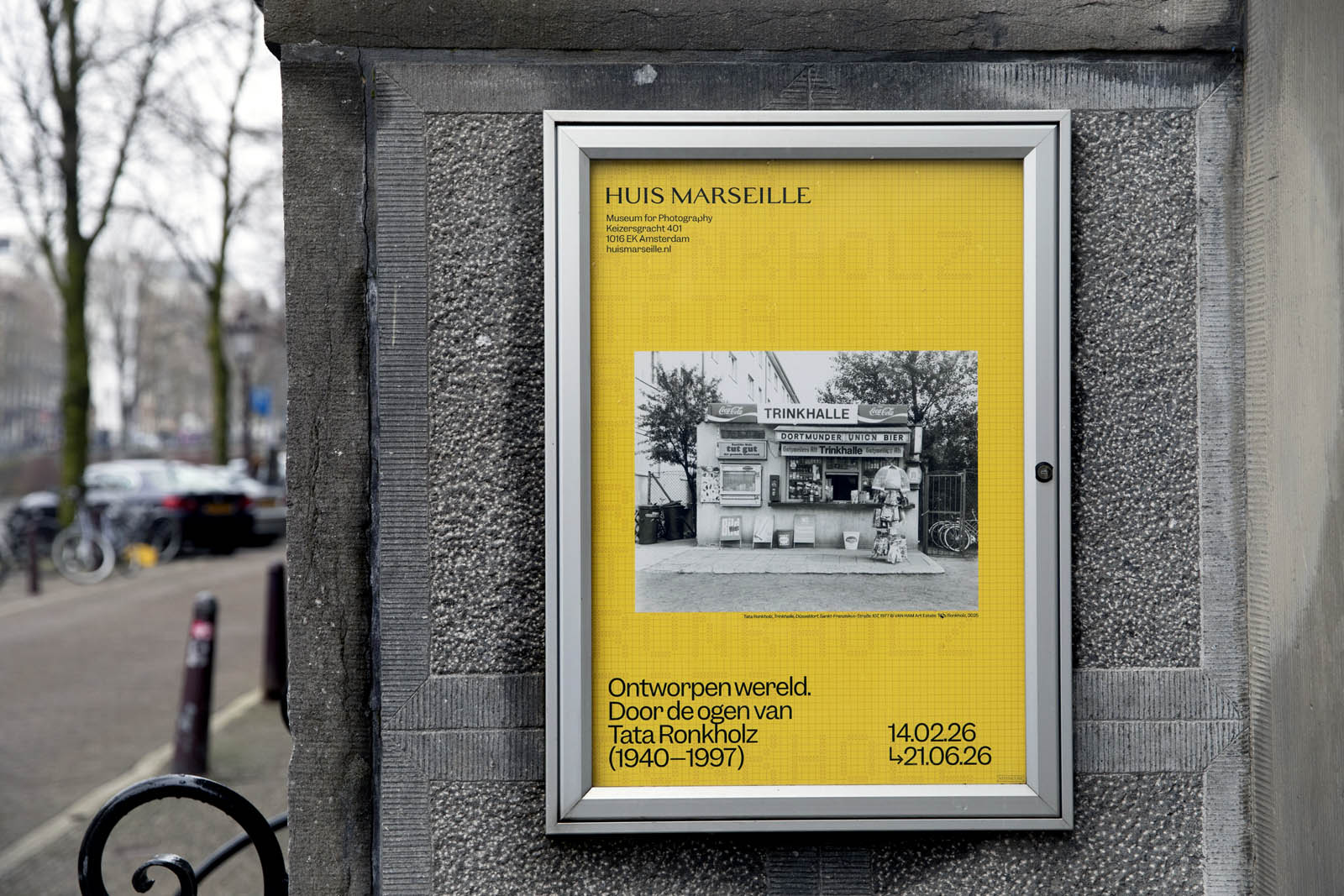
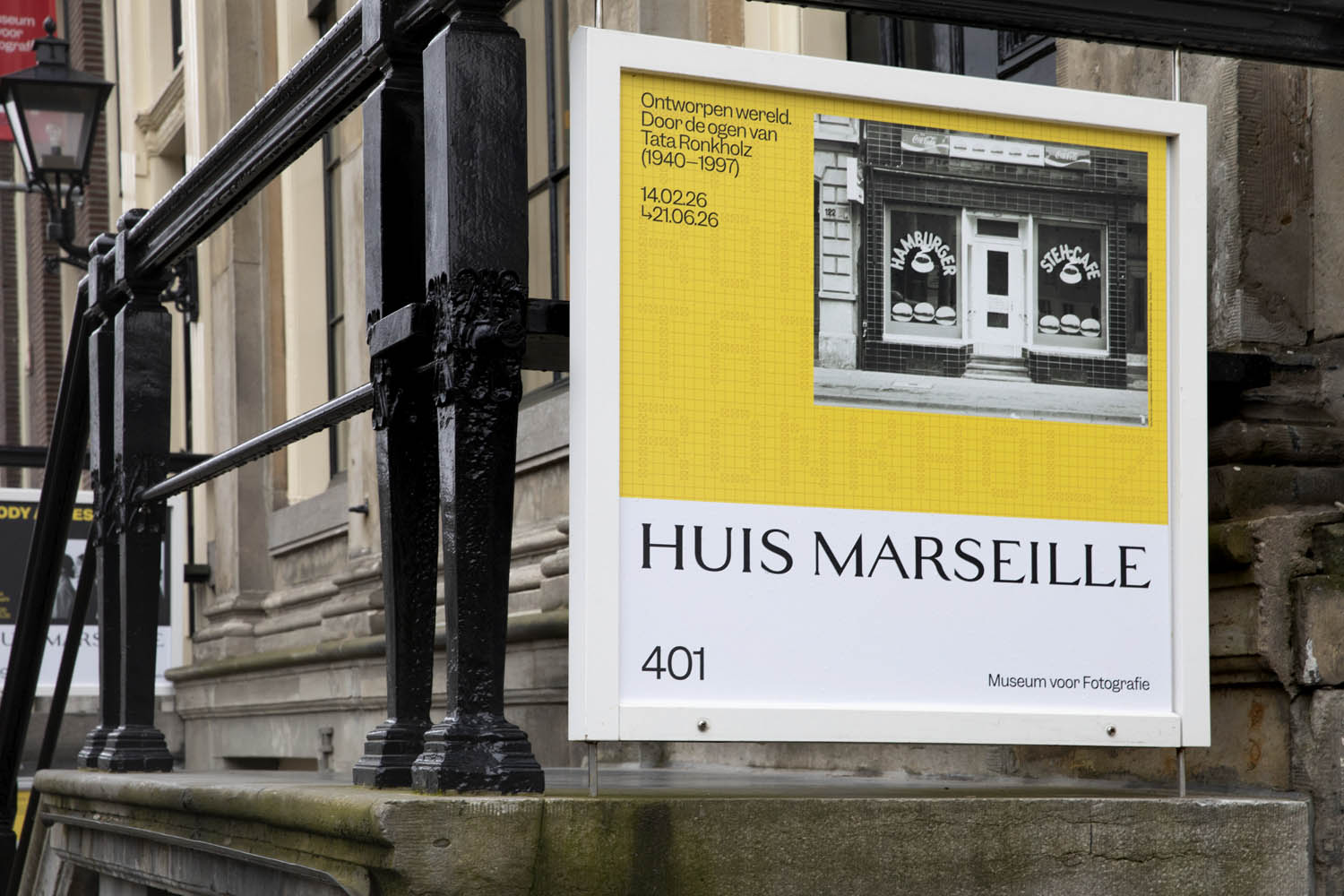
View of the exhibition poster for 'Designed World: Through the Eyes of Tata Ronkholz (1940-1997)' at Huis Marseille, Amsterdam, February - June, 2026


View of the exhibition posters for Designed World: Through the Eyes of Tata Ronkholz (1940-1997) at Huis Marseille, Amsterdam, February – June, 2026


Huis Marseille
Keizersgracht 401
1016 EK Amsterdam
Phone: +31 20 531 89 89

Opening hours
Tue – Sun, 11 – 18 h

Huis Marseille website

LIKE ART BLART ON FACEBOOK

Back to top

Exhibitions: ‘Now, the new form of the past’ and ‘Senses’ at Kunstwerk! Liemers Museum, Netherlands

Exhibition dates: 16th June – 9th September 2018

Artists: Drager Meurtant (assemblages, NL) and Petra Senn (photography, D); Jeanine Keuchenius (paintings, NL) Kelly Elmendorp, Stijn Geutjes, Robert van der Kroft, Drager Meurtant, Winny de Meij, Petra Senn.


Drager Meurtant (Dutch, b. 1951) 'Green bird day' 2017


Drager Meurtant (Dutch, b. 1951)
Green bird day
2017

When the green bird / came to live / we agreed to call / it a day


Accumulating, life

I first had contact with Gerard Rutteman (artist alias Drager Meurtant) when he emailed me about a posting I had done on Art Blart about the Japanese photographer Shomei Tomatsu in 2015. Since then we have become firm friends. In 2017 on a trip to Europe, I caught a high speed train from Paris to the French city of Reims to meet him and his vivacious wife Jeanine. We spent a glorious day wandering the city, taking photographs, talking art, and eating a hearty lunch at a local brasserie. This pair of self-taught artists, creative human beings, are so talented.

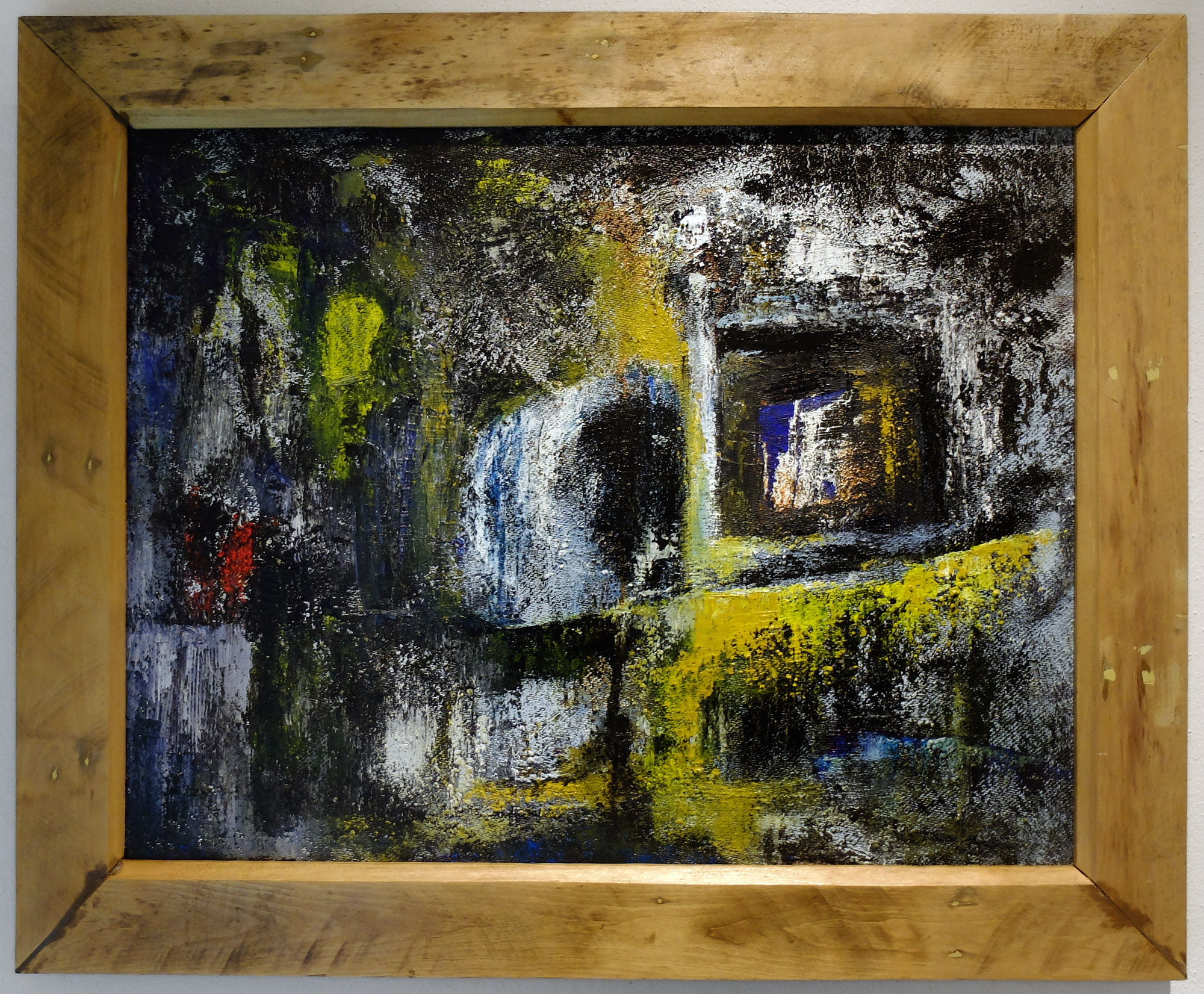
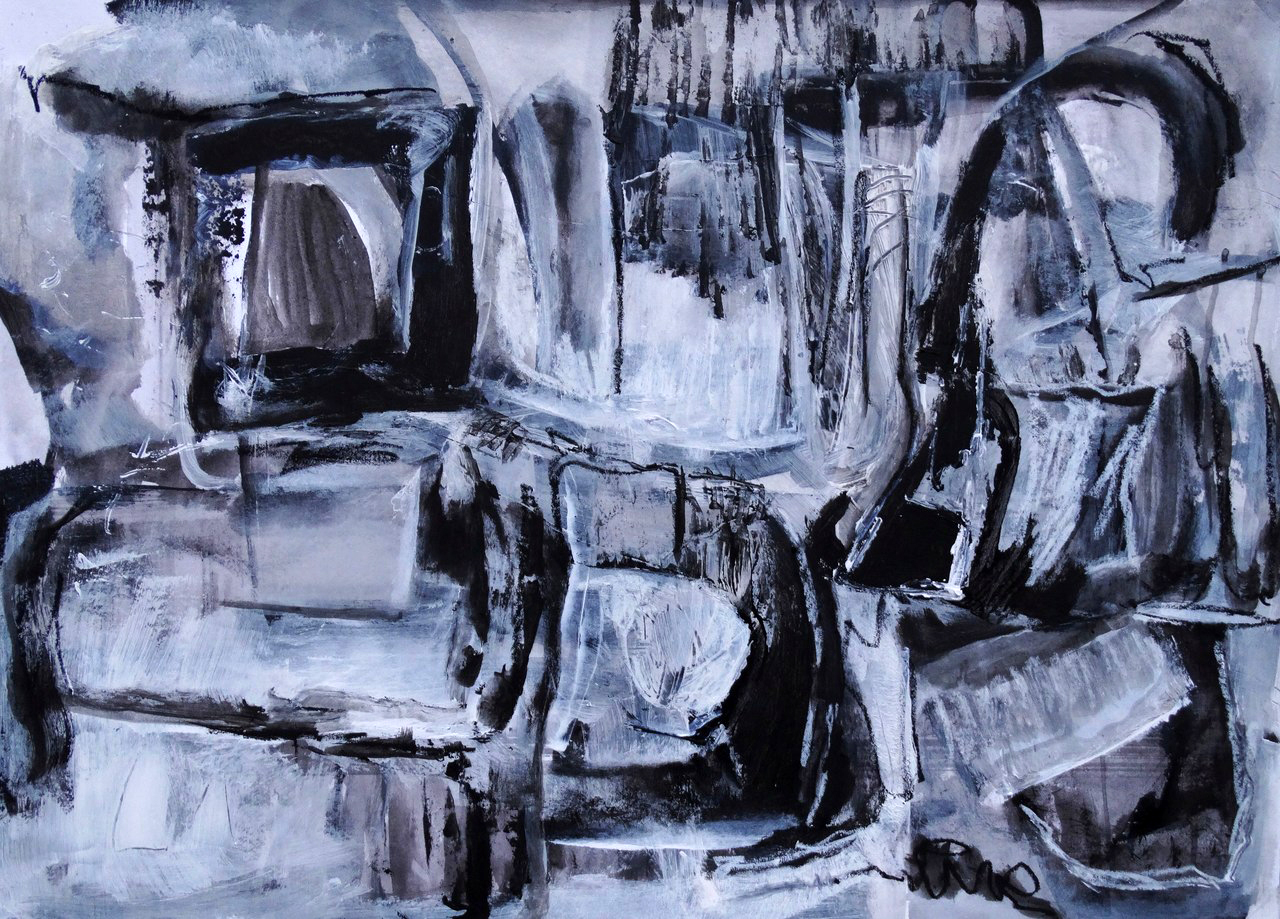
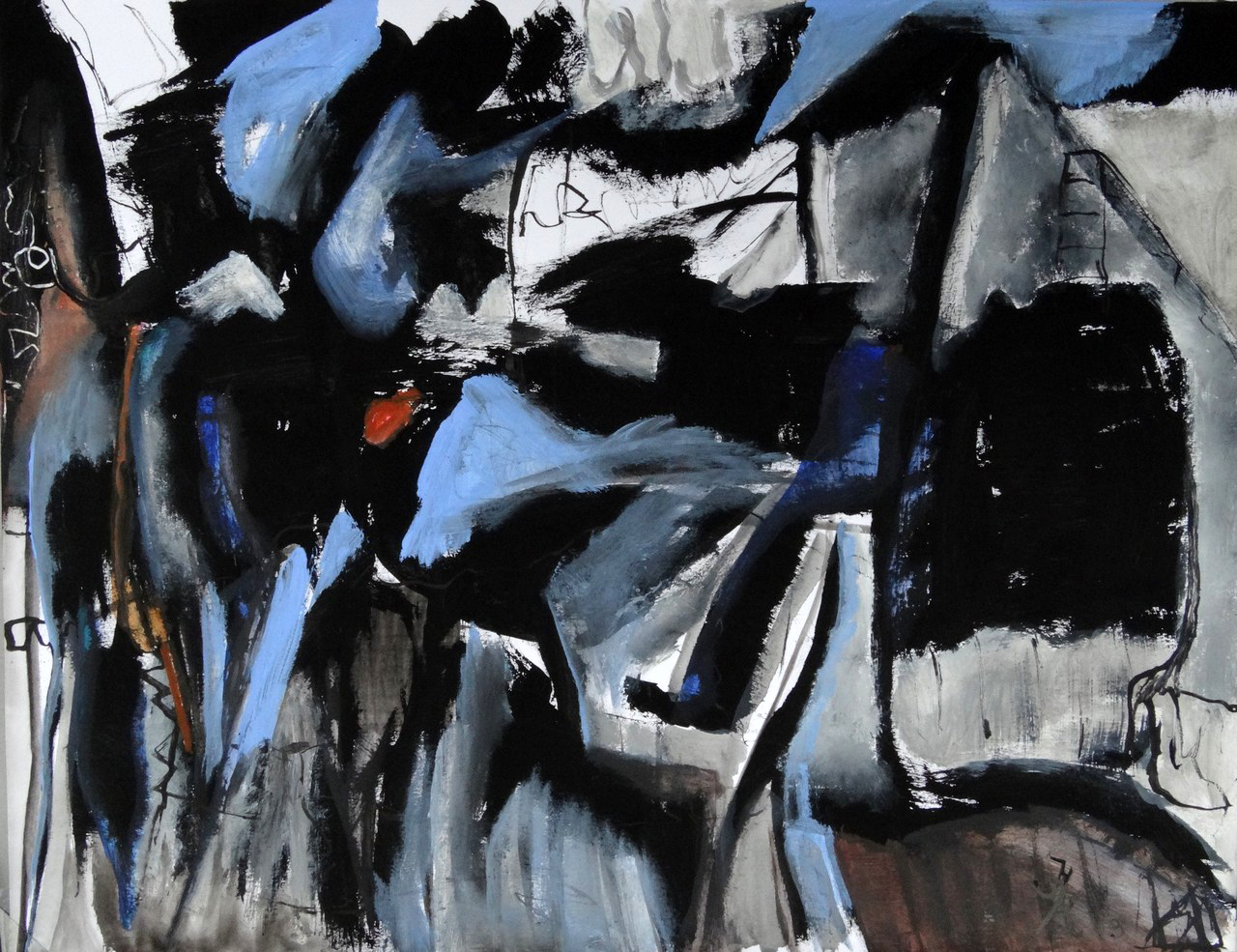
While I greatly admire Jeanine’s paintings with their powerful and poetic muscularity (in my mind, I note the influence of artists such as Pierre Soulages, Cy Twombly and Anselm Kiefer) and their use of colour which can be seen in other paintings on her website – and observe the photographs of Petra Senn (I would need to see more to make constructive comment) – it is the work of Drager Meurtant to which I am going to focus my attention in this text.

The path of Drager Meurtant reminds me of that of Australian artist Rosalie Gascoigne.

“Gascoigne worked as a teacher before moving to Australia in 1943 following her marriage to astronomer Ben Gascoigne. She discovered a natural talent for creating assemblages through the ensuing seventeen years spent in relative isolation on the stony terrain of Mount Stromlo, home to Stromlo Observatory, and the wheat belt of Monaro near Canberra, a landscape she designated as the crucible from which her art emerged… Gascoigne’s lifelong passion for collecting and arranging developed initially from the Sogetsu school of ikebana, with its emphasis on form and line rather than colour. Its general principles of valuing immediate response, the experience of materials, process and experiment with variations can be seen as underpinning all of her later work. The collection of discarded materials, such as farm machinery parts, for use as suitable vessels for her arrangements, led her to also make sculptural assemblages… Gascoigne had no formal art training, often asserting that her fifty-year apprenticeship was in looking. She began exhibiting in 1974 at the age of 57.”1

Gascoigne went on to become one of Australia’s most loved and respected artists.

Drager Meurtant spent most of his life as a veterinarian-biomedical researcher. He is an autodidact and, like Gascoigne, his apprenticeship as an artist was one of looking and writing poetry. Only in the last five years has he really been able to fully concentrate on his art practice. To my mind, he has the potential to become a much beloved artist of his country, and an international artist of high repute. I am palpably excited by his art and its development. There is a frisson of expectation every time I see new work; that frisson enhanced by the amplitude of the music he creates and the temperature of the environment that surrounds his work.

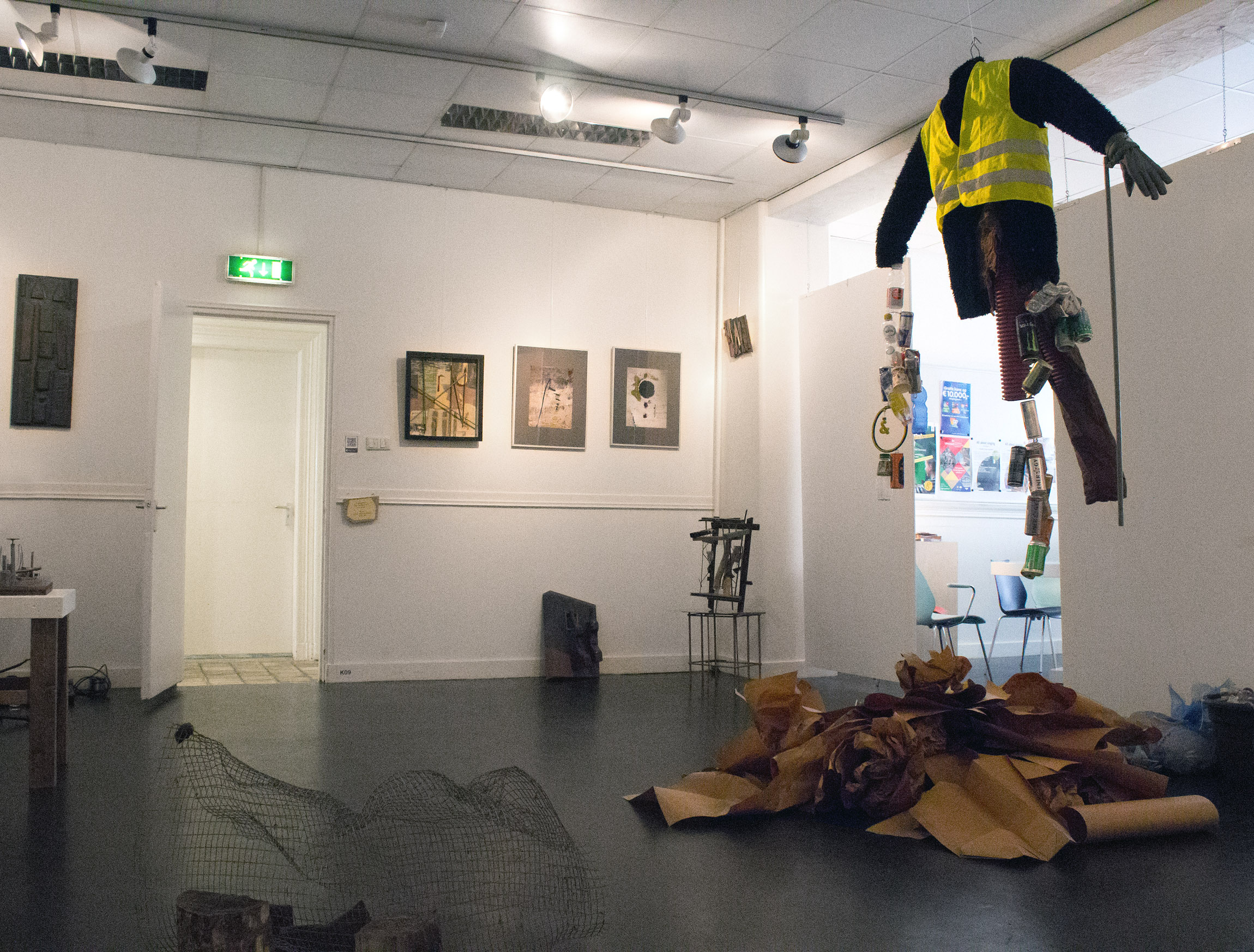
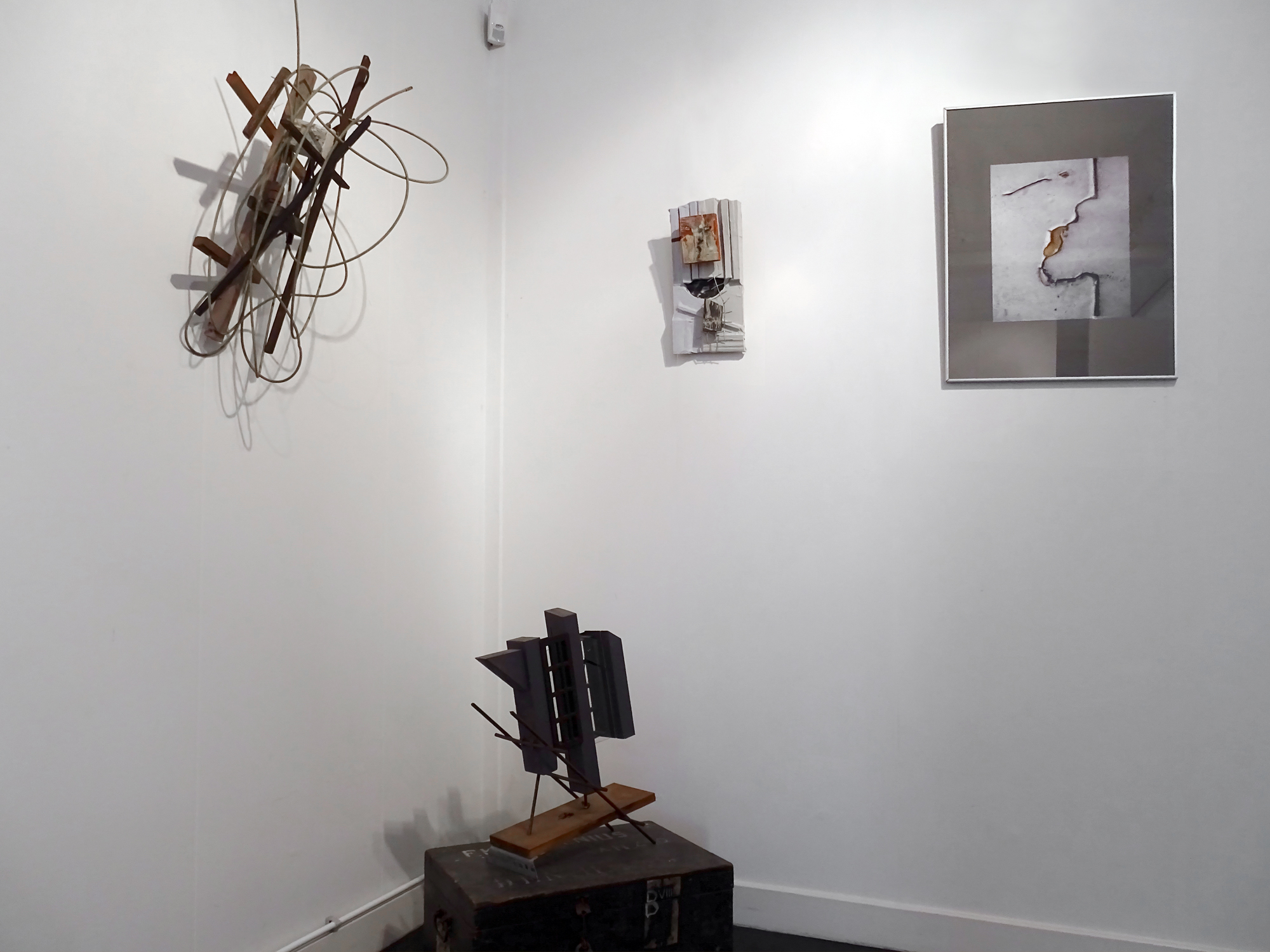
In this latest exhibition, there is a wonderful, tensional balance between elements and energy in his constructions. Much of the basic elements are from demolition- / remnant materials (“recycling art”), sometimes called objets trouvés: things coil around, are contained, wire, wood, recycled materials, energy, intimacy. His un/civilised forms of expression create an interplay between the conscious and the unconscious minds.

Drager is true to the integrity of his materials, the inherent qualities of natural and man made materials, and his vision. He incorporates primitive, mythical, spiritual and folkloric elements into his art. And his pleasure is in the layering and painting, in the materials, forms and, finally, in the art itself. Here is humour (The snake kept its mouth shut, 2018 below; the moustache of The Orator, 2016 below), ecology and spirit. A sense of mystery and purpose at one and the same time.

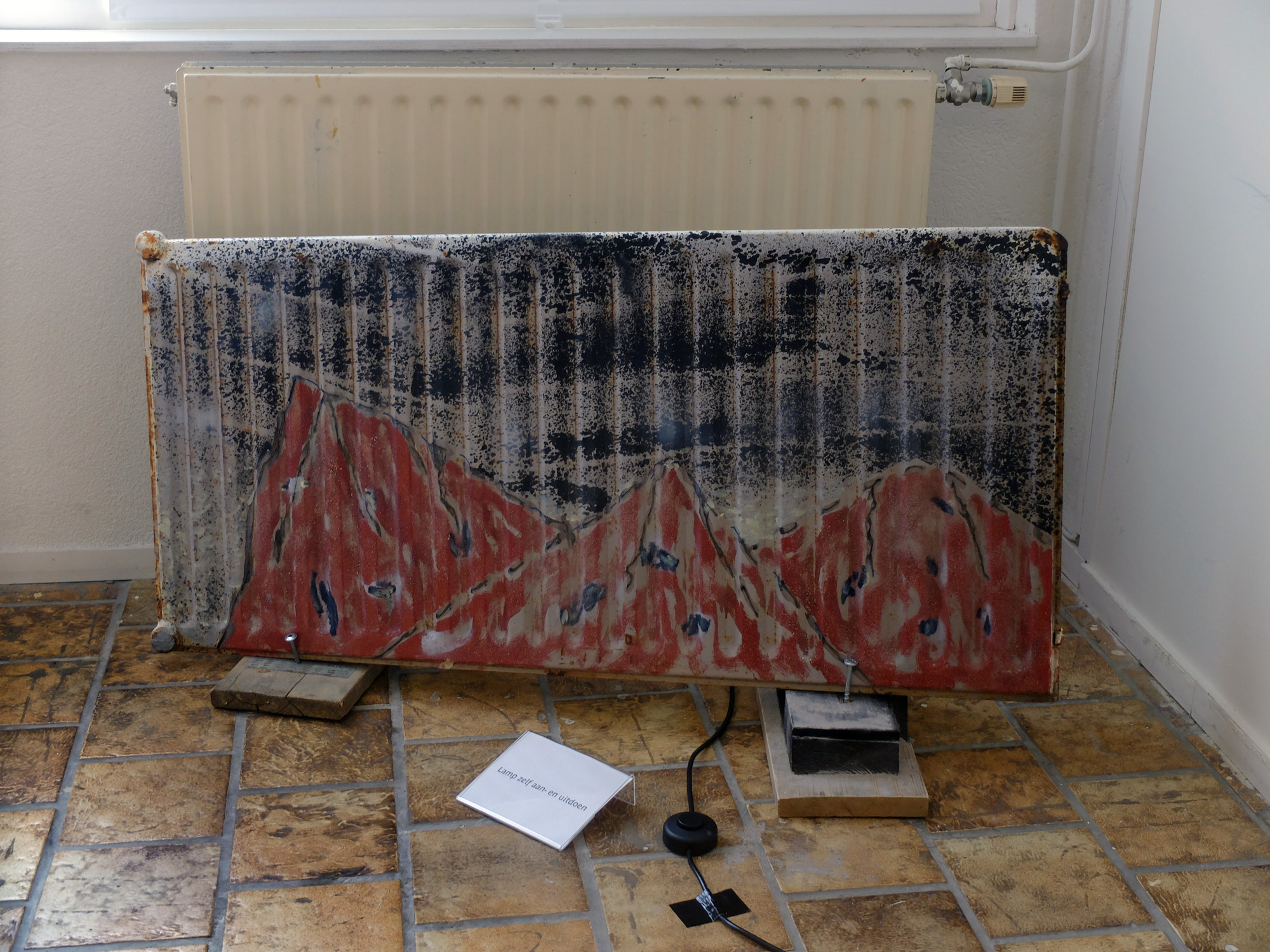
Riffing on Guy Debord’s concept of dérive (“drift” in English) which Debord defines as “a mode of experimental behaviour linked to the conditions of urban society: a technique of rapid passage through varied ambiances”2, I can relate Drager’s art to an unplanned journey through the urban landscape in which he drops his everyday relations and lets himself be drawn by the attractions of the terrain and the encounters he finds there. Drager’s attractions are the refuse of the human race. His encounters lead to the construction of contexts and situations, an artistic practice of “the happening”, which is a structured but unencumbered, expressive approach that encourages us to question our finite place in the world. Who else would paint a mountain on a radiator!

While I believe that some of the most important qualities in this world have their meanings proscribed by their opposite, some of these qualities have to be understood by reference only to themselves – which is very difficult – but must be attempted. A lot of things have been made too simple (taught in art schools?) by constructing fraught dichotomies. In other words, as an artist and as a human being, do not rely on binaries but just “on the thing itself”. Let it reveal itself to you – whether that is through Dada, an enigmatic self, of movement and form – or through some other mechanism. Drager has enough intellect and talent not to fall into the too simple, too easy, trap.

In this small regional gallery in the Netherlands, this visionary of the romantic, otherworldy (definition: devoted to intellectual or imaginative pursuits), utopian / dystopian unification of art and life constructs his paradoxes. I love the poetry that accompanies and informs his work; I love the brown butchers paper that covered “the happenings” before the unveiling; and I love the energy, the concern for the environment, and the construction and conceptualisation of his assemblages. I am challenged, in a good way, by his art.

The next step on the path for my friend is to keep the faith, is to keep making the art for himself and no one else. To keep them free and not contained by unwanted concerns. For, as he said to me, “in the end the path followed will be more interesting than the stakes raised in passing.” But curators please take note… here is a star of the future!

Dr Marcus Bunyan


1/ Anonymous. “Rosalie Gascoigne,” on the Art Gallery of New South Wales website 08/08/2018. No longer available online

2/ Guy Debord (1958) Definitions. Internationale Situationniste #1 (Paris, June 1958). Translated by Ken Knabb.


Many thankx to the artists and Kunstwerk! Liemers Museum for allowing me to publish the art work in the posting. Please click on the photographs for a larger version of the image.


“The creation of art, to me, is not work. The end-result is not seen as a piece, but as a whole. Since it brings me comfort and relieves stress, I call my assemblages ‘art-peaces’.”

“The essence of working with found objects (or scrap material) is that their different natures will enrich the composition as they are expressed in its different layers. This effect is based upon the divergent origins, structures and functions of these elements: wood, metal, glass, stone, cloth, plastic, etc. As a consequence, each bears a different weight and ease for ‘penetrance’ (transparency), that will influence the final form of the composition.”


Drager Meurtant


“Nearly every work of assemblage, in its relational structure, approaches abstract art” [but] “the practice of assemblage raises materials from the level of formal relations to that of associational poetry.”


Seitz, W. C. The Art of Assemblage. New York: Museum of Modern Art, 1961, p. 25, 84.


“It’s not where you take things from, it’s where you take them to.”


Jean-Luc Godard


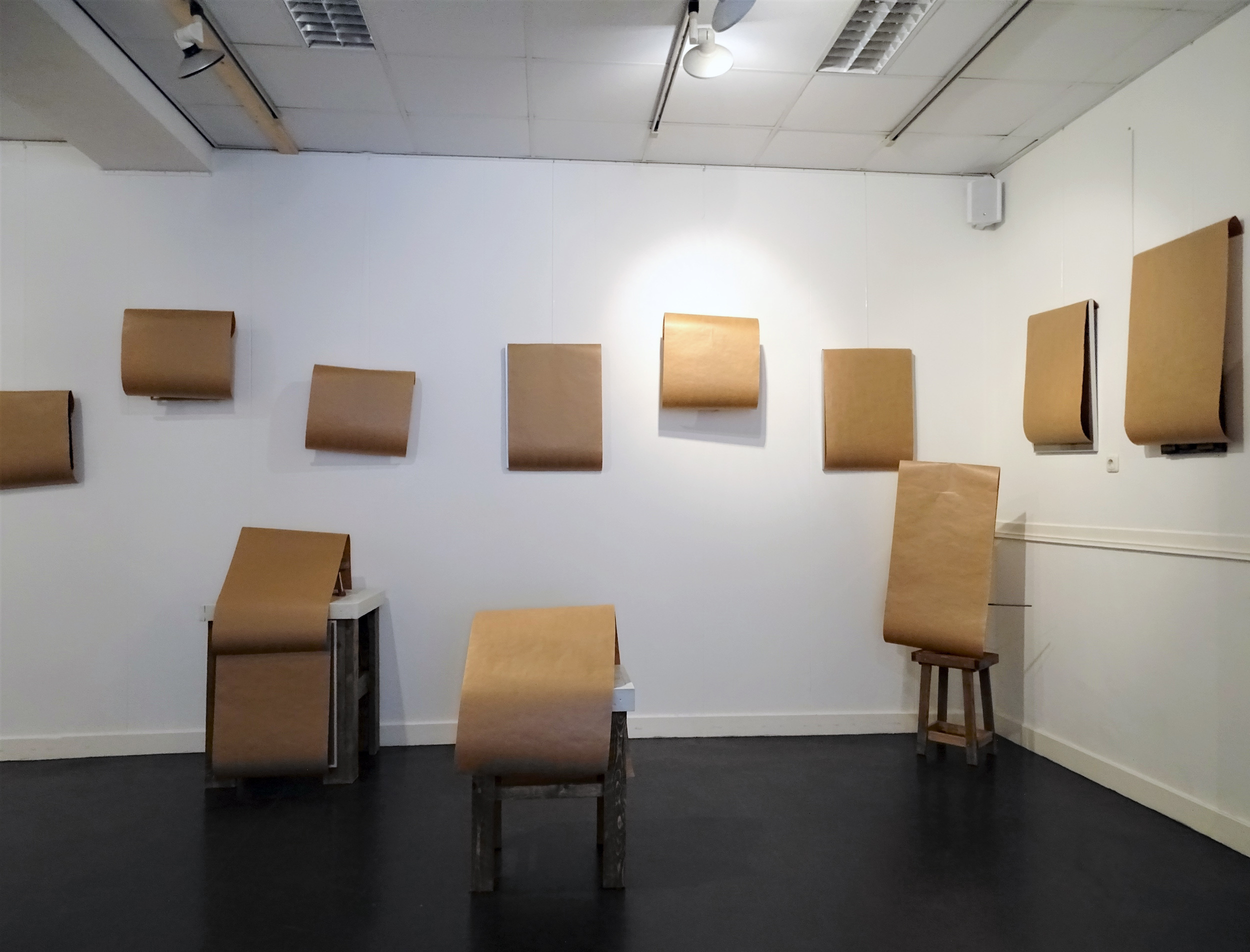
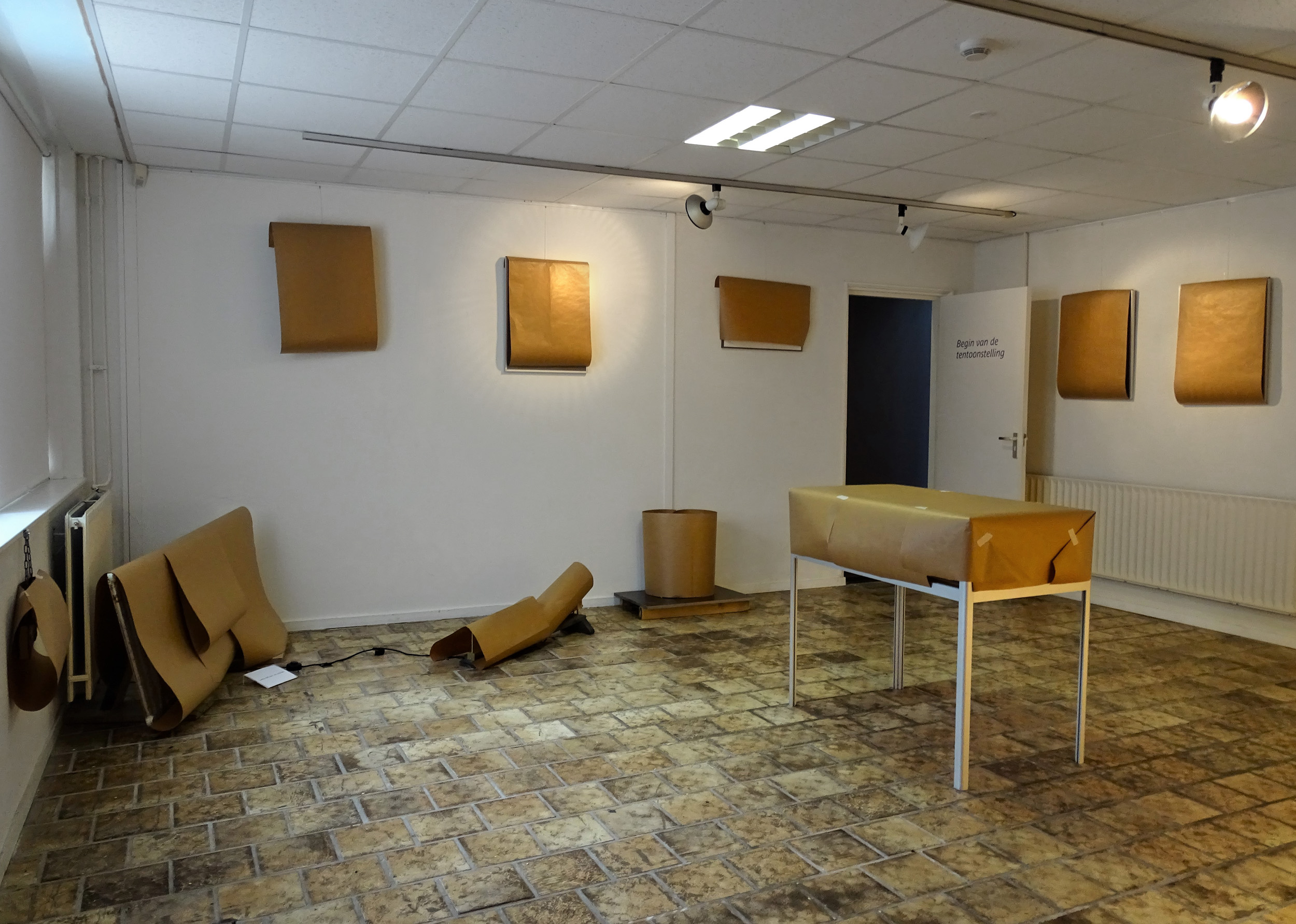
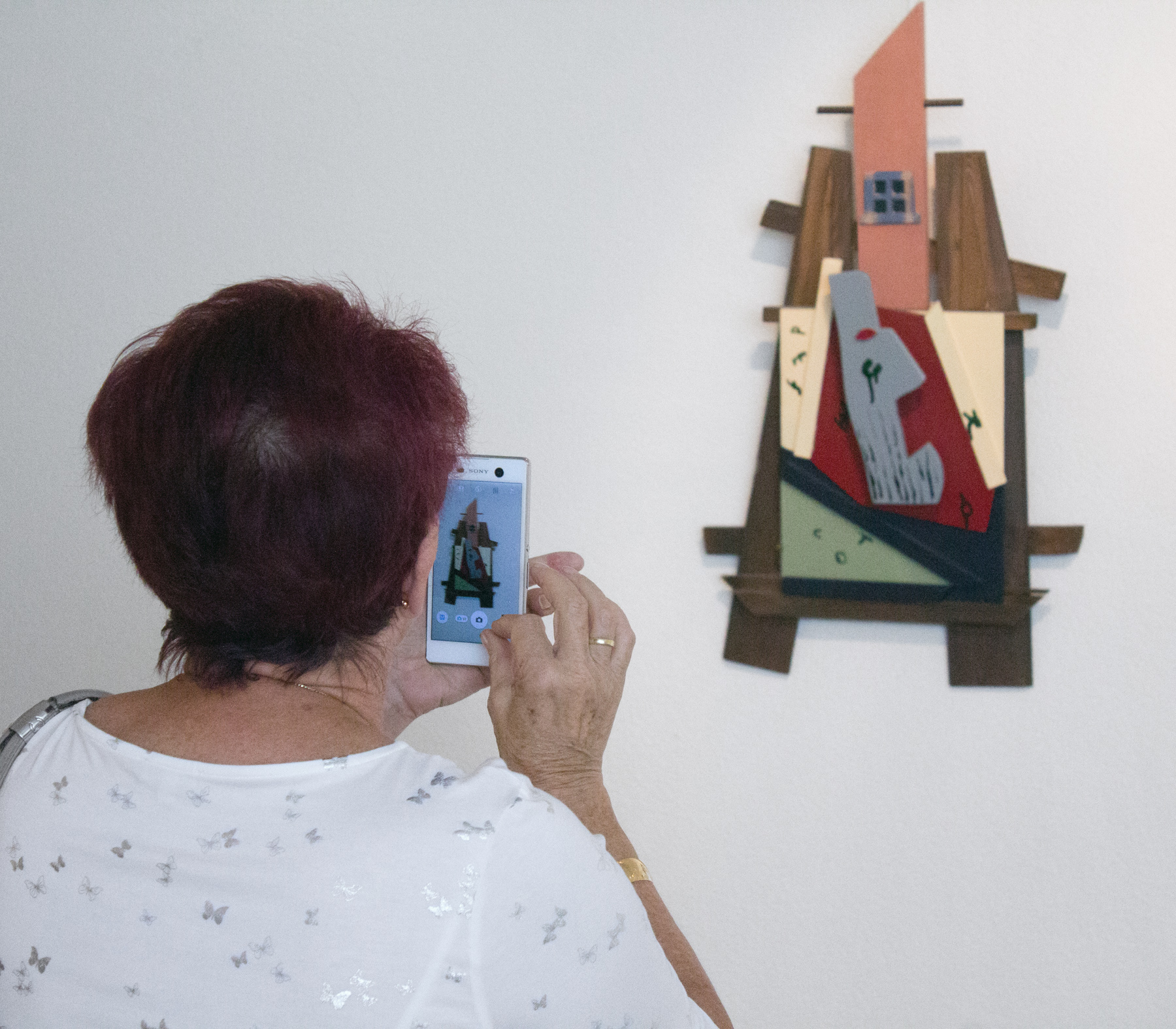
Before the exhibition Now, the new form of the past opening


Before the opening of the exhibition 'Now, the new form of the past' at Kunstwerk! Liemers Museum, Netherlands

Before the opening of the exhibition 'Now, the new form of the past' at Kunstwerk! Liemers Museum, Netherlands

Before the opening of the exhibition 'Now, the new form of the past' at Kunstwerk! Liemers Museum, Netherlands

Before the opening of the exhibition 'Now, the new form of the past' at Kunstwerk! Liemers Museum, Netherlands

Before the opening of the exhibition 'Now, the new form of the past' at Kunstwerk! Liemers Museum, Netherlands


Before the opening of the exhibition Now, the new form of the past at Kunstwerk! Liemers Museum, Netherlands


Now, the new form of the past is an exhibition based on international collaboration between Drager Meurtant (assemblages, NL) and Petra Senn (photography, D) with the theme Recycling Art . Both artists place most of the energy in their art and demand attention for its creativity, in the reuse of materials and objects.

Drager uses demolition material and remnants from construction, plus objets trouvés, to make assemblages; while Petra uses weathered matter and the perishableness (transitoriness) of materials in her photographs. Every artwork thus carries echoes from the past within itself. Senses is a parallel exhibition of abstract paintings by Jeanine Keuchenius.

Text from the Kunstwerk! Liemers Museum website


The artists Drager Meurtant and Petra Senn first met on ‘pictify’, a social medium for artists (at present no longer accepting new art submissions.) After an exchange of some ‘faves’ and views, the retrospective The Trauma of Painting by Alberto Burro in the museum K21 in Düsseldorf, Germany, became the place where at the end of June 2016 the three, Petra Senn, Drager Meurtant and his artist-partner Jeanine Keuchenius, met in person. With the overwhelming artistic environment, the basis of a human and artistic interest became established. Thus, when Stijn Geutjes, the curator of Kunstwerk! Liemers Museum asked Drager about willingness to exhibit his art in the museum, the answer came with the suggestion of the theme “Now, the new form of the past”, and introduction of colleague Petra Senn as associate, and Jeanine to come with an addition of the theme “Senses”. After some discussion, and rising interest of Stijn Geutjes in the abstract photographies of Petra Senn, the decision came to exhibit in a collaborative effort, that included partaking in the selection process of works of the curator and the three artists.

Text by Drager Meurtant


Objets trouvés

An objets trouvé is a found object; a natural or discarded object found by chance and held to have aesthetic value; an ordinary object, as a piece of driftwood, a shell, or a manufactured article, that is treated as an object of art by one who finds it aesthetically pleasing.

The term relates directly to Marcel Duchamp’s readymades, Dada and Fluxus art. Art critics have coined the terms arte povera (Italian) and junk art (Anglo-American) to signify art which incorporates said objects.

Arte Povera is basically the legitimate justification for creating art of junk and found objects. Arte Povera was a term coined by the Italian art critic Germano Celant. He used the word to sum up a type of art which combined elements of conceptual art, minimal art and performance art. He conceived the idea of the art movement in reaction to the ever increasing commercialism within the art world. The artists embrace the ideas of using valueless materials such as earth, gravel, rocks or litter in order to create works of art.

Junk art is the flattering name is given to 20th and 21st-century art in which the artist uses refuse, scrap metal, urban waste or just anything viewed as useless or cast of from modern society. Junk art is very much synonymous with American artist Robert Rauschenberg. It is also very much part of the 1960s Italian movement Arte Povera. The movement was the product of Antoni Tàpies, Alberto Burri, Michelangelo Pistoletto, Piero Manzoni, and Lucio Fontana.

Anonymous text. “Objet trouvé art,” on the Xamou website [Online] Cited 17/02/2022. No longer available online

Found object

Found object originates from the French objet trouvé, describing art created from undisguised, but often modified, objects or products that are not normally considered materials from which art is made, often because they already have a non-art function. …

Found objects derive their identity as art from the designation placed upon them by the artist and from the social history that comes with the object. This may be indicated by either its anonymous wear and tear (as in collages of Kurt Schwitters) or by its recognisability as a consumer icon (as in the sculptures of Haim Steinbach). The context into which it is placed is also a highly relevant factor. The idea of dignifying commonplace objects in this way was originally a shocking challenge to the accepted distinction between what was considered art as opposed to not art. …

As an art form, found objects tend to include the artist’s output – at the very least an idea about it, i.e. the artist’s designation of the object as art – which is nearly always reinforced with a title. There is usually some degree of modification of the found object, although not always to the extent that it cannot be recognised, as is the case with ready-mades. Recent critical theory, however, would argue that the mere designation and relocation of any object, ready-mades included, constitutes a modification of the object because it changes our perception of its utility, its lifespan, or its status.

Text from the Wikipedia website


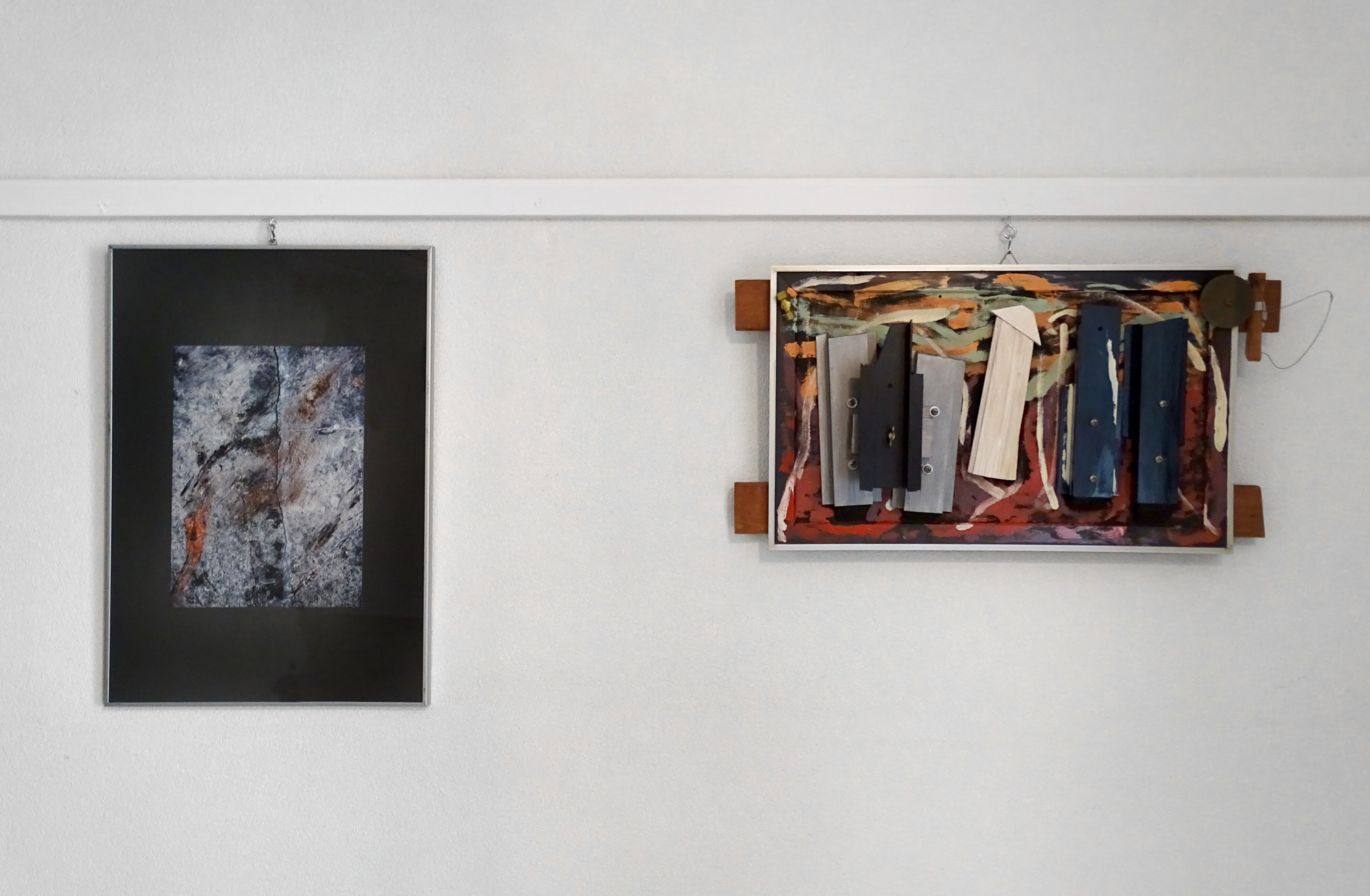
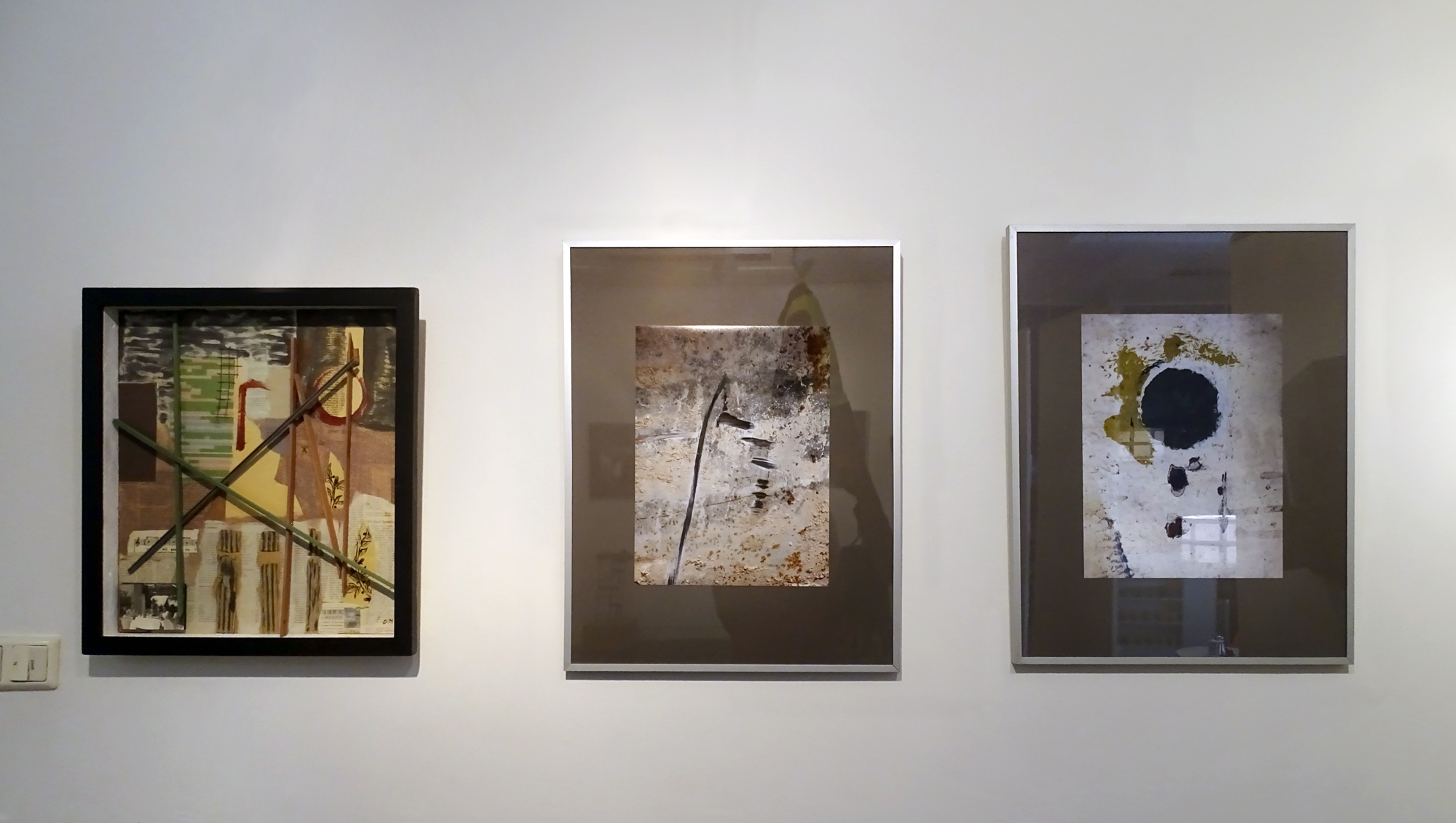
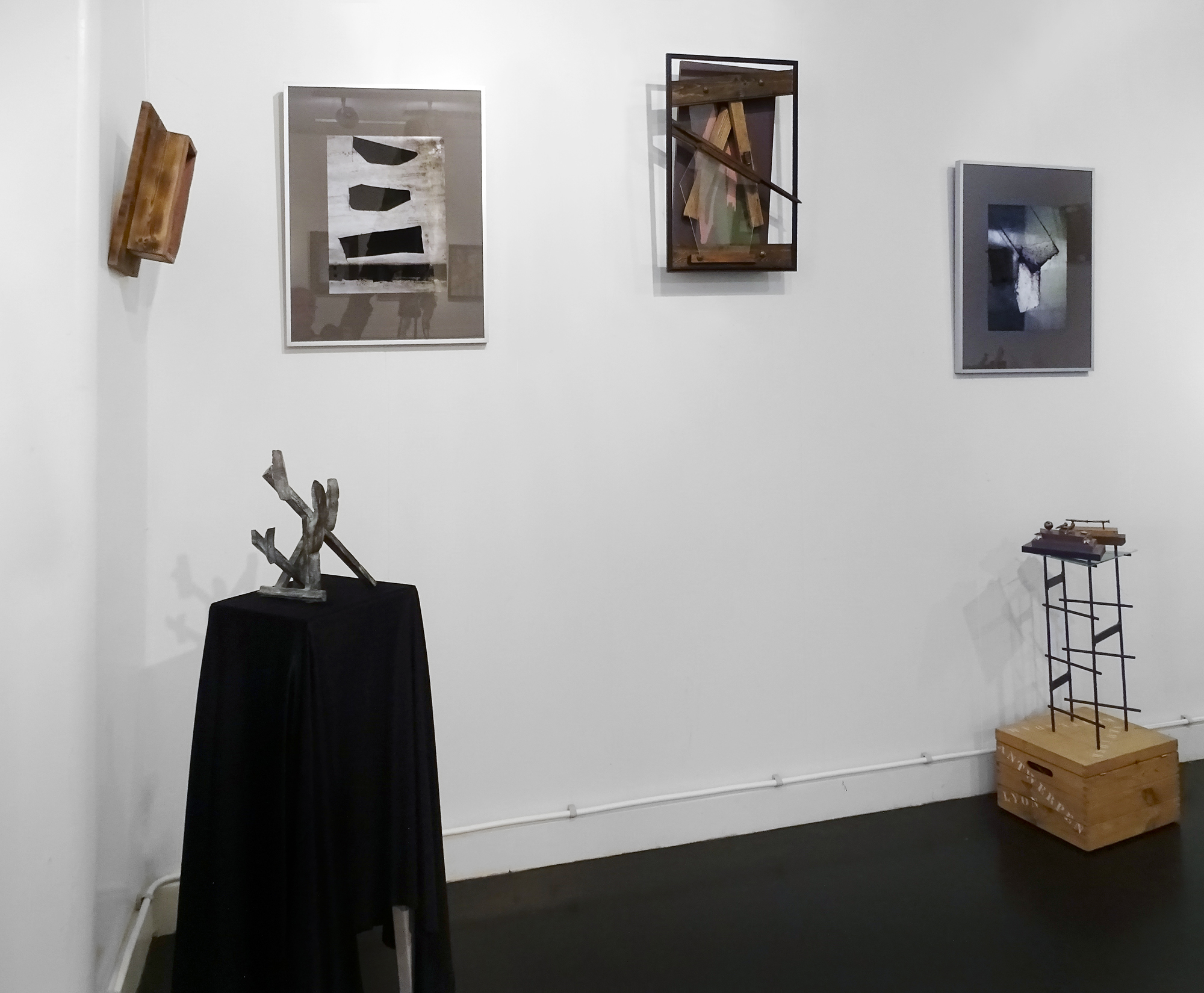
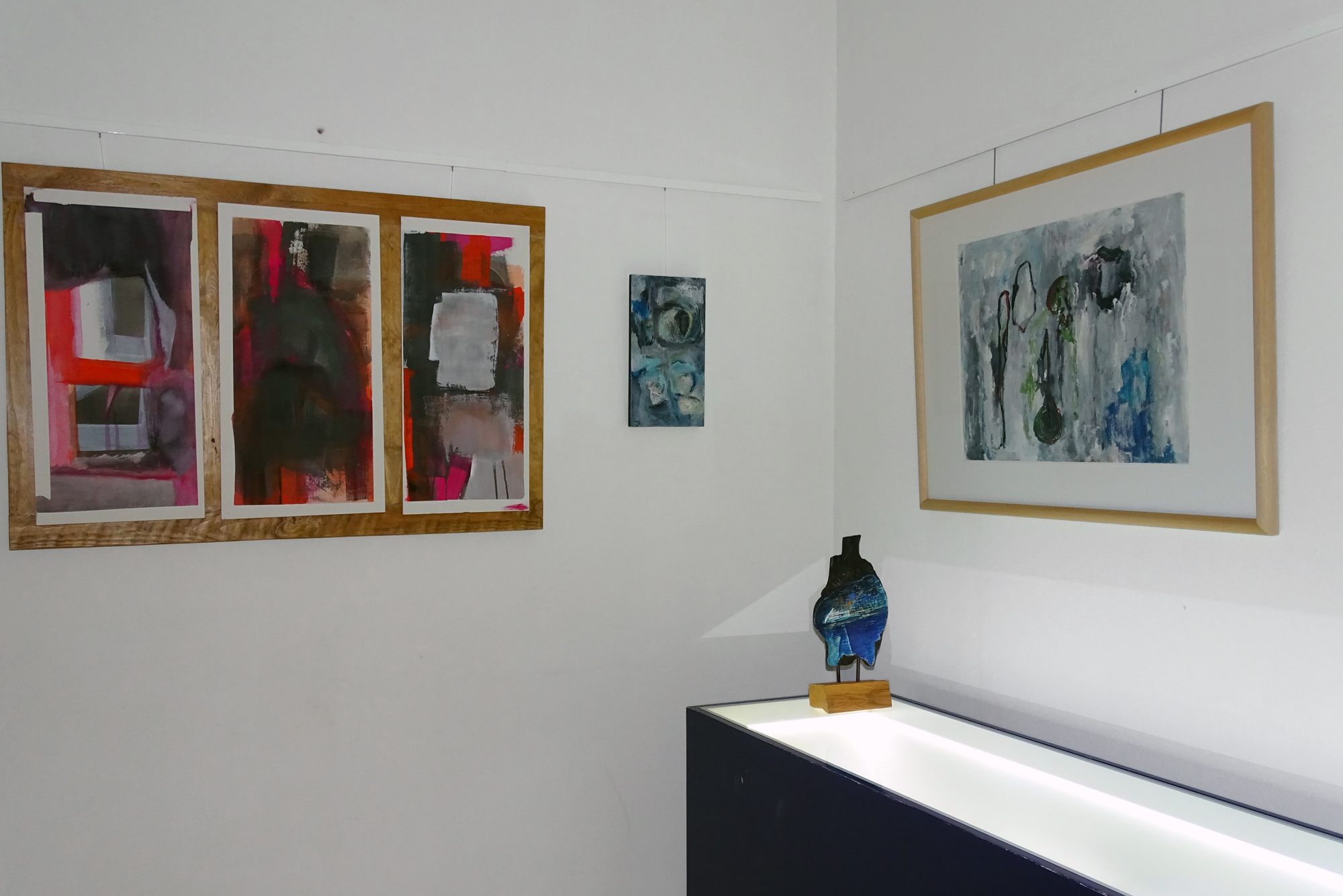
Installation views of the exhibition Now, the new form of the past


Installation view of the exhibition 'Now, the new form of the past' at Kunstwerk! Liemers Museum, Netherlands

Installation view of the exhibition 'Now, the new form of the past' at Kunstwerk! Liemers Museum, Netherlands

Installation view of the exhibition 'Now, the new form of the past' at Kunstwerk! Liemers Museum, Netherlands

Installation view of the exhibition 'Now, the new form of the past' at Kunstwerk! Liemers Museum, Netherlands

Installation view of the exhibition 'Now, the new form of the past' at Kunstwerk! Liemers Museum, Netherlands

Installation view of the exhibition 'Now, the new form of the past' at Kunstwerk! Liemers Museum, Netherlands


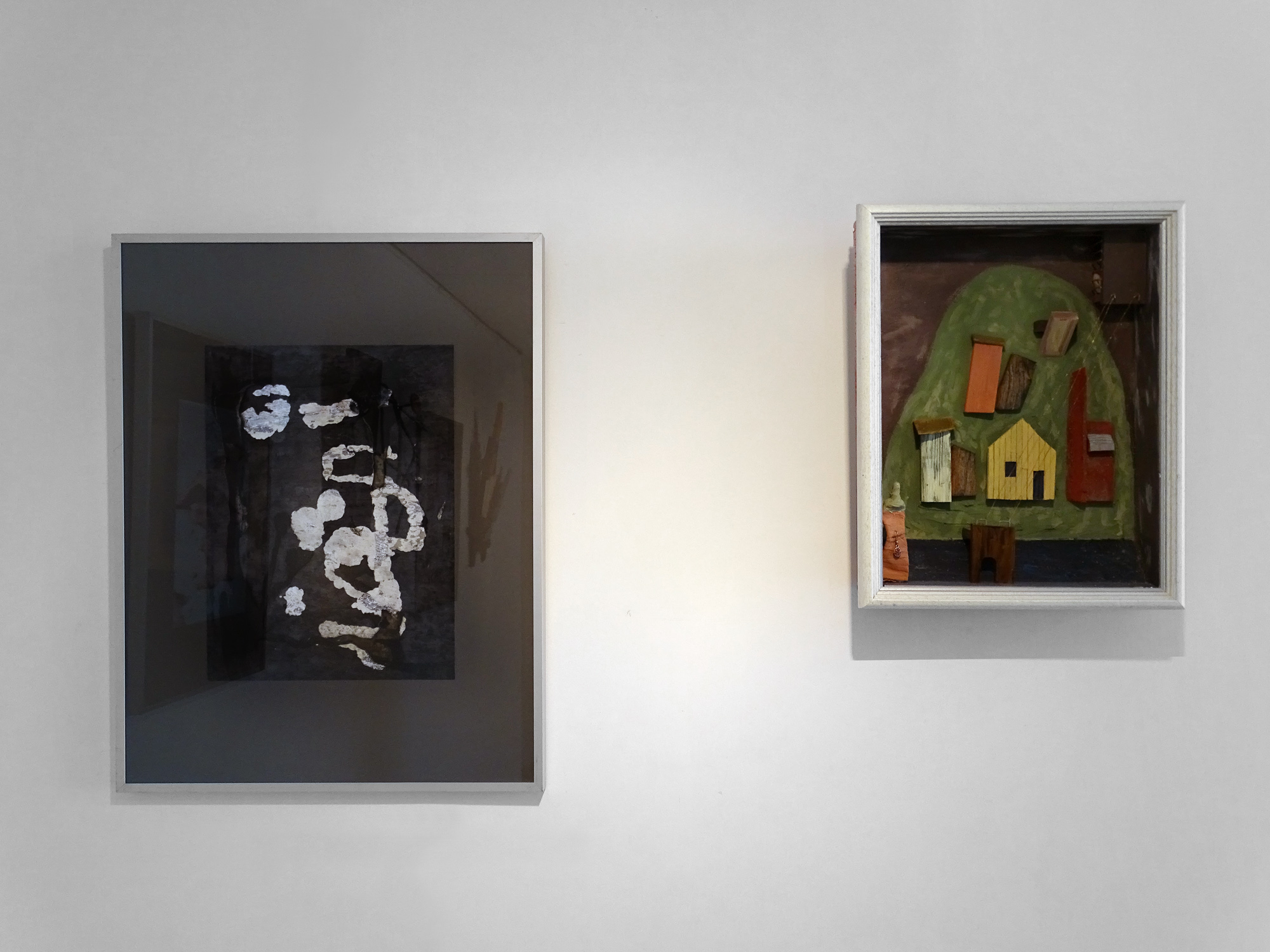
Installation views of the exhibition Now, the new form of the past at Kunstwerk! Liemers Museum, Netherlands showing the work of Drager Meurtant and Petra Senn


Installation view of the exhibition 'Now, the new form of the past' at Kunstwerk! Liemers Museum, Netherlands showing Drager Meurtant's work 'connection not wireless' (2014) top left, and Petra Senn's 'Persuasiveness' (2012) top right


Installation view of the exhibition Now, the new form of the past at Kunstwerk! Liemers Museum, Netherlands showing Drager Meurtant’s work connection not wireless (2014) top left, and Petra Senn’s Persuasiveness (2012) top right


Installation view of the exhibition 'Now, the new form of the past' at Kunstwerk! Liemers Museum, Netherlands showing Drager Meurtant's 'Under way' Nd


Installation view of the exhibition Now, the new form of the past at Kunstwerk! Liemers Museum, Netherlands showing Drager Meurtant’s Under way Nd


Installation view of the exhibition 'Now, the new form of the past' at Kunstwerk! Liemers Museum, Netherlands showing Drager Meurtant's work 'Swan in essence' (2014) at centre, with Petra Senn's 'Insubordination' (2017) top left and 'someone from the past I' (Nd) top right


Installation view of the exhibition Now, the new form of the past at Kunstwerk! Liemers Museum, Netherlands showing Drager Meurtant’s work Swan in essence (2014) at centre, with Petra Senn’s Insubordination (2017) top left and someone from the past I (Nd) top right


Installation view of the exhibition 'Now, the new form of the past' at Kunstwerk! Liemers Museum, Netherlands showing the work of Drager Meurtant and Petra Senn with DM's 'The promised land' (2016) at right


Installation view of the exhibition Now, the new form of the past at Kunstwerk! Liemers Museum, Netherlands showing the work of Drager Meurtant and Petra Senn with DM’s The promised land (2016) at right


About Drager Meurtant

In almost four decades since his training as as veterinarian-biomedical researcher, Drager Meurtant (artist alias of Gerard Rutteman) has channeled much creativity towards scientific publications and – in his free time – poetry. In more recent years, through a rapid learning curve, his creations have taken form as sculptures (in particular assemblages), collages, paintings and graphical works.

As autodidact and experienced carpenter, the circle saw, jig-saw, chisel, gouge, hammer are used to handle natural materials (wood, stone) in addition to manufactured (paper, cloth) and construction material (metal, glass, etcetera). Much of the basic elements are from demolition- / remnant materials (“recycling art”), sometimes objets trouvés. The assembly of contrasting elements creates tension, sometimes suspension.

The sculptures made by David Smith and (box) assemblages by Joseph Cornell, but also installations by Dieter Roth inspire Drager, as does the art by Joan Miró and members of CoBrA. The making of photographs is considered complementary to the assemblages, in an attempt to capture the fleeting world in which we live.


Drager Meurtant (Dutch, b. 1951) 'Movement from within' 2016


Drager Meurtant (Dutch, b. 1951)
Movement from within
2016
Three-dimensional sculpture, mixed media
Assemblage (relief), wood, paper, paint, sand, image
40 x 50 x 7cm

“When the pieces were seen fit / and fixed in their proper position / the movement was undeniable / as it arose from within”


Drager Meurtant (Dutch, b. 1951) 'Crawling, again' 2018


Drager Meurtant (Dutch, b. 1951)
Crawling, again
2018
Three-dimensional sculpture, mixed media
47 x 34 x 20cm

“How to make connections / of elements and the outside world? The answer to my question / came crawling, again”


Drager Meurtant (Dutch, b. 1951) 'Crawling, again' 2018 (installation view)


Drager Meurtant (Dutch, b. 1951)
Crawling, again (installation view)
2018
Three-dimensional sculpture, mixed media
47 x 34 x 20cm


Drager Meurtant (Dutch, b. 1951) 'Number 53' 2016 (installation view)


Drager Meurtant (Dutch, b. 1951)
Number 53 (installation view)
2016
Mixed media sculpture
Assemblage, wood, paper, metal, plaster, paint
31 x 36 x 9cm

“In former times / you could buy / petroleum, paraffin and coal / at number 53”


Drager Meurtant (Dutch, b. 1951) 'The Orator' 2016


Drager Meurtant (Dutch, b. 1951)
The Orator (installation view)
2016
Sculpture, wood, paint


Drager Meurtant (Dutch, b. 1951) 'Tegut' 2018


Drager Meurtant (Dutch, b. 1951)
Tegut
2018
Collage, paper
11 x 15cm

“The next generation / has more generations / to lean upon”


Drager Meurtant (Dutch, b. 1951) 'Three of a kind' 2018 (installation view)


Drager Meurtant (Dutch, b. 1951)
Three of a kind (installation view)
2018
Mixed media
24 x 32 x 1cm

“When presented three figures / of different size / and writing / and colour”


Drager Meurtant (Dutch, b. 1951) 'Three of a kind' 2018


Drager Meurtant (Dutch, b. 1951)
Three of a kind
2018
Mixed media
24 x 32 x 1cm


Drager Meurtant (Dutch, b. 1951) 'Mon Combat' 2018


Drager Meurtant (Dutch, b. 1951)
Mon Combat
2018
Installation of book, metal
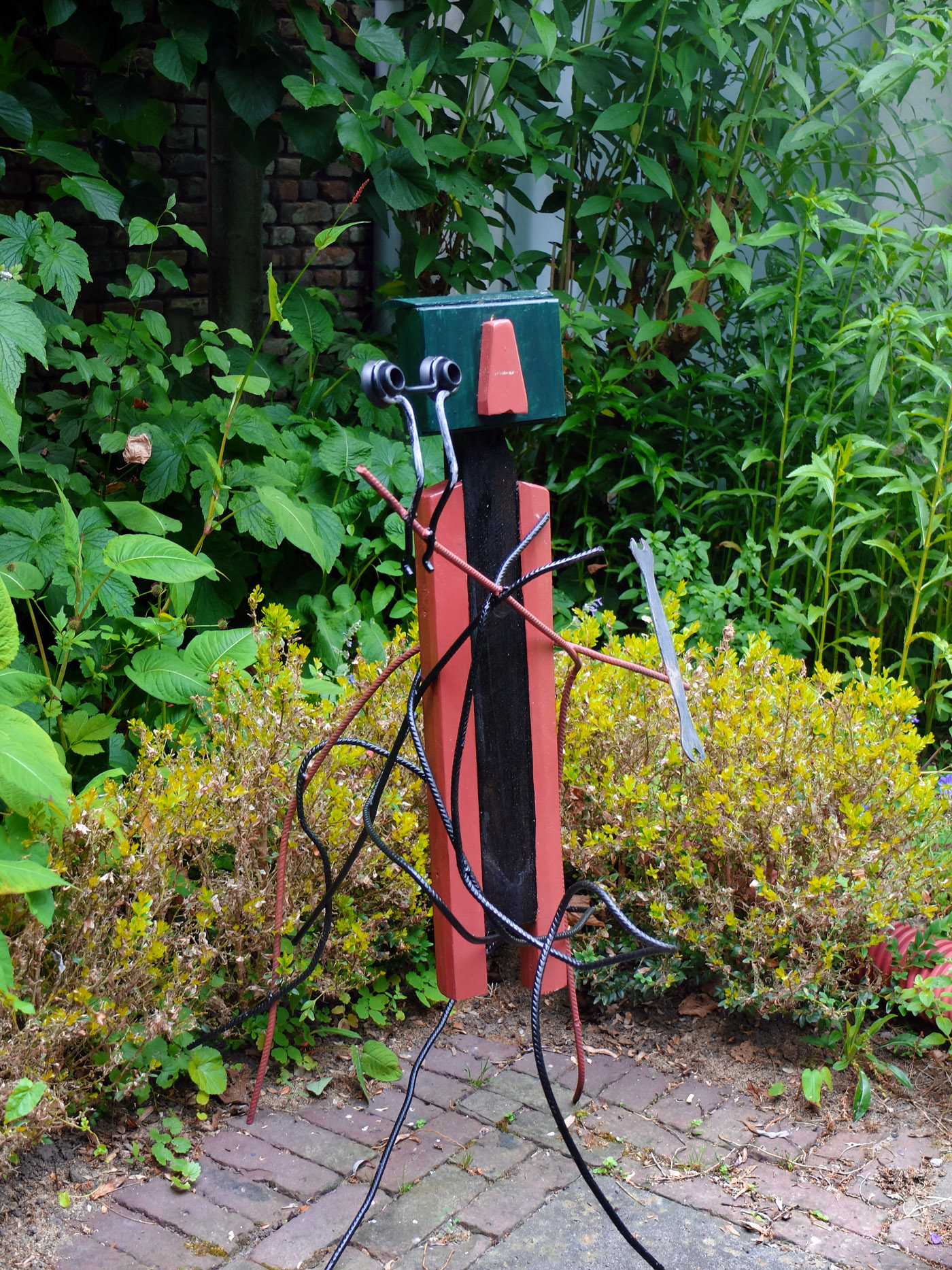
60 x 30 x 5cm

Mon Combat by A. Tempspassé: there is always someone who sees argument to start a battle


Installation view of the exhibition 'Now, the new form of the past' at Kunstwerk! Liemers Museum, Netherlands showing Drager Meurtant's works 'the listener (needs protection)' (2018) at left, and 'The Mechanic' (2018) at right


Installation view of the exhibition Now, the new form of the past at Kunstwerk! Liemers Museum, Netherlands showing Drager Meurtant’s works the listener (needs protection) (2018) at left, and The Mechanic (2018) at right


Drager Meurtant (Dutch, b. 1951) 'The Mechanic' 2018


Drager Meurtant (Dutch, b. 1951)
The Mechanic
2018
Mixed media (wood, iron, paint)
105 x 65 x 65cm

“With good tools / you get everything moving”


Drager Meurtant (Dutch, b. 1951) 'The snake kept its mouth shut' 2018


Drager Meurtant (Dutch, b. 1951)
The snake kept its mouth shut
2018
Mixed media, trash
35 x 25 x 500cm

“Curling, the snake kept its mouth shut”


Drager Meurtant (Dutch, b. 1951) 'Destiny' 2018 (installation view)


Drager Meurtant (Dutch, b. 1951)
Destiny (installation view)
2018
Painting on discarded radiator with support
60 x 130cm


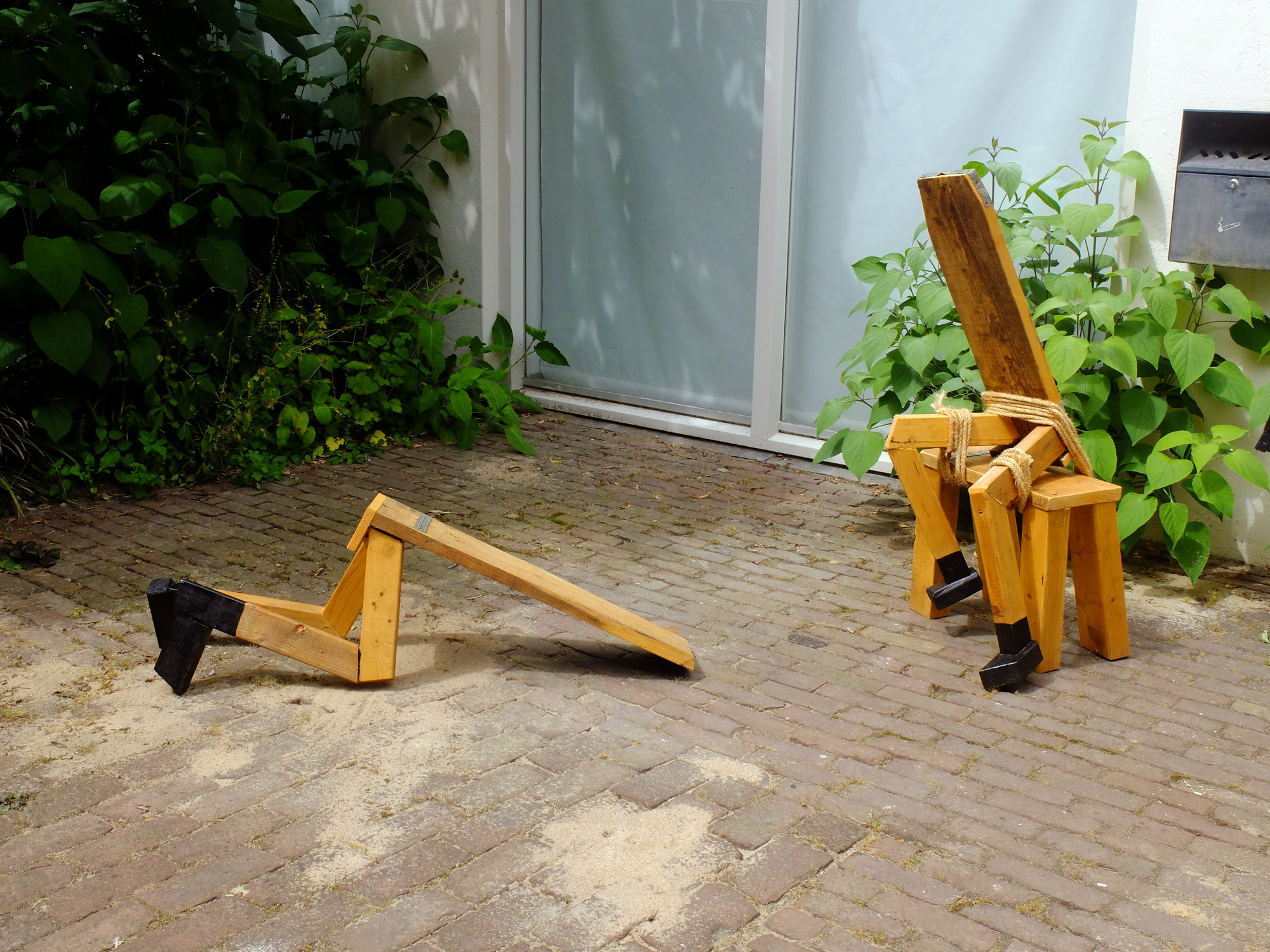
Drager Meurtant (Dutch, b. 1951) 'All humans are equal' 2018 (installation view)


Drager Meurtant (Dutch, b. 1951)
All humans are equal (installation view)
2018
Mixed media
100 x 50 x 200cm

All humans are equal. // To test this assumption / take two / and tilt the angle / and position towards, one another.


Drager Meurtant (Dutch, b. 1951) 'Rudimentary' 2016 (installation view)


Drager Meurtant (Dutch, b. 1951)
Rudimentary (installation view)
2016
Mixed media
23 x 13 x 16cm

“Mental metal / rudimentary face / mind you!”


Drager Meurtant (Dutch, b. 1951) 'The promised land' 2016


Drager Meurtant (Dutch, b. 1951)
The promised land
2016
Box assemblage
Mixed media, wood, board, metal, paint
34 x 44 x 10cm

“The promised land / cannot be for outsiders. // They may look / how it is, yonder.”


Drager Meurtant (Dutch, b. 1951) 'Steep-2' 2014 (installation view)


Drager Meurtant (Dutch, b. 1951)
Steep-2 (installation view)
2014
Mixed media, wood partly rotten, metal, paint and glass
35 x 23 x 10cm

Steep-2: The Monte Rotondo / is left behind / it weighs too much / for me. // The climbing rock of Feyr / I leave / to the climbers. // But / this wooden rock / serves as model / of a viewpoint on imagination.


Drager Meurtant (Dutch, b. 1951) 'The avail of propaganda' 2016


Drager Meurtant (Dutch, b. 1951)
The avail of propaganda
2016
Mixed media
Assemblage, wood, cloth, metal, paper, paint
43 x 21 x 8cm

“The avail of propaganda / is that you and I / do what / we detest.”


Drager Meurtant (Dutch, b. 1951) 'Twosome' Nd (installation view)


Drager Meurtant (Dutch, b. 1951)
Twosome (installation view)
Nd
Mixed media


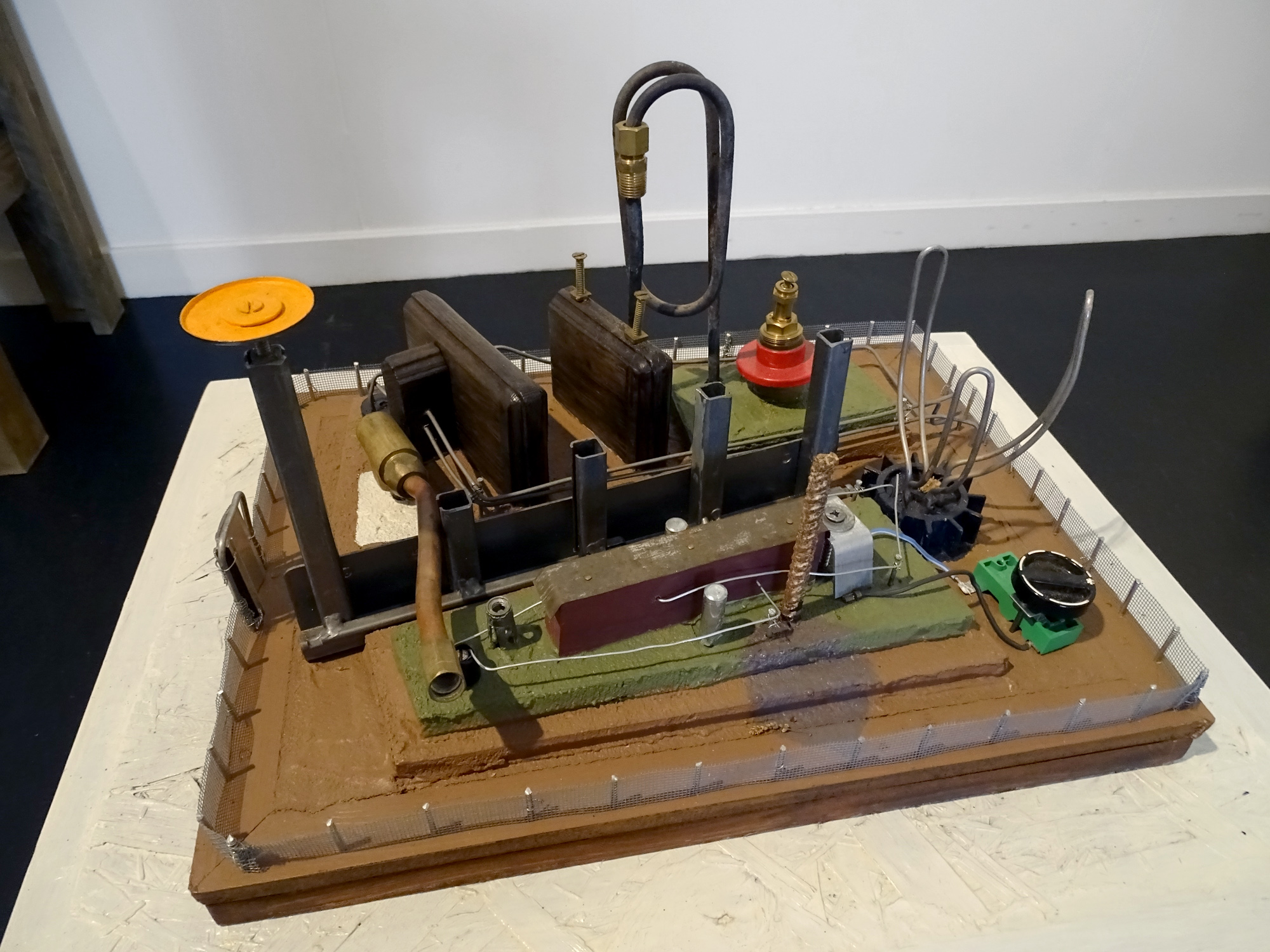
Drager Meurtant (Dutch, b. 1951) 'fact-ohry' 2013 (installation view)


Drager Meurtant (Dutch, b. 1951)
fact-ohry (installation view)
2013
Mixed media
24 x 32 x 42cm

I said / now I will build a fact-ohry / and that / became factual. // With grabbing and placing / elements that together / took progressively the shape / of a fact-ohry / I became part of it. // Could shape the further design / and steer it at minor extent / but the end-result / was determined / by the starting point. // Voila.

(Note: This Fact-ohry is the only one with guarantee that risks during drilling for shale gas are secured.)


Drager Meurtant (Dutch, b. 1951) 'Progress (halted)' 2016 (installation view)


Drager Meurtant (Dutch, b. 1951)
Progress (halted) (installation view)
2016
Bronze
26 x 18 x 21cm

“When going forth / from wood to bronze / and grasping the result / I realised progress had halted. // A result stands in the way / of the learning process.”


Drager Meurtant (Dutch, b. 1951) 'Progress (halted)' 2016


Drager Meurtant (Dutch, b. 1951)
Progress (halted)
2016
Bronze
26 x 18 x 21cm


About Petra Senn

Petra’s work has mostly to do with memories and emotions. Her photos directly respond to the surrounding environment and use everyday experiences from the artist as a starting point. These experiences are often framed instances that would go unnoticed in their original context.

By contesting the division between the realm of memory and the realm of experience, she wants to amplify the astonishment of the spectator by creating compositions or settings that generate tranquil poetic images that leave traces and balances on the edge of recognition and alienation.

Her works appear as dreamlike images in which fiction and reality meet, well-known tropes merge, meanings shift, past and present fuse. Time and memory always play a key role. By applying abstraction, she absorbs the tradition of remembrance art into daily practice. She has a deep inner desire to protect the past from vanishing, both physically and, inevitably, mentally.

In her work Petra takes great care neither to simply reflect reality nor to just make visual statements. There is always left space for the spectators own emotions and opinions. She considers her work as visual stimulus, an invitation to enter ones inner world, knowing well that this process only works if she perceives deeper emotions while taking the pictures herself. Her search is for poetry in almost every item and condition.

Artist statement


Petra Senn. 'Her Lips' 2015


Petra Senn
Her Lips
2015


Petra Senn. 'Insubordination' 2017


Petra Senn
Insubordination
2017


Petra Senn. 'Persuasiveness' 2012


Petra Senn
Persuasiveness
2012


About Jeanine Keuchenius

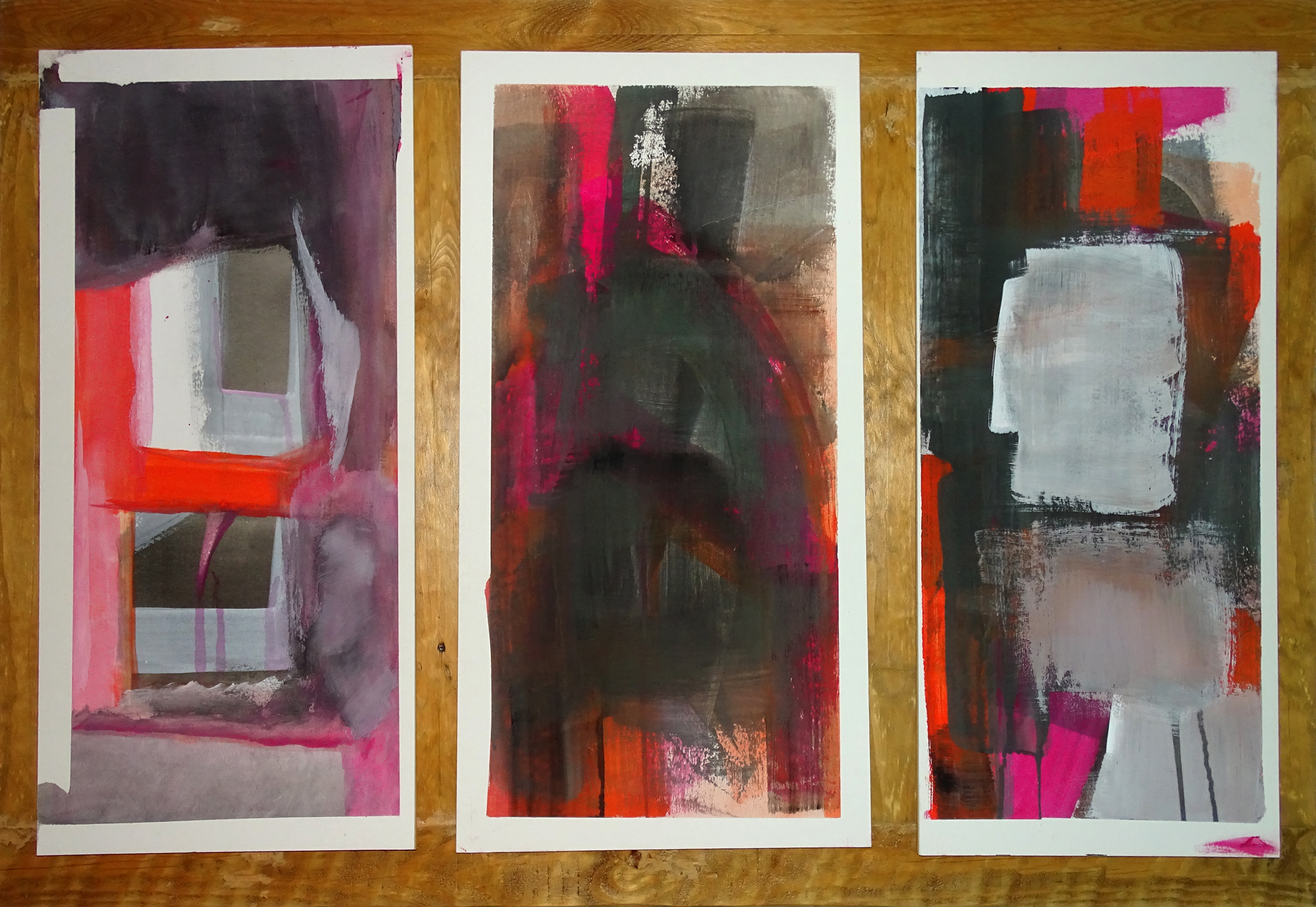
Jeanine Keuchenius (1953, Indonesia) is a creative artist, dancer, and performer. Her background is as an art therapist (independent and within psychiatry) and social worker / pastoral worker. In the visual art she is an autodidact (a self-taught person), acquiring some skills at high school (teacher in visual art), she then followed several courses / workshops given by professional artists.

Jeanine’s painting uses paper, linen or panel, with palette filled with gouache, acrylic, oil, ink, with at times addition of tar, sand, and glue. Artists that inspire her are Henri Toulouse-Lautrec, Edvard Munch, Antoni Tapies and Emil Schumacher, but also the medium of modern dance moves her in her work, which is mostly abstract, but at times features more figurative elements. Sometimes echoes from mountain landscapes and abandoned hamlets (e.g. on the island of Corsica) are visualised. Her motto is: “In duet with myself.”


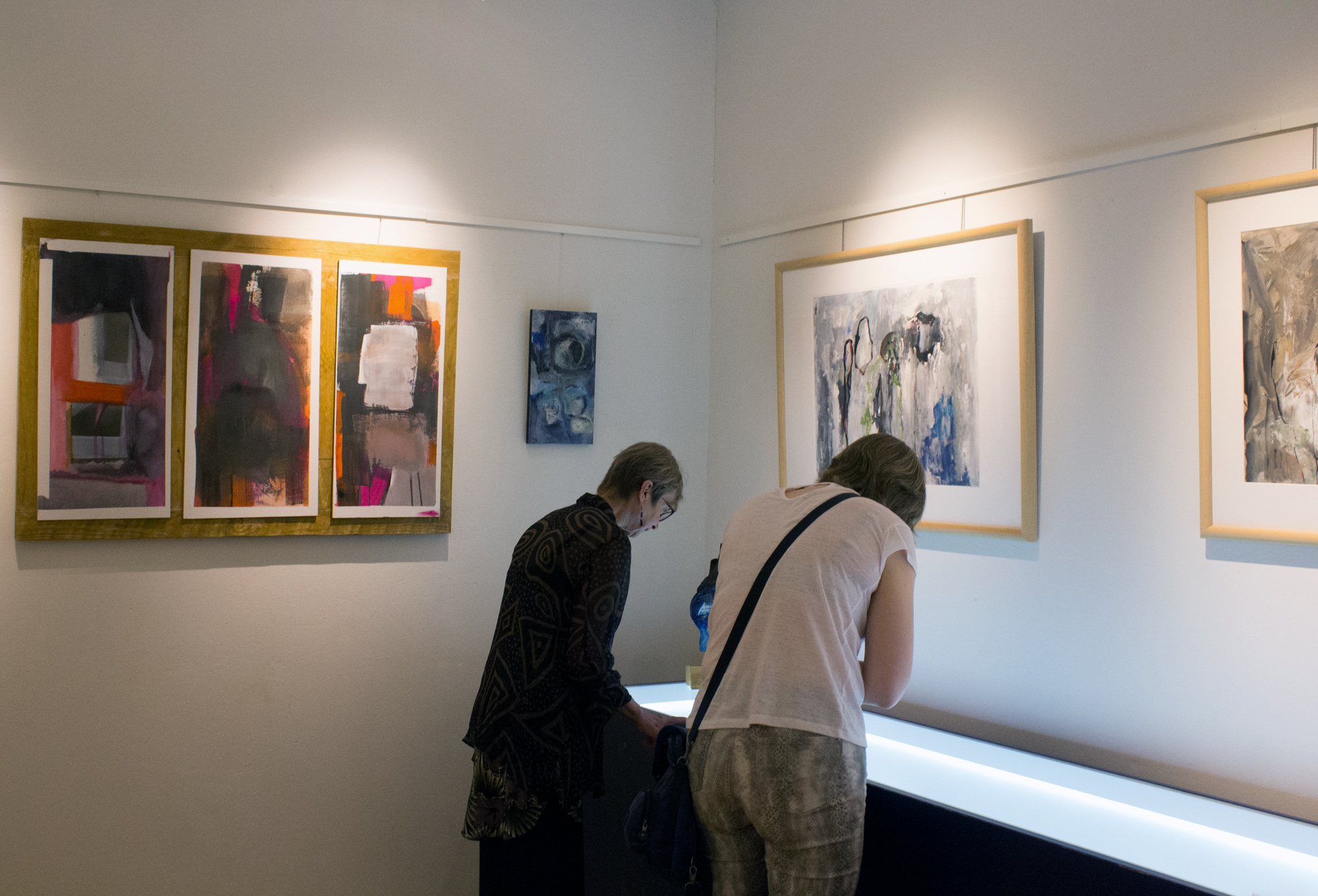
Installation views of the exhibition Senses


Installation view of the exhibition 'Senses' at Kunstwerk! Liemers Museum, Netherlands

Installation view of the exhibition 'Senses' at Kunstwerk! Liemers Museum, Netherlands


Installation views of the exhibition Senses at Kunstwerk! Liemers Museum, Netherlands


Jeanine Keuchenius (Dutch born Indonesia, b. 1953) 'Amulet' 2011 (installation view)


Jeanine Keuchenius (Dutch born Indonesia, b. 1953)
Amulet (installation view)
2011
Gouache on paper
50 x 65cm


Jeanine Keuchenius (Dutch born Indonesia, b. 1953) 'Amulet' 2011


Jeanine Keuchenius (Dutch born Indonesia, b. 1953)
Amulet
2011
Gouache on paper
50 x 65cm


Jeanine Keuchenius (Dutch born Indonesia, b. 1953) 'Pink and grey' 2012


Jeanine Keuchenius (Dutch born Indonesia, b. 1953)
Pink and grey (installation view)
2012
Gouache on paper
50 x 65cm

Each painting is the reflection of memory or dream.


Jeanine Keuchenius (Dutch born Indonesia, b. 1953) 'Pink and grey' 2012


Jeanine Keuchenius (Dutch born Indonesia, b. 1953)
Pink and grey
2012
Gouache on paper
50 x 65cm


Jeanine Keuchenius (Dutch born Indonesia, b. 1953) 'Lying figure 2' 2017


Jeanine Keuchenius (Dutch born Indonesia, b. 1953)
Lying figure 2 (installation view)
2017
Two-dimensional plaster cut, printed on newspaper
22 x 26cm


Jeanine Keuchenius (Dutch born Indonesia, b. 1953) 'Beautiful stay' 2014


Jeanine Keuchenius (Dutch born Indonesia, b. 1953)
Beautiful stay (installation view)
2014
Gouache on paper


Jeanine Keuchenius (Dutch born Indonesia, b. 1953) 'Unchained' 2016 (installation view)


Jeanine Keuchenius (Dutch born Indonesia, b. 1953)
Unchained (installation view)
2016
Mixed media on panel (bitumen, acrylic, sand on panel)
45 x 57cm


Jeanine Keuchenius (Dutch born Indonesia, b. 1953) 'Memory 1' 2018 (installation view)


Jeanine Keuchenius (Dutch born Indonesia, b. 1953)
Memory 1 (installation view)
2018
Mixed media on panel (acrylic, sand, plaster, oil on panel)
60 x 70cm


Jeanine Keuchenius (Dutch born Indonesia, b. 1953) 'Gribusella' 2014


Jeanine Keuchenius (Dutch born Indonesia, b. 1953)
Gribusella
2014
Acrylic on paper
50 x 65cm

Form and colour accompany depth and emotion


Jeanine Keuchenius (Dutch born Indonesia, b. 1953) 'Senses' 2012


Jeanine Keuchenius (Dutch born Indonesia, b. 1953)
Senses
2012
Acrylic on paper
50 x 65cm


Jeanine Keuchenius (Dutch born Indonesia, b. 1953) 'Bwual ènzo' 2014


Jeanine Keuchenius (Dutch born Indonesia, b. 1953)
Bwual ènzo
2014
Gouache on paper
50 x 65cm

Both when handling and avoiding themes, you sometimes walk in a circle.


Poster for the exhibitions 'Now, the new form of the past' and 'Senses'


Poster for the exhibitions Now, the new form of the past and Senses


Kunstwerk! Liemers Museum
Kerkstraat 16, 6901
AB Zevenaar, Nederland
Phone: +31 85 040 9971

Opening hours :
Tuesday to Sunday from 2pm – 5pm

Jeanine Keuchenius website

Drager Meurtant website

Petra Senn website

Kunstwerk! Liemers Museum website

LIKE ART BLART ON FACEBOOK

Back to top